TOPEKA, KANSAS- Who’s not in Kansas anymore? Anyone with a lick of sense. I crossed the state recently to find the western half riddled with fracked well heads, billboards condemning abortion, tollbooths on the interstate, police cruisers extorting drivers, and privatized postal services! I told the tollbooth attendant I didn’t think much of Kansas, I meant its dumbfuck Kansans.
Category Archives: Travel
George Seurat’s afternoon on an island

CHICAGO- What’s in a name? I expect its originator could explain. Do art collectors or curators have final edit over a famous painting’s title? I can understand the Art Institute of Chicago nicknaming its familiar La Grande Jatte, but the first paragraph of the painting’s gallery description has to explain that the iconic riverbank scene is named not for a tributary, but an island on the river Seine, because their slimmed translation of its full title now reads “A Sunday on La Grande Jatte” à la Sunday in the Park with George. Gone are afternoon and island from Un dimanche après-midi sur l’Île de la Grande Jatte –you wonder why bother to keep “la”? I remember the original full English title from art history textbooks, whose color plates now seem like a greatest hits album of the Art Institute’s collection. Did Chicago corner the market on Impressionist masterpieces, or did their image licenses determine which we’re taught are representative? Reframing painting titles suggests to me there’s more likelihood of the latter. Does great art jump out at you intuitively? I doubt we even know what we like.
The above detail is not Seurat, but Gustave Caillebotte’s Rainy Day in Paris and illustrates the difference it makes to see a painting in a gallery. High Def. Hopper’s Night Hawks is just as stark in actual size, but Caillebotte’s wet Parisenne has a lace veil which you’d never have noticed on a print.
Between Norway’s Bodø and Lofoten, the no man’s land of the midnight sun

BODØ-LOFOTEN FERRY, NORWAY- The sun rises in the East and sets in the West, except above the Arctic Circle, where the midnight sun rises in the North, and where home TV satellite dishes point downward. Bodø is the airbase from which the CIA flew U-2 spy-plane missions over the USSR. This complicity was forever denied by the Norwegian government, and when in 1979, investigative journalists were able to surmise the airfield’s function by deducing an intelligence community who’s-who from local phone book listings, the journalists were jailed, did I mention they were Socialists? There followed a notorious trail which finally reaffirmed a Norwegian freedom of the press. A WWII event on the island chain of Lofoten had a significant impact on the German occupation of Europe. Norway fell quickly to the Nazis in 1940, but an immediate counterattack by British paratroopers, which held a beachhead for only six hours, now known as the “Lofoten Raid” but appearing then as a counter-invasion, compelled the German strategists to station considerable reserves of soldiers in Norway to deter Allied ambitions to retake the valuable northern seaports.
Muddy wellies across white canvas

Norway prides itself on its ubiquitous and egalitarian middle class, making of its opera house a celebration of folkstheatre –and it’s no empty boast– Oslo newspapers address eight pages to culture versus one to sport. But I think the architects behind the glacier-slopped Oslo Opera House have struck with typical condescending Nordic sarcasm. Here is an in-edifice to high art on which the people can trod, on every last angle. Even if Scandinavian farmers are not inclined to attend opera performances, they can sight-see from the pretentious exterior. Idealists can assert this art reaches the Hoi Poloi, as it compels visitors to put it all underfoot. It’s form over substance, literally. The result presents aimless booted peasants looking like they wouldn’t know art if they stepped on it.
I can see the pretension to flatten the Sidney Opera House, crossed with Hong Kong harbor’s wreck of the Queen Mary II. The straight lines may have impressed on paper, but crawling over with masses, I see more a sinking white elephant.
Louvre knows art from food from rot
A little birdie traveler confirms the recently reported outrage about a McDonalds franchise in the Louvre. The good news: McDs was not permitted to adjoin the international food court where concessioners serve varieties of real meals. Instead the Happy Meals are consigned to the end of a long hallway, without advantage of a sign, except for the signature yellow arches to show the way. Familiar also will be the width of the fast food estuary, to accommodate the distinctly un-European girths of American patriots jonesing for their poison fix.
Just flew back from DC, arms tired
I hoped to be sending updates from CAMP OUT NOW at the capitol, but a laptop mishap left me unplugged for the week. Have much to report about Sheehan’s last stand(s), Obama and St Pats, Cynthia McKinney and the ANSWER march, street-dancing with SDS, Kathy Griffin and DADT, Medea torments AIPAC, Sunday’s immigration rally, Kill-the-Bill teabaggers vs. anti-abortion Catholics, RAN tripods at the EPA, the Smithsonian for Complete Idiots, disciples for 911 untruth, Holocaust Denial at the National Museum of the American Indian, and more.
Yanks overseas pretend to be Canadian but how do you do that in Vancouver?
Since the overt militarization of Pax Americana, US citizens traveling the world are advised to pretend they’re Canadians. It only took this week’s unexpected team USA victory over Canada in men’s Olympic hockey, to ignite anti-American feelings. Even before the games began, the USOC’s USA House was the only hospitality venue whose address was not made public, conveniently too because it was safely not open to the public. Now visitors leaving USA House are reminded not to wear or behave in any fashion that would distinguish them as Americans as they make their way to their accommodations.
Security warnings didn’t lessen even as Canada took revenge with a win against the US in Women’s Hockey. Canada’s speed skating victory wasn’t helped by Apolo Ohno’s complaint that his disqualification might have been owed to the supervising judge being Canadian.
Will a Canadian victory in the finals be enough to ameliorate feelings against Americans who dominate every other aspect of North American culture so obnoxiously? In either outcome I foresee American visitors and athletes taking their leave with as little fanfare as possible.
Just as McDonalds is uncontested as it pretends to speak for all Olympic athletes that their toxic McNugget is the “favorite of Olympians,” so is the American war machine able to coopt US athletes for their imperialist message. Critics of the Olympics are ridiculed for politicizing the games, yet militant nationalism pervades the ceremonies.
The television announcers remind us that the USA hockey players have been paired with beneficiaries of the Wounded Warrior program. Each stick-wielding, armored, helmeted ice warrior thus plays for the honor of an actual US soldier. A recognition I believe of America’s undying desire to have a second chance to kick ass.
I don’t know anyone rooting for Team USA, the finals rematch would seem to be an extraordinary opportunity for Obama-spirited diplomacy. These athletes are all NHL players of mottled nationalities, probably most Canadian as much as they are American. What better chance to let the victory to the host. Can you imagine the US asserting its dominance over its coalition partner? What could come of that?
Americans have precious few fans outside the homeland. Oh, they tell us, “we love Americans, just not America.” But in Vancouver this week, that was not true. Imagine Canadians added to the list of world people grown tired of the idiot American brute. Canada will take the sympathy of the rest of the Commonwealth with them.
After two weeks of patient cheerleading against US Olympic supremacy, suddenly I’m jumping up and down for a US win!
It’s just a game. The white man’s war on the world is not.
Vancouver 2010 Olympic destinations

Amtrak Station 1150 Station Street
Apple Store at Pacific Center, 701 West Georgia Street
USA House at Level, 1022 Seymour Street
Hilton Metrotown 6083 McKay Avenue
Olympic Tent City protest encampment, 58 West Hastings Street
Adbusters Magazine Culture Jammers, 1243 West 7th Avenue
RED THREAD marks the 2/13 demonstration against Opening Ceremonies. Protesters assembled at the Vancouver Art Gallery, marched down West Georgia Street, south on Homer Street, around Public Library and unto Robson Street where violence erupted as they were blocked from reaching BC Place.
Tapping into the nutrition of life energy
Yes, it’s a live fish. The Youtube video upsetting PETA depicts Chinese diners poking at the still gasping mouth of what’s for dinner. The plate isn’t hot, but watch your fingers! The meat is blackened to a crisp, while from the neck up the fish is kept wet with towels to ensure it doesn’t expire before the last bite. My, what a playful presentation with the red sauce!
I do wonder about the Chinese obsession with keeping food alive as long as possible. In the video the diners are laughing at the fish’s sudden reactions, which leaves the impression they are as surprised as we about this live novelty. But I doubt it is so rare an event among those who can afford it. I remember at outdoor markets in China, watching customers buy slices of fish meat cut directly from the sides of live fish. Does live fish keep longer than dead? Certainly it does.
Westerners won’t eat a lobster or crab that’s killed before it’s cooked. No doubt some Chinese think we are fools for believing dead fish is an acceptable substitute for live. Americans are already ridiculed for pretending frozen orange juice is any match for fresh squeezed. Who are Americans to opine on taste? For years we’ve eaten chickens fed on fishmeal, without realizing what Europeans could tell us from a table’s length away, American chicken smells fishy!
Now ask an American farmer about sweet corn and he’ll brag that it’s best boiled while still on the stalk. So there is consensus on a preference for fresh.
What constitutes fresh when we’re talking meat? If you ask a reptile or spider, it means live. Mammal predators kept at the zoo have to accustom themselves to eating pieces of steak where their nature is to grab from what’s on the run. What looks like Steak Tartar to us is what they usually leave to scavengers.
Has the human predator diet been converted to scavenger for the sake of convenience and civility?
In our contemporary quest for reclaiming nutrition, I’ll be curious to know if there’s a forbidden energy gone missing from our scavenged meals.
I’ll let the clip speak for itself about the inhumanity of devouring a meal as it looks on. And I’m really glad that no worse videos have emerged from China. As yet there are no Youtube videos of diners eating monkey brains straight from the skull of a live monkey strapped to the table, nor of the infamous “three squeals” delicacy of live rat fetuses.
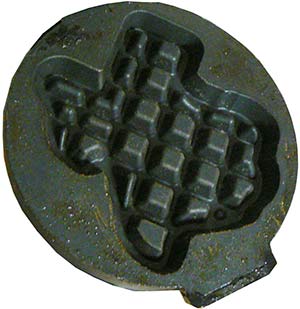
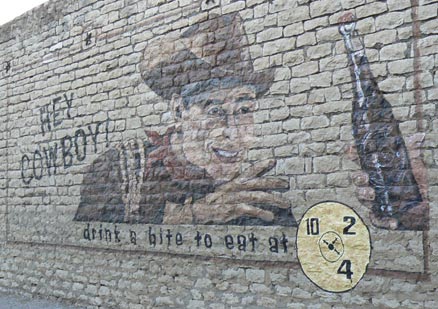
You know you’re in Texas when
Dr. Pepper, Texas
Next to the White House
While visiting Washington DC in March, I found it interesting to note the edifices closest to the White House.

EAST, WEST
The neighbor to the immediate East of the Obama’s White House is the Department of the Treasury. Is that any surprise? Of course not, but how bourgeois! I could imagine Scrooge McDuck sneaking across the White House garden twice a day to check his reserves. To the West is what we now call the Dwight D. Eisenhower Executive Office Building. It’s the site of the suspicious office fires which may or may not have masked a recent vice-president’s misdeeds. The edifice looks straight out of A Series of Unfortunate Events, and check out the plaque which commemorates what the building used to be called:

Probably that should be no surprise as well: the White house sandwiched between Treasury and War. “State, War and Navy.” How so much less duplicitous than the “Department of Defense.”
SOUTHWEST
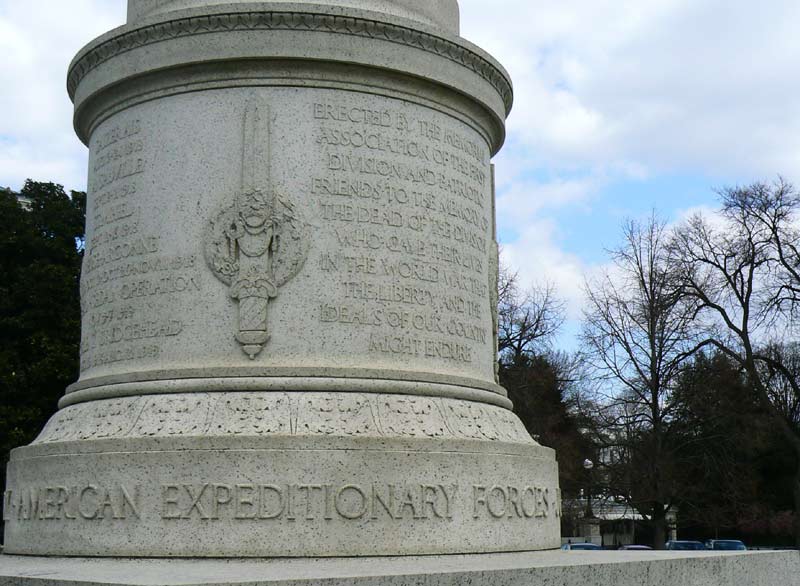
Behind the former War offices, to the Southwest of the White House, lies the war memorial to end all war memorials. It’s the WWI Memorial, of considerably diminutive size compared to those commemorations of subsequent wars which have spilled unto the Mall, but its form followed the convention of the typical Great War monuments erected throughout Europe among the nations who had participated.
Except the American version is dedicated to the “Expeditionary Forces” which I just love. That’s what WWI was about for the US. The trenches of Europe were no place Americans needed to defend their freedom. The troops we sent, to relieve France and England, represented a foreign expedition, exactly that. More precisely, our troops were an R&D expedition for our blustering capitalists.
(This may be no time or place to note that history books do not link America’s WWI experience with the Influenza outbreak of 1917-18, which began in the barracks of US soldiers being mobilized for war. American soldiers took their flu to Europe and ultimately killed 50 million people. Those were not the days before we knew better to stay home to prevent infecting others.)
The US entry into WWI was bitterly opposed by a peace movement which the war-opportunist-profiteers maligned as isolationist. Selfish globalization-denying isolationism has been the slander ever since, used against anyone who tries to block military interventions in all their guises.
Ultimately WWI was no affair of ours, had the Huns emerged victorious, American foreign affairs would hardly have changed. Our foreign trading partners would have numbered more Germans, that’s all. But it’s useless to compare alternative outcomes of WWI, all things staying constant, because America participated and profited wildly.
If American investors had not jumped in Over There, the greatest business opportunities of blossoming industrialism would have been missed. The opportunities offered by the Europeans fighting amongst themselves, proved to have been momentous.
And here was the monument to those lost American lives, sacrificed so that American industrial might, in particular the new banking monopolists, could seize the European spheres of influence throughout the world. Of course the lost lives of the American Expeditionary Force were remembered thus:
“…WHO GAVE THEIR LIVES IN THE WORLD WAR THAT LIBERTY AND THE IDEALS OF OUR COUNTRY MIGHT ENDURE”
It would take another World War for the US to appropriate the colonies and oil fields by means of contracts and loans, with the leverage of coming to their aid again, this time armed with lend-lease bills.
SOUTHEAST
To the Southeast of the White House, across the back lawn, lies the monument antecedent to the Great War. It’s the Civil War Memorial, atop which rides the triumphant General William Tecumseh Sherman. (Who, to be fair, presided over the War Department for a long stretch after the Civil War, actually this nation’s longest peacetime period.)
Curious that I chose to crop his personage from my pictures, but my eyes were drawn to the lesser figures around the base of the monument, in particular, a half naked woman.
The memorial seemed to include various uniformed Civil War participants. How egalitarian to include a woman. But this woman was no French Revolutionary with breast bared oblivious as she rallied her comrades to victory. This delicate woman was unarmed and stripped to the waist, her children in tattered rags at her feet.
Could this statue be offering another conceit to the reality of war, to Sherman’s March to the sea, to the burning of Atlanta, to the shameful destruction he visited on the secessionist South? Was this a nod to the real role given to Women in war, their sons and husbands taken from them, a non-combatant left helpless to defend her children or herself. Did the shirt torn from her body confess to the woman’s rape?
More probably the feminine likeness personified man’s attraction to war, a soldier’s predilection for her beauty. How many war monuments memorialize as they also beacon?
Much of the terrain around the White House grounds is blocked off by secondary and tertiary security perimeters. But for the arrival of bus unloadng its visitors to see it, the Civil War Monument is normally cordoned off. When I had passed it earlier, a balaclava-clad guard was blocking the only entrance.
SOUTH
The grassy expanse immediately South of the White House, permitting the First Family an uninterrupted view of the National Mall, has actually been given over to parking permits. The loop of asphalt across the lawn, with cars strewn diagonally along the edges, gives the unfortunate impression of overflow event parking. In any other neighborhood, the crowd of cars would be a dead giveaway that someone on the block was having a party.
Roughing it in DC
WASHINGTON DC- We caught the Metro, dragged our bags across the streets and sidewalks, but alright, we haven’t exactly been roughing it.

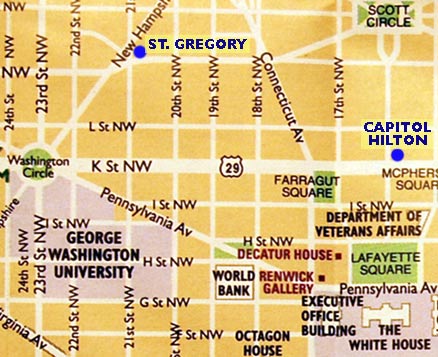
First stop, the Capitol Hilton, from which we can promenade to the White House. It’s a stuffy hotel, with historic presidential-themed porcelain plates on display featuring an eagle that would look more comfortable on Luftwaffe place settings.
Marie arranged the other couples nights at the St. Gregorys, the nearer to hang around the university and explore Georgetown.

The St. Gregory Hotel was reputedly a favorite of Marlyn Monroe’s. Which I suppose is enough to explain the life size statue of Monroe in their lobby. Monroe stands poised above the famous subway vent, her dress permanently fixed immodestly. Billy Wilder had the good sense to shot the scene from the front, but the St. Gregory didn’t have that foresight, and they’ve bent this Monroe forward like a hood ornament, for short customers maybe.
I’m not sure the titillating sight is something to complain about. Call it a land mind for involuntary ogling. Easily avoided once you know it’s there, but if your mind is on something else, a conversation for example, Monroe’s pose catches your reflex unawares.
Four conflicted images of Costa Rica
CARATE, COSTA RICA- Even on the less beaten paths of the Osa Peninsula, Costa Rican residences were preoccupied with security. Ticos, as locals call themselves, were uniformly welcoming, but every property was protected by locked gates.
The Bienvenidos flier you are handed at immigration includes among its cautions: “If you are lost and in need of checking your map, look for a public and safe place to do it, or recur to the police authorities to help.” and “Avoid stopping when a stranger asks you for a ride.”
It is difficult to visualize a Costa Rica as it used to be, completely forested. Today ranch lands abut rain forest. Both look “natural.” The reason perhaps that eco-tourism has adopted the mantra “biodiversity.”

Skinny Costa Rican cows are grown for the North American fast food market. Their beef does not meet anyone’s standard for steak, but mixed 50/50 with the fat byproduct of American Holsteins, the result passes for fast food hamburger patties.
Clearing the land has the benefit of yielding timber for construction. Jungle preservation brings more eco-tourism to Costa Rica. Here the conflicting land uses meet. On the edge of the road past a timber mill, reads a sign advertising CANOPY TOURS.

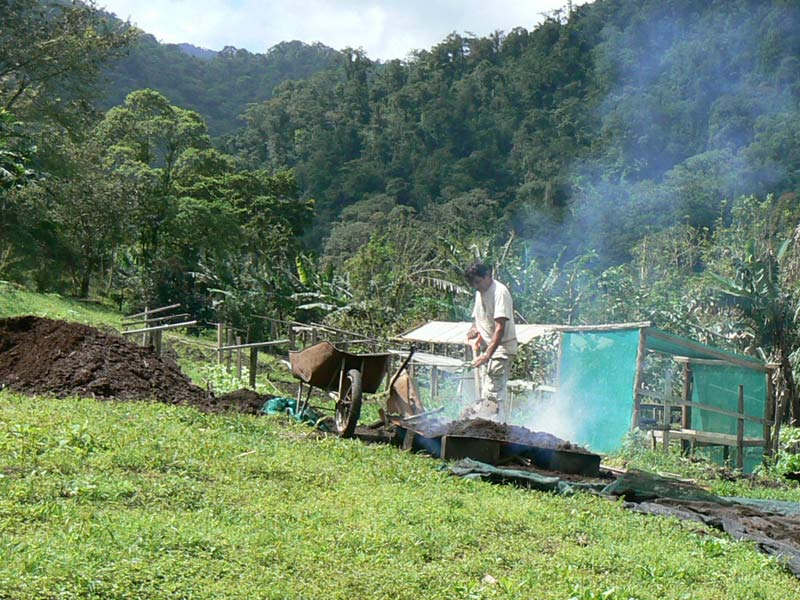
In the lee of Vulcan Arenal, Rancho Margot is a model of sustainable farming. Its gardeners are going to great lengths to try to meet all their lodge needs in-house. Some plants such as tomatoes, require a less tropical climate and so must be grown in green houses, where also they require dry soil. When we asked our guide what this ranch worker was doing, his answer was: “He’s trying to do the impossible.” He was heating dirt over a fire, careful to dry it without cooking it.

Buffalo Bill Lives at Fort Cody Nebraska
FT CODY, NEBRASKA- On I-80 as you pass North Platte, sits the Fort Cody Trading Post, home of the Free Buffalo Bill Museum Emporium. What had been the Ogallala, Neb, Sioux Trading Post, moved in 1969 to follow the travelers rerouted from Hwy-30 to the new interstate, and changed its focus from the Native American to the Ugly American.
Buffalo Bill Cody earned his moniker by eradicating America’s buffalo herds. Over a million buffalo were killed each year during the 1870s. According to the museum, Mr. Cody labored to feed a sudden East Coast appetite for buffalo tongue, and a fad for buffalo fur coats. The display confessed: “Unfortunately the buffalo carcasses were left to rot on the plains.”
History books had been less forthcoming. They record that Cody was hired by the railroad builders to supply food for their workforce. He and his team were contracted to supply twelve buffalo a day. Does that come a little shy of a million? Accounts also wink at the risk Cody ran of coming against unfriendly Indians while engaged in the task.
When BB Cody wasn’t scouting for the railroad and the US cavalry, he was touring the world to exhibit the red skinned savage. Fort Cody featured a miniature 20,000 piece, hand-carved, animated model of Buffalo Bill’s Wild West Show.
On an opposite wall, among a fantastic collection of western guns, clothing and cowboy gear, was an undated tintype depicting Bill posing with fellow scouts, cradling his favorite rifle which he called “Lucretia Borgia.”
In recent years, government documents have revealed a different story. It turns out the white men leading the charge westward were frustrated that the Plains Indians had what looked like an unlimited food supply. The buffalo kept them clothed and fed, and the nomadic tribes followed the herds like their own moveable orchards. One of the strategies to force the Native Americans from their land was to eliminate their source of food, and basically their livelihood.
Most Americans have been kept oblivious to this version of history. Should we doubt that most of the participants were keenly aware of the strategy, if perhaps indifferent to the fate of the red savage? Does it matter?
Under the pretext of building a security wall in Palestine, Israel is separating the Palestinians from their olive orchards, often by uprooting the orchards outright. American troops in Iraq have destroyed date palm orchards using the excuse of having to clear the populated areas of cover for insurgents. In Vietnam, defoliants were used to despoil large areas, rendering them incapable of yielding food. Troops also poisoned wells. It’s called the scorched earth policy, and by the way, it’s a war crime.
If Americans don’t come to terms with the crimes we committed here, or are committing elsewhere, how can we expect our soldiers to find cause to refuse the orders next time? The public’s consent is always being manipulated by having to hold a certain regard for the soldiers. Out of respect for the memory of its veterans, in current events, to “support the troops.” After a point, we have to lay the blame with both commanders and perpetrators. Vietnam was genocide. Iraq is genocide. Those over there are doing it.