Syria neoliberal invasion ad campaign casts chicks with guns but no helmets


THAT’S RICH. When they’re not bombarding western viewers with contrived photo-ops of camera-facing toddlers, victimized by Asad’s bombs never ours, the neoliberal propagandists are fishing for left-leaning sympathies with “Freedom Fighters” who Americans could not should not leave behind. Meet the West’s own Femen ForWar, Kurdish anarchist insurgents, one even dubbed “Angelina Jolie”, who are photographed in action, with wide smiles in sniper’s nests, looking like they’re otherwise hanging in homeroom detention. I’m surprised we never see the lighting crews or makeup artists reflected in the shattered glass, but what we don’t see in plain sight are HELMETS. Apparently only real soldiers need those.

There’s even a Chicks-with-Guns meme gone viral of a bareheaded Freedom Fighter breaking into a huge grin after narrowly escaping a sniper’s bullet. One man’s insurgent is another man’s freedom fighter. Western media’s freedom fighters are your Freedom Fries.

Daily Gaza fishing flotilla blockaded by Israeli Navy, no fishing to supplement carefully measured aid starvation diet

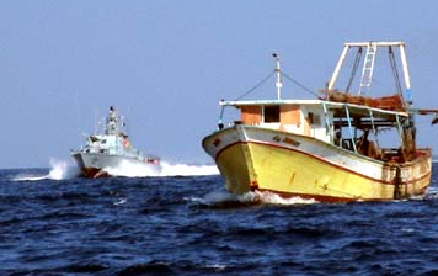
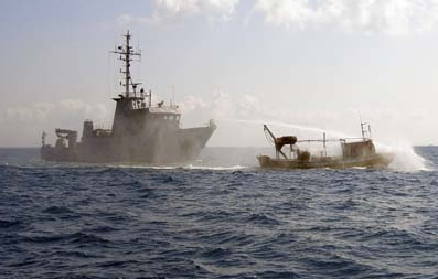
Gaza fishermen being attacked by IDF gunboat with water cannon
The fishermen of Gaza are harassed daily by IDF gunships which shoot them outright when there are no Western witnesses present. The late Vittorio Arrigoni was one of the International Solidarity Movement who regularly accompanied fishing boats, forcing the Israelis to set aside their machine guns for water cannon when he was around. Of late activists have their own boat, the Oliva, to escort the fishing fleets. And today the Oliva was accompanied by another skiff commissioned by the Guardian. Their Jerusalem correspondent Harriet Sherwood tweeted the following adventure just now:

On boat heading out from Gaza port. Fishermen regularly fired on by Israeli military. Going to check.

Getting close to 3 mile limit for fishing. Israeli gunboat speeding towards us.

There are 7 boats in our group. 4 fishing boats, 2 press boats, 1 human rights group boat.

Israeli gunboat circling around. Siren sounding. Machine gun mounted at rear.

IDF coming very close. Sirens. Banking hard causing a lot of backwash for our small motor boat.

6 or 7 troops on bridge, all armed. We have cut our engines.

We are 2 or 2 and a half miles from shore so within fishing zone. IDF preventing us going further.

Phone signal going in and out. A 2nd IDF boat heading towards us.

Fishing boats are throwing lines. But very few fish this close to shore.

Guardian boat is flying under Barcelona FC flag….

Now 2 gunboats stopping us going further.

This is our GPS location: N31.5727176 and E034.37703. Can someone work out exactly how far we are from Gaza City?

Fishermen saying there are no fish. They want to go out another 50 metres. But that could provoke reaction. No boat willing to go first.

One fishing boat heading further out. But the guys are asking us (Guardian) to go in front for protection.

One IDF boat just circling our boats about 50m away. Other boat a bit further away.

A lot of resources devoted to a few tiny fishing boats.

Sea is calm today – except our little bit. Backwash creating lot of waves. They keep sounding siren. But we have all cut engines.

I’m told that the point of the IDF continually circling us is to create continuous waves and noise. Makes fishing harder.

One fishing boat just been swamped by backwash. They are giving up and going back to port.

One IDF boat appears to be heading away. The other coming closer.

Water canon military boat in distance. Maybe heading towards us. Hope not.

Both gunboats have moved off as water canon boat approaches.

Water canon boat maybe 200m away. Heading straight towards us. May have to put comms away for a bit.

Boats being water canoned. Very dangerous. The NGO boat almost went under.

Was mini hi-speed boat chase as we cut and run and the IDF chase.

IDF still firing on Oliva the human rights boat. They are trying to drown it says my translator.

We are keeping distance. Feel cowardly.

Amazing that the Oliva is still afloat.

We are within 3 mile limit so why is IDF doing this?

I will call them later to ask.

Other fishing boats yelling at us what are you still here. Go in, go in!

We are heading in. Water canon boat close behind.

All boats okay and heading back to port. No one hurt – but no fish either.

Water canon boat still firing its water into an empty sea.

Correction – one fishing boat passes and shows me its haul. 6 tiny ones. They are angry says my translator.

Water canon boat now firing on another group of fishing boats.

These fishermen are strangely euphoric – singing clapping dancing on their boats. Glad simply to survive I guess.

Back on dry land. 9.55am. Welcome back to safety says my translator, laughing ironically.

The Oliva, the water canoned boat, coming into port now with the other fishing boats.

The Oliva was rammed by the water canon boat and its engine damaged. The captain says all boats were within the 3 mile limit.

The fishing boats have gone back out. The Oliva’s captain is still bailing out his boat.

Captain says the engine fan is broken. It will cost around $4-500 to repair.

The gear is also damaged. This is the 3rd time the crew say.

Captain says they will go out again tomorrow if they can repair the engine. They have to find the parts, not easy in Gaza.

He says every time he goes out he expects to be attacked by water canon, live bullets, ‘whatever.’

That’s it from Gaza City port. I will be writing a piece for the Guardian and we have shot video. Over and out, as they say.

We’ll link to the Guardian article as soon as it’s out.

UPDATE: Rad the CPSGaza account.

Solo Gaza relief ship Dignite Al Karama presses on for the dignity of Palestine

Freedom Flotilla II, Stay Human
Not only have nation states refused to sanction humanitarian relief missions to illegally besieged Gaza, events this week prove they are unanimous in prohibiting even citizens doing it themselves. Yet, one brave vessel has eluded sabotage, lawsuit, bureaucracy, and Greece’s Coast Guard paramilitaries. French Freedom Flotilla II participant DIGNITE AL KARAMA presses on alone to break the siege of Gaza. Without media escort, television cameras or witnesses, the crew of eleven, joined by print reporter Quentin Girard, will have only their cellphones to apprise the world audience of their progress against the bellicose reception which Israel has promised awaits any transgressors of its 63 year occupation and subjugation of Palestine, including its open-air prison called Gaza.
 
UPDATES: Dignite incercepted by Greek Coast Guard while refueling in Ormos Kouremenos, Crete. Taken under escort to Xinthya, where it’s promised they will be able to leave in the morning. Translation of French article below.

Flotilla for Gaza: The “Dignity” intercepted by Greek coast guard.

For two hours, late Wednesday afternoon, the “Dignity” is moored at Ormos Kouremenos, a small port in the far east of Crete. It needs to replenish fuel one last time before sailing to Gaza.

Suddenly, as it has already replentished 1,000 liters and is awaiting a second delivery, a gunboat of the Greek coast guard emerges. The passengers immediately understand. In this small bay where there are only fishing boats made of wood, they know it is there for them. The gunboat approaches, also an unmarked car.

The Coast Guard ask politely for our papers. Thus began a two-hour discussion and document control board where everything is carefully checked. Activists trample board.

“It’s too bad”, everyone is thinking. This was the last step before the big crossing. A dozen men in uniform, very polite, surround the Dignity. The phone calls multiply, presumably to refer to a distant authority. The Coast Guard require passports, they carefully register the names.

They don’t find much wrong with the boat. The captain didn’t have a logbook and the marina’s entry fee, 30 euros, hadn’t yet been tendered. Except that in this small fishing harbor, there was no place to declare one’s arrival. We must wait. Passengers prepare to eat, the menu that night, chicken pasta, coppa and lentils.

“We’re Very Sorry”

Eventually the Coast Guard announced that we must follow them to another port to sign authorizations and that the “Dignity” will be able to leave the next morning. It’s 10PM.

In the meantime they keep the boat’s papers to make photocopies. They ensure that there is no problem. One of them apologized repeatedly: “Sorry.” Omeyya Seddik, one of the passengers replied, “You’re doing your jobs, that’s normal.”

The “Dignity” is off again into the night toward the port of Xinthya, escorted by the Coast Guard boat which heads off without delay. Too fast. Many times it seems to disappear into the night as if really she doesn’t want to be followed.

The passengers do not know how to react. What to do? Keep a slim hope? Or immediately broadcast our circumstances and risk making it certain we will not be able to leave as promised. They doubt, they got the impression there were only Greeks among the Coast Guard and the people who were roaming around taking pictures.

Three days they are at sea, three days playing cat and mouse without knowing really if there was a cat. The dignity might perhaps not get to Gaza. It was the only ship of the “Freedom Flotilla” that managed to sail and keep up the hope of getting to Gaza. It went a little further than others, probably not enough. “We remain committed” they declare. “Tomorrow if we can go, we will continue to Gaza.”

RADIO INTERVIEW: Quentin Gerard explains: “This boat has become a strong political symbol.”

AWAITING CONFIRMATION: Swedish aid ship JULIANO still hopes to make a convoy. (Broadcasting live at http://ustre.am/zQHM)

As it stands, authorities have blocked or sabotaged 9 of the 10 vessels known to be sailing in the aid convoy. They are: The Audacity of Hope, Tahrir, Saorise, Juliano, Guernica, Louise Michel, Dignite Al Karama, Stefano Chiarini, Freedom for All, and the Methimus II.


Aboard the DIGNITE: Activists: Olivier Besancenot, Annick Coupé, Nabil Ennasr, Jacqueline Le Corre, Nicole Kiil-Nielsen, Osama Mouftah, Julien Rivoire, Omeyya Seddik; crew: Hilaire, Vincent and Yannick; not pictured: photographer/reporter Quentin Girard.

See their pictures at Liberte.fr.

Updated Facebook page statement of DIGNITY delegation:
La déclaration des camarades à bord du bateau

Message of the French delegation on board the Dignité Al Karama: The Freedom Flotilla is not dead!

Our presence at sea, on the Dignity-Al Karama, permits us to carry on the message of the international campaign of the Freedom Flotilla II and of the French Un Bateau Pour Gaza campaign. The statements by the Israeli authorities proclaiming the end of the Freedom Flotilla II, praising the Greek government acts as freedom of expression and actions of a civil society are now dead words.

We are at sea, and the collected national coalitions are not giving up.

States should no longer be complicit in this criminal blockade, and cannot silence the urge of civil society that simply demands, through this nonviolent action, the enforcement of law by permanent lifting of the blockade of Gaza.

We call on all justice-loving citizens to strengthen the effort, to allow the Dignity-Al Karama and all boats of the flotilla to go to Gaza.

Girard latest Tweets:

July 6, 3:36
Besancenot at the helm, small salad, sea of oil. Nickel.

July 6, 3:37
On the boat we wonder about the latest of the mercato and of the Tour de France. Any news?

July 6, 5:29
@JAntiwilders Dignity Is still heading to Gaza.

July 6, 5:29
@yanouz FT1 will not be on the boat evidently.

July 6, 6:19
@GirardTh Not too much wind, calm sea, it’s a change from the Atlantic.

July 6, 6:33
@JpKphotographer Yes, will you follow me? We need press agency photos.

July 6, 11:09
Did the Greek-Swedish ship manage to leave the port of Athens? Really?

In the original French:

3:36 – 06.07
Besancenot à la barre, petite salade, mer d’huile. Nickel.

3:37 – 06.07
Sur le bateau on s’inquiète des dernières nouvelles du mercato et du tour de France. Des news?

5:29 – 06.07
@JAntiwilders dignity is still heading to Gaza.

5:29 – 06.07
@yanouz F1 ne viendra pas sur le bateau apparemment.

6:19 – 06.07
@GirardTh pas trop de vent, mer calme, ça change de l’Atlantique.

6:33 – 06.07
@JpKphotographer oui, tu me rejoins? Ils ont besoin de photographes dagence de presse.

11:09 – 06.07
Le bateau greco suédois aurait réussi à sortir du port d Athènes? Vrai?

French craft DIGNITY breaks for Gaza, leads Flotilla II until rest allowed to go

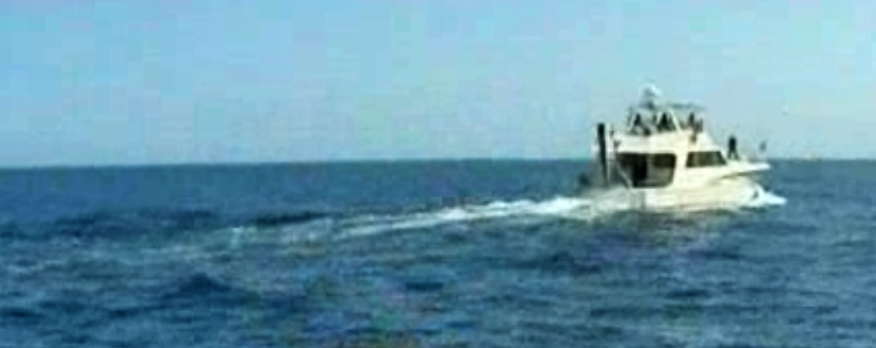
French cabin cruiser La Dignite - Al Karama
UPDATED– In a flurry of conflicting tweets, French Flotilla II member DIGNITE AL KARAMA made for the open sea, beyond the reach of Greek authorities currently detaining the AUDACITY OF HOPE, TAHRIR, LOUISE MICHEL, GUERNICA, JULIANO and others. Reporter Quentin Girard has been communicating the DIGNITY’s progress, its eight activists electing last night to complete their run all the way to Gaza.

The French vessel escaped Greece on a technicality, as a pleasure craft, the Dignity is not confined by the regulations being used to block the larger Flotilla participants. Aboard the Dignity with Girard, are Olivier Besancenot, Julien Rivoire, Omeyyaa Sedic, Nicole Kiil-Nielsen, Annick Coupé, Nabil Ennasr. (Both Coupé and Besancenot are registered on Twitter, but neither has communicated yet.)

Girard’s most recent tweets, translated:

July 5, 3:02
All is well thank you 🙂 but we were in an area where reception was bad.

July 5, 3:15
Despite what we can read, the Dignity is still in international waters. It will be there in one hour.

July 5, 7:41
The passengers of the Dignity have finally come to the decision (only now really) to go to Gaza.

July 5, 8:19
TF1 should attempt to rejoin Dignity and embark.

July 5, 8:43
We’re moving again after a “media” pause on the high seas. 15 hours of sea left before I might go silent. Kisses!

July 5, 12:19
Into the night the DIGNITY continues its advance. In the distance, small lights.

July 5, 13:38
Not really enough beds for everyone, so I sleep under the stars on the upper deck. beautiful sky.

In their original French:

05.07 3:02
tout va bien merci 🙂 mais on était dans un endroit où ça captait mal.

05.07 3:15
Malgré ce qu’on peut lire le Dignité n’est pas encore dans les eaux internationales. Il y sera dans une heure.

05.07 7:41
Les passagers du Dignité viennent de prendre enfin (seulement maintenant vraiment) la décision d’aller jusqu’à Gaza

05.07 8:19
TF1 devrait tenter de rejoindre le Dignité et embarquer dessus

05.07 8:43
On bouge à nouveau après une pause “média” en haute mer. C’est parti pour 15h de mer, où je risque d’être silencieux. Des bises.

05.07 12:19
Dans la nuit le dignité avance toujours. Au loin, des petites lumières.

05.07 13:38
Pas vraiment de couchettes pour tout le monde, donc je dors à la belle étoile, sur le pont supérieur. Beau ciel

Below is the Girard’s July 5 article in the LIBERTE.FR (auto-translated, sorry, until I can review it)

En route to Gaza, “Dignity” is appealing to the media

The French ship of the “freedom flotilla” sailing in international waters off the coast of Greece. The crew decided to go to Gaza.

By QUENTIN GIRARD special envoy on the “Dignity”

16 hours in Greece, somewhere in international waters, on Tuesday afternoon. After much discussion, the Dignity passengers finally made their decision. They will go to Gaza. A bit surreal moment where the middle of the sea, tossed by the waves, they set up banners and make an official statement.

When they left the industrial port of Salamina, Monday morning, they did not really know how far they try to go. There, as they finally arrived in international waters a little to 15 hours – after wet night in a small cove – they say they are determined. “We’re going to Gaza. The French and international community officially announced that they supported us regardless of our decision, “enthuses Julien Rivoire, one of the spokesmen of the campaign. “But to get there, we also need the media, as TV join us to show our work and safety issues,” he continues.

In the distance we see no island, not even a few freighters, these little black spots that usually reassuring scattered throughout the year. “We wanted to show that we could block the Greek blockade, says Julien Rivoire. It once was that we wondered what we were doing then. ”

Return to France? Impossible

That same morning, the discussion was intense as ever on the Dignity. What to do? Return to France? Impossible for them. Go to another country such as Tunisia symbolic to wait, to show that it is a stopover? Why not, it’s better, they say. But no. The only viable solution they think is necessary. Go to Gaza. “You have the dignity to the end represents French and international committees,” argues Olivier Besancenot.

“The important thing that determines the political feasibility, technical feasibility, must be as representative as possible and supported,” Nabil Esnari continues, President of the Association of Muslims in France. “We do not want to be seen as Islamic-leftist Khmer-green-act in our corner,” says the MP-Europe Ecology Nicole Kiil-Nielsen.

“My preference would be to go to Gaza without delay,” takes on Olivier Besancenot position as others. “Our protection is proof that we exist, we continue to move forward. We can not afford to become a ghost ship. ”

There remains the question of technical means. The Dignity is a small yacht of 15 meters long, categorized craft. It was originally one of the smaller boats in the fleet. He has no self to go off the ridge to Gaza. It would necessarily need to be refueled and water en route. Hence the difficulty that there will in the coming hours to coordinate the political ambitions and technical means.

A small creek, goats, and … Sea

But they want confident. The twelve passengers (1) are refreshed by their two days at sea after a week of pitfalls in Athens. Although the coup, the Greek landscapes provide a particular coloration to the adventure. In the capital locked up in meeting rooms to multiply the points and plan protests, the mood was serious and solemn. Not even have time to visit the Acropolis.
There hard to escape the Greek islands. On the night of Monday and Tuesday, the Dignity was anchored in a cove of a small island. In the morning, passengers were woken up by goats with bells tinkle merrily. A shepherd ran along the cliff, the whoop, some small white houses with blue shutters, of steep cliffs, the water so beautiful … “In the morning, you go through three stages,” said Olivier Besancenot. “First you wake up, you do not know where you are, then you look around you and you say,” oh yes, it’s beautiful. ” And just after you wonder what’s next meeting, what is the plan that will be put in place. ”

The Plan: Gaza, having embarked with TVs. Maybe he will change in the coming hours. Meanwhile, the Dignity vogue. Engine noise makes deaf. The smell of fuel oil a little drunk. In front, nothing. The sea, just the sea.

(1) On board were three crew members, eight activists – Olivier Besancenot addition there are Nicole Kiil-Nielsen, MP, Europe-ecology, Annick Coupe, spokesman for the union Solidarity trade union, or Nabil Ennasr, President the Collective of Muslims in France – and a journalist, the author of these lines.

The earlier July 4 Liberte.fr article:

On board the “Dignity”, en route to Gaza

A French ship with a few activists on board, including Olivier Besancenot and Annick Coupé, eventually left Athens and headed to Gaza despite the obstacles. The “flotilla to Gaza” is reduced to its simplest expression. The story of our special correspondent on the deck of “Dignity.”

By QUENTIN GIRARD special envoy on the “Dignity”

“The pins in the plastic, it will not be possible,” said Olivier Besancenot, in full session yourself. 11 hours on Monday, in a small Greek port. The Dignity Al Kamara, one of two ships of the French committee for Gaza, left at dawn the creek near the industrial town of Salamina, where he had hidden for three days. In another cove where he made a first step, the passengers – including Besancenot, so – try to install the satellite antenna to communicate with the outside world.

3 o’clock this morning, Julien Rivoire, a member of the NPA and a spokesman for the campaign called “Wake the captain, we’re back.” Between them and the small annex that links with the boat, watchdogs of the port or adjacent businesses. They bark violently at night. They fail to wake the whole neighborhood. Tunisian Omeyyaa Sedic and Julien Rivoire, equipped with the latest load required, can not pass. Latest in a series of tragicomic events that marked the week of the fleet. “We’re not James Bond, it is OSS 117” is trying to be amused Julien Rivoire finally climbing on Dignity.

Plaisance

Sunday evening, the decision was made. It was long in coming, interspersed with calls to Iniohos Hotel where the rest of the delegation. A consensus is emerging: the Dignity attempt to leave no matter what. This small yacht 13 meters long, having left France ten days ago, has a status of “craft” and is theoretically not subject to the same prohibition to start than other boats of the delegation.

On Friday, an American ship tried starting one. Saturday, the captain was imprisoned. It could several years in prison for having left without permission. After several announcements bullies, to show their determination and their will as strong as ever to go to Gaza to bring humanitarian assistance, the committees have defected last one after the other. Masters of Spanish ships and Canada have announced that they did not want to take as many risks as they were sure they could not be more than thirty meters. The former president of Greenpeace France, Alain Connan, captain of the main French ship Louise Michel, after long hesitation, agreed with this position, some attracted by the Greek jails.

He went to ask permission to start at the harbor. Refused of course. The passengers were then organized a demonstration on the deck of Louise Michel. They simulated a departure. They should all file a complaint for obstruction of freedom of movement in the afternoon.

Parano

5 o’clock this morning, the Dignity springs. The sun is not up yet. Some cargo ships moving in the distance. Around him, two or three carcasses that rust for too many years, the ferry may be ready to leave but which seem, at dawn, desperate still. Twelve boats, twenty-two different nationalities and several hundred passengers announced, the fleet is now reduced to three crew members, eight militants – Olivier Besancenot addition there are Nicole Kiil-Nielsen, MP europe-ecology, Annick Coupe, spokesman for the union Solidarity trade union, or Nabil Ennasr, president of the Collective of Muslims in France – and a journalist, the author of these lines.

The Dignity enters the channel. In the distance, lights, shadows indistinct, but no coastguard. Surprise among the passengers. They believed they were identified and a small star suddenly arise between two cargo ships to stop them. For two days, each gull, each fishing boat, each jet-ski with the big guys who spend every man piss in the night under the white lights of the port is an opportunity when paranoid.

To starboard there. A port, nothing. In the distance behind, already, the lights of Athens. The sun appears between two hills. After a week of failure or disruption, and the blows of fate have joined forces to keep them in port, for the first time the French committee actually managed something in Greece. They feel like defeat stress, even if they are tired, even if the tension is palpable at times between them, although discussions and waiting endlessly sometimes not.

Determination

Of course, they know that this little boat is not much. That Israel, obviously, has won the game this time and that the only issue that remains is to show that they have tried everything, it’s not a “fucking failure”, as stated Besancenot. Certainly they know that it is unlikely to go to Gaza, especially alone. Unless a Greek ship to join them. The committee led by Vengelis Pissias announced that they had a new, third, a “surprise” that the authorities do not know. But they have promised so many things since the beginning of last week …

The Dignity vogue. It will reach international waters in a few hours if not arrested by the Coast Guard before. There, passengers will make official statements. They expressed their determination against the blockade of Gaza and denounced the attitude of the international community against them. They then announce the next steps. If there is a sequel.

June 25 Le Monde article:

Gaza flotilla II imminent departure

A year after the arrest of a murderer off the first convoy of Israel, a new international fleet prepares to sail to Gaza to try to break the blockade imposed on the Palestinian enclave. Unlike last year, two French ships involved in the operation.

The first of these ships, the “Louise Michel”, is currently in Greece. The second, “Dignity-Al Karama” sailed this morning from the Ile-Rousse in Corsica. I get on one of them and try to deliver on this blog Monde.fr the story of the expedition.

A campaign launched in October 2010

This project, called “A French boat to Gaza” would not be possible without the 600,000 euros of the money raised during the campaign launched in October under the leadership of the combined platform of French NGOs for Palestine and the National Collective for a just and lasting peace between Israelis and Palestinians.

Nearly 70 organizations (associations, political parties and unions) were involved in mobilization. From Lille to Marseille via Strasbourg, Toulouse or Alencon, speakers and activists around the country. Three-week tour in February. “It was a real success,” testifies Julien Rivoire, a member of the New Anti-Capitalist Party and the coordinating committee of the campaign. “It happened in the markets with a sound truck, banners, leaflets and a bank. In Toulouse, the Mirail, 600 euros were collected in two hours. It was during the Tunisian and Egyptian revolutions. There was a particular climate, people were saying ‘it is possible to make a difference “.

SNOWBALL EFFECT

Driven by this momentum, mobilizing snowballed, quickly exceeding traditional activist circles. Events, exhibitions, film screenings or symbolic release of paper boats … In the end, more than 1,500 events are held across France. Donations tributary. “We never imagined that the movement would take on such a scale,” comments Maxim Guimberteau, communications officer of “A French boat to Gaza.”

“I feel that this campaign has awakened people. A real fervor has replaced the fatalism that had won many former activists involved in the pro-Palestinian,” observes Alain Bosc, and member of the Cimade Coordinating Committee of “A boat to Gaza”. Very relayed in associations, the initiative has been enthusiastically received in poor neighborhoods and in particular “to the French families of Arab origin, sensitive to the Palestinian question and the fate of the inhabitants of the Gaza Strip.”

90% of individual donations

Many structures such as the Christian Catholic Committee against Hunger and for Development (CCFD-Terre Solidarity) or the Christians of the Mediterranean have also mobilized their networks. An appeal, launched at the initiative of the Archbishop of Sens-Auxerre and bishops of Troyes and La Rochelle, was sent to all dioceses to encourage the faithful “to a special place in their personal prayer and a community for the second flotilla of freedom to achieve its objectives in the service of peace. ”

The result of all collected 600 000 euros, 90% of donations come from individuals. According to organizers, “most people participated at 5, 10 or 50 euros.” Added to the contributions of the signatory organizations, grants from several local and payment of the foundation “A world for all.” All support checks were made payable to the Movement against Racism and for Friendship between Peoples (MRAP), which opened a special account to centralize. “Everything was done in a transparent, ensures the collective. We have not accepted money from foreign countries or associations.”

46 PEOPLE IN FRENCH VESSELS

The funds raised were allocated to the purchase of two vessels, the formation of crews, and communications expenses. “Chartering vessels is what has been the most difficult in the end, recognizes Alain Bosc. We’re not owners, there have been some setbacks.”

Finally, 46 people are expected on board. Alongside the militants of the various associations involved in the campaign, carrying several personalities from the political or voluntary, as Olivier Besancenot (NPA), the Communist deputy in Le Havre, Jean-Paul Lecoq, MEP Nicole Kiil-Nielsen (EELV) the Breton sailor Jo Le Guen, or Julien Bayou, the collective “Out of colonialism.”

From June 25 FRANCE3

The “Dignity-Al Karama”, a 19-meter boat flying the French flag, left the waters of the Ile-Rousse to 11:15. It must join in the next ten to twelve days boats that make up the flotilla to Gaza.

“The entire fleet will sail next week from various Mediterranean ports,” Julien Rivoire told AFP a committee member coordinating the French countryside. Ships, including two freighters carrying medical supplies, “should reach the port of Gaza at the end of next week,” he added. Among them, a cargo bought a quarter of France and the rest of Sweden, Norway and France, making the “Dignity” the only boat in the fleet entirely French.

“We hope we can do it so as to breach the blockade,” said Omeyya Seddik, a passenger on the “Dignity”, reached by telephone by the AFP, for whom “joy is the feeling that dominates the time of departure. “This fleet is part of “the natural continuation of the revolution for freedom and democracy,” in Arab countries, said Seddik, of Tunisian origin.

Before taking off, a passenger on the boat at the stern hoisted a Palestinian flag and made the “V” for victory.

What Twitter resisted releasing to DOJ, and we may presume Facebook did not

So the US Department of Justice wants Twitter’s records on the Wikileaks crew. So what, it’s social media — why expect that spooks can’t follow like everybody else? Except the USG wants to know more than followers or tweets, they want IPs, whose computer, network, when, etc, plus they don’t want persons of interest or the public to know what info they’re gathering. That’s a standard MO when investigating crimes like racketeering, but this is a DoJ fishing expedition with aim to criminalize journalism and whistle-blowing, in the meantime violating the privacy of untold thousands, if you are reading this, very likely yours.

Unless you know Kevin Bacon personally, you are separated by fewer degrees from rop_g, ioerror, birgittaj, Assange and Bradley Manning.

Twitter notified the users named in the December 14 DOJ request, whose lawyers had a judge unveil the document. The government of Iceland has summoned their US envoy to explain what claim the USG can make to personal data on Birgitta Jonsdottir, a member of Iceland’s parliament. Salon has put the fax online which lists the specifics the DoJ is after:

A. The following customer or subscriber account information for each account registered to or associated with Wikileaks …

1. subscriber names, user names, screen names, or other identities;

2. mailing addresses, residential addresses, business addresses, e-mail addresses, and other contact information;

3. connection records, or records of session times and durations;

4. length of service (including start date) and types of service utilized;

5. telephone or instrument number or other subscriber number or identity, including any temporary assigned network address; and

6. means and source of payment for such service (including any credit card or bank account number) and billing records.

B. All records and other information relating to the account(s) and time period in Part A, including:

1. records of user activity for any connections made to and from the Account, including the date, time, length, and method of connections, data transfer volume, user name, and source and destination Internet Protocol address(es);

2. non-content information associated with the contents of any communication or file stored by or for the account(s), such as the source and destination email addresses and IP addresses.

3. correspondence and notes of records related to the account(s).

John Pilger: Gaza flotilla is one of most important direct actions of our lifetime

Free Gaza Freedom Flotilla flagship leaves Ireland for Gaza
Still waiting for aerial photos of MV Rachel Corrie leaving Ireland for the Mediterranean. Feel like you’re missing out? This quote from Journalist-superstar John Pilger won’t help: “The Freedom Flotilla is one of the most important direct actions of my lifetime. With its desperately-needed supplies and range of people from all over the world, representing sheer human decency, it sends a message of disgust to Gaza’s oppressor and, above all, reaches out unreservedly to the people of Gaza.” –John Pilger, 8 May 2010

Besides releasing the photo above, the latest update from the Rachel Corrie came at GMT 14:23 today, reported by @FreeGazaOrg:

Leaving the coast of Ireland on her way around the bottom of England. All is well, weather is excellent

The Israeli press is beating the war drum against the convoy’s arrival, lampooning the would-be Gaza rescuers as International Peace Schlamazels.

On the seas, the Ma’an News Agency echos reports of preparations Israel is undertaking to battle the relief convoy:

“About half of the Israeli naval forces will participate in an operation that was approved by the cabinet. [Israeli] Defense Minister Ehud Barak will supervise the operation,” an Israeli official told the Arabic-language satellite TV station Al-Hurra.

An Israeli security source told Ma’an that authorities will prevent the arrival of the boats “at any price.”

This lead Freedom Flotilla followers on Twitter to strategize that if the Free Gaza blockage runners could double their numbers, the Israeli navy would be forced to deploy ITS FULL FORCE to maintain the siege. A marginal increase in the convoy size would thus prove a bigger flotilla than Israel could repel!

Naval Siege of GazaMeanwhile Israeli border patrol gunships continue to strafe Palestinian fishing boats.

UPDATE: Noam Chomsky, just denied entry into the West Bank, sends best wishes to the Freedom Flotilla:

“I have been deeply impressed with the courageous and honorable efforts to break through the savage and criminal siege of Gaza, utterly lacking in credible pretext, designed to crush any hope of meaningful Palestinian independence. My best wishes for your success in this critically important undertaking, which I hope will also help to awaken the consciousness of the world.” — Noam Chomsky, 10 May 2010

Gaza Freedom Flotilla building steam


The Free Gaza Movement’s FREEDOM FLOTILLA III is assembling itself ship by ship at European ports. Departure is set for later this month. You can already track the passenger ship MS Mavi Marmara and cargo ships Gazze, Sofia and MV Rachel Corrie on Google Earth. Will the humanitarian relief convoy succumb to Israel’s blockade?
UPDATED: photo-profiles of the IN v. FGM maritime contenders:

The blockade runners:

M/S Mavi Marmara, Turkey, IMO: 7083956, MMSI: 271002151
Currently in Sarayburnu, Istanbul, heading to Tuzla shipyard.


Gazze, Turkey, IMO: 7806192, MMSI: 271002042
Currently in Haydarpasa, Istanbul.


VM Rachel Corrie, Ireland, IMO: 6715281, MMSI: 515886000
(Formally: Linda) Currently at Brown’s Quay, Dundalk, Ireland.

Ship to Gaza sponsored by Sweden
Sofia, Sweden / Greece, IMO: 6713752, MMSI: 239219000
Currently docked in Piraeus Roads, Athens.
Itinerary: Tromsö – Göthenburg – Great Yarmouth – Bilbao – Lisbon – Barcelona – Marseilles – Genoa – Athens – Istanbul – Gaza City.

UPDATE 5/23

Defne Y, Kiribata, IMO: 7725518, MMSI: 529239000.
Currently loading in Istanbul.

VERSUS…

The Israeli blockade

Free Gaza has launched eight relief flotillas to Gaza since 2006, but according to Intifata Palestine:

The last three voyages were illegally stopped by the Israeli navy when, in December, 2008, they rammed the DIGNITY in international water, turned back the SPIRIT OF HUMANITY by threatening to shoot all on board, then hijacking the SPIRT on July 1, 2009, kidnapping the passengers and throwing them into prison for a week.


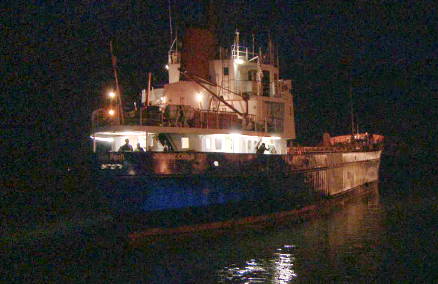
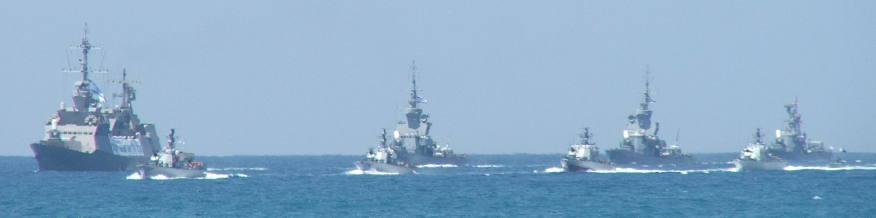
Israeli Super Dvora Mk III gunship intercepts Freedom Flotilla cargo ship The Brotherhood Ship in 2009, forcing it to return to Lebanon.


Israeli coastal patrol accosts Palestinian fishing vessels which stray beyond an Israel-imposed six mile fishing limit.


Israeli Dabur class Coastal Patrol Craft sets water hose on Palestinian fishing vessel before making arrests.

It was a Dabur in 2008 which rammed the Free Gaza relief ship Dignity.

Dubya goes to Haiti. Book him Danno!

The ultra-right wing Heritage Foundation made the suggestion yesterday, and it turned out President Obama liked it. George what-me-Worry Bush will co-chair the Haiti relief committee! The New Orleans Katrina aid travesty qualified him to do what? Play guitar and go fishing? Instead of slapping the pathological miscreant in a set of cuffs, our commander in chief will no doubt soon be saying “Good Job Dubya” –if the Heritage Foundation dictates.

Leave it to pirates to run honest bourse

rocket propelled grenade RPG-22With investment bankers trying to weasel another broker’s percentage from a carbon-credit trading system, comes a living example of rudimentary venture capitalism. In Haradheere, Somalia, there’s a stock market for pirates, by comparison, something benefiting all participants.

The pirate’s market is no middleman’s monopoly. It works just like the collectives of investors who floated Britain’s privateers and the Dutch East Indies Trading Companies, just two examples of crown-sanctioned adventure-mercenary conquerors. Had you wondered why the definition of “float” includes the economies participant to navigational buoyancy?

Got a boat, a weapon, a tip on an incoming treasure galleon? Invest the pirates with your contribution and reap a stake in the rewards. Every successive stock market since the formative times, from commodities, to insurance, to futures, etc, have well surpassed the illegitimacy and immorality of the seafaring pirate variety.

Sang the Pirate King in The Pirates of Penzance: Away to the cheating world go you, Where pirates all are well-to-do.

While the corporate media decries the savagery of the lawless Somali coastal enterprises, sophisticated traders descend upon COP15 to extort a cap-and-trade protection racket from a world desperate to arrest climate change.

The pirate bourse is a reminder of what purpose the stock markets used to play. If you had a money-making idea, and needed investors, that’s where you went. But to describe a business proposal as germinating from an idea, is to peddle platitudes defining entrepreneurship as being about intellectual innovation. In practice, business opportunities chiefly present themselves from licenses obtained from the state, to operate lucrative monopolies. It usually takes the combination of disproportionate profits and manageable risk to interest wealthy investors.

I think I enjoy this Somalia juxtaposition particularly because Wall Street can’t get a piece of the pirate action. Only those with real pirate commodities need apply. And of course, only those financiers brave enough to circulate in a “pirate’s lair” like Haradheere. So the suddenly infamous Dalsan Bank of Haradheere is basically for scrappers and warlords only, and certainly no whites need apply, unless it’s to be ransomed.

Here’s a snippet from yesterday’s Reuters article:

Piracy investor Sahra Ibrahim, a 22-year-old divorcee, was lined up with others waiting for her cut of a ransom pay-out after one of the gangs freed a Spanish tuna fishing vessel.

“I am waiting for my share after I contributed a rocket-propelled grenade for the operation,” she said, adding that she got the weapon from her ex-husband in alimony.

“I am really happy and lucky. I have made $75,000 in only 38 days since I joined the ‘company’.”

If it sounds like a personal testament for a get-rich-quick scheme, it is! But unlike the television infomercials, this bourse is grounded in providing a legitimate function in Somalia.

Note that the ransom from which Ms. Ibrahim expects to profit was paid for the release of a “tuna fishing vessel.” For those who want to judge the pirates like terrorists, the inconvenient characteristic about the Somali pirates is the role they play as coast guard for a national government not up to the task. Somalia’s inability to police its waters means that international boats visit to plunder the fisheries and dump toxic waste. Illegally, obviously. The fishing villages of Somalia suffer the most, and it’s from their workforces that the pirates recruit their expeditions. The pirates arrest the wrongdoers and assess large penalties and criminal fines before the lawbreaking crews are released.

Obama ate a fish who knew Lincoln

bottom feederFishermen have always called it the Slimehead fish. It’s sorta-scientific name is Darwin’s Slimehead. But when bottom-of-the-barrel scraping began for the ocean’s remaining fisheries, fishmongers created a market for the never-thought-palatable deep bottom feeder by renaming it the Orange Roughy.

That much you’ve probably heard before.

Really, what’s in a name? A fish by any other name will smell too. Is there a fish story without hyperbole, that does not smell fishy? The idiom comes from the experience-honed doubt that the fishmonger’s catch is not fresh. People know steak is dead cow, so does it matter that Orange Roughy is Slimehead, Monkfish is Goosefish, Rock Salmon is Spiny Dogfish, or Tilapia is Mouthbrooder?

Actually Israeli exporters wanted to give Tilapia a biblical makeover, asserting the Tilapia from the Sea of Galilee, should be called St. Peter’s Fish, but US regulators intervened. In the Gospel of Matthew 17:27, apostle Peter tells tax collectors where they can go. In more than that many words he tells them to go fish, and from the mouth of the “first fish they catch,” they will find the four drachmas he owes them. The FDA didn’t buy it either. By the way, if you doubt Wikipedia has Zionist preoccupations, sniff the first paragraph of their entry for Tilapia. Maybe we are about to see whether Wiki momentum can surfeit the vernacular.

The US government also intervened when fish wholesalers wanted to rename the Patagonian Toothfish as Chilean Sea Bass. It’s not a Bass. And the poor Teethfish, like the Slimehead, are now endangered.

Because man’s traditional food fishes have become depleted, we’re having now to make meals of the dregs. And the populations of these deep sea dwellers have less resiliency than the coastal stocks. In the case of the Toothfish and the Slimehead, it’s because they grow very slowly. The Slimehead can grow to be 150 years old. They don’t become sexually reproductive until they are 33, and that’s not in dogfish years. Fishing operations which harvest entire sea mounts decimate every generation at once, leaving none who can spawn.

Would it give you an unsettled feeling to consume something so ancient? If we’re talking a pre-Phylloxera wine, it could be a great thing. But a fish that old has been absorbing mercury from the height of the industrial revolution onwards. So there might be a health benefit for showing deference to your fish elders.

It recently upset me to learn that with modern agriculture we eat cattle before they’re two, when they’re barely adolescent. Now I wonder what’s too old. We revere elephants and tortoises for their longevity, such ancient beings we don’t eat.

I’m old enough to remember learning about the old carp in the fountains of Paris, who also lived quite long. French schoolchildren could marvel that some carp still lived who might have glimpsed Napoleon.

A Slimehead Orange Roughy caught today could have lived in the time of Lincoln. Certainly those fish drag-netted in the 1970s, when the Orange Roughy exotic star was contrived to rise, were contemporaries of John Wilkes Booth. Though swimming many thousand feet below sea level, Roughy might have encountered a fresh shipwreck of Lincoln’s era, carrying gold sent from the west coast to finance the Civil War.

Today finds Americans awaiting their and their fellow man’s emancipation from war, torture, illegal detention, economic enslavement, usury, exploitation, impoverishment, enfeeblement and poisoning. Since just the new millennium Americans learned quick to participate again in their political system. They elected what many thought impossible, an African American president. The voters placed all their hope in Barack Obama, and their faith in party politics foretold that Obama’s majority would deliver the mandate he was given. Obama’s first days were anticipated to rival FDRs. Obama’s legacy could already be measured for laurels because it meant simply reversing the calamity of his predecessor. By such a deliverance alone, it was visualized, Obama would stand beside Abraham Lincoln, America’s greatest president.

Abraham Obama may be an unjustly loft comparison, as wanting to believe Obama deserves the Nobel Peace Prize. But what else was an expectant public to do? They put him in office, they believed his promises. He spoke of change, they wanted change. What swiftly Bush had done, they wanted undone. And Obama assured all that he heard them.

And has it worked out that way? Obama’s speeches begin where the last one ends. They’re long, they’re reasoned, but where at first Americans reveled at a suddenly well-spoken president, now they wish he’d stop talking and start doing. Apparently “yes we can” meant “you can wait” –more likely “hi Mom” or “cheese.” Now the hand which Obama raises so famously to give assurance, is looking more like just the hand.

It may be dawning on many that this junior senator from Illinois didn’t have to debate Frederick Douglas, build a log cabin, read Aristotle by candlelight, or climb a long leadership ladder to get to Washington DC. It may be occurring to them that Obama’s speech at the 2004 Democratic National Convention, was the only accomplishment they’d seen of this unknown senator from the land of Lincoln.

An Orange Roughy served on fine porcelain may turn out to be the only thing our President Obama shares with Abraham Lincoln.

And very likely, you ate one too. So if stone-carvers are already bidding on the project to add someone’s face to Mount Rushmore, your likeness may be as appropriate as any.

Life Magazine knows Afghanistan

life-aug57-vietnam-keep-village-freeWhy, it’s the price of freedom. LIFE didn’t question it in 1965, its readers know no better today. You have to destroy a village to free it. You have to cripple an enemy child before you can take him fishing.

Alanis Morissette couldn’t tell from irony, and neither can America. Then and now. Americans wouldn’t recognize irony if it blew up in their face 44 years later.

life-mag-july65-deeper-into-vietnamIn Vietnam in 1965, our photographers were allowed to depict US wounded. Six years into the conflict, the antiwar movement was still nascent, US GI casualties passed 2,000 (by 1966 they would quadruple), and America’s worst atrocities in Southeast Asia were yet to come. This Life Magazine cover story is titled “DEEPER INTO THE VIETNAM WAR.”

Richard Brautigan was my favorite Beatle

Richard Brautigan recorded on Apple RecordsYou know you’re a Post- Baby Boomer when you had to learn that Lucy in the Sky With Diamonds was not an Elton John song. I remember being told by a nanny that you liked either the Monkeys or the Beatles. They broke up before I began listening to pop music. John became an activist, Paul was determined to return to commercial sounds, and George and Ringo faded to slackerdom, having ever only composed While My Guitar Gently Weeps and Octopus’s Garden between them, so I thought. I knew only the Beatles Red and White anthologies.

Barbara Bach and Got My Heart Set on You redeemed Ringo Starr fairly enough, and later I came to appreciate George Harrison. Actually later I heard Ravi Shankar liken Harrison’s exertions on the sitar to a monkey handling a violin, and we come full circle.

But before that was Handmade Films, Harrison’s project to finance Monty Python adventures, and something I’ve just come upon, recordings of my favorite post-beat writer Richard Brautigan. Someone at Apple Records, and I like to imagine it was George, approached RB about putting his poems on vinyl. Someone in the production process knew what to add to the poetry to please his fans. The tracks recorded Brautigan taking off his clothes, answering the phone, and brushing his teeth. I knew of the recordings, I didn’t know it was on Apple.

I came upon Richard Brautigan late too. In 1986 I read The Springhill Mine Disaster, and In Watermelon Sugar, and was pleased enough to imagine one day meeting him. It wasn’t until I was standing in the reference shelves of Penrose Library several years later, that I read a jacket liner which referenced Brautigan in the past tense. I was profoundly shattered that he lived no more, and I am still confused that a voice so lyrically optimistic could choose to commit suicide. I collected all his books but eventually lost a curiosity to read them.

Brautigan wrote: “All of us have a place in history. Mine is clouds.”

He took his life two years before I encountered The Confederate General and Trout Fishing. There is something uniformly post-mortem about my generation.

Richard Brautigan is considered a beat writer, although he came on the scene a decade later. Which oddly leads me to mention my favorite of his, The Abortion.

The Red-listed fishy

Greenpeace is urging consumers to check whether their grocery stores are carrying red-listed seafood. These are species from fisheries endangered by depletion and susceptible to pirate fishing. Greenpeace’s idea? Report your grocer for stocking contraband.

Try as you might to peruse their red list, you have to sign in with Greenpeace to download their survey toolkit. We’ve posted their list here.

RED-List Seafood Species

Alaska Pollock
Atlanta Cod or Scrod
Atlantic Halibut (US & Canadian)
Atlantic Salmon (wild and farmed)
Atlantic Sea Scallop
Bluefin Tuna
Bigeye Tuna
Chilean Sea Bass (aka Patagonian Toothfish)
Greenland Halibut (aka black halibut, Atlantic turbot or Arrowhead flounder)
Grouper (imported to the US)
Hoki (aka grenadier)
Monkfish
Ocean Quahog
Orange Roughy
Red Snapper
Redfish (aka Ocean Perch)
Sharks
Skates and Rays
South Atlantic Albacore Tuna
Swordfish
Tropical Shrimp (wild and farmed)
Yellowfin Tuna

Are there any fish which are not red-listed?! Is a fish absent from this list because it is still plentiful and a sustainable commodity, like Pacific Salmon perhaps, or because it is not commercially available anyway? I can think of Haddock, for example, or Hake.

They killed Bambi, and now Mumble too

Bambi meets GodzillaGenerations of American children have grown up witnessing Bambi orphaned by evil mother-killing hunters. In my theater seat, I was sure that deer stalking, as it’s called in England, would evolve the way of Neanderthals. The Happy Feet generation might have held the same hope for the survival of Emperor Penguins, but our George Bush Caligula has just given them a thumbs down.

In spite of the fact that the Academy Award for best documentary went to the March of the Penguins, which told of the heart-breaking travails of the Emperor Penguins, whose natural challenge is to face the most bitter climate on Earth.

Now Climate Change is pulling the ice from under their egg-nestling feet. Environmentalist groups want the Emperor Penguins declared an endangered species, to give clout to efforts to fight the causes of global warming, but the industrialists and fossil fuel companies are having none of it.

Remember the Rockhopper Penguin in Happy Feet, slowly strangling in his plastic six-pack necklace? He too was denied protection from the peril of melting ice and over-fishing.

I can’t visit a penguin exhibit at the zoo without thinking of Mumble, the Happy Feet star, gone crazy from confinement, at last breaking into the soft shuffle which enabled him to communicate with man, to pique man’s interest into his human-like behavior, and lure civilized man’s sympathy for Mumble’s kind, and their helplessness in the face of the human’s destructive fisheries.

At the Omaha Zoo, the scene on the ice with all the aimless penguins was so identical, I was certain the transformative scene had been filmed there, until I reminded myself that Happy Feet was a computer animation.

I was uncomfortable with the Stepin Fetchit quality of Happy Feet’s master-pleasing tap dance. It may have helped humanize black people in the eyes of racists, but it didn’t change white condescension.

Of course, neither penguins or polar bears can do a thing to slow the melting of their habitat. Their fate is in our hands. That was the message of Happy Feet, a message you might not have conceived could have gone over anyone’s head, even George Bush.

Somali pirates make black Blackbeards

Abdul Hassan cuts quite the Blackbeard imageGilbert and Sullivan pointed it out: One man’s captain of industry is another man’s pirate. Which is the pirate depends on who’s making the law.

The global corporate media is up in arms about the Somali pirates, in actuality a militia mounted by Somalia’s fishermen to protect their fisheries from international predators. Elsewhere, illegal commercial fishing ships are considered “pirates.” The Somali protectors are called the
Central Regional Coast Guard.

Elsewhere in the world, when national fisheries are threatened by lawless fishing, privateers can capture illegal fishing ships and earn bounties of approximately one million dollars per ship. What a coincidence that’s the figure we’re given about the ransoms demanded by the Somali “pirates” who are seizing international ships off their coast.

Setting aside of course the opportunistic actions by the Somali renegade entrepreneurs to prey upon ANY international vessel, on the pretext that NONE are licensed in Somali waters, since even the temporary US-backed government there is unlicensed, here’s the reason Western warships can’t just blow them out of the water.

Setting aside too, that even as Somalia is lawless, the waters inside Somali’s maritime boarder are sovereign. A foreign navy may declare its helpful intentions, but it has no jurisdiction to order Somalian boaters about.

I’ve seen many varieties of fishermen skiffs. So I puzzled at the uniformity of the pirate raiders in their long white open boats. Have you? Because the pirate enterprise is a uniform flotilla of 100 of such boats. It’s how they can tell each other from would be interloping privateers, and it also gives them their cover of legitimacy.

Foreign would-be sheriffs can’t target the Central Regional Coast Guard because it is basically a militia mounted by the local fishermen, to enforce their claim to their home waters.

Fisheries the world over are regulated. Wherever a government is not capable of enforcing its laws, predatory opportunities arise. Since Somalia fell to war and lawlessness, foreign fishing boats have been poaching the Somali coast without limit. Local fishermen complain that the fisheries are being depleted, but there is no authority to save them.

somali-pirates

DEAD

Alice and dodo
One in four mammals risks extinction for now, but it will be a much worse forecast 50 years from now. The problem is not too many people, but how those people we actually have organize their economic activity on Planet Earth.

Seas turn to acid as they soak up CO2 The problem is not too many people, it is what the people do to the oceans when organized in a destructive world economy.

Vanishing forest: a northern forest is disappearing at a rapid pace—that spells trouble for billions of animals Do you have an American or Canadian flag waving from your house? Why are you so proud and defensive about all this destruction? Don’t you know what is happening? Stop celebrating this culture, this economy, this spirit of DEAD.

Factory farming leads to ‘Destruction of biodiversity — A tendency towards using single adapted breeds (a mono-culture) in factory farming, both in arable and animal farming, gives uniform product designed for high yields, at the risk of increased susceptibility to disease. The loss of locally adapted breeds reduces the resilience of the agricultural system. The issue is not limited to factory farming and historically the problem is reflected in the rapid adoption of one or two strains of crops across a wide area as seen in the Irish potato famine of 1854 and the Bengal rice famine in 1942.[58] The loss of the gene pool of domesticated animals limits the ability to adapt to future problems. This issue exists in all types of farming practices.’ from wikipedia

The Factory Model simply is not the solution at all to anything, whether it be economic or agricultural production, whether it be the production of ‘services’ or the production of ‘education’. Factories run top down by rich owners is DEAD. Factory buffalo hunting is DEAD. Factory fishing is DEAD. Factory logging is DEAD. Factory mining is DEAD. Factory living in shopping mallandia is DEAD.

No fishing

no-fishing.jpg Everywhere life is under attack despite our sweet little Colorado license plates urging us to ‘respect life’. Unfortunately though, there is little in capitalism that does respect life much, whether it be human life or other. If we did respect life, then we wouldn’t have allowed our world wilderness areas to be reduced to ashes and ruins. We would not have allowed our oceans, rivers, and lakes to be degraded. We would not have allowed THEM to degrade US, since how can a degraded population really not turn around and degrade other forms of life, too?

One form of life we are in increasing danger of losing is fish. Fish may soon become a thing of the past for most of us in our food chain. The day of the cheap tuna or cheap sardine may be soon gone for good. Many of our water ways may soon become dead zones, as many already are. Just how bad is the situation now?

‘Only 50 years left’ for sea fish says it all, and the situation in fresh water is no better. See Silent Streams? Escalating Endangerment For North American Freshwater Fish We take no action to stop this destruction of fish life simply because most people are too busy defending the society they live in rather than trying to change it.

But look what is being defended here? Our neighbors are defending the extermination of life by their defense of the status quo. Soon there will be no fishing and it will be because most of us played stupid for so very long. I will miss the fish, as so too will your children and their children, too. Destruction of life is permanent, and this will be the legacy of the capitalist system on our planet. The legacy will be dead zones and desolation. Time is about out.

Global economic rapists are at it again

G8 protest
Why protest the G8 Summit July 7-9? Those hoodlums always look so determined. Here’s the rationale by the Emergency Exit Collective:

The 2008 G8 on Hokkaido, a Strategic Assessment
Emergency Exit Collective
Bristol, Mayday, 2008

The authors of this document are a collection of activists, scholars, and writers currently based in the United States and Western Europe who have gotten to know and work with each other in the movement against capitalist globalization. We’re writing this at the request of some members of No! G8 Action Japan, who asked us for a broad strategic analysis of the state of struggle as we see it, and particularly, of the role of the G8, what it represents, the dangers and opportunities that may lie hidden in the moment. It is in no sense programmatic. Mainly, it is an attempt to develop tools that we hope will be helpful for organizers, or for anyone engaged in the struggle against global capital.

I
It is our condition as human beings that we produce our lives in common.

II
Let us then try to see the world from the perspective of the planet’s commoners, taking the word in that sense: those whose most essential tradition is cooperation in the making and maintenance of human social life, yet who have had to do so under conditions of suffering and separation; deprived, ignored, devalued, divided into hierarchies, pitted against each other for our very physical survival. In one sense we are all commoners. But it’s equally true that just about everyone, at least in some ways, at some points, plays the role of the rulers—of those who expropriate, devalue and divide—or at the very least benefits from such divisions.

Obviously some do more than others. It is at the peak of this pyramid that we encounter groups like the G8.

III
The G8’s perspective is that of the aristocrats, the rulers: those who command and maintain that global machinery of violence that defends existing borders and lines of separation: whether national borders with their detention camps for migrants, or property regimes, with their prisons for the poor. They live by constantly claiming title to the products of others collective creativity and labour, and in thus doing they create the poor; they create scarcity in the midst of plenty, and divide us on a daily basis; they create financial districts that loot resources from across the world, and in thus doing they turn the spirit of human creativity into a spiritual desert; close or privatize parks, public water taps and libraries, hospitals, youth centers, universities, schools, public swimming pools, and instead endlessly build shopping malls that channels convivial life into a means of commodity circulation; work toward turning global ecological catastrophe into business opportunities.

These are the people who presume to speak in the name of the “international community” even as they hide in their gated communities or meet protected by phalanxes of riot cops. It is critical to bear in mind that the ultimate aim of their policies is never to create community but to introduce and maintain divisions that set common people at each other’s throats. The neoliberal project, which has been their main instrument for doing so for the last three decades, is premised on a constant effort either to uproot or destroy any communal or democratic system whereby ordinary people govern their own affairs or maintain common resources for the common good, or, to reorganize each tiny remaining commons as an isolated node in a market system in which livelihood is never guaranteed, where the gain of one community must necessarily be at the expense of others. Insofar as they are willing to appeal to high-minded principles of common humanity, and encourage global cooperation, only and exactly to the extent that is required to maintain this system of universal competition.

IV
At the present time, the G8—the annual summit of the leaders of “industrial democracies”—is the key coordinative institution charged with the task of maintaining this neoliberal project, or of reforming it, revising it, adapting it to the changing condition of planetary class relations. The role of the G8 has always been to define the broad strategic horizons through which the next wave of planetary capital accumulation can occur. This means that its main task is to answer the question of how 3?4 in the present conditions of multiple crises and struggles 3?4 to subordinate social relations among the producing commoners of the planet to capital’s supreme value: profit.

V
Originally founded as the G7 in 1975 as a means of coordinating financial strategies for dealing with the ‘70s energy crisis, then expanded after the end of the Cold War to include Russia, its currently face a moment of profound impasse in the governance of planetary class relations: the greatest since the ‘70s energy crisis itself.

VI
The ‘70s energy crisis represented the final death-pangs of what might be termed the Cold War settlement, shattered by a quarter century of popular struggle. It’s worth returning briefly to this history.

The geopolitical arrangements put in place after World War II were above all designed to forestall the threat of revolution. In the immediate wake of the war, not only did much of the world lie in ruins, most of world’s population had abandoned any assumption about the inevitability of existing social arrangements. The advent of the Cold War had the effect of boxing movements for social change into a bipolar straightjacket. On the one hand, the former Allied and Axis powers that were later to unite in the G7 (the US, Canada, UK, France, Italy, Germany, Japan)—the “industrialized democracies”, as they like to call themselves—engaged in a massive project of co-optation. Their governments continued the process, begun in the ‘30s, of taking over social welfare institutions that had originally been created by popular movements (from insurance schemes to public libraries), even to expand them, on condition that they now be managed by state-appointed bureaucracies rather than by those who used them, buying off unions and the working classes more generally with policies meant to guarantee high wages, job security and the promise of educational advance—all in exchange for political loyalty, productivity increases and wage divisions within national and planetary working class itself. The Sino-Soviet bloc—which effectively became a kind of junior partner within the overall power structure, and its allies remained to trap revolutionary energies into the task of reproducing similar bureaucracies elsewhere. Both the US and USSR secured their dominance after the war by refusing to demobilize, instead locking the planet in a permanent threat of nuclear annihilation, a terrible vision of absolute cosmic power.

VII
Almost immediately, though, this arrangement was challenged by a series of revolts from those whose work was required to maintain the system, but who were, effectively, left outside the deal: first, peasants and the urban poor in the colonies and former colonies of the Global South, next, disenfranchised minorities in the home countries (in the US, the Civil Rights movement, then Black Power), and finally and most significantly, by the explosion of the women’s movement of the late ‘60s and early ‘70s—the revolt of that majority of humanity whose largely unremunerated labor made the very existence “the economy” possible. This appears to have been the tipping point.

VIII
The problem was that the Cold War settlement was never meant to include everyone. It by definition couldn’t. Once matters reached tipping point, then, the rulers scotched the settlement. All deals were off. The oil shock was first edge of the counter-offensive, breaking the back of existing working class organizations, driving home the message that there was nothing guaranteed about prosperity. Under the aegis of the newly hatched G7, this counter-offensive involved a series of interwoven strategies that were later to give rise to what is known as neoliberalism.

IX
These strategies resulted in what came to be known as “Structural Adjustment” both in the North and in the South, accompanied by trade and financial liberalization. This, in turn, made possible crucial structural changes in our planetary production in common extending the role of the market to discipline our lives and divide us into more and more polarized wage hierarchy. This involved:

· In the immediate wake of ‘70s oil shock, petrodollars were recycled from OPEC into Northern banks that then lent them, at extortionate rates of interest, to developing countries of the Global South. This was the origin of the famous “Third World Debt Crisis.” The existence of this debt allowed institutions like the IMF to impose its monetarist orthodoxy on most of the planet for roughly twenty years, in the process, stripping away most of even those modest social protections that had been won by the world’s poor—large numbers of whom were plunged into a situation of absolute desperation.

· It also opened a period of new enclosures through the capitalist imposition of structural adjustment policies, manipulation of environmental and social catastrophes like war, or for that matter through the authoritarian dictates of “socialist” regimes. Through such means, large sections of the world’s population have over the past thirty years been dispossessed from resources previously held in common, either by dint of long traditions, or as the fruits of past struggles and past settlements.

· Through financial deregulation and trade liberalization, neoliberal capital, which emerged from the G7 strategies to deal with the 1970s crisis aimed thus at turning the “class war” in communities, factories, offices, streets and fields against the engine of competition, into a planetary “civil war”, pitting each community of commoners against every other community of commoners.

· Neoliberal capital has done this by imposing an ethos of “efficiency” and rhetoric of “lowering the costs of production” applied so broadly that mechanisms of competition have come to pervade every sphere of life. In fact these terms are euphemisms, for a more fundamental demand: that capital be exempt from taking any reduction in profit to finance the costs of reproduction of human bodies and their social and natural environments (which it does not count as costs) and which are, effectively, “exernalized” onto communities and nature.

· The enclosure of resources and entitlements won in previous generations of struggles both in the North and the South, in turn, created the conditions for increasing the wage hierarchies (both global and local), by which commoners work for capital—wage hierarchies reproduced economically through pervasive competition, but culturally, through male dominance, xenophobia and racism. These wage gaps, in turn, made it possible to reduce the value of Northern workers’ labour power, by introducing commodities that enter in their wage basket at a fraction of what their cost might otherwise have been. The planetary expansion of sweatshops means that American workers (for example) can buy cargo pants or lawn-mowers made in Cambodia at Walmart, or buy tomatoes grown by undocumented Mexican workers in California, or even, in many cases, hire Jamaican or Filipina nurses to take care of children and aged grandparents at such low prices, that their employers have been able to lower real wages without pushing most of them into penury. In the South, meanwhile, this situation has made it possible to discipline new masses of workers into factories and assembly lines, fields and offices, thus extending enormously capital’s reach in defining the terms—the what, the how, the how much—of social production.

· These different forms of enclosures, both North and South, mean that commoners have become increasingly dependent on the market to reproduce their livelihoods, with less power to resist the violence and arrogance of those whose priorities is only to seek profit, less power to set a limit to the market discipline running their lives, more prone to turn against one another in wars with other commoners who share the same pressures of having to run the same competitive race, but not the same rights and the same access to the wage. All this has meant a generalized state of precarity, where nothing can be taken for granted.

X
In turn, this manipulation of currency and commodity flows constituting neoliberal globalization became the basis for the creation of the planet’s first genuine global bureaucracy.

· This was multi-tiered, with finance capital at the peak, then the ever-expanding trade bureaucracies (IMF, WTO, EU, World Bank, etc), then transnational corporations, and finally, the endless varieties of NGOs that proliferated throughout the period—almost all of which shared the same neoliberal orthodoxy, even as they substituted themselves for social welfare functions once reserved for states.

· The existence of this overarching apparatus, in turn, allowed poorer countries previously under the control of authoritarian regimes beholden to one or another side in the Cold War to adopt “democratic” forms of government. This did allow a restoration of formal civil liberties, but very little that could really merit the name of democracy (the rule of the “demos”, i.e., of the commoners). They were in fact constitutional republics, and the overwhelming trend during the period was to strip legislatures, that branch of government most open to popular pressure, of most of their powers, which were increasingly shifted to the executive and judicial branches, even as these latter, in turn, largely ended up enacting policies developed overseas, by global bureaucrats.

· This entire bureaucratic arrangement was justified, paradoxically enough, by an ideology of extreme individualism. On the level of ideas, neoliberalism relied on a systematic cooptation of the themes of popular struggle of the ‘60s: autonomy, pleasure, personal liberation, the rejection of all forms of bureaucratic control and authority. All these were repackaged as the very essence of capitalism, and the market reframed as a revolutionary force of liberation.

· The entire arrangement, in turn, was made possible by a preemptive attitude towards popular struggle. The breaking of unions and retreat of mass social movements from the late ‘70s onwards was only made possible by a massive shift of state resources into the machinery of violence: armies, prisons and police (secret and otherwise) and an endless variety of private “security services”, all with their attendant propaganda machines, which tended to increase even as other forms of social spending were cut back, among other things absorbing increasing portions of the former proletariat, making the security apparatus an increasingly large proportion of total social spending. This approach has been very successful in holding back mass opposition to capital in much of the world (especially West Europe and North America), and above all, in making it possible to argue there are no viable alternatives. But in doing so, has created strains on the system so profound it threatens to undermine it entirely.

XI
The latter point deserves elaboration. The element of force is, on any number of levels, the weak point of the system. This is not only on the constitutional level, where the question of how to integrate the emerging global bureaucratic apparatus, and existing military arrangements, has never been resolved. It is above all an economic problem. It is quite clear that the maintenance of elaborate security machinery is an absolute imperative of neoliberalism. One need only observe what happened with the collapse of the Soviet bloc in Eastern Europe: where one might have expected the Cold War victors to demand the dismantling of the army, secret police and secret prisons, and to maintain and develop the existing industrial base, in fact, what they did was absolutely the opposite: in fact, the only part of the industrial base that has managed fully to maintain itself has been the parts required to maintained the security apparatus itself! Critical too is the element of preemption: the governing classes in North America, for example, are willing to go to almost unimaginable lengths to ensure social movements never feel they are accomplishing anything. The current Gulf War is an excellent example: US military operations appear to be organized first and foremost to be protest-proof, to ensure that what happened in Vietnam (mass mobilization at home, widespread revolt within the army overseas) could never be repeated. This means above all that US casualties must always be kept to a minimum. The result are rules of engagement, and practices like the use of air power within cities ostensibly already controlled by occupation forces, so obviously guaranteed to maximize the killing of innocents and galvanizing hatred against the occupiers that they ensure the war itself cannot be won. Yet this approach can be taken as the very paradigm for neoliberal security regimes. Consider security arrangements around trade summits, where police are so determined prevent protestors from achieving tactical victories that they are often willing to effectively shut down the summits themselves. So too in overall strategy. In North America, such enormous resources are poured into the apparatus of repression, militarization, and propaganda that class struggle, labor action, mass movements seem to disappear entirely. It is thus possible to claim we have entered a new age where old conflicts are irrelevant. This is tremendously demoralizing of course for opponents of the system; but those running the system seem to find that demoralization so essential they don’t seem to care that the resultant apparatus (police, prisons, military, etc) is, effectively, sinking the entire US economy under its dead weight.

XII
The current crisis is not primarily geopolitical in nature. It is a crisis of neoliberalism itself. But it takes place against the backdrop of profound geopolitical realignments. The decline of North American power, both economic and geopolitical has been accompanied by the rise of Northeast Asia (and to a increasing extent, South Asia as well). While the Northeast Asian region is still divided by painful Cold War cleavages—the fortified lines across the Taiwan straits and at the 38th parallel in Korea…—the sheer realities of economic entanglement can be expected to lead to a gradual easing of tensions and a rise to global hegemony, as the region becomes the new center of gravity of the global economy, of the creation of new science and technology, ultimately, of political and military power. This may, quite likely, be a gradual and lengthy process. But in the meantime, very old patterns are rapidly reemerging: China reestablishing relations with ancient tributary states from Korea to Vietnam, radical Islamists attempting to reestablish their ancient role as the guardians of finance and piety at the in the Central Asian caravan routes and across Indian Ocean, every sort of Medieval trade diaspora reemerging… In the process, old political models remerge as well: the Chinese principle of the state transcending law, the Islamic principle of a legal order transcending any state. Everywhere, we see the revival too of ancient forms of exploitation—feudalism, slavery, debt peonage—often entangled in the newest forms of technology, but still echoing all the worst abuses of the Middle Ages. A scramble for resources has begun, with US occupation of Iraq and saber-rattling throughout the surrounding region clearly meant (at least in part) to place a potential stranglehold the energy supply of China; Chinese attempts to outflank with its own scramble for Africa, with increasing forays into South America and even Eastern Europe. The Chinese invasion into Africa (not as of yet at least a military invasion, but already involving the movement of hundreds of thousands of people), is changing the world in ways that will probably be felt for centuries. Meanwhile, the nations of South America, the first victims of the “Washington consensus” have managed to largely wriggle free from the US colonial orbit, while the US, its forces tied down in the Middle East, has for the moment at least abandoned it, is desperately struggling to keep its grip Mexico, Central America and the Caribbean—its own “near abroad”.

XIII
In another age all this might have led to war—that is, not just colonial occupations, police actions, or proxy wars (which are obviously already taking place), but direct military confrontations between the armies of major powers. It still could; accidents happen; but there is reason to believe that, when it comes to moments of critical decision, the loyalties of the global elites are increasingly to each other, and not to the national entities for whom they claim to speak. There is some compelling evidence for this.

Take for example when the US elites panicked at the prospect of the massive budget surpluses of the late 1990s. As Alan Greenspan, head of the Federal Reserve at the time warned, if these were allowed to stand they would have flooded government coffers with so many trillions of dollars that it could only have lead to some form of creeping socialism, even, he predicted, to the government acquiring “equity stakes” in key US corporations. The more excitable of capitalism’s managers actually began contemplating scenarios where the capitalist system itself would be imperiled. The only possible solution was massive tax cuts; these were duly enacted, and did indeed manage to turn surpluses into enormous deficits, financed by the sale of treasury bonds to Japan and China. Conditions have thus now reached a point where it is beginning to look as if the most likely long term outcome for the US (its technological and industrial base decaying, sinking under the burden of its enormous security spending) will be to end up serve as junior partner and military enforcer for East Asia capital. Its rulers, or at least a significant proportion of them, would prefer to hand global hegemony to the rulers of China (provided the latter abandon Communism) than to return to any sort of New Deal compromise with their “own” working classes.

A second example lies in the origins of what has been called the current “Bretton Woods II” system of currency arrangements, which underline a close working together of some “surplus” and “deficit” countries within global circuits. The macroeconomic manifestation of the planetary restructuring outlined in XIX underlines both the huge US trade deficit that so much seem to worry many commentators, and the possibility to continually generate new debt instruments like the one that has recently resulted in the sub-prime crisis. The ongoing recycling of accumulated surplus of countries exporting to the USA such as China and oil producing countries is what has allowed financiers to create new credit instruments in the USA. Hence, the “deal” offered by the masters in the United States to its commoners has been this: ‘you, give us a relative social peace and accept capitalist markets as the main means through which you reproduce your own livelihoods, and we will give you access to cheaper consumption goods, access to credit for buying cars and homes, and access to education, health, pensions and social security through the speculative means of stock markets and housing prices.’ Similar compromises were reached in all the G8 countries.

Meanwhile, there is the problem of maintaining any sort of social peace with the hundreds of millions of unemployed, underemployed, dispossessed commoners currently swelling the shanty-towns of Asia, Africa, and Latin America as a result of ongoing enclosures (which have speeded up within China and India in particular, even as “structural adjustment policies” in Africa and Latin America have been derailed). Any prospect of maintaining peace in these circumstances would ordinarily require either extremely high rates of economic growth—which globally have not been forthcoming, since outside of China, growth rates in the developing world have been much lower than they were in the ‘50s, ‘60s, or even ‘70s—or extremely high levels of repression, lest matters descend into rebellion or generalized civil war. The latter has of course occurred in many parts of the world currently neglected by capital, but in favored regions, such as the coastal provinces of China, or “free trade” zones of India, Egypt, or Mexico, commoners are being offered a different sort of deal: industrial employment at wages that, while very low by international standards, are still substantially higher than anything currently obtainable in the impoverished countryside; and above all the promise, through the intervention of Western markets and (privatized) knowledge, of gradually improving conditions of living. While over the least few years wages in many such areas seem to be growing, thanks to the intensification of popular struggles, such gains are inherently vulnerable: the effect of recent food inflation has been to cut real wages back dramatically—and threaten millions with starvation.

What we really want to stress here, though, is that the long-term promise being offered to the South is just as untenable as the idea that US or European consumers can indefinitely expand their conditions of life through the use of mortgages and credit cards.

What’s being offered the new dispossessed is a transposition of the American dream. The idea is that the lifestyle and consumption patterns of existing Chinese, Indian, or Brazilian or Zambian urban middle classes (already modeled on Northern ones) will eventually become available to the children of today’s miners, maquila or plantation laborers, until, ultimately, everyone on earth is brought up to roughly the same level of consumption. Put in these terms, the argument is absurd. The idea that all six billion of us can become “middle class” is obviously impossible. First of all there is a simple problem of resources. It doesn’t matter how many bottles we recycle or how energy efficient are the light bulbs we use, there’s just no way the earth’s ecosystem can accommodate six billion people driving in private cars to work in air-conditioned cubicles before periodically flying off to vacation in Acapulco or Tahiti. To maintain the style of living and producing in common we now identify with “middle classness” on a planetary scale would require several additional planets.

This much has been pointed out repeatedly. But the second point is no less important. What this vision of betterment ultimately proposes is that it would be possible to build universal prosperity and human dignity on a system of wage labor. This is fantasy. Historically, wages are always the contractual face for system of command and degradation, and a means of disguising exploitation: expressing value for work only on condition of stealing value without work— and there is no reason to believe they could ever be anything else. This is why, as history has also shown, human beings will always avoid working for wages if they have any other viable option. For a system based on wage labor to come into being, such options must therefore be made unavailable. This in turn means that such systems are always premised on structures of exclusion: on the prior existence of borders and property regimes maintained by violence. Finally, historically, it has always proved impossible to maintain any sizeable class of wage-earners in relative prosperity without basing that prosperity, directly or indirectly, on the unwaged labor of others—on slave-labor, women’s domestic labor, the forced labor of colonial subjects, the work of women and men in peasant communities halfway around the world—by people who are even more systematically exploited, degraded, and immiserated. For that reason, such systems have always depended not only on setting wage-earners against each other by inciting bigotry, prejudice, hostility, resentment, violence, but also by inciting the same between men and women, between the people of different continents (“race”), between the generations.

From the perspective of the whole, then, the dream of universal middle class “betterment” must necessarily be an illusion constructed in between the Scylla of ecological disaster, and the Charybdis of poverty, detritus, and hatred: precisely, the two pillars of today’s strategic impasse faced by the G8.

XIV
How then do we describe the current impasse of capitalist governance?

To a large degree, it is the effect of a sudden and extremely effective upswing of popular resistance—one all the more extraordinary considering the huge resources that had been invested in preventing such movements from breaking out.

On the one hand, the turn of the millennium saw a vast and sudden flowering of new anti-capitalist movements, a veritable planetary uprising against neoliberalism by commoners in Latin America, India, Africa, Asia, across the North Atlantic world’s former colonies and ultimately, within the cities of the former colonial powers themselves. As a result, the neoliberal project lies shattered. What came to be called the “anti-globalization” movement took aim at the trade bureaucracies—the obvious weak link in the emerging institutions of global administration—but it was merely the most visible aspect of this uprising. It was however an extraordinarily successful one. Not only was the WTO halted in its tracks, but all major trade initiatives (MAI, FTAA…) scuttled. The World Bank was hobbled and the power of the IMF over most of the world’s population, effectively, destroyed. The latter, once the terror of the Global South, is now a shattered remnant of its former self, reduced to selling off its gold reserves and desperately searching for a new global mission.

In many ways though spectacular street actions were merely the most visible aspects of much broader changes: the resurgence of labor unions, in certain parts of the world, the flowering of economic and social alternatives on the grassroots levels in every part of the world, from new forms of direct democracy of indigenous communities like El Alto in Bolivia or self-managed factories in Paraguay, to township movements in South Africa, farming cooperatives in India, squatters’ movements in Korea, experiments in permaculture in Europe or “Islamic economics” among the urban poor in the Middle East. We have seen the development of thousands of forms of mutual aid association, most of which have not even made it onto the radar of the global media, often have almost no ideological unity and which may not even be aware of each other’s existence, but nonetheless share a common desire to mark a practical break with capitalism, and which, most importantly, hold out the prospect of creating new forms of planetary commons that can—and in some cases are—beginning to knit together to provide the outlines of genuine alternative vision of what a non-capitalist future might look like.

The reaction of the world’s rulers was predictable. The planetary uprising had occurred during a time when the global security apparatus was beginning to look like it lacked a purpose, when the world threatened to return to a state of peace. The response—aided of course, by the intervention of some of the US’ former Cold War allies, reorganized now under the name of Al Qaeda—was a return to global warfare. But this too failed. The “war on terror”—as an attempt to impose US military power as the ultimate enforcer of the neoliberal model—has collapsed as well in the face of almost universal popular resistance. This is the nature of their “impasse”.

At the same time, the top-heavy, inefficient US model of military capitalism—a model created in large part to prevent the dangers of social movements, but which the US has also sought to export to some degree simply because of its profligacy and inefficiency, to prevent the rest of the world from too rapidly overtaking them—has proved so wasteful of resources that it threatens to plunge the entire planet into ecological and social crisis. Drought, disaster, famines, combine with endless campaigns of enclosure, foreclosure, to cast the very means of survival—food, water, shelter—into question for the bulk of the world’s population.

XV
In the rulers’ language the crisis understood, first and foremost, as a problem of regulating cash flows, of reestablishing, as they like to put it, a new “financial architecture”. Obviously they are aware of the broader problems. Their promotional literature has always been full of it. From the earliest days of the G7, through to the days after the Cold War, when Russia was added as a reward for embracing capitalism, they have always claimed that their chief concerns include

· the reduction of global poverty

· sustainable environmental policies

· sustainable global energy policies

· stable financial institutions governing global trade and currency transactions

If one were to take such claims seriously, it’s hard to see their overall performance as anything but a catastrophic failure. At the present moment, all of these are in crisis mode: there are food riots, global warming, peak oil, and the threat of financial meltdown, bursting of credit bubbles, currency crises, a global credit crunch. [**Failure on this scale however, opens opportunities for the G8 themselves, as summit of the global bureaucracy, to reconfigure the strategic horizon. Therefore, it’s always with the last of these that they are especially concerned. ]The real problem, from the perspective of the G8, is one of reinvestment: particularly, of the profits of the energy sector, but also, now, of emerging industrial powers outside the circle of the G8 itself. The neoliberal solution in the ‘70s had been to recycle OPEC’s petrodollars into banks that would use it much of the world into debt bondage, imposing regimes of fiscal austerity that, for the most part, stopped development (and hence, the emergence potential rivals) in its tracks. By the ‘90s, however, much East Asia in particular had broken free of this regime. Attempts to reimpose IMF-style discipline during the Asian financial crisis of 1997 largely backfired. So a new compromise was found, the so-called Bretton Woods II: to recycle the profits from the rapidly expanding industrial economies of East Asia into US treasury debt, artificially supporting the value of the dollar and allowing a continual stream of cheap exports that, aided by the US housing bubble, kept North Atlantic economies afloat and buy off workers there with cheap oil and even cheaper consumer goods even as real wages shrank. This solution however soon proved a temporary expedient. Bush regime’s attempt to lock it in by the invasion of Iraq, which was meant to lead to the forced privatization of Iraqi oil fields, and, ultimately, of the global oil industry as a whole, collapsed in the face of massive popular resistance (just as Saddam Hussein’s attempt to introduce neoliberal reforms in Iraq had failed when he was still acting as American deputy in the ‘90s). Instead, the simultaneous demand for petroleum for both Chinese manufacturers and American consumers caused a dramatic spike in the price of oil. What’s more, rents from oil and gas production are now being used to pay off the old debts from the ‘80s (especially in Asia and Latin America, which have by now paid back their IMF debts entirely), and—increasingly—to create state-managed Sovereign Wealth Funds that have largely replaced institutions like the IMF as the institutions capable of making long-term strategic investments. The IMF, purposeless, tottering on the brink of insolvency, has been reduced to trying to come up with “best practices” guidelines for fund managers working for governments in Singapore, Seoul, and Abu Dhabi.

There can be no question this time around of freezing out countries like China, India, or even Brazil. The question for capital’s planners, rather, is how to channel these new concentrations of capital in such a way that they reinforce the logic of the system instead of undermining it.

XVI
How can this be done? This is where appeals to universal human values, to common membership in an “international community” come in to play. “We all must pull together for the good of the planet,” we will be told. The money must be reinvested “to save the earth.”

To some degree this was always the G8 line: this is a group has been making an issue of climate change since 1983. Doing so was in one sense a response to the environmental movements of the ‘70s and ‘80s. The resultant emphasis on biofuels and “green energy” was from their point of view, the perfect strategy, seizing on an issue that seemed to transcend class, appropriating ideas and issues that emerged from social movements (and hence coopting and undermining especially their radical wings), and finally, ensuring such initiatives are pursued not through any form of democratic self-organization but “market mechanisms”—to effective make the sense of public interest productive for capitalism.

What we can expect now is a two-pronged attack. On the one hand, they will use the crisis to attempt to reverse the gains of past social movements: to put nuclear energy back on the table to deal with the energy crisis and global warming, or genetically modified foods to deal with the food crisis. Prime Minister Fukuda, the host of the current summit, for example, is already proposing the nuclear power is the “solution” to the global warming crisis, even as the German delegation resists. On the other, and even more insidiously, they will try once again to co-opt the ideas and solutions that have emerged from our struggles as a way of ultimately undermining them. Appropriating such ideas is simply what rulers do: the bosses brain is always under the workers’ hat. But the ultimate aim is to answer the intensification of class struggle, of the danger of new forms of democracy, with another wave of enclosures, to restore a situation where commoners’ attempts to create broader regimes of cooperation are stymied, and people are plunged back into mutual competition.

We can already see the outlines of how this might be done. There are already suggestions that Sovereign Wealth Funds put aside a certain (miniscule) proportion of their money for food aid, but only as tied to a larger project of global financial restructuring. The World Bank, largely bereft of its earlier role organizing dams and pipe-lines across the world, has been funding development in China’s poorer provinces, freeing the Chinese government to carry out similar projects in Southeast Asia, Africa, and even Latin America (where, of course, they cannot effectively be held to any sort of labor or environmental standards). There is the possibility of a new class deal in China itself, whose workers can be allowed higher standards of living if new low wage zones are created elsewhere—for instance, Africa (the continent where struggles over maintaining the commons have been most intense in current decades)—with the help of Chinese infrastructural projects. Above of all, money will be channeled into addressing climate change, into the development of alternative energy, which will require enormous investments, in such a way as to ensure that whatever energy resources do become important in this millennium, they can never be democratized—that the emerging notion of a petroleum commons, that energy resources are to some degree a common patrimony meant primarily to serve the community as a whole, that is beginning to develop in parts of the Middle East and South America—not be reproduced in whatever comes next.

Since this will ultimately have to be backed up by the threat of violence, the G8 will inevitably have to struggle with how to (yet again) rethink enforcement mechanisms. The latest move , now that the US “war on terror” paradigm has obviously failed, would appear to be a return to NATO, part of a reinvention of the “European security architecture” being proposed at the upcoming G8 meetings in Italy in 2009 on the 60th anniversary of NATO’s foundation—but part of a much broader movement of the militarization of social conflict, projecting potential resource wars, demographic upheavals resulting from climate change, and radical social movements as potential military problems to be resolved by military means. Opposition to this new project is already shaping up as the major new European mobilization for the year following the current G-8.

XVII
While the G-8 sit at the pinnacle of a system of violence, their preferred idiom is monetary. Their impulse whenever possible is to translate all problems into money, financial structures, currency flows—a substance whose movements they carefully monitor and control.

Money, on might say, is their poetry—a poetry whose letters are written in our blood. It is their highest and most abstract form of expression, their way of making statements about the ultimate truth of the world, even if it operates in large part by making things disappear. How else could it be possible to argue—no, to assume as a matter of common sense—that the love, care, and concern of a person who tends to the needs of children, teaching, minding, helping them to become decent , thoughtful, human beings, or who grows and prepares food, is worth ten thousand times less than someone who spends the same time designing a brand logo, moving abstract blips across a globe, or denying others health care.

The role of money however has changed profoundly since 1971 when the dollar was delinked from gold. This has created a profound realignment of temporal horizons. Once money could be said to be primarily congealed results of past profit and exploitation. As capital, it was dead labor. Millions of indigenous Americans and Africans had their lives pillaged and destroyed in the gold mines in order to be rendered into value. The logic of finance capital, of credit structures, certainly always existed as well (it is at least as old as industrial capital; possibly older), but in recent decades these logic of financial capital has come to echo and re-echo on every level of our lives. In the UK 97% of money in circulation is debt, in the US, 98%. Governments run on deficit financing, wealthy economies on consumer debt, the poor are enticed with microcredit schemes, debts are packaged and repackaged in complex financial derivatives and traded back and forth. Debt however is simply a promise, the expectation of future profit; capital thus increasingly brings the future into the present—a future that, it insists, must always be the same in nature, even if must also be greater in magnitude, since of course the entire system is premised on continual growth. Where once financiers calculated and traded in the precise measure of our degradation, having taken everything from us and turned it into money, now money has flipped, to become the measure of our future degradation—at the same time as it binds us to endlessly working in the present.

The result is a strange moral paradox. Love, loyalty, honor, commitment—to our families, for example, which means to our shared homes, which means to the payment of monthly mortgage debts—becomes a matter of maintaining loyalty to a system which ultimately tells us that such commitments are not a value in themselves. This organization of imaginative horizons, which ultimately come down to a colonization of the very principle of hope, has come to supplement the traditional evocation of fear (of penury, homelessness, joblessness, disease and death). This colonization paralyzes any thought of opposition to a system that almost everyone ultimately knows is not only an insult to everything they really cherish, but a travesty of genuine hope, since, because no system can really expand forever on a finite planet, everyone is aware on some level that in the final analysis they are dealing with a kind of global pyramid scheme, what we are ultimately buying and selling is the real promise of global social and environmental apocalypse.

XVIII
Finally then we come to the really difficult, strategic questions. Where are the vulnerabilities? Where is hope? Obviously we have no certain answers here. No one could. But perhaps the proceeding analysis opens up some possibilities that anti-capitalist organizers might find useful to explore.

One thing that might be helpful is to rethink our initial terms. Consider communism. We are used to thinking of it as a total system that perhaps existed long ago, and to the desire to bring about an analogous system at some point in the future—usually, at whatever cost. It seems to us that dreams of communist futures were never purely fantasies; they were simply projections of existing forms of cooperation, of commoning, by which we already make the world in the present. Communism in this sense is already the basis of almost everything, what brings people and societies into being, what maintains them, the elemental ground of all human thought and action. There is absolutely nothing utopian here. What is utopian, really, is the notion that any form of social organization, especially capitalism, could ever exist that was not entirely premised on the prior existence of communism. If this is true, the most pressing question is simply how to make that power visible, to burst forth, to become the basis for strategic visions, in the face of a tremendous and antagonistic power committed to destroying it—but at the same time, ensuring that despite the challenge they face, they never again become entangled with forms of violence of their own that make them the basis for yet another tawdry elite. After all, the solidarity we extend to one another, is it not itself a form of communism? And is it not so above because it is not coerced?

Another thing that might be helpful is to rethink our notion of crisis. There was a time when simply describing the fact that capitalism was in a state of crisis, driven by irreconcilable contradictions, was taken to suggest that it was heading for a cliff. By now, it seems abundantly clear that this is not the case. Capitalism is always in a crisis. The crisis never goes away. Financial markets are always producing bubbles of one sort or another; those bubbles always burst, sometimes catastrophically; often entire national economies collapse, sometimes the global markets system itself begins to come apart. But every time the structure is reassembled. Slowly, painfully, dutifully, the pieces always end up being put back together once again.

Perhaps we should be asking: why?

In searching for an answer, it seems to us, we might also do well to put aside another familiar habit of radical thought: the tendency to sort the world into separate levels—material realities, the domain of ideas or “consciousness”, the level of technologies and organizations of violence—treating these as if these were separate domains that each work according to separate logics, and then arguing which “determines” which. In fact they cannot be disentangled. A factory may be a physical thing, but the ownership of a factory is a social relation, a legal fantasy that is based partly on the belief that law exists, and partly on the existence of armies and police. Armies and police on the other hand exist partly because of factories providing them with guns, vehicles, and equipment, but also, because those carrying the guns and riding in the vehicles believe they are working for an abstract entity they call “the government”, which they love, fear, and ultimately, whose existence they take for granted by a kind of faith, since historically, those armed organizations tend to melt away immediately the moment they lose faith that the government actually exists. Obviously exactly the same can be said of money. It’s value is constantly being produced by eminently material practices involving time clocks, bank machines, mints, and transatlantic computer cables, not to mention love, greed, and fear, but at the same time, all this too rests on a kind of faith that all these things will continue to interact in more or less the same way. It is all very material, but it also reflects a certain assumption of eternity: the reason that the machine can always be placed back together is, simply, because everyone assumes it must. This is because they cannot realistically imagine plausible alternatives; they cannot imagine plausible alternatives because of the extraordinarily sophisticated machinery of preemptive violence that ensure any such alternatives are uprooted or contained (even if that violence is itself organized around a fear that itself rests on a similar form of faith.) One cannot even say it’s circular. It’s more a kind of endless, unstable spiral. To subvert the system is then, to intervene in such a way that the whole apparatus begins to spin apart.

XIX
It appears to us that one key element here—one often neglected in revolutionary strategy—is the role of the global middle classes. This is a class that, much though it varies from country (in places like the US and Japan, overwhelming majorities consider themselves middle class; in, say, Cambodia or Zambia, only very small percentages), almost everywhere provides the key constituency of the G8 outside of the ruling elite themselves. It has become a truism, an article of faith in itself in global policy circles, that national middle class is everywhere the necessary basis for democracy. In fact, middle classes are rarely much interested in democracy in any meaningful sense of that word (that is, of the self-organization or self-governance of communities). They tend to be quite suspicious of it. Historically, middle classes have tended to encourage the establishment of constitutional republics with only limited democratic elements (sometimes, none at all). This is because their real passion is for a “betterment”, for the prosperity and advance of conditions of life for their children—and this betterment, since it is as noted above entirely premised on structures of exclusion, requires “security”. Actually the middle classes depend on security on every level: personal security, social security (various forms of government support, which even when it is withdrawn from the poor tends to be maintained for the middle classes), security against any sudden or dramatic changes in the nature of existing institutions. Thus, politically, the middle classes are attached not to democracy (which, especially in its radical forms, might disrupt all this), but to the rule of law. In the political sense, then, being “middle class” means existing outside the notorious “state of exception” to which the majority of the world’s people are relegated. It means being able to see a policeman and feel safer, not even more insecure. This would help explain why within the richest countries, the overwhelming majority of the population will claim to be “middle class” when speaking in the abstract, even if most will also instantly switch back to calling themselves “working class” when talking about their relation to their boss.

That rule of law, in turn, allows them to live in that temporal horizon where the market and other existing institutions (schools, governments, law firms, real estate brokerages…) can be imagined as lasting forever in more or less the same form. The middle classes can thus be defined as those who live in the eternity of capitalism. (The elites don’t; they live in history, they don’t assume things will always be the same. The disenfranchized don’t; they don’t have the luxury; they live in a state of precarity where little or nothing can safely be assumed.) Their entire lives are based on assuming that the institutional forms they are accustomed to will always be the same, for themselves and their grandchildren, and their “betterment” will be proportional to the increase in the level of monetary wealth and consumption. This is why every time global capital enters one of its periodic crises, every time banks collapse, factories close, and markets prove unworkable, or even, when the world collapses in war, the managers and dentists will tend to support any program that guarantees the fragments will be dutifully pieced back together in roughly the same form—even if all are, at the same time, burdened by at least a vague sense that the whole system is unfair and probably heading for catastrophe.

XIX
The strategic question then is, how to shatter this sense of inevitability? History provides one obvious suggestion. The last time the system really neared self-destruction was in the 1930s, when what might have otherwise been an ordinary turn of the boom-bust cycle turned into a depression so profound that it took a world war to pull out of it. What was different? The existence of an alternative: a Soviet economy that, whatever its obvious brutalities, was expanding at breakneck pace at the very moment market systems were undergoing collapse. Alternatives shatter the sense of inevitability, that the system must, necessarily, be patched together in the same form; this is why it becomes an absolute imperative of global governance that even small viable experiments in other ways of organizing communities be wiped out, or, if that is not possible, that no one knows about them.

If nothing else, this explains the extraordinary importance attached to the security services and preemption of popular struggle. Commoning, where it already exists, must be made invisible. Alternatives— Zapatistas in Chiapas, APPO in Oaxaca, worker-managed factories in Argentina or Paraguay, community-run water systems in South Africa or Bolivia, living alternatives of farming or fishing communities in India or Indonesia, or a thousand other examples—must be made to disappear, if not squelched or destroyed, then marginalized to the point they seem irrelevant, ridiculous. If the managers of the global system are so determined to do this they are willing to invest such enormous resources into security apparatus that it threatens to sink the system entirely, it is because they are aware that they are working with a house of cards. That the principle of hope and expectation on which capitalism rests would evaporate instantly if almost any other principle of hope or expectation seemed viable.

The knowledge of alternatives, then, is itself a material force.

Without them, of course, the shattering of any sense of certainty has exactly the opposite effect. It becomes pure precarity, an insecurity so profound that it becomes impossible to project oneself in history in any form, so that the one-time certainties of middle class life itself becomes a kind of utopian horizon, a desperate dream, the only possible principle of hope beyond which one cannot really imagine anything. At the moment, this seems the favorite weapon of neoliberalism: whether promulgated through economic violence, or the more direct, traditional kind.

One form of resistance that might prove quite useful here – and is already being discussed in some quarters – are campaigns against debt itself. Not demands for debt forgiveness, but campaigns of debt resistance.

XX
In this sense the great slogan of the global justice movement, “another world is possible”, represents the ultimate threat to existing power structures. But in another sense we can even say we have already begun to move beyond that. Another world is not merely possible. It is inevitable. On the one hand, as we have pointed out, such a world is already in existence in the innumerable circuits of social cooperation and production in common based on different values than those of profit and accumulation through which we already create our lives, and without which capitalism itself would be impossible. On the other, a different world is inevitable because capitalism—a system based on infinite material expansion—simply cannot continue forever on a finite world. At some point, if humanity is to survive at all, we will be living in a system that is not based on infinite material expansion. That is, something other than capitalism.

The problem is there is no absolute guarantee that ‘something’ will be any better. It’s pretty easy to imagine “other worlds” that would be even worse. We really don’t have any idea what might happen. To what extent will the new world still organized around commoditization of life, profit, and pervasive competition? Or a reemergence of even older forms of hierarchy and degradation? How, if we do overcome capitalism directly, by the building and interweaving of new forms of global commons, do we protect ourselves against the reemergence of new forms of hierarchy and division that we might not now even be able to imagine?

It seems to us that the decisive battles that will decide the contours of this new world will necessarily be battles around values. First and foremost are values of solidarity among commoners. Since after all, every rape of a woman by a man or the racist murder of an African immigrant by a European worker is worth a division in capital’s army.

Similarly, imagining our struggles as value struggles might allow us to see current struggles over global energy policies and over the role of money and finance today as just an opening salvo of an even larger social conflict to come. For instance, there’s no need to demonize petroleum, for example, as a thing in itself. Energy products have always tended to play the role of a “basic good”, in the sense that their production and distribution becomes the physical basis for all other forms of human cooperation, at the same time as its control tends to organize social and even international relations. Forests and wood played such a role from the time of the Magna Carta to the American Revolution, sugar did so during the rise of European colonial empires in the 17th and 18th centuries, fossil fuels do so today. There is nothing intrinsically good or bad about fossil fuel. Oil is simply solar radiation, once processed by living beings, now stored in fossil form. The question is of control and distribution. This is the real flaw in the rhetoric over “peak oil”: the entire argument is premised on the assumption that, for the next century at least, global markets will be the only means of distribution. Otherwise the use of oil would depend on needs, which would be impossible to predict precisely because they depend on the form of production in common we adopt. The question thus should be: how does the anti-capitalist movement peak the oil? How does it become the crisis for a system of unlimited expansion?

It is the view of the authors of this text that the most radical planetary movements that have emerged to challenge the G8 are those that direct us towards exactly these kind of questions. Those which go beyond merely asking how to explode the role money plays in framing our horizons, or even challenging the assumption of the endless expansion of “the economy”, to ask why we assume something called “the economy” even exists, and what other ways we can begin imagining our material relations with one another. The planetary women’s movement, in its many manifestations, has and continues to play perhaps the most important role of all here, in calling for us to reimagine our most basic assumptions about work, to remember that the basic business of human life is not actually the production of communities but the production, the mutual shaping of human beings. The most inspiring of these movements are those that call for us to move beyond a mere challenge to the role of money to reimagine value: to ask ourselves how can we best create a situation where everyone is secure enough in their basic needs to be able to pursue those forms of value they decide are ultimately important to them. To move beyond a mere challenge to the tyranny of debt to ask ourselves what we ultimately owe to one another and to our environment. That recognize that none this needs to invented from whole cloth. It’s all already there, immanent in the way everyone, as commoners, create the world together on a daily basis. And that asking these questions is never, and can never be, an abstract exercise, but is necessarily part of a process by which we are already beginning to knit these forms of commons together into new forms of global commons that will allow entirely new conceptions of our place in history.

It is to those already engaged in such a project that we offer these initial thoughts on our current strategic situation.

Police state runs amok in Eldorado Texas

Residences for families of breakaway Mormon sectLet’s face it, Republican US President, George W. Bush, and Republican Texas State Governor, Rick Perry, are simply in total cahoots in coordinating the incredible police state witch hunt going on in Eldorado, Texas. The US police state is running amok and this is a test case for how much the government can get away with in denying US citizens their constitutional rights.

And where are the damn Democrats? I thought that these great leaders were grand protectors of civil rights? Is everybody just going to remain totally silent and complicit with this government child abuse and disregard of all citizen rights? Right now, it certainly appears so, doesn’t it? This is a test case, and the report card for all so far, is FFF. Make that F- PLUS.

The number of kids removed from the Eldorado, Texas religious compound is now over 400, with 133 women taken away, too, as if they were mere children. This is the federal police state and their local henchmen posing themselves as grand and noble knights on white horses, saving the maidens and the children from bad men folk, we are all to suppose? Not hardly. And yet, nobody has been charged with any real crime! Talk about going fishing Texas sized. This is Dick Cheney out fishing! Feel that hook in America’s heart?

What is to be established here? That the federal government and/ or local and state governments can treat ordinary US citizens as if they were Afghan civilians in a war zone? Bombs away? What happened to due process of civilian law? We are now all presumed guilty until; we are proven innocent by government authorities, who meantime can do anything they want with our kids, our families, and everybody? Cooperate, or else! So?

Under normal law in a non-police state, if the police has charges against somebody, they arrest that person and charge them with a crime. They don’t go out and throw the lives of around 600 people into total turmoil, including traumatizing small kids. This America we have now is shameful and disgusting. It takes the complicity and apathy of all of us to allow this charade to continue as it is. Shame on the Democrats for not speaking out! Shame on them! And shame on all of us for simply tolerating the abuse of our fellow citizens by police thugs.

Take Caution…

We have been blessed, so to speak, with a person identifying himself as a soldier commenting on our posts concerning the St Patrick’s Day Massacre. Everybody is welcome to comment, as long as they don’t threaten, or like you know, break laws in the hope of getting everybody else busted.
 
That’s one version of what is called in the French language Agents Provocateurs,

And I seriously don’t give a fat rat’s ass about people who have difficulties with the French Language, nation or people. “Enfants du France….”

Another version is (not that i could make accusations, as there is no proof.) would be for somebody from the Military Police, the CSPD, the District Attorney’s office for the 4th District, the Provost Marshall from Ft Carson or whoever, to come and make statements like us being misleading or flat out deceptive in our application for a permit at the parade.

They would not be above such actions, it is called a “fishing expedition” and while they wouldn’t be allowed, at least by a righteous judge and a good attorney, to do something like that in the courtroom, they would, will and do go on such “expeditions” BEFORE the case is filed or before the formal hearings begin.

This would lend whole new depth to the term “trolling” a forum or in this case a weblog.

Making no accusations, but you guys who do this, please realize that it is suspicious behavior. Eric has already announced, as has the ACLU, that this will be challenged in court.

People who post and say, “Man, you sure pulled one over on the pigs with that, right on dude” sound for all the world like somebody from the Other Side trying to get us to agree with it, in order to cast doubt on our actions in court.

If we were truly out to destabilize OUR country, trying to overthrow our nation, whatever… or were seriously into legitimate yet unlawful armed resistance, like for instance the Provos, such suspicions would be an invitation to Incisive Revolutionary Actions. The other, other IRA.

Since we are not, since our presence in the parade was indeed peaceful, legal, and within the bounds of morality and decency added on, that would leave no LEGITIMATE reason for people to attempt to makes us appear to contradict ourselves, entrap us or any other such naughty things.

However, the Police do have a long and rich history of such actions, and I would therefore encourage you all not to make statements or questions that call doubt onto The Truth.

The truth is, we had a permit to be in the parade.
We did not attempt to force a confrontation with anybody.
We did NOTHING illegal, immoral or questionable.
Our motives were, as always, to promote peace through EDUCATION.
This is always the policy of the peace movement.

Please refrain from making statements, or asking questions, even innocently, to the contrary. Once again, it would only make us look at you with suspicion. The CSPD has already assaulted us illegally. This is a part of a long pattern of such abuses against dissidents and dissent in America and Colorado Springs specifically.

We don’t pick fights with the police, they could kill us and at least some of the vocal asswipes who think they run our country would cheer them on or say it was OUR fault.

Tom Tancredo, my old homebase is in the news again, You Dope

Idyllic Mexican cultural heritageI have spend a lot of time in Tamaulipas, Mexico. And I once lived in Laredo across the river from this story, too. If you have never imagined such a place, Laredo is America’s largest inland port. That would make where this story occurred, Nuevo Laredo, Mexico’s largest inland port. Just one shallow river that flows from Colorado’s mountains, divides the 2 cities. Subcomandante Marcos (now going by the name, Delegate Zero) of the Zapatistas visited there last month. Here is what he saw, amidst the garbage of Tamaulipas.

I have to tell people about any real info written about Tamaulipas. It is really about America, too. Ask my daughter. She has spent much of her young life there.

Now, let me mention that I am offering our idiot Colorado Representative, Tomas Tancredo, free transportation with my family to visit in Tamaulipas. He can go fishing down there with the family, and doesn’t have to walk the same barrios that Marcos just did. Wouldn’t want the poor guy to get hurt. That is when he gets back from his ‘Third World’ Miami vacation that he passed at a swank hotel..

What a dummy this twerp is. He heads the House Immigragion Reform Caucus, and he is just about as knowlegable on immigration matters, as Silvestre Reyes is about Shia and Sunni divisions. In other words, he is a totally ignorant dumbass. If he thinks that Miami is ‘the Third World’?, duh, then come along, Fool, and let me show you.

Tom Tancredo was in the news last week embarrassing even the Bush Klan by his uniformed and stupid remarks that Miami was just like the Third World. Duh? Then why is much of Latin America trying to get there then? Not too many are trying to get to South Texas, though.

Maybe we can get this dummy a job at the Swift and Co meatpacking plant in Greeley? If he’s smart enough to even do the work right on the kill floor there even? I have my doubts. He’s only smart enough to be the Big Boss Man.

The price of chicken

Child laborers at the looms making affordable fabric
The American high standard of living is built on economies of scale, predicated on cheap supplies on terms usually detrimental to the suppliers. In materials, this means exploiting the environment, in manufacturing it means cheap labor, in food it means industrialized farming.

It’s an oft repeated mantra, and counter to a consumerist imperative, but this dilemma can be addressed by showing restraint, even in light of growing populations. It’s resource conservation.

If we can’t afford a fairly traded commodity, we should perhaps consider going without it. We could make do with fewer consumer goods for example. or less meat and more beans and rice maybe. We would not need to subject animals to factory farms if we could reduce our demand; not going without, going with less. If range fed beef is indeed a luxury, couldn’t we consider not having a feast of it everyday? Just because a substitute can be had for cheaper doesn’t mean we have to indulge yourselves. Especially, I would think, if the cheap price means inherent harm on the other end.

A free-range. grain-fed chicken costs $2.85 per pound to bring to your table. Not $0.89 per pound, or $1.99 for the whole chicken, but $2.85/lb, or $7.30/lb for the boneless breast fillet. That’s what it costs to raise a chicken in conditions that wouldn’t turn our stomach or haunt us if we were really knew. Priced any lower and the chicken supplier has to cut corners and mistreat the animals in ways you would never willfully approve. Instead of three cheap chickens in every pot, how about buying one humanely raised chicken instead? Permit yourself the luxury of feeling good about the demands you are making on the food supply, about the sacrifice being made by others to sustain you.

A healthy-raised pig costs $8 per pound. Anything less comes from a place you don’t want to get within 20 miles downwind, much less see. Same deal. If you are now eating cheap bacon, pay more for an honorable source but buy less.

Range-fed beef costs upwards of $8 per pound. You’ll be doing yourself a favor avoiding the mad cow disease of factory abused cows and calves. $8/lb. Any less and it’s packing the trauma of its final breaths into the flesh you think you are enjoying. Plus the antibiotics pumped into the cow to enable it to survive the cramped unhygienic conditions of feed lots.

Wild salmon costs $12 per pound. It’s good for you, one of the best sources of nutrition this side of broccoli. But that’s not true about farm grown salmon. Now the domestic stocks are contaminating the natural fisheries. Stop encouraging the aquaculture robber barons. Don’t eat their salmon or their shrimp, they’re killing the environment and the local fishing communities.

The price test works for everything that’s unbelievably cheap. What? Were you thinking it was the miracle of modern capitalism? Goods available for less than the cost you would think they could be made? If it wasn’t affordable to you before, the company has now found out how to steal it from someone to bring it to you.

If you see something you never thought you could afford, and its price is too good to be true, it is for someone. The true cost is being born by someone else, maybe a pre-teen indentured servant, maybe someone who works a 12 hour shift sharing a bunk with the person who handles the other 12 hours, maybe someone who’s been incarcerated for the sole reason that their governor needs a low-wage labor pool, maybe it’s someone working off a debt which just keeps growing, maybe it’s an immigrant living in a special economic development zone from which one may neither move in nor out, maybe it’ll be you in a few years, without options in our race to the bottom global economy.

It’s not nice to fool Mother Nature

Product placementTalk about subverting mother nature. In the guise of an environmental message –stop overfishing for the sake of tap-dancing penguins– Happy Feet screws up everything. Forget ecosystems, it wants you to unlearn social systems. This movie builds upon our awareness of the selfless Emperor Penguins from last year’s Oscar-winning documentary and marches it straight off a cliff of ice. Calfs it right into the warming ocean.

Happy Feet is a Footloose attack on the seemingly dogmatic tradition of penguins to value an individual’s vocal heart song as opposed to tap dance. Although, such a presumed rigidity might not be unexpected from a society of birds which spends two thirds of the year balancing eggs on the tops of feet. Emperor penguins have no limbs with which to retrieve an egg should it fall by accident unto the ice. One of the heartbreaks of March of the Penguins was to learn that an egg succumbs to exposure within seconds of rolling upon the ice.

For the children perhaps, Happy Feet soft pedals the harsh brutality of Mother Nature. Getting past that, the movie befuddles us with what it means to work individually toward a mutual goal. Collectivity is portrayed here as mind numbing, spirit killing conformity, as opposed to biological imperative, genetic behavior.

But let’s address a real pop misconception. It’s not herd mentality. It’s herd. There’s nothing wrong with humanizing the animals, but don’t let’s pretend to learn something from them, the fiction of us.

There’s a preacher penguin in the movie whose head towers over the rest, the archetype of the sinister puritanical demagogue. This character keeps every penguin in line by shaming those who might stray. Do you recall ever seeing a penguin taller than the others? It’s one of the charms of penguins that they are all the same. Penguin behavior appears curiously random to us, yet at the same time it’s as mechanized as dominos. There is a deeper leadership somehow, and I think it’s what humans are seeking for ourselves.

Happy Feet is the message you get when there is no God but Coca Cola. When product placement rules, not even secular education is served.

The Lion King highlighted the Disney monarchist reordering of nature. It’s lovely to think of the lion as the King of Beasts, but it’s certainly very silly. No animal rules another except for interpersonally. Looking at man’s natural order, isn’t it rather silly to think that one idle fat man should lord over others who labor?

Ant armies are not led by ant generals. Queens may be the backbones of insect colonies, but they are not social architects. Penguins and ants may have something to teach us about how human beings can someday achieve balance with nature. It might have something to do with conformity and a sense of collective purpose. We know already it doesn’t come from Marx or Jesus, it’s something farther inside.

I’ll bet you right now such an inner compass will be more like a penguin’s heart song and less like a tap-dancing, individualist, obey your thirst, just do it, gotta be me, fool.

Dale Chihuly meet Brent Green

Brent Green shortA friend of mine is a filmmaker and I’d like to crow about him a little. His name is Brent Green and I came to know him through the local filmmaker festival, The Pikes Peak Passion Film Festival.
 
Brent Green
Brent was from the East and settled in Colorado Springs for a while as he worked on his animated short films. He passed VHS copies through my mailbox with notes saying “please return asap this is my only copy.”

I was not impressed by the note and postponed having a look until he called me up and asked for them back. I told him I was having a public screening that night, did he want to join us? I felt my hand a little forced, but what the hell.

What the hell were my friends’ and my literal words when we saw Brent’s Susa’s Red Shoes. Amazing!

Brent featured prominently in the next two Passion Festivals and has since moved on to not surprisingly greener pastures. Grants, artists wanting to collaborate, shows in Chelsea galleries, a screening at the MOMA, a FilmMaker magazine profile, and a retrospective at UCLA. Brent’s third short Hadacol Christmas showed at Sundance this year. He told me it was incredible to watch a theater of 1000 people watch your film. I anticipated his fourth short to show at multiple festivals around the world, but Paulina Hollers has lapped the festival circuit. Its premier will be at the Getty. Yes. The Getty.

I’m relating this story, an indulgence obviously, not simply because it is invigorating and inspiring to me, but because of something I read recently in local art news. I read that our Fine Arts Center, The Colorado Springs Fine Art Center, has just announced that it has paid artist Dale Chihuly two millions dollars for yet more of his glass objects d’ crap. Their Chihuly show last year broke attendence records and they’d like to see more of that.

Dale Chihuly
Dale Chihuly makes giant glass tchotchkes which are just too ludicrous to behold, on pedestals even! He’s a performance artists too, chucking large glass balls into the sea (minus the traditional suspended fishing nets), as if it’s not industrial littering, and he hangs large bound glass droppings by iron exoskeletons over canals in Venice, a sight so superbly crass and dim-sighted. Then he can say his works have shown in Venice. Like Hasselhoff, big in Germany.

Christo, another single-named impresario, drapes landscapes but doesn’t pretend that the plastic wrap is the art in itself. He doesn’t sell pieces of it to provincial Fine Art Centers for two million dollars.

Dale Chihuly is an art director showoff who hires glass blowers to do his work and then sues them if they produce pieces of blown glass on their own. What? He’s copyrighted extruded glass? He’s trademarked giant hanging paperweights? This is fine art that someone thinks he’s patented. It’s a miserable waste of attention. And our city’s chief art center is wallowing in it.

My up and coming, once local, friend is at the Getty. We’re left with Chihuly.

Chihuly glass bottomed bottomA few years ago, our FAC was criticized for having sold off its choice Native American pieces in what appeared to have been an underhanded insider raid on its unmatched collection. We lost many irreplaceable pieces but the upside was that the FAC got some cash in exchange.
 
Now we see how they’re spending it. On Carnival glass. Do you remember why it was called Carnival Glass? Because it was all sparkly but wasn’t worth much. Carnival Glass was produced during the Great Depression when folk didn’t have much to spend. It was the poor man’s crystal. At least the price was right.