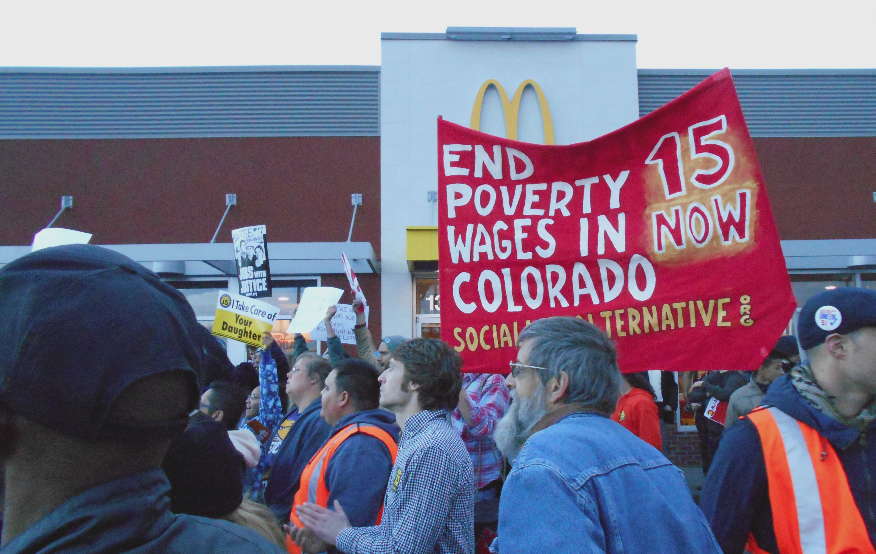
April 15: NYC took a bridge, Chicago & Seattle took the streets, Portland took Town Hall, and Denver took the cake

Photo by Laura Avant
DENVER, COLORADO- Yes, Denver’s FIGHT FOR FIFTEEN march kept to the sidewalks. When ISO members (organizing the local “15 NOW” group) pushed the boundaries, SEIU marshals criticized them not just for agitating, but for pushing their socialist agenda. Occupy Denver activists held a prominent banner which referenced reigning minimum wage champion Socialist Alternative. Most of the attendees were union members whose representatives have obviously failed to credit the SA party or Seattle Councilwoman Kshama Sawant for the nation’s first $15 minimum wage victory. We fielded questions all evening from marchers eager to know if an SA chapter was brewing in Colorado.

TO BE FAIR, Denver’s march did take an adventurous turn, by Denver standards, but the rally began as might be expected from an event dominated by the SEIU and other corporate unions and their immobile nonprofit cohorts. Denver’s 4-15 rally started in the middle of CU-Denver’s Auraria campus, invisible from any street and unseeable to even partipants arriving, until they turned the corner to find it, behind the Tivoli Center.

Then organizers had a lineup of speakers which stretched well past expectations, trimming the crowd by over a third as supporters opted to slip away due to the unexpected cold front. Next participants were admonished to stick to the sidewalk, even on campus grounds, and applaud the police who’d agreed to permit the march. We were heading to a neighboring McDonalds, at least we were taking the scenic route.

Throughout the rally and march, a brass band played, and members of the local band Flobots led chants and songs. This lent a fun energy but it did preclude ordinary marchers speaking out or centering the vocal messaging on anything more than the generic themes of financial discontent. Even as crowds lingered in front of McDonalds, the band played on, when poignant denunciations might have provided a suitable climax.

Fortunately, a “Silver Brigade” had been deployed to patronize the fast food monster beforehand, to prevent managers from being able to lock the doors when the marchers arrived. McDs managers did lock the doors and they discussed a number of interesting defensive tactics under the noses of our operatives, but the managers were ultimately unable to refuse senior citizens demanding they be allowed to exit. This exit was timed to allow the Fight-for-Fifteen procession to march straight up to the counter, demanding a living wage, etc. Their objections heard, the marchers left and eventually crossed the street and dissolved into shortcuts through the Auraria campus.

(Note: My account of our inside job may appear indiscrete, but I include it purposefully. One, because even with advance knowledge it’s a difficult tactic to prevent, and two, because organizers of successive protests of establishments such as McDs need to include this tactic if they don’t want to remain locked out.)

Photo by Laura Avant
The highlight for me was infusing the event theme with the S-word. Desperate as they were today to fight for a living wage, vowing “we’ll be back” or else to “shut it down”, these union adherants will shortly become the usual Democrats, waving the Hillary banners, as if there was no alternative.

Whose fault is it that America’s minimum wage has been allowed to lapse below the poverty level? Is the responsibility not in part that of the unions’? The SEIU is driving the official “Fight for Fifteen” campaign, but only after socialists have led the way, as they did whenever the labor movement made its gains.

Mother Jones: You Don’t Need a Vote

Mary Harris Jones portrait from her 1925 autobiographyAfter the 1914 Ludlow Massacre and the later capitulation of the UMWA union, Mother Jones, by now 85 years old, toured the US to spread the word about what happened. She wrote in her autobiography, about a meeting in Kansas City: “I told the great audience that packed the hall that when their coal glowed red in their fires, it was the blood of the workers, of men who went down into black holes to dig it, of women who suffered and endured, of little children who had but a brief childhood. ‘You are being warmed and made comfortable with human blood’ I said. … ‘The miners lost,’ I told them, because they had only the constitution. The other side had bayonets. In the end, bayonets always win.'”

From The Autobiography of Mother Jones, Chapter 22:
YOU DON’T NEED A VOTE TO RAISE HELL.

Five hundred women got up a dinner and asked me to speak. Most of the women were crazy about women suffrage. They thought that Kingdom-come would follow the enfranchisement of women.

“You must stand for free speech in the streets,” I told them.

“How can we,” piped a woman, “when we haven’t a vote?”

“I have never had a vote,” said I, “and I have raised hell all over this country! You don’t need a vote to raise hell! You need convictions and a voice!”

Some one meowed, “You’re an anti!”

“I am not an anti to anything which will bring freedom to my class,” said I. “But I am going to be honest with you sincere women who are working for votes for women. The women of Colorado have had the vote for two generations and the working men and women are in slavery. The state is in slavery, vassal to the Colorado Iron and Fuel Company and its subsidiary interests. A man who was present at a meeting of mine owners told me that when the trouble started in the mines, one operator proposed that women be disfranchised because here and there some woman had raised her voice in behalf of the miners. Another operator jumped to his feet and shouted, ‘For God’s sake! What are you talking about! If it had not been for the women’s vote the miners would have beaten us long ago!'”

Some of the women gasped with horror. One or two left the room. I told the women I did not believe in women’s rights nor in men’s rights but in human rights. “No matter what your fight,” I said, “don’t be ladylike! God Almighty made women and the Rockefeller gang of thieves made the ladies. I have just fought through sixteen months of bitter warfare in Colorado. I have been up against armed mercenaries but this old woman, without a vote, and with nothing but a hatpin has scared them.

“Organized labor should organize its women along industrial lines. Politics is only the servant of industry. The plutocrats have organized their women. They keep them busy with suffrage and prohibition and charity.”

Colorization of the Grapes of Wrath

migrant-motherI think it’s time to colorize The Grapes of Wrath. And I don’t mean the Turner Classics process exactly. It may help to dumb down the artistic contrast of the black & white for a contemporary audience palate of splashy Disneycolor, but how about trying to make Steinbeck’s theme more accessible to today’s spoon-fed viewers? Let’s colorize the skin of the poor migrant workers to reflect the inhumanly-treated populations of today’s displaced im-migrants of color.

I can’t remember where I come down on colorizing the old movies. No one’s insisted on infusing CMYK into Ansel Adams or Picasso’s sketchbook, why are masterpieces filmed in black and white supposed to be pigment deficient? We don’t presume to dub dialog over the silent movies made before the age of the talkies. As yet. Of course, Ted Turner was concerned for reviving interest in old intellectual properties, many of which were already in-artful. And perhaps his salesmanship maneuver has been proven effective. When my family sat down to watch Grapes of Wrath, the grey image tuned a number of youthful eyes away.

Like Dorothea Lange’s famous photographs, John Ford’s film depicted disadvantaged Okies with whom the American audience could identify. We may not know what it feels like to be forced off our homes, but how the families cope with the hardship, we all can recognize. I’m curious how the film was received by Californians in 1940, coming less than ten years after the original plague of destitute Oklahoma refugees. How would the characters have faired with our sympathies if they had been played as coarse hillbilly Crackers with guns and a poor person’s chip-on-the-shoulder desperation?

The poor protagonists of The Grapes of Wrath were weakened skinny po-folk, who staked their relief on the strength of a single hopeful job listing flyer, who protested their oppression without resorting to violence, and who accepted hardship as their lot. Seeing into their daily lives, viewers were shown a dignified, earnest people who treated others with respect and compassion. Antagonist characters in the film were less charitable, taking advantage of the hard-luck migrants with guile, violence and authority. People into which the Oklahoma refugees traveled, New Mexico, Arizona and California, treated the migrants like vermin. Even as onlookers might express admiration for the Okies’ determination to cross Death Valley, the better fed Californians held them in disdain for not knowing enough to be in such a predicament. The Okies were blamed for their own poverty. They threatened to burden everyone’s already depleting resources. Only the viewers understood the unfair actions which had landed the otherwise self-sufficient sharecroppers to have to leave their livelihoods.

The circumstances of the Dust Bowl cum great depression era forced removal of the small Oklahoma farmers is eerily familiar to today’s economy and its foreclosures. Homesteaders find themselves made homeless, as a consequence of business decisions between corporations, banks and regulators. The Oklahoma farmers wanted to point their shotguns to warn the financial disruptors from their land, but found the conduits of the dirty work were their own neighbors and relatives. Everyone was merely following orders from someone higher up. That the system could be at fault, left the victims with no clear recourse.

Here’s the classic eviction exchange.

THE MAN
I can’t help that. All I know is I got my orders.
They told me to tell you you got to get off,
and that’s what I’m telling you.

MULEY
You mean get off my own land?

THE MAN
Now don’t go blaming me. It ain’t *my* fault.

SON
Whose fault is it?

THE MAN
You know who owns the land–the Shawnee Land and Cattle Company.

MULEY
Who’s the Shawnee Land and Cattle Comp’ny?

THE MAN
It ain’t nobody. It’s a company.

SON
They got a pres’dent, ain’t they?
They got somebody that knows what a shotgun’s for, ain’t they?

THE MAN
But it ain’t *his* fault, because the *bank* tells him what to do.

SON
All right. Where’s the bank?

THE MAN
Tulsa. But what’s the use of picking on him?
He ain’t anything but the manager, and half crazy hisself,
trying to keep up with his orders from the east!

MULEY
Then who *do* we shoot?

THE MAN
Brother, I don’t know. If I did I’d tell you.
But I just don’t know *who’s* to blame!

There was a lot more in The Grapes of Wrath which could inform a modern world view. The dreaded “Cats” for example. These were the Caterpillar tractors which were shown ravaging the land like locusts, arriving to demolish the houses of the reluctant dispossessed. Bulldozers are still used for that function today. In fact, Caterpillar manufactures armored versions to deploy in war zones for the destruction of houses. Palestinians have shown to be less reluctant than the poor Okies about trying to shoot the bulldozer drivers who are taking aim at their homes. Israel is expanding its settlements in Palestine with the aid of Caterpillar tractors which clear the land of its recalcitrant invadees.

Likewise, the union busting strategies portrayed in Grapes of Wrath are the same used today. Police officers are called in when work supervisors encounter workers who show too much skepticism for the employer’s scam. Troublemakers are arrested lest the workforce succeed in organizing itself. Instigators are paid to infiltrate a social event and start a fight, to give law enforcement the excuse to break in and make its calculated arrests. Casual viewers may think the famous 1939 film depicts a bygone age. Not at all.

Director John Ford made sure that the Okie migrants were deathly skinny, while everyone else, from gas station attendants to deputized union-busters, was immaculately dressed and well fed. But the audience could identify with both sides, because both were white. Imagine if the displaced peoples were not the same color.

Today’s migrant workers are hispanic. They are illegal immigrants, just like Okies passing through the Arizona checkpoint in Steinbeck’s novel.

GUARD
Where you going?

TOM
California.

GUARD
How long you plan to be in Arizona?

TOM
No longer’n we can get acrost her.

GUARD
Got any plants?

TOM
No plants.

GUARD
Okay. Go ahead, but you better keep movin’.

Could a modern audience appreciate the travails of a Mexican family in an exact same predicament? Mexican farmers have been forced from their land in an even less polite manner today. They have similar claim to their homesteads, some of them even have indigenous claims. But American and Mexican corporate interests have been forcing the Mexicans to flee. The migration north is not about seeking fortune; picking lettuce it most certainly is not. The work our illegal immigrants are willing to do is out of desperation and subsistence. Corporate America reserves our agricultural work for migrants because it’s cheaper. Otherwise American citizens have devised unions to ensure that workers are paid an honorable wage. Exploitation of the illegal immigrant is simply a bypass of decent labor practices meant to protect everyone.

In selfish, protectionist terms, hiring illegal immigrants undermines the strength of unionized labor. Ultimately the exploitation of others dehumanizes us all.

I wish Americans could see The Grapes of Wrath as a projection of the ongoing injustices suffered by all exploited migrants. As well-fed American citizens leading prosperous lives, wouldn’t it be our responsibility to help the victims of our system? Instead, we are those cold-hearted leather-jacketed Californians herding them into lives of slow death by hard labor and starvation.

The Grapes of Wrath offered a strong Socialist message, disguised in a protagonist who did not yet have all the answers. Before setting out to light the way, Henry Fonda’s character says this to his mom:

TOM
…maybe I can do sump’n. Maybe I can jus’ fin’ out sump’n.
Jus’ scrounge aroun’ an’ try to fin’ out what it is that’s wrong,
an then see if they ain’t sump’n could be done about it.
But I ain’t thought it out clear, Ma. I can’t.
I don’t know enough.

MA
How’m I gonna know ’bout you?
They might kill you an’ I wouldn’t know.
They might hurt you. How’m I gonna know?

TOM
Well, maybe it’s like Casy says, a fella ain’t got a soul
of his own, but on’y a piece of a big soul–the one big soul
that belongs to ever’body–an’ then…
Then it don’t matter. Then I’ll be all aroun’ in the dark.
I’ll be ever’where–wherever you look. Wherever there’s
a fight so hungry people can eat, I’ll be there.
Wherever there’s a cop beatin’ up a guy, I’ll be there.
I’ll be in the way guys yell when they’re mad
–an’ I’ll be in the way kids laugh when they’re
hungry an’ they know supper’s ready.
An’ when our people eat the stuff they raise,
an’ live in the houses they build, why, I’ll be there too.

I had to see The Grapes of Wrath in high school. It was required. Are schools today trying to infuse students with social wisdom? How about a Grapes Redux starring people of color? Imagine this closing line, spoken by a dark skinned mother, about the hardship that is her people’s fate:

MA
…Maybe that makes us tough. Rich fellas come up an’ they die, an’ their kids ain’t no good, an’ they die out. But we keep a-comin’. We’re the people that live. Can’t nobody wipe us out. Can’t nobody lick us. We’ll go on forever, Pa. We’re the people.

US Labor Day turned into an extra day to shop for crap at Walmart

18volgaboatmen.jpg …The US Labor Movement is in shambles and is no force at all in the economic life of this country. This is as a result of having a group of labor union heads totally tied to the Democratic Party and co-opted by big business since the post World War 2 era. What was created by radicals amongst the working class way back in the ’30s has been thrown away, and today US Labor Day is nothing more than another day when workers go to Walmart.

Labor ‘solidarity’ has now been reduced to voting for the likes of Barack Obama and Joe Biden and praying that one does not lose the small equity one might have on a home or a car. It’s a sad day for the workers of America who face illness and old age with shredded full of holes retirement and medical care plans. Brother can you spare a dime? has been changed to ‘Brother can you spare a Hundred? My car ran out of gas and we got nothing to eat.’ Labor buys nothing more than poverty for so many.

Business unionism’s dead end

laborers
Each year in the US, the labor unions get smaller and weaker. What is the cause of this since life is certainly not getting easier for the working class of our country?

Will the unions finally just evaporate into thin air? At this time they are providing about ZERO protection for the population from the corporations and their corporate run government.

In this blog we have talked at some length about the problems of ‘Peace’ organizations run as small businesses rather than as democratic community organizations opposed to war. We have the same phenomena in the Labor Movement and with the same results which are the demobilization of people rather than their mobilization. Organizations with small paid office staffs that separate themselves from the people they supposedly are serving lead to organizations that do not inspire people to move themselves. Why should they? They have no control over the organizations they are in. Apathy, disinterest, and demobilization results.

We also have to factor in the corporate control over trade unions themselves, which is achieved through the Democratic Party. Once again, this process parallels what happens with the “peace’ groups run by paid office types. In both types of organizations, trade union and ‘Peace’, the Conservatives office milieu that is cultivated by business models of organization see themselves a lobbyists, and lobbyists to the politicians. That becomes their principle focus. These types often talk about ‘speaking truth to power’, but what they mean is that they should spend all their time in some form of lobbying of Democratic Party politicians.

As a result, demonstrations and independent organizing are deliberately kept from happening, and excess value is given to hobnobbing with the corporate press currying ‘reporting’ and visiting the offices of political insiders with pleas in hand. This is activity that is seen as needing paid organizers separate from community control, whose folk are only seen as potentially messing up this lobbying effort.

This method of using business models inside community organizations has paralyzed the antiwar movement, and has beaten down the Labor Movement into non-existence. Ads a result, unions can hardly be found any where actually engaging in organizing. In fact, they can hardly be found in actually hanging on to the membership that is left. What it will take is a completely different model of organization to ever be able to rebuild these organizations. That is not presently on the scene and it will not occur in an easy manner, but will require much sacrifice and effort.

BTW, that foto of workers at the head of this column is taken from a day labor company site. These are some of the many workers abandoned by business unionism’s failed model of unionism.

Peacefully lost in the fog: American liberals’ denial of reality

Last week saw many a liberal author writing about why, in their opinions, the US government will not start a war against Iran. This is true lost-in-the-fog liberal denial of reality, though why is it? By what combination of stumbles in thought did they reach their conclusions?

These liberal academics (that’s what they are mainly), that believe that an attack on Iran is improbable, simply misread the general US public mindset. They believe that since Bush is so unpopular now that he has become entirely neutered and restrained by general disapproval. But is that really true?

Bush is unpopular so much not because Americans believe that the Iraq War was wrong, but rather because Americans think it wrong that Bush did not wrap up ‘victory’ there as quickly and as easily as they were promised. That does not mean that the general American public is now somehow a group of anti-imperialists. Quite the contrary. They still love American imperialism but just want it done more successfully.

Most liberals actually think that ‘the tide has turned’. As usual, they are totally out of touch with reality in this. Here liberals cannot even organize small street demonstrations against the Pentagon wars currently underway, yet somehow they think that they have the public behind them all the way! Talk about lost in inner space!

Quite simply, liberals mistake the fact that the corporate elite wants a new team in office for a while, with their own delusions that now they are going to get more say in management through the Democrats. You are not, Dummies! You are a side show, and the US government has a bipartisan corporate consensus that their war needs to be extended even more and this time towards Iran.

Real political power comes from independent organization, but liberals mistake groups like MoveOn for being such. They mistake all their tiny little office paid ‘peace’ groups for being a real antiwar movement. They mistake their liberal church group participation for being the necessary work that has to be done. They simply do not get it. They don’t want to get it!

The liberals simply do not have a movement going and neither do we more radical types. We have not yet currently constructed a Labor Movement, a Black or Hispanic Movement, or a Movement to Defend the Environment. These Movements simply do not exist at this time, and without them in place, the US government does not feel restrained in the least.

The government is simply going to continue with their so-called ‘Global War on Terrorism’ until we are able to do something about through our own independent organization. We have not even begun to do that yet, and we certainly are not entrenched in any sort of major success. We are losers up to now, and the liberal Democratic Party voters amongst us are addicted to losing. They lose most often when they ‘win’ even! They mistake losing for victory, thus liberal authors can write about how the Bush Administration will not do this or that, like they, the liberals, are in control now!

Yes, the sad fact of the matter is that America remains with a pro-war mindset. Americans love war! They believe that all war is theirs for the easy win. They simply do not understand why Bush and his Administration are such failures at doing just that. They are simply not antiwar in the least.

Strangely enough, liberals have been developing delusions of grandeur recently. They do think that the tide has changed. However, what evidence is there really that that is actually true? Obama might win? Talk about being really out of the loop in understanding one’s own society though!

We are in a definite danger period now. The oil industry and all the other major corporate industries, too, all want a continued and prolonged global war. They have no public opposition to this so far inside the US. And sad to say, the European middle classes are behind this game plan, too. The European populations are simply not mobilizing themselves against this global warfare. Where is this supposed change in the tide then? Certainly not in Europe, and certainly not here in America.

Sitting around with their thumbs up their rear ends saying that it is improbable that the US will attack Iran is pathetic. It is an excuse for continuing their own lack of success in actually building an independent movement against the war. The liberal community is not doing anything much other than taking it as it comes, and pretending that it won’t come when it will.
They are going to vote, and that is about all.

David Rovics on death of Utah Phillips

utah-phillips-fellow-workers-moose-turd-pie.jpgUtah Phillips died Friday. Friends have circulated a May 14th letter he’d sent. The Salt Lake Tribune reprinted a great interview from 2005. And fellow performer David Rovics forwarded this remembrance:

I was watching my baby daughter sleep in her carseat outside of the Sacramento airport about ten hours ago when I noticed a missed call from Brendan Phillips. He’s in a band called Fast Rattler with several friends of mine, two of whom live in my new hometown of Portland, Oregon, one of whom needed a ride home from the Greyhound station. I called back, and soon thereafter heard the news from Brendan that his father had died the night before in his sleep, when his heart stopped beating.

I wouldn’t want to elevate anybody to inappropriately high heights, but for me, Utah Phillips was a legend.

I first became familiar with the Utah Phillips phenomenon in the late 80’s, when I was in my early twenties, working part-time as a prep cook at Morningtown in Seattle. I had recently read Howard Zinn’s A People’s History of the United States, and had been particularly enthralled by the early 20th Century section, the stories of the Industrial Workers of the World. So it was with great interest that I first discovered a greasy cassette there in the kitchen by the stereo, Utah Phillips Sings the Songs and Tells the Stories of the Industrial Workers of the World.

As a young radical, I had heard lots about the 1960’s. There were (and are) plenty of veterans of the struggles of the 60’s alive and well today. But the wildly tumultuous era of the first two decades of the 20th century is now (and pretty well was then) a thing entirely of history, with no one living anymore to tell the stories. And while long after the 60’s there will be millions of hours of audio and video recorded for posterity, of the massive turn-of-the-century movement of the industrial working class there will be virtually none of that.

To hear Utah tell the stories of the strikes and the free speech fights, recounting hilariously the day-to-day tribulations of life in the hobo jungles and logging camps, singing about the humanity of historical figures such as Big Bill Haywood, Joe Hill or Elizabeth Gurley Flynn, was to bring alive an era that at that point only seemed to exist on paper, not in the reality of the senses. But Utah didn’t feel like someone who was just telling stories from a bygone era — it was more like he was a bridge to that era.

Hearing these songs and stories brought to life by him, I became infected by the idea that if people just knew this history in all its beauty and grandeur, they would find the same hope for humanity and for the possibility for radical social change that I had just found through Utah.

Thus, I became a Wobbly singer, too. I began to stand on a street corner on University Way with a sign beside me that read, “Songs of the Seattle General Strike of 1919.” I mostly sang songs I learned from listening to Utah’s cassette, plus some other IWW songs I found in various obscure collections of folk music that I came across.

It was a couple years later that I first really discovered Utah Phillips, the songwriter. I had by this time immersed myself with great enthusiasm in the work of many contemporary performers in what gets called the folk music scene, and had developed a keen appreciation for the varied and brilliant songwriting of Jim Page and others. Then, in 1991, I came across Utah’s new cassette, I’ve Got To Know, and soon thereafter heard a copy of a much earlier recording, Good Though.

Whether he’s recounting stories from his own experiences or those of others doesn’t matter. There is no need to know, for in the many hours Utah spent in his troubled youth talking with old, long-dead veterans of the rails and the IWW campaigns, a bridge from now to then was formed in this person, in his pen and in his deep, resonant voice. In Good Though I heard the distant past breathing and full of life in Utah’s own compositions, just as they breathed in his renditions of older songs.

In I’ve Got To Know I heard an eloquent and current voice of opposition to the American Empire and the bombing of Iraq, rolled together seamlessly with the voices of deserters, draft dodgers and tax resisters of the previous century.

In reference to the power of lying propaganda, a friend of mine used to say it takes ten minutes of truth to counteract 24 hours of lies. But upon first hearing Utah’s song, “Yellow Ribbon,” it seemed to me that perhaps that ratio didn’t give the power of truth enough credit. It seemed to me that if the modern soldiers of the empire would have a chance to hear Utah’s monologues there about his anguish after his time in the Army in Korea, or the breathtakingly simple depiction of life under the junta in El Salvador in his song “Rice and Beans,” they would just have to quit the military.

Utah made it clear in word and in deed that steeping yourself in the tradition was required of any good practitioner of the craft, and I did my best to follow in his footsteps and do just that. I learned lots of Utah’s songs as well as the old songs he was playing. Making a living busking in the Boston subways for years, I ran into other folks who were doing just that, as well as writing great songs, such as Nathan Phillips (no relation). Nathan was from West Virginia, and did haunting versions of “The Green Rolling Hills of West Virginia,” “Larimer Street,” “All Used Up,” and other songs. In different T stops at the same time, Nathan and I could often be found both singing the songs of Utah Phillips for the passersby. Traveling around the US in the 1990’s and since then, it seemed that Utah’s music had, on a musical level, had the same kind of impact that Zinn’s People’s History or somewhat earlier works such as Jeremy Brecher’s book, Strike!, had had in written form — bringing alive vital history that had been all but forgotten. With Ani DiFranco’s collaboration with Utah, this became doubly true, seemingly overnight, and this man who had had a loyal cult following before suddenly had, if not what might be called popularity, at least a loyal cult following that was now twice as big as it had been in the pre-Ani era.

I had had the pleasure of hearing Utah live in concert only once in the early 90’s, doing a show with another great songwriter, Charlie King, in the Boston area. I was looking forward to hearing him play again around there in 1995, but what was to be a Utah Phillips concert turned into a benefit for Utah’s medical expenses, when he had to suddenly drastically cut down on his touring, due to heart problems. I think there were about twenty different performers doing renditions of Utah Phillips’ songs at Club Passim that night. I did “Yellow Ribbon.”

Traveling in the same circles and putting out CDs on the same record label, it was fairly inevitable that we’d meet eventually. The first time was several years ago, if memory serves me, behind the stage at the annual protest against the School of the Americas in Columbus, Georgia. I think I successfully avoided seeming too painfully star-struck. Utah was complaining to me earnestly about how he didn’t know what to do at these protests, didn’t feel like he had good protest material. I think he did just fine, though I can’t recall what he did.

Utah lived in Nevada City, and the last time I was there he came to the community radio station while I was appearing on a show. This was soon after Katrina, and I remember singing my song, “New Orleans,” and Utah saying embarrassingly nice things. I was on a little tour with Norman Solomon speaking and me singing, and we had done an event the night before in town, which Utah was too tired to attend, if I recall.

Me, Utah, Norman, and my companion, Reiko, went over to a nice breakfast place after the radio show, talked and ate breakfast. Utah did most of the talking, and I was pleasantly surprised to find that his use of mysterious hobo colloquialisms and frequent references to obscure historical characters in twentieth-century American anarchist history was something he did off stage as well as on.

I’ve passed near enough to that part of California many times since then. Called once when I was nearby and he was out of town, doing a show in Boston. Otherwise I just thought about calling and dropping by, but didn’t take the time. Life was happening, and taking a day or two off in Nevada City was always something that I never quite seemed to find the time for. Always figured next time I’ll have more time, I’ll call him then. It had been thirteen years since he found out about his heart problems, and he hadn’t kicked the bucket yet… Of course, now I wish I had taken the time when I had the chance, and I’m sure there are many other people who feel the same way.

In any case, for those of us who knew his music, whether from recordings or concerts, for those of us who knew Utah from his stories on or off the stage, whether we knew him as that human bridge to the radical labor movement of yesterday, or as the voice of the modern-day hobos, or as that funky old guy that Ani did a couple of CDs with, Utah Phillips will be remembered and treasured by many. He was undeniably a sort of musical-political-historical institution in his own day. He said he was a rumor in his own time. No question, one man’s rumor is another man’s legend, but who cares, it’s just words anyway.

Stokely Carmichael on liberal pitfalls

Most liberals are naive to other thinking or to the insightful speeches of the socialist black activists of the 60’s. Stokely Carmichael saw the powerlessness of the liberal that other moderate Negro leaders wouldn’t attempt or couldn’t see.

The Black Panthers saw through the petty liberal ideology that always sought cooperation with the capitalists, or as Stokely put it, the oppressors. He talked of liberals and peace activists rejection of violence as a means to achieve real change. Real change defined as eliminating capitalism which is the very root of our dilemma. Is it that the progressive/liberal ideology is largely bankrupt? That it goes nowhere often and deceives its followers into static worn out Gandhi-Goodman, no alternative strategies that always succumb to the real power that is the fascists source of control? Violence? Yes is the answer.

Less a massive armed militant mobilization and a clean break from the stink that is capitalism, there will never be a fair social system that works for the vast working class population. And a re-education of our children away from fascisms model and as to the truth about democratic socialism.

“What we want to do for our people, the oppressed, is to begin to legitimize violence in their minds. So that for us violence against the oppressor will be expedient. This is very important, because we have all been brainwashed into accepting questions of moral judgment when violence is used against the oppressor.”

The Pitfalls of Liberalism
by Stokely Carmichael (Kwame Ture)
(From the book; “Stokely Speaks – From Black Power to Pan Africanism”)

Whenever one writes about a problem in the United States, especially concerning the racial atmosphere, the problem written about is usually black people that they are either extremist, irresponsible, or ideologically naive.

What we want to do here is to talk about white society, and the liberal segment of white society, because we want to prove the pitfalls of liberalism, that is, the pitfalls of liberals in their political thinking.

Whenever articles are written, whenever political speeches are given, or whenever analysis are made about a situation, it is assumed that certain people of one group, either the left or the right, the rich or the poor, the whites or the blacks, are causing polarization. The fact is that conditions cause polarization, and that certain people can act as catalysts to speed up the polarization; for example, Rap Brown or Huey Newton can be a catalyst for speeding up the polarization of blacks against whites in the United States, but the conditions are already there. George Wallace can speed up the polarization of white against blacks in America, but again, the conditions are already there.

Many people want to know why, out of the entire white segment of society, we want to criticize the liberals. We have to criticize them because they represent the liaison between other groups, between the oppressed and the oppressor. The liberal tries to become an arbitrator, but he is incapable of solving the problems. He promises the oppressor that he can keep the oppressed under control; that he will stop them from becoming illegal (in this case illegal means violent). At the same time, he promises the oppressed that he will be able to alleviate their suffering – in due time. Historically, of course, we know this is impossible, and our era will not escape history.

The most perturbing question for the liberal is the question of violence. The liberals initial reaction to violence is to try to convince the oppressed that violence is an incorrect tactic, that violence will not work, that violence never accomplishes anything. The Europeans took America through violence and through violence they established the most powerful country in the world. Through violence they maintain the most powerful country in the world. It is absolutely absurd for one to say that violence never accomplishes anything.

Today power is defined by the amount of violence one can bring against one’s enemy – that is how you decide how powerful a country is; power is defined not by the number of people living in a country, it is not based on the amount of resources to be found in that country, it is not based upon the good will of the leaders or the majority of that people. When one talks about a powerful country, one is talking precisely about the amount of violence that that country can heap upon its enemy. We must be clear in our minds about that. Russia is a powerful country, not because there are so many millions of Russians but because Russia has great atomic strength, great atomic power, which of course is violence. America can unleash an infinite amount of violence, and that is the only way one considers American powerful. No one considers Vietnam powerful, because Vietnam cannot unleash the same amount of violence. Yet if one wanted to define power as the ability to do, it seems to me that Vietnam is much more powerful than the United States. But because we have been conditioned by Western thoughts today to equate power with violence, we tend to do that at all times, except when the oppressed begin to equate power with violence….then it becomes an “incorrect” equation.

Most societies in the West are not opposed to violence. The oppressor is only opposed to violence when the oppressed talk about using violence against the oppressor. Then the question of violence is raised as the incorrect means to attain one’s ends. Witness, for example, that Britain, France, and the United States have time and time again armed black people to fight their enemies for them. France armed Senegalese in World War 2, Britain of course armed Africa and the West Indies, and the United States always armed the Africans living in the United States. But that is only to fight against their enemy, and the question of violence is never raised. The only time the United States or England or France will become concerned about the question of violence is when the people whom they armed to kill their enemies will pick up those arms against them. For example, practically every country in the West today is giving guns either to Nigeria or the Biafra. They do not mind giving those guns to those people as long as they use them to kill each other, but they will never give them guns to kill another white man or to fight another white country.

The way the oppressor tries to stop the oppressed from using violence as a means to attain liberation is to raise ethical or moral questions about violence. I want to state emphatically here that violence in any society is neither moral nor is it ethical. It is neither right nor is it wrong. It is just simply a question of who has the power to legalize violence.

It is not a question of whether it is right to kill or it is wrong to kill; killing goes on. Let me give an example. If I were in Vietnam, if I killed thirty yellow people who were pointed out to me by white Americans as my enemy, I would be given a medal. I would become a hero. I would have killed America’s enemy – but America’s enemy is not my enemy. If I were to kill thirty white policemen in Washington, D.C. who have been brutalizing my people and who are my enemy, I would get the electric chair. It is simply a question of who has the power to legalize violence. In Vietnam our violence is legalized by white America. In Washington, D.C., my violence is not legalized, because Africans living in Washington, D.C., do not have the power to legalize their violence.

I used that example only to point out that the oppressor never really puts an ethical or moral judgment on violence, except when the oppressed picks up guns against the oppressor. For the oppressor, violence is simply the expedient thing to do.

Is it not violent for a child to go to bed hungry in the richest country in the world? I think that is violent. But that type of violence is so institutionalized that it becomes a part of our way of life. Not only do we accept poverty, we even find it normal. And that again is because the oppressor makes his violence a part of the functioning society. But the violence of the oppressed becomes disruptive. It is disruptive to the ruling circles of a given society. And because it is disruptive it is therefore very easy to recognize, and therefore it becomes the target of all those who in fact do not want to change the society. What we want to do for our people, the oppressed, is to begin to legitimize violence in their minds. So that for us violence against the oppressor will be expedient. This is very important, because we have all been brainwashed into accepting questions of moral judgment when violence is used against the oppressor.

If I kill in Vietnam I am allowed to go free; it has been legalized for me. I has not been legitimatized in my mind. I must legitimatize it in my own mind, and even though it is legal I may never legitimatize in in my own mind. There are a lot of people who came back from Vietnam, who have killed where killing was legalized, but who still have psychological problems over the fact that they have killed. We must understand, however, that to legitimatize killing in one’s mind does not make it legal. For example, I have completely legitimatized in my mind the killing of white policemen who terrorize black communities. However, if I get caught killing a white policeman, I have to go to jail, because I do not as yet have the power to legalize that type of killing. The oppressed must begin to legitimatize that type of violence in the minds of our people, even though it is illegal at this time, and we have to keep striving every chance we get to attain that end.

Now, I think the biggest problem with the white liberal in America, and perhaps the liberal around the world, is that his primary task is to stop confrontation, stop conflicts, not to redress grievances, but to stop confrontation. And this is very clear, it must become very, very clear in all our minds. Because once we see what the primary task of the liberal is, then we can see the necessity of not wasting time with him. His primary role is to stop confrontation. Because the liberal assumes a priori that a confrontation is not going to solve the problem. This of course, is an incorrect assumption. We know that.

We need not waste time showing that this assumption of the liberals is clearly ridiculous. I think that history has shown that confrontation in many cases has resolved quite a number of problems – look at the Russian revolution, the Cuban revolution, the Chinese revolution. In many cases, stopping confrontation really means prolonging suffering.

The liberal is so preoccupied with stopping confrontation that he usually finds himself defending and calling for law and order, the law and order of the oppressor. Confrontation would disrupt the smooth functioning of the society and so the politics of the liberal leads him into a position where he finds himself politically aligned with the oppressor rather than with the oppressed.

The reason the liberal seeks to stop confrontation – and this is the second pitfall of liberalism – is that his role, regardless of what he says, is really to maintain the status quo, rather than to change it. He enjoys economic stability from the status quo and if he fights for change he is risking his economic stability. What the liberal is really saying is that he hopes to bring about justice and economic stability for everyone through reform, that somehow the society will be able to keep expanding without redistribution the wealth.

This leads to the third pitfall of the liberal. The liberal is afraid to alienate anyone, and therefore he is incapable of presenting any clear alternative.

Look at the past presidential campaign in the United States between Nixon, Wallace, and Humphrey. Nixon and Humphrey, because they try to consider themselves some sort of liberals, did not offer any alternatives. But Wallace did, he offered clear alternatives. Because Wallace was not afraid to alienate, he was not afraid to point out who had caused errors in the past, and who should be punished. The liberals are afraid to alienate anyone in society. They paint such a rosy picture of society and they tell us that while things have been bad in the past, somehow they can become good in the future without restructuring society at all.

What the liberal really wants is to bring about change which will not in any way endanger his position. The liberal says, “It is a fact that you are poor, and it is a fact that some people are rich but we can make you rich without affecting those people who are rich”. I do not know how poor people are going to get economic security without affecting the rich in a given country, unless one is going to exploit other peoples. I think that if we followed the logic of the liberal to its conclusion we would find that all we can get from it is that in order for a society to become suitable we must begin to exploit other peoples.

Fourth, I do not think that liberals understand the difference between influences and power, and the liberals get confused seeking influence rather than power. The conservatives on the right wing, or the fascists, understand power, though, and they move to consolidate power while the liberal pushes for influence.

Let us examine the period before civil rights legislation in the United States. There was a coalition of the labor movement, the student movement, and the church for the passage of certain civil rights legislation; while these groups formed a broad liberal coalition, and while they were able to exert their influence to get certain legislation passed, they did not have the power to implement the legislation once it became law. After they got certain legislation passed they had to ask the people whom they were fighting to implement the very things that they had not wanted to implement in the past. The liberal fights for influence to bring about change, not for the power to implement the change. If one really wants to change a society, one does not fight to influence change and then leave the change to someone else to bring about. If the liberals are serious they must fight for power and not for influence.

These pitfalls are present in his politics because the liberal is part of the oppressor. He enjoys the status quo while he himself may not be actively oppressing other people, he enjoys the fruits of that oppression. And he rhetorically tries to claim the he is disgusted with the system as it is.

While the liberal is part of the oppressor, he is the most powerless segment within that group. Therefore when he seeks to talk about change, he always confronts the oppressed rather than the oppressor. He does not seek to influence the oppressor, he seeks to influence the oppressed. He says to the oppressed, time and time again, “You don’t need guns, you are moving too fast, you are too radical, you are too extreme.” He never says to the oppressor, “You are too extreme in your treatment of the oppressed,” because he is powerless among the oppressors, even if he is part of that group; but he has influence, or, at least, he is more powerful than the oppressed, and he enjoys this power by always cautioning, condemning, or certainly trying to direct and lead the movements of the oppressed.

To keep the oppressed from discovering his pitfalls the liberal talks about humanism. He talks about individual freedom, about individual relationships. One cannot talk about human idealism in a society that is run by fascists. If one wants a society that is in fact humanistic, one has to ensure that the political entity, the political state, is one that will allow humanism. And so if one really wants a state where human idealism is a reality, one has to be able to control the political state. What the liberal has to do is to fight for power, to go for the political state and then, once the liberal has done this, he will be able to ensure the type of human idealism in the society that he always talks about.

Because of the above reasons, because the liberal is incapable of bringing about the human idealism which he preaches, what usually happens is that the oppressed, whom he has been talking to finally becomes totally disgusted with the liberal and begins to think that the liberal has been sent to the oppressed to misdirect their struggle, to rule them. So whether the liberal likes it or not, he finds himself being lumped, by the oppressed, with the oppressor – of course he is part of that group. The final confrontation, when it does come about, will of course include the liberal on the side of the oppressor. Therefore if the oppressed really wants a revolutionary change, he has no choice but to rid himself of those liberals in his rank.

Kwame Ture
(aka Stokely Carmichael)

Kwame Ture was born Stokely Carmichael on June 29, 1941 in Port of Spain, Trinidad, the son of Adolphus and Mabel Carmichael. He immigrated to the United States in 1952 with his family and settled in New York, New York. He graduated from the academically elite Bronx High School of Science in 1960 and made the decision to attend Howard University. Howard University conferred on him a Bachelor of Science Degree in Philosophy in 1964.

It was while in Washington that Stokely became deeply involved in the “Freedom Rides,” “Sit-Ins,” and other demonstrations to challenge segregation in American society. He participated with the Congress of Racial Equality (CORE) and the Nonviolent Action Group (NAG). He later joined the Student Nonviolent Coordinating Committee (SNCC) and was elected its National Chairman in June 1966. While in Greenville, Mississippi, he along with his friend and colleague Willie Ricks, rallied the cry “Black Power” which became the most popular slogan of the Civil Rights era. Consequently, he became the primary spokesman for the Black Power ideology. In 1967, he coauthored with Charles V. Hamilton, Black Power, the Politics of Liberation in America. That same year, Stokely was disassociated from SNCC and he became the Prime Minister of the Black Panthers, headquartered in Oakland, California. He soon became disenchanted with the Panthers and moved to Guinea, West Africa.

While residing in Africa, Stokely Carmichael changed his name to “Kwame Ture” to honor Kwame Nkrumah, who led Ghana to independence from Britain, and, Sekou Toure, who was President of Guinea and his mentor. For more than 30 years, Ture led the All-African People’s Revolutionary Party and devoted the rest of his life to Pan Africanism, a movement to uproot the inequities of racism for people of African descent and to develop an economic and cultural coalition among the African Diaspora.

In 1998, at the age of 57, Kwame Ture died from complications of prostate cancer. To the end he answered the telephone, “ready for the revolution.” His marriage to Miriam Makeba and Guinean physician Marlyatou Barry ended in divorce. He has one son, Bokar, who resides in the United States.

Liberals and Labour

The Labour Party of Britain has changed nothing at all from Tony Blair under PM Gordon Brown, just as the Democratic Party has changed nothing 7 years into the Bush presidency. Both still are corporate creations masquerading as popular parties of the common folk.

The latest political scandal in Britain shows that ‘The Labour Party’ should actually be called The Property Developer Party.

In the US we really no longer have even the semblance of a Labor Movement, after its stagnant and corrupted leadership has spent decades after long decades monetarily supporting The Property Developer Party aka as The Corporate Trial Lawyer’s Party, etc. Union dues promoting corporate views, in short.

There is nothing democratic at all about The Democratic Party so this strategy of top down nothing (voting DP candidates) has led all of us into the dead end alley of total corporate control over ALL. We now hardly have a hint of what alternative direction would be like.

Because of this labour misleader co-option, all real organizing of the US Labor Movement will now have to be essentially a totally illegal activity if it is to have any chance to succeed at all, and American (and British workers, too) have gotten way too soft for this sort of battle. It was always the industrial workers that were the backbone for tough fights anyway, and much of that base has been ‘outsourced’ to outside the national borders of ‘The Homelands’. So what we have today, is a Labor Movement where Starbucks’ and Borders’ clerks make up some of the more militant sectors of the Anglo-Saxon working class. Oops!!! I hope I didn’t scare anybody with that word?… working class…

Liberals are now not from Labour, but are from the middle class, and worry about their food intake (healthy or not?), bowel movements (regular or not?), and image (polite or not?) while ‘protesting’. They are non-violent, turn the other cheek types, and not picket sign carriers walking the line subject to the company’s goons coming their way. Liberals now come more from churches than they do from blue collar jobs, so they are not going to bruise it out ‘violently’ witht he companies, as actually ultimately this has to be done again for progress to be made on class issues.

US Labor is now isolated,tasered, jailed, and sick (due to worsening health care and job conditions, worsening diet, and worsening ‘entertainment’ options). The only help for this sad situation might just have to come from workers in foreign countries actually standing up to the corporate goon squads (US military) we now, in America, consider absolutely normal to have all around us?

OK, that’s all I got to be said about Liberals and Labour… I gotta go shopping now! I got some coupons I need to use. Workers United For Good Coupons!

Neo-liberal regime in France hits hard road block

France doesn’t want the neo-liberal program that its government is trying to shove down its throat. Nicolas Sarkozy was elected in May as France’s president, and it is clear that he was the French corporate candidate of choice. France gripped by massive strike

Those corporations want him to destroy the social benefits that the French currently receive and to break all opposition to corporate control over everything in French society.

The French Labor Movement is battling back, and unlike the British and American Labor Movement, the French working class still has some punch left in it. The Battle For France involves more than just the French though. Neo-liberal needs to be delivered a death blow, and the French workers just like the Iraqi population as a whole, are doing their very best to fight back. We wish both the best in their struggles against the common evil we all should be struggling against. That common evil is corporate control over all society against the will of those underneath corporate yoke.

Why Green Party is Dead, Dead, Dead

Four years ago, the US socialist Left was awash in hope for finally finding some cheap breakthrough to out flanking the 2 corporate political parties. They had decided that the Green Party was the road to Nirvana for them, and thought that this sad electoral vehicle might somehow be used to disassemble DP-voting liberals away from their cherished fetish, the Democratic Party.

Their hopes were based solely on their own desires, ignoring the reality that Democratic Party based liberalism still maintained complete ideological and organizational control over the Green Party bureaucracy at the top. Ralph Nader tried his best by refusing to go along with gluing the Green Party to merely helping elect another Democratic Party president. The official Green Party candidate, David Cobb, did the opposite, and ran a non-campaign for US president which completely set back the Greens chances of ever making any political impact at all.

This was what the Democratic Party wanted for the Green Party to do. By that time many card carrying liberals now just wanted The Green Party to just go away entirely, and David Cobb was the man to accomplish that. The Green Party under his wing set out like bulldogs to disappear themselves politically.

This time around, there is now no Green Party doing anything. They don’t even have to run the so called ‘safe states’ non-campaign of David Cobb this presidential race. Nobody takes the Green Party seriously anymore, and the repentant DP-voting liberals are safely back to waiting to cast their votes for a Hillary or a John once again. They chant ‘Anybody but a Republican!’ while voting for Democrats that are no different than the Republicans.

As to the socialists? They, too, are totally out of it. The Labor Movement has been split and socialists have largely ignored activating themselves through focusing on antiwar activism instead. There is not a Green Party vehicle to try to magically reach electoral Nirvana with either. Internationally, the socialist Left is in full retreat, too.

The Socialist Left has put itself in the political dead zone along with the Green Party itself. For almost 35 some odd years they have largely absented themselves from focusing on doing work to stop US militarism, and it shows. Why is the Green Party dead, dead, dead right now? For the same reason that the Socialist Left is. Neither has made opposing US militarism its priority political work. Instead, both went chasing political rainbows instead.

A political movement in this country that doesn’t make opposing the constant war making of the bipartisan US corporate government its central activity, just runs out of life. That’s what happened to The Greens. The fact is, that US militarism and how to go about stopping it is the central question of our time.

See Joshua Frank’s, The End of the Green Party? for more commentary about the Green Party’s disappearance act.

Denver May Day pro- immigrant workers march

Reports are that 150,000 in Chicago marched for a Just Immigration Reform and an end to the government raids launched in the last year by the Bush Administration. That one was a huge demonstration by any standards. The march and rally I went to in Denver had somewhere between 8,000 to 10,000 participants by my estimate, and started off very spirited.

The march route was way too long, though, as it wrapped from Lincoln Park to Cuernavaca Park, and that ultimately made the march a somewhat grueling experience for many participants. Overall though, it boasted the sprits of most of the marchers to come together in the streets in such large numbers.

May Day 2007 has to be counted as a big success as many have become quite demoralized by the Immigration Raids like the one in Greeley, Colorado at the Swift plant there. The numbers showed that despite all the obstacles that now confront immigrants, they still have the ability to mobilize huge numbers of people and that these workers make a huge impact on the US economy. Without continual immigrant labor, the US economy would collapse and come to a standstill.

How sad though to see, that native American workers of non-Hispanic background seem to no longer mobilize themselves much for any defense of their rights. It would have been much better for the Colorado unions to have participated in the May Day rally held by the Colorado Immigrant Rights Coalition. They should be ashamed that they did not. ‘Workers United Will Never Be Defeated’, but the Colorado labor movement played dead at this May Day. Shame on you, Denver Unions!

Democratic Guv Ritter betrays Colorado Labor-What a surprise!

The Guv has just vetoed HB-1072, a Colorado bill that had already been passed in both houses of the Colorado State Government, and a bill he had promised the unions he would support. In doing this, he acted on behalf of the Republicans and business interests that want it to continue to be almost impossible to unionize work places in this state.

This veto was a total betrayal of the workers who voted for him, and believed his promise that he was pro-labor. He is not, and now has shown his true colors but only after he was elected by those in the Colorado Labor Movement who supported him with their votes, and in return got conned.

Workers would have been electing a union shop when they vote union if this legislation had been allowed to take effect. Now, if they vote to have a union, they don’t really get one since the current state law allows the losers of any employee vote to just opt out of paying dues, even as they still would benefit by any contracts negotiated to their benefit by the dues paying union workers in their workplace. This of course destroys the cohesiveness of those trying to present a solid front on behalf of the employees against the bosses, and as a result, makes it next to impossible to unionize.

The type of betrayal done by Democrat Bill Ritter is par for the course. Labor unions have been pumping billions of dollars through the years into the corporate Democrats, and as a result, is now so pitiful and debilitated in the US that essentially we have no functioning unions here in America. People don’t want to join the unions even if there is one around, simply because the laborcrats siphon off most of the dues to themselves, and into lobbying a political party, the Democratic party, that is pro business, and not pro worker. How stupid is that?

There is one bone thrown still tossed out by Ritter to the labor bosses of Colorado that spent union dues money in helping him get elected. They got a man with a Spanish last name, Don Mares, appointed to head up the Colorado Department of Labor. Oh Wow!

Mares is an attorney and vice president of the LAEF (Latin American Educational Foundation, and ex candidate for Denver mayor. The LAEF is a total corporate write-off and public relations group funded by the Coors Foundation, a major funder of Right Wing causes throughout the US. Some ‘labor’ rep Don Mares will make! The union hacks might as well throw their rank-and-filers’ union dues paying money to the wind as to keep funding these types of con artists. What losers they are, these trade union honchos lined up with the DP!

Governor Bill Ritter is just another case in point that the Democratic party sucks big time. Progressives need to stop wasting their time and money on these charlatans, and it sure is no way to rebuild the union movement in this state, or this country, to be trying to buy and lobby votes from the Democratic party politician scoundrels. All that good money wasted and for about next to total Zilch.