Sorority girls

LineupI have nothing, nothing, nothing against sorority girls, nor society girls, they’re just fine.
 
I remember sororities at college. They provided camaraderie and support for women in educational institutions that had only comparatively recently become co-ed. And sororities prepped girls for the veneer surface of — I don’t know — a life of little academic enterprise after college?

Sororities taught girls social skills and cemented a community fashion. Not fashion in the creative sense but rather a pageant of the accepted norm. Beauty as a dress code that everyone could feel excited about despite it being ludicrously conformist. Sororities also reinforced the preening considered necessary to attract the ambitious corporate male who sought a domestic arrangement in much the same way that he courted a career. For girls who were neither creative, independent, nor perhaps all that complicated, sororities extended the home economics lessons to the prospect of hiring maids.

What do sorority girls do after college when their only idea of extra-curricular means to hold an ice cream social? I don’t want to demean what they do, they have children of course, and run communities. And when there is time, they do lunch. And when there’s charity afoot, these girls do as their sororities did and conduct a benefit.

I saw such a benefit recently, an enormous social function, an annual society event, the cumulative product of countless sub-subcommittee meetings. I could say that the beneficiaries of the charity could have mattered not the least, but that would in this case be most inaccurate. Two factors:

At Newborn Hope the fuzzy bunny factor is in overdrive. Money raised is “for the babies!!!” Specifically babies born prematurely in rural areas without access to urban hospital programs. The money goes for brochures and nurse training programs which teach, basically: Get that baby to the city stat! Money sometimes goes directly for taxi vouchers to accomplish that end.

So it’s not just that the NBH charity is for a demonstrably compelling, in-your-arms-tangible cause, but the chief beneficiaries, as with traditional sororities, are the sorority girls themselves. Making a rough estimate of the figures, I can approximate that well over half of the resources generated by NBH go to feeding itself. Throwing the big party, holding all the planning meetings, that’s the primary function. The money these women spend goes to pay for the luncheons and the overhead. It’s a great boondoggle for The Broadmoor and the shops which get to advertise through the annual function, the NBH fashion show.

The time which the girls expend toward putting it all together is also a large resource redirected. The girls are not driving the taxis nor holding any babies. These philanthropists are holding lunches, paying for the lunches themselves, eating the lunches themselves, and planning for themselves the next one. While it might be uncharitable to ask these ladies to give directly, albeit unselfishly to a good cause? Do premature babies have to settle for only a fraction of their self-serving dollar? Such sorority-style events are very similar to a retail store charity model where an advertized small percentage of sales, nothing extra from the customer’s pocket, is promised to go to a charity.

And what about the charity of premature babies? Wouldn’t a public health matter be best addressed by a public health program? Here you have rich Libertarians who would rather contribute their table scraps to the cause, rather than support taxes to improve the health system thereby resolving many health problems, among them premature births.

And in Colorado Springs there is the Christian Anti-abortion element. NBH plays straight into the hands of the Respect Life crowd. Anything that forces a pregnant woman to commit to her pregnancy, prematurely.
Denver not Colorado Springs

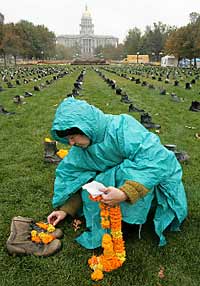
Neath the capitol stepsThe Eyes Wide Open exhibit is in Denver. The 2,700 boots span the green between City Hall and the State Capitol Building. The news reports that the memorial was not as welcomed in Colorado Springs.
 
A friend of mine reacted to the Colorado Springs City Council deciding to have nothing to do with the EWO Iraq War Memorial exhibit. She called it a “damn shame.” I related her words to the council today.
 
“It’s a damn shame, she said, that the city is unwilling to support our troops in a reverential fashion, it’s a shame the boys see only the city’s seedy tributes.”

“The city offers pawn shops to the troops, conveniently located across from the base on B-street, to prey on the financial plight of those young men. Check cashing services and furniture rental joints offer similar rip-offs. The city is happy to collect the sales tax from those activities.

“Likewise the city pays tribute with strip bars and sex shops along B-Street to prey on the soldier’s other vices. The city is pleased to collect those sales taxes.

“The soldiers are offered dealership lots filled with cars they cannot afford, but do purchase, on bad credit terms, with high insurance rates, to drive around the few months they are here between assignments.

“So it’s a damn shame the city can live off the soldiers, can tout the patriotic benefit even from their sacrifices overseas, but cannot see itself rising to the occasion of honoring the soldiers killed in the line of duty.”

I’ll admit it’s too bad that only the antiwar activists are coming forward with memorials to the fallen soldiers. I don’t see why it should be our responsibility at all. If we had our choice there would be no young men and women being sent to fight these dirty mercenary wars.

If you don’t like our memorial, do your own. But don’t sit back and pay lip service to the men and women dying in Iraq, meanwhile running a city off their government paychecks, disability checks and survivor benefits.

Digital reproduction of aluminum

1. Aluminum Siding
In the German film epic HEIMAT, an unscrupulous brother brags about the lucrative post-war business of aluminum siding. Barry Levinson’s 1987 TIN MEN depicted the same competitive salesmanship arena stateside. In Germany the aluminum siding industry was more of a scam because the aluminum wasn’t covering clapboard houses.

In Germany the salesmen were offering aluminum siding to replace historic decorative trim. Modern aluminum doors and window frames were being offered to replace old-world crafted wood pieces. The same salesman installing shiny new aluminum were warehousing the original antique pieces for resale to more savvy consumers.

Aluminum has been the wonder material with the cache of being aeronautic light and rust free. But took a hit when aluminum cooking ware was linked to alzheimer’s.

Element Digit2. Digital a new aluminum
Is digital the new miracle element on the alchemist’s Periodic Table? Is it better than its representative predecessor, analog? A digital watch might be easier to read than an analog dial because you don’t have to learn how to convert the information. But digital time is not really as versatile from a distance, or at an angle, or upside down.
 
But so it began. Digital is cheaper to manufacture, no mechanical parts, and without it we would not have computers. Computers rung in the digital age. Thus the digital halo.

Next up for the consumer, digital sound, and next, digital visuals. That’s where digital’s ascendancy may stumble.

Are digital compact discs indeed better than vinyl records? Music audiophiles will tell you no. Let’s revisit that question in a moment.

Who is convinced that digital cell phones are better than analog? Cheaper to make certainly, cheaper to broadcast, the recordings are easier to archive. Better for the telecoms, but for you? Digital cellphone service means more drop-outs and degraded signals. Remember when you could say, “wow, it sounds like you’re in the next room”? That wasn’t digital. Digital is the age of “can you hear me now? Um, how about now?”

I am not sitting in judgment of the potential of digital representation obviously, merely of cheap digital representation. With the technology of digital processing came fuzzy logic and compression. Each innovation was designed to reduce the digital reproduction to its most efficient lowest quality necessary.

CDs reproduce music for the average not so discerning ear. Sony’s Minidiscs reduced the complexity of the signal for what they determined the average ear could discern in the midst of car or jogging noises. MP3s filter out further signals based on the user’s own sense of what quality is good enough.

3. Digital is unnatural
It turns out we’re all a little more discerning with our vision. We can easily tell the difference between film and video. The film image is richer, warmer and more lifelike. Video is higher contrast and more stark. On the Internet we can all recognize compression artifacts and noise, even if we don’t know it by name. We see it because it does not look natural. That’s digital compression and it’s creeping into TV and DVD products because it’s cheaper for someone along the line.

Do we mind digital images? I guess not. Do we prefer them? No.

Musicians prefer the more natural sounds produced by analog amplifiers. Of course everyone is trying to represent the original, natural sound.

We can see the unnatural aspects of digital imagery. It may hurt our vision or it may not. Perhaps we can deduce that our ears are being assailed with similar digital mediocrity. So far it’s only the discriminating audiophiles who liken digital reproduction to nails on a chalkboard. Until it’s linked to Alzheimer’s.

Co-opting editorial space

Selling outDear Independent:
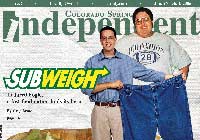
May I inquire how much you charge to run a fast food advertisement on the front cover of your publication? Apparently it was for a story about a corporate mascot who gets lots of press for appearing not to be an advertisement. Sort of Tony the Tiger for the Napoleon Dynamite set, but fascinating to you I guess.

The article inside was pure PR. Senator Barack Obama apparently “loves Subway’s new toasted subs.” (And now with my letter, I’m perpetuating it. Enough!)

You didn’t mention that the rising Subway sales attributable to their affable spokesman were not for the leaner sandwiches on the menu. Most customers keep ordering the unhealthy items. You’d probably like to laud McDs for promoting salads even thought they’re really just selling more French fries.

The point of your article escaped me, is Subways (owned by the scurrilously named Doctor’s Associates Inc) offering a million dollar contract to every obese person who can keep his weight down by eating from the paltry lower-fat portion of their otherwise fat-food selection? That would be quite a story, and maybe it would prove effective for more than Mr. Fogle!

As to your pieces of silver, I’m hoping on the one hand that product placement on your cover doesn’t cost too much. There are certainly some authentic health food stores and restaurants who could really benefit from attention like that. And as a result, so would the public.

On the other hand, I hope you made made thousands for having compromised your principles. Now when you behold a fatter, sadder America, you’ll know you played a part.

Reprinted in The Independent

Black Friday and Paul Bunyan

A false folk hero
Did you know that the first shopping day after Thanksgiving was known as “Black Friday?” Neither did I!
 
Apparently “Black Friday” is so named because it’s the first day of the year that retailers can recoup enough from their sales to put their balance sheets into the black. As opposed to “in the red” which is bookkeeping jargon for running at a loss, which is what retailers do for the rest of the year, apparently.
 
Boy did this sound like malarkey.

Certainly the term Black Friday sounded familiar, I thought it referred to the stock market crash that ushered in the Great Depression. It turns out that there have been many other Black Fridays through history. But none of them refer to this retailer/accountant/insider lingo. The only early reference to a retail Black Friday had to do with the deluge which the day after Thanksgiving wrought upon the average retail clerk.

This new economic twist looks more like somebody’s Psych Op to revive retail sales.

This bit of Madison Avenue myth-making sure seems to cover the bases. First, if you’re a retailer you shouldn’t worry about having run at a loss (in the red) all year, apparently that’s normal. And if you’re a consumer, it looks like it’s your duty to bring that retailer’s figures up (and into the black!) Never mind that you’ll probably be putting his profit onto your credit card (into the red). For you we can call it red friday.

Paul Bunyan
I’m reminded of good ol’ Paul Bunyan, that American legend who heroically did more than his share to chop away our nation’s wooded overgrowths. Not a very PC hero to be sure, it never occurred to me to doubt his credentials.

One day I was looking through an older children’s book about American folk heroes. There was Johnny Appleseed, Davy Crockett, Daniel Boone, Pecos Bill, everyone was there except our giant friend Paul. Sure he was fictional, but he’s a historic legend, why was he not in the lineup? The book was dated 1920.

It turns out that Paul Bunyan was the creation of a magazine columnist hired in the 30s to create a positive PR figure for the timber industry. This was an industry still smarting from Theodore Roosevelt’s conservation programs.

If the Jolly Green Giant could sell you frozen foods over fresh, tales about a monumental lumberjack and Babe his blue ox could do more. A fictional reverence for a giant of folklore could sell America on admiration for westward expansion, manifest destiny and the obvious imperative of clearing our continent of its trees.

Slandering Pat Tillman maybe

Pat Tillman might have gone into Afganistan for the same reason he loved football: because it’s licensed violence. Was it Norman Mailer or Studs Turkel who postelated that the reason many men go to war is because on a very primal level it is fun.

The other day in a west coast harbor I watched a group of military divers, taking off from the dock on their launch. Watching them gather and load up, it became easy for me to visualize men at war. What was it that projected their aggression? Not necessarily their jocularity, their fraternal back slaps, wide smiles and machismo handling of their gear. It was their collective testosterone like a malevolent shield of old spice sprayed in all directions to offend every male not in their clan.

The flat bottomed diving launch resembled an infantry landing craft. I could imagine at it cruised by me in the harbor what a war party would look like in the eyes of forces defending the shore.

To some males this is what attracts them to football and hockey and fist fights and brawls. The rest of us see unnecessary risk and injury and death, they see a schoolyard game of king of the hill. In peacetime this game is played through salesmanship and office politics, in war this game is much more primal and carries with it the advantages of the spoils: the occasion to rape, the occasion to pillage, and the power to decide another person’s life or death.

Was Pat Tillman a patriot, or another alpha male? Maybe he gambled that playing an ultra-violent game in a stadium in return for a million dollar contract would pale in comparison to the thrills of warfare and the spoils of war.