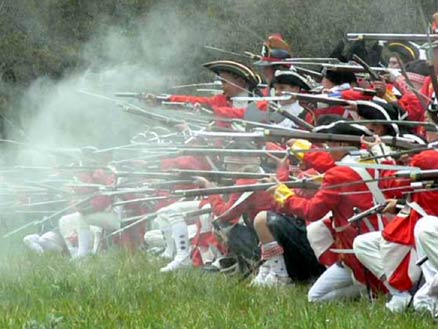
War is a Racket

By Major General Smedley Darlington Butler

~ Chapter One ~
WAR IS A RACKET

WAR is a racket. It always has been.

It is possibly the oldest, easily the most profitable, surely the most vicious. It is the only one international in scope. It is the only one in which the profits are reckoned in dollars and the losses in lives.

A racket is best described, I believe, as something that is not what it seems to the majority of the people. Only a small “inside” group knows what it is about. It is conducted for the benefit of the very few, at the expense of the very many. Out of war a few people make huge fortunes.

In the World War a mere handful garnered the profits of the conflict. At least 21,000 new millionaires and billionaires were made in the United States during the World War. That many admitted their huge blood gains in their income tax returns. How many other war millionaires falsified their tax returns no one knows.

How many of these war millionaires shouldered a rifle? How many of them dug a trench? How many of them knew what it meant to go hungry in a rat-infested dug-out? How many of them spent sleepless, frightened nights, ducking shells and shrapnel and machine gun bullets? How many of them parried a bayonet thrust of an enemy? How many of them were wounded or killed in battle?

Out of war nations acquire additional territory, if they are victorious. They just take it. This newly acquired territory promptly is exploited by the few – the selfsame few who wrung dollars out of blood in the war. The general public shoulders the bill.

And what is this bill?

This bill renders a horrible accounting. Newly placed gravestones. Mangled bodies. Shattered minds. Broken hearts and homes. Economic instability. Depression and all its attendant miseries. Back-breaking taxation for generations and generations.

For a great many years, as a soldier, I had a suspicion that war was a racket; not until I retired to civil life did I fully realize it. Now that I see the international war clouds gathering, as they are today, I must face it and speak out.

Again they are choosing sides. France and Russia met and agreed to stand side by side. Italy and Austria hurried to make a similar agreement. Poland and Germany cast sheep’s eyes at each other, forgetting for the nonce [one unique occasion], their dispute over the Polish Corridor.
The assassination of King Alexander of Jugoslavia [Yugoslavia] complicated matters. Jugoslavia and Hungary, long bitter enemies, were almost at each other’s throats. Italy was ready to jump in. But France was waiting. So was Czechoslovakia. All of them are looking ahead to war. Not the people – not those who fight and pay and die – only those who foment wars and remain safely at home to profit.

There are 40,000,000 men under arms in the world today, and our statesmen and diplomats have the temerity to say that war is not in the making.

Hell’s bells! Are these 40,000,000 men being trained to be dancers?

Not in Italy, to be sure. Premier Mussolini knows what they are being trained for. He, at least, is frank enough to speak out. Only the other day, Il Duce in “International Conciliation,” the publication of the Carnegie Endowment for International Peace, said:

“And above all, Fascism, the more it considers and observes the future and the development of humanity quite apart from political considerations of the moment, believes neither in the possibility nor the utility of perpetual peace… War alone brings up to its highest tension all human energy and puts the stamp of nobility upon the people who have the courage to meet it.”

Undoubtedly Mussolini means exactly what he says. His well-trained army, his great fleet of planes, and even his navy are ready for war – anxious for it, apparently. His recent stand at the side of Hungary in the latter’s dispute with Jugoslavia showed that. And the hurried mobilization of his troops on the Austrian border after the assassination of Dollfuss showed it too. There are others in Europe too whose sabre rattling presages war, sooner or later.

Herr Hitler, with his rearming Germany and his constant demands for more and more arms, is an equal if not greater menace to peace. France only recently increased the term of military service for its youth from a year to eighteen months.

Yes, all over, nations are camping in their arms. The mad dogs of Europe are on the loose. In the Orient the maneuvering is more adroit. Back in 1904, when Russia and Japan fought, we kicked out our old friends the Russians and backed Japan. Then our very generous international bankers were financing Japan. Now the trend is to poison us against the Japanese. What does the “open door” policy to China mean to us? Our trade with China is about $90,000,000 a year. Or the Philippine Islands? We have spent about $600,000,000 in the Philippines in thirty-five years and we (our bankers and industrialists and speculators) have private investments there of less than $200,000,000.

Then, to save that China trade of about $90,000,000, or to protect these private investments of less than $200,000,000 in the Philippines, we would be all stirred up to hate Japan and go to war – a war that might well cost us tens of billions of dollars, hundreds of thousands of lives of Americans, and many more hundreds of thousands of physically maimed and mentally unbalanced men.

Of course, for this loss, there would be a compensating profit – fortunes would be made. Millions and billions of dollars would be piled up. By a few. Munitions makers. Bankers. Ship builders. Manufacturers. Meat packers. Speculators. They would fare well.

Yes, they are getting ready for another war. Why shouldn’t they? It pays high dividends.

But what does it profit the men who are killed? What does it profit their mothers and sisters, their wives and their sweethearts? What does it profit their children?

What does it profit anyone except the very few to whom war means huge profits?

Yes, and what does it profit the nation?

Take our own case. Until 1898 we didn’t own a bit of territory outside the mainland of North America. At that time our national debt was a little more than $1,000,000,000. Then we became “internationally minded.” We forgot, or shunted aside, the advice of the Father of our country. We forgot George Washington’s warning about “entangling alliances.” We went to war. We acquired outside territory. At the end of the World War period, as a direct result of our fiddling in international affairs, our national debt had jumped to over $25,000,000,000. Our total favorable trade balance during the twenty-five-year period was about $24,000,000,000. Therefore, on a purely bookkeeping basis, we ran a little behind year for year, and that foreign trade might well have been ours without the wars.

It would have been far cheaper (not to say safer) for the average American who pays the bills to stay out of foreign entanglements. For a very few this racket, like bootlegging and other underworld rackets, brings fancy profits, but the cost of operations is always transferred to the people – who do not profit.

~ Chapter Two ~
WHO MAKES THE PROFITS?

The World War, rather our brief participation in it, has cost the United States some $52,000,000,000. Figure it out. That means $400 to every American man, woman, and child. And we haven’t paid the debt yet. We are paying it, our children will pay it, and our children’s children probably still will be paying the cost of that war.

The normal profits of a business concern in the United States are six, eight, ten, and sometimes twelve percent. But war-time profits – ah! that is another matter – twenty, sixty, one hundred, three hundred, and even eighteen hundred per cent – the sky is the limit. All that traffic will bear. Uncle Sam has the money. Let’s get it.

Of course, it isn’t put that crudely in war time. It is dressed into speeches about patriotism, love of country, and “we must all put our shoulders to the wheel,” but the profits jump and leap and skyrocket – and are safely pocketed. Let’s just take a few examples:

Take our friends the du Ponts, the powder people – didn’t one of them testify before a Senate committee recently that their powder won the war? Or saved the world for democracy? Or something? How did they do in the war? They were a patriotic corporation. Well, the average earnings of the du Ponts for the period 1910 to 1914 were $6,000,000 a year. It wasn’t much, but the du Ponts managed to get along on it. Now let’s look at their average yearly profit during the war years, 1914 to 1918. Fifty-eight million dollars a year profit we find! Nearly ten times that of normal times, and the profits of normal times were pretty good. An increase in profits of more than 950 per cent.

Take one of our little steel companies that patriotically shunted aside the making of rails and girders and bridges to manufacture war materials. Well, their 1910-1914 yearly earnings averaged $6,000,000. Then came the war. And, like loyal citizens, Bethlehem Steel promptly turned to munitions making. Did their profits jump – or did they let Uncle Sam in for a bargain? Well, their 1914-1918 average was $49,000,000 a year!
Or, let’s take United States Steel. The normal earnings during the five-year period prior to the war were $105,000,000 a year. Not bad. Then along came the war and up went the profits. The average yearly profit for the period 1914-1918 was $240,000,000. Not bad.

There you have some of the steel and powder earnings. Let’s look at something else. A little copper, perhaps. That always does well in war times.

Anaconda, for instance. Average yearly earnings during the pre-war years 1910-1914 of $10,000,000. During the war years 1914-1918 profits leaped to $34,000,000 per year.

Or Utah Copper. Average of $5,000,000 per year during the 1910-1914 period. Jumped to an average of $21,000,000 yearly profits for the war period.

Let’s group these five, with three smaller companies. The total yearly average profits of the pre-war period 1910-1914 were $137,480,000. Then along came the war. The average yearly profits for this group skyrocketed to $408,300,000.

A little increase in profits of approximately 200 per cent.

Does war pay? It paid them. But they aren’t the only ones. There are still others. Let’s take leather.

For the three-year period before the war the total profits of Central Leather Company were $3,500,000. That was approximately $1,167,000 a year. Well, in 1916 Central Leather returned a profit of $15,000,000, a small increase of 1,100 per cent. That’s all. The General Chemical Company averaged a profit for the three years before the war of a little over $800,000 a year. Came the war, and the profits jumped to $12,000,000. a leap of 1,400 per cent.

International Nickel Company – and you can’t have a war without nickel – showed an increase in profits from a mere average of $4,000,000 a year to $73,000,000 yearly. Not bad? An increase of more than 1,700 per cent.

American Sugar Refining Company averaged $2,000,000 a year for the three years before the war. In 1916 a profit of $6,000,000 was recorded.
Listen to Senate Document No. 259. The Sixty-Fifth Congress, reporting on corporate earnings and government revenues. Considering the profits of 122 meat packers, 153 cotton manufacturers, 299 garment makers, 49 steel plants, and 340 coal producers during the war. Profits under 25 per cent were exceptional. For instance the coal companies made between 100 per cent and 7,856 per cent on their capital stock during the war. The Chicago packers doubled and tripled their earnings.

And let us not forget the bankers who financed the great war. If anyone had the cream of the profits it was the bankers. Being partnerships rather than incorporated organizations, they do not have to report to stockholders. And their profits were as secret as they were immense. How the bankers made their millions and their billions I do not know, because those little secrets never become public – even before a Senate investigatory body.

But here’s how some of the other patriotic industrialists and speculators chiseled their way into war profits.

Take the shoe people. They like war. It brings business with abnormal profits. They made huge profits on sales abroad to our allies. Perhaps, like the munitions manufacturers and armament makers, they also sold to the enemy. For a dollar is a dollar whether it comes from Germany or from France. But they did well by Uncle Sam too. For instance, they sold Uncle Sam 35,000,000 pairs of hobnailed service shoes. There were 4,000,000 soldiers. Eight pairs, and more, to a soldier. My regiment during the war had only one pair to a soldier. Some of these shoes probably are still in existence. They were good shoes. But when the war was over Uncle Sam has a matter of 25,000,000 pairs left over. Bought – and paid for. Profits recorded and pocketed.

There was still lots of leather left. So the leather people sold your Uncle Sam hundreds of thousands of McClellan saddles for the cavalry. But there wasn’t any American cavalry overseas! Somebody had to get rid of this leather, however. Somebody had to make a profit in it – so we had a lot of McClellan saddles. And we probably have those yet.

Also somebody had a lot of mosquito netting. They sold your Uncle Sam 20,000,000 mosquito nets for the use of the soldiers overseas. I suppose the boys were expected to put it over them as they tried to sleep in muddy trenches – one hand scratching cooties on their backs and the other making passes at scurrying rats. Well, not one of these mosquito nets ever got to France!

Anyhow, these thoughtful manufacturers wanted to make sure that no soldier would be without his mosquito net, so 40,000,000 additional yards of mosquito netting were sold to Uncle Sam.

There were pretty good profits in mosquito netting in those days, even if there were no mosquitoes in France. I suppose, if the war had lasted just a little longer, the enterprising mosquito netting manufacturers would have sold your Uncle Sam a couple of consignments of mosquitoes to plant in France so that more mosquito netting would be in order.

Airplane and engine manufacturers felt they, too, should get their just profits out of this war. Why not? Everybody else was getting theirs. So $1,000,000,000 – count them if you live long enough – was spent by Uncle Sam in building airplane engines that never left the ground! Not one plane, or motor, out of the billion dollars worth ordered, ever got into a battle in France. Just the same the manufacturers made their little profit of 30, 100, or perhaps 300 per cent.

Undershirts for soldiers cost 14¢ [cents] to make and uncle Sam paid 30¢ to 40¢ each for them – a nice little profit for the undershirt manufacturer. And the stocking manufacturer and the uniform manufacturers and the cap manufacturers and the steel helmet manufacturers – all got theirs.

Why, when the war was over some 4,000,000 sets of equipment – knapsacks and the things that go to fill them – crammed warehouses on this side. Now they are being scrapped because the regulations have changed the contents. But the manufacturers collected their wartime profits on them – and they will do it all over again the next time.

There were lots of brilliant ideas for profit making during the war.

One very versatile patriot sold Uncle Sam twelve dozen 48-inch wrenches. Oh, they were very nice wrenches. The only trouble was that there was only one nut ever made that was large enough for these wrenches. That is the one that holds the turbines at Niagara Falls. Well, after Uncle Sam had bought them and the manufacturer had pocketed the profit, the wrenches were put on freight cars and shunted all around the United States in an effort to find a use for them. When the Armistice was signed it was indeed a sad blow to the wrench manufacturer. He was just about to make some nuts to fit the wrenches. Then he planned to sell these, too, to your Uncle Sam.

Still another had the brilliant idea that colonels shouldn’t ride in automobiles, nor should they even ride on horseback. One has probably seen a picture of Andy Jackson riding in a buckboard. Well, some 6,000 buckboards were sold to Uncle Sam for the use of colonels! Not one of them was used. But the buckboard manufacturer got his war profit.

The shipbuilders felt they should come in on some of it, too. They built a lot of ships that made a lot of profit. More than $3,000,000,000 worth. Some of the ships were all right. But $635,000,000 worth of them were made of wood and wouldn’t float! The seams opened up – and they sank. We paid for them, though. And somebody pocketed the profits.

It has been estimated by statisticians and economists and researchers that the war cost your Uncle Sam $52,000,000,000. Of this sum, $39,000,000,000 was expended in the actual war itself. This expenditure yielded $16,000,000,000 in profits. That is how the 21,000 billionaires and millionaires got that way. This $16,000,000,000 profits is not to be sneezed at. It is quite a tidy sum. And it went to a very few.

The Senate (Nye) committee probe of the munitions industry and its wartime profits, despite its sensational disclosures, hardly has scratched the surface.

Even so, it has had some effect. The State Department has been studying “for some time” methods of keeping out of war. The War Department suddenly decides it has a wonderful plan to spring. The Administration names a committee – with the War and Navy Departments ably represented under the chairmanship of a Wall Street speculator – to limit profits in war time. To what extent isn’t suggested. Hmmm. Possibly the profits of 300 and 600 and 1,600 per cent of those who turned blood into gold in the World War would be limited to some smaller figure.

Apparently, however, the plan does not call for any limitation of losses – that is, the losses of those who fight the war. As far as I have been able to ascertain there is nothing in the scheme to limit a soldier to the loss of but one eye, or one arm, or to limit his wounds to one or two or three. Or to limit the loss of life.

There is nothing in this scheme, apparently, that says not more than 12 per cent of a regiment shall be wounded in battle, or that not more than 7 per cent in a division shall be killed.

Of course, the committee cannot be bothered with such trifling matters.

~ Chapter Three ~
WHO PAYS THE BILLS?

Who provides the profits – these nice little profits of 20, 100, 300, 1,500 and 1,800 per cent? We all pay them – in taxation. We paid the bankers their profits when we bought Liberty Bonds at $100.00 and sold them back at $84 or $86 to the bankers. These bankers collected $100 plus. It was a simple manipulation. The bankers control the security marts. It was easy for them to depress the price of these bonds. Then all of us – the people – got frightened and sold the bonds at $84 or $86. The bankers bought them. Then these same bankers stimulated a boom and government bonds went to par – and above. Then the bankers collected their profits.

But the soldier pays the biggest part of the bill.

If you don’t believe this, visit the American cemeteries on the battlefields abroad. Or visit any of the veteran’s hospitals in the United States. On a tour of the country, in the midst of which I am at the time of this writing, I have visited eighteen government hospitals for veterans. In them are a total of about 50,000 destroyed men – men who were the pick of the nation eighteen years ago. The very able chief surgeon at the government hospital; at Milwaukee, where there are 3,800 of the living dead, told me that mortality among veterans is three times as great as among those who stayed at home.

Boys with a normal viewpoint were taken out of the fields and offices and factories and classrooms and put into the ranks. There they were remolded; they were made over; they were made to “about face”; to regard murder as the order of the day. They were put shoulder to shoulder and, through mass psychology, they were entirely changed. We used them for a couple of years and trained them to think nothing at all of killing or of being killed.

Then, suddenly, we discharged them and told them to make another “about face” ! This time they had to do their own readjustment, sans [without] mass psychology, sans officers’ aid and advice and sans nation-wide propaganda. We didn’t need them any more. So we scattered them about without any “three-minute” or “Liberty Loan” speeches or parades. Many, too many, of these fine young boys are eventually destroyed, mentally, because they could not make that final “about face” alone.

In the government hospital in Marion, Indiana, 1,800 of these boys are in pens! Five hundred of them in a barracks with steel bars and wires all around outside the buildings and on the porches. These already have been mentally destroyed. These boys don’t even look like human beings. Oh, the looks on their faces! Physically, they are in good shape; mentally, they are gone.

There are thousands and thousands of these cases, and more and more are coming in all the time. The tremendous excitement of the war, the sudden cutting off of that excitement – the young boys couldn’t stand it.

That’s a part of the bill. So much for the dead – they have paid their part of the war profits. So much for the mentally and physically wounded – they are paying now their share of the war profits. But the others paid, too – they paid with heartbreaks when they tore themselves away from their firesides and their families to don the uniform of Uncle Sam – on which a profit had been made. They paid another part in the training camps where they were regimented and drilled while others took their jobs and their places in the lives of their communities. The paid for it in the trenches where they shot and were shot; where they were hungry for days at a time; where they slept in the mud and the cold and in the rain – with the moans and shrieks of the dying for a horrible lullaby.

But don’t forget – the soldier paid part of the dollars and cents bill too.

Up to and including the Spanish-American War, we had a prize system, and soldiers and sailors fought for money. During the Civil War they were paid bonuses, in many instances, before they went into service. The government, or states, paid as high as $1,200 for an enlistment. In the Spanish-American War they gave prize money. When we captured any vessels, the soldiers all got their share – at least, they were supposed to. Then it was found that we could reduce the cost of wars by taking all the prize money and keeping it, but conscripting [drafting] the soldier anyway. Then soldiers couldn’t bargain for their labor, Everyone else could bargain, but the soldier couldn’t.

Napoleon once said,

“All men are enamored of decorations…they positively hunger for them.”

So by developing the Napoleonic system – the medal business – the government learned it could get soldiers for less money, because the boys liked to be decorated. Until the Civil War there were no medals. Then the Congressional Medal of Honor was handed out. It made enlistments easier. After the Civil War no new medals were issued until the Spanish-American War.

In the World War, we used propaganda to make the boys accept conscription. They were made to feel ashamed if they didn’t join the army.
So vicious was this war propaganda that even God was brought into it. With few exceptions our clergymen joined in the clamor to kill, kill, kill. To kill the Germans. God is on our side…it is His will that the Germans be killed.

And in Germany, the good pastors called upon the Germans to kill the allies…to please the same God. That was a part of the general propaganda, built up to make people war conscious and murder conscious.

Beautiful ideals were painted for our boys who were sent out to die. This was the “war to end all wars.” This was the “war to make the world safe for democracy.” No one mentioned to them, as they marched away, that their going and their dying would mean huge war profits. No one told these American soldiers that they might be shot down by bullets made by their own brothers here. No one told them that the ships on which they were going to cross might be torpedoed by submarines built with United States patents. They were just told it was to be a “glorious adventure.”

Thus, having stuffed patriotism down their throats, it was decided to make them help pay for the war, too. So, we gave them the large salary of $30 a month.

All they had to do for this munificent sum was to leave their dear ones behind, give up their jobs, lie in swampy trenches, eat canned willy (when they could get it) and kill and kill and kill…and be killed.

But wait!

Half of that wage (just a little more than a riveter in a shipyard or a laborer in a munitions factory safe at home made in a day) was promptly taken from him to support his dependents, so that they would not become a charge upon his community. Then we made him pay what amounted to accident insurance – something the employer pays for in an enlightened state – and that cost him $6 a month. He had less than $9 a month left.

Then, the most crowning insolence of all – he was virtually blackjacked into paying for his own ammunition, clothing, and food by being made to buy Liberty Bonds. Most soldiers got no money at all on pay days.

We made them buy Liberty Bonds at $100 and then we bought them back – when they came back from the war and couldn’t find work – at $84 and $86. And the soldiers bought about $2,000,000,000 worth of these bonds!

Yes, the soldier pays the greater part of the bill. His family pays too. They pay it in the same heart-break that he does. As he suffers, they suffer. At nights, as he lay in the trenches and watched shrapnel burst about him, they lay home in their beds and tossed sleeplessly – his father, his mother, his wife, his sisters, his brothers, his sons, and his daughters.

When he returned home minus an eye, or minus a leg or with his mind broken, they suffered too – as much as and even sometimes more than he. Yes, and they, too, contributed their dollars to the profits of the munitions makers and bankers and shipbuilders and the manufacturers and the speculators made. They, too, bought Liberty Bonds and contributed to the profit of the bankers after the Armistice in the hocus-pocus of manipulated Liberty Bond prices.

And even now the families of the wounded men and of the mentally broken and those who never were able to readjust themselves are still suffering and still paying.

~ Chapter Four ~
HOW TO SMASH THIS RACKET!

WELL, it’s a racket, all right.

A few profit – and the many pay. But there is a way to stop it. You can’t end it by disarmament conferences. You can’t eliminate it by peace parleys at Geneva. Well-meaning but impractical groups can’t wipe it out by resolutions. It can be smashed effectively only by taking the profit out of war.

The only way to smash this racket is to conscript capital and industry and labor before the nations manhood can be conscripted. One month before the Government can conscript the young men of the nation – it must conscript capital and industry and labor. Let the officers and the directors and the high-powered executives of our armament factories and our munitions makers and our shipbuilders and our airplane builders and the manufacturers of all the other things that provide profit in war time as well as the bankers and the speculators, be conscripted – to get $30 a month, the same wage as the lads in the trenches get.

Let the workers in these plants get the same wages – all the workers, all presidents, all executives, all directors, all managers, all bankers –

yes, and all generals and all admirals and all officers and all politicians and all government office holders – everyone in the nation be restricted to a total monthly income not to exceed that paid to the soldier in the trenches!

Let all these kings and tycoons and masters of business and all those workers in industry and all our senators and governors and majors pay half of their monthly $30 wage to their families and pay war risk insurance and buy Liberty Bonds.

Why shouldn’t they?

They aren’t running any risk of being killed or of having their bodies mangled or their minds shattered. They aren’t sleeping in muddy trenches. They aren’t hungry. The soldiers are!

Give capital and industry and labor thirty days to think it over and you will find, by that time, there will be no war. That will smash the war racket – that and nothing else.

Maybe I am a little too optimistic. Capital still has some say. So capital won’t permit the taking of the profit out of war until the people – those who do the suffering and still pay the price – make up their minds that those they elect to office shall do their bidding, and not that of the profiteers. Another step necessary in this fight to smash the war racket is the limited plebiscite to determine whether a war should be declared. A plebiscite not of all the voters but merely of those who would be called upon to do the fighting and dying. There wouldn’t be very much sense in having a 76-year-old president of a munitions factory or the flat-footed head of an international banking firm or the cross-eyed manager of a uniform manufacturing plant – all of whom see visions of tremendous profits in the event of war – voting on whether the nation should go to war or not. They never would be called upon to shoulder arms – to sleep in a trench and to be shot. Only those who would be called upon to risk their lives for their country should have the privilege of voting to determine whether the nation should go to war.

There is ample precedent for restricting the voting to those affected. Many of our states have restrictions on those permitted to vote. In most, it is necessary to be able to read and write before you may vote. In some, you must own property. It would be a simple matter each year for the men coming of military age to register in their communities as they did in the draft during the World War and be examined physically. Those who could pass and who would therefore be called upon to bear arms in the event of war would be eligible to vote in a limited plebiscite. They should be the ones to have the power to decide – and not a Congress few of whose members are within the age limit and fewer still of whom are in physical condition to bear arms. Only those who must suffer should have the right to vote.

A third step in this business of smashing the war racket is to make certain that our military forces are truly forces for defense only.

At each session of Congress the question of further naval appropriations comes up. The swivel-chair admirals of Washington (and there are always a lot of them) are very adroit lobbyists. And they are smart. They don’t shout that “We need a lot of battleships to war on this nation or that nation.” Oh no. First of all, they let it be known that America is menaced by a great naval power. Almost any day, these admirals will tell you, the great fleet of this supposed enemy will strike suddenly and annihilate 125,000,000 people. Just like that. Then they begin to cry for a larger navy. For what? To fight the enemy? Oh my, no. Oh, no. For defense purposes only.

Then, incidentally, they announce maneuvers in the Pacific. For defense. Uh, huh.

The Pacific is a great big ocean. We have a tremendous coastline on the Pacific. Will the maneuvers be off the coast, two or three hundred miles? Oh, no. The maneuvers will be two thousand, yes, perhaps even thirty-five hundred miles, off the coast.

The Japanese, a proud people, of course will be pleased beyond expression to see the united States fleet so close to Nippon’s shores. Even as pleased as would be the residents of California were they to dimly discern through the morning mist, the Japanese fleet playing at war games off Los Angeles.

The ships of our navy, it can be seen, should be specifically limited, by law, to within 200 miles of our coastline. Had that been the law in 1898 the Maine would never have gone to Havana Harbor. She never would have been blown up. There would have been no war with Spain with its attendant loss of life. Two hundred miles is ample, in the opinion of experts, for defense purposes. Our nation cannot start an offensive war if its ships can’t go further than 200 miles from the coastline. Planes might be permitted to go as far as 500 miles from the coast for purposes of reconnaissance. And the army should never leave the territorial limits of our nation.

To summarize: Three steps must be taken to smash the war racket.

We must take the profit out of war.

We must permit the youth of the land who would bear arms to decide whether or not there should be war.

We must limit our military forces to home defense purposes.

~ Chapter Five ~
TO HELL WITH WAR!

I am not a fool as to believe that war is a thing of the past. I know the people do not want war, but there is no use in saying we cannot be pushed into another war.

Looking back, Woodrow Wilson was re-elected president in 1916 on a platform that he had “kept us out of war” and on the implied promise that he would “keep us out of war.” Yet, five months later he asked Congress to declare war on Germany.

In that five-month interval the people had not been asked whether they had changed their minds. The 4,000,000 young men who put on uniforms and marched or sailed away were not asked whether they wanted to go forth to suffer and die.

Then what caused our government to change its mind so suddenly?

Money.

An allied commission, it may be recalled, came over shortly before the war declaration and called on the President. The President summoned a group of advisers. The head of the commission spoke. Stripped of its diplomatic language, this is what he told the President and his group:

“There is no use kidding ourselves any longer. The cause of the allies is lost. We now owe you (American bankers, American munitions makers, American manufacturers, American speculators, American exporters) five or six billion dollars.

If we lose (and without the help of the United States we must lose) we, England, France and Italy, cannot pay back this money…and Germany won’t.

So…”

Had secrecy been outlawed as far as war negotiations were concerned, and had the press been invited to be present at that conference, or had radio been available to broadcast the proceedings, America never would have entered the World War. But this conference, like all war discussions, was shrouded in utmost secrecy. When our boys were sent off to war they were told it was a “war to make the world safe for democracy” and a “war to end all wars.”

Well, eighteen years after, the world has less of democracy than it had then. Besides, what business is it of ours whether Russia or Germany or England or France or Italy or Austria live under democracies or monarchies? Whether they are Fascists or Communists? Our problem is to preserve our own democracy.

And very little, if anything, has been accomplished to assure us that the World War was really the war to end all wars.

Yes, we have had disarmament conferences and limitations of arms conferences. They don’t mean a thing. One has just failed; the results of another have been nullified. We send our professional soldiers and our sailors and our politicians and our diplomats to these conferences. And what happens?

The professional soldiers and sailors don’t want to disarm. No admiral wants to be without a ship. No general wants to be without a command. Both mean men without jobs. They are not for disarmament. They cannot be for limitations of arms. And at all these conferences, lurking in the background but all-powerful, just the same, are the sinister agents of those who profit by war. They see to it that these conferences do not disarm or seriously limit armaments.

The chief aim of any power at any of these conferences has not been to achieve disarmament to prevent war but rather to get more armament for itself and less for any potential foe.

There is only one way to disarm with any semblance of practicability. That is for all nations to get together and scrap every ship, every gun, every rifle, every tank, every war plane. Even this, if it were possible, would not be enough.
The next war, according to experts, will be fought not with battleships, not by artillery, not with rifles and not with machine guns. It will be fought with deadly chemicals and gases.

Secretly each nation is studying and perfecting newer and ghastlier means of annihilating its foes wholesale. Yes, ships will continue to be built, for the shipbuilders must make their profits. And guns still will be manufactured and powder and rifles will be made, for the munitions makers must make their huge profits. And the soldiers, of course, must wear uniforms, for the manufacturer must make their war profits too.

But victory or defeat will be determined by the skill and ingenuity of our scientists.
If we put them to work making poison gas and more and more fiendish mechanical and explosive instruments of destruction, they will have no time for the constructive job of building greater prosperity for all peoples. By putting them to this useful job, we can all make more money out of peace than we can out of war – even the munitions makers.

So…I say,

TO HELL WITH WAR!

Strike Against War

by Helen Keller

Speech at Carnegie Hall, New York City, January 5, 1916, Women’s Peace Party and the Labor Forum

To begin with, I have a word to say to my good friends, the editors, and others who are moved to pity me. Some people are grieved because they imagine I am in the hands of unscrupulous persons who lead me astray and persuade me to espouse unpopular causes and make me the mouthpiece of their propaganda. Now, let it be understood once and for all that I do not want their pity; I would not change places with one of them. I know what I am talking about. My sources of information are as good and reliable as anybody else’s. I have papers and magazines from England, France, Germany and Austria that I can read myself. Not all the editors I have met can do that. Quite a number of them have to take their French and German second hand. No, I will not disparage the editors. They are an overworked, misunderstood class. Let them remember, though, that if I cannot see the fire at the end of their cigarettes, neither can they thread a needle in the dark. All I ask, gentlemen, is a fair field and no favor. I have entered the fight against preparedness and against the economic system under which we live. It is to be a fight to the finish, and I ask no quarter.

The future of the world rests in the hands of America. The future of America rests on the backs of 80,000,000 working men and women and their children. We are facing a grave crisis in our national life. The few who profit from the labor of the masses want to organize the workers into an army which will protect the interests of the capitalists. You are urged to add to the heavy burdens you already bear the burden of a larger army and many additional warships. It is in your power to refuse to carry the artillery and the dread-noughts and to shake off some of the burdens, too, such as limousines, steam yachts and country estates. You do not need to make a great noise about it. With the silence and dignity of creators you can end wars and the system of selfishness and exploitation that causes wars. All you need to do to bring about this stupendous revolution is to straighten up and fold your arms.

We are not preparing to defend our country. Even if we were as helpless as Congressman Gardner says we are, we have no enemies foolhardy enough to attempt to invade the United States. The talk about attack from Germany and Japan is absurd. Germany has its hands full and will be busy with its own affairs for some generations after the European war is over.

With full control of the Atlantic Ocean and the Mediterranean Sea, the allies failed to land enough men to defeat the Turks at Gallipoli; and then they failed again to land an army at Salonica in time to check the Bulgarian invasion of Serbia. The conquest of America by water is a nightmare confined exclusively to ignorant persons and members of the Navy League.

Yet, everywhere, we hear fear advanced as argument for armament. It reminds me of a fable I read. A certain man found a horseshoe. His neighbor began to weep and wail because, as he justly pointed out, the man who found the horseshoe might someday find a horse. Having found the shoe, he might shoe him. The neighbor’s child might some day go so near the horse’s hells as to be kicked, and die. Undoubtedly the two families would quarrel and fight, and several valuable lives would be lost through the finding of the horseshoe. You know the last war we had we quite accidentally picked up some islands in the Pacific Ocean which may some day be the cause of a quarrel between ourselves and Japan. I’d rather drop those islands right now and forget about them than go to war to keep them. Wouldn’t you?

Congress is not preparing to defend the people of the United States. It is planning to protect the capital of American speculators and investors in Mexico, South America, China, and the Philippine Islands. Incidentally this preparation will benefit the manufacturers of munitions and war machines.

Until recently there were uses in the United States for the money taken from the workers. But American labor is exploited almost to the limit now, and our national resources have all been appropriated. Still the profits keep piling up new capital. Our flourishing industry in implements of murder is filling the vaults of New York’s banks with gold. And a dollar that is not being used to make a slave of some human being is not fulfilling its purpose in the capitalistic scheme. That dollar must be invested in South America, Mexico, China, or the Philippines.

It was no accident that the Navy League came into prominence at the same time that the National City Bank of New York established a branch in Buenos Aires. It is not a mere coincidence that six business associates of J.P. Morgan are officials of defense leagues. And chance did not dictate that Mayor Mitchel should appoint to his Committee of Safety a thousand men that represent a fifth of the wealth of the United States. These men want their foreign investments protected.

Every modern war has had its root in exploitation. The Civil War was fought to decide whether to slaveholders of the South or the capitalists of the North should exploit the West. The Spanish-American War decided that the United States should exploit Cuba and the Philippines. The South African War decided that the British should exploit the diamond mines. The Russo-Japanese War decided that Japan should exploit Korea. The present war is to decide who shall exploit the Balkans, Turkey, Persia, Egypt, India, China, Africa. And we are whetting our sword to scare the victors into sharing the spoils with us. Now, the workers are not interested in the spoils; they will not get any of them anyway.

The preparedness propagandists have still another object, and a very important one. They want to give the people something to think about besides their won unhappy condition. They know the cost of living is high, wages are low, employment is uncertain and will be much more so when the European call for munitions stops. No matter how hard and incessantly the people work, they often cannot afford the comforts of life; many cannot obtain the necessities.

Every few days we are given a new war scare to lend realism to their propaganda. They have had us on the verge of war over the Lusitania, the Gulflight, the Ancona, and now they want the workingmen to become excited over the sinking of the Persia. The workingman has no interest in any of these ships. The Germans might sink every vessel on the Atlantic Ocean and the Mediterranean Sea, and kill Americans with every one–the American workingman would still have no reason to go to war.

All the machinery of the system has been set in motion. Above the complaint and din of the protest from the workers is heard the voice of authority.

“Friends,” it says, “fellow workmen, patriots; your country is in danger! There are foes on all sides of us. There is nothing between us and our enemies except the Pacific Ocean and the Atlantic Ocean. Look at what has happened to Belgium. Consider the fate of Serbia. Will you murmur about low wages when your country, your very liberties, are in jeopardy? What are the miseries you endure compared to the humiliation of having a victorious German army sail up the East River? Quit your whining, get busy and prepare to defend your firesides and your flag. Get an army, get a navy; be ready to meet the invaders like the loyal-hearted freemen you are.”

Will the workers walk into this trap? Will they be fooled again? I am afraid so. The people have always been amenable to oratory of this sort. The workers know they have no enemies except their masters. They know that their citizenship papers are no warrant for the safety of themselves or their wives and children. They know that honest sweat, persistent toil and years of struggle bring them nothing worth holding on to, worth fighting for. Yet, deep down in their foolish hearts they believe they have a country. Oh blind vanity of slaves!

The clever ones, up in the high places know how childish and silly the workers are. They know that if the government dresses them up in khaki and gives them a rifle and starts them off with a brass band and waving banners, they will go forth to fight valiantly for their own enemies. They are taught that brave men die for their country’s honor. What a price to pay for an abstraction–the lives of millions of young men; other millions crippled and blinded for life; existence made hideous for still more millions of human being; the achievement and inheritance of generations swept away in a moment–and nobody better off for all the misery! This terrible sacrifice would be comprehensible if the thing you die for and call country fed, clothed, housed and warmed you, educated and cherished your children. I think the workers are the most unselfish of the children of men; they toil and live and die for other people’s country, other people’s sentiments, other people’s liberties and other people’s happiness! The workers have no liberties of their own; they are not free when they are compelled to work twelve or ten or eight hours a day. they are not free when they are ill paid for their exhausting toil. They are not free when their children must labor in mines, mills and factories or starve, and when their women may be driven by poverty to lives of shame. They are not free when they are clubbed and imprisoned because they go on strike for a raise of wages and for the elemental justice that is their right as human beings.

We are not free unless the men who frame and execute the laws represent the interests of the lives of the people and no other interest. The ballot does not make a free man out of a wage slave. There has never existed a truly free and democratic nation in the world. From time immemorial men have followed with blind loyalty the strong men who had the power of money and of armies. Even while battlefields were piled high with their own dead they have tilled the lands of the rulers and have been robbed of the fruits of their labor. They have built palaces and pyramids, temples and cathedrals that held no real shrine of liberty.

As civilization has grown more complex the workers have become more and more enslaved, until today they are little more than parts of the machines they operate. Daily they face the dangers of railroad, bridge, skyscraper, freight train, stokehold, stockyard, lumber raft and min. Panting and training at the docks, on the railroads and underground and on the seas, they move the traffic and pass from land to land the precious commodities that make it possible for us to live. And what is their reward? A scanty wage, often poverty, rents, taxes, tributes and war indemnities.

The kind of preparedness the workers want is reorganization and reconstruction of their whole life, such as has never been attempted by statesmen or governments. The Germans found out years ago that they could not raise good soldiers in the slums so they abolished the slums. They saw to it that all the people had at least a few of the essentials of civilization–decent lodging, clean streets, wholesome if scanty food, proper medical care and proper safeguards for the workers in their occupations. That is only a small part of what should be done, but what wonders that one step toward the right sort of preparedness has wrought for Germany! For eighteen months it has kept itself free from invasion while carrying on an extended war of conquest, and its armies are still pressing on with unabated vigor. It is your business to force these reforms on the Administration. Let there be no more talk about what a government can or cannot do. All these things have been done by all the belligerent nations in the hurly-burly of war. Every fundamental industry has been managed better by the governments than by private corporations.

It is your duty to insist upon still more radical measure. It is your business to see that no child is employed in an industrial establishment or mine or store, and that no worker in needlessly exposed to accident or disease. It is your business to make them give you clean cities, free from smoke, dirt and congestion. It is your business to make them pay you a living wage. It is your business to see that this kind of preparedness is carried into every department on the nation, until everyone has a chance to be well born, well nourished, rightly educated, intelligent and serviceable to the country at all times.

Strike against all ordinances and laws and institutions that continue the slaughter of peace and the butcheries of war. Strike against war, for without you no battles can be fought. Strike against manufacturing shrapnel and gas bombs and all other tools of murder. Strike against preparedness that means death and misery to millions of human being. Be not dumb, obedient slaves in an army of destruction. Be heroes in an army of construction.

Message to the Tricontinental

Che Guevara, 1967

“Now is the time of the furnaces, and only light should be seen.”
Jose Marti

Ernesto Che Guevara

Twenty-one years have already elapsed since the end of the last world conflagration; numerous publications, in every possible language, celebrate this event, symbolized by the defeat of Japan. There is a climate of apparent optimism in many areas of the different camps into which the world is divided.

Twenty-one years without a world war, in these times of maximum confrontations, of violent clashes and sudden changes, appears to be a very high figure. However, without analyzing the practical results of this peace (poverty, degradation, increasingly larger exploitation of enormous sectors of humanity) for which all of us have stated that we are willing to fight, we would do well to inquire if this peace is real.

It is not the purpose of these notes to detail the different conflicts of a local character that have been occurring since the surrender of Japan, neither do we intend to recount the numerous and increasing instances of civilian strife which have taken place during these years of apparent peace. It will be enough just to name, as an example against undue optimism, the wars of Korea and Vietnam.

In the first one, after years of savage warfare, the Northern part of the country was submerged in the most terrible devastation known in the annals of modern warfare: riddled with bombs; without factories, schools or hospitals; with absolutely no shelter for housing ten million inhabitants.

Under the discredited flag of the United Nations, dozens of countries under the military leadership of the United States participated in this war with the massive intervention of U.S. soldiers and the use, as cannon fodder, of the South Korean population that was enrolled. On the other side, the army and the people of Korea and the volunteers from the Peoples’ Republic of China were furnished with supplies and advise by the Soviet military apparatus. The U.S. tested all sort of weapons of destruction, excluding the thermo-nuclear type, but including, on a limited scale bacteriological and chemical warfare.

In Vietnam, the patriotic forces of that country have carried on an almost uninterrupted war against three imperialist powers: Japan, whose might suffered an almost vertical collapse after the bombs of Hiroshima and Nagasaki; France, who recovered from that defeated country its Indo-China colonies and ignored the promises it had made in harder times; and the United States, in this last phase of the struggle.

There were limited confrontations in every continent although in our America, for a long time, there were only incipient liberation struggles and military coups d’etat until the Cuban revolution resounded the alert, signaling the importance of this region. This action attracted the wrath of the imperialists and Cuba was finally obliged to defend its coasts, first in Playa Giron, and again during the Missile Crisis.

This last incident could have unleashed a war of incalculable proportions if a US-Soviet clash had occurred over the Cuban question.

But, evidently, the focal point of all contradictions is at present the territory of the peninsula of Indo-China and the adjacent areas. Laos and Vietnam are torn by a civil war which has ceased being such by the entry into the conflict of U.S. imperialism with all its might, thus transforming the whole zone into a dangerous detonator ready at any moment to explode.

In Vietnam the confrontation has assumed extremely acute character istics. It is not out intention, either, to chronicle this war. We shall simply remember and point out some milestones.

In 1954, after the annihilating defeat of Dien-Bien-Phu, an agreement was signed at Geneva dividing the country into two separate zones; elections were to be held within a term of 18 months to determine who should govern Vietnam and how the country should be reunified. The U.S. did not sign this document and started maneuvering to substitute the emperor Bao-Dai, who was a French puppet, for a man more amiable to its purposes. This happened to be Ngo-Din-Diem, whose tragic end – that of an orange squeezed dry by imperialism — is well known by all.

During the months following the agreement, optimism reigned supreme in the camp of the popular forces. The last pockets of the anti-French resistance were dismantled in the South of the country and they awaited the fulfillment of the Geneva agreements. But the patriots soon realized there would be no elections -unless the United States felt itself capable of imposing its will in the polls, which was practically impossible even resorting to all its fraudulent methods. Once again the fighting broke out in the South and gradually acquired full intensity. At present the U.S. army has increased to over half a million invaders while the puppet forces decrease in number and, above all, have totally lost their combativeness.

Almost two years ago the United States started bombing systematically the Democratic Republic of Vietnam, in yet another attempt to overcome the belligerance [sicj of the South and impose, from a position of strength, a meeting at the conference table. At first, the bombardments were more or less isolated occurrences and were adorned with the mask of reprisals for alleged provocations from the North. Later on, as they increased in intensity and regularity, they became one gigantic attack carried out by the air force of the United States, day after day, for the purpose of destroying all vestiges of civilization in the Northern zone of the country. This is an episode of the infamously notorious “escalation”.

The material aspirations of the Yankee world have been fulfilled to a great extent, regardless of the unflinching defense of the Vietnamese anti-aircraft artillery, of the numerous planes shot down (over 1,700) and of the socialist countries aid in war supplies.

There is a sad reality: Vietnam — a nation representing the aspirations, the hopes of a whole world of forgotten peoples — is tragically alone. This nation must endure the furious attacks of U.S. technology, with practically no possibility of reprisals in the South and only some of defense in the North — but always alone.

The solidarity of all progressive forces of the world towards the people of Vietnam today is similar to the bitter irony of the plebeians coaxing on the gladiators in the Roman arena. It is not a matter of wishing success to the victim of aggression, but of sharing his fate; one must accompany him to his death or to victory.

When we analyze the lonely situation of the Vietnamese people, we are overcome by anguish at this illogical moment of humanity.

U.S. imperialism is guilty of aggression — its crimes are enormous and cover the whole world. We already know all that, gentlemen! But this guilt also applies to those who, when the time came for a definition, hesitated to make Vietnam an inviolable part of the socialist world; running, of course, the risks of a war on a global scale-but also forcing a decision upon imperialism. And the guilt also applies to those who maintain a war of abuse and snares — started quite some time ago by the representatives of the two greatest powers of the socialist camp.

We must ask ourselves, seeking an honest answer: is Vietnam isolated, or is it not? Is it not maintaining a dangerous equilibrium between the two quarrelling powers?

And what great people these are! What stoicism and courage! And what a lesson for the world is contained in this struggle! Not for a long time shall we be able to know if President Johnson ever seriously thought of bringing about some of the reforms needed by his people – to iron out the barbed class contradictions that grow each day with explosive power. The truth is that the improvements announced under the pompous title of the “Great Society” have dropped into the cesspool of Vietnam.

The largest of all imperialist powers feels in its own guts the bleeding inflicted by a poor and underdeveloped country; its fabulous economy feels the strain of the war effort. Murder is ceasing to be the most convenient business for its monopolies. Defensive weapons, and never in adequate number, is all these extraordinary soldiers have – besides love for their homeland, their society, and unsurpassed courage. But imperialism is bogging down in Vietnam, is unable to find a way out and desperately seeks one that will overcome with dignity this dangerous situation in which it now finds itself. Furthermore, the Four Points put forward by the North and the Five Points of the South now corner imperialism, making the confrontation even more decisive.

Everything indicate [sic] that peace, this unstable peace which bears that name for the sole reason that no worldwide conflagration has taken place, is again in danger of being destroyed by some irrevocable and unacceptable step taken by the United States.

What role shall we, the exploited people of the world, play? The peoples of the three continents focus their attention on Vietnam and learn theIr lesson. Since imperialists blackmail humanity by threatening it with war, the wise reaction is not to fear war. The general tactics of the people should be to launch a constant and a firm attack in all fronts where the confrontation is taking place.

In those places where this meager peace we have has been violated which is our duty? To liberate ourselves at any price.

The world panorama is of great complexity. The struggle for liberation has not yet been undertaken by some countries of ancient Europe, sufficiently developed to realize the contradictions of capitalism, but weak to such a degree that they are unable either to follow imperialism or even to start on its own road. Their contradictions will reach an explosive stage during the forthcoming years-but their problems and, consequently, their own solutions are different from those of our dependent and economically underdeveloped countries.

The fundamental field of imperialist exploitation comprises the three underdeveloped continents: America, Asia, and Africa. Every country has also its own characteristics, but each continent, as a whole, also presents a certain unity.

Our America is integrated by a group of more or less homogeneous countries and in most parts of its territory U.S. monopolist capitals maintain an absolute supremacy. Puppet governments or, in the best of cases, weak and fearful local rulers, are incapable of contradicting orders from their Yankee master. The United States has nearly reached the climax of its political and economic domination; it could hardly advance much more; any change in the situation could bring about a setback. Their policy is to maintain that which has already been conquered. The line of action, at the present time, is limited to the brutal use of force with the purpose of thwarting the liberation movements, no matter of what type they might happen to be.

The slogan “we will not allow another Cuba” hides the possibility of perpetrating aggressions without fear of reprisal, such as the one carried out against the Dominican Republic or before that the massacre in Panama — and the clear warning stating that Yankee troops are ready to intervene anywhere in America where the ruling regime may be altered, thus endangering their interests. This policy enjoys an almost absolute impunity: the OAS is a suitable mask, in spite of its unpopularity; the inefficiency of the UN is ridiculous as well as tragic; the armies of all American countries are ready to intervene in order to smash their peoples. The International of Crime and Treason has in fact been organized. On the other hand, the autochthonous bourgeoisies have lost all their capacity to oppose imperialism — if they ever had it — and they have become the last card in the pack. There are no other alternatives; either a socialist revolution or a make-believe revolution.

Asia is a continent with many different characteristics. The struggle for liberation waged against a series of European colonial powers resulted in the establishment of more or less progressive governments, whose ulterior evolution have brought about, in some cases, the deepening of the primary objectives of national liberation and in others, a setback towards the adoption of pro-imperialist positions.

From the economic point of view, the United States had very little to lose and much to gain from Asia. These changes benefited its interests; the struggle for the overthrow of other neocolonial powers and the penetration of new spheres of action in the economic field is carried out sometimes directly, occasionally through Japan.

But there are special political conditions, particularly in Indo-China, which create in Asia certain characteristics of capital importance and play a decisive role in the entire U.S. military strategy.

The imperialists encircle China through South Korea, Japan, Taiwan, South Vietnam and Thailand at least.

This dual situation, a strategic interest as important as the military encirclement of the Peoples’ Republic of China and the penetration of these great markets — which they do not dominate yet — turns Asia into one of the most explosive points of the world today, in spite of its apparent stability outside of the Vietnamese war zone.

The Middle East, though it geographically belongs to this continent, has its own contradictions and is actively in ferment; it is impossible to foretell how far this cold war between Israel, backed by the imperialists, and the progressive countries of that zone will go. This is just another one of the volcanoes threatening eruption in the world today.

Africa offers an almost virgin territory to the neocolonial invasion There have been changes which, to some extent, forced neocolonial powers to give up their former absolute prerogatives. But when these changes are carried out uninterruptedly, colonialism continues in the form of neocolonialism with similar effects as far as the economic situation is concerned.

The United States had no colonies in this region but is now struggling to penetrate its partners’ fiefs. It can be said that following the strategic plans of U.S. imperialism, Africa constitutes its long range reservoir; its present investments, though, are only important in the Union of South Africa and its penetration is beginning to be felt in the Congo, Nigeria and other countries where a violent rivalry with other imperialist powers is beginning to take place (in a pacific manner up to the present time).

So far it does not have there great interests to defend except its pretended right to intervene in every spot of the world where its monopolies detect huge profits or the existence of large reserves of raw materials.

All this past history justifies our concern regarding the possibilities of liberating the peoples within a long or a short period of time.

If we stop to analyze Africa we shall observe that in the Portuguese colonies of Guinea, Mozambique and Angola the struggle is waged with relative intensity, with a concrete success in the first one and with variable success in the other two. We still witness in the Congo the dispute between Lumumba’s successors and the old accomplices of Tshombe, a dispute which at the present time seems to favor the latter: those who have “pacified” a large area of the country for their own benefit — though the war is still latent.

In Rhodesia we have a different problem: British imperialism used every means within its reach to place power in the hands of the white minority, who, at the present time, unlawfully holds it. The conflict, from the British point of view, is absolutely unofficial; this Western power, with its habitual diplomatic cleverness — also called hypocrisy in the strict sense of the word — presents a facade of displeasure before the measures adopted by the government of Ian Smith. Its crafty attitude is supported by some Commonwealth countries that follow it, but is attacked by a large group of countries belonging to Black Africa, whether they are or not servile economic lackeys of British imperialism.

Should the rebellious efforts of these patriots succeed and this movement receive the effective support of neighboring African nations, the situation in Rhodesia may become extremely explosive. But for the moment all these problems are being discussed in harmless organizations such as the UN, the Commonwealth and the OAU.

The social and political evolution of Africa does not lead us to expect a continental revolution. The liberation struggle against the Portuguese should end victoriously, but Portugal does not mean anything in the imperialist field. The confrontations of revolutionary importance are those which place at bay all the imperialist apparatus; this does not mean, however, that we should stop fighting for the liberation of the three Portuguese colonies and for the deepening of their revolutions.

When the black masses of South Africa or Rhodesia start their authentic revolutionary struggle, a new era will dawn in Africa. Or when the impoverished masses of a nation rise up to rescue their right to a decent life from the hands of the ruling oligarchies.

Up to now, army putsches follow one another; a group of officers succeeds another or substitute a ruler who no longer serves their caste interests or those of the powers who covertly manage him — but there are no great popular upheavals. In the Congo these characteristics appeared briefly, generated by the memory of Lumumba, but they have been losing strength in the last few months.

In Asia, as we have seen, the situation is explosive. The points of friction are not only Vietnam and Laos, where there is fighting; such a point is also Cambodia, where at any time a direct U.S. aggression may start, Thailand, Malaya, and, of course, Indonesia, where we can not assume that the last word has been said, regardless of the annihilation of the Communist Party in that country when the reactionaries took over. And also, naturally, the Middle East.

In Latin America the armed struggle is going on in Guatemala, Colombia, Venezuela and Bolivia; the first uprisings are cropping up in Brazil [sic]. There are also some resistance focuses which appear and then are extinguished. But almost all the countries of this continent are ripe for a type of struggle that, in order to achieve victory, can not be content with anything less than establishing a government of socialist tendencies.

In this continent practically only one tongue is spoken (with the exception of Brazil, with whose people, those who speak Spanish can easily make themselves understood, owing to the great similarity of both languages). There is also such a great similarity between the classes in these countries, that they have attained identification among themselves of an international americano type, much more complete than in the other continents. Language, habits, religion, a common foreign master, unite them. The degree and the form of exploitation are similar for both the exploiters and the men they exploit in the majority of the countries of Our America. And rebellion is ripening swiftly in it.

We may ask ourselves: how shall this rebellion flourish? What type will it be? We have maintained for quite some time now that, owing to the similarity of their characteristics, the struggle in Our America will achieve in due course, continental proportions. It shall be the scene of many great battles fought for the liberation of humanity.

Within the frame of this struggle of continental scale, the battles which are now taking place are only episodes — but they have already furnished their martyrs, they shall figure in the history of Our America as having given their necessary blood in this last stage of the fight for the total freedom of man. These names will include Comandante Turcios Lima, padre Camilo Torres, Comandante Fabricio Ojeda, Comandantes Lobaton and Luis de la Puente Uceda, all outstanding figures in the revolutionary movements of Guatemala, Colombia, Venezuela and Peru.

But the active movement of the people creates its new leaders; Cesar Montes and Yon Sosa raise up their flag in Guatemala; Fabio Vazquez and Marulanda in Colombia; Douglas Bravo in the Western part of the country and Americo Martin in El Bachiller, both directing their respective Venezuelan fronts.

New uprisings shall take place in these and other countries of Our America, as it has already happened in Bolivia, and they shall continue to grow in the midst of all the hardships inherent to this dangerous profession of being modern revolutionaries. Many shall perish, victims of their errors, others shall fall in the touch battle that approaches; new fighters and new leaders shall appear in the warmth of the revolutionary struggle. The people shall create their warriors and leaders in the selective framework of the war itself – and Yankee agents of repression shall increase. Today there are military aids in all the countries where armed struggle is growing; the Peruvian army apparently carried out a successful action against the revolutionaries in that country, an army also trained and advised by the Yankees. But if the focuses of war grow with sufficient political and military insight, they shall become practically invincible and shall force the Yankees to send reinforcements. In Peru itself many new figures, practically unknown, are now reorganizing the guerrilla. Little by little, the obsolete weapons, which are sufficient for the repression of small armed bands, will be exchanged for modern armaments and the U.S. military aids will be substituted by actual fighters until, at a given moment, they are forced to send increasingly greater number of regular troops to ensure the relative stability of a government whose national puppet army is desintegrating before the impetuous attacks of the guerrillas. It is the road of Vietnam it is the road that should be followed by the people; it is the road that will be followed in Our America, with the advantage that the armed groups could create Coordinating Councils to embarrass the repressive forces of Yankee imperialism and accelerate the revolutionary triumph.

America, a forgotten continent in the last liberation struggles, is now beginning to make itself heard through the Tricontinental and, in the voice of the vanguard of its peoples, the Cuban Revolution, will today have a task of much greater relevance: creating a Second or a Third Vietnam, or the Second and Third Vietnam of the world.

We must bear in mind that imperialism is a world system, the last stage of capitalism — and it must be defeated in a world confrontation. The strategic end of this struggle should be the destruction of imperialism. Our share, the responsibility of the exploited and underdeveloped of the world is to eliminate the foundations of imperialism: our oppressed nations, from where they extract capitals, raw materials, technicians and cheap labor, and to which they export new capitals — instruments of domination — arms and all kinds of articles; thus submerging us in an absolute dependance [sic].

The fundamental element of this strategic end shall be the real liberation of all people, a liberation that will be brought about through armed struggle in most cases and which shall be, in Our America, almost indefectibly, a Socialist Revolution.

While envisaging the destruction of imperialism, it is necessary to identify its head, which is no other than the United States of America.

We must carry out a general task with the tactical purpose of getting the enemy out of its natural environment, forcing him to fight in regions where his own life and habits will clash with the existing reality. We must not underrate our adversary; the U.S. soldier has technical capacity and is backed by weapons and resources of such magnitude that render him frightful. He lacks the essential ideologic motivation which his bitterest enemies of today — the Vietnamese soldiers — have in the highest degree. We will only be able to overcome that army by undermining their morale — and this is accomplished by defeating it and causing it repeated sufferings.

But this brief outline of victories carries within itself the immense sacrifice of the people, sacrifices that should be demanded beginning today, in plain daylight, and which perhaps may be less painful than those we would have to endure if we constantly avoided battle in an attempt to have others pull our chestnuts out of the fire.

It is probable, of course, that the last liberated country shall accomplish this without an armed struggle and the sufferings of a long and cruel war against the imperialists — this they might avoid. But perhaps it will be impossible to avoid this struggle or its effects in a global conflagration; the suffering would be the same, or perhaps even greater. We cannot foresee the future, but we should never give in to the defeatist temptation of being the vanguard of a nation which yearns for freedom, but abhors the struggle it entails and awaits its freedom as a crumb of victory.

It is absolutely just to avoid all useless sacrifices. Therefore, it is so important to clear up the real possibilities that dependent America may have of liberating itself through pacific means. For us, the solution to this question is quite clear: the present moment may or may not be the proper one for starting the struggle, but we cannot harbor any illusions, and we have no right to do so, that freedom can be obtained without fighting. And these battles shall not be mere street fights with stones against tear-gas bombs, or of pacific general strikes; neither shall it be the battle of a furious people destroying in two or three days the repressive scaffolds of the ruling oligarchies; the struggle shall be long, harsh, and its front shall be in the guerrilla’s refuge, in the cities, in the homes of the fighters – where the repressive forces shall go seeking easy victims among their families — in the massacred rural population, in the villages or cities destroyed by the bombardments of the enemy.

They are pushing us into this struggle; there is no alternative: we must prepare it and we must decide to undertake it.

The beginnings will not be easy; they shall be extremely difficult. All the oligarchies’ powers of repression, all their capacity for brutality and demagoguery will be placed at the service of their cause. Our mission, in the first hour, shall be to survive; later, we shall follow the perennial example of the guerrilla, carrying out armed propaganda (in the Vietnamese sense, that is, the bullets of propaganda, of the battles won or lost — but fought — against the enemy). The great lesson of the invincibility of the guerrillas taking root in the dispossessed masses. The galvanizing of the national spirit, the preparation for harder tasks, for resisting even more violent repressions. Hatred as an element of the struggle; a relentless hatred of the enemy, impelling us over and beyond the natural limitations that man is heir to and transforming him into an effective, violent, selective and cold killing machine. Our soldiers must be thus; a people without hatred cannot vanquish a brutal enemy.

We must carry the war into every corner the enemy happens to carry it: to his home, to his centers of entertainment; a total war. It is necessary to prevent him from having a moment of peace, a quiet moment outside his barracks or even inside; we must attack him wherever he may be; make him feel like a cornered beast wherever he may move. Then his moral fiber shall begin to decline. He will even become more beastly, but we shall notice how the signs of decadence begin to appear.

And let us develop a true proletarian internationalism; with international proletarian armies; the flag under which we fight would be the sacred cause of redeeming humanity. To die under the flag of Vietnam, of Venezuela, of Guatemala, of Laos, of Guinea, of Colombia, of Bolivia, of Brazil — to name only a few scenes of today’s armed struggle — would be equally glorious and desirable for an American, an Asian, an African, even a European.

Each spilt drop of blood, in any country under whose flag one has not been born, is an experience passed on to those who survive, to be added later to the liberation struggle of his own country. And each nation liberated is a phase won in the battle for the liberation of one’s own country.

The time has come to settle our discrepancies and place everything at the service of our struggle.

We all know great controversies rend the world now fighting for freedom; no one can hide it. We also know that they have reached such intensity and such bitterness that the possibility of dialogue and reconciliation seems extremely difficult, if not impossible. It is a useless task to search for means and ways to propitiate a dialogue which the hostile parties avoid. However, the enemy is there; it strikes every day, and threatens us with new blows and these blows will unite us, today, tomorrow, or the day after. Whoever understands this first, and prepares for this necessary union, shall have the people’s gratitude.

Owing to the virulence and the intransigence with which each cause is defended, we, the dispossessed, cannot take sides for one form or the other of these discrepancies, even though sometimes we coincide with the conten- tions of one party or the other, or in a greater measure with those of one part more than with those of the other. In time of war, the expression of current differences constitutes a weakness; but at this stage it is an illusion to attempt to settle them by means of words. History shall erode them or shall give them their true meaning.

In our struggling world every discrepancy regarding tactics, the methods of action for the attainment of limited objectives should be analyzed with due respect to another man’s opinions. Regarding our great strategic objective, the total destruction of imperialism by armed struggle, we should be uncompromising.

Let us sum up our hopes for victory: total destruction of imperialism by eliminating its firmest bulwark: the oppression exercized by the United States of America. To carry out, as a tactical method, the peoples gradual liberation, one by one or in groups: driving the enemy into a difficult fight away from its own territory; dismantling all its sustenance bases, that is, its dependent territories.

This means a long war. And, once more we repeat it, a cruel war. Let no one fool himself at the outstart and let no one hesitate to start out for fear of the consequences it may bring to his people. It is almost our sole hope for victory. We cannot elude the call of this hour. Vietnam is pointing it out with its endless lesson of heroism, its tragic and everyday lesson of struggle and death for the attainment of final victory.

There, the imperialist soldiers endure the discomforts [sic] of those who, used to enjoying the U.S. standard of living, have to live in a hostile land with the insecurity of being unable to move without being aware of walking on enemy territory: death to those who dare take a step out of their fortified encampment. The permanent hostility of the entire population. All this has internal repercussion in the United States; propitiates the resurgence of an element which is being minimized in spite of its vigor by all imperialist forces: class struggle even within its own territory.

How close we could look into a bright future should two, three or many Vietnams flourish throughout the world with their share of deaths and their immense tragedies, their everyday heroism and their repeated blows against imperialism, impelled to disperse its forces under the sudden attack and the increasing hatred of all peoples of the world!

And if we were all capable of uniting to make our blows stronger and infallible and so increase the effectiveness of all kinds of support given to the struggling people — how great and close would that future be!

If we, in a small point of the world map, are able to fulfill our duty and place at the disposal of this struggle whatever little of ourselves we are permitted to give: our lives, our sacrifice, and if some day we have to breathe our last breath on any land, already ours, sprinkled with our blood let it be known that we have measured the scope of our actions and that we only consider ourselves elements in the great army of the proletariat but that we are proud of having learned from the Cuban Revolution, and from its maximum leader, the great lesson emanating from his attitude in this part of the world: “What do the dangers or the sacrifices of a man or of a nation matter, when the destiny of humanity is at stake.”

Our every action is a battle cry against imperialism, and a battle hymn for the people’s unity against the great enemy of mankind: the United States of America. Wherever death may surprise us, let it be welcome, provided that this, our battle cry, may have reached some receptive ear and another hand may be extended to wield our weapons and other men be ready to intone the funeral dirge with the staccato singing of the machine-guns and new battle cries of war and victory.

Arguments for and against Anarchism

by Albert Meltzer

Introduction

The Historical Background to Anarchism

It is not without interest that what might be called the anarchist approach goes back into antiquity; nor that there is an anarchism of sorts in the peasant movements that struggled against State oppression over the centuries. But the modern anarchist movement could not claim such precursors of revolt as its own more than the other modern working class theories. To trace the modern Anarchist movement we must look closer to our own times. While there existed libertarian and non-Statist and federalist groups, which were later termed anarchistic in retrospect, before the middle of the nineteenth century, it was only about then that they became what we now call Anarchists.

In particular, we may cite three philosophical precursors of Anarchism, Godwin, Proudhon, and perhaps Hegel. None of these was in fact an Anarchist, though Proudhon first used the word in its modern sense (taking it from the French Revolution, when it was first used politically and not entirely pejoratively). None of them engaged in Anarchist activity or struggle, and Proudhon engaged in parliamentary activity. One of the poorest, though ostensibly objective, books on Anarchism, Judge Eltzbacher’s Anarchism, describes Anarchism as a sort of hydra-headed theory some of which comes from Godwin or Proudhon or Stirner (another who never mentions anarchism), or Kropotkin, each a different variation on a theme. The book may be tossed aside as valueless except in its description of what these particular men thought. Proudhon did not write a programme for all time, nor did Kropotkin in his time write for a sect of Anarchists. But many other books written by academics are equally valueless: many professors have a view of anarchism based on the popular press. Anarchism is neither a mindless theory of destruction nor, despite some liberal-minded literary conceptions, is it hero-worship of people or institutions, however liberated they might be.

Godwin is the father of the Stateless Society movement, which diverged into three lines. One, that of the Anarchists (with which we will deal). Two, that of classic American Individualism, which included Thoreau and his school, sometimes thought of as anarchistic, but which equally gives rise to the ‘rugged individualism’ of modern ‘libertarian’ capitalism and to the pacifist cults of Tolstoy and Gandhi which have influenced the entire hippy cult. Individualism (applying to the capitalist and not the worker) has become a right-wing doctrine.

The second line of descent from Godwin is responsible for the ‘Pacifist Anarchist’ approach or the ‘Individualist Anarchist’ approach that differs radically from revolutionary anarchism in the first line of descent. It is sometimes too readily conceded that ‘this is, after all, anarchism’. Pacifist movements, and the Gandhian in particular, are usually totalitarian and impose authority (even if only by moral means); the school of Benjamin Tucker — by virtue of their individualism — accepted the need for police to break strikes so as to guarantee the employer’s ‘freedom’. All this school of so-called Individualists accept, at one time or another, the necessity of the police force, hence for Government, and the definition of anarchism is no Government.

The third school of descent from Godwin is simple liberalism, or conservative individualism.

Dealing here with the ‘first line of descent’ from Godwin, his idea of Stateless Society was introduced into the working class movement by Ambrose Cuddon (jun). His revolutionary internationalist and non-Statist socialism came along the late days of English Chartism. It was in sympathy with the French Proudhonians. Those who in Paris accepted Proudhon’s theory did not consider themselves Anarchists, but Republicans. They were for the most part self-employed artisans running their own productive businesses. The whole of French economy was geared both to the peasantry and to the artisan — this, the one-person business of printer, bookbinder, wagon and cart maker, blacksmith, dressmaker, goldsmith, diamond polisher, hat maker as distinct from the factory or farm worker of the time, who worked for an employer. Independent, individualistic and receiving no benefit from the State but the dubious privilege of paying taxes and fighting, they were at that time concerned to find out an economic method of survival and to withstand encroaching capitalism.

Marx described them as ‘petty bourgeois’, which had a different meaning in the nineteenth century. He justifiably claimed that these ‘petty bourgeois’ were not as disciplined as the then factory workers (he despised farm workers) and said that when they were forced into industry they did not faithfully follow the line laid down by a disciplined party from outside the class, but were independent of mind and troublesome to organisation imposed from above, their frustration often leading to violence. They moved to anarchism and through syndicalism spread it through the working class. (This claim is echoed by Marxists nowadays, when the term ‘petty bourgeois’ means something utterly different — solicitors and chartered accountants — and thus makes Marx’s quite sensible analysis sound utterly ridiculous.)

These French and English movements came together in the First International. The International Workingmen’s Association owed its existence to Marx, indirectly to Hegelian philosophy. But within the International, there was not only the ‘scientific socialism’ of Marx, but also Utopian Socialism, Blanquism (working-class republicanism), English Trade Unionism, German-authoritarian and opportunistic socialism, and Spanish, Swiss, and Italian stateless socialism, as well as national Republicanism and the various federalistic trends.

Bakunin was not the ‘father’ of anarchism, as often described. He was not an anarchist until later in life. He learned his federalism and socialism from the Swiss workers of the Jura, and gave expression to the ideas of the Godwinian and Proudhonian ‘federalists’, or non-State socialists. In many countries, Spain and Italy in particular, it was Bakunin’s criticism of the ideas of Marx that gave the federalist movement its definition. (While to Anarchists, Marx is of course “the villain of the piece” in the International, it must be granted that without Marx defining one form of socialism there would have been no clash, no Bakunin defining the opposite.)

There had grown up by 1869 a very noticeable trend within the International that was called ‘Bakuninist’ which was in one line from Godwin and another from Proudhon. When the Paris Commune exploded in the face of the International, it was the parting of the ways (though this was deferred a little longer and seemed to follow personal lines). From the non-Anarchists and Marxists knew by their different analyses and interpretations and actions during the Paris Commune, that they were separate.

All the same, for many years Anarchists continued to form part of the Socialist Movement that included Marxists and Social-Democrats. Marx had not succeeded in building a mass movement. The German socialist movement was more influenced by Lassalle; English socialism by reformist and Christian traditions of radical nonconformity. Only after Marx’s death, when Marxism was the official doctrine of German social-democracy, were Anarchists finally excluded from Socialist Internationals; social-democracy marched on to its own schism, that between English Liberalism on the one hand, and social-democracy on the other; and that between ‘majority’ Social-Democrats (Bolsheviks, actually never more than a minority) and reformism.

There were no such schisms at that time in the anarchist movement as such. Popular opinion made such figures as Tolstoy into (what he never claimed to be) an anarchist (he was not; neither in the normal sense of the words was he a Christian or a Pacifist, as popularly supposed, but his idolators always know better than he), but derived from the ‘second line’ of Godwinism like many other caricature-Anarchists. What we may call ‘mainstream’ anarchism was coherent and united, and was given body by the writings of a number of theoreticians, such as Peter Kropotkin.

After the bloody suppression of the Paris Commune, and repression in many parts of the world — notably Tsarist Russia, Anarchism passed into its well-known stage of individual terrorism. It fought back and survived and gave birth to (or was carried forward in) the revolutionary syndicalist movement which began in France. It lost ground after the First World War, because of the revival of patriotic feeling, the growth of reformist socialism, and the rise of fascism; and while it made a contribution to the Russian Revolution, it was defeated by the Bolshevik counterrevolution. It was seen in both resistance and in a constructive role in the Spanish Revolution of 1936.

By the time of the Second World War, Anarchism had been tried and tested in many revolutionary situations and labour struggles. Alternative forms had been tried and discarded; the German Revolution had introduced the idea of Workers Councils. The experience of the American IWW had shown the possibilities of industrial unionism and ‘how one can build the new society in the shell of the old’. In the ‘flint against flint’ argument against Marxist Communism, the lesson of what socialism without freedom meant in Russia, and the failure of reformist socialism everywhere, the anarchist doctrine was shaped.

There were never theoreticians of Anarchism as such, though it produced a number of theoreticians who discussed aspects of the philosophy. Anarchism has remained a creed that has been worked out in practice rather than from a philosophy. Very often, a bourgeois writer comes along and writes down what has already been worked out in practice by workers and peasants; he is attributed by bourgeois historians as being a leader, and by successive bourgeois writers (citing the bourgeois historians) as being one more case that proves the working class relies on bourgeois leadership.

More often, bourgeois academics borrow the name ‘Anarchism’ to give expression to their own liberal philosophies or, alternatively, picking up their cue from journalists, assorted objects of their dislike. For some professors and teachers, ‘Anarchism’ is anything from Tolstoyism to the IRA, from drug-taking to militant-trade unionism, from nationalism to bolshevism, from the hippy cult to Islamic fundamentalism, from the punk scene to violent resistance to almost anything! This is by no means an exaggeration but a sign of academic illiteracy, to be distinguished from journalists who in the 1960s obeyed a directive to call anything Marxist-Leninist that involved action as ‘Anarchist’ and anything Anarchist as ‘nationalist’.

Inalienable Tenets of Anarchism

That Mankind is Born Free

Our rights are inalienable. Each person born on the world is heir to all the preceding generations. The whole world is ours by right of birth alone. Duties imposed as obligations or ideals, such as patriotism, duty to the State, worship of God, submission to higher classes or authorities, respect for inherited privileges, are lies.

If Mankind is Born Free, Slavery is Murder

Nobody is fit to rule anybody else. It is not alleged that Mankind is perfect, or that merely through his/her natural goodness (or lack of same) he/she should (or should not) be permitted to rule. Rule as such causes abuse. There are no superpeople nor privileged classes who are above ‘imperfect Mankind’ and are capable or entitled to rule the rest of us. Submission to slavery means surrender of life.

As Slavery is Murder, so Property is Theft

The fact that Mankind cannot enter into his/her natural inheritance means that part of it has been taken from him or her, either by means of force (old, legalised conquest or robbery) or fraud (persuasion that the State or its servants or an inherited property-owning class is entitled to privilege). All present systems of ownership mean that some are deprived of the fruits of their labour. It is true that, in a competitive society, only the possession of independent means enables one to be free of the economy (that is what Proudhon meant when, addressing himself to the self-employed artisan, he said “property is liberty”, which seems at first sight a contradiction with his dictum that it was theft). But the principle of ownership, in that which concerns the community, is at the bottom of inequity.

If Property is Theft, Government is Tyranny

If we accept the principle of a socialised society, and abolish hereditary privilege and dominant classes, the State becomes unnecessary. If the State is retained, unnecessary Government becomes tyranny since the governing body has no other way to maintain its hold. “Liberty without socialism is exploitation: socialism without liberty is tyranny” (Bakunin).

If Government is Tyranny, Anarchy is Liberty

Those who use the word “Anarchy” to mean disorder or misrule are not incorrect. If they regard Government as necessary, if they think we could not live without Whitehall directing our affairs, if they think politicians are essential to our well-being and that we could not behave socially without police, they are right in assuming that Anarchy means the opposite to what Government guarantees. But those who have the reverse opinion, and consider Government to be tyranny, are right too in considering Anarchy, no Government, to be liberty. If Government is the maintenance of privilege and exploitation and inefficiency of distribution, then Anarchy is order.

The Class Struggle

Revolutionary Anarchism is based on the class struggle, though it is true that even the best of Anarchist writers, to avoid Marxist phraseology, may express it differently. It does not take the mechanistic view of the class struggle taken by Marx and Engels that only the industrial proletariat can achieve socialism, and that the inevitable and scientifically-predictable victory of this class represents the final victory. On the contrary: had anarchism been victorious in any period before 1914, it would have been a triumph for the poorer peasants and artisans, rather than among the industrial proletariat amongst whom the concept of anarchy was not widespread.

As we have said, Marxists accuse the Anarchists of being petty bourgeois. Using the term in its modern sense, it makes Marx look ridiculous. Marx was distinguishing between the bourgeois (with full rights of citizens as employers and merchants) and the minor citizens — i.e. self-employed workers). When Marx referred to the Anarchists being ‘petty bourgeois’ who when they were forced by monopoly capitalism and the breakdown of a peasant-type society into industry, and being therefore ‘frustrated’ and turning to violence, because they did not accept the discipline taken for granted by the industrial proletariat, he was expressing something that was happening, especially after the breaking up of the independent Communes of Paris and Barcelona, and the breakdown of the capitalist economy, in his day. But, with the change of meaning, to think of today’s Anarchists as frustrated bowler-hatted bank managers turning to violence because they have been forced into industry is straining one’s sense of the ridiculous.

Marx thought the industrial proletariat was not used to thinking for itself — not having the leisure or independence of the self-employed — and was therefore capable ‘of itself’ of a ‘trade union mentality, needing the leadership of an ‘educated class’ coming from outside, and presumably not being frustrated. This in his day was thought of as the scholars as an elite, in later times the students.

Marx certainly did not foresee the present day, when the students as a frustrated class, having absorbed the Marxist teachings, are being forced into monotonous jobs or unemployment and create the New Left with its own assumptions and preoccupations, but are clearly not a productive class. Any class may be revolutionary in its day and time; only a productive class may be libertarian in nature, because it does not need to exploit. The industrialisation of most Western countries meant that the industrial proletariat replaced the old ‘petty bourgeois’ class and what is left of them became capitalist instead of working class, because it had to expand and therefore employ in order to survive. But recent tendencies in some Western countries are tending to the displacement of the working class and certainly the divorcing of them from their productive role. Mining, shipbuilding, spinning, manufacturing industries, and whole towns are closed down and people are forced to into service jobs like car-park attendants or supermarket assistants which are not productive and so carry no industrial muscle.

When the industrial proletariat developed, the Anarchist movement developed into anarcho-syndicalism, something coming from the workers themselves, contrary to the idea that they needed a leadership from outside the class or could not think beyond the wage struggle. Anarcho-syndicalism is the organisation at places of work both to carry on the present struggle and eventually to take over the places of work. It would thus be more effective than the orthodox trade-union movement and at the same time be able to bypass a State-run economy in place of capitalism.

Neither Anarchism nor Marxism has ever idealised the working class (except sometimes by way of poetic licence in propaganda!) — this was a feature of the Christian Socialists. Nor was it ever suggested that they could not be reactionary, In fact, deprivation of education makes the poorer class on the whole the more resistant to change. It would be trying the reader’s patience too much to reiterate all the ‘working class are not angels’ statements purporting to refute that the working class could not run their own places of work. Only in heaven, so I am informed, will it be necessary for angels to take over the functions of management!

Organisation and Anarchism

Those belonging to or coming from authoritarian parties find it hard to accept that one can organise without ‘some form’ of Government. Therefore they conclude, and it is a general argument against Anarchism, that ‘Anarchists do not believe in organisation’. But Government is of people, organisation is of things.

There is a belief that Anarchists ‘break up other people’s organisations but are unable to build their own’, often expressed where dangerous, hierarchical, or useless organisations dominate and prevent libertarian ones being created. It can well be admitted that particular people in particular places have failed in the task of building Anarchist organisations but in many parts of the world they do exist

An organisation may be democratic or dictatorial, it may be authoritarian or libertarian, and there are many libertarian organisations, not necessarily anarchist, which prove that all organisation need not be run from the top downwards.

Many trade unions, particularly if successful, in order to keep their movement disciplined and an integral part of capitalist society, become (if they do not start so) authoritarian; but how many employers’ organisations impose similar discipline? If they do, their affiliates would walk out if it did not suit their interests. They must come to free agreement because some have the means to resist intimidation. Even when they resort to fascism to keep the workers down, the employers retain their own independence and financial power; Nazism goes too far for smaller capitalists in that after having crushed the workers it also limits, or even negates, the independence of the class that put it in power.

Only the most revolutionary unions of the world have ever learned how to keep the form of organisation of mass labour movements on an informal basis, with a minimum of central administration, and with every decision referred back to the workers on the shop floor.

The Role of an Anarchist in an Authoritarian Society

“The only place for a free man in a slave society is in prison,” said Thoreau (but he only spent a night there). It is a stirring affirmation but not one to live by, however true it is. The revolutionary must be prepared for persecution and prosecution, but only the masochist would welcome it. It must always remain an individual action and decision as to how far one can be consistent in one’s rebellion: it is not something that can be laid down. Anarchists have pioneered or participated in many forms of social rebellion and reconstruction, such as libertarian education, the formation of labour movements, collectivisation, individual direct action in its many forms and so on.

When advocating anarcho-syndicalist tactics, it is because social changes for the whole of society can only come about through a change of the economy. Individual action may serve some liberatory process, it’s true. Individuals, for example, may retire to a country commune, surround themselves with like-minded people and ignore the world so long as it overlooks them. They might certainly meanwhile live in a free economy if they could overcome certain basic problems, but it would not bring about social change.

This is not to decry individual action, far from it. Whole nations can live under dictatorship and sacrifice whole peoples one by one, and nobody will do anything about it until one individual comes along and cuts off the head of the hydra, in other words, kills the tyrant. But genocide can take place before the individual with the courage, ability, and luck required comes along.

In such cases, we see waiting for mass action as queuing up for the gas chamber (it can be literally so). We do not think “the proletariat can do no wrong” and most of all; by submission, it can. But organisation is strength. We advocate mass action because it is effective and because the proletariat has in its hands the means to destroy the old economy and build anew. The Free Society will come about through workers’ control councils taking over the places of work and by conscious destruction of the authoritarian structure. They can be built within unionisation of the work-forces of the present time.

Workers Control

When advocating workers’ control for the places of work, we differ from those who are only advocating a share of management or imagine there can be an encroachment upon managerial function by the workers within capitalism. Self-management within a capitalist society is a sizeable reform, and is occasionally attainable when the work-force is in a particularly strong position, or more often when the work is sufficiently hazardous to defy outside inspection. That is all it is, however, and is not to be confused with syndicalism, except in the sense that the syndicalist thinks the future society should be self-controlled. We want no authority supreme to that of the workers, not even one of their delegates.

This probably means breaking industry down into small units, and we accept this. We reject ‘nationalisation’ = State control.

It should not be (but unfortunately is) necessary to explain that there are, of course, ways of personal liberation other than class action, and in some cases these may be necessary lest one starve. But none of these can at present help to change society. The self-employed artisan no longer plays an important part as in Proudhon’s day (and perhaps this will be revived with a new society). One can get satisfaction working on one’s own, one may have to do so by economic necessity, but the means of changing society rest with those who are working in the basic economy.

Trends over recent years show the importance of the self-employed artisan. As major industries are decimated by the ruling class because no longer necessary to capitalism, a means of integrating those working outside mainstream capitalism will increasingly need to be found if we are to achieve change. It was the necessity of finding this in a previous reversal of capitalist trends that led to the original formation of anarcho-syndicalism.

The Anarchist as Rebel

It is not unknown for the individual Anarchist to fight on alone, putting forward his or her ideas in a hostile environment. There were many examples in the past of Anarchists struggling on alone, sometimes only one in the country. It is less the case at the present time when there are usually many people calling themselves Anarchists, though perhaps only one or two in a locality who really are so, and not just adopting the label to describe rebellion when young.

Anarchists in such circumstances may fight alone for the principle of Anarchism, but usually participate in other struggles, such as anti-militarism, anti-imperialism, anti-nationalism or solely within the content of the class struggle or they may form organisations of their own.

It is no part of the case for Anarchism to say that the profession of its ideas changes peoples’ character; or that the movement invites itself to be judged on anyone who happened to be around at any one time. Organisations they create may become reformist or authoritarian; people themselves may become corrupted by money or power. All we can say is that ultimately such corruption normally leads them to drop the name ‘Anarchist’, as standing in their way. If ever the term became ‘respectable’, no doubt we would have to choose a fresh one, equally connotative of libertarian rebellion — at present it can still stand as descriptive though increasingly misused.

In all organisations, personalities play a part and it may be that in different countries different schisms may occur. Some say that there are different types of Anarchism. Syndicalism, Communism, individualism, pacifism, have all been cited as such. This is not so. If one wishes to cause a schism, purely on personal reasons or because one wishes to become more quietist or reformist, it is no doubt convenient to pick a name as a ‘banner’. But in reality there are not different forms of Anarchism. Anarchist-Communism, in any definition (usually that of Kropotkin), means a method of socialism without Government, not a different style of anarchism. An alternative idea, called Anarchist-Collectivism, once favoured by Spanish Anarchists, was found in practice to be exactly the same. If one is going to have no rule from above, one cannot lay down a precise economic plan for the future, and Communism and collectivisation controlled from below upwards proved to be no different from each other, or from syndicalism, a permanent means of struggle toward the same goal.

Communism, in the sense used by Anarchists, is a society based on the community. Collectivism is a division of the commune into economic units. Unless the commune is very small — based upon the village — it has to be divided into smaller units, collectives, so that all can participate and not just their elected representatives. Otherwise it would merely be industrial democracy. While free Communism is an aim, syndicalism is a method of struggle. It is the union of workers within the industrial system attempting to transform it into a free Communistic society.

State Communism is not an alternative Communism to free Communism, but its opposite. It is the substitution of the State or the Party for the capitalist class. Communism is not necessarily Anarchist, even if it is not State Communism but the genuine authoritarian form of Communism (total State control without having degenerated into absolute power from above, or even governmental dominated socialisation). Syndicalism is not necessarily revolutionary and even revolutionary syndicalism (the idea that workers can seize places of work through factory organisation) need not be libertarian, as it can go hand-in-hand with the idea of a political party exercising political control. This is why we use the mouthful: anarcho-syndicalism. Workers control of production, community control from below, no Government from above.

Nonviolence

Is pacifism a trend within Anarchism? Though phoney Anarchism contains a large streak of pacifism, being militant liberalism and renouncing any form of positive action for Anarchism, pacifism (implying extreme nonviolence, and not just anti-militarism) is authoritarian. The cult of extreme nonviolence always implies an elite, the Satyagrahi of Gandhi, for instance, who keeps everyone else in check either by force or by moral persuasion. The general history of the orthodox pacifist movements is that they attempt to dilute a revolutionary upsurge but come down on the side of force either in an imperialist war or by condoning aggressive actions by governments they support.

Both India and Israel were once the realisation of the pacifist ideals; the atom bomb was largely developed and created by nonviolent pacifists and by League of Nations enthusiasts; the Quakers as peace-loving citizens but commercial tyrants and colonialists are notorious. In recent times, many who rejected Anarchist actions of the Spanish Resistance (though claiming to be “nonviolent Anarchists”) had no difficulty late in supporting far more “violent” actions of different nationalist movements.

It is true to say that there are Anarchists who consider pacifism compatible with Anarchism in the sense that they advocate the use of non-violent methods though usually nowadays advocating this on the grounds of expediency or tactics rather than principle. But this should not be confused with the so-called “Tolstoyan Anarchism” (neither Tolstoyan or Anarchist). Tolstoy considered the Anarchists were right in everything but that they believed in revolution to achieve it. His idea of social change was “within one” (which is to say in the sky). He did not advocate nonviolent revolution, he urged nonresistance as a way of life compatible with Christian teaching though not practised as such.

One has to say also that this refers to pacifism in the Anglo-American sense, somewhat worse in Great Britain where the concept of legalised conscientious objection led to a dialogue between pacifism and the State. In countries where objection to military service remained a totally illegal act, the concept of pacifism is not necessarily extreme nonviolence.

Immediate Aims of the Anarchist

A “reformist” is not someone who brings about reforms (usually they do not, they divert attention to political manoeuvring): it is someone who can see no further than amelioration of certain parts of the system. It is necessary to agitate for the abolition of certain laws or for the immediate reform of some, but to idealise the agitation for reforms, or even the interests in reform of minorities or even whole communities, is reformist. This reformism has permeated the whole of what is now called the left wing. It creates new industries in the interests of aspiring bureaucrats allegedly guarding over minority interests, preventing people in those minorities from acting on their own behalf. This is noticeable even in women’s struggles which the left marginalises as if it were a minority issue.

Sometimes laws are more harmful than the offences they legislate against. No law is worth passing even to hope which are socially beneficial on the surface, since they are sure to be interpreted wrongly and are often used to bolster the private opinion of judges who carry them out. The old British custom of sentencing poorer classes to death for minor thefts above a small pecuniary value was not abolished by Parliament nor by the judges, but by the final refusal of juries to admit when forced to a guilty verdict that the goods were above that value.

The Anarchists can as individuals or in groups press for reforms but as Anarchists they seek to change minds and attitudes, not to pass laws. When minds are changed, laws become obsolete and, sooner or later, law enforcers are unable to operate them. Prohibition in America, the Poll Tax in Britain, are instances. At that point the law has to adapt itself to public opinion.

The Witchcraft Act remained on the statute books until some 40 years ago and it was enforced right up to the time of its abolition though the Public Prosecutor only dared to use a few of its clauses for fear of ridicule. It was abolished for political reasons but the equally ridiculous Blasphemy Act was retained, being unquestioned by Parliament until the agitation by Muslims that it was clearly unfair that one could be fined for offending Christianity while one could not be executed for offending Islam.

The ‘1381’ law was useful for squatters to persuade people they could occupy neglected buildings without offence, the odd thing being that the law did not exist. The myth was enough provided people believed in it.

One has to carry on a resistance to any and every form of tyranny. When governments use their privileges threatened, they drop the pretence of democracy and benevolence which most politicians prefer. Anarchists are forced to become what politicians describe them as: ‘agents of disorder’, though there is a lot more to Anarchism to that, and all ‘agents of disorder’ are not necessarily Anarchists.

A Marxist-Leninist would say, “Anarchists are able to bring about disorder but cannot seize power. Hence they are unable to make take advantage of the situations they create, and the bourgeoisie, regrouping its strength, turns to fascism”.

A Tory would say that Marxist-Leninists are Anarchists “because they wish to create Anarchy to create the conditions in which they would seize power”. Both are absurdities. Anarchists can, of course, “seize power” no less than anyone just as a teetotaler can get blind drunk, but they would hardly continue to merit the name. Anarchists in power would not necessarily be any better or worse than anyone else, and they might even be as bad as Communists or fascists. There is no limit of degradation to which power cannot bring anyone even with the loftiest principles. We would hope that being unprepared for power, they would be ineffective. Their task is not to “seize power” (those who use this term show that they seek personal power for themselves) but to abolish the bases of power. Power to all means power to nobody in particular.

If one leaves the wild beast of State power partially wounded, it becomes more ferocious than ever, a raging wild beast that will destroy or be destroyed. This is why Anarchists form organisations to bring about revolutionary change. The nature of Anarchism as an individualistic creed in the true sense has often caused many to say such organisations might well be left to ‘spontaneity’, ‘voluntary will’ and so on — in other words, there can be no organisation (except for propaganda only) until the entire community forms its own organisations. This is a recipe for a sort of armchair Anarchism which never gets off the ground, but at the same time with a point that cannot be ignored — until the whole community has control of its own organisations, such bodies cannot and should not take over the social and economic means of life.

It is shown by events that unity of resistance is needed against repression, that there must be united forms of action. Even when workers’ councils are formed, there may be representatives on them from political factions, united outside on party lines and able to put forward a united front within such councils and thus to dominate and ultimately destroy them. That is why we need an organised movement to destroy such efforts at totalitarianism. In some cases one may need the ultimate sanction of acts of individual terrorism to be used against leadership from within quite as much as that imposed from above. This form of specific terrorism has nothing in common with nationalist terrorism, which by its nature is as indiscriminate as State terrorism, for all that it is judged in a far harsher light. Anarchist terrorism is against individual despots, ruling or endeavouring to rule. Nationalist terrorism is a form of war against peoples. State terrorism is the abuse of power.

Workers’ Self-Defence

The Marxist-Leninists in time of revolution rely upon the formation of a Red Army. Under the control of one party, the “Red” Army is the old army under a red flag. We have seen many times how this can become a major instrument of repression, just as a nationalist army under a new flag can also become one, sometimes even before it attains power.

The very formation of an army to supersede workers’ militias will destroy the Revolution (Spain 1936). Che Guevara introduced a new romantic ideas of the Red Army as the advance guard of a peasants army — combining the spontaneity of a Makhnovista (Ukraine 1917) and Zapatista/Magonista (Mexican-Anarchistic) peasant army with the disciplined ideas of Party intellectuals. In such cases, after the initial enthusiasm carries through to victory, the disciplined leadership takes over; if it fails, the leaders run off elsewhere.

The self-defence notions of anarcho-syndicalists are that workers use arms in their own defence against the enemy at hand, and that the democratic notion of workers’ militias prevails. While there may be technical leadership, instruction and duties such as are at present in the hands of noncommissioned officers up to the rank of sergeant, there should be no officers whose job is to command, or lower-ranking NCOs to transmit the chain of command.

The idea of an armed people is derided by many so-called military and political experts, but only is used by workers in their own interests. If smaller nations use it successfully, they admit that a citizens’ army — that is to say, a nonprofessional one that can hang up its rifles and go back to work, coming out when called upon — is possible provided only that, as in the case of (say) Israel or South Africa, they obey nationalistic and aggressive policies from above. Providing they don’t maintain the force in international-class interests, the “experts” are prepared to admit the efficiency of such an army remaining democratically controlled within its own ranks.

How Will a Revolution Come About?

We do not know. When a revolutionary situation presents itself — as it did with the occupation of factories in France, 1936 and 1968; as it did in Spain, 1936 with the fascist uprising; or with the breakdown of the Russian Armies, 1917; or in many other times and places; we are ready for it or we are not (and usually not). Many times the workers are partially ready and leave the “wounded wild animal” of Statism fiercer than ever. It may be purely individual action that sets off the spark. But only if, at that period, there is a conscious movement towards a Free Society that throws off the shackles of the past, will that situation become a social revolution. The problem today that faces us is that half the world is prepared to rise almost at any opportune time, but have no military power to resist repression and no industrial muscle to sustain it. The other half of the world has such might, but no real desire to rise, being either bought off by capitalism or succumbing to persuasion.

Bringing About the New Society

What Constitutes an Authoritarian Society?

Exploitation — Manipulation — Suppression. The organs of repression consist of many arms of the State:

The Apparatus of Government: The legislature, the judicature, the monarchy, the Civil Service, the Armed Forces, the Police etc.

The Apparatus of Persuasion: The educational system, the media, including TV, radio and the press, the Church, and even forms of apparent dissent that in reality condition us to accept the present system — the parliamentary Opposition is the most obvious, but many other alternatives to the accepted system too, e.g., revolution presented as merely one in lifestyle or musical preference, academic teaching of Marxist-Leninism etc.

The Apparatus of Exploitation: The monetary system; financial control; the Banks; the Stock Exchange; individual, collective, and State employers; land ownership. Under capitalism there is no escaping this.

Most political reformers have some part of the unfree system they wish to abolish Republicans would abolish the monarchy, Secularists would abolish or disestablish the Church, Socialists would (or used to) wish to abolish the apparatus of exploitation; pacifists would abolish the Army. Anarchism is unique in wishing to abolish all. The only true definition of an Anarchist is one who wishes to believes it desirable to abolish all; who believe it possible to abolish all, the sooner the better; and who works to bring such abolition about.

There are many, usually on the left, who think it desirable but impossible, many on the right who think it only too probable but undesirable. Others may be sympathetic to Anarchism as both desirable and possible but refrain from action in its favour. To borrow a phrase from another part of the forest, they may be fellow travelers of Anarchism.

The Police are the cornerstone of the State (though sometimes, in extreme cases, the Government of the day needs to use the armed forces in lieu of, or in addition to the police — in some countries this has led to replacement or control of the Government by the army so long as the officers are tightly in control).

Only Anarchism believes in abolition of the Police, and this is the most hotly-disputed argument of Anarchism. Yet the police force as we know it is a comparatively modern phenomenon, fiercely resisted when introduced for reasons which have since been proved up to the hilt, such as the ability of the Police to introduce or bolster up a dictatorship, known indeed as a police state. Without control of the Police, debates at Westminster become as sterile of result as debates in the West Kensington Debating Society (and probably less interesting).

With German money, supplied by Helphand-Parvus, Lenin was able to return to Russia and pay Lettish mercenaries to act as Police. He was the only politician in a position to do so and in this way Bolshevik success was achieved. The Nazis in their turn created murder gangs that roamed the streets, which were tacitly tolerated by the Republican Police, but their victory came when they controlled the Police by legal means.

Can One Do Without the State?

It seems to be generally agreed that we can do without some organs of the State: can we do without them all, altogether? Some are admittedly useless, some decorative, some have impossible intentions, others are necessary for class rule, some may well be useful and carry out functions essential to any society.

One cannot do the work of another. If the monarchy has no Army it cannot save you from foreign invasion any more than the police will get you into heaven if you do not have a Church! Any commonsense codification of conduct would be better than the farrago of laws we have at present, which occupy both the lawyers and politicians, the one interpreting the apparent desires of the other.

It is true that the Government can and sometimes does take over certain necessary social functions, as do every organ of the State however repressive. The railways were not always run by the State but belonged to capitalists, and could equally in a future society belong to the workers. It would be foolish to say that if mines belonged to the State, that proves the State is necessary, or we would have no coal without it. The Army is often given socially necessary jobs, such as flood or earthquake relief; it is sometimes used as a scab labour force, such as in strikes; it is sometimes used as a police force. This is because the State does not want the breakup of a society that supports it.

Even the police at times fulfill some necessary functions — one goes to the police station to find lost dogs simply because it happens to be there and has taken over that function. It does not follow that we should never find lost dogs if there were no Police, and that we need to be clubbed over the head in times of social unrest so that old ladies can need not lose their dogs. For insurance purposes, all car owners report their lost or stolen cars to the Police, but it does not mean that the police force as such is indispensable.

Just as insurance companies would find some way of seeing they could not pay out on fraudulent claims if there were no police force, society would see to it that it could protect itself. Unfortunately, having a police force atrophies the ability of society to defend itself. People have lost all sense of social organisation and control. They can be put in terror by a few kids running wild, however young. The only reaction is to run to the Police, and the Police cannot cope.

There was an old superstition that if the Church excommunicated a country, it was under a terrible disaster. One could not be married, buried, leave property, do business in safety, be educated, be tended while sick, in a country which was excommunicated. The superstition was not an idle one, so long as people believed in the Church. If the country was banned from the communion of believers, the hospitals (run by the Church) were closed; there could be no trust in business (the clerics administered oaths and without them no promises need be kept); no education (they ran the schools); children could indeed be begotten (no way of preventing that by the Church!), but not christened, and were therefore barred from the community of believers and under a threat, as they thought, of eternal damnation, while unmarried parents could not leave property to their “illegitimate” children. The physical reality of Hell was not necessary to make excommunication effective. We are wiser now. But one superstition has been replaced by another. It has been transferred to belief in the State. If we were to reject Government there would be no education (for Government, national or local, controls the schools — with obvious exceptions), no hospitals (ditto), nobody could carry one working because the Government regulates its conduct, and so on. The truth all the time has been that not the Church and not the State but we the People have worked for everything we’ve got, and if we have not done so they have not provided for us. Even the privileged have been maintained by us not them.

The Money Myth

With the State myth comes a second myth — the money myth. The value of money is dependent on the strength of the State. When Governments collapse, their money is worthless. For years American crooks travelled Europe offering to change Confederate dollars, worth nothing since the Southern States had lost the Civil War, presenting them to unsuspecting Europeans as valid U.S. dollars — until they became collectors’ pieces and were worth more than several U.S. dollars! At that point the Federal Government utilised the original printing plants to publish Confederate dollars and gave them away with bubble-gum, lest their own currency became devalued.

When the Kaiser’s Germany collapsed, Imperial marks were useless. When the Spanish Republic was defeated, the banks simply canceled the value of its money. The story is endless. Yet according to a legend many still believe, the wealth of the country is to be found at Waterlow’s printing works. As the notes roll off the press, so our wealth is created, and if this ceased we should be impoverished! The banks have come up with an alternative in printing their own credit cards. Another alternative myth, now dated, was that the money printed had to correspond with a quantity of closely-guarded gold buried in a mysterious vault, after having been dug up under tight security from mines thousands of miles away. However, Governments have long since defaulted on the premises behind this myth (though they still continue the ritual). The newer governmental myth is that if too many notes are printed we shall have inflation which will make us all poor, so to prevent this we must be prepared to endure conditions of stringency and poverty, lose jobs and homes, or in other words become poor.

During the war, rationing of food and clothes meant that what counted was coupons, by which it was hoped to ensure there were fair shares of what was available. As the money system continued, a black market in commodities was inevitable, but rationing gave an idea of what State Socialism — without money — would be like. If there were too many coupons printed there would be no point in the scheme. Money is another form of rationing, by which one set of people get more than another. Wage struggles are fights to get a bigger slice of the cake. The wealthy are those who have first access to slicing the cake. But neither money nor coupons make any difference to the size of the cake, they are simply means of dealing with its distribution, whether fairly — or more likely — unfairly. So essential is money to the obtaining of goods in a State society, it sounds humorous to say money is a myth — “I don’t care if it’s mythical, give me more” — but myth it is.

Many worthy people believe if Lady X did not spend her money on a yacht, that money could somehow be transformed into an x-ray apparatus for the hospital. They do not understand, it would seem, that yacht builders cannot produce x-ray machines. Others think that those on National Assistance are supported by those at work — yet the margin of unemployment is essential to the State as a pitfall to make the incentives to work stick. Others believe there is a relation between their wages going up and the wages received by other people going down. In a competitive society, however, one gets what one is able to command.

The Myth of Taxation

There is a patent absurdity in supposing that those who work and produce are helped by those who profit from the system and do nothing. It is equally absurd to suppose that the rich help the poor by providing work or charity. As Brendan Behan commented to someone who pointed out how much the Guinness family had done for the poor people of Dublin — “It’s nothing compared to what the poor people of Dublin have done for the Guinness family”. Taxation perpetuates the myth that those with more money help those with less. Taxation grabs money out of the pockets of the less well-off even before they have a chance to look at it. The rich dress up their accounts by means of professional advisors. But aside from that, money does not create wealth, it is muscle, brain, and natural resources that do. Money is used to restrict the application of human endeavour. It is possible to print money, or arrange credit, when it is in the interests of money manipulators to do so. When they wish to go into recession, they do so by withdrawing money and credit. Recession is not a natural disaster like famine, drought, floods, or earthquakes though it is presented as such.

The Effect of Immigration

The large scale employer looking at greater profitability or the way to cut costs has several options open, the easiest and laziest being to cut wages. If the workers are well-organised they can resist this so there are two options open to the major capitalist. Either take the factories to where the cheap labour is or take the cheap labour to where the factories are. The first option entails great pollution, as a rule — not that they ever care about that — and in some cases they have to go into areas of political instability. It is cheaper to move the cheap labour.

Having thus encouraged immigration, wearing the financial hat as it were, the capitalist in the capacity of a right-wing politician, dons the political hat and denounces immigration. This has the advantage of setting worker against worker, fuelled by religious and/or racial antipathies which can persist for generations, and have the added bonus of inducing the worker to support the right wing electorally. It does the capitalist no harm to have a work force hated by those who surround them, or in fear of deportation if they step out of line. Nor does it harm the capitalist, in a political context, to have issues such as immigration replace the basic issue of the wage and monetary system. It only becomes harmful from that point of view when a fascist force such as Hitler’s gains such armed might that it can ignore the wishes of the capitalists which gave them that power and strives for its own superiority.

The Abolition of the Wage and Monetary Systems

“Socialism” has become so diffused a term today that it is used of almost any reformist or indeed positively counter-revolutionary movement that wishes to use the term and covers a multitude of ideas from liberalism to tyranny, but in reality the essentials of any socialistic theory are the abolition of the wage and monetary systems. This is because a genuine socialistic movement should be of the working class and intended for its own emancipation from wage slavery. The wage and monetary systems are the chains of that slavery that need to be broken.

Some modified form of wage or some means of exchange might be consistent with a free communistic society, especially among a post-revolutionary society accustomed to some form of labour-rewarding assessment, but the present form of monetary system is one in which money is not a servant (a means of exchange) but a boss in its own right. Wages are a means of denoting the position in society’s pecking order which a person is deemed to hold. It is not even fair as regards the assessment it makes. Such systems must be swept aside.

At present, as indicated above, the Government, or the effective controller which may in some cases be over the Government (the banks, for instance) assess the national wealth. A corresponding number of bank notes are printed, coin is struck, credits are granted to financial houses. According to the degree of efficiency or inefficiency of a current Government (which is the stuff of day-to-day press political sloganeering and need not concern us) the assessment, or budget may be correct or incorrect. According to his or her assessment, the Chancellor of the Exchequer may be “generous” or “niggardly” in sharing out the national “cake” and apportioning our slices. But in reality salaries and wages are determined by social convention, tradition, Government patronage, economic competition, hereditary power, trade union bargaining, individual enterprise and wildcat strikes. According to their effectiveness, so is the “slice of cake” each receives. Those unable to use any of the pressures are simply left out of the reckoning and must be content with what is given them in order solely to survive. The “cake” is the same whatever the Government does about it.

Is Anarchism Compatible with Capitalism?

It is only possible to conceive of Anarchism in a form in which it is free, communistic, and offering no economic necessity for repression or countering it. Common sense shows that any capitalist society might dispense with a “State” (in the American sense of the word) but it could not dispense with organised Government, or a privatised form of it, if there were people amassing money and others working to amass it for them. The philosophy of “anarcho-capitalism” dreamed up by the “libertarian” New Right, has nothing to do with Anarchism as known by the Anarchist movement proper. It is a lie that covers an unpleasant reality in its way — such as National Socialism does in another. Patently unbridled capitalism, not even hampered by a reformist State, which has to put some limits on exploitation to prevent violent clashes in society, needs some force at its disposal to maintain class privileges, either from the State itself or from private Armies. What they believe in is in fact a limited State — that is, one in which the State has one function, to protect the ruling class, does not interfere with exploitation, and comes as cheap as possible for the ruling class. The idea also serves another purpose beyond its fulfillment — a moral justification for bourgeois consciences in avoiding taxes without feeling guilty about it — just as pacifism sometimes serves as an excuse for bourgeois consciences in avoiding danger without feeling guilty.

Community Control

The history of collective control in a capitalist society is a pretty dismal one. There have been many attempts to bypass the system by forming “communities” which because they are less than the whole, real community, are bound in the end not to prosper. Cooperative societies no less than small businesses rarely withstand the pressure of monopoly capitalism. Collective farms — collective enterprises at which one works at less than the normal wage to for the sake of independence — like craft businesses, never quite get off the ground and it always comes down to the monopoly market. All could flourish if the system were free, but it is not.

Nevertheless, one can note that many communal products are equally available to all, either on payment of a fixed sum, or free. The highways are free — neither State nor capitalism has got round (yet) to making all roads toll roads to enter which one must pay (but they’ve got round to it on main motorways on the Continent). It would probably make no economic difference if the underground railway was also free, bearing in mind the cost of ticket collecting. Water used to be free — even when water rates came in one could draw as much as one liked from the tap. Now there are water meters, as if we were living in the Sahara where water has long been rationed. So far they have not got round to making us pay for air.

Anarchism presupposes that all these arguments based on economics are bunkum. Services which come naturally or are produced by the people should belong to the people.

Need There be a Transitional Society?

A transitional society to Anarchism isn’t necessary. The idea touted by Leninists was that the State would fade away after years of the harshest dictatorship — originally claimed to be only as much as was necessary to save the infant Soviet Republic but which lasted for seventy years until the people got fed up with it. All that faded away was people rash enough to want to go forward to free socialism. The prospect of ‘withering away of the State’ after years of strengthening it is illogical. Leninists justify this by saying the State is only that part of the State apparatus which favours the capitalist class by suppressing the working class. This might fade away (though it did not do so in the years of State Communism). What cannot fade away is the rest of the State apparatus, unless the State is destroyed root and branch.

The fact that a transitional society to Anarchism isn’t necessary does not necessarily mean there will not be one. Who can say? After all, changing attitudes to such matters as racial domination, sexual discrimination, religious orientation, conformity, and so on might be part of a transition to a Free Society already existing. There might be an occupation of the places of work without a conscious revolution, which in itself would be a transitional period.

One could even visualise a curious transitional period in which part of society was evolving to a new system and part was sticking to the old — with workers’ control coexisting with private capitalism in the market the way rigid old-time family styles coexist with free relationships in the same street. But clearly in the long run one or the other system would have to go. Capitalism could not exist if people could be free to choose the way they work without being compelled by conscription or necessity — therefore it would either need to reinforce its authority (possibly by fascist gangs, as during the occupation of the factories in Italy) or go under (which is the choice the Italian capitalists as a while, even though many had democratic viewpoints, were forced to take).

A Free Society

A society cannot be free unless not only are there no governmental restraints, but the essentials of life are free in that sense too.

It is true that if some products were in short supply, however free the society, access to them would have to be rationed by some means. It could be by ‘labour-value’ cards, by ordinary ‘fair rationing’, it might imply retention of a different monetary system (but not money as an ends in itself, in which money has a value beyond that of exchanging goods).

We cannot lay down the economics for a Free Society which by its nature is free to reject or accept anything it fancies. The authoritarian economist can do so (“so long as I, or my party, is in power, we will do this or that”).

An anarchist society is by definition a Free Society, but a Free Society is not necessarily Anarchist. It might fall short in several respects. Some failings might seriously limit its desirability. For instance, a Revolution carried out by men in a male-dominated society, might perpetuate sex discrimination, which would limit freedom and undermine the Revolution by leaving it possible for aggressive attitudes to be fostered. The liberal illusion that repressive forces must be tolerated which will ultimately wipe out all freedom — lest the right to dissent be imperilled — could well destroy the revolution.

A Free Society head to rid itself or repressive institutions and some might long last longer than others. The Church is one instance — yet religious beliefs, which continue under the most repressive and brutal dictatorships, could surely continue under No Government. Only those creeds which have not had their claws cut and demand suppression of other religions or unbelief, forced conversions or marriages, censorship by themselves and obedience to their own laws from those not wishing to do so, have anything to fear from an Anarchist Revolution.

The Employers Do Not Give Work

It is Primitive basic socialist thinking, to which Anarchism subscribes, that work is not something that is given by the employer. The employer may have the legal right to distribute work, but the wealth of a country is due to the workers and to natural resources, not to an employer or a State. They have the chance of preventing wealth being created.

It is the Anarchist case that fluctuations of the money market, inflation, recesssion, unemployment, as well as war, are artificially created and are not natural disasters like flood, famine, earthquake, drought — and as one knows nowadays, even some of these are created by abuse of natural resources.

It may be that in some technological society of the future, run by the State, in a sort of boss utopia, the working class will be displaced as a productive class. We see signs of that even today as large part of the economy are closed down as unprofitable and people uprooted. There is a technology, still in its infancy but making great strides, which will reduce us, as a productive class, to turners of switches and openers of the scientists’ doors; to secretaries and receptionists; to janitors and clerks; to domestic servants of the rich. Anarcho-syndicalsts think such a society must be resisted. They do not worship work as a fetish in itself but fight dehumanisation and alienation. In this they differ from some other Anarchists who think work has no purpose and who become state-dependent by conviction.

Objections to Anarchism

Whenever Anarchists attack present-day society, they touch on the fears and prejudices of average people who know that society is a jungle today and cannot visualise life without the safeguards needed in the jungle. When they hear of Anarchism they bring forward objections which are, in fact, criticisms of the present system they do not otherwise admit but think of as objections to a Free Society of the future.

They fear what is known in the Statist language as a “state of Anarchy” — they think murder, rape, robbery, violent attack would ensue if there were no Government to prevent it. And yet we all know that Government cannot, certainly does not., prevent it. One has only to pick up the papers to learn that it flourishes though Government is strong, and also where Government is weak, and more so perhaps where there are numerous bodies competing as to which is the Government and Government is said to have broken down. “A state of Anarchy” nowhere exists — in the sense there a society where there is no Government and not just a weak or divided Government.

The most a functioning Government can do is not prevention but punishment — when it finds out, sometimes wrongly or not at all — who the culprits are, its own methods of repressive action can cause far more damage than the original crimes — the “cure” is worse than the disease.

“What would you do without a police force?” Society would never tolerate murder, whether it had a police force or not. The institutionalisation of a body to look after crime means that it not only “looks after” crime and nourishes crime, but that the rest of society is absolved from doing so. The reasoning is that a murder next door is the State’s business, not mine! Responsibility for one’s neighbour is reduced in an authoritarian society, in which the State is solely responsible for our behaviour.

“Who will do the dirty work?”. This is a question society, not just the apologist for Anarchism, has to ask itself. There are dirty jobs which are socially unacceptable and poorly paid, so that nobody wants to do them. People have therefore been enslaved to do them, or there is competition in a market economy and the jobs become better paid (and therefore socially acceptable), or there is conscription for such jobs, whether by political direction or the pressures of unemployment. Sometimes the capitalist introduces immigration in the hope of cheap labour, thus putting off the problem for a generation or two. Or it can be that jobs don’t get done and, say, the streets aren’t swept anymore and so we get deluged with water shooting out from cars driven by graduate psychologists and step gingerly past refuse, clutching our theses on sociology.

What the State does in such circumstances seems to depend on political factors. What an Anarchist society would do could only be foretold by a clairvoyant. It is plain what it could not do — use force, since it would lack repressive machinery or the means of economic coercion. The question implies a criticism of prosperity and freedom, which bring problems in their train. Are we to reject prosperity and freedom for that reason?

“If the Anarchists do not seize power, and have superseded other forms of socialism that would, they objectively make way for fascism”. This allegation presupposes the dilution of anarchism with pacifism, for there is always, in any circumstances, one sure way of avoiding dictatorship, whether from the right, left, centre or within one’s own ranks, and that is by personal removal of the dictator. This only becomes a symbolic gesture when the dictator is in power with all the machinery of command-and-obey at the disposal of the head of State.

Anyone will seize power if given the opportunity. Anarchists do not claim to be a privileged elite and cannot truthfully assert they would be better able to resist the temptations of power, or to wield it more successfully, than anyone else.

Leadership

Do Anarchists believe in leadership? They always deny they do, but undoubtedly many Anarchists have emerged as leaders, sometimes even of armies (like Buenaventura Durruti and Nestor Makhno) or of ideas, or of organisations. In any grouping some people do naturally “give a lead”, but this should not mean they are a class apart. What they always reject is responsibility for leadership. That means their supporters become blind followers and the leadership not one of example or originality but of unthinking acceptance.

Musical geniuses, artists, scientists can be of an “elite” without being elitist — there is no reason why excelling in certain spheres should make one better entitled to the world’s goods or more worthy of consideration in matters in which one does not have specialised consideration (the correspondence between Freud and Einstein in which they discuss whether war can be prevented is a classic example of futility — Einstein looking to Freud for a psychological lead in pacifism and Freud explaining it is in the nature of Man. In the end, scientists who were pacifists, or believers in the League of Nations enthusiasts, or — like Einstein — both, invented the atom bomb).

In the same way, people can work in an office without being bureaucrats: a bureaucrat is a person whose power is derived from the office they hold. Holding an office in an organisation can bring supreme power by being at the head of a chain of command-and-obey (as it did in the case of Joseph Stalin). In slang it is a term flung at anyone who happens to be efficient, which is far from being the same thing. v In the same way, no real Anarchist — as distinct from someone pretending to be or remain one — would agree to be part of an institutionalised leadership. Neither would an Anarchist wait for a lead, but give one. That is the mark of being an Anarchist, not a formal declaration of being one. What above all is the curse of leadership is not the curse of leadership, but agreement to being led blindly — not the faults of the shepherd but the meekness of the sheep. What would the crimes of Hitler have amounted to, had he had to carry them out by himself?

Can Public Opinion Itself be Authoritarian?

Yes. Even in a Free Society? Certainly. But this is not an argument against a Free Society, it is a reason why public opinion should not be molded by an outside force. There might well be a society controlled economically by the workers where prejudice against some minorities, or traditional family attitudes, or rules laid down by religions rooted in the past, might still exist. The society would be free in one respect only — economically.

But without any means of codifying prejudices; no repressive machinery against nonconformists; above all, no means of repression by persuasion when the media is controlled from above; public opinion can become superior to its prejudices. The majority is not automatically right. The manipulation of the idea of a majority is part of the Government technique.

Unity

One last objection is made against Anarchism, usually by those about to “come over” — Why disunity in the ranks of those who take up a similar position on many stands? Why cannot we be all one libertarian left? Why any divisions at all?

If we create councils of action — workers’ industrial proto-unions — as we intend to do given the chance and agreement of workers, even if as a first step we form social groups based upon industrial activity or support, obviously we are going to be united to others not only of the libertarian left, or indeed (in the case of workers’ councils) with people of reformist, reactionary, or authoritarian points of view. We mix with them in everyday life anyway. The expression of Anarchist views and attitudes does not make us hermits. Anarchist groups need to keep alive their identity, but only a party machine would make them into walls against meeting others outside.

It is certainly the curse of the present day that pseudo-Anarchists, whether liberal or “lifestylist”, create their own “ghettos” within a “left”, which has become itself a ghetto, in which acceptance of a package deal of ideas is obligatory. This endemic isolation, in the name of youth, sex, race, nationality, alternative culture, or whatever, has nothing to do with Anarchism though it has been wished on it by journalistic propaganda pressure.

The Marxist Criticism of Anarchism

The Marxist criticism of Anarchism is the first with which most people with a serious interest in politics come in contact. There follows from it the Marxist-Leninist critique and the Social-Democratic objections. vMarxist-Leninists, faced with Anarchism, find that by its nature it undermines all the suppositions basic to Marxism. Marxism was held out to be the basic working-class philosophy (a belief which has utterly ruined the working-class movement everywhere). It holds in theory that the industrial proletariat cannot owe its emancipation to anyone but themselves alone, It is hard to go back on that and say that the working class is not yet ready to dispense with authority placed over it by someone outside the class.

Marxism normally tries to refrain from criticising Anarchism as such — unless driven to doing so, when it exposes its own authoritarianism ( “how can the workers run the railways, for instance, without direction — that is to say, without authority?”) and concentrates its attack not on Anarchism, but on Anarchists. This is based on a double standard: Anarchists are held responsible for the thought and actions of all persons, live or dead, calling themselves Anarchists, even only temporarily, or persons referred to as Anarchists by others, even if they disagree, or whose actions could be held to be Anarchistic by non-Anarchists. even on a faulty premise, or are referred to by others as Anarchists. Marxists take responsibility for Marxists holding their particular party card at the time.

Marxism has — whether one agrees with it or not — a valid criticism of the Anarchists in asking how one can (now) dispense with political action — or whether one should throw away so vital a weapon. But this criticism varies between the schools of Marxism, since some have used it to justify complete participation in the whole capitalist power structure, while others talk vaguely only of “using Parliament as a platform”. Lenin recognised the shortcomings of Marxism in this respect and insisted that the anarchist workers could not be criticised for rejecting so Philistine a Marxism that it used political participation for its own sake and expected the capitalist state to let itself be voted out of existence peacefully. He therefore concentrated on another aspect, which Marx pioneered, viz. criticism of particular Anarchists, and this has dominated all Leninist thinking ever since.

Because of the lack of any other criticism of the Anarchists, Leninists — especially Trotskyists — to this day use the personal criticism method. But as Lenin selected only a few well-known personalities who for a few years fell short of the ideas they preached, the latter-day Leninists have to hold that all Anarchists are responsible for everyone who calls himself or herself an Anarchist — or even, such as the Russian Socialist-Revolutionaries in Russia, were only called such (if indeed so) by others.

This wrinkle in Leninism has produced another criticism of Anarchism (usually confined to Trots and Maoists); Anarchists are responsible not only for all referred to as Anarchists, but for all workers influenced by Anarchist ideas. The C.N.T. is always quoted here, but significantly its whole history before and after the civil war is never mentioned, solely the period of participation in the Government. For this, the Anarchists must for ever accept responsibility! But the Trots may back the reformist union U.G.T. without accepting any period in its entire history. In all countries (if workers), they presumably join or (if students) accept the reformist trade unions. That is all right. But a revolutionary trade union must for ever be condemned for any one deviation. Moreover, if broken it must never be rebuilt; the reformist union must be rebuilt in preference. This is the logical consequence of all Trot thinking on Spain or other countries where such unions exist, proving their preference for reformist unions’ negative character, which lends itself to a leadership they may capture; as against a decentralised union which a leadership cannot capture.

Petty Bourgeois

Notwithstanding this preference for non-revolutionary unions, and condemnation of Anarchists for unions built from the bottom up, all Marxist-Leninists have a seemingly contradictory criticism of Anarchists, namely “they are petty bourgeois”.

This leads them into another difficulty — how can one reconcile the existence of anarcho-syndicalist unions with “petty-bourgeois” origins — and how does one get over the fact that most Marxist-Leninists of today are professional ladies and gentlemen studying for or belonging to the conservative professions? The answer is usually given that because anarchism is “petty bourgeois” those embracing it “whatever their occupation or social origins” must also be “petty bourgeois”; and because Marxism is working class, its adherents must be working class “at least subjectively”. This is a sociological absurdity, as if “working class” meant an ideological viewpoint. It is also a built-in escape clause.

Yet Marx was not such a fool as his followers. “Petty bourgeois” in his day did not mean a solicitor or an accountant, a factory manager, sociologist ,or anything of that sort (they were “bourgeois” — the term was “petit” or small not “petty” that qualified the adjective — and meant precisely that these were not the same as bourgeoisie). The small burgher was one who had less privileges, economically, than the wealthy but had some privileges by virtue of his craft. Anarchism, said Marx, was the movement of the artisan worker — that is to say, the self-employed craftsman with some leisure to think and talk, not subject to factory hours and discipline, independently-minded and difficult to threaten, not backward like the peasantry. In England, these people tended to become Radicals, perhaps because the State was less oppressive and less obviously unnecessary. In many countries, however, they were much more extreme in their Radicalism and in the Swiss Jura the clockmakers’ Anarchism prospered. It spread to Paris — and the Paris Commune was, above all, a rising of the artisans who had been reduced to penury by Napoleon III and his war. As the capitalist technique spread throughout the world, the artisans were ruined and driven into the factories. It is these individual craftsmen entering industrialisation who became Anarchists, pointed out successive Marxists. They are not conditioned to factory discipline which produces good order, unlike a proletariat prepared to accept a leadership and a party, and to work for ever in the factory provided it comes under State control.

That this observation was true is seen by the crushing of the commune in Paris and in Spain and throughout the world, especially in places like Italy, Bulgaria, in the Jewish pale of settlement in Russia, and so on. It should be the task of an Anarchist union movement to seize the factories, but only in order to break down mass production and get back to craftsmanship. This is what Marx meant by a “petit bourgeois” outlook and the term having changed its meaning totally, the Marxists — like believers accepting Holy Writ –misunderstood him totally.
Vanguards

The reluctance of Marxist-Leninists to accept change is, however, above all seen in the acceptance of Lenin’s conception of the Party. (It is not that of Marx.) Lenin saw that Russia was a huge mass of inertia, with a peasantry that would not budge but took all its suffering with “Asiatic” patience. He looked to the “proletariat” to push it. But the “proletariat” was only a small part of the Russia of his day. Still he recognised it as the one class with an interest in progress — provided, he felt, it was led by shrewd, calculating, ruthless, and highly-educated people (who could only come from the upper classes in the Russia of the time). The party they created should become, as much as possible, the party of the proletariat in which that class could organise and seize power. It had then the right and the duty to wipe out all other parties.

The idiocy of applying this today in, say, a country like Britain is incredible. One has only to look at the parties which offer themselves as the various parties of the proletariat of which, incidentally, there could be only one. Compare them with the people around. The parties’ memberships are far behind in political intelligence and understanding. They are largely composed of shallow and inexperienced enthusiasts who understand far less about class struggle than the average worker.

Having translated the Russian Revolution into a mythology which places great stress on the qualities possessed by its leadership, they then pretend to possess that leadership charisma. But as they don’t have it, there is a total divorce between the working class and the so-called New Left which has, therefore, to cover itself up with long-winded phrases in the hope that this will pass for learning. In the wider “Movement” with the definitions at second hand from Marxist-Leninism, they scratch around to find someone really as backward and dispossessed as the moujik, and fall back on the “Third World” mythology.

The one criticism, applied by Marxist-Leninists, of Anarchism with any serious claim to be considered is, therefore, solely that of whether political action should be considered or not. Whenever it has been undertaken outside the class it has proved of benefit only to leaders from outside the class.

The Social-Democratic Critique of Anarchism

The early Socialists did not understand that there would be necessarily a difference between Anarchism and Socialism. Both were socialist, but whereas the latter hoped to achieve socialism by Parliamentary means, the latter felt that revolutionary means were necessary. As a result many early Anarchist and socialist groups (especially in Britain) were interchangeable in working-class membership. Something might come from political action; something by industrial methods; the Revolution had to be fought as soon as possible; the one therefore was complementary to the other though it was recognised that they might have to follow separate paths. At least. so it was thought.

This, however, changed because the face of socialism changed. It dropped its libertarian ideas for Statism. “Socialism” gradually came to mean State Control of everything and, therefore, so far from being another face of Anarchism, was its direct opposite. From saying originally that “the Anarchists were too impatient”, therefore, the parliamentary Socialists turned to a criticism of the Anarchists leveled at them by people who had no desire to change society at all, whether sooner or later. They picked up what is essentially the conservative criticism of Anarchism which is essentially that the State is the arbiter of all legality and the present economic order is the only established legal order. A Stateless society — or even its advocacy — is thus regarded as criminal in itself! It is not, as a law, but to this day a police constable in court — or a journalist — will for this reason refer to Anarchism as if it were self-evidently criminal.

Most upholders of any parliamentary system deliberately confuse parliamentarism with democracy as an ideal system of equal representation, as if it already existed. Thus ultra-parliamentarism is “undemocratic, suggesting that a few hundred men and a few dozen women selected at random and alone had the right of exercising control over the rest of the country.

Since the Russianisation of “Communism”, turning away from both parliamentarism and democracy, it has suited the Social-Democrat to speak of criticism from the revolutionary side as being necessarily from those wanting dictatorship. The Anarchists, who can hardly be accused of dictatorship — except by politically illiterate journalists who do not understand the differences between parties — must therefore be “criminal” and whole labour movements have been so stigmatised by the Second International. This was picked up by the U.S. Government with its “criminal-syndicalism” legislation which was similar to that in more openly fascist countries.

No more than the Marxist-Leninists, the Social-Democrats (in the sense of orthodox Labourites) are unable to state that their real objection to Anarchism is that fact that it is against power and privilege and so undermines their whole case. They bring up, if challenged, the objection that it is “impossible”. If “impossible”, what have they to fear from it? Why, in countries like Spain and Portugal, where the only chance of resisting tyranny was the Anarchist Movement, did Social-Democrats prefer to help the Communist Party? In Spain, up to the appearance of the Socialist Party when it was politically profitable to switch, the British Labour Party helped the Communist-led factions but did nothing for the Anarchist resistance.

Dictatorship of the proletariat is “possible”, only too much so. When it comes it will sweep the socialists away. But if the Anarchists resist, the Socialists will at least survive to put forward their alternative. They fear only the consequences of that alternative being decisively rejected — for who would choose State Socialism out of the ashcan for nothing if they could have Stateless Socialism instead?

In the capitalist world, the Social Democrat objects to revolutionary methods, the “impatient” and alleged “criminality” of the Anarchists. But in the Communist world, social-democracy was by the same conservative token equally “criminal” (indeed more so) since it presumably postulated connection with enemy powers, as is now proved. The charge of “impatience” could hardly be leveled when there was no way of effecting a change legally and the whole idea of change by parliamentary methods was a dream. Social-democracy, in the sense of Labourism, gives up the fight without hope when tyranny triumphs (unless it can call on foreign intervention, as in occupied war-time Europe). It has nothing to offer. There is no struggle against fascism or Leninism from social-democracy because no constitutional methods offer themselves. In the former Soviet Union and its satellites, they had no ideas on how to change and hoped that nationalists and religious dissidents would put through a bit of liberalism to ease the pressure. We know now how disastrous that policy has been. Yet anarchism offers a revolutionary attack upon the communist countries that is not only rejected by the Social-Democrats; powerful, they unite with other capitalist powers to harass and suppress that attack.

The Liberal-Democratic Objection to Anarchism

Liberal-Democracy, or non-fascist conservatism, is afraid to make direct criticisms of Anarchism because to do so undermines the whole reasoning of Liberal-Democracy. It therefore resorts to falsification: Anarchists are equated with Marxists (and thereby the whole Marxist criticism of anarchism ignored). The most frequent target of attack is to suggest that Anarchism is some form of Marxism plus violence, or some extreme form of Marxism.

The reason Liberal-Democracy has no defence to offer against real Anarchist argument is because Liberal-Democracy is using it as its apologia, in the defence of “freedom”, yet placing circumscribing walls around it. It pretends that parliamentarism is some form of democracy, but though sometimes prepared to admit (under pressure) that parliamentarism is no form of democracy at all, occasionally seeks to find ways of further democratising it. The undoubtedly dictatorial process that a few people, once elected by fair means or foul, have a right to make decisions for a majority, is covered up by a defence of the constitutional rights or even the individual liberty of members of Parliament only. Burke’s dictum that they are representatives, not delegates, is quoted ad nauseam (as if this reactionary politician had bound the British people for ever, though he as himself admitted, did not seek to ask their opinions of the matter once).

Liberal economics are almost as dead as the dodo. What rules is either the monopoly of the big firms, or of the State. Yet laissez-faire economics remain embodied aspirations of the Tory Party which they never implement. They object to the intervention of the State in business, but they never care to carry the spirit of competition too far. There is no logical reason why there should be any restriction on the movement of currency — and this is good Tory policy (though never implemented! Not until the crisis, any crisis, is over!). From this point of view, why should we not be able to deal in gold pieces or U.S. dollars, or Maria Theresa tales, or Francs, or Deutschmarks, or even devalued Deutschmarks? The pound sterling would soon find its own level, and if it were devalued, so much the worse for it. But why stop there? If we can choose any currency we like, free socialism could coexist with capitalism and it would drive capitalism out.

Once free socialism competes with capitalism — as it would if we would choose to ignore the State’s symbolic money and deal in one of our own choosing, which reflected real work values — who would choose to be exploited? Quite clearly no laissez-faire economist who had to combine his role with that of party politician would allow things to go that far.

Liberal-Democracy picks up one of the normal arguments against Anarchism which begin on the right wing: namely, it begins with the objections against socialism — that is Statism — but if there is an anti-Statist socialism that is in fact more liberal than itself, then it is “criminal”. If it is not, then it seeks law to make it so.

This argument is in fact beneath contempt, yet it is one that influences the press, police, and judiciary to a surprising extent. In fact Anarchism as such (as distinct from specific Anarchist organisations) could never be illegal, because no laws can make people love the State. It is only done by false ideals such as describing the State as “country”.

The fact is that Liberal-Democracy seldom voices any arguments against Anarchism as such — other than relying on prejudice — because its objections are purely authoritarian and unmask the innate Statism and authoritarianism of liberalism. Nowadays conservatives like to appropriate the name “liberalism” to describe themselves as if they were more receptive to freedom than socialists. But their liberalism is confined to keeping the State out of interfering in their business affairs. Once anarchism makes it plain that it is possible to have both social justice and to dispense with the Statethey are shown in their true colours. Their arguments against State socialism and Communism may sound “libertarian”, but their arguments against Anarchism reveal that they are essentially authoritarian. That is why they prefer to rely upon innuendo, slanders. and false reporting, which is part of the establishment anti-anarchism, faithfully supported by the media.

The Fascist Objection to Anarchism

The fascist objection to Anarchism is, curiously enough, more honest than that of the Marxist, the liberal or the Social-Democrat. Most of these will say, if pressed, that Anarchism is an ideal, perhaps imperfectly understood, but either impossible of achievement or possible only in the distant future. The fascist, on the contrary, admits its possibility; What is denied is its desirability.

The right-wing authoritarian (which term includes many beyond those naming themselves fascists) worships the very things which are anathema to Anarchists, especially the State. Though the conception of the State is idealised in fascist theory, it is not denied that one could do without it. But the “first duty of the citizen is to defend the State” and it is high treason to oppose it or advocate its abolition.

Sometimes the State is disguised as the “corporate people” or the “nation,” giving a mystical idea of the State beyond the mere bureaucratic apparatus of rule. The forces of militarism and oppression are idealised (after the German emperor who said that universal peace was “only a dream and not even a good dream”). Running throughout right-wing patriotism is a mystical feeling about the “country”, but though Nazis in particular sometimes have recourse to an idealisation of the “people” (this has more of a racial than popular connotation in German), it is really the actual soil that is held sacred, thus taking the State myth to its logical conclusion. For the Anarchist this, of course, is nonsense. The nonsense can be seen in its starkest form with the followers of Franco who killed off so many Spaniards even after the Civil War was ended, while hankering for the barren rock of Gibraltar: especially in General Milan de Astrray, who wanted to kill off “bad Spaniards” and eradicate Catalans and Basques in the name of unitary Spain, thus (as Unamuno pointed out) making Spain as “one-armed and one-eyed, as the General was himself”.

Anarchism is clearly seen by fascists as a direct menace and not a purely philosophical one. It is not merely the direct action of Anarchists but the thing itself which represents the evil. The “democratic” media finally got around to picking up these strands in fascist thinking, ironing them out nicely, and presenting them in the “news” stories. Hitler regarded the Authoritarian State he had built as millennial (the thousand-year state) but he knew it could be dismembered and rejected. His constant theme was the danger of this and while he concentrated (for political reasons) attacks on a totalitarian rival, State Communism (since Russia presented a military menace), his attacks on “cosmopolitanism” have the reiterated theme of anti-Anarchism.

“Cosmopolitanism” and “Statelessness” are the “crimes” Nazism associated with Jews, though since Hitler’s day large numbers of them have reverted to nationalism and a strong state. The theme of “Jewish domination” goes hand in hand with “anarchist destruction of authority, morals, and discipline”, since fascism regards personal freedom as bad in itself and only national freedom permissible. Insofar as one can make any sense of Hitler’s speeches (which are sometimes deceptive since he followed different strands of thought according to the way he could sway an audience), he believed “plunging into Anarchy” of a country (abolition of State restraints) will lead to chaos, which will make it possible for a dictatorship other than the one in the people’s interests to succeed.

Hitler did not confuse State Communism with Anarchism (as Franco did deliberately) for propaganda purposes, to try to eradicate Anarchism from history. He equated Communism with “Jewish domination”, and the case against the Jews (in original Nazi thinking) that they are a racially-pure people who will gain conquest over helots like the Germans.

A “Master Race” must control the Germans to keep the rival State out. In a condition of freedom the German “helots” would revert to Anarchy, just as the racially “inferior” Celts of France threw out the Norman Nordic overlords (the Houston Chamberlain version of the French Revolution). Later, of course, when Nazism became a mass Party it was expedient to amend this to saying the Germans were the Master Race, but this was not the original Nazi philosophy, nor was it privately accepted by the Nazi leaders (“the German people were not worthy of me”). But they could hardly tell mass meetings that they were all “helots”. At least not until their power was complete. This idea that a whole people (whichever it was) can be born “helots” could not be better expressed as the contrary opposite of Anarchism, since in this case it would indeed be impossible.

This Nazi propaganda is echoed by the media today; “plunging the country into Anarchy would be followed by a Communist or extreme right-wing dictatorship” is current newspaper jargon.

To sum up the fascist objection to Anarchism: It is not denied the abolition of the State can come about, but if so, given economic, social, and political freedom, the “helots” — who are “naturally inclined” to accept subjection from superior races — will seek for masters. They will have a nostalgia for “strong rule”.

In Nazi thinking, strong rule can only come from (in theory) racially-pure members of the “Master Race” (something a little more than a class and less than a people), which can be constructive masters (i.e., the “Aryans”), or a race which has had no contact with the “soil” and will be thus destructive.

In other types of fascist thinking, given freedom, the people will throw off all patriotic and nationalistic allegiances and so the “country” will cease to be great. This is the basis of Mussolini’s fascism, and, of course, it is perfectly true, bearing in mind that “the country” is his synonym for the State and his only conception of greatness is militaristic. The frankest of all is the Spanish type of fascism which sought to impose class domination of the most brutal kind and make it plain that its opposition to Anarchism was simply in order to keep the working class down. If necessary, the working class may be, and was, decimated in order to crush Anarchism.

It is true of all political philosophies and blatant with the fascist one, that its relationship to Anarchism throws as clear light upon itself!

The Average Person’s Objection to Anarchism

Generally speaking, the ordinary people pick up their objection to Anarchism from the press, which in turn is influenced by what the establishment wants. For many years there was a press conspiracy of silence against Anarchism, followed in the 1960 by a ruling on transcribing Anarchism and Marxism, or Anarchism and nationalism, so that the one must be referred to the other, in order to confuse. This was bourn out in many exposures in Black Flag showing where avowed Marxists were in the turbulent Sixties described in the press as “Anarchists” while avowed Anarchists were described as “Marxists” or “nationalists”. On some occasions nationalists were called “Anarchists,” but usually when the word “Anarchist” was being used as if to describe oneself as an Anarchist, it was to make a confession of guilt. This, as we have seen, is picked up from the Liberal-Democratic attitude to Anarchism. But it is flavoured strongly with the fascist attitude, too. Because of it, the phrase “self-confessed Anarchist” came to be used by the Press to describe a person who is an Anarchist as opposed to someone who they have merely labeled Anarchist in order to confuse.

This has altered somewhat with the commercial exploitation of Anarchism by commercial exploitation of music and academic exploitation of philosophy, giving rise to a middle-class liberal version of an Anarchist as a liberal-minded philosopher, a harmless eccentric, a drop out, or a person wearing fashionably unfashionable clothes.

As opposed to this increasingly popular misconception, the average person takes the fascist view of anarchism — as picked up in its entirety by police officers and others — as genuine, but tempered with the fact that they do not take it quite seriously. Sometimes they confuse the word “revolutionary”, and assume all who protest are thereby Anarchist. This ignorance, however, is more often displayed by journalists than it is by the general public.

When it comes down to an objection to Anarchism as it is, as distinct from objections to a mythological Anarchism as imagined or caricatured by the authoritarian Parties or establishment, or practised by the alternative establishment, there are not many serious objections from the general public. They may not think it practical of realisation if presented in a positive way to them, but they usually do so if presented in a negative way — i.e. describing the tyranny of the State. The fact that we could dispense with authoritarian parties, the worthlessness of politicians, and so on is generally agreed. The sole main objection is perhaps the feeling that they want to make the best out of life as it is: and they do not feel strong enough to challenge the State or to face the struggle involved in bringing about a Free Society, or put up with the many vicissitudes (major and minor) that make up the life of a militant or someone reasonably committed to an ideal. The temptations are greatto conform and to accept the bribes which the capitalist class can now hold out. Only when the State wants its last ounce of blood do people wake up to the need for resistance, but then it is too late and also, of course, the State then takes on the pretence of being “the country”, in order to be loved instead of hated or disliked.

The Reduction of Anarchism to Marginalisation

By crafty methods, not used against other political theories, it is endeavoured by Statist propaganda to marginalise Anarchism to nothing. It is confused by journalists, professors, and subsidised “researchers” to show that Anarchists are identical to dropouts, drug-takers, nationalist assassins, New-Age travelers, political dissidents, militant trade unionists, young rebels, middle-class theorists, dreamers, plotters, comedians, frustrated reformers, extreme pacifists, murderers, schoolboy rebels, and criminals. Some Anarchists, one supposes, could be any but hardly all of these — as could members of all political persuasions — but none could be descriptive of the cause. By misuse of the word “Anarchist”, or by added “alleged” or “self-confessed” Anarchist; or by conjoining the word with an obvious contradiction, Anarchism can be marginalised and, by implication, Statist theories made to seem the norm.

The Port Huron Statement

Port Huron Statement of the Students for a Democratic Society, 1962

Port-Huron-Statement-SDSIntroductory Note: This document represents the results of several months of writing and discussion among the membership, a draft paper, and revision by the Students for a Democratic Society national convention meeting in Port Huron, Michigan, June 11-15, 1962. It is represented as a document with which SDS officially identifies, but also as a living document open to change with our times and experiences. It is a beginning: in our own debate and education, in our dialogue with society.

published and distributed by Students for a Democratic Society 112 East 19 Street New York 3, New York GRamercy 3-2181

INTRODUCTION: AGENDA FOR A GENERATION

We are people of this generation, bred in at least modest comfort, housed now in universities, looking uncomfortably to the world we inherit.

When we were kids the United States was the wealthiest and strongest country in the world: the only one with the atom bomb, the least scarred by modern war, an initiator of the United Nations that we thought would distribute Western influence throughout the world. Freedom and equality for each individual, government of, by, and for the people — these American values we found good, principles by which we could live as men. Many of us began maturing in complacency.

As we grew, however, our comfort was penetrated by events too troubling to dismiss. First, the permeating and victimizing fact of human degradation, symbolized by the Southern struggle against racial bigotry, compelled most of us from silence to activism. Second, the enclosing fact of the Cold War, symbolized by the presence of the Bomb, brought awareness that we ourselves, and our friends, and millions of abstract “others” we knew more directly because of our common peril, might die at any time. We might deliberately ignore, or avoid, or fail to feel all other human problems, but not these two, for these were too immediate and crushing in their impact, too challenging in the demand that we as individuals take the responsibility for encounter and resolution.

While these and other problems either directly oppressed us or rankled our consciences and became our own subjective concerns, we began to see complicated and disturbing paradoxes in our surrounding America. The declaration “all men are created equal . . . rang hollow before the facts of Negro life in the South and the big cities of the North. The proclaimed peaceful intentions of the United States contradicted its economic and military investments in the Cold War status quo.

We witnessed, and continue to witness, other paradoxes. With nuclear energy whole cities can easily be powered, yet the dominant nation states seem more likely to unleash destruction greater than that incurred in all wars of human history. Although our own technology is destroying old and creating new forms of social organization, men still tolerate meaningless work and idleness. While two-thirds of mankind suffers undernourishment, our own upper classes revel amidst superfluous abundance. Although world population is expected to double in forty years, the nations still tolerate anarchy as a major principle of international conduct and uncontrolled exploitation governs the sapping of the earth’s physical resources. Although mankind desperately needs revolutionary leadership, America rests in national stalemate, its goals ambiguous and tradition-bound instead of informed and clear, its democratic system apathetic and manipulated rather than “of, by, and for the people.”

Not only did tarnish appear on our image of American virtue, not only did disillusion occur when the hypocrisy of American ideals was discovered, but we began to sense that what we had originally seen as the American Golden Age was actually the decline of an era. The worldwide outbreak of revolution against colonialism and imperialism, the entrenchment of totalitarian states, the menace of war, overpopulation, international disorder, supertechnology — these trends were testing the tenacity of our own commitment to democracy and freedom and our abilities to visualize their application to a world in upheaval.

Our work is guided by the sense that we may be the last generation in the experiment with living. But we are a minority — the vast majority of our people regard the temporary equilibriums of our society and world as eternally-functional parts. In this is perhaps the outstanding paradox: we ourselves are imbued with urgency, yet the message of our society is that there is no viable alternative to the present. Beneath the reassuring tones of the politicians, beneath the common opinion that America will “muddle through”, beneath the stagnation of those who have closed their minds to the future, is the pervading feeling that there simply are no alternatives, that our times have witnessed the exhaustion not only of Utopias, but of any new departures as well. Feeling the press of complexity upon the emptiness of life, people are fearful of the thought that at any moment things might thrust out of control. They fear change itself, since change might smash whatever invisible framework seems to hold back chaos for them now. For most Americans, all crusades are suspect, threatening. The fact that each individual sees apathy in his fellows perpetuates the common reluctance to organize for change. The dominant institutions are complex enough to blunt the minds of their potential critics, and entrenched enough to swiftly dissipate or entirely repel the energies of protest and reform, thus limiting human expectancies. Then, too, we are a materially improved society, and by our own improvements we seem to have weakened the case for further change.

Some would have us believe that Americans feel contentment amidst prosperity — but might it not better be called a glaze above deeply felt anxieties about their role in the new world? And if these anxieties produce a developed indifference to human affairs, do they not as well produce a yearning to believe there is an alternative to the present, that something can be done to change circumstances in the school, the workplaces, the bureaucracies, the government? It is to this latter yearning, at once the spark and engine of change, that we direct our present appeal. The search for truly democratic alternatives to the present, and a commitment to social experimentation with them, is a worthy and fulfilling human enterprise, one which moves us and, we hope, others today. On such a basis do we offer this document of our convictions and analysis: as an effort in understanding and changing the conditions of humanity in the late twentieth century, an effort rooted in the ancient, still unfulfilled conception of man attaining determining influence over his circumstances of life.

Values

Making values explicit — an initial task in establishing alternatives –

* is an activity that has been devalued and corrupted. The conventional moral terms of the age, the politician moralities — “free world”, “people’s democracies” — reflect realities poorly, if at all, and seem to function more as ruling myths than as descriptive principles. But neither has our experience in the universities brought as moral enlightenment. Our professors and administrators sacrifice controversy to public relations; their curriculums change more slowly than the living events of the world; their skills and silence are purchased by investors in the arms race; passion is called unscholastic. The questions we might want raised — what is really important? can we live in a different and better way? if we wanted to change society, how would we do it? — are not thought to be questions of a “fruitful, empirical nature”, and thus are brushed aside.

Unlike youth in other countries we are used to moral leadership being exercised and moral dimensions being clarified by our elders. But today, for us, not even the liberal and socialist preachments of the past seem adequate to the forms of the present. Consider the old slogans; Capitalism Cannot Reform Itself, United Front Against Fascism, General Strike, All Out on May Day. Or, more recently, No Cooperation with Commies and Fellow Travellers, Ideologies Are Exhausted, Bipartisanship, No Utopias. These are incomplete, and there are few new prophets. It has been said that our liberal and socialist predecessors were plagued by vision without program, while our own generation is plagued by program without vision. All around us there is astute grasp of method, technique — the committee, the ad hoc group, the lobbyist, that hard and soft sell, the make, the projected image — but, if pressed critically, such expertise is incompetent to explain its implicit ideals. It is highly fashionable to identify oneself by old categories, or by naming a respected political figure, or by explaining “how we would vote” on various issues.

Theoretic chaos has replaced the idealistic thinking of old — and, unable to reconstitute theoretic order, men have condemned idealism itself. Doubt has replaced hopefulness — and men act out a defeatism that is labeled realistic. The decline of utopia and hope is in fact one of the defining features of social life today. The reasons are various: the dreams of the older left were perverted by Stalinism and never recreated; the congressional stalemate makes men narrow their view of the possible; the specialization of human activity leaves little room for sweeping thought; the horrors of the twentieth century, symbolized in the gas-ovens and concentration camps and atom bombs, have blasted hopefulness. To be idealistic is to be considered apocalyptic, deluded. To have no serious aspirations, on the contrary, is to be “tough-minded”.

In suggesting social goals and values, therefore, we are aware of entering a sphere of some disrepute. Perhaps matured by the past, we have no sure formulas, no closed theories — but that does not mean values are beyond discussion and tentative determination. A first task of any social movement is to convenience people that the search for orienting theories and the creation of human values is complex but worthwhile. We are aware that to avoid platitudes we must analyze the concrete conditions of social order. But to direct such an analysis we must use the guideposts of basic principles. Our own social values involve conceptions of human beings, human relationships, and social systems.

We regard men as infinitely precious and possessed of unfulfilled capacities for reason, freedom, and love. In affirming these principles we are aware of countering perhaps the dominant conceptions of man in the twentieth century: that he is a thing to be manipulated, and that he is inherently incapable of directing his own affairs. We oppose the depersonalization that reduces human beings to the status of things — if anything, the brutalities of the twentieth century teach that means and ends are intimately related, that vague appeals to “posterity” cannot justify the mutilations of the present. We oppose, too, the doctrine of human incompetence because it rests essentially on the modern fact that men have been “competently” manipulated into incompetence — we see little reason why men cannot meet with increasing skill the complexities and responsibilities of their situation, if society is organized not for minority, but for majority, participation in decision-making.

Men have unrealized potential for self-cultivation, self-direction, self-understanding, and creativity. It is this potential that we regard as crucial and to which we appeal, not to the human potentiality for violence, unreason, and submission to authority. The goal of man and society should be human independence: a concern not with image of popularity but with finding a meaning in life that is personally authentic: a quality of mind not compulsively driven by a sense of powerlessness, nor one which unthinkingly adopts status values, nor one which represses all threats to its habits, but one which has full, spontaneous access to present and past experiences, one which easily unites the fragmented parts of personal history, one which openly faces problems which are troubling and unresolved: one with an intuitive awareness of possibilities, an active sense of curiosity, an ability and willingness to learn.

This kind of independence does not mean egoistic individualism — the object is not to have one’s way so much as it is to have a way that is one’s own. Nor do we deify man — we merely have faith in his potential.

Human relationships should involve fraternity and honesty. Human interdependence is contemporary fact; human brotherhood must be willed however, as a condition of future survival and as the most appropriate form of social relations. Personal links between man and man are needed, especially to go beyond the partial and fragmentary bonds of function that bind men only as worker to worker, employer to employee, teacher to student, American to Russian.

Loneliness, estrangement, isolation describe the vast distance between man and man today. These dominant tendencies cannot be overcome by better personnel management, nor by improved gadgets, but only when a love of man overcomes the idolatrous worship of things by man.

As the individualism we affirm is not egoism, the selflessness we affirm is not self-elimination. On the contrary, we believe in generosity of a kind that imprints one’s unique individual qualities in the relation to other men, and to all human activity. Further, to dislike isolation is not to favor the abolition of privacy; the latter differs from isolation in that it occurs or is abolished according to individual will. Finally, we would replace power and personal uniqueness rooted in possession, privilege, or circumstance by power and uniqueness rooted in love, reflectiveness, reason, and creativity.

As a social system we seek the establishment of a democracy of individual participation, governed by two central aims: that the individual share in those social decisions determining the quality and direction of his life; that society be organized to encourage independence in men and provide the media for their common participation.

In a participatory democracy, the political life would be based in several root principles:

* that decision-making of basic social consequence be carried on by public groupings;

* that politics be seen positively, as the art of collectively creating an acceptable pattern of social relations;

* that politics has the function of bringing people out of isolation and into community, thus being a necessary, though not sufficient, means of finding meaning in personal life;

* that the political order should serve to clarify problems in a way instrumental to their solution; it should provide outlets for the expression of personal grievance and aspiration; opposing views should be organized so as to illuminate choices and facilities the attainment of goals; channels should be commonly available to related men to knowledge and to power so that private problems — from bad recreation facilities to personal alienation — are formulated as general issues.

The economic sphere would have as its basis the principles:

* that work should involve incentives worthier than money or survival. It should be educative, not stultifying; creative, not mechanical; selfdirect, not manipulated, encouraging independence; a respect for others, a sense of dignity and a willingness to accept social responsibility, since it is this experience that has crucial influence on habits, perceptions and individual ethics;

* that the economic experience is so personally decisive that the individual must share in its full determination;

* that the economy itself is of such social importance that its major resources and means of production should be open to democratic participation and subject to democratic social regulation.

Like the political and economic ones, major social institutions — cultural, education, rehabilitative, and others — should be generally organized with the well-being and dignity of man as the essential measure of success.

In social change or interchange, we find violence to be abhorrent because it requires generally the transformation of the target, be it a human being or a community of people, into a depersonalized object of hate. It is imperative that the means of violence be abolished and the institutions — local, national, international — that encourage nonviolence as a condition of conflict be developed.

These are our central values, in skeletal form. It remains vital to understand their denial or attainment in the context of the modern world.

The Students

In the last few years, thousands of American students demonstrated that they at least felt the urgency of the times. They moved actively and directly against racial injustices, the threat of war, violations of individual rights of conscience and, less frequently, against economic manipulation. They succeeded in restoring a small measure of controversy to the campuses after the stillness of the McCarthy period. They succeeded, too, in gaining some concessions from the people and institutions they opposed, especially in the fight against racial bigotry.

The significance of these scattered movements lies not in their success or failure in gaining objectives — at least not yet. Nor does the significance lie in the intellectual “competence” or “maturity” of the students involved — as some pedantic elders allege. The significance is in the fact the students are breaking the crust of apathy and overcoming the inner alienation that remain the defining characteristics of American college life.

If student movements for change are rarities still on the campus scene, what is commonplace there? The real campus, the familiar campus, is a place of private people, engaged in their notorious “inner emigration.” It is a place of commitment to business-as-usual, getting ahead, playing it cool. It is a place of mass affirmation of the Twist, but mass reluctance toward the controversial public stance. Rules are accepted as “inevitable”, bureaucracy as “just circumstances”, irrelevance as “scholarship”, selflessness as “martyrdom”, politics as “just another way to make people, and an unprofitable one, too.”

Almost no students value activity as a citizen. Passive in public, they are hardly more idealistic in arranging their private lives: Gallup concludes they will settle for “low success, and won’t risk high failure.” There is not much willingness to take risks (not even in business), no setting of dangerous goals, no real conception of personal identity except one manufactured in the image of others, no real urge for personal fulfillment except to be almost as successful as the very successful people. Attention is being paid to social status (the quality of shirt collars, meeting people, getting wives or husbands, making solid contacts for later on); much too, is paid to academic status (grades, honors, the med school rat-race). But neglected generally is real intellectual status, the personal cultivation of the mind.

“Students don’t even give a damn about the apathy,” one has said. Apathy toward apathy begets a privately-constructed universe, a place of systematic study schedules, two nights each week for beer, a girl or two, and early marriage; a framework infused with personality, warmth, and under control, no matter how unsatisfying otherwise.

Under these conditions university life loses all relevance to some. Four hundred thousand of our classmates leave college every year.

But apathy is not simply an attitude; it is a product of social institutions, and of the structure and organization of higher education itself. The extracurricular life is ordered according to in loco parentis theory, which ratifies the Administration as the moral guardian of the young. The accompanying “let’s pretend” theory of student extracurricular affairs validates student government as a training center for those who want to spend their lives in political pretense, and discourages initiative from more articulate, honest, and sensitive students. The bounds and style of controversy are delimited before controversy begins. The university “prepares” the student for “citizenship” through perpetual rehearsals and, usually, through emasculation of what creative spirit there is in the individual.

The academic life contains reinforcing counterparts to the way in which extracurricular life is organized. The academic world is founded in a teacher-student relation analogous to the parent-child relation which characterizes in loco parentis. Further, academia includes a radical separation of student from the material of study. That which is studied, the social reality, is “objectified” to sterility, dividing the student from life — just as he is restrained in active involvement by the deans controlling student government. The specialization of function and knowledge, admittedly necessary to our complex technological and social structure, has produced and exaggerated compartmentalization of study and understanding. This has contributed to: an overly parochial view, by faculty, of the role of its research and scholarship; a discontinuous and truncated understanding, by students, of the surrounding social order; a loss of personal attachment, by nearly all, to the worth of study as a humanistic enterprise.

There is, finally, the cumbersome academic bureaucracy extending throughout the academic as well as extracurricular structures, contributing to the sense of outer complexity and inner powerlessness that transforms so many students from honest searching to ratification of convention and, worse, to a numbness of present and future catastrophes. The size and financing systems of the university enhance the permanent trusteeship of the administrative bureaucracy, their power leading to a shift to the value standards of business and administrative mentality within the university. Huge foundations and other private financial interests shape under-financed colleges and universities, not only making them more commercial, but less disposed to diagnose society critically, less open to dissent. Many social and physical scientists, neglecting the liberating heritage of higher learning, develop “human relations” or morale-producing” techniques for the corporate economy, while others exercise their intellectual skills to accelerate the arms race.

Tragically, the university could serve as a significant source of social criticism and an initiator of new modes and molders of attitudes. But the actual intellectual effect of the college experience is hardly distinguishable from that of any other communications channel — say, a television set — passing on the stock truths of the day. Students leave college somewhat more “tolerant” than when they arrived, but basically unchallenged in their values and political orientations. With administrators ordering the institutions, and faculty the curriculum, the student learns by his isolation to accept elite rule within the university, which prepares him to accept later forms of minority control. The real function of the educational system — as opposed to its more rhetorical function of “searching for truth” — is to impart the key information and styles that will help the student get by, modestly but comfortably, in the big society beyond.

The Society Beyond

Look beyond the campus, to America itself. That student life is more intellectual, and perhaps more comfortable, does not obscure the fact that the fundamental qualities of life on the campus reflect the habits of society at large. The fraternity president is seen at the junior manager levels; the sorority queen has gone to Grosse Pointe: the serious poet burns for a place, any place, or work; the once-serious and never serious poets work at the advertising agencies. The desperation of people threatened by forces about which they know little and of which they can say less; the cheerful emptiness of people “giving up” all hope of changing things; the faceless ones polled by Gallup who listed “international affairs” fourteenth on their list of “problems” but who also expected thermonuclear war in the next few years: in these and other forms, Americans are in withdrawal from public life, from any collective effort at directing their own affairs.

Some regard this national doldrums as a sign of healthy approval of the established order — but is it approval by consent or manipulated acquiescence? Others declare that the people are withdrawn because compelling issues are fast disappearing — perhaps there are fewer breadlines in America, but is Jim Crow gone, is there enough work and work more fulfilling, is world war a diminishing threat, and what of the revolutionary new peoples? Still others think the national quietude is a necessary consequence of the need for elites to resolve complex and specialized problems of modern industrial society — but, then, why should business elites help decide foreign policy, and who controls the elites anyway, and are they solving mankind’s problems? Others, finally, shrug knowingly and announce that full democracy never worked anywhere in the past — but why lump qualitatively different civilizations together, and how can a social order work well if its best thinkers are skeptics, and is man really doomed forever to the domination of today?

There are no convincing apologies for the contemporary malaise. While the world tumbles toward the final war, while men in other nations are trying desperately to alter events, while the very future qua future is uncertain — America is without community, impulse, without the inner momentum necessary for an age when societies cannot successfully perpetuate themselves by their military weapons, when democracy must be viable because of its quality of life, not its quantity of rockets.

The apathy here is, first subjective — the felt powerlessness of ordinary people, the resignation before the enormity of events. But subjective apathy is encouraged by the objective American situation — the actual structural separation of people from power, from relevant knowledge, from pinnacles of decision-making. Just as the university influences the student way of life, so do major social institutions create the circumstances in which the isolated citizen will try hopelessly to understand his world and himself.

The very isolation of the individual — from power and community and ability to aspire — means the rise of a democracy without publics. With the great mass of people structurally remote and psychologically hesitant with respect to democratic institutions, those institutions themselves attenuate and become, in the fashion of the vicious circle, progressively less accessible to those few who aspire to serious participation in social affairs. The vital democratic connection between community and leadership, between the mass and the several elites, has been so wrenched and perverted that disastrous policies go unchallenged time and again.

Politics without Publics

The American political system is not the democratic model of which its glorifiers speak. In actuality it frustrates democracy by confusing the individual citizen, paralyzing policy discussion, and consolidating the irresponsible power of military and business interests.

A crucial feature of the political apparatus in America is that greater differences are harbored within each major party than the differences existing between them. Instead of two parties presenting distinctive and significant differences of approach, what dominates the system if a natural interlocking of Democrats from Southern states with the more conservative elements of the Republican party. This arrangement of forces is blessed by the seniority system of Congress which guarantees congressional committee domination by conservatives — ten of 17 committees in the Senate and 13 of 21 in House of Representatives are chaired currently by Dixiecrats.

The party overlap, however, is not the only structural antagonist of democracy in politics. First, the localized nature of the party system does not encourage discussion of national and international issues: thus problems are not raised by and for people, and political representatives usually are unfettered from any responsibilities to the general public except those regarding parochial matters. Second, whole constituencies are divested of the full political power they might have: many Negroes in the South are prevented from voting, migrant workers are disenfranchised by various residence requirements, some urban and suburban dwellers are victimized by gerrymandering, and poor people are too often without the power to obtain political representation. Third, the focus of political attention is significantly distorted by the enormous lobby force, composed predominantly of business interests, spending hundreds of millions each year in an attempt to conform facts about productivity, agriculture, defense, and social services, to the wants of private economic groupings.

What emerges from the party contradictions and insulation of privatelyheld power is the organized political stalemate: calcification dominates flexibility as the principle of parliamentary organization, frustration is the expectancy of legislators intending liberal reform, and Congress becomes less and less central to national decision-making, especially in the area of foreign policy. In this context, confusion and blurring is built into the formulation of issues, long-range priorities are not discussed in the rational manner needed for policymaking, the politics of personality and “image” become a more important mechanism than the construction of issues in a way that affords each voter a challenging and real option. The American voter is buffeted from all directions by pseudo-problems, by the structurally-initiated sense that nothing political is subject to human mastery. Worried by his mundane problems which never get solved, but constrained by the common belief that politics is an agonizingly slow accommodation of views, he quits all pretense of bothering.

A most alarming fact is that few, if any, politicians are calling for changes in these conditions. Only a handful even are calling on the President to “live up to” platform pledges; no one is demanding structural changes, such as the shuttling of Southern Democrats out of the Democratic Party. Rather than protesting the state of politics, most politicians are reinforcing and aggravating that state. While in practice they rig public opinion to suit their own interests, in word and ritual they enshrine “the sovereign public” and call for more and more letters. Their speeches and campaign actions are banal, based on a degrading conception of what people want to hear. They respond not to dialogue, but to pressure: and knowing this, the ordinary citizen sees even greater inclination to shun the political sphere. The politicians is usually a trumpeter to “citizenship” and “service to the nation”, but since he is unwilling to seriously rearrange power relationships, his trumpetings only increase apathy by creating no outlets. Much of the time the call to “service” is justified not in idealistic terms, but in the crasser terms of “defending the free world from communism” — thus making future idealistic impulses harder to justify in anything but Cold War terms.

In such a setting of status quo politics, where most if not all government activity is rationalized in Cold War anti-communist terms, it is somewhat natural that discontented, super-patriotic groups would emerge through political channels and explain their ultra-conservatism as the best means of Victory over Communism. They have become a politically influential force within the Republican Party, at a national level through Senator Goldwater, and at a local level through their important social and economic roles. Their political views are defined generally as the opposite of the supposed views of communists: complete individual freedom in the economic sphere, non-participation by the government in the machinery of production. But actually “anticommunism” becomes an umbrella by which to protest liberalism, internationalism, welfarism, the active civil rights and labor movements. It is to the disgrace of the United States that such a movement should become a prominent kind of public participation in the modern world — but, ironically, it is somewhat to the interests of the United States that such a movement should be a public constituency pointed toward realignment of the political parties, demanding a conservative Republican Party in the South and an exclusion of the “leftist” elements of the national GOP.

The Economy

American capitalism today advertises itself as the Welfare State. Many of us comfortably expect pensions, medical care, unemployment compensation, and other social services in our lifetimes. Even with one-fourth of our productive capacity unused, the majority of Americans are living in relative comfort — although their nagging incentive to “keep up” makes them continually dissatisfied with their possessions. In many places, unrestrained bosses, uncontrolled machines, and sweatshop conditions have been reformed or abolished and suffering tremendously relieved. But in spite of the benign yet obscuring effects of the New Deal reforms and the reassuring phrases of government economists and politicians, the paradoxes and myths of the economy are sufficient to irritate our complacency and reveal to us some essential causes of the American malaise.

We live amidst a national celebration of economic prosperity while poverty and deprivation remain an unbreakable way of life for millions in the “affluent society”, including many of our own generation. We hear glib reference to the “welfare state”, “free enterprise”, and “shareholder’s democracy” while military defense is the main item of “public” spending and obvious oligopoly and other forms of minority rule defy real individual initiative or popular control. Work, too, is often unfulfilling and victimizing, accepted as a channel to status or plenty, if not a way to pay the bills, rarely as a means of understanding and controlling self and events. In work and leisure the individual is regulated as part of the system, a consuming unit, bombarded by hardsell soft-sell, lies and semi-true appeals and his basest drives. He is always told what he is supposed to enjoy while being told, too, that he is a “free” man because of “free enterprise.”

The Remote Control Economy. We are subject to a remote control economy, which excludes the mass of individual “units” — the people — from basic decisions affecting the nature and organization of work, rewards, and opportunities. The modern concentration of wealth is fantastic. The wealthiest one percent of Americans own more than 80 percent of all personal shares of stock. From World War II until the mid-Fifties, the 50 biggest corporations increased their manufacturing production from 17 to 23 percent of the national total, and the share of the largest 200 companies rose from 30 to 37 percent. To regard the various decisions of these elites as purely economic is short-sighted: their decisions affect in a momentous way the entire fabric of social life in America. Foreign investments influence political policies in under-developed areas — and our efforts to build a “profitable” capitalist world blind our foreign policy to mankind’s needs and destiny. The drive for sales spurs phenomenal advertising efforts; the ethical drug industry, for instance, spent more than $750 million on promotions in 1960, nearly for times the amount available to all American medical schools for their educational programs. The arts, too, are organized substantially according to their commercial appeal aesthetic values are subordinated to exchange values, and writers swiftly learn to consider the commercial market as much as the humanistic marketplace of ideas. The tendency to over-production, to gluts of surplus commodities, encourages “market research” techniques to deliberately create pseudo-needs in consumers — we learn to buy “smart” things, regardless of their utility — and introduces wasteful “planned obsolescence” as a permanent feature of business strategy. While real social needs accumulate as rapidly as profits, it becomes evident that Money, instead of dignity of character, remains a pivotal American value and Profitability, instead of social use, a pivotal standard in determining priorities of resource allocation.

Within existing arrangements, the American business community cannot be said to encourage a democratic process nationally. Economic minorities not responsible to a public in any democratic fashion make decisions of a more profound importance than even those made by Congress. Such a claim is usually dismissed by respectful and knowing citations of the ways in which government asserts itself as keeper of the public interest at times of business irresponsibility. But the real, as opposed to the mythical, range of government “control” of the economy includes only:

1. some limited “regulatory” powers — which usually just ratify industry policies or serve as palliatives at the margins of significant business activity;

2. a fiscal policy build upon defense expenditures as pump-priming “public works” — without a significant emphasis on “peaceful public works” to meet social priorities and alleviate personal hardships;

3. limited fiscal and monetary weapons which are rigid and have only minor effects, and are greatly limited by corporate veto: tax cuts and reforms; interest rate control (used generally to tug on investment by hurting the little investor most); tariffs which protect noncompetitive industries with political power and which keep less-favored nations out of the large trade mainstream, as the removal of barriers reciprocally with the Common Market may do disastrously to emerging countries outside of Europe; wage arbitration, the use of government coercion in the name of “public interest” to hide the tensions between workers and business production controllers; price controls, which further maintains the status quo of big ownership and flushes out little investors for the sake of “stability”;

4. very limited “poverty-solving” which is designed for the organized working class but not the shut-out, poverty-stricken migrants, farm workers, the indigent unaware of medical care or the lower-middle class person riddled with medical bills, the “unhireables” of minority groups or workers over 45 years of age, etc.

5. regional development programs — such as the Area Redevelopment Act

* which have been only “trickle down” welfare programs without broad authority for regional planning and development and public works spending. The federal highway program has been more significant than the “depressed areas” program in meeting the needs of people, but is generally too remote and does not reach the vicious circle of poverty itself.

In short, the theory of government “countervailing” business neglects the extent to which government influence is marginal to the basic production decisions, the basic decision-making environment of society, the basic structure or distribution and allocation which is still determined by major corporations with power and wealth concentrated among the few. A conscious conspiracy — as in the case of pricerigging in the electrical industry — is by no means generally or continuously operative but power undeniably does rest in comparative insulation from the public and its political representatives.

The Military-Industrial Complex. The most spectacular and important creation of the authoritarian and oligopolistic structure of economic decision-making in America is the institution called “the militaryindustrial complex” by former President Eisenhower, the powerful congruence of interest and structure among military and business elites which affects so much of our development and destiny. Not only is ours the first generation to live with the possibility of world-wide cataclysm — it is the first to experience the actual social preparation for cataclysm, the general militarization of American society. In 1948 Congress established Universal Military Training, the first peacetime conscription. The military became a permanent institution. Four years earlier, General Motor’s Charles E. Wilson had heralded the creation of what he called the “permanent war economy,” the continuous use of military spending as a solution to economic problems unsolved before the post-war boom, most notably the problem of the seventeen million jobless after eight years of the New Deal. This has left a “hidden crisis” in the allocation of resources by the American economy.

Since our childhood these two trends — the rise of the military and the installation of a defense-based economy — have grown fantastically. The Department of Defense, ironically the world’s largest single organization, is worth $160 billion, owns 32 million acres of America and employs half the 7.5 million persons directly dependent on the military for subsistence, has an $11 billion payroll which is larger than the net annual income of all American corporations. Defense spending in the Eisenhower era totaled $350 billions and President Kennedy entered office pledged to go even beyond the present defense allocation of sixty cents from every public dollar spent. Except for a war-induced boom immediately after “our side” bombed Hiroshima, American economic prosperity has coincided with a growing dependence on military outlay — from 1941 to 1959 America’s Gross National Product of $5.25 trillion included $700 billion in goods and services purchased for the defense effort, about one-seventh of the accumulated GNP. This pattern has included the steady concentration of military spending among a few corporations. In 1961, 86 percent of Defense Department contracts were awarded without competition. The ordnance industry of 100,000 people is completely engaged in military work; in the aircraft industry, 94 percent of 750,000 workers are linked to the war economy; shipbuilding, radio and communications equipment industries commit forty percent of their work to defense; iron and steel, petroleum, metal-stamping and machine shop products, motors and generators, tools and hardware, copper, aluminum and machine tools industries all devote at least 10 percent of their work to the same cause.

The intermingling of Big Military and Big Industry is evidenced in the 1,400 former officers working for the 100 corporations who received nearly all the $21 billion spent in procurement by the Defense Department in 1961. The overlap is most poignantly clear in the case of General Dynamics, the company which received the best 1961 contracts, employed the most retired officers (187), and is directed by a former Secretary of the Army. A Fortune magazine profile of General Dynamics said: “The unique group of men who run Dynamics are only incidentally in rivalry with other U.S. manufacturers, with many of whom they actually act in concert. Their chief competitor is the USSR. The core of General Dynamics corporate philosophy is the conviction that national defense is a more or less permanent business.” Little has changed since Wilson’s proud declaration of the Permanent War Economy back in the 1944 days when the top 200 corporations possessed 80 percent of all active prime war-supply contracts.

Military Industrial Politics. The military and its supporting business foundation have found numerous forms of political expression, and we have heard their din endlessly. There has not been a major Congressional split on the issue of continued defense spending spirals in our lifetime. The triangular relation of the business, military and political arenas cannot be better expressed than in Dixiecrat Carl Vinson’s remarks as his House Armed Services Committee reported out a military construction bill of $808 million throughout the 50 states, for 1960-61: “There is something in this bill for everyone,” he announced. President Kennedy had earlier acknowledged the valuable anti-recession features of the bill.

Imagine, on the other hand, $808 million suggested as an anti-recession measure, but being poured into programs of social welfare: the impossibility of receiving support for such a measure identifies a crucial feature of defense spending: it is beneficial to private enterprise, while welfare spending is not. Defense spending does not “compete” with the private sector; it contains a natural obsolescence; its “confidential” nature permits easier boondoggling; the tax burdens to which it leads can be shunted from corporation to consumer as a “cost of production.” Welfare spending, however, involves the government in competition with private corporations and contractors; it conflicts with immediate interests of private pressure groups; it leads to taxes on business. Think of the opposition of private power companies to current proposals for river and valley development, or the hostility of the real estate lobby to urban renewal; or the attitude of the American Medical Association to a paltry medical care bill; or of all business lobbyists to foreign aid; these are the pressures leading to the schizophrenic public-military, private-civilian economy of our epoch. The politicians, of course, take the line of least resistance and thickest support: warfare, instead of welfare, is easiest to stand up for: after all, the Free World is at stake (and our constituency’s investments, too).

Automation, Abundance, and Challenge. But while the economy remains relatively static in its setting of priorities and allocation of resources, new conditions are emerging with enormous implications: the revolution of automation, and the replacement of scarcity by the potential of material abundance.

Automation, the process of machines replacing men in performing sensory, motoric and complex logical tasks, is transforming society in ways that are scarcely comprehensible. By 1959, industrial production regained its 1957 “pre-recession” level — but with 750,000 fewer workers required. In the Fifties as a whole, national production enlarged by 43 percent but the number of factory employees remained stationary, seventenths of one percent higher than in 1947. Automation is destroying whole categories of work — impersonal thinkers have efficiently labeled this “structural unemployment” — in blue-collar, service, and even middle management occupations. In addition it is eliminating employment opportunities for a youth force that numbers one million more than it did in 1950, and rendering work far more difficult both to find and do for people in the forties and up. The consequences of this economic drama, strengthened by the force of post-war recessions, are momentous: five million becomes an acceptable unemployment tabulation, and misery, uprootedness and anxiety become the lot of increasing numbers of Americans.

But while automation is creating social dislocation of a stunning kind, it paradoxically is imparting the opportunity for men the world around to rise in dignity from their knees. The dominant optimistic economic fact of this epoch is that fewer hands are needed now in actual production, although more goods and services are a real potentiality. The world could be fed, poverty abolished, the great public needs could be met, the brutish world of Darwinian scarcity could be brushed away, all men could have more time to pursue their leisure, drudgery in work could be cut to a minimum, education could become more of a continuing process for all people, both public and personal needs could be met rationally. But only in a system with selfish production motives and elitist control, a system which is less welfare than war-based, undemocratic rather than “stockholder participative” as “sold to us”, does the potentiality for abundance become a curse and a cruel irony:

1. Automation brings unemployment instead of mere leisure for all and greater achievement of needs for all people in the world — a crisis instead of economic utopia. Instead of being introduced into a social system in a planned and equitable way, automation is initiated according to its profitability. American Telephone and Telegraph holds back modern telephone equipment, invented with public research funds, until present equipment is financially unprofitable. Colleges develop teaching machines, mass-class techniques, and TV education to replace teachers: not to proliferate knowledge or to assist the qualified professors now, but to “cut costs in education and make the academic community more efficient and less wasteful.” Technology, which could be a blessing to society, becomes more and more a sinister threat to humanistic and rational enterprise.

2. Hard-core poverty exists just beyond the neon lights of affluence, and the “have-nots” may be driven still further from opportunity as the high-technology society demands better education to get into the production mainstream and more capital investment to get into “business”. Poverty is shameful in that it herds people by race, region, and previous condition of infortune into “uneconomic classes” in the so-called free society — the marginal worker is made more insecure by automation and high education requirements, heavier competition for jobs, maintaining low wages or a high level of unemployment. People in the rut of poverty are strikingly unable to overcome the collection of forces working against them: poor health, bad neighborhoods, miserable schools, inadequate “welfare” services, unemployment and underemployment, weak politician and union organization.

3. Surplus and potential plenty are waste domestically and producers suffer impoverishment because the real needs of the world and of our society are not reflected in the market. Our huge bins of decomposing grain are classic American examples, as is the steel industry which, in the summer of 1962, is producing at 53 percent of capacity.

The Stance of Labor. Amidst all this, what of organized labor, the historic institutional representative of the exploited, the presumed “countervailing power” against the excesses of Big Business? The contemporary social assault on the labor movement is of crisis proportions. To the average American, “big labor” is a growing cancer equal in impact to Big Business — nothing could be more distorted, even granting a sizable union bureaucracy. But in addition to public exaggerations, the labor crisis can be measured in several ways. First, the high expectations of the newborn AFL-CIO of 30 million members by 1965 are suffering a reverse unimaginable five years ago. The demise of the dream of “organizing the unorganized” is dramatically reflected in the AFL-CIO decision, just two years after its creation, to slash its organizing staff in half. From 15 million members when the AFL and the CIO merged, the total has slipped to 13.5 million. During the post-war generation, union membership nationally has increased by four million — but the total number of workers has jumped by 13 million. Today only 40 percent of all non-agricultural workers are protected by any form or organization. Second, organizing conditions are going to worsen. Where labor now is strongest — in industries — automation is leading to an attrition of available work. As the number of jobs dwindles, so does labor’s power of bargaining, since management can handle a strike in an automated plant more easily than the older mass-operated ones.

More important perhaps, the American economy has changed radically in the last decade, as suddenly the number of workers producing goods became fewer than the number in “nonproductive” areas — government, trade, finance, services, utilities, transportation. Since World War II “white collar” and “service” jobs have grown twice as fast as have, “blue collar” production jobs. Labor has almost no organization in the expanding occupational areas of the new economy, but almost all of its entrenched strength in contracting areas. As big government hires more, as business seeks more office workers and skilled technicians, and as growing commercial America demands new hotels, service stations and the like, the conditions will become graver still. Further, there is continuing hostility to labor by the Southern states and their industrial interests — meaning ” runaway plants, cheap labor threatening the organized trade union movement, and opposition from Dixiecrats to favorable labor legislation in Congress. Finally, there is indication that Big Business, for the sake of public relations if nothing more, has acknowledged labor’s “right” to exist, but has deliberately tried to contain labor at its present strength, preventing strong unions from helping weaker ones or from spreading or unorganized sectors of the economy. Business is aided in its efforts by proliferation of “right-to-work” laws at state levels (especially in areas where labor is without organizing strength to begin with), and anti-labor legislation in Congress.

In the midst of these besetting crises, labor itself faces its own problems of vision and program. Historically, there can be no doubt as to its worth in American politics — what progress there has been in meeting human needs in this century rests greatly with the labor movement. And to a considerable extent the social democracy for which labor has fought externally is reflected in its own essentially democratic character: representing millions of people, no millions of dollars; demanding their welfare, not eternal profit. Today labor remains the most liberal “mainstream” institution — but often its liberalism represents vestigial commitments self-interestedness, unradicalism. In some measure labor has succumbed to institutionalization, its social idealism waning under the tendencies of bureaucracy, materialism, business ethics. The successes of the last generation perhaps have braked, rather than accelerated labor’s zeal for change. Even the House of Labor has bay windows: not only is this true of the labor elites, but as well of some of the rank-and-file. Many of the latter are indifferent unionists, uninterested in meetings, alienated from the complexities of the labor-management negotiating apparatus, lulled to comfort by the accessibility of luxury and the opportunity of long-term contracts. “Union democracy” is not simply inhibited by labor leader elitism, but by the unrelated problem of rankand -file apathy to the tradition of unionism. The crisis of labor is reflected in the coexistence within the unions of militant Negro discontents and discriminatory locals, sweeping critics of the obscuring “public interest” marginal tinkering of government and willing handmaidens of conservative political leadership, austere sacrificers and business-like operators, visionaries and anachronisms — tensions between extremes that keep alive the possibilities for a more militant unionism. Too, there are seeds of rebirth in the “organizational crisis” itself: the technologically unemployed, the unorganized white collar men and women, the migrants and farm workers, the unprotected Negroes, the poor, all of whom are isolated now from the power structure of the economy, but who are the potential base for a broader and more forceful unionism.

Horizon. In summary: a more reformed, more human capitalism, functioning at three-fourths capacity while one-third of America and two-thirds of the world goes needy, domination of politics and the economy by fantastically rich elites, accommodation and limited effectiveness by the labor movement, hard-core poverty and unemployment, automation confirming the dark ascension of machine over man instead of shared abundance, technological change being introduced into the economy by the criteria of profitability — this has been our inheritance. However inadequate, it has instilled quiescence in liberal hearts — partly reflecting the extent to which misery has been over-come but also the eclipse of social ideals. Though many of us are “affluent”, poverty, waste, elitism, manipulation are too manifest to go unnoticed, too clearly unnecessary to go accepted. To change the Cold War status quo and other social evils, concern with the challenges to the American economic machine must expand. Now, as a truly better social state becomes visible, a new poverty impends: a poverty of vision, and a poverty of political action to make that vision reality. Without new vision, the failure to achieve our potentialities will spell the inability of our society to endure in a world of obvious, crying needs and rapid change.

THE INDIVIDUAL IN THE WARFARE STATE

Business and politics, when significantly militarized, affect the whole living condition of each American citizen. Worker and family depend on the Cold War for life. Half of all research and development is concentrated on military ends. The press mimics conventional cold war opinion in its editorials. In less than a full generation, most Americans accept the military-industrial structure as “the way things are.” War is still pictured as one more kind of diplomacy, perhaps a gloriously satisfying kind. Our saturation and atomic bombings of Germany and Japan are little more than memories of past “policy necessities” that preceded the wonderful economic boom of 1946. The facts that our once-revolutionary 20,000 ton Hiroshima Bomb is now paled by 50 megaton weapons, that our lifetime has included the creation of intercontinental ballistic missiles, that “greater” weapons are to follow, that weapons refinement is more rapid than the development of weapons of defense, that soon a dozen or more nations will have the Bomb, that one simple miscalculation could incinerate mankind: these orienting facts are but remotely felt. A shell of moral callous separates the citizen from sensitivity of the common peril: this is the result of a lifetime saturation with horror. After all, some ask, where could we begin, even if we wanted to? After all, others declare, we can only assume things are in the best of hands. A coed at the University of Kentucky says, “we regard peace and war as fairy tales.” And a child has asked in helplessness, perhaps for us all, “Daddy, why is there a cold war?”

Past senselessness permits present brutality; present brutality is prelude to future deeds of still greater inhumanity; that is the moral history of the twentieth century, from the First World War to the present. A half-century of accelerating destruction has flattened out the individual’s ability to make moral distinction, it has made people understandably give up, it has forced private worry and public silence.

To a decisive extent, the means of defense, the military technology itself, determines the political and social character of the state being defended — that is, defense mechanism themselves in the nuclear age alter the character of the system that creates them for protection. So it has been with American, as her democratic institutions and habits have shriveled in almost direct proportion to the growth of her armaments. Decisions about military strategy, including the monstrous decision to go to war, are more and more the property of the military and the industrial arms race machine, with the politicians assuming a ratifying role instead of a determining one. This is increasingly a fact not just because of the installation of the permanent military, but because of constant revolutions in military technology. The new technologies allegedly require military expertise, scientific comprehension, and the mantle of secrecy. As Congress relies more and more on the Joint Chiefs of Staff, the existing chasm between people and decision-makers becomes irreconcilably wide, and more alienating in its effects.

A necessary part of the military effort is propaganda: to “sell” the need for congressional appropriations, to conceal various business scandals, and to convince the American people that the arms race is important enough to sacrifice civil liberties and social welfare. So confusion prevails about the national needs, while the three major services and the industrial allies jockey for power — the Air Force tending to support bombers and missilery, the Navy, Polaris and carriers, the Army, conventional ground forces and invulnerable nuclear arsenals, and all three feigning unity and support of the policy of weapons and agglomeration called the “mix”. Strategies are advocated on the basis of power and profit, usually more so than on the basis of national military needs. In the meantime, Congressional investigating committees — most notably the House Un-American Activities Committee and the Senate Judiciary Committee — attempt to curb the little dissent that finds its way into off-beat magazines. A huge militant anticommunist brigade throws in its support, patriotically willing to do anything to achieve “total victory” in the Cold War; the government advocates peaceful confrontation with international Communism, then utterly pillories and outlaws the tiny American Communist Party. University professors withdraw prudently from public issues; the very style of social science writing becomes more qualified. Needs in housing, education, minority rights, health care, land redevelopment, hourly wages, all are subordinated — though a political tear is shed gratuitously — to the primary objective of the “military and economic strength of the Free World.”

What are the governing policies which supposedly justify all this human sacrifice and waste? With few exceptions they have reflected the quandaries and confusion, stagnation and anxiety, of a stalemated nation in a turbulent world. They have shown a slowness, sometimes a sheer inability to react to a sequence of new problems.

Of these problems, two of the newest are foremost: the existence of poised nuclear weapons and the revolutions against the former colonial powers. In the both areas, the Soviet Union and the various national communist movements have aggravated internation relations in inhuman and undesirable ways, but hardly so much as to blame only communism for the present menacing situation.

Deterrence Policy

The accumulation of nuclear arsenals, the threat of accidental war, the possibility of limited war becoming illimitable holocaust, the impossibility of achieving final arms superiority or invulnerability, the approaching nativity of a cluster of infant atomic powers; all of these events are tending to undermine traditional concepts of power relations among nations. War can no longer be considered as an effective instrument of foreign policy, a means of strengthening alliances, adjusting the balance of power, maintaining national sovereignty, or preserving human values. War is no longer simply a forceful extension of foreign policy; it can obtain no constructive ends in the modern world. Soviet or American “megatonnage” is sufficient to destroy all existing social structures as well as value systems. Missiles have (figuratively) thumbed their nosecones at national boundaries. But America, like other countries, still operates by means of national defense and deterrence systems. These are seen to be useful so long as they are never fully used: unless we as a national entity can convince Russia that we are willing to commit the most heinous action in human history, we will be forced to commit it.

Deterrence advocates, all of them prepared at least to threaten mass extermination, advance arguments of several kinds. At one pole are the minority of open partisans of preventive war — who falsely assume the inevitability of violent conflict and assert the lunatic efficacy of striking the first blow, assuming that it will be easier to “recover” after thermonuclear war than to recover now from the grip of the Cold War. Somewhat more reluctant to advocate initiating a war, but perhaps more disturbing for their numbers within the Kennedy Administration, are the many advocates of the “counterforce” theory of aiming strategic nuclear weapons at military installations — though this might “save” more lives than a preventive war, it would require drastic, provocative and perhaps impossible social change to separate many cities from weapons sites, it would be impossible to ensure the immunity of cities after one or two counterforce nuclear “exchanges”, it would generate a perpetual arms race for less vulnerability and greater weapons power and mobility, it would make outer space a region subject to militarization, and accelerate the suspicions and arms build-ups which are incentives to precipitate nuclear action. Others would support fighting “limited wars” which use conventional (all but atomic) weapons, backed by deterrents so mighty that both sides would fear to use them — although underestimating the implications of numerous new atomic powers on the world stage, the extreme difficulty of anchoring international order with weapons of only transient invulnerability, the potential tendency for a “losing side” to push limited protracted fighting on the soil of underdeveloped countries. Still other deterrence artists propose limited, clearly defensive and retaliatory, nuclear capacity, always potent enough to deter an opponent’s aggressive designs — the best of deterrence stratagems, but inadequate when it rests on the equation of an arms “stalemate” with international stability.

All the deterrence theories suffer in several common ways. They allow insufficient attention to preserving, extending, and enriching democratic values, such matters being subordinate rather than governing in the process of conducting foreign policy. Second, they inadequately realize the inherent instabilities of the continuing arms race and balance of fear. Third, they operationally tend to eclipse interest and action towards disarmament by solidifying economic, political and even moral investments in continuation of tensions. Fourth, they offer a disinterested and even patriotic rationale for the boondoggling, belligerence, and privilege of military and economic elites. Finally, deterrence stratagems invariably understate or dismiss the relatedness of various dangers; they inevitably lend tolerability to the idea of war by neglecting the dynamic interaction of problems — such as the menace of accidental war, the probable future tensions surrounding the emergence of ex-colonial nations, the imminence of several new nations joining the “Nuclear Club,” the destabilizing potential of technological breakthrough by either arms race contestant, the threat of Chinese atomic might, the fact that “recovery” after World War III would involve not only human survivors but, as well, a huge and fragile social structure and culture which would be decimated perhaps irreparably by total war.

Such a harsh critique of what we are doing as a nation by no means implies that sole blame for the Cold War rests on the United States. Both sides have behaved irresponsibly — the Russians by an exaggerated lack of trust, and by much dependence on aggressive military strategists rather than on proponents of nonviolent conflict and coexistence. But we do contend, as Americans concerned with the conduct of our representative institutions, that our government has blamed the Cold War stalemate on nearly everything but its own hesitations, its own anachronistic dependence on weapons. To be sure, there is more to disarmament than wishing for it. There are inadequacies in international rule-making institutions — which could be corrected. There are faulty inspection mechanisms — which could be perfected by disinterested scientists. There is Russian intransigency and evasiveness — which do not erase the fact that the Soviet Union, because of a strained economy, an expectant population, fears of Chinese potential, and interest in the colonial revolution, is increasingly disposed to real disarmament with real controls. But there is, too, our own reluctance to face the uncertain world beyond the Cold War, our own shocking assumption that the risks of the present are fewer than the risks of a policy re-orientation to disarmament, our own unwillingness to face the implementation of our rhetorical commitments to peace and freedom.

Today the world alternatively drifts and plunges towards a terrible war

* when vision and change are required, our government pursues a policy of macabre dead-end dimensions — conditioned, but not justified, by actions of the Soviet bloc. Ironically, the war which seems to close will not be fought between the United States and Russia, not externally between two national entities, but as an international civil war throughout the unrespected and unprotected human civitas which spans the world.

The Colonial Revolution

While weapons have accelerated man’s opportunity for self-destruction, the counter-impulse to life and creation are superbly manifest in the revolutionary feelings of many Asian, African and Latin American peoples. Against the individual initiative and aspiration, and social sense of organicism characteristic of these upsurges, the American apathy and stalemate stand in embarrassing contrast.

It is difficult today to give human meaning to the welter of facts that surrounds us. That is why it is especially hard to understand the facts of “underdevelopment”: in India, man and beast together produced 65 percent of the nation’s economic energy in a recent year, and of the remaining 35 percent of inanimately produced power almost three-fourths was obtained by burning dung. But in the United States, human and animal power together account for only one percent of the national economic energy — that is what stands humanly behind the vague term “industrialization”. Even to maintain the misery of Asia today at a constant level will require a rate of growth tripling the national income and the aggregate production in Asian countries by the end of the century. For Asians to have the (unacceptable) 1950 standard of Europeans, less than $2,000 per year for a family, national production must increase 21-fold by the end the century, and that monstrous feat only to reach a level that Europeans find intolerable.

What has America done? During the years 1955-57 our total expenditures in economic aid were equal to one-tenth of one percent of our total Gross National Product. Prior to that time it was less; since then it has been a fraction higher. Immediate social and economic development is needed — we have helped little, seeming to prefer to create a growing gap between “have” and “have not” rather than to usher in social revolutions which would threaten our investors and out military alliances. The new nations want to avoid power entanglements that will open their countries to foreign domination — and we have often demanded loyalty oaths. They do not see the relevence of uncontrolled free enterprise in societies without accumulated capital and a significant middle class — and we have looked calumniously on those who would not try “our way”. They seek empathy — and we have sided with the old colonialists, who now are trying to take credit for “giving” all the freedom that has been wrested from them, or we “empathize” when pressure absolutely demands it.

With rare variation, American foreign policy in the Fifties was guided by a concern for foreign investment and a negative anti-communist political stance linked to a series of military alliances, both undergirded by military threat. We participated unilaterally — usually through the Central Intelligence Agency — in revolutions against governments in Laos, Guatemala, Cuba, Egypt, Iran. We permitted economic investment to decisively affect our foreign policy: fruit in Cuba, oil in the Middle East, diamonds and gold in South Africa (with whom we trade more than with any African nation). More exactly: America’s “foreign market” in the late Fifties, including exports of goods and services plus overseas sales by American firms, averaged about $60 billion annually. This represented twice the investment of 1950, and it is predicted that the same rates of increase will continue. The reason is obvious: Fortune said in 1958, “foreign earnings will be more than double in four years, more than twice the probable gain in domestic profits”. These investments are concentrated primarily in the Middle East and Latin America, neither region being an impressive candidate for the long-run stability, political caution, and lower-class tolerance that American investors typically demand.

Our pugnacious anti-communism and protection of interests has led us to an alliance inappropriately called the “Free World”. It included four major parliamentary democracies: ourselves, Canada, Great Britain, and India. It also has included through the years Batista, Franco, Verwoerd, Salazar, De Gaulle, Boun Oum, Ngo Diem, Chiang Kai Shek, Trujillo, the Somozas, Saud, Ydigoras — all of these non-democrats separating us deeply from the colonial revolutions.

Since the Kennedy administration began, the American government seems to have initiated policy changes in the colonial and underdeveloped areas. It accepted “neutralism” as a tolerable principle; it sided more than once with the Angolans in the United Nations; it invited Souvanna Phouma to return to Laos after having overthrown his neutralist government there; it implemented the Alliance for Progress that President Eisenhower proposed when Latin America appeared on the verge of socialist revolutions; it made derogatory statements about the Trujillos; it cautiously suggested that a democratic socialist government in British Guiana might be necessary to support; in inaugural oratory, it suggested that a moral imperative was involved in sharing the world’s resources with those who have been previously dominated. These were hardly sufficient to heal the scars of past activity and present associations, but nevertheless they were motions away from the Fifties. But quite unexpectedly, the President ordered the Cuban invations, and while the American press railed about how we had been “shamed” and defied by that “monster Castro,” the colonial peoples of the world wondered whether our foreign policy had really changed from its old imperialist ways (we had never supported Castro, even on the eve of his taking power, and had announced early that “the conduct of the Castro government toward foreign private enterprise in Cuba” would be a main State Department concern). Any heralded changes in our foreign policy are now further suspect in the wake of the Punta Del Este foreign minister’s conference where the five countries representing most of Latin America refused to cooperate in our plans to further “isolate” the Castro government.

Ever since the colonial revolution began, American policy makers have reacted to new problems with old “gunboat” remedies, often thinly disguised. The feeble but desirable efforts of the Kennedy administration to be more flexible are coming perhaps too late, and are of too little significance to really change the historical thrust of our policies. The hunger problem is increasing rapidly mostly as a result of the worldwide population explosion that cancels out the meager triumphs gained so far over starvation. The threat of population to economic growth is simply documented: in 1960-70 population in Africa south of the Sahara will increase 14 percent; in South Asia and the Far East by 22 percent; in North Africa 26 percent; in the Middle East by 27 percent; in Latin America 29 percent. Population explosion, no matter how devastating, is neutral. But how long will it take to create a relation of thrust between America and the newly-developing societies? How long to change our policies? And what length of time do we have?

The world is in transformation. But America is not. It can race to industrialize the world, tolerating occasional authoritarianisms, socialisms, neutralisms along the way — or it can slow the pace of the inevitable and default to the eager and self-interested Soviets and, much more importantly, to mankind itself. Only mystics would guess we have opted thoroughly for the first. Consider what our people think of this, the most urgent issue on the human agenda. Fed by a bellicose press, manipulated by economic and political opponents of change, drifting in their own history, they grumble about “the foreign aid waste”, or about “that beatnik down in Cuba”, or how “things will get us by” . . . thinking confidently, albeit in the usual bewilderment, that Americans can go right on like always, five percent of mankind producing forty percent of its goods.

Anti-Communism

An unreasoning anti-communism has become a major social problem for those who want to construct a more democratic America. McCarthyism and other forms of exaggerated and conservative anti-communism seriously weaken democratic institutions and spawn movements contrary to the interests of basic freedoms and peace. In such an atmosphere even the most intelligent of Americans fear to join political organizations, sign petitions, speak out on serious issues. Militaristic policies are easily “sold” to a public fearful of a democratic enemy. Political debate is restricted, thought is standardized, action is inhibited by the demands of “unity” and “oneness” in the face of the declared danger. Even many liberals and socialists share static and repititious participation in the anti-communist crusade and often discourage tentative, inquiring discussion about “the Russian question” within their ranks — often by employing “stalinist”, “stalinoid”, trotskyite” and other epithets in an oversimplifying way to discredit opposition.

Thus much of the American anti-communism takes on the characteristics of paranoia. Not only does it lead to the perversion of democracy and to the political stagnation of a warfare society, but it also has the unintended consequence of preventing an honest and effective approach to the issues. Such an approach would require public analysis and debate of world politics. But almost nowhere in politics is such a rational analysis possible to make.

It would seem reasonable to expect that in America the basic issues of the Cold War should be rationally and fully debated, between persons of every opinion — on television, on platforms and through other media. It would seem, too, that there should be a way for the person or an organization to oppose communism without contributing to the common fear of associations and public actions. But these things do not happen; instead, there is finger-pointing and comical debate about the most serious of issues. This trend of events on the domestic scene, towards greater irrationality on major questions, moves us to greater concern than does the “internal threat” of domestic communism. Democracy, we are convinced, requires every effort to set in peaceful opposition the basic viewpoints of the day; only by conscious, determined, though difficult, efforts in this direction will the issue of communism be met appropriately.

Communism and Foreign Policy

As democrats we are in basic opposition to the communist system. The Soviet Union, as a system, rests on the total suppression of organized opposition, as well as on a vision of the future in the name of which much human life has been sacrificed, and numerous small and large denials of human dignity rationalized. The Communist Party has equated falsely the “triumph of true socialism” with centralized bureaucracy. The Soviet state lacks independent labor organizations and other liberties we consider basic. And despite certain reforms, the system remains almost totally divorced from the image officially promulgated by the Party. Communist parties throughout the rest of the world are generally undemocratic in internal structure and mode of action. Moreover, in most cases they subordinate radical programs to requirements of Soviet foreign policy. The communist movement has failed, in every sense, to achieve its stated intentions of leading a worldwide movement for human emancipation.

But present trends in American anti-communism are not sufficient for the creation of appropriate policies with which to relate to and counter communist movements in the world. In no instance is this better illustrated than in our basic national policy-making assumption that the Soviet Union is inherently expansionist and aggressive, prepared to dominate the rest of the world by military means. On this assumption rests the monstrous American structure of military “preparedness”; because of it we sacrifice values and social programs to the alleged needs of military power.

But the assumption itself is certainly open to question and debate. To be sure, the Soviet state has used force and the threat of force to promote or defend its perceived national interests. But the typical American response has been to equate the use of force — which in many cases might be dispassionately interpreted as a conservative, albeit brutal, action — with the initiation of a worldwide military onslaught. In addition, the Russian-Chinese conflicts and the emergency !! throughout the communist movement call for a re-evaluation of any monolithic interpretations. And the apparent Soviet disinterest in building a first-strike arsenal of weapons challenges the weight given to protection against surprise attack in formulations of American policy toward the Soviets.

Almost without regard to one’s conception of the dynamics of Soviet society and foreign policy, it is evident that the American military response has been more effective in deterring the growth of democracy than communism. Moreover, our prevailing policies make difficult the encouragement of skepticism, anti-war or pro-democratic attitudes in the communist systems. America has done a great deal to foment the easier, opposite tendency in Russia: suspicion, suppression, and stiff military resistance. We have established a system of military alliances which of even dubious deterrence value. It is reasonable of suggest the “Berlin” and “Laos” have been earth-shaking situations partly because rival systems of deterrence make impossible the withdrawal of threats. The “status quo” is not cemented by mutual threat but by mutual fear of receeding from pugnacity — since the latter course would undermine the “credibility” of our deterring system. Simultaneously, while billions in military aid were propping up right-wing Laotian, Formosan, Iranian and other regimes, American leadership never developed a purely political policy for offering concrete alternatives to either communism or the status quo for colonial revolutions. The results have been: fulfillment of the communist belief that capitalism is stagnant, its only defense being dangerous military adventurism; destabilizing incidents in numerous developing countries; an image of America allied with corrupt oligarchies counterposed to the Russian-Chinese image of rapid, though brutal, economic development. Again and again, America mistakes the static area of defense, rather than the dynamic area of development, as the master need of two-thirds of mankind.

Our paranoia about the Soviet Union has made us incapable of achieving agreements absolutely necessary for disarmament and the preservation of peace. We are hardly able to see the possibility that the Soviet Union, though not “peace loving”, may be seriously interested in disarmament.

Infinite possibilities for both tragedy and progress lie before us. On the one hand, we can continue to be afraid, and out of fear commit suicide. On the other hand, we can develop a fresh and creative approach to world problems which will help to create democracy at home and establish conditions for its growth elsewhere in the world.

Discrimination

Our America is still white.

Consider the plight, statistically, of its greatest nonconformists, the “nonwhites” (a Census Bureau designation).

1. Literacy: One of every four “nonwhites” is functionally illiterate; half do not complete elementary school; one in five finishes high school or better. But one in twenty whites is functionally illiterate; four of five finish elementary school; half go through high school or better.

2. Salary: In 1959 a “nonwhite” worker could expect to average $2,844 annually; a “nonwhite” family, including a college-educated father, could expect to make $5,654 collectively. But a white worker could expect to make $4,487 if he worked alone; with a college degree and a family of helpers he could expect $7,373. The approximate Negro-white wage ratio has remained nearly level for generations, with the exception of the World War II employment “boom” which opened many better jobs to exploited groups.

3. Work: More than half of all “nonwhites” work at laboring or service jobs, including one-fourth of those with college degrees; one in 20 works in a professional or managerial capacity. Fewer than one in five of all whites are laboring or service workers, including one in every 100 of the college-educated; one in four is in professional or managerial work.

4. Unemployment: Within the 1960 labor force of approximately 72 million, one of every 10 “nonwhites” was unemployed. Only one of every 20 whites suffered that condition.

5. Housing: The census classifies 57 percent of all “nonwhite” houses substandard, but only 27 percent of white-owned units so exist.

6. Education: More than fifty percent of America’s “nonwhite” high school students never graduate. The vocational and professional spread of curriculum categories offered “nonwhites” is 16 as opposed to the 41 occupations offered to the white student. Furthermore, in spite of the 1954 Supreme Court decision, 80 percent of all “nonwhites” educated actually, or virtually, are educated under segregated conditions. And only one of 20 “nonwhite” students goes to college as opposed to the 1:10 ratio for white students.

7. Voting: While the white community is registered above two-thirds of its potential, the “nonwhite” population is registered below one-third of its capacity (with even greater distortion in areas of the Deep South).

Even against this background, some will say progress is being made. The facts bely it, however, unless it is assumed that America has another century to deal with its racial inequalities. Others, more pompous, will blame the situation on “those people’s inability to pick themselves up”, not understanding the automatic way in which such a system can frustrate reform efforts and diminish the aspirations of the oppressed. The one-party system in the South, attached to the Dixiecrat-Republican complex nationally, cuts off the Negro’s independent powers as a citizen. Discrimination in employment, along with labor’s accomodation to the “lily-white” hiring practises, guarantees the lowest slot in the economic order to the “nonwhite.” North or South, these oppressed are conditioned by their inheritance and their surroundings to expect more of the same: in housing, schools, recreation, travel, all their potential is circumscribed, thwarted and often extinguished. Automation grinds up job opportunities, and ineffective or non-existent retraining programs make the already-handicapped “nonwhite” even less equipped to participate in “technological progress.”

Horatio Alger Americans typically believe that the “nonwhites” are being “accepted” and “rising” gradually. They see more Negroes on television and so assume that Negroes are “better off”. They hear the President talking about Negroes and so assume they are politically represented. They are aware of black peoples in the United Nations and so assume that the world is generally moving toward integration. They don’t drive through the South, or through the slum areas of the big cities, so they assume that squalor and naked exploitation are disappearing. They express generalities about “time and gradualism” to hide the fact that they don’t know what is happening.

The advancement of the Negro and other “nonwhites” in America has not been altogether by means of the crusades of liberalism, but rather through unavoidable changes in social structure. The economic pressures of World War II opened new jobs, new mobility, new insights to Southern Negroes, who then began great migrations from the South to the bigger urban areas of the North where their absolute wage was greater, though unchanged in relation to the white man of the same stratum. More important than the World War II openings was the colonial revolution. The world-wide upsurge of dark peoples against white colonial domination stirred the separation and created an urgancy among American Negroes, while simultaneously it threatened the power structure of the United States enough to produce concessions to the Negro. Produced by outer pressure from the newly-moving peoples rather than by the internal conscience of the Federal government, the gains were keyed to improving the American “image” more than to reconstructing the society that prospered on top of its minorities. Thus the historic Supreme Court decision of 1954, theoretically desegregating Southern schools, was more a proclamation than a harbinger of social change — and is reflected as such in the fraction of Southern school districts which have desegregated, with Federal officials doing little to spur the process.

It has been said that the Kennedy administration did more in two years than the Eisenhower administration did in eight. Of this there can be no doubt. But it is analogous to comparing whispers to silence when positively stentorian tones are demanded. President Kennedy lept ahead of the Eisenhower record when he made his second reference to the racial problem; Eisenhower did not utter a meaningful public statement until his last month in office when he mentioned the “blemish” of bigotry.

To avoid conflict with the Dixiecrat-Republican alliance, President Kennedy has developed a civil rights philosophy of “enforcement, not enactment”, implying that existing statuatory tools are sufficient to change the lot of the Negro. So far he has employed executive power usefully to appoint Negroes to various offices, and seems interested in seeing the Southern Negro registered to vote. On the other hand, he has appointed at least four segregationist judges in areas where voter registration is a desperate need. Only two civil rights bills, one to abolish the poll tax in five states and another to prevent unfair use of literacy tests in registration, have been proposed — the President giving active support to neither. But even this legislation, lethargically supported, then defeated, was intended to extend only to Federal elections. More important, the Kennedy interest in voter registration has not been supplemented with interest in giving the Southern Negro the economic protection that only trade unions can provide. It seems evident that the President is attempting to win the Negro permanently to the Democratic Party without basically disturbing the reactionary one-party oligarchy in the South. Moreover, the administration is decidedly “cool” (a phrase of Robert Kennedy’s) toward mass nonviolent movements in the South, though by the support of racist Dixiecrats the Administration makes impossible gradual action through conventional channels. The Federal Bureau of Investigation in the South is composed of Southerners and their intervention in situations of racial tension is always after the incident, not before. Kennedy has refused to “enforce” the legal prerogative to keep Federal marshals active in Southern areas before, during and after any “situations” (this would invite Negroes to exercise their rights and it would infuriate the Southerners in Congress because of its “insulting” features).

While corrupt politicians, together with business interests happy with the absence of organized labor in Southern states and with the $50 billion in profits that results from paying the Negro half a “white wage”, stymie and slow fundamental progress, it remains to be appreciated that the ultimate wages of discrimination are paid by individuals and not by the state. Indeed the other sides of the economic, political and sociological coins of racism represent their more profound implications in the private lives, liberties and pursuits of happiness of the citizen. While hungry nonwhites the world around assume rightful dominance, the majority of Americans fight to keep integrated housing out of the suburbs. While a fully interracial world becomes a biological probability, most Americans persist in opposing marriage between the races. While cultures generally interpenetrate, white America is ignorant still of nonwhite America — and perhaps glad of it. The white lives almost completely within his immediate, close-up world where things are tolerable, there are no Negroes except on the bus corner going to and from work, and where it is important that daughter marry right. White, like might, makes right in America today. Not knowing the “nonwhite”, however, the white knows something less than himself. Not comfortable around “different people”, he reclines in whiteness instead of preparing for diversity. Refusing to yield objective social freedoms to the “nonwhite”, the white loses his personal subjective freedom by turning away “from all these damn causes.”

White American ethnocentrism at home and abroad reflect most sharply the self-deprivation suffered by the majority of our country which effectively makes it an isolated minority in the world community of culture and fellowship. The awe inspired by the pervasiveness of racism in American life is only matched by the marvel of its historical span in American traditions. The national heritage of racial discrimination via slavery has been a part of America since Christopher Columbus’ advent on the new continent. As such, racism not only antedates the Republic and the thirteen Colonies, but even the use of the English language in this hemisphere. And it is well that we keep this as a background when trying to understand why racism stands as such a steadfast pillar in the culture and custom of the country. Racial-xenophobia is reflected in the admission of various racial stocks to the country. From the nineteenth century Oriental Exclusion Acts to the most recent up-dating of the Walter-McCarren Immigration Acts the nation has shown a continuous contemptuous regard for “nonwhites.” More recently, the tragedies of Hiroshima and Korematsu, and our cooperation with Western Europe in the United Nations add treatment to the thoroughness of racist overtones in national life.

But the right to refuse service to anyone is no longer reserved to the Americans. The minority groups, internationally, are changing place.

WHAT IS NEEDED?

How to end the Cold War? How to increase democracy in America? These are the decisive issues confronting liberal and socialist forces today. To us, the issues are intimately related, the struggle for one invariably being a struggle for the other. What policy and structural alternatives are needed to obtain these ends?

1. Universal controlled disarmament must replace deterrence and arms control as the national defense goal. The strategy of mutual threat can only temporarily prevent thermonuclear war, and it cannot but erode democratic institutions here while consolidating oppressive institutions in the Soviet Union. Yet American leadership, while giving rhetorical due to the ideal of disarmament, persists in accepting mixed deterrence as its policy formula: under Kennedy we have seen first-strike and second-strike weapons, counter-military and counter-population inventions, tactical atomic weapons and guerilla warriors, etc. The convenient rationalization that our weapons potpourri will confuse the enemy into fear of misbehaving is absurd and threatening. Our own intentions, once clearly retaliatory, are now ambiguous since the President has indicated we might in certain circumstances be the first to use nuclear weapons. We can expect that Russia will become more anxious herself, and perhaps even prepare to “preempt” us, and we (expecting the worst from the Russians) will nervously consider “preemption” ourselves. The symmetry of threat and counter-threat lead not to stability but to the edge of hell.

It is necessary that America make disarmament, not nuclear deterrence, “credible” to the Soviets and to the world. That is, disarmament should be continually avowed as a national goal; concrete plans should be presented at conference tables; real machinery for a disarming and disarmed world — national and international — should be created while the disarming process itself goes on. The long-standing idea of unilateral initiative should be implemented as a basic feature of American disarmament strategy: initiatives that are graduated in their ~~~ potential, accompanied by invitations to reciprocate when done regardless of reciprocation, openly ~~~ significant period of future time. Their ~~~ should not be to strip America of weapon, ~~~ produce a climate in which disarmament can be ~~~ with less mutual hostility and threat. They might include: a unilateral nuclear test moratorium, withdrawal of several bases near the Soviet Union, proposals to experiment in disarmament by stabilization of zone of controversy; cessation of all apparent first-strike preparations, such as the development of 41 Polaris by 1963 while naval theorists state that about 45 constitutes a provocative force; inviting a special United Nations agency to observe and inspect the launchings of all American flights into outer space; and numerous others.

There is no simple formula for the content of an actual disarmament treaty. It should be phased: perhaps on a region-by-region basis, the conventional weapons first. It should be conclusive, not open-ended, in its projection. It should be controlled: national inspection systems are adequate at first, but should be soon replaced by international devices and teams. It should be more than denuding: world or at least regional enforcement agencies, an international civil service and inspection service, and other supranational groups must come into reality under the United Nations.

2. Disarmament should be see as a political issue, not a technical problem. Should this year’s Geneva negotiations have resulted (by magic) in a disarmament agreement, the United States Senate would have refused to ratify it, a domestic depression would have begun instantly, and every fiber of American life would be wrenched drastically: these are indications not only of our unpreparedness for disarmament, but also that disarmament is not “just another policy shift.” Disarmament means a deliberate shift in most of our domestic and foreign policy.

1. It will involve major changes in economic direction. Government intervention in new areas, government regulation of certain industrial price and investment practices to prevent inflation, full use of national productive capacities, and employment for every person in a dramatically expanding economy all are to be expected as the “price” of peace.

2. It will involve the simultaneous creation of international rulemaking and enforcement machinery beginning under the United Nations, and the gradual transfer of sovereignties — such as national armies and national determination of “international” law — to such machinery.

3. It will involve the initiation of an explicitly political — as opposed to military — foreign policy on the part of the two major superstates. Neither has formulated the political terms in which they would conduct their behavior in a disarming or disarmed world. Neither dares to disarm until such an understanding is reached.

4. A crucial feature of this political understanding must be the acceptance of status quo possessions. According to the universality principle all present national entities — including the Vietnams, the Koreans, the Chinas, and the Germanys — should be members of the United Nations as sovereign, no matter how desirable, states.

Russia cannot be expected to negotiate disarmament treaties for the Chinese. We should not feed Chinese fanaticism with our encirclement but Chinese stomachs with the aim of making war contrary to Chinese policy interests. Every day that we support anti-communist tyrants but refuse to even allow the Chinese Communists representation in the United Nations marks a greater separation of our ideals and our actions, and it makes more likely bitter future relations with the Chinese.

Second, we should recognize that an authoritarian Germany’s insistence on reunification, while knowing the impossibility of achieving it with peaceful means, could only generate increasing frustrations among the population and nationalist sentiments which frighten its Eastern neighbors who have historical reasons to suspect Germanic intentions. President Kennedy himself told the editor of Izvestia that he fears an independent Germany with nuclear arms, but American policies have not demonstrated cognisance of the fact that Chancellor Adenauer too, is interested in continued East-West tensions over the Germany and Berlin problems and nuclear arms precisely because this is the rationale for extending his domestic power and his influence upon the NATO-Common Market alliance.

A world war over Berlin would be absurd. Anyone concurring with such a proposition should demand that the West cease its contradictory advocacy of “reunification of Germany through free elections” and “a rearmed Germany in NATO”. It is a dangerous illusion to assume that Russia will hand over East Germany to a rearmed re-united Germany which will enter the Western camp, although this Germany might have a Social Democratic majority which could prevent a reassertion of German nationalism. We have to recognize that the cold war and the incorporation of Germany into the two power blocs was a decision of both Moscow and Washington, of both Adenauer and Ulbricht. The immediate responsibility for the Berlin wall is Ulbricht’s. But it had to be expected that a regime which was bad enough to make people flee is also bad enough to prevent them from fleeing. The inhumanity of the Berlin wall is an ironic symbol of the irrationality of the cold war, which keeps Adenauer and Ulbricht in power. A reduction of the tension over Berlin, if by internationalization or by recognition of the status quo and reducing provocations, is a necessary but equally temporary measure which could not ultimately reduce the basic cold war tension to which Berlin owes its precarious situation. The Berlin problem cannot be solved without reducing tensions in Europe, possibly by a bilateral military disengagement and creating a neutralized buffer zone. Even if Washington and Moscow were in favor disengagement, both Adenauer and Ulbricht would never agree to it because cold war keeps their parties in power.

Until their regimes’ departure from the scene of history, the Berlin status quo will have to be maintained while minimizing the tensions necessarily arising from it. Russia cannot expect the United States to tolerate its capture by the Ulbricht regime, but neither can America expect to be in a position to indefinitely use Berlin as a fortress within the communist world. As a fair and bilateral disengagement in Central Europe seems to be impossible for the time being, a mutual recognition of the Berlin status quo, that is, of West Berlin’s and East Germany’s security, is needed. And it seems to be possible, although the totalitarian regime of East Germany and the authoritarian leadership of West Germany until now succeeded in frustrating all attempts to minimize the dangerous tensions of cold war.

The strategy of securing the status quo of the two power blocs until it is possible to depolarize the world by creating neutralist regions in all trouble zones seems to be the only way to guarantee peace at this time.

4. Experiments in disengagement and demilitarization must be conducted as part of the total disarming process. These “disarmament experiments” can be of several kinds, so long as they are consistent with the principles of containing the arms race and isolating specific sectors of the world from the Cold War power-play. First, it is imperative that no more nations be supplied with, or locally produce, nuclear weapons. A 1959 report of the National Academy of Arts and Sciences predicted that 19 nations would be so armed in the near future. Should this prediction be fulfilled, the prospects of war would be unimaginably expanded. For this reason the United States, Great Britain and the Soviet Union should band against France (which wants its own independent deterrent) and seek, through United Nations or other machinery, the effective prevention of the spread of atomic weapons. This would involve not only declarations of “denuclearization” in whole areas of Latin America, Africa, Asia and Europe, but would attempt to create inspection machinery to guarantee the peaceful use of atomic energy.

Second, the United States should reconsider its increasingly outmoded European defense framework, the North Atlantic Treaty Organization. Since its creation in 1949, NATO has assumed increased strength in overall determination of Western military policy, but has become less and less relevant to its original purpose, which was the defense of Central Europe. To be sure, after the Czech coup of 1948, it might have appeared that the Soviet Union was on the verge of a full-scale assault on Europe. But that onslaught has not materialized, not so much because of NATO’s existence but because of the general unimportance of much of Central Europe to the Soviets. Today, when even American-based ICBMs could smash Russia minutes after an invasion of Europe, when the Soviets have no reason to embark on such an invasion, and when “thaw sectors” are desperately needed to brake the arms race, one of at least threatening but most promising courses for American would be toward the gradual diminishment of the NATO forces, coupled with the negotiated “disengagement” of parts of Central Europe.

It is especially crucial that this be done while America is entering into favorable trade relations with the European Economic Community: such a gesture, combining economic ambition with less dependence on the military, would demonstrate the kind of competitive “co-existence” America intends to conduct with the communist-bloc nations. If the disengaged states were the two Germanies, Poland and Czechoslovakia, several other benefits would accrue. First, the United States would be breaking with the lip-service commitment to “liberation” of Eastern Europe which has contributed so much to Russian fears and intransigence, while doing too little about actual liberation. But the end of “liberation” as a proposed policy would not signal the end of American concern for the oppressed in East Europe. On the contrary, disengagement would be a real, rather than a rhetorical, effort to ease military tensions, thus undermining the Russian argument for tighter controls in East Europe based on the “menace of capitalist encirclement”. This policy, geared to the needs of democratic elements in the satellites, would develop a real bridge between East and West across the two most pro-Western Russian satellites. The Russians in the past have indicated some interest in such a plan, including the demilitarization of the Warsaw pact countries. Their interest should be publicly tested. If disengagement could be achieved, a major zone could be removed from the Cold War, the German problem would be materially diminished, and the need for NATO would diminish, and attitudes favorable to disarming would be generated.

Needless to say, those proposals are much different than what is currently being practised and praised. American military strategists are slowly acceeding to the NATO demand for an independent deterrent, based on the fear that America might not defend Europe from military attack. These tendencies strike just the opposite chords in Russia than those which would be struck by disengagement themes: the chords of military alertness, based on the fact that NATO (bulwarked by the German Wehrmacht) is preparing to attack Eastern Europe or the Soviet Union. Thus the alarm which underlies the NATO proposal for an independent deterrent is likely itself to bring into existence the very Russian posture that was the original cause of fear. Armaments spiral and belligerence will carry the day, not disengagement and negotiation.

The Industrialization of the World

Many Americans are prone to think of the industrialization of the newlydeveloped countries as a modern form of American noblesse, undertaken sacrificially for the benefit of others. On the contrary, the task of world industrialization, of eliminating the disparity between have and have-not nations, is as important as any issue facing America. The colonial revolution signals the end of an era for the old Western powers and a time of new beginnings for most of the people of the earth. In the course of these upheavals, many problems will emerge: American policies must be revised or accelerated in several ways.

1. The United States’ principal goal should be creating a world where hunger, poverty, disease, ignorance, violence, and exploitation are replaced as central features by abundance, reason, love, and international cooperation. To many this will seem the product of juvenile hallucination: but we insist it is a more realistic goal than is a world of nuclear stalemate. Some will say this is a hope beyond all bounds: but is far better to us to have positive vision than a “hard headed” resignation. Some will sympathize, but claim it is impossible: if so, then, we, not Fate, are the responsible ones, for we have the means at our disposal. We should not give up the attempt for fear of failure.

2. We should undertake here and now a fifty-year effort to prepare for all nations the conditions of industrialization. Even with far more capital and skill than we now import to emerging areas, serious prophets expect that two generations will pass before accelerating industrialism is a worldwide act. The needs are numerous: every nation must build an adequate intrastructure (transportation, communication, land resources, waterways) for future industrial growth; there must be industries suited to the rapid development of differing raw materials and other resources; education must begin on a continuing basis for everyone in the society, especially including engineering and technical training; technical assistance from outside sources must be adequate to meet present and long-term needs; atomic power plants must spring up to make electrical energy available. With America’s idle productive capacity, it is possible to begin this process immediately without changing our military allocations. This might catalyze a “peace race” since it would demand a response of such magnitude from the Soviet Union that arms spending and “coexistence” spending would become strenuous, perhaps impossible, for the Soviets to carry on simultaneously.

3. We should not depend significantly on private enterprise to do the job. Many important projects will not be profitable enough to entice the investment of private capital. The total amount required is far beyond the resources of corporate and philanthropic concerns. The new nations are suspicious, legitimately, of foreign enterprises dominating their national life. World industrialization is too huge an undertaking to be formulated or carried out by private interests. Foreign economic assistance is a national problem, requiring long range planning, integration with other domestic and foreign policies, and considerable public debate and analysis. Therefore the Federal government should have primary responsibility in this area.

4. We should not lock the development process into the Cold War: we should view it as a way of ending that conflict. When President Kennedy declared that we must aid those who need aid because it is right, he was unimpeachably correct — now principle must become practice. We should reverse the trend of aiding corrupt anti-communist regimes. To support dictators like Diem while trying to destroy ones like Castro will only enforce international cynicism about American “principle”, and is bound to lead to even more authoritarian revolutions, especially in Latin America where we did not even consider foreign aid until Castro had challenged the status quo. We should end the distinction between communist hunger and anti-communist hunger. To feed only anticommunists is to directly fatten men like Boun Oum, to incur the wrath of real democrats, and to distort our own sense of human values. We must cease seeing development in terms of communism and capitalism. To fight communism by capitalism in the newly-developing areas is to fundamentally misunderstand the international hatred of imperialism and colonialism and to confuse and needs of 19th century industrial America with those of contemporary nations.

Quite fortunately, we are edging away from the Dullesian “either-or” foreign policy ultimatum towards an uneasy acceptance of neutralism and nonalignment. If we really desire the end of the Cold War, we should now welcome nonalignment — that is, the creation of whole blocs of nations concerned with growth and with independently trying to break out of the Cold War apparatus.

Finally, while seeking disarmament as the genuine deterrent, we should shift from financial support of military regimes to support of national development. Real security cannot be gained by propping up military defenses, but only through the hastening of political stability, economic growth, greater social welfare, improved education. Military aid is temporary in nature, a “shoring up” measure that only postpones crisis. In addition, it tends to divert the allocations of the nation being defended to supplementary military spending (Pakistan’s budget is 70% oriented to defense measures). Sometimes it actually creates crisis situations, as in Latin America where we have contributed to the growth of national armies which are opposed generally to sweeping democratization. Finally, if we are really generous, it is harder for corrupt governments to exploit unfairly economic aid — especially if it is to plentiful that rulers cannot blame the absence of real reforms on anything but their own power lusts.

5. America should show its commitment to democratic institutions not by withdrawing support from undemocratic regimes, but by making domestic democracy exemplary. Worldwide amusement, cynicism and hatred toward the United States as a democracy is not simply a communist propaganda trick, but an objectively justifiable phenomenon. If respect for democracy is to be international, then the significance of democracy must emanate from America shores, not from the “soft sell” of the United States Information Agency.

6. America should agree that public utilities, railroads, mines, and plantations, and other basic economic institutions should be in the control of national, not foreign, agencies. The destiny of any country should be determined by its nationals, not by outsiders with economic interests within. We should encourage our investors to turn over their foreign holdings (or at least 50% of the stock) to the national governments of the countries involved.

7. Foreign aid should be given through international agencies, primarily the United Nations. The need is to eliminate political overtones, to the extent possible, from economic development. The use of international agencies, with interests transcending those of American or Russian self-interest, is the feasible means of working on sound development. Second, internationalization will allow more long-range planning, integrate development plans adjacent countries and regions may have, and eliminate the duplication built into national systems of foreign aid. Third, it would justify more strictness of supervision than is now the case with American foreign aid efforts, but with far less chance of suspicion on the part of the developing countries. Fourth, the humiliating “hand-out” effect would be replaced by the joint participation of all nations in the general development of the earth’s resources and industrial capacities. Fifth, it would eliminate national tensions, e.g. between Japan and some Southeast Asian areas, which now impair aid programs by “disguising” nationalities in the common pooling of funds. Sixth, it would make easier the task of stabilizing the world market prices of basic commodities, alleviating the enormous threat that decline in prices of commodity exports might cancel out the gains from foreign aid in the new nations. Seventh, it would improve the possibilities of non-exploitative development, especially in creating “soft-credit” rotating-fund agencies which would not require immediate progress or financial return. Finally, it would enhance the importance of the United Nations itself, as the disarming process would enhance the UN as a rule-enforcement agency.

8. Democratic theory must confront the problems inherent in social revolutions. For Americans concerned with the development of democratic societies, the anti-colonial movements and revolutions in the emerging nations pose serious problems. We need to face these problems with humility: after 180 years of constitutional government we are still striving for democracy in our own society. We must acknowledge that democracy and freedom do not magically occur, but have roots in historical experience; they cannot always be demanded for any society at any time, but must be nurtured and facilitated. We must avoid the arbitrary projection of Anglo-Saxon democratic forms onto different cultures. Instead of democratic capitalism we should anticipate more or less authoritarian variants of socialism and collectivism in many emergent societies.

But we do not abandon our critical faculties. Insofar as these regimes represent a genuine realization of national independence, and are engaged in constructing social systems which allow for personal meaning and purpose where exploitation once was, economic systems which work for the people where once they oppressed them, and political systems which allow for the organization and expression of minority opinion and dissent, we recognize their revolutionary and positive character. Americans can contribute to the growth of democracy in such societies not by moralizing, nor by indiscriminate prejudgment, but by retaining a critical identification with these nations, and by helping them to avoid external threats to their independence. Together with students and radicals in these nations we need to develop a reasonable theory of democracy which is concretely applicable to the cultures and conditions of hungry people.

TOWARDS AMERICAN DEMOCRACY

Every effort to end the Cold War and expand the process of world industrialization is an effort hostile to people and institutions whose interests lie in perpetuation of the East-West military threat and the postponement of change in the “have not” nations of the world. Every such effort, too, is bound to establish greater democracy in America. The major goals of a domestic effort would be:

1. America must abolish its political party stalemate. Two genuine parties, centered around issues and essential values, demanding allegiance to party principles shall supplant the current system of organized stalemate which is seriously inadequate to a world in flux. It has long been argued that the very overlapping of American parties guarantees that issues will be considered responsibly, that progress will be gradual instead of intemperate, and that therefore America will remain stable instead of torn by class strife. On the contrary: the enormous party overlap itself confuses issues and makes responsible presentation of choice to the electorate impossible, that guarantees Congressional listlessness and the drift of power to military and economic bureaucracies, that directs attention away from the more fundamental causes of social stability, such as a huge middle class, Keynesian economic techniques and Madison Avenue advertising. The ideals of political democracy, then, the imperative need for flexible decision-making apparatus makes a real two-party system an immediate social necessity. What is desirable is sufficient party disagreement to dramatize major issues, yet sufficient party overlap to guarantee stable transitions from administration to administration.

Every time the President criticizes a recalcitrant Congress, we must ask that he no longer tolerate the Southern conservatives in the Democratic Party. Every time in liberal representative complains that “we can’t expect everything at once” we must ask if we received much of anything from Congress in the last generation. Every time he refers to “circumstances beyond control” we must ask why he fraternizes with racist scoundrels. Every time he speaks of the “unpleasantness of personal and party fighting” we should insist that pleasantry with Dixiecrats is inexcusable when the dark peoples of the world call for American support.

2. Mechanisms of voluntary association must be created through which political information can be imparted and political participation encouraged. Political parties, even if realigned, would not provide adequate outlets for popular involvement. Institutions should be created that engage people with issues and express political preference, not as now with huge business lobbies which exercise undemocratic power, but which carry political influence (appropriate to private, rather than public, groupings) in national decision-making enterprise. Private in nature, these should be organized around single issues (medical care, transportation systems reform, etc.), concrete interest (labor and minority group organizations), multiple issues or general issues. These do not exist in America in quantity today. If they did exist, they would be a significant politicizing and educative force bringing people into touch with public life and affording them means of expression and action. Today, giant lobby representatives of business interests are dominant, but not educative. The Federal government itself should counter the latter forces whose intent is often public deceit for private gain, by subsidizing the preparation and decentralized distribution of objective materials on all public issues facing government.

3. Institutions and practices which stifle dissent should be abolished, and the promotion of peaceful dissent should be actively promoted. The first Amendment freedoms of speech, assembly, thought, religion and press should be seen as guarantees, not threats, to national security. While society has the right to prevent active subversion of its laws and institutions, it has the duty as well to promote open discussion of all issues — otherwise it will be in fact promoting real subversion as the only means to implementing ideas. To eliminate the fears and apathy from national life it is necessary that the institutions bred by fear and apathy be rooted out: the House Un-American Activities Committee, the Senate Internal Security Committee, the loyalty oaths on Federal loans, the Attorney General’s list of subversive organizations, the Smith and McCarren Acts. The process of eliminating these blighting institutions is the process of restoring democratic participation. Their existence is a sign of the decomposition and atrophy of the participation.

4. Corporations must be made publicly responsible. It is not possible to believe that true democracy can exist where a minority utterly controls enormous wealth and power. The influence of corporate elites on foreign policy is neither reliable nor democratic; a way must be found to be subordinate private American foreign investment to a democratically-constructed foreign policy. The influence of the same giants on domestic life is intolerable as well; a way must be found to direct our economic resources to genuine human needs, not the private needs of corporations nor the rigged needs of maneuvered citizenry.

We can no longer rely on competition of the many to insure that business enterprise is responsive to social needs. The many have become the few. Nor can we trust the corporate bureaucracy to be socially responsible or to develop a “corporate conscience” that is democratic. The community of interest of corporations, the anarchic actions of industrial leaders, should become structurally responsible to the people — and truly to the people rather than to an ill-defined and questionable “national interest”. Labor and government as presently constituted are not sufficient to “regulate” corporations. A new re-ordering, a new calling of responsibility is necessary: more than changing “work rules” we must consider changes in the rules of society by challenging the unchallenged politics of American corporations. Before the government can really begin to control business in a “public interest”, the public must gain more substantial control of government: this demands a movement for political as well as economic realignments. We are aware that simple government “regulation”, if achieved, would be inadequate without increased worker participation in management decision-making, strengthened and independent regulatory power, balances of partial and/or complete public ownership, various means of humanizing the conditions and types of work itself, sweeping welfare programs and regional public government authorities. These are examples of measures to re-balance the economy toward public — and individual — control.

5. The allocation of resources must be based on social needs. A truly “public sector” must be established, and its nature debated and planned. At present the majority of America’s “public sector”, the largest part of our public spending, is for the military. When great social needs are so pressing, our concept of “government spending” is wrapped up in the “permanent war economy”.

In fact, if war is to be avoided, the “permanent war economy” must be seen as an “interim war economy”. At some point, America must return to other mechanisms of economic growth besides public military spending. We must plan economically in peace. The most likely, and least desirable, return would be in the form of private enterprise. The undesirability lies in the fact of inherent capitalist instability, noticeable even with bolstering effects of government intervention. In the most recent post-war recessions, for example, private expenditures for plant and equipment dropped from $16 billion to $11.5 billion, while unemployment surged to nearly six million. By good fortune, investments in construction industries remained level, else an economic depression would have occurred. This will recur, and our growth in national per capita living standards will remain unsensational while the economy stagnates. The main private forces of economic expansion cannot guarantee a steady rate of growth, nor acceptable recovery from recession — especially in a demilitarizing world. Government participation in the economy is essential. Such participation will inevitably expand enormously, because the stable growth of the economy demands increasing “public” investments yearly. Our present outpour of more than $500 billion might double in a generation, irreversibly involving government solutions. And in future recessions, the compensatory fiscal action by the government will be the only means of avoiding the twin disasters of greater unemployment and a slackening rate of growth. Furthermore, a close relationship with the European Common Market will involve competition with numerous planned economies and may aggravate American unemployment unless the economy here is expanding swiftly enough to create new jobs.

All these tendencies suggest that not only solutions to our present social needs but our future expansion rests upon our willingness to enlarge the “public sector” greatly. Unless we choose war as an economic solvent, future public spending will be of a non-military nature — a major intervention into civilian production by the government. The issues posed by this development are enormous:

1. How should public vs. private domain be determined? We suggest these criteria: 1) when a resource has been discovered or developed with public tax revenues, such as a space communications system, it should remain a public source, not be given away to private enterprise;

2. when monopolization seems inevitable, the public should maintain control of an industry; 3) when national objectives contradict seriously with business objectives as to the use of the resource, the public need should prevail.

3. How should technological advances be introduced into a society? By a public process, based on publicly-determined needs. Technological innovations should not be postponed from social use by private corporations in order to protect investment in older equipment.

4. How shall the “public sector” be made public, and not the arena of a ruling bureaucracy of “public servants”? By steadfast opposition to bureaucratic coagulation, and to definitions of human needs according to problems easiest for computers to solve. Second, the bureaucratic pileups must be at least minimized by local, regional, and national economic planning — responding to the interconnection of public problems by comprehensive programs of solution. Third, and most important, by experiments in decentralization, based on the vision of man as master of his machines and his society. The personal capacity to cope with life has been reduced everywhere by the introduction of technology that only minorities of men (barely) understand. How the process can be reversed

* and we believe it can be — is one of the greatest sociological and economic tasks before human people today. Polytechnical schooling, with the individual adjusting to several work and life experiences, is one method. The transfer of certain mechanized tasks back into manual forms, allowing men to make whole, not partial, products, is not unimaginable. Our monster cities, based historically on the need for mass labor, might now be humanized, broken into smaller communities, powered by nuclear energy, arranged according to community decision. These are but a fraction of the opportunities of the new era: serious study and deliberate experimentation, rooted in a desire for human fraternity, may now result in blueprints of civic paradise.

5. America should concentrate on its genuine social priorities: abolish squalor, terminate neglect, and establish an environment for people to live in with dignity and creativeness.

6. A program against poverty must be just as sweeping as the nature of poverty itself. It must not be just palliative, but directed to the abolition of the structural circumstances of poverty. At a bare minimum it should include a housing act far larger than the one supported by the Kennedy Administration, but one that is geared more to low-and middleincome needs than to the windfall aspirations of small and large private entrepreneurs, one that is more sympathetic to the quality of communal life than to the efficiency of city-split highways. Second, medical care must become recognized as a lifetime human right just as vital as food, shelter and clothing — the Federal government should guarantee health insurance as a basic social service turning medical treatment into a social habit, not just an occasion of crisis, fighting sickness among the aged, not just by making medical care financially feasible but by reducing sickness among children and younger people. Third, existing institutions should be expanded so the Welfare State cares for everyone’s welfare according to read. Social security payments should be extended to everyone and should be proportionately greater for the poorest. A minimum wage of at least $1.50 should be extended to all workers (including the 16 million currently not covered at all). Equal educational opportunity is an important part of the battle against poverty.

7. A full-scale public initiative for civil rights should be undertaken despite the clamor among conservatives (and liberals) about gradualism, property rights, and law and order. The executive and legislative branches of the Federal government should work by enforcement and enactment against any form of exploitation of minority groups. No Federal cooperation with racism is tolerable — from financing of schools, to the development of Federally-supported industry, to the social gatherings of the President. Laws bastcuing school desegregation, voting rights, and economic protection for Negroes are needed right now. The moral force of the Executive Office should be exerted against the Dixiecrats specifically, and the national complacency about the race question generally. Especially in the North, where one-half of the country’s Negro people now live, civil rights is not a problem to be solved in isolation from other problems. The fight against poverty, against slums, against the stalemated Congress, against McCarthyism, are all fights against the discrimination that is nearly endemic to all areas of American life.

8. The promise and problems of long-range Federal economic development should be studied more constructively. It is an embarrassing paradox that the Tennessee Valley Authority is a wonder to foreign visitors but a “radical” and barely influential project to most Americans. The Kennedy decision to permit private facilities to transmit power from the $1 billion Colorado River Storage Project is a disastrous one, interposing privately-owned transmitters between public-owned power generators and their publicly (and cooperatively) owned distributors. The contracy trend, to public ownership of power, should be generated in an experimental way.

The Area Redevelopment Act of 1961 is a first step in recognizing the underdeveloped areas of the United States, but is only a drop in the bucket financially and is not keyed to public planning and public works on a broad scale, but only to a few loan programs to lure industries and some grants to improve public facilities to “lure industries.” The current public works bill in Congress is needed and a more sweeping, higher priced program of regional development with a proliferation of “TVAs” in such areas as the Appalachian region are needed desperately. It has been rejected by Mississippi already however, because of the improvement it bodes for the unskilled Negro worker. This program should be enlarged, given teeth, and pursued rigorously by Federal authorities.

d. We must meet the growing complex of “city” problems; over 90% of Americans will live in urban areas in the next two decades. Juvenile delinquency, untended mental illness, crime increase, slums, urban tenantry and uncontrolled housing, the isolation of the individual in the city — all are problems of the city and are major symptoms of the present system of economic priorities and lack of public planning. Private property control (the real estate lobby and a few selfish landowners and businesses) is as devastating in the cities as corporations are on the national level. But there is no comprehensive way to deal with these problems now midst competing units of government, dwindling tax resources, suburban escapism (saprophitic to the sick central cities), high infrastructure costs and on one to pay them. The only solutions are national and regional. “Federalism” has thus far failed here because states are rural-dominated; the Federal government has had to operate by bootlegging and trickle-down measures dominated by private interests, and the cities themselves have not been able to catch up with their appendages through annexation or federation. A new external challenge is needed, not just a Department of Urban Affairs but a thorough national program to help the cities. The model city must be projected — more community decision-making and participation, true integration of classes, races, vocations — provision for beauty, access to nature and the benefits of the central city as well, privacy without privatism, decentralized “units” spread horizontally with central, regional, democratic control — provision for the basic facility-needs, for everyone, with units of planned regions and thus public, democratic control over the growth of the civic community and the allocation of resources.

e. Mental health institutions are in dire need; there were fewer mental hospital beds in relation to the numbers of mentally-ill in 1959 than there were in 1948. Public hospitals, too, are seriously wanting; existing structures alone need an estimated $1 billion for rehabilitation. Tremendous staff and faculty needs exist as well, and there are not enough medical students enrolled today to meet the anticipated needs of the future.

f. Our prisons are too often the enforcers of misery. They must be either re-oriented to rehabilitative work through public supervision or be abolished for their dehumanizing social effects. Funds are needed, too, to make possible a decent prison environment.

g. Education is too vital a public problem to be completely entrusted to the province of the various states and local units. In fact, there is no good reason why America should not progress now toward internationalizing rather than localizing, its educational system — children and young adults studying everywhere in the world, through a United Nations program, would go far to create mutual understanding. In the meantime, the need for teachers and classrooms in America is fantastic. This is an area where “minimal” requirements hardly should be considered as a goal — there always are improvements to be made in the educational system, e.g., smaller classes and many more teachers for them, programs to subsidize the education of the poor but bright, etc.

h. America should eliminate agricultural policies based on scarcity and pent-up surplus. In America and foreign countries there exist tremendous needs for more food and balanced diets. The Federal government should finance small farmers’ cooperatives, strengthen programs of rural electrification, and expand policies for the distribution of agricultural surpluses throughout the world (by Foodfor -Peace and related UN programming). Marginal farmers must be helped to either become productive enough to survive “industrialized agriculture” or given help in making the transition out of agriculture –

* the current Rural Area Development program must be better coordinated with a massive national “area redevelopment” program. i. Science should be employed to constructively transform the conditions of life throughout the United States and the world. Yet at the present time the Department of Health, Education, and Welfare and the National Science Foundation together spend only $300 million annually for scientific purposes in contrast to the $6 billion spent by the Defense Department and the Atomic Energy Commission. One-half of all research and development in America is directly devoted to military purposes. Two imbalances must be corrected — that of military over non-military investigation, and that of biological-natural-physical science over the sciences of human behavior. Our political system must then include planning for the human use of science: by anticipating the political consequences of scientific innovation, by directing the discovery and exploration of space, by adapting science to improved production of food, to international communications systems, to technical problems of disarmament, and so on. For the newly-developing nations, American science should focus on the study of cheap sources of power, housing and building materials, mass educational techniques, etc. Further, science and scholarship should be seen less as an apparatus of conflicting power blocs, but as a bridge toward supranational community: the International Geophysical Year is a model for continuous further cooperation between the science communities of all nations.

Alternatives to Helplessness

The goals we have set are not realizable next month, or even next election — but that fact justifies neither giving up altogether nor a determination to work only on immediate, direct, tangible problems. Both responses are a sign of helplessness, fearfulness of visions, refusal to hope, and tend to bring on the very conditions to be avoided. Fearing vision, we justify rhetoric or myopia. Fearing hope, we reinforce despair.

The first effort, then, should be to state a vision: what is the perimeter of human possibility in this epoch? This we have tried to do. The second effort, if we are to be politically responsible, is to evaluate the prospects for obtaining at least a substantial part of that vision in our epoch: what are the social forces that exist, or that must exist, if we are to be at all successful? And what role have we ourselves to play as a social force?

1. In exploring the existing social forces, note must be taken of the Southern civil rights movement as the most heartening because of the justice it insists upon, exemplary because it indicates that there can be a passage out of apathy.

This movement, pushed into a brilliant new phase by the Montgomery bus boycott and the subsequent nonviolent action of the sit-ins and Freedom Rides has had three major results: first, a sense of self-determination has been instilled in millions of oppressed Negroes; second, the movement has challenged a few thousand liberals to new social idealism; third, a series of important concessions have been obtained, such as token school desegregation, increased Administration help, new laws, desegregation of some public facilities.

But fundamental social change — that would break the props from under Jim Crown — has not come. Negro employment opportunity, wage levels, housing conditions, educational privileges — these remain deplorable and relatively constant, each deprivation reinforcing the impact of the others. The Southern states, in the meantime, are strengthening the fortresses of the status quo, and are beginning to camouflage the fortresses by guile where open bigotry announced its defiance before. The white-controlled one-party system remains intact; and even where the Republicans are beginning under the pressures of industrialization in the towns and suburbs, to show initiative in fostering a two-party system, all Southern state Republican Committees (save Georgia) have adopted militant segregationist platforms to attract Dixiecrats.

Rural dominance remains a fact in nearly all the Southern states, although the reapportionment decision of the Supreme Court portends future power shifts to the cities. Southern politicians maintain a continuing aversion to the welfare legislation that would aid their people. The reins of the Southern economy are held by conservative businessmen who view human rights as secondary to property rights. A violent anti-communism is rooting itself in the South, and threatening even moderate voices. Add the militaristic tradition of the South, and its irrational regional mystique and one must conclude that authoritarian and reactionary tendencies are a rising obstacle to the small, voiceless, poor, and isolated democratic movements.

The civil rights struggle thus has come to an impasse. To this impasse, the movement responded this year by entering the sphere of politics, insisting on citizenship rights, specifically the right to vote. The new voter registration stage of protest represents perhaps the first major attempt to exercise the conventional instruments of political democracy in the struggle for racial justice. The vote, if used strategically by the great mass of now-unregistered Negroes theoretically eligible to vote, will be decisive factor in changing the quality of Southern leadership from low demagoguery to decent statesmanship.

More important, the new emphasis on the vote heralds the use of political means to solve the problems of equality in America, and it signals the decline of the short-sighted view that “discrimination” can be isolated from related social problems. Since the moral clarity of the civil rights movement has not always been accompanied by precise political vision, and sometimes not every by a real political consciousness, the new phase is revolutionary in its implication. The intermediate goal of the program is to secure and insure a healthy respect and realization of Constitutional liberties. This is important not only to terminate the civil and private abuses which currently characterize the region, but also to prevent the pendulum of oppression from simply swinging to an alternate extreme with a new unsophisticated electorate, after the unhappy example of the last Reconstruction. It is the ultimate objectives of the strategy which promise profound change in the politics of the nation. An increased Negro voting race in and of itself is not going to dislodge racist controls of the Southern power structure; but an accelerating movement through the courts, the ballot boxes, and especially the jails is the most likely means of shattering the crust of political intransigency and creating a semblence of democratic order, on local and state levels.

Linked with pressure from Northern liberals to expunge the Dixiecrats from the ranks of the Democratic Party, massive Negro voting in the South could destroy the vice-like grip reactionary Southerners have on the Congressional legislative process.

2. The broadest movement for peace in several years emerged in 1961-62. In its political orientation and goals it is much less identifiable than the movement for civil rights: it includes socialists, pacifists, liberals, scholars, militant activists, middle-class women, some professionals, many students, a few unionists. Some have been emotionally single-issue: Ban the Bomb. Some have been academically obscurantist. Some have rejected the System (sometimes both systems). Some have attempted, too, to “work within” the System. Amidst these conflicting streams of emphasis, however, certain basic qualities appear. The most important is that the “peace movement” has operated almost exclusively through peripheral institutions — almost never through mainstream institutions. Similarly, individuals interested in peace have nonpolitical social roles that cannot be turned to the support of peace activity. Concretely, liberal religious societies, anti-war groups, voluntary associations, ad hoc committees have been the political unit of the peace movement, and its human movers have been students, teacher, housewives, secretaries, lawyers, doctors, clergy. The units have not been located in spots of major social influence, the people have not been able to turn their resources fully to the issues that concern them. The results are political ineffectiveness and personal alienation.

The organizing ability of the peace movement thus is limited to the ability to state and polarize issues. It does not have an institution or the forum in which the conflicting interests can be debated. The debate goes on in corners; it has little connection with the continuing process of determining allocations of resources. This process is not necessarily centralized, however much the peace movement is estranged from it. National policy, though dominated to a large degree by the “power elites” of the corporations and military, is still partially founded in consensus. It can be altered when there actually begins a shift in the allocation of resources and the listing of priorities by the people in the institutions which have social influence, e.g., the labor unions and the schools. As long as the debates of the peace movement form only a protest, rather than an opposition viewpoint within the centers of serious decision- making, then it is neither a movement of democratic relevance, nor is it likely to have any effectiveness except in educating more outsiders to the issue. It is vital, to be sure, that this educating go on (a heartening sign is the recent proliferation of books and journals dealing with peace and war from newly-developing countries); the possibilities for making politicians responsible to “peace constituencies” becomes greater.

But in the long interim before the national political climate is more open to deliberate, goal-directed debate about peace issues, the dedicated peace “movement” might well prepare a local base, especially by establishing civic committees on the techniques of converting from military to peacetime production. To make war and peace relevant to the problems of everyday life, by relating it to the backyard (shelters), the baby (fall-out), the job (military contracts) — and making a turn toward peace seem desirable on these same terms — is a task the peace movement is just beginning, and can profitably continue.

3. Central to any analysis of the potential for change must be an appraisal of organized labor. It would be a-historical to disregard the immense influence of labor in making modern America a decent place in which to live. It would be confused to fail to note labor’s presence today as the most liberal of mainstream institutions. But it would be irresponsible not to criticize labor for losing much of the idealism that once made it a driving movement. Those who expected a labor upsurge after the 1955 AFL-CIO merger can only be dismayed that one year later, in the Stevenson-Eisenhower campaign, the AFL-CIO Committee on Political Education was able to obtain solicited $1.00 contributions from only one of every 24 unionists, and prompt only 40% of the rankand -file to vote.

As a political force, labor generally has been unsuccessful in the postwar period of prosperity. It has seen the passage of the Taft-Hartley and Landrum-Griffin laws, and while beginning to receiving slightly favorable National Labor Relations Board rulings, it has made little progress against right-to-work laws. Furthermore, it has seen less than adequate action on domestic problems, especially unemployment.

This labor “recession” has been only partly due to anti-labor politicians and corporations. Blame should be laid, too, to labor itself for not mounting an adequate movement. Labor has too often seen itself as elitist, rather than mass-oriented, and as a pressure group rather than as an 18-million member body making political demands for all America. In the first instance, the labor bureaucracy tends to be cynical toward, or afraid of, rank-and-file involvement in the work of the Union. Resolutions passed at conventions are implemented only by high-level machinations, not by mass mobilization of the unionists. Without a significant base, labor’s pressure function is materially reduced since it becomes difficult to hold political figures accountable to a movement that cannot muster a vote from a majority of its members.

There are some indications, however, that labor might regain its missing idealism. First, there are signs within the movement: of worker discontent with the economic progress, of collective bargaining, of occasional splits among union leaders on questions such as nuclear testing or other Cold War issues. Second, and more important, are the social forces which prompt these feelings of unrest. Foremost is the permanence of unemployment, and the threat of automation, but important, too, is the growth of unorganized ranks in white-collar fields with steady depletion in the already-organized fields. Third, there is the tremendous challenge of the Negro movement for support from organized labor: the alienation from and disgust with labor hypocrisy among Negroes ranging from the NAACP to the Black Muslims (crystallized in the formation of the Negro American Labor Council) indicates that labor must move more seriously in its attempts to organize on an interracial basis in the South and in large urban centers. When this task was broached several years ago, “jurisdictional” disputes prevented action. Today, many of these disputes have been settled — and the question of a massive organizing campaign is on the labor agenda again.

These threats and opportunities point to a profound crisis: either labor continues to decline as a social force, or it must constitute itself as a mass political force demanding not only that society recognize its rights to organize but also a program going beyond desired labor legislation and welfare improvements. Necessarily this latter role will require rank-and-file involvement. It might include greater autonomy and power for political coalitions of the various trade unions in local areas, rather than the more stultifying dominance of the international unions now. It might include reductions in leaders’ salaries, or rotation from executive office to shop obligations, as a means of breaking down the hierarchical tendencies which have detached elite from base and made the highest echelons of labor more like businessmen than workers. It would certainly mean an announced independence of the center and Dixiecrat wings of the Democratic Party, and a massive organizing drive, especially in the South to complement the growing Negro political drive there.

A new politics must include a revitalized labor movement; a movement which sees itself, and is regarded by others, as a major leader of the breakthrough to a politics of hope and vision. Labor’s role is no less unique or important in the needs of the future than it was in the past, its numbers and potential political strength, its natural interest in the abolition of exploitation, its reach to the grass roots of American society, combine to make it the best candidate for the synthesis of the civil rights, peace, and economic reform movements.

The creation of bridges is made more difficult by the problems left over from the generation of “silence”. Middle class students, still the main actors in the embryonic upsurge, have yet to overcome their ignorance, and even vague hostility, for what they see as “middle class labor” bureaucrats. Students must open the campus to labor through publications, action programs, curricula, while labor opens its house to students through internships, requests for aid (on the picket-line, with handbills, in the public dialogue), and politics. And the organization of the campus can be a beginning — teachers’ unions can be argued as both socially progressive, and educationally beneficial university employees can be organized — and thereby an important element in the education of the student radical.

But the new politics is still contained; it struggles below the surface of apathy, awaiting liberation. Few anticipate the breakthrough and fewer still exhort labor to begin. Labor continues to be the most liberal — and most frustrated — institution in mainstream America.

4. Since the Democratic Party sweep in 1958, there have been exaggerated but real efforts to establish a liberal force in Congress, not to balance but to at least voice criticism of the conservative mood. The most notable of these efforts was the Liberal Project begun early in 1959 by Representative Kastenmeier of Wisconsin. The Project was neither disciplined nor very influential but it was concerned at least with confronting basic domestic and foreign problems, in concert with sever liberal intellectuals.

In 1960 five members of the Project were defeated at the polls (for reasons other than their membership in the Project). Then followed a “post mortem” publication of the Liberal Papers, materials discussed by the Project when it was in existence. Republican leaders called the book “further our than Communism”. The New Frontier Administration repudiated any connection with the statements. Some former members of the Project even disclaimed their past roles.

A hopeful beginning came to a shameful end. But during the demise of the Project, a new spirit of Democratic Party reform was occurring: in New York City, Ithaca, Massachusetts, Connecticut, Texas, California, and even in Mississippi and Alabama where Negro candidates for Congress challenged racist political power. Some were for peace, some for the liberal side of the New Frontier, some for realignment of the parties — and in most cases they were supported by students.

Here and there were stirrings of organized discontent with the political stalemate. Americans for Democratic Action and the New Republic, pillars of the liberal community, took stands against the President on nuclear testing. A split, extremely slight thus far, developed in organized labor on the same issue. The Rev. Martin Luther King, Jr. preached against the Dixiecrat-Republican coalition across the nation.

5. From 1960 to 1962, the campuses experienced a revival of idealism among an active few. Triggered by the impact of the sit-ins, students began to struggle for integration, civil liberties, student rights, peace, and against the fast-rising right wing “revolt” as well. The liberal students, too, have felt their urgency thwarted by conventional channels: from student governments to Congressional committees. Out of this alienation from existing channels has come the creation of new ones; the most characteristic forms of liberal-radical student organizations are the dozens of campus political parties, political journals, and peace marches and demonstrations. In only a few cases have students built bridges to power: an occasional election campaign, the sit-ins, Freedom Rides, and voter registration activities; in some relatively large Northern demonstrations for peace and civil rights, and infrequently, through the United States National Student Association whose notable work has not been focused on political change.

These contemporary social movements — for peace, civil rights, civil liberties labor — have in common certain values and goals. The fight for peace is one for a stable and racially integrated world; for an end to the inherently volatile exploitation of most of mankind by irresponsible elites; and for freedom of economic, political and cultural organization. The fight for civil rights is also one for social welfare for all Americans; for free speech and the right to protest; for the shield of economic independence and bargaining power; for a reduction of the arms race which takes national attention and resources away from the problems of domestic injustice. Labor’s fight for jobs and wages is also one labor; for the right to petition and strike; for world industrialization; for the stability of a peacetime economy instead of the insecurity of the war economy; for expansion of the Welfare State. The fight for a liberal Congress is a fight for a platform from which these concerns can issue. And the fight for students, for internal democracy in the university, is a fight to gain a forum for the issues.

But these scattered movements have more in common: a need for their concerns to be expressed by a political party responsible to their interests. That they have no political expression, no political channels, can be traced in large measure to the existence of a Democratic Party which tolerates the perverse unity of liberalism and racism, prevents the social change wanted by Negroes, peace protesters, labor unions, students, reform Democrats, and other liberals. Worse, the party stalemate prevents even the raising of controversy — a full Congressional assault on racial discrimination, disengagement in Central Europe, sweeping urban reform, disarmament and inspection, public regulation of major industries; these and other issues are never heard in the body that is supposed to represent the best thoughts and interests of all Americans.

An imperative task for these publicly disinherited groups, then, is to demand a Democratic Party responsible to their interests. They must support Southern voter registration and Negro political candidates and demand that Democratic Party liberals do the same (in the last Congress, Dixiecrats split with Northern Democrats on 119 of 300 roll-calls, mostly on civil rights, area redevelopment and foreign aid bills; and breach was much larger than in the previous several sessions). Labor should begin a major drive in the South. In the North, reform clubs (either independent or Democratic) should be formed to run against big city regimes on such issues as peace, civil rights, and urban needs. Demonstrations should be held at every Congressional or convention seating of Dixiecrats. A massive research and publicity campaign should be initiated, showing to every housewife, doctor, professor, and worker the damage done to their interests every day a racist occupies a place in the Democratic Party. Where possible, the peace movement should challenge the “peace credentials” of the otherwise-liberals by threatening or actually running candidates against them.

The University and Social Change. There is perhaps little reason to be optimistic about the above analysis. True, the Dixiecrat-GOP coalition is the weakest point in the dominating complex of corporate, military and political power. But the civil rights and peace and student movements are too poor and socially slighted, and the labor movement too quiescent, to be counted with enthusiasm. From where else can power and vision be summoned? We believe that the universities are an overlooked seat of influence.

First, the university is located in a permanent position of social influence. Its educational function makes it indispensable and automatically makes it a crucial institution in the formation of social attitudes. Second, in an unbelievably complicated world, it is the central institution for organizing, evaluating, and transmitting knowledge. Third, the extent to which academic resources presently is used to buttress immoral social practice is revealed first, by the extent to which defense contracts make the universities engineers of the arms race. Too, the use of modern social science as a manipulative tool reveals itself in the “human relations” consultants to the modern corporation, who introduce trivial sops to give laborers feelings of “participation” or “belonging”, while actually deluding them in order to further exploit their labor. And, of course, the use of motivational research is already infamous as a manipulative aspect of American politics. But these social uses of the universities’ resources also demonstrate the unchangeable reliance by men of power on the men and storehouses of knowledge: this makes the university functionally tied to society in new ways, revealing new potentialities, new levers for change. Fourth, the university is the only mainstream institution that is open to participation by individuals of nearly any viewpoint.

These, at least, are facts, no matter how dull the teaching, how paternalistic the rules, how irrelevant the research that goes on. Social relevance, the accessibility to knowledge, and internal openness

* these together make the university a potential base and agency in a movement of social change.

1. Any new left in America must be, in large measure, a left with real intellectual skills, committed to deliberativeness, honesty, reflection as working tools. The university permits the political life to be an adjunct to the academic one, and action to be informed by reason.

2. A new left must be distributed in significant social roles throughout the country. The universities are distributed in such a manner.

3. A new left must consist of younger people who matured in the postwar world, and partially be directed to the recruitment of younger people. The university is an obvious beginning point.

4. A new left must include liberals and socialists, the former for their relevance, the latter for their sense of thoroughgoing reforms in the system. The university is a more sensible place than a political party for these two traditions to begin to discuss their differences and look for political synthesis.

5. A new left must start controversy across the land, if national policies and national apathy are to be reversed. The ideal university is a community of controversy, within itself and in its effects on communities beyond.

6. A new left must transform modern complexity into issues that can be understood and felt close-up by every human being. It must give form to the feelings of helplessness and indifference, so that people may see the political, social and economic sources of their private troubles and organize to change society. In a time of supposed prosperity, moral complacency and political manipulation, a new left cannot rely on only aching stomachs to be the engine force of social reform. The case for change, for alternatives that will involve uncomfortable personal efforts, must be argued as never before. The university is a relevant place for all of these activities.

But we need not indulge in allusions: the university system cannot complete a movement of ordinary people making demands for a better life. From its schools and colleges across the nation, a militant left might awaken its allies, and by beginning the process towards peace, civil rights, and labor struggles, reinsert theory and idealism where too often reign confusion and political barter. The power of students and faculty united is not only potential; it has shown its actuality in the South, and in the reform movements of the North.

The bridge to political power, though, will be built through genuine cooperation, locally, nationally, and internationally, between a new left of young people, and an awakening community of allies. In each community we must look within the university and act with confidence that we can be powerful, but we must look outwards to the less exotic but more lasting struggles for justice.

To turn these possibilities into realities will involve national efforts at university reform by an alliance of students and faculty. They must wrest control of the educational process from the administrative bureaucracy. They must make fraternal and functional contact with allies in labor, civil rights, and other liberal forces outside the campus. They must import major public issues into the curriculum — research and teaching on problems of war and peace is an outstanding example. They must make debate and controversy, not dull pedantic cant, the common style for educational life. They must consciously build a base for their assault upon the loci of power.

As students, for a democratic society, we are committed to stimulating this kind of social movement, this kind of vision and program is campus and community across the country. If we appear to seek the unattainable, it has been said, then let it be known that we do so to avoid the unimaginable.

The Land Ethic

(From A Sand County Almanac, 1948)

By Aldo Leopold

When god-like Odysseus returned from the wars in Troy, he hanged all on one rope a dozen slave-girls of his house-hold, whom he suspected of misbehavior during his absence.

This hanging involved no question of propriety. The girls were property. The disposal of property was then, as now, a matter of expediency, not of right and wrong.

Concepts of right and wrong were not lacking from Odysseus’ Greece: witness the fidelity of his wife through the long years before at last his black-prowed galleys clove the wine-dark seas for home. The ethical structure of that day covered wives, but had not yet been extended to human chattels. During the three thousand years which have since elapsed, ethical criteria have been extended to many fields of conduct, with corresponding shrinkages in those judged by expediency only.

The Ethical Sequence

This extension of ethics, so far studied only by philosophers, is actually a process in ecological evolution. Its sequence may be described in ecological as well as in philosophic terns. An ethic, ecologically, is a limitation on freedom action in the struggle for existence. An ethic, philosophically is a differentiation of social from anti-social conduct. These are two definitions of one thing. The thing has its origin in the tendency of interdependent individuals or groups t evolve modes of co-operation. The ecologist calls fees symbioses. Politics and economics are advanced symbioses in which the original free-for-all competition has been replaced, in part, by co-operative mechanisms with an ethical content.

The complexity of co-operative mechanisms has increase with population density, and with the efficiency of tools. was simpler, for example, to define the anti-social uses sticks and stones in the days of the mastodons than of bullet and billboards in the age of motors.

The first ethics dealt with the relation between individuals; the Mosaic Decalogue is an example. Later accretions dealt with the relation between the individual and society. The Golden Rule tries to integrate the individual to society, democracy to integrate social organization to the individual.

There is as yet no ethic dealing with man’s relation to land and to the animals and plants which grow upon it. Land, like Odysseus’ slave-girls, is still property. The land relation is still strictly economic, entailing privileges but no obligations.

The extension of ethics to this third element in human environment is, if I read the evidence correctly, an evolutionary possibility and an ecological necessity. It is the third step in a sequence. The first two have already been taken. Individual thinkers since the days of Ezekiel and Isaiah have asserted that the despoliation of land is not only inexpedient but wrong. Society, however, has not yet affirmed their belief. I regard the present conservation movement a the embryo of such an affirmation.

An ethic may be regarded as a mode of guidance for meeting ecological situations so new or intricate, or involving such deferred reactions, that the path of social expediency is not discernible to the average individual. Animal instincts are modes of guidance for the individual in meeting such situations. Ethics are possibly a kind of community instinct in-the-making.

The Community Concept

All ethics so far evolved rest upon a single premise: that the individual is a member of a community of interdependent parts. His instincts prompt him to compete for his place in that community, but his ethics prompt him also to co-operate (perhaps in order that there may be a place to compete for).

The land ethic simply enlarges the boundaries of the community to include soils, waters, plants, and animals, or collectively: the land.

This sounds simple: do we not already sing our love for and obligation to the land of the free and the home of the brave? Yes, but just what and whom do we love? Certainly not the soil, which we are sending helter-skelter downriver Certainly not the waters, which we assume have no function except to turn turbines, float barges, and carry off sewage Certainly not the plants, of which we exterminate whole communities without batting an eye. Certainly not the animals, of which we have already extirpated many of the largest and most beautiful species. A land ethic of course cannot prevent the alteration, management, and use of these ‘resources,’ but it does affirm their right to continued existence, and, at least in spots, their continued existence in a natural state.

In short, a land ethic changes the role of Homo sapiens from conqueror of the land-community to plain member and citizen of it. It implies respect for his fellow-members, and also respect for the community as such.

In human history, we have learned (I hope) that the conqueror role is eventually self-defeating. Why? Because it is implicit in such a role that the conqueror knows, ex cathedra, just what makes the community clock tick, and just what and who is valuable, and what and who is worth-less, in community life. It always turns out that he knows neither, and this is why his conquests eventually defeat themselves.

In the biotic community, a parallel situation exists. Abraham knew exactly what the land was for: it was to drip. milk and honey into Abraham’s mouth. At the present moment, the assurance with which we regard this assurnption is inverse to the degree of our education.

The ordinary citizen today assumes that science know what makes the community clock tick; the scientist is equally sure that he does not. He knows that the biotic mechanism is so complex that its workings may never bus fully understood.

That man is, in fact, only a member of a biotic team is shown by an ecological interpretation of history. Many historical events, hitherto explained solely in terms of human enterprise, were actually biotic interactions between people and land. The characteristics of the land determined the facts quite as potently as the characteristics of the men who lived on it.

Consider, for example, the settlement of the Mississippi valley. In the years following the Revolution, three groups were contending for its control: the native Indian, the French and English traders, and the American settlers. Historians wonder what would have happened if the English at Detroit had thrown a little more weight into the Indian side of those tipsy scales which decided the outcome of the colonial migration into the cane-lands of Kentucky. It is time now to ponder the fact that the cane-lands, when subjected to the particular mixture of forces represented by the cow plow, fire, and axe of the pioneer, became bluegrass. What if the plant succession inherent in this dark and bloody ground had, under the impact of these forces given us some worthless sedge, shrub, or weed? Would Boone and Kenton have held out? Would there have been any overflow into Ohio, Indiana, Illinois, and Missouri? Any Louisiana Purchase? Any transcontinental union of new states? Any Civil war?

Kentucky was one sentence in the drama of history. W are commonly told what the human actors in this drama tried to do, but we are seldom told that their success, or the lack of it, hung in large degree on the reaction of particular soils to the impact of the particular forces exerted by their occupancy. In the case of Kentucky, we do not even know where the bluegrass came from—whether it is a native species, or a stowaway from Europe.

Contrast the cane-lands with what hindsight tells us about the Southwest, where the pioneers were equally brave, resourceful, and persevering. The impact of occupancy here brought no bluegrass, or other plant fitted to withstand the bumps and buffetings of hard use. This region, when grazed by livestock, reverted through a series of more and more worthless grasses, shrubs, and weeds to a condition of unstable equilibrium. Each recession of plant types bred erosion, each increment to erosion bred a further recession of plants. The result today is a progressive and mutual deterioration, not only of plants and soils, but of the animal community subsisting thereon. The early settlers did not expect this: on the cienegas of New Mexico some even cut ditches to hasten it. So subtle has been its progress that few residents of the region are aware of it. It is quite invisible to the tourist who finds this wrecked landscape colorful and charming (as indeed it is, but it bears scant resemblance to what it was in 1848).

This same landscape was ‘developed’ once before, but with quite different results. The Pueblo Indians settled the Southwest in pre-Columbian times, but they happened not to be equipped with range livestock. Their civilization expired, but not because their land expired.

In India, regions devoid of any sod-forming grass have been settled, apparently without wrecking the land, by the simple expedient of carrying the grass to the cow, rather than vice versa. (Was this the result of some deep wisdom or was it just good luck? I do not know. )

In short, the plant succession steered the course of history; the pioneer simply demonstrated, for good or ill, which successions inhered in the land. Is history taught in this spirit? It will be, once the concept of land as a community really penetrates our intellectual life.

The Ecological Conscience

Conservation is a state of harmony between men and land Despite nearly a century of propaganda, conservation still proceeds at a snail’s pace; progress still consists largely letterhead pieties and conventional oratory. On the back forty we still slip two steps backward for each forward stride.

The usual answer to this dilemma is ‘more conservation education.’ No one will debate this, but is it certain that on the volume of education needs stepping up? Is something lacking in the content as well?

It is difficult to give a fair summary of its content in brief form, but, as I understand it, the content is substantially this: obey the law, vote right, join some organizations, and practice what conservation is profitable on your own land; the government will do the rest.

Is not this formula too easy to accomplish anything worth-while? It defines no right or wrong, assigns no obligation, calls for no sacrifice, implies no change in the current philosophy of values. In respect of land-use, it urges only enlightened self-interest. Just how far will such education flake us? An example will perhaps yield a partial answer.

By 1930 it had become clear to all except the ecologically. blind that southwestern Wisconsin’s topsoil was slipping seaward. In 1933 the farmers were told that if they would adopt certain remedial practices for five years, the public would donate CCC labor to install them, plus the necessary machinery and materials. The offer was widely accepted, but the practices were widely forgotten when the five-year contract period was up. The farmers continued only those practices that yielded an immediate and visible economic gain for themselves.

This led to the idea that maybe farmers would learn more quickly if they themselves wrote the rules. Accordingly the Wisconsin Legislature in 1937 passed the Soil Conservation District Law. This said to farmers, in effect: we, the Public, will furnish you free technical service and loan you specialized machinery, if you will write your own rules for land-use. Each county may write its own rules, and they will have the force of law. Nearly all the counties promptly organized to accept the proffered help, but after a decade of operation, no county has yet written a single rule. There has been visible progress in such practices as strip-cropping, pasture renovation, and soil liming, but none in fencing woodlots against grazing, and none in excluding plow and cow from steep slopes. The farmers, in short, have elected those remedial practices which were profitable anyhow, and ignored those which were profitable to the community, but not clearly profitable to themselves.

When one asks why no rules have been written, one is told that the community is not yet ready to support them; education must precede rules. But the education actually in progress makes no mention of obligations to land over and above those dictated by self-interest. The net result is that we have more education but less soil, fewer healthy woods and as many floods as in 1937.

The puzzling aspect of such situations is that the existence of obligations over and above self-interest is taken for granted in such rural community enterprises as the betterment of roads, schools, churches, and baseball teams. Their existence is not taken for granted, nor as yet seriously discussed, in bettering the behavior of the water that falls o the land, or in the preserving of the beauty or diversity o the farm landscape. Land-use ethics are still governed wholly by economic self-interest, just as social ethics were century ago.

To sum up: we asked the farmer to do what he conveniently could to save his soil, and he has done just that and only that. The farmer who clears the woods off a 75 percent slope, turns his cows into the clearing, and dumps its rainfall, rocks, and soil into the community creek, is still (if otherwise decent) a respected member of society. If he puts lime on his fields and plants his crops on contour, he is still entitled to all the privileges and emoluments of his Soil Conservation District. The District is a beautiful piece of social machinery, but it is coughing along on two cylinders because we have been too timid, and too anxious for quick success, to tell the farmer the true magnitude of his obligations. Obligations have no meaning without conscience, and the problem we face is the extension of the social conscience from people to land.

No important change in ethics was ever accomplished without an internal change in our intellectual emphasis loyalties, affections, and convictions. The proof that conservation has not yet touched these foundations of conduct lies in the fact that philosophy and religion have not yet heard of it. In our attempt to make conservation easy, w have made it trivial.

Substitutes for a Land Ethic

When the logic of history hungers for bread and we hand out a stone, we are at pains to explain how much the stone resembles bread. I now describe some of the stones which serve in lieu of a land ethic.

One basic weakness in a conservation system based wholly on economic motives is that most members of the land community have no economic value. Wildflowers and songbird are examples. Of the 22,000 higher plants and animals native to Wisconsin, it is doubtful whether more than 5 per cent can be sold, fed, eaten, or otherwise put to economic use Yet these creatures are members of the biotic community, and if (as I believe) its stability depends on its integrity they are entitled to continuance.

When one of these non-economic categories is threatened and if we happen to love it, we invent subterfuges to give it economic importance. At the beginning of the century song birds were supposed to be disappearing. Ornithologists jumped to the rescue with some distinctly shaky evidence the effect that insects would eat us up if birds failed to control them. The evidence had to be economic in order to b valid.

It is painful to read these circumlocutions today. We have no land ethic yet, but we have at least drawn nearer the point of admitting that birds should continue as a matter o biotic right, regardless of the presence or absence of economic advantage to us.

A parallel situation exists in respect of predatory mammals, raptorial birds, and fish-eating birds. Time was when biologists somewhat overworked the evidence that these creatures preserve the health of game by killing weaklings or that they control rodents for the farmer, or that they prey only on ‘worthless’ species. Here again, the evidence had to be economic in order to be valid. It is only in recent years that we hear the more honest argument that predators are members of the community, and that no special interest has the right to exterminate them for the sake of a benefit, real or fancied, to itself. Unfortunately this enlightened view still in the talk stage. In the field the extermination o predators goes merrily on: witness the impending erasure of the timber wolf by fiat of Congress, the Conservation Bureaus, and many state legislatures.

Some species of trees have been ‘read out of the party’ by economics-minded foresters because they grow too slowly, or have too low a sale value to pay as timber crops: white cedar, tamarack, cypress, beech, and hemlock are examples. In Europe, where forestry is ecologically more advanced, the non-commercial tree species are recognized as members of the native forest community, to be preserved as such, within reason. Moreover some (like beech) have seen found to have a valuable function in building up soil fertility. The interdependence of the forest and its constituent tree species, ground flora, and fauna is taken for granted.

Lack of economic value is sometimes a character not only of species or groups, but of entire biotic communities: marshes, bogs, dunes, and ‘deserts’ are examples. Our formula in such cases is to relegate their conservation to government as refuges, monuments, or parks. The difficulty is that these communities are usually interspersed with more valuable private lands; the government cannot possibly own or control such scattered parcels. The net effect is that we have relegated some of them to ultimate extinction over large areas. If the private owner were ecologically minded, he would be proud to be the custodian of a reasonable proportion of such areas, which add diversity and beauty to his farm and to his community.

In some instances, the assumed lack of profit in these ‘waste’ areas has proved to be wrong, but only after most of them had been done away with. The present scramble to reflood muskrat marshes is a case in point.

Where is a clear tendency in American conservation to relegate to government all necessary jobs that private land owners fail to perform. Government ownership, operation subsidy, or regulation is now widely prevalent in forestry range management, soil and watershed management, park and wilderness conservation, fisheries management, and migratory bird management, with more to come. Most of this growth in governmental conservation is proper and logical, some of it is inevitable. That I imply no disapproval of it is implicit in the fact that I have spent most of my life working for it. Nevertheless the question arises: What is the ultimate magnitude of the enterprise? Will the tax base carry its eventual ramifications? At what point will governmental conservation, like the mastodon, become handicapped by its own dimensions? The answer, if there is any, seems to be in a land ethic, or some other force which assigns more obligation to the private landowner.

Industrial landowners and users, especially lumbermen and stockmen, are inclined to wail long and loudly about the extension of government ownership and regulation to land, but (with notable exceptions) they show little disposition to develop the only visible alternative: the voluntary practice of conservation on their own lands.

When the private landowner is asked to perform some unprofitable act for the good of the community, he today assents only with outstretched palm. If the act costs him cash this is fair and proper, but when it costs only forethought, open-mindedness, or time, the issue is at least debatable. The overwhelming growth of land-use subsidies in recent years must be ascribed, in large part, to the government’s own agencies for conservation education: the land bureaus, the agricultural colleges, and the extension services. As far as I can detect, no ethical obligation toward land is taught in these institutions.

To sum up: a system of conservation based solely on economic self-interest is hopelessly lopsided. It tends to ignore, and thus eventually to eliminate, many elements in the land community that lack commercial value, but that are (as far as we know) essential to its healthy functioning. It assumes, falsely, I think, that the economic parts of the biotic clock will function without the uneconomic parts. It tends to relegate to government many functions eventually too large, too complex, or too widely dispersed to be performed by government.

An ethical obligation on the part of the private owner is the only visible remedy for these situations.

The Land Pyramid

An ethic to supplement and guide the economic relation to land presupposes the existence of some mental image of land as a biotic mechanism. We can be ethical only in relation to something we can see, feel, understand, love, or otherwise have faith in.

The image commonly employed in conservation education is ‘the balance of nature.’ For reasons too lengthy to detail here, this figure of speech fails to describe accurately what little we know about the land mechanism. A much truer image is the one employed in ecology: the biotic pyramid. I shall first sketch the pyramid as a symbol of land, and later develop some of its implications in terms of land-use.

Plants absorb energy from the sun. This energy flow through a circuit called the biota, which may be represented by a pyramid consisting of layers. The bottom layer is the soil. A plant layer rests on the soil, an insect layer on the plants, a bird and rodent layer on the insects, and so on up through various animal groups to the apex layer, which consists of the larger carnivores.

The species of a layer are alike not in where they came from, or in what they look like, but rather in what they eat Each successive layer depends on those below it for food and often for other services, and each in turn furnishes food and services to those above. Proceeding upward, each successive layer decreases in numerical abundance. Thus, for every carnivore there are hundreds of his prey, thousands of their prey, millions of insects, uncountable plants. The pyramidal form of the system reflects this numerical progression from apex to base. Man shares an intermediate layer with the bears, raccoons, and squirrels which eat both meat and vegetables.

The lines of dependency for food and other services are called food chains. Thus soil-oak-deer-Indian is a chain that has now been largely converted to soil-corn-cow-farmer. Each species, including ourselves, is a link in many chains. The deer eats a hundred plants other than oak, and the cow a hundred plants other than corn. Both, then, are links in a hundred chains. The pyramid is a tangle of chains so complex as to seem disorderly, yet the stability of the system proves it to be a highly organized structure. Its functioning depends on the co-operation and competition of its diverse parts.

In the beginning, the pyramid of life was low and squat; the food chains short and simple Evolution has added layer after layer, link after link. Man is one of thousands of accretions to the height and complexity of the pyramid. Science has given us many doubts, but it has given us at least one certainty: the trend of evolution is to elaborate and diversify the biota.

Land, then, is not merely soil; it is a fountain of energy flowing through a circuit of soils, plants, and animals. food chains are the living channels which conduct energy up ward; death and decay return it to the soil. The circuit is no closed; some energy is dissipated in decay, some is added b absorption from the air, some is stored in soils, peats, and long-lived forests; but it is a sustained circuit, like a slowly augmented revolving fund of life. There is always a net loss y downhill wash, but this is normally small and offset by the decay of rocks. It is deposited in the ocean and, in the course of geological time, raised to form new lands and new pyramids.

The velocity and character of the upward flow of energy depend on the complex structure of the plant and animal community, much as the upward flow of sap in a tree depends on its complex cellular organization. Without this complexity, normal circulation would presumably not occur. Structure means the characteristic numbers, as well as the characteristic kinds and functions, of the component species. this interdependence between the complex structure of the land and its smooth functioning as an energy unit is one of its basic attributes.

When a change occurs in one part of the circuit, many other parts must adjust themselves to it. Change does not necessarily obstruct or divert the flow of energy; evolution is a long series of self-induced changes, the net result of which has been to elaborate the flow mechanism and to lengthen the circuit. Evolutionary changes, however, are usually slow and local. Man’s invention of tools has enable him to make changes of unprecedented violence, rapidity) and scope.

One change is in the composition of floras and fauna The larger predators are lopped of f the apex of the pyramid food chains, for the first time in history, become short rather than longer. Domesticated species from other land are substituted for wild ones, and wild ones are moved new habitats. In this world-wide pooling of faunas an floras, some species get out of bounds as pests and disease others are extinguished. Such effects are seldom intended foreseen; they represent unpredicted and often untraceable readjustments in the structure. Agricultural science is large a race between the emergence of new pests and the emergence of new techniques for their control.

Another change touches the flow of energy through plant and animals and its return to the soil. Fertility is the ability of soil to receive, store, and release energy. Agriculture, by overdrafts on the soil, or by too radical a substitution domestic for native species in the superstructure, may derange the channels of flow or deplete storage. Soils depleted of their storage, or of the organic matter which anchors it wash away faster than they form. This is erosion.

Waters, like soil, are part of the energy circuit. Industry by polluting waters or obstructing them with dams, may exclude the plants and animals necessary to keep energy in circulation.

Transportation brings about another basic change: the plants or animals grown in one region are now consumed and returned to the soil in another. Transportation taps the energy stored in rocks, and in the air, and uses it elsewhere; thus we fertilize the garden with nitrogen gleaned by the guano birds from the fishes of seas on the other side of the Equator. Thus the formerly localized and self-contained circuits are pooled on a world-wide scale.

The process of altering the pyramid for human occupation releases stored energy, and this often gives rise, during the Pioneering period, to a deceptive exuberance of plant and animal life, both wild and tame. These releases of biotic capital tend to becloud or postpone the penalties of violence.

This thumbnail sketch of land as an energy circuit conveys three basic ideas:

1. That land is not merely soil.

2. That the native plants and animals kept the energy circuit open; others may or may not,

3. That man-made changes are of a different order than evolutionary changes, and have effects more comprehensive than is intended or foreseen

These ideas, collectively, raise two basic issues: Can the land adjust itself to the new order? Can the desired alterations be accomplished with less violence?

Biotas seem to differ in their capacity to sustain violent conversion. Western Europe, for example, carries a far different pyramid than Caesar found there. Some large animals are lost; swampy forests have become meadows or plow land; many new plants and animals are introduced, some of which escaped as pests; the remaining natives are greatly changed in distribution and abundance. Yet the soil is still there and, with the help of imported nutrients, still fertile, the waters flow normally; the new structure seems to function and to persist. There is no visible stoppage or derangement of the circuit.

Western Europe, then, has a resistant biota. Its inner processes are tough, elastic, resistant to strain. No matter how violent the alterations, the pyramid, so far, has developed some new modus vivendi which preserves its habitability for man, and for most of the other natives.

Japan seems to present another instance of radical conversion without disorganization.

Most other civilized regions, and some as yet barely touched by civilization, display various stages of disorganization, varying from initial symptoms to advanced wastage In Asia Minor and North Africa diagnosis is confused by climatic changes, which may have been either the cause or the effect of advanced wastage. In the United States the degree of disorganization varies locally; it is worst in the Southwest, the Ozarks, and parts of the South, and least in New England and the Northwest. Better land-uses may still arrest it in the less advanced regions. In parts of Mexico South America, South Africa, and Australia a violent and accelerating wastage is in progress, but I cannot assess the prospects.

This almost world-wide display of disorganization in the land seems to be similar to disease in an animal, except that it never culminates in complete disorganization or death The land recovers, but at some reduced level of complexity and with a reduced carrying capacity for people, plants, and animals. Many biotas currently regarded as ‘lands of opportunity’ are in fact already subsisting on exploitative agriculture, i.e. they have already exceeded their sustained carrying capacity. Most of South America is overpopulated in this sense.

In arid regions we attempt to offset the process of wastage by reclamation, but it is only too evident that the prospective longevity of reclamation projects is often short. In our own West, the best of them may not last a century.

The combined evidence of history and ecology seems to support one general deduction: the less violent the man made changes, the greater the probability of successful readjustment in the pyramid. Violence, in turn, varies with human population density; a dense population requires more violent conversion. In this respect, North America has a better chance for permanence than Europe, if she can contrive to limit her density.

This deduction runs counter to our current philosophy which assumes that because a small increase in density enriched human life, that an indefinite increase will enrich it indefinitely. Ecology knows of no density relationship that holds for indefinitely wide limits. All gains from density are subject to a law of diminishing returns.

Whatever may be the equation for men and land, it is improbable that we as yet know all its terms. Recent discoveries in mineral and vitamin nutrition reveal unsuspected dependencies in the up-circuit: incredibly minute quantities of certain substances determine the value of soils to plants, of plants to animals. What of the down-circuit? What of the vanishing species, the preservation of which we now regard as an esthetic luxury? They helped build the soil; in which unsuspected ways may they be essential to its maintenance? Professor Weaver proposes that we use prairie flowers to re-flocculate the wasting soils of the dust bowl; who knows what purpose cranes and condors, otters and grizzlies may some day be used?

Land Health and the A-B Cleavage

A land ethic, then, reflects the existence of an ecological conscience, and this in turn reflects a conviction of individual responsibility for the health of the land. Health is the capacity of the land for self-renewal. Conservation is our effort to understand and preserve this capacity.

Conservationists are notorious for their dissensions. Superficially these seem to add up to mere confusion, but a more careful scrutiny reveals a single plane of cleavage common to many specialized fields. In each field one group (A) regards the land as soil, and its function as commodity-production; another group (B) regards the land as a biota, and its function as something broader. How much broader is admittedly in a state of doubt and confusion.

In my own field, forestry, group A is quite content to grow trees like cabbages, with cellulose as the basic forest commodity. It feels no inhibition against violence; its ideology is agronomic. Group B. on the other hand, sees forestry as fundamentally different from agronomy because it employs natural species, and manages a natural environment rather than creating an artificial one. Group B prefers natural reproduction on principle. It worries on biotic as well as economic grounds about the loss of species like chestnut, and the threatened loss of the white pines. It worries about whole series of secondary forest functions: wildlife, recreation, watersheds, wilderness areas. To my mind, Group B feels the stirrings of an ecological conscience.

In the wildlife field, a parallel cleavage exists. For Group A the basic commodities are sport and meat; the yardstick of production are ciphers of take in pheasants and trout. Artificial propagation is acceptable as a permanent as we as a temporary recourse—if its unit costs permit. Group B on the other hand, worries about a whole series of biotic side-issues. What is the cost in predators of producing a game crop? Should we have further recourse to exotics How can management restore the shrinking species, like prairie grouse, already hopeless as shootable game? How can management restore the threatened rarities, like trumpeter swan and whooping crane? Can management principles be extended to wildflowers? Here again it is clear to me that we have the same A-B cleavage as in forestry.

In the larger field of agriculture I am less competent to speak, but there seem to be somewhat parallel cleavages Scientific agriculture was actively developing before ecology was born, hence a slower penetration of ecological concepts might be expected. Moreover the farmer, by the very nature of his techniques, must modify the biota more radically than the forester or the wildlife manager. Nevertheless, there are many discontents in agriculture which seem to add up to a new vision of ‘biotic farming.’

Perhaps the most important of these is the new evidence that poundage or tonnage is no measure of the food-value of farm crops; the products of fertile soil may be qualitatively as well as quantitatively superior. We can bolster poundage from depleted soils by pouring on imported fertility, but we are not necessarily bolstering food-value. The possible ultimate ramifications of this idea are so immense that I must leave their exposition to abler pens.

The discontent that labels itself ‘organic farming,’ while bearing some of the earmarks of a cult, is nevertheless biotic in its direction, particularly in its insistence on the importance of soil flora and fauna.

The ecological fundamentals of agriculture are just a poorly known to the public as in other fields of land-use. For example, few educated people realize that the marvelous advances in technique made during recent decades are improvements in the pump, rather than the well. Acre for acre, they have barely sufficed to offset the sinking level of fertility.

In all of these cleavages, we see repeated the same basic paradoxes: man the conqueror versus man the biotic citizen; science the sharpener of his sword versus science the search-light on his universe; land the slave and servant versus land the collective organism. Robinson’s injunction to Tristram may well be applied, at this juncture, to Homo sapiens as species in geological time:

Whether you will or not You are a King, Tristram,
for you are one Of the time-tested few that leave the world,
When they are gone, not the same place it was.
Mark what you leave.

The Outlook

It is inconceivable to me that an ethical relation to land can exist without love, respect, and admiration for land and a high regard for its value. By value, I of course mean something far broader than mere economic value; I mean value in the philosophical sense.

Perhaps the most serious obstacle impeding the evolution of a land ethic is the fact that our educational and economic system is headed away from, rather than toward, a intense consciousness of land. Your true modern is separate from the land by many middlemen, and by innumerable physical gadgets. He has no vital relation to it; to him it is the space between cities on which crops grow. Turn him loose for a day on the land, and if the spot does not happen to be a golf links or a ‘scenic’ area, he is bored stiff. If crops could be raised by hydroponics instead of farming, it would suit him very well. Synthetic substitutes for wood, leather, wool, and other natural land products suit him better than the originals. In short, land is something he has ‘outgrown.’

Almost equally serious as an obstacle to a land ethic is the attitude of the farmer for whom the land is still an adversary or a taskmaster that keeps him in slavery. Theoretically, the mechanization of farming ought to cut the farmer’s chains, ‘ but whether it really does is debatable.

One of the requisites for an ecological comprehension of land is an understanding of ecology, and this is by no means co-extensive with ‘education’; in fact, much higher education seems deliberately to avoid ecological concepts. An understanding of ecology does not necessarily originate in courses bearing ecological labels; it is quite as likely to be labeled geography, botany, agronomy, history, or economics. this is as it should be, but whatever the label, ecological training is scarce.

The case for a land ethic would appear hopeless but for the minority which is in obvious revolt against these ‘modern’ trends.

The ‘key-log’ which must be moved to release the evolutionary process for an ethic is simply this: quit thinking about decent land-use as solely an economic problem. Examine each question in terms of what is ethically and esthetically right, as well as what is economically expedient. A thing is right when it tends to preserve the integrity, stability, and beauty of the biotic community. It is wrong when it tends otherwise.

It of course goes without saying that economic feasibility limits the tether of what can or cannot be done for land. It always has and it always will. The fallacy the economic determinists have tied around our collective neck, and which we now need to cast off, is the belief that economics determines all land-use. This is simply not true. An innumerable host of actions and attitudes, comprising perhaps the bulk of all land relations, is determined by the land-users’ tastes an predilections, rather than by his purse. The bulk of all land relations hinges on investments of time, forethought, skill and faith rather than on investments of cash. As a land-user thinketh, so is he.

I have purposely presented the land ethic as a product of social evolution because nothing so important as an ethic is ever ‘written.’ Only the most superficial student of history supposes that Moses ‘wrote’ the Decalogue; it evolved in the minds of a thinking community, and Moses wrote tentative summary of it for a ‘seminar.’ I say tentative because evolution never stops.

The evolution of a land ethic is an intellectual as well an emotional process. Conservation is paved with good intentions which prove to be futile, or even dangerous, because they are devoid of critical understanding either of the land or of economic land-use. I think it is a truism that as the ethical frontier advances from the individual to the community, its intellectual content increases.

The mechanism of operation is the same for any ethic: social approbation for right actions: social disapproval for wrong actions.

By and large, our present problem is one of attitudes and implements. We are remodeling the Alhambra with a steam shovel, and we are proud of our yardage. We shall hardly relinquish the shovel, which after all has many good points but we are in need of gentler and more objective criteria for its successful use.

Weatherman Manifesto

You Don’t Need A Weatherman
To Know Which Way The Wind Blows

June 18, 1969

Bernadine Dohrn addresses S.D.S. in ChicagoSubmitted by Karin Asbley, Bill Ayers, Bernardine Dohrn, John Jacobs, Jeff Jones, Gerry Long, Home Machtinger, Jim Mellen, Terry Robbins, Mark Rudd and Steve Tappis.

I. International Revolution

The contradiction between the revolutionary peoples of Asia, Africa and Latin America and the imperialists headed by the United States is the principal contradiction in the contemporary world. The development of this contradiction is promoting the struggle of the people of the whole world against US imperialism and its lackeys.

Lin Piao, Long Live the Victory of People’s War!

People ask, what is the nature of the revolution that we talk about- Who will it be made by, and for, and what are its goals and strategy-

The overriding consideration in answering these questions is that the main struggle going on in the world today is between US imperialism and the national liberation struggles against it. This is essential in defining political matters in the whole world: because it is by far the most powerful, every other empire and petty dictator is in the long run dependent on US imperialism, which has unified, allied with, and defended all of the reactionary forces of the whole world. Thus, in considering every other force or phenomenon, from Soviet imperialism or Israeli imperialism to “workers struggle” in France or Czechoslovakia, we determine who are our friends and who are our enemies according to whether they help US imperialism or fight to defeat it.

So the very first question people in this country must ask in considering the question of revolution is where they stand in relation to the United States as an oppressor nation, and where they stand in relation to the masses of people throughout the world whom US imperialism is oppressing.

The primary task of revolutionary struggle is to solve this principal contradiction on the side of the people of the world. It is the oppressed peoples of the world who have created the wealth of this empire and it is to them that it belongs; the goal of the revolutionary struggle must be the control and use of this wealth in the interests of the oppressed peoples of the world.

It is in this context that we must examine the revolutionary struggles in the United States. We are within the heartland of a worldwide monster, a country so rich from its worldwide plunder that even the crumbs doled out to the enslaved masses within its borders provide for material existence very much above the conditions of the masses of people of the world. The US empire, as a worldwide system, channels wealth, based upon the labor and resources of the rest of the world, into the United States. The relative affluence existing in the United States is directly dependent upon the labor and natural resources of the Vietnamese, the Angolans, the Bolivians and the rest of the peoples of the Third World. All of the United Airlines Astrojets, all of the Holiday Inns, all of Hertz’s automobiles, your television set, car and wardrobe already belong, to a large degree to the people of the rest of the world.

Therefore, any conception of “socialist revolution” simply in terms of the working people of the United States, failing to recognize the full scope of interests of the most oppressed peoples of the world, is a conception of a fight for a particular privileged interest, and is a very dangerous ideology. While the control and use of the wealth of the Empire for the people of the whole world is also in the interests of the vast majority of the people in this country, if the goal is not clear from the start we will further the preservation of class society, oppression, war, genocide, and the complete emiseration of everyone, including the people of the US.

The goal is the destruction of US imperialism and the achievement of a classless world: world communism. Winning state power in the US will occur as a result of the military forces of the US overextending themselves around the world and being defeated piecemeal; struggle within the US will be a vital part of this process, but when the revolution triumphs in the US it will have been made by the people of the whole world. For socialism to be defined in national terms within so extreme and historical an oppressor nation as this is only imperialist national chauvinism on the part of the “movement.”

II. What Is The Black Colony-

Not every colony of people oppressed by imperialism lies outside the boundaries of the US. Black people within North America, brought here 400 years ago as slaves and whose labor, as slaves, built this country, are an internal colony within the confines of the oppressor nation. What this means is that black people are oppressed as a whole people, in the institutions and social relations of the country, apart from simply the consideration of their class position, income, skill, etc., as individuals- What does this colony look like- What is the basis for its common oppression and why is it important-

One historically important position has been that the black colony only consists of the black belt nation in the South, whose fight for national liberation is based on a common land, culture, history and economic life. The corollary of this position is that black people in the rest of the country are a national minority but not actually part of the colony themselves; so the struggle for national liberation is for the black belt, and not all blacks; black people in the north, not actually part of the colony, are part of the working class of the white oppressor nation. In this formulation northern black workers have a “dual role”—one an interest in supporting the struggle in the South, and opposing racism, as members of the national minority; and as northern “white nation” workers whose class interest is in integrated socialism in the north. The consistent version of this line actually calls for integrated organizing of black and white workers in the north along what it calls “class” lines.

This position is wrong; in reality, the black colony does not exist simply as the “black belt nation,” but exists in the country as a whole. The common oppression of black people and the common culture growing out of that history are not based historically or currently on their relation to the territory of the black belt, even though that has been a place of population concentration and has some very different characteristics than the north, particularly around the land question.

Rather, the common features of oppression, history and culture which unify black people as a colony (although originating historically in a common territory apart from the colonizers, i.e., Africa, not the South) have been based historically on their common position as slaves, which since the nominal abolition of slavery has taken the form of caste oppression, and oppression of black people as a people everywhere that they exist. A new black nation, different from the nations of Africa from which it came, has been forged by the common historical experience of importation and slavery and caste oppression; to claim that to be a nation it must of necessity now be based on a common national territory apart from the colonizing nation is a mechanical application of criteria which were and are applicable to different situations.

What is specifically meant by the term caste is that all black people, on the basis of their common slave history, common culture and skin color are systematically denied access to particular job categories (or positions within job categories), social position, etc., regardless of individual skills, talents, money or education. Within the working class, they are the most oppressed section; in the petit bourgeoisie, they are even more strictly confined to the lowest levels. Token exceptions aside, the specific content of this caste oppression is to maintain black people in the most exploitative and oppressive jobs and conditions. Therefore, since the lowest class is the working class, the black caste is almost entirely a caste of the working class, or [holds] positions as oppressed as the lower working-class positions (poor black petit bourgeoisie and farmers); it is a colonial labor caste,, a colony whose common national character itself is defined by their common class position.

Thus, northern blacks do not have a “dual interest”—as blacks on the one hand and “US-nation workers” on the other. They have a single class interest, along with all other black people in the US, as members of the Black Proletarian Colony.

III. The Struggle For Socialist Self-Determination

The struggle of black people—as a colony—is for self-determination, freedom, and liberation from US imperialism. Because blacks have been oppressed and held in an inferior social position as a people, they have a right to decide, organize and act on their common destiny as a people apart from white interference. Black self-determination does not simply apply to determination of their collective political destiny at some future time. It is directly tied to the fact that because all blacks experience oppression in a form that no whites do, no whites are in a position to fully understand and test from their own practice the real situation black people face and the necessary response to it. This is why it is necessary for black people to organize separately and determine their actions separately at each stage of the struggle.

It is important to understand the implications of this. It is not legitimate for whites to organizationally intervene in differences among revolutionary black nationalists. It would be arrogant for us to attack any black organization that defends black people and opposes imperialism in practice. But it is necessary to develop a correct understanding of the Black Liberation struggle within our own organization, where an incorrect one will further racist practice in our relations with the black movement.

In the history of some external colonies, such as China and Vietnam, the struggle for self-determination has had two stages: (1) a united front against imperialism and for New Democracy (which is a joint dictatorship of anti-colonial classes led by the proletariat, the content of which is a compromise between the interests of the proletariat and nationalist peasants, petit bourgeoisie and national bourgeoisie); and (2) developing out of the new democratic stage, socialism.

However, the black liberation struggle in this country will have only one “stage”; the struggle for self-determination will embody within it the struggle for socialism.

As Huey P. Newton has said, “In order to be a revolutionary nationalist, you would of necessity have to be a socialist.” This is because—given the caste quality of oppression-as-a-people-through-a-common-degree-of-exploitation—self-determination requires being free from white capitalist exploitation in the form of inferior (lower caste) jobs, housing, schools, hospitals, prices. In addition, only what was or became in practice a socialist program for self-determination—one which addressed itself to reversing this exploitation—could win the necessary active mass support in the “proletarian colony.”

The program of a united front for new democracy, on the other hand, would not be as thorough, and so would not win as active and determined support from the black masses. The only reason for having such a front would be where the independent petit bourgeois forces which it would bring in would add enough strength to balance the weakening of proletarian backing. This is not the case: first, because much of the black petit bourgeoisie is actually a “comprador” petit bourgeoisie (like so-called black capitalists who are promoted by the power structure to seem independent but are really agents of white monopoly capital), who would never fight as a class for any real self-determination; and secondly, because many black petit bourgeoisie, perhaps most, while not having a class interest in socialist self-determination, are close enough to the black masses in the oppression and limitations on their conditions that they will support many kinds of self-determination issues, and, especially when the movement is winning, can be won to support full (socialist) self-determination. For the black movement to work to maximize this support from the petit bourgeoisie is correct; but it is in no way a united front where it is clear that the Black Liberation Movement should not and does not modify the revolutionary socialist content of its stand to win that support.

From /New Left Notes/, June 18, 1969

IV. Black Liberation Means Revolution

What is the relationship of the struggle for black self-determination to the whole worldwide revolution to defeat US imperialism and internationalize its resources toward the goal of creating a classless world-

No black self-determination could be won which would not result in a victory for the international revolution as a whole. The black proletarian colony, being dispersed as such a large and exploited section of the work force, is essential to the survival of imperialism. Thus, even if the black liberation movement chose to try to attain self-determination in the form of a separate country (a legitimate part of the right to self-determination), existing side by side with the US, imperialism could not survive if they won it—and so would never give up without being defeated. Thus, a revolutionary nationalist movement could not win without destroying the state power of the imperialists; and it is for this reason that the black liberation movement, as a revolutionary nationalist movement for self-determination, is automatically in and of itself an inseparable part of the whole revolutionary struggle against US imperialism and for international socialism.

However, the fact that black liberation depends on winning the whole revolution does not mean that it depends on waiting for and joining with a mass white movement to do it. The genocidal oppression of black people must be ended, and does not allow any leisure time to wait; if necessary, black people could win self-determination, abolishing the whole imperialist system and seizing state power to do it, without this white movement, although the cost among whites and blacks both would be high.

Blacks could do it alone if necessary because of their centralness to the system, economically and geo-militarily, and because of the level of unity, commitment, and initiative which will be developed in waging a people’s war for survival and national liberation. However, we do not expect that they will have to do it alone, not only because of the international situation, but also because the real interests of masses of oppressed whites in this country lie with the Black Liberation struggle, and the conditions for understanding and fighting for these interests grow with the deepening of the crises. Already, the black liberation movement has carried with it an upsurge of revolutionary consciousness among white youth; and while there are no guarantees, we can expect that this will extend and deepen among all oppressed whites.

To put aside the possibility of blacks winning alone leads to the racist position that blacks should wait for whites and are dependent on whites acting for them to win. Yet the possibility of blacks winning alone cannot in the least be a justification for whites failing to shoulder the burden of developing a revolutionary movement among whites. If the first error is racism by holding back black liberation, this would be equally racist by leaving blacks isolated to take on the whole fight—and the whole cost—for everyone.

It is necessary to defeat both racist tendencies: (1) that blacks shouldn’t go ahead with making the revolution, and (2) that blacks should go ahead alone with making it. The only third path is to build a white movement which will support the blacks in moving as fast as they have to and are able to, and still itself keep up with that black movement enough so that white revolutionaries share the cost and the blacks don’t have to do the whole thing alone. Any white who does not follow this third path is objectively following one of the other two (or both) and is objectively racist.

V. Anti-Imperialist Revolution And The United Front

Since the strategy for defeating imperialism in semi-feudal colonies has two stages, the new democratic stage of a united front to throw out imperialism and then the socialist stage, some people suggest two stages for the US too—one to stop imperialism, the anti-imperialist stage, and another to achieve the dictatorship of the proletariat, the socialist stage. It is no accident that even the proponents of this idea can’t tell you what it means. In reality, imperialism is a predatory international stage of capitalism. Defeating imperialism within the US couldn’t possibly have the content, which it could in a semi-feudal country, of replacing imperialism with capitalism or new democracy; when imperialism is defeated in the US, it will be replaced by socialism—nothing else. One revolution, one replacement process, one seizure of state power—the anti-imperialist revolution and the socialist revolution, one and the same stage. To talk of this as two separate stages, the struggle to overthrow imperialism and the struggle for socialist revolution, is as crazy as if Marx had talked about the proletarian socialist revolution as a revolution of two stages, one the overthrow of capitalist state power, and second the establishment of socialist state power.

Along with no two stages, there is no united front with the petit bourgeoisie, because its interests as a class aren’t for replacing imperialism with socialism. As far as people within this country are concerned, the international war against imperialism is the same task as the socialist revolution, for one overthrow of power here. There is no “united front” for socialism here.

One reason people have considered the “united front” idea is the fear that if we were talking about a one-stage socialist revolution we would fail to organize maximum possible support among people, like some petit bourgeoisie, who would fight imperialism on a particular issue, but weren’t for revolution. When the petit bourgeoisie’s interest is for fighting imperialism on a particular issue, but not for overthrowing it and replacing it with socialism, it is still contributing to revolution to that extent—not to some intermediate thing which is not imperialism and not socialism. Someone not for revolution is not for actually defeating imperialism either, but we still can and should unite with them on particular issues. But this is not a united front (and we should not put forth some joint “united front” line with them to the exclusion of our own politics), because their class position isn’t against imperialism as a system. In China, or Vietnam, the petit bourgeoisie’s class interests could be for actually winning against imperialism; this was because their task was driving it out, not overthrowing its whole existence. For us here, “throwing it out” means not from one colony, but all of them, throwing it out of the world, the same thing as overthrowing it.

VI. International Strategy

What is the strategy of this international revolutionary movement- What are the strategic weaknesses of the imperialists which make it possible for us to win- Revolutionaries around the world are in general agreement on the answer, which Lin Piao describes in the following way:

US imperialism is stronger, but also more vulnerable, than any imperialism of the past. It sets itself against the people of the whole world, including the people of the United States. Its human, military, material and financial resources are far from sufficient for the realization of its ambition of domination over the whole world. US imperialism has further weakened itself by occupying so many places in the world, overreaching itself, stretching its fingers out wide and dispersing its strength, with its rear so far away and its supply lines so long.

—/Long Live the Victory of People’s War/

The strategy which flows from this is what Ché called “creating two, three, many Vietnams”—to mobilize the struggle so sharply in so many places that the imperialists cannot possibly deal with it all. Since it is essential to their interests, they will try to deal with it all, and will be defeated and destroyed in the process.

In defining and implementing this strategy, it is clear that the vanguard (that is, the section of the people who are in the forefront of the struggle and whose class interests and needs define the terms and tasks of the revolution) of the “American Revolution” is the workers and oppressed peoples of the colonies of Asia, Africa and Latin America. Because of the level of special oppression of black people as a colony, they reflect the interests of the oppressed people of the world from within the borders of the United States; they are part of the Third World and part of the international revolutionary vanguard.

The vanguard role of the Vietnamese and other Third World countries in defeating US imperialism has been clear to our movement for some time. What has not been so clear is the vanguard role black people have played, and continue to play, in the development of revolutionary consciousness and struggle within the United States. Criticisms of the black liberation struggle as being “reactionary” or of black organizations on campus as being conservative or “racist” very often express this lack of understanding. These ideas are incorrect and must be defeated if a revolutionary movement is going to be built among whites.

The black colony, due to its particular nature as a slave colony, never adopted a chauvinist identification with America as an imperialist power, either politically or culturally. Moreover, the history of black people in America has consistently been one of the greatest overall repudiations of and struggle against the state. From the slave ships from Africa to the slave revolts, the Civil War, etc., black people have been waging a struggle for survival and liberation. In the history of our own movement this has also been the case: the civil rights struggles, initiated and led by blacks in the South; the rebellions beginning with Harlem in 1964 and Watts in 1965 through Detroit and Newark in 1967; the campus struggles at all-black schools in the South and struggles led by blacks on campuses all across the country. As it is the blacks—along with the Vietnamese and other Third World people—who are most oppressed by US imperialism, their class interests are most solidly and resolutely committed to waging revolutionary struggle through to its completion. Therefore it is no surprise that time and again, in both political content and level of consciousness and militancy, it has been the black liberation movement which has upped the ante and defined the terms of the struggle.

What is the relationship of this “black vanguard” to the “many Vietnams” around the world- Obviously this is an example of our strategy that different fronts reinforce each other. The fact that the Vietnamese are winning weakens the enemy, advancing the possibilities for the black struggle, etc. But it is important for us to understand that the interrelationship is more than this. Black people do not simply “choose” to intensify their struggle because they want to help the Vietnamese, or because they see that Vietnam heightens the possibilities for struggle here. The existence of any one Vietnam, especially a winning one, spurs on others not only through consciousness and choice, but through need, because it is a political and economic, as well as military, weakening of capitalism, and this means that to compensate, the imperialists are forced to intensify their oppression of other people.

Thus the loss of China and Cuba and the loss now of Vietnam not only encourages other oppressed peoples (such as the blacks) by showing what the alternative is and that it can be won, but also costs the imperialists billions of dollars which they then have to take out of the oppression of these other peoples. Within this country increased oppression falls heavier on the most oppressed sections of the population, so that the condition of all workers is worsened through rising taxes, inflation and the fall of real wages, and speedup. But this increased oppression falls heaviest on the most oppressed, such as poor white workers and, especially, the blacks, for example through the collapse of state services like schools, hospitals and welfare, which naturally hits the hardest at those most dependent on them.

This deterioration pushes people to fight harder to even try to maintain their present level. The more the ruling class is hurt in Vietnam, the harder people will be pushed to rebel and to fight for reforms. Because there exist successful models of revolution in Cuba, Vietnam, etc., these reform struggles will provide a continually larger and stronger base for revolutionary ideas. Because it needs to maximize profits by denying the reforms, and is aware that these conditions and reform struggles will therefore lead to revolutionary consciousness, the ruling class will see it more and more necessary to come down on any motion at all, even where it is not yet highly organized or conscious. It will come down faster on black people, because their oppression is increasing fastest, and this makes their rebellion most thorough and most dangerous, and fastest growing. It is because of this that the vanguard character and role of the black liberation struggle will be increased and intensified, rather than being increasingly equal to and merged into the situation and rebellion of oppressed white working people and youth. The crises of imperialism (the existence of Vietnam and especially that it’s winning) will therefore create a “Black Vietnam” within the US.

Given that black self-determination would mean fully crushing the power of the imperialists, this “Vietnam” has certain different characteristics than the external colonial wars. The imperialists will never “get out of the US” until their total strength and every resource they can bring to bear has been smashed; so the Black Vietnam cannot win without bringing the whole thing down and winning for everyone. This means that this war of liberation will be the most protracted and hardest fought of all.

It is in this context that the question of the South must be dealt with again, not as a question of whether or not the black nation, black colony, exists there, as opposed to in the North as well, but rather as a practical question of strategy and tactics: Can the black liberation struggle—the struggle of all blacks in the country—gain advantage in the actual war of liberation by concentrating on building base areas in the South in territory with a concentration of black population-

This is very clearly a different question than that of “where the colony is,” and to this question the “yes” answer is an important possibility. If the best potential for struggle in the South were realized, it is fully conceivable and legitimate that the struggle there could take on the character of a fight for separation; and any victories won in that direction would be important gains for the national liberation of the colony as a whole. However, because the colony is dispersed over the whole country, and not just located in the black belt, winning still means the power and liberation of blacks in the whole country.

Thus, even the winning of separate independence in the South would still be one step toward self-determination, and not equivalent to winning it; which, because of the economic position of the colony as a whole, would still require overthrowing the state power of the imperialists, taking over production and the whole economy and power, etc.

VII. The Revolutionary Youth Movement: Class Analysis

The revolutionary youth movement program was hailed as a transition strategy, which explained a lot of our past work and pointed to new directions for our movement. But as a transition to what- What was our overall strategy- Was the youth movement strategy just an organizational strategy because SDS is an organization of youth and we can move best with other young people-

We have pointed to the vanguard nature of the black struggle in this country as part of the international struggle against American imperialism, and the impossibility of anything but an international strategy for winning. Any attempt to put forth a strategy which, despite internationalist rhetoric, assumes a purely internal development to the class struggle in this country, is incorrect. The Vietnamese (and the Uruguayans and the Rhodesians) and the blacks and Third World peoples in this country will continue to set the terms for class struggle in America.

In this context, why an emphasis on youth- Why should young people be willing to fight on the side of Third World peoples- Before dealing with this question about youth, however, there follows a brief sketch of the main class categories in the white mother country which we think are important, and [which] indicate our present estimation of their respective class interests (bearing in mind that the potential for various sections to understand and fight for the revolution will vary according to more than just their real class interests).

Most of the population is of the working class, by which we mean not simply industrial or production workers, nor those who are actually working, but the whole section of the population which doesn’t own productive property and so lives off of the sale of its labor power. This is not a metaphysical category either in terms of its interests, the role it plays, or even who is in it, which very often is difficult to determine.

As a whole, the long-range interests of the non-colonial sections of the working class lie with overthrowing imperialism, with supporting self-determination for the oppressed nations (including the black colony), with supporting and fighting for international socialism. However, virtually all of the white working class also has short-range privileges from imperialism, which are not false privileges but very real ones which give them an edge of vested interest and tie them to a certain extent to the imperialists, especially when the latter are in a relatively prosperous phase. When the imperialists are losing their empire, on the other hand, these short-range privileged interests are seen to be temporary (even though the privileges may be relatively greater over the faster-increasing emiseration of the oppressed peoples). The long-range interests of workers in siding with the oppressed peoples are seen more clearly in the light of imperialism’s impending defeat. Within the whole working class, the balance of anti-imperialist class interests with white mother country short-term privilege varies greatly.

First, the most oppressed sections of the mother country working class have interests most clearly and strongly anti-imperialist. Who are the most oppressed sections of the working class- Millions of whites who have as oppressive material conditions as the blacks, or almost so: especially poor southern white workers; the unemployed or semi-employed, or those employed at very low wages for long hours and bad conditions, who are non-unionized or have weak unions; and extending up to include much of unionized labor which has it a little better off but still is heavily oppressed and exploited. This category covers a wide range and includes the most oppressed sections not only of production and service workers but also some secretaries, clerks, etc. Much of this category gets some relative privileges (i.e. benefits) from imperialism, which constitute some material basis for being racist or pro-imperialist; but overall it is itself directly and heavily oppressed, so that in addition to its long-range class interest on the side of the people of the world, its immediate situation also constitutes a strong basis for sharpening the struggle against the state and fighting through to revolution.

Secondly, there is the upper strata of the working class. This is also an extremely broad category, including the upper strata of unionized skilled workers and also most of the “new working class” of proletarianized or semi-proletarianized “intellect workers.” There is no clearly marked dividing line between the previous section and this one; our conclusions in dealing with “questionable” strata will in any event have to come from more thorough analysis of particular situations. The long-range class interests of this strata, like the previous section of more oppressed workers, are for the revolution and against imperialism. However, it is characterized by a higher level of privilege relative to the oppressed colonies, including the blacks, and relative to more oppressed workers in the mother country; so that there is a strong material basis for racism and loyalty to the system. In a revolutionary situation, where the people’s forces were on the offensive and the ruling class was clearly losing, most of this upper strata of the working class will be winnable to the revolution, while at least some sections of it will probably identify their interests with imperialism till the end and oppose the revolution (which parts do which will have to do with more variables than just the particular level of privilege). The further development of the situation will clarify where this section will go, although it is clear that either way we do not put any emphasis on reaching older employed workers from this strata at this time. The exception is where they are important to the black liberation struggle, the Third World, or the youth movement in particular situations, such as with teachers, hospital technicians, etc., in which cases we must fight particularly hard to organize them around a revolutionary line of full support for black liberation and the international revolution against US imperialism. This is crucial because the privilege of this section of the working class has provided and will provide a strong material basis for national chauvinist and social democratic ideology within the movement, such as anti-internationalist concepts of “student power” and “workers control.” Another consideration in understanding the interests of this segment is that, because of the way it developed and how its skills and its privileges were “earned over time,” the differential between the position of youth and older workers is in many ways greater for this section than any other in the population. We should continue to see it as important to build the revolutionary youth movement among the youth of this strata.

Thirdly, there are “middle strata” who are not petit bourgeoisie, who may even technically be upper working class, but who are so privileged and tightly tied to imperialism through their job roles that they are agents of imperialism. This section includes management personnel, corporate lawyers, higher civil servants, and other government agents, army officers, etc. Because their job categories require and promote a close identification with the interests of the ruling class, these strata are enemies of the revolution.

Fourthly, and last among the categories we’re going to deal with, is the petit bourgeoisie. This class is different from the middle level described above in that it has the independent class interest which is opposed to both monopoly power and to socialism. The petit bourgeoisie consists of small capital—both business and farms—and self-employed tradesmen and professionals (many professionals work for monopoly capital, and are either the upper level of the working class or in the dent class interests-anti-monopoly capital, but for capitalism rather than socialism—gives it a political character of some opposition to “big government,” like its increased spending and taxes and its totalitarian extension of its control into every aspect of life, and to “big labor,” which is at this time itself part of the monopoly capitalist power structure. The direction which this opposition takes can be reactionary or reformist. At this time the reformist side of it is very much mitigated by the extent to which the independence of the petit bourgeoisie is being undermined. Increasingly, small businesses are becoming extensions of big ones, while professionals and self-employed tradesmen less and less sell their skills on their own terms and become regular employees of big firms. This tendency does not mean that the reformist aspect is not still present; it is, and there are various issues, like withdrawing from a losing imperialist war, where we could get support from them. On the question of imperialism as a system, however, their class interests are generally more for it than for overthrowing it, and it will be the deserters from their class who stay with us.

VIII. Why A Revolutionary Youth Movement-

In terms of the above analysis, most young people in the US are part of the working class. Although not yet employed, young people whose parents sell their labor power for wages, and more important who themselves expect to do the same in the future—or go into the army or be unemployed—are undeniably members of the working class. Most kids are well aware of what class they are in, even though they may not be very scientific about it. So our analysis assumes from the beginning that youth struggles are, by and large, working-class struggles. But why the focus now on the struggles of working-class youth rather than on the working class as a whole-

The potential for revolutionary consciousness does not always correspond to ultimate class interest, particularly when imperialism is relatively prosperous and the movement is in an early stage. At this stage, we see working-class youth as those most open to a revolutionary movement which sides with the struggles of Third World people; the following is an attempt to explain a strategic focus on youth for SDS.

In general, young people have less stake in a society (no family, fewer debts, etc.), are more open to new ideas (they have not been brainwashed for so long or so well), and are therefore more able and willing to move in a revolutionary direction. Specifically in America, young people have grown up experiencing the crises in imperialism. They have grown up along with a developing black liberation movement, with the liberation of Cuba, the fights for independence in Africa and the war in Vietnam. Older people grew up during the fight against fascism, during the Cold War, the smashing of the trade unions, McCarthy, and a period during which real wages consistently rose—since 1965 disposable real income has decreased slightly, particularly in urban areas where inflation and increased taxation have bitten heavily into wages. This crisis in imperialism affects all parts of the society. America has had to militarize to protect and expand its empire; hence the high draft calls and the creation of a standing army of three and a half million, an army which still has been unable to win in Vietnam. Further, the huge defense expenditures—required for the defense of the empire and at the same time a way of making increasing profits for the defense industries—have gone hand in hand with the urban crisis around welfare, the hospitals, the schools, housing, air and water pollution. The State cannot provide the services it has been forced to assume responsibility for, and needs to increase taxes and to pay its growing debts while it cuts services and uses the pigs to repress protest. The private sector of the economy can’t provide jobs, particularly unskilled jobs. The expansion of the defense and education industries by the State since World War II is in part an attempt to pick up the slack, though the inability to provide decent wages and working conditions for “public” jobs is more and more a problem.

As imperialism struggles to hold together this decaying social fabric, it inevitably resorts to brute force and authoritarian ideology. People, especially young people, more and more find themselves in the iron grip of authoritarian institutions. Reaction against the pigs or teachers in the schools, welfare pigs or the army, is generalizable and extends beyond the particular repressive institution to the society and the State as a whole. The legitimacy of the State is called into question for the first time in at least 30 years, and the anti-authoritarianism which characterizes the youth rebellion turns into rejection of the State, a refusal to be socialized into American society. Kids used to try to beat the system from inside the army or from inside the schools; now they desert from the army and burn down the schools.

The crisis in imperialism has brought about a breakdown in bourgeois social forms, culture and ideology. The family falls apart, kids leave home, women begin to break out of traditional “female” and “mother” roles. There develops a “generation gap” and a “youth problem.” Our heroes are no longer struggling businessmen, and we also begin to reject the ideal career of the professional and look to Mao, Chef, the Panthers, the Third World, for our models, for motion. We reject the elitist, technocratic bullshit that tells us only experts can rule, and look instead to leadership from the people’s war of the Vietnamese. Chuck Berry, Elvis, the Temptations brought us closer to the “people’s culture” of Black America. The racist response to the civil rights movement revealed the depth of racism in America, as well as the impossibility of real change through American institutions. And the war against Vietnam is not “the heroic war against the Nazis”; it’s the big lie, with napalm burning through everything we had heard this country stood for. Kids begin to ask questions: Where is the Free World- And who do the pigs protect at home-

The breakdown in bourgeois culture and concomitant anti-authoritarianism is fed by the crisis in imperialism, but also in turn feeds that crisis, exacerbates it so that people no longer merely want the plastic ’50s restored, but glimpse an alternative (like inside the Columbia buildings) and begin to fight for it. We don’t want teachers to be more kindly cops; we want to smash cops, and build a new life.

The contradictions of decaying imperialism fall hardest on youth in four distinct areas—the schools, jobs, the draft and the army, and the pigs and the courts. (A) In jail-like schools, kids are fed a mish-mash of racist, male chauvinist, anti-working class, anti-communist lies while being channeled into job and career paths set up according to the priorities of monopoly capital. At the same time, the State is becoming increasingly incapable of providing enough money to keep the schools going at all. (B) Youth unemployment is three times average unemployment. As more jobs are threatened by automation or the collapse of specific industries, unions act to secure jobs for those already employed. New people in the labor market can’t find jobs, job stability is undermined (also because of increasing speed-up and more intolerable safety conditions) and people are less and less going to work in the same shop for 40 years. And, of course, when they do find jobs, young people get the worst ones and have the least seniority. (C) There are now two and a half million soldiers under thirty who are forced to police the world, kill and be killed in wars of imperialist domination. And (D) as a “youth problem” develops out of all this, the pigs and courts enforce curfews, set up pot busts, keep people off the streets, and repress any youth motion whatsoever.

In all of this, it is not that life in America is toughest for youth or that they are the most oppressed. Rather, it is that young people are hurt directly—and severely—by imperialism. And, in being less tightly tied to the system, they are more “pushed” to join the black liberation struggle against US imperialism. Among young people there is less of a material base for racism—they have no seniority, have not spent 20 years securing a skilled job (the white monopoly of which is increasingly challenged by the black liberation movement), and aren’t just about to pay off a 25-year mortgage on a house which is valuable because it’s located in a white neighborhood.

While these contradictions of imperialism fall hard on all youth, they fall hardest on the youth of the most oppressed (least privileged) sections of the working class. Clearly these youth have the greatest material base for struggle. They are the ones who most often get drafted, who get the worst jobs if they get any, who are most abused by the various institutions of social control, from the army to decaying schools, to the pigs and the courts. And their day-to-day existence indicates a potential for militancy and toughness. They are the people whom we can reach who at this stage are most ready to engage in militant revolutionary struggle.

The point of the revolutionary youth movement strategy is to move from a predominant student elite base to more oppressed (less privileged) working-class youth as a way of deepening and expanding the revolutionary youth movement—not of giving up what we have gained, not giving up our old car for a new Dodge. This is part of a strategy to reach the entire working class to engage in struggle against imperialism; moving from more privileged sections of white working-class youth to more oppressed sections to the entire working class as a whole, including importantly what has classically been called the industrial proletariat. But this should not be taken to mean that there is a magic moment, after we reach a certain percentage of the working class, when all of a sudden we become a working-class movement. We are already that if we put forward internationalist proletarian politics. We also don’t have to wait to become a revolutionary force. We must be a self-conscious revolutionary force from the beginning, not be a movement which takes issues to some mystical group—”THE PEOPLE”—who will make the revolution. We must be a revolutionary movement of people understanding the necessity to reach more people, all working people, as we make the revolution.

The above arguments make it clear that it is both important and possible to reach young people wherever they are—not only in the shops, but also in the schools, in the army and in the streets—so as to recruit them to fight on the side of the oppressed peoples of the world. Young people will be part of the International Liberation Army. The necessity to build this International Liberation Army in America leads to certain priorities in practice for the revolutionary youth movement which we should begin to apply this summer. …

IX. Imperialism Is The Issue

The Communists are distinguished from the other working-class parties by this only: 1. In the national struggles of the proletariat of different countries, they point out and bring to the front the common interests of the entire proletariat, independently of all nationality. 2. In the various stages of development which the struggle of the working-class against the bourgeoisie has to pass through, they always and everywhere represent the interests of the movement as a whole.”

—Communist Manifesto

How do we reach youth; what kinds of struggles do we build; how do we make a revolution- What we have tried to lay out so far is the political content of the consciousness which we want to extend and develop as a mass consciousness: the necessity to build our power as part of the whole international revolution to smash the state power of the imperialists and build socialism. Besides consciousness of this task, we must involve masses of people in accomplishing it. Yet we are faced with a situation in which almost all of the people whose interests are served by these goals, and who should be, or even are, sympathetic to revolution, neither understand the specific tasks involved in making a revolution nor participate in accomplishing them. On the whole, people don’t join revolutions just because revolutionaries tell them to. The oppression of the system affects people in particular ways, and the development of political consciousness and participation begins with particular problems, which turn into issues and struggles. We must transform people’s everyday problems, and the issues and struggles growing out of them, into revolutionary consciousness, active and conscious opposition to racism and imperialism.

This is directly counterposed to assuming that struggles around immediate issues will lead naturally over time to struggle against imperialism. It has been argued that since people’s oppression is due to imperialism and racism, then any struggle against immediate oppression is “objectively anti-imperialist,” and the development of the fight against imperialism is a succession of fights for reforms. This error is classical economism.

A variant of this argument admits that this position is often wrong, but suggests that since imperialism is collapsing at this time, fights for reforms become “objectively anti-imperialist.” At this stage of imperialism there obviously will be more and more struggles for the improvement of material conditions, but that is no guarantee of increasing internationalist proletarian consciousness.

On the one hand, if we, as revolutionaries, are capable of understanding the necessity to smash imperialism and build socialism, then the masses of people who we want to fight along with us are capable of that understanding. On the other hand, people are brainwashed and at present don’t understand it; if revolution is not raised at every opportunity, then how can we expect people to see it in their interests, or to undertake the burdens of revolution- We need to make it clear from the very beginning that we are about revolution. But if we are so careful to avoid the dangers of reformism, how do we relate to particular reform struggles- We have to develop some sense of how to relate each particular issue to the revolution.

In every case, our aim is to raise anti-imperialist and anti-racist consciousness and tie the struggles of working-class youth (and all working people) to the struggles of Third World people, rather than merely joining fights to improve material conditions, even though these fights are certainly justified. This is not to say that we don’t take immediate fights seriously, or fight hard in them, but that we are always up front with our politics, knowing that people in the course of struggle are open to a class line, ready to move beyond narrow self-interest.

It is in this sense that we point out that the particular issue is not the issue, is important insofar as it points to imperialism as an enemy that has to be destroyed. Imperialism is always the issue. Obviously, the issue cannot be a good illustration, or a powerful symbol, if it is not real to people, if it doesn’t relate to the concrete oppression that imperialism causes. People have to be (and are being) hurt in some material way to understand the evils of imperialism, but what we must stress is the systematic nature of oppression and the way in which a single manifestation of imperialism makes clear its fundamental nature. At Columbia it was not the gym, in particular, which was important in the struggle, but the way in which the gym represented, to the people of Harlem and Columbia, Columbia’s imperialist invasion of the black colony. Or at Berkeley, though people no doubt needed a park (as much, however, as many other things-), what made the struggle so important was that people, at all levels of militancy, consciously saw themselves attacking private property and the power of the State. And the Richmond Oil Strike was exciting because the militant fight for improvement of material conditions was part and parcel of an attack on international monopoly capital. The numbers and militancy of people mobilized for these struggles has consistently surprised the left, and pointed to the potential power of a class-conscious mass movement.

The masses will fight for socialism when they understand that reform fights, fights for improvement of material conditions, cannot be won under imperialism. With this understanding, revolutionaries should never put forth a line which fosters the illusion that imperialism will grant significant reforms. We must engage in struggles forthrightly as revolutionaries, so that it will be clear to anyone we help to win gains that the revolution rather than imperialism is responsible for them. This is one of the strengths of the Black Panther Party Breakfast for Children Program. It is “socialism in practice” by revolutionaries with the “practice” of armed self-defense and a “line” which stresses the necessity of overthrowing imperialism and seizing state power. Probably the American Friends Service Committee serves more children breakfast, but it is the symbolic value of the program in demonstrating what socialism will do for people which makes the Black Panther Program worthwhile.

What does it mean to organize around racism and imperialism in specific struggles- In the high schools (and colleges) at this time, it means putting forth a mass line to close down the schools, rather than to reform them, so that they can serve the people. The reason for this line is not that under capitalism the schools cannot serve the people, and therefore it is silly or illusory to demand that. Rather, it is that kids are ready for the full scope of militant struggle, and already demonstrate a consciousness of imperialism, such that struggles for a people-serving school would not raise the level of their struggle to its highest possible point. Thus, to tell a kid in New York that imperialism tracks him and thereby oppresses him is often small potatoes compared to his consciousness that imperialism oppresses him by jailing him, pigs and all, and the only thing to do is break out and tear up the jail. And even where high school kids are not yet engaged in such sharp struggle, it is crucial not to build consciousness only around specific issues such as tracking or ROTC or racist teachers, but to use these issues to build toward the general consciousness that the schools should be shut down. It may be important to present a conception of what schools should or could be like (this would include the abolition of the distinction between mental and physical work), but not offer this total conception as really possible to fight for in any way but through revolution.

A mass line to close down the schools or colleges does not contradict demands for open admissions to college or any other good reform demand. Agitational demands for impossible, but reasonable, reforms are a good way to make a revolutionary point. The demand for open admissions by asserting the alternative to the present (school) system exposes its fundamental nature—that it is racist, class-based, and closed—pointing to the only possible solution to the present situation: “Shut it down!” The impossibility of real open admissions—all black and brown people admitted, no flunk-out, full scholarship, under present conditions—is the best reason (that the schools show no possibility for real reform) to shut the schools down. We should not throw away the pieces of victories we gain from these struggles, for any kind of more open admissions means that the school is closer to closing down (it costs the schools more, there are more militant blacks and browns making more and more fundamental demands on the schools, and so on). Thus our line in the schools, in terms of pushing any good reforms, should be, Open them up and shut them down!”

The spread of black caucuses in the shops and other workplaces throughout the country is an extension of the black liberation struggle. These groups have raised and will continue to raise anti-racist issues to white workers in a sharper fashion than any whites ever have or could raise them. Blacks leading struggles against racism made the issue unavoidable, as the black student movement leadership did for white students. At the same time these black groups have led fights which traditional trade-union leaders have consistently refused to lead—fights against speed-up and for safety (issues which have become considerably more serious in the last few years), forcing white workers, particularly the more oppressed, to choose in another way between allegiance to the white mother country and black leadership. As white mother country radicals we should try to be in shops, hospitals, and companies where there are black caucuses, perhaps organizing solidarity groups, but at any rate pushing the importance of the black liberation struggle to whites, handing out Free Huey literature, bringing guys out to Panther rallies, and so on. Just one white guy could play a crucial role in countering UAW counter-insurgency.

We also need to relate to workplaces where there is no black motion but where there are still many young white workers. In the shops the crisis in imperialism has come down around speed-up, safety, and wage squeeze—due to higher taxes and increased inflation, with the possibility of wage-price controls being instituted.

We must relate this exploitation back to imperialism. The best way to do this is probably not caucuses in the shops, but to take guys to citywide demonstrations, Newsreels, even the latest administration building, to make the Movement concrete to them and involve them in it. Further, we can effect consciousness and pick up people through agitational work at plants, train stops, etc., selling Movements, handing out leaflets about the war, the Panthers, the companies’ holdings overseas or relations to defense industry, etc.

After the Richmond strike, people leafleted about demonstrations in support of the Curaçao Oil workers, Free Huey May Day, and People’s Park.

SDS has not dealt in any adequate way with the women question; the resolution passed at Ann Arbor did not lead to much practice, nor has the need to fight male supremacy been given any programmatic direction within the RYM. As a result, we have a very limited understanding of the tie-up between imperialism and the women question, although we know that since World War II the differential between men’s and women’s wages has increased, and guess that the breakdown of the family is crucial to the woman question. How do we organize women against racism and imperialism without submerging the principled revolutionary question of women’s liberation- We have no real answer, but we recognize the real reactionary danger of women’s groups that are not self-consciously revolutionary and anti-imperialist.

To become more relevant to the growing women’s movement, SDS women should begin to see as a primary responsibility the self-conscious organizing of women. We will not be able to organize women unless we speak directly to their own oppression. This will become more and more critical as we work with more oppressed women. Women who are working and women who have families face male supremacy continuously in their day-to-day lives; that will have to be the starting point in their politicization. Women will never be able to undertake a full revolutionary role unless they break out of their woman’s role. So a crucial task for revolutionaries is the creation of forms of organization in which women will be able to take on new and independent roles. Women’s self-defense groups will be a step toward these organizational forms, as an effort to overcome women’s isolation and build revolutionary self-reliance.

The cultural revolt of women against their “role” in imperialism (which is just beginning to happen in a mass way) should have the same sort of revolutionary potential that the RYM claimed for “youth culture.” The role of the “wife-mother” is reactionary in most modern societies, and the disintegration of that role under imperialism should make women more sympathetic to revolution.

In all of our work we should try to formulate demands that not only reach out to more oppressed women, but ones which tie us to other ongoing struggles, in the way that a daycare center at U of C [University of Chicago] enabled us to tie the women’s liberation struggle to the Black Liberation struggle.

There must be a strong revolutionary women’s movement, for without one it will be impossible for women’s liberation to be an important part of the revolution. Revolutionaries must be made to understand the full scope of women’s oppression, and the necessity to smash male supremacy.

X. Neighborhood-Based Citywide Youth Movement

One way to make clear the nature of the system and our tasks working off of separate struggles is to tie them together with each other: to show that we’re one “multi-issue” movement, not an alliance of high school and college students, or students and GIs, or youth and workers, or students and the black community. The way to do this is to build organic regional or sub-regional and citywide movements, by regularly bringing people in one institution or area to fights going on on other fronts.

This works on two levels. Within a neighborhood, by bringing kids to different fights and relating these fights to each other—high school stuff, colleges, housing, welfare, shops—we begin to build one neighborhood-based multi-issue movement off of them. Besides actions and demonstrations, we also pull different people together in day-to-day film showings, rallies, for speakers and study groups, etc. On a second level, we combine neighborhood “bases” into a citywide or region-wide movement by doing the same kind of thing; concentrating our forces at whatever important struggles are going on and building more ongoing interrelationships off of that.

The importance of specifically neighborhood-based organizing is illustrated by our greatest failing in RYM practice so far—high school organizing. In most cities we don’t know the kids who have been tearing up and burning down the schools. Our approach has been elitist, relating to often baseless citywide groups by bringing them our line, or picking up kids with a false understanding of “politics” rather than those whose practice demonstrates their concrete anti-imperialist consciousness that schools are prisons. We’ve been unwilling to work continuously with high school kids as we did in building up college chapters. We will only reach the high school kids who are in motion by being in the schoolyards, hangouts and on the streets on an everyday basis. From a neighborhood base, high school kids could be effectively tied in to struggles around other institutions and issues, and to the anti-imperialist movement as a whole.

We will try to involve neighborhood kids who aren’t in high schools too; take them to anti-war or anti-racism fights, stuff in the schools, etc.; and at the same time reach out more broadly through newspapers, films, storefronts. Activists and cadres who are recruited in this work will help expand and deepen the Movement in new neighborhoods and high schools. Mostly we will still be tied in to the college-based movement in the same area, be influencing its direction away from campus-oriented provincialism, be recruiting high school kids into it where it is real enough and be recruiting organizers out of it. In its most developed form, this neighborhood-based movement would be a kind of sub-region. In places where the Movement wasn’t so strong, this would be an important form for being close to kids in a day-to-day way and yet be relating heavily to a lot of issues and political fronts which the same kids are involved with.

The second level is combining these neighborhoods into citywide and regional movements. This would mean doing the same thing—bringing people to other fights going on—only on a larger scale, relating to various blow-ups and regional mobilizations. An example is how a lot of people from different places went to San Francisco State, the Richmond Oil Strike, and now Berkeley. The existence of this kind of cross-motion makes ongoing organizing in other places go faster and stronger, first by creating a pervasive politicization, and second by relating everything to the most militant and advanced struggles going on so that they influence and set the pace for a lot more people. Further, cities are a basic unit of organization of the whole society in a way that neighborhoods aren’t. For example, one front where we should be doing stuff is the courts; they are mostly organized citywide, not by smaller areas. The same for the city government itself. Schools where kids go are in different neighborhoods from where they live, especially colleges; the same for hospitals people go to, and where they work. As a practical question of staying with people we pick up, the need for a citywide or area-wide kind of orientation is already felt in our movement.

Another failure of this year was making clear what the RYM meant for chapter members and students who weren’t organizers about to leave their campus for a community college, high school, GI organizing, shops or neighborhoods. One thing it means for them is relating heavily to off-campus activities and struggles, as part of the citywide motion. Not leaving the campus movement like people did for ERAP [Education Research Action Project] stuff; rather, people still organized on the campus in off-campus struggles, the way they have in the past for national actions. Like the national actions, the citywide ones will build the on-campus movement, not compete with it.

Because the Movement will be defining itself in relation to many issues and groups, not just schools (and the war and racism as they hit at the schools), it will create a political context that non-students can relate to better, and be more useful to organizing among high school students, neighborhood kids, the mass of people. In the process, it will change the consciousness of the students too; if the issues are right and the Movement fights them, people will develop a commitment to the struggle as a whole, and an understanding of the need to be revolutionaries rather than a “student movement.” Building a revolutionary youth movement will depend on organizing in a lot of places where we haven’t been, and just tying the student movement to other issues and struggles isn’t a substitute for that. But given our limited resources we must also lead the on-campus motion into a RYM direction, and we can make great gains toward citywide youth movements by doing it.

Three principles underlie this multi-issue, “cross-institutional” movement, on the neighborhood and citywide levels, as to why it creates greater revolutionary consciousness and active participation in the revolution:

(1) Mixing different issues, struggles and groups demonstrates our analysis to people in a material way. We claim there is one system and so all these different problems have the same solution, revolution. If they are the same struggle in the end, we should make that clear from the beginning. On this basis we must aggressively smash the notion that there can be outside agitators on a question pertaining to the imperialists.

(2) “Relating to Motion”: the struggle activity, the action, of the Movement demonstrates our existence and strength to people in a material way. Seeing it happen, people give it more weight in their thinking. For the participants, involvement in struggle is the best education about the Movement, the enemy and the class struggle. In a neighborhood or whole city the existence of some struggle is a catalyst for other struggles—it pushes people to see the Movement as more important and urgent, and as an example and precedent makes it easier for them to follow. If the participants in a struggle are based in different institutions or parts of the city, these effects are multiplied. Varied participation helps the Movement be seen as political (wholly subversive) rather than as separate grievance fights. As people in one section of the Movement fight beside and identify closer with other sections, the mutual catalytic effect of their struggles will be greater.

(3) We must build a Movement oriented toward power. Revolution is a power struggle, and we must develop that understanding among people from the beginning. Pooling our resources area-wide and citywide really does increase our power in particular fights, as-well as push a mutual-aid-in-struggle consciousness.

XI. The RYM And The Pigs

A major focus in our neighborhood and citywide work is the pigs, because they tie together the various struggles around the State as the enemy, and thus point to the need for a Movement oriented toward power to defeat it.

The pigs are the capitalist state, and as such define the limits of all political struggles; to the extent that a revolutionary struggle shows signs of success, they come in and mark the point it can’t go beyond. In the early stages of struggle, the ruling class lets parents come down on high school kids, or jocks attack college chapters. When the struggle escalates the pigs come in; at Columbia, the left was afraid its struggle would be co-opted to anti-police brutality, cops off campus, and said pigs weren’t the issue. But pigs really are the issue and people will understand this, one way or another. They can have a liberal understanding that pigs are sweaty working-class barbarians who over-react and commit “police brutality” and so shouldn’t be on campus. Or they can understand pigs as the repressive imperialist State doing its job. Our job is not to avoid the issue of the pigs as “diverting” from anti-imperialist struggle, but to emphasize that they are our real enemy if we fight that struggle to win.

Even when there is no organized political struggle, the pigs come down on people in everyday life in enforcing capitalist property relations, bourgeois laws and bourgeois morality; they guard stores and factories and the rich and enforce credit and rent against the poor. The overwhelming majority of arrests in America are for crimes against property. The pigs will be coming down on the kids we’re working with in the schools, on the streets, around dope; we should focus on them, point them out all the time, like the Panthers do. We should relate the daily oppression by the pig to their role in political repression, and develop a class understanding of political power and armed force among the kids we’re with.

As we develop a base these two aspects of the pig role increasingly come together. In the schools, pig is part of daily oppression—keeping order in halls and lunch rooms, controlling smoking—while at the same time pigs prevent kids from handing out leaflets, and bust “outside agitators.” The presence of youth, or youth with long hair, becomes defined as organized political struggle and the pigs react to it as such. More and more everyday activity is politically threatening, so pigs are suddenly more in evidence; this in turn generates political organization and opposition, and so on. Our task will be to catalyze this development, pushing out the conflict with the pig so as to define every struggle—schools (pigs out, pig institutes out), welfare (invading pig-protected office), the streets (curfew and turf fights)—as a struggle against the needs of capitalism and the force of the State.

Pigs don’t represent State power as an abstract principle; they are a power that we will have to overcome in the course of struggle or become irrelevant, revisionist, or dead. We must prepare concretely to meet their power because our job is to defeat the pigs and the army, and organize on that basis. Our beginnings should stress self-defense—building defense groups around karate classes, learning how to move on the street and around the neighborhood, medical training, popularizing and moving toward (according to necessity) armed self-defense, all the time honoring and putting forth the principle that “political power comes out of the barrel of a gun.” These self-defense groups would initiate pig surveillance patrols, visits to the pig station and courts when someone is busted, etc.

Obviously the issues around the pig will not come down by neighborhood alone; it will take at least citywide groups able to coordinate activities against a unified enemy—in the early stages, for legal and bail resources and turning people out for demonstrations, adding the power of the citywide movement to what may be initially only a tenuous base in a neighborhood. Struggles in one part of the city will not only provide lessons for but [will] materially aid similar motion in the rest of it.

Thus the pigs are ultimately the glue—the necessity—that holds the neighborhood-based and citywide movement together; all of our concrete needs lead to pushing the pigs to the fore as a political focus:

(1) making institutionally oriented reform struggles deal with State power, by pushing our struggle till either winning or getting pigged;

(2) using the citywide inter-relation of fights to raise the level of struggle and further large-scale anti-pig movement-power consciousness;

(3) developing spontaneous anti-pig consciousness in our neighborhoods to an understanding of imperialism, class struggle and the State;

(4) and using the citywide movement as a platform for reinforcing and extending this politicization work, like by talking about getting together a citywide neighborhood-based mutual aid anti-pig self-defense network.

All of this can be done through citywide agitation and propaganda and picking certain issues—to have as the central regional focus for the whole Movement.

XII. Repression And Revolution

As institutional fights and anti-pig self-defense off of them intensify, so will the ruling class’s repression. Their escalation of repression will inevitably continue according to how threatening the Movement is to their power. Our task is not to avoid or end repression; that can always be done by pulling back, so we’re not dangerous enough to require crushing. Sometimes it is correct to do that as a tactical retreat, to survive to fight again.

To defeat repression, however, is not to stop it but to go on building the Movement to be more dangerous to them; in which case, defeated at one level, repression will escalate even more. To succeed in defending the Movement, and not just ourselves at its expense, we will have to successively meet and overcome these greater and greater levels of repression.

To be winning will thus necessarily, as imperialism’s lesser efforts fail, bring about a phase of all-out military repression. To survive and grow in the face of that will require more than a larger base of supporters; it will require the invincible strength of a mass base at a high level of active participation and consciousness, and can only come from mobilizing the self-conscious creativity, will and determination of the people.

Each new escalation of the struggle in response to new levels of repression, each protracted struggle around self-defense which becomes a material fighting force, is part of the international strategy of solidarity with Vietnam and the blacks, through opening up other fronts. They are anti-war, anti-imperialist and pro-black liberation. If they involve fighting the enemy, then these struggles are part of the revolution.

Therefore, clearly the organization and active, conscious, participating mass base needed to survive repression are also the same needed for winning the revolution. The Revolutionary Youth Movement speaks to the need for this kind of active mass-based Movement by tying citywide motion back to community youth bases, because this brings us close enough to kids in their day-to-day lives to organize their “maximum active participation” around enough different kinds of fights to push the “highest level of consciousness” about imperialism, the black vanguard, the State and the need for armed struggle.

III. The Need For A Revolutionary Party

The RYM must also lead to the effective organization needed to survive and to create another battlefield of the revolution. A revolution is a war; when the Movement in this country can defend itself militarily against total repression it will be part of the revolutionary war.

This will require a cadre organization, effective secrecy, self-reliance among the cadres, and an integrated relationship with the active mass-based Movement. To win a war with an enemy as highly organized and centralized as the imperialists will require a (clandestine) organization of revolutionaries, having also a unified “general staff”; that is, combined at some point with discipline under one centralized leadership. Because war is political, political tasks—the international communist revolution—must guide it. Therefore the centralized organization of revolutionaries must be a political organization as well as military, what is generally called a “Marxist-Leninist” party.

How will we accomplish the building of this kind of organization- It is clear that we couldn’t somehow form such a party at this time, because the conditions for it do not exist in this country outside the Black nation. What are these conditions-

One is that to have a unified centralized organization it is necessary to have a common revolutionary theory which explains, at least generally, the nature of our revolutionary tasks and how to accomplish them. It must be a set of ideas which have been tested and developed in the practice of resolving the important contradictions in our work.

A second condition is the existence of revolutionary leadership tested in practice. To have a centralized party under illegal and repressive conditions requires a centralized leadership, specific individuals with the understanding and the ability to unify and guide the Movement in the face of new problems and be right most of the time.

Thirdly, and most important, there must be the same revolutionary mass base mentioned earlier, or (better) revolutionary mass movement. It is clear that without this there can’t be the practical experience to know whether or not a theory, or a leader, is any good at all. Without practical revolutionary activity on a mass scale the party could not test and develop new ideas and draw conclusions with enough surety behind them to consistently base its survival on them. Especially, no revolutionary party could possibly survive Without relying on the active support and participation of masses of people.

These conditions for the development of a revolutionary party in this country are the main “conditions” for winning. There are two kinds of tasks for us.

One is the organization of revolutionary collectives within the Movement. Our theory must come from practice, but it can’t be developed in isolation. Only a collective pooling of our experiences can develop a thorough understanding of the complex conditions in this country. In the same way, only our collective efforts toward a common plan can adequately test the ideas we develop. The development of revolutionary Marxist-Leninist-Maoist collective formations which undertake this concrete evaluation and application of the lessons of our work is not just the task of specialists or leaders, but the responsibility of every revolutionary. Just as a collective is necessary to sum up experiences and apply them locally, equally the collective interrelationship of groups all over the country is necessary to get an accurate view of the whole movement and to apply that in the whole country. Over time, those collectives which prove themselves in practice to have the correct understanding (by the results they get) will contribute toward the creation of a unified revolutionary party.

The most important task for us toward making the revolution, and the work our collectives should engage in, is the creation of a mass revolutionary movement, without which a clandestine revolutionary party will be impossible. A revolutionary mass movement is different from the traditional revisionist mass base of “sympathizers.” Rather it is akin to the Red Guard in China, based on the full participation and involvement of masses of people in the practice of making revolution; a movement with a full willingness to participate in the violent and illegal struggle. It is a movement diametrically opposed to the elitist idea that only leaders are smart enough or interested enough to accept full revolutionary conclusions. It is a movement built on the basis of faith in the masses of people.

The task of collectives is to create this kind of movement. (The party is not a substitute for it. and in fact is totally dependent on it.) This will be done at this stage principally among youth, through implementing the Revolutionary Youth Movement strategy discussed in this paper. It is practice at this, and not political “teachings” in the abstract, which will determine the relevance of the political collectives which are formed.

The strategy of the RYM for developing an active mass base, tying the citywide fights to community and citywide anti-pig movement, and for building a party eventually out of this motion, fits with the world strategy for winning the revolution, builds a movement oriented toward power, and will become one division of the International Liberation Army, while its battlefields are added to the many Vietnams which will dismember and dispose of US imperialism. Long Live the Victory of People’s War!

Thunderous Silence From The Right…

When Glenn Beck, Darling Boychild of the Right Wing Lunatic Fringe, allowed an equally demented guest, former Osama bin Laden hunter extraordinaire Michael F. Scheuer, to say that America needed another 9/11, this time with WMDs, in order to force Americans to completely abandon liberty and the Democratic Process and reinstate their Master Richard Cheney as Dictator-for-life, trade all that went before for the safety of being abject slaves.
They’re willing, for their own political power, to give up perhaps millions of American Lives and a U.S. city or two.
That’s the Classic Definition of Terrorism.

“Only Osama can… [laugh] …can execute an attack which will force Americans to demand that their Government protect them effectively, consistently, and with as much violence as necessary.”

“If you want to understand what’s going on and if you would like to get to know some of the reasons for your losing the war against us, then read the book of Michael Scheuer.” — Osama bin Laden

and with as much violence as necessary But, you see the “as necessary” part is left entirely up to them.

Reactions to this literally Anti-American speech from the Far Right Lunatic Fringe? Not even.

No “Outrage!” segments on DumFox Noose Nutwerks. No cricket chirping. Nothing.

This from a Right Wing Blogger on Fark… posterized by a friend of mine to highlight the exact meaning behind what these jerkoffs are saying…

right after the election they were saying this

My friend also posted this comment to go along with it…

I just want one person on the Republican side of the ideological aisle to justify this. You see, a joke about Sarah Palin’s daughter has Republicans marching in the streets. How does that outrage equate when one of their own is openly hoping for a terrorist attack on TV?

Why are they not denouncing this in the strongest possible terms, with no modifiers?

Why indeed.

I think George Bush and Dick Cheney Rejoiced when the towers went down.

Their Regime was, in the words of Bush Daddy, “in deep doo-doo”.

Their friends and accomplices at Enron were being investigated, for the last time as it turned out, their ties to THAT massive ripoff of America was being mercilessly exposed… and an old family friend of Bush engineers an attack on American soil… and, thanks to among many, Michael F. Scheuer, never caught. How Convenient.

My sister the Air Force Sergeant was Horrified that I would say such a thing “How DARE you! Thinking he would get thousands of ‘His citizens’ KILLED like that?”

Well, Sis, he DOES consider us HIS property, although they only used the term “citizens” when spouting propaganda, and then he got thousands more of “His” citizens killed in Iraq, fighting for “his” oil.

And, his accomplices and friends at Enron were given 8 more years to complete their original job of stripping America bare.

How Very very very convenient.

But you read it here first, folks. Cause you KNOW the Right Wing NutJobs at DumFox and KVOR ain’t gonna tell you that they want Americans killed, by the millions if necessary.

Not in those exact terms. Or, not usually.

They DID for ten years publish exactly that kind of plan in the Project for the New American Century.

Who killed Neda Agha-Soltan?

neda soltaniThe video footage is shocking. An attractive young woman watching the demonstrations in Tehran is struck by a sniper’s bullet and dies before several video cameras. The tragedy is projected unto Facebook and Youtube, with advocates hoping it will galvanize (American) public support for the brave reform movement in Iran. News accounts blame “Basij snipers” on the rooftops. Other protesters have been killed in confrontations with Iranian riot police, without the benefit of video witnesses, much like two million Iraqis, Afghans, Pakistanis et al. Poor 27-year-old bystander Neda Soltani stood at the quite improbable convergence of bullet and camera –correction– cameras. I don’t have to suggest the scene was staged; whether or not the triggerman was an American is immaterial.

Think about just the improbability of your seeing this video. When was the last time the mainstream press has circulated a snuff film? The average person is embarrassed to watch a person die. It’s exploitive. Even when America was fixated on beheaded hostages, our television gatekeepers refused to broadcast the footage. Many horrific war killing moments have found their way unto Youtube, which antiwar activists could only hope would find wider distribution, if only to bring home the inhumanity of our soldiers’ deeds. It never happens.

The western press is running with this story because it demonizes the apparently naked inhumanity of Islam. Muslims stone women, hang gays, look: the bastards shoot their own people arbitrarily. Curiously our media doesn’t make hay with the hapless victims of US snipers.

neda salehi agha soltanThe Neda Soltani snuff footage hit internet shores prepackaged with a smiling mug, and a name that translated means “the voice.” Could a casting director have picked a better title character to represent Iran’s repressed? The western press is even poised to outdo the Muslims in indignant piety, already lauding Neda as a martyr, whom we are informed should launch a thousand Shiite funeral processions. Western pundits compare Neda to the first Shiite martyr, the grandson of Mohammed himself.

Of course, also showing excessive Islamic sensitivity, western reporters readily dismiss the vanishing of Neda’s body, to the Muslim tradition of hasty burials. For the record, in case you missed it, Neda dies onscreen from an apparent gunshot. We do not see the bullet strike, nor now can anyone habeas corpus.

If the scenario was acted entirely, given the success with which the girl’s face is being made into an icon, young Neda’s life is probably as utterly expendable now as already depicted. You think you’re mourning Neda now, imagine her fate if this is a hoax.

OR the gunman could just as well have been a US black-op hit-man who had his eye on the videographers approaching innocent Neda. The US military has long admitted that special forces are already operating in Iran. If the Iranian forces are shooting civilian protesters, what’s the harm of helping them out where there’s a camera ready?

When we’re not meant to see it, the soldiers shoot the cameramen too.

It could be the work of Moussavi henchmen, who are our henchmen.

The Green Revolution, or TwitterTM Revolution, rebranded a “Social Media Revolution,” is a fabrication of the US pro-democracy agents working to destabilize Iran. They are hard at work in Cuba, in Venezuela, in Bolivia, and everywhere regimes threaten US globalization by enslavement. Remember the Orange Revolution? Any movement that is color-coded is the work of organizers reading US how-to manuals or attending OTPOR training seminars.

Where are the international voices decrying election fraud in Iran? No one other than the US and its stooges is asserting that populist leader Ahmadinejad did not win by a landslide. Only Iran’s urban middle class has taken to the streets of Tehran. And to protest what? Their minority standing in Iran?

The reformists in Iran are protesting democracy, not the failure of democracy. They are protesting Mahmoud Ahmadinejad’s hard line against irreligious western economic and colonial policies which traditionally benefit the secular urban elite. “Pro-Democracy” is neoliberal for pro-capitalist plunder.

See: Shah’s Son Backs Iranian Protesters.

Like the “dissidents” of Cuba, the Green greenback-seekers are marching on the CIA’s dime, and being meted the fate of foreign provocateurs. I have no doubt the majority are idealists and are well-intended, but like the Kurds who rose against Saddam Hussein, the US has set them up for slaughter, the sooner to motivate western support for military aggression against their evil regime.

Our media pundits point out that the protest banners are written in English, a sign that the Iranians are desperate to appeal to American viewers. They dismiss Iranian accusations of the demonstrations being US-backed as pure paranoia, and ignore the most simple explanation behind the English slogans, and the websites and networks amplifying the message to English speakers: these materials are being crafted by USAID advisers. This is a propaganda campaign aimed at Western ears, to call for regime change in Iran.

Neda’s Theme is tried and true: Jessica Lynch, Roxana Saberi, Euna Lee and Laura Ling, Neda Salehi Agha Soltan. Onward Christian Soldiers.

Neda Agha Soltan iranian martyr victim of US sniperThe American public won’t believe another fiction about Kuwaiti babies dumped from incubators, or of Belgian children impaled on the bayonets of the evil Hun. So Madison Avenue has upped the amperage. Today’s television armchair adjudicators have to see innocent young women snuffed on film before our eyes. Provided to us by a press too otherwise prurient to show us the mass of death we deal everyday.

The Iranians in the streets, and poor pretty Neda, are being sacrificed by heartless US strategists. I doubt even an errant Iranian bullet can match the American military for cruelty.

Man and Socialism

“From Algiers, for Marcha. The Cuban Revolution Today,” Che Guevara, March 12, 1965

Dear compañero,

Though belatedly, I am completing these notes in the course of my trip through Africa, hoping in this way to keep my promise. I would like to do so by dealing with the theme set forth in the title above. I think it may be of interest to Uruguayan readers.

A common argument from the mouths of capitalist spokespeople, in the ideological struggle against socialism, is that socialism, or the period of building socialism into which we have entered, is characterized by the abolition of the individual for the sake of the state. I will not try to refute this argument solely on theoretical grounds but rather to establish the facts as they exist in Cuba and then add comments of a general nature. Let me begin by broadly sketching the history of our revolutionary struggle before and after the taking of power.

As is well known, the exact date of the beginning of the revolutionary struggle — which would culminate in January 1959 — was July 26, 1953. A group led by Fidel Castro attacked the Moncada barracks in Oriente Province on the morning of that day. The attack was a failure; the failure became a disaster; and the survivors ended up in prison, beginning the revolutionary struggle again after they were freed by an amnesty. In this process, in which there was only the germ of socialism, the individual was a fundamental factor. We put our trust in him — individual, specific, with a first and last name — and the triumph or failure of the mission entrusted to him depended on that individual’s capacity for action. Then came the stage of guerrilla struggle. It developed in two distinct environments: the people, the still sleeping mass that had to be mobilized; and its vanguard, the guerrillas, the motor force of the mobilization, the generator of revolutionary consciousness and militant enthusiasm. This vanguard was the catalyzing agent that created the subjective conditions necessary for victory.

Here again, in the framework of the proletarianization of our thinking, of this revolution that took place in our habits and our minds, the individual was the basic factor. Every one of the combatants of the Sierra Maestra who reached an upper rank in the revolutionary forces has a record of outstanding deeds to his or her credit. They attained their rank on this basis.

First heroic stage
This was the first heroic period, and in which combatants competed for the heaviest responsibilities, for the greatest dangers, with no other satisfaction than fulfilling a duty. In our work of revolutionary education we frequently return to this instructive theme. In the attitude of our fighters could be glimpsed the man and woman of the future.

On other occasions in our history the act of total dedication to the revolutionary cause was repeated. During the October [1962 missile] crisis and in the days of Hurricane Flora [in October 1963] we saw exceptional deeds of valor and sacrifice performed by an entire people. Finding the method to perpetuate this heroic attitude in daily life is, from the ideological standpoint, one of our fundamental tasks.

In January 1959, the revolutionary government was established with the participation of various members of the treacherous bourgeoisie. The presence of the Rebel Army was the basic element constituting the guarantee of power. Serious contradictions developed right away. In the first instance, in February 1959, these were resolved when Fidel Castro assumed leadership of the government, taking the post of prime minister. This process culminated in July of the same year with the resignation under mass pressure of President Urrutia.

In the history of the Cuban Revolution there now appeared a character, well defined in its features, which would systematically reappear: the mass. This multifaceted being is not, as is claimed, the sum of elements of the same type (reduced, moreover, to that same type by the ruling system), which acts like a flock of sheep. It is true that it follows its leaders, basically Fidel Castro, without hesitation. But the degree to which he won this trust results precisely from having interpreted the full meaning of the people’s desires and aspirations, and from the sincere struggle to fulfill the promises he made.

Participation of the masses
The mass participated in the agrarian reform and in the difficult task of administering state enterprises; it went through the heroic experience of the Bay of Pigs; it was hardened in the battles against various groups of bandits armed by the CIA; it lived through one of the most important decisions of modern times during the October [missile] crisis; and today it continues to work for the building of socialism.

Viewed superficially, it might appear that those who speak of the subordination of the individual to the state are right. The mass carries out with matchless enthusiasm and discipline the tasks set by the government, whether in the field of the economy, culture, defense, sports, etc. The initiative generally comes from Fidel, or from the revolutionary leadership, and is explained to the people, who make it their own. In some cases the party and government take a local experience and generalize it, following the same procedure.

Nevertheless, the state sometimes makes mistakes. When one of these mistakes occurs, one notes a decline in collective enthusiasm due to the effect of a quantitative diminution in each of the elements that make up the mass. Work is paralyzed until it is reduced to an insignificant level. It is time to make a correction. That is what happened in March 1962, as a result of the sectarian policy imposed on the party by Aníbal Escalante. Clearly this mechanism is not enough to ensure a succession of sensible measures. A more structured connection with the mass is needed, and we must improve it in the course of the coming years. But as far as initiatives originating in the upper strata of the government are concerned, we are currently utilizing the almost intuitive method of sounding out general reactions to the great problems we confront.

In this Fidel is a master. His own special way of fusing himself with the people can be appreciated only by seeing him in action. At the great public mass meetings one can observe something like the dialogue of two tuning forks whose vibrations interact, producing new sounds. Fidel and the mass begin to vibrate together in a dialogue of growing intensity until they reach the climax in an abrupt conclusion crowned by our cry of struggle and victory. The difficult thing to understand for someone not living through the experience of the revolution is this close dialectical unity between the individual and the mass, in which both are interrelated and, at the same time, in which the mass, as an aggregate of individuals, interacts with its leaders.

Some phenomena of this kind can be seen under capitalism, when politicians appear capable of mobilizing popular opinion. But when these are not genuine social movements — if they were, it would not be entirely correct to call them capitalist — they live only so long as the individual who inspires them, or until the harshness of capitalist society puts an end to the people’s illusions.

Invisible laws of capitalism
In capitalist society individuals are controlled by a pitiless law usually beyond their comprehension. The alienated human specimen is tied to society as a whole by an invisible umbilical cord: the law of value. This law acts upon all aspects of one’s life, shaping its course and destiny. The laws of capitalism, which are blind and are invisible to ordinary people, act upon the individual without he or she being aware of it. One sees only the vastness of a seemingly infinite horizon ahead. That is how it is painted by capitalist propagandists who purport to draw a lesson from the example of Rockefeller — whether or not it is true — about the possibilities of individual success. The amount of poverty and suffering required for a Rockefeller to emerge, and the amount of depravity entailed in the accumulation of a fortune of such magnitude, are left out of the picture, and it is not always possible for the popular forces to expose this clearly. (A discussion of how the workers in the imperialist countries gradually lose the spirit of working-class internationalism due to a certain degree of complicity in the exploitation of the dependent countries, and how this at the same time weakens the combativity of the masses in the imperialist countries, would be appropriate here, but that is a theme that goes beyond the scope of these notes.)

In any case, the road to success is portrayed as beset with perils — perils that, it would seem, an individual with the proper qualities can overcome to attain the goal. The reward is seen in the distance; the way is lonely. Furthermore, it is a contest among wolves. One can win only at the cost of the failure of others.

The individual and socialism
I would now like to try to define the individual, the actor in this strange and moving drama of the building of socialism, in a dual existence as a unique being and as a member of society.

I think the place to start is to recognize the individual’s quality of incompleteness, of being an unfinished product. The vestiges of the past are brought into the present in one’s consciousness, and a continual labor is necessary to eradicate them. The process is two-sided. On the one hand, society acts through direct and indirect education; on the other, the individual submits to a conscious process of self-education. The new society in formation has to compete fiercely with the past. This past makes itself felt not only in one’s consciousness — in which the residue of an education systematically oriented toward isolating the individual still weighs heavily — but also through the very character of this transition period in which commodity relations still persist. The commodity is the economic cell of capitalist society. So long as it exists its effects will make themselves felt in the organization of production and, consequently, in consciousness.

Marx outlined the transition period as resulting from the explosive transformation of the capitalist system destroyed by its own contradictions. In historical reality, however, we have seen that some countries that were weak limbs on the tree of imperialism were torn off first — a phenomenon foreseen by Lenin.

In these countries, capitalism had developed sufficiently to make its effects felt by the people in one way or another. But it was not capitalism’s internal contradictions that, having exhausted all possibilities, caused the system to explode. The struggle for liberation from a foreign oppressor; the misery caused by external events such as war, whose consequences privileged classes place on the backs of the exploited; liberation movements aimed at overthrowing neo-colonial regimes — these are the usual factors in unleashing this kind of explosion. Conscious action does the rest. A complete education for social labor has not yet taken place in these countries, and wealth is far from being within the reach of the masses through the simple process of appropriation. Underdevelopment, on the one hand, and the usual flight of capital, on the other, make a rapid transition without sacrifices impossible. There remains a long way to go in constructing the economic base, and the temptation is very great to follow the beaten track of material interest as the lever with which to accelerate development.

There is the danger that the forest will not be seen for the trees. The pipe dream that socialism can be achieved with the help of the dull instruments left to us by capitalism (the commodity as the economic cell, profitability, individual material interest as a lever, etc.) can lead into a blind alley. When you wind up there after having traveled a long distance with many crossroads, it is hard to figure out just where you took the wrong turn. Meanwhile, the economic foundation that has been laid has done its work of undermining the development of consciousness. To build communism it is necessary, simultaneous with the new material foundations, to build the new man and woman.

New consciousness
That is why it is very important to choose the right instrument for mobilizing the masses. Basically, this instrument must be moral in character, without neglecting, however, a correct use of the material incentive — especially of a social character.

As I have already said, in moments of great peril it is easy to muster a powerful response with moral incentives. Retaining their effectiveness, however, requires the development of a consciousness in which there is a new scale of values. Society as a whole must be converted into a gigantic school.

In rough outline this phenomenon is similar to the process by which capitalist consciousness was formed in its initial period. Capitalism uses force, but it also educates people in the system. Direct propaganda is carried out by those entrusted with explaining the inevitability of class society, either through some theory of divine origin or a mechanical theory of natural law. This lulls the masses, since they see themselves as being oppressed by an evil against which it is impossible to struggle.

Next comes hope of improvement — and in this, capitalism differed from the earlier caste systems, which offered no way out. For some people, the principle of the caste system will remain in effect: The reward for the obedient is to be transported after death to some fabulous other world where, according to the old beliefs, good people are rewarded. For other people there is this innovation: class divisions are determined by fate, but individuals can rise out of their class through work, initiative, etc. This process, and the myth of the self-made man, has to be profoundly hypocritical: it is the self-serving demonstration that a lie is the truth.

In our case, direct education acquires a much greater importance. The explanation is convincing because it is true; no subterfuge is needed. It is carried on by the state’s educational apparatus as a function of general, technical and ideological education through such agencies as the Ministry of Education and the party’s informational apparatus. Education takes hold among the masses and the foreseen new attitude tends to become a habit. The masses continue to make it their own and to influence those who have not yet educated themselves. This is the indirect form of educating the masses, as powerful as the other, structured, one.

Conscious process of self-education
But the process is a conscious one. Individuals continually feel the impact of the new social power and perceive that they do not entirely measure up to its standards. Under the pressure of indirect education, they try to adjust themselves to a situation that they feel is right and that their own lack of development had prevented them from reaching previously. They educate themselves.

In this period of the building of socialism we can see the new man and woman being born. The image is not yet completely finished — it never will be, since the process goes forward hand in hand with the development of new economic forms.

Aside from those whose lack of education makes them take the solitary road toward satisfying their own personal ambitions, there are those — even within this new panorama of a unified march forward — who have a tendency to walk separately from the masses accompanying them. What is important, however, is that each day individuals are acquiring ever more consciousness of the need for their incorporation into society and, at the same time, of their importance as the motor of that society.

They no longer travel completely alone over lost roads toward distant aspirations. They follow their vanguard, consisting of the party, the advanced workers, the advanced individuals who walk in unity with the masses and in close communion with them. The vanguard has its eyes fixed on the future and its reward, but this is not a vision of reward for the individual. The prize is the new society in which individuals will have different characteristics: the society of communist human beings.

The road is long and full of difficulties. At times we lose our way and must turn back. At other times we go too fast and separate ourselves from the masses. Sometimes we go too slow and feel the hot breath of those treading at our heels. In our zeal as revolutionaries we try to move ahead as fast as possible, clearing the way. But we know we must draw our nourishment from the mass and that it can advance more rapidly only if we inspire it by our example.

Despite the importance given to moral incentives, the fact that there remains a division into two main groups (excluding, of course, the minority that for one reason or another does not participate in the building of socialism) indicates the relative lack of development of social consciousness. The vanguard group is ideologically more advanced than the mass; the latter understands the new values, but not sufficiently. While among the former there has been a qualitative change that enables them to make sacrifices in their capacity as an advance guard, the latter see only part of the picture and must be subject to incentives and pressures of a certain intensity. This is the dictatorship of the proletariat operating not only on the defeated class but also on individuals of the victorious class.

All of this means that for total success a series of mechanisms, of revolutionary institutions, is needed. Along with the image of the multitudes marching toward the future comes the concept of institutionalization as a harmonious set of channels, steps, restraints and well-oiled mechanisms which facilitate the advance, which facilitate the natural selection of those destined to march in the vanguard, and which bestow rewards on those who fulfill their duties and punishments on those who commit a crime against the society that is being built.

Institutionalization of the revolution
This institutionalization of the revolution has not yet been achieved. We are looking for something new that will permit a complete identification between the government and the community in its entirety, something appropriate to the special conditions of the building of socialism, while avoiding at all costs transplanting the commonplaces of bourgeois democracy — such as legislative chambers, for example — into the society in formation.

Some experiments aimed at the gradual institutionalization of the revolution have been made, but without undue haste. The greatest brake has been our fear lest any appearance of formality might separate us from the masses and from the individual, which might make us lose sight of the ultimate and most important revolutionary aspiration: to see human beings liberated from their alienation.

Despite the lack of institutions, which must be overcome gradually, the masses are now making history as a conscious collective of individuals fighting for the same cause. The individual under socialism, despite apparent standardization, is more complete. Despite the lack of a perfect mechanism for it, the opportunities for self expression and making oneself felt in the social organism are infinitely greater.

It is still necessary to deepen conscious participation, individual and collective, in all the structures of management and production, and to link this to the idea of the need for technical and ideological education, so that the individual will realize that these processes are closely interdependent and their advancement is parallel. In this way the individual will reach total consciousness as a social being, which is equivalent to the full realization as a human creature, once the chains of alienation are broken. This will be translated concretely into the reconquering of one’s true nature through liberated labor, and the expression of one’s own human condition through culture and art.

New status of work
In order to develop a new culture, work must acquire a new status. Human beings-as-commodities cease to exist, and a system is installed that establishes a quota for the fulfillment of one’s social duty. The means of production belong to society, and the machine is merely the trench where duty is performed. A person begins to become free from thinking of the annoying fact that one needs to work to satisfy one’s animal needs. Individuals start to see themselves reflected in their work and to understand their full stature as human beings through the object created, through the work accomplished. Work no longer entails surrendering a part of one’s being in the form of labor power sold, which no longer belongs to the individual, but becomes an expression of oneself, a contribution to the common life in which one is reflected, the fulfillment of one’s social duty.

We are doing everything possible to give work this new status as a social duty and to link it on the one hand with the development of technology, which will create the conditions for greater freedom, and on the other hand with voluntary work based on the Marxist appreciation that one truly reaches a full human condition when no longer compelled to produce by the physical necessity to sell oneself as a commodity. Of course, there are still coercive aspects to work, even when it is voluntary. We have not transformed all the coercion that surrounds us into conditioned reflexes of a social character and, in many cases, is still produced under the pressures of one’s environment. (Fidel calls this moral compulsion.) There is still a need to undergo a complete spiritual rebirth in one’s attitude toward one’s own work, freed from the direct pressure of the social environment, though linked to it by new habits. That will be communism. The change in consciousness does not take place automatically, just as change in the economy does not take place automatically. The alterations are slow and not rhythmic; there are periods of acceleration, periods that are slower, and even retrogressions.

Furthermore, we must take into account, as I pointed out before, that we are not dealing with a period of pure transition, as Marx envisaged in his Critique of the Gotha Program, but rather with a new phase unforeseen by him: an initial period of the transition to communism, or of the construction of socialism. This transition is taking place in the midst of violent class struggles, and with elements of capitalism within it that obscure a complete understanding of its essence.

If we add to this the scholasticism that has held back the development of Marxist philosophy and impeded a systematic treatment of the transition period, whose political economy has not yet been developed, we must agree that we are still in diapers and that it is necessary to devote ourselves to investigating all the principal characteristics of this period before elaborating an economic and political theory of greater scope.

The resulting theory will, no doubt, put great stress on the two pillars of the construction of socialism: the education of the new man and woman and the development of technology. Much remains to be done in regard to both, but delay is least excusable in regard to the concept of technology as a basic foundation, since this is not a question of going forward blindly but of following a long stretch of road already opened up by the world’s more advanced countries. This is why Fidel pounds away with such insistence on the need for the technological and scientific training of our people and especially of its vanguard.

Individualism
In the field of ideas that do not lead to activities involving production, it is easier to see the division between material and spiritual necessity. For a long time individuals have been trying to free themselves from alienation through culture and art. While a person dies every day during the eight or more hours in which he or she functions as a commodity, individuals come to life afterward in their spiritual creations. But this remedy bears the germs of the same sickness: that of a solitary being seeking harmony with the world. One defends one’s individuality, which is oppressed by the environment, and reacts to aesthetic ideas as a unique being whose aspiration is to remain immaculate. It is nothing more than an attempt to escape. The law of value is no longer simply a reflection of the relations of production; the monopoly capitalists — even while employing purely empirical methods — surround that law with a complicated scaffolding that turns it into a docile servant. The superstructure imposes a kind of art in which the artist must be educated. Rebels are subdued by the machine, and only exceptional talents may create their own work. The rest become shamefaced hirelings or are crushed.

A school of artistic experimentation is invented, which is said to be the definition of freedom; but this “experimentation” has its limits, imperceptible until there is a clash, that is, until the real problems of individual alienation arise. Meaningless anguish or vulgar amusement thus become convenient safety valves for human anxiety. The idea of using art as a weapon of protest is combated.

Those who play by the rules of the game are showered with honors — such honors as a monkey might get for performing pirouettes. The condition is that one does not try to escape from the invisible cage.

New impulse for artistic experimentation
When the revolution took power there was an exodus of those who had been completely housebroken. The rest — whether they were revolutionaries or not — saw a new road. Artistic inquiry experienced a new impulse. The paths, however, had already been more or less laid out, and the escapist concept hid itself behind the word “freedom.” This attitude was often found even among the revolutionaries themselves, a reflection in their consciousness of bourgeois idealism.

In countries that have gone through a similar process, attempts have been made to combat such tendencies with an exaggerated dogmatism. General culture became virtually taboo, and the acme of cultural aspiration was declared to be the formally exact representation of nature. This was later transformed into a mechanical representation of the social reality they wanted to show: the ideal society, almost without conflicts or contradictions, that they sought to create.

Socialism is young and has its mistakes. We revolutionaries often lack the knowledge and intellectual audacity needed to meet the task of developing the new man and woman with methods different from the conventional ones; conventional methods suffer from the influences of the society that created them. (Once again the theme of the relationship between form and content is posed.) Disorientation is widespread, and the problems of material construction absorb us. There are no artists of great authority who also have great revolutionary authority. The members of the party must take this task in hand and seek the achievement of the main goal: to educate the people.

What is sought then is simplification, something everyone can understand, something functionaries understand. True artistic experimentation ends, and the problem of general culture is reduced to assimilating the socialist present and the dead (therefore, not dangerous) past. Thus socialist realism arises upon the foundations of the art of the last century. The realistic art of the 19th century, however, also has a class character, more purely capitalist perhaps than the decadent art of the 20th century that reveals the anguish of the alienated individual. In the field of culture, capitalism has given all that it had to give, and nothing remains but the stench of a corpse, today’s decadence in art.

But why try to find the only valid prescription in the frozen forms of socialist realism? We cannot counterpose “freedom” to socialist realism, because the former does not yet exist and will not exist until the complete development of the new society. We must not, from the pontifical throne of realism-at-all-costs, condemn all art forms since the first half of the 19th century, for we would then fall into the Proudhonian mistake of going back to the past, of putting a strait-jacket on the artistic expression of the people who are being born and are in the process of making themselves. What is needed is the development of an ideological-cultural mechanism that permits both free inquiry and the uprooting of the weeds that multiply so easily in the fertilized soil of state subsidies.

In our country the error of mechanical realism has not appeared, but rather its opposite. This is because the need for the creation of a new individual has not been understood, a new human being who would represent neither the ideas of the 19th century nor those of our own decadent and morbid century.

What we must create is the human being of the 21stcentury, although this is still a subjective aspiration, not yet systematized. This is precisely one of the fundamental objectives of our study and our work. To the extent that we achieve concrete success on a theoretical plane — or, vice versa, to the extent that we draw theoretical conclusions of a broad character on the basis of our concrete research — we will have made a valuable contribution to Marxism-Leninism, to the cause of humanity.

By reacting against the human being of the 19th century we have relapsed into the decadence of the 20th century. It is not a very grave error, but we must overcome it lest we leave open the door for revisionism. The great multitudes continue to develop. The new ideas are gaining a good momentum within society. The material possibilities for the integrated development of absolutely all members of society make the task much more fruitful. The present is a time of struggle; the future is ours.

New revolutionary generation
To sum up, the fault of many of our artists and intellectuals lies in their original sin: they are not true revolutionaries. We can try to graft the elm tree so that it will bear pears, but at the same time we must plant pear trees. New generations will come that will be free of original sin. The probability that great artists will appear will be greater to the degree that the field of culture and the possibilities for expression are broadened.

Our task is to prevent the current generation, torn asunder by its conflicts, from becoming perverted and from perverting new generations. We must not create either docile servants of official thought, or “scholarship students” who live at the expense of the state — practicing freedom in quotation marks. Revolutionaries will come who will sing the song of the new man and woman in the true voice of the people. This is a process that takes time. In our society the youth and the party play a big part. The former is especially important because it is the malleable clay from which the new person can be built with none of the old defects. The youth are treated in accordance with our aspirations. Their education is every day more complete, and we do not neglect their incorporation into work from the outset. Our scholarship students do physical work during their vacations or along with their studies. Work is a reward in some cases, a means of education in others, but it is never a punishment. A new generation is being born. The party is a vanguard organization. It is made up of the best workers, who are proposed for membership by their fellow workers. It is a minority, but it has great authority because of the quality of its cadres. Our aspiration is for the party to become a mass party, but only when the masses have reached the level of the vanguard, that is, when they are educated for communism. Our work constantly strives toward this education. The party is the living example; its cadres must teach hard work and sacrifice. By their action, they must lead the masses to the completion of the revolutionary task, which involves years of hard struggle against the difficulties of construction, class enemies, the maladies of the past, imperialism.

Role of the individual
Now, I would like to explain the role played by the personality, by men and women as individuals leading the masses that make history. This is our experience; it is not a prescription.

Fidel gave the revolution its impulse in the first years, and also its leadership. He always set its tone; but there is a good group of revolutionaries who are developing along the same road as the central leader. And there is a great mass that follows its leaders because it has faith in them. It has faith in those leaders because they have known how to interpret its aspirations.

It is not a matter of how many kilograms of meat one has to eat, or of how many times a year someone can go to the beach, or how many pretty things from abroad you might be able to buy with present-day wages. It is a matter of making the individual feel more complete, with much more inner wealth and much more responsibility.

People in our country know that the glorious period in which they happen to live is one of sacrifice; they are familiar with sacrifice. The first ones came to know it in the Sierra Maestra and wherever they fought; later, everyone in Cuba came to know it. Cuba is the vanguard of America and must make sacrifices because it occupies the post of advance guard, because it shows the masses of Latin America the road to full freedom. Within the country the leadership has to carry out its vanguard role. It must be said with all sincerity that in a real revolution, to which one gives his or her all and from which one expects no material reward, the task of the vanguard revolutionary is both magnificent and agonizing.

Love of living humanity
At the risk of seeming ridiculous, let me say that the true revolutionary is guided by great feelings of love. It is impossible to think of a genuine revolutionary lacking this quality. Perhaps it is one of the great dramas of the leader that he or she must combine a passionate spirit with a cold intelligence and make painful decisions without flinching. Our vanguard revolutionaries must idealize this love of the people, of the most sacred causes, and make it one and indivisible. They cannot descend, with small doses of daily affection, to the level where ordinary people put their love into practice.

The leaders of the revolution have children just beginning to talk, who are not learning to say “daddy”; their wives, too, must be part of the general sacrifice of their lives in order to take the revolution to its destiny. The circle of their friends is limited strictly to the circle of comrades in the revolution. There is no life outside of it.

In these circumstances one must have a large dose of humanity, a large dose of a sense of justice and truth in order to avoid dogmatic extremes, cold scholasticism, or an isolation from the masses. We must strive every day so that this love of living humanity is transformed into actual deeds, into acts that serve as examples, as a moving force.

The revolutionary, the ideological motor force of the revolution within the party, is consumed by this uninterrupted activity that comes to an end only with death, unless the construction of socialism is accomplished on a world scale. If one’s revolutionary zeal is blunted when the most urgent tasks have been accomplished on a local scale and one forgets about proletarian internationalism, the revolution one leads will cease to be a driving force and sink into a comfortable drowsiness that imperialism, our irreconcilable enemy, will utilize to gain ground. Proletarian internationalism is a duty, but it is also a revolutionary necessity. This is the way we educate our people.

Danger of dogmatism
Of course there are dangers in the present situation, and not only that of dogmatism, not only that of freezing the ties with the masses midway in the great task. There is also the danger of the weaknesses we can fall into. The way is open to infection by the germs of future corruption if a person thinks that dedicating his or her entire life to the revolution means that, in return, one should not be distracted by such worries as that one’s child lacks certain things, that one’s children’s shoes are worn out, that one’s family lacks some necessity.

In our case we have maintained that our children must have, or lack, those things that the children of the ordinary citizen have or lack; our families should understand this and struggle for it to be that way. The revolution is made through human beings, but individuals must forge their revolutionary spirit day by day.

Thus we march on. At the head of the immense column — we are neither ashamed nor afraid to say it — is Fidel. After him come the best cadres of the party, and immediately behind them, so close that we feel its tremendous force, comes the people in its entirety, a solid structure of individual beings moving toward a common goal, men and women who have attained consciousness of what must be done, people who fight to escape from the realm of necessity and to enter that of freedom.

This great throng organizes itself; its organization results from its consciousness of the necessity of this organization. It is no longer a dispersed force, divisible into thousands of fragments thrown into the air like splinters from a hand grenade, trying by any means to achieve some protection from an uncertain future, in desperate struggle with their fellows.

We know that sacrifices lie ahead and that we must pay a price for the heroic fact that we are, as a nation, a vanguard. We, as leaders, know that we must pay a price for the right to say that we are at the head of a people that is at the head of America. Each and every one of us readily pays his or her quota of sacrifice, conscious of being rewarded with the satisfaction of fulfilling a duty, conscious of advancing with everyone toward the new man and woman glimpsed on the horizon.

Allow me to draw some conclusions:
We socialists are freer because we are more fulfilled; we are more fulfilled because we are freer.

The skeleton of our complete freedom is already formed. The flesh and the clothing are lacking; we will create them.

Our freedom and its daily sustenance are paid for in blood and sacrifice. Our sacrifice is a conscious one: an installment paid on the freedom that we are building.

The road is long and, in part, unknown. We recognize our limitations. We will make the human being of the 21stcentury — we, ourselves. We will forge ourselves in daily action, creating a new man and woman with a new technology.

Individuals play a role in mobilizing and leading the masses insofar as they embody the highest virtues and aspirations of the people and do not wander from the path.

Clearing the way is the vanguard group, the best among the good, the party.

The basic clay of our work is the youth; we place our hope in it and prepare it to take the banner from our hands. If this inarticulate letter clarifies anything, it has accomplished the objective that motivated it. Accept our ritual greeting — which is like a handshake or an “Ave Maria Puríssima”:

Patria o muerte!

Wheatpasting

the lesbian avengers(Reprinted from The Art and Science of Wheatpasting by the Lesbian Avengers.)

Wheatpasting posters around town is a great tactic to get radical messages beyond the “radical ghetto” (of your friends) and get them where they need to go: before the public. Once a flyer has been wheatpasted to a light pole or utility box, it will stay up until someone scrapes it off. Stapling posters is much more temporary, and impossible in most modern downtown areas where wood telephone poles have all been removed.

The first and most important part of wheatpasting is to make a great flyer: lots of radical stuff, good strong images, LARGE size type to grab people’s attention, humor. If possible, give interested people a way to contact “the Movement.”

You can either make your own paste or buy wallpaper paste at the hardware store. To make your own, pour one cup of flour into 1 1/12 cups of water. Stir to remove all lumps, heat to boil until it thickens and add more water until it turns into a thick, clear goop. Cook on low heat for at least half an hour, being careful not to burn it, it expands a lot; experiment. Some wheatpasters prefer store bought because it is more consistent.

Out on the street, use a wide paintbrush to spread the paste on the target surface, and for best results on the back of the poster. Some people put paste over the top of the poster too, while others think this looks messy and doesn’t help. Pay attention to getting the corners of the poster down –if they’re not tight, they’ll make it easy to tear down.

One expert favors using a bike with a huge front basket to hold the bucket of paste. Another suggests using an empty dishwashing soap bottle to squeeze the wheatpaste directly unto the brush.

Having two people (one the handle the paste, another to handle the posters) helps avoid getting paste on the posters, which can cause them to stick hopelessly together. Plus it’s fun and someone can watch for the cops. Or, carry a rag to wipe your hands.

Gloves are usually more trouble than they’re worth. Postering on a bike can make escape a lot easier down alleys and one way streets.

Wheatpasting is the ultimate do-it-yourself radical propaganda weapon. Have fun!

At Daggers Drawn

at daggers drawnwith the Existent,
its Defenders and
its False Critics

By Anon.

(Translated from the Italian)

AI FERRI CORTI
con l’ esistente, i suoi difensori e i suoi falsi critici

Anyone can put an end to tossing about in the slavery of what they don’t know—and refusing the sop of empty words, come to daggers with life.
–C. Michelstaedter

Life is no more than a continual search for something to cling to. One gets up in the morning to find oneself in bed a mere matter of hours later, a sad commuter between lack of desire and fatigue. Time passes, spurring us less and less. Social obligations no longer seem to break our backs as we have got used to spreading the weight. We obey without even taking the trouble to say yes. Death is expiated by living, wrote the poet from another trench.

We can live without passion or dreams—that is the great liberty this society offers us. We can talk endlessly, particularly of things we know nothing about. We can express any opinion we like, even the most daring, and disappear behind the murmuring. We can vote for the candidate we prefer, demanding the right to complain in exchange. We can change channels at any time should we seem to be getting dogmatic. We can enjoy ourselves at specific moments, traversing sadly identical environments at increasing speed. We can appear to be young hotheads before receiving icy bucketfuls of common sense. We can get wed as often as we like, so sacred is marriage. We can employ ourselves usefully and, if we can’t write, become journalists. We can do politics in a thousand ways, even talking about exotic guerrillas. In careers as in love, if we don’t quite make it to giving orders we can always excel in obeying. Obedience can even make martyrs of us and in spite of appearances, this society needs heroes.

Our stupidity certainly won’t seem any worse than anyone else’s. It doesn’t matter if we can’t make up our minds, we can let others decide for us. Then, we will take a stand, as they say in the jargon of politics and the spectacle. There is never any lack of justification, especially in the world of those who aren’t fussy.

In this great fairground of roles we all have one loyal ally: money. Democratic par excellence, it respects no one in particular. In its presence no commodity or service can be denied us. It has the whole of society behind it, no matter who it belongs to. Of course this ally never gives enough of itself and, moreover, does not give itself to all. But the hierarchy of money is a special one, uniting what the conditions of life set against each other. When you have it, you are always right. When you don’t, you have plenty of extenuating circumstances.

With a bit of practice we could get through a whole day without one single idea. Daily routine thinks in place of us. From work to ‘free time’, everything comes about within the continuity of survival. We always have something to cling to. The most stupefying characteristic of today’s society is the ability for ‘comfort’ to exist a hair’s breadth from catastrophe. The economy and the technological administration of the existent are advancing with irresponsible recklessness. One slips from entertainment to large-scale massacre with the disciplined insensitivity of programmed gestures. Death’s buying and selling extends over the whole of time and space. Risk and brave effort no longer exist; there remains only security or disaster, routine or catastrophe. Saved or submerged. Alive, never.

With a bit of practice we could walk from home to school, the office to the supermarket or the bank to the disco, eyes closed. Now we can understand the adage of that old Greek sage: ‘The dormant also maintain the world order’.

The time has come to break away from this we, a reflex of the only community that now exists, that of authority and commodities.

One part of this society has every interest in its continuing to rule, the other in everything collapsing as soon as possible. Deciding which side one is on is the first step. But resignation, the basis of the agreement between the sides (improvers of the existent and its false critics) is everywhere, even in our own lives—the authentic place of the social war—in our desires and resoluteness as well as in our little daily submissions.

It is necessary to come to daggers with all that, to finally come to daggers with life.

II

It is by doing things that need to be learned in order to be done, that you learn them.
–Aristotle

The secret is to really begin.

The present social organisation is not just delaying, it is also preventing and corrupting any practice of freedom. The only way to learn what freedom is, is to experiment it, and to do so you must have the necessary time and space.

The fundamental premise for free action is dialogue. Now, any authentic discourse requires two conditions: a real interest in the questions brought up to be discussed (the problem of content) and the free search for possible answers (the problem of method). These two conditions should occur at the same time, given that the content determines the method, and vice versa. One can only talk of freedom in freedom. What is the point of asking questions if we are not free to answer? What is the point of answering if the questions are always false? Dialogue only exists when individuals can talk to each other without mediation, i.e. when they relate reciprocally. If the discourse is one-way, no communication is possible. If someone has the power to impose the questions, the content of the latter will be directly functional to this (and the answers will contain subjection). Subjects can only be asked questions whose answers confirm their role as such, and from which the bosses will draw the questions of the future. The slavery lies in continuing to reply.

In this sense market research is identical to the elections. The sovereignty of the elector corresponds to the sovereignty of the consumer, and vice versa. TV passivity is called audience; the legitimation of the power of the State is called sovereign people. In either case individuals are simply hostages in a mechanism that gives them the right to speak after having deprived them of the faculty of doing so. What is the point of dialogue if all you can do is elect one or the other? What is communication if all your only choice is between identical goods and TV programmes? The content of the questions is meaningless because the method is false.

‘Nothing resembles a representative of the bourgeoisie more than a representative of the proletariat,’ Sorel wrote in 1907. What made them identical was the fact that they were, precisely, representatives. To say the same of a right or left wing candidate today would be banal. But politicians do not need to be original (advertising takes care of that), it is sufficient for them to know how to administer that banality. The irony is that the media are defined a means of communication and the voting spree is called elections (which in the true sense of the word means free, conscious decision).

The point is that power does not allow for any other kind of management. Even if the voters wanted it (which would already take us into full ‘utopia’, to imitate the language of the realists), nothing important could be asked of them from the moment that the only free act—the only authentic election—they could accomplish would be not to vote. Anyone who votes wants inconsequential questions, as authentic questions deny passivity and delegation. We will explain better.

Imagine that the abolition of capitalism were to be requested through referendum (putting aside the fact that such a question is impossible in the context of existing social relations). Most of the electorate would vote in favour of capitalism simply because, as they tranquilly leave home, the office or the supermarket, they cannot imagine a world other than one with commodities and money. But even if they were to vote against it nothing would change as, to be authentic, such a question would exclude the existence of voters. A whole society cannot be changed by decree.

The same could be said for less radical questions. Take the example of the housing estate. What would happen if the inhabitants were able (once again, we would be in ‘utopia’) to express themselves concerning the organisation of their own lives (housing, streets, squares, etc.)? Let us say right away that such demands would inevitably be limited from the start, because housing estates are a consequence of the displacement and concentration of the population according to the needs of the economy and social control. Nevertheless, we could try to imagine some form of social organisation other than such ghettos. One could safely say that most of the population would have the same ideas as the police on the subject. Otherwise (that is, if even limited practice of dialogue were to give rise to the desire for a new environment), this would mean the explosion of the ghetto. How, under the present social order, do you reconcile the inhabitants’ desire to breathe with the interests of the bosses of the motor industry, ? Free circulation of individuals with the fears of the luxury boutique owners? Children’s play areas with the cement of the car parks, banks and shopping centres? The empty houses left in the hands of the speculators? The blocks of flats that look like army barracks, that look like schools, that look like hospitals, that look like asylums? To move one wall in this labyrinth of horrors would mean putting the whole scheme in question. The further we move away from a police-like view of the environment, the closer we get to clashing with the police.

How can you think freely in the shadow of a church? wrote an anonymous hand on the sacred wall of the Sorbonne during May ’68. This impeccable question has wider implications. Anything that has been designed for economic or religious purposes cannot fail to impose anything but economic or religious desires. A desecrated church continues to be the house of God. Commodities continue their chatter in an abandoned shopping centre. The parade ground of a disused barracks still contains the marching of the soldiers. That is what he who said that the destruction of the Bastille was an act of applied social psychology meant. The Bastille could never have been managed as anything other than a prison, because its walls would have continued to tell the tale of incarcerated bodies and desires.

Subservience, obligation and boredom espouse consumerism in endless funereal nuptials. Work reproduces the social environment which reproduces the resignation to work. One enjoys evenings in front of the TV because one has spent the day in the office and the underground. Keeping quiet in the factory makes shouting in the stadia a promise of happiness. Feelings of inadequacy at school vindicate the insensate irresponsibility of a Saturday night at the disco. Only eyes emerging from a McDonald’s are capable of lighting up when they see a Club Med billboard. Et cetera.

You need to know how to experience freedom in order to be free. You need to free yourself in order to experience freedom. Within the present social order, time and space prevent experimentation of freedom because they suffocate the freedom to experiment.

III

The tygers of wrath are wiser than the horses of instruction.
–W. Blake

Only by upsetting the imperatives of time and social space will it be possible to imagine new relations and surroundings. The old philosopher said one can only desire on the basis of what one knows. Desires can only change if one changes the life that produces them. Let’s be clear about this: rebellion against the organisation of time and space by power is a material and psychological necessity.

Bakunin said that revolutions are three quarters fantasy and a quarter reality. The important thing is realising where the fantasy that leads to the explosion of generalised rebellion originates. The unleashing of all evil passions, as the Russian revolutionary said, is the irresistible force of transformation. For all that this might make the resigned or the cold analysts of the historical movements of capital smile, we could say—if we did not find such jargon indigestible—that such an idea of revolution is extremely modern. Passions are evil, in that they are prisoners suffocated by that gelid monster, normality. But they are also evil because the will to live rather than shrink under the weight of duty and masks, transforms itself into quite the opposite. When restricted by daily duties, life denies itself to reappear in the guise of a servant. Desperately searching for space, it manifests itself as an oneiric presence, a physical contraction, a nervous tic, idiotic, gregarious violence. Does not the massive spread of psychotic drugs, one of the latest interventions of the welfare State, denounce the unbearableness of the present conditions of life? Power administers captivity everywhere in order to justify one of its own products: evil. Insurrection takes care of both of them.

If they do not wish to deceive themselves and others, those struggling for the demolition of the present social edifice must face the fact that subversion is a game of wild, barbarous forces. Someone referred to them as Cossacks, someone else hooligans; in fact they are individuals whose anger has not been quelled by social peace.

But how do you create a new community starting from anger? Let us put a stop to the conjuring tricks of dialectics. The exploited are not carriers of any positive project, be it even the classless society (which all too closely resembles the productive set up). Capital is their only community. They can only escape by destroying everything that makes them exploited: wages, commodities, roles and hierarchies. Capitalism has not created the conditions of its overcoming in communism—the famous bourgeoisie forging the arms of its own extinction—but of a world of horrors.

The exploited have nothing to self-manage but their own negation as such. That is the only way that their bosses, leaders and apologists in various guises will disappear along with them. In this ‘immense task of urgent demolition’ we must find joy, immediately.

For the Greeks the word ‘barbarian’ did not only refer to the stranger, but also to the ‘stammerer’, he who did not speak the language of the polis correctly. Language and territory are inseparable. The law fixes the borders enforced by the order of Names. Every power structure has its barbarians, every democratic discourse its stammerers. The society of commodities wants to banish their obstinate presence—with expulsion and silence—as though they were nothing. It is on this nothing that rebellion has founded its cause. No ideology of dialogue and participation will ever be able to mask exclusion and internal colonies completely. When the daily violence of the State and the economy causes the evil part to explode, there is no point in being surprised if someone puts their feet on the table and refuses to accept discussion. Only then will passions get rid of a world of death. The Barbarians are just around the corner.

IV

We must abandon all models, and study our possibilities.
–E.A. Poe

The necessity of insurrection. Not in the sense of inevitability (an event that must take place sooner or later), but in the sense of a concrete condition of possibility. The necessity of the possible. Money is necessary in this society. Yet a life without money is possible. To experience this possibility it is necessary to destroy this society. Today one only experiences what is socially necessary.

Curiously, those who consider insurrection to be a tragic error (or an unrealistic romantic dream) talk a lot about social action and areas of freedom for experimentation. One only has to squeeze such arguments a little, however, for all the juice to come out of them. As we said, in order to act freely it is necessary to be able to talk to each other without mediation. And about what, how much, and where can one engage in dialogue at the present time?

In order to discuss freely one must snatch time and space from social obligations. After all, dialogue is inseparable from struggle. It is inseparable materially (in order to talk to each other it is necessary for us to take time and seize the necessary space) and psychologically (individuals like talking about what they do because that is how words transform reality).

We forget we are all living in a ghetto, even if we don’t pay rent and every day is a Sunday. If we are not capable of destroying this ghetto, the freedom to experiment will be a poor thing indeed.

Many libertarians believe that social change can and must come about gradually, without any sudden rupture. For this reason, they talk of ‘areas free of the State’ in which to elaborate new ideas and practices. Leaving aside the decidedly comical aspects of the question (where does the State not exist? how do you put it in parentheses?), you can see that the point of reference for such questions remains the self-managed federalist methods experimented by subversives at particular times in history (the Paris Commune, revolutionary Spain, the Budapest Commune, etc.). What one omits to say, however, is that the possibility of talking to one another and changing reality was taken by the rebels with arms. In short, a small detail is left out: insurrection. You cannot remove a method (neighbourhood meetings, direct decision-making, horizontal linking up, et cetera) from the context that made it possible, or even draw it up against the latter (e.g. ‘there is no point in attacking the State; we must self-organise, make utopia concrete’). Before thinking about what the proletarian councils signified for example—and what they could signify today—it is necessary to consider the conditions under which they existed (1905 in Russia, 1918-21 in Germany and Italy, et cetera). These were insurrectional times. Will someone please explain how it would be possible for the exploited to decide in first person on questions of any importance today without breaking social normality by force? Only then will you be able to talk about self-management or federalism. Before discussing what self-managing the present productive structures ‘after the revolution’ means, it is necessary to be aware of one simple thing: neither the bosses or the police would agree to it. You cannot discuss a possibility while omitting the conditions required to make it concrete. Any idea of freedom implies a break with the present society.

Let us see one last example. Direct democracy is also talked about in libertarian circles. One could retort that the anarchist utopia opposes itself to the method of majority decision. Right. But the point is that no one talks about direct democracy in real terms. Leaving aside those who pass it off as quite the opposite, i.e. the constitution of civic lists and participation in the municipal elections, let us consider those who imagine real citizens’ assemblies where people talk to each other without mediation. What would the so-called citizens be able to express? How could they reply differently, without changing the questions? How make a distinction between so-called political freedom and the present economic, social and technological conditions? No matter how you twist things, you cannot escape the problem of destruction, unless you think that a technologically centralised society could at the same time become federalist, or that generalised self-management could exist in the true prisons that the cities of the present day have become. To say that all the changes that are necessary could be done gradually merely confuses the issue. Change cannot even begin to take place without widespread revolt. Insurrection is the whole of social relations opening up to the adventure of freedom once the mask of capitalist specialisation has been torn off. Insurrection does not come up with the answers on its own, that is true. It only starts asking questions. So the point is not whether to act gradually or adventuristically. The point is whether to act or merely dream of acting.

The critique of direct democracy (to stick to the same example) must be concrete. Only then is it possible to go beyond and think that the social foundations of individual autonomy really exist. Only then is it possible for this going beyond to become a method of struggle, here and now. Subversives need to criticise other people’s ideas and define them more precisely than those who swear by them.

The better to sharpen their daggers.

V

It is an axiomatic, self-evident truth that the revolution cannot be made until there are sufficient forces to do so. But it is an historical truth that the forces that determine evolution and social revolutions cannot be calculated with the census lists.
–Malatesta

It is out of fashion to believe that social transformation is still possible. The ‘masses’, it is said, are in a deep trance and fully integrated within the social norms. At least two conclusions can be drawn from such a remark. That rebellion is impossible or that it is only possible in small numbers. This either becomes an openly institutional discourse (the need for elections, legal conquests, etc.) or one in favour of social reform (union self-organisation, struggle for collective rights, etc.). The second conclusion can become the basis of the classical vanguardist discourse or of an anti-authoritarian one in favour of permanent agitation.

Here it can be said that throughout history ideas that were apparently in opposition to each other actually share the same roots.

Take social democracy and bolshevism for example: they clearly both came from the supposition that the masses do not have any revolutionary consciousness, so need to be led. Social democrats and Bolsheviks differed only in the methods used—reformist party or revolutionary party, parliamentary strategy or violent conquest of power—in the identical programme of bringing consciousness to the exploited from outside.

Let us take the hypothesis of a ‘minoritarian’ subversive practice that refuses the Leninist model. In a libertarian perspective one either abandons all insurrectional discourse (in favour of a declaredly solitary revolt), or sooner or later it becomes necessary to face the problem of the social implications of one’s ideas and practices. If we don’t want to resolve the question in the ambit of linguistic miracles (for example by saying that the theses we support are already in the heads of the exploited, or that one’s rebellion is already part of a wider condition) one fact remains: we are isolated, which is not the same as saying we are few.

Not only does acting in small numbers not constitute a limit, it represents a totally different way of seeing social transformation. Libertarians are the only people to envisage a dimension of collective life that is not subordinated to central direction. Authentic federalism makes agreements between free unions of individuals possible. Relations of affinity do not exist on the basis of ideology or quantity, but start off from reciprocal knowledge, from feeling and sharing projectual passions. But projectual affinity and autonomous individual action are dead letters if they cannot spread without being sacrificed in the name of some claimed higher necessity. It is the horizontal link that concretises the practice of liberation: an informal link, of fact, without representation. A centralised society cannot exist without police control and a deadly technological apparatus. For this reason, anyone who is incapable of imagining a community without State authority is devoid of instruments with which to criticise the economy that is destroying the planet. Anyone who is incapable of imagining a community of unique individuals has nothing to put in the place of political mediation. On the contrary, the idea of free experimentation in a coming together of like-minded people, with affinity as the basis for new relations, makes complete social upheaval possible. Only by abandoning the idea of centre (the conquest of the Winter Palace or, to bring things up to date, State television) does it become possible to build a life without imposition or money. In such a direction, the method of spreading attacks is a form of struggle that carries a different world within it. To act when everyone advises waiting, when it is not possible to count on great followings, when you do not know beforehand whether you will get results or not, means one is already affirming what one is fighting for: a society without measure. This, then, is how action in small groups of people with affinity contains the most important of qualities—it is not mere tactical contrivance, but already contains the realisation of one’s goal. Liquidating the lie of the transitional period (dictatorship before communism, power before freedom, wages before taking the lot, certainty of the results before taking action, requests for financing before expropriation, ‘ethical banks’ before anarchy, etc.) means making the revolt itself a different way of conceiving relations. Attacking the technological hydra right away means imagining a life without white-coated policemen (i.e. without the economic or scientific organisation that makes them necessary); attacking the instruments of domestication by the media now means creating relations that are free from images (i.e. free from the passivity that fabricates them). Anyone who starts screaming that it is no longer—or not yet—time for rebellion, is revealing the kind of society they want in advance. On the other hand, to stress the need for social insurrection now—an uncontainable movement that breaks with historical time to allow the emergence of the possible—simply means: we want no leaders. Today the only real federalism is generalised rebellion.

If we refuse centralisation we must go beyond the quantitative idea of rallying the exploited for a frontal clash with power. It is necessary to think of another concept of strength—burn the census lists and change reality.

‘Main rule: do not act en masse. Carry out actions in three or four at the most. There should be as many small groups as possible and each of them must learn to attack and disappear quickly. The police attempt to crush a crowd of thousands with one single group of a hundred cossacks.

It is easier to defeat a hundred men than one alone, especially if they strike suddenly and disappear mysteriously. The police and army will be powerless if Moscow is covered in these small unseizable detachments[..] Do not occupy strongholds. The troops will always be able to take them or simply destroy them with their artillery. Our fortresses will be internal courtyards or any place that it is easy to strike from and leave easily. If they were to take them they would never find anyone and would lose many men. It would be impossible for them to take them all because they to do this they would have to fill every house with cossacks.’
–Warning to the Insurgents, Moscow, December 11 1905.

VI

…poesy, … is referred to the Imagination, which may at pleasure make unlawful matches and divorces of things.
–F. Bacon

Think of another concept of strength. Perhaps this is the new poetry. Basically, what is social revolt if not a generalised game of illegal matching and divorcing of things.

Revolutionary strength is not a strength that is equal to and against that of power. If that were the case we would be defeated before we start, because any change would be the eternal return of constriction. Everything would be reduced to military conflict, a danse macabre of standards. Real movements escape the quantitative glance.

The State and capital possess the most sophisticated systems of control and repression. How can we oppose this Moloch? The secret lies in the art of breaking apart and putting together again. The movement of intelligence is a continual game of breaking up and establishing correspondences. The same goes for subversive practice. Criticising technology, for instance, means considering its general framework, seeing it not simply as an assemblage of machinery, but as a social relation, a system; it means understanding that a technological instrument reflects the society that produces it and that its introduction changes relations between individuals. Criticising technology means refusing to subordinate human activity to profit. Otherwise we would be deceiving ourselves as to the implications of technology, its claims to neutrality, the reversibility of its consequences. It then becomes necessary to break it up into its thousand ramifications, the concrete realisations that are increasingly mutilating us. We need to understand that the spreading of production and control that the new technologies allow makes sabotage easier. It would be impossible to attack them otherwise. The same goes for schools, barracks, and offices. Although they are inseparable from the whole of hierarchical and mercantile relations, they still concretise themselves in specific people and places.

How—when we are so few—can we make ourselves visible to students, workers, unemployed? If one thinks in terms of consensus and image (making oneself visible, to be precise), the reply can be taken for granted: unions and cunning politicians are far stronger than we are. Once again what is lacking is the capacity to put together and break apart. Reformism acts on detail, quantitatively: it mobilises vast numbers of people in order to change a few isolated aspects of power. A global critique of society on the other hand allows a qualitative vision of action to emerge. Precisely because there are no centres or revolutionary subjects to subordinate one’s projects to, each aspect of social reality relates back to the whole of which it is a part. No matter whether it is a question of pollution, prison or urban planning, any really subversive discourse ends up putting everything in question. Today more than ever a quantitative project (of assembling students, workers or unemployed in permanent organisations with a specific programme) can only act on detail, emptying actions of the strength of putting questions that cannot be reduced to a separation into categories (students, workers, immigrants, homosexuals, etc.). All the more so as reformism is less and less capable of reforming anything (think of unemployment and the way it is falsely presented as a resolvable breakdown in economic rationality). Someone said that even the request for nontoxic food has become a revolutionary project, because any attempt to satisfy it would involve changing the whole of social relations. Any demand that is addressed to a precise interlocutor carries its own defeat within it, if for no other reason than that no authority would be capable of resolving a problem of general significance even if it wanted to. To whom does one turn to oppose air pollution?

The workers who, during a wildcat strike, carried a banner saying, ‘We are not asking for anything’ understood that the defeat is in the claim itself (‘the claim against the enemy is eternal’). There is no alternative but to take everything. As Stirner said: ‘No matter how much you give them, they will always ask for more, because what they want is no less than the end of every concession’.

And then? Then, even though you are few you can think of acting without doing so in isolation, in the knowledge that in explosive situations a few good contacts are more useful than large numbers. Sadly, it often happens that rights-claiming social struggles develop more interesting methods than they do objectives (for example, a group of unemployed asking for work ends up burning down a dole office). Of course one could remain aloof, saying that work should not be asked for, but destroyed. Or one could try to link a critique of the whole economy to that so passionately burned office, or a critique of the unions to an act of sabotage. Each individual objective in the struggle contains the violence of the whole of social relations ready to explode. The banality of their immediate cause, as we know, is the calling card of revolts throughout history.

What can a group of resolute comrades do in such situations? Not much, unless they have already thought (for example) about how to give out a leaflet or at what points of the city to widen a protest; and, what is more, if a gay and lawless intelligence makes them forget numbers and great organisational structures.

Without wanting to revive the myth that the general strike is the unshackling of insurrection, it is clear enough that the interruption of all social activity is still decisive. Subversive action must tend towards the paralysis of normality, no matter what originally caused the clash. If students continue to study, workers—those who remain of them—and office employees to work, the unemployed to worry about employment, then no change will be possible. Revolutionary practice will always be above people. Any organisation that is separate from social struggles can neither unleash revolt nor extend and defend it. If it is true that the exploited tend to line up behind those who are able to guarantee economic improvements during the course of the struggle—if it is true, in other words, that any struggle to demand better conditions is necessarily of a reformist character—libertarians could push through methods (individual autonomy, direct action, permanent conflictuality) that go beyond making demands to denying all social identities (teacher, clerk, worker, et cetera). An established libertarian organisation making claims would merely flank the struggles (only a few of the exploited would choose to belong to it), or would lose its libertarian characteristics (the trades unions are the best qualified in the field of syndicalist struggles). An organisational structure formed by revolutionaries and exploited is only really in conflict if it is in tune with the temporary nature of one specific struggle, has a clear aim and is in the perspective of attack. In a word, if it is a critique in act of the union and its collaboration with the bosses.

We cannot say that subversives have a great capacity to launch social struggles (anti-militarist, against environmental toxicity, et cetera) at the moment. There remains (for all those who do not maintain that ‘people are accomplice and resigned’) the hypothesis of autonomous intervention in struggles—or in the fairly extensive acts of rebellion—that arise spontaneously. If we are looking for a clear expression of the kind of society the exploited are fighting for (as one subtle theoretician claimed in the face of a recent wave of strikes), we might as well stay at home. If we simply limit ourselves—which is not very different—to ‘critical support’, we are merely adding our red and black flags to those of the parties and unions. Once again critique of detail espouses the quantitative model. If we think that when the unemployed talk about the right to work we should be doing the same (making the obvious distinction between wages and ‘socially useful activity’), then the only place for action seems to be streets full of demonstrators. As old Aristotle was aware, representation is only possible where there is unity of time and place.

But who said it is not possible to talk to the unemployed of sabotage, the abolition of rights, or the refusal to pay rent (whilst practising it at the same time)? Who said that when workers come out into the streets on strike, the economy cannot be criticised elsewhere? To say what the enemy does not expect and be where they are not waiting for us. That is the new poetry.

VII

We are too young, we cannot wait any longer.
–A wall in Paris

The force of an insurrection is social, not military. Generalised rebellion is not measured by the armed clash but by the extent to which the economy is paralysed, the places of production and distribution taken over, the free giving that burns all calculation and the desertion of obligations and social roles. In a word, it is the upsetting of life. No guerrilla group, no matter how effective, can take the place of this grandiose movement of destruction and transformation. Insurrection is the light emergence of a banality coming to the surface: no power can support itself without the voluntary servitude of those it dominates. Revolt reveals better than anything else that it is the exploited themselves who make the murderous machinery of exploitation function. The wild, spreading interruption of social activity suddenly tears away the blanket of ideology, revealing the real balance of strength. The State then shows itself in its true colours—the political organisation of passivity. Ideology on one side, fantasy on the other, expose their material weight. The exploited simply discover the strength they have always had, putting an end to the illusion that society reproduces itself alone—or that some mole is clawing away in their place. They rise up against their past obedience—their past State—and habits established in defence of the old world. The conspiracy of insurgents is the only instance when ‘collectivity’ is not the darkness that gives away the flight of the fireflies to the police, or the lie that makes ‘common good’ of individual ill-being. It is what gives differences the strength of complicity. Capital is above all a community of informers, union that weakens individuals, unity that keeps us divided. Social conscience is an inner voice that repeats ‘Others accept’. In this way the real strength of the exploited acts against them. Insurrection is the process that unleashes this strength, and along with it autonomy and the pleasure of living; it is the moment when we think reciprocally that the best thing we can do for others is to free ourselves. In this sense it is ‘a collective movement of individual realisation’.

The normality of work and ‘time off’, the family and consumerism, kills every evil passion for freedom. (As we write these words we are forcibly separated from our own kind, and this separation relieves the State from the burden of prohibiting us from writing). No change is possible without a violent break with habit. But revolt is always the work of a minority. The masses are at hand, ready to become instruments of power (for the slave who rebels, ‘power’ is both the bosses’ orders and the obedience of the other slaves) or to accept the changes taking place out of inertia. The greatest general wildcat strike in history—May ’68—involved only a fifth of the population of a State. It does not follow from this that the only objective can be to take over power so as to direct the masses, or that it is necessary to present oneself as the consciousness of the proletariat. There can be no immediate leap from the present society to freedom. The servile, passive attitude is not something that can resolve itself in a few days or months. But the opposite of this attitude must carve out a space for itself and take its own time. The social upheaval is merely the necessary condition for it to start.

Contempt for the ‘masses’ is not qualitative, but ideological, that is, it is subordinated to the dominant representation. The ‘people’ of capital exist, certainly, but they do not have any precise form.

It is still from the anonymous mass that the unknown with the will to live arise in mutiny. To say we are the only rebels in a sea of submission is reassuring because it puts an end to the game in advance. We are simply saying that we do not know who our accomplices are and that we need a social tempest to discover them. Today each of us decides to what extent others cannot decide (it is the abdication of one’s capacity to choose that makes the world of automaton function). During the insurrection choice elbows its way in, armed, and it is with arms that it must be defended because it is on the corpse of the insurrection that reaction is born. Although minoritarian (but in respect to what unit of measure?) in its active forces, the insurrectional phenomenon can take on extremely wide dimensions, and in this respect reveals its social nature. The more extensive and enthusiastic the rebellion, the less it can be measured in the military clash. As the armed self-organisation of the exploited extends, revealing the fragility of the social order, one sees that revolt, just like hierarchical and mercantile relations, is everywhere. On the contrary, anyone who sees the revolution as a coup d’état has a militaristic view of the clash. An organisation that sets itself up as vanguard of the exploited tends to conceal the fact that domination is a social relation, not simply a general headquarters to be conquered; otherwise how could it justify its role?

The most useful thing one can do with arms is to render them useless as quickly as possible. But the problem of arms remains abstract until it is linked to the relationship between revolutionary and exploited, between organisation and real movement.

Too often revolutionaries have claimed to be the exploited’s consciousness and to represent their level of subversive maturity. The ‘social movement’ thus becomes the justification for the party (which in the Leninist version becomes an elite of professionals of the revolution). The vicious circle is that the more one separates oneself from the exploited, the more one needs to represent an inexistent relationship. Subversion is reduced to one’s own practices, and representation becomes the organisation of an ideological racket—the bureaucratic version of capitalist appropriation. The revolutionary movement then identifies with its ‘most advanced’ expression, which realises its concept. The Hegelian dialectic of totality offers a perfect system for this construction.

But there is also a critique of separation and representation that justifies waiting and accepts the role of the critic. With the pretext of not separating oneself from the ‘social movement’, one ends up denouncing any practice of attack as a ‘flight forward’ or mere ‘armed propaganda’. Once again revolutionaries are called to ‘unmask’ the real conditions of the exploited, this time by their very inaction. No revolt is consequently possible other than in a visible social movement. So anyone who acts must necessarily want to take the place of the proletariat. The only patrimony to defend becomes ‘radical critique’, ‘revolutionary lucidity’. Life is miserable, so one cannot do anything but theorise misery. Truth before anything else. In this way the separation between subversive and exploited is not eliminated, only displaced. We are no longer exploited alongside the exploited; our desires, rage and weaknesses are no longer part of the class struggle. It’s not as if we can act when we feel like it: we have a mission—even if it doesn’t call itself that—to accomplish. There are those who sacrifice themselves to the proletariat through action and those who do so through passivity.

This world is poisoning us and forcing us to carry out useless noxious activity; it imposes the need for money on us and deprives us of impassioned relationships. We are growing old among men and women without dreams, strangers in a reality which leaves no room for outbursts of generosity. We are not partisans of abnegation. It’s just that the best this society can offer us (a career, fame, a sudden win, ‘love’) simply doesn’t interest us. Giving orders disgusts us just as much as obedience. We are exploited like everyone else and want to put an end to exploitation right away. For us, revolt needs no other justification.

Our lives are escaping us, and any class discourse that fails to start from this is simply a lie. We do not want to direct or support social movements, but rather to participate in those that already exist, to the extent to which we recognise common needs in them. In an excessive perspective of liberation there are no such things as superior forms of struggle. Revolt needs everything: papers and books, arms and explosives, reflection and swearing, poison, daggers and arson. The only interesting question is how to combine them.

VIII

It is easy to hit a bird flying in a straight line.
–B. Gracian

Not only do we desire to change our lives immediately, it is the criterion by which we are seeking our accomplices. The same goes for what one might call a need for coherency. The will to live one’s ideas and create theory starting from one’s own life is not a search for the exemplary or the hierarchical, paternalistic side of the same coin. It is the refusal of all ideology, including that of pleasure. We set ourselves apart from those who content themselves with areas they manage to carve out—and safeguard—for themselves in this society even before we begin to think, by the very way we palpate our existence. But we feel just as far removed from those who would like to desert daily normality and put their faith in the mythology of clandestinity and combat organisations, locking themselves up in other cages. No role, no matter how much it puts one at risk in terms of the law, can take the place of the real changing of relations. There is no short-cut, no immediate leap into the elsewhere. The revolution is not a war.

In the past the inauspicious ideology of arms transformed the need for coherence of the few into the gregariousness of the many. May arms finally turn themselves against ideology!

An individual with a passion for social upheaval and a ‘personal’ vision of the class clash wants to do something immediately. If he or she analyses the transformation of capital and the State it is in order to attack them, certainly not so as to be able to go to sleep with clearer ideas. If they have not introjected the prohibitions and distinctions of the prevailing law and morals, they draw up the rules of their own game, using every instrument possible. Contrary to the writer or the soldier for whom these are professional affairs so have a mercantile identity, the pen and the revolver are equally arms for them. The subversive remains subversive even without pen or gun, so long as he possesses the weapon that contains all the others: his own resoluteness.

‘Armed struggle’ is a strategy that could be put at the service of any project. The guerrilla is still used today by organisations whose programmes are substantially social democratic; they simply support their demands with military practice. Politics can also be done with arms. In any negotiation with power—that is, any relationship that maintains the latter as interlocutor, be it even as adversary—the negotiators must present themselves as a representative force. From this perspective, representing a social reality means reducing it to one’s own organisation. The armed clash must not spread spontaneously but be linked to the various phases of negotiation. The organisation will manage the results. Relations among members of the organisation and between the latter and the rest of the world reflect what an authoritarian programme is: they take hierarchy and obedience seriously.

The problem is not all that different for those aiming for the violent conquest of political power. It is a question of propagandising one’s strength as a vanguard capable of directing the revolutionary movement. ‘Armed struggle’ is presented as the superior form of social struggle. Whoever is more militarily representative—thanks to the spectacular success of the actions—constitutes the authentic armed party. The staged trials and people’s tribunals that result are acts of those who want to put themselves in place of the State.

For its part, the State has every interest in reducing the revolutionary threat to a few combatant organisations in order to transform subversion into a clash between two armies: the institutions on the one hand, the armed party on the other. What power fears most is anonymous, generalised rebellion. The media image of the ‘terrorist’ works hand in hand with the police in the defence of social peace. No matter whether the citizen applauds or is scared he is still a citizen, i.e., a spectator.

The reformist embellishment of the existent feeds armed mythology, producing the false alternative between legal and clandestine politics. It suffices to note how many left democrats are sincerely moved by the figure of the guerrilla in Mexico and Latin America. Passivity requires advisors and specialists. When it is disappointed by the traditional ones it lines up behind the new.

An armed organisation—with a programme and a monogram—specific to revolutionaries, can certainly have libertarian characteristics, just as the social revolution desired by many anarchists is undoubtedly also an ‘armed struggle’. But is that enough?

If we recognise the need to organise the armed deed during the insurrectional clash, if we support the possibility of attacking the structures and men of power from this minute on, and consider the horizontal linking of affinity groups in practices of revolt to be decisive, we are criticising the perspective of those who see armed action as the transcendence of the limits of social struggles, attributing a superior role to one form of struggle. Moreover, by the use of monograms and programmes we see the creation of an identity that separates revolutionaries from the rest of the exploited, making them visible to power and putting them in a condition that lends itself to representation. In this way the armed attack is no longer just one of the many instruments of one’s liberation, but is charged with a symbolic value and tends to appropriate anonymous rebellion to its own ends. The informal organisation as a fact linked to the temporary aspect of struggles becomes a permanent and formalised decision-making structure. In this way what was an occasion for meeting in one’s projects becomes a veritable project in itself. The organisation begins to desire to reproduce itself, exactly like the quantitative reformist structures do. Inevitably the sad trousseau of communiques and documents appear, where one raises one’s voice and finds oneself chasing an identity that exists only because it has been declared. Actions of attack that are quite similar to other simply anonymous ones come to represent who knows what qualitative leap in revolutionary practice. The schema of politics reappears as one starts flying in a straight line.

Of course, the need to organise is something that can always accompany subversives’ practice beyond the temporary requirements of a struggle. But in order to organise oneself there is a need for living, concrete agreements, not an image in search of spotlights.

The secret of the subversive game is the capacity to smash deforming mirrors and find oneself face to face with one’s own nakedness. Organisation is the whole of the projects that make this game come alive. All the rest is political prosthesis and nothing else.

Insurrection is far more than ‘armed struggle’, because during it the generalised clash is at one with the upsetting of the social order. The old world is upturned to the extent to which the insurgent exploited are all armed. Only then are arms not the separate expression of some vanguard, the monopoly of the bosses and bureaucrats of the future, but the concrete condition of the revolutionary feast: the collective possibility of widening and defending the transformation of social relations. Subversive practice is even less ‘armed struggle’ in the absence of the insurrectional rupture, unless one wants to restrict the immensity of one’s passions to no more than a few instruments. It is a question of contenting oneself with preestablished roles, or seeking coherency in the most remote point, life.

Then, in the spreading revolt we will really be able to perceive a marvellous conspiracy of egos aimed at creating a society without bosses or dormant. A society of free and unique individuals.

IX

Don’t ask for the formula for opening up worlds to you in some syllable like a bent dry branch. Today, we can only tell you what we are not, what we don’t want.
–E. Montale

Life cannot simply be something to cling to. This thought skims through everyone at least once. We have a possibility that makes us freer than the gods: we can quit. This is an idea to be savoured to the end. Nothing and no one is obliging us to live. Not even death. For that reason our life is a tabula rasa, a slate on which nothing has been written, so contains all the words possible. With such freedom, we cannot live as slaves. Slavery is for those who are condemned to live, those constrained to eternity, not for us. For us there is the unknown—the unknown of spheres to be ventured into, unexplored thoughts, guarantees that explode, strangers to whom to offer a gift of life. The unknown of a world where one might finally be able to give away one’s excess self love. Risk too. The risk of brutality and fear. The risk of finally staring mal de vivre in the face. All this is encountered by anyone who decides to put an end to the job of existing.

Our contemporaries seem to live by jobbing, desperately juggling with a thousand obligations including the saddest of all of them—enjoying themselves. They cover up the incapacity to determine their own lives with detailed frenetic activity, the speed that accompanies increasingly passive ways of behaving. They are unaware of the lightness of the negative.

We can choose not to live. That is the most beautiful reason for opening oneself up to life with joy. ‘There is always time to put an end to things; one might as well rebel and play’—is how the materialism of joy talks.

We can choose not to act, and that is the most beautiful reason for acting. We bear within ourselves the potency of all the acts we are capable of, and no boss will ever be able to deprive us of the possibility of saying no. What we are and what we want begins with a no. From it is born the only reason for getting up in the morning. From it is born the only reason for going armed to the assault of an order that is suffocating us.

On the one hand there is the existent, with its habits and certainties. And of certainty, that social poison, one can die.

On the other hand there is insurrection, the unknown bursting into the life of all. The possible beginning of an exaggerated practice of freedom.

General Strategy Rap

The guideline in trashing is to try and do as much property destruction as possible without getting caught or hurt. The best buildings to trash in terms of not alienating too many of those not yet clued into revolutionary violence, are the most piggy symbols of violence you can find. Banks, large corporations, especially those that participate heavily in supporting the U.S. armed forces, federal buildings, courthouses, police stations, and Selective Service centers are all good targets. On campuses, buildings that are noted for warfare research and ROTC training are best. When it comes to automobiles, choose only police vehicles and very expensive cars such as Lamborghinis and Iso Grifos. Every rock or molotov cocktail thrown should make a very obvious political point. Random violence produces random propaganda results. Why waste even a rock?

When you know there is going to be a rough street scene developing, don’t play into the pig’s strategy. Spread the action out. Help waste the enemy’s numbers. You and the other members of your group should already have a target or two in mind that will make for easy trashing. If you don’t have one, setting fires in trash cans and ringing fire alarms will help provide a cover for other teams that do have objectives picked out. Putting out street lights with rocks also helps the general infusion.

After a few tries at trashing, you’ll begin to overcome your fears, learn what to expect from both the pigs and your comrades, and develop your own street strategy. Nothing works like practice in actual street conditions. Get your head together and you’ll become a pro. Don’t make the basic mistake of just naively floating into the area. Don’t think “rally” or “demonstration,” think “WAR” and “Battle Zone.” Keep your eyes and ears open. Watch for mistakes made by members of your gang and those made by other comrades. Watch for blunders by the police. In street fighting, every soldier should think like a general. Workshops should be organized right after an action to discuss the strength and weaknesses of techniques and strategies used. Avoid political bullshit at such raps. Regard them as military sessions. Persons not versed in the tactics of revolution usually have nothing worthwhile to say about the politics of revolution.

Free Communication

If you don’t like the news, why not go out and make your own? Creating free media depends to a large extent on your imagination and ability to follow through on ideas. The average Amerikan is exposed to over 1,600 commercials each day. Billboards, glossy ads and television spots make up much of the word environment they live in. To crack through the word mush means creating new forms of free communication. Advertisements for revolution are important in helping to educate and mold the milieu of people you wish to win over.

Guerrilla theater events are always good news items and if done right, people will remember them forever. Throwing out money at the Stock Exchange or dumping soot on executives at Con Edison or blowing up the policeman statue in Chicago immediately conveys an easily understood message by using the technique of creative disruption. Recently to dramatize the illegal invasion of Cambodia, 400 Yippies stormed across the Canadian border in an invasion of the United States. They threw paint on store windows and physically attacked residents of Blair, Washington. A group of Vietnam veterans marched in battle gear from Trenton to Valley Forge. Along the way they performed mock attacks on civilians the way they were trained to do in Southeast Asia.

Dying all the outdoor fountains red and then sending a message to the newspaper explaining why you did it, dramatizes the idea that blood is being shed needlessly in imperialist wars. A special metallic bonding glue available from Eastman-Kodak will form a permanent bond in only 45 seconds. Gluing up locks of all the office buildings in your town is a great way to dramatize the fact that our brothers and sisters are being jailed all the time. Then, of course, there are always explosives which dramatically make your point and then some.

PRESS CONFERENCES

Another way of using the news to advertise the revolution and make propaganda is to call a press, conference. Get an appropriate place that has some relationship to the content of your message. Send out announcements to as many members of the press as you can. If you do not have a press list, you can make one up by looking through the Yellow Pages under Newspapers, Radio Stations, Television Stations, Magazines and Wire Services. Check out your list with other groups and pick up names of reporters who attend movement press conferences. Address a special invitation to them as well as one to their newspaper. Address the announcements to “City Desk” or “‘News Department.” Schedule the press conference for about 11:00 A.M. as this allows the reporters to file the story in time for the evening newscast or papers. On the day of the scheduled conference, call the important city desks or reporters about 9:00 A.M. and remind them to come.

Everything about a successful press conference must be dramatic, from the announcements and phone calls to the statements themselves. Nothing creates a worse image than four or five men in business suits sitting behind a table and talking in a calm manner at a fashionable hotel. Constantly seek to have every detail of the press conference differ in style as well as content from the conferences of people in power. Make use of music and visual effects. Don’t stiffen up before the press. Make the statement as short and to the point as possible. Don’t read from notes, look directly into the camera. The usual television spot is one minute and twenty seconds. The cameras start buzzing on your opening statement and often run out of film before you finish. So make it brief and action packed. The question period should be even more dramatic. Use the questioner’s first name when answering a question. This adds an air of informality and networks are more apt to use an answer directed personally to one of their newsmen. Express your emotional feelings. Be funny, get angry, be sad or ecstatic. If you cannot convey that you are deeply excited or troubled or outraged about what you are saying, how do you expect it of others who are watching a little image box in their living room? Remember, you are advertising a new way of life to people. Watch TV commercials. See how they are able to convey everything they need to be effective in such a short time and limited space. At the same tune you’re mocking the shit they are pushing, steal their techniques.

At rock concerts, during intermission or at the end of the performance, fight your way to the stage.

COMMUNICATION

Announce that if the electricity is cut off the walls will be torn down. This galvanizes the audience and makes the owners of the hall the villains if they fuck around. Lay out a short exciting rap on what’s coming down. Focus on a call around one action. Sometimes it might be good to engage rock groups in dialogues about their commitment to the revolution. Interrupting the concert is frowned upon since it is only spitting in the faces of the people you are trying to reach. Use the Culture as ocean to swim in. Treat it with care.

Sandwich boards and hand-carried signs are effective advertisements. You can stand on a busy corner and hold up a sign saying “Apartment Needed,” “Free Angela,” “Smash the State” or other slogans. They can be written on dollar bills, envelopes that are being mailed and other items that are passed from person to person.

Take a flashlight with a large face to movie theaters and other dark public gathering places. Cut the word “STRIKE” or “REVOLT” or “YIPPIE” out of dark cellophane. Paste the stencil over the flashlight, thus allowing you to project the word on a distant wall.

There are a number of all night call-in shows that have a huge audience. If you call with what the moderator considers “exciting controversy,” he may give you a special number so you won’t have to compete in the switchboard roller-derby. It often can take hours before you get through to these shows. Here’s a trick that will help you out if the switchboard is jammed. The call-in shows have a series of hones so that when one is busy the next will take the call. Usually the numbers run in sequence. Say a station gives out PL 5-8640, as the number to call. That means it also uses PL 5-8641, PL 5-8642 and so on. If you get a busy signal, hang up and try calling PL S-8647 say. This trick works in a variety of situations where you want to get a call through a busy switchboard. Remember it for airline and bus information.

WALL PAINTING

One of the best forms of free communication is painting messages on a blank wall. The message must be short and bold. You want to be able to paint it on before the pigs come and yet have it large enough so that people can see it at a distance. Cans of spray paint that you can pick up at any hardware store work best. Pick spots that have lot of traffic. Exclamation points are good for emphasis. If you are writing the same message, make a stencil. You can make a stencil that says WAR and spray it on with white paint under the word “STOP” on stop signs. You can stencil a five-pointed star and using yellow paint, spray it on the dividing line between the red and blue on all post office boxes. This simulates the flag of the National Liberation Front of Vietnam. You can stencil a marijuana leaf and using green paint, spray it over cigarette and whisky billboards on buses and subways. The women’s liberation sign with red paint is good for sexist ads. Sometimes you will wish to exhibit great daring in your choice of locations. When the Vietnamese hero Nguyen Van Troi was executed, the Viet Cong put up a poster the next day on the exact spot inside the highest security prison in the country.

Wall postering allows you to get more information before the public than a quickly scribbled slogan. Make sure the surface is smooth or finely porous. Smear the back of the poster with condensed milk, spread on with a brush, sponge, rag or your hands. Condensed milk dries very fast and hard. Also smear some on the front once the poster is up to give protection against the weather and busy fingers that like to pull at corners. Wallpaper pastes also work quickly and efficiently. It’s best to work both painting and postering at night with a look-out. This way you can work the best spots without being harassed by the pig patrol, which is usually unappreciative of Great Art.

USE OF THE FLAG

The generally agreed upon flag of our nation is black with a red, five pointed star behind a green marijuana leaf in the center. It is used by groups that understand the correct use of culture and symbolism in a revolutionary struggle. When displayed, it immediately increases the feelings of solidarity between our brothers and sisters. High school kids have had great fights over which flag to salute in school. A sign of any liberated zone is the flag being flown. Rock concerts and festivals have their generally apolitical character instantly changed when the flag is displayed. The political theoreticians who do not recognize the flag and the importance of the culture it represents are ostriches who are ignorant of basic human nature. Throughout history people have fought for religion, life-style, land, a flag (nation), because they were ordered to, for fortune, because they were attacked or for the hell of it. If you don’t think the flag is important, ask the hardhats.

RADIO

Want to construct your own neighborhood radio station? You can get a carrier-current transmitter designed by a group of brothers and sisters called Radio Free People. No FCC license is required for the range is less than 1/2 mile. The small transistorized units plug into any wall outlet. Write Radio Free People, 133 Mercer St., New York, New York 10012 for more details. For further information see the chapter on Guerrilla Broadcasting later in the book.

FREE TELEPHONES

Ripping off the phone company is so common that Bell Telephone has a special security division that tries to stay just a little ahead of the average free-loader. Many great devices like the coat hanger release switch have been scrapped because of changes in the phone box. Even the credit card fake-out is doomed to oblivion as the company switches to more computerized techniques. ln our opinion, as long as there is a phone company, and as long as there are outlaws, nobody need ever pay for a call. In 1969 alone the phone company estimated that over 10 million dollars worth of free calls were placed from New York City. Nothing, however, compares with the rip-off of the people by the phone company. In that same year, American Telephone and Telegraph made a profit of 8.6 billion dollars! AT&T, like all public utilities, passes itself off as a service owned by the people, while in actuality nothing could be further from the truth. Only a small percentage of the public owns stock in these companies and a tiny elite clique makes all the policy decisions. Ripping-off the phone company is an act of revolutionary love, so help spread the word.

PAY PHONES

You can make a local 10 cent call for 2 cents by spitting on the pennies and dropping them in the nickel slot. As soon as they are about to hit the trigger mechanism, bang the coin-return button. Another way is to spin the pennies counter-clockwise into the nickel slot. Hold the penny in the slot with your finger and snap it spinning with a key or other flat object. Both systems take a certain knack, but once you’ve perfected the technique, you’ll always have it in your survival kit.

If two cents is too much, how about a call for 1 penny? Cut a 1/4 strip off the telephone book cover. Insert the cardboard strip into the dime slot as far as it will go. Drop a penny in the nickel slot until it catches in the mechanism (spinning will help). Then slowly pull the strip out until you hear the dial tone.

A number 14 brass washer with a small piece of scotch tape over one side of the hole will not only get a free call, but works in about any vending machine that takes dimes. You can get a box of thousands for about a dollar at any hardware store. You should always have a box around for phones, laundromats, parking meters and drink machines.

Bend a bobby pin after removing the plastic from the tips and jab it down into the transmitter (mouthpiece). When it presses against the metal diaphragm, rub it on a metal wall or pipe to ground it. When you’ve made contact you’ll hear the dial tone. If the phone uses old-fashioned rubber black tubing to enclose the wires running from the headset to the box, you can insert a metal tack through the tubing, wiggle it around a little until it makes contact with the bare wires and touch the tack to a nearby metal object for grounding.

Put a dime in the phone, dial the operator and tell her you have ten cents credit. She’ll return your dime and get your call for free. If she asks why, say you made a call on another pay phone, lost the money, and the operator told you to switch phones and call the credit operator.

This same method works for long distance calls. Call the operator and find out the rate for your call. Hang up and call another operator telling her you just dialed San Francisco direct, got a wrong number and lost $.95 or whatever it is. She will get your call free of charge.

If there are two pay phones next to each other, you can call long distance on one and put the coins in the other. When the operator cuts in and asks you to deposit money, drop the coins into the one you are not using, but hold the receiver up to the slots so the operator can hear the bells ring. When you’ve finished, you can simply press the return button on the phone with the coins in it and out they come. If you have a good tape recorder you can record the sounds of a quarter, dime and nickel going into a pay phone and play them for the operator in various combinations when she asks for the money. Turn the volume up as loud as you can get it.

You can make a long distance call and charge it to a phone number. Simply tell the operator you want to bill the call to your home phone because you don’t have the correct change. Tell her there is no one there now to verify the call, but you will be home in an hour and she can call you then if there is any question. Make sure the exchange goes with the area you say it does.

Always have a number of made-up credit card numbers. The code letter for 1970 is S, then seven digits of the phone number and a three digit district number (not the same as area code). The district number should be under 599. Example: S-573-2100-421 or S-537-3402-035. Look up the phone numbers for your area by simply requesting a credit card for your home phone which is very easy to get and then using the last three numbers with another phone number. Usually making up exotic numbers from far away places will work quite well as it would be impossible for an operator to spot a phony number in the short time she has to check her list.

We advise against making phony credit card calls on a home phone. We have seen a gadget that you install between the wall socket and the cord which not only allows you to receive all the calls you want for free, but eliminates the most common form of electronic bugging. They are being manufactured and sold for fifty dollars by a disgruntled telephone engineer in Massachusetts. Unfortunately you are going to have to find him on your own or duplicate his efforts, for he has sworn us to secrecy. If someone does, however, offer you such a device, it probably does work. Test it by installing it and having someone call you from a pay phone. If it’s working, the person should get their dime back at the end of the call.

Actually if you know the slightest information about wiring, you can have your present phone disconnected on the excuse that you’ll be leaving town for a few months and then connect the wires into the main trunk lines on your own. Extensions can easily be attached to your main line without the phone company knowing about it.

You can make all the free long distance calls you want by calling your party collect at a pay phone. Just have your friend go to a prearranged phone booth at a prearranged time. This can be done on the spot by having the friend call you person to person. Say you’re not in, but ask for the number calling you since you’ll be “back” in five minutes. Once you get the number simply hang up, wait a moment and call back your friend collect. The call has to be out of the state to work, since operators are familiar with the special extension numbers assigned to pay phones for her area and possibly for nearby areas as well. If she asks you if it is a pay phone say no. If she finds out during the call (which rarely happens) and informs you of this, simply say you didn’t expect the party to have a pay phone in his house and accept the charges. We have never heard of this happening though. The trick of calling person-to-person collect should always be used when calling long distance on home-to-home phones also. You can hear the voice of your friend saying that he’ll be back in a few minutes. Simply hang up, wait a moment and call station to station, thereby getting a person-to-person call without the extra charges which can be considerable on a long call during business hours.

If you plan to stay at your present address for only a few more months, stop paying the bill and call like crazy. After a month you get the regular bill which you avoid paying. Another month goes by and the next bill comes with last month’s balance added to it. Shortly thereafter you get a note advising you that your service will be terminated in ten days if you don’t pay the bill. Wait a few days and send them a five or ten dollar money order with a note saying you’ve had an accident and are pressed for funds because of large medical bills, but you’ll send them the balance as soon as you are up and around again. That will hold them for another month. In all, you can stretch it out for four or five months with a variety of excuses and small payments. This also works with the gas and electric companies and with any department stores you conned into letting you charge.

You can get the service deposit reduced to half of the normal rate if you are a student or have other special qualifications. Surprisingly, these rates and discounts vary from area to area, so check around before you go into the business office for your phone. There is an incredible 50 cents charge per month for not having your phone listed. If you want an unlisted phone, you can avoid this fee by having the phone listed in a fictitious name, even if the bill is sent to you. Just say you want your roommate’s name listed instead of your own.

If others can kill, Israel wants permit too

Israeli idf propaganda newspaper adJune 6th is the 42nd anniversary of Israel’s seizure of Gaza. At right is a UK newspaper ad placed by the Anti-Defamation League, one of Israel’s myriad damage control engines, when UK students were calling to boycott Israel over its attacks in Gaza. 400,000 killed in Sudan, so Israel should get a pass on its 1,300 victims in Gaza? It sounds like the IDF expects allowances to be made for its periodic ethnic cleansing, permits maybe, like polluters trade carbon credits. The US Humane Society euthanizes 5.4 million dogs every year, no doubt it’s just a double standard to demonize Israel for bagging their 1,300 in Gaza.

Where there are fingers pointing at Sudan, there are Zionists diverting attention from their final Palestinian solution. No one’s crying GENOCIDE in Darfur, calling for military intervention against the Muslim regime but Israel, the US and George Clooney.

I just read an eyewitness recollection of the Tiananmen Square Massacre, published on this 20th anniversary, by a reporter who went on to fault China less for its human rights transgressions than for Chinese investments in Sudan and Iran. Sudan? IRAN? What was an evocative historical account began to smell of Zionist agitation… Of course the WSJ columnist turned out to be a “conservative” who also labels those who stand up for Palestinian rights as anti-Semites.

Informants

Everything you ever wanted to know about informers and infiltrators
Infiltrators seek information on most radical groups. The return of mass mobilizations and radical actions in anti-globalization, anti-poverty, anti-racism and anti-police brutality demonstrations, as well as declarations to continue struggling in the streets and underground has drawn attention from the state’s secret police. More infiltrators will be sent into our ranks to try to bribe, entice or manipulate individuals. The extent to which they are able to infiltrate our groups depends on our seriousness and responsibility in learning about, promoting, and working within a security culture.

Radical movements can learn to better identify covert enemies in our projects. Once identified, appropriate action is needed to undo, contain, or remove the danger. This section is intended to arm you with information on how to spot and deal with informers, infiltrators, and provocateurs in our ranks.

WHO IS AN INFORMER?
There are actually two kinds of informers. The deliberate informer is an undercover agent on the payroll of government or industry. The second type is the activist-turned-informer. Both kinds try to infiltrate our ranks and are equally dangerous to our movements.

Let’s discuss the deliberate informers first. They are often difficult to identify. Informers can be of any age and any profile, but they do have a few discernible methods or operation, or “modus operandi”. These are: The “hang around” type: they are persons who regularly show at meetings and actions but generally don’t get involved. They collect documents, listen to conversations and note who’s who. This observation role is relatively inactive.

The “sleeper” type: is similar to the “hang around” modus operandi, except that their absorption of information is used to activate their role at a later date.

The “novice” type: presents a somewhat more active role, but confines themselves to less prominent work. They don’t take initiatives, but the work they do is valued. This helps them build trust and credibility.

**The “super activist” type: they come out of nowhere and all of a sudden, they are everywhere. Whether it’s a meeting, protest, or an action, this person will be right in the thick of it. Keep in mind however that this can also be the mark of a new activist, whose enthusiasm and commitment is so strong that she/he wants to fight the power every minute of the day. It should be said that with several of these modus operandi, the behaviour is hard to distinguish from a sincere new person’s involvement. How do we tell them apart? Well, a planted infiltrator will ask a lot of questions about the direct action groups, individuals and illegal activities. She/he may suggest targets and volunteer to do reconnaissance as well as take part in the action. Infiltrators also try to build profiles on individuals, their beliefs, habits, friends, and weaknesses. At the same time, infiltrators will shield their true selves from other activists.

Anyone who asks a lot of questions about direct actions isn’t necessarily an infiltrator, but they ARE someone you should be careful with. At the very least, they need to be informed about security issues. New activists should understand that direct action tactics can be risky (though some risks are worth taking!) and that asking a lot of questions endangers people. If the person persists in asking questions, there is a problem and appropriate measures must be taken. Activists who can’t understand the need for security should be shunned and kept away from the movement.

Some types of infiltrators stay in the background and offer material support, other informants may have nothing to do with the group or action, but initially heard certain plans and tipped off the police. Among the more active types of infiltrators can be a gregarious person that quickly wins group trust. Some infiltrators will attempt to gain key forms of control, such as of communications/ secretarial, or finances. Other informants can use charm and sex to get intimate with activists, to better spy or potentially destabilize group dynamics.

Active infiltrators can also be provocateurs specializing in disruptive tactics such as sowing disorder and demoralizing meetings or demos, heightening conflicts whether they are interpersonal or about action or theory, or pushing things further with bravado and violent proposals. Infiltrators often need to build credibility; they may do this by claiming to have participated in past actions.

Also, infiltrators will try to exploit activist sensibilities regarding oppression and diversity. Intelligence organizations will send in someone who will pose as a person experiencing the common oppression of the particular activist group. For example, in the 1960’s, the Weather Underground was infiltrated by an “ordinary Joe” informant with a working class image. Black war veterans infiltrated the Black Panther Party.

A fresh example of police infiltration and manipulation tactics is that of Germinal, a group targeted for arrest two days prior to the April 2001 anti-FTAA demonstrations in Quebec City. Five months prior, the police set up a false transport company and specifically postered opportunities for employment in the vicinity of a Germinal member seeking employment.

The trap worked. Tipped off by an initial informant, two under-cover cops worked for four months in the group. This operation resulted in the media-hyped “dismantlement” of the group on the eve of the summit. Seven Germinal members were arrested, 5 of whom spent 41 days in preventive custody, only to be released under draconian bail conditions. The police’s covert action was in part about dismantling the group, but it was also about creating a media/propaganda campaign to justify the police- state security for the summit.

BACKGROUND CHECKS – AN ESSENTIAL TOOL
What are some ways of looking into the possibility that someone is an informer? Firstly, unless you have concrete reasons or evidence that someone is an infiltrator, spreading rumours will damage the movement. Rumors that you do hear of should be questioned and traced back.

A person’s background can be looked into, especially activism they claimed to have participated in, in other places. Do your contacts in those places know of the person, their involvement? Did problems ever come up? One important advantage of having links with far away places is that it makes it more difficult for informers to fabricate claims about their activities.

What are a person’s means of living? Who are her or his friends? What sorts of contradictions exist between their professed ideals and how they live? One of our strengths as activists is our ideas and values, our counterculture, our attitudes towards the dominant society. Our sincerity in discussing these things is also a way of learning about each other.

When planning for new actions, care must be taken concerning who is approached. As little as possible should be said about the actual action plan until a person’s political philosophy, ideas about strategy, and levels of risk they are willing to engage in have been discussed on an abstract basis. If there is a strong basis for believing this person might be interested in the action, then the general idea of an action can be run by them. Only when they have agreed to participate, do they come to the group to discuss action details.

During the trials of activists, police often reveal the kinds of information that they have gathered concerning our groups and activities. Note what revelations come out of these trials. What are the possible and likely sources of the information? Speak to persons that have been arrested and interrogated to see what they may have said to the police, or discussed in their jail cell.

Placing infiltrators in social justice and revolutionary movements is an established practice. It was done to the Black Panthers, AIM, the Front de Libération du Québec (FLQ), and the peace/ anti-war/and anti-nuclear movements on a large scale. Small groups, such as affinity groups, or working groups of larger more open organizations, need to be especially careful with new members. Direct action organizing is ideally done with longstanding, trusted members of the activist community. This doesn’t mean that no one else should ever be allowed into these groups. On the contrary, if our movement is to continue to grow, new people should be welcome and recruited; we just need to keep security in mind and exercise caution at all times.

The Unwitting Informer
Possibly an even greater threat to our movements than the covert operative is the activist-turned-informer, either unwittingly or through coercion. The unwitting informer is the activist who can’t keep his/her mouth shut. If someone brags to you about what they’ve done, make sure this person never has any knowledge that can incriminate you, because sooner or later, the wrong person will hear of it. These activists don’t mean to do harm, but their bragging can be very damaging.

It is your responsibility to instruct these people on the importance of security culture. The other type of activist-informer is the person who cracks under pressure and starts talking to save his or her own skin. Many activists get drawn into situations they are not able to handle, and some are so caught up in the “excitement” that they either don’t realize what the consequences can be, or they just don’t think they’ll ever have to face them. Keep in mind that the categories of “planted informer” and “activist-turned-informer” can, and have been blurred. In 1970, during the height of the FLQ’s activities, Carole de Vault – a young Parti Quebecois (PQ) activist was drawn to the FLQ, but then became a paid police agent. Her “activism” was with the PQ; she disagreed with the heavier FLQ actions since it threatened the “legitimate” work of the PQ. Her involvement with the FLQ was as a planted police informer.

KNOW YOUR OWN LIMITS
We have to know the possible consequences of every action we take and be prepared to deal with them. There is no shame in not being able to do an action because of responsibilities or circumstances that make it impossible for you to do jail time at this point in your life. As long as capitalism and all of its evils exist, there will be resistance. In other words, there will be plenty of great actions for you to participate in when your life circumstances are more favourable.

If others are dependent on you for support, you aren’t willing to lose your job, or drop out of school or ruin your future career, DON’T DO THE ACTION. If you are addicted to an illicit drug and/or have a lengthy criminal record, the cops will use this to pressure you for information. If you don’t feel capable of detoxing under interrogation and brutality, or doing a hell of a lot more time than your comrades, DON’T DO THE ACTION.

Make certain that you talk with others in your affinity group about situations that make you uncertain whether you should be involved in particular actions, especially those that are at a high risk of being criminalized. Remember – there is no excuse for turning in comrades to the police – and those activists that do effectively excommunicate themselves from our movements. We must offer no legal or jail support to those activists who turn in others for their impact on our movement is far-reaching and can have devastating effects.

COVERT ACTION OTHER THAN INFILTRATION
Covert (or “Special”) Action from police and secret service is also done outside of the group, with or without infiltration. These efforts include: intimidation and harassment, blackmail and manipulation, propaganda, informing employers and security checks, as well as physical sabotage like theft and arson.

Intimidation and harassment can include visits from secret service agents, calling you or your partner by their first name on the street, thefts where obvious clues are left. Police will try to blackmail people if they want to recruit or neutralize them.

Police uses propaganda in an attempt to poison the atmosphere and manipulate media and public opinion. In December 1971, when the FLQ was near its end and heavily infiltrated, the RCMP issued a false FLQ communiqué in the name of the “Minerve” cell. The communiqué adopted a hardline position, denouncing the abandonment of terrorist action by a well-known activist, Pierre Vallières, and urging the continuation of armed struggle. In Genoa, Italy, police played an active covert role in trying to discredit black bloc anarchists during the July 2001 meeting of the G8. Several reports reveal that Italian police masked as black bloc members attacked demonstrators and small shops. With a lack of public information, the police help manipulate public discourse along the lines of “how do legitimate demonstrators isolate activist thugs?” Slanderous propaganda can take the form of anonymous letters, or rumours aimed at the activist milieu. There are also examples where police will make uncorroborated, casual accusations to journalists that, to use two examples, a person is a drug dealer, or that at a demonstration, a person aimed a handgun at an officer. It is often for slanderous reasons that police charge activists with “weapons possession” for having a penknife, or charges of violence like “assault.”

The growth of the anti-globalization movement has been accompanied by renewed anarchist-scare propaganda on the part of authorities. Politicians and police attempt to massage public opinion, preparing people for a crack down, in order to legitimate the use of heavier methods of social control, exclusion and repression.

Manipulative disinformation spread through the media needs to be denounced as lies. There are activist-friendly lawyers who can help us demand retractions and corrections. Speak to the journalists involved, call them on their sloppy, dishonest work, expose their hypocrisy, and complain to the journalists’ ethics body. We can not rely on capitalist, private-media for any kind of fairness.

It is valuable for us to learn more about the covert actions of the police. There exists a long and documented history. Factual information about police covert activities also comes out as evidence presented in court. An important, too often neglected part of our strength is our knowledge of, and our protection from, police action against us.

MOVING AGAINST INFORMERS: CONSIDERATIONS AND ALTERNATIVES
(Taken from PROTECTING OURSELVES FROM STATE REPRESSION: A MANUAL FOR REVOLUTIONARY ACTIVISTS. Published in 1984 by the Anti-Repression Resource Team – Jackson, Mississippi)

Assuming that the security people within the group have suspicions about a group member being an informer/provocateur, it is useful for security/leadership to resolve certain questions both before and after the investigation:

(a) How badly do you want to know whether the person is in agent or not? Clearly, if the person under suspicion is relatively important to the group’s functioning, then leadership must know one way or the other. The more important the person under suspicion is to the group, the more intensive the investigation. We may suggest methods of investigation which are unorthodox and from a certain point of view morally indefensible. But the question is always how badly the group needs to know. No group need use all or any of the methods we describe. But under the condition that the correct information is a life-and-death matter for the group, certain drastic measures may be justified.

(b) What will be done if the information is inconclusive? Often there is not enough evidence to confirm that someone is a police agent, but there IS enough evidence to confirm certain suspicions. A great deal will depend upon what is at stake with the person under suspicion. In general, the choices come down to

1) labeling the person a security risk and acting accordingly;

2) doing nothing outwardly but continuing the investigation;

3) isolating the person from sensitive work but keeping him or her in the group;

4) moving to a higher stage of investigation.

(c) What will be done If the person does turn out to be an agent? While common sense dictates that the person be exposed and severed from the group, other actions might be initiated. If the presence of the agent is a real threat to the group, then the agent should be neutralized in an effective manner. Usually wide exposure of the agent will accomplish an effective neutralization. But if the agent is no great threat to the group’s functioning, the agent staying inside the group may be useful for other purposes. The group might decide that they prefer to keep the agent, rather than risk not knowing who would replace a known quantity. It the agent is not in a sensitive position, can be monitored and isolated from important work, the group may want to keep such an agent at a low organizational level. Or the agent might be given tasks that seem to be sensitive but are in reality not crucial to the group. Under the cover of doing “sensitive” work, false and semi-false information about the group can be relayed to the intelligence agencies that the agent belongs to. Or perhaps certain information that is in fact true about the group can be willfully discredited by creation of pseudo-events and/or false information. Remember that when the intelligence agencies have a great deal of contradictory information, it decreases their ability to act decisively against the group.

(d) What are the responsibilities to other groups of the group’s knowledge of an informer? If the group makes a decision to sever connection with the agent it is certainly the group’s responsibility to quietly contact leadership in other groups to warn them about the agent. Often public exposure is done through the group’s newspaper/newsletter/ journal; in this case, the news article should be sent to a wide variety of groups. The more pressing problem is the instance where there are only suspicions but not decisive evidence. Experience has shown that suspicions are taken seriously only when then is a political bond that exists between persons with long movement experience. People who have been in the movement a long time, and who are known to each other and trusted as dedicated movement people, can convey agent suspicions that will get a favorable hearing or be readily believed. This “old hands trust network” is relatively independent of political point of view; veteran leaders of rival radical organizations can freely and easily exchange information on matters of security.

US Marines embed officer in Daily Show

Rob Riggle Daily Show US Marine
NPR just outed Rob Riggle! Maybe you knew it already, I did not, but Comedian Rob Riggle of the Daily Show is a Marine Corps Reserves Officer! The news story this Memorial Day being that Riggle just got promoted. His duty in the Marines? Public Relations Officer! On the DAILY SHOW, handling public relations, and he earned a promotion WTF!

We think of reservists like dry-season firefighters: in theory, volunteering to assist in times of crisis. Certainly “putting out fires” defines the challenges of media relations too.

Since when has it been okay to spend defense funding on making palatable what the military does? Defense Department propaganda aimed at the home front public used to be forbidden, when Josef Goebbels was still a bad example. Now we accept paying soldiers to kill civilians, and we need soldiers stationed in LA to keep us in a laughing mood about it.

So which is Rob Riggle’s day job, and which is his reservist post? Riggle’s reserve duty is mentioned in his Daily Show bio, as if he is a soldier. Basically Riggle is a military propagandist embedded with the Comedy Network.

Reenacting wars of colonial imperialism

A Revolutionary War reenactment with Colorado Springs D-12 schools
COLORADO SPRINGS, 1776. District 12 elementary school 5th graders reenacted a couple Revolutionary War battles, where the heretofore unstoppable Red Coats fought in vain to crush the American insurgency.

Ryan
Aided by Awakening Councils of British Loyalists, the English troops threw overwhelming force against Colonial militias who would not fight fair.

Hiding in the woods
Comprised mainly of army irregulars, dressed often as ordinary civilians, because they were, the “American” rebels would not renounce terrorist tactics, human shields and unconventional warfare.

Fighting against insurgents
British soldiers were conscripted from among the families who could afford neither education or apprenticeships to the skilled trades. Whereas their Tory collaborator were from the colonies’ wealthy landowners.

Devon
The British armies represented a coalition from client states of the empire, such as the Scottish Highlanders. These occupation forces supplemented their number with private contractor mercenaries, the professionally equipped, widely despised Hessians.

French
The Continental insurgency was accused of including foreign fighters.

Wounded on the field

Red Coats
British military superiority was overwhelming, wherever they concentrated their forces, the rebels withdrew. But there were never enough British soldiers deployed to hold the entire countryside.

Continental Army
The American Freedom Fighters were assisted by France, home of “French Fries,” later called “Freedom Fries,” and the Statue of Liberty.

Ryan
After eight long years of far flung military engagements, incurring an insurmountable national debt, the English conceded victory to the separatists in what became known as the American War of Independence.

EPILOG:
Support Our Troops
Playing the heavy in a reenactment of the US patriotic struggle against British occupation, was not so bad as playing a turncoat.

Most Americans look back and picture themselves having been Lexington Minutemen, or Kentucky Rangers or Continental Marines, but many of our forefathers fought against the patriots. The more ignoble among the collaborators were: Simcoe’s Queen’s Rangers, the Loyal Irish Volunteers, the New Jersey Volunteers, Brant’s Volunteers, Butler’s Rangers, Caldwell’s Company, Docksteader’s Rangers, DeLancey’s Brigade, Brewerton’s Company, the King’s Royal Regiment, the Loyal American Regiment, the Royal American Volunteers, the Queen’s Rangers, and Tarleton’s British Legion.

POSTSCRIPT:
Reports of atrocities were dismissed as enemy propaganda. Evidence emerges later of what happens when infantry are left to their own initiative. Witness: stretcher-bearers and wounded come upon a British patrol coming off the lunch-hour, and are put to the bayonet.
Nurses

A Night to disHonor Israeli indoctrination

Coloradans For Peace protest outside City Auditorium
GOOD NEWS FOR COLORADO SPRINGS- Not enough endtime zealots turned out to make today’s event scary, although those who did approach us with arguments were disturbing enough. By the way, the “Jewish Market” turned out to be a dozen tables, 75% of them with books, basically free propaganda literature (much of it from StandWithUs) making the case that Israel can do no wrong.

Our own IDF propagandist blows gasket

DanMore from our IP-swapping blog spammer in Newark NJ: He pretends to be a NYU law student, although he trolls here 24/7; he says he’s read over 1000 books on the Middle East, but his comments never stray from pro-Israel website talking-points –even his “personal anecdotes” can be traced to Israel Internet Megaphone PDFs.

In reality he’s an appliance salesman in New Jersey who changes his username and IP to appear to be several people, who all bring up Israel, regardless the subject. My guess is he’s under the employ of the IDF Haganah propaganda arm, of which the US internet PR work is subcontracted to US private military contractors, staffed by telecommuting veteran invalids, but that’s entirely conjecture.

The evolution of “David-Daniel-Melissa’s” spam grew from dullard contradictions to flat out goading when we cut him off. He asserts we censored his comments out of cowardice because we couldn’t refute them. Want a look-see at what you’ve been missing? It appears to me that IDF hiring standards have to be lower than even those of US military recruiters.

We present these statements to give context to his earlier propaganda spam:

David Chinitz, IP: 71.187.131.55, May 14, 5:51 PM
Hey, poor white trash, go back to high school and graduate before writing about foreign affairs, you dumb, ugly ass.

David Chinitz, IP: 71.187.131.55, May 14, 8:27 PM
Hey, Eric, how’s life for the ball-less wonder?

David Chinitz, IP: 96.242.105.25, May 15, 2:58 PM
Yo, members of the Colorado Trailer Trash Society. How are you. Eric, grow a pair of balls, yet, you dumb coward.

Mamie Eisenhower, IP: 96.242.100.31, May 16, 11:01 AM
Hey Tony, how’s the world of white trash today. Seems your ignorance extends far and wide, eh? Life must be tough for a high school drop out and a total degenerate.

Mamie Eisenhower, IP: 96.242.100.31, May 16, 11:03 AM
But, Tony, you’re a high school dropout and a degenerate doper and alky, making you the ultimate dumb ass, you dumb ass. You are a pathietic example of human life.

Mamie Eisenhower, IP: 96.242.100.31, May 16, 11:06 AM
Eric, why don’t you impress everyone with your impeccable academic credentials? LOL You’re as dumb as your high school dropout colleague Tony and the proctologist’s assistant Marie. What a sorry lot you losers are.

The Pope, IP: 96.242.100.31, May 16, 3:15 PM
The staff of NMT are some of the most uneducated white trash losers I’ve ever come across. You have Eric, who attended community college, Tony, a drunk high school drop out junkie and Marie, a proctologist’s assistant. Such a collection of cretins is hard to find elsewhere.

Flying Nun, IP: 96.242.100.31, May 16, 3:18 PM
I must agree. Eric, Tony and Marie are three of the most uneducated misfits I’ve ever seen. Eric and Tony delete posts that they are incapable of refuting, making thie blog totally bogus, baby!

Blake, IP: 96.242.100.31, May 16, 4:45 PM
Marie, what is worse, being a proctologist’s assistant, or a drunken, drugged out high school drop-out like Tony?

Picasso, IP: 96.242.100.31, May 16, 6:07 PM
The Israelis are doing the opposite of taking land, you dummies. Israel withdrew from Gaza in 2005 and returned the Sinai to Egypt, which was three times the size of Israel. Being drunk, drug addicted and a high school dropout is such a pathetic way to go throug life.

With release of convicted Roxana Saberi, Iranian justice proves more fair than US

American TV reporter Roxana Saberi overstayed her welcome in Iran, despite the revocation of her press credentials, continuing to tape segments for pro-US-military propaganda outlets such as NPR and Fox News. She was detained, charged, convicted and sentenced earlier this year, which is more than the US has done for any of the detainees it has held for eight years, most of whom have turned out to be guilty of no crime, and all of whom the US also tortured. After much indignant hue and cry from the US, Iran has released Saberi to what may resemble the hero’s welcome given Jessica Lynch, another white girl rescued from uncivilized Islam. Will the US media bat an eyelash at the irony?

UCSB Prof William Robinson pro-Semite

Putting down the Warsaw Ghetto uprising
Wouldn’t you think it bad form for Israeli militants to behave like Nazis, while immunizing themselves with the self-righteous indignation that any criticism of their actions can simply be dismissed as “anti-Semitic?” Photographs and confessions emerging from the IDF’s atrocities in Gaza just beg comparison the German Einsatzgruppen in Poland. Earlier this year UC Santa Barbara professor William Robinson forwarded an email photo essay to a UCSB listserv, the already much-circulated side by side comparison to the WWII atrocities. Two students complained, plagiarizing stock IDF lingo. Now the Anti-Defamation League wants Robinson to recant. With IDF propagandists pouring on the bullshit, let’s revisit the documents.

As has already been noted, Professor Robinson is a harsh critic of US foreign policy, and already a likely target for the goon squad enforcers of Western Capitalism. Not many of America’s actions are defensible, so Robinson has to be attacked by desperate means. Lucky for the lackey-jackals, Robinson chose to criticize Israel’s atrocities against the Palestinians of Gaza. Bingo!

The Israeli propaganda machine has armed aspiring Israel-defenders with a blanket rebuttal: just yell “ANTI-SEMITISM!” And what a load of crap that is. Much turns on the definition of “anti-Semitism.” It packs the punch of meaning someone who hates Jews, but the advocates of Zionism have expanded the definition into 3-D! Zionist apologist Nathan Sharansky has coined the 3D definition of ant-Semitism: demonization of Israel, double standards, and delegitimization. You don’t have to look closely to note that those points outline all the rebuttals of criticisms of Israel and any question of the legitimacy of the Zionist usurpation of Palestine.

The criticisms posed by those concerned for the fate of Gaza are the same expressed by a large portion of the Israeli Jewish population as well. But the US Israeli lobby, militantly Zionist, has the complicity of the US war-mongering corporate media, thus the IDF Megaphone protestations get traction. These are the same cheap shots leveled against Ward Churchill. By flooding the internet to create the sensation that the indignation was shared, the IDF spammers have been successful in slandering these dissenting academics.

Since we’re seeing this technique being slopped unto our comment forums, let’s examine the statement for which Robinson is being attacked. First we’ll present Robinson’s email. The next post will feature the ensuing letters of complaint, two from UCSB students, and third from the ADL.

Original Email
Here is Professor Robinson’s original email, including his attachment of the Judith Stone article. This accompanied the aforementioned photo essay he forwarded.

Subject: [socforum] parallel images of Nazis and Israelis
From: “William I. Robinson” …
Date: Mon, 19 Jan 2009 21:00:05

If Martin Luther King were alive on this day of January 19, 2009, there is no doubt that he would be condemning the Israeli aggression against Gaza along with U.S. military and political support for Israeli war crimes, or that he would be standing shoulder to shoulder with the Palestinians. I am forwarding some horrific, parallel images of Nazi atrocities against the Jews and Israeli atrocities against the Palestinians. Perhaps the most frightening are not those providing a graphic depiction of the carnage but that which shows Israeli children writing “with love” on a bomb that will tear apart Palestinian children.

Gaza is Israel’s Warsaw – a vast concentration camp that confined and blockaded Palestinians, subjecting them to the slow death of malnutrition, disease and despair, nearly two years before their subjection to the quick death of Israeli bombs. We are witness to a slow-motion process of genocide (Websters: “the systematic killing of, or a program of action intended to destroy, a whole national or ethnic group”), a process whose objective is not so much to physically eliminate each and every Palestinian than to eliminate the Palestinians as a people in any meaningful sense of the notion of people-hood.

The Israeli army is the fifth most potent military machine in the world and one that is backed by a propaganda machine that rivals and may well surpass that of the U.S., a machine that dares to make the ludicrous and obnoxious claim that opposition to the policies and practices of the Israeli state is anti-Semitism. It should be no surprise that a state founded on the negation of a people was one of the principal backers of the apartheid South African state not to mention of the Latin American military dictatorships until those regimes collapsed under mass protest, and today arms, trains, and advises military and paramilitary forces in Colombia, one of the world’s worst human rights violators.

Below is an article written by a U.S. Jew and sent to a Jewish newspaper. The editor of the paper was fired for publishing it.

Quest for Justice

By Judith Stone

I am a Jew. I was a participant in the Rally for the Right of Return to Palestine. It was the right thing to do.

I’ve heard about the European holocaust against the Jews since I was a small child. I’ve visited the memorials in Washington, DC and Jerusalem dedicated to Jewish lives lost and I’ve cried at the recognition to what level of atrocity mankind is capable of sinking.

Where are the Jews of conscience? No righteous malice can be held against the survivors of Hitler’s holocaust. These fragments of humanity were in no position to make choices beyond that of personal survival. We must not forget that being a survivor or a co-religionist of the victims of the European Holocaust does not grant dispensation from abiding by the rules of humanity.

“Never again” as a motto, rings hollow when it means “never again to us alone.” My generation was raised being led to believe that the biblical land was a vast desert inhabited by a handful of impoverished Palestinians living with their camels and eking out a living in the sand. The arrival of the Jews was touted as a tremendous benefit to these desert dwellers. Golda Mier even assured us that there “is no Palestinian problem.”

We know now this picture wasn’t as it was painted. Palestine was a land filled with people who called it home. There were thriving towns and villages, schools and hospitals. There were Jews, Christians and Muslims. In fact, prior to the occupation, Jews represented a mere 7 percent of the population and owned 3 percent of the land.

Taking the blinders off for a moment, I see a second atrocity perpetuated by the very people who should be exquisitely sensitive to the suffering of others. These people knew what it felt like to be ordered out of your home at gun point and forced to march into the night to unknown destinations or face execution on the spot. The people who displaced the Palestinians knew first hand what it means to watch your home in flames, to surrender everything dear to your heart at a moment’s notice. Bulldozers leveled hundreds of villages, along with the remains of the village inhabitants, the old and the young. This was nothing new to the world.

Poland is a vast graveyard of the Jews of Europe. Israel is the final resting place of the massacred Palestinian people. A short distance from the memorial to the Jewish children lost to the holocaust in Europe there is a leveled parking lot. Under this parking lot is what’s left of a once flourishing village and the bodies of men, women and children whose only crime was taking up needed space and not leaving graciously. This particular burial marker reads: “Public Parking”.

I’ve talked with Palestinians. I have yet to meet a Palestinian who hasn’t lost a member of their family to the Israeli Shoah, nor a Palestinian who cannot name a relative or friend languishing under inhumane conditions in an Israeli prison. Time and time again, Israel is cited for human rights violations to no avail. On a recent trip to Israel, I visited the refugee camps inhabited by a people who have waited 52 years in these ‘temporary’ camps to go home. Every Palestinian grandparent can tell you the name of their village, their street, and where the olive trees were planted. Their grandchildren may never have been home, but they can tell you where their great-grandfather lies buried and where the village well stood. The press has fostered the portrait of the Palestinian terrorist. But, the victims who rose up against human indignity in the Warsaw Ghetto are called heroes. Those who lost their lives are called martyrs. The Palestinian who tosses a rock in desperation is a terrorist.

Two years ago I drove through Palestine and watched intricate sprinkler systems watering lush green lawns of Zionist settlers in their new condominium complexes, surrounded by armed guards and barbed wire in the midst of a Palestinian community where there was not adequate water to drink and the surrounding fields were sandy and dry. University professor Moshe Zimmerman reported in the Jerusalem Post (April 30, 1995), “The Jewish children of Hebron are just like Hitler’s youth.”

We Jews are suing for restitution, lost wages, compensation for homes, land, slave labor and back wages in Europe. Am I a traitor of a Jew for supporting the right of return of the Palestinian refugees to their birthplace and compensation for what was taken that cannot be returned?

The Jewish dead cannot be brought back to life and neither can the Palestinian massacred be resurrected. David Ben Gurion said, “Let us not ignore the truth among ourselves…politically, we are the aggressors and they defend themselves…The country is theirs, because they inhabit it, whereas we want to come here and settle down, and in their view we want to take away from them their country…”

Palestine is a land that has been occupied and emptied of its people. It’s cultural and physical landmarks have been obliterated and replaced by tidy Hebrew signs. The history of a people was the first thing eradicated by the occupiers. The history of the indigenous people has been all but eradicated as though they never existed. And all this has been hailed by the world as a miraculous act of G-d. We must recognize that Israel’s existence is not even a question of legality so much as it is an illegal fait accompli realized through the use of force while supported by the Western powers. The UN missions directed at Israel in attempting to correct its violations of have thus far been futile.

In Hertzl’s “The Jewish State,” the father of Zionism said, “…We must investigate and take possession of the new Jewish country by means of every modern expedient.” I guess I agree with Ehud Barak (3 June 1998) when he said, “If I were a Palestinian, I’d also join a terror group.” I’d go a step further perhaps. Rather than throwing little stones in desperation, I’d hurtle a boulder.

Hopefully, somewhere deep inside, every Jew of conscience knows that this was no war; that this was not G-d’s restitution of the holy land to it’s rightful owners. We know that a human atrocity was and continues to be perpetuated against an innocent people who couldn’t come up with the arms and money to defend themselves against the western powers bent upon their demise as a people.

We cannot continue to say, “But what were we to do?” Zionism is not synonymous with Judaism. I wholly support the rally of the right of return of the Palestinian people.

Cable TV’s History Channel sucks coal

The History Channel - Empires of Industry series - The Legacy of CoalNeed further proof that The History Channel is Fox News for the archives? From rewriting the Vietnam War to mythologizing Harry Truman, The History Channel is determined to paint the televised record askew. For example, even in light of the current climate crisis, you will not find a more glowing tribute to America’s monarch of energy, especially its potential for continuing to supply America’s energy needs.

“That Small Nations Might Be Free”…

Which was a propaganda line the British, French and Belgian Empires used to justify sending millions of “their” subjects to die in the trenches of World War One… same standard is now being used for Space Technology.

Sure, any nation can participate in the technology… as long as they do it by the Rules Set Forth…

By the Empire…

Much like Irish and Scots and other Subjects of the King were conscripted into the British Army… to fight for the noble cause that even the smallest nation had the same National Rights as the Great Powers.

By a truly equitable application of the standards used by American and British and Israeli “Nationalists”, North Korea or Iran could invade America, kill any who resist, imprison anybody they wished as “Unlawful Combatants”.

But, Ah! (you say) Iran and North Korea don’t have the technology or the Raw Power to do that, and of course, Might Makes Right…

And if they look like they might acquire such powers we should invade them and force them to their knees and force them to beg “our” God-damn forgiveness for thinking themselves our Equals.

Back to the British Standard in WW1, the IRA could have conscripted Englishmen to fight against England.

Or, as the song continues, die “at Subla sud-Al Bar”

To secure more Resources and land and subjects for the Emperor.