Polk awards Neda midst propaganda

How do you give formal recognition to journalism merit in a media landscape adulterated with propaganda? Award the dubious distinction to the pseudonym for commercial disinformation: anonymous! This year a Polk Award went to the unknown Youtube videographer who captured the death of Iran “Green Revolution” martyr Neda Soltani, a wrenching sequence which transcended exploitation to give iconic status to Iran’s election discontents. Fitting, while another snuff film is circulated to drum up interest in the Vancouver Olympics.

The Wide World of Sports used to loop the famous ski jump wipe-out, but we were assured the skier escaped without major injury. If he’d died the footage would have been buried like that of race care crashes. But that was another age. Now a fatal luge accident gets played again and again, the pretext being to compete with Youtube, but obviously it’s to amp interest in what has traditionally remained a lackluster Olympic category.

What’s the point of awarding nobody? Time Magazine did it when they named you as Person of the Year. It’s called pandering to everyman, this time as a bald excuse to give Neda another chance to incite anti-Iranian sentiment.

What was Amtrak Terrorist Ojore Lutalo reading that got him arrested?

Journal Turning the TideWas this among the Anarchist literature which provoked the arrest of Amtrak Terrorist Ojore Lutalo in La Junta last week? Until we get the detailed affidavit, NMT is soliciting input from the exhibitors of the LA Anarchist Book Fair of JAN 24, as to which of their publications Ojore might have picked up that so excited his accusers. Who among them for example, is recruiting terrorists or propagandizing against America?

We are inviting every participant of the book fair from which Ojore was returning to submit their best candidate for subversive message for which law officers of Southern Colorado, advised by the local FBI, determined to be propaganda for wrong side of their “War on Terror.” Contact us or append your suggestions below.

Former BLA POW Lutalo is being charged with endangering his fellow passengers with a cell phone conversation purportedly overheard and interpreted to forewarn of a terrorist act, but once that misunderstanding was cleared, the unarmed prison-rights activist could have been left to go on his way. Instead Ojore was detained because of suspicions aroused by reading material he was carrying. I’m not sure even the bomb-making instructions of the Anarchist Cookbook would be grounds to get anyone arrested. Clearly the subject matter of Ojore’s literature will be a critical factor in unmasking the police state which celebrates its service in protecting the American public from terror.

By coincidence, I’m familiar with the train station in La Junta, and with that Amtrack stop. Several years back I once intercepted my sister as she crossed the country my rail. It was her birthday and I had the time to walk hastily through more than half of the cars, find where she was sitting, deliver a cake, light some candles, have a conversation, take some pictures, hug at the door, and descend to the platform when the train had to get on its way. I’m not convinced that police officers didn’t have enough time to size up the 64-year-old Lutalo, diffused the misunderstanding, and let him go on his way, for being the non-threatening passenger he was, if of course his skin was admittedly darker than made his fellow passengers comfortable. At the MOST, officers could have ridden with him the twenty minutes to the next stop at Lamar, while they sorted things out with whoever was so spooked by what they overheard.

That Lutalo was taken from the train and arrested, owes quite a bit to what the police reported to have found on him. Not weapons, nor explosives, but literature. Recruiting material for terrorists, and troubling images of President Obama.

If the press won’t report what books Ojore was carrying, the better to characterize them as propaganda; attributing them only to “Afrikan Liberation Army” or “New Afrikan Anarchist” neither of which are actual organizations that might profit by receiving national focus, here is YOUR opportunity to receive media scrutiny.

Perhaps YOUR literature was what piqued the interest of the police. Perhaps it was a how-to on organic farming that La Junta police knew was aimed at subverting Big Agra’s domination of the heartland. Perhaps by their judgment any criticism of America’s political system can be considered too radical and seditious.

Even if your publications didn’t feature “images of Obama,” certainly you could step up and issue a press release to apologize in advance if your “Anarchist” title, for example about running community soup kitchens, was construed to be a recruiting tool for terrorism.

This is an ideal opportunity for YOU, as a purveyor of potentially dangerous literature, to announce what titles you feature that are so informative as to be considered so subversive of our system that Americans must be protected from them. If you are inclined, please write about your catalog and its potential to alarm law enforcement and send us the link!

Ojore Nuru Lutalo, aka Leroy Bunting arrested with Anarchist literature

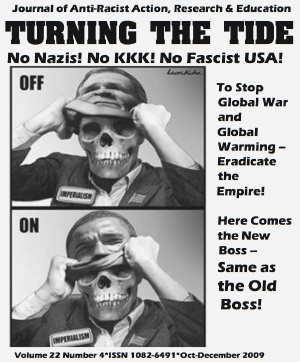
Anarchist Ojore Nuru LutaloFormer political prisoner Ojore Nuru Lutalo, ne Leroy Bunting, was pulled off an Amtrak train in La Junta, Colorado, for scaring fellow passengers with his cell phone conversation. The FBI’s Colorado Springs Joint Terrorism Task Force was alerted about the 64 year-old armed with anarchist literature from the “Afrikan Liberation Army” (sic) which he had obtained while speaking at the LA Anarchist Book Fair for the Anarchist Black Cross, a prison rights organization. Just yesterday I listened to a local law enforcement type defend the 2nd Amendment, the right to bear arms, by suggesting that if we substituted “books” for guns, no one would think to regulate them. His compatriots seem to have confused the argument by charging the former Black Liberation Army member for “endangering public transportation” with what they called terrorist recruiting propaganda.

Journal Turning the TideAccording to the Pueblo Chieftain, police found “a large amount of propaganda recruiting materials from the Afrikan Liberation Army, including photos of President Barack Obama and other items that raised suspicions.”

Break the Chains reports that Ojore was released Yesterday, and will return to the Otero District Court for an appearance February 5th, the charge now “Interfering with Public Transportation.”

How absolutely disingenuous to misquote the source of the so-called Anarchist literature, seeing as reportedly there was so much of it. This is the usual media disinfo to prevent giving the causes visibility. The Pueblo Chieftain has obtained the affidavit of the arrest, which should list the items found on Ojore. Until that’s made available, we can search online for what he was likely carrying. Our bet, they don’t want to call attention to the New Afrikan Liberation Front (NALF).

Here’s a list of the exhibitors at the 2nd Anarchist Book Fair:

Anarchist type brochuresSemiotext(e)
www.semiotexte.com
Earth First Journal
www.earthfirstjournal.org
Taala Hooghan: Infoshop & Youth Media Arts Center
www.taalahooghan.org
Modesto Anarcho
www.modestoanarcho.org
South Central Farmers
www.southcentralfarmers.com
Skylight Books
www.skylightbooks.com
Institute for Anarchist Studies
www.anarchist-studies.org
Critical Resistance
www.criticalresistance.org
Las Vegas Alliance of the Libertarian Left sonv.libertarianleft.org
Catholic Worker
www.lacatholicworker.org
Anti-Racist Action/Turning the Tide
www.antiracistaction.us
Anarchist Black Cross Federation L.A. www.abcf.net/la
PM press
www.pmpress.org
Microcosom Publishing
www.microcosmpublishing.com
AK press
www.akpress.org
Little black cart
www.littleblackcart.com
Make/Shift magazine
www.makeshiftmag.com
Journal of aesthetics and protest
www.journalofaestheticsandprotest.org
R.A.C. : Revolutionary Autonomous Communities
www.revolutionaryautonomouscommunities.blogspot.com
I.W.W
www.iww.org

Then there is also the Southside ABCF zine collection, the Crossroad Newletter, and the publications of the Spear and Shield. Here’s the New Afrikan Declaration of Independence, as printed on Prairie Fire:

“New Afrikan Declaration of Independence”

WE, New Afrikan People in America, in consequence of arriving at a knowledge of ourselves as a people with dignity, long deprived of that knowledge; as a consequence of revolting with every decimal of our collective and individual beings against the oppression that for three hundred years has destroyed and broken and warped the bodies and minds and spirits of our people in America, in consequence of our raging desire to be free of this oppression, to destroy this oppression wherever it assaults humankind in the world, and in consequence of inextinguishable determination to go a different way, to build a new and better world, do hereby declare ourselves forever free and independent of the jurisdiction of the United State of America and the obligations which that country¹s unilateral decision to make our ancestors and ourselves paper-citizens placed on us.

We claim no rights from the United States of America other than those rights belonging to human beings anywhere in the world, and these include the right to damages, reparations, due us from the grievous injuries sustained by our ancestors and ourselves by reason of United States lawlessness.

Ours is a revolution against oppression–our own oppression and that of all people in the world. And it is a revolution for a better life, a better station for all, a surer harmony with the forces of life in the universe. We therefore see these aims as the aims of our revolution:

    • To free black people in America from oppression;
  • To support and wage the world revolution until all people everywhere are so free;
  • To build a new Society that is better than what We now know and as perfect as We can make it;
  • To assure all people in the New Society maximum opportunity and equal access to that maximum;
  • To promote industriousness, responsibility, scholarship, and service;
  • To create conditions in which freedom of religion abounds and the pursuit of God and/or destiny, place and purpose of humankind in the Universe will be without hindrance;
  • To build a Black independent nation where no sect or religious creed subverts or impedes the building of the New Society, the New State Government, or achievement of the Aims of the Revolution as set forth in this Declaration;
  • To end exploitation of human beings by each other or the environment;
  • To assure equality of rights for the sexes;
  • To end color and class discrimination, while not abolishing salubrious diversity, and to promote self-respect and mutual understanding among all people in the society;
  • To protect and promote the personal dignity and integrity of the individual, and his or her natural rights;
  • To place the major means of production and trade in the trust of the state to assure the benefits of this earth and our genius and labor to society and all its members, and
  • To encourage and reward the individual for hard work and initiative and insight and devotion to the Revolution.

In mutual trust and great expectation, We the undersigned, for ourselves and for those who look to us but are unable personally to affix their signatures hereto, do join in this solemn Declaration of Independence, and to support this Declaration and to assure the success of the Revolution, We pledge without reservation ourselves, our talents, and all our worldly goods.

Or the creed:

“New Afrikan Creed”

1. i believe in the spirituality, humanity and genius of Black people, and in our new pursuit of these values.

2. i believe in the family and the community, and in the community as a family, and i will work to make this concept live.

3. i believe in the community as more important than the individual.

4. i believe in constant struggle for freedom, to end oppression and build a better world. i believe in collective struggle; in fashioning victory in concert with my brothers and sisters.

5. i believe that the fundamental reason our oppression continues is that We, as a people, lack the power to control our lives.

6. i believe that fundamental way to gain that power, and end oppression, is to build a sovereign Black nation.

7. i believe that all the land in America, upon which We have lived for a long time, which We have worked and built upon, and which We have fought to stay on, is land that belongs to us as a people.

8. i believe in the Malcolm X Doctrine: that We must organize upon this land, and hold a plebiscite, to tell the world by a vote that We are free and our land independent, and that, after the vote, We must stand ready to defend ourselves, establishing the nation beyond contradiction.

9. Therefore, i pledge to struggle without cease, until We have won sovereignty. i pledge to struggle without fail until We have built a better condition than the world has yet known.

10. i will give my life, if that is necessary; i will give my time, my mind, my strength, and my wealth because this IS necessary.

11. i will follow my chosen leaders and help them.

12. i will love my brothers and sisters as myself.

13. i will steal nothing from a brother or sister, cheat no brother or sister, misuse no brother or sister, inform on no brother or sister, and spread no gossip.

14. i will keep myself clean in body, dress and speech, knowing that i am a light set on a hill, a true representative of what We are building.

15. i will be patient and uplifting with the deaf, dumb and blind, and i will seek by word and deed to heal the Black family, to bring into the Movement and into the Community mothers and fathers, brothers and sisters left by the wayside.

Now, freely and of my own will, i pledge this Creed, for the sake of freedom for my people and a better world, on pain of disgrace and banishment if i prove false. For, i am no longer deaf, dumb or blind. i am, by inspiration of the ancestors and grace of the Creator — a New Afrikan.

William Blum – Anti-Empire Report

Here’s William Blum’s latest essay, on Lincoln Gordon, Brazil, Cuba, and the 2009 Nobel Laureate, reprinted from www.killinghope.org.

THE ANTI-EMPIRE REPORT
By William Blum, January 6, 2009

The American elite

Lincoln Gordon died a few weeks ago at the age of 96. He had graduated summa cum laude from Harvard at the age of 19, received a doctorate from Oxford as a Rhodes Scholar, published his first book at 22, with dozens more to follow on government, economics, and foreign policy in Europe and Latin America. He joined the Harvard faculty at 23. Dr. Gordon was an executive on the War Production Board during World War II, a top administrator of Marshall Plan programs in postwar Europe, ambassador to Brazil, held other high positions at the State Department and the White House, a fellow at the Woodrow Wilson International Center for Scholars, economist at the Brookings Institution, president of Johns Hopkins University. President Lyndon B. Johnson praised Gordon’s diplomatic service as "a rare combination of experience, idealism and practical judgment".

You get the picture? Boy wonder, intellectual shining light, distinguished leader of men, outstanding American patriot.

Abraham Lincoln Gordon was also Washington’s on-site, and very active, director in Brazil of the military coup in 1964 which overthrew the moderately leftist government of João Goulart and condemned the people of Brazil to more than 20 years of an unspeakably brutal dictatorship. Human-rights campaigners have long maintained that Brazil’s military regime originated the idea of the desaparecidos, "the disappeared", and exported torture methods across Latin America. In 2007, the Brazilian government published a 500-page book, "The Right to Memory and the Truth", which outlines the systematic torture, rape and disappearance of nearly 500 left-wing activists, and includes photos of corpses and torture victims. Currently, Brazilian President Luiz Inácio Lula da Silva is proposing a commission to investigate allegations of torture by the military during the 1964-1985 dictatorship. (When will the United States create a commission to investigate its own torture?)

In a cable to Washington after the coup, Gordon stated — in a remark that might have had difficulty getting past the lips of even John Foster Dulles — that without the coup there could have been a "total loss to the West of all South American Republics". (It was actually the beginning of a series of fascistic anti-communist coups that trapped the southern half of South America in a decades-long nightmare, culminating in "Operation Condor", in which the various dictatorships, aided by the CIA, cooperated in hunting down and killing leftists.)

Gordon later testified at a congressional hearing and while denying completely any connection to the coup in Brazil he stated that the coup was "the single most decisive victory of freedom in the mid-twentieth century."

Listen to a phone conversation between President Johnson and Thomas Mann, Assistant Secretary of State for Inter-American Affairs, April 3, 1964, two days after the coup:

MANN: I hope you’re as happy about Brazil as I am.

LBJ: I am.

MANN: I think that’s the most important thing that’s happened in the hemisphere in three years.

LBJ: I hope they give us some credit instead of hell.1

So the next time you’re faced with a boy wonder from Harvard, try to keep your adulation in check no matter what office the man attains, even — oh, just choosing a position at random — the presidency of the United States. Keep your eyes focused not on these "liberal" … "best and brightest" who come and go, but on US foreign policy which remains the same decade after decade. There are dozens of Brazils and Lincoln Gordons in America’s past. In its present. In its future. They’re the diplomatic equivalent of the guys who ran Enron, AIG and Goldman Sachs.

Of course, not all of our foreign policy officials are like that. Some are worse.

And remember the words of convicted spy Alger Hiss: Prison was "a good corrective to three years at Harvard."

Mothers, don’t let your children grow up to be Nobel Peace Prize winners

In November I wrote:

Question: How many countries do you have to be at war with to be disqualified from receiving the Nobel Peace Prize?

Answer: Five. Barack Obama has waged war against only Pakistan, Afghanistan, Iraq and Somalia. He’s holding off on Iran until he actually gets the prize.

Well, on December 10 the president clutched the prize in his blood-stained hands. But then the Nobel Laureate surprised us. On December 17 the United States fired cruise missiles at people in … not Iran, but Yemen, all "terrorists" of course, who were, needless to say, planning "an imminent attack against a U.S. asset".2 A week later the United States carried out another attack against "senior al-Qaeda operatives" in Yemen.3

Reports are that the Nobel Peace Prize Committee in Norway is now in conference to determine whether to raise the maximum number of wars allowed to ten. Given the committee’s ignoble history, I imagine that Obama is taking part in the discussion. As is Henry Kissinger.

The targets of these attacks in Yemen reportedly include fighters coming from Afghanistan and Iraq, confirmation of the warnings long given — even by the CIA and the Pentagon — that those US interventions were creating new anti-American terrorists. (That’s anti-American foreign policy, not necessarily anything else American.) How long before the United States will be waging war in some other god-forsaken land against anti-American terrorists whose numbers include fighters from Yemen? Or Pakistan? Or Somalia? Or Palestine?

Our blessed country is currently involved in so many bloody imperial adventures around the world that one needs a scorecard to keep up. Rick Rozoff of StopNATO has provided this for us in some detail.4

For this entire century, almost all these anti-American terrorists have been typically referred to as "al-Qaeda", as if you have to be a member of something called al-Qaeda to resent bombs falling on your house or wedding party; as if there’s a precise and meaningful distinction between people retaliating against American terrorism while being a member of al-Qaeda and people retaliating against American terrorism while NOT being a member of al-Qaeda. However, there is not necessarily even such an animal as a "member of al-Qaeda", albeit there now exists "al-Qaeda in Iraq" and "al-Qaeda in the Arabian Peninsula". Anti-American terrorists do know how to choose a name that attracts attention in the world media, that appears formidable, that scares Americans. Governments have learned to label their insurgents "al-Qaeda" to start the military aid flowing from Washington, just like they yelled "communist" during the Cold War. And from the perspective of those conducting the War on Terror, the bigger and more threatening the enemy, the better — more funding, greater prestige, enhanced career advancement. Just like with the creation of something called The International Communist Conspiracy.

It’s not just the American bombings, invasions and occupations that spur the terrorists on, but the American torture. Here’s Bowe Robert Bergdahl, US soldier captured in Afghanistan, speaking on a video made by his Taliban captors: He said he had been well-treated, contrasting his fate to that of prisoners held in US military prisons, such as the infamous Abu Ghraib prison in Iraq. "I bear witness I was continuously treated as a human being, with dignity, and I had nobody deprive me of my clothes and take pictures of me naked. I had no dogs barking at me or biting me as my country has done to their Muslim prisoners in the jails that I have mentioned."5

Of course the Taliban provided the script, but what was the script based on? What inspired them to use such words and images, to make such references?

Cuba. Again. Still. Forever.

More than 50 years now it is. The propaganda and hypocrisy of the American mainstream media seems endless and unwavering. They can not accept the fact that Cuban leaders are humane or rational. Here’s the Washington Post of December 13 writing about an American arrested in Cuba:

"The Cuban government has arrested an American citizen working on contract for the U.S. Agency for International Development who was distributing cellphones and laptop computers to Cuban activists. … Under Cuban law … a Cuban citizen or a foreign visitor can be arrested for nearly anything under the claim of ‘dangerousness’."

That sounds just awful, doesn’t it? Imagine being subject to arrest for whatever someone may choose to label "dangerousness". But the exact same thing has happened repeatedly in the United States since the Bolshevik Revolution of 1917. We don’t use the word "dangerousness". We speak of "national security". Or, more recently, "terrorism". Or "providing material support to terrorism".

The arrested American works for Development Alternatives, Inc. (DAI), a US government contractor that provides services to the State Department, the Pentagon and the US Agency for International Development (USAID). In 2008, DAI was funded by the US Congress to "promote transition to democracy" in Cuba. Yes, Oh Happy Day!, we’re bringing democracy to Cuba just as we’re bringing it to Afghanistan and Iraq. In 2002, DAI was contracted by USAID to work in Venezuela and proceeded to fund the same groups that a few months earlier had worked to stage a coup — temporarily successful — against President Hugo Chávez. DAI performed other subversive work in Venezuela and has also been active in Afghanistan, Pakistan, and other hotspots. "Subversive" is what Washington would label an organization like DAI if they behaved in the same way in the United States in behalf of a foreign government.6

The American mainstream media never makes its readers aware of the following (so I do so repeatedly): The United States is to the Cuban government like al-Qaeda is to the government in Washington, only much more powerful and much closer. Since the Cuban revolution, the United States and anti-Castro Cuban exiles in the US have inflicted upon Cuba greater damage and greater loss of life than what happened in New York and Washington on September 11, 2001. Cuban dissidents typically have had very close, indeed intimate, political and financial connections to American government agents. Would the US government ignore a group of Americans receiving funds or communication equipment from al-Qaeda and/or engaging in repeated meetings with known leaders of that organization? In the past few years, the American government has arrested a great many people in the US and abroad solely on the basis of alleged ties to al-Qaeda, with a lot less evidence to go by than Cuba has had with its dissidents’ ties to the United States, evidence usually gathered by Cuban double agents. Virtually all of Cuba’s "political prisoners" are such dissidents.

The Washington Post story continued:

"The Cuban government granted ordinary citizens the right to buy cellphones just last year." Period.

What does one make of such a statement without further information? How could the Cuban government have been so insensitive to people’s needs for so many years? Well, that must be just the way a "totalitarian" state behaves. But the fact is that because of the disintegration of the Soviet bloc, with a major loss to Cuba of its foreign trade, combined with the relentless US economic aggression, the Caribbean island was hit by a great energy shortage beginning in the 1990s, which caused repeated blackouts. Cuban authorities had no choice but to limit the sale of energy-hogging electrical devices such as cell phones; but once the country returned to energy sufficiency the restrictions were revoked.

"Cubans who want to log on [to the Internet] often have to give their names to the government."

What does that mean? Americans, thank God, can log onto the Internet without giving their names to the government. Their Internet Service Provider does it for them, furnishing their names to the government, along with their emails, when requested.

"Access to some Web sites is restricted."

Which ones? Why? More importantly, what information might a Cuban discover on the Internet that the government would not want him to know about? I can’t imagine. Cubans are in constant touch with relatives in the US, by mail and in person. They get US television programs from Miami. International conferences on all manner of political, economic and social subjects are held regularly in Cuba. What does the American media think is the great secret being kept from the Cuban people by the nasty commie government?

"Cuba has a nascent blogging community, led by the popular commentator Yoani Sánchez, who often writes about how she and her husband are followed and harassed by government agents because of her Web posts. Sánchez has repeatedly applied for permission to leave the country to accept journalism awards, so far unsuccessfully."

According to a well-documented account7, Sánchez’s tale of government abuse appears rather exaggerated. Moreover, she moved to Switzerland in 2002, lived there for two years, and then voluntarily returned to Cuba. On the other hand, in January 2006 I was invited to attend a book fair in Cuba, where one of my books, newly translated into Spanish, was being presented. However, the government of the United States would not give me permission to go. My application to travel to Cuba had also been rejected in 1998 by the Clinton administration.

"’Counterrevolutionary activities’, which include mild protests and critical writings, carry the risk of censure or arrest. Anti-government graffiti and speech are considered serious crimes."

Raise your hand if you or someone you know of was ever arrested in the United States for taking part in a protest. And substitute "pro al-Qaeda" for "counterrevolutionary" and for "anti-government" and think of the thousands imprisoned the past eight years by the United States all over the world for … for what? In most cases there’s no clear answer. Or the answer is clear: (a) being in the wrong place at the wrong time, or (b) being turned in to collect a bounty offered by the United States, or (c) thought crimes. And whatever the reason for the imprisonment, they were likely tortured. Even the most fanatical anti-Castroites don’t accuse Cuba of that. In the period of the Cuban revolution, since 1959, Cuba has had one of the very best records on human rights in the hemisphere. See my essay: "The United States, Cuba and this thing called Democracy".8

There’s no case of anyone arrested in Cuba that compares in injustice and cruelty to the arrest in 1998 by the United States government of those who came to be known as the "Cuban Five", sentenced in Florida to exceedingly long prison terms for trying to stem terrorist acts against Cuba emanating from the US.9 It would be lovely if the Cuban government could trade their DAI prisoner for the five. Cuba, on several occasions, has proposed to Washington the exchange of a number of what the US regards as "political prisoners" in Cuba for the five Cubans held in the United States. So far the United States has not agreed to do so.

Notes

  1. Michael Beschloss, Taking Charge: The Johnson White House Tapes 1963-1964 (New York, 1997), p.306. All other sources for this section on Gordon can be found in: Washington Post, December 22, 2009, obituary; The Guardian (London), August 31, 2007; William Blum, "Killing Hope", chapter 27
  2. ABC News, December 17, 2009; Washington Post, December 19, 2009
  3. Washington Post, December 25, 2009
  4. Stop NATO, "2010: U.S. To Wage War Throughout The World", December 30, 2009. To get on the StopNATO mailing list write to r_rozoff@yahoo.com. To see back issues: http://groups.yahoo.com/group/stopnato/
  5. Reuters, December 25, 2009
  6. For more details on DAI, see Eva Golinger, "The Chávez Code: Cracking US Intervention in Venezuela" (2006) and her website, posting for December 31, 2009
  7. Salim Lamrani, professor at Paris Descartes University, "The Contradictions of Cuban Blogger Yoani Sanchez", Monthly Review magazine, November 12, 2009
  8. http://killinghope.org/bblum6/democ.htm
  9. http://killinghope.org/bblum6/polpris.htm

Avatar: novel push for noble savage

Avatar movie poster based on the novel by SapphireI’d like to contrast the high-profile critical receptions being given two Hollywood films about darker-skinned-ness. Precious is about an African-American girl so dark she absorbs the light, without being about race at all. The movie tells a story of poverty, incest and the cycle of abuse, while tipping the scales with gratuitous stereotypes of Hottentot welfare mamas attendant their usual good-for-trouble black males. Vilifying the subjects it pretends to rescue, Precious has the blessing of the media, a shameless Oprah included. James Cameron’s Avatar on the other hand, opened to depth-charges of faint praise calculated to dim the buzz, perhaps because it packs the most subversive black-is-beautiful message since Muhammad Ali.

Avatar evokes rudimentary indigenous spirituality, peppered with what even elementary-schooled audiences can associate as Native American themes, from which we can infer the concepts are eternal, but idealizes an athletic aesthetic more human than the movie’s live-action characters. The “blue cat people,” as the critics have chosen to describe its Na’vi tribe, are but fantasy-striped, tailed Spartans, computer iterations of the Williams sisters and NBA dream teams. The real humans of Avatar tower in prowess, dignity and luminescence over their modern mensch oppressors.

Where racial equality on film is plotted according to how black figures are granted access to the world of white priviledge, Avatar celebrates the sovereignty of dark skin in its environment, where it’s not a barbershop, rapper’s crib, or street corner in Harlem. And instead of prepping the more palatable light-skinned negro for easier assimilation to the welcome-diversity crowd.

Precious: Based on the Novel “Push” by Sapphire, is an ugly project by and for gentrified American, whose title character is White-America’s usual avatar into their mysterious conception of Black America. I can do it no better justice than this review excerpt published Counterpunch:

A fiction whose “policy message is that welfare recipients are black women who wish to avoid work, who use their time having sex with their daughters, watching television and dining on pig leavings.” Is this a film – or a crime?

A crock and defamation that reinforces white man’s supremist burden.

Under Iran’s culturally repressive Islamic Revolution, the artists have produced a golden age of film. The greatest of these films have had to disguise their social message in analogies surrounding the concerns of children. Avatar takes perhaps a similar tack. Behind diversions of fantasy and special effects, is a profound morality tale. Critics can attack James Cameron for his simplistic storytelling, it’s the price to pay to bring the simplest of viewers along. Perhaps the director can release a final cut for cineastes which omits the redundant exposition. I don’t mind that Cameron uses a highlighter for the Cliftnote set. A survey of online comments shows me that some fans applaud themselves for getting Avatar’s message where they are certain their fellow audience members might not.

Most certainly the alarm most critics are raising has to do with the unpatriotic attitude which Avatar takes toward Capitalist imperialism. In GWOT America where we still “Support Our Troops” and still refrain from labeling our military contractors as mercenaries, this film will rub flag wavers the wrong way. I’d hate to be an active duty US soldier, watching Avatar in my uniform, as the audience roots for good to vanquish evil. It will probably be some time before Americans will want to see Iraqi or Afghan freedom fighters depicted as heroes. We’ve yet to see sympathetic accounts for example of the Vietcong holding down the Ho Chi Min Trail, or for that matter, the real Germans or Japanese beyond the Allied propaganda. But by disguising his story in science fiction, James Cameron has rehabilitated the Vandal and Visigoth, from the shadow of the Roman Empire. The shadow of man’s civilizing drive which grows darker the more it is illuminated.

And best of all, Cameron’s pagans are not whites like the typical Anglo Semites of the Christian holy lands. Cameron’s indigenous humans have the beautiful noses, skin and haunches indigenous to the climates which cradled humankind.

The Caracas Commitment Si Se Puede

You might imagine the multinational corporate media would blackout the talk of a 5th Socialist International. They are most determined to censor the issues which the world’s leftist parties are resolved to address. Where Obama 2008 and Copenhagen 2009 project a vacuum of ideological momentum, check out the Caracas Commitment.

The Caracas Commitment
November 25, 2009?
By Declaration from World Meeting of Left Parties?
November 19-21 Caracas, Venezuela

Political parties and organizations from Latin America, the Caribbean, Europe, Africa, Asia, and Oceania commemorate and celebrate the unity and solidarity that brought us together in Caracas, Bolivarian Republic of Venezuela, and from this libertarian city we would like to express our revolutionary rebelliousness. We are glad of and committed to the proud presence of the forces of change in a special moment of history. Likewise, we are proud to reaffirm our conviction to definitively sow, grow and win Socialism of the 21st century.

In this regard, we want to sign the Commitment of Caracas as a revolutionary guide for the challenges ahead of us. We have gathered with the aim of unifying criteria and giving concrete answers that allow us to defend our sovereignty, our social victories, and the freedom of our peoples in the face of the generalized crisis of the world capitalist system and the new threats spreading over our region and the whole world with the establishment and strengthening of military bases in the sister republics of Colombia, Panama, Aruba, Curacao, the Dutch Antilles, as well as the aggression against Ecuadorian territory, and the invasions of Iraq and Afghanistan.

We consider that the world capitalist system is going through one of its most severe crises, which has shaken its very foundations and brought with it consequences that jeopardize the survival of humanity. Likewise, capitalism and the logic of capital, destroys the environment and biodiversity, bringing with it consequences of climate change, global warming and the destruction of life.

One of the epicentres of the capitalist crisis is in the economic domain; this highlights the limitations of unbridled free markets ruled by private monopolies. In this situation, some governments have been asked to intervene to prevent the collapse of vital economic sectors, for instance, through the implementation of bailouts to bank institutions that amount to hundreds of billions of dollars. Said governments have been asked to stimulate their economies by increasing public expenditure in order to mitigate the recession and the private sector decline, which evidences the end of the supposedly irrefutable “truth” of neo-liberalism that of non-intervention of the State in economic affairs.

In this regard, it is very timely to promote an in-depth discussion on the economic crisis, the role of the State and the construction of a new financial architecture.

In summary, the capitalist crisis cannot be reduced simply to a financial crisis; it is a structural crisis of capital which combines the economic crisis, with an ecological crisis, a food crisis, and an energy crisis, which together represents a mortal threat to humanity and mother earth. Faced with this crisis, left-wing movements and parties see the defence of nature and the construction of an ecologically sustainable society as a fundamental axis of our struggle for a better world.

In recent years, progressive and left-wing movements of the Latin American region have accumulated forces, and stimulated transformations, throwing up leaders that today hold important government spaces. This has represented an important blow to the empire because the peoples have rebelled against the domination that has been imposed on them, and have left behind their fear to express their values and principles, showing the empire that we will not allow any more interference in our internal affairs, and that we are willing to defend our sovereignty.

This meeting is held at a historic time, characterized by a new imperialistic offensive against the peoples and governments of the region and of the world, a pretension supported by the oligarchies and ultraconservative right-wing, with the objective of recovering spaces lost as a consequence of the advancement of revolutionary process of liberation developing in Latin America. These are expressed through the creation of regional organizations such as ALBA, UNASUR, PETROCARIBE, Banco del Sur, the Sao Paulo Forum, COPPPAL, among others; where the main principles inspiring these processes are those of solidarity, complementarity, social priority over economic advantage, respect for self-determination of the peoples in open opposition to the policies of imperial domination. For these reasons, the right-wing forces in partnership with the empire have launched an offensive to combat the advance and development of the peoples’ struggles, especially those against the overexploitation of human beings, racist discrimination, cultural oppression, in defence of natural resources, of the land and territory from the perspective of the left and progressive movements and of world transformation.

We reflect on the fact that these events have led the U.S administration to set strategies to undermine, torpedo and destabilize the advancement of these processes of change and recuperation of sovereignty. To this end, the US has implemented policies expressed through an ideological and media offensive that aim to discredit the revolutionary and progressive governments of the region, labelling them as totalitarian governments, violators of human rights, with links to drug-trafficking operations, and terrorism; and also questioning the legitimacy of their origin. This is the reason for the relentless fury with which all the empire’s means of propaganda and its agents inside our own countries continuously attack the experiences in Venezuela, Ecuador, Nicaragua, Bolivia, and Paraguay, as with its maintenance of the blockade against revolutionary and independent Cuba.

Part of the strategy activated by the U.S. Empire is evidenced by the coup in Honduras, as well as in other destabilizing initiatives in Central America, attempting to impose the oligarchic interests that have already left hundreds of victims, while a disgusting wave of cynicism tries to cover up the dictatorship imposed by the U.S. administration with a false veil of democracy. Along with this, it is developing a military offensive with the idea of maintaining political and military hegemony in the region, for which it is promoting new geopolitical allies, generating destabilization and disturbing peace in the region and globally through military intimidation, with the help of its allies in the internal oligarchies, who are shown to be complicit in the actions taken by the empire, giving away their sovereignty, and opening spaces for the empire’s actions.

We consider that this new offensive is specifically expressed through two important events that took place this year in the continent: The coup in Honduras, and the installation of military bases in Colombia and Panama, as well as the strengthening of the already existing ones in our region. The coup in Honduras is nothing but a display of hypocrisy by the empire, a way to intimidate the rest of the governments in the region. It is a test-laboratory that aims to set a precedent that can be applied as a new coup model and a way to encourage the right to plot against the transformational and independent processes.

We denounce the military agreement between the Colombian government and the United States administration strengthens the U.S.’s military strategy, whose contents are expressed in the so-called “White Book.” This confirms that the development of the agreement will guarantee a projection of continental and intercontinental military power, the strengthening of transportation capability and air mobility to guarantee the improvement of its action capability, in order to provide the right conditions to have access to energy sources. It also consolidates its political partnership with the regional oligarchy for the control of Colombian territory and its projection in the Andes and in the rest of South America. All this scaffolding and consolidation of military architecture entails a serious threat for peace in the region and the world.

The installation of military bases in the region and their interrelation with the different bases spread throughout the world is not only confined to the military sphere, but rather forms part of the establishment of a general policy of domination and expansion directed by the U.S. These bases constitute strategic points to dominate all the countries in Central and Latin America and the rest of the world.

The treaty for the installation of military bases in Colombia is preceded by Plan Colombia, which was already an example of U.S. interference in the affairs of Colombia and the region using the fight against drug trafficking and terrorism as an excuse. However, it has been shown that drug trafficking levels have increased in Colombia; therefore, the plan is no longer justified given that no favourable results have been obtained since its implementation, that would justify a new treaty with the U.S.

Today, the global strategy headed by the U.S. concerning drug trafficking is a complete failure. Its results are summarised by a rapid processes of accumulation of illegal capital, increased consumption of drugs and exacerbation of criminality, whose victims are the peoples of Latin America, especially the Colombian people. This strategy should be revisited and modified, and should be oriented towards a different logic that focuses on drug consumption as a public health issue. In Colombia, drug trafficking has assumed the form of paramilitarism, and turned into a political project the scope of which and persons responsible should be investigated so that the truth is known, so that justice prevails and the terror of the civilian population ceases.

We, the peoples of the world, declare that we will not give up the spaces we have managed to conquer after years of struggle and resistance; and we commit ourselves to regain those which have been taken from us. Therefore, we need to defend the processes of change and the unfolding revolutions since they are based on sovereign decisions made by the peoples.

Agreements

1. Mobilization and Condemnation of U.S. Military Bases

1.1.
To organize global protests against the U.S. military bases from December 12th to 17th, 2009. Various leftwing parties and social movements will promote forums, concerts, protest marches and any other creative activity within the context of this event.

1.2.
To establish a global mobilization front for the political denouncement of the U.S. military bases. This group will be made up by social leaders, left-wing parties, lawmakers, artists, among others, who will visit different countries with the aim of raising awareness in forums, press conferences and news and above all in gatherings with each country’s peoples.

1.3.
To organize students, young people, workers and women in order to establish a common agenda of vigilance and to denounce against the military bases throughout the world.

1.4.
To organize a global legal forum to challenge the installation of the U.S. military bases. This forum is conceived as a space for the condemnation of illegalities committed against the sovereignty and self-determination of the peoples and the imposition of a hegemonic imperialist model.

1.5.
To organise a global trial against paramilitarism in Colombia bringing testimonies and evidence to international bodies of justice.

1.6.
To promote a global trial against George Bush for crimes against humanity, as the person principally responsible for the genocide against the peoples of Iraq and Afghanistan.

1.7.
To promote a campaign for the creation of constitutional and legal provisions in all of our countries against the installation of military bases and deployment of nuclear weapons of mass destruction.

1.8.
To promote, from the different social organizations and movements of the countries present in this meeting, a political solution for the Colombian conflict.

1.9.
To organise solidarity with the Colombian people against the imperial aggression that the military bases entail in Colombian territory.

2. Installation and Development of a Platform of Joint Action by Left-Wing Parties of the World

2.1.
To establish a space of articulation of progressive and left-wing organizations and parties that allows for coordinating policies against the aggression towards the peoples, the condemnation of the aggressions against governments elected democratically, the installation of military bases, the violation of sovereignty and against xenophobia, the defence of immigrants’ rights, peace, and the environment, and peasant, labour, indigenous and afro-descendent movements.

2.2.
To set up a Temporary Executive Secretariat (TES) that allows for the coordination of a common working agenda, policy making, and follow-up on the agreements reached within the framework of this international encounter. Said Secretariat undertakes to inform about relevant events in the world, and to define specific action plans: statements, declarations, condemnations, mobilizations, observations and other issues that may be decided.

2.3.
To set up an agenda of permanent ideological debate on the fundamental aspects of the process of construction of socialism.

2.4.
To prepare common working agendas with participation from Latin America, Europe, Africa, Asia and Oceania.

2.5.
To organize solidarity of the people’s of the world with the Bolivarian revolution and President Hugo Chávez, in response to the constant imperial attacks.

2.6.
To commemorate the centenary of Clara Zetkin’s proposal to celebrate March 8th as the International Day of Women. The parties undertake to celebrate this day insofar as possible.

2.7.
To summon a meeting to be held in Caracas in April 2010 in commemoration of the bicentenary of our Latin American and Caribbean independences.

3. Organization of a World Movement of Militants for a Culture of Peace

3.1.
To promote the establishment of peace bases, by peace supporters, who will coordinate actions and denouncements against interventionism and war sponsored by imperialism through activities such as: forums, cultural events, and debates to promote the ethical behaviour of anti-violence, full participation in social life, respect for human rights and fundamental freedoms, acknowledgement of the cultural identities of our peoples and strengthening the framework of integration. This space seeks to raise awareness among all citizens in rejection of all forms of domination, internal or external intervention, and to reinforce the culture of peace. To struggle relentlessly for a world with no nuclear weapons, no weapons of mass destruction, no military bases, no foreign interference, and no economic blockades, as our peoples need peace and are absolutely entitled to attain development. Promote the American continent as a territory of peace, home to the construction of a free and sovereign world.

3.2.
To organize a Peace Parliament as a political space to exchange common endeavours among the world’s progressive and left-wing parliamentarians, and to know the historical, economic, legal, political and environmental aspects key for the defence of peace. Hereby we recommend holding the first meeting in February 2010.

4. Artillery Of International Communication to Emancipate Revolutionary Consciousness

4.1.
To discuss a public communication policy at an inter-regional level that aims to improve the media battle, and to convey the values of socialism among the peoples.

4.2.
To promote the creation and consolidation of alternative and community communication media to break the media siege, promote an International Alternative Left-wing Media Coordination Office that creates links to provide for improved information exchange among our countries, in which Telesur and Radiosur can be spearheads for this action.

4.3.
To create a website of all of the progressive and left-wing parties and movements in the world as a means to ensure permanent exchange and the development of an emancipating and alternative communication.

4.4.
To promote a movement of artists, writers and filmmakers to promote and develop festivals of small, short and full-length films that reflects the advancement and the struggle of peoples in revolution.

4.5.
To hold a meeting or international forum of alternative left-wing media.

5. Mobilize All Popular Organizations in Unrestricted Support for the People of Honduras

5.1.
To promote an international trial against the coup plotters in Honduras before the International Criminal Court for the abuses and crimes committed.

5.2.
Refuse to recognize the illegal electoral process they aim to carry out in Honduras.

5.3.
To carry out a world vigil on Election Day in Honduras in order to protest against the intention to legitimize the coup, coordinated by the permanent committee that emerges from this encounter.

5.4.
To coordinate the actions of left-wing parties worldwide to curb the imperialist pretensions of using the coup in Honduras as a strategy against the Latin American and Caribbean progressive processes and governments.

5.5.
To unite with the people of Honduras through a global solidarity movement for people’s resistance and for the pursuit of democratic and participatory paths that allow for the establishment of progressive governments committed to common welfare and social justice.

5.6.
To undertake actions geared towards denouncing before multilateral bodies, and within the framework of international law, the abduction of José Manuel Zelaya, legitimate President of Honduras, that facilitated the rupture of constitutional order in Honduras. It is necessary to determine responsibility among those who participated directly in this crime, and even among those who allowed his aircraft to go in and out Costa Rica without trying to detain the kidnappers of the Honduran president.

6. Solidarity with the Peoples of the World

6.1.
The Left-wing Parties of the International Meeting of Caracas agree to demand the immediate liberation of the five Cuban heroes unfairly imprisoned in American jails. They are authentic anti-terrorist fighters that caused no harm to U.S. national security, whose work was oriented towards preventing the terrorist attacks prepared by the terrorist counterrevolution against Cuba. The Five Heroes were subject to a biased judicial process, condemned by broad sectors of humanity, and stigmatized by a conspiracy of silence by the mainstream media. Given the impossibility of winning justice via judicial means, we call upon all political left-wing parties of the world to increase actions for their immediate liberation. We call on President Obama to utilize his executive power and set these Five Heroes of Humanity free.

6.2.
The International Meeting of Left-wing Parties resolutely demands the immediate and unconditional cessation of the criminal U.S. blockade that harmed the Cuban people so badly over the last fifty years. The blockade should come to an end right now in order to fulfil the will of the 187 countries that recently declared themselves against this act of genocide during the UN General Assembly.

6.3.
To unite with the people of Haiti in the struggle for the return of President Jean Bertrand Aristide to his country.

6.4.
We propose to study the possibility to grant a residence in Venezuela to Jean Bertrand Aristide, who was kidnapped and overthrown as Haiti’s president by U.S. imperialism.

6.5.
We express the need to declare a permanent alert aimed at preventing any type of breach of the constitutional order that may hinder the process of democratic change underway in Paraguay.

6.6.
We denounce the neoliberal privatizing advance in Mexico expressly in the case of the Electric Energy state-owned company, a heritage of the people, which aims through the massive firing of 45,000 workers to intimidate the union force, “Luz y Fuerza”, which constitutes another offensive of the Empire in Central and North America.

6.7.
To declare our solidarity with the peoples of the world that have suffered and are still suffering imperial aggressions, especially, the 50 year-long genocidal blockade against Cuba; the threat against the people of Paraguay; the slaughter of the Palestinian people; the illegal occupation of part of the territory of the Republic of Western Sahara and the invasion of Iraq and Afghanistan which today is expanding into Pakistan; the illegal sanctions imposed against Zimbabwe and the constant threat against Iran, among others.

Caracas, November 21st, 2009

Declaration of Solidarity with the People of Cuba

The Left-wing Parties of the International Meeting of Caracas agree to demand the immediate liberation of the five Cuban heroes unfairly imprisoned in U.S. prisons. They are authentic anti-terrorist fighters that caused no harm to US national security, whose work was oriented towards preventing the terrorist attacks prepared by the terrorist counterrevolution against Cuba. The Five Heroes were subject to a biased judicial process, condemned by broad sectors of humanity, and stigmatized by a conspiracy of silence by the mainstream media.

Given the impossibility of winning justice via judicial means, we call upon all political left-wing parties of the world to increase actions for their immediate liberation. We call on President Obama to utilize his executive power and set these Five Heroes of Humanity free.

The International Meeting of Left-wing Parties resolutely demands the immediate and unconditional cessation of the criminal U.S. blockade that harmed the Cuban people so badly over the last fifty years. The blockade should come to an end right now in order to fulfill the will of the 187 countries that recently declared themselves against this act of genocide during the UN General Assembly.

Caracas, November 21, 2009

Special Declaration on the Coup D’état in Honduras

We, left-wing parties of Latin America, Africa, Europe, Asia and Oceania, present in the international encounter of left-wing parties, reject the coup d’état against the constitutional government of citizen’s power of the President of Honduras Manuel Zelaya Rosales.

Cognizant of the situation of repression, persecution and murder against the Honduran people and the permanent military harassment against president Manuel Zelaya Rosales, which represents a breach of the rule of law in the sister nation of Honduras:

We support the actions of the national resistance front in its struggle to restore democracy.

We demand and support the sovereign right of the Honduran people to call for a national constituent assembly to establish direct democracy and to ensure the broadest political participation of the people in public affairs.

We denounce the United States intervention and its national and international reactionary right-wing allies and their connection with the coup, which hinders the construction of democracy in Honduras and in the world.

We condemn and repudiate the permanent violation of political and social human rights as well as the violation freedom of speech, promoted and perpetrated by the de facto powers, the Supreme Court of Justice, the National Congress of the Republic, the Ministry of Defence and Security since June 28, 2009.

We reiterate our demand to international governments and bodies, not to recognize the results of the general elections to be held on November 29, 2009 in Honduras, due to the lack of constitutional guarantees and the legal conditions necessary for a fair, transparent and reliable electoral process, the lack of reliable observers that can vouch for the results of this electoral process, which has already been rejected by most international governments, bodies and international public opinion.

To propose and promote an international trial against coup plotters and their accomplices in Honduras before the International Criminal Court, for the illegal actions, abuses and crimes they committed, while developing actions aimed at denouncing to the relevant bodies and in the framework of the international law, the violation of the rights and the kidnapping of the legitimate president of Honduras Manuel Zelaya Rosales, because it is necessary to establish the responsibility of those who participated directly and internally in the perpetration of this crime.

We urge national and international human rights organizations to support these measures, to carry on the campaign of denunciation and vigilance with permanent observers in face of the renewed human rights violations, particularly the persecution and sanction through the loss of jobs for political reasons against the members and supporters of the resistance and president Manuel Zelaya.

We repudiate and condemn the attacks against the diplomatic corps of the embassies of the Federative Republic of Brazil and the Republic of Argentina, and the embassies of the member countries of the Bolivarian Alliance for the Peoples of our America (ALBA); and express our solidarity with the heroic work of the staff of these diplomatic missions, who have been victims of harassment and hostility by the coup plotters.

We agree to establish coordination among left-wing parties of the world to exert pressure to oust the de facto government and for the restoration of the constitutional president and the right of the Honduran people to install a national constituent assembly that allows for deepening direct democracy.

We urge governments, international bodies and companies to maintain and intensify economic and commercial sanctions to business accomplices and supporters of the coup in Honduras, and to maintain an attitude of vigilance, to break all relations that recognize the coup plotters and the de facto government officers, as well as to take migration control measures that hinder the movement of people who have the purpose of voting in another country where elections are held with the aim of changing the results through the transfer of votes from one country to the other.

We agree not to recognize the international and national observers of the electoral process who are aligned and conspire to attempt to give legitimacy to an electoral process devoid of legality and legitimacy. We demand that rather than observing an illegal and illegitimate process, the return of the state of democratic law and the constitutional government of citizen power Honduras President Manuel Zelaya Rosales is guaranteed.

Caracas, November 21, 2009

Special Decision

The international encounter of Left-wing Political parties held in Caracas on November 19, 20 and 21, 2009, received the proposal made by Commander Hugo Chavez Frias to convoke the V Socialist International as a space for socialist-oriented parties, movements and currents in which we can harmonize a common strategy for the struggle against imperialism, the overthrow of capitalism by socialism and solidarity based economic integration of a new type. We assessed that proposition in terms of its historical dimension which calls for a new spirit of internationalism and agreed, for the purpose of achieving it in the short term, to create a WORKING GROUP comprised of those socialist parties, currents and social movements who endorse the initiative, to prepare an agenda which defines the objectives, contents and mechanisms of this global revolutionary body. We call for an initial constitutive event for April 2010 in the City of Caracas. Furthermore, those parties, socialist currents and social movements who have not expressed themselves on this matter can subject this proposal to the examination of their legitimate directive bodies.

Caracas, November 21, 2009

Vaneigem on energy as commodity

NMT’s in-house Situationist has been conceptualizing a way forward well expressed in this May 2009 interview of Raoul Vaneigem:
Situationist“We are being “offered” biofuels on the condition we agree to transgenic rapeseed farming. Eco-tourism will accelerate the plundering of our biosphere. Windmill farms are being built without any advantage to the consumers. Those are the areas where intervention is possible. Natural resources belong to us, they are free, they must be made to serve the freedom of life. It will be up to the communities to secure their own energy and food independence so as to free themselves from the control of the multinationals and their state vassals everywhere. Claiming natural power for our use means reclaiming our own existence first. Only creativity will rid us of work. …

Freeness is the only absolute weapon capable of shattering the mighty self-destruction machine set in motion by consumer society, whose implosion is still releasing, like a deadly gas, bottom-line mentality, cupidity, financial gain, profit, and predation. Museums and culture should be free, for sure, but so should public services, currently prey to the scamming multinationals and states. Free trains, buses, subways, free healthcare, free schools, free water, air, electricity, free power, all through alternative networks to be set up. As freeness spreads, new solidarity networks will eradicate the stranglehold of the commodity. This is because life is a free gift, a continuous creation that the market’s vile profiteering alone deprives us of.”
–Raoul Vaneigem, 2009

Interviewed by Hans Ulrich Obrist, for e-flux, Journal #6. See original article or the copy mirrored below:

In Conversation with Raoul Vaneigem

Hans Ulrich Obrist: I just visited Edouard Glissant and Patrick Chamoiseau, who have written an appeal to Barack Obama. What would your appeal and/or advice be to Obama?

Raoul Vaneigem: I refuse to cultivate any relationship whatsoever with people of power. I agree with the Zapatistas from Chiapas who want nothing to do with either the state or its masters, the multinational mafias. I call for civil disobedience so that local communities can form, coordinate, and begin self-producing natural power, a more natural form of farming, and public services that are finally liberated from the scams of government by the Left or the Right. On the other hand, I welcome the appeal by Chamoiseau, Glissant, and their friends for the creation of an existence in which the poetry of a life rediscovered will put an end to the deadly stranglehold of the commodity.

HUO: Could we talk about your beginnings? How did your participation in situationism begin, and what was your fundamental contribution? At the outset of your relationship with the SI, there was the figure of Henri Lefebvre. What did he mean to you at the time? Why did you decide to send him poetic essays?

RV: I would first like to clarify that situationism is an ideology that the situationists were unanimous in rejecting. The term “situationist” was ever only a token of identification. Its particularity kept us from being mistaken for the throngs of ideologues. I have nothing in common with the spectacular recuperation of a project that, in my case, has remained revolutionary throughout. My participation in a group that has now disappeared was an important moment in my personal evolution, an evolution I have personally pressed on with in the spirit of the situationist project at its most revolutionary. My own radicality absolves me from any label. I grew up in an environment in which our fighting spirit was fueled by working class consciousness and a rather festive conception of existence. I found Lefebvre’s Critique of Everyday Life captivating. When La Somme et le reste [The Sum and the Remainder] was published, I sent him an essay of sorts on “poetry and revolution” that was an attempt to unify radical concepts, Lettrist language, music, and film imagery by crediting them all with the common virtue of making the people’s blood boil. Lefebvre kindly responded by putting me in touch with Guy Debord who immediately invited me to Paris. The two of us had very different temperaments, but we would agree over a period of nearly ten years on the need to bring consumer society to an end and to found a new society on the principle of self-management, where life supersedes survival and the existential angst that it generates.

HUO: Which situationist projects remain unrealized?

RV: Psychogeography, the construction of situations, the superseding of predatory behavior. The radicality, which, notwithstanding some lapses, never ceased to motivate us, remains a source of inspiration to this day. Its effects are just beginning to manifest themselves in the autonomous groups that are now coming to grips with the collapse of financial capitalism.

HUO: The Situationist International defined the situationist as someone who commits her- or himself to the construction of situations. What were those situations for you, concretely? How would you define the situationist project in 2009?

RV: By its very style of living and thinking, our group was already sketching out a situation, like a beachhead active within enemy territory. The military metaphor is questionable, but it does convey our will to liberate daily life from the control and stranglehold of an economy based on the profitable exploitation of man. We formed a “group-at-risk” that was conscious of the hostility of the dominant world, of the need for radical rupture, and of the danger of giving in to the paranoia typical of minds under siege. By showing its limits and its weaknesses, the situationist experience can also be seen as a critical meditation on the new type of society sketched out by the Paris Commune, by the Makhnovist movement and the Republic of Councils wiped out by Lenin and Trotsky, by the libertarian communities in Spain later smashed by the Communist Party. The situationist project is not about what happens once consumer society is rejected and a genuinely human society has emerged. Rather, it illuminates now how lifestyle can supersede survival, predatory behavior, power, trade and the death-reflex.

HUO: You and Guy Debord are the main protagonists of the situationist movement. How do you see Debord’s role and your role?

RV: Not as roles. That is precisely what situationism in its most ridiculous version aims at: reducing us to cardboard cut-outs that it can then set up against one another according to the spectacle’s standard operating procedure. I am simply the spokesman, among others, of a radical consciousness. I just do what I can to see that resistance to market exploitation is transformed into an offensive of life, and that an art of living sweeps away the ruins of oppression.

HUO: What were your reasons for resigning from the group?

RV: Following the occupation movements of May 1968, we knew that some recuperation was afoot. We were familiar with the mechanisms of alienation that would falsify our ideas and fit them neatly into the cultural puzzle. It became clear to us, during the last conference in Venice, that we had failed to shatter those mechanisms, that in fact they were shattering us from the inside. The group was crumbling, the Venice conference was demonstrating its increasing uselessness, and the only answers put forward were commensurate with the self-parody we had fallen into. Dissension intensified to the point of paranoid denunciation: of betrayals of radicality, of breaches of revolutionary spirit, of dereliction of conscience. Those times of catharsis and anathema are now long past, and it might be useful to examine how it is that we sowed the seeds of failure for which the group ended up paying such a heavy price. The shipwreck, however, did not indiscriminately sweep away to the shores of oblivion all of us who participated in the adventure. The group vanished in such a way as to allow the individuals to either consolidate their radicality, disown it, or lapse into the imposture of radicalism. I have attempted to analyze our experimental adventure in Entre le deuil du monde et la joie de vivre [Between Mourning the World and Exuberant Life].

HUO: You have written a lot on life, not survival. What is the difference?

RV: Survival is budgeted life. The system of exploitation of nature and man, starting in the Middle Neolithic with intensive farming, caused an involution in which creativity—a quality specific to humans—was supplanted by work, by the production of a covetous power. Creative life, as had begun to unfold during the Paleolithic, declined and gave way to a brutish struggle for subsistence. From then on, predation, which defines animal behavior, became the generator of all economic mechanisms.

HUO: Today, more than forty years after May ‘68, how do you feel life and society have evolved?

RV: We are witnessing the collapse of financial capitalism. This was easily predictable. Even among economists, where one finds even more idiots than in the political sphere, a number had been sounding the alarm for a decade or so. Our situation is paradoxical: never in Europe have the forces of repression been so weakened, yet never have the exploited masses been so passive. Still, insurrectional consciousness always sleeps with one eye open. The arrogance, incompetence, and powerlessness of the governing classes will eventually rouse it from its slumber, as will the progression in hearts and minds of what was most radical about May 1968.

HUO: Your new book takes us on a trip “between mourning the world and exuberant life.” You revisit May ‘68. What is left of May ‘68? Has it all been appropriated?

RV: Even if we are today seeing recycled ideologies and old religious infirmities being patched up in a hurry and tossed out to feed a general despair, which our ruling wheelers and dealers cash in on, they cannot conceal for long the shift in civilization revealed by May 1968. The break with patriarchal values is final. We are moving toward the end of the exploitation of nature, of work, of trade, of predation, of separation from the self, of sacrifice, of guilt, of the forsaking of happiness, of the fetishizing of money, of power, of hierarchy, of contempt for and fear of women, of the misleading of children, of intellectual dominion, of military and police despotism, of religions, of ideologies, of repression and the deadly resolutions of psychic tensions. This is not a fact I am describing, but an ongoing process that simply requires from us increased vigilance, awareness, and solidarity with life. We have to reground ourselves in order to rebuild—on human foundations—a world that has been ruined by the inhumanity of the cult of the commodity.

HUO: What do you think of the current moment, in 2009? Jean-Pierre Page has just published Penser l’après crise [Thinking the After-Crisis]. For him, everything must be reinvented. He says that a new world is emerging now in which the attempt to establish a US-led globalization has been aborted.

RV: The agrarian economy of the Ancien Régime was a fossilized form that was shattered by the emerging free-trade economy, from the 1789 revolution on. Similarly, the stock-dabbling speculative capitalism whose debacle we now witness is about to give way to a capitalism reenergized by the production of non-polluting natural power, the return to use value, organic farming, a hastily patched-up public sector, and a hypocritical moralization of trade. The future belongs to self-managed communities that produce indispensable goods and services for all (natural power, biodiversity, education, health centers, transport, metal and textile production . . .). The idea is to produce for us, for our own use—that is to say, no longer in order to sell them—goods that we are currently forced to buy at market prices even though they were conceived and manufactured by workers. It is time to break with the laws of a political racketeering that is designing, together with its own bankruptcy, that of our existence.

HUO: Is this a war of a new kind, as Page claims? An economic Third World War?

RV: We are at war, yes, but this is not an economic war. It is a world war against the economy. Against the economy that for thousands of years has been based on the exploitation of nature and man. And against a patched-up capitalism that will try to save its skin by investing in natural power and making us pay the high price for that which—once the new means of production are created—will be free as the wind, the sun, and the energy of plants and soil. If we do not exit economic reality and create a human reality in its place, we will once again allow market barbarism to live on.

HUO: In his book Making Globalization Work, Joseph Stiglitz argues for a reorganization of globalization along the lines of greater justice, in order to shrink global imbalances. What do you think of globalization? How does one get rid of profit as motive and pursue well-being instead? How does one escape from the growth imperative?

RV: The moralization of profit is an illusion and a fraud. There must be a decisive break with an economic system that has consistently spread ruin and destruction while pretending, amidst constant destitution, to deliver a most hypothetical well-being. Human relations must supersede and cancel out commercial relations. Civil disobedience means disregarding the decisions of a government that embezzles from its citizens to support the embezzlements of financial capitalism. Why pay taxes to the bankster-state, taxes vainly used to try to plug the sinkhole of corruption, when we could allocate them instead to the self-management of free power networks in every local community? The direct democracy of self-managed councils has every right to ignore the decrees of corrupt parliamentary democracy. Civil disobedience towards a state that is plundering us is a right. It is up to us to capitalize on this epochal shift to create communities where desire for life overwhelms the tyranny of money and power. We need concern ourselves neither with government debt, which covers up a massive defrauding of the public interest, nor with that contrivance of profit they call “growth.” From now on, the aim of local communities should be to produce for themselves and by themselves all goods of social value, meeting the needs of all—authentic needs, that is, not needs prefabricated by consumerist propaganda.

HUO: Edouard Glissant distinguishes between globality and globalization. Globalization eradicates differences and homogenizes, while globality is a global dialogue that produces differences. What do you think of his notion of globality?

RV: For me, it should mean acting locally and globally through a federation of communities in which our pork-barreling, corrupt parliamentary democracy is made obsolete by direct democracy. Local councils will be set up to take measures in favor of the environment and the daily lives of everyone. The situationists have called this “creating situations that rule out any backtracking.”

HUO: Might the current miscarriages of globalization have the same dangerous effects as the miscarriages of the previous globalization from the ‘30s? You have written that what was already intolerable in ‘68 when the economy was booming is even more intolerable today. Do you think the current economic despair might push the new generations to rebel?

RV: The crisis of the ‘30s was an economic crisis. What we are facing today is an implosion of the economy as a management system. It is the collapse of market civilization and the emergence of human civilization. The current turmoil signals a deep shift: the reference points of the old patriarchal world are vanishing. Percolating instead, still just barely and confusedly, are the early markers of a lifestyle that is genuinely human, an alliance with nature that puts an end to its exploitation, rape, and plundering. The worst would be the unawareness of life, the absence of sentient intelligence, violence without conscience. Nothing is more profitable to the racketeering mafias than chaos, despair, suicidal rebellion, and the nihilism that is spread by mercenary greed, in which money, even devalued in a panic, remains the only value.

HUO: In his book Utopistics, Immanuel Wallerstein claims that our world system is undergoing a structural crisis. He predicts it will take another twenty to fifty years for a more democratic and egalitarian system to replace it. He believes that the future belongs to “demarketized,” free-of-charge institutions (on the model, say, of public libraries). So we must oppose the marketization of water and air.1 What is your view?

RV: I do not know how long the current transformation will take (hopefully not too long, as I would like to witness it). But I have no doubt that this new alliance with the forces of life and nature will disseminate equality and freeness. We must go beyond our natural indignation at profit’s appropriation of our water, air, soil, environment, plants, animals. We must establish collectives that are capable of managing natural resources for the benefit of human interests, not market interests. This process of reappropriation that I foresee has a name: self-management, an experience attempted many times in hostile historical contexts. At this point, given the implosion of consumer society, it appears to be the only solution from both an individual and social point of view.

HUO: In your writing you have described the work imperative as an inhuman, almost animal condition. Do you consider market society to be a regression?

RV: As I mentioned above, evolution in the Paleolithic age meant the development of creativity—the distinctive trait of the human species as it breaks free from its original animality. But during the Neolithic, the osmotic relationship to nature loosened progressively, as intensive agriculture became based on looting and the exploitation of natural resources. It was also then that religion surfaced as an institution, society stratified, the reign of patriarchy began, of contempt for women, and of priests and kings with their stream of wars, destitution, and violence. Creation gave way to work, life to survival, jouissance to the animal predation that the appropriation economy confiscates, transcends, and spiritualizes. In this sense market civilization is indeed a regression in which technical progress supersedes human progress.

HUO: For you, what is a life in progress?

RV: Advancing from survival, the struggle for subsistence and predation to a new art of living, by recreating the world for the benefit of all.

HUO: My interviews often focus on the connections between art and architecture/urbanism, or literature and architecture/urbanism. Could you tell me about the Bureau of Unitary Urbanism?

RV: That was an idea more than a project. It was about the urgency of rebuilding our social fabric, so damaged by the stranglehold of the market. Such a rebuilding effort goes hand in hand with the rebuilding by individuals of their own daily existence. That is what psychogeography is really about: a passionate and critical deciphering of what in our environment needs to be destroyed, subjected to détournement, rebuilt.

HUO: In your view there is no such thing as urbanism?

RV: Urbanism is the ideological gridding and control of individuals and society by an economic system that exploits man and Earth and transforms life into a commodity. The danger in the self-built housing movement that is growing today would be to pay more attention to saving money than to the poetry of a new style of life.

HUO: How do you see cities in the year 2009? What kind of unitary urbanism for the third millennium? How do you envision the future of cities? What is your favorite city? You call Oarystis the city of desire. Oarystis takes its inspiration from the world of childhood and femininity. Nothing is static in Oarystis. John Cage once said that, like nature, “one never reaches a point of shapedness or finishedness. The situation is in constant unpredictable change.”2 Do you agree with Cage?

RV: I love wandering through Venice and Prague. I appreciate Mantua, Rome, Bologna, Barcelona, and certain districts of Paris. I care less about architecture than about how much human warmth its beauty has been capable of sustaining. Even Brussels, so devastated by real estate developers and disgraceful architects (remember that in the dialect of Brussels, “architect” is an insult), has held on to some wonderful bistros. Strolling from one to the next gives Brussels a charm that urbanism has deprived it of altogether. The Oarystis I describe is not an ideal city or a model space (all models are totalitarian). It is a clumsy and naïve rough draft for an experiment I still hope might one day be undertaken—so I agree with John Cage. This is not a diagram, but an experimental proposition that the creation of an environment is one and the same as the creation by individuals of their own future.

HUO: Is Oarystis based on natural power, like the Metabolist cities? Rem Koolhaas and I are working on a book on the Japanese Metabolists. When I read your wonderful text on Oarystis, I was reminded of that movement from the 1960s, especially the floating cities, Kikutake’s water cities. Is Oarystis a Metabolist city?

RV: When Oarystis was published, the architect Philippe Rothier and Diane Hennebert, who ran Brussels’ Architecture Museum at the time, rightly criticized me for ignoring the imaginative projects of a new generation of builders. Now that the old world is collapsing, the fusion of free natural power, self-built housing techniques, and the reinvention of sensual form is going to be decisive. So it is useful to remember that technical inventiveness must stem from the reinvention of individual and collective life. That is to say, what allows for genuine rupture and ecstatic inventiveness is self-management: the management by individuals and councils of their own lives and environment through direct democracy. Let us entrust the boundless freedoms of the imaginary to childhood and the child within us.

HUO: Several years ago I interviewed Constant on New Babylon. What were your dialogues with Constant and how do you see New Babylon today?

RV: I never met Constant, who if I am not mistaken had been expelled before my own association with the SI. New Babylon’s flaw is that it privileges technology over the formation of an individual and collective way of life—the necessary basis of any architectural concept. An architectural project only interests me if it is about the construction of daily life.

HUO: How can the city of the future contribute to biodiversity?

RV: By drawing inspiration from Alphonse Allais, by encouraging the countryside to infiltrate the city. By creating zones of organic farming, gardens, vegetable plots, and farms inside urban space. After all, there are so many bureaucratic and parasitical buildings that can’t wait to give way to fertile, pleasant land that is useful to all. Architects and squatters, build us some hanging gardens where we can go for walks, eat, and live!

HUO: Oarystis is in the form of a maze, but it is also influenced by Venice and its public piazzas. Could you tell us about the form of Oarystis?

RV: Our internal space-time is maze-like. In it, each of us is at once Theseus, Ariadne, and Minotaur. Our dérives would gain in awareness, alertness, harmony, and happiness if only external space-time could offer meanders that could conjure up the possible courses of our futures, as an analogy or echo of sorts—one that favors games of life, and prevents their inversion into games of death.

HUO: Will museums be abolished? Could you discuss the amphitheater of memory? A protestation against oblivion?

RV: The museum suffers from being a closed space in which works waste away. Painting, sculpture, music belong to the street, like the façades that contemplate us and come back to life when we greet them. Like life and love, learning is a continuous flow that enjoys the privilege of irrigating and fertilizing our sentient intelligence. Nothing is more contagious than creation. But the past also carries with it all the dross of our inhumanity. What should we do with it? A museum of horrors, of the barbarism of the past? I attempted to answer the question of the “duty of memory” in Ni pardon, ni talion [Neither Forgiveness Nor Retribution]:

Most of the great men we were brought up to worship were nothing more than cynical or sly murderers. History as taught in schools and peddled by an overflowing and hagiographic literature is a model of falsehood; to borrow a fashionable term, it is negationist. It might not deny the reality of gas chambers, it might no longer erect monuments to the glory of Stalin, Mao or Hitler, but it persists in celebrating the brutish conqueror: Alexander, called the Great—whose mentor was Aristotle, it is proudly intoned—Julius Caesar, Genghis Khan, Tamerlane, Napoleon, the throngs of generals, slaughterers of peoples, petty tyrants of the city or the state, torturer–judges, Javerts of every ilk, conniving diplomats, rapists and killers contracted by religions and ideologies; so much high renown carved from baseness, wickedness, and abjection. I am not suggesting we should unpave the avenues of official history and pave the side alleys instead. We are not in need of a purged history, but of a knowledge that scoops out into broad daylight facts that have been obscured, generation after generation, by the unceasing stratification of prejudice. I am not calling for a tribunal of the mind to begin condemning a bunch of undesirables who have been bizarrely put up on pedestals and celebrated in the motley pantheons of official memory. I just want to see the list of their crimes, the mention of their victims, the recollection of those who confronted them added to the inventory of their unsavory eulogies. I am not suggesting that the name of Francisco Ferrer wipe out that of his murderer, Alfonso XIII, but that at the very least everything be known of both. How dare textbooks still cultivate any respect for Bonaparte, responsible for the death of millions, for Louis XIV, slaughterer of peasants and persecutor of Protestants and freethinkers? For Calvin, murderer of Jacques Gruet and Michel Servet and dictator of Geneva, whose citizens, in tribute to Sébastien Castellion, would one day resolve to destroy the emblems and signs of such an unworthy worship? While Spain has now toppled the effigies of Francoism and rescinded the street names imposed by fascism, we somehow tolerate, towering in the sky of Paris, that Sacré-Coeur whose execrable architecture glorifies the crushing of the Commune. In Belgium there are still avenues and monuments honoring King Leopold II, one of the most cynical criminals of the nineteenth century, whose “red rubber” policy—denounced by Mark Twain, by Roger Casement (who paid for this with his life), by Edward Dene Morel, and more recently by Adam Hochschild—has so far bothered nary a conscience. This is a not a call to blow up his statues or to chisel away the inscriptions that celebrate him. This is a call to Belgian and Congolese citizens to cleanse and disinfect public places of this stain, the stain of one of the worst sponsors of colonial savagery. Paradoxically, I do tend to believe that forgetting can be productive, when it comes to the perpetrators of inhumanity. A forgetting that does not eradicate remembering, that does not blue-pencil memory, that is not an enforceable judgment, but that proceeds rather from a spontaneous feeling of revulsion, like a last-minute pivot to avoid dog droppings on the sidewalk. Once they have been exposed for their inhumanity, I wish for the instigators of past brutalities to be buried in the shroud of their wrongs. Let the memory of the crime obliterate the memory of the criminal.
3

HUO: Learning is deserting schools and going to the streets. Are streets becoming Thinkbelts? Cedric Price’s Potteries Thinkbelt used abandoned railroads for pop-up schools. What and where is learning today?

RV: Learning is permanent for all of us regardless of age. Curiosity feeds the desire to know. The call to teach stems from the pleasure of transmitting life: neither an imposition nor a power relation, it is pure gift, like life, from which it flows. Economic totalitarianism has ripped learning away from life, whose creative conscience it ought to be. We want to disseminate everywhere this poetry of knowledge that gives itself. Against school as a closed-off space (a barrack in the past, a slave market nowadays), we must invent nomadic learning.

HUO: How do you foresee the twenty-first-century university?

RV: The demise of the university: it will be liquidated by the quest for and daily practice of a universal learning of which it has always been but a pale travesty.

HUO: Could you tell me about the freeness principle (I am extremely interested in this; as a curator I have always believed museums should be free—Art for All, as Gilbert and George put it).

RV: Freeness is the only absolute weapon capable of shattering the mighty self-destruction machine set in motion by consumer society, whose implosion is still releasing, like a deadly gas, bottom-line mentality, cupidity, financial gain, profit, and predation. Museums and culture should be free, for sure, but so should public services, currently prey to the scamming multinationals and states. Free trains, buses, subways, free healthcare, free schools, free water, air, electricity, free power, all through alternative networks to be set up. As freeness spreads, new solidarity networks will eradicate the stranglehold of the commodity. This is because life is a free gift, a continuous creation that the market’s vile profiteering alone deprives us of.

HUO: Where is love in Oarystis?

RV: Everywhere. The love affair, as complex as it is simple, will serve as the building block for the new solidarity relations that sooner or later will supersede selfish calculation, competition, competitiveness, and predation, causes of our societies’ dehumanization.

HUO: Where is the city of the dead? In a forest rather than a cemetery?

RV: Yes, a forest, an auditorium in which the voices of the dead will speak amidst the lushness of nature, where life continuously creates itself anew.

HUO: Have you dreamt up other utopian cities apart from Oarystis? Or a concrete utopia in relation to the city?

RV: No, but I have not given up hope that such projects might mushroom and be realized one day, as we begin reconstructing a world devastated by the racketeering mafias.

HUO: In 1991 I founded a Robert Walser museum, a strollological museum, in Switzerland. I have always been fascinated by your notion of the stroll. Could you say something about your urban strolls with and without Debord? What about Walser’s? Have other strollologists inspired you?

RV: I hold Robert Walser in high regard, as many do. His lucidity and sense of dérive enchanted Kafka. I have always been fascinated by the long journey Hölderlin undertook following his break-up with Diotima. I admire Chatwin’s Songlines, in which he somehow manages to turn the most innocuous of walks into an intonation of the paths of fate, as though we were in the heart of the Australian bush. And I appreciate the strolls of Léon-Paul Fargue and the learning of Héron de Villefosse. My psychogeographic dérives with Guy Debord in Paris, Barcelona, Brussels, Beersel, and Antwerp were exceptional moments, combining theoretical speculation, sentient intelligence, the critical analysis of beings and places, and the pleasure of cheerful drinking. Our homeports were pleasant bistros with a warm atmosphere, havens where one was oneself because one felt in the air something of the authentic life, however fragile and short-lived. It was an identical mood that guided our wanderings through the streets, the lanes and the alleys, through the meanderings of a pleasure that our every step helped us gauge in terms of what it might take to expand and refine it just a little further. I have a feeling that the neighborhoods destroyed by the likes of Haussmann, Pompidou, and the real estate barbarians will one day be rebuilt by their inhabitants in the spirit of the joy and the life they once harbored.

HUO: What possibilities do you see for disalienation and détournement in 2009?

RV: This is a time of unprecedented chaos in material and moral conditions. Human values are going to have to compensate for the effects of the only value that has prevailed so far: money. But the implosion of financial totalitarianism means that this currency, which has so tripped us up, is now doomed to devaluation and a loss of all meaning. The absurdity of money is becoming concrete. It will gradually give way to new forms of exchange that will hasten its disappearance and lead to a gift economy.

HUO: What are the conditions for dialogue in 2009? Is there a way out of this system of isolation?

RV: Dialogue with power is neither possible nor desirable. Power has always acted unilaterally, by organizing chaos, by spreading fear, by forcing individuals and communities into selfish and blind withdrawal. As a matter of course, we will invent new solidarity networks and new intervention councils for the well-being of all of us and each of us, overriding the fiats of the state and its mafioso-political hierarchies. The voice of lived poetry will sweep away the last remaining echoes of a discourse in which words are in profit’s pay.

HUO: In your recent books you discuss your existence and temporality. The homogenizing forces of globalization homogenize time, and vice versa. How does one break with this? Could you discuss the temporality of happiness, as a notion?

RV: The productivity- and profit-based economy has implanted into lived human reality a separate reality structured by its ruling mechanisms: predation, competition and competitiveness, acquisitiveness and the struggle for power and subsistence. For thousands of years such denatured human behaviors have been deemed natural. The temporality of draining, erosion, tiredness, and decay is determined by labor, an activity that dominates and corrupts all others. The temporality of desire, love, and creation has a density that fractures the temporality of survival cadenced by work. Replacing the temporality of money will be a temporality of desire, a beyond-the-mirror, an opening to uncharted territories.

HUO: Is life ageless?

RV: I don’t claim that life is ageless. But since survival is nothing but permanent agony relieved by premature death, a renatured life that cultivates its full potential for passion and creation would surely achieve enough vitality to delay its endpoint considerably.

HUO: The Revolution of Everyday Life was a trigger for May ’68, and you have stated in other interviews that it is your key book that you are continually rewriting. Was the book an epiphany? How did it change the course of your work? What had you been doing previously?

RV: The book was prompted by an urgent need I was feeling at the time for a new perspective on the world and on myself, to pull me out of my state of survival, by means other than through suicide. This critical take on a consumer society that was corrupting and destroying life so relentlessly made me aware and conscious of my own life drive. And it became clear to me very quickly that this wasn’t a purely solipsistic project, that many readers were finding their own major concerns echoed there.

HUO: The Revolution of Everyday Life ends on an optimistic note: “We have a world of pleasures to win, and nothing to lose but boredom.”4 Are you still an optimist today?

RV: “Pessimists, what is it you were hoping for?,” Scutenaire wrote. I am neither a pessimist nor an optimist. I try to remain faithful to a principle: desire everything, expect nothing.

HUO: What is the most recent version of the book?

RV: Entre le deuil du monde et la joie de vivre [Between Mourning the World and Exuberant Life].

HUO: What book are you working on at the moment?

RV: I would love to have the resources to complete a Dictionary of Heresies, so as to clarify and correct the historical elements included in The Movement of the Free Spirit and Resistance to Christianity.

HUO: The question of temporality also brings us to Proust and his questionnaire (see inset). What might your definition of happiness be in 2009?

RV: Living ever more intensely and passionately in an ever more intense world. To those who sneer at my ecstatic candor, I reply with a phrase that brings me great comfort: “The desire for an other life is that life already.”5

HUO: Do you have unrealized projects? Unrealized books, unrealized projects in fields other than writing, unrealized architectural projects?

RV: My priority is to live better and better in a world that is more and more human. I would love to build the “urban countryside” of Oarystis, but I’m not just waiting patiently, like Fourier at the Palais Royal, for some billionaire to decide to finance the project only to lose everything to the financial crash a minute later.

HUO: What about your collaborations with other artists, painters, sculptors, designers, filmmakers?

RV: I don’t collaborate with anyone. At times I have offered a few texts to artist friends, not as a commentary on their work but as a counterpoint to it. Art moves me when, in it, I can sense its own overcoming, something that goes beyond it; when it nurtures a trace of life that blossoms as a true aspiration, the intuition of a new art of living.

HUO: Could you tell me about Brussels? What does Brussels mean to you? Where do you write?

RV: I live in the country, facing a garden and woods where the rhythm of the seasons has retained its beauty. Brussels as a city has been destroyed by urbanists and architects who are paid by real estate developers. There are still a few districts suitable for nice walks. I am fond of a good dozen wonderful cafés where one can enjoy excellent artisanal beers.

HUO: Do you agree with Geremek’s view that Europe is the big concern of the twenty-first century?

RV: I am not interested in this Europe ruled by racketeering bureaucracies and corrupt democracies. And regions only interest me once they are stripped of their regionalist ideology and are experiencing self-management and direct democracy. I feel neither Belgian nor European. The only homeland is a humanity that is at long last sovereign.

HUO: You have used a lot of pseudonyms. Je est un autre [I is an other]? How do you find or choose pseudonyms? How many pseudonyms have you used? Is there a complete list?

RV: I don’t keep any kind of score. I leave it up to the inspiration of the moment. There is nothing secret about using a pseudonym. Rather, it is about creating a distance, most often in commissioned work. This allows me to have some fun while alleviating my enduring financial difficulties, which I have always refused to resolve by compromising with the world of the spectacle.

HUO: A book that has been used by many artists and architects has been your Dictionnaire de citations pour servir au divertissement et a l’intelligence du temps [Dictionary of Quotations for the Entertainment and Intelligence of Our Time]. Where did that idea come from?

RV: It was a suggestion from my friend Pierre Drachline, who works for the Cherche Midi publishing house.

HUO: You have often criticized environmental movements who try to replace existing capitalism with capitalism of a different type. What do you think of Joseph Beuys? What non-capitalist project or movement do you support?

RV: We are being “offered” biofuels on the condition we agree to transgenic rapeseed farming. Eco-tourism will accelerate the plundering of our biosphere. Windmill farms are being built without any advantage to the consumers. Those are the areas where intervention is possible. Natural resources belong to us, they are free, they must be made to serve the freedom of life. It will be up to the communities to secure their own energy and food independence so as to free themselves from the control of the multinationals and their state vassals everywhere. Claiming natural power for our use means reclaiming our own existence first. Only creativity will rid us of work.

HUO: Last but not least, Rilke wrote that wonderful little book of advice to a young poet. What would your advice be to a young philosopher-writer in 2009?

RV: To apply to his own life the creativity he displays in his work. To follow the path of the heart, of what is most alive in him.

Translated from the French by Eric Anglès

Who were the 1,415 victims in Gaza?

PCHR Palestinian center for human rightsAmericans aren’t accustomed to seeing their adversaries as human. The victims of our wars remain faceless and nameless, and maybe as a consequence we accept that our military “doesn’t do body counts.” Not only do we minimize the number of civilians we kill, but their deaths are commodified as “collateral.” Our military proxy in the Middle East does the same. In last year’s attack on Gaza, Israel calculated its casualties in three digits. Those killed behind the confines of Gaza may be faceless to Americans and Israelis, but they leave behind loved ones and dependents, and of course, they had names.

The IDF dismiss the 1415 victims as Palestinian propaganda. But here are their names. Notice, it is not enough that the dead be identified, but each name is accompanied with their address, and location where the death can be verified. Not only must Palestinian civilians mourn their loved ones, they have to account for them.

This list is made available by the Palestinian Center for Human Rights and commemorates “The Dead in the course of the Israeli recent military offensive on the Gaza strip between 27 December 2008 and 18 January 2009.”

The victims are listed in order of casualty, grouped by date. Each person has a number, for those counting in the West, as well as name, sex, age, vocation, home address, date of attack if different from date of death, location of attack if different from address, and designation as militant if not purely civilian. I can’t find fault with those Gazans who took up arms against an indiscriminate incursion into their homes and neighborhoods.

——————————————-
PALESTINIAN CENTRE FOR HUMAN RIGHTS
???????? ??????? ?????????? ??????????

DECEMBER 27, 20081
Mustafa Khader Saber Abu Ghanima
Male 16 Student
Tal al-Hawa / Gaza

2
Reziq Jamal Reziq al- Haddad
Male 21 Policeman
al-Sha’af / Gaza
Arafat Police City/ Gaza

3
Ali Mohammed Jamil Abu Riala
Male 24 Policeman
Al-Shati Refugee Camp / Gaza
Arafat Police City/ Gaza

4
Ahmed Mohammed Ahmed Badawi
Male 27 Policeman
Al-Shati Refugee Camp / Gaza
Al-Mashtal Intelligence Outpost/ Gaza

5
Mahmoud Khalil Hassan Abu Harbeed
Male 31 Policeman
Martyr Bassil Naim Street/ Beit Hanoun
Al-Mashtal Intelligence Outpost/ Gaza

6
Fadia Jaber Jabr Hweij
Female 22 Student
Al-Tufah / Gaza

7
Mohammed Jaber Jabr Hweij
Male 19 Student
Al-Tufah / Gaza

8
Nu’aman Fadel Salman Hejji
Male 56 Jobless
Al-Zaytoon / Gaza
Tal al-Hawa

9
Riyad Omar Murjan Radi
Male 24 Student
Yarmouk Street / Gaza
Al-Sena’a Street / Gaza

10
Mumtaz Mohammed Ramiz al-Banna
Male 37 Policeman
Al-Sabra/ Gaza
Arafat Police City/ Gaza

11
Ahmed Hamdi Youssef al-Dreimly
Male 26 Policeman
Al-Sabra/ Gaza
Saraya Security Service Compound/ Gaza

12
Fares Isma’il Helmi al-‘Ashy
Male 28 Policeman
Remal/ Gaza
Arafat Police City/ Gaza

13
Naser Mahmoud Mas’oud Hammouda
Male 35
Al-Zaytoon / Gaza
Wa’ed Society for Prisoners / Gaza
Militant

14
Munir Amin Mass’oud Hammouda
Male 32
Al-Zaytoon / Gaza
Wa’ed Society for Prisoners / Gaza
Militant

15
Ahmed Adnan Hamdi Hammouda
Male 25
Al-Zaytoon / Gaza
Wa’ed Society for Prisoners / Gaza
Militant

16
Ibrahim Mahmoud Abdul Hafiz al-Farra
Male 23 Policeman
Khan Younis
Arafat Police City/ Gaza

17
Mohammed Abdul Karim Ramadan al- ‘Aklouk
Male 24 Policeman
Jabalyia / Northern Gaza
Arafat Police City/ Gaza

18
‘Ali Marwan ‘Ali Abu Rabi’a
Male 21 Student /UNRWA
Gaza Training college
Rimal/ Gaza
Al-Sena’a Street/ Gaza

19
Ra’ed Nazmi Mohammed Dughmosh
Male 36 Policeman
Dughmosh area / Gaza
Arafat Police City/ Gaza

20
Munir Mansour Ahmed Esbeita
Male 25 Policeman
Sheja’eya / Gaza
Arafat Police City/ Gaza

21
Deya’a Talal Kamel al- Habil
Male 22 Policeman
al-Shati Refugee Camp / Gaza
Near al-Katiba Mosque/ Gaza

22
Mayssara Hamed Mohammed Bulbul
Male 21 Policeman
Tal al-Hawa / Gaza
Arafat Police City/ Gaza

23
Nazik Hassan Yasin Abu Raia
Female 28 Policewoman
Tal al-Za’atar area/ Northern Gaza
Presidential Compound / Gaza

24
Khamis Mustafa Mahmoud Abu Ramadan
Male 52 Driver
Near Abu Iskandar Roundabout / Gaza
Near al-Shifa Hospital / Gaza

25
Mahmoud Mtaw’e Mahmoud al-Khaldi
Male 39 Policeman
Al -Jala’a Street / Gaza
Arafat Police City/ Gaza

26
Mohammed Khamis
Male 27 Policeman
Gaza airport area / Al-‘Abbas Police Gaza
Hassan Habbush behind al-Quds international Hotel/ Gaza Station/ Gaza

27
Shadi Jawad Khalil Qweider
Male 24 Policeman
Al-Daraj / Gaza
Arafat Police City/ Gaza

28
Jihad Ziyad Badawi al-Gharabli
Male 24 Policeman
Sheja’eya / Gaza
Arafat Police City/ Gaza

29
Mohammed Khamis Mohammed Baker (Zughra)
Male 21 Policeman
Al-Shati Refugee Camp / Gaza
Al-‘Abbas Police Station / Gaza

30
Ahmed Mohammed Nafez Abu Hadayed
Male 21 Policeman
Khan Younis
Presidential Compound / Gaza

31
Rafiq Musa Abu ‘Ujeirim
Male 30 Policeman
Khan Younis

32
Haneen Wa’el Dhaban
Female 15 Student
Tal al-Hawa / Gaza
Near Preventive Security HQ / Gaza

33
Adham Hamdy Al-‘Udeini
Male 19 Student/UNRWA Gaza Training College
Deir al-Balah / Middle Gaza
Al-Sena’a Street/ Gaza

34
Wafa’a Marwan ‘Ali al-Dsouqi
Female 18 Student/UNRWA Gaza Training College
Khan Younis
Al-Sena’a Street/ Gaza

35
‘Allam Nehru Jawdat al-Rayyes
Male 18 Student
Al-Sabra / Gaza
Al-Sena’a Street/ Gaza

36
Hisham Mohammed Shehada Seyam
Male 27
Al-Zaytoon / Gaza
Militant

37
Ehab Abdullah Mohammed Hamdan
Male 21 Policeman
Bir al-Na’aja / Northern Gaza
Arafat Police City/ Gaza

38
Na’im Reziq Hassan Jendeya
Male 27 Jobless
Sheja’eya / Gaza
Tal al-Hawa / Gaza
Militant

39
Iyad Ziyad Fares Jaber
Male 32 Jobless
Al-Daraj / Gaza
Al-Tufah

40
Diab Rebhi Diab al-Haddad
Male 20 Policeman
Al-Tufah / Gaza
Arafat Police City/ Gaza

41
Mohammed Tawfiq Mohammed al-Nemra
Male 22 Policeman
Al-Sabra / Gaza
Arafat Police City/ Gaza

42
Ziyad ‘Adel Mustafa al-Najjar
Male 24 Policeman
Khan Younis
Presidential Compound / Gaza

43
Sa’ad Mohammed ‘Antar Esleem
Male 28 Policeman
Al-Sabra / Gaza
Al-Katiba Mosque/Gaza

44
Mohammed Ziyad Sadiq al-Nabih
Male 27 Policeman
Al-Sabra / Gaza
Arafat Police City/ Gaza

45
Hatem Khader Mohammed ‘Aiyad
Male 30 Jobless
Al-Zaytoon/ Gaza

46
Nizar Ibrahim Mohammed al-Deiry
Male 34 Policeman
Al-Sabra / Gaza
Presidential Compound / Gaza

47
Mohammed Baker Mohammed al-Nims
Male 31 Policeman
Al-Sabra / Gaza
Near al-Katiba Mosque / Gaza

48
Mohammed Nabil Mohammed Barghouth
Male 28 Policeman
Al-Zaytoon/ Gaza
presidential compound / Gaza

49
Mahmoud Mohammed Hilmy al-‘Amarin
Male 28 Policeman
Al-Zaytoon/ Gaza
Presidential Compound / Gaza

50
Muhannad Hussein Moussa Abu Draz
Male 28 Policeman
Abasan al-Kabira / Khan Younis
Al-Sabra / Gaza
Militant

51
‘Umar Baker Musa Shamaly
Male 23 Policeman
Sheja’eya / Gaza
Arafat Police City/ Gaza

52
Abdul Kader Mohammed Abdul Kader Diab
Male 33 Policeman
Tal al- Hawa / Gaza
Arafat Police City/ Gaza

53
Hamed Fou’ad Shehda Abu Yasin
Male 24 Policeman
Al-Twam area /’Amer housing project / near al-Mashtal Intelligence Outpost
Arafat Police City/ Gaza

54
Baha’a Zuheir ‘Adel al- Khaldi
Male 26 Policeman
Tal al-Za’atar area / Northern Gaza
Arafat Police City/ Gaza

55
Mahmoud Juma’a Mohammed al-Labban
Male 20 Policeman
Al-Naser / Gaza
Arafat Police City/ Gaza

56
Yahya Ibrahim Abdul Jawad Diab
Male 30 Worker
Al-Zaytoon/ Gaza
Wa’ed Society for Prisoners / Gaza
Militant

57
Yasmin Wa’el Dhaban
Female 17 Student
Tal al -Hawa / Gaza

58
Abdul Hamid Jamal Khaled al-Sawi
Male 15 Student
Al-Tufah / Gaza

59
Akram Mohammed Ahmed Abu Zriba
Male 32 Policeman
Al-Sabra / Gaza
Arafat Police City/ Gaza

60
Ramadan Ahmed Ibrahim Abu Kheir
Male 23 Policeman
Al-Shati Refugee Camp / Gaza
Arafat Police City/ Gaza

61
Adib Hassan Abdul ‘Aziz Abu Harb
Male 32 Policeman
Al-Shati Refugee Camp /Gaza
Al-’Abbas Police Station / Gaza

62
Ahmed Hani Ahmed Qannou’a
Male 24 Policeman
Sheja’eya / Gaza
Arafat Police City/ Gaza

63
Salim Khalil al-Banna
Male 24 Policeman
Al-Naser District
Presidential Compound / Gaza

64
Tha’er Mohammed Hassan Madhi
Male 22 Policeman
Al-Shati Refugee Camp / Gaza
Arafat Police City/ Gaza

65
Mohammed Sa’adi Mohammed al-Qatati
Male 30 Driver
Al-Zaytoon/ Gaza
Arafat Police City/ Gaza

66
‘Aisha Suleiman Hammad Rafi’
Female 52 Jobless
Al-Zaytoon/ Gaza

67
Hussam Sa’id Mohammed Seyam
Male 27 Policeman
Sheikh Radwan / Gaza
Arafat Police City/ Gaza

68
Mohammed Ahmed Mahmoud al-Adgham
Male 25 Policeman
Sheikh Radwan / Gaza
Arafat Police City/ Gaza

69
Fayez Mohammed Abed Eqteifan
Male 45 Policeman
Al-Sabra / Gaza
Arafat Police City/ Gaza

70
Hammam Mohammed Moussa Mohammed al-Najjar
Male 24 Policeman
Rimal / Gaza
Al-Mashtal Intelligence Outpost/ Gaza

71
Wisam Abdul Majid Ibrahim al- Quqa
Male 27 Policeman
Al-Shati Refugee Camp / Gaza
Arafat Police City/ Gaza

72
Farouq Fou’ad Mohammed Esleem
Male 21 Policeman
Al-Shati Refugee Camp / Gaza
Al-Mashtal Intelligence Outpost/ Gaza

73
‘Imad Abdul Mu’in Abdullah al-Barbari
Male 22 Employee
Yarmouk Street / Gaza
Al-Nafaq Street / Gaza

74
Salah Mohammed Saleh al-Kheiry
Male 23 Policeman
Sheikh Radwan / Gaza
Arafat Police City/ Gaza

75
Ahmed Mohammed Shreiteh al-Kurd
Male 35 Policeman
Beit Lahiya / near al-Mashtal Intelligence Outpost
Arafat Police City/ Gaza

76
Sabri Jebril Sabri al-Rafati
Male 26 Policeman
Al-Mashahra neighborhood / Gaza
Al-’Abbas Police Station / Gaza

77
Amjad Maher Ahmed Mushtaha
Male 28 Policeman
Sheja’eya / Gaza
Arafat Police City/ Gaza

78
Mohammed Amin Mass’oud Hammouda
Male 25 Jobless
Al-Zaytoon/ Gaza
Wa’ed Society for Prisoners / Gaza
Militant

79
Belal Mohammed Hussein ‘Umar
Male 20 Policeman
Al-Shati Refugee Camp / Gaza
Arafat Police City/ Gaza

80
Bassam Issa Qasem al-‘Akkawi
Male 27 Policeman
Sheja’eya / Gaza
Presidential Compound / Gaza

81
Yahya Ibrahim Farouq al-Hayek
Male 13 Student
Tal al-Hawa / Gaza

82
Mohammed Talal Kamel al-Habil
Male 20 Student
Al-Shati Refugee Camp / Gaza
Near al- Katiba Mosque / Gaza

83
Abdul Rahman Nizar Zuhdi Shahato
Male 22 Policeman
Northern Rimal/ Gaza
Presidential Compound / Gaza

84
Suhaib Fawzi Salman Abdul ‘Al
Male 28 Policeman
Yarmouk Street / near Yarmouk Mosque/ Gaza
Arafat Police City/ Gaza

85
Yousif Rafiq Mohammed al-Deiri
Male 33 Policeman
Al-Sabra / Gaza
Arafat Police City/ Gaza

86
Maher Isma’il Diab ‘Azzam
Male 37 Policeman
Al-Zaytoon/ Gaza
Al-Katiba Mosque / Gaza

87
Rami Jihad Mohammed al-Salut
Male 27 Medical lab. Specialist/
Military Medical Services
Sheikh Radwan / Gaza
Near al-Shifa Hospital / Gaza

88
Mohammed Abdul Kader Mubarak Saleh
Male 26 Policeman
Jabaliya/ Northern Gaza
Arafat Police City/ Gaza

89
Mohammed Abdul Wahhab Abdul Rahman ‘Aziz
Male 20 Policeman
Beit Lahiya / Northern Gaza
Arafat Police City/ Gaza

90
Yehia ‘Awni ‘Awad Muheisen
Male 30 Policeman
Sheja’eya / Gaza
Arafat Police City/ Gaza

91
Hisham Nehru Jawdat al-Rayyes
Male 25 UNRWA
Gaza Training College\ Gaza
Al-Sena’a Street/ Gaza

92
Jamil Nasri Mohammed Abdul- ‘Al
Male 28 Policeman
Al Yarmouk Street/ Gaza
Ansar Security Service Compound

93
‘AliYahia Mohammed Banat
Male 31 Policeman
Al-Jala’a Street / Gaza
Arafat Police City/ Gaza

94
Mansour Yaser Mohammed al-Turk
Male 29 Policeman
Rimal / Gaza
Arafat Police City/ Gaza

95
Hussam Mohammed Hammad al-Majayda
Male 26 Policeman
Khan Younis
Arafat Police City/ Gaza

96
Fayez Fayeq Ahmed Abu al-Qumsan
Male 20 Policeman
Jabalyia / Northern Gaza
Arafat Police City/ Gaza

97
Walid Jabr Mohammed Abu Hein
Male 37 Policeman
Juhr al-Dik / Gaza
Saraya Security Service Compound/ Gaza

98
Naser Abdullah Sha’aban al-Gharra
Male 46 Policeman
Al-Sabra / Gaza
Arafat Police City/ Gaza

99
Mohammed ‘Adnan Salim ‘Attallah
Male 26 Policeman
Rimal/ Gaza
Presidential Compound / Gaza

100
Tala’at Mukhlis Khalaf Basal
Male 19 Policeman
Al-Tufah / Gaza
Arafat Police City/ Gaza

101
Sha’alan, Abdul Latif Khalil Abdul Salam
Male 33 Policeman
Al-Jala’a Street / Gaza
Presidential Compound / Gaza

102
Majed Tawfiq Mohammed Mteir
Male 46 Policeman
Al-Naser / Gaza
Presidential Compound / Gaza

103
‘Ammar Khamis ‘Umar al-Lad’a
Male 25 Policeman
Tal al-Hawa / Gaza
Arafat Police City/ Gaza

104
Wa’el Mohammed Marzouq al-Sha’er
Male 24 Policeman
Khan Younis
Presidential Compound / Gaza

105
Mohammed Zuheir al-‘Aydi Abu Sha’aban
Male 20 Policeman
Al-Sabra / Gaza
Presidential Compound / Gaza

106
Ibrahim Yousif Ahmed Nofal
Male 42 Policeman
Al-Naser / Gaza
Presidential Compound / Gaza

107
Jaber Jabr Ibrahim Hweij
Male 51 Al-Tufah/ Gaza

108
Rami ‘Amer Deeb Abdul Halim
Male 18
Al-Zaytoon/ Gaza

109
Wa’el Samir ‘Ali al-Hawajri
Male 33 Policeman
Tal al-Za’atar area / Northern Gaza
Arafat Police City/ Gaza

110
Hisham Salim Abu ‘Ajwa
Male 48 Policeman
Al-Naser / Gaza
Arafat Police City/ Gaza

111
Ala’a Fadel Mohmmed ‘Afana
Male 23 Policeman
Al-Shati Refugee Camp / Gaza
Al-’Abbas Police Station / Gaza

112
Ra’afat Ahmed ‘Oda ‘Eqeilan
Male 32 Policeman
Al-Shati Refugee Camp / Gaza
Arafat Police City/ Gaza

113
Tawfiq Jabr Mohammed Yousif
Male 47 Policeman
Tal al-Hawa / Gaza
Arafat Police City/ Gaza

114
Ahmed Abdul Majid Hussein Abu ‘Oda
Male 21 Policeman
Nuseirat / Middle Gaza
Al-Zahra City/ Middle Gaza

115
Hassan Isma’il Hassan Abu Shanab
Male 26 Policeman
Sheikh Radwan / Gaza
Arafat Police City/ Gaza

116
Abdul Rahman Ahmed Khamis aL-Shweiki
Male 22 Policeman
Al-Daraj / Gaza

117
Ra’afat Nabil Sha’aban Shameya
Male 28 Policeman
Sheikh Radwan / Gaza
Arafat Police City/ Gaza

118
Amjad Kamel Abu Jazar
Male 26 Policeman
Khan Younis
Arafat Police City/ Gaza

119
Mansour Abdullah Sha’aban Al-Gharra
Male 42 Policeman
Al-Sabra / Gaza
Arafat Police City/ Gaza

120
Ra’ed Mohammed Mohammed Al-Najjar
Male 32 Policeman
Al-Shati Refugee Camp / Gaza
Arafat Police City/ Gaza

121
Nahiz Salim ‘Awwad Abu Namous
Male 20 Policeman
Tal al-Hawa / Gaza
Arafat Police City/ Gaza

122
Basil Jihad Mohammed Dababish
Male 33 Policeman
Sheikh Radwan / Gaza
Arafat Police City/ Gaza

123
‘Asim Ahmed Hassan al-Sha’er
Male 27 Policeman
Tal al-Hawa / Gaza
Presidential Compound / Gaza

124
Sami Tayseer al-Sayed al-Halabi
Male 27 Policeman
Al-Shati Refugee Camp / Gaza
Al-Mashtal Intelligence Outpost/ Gaza

125
Mohammed Jamil ‘Ateya Abu Hajjaj
Male 42 Policeman
Khan Younis
Presidential Compound / Gaza

126
Mohammed Khaled Asa’ad Shuheibar
Male 22 Policeman
Yarmouk Street / Gaza
Arafat Police City/ Gaza

127
Mohammed Jamil ‘Ateya Abu Juha
Male 43 Policeman
Al-Zaytoon/ Gaza
Arafat Police City/ Gaza

128
Abdul Salam Isma’il Mohammed Al-Reba’i
Male 49 Policeman
Al-Shati Refugee Camp / Gaza
Presidential Compound / Gaza

129
Abdullah Munther Jawdat al-Rayyes
Male 20 Seller in computers shop
Al-Sabra / Gaza

130
Mohammed Mansour Abdul Karim Nayfa
Male 21 Policeman
Beit Lahiya / Northern Gaza
Arafat Police City/ Gaza

131
Na’im ‘Ashour Ahmed Al Ghifary
Male 36 Policeman
Al-Sahaba Street/ Al-Daraj / Gaza
Arafat Police City/ Gaza

132
Mohammed Hafiz Mohammed al-Kharoubi
Male 22 Policeman
Al-Tufah/ Gaza
Arafat Police City/ Gaza

133
Mohammed Salah Hassan al-Sawaf
Male 28 Policeman
Al-Tufah/ Gaza
Al-Kattiba area / Gaza

134
Mustafa Mohammed Mustafa al-Sabbagh
Male 20 Policeman
Al-Tufah / Gaza
Arafat Police City/ Gaza

135
Sharaf Mohammed Abu Shammala
Male 22 Policeman
Khan Younis
Presidential Compound / Gaza

136
Ahmed Mohammed Jamil Ba’alousha
Male 21 Policeman
Yarmouk Street / Gaza
Al-Nafaq Street / Gaza

137
Yousif Fawzi Salman Abdul ‘Al
Male 19 Worker
Yarmouk Street / Gaza
Al-Mashtal Intelligence Outpost/ Gaza

138
Mohammed Subhi Isma’il Aal-Maqadma
Male 34 Policeman
Jabaliya/ Northern Gaza
Arafat Police City/ Gaza

139
Baha’a Nahid Fawzi Sukeik
Male 28
Al-Zaytoon/ Gaza
Militant

140
Suheil Mohammed Naser Tanbura
Male 43 Policeman
Aslan Neighborhood/ Beit Lahia/ Northern Gaza
Arafat Police City/ Gaza

141
Abdul Samia’ Mohammed Abdullah Eal-Nashar
Male 35 Policeman
Al-Sabra / Gaza
Arafat Police City/ Gaza

142
Fayez Riyad Fayez al-Madhoun
Male 33 Policeman
Al-Zaytoon/ Gaza

143
Isma’il Ibrahim al- Ja’abari
Male 36 Policeman
Khan Younis
Presidential Compound / Gaza

144
Hisham Mohammed Ali Abu Sharar
Male 40 Policeman
Aa-Tufah / Gaza
Near al-Katiba Mosque / Gaza

145
Ahmed Abdul Kader Ibrahim al-Haddad
Male 27 Policeman
Aa-Tufah / Gaza
Ansar Security Service Compound / Gaza

146
Tamer Mohammed ‘Asafa
Male 28 Policeman
Deir Al-Balah – Albrook area / Middle of the Gaza Strip

147
Rabi’ Mahmoud al-Muzayan
Male 29 Policeman
Deir al-Balah / Middle Gaza

148
Mohammed Salem Mohammed Abu ‘Abda
Male 29 Policeman
Block 7 / al-Bureij / Middle Gaza

149
Isma’il Mohammed Suleiman al-‘Awawda
Male 24 Policeman
Block 6/ al-Bureij / Middle Gaza

150
Samir ‘Ubeid ‘Ali al-‘Awawda
Male 30 Policeman
Block 6/ al-Bureij / Middle Gaza
Al-Zahra City / Middle Gaza

151
‘Uday Abdul Hakim Rajab Mansi
Male 6 Student
Deir al-Balah / Middle Gaza

152
kamilia Ra’afat al-Bardini
Female 13 Student
Deir al-Balah / Middle Gaza
Wadi al-Salqa Village / Middle Gaza

153
Ibrahim Abdul Salam Mohammed Abu al-Rous
Male 24 Policeman
Block 6 / al-Bureij / Middle Gaza

154
Wisam Ibrahim ‘Ayyash
Male 22 Policeman
Albrook / Deir al-Balah / Middle Gaza

155
‘Awwad Nafez ‘Awwad al-Qatshan
Male 24 Policeman
Maqbula area/ al-Bureij / Middle Gaza

156
Mohammed Yahya Mhanna
Male 21 Policeman
Al-Brook / Deir al-Balah / Middle Gaza

157
Suheib Mohammed ‘Asafa
Male 21 Policeman
Al-Brook / Deir al-Balah / Middle Gaza

158
Hakim Rajab Mansi
Male 32 Farmer /
Deir al-Balah / Middle Gaza

159
Hassan Sa’adi Hamdan Abu ‘Arbas
Male 20 Policeman
Al-Brook / Deir al-Balah / Middle Gaza

160
‘Umar Sa’id ‘Umar al-Lahham
Male 22 Policeman
Deir al-Balah / Middle Gaza

161
Ahmed Salah Ahmed al-Lahham
Male 23 Policeman
Deir al-Balah / Middle Gaza

162
Shadi Mohammed Fayez ‘Ateya
Male 34 Policeman
Al-Sahaba Street/ Al-Daraj / Gaza
Presidential Compound / Gaza

163
Yaser Mohammed Deeb al-Lahham
Male 32 Policeman
Deir al-Balah / Middle Gaza

164
Wasim Ibrahim Hassan ‘Azara
Male 23 Policeman
Block 7/ al-Bureij / Middle Gaza
Abu Meddein Police Station

165
Anas Sbeih Abdullah Abu Nar
Male 23 Policeman
Al-Zahra’a City / Middle Gaza

166
Hussam Abdullah Ibrahim al-Sane’
Male 27 Policeman
Nuseirat New Refugee Camp / Middle Gaza
Al-Zahra City/ Middle Gaza

167
‘Imad Abdul Hamid Mohammed Abu al-Haj
Male 38 Policeman
Al-Bahnasawi area/ Nuseirat Camp / Middle Gaza

168
Mohammed Mesbah Hussein Hamad
Male 23 Policeman
Nuseirat Refugee Camp 1 / Middle Gaza

169
Mohammed Isma’il Abed al-Ghamri
Male 23 Policeman
Block D/ al-Maghazi / Middle Gaza

170
Zaki Ibrahim Mohammed Dweik
Male 45 Policeman
Block 12 / al-Bureij / Middle Gaza

171
Ramzi Rajab Khader Tanjara
Male 26 Policeman
Block 6 / al-Bureij / Middle Gaza

172
Khaled Abdul Fattah Ali Abu Hasna
Male 42 Policeman
Block 3 / al-Bureij / Middle Gaza

173
Ibrahim Abdul Rahman Jbeil Zu’rub
Male 28 Worker in ex-settlements
Palestine Mosque /Zu’rub neighborhood / Khan Younis
ex-settlements/west of Younis Khan

174
Samer Heidar Hussein al-Qreinawi
Male 21 Policeman
Block 7 / al-Bureij / Middle Gaza
Al-Zahra City / Middle Gaza

175
Ahmed Mohammed Salama al-Qreinawi
Male 37 Policeman
Block 7 / al-Bureij / Middle Gaza

176
Tamer Heidar Hussein al-Qreinawi
Male 22 Policeman
Block 7 / al-Bureij / Middle Gaza

177
Majdi Nader Juma’a Jabr
Male 21 Policeman
Block 7 / al-Bureij / Middle Gaza

178
Ahmed Abdul Ghani, Khalil Kullab
Male 70 Jobless
Block 7 / al-Bureij / Middle Gaza

179
‘Issam Nabil Mohammed al-Gherbawi
Male 24 Policeman
Block 6 /al-Bureij / Middle Gaza

180
Usama Hassan Mohammed Abu al-Rish
Male 44 Worker
Block D /al-Maghazi / Middle Gaza
Al-Tufah

181
Ala’a Nasri Mohammed al-Ra’i
Male 30 Policeman
Nuseirat Refugee Camp 1 / Middle Gaza

182
Mohammed Ibrahim Abdul Rahman Abu ‘Amer
Male 22 Policeman
Near Nuseirat Martyrs Clinic/ Nuseirat / Middle Gaza

183
Abdullah Salim Aal-Lahham
Male 19 Policeman
Deir al-Balah / Middle Gaza
Militant
Militant

184
Abdul Rahman Nazmi Abdul Rahman Hamdan
Male 23 Policeman
Nuseirat / Middle Gaza
Abu Meddein Police Station / Middle Gaza

185
Mahmoud Hisham ‘Azmi Abu Dalal
Male 22 Policeman
Near Abu Dalal Supermarket/ Nuseirat / Middle Gaza
Al-Zahra City/ Middle Gaza

186
‘Azmi Hisham ‘Azmi Abu Dalal
Male 26 Medic / Military Medical Services
Near Abu Dalal Supermarket/ Nuseirat / Middle Gaza
Al-Zahra City/ Middle Gaza

187
Khaled Yousif Jabr Shahin
Male 40 Policeman
Nuseirat Refugee Camp 2 / Middle Gaza
Al-Zahra City/ Middle Gaza

188
Abed Mohammed Salem al-Shaf’i
Male 24 Worker
Near al-Salama Petrol Station, near Nuseirat / Middle Gaza

189
Haitham Fadel Muhareb Hamdan
Male 28 Policeman
Abu Slim area near Nuseirat Refugee Camp 2/ Middle Gaza

190
Shadi Abdul Majid Abdul Jalil al-Sabakhi
Male 29 Policeman
Near Nuseirat Martyrs Clinic/ Nuseirat / Middle Gaza

191
Usama Abdul Fattah Khamis Fadel
Male 44 Jobless
Block 12 /al-Bureij / Middle Gaza
Abu Meddein Police Station

192
Ibrahim Hassan Ibrahim al-Jamal
Male 26 Policeman
Near Abu Meddein Police Station in Nuseirat / Middle Gaza

193
Yousif Mohammed Mahmoud Diab
Male 35 Policeman
Nuseirat Refugee camp 2 / Middle Gaza

194
Abdul Hakim Ahmed Abdul Fattah Abu Sharaf
Male 28 Policeman
Nuseirat Refugee camp 2 / Middle Gaza

195
Ala’a Addin Ibrahim Abdul Rahim al-Qatarawi
Male 22 Policeman
Nuseirat Refugee Camp 2/ Middle Gaza

196
Abdul Karim Sa’id Abdul Karim Wahba
Male 25 Policeman
Nuseirat / Middle Gaza

197
Mohammed Abdul Fattah Ahmed al-Qatarawi
Male 36 Policeman
Al-Kala’aboush area, behind the al-Qassam Mosque/ Nuseirat / Middle Gaza
Al-Zahra City/ Middle Gaza

198
Tawfiq Ali Hassan al-fallit
Male 51 Employee
Deir al-Balah / Middle Gaza

199
Mustafa Yousif Mustafa al-Khatib
Male 26 Policeman
Nuseirat Refugee Camp 2 / Middle Gaza

200
‘Umar Ahmed Hassan Abu Sa’id
Male 24 Policeman
East of al-Bureij / Middle Gaza

201
Mohammed Khalil Jarid Zu’rub
Male 26 Employee
Khan Younis
ex-settlement of Gadid/ southwest of Khan Younis

202
‘Adnan Ahmed al-Bheisi
Male 27 Policeman Deir al-Balah / Middle Gaza
Al-Zahra City/ Middle Gaza

203
Ahmed Jamal Ahmed Aal-Nuri
Male 29 Policeman
Block 7/al-Bureij/ Middle Gaza
Deir Al-Balah / Middle Gaza

204
Mohammed Hisham Salem Zahra
Male 21 Policeman
Block 7/al-Bureij/ Middle Gaza

205
Abdullah Mohammed Ibrahim al-Ghaffari
Male 59 Jobless
Block 12/al-Bureij/ Middle Gaza

206
Ahmed Reyad Mohammed al-Sinwar
Male 3
Behind the civil Defense service site/ al-Zahra City / Middle Gaza

207
Thiab Abed Issa Hamid
Male 50 Policeman
Bloc C/ Nuseirat / Middle Gaza
Abu Meddein Police Station / Middle Gaza

208
Nemer Ahmed Abdullah Amum
Male 101 Farmer
Block 4 / al-Bureij/ Middle Gaza

209
Abdul Karim Isma’il ‘Ali Abu Jarbou’a
Male 46 Policeman
Al-Zawaida area / Middle Gaza
Presidential Compound / Gaza

210
Rami Suleiman Ahmed Abu al-Sheikh
Male 26 Policeman
Behind schools compound area in al-Maghazi / Middle Gaza
Al-Bureij/ Middle Gaza

211
Na’im, Aal-Sayed Abed Rabbu Mbit
Male 30 Policeman
Block 4/ al-Bureij/ Middle Gaza

212
Mohammed ‘Awad Yousif ‘Awad
Male 27 Policeman
Block 3 / al-Bureij/ Middle Gaza

213
Mohammed Ahmed Abdul Rahman Tabasha
Male 27 Policeman al-Bureij/ Middle Gaza

214
Ghassan Mahmoud Isma’il Abu ‘Awwad
Male 32 Policeman
Block D in al-Maghazi / Middle Gaza
Presidential Compound / Gaza

215
Ashraf Hamada Mustafa Abu Qwiek
Male 21 Policeman
Block 4 / al-Bureij/ Middle Gaza
Deir Al-Balah / Middle Gaza

216
Ma’moun Mohammed Ahmed Aal-Sayed Msallam
Male 22 Policeman
Block 4 / al-Bureij/ Middle Gaza

217
Mazen Mahmoud Abdul Aziz ‘Aleyan
Male 35 Policeman
Block 4 / al-Bureij/ Middle Gaza
Al-Zahra Police Station/ Middle Gaza

218
Hassan Atallah Mohammed Abdullah
Male 40 Worker
Tal al-Sultan / Rafah
Al-Mawasi area/ Rafah

219
‘Asem Mohammed Sa’id Abu Kmeil
Male 28 Policeman
AlMughraqa area/ Middle Gaza

220
Tala’at Mahmoud Salman Salman
Male 39 Worker
JabaliyaRefugee camp/ Northern Gaza
Civil Administration HQ/ Northern Gaza

221
Reziq Mahmoud Salman Salman
Male 24 Policeman
Block 5/ JabaliyaRefugee Camp / Northern Gaza
Force 17 Site/ Northern Gaza

222
Annan Saber Ayoub Ghalya
Male 25 Policeman
Beit Lahia / Northern Gaza
Force 17 Site/ Northern Gaza

223
Ali Hassan Ahmed al-Mabhouh
Male 26 Policeman
Jabaliya/ Northern Gaza
Navy Site/ Northern Gaza

224
Yousif Tayseer Harb Sha’aban
Male 19 Student
Al-Juneina neighborhood / Rafah
Al-Talatini Street/ Gaza

225
Isma’il Jihad Isma’il Ghneim
Male 24 Policeman
JabaliyaRefugee Camp/ Northern Gaza
Force 17 Site/ Northern Gaza

226
Ni’ma Ali Ahmed al-Mghari
Female 18 Student in UNRWA Gaza Training School
Al-Bahar Street / Rafah
UNRWA Gaza Training College/ Gaza

227
‘Imran Isma’il Darwish al-Run
Male 24 Policeman
Beit Lahia / Northern Gaza
Force 17 Site/ Northern Gaza

228
Baha’a Samir ‘Oda Abu Zuhri
Male 19 Student
‘Awad Building in al-Juneina neighborhood / Rafah
UNRWA Gaza Training College/ Gaza

229
Ahmed Samih Shehada al-Halabi
Male 19 Student in UNRWA Gaza Training School
Gaza Block M / Rafah
UNRWA Gaza Training College/ Gaza

230
Mohammed Mahmoud Hammad al-Najra
Male 46 Policeman
Al-Hashash area / Rafah
Nuseirat/ Middle Gaza

231
Salem Ahmed Salem Abu Shamla
Male 35 Jobless
Near the Police Station/ Al-Maghazi / Middle Gaza
Al-Bureij/ Middle Gaza

232
Hashim Faris Hashim ‘Uweida
Male 33 Engineer
Khan Younis
Ex-Settlement of Gadid/ southwest of Khan Younis

233
Wa’el Abdul Karim Shehda al-Raqab
Male 32 Policeman
Bani Suheila village/ Khan Younis
Western Khan Younis Police Station/ Khan Younis

234
Ahmed Maher Ahmed Abu Mussa
Male 22 Policeman
Al-Amal neighborhood / Khan Younis
Western Khan Younis Police Station/ Khan Younis

235
Mahmoud Majid al-‘Abed Abu Tyour
Male 18 Student in UNRWA Gaza Training School
Block N / Rafah
UNRWA Gaza Training College/ Gaza

236
Ayman Hamed Ahmed Abu Ammuna
Male 38 Jobless
JabaliyaRefugee Camp / Norther Gaza
Civil Administration/ Northern Gaza
Militant
Militant

237
Mohammed Na’im Shakshak
Male 23 Policeman
Khan Younis
Presidential Compound/ Gaza

238
‘Ammar ‘Oda Faraj Shamali
Male 23 Policeman
Sheja’eya / Gaza
Presidential Compound/ Gaza

239
Ibrahim Shafiq Shabat
Male 24 Employee in Paltel company
Beit Hanoun / Northern Gaza
Al-Amal neighborhood/ Northern Gaza

240
Ibrahim Shafiq Ali Abdul Hadi
Male 23 worker
Beit Hanoun / Northern Gaza

241
Ayman Hussein Ahmed Ahmed
Male 41 Employee in Paltel company
JabaliyaRefugee Camp / Northern Gaza
Near Civil Adminstration HQ/ Northern Gaza

242
Mahmoud Ahmed al-Najjar
Male 48 Employee in Paltel.
Jabaliya Refugee Camp / Northern Gaza
Near Civil Adminstration HQ/ Northern Gaza

243
Ahmed Naser Ahmed Tbeil
Male 24 Policeman
JabaliyaRefugee Camp/ North Gaza
Force 17 Site/ Northern Gaza

244
Ali Abdul Rahim Mohammed ‘Awad
Male 24 Policeman
Jabaliya/ Northern Gaza
Force 17 Site/ Northern Gaza

245
‘Umar Salman Salim Darawsha
Male 27 Employee
Qarara village – Khan Younis
Ex-settlement of Gadid/ southwest of Khan Younis

246
Hussein Ahmed Hussein Daoud
Male 26 Policeman
Beit Lahia / Northern Gaza
Arafat Police City/ Gaza

247
Sarah Eid Ali al-Hawwajri
Female 57
Izbat Abed Rabbu / Northern Gaza
Civil Adminstration HQ/ Northern Gaza

248
Mahmoud Jamil Fakhri al-Khaldi
Male 26 Policeman
Tal al-Za’atar area /Jabalyia / Northern Gaza
Force 17 Site/ Northern Gaza

249
Mysara Mohammed Mohammed ‘Udwan
Female 48 Housewife
Beit Hanoun / Northern Gaza
Al-Amal neighborhood/ Northern Gaza

250
Mahmoud Fou’ad Ahmed Abu Matar
Male 38 Policeman
Beit Lahia / Northern Gaza
Navy Site/ Northern Gaza

251
Mohammed Aal-Desouqi Kamel Hammad Asaleya
Male 27 Policeman
Jabaliya/ Northern Gaza
Navy Site/ Northern Gaza

252
Yousif Ibrahim Mohammed Thary
Male 33 Policeman
Haifa Street / Northern Gaza
Force 17 Site/ Northern Gaza

253
Khalil, Mahmoud Abed Aal-Kurd
Male 49 Employee in PalTel.
Beit Lahia / Northern Gaza
Near Civil Adminstration HQ/ Northern Gaza

254
Hassan Salem Hammed al-Rahhal
Male 50
Al-Maghazi / Middle Gaza
al-Bureij / Middle Gaza

255
Zeyad Daoud ‘Oda Abu ‘Eyada
Male 33 Policeman
Shaboura Refugee Camp / Rafah
Rafah Police Station/ Rafah

256
Heidar Mahmoud Mohammed Hassouna
Male 36 Policeman
Tal al-Sultan / Rafah
Rafah Police Station/ Rafah

257
Ayman Fou’ad Eid al-Nahhal
Male 22 Policeman
Khirbat al-‘Adas village / Rafah
Rafah Police Station/ Rafah

258
Hamdan Khamis Rabi’ Abu Nqeira
Male 32 Policeman
Shaboura Refugee Camp / Rafah
Rafah Police Station/ Rafah

259
Anas Fawzi Nafez Hamad
Male 23 Policeman
Nuseirat / Middle Gaza

260
Ahmed Abdullah Salem Al-Khatib
Male 26 Nurse in the Military Medical Services
Tal al-Sultan / Rafah
Rafah Police Station/ Rafah

261
Hamada Ahmed Msallam Abu Daqqa
Male 22 Policeman
Khan Younis
Internal Security HQ/ west of Khan Younis

262
Mohammed Fou’ad Abu Sabra
Male 19 Policeman
Al-Salam Street / Deir al-Balah / Middle Gaza

263
Qareeb ‘Umar ‘Abid
Male 32 Lawyer
Shaboura Refugee Camp / Rafah
Rafah Police Station/ Rafah

264
Shehada Abdul Rahman Hussein Kuffa
Male 50 Policeman
Block 2 / al-Maghazi / Middle Gaza
Al-Zahra City/ Middle Gaza

265
Hatem Adnan Abu Sha’ira
Male 27 Policeman
Al-Zawaida area / Middle Gaza
Nuseirat / Middle Gaza

266
Nizar ‘Ateya Hassan Abu Salem
Male 35 Policeman
Nuseirat New Refugee Camp/ Middle Gaza
Al-Zahra City/ Middle Gaza

267
Abdullah Talal Ibrahim Aal-Sane’
Male 27 Policeman
Nuseirat New Camp / Middle Gaza
Presidential Compound/ Gaza

268
Arafat Faraj Allah Sleiman Faraj Allah
Male 37 Policeman
Nuseirat New Refugee Camp / Middle Gaza

269
Isma’il Ahmed Mohammed Salem (Hamdan)
Male 34 Policeman
Near the Ahli Club in Nuseirat / Middle Gaza

270
Yousif Ibrahim Mohammed Thabet
Male 18 Jobless
Gaza

271
Mohammed Yunis Abu Libda
Male 23 Policeman
Deir al-Balah / Middle Gaza

272
Khaled Radwan Ali Inshasi
Male 24 Member of the al-Qassam Brigades
Al-Namsawi neighborhood/ Khan Younis
A site of the al-Qassam Brigades in Khan Youni

273
Suleiman Subhi Mohammed al-Ghariz
Male 50 Policeman
Nuseirat / Middle Gaza

274
Hamdan Qasim Abdullah Safi
Male 45 Employee
Khan Younis
Ex-settlement of Netser Hazani/ Khan Younis

275
Khaled Sami Tarraf al-Astal
Male 14 Student
Al-Satar/ Khan Younis
Ex-settlement of Netser Hazani/ Khan Younis

276
Shaker Fayez Salim al-Zeini
Male 60 Plumber
Khan Younis
Internal Security HQ/ Khan Younis

277
Nabil Ahmed Mahmoud al-Beiram
Male 43 Employee
Khan Younis
Ex-settlement of Gadid/ southwest of Khan Younis

278
Ibrahim Mohammed Ali Mahfouz
Male 46 Employee
Khan Younis
Ex-settlement of Gadid/ southwest of Khan Younis

279
(Mohammed Nour) Mohammed Reziq al- Fayoumi
Male 24 Policeman
Khan Younis
Western Khan Younis Police Sattion/ Khan Younis

280
Ahmed Rasmi Mohammed Abu Jazar
Male 16 Student
Al-Juneiena neighborhood/ Rafah
Rafah Police Station/ Rafah

281
Mohammed Abdul Shafouq Mohammed al-Abadla
Male 40 Employee
Al-Mawasi / Khan Younis
Ex-settlement of Gadid/ southwest of Khan Younis

282
Mo’in Mahmoud Abdul Rahman Aal-Qen
Male 43 Worker
Tal al-Sultan / Rafah
Rafah Police Station/ Rafah

283
Salman Fahmi Hassan al-Astal
Male 30 Policeman
Khan Younis

284
Ibrahim Mohammed Ibrahim Abu Teir
Male 54 Worker
Abasan al-Kabira / Khan Younis

285
Nazir Khalil Hussain Aal-louka
Male 52 Imam
Tal al-Sultan / Rafah
Rafah Police Station/ Rafah

286
Haitham Yaser Ahmed al-Sha’er
Male 22 Policeman
Tal al-Sultan / Rafah
Rafah Police Station/ Rafah

287
Yaser Ahmed Mohammed al-Sha’er
Male 46 Policeman
Tal al-Sultan / Rafah
Rafah Police Station/ Rafah

288
Ihab Jaser Ahmed al-Sha’er
Male 32 Physician
Tal al-Sultan / Rafah
Rafah Police Station/ Rafah

289
Ibrahim Abdul Rahman Jbeil Zu’rub
Male 28 Employee
Khan Younis
Ex-settlement of Gadid/ southwest of Khan Younis

290
Yousif Murshid Ahmed al-Najjar
Male 38 Employee
Khan Younis
Ex-settlement of Gadid/ southwest of Khan Younis

291
Mazen Ahmed Mohammed Matar
Male 15 Student
Al-Shati Refugee Camp / Gaza

292
Salem Zeyad Mohammed al-Hallaq (Malalha)
Male 24 Jobless
Al-Daraj / Gaza
Al-‘Abbas Police Station/ Gaza

293
Mohammed Hussein Abdul Ra’ouf al-Mabhouh
Male 28 Policeman
Al-Sekka Street/ Tal al-Za’atar / Northern Gaza
Presidential Compound/ Gaza

294
Ihab Abdullah Mohammed Hamdan
Male 22 Policeman
Al-Twam / Jabaliya/ Northern Gaza
Arafat Police City/ Gaza

295
Ali Abdul Ra’ouf Hassans Rihan
Male 27 Student
Jabaliya/ Northern Gaza
Al-Soudaneya area/ Northern Gaza

296
Mohammed Na’im Mohammed Muharram
Male 29 Policeman
Jabaliya/ Northern Gaza
Arafat Police City/ Gaza

297
Mohammed Subhi Abdul Rahman Dahlan
Male 34 Policeman
Jabaliya/ Northern Gaza
Presidential Compound/ Gaza

298
Ahmed Abdul Latif Hussein Sa’ad Eddin
Male 24 Policeman
Sheikh Zayed Housing Area / Beit Lahia / Northern Gaza
Presidential Compound/ Gaza

299
Ismail Ahmed Hassan Abu Hani
Male 18 Policeman
Al-Shati Refugee Camp / Gaza
Al-Mashtal Intelligence Outpost/ Gaza

300
Hamid Ahmed Mohammed al-‘A’araj
Male 29 Policeman
Jabaliya/ Northern Gaza
Arafat Police City/ Gaza

301
Abdul Hai Shafiq al-Dahshan
Male 40 Policeman
Al-Sabra / Gaza
Al-Zahra Ciy/ Middle Gaza

302
Mohammed Fahmi Abdul Fattah Fahmi Tafesh
Male 22 Student
Al-Zaytoon/ Gaza

303
Taysir Abdullah Mohammed Weshah
Male 23 Policeman
Jabaliya/ Northern Gaza
Arafat Police City/ Gaza

304
Yahia Mohammed Shehda Sheikha
Male 24 Policeman
Al-Tufah/ Gaza
Al-‘Abbas Police Station/ Gaza

305
Basem ‘Umar ‘Awad Jundeya
Male 43 Policeman
Sheja’eya/ Gaza
Civil Administration HQ/ Gaza

306
Tareq Salah Diab Rahmi
Male 31 Policeman
Al-Sabra / Gaza
Arafat Police City/ Gaza

307
Samer Ahmed Deeb Ahmed
Male 27 Policeman
Jabaliya/ Northern Gaza
Presidential Compound/ Gaza

308
Belal Ghazi al-Raqab
Male 23 Policeman
Khan Younis
Presidential Compound/ Gaza

309
Amin Fou’ad Mohammed al-Zerbatli
Male 28 Policeman
Sheja’eya/ Gaza
Arafat Police City/ Gaza

310
Izz Addin Rafiq ‘Eleyan ‘Atallah
Male 20 Policeman
Yarmouk Street / Gaza
Arafat Police City/ Gaza

311
Islam Mohammed Abdul Rahim al-Sahhar
Male 24 Policeman
Al-Karama area/ Gaza
Arafat Police City/ Gaza

312
Anwar Rafiq ‘Eleyan ‘Atallah
Male 30 Policeman
Yarmouk Street / Gaza
Al-Nafaq Street/ Gaza

313
Hisham Salama Salem Kawari’
Male 36 Policeman
Al-Naser / Gaza
Arafat Police City/ Gaza

314
Abdullah Isma’il Abdullah al-Zein
Male 49 Municipal officer
Opposite to Ministry of Interior /Al-Quds Street / Northern Gaza
Jabaliya/ Northern Gaza

315
Khalil Ramadan Salim al-Muranakh
Male 38 Policeman
Jabaliya/ Northern Gaza
Force 17 Site/ al-Twam Area/ Northern Gaza

316
Yousif Mohammed al-Jallad
Male 34 Member of civil defense services
Khan Younis
Civil Defense HQ/ al-Zahra/ Middle of Gaza City.

317
Islam Mohammed Abdul Rahim al-Sahhar
Male 23 Policeman
‘Amer Housing Project/ Northern Gaza
Presidential Compound/ Gaza

318
Haitham Samir Tabasi
Male 28 Policeman
Khan Younis
Presidential Compound/ Gaza

319
Ayman Sa’ad Allah Faraj al-‘Ejla
Male 19 Policeman
Sheja’eya/ Gaza
Arafat Police City/ Gaza

320
Tamer Hassan Ali al-Akhras
Male 5
Al-Zaytoon/ Gaza

321
Mohammed Khalil Hassan Al Mukayad
Male 27 Policeman
Jabaliya Refugee Camp / Northern Gaza
Arafat Police City/ Gaza

322
Hassan Maher Hassan ‘Orouq
Male 23 Policeman
Beit Lahiya Housing Project / Northern Gaza
Arafat Police City/ Gaza

323
Huda Hani Husni Zuhd
Female 22 Policewoman
Jabaliya Refugee Camp / Northern Gaza
Arafat Police City/ Gaza

324
Mohammed Farid Abdul Fattah Abdul Nabi
Male 22 Policeman
Bir al-Na’aja area / Northern Gaza
Al-Twam Area/ Northern Gaza

325
Mohammed Suheil Mohammed Hassan
Male 28 Policeman
Block 6/ Jabaliya Refugee Camp / Northern Gaza
Arafat Police City/ Gaza

326
Iyad Sha’aban Ibrahim al-Maqousi
Male 27 Policeman
Al-‘Amoudi neighborhood/ Jabaliya/ Northern Gaza
Jabaliya/ Northern Gaza

327
Munther Mohammed Ahmed Maniya
Male 32
Al-Tufah/ Gaza
Wa’ed Society for Prisoners/ Gaza
Gaza Militant
Militant

328
Hamdi Issa Diab Hajjaj
Male 25 Dressmaker
Al-Sahaba Street/ Al-Daraj / Gaza
Al-Nafaq Street/ al-Daraj/ Gaza

329
Ashraf Zuheir Mahmoud al-Sharbasi
Male 33 Policeman
Jabaliya Refugee Camp / Northern Gaza
Presidential Compound/ Gaza

330
Wa’el Yahya Mohammed Abu Ni’ma
Male 32 Policeman
Jaffa Street / Gaza
Presidential Compound/ Gaza

331
Hisham Ibrahim Salman al-Msaddar
Male 26 Policeman
Al-Mssaddar Village/ Middle Gaza
Arafat Police City/ Gaza

332
Yaser Mohammed Hijazi al-Zarqa
Male 20 Policeman
Al-Tufah/ Gaza
Arafat Police City/ Gaza

333
Khaled Saleem Zu’rub
Male 43 Seller
Al-Batn al-Samin / Khan Younis
Deir al-Balah / Middle Gaza

334
Abdul Azim ‘Adel al-Jadba
Male 27 Jobless
Al-Sha’af / Gaza
Al-Zahra Police Sattion/ Middle Gaza

DECEMBER 28, 2008

335
Mohammed Ali Salim Abu Khubeiza
Male 21 Driver
Block C/ Nuseirat / Middle Gaza

336
Ibrahim Akram Ibrahim Abu Daqqa
Male 15
Abasan al-Kabira / Khan Younis

337
Ramiz Talal Ahmed Hamdan
Male 28 Policeman
Near the Ahli Club in Nuseirat / Middle Gaza
27-Dec-08

338
Ebtehal Abdullah Tawfiq Keshko
Female 8 Student
Al-Zaytoon/ Gaza

339
Ahmed Jamil Mahmoud al-Talouli
Male 28
Al-‘Alami Housing Project/ Beit Lahiya / Northern Gaza
27-Dec-08
Near the Civil Administration HQ/ Northern Gaza
Militant
Militant

340
Ahmed Fou’ad Mahmoud al-‘Askari
Male 22 Policeman
Tal al-Za’atar / Northern Gaza
Near the Civil Defense HQ/ Northern Gaza

341
Mohammed Akram Ibrahim Abu Daqqa
Male 14 Student
Abasan al-Kabira / Khan Younis

342
Refa’t Salim ‘Ashur Sa’ada
Male 34 Policeman
Beit Lahia / Northern Gaza
Jabaliya/ Northern Gaza

343
Mohammed Ahmed Helmi Jarada
Male 18 Policeman
Al-Daraj / Gaza
27-Dec-08
Al-‘Abbas Police Station/ Gaza

344
Ahmed Abdul Latif Hussein Sa’ad Eddin
Male 24 Policeman
Jabaliya/ Northern Gaza
Presidential Compound/ Gaza

345
Abdullah Isma’il Jneid
Male 45
Jabaliya/ Northern Gaza

346
Maysa’a Mounir Yahia Keshko
Female 22
Al-Zaytoon/ Gaza

347
Mustafa Kamal Ibrahim al-Hattab
Male 20 Jobless
Sheja’eya/ Gaza

348
Younis Jamil Farhood Abu Khubeiza
Male 20 Student
Block 2 in Nuseirat / Middle Gaza

349
Mohammed Nafez Sha’aban Mheisen
Male 34 Policeman
Sheja’eya/ Gaza 28-Dec-08 27-Dec-08
Arafat Police City/ Gaza

350
Farid Mohammed al-Waleedi
Male 32 Jobless
Khan Younis

351
Tamer Saleh Abdullah al-Gherbawi
Male 20 Student
Block 5 / Jabaliya Refugee Camp / Northern Gaza

352
‘Usama Mahmoud Salim Dardas
Male 35 Jobless
Khan Younis
Al-‘Abbas Police Station/ Gaza

353
Nabil Mahmoud Mohammed Abu Ti’eima
Male 16 Student
Khan Younis
East of Khza’a Village/ Khan Younis

354
Ahmed Asa’ad Abdul Karim Fayyad
Male 22
Khan Younis
Al-Qarara / Khan Younis
Militant
Militant

355
Fayez Husni ‘Atta Ja’arour
Male 26 Policeman
Al-Jawhara Tower/ Gaza
Saraya Security Service Compound/ Gaza

356
Khalil Tayseer Khalil ‘Uweida
Male 34 Worker
Beit Lahiya Housing Project / Northern Gaza
Near the al-Shifa Hospital/ Gaza

357
Tahreer Anwar Khalil Ba’alousha
Female 17 Student
Jabaliya Refugee Camp / Northern Gaza

358
Samar Anwar Khalil Ba’alousha
Female 6 Student
Jabaliya Refugee Camp / Northern Gaza

359
Dina Anwar Khalil Ba’alousha
Female 7 Student
Jabaliya Refugee Camp / Northern Gaza

360
Akram Anwar Khalil Ba’alousha
Female 14
Jabaliya Refugee Camp / Northern Gaza

361
Jawaher Anwar Khalil Ba’alousha
Female 8 Student
Jabaliya Refugee Camp / Northern Gaza

362
Khaled Khaled Ahmed al-Huwari
Male 18 Student
Al-Zaytoon/ Gaza

DECEMBER 29, 2008

363
Zeyad al-‘Abed Ahmed Abu Teir
Male 32 Nurse
Abasan al-Kabira / Khan Younis
Militant
Militant

364
Ma’ather Mohammed Zneid
Female 23 UNRWA teacher
Al-Qarara / Khan Younis

365
‘Atwa ‘Awad ‘Oda Abu Mdeif
Male 70
Al-Qarara / Khan Younis

366
Ashraf Sayed Khamis al-Abdul Rahman
Male 28 Jobless
Dabbagh neighborhood / Jabaliya / Northern Gaza /
Zemmu Roundabout/ Northern Gaza
Northern Militant
Militant

367
Ahmed Yousif Ibrahim Khella
Male 18 Student
Al-Saftawi area / Northern Gaza Strip
Zemmu Roundabout/ Northern Gaza

368
Mohammed Basil Mahmoud Madi
Male 17 Student
Jabaliya Refugee Camp / Northern Gaza
Zemmu Roundabout/ Northern Gaza

369
Mohammed Mohy Addin Ahmed al-Madhoun
Male 48 Worker
Jabaliya Refugee Camp / Northern Gaza

370
Mohammed Jalal Shehda Abu Teir
Male 21 Jobless
Abasan al-Kabira / Khan Younis
Militant
Militant

371
Yaser al-‘Abed Ahmed Abu Teir
Male 32 Municipal officer
Abasan al-Kabira / Khan Younis
Militant
Militant

372
Mu’ath Yaser al-‘Abed Abu Teir
Male 6 Student
Abasan al-Kabira / Khan Younis

373
Mohammed Abdul ‘Aziz Khalil al-Farra
Male 23 Policeman
Abasan al-Kabira / Khan Younis
Militant
Militant

374
Mohammed Zeyad Mahmoud al-‘Absi
Male 14 Student
Yebna Refugee camp / Rafah

375
Rami Sa’adi Deeb Ghabayen
Male 23 Student
Jabaliya Refugee Camp / Northern Gaza
Zemmu Roundabout/ Northern Gaza

376
‘Imad Ahmed Abdullah Sammour
Male 34 Owner of metal workshop
‘Amer Housing Project / Northern Gaza
Zemmu Roundabout/ Northern Gaza

377
Faten Abdul ‘Aziz Zneid
Female 31 Housewife
Al-Qarara / Khan Younis

378
Sidqi Zeyad Mahmoud al-‘Absi
Male 4
Yebna Refugee Camp / Rafah

379
Mahmoud Nabil Deeb Ghabayen
Male 13 Student
Jabaliya Refugee Camp / Northern Gaza
Zemmu Roundabout/ Northern Gaza

380
Suheil Nawwaf al-Ta’aban
Male 35 Worker
Al-Zawaida / Middle Gaza
29-Dec-08 27-Dec-08
Deir al-Balah / Middle Gaza

381
Shadi Yousif Ramadan Ghabin
Male 14 Student
Beit Lahia / Northern Gaza

382
Wisam Akram Rabi’ Eid
Male 12 Student
Opposite to Ministry of Interior/ Al-Quds Street / Northern Gaza
Zemmu Roundabout/ Northern Gaza

383
Deya’a ‘Aref Farhood Abu Khubeiza
Male 15 Student
Block C in Nuseirat / Middle Gaza
28-Dec-08

384
‘Imad Jamal Shehda Abu Khater
Male 15 Student
Jabaliya/ Northern Gaza
Zemmu Roundabout/ Northern Gaza

385
Khalil Ibrahim Jaber Abu Nadi
Male 69 Jobless
Al-Saftawi area / Jabalia/ Northern Gaza

386
Ahmed Zeyad Mahmoud al-‘Absi
Male 12 Student
Yebna Refugee Camp / Rafah

DECEMBER 30, 2008

387
Ayman Yousif Khalil al-Majayda
Male 45 Cook
Khan Younis 30-Dec-08 27-Dec-08
A site of the al-Qassam Brigades in Khan Younis

388
Mohammed Yousif Abdullah Hassanein
Male 34 Worker
Al-Sourani mountain/ al-Sha’af / Gaza
Al-Zahra City/ Middle Gaza

389
Tawfiq Reyad ‘Uthman Qannan
Male 22
Al-Sahaba Street/ Al-Daraj / Gaza
Al-Rayes Mountain/ Gaza
Militant
Militant

390
Walid Mohammed Suleiman Jabr
Male 20 Worker
Al-Shati Refugee Camp / Gaza
28-Dec-08
Border strip/ Rafah Gaza

391
Isma’il ‘Uleiwa al- ‘Abed al-Qirem
Male 43 Jobless
Al-Sha’af / Gaza

392
Lama Talal Shehda Hamdan
Female 4
Beit Hanoun / Northern Gaza

393
Yahya Mohammed Suleiman Abu Nemer
Male 45 Guard
Khan Younis Refugee Camp / Khan Younis

394
Mohammed ‘Ateya Hassan Kharoof
Male 55 Worker
Abu Salim area in Nuseirat / Middle Gaza
27-Dec-08

395
Mohammed Majed Ibrahim Ka’abar
Male 17 Student
Jabaliya/ Northern Gaza
Zemmu Roundabout/ Northern Gaza

396
Haya Talal Shehda Hamdan
Female 12 Student
Beit Hanoun / Northern Gaza
Al-Rayes Mountain/ Gaza Northern

397
Amin Salem Darwish Al ‘Udeini
Male 24 Jobless
Deir al-Balah / Middle Gaza
Militant
Militant

398
Hussein Na’im Hussein ‘Abbas
Male 33 Policeman
Beit Lahia / Northern Gaza

DECEMBER 31, 2008

399
Mohammed Sa’id Mohammed Abu Hassira
Male 19 Medic / Military Medical Services
Al-Daraj / Gaza
Al-Rayes Mountain/ Gaza

400
Fatma Abu Jubah Faraj ‘Alloush
Female 63 Housewife
Jabaliya/ Northern Gaza

401
Ihab ‘Umar Khalil al-Madhoun
Male 33 Physician / Military Medical Services
Al-Daraj / Gaza
Al-Rayes Mountain/ Gaza

402
Isma’il Talal Shehda Hamdan
Male 9 Student
Al-Rayes Mountain/ Gaza
30-Dec-08
Al-Rayes Mountain/ Gaza

403
Amin Saleh Ahmed Shabet
Male 71 Jobless
Al-Tufah/ Gaza

404
Sha’aban ‘Adel Hamed Hanif
Male 16 Student in UNRWA Gaza Training School
Al-Juneina neighborhood / Rafah
27-Dec-08
UNRWA Gaza Training School/ Gaza

405
Tareq Yaser Mohammed ‘Afana
Male 16 Student
Jabalyia Refugee camp /Northern Gaza

406
Ali Zuheir Mahmoud al-Houbi
Male 21 Policeman
Al-Shaboura Refugee Camp / Rafah
Al-Najma Park

407
Iman Hassan Mahmoud Abu ‘Arida
Female 34 Housewife
Al-Shaboura Refugee Camp / Rafah
Al-Najma Park

408
Mohammed Isma’il ‘Abed Abu Daqqa
Male 20 Student
Bani Sheila / Khan Younis

409
Mahmoud Majed Mahmoud Abu Nahla
Male 16 Student
Rafah 31-Dec-08 27-Dec-08
Rafah Police Station/ Rafah

410
Nafez Kamal Abdul Jawad Abu Sabet
Male 24 Worker
Bani Sheila / Khan Younis

JANUARY 1, 2009

411
Mohammed Hussam Radwan ‘Eleyan
Male 17 Electrician
Al-Sawarha area / Middle Gaza

412
Nizar Abdul Kader Mohammed Rayan
Male 50 University Professor
Jabaliya Refugee Camp / Northern Gaza

413
‘Aisha Nizar Abdul Kader Rayan
Female 2
Jabaliya Refugee Camp / Northern Gaza

414
Zeinab Nizar Abdul Kader Rayan
Female 9 Student
Jabaliya Refugee Camp / Northern Gaza

415
Ghassan Nizar Abdul Kader Rayan
Male 16 Student
Jabaliya Refugee Camp / Northern Gaza

416
Jamil Ali Mohammed al-Dardasawi
Male 28 Worker
Sheja’eya / Gaza
Militant
Militant

417
Nawal Isma’il Rayan
Female 40 Housewife
Jabaliya Refugee Camp / Northern Gaza

418
‘Usama Ibn Zeid Nizar Abdul Kader Rayan
Male 3
Jabaliya Refugee Camp / Northern Gaza

419
Bashir Isma’il Sha’aban ‘Ubeid
Male 47 Worker
Sheja’eya / Gaza

420
‘Oyoun Jihad Yousif al- Nasla
Female 16 Student
Al-Nada Apartment Buildings/ Izbat Beit Hanoun / Northern Gaza

421
Rim Nizar Abdul Kader Rayan
Female 5
Jabaliya Refugee Camp / Northern Gaza

422
Shehda Hamdan Hussein Abu Tilekh
Male 50 Jobless
Nuseirat Refugee camp 2/ Middle Gaza
31-Dec-08

423
Halima Nizar Abdul Kader Rayan
Female 5
Jabaliya Refugee Camp / Northern Gaza

424
Hussein Sa’id Abdullah al-Neder
Male 20 Student
Opposite to Abu Shbak Petrol Station/ Jaffa Street / North
Jabaliya/ Northern Gaza
Militant
Militant

425
Al-mo’iz Lideen Allah Jihad al-Nasla
Male 3
Al-Nada Apartment Buildings/ Northern Gaza

426
Mahmoud Mustafa Darwish ‘Ashour
Male 22
Block 3/ al-Bureij / Middle Gaza
Militant
Militant

427
Maryam Nizar Abdul Kader Rayan
Female 10 Student
Jabaliya Refugee Camp / Northern Gaza

428
Abdul Kader Nizar Abdul Kader Rayan
Male 12 Student
Jabaliya Refugee Camp / Northern Gaza

429
Aya Nizar Abdul Kader Rayan
Female 12 Student
Jabaliya Refugee Camp / Northern Gaza

430
Sherine Sa’id Rayan
Female 25
Jabaliya Refugee Camp / Northern Gaza

431
Iman Khalil Rayan
Female 45
Jabaliya Refugee Camp / Northern Gaza

432
Fatma Salah Isma’il Salah
Female 42 Housewife
Jabaliya Refugee Camp / Northern Gaza

433
Abdul Rahman Nizar Abdul Qader Rayyan
Male 6 Student
Jabaliya Refugee Camp / Northern Gaza

434
Mohammed Maher Abu Sweireh
Male 16 Student
Al-Sawarha area / Middle Gaza
18-Jan-09

435
Asa’ad Nizar Abdul Kader Rayan
Male 2
Jabaliya Refugee Camp / Northern Gaza

436
Heyam Abdul Rahman Rayan
Female 46 Housewife
Jabaliya Refugee Camp / Northern Gaza

JANUARY 2, 2009

437
Ahmed Diab Nemer Ja’arour
Male 24 Jobless
Al-Tufah/ Gaza

438
Reda Khalil Hassan Ali
Female 53 Jobless
Khan Younis
Netzarim Roundabout/ Gaza

439
Wa’el Yousif Matar Abu Jarad
Male 21 Worker
Al-Zaytoon/ Gaza

440
Krestin Wadi’ Estandi al-Turk
Female 15 Student
Al-Sahaba area / Gaza
Al-Daraj

441
Belal Suheil Deeb Ghabayen
Male 19 University student
Jabaliya Refugee Camp / Northern Gaza
29-Dec-08
Zemmu Roundabout/ Northern Gaza

442
Na’el Hassan Matar Ramadan (Shoha)
Male 28
Beit Lahia Housing Project / Northern Gaza
East of Jabaliya/ Northern Gaza
Militant
Militant

443
Hamada Ibrahim Ali Msabeh
Male 15 Student
Sheja’eya / Gaza

444
Mohammed Iyad Abed Rabbu al-Astal
Male 12 Student
Al-Qarara / Khan Younis

445
Tahani Kamal Abu ‘Ayesh
Female 24
Wadi Gaza Village / Juhr al-Dik / Middle Gaza

446
Sami Ibrahim Ibrahim Lubbad
Male 29 Teacher
Beit Lahiya Housing Project / Northern Gaza
Sheikh Zayed Housing City/ Northern Gaza
Militant
Militant

447
Halima Mohammed Mohammed Seyam
Female 77 Jobless
Izbat Abed Rabbu / Northern Gaza

448
Nafez Mohammed Issa al-Mtawaq
Male 49 Worker
Gaza old Street / Northern Gaza
Jabaliya/ Northern Gaza

449
Abed Rabbu Iyad Abed Rabbu al-Astal
Male 8 Student
Al-Qarara / Khan Younis

450
Fadi Naser Mussa Shabat
Male 24 University student
Al-Amal neighborhood / Beit Hanoun / Northern Gaza
01-Jan-09

451
‘Oda Hammad ‘Oda Abu al-Fita
Male 34 Civil defense member
Al-Satar Village/ Khan Younis
27-Dec-08
Al-Satar al-Gharbi Village/ Khan Younis

452
Abdul Sattar Walid Abdul Rahim al-Astal
Male 10 Student
Al-Qarara / Khan Younis

453
Majed Khalil Mohammed al-Bardawil
Male 29 Driver
Nuseirat New Camp/ Middle Gaza

JANUARY 3, 2009

454
Ahmed Isma’il Mousa al-Silawi
Male 21 Worker
Jabaliya Refugee Camp / Northern Gaza

455
Rajeh Nahed Rajeh Zyada
Male 18 Jobless
Al-‘Alami Housing Project/ Jabaliya Refugee Camp / Northern Gaza

456
Hani Mohammed Moussa al-Silawi
Male 7 Student
Jabaliya Refugee Camp / Northern Gaza

457
Hamza ‘Awni Mohammed al-Shaghnoubi
Male 22
Al-Sabra / Gaza
Al-Zaytoon/ Gaza
Militant
Militant

458
‘Umar Abdul Hafez Mousa al-Silawi
Male 35 Journalist in al-Aqsa Satallite channel
Jabaliya Refugee Camp / Northern Gaza
Beit Lahia / Northern Gaza

459
Ra’ed Abdul Rahman Mohammed al-Msamha
Male 21
Jabaliya Refugee Camp / Northern Gaza

460
Ahmed Asa’ad Tbeil
Male 16
Beit Lahia Housing Project/ Northern Gaza
Jabaliya Refugee Camp / Northern Gaza

461
Akram Faris Jaber al-Ghoul
Male 47 Employee
Al-Karama Apartment Buildings/ Jabaliya/ Northern Gaza
Al-Seyafa area/ Northern Gaza

462
Sa’id Salah Sa’id Battah
Male 23 Employee in Ministry of Interior
Beit Lahia Housing Project / Northern Gaza
Jabaliya Refugee Camp / Northern Gaza

463
Sharif Abdul Mu’ti Suleiman al-Rmeilat
Male 16 Student
Al-Shuka Village / Rafah

464
Salem Mohammed Selmi Abu Qleiq
Male 25 Guard
Jabaliya Refugee Camp / Northern Gaza
American School / Beit Lahia / Northern Gaza

465
Sujood Hamdi Juma’a al-Dardasawi
Female 14 Student
Sheja’eya / Gaza

466
Sabrin Mohammed ‘Azara Abu Samaha
Female 18 Student
Beit Lahia / Northern Gaza

467
Mohammed Mousa Isma’il al-Silawi
Male 12 Student
Jabaliya Refugee Camp / Northern Gaza

468
Mahmoud ‘Adnan Mahmoud Abu Ma’arouf
Male 24 Policeman
Al-Sekka area/ al-Satar al-Gharbi Village/ Khan Younis

469
Shadi ‘Ayesh Hussein al-Shorbaji
Male 27
Al-Sekka area/ al-Satar al-Gharbi Village/ Khan Younis
Militant
Militant

470
‘Awatef Salman Salama Abu Khusa
Female 43 Housewife
Al-Zaytoon/ Gaza

471
Belal Abdul Karim Ali al-Haj Ali
Male 21
Jabaliya Refugee Camp / Northern Gaza
Al-‘Atatra /Beit Lahia / Northern Gaza
Militant
Militant

472
Mo’men Mousa Mohammed al-khuzundar
Male 22 Worker
Al-Daraj / Gaza
Al-Rayes Mountain/ Gaza
Militant
Militant

473
‘Ata Samir ‘Ata Bhar
Male 23 Employee
Al-Sha’af/Gaza
Militant
Militant

474
Salah Na’im Ahmed Shaldan
Male 22 Jobless
Al-Zaytoon/ Gaza
Militant
Militant

475
Hisham Hamdan al-‘Abed al-Fayoumi
Male 35 Jobless
Al-Sha’af / Gaza

476
Yousif ‘Uthman Mustafa Abu Hassanein
Male 36 Worker
Opposite to Care Int. / Rafah
Yebna Refugee Camp/ Rafah

477
Mohammed Nahed Ali Abed Rabbu
Male 22 Student
Izbat Abed Rabbu / Northern Gaza
Militant
Militant

478
Muhannad Ibrahim ‘Ata al-Tannani
Male 21 University student
Beit Lahiya Housing Project/ Northern Gaza
Jabaliya Refugee Camp / Northern Gaza

479
Mamdouh ‘Umar Mousa al-Jammal
Male 36 Jobless
Sheja’eya / Gaza
Tal al-Hawa/ Gaza
Militant
Militant

480
Mahmoud Salah Ahmed al-Ghoul
Male 18 Student
Sheikh Radwan / Gaza
Al-Seyafa area/ Beit Lahia / Northern Gaza

481
Eyad Ahmed Mohammed Abu Khousa
Male 36
Al-Zaytoon/ Gaza

482
Baha’a Bassam Hassan al-Ashkar
Male 19 University student
Jabaliya Refugee Camp /
Beit Lahia / Northern Gaza

483
Abdul Rahman Mohammed Qteifan al-Msamha
Male 47
Jabaliya Refugee Camp / Northern Gaza

484
Ibrahim Mousa Issa al-Silawi
Male 45 Employee
Jabaliya Refugee Camp / Northern Gaza

485
Hassan Nasim ‘Amer Hijo
Male 16
Jabaliya Refugee Camp / Northern Gaza

JANUARY 4, 2009

486
‘Ateya Helmi Mahmoud al-Samouni
Male 46 Farmer
Al-Zaytoon/ Gaza

487
Shatha al-‘Abed Abed Rabbu al-Habbash
Female 10 Student
Al-Tufah/ Gaza

488
Suheir Zeyad Ramadan al-Nemer
Female 11 Student
Al-Zaytoon/ Gaza

489
Mohammed Suleiman Khalil al-Jammasi
Male 23 Jobless
Al-Sha’af / Gaza
Militant
Militant

490
‘Awni Sa’adi Salman al-Deeb
Male 54 Jobless
Al-Zaytoon/ Gaza

491
Ruba Mohammed Fadel Abu Ras
Female 14 Student
Al-Zaytoon/ Gaza

492
Khalil Mohammed Ibrahim Meqdad
Male 21 Worker
Al-Shati Refugee Camp / Gaza

493
Ahmed Khalil Saleh Abu Daf
Male 38 Jobless
Al-Zaytoon/ Gaza
East of al-Zaytoon/ Gaza

494
Ibrahim Zeyad Ramadan al-Nemar
Male 21 Jobless
Al-Zaytoon/ Gaza

495
Mustafa Zuhdi Mustafa Erhayem
Male 22
Al-Zaytoon/ Gaza
Militant
Militant

496
Jihad Samir Fayez Erhayem
Male 9 Student
Al-Zaytoon/ Gaza

497
Abdul Hamid Juma’a Juma’a
Male 80 Jobless
Al-Zaytoon/ Gaza

498
Mohammed Fou’ad Mahmoud al-Helu
Male 26
Al-Zaytoon/ Gaza
Militant
Militant

499
Bassam Mohammed Farouq Suleiman Abu ‘Ajwah
Male 32 Worker
Sheja’eya / Gaza

500
Mohammed Khamis Suleiman ‘Awad
Male 24
Jabaliya/ Northern Gsxs
Militant
Militant

501
‘Umar Sa’ad Allah bdul Jawad al-Jaro
Male 63 Worker
Al-Tufah/ Gaza
Jafa Street

502
Farah ‘Ammar Fou’ad al-Helu
Female 1
Al-Zaytoon/ Gaza

503
Abdul Sayed Yousif Khamis ‘Umar
Male 19 Worker
Abu Iskandar area near Halima al-Sa’adeya School/ Gaza
Al-‘Atatra/ Northern Gaza

504

505
Qusai Reyad Mohammed al-Batrikhy
Male 18 Student
Sheja’eya / Gaza
Al-Sha’af

506
Ahmed Yousif Ibrahim al-Batsh
Male 19 Student
Al-Tufah/ Gaza
Al-Zaytoon

507
Hamdi Mahmoud Mohammed al-Samouni
Male 85 Farmer
Al-Zaytoon/ Gaza

508
Asma’a Ibrahim Hussein ‘Afana
Female 12 Student
Al-Zaytoon/ Gaza

509
Fou’ad Mahmoud Hassan al-Helu
Male 62 Jobless
Al-Zaytoon/ Gaza

510
Isra’a Qusai Mohammed al-Habbash
Female 13 Student
Al-Tufah/ Gaza

511
Yaser Kamal Shbeir
Male 25 Medic / Military Medical Services
Al-Shati Refugee Camp / Gaza
Tal al-Hawa

512
Abdul Aziz Mohammed Mustafa al-Najjar
Male 23
Al-Sabra / Gaza
Militant
Militant

513
Mahmoud Khaled ‘Eleyan al-Mashharawi
Male 13 Student
Al-Daraj / Gaza

514
Abdul Karim Zeyad Ramadan Aal-Nemer
Male 14
Al-Zaytoon/ Gaza

515
Mohammed Bassam Mohammed ‘Anan
Male 25
Rimal / Gaza
Al-Zaytoon/ Gaza
Militant
Militant

516
Jihan Sami Sa’adi al- Helu
Female 17 Student
Al-Mina’a area / Gaza

517
Mohammed Faraj Isma’il Hassouna
Male 16 Student
Yarmouk Street / Gaza
Jafa Street

518
Ahmmed Khader Diab Subeih
Male 17 Student
Yarmouk Street / Gaza
Al-Daraj

519
Anas Fadel Na’im
Male 23 Medic / Military Medical Services
Al-Zaytoon/ Gaza
Tal al-Hawa

520
Ra’afat Sami Ibrahim (Muharram)
Male 20 Medic / Military Medical Services
Al-Sabra / Gaza
Tal al-Hawa

521
Maryam Mutaw’i Nasrallah Mtawe’in
Female 75
Sheikh Ejlin / Gaza

522
‘Umar Mahmoud al-Barade’i
Male 12 Student
Tal al-Hawa / Gaza

523
Mohammed Hekmat Abu Halima
Male 18 Student
Al-‘Atatra area / Northern Gaza

524
Mohammed Khader Yousif Hammouda
Male 19 Student
Beit Lahia / Northern Gaza

525
Abdullah Heidar Khalil Abu ‘Oda
Male 19 Fisherman
Al-Shati Refugee Camp / Gaza

526
Ala’a Addin Yahya Mohammed Zaqout
Male 31 Employee
Beit Lahia / Northern Gaza

527
Mohammed Hassan al-Baba
Male 35 Jobless
Beit Lahia / Northern Gaza

528
Yousif ‘Abed Hassan Barbakh
Male 14 Student
Al-Shuka Village / Rafah

529
Belal Abed Rabbu Mohammed Shehab
Male 26 Employee
Jabaliya/ Northern Gaza

530
Hassan ‘Isam Hassan al-Jammasi
Male 20
Al-Sabra / Gaza
Al-Zaytoon/ Gaza
Militant
Militant

531
Mohammed Ahmed Mohammed al-Da’our
Male 32 Jobless
Beit Lahia / Northern Gaza

532
Mohammed Khamis Hussein al-Kilani
Male 36
Al-Daraj / Gaza
Gaza Police Station

533
Abdul Rahim Helmi al-‘Abed al-Ashqar
Male 53 Teacher
Beit Lahia / Northern Gaza

534
Belal Mohammed Ghaben
Male 27 Employee
Beit Lahia / Northern Gaza
Militant
Militant

535
‘Ayed ‘Imad Jamal Khira
Male 14 Student
Al-Daraj / Gaza
Sheja’eya

536
Na’im Hussein Mustafa ‘Abbas
Male 59 Jobless
Beit Lahia / Northern Gaza

537
Yahya Salman Abu Halima
Male 17
Beit Lahia / Northern Gaza

538
Eyad Nabil Abdul Rahman Saleh
Male 16 Student
Al-‘Awda Apartment Buildings / Northern Gaza

539
Samir ‘Iyada Yousif al-Shrafi
Male 48 Trader
Jabaliya/ Northern Gaza

540
Rayya Salama Salman Abu Hajjaj
Female 56
Wadi Gaza Village / Middle Gaza

541
Mohammed ‘Isam Mohammed Naser
Male 25 Employee
Jabaliya/ Northern Gaza
East of Jabaliya / Northern Gaza
Militant
Militant

542
Mo’in ‘Ata Mohammed Hussein
Male 39
Al-‘Atatra area/ Northern Gaza

543
Ibrahim Kamal Subhi
Male 9 Student
Al-Zahra Cityy/ Beit
Beit Lahia / Northern ‘Awaja Lahia/ Northern Gaza

544
Louay Yahya Salman Abu Halima
Male 18 Student
Al-Seyafa area/ Beit Lahia / Northern Gaza

545
Majda Abdul Karim Abu Hajjaj
Female 35
Wadi Gaza Village / Middle Gaza

546
Salman Fayyad Abu Meddein
Male 72
Sheikh Ejlin / Gaza

547
Ghassan Ali Ali Abu al-‘Amarin
Male 23 Student
Beit Lahia / Northern Gaza

548
Jamila Abdul Aziz Salem al-Da’our
Female 61 Housewife
Beit Lahia / Northern Gaza

549
Jihad Kamal Hassan Ahmed
Female 18 Student
Beit Lahia / Northern Gaza
Sheikh Ejlin

550
‘Ayed Abdul Hadi Abdul Khaleq Abu Nada
Male 40 Worker
Beit Lahia Housing Project / Northern Gaza
Al-Zahra Roundabout/ Middle Gaza

551
Mohammed Abdul Razzaq Ali al-Hila
Male 23 University student
Al-Amal neighborhood/ Khan Younis

552
‘Arafa Hani ‘Arafat Abdul Dayem
Male 35 Medic / Military Medical Services + (teacher)
Izbat Beit Hanoun / Northern Gaza
Western Roundabout of Beit Lahia / Northern Gaza

553
Adham Na’im Mohammed Abdul Malik
Male 17 Student
Beit Lahia / Northern Gaza
Al-Isra’a neighborhood/ Northern Gaza

554
Ahmed Mohammed Mahmoud al-Adham
Male 53 Farmer
Beit Lahia Main Street / Northern Gaza

555
Tha’er Shaker Sha’aban Qarmout
Male 17 Student
Jabaliya Refugee Camp / Northern Gaza
29-Dec-08

556
Wadi’ Amin ‘Umar
Male 3
Al-Nuzha Street / Beit Lahia / Northern Gaza

557
Mohammed Muti’a Mohammed al-Shrafi
Male 23 Policeman
Jabaliya/ Northern Gaza
Militant
Militant

558
Zeyad Mohammed Selmi Abu Sneima
Male 10 Student
Miraj area / Rafah
Al-Naser Village / Rafah

559
Mousa Yousif Hassan Barbakh
Male 16 Student
Al-Shuka Village / Rafah

560
Al-Sayed Hammouda Shehada Abu Sultan
Male 27 Jobless
Beit Lahia / Northern Gaza

561
Hammouda Shehada Khader Abu Sultan
Male 53 Jobless
Beit Lahia / Northern Gaza

562
Salman Hammad Mraziq Abu Khammash
Male 39 Farmer
Al-Naser Village / Rafah

563
‘Usama Mesleh Suleiman
Male 20 Jobless
Jabaliya/ Northern Gaza
Beit Lahia / Northern Gaza

564
Isma’il Mousa Isma’il al-Soussi
Male 50 Jobless
Beit Lahia / Northern Gaza

565
Adnan Mohammed Abdul Latif al-Shalfouh
Male 22
Jabaliya/ Northern Gaza
Militant
Militant

566
Hamza Zuheir Reziq Tantish
Male 12 Student
Beit Lahia / Northern Gaza

567
Mahmoud Zaher Reziq Tantish
Male 18 Student
Beit Lahia / Northern Gaza

568
Mohammed Akram Mohammed Abu Harbid
Male 19 Student
Beit Hanoun / Northern Gaza
04-Jan-09 03-Jan-09
Beit Hanoun / Northern Gaza

569
Ahmed Hussein Abed Rabbu al-Mabhouh
Male 29
Izbat Abed Rabbu / Northern Gaza

570
Mahmoud Sami Yahya ‘Asaleya
Male 3
Jabaliya/ Northern Gaza

571
Mohammed Mu’in ‘Ateya Abu al-Jedian
Male 20 Jobless
Beit Lahia / Northern Gaza

572
Mahdi Abed Hassan Barbakh
Male 20 Worker
Al-Shuka Village / Rafah

573
Mohammed Bashir Mohammed Khader
Male 25 Worker
Al-Tufah/ Gaza

574
Tamer Daoud Mohammed Baker
Male 24 Policeman
Tal al-Hawa / Gaza 04-Jan-09 27-Dec-08
Arafat Police City/ Gaza

575
Abed Hassan Mohammed Barbakh
Male 44 Worker
Al-Shuka Village / Rafah

576
Ayman Mohammed Mohammed ‘Afana
Male 27 Policeman
Tal al-Sultan / Rafah
Al-Zaytoon

577
Nouh Hammouda Shehada Abu Sultan
Male 20 Student
Beit Lahia / Northern Gaza

578
Ahmed Sami Ahmed Abu Meddein
Male 54
Al-Zahra / Middle Gaza

Al-Zahra / Middle Gaza

579
Mohammed Ahmed Sa’id al-Hashim
Male 19
Jabaliya/ Northern Gaza
Militant
Militant

580
‘Ateya Rushdi Khalil Aal-Khuli
Male 16 Student
Al-Zaytoon/ Gaza
Militant
Militant

581
Baha’a Mou’ayad Kamal Abu Wadi
Male 8 Student
Al-Zaytoon/ Gaza

582
Ahmed Mohammed Ahmed al-Bal’awi
Male 63 Jobless
Opposite to the Specialist Children Hospital/ al-Naser/ Gaza
Al-Shati Refugee Camp / Gaza

583
Mohammed Abed Hassan Barbakh
Male 19 Jobless
Al-Shuka Village / Rafah

584
Isma’il Abdullah Suleiman Abu Sneima
Male 15 Student
Al-Shuka Village / Rafah

585
Shawqi Abdul Jawad al-‘Attar
Male 46
Beit Lahia / Northern Gaza

586
Mohammed Ibrahim Abu Sha’ar
Male 21 Policeman/ member of the al-Qassam Brigades
Kherbat al-‘Adas/ Rafah
Militant
Militant

JANUARY 5, 2009

587
Ahmed Mohammed Msallam Salama Abu Hatab
Male 24 Assistant Pharmacist
Khan Younis Refugee camp/ Khan Younis
30-Dec-08
Vicinity of al-Qarara Police Station/ Khan Younis

588
Muti’ Abdul Rahman Ibrahim al-Samouni
Female 63 Housewife
Al-Zaytoon/ Gaza

589
Walid Rashad Helmi al-Samouni
Male 17 Student
Al-Zaytoon/ Gaza

590
Nidal Ahmed Mahmoud al-Samouni
Male 32 Farmer
Al-Zaytoon/ Gaza

591
Abdul Naser Jamal Asa’ad Shuheibar
Male 45 Worker
Al-Sabra / Gaza
Eastern Road

592
Ashraf Abdul Hakim Salem al-Issi
Male 25 Quran Memorizer
Al-Tufah/ Gaza
Militant
Militant

593
Rawhi Jamal Ramadan al-Sultan
Male 28 Worker
Al-Salatin area/ Beit Lahia / Northern Gaza
Al-Shati Refugee Camp / Gaza

594
Nahil Khaled Abu ‘Eisha
Female 32 Housewife
Al-Shati Refugee Camp / Gaza

595
Usama Jihad Ali Abu Jbara
Male 22 Jobless
Block 4 / al-Bureij / Middle Gaza

596
Rabab Izzat Ali al-Samouni
Female 32 Housewife
Al-Zaytoon/ Gaza

597
Ghaida’a ‘Amer Abu ‘Eisha
Female 8 Student
Al-Shati Refugee Camp / Gaza

598
Nassar Ibrahim Helmi al-Samouni
Male 5
Al-Zaytoon/ Gaza

599
Hussein Mahmoud Abdul Malek al-Sultan
Male 23 Worker
Beit Lahiya / Northern Gaza
Al-Shati Refugee Camp / Gaza

600
Rahma Mohammed Mahmoud al-Samouni
Female 50 Housewife
Al-Zaytoon/ Gaza

601
Samir ‘Umar Saleh Sa’adeya
Male 50 Jobless
Sheja’eya/ Gaza
Rimal

602
‘Azza Salah Talal al- Samouni
Female 5 mnths
Al-Zaytoon / Gaza

603
Ibrahim Rawhi Mohammed ‘Aqel
Male 16 Student
Block 4 / al-Bureij / Middle Gaza
Al-Bureij Refugee camp / Middle Gaza

604
Ahmed Fathi Mustafa al-Nazli
Male 20 Student
‘Asqoula area/ Gaza
Al-Zaytoon

605
Isma’il Ibrahim Helmi al-Samouni
Male 14 Student
Al-Zaytoon / Gaza

606
Naji Nedal Abdul Salam al-Hamalawi
Male 15 Student
Block 12 / al-Bureij / Middle Gaza
Al-Bureij Refugee camp / Middle Gaza

607
Jihad Ali Ahmed Abu Jbara
Male 53 Teacher
Block 4 / al-Bureij / Middle Gaza
Al-Bureij Refugee camp / Middle Gaza

608
Mohammed Abdul Hamid ASa’ad Abu Kmeil
Male 21
Al-Mughraqa area/ Middle Gaza
Militant

609
Abed Samir Ali al-Sultan
Male 19.5 Student
Al-Salatin area/ Northern Gaza
Al-Shati Refugee Camp / Gaza

610
Basel Jihad Ali Abu Jbara
Male 30 Employee
Block 4 / al-Bureij / Middle Gaza
Al-Bureij Refugee Camp / Middle Gaza

611
Mohammed Shehada Ali Ahmed “’Abed”
Male 19
Al-Sha’af / Gaza

612
Mohammed Samir Hijji
Male 16 Student
Al-Zaytoon / Gaza

613
Hamdi Maher Hamdi al-Samouni
Male 22 Farmer
Al-Zaytoon / Gaza

614
Huda Na’el Fares al-Samouni
Female 7 Student
Al-Zaytoon / Gaza

615
Mo’men Mahmoud Talal ‘Ilaw
Male 12 Student
Al-Tufah/ Gaza

616
Issa Ahmed al-‘At’out
Male 21 Student
Jabalia Town/ Northern Gaza

617
Lubna Fou’ad Tawfiq Aal-Maleh
Female 27 Housewife
Sheja’eya/ Gaza

618
Zakaria Abdul Naser Ibrahim al-kayali
Male 20 Jobless
Al-Tufah/ Gaza
Jafa Street

619
Mahrous Amin Mohammed Shuheibar
Male 37 Driver
Gaza

620
Fayez Yousif Rezeq Hassan
Male 45 Driver
Tal al-Hawa/ Gaza

621
Mohammed Helmi Talal al-Samouni
Male 6 mnths
Al-Zaytoon / Gaza

622
Khadra al-‘Abed Khalil al-Maleh
Female 80 Housewife
Sheja’eya/ Gaza

623
Hanadi Basem Kamel Khalifa
Female 13 Student
Al-Zaytoon / Gaza

624
‘ Amer Rezeq Saber Abu ‘Eisha
Male 40 Worker
Al-Shati Refugee Camp / Gaza

625
Ramadan Ali Mohammed Filfil
Male 15 Student
Al-Zaytoon / Gaza

626
Salah Hassan Salama Rafi’a
Male 37
Al-Zaytoon / Gaza

627
Tawfiq Rashad Helmi al-Samouni
Male 21 Student
Al-Zaytoon / Gaza

628
Asa’ad Sa’adi Ahmed Hammouda
Male 75 Retired
Al-Zaytoon / Gaza
03-Jan-09

629
Mohammed ‘Amer Abu ‘Eisha
Male 10 Student
Al-Shati Refugee Camp / Gaza

630
Mohammed Amin Mustfa Hijji
Male 36
Al-Zaytoon / Gaza

631
Shahd Mohammed Amin Hijji
Female 3
Al-Zaytoon / Gaza

632
Ayat Yousif Mohammed al-Dufda’a
Female 13 Student
Al-Tufah/ Gaza

633
Nadia Misbah Salem Sa’ad
Female 14 Student
Sheja’eya/ Gaza

634
Leila Nabih Mahmoud al-Samouni
Female 45 Housewife
Al-Zaytoon / Gaza

635
Fatheia Ayman Salim al-Dabbari
Female 4 mnths
Al-Shuka village/ Rafah

636
Mohammed Rashad Khalil al-Khouli
Male 18
Al-Zaytoon / Gaza

637
Lutfi ‘Awni Abdul Fattah Jaddou’a
Male 19 Student
Near the Community College of Applied Science and Technology/ Gaza
Al-Sabra

638
Hashim ‘Awni Abdul Fattah Jaddou’a
Male 18 Black Smith
Al-Sabra / Gaza

639
Mohammed Mohammed Nabih al-Ghazali
Male 27 Jobless
Al-Zaytoon / Gaza
Militant

640
Rezqa Mohammed Mahmoud al-Samouni
Female 59 Housewife
Al-Zaytoon / Gaza

641
Rashad Helmi Mahmoud al-Samouni
Male 36 Farmer
Al-Zaytoon / Gaza
Militant

642
Mohammed Ibrahim Helmi al-Samouni
Male 24 Employee
Al-Zaytoon / Gaza

643
Maha Mohammed Ibrahim al-Samouni
Female 22 Housewife
Al-Zaytoon / Gaza

644
Ahmed Sedqi Hamdan Kuheil
Male 25 Worker
Al-Zaytoon / Gaza

645
Isma’il Heidar ‘Eleiwa
Male 7 Student
Sheja’eya/ Gaza

646
Ghazi ‘Awni Abdul Fattah Jaddoua’
Male 24 Blacksmith
Al-Sabra / Gaza

647
Rezqa Wa’el Faris al-Samouni
Female 13 Student
Al-Zaytoon / Gaza

648
Faris Wa’el Faris al-Samouni
Male 14 Student
Al-Zaytoon / Gaza

649
Hanan Khamis Sa’adi al-Samouni
Female 20 Housewife
Al-Zaytoon / Gaza

650
Ishaq Ibrahim Helmi al-Samouni
Male 13 Student
Al-Zaytoon / Gaza

651
Amal Zaki ‘Eleiwa
Female 40 Housewife
Sheja’eya/ Gaza

652
Lana Heidar ‘Eliwa
Female 10 Student
Sheja’eya/ Gaza

653
Mo’’men Heidar ‘Eleiwa
Male 12 Student
Sheja’eya/ Gaza

654
Aya Usama Nayef al-Sersawy
Female 6 Student
Sheja’eya/ Gaza

655
Leila Salman Suleiman Hamada
Female 61 Housewife
Al-Tufah/ Gaza

656
Ala’a Ibrahim Matar (al-Harazin)
Male 19 Student
Sheja’eya/ Gaza

657
Safa’a Subhi Mahmoud al-Samouni
Female 23 Housewife
Al-Zaytoon / Gaza

658
Ahmed Mahmoud Hussein al-Shafe’i
Male 21 Student
Beit Lahia / Northern Gaza
Militant

659
Kamla Ali Mustafa al-‘Attar
Female 82 Housewife
Beit Lahia / Northern Gaza
‘Alatatra area / Northern Gaza

660
Ghanima Mas’oud Mohammed Abu Halima
Female 63 Housewife
Beit Lahia / Northern Gaza

661
Samir Rashid Mohammed Mohammed
Male 44 UNRWA employee
Izbat Abed Rabbu / Northern Gaza

662
Seif al-Islam Ahmed Mohammed ‘Odwan
Male 20 Employee
Beit Hanoun / Northern Gaza
Militant

663
Akram Mohammed Isma’il Jarad
Male 21 Employee
Beit Hanoun / Northern Gaza
Militant

664
Basem Mustafa Abdullah al-Habil
Male 26 Volunteer in the Civil Defense Service
‘Amer Housning Project/ Northern Gaza

665
Al-Syed Jawad Mohammed al-Siksik
Male 16 Student
Al-Twam area/ Northern Gaza
04-Jan-09

666
Ali Salama Deeb al-Khatib
Male 42 Worker
‘Asaleya Housing Project/ al-Seqqa Street/ Northern Gaza
Jabaliya Refugee Camp / Northern Gaza

667
Hussein Khalil Ibrahim Abu Jarad
Male 21 Employee
Jabaliya Refugee Camp / Northern Gaza
Militant

668
Mohmmed Salam ‘Awwad al-Tarfawi
Male 4
Opposite to al-Je’el Petrol Station/ al-Karama Street/ al-Qerem Area / Northern Gaza

669
Mohammed Naser ‘Ateya Hamdona
Male 19 Student
Beit Lahiya Housing Project / Northern Gaza

670
Nada Radwan Na’im Mardi
Female 6 Student
Al-Seyafa area/ Beit Lahia/ Northern Gaza

671
Ahmed Jihad Mohammed Abu Skheila
Male 20 University student
Beit Lahiya Housing Project / Northern Gaza
Militant

672
We’am Jamal Mahmoud al-Kafarneh
Female 2
Beit Hanoun / Northern Gaza
04-Jan-09

673
Amjad Isma’il Mohammed Radwan
Male 36 Worker
Jabalia Refugee Camp/ Northern Gaza
Militant

674
Younis Mohammed Abdul Wahab al-Ghandour
Male 24 Policeman
Sheikh Zayed Housing City/ Beit Lahia/ Northern Gaza
Jabalia Refugee Camp/ Northern Gaza

675
Maher Younis Ramadan Abdul Dayem
Male 32 Worker
Izbat Beit Hanoun / Northern Gaza

676
Nafez Jamal Sa’id Abdul Dayem
Male 22 Worker
Izbat Beit Hanoun / Northern Gaza

677
‘Arafat Mohammed ‘Arafat Abdul Dayem
Male 12 Student
Izbat Beit Hanoun / Northern Gaza

678
Rami Yousif Mohammed al-Ghandour
Male 29
Jabalia Refugee Camp/ Northern Gaza

679
Suheil Ahmed Rashad al-‘Asali
Male 24 Worker
Opposite to al-Kuzundar Petrol Station/ ‘Amer Housning Project/ al-Twam area/ Northern Gaza

680
Ahmed Samih Ahmed al-Kafarna
Male 18 Student
Beit Hanoun / Northern Gaza
03-Jan-09

681
Ahmed Hassan Abdul Karim Abu Zour
Male 20 Student
Al-Zaytoon / Gaza

682
Ahmed Fathi Mohammed Matar
Male 19 Student
Al-Zaytoon / Gaza

683
Mohammed Samir Abdul Latif Salim
Male 28 Policeman
Al-Zaytoon / Gaza

684
Bassam Mahmoud Mohammed Hammouda
Male 35 Jobless
Jabalia Town/ Northern Gaza

685
Talal Helmi Mahmoud al-Samouni
Male 50 Worker
Al-Zaytoon / Gaza

686
Ibtisam Ahmed Mohammed al-Qanu’a
Female 40 Housewife
Opposite to Mu’aweya Ibn Abi Sufian School/ Beit Lahia/ Northern Gaza
04-Jan-09

687
Eyad ‘Izzat Ali al-Samouni
Male 20 Farmer
Al-Zaytoon / Gaza

688
Mahmoud Mo’in Ishaq al-Rifi
Male 18 Student
Al-Tufah/ Gaza
Militant

689
Mousa Mohammed Suleiman al-Jatali
Male 36 Worker
The Bedouin Village/ north of Beit Lahia/ Northern Gaza

690
Mahmoud Mohammed Khamis Abu Qamar
Male 15 Student
Block 4 / Jabalia Refugee Camp / Northern Gaza

691
Sayed ‘Amer Abu ‘Eisha
Male 12 Student
Al-Shati Refugee Camp / Gaza

692
Ahmed Helmi ‘Ateya al-Samouni
Male 4
Al-Zaytoon / Gaza

693
Al-Mu’tasim Bellah Mohammed Ibrahim al-Samouni
Male 1 mnth
Al-Zaytoon / Gaza

694
Mansour Mahmoud Madi
Male 21
Rafah
Al-Sha’af/ Gaza
Militant

695
Khalil Mohammed Khalil Helles
Male 16 Student
Sheja’eya/ Gaza
03-Jan-09

696
Mu’tasim Heider ‘Eleiwa
Male 13 Student
Sheja’eya/ Gaza

JANUARY 6, 2009

697
Mohammed Eyad Fayez al-Daia
Male 7 mnths
Al-Zaytoon / Gaza

698
Fayez Misbah Hashim al-Daia
Male 60 Jobless
Al-Zaytoon / Gaza

699
Ala’a Eyad Fayez al-Daia
Female 7 Student
Al-Zaytoon / Gaza

700
Ali Eyad Fayez al-Daia
Male 10 Student
Al-Zaytoon / Gaza

701
Sabrin Fayez Mesbah al-Daia
Female 24 Jobless
Al-Zaytoon / Gaza

702
Bara’a Ramez Fayez al-Daia
Female 1.5
Al-Zaytoon / Gaza

703
Rawya Rajab ‘Awad
Female 32 Pharmacist / Military Medical Services
Al-Zaytoon / Gaza
28-Dec-08
Sheja’eya

704
Hussein Khalil Hassan ‘Arafat
Male 63 Jobless
Al-Zaytoon / Gaza

705
Fadwa Khalil Mohammed Kuheil
Female 50 Housewife
Al-Zaytoon / Gaza

706
Hussam Fathi Abu al-Sabah
Male 21
Deir al-Balah Refugee Camp
Militant

707
Mohammed Ahmed Diab Shweideh
Male 20
Al-Tufah/ Gaza
Sheja’eya/ Gaza
Militant
Militant

708
Islam Isma’il Suleiman Abdul Jawwad
Female 26 Housewife
Al-Maghazi/ Middle Gaza

709
Mesbah Ayoub Ibrahim Ayoub
Male 66 Jobless
Izbat ‘Abed Rabbu/ Northern Gaza

710
‘Ahed Eyad Mohammed Qadas
Male 14 Student
Near al-Fakhoura School/ Jabalia Refugee Camp/ Northern Gaza

711
Rehab Abdul Mon’im Ramadan ‘Awad
Female 47
Near al-Fakhoura School/ Jabalia Refugee Camp/ Northern Gaza

712
Ahmed Mousa Ahmed ‘Arafat
Male 29 University student
Abasan Village/ Khan Younis
Abasan al-Jadida/ Khan Younis

713
Khadra Abdul ‘Aziz Abdul ‘Aziz ‘Awad
Female 40 Housewife
Near al-Fakhoura School/ Jabalia Refugee Camp/ Northern Gaza
Jabalia Refugee Camp/ Northern Gaza

714
Tha’er Jihad Ahmed al-Najjar
Male 21 Jobless
Khza’a/ Khan Younis

715
Ibrahim Suleiman Mohammed Baraka
Male 12 Student
Bani Sheila/ Khan Younis

716
Mohammed Bassam Mohammed Eid
Male 18
Al-Bassa area/ Deir al-Balah/ Middle Gaza
Militant

717
Raghda Fayez Mesbah al-Daia
Female 34 Housewife
Al-Zaytoon / Gaza

718
Mohammed Kamal Mohammed Mekdad
Male 26 Jobless
Sheja’eya/ Gaza
Al-Tufah

719
Islam ‘Oda Khalil Abu ‘Amsha
Female 12 Student
Sheja’eya/ Gaza
Al-Tufah

720
Mohammed Mo’in Shafiq Deeb
Male 16 Student
Opposite to al-Fakhoura School/ Jabalia Refugee Camp/ Northern Gaza

721
Amal Matar Saleh Deeb
Female 38 Housewife
Opposite to al-Fakhoura School/ Jabalia Refugee Camp/ Northern Gaza

722
Radwan Fayez Mesbah Al- Daia
Male 22 Student
Al-Zaytoon / Gaza

723
Abdul Wahab Ahmed Hussein Hassanein
Male 63 Jobless
Al-Zaytoon / Gaza

724
Ahmed Jaber Jabr Hweij
Male 6 Student
Al-Tufah/ Gaza 06-Jan-09 27-Dec-08 Al-Tufah

725
Safa’a Saleh Mohammed al-Daia
Female 20 Student
Al-Zaytoon / Gaza

726
Yousif Mohammed Fayez al-Daia
Male 2
Al-Zaytoon / Gaza

727
Eyad Hassan Mohammed ‘Ubeid
Male 21 Employee
Al-Nuzha Street/ Jabalia Town/ Northern Gaza
Militant

728
Amani Mohammed Fayez al-Daia
Female 6 Student
Al-Zaytoon / Gaza

729
Kawkab Sa’id Hussein al-Daia
Female 57 Housewife
Al-Zaytoon / Gaza

730
Mahmoud Sedkqi Hamdan Kuheil
Male 20 Worker
Al-Zaytoon / Gaza

731
Qamar Mohammed Fayez al-Daia
Female 5
Al-Zaytoon / Gaza

732
Arij Mohammed Fayez al-Daia
Female 3
Al-Zaytoon / Gaza

733
Sharaf Addin Eyad Fayez al-Daia
Male 5
Al-Zaytoon / Gaza

734
Ramez Fayez Mesbah al-Daia
Male 27 Jobless
Al-Zaytoon / Gaza

735
Mohammed Marwan Mahmoud ‘Abed
Male 25 Carpenter
Jafa Street/ Gaza

736
Raba’a Eyad Fayez al-Daia
Female 6 Student
Al-Zaytoon / Gaza

737
Mohammed Abdullah Mohammed ‘Ubeid
Male 31 Employee
Jabalia/ Northern Gaza
Militant

738
Heijar Isma’il Yousif Ansyo
Female 60 Housewife
Jabalia Refugee Camp/ Northern Gaza

739
Sa’id Jamal Sa’id Abdul Dayem
Male 28 University student
Izbat Beit Hanoun/ Northern Gaza
05-Jan-09

740
Ranin Abdullah Ahmed Saleh
Female 12 Student
Jabalia Refugee Camp/ Northern Gaza

741
Mahtheya Shehada Hassan Saleh
Female 51 Housewife
Jabalia Refugee Camp/ Northern Gaza

742
Fatma Samir Shafiq Deeb
Female 23 Housewife
Opposite to al-Fakhoura School/ Jabalia Refugee Camp/ Northern Gaza

743
Ra’afat Fou’ad Sa’id Abu Askar
Male 30 Employee
Jabalia Refugee Camp/ Northern Gaza

744
Ibrahim Ahmed Hassan Ma’arouf
Male 15 Student
Beit Lahia/ Northern Gaza
Jabalia Refugee Camp/ Northern Gaza

745
Abdul Rahim Yousif Mousa al-Debis
Male 24
Beit Lahia/ Northern Gaza
Near al-Fakhoura School/ Jabalia Refugee Camp/ Northern Gaza

746
Abdullah Ahmed Qaddura Saleh
Male 55 Jobless
Jabalia Refugee Camp/ Northern Gaza

747
Mohammed ‘Ayesh Mansour Abu Naser
Male 25 Worker
Al-‘Atatara area/ Beit Lahia/ Northern Gaza
Jabalia/ Northern Gaza

748
Khader Ahmed Ibrahim Zidan
Male 40 Jobless
Jabalia Refugee Camp / Northern Gaza

749
Mohammed Samir Shafiq Deeb
Male 24 Student
Jabalia Refugee Camp/ Northern Gaza

750
Adam Ma’amoun Saqer Ramadan al-Kurdi
Male 3
Jabalia Refugee Camp/ Northern Gaza

751
Amin Eid Mohammed Khdeir
Male 24 Worker
Jabalia Refugee Camp/ Northern Gaza
Al-Fakhoura School/ Northern Gaza

752
Ishteiwi Moussa’d Msharraf al-Sheikh Manna’a
Male 61 Jobless
The Bedouin Village/ Northern Gaza

753
‘Afaf Mohammed al-‘Abed Dmeida
Female 28 Housewife
Martyr Saleh Dardona/ Jabalia/ Northern Gaza

754
‘Imad Mohammed Abdul
Rahman Sha’alaq Male 52 Policeman
Jabalia Refugee Camp/ Northern Gaza

755
Isma’il Mohammed Mahmoud Abu Naser
Male 55 Dressmaker
Beit Lahiya Housing Project / Northern Gaza
Jabalia/ Northern Gaza

756
Hamdi Yousif Ibrahim Hammad
Male 34 Jobless
Jabalia Refugee Camp/ Northern Gaza

757
Abdul Rahman Saleh Abdul Hamid Yasin
Male 22 Jobless
Jabalia Refugee Camp/ Northern Gaza

758
Ayman Ahmed ‘Amer al-Kurd
Male 28 Employee
Al-Falouja area/ Jabalia/ Northern Gaza
Beit Lahia/ Northern Gaza
Militant

759
Basel Abdul Hamid Mahmoud Abu Ghabin
Male 40 Jobless
Jabalia Refugee Camp/ Northern Gaza

760
Huthayfa Jihad Khaled al-Kahlut
Male 18 Student
Tal al-Za’atar/ Northern Gaza

761
Tareq Mahmoud Yousif (Hussein)
Male 22 Employee
Jabalia Refugee Camp/ Northern Gaza

762
Samia Fathi Abdul Fattah Saleh
Female 19 Housewife
Jabalia Refugee Camp/ Northern Gaza

763
‘Isam Samir Shafiq Deeb
Male 13 Student
Opposite to al-Fakhoura School/ Jabalia Refugee Camp/ Northern Gaza

764
Marwan Hassan Abdul Mo’min Qdeih
Male 5
Abasan Village/ Khan Younis

765
Anwar Hassan Mohammed Lubbad
Male 53 Employee
Beit Lahiya Housing Project / Northern Gaza
Jabalia Refugee Camp/ Northern Gaza

766
Ala’a Mo’in Shafiq Deeb
Female 20 Student
Opposite to al-Fakhoura School/ Jabalia Refugee Camp/ Northern Gaza

767
Shamma Salim Hussein Deeb
Female 65 Housewife
Opposite to al-Fakhoura School/ Jabalia Refugee Camp/ Northern Gaza

768
Bashar Samir Mousa Naji
Male 14 Student
Jabalia Refugee Camp/ Northern Gaza

769
Isma’il ‘Adnan Hassan Hweila
Male 16 Student
Near al-Fakhoura School/ Jabalia Refugee Camp/ Northern Gaza

770
Mohammed Ramadan Hamad al-Debis
Male 29 Jobless
Beit Lahia/ Northern Gaza
Jabalia Refugee Camp/ Northern Gaza

771
‘Ateya Hassan Mustafa al-Madhoun
Male 59 Jobless
Near al-Fakhoura School/ Jabalia Refugee Camp/ Northern Gaza

772
Zaher Mohammed Mahmoud ‘Abed
Male 20 Student
Al-Tufah/ Gaza
Jaffa Street

773
Zeyad ‘Ateya Hassan al-Madhoun
Male 34 Employee
Near al-Fakhoura School/ Jabalia Refugee Camp/ Northern Gaza

774
Shahd Hussein Nazmi Sultan
Female 8 Student
Jabalia Refugee Camp/ Northern Gaza

775
Mofid Fathi Abdullah Abu Sa’ada
Male 38 Dressmaker
Jabalia Refugee Camp/ Northern Gaza

776
Ahmed Shaher Fayeq
Khdeir
Male 10 Student
Al-Seyafa area/ Beit Lahia/ Northern Gaza
03-Jan-09

777
Samir Shafiq Abud Hamid Deeb
Male 42 Worker
Jabalia Refugee Camp/ Northern Gaza

778
Eyad Fayezz Mesbah al-Daia
Male 36 Jobless
Al-Zaytoon / Gaza

779
Nour Mo’in Shafiq Deeb
Male 3
Opposite to al-Fakhoura School/ Jabalia Refugee Camp/ Northern Gaza

780
Mustafa Mo’in Shafiq Deeb
Male 13 Student
Opposite to al-Fakhoura School/ Jabalia Refugee Camp/ Northern Gaza

781
Asil Mo’in Shafiq Deeb
Female 10 Student
Near al-Fakhoura School/ Jabalia Refugee Camp/ Northern Gaza

782
Khaled Mohammed Fou’ad Abu ‘Askar
Male 20 Employee
Jabalia Refugee Camp/ Northern Gaza

783
Belal Hamza Ali ‘Ubeid
Male 17 Student
Near al-Fakhoura School/ Jabalia Refugee Camp/ Northern Gaza

784
Mohammed Basem Ahmed Shaqqoura
Male 9 Student
Near al-Fakhoura School/ Jabalia Refugee Camp/ Northern Gaza

785
Yousif Sa’ad Ramadan al-Kahlut
Male 18 Student
Jabalia Refugee Camp/ Northern Gaza

786
Lina Abdul Mon’im Nafez Hassan
Female 10 Student
Near al-Fakhoura School/ Jabalia Refugee Camp/ Northern Gaza

787
Eyad Jaber Ibrahim Amen
Male 20 Jobless
Jabalia Refugee Camp/ Northern Gaza

788
‘Imad Mohammed Fou’ad Abu ‘Askar
Male 14 Student
Jabalia Refugee Camp/ Northern Gaza

789
Amjad Majdi Ahmed al-Bayed
Male 16 Student
Rimal/ Gaza

790
Mohammed Rezeq al-Banna
Male 25 Member of National Security Service
Deir al-Balah Refugee Camp/ Middle Gaza
Militant

791
Khetam Eyad Fayez al-Daia
Female 9 Student
Al-Zaytoon / Gaza

792
Heba Ali Jamil Abu ‘Amsha ( Ma’arouf)
Female 28 Housewife
Sheja’eya/ Gaza
Al-Tufah

793
Zeyad Sa’id Hassan Nassar
Male 25 Jobless
Deir al-Balah/ Middle Gaza
Militant

794
Khalil Madi Mohmmed al-Hasanat
Male 21 Jobless
Deir al-Balah Refugee Camp/ Middle Gaza
02-Jan-09
Militant

795
Ala’a Isma’il Jaber Isma’il
Male 19 Student
Al-Bassa area/ Deir al-Balah
02-Jan-09
Militant

796
Ala’a Addin Tawfiq Ghattas al-Fayoumi
Male 35 Jobless
Al-Tufah/ Gaza

797
Fida’a Farid Salama Abu Sha’ar
Female 20
Wadi al-Salqa/ Middle Gaza

798
Rawda Helal Hussein al-Daia
Female 32 Housewife
Al-Zaytoon / Gaza

799
Mohammed Hashem Isma’il ‘Afana
Male 22 Jobless
Deir al-Balah/ Middle Gaza
Vicinity of Middle Gaza Police Station
Militant

800
Mohammed Mohammed Abou She’ira
Male 24
Deir al-Balah Refugee Camp/ Middle Gaza
Militant

801
Rafiq Abdul Baset Saleh al-Khudary
Male 16 Student
Rimal/ Gaza

802
Tazal Isma’il Mohammed al-Daia
Female 28 Housewife
Al-Zaytoon / Gaza

803
Salsabil Ramez Fayez al-Daia
Female 5 mnths
Al-Zaytoon / Gaza

804
Ahmed ‘Abed Hamad al-Hasanat
Male 32 Policeman
Deir al-Balah Refugee Camp/ Middle Gaza
02-Jan-09

805
Hassan Ahmed Masmah
Male 21 Policeman
Deir al-Balah Refugee Camp/ Middle Gaza
02-Jan-09

806
Mohammed ‘Ata Hassan ‘Azzam
Male 13 Student
Al-Mughraqa/ Middle Gaza

807
Abdul Jalil Hassan Abdul Jalil al-Halis
Male 8 Student
Al-Shati Refugee Camp/ Gaza

808
Nesrin Suleiman Abu Sweireh
Female 24 Housewife
Al-Sawarha area/ Middle Gaza
04-Jan-09

809
Sahar Hatem Hesham Daoud
Female 17 Student
Al-Tufah/ Gaza

810
Hassan ‘Ata Hassan ‘Azzam
Male 20 mnths
Al-Mughraqa/ Middle Gaza

811
‘Ata Hassan ‘Azzam
Male 44
Al-Mughraqa/ Middle Gaza

812
Zakaria Yahya Ibrahim al-Tawil
Male 5
Behind the al-Qassam Mosque/ Nuseirat/ Middle Gaza
Block 2

813
Mahmoud Abdullah ‘Eteiwa Abou Sha’ar
Male 26
Wadi al-Salqa/ Deir al-Balah/ Middle Gaza

JANUARY 7, 2009

814
Abdul Rahman Jamil Badawi (Qasem)
Male 25
Al-Zaytoon / Gaza
Sheikh Radwan/ Gaza

815
Hammam Mohammed Khamis Issa
Male 26
Block 3/ al-Bureij/ Middle Gaza
Militant

816
Hassan Salem Naji al-Hawwari
Male 80
Al-Zaytoon / Gaza

817
Tawfiq Khaled Isma’il al-Kahlut
Male 12 Student
Jabalia Refugee Camp/ Northern Gaza
Beit Lahiya Housing Project / Northern Gaza

818
Mo’in Akram Ahmed Selmi
Male 34
Al-Zaytoon / Gaza
Militant

819
Hassan Khalil Ahmed al-Kahlut
Male 20
Beit Lahiya Housing Project / Northern Gaza

820
‘Ula Maso’ud Khalil ‘Arafat
Male 27 Jobless
Al-Zaytoon / Gaza
04-Jan-09

821
Rabi’a Mesbah Mahmoud al-‘Arini
Male 49 Worker
Tal al-Za’atar/ Northern Gaza
Jabalia/ Northern Gaza

822
Basel Sami Rezeq Sbeih
Male 28 Farmer
Al-Seyafa area/ Beit Lahiya / Northern Gaza
Militant

823
Rezeq Sami Rezeq Sbeih
Male 42 Farmer
Al-Seyafa area/ Beit Lahiya / Northern Gaza

824
Mahmoud Asa’ad Mohammed Fattouh
Male 24 Worker
Al-Zaytoon / Gaza
Al-Sha’af/ Gaza
Militant

825
Abdullah Jihad Hussein Juda
Male 15 Student
Sheikh Radwan/ Gaza

826
Mahmoud Zaki Issa Hmeid
Male 18 Student
Sheikh Radwan/ Gaza

827
Jebril ‘Ateya Ibrahim Mansour
Male 19 Student
Al-Zawya Street/ Northern Gaza
Jabalia/ Northern Gaza
Militant

828
Wafa’a Nabil ‘Ali Abu Jarad
Female 21 Housewife
Beit Hanoun/ Northern Gaza
05-Jan-09

829
Nasim Salama Ispero Saba
Male 25 Electrician
Sheikh Radwan / Gaza

830
Ahmed Fawzi Hassan Lubbad
Male 17
Al-Zaytoon / Gaza
Militant

831
Nader Bassam Ibrahim Qaddoura
Male 17 Student
Jabalia Refugee Camp/
Northern Gaza

832
Mohammed Maher Nemer Badawi (Qasem)
Male 18 Worker
Al-Zaytoon / Gaza

833
Ihab ‘Isam Rajab al-Harazin
Male 22 Policeman
Al-Tufah/ Gaza
27-Dec-08
‘Arafat Police City/ Gaza

834
Basel Nabil Ibrahim Faraj
Male 21 Journalist
Sheja’eya/ Gaza
27-Dec-08
Tal al-Hawa

835
Radwan Mohammed Radwan ‘Ashour
Male 12 Student
Al-Zaytoon / Gaza

836
Mohammed Khaled Isma’il al-Kahlut
Male 43 Student
Beit Lahiya Housing Project / Northern Gaza

837
Hatem Walid Salem Ghazal
Male 42 Jobless
Al-Tufah/ Gaza

838
Nasha’at Sami Rezeq Sbeih
Male 24 Farmer/ student
Al-Seyafa area/ Beit Lahiya / Northern Gaza
Militant

839
Majed Subhi Ramadan Mushtaha
Male 22
Sheja’eya/ Gaza
Militant

840
‘Azmi Mohammed Ibrahim Diab
Male 22 Jobless
Al-Tufah/ Gaza
Al-Zaytoon / Gaza
Militant

841
Ahmed Yousif Mohammed Hassanein
Male 21 Employee
Block 4/ al-Bureij/ Middle Gaza

842
Ahmed Salah Ali Hawwas
Male 19 Jobless
Al-Zaytoon / Gaza
Militant

843
Abdul Rahman Mohammed Radwan ‘Ashour
Male 11 Student
Al-Zaytoon / Gaza

844
Husam Ra’ed Rezeq Subuh
Male 12 Student
Beit Lahiya/ Northern Gaza

845
Mustafa Rashad Fadel al-Khaldi
Male 18 Student
Sheikh Radwan/ Gaza

846
Sherif Zaki Rezeq Subuh
Male 22 Farmer
Al-Seyafa area/ Beit
Lahiya / Northern Gaza
Al-Seyafa area / Beit Lahiya / Northern Gaza
Militant

847
Abdul Karim Shafiq Hussein Hassan
Male 18 Student
Al-Saftawi area/ Northern Gaza
Al-‘Atatra area/ Northern Gaza

848
Habib Khaled Isma’il al-Kahlut
Male 14 Student
Beit Lahiya Housing Project / Northern Gaza

849
Ihsan ‘Eleyan Abdul Rahman al-Ashqar
Male 24 Employee
Jabalia/ Northern Gaza

850
Sabri Mohammed Hassan Salman
Male 55 Worker
Tal al-Za’atar/ Jabalia/ Northern Gaza

851
Mohammed Ali Ahmed Mohammed al-Sultan
Male 56 Jobless
Al-Salatin Area/ Northern Gaza
Beit Lahiya / Northern Gaza
Militant

852
Mohammed ‘Eleyan Abdul Rahman al-Ashkar
Male 30 Employee
Jabalia / Northern Gaza
Al-‘Amoudi Neighborhood/ Northern Gaza

853
Tayseer Mohammed Abdul ‘Aziz Zumlot
Male 50 Security forces officer
Jabalia Refugee Camp/ Northern Gaza

854
Anas ‘Aref Baraka
Male 8 Student
Al-Mahatta Area/ Wadi al-Salqa/ Deir al-Balah/ Middle Gaza
04-Jan-09

855
Salem Hamid Salem Abu Muosa
Male 23 Teacher
Khan Younis Refugee Camp/ Khan Younis
Militant

856
Hassan Rateb Mohammed Sama’an
Male 18 Student
Khan Younis Refugee Camp/ Khan Younis
Militant

857
Hamza ‘Oda Mohammed al-Khaldi
Male 25 Policeman
Block 12/ al-Bureij/ Middle Gaza
27-Dec-08

858
Salem Harb Hammad al-Bensh
Male 57 Nurse
Al-Salam Neighborhood/ Rafah

859
Mohammed Farid Ahmed al-Ma’asawabi
Male 16
Sheikh Radwan/ Gaaza

860
Abdullah Mohammed Shafiq Abdullah
Male 11 Student
Beit Lahiya / Northern Gaza
06-Jan-09
Near al-Fakhoura School/ Jabalia Refugee Camp/ Northern Gaza

861
Mohammed Farid Abdullah
Male 32 Employee
Jabalia Town / Northern Gaza
Militant

862
Mohammed Mohammed Hassan Ma’arouf
Male 60 Jobless
Izbat Abed Rabbu / Northern Gaza
Beit Lahiya / Northern Gaza

863
Safeya Salem Hussein Abu Heidar
Female 40 Housewife
Al-‘Atatra Area/ Northern Gaza

864
Tareq Mohammed Nemer Abu ‘Amsha
Male 22 Employee
Al-Amal Neighborhood/
Beit Hanoun / Northern Gaza

865
Hazem ‘Eleyan Abdel Rahman al-Ashkar
Male 31 Employee
Jabalia / Northern Gaza

866
Jihad Rashad Mohammed al-‘Asali
Male 20 Student
‘Amer Housing Project/ Norhern Gaza
Jabalia / Northern Gaza

867
Khadija Abdul Razeq Abdul Fattah Zumlot
Female 70
Jabalia Refugee Camp / Northern Gaza

868
Khaled Isma’il Mohammed al-Kahlut
Male 44 Worker
Beit Lahiya Housing Project / Northern Gaza

869
Bader Mohammed Mousa Abu Rashed
Female 70 Jobless
Izbat Abed Rabbu / Northern Gaza

870
Mohammed Mohammed Ahmed Abu Rokba
Male 85 Jobless
Jabalia / Northern Gaza

871
Su’ad Khaled Mohammed Munib ‘Abed Rabbu
Female 7 Student
Izbat Beit Hanoun / Northern Gaza

872
Amal Khaled Mohammed Munib ‘Abed Rabbu
Female 2
Izbat Abed Rabbu / Jabalia/ Northern Gaza

873
Ibrahim Abdul Rahim Rajab Suleiman
Male 18 Student
Jabalia / Northern Gaza
Militant

874
Ahmed Adib Faraj Jneid
Male 25 Student
Al-Nader Steet/ Northern Gaza
Al-Zawya Street/ Jabalia/ Northern Gaza
Militant

875
Shadi ‘Isam Yousif Hamad
Male 32 Employee
Beit Hanoun / Northern Gaza
05-Jan-09
Zemmu Roundabout/ Jabalia/ Northern Gaza

JANUARY 8, 2009

876
Yousif Zeyad Ahmed Zaqout
Male 24 Policeman
Al-‘Alami Housing Project/ Jabalia Refugee Camp / Northern Gaza
03-Jan-09

877
Jihad ‘Awwad ‘Oda Abu Mdeif
Male 56
Al-Qarara / Khan Younis

878
Bassam Sha’aban Ibrahim Abu Quta
Male 26 Worker
Al-Tufah/ Gaza
Hammouda Roundabout/ Beit Lahia/ Northern Gaza

879
Hamed Mohi Addin al-Smeiri
Male 58 Worker
Al-Qarara / Khan Younis

880
Ahmed Mubarak Ahmed al-Sharihi
Male 65
Al-Qarara / Khan Younis

881
Basem Mohammed Shehda Dheir
Male 22
Sheja’eya / Gaza

882
‘Umar Ali Hammad Abu Magheisib
Male 20 Jobless
Wadi al-Salqa Village/ Middle Gaza

883
Ahmed Mohammed Mahmoud al-Astal
Male 27
Khan Younis
Militant

884
Ibrahim Mo’in al-‘Abed Juha
Male 14 Student
Al-Zaytoon/ Gaza
05-Jan-09

885
Amr Mohammed Abdallah Nassar
Male 21 University student
Nuseirat New Refugee Camp/ Middle Gaza
Militant

886
Ala’a Mohammed Shehda Dheir
Male 23 Jobless
Sheja’eya / Gaza

887
Matar Sa’ad Abu Halima
Male 17
Izbat Beit Hanoun / Northern Gaza
Al-‘Atatra Area/ Northern Gaza

888
Basma Yaser ‘Abed Rabbu al-Jallawi
Female 5
Izbat Beit Hanoun / Northern Gaza
Jabalia Refugee Camp / Northern Gaza

889
‘Amer Ibrahim Khalil Ba’alousha
Male 10 Student
Apartment Building 12/ Al-Zahra’a City/ Middle Gaza

890
Halima Mohammed Hassan Badwan
Female 61 Jobless
Izbat Abed Rabbu / Northern Gaza

891
Asa’ad Mohammed Asa’ad al-Jamala
Male 24
Al-Zaytoon/ Gaza
Militant

892
Albina Vladimir yousif al-Jaru
Female 25 Physician / military medical services
Al-Tufah/ Gaza
Sheja’eya

893
Bara’a Eyad Samih Shalha
Male 7 Student
Beit Lahiya Housing Project / Northern Gaza

894
Mohammed Khader ‘Abed Rajab
Male 17
Al-Zaytoon/ Gaza

895
Yousif ‘Awni Abdul Rahim al-Jaru
Male 2
Al-Tufah/ Gaza

896
Islam Jaber ‘Arafat Abdul Dayem
Male 16 Student
Beit Hanoun / Northern Gaza
05-Jan-09
Izbat Beit Hanoun / Northern Gaza

897
Ra’ed Nafez Ahmed al-Malfouh
Male 27 Employee
Beit Lahiya Housing Project / Northern Gaza
Militant

898
Mohammed Ali Hassan al- Sultan
Male 55 Jobless
Beit Lahiya Housing
Project / Northern Gaza
Al-Salatin Area/ Northern Gaza

899
Anwar Jabr Abdul Hafiz Abu Salem
Male 24
Beit Lahiya Housing Project / Northern Gaza
Militant

900
Mohammed Nafez Deeb al-Hendi
Male 25 Jobless
Beit Lahiya Housing Project / Northern Gaza
Militant

901
Usama Sa’id Mohammed Lubbad
Male 18 Student
Beit Lahiya Housing Project / Northern Gaza

902
Ahmed Talal Dader
Male 20
Al-Zaytoon/ Gaza
Militant

903
Ruqaya Mohammed Mohammed Abou al-Naja
Female 55 Housewife
Tal al-Hawa/ Gaza
Al-Zaytoon

904
Ashraf Hassan Salman Kali
Male 18 Worker
Al-Sabra/ Gaza
Al-Zaytoon/ Gaza
Militant

905
Fawzi Mahmoud Abu al-‘Araj
Male 21
Deir al-Balah Refugee Camp/ Middle Gaza
Militant

906
Njud Rajab Ghabin
Female 30 Housewife
Al-‘Atatra Area/ Northern Gaza
Beit Lahiya/ Northern Gaza

907
Ihab Jamal Hassan al-Wheidi
Male 32 Journalist
Tal al-Hawa/ Gaza

908
Jamal Ahmed Hussein Nashwan
Male 42 Employee
Al-Amal Neighborhood/ Beit Hanoun/ Northern Gaza

909
Abdul Nasser Khalil Hassan ‘Oda
Male 21 Student
Beit Lahiya Housing Project / Northern Gaza
Militant

JANUARY 9, 2009

910
Jawad Mahmoud Mohammed al-Hessi
Male 37 Journalist
Al-Shati Refugee Camp/ Gaza

911
Ala’a Hammad Mahmoud Murtaja
Male 26 Journalist
Al-Zaytoon/ Gaza

912
Fatma Fayez Mohammed al-Haw
Female 22 Housewife
Jabalia/ Northern Gaza
Beit Lahiya Housing Project / Northern Gaza

913
Sa’id Mohammed Yousif Abu Matar
Male 51 Jobless
Sheikh Radwan/ Gaza

914
Suheib Mohammed al-Qara’an
Male 16 Student
Northern Qara’a/ al-Zawayda Village/ Middle Gaza

915
Nariman Ahmed Abdul Karim Abu ‘Oda
Female 16 Student
Al-Amal Neighborhood/ Beit Hanoun/ Northern Gaza

916
Fatma Ra’ed Zaki Jad Allah
Female 11 Student
Tal al-Za’atar/ Jabalia Refugee Camp/ Northern Gaza

917
Reyad Yahya Mohammed al-Qara’an
Male 21
Northern Qara’a/ al-Zawayda Village/ Middle Gaza
Militant

918
Shams ‘Umar Khamis ‘Umar
Male 22
Sheikh Radwan/ Gaza
Militant

919
Fatma Sa’id Mustafa Sa’ad
Female 43 Jobless
Jabalia/ Northern Gaza

920
Ahmed Mohammed ‘Uda al-Kurd
Male 31 Jobless
Al-Qerem Street/ Northern Gaza
Jabalia Refugee Camp/ Northern Gaza

921
‘Ammar Salim Mohammed al-Kayal
Male 35 Jobless
Al-Shati Refugee Camp/ Gaza

922
Baha’a Addin Zaki ‘Antar Eslim
Male 24 Jobless
Al-Sabra/ Gaza
Al-Zaytoon/ Gaza
Militant

923
Rana Fayez Nour Salha
Female 12
Beit Lahiya Housing Project / Northern Gaza

924
Sha’aban Mohammed Sha’aban Mushtaha
Male 22 Policeman
Sheja’eya / Gaza
‘Arafat Police City/ Gaza

925
Randa Fayez Mohammed Salha
Female 35 Housewife
Beit Lahiya Housing Project / Northern Gaza

926
Baha’a Addin Fayez Nour Salha
Male 5
Beit Lahiya Housing Project / Northern Gaza

927
Ramez Mahmoud Kamel Abu al-Kheir
Male 29
Sheja’eya / Gaza
Militant

928
Mohammed Hussein al-Qara’an
Male 40
Northern Qara’a/ al-Zawayda Village/ Middle Gaza
Militant

929
Hussam Ibrahim Mteir Nassar (al-Qara’an)
Male 23
Northern Qara’a/ al-Zawayda Village/ Middle Gaza

930
Basem Ibrahim Hussein al-Qra’an
Male 24
Northern Qara’a/ al-Zawayda Village/ Middle Gaza

931
Shahd Sa’ad Allah Matar Abu Halima
Female 2
Beit Lahiya Housing Project / Northern Gaza

932
Isma’il Ayman Jamil Yasin
Male 17 Student
Al-Zaytoon/ Gaza

933
Deya’a Addin Fayez Nour Salha
Male 14 Student
Beit Lahiya Housing Project / Northern Gaza

934
Rula Fayez Nour Salha
Female 2
Beit Lahiya Housing Project / Northern Gaza

935
‘Is’id Suleiman Sa’id al-Rweidi
Male 54 Worker
Al-Zaytoon/ Gaza

936
Ibrahim Mahmoud Ahmed Weshah
Male 25 Policeman
Main Roundabout/ Nuseirat/ Middle Gaza
Nuseirat Refugee camp 1/ Middle Gaza

937
Mohammed Ibrahim al-Qara’an
Male 56 Fisherman
Northern Qara’a/ al-Zawayda Village/ Middle Gaza

938
Eyad Saber Nassar
Male 28
Northern Qara’a/ al-Zawayda Village/ Middle Gaza

939
Mohammed Mubarak al-‘Abed Saleh
Male 65 Jobless
Beit Lahiya Housing Project / Northern Gaza

940
Ibrahim Rashid Abdul Ghani Qweider
Male 25 Electrician
Near al-Quds Open University/ Nuseirat/ Middle Gaza
Militant

941
Ahmed Ibrahim Selmi Abu Qleiq
Male 18
Bedouin Village/ Northern Gaza

942
Ibrahim Mustafa Sa’id
Male 17
Al-Zaytoon/ Gaza
Militant

943
Wedad Mohammed al-Qara’an
Female 17 Student
Northern Qara’a/ al-Zawayda Village/ Middle Gaza

944
Halima Ismail Ibrahim Saleh
Female 57 Housewife
Beit Lahiya Housing Project / Northern Gaza

945
Mohammed Othman Khalil Ishteiwi
Male 29 Jobless
Al-Tufah/ Gaza

946
Mazen Sa’id Mohammed Abu Matar
Male 29 Policeman
Sheikh Radwan/ Gaza

947
‘Umar Khader Mohammed Juma’a
Male 18
Jabalia/ Northern Gaza
Al-Isra’a Neighborhood/ Northern Gaza
Militant

948
Ala’a Ahmed Fathi Jaber
Female 13 Student
Gaza Old Street/ Northern Gaza
Jabalia/ Northern Gaza

949
Sumaia Juma’a Sa’id Sa’ad
Female 20 Jobless
Jabalia/ Northern Gaza

950
Ghanima Sultan Fawzi Halawa
Female 11 Student
Jafa Street/ Jabalia Town/ Northern Gaza
Jabalia/ Northern Gaza

951
Ahmed Ibrahim Ahmed Juma’a
Male 24 University student
Al-Twam area/ Jabalia/ Northern Gaza
Militant

952
Tamer Jamal Mahmoud Abu Hlayel
Male 24 Worker
Near al-Shuhada Roundabout/ Jabalia Refugee Camp/ Northern Gaza

953
Jamal Hussein Msallam al-Smeiri
Male 23
Al-Qarara / Khan Younis
Militant

954
Usama Mohammed Ahmed Juma’a
Male 29 Driver
Al-Twam area/ Jabalia/ Northern Gaza
Al-Isra’a Neighborhood/ Northern Gaza
Militant

955
Hesham Mahmoud Deeb Senan (Mansour)
Male 23 Worker
Jabalia Town/ Northern Gaza

JANUARY 10, 2009

956
Sufyan Abdul Hay Juda Abed Rabbu
Male 25 Worker
Jabalia/ Northern Gaza

957
Ahmed Subhi Khalaf Ahel
Male 21 Policeman
Al-Yarmouk Street/ Gaza
Sheikh Radwan/ Gaza
Militant

958
Younis Mohammed Ahmed Hamad
Male 19 Hairdresser
Al-Shati Refugee Camp/ Gaza
Sheikh Radwan/ Gaza
Militant

959
Amir Yousif Mahmoud al-Mansi
Male 25 Engineer/ member of the Civil Defense
Al-Tufah/ Gaza
Rimal

960
Sami Mohammed Saleh Abed Rabbu
Male 25
‘Amer Housing Project/ Northern Gaza
Jabalia/ Northern Gaza

961
Samed Mahfouz Mahmoud Abed Rabbu
Male 16 Student
Jabalia/ Northern Gaza

962
Ana’am Abed Darwish Baba
Female 32 Housewife
Near al-Ansar Mosque/ al-Barrawi area/ Beit Lahia/ Northern Gaza

963
Ramez Jamal Faraj Abed Rabbu
Male 38 Worker
The Court Street/ Jabalia / Northern Gaza

964
Yusri Mahmoud Juda Abed Rabbo
Male 19 Worker
The Court Street/ Jabalia / Northern Gaza

965
Hanan Fathi Qdeih ak-Najjar
Female 41 Housewife
Khza’a/ Khan Younis

966
Mohammed Nafeth Mohammed al-Helu
Male 21 Student
Beit Lahia/ Northern Gaza

967
Mohammed Majed Ali Hussein
Male 17 Student
Al-Naser/ Gaza
Al-Mukhabarat Apartment Buildings/ Gaza

968
Tareq Ibrahim Mohammed Abu Tabikh
Male 26
Sheja’eya/ Gaza
Militant

969
‘Ahed Kamel Shehada
Banar
Male 23 Employee Sheja’eya/ Gaza

970
Shadi Fathi Ahmed Jneid
Male 28 Worker
Jafa Street/ Jabalia/ Northern Gaza

971
Abdul Rahman Ahmed Habboush
Male 4
Al-Tufah/ Gaza

972
‘Amer Kamal Ali al-Nether
Male 15 Student
Al-Nader Steet/ Northern Gaza
Jabalia / Northern Gaza

973
Sami Bashir Abed Sa’ad
Male 32 Policeman
Sheja’eya/ Gaza
27-Dec-08
‘Arafat Police City/ Gaza

974
Ahmed Juma’a Suleiman al-Sha’er
Male 21 Student
Kherbat al-‘Adas Village/ Rafah

975
Rashid Hamdan Shehda Dheir
Male 24 Jobless
Sheja’eya/ Gaza

976
Medhat Fares Mahmoud Hajjaj
Male 76 Jobless
Sheja’eya/ Gaza

977
Wesam Ibrahim Mesbah Nabhan
Male 17 Student
Al-Nuzha Street/ Northern Gaza
Jabalia / Northern Gaza

978
‘Ata Kamal Abdul Rahman al-Dahdouh
Male 23 Policeman
Al-Zaytoon/ Gaza

979
Mohammed Mustafa Rebhi Abdul Khaleq Hussein Abed Rabbu
Male 18 Jobless
The Court Street/ Jabalia / Northern Gaza

980
Abdul Mu’ti Rateb Abdul Mu’ti Salman
Male 22 Worker
Al-Khazan Neibourhood/ Beit Lahiya / Northern Gaza

981
Abdul Hakim Khader Mohammed Al- Sultan
Male 15 Student
Jabalia Town/ Northern Gaza

982
Ibrahim Mohammed Ghali ‘Asaleya
Male 42
‘Asaleya Housing Project/ Northern Gaza
Jabalia Refugee Camp/ Northern Gaza

983
Ali Kamal Ali al-Nether
Male 11 Student
Al-Naser Street/ Northern Gaza
Jabalia / Northern Gaza

984
Izz Addin Ali ‘Awad al-Burs
Male 17 Student
Al-Nouri Tower/ Nuseirat/ Middle Gaza

985
Hassan Mohammed Mahmoud Harb
Male 22
Block 3/ al-Bureij/ Middle Gaza
Militant

986
Amina Nafeth Mohammed al-Helu
Female 14 Student
Beit Lahiya / Northern Gaza

987
Ahmed Hamed Hassan Abu ‘Eita
Male 24 Policeman
Jabalia/ Northern Gaza
03-Jan-09
Jabalia Refugee Camp/ Northern Gaza

988
Bayan Khaled Ibrahim Khalif
Male 13 Student
Beit Lahiya Housing Project / Northern Gaza

989
Ibrahim Mohammed Mustafa Abu Hmeidan
Male 74
‘Asaleya Housing Project/ Northern Gaza
Jabalia Refugee Camp/ Northern Gaza

990
Randa Jamal Faraj Abed Rabbu
Female 43 Housewife
Jabalia/ Northern Gaza

991
Sami Mohammed Ahmed Saleh
Male 32 Worker
Jabalia/ Northern Gaza

992
Mohammed Jaber Mohammed ‘Eleyan
Male 16 Student
Aslan Street/ Beit Lahiya / Northern Gaza

993
Rami Jamal Ramadan Salman
Male 24 University student
Al-Khazan Neibourhood/ Beit Lahiya / Northern Gaza

994
Daoud Mohammed Ghali ‘Asaleya
Male 35
Jabalia/ Northern Gaza
Jabalia Refugee Camp/ Northern Gaza

995
Fatma Mohammed Ahmed Tbeil
Female 82 Housewife
Nuseirat New Camp/ Middle Gaza

996
Sami ‘Umar Sa’id Salman
Male 37
Beit Lahia / Northern Gaza

JANUARY 11, 2009

997
Ala’a Addin Fathi Saleh Bashir
Male 42 Jobless
‘Amer Housing Project/ Jabalia/ Northern Gaza

998
Abdul Rahman Tawfik Mustafa al-Kashif
Male 20 Student
Sheikh ‘Ejleen/ Gaza
Militant

999
TasnimYaser Jaber al-Rafati
Female 2.5
Mas’oud Street/ Northern Gaza
Jabalia/ Northern Gaza

1000
Muhannad Mazen Jamil al-Naji
Male 19
Tal al-Hawa/ Gaza
Sheikh ‘Ejleen/ Gaza
Militant

1001
Jamila Hassan Zyada Zyada
Female 77 Housewife
‘Amer Housing Project/ Jabalia/ Northern Gaza

1002
Zakareia Hamed Khamis al-Samouni
Male 8 Student
Al-Zaytoon/ Gaza
04-Jan-09

1003
Abdullah Arafat ‘Eid Shamalakh
Male 37
Sheikh ‘Ejlin/ Gaza
Militant

1004
Mahmoud Ahmed Abdul Fattah Shamalakh
Male 28
Tal al-Hawa/ Gaza
Sheikh ‘Ejlin/ Gaza
Militant

1005
Khawla Ahmed Ramadan Ghaben
Female 15 Student
Beit Lahia/ Northern Gaza

1006
Sahar Ahmed Ramadan Ghaben
Female 17 Student
Beit Lahia/ Northern Gaza
Izbat Dawwas

1007
Belal Yahya Mohammed Khalaf
Male 19 Jobless
Near al-Twam Roundabout/ ‘Amer Housing Project/ Northern Gaza
Jabalia/ Northern Gaza

1008
Ibrahim Yousif Mohammed Hamdan
Male 18
Sheikh ‘Ejlin/ Gaza
Militant

1009
Fatma Mohammed Rushdi Ma’arouf
Female 16 Student
Beit Lahia/ Northern Gaza

1010
Ibrahim ‘Ayesh Taha Suleiman
Male 21 Student
‘Amer Housing Project/ Jabalia/ Northern Gaza

1011
Musa’ab Abdul Mohsen Ali Khader
Male 14 Student
Jafa Street/ Jabalia/ Northern Gaza

1012
Mohammed Mansour Shokri Sa’ada
Male 20
Sheikh ‘Ejlin/ Gaza
Militant

1013
Suhaib Ala’a Addin Fathi Bashir
Male 20 Student
‘Amer Housing Project/ Northern Gaza

1014
Ibrahim Mohammed Hussein Khalaf
Male 40 Worker
Near al-Twam Roundabout/ ‘Amer Housing Project/ Northern Gaza
Jabalia/ Northern Gaza

1015
Rami Mohammed Sa’id Abu al-‘Ata
Male 29
Sheja’eya/ Gaza
Militant

1016
Jihad Rashad Sha’aban Dallul
Male 16 Jobless
Al-Zaytoon/ Gaza
03-Jan-09

1017
Lamia’a Hassan Rashid Bashir
Female 42 Housewife
‘Amer Housing Project/ Jabalia/ Northern Gaza

1018
Fares Tala’at Asa’ad Hammouda
Male 2
Tal al-Hawa/ Gaza

1019
Wajih Ahmed Wasfi Mushtaha
Male 24
Al-Sha’af/ Gaza
Militant

1020
Mohammed Abdullah Mustafa al-Sha’er
Male 25 Worker
Msabbeh Village/ Rafah
Kherbat al-‘Adas Village/ Rafah

1021
Dalal ‘Ashour Asa’ad Aal-Qatati “Hannouna”
Female 50
Al-Zaytoon/ Gaza

1022
Mahmoud Jamal Hassan Mohammadin
Male 16 Student
Sheja’eya/ Gaza

1023
Ali Ishaq Ali Shamalakh
Male 22
Sheikh ‘Ejlin/ Gaza
Militant

1024
‘Isam Ishaq Ali Shamalakh
Male 22
Sheikh ‘Ejlin/ Gaza
Militant

1025
Ramzi Rafe’ Matar Abu Ghanima
Male 21
Tal al-Hawa/ Gaza
Sheikh ‘Ejlin/ Gaza
Militant

1026
Fathi Shaiboub Ahmed al-Shenbari
Male 21 Jobless
Al-Amal Neighborhood/ Beit Hanoun/ Northern Gaza
Sheikh ‘Ejlin/ Gaza
Militant

1027
Nour Mohammed Nour Addin ‘Emeish
Male 24 Student
Khza’a Village/ Khan Younis
Militant

1028
Ibrahim Mahmoud Ahmed al-Jundi
Male 20 Jobless
Al-Sha’af/ Gaza

1029
Mohammed Nasir Abu Jame’ Younis
Male 17 Student
Bani Sheila/ Khan Younis

1030
Mohammed Tala’at Asa’ad Hammouda
Male 17 Student
Sheikh ‘Ejlin/ Gaza

1031
Munther Mahmoud Mohammed al-Jundi
Male 34 Jobless
Al-Sha’af/ Gaza

1032
Amal Najib Mohammed Alloush
Female 12 Student
Near Abu Shbak Clinic/ Mas’oud Street/ Northern Gaza
Jabalia/ Northern Gaza

1033
Ala’a Hamed Mohammed Abu Jame’
Male 20 University student
Bani Sheila/ Khan Younis

1034
Mohammed Abed Taher al-Jalb
Male 67 Jobless
Sheikh ‘Ejlin/ Gaza

1035
Baha’a Khaled Abdul Mune’m ‘Abed
Male 26
Al-Jurun area/ Jabalia / Northern Gaza

1036
Haitham Yasser Yousif Ma’arouf
Male 11 Student
Beit Lahia/ Northern Gaza

1037
Amal Ahmed Yasin al-Madhoun
Female 22 University student
Beit Lahia/ Northern Gaza
09-Jan-09

1038
Usama Khaled Hussein Abu Rjeila
Male 17 Student
Khza’a Village/ Khan Younis

JANUARY 12, 2009

1039
Ferial Kamal Mahmoud al-Banna
Female 24 Jobless
Jabalia/ Northern Gaza

1040
Mustafa Juma’a Ibrahim al-Basha
Male 20 Student
Haifa Street/ Northern Gaza
Jabalia/ Northern Gaza

1041
Jabr Hussein Helmi Habib
Male 50 Jobless
Sheja’eya/ Gaza

1042
Khalil Ahmed Ghali Abu al-Kheir
Male 22
Sheja’eya/ Gaza
Palestine Sequare/ Gaza
Militant

1043
Usama Ayoub Yousif al-Seifi
Male 24
Al-Zaytoon/ Gaza
Militant

1044
Ayat Kamal Mahmoud al-Banna
Female 12 Student
Al-Nazla/ Jabalia/ Northern Gaza

1045
Ayman Faraj Habib Shaldan
Male 35 Jobless
Al-Zaytoon/ Gaza
Militant

1046
Issa Abdul Rahim Saleh
Male 29 Physician / member of military medical services
Jabalia / Northern Gaza

1047
Ahmed Ibrahim Mohammed Abu Jazar
Male 18 Student
Abu Bakr al-Seddiq/ Rafah

1048
Abdul Rahman Mohammed ‘Ateya Ghaben
Male 15 Student
Beit Lahia/ Northern Gaza

1049
Mohammed Jamal Mshamekh Nassar
Male 25
Sheja’eya/ Gaza
Militant

1050
Mohammed Lutfi Mahmoud al-Hor
Male 19 Student
Block O/ Rafah
Abu Bakr al-Seddiq/ Rafah
Militant

1051
Sha’aban Abdul Moawla Sha’aban al-Ghurra
Male 29
Al-Sabra/ Gaza
Al-Zaytoon/ Gaza
Militant

1052
‘Anan Nemer Sha’aban Mansour
Male 44 Driver
Jabalia / Northern Gaza
Jabalia Refugee Camp/ Northern Gaza

1053
Fad Allah ‘Imad Hassan al-Najjar
Male 2
Block 2/ Jabalia Refugee Camp/ Northern Gaza

1054
Sa’ad Mohammed Abdullah Hassan
Male 21 Jobless
Al-Zaytoon/ Gaza

1055
Mohammed Habib Diab Abu Lubbad
Male 20
Al-Zaytoon/ Gaza
Militant

1056
Ehsan Fawzi Nazmi al-Nadim
Male 33
Al-Zaytoon/ Gaza
Militant

1057
Ala’a Addin Munther Abdul Ra’ouf al-Shafi
Male 27 Worker
Rimal/ Gaza
Al-Zaytoon/ Gaza
Militant

1058
Mohammed Mu’in ‘Ata al-Ketnani
Male 18 Policeman
Sheja’eya/ Gaza
27-Dec-08
‘Arafat Police City/ Gaza

1059
Madallah Ahmed Abu Rukba
Female 81 Housewife
Jabalia/ Northern Gaza

1060
Abdullah Sa’id Saleh al-‘Imawi
Male 22 Nurse /member of military medical services
Sheja’eya

1061
Tareq Fadel Abdullah Ja’afar
Male 24
Palestine Sequare/ Gaza
Militant

1062
Mohammed ‘Adnan Khalaf al-Haddad
Male 21 Blacksmith
Al-Zaytoon

1063
‘Afaf Rabi’ Hassan Juma’a
Female 30 Housewife
Jabalia / Northern Gaza
Al-Saftawi area/ Northern Gaza

1064
Sharif Sami Ghali Abu al-Kheir
Male 23
Sheja’eya/ Gaza
Gaza Minicipality
Militant

1065
Sa’id Mahmoud Hassan al-‘Umary
Male 34 Employee
Jabalia Refugee Camp/ Northern Gaza
06-Jan-09

1066
Nasha’at Ra’ed al-Firi
Male 12 Student
Jabalia / Northern Gaza

1067
Mamdouh Walid Asa’ad Shhiebar
Male 18 Student
Al-Sabra/ Gaza
Al-Sena’a Street/ Gaza

1068
‘Eid ‘Oda al-Shandi
Male 30 Jobless
Sheja’eya/ Gaza

1069
Raji Rushdi Mahmoud Dalloul
Male 21
Al-Zaytoon/ Gaza
Militant

1070
Mahmoud Ahmed Fares Juha
Male 16
Al-Zaytoon/ Gaza
Militant

1071
Hassan Mohammed Ali Eshteiwi
Male 64 Jobless
Al-Tufah/ Gaza

1072
Mohammed Hassan Badawi al-B|arrawi
Male 22 Trader
‘Amer Housing Project/ Jabalia/ Northern Gaza
Militant

1073
Mahmoud Salamah Mohammed
Male 24
Al-Tufah/ Gaza
Al-Rayes Hamada Mountain/ Gaza
Militant

1074
Khaled Hassan Ahmed al-‘Abed
Male 20 Student
Sheikh Radwan/ Gaza
Al-‘Atatra area/ Northern Gaza
Militant

1075
Younis Mohammed Younis al-Sherbasi
Male 24 Employee
Al-Soudaneya area/ Jabalia/ Northern Gaza
Militant

1076
Eyad Taher Ahmed Shehada
Male 17 Student
Al-Nazla area/ Jabalia/ Northern Gaza

1077
Naji Ramzi Yousif Mustafa Meet
Male 21 Jobless
Block 4/ al-Bureij/ Middle Gaza
06-Jan-09

JANUARY 13, 2009

1078
Asa’ad Sa’adi Abdul Fattah Ahmed
Male 24 University student
Al-Saftawi area/ Northern Gaza
Jabalia/ Northern Gaza
Militant

1079
Mohammed Abdul Mu’ti Hamad Abu Sneima
Male 31
Al-Shuka Village/ Rafah
Militant

1080
Munir Abdul Aziz Mohammed Abu Sneima
Male 25 Farmer
Al-Shuka Village/ Rafah
Al-Naser Neighborhood/ Rafah
Militant

1081
Abdul Rahman Ibrahim Tawfiq Jaballah
Male 14 Student
Al-Sekka Street/ Jabalia Refugee Camp/ Northern Gaza

1082
Mamdouh Msa’ed Mohammed Qdeih
Male 17 Student
Khza’a Village/ Khan Younis

1083
Abdul Majid Shehada Abdul Khaleq Khader
Male 78 Guard
Beit Hanoun/ Northern Gaza
Eastern Road

1084
Hassan Na’im Hassan Abu Hasira
Male 37 Worker
Al-Mansheya Street/ Gaza
11-Jan-09
Al-Zaytoon/ Gaza
Militant

1085
Ala’a Hamed Mohammed Abu Rida
Male 20 University student
Khza’a Village/ Khan Younis

1086
Ala’a Khaled Khalil al-Najjar
Female 15 Student
Khza’a Village/ Khan Younis

1087
Ashraf Hamdi Mohammed ‘Ayyad
Male 22 Farmer
Al-Zaytoon/ Gaza

1088
Hani Mohammed Abdullah Abu Rayyan
Male 25 Jobless
?Aslan Neighborhood/ Beit Lahia/ Northern Gaza

1089
Mahmoud Mohammed Mahmoud Jaballah
Male 14 Student
Jabalia Refugee Camp/ Northern Gaza

1090
Mazen Fayez Mohammed al-Sherbasi
Male 25
‘Amer Housing Project/ Northern Gaza
Militant

1091
Mohammed Maher Ahmed al-Zenati
Male 17 Student
Sheikh Radwan/ Gaza
Al-Andalus Hotel/ Gaza

1092
Belal Mohammed Kamel Diba
Male 21 Student
Al-Sabra/ Gaza
Militant

1093
Ghassan Ibrahim Mahmoud Abu Zer
Male 25 Jobless
Khza’a Village/ Khan Younis

1094
Mohammed Nader Khalil Abu Sha’aban
Male 17 Student
Rimal/ Gaza
Tal al-Hawa/ Gaza
Militant

1095
Suleiman Juma’a Ibrahim ‘Emeish
Male 19 Student
Khza’a Village/ Khan Younis

1096
Fathi Yousif Fathi al-Mzeini
Male 19 Student
Al-Sabra/ Gaza
Tal al-Hawa/ Gaza
Militant

1097
Yousif Mohammed Ahmed al-Farahta
Male 17 Student
Sheja’eya/ Gaza

1098
Rawheya Ahmed Suleiman al-Najjar
Female 45 Housewife
Khza’a Village/ Khan Younis

1099
Ali ‘Umar Ali al-Tannani
Male 24
Al-Twam Area/ Northern Gaza
Jabalia/ Northern Gaza
Militant

1100
Mohammed Jamil Abdullah Qdeih
Male 15 Student
Khza’a Village/ Khan Younis

1101
Yahya Jamil Mesbah ‘Ayyad
Male 30 Worker
Al-Zaytoon/ Gaza

1102
Basem TAla’at Abdul
Male 12 Student
Jabalia Refugee Camp/ Northern Gaza
Nabi Northern Gaza Camp

1103
Khalil Hamdan Ahmed al-Najjar
Male 75 Farmer
Khza’a Village/ Khan Younis

1104
Ibrahim Isma’il Mohammed Dababsheh
Male 22 Employee
Al-Twam area/ ‘Amer Housing Project/ Jabalia/ Northern Gaza
Militant

1105
Mahmoud Suleiman Mahmoud al- Najjar
Male 55 Jobless
Khza’a Village/ Khan Younis

1106
Murad Rezeq Jamil Tanbura
Male 27 Jobless
Beit Lahia/ Northern Gaza

1107
Na’el Rajab Mohammed Ali
Male 34 Employee
‘Amer Housing Project/ Jabalia/ Northern Gaza
Militant

1108
Ibrahim Rafiq Saber Abu al-Kheir
Male 27
Sheja’eya/ Gaza
Al-Zaytoon/ Gaza
Militant

1109
Usama Ahmed al-‘Absi
Male 20 Student
‘Amer Housing Project/ Northern Gaza
Jabalia/ Northern Gaza
Militant

1110
Majdi Nahed Harb Eselim al-Bassous
Male 15 Student
Sheja’eya/ Gaza

1111
Mohammed Khalil Ibrahim Abu Leila
Male 20 University student
Al-Maqqousi area/ Jabalia/ /Northern Gaza
‘Amer Housing Project/ Jabalia/ Northern Gaza
Militant

1112
Hazem Khaled Mahmoud ‘Ayyad
Male 28 Student
Al-Zaytoon/ Gaza
Salah Addin Street/ Gaza
Militant

1113
Amjad Fadel Abdullah Abu Rayyan
Male 24 Jobless
Aslan Neighborhood/ Beit Lahia/ Northern Gaza

1114
Mohammed Khalil Diab al-Tatar
Male 28 Jobless
Tal al-Hawa/ Gaza
Sheikh ‘Ejlin/ Gaza
Militant

1115
Ra’ed Ahmed Mohammed al-Safadi
Male 21 Jobless
Al-Sabra/ Gaza
Tal al-Hawa/ Gaza
Militant

1116
Nabil Kamal Mohammed Abu Samra (Mekhraq)
Male 19 Government employee
Al-Zaytoon/ Gaza

1117
Hassan Mohammed Mohammed Abu Zamar
Male 22
Al-Karam Apartment Buildings/ Northern Gaza
Militant

1118
Kamel Jamil Kamel al-Sarhi
Male 22 Student
Al-Maqqousi Apartment Buildings/ Gaza
Al-Soudaneya area/ Northern Gaza
Militant

1119
Mohammed Na’im ‘Ata
Male 25 Policeman
Sheja’eya/ Gaza
‘Arafat Police City/ Gaza

1120
Yasser Abdullah Mousa Qdeih
Male 36 Worker
Khza’a Village/ Khan Younis

1121
Mo’men Ahmed Juma’a al-Smeiri
Male 22 Student
Al-Qarara/ Khan Younis
Al-Zanna area/ Khan Younis

1122
Saddam Jamil Salim Abdul Nabi
Male 19
Al-Falouja area/ Jabalia Refugee Camp/ Northern Gaza

1123
Mahmoud Sa’id Mohammed al-Sha’er
Male 47 Money changer
Khan Younis

1124
Feras Fayez Kamel Abu Samra
Male 17 Student
Al-Zaytoon/ Gaza

1125
Mohammed Zaki Ahmed (Abu ‘Oda) Abu Teir
Male 20 Student
Abasan al-Kabira/ Khan Younis

1126
Mustafa Mohammed Nasser Tawfiq al-‘Ashi
Male 17 Student
‘Amer Housing Project/ Jabalia/ Northern Gaza

1127
Mohammed Medhat Harb Eslim al-Bassous
Male 10 Student
Sheja’eya/ Gaza

1128
Nedal Mohammed Hussein Abu Rida
Male 18 Student
Khza’a Village/ Khan Younis

1129
‘Ammar Fadel al-Abed Sa’ad
Male 25 Jobless
Sheja’eya/ Gaza

1130
Ahmed Kamal Hammouda al-Borlu
Male 23 Policeman
Al-Naser/ Gaza
Near al-Khuzundar Petrol Station/ Al-Soudaneya area/ Northern Gaza
Militant

1131
Hatem Mousa Deeb Abu Daf
Male 24
Al-Zaytoon/ Gaza
Militant

1132
Yasser Shehab Addin ‘Ukasha
Male 27 Egyptian
Jabalia/ Northern Gaza
Militant

1133
Yousif ‘Umar Mohammed Lubbad
Male 23 University student
‘Amer Housing Project/ Jabalia/ Northern Gaza
Militant

1134
Na’im Abdullah Ali Abu Rayyan
Male 54 jobless
Beit Lahia/ Northern Gaza

1135
Mohammed ‘Adel Khalil al-Ashkar
Male 29 Worker
Beit Lahia/ Northern Gaza

1136
Mohammed Ala’a Addin Falah al-Sawafiri
Male 14
Al-Zaytoon/ Gaza

1137
Rasha Ahmed Khalil al-Skeiri Abu Jame’
Female 21 Housewife
Al-Qarara/ Khan Younis
Al-Zanna area/ Khan Younis

1138
Qasem Tala’at Jamil Abdul Nabi
Male 7 Student
Al-Falouja area/ Jabalia Refugee Camp/ Northern Gaza

1139
Mohammed Maher Mohammed Herzalla
Male 23 Journalist in Al-Quds channel
Rimal/ Gaza
Al-Zaytoon/ Gaza
Militant

1140
Ahmed Juma’a Ahmed Abu Jamous
Male 28 Jobless
Khza’a Village/ Khan Younis

1141
Rami Mahmoud Rajab al-Qedra
Male 30
Beit Lahia/ Northern Gaza

JANUARY 14, 2009

1142
Mahmoud Khader Mohammed Abu Kamil
Male 14 Student
Al-Mughraqa village/ Middle Gaza

1143
Ahmed Mohammed Abdul Rahman al-Bursh
Male 47 Jobless
Jabalia/ Northern Gaza

1144
Izz Addin ‘Adel Khaled al-Farra
Male 14 Student
Al-Qarara/ Khan Younis

1145
Ramzi Rawhi Khalil ‘Awad
Male 25 Jobless
Block 1/ al-Bureij/ Nuseirat/ Middle Gaza
Militant

1146
Mohammed Izz Addin Wahid Mousa
Male 24 Worker
Al-Sabra/ Gaza

1147
Raja’a Mohammed Ghaben
Female 22
Izbat Dawwas/ Beit Lahia/ Northern Gaza

1148
Mohammed al-Sayed Mohammed ‘Akkila
Male 7 Student
Al-Naser/ Gaza

1149
Shadia Ahmed Jaber (Hassan)
Female 53 Housewife
Al-Maqqousi Apartment Buildings/ Gaza

1150
Izz Addin Wahid Mohammed Mousa
Male 51
Al-Sabra/ Gaza

1151
Tawfiq Hassan Saleh al-Deiri
Male 20
Al-Sabra/ Gaza
Tal al-Hawa/ Gaza
Militatnt

1152
Reyad Mohammed Ali Mahmoud al-Ra’i
Male 27 Teacher
Al-Zaytoon/ Gaza
Militant

1153
Walid Hamouda Mohammed al-za’about
Male 32 Jobless
Al-Zaytoon/ Gaza

1154
Mohammed al-‘Abed Mohammed Naser
Male 24
Near al-Tawba Mosque/ Jabalia Refugee Camp/ Northern Gaza
Militant

1155
Hussein Mohammed Ahmed al-Sha’er
Male 21
Rafah
Al-Sha’af/ Gaza
Militant

1156
Hammam Mohammed Hassan al-Khudary
Male 16
Al-Sha’af/ Gaza

1157
Sa’ad Allah Matar Mas’oud Abu Halimah
Male 46 Worker
Beit Lahia/ Northern Gaza

1158
Tawfiq Fares Shehada Shehada
Male 58
Al-Fayrouz Apartment Buildings/ Gaza

1159
Mazen Asa’ad Salem al-Dhash
Male 31
Al-Zaytoon/ Gaza
Militant

1160
Hadil Jabr Diab al-Rafati
Female 9 Student
Beit Lahia/ Northern Gaza
Jabalia/ Northern Gaza

1161
Abdul Rahim Sa’ad Allah Abu Halima
Male 14 Student
Beit Lahia/ Northern Gaza

1162
Belal Jamal Isma’il Abu ‘Awwad
Male 17 Student
Block 1/ Jabalia Refugee Camp/ Northern Gaza

1163
Hassan Hesham al-Sakka
Male 21
Izbat ‘Abed Rabbu/ Northern Gaza
Militant

1164
Khalil Mohammed Mousa Bhar
Male 12 Student
Al-Zaytoon/ Gaza
Al-Sha’af

1165
Samir Mohammed Kamel Mkat
Male 18 Student
Al-Tufah/ Gaza

1166
Hamza Sa’ad Allah Matar Abu Halima
Male 8 Student
Beit Lahia/ Northern Gaza

1167
Mohammed Sa’adi Sa’id ‘Eleiwa
Male 23 Worker
Al-Zaytoon/ Gaza
12-Jan-09

1168
Zeyad Sa’ad Allah Matar Abu Halima
Male 10 Student
Beit Lahia/ Northern Gaza

1169
Mahmoud Bakr Mahmoud al-Za’about
Male 20 Jobless
Al-Sabra/ Gaza
Al-Zaytoon/ Gaza
Militant

1170
Yousif Mustafa Hassan al-Kurdi
Male 21
Al-Shabura Refugee Camp/ Rafah
Al-Naser village/ Rafah
Militant

1171
Ahmed Izz Addin Wahid Mousa
Male 28 Dressmaker
Al-Sabra/ Gaza

1172
Usama Kayed Mohammed Abu Jayyab
Male 45 Dressmaker
Sheikh Radwan/ Gaza

1173
Nour Izz Addin Wahid Mousa
Male 15 Student
Al-Sabra/ Gaza

1174
Wahid Izz Addin Wahid Mousa
Male 29 Dressmaker
Al-Sabra/ Gaza

1175
Seif Addin Mohammed Ibrahim al-Firani
Male 20 Employee
Al-Nazla area/ Jabalia/ Northern Gaza

1176
Ahmed Mustafa Ahmed Mekdad “Abu Tawaha”
Male 81
Sheikh Radwan/ Gaza

1177
Akram Matar Mohammed al-Seiqali
Male 54 Taxi driver
Al-Naser Neighborhood/ Rafah
‘Abasan al-Kabira/ Khan Younis

1178
Fares Mohammed Khalil ‘Abdeen
Male 31 Jobless
Al-Naser Village/ Rafah

1179
Uthman Ibrahim ‘Ateya Abu Sneima
Male 21 Farmer
Al-Naser Village/ Rafah
Militant

1180
Ahmed Mohammed Abd Rabbu al-Belbisi
Male 42 Worker
Al-Naser Village/ Rafah

1181
Jihad Ala’a Addin Abdul Rahman al-‘Amassi
Male 19 Student
Al-Tufah/ Gaza

1182
Mohammed Ibrahim Abdul Ghaffar Jahjouj
Male 25
‘Amer Housing Project/ Northern Gaza
Militant

1183
Haitham ‘Adnan Mohammed Abu al-Qumsan
Male 18 Student
Opposite to ‘Uthman Ibn ‘Affan School/ al-Twam area/ Northern Gaza
Jabalia/ Northern Gaza
Militant

1184
‘Ahed Fayeq ‘Ayesh Abu ‘Asi
Male 27
Al-Sabra/ Gaza
Militant

1185
Hamdi Saleh Mohammed Hamada
Male 25 Civil defense member
Jabalia/ Northern Gaza

1186
Hanan Shaba’an ‘Urabi al- Najjar
Female 40 Jobless
Jabalia/ Northern Gaza

1187
‘Aisha Ibrahim al-Sayed al-Najjar
Female 4
Al-Nader Street/ Northern Gaza
Jabalia/ Northern Gaza

1188
Kafa Mohammed Abdul Rahman al-Nader
Female 38 Housewife
Jabalia/ Northern Gaza

1189
Mohammed Wajih Mohammed al-Refa’i
Male 24 Worker
Al-Sha’af/ Gaza

1190
Fadi Mohammed ‘Umar Znad
Male 25 Worker
Al-Tufah/ Gaza

1191
Izz Addin Ali Mohammed al-Ashqar
Male 33 Jobless
Beit Lahia/ Northern Gaza

1192
Khalil al-‘Abed Jaber (Hassan)
Male 63 Employee
Al-Maqqousi Apartment Buildings/ Gaza

1193
Ahmed Mohammed Ayoub Khella
Male 23 University student
Beit Lahia/ Northern Gaza

JANUARY 15, 2009

1194
Mustafa Kamel Ahmed Baraka
Male 44 Jobless
Al-Berka Street/ Deir al-Balah/ Middle Gaza
Rafah

1195
Karim Mesbah Mohammed Abu Sidu
Male 16 Student
Al-Tufah/ Gaza
13-Jan-09
Jafa Street

1196
Rajab Mahmoud Ahmed ‘Elwan
Male 27 Jobless
Jabalia Town/ Northern Gaza

1197
Issa Mohammed Jabr Abu ‘Ubeida
Male 17 Student
Jabalia/ Northern Gaza
Jabalia Refugee Camp/ Northern Gaza

1198
Hala ‘Isam Ahmed al-Mnei’i
Female 1 mnth
Beit Lahia/ Northern Gaza
13-Jan-09

1199
Fathi Daoud ‘Abed al-Kerem
Male 50 Jobless
Tal al-Hawa/ Gaza

1200
Ala’a Fathi Daoud al-Kerem
Male 14 Student
Tal al-Hawa/ Gaza

1201
Amir ‘Aziz Mahmoud Abu Reyala
Male 23
Al-Karama Apartment Buildings/ Northern Gaza
Militant

1202
Hamdi Ibrahim Mohammed al-Banna
Male 22
Al-Sabra/ Gaza
Tal al-Hawa/ Gaza
Militant

1203
‘Uday Salama Yousif al-Haddad
Male 54 Jobless
Tal al-Hawa/ Gaza

1204
Khader Abdul Ghaffar al-Jadba
Male 41 Teacher
Al-Tufah/ Gaza

1205
Ayman Mohammed Darwish ‘Emara
Male 25 Policeman
Al-Sha’af/ Gaza
10-Jan-09

1206
Shaima’a ‘Adel Ibrahim al-Jdba
Female 9 Student
Al-Sourani Street/ Al-Tufah/ Gaza

1207
Samira ‘Afif Hassan Mousa
Female 48
Al-Sabra/ Gaza
14-Jan-09

1208
Rasmi Mohammed Ali Abu Jarir
Male 36
Al-Heker area/ Deir al-Balah/ Middle Gaza
Rafah

1209
Abdullah al-Souri
Male 24
Al-Karama area/ Northern Gaza
Militant

1210
Yasmin ‘Adel Ibrahim al-Jadba
Female 15 Student
Al-Tufah/ Gaza

1211
Diab Abdul Kader Rajab Mkat
Male 48 Jobless
Al-Tufah/ Gaza

1212
Mohammed Mzein Mousa Sha’aban
Male 23 Worker
Al-Sabra/ Gaza

1213
Medhat ‘Abed Ali Banar
Male 23 Jobless
Sheja’eya/ Gaza
Tal al-Hawa

1214
Iman Abdul Kader Eslim
Female 20 Housewife
Rimal/ Gaza

1215
Ahmed Fayez Sha’aban al-Bahtiti
Male 19 Jobless
Al-Tufah/ Gaza
Al-Bashir Mosque/ al-Tufah/ Gaza

1216
Mohammed Nawwaf Ahmed Na’im
Male 24
Tal al-Hawa/ Gaza
Al-Zaytoon

1217
Sa’eb Nafez Sha’aban al-Bahtiti
Male 18 Jobless
Al-Tufah/ Gaza

1218
Munther Ghaleb Hamdan Dughmush
Male 41 Jobless
Tal al-Hawa/ Gaza

1219
‘Ahed Mazen Abdullah al-Ghura
Male 29 Policeman
Al-Sabra/ Gaza
Al-Zaytoon

1220
‘Imad Sa’id Mohammed aa-Najjar
Male 34 Policeman
Al-Karama Apartment Buildings/ Northern Gaza
Jabalia/ Northern Gaza

1221
Samih Mohammed Mohammed al-Na’oouq
Male 39 Employee
Jabalia/ Northern Gaza

1222
Zayed Mohammed Mohammed Jneid
Male 30 Member of military medical services
Al-Qerem Roundabout/ Northern Gaza
Jabalia/ Northern Gaza

1223
Leila Rashid Wahdan Abu Aqlein
Female 66 Housewife
Tal al-Hawa/ Gaza

1224
Bara’a ‘Ata Hassan Ermeilat
Female 1
Beit Lahia/ Northern Gaza

1225
Ramadan Sha’aban al-Barrawi al-Faluji
Male 23 Jobless
Al-Sha’af/ Gaza
Militant

1226
Louay Jabr ‘Ata Hussein
Male 20 University student
Jabalia Refugee Camp/ Northern Gaza
14-Jan-09
Al-Salatin area/ Northern Gaza
Militant

1227
Ahmed ‘Ata Mousa al-Ketnani
Male 19.5 Worker
Al-Tufah/ Gaza

1228
Ahmed Fou’ad Mohammed Thabet
Male 26 Jobless
Berket al-Waz al-Maghazi/ Middle Gaza
Sofa Road/ Rafah

1229
‘Imad Maher Saleh Ferwana
Male 17
Tal al-Hawa/ Gaza

1230
Ahmed Mzein Mousa Sha’aban
Male 21 Jobless
Al-Sabra/ Gaza

1231
‘Adel Sabri Abu al-‘Own
Male 27
Al-Karama area/ Northern Gaza
Militant

1232
Mohammed Ahmed Abdullah Saleh
Male 62 Jobless
Jabalia Town/ Northern Gaza

1233
Amal ‘Ayad ‘Oda (Ermeilat)
Female 30 Housewife
Beit Lahia/ Northern Gaza

1234
Mohammed Zeyad Ibrahim Abu ‘Abdu
Male 24
Al-Karama Apartment Buildings/ Northern Gaza
Militant

1235
Abdul Latif Mohammed Mohammed al-Na’ouq
Male 52 Teacher
Jabalia Town/ Northern Gaza

1236
Mohammed Ahmed Mahmoud Abdullah
Male 63 Jobless
Al-Twam area/ Northern Gaza
Jabalia/ Northern Gaza

1237
Mohammed Issa Ahmed al-Shrafi
Male 27
Al-Shati Refugee Camp/ Gaza
Al-Karama area/ Northern Gaza
Militant

1238
Sabrin ‘Ata Hassan Ermeilat
Female 14 Student
Beit Lahia/ Northern Gaza

1239
Yahya Mahmoud al-‘Abed al-Quqa
Male 24 Jobless
Al-Shati Refugee Camp/ Gaza
Al-Soudaneya area/ Northern Gaza
Militant

1240
Suheil Younis Ibrahim al-Safadi
Male 18 Student
Al-Zaytoon/ Gaza
Al-Tufah

1241
‘Aisha ‘Eid ‘Ayyad al-Bahri
Female 70 Housewife
Beit Lahia/ Northern Gaza

1242
Arij ‘Ata Hassan Ermeilat
Female 2 mnths
Beit Lahia/ Northern Gaza

1243
Mohammed Salem al-Na’ouq
Male 75 Retired
Jabalia/ Northern Gaza

1244
Ala’a ‘Uday Salama al-Haddad
Female 15 Student
Tal al-Hawa/ Gaza

1245
Ahmed Zuheir Abdul Hamid al-‘Aloul
Male 21 Student
Al-Sabra/ Gaza
Militant

1246
Eyad Mohammed Seyam
Male 35 Jobless
Al-Yarmouq Street/ Gaza

1247
Sa’id Mohammed Sha’aban Seyam
Male 48 Legislative Council Memebr
Sheikh Radwan/ Gaza

1248
Jamal Taha Mohammed Mghames
Male 49 Employee
Al-Maqqousi Apartment Buildings/ Gaza
14-Jan-09

1249
Mahmoud Zuheir Abdul Hamid al-‘Aloul
Male 18 Worker
Al-Sabra/ Gaza
Militant

1250
Zuheir Abdul Hamid Ramadan al-‘Aloul
Male 47
Al-Sabra/ Gaza

1251
Hussam Mohammed Sha’aban Eslim
Male 7 Student
Northern Rimal/ Gaza
Al-Zaytoon

1252
Ahmed Mohammed Sha’aban Eslim
Male 13 Student
Northern Rimal/ Gaza

1253
Hamdan Jalal Jamil Dughmush
Male 19 Student
Southern Rimal/ Gaza
Militant

1254
Zaki Rafiq Jayab Shheibar
Male 24 Policeman
Al-Sabra/ Gaza
Militant

1255
Sahar Ali Sha’aban Eslim
Female 17 Student
Al-Yarmouq Street/ Northern Rimal/ Gaza

1256
Tamer Reyad Ibrahim Faza’a
Male 17 Student
Sheikh ‘Ejlin/ Gaza
Al-Sabra/ Gaza
Militant

1257
Na’im Khader Salman Hamada
Male 20 Blacksmith
Al-Sahaba Neighborhood/ Gaza
Tal al-Hawa/ Gaza
Militant

1258
Bilal Mzeinn Mousa Sha’aban
Male 19 Worker
Al-Sabra/ Gaza

1259
Mohammed Faraj Sa’id Dughmush
Male 35
Southern Rimal/ Gaza
Militant

1260
Ehsan Mohammed Zaki al-Haddad
Female 45 Housewife
Tal al-Hawa/ Gaza

1261
Hanin Fadel Mohammed al-Batran
Female 10 Student
Al-Tufah/ Gaza
Tal al-Hawa

1262
‘Ismat Fathi Daoud al-Qerem
Female 15 Student
Tal al-Hawa/ Gaza

1263
Ahmed Usama Mohammed Kurtom
Male 7 Student
Northern Rimal/ Gaza

1264
Maher Khaled Ja’afar al-Beik
Male 49 Policeman
Tal al-Hawa/ Gaza
Al-Sabra

1265
Haitham Abdul Hafez Yousif Abdul ‘Al
Male 23
Al-Sabra/ Gaza
Militant

1266
Mamdouh Lutfi al-‘Abed Abu al-Ruk
Male 23 University student
Khza’a Village/ Khan Younis

1267
Maher Hashem Hamdan Dughmush
Male 50 Jobless
Tal al-Hawa/ Gaza

1268
Mohammed Zuheir Abdul Hamid al-‘Aloul
Male 23 Student
Al-Sabra/ Gaza
Militant

1269
Abdullah Abdul Hamid Hussam Abu Mu’ammar
Male 22 Student
Rafah
14-Jan-09

1270
Shehda Fathi Shihda al-Kurd
Male 28
Yebna Refugee camp/ Rafah
Militant

1271
Hatem ‘Uday Salama al-Haddad
Male 19
Tal al-Hawa/ Gaza

1272
Ramadan Abdul Hamid Ramadan al-‘Aloul
Male 27
Al-Sabra/ Gaza
Militant

1273
Ali Kamal Badawi al-Barrawi
Male 14 Student
Al-Tufah/ Gaza
Al-Nafaq Street/ Gaza

1274
Mekbel ‘Eid Salem Jarabi’a
Male 92
Al-Karama Apartment Buildings/ Nortern Gaza
Izbat ‘Abed Rabbu/ Northern Gaza

1275
Samer Mohammed al-‘Abed Abu ‘Aser
Male 17 Student
Sheja’eya/ Gaza

1276
Tha’er Suheil Ali Hussein
Male 19
Al-Mukhabarat Apartmetn Buildings/ Gaza

1277
Tamer Ibrahim ‘Ateya Abu ‘Aser
Male 24
Al-Zaytoon/ Gaza
Al-Rayes Mountain/ Gaza
Militant

1278
Eyad ‘Adli Ramadan Al-Najjar
Male 25
Mas’oud Street/ Northern Gaza
Jabalia/ Northern Gaza
Militant

1279
Mohammed Sa’id Mohammed Seyam
Male 22 Policeman
Sheikh Radwan/ Gaza

1280
Fayez Sha’aban ‘Umar al-Bahtiti
Male 42 Jobless
Al-Tufah/ Gaza

1281
Mohammed Isma’il Seyam
Male 27 Policeman
Sheikh Radwan/ Gaza

1282
Samah ‘Ateya Mohammed Seyam
Female 33 Housewife
Al-Yarmouq Street/ Gaza

1283
Ahmed Mansour Husni Hassuna
Male 27 Jobless
Al-Tufah/ Gaza
Tal al-Hawa

1284
Mohammed Nabil Sha’aban Eslim
Male 20 Student
Al-Yarmouq Street/ Northern Rimal/ Gaza

1285
Farid Hejazi Mohammed al-Helu
Male 23 Security officer
Near al-Rahma Mosque/ al-Sena’a Street/ Gaza
Tal al-Hawa/ Gaza
Militant

1286
Ahmed Ayoub ‘Isam al-Bitar
Male 31 Worker
Al-Sabra/ Gaza
Tal al-Hawa/ Gaza
Militant

JANUARY 16, 2009

1287
Fayez Ali al-‘Abed Banar
Male 25 Policeman
Sheja’eya/ Gaza

1288
Iman Issa Abdul Hadi al-Batran
Female 11 Student
Block 4/ al-Bureij/ Middle Gaza

1289
Hussam Mohammed Ali Abu Daqqa
Male 24 Farmer
Al-Fukhari village/ Khan Younis

1290
Ra’afat Khalil Hamdan Abu al-‘Ela
Male 47 Plumber
Bani Sheila/ Khan Younis

1291
Ibrahim Mohammed Kassab Shurrab
Male 18 University student
Al-Fukhari village/ Khan Younis

1292
Ahmed al-‘Abed Ali Banar
Male 17 Student
Sheja’eya/ Gaza

1293
Kassab Mohammed Kassab Shurab
Male 28 Engineer
Al-Fukhari village/ Khan Younis

1294
Naser Yusif Abdul Hadi al-Siefi
Male 41 Jobless
Al-Zaytoon/ Gaza

1295
Hashem Rabah Muhi Addin al-Hetu
Male 47 Trader
Al-Zaytoon/ Gaza
Palestine Sequare/ Gaza

1296
Abdul Rahman Haitham Juda Zumlut
Male 19 Policeman
Al-Karama Apartment Building/ Northern Gaza
Militant

1297
Rawan Isma’il Mohammed Al-Najjar
Female 7 Student
Gaza Old Street/ Northern Gaza
Jabalia/ Northern Gaza

1298
Belal Issa Abdul Hadi al-Batran
Male 6 Student
Block 4/ al-Bureij/ Middle Gaza

1299
Ala’a Sa’id Khamis Modad
Male 40
Sheja’eya/ Gaza

1300
‘Umar Mahmoud Ramadanal- Mranakh
Male 18 Student
Beit Lahia/ Northern Gaza

1301
Malak Salama Abdul Hay Abu ‘Eita
Female 3
Beit Lahia/ Northern Gaza

1302
Hamouda Zayed Ahmed Thabet
Male 21 Farmer
Al-Naser village/ Rafah
Militant

1303
Mohammed Usama Abdul Fattah ‘Eqeilan
Male 21 Jobless
Al-Naser/ Gaza
Jabalia/ Northern Gaza
Militant

1304
Anwar Salman Rushdi Abdul Hai Abu ‘Eita
Male 7 Student
Beit Lahia/ Northern Gaza

1305
Zakia Abdul Hai Ali Abu ‘Eita
Female 50 Housewife
Beit Lahia/ Northern Gaza

1306
Maiar Izzi Addin Mohammed Abu al-‘Eish
Female 15 Student
Izbat ‘Abed Rabbu/ East of Jabalia/ Northern Gaza

1307
Noura Shhab Addin Mohammed Abu al-‘Eish
Female 17 Student
Izbat ‘Abed Rabbu/ East of Jabalia/ Northern Gaza

1308
Bisan Izzi Addin Mohammed Abu al-‘Eish
Female 21 University student
Izbat ‘Abed Rabbu/ East of Jabalia/ Northern Gaza

1309
Aya Izzi Addin Abu al-‘Eish
Female 14 Student
Izbat ‘Abed Rabbu/ East of Jabalia/ Northern Gaza

1310
Belal Tysir Taha Mousa
Male 29 Policeman
Opposite to al-Yazji Mosque/ al-Nafaq Street/ Gaza
Militant

1311
Usama Jamal Mohammed ‘Ubeid
Male 21 Student
Jabalia Refugee Camp/ Northern Gaza
04-Jan-09
Beer al-Na’aja area/ Northern Gaza

1312
Mohammed ‘Atef Mohammed Abu al-Husni
Male 12 Student
Gaza Old street/ Jabalia/ Northern Gaza

1313
Izz Addin Issa Abdul Hadi al-Batran
Male 3
Block 4/ al-Bureij/ Middle gaza

1314
Ashraf Rebhi al-‘Abed Banar
Male 35 Jobless
Sheja’eya/ Gaza

1315
Ahmed Abdul Hay Hassan al-Safadi
Male 24
Al-Daraj/ Gaza
15-Jan-09
Al-Nafaq Street/ Gaza
Militant

1316
Fadi Hassan Khader Hassanein
Male 24
Sheikh Radwan/ Gaza
Al-Shati Refugee camp/ Gaza
Militant

1317
Abdullah Nawwaf Ahmed Na’im
Male 19
Al-Zaytoon/ Gaza

1318
Ehsan Issa Abdul Hadi al-Batran
Male 14 Student
Block 4/ al-Bureij/ Middle Gaza

1319
Al-Mu’taz Bellah Abdul Muttaleb Zidan Dahman
Male 23 Student
Tal al-Hawa/ Gaza
15-Jan-09
Militant

1320
Subhi Mohammed Khamis Modad
Male 50 Jobless
Sheja’eya/ Gaza

1321
Hussam Hassan Rajab al-Jmasi
Male 35 Worker
Al-Tufah/ Gaza
Militant

1322
Musa’ab Subhi Mohammed Modad
Male 17
Sheja’eya/ Gaza
Tal al-Hawa

1323
‘Abed Ali ‘Abed Banar
Male 48 Jobless
Sheja’eya/ Gaza

1324
Mahmoud Khader Fadel Abu Salem
Male 19 Jobless
Al-Sabra/ Gaza
14-Jan-09
Tal al-Hawa/ Gaza
Militant

1325
Ammar Mohammed Ahmed Hassouna
Male 19 Student
Al-Shati Refugee camp/ Gaza
Al-Soudaneya area/ Northern Gaza
Militant

1326
Ahmed Salamah Abdul Hay Abu ‘Eita
Male 10 Student
Beit Lahia/ Northern Gaza

1327
Mohammed Yasser Mansour al-Qerem
Male 22
Sheja’eya/ Gaza
Militant

1328
Abdullah Mohammed Abdul Rahman al-Juju
Male 17 Student
Tal al-Hawa/ Gaza

1329
Fayez Sa’id Faraj Shamali
Male 52 Worker
Sheja’eya/ Gaza

1330
Islam Issa Abdul Hadi al-Batran
Female 14 Student
Block 4/ al-Bureij/ Middle gaza

1331
Manal Hassan Ali al-Batran (al-Sha’arawi)
Female 32 Housewife
Block 4/ al-Bureij/ Middle gaza

1332
Nassar Abdul Mahdi Mtawe’
Male 85
Al-Mughraqa Village/ Middle Gaza

1333
Shadi al-‘Abed Ali Banar
Male 28
Sheja’eya/ Gaza

1334
Muhannad ‘Amer Khalil al-Jdeili
Male 8 Student
Block 7/ al-Bureij/ Middle gaza

JANUARY 17, 2009

1335
Mohammed Saleh Sa’id Abu Daiya
Male 52 Farmer
Al-Zaytoon/ Gaza

1336
‘Ateya Talab Abed Rabbu Abu al-Hsein
Male 45 Employee
Al-Naser Village/ Rafah

1337
Mohammed Abdullah Salama Abu ‘Eteiwi
Male 16 Student
Nuseirat New Refugee Camp/ Middle Gaza

1338
Fatma Mahmoud Abdallah ‘Ubeid
Female 55 Jobless
East of Izbat ‘Abed Rabbu/ Northern Gaza

1339
Musa’ab Mohammed Ali Abu al-‘Amarin
Male 22
Sheikh Radwan/ Gaza
Al-Karama Apartment Buildings/ Gaza
Militant

1340
Jabr Mohammed Mohammed al-Dawawsa
Male 22
Beit Lahia/ Northern Gaza
06-Jan-09

1341
Munir Sami Amin Ahmed Sheibar
Male 15 Student
Al-Sabra/ Gaza
07-Jan-09

1342
Na’im Mohammed Shehada
Male 52 Jobless
Jabalia/ Northern Gaza

1343
Usama Mohammed Abdullah Khella
Male 30 Worker
Beit Lahia/ Northern Gaza
13-Jan-09

1344
Abdullah Malek Addin al-Hajj Ali
Male 22 Student
Jabalia/ Northern Gaza
Izbat ‘Abed Rabbu/ Northern Gaza
Militant

1345
Maryam Abdul Rahman Shaker Abu Daher
Female 87 Jobless
Al-Isra’a Neighborhood/ Beit Lahia/ Northern Gaza

1346
Eyad Abdul Hay al-Najjar
Male 25 Jobless
Izbat ‘Abed Rabbu/ Northern Gaza

1347
Mohammed Mohammed Shehda al-Ashkar
Male 4
Beit Lahia/ Northern Gaza

1348
Nour Addin Mohammed Jamil Hamada
Male 22 Employee
‘Amer Husing Project/ Jabalia/ Northern Gaza
Militant

1349
Rami Nahed Mohammed Abu ‘Ubeid
Male 25
Abu Eskandar area/ Gaza
Al-Mukhabarat Apartment Buildings/ al-Soudaneya area/ Northern Gaza
Militant

1350
Anwar Marwan Fayeq Shehada
Female 14 Student
Al-Ghabbari Neighborhood/ Jabalia Town/ Northern Gaza

1351
Fawzeya Fawwaz Ahmed Saleh
Female 4
Jabalia Town/ Northern Gaza

1352
Ahmed Fawwaz Ahmed Saleh
Male 5
Jabalia/ Northern Gaza
Jabalia Refugee Camp/ Northern Gaza

1353
Fathi Mohammed Abdallah ‘Ubeid
Male 63 Trader
Al-Karama Street/ Izbat ‘Abed Rabbu/ Northern Gaza

1354
Belal Mohammed Sehda al-Ashkar
Male 6 Student
Beit Lahia/ Northern Gaza

1355
Asil Munir Matar al-Kafarna
Female 1
Al-Amal Neighborhood/ Beit Hanoun/ Northern Gaza

1356
Khaled Hafez Khaled al-Turk
Male 25 Cypercafé owner
Al-Karama Apartment Buildings/ Northern Gaza
‘Amer Housing Project/ Northern Gaza
Militant

JANUARY 18, 2009

1357
‘Abed Juma’a Mahmoud ‘Ayyad
Male 80 Jobless
Al-Zaytoon/ Gaza

1358
Wa’el Khalil Mesbah Aal-‘Attar
Male 33 Worker
Al-‘Atatra area/ Beit Lahia/ Northern Gaza

1359
Akram Khader Abdul Kader Ma’arouf
Male 46 Worker
Beit Lahia/ Northern Gaza

1360
Ibrahim Mohammed Mousa al-‘Ir
Male 12 Student
Izbat ‘Abed Rabbu/ Northern Gaza

1361
Rakan Mohammed Mousa al-‘Ir
Male 5
Izbat ‘Abed Rabbu/ Jabalia/ Northern Gaza

1362
Feda’a Mohammed Mousa al-‘Ir
Female 18 Student
Izbat ‘Abed Rabbu/ Northern Gaza

1363
Mohammed Mousa Hassan al-‘Ir
Male 43 Worker
Izbat ‘Abed Rabbu/ East of Jabalia/ Northern Gaza
Jabalia/ Northern Gaza

1364
Entesar Farid Suleiman al-Masri
Female 35 Housewife
Al-Masreyen Street/ Beit Hanoun/ Northern Gaza

1365
Nazira Mohammed Khaled Abu al-Kas
Female 61 Housewife
Jabalia/ Northern Gaza

1366
Khamis Nemer Abdul Latif Zughra
Male 22
Al-‘Atatra area/ Northern Gaza
Al-Karama area/ Northern Gaza

1367
Mohammed Abdul Hadi Mohammed Daher
Male 22 Policeman
Izbat ‘Abed Rabbu/ Northern Gaza
Civil Administration Headquarters/ Northern Gaza

1368
Amjad Majed Subhi al-‘Attar
Male 23
Al-‘Atatra area/ Beit Lahia/ Northern Gaza

1369
Iman Nemer Salman al-‘Ir
Female 27 Housewife
Izbat ‘Abed Rabbu/ East of Jabalia/ Northern
Jabalia/ Northern Gaza

1370
Bassam ‘Azmi Mohammed al-Hattab
Male 25 Worker
Al-Tufah/ Gaza
Al-Zaytoon

1371
Hakma Abdul Rahman Mustafa al-‘Attar
Female 78 Housewife
Al-‘Atatra area/ Beit Lahia/ Northern Gaza

1372
Angham Ra’afat Atalla al-Masri
Female 10 Student
Al-Masreyen Street/ Beit Hanoun/ Northern Gaza

1373
Mahdeya Suleiman Mohammed ‘Ayyad
Female 70 Housewife
Al-Zaytoon/ Gaza

1374
Salima Mesleh Subhi Sallam
Female 70 Jobless
Al-Karama Street/ Jabalia/ Northern Gaza
Opposite to al-Ja’el Petrol Station/ al-Karama Street/ Northern Gaza

1375
Maher Abdul Azim Abu Rejeila
Male 24 Worker
Khza’a Village/ Khan Younis

1376
Issa Mohammed ‘Eyada Ermeilat
Male 12 Student
Al-Shaboura Refugee Camp/ Rafah

1377
Abdul Rahman Ahmed Abed Rabbu al-‘Atawna
Male 16 Student
Jabalia Refugee Camp/ Northern Gaza

1378
Anwar Salah Ibrahim Abu Tleikh
Male 21 Student
Al-Shuka Village/ Rafah
17-Jan-09
Al-Naser village/ Rafah

1379
Mohammed Naser Hashem al-Tatar
Male 22 Jobless
Al-‘Atatra area/ Beit Lahia/ Northern Gaza
Al-Karama area/ Northern Gaza

1380
Na’im ‘Aref Eshteiwi
Male 49 Jobless
Al-Tufah/ Gaza
Al-Zaytoon

1381
Fayez Ahmed Mohammed Abu Warda
Male 30
Jabalia/ Northern Gaza
Izbat ‘Abed Rabbu/ Northern Gaza
Militant

1382
Eyad Khamis Abed al-Banna
Male 21 Jobless
Al-Nazla area/ Jabalia/ Northern Gaza
Izbat ‘Abed Rabbu/ Northern Gaza
Militant

1383
Mahmoud Khader Abed Bahar
Male 21
‘Amer Housing Project/ Northern Gaza
16-Jan-09
Al-Karama Roundabout/ Northern Gaza
Militant

1384
Ibrahim Ahmed Abdullah ‘Elwan
Male 32 Jobless
Jabalia Town/ Northern Gaza
Izbat ‘Abed Rabbu/ Northern Gaza
Militant

1385
Ibrahim Saber Rabi’ Jneid
Male 21 Student
Saleh Dardona Street/ Jabalia/ Northern Gaza
Izbat ‘Abed Rabbu/ Northern Gaza
Militant

1386
Isma’il Abdul Rahim Rajab Suleiman
Male 20 Student
Al-Qasasib Street/ Northern Gaza
Jabalia/ Northern Gaza
Militant

1387
Yousif Anwar Sha’aban Dakka
Male 21 Student
Near Abu ‘Ubeida Ibn al-Jarrah School/ Beit Lahia/ Northern Gaza
Militant

1388
Rezeq Salim Hussein Abu al-Kas
Male 63 Jobless
Jabalia/ Northern Gaza
Izbat ‘Abed Rabbu/ Northern Gaza

1389
Fatma ‘Awad Khalil Ghaben
Female 62 Housewife
Beit Lahia/ Northern Gaza

JANUARY 19 – MARCH 3, 2009

1390
Abdullah Naser Abdullah al-Sdoudi
Male 7 Student
Near the Ahli Club/ Nuseirat/ Middle Gaza
19-Jan-09 18-Jan-09

1391
Ala’a Addin Ashraf Khaled Abu al-Kumbuz
Male 24
Sheja’eya/ Gaza
19-Jan-09 27-Dec-08
Near Ansar roundabout/ Gaza
Militant

1392
Jamal ‘Ata Mohammed al-Habashi
Male 43
Employee Sheja’eya/ Gaza
19-Jan-09 15-Jan-09
Al-Sha’af

1393
Mahmoud Hussein Mohammed Matar
Male 27 Jobless
Al-Naser/ Gaza
20-Jan-09 18-Jan-09
Al-‘Amoudi area/ Northern Gaza

1394
‘Imad Abdullah Ahmed Mekdad
Male 20 Student
Nuseirat New Refugee Camp/ Middle Gaza
20-Jan-09 15-Jan-09
Nuseirat / Middle Gaza
Militant

1395
Khamis Nemer Abdul Latif Zughra
Male 22 Worker
Sheikh Radwan/ Gaza
20-Jan-09 17-Jan-09
Al-Twam area/ Northern Gaza
Militant

1396
Belal Subhi Mohammed Nabhan
Male 26
University student
Jabalia/ Northern Gaza
21-Jan-09 17-Jan-09
Militant

1397
Tamer ‘Umar Isma’il al-Louh
Male 17 Al-Zaytoon/ Gaza
21-Jan-09 12-Jan-09
Militant

1398
‘Eid ‘Eyada Salem Abu Rabi’
Male 59 Teacher
Al-Mughraqa village/
Middle Gaza
22-Jan-09 04-Jan-09

1399
Abdullah Mohammed Hamdan Abu al-Ruq
Male 17 Student
Khza’a Village/ Khan Younis
23-Jan-09 11-Jan-09

1400
Mohammed Mahmoud Mohammed Jarbou’a
Male 21 Worker
Al-Shati Refugee Camp/ Gaza
25-Jan-09 17-Jan-09

1401
Nansy Sa’id Mohammed Waked
Female 6 mnths
Al-Zaytoon/ Gaza
25-Jan-09 18-Jan-09

1402
Mohammed Mahmoud Mohammed al-Bori’
Male 40 Policeman
Tal al-Za’atar/ Northern Gaza
26-Jan-09 27-Dec-08
Arafat Police City/ Gaza

1403
Mohammed Yahya Sa’id Baba
Male 11 Student
Near al-Ansar Mosque/ al-Barrawi area/ Beit Lahia/ Northern Gaza
26-Jan-09 10-Jan-09

1404
Sedqi Isma’il Mohammed Hammad
Male 26
Al-Sabra/ Gaza
27-Jan-09 04-Jan-09
Al-Katiba Mosque/ Gaza
Militant

1405
Fadi Tysir Mustafa Abdullah
Male 23 Student
Al-Nuzha Street/ Jabalia Town/ Northern Gaza
28-Jan-09 14-Jan-09

1406
Sundus Sa’id Hassan Abu Sultan
Female 4
Jabalia Refugee Camp/ Northern Gaza
28-Jan-09 17-Jan-09
Refugee Camp/ Northern Gaza

1407
Adham Khamis Mohammed Nasir
Male 35 Worker
Beit Hanoun/ Northern Gaza
29-Jan-09 04-Jan-09
Jabalia / Northern Gaza

1408
Mohammed Rajab Abdu al-‘Awadi
Male 17 Jobless
Al-Daraj/ Gaza
29-Jan-09 27-Dec-08
Al-‘Abbas Police Station/ Gaza

1409
Mohammed Fayez Sa’id al-Sawafiri
Male 35 Jobless
Al-Zaytoon/ Gaza
01-Feb-09 14-Jan-09

1410
Methqal Jamal ‘Ata al-Radi’
Male 22 Employee
Al-Hatabeya Street/ Beit Lahia/ Northern Gaza
04-Feb-09 17-Jan-09
Militant

1411
Nay Fayez Yousif Hassan
Female 28 Student
Al-Sa’ada apartment building/ Tal al-Hawa/ Gaza
12-Feb-09 05-Jan-09

1412
Mahmoud Mohammed Abdul Rahman ‘Abed
Male 60
Deir al-Balah/ Middle Gaza
15-Feb-09 27-Dec-08

1413
Abdullah Tabil Sha’aban Eslim
Male 17 Student
Northern Rimal/ Gaza
24-Feb-09 15-Jan-09
Rimal

1414
Nihad Mohammed Fayyad Abu Kmeil
Male 29
Al-Mughraqa Village/ Middle Gaza
27-Feb-09 13-Jan-09

1415
Dima Sa’id Ahmed al-Zahal
Female 5
Beit Lahia/ Northern Gaza
03-Mar-09 07-Jan-09

This Israel public relations jig is up

Colorado College lecture in Gaylord HallCOLORADO COLLEGE- The news from the ISRAEL TODAY lecture is all good. If you’d been there, you might wonder how my takeaway from such a bilious gathering could be upbeat. I’ll tell you. The Palestinian voice was well represented, Israel’s presentation was Old Testament, and the writing on the wall grows ever more clear. And I got a few nice pics.

The Audience
To begin, I would certainly have preferred everyone had acted with more decorum. That is, if there had been impressionable attendees there. As it was, the seats were only half occupied. Except for the young men with “JEW CREW” on their backs, or girls with Hebrew script across their pullovers, there were almost no CC students. The audience was one third voices for Palestine, and two thirds vitriolic Jew, amazingly indignant to disruption of their world view. No one was there to listen, except to cheer for what they already believed. But I’m certain it was an eye opener for all.

My friends and I were sure to supplement the speaker’s pauses with color to augment his heavily loaded statements. For example, when Gil Artzyeli described the objective and feat of Israel’s 2006 incursion into Lebanon “to silence them,” and did that not prove effective? Who could refrain from adding “you killed them.” The 2/3 supporters grew more and more angry. But the speaker had an inopportune manner of posing rhetorical questions, which we couldn’t resist answering.

It almost got us kicked out. I spent the duration with security guards poised right behind me, ready to escort me out of the room. I learned it would be more prudent to avoid the back row at opportunities like this, because you can be pulled out of your chair, or distracted into involuntary conversation with security personnel more readily than if you were well ensconced among the other attendees.

Those voicing support for Palestinians were made to wait until question and answer portion to voice their objections. Even then, the pro-Israel audience would cut them off. It became impossible to ask a complex question without interruptions of “What is your question? State your question!” They hounded everyone who wasn’t setting the speaker up for a softy. It was a ruthless crowd with the civility of Tea Partiers. When the pro-Israel attendees took their turn posing questions, no one interrupted. When it was a detractor, their time suddenly became too valuable to entrust to us. Even a CC student from Gaza, who hasn’t been permitted to visit his family in two years, was not given a hearing.

I’m positive that as these rude people think on how the event transpired, they will not be able to help feeling ashamed. Our interactions were spirited and engaging, addressed to a speaker with the hubris to take us on. We interrupted the speaker, but never tried to drown him out. Our adversaries on the other hand tried to flat out shut their fellow audience members up.

That crowd is immovable. I’ve no optimism for influencing their resolve. On the other hand, their rigidity was laughable. Their logic will not sway anyone new. They were positively shrill about their speaker being permitted to deliver his message as abridged. “Let him speak!” they shouted, as if their attention was rapt by information they’d never heard before, a preposterous notion. I’m neither Palestinian nor American Jew, but this was Israel Foundation Myth for Dummies. I can only think that this crowd sat tightly clenched, thrilled that the others among the audience were forced to listen to their dogma.

The Presentation
Old school. Palestinians offered their own statehood, but rejected it. Israel is pretext for Arab countries to oppress their peoples. No such thing as a Palestinian, Jewish presence in Judea has been continuous, Palestinians teach their children to hate, Israelis teach love, etc, etc. The old greenhouses of Gaza story was the example given to show that Palestinians don’t want to help themselves. Arab neighbor states are blamed for not resettling the Palestinians. Gaza is free, it is not occupied.

Would you believe Israel justifies the force it used in Lebanon and Gaza based on what NATO was permitted to do in Bosnia? Those were war crimes too! Israel accuses its critics of anti-Semitism because they don’t take other militaries to task for their crimes. But really Israel gives itself the latitude to commit crimes commensurate with the worst.

And here’s a wild gem! Israel owes its enormously successful economy (no mention of US foreign aid or direct sponsorship by Jewish American interests) to, among progressive business practices, the fact that all Israelis, both men and women, have to serve compulsory military service. It gives them the skills and discipline to excel in business and strengthen Israel. Mr. Artzyeli showed a video clip taken from CNBC, recommending that such a policy in American would certainly greatly improve its prospects for an economic recovery!

A word about the delivery of the presentation. Though impeccably dressed Gil Artzyeli affected the presence of someone wearing a Tony Soprano tracksuit. He sat back on his heels, his eyes directed to the ceiling as he dismissed his questioners. When a Palestinian girl raised a specific instance of an IDF strategy deployed in Lebanon, wondering how it was not a war crime. Artzyeli ignored it completely, making an aside to someone up front that the he wasn’t about to dignify that accusation with a response.

It’s kinda the problem Israel is having, isn’t it?

The Jig is Up
Over the last weeks I’ve had a chance to participate in three presentation by Israeli officials. The sum experience has fortified me with hope. With world opinion against them, and now the Goldstone Report, Israel is on the run.

The first lecture by Uzi Landau was on the offensive, directed toward Iran. It went over poorly. The Q&A revealed that Landau hadn’t connected the dots at all. The audience he had hoped to rally became only more concerned about Israeli nukes than Iran’s.

The second presentation delivered by Nir Barkat was an encouragement to the Denver Jewish community to support Jerusalem, with donations, travel, and by encouraging emigration. There the audience was equally smug and oblivious to the notion that increased settlements constituted violations of international law. But Israel’s continuous push for Jewish immigrants provides the clue to what Barkat inadvertently confirmed. Jews are leaving Jerusalem. The balance of the population is shifting toward the non-Jew.

This third event with the Deputy Consul General took the rhetoric down to basics, a demonstration of how far Israel is slipping. The dogma behind Zionism’s right to its own state, and their right to defend themselves, used to go without saying. Today Gil Artzyeli was forced to defend the most basic assumptions. The Jewish diaspora, their right to return, the expanding borders, the wall, the military retaliation. I was thrilled to see arguments slip back past the basics.

The Jewish American communities may still be a resolute, but their numbers are not large. It appears to me that the compatriots they’ve recruited, from the Christian right and the neoliberal conservatives are receding quickly.

The image of the much-oppressed Jew is becoming eclipsed by the militant arrogant Zionist, earning no one’s sympathy.

A few pictures from the event:
Deputy Consul General Gil Artzyeli lecture November 12, 2009
Castigated for raising his voice, Ed Nace insisted on standing for the duration of the lecture, to lend omniscience to his objection.

Deputy Consul General Gil Artzyeli lecture November 12, 2009
Colorado College Poli-Sci professor, and Middle East specialist Bob Lee rose several times to forbid the impromptu participation by the audience. Here he calls for security to remove Ed.

Deputy Consul General Gil Artzyeli lecture November 12, 2009
Security reconsidered asking Ed Nace to leave as he informed them in his booming voice that he was a Colorado College alum.

Deputy Consul General Gil Artzyeli lecture November 12, 2009
Would you believe Mr. Artzyeli trotted out the old Farfur the Mouse clip, depicting Muslim children being taught to admire suicide bombers. It’s a favorite example whose relevant context was long ago dismissed.

Footnote
One lamentable observation I had regarded a member of the chaplain’s office at CC, who is also a peace community activist. She was not at liberty to take sides on the Palestinian – Israel discussions for fear of alienating the Jewish students. I do not personally doubt her motives, nor her sympathies for the victims of injustice in Palestine.

However, when our 85 year-old Ed Nace raised his voice, or stood angrily, the chaplain’s assistant moved to calm him down. She may have thought he needed assistance, but in reality his stubborn act was working. His offense at the slanders against Palestinians, his incredulity that such a one-sided presentation was being allowed, and his indignation at the ferocity with which he was being silenced, expressed itself as a hard-of-hearing old man who was not about to be bullied. His performance, even inadvertent, worked to disrupt the lecture and temper the smug untruths being passed as academic fact. But Ed’s act was not made any easier by a colleague trying to calm him down. To his credit, Ed persevered and was able to put a human emotional context to Mr. Artzyeli’s slick propaganda.

The chaplain is no doubt schooled in nonviolent communication. She needs to bone up on effective nonviolent theater. Non-confrontational communication isn’t going to bring racist bullies like Artzyeli to heel. Zionist Apartheid is going to fall when it is condemned and pilloried.

Veterans Day eleventh hour jeopardy

Well here’s a clever twist of a knife into a phrase. Had you heard the “eleventh hour” emphasis on Veterans Day before? What used to be two minutes of silence to commemorate the signing of the Armistice at 11am on 11.11.1918, in Fox News’ hands leaves their viewers to infer it also means awaiting an “eleventh hour” last ditch rescue. Pared with pictures of active duty soldiers standing at attention, and Afghanistan on our minds, the message is unmistakable: send in the cavalry.

Even the eleventh hour last minute idiom has been transformed. To act in the eleventh hour used to mean too late, but to the incorrigible can-do spirit of American procrastinators, it’s when the cavalry rides to the rescue.

As if the propaganda gift of Muslim Major Nidal Malik Hasan weren’t enough, the media tasked with home front public relations is lined up to exploit Veterans Day too. Like Memorial Day, the holiday is meant to celebrate the peace achieved through the sacrifice of our soldiers. Both days commemorate veterans, not active duty soldiers.

It may feel uncharitable to begrudge future veterans the honor, but this where it gets us to hoist aloft present-day soldiers: you wind up celebrating and their mission.

Boycott Israeli propaganda lecture at CC

Israel consul general Dayan JacobSince the damning UN Goldstone Report about Gaza, Israel has intensified its US PR speaking engagements, but social justice activists have risen to the challenge: in London, the Israeli Ambassador had to flee a citizens arrest, the ambassador to Turkey was pelted with eggs, while another minister met similar trouble at a university in Holland. No wonder last week’s appearances by Uzi Landau at CU-Denver and Nir Barkat at DU were conducted behind rows of policemen. This week Colorado Springs gets a chance to confront an Israeli lecture circuit propagandist. On Thursday November 12 at noon, Israel Consul General Jacob Dayan visits Colorado College Gaylord Hall, to speak on “Israel Today.”

I do not know enough about Jacob Dayan to accuse him of war crimes, although before his current appointment he served as Chief of Staff for Tzipi Livni, who does stand accused of crimes against humanity. By his own words, Dayan is a genocide denier and an advocate of illegal acts.

Being Consul General to Los Angeles is no small assignment; the city’s population represents the largest Jewish community outside of Tel Aviv. Jacob Dayan is responsible for shoring up vital US support for Israel’s unpopular actions. While the subject of Thursday’s presentation sounds bucolic –you might think CC schedules periodic “(Countryname) Today” updates for all its homesick students– a survey of Mr Dayan’s current campus addresses points to an agenda much less agreeable.

First of all, Jacob Dayan’s appearance is sponsored by the same organizations which hosted Landau and Barkat in Denver, both of whom are actively engaged in violations of international law. The underwriters are the Institute for the Study of Israel in the Middle East, the Josef Korbel School of International Studies, the University of Denver, and Hillel.

(Last week, DU’s Hillel members serenaded Pro-Palestinian demonstrators with an endless stream of songs in Hebrew, while holding signs which read REMEMBER 9/11 and AMERICANS AGAINST TERRORISM.)

According to Jacob Dayan’s bio, his main themes stress the significance of the Israel Christian friendship. He most recently collected American rabbis from all extremes of the Jewish community, to send them as a delegation to Israel, so

that they will stand in the front lines of their communities and will strongly tell the true story of the state of Israel and of a democracy that is defending itself … And by standing on the front lines in the fight against extremism, they are defending the entire enlightened world and showing what a strong ally the state of Israel has with the U.S.”

Dayan’s current talking points are more focused: Iran is greatest threat to Western Civilization, All terrorists believe in fundamentalist Islam, and, paraphrased at UCLA:

The recent conflict in Gaza wasn’t a war between Israelis and Palestinians, nor between Israelis and Arabs, but a clash of civilizations pitting Israel against Iran and extremist groups supported by the Islamic state.

COME THURSDAY, AT NOON OR BEFORE, to give this Jacob Dayan a war propagandist reception. Colorado Springs needn’t always be counted on for stupidly following the call for war. We’re jingoists, most of us, and Christian Zionists many, but that shouldn’t translate to occupier oppressor. We’re American racists in our own right, we can leave semitic racism to the Israeli Zionists.

Let’s echo the international calls to Boycott Israel. Follow university campuses across the world to call for Boycott, Sanctions and Divestiture of Israel, until the Palestinian people are returned their human rights. Until Israel ceases its blockaid of Gaza, ceases its illegal collective punishment, its extrajudicial executions, its torture, and disproportionate use of military force.

Zionists accuse their critics of anti-Semitism because America and Britain commit these crimes too. So of course activists must not ignore that we have blood on their own hands. But that doesn’t grant Israel carte rouge.

As long as Israel sends envoys to urge American support for an attack on Iran, antiwar activists must protest. COLORADANS FOR PEACE URGES YOU: Send Jacob Dayan packing. We can protest his arrival outside, and lambaste him with ridicule inside. If his lecture-circuit colleagues are any indication, Dayan’s message is a sitting duck for critical thought.

1. Democracy

by Colonel Moammar Gadhafi

Part One: The Solution of the Problem of Democracy

“The Authority of the People”

THE INSTRUMENT OF GOVERNMENT

The instrument of government is the prime political problem confronting human communities (The problem of the instrument of government entails questions of the following kind. What form should the exercise of authority assume? How ought societies to organize themselves politically in the modern world?)

Even conflict within the family is often the result of the failure to resolve this problem of authority. It has clearly become more serious with the emergence of modern societies.

People today face this persistent question in new and pressing ways. Communities are exposed to the risks of uncertainty, and suffer the grave consequences of wrong answers. Yet none has succeeded in answering it conclusively and democratically. THE GREEN BOOK presents the ultimate solution to the problem of the proper instrument of government.

All political systems in the world today are a product of the struggle for power between alternative instruments of government. This struggle may be peaceful or armed, as is evidenced among classes, sects, tribes, parties or individuals. The outcome is always the victory of a particular governing structure – be it that of an individual, group, party or class – and the defeat of the people; the defeat of genuine democracy.

Political struggle that results in the victory of a candidate with, for example, 51 per cent of the votes leads to a dictatorial governing body in the guise of a false democracy, since 49 per cent of the electorate is ruled by an instrument of government they did not vote for, but which has been imposed upon them. Such is dictatorship. Besides, this political conflict may produce a governing body that represents only a minority. For when votes are distributed among several candidates, though one polls more than any other, the sum of the votes received by those who received fewer votes might well constitute an overwhelming majority. However, the candidate with fewer votes wins and his success is regarded as legitimate and democratic! In actual fact, dictatorship is established under the cover of false democracy. This is the reality of the political systems prevailing in the world today. They are dictatorial systems and it is evident that they falsify genuine democracy.

PARLIAMENTS

Parliaments are the backbone of that conventional democracy prevailing in the world today. Parliament is a misrepresentation of the people, and parliamentary systems are a false solution to the problem of democracy. A parliament is originally founded to represent the people, but this in itself is undemocratic as democracy means the authority of the people and not an authority acting on their behalf. The mere existence of a parliament means the absence of the people. True democracy exists only through the direct participation of the people, and not through the activity of their representatives. Parliaments have been a legal barrier between the people and the exercise of authority, excluding the masses from meaningful politics and monopolizing sovereignty in their place. People are left with only a facade of democracy, manifested in long queues to cast their election ballots.

To lay bare the character of parliaments, one has to examine their origin. They are either elected from constituencies, a party, or a coalition of parties, or are appointed. But all of these procedures are undemocratic, for dividing the population into constituencies means that one member of parliament represents thousands, hundreds of thousands, or millions of people, depending on the size of the population. It also means that a member keeps few popular organizational links with the electors since he, like other members, is considered a representative of the whole people. This is what the prevailing traditional democracy requires. The masses are completely isolated from the representative and he, in turn, is totally removed from them. Immediately after winning the electors’ votes the representative takes over the people’s sovereignty and acts on their behalf. The prevailing traditional democracy endows the member of parliament with a sacredness and immunity which are denied to the rest of the people. Parliaments, therefore, have become a means of plundering and usurping the authority of the people. It has thus become the right of the people to struggle, through popular revolution, to destroy such instruments – the so-called parliamentary assemblies which usurp democracy and sovereignty, and which stifle the will of the people. The masses have the right to proclaim reverberantly the new principle: no representation in lieu of the people.

If parliament is formed from one party as a result of its winning an election, it becomes a parliament of the winning party and not of the people. It represents the party and not the people, and the executive power of the parliament becomes that of the victorious party and not of the people. The same is true of the parliament of proportional representation in which each party holds a number of seats proportional to their success in the popular vote. The members of the parliament represent their respective parties and not the people, and the power established by such a coalition is the power of the combined parties and not that of the people. Under such systems, the people are the victims whose votes are vied for by exploitative competing factions who dupe the people into political circuses that are outwardly noisy and frantic, but inwardly powerless and irrelevant. Alternatively, the people are seduced into standing in long, apathetic, silent queues to cast their ballots in the same way that they throw waste paper into dustbins. This is the traditional democracy prevalent in the whole world, whether it is represented by a one-party, two-party, multiparty or non-party system. Thus it is clear that representation is a fraud.

Moreover, since the system of elected parliaments is based on propaganda to win votes, it is a demagogic system in the real sense of the word. Votes can be bought and falsified. Poor people are unable to compete in the election campaigns, and the result is that only the rich get elected. Assemblies constituted by appointment or hereditary succession do not fall under any form of democracy.
Philosophers, thinkers, and writers advocated the theory of representative parliaments at a time when peoples were unconsciously herded like sheep by kings, sultans and conquerors. The ultimate aspiration of the people of those times was to have someone to represent them before such rulers. When even this aspiration was rejected, people waged bitter and protracted struggle to attain this goal.

After the successful establishment of the age of the republics and the beginning of the era of the masses, it is unthinkable that democracy should mean the electing of only a few representatives to act on behalf of great masses. This is an obsolete structure. Authority must be in the hands of all of the people.

The most tyrannical dictatorships the world has known have existed under the aegis of parliaments.

THE PARTY

The party is a contemporary form of dictatorship. It is the modern instrument of dictatorial government. The party is the rule of a part over the whole. As a party is not an individual, it creates a superficial democracy by establishing assemblies, committees, and propaganda through its members. The party is not a democratic instrument because it is composed only of those people who have common interests, a common perception or a shared culture; or those who belong to the same region or share the same belief. They form a party to achieve their ends, impose their will, or extend the dominion of their beliefs, values, and interests to the society as a whole. A party’s aim is to achieve power under the pretext of carrying out its program. Democratically, none of these parties should govern a whole people who constitute a diversity of interests, ideas, temperaments, regions and beliefs. The party is a dictatorial instrument of government that enables those with common outlooks or interests to rule the people as a whole. Within the community, the party represents a minority.

The purpose of forming a party is to create an instrument to rule the people, i.e., to rule over non-members of the party. The party is, fundamentally, based on an arbitrary authoritarian concept – the domination of the members of the party over the rest of the people. The party presupposes that its accession to power is the way to attain its ends, and assumes that its objectives are also those of the people. This is the theory justifying party dictatorship, and is the basis of any dictatorship. No matter how many parties exist, the theory remains valid.

The existence of many parties intensifies the struggle for power, and this results in the neglect of any achievements for the people and of any socially beneficial plans. Such actions are presented as a justification to undermine the position of the ruling party so that an opposing party can replace it. The parties very seldom resort to arms in their struggle but, rather, denounce and denigrate the actions of each other. This is a battle which is inevitably waged at the expense of the higher, vital interests of the society. Some, if not all, of those higher interests will fall prey to the struggle for power between instruments of government, for the destruction of those interests supports the opposition in their argument against the ruling party or parties. In order to rule, the opposition party has to defeat the existing instrument of government.

To do so, the opposition must minimize the government’s achievements and cast doubt on its plans, even though those plans may be beneficial to the society. Consequently, the interests and programs of the society become the victims of the parties’ struggle for power. Such struggle is, therefore, politically, socially, and economically destructive to the society, despite the fact that it creates political activity.

Thus, the struggle results in the victory of another instrument of government; the fall of one party, and the rise of another. It is, in fact, a defeat for the people, i.e., a defeat for democracy. Furthermore, parties can be bribed and corrupted either from inside or outside.

Originally, the party is formed ostensibly to represent the people. Subsequently, the party leadership becomes representative of the membership, and the leader represents the party elite. It becomes clear that this partisan game is a deceitful farce based on a false form of democracy. It has a selfish authoritarian character based on maneuvres, intrigues and political games. This confirms the fact that the party system is a modern instrument of dictatorship. The party system is an outright, unconvincing dictatorship, one which the world has not yet surpassed. It is, in fact, the dictatorship of the modern age.

The parliament of the winning party is indeed a parliament of the party, for the executive power formed by this parliament is the power of the party over the people. Party power, which is supposedly for the good of the whole people, is actually the arch-enemy of a fraction of the people, namely, the opposition party or parties and their supporters. The opposition is, therefore, not a popular check on the ruling party but, rather, is itself opportunistically seeking to replace the ruling party. According to modern democracy, the legitimate check on the ruling party is the parliament, the majority of whose members are from that ruling party. That is to say, control is in the hands of the ruling party, and power is in the hands of the controlling party. Thus the deception, falseness and invalidity of the political theories dominant in the world today become obvious. From these emerge contemporary conventional democracy.

“The party represents a segment of the people, but the sovereignty of the people is indivisible.”

“The party allegedly governs on behalf of the people, but in reality the true principle of democracy is based upon the notion that there can be no representation in lieu of the people.”

The party system is the modern equivalent of the tribal or sectarian system. A society governed by one party is similar to one which is governed by one tribe or one sect. The party, as shown, represents the perception of a certain group of people, or the interests of one group in society, or one belief, or one region. Such a party is a minority compared with the whole people, just as the tribe and the sect are. The minority has narrow, common sectarian interests and beliefs, from which a common outlook is formed. Only the blood-relationship distinguishes a tribe from a party, and, indeed, a tribe might also be the basis for the foundation of a party. There is no difference between party struggle and tribal or sectarian struggles for power. Just as tribal and sectarian rule is politically unacceptable and inappropriate, likewise the rule under a party system. Both follow the same path and lead to the same end.The negative and destructive effects of the tribal or sectarian struggle on society is identical to the negative and destructive effects of the party struggle.

CLASS

The political class system is the same as a party, tribal, or sectarian system since a class dominates society in the same way that a party, tribe or sect would. Classes, like parties, sects or tribes, are groups of people within society who share common interests. Common interests arise from the existence of a group of people bound together by blood-relationship, belief, culture, locality or standard of living. Classes, parties, sects and tribes emerge because blood-relationship, social rank, economic interest, standard of living, belief, culture and locality create a common outlook to achieve a common end. Thus, social structures, in the form of classes, parties, tribes or sects, emerge. These eventually develop into political entities directed toward the realization of the goals of that group. In all cases, the people are neither the class, the party, the tribe, nor the sect, for these are no more than a segment of the people and constitute a minority. If a class, a party, a tribe, or a sect dominates a society, then the dominant system becomes a dictatorship. However, a class or a tribal coalition is preferable to a party coalition since societies originally consisted of tribal communities. One seldom finds a group of people who do not belong to a tribe, and all people belong to a specific class. But no party or parties embrace all of the people, and therefore the party or party coalition represents a minority compared to the masses outside their membership. Under genuine democracy, there can be no justification for any one class to subdue other classes for its interests. Similarly, no party, tribe or sect can crush others for their own interests.

To allow such actions abandons the logic of democracy and justifies resort to the use of force. Such policies of suppression are dictatorial because they are not in the interest of the whole society, which consists of more than one class, tribe or sect, or the members of one party. There is no justification for such actions, though the dictatorial argument is that society actually consists of numerous segments, one of which must undertake the liquidation of others in order to remain solely in power. This exercise is not, accordingly, in the interests of the whole society but, rather, in the interests of a specific class, tribe, sect, party, or those who claim to speak for the society. Such an act is basically aimed at the member of the society who does not belong to the party, class, tribe or sect which carries out the liquidation.

A society torn apart by party feud is similar to one which is torn apart by tribal or sectarian conflicts.

A party that is formed in the name of a class inevitably becomes a substitute for that class and continues in the process of spontaneous transformation until it becomes hostile to the class that it replaces.

Any class which inherits a society also inherits its characteristics. If the working class, for example, subdues all other classes of a particular society, it then becomes its only heir and forms its material and social base. The heir acquires the traits of those from whom it inherits, though this may not be evident all at once. With the passage of time, characteristics of the other eliminated classes will emerge within the ranks of the working class itself. The members of the new society will assume the attitudes and perspectives appropriate to their newly evolved characteristics. Thus, the working class will develop a separate society possessing all of the contradictions of the old society. In the first stage, the material standard and importance of the members become unequal. Thereafter, groups emerge which automatically become classes that are the same as the classes that were eliminated. Thus, the struggle for domination of the society begins again. Each group of people, each faction, and each new class will all vie to become the instrument of government.

Being social in nature, the material base of any society is changeable. The instrument of government of this material base may be sustained for some time, but it will eventual become obsolete as new material and social standards evolve to form a new material base. Any society which undergoes a class conflict may at one time have been a one-class society but, through evolution, inevitably becomes a multi-class society.

The class that expropriates and acquires the possession of others to maintain power for itself will soon find that, through evolution, it will be itself subject to change as though it were the society as a whole.

In summary, all attempts at unifying the material base of a society in order to solve the problem of government, or at putting an end to the struggle in favour of a party, class, sect or tribe have failed. All endeavours aimed at appeasing the masses through the election of representatives or through parliaments have equally failed. To continue such practices would be a waste of time and a mockery of the people.

PLEBISCITES

Plebiscites are a fraud against democracy. Those who vote “yes” or “no” do not, in fact, express their free will but, rather, are silenced by the modern conception of democracy as they are not allowed to say more than “yes” or “no”. Such a system is oppressive and tyrannical. Those who vote “no” should express their reasons and why they did not say “yes”, and those who say “yes” should verify such agreement and why they did not vote “no”. Both should state their wishes and be able to justify their “yes” or “no” vote.
What then, is the path to be taken by humanity in order to conclusively rid itself of the elements of dictatorship and tyranny?
The intricate problem in the case of democracy is reflected in the nature of the instrument of government, which is demonstrated by conflicts of classes, parties and individuals. The elections and plebiscites were invented to cover the failure of these unsuccessful experiments to solve this problem. The solution lies in finding an instrument of government other than those which are subject to conflict and which represent only one faction of society; that is to say, an instrument of government which is not a party class, sect or a tribe, but an instrument of government which is the people as a whole. In other words, we seek an instrument of government which neither represents the people nor speaks in their name.

There can be no representation in lieu of the people and representation is fraud. If such an instrument can be found, then the problem is solved and true popular democracy is realized. Thus, humankind would have terminated the eras of tyranny and dictatorships, and replaced them with the authority of the people.

THE GREEN BOOK presents the ultimate solution to the problem of the instrument of government, and indicates for the masses the path upon which they can advance from the age of dictatorship to that of genuine democracy.

This new theory is based on the authority of the people, without representation or deputation. It achieves direct democracy in an orderly and effective form. It is superior to the older attempts at direct democracy which were impractical because they lacked popular organizations at base levels.

POPULAR CONFERENCES AND PEOPLE’S COMMITTEES

Popular Conferences are the only means to achieve popular democracy. Any system of government contrary to this method, the method of Popular Conferences, is undemocratic. All the prevailing systems of government in the world today will remain undemocratic, unless they adopt this method. Popular Conferences are the end of the journey of the masses in quest of democracy.
Popular Conferences and People’s Committees are the fruition of the people’s struggle for democracy. Popular Conferences and People’s Committees are not creations of the imagination; they are the product of thought which has absorbed all human experiments to achieve democracy.

Direct democracy, if put into practice, is indisputably the ideal method of government. Because it is impossible to gather all people, however small the population, in one place so that they can discuss, discern and decide policies, nations departed from direct democracy, which became an utopian idea detached from reality. It was replaced by various theories of government, such as representative councils, party-coalitions and plebiscites, all of which isolated the masses and prevented them from managing their political affairs.

These instruments of government – the individual, the class, the sect, the tribe, the parliament and the party struggling to achieve power have plundered the sovereignty of the masses and monopolized politics and authority for themselves.

THE GREEN BOOK guides the masses to an unprecedented practical system of direct democracy. No two intelligent people can dispute the fact that direct democracy is the ideal, but until now no practical method for its implementation has been devised. The Third Universal Theory, however, now provides us with a practical approach to direct democracy. The problem of democracy in the world will finally be solved. All that is left before the masses now is the struggle to eliminate all prevailing forms of dictatorial governments, be they parliament, sect, tribe, class, one-party system, two-party system or multi-party system, which falsely call themselves democracies.

True democracy has but one method and one theory. The dissimilarity and diversity of the systems claiming to be democratic do, in fact, provide evidence that they are not so. Authority of the people has but one face which can only be realized through Popular Conferences and People’s Committees. There can be no democracy without Popular Conferences and Committees everywhere.
First, the people are divided into Basic Popular Conferences. Each Basic Popular Conference chooses its secretariat. The secretariats of all Popular Conferences together form Non-Basic Popular Conferences. Subsequently, the masses of the Basic Popular Conferences select administrative People’s Committees to replace government administration. All public institutions are run by People’s Committees which will be accountable to the Basic Popular Conferences which dictate the policy and supervise its execution. Thus, both the administration and the supervision become the people’s and the outdated definition of democracy – democracy is the supervision of the government by the people – becomes obsolete. It will be replaced by the true definition: Democracy is the supervision of the people by the people.

All citizens who are members of these Popular Conferences belong, vocationally and functionally, to various sectors and have, therefore, to form themselves into their own professional Popular Conferences in addition to being, by virtue of citizenship, members of the Basic Popular Conferences or People’s Committees. Subjects dealt with by the Popular Conferences and People’s Committees will eventually take their final shape in the General People’s Congress, which brings together the Secretariats of the Popular Conferences and People’s Committees. Resolutions of the General People’s Congress, which meets annually or periodically, are passed on to the Popular Conferences and People’s Committees, which undertake the execution of those resolutions through the responsible committees, which are, in turn, accountable to the Basic Popular Conferences.

The General People’s Congress is not a gathering of persons or members such as those of parliaments but, rather, a gathering of the Popular Conferences and People’s Committees.

Thus, the problem of the instrument of government is naturally solved, and all dictatorial instruments disappear. The people become the instrument of government, and the dilemma of democracy in the world is conclusively solved.

THE LAW OF SOCIETY

Law represents the other problem, parallel to that of the instrument of government, which has not been resolved. Although it was dealt with in different periods of history, the problem still persists today.

For a committee or an assembly to be empowered to draft the law of society is both invalid and undemocratic. It is also invalid and undemocratic for the law of society to be abrogated or amended by individual, a committee, or an assembly.

What then is the law of society? Who drafts it and what is its relevance to democracy?

The natural law of any society is grounded in either tradition (custom) or religion. Any other attempt to draft law outside these two sources is invalid and illogical. Constitutions cannot be considered the law of society. A constitution is fundamentally a (man-made) positive law, and lacks the natural source from which it must derive its justification.

The problem of freedom in the modern age is that constitutions have become the law of societies. These constitutions are based solely on the premises of the instruments of dictatorial rule prevailing in the world today, ranging from the individual to the party. Proof of this are the differences existing in various constitutions, although human freedom is one and the same. The reason for the differences is the variation in the assumptions and values implicit in diverse instruments of government. This is how freedom becomes vulnerable under contemporary forms of government.

The method by which a specific modality of government seeks to dominate the people is contained in the constitution. The people are compelled to accept it by virtue of the laws derived from that constitution, which is itself the product of the tendencies within particular instruments of governments.

The laws of the dictatorial instruments of government have replaced the natural laws, i.e., positive law has replaced natural law. Consequently, ethical standards have become confused. The human being is essentially, physically and emotionally, the same everywhere. Because of this fact, natural laws are applicable to all. However, constitutions as conventional laws do not perceive human beings equally. This view has no justification, except for the fact that it reflects the will of the instrument of government, be it an individual, an assembly, a class or a party. That is why constitutions change when an alteration in the instruments of government takes place, indicating that a constitution is not natural law but reflects the drive of the instrument of government to serve its own purpose.

The abrogation of natural laws from human societies and their replacement by conventional laws is the fundamental danger that threatens freedom. Any ruling system must be made subservient to natural laws, not the reverse.

The fundamental law of society must not be subject to historical drafting or composition. Its importance lies in being the decisive criterion in light of which truth and falsehood, right and wrong, and individual rights and duties can be judged. Freedom is threatened unless society adheres to a sacred law with established rules that are not subject to alteration or change by any instrument of government. It is, rather, the responsibility of the instrument of government to adhere to the laws of society. Unfortunately, people the world over are currently ruled by manmade laws that can be changed or abrogated, depending upon the struggle for power among competing forms of government.

Conducting plebiscites on constitutions is often insufficient. Plebiscites are essentially a counterfeit of democracy since a “yes” or “no” is the only option. Moreover, under man-made law, people are compelled to vote on these plebiscites. Conducting a plebiscite on a constitution does not necessarily make the constitution the law of society. In other words, the status of a constitution will not be altered by a plebiscite; it will remain no more than the subject of a plebiscite.

The law of society is an eternal human heritage that does not belong only to the living. Therefore, drafting a constitution or conducting a plebiscite on it is a mockery.

The catalogues of man-made laws emanating from man-made constitutions are fraught with physical penalties directed against human beings, while tradition contains few such measures. Tradition lays down moral, non-physical penalties that conform to the intrinsic nature of humanity. Religion contains tradition and absorbs it; and tradition is a manifestation of the natural life of people. Its teachings comprise basic social guidelines and answers to the fundamental questions of existence.

Most physical penalties are deferred to a future judgment. This is the most appropriate law affording due respect to the human being. Religion does not provide for prompt penalties, save in certain compelling instances necessary to the well-being of society.
Religion contains tradition, and tradition is an expression of the natural life of the people. Therefore, religion is an affirmation of natural laws which are discerned therein. Laws which are not premised on religion and tradition are merely an invention by man to be used against his fellow man. Consequently, such laws are invalid because they do not emanate from the natural source of tradition and religion.

WHO SUPERVISES THE CONDUCT OF SOCIETY?

The question arises: who has the right to supervise society, and to point out deviations that may occur from the laws of society? Democratically, no one group can claim this right on behalf of society. Therefore, society alone supervises itself. It is dictatorial for any individual or group to claim the right of the supervision of the laws of the society, which is, democratically, the responsibility of the society as a whole. This can be arrived at through the democratic instrument of government that results from the organization of the society itself into Basic Popular Conferences, and through the government of these people through People’s Committees and the General People’s Congress – the national congress – where Secretariats of the Popular Conferences and the People’s Committees convene. In accordance with this theory, the people become the instrument of government and, in turn, become their own supervisors. Society thus secures self-supervision over its laws.

HOW CAN SOCIETY REDIRECT ITS COURSE WHEN DEVIATIONS FROM ITS LAWS OCCUR?

If the instrument of government is dictatorial, as is the case in the world’s political systems today, society’s awareness of deviation from its laws is expressed only through violence to redirect its course, i.e., revolution against the instrument of government. Violence and revolution, even though they reflect the sentiments of society regarding deviation, do not constitute an exercise in which the whole of society takes part. Rather, violence and revolution are carried out by those who have the capability and courage to take the initiative and proclaim the will of society. However, this unilateral approach is dictatorial because the revolutionary initiative in itself provides the opportunity for a new instrument of government representing the people to arise. This means that the governing structure remains dictatorial. In addition, violence and effecting change by force are both undemocratic, even though they take place as a reaction against an undemocratic prior condition. The society that revolves around this concept is backward. What, then, is the solution?

The solution lies in the people being themselves the instrument of government whose authority is derived from Basic Popular Conferences and the General People’s Congress; in eliminating government administration and replacing it by People’s Committees; and finally, in the General People’s Congress becoming a truly national convention where Basic Popular Conferences and People’s Committees convene.

In such a system, if deviation takes place, it is then rectified by a total democratic revision, and not through the use of force. The process here is not a voluntary option for social change and treatment of social ills. It is, rather, an inevitable result of the nature of this democratic system because, in such a case, there is no outside group who can be held responsible for such deviation or against whom violence can be directed.

THE PRESS

An individual has the right to express himself or herself even if he or she behaves irrationally to demonstrate his or her insanity. Corporate bodies too have the right to express their corporate identity. The former represent only themselves and the latter represent those who share their corporate identity. Since society consists of private individuals and corporate bodies, the expression, for example, by an individual of his or her insanity does not mean that the other members of society are insane. Such expression reflects only in the individual’s character. Likewise, corporate expression reflects only the interest or view of those making up the corporate body. For instance, a tobacco company, despite the fact that what it produces is harmful to health, expresses the interests of those who make up the company.

The press is a means of expression for society: it is not a means of expression for private individuals or corporate bodies. Therefore, logically and democratically, it should not belong to either one of them.

A newspaper owned by any individual is his or her own, and expresses only his or her point of view. Any claim that a newspaper represents public opinion is groundless because it actually expresses the viewpoint of that private individual. Democratically, private individuals should not be permitted to own any public means of publication or information. However, they have the right to express themselves by any means, even irrationally, to prove their insanity. Any journal issued by a professional sector, for example, is only a means of expression of that particular social group. It presents their own points of view and not that of the general public. This applies to all other corporate and private individuals in society.

The democratic press is that which is issued by a People’s Committee, comprising all the groups of society. Only in this case, and not otherwise, will the press or any other information medium be democratic, expressing the viewpoints of the whole society, and representing all its groups.

If medical professionals issue a journal, it must be purely medical. Similarly, this applies to other groups. Private individuals have the right to express only their own, and not anyone else’s opinions.

What is known as the problem of the freedom of the press in the world will be radically and democratically solved. Because it is by-product of the problem of democracy generally, the problem of freedom of the press cannot be solved independently of that of democracy in society as a whole. Therefore, the only solution to the persistent problem of democracy is through The Third Universal Theory.

According to this theory, the democratic system is a cohesive structure whose foundations are firmly laid on Basic Popular Conferences and People’s Committees which convene in a General People’s Congress. This is absolutely the only form of genuine democratic society.

In summary, the era of the masses, which follows the age of the republics, excites the feelings and dazzles the eyes. But even though the vision of this era denotes genuine freedom of the masses and their happy emancipation from the bonds of external authoritarian structures, it warns also of the dangers of a period of chaos and demagoguery, and the threat of a return to the authority of the individual, the sect and party, instead of the authority of the people.

Theoretically, this is genuine democracy but, realistically, the strong always rules, i.e., the stronger party in the society is the one that rules.

Ward Churchill to speak for O’odham

O'odham rightsAccording to Censored News, Activist and scholar Ward Churchill will speak at the Unitarian Universalist Church of Tucson, 4831 W. 22nd St., on November 13, 2009 at 7:00 p.m. to benefit O’odham VOICE Against the Wall, which since 2003 has organized and advocated for the traditional O’odham leaders and elders of the Tohono O’odham communities in the southern territory of the United States and northern territory of Mexico. Professor Churchill’s talk is part of the “Apartheid in America: Surviving Occupation in O’odham Lands”

O’odham activist Ofelia Rivas will also participate. The event is sponsored by the Dry River Radical Resource Center, the Earth First! Journal, and Voices against the Wall.

Here’s some background on the O’odham struggle:

pamphlet cover illustrationBy J. D. Hendricks, 2004
TIAMAT PUBLICATIONS #5

The People Who Emerged From the Earth

Over two thousand years ago the descendents of the O’odham moved into the southwestern region of the area now claimed by the U.S. as the state of Arizona. 1 The O’odham have had one of the longest histories of contact with the forces of European colonization compared with the rest of the native North American peoples. The O’odham’s first contact with Spanish invaders took place in the mid 16th century; nearly one hundred years before the colonization of the North Atlantic coast and Great Lakes regions were begun by the French and English colonists. As such, the history of the O’odham provides a good context for an investigation of the colonization of Native North America, and more specifically, an investigation of the interplay between, and results of, the varied responses to colonization – that of collaboration, accommodation, and resistance.

Many histories of the O’odham refer to these desert people as the Papago. The term Papago was a name given to the O’odham by the Spanish colonizers, and is likely the result of a Spanish corruption of the O’odham word “papabi” which was the O’odham name for one of their principal bean varieties. Thus, the Spanish colonizers term for the O’odham (Papago) came to mean “the bean eaters.” 2 For the purposes of this study I will refrain from the use of the term Papago and will refer to “the people” 3 by their traditional pre-colonial name. 4

As is often the case, with the name Papago being a good example, European constructs are often imposed upon indigenous peoples by the historians that seek to portray their past. This result can occur when historians seek to glorify European norms and traditions at the expense of indigenous ones, and can also be the result of the subconscious indoctrination of the historian by the dominant culture – in this case that of western style industrial civilization. In other cases it can be the result of a simple uncritical usage of language.

One of the most dominant and reoccurring “civilized” constructs imposed upon indigenous peoples history is the commonly understood notion that the O’odham, or any other indigenous North American culture for that matter, existed as a totality or uniformed mass. This study will seek to use the history of the interaction between the O’odham peoples and the United States, both its government and its peoples, to deconstruct this myth of the totality and provide a history of the O’odham’s varied responses to colonization from an anti-colonial and anti-industrial perspective. By investigating various important case studies in O’odham history, and looking not only at resistance but also accommodation and collaboration, it is hoped that this work will help to provide a more realistic historical picture of the effects of colonization, and the intentions and reactions of both the colonizer and the colonized. Within the previously stated context and theoretical framework, this study will argue that while the O’odham responded to the U.S. invasion of their lands in various ways, the choices to resist, accommodate, or collaborate with the forces of colonization did not affect the overall U.S. policy concerning the O’odham – that policy being the eventual total assimilation of the O’odham into the dominant “civilized” industrial system. 5

This investigation will include a strong focus on O’odham resistance to colonization, as any anti-colonial history should, however it will not discount or ignore the many historical occurrences of accommodation, and in some cases outright collaboration, with the colonizers. It is important to always keep in mind that none of the actions and reactions in any of the case studies looked at are attributable to the O’odham as a “totality,” but rather are attributable only to the various groupings of O’odham, be they incarnated in the form of the individual, the clan, the village, an economic or spiritual grouping, or an established political organization.

A God of Civilization and Coercion Comes to the O’odham

The O’odham’s first encounter with Spanish invaders took place in the mid sixteenth century when a group of conquistadors led by Alvaro Nunez Cabeza de Vaca entered O’odham territory in search of gold. These men did not find the riches they were looking for and left the desert region to return to the Spanish colony. However, soon after word spread of the O’odham villages on the northern periphery of the Spanish colony, missionaries began to travel north to bring God and “civilization” to the native people residing there. By 1686, Catholic missionaries had formed a few small missions in O’odham territory using what they believed to be the influence of their soft power 6 techniques to lure the O’odham into their missions where they were then subjected to a rigorous schedule of cultural indoctrination. Most O’odham historians, including Winston Erickson, 7 and to a lesser extent, Bernard Fontana 8 have, during this time period, focused on the O’odham who chose to reside nearby and within these early missions, thus painting a picture of the O’odham as accepting of Spanish influence and cultural indoctrination.

However a closer look at this time period reveals that mission O’odham were only a small percentage of the total population of O’odham residing in the Sonoran desert 9 and that the ones who were there may not have been so for the reasons that the colonizers believed. San Xavier del Bac, the largest mission in O’odham lands, as well as many other missions, took advantage of the fact that the desert O’odham migrated in the dry winter months to the Northern Piman settlements along the rivers to work the small farm plots for sustenance. 10 The Catholic missions inserted themselves into this traditional pattern. Those O’odham who worked and lived near the missions were, for the most part, seasonal residents, which shows that the missions were viewed merely as being of utilitarian value. Thus, the O’odham as a totality were not necessarily accommodating to or interested in anything the missionaries had to offer per se, and when the missionaries began to employ “hard power” techniques and abuse or overstep the grounds for their welcome it did not go without consequence. 11

Accommodating and ignoring the missionaries was not the only response to colonization practiced by the O’odham during the seventeenth and eighteenth centuries. Although historians such as Erickson feel that “the missions did serve the O’odham well….,” 12 that assertion is contradicted by the fact that there were many large scale rebellions waged against the missions from outside and from within. In 1695, 1751, 1756, and 1776, large scale rebellions occurred in which missionaries were killed and their missions burned to the ground. 13 In some cases these rebellions were the doing of joint O’odham/Apache alliances, which is significant considering that many histories of the O’odham and Apache portray them as immemorial enemies. This may be the result of the fact that by the early nineteenth century the Spanish government initiated a campaign of divide and conquer that was continued later by the Mexican and U.S. governments to turn the O’odham and Apache against one another, thus easing the project of their subjugation.

A Change in the Occupation Government: Washington Enters O’odham Lands

In 1821, Mexican Independence from Spain was achieved and interest in the O’odham dropped away nearly entirely. By 1828, the new and secular Mexican government began the process of shutting down the missions in O’odham territory and by 1842, the last of the missions were closed. Soon after, in 1846, the United Stated initiated a war for territorial expansion against Mexico. This war was not of immediate consequence to the O’odham peoples. Isolated in desert regions, the fighting between the two occupation powers affected them little in the short run. However, the signing of the Treaty of Guadalupe Hidalgo in 1848, which ended the war, would lay the foundations for a series of disastrous events which would affect the O’odham in very negative ways.

Of greatest consequence to the O’odham was the fact that the boundary between the United States and Mexico was not finalized by the treaty of Guadalupe Hidalgo. The boundary was designated by Article Five of the Treaty as being an arbitrary line roughly following the 32nd parallel, an area which runs through the southern part of modern Arizona. To the east, the border was provided by the Rio Grande. The exact boundary line along the 32nd parallel was to be decided at a later date. It is also important to note here that the Treaty also provided that all Mexican citizens absorbed by the United States were to be granted U.S. citizenship, which included all indigenous peoples in the annexed territory since under Mexican law they were considered citizens. In the treaty the United States also assumed the responsibility for preventing cross border raiding into Mexico by the southwestern tribes, specifically the Apache. 14

In the aftermath of the signing of the treaty of Guadalupe Hidalgo, it became quickly apparent that an acceptable border between Mexico and the United States along the 32nd parallel would not be achieved. An official survey expedition was assembled by the United States and Mexico in 1849 to trace out the boundary between the two countries with little success. Various borderlines were agreed to and then abandoned and re-made by the United States, sometimes in a unilateral decision that dismissed the positions of the Mexican government altogether. 15

The principal concern for the United States was to secure title to an area of land in northern Sonora, Mexico that was ideally suited for the construction of a portion of the southern continental railroad whose building was being discussed in the U.S. Congress at the time. One of the main advocates for this southern railroad route was a South Carolina man by the name of Colonel James Gadsden. Gadsden’s history of connections to powerful business, military, and political leaders is very interesting and his appointment by the United States to be Minister to Mexico in 1853 serves as a very informative source to gauge the United States’ intentions towards Native Americans and the O’odham in particular.

James Gadsden was born into an influential southern family and graduated from Yale University. After enlisting and serving in the war of 1812, Gadsden was sent to the Florida territory with Andrew Jackson to aid in the campaign of removal and extermination being waged against the Seminole Indians, which took place from 1816-1818. After this war against the Seminole, Gadsden was appointed by President Monroe as commissioner to oversee the removal of the Seminole Indians to Indian Territory. Like the more famous removal of the Cherokee, the removal of the Seminole, and the high death rate suffered as a result, unarguably constituted genocide. 16 As a reward for a job well done, Gadsden was appointed by Monroe to a seat on the legislative council of the territory of Florida, thus beginning Gadsden’s political career. In 1840, Gadsden was elected President of the Louisville, Charleston, and Cincinnati Railroad. In 1853, the Secretary of War, an ardent white supremacist and slavery defender by the name of Jefferson Davis, appointed Gadsden to be Minister to Mexico. 17 As Minister to Mexico, one of Gadsden’s primary missions was to negotiate a final demarcation of the boundary between the U.S. and Mexico. Although Gadsden was a zealous believer in Manifest Destiny, his ideas concerning racial Anglo-Saxonism 18 caused him to be an opponent of the total annexation of Mexico. Gadsden, like many racist U.S. politicians of that time, felt that the total absorption of Mexico and its non-Anglo population into the United States would pollute the Anglo bloodline too much and thus he sought only to gain enough territory for the United States to build the southern pacific route. 19 Thus, a man who had presided over a war of genocide against the Seminole Indians, was a devout racist, and who had obvious conflicts of interest due to his connections to the railroads, was put into a position to determine the territorial boundary between the United States and Mexico and in the process also determine the boundaries of the O’odham’s land. With its appointment of Gadsden, the intent of the U.S. government could not be clearer. Business interests and territorial expansion were to run roughshod, by any means necessary, over any native peoples who stood in the way.

It is no surprise that when James Gadsden finally successfully negotiated a treaty with Santa Anna to secure what is now the southern portion of Arizona, the O’odham were not consulted. In fact, the Gadsden Treaty, signed into law in 1853, did not contain any mention of the O’odham at all. Considering that the new boundary line put in place by the Gadsden Treaty literally split the traditional O’odham lands in two, it is obvious that the intentions of the United States were in no way benevolent. Here it is also important to point out that the terms of the Gadsden Treaty specifically included the same citizenship provisions which were spelled out in the earlier Treaty of Guadalupe Hidalgo. 20 Although the Gadsden treaty was of great significance for the O’odham, their isolation and the outbreak of the Civil War enabled them to live another decade in relative isolation from Anglo encroachment.

Assimilation, Cultural Destruction, Double Speak and Ordained Genocide

The causes which the Almighty originates, when in their appointed time he wills that one race of men – as in races of lower animals – shall disappear off the face of the earth and give place to another race, and so on, in the great cycle traced out by Himself, which may be seen, but has reasons too deep to be fathomed by us. The races of the mammoths and mastodons, and the great sloths, came and passed away: The red man of America is passing away!
–United States Congress Committee on Indian Affairs report, 1865. 21

No doubt with similar justifications in mind as those of the Committee on Indian Affairs, Anglo settlers began their invasion of O’odham lands less than a year after the conclusion of the Civil War. The Homestead Act had opened up the lands of Southern Arizona to Anglo squatters and in 1866, one of the first of many bills was passed by Congress granting mineral rights to any citizen who claimed them. 22 Every one of these homesteads opened and every resource extraction operation initiated without the express consent of the O’odham represented an illegal action under the Gadsden Treaty. The citizenship provisions of the Gadsden Treaty had granted citizenship to all former Mexican citizens and the O’odham were, by legal definition, included in this formulation. The United States, however, refused to consider “uncivilized” peoples as being worthy of the protections granted to citizens by the fourth amendment of the U.S. Constitution, which prohibits the expropriation of property. This refusal of the United States government to follow its own laws pertaining to Native Americans when those laws happen to stand in the way of U.S. interests has been a common occurrence in United States Indian policy. This land grab was only the first of many illegalities committed against the O’odham people by the United States and its citizens. In this respect the O’odham are in a special position when compared with many other tribes. While the theft of native lands by the United States Government was usually legally justified by treaty stipulations signed between a tribe and the U.S. government, this justification could not and cannot be used in the case of the O’odham since no treaty was ever signed with the O’odham by the United States Government. 23

For the most part, the O’odham did not resist this initial incursion of Anglo settlement, rather the O’odham practiced accommodation and moved farther out into the desert to shield themselves from the new settlers invading their lands. Traditional ways were maintained with the exception of the introduction of cattle ranching. The O’odham territory was well suited for the raising of cattle and a good number of O’odham became cattle ranchers, both for purposes of subsistence as well as for sale to Anglos residing in and around Tucson. In the 1880s, as increasing numbers of Anglo cattle ranchers began to invade and take over their pasture, some O’odham began to resist.

The O’odham resisted by stealing the Anglo cattle herds which were rounded up and driven south to be sold on the Mexican market. The expropriation of Anglo cattle herds was not isolated, and it became a major concern for the settlers and the government. In at least one case, a large cattle outfit was driven out of business. 24 The concern over this outbreak of O’odham theft of Anglo cattle was large enough that newspapers as far away as Los Angeles ran stories about the phenomenon. For the most part these stories seem to have been deliberately used to justify the enclosure of the O’odham into reservations as the government and Anglo cattle ranchers seized the opportunity to gain even more O’odham land by arguing that it was an unfair burden for the Anglo cattle ranchers to have to “support” the O’odham. 25 Here, in previous case study, we have another common attribute of U.S. Indian policy in general, and one which occurs again and again in the history of O’odham contact with the U.S. government and Anglo settlers – blaming the victim.

Another official position of United States Indian policy during this time period was that everything done to the Indians was, in the words of Indian Commissioner J. Q. Smith, in their own “best interests.” 26 Whether this obvious sham was based on a subconscious guilt and delusion or was a cynical example of “double-speak,” it is obvious that Native American’s best interest’s were the last thing on the government’s mind. Nevertheless, with this reasoning as justification, the first official reservation for the O’odham was created by executive order of President Grant on July 1, 1874. This small reservation surrounded the Old Catholic mission at San Xavier del Bac. It is estimated that only about ten percent 27 of the desert O’odham took up residence within this reservation – these were labeled as “civilized” O’odham by U.S. census takers. The vast majority of O’odham were labeled as “wild” and continued to live in the vast desert regions west of San Xavier del Bac. While it is obvious that the desert O’odham were resisting cultural assimilation by avoidance, even the mission O’odham maintained a resistance to European culture as the next example will illustrate.

While visiting the old mission at San Xavier a newspaper columnist from the Los Angeles Times wrote that upon her visit in 1882, she could see “not a single civilized human habitation within miles.” This writer goes on to state that the O’odham’s dwellings were in the form of “conical mud huts.” In the casual racism and Social Darwinist rhetoric of the period she also adds that,

“The Papagos are but little in advance of gophers and prairie dogs in their habitations.” 28

The point is that after more than 200 years of European influence, even the mission O’odham continued to build their traditional shelters. 29

Progressivism and Cultural Genocide: The Dawes Act

In 1887, the General Allotment Act, also known as the Dawes Act, was signed into law. The Dawes Act was the staging point for the forced assimilation of those remnants of Native American groupings which had not been totally decimated by the preceding period of “Indian Wars” and forced relocations. The essential function of the Dawes Act was to disrupt traditional tribal land holding patterns and thus force Native Americans into the Anglo system of private property. The O’odham, like most other Native American cultures, did not have a concept of private property – land was held in common for the benefit of the village group. Communally held land was an essential pre-requisite for their Anarchistic political system and extremely de-centralized tribal structure. 30

The first section of the Dawes Act provides for equal “sections” of land to be parceled out to each “head of family.” This head of family was always understood to be the father of each family when land was allotted. Thus, this first section of the act not only attempted to destroy the communal land system of Native Americans, it also instituted Patriarchy as the basis for social functioning in Native America. 31 In addition, Section Five of the Act also provides that any un-allotted lands be subject to purchase by the United States government. Section Six and Seven provide that all monies paid by the U.S. for un-allotted Native lands be held for each tribe by the U.S. Treasury and “subject to appropriation” by the U.S. government to repay itself for the implementation of allotment as well as to provide for the “civilization” of Native Americans. 32 In less veiled words, these sections are basically stating that Native Americans will be forced to pay for their own cultural annihilation.

This interpretation of the intent of the Dawes Act becomes clearer when one looks at the arguments and debates that took place in Congress and within self described progressive “Indian rights” groups such as the Indian Rights Association. Critics of the Dawes Act in Congress such as Rep. Russell Errett understood that

“the main purpose of this bill is not to help the Indian troubles so much as it is to provide a method for getting at the valuable Indian lands and opening them up for settlement.” 33

And Senator Dawes, the namesake of the final bill, speaking of the land and resources of Native Americans stated that

“civilization has got after these possessions with a greed never before equaled but it is idle to expect to stay it….” 34

As for the progressive Indian Rights Association, they argued that

“the organization of the Indians into tribes is, and has been, one of the most serious hindrances to the advancement of civilization, and that every effort should be made to secure disintegration of all tribal organizations….” 35

And one of their leaders, Reverend L. Abbott, provided justification with the statement:

“Barbarism has no rights which civilization is bound to respect.” 36

So here we have a self-proclaimed progressive Indian Rights organization arguing for cultural genocide and against the notion that Native Americans have any rights that civilized people are bound to respect! This conclusion provides a perfect example of the essence of “progressive” or “civilized” thought.

The Dawes Act had a much less devastating effect for the O’odham than it did for many other Native American tribes. At the time of its passage, the only official reservation for the O’odham was the San Xavier reservation which, as was stated earlier, was only a small 71,090 acre reservation around the old mission San Xavier del Bac. When the allotment agent came to San Xavier in 1890, he allotted out 41,600 acres of land to the 363 O’odham whom he counted in his census as being resident at the time. 37 The vast majority of the O’odham still continued to live west of San Xavier in the expansive desert regions and were little affected by the allotment schemes. Even those O’odham who lived in San Xavier and were allotted land paid little attention to the artificial boundaries drawn on paper which supposedly privatized their land – they continued to farm and graze the land communally. 38 This refusal to abide by the provisions of the Dawes Act is also a form of resistance to cultural assimilation and adds one more example to show that for those O’odham who resisted, the most often employed method of resistance was non-compliance and avoidance. This specific response to colonization was made possible by the isolation and expansiveness of their desert home, which many Anglo’s continued to view as a “hopeless desert.” 39

The Domestication of the “Wild Papago”

The vast majority of the O’odham continued to resist assimilation and maintained a fairly traditional lifestyle – minus the introduction of cattle herding and horse rearing. In the twenty years following the passage of the Dawes Act, a growing effort was made to enclose the “Wild Papago” 40 and forcibly strip them of their traditional culture and instill them with the “civilized” values of the industrial Anglo. As was mentioned previously in the paper, ranchers and the government used O’odham cattle theft from Anglo ranchers as one tool to justify the enclosure of the O’odham within a reservation. During this period, Anglo Cattle ranchers continued to encroach deeper and deeper into O’odham territory and scuffles began to break out.

In another classic example of the “blame the victim” tactic, a pro-enclosure story was printed in the Los Angeles Times, no doubt to build public pressure for the domestication of the “Wild Papago.” The story concerns a group of O’odham who had resisted an Anglo cattleman’s attempts to enclose one of their water sources. When these O’odham continually tore down the fence that this cattleman had built, the rancher filed a report with the local Indian Agency sheriff to have the men arrested. When the sheriff arrived to arrest the O’odham responsible for defending their water source, he was taken hostage. The sheriff was later released unharmed; however, the incident was used to make the argument that such troubles can only be expected to increase if the O’odham were not enclosed on a reservation where they could be more easily controlled and monitored. 41

The tactic of occupying and diverting natural water sources was one of the tools used by the Anglo settlers and government to destroy the self sufficiency of the O’odham and force them into reservations where they would be dependent on the government for their water and would thus be easier to control and monitor. Some of the O’odham clearly understood what was happening, which is evidenced by instances of resistance both to the enclosure of natural water sources as well as resistance to the drilling of wells. One example of the U.S. government using water as a tool of forced cultural assimilation can be found by looking at an event recorded by an O’odham calendar stick 42 keeper. In 1912, the O’odham residing in the village of Santa Rosa, an isolated and traditional village in the western desert region of O’odham territory, were paid a visit by an Anglo Indian Commissioner who wished to drill a well for them. The Chief of the village objected to the drilling of the well on the grounds that it would disturb their culture, their autonomy and their self-sufficiency. The government agent proceeded to have the well drilled anyway. Upon completion of the well, the Chief of the village, according to the calendar stick keeper, stated that

“the well must be left alone and, in order that the Papagos might continue their old life, water must still be carried from the spring in the foothills.” 43

However, the prohibition by the Chief could not be upheld due to the overwhelming convenience of the new well and after a period of abstaining from its usage, the village of Santa Rosa (including the Chief) gave in and thus was assimilated into the industrial system by being made dependent on the Government well. 44 During this same time period, encroaching Anglo farmers engaged in the diversion of O’odham water sources to irrigate their farms. This practice served as another method of forcing the self sufficient O’odham into a relationship of dependence upon the government. In many areas so much water was diverted that the O’odham could no longer grow their traditional summer crops. 45

In 1919, the first incarnation of an O’odham reservation to enclose the nearly two million acres of desert that the “Wild Papago” were residing in was established. The formation of the desert O’odham reservation in 1919 ushered in a period of exponentially increased government interference in O’odham matters, and of course, the various forms of coercive assimilation were multiplied. By 1933, thirty-two unwanted wells were drilled all over the new reservation. 46 The well drilling was often opposed by those who were trying to maintain the O’odham Him’dag – the traditional ways of the desert people.

Resistance and Collaboration: O’odham Responses to Forced Modernization

In contrast to the traditional O’odham who had maintained resistance to cultural assimilation for the past 300 years, there was also a small number of O’odham based in the new reservation that welcomed collaboration with the forces of Anglo modernization and advocated for cultural accommodation and in some instances for total cultural assimilation. These men would later form an organization called the Papago Good Government League, which would serve as the propaganda arm of the Bureau of Indian Affairs and government policy in general. The leadership of this new faction had been taken from their families as youths and placed in Protestant boarding schools to be culturally indoctrinated. The Tucson Presbyterian Training School was one of the indoctrination centers where many future members of the Good Government League had been sent. 47

Religious indoctrination, whether Catholic or Protestant, has always been one of the most powerful tools of colonization and its justification used by European invaders against the indigenous peoples of the Americas. The necessary counterpart to the forced indoctrination of Christian principals and morals has always been the repression of indigenous spiritual practices. The United States government understood the profound power that traditional spiritual practices had in maintaining group solidarity and cohesion and it is for this reason that such spiritual practices were made illegal and repressed historically. In 1883, a Court of Indian Offenses was established by congress at the request of Secretary of Interior Henry M. Teller to eliminate traditional spiritual practices. In a report to the commissioner of Indian Affairs, Teller laid out his goals and his rationale stating that,

“If it is the purpose of the Government to civilize the Indians, they must be compelled to desist from the savage and barbarous practices that are calculated to continue them in savagery….”

Teller went on to associate those who resisted the repression of their spirituality with the “non-progressive” faction of Indians and labeled traditional spiritualism as “debauchery,” “diabolism,” and “savagery.” The overarching argument of his letter is that in order to civilize the Indians and bring them into the industrial system, their traditional spiritualism must be destroyed. As an initial step towards this end, Teller advised that Medicine Men be “compelled” to desist from their practice of “deception.” 48

Although the Court of Indian Offenses advocated that coercion be used to repress and destroy indigenous spiritualism, it failed to succeed in this project even when it used force to try to stop traditional spiritual rituals. According to Historian Edward Spicer, the only thing the Court succeeded in doing was driving traditional spiritual practices underground. In the case of many resistant O’odham, traditional spiritual practices were continued without regard to regulations or prohibitions against them, and in many cases, federal authorities resorted to repression and arrest to try to stop these practices. One traditional spiritual practice of the O’odham which was particularly hated by the Protestant Missionaries and Indian Agents was the Vi-kita ceremony.

The Vi-kita ceremony of the O’odham has been written about and studied by many Anglo historians and anthropologists, the most prominent being Columbia Anthropologist Ruth Underhill. 49 Before going into a short description of the Vi-kita it is important to understand that this ceremony varied depending on who was conducting it and where it was being conducted. Peter Blaine, an influential O’odham man sympathetic to the traditional ways, wrote in his autobiography about Underhill’s methods. Blaine explained the traditional way for the O’odham to tell about their past was to do it

“in a group so that everybody had a chance to talk and tell it their way. Underhill was talking to just one man…Dr. Underhill was wrong all the way in how she got her information.” 50

As scholars from the dominant culture often do, Underhill had applied her own notions of hierarchy, authority and individualism to her work with the O’odham and totally disregarded their traditional methods of conveying information in a communal fashion.

The Vi-kita itself was a yearly rain and fertility festival preformed to initiate and give thanks for the yearly summer rains. The ceremony itself consisted of the communal singing of rain songs, dancing, intimate encounters, and the consumption of Navait (Saguaro wine), an alcoholic drink made by the fermentation of Saguaro Cactus buds. The consumption of this wine was meant to symbolize the connection between the sky and the earth. The intake of the Navait was representative of the earth’s intake of rain. Participants drank Navait until vomiting occurred as this act embodied the clouds issuing forth rain unto the earth. It was a powerful ceremony that bonded the O’odham with the elements of nature.

When Protestant missionaries, and a small number of Protestant O’odham in the Good Government League, backed by U.S. Indian Agents, began their attempts to usurp power on the newly formed western O’odham (Sells) 51 reservation in the early 20th century, one of the first things they attacked was the practice of the Vi-kita ceremony. In the early 1930s, Peter Blaine explained that the traditional O’odham from the San Xavier reservation would travel to the western reservation for the Vi-kita. He states that,

“In the late 1920s the government tried to stop this wine drinking ceremony on the Sells reservation. But no Papago or Agency police could ever stop it.”

In one instance Blaine tells the story of how he helped defend three traditional O’odham Vi-kita ceremony leaders when they were arrested by agents from the Indian Bureau and jailed in Tucson. During the trial, a group of Protestant O’odham men from the Good Government League 52 argued for the repression of the ceremony – one of these men, Richard Hendrix, would continue to plague the traditional O’odham in future encounters. To respond to the collaborationist Good Government League, the resistant traditional O’odham formed the League of Papago Chiefs to counter the attempts of the Protestant Good Government League to usurp control on the reservation. 53

The Indian Reorganization Act and O’odham land rights

On June 18th, 1934, President Roosevelt signed into law the Indian Reorganization Act which finally stopped the forced allotment process initiated by the Dawes Act in 1887. The Indian Reorganization Act was viewed by its proponents as being in the best interests of the Indians. One of the reasons for this view was the fact that the Dawes Act and its forced allotment provisions had resulted in the loss of 90,000,000 acres of tribal lands and it was hoped by some, including then Indian Commissioner John Collier, that the Indian Reorganization Act could be used to regain some of this lost land.

The public was also encouraged to view the Indian Reorganization Act as being beneficial for Native Americans. A large article in the Los Angles Times entitled “The Bill to Return Indian Rights” stated that:

“After a century of graft, plunder and injustice, this bill has the objective of handing their own souls back to the Indians.” 54

However, such optimism and notions of cultural relativism were not held by all. As a precursor to the Indian Reorganization Act, a report was prepared for the Secretary of the Interior in 1928 to lay out the need for a change in Federal Indian Policy. The report stated that the “great majority of Indians are ultimately to merge into the general population” and that it was the government’s responsibility to assimilate Native Americans into “white civilization” because “the hands of the clock cannot be turned backwards.” Sympathetic attempts to help Native Americans retain their culture were stigmatized as attempts to “preserve them as museum specimens.” 55 Indian Commissioner John Collier was one of those who believed that Native Americans should retain their culture and that “the awakening of the racial spirit must be sustained….” 56 However, although the finalized Indian Reorganization Act did contain elements that were meant to “help” Native Americans, many of its articles were still designed to impose “civilized” systems on Native Americans.

It can be argued that the intent of the finalized Indian Reorganization Act was to initiate a new chapter in the push for the total cultural assimilation of the Native American tribes. The argument that there was no qualitative change between the Dawes Act and the Reorganization Act is legitimate. The Indian Reorganization Act provides the examples for the argument. The main tool of assimilation in the Indian Reorganization Act was the provision in Section 17 which allowed for Native American tribes to form their own tribal governments, constitutions and laws which, although it is not specifically stated, were intended to be Anglo in structure and functioning. In the case that these native governments were not sufficiently acceptable to the U.S. government, section 17 also provided that all Tribal Government formations must be “approved by the Secretary of the Interior.” 57 This clearly shows that the intent of the Act was not to allow Native Americans to become fully autonomous, either culturally or politically. For a tribe such as the O’odham, which had a long history of decentralization and consensus decision making, the imposition of western style liberal democracy, with its attendant centralization and majority rule system, was an obvious method of forced cultural indoctrination. Peter Blaine, who was mentioned earlier, was an O’odham man who had sympathy for the traditional, decentralized and communal way of O’odham societal organization. When the collaborationist Papago Good Government League began to maneuver themselves into the position of representing all of the O’odham, Blaine took it upon himself to lead the charge to discredit their assertions to business interests and the Federal Government that they represented the O’odham. Blaine wrote that:

“This so-called council represented only their own church people, but they took it upon themselves to become a council for all Papagos. They had meetings. Nobody attended them but these four guys because most people didn’t recognize them as leaders.” 58

In 1934 Blaine, along with another O’odham from the Gila Bend reservation named Leon Pancho became the first O’odham to travel to Washington D.C. These two men were sent as representatives of the traditional chiefs of the O’odham villages to argue against a recent court order that closed the Sells reservation to outside, Anglo owned, mining. The court order was a result of a lawsuit brought by the members of the Good Government League, including Richard Hendrix, who had teamed up with outside lawyers. These lawyers were to receive as payment a ten percent share of all land reclaimed from the mining companies, or a monetary equivalent. As this entire procedure was done behind the backs of the majority of the O’odham, when it was revealed, there was great resentment towards the Good Government League by many of the O’odham.

While in Washington D.C., Blaine was informed of the pending Indian Reorganization Act, and he became a supporter of the Act due to its provision allowing for the self government of Native Americans, as well as a provision in section Six that allowed the Secretary of Interior to manage mineral, mining, and livestock on the reservation. 59 In the case of the O’odham this meant that the reservation would be re-opened to mining and they would regain an important means of economic sustenance. According to Blaine, the mines were an important economic resource for the O’odham as they provided jobs and a market where beef and other O’odham products could be sold. 60 This is yet another unfortunate example of how the incursion of Anglo industrial technology served to destroy the self-sufficiency of the O’odham by making them dependent on it for survival.

Whether or not the mines were truly in the best interest of the O’odham is a complex topic which cannot be dealt with here. However it should be stated that Blaine and his companions’ trip to Washington D.C. was financed by the Tucson Chamber of Commerce, an organization that functioned in support of the mining interests, not the O’odham. This Tucson Chamber of Commerce was the same organization that had aggressively petitioned President Wilson to rescind his 1916 act forming the Sells reservation because it prevented Anglo agricultural interests from exploiting the area’s “best agricultural and grazing lands.” 61

Resistance to and Collaboration with the “White Man’s War”

Not long after the passage of the Indian Reorganization Act and the formation of the first O’odham Tribal Government, the United States declared war on Japan, thus entering World War II. The participation of Native Americans in World War II has been well publicized, especially the role the Dineh (Navajo) played as code talkers in the South Pacific. The United States government and the mainstream media portrayed Native Americans as being eager to fight for their homeland, and eager to assimilate into “white civilization” once they returned from the war. Nearly 25,000 62 Native Americans served in the United States military during World War II, many of whom were no doubt under the impression that their service would be rewarded with increased “rights” after the war’s end. Instead, as a “reward” for Native Americans participation in World War II the United States government established the Indian Claims commission in 1946 to legalize the U.S. occupation of Native American Lands never granted to the U.S. by treaty, passed House Concurrent Resolution 108 to terminate tribal recognition as separate entities from the Federal Government, and then instituted a plan in 1954 to relocate Native Americans off the reservation and into “Indian Ghettos” in the nation’s large cities. 63 These were the “rewards” for participation in World War II.

Like many other Native American Tribes, some of the O’odham Nations members participated in World War II. Ruth Underhill claims that the O’odham enlisted to serve in World War II “in droves” 64 and it is documented that the O’odham tribal government bought $10,000 in war bonds. 65 However, the extent of this involvement was distorted by the media, academia, and even some of the O’odham leaders in the tribal government. Richard Hendrix, a former member of the collaborationist Good Government League, had risen to prominence in the new O’odham tribal government by this time and was interviewed by the Arizona Archaeological and Historical Society on November 16, 1942. In this interview Hendrix exposed the extent to which he had allowed his mind to be colonized and assimilated into that of the dominant white culture. Speaking of colonization in general and World War II in particular, Hendrix stated that the O’odham had:

Learned to love the American government and they learned to love the Stars and Stripes. And when the war came and the time came for our boys to be registered, there was no exception. They registered just the same as white boys did. And now they are out fighting alongside the white boys, the American boys. They are just as anxious as the white boys to kill as many Japs, to kill as many Germans, and they are very anxious to win this great war so that the Papago people in this desert land may continue to enjoy the freedom of their homes. 66

Hendrix’s internalization of white supremacist racial notions is a heart breaking and shocking example of the extent to which he had accepted the ideology of “white civilization.” In addition, his assertion that every O’odham boy registered for the war with “no exception” is glaringly false.

Aside from the fact that there are always exceptions to everything, there was also a large scale organized resistance to World War II led by an old Chief and medicine man, Pia Machita, and his band of traditional O’odham who resided in an isolated village in the north western area of the Sells Reservation known as the Hickwan district. According to Peter Blaine, the O’odham residing in some of the most isolated villages in the Hickwan district had not seen a white man until the 1930s, and continued to practice the traditional O’odham Him’dag. 67 When Pia Machita was informed of the compulsory registration of young O’odham boys for induction into World War II, he instructed the youth of his village to refuse to sign the registration forms when they were visited by the local Indian Agent. Pia Machita was a very traditional leader who refused cultural assimilation and would not accept the authority of the Bureau of Indian Affairs or the O’odham tribal government. Finally, after all efforts to persuade Pia Machita’s village to register had failed, the tribal chief of police and a gang of Federal Marshals led by U.S. Marshall Ben McKinney invaded the village at two in the morning on October 16th, 1941, with tear gas bombs and guns drawn – when the Marshals attempted to take Pia Machita into custody some of the young men from the village used force to liberate him and severely beat one of the federal marshals. In the face of this resistance, the government agents and their local collaborators retreated to Tucson. When the Attorney General’s Office heard of the resistance on the O’odham reservation, they immediately got involved in the effort to repress this draft resistance movement as quickly as possible to prevent its possible spread to other reservations. By May 17th, 1941, after a period of about six months of trying to track down Pia Machita and his small band of men, Marshall McKinney and O’odham collaborators including Jose Ignacio from the tribal government, surrounded Pia Machita in the village of Stoa Pitk and took him into custody without incident. 68

Peter Blaine was the O’odham tribal chairman during the time that Pia Machita was leading the draft resistance movement. Although he did not believe that Pia Machita and his men were threats in any way, he was annoyed by what he perceived to be their stubbornness and attributed their draft resistance to his belief that they “didn’t really understand what they were doing.” 69 In reality, it was Blaine who did not understand the reasons behind Pia Machita and his men’s resistance to enlistment. Pia Machita and his men understood very well what they were doing – they were resisting giving aid to a government that they understood was their enemy. Given this understanding, and given the dictionary definition of the word “collaboration,” it becomes necessary to label those O’odham who participated in the arrest of Pia Machita as such – collaborators. The understanding that the U.S. government was the enemy of the traditional O’odham of the Hickwan district was based upon a long history of attempts by the U.S. government to force the Traditional O’odham of that area to abandon the Him’dag and embrace elements of Anglo “progress” such as dams, railroads, wells, and the protestant religion. Despite Peter Blaine’s inability to understand why the O’odham in the Hickwan district rejected Anglo-civilization in its totality, he still maintained sympathy for the people there. When Pia Machita and two co-defendants were finally sentenced to serve 18 months in prison at Terminal Island Federal Prison for their roles in leading the resistance movement, Peter Blaine eventually came to their aid and used his connections as tribal chairman to persuade the sentencing Judge to release Pia Machita early and allow him to return to the reservation and his family. 70

Conclusion

The history of the O’odham’s contact with the United States government has been one marked by a persistent current of resistance to cultural assimilation into “white civilization.” This resistance has included a variety of tactics and actions. The favored tactic of resistance to assimilation for many of the O’odham groupings seems to have been that of avoidance and feigned accommodation to Anglo culture when expedient. However, as was evidenced by the O’odham’s early history of contact with the Spanish, they did not refrain from waging armed resistance to colonization when they were pushed into a situation where other tactics might have been ineffectual.

In addition to resistance and accommodation, it has also been shown that some of the O’odham choose to engage in direct collaboration with the Anglo colonization of their lands and minds. As this paper has shown, the levels of collaborative activity amongst the O’odham varied, and so did the effects of such collaboration. When investigating instances of collaboration it is always important to understand the context which produced them and to remember that the ultimate blame for a situation of oppression should always be placed upon the group committing the acts of repression – in this case the United States government and allied business interests. It is important to show such examples of collaboration and to understand that all human cultures who have been the victim of colonization have invariably contained individuals who chose to collaborate for a variety of reasons. The O’odham are no exception to this rule. Making apologies for collaboration or failing to mention the instances where such collaboration did occur creates a historical distortion and does nothing to aid present struggles for liberation.

The O’odham responses to colonization never represented a totality, but a strong current of resistance is evident throughout their history. In regards to the United States government, it can be said, given the primary sources looked at, and the final drafts of laws signed and policies followed, that the intent of the United States government toward all Native American tribes, when it was not outright genocidal, has been the cultural destruction and absorption of remaining Native Americans into the dominant industrial culture of “white civilization.” Regardless of the varying tactics used, and the various lip service about “best interests” and “justice,” it has been shown that there has never been a qualitative change in United States policy toward the O’odham people and Native Americans in general. The O’odham have maintained aspects of their traditional culture despite the best efforts of the government to force assimilation, not as a result of such efforts. A continuing current of struggle between the forces of colonization and resistance has persisted for centuries, in all its various forms, within the minds and bodies of many O’odham and will continue until liberation.

NOTES:

1
This date is based on archeological evidence gathered by E.W. Haury in Ventana Cave. Haury, E.W. The Stratigraphy and Archeology of Ventana Cave Arizona. Tuscon: University of Arizona Press, 1950. Cited from Williams, Thomas R. “The Structure of the Socialization Process in Papago Indian Society.” Social Forces, Vol.36, No.3. p.253.

2
Fontana, Bernard L. Of Earth and Little Rain: The Papago Indians. Tuscon: University of Arizona Press, 1989. pp.37-39.

3
The name “O’odham” is roughly translated as “the people” in the Piman dialect spoken by the various O’odham groupings.

4
In 1986 the tribal government of the Papago reservation officially changed its name to the Tohono O’odham Nation.

5
The term “civilized” is a problematic historical term, and its definition tends to be very subjective. The meaning of the term and its use as a label is heavily influenced by how the author and the reader understand its meaning. For the purposes of this paper, the term “civilized” refers to the totality of the “western” cultural, political, and economic system – and most importantly the belief that technological/industrial progress is inherently beneficial and liberatory. For most, being labeled “civilized” is viewed as a positive and the label of “un-civilized” or “savage” is viewed in the reverse. However, for the purposes of this study it is imperative to understand that this author views “civilization” itself as an inherently oppressive and destructive entity, and this must be kept in mind to correctly understand the arguments and analyses in the paper.

6
The term “soft power” refers to the concept of gaining influence and control over another group by means of the attraction of the dominating group’s cultural attributes and the use of commodification rather than using military might and coercion (“hard power”) to gain that influence. See Joseph S. Nye, Jr. Soft Power: The means to success in world politics. New York: Perseus Books, 2004.

7
Erickson, Winston T. Sharing the Desert: The Tohono O’odham in History. Tucson: University of Arizona Press, 2003.

8
Fontana, Bernard L. Of Earth and Little Rain: The Papago Indians. Tucson: University of Arizona Press, 1989.

9
According to Catholic missionary records, the numbers of mission O’odham during this time period were somewhere around 2,000. However, according to population estimates there were at least 10,000 O’odham peoples living in this area. See Fontana, Bernard L. Of Earth and Little Rain . pp.11,46.

10
Fontana, Bernard L., p.40.

11
It is well documented that many of the Missions resorted to physical abuse, forced confinement and occasional murder to coerce the O’odham into compliance. San Xavier del Bac, the largest and most famous of Catholic missions in O’odham lands was built with forced labor. See Daniel McCool; “Federal Indian Policy and the Sacred Mountains of the Papago Indians.” Journal of Ethnic Studies 9.3 (1981).p59.

12
Erickson, Winston P., p.66.

13
Fontana, Bernard L., pp.61-64.

14
Treaty of Guadalupe Hidalgo, Feb 2nd, 1848. United States Statutes At Large, pp. 922-943

15
For a detailed treatment of this series of events see; Garber, Paul N. The Gadsden Treaty. Glouchester: Peter Smith, 1959.

16
For more information on the removal of the Seminole; Stannard, David E. American Holocaust: The Conquest of the New World. New York: Oxford University Press, 1992. P.124. For additional information about the Seminole Wars see; Churchill, Ward. “A Little Matter Of Genocide: Holocaust and Denial in the Americas 1492 to the Present.” San Francisco: City Lights Books, 1997.

17
All dates for the political appointments of James Gadsden are cited from Paul Garber’s “The Gadsden Treaty.” Pages 74-81.

18
Racial Anglo-Saxonism was a belief popular in the later 19th century which held that Europeans of Anglo-Saxon descent were at the forefront of evolution and were responsible to bring civilization to the world. This ideology was used as a convenient justification for the extermination and removal of Native Americans. For a detailed study of this ideology see: Horsman, Reginald. Race And Manifest Destiny: The Origins of American Racial Anglo-Saxonism. Cambridge: Harvard University Press, 1981.

19
For a detailed investigation of the role that the railroads played in the Gadsden purchase see; Schmidt, Louis B. “Manifest Opportunity and the Gadsden Purchase.” Arizona and the West, vol.3 (autumn 1961).

20
Forbes, Jack D. The Papago-Apache Treaty of 1853: Property Rights and Religious Liberties of the O’odham, Maricopa and Other Native Peoples. Davis: Native American Studies Tecumseh Center, U.C. Davis, 1979. p.1.

21
United States Congress. Joint Special Committee. Condition of The Indian Tribes. Report of the joint special committee, appointed under joint resolution of March 3, 1865. With an appendix. Washington, D.C.: United States Government Printing Office, 1865.

22
Erickson, p.77

23
During this time period many treaties were negotiated with native tribes in the regions west of the Mississippi to gain legal justification for the United States’ theft of their lands. For a detailed list of treaties signed between the United States and Native American tribes, see the compendium edited by Charles J. Kappler. Indian Affairs: Laws and Treaties. 7 volumes. Washington, D.C.: Unites States Government Printing Office, 1903-4.

24
Spicer, Edward H. Cycles of Conquest: The Impact of Spain, Mexico, and the United States on the Indians of the Southwest, 1533-1960. Tucson: The University of Arizona Press, 1962. p.138.

25
“Arizona News; Papago Cattle-thieves Brought to Justice.” Los Angeles Times. Feb 1, 1894. Also see: “Arizona News; Report Showing the Depredations Committed by Papago Indians on Stockmen’s Herds.” Los Angeles Times. June 8, 1895, In addition see; “Arizona News: Papagoes Destroying Cattle in Large Numbers.” Los Angeles Times. Mar 23, 1894.

26
Kehoe, Lawrence. “Our New Indian Policy and Religious Liberty.” Catholic World, vol. 26 (Oct. 1887). P.96.

27
Erickson p.78.

28
“Tucson And Fort Lowell; Notes of a Visitor – The Church of San Xavier.” Los Angeles Times. Nov 18, 1882.

29
The Spanish had brought the adobe style of construction to the O’odham but, although the resources for adobe construction were readily available to the O’odham at San Xavier, they continued to build their traditional grass huts.

30
For a detailed study of traditional O’odham tribal structure and life style see; Underhill, Ruth M. Social Organization of the Papago Indians. Columbia: Columbia University Press, 1939. ________. Papago Woman. New York: Holt, Rinehart and Winston, 1979.

31
For the most part, traditional Native American societies exhibited gender parallelism and were rarely if ever patriarchal by definition. For a detailed study of gender in Native America see: Allen, Paula G. The Sacred Hoop: Recovering the Feminine in American Indian Traditions. Boston: Beacon Press, 1986.

32
All direct quotations from Dawes Act. General Allotment Act (Dawes Act). February 8, 1887. Printed in its totality in: Prucha, Francis, P. ed. Documents of United States Indian Policy. 3rd ed. Lincoln: University of Nebraska Press, 2000.

33
U.S. Congress, House Committee on Indian Affairs, Lands in Severalty to Indians: Report to Accompany H.R. 5038, 46th Cong., 2nd sess., May 28, 1880, H. Rept. 1576, pp.7-10. Reproduced in: Washburn, Wilcomb E. The Assault on Indian Tribalism: The General Allotment Law (Dawes Act) of 1887. Philadelphia: J.B. Lippincott Co., 1975.

34
Letter from Henry L. Dawes to Henry M. Teller (Commissioner of Indian Affairs), September 19, 1882. Dawes Papers, Library of Congress, Washington, D.C. Reproduced in: Washburn, Wilcomb E. The Assault on Indian Tribalism: The General Allotment Law (Dawes Act) of 1887. Philadelphia: J.B. Lippincott Co., 1975.

35
Washburn, Wilcomb E. The Assault on Indian Tribalism: The General Allotment Law (Dawes Act) of 1887. P.12.

36
Washburn, p.16.

37
Fontana, pp. 77-79.

38
Erickson, p. 92.

39
“Baboquivari Peak.” Los Angeles Times. Nov 4, 1894.

40
The term “Wild Papago” was a term used by the government and media to marginalize those O’odham who continued to resist “civilization.”

41
“The Indian War Cloud.” Los Angeles Times. May 22, 1885.

42
The Calendar Stick was a device used by the O’odham as a tool to aid in the remembering of their history. The Calendar Stick itself was a cactus stick on which notches were carved at various intervals which aided the history keeper in the remembrance of events.

43
Fontana, p.54.

44
This example is meant to show the insidious nature of industrial technology and is not intended to place any blame on this specific group of O’odham for their ultimate choice to begin using the well. This example is given to show how industrial technology always comes with strings attached. In this case, once the village becomes dependent on the well they in turn become dependent on the Anglo civilization which is needed to maintain the functioning of such a well, and thus become less able to resist other Anglo incursions. In addition it must be pointed out here that the traditional water gathering procedure talked about was preformed by O’odham women. Due to this fact, some may feel that by resisting the building of the well, the male O’odham are in fact seeking to perpetuate patriarchy. It is true that the O’odham did have a system of gendered roles, but the overall system made room for exceptions and is best characterized as one of gender parallelism, not patriarchy. It is the Anglo industrial system that brought patriarchy to the O’odham. For more information see: Underhill, Ruth. Papago Woman. New York: Holt, Rinehart and Winston, 1979. Also see: Allen, Paula G. The Sacred Hoop: Recovering the Feminine in American Indian Traditions. Boston: Beacon Press, 1986.

45
Forbes, Jack D. The Papago-Apache Treaty of 1853: Property Rights and Religious Liberties of the O’odham, Maricopa and Other Native Peoples. Davis: Native American Studies Tecumseh Center, U.C. Davis, 1979. pp..5-8.

46
Spicer, p. 140.

47
Spicer, p.141.

48
All quotes taken directly from: House Executive Document no.1, 48th Cong., 1st sess., serial 2190, pp.x-xii. Reproduced in; Prucha, Francis, P. ed. Documents of United States Indian Policy. 3rd ed. Lincoln: University of Nebraska Press, 2000.

49
For a detailed account of the Vi-kita see: Davis, Edward H. The Papago Ceremony of Vikita. New York: Museum of The American Indian, 1920. Also see: Underhill, Ruth. Papago Woman. New York: Holt, Rinehart and Winston, 1979.

50
Blaine, Peter. Papagos and Politics. Tucson: The Arizona Historical Society, 1981. p.42.

51
The expansive western O’odham reservation was officially called the Sells reservation. It was named after the first Indian agent in the region, John Sells.

52
The Good Government League was formed by a small group of Protestant O’odham who used the organization to advocate for the assimilation of the O’odham into Anglo civilization as well as to promote general U.S. Indian policy.

53
Blaine, pp.40-50.

54
“Bill To Return Indian Rights ” Los Angeles Times. June 8, 1934.

55
Lewis Meriam et al., The Problem of Indian Administration. Baltimore: Johns Hopkins Press, 1928. Selection printed in: Prucha, Francis, P. ed. Documents of United States Indian Policy. 3rd ed. Lincoln: University of Nebraska Press, 2000.

56
Annual Report of the Secretary of Interior, 1934, pp.78-83. Reprinted in; Prucha, Francis, P. ed. Documents of United States Indian Policy. 3rd ed. Lincoln: University of Nebraska Press, 2000.

57
Wheeler-Howard Act (Indian Reorganization Act) June 18, 1934. U.S. Statutes at Large, 48:984-88. Re-printed in: Prucha, Francis, P. ed. Documents of United States Indian Policy. 3rd ed. Lincoln: University of Nebraska Press, 2000.

58
Blaine, p.50.

59
Wheeler-Howard Act (Indian Reorganization Act) June 18, 1934. U.S. Statutes at Large, 48:984-88. Re-printed in: Prucha, Francis, P. ed. Documents of United States Indian Policy. 3rd ed. Lincoln: University of Nebraska Press, 2000.

60
Blaine, pp.50-53.

61
McCool, Daniel. “Federal Indian Policy and the Sacred Mountains of the Papago Indians.” Journal of Ethnic Studies 9.3 (1981). p.62.

62
Holm, Tom. “Fighting A White Mans War: The Extent and Legacy of American Indian Participation in World War II.” The Journal of Ethnic Studies. 9.2. p.70.

63
For more on this aspect of the Indian Claims Commission, and a discussion about the termination act see: Forbes, Jack D. The Papago-Apache Treaty of 1853: Property Rights and Religious Liberties of the O’odham, Maricopa and Other Native Peoples. Davis: Native American Studies Tecumseh Center, U.C. Davis, 1979.

64
Underhill, Ruth. Papago Woman. New York: Holt, Rinehart and Winston, 1979. P.94.

65
Blaine, p.115.

66
Hendrix, Richard. Talk by Richard Hendricks, Prominent Papago Indian, Given at the Arizona Archaeological and Historical Society, November 16, 1942. The Kiva, vol. 8 (Nov. 1942).

67
Blaine, p.92.

68
Flaccus, Elmer. “Arizona’s Last Great Indian War: The Saga of Pia Machita.” The Journal of Arizona History, vol. 22 (1981).

69
Blaine, p.101.

70
Blain, pp.103-4.

© 2004, REPRODUCTION FOR NON-PROFIT INFORMATIONAL PURPOSES IS ALLOWED

Thief of Jerusalem to speak in Denver

In Israel’s continuing PR barrage to elevate US jingoism against Iran, the regime has sent another official to lobby the Denver Jewish community. This time Mayor Hickenlooper and Governor Ritter are welcoming the Israeli mayor of Jerusalem, Nir Barkat, to speak at the University of Denver. If you oppose Israel’s continued appropriation of occupied Jerusalem, which Barkat calls “the Jewish people’s eternal capital,” you’ll want to join Palestinian activists and the CFP, to protest Israel’s ongoing propaganda campaign. Come Tuesday, November 3, to the D.U. Newman Center for Performing Arts, 6PM.

Media lets the photograph lie for itself

obama speaks against black vacuum
What is this for a photograph? Obama in the dark. Obama speaks in a vacuum. Facing nothing. Abandoned. An opinion of one. Actually, this is the composition which the NYT used to frame Kim Jong-il of North Korea addressing provocations by the South Korean navy. An opinion which the western media wants to suggest has no friends: Oh yeah? You and whose army?

Here’s the original photo. Put yourself in this manipulative frame. Do you look irrelevant? Hello? Where have you been, outer space?

North Korea reacts to tensions with South

Pink goes to war

VietnamThe color pink seems incongruous juxtaposed with war. Code Pink banks on the contrast being inherently diametric. But just as pink can be enlisted to oppose war, it can serve to humanize, even glamorize it.

Remember the Afghanistan theater photo snapped of a US soldier wearing pink boxers and flip-flops while he stood guard on a rampart? Disarming wasn’t it? Here’s its antecedent from the Vietnam conflict. We’re searching antiwar archives for tools to fight this war, our bastard adversaries are already there.

Army Specialist Zachary Boyd was worried when his picture made the front page of the New York Times. Boyd thought he’d be in trouble for being shown out of uniform.

“I can assure you that Specialist Boyd’s job is very safe indeed,” said Defense Secretary Robert Gates, who instead praised the soldier for making American bravery look so nonchalant. “What an incredible innovation in psychological warfare,” said Gates.

Sept 11 – America Reaps What It Sows!

A post-911 perspective by Black Liberation Army prisoner of war Jalil Muntaqim.

U.S. International Warfare Initiates World War III Human Rights During Wartime
By Jalil A. Muntaqim

In the aftermath of the September 11, 2001, attack on the World Trade Center and Pentagon, Americans have displayed their true colors of jingoism, a militaristic spirit of nationalism. Similarly, it was witnessed how the people of Iraq rallied in support of their President, Saddam Hussein, after the U.S. bombed to death 250,000 Iraqis, and continued devastation of that country with collateral damage of 1 million dead women and children. Hence, people rallying in support of their government and representatives is a common phenomenon when a country is attacked by an outsider. The U.S. has been foremost in the world extending foreign policy of free-market economy, to the extent of undermining other countries cultures and ideologies expressed as their way of life. Such conflicts inevitably positions the U.S. as the centerpiece, the bulls-eye for international political dissent, as indicated by demonstrations against the U.S. controlled IMF, WTO and World Bank conferences. The attack on the World Trade Center and Pentagon did not occur in a vacuum. The people that carried out the attacks were not blind followers or robots with an irrational hatred of the U.S. peoples. Rather, this attack was part of an overall blowback to U.S. imperialist policy in support of zionist Israel and opposition to fundamentalist Islam.

There are essentially three primary world ideologies or world views: the capitalist free-market economy/democracy; the socialist production economy; and Islamic theocratic government, of which has been in competition for many decades. However, in the last 20 years the socialist economies has been severely subverted and co-opted by free-market economies, the ideals of American style democracy. This isolated, for the most part, Islamic theocratic ideology and system of government as the principle target of the U.S. in its quest for world hegemony. This reality of competing world views and economies is further complicated due to religious underpinning of beliefs that motivates actions, especially as they are expressed by U.S. and Western European christianity and Israel zionist judaism in opposition to Islam. From the struggles of the Crusades to the present confrontation, the struggle for ideological supremacy reigns, as the faithful continue to proselytize in the name of the Supreme Being.

When geopolitics are combined with religious fervor in the character of nationalist identity and patriotism, rational and logical thinking is shoved aside as matters of the moment takes historical precedents. It has often been said that “Truth Crush to the Earth Will Rise Again”. Since truth is relative to ones belief, can it be safely said that America has reaped what it has sowed? The American truth of capitalist christian democracy and its imperialist hegemonic aspirations has crushed both socialist and Islamic world views. It has extended its avaricious tentacles as the world police and economic harbinger of all that is beneficent, in stark denial of its history as a purveyor of genocides, slavery and colonial violence.

The U.S. was the first to use biological-germ warfare on people when it distributed blankets infected with smallpox to Native Americans; it has refused to apologize for Afrikan slavery acknowledging it engaged in a crime against humanity requiring reparations; it is the first and only country to use the atomic bomb on the people of Hiroshima and Nagasaki and intern thousands of Japanese and Italians in this country; it used carpet bombing and defoliates against the peoples of Vietnam; it has initiated embargoes, coup d’etats and assassinations against those it opposes, while propping-up right-wing military dictators; as well as continued military bombing of Vieques. In essence, the U.S. governments hegemonic goals has created the ire of millions of people throughout the world. While domestically, racial profiling, police killing and mass incarceration of Black and Brown people has eroded patriotic sentiments in opposition to white supremacy.

As America weeps and laments its loss, the public find itself joining the torn ranks of those whose heartaches beat opposing U.S. greed and international profiteering. The American public acquiesce to U.S. international folly has cause them to feel the economic pains of those who live daily in poverty. Indeed, Americans should brace for years of economic uncertainty, where the American ideal of freedom and liberty will resemble plight of those who live under the right-wing dictatorships the U.S. has supported. The tyranny suffered by others in the world as a result of U.S. imperialism, has come full circle to visit this country with the wrath of the U.S. own mechanization. Since the U.S. taught and trained right-wing military dictators in the School of the Americas, including the CIA training of Osama bin Laden in the Afghanistan proxy war against the Russians, it will be this same kind of terrorist activist that will be unleashed on American soil, as El-Hajj Malik Shabazz stated after the assassination of John Kennedy, a matter of the chicken coming home to roost. Therefore, American civil liberties and human rights are being garrotted by the yoke of the right-wing in the name of national security. The legalization of U.S. fascism was initiated with the war against political dissent (Cointelpro); the war against organized crime (RICO laws); the war against illegal drugs (plethora of drug laws) and now culminating in the war against terrorism with the American Joint Anti-Terrorist Taskforce and Office of Home Security, further extending police, FBI and CIA powers to undermine domestic civil liberties and human rights.

The U.S. Secretary of Defense, Donald Rumsfeld, recently stated that the U.S. need to create a new language in defining how to combat terrorism. This Orwellian propaganda in the media espouses the U.S. is venturing in a new type of warfare to defend the American way of life. However, what this double-speak propagates as a long-term and sustained initiative against terrorism is essentially a way of embellishing and enlarging U.S. counter-insurgency activity it has been engaged in since the advent of the Green Berets, Rangers, Delta Force and Navy Seals. The U.S. has been involved in counter-insurgency activity in Afrika, Latin America and Asia for decades. But due to the September 11, 2001, attack on U.S. soil, the government has seized the opportunity to offensively pursue left-wing revolutionaries and Muslim insurgents throughout the world. This U.S. military action extends and substantiates its position as the international police.

Since the establishment of the Trilateral Commission that initiated the process for the development of one world government, the U.S. has broaden its capacity to impose and enforce its will on oppressed peoples globally. The FBI and CIA has been operating in Europe, Afrika, Asia and Latin America establishing the long arm of U.S. law and order. Its bases of operations have conducted surveillance, investigations to arrest, prosecute or neutralize left-wing revolutionaries or Muslim insurgents. As the U.S. consolidates its political and economic influence throughout the world, it will seek to protect its overall hegemonic imperialist goals. After the Gulf War, and the air (bombing) campaign in Yugoslavia, the U.S. has employed its military might to ensure its foreign policy are achieved.

Because NATO has evolved into a European military entity that Russia is seeking to join, today, the U.S. has positioned itself beyond the mission of NATO. The U.S. now concentrates its military might in opposing Islamic countries (Iran, Iraq, Libya, Sudan, Afghanistan, Philippines, etc.) and those the U.S. deem as rogue nations (North Korea, Vietnam, Cuba, etc.). The new military initiatives will be directed to towards Southeast Asia as the secondary target, as it continues to direct the Middle East conflict to preserve its oil investments and zionist interest. As the U.S. expand its imperialist military mission, as seen with committing military troops in Uzbekistan to also protect oil interest in the Caspian Sea, it has sought to redefine itself by targeting what it identify as the terrorist thereat wherever in the world it might exist. Hence, with the employment of conventional warfare combined with counter-insurgency tactical activities, the U.S. has pronounced itself as the military guardian of the world.

Although, the U.S. states its actions are in its self-interest, in terms of what is euphemistically defined as defending the free world, the truth of the matter is this action is a prelude to evolving one world government with the U.S. as its governing authority. Once the Peoples Republic of China becomes a full member of the WTO, and North Korea and Vietnam has been compromised, with Russia becoming an ally of NATO, the U.S. political-military influence in the world will be consolidated. The U.S. geopolitical strategy is not confined to the present crisis in the aftermath of the September 11, 2001, attack and targeting Osama bin Laden as the world’s nemesis. Rather, the U.S. strategy is to preserve its capacity to establish one world government as originally envisioned by the Trilateral Commission.

Nonetheless, there are some serious obstacles to this hegemonic goal, of which the world of fundamentalist Islam has become the principle target. Here, it should be noted that Islam condemns suicide or the mass killings of women, children and non-combatant males. Yet, the U.S., Israel, western Europe, Russia, India and China all view Islam as the enemy. Although, there are over 1.2 billion Muslims in the world, the current alliance of economic interest headed by the U.S., are united to vanquish what they consider the growing menace of fundamentalist Islam. It is with this understanding of U.S. geopolitics one is able to comprehend why the U.S. has redefine its military mission, as opposition to globalization and U.S. imperialism metamorph into a political struggle without borders or territorial imperatives.

The ideological struggle between capitalist free-market economy and Islamic theocratic determinates has exploded into an international conflagration of insurgency with the potential of initiating World War III. The Islamic fundamentalist movements throughout the world has the potential to test the U.S. military, political and economic resolve as the world’s leader and authority of an one world government. With over 1.2 billion adherents, Islam has become a formidable foe to contend with for ideological supremacy in the world’s geopolitics. Even without discussing the religious (moral and ethics) aspects that motivates the geopolitics of Islam in opposition to U.S. imperialist hegemony, the call for Jihad/Holy War against the U.S. presents a serious threat that could precipitate WW-III. Therefore, the U.S. find it necessary to redefine its military mission, develop new language to codify warfare and legitimize its international political and economic purpose. Yet, many of the world’s oppressed peoples’ have already experienced U.S. military counter-insurgency tactics (Ethiopia, Somalia, Nicaragua, Guatemala, Chile, Congo, etc.), including parts of the Islamic world. No matter how or why the U.S. attempts to persuade Americans that it is entering a new type of warfare, in reality it is more of the same, only extending the military arena to further protect its authority to establish one world government.

However, the U.S. is not the homogeneous country that people are deluded into believing exist. Rather, the U.S. has been held together due its ability to exploit the world’s resources and distribute (unequally) the profits amongst its citizens with its culture of conspicuous consumption. But, the recent attack on the U.S., and its aftermath may very well lead to the untangling and unraveling of the U.S. fabric as has been witnessed with the USSR and Yugoslavia. In understanding this true history of U.S. imperialism, outside and within its borders, essentially tells a story of why U.S. imperialism has been and will continue to be attacked.

Ultimately, the U.S. will eventually find itself at war with itself, as the ideology of a free democratic society will be found to be a big lie. This is especially disconcerting as greater restrictions on civil and human rights are made into law eroding the First and Fourth Amendment of the U.S. Constitution. As during the Vietnam conflict, internal contradictions of racism, poverty and inequality will be exacerbated as a result of the U.S. military campaign and domestic undermining of civil and human rights. It is expected that strife in America will eventually become violent dissolving any semblance of the illusion of America the Beautiful. In anticipation of U.S. progressive activist opposing this claimed war against terrorism, the federal government will pass new laws to severely restrict protest, demonstrations and dissent. In the ’60s, U.S. progressive activists evolved the slogan “Bring the War Home!” – the question is what will be the slogan this time, now that the war has been brought home?

Free the Land!!

Speak 2 x 4 to power, just do it.

Nike inspired assault on WTCFound this brilliant submission in the Start-Propaganda collection. The Reichtag Fire false- flag attack will have nothing on the debris of the WTC. For your 8th commemoration of the enigmatic event which is still used to justify the occupation of Afghanistan, check out the Italian documentary ZERO. My favorite segment is George Bush on the perpetrators of 9/11: “It’s hard for Americans to imagine how evil the people are who are doing this.” Less and less so.

In keeping the anniversary of 9/11, we also revisited the sentimental documentary by the Naudet brothers, whose video had captured the impact of the first plane, and the ensuing action of the firefighters inside Building One. Excised from the final cut were the firehouse discussions of other explosions they’d heard and their observations that the collapses resembled demolitions. Those clips are accessible online, and now you’ll recognize the individual firemen. Perhaps those details were deemed inappropriate for the CBS audience in 2004.

It’s also sad to look upon these interviews of men who later worked ceaselessly at Ground Zero, often without masks, and wonder how many are now dead, or dying of respiratory ailments, victims of the government fraud about the safety of the environment in the aftermath of the disaster.

Watching the doomed firemen ascend into the WTC without a thought that the towers might collapse, and being shown the buildings vaporize, narrated by uncritical newspeople, we cannot wonder now but did they take American viewers for idiots?

Among the many documentaries which question the official version of events, Italian Telemaco’s ZERO: an Investigation into 9-11 takes the least sensational approach. Italian celebrities, a laughing physicist (and Nobel laureate), and Gore Vidal shrug off the sheer pretense of the USA narrative.

Watching the original 911 exposés like 911 Loose Change and 911 Conspiracy – In Plane Sight gets old doesn’t it? Not because their presentation is shrill, but because unanswered, what can they do but repeat themselves?

The mainstream response has only been to dismiss the 911 Truth movement as Conspiracy Theory. Throw Alex Jones’ Prison Planet TV into the mix with his 9/11 The Road To Tyranny and alternative versions of September 11th, 2001, begin to look paranoid.

For a fresh perspective from the UK, check out 911 and the British Broadcasting Conspiracy.

Remember, the mainstream media which dismisses 9/11 truth seekers as conspiracy theorists, is the same media which is now telling us that the American public does not want universal health care.

The same media which has been “questioning” Global Warming now puts the onus for change on whether an American public will believe Global Warming.

The same corporate media is owned, and speaks for, big agra, big pharma, big oil, and the arms industry.

Is there a Monsanto/Cargill/Archer-Daniels-Midland conspiracy to monopolize the food supply? Is there a military industrial conspiracy to foment war and instability? Is there a globalization conspiracy to harness developing world resources while enslaving all peoples?

Who is the corporate media to defend the 911 myth against accusations of conspiracy?

What the impregnability of the accepted 9/11 story means to me, is that the 911 Truth Movement clings to an outdated notion that what the population knows matters. In a post-democratic world it doesn’t. The people can believe their feudal overlords to be ogres, so long as it isn’t uttered with intent to dethrone. Then it’s heresy.

Special Interest Laundering

Could news reports come with a disclaimer about whose viewpoint is being represented? More precisely, whose interest is being served? I don’t mean which PR firm packaged the story for the reporter, nor which media agency dispatched the PR, nor which think tank is being harvested for opinion, nor which foundation is funding the research, but WHICH COMMERCIAL ENTITY is seeking to influence public opinion. Why do we allow news spin to obfuscate its source? We have laws regulating money laundering, why not restrictions on information laundering? It’s still about following the money. Plus, every twenty minutes, the radio or television station should iterate not its call letters, but WHO OWNS IT, together with a list of all their affiliated corporations.

Rock Creek Free Press available in COS

The Rock Creek Free Press is available online, but if you want it in print, the DC monthly is available in Colorado Springs at the Bookman, 3163 W. Colorado. The September issue features a speech given by legendary Australian journalist John Pilger on July 4th in San Francisco.

Here’s the RCFP transcript:

Two years ago I spoke at “Socialism in Chicago” about an invisible government which is a term used by Edward Bernays, one the founders of modern propaganda. It was Bernays, who in the 1920s invented public relations as a euphemism for propaganda. And it was Bernays, deploying the ideas of his uncle Sigmund Freud, who campaigned on behalf of the tobacco industry for women to take up smoking as an act of feminist liberation calling cigarettes “tortures of freedom”. At the same time he was involved in the disinformation which was critical in overthrowing the Arbenz government in Guatemala. So you have the association of cigarettes and regime change. The invisible government that Bernays had in mind brought together all media: PR, the press, broadcasting, advertising and their power of branding and image making. In other words, disinformation.

And I suppose I would like to talk today about this invisible government’s most recent achievement, the rise of Barrack Obama and the silencing of much of the left. But all of this has a history, of course and I’d like to go back, take you back some forty years to a sultry and, for me, very memorable day in Viet Nam.

I was a young war correspondent who had just arrived in a village in the Central Highlands called Tuylon. My assignment was to write about a unit of US Marines who had been sent to the village to win hearts and minds. “My orders,” said the Marine Sergeant, “are to sell the American way of liberty, as stated in the Pacification Handbook, this is designed to win the hearts and minds of folks as stated on page 86.” Now, page 86 was headed in capital letters: WHAM (winning hearts and minds). The Marine Unit was a combined action company which explained the Sergeant, meant, “We attack these folks on Mondays and we win their hearts and minds on Tuesdays.” He was joking, of course, but not quite.

The Sergeant, who didn’t speak Vietnamese, had arrived in the village, stood up on a Jeep and said through a bullhorn: “Come on out everybody we’ve got rice and candies and toothbrushes to give you.” This was greeted by silence. “Now listen, either you gooks come on out or we’re going to come right in there and get you!” Now the people of Tuylon finally came out and they stood in line to receive packets of Uncle Ben’s Miracle Rice, Hershey Bars, party balloons, and several thousand toothbrushes. Three portable, battery operated, yellow, flush lavatories were held back for the arrival of the colonel.

And when the colonel arrived that evening, the district chief was summoned and the yellow, flush lavatories unveiled. The colonel cleared his throat and took out a handwritten speech,

“Mr. District Chief and all you nice people,” said the colonel, “what these gifts represent is more than the sum of their parts, they carry the spirit of America. Ladies and gentlemen there’s no place on Earth like America, it’s the land where miracles happen, it’s a guiding light for me and for you. In America, you see, we count ourselves as real lucky as having the greatest democracy the world has ever known and we want you nice people to share in our good fortune.”

Thomas Jefferson, George Washington, even John Winthrope sitting upon a hill got a mention. All that was missing was the Star Bangled Banner playing softly in the background. Of course the villagers had no idea what the colonel was talking about, but when the Marines clapped, they clapped. And when the colonel waved, the children waved. And when he departed the colonel shook the Sergeant’s hand and said: “We’ve got plenty of hearts and minds here, carry on Sergeant.” “Yes Sir.” In Viet Nam I witnessed many scenes like that.

I’d grown up in faraway Australia on a cinematic diet of John Wayne, Randolph Scott, Walt Disney, and Ronald Reagan. The American way of liberty they portrayed might well have been lifted from the WHAM handbook. I’d learned that the United States had won World War II on its own and now led the free world as the chosen society. It was only later when I read Walter Lippmann’s book, Public Opinion, a manual of the invisible government, that I began to understand the power of emotions attached to false ideas and bad histories on a grand scale.

Now, historians call this exceptionalism, the notion that the United States has a divine right to bring what it calls “liberty” to the rest of humanity. Of course this is a very old refrain. The French and British created and celebrated their own civilizing missions while imposing colonial regimes that denied basic civil liberties. However, the power of the American message was, and remains, different. Whereas the Europeans were proud imperialists, Americans are trained to deny their imperialism. As Mexico was conquered and the Marines sent to Nicaragua, American textbooks referred to an Age of Innocence. American motives were always well meaning, moral, exceptional, as the colonel said, “There was no ideology” and that’s still the case.

Americanism is an ideology that is unique because its main feature is its denial that it is an ideology. It’s both conservative and it’s liberal. And it’s right and it’s left. And Barack Obama is its embodiment. Since Obama was elected leading liberals have talked about America returning to its true status as, “a nation of moral ideals”. Those are the words of Paul Krugman, the liberal columnist of The New York Times. In the San Francisco Chronicle, columnist Mark Morford wrote,

“Spiritually advanced people regard the new president as a light worker who can help usher in a new way of being on the planet.”

Tell that to an Afghan child whose family has been blown away by Obama’s bombs. Or a Pakistani child whose house has been visited by one of Obama’s drones. Or a Palestinian child surveying the carnage in Gaza caused by American “smart” weapons, which, disclosed Seymour Hersh, were re-supplied to Israel for use in the slaughter, and I quote; “Only after the Obama team let if be known, it would not object.” The man who stayed silent on Gaza is the man who now condemns Iran.

In a sense, Obama is the myth that is America’s last taboo. His most consistent theme was never “change”, it was power. “The United States,” he said, “leads the world in battling immediate evils and promoting the ultimate good. We must lead by building a 21st century military to ensure the security of our people and advance the security of all people.” And there is this remarkable statement, “At moments of great peril in the past century our leaders ensured that America, by deed and by example, led and lifted the world; that we stood and fought for the freedoms sought by billions of people beyond our borders.” Words like these remind me of the colonel in the village in Viet Nam, as he spun much the same nonsense.

Since 1945, by deed and by example, to use Obama’s words, America has overthrown 50 governments, including democracies, and crushed some 30 liberation movements and bombed countless men, women, and children to death. I’m grateful to Bill Blum for his cataloging of that. And yet, here is the 45th (sic) president of the United States having stacked his government with war mongers and corporate fraudsters and polluters from the Bush and Clinton eras, promising, not only more of the same, but a whole new war in Pakistan. Justified by the murderous clichés of Hilary Clinton, clichés like, “high value targets”. Within three days of his inauguration, Obama was ordering the death of people in faraway countries: Pakistan and Afghanistan. And yet, the peace movement, it seems, is prepared to look the other way and believe that the cool Obama will restore, as Krugman wrote, “the nation of moral ideals.”

Not long ago, I visited the American Museum of History in the celebrated Smithsonian Institute in Washington. One of the most popular exhibitions was called “The Price of Freedom: Americans at War”. It was holiday time and lines of happy people, including many children, shuffled through a Santa’s grotto of war and conquest. When messages about their nation’s great mission were lit up; these included tributes to the; “…exceptional Americans who saved a million lives…” in Viet Nam; where they were, “…determined to stop Communist expansion.” In Iraq other brave Americans, “employed air-strikes of unprecedented precision.” What was shocking was not so much the revisionism of two of the epic crimes of modern times, but the shear scale of omission.

Like all US presidents, Bush and Obama have very much in common. The wars of both presidents and the wars of Clinton and Reagan, Carter and Ford, Nixon and Kennedy are justified by the enduring myth of exceptional America. A myth the late Harold Pinter described as, “a brilliant, witty, highly successful act of hypnosis.”

The clever young man who recently made it to the White House is a very fine hypnotist; partly because it is indeed extraordinary to see an African American at the pinnacle of power in the land of slavery. However, this is the 21st century and race together with gender, and even class, can be very seductive tools of propaganda. For what is so often overlooked and what matters, I believe above all, is the class one serves. George Bush’s inner circle from the State Department to the Supreme Court was perhaps the most multi-racial in presidential history. It was PC par excellence. Think Condoleezza Rice, Colin Powell. It was also the most reactionary. Obama’s very presence in the White House appears to reaffirm the moral nation. He’s a marketing dream. But like Calvin Klein or Benetton, he’s a brand that promises something special, something exciting, almost risqué. As if he might be radical. As if he might enact change. He makes people feel good; he’s a post-modern man with no political baggage. And all that’s fake.

In his book, Dreams From My Father, Obama refers to the job he took after he graduated from Columbia in 1983; he describes his employer as, “…a consulting house to multi-national corporations.” For some reason he doesn’t say who his employer was or what he did there. The employer was Business International Corporation; which has a long history of providing cover for the CIA with covert action and infiltrating unions from the left. I know this because it was especially active in my own country, Australia. Obama doesn’t say what he did at Business International and they may be absolutely nothing sinister. But it seems worthy of inquiry, and debate, as a clue to, perhaps, who the man is.

During his brief period in the senate, Obama voted to continue the wars in Iraq and Afghanistan. He voted for the Patriot Act. He refused to support a bill for single payer health care. He supported the death penalty. As a presidential candidate he received more corporate backing than John McCain. He promised to close Guantanamo as a priority, but instead he has excused torture, reinstated military commissions, kept the Bush gulag intact, and opposed habeas corpus.

Daniel Ellsberg, the great whistleblower, was right, I believe, when he said, that under Bush a military coup had taken place in the United States giving the Pentagon unprecedented powers. These powers have been reinforced by the presence of Robert Gates – a Bush family crony and George W. Bush’s powerful Secretary of Defense. And by all the Bush Pentagon officials and generals who have kept their jobs under Obama.

In the middle of a recession, with millions of Americans losing their jobs and homes, Obama has increased the military budget. In Colombia he is planning to spend 46 million dollars on a new military base that will support a regime backed by death squads and further the tragic history of Washington’s intervention in that region.

In a pseudo-event in Prague, Obama promised a world without nuclear weapons to a global audience, mostly unaware that America is building new tactical nuclear weapons designed to blur the distinction between nuclear and conventional war. Like George Bush, he used the absurdity of Europe threatened by Iran to justify building a missile system aimed at Russia and China. In another pseudo-event, at the Annapolis Naval Academy, decked with flags and uniforms, Obama lied that America had gone to Iraq to bring freedom to that country. He announced that the troops were coming home. This was another deception. The head of the army, General George Casey says, with some authority, that America will be in Iraq for up to a decade. Other generals say fifteen years.

Chris Hedges, the very fine author of Empire of Illusion, puts it very well; “President Obama,” he wrote, “does one thing and brand Obama gets you to believe another.” This is the essence of successful advertising. You buy or do what the advertiser wants because of how they make you feel. And so you are kept in a perpetual state of childishness. He calls this “junk politics”.

But I think the real tragedy is that Obama, the brand, appears to have crippled or absorbed much of the anti-war movement – the peace movement. Out of 256 Democrats in Congress; 30, just 30, are willing to stand up against Obama’s and Nancy Pelosi’s war party. On June the 16th they voted for 106 billion dollars for more war.

The “Out of Iraq” caucus is out of action. Its member can’t even come up with a form of words of why they are silent. On March the 21st, a demonstration at the Pentagon by the once mighty United for Peace and Justice drew only a few thousand. The out-going president of UFPJ, Lesley Kagen, says her people aren’t turning up because, “It’s enough for many of them that Obama has a plan to end the war and that things are moving in the right direction.” And where is the mighty Move On, these days? Where is its campaign against the wars in Iraq and Afghanistan? And what, exactly, was said when Move On’s executive director, Jason Ruben, met Barack Obama at the White House in February?

Yes, a lot of good people mobilized for Obama. But what did they demand of him? Working to elect the Democratic presidential candidate may seem like activism, but it isn’t. Activism doesn’t give up. Activism doesn’t fall silent. Activism doesn’t rely on the opiate of hope. Woody Allen once said, “I felt a lot better when I gave up hope.” Real activism has little time for identity politics which like exceptionalism, can be fake. These are distractions that confuse and sucker good people. And not only in the United States, I can assure you.

I write for the Italian socialist newspaper, Il Manifesto, or rather I used to write for it. In February I sent the editor an article which raised questions about Obama as a progressive force. The article was rejected. Why, I asked? “For the moment,” wrote the editor, “we prefer to maintain a more positive approach to the novelty presented by Obama. We will take on specific issues, but we would not like to say that he will make no difference.” In other words, an American president drafted to promote the most rapacious system in history, is ordained and depoliticized by important sections of the left. It’s a remarkable situation. Remarkable, because those on the, so called, Radical Left have never been more aware, more conscious of the inequities of power. The Green Movement, for example, has raised the consciousness of millions, so that almost every child knows something about global warming. And yet, there seems to be a resistance, within the Green Movement, to the notion of power as a military force, a military project. And perhaps similar observations can also be made about sections of the Feminist Movement and the Gay Movement and certainly the Union Movement.

One of my favorite quotations is from Milan Kundera,

“The struggle of people against power is [the] struggle of memory against forgetting.”

We should never forget that the primary goal of great power is to distract and limit our natural desire for social justice and equity and real democracy.

Long ago Edward Bernays’ invisible government of propaganda elevated big business from its unpopular status as a kind of mafia to that of a patriotic driving force. The “American way of life” began as an advertising slogan. The modern image of Santa Claus was an invention of Coca Cola.

Today we are presented with an extraordinary opportunity. Thanks to the crash of Wall Street and the revelation, for many ordinary people, that the free market has nothing to do with freedom. The opportunity, within our grasp, is to recognize that something is stirring in America that is unfamiliar, perhaps, to many of us on the left, but is related to a great popular movement that’s growing all over the world. Look down at Latin America, less than twenty years ago there was the usual despair, the usual divisions of poverty and freedom, the usual thugs in uniforms running unspeakable regimes. Today for the first time perhaps in 500 years there’s a people’s movement based on the revival of indigenous cultures and language, a genuine populism. The recent amazing achievements in Bolivia, Ecuador, Venezuela, El Salvador, Argentina, Brazil, and Paraguay represent a struggle for community and political rights that is truly historic, with implications for all of us. The successes in Latin America are expressed perversely in the recent overthrow of the government of Honduras, because the smaller the country, the greater is the threat of a good example that the disease of emancipation will spread.

Indeed, right across the world social movements and grass roots organization have emerged to fight free market dogma. They’ve educated governments in the south that food for export is a problem, rather than a solution to global poverty. They’ve politicized ordinary people to stand up for their rights, as in the Philippines and South Africa. Look at the remarkable boycott, disinvestment and sanctions campaign, BDS, for short, aimed at Israel that’s sweeping the world. Israeli ships have been turned away from South Africa and Western Australia. A French company has been forced to abandon plans to build a railway connecting Jerusalem with illegal Israeli settlements. Israeli sporting bodies find themselves isolated. Universities in the United Kingdom have begun to sever ties with Israel. This is how apartheid South Africa was defeated. And this is how the great wind of the 1960s began to blow. And this is how every gain has been won: the end of slavery, universal suffrage, workers rights, civil rights, environmental protection, the list goes on and on.

And that brings us back, here, to the United States, because I believe something is stirring in this country. Are we aware, that in the last eight months millions of angry e-mails, sent by ordinary Americans, have flooded Washington. And I mean millions. People are outright outraged that their lives are attacked; they bear no resemblance to the passive mass presented by the media. Look at the polls; more than 2/3 of Americans say the government should care for those who cannot care for themselves, sixty-four percent would pay higher taxes to guarantee health care for everyone, sixty percent are favorable towards Unions, seventy percent want nuclear disarmament, seventy-two percent want the US completely out of Iraq and so on and so on. But where is much of the left? Where is the social justice movement? Where is the peace movement? Where is the civil rights movement? Ordinary Americans, for too long, have been misrepresented by stereotypes that are contemptuous. James Madison referred to his compatriots in the public as ignorant and meddlesome outsiders. And this contempt is probably as strong today, among the elite, as it was back then. That’s why the progressive attitudes of the public are seldom reported in the media, because they’re not ignorant, they’re subversive, they’re informed and they’re even anti-American. I once asked a friend, the great American war correspondent and humanitarian, Martha Gellhorn, to explain the term “anti-American” to me. “I’ll tell you what anti-American is,” she said in her forceful way, “its what governments and their vested interests call those who honor America by objecting to war and the theft of resources and believing in all of humanity. There are millions of these anti-Americans in the United States, they are ordinary people who belong to no elite and who judge their government in moral terms though they would call it common decency. They are not vain; they are the people with a waitful conscience, the best of America’s citizens. Sure, they disappear from view now and then, but they are like seeds beneath the snow. I would say they are truly exceptional.” Truly exceptional, I like that.

My own guess is that a populism is growing, once again in America evoking a powerful force beneath the surface which has a proud history. From such authentic grass roots Americanism came women suffrage, the eight hour day, graduated income tax, public ownership of railways and communications, the breaking of the power of corporate lobbyists and much more. In other words, real democracy. The American populists were far from perfect, but they often spoke for ordinary people and they were betrayed by leaders who urged them to compromise and merge with the Democratic Party. That was long ago, but how familiar it sounds. My guess is that something is coming again. The signs are there. Noam Chomsky is right when he says that, “Mere sparks can ignite a popular movement that may seem dormant.” No one predicted 1968, no one predicted the fall of apartheid, or the Berlin Wall, or the civil rights movement, or the great Latino rising of a few years ago.

I suggest that we take Woody Allen’s advice and give up on hope and listen, instead, to voices from below. What Obama and the bankers and the generals and the IMF and the CIA and CNN and BBC fear, is ordinary people coming together and acting together. It’s a fear as old as democracy, a fear that suddenly people convert their anger to action as they’ve done so often throughout history.

“At a time of universal deceit,” wrote George Orwell, “telling the truth is a revolutionary act.”

Thank you.

Antiwar COS -report from the front line

Colorado Springs Tejon Street Parade August 29, 2009COLO. SPRINGS- Well, that wasn’t so hard. Our message was warmly received by soldiers who shook our hand in the staging area, and afterward we were thanked by others for what we are trying to do. Antagonism came from the crowd, but not as fiercely as we’d braced ourselves for. Eight years of horror has taken the edge off the “these colors don’t run” mentality. Hence the military imperative for parades like these. Our antiwar presence was all the more important to show the soldiers that some at home are fighting to rescue them. The rest of the attendees were giving them a “welcome home” as they did in 2004, and will keep doing only to redeploy them. The soldiers need to see more real support: a determination to stop these wars.

Colorado Springs Tejon Street Parade August 29, 2009

Colorado Springs Tejon Street Parade August 29, 2009

Compatriots of ours were circulating along the sidewalk with this flier:

We ask that you consider the costs of war
as you take part in this celebration.

War kills people. War hurts people.
War kills animals. War destroys things.
War devastates the environment.

This parade is a propaganda exercise
promoted by those who profit from war.

The money spent on war could go to
making friends instead of enemies.
Many of us are mourning today not celebrating.

Colorado Springs Tejon Street Parade August 29, 2009
Note the “American Furniture Warehouse” is the most prominent part of that “thank you” handout.

Colorado Springs Tejon Street Parade August 29, 2009
This woman was trying to drown us out with cat whistles, until I took her picture.

More of our HEALTH CARE NOT WARFARE contingent stood further south on the corner, just out of frame.

Colorado Springs Tejon Street Parade August 29, 2009
Also not pictured:
LET’S NOT WORSHIP WAR, and U.S. OUT OF AFGHANISTAN,
and my banner backdrops WAR NO MORE and PEACE NOW.

Colorado Springs Tejon Street Parade August 29, 2009
A young group made threats and tried to crowd us out, until the police intervened.

We were most appreciative of the officers’ prompt interventions, although one officer’s method was hardly comforting. He told one young lady, in a voice for us to overhear: “I know. If it were my choice I’d rip them from the sidewalk, but they have a right to be here.” We took that more as an expression of sympathy than an attempt to intimidate us.

Colorado Springs Tejon Street Parade August 29, 2009
Five officers all told, protected us, from leaping unto the parade route.

Pam “Heil Hitler” Pilger gets it all wrong

Christian Zionist anti-health care conservative Pam PigglerMuch is being made of the irony that the anti-health teabagger who shouted “HEIL HITLER” at a Jewish man who spoke in favor of universal health care, was herself wearing an ISRAELI DEFENSE FORCES t-shirt.

Irony? I think the association originates from more than “irony.”

Thanks to having been interviewed earlier in the evening by a local TV reporter, the nutjob has been identified as Pamela Pilger of Las Vegas, Nevada. Online sleuths record that she and her husband are Sarah Palin supporters, etc, oink oink. Her telephone and address are available online, and I’m not terribly conflicted about disseminating that info. *

From Mrs. Pilger’s interview we learn she is a conservative, who believes in Christian values, excepting charity obviously.

Pilger is likely a Christian Zionist, explained by her cross earings and IDF t-shirt. How could a politically charged t-shirt worn to a political event, be but chosen on purpose? And a Christian Zionist who mocks Jews, really no surprise there.

What interests me about Mrs. Pilger and the t-shirt which seems at odds with her dimly-improvised retorts, is how she represents the American idiot: completely wrong. Pilger doesn’t know enough to keep from making contradictory outbursts, but she does know: health care NO, Israel PRO.

How is it that opponents of health care reform, for example, are wrong-headed about every issue on the table? Environment, war, labor, human rights, civil liberties, immigration, etc; and in Pilger’s case, anti-health care and pro-Israel. These are not uniformly “conservative” values. They do not comprise an idiot’s manifesto.

Yet in practice, these disparate dictum flock inseparably.

How can idiots be so consistent? If their antics reflected real grass roots idiocy, they’d be all over the board. What does an American idiot know of the Middle East, pro-Palestinian or con?

Wouldn’t an idiot xenophobe bigot most likely be anti-Semitic? Aka Pam Pilger? Whose idea, the IDF allegiance? Whose very consistent guidance are the idiots following? There’s nothing idiotic about the neoliberal, exploitive agenda behind the ideological idiots. Are they such idiots that they cannot see that?

Wingbat Pilger’s t-shirt and her opposition to health care reform –in spite of confessing that her husband lacks insurance– betrays that her idiotic fervor is not even her own.

* (Even as idiot pawns, shouldn’t they take responsibility for the Astroturf populist propaganda they are helping to lay? I hope an archive is being kept of their profoundly insensitive rantings. In the future, when these crackers Google themselves, the first thing they should see is their 15-minutes of infamy, yelling about how they don’t want illegal immigrants stealing their tax-dollars, etc. Hold the bastards accountable for reflecting so poorly the average American.

The idiots may never come around, but maybe their neighbors or associates will better be able to size them up. One day, perhaps their grandchild, improved by a marriage outside the family, will see the footage and marvel- Oh my goodness, my Grandma was not a very kind lady.

More practically, imagine trying to eulogize Pamela Pilger one day, with her video performance for all to see!)

US journalists! Visit scenic Kurdistan!

Sulaimania Sulaimaniya Kurdistan Iraq Irak
US media correspondents, reporters, tv anchors and news directors, get yourselves to scenic Kurdistan asap, visit the mountains of Sulaimania, the waterfalls of Ahmed Awa are apparently recommended. Embeds, lead the way! It may be the only way all you war propagandists will reap what you so justly deserve.

I can’t imagine there’s a single corporate media journalist who wouldn’t be hard pressed to defend the pro-war filter he or she puts on the news for US domestic consumption. Corporate tools? They’re military industrial pitchmen. Advocating death and dismemberment without restraint. Let them plead ignorance. Bullshit. I’d love to see Bill Clinton make a case for all of them.

Antiwar voices are split on whether to charge MSM collaborators for war crimes, for selling the Anglo world on patently illegal wars. But how else are we to be rid of them? America remains locked in a Vulcan mind meld with these impudent, immoral careerists. Perhaps apprehension by the Iranians, and a trial by revolutionary council, is the only justice they might ever meet. Dispatch them to Kurdistan: Assignment Iran! Let the Persians teach Americans the only way to deal with poisonous snakes.

The media song now, to spin the recent errant three in the best light, is that Kurdistan was not an unthinkable destination for tourists such as they, and perfectly safe too. Unless you venture toward the Iran border, where US commandos have been raiding Iranian infrastructure, while the US Navy taunts the Iranian coast in full force. Alas, Kurdistan, quite happy with its undeclared sovereignty from Iraq, has proven to be a safe haven for Anglos.

I remember a most heartbreaking scene from the first month of the war, recorded by an independent American photographer as he worked his way through Kurdistan. Perhaps you recall it.

Do I mean the friendly fire, or accidental, I’m not sure which to put in quotes, bombing which killed coalition troops, but also took out a Kurd ally who may have turned out to rival a more favored ally? No, not that one.

Our photographer was making his second entry into Iraq as I recall, and documented a personal incident thus. He was traveling with a Kurd escort, when an Iraqi combatant broke through with a grenade, determined to blow himself up next to the American.

And I should clarify, I was not rooting against the photographer, but– here’s what happened.

The Iraqi was being held off by a Kurd fighter, but he had pulled the pin on the grenade, and leaned against his opponent, dooming both of them if the Kurd dared to shoot him. The scene unfolded in the progression of stills the photographer snapped as he hastened away. The Iraqi was chest to chest with the Kurd, pleading to be let to get the American. I interpreted his entreaties to say: Brother let me pass, I must reach the American, I have no quarrel with you, let me die with the infidel. The Kurd seemed for a moment to consider the words of his Iraqi brother. American deaths counts many hundred fold, we are brothers fighting the American aggressors, I have committed to die for this act, help me, please let me just reach him.

I could be wrong, he may have been cursing the filthy Kurd for blocking his way. But his locked eyes and sweated brow reflected an earnest human being.

I cannot be sure how long this went on, but the Kurd kept the desperate man at bay, and as soon as the Kurd had wrestled control of the grenade, he shot the would-be assassin point black. The Iraqi fell unceremoniously into the tall weeds. The last image showed his body collapsed in the ditch beside the road. The photographer and his Kurd entourage moved on.

There were honest, unembedded journalists in the early stages of the war. A record number were killed by the US military until none report independently anymore. Journalists working for foreign news agencies are detained in secret US prisons, under the same pretext that we protest of Iran or North Korea.

If we do not have the resolve to string up these blood-thirsty yellow journalists, promulgating lies to justify the continued slaughter of countless innocents, let the Iranians have at them.

The Spirit of Revolt

There are periods in the life of human society when revolution becomes an imperative necessity, when it proclaims itself as inevitable. New ideas germinate everywhere, seeking to force their way into the light, to find an application in life. These ideas are opposed by the inertia of those whose interest it is to maintain the old order; they suffocate in the stifling atmosphere of prejudice and traditions. The accepted ideas of the constitution of the state, of the laws of social equilibrium, of the political and economic interrelations of citizens, can hold out no longer against the implacable criticism which is daily undermining them?…?Political, economic and social institutions are crumbling. The social structure, having become uninhabitable, is hindering, even preventing, the development of seeds which are being propagated within its damaged walls and being brought forth around them.

The need for a new life becomes apparent. The code of established morality, that which governs the greater number of people in their daily life, no longer seems sufficient. What formerly seems just is now felt to be a crying injustice. The morality of yesterday is today recognized as revolting immorality. The conflict between new ideas and old traditions flames up in every class of society?…?the popular conscience rises up against the scandals which breed amidst the privileged and leisured, against the crimes committed in the name of “the law of the stronger,” or in order to maintain these privileges. Those who long for the triumph of justice, those who would put new ideas into practice, are soon forced to recognize that the realization of their generous, humanitarian and regenerating ideas cannot take place in a society thus constituted. They perceive the necessity of a revolutionary whirlwind which will sweep away all this rottenness, revive sluggish hearts with its breath and bring to mankind that spirit of devotion, self-denial and heroism, without which society sinks through degradation and vileness into complete disintegration.

In periods of frenzied haste toward wealth, of feverish speculation and of crisis, of the sudden downfall of great industries and the ephemeral expansion of other branches of production, of scandalous fortunes amassed in a few years and dissipated as quickly, it becomes evident that the economic institutions which control production and exchange are far from giving to society the prosperity which they are supposed to guarantee. They produce precisely the opposite result. Instead of order they bring forth chaos; instead of prosperity, poverty and insecurity; instead of reconciled interests, war – a perpetual war of the exploiter against the worker, of exploiters and of workers among themselves. Human society is seen to be splitting more and more into two hostile camps, and at the same time to be subdividing into thousands of small groups waging merciless war against each other. Weary of these wars, weary of the miseries which they cause, society rushes to seek a new organization. It clamors loudly for a complete remodeling of the system of property ownership, of production, of exchange all economic relations which spring from it.

The machinery of government, entrusted with the maintenance of the existing order, continues to function, but at every turn of its deteriorated gears, it slips and stops. Its working becomes more and more difficult, and the dissatisfaction caused by its defects grows continuously. Every day gives rise to a new demand. “Reform this,” “Reform that,” is heard from all sides. “War, finance, taxes, courts, police, everything would have to be remodeled, reorganized, established on a new basis,” say the reformers. And yet all know that it is impossible to make things over, to remodel anything at all because everything is interrelated; everything would have to be remade at once. And how can society be remodeled when it is divided into two openly hostile camps? To satisfy the discontented would be only to create new malcontents.

Incapable of undertaking reforms, since this would mean paving the way for revolution, and at the same time too impotent to be frankly reactionary, the governing bodies apply themselves to half-measures which can satisfy nobody, and only cause new dissatisfaction. The mediocrities who, in such transition periods, undertake to steer the ship of state, think of but one thing: to enrich themselves against the coming debacle. Attacked from all sides they defend themselves awkwardly, they evade, they commit blunder upon blunder and they soon succeed in cutting the last rope of salvation. They drown the prestige of the government in ridicule, caused by their own incapacity.

Such periods demand revolution. It becomes a social necessity; the situation itself is revolutionary.

When we study in the works of our greatest historians the genesis and development of vast revolutionary convulsions, we generally find under the heading “The Cause of the Revolution” a gripping picture of the situation on the eve of events. The misery of the people, the general insecurity, the vexatious measures of the government, the odious scandals laying bare the immense vices of society, the new ideas struggling to come to the surface and repulsed by the incapacity of the supporters of the former regime – nothing is omitted. Examining this picture, one arrives at the conviction that the revolution was indeed inevitable, and that there was no other way out than by the road of insurrection?…?But, between this pacific arguing and insurrection or revolt, there is a wide abyss – that abyss which, for the greatest part of humanity, lies between reasoning and action, thought and the will to act. How has this abyss been bridged??…?How was it that words, so often spoken and lost in the air like the empty chiming of bells, were changed in actions?

The answer is easy. Action. The continuous action, ceaselessly renewed, of minorities brings about this transformation. Courage, devotion, the spirit of sacrifice, are as contagious as cowardice, submission and panic.

What forms will this action take? All forms – indeed, the most varied forms, dictated by circumstances, temperament and the means at disposal. Sometimes tragic, sometimes humorous, but always daring; sometimes collective, sometimes purely individual, this policy of action will neglect none of the means at hand, no event of public life, in order to keep the spirit alive, to propagate and find expression for dissatisfaction, to excite hatred against exploiters, to ridicule the government and expose its weakness and above all and always, by actual example, to awaken courage and fan the spirit of revolt.

When a revolutionary situation arises in a country, before the spirit of revolt is sufficiently awakened in the masses to express itself in violent demonstrations in the streets or by rebellions and uprisings, it is through action that minorities succeed in awakening that feeling of independence and that spirit of audacity without which no revolution can come to a head.

Men of courage, not satisfied with words, but ever searching for the means to transform them into action – men of integrity for whom the act is one with the idea, for whom prison, exile and death are preferable to a life contrary to their principles, intrepid souls who know that it is necessary to dare in order to succeed – these are the lonely sentinels who enter the battle long before the masses are sufficiently roused to raise openly the banner of insurrection and to march, arms in hand, to the conquest of their rights?…?Whoever has a slight knowledge of history and a fairly clear head knows perfectly well from the beginning that theoretical propaganda for revolution will necessarily express itself in action long before the theoreticians have decided that the moment to act has come.

Nevertheless the cautious theoreticians are angry at these madmen, they excommunicate them, they anathematize them. But the madmen win sympathy, the mass of the people secretly applaud their courage and they find imitators?…?Acts of illegal protest, of revolt, of vengeance, multiply.

Indifference from this point on is impossible?…?By actions which compel general attention, the new idea seeps into people’s minds and wins converts?…?Above all, it awakens the spirit of the revolt: it breeds daring?…?The people observe that the monster is not so terrible as they thought; they begin dimly to perceive that a few energetic efforts will be sufficient to throw it down. Hope is born in their hearts, and let us remember that if exasperation often drives men to revolt, it is always hope – the hope of victory – which makes revolutions.

The government resists; it is savage in its repressions. But, though formerly persecution killed the energy of the oppressed, now, in periods of excitement, it produces the opposite result. It provokes new acts of revolt, individual and collective. It drives the rebels to heroism, and in rapid succession these acts spread, become general, develop. The revolutionary party is strengthened by elements, which up to this time were hostile or indifferent to it. The general disintegration penetrates into the government, the ruling classes, the privileged. Some of them advocate resistance to the limit; others are in favor of concessions; others, again, go so far as to declare themselves ready to renounce their privileges for the moment, in order to appease the spirit of revolt, hoping to dominate again later on. The unity of the government and the privileged class is broken.

The ruling class may also try to find safety in savage reaction. But it is now too late; the battle only becomes more bitter, more terrible, and the revolution which is looming will only be more bloody. On the other hand, the smallest concession of the governing classes, since it comes too late, since it has been snatched in struggle, only awakes the revolutionary spirit still more. The common people, who formerly would have been satisfied with the smallest concession, observe now that the enemy is wavering. They foresee victory, they feel their courage growing, and the same men who were formerly crushed by misery and were content to sigh in secret, now lift their heads and march proudly to the conquest of a better future.

Finally, the revolution breaks out, the more terrible as the preceding struggles were bitter.

The Spirit of Revolt, Pyotr Kropotkin, 1880.

On Violating the Sedition Act

By Eugene Debs
September 18, 1918

Statement to the Court Upon Being Convicted of Violating the Sedition Act

Your Honor, years ago I recognized my kinship with all living beings, and I made up my mind that I was not one bit better than the meanest on earth. I said then, and I say now, that while there is a lower class, I am in it, and while there is a criminal element I am of it, and while there is a soul in prison, I am not free.

I listened to all that was said in this court in support and justification of this prosecution, but my mind remains unchanged. I look upon the Espionage Law as a despotic enactment in flagrant conflict with democratic principles and with the spirit of free institutions…

Your Honor, I have stated in this court that I am opposed to the social system in which we live; that I believe in a fundamental change-but if possible by peaceable and orderly means…

Standing here this morning, I recall my boyhood. At fourteen I went to work in a railroad shop; at sixteen I was firing a freight engine on a railroad. I remember all the hardships and privations of that earlier day, and from that time until now my heart has been with the working class. I could have been in Congress long ago. I have preferred to go to prison…

I am thinking this morning of the men in the mills and the factories; of the men in the mines and on the railroads. I am thinking of the women who for a paltry wage are compelled to work out their barren lives; of the little children who in this system are robbed of their childhood and in their tender years are seized in the remorseless grasp of Mammon and forced into the industrial dungeons, there to feed the monster machines while they themselves are being starved and stunted, body and soul. I see them dwarfed and diseased and their little lives broken and blasted because in this high noon of Christian civilization money is still so much more important than the flesh and blood of childhood. In very truth gold is god today and rules with pitiless sway in the affairs of men.

In this country-the most favored beneath the bending skies-we have vast areas of the richest and most fertile soil, material resources in inexhaustible abundance, the most marvelous productive machinery on earth, and millions of eager workers ready to apply their labor to that machinery to produce in abundance for every man, woman, and child-and if there are still vast numbers of our people who are the victims of poverty and whose lives are an unceasing struggle all the way from youth to old age, until at last death comes to their rescue and lulls these hapless victims to dreamless sleep, it is not the fault of the Almighty: it cannot be charged to nature, but it is due entirely to the outgrown social system in which we live that ought to be abolished not only in the interest of the toiling masses but in the higher interest of all humanity…

I believe, Your Honor, in common with all Socialists, that this nation ought to own and control its own industries. I believe, as all Socialists do, that all things that are jointly needed and used ought to be jointly owned-that industry, the basis of our social life, instead of being the private property of a few and operated for their enrichment, ought to be the common property of all, democratically administered in the interest of all…

I am opposing a social order in which it is possible for one man who does absolutely nothing that is useful to amass a fortune of hundreds of millions of dollars, while millions of men and women who work all the days of their lives secure barely enough for a wretched existence.

This order of things cannot always endure. I have registered my protest against it. I recognize the feebleness of my effort, but, fortunately, I am not alone. There are multiplied thousands of others who, like myself, have come to realize that before we may truly enjoy the blessings of civilized life, we must reorganize society upon a mutual and cooperative basis; and to this end we have organized a great economic and political movement that spreads over the face of all the earth.

There are today upwards of sixty millions of Socialists, loyal, devoted adherents to this cause, regardless of nationality, race, creed, color, or sex. They are all making common cause. They are spreading with tireless energy the propaganda of the new social order. They are waiting, watching, and working hopefully through all the hours of the day and the night. They are still in a minority. But they have learned how to be patient and to bide their time. The feel-they know, indeed-that the time is coming, in spite of all opposition, all persecution, when this emancipating gospel will spread among all the peoples, and when this minority will become the triumphant majority and, sweeping into power, inaugurate the greates social and economic change in history.

In that day we shall have the universal commonwealth-the harmonious cooperation of every nation with every other nation on earth…

Your Honor, I ask no mercy and I plead for no immunity. I realize that finally the right must prevail. I never so clearly comprehended as now the great struggle between the powers of greed and exploitation on the one hand and upon the other the rising hosts of industrial freedom and social justice.

I can see the dawn of the better day for humanity. The people are awakening. In due time they will and must come to their own.

When the mariner, sailing over tropic seas, looks for relief from his weary watch, he turns his eyes toward the southern cross, burning luridly above the tempest-vexed ocean. As the midnight approaches, the southern cross begins to bend, the whirling worlds change their places, and with starry finger-points the Almighty marks the passage of time upon the dial of the universe, and though no bell may beat the glad tidings, the lookout knows that the midnight is passing and that relief and rest are close at hand. Let the people everywhere take heart of hope, for the cross is bending, the midnight is passing, and joy cometh with the morning.

I am now prepared to receive your sentence.