Work in a capitalist society does make people sick

chain gangIn a previous commentary here at Not My Tribe … I wrote that there was scientific evidence, as well as everyday common sense evidence, that work as defined and dished out by our upper crust bosses under capitalist society in America makes people sick. I was amazed that such a simple and easily verifiable observation provoked so little intelligent discussion by our esteemed readers! What gives?

Personally, I have easily worked about a dozen made-dangerous-by- capitalism job types in my lifetime and feel fortunate that I have not been totally crippled by the experience. Apparently not all of us have had these work experiences though, and not having actually done any of the dangerous work in America might put rather rosy blinkers over the eyes of some few folk about the dangers of American capitalism as well as world capitalism as a whole?

The experience of writing here on this blog about how work under capitalism eats away at workers, and then getting dissed off personally for having brought the subject up at all, I have found profoundly demoralizing. (what discussion began to occur about my previous commentary was quickly erased from this site//// I hope and trust that it does not happen again?). Why write about everyday life for me and others in this country, when one only gets disrespected and put down as being an idiot for doing so? There may very well be much better venues for political expression than this blog if this sort of thing was to become routine here on Not My Tribe?

Back to the subject at hand though. Much work in the US, as in all other capitalist societies is undertaken with little concern for the physical safety, let alone emotional well being, of the workers doing the actual work. Farm workers are put out into fields with cancer causing chemicals all around, not given adequate water to drink under the hot sun, and then are harassed like they are some sort of human vermin by Immigration. Yes, work in a capitalist society does make people sick, and many farm workers get sick here in America. Only a totally hard and contemptuous person would actually call such observations about the dangerousness of work in capitalist America into any kind of real question, IMO.

Farm work is only one single egregious example of the abuse of the American worker (YES, Migrant workers are from the Americas and should be considered American workers), and this abuse of us all who do the actual work goes on in each and every sector of our economy, and the damage to our health is extreme. This is a rather simple and obvious truth, and it should not need for multiple examples to be listed out to anybody, who has been living in US society and not born with a totally dead soul.

I have vacationed myself (kind of) from writing for over a week now, and will not write any further on Not My Tribe unless I feel it has some value. The value I have seen for my writing previously, was that simple observations of current events that were not totally rank with corporate lies was of some value even if done for only a small readership. That can still be of value if allowed here by the powers to be of this blog?

A blog that is written from a consistent Left perspective is a novelty here in Colorado Springs, as it is everywhere in this imperialist and hate driven society we call the USA. There are those who either don’t want that, or are in fact totally lacking in any appreciation for why Left viewpoints need to be given opportunity to rise up from out under the blanket of total corporate censorship and non-sponsorship of such? The motives are many for some folk not wanting a Left perspective ever to be expressed anywhere and always, and I won’t attempt to guess the motives of all who dislike what I have said about work under capitalism. We live in a soceity with multiple life viewpoints and perspectives.

Work under this capitalist society is a sickening experience, and some relief from it can actually be obtained by just being exposed to some simple honesty. That is what I strive to do when I write my commentaries here on Not My Tribe. Most all of you who have read this commentary actually do realize the simple truth that work under bosses put above us in the work force as overseers, is a profoundly alienating and deadly daily grind to our souls and our bodies. Not hard to figure out. I will write about it and other similar topics that express simple truths from a Left perspective. (if allowed to do so?)


TWILIGHT vampires resemble predators of the less mystical sexual variety

stephanie meyer dreams of Babe the PigTWILIGHT- For those parents who have unwittingly encouraged their daughters to delve into Twilight, where our episodic fascination with Dracula lore is adapted for the young adult romance genre, be forewarned that author Stephenie Meyer may have fogged her rose-colored glasses with romantic nostalgia from her Mormon upbringing: old older men, arranged marriages, and, if you’ll pardon the dropped pretense, date rape.

DESPOILER ALERT.
Better you than your child?

Old fashioned matchmaking
First, Meyer’s teenage vampires are generations-old men, stuck reliving their teens, repeating high school to prey on each successive year of students. Matthew McConnaughey played it, minus fangs, in Dazed and Confused: “That’s what I love about these high school girls, man. I get older, they stay the same age.”

Off campus, some of the undead “imprint” on newborns. Want that explained? Meyer’s succubus babies are born fully-conscious, if that’s any excuse, but elders are able to perceive them as soul-partners, and claim dibs to pair with them later. When they are of consumable age, I presume.

Perhaps you find these details to be inconsequential “vampire” technicalities protected by Meyer’s un-poetic license. There’s a zinger in the fourth book which you may find less palatable.

Vampire sex
Because your tween-ager should know to make the distinction?

In book four, Bella marries the 117-year-old high school hold-back Edward Cullen, and finally he consents to consummate their marriage. He’s been withholding his afflictions for fear that vampire sex would kill her. By the way, that’s the romantic dynamic of the first three books, in case you wonder what’s titillating your acts-beyond-her-age young reader.

Typical of respectable novels, and the romance genre too perhaps, the sex scene is glossed over. Bella disrobes and joins Edward for a midnight swim, where he “leads her to deeper waters.” The narrative returns as the sun rises the next morning.

Classy enough for this lowbrow storytelling, except that Meyer earns no credit for obscuring the steamy bits, because the exact details are lost on her post-coital heroine as well. A fog of amnesia covers Bella as she spends the morning trying to reconstruct what exactly happened to her. With only her bruises for clues.

Meyer describes Bella waking feeling as if her skeletal-structure has been crushed like a wishbone, “but in a good way.” Bella discovers that she’s covered in bruises which grow still darker in severity, obscured by a dusting of feathers. Nevermind the injuries apparently, why the feathers? Her ravisher reveals he had to bite “one or two pillows” to keep himself from eviscerating her. For this act of consideration, Bella, and the readers, find Edward all the more endearing. Since vampires kill humans, how sweet that Edward merely vampire-man-handled her.

Bella survived the Twilight climax, and although she doesn’t remember the act, she’s feeling sexually satisfied. I’m open to the possibility that a gender gap might be confusing me. About what is Bella all aglow, if she doesn’t recollect what happened? Conquest? Having hosted a smashing party? I’ll tell you what I think has quenched Bella’s desire, if the Mormon motif is any indication. She’s fulfilled her biological drive. Not to possess Edward, but to become pregnant. In Meyer’s grandiose predestined sense, Bella is triumphant in having attained motherhood.

Do these themes fly over the heads of her impressionable readers? Why put them there.

The scene reads to me like waking from a date-rape drug, although the experience might more likely describe a young Mormon girl coming out of the state of shock induced by the violence of her older experienced polygamist husband rapist. At the least, how she might cope with having endured the brutality of a sexual drive unmatched by her own, and beyond her comprehension.

Men are not to blame, they are but slaves to their monstrous sexual urges. Obviously this is where Meyer looks for humanity in her vampires. Your daughter’s assignment? Assure her presumptive taker that she’s up for the worst he can unleash. She can favor the monster who feigns leniency.

Four books versus two
You may not have to worry about your child reaching the S&M sex, pregnancy, and monstrous-birth scene of Book Four. There’s a good hope that your young sophisticate will tire of Meyer’s underwhelming literary skill before the end of the first tome. There’s an even more likely chance that books three and four will bore her into maturity. Even Meyer’s fans hate the vacuity of those stretches.

Apparently the fourth volume was written as the original sequel, but was rewritten later to make room for the two filler episodes. They upped the Twilight movie take by fifty percent. Every fan is saying you appreciate the movie the most if you’ve read all the material.

What a great publishing scheme! The movie tickets are eight dollars, but the requisite quartet box set, sets you back $100. Ravaging the innocence of America’s tweens? Priceless.
Edward Cullen Robert Pattinson
Twilight the Movie
The biggest anxiety I heard expressed about the movie, was not if it could do the books justice, but whether the character of Edward could possibly live up to his physical perfection in the novel. Judging from audience reviews, film Edward was an exact match, which means Meyer left no room for a reader’s imagination. Is that what young-adult fiction is about?

Stephenie Meyer’s dream crush, as cast in Twilight the Movie, resembles the fittingly abusive Stanley of A Streetcar Named Desire, literally Marlon Brando’s brooding stage turn as the violent husband, wearing an Elvis wig, on lithium, as viewed through a camera lens smeared with Vaseline, probably also a polygamist staple.

How about just a bite?
You might be thinking, what’s wrong with just the first book? Can’t a girl luxuriate in the hyper-romantic swoon over the opening story?

I don’t know. I’ve often been perplexed about the teen Goth living death fixation, nihilism and teen suicide. I suspect they get fuel from mall rat romantics like Stephenie Meyer.

You be the judge. I was able to wrestle a few minutes with our household copy, to see that Meyer opens with this quote:

But of the tree of the knowledge of good and evil, thou shalt not eat of it: for in the day that thou eatest thereof thou shalt surely die.
Genesis 2:17

Does that equate vampirism with the forbidden fruit of knowledge? Meyer followed Dan Brown’s example to find a biblical passage to provide coded authority. More proof that insipid writing multiplies with inbred fiction authors.

In the spirit of taking guidance from a quotation, I entreat you to sample the preface of Twilight, because the Amazon Look Inside sample astutely skips it. If you’ve already read Twilight, please slap yourself on the cheek and try to extricate yourself enough to look at these paragraphs one by one.

Here it is, adulteration entirely courtesy of Meyer. Even if she was twelve when she wrote this, I hope your daughter can show more acuity than she.

PREFACE

I’d never given much thought to how I would die — though I’d had reason enough in the last few months — but even if I had, I would not have imagined it like this.

I stared without breathing across the long room, into the dark eyes of the hunter, and he looked pleasantly back at me.

Surely it was a good way to die, in the place of someone else, someone I loved. Noble, even. That ought to count for something.

I knew that if I’d never gone to Forks, I wouldn’t be facing death now. But, terrified as I was, I couldn’t bring myself to regret the decision. When life offers you a dream so far beyond any of your expectations, it’s not reasonable to grieve when it comes to an end.

The hunter smiled in a friendly way as he sauntered forward to kill me.

I bet Stephenie Meyer cannot even gag herself with a spoon.

Working

StudsOne of America’s great socialist leaders, Studs Terkel died last week during the pre- election hoopla. What made Studs Terkel stand out from all the other Americans of lesser stature was his respect for the average working person as a human being. He proselytized on behalf of the common people, even as American society increasingly began to devalue those who actually do the work of society, as opposed to holding up high those that are profiting from the work of others.

Studs was best known for his book,WORKING, which was not a novel, but rather a book of interviews where working people told of their lives. In today’s America, the reading of this book would be a revelation for many, who grew up and learned only the warped values of the Reagan-Bush-Clinton-Cheney Era.

See Democracy Now for interviews and programs about Studs Terkel, a Great American leader of the First Class, the American working class.

Colorization of the Grapes of Wrath

migrant-motherI think it’s time to colorize The Grapes of Wrath. And I don’t mean the Turner Classics process exactly. It may help to dumb down the artistic contrast of the black & white for a contemporary audience palate of splashy Disneycolor, but how about trying to make Steinbeck’s theme more accessible to today’s spoon-fed viewers? Let’s colorize the skin of the poor migrant workers to reflect the inhumanly-treated populations of today’s displaced im-migrants of color.

I can’t remember where I come down on colorizing the old movies. No one’s insisted on infusing CMYK into Ansel Adams or Picasso’s sketchbook, why are masterpieces filmed in black and white supposed to be pigment deficient? We don’t presume to dub dialog over the silent movies made before the age of the talkies. As yet. Of course, Ted Turner was concerned for reviving interest in old intellectual properties, many of which were already in-artful. And perhaps his salesmanship maneuver has been proven effective. When my family sat down to watch Grapes of Wrath, the grey image tuned a number of youthful eyes away.

Like Dorothea Lange’s famous photographs, John Ford’s film depicted disadvantaged Okies with whom the American audience could identify. We may not know what it feels like to be forced off our homes, but how the families cope with the hardship, we all can recognize. I’m curious how the film was received by Californians in 1940, coming less than ten years after the original plague of destitute Oklahoma refugees. How would the characters have faired with our sympathies if they had been played as coarse hillbilly Crackers with guns and a poor person’s chip-on-the-shoulder desperation?

The poor protagonists of The Grapes of Wrath were weakened skinny po-folk, who staked their relief on the strength of a single hopeful job listing flyer, who protested their oppression without resorting to violence, and who accepted hardship as their lot. Seeing into their daily lives, viewers were shown a dignified, earnest people who treated others with respect and compassion. Antagonist characters in the film were less charitable, taking advantage of the hard-luck migrants with guile, violence and authority. People into which the Oklahoma refugees traveled, New Mexico, Arizona and California, treated the migrants like vermin. Even as onlookers might express admiration for the Okies’ determination to cross Death Valley, the better fed Californians held them in disdain for not knowing enough to be in such a predicament. The Okies were blamed for their own poverty. They threatened to burden everyone’s already depleting resources. Only the viewers understood the unfair actions which had landed the otherwise self-sufficient sharecroppers to have to leave their livelihoods.

The circumstances of the Dust Bowl cum great depression era forced removal of the small Oklahoma farmers is eerily familiar to today’s economy and its foreclosures. Homesteaders find themselves made homeless, as a consequence of business decisions between corporations, banks and regulators. The Oklahoma farmers wanted to point their shotguns to warn the financial disruptors from their land, but found the conduits of the dirty work were their own neighbors and relatives. Everyone was merely following orders from someone higher up. That the system could be at fault, left the victims with no clear recourse.

Here’s the classic eviction exchange.

THE MAN
I can’t help that. All I know is I got my orders.
They told me to tell you you got to get off,
and that’s what I’m telling you.

MULEY
You mean get off my own land?

THE MAN
Now don’t go blaming me. It ain’t *my* fault.

SON
Whose fault is it?

THE MAN
You know who owns the land–the Shawnee Land and Cattle Company.

MULEY
Who’s the Shawnee Land and Cattle Comp’ny?

THE MAN
It ain’t nobody. It’s a company.

SON
They got a pres’dent, ain’t they?
They got somebody that knows what a shotgun’s for, ain’t they?

THE MAN
But it ain’t *his* fault, because the *bank* tells him what to do.

SON
All right. Where’s the bank?

THE MAN
Tulsa. But what’s the use of picking on him?
He ain’t anything but the manager, and half crazy hisself,
trying to keep up with his orders from the east!

MULEY
Then who *do* we shoot?

THE MAN
Brother, I don’t know. If I did I’d tell you.
But I just don’t know *who’s* to blame!

There was a lot more in The Grapes of Wrath which could inform a modern world view. The dreaded “Cats” for example. These were the Caterpillar tractors which were shown ravaging the land like locusts, arriving to demolish the houses of the reluctant dispossessed. Bulldozers are still used for that function today. In fact, Caterpillar manufactures armored versions to deploy in war zones for the destruction of houses. Palestinians have shown to be less reluctant than the poor Okies about trying to shoot the bulldozer drivers who are taking aim at their homes. Israel is expanding its settlements in Palestine with the aid of Caterpillar tractors which clear the land of its recalcitrant invadees.

Likewise, the union busting strategies portrayed in Grapes of Wrath are the same used today. Police officers are called in when work supervisors encounter workers who show too much skepticism for the employer’s scam. Troublemakers are arrested lest the workforce succeed in organizing itself. Instigators are paid to infiltrate a social event and start a fight, to give law enforcement the excuse to break in and make its calculated arrests. Casual viewers may think the famous 1939 film depicts a bygone age. Not at all.

Director John Ford made sure that the Okie migrants were deathly skinny, while everyone else, from gas station attendants to deputized union-busters, was immaculately dressed and well fed. But the audience could identify with both sides, because both were white. Imagine if the displaced peoples were not the same color.

Today’s migrant workers are hispanic. They are illegal immigrants, just like Okies passing through the Arizona checkpoint in Steinbeck’s novel.

GUARD
Where you going?

TOM
California.

GUARD
How long you plan to be in Arizona?

TOM
No longer’n we can get acrost her.

GUARD
Got any plants?

TOM
No plants.

GUARD
Okay. Go ahead, but you better keep movin’.

Could a modern audience appreciate the travails of a Mexican family in an exact same predicament? Mexican farmers have been forced from their land in an even less polite manner today. They have similar claim to their homesteads, some of them even have indigenous claims. But American and Mexican corporate interests have been forcing the Mexicans to flee. The migration north is not about seeking fortune; picking lettuce it most certainly is not. The work our illegal immigrants are willing to do is out of desperation and subsistence. Corporate America reserves our agricultural work for migrants because it’s cheaper. Otherwise American citizens have devised unions to ensure that workers are paid an honorable wage. Exploitation of the illegal immigrant is simply a bypass of decent labor practices meant to protect everyone.

In selfish, protectionist terms, hiring illegal immigrants undermines the strength of unionized labor. Ultimately the exploitation of others dehumanizes us all.

I wish Americans could see The Grapes of Wrath as a projection of the ongoing injustices suffered by all exploited migrants. As well-fed American citizens leading prosperous lives, wouldn’t it be our responsibility to help the victims of our system? Instead, we are those cold-hearted leather-jacketed Californians herding them into lives of slow death by hard labor and starvation.

The Grapes of Wrath offered a strong Socialist message, disguised in a protagonist who did not yet have all the answers. Before setting out to light the way, Henry Fonda’s character says this to his mom:

TOM
…maybe I can do sump’n. Maybe I can jus’ fin’ out sump’n.
Jus’ scrounge aroun’ an’ try to fin’ out what it is that’s wrong,
an then see if they ain’t sump’n could be done about it.
But I ain’t thought it out clear, Ma. I can’t.
I don’t know enough.

MA
How’m I gonna know ’bout you?
They might kill you an’ I wouldn’t know.
They might hurt you. How’m I gonna know?

TOM
Well, maybe it’s like Casy says, a fella ain’t got a soul
of his own, but on’y a piece of a big soul–the one big soul
that belongs to ever’body–an’ then…
Then it don’t matter. Then I’ll be all aroun’ in the dark.
I’ll be ever’where–wherever you look. Wherever there’s
a fight so hungry people can eat, I’ll be there.
Wherever there’s a cop beatin’ up a guy, I’ll be there.
I’ll be in the way guys yell when they’re mad
–an’ I’ll be in the way kids laugh when they’re
hungry an’ they know supper’s ready.
An’ when our people eat the stuff they raise,
an’ live in the houses they build, why, I’ll be there too.

I had to see The Grapes of Wrath in high school. It was required. Are schools today trying to infuse students with social wisdom? How about a Grapes Redux starring people of color? Imagine this closing line, spoken by a dark skinned mother, about the hardship that is her people’s fate:

MA
…Maybe that makes us tough. Rich fellas come up an’ they die, an’ their kids ain’t no good, an’ they die out. But we keep a-comin’. We’re the people that live. Can’t nobody wipe us out. Can’t nobody lick us. We’ll go on forever, Pa. We’re the people.

Military fiction, publishing as product takes us further downhill to total cultural illiteracy

photoWhen Americans step inside the big chain publishers’ bookstores, Barnes and Noble and Borders, they are almost always under the delusion that they are inside real bookstores containing real books. Nothing could be farther from the truth though. We instead have merely entered into the realm of publishing as product.

What do I mean by ‘publishing as product’? The answer simply put is that publishing historically was an act of putting an art form in front of the art appreciating public. That art form was called literature and you had to read to get it. Publishing was never a pure process without politics, but far from it as politics was essential to what often got published, and what did not. But todays publishing world is far different than that of the past. What does the American literature reading public run into today?

Today’s publishing world has as much to do with art (literature) as McDonald’s has to do with cooking (culinary arts). Content inside the big publishing firms today is handled like a product, not an art that has high impact on politics and national culture. Conservative businessmen still limit what gets published and what does not, but the censorship involves not censuring and disallowing individual radical authors, but censoring and disallowing entire product lines. To cover up this censorship, a whole new group of alternative products have been developed to better hide the fact that real literature is no longer a product to be carried on the shelves.

As an avid book reader since I was a kid, I have been going into America’s bookstores for 1/2 a century which has allowed me to see this devolution in process on a continual basis. So let me name a few of the new publishing product lines that have displaced the old book shelves that once were partially inhabited, at least some, by novels in translation from other parts of the world.

Americans have always been an ethnocentric society and that has been always encouraged by conservative publishers who published mainly American authors. But where once stood Steinbeck and Zola, now stands shelves after shelves of books under other categories of products instead of just Fiction , all now directed to a population segmented by market research science laboratories. We now have Gay Literature, Christian Literature, and the latest grouping something called Military Literature. Further, one finds literature now very much separated into gender categories (Thanks, Oprah! See what you helped do?). Of course, as a remnant of the ’60s we have tiny sections of Black Fiction, Chicano Fiction, Native American Fiction, though not Black Fiction from elsewhere than the US, Latin American fiction from elsewhere than the US, or Native American fiction from say Guatemala or Peru.

We also have oodles of shelves with product lines directed to UFO believers, New Age dabblers, fascist talk show lovers, ‘self help’ addicts, and this new grouping identified for product line identity sales, the US military grunt fan club of all that is weaponry and war. Hence comes ‘Military Fiction’.

There is nothing really modern about this since Hollywood keyed in on this crowd since way back even before John Wayne. (Kids, if you don’t know who John Wayne is, then text message some Dude who might know and ask him?) What is new is to see this product line as marked out, pushed, and delineated as it is today. We shall all be corporately sliced and diced down to our very genes, it seems…

So who are the ‘writers’ for this new product line called Military Fiction? Here they are in Barnes and Nobles, War and Military Fiction division. Notice all those B&N sub-divisions of this hither before non-existent category of Fiction. Notice how they tossed in Vonnegut and Hemingway to make the new product line look less superficial than it really is?

Can you imagine this sort of thing in French, Italian, or German bookstores? They don’t have half their countries’ populations working for the military-security-industrial complex though. Personally, I can see a future reduction int he Christian Fiction and Christian Non-Fiction product lines, and and even larger spread of product items in the War and Military Fiction and Non-Fiction departments. Maybe even an ICE Fiction product line, too? And Private Military Contractor Fiction area?

Meanwhile, culturally, the US heads toward being a total illiterate wasteland in the publishing of real literature in the English language, especially in the translation of foreign authors of note. The worst of all this, is that almost all those entering into these warehouses of bookfood products think that they are part of the educated just by being there among the shelves of what??? … shelves of trash. All the books have been replaced by artificial-alterficial-superficial bookfood, or spam of lit. This delusion of education being sold at the bookfood warehouses is the phoniest product line of them all.

Oh, and that photo that led off this commentary? That is a promotion from a category of bookfood called ‘Women’s Military Fiction’, which is a combo of Romance, pseudo Feminism, and Pentagon Pro-war propaganda? Here is Lindsay McKinna’s website promo comments about her bookfood.

‘Lindsay McKenna (A.K.A. Eileen Nauman) is the best-selling author of Valkyrie and 75 fiction books in the last 20 years. Known as the “Top Gun of Women’s Military Fiction,” she created the sub-genre of military adventure/romance and covers a mainstream women’s market having sold over 10 million books worldwide.’

Who needs international literature in American bookstores when there is this sort of crap to sell? That’s why literature by authors from other countries just really is not there anymore. It has been replaced by bookfood spam.

Free Speech relief unlikely from US Court

DENVER- Federal District Judge Marcia Krieger heard closing arguments today in the case challenging Denver’s DNC free speech restrictions, and what she didn’t hear, she augmented with her own leading questions. “Would you request that the court reserve its ruling until Invesco security arrangements are announced?” (Is she laying ground for a delayed decision?) Other questions painted the plaintiffs’ Free Speech concerns as requests that protest photo-ops feature the Pepsi Center as a backdrop. Judge Krieger asked: “Does the public have the [Constitutional] RIGHT to frame the picture that they like?”

Judge Krieger adjourned at 4PM to work on her written decision. Her earlier plan to visit the disputed isolation zones in question was called off due to a technicality.

There was also a surprise suggestion of a little playground north of the Pepsi Center where the city attorney asserts the public can catch an unimpeded view of the convention center. The plaintiff countered that the park wasn’t among those offered for permits. The judge answered cheerfully that we wouldn’t need a permit for it, to which the plaintiff clarified groups can’t legally hold demonstrations there, beside the fact that it’s a playground, dotted with playground furnishings… Meanwhile the novel location buttressed the city’s claim that protesters would have visual access to the DNC “from all points of the compass.” A fellow activist murmured “like Long’s Peak.”

The plaintiff’s final arguments today were peppered with questions from the judge, to suggest that demonstrators are looking to make a constitutional issue of a photo backdrop. Tent State’s stated desire to be seen marching away from the convention center was ridiculed as if the idea defied geometry. To walk away from the DNC, you’d have to walk toward it, and vice versa, etc.

The defense attorneys seemed to have displeased the judge more, because she had to restate their case for them in stronger terms perhaps so that she’ll have more room to find in their favor. It looked that way to me.

The Radical Novel Reconsidered

When I go into bookstores these days it makes me kind of sick. The problem is not merely that WalMart sized chains like Borders and Barnes and Ignoble only distribute trash in their outlet. No, the problem is much greater than that and consists of the reality that nothing of much worth has been published in many, many decades now. It’s hard to find much worth reading even in the independent bookstores out there.

Instead, we have rows upon rows of things like Occult and New Age, ‘Christian Fiction’, ghost written crap by politicians and media talking heads, etc. fluff to be found. No good English language literature, no translations of current foreign writers, no informed histories or current events, no nothing just know nothing stuff.

It was not always this way, since America was not always as dumbed down as it has gotten these days. American writers once had something to say, and some of their works once got published. That is not the case nowadays.

Professor Alan Wald some years ago tried to rehab and republish some of these works in a project called The Radical Novel Reconsidered. There was so little interest and knowledge amongst the American public, that many of these works were sadly never funded for republishing. But some were!

Here’s the easy way to locate them. Just go to Amazon dot com and punch in ‘radical Novel Reconsidered’ and you will draw up about 12 of these old radical novels at that site. Most of them can be bought used for $7 or less now, so check them out!

How sad that these great works of literature are now lost in our history, while oodles and oodles of trash dominates. We need a new effort to republish America’s great literature of the past, and until we get such it will be a depressing experience walking into the bookstores of our country.

Alas, our own ignorance and inability to read or know what is worth reading, has teamed up with corporate bottlenecks to publishing the works of good current writers, and now there just is little out there that is even worth reading. It can only change if we as a people can change?
————————————————————————————-

From Amazon dot com…

1. The Great Midland (Radical Novel Reconsidered) by Alexander Saxton (Paperback – May 1, 1997)
Buy new: $22.00 Used & new from $7.15

2. To Make My Bread (Radical Novel Reconsidered) by Grace Lumpkin (Paperback – Jan 1, 1996)
Buy new: $24.00 Used & new from $2.98

3. The World Above (Radical Novel Reconsidered) by Abraham Polonsky (Paperback – Feb 1, 1999)
15 Used & new from $3.98

4. Burning Valley (Radical Novel Reconsidered) by Phillip Bonosky (Paperback – Dec 1, 1997)
Buy new: $19.00 Used & new from $5.00

5. The Big Boxcar (Radical Novel Reconsidered) by Alfred Maund (Paperback – Dec 1, 1998)
Buy new: $18.00 Used & new from $3.77

6. The People from Heaven (Radical Novel Reconsidered) by John Sanford (Paperback – Feb 1, 1996)
Buy new: $30.00 Used & new from $2.40

7. Moscow Yankee (Radical Novel Reconsidered) by Myra Page (Paperback – Feb 1, 1996)
Buy new: $18.00 Used & new from $5.98

8. Pity Is Not Enough (Radical Novel Reconsidered) by Josephine Herbst (Paperback – Jan 1, 1998)
16 Used & new from $2.99

9. Lamps at High Noon (Radical Novel Reconsidered) by Jack S. Balch (Paperback – Oct 19, 2000)
Buy new: $19.95 Used & new from $12.00

10. A World to Win (Radical Novel Reconsidered) by Jack Conroy (Paperback – Oct 19, 2000)
7 Used & new from $19.97

11. Tucker’s People (Radical Novel Reconsidered) by Ira Wolfert, Angus Cameron, and Alan Filreis (Paperback – Jul 1, 1997)
Buy new: $20.00 Used & new from $6.60

12. Salome of the Tenements (Radical Novel Reconsidered) by Anzia Yezierska (Paperback – Jan 1, 1996)
Buy new: $22.00 Used & new from $4.00

Scooping ice cream a simple proposition

Original Zeroll designMy first job was working at a Baskin Robbins until I learned I was earning only $1.25 per hour. The rate doesn’t make me 82, the pay was indeed well below a legal minimum, but what would higher schoolers know who didn’t dare ask? In my neighborhood, you asked for a job, the pay was supposed to be beside the point. In my neighborhood, Hollywood producers asked to use our quaint small town atmosphere for a film and our shopping district said no thank you.

Not only were we students paid $1.25 an hour, we were paid only for our scheduled shift, minus the time it took us to clean up after closing time. Hurry up, our supervisor told us, after the doors are closed, you’re on your own time.

We were also yelled at for giving our customers too much ice cream. From the other side of the counter, customers would express their frustration at our apparently personal stinginess. The day I started, I remember the boss’s wife was replacing our scoops with smaller models to produce smaller portions. Thus I caught the onslaught of customer complaints about the diminishing returns.

Zyliss makes the most comfortable ice cream scoopIn any event, I quickly learned that the kitchen variety ice cream scoop was a mere novelty like a not-better mousetrap. In the ice cream scooping profession, even if you were a high school professional who couldn’t dare ask what you were being paid, you had no need for mechanical gadgets. You rinse the spoon in water every couple of scoops. That resolves the ice cream stickiness which American households have determined to be the challenge. All sort of clever ejection devices obscure the real design criteria: an ergonomic axis that doesn’t wear out your wrist.

Likewise, a padded handle simply increases resistance. Like the front suspension on a bicycle, it’s comfortable, but a lot of your peddling effort is expended against it.

A proper ice cream scoop in the food service industry is a solid metal shovel basically, a heavy earth moving ice cream plow, rinsed between scoops. And at the Baskin Robbins in Birmingham Michigan, the smaller the better.

Eco-conscious, yes. Sustainable? Hardly.

COLORADO SPRINGS- Johann of First Affirmative Financial Network, asked me to relate my experience at the now notorious PPJPC meet-up to discuss Economic Sustainability. Though Tony wasn’t able to attend, he’s initiated a debate here: is there such a thing as “economic sustainability?” Since I was there, perhaps I could elucidate, because I believe I heard the answer.

I was quite impressed by the questions brought to the event by the audience, who proved to be no shrinking violets. The interests ranged from some who wanted to indict the Fed, to those who questioned economic growth as being sustainable. The housing market for example is predicated on real estate increasing in value. Must it? Should it? Can it? Successful investing is inherently about your investment growing, otherwise you are losing money. Can investment be done without growth? When posed this question, our intrepid investment-biz guest braved an answer: “I don’t know.”

I supposed as much, hence my initial skepticism about the subject of the talk. But I expected to hear about options, not to hear my foregone conclusion foreclosed. What then does FAFN, our fellow sustainability boosters, have to offer? It turns out it is the usual green investing. Working Assets was so 90s, “sustainability” is the eco catch-phrase of the new millennium. It’s still about the 3Es, as Johann told us they say in the greening biz, or the 3Ps: people, planet and profit.

Johann’s employer’s concrete claim to “sustainability” was a novel certification of a green office remodel. No small task, although the pitch from Johann is that it requires a surprisingly small expenditure. So, small task. And FAFN is all about giving recognition for setting a good example. Here’s how this works in their business model: Chiefly their portfolio is comprised of only green stocks, plus stocks you might want to encourage to be green. General Motors is decidedly not green, but you could recommend them as an incentive for GM to show some eco-thinking. That’s an actual example from our discussion. I’m hoping if Monsanto issued a press release that they would be recycling their break-room Dixie cups, our sustainability cheerleaders wouldn’t jump tp award the bold step with a buy recommendation.

I came to the PPJC meeting with an even more hardcore question. How can someone who makes a living from the interest earned on money, consider themselves sustainable? Our guest’s response was “there certainly are plenty of us around.” But is that an answer? Economically sustainable, yes. Environmentally? Hardly. I believe that is the crux of what Tony raises as a paradox.

Charging interest for the loan of money has presented an age-old moral dilemma. The function of money was to facilitate barter, as one good or service was exchanged for another. Religious thinkers have most often concluded that a person should not profiteer from the exchange of money itself, adding as they have, no value to the equation. Jesus was certainly against it. Although Johann interpreted “go forth and multiply” to mean you should multiply your money.

Whether it’s moral or not, how can money lending be environmentally sustainable? If you are producing no good or rendering no labor, what should you be taking out of the system for your consumption? Can a negative-contribution be sustainable?

When I first moved to UCLA, and saw the mass of wealth built around the west side of Los Angeles, the opulence seemed to me built on an intangible cloud of finance. I wondered what kind of bank vacuum lay behind the scene, sucking from the natural and human resources of the world to sustain the decadence beyond imagination of LA’s suburbs, foothills and ridge-tops. I concluded something then. The arbitrary financial arrangements, probably no more legitimate than royal lineage, or less usurious than a loan shark, were the only grip the owners had on the victims of their exploitation. Short of militarized enforcement, it would become tenuous at best, and certainly will not be sustainable, economic or otherwise.

A gift for a traitor

A Black Spot deliverd to ExxonMobileAdbusters:
In the classic novel, Treasure Island, any pirate suspected of betrayal is handed a piece of paper with a black spot on it — a warning that the receiver has been marked for judgement. So dreaded is this mark that when the grizzled pirate Billy Bones has one slipped into his hand, he suffers a fear-induced stroke and dies.

Since the late 1980s, the oil gian ExxonMobil has pumped tens of millions of dollars into dozens of front groups whose sole job was to confuse people about the link between fossil fuels and global warming. This strategy of “manufacturing uncertainty” has served ExxonMobile well, with the company riding its wave of confusion to record profits — $39 billion in 2006 alone, making it the world’s most profitable public corporation.

Now, faced with solid science that it can no longer even pretend to refute, ExxonMobile is using a multi-million dollar ad campaign to wriggle out of responsibility for its role in endangering the planet with expanding deserts, vanishing fresh water supplies, rising sea levels and massive crop failures. It says that it has stopped funding fake grassroots organizations, and that it is sinking a tiny fraction of its profits into alternative energy research.

We say this isn’t good enough. We say that if you act like a plundering villainm you should be treated like a plundering villain. We say it’s time to hand ExxonMobil –the modern world’s equivalent of a traitorous pirate– its very own black spot.

Help us mark ExxonMobil for judgement. Join the strategy talks in the Meme Wars forums at Adbusters.org

Bush accuses war critics of hectoring?

What do you suppose Bush’s wordsmiths had in mind to choose the arcane term “hectoring?” They’ve been quite astute at framing issues with novel usage like “surge” and other reinventions to frustrate our lexicography. (I’m having a flashback to another Jonathan Winters / Arsenic and Old Lace expropriation. I’ll think of it in a second.) We’re being led to infer that Bush knows his Homer, although we’re more likely to believe he saw the movie. Clearly he didn’t stay awake for long. Hector was the protector of Troy, and lent his name to the colloquialism for his constant criticism —in opposition to the war! Ultimately he died a valiant death, unlike a number of the warmongers.

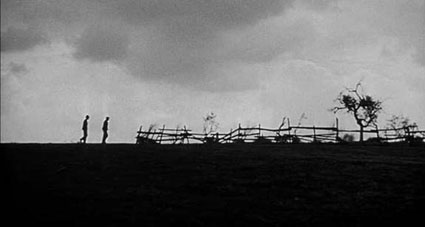
Marx and Steinbeck

Steinbeck Grapes of WrathKarl Marx died today in 1883. Though I consider communism to be largely a failed experiment, I do agree with many of Marx’ tenets. Here is the opening paragraph of The Communist Manifesto:

The history of all hitherto existing society is the history of class struggles. Freeman and slave, patrician and plebian, lord and serf, guild-master and journeyman, in a word, oppressor and oppressed, stood in constant opposition to one another, carried on an uninterrupted, now hidden, now open fight, a fight that each time ended, either in a revolutionary reconstitution of society at large, or in the common ruin of the contending classes.

Today in 1939, John Steinbeck’s The Grapes of Wrath was published. The following passage typifies the message of the book which made Steinbeck and his novel a capitalist-socialist battleground.

One man, one family driven from the land; this rusty car creaking along the highway to the west. I lost my land, a single tractor took my land. I am alone and I am bewildered. And in the night one family camps in a ditch and another family pulls in and the tents come out. The two men squat on their hams and the women and children listen. Here is the node, you who hate change and fear revolution. Keep these two squatting men apart; make them hate, fear, suspect each other…

When word of the book burnings, bannings, denouncements and death threats reached Congress, an Oklahoma representative rose up to “say to you, and to every honest, square-minded reader in America, that the painting Steinbeck made in this book is a lie, a black, infernal creation of a twisted, distorted mind.”

I don’t know if it makes me feel better or worse to know that truth that threatens the status quo has always been suppressed, and its proponents ever maligned. But remember that those on the fringe are the ones whose positions provoke a rethinking of assumptions, who spark epiphanies and change the course of human history. In the immortal words of another rabble rouser, Henry David Thoreau, Let your life be a counter-friction to stop the machine. Yes, let’s!

Getting GTD done, disposed, blogged

Keeping lists, creating 40something folders, making labels. The Heloise Hints of the Get Things Done (GTD) crowd concern moving the clutter out of your brain, unto paper, or now, the electronic frontier. As if those contents, ideas of yours presumably, thoughts you conceived, matters that merited your time to mull them over, needed disposing like so many packing kernels.

GTD is the ADD solution for your attention span. Get it out so you don’t have to think about it again. Say it, file it away, be done with it, get it done. Not done as in accomplished, done as in terminated. GTD is lobotomy by office supplies.

For workaholic fetishists, GTD appears to put substance over style, but the substance is style-conformity in disguise. A thought, spit out unto a post-it note is not the same as a thought. A list made of your favorite things, is not the equivalent of you enjoying those things.

I have a nagging feeling that a blog serves a similar GTD [dis]function: to vent our thoughts into the ether.

These might often be thoughts that would have done better to incubate with one another, to gel into broader perspectives. Like wine, I suspect they are really best uncorked after due time. Novelists perhaps draw these thoughts as needed to weave into their loom. Bloggers spin theirs into wads of yarn, hoping overnight they might be discovered to be made of pure gold.

Change Barack Obama can believe in

Barack Obama takes the lead from Hillary Clinton except for the Super Delegates
He didn’t bring change as a Senator, nor has he offered change as a political voice. But Barack Obama is campaigning on a platform of change. Is campaigning all he can do?

That’s what we have already with the Bush presidency, making paid appearances to groomed audiences, selling the Neocon agenda. Obama’s agenda is the same “change” which George W. offered. Same financiers, same agents of change. Obama supporters are displaying the same aw shucks gleeful optimism as the Bush supporters did. Obama may be smarter, so maybe America will just be more smartly screwed.

I have to say I do think Barack Obama, or a Barack Obama, could not fail to do a novel job of campaigning for a new image of America. If the task at hand is not about curbing American imperialist ambitions, at least we could do a better job convincing the rest of the world that our expansive authority is in their interest. Obama may be a better pitchman considering he’s not directly one of the profiteers. But as a candidate, not being a shyster may be something else to stand in Obama’s way of not getting to be president.

I’m thinking of course of other obstructions, such as the corporate media and the corporate parties. By corporate I mean corrupted, the corrupt spokesmen, experts, soothsayers, pollsters, social engineers, spin doctors, psychological manipulators and enterprising hacks.

Asked in 2004 about Bush’s aptitude for the presidency, the talking point seemed to be: “he’s the best man for the job.” Cynically they didn’t have to address whether he was bright or competent or knowledgeable, only that he’d perform the job as intended. And they were right. Bush gave it up to the munitions industry. He delivered the Middle East to big oil. He transferred the wealth of the people of the United States into private hands, all the while looking fully incompetent and not the least suspiciously larcenous. The American public has yet to grow wise.

So who’s the best man for the job in 2008? We’re going to let them tell us again. A short fat white dude, last seen hugging George W. and kissing his ring. He’ll be the last white hope against the menacing half-black dude with no track record, indoctrinated in a madrasse, but strangely the best the Dems could come up with as an alternative.

Iraqi Oil for Beginners

IRAQI OIL FOR BEGINNERS graphic novel by Jon Sack published by Voices in the Wilderness
Iraqi Oil for Beginners is artist-in-exile Jon Sack’s account of a century of Iraq history dominated by the fight over its oil. The 31-page comic can be ordered through the publisher Voices in the Wilderness UK or from Housmans.
 
Sack means his graphic novel to enlighten western readers about the real US and UK motives behind the occupation of Iraq, hopefully before Iraqi legislators are finally coerced into privatizing the oil industry and putting it all in US hands.

Gitmo spits its victims back out

America has one upped Franz Kafka, whose book The Trial once was the model look at heartless and soulless, authoritarian bureaucracy.

“Someone must have slandered Joseph K,” begins Franz Kafka’s classic novel “The Trial,” “for one morning, without having done anything truly wrong, he was arrested.”

But there was a trial in ‘The Trial’, and at Gitmo there is none. Eight men have recently been released from Gitmo, after being held all for 5 years or more without a trial! America the Beautiful…land of liberty….. Here are their stories.

An after thought, now. Shouldn’t these men at least be given American citizenship at this point if they wish, ICE (new name that La Migra goes by)? I bet they would have a story to tell their brainwashed American neighbors flying their flags.

No hope

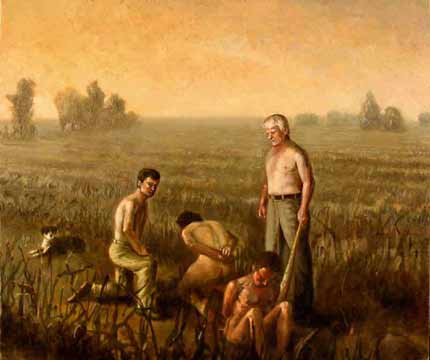
Jason Godeke illustrates George Saunders
This painting is called Me and Dad with captives. No explanation proffered. It’s by New Mexico artist Jason Godeke as part of a series about inhumanity.

The scene recreated here haunts me every time I look upon it, and reminds me of the George Saunders novella Bounty. From his collection CivilWarLand in bad decline written in 1996, Bounty describes a timeless America where slavery divides Normals and Flaweds. The story offers the reader a point of view with which he can identify, as any average imperfect person, facing a world were all laws, comforts and sympathies are against him. Escape leads only to the next captor’s depravity, (Normals being just as vulnerable to human frailty as the random genetically Flawed). For the unfortunates, damned by birth, there is no landscape or impending social reform to offer hope of reprieve.

Godeke’s farm scene suggests an identical terror. Two people, indistinguishable from any other, are bound and at the mercy of two others. One looks despondent, the other is reacting to a mistreatment. The two tormentors act with fresh enthusiasm for the power they wield over their captives, recording, as the painting’s title suggests, this snapshot for posterity. Not “our captives,” not “the captives,” but simply that opportunity’s “captives.” The field extends further than the victims’ voices can carry, there is no sanctuary on the horizon and time stands still.

Support Unsere Truppen

New World Waffen SS sticker
What does it mean to support the troops when they’re invading nations, detaining citizens and abusing prisoners in concentration camps? Are Americans going to be able to say they didn’t know about such concepts as sovereignty and due process under law? They were cheerleaders for it. Support the troops [who do it]! Sieg Heil!
 
In the Gunther Grass novel The Tin Drum, a civilian Nazi party member chokes on his party member pin trying to avoid recognition and retaliation at the hands of his Soviet partisan captor.
 
American dumbkofs will do better to peel those stickers off their cars now and beg their boys to get their asses home. Better than having to eat their warmongering words cum SUVs.

Borders & Ignoble

Retail citadelI found myself inside one of these boxes again, waiting for my wife to finish up some mall shopping I had tried to talk her out of. These 2 chains of supposed bookstores are like the Democrats and Republicans almost. Nobody can tell any real difference between the two of them.

Usually, I can pull up a chair, and browse their discount picture books for a bit, but this time they had the music (Christmas oriented for the season) cranked up double the usual volume, and it began to drive me a little crazy. It was really annoying, giving some, I guess, an incentive to buy quick and get out of there. I didn’t have that incentive though. These places aren’t really bookstores so much, and I have a hard time even finding anything much of interest to read inside, let alone for puchase.

What do I mean about Borders and its chain competition not really being bookstores? Well, I happened to come across what B & N describe themselves as being to explain some. Here it is…

“Our mission is to operate the best specialty retail business in America.”

This little pearl of thought sits upon all the computer screens as a screen saver, and also is meant to be personal inspiration for the mechanized robots, I meant customer assistants that work there. Nothing about books about these places really. It’s about specialty retail business.

Still, people who enter are most often confused. They do seem to believe that they are in a real bookstore. Actually, meany of the customers have nere seen an actual bookstore, or at least not close up between the shevles. Or even if they happened to stroll through the shelves of a real bookstore, have never really looked much to see what was on the shelves. So it’s kind of easy to see how so many get confused about thinking that they are inside an actual living breathing bookstore. But they aren’t!

They are inside a specialty retail business, that’s all. A good place to sit at a table with a laptop sipping coffee. A good place to buy some pop music crap for some demented teenager one might know. Or a place to pick up a calendar, or some blank sheets of paper for correspondence or a blank diary perhaps? Sure there are books there, but not so many real ones. Many are dedicated to computer programming, or things like Manja (6 shelves alone for that Japanese cartoon stuff and ‘role playing’).

There are categorized sections of everything, well almost. Theses stores are marked off like a MS windows filing system and give sort of a superficial encyclopedic appearance. But little old stupid me. The category that interest me most is Foreign Literature. But look around? I saw about 55 shelves titled Fiction and Literature, but strangely enough there’s hardly a book of foreign literature in this group! One would think upon browsing there, that only dimwitted American authors were alive today? Oh, and maybe a dimwitted Brit, or two.

Oh sure, maybe I should go over to the Science Fiction (20 shelves), Mystery (14 shelves), or Romance (10 shelves) sections. Nothing. Everybody is an America. Apparently they never write mysteries or SF in Italy or Spain, Brazil or Africa? If they do, certainly you can’t find it at an American specialty retail store, as opposed to a bookstore. Despite their supposed thoroughness, Borders and B & N apparently don’t carry certain stuff. Like foreign fiction. Go figure.

They also don’t carry current affairs (3 stacks) commentary much, unless it is Rush Limbaugh, Ann Coulter, that sort of gag-us quality of thought. One does find 13 stacks of Christian babble, too. 6 stacks of Tarot/ New Age 1 1/2 stacks of ‘Eastern Religions”. I am an atheist myself, so I looked for that stack? If you really want to befuddle employees in these stores, go up to one and ask to be directed to atheist oriented non-fiction. It’s great fun!

Or better yet, tell them that you have found the 10 stacks of Romance novels, but that you are a man and would like to see some male oriented porn instead. In book form. They might direct you to a shelf entitled Erotica (in some stores less regionally influenced by Dobson’s minions)? But then, you will see only gay ‘erotica’ there. Tell the clerk that you are not gay and would rather see their collection of porn books for heterosexual men. “Sorry, Sir, we only have magazines in that genre.” My reply is always, “What? The adult entertainment business is a multi-trillion dollar one, and yet your retail establishment carries not a porn book at all, outside of the gay ones!” And in Colorado Springs, not even much of that. Moo.

So, as an atheist heterosexual porn seeker who loves foreign lit, I am kind of out of luck at these specialty retail establishments. If I was a gay person, ‘spiritually inclined’, and didn’t know that a word was ever written outside US national boundaries, I might be in better shape, it seems. Or, if I could just get more interested in reading romance novels or military history, which is where the multiple stacks are. Yes, these stores don’t really seem to know that history has been passed through, unless it circled on a planet other than USA and has been interpretted by a Republican minded citizen. Not true, you can find some Democrats, too. Like Michael Moore, perhaps? But you’ll be much better off if you like books with names like ‘Semper Fi’, etc.

All in all, these retail establishments are more Americana than a retro Fifties Diner would be. But they are not quite being bookstores by doing that. In short, your prospective reading material is being grossly censored, and that’s why so few are purchasing from the shelves, and more just seem to be sipping their Lattes and Mochas, or talking on their cell phones while inside. Borders and Ignoble seems more like a telephone booth at times, than an actual bookstore.

At this point, one might object to my comments. “‘Erotica’ should be censored by B & N. Go to an ‘adult store’ if you want such filth!” But they don’t carry books there, I will moan. “And as an atheist, go to Hell and get some books by atheists.” Or to the philosophy stacks, as I have been directed by employees. As if all philosophers were automatically atheists, lol. Sorry, I’ll just order my atheist books from the Sceptical Inquirer magazine folk, thank you. And for a good porn book, I’ll just have to write my own, it seems. Though it’ll never get published, let alone make it to the B & N.

And if I might want to know how the French care about life, I will just have to confine myself to Agatha Christie, it seems. That is after I get through with the latest from Ann Coulter I purchased at the specialty retail store. She tells it like it is about the French. And she is informative about the Arab mind, too.

Nobody reads anymore, no publishers publish anymore, and no specialty retail establishments even stock what little is still around. The last time I have seen much of interest in a bookstore/ specialty retainl establishment was in a University of Texas dorm building. They had a little used bookstore that had some used books of African writers that had been published by the African Studies Dept of the UT.

Americans once wrote great literature back before the ’50s. Unfortunately, all those works are out of print and unavailable mainly. The lit was too red, it seems. Efforts to get them reprinted have flopped miserably. We have become a specialty retail people, and not a literate one. Oops, my wife is back from the mall. Got to end my rant. Bless her heart, she bought nothing at all. Or, maybe she did and is just hiding it away from Scrooge?

Your Homeland Security Bill

A friend and I were talking about how to make the American taxpayer take more ownership of our nation’s outrages over the seas. By making him pay for it. It’s not a new idea, to mandate that government not dip into the deficit to fund its wars –burrow furiously is more like it, with an earth mover– but here’s a novel application. Let’s make every expense of war come straight out of the taxpayer’s pocket.
 
We call it the Homeland Security Bill. Not the Homeland Security Bill, but your Homeland Security Bill.

YHSB would be a bill that comes every month to you, like your electric bill or cable bill or credit card minimum payment. This bill would be for the costs of war, calculated up to the minute, and prorated across our population in whatever fashion seems fair, each expected to pay their share.

And the costs should be itemized. A new venture against a new foe? Additional R&D overhead. New medical procedures to treat the head trauma injuries of our wounded troopers? Elective of course. As would be alms for the poor invadees.

The Homeland Security Bill should be effective no matter which cheerleading team you are on. If you are pro-war, then you get to feel pro-war. “By Golly, it’s my war and I’m going to pay for it!”

White Native Americans

A branch of our local library is hosting a discussion about a recent work of popular fiction, One Thousand White Women by Jim Fergus. I’m thinking of stopping by to puke.

The novel begins by alluding that its unspeakable historical premise has factual merit. ALLEGEDLY the author’s great great aunt, a “May Dodd”, left a journal about her life experience, hidden all these years in shame by her family. The author takes it upon himself to tell her repressed tale, and because it is the untold fate of 999 nameless more, we infer it to be one of the dark secrets of the American national identity.

The story concerns 1000 white women who were traded to the Indians in exchange for resettlement and peace. One thousand white women. The title does grab you. It has undeniable where-the-white-women-at? appeal.

Another prominant White IndianThe phenomena also shares something with the White Indian Series by Donald Porter. That’s a western series for readers who couldn’t be bothered to know about the lives of the Native Americans unless they were WHITE Native Americans. These readers can’t sympathize with Indians as victims, unless they are white Indian victims, and then preferably of course they should be white Indian victims of Indians.

The mythic white Indian abounds on film, and it’s not just Indians. The story of The Last Samurai had to be about a white man in Japan (Tom Cruise) or who would care?

Here you have the fate of 1000 women sold, sacrificed or let loose down the river to become Indian squaws. One part romantic fantasy, several parts feminist grudge, (1000 parts rape fetish?), all at the hands of red heathen.

To be fair, the author does provide a disclaimer that 1000 white women never changed hands. Fergus implies however that an original Cheyenne proposal to be given 1000 white women was real and asks readers to ponder, what if?

If true, it’s a piercing lesson on the embarrassing legacy that can come from sarcasm.

How deeply insulting is it to suggest that Indian tribal leaders would have asked the army negotiators for white women? And as a condition of laying down their weapons? I think it’s indescribably racist to be susceptible to thinking that Indian fathers and braves sought white mates with whom to raise new generations of their tribe.

Neither in-breeding nor poor education are excuses enough for this prevalent self-centered bigotry.

Chain emails and Saint George

About this time each year for some reason, a certain friend of mine gets into a panic and passes on chain emails in renewed hope that she will come into money. Last year she sent everyone the It-Really-Works-Bill-Gates-Will-Pay-You-$275K email. A day later she apologized.

Does she recognize what all these chain emails are really about? Chain letters and Ponzi schemes in the cyber world take on an entirely different purpose than they used to have through snail-mail. And they succeed wildly. Chain emails circulate for large computers to map contact patterns and networks.

When you forward a chain email, its authors track whom you sent it to and how quickly. That’s why the email is launched in the first place, to chart enormous networks of who is in touch with whom. At the most superficial level, the process determines which email addresses are valid. To information traders the emails reveal social connections and hierarchies.

We’re not just talking about the pyramid schemes, we’re also talking about all those clever emails you get in the morning that apparently made one of your relatives smile. Where did you think those come from? Did you think some cherub with time on his hands, sitting at his kitchen window in Hawaii, composed a funny story addressing impish Americanisms which through myriad cyber degrees of separation found itself in your aunt’s incoming email? You’d be right. Except about the cherub’s clients who are watching the logs as their whimsical package bounces along.

Especially if the message involves embedded graphics. Server-side graphic files telegraph the whereabouts of an email in real time. Often graphic files are disguised as text. (MSN and Hotmail track all their email using embedded graphics that pretend to be text. Given that linked files require many times more computation power than does text, disguising the files AS TEXT would seem to concede that Microsoft knows we would not appreciate what they are doing.)

Don’t you wonder why at the end of each and every one of those clever emails, the funny sentiment is always followed by urgent instruction to send it on?

Do these authors think that they are just SO funny, you MUST pass their work on to everyone you know? Do you see this at the end of newspaper columns or comic strips? Do book authors end their novels by recommending that you tell all your friends to buy a copy or face three years of bad luck?

If an email asks to be sent on, and you want to, and must, here’s how to do it without contributing to the fortunes of direct marketers and spammers. Copy and paste just the text into a fresh email, then send it on. If there is a graphic, save it to disk and then attach it.

2.
Or put it on the web. Here’s an email forwarded to me from my good friend Paulette. 🙂 It’s an old joke, presented this go-round as Saint George.

Michael Crichton World Outlaw

The kingdom of non-aligned animals should move to extradite Michael Crichton for his piece o’ crap novel which denied global warming. Not because he denied anything, nor fabricated a parallel non-ailing planet, but because his work was propaganda made to incite support for the fuel and chemical barrons who have still plenty of poison to sow. Crichton was lauded as having been a gifted scientist before he became a best-selling author. It suggested by the talking heads that Crichton was perhaps a more talented scholar than he was a novelist, to give his poohpooing of Global Warming more credibility. This statement addressed really the fact that his books are by no means literary. Crichton’s successful, he’s rich, but by no means brilliant. He takes home $60 million a year from publication and movie rights to his string of so popular novels. Apparently that’s not enough.

The Salvation of Yasch Siemens

The Salvation of Yasch Siemens. The title of Armin Wiebe’s novel gives the story away. I would like to postulate that this coming of age tale depicts a young Mennonite imperiled by worldy lures. Yasch faces selfishness, sexual idolatry and homosexuality until he is ultimately saved by the guidance of a woman who asserts nature’s will with his semen.

Enron blaming the victims

Enron super-con man, alleged, Jeff Skilling, explained today that the Enron bubble need never have burst if only investors had held their confidence in Enron’s outrageous marketplace success. On paper.

I recently saw a presentation by one of the authors of ENRON: THE SMARTEST GUYS IN THE ROOM. While this journalist did not mince words regarding the criminality of those “smarts,” there did seem to be an underlying appreciation that Enron’s market innovations were “marvelous and novel” methods of trading energy stocks. Never mind that the only function that Enron served was to squeeze more money from between the supply and the demand.

So the world at large is responsible for bringing Enron crashing down? That is the Neocon economic M.O. isn’t it? Hold up the economy on purely the fumes of consumer confidence. If the economy falters, it’s the fault of consumers too afraid to shoulder more credit card debt.

Isn’t this like the bank-robber saying that if only no-one would call the cops, the robbery would be ongoing?

Or isn’t this quite like the Emperor’s New Clothes? So long as no one tells the emperor he has no clothes, the Emperial procession could still be processing forward, albeit naked.