Walmart has reportedly closed a smattering of its stores across the country citing “plumbing problems”. The mega-retailer’s media cohorts are reporting the mystery but won’t say that the closures coincide with stores which have been hardest hit by labor unrest. It turns out, Walmart has opted to close its doors where employees have most successfully organized “Fight For Fifteen” actions. By suddenly closing the stores Walmart preempted further organizing and punished the upstarts by laying off all the store’s employees with only a few hours notice. Walmart claims the plumbing problems will take a half year to fix. I think what remains of Walmart’s workforce has been given a wonderful opportunity to retaliate in kind. What of these plumbing problems? Are Walmart’s other stores showing signs of plumbing problems too? Might a larger wave of plumbing problems be induced? I think Walmart’s union-busting advisors have loosed a weapon that will prove more consequential for Walmart than its wage-slave victims. Foisted on their own petard, I believe is the expression. Petard in this case is substituted by toilette. Walmart customers can even get in on the act, err, investigation, for free. Come to Walmart empty handed, find a bag of cement in the hardware aisle, proceed to the public bathroom, flush it presto plumbing problem. Citizen plumbers can turn this plumbing mystery into a plumbing thriller.
Tag Archives: Bing
Tulsa sheriff lets yahoo donors ride along to taser or shoot black suspects

So. Black man Eric Harris was killed by Oklahoma lawmen last week, accidentally shot in the back by a deputy who thought he was triggering his taser, not his gun. He didn’t unholster one instead of the other, he actually jumped out of the cruiser with a weapon in each hand! Funny thing about that deputy… –But first let’s make clear that the Tulsa County Sheriff has already excused the officer of wrongdoing, likewise all the other cops who piled on Harris as he died, mocking his final breath. “Fuck your breath” said one cop as they kneed Harris’ face into the pavement until he died.
So triggerman Robert Bates was an “Advance Reserve” deputy, a retired insurance exec who donated to the department and thus was allowed to ride along with regular deputies and use tasers on people and other fun stuff. Bates used to be a cop in 1965 when black men were lynched more regularly –so White America believed. It turns out nothing has changed since those days. Except that today’s lynch mobs are not open to the public, today extrajudicial executioners have to wear a badge. Naturally good ol’ boys like Bates want a piece of that action.
It turns out, to be a volunteer donor-deputy is also a license to kill. Bates flat out shot Eric Harris as he laid on the ground. Though lawmen were converging from multiple vehicles and the winded Harris was already prone, someone called “taser, taser”. That’s when Bates pulled his gun instead and fired. Then Deputy Oops said “I’m sorry. I shot him!” The other deputies now pretend they didn’t hear Bates, or the gunshot. That is their defense for climbing on the victim and hastening his death.
The whole gruesome execution is on video, which the Tulsa County Sheriff supplied to make the case that the officers acted appropriately.
One of these days, a video will emerge of a deputized-donor riding along wearing a white hood and a noose.
Hillary is declaring her candidacy. Are we ready for another white president?

Not that another token Black president would be better. Was it really worth it, having a first Black president, considering he expanded the Neoliberal nonsense instead of curbing it? Why do we now expect a token woman will deliver our hoped-for, bait-and-switched change? Especially from a woman who comes from within the establishment. As with Barack Obama’s brief stunt in the Senate, we’ve had a glimpse of Hillary’s record already. It’s awful. It’s corrupt. Hillary Clinton behaves like she’s beyond the law or morality. She’s a Neoliberal, Zionist, loan officer for the bankers. I know feminists want a female president. Everyone would like to see a woman in the White House. I don’t know any position of authority in which I wouldn’t be more confident to see a woman. Maybe even ANY WOMAN except Hillary. How about let’s hold a lottery instead of an election. Ladies only. African American women only. Draft Cynthia McKinney 2016.
Office of Colorado Springs N.A.A.C.P. bombed for some reason but whose?

COLORADO SPRINGS, CO- Someone tried to firebomb the Springs office of the NAACP yesterday. A pipebomb failed to ignite a can of gasoline left leaning behind the building located in Hillside, the city’s traditionally African American community. The FBI claims to be interested in a white male with a beat up pickup truck. Across the state activists are alarmed at the subdued media response and lack of outrage. I’d like to explain why this bomb, a typical racist MO, has yet to resonate here.
Colorado Springs is a cesspool of racism and institutionalized Jim Crow, but as usual the drama is complicated and local minority leaders are hesitant to point the finger. As befits the Springs’ conservative nature, the local NAACP is headed by a card-carrying member of the TEA PARTY! You heard that right! For a decade this NAACP chapter has been estranged from its black community, mostly poor and neither elitist nor libertarian. Dr. James Tucker, publisher of the African American Voice, accuses this NAACP of complacency, malfeasance and worse. He claims they are under investigation so it’s hard to predict whose interests might be served by torching the office.
I’m certainly not suggesting that Colorado Springs bigots are not also too stupid to attack an ineffectual organization, but taking the high road means profiting from no accusation until the facts are in.
Outsiders may want to protest, but locals also don’t want to be mistaken for supporting this chapter, which has actively de-escalated calls for solidarity with Ferguson. Actually the national NAACP too deployed counter-insurgency tactics to calm the Ferguson rebellion.
Whether yesterday’s bombing was authentic or not, we don’t need to get to the bottom of it before repudiating the usual pattern of racist acts of domestic terrorism against colored institutions. Of course we must also protest that the corporate media looks the other way. But let’s not get distracted from figuring out that today’s N.A.A.C.P. has no Association with the Advancement of Colored People unless they’re bourgeois.
Obama: Yeah, we tortured some folks, and now we’re gonna bomb some folks
NOOOOOOOOOOO!!! Not another war on Iraq! Not an intervention, not precision bombing, not saving a minority from massacre. If this rescue of Iraqis was about preventing a massacre, the US would be intervening with airstrikes against Israel. Last week President Obama admited that Bush-era CIA interrogation methods were torture. “We tortured some folks,” spoken with the same expectation of impunity as he now launches another illegal war.
Arrests reach seven at weekly protest of two-faced Denver bookstore

DENVER, COLORADO- Occupy Denver’s Tim Calahan and I were arrested and jailed at last Friday’s boycott action against the Tattered Cover Bookstore. This marked Tim’s third citation for drumming, my second, and Janet Matzen’s first. For drumming. Disturbing the peace is what the DPD charges. We maintain the DPD are curbing our free speech. SO NOW I want to tell you the story of how famed civil rights attorney David Lane came to represent us.
The story begins Thursday before the Anonymous “Every5th” march. A couple friends and I were feeling trepidatious about the Anonymous march because the previous month’s Every5th had been abruptly curtailed by riot police. Several Anons were arrested and a number more pepper-sprayed, and so we wondered if we couldn’t get legal advice about how to assert our First Amendment rights without surrendering ourselves to jail. Also on our minds were the past two fridays at the Tattered Cover where citations had been handed out, drums confiscated, and warnings given that if we drummed again, the next arrestees would be jailed. So we went to the celebrated lawyer’s office and tried our luck with the receptionist.
I told her we were activists who were having a rough time with police, we thought they were violating our civil liberties, could David Lane be of any help? She looked at us increduously. We couldn’t just walk in she said, we had to take a card, we had to call in, we could leave a message, they’d call back if they were interested, they might not call back at all, it certainly wouldn’t be right away.
We told her time was rather of the essence, these arrests were as predictable as they were egregious, we didn’t know where to turn and these arrests seemed to present the kind of case in which David Lane specialized. The receptionist repeated her instructions in a tone that reflected she was not sure I wasn’t simply a lunatic.
After making more prolonged and embarassing enteaties, I finally submitted to following her instructions but I insisted too on leaving a written note which gave me further time to expound on our DPD versus the people predicament.
Turning to make our exit, I explained that we would be leaving her office to join a protest at which chances were pretty good we were going to be arrested, but that the next night at the Tattered Cover, we were most definitely going to be arrested. The receptionist made the oddest face as she search my eyes for some sign that I spoke her language. “Wait just a minute please” she told us as she beat a hasty retreat. Within that minute she returned to say “David Lane will meet you in the conference room.”
We spent the next half hour relating the details of our past arrests, how each had been captured on video, in front of witnesses, and how we’d been warned arrests would continue. We offered too that the police were also videotaping assiduously and that their accounts would match ours. David Lane assured us if we were conducting ourselves as we presented and if arrests endured, he would represent us and anyone else who stepped up to the plate. If exercising our freedom of speech became a risk where it was supposed to be right, standing up for us was the least he could do.
That night we hit the streets with a renewed sense of confidence, and the following evening at the Tattered Cover was an empowering experience like no other. As you can see in the photo above, we couldn’t keep our eyes off the half dozen cruisers keeping watch on us. Would they swoop in? When would they descend on us? The anticipation was frustrating. Who should film, who should take whose keys and phone, who did or didn’t want to beat the drum. We were ready for jail, we were ready to tell the officers, as we had the weeks before, that they couldn’t do what they were doing, we knew our rights. This time we could assure our DPD captors that they were asking for trouble in messing with Occupy. Stay tuned!
Continued arrest of Denver Occupiers confirms homeless protest is battle line where people’s rights offend Capitalism

DENVER, COLORADO- The weekly demonstration in front of the Tattered Cover bookstore ended once again in arrests yesterday. Three Occupiers were arrested, led away in handcuffs, detained at length in the back of police cruisers, and given citations for “disturbing the peace”. Four bucket drums were confiscated, presumably one was beating itself. This marks the fifth arrest at the Tattered Cover action. Arrestees at earlier homeless ban actions had been cited for jaywalking, some required to post bond before being released from jail. Many more Friday night actions have been interrupted and truncated by a DPD show of force or DPD warning that a complaint gave officers license to restrict “time, place and manner” of what the activists decry as their free speech. Although a bullhorn was initially taken last night and declared to be evidence, it was returned to the Occupiers, probably for fear the act would too literally represent their voices being silenced.
The Tattered Cover disturbers of the peace are scheduled for arraignment on June 16 and June 30. These cases are not unrelated to other Denver protest arrestees who have court dates on June 10 for obstructing traffic and other technicalities contrived to intimidate political demonstrations. Until defendants are able to confront their charges, the DPD appears determined to arrest protesters at will.
The Putin knock-knock joke is easier to find than his Kremlin speech on Crimea
This graphic circulating on the interwebs is a lot easier to find than Vladimir Putin’s March 18 address to the Kremlin about the referendum in Crimea after the Western coup in Ukraine. Bypassing dubious translations excerpted on Capitalist media sites, here is a transcript of his speech direct from the Kremlin. Putin is no hero, but he threatens US-EU banking hegemony, gives asylum to Edward Snowden, and executes zero people with drones.
QUOTING PRESIDENT OF RUSSIA VLADIMIR PUTIN:
Federation Council members, State Duma deputies, good afternoon. Representatives of the Republic of Crimea and Sevastopol are here among us, citizens of Russia, residents of Crimea and Sevastopol!Dear friends, we have gathered here today in connection with an issue that is of vital, historic significance to all of us. A referendum was held in Crimea on March 16 in full compliance with democratic procedures and international norms.
More than 82 percent of the electorate took part in the vote. Over 96 percent of them spoke out in favour of reuniting with Russia. These numbers speak for themselves.
To understand the reason behind such a choice it is enough to know the history of Crimea and what Russia and Crimea have always meant for each other.
Everything in Crimea speaks of our shared history and pride. This is the location of ancient Khersones, where Prince Vladimir was baptised. His spiritual feat of adopting Orthodoxy predetermined the overall basis of the culture, civilisation and human values that unite the peoples of Russia, Ukraine and Belarus. The graves of Russian soldiers whose bravery brought Crimea into the Russian empire are also in Crimea. This is also Sevastopol – a legendary city with an outstanding history, a fortress that serves as the birthplace of Russia’s Black Sea Fleet. Crimea is Balaklava and Kerch, Malakhov Kurgan and Sapun Ridge. Each one of these places is dear to our hearts, symbolising Russian military glory and outstanding valour.
Crimea is a unique blend of different peoples’ cultures and traditions. This makes it similar to Russia as a whole, where not a single ethnic group has been lost over the centuries. Russians and Ukrainians, Crimean Tatars and people of other ethnic groups have lived side by side in Crimea, retaining their own identity, traditions, languages and faith.
Incidentally, the total population of the Crimean Peninsula today is 2.2 million people, of whom almost 1.5 million are Russians, 350,000 are Ukrainians who predominantly consider Russian their native language, and about 290,000-300,000 are Crimean Tatars, who, as the referendum has shown, also lean towards Russia.
True, there was a time when Crimean Tatars were treated unfairly, just as a number of other peoples in the USSR. There is only one thing I can say here: millions of people of various ethnicities suffered during those repressions, and primarily Russians.
Crimean Tatars returned to their homeland. I believe we should make all the necessary political and legislative decisions to finalise the rehabilitation of Crimean Tatars, restore them in their rights and clear their good name.
We have great respect for people of all the ethnic groups living in Crimea. This is their common home, their motherland, and it would be right – I know the local population supports this – for Crimea to have three equal national languages: Russian, Ukrainian and Tatar.
Colleagues,
In people’s hearts and minds, Crimea has always been an inseparable part of Russia. This firm conviction is based on truth and justice and was passed from generation to generation, over time, under any circumstances, despite all the dramatic changes our country went through during the entire 20th century.
After the revolution, the Bolsheviks, for a number of reasons – may God judge them – added large sections of the historical South of Russia to the Republic of Ukraine. This was done with no consideration for the ethnic make-up of the population, and today these areas form the southeast of Ukraine. Then, in 1954, a decision was made to transfer Crimean Region to Ukraine, along with Sevastopol, despite the fact that it was a federal city. This was the personal initiative of the Communist Party head Nikita Khrushchev. What stood behind this decision of his – a desire to win the support of the Ukrainian political establishment or to atone for the mass repressions of the 1930’s in Ukraine – is for historians to figure out.
What matters now is that this decision was made in clear violation of the constitutional norms that were in place even then. The decision was made behind the scenes. Naturally, in a totalitarian state nobody bothered to ask the citizens of Crimea and Sevastopol. They were faced with the fact. People, of course, wondered why all of a sudden Crimea became part of Ukraine. But on the whole – and we must state this clearly, we all know it – this decision was treated as a formality of sorts because the territory was transferred within the boundaries of a single state. Back then, it was impossible to imagine that Ukraine and Russia may split up and become two separate states. However, this has happened.
Unfortunately, what seemed impossible became a reality. The USSR fell apart. Things developed so swiftly that few people realised how truly dramatic those events and their consequences would be. Many people both in Russia and in Ukraine, as well as in other republics hoped that the Commonwealth of Independent States that was created at the time would become the new common form of statehood. They were told that there would be a single currency, a single economic space, joint armed forces; however, all this remained empty promises, while the big country was gone. It was only when Crimea ended up as part of a different country that Russia realised that it was not simply robbed, it was plundered.
At the same time, we have to admit that by launching the sovereignty parade Russia itself aided in the collapse of the Soviet Union. And as this collapse was legalised, everyone forgot about Crimea and Sevastopol – the main base of the Black Sea Fleet. Millions of people went to bed in one country and awoke in different ones, overnight becoming ethnic minorities in former Union republics, while the Russian nation became one of the biggest, if not the biggest ethnic group in the world to be divided by borders.
Now, many years later, I heard residents of Crimea say that back in 1991 they were handed over like a sack of potatoes. This is hard to disagree with. And what about the Russian state? What about Russia? It humbly accepted the situation. This country was going through such hard times then that realistically it was incapable of protecting its interests. However, the people could not reconcile themselves to this outrageous historical injustice. All these years, citizens and many public figures came back to this issue, saying that Crimea is historically Russian land and Sevastopol is a Russian city. Yes, we all knew this in our hearts and minds, but we had to proceed from the existing reality and build our good-neighbourly relations with independent Ukraine on a new basis. Meanwhile, our relations with Ukraine, with the fraternal Ukrainian people have always been and will remain of foremost importance for us.
Today we can speak about it openly, and I would like to share with you some details of the negotiations that took place in the early 2000s. The then President of Ukraine Mr Kuchma asked me to expedite the process of delimiting the Russian-Ukrainian border. At that time, the process was practically at a standstill. Russia seemed to have recognised Crimea as part of Ukraine, but there were no negotiations on delimiting the borders. Despite the complexity of the situation, I immediately issued instructions to Russian government agencies to speed up their work to document the borders, so that everyone had a clear understanding that by agreeing to delimit the border we admitted de facto and de jure that Crimea was Ukrainian territory, thereby closing the issue.
We accommodated Ukraine not only regarding Crimea, but also on such a complicated matter as the maritime boundary in the Sea of Azov and the Kerch Strait. What we proceeded from back then was that good relations with Ukraine matter most for us and they should not fall hostage to deadlock territorial disputes. However, we expected Ukraine to remain our good neighbour, we hoped that Russian citizens and Russian speakers in Ukraine, especially its southeast and Crimea, would live in a friendly, democratic and civilised state that would protect their rights in line with the norms of international law.
However, this is not how the situation developed. Time and time again attempts were made to deprive Russians of their historical memory, even of their language and to subject them to forced assimilation. Moreover, Russians, just as other citizens of Ukraine are suffering from the constant political and state crisis that has been rocking the country for over 20 years.
I understand why Ukrainian people wanted change. They have had enough of the authorities in power during the years of Ukraine’s independence. Presidents, prime ministers and parliamentarians changed, but their attitude to the country and its people remained the same. They milked the country, fought among themselves for power, assets and cash flows and did not care much about the ordinary people. They did not wonder why it was that millions of Ukrainian citizens saw no prospects at home and went to other countries to work as day labourers. I would like to stress this: it was not some Silicon Valley they fled to, but to become day labourers. Last year alone almost 3 million people found such jobs in Russia. According to some sources, in 2013 their earnings in Russia totalled over $20 billion, which is about 12% of Ukraine’s GDP.
I would like to reiterate that I understand those who came out on Maidan with peaceful slogans against corruption, inefficient state management and poverty. The right to peaceful protest, democratic procedures and elections exist for the sole purpose of replacing the authorities that do not satisfy the people. However, those who stood behind the latest events in Ukraine had a different agenda: they were preparing yet another government takeover; they wanted to seize power and would stop short of nothing. They resorted to terror, murder and riots. Nationalists, neo-Nazis, Russophobes and anti-Semites executed this coup. They continue to set the tone in Ukraine to this day.
The new so-called authorities began by introducing a draft law to revise the language policy, which was a direct infringement on the rights of ethnic minorities. However, they were immediately ‘disciplined’ by the foreign sponsors of these so-called politicians. One has to admit that the mentors of these current authorities are smart and know well what such attempts to build a purely Ukrainian state may lead to. The draft law was set aside, but clearly reserved for the future. Hardly any mention is made of this attempt now, probably on the presumption that people have a short memory. Nevertheless, we can all clearly see the intentions of these ideological heirs of Bandera, Hitler’s accomplice during World War II.
It is also obvious that there is no legitimate executive authority in Ukraine now, nobody to talk to. Many government agencies have been taken over by the impostors, but they do not have any control in the country, while they themselves – and I would like to stress this – are often controlled by radicals. In some cases, you need a special permit from the militants on Maidan to meet with certain ministers of the current government. This is not a joke – this is reality.
Those who opposed the coup were immediately threatened with repression. Naturally, the first in line here was Crimea, the Russian-speaking Crimea. In view of this, the residents of Crimea and Sevastopol turned to Russia for help in defending their rights and lives, in preventing the events that were unfolding and are still underway in Kiev, Donetsk, Kharkov and other Ukrainian cities.
Naturally, we could not leave this plea unheeded; we could not abandon Crimea and its residents in distress. This would have been betrayal on our part.
First, we had to help create conditions so that the residents of Crimea for the first time in history were able to peacefully express their free will regarding their own future. However, what do we hear from our colleagues in Western Europe and North America? They say we are violating norms of international law. Firstly, it’s a good thing that they at least remember that there exists such a thing as international law – better late than never.
Secondly, and most importantly – what exactly are we violating? True, the President of the Russian Federation received permission from the Upper House of Parliament to use the Armed Forces in Ukraine. However, strictly speaking, nobody has acted on this permission yet. Russia’s Armed Forces never entered Crimea; they were there already in line with an international agreement. True, we did enhance our forces there; however – this is something I would like everyone to hear and know – we did not exceed the personnel limit of our Armed Forces in Crimea, which is set at 25,000, because there was no need to do so.
Next. As it declared independence and decided to hold a referendum, the Supreme Council of Crimea referred to the United Nations Charter, which speaks of the right of nations to self-determination. Incidentally, I would like to remind you that when Ukraine seceded from the USSR it did exactly the same thing, almost word for word. Ukraine used this right, yet the residents of Crimea are denied it. Why is that?
Moreover, the Crimean authorities referred to the well-known Kosovo precedent – a precedent our western colleagues created with their own hands in a very similar situation, when they agreed that the unilateral separation of Kosovo from Serbia, exactly what Crimea is doing now, was legitimate and did not require any permission from the country’s central authorities. Pursuant to Article 2, Chapter 1 of the United Nations Charter, the UN International Court agreed with this approach and made the following comment in its ruling of July 22, 2010, and I quote: “No general prohibition may be inferred from the practice of the Security Council with regard to declarations of independence,” and “General international law contains no prohibition on declarations of independence.” Crystal clear, as they say.
I do not like to resort to quotes, but in this case, I cannot help it. Here is a quote from another official document: the Written Statement of the United States America of April 17, 2009, submitted to the same UN International Court in connection with the hearings on Kosovo. Again, I quote: “Declarations of independence may, and often do, violate domestic legislation. However, this does not make them violations of international law.” End of quote. They wrote this, disseminated it all over the world, had everyone agree and now they are outraged. Over what? The actions of Crimean people completely fit in with these instructions, as it were. For some reason, things that Kosovo Albanians (and we have full respect for them) were permitted to do, Russians, Ukrainians and Crimean Tatars in Crimea are not allowed. Again, one wonders why.
We keep hearing from the United States and Western Europe that Kosovo is some special case. What makes it so special in the eyes of our colleagues? It turns out that it is the fact that the conflict in Kosovo resulted in so many human casualties. Is this a legal argument? The ruling of the International Court says nothing about this. This is not even double standards; this is amazing, primitive, blunt cynicism. One should not try so crudely to make everything suit their interests, calling the same thing white today and black tomorrow. According to this logic, we have to make sure every conflict leads to human losses.
I will state clearly – if the Crimean local self-defence units had not taken the situation under control, there could have been casualties as well. Fortunately this did not happen. There was not a single armed confrontation in Crimea and no casualties. Why do you think this was so? The answer is simple: because it is very difficult, practically impossible to fight against the will of the people. Here I would like to thank the Ukrainian military – and this is 22,000 fully armed servicemen. I would like to thank those Ukrainian service members who refrained from bloodshed and did not smear their uniforms in blood.
Other thoughts come to mind in this connection. They keep talking of some Russian intervention in Crimea, some sort of aggression. This is strange to hear. I cannot recall a single case in history of an intervention without a single shot being fired and with no human casualties.
Colleagues,
Like a mirror, the situation in Ukraine reflects what is going on and what has been happening in the world over the past several decades. After the dissolution of bipolarity on the planet, we no longer have stability. Key international institutions are not getting any stronger; on the contrary, in many cases, they are sadly degrading. Our western partners, led by the United States of America, prefer not to be guided by international law in their practical policies, but by the rule of the gun. They have come to believe in their exclusivity and exceptionalism, that they can decide the destinies of the world, that only they can ever be right. They act as they please: here and there, they use force against sovereign states, building coalitions based on the principle “If you are not with us, you are against us.” To make this aggression look legitimate, they force the necessary resolutions from international organisations, and if for some reason this does not work, they simply ignore the UN Security Council and the UN overall.
This happened in Yugoslavia; we remember 1999 very well. It was hard to believe, even seeing it with my own eyes, that at the end of the 20th century, one of Europe’s capitals, Belgrade, was under missile attack for several weeks, and then came the real intervention. Was there a UN Security Council resolution on this matter, allowing for these actions? Nothing of the sort. And then, they hit Afghanistan, Iraq, and frankly violated the UN Security Council resolution on Libya, when instead of imposing the so-called no-fly zone over it they started bombing it too.
There was a whole series of controlled “colour” revolutions. Clearly, the people in those nations, where these events took place, were sick of tyranny and poverty, of their lack of prospects; but these feelings were taken advantage of cynically. Standards were imposed on these nations that did not in any way correspond to their way of life, traditions, or these peoples’ cultures. As a result, instead of democracy and freedom, there was chaos, outbreaks in violence and a series of upheavals. The Arab Spring turned into the Arab Winter.
A similar situation unfolded in Ukraine. In 2004, to push the necessary candidate through at the presidential elections, they thought up some sort of third round that was not stipulated by the law. It was absurd and a mockery of the constitution. And now, they have thrown in an organised and well-equipped army of militants.
We understand what is happening; we understand that these actions were aimed against Ukraine and Russia and against Eurasian integration. And all this while Russia strived to engage in dialogue with our colleagues in the West. We are constantly proposing cooperation on all key issues; we want to strengthen our level of trust and for our relations to be equal, open and fair. But we saw no reciprocal steps.
On the contrary, they have lied to us many times, made decisions behind our backs, placed us before an accomplished fact. This happened with NATO’s expansion to the East, as well as the deployment of military infrastructure at our borders. They kept telling us the same thing: “Well, this does not concern you.” That’s easy to say.
It happened with the deployment of a missile defence system. In spite of all our apprehensions, the project is working and moving forward. It happened with the endless foot-dragging in the talks on visa issues, promises of fair competition and free access to global markets.
Today, we are being threatened with sanctions, but we already experience many limitations, ones that are quite significant for us, our economy and our nation. For example, still during the times of the Cold War, the US and subsequently other nations restricted a large list of technologies and equipment from being sold to the USSR, creating the Coordinating Committee for Multilateral Export Controls list. Today, they have formally been eliminated, but only formally; and in reality, many limitations are still in effect.
In short, we have every reason to assume that the infamous policy of containment, led in the 18th, 19th and 20th centuries, continues today. They are constantly trying to sweep us into a corner because we have an independent position, because we maintain it and because we call things like they are and do not engage in hypocrisy. But there is a limit to everything. And with Ukraine, our western partners have crossed the line, playing the bear and acting irresponsibly and unprofessionally.
After all, they were fully aware that there are millions of Russians living in Ukraine and in Crimea. They must have really lacked political instinct and common sense not to foresee all the consequences of their actions. Russia found itself in a position it could not retreat from. If you compress the spring all the way to its limit, it will snap back hard. You must always remember this.
Today, it is imperative to end this hysteria, to refute the rhetoric of the cold war and to accept the obvious fact: Russia is an independent, active participant in international affairs; like other countries, it has its own national interests that need to be taken into account and respected.
At the same time, we are grateful to all those who understood our actions in Crimea; we are grateful to the people of China, whose leaders have always considered the situation in Ukraine and Crimea taking into account the full historical and political context, and greatly appreciate India’s reserve and objectivity.
Today, I would like to address the people of the United States of America, the people who, since the foundation of their nation and adoption of the Declaration of Independence, have been proud to hold freedom above all else. Isn’t the desire of Crimea’s residents to freely choose their fate such a value? Please understand us.
I believe that the Europeans, first and foremost, the Germans, will also understand me. Let me remind you that in the course of political consultations on the unification of East and West Germany, at the expert, though very high level, some nations that were then and are now Germany’s allies did not support the idea of unification. Our nation, however, unequivocally supported the sincere, unstoppable desire of the Germans for national unity. I am confident that you have not forgotten this, and I expect that the citizens of Germany will also support the aspiration of the Russians, of historical Russia, to restore unity.
I also want to address the people of Ukraine. I sincerely want you to understand us: we do not want to harm you in any way, or to hurt your national feelings. We have always respected the territorial integrity of the Ukrainian state, incidentally, unlike those who sacrificed Ukraine’s unity for their political ambitions. They flaunt slogans about Ukraine’s greatness, but they are the ones who did everything to divide the nation. Today’s civil standoff is entirely on their conscience. I want you to hear me, my dear friends. Do not believe those who want you to fear Russia, shouting that other regions will follow Crimea. We do not want to divide Ukraine; we do not need that. As for Crimea, it was and remains a Russian, Ukrainian, and Crimean-Tatar land.
I repeat, just as it has been for centuries, it will be a home to all the peoples living there. What it will never be and do is follow in Bandera’s footsteps!
Crimea is our common historical legacy and a very important factor in regional stability. And this strategic territory should be part of a strong and stable sovereignty, which today can only be Russian. Otherwise, dear friends (I am addressing both Ukraine and Russia), you and we – the Russians and the Ukrainians – could lose Crimea completely, and that could happen in the near historical perspective. Please think about it.
Let me note too that we have already heard declarations from Kiev about Ukraine soon joining NATO. What would this have meant for Crimea and Sevastopol in the future? It would have meant that NATO’s navy would be right there in this city of Russia’s military glory, and this would create not an illusory but a perfectly real threat to the whole of southern Russia. These are things that could have become reality were it not for the choice the Crimean people made, and I want to say thank you to them for this.
But let me say too that we are not opposed to cooperation with NATO, for this is certainly not the case. For all the internal processes within the organisation, NATO remains a military alliance, and we are against having a military alliance making itself at home right in our backyard or in our historic territory. I simply cannot imagine that we would travel to Sevastopol to visit NATO sailors. Of course, most of them are wonderful guys, but it would be better to have them come and visit us, be our guests, rather than the other way round.
Let me say quite frankly that it pains our hearts to see what is happening in Ukraine at the moment, see the people’s suffering and their uncertainty about how to get through today and what awaits them tomorrow. Our concerns are understandable because we are not simply close neighbours but, as I have said many times already, we are one people. Kiev is the mother of Russian cities. Ancient Rus is our common source and we cannot live without each other.
Let me say one other thing too. Millions of Russians and Russian-speaking people live in Ukraine and will continue to do so. Russia will always defend their interests using political, diplomatic and legal means. But it should be above all in Ukraine’s own interest to ensure that these people’s rights and interests are fully protected. This is the guarantee of Ukraine’s state stability and territorial integrity.
We want to be friends with Ukraine and we want Ukraine to be a strong, sovereign and self-sufficient country. Ukraine is one of our biggest partners after all. We have many joint projects and I believe in their success no matter what the current difficulties. Most importantly, we want peace and harmony to reign in Ukraine, and we are ready to work together with other countries to do everything possible to facilitate and support this. But as I said, only Ukraine’s own people can put their own house in order.
Residents of Crimea and the city of Sevastopol, the whole of Russia admired your courage, dignity and bravery. It was you who decided Crimea’s future. We were closer than ever over these days, supporting each other. These were sincere feelings of solidarity. It is at historic turning points such as these that a nation demonstrates its maturity and strength of spirit. The Russian people showed this maturity and strength through their united support for their compatriots.
Russia’s foreign policy position on this matter drew its firmness from the will of millions of our people, our national unity and the support of our country’s main political and public forces. I want to thank everyone for this patriotic spirit, everyone without exception. Now, we need to continue and maintain this kind of consolidation so as to resolve the tasks our country faces on its road ahead.
Obviously, we will encounter external opposition, but this is a decision that we need to make for ourselves. Are we ready to consistently defend our national interests, or will we forever give in, retreat to who knows where? Some Western politicians are already threatening us with not just sanctions but also the prospect of increasingly serious problems on the domestic front. I would like to know what it is they have in mind exactly: action by a fifth column, this disparate bunch of ‘national traitors’, or are they hoping to put us in a worsening social and economic situation so as to provoke public discontent? We consider such statements irresponsible and clearly aggressive in tone, and we will respond to them accordingly. At the same time, we will never seek confrontation with our partners, whether in the East or the West, but on the contrary, will do everything we can to build civilised and good-neighbourly relations as one is supposed to in the modern world.
Colleagues,
I understand the people of Crimea, who put the question in the clearest possible terms in the referendum: should Crimea be with Ukraine or with Russia? We can be sure in saying that the authorities in Crimea and Sevastopol, the legislative authorities, when they formulated the question, set aside group and political interests and made the people’s fundamental interests alone the cornerstone of their work. The particular historic, population, political and economic circumstances of Crimea would have made any other proposed option – however tempting it could be at the first glance – only temporary and fragile and would have inevitably led to further worsening of the situation there, which would have had disastrous effects on people’s lives. The people of Crimea thus decided to put the question in firm and uncompromising form, with no grey areas. The referendum was fair and transparent, and the people of Crimea clearly and convincingly expressed their will and stated that they want to be with Russia.
Russia will also have to make a difficult decision now, taking into account the various domestic and external considerations. What do people here in Russia think? Here, like in any democratic country, people have different points of view, but I want to make the point that the absolute majority of our people clearly do support what is happening.
The most recent public opinion surveys conducted here in Russia show that 95 percent of people think that Russia should protect the interests of Russians and members of other ethnic groups living in Crimea – 95 percent of our citizens. More than 83 percent think that Russia should do this even if it will complicate our relations with some other countries. A total of 86 percent of our people see Crimea as still being Russian territory and part of our country’s lands. And one particularly important figure, which corresponds exactly with the result in Crimea’s referendum: almost 92 percent of our people support Crimea’s reunification with Russia.
Thus we see that the overwhelming majority of people in Crimea and the absolute majority of the Russian Federation’s people support the reunification of the Republic of Crimea and the city of Sevastopol with Russia.
Now this is a matter for Russia’s own political decision, and any decision here can be based only on the people’s will, because the people is the ultimate source of all authority.
Members of the Federation Council, deputies of the State Duma, citizens of Russia, residents of Crimea and Sevastopol, today, in accordance with the people’s will, I submit to the Federal Assembly a request to consider a Constitutional Law on the creation of two new constituent entities within the Russian Federation: the Republic of Crimea and the city of Sevastopol, and to ratify the treaty on admitting to the Russian Federation Crimea and Sevastopol, which is already ready for signing. I stand assured of your support.

Little Jail Cell on the Prairie: behind the peabrained small dwelling movement
Humans can live in very small spaces, usually not by choice. Tiny Homes are essentially jail cells for serving house arrest. They present as tidy abbreviated domiciles, organized as one might a fascist closet. Photos set them in pastoral settings, though we all know the reality would look more like Kowloon. Stacked coffins would be the next permutation and then you really wouldn’t have to bother with plumbing.
Can we hope the Ukraine government snipers hit OTPOR & CIA provocateurs egging on the fascist suppremacists?
Protesters are being killed in Kiev, and revolutionaries enthusiasts are buying into the Western Media narrative. Even Democracy Now is parroting the theme, describing the demonstrations as opposing their government’s rejecting closer ties to the European Union. “Closer ties?” Ukraine was rejecting growing indebtedness to EU banks, favoring a bailout from Putin instead. Let’s remember that Senator John McCain jetted to Kiev to rally the uprising, seeing it as part of the rolling “freedom movement” not coincidentally encircling Russia, the former Soviets now no longer foe to Capitalism but rival. Unfortunate developments have led to government snipers firing at the “rebels” many of whom are dupes but many too are supremacist fascists not particularly misguided about US-EU hegemony. Perhaps we can find consolation in the hope that Ukrainian snipers were able to hit the OTPOR and CIA provocateurs coordinating the urban warriors.
I support all popular uprisings, but unfortunately US covert ops have picked up on our game. The only way to insulate rebellions against Western provocateurs is to build movements around political ideology they will not embrace. For the onlooker, ideology is also the means to discern destabilitation projects parading as protest. If the offending government is anti-Western-Capitalism, our counterinsurgency ops are there. Of course Socialist, Islamic, or non-World Bank client regimes are not imune to being authoritarian, but hardly more so than the Capitalist empire. Often US adversaries are forced to authoritarian measures by US covert ops working to destabilize them.
WWII air veterans of Doolittle Raiders celebrate 71 years of bombing civilians

I read 30 Seconds Over Tokyo when I was still a war-playing kid, before I would understand the mischievous consequences of the Doolittle Raiders B-25 bombers deploying without their bombsights. This was to prevent US war-making advantages falling into enemy hands but it also precluded dropping bombs with accuracy. I’m pretty certain the account for young readers also didn’t explain why over a quarter of the squadron’s bombs were of the incidiary cluster variety. Readers today know what those are for. Doolittle claimed to be targeting military sites in Japan’s capitol, but “invariably” hit civilian areas including four schools and a hospital. Of the American fliers captured, three were tried and executed by the despicable “Japs”, who considered the straffing of civilians to be war crimes. After the war, the US judged the Japanese officers responsible, as if their verdict was a greater injustice against our aviators’ “honest errors”. Today we rationalize our systemic overshoot policy as “collateral damage”.
Every year since WWII, Doolittle’s commandos are feted for their milestone bombing mission. This Veterans Day is to be the last due to their advanced ages. But it is fitting, because isn’t it time Americans faced what we’re celebrating? There’s no denying it took suicidal daring, but the Doolittle Raid inaugurated what became a staple of US warfare, the wholesale terrorizing of civilians from on high, with impunity and indifference. To be fair, the American public has always been kept in the dark. American aircraft have fire-bombed civilians at every diplomatic opportunity since 1942, and a Private Manning sits in the brig for trying to give us a chance to object.
We now know that the Doolittle Raid didn’t turn the tide, nor shake Japanese resolve. It was a retalliation for the attack on Pearl Harbor, intended to boost US morale as if to say, America wasn’t defeated. Kinda like why and how we struck back at Afghanistan after 9/11, just as indiscriminately.
The “Mark Twain” ersatz bombsight
The Norden bombsight was a closely guarded US secret weapon. An airstrike without it would today be like lobotomizing so-called smart bombs, and deciding to opt for imprecision bombing. The official army record recounts that a subsitute sighting mechanism was improvised for the raid, dubbed the “Mark Twain” and judged to be effective enough. Now a bad joke. Indochina and Wikileaks-wisened, we know the mendacity of that assessment. The vehemently anti-imperialist, anti-racist Twain would not have been honored.
Twain satirized Western so-called Enlightenment thus: “good to fire villages with, upon occasion”.
Post-postwar hagiographies of the raid have suggested the improvised bombsight was better suited to low-altitude missions than the Norden model. That conclusion is easily dismissed because the device was used only for the Doolittle run and never after. The sight’s designer, mission aviator C. Ross Greening, offered a explanation for why he named the device after Mark Twain in his pothumously published memoir Not As Briefed. He didn’t.
The bombsight is named the “Mark Twain” in reference to the “lead line” depth finder used on the Mississippi River paddle wheelers in bygone days.
Because its design was so simple, we’re left to suppose. Greening’s bombsight was named for the same “mark” which Samuel Langhorne Clemens adopted as his celebrated pen name. I find it disingeneous to pretend to repurpose an archaic expression whose meaning was already eclipsed by the household name of America’s most outspoken anti-imperialist. Who would believe you named your dog “Napoleon” after a French pastry?
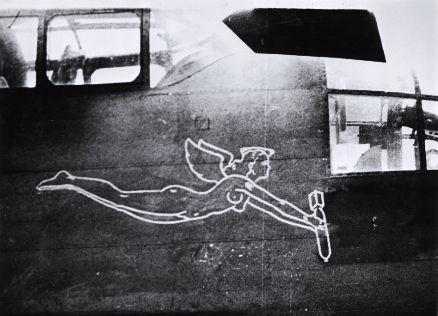
We are given another glimpse into Greening’s sense of humor by how he named his plane, the “Hari-Kari-er” ready to deal death by bomb-induced suicide. Greening’s B-25 is the one pictured above, with the angelic tart holding a bomb aloft. Greening’s plane was another that carried only incendiary ordnance.
Much was made of the sight’s two-piece aluminum construction, reportedly costing 20 cents at the time compared to the $10,000 Norden. This provided the jingoist homefront the smug satisfaction perhaps, combining a frugality born of the Depression with the American tradition of racism, that only pennies were expensed and or risked on Japanese lives.
War Crimes
Targeting civilians, taking insufficient care to avoid civilian casualties, using disproportunate force, acts of wanton retaliation, and the use of collective punishment are all prohibited by international convention. They are war crimes for which the US prosecutes adversaries but with which our own military refuses to abide. Americans make much of terrorism, yet remain blind to state terrorism. Doolittle’s historic raid, judged by the objective against which it is celebrated as a success, was an act of deliberate terrorism.
Forcing the Japanese to deploy more of their military assets to protect the mainland sounds like a legitimate strategy, except not by targeting civilians to illustrate the vulnerability, nor by terrorizing the population, one of Doolittle’s stated aims. He called it a “fear complex”.
It was hoped that the damage done would be both material and psychological. Material damage was to be the destruction of specific targets with ensuing confusion and retardation of production. The psychological results, it was hoped, would be the recalling of combat equipment from other theaters for home defense, the development of a fear complex in Japan, improved relationships with our Allies, and a favorable reaction in the American people.
There is no defending Japan’s imperialist expansion in the Pacific, and certainly not its own inhumanity. The Japanese treated fellow Asians with the same racist disregard with which we dispatched Filipinos. While Americans point in horror at how the Japanese retalliated against the Chinese population for the Doolittle Raid, we ignore that Doolittle purposely obscured from where our bombers were launched, leaving China’s coast as the only probably suspect.
To be fair, most of Doolittle’s team was kept in the dark about the mission until they were already deployed. I hardly want to detract from the courage they showed to undertake a project that seemed virtually suicidal. But how long should all of us remain in the dark about the true character of the Doolittle Raid?
Out of deference for the earlier generation of WWII veterans, those in leadership, certain intelligence secrets were kept until thirty years after the war. Unveiled, they paint a very different picture of what transpired. The fact that the US knew the German and Japanese codes from early on revealed an imbalance not previously admitted, as an example.
About the Doolittle Raid, much is already openly documented, if not widely known. The impetus for the raid was public knowledge, the evidence of its intent in full view.
BY DESIGN
In the aftermath of Pearl Harbor, American newspapers were already touting offers of cash rewards for whoever would be the first to strike back at Japan. President Roosevelt expressed a deliberate interest in hitting the Japanese mainland, in particular Tokyo, to retaliate for the Japanese strike against Pearl Harbor, never mind it had been a solely military target.
Plans were made to exploit the Japanese homeland’s vulnerability to fire, as ninety percent of urban structures were made of paper and wood. Writes historian William Bruce Jenson:
In his “confidential” meeting with reporters back in November, Marshall had declared that the US would have no cavil about burning Japan’s paper cities.
For the Doolittle Raid, a bombing strategy was developed to overwhelm the fire department of his target, the Shiba ward.
A former naval attache in Tokyo told Doolittle: “I know that Tokyp fire department very well. Seven big scattered fires would be too much for it to cope with.”
As lead plane, Doolittle’s role was to literally blaze the way. Fellow pilot Richard Joyce told Nebraska History Magazine in 1995:
The lead airplane, which was going to have Doolittle on board as the airplane commander, was going to be loaded with nothing but incendiaries -2.2 pound thermite incendiaries- in clusters. They drop these big clusters and then the straps break and they spray, so they set a whole bunch of fires. He was to be the pathfinder and set a whole bunch of fires in Tokyo for pathfinding purposes.
Doolittle’s report outlined his objective more formally:
one plane was to take off ahead of the others, arrive over Tokyo at dusk and fire the most inflammable part of the city with incendiary bombs. This minimized the overall hazard and assured that the target would be lighted up for following airplanes.
Greening paints the most vivid picture, of burning the Japanese paper houses to light the way:
Doolittle planned to leave a couple of hours early, and in the dark set fire to Tokyo’s Shiba ward … the mission’s basic tactic had been that Doolittle would proceed alone and bomb a flammable section of Tokyo, creating a beacon in the night to help guide following planes to their targets.
Doolittle’s copilot Lt Richard Cole, told this to interviews in 1957:
Since we had a load of incendiaries, our target was the populated areas of the west and northwest parts of Tokyo.
After the bombers had left on their raid, and before news got back about whether or not they accomplished it, the Navy crew on the carrier USS Hornet already sang this song, which went in part:
Little did Hiro think that night
The skies above Tokyo would be alight
With the fires that Jimmy started in Tokyo’s dives
To guide to their targets the B-25s.
When all of a sudden from out of the skies
Came a basket of eggs for the little slant eyes
Incendiaries

Most of the bombers were loaded with three demolition bombs and an incendiary cluster bomb. Some of the planes carried only incendiaries. According to Doolittle’s official report of the raid, here were some of their stated objectives:
Plane no. 40-2270, piloted by Lt. Robert Gray:
thickly populated small factories district. … Fourth scattered incendiary over the correct areaPlane No. 40-2250, Lt. Richard Joyce:
Incendiary cluster dropped over thickly populated and dense industrial residential sector immediately inshore from primary target. (Shiba Ward)“The third dem. bomb and the incendiary were dropped in the heavy industrial and residential section in the Shiba Ward 1/4 of a mile in shore from the bay and my tat.”
Aircraft 40-2303, Lt Harold Watson:
the congested industrial districts near the railroad station south of the Imperial PalaceAC 40-2283, David Jones:
the congested area Southeast of the Imperial Palace
Even though the planned night raid became a daytime mission, Doolittle did not alter his original role, intended to light the way for the following planes. His target remained the Shiba District of Tokyo. His own plane: “changed course to the southwest and incendiary-bombed highly inflammable section.”
Doolittle’s report included a description of the incendiary bombs:
The Chemical Warfare Service provided special 500 incendiary clusters each containing 128 incendiary bombs. These clusters were developed at the Edgewood Arsenal and test dropped by the Air Corps test group at Aberdeen. Several tests were carried on to assure their proper functioning and to determine the dropping angle and dispersion. Experimental work on and production of these clusters was carried on most efficiently.
As has become an aerial bombardment tradition, crews were let to inscribe messages on the bombs about to be dropped. Accounts made the most of these chestnuts: “You’ll get a BANG out of this.” And “I don’t want to set the world on fire –only Tokyo.”
These details, which reveal the intentions of the raid, were not made known to the public immediately. The Doolittle Raid was planned and executed in secret, with US government and military spokesmen denying knowledge of the operation even in its aftermath. The first word to reach the American public came from the New York Times, citing Japanese sources:
Enemy bombers appeared over Tokyo for the first time in the current war, inflicting damage on schools and hospitals. Invading planes failed to cause and damage on military establishments, although casualties in the schools and hospitals were as yet unknown. This inhuman attack on these cultural establishments and on residential districts is causing widespread indignation among the populace.
This report was dismissed as propaganda. When Japan declared its intention to charge the airman it had taken captive with war crimes, the US protestations redoubled. The accusations were belittled even as our own reports conceded to the possibilities.
Lieutenant Dawson’s Thirty Seconds Over Tokyo was the first published account of the raid. Printed less than a year after the event, wartime-sensitive details such as the phony guns made of broomstick handles poking out the back were left out. Targets were also not specified, but a candor remained, probably intended to be threatening. Lawson described the 500-pound incendiaries as “something like the old Russian Molotov Breadbasket”, and related US naval attache Jurika’s advice:
“If you can start seven good fires in Tokyo, they’ll never put them out,” Jurika promised us. … “I wouldn’t worry too much about setting fires in flimsy-looking sections of Tokyo,” he said. “The Japanese have done an amazing job of spreading out some of their industries, instead of concentrating them in large buildings. There’s probably a small machine shop under half of these fragile-looking roofs.”
“Flimsy” became Lawson’s keyword for the residential areas. Here Lawson described dropping his third and fourth bombs, when he saw their corresponding red light indicators:
The third red light flickered, and, since we were now over a flimsy area in the southern part of the city, the fourth light blinked. That was the incendiary, which I knew would separate as soon as it hit the wind and that dozens of small fire bombs would molt from it.
I was satisfied about the steel-smelter and hoped the other bombs had done as well. There was no way of telling, but I was positive that Tokyo could have been damaged that day with a rock.
Our actual bombing operation, from the time the first one went until the dive, consumed not more than thirty seconds.
Thus: Chance of hitting civilian homes: 50/50.
Charges of Excessive Force could be expected, because
blame the victim for being weaker than: a rock.
Care taken to avoid innocent casualties: 30 seconds.
In a later afterword, Lawson blamed Tokyo for having insufficient bomb shelters.
After the war, US occupation forces recovered Japanese records which documented the losses attributed to the Doolittle Raid: fifty dead, 252 wounded, ninety buildings. Besides military or strategic targets, that number included nine electric power buildings, a garment factory, a food storage warehouse, a gas company, two misc factories, six wards of Nagoya 2nd Temporary Army Hospital, six elementary or secondary schools, and “innumerable nonmilitary residences”.
Strafing
Japan accused the fliers of indescriminate strafing civilians. The US countered that defending fighters were responsible for stray bullets when their gunfire missed the bombers. That’s very likely, except the raiders were candid about their strafing too. Lawson:
I nosed down a railroad track on the outskirts of the city and passed a locomotive close enough to see the surprised face of the engineer. As I went by I could have kicked myself for not giving the locomotive’s boiler a burst of our forward 30-calibre guns, then I remembered that we might have better use for the ammunition.
A big yacht loomed up ahead of us and, figuring it must be armed, I told Thatcher to give it a burst. We went over it, lifted our nose to put the tail down and Thatcher sprayed its deck with our 50-calibre stingers.
Greening’s account of firing on a sailor, raises the moral ambiguity of air warfare with which few airmen grapple. By virtue that technology allows it, combatants become slave to a predetermined outcome:
When we attacked the next patrol boat, a Japanese sailor threw his hands up as if to surrender. I guess he expected us to stop and take him prisoner. We shot him and left this boat smoking too.
The Medals
Friendship Medals exchanged between Japan and the US found themselves requisitioned for Doolittle’s Raid:
Several years prior to the war, medals of friendship and good relationship were awarded to several people of the United States by the Japanese government. In substance these medals were symbolic of the friendship and cooperation between the nations and were to represent the duration of this attitude. It was decided by the Secretary of the Navy, Mr. Frank Knox, that the time was appropriate to have these medals returned. They had been awarded to Mr. Daniel J. Quigley, Mr. John D. Laurey, Mr. H. Vormstein and Lt. Stephen Jurkis.
After arrangements had been made and the medals secured, a ceremony was held on the deck of the Hornet during which the medals were wired to a 500 lb. bomb to be carried by Lt. Ted Lawson and returned to the Japanese government in an appropriate fashion.
Lawson’s plane no 40-2261 dropped that bomb on an “industrial section of Tokyo” omitting to mention that Japan’s industry was still a post-feudal cottage industry.
“The medals were subsequently delivered in small pieces to their donors in Tokyo by Lt. Ted Lawson at about noon, Saturday, April 18, 1942.”
–Mitscher, M.A. Letter Report to Commander Pacific Fleet.
“Through the courtesy of the War Department your Japanese medal and similar medals, turned in for shipment, were returned to His Royal Highness, The Emperor of Japan on April 18, 1942.”
–Knox, F. Letter Report to Mr. H. Vormstein
Springs Democrats hope democracy loses to State Senator John Morse
COLORADO SPRINGS, CO- International news headlines read “G-20 Summit Overshadowed by Syrian Crisis” but not in Colorado Springs! Here every politically active Democrat was working to defeat a recall of state senate leader John Morse, a democrat though barely. Morse is a duly elected, if unlikely, representative of conservative El Paso County, being assailed by a mutinous GOP majority angered by his stewarding of gun control legislation. The NRA has backed a blitzkrieg recall campaign, aided by local Republican officials and judges who connived election parameters designed to coax a recall victory. But who’s on the side of right, presumably with the people?
Democrats are crying foul. They’re cursing corporate money and lobbyist-villain NRA, complaining that recalls shouldn’t be motivated by ideological reasons. Really? Are recalls only for impropriety? I’d prefer corruption be answered with criminal charges, and scandal should produce resignations. I’d say ideology would be the most appropriate reason for a recall, especially if it’s about a difference of opinion about the idea of representational government.
Ironically, the underdog’s usual complaint is that incumbents are always impossible to unseat, even when they act in total defiance of their constituents. Don’t you hate that? The irony is compounded because no one will deny that the overwhelming majority in these neighborhoods oppose any abridgement of the Second Amendment right to wave guns. Senator Morse acted in defiance of that interest. Undemocratic, is what he was, as his critics accuse.
We like to vilify the NRA as the worst of special interest lobbies, but one can’t accuse them of being corporate, they’re famously supported by members! The NRA is probably the single MOST democratic of lobbying outfits. The fact that the corporate media loves to demonize the NRA should give one pause about who’s looking after who.
What’s very odd is that the NRA-backed Republicans are targeting a term-limited Democrat who has only a year left in office. What’s that about? Pundits speculate that an NRA win would be symbolic, so it’s worth the money they’re spending. Maybe. It certainly will reinforce the corporate narrative that legislators daren’t cross the NRA. How convenient.
But the recall campaign, a national story now, is not so mysterious if you think about the Kabuki nature of our two party theater. The defense campaign contrived for Senator Morse is a disquietingly artificial shade for grassroots. Against “People Against Morse” the Democrats countered with: “A Whole Lot of People For Morse”, which is certainly a catchy slogan for a politician looking to highten his visibility for a run at a next office, but for locals it lacks the ring of authenticity. What viewers outside the area don’t know is that John Morse has been a superlatively minor functionary, with a reputation for backstabbing more than leading, and certainly no one to bother defending or applauding, even if his name came up, which it rarely did.
Before this recall, people hadn’t cared enough to even think about John Morse, except to spout the usual lesser of evils rap, when there is consensus, it’s that Morse isn’t the creepiest person they knew, depending on who you asked. Now the louse has “a whole lot of people” behind him, how odd. That’s a whole lot of people who don’t care that Morse misrepresented his district, who don’t care that he’s been a war-monger right-of-center pro-industry shill. Because he’s of their party, Democrats want to propel Morse upward. And this is how malignant anti-democratic corporate bureaucrats roll into power.
To judge by the press, and the surge of effort to combat the recall effort, it appears John Morse does have “a whole lot” of support. Propaganda and amnesia.
If the recall succeeds, Americans will be shown that money does influence elections and special interest groups are adversaries to be feared. Sounds like an honest lesson. If the recall succeeds, the displeasure of the gun-loving voters of Colorado Springs will have been heard. If the recall fails, you’ll have Democrats unironically cheering against what Democracy is supposed to look like. In either event, John Morse comes out looking like somebody likes him, and that’s a step in the wrong direction for those of us without a political machine.
Israel attacks Syria! Surely Syria will be accorded the right to defend itself
It’s the pretext Israel uses whenever it strikes Gaza or Lebanon or European cafes or US ships: the right to defend itself. In fact the right to do it preemptively is how Israel justifies bombing Iran or assassinating Iranian scientists. So where do the rights of others begin? Has not Syria a right to defend her lands and people against this unprovoked attack? Is Israel so cynical to pretend it doesn’t have to declare war on its neighbors because it shares “most belligerent status” with all of them? –even, let’s add, with half its citizens. Of course the US stands with Israel, they share a foreign policy of illegal, preemptive, and/or covert war. No doubt Israel has already calculated that Syria is in no position to retaliate. All Western powers knwo enough to only strike the defenseless. Apparently Israel has grown impatient with the Western-backed attempted overthrow of strongman Assad and fears the astroturf public support will wane before regime change is achieved. Assassination, covert coups, wars of aggression, used to be illegal.
De mortuis nil nisi bonum is well and good but upholds the victor’s narrative
It’s probably older than Latin. “De mortuis nil nisi bonum” is a propriety imposed at death, as if to offer the deceased a false comfort that, however fraudulent the pretense of their reputation in life, they can take it with them. Well, most commonly, “Don’t speak ill of the dead” is a reminder not to rehash petty grievances in the face of another’s mortality, death being after all mankind’s mutual adversary. It’s a pact I suppose that’s meant to benefit everyone equally. But the tradition does sort of cement history as written by the victor, where revisionists dare not speak truth to power while that authority is alive.
I saw the adage used in a disturbingly upbeat eulogy for Margaret Thatcher in this week’s New Yorker. Disturbing because it was fair handed enough, but mired like New York City, insulated by the growing wealth and cultural disparity, in the Western master narrative. I find that not speaking ill of the dead is completely irresponsible with historic figures like Margaret Thatcher and Henry Kissinger. If we are prevented from hanging them to hasten their death, we must at the minimum garrotte their memory before it’s set in stone. To beat a dead horse.
Teen Dzhokhar Tsarnaev is diminishing excuse for Boston police state tyranny
We pick up yesterday’s story with Watertown and Boston under lockdown, it’s a prison term go figure, while paramilitary police conduct door to door warrantless searches to find an immigrant teen, college wrestler Dzhokhar Tsarnaev, said to be armed and extremely dangerous, who fled from last night’s firefight with the police which left his older brother Tamerlan alive then dead. The two brothers are said by police to be suspects in the Boston Marathon bombing, said to have killed an MIT campus officer, said to have lobbed grenades during a car chase, yet law enforcement spokesmen are not saying how 19-yr old Dzhokhar escaped the ten minute shootout. Now they’re treating him like Rambo. What, did he leap away wearing a bandolier loaded with pressure cookers? Won’t somebody cry BULLSHIT!?
Won’t some lawyer please jump on this menacing language coming from the Boston Police, quoted in the Boston Globe:
“This kid is obviously going down fighting,” the official said. “You can rest assured the cops are looking for a fight right now.”
Being raised in the Chechen war zone may give Dzhokhar an edge in evading the militarized joint forces pursuing him, but the profile emerging as reporters hound his relatives and friends hardly describes how and why he could be expected to pose further threat, he didn’t kill the driver whose car they highjacked, he didn’t shoot up the marathon or the 7-11.
Police are now admitting themselves into houses to check for booby-traps as if their evadee is a Johnny Poison-Appleseed with an unlimited cache of ordnance he can draw from like in a video game. At best their scared teen is bleeding to death in some corner, a fate for which Chechnya was excellent training. Otherwise this manhunt is a highly inappropriate pretext for normalizing police state tyranny.
ADDENDUM: THIS
“Turn off your cellphone” or police will light you up like the next Chris Dorner

STREAMING OF CONSCIOUSNESS ON BOSTON MARATHON BOMBING DENOUEMENT: DID YOU KNOW that law enforcement can tell you “If you want to live, turn off your cell phone.”? That was shouted to an AP reporter tonight in Watertown, just before he heard officers shout “Fire in the hole” as they encircled a suspect. So they’re chasing a marathon attendee whose face matches the surveillance video, who they can refer to as a suspect with impunity if he’s dead so they’re about to Dorner his ass (Remember Chris Dorner? Remember Waco? The gov-lit inferno, not the gov-neglected “Waco” redux.) to beyond facial recognition. Boston Marathon Bombing solved.
Do cellphone beacons mess with police pyrotechnics like we pretend they do aviation electronics? Or was the officer concerned the reporter might be tweeting, enabling a suspect to triangulate his encirclement on Twitter? I bet the officer just wanted to shoot the reporter if he didn’t jump on command.
We know police have the authority to tell television reporters to turn their cameras away lest they jeopardize a SWAT stakeout. Apparently cameras also endanger oil spill cleanups. Are media reporters complicit or simply that stupid? A recent consensus of journalists asserted to me “they’re stupid” but that’s probably a cop-out, odd expression that, to protect media assets who are as enslaved by the system as police officers or oil workers.
Who knows what’s going on in Boston, er, Watertown. Major sports teams are attributed to greater metropolitan areas. Crimes are branded to satellite communities like Watertown, Mayflower, Aurora, Littleton, aka Boston, Little Rock, Denver, Denver. The point of a press pass is that your objective is supposed to be respected by the authorities. In a police state it means they can treat you like an embedded bitch.
Update: “First suspect” reported to be in custody was captured, released, and also killed. A police briefing just clarified all three congruent incongruities. Police scanner suggests the captured suspect detonated himself in custody. Twitter beat television media by an hour in relaying the development that the first suspect was killed.
Update 2: Hospital which admitted suspect won’t reveal his identity, or extent of his injuries, or his age. They were embarrassed sufficiently to admit they could confirm his gender. Most interesting, the doctor who addressed the press would not say if he worked on the suspect, but described how he had witnessed the gun fight from his home, then dressed and reported to the emergency room before the suspect was transported there. Hmm.
Now they’re evacuating blocks of Watertown, so it’s going to be a MOVE climax. Follow police instructions yes, but call them on bullshit. So far the entire narrative has come from authorities, including the inconsistencies which go unchallenged.
Crowdsourced Boston Marathon pics point to usual paramilitary suspects
YES, MORE CSI DIY CROWDSOURCING PHOTO-ANALYSIS! If you could anticipate that criminologists would scrutinize surveillance videos for who left what at the scene, or who behaved oddly after a bomb blast, you could probably plan to evade detection, by, for example, bringing a larger bag to conceal the bag you’re going to drop off.
A soft bag would be least suspicious but would need a reinforced shell to pretend it wasn’t empty afterward. That might explain some of the bag photos cropping up online, some of them dismissed because they’re mistaken for before shots that were really taken after. It turns out the after photo of the Craft/Seal Special Ops at the Boston Marathon Bombing isn’t problematic because their full packs appear to be weightless. Yet the bags are bulging at the same time. Would your elbow be bent, or would you be rocking on your heels, bearing a full load? What are they packing, parachutes?
No need to compare their uniform backpacks with scraps of bags shredded by the bomb inside. We need to ask, what WERE these guys carrying, before then after? Obviously it wasn’t first aid equipment or anything that came in handy for this deployment, apparently. Don’t you find it disturbing that the unspeakable happened at the Boston Marathon, everyone’s scrambling to be helpful and these two authorized attendees don’t appear to have anything to do?
Gazette not only blocks story of local fracking protest, but assigns goon to disrupt it

COLORADO SPRINGS, COLO.- This past Tuesday saw the largest demonstration yet against oil and gas drilling in Colorado Springs and the ugly practice of hydraulic fracturing. Several dozen fractivists allied with Colorado Springs Citizens for Community Rights (CSCCR) and Occupy were joined on the steps of City Hall by Colorado College students who’d marched from their campus with banners and posters denouncing fracking. You didn’t hear about it did you? After the rally everyone filled the council chamber to give 3-minute personal testimonials that ran for two hours. That too went unreported, in particular by the Gazette, who had two reporters in the room, one who’d conducted interviews, and both who took notes during the presentations. But neither produced a story — an odd dereliction of responsibility you might say. Even more odd was the role played by Gazette editorial page writer Wayne Laugesen who ultimately opined on the city council’s decision to postpone their vote, as “caving to anti-energy activists”, offering no details. Laugesen actually interjected himself into the rally outside as a lone counter-protester, interrupting interviews being filmed for TV stations KRDO and KKTV. When they asked Laugesen to let them do their job, the goon replied that he was doing his. So the Gazette was not satisfied to blackout reports of the community rally, but aimed to sabotage it as well.
Whose job was Wayne Laugesen doing exactly? Was he confusing his publisher for the overseers who hold his tether: the pro-industry PR mill Americans For Prosperity? It could be. But the Gazette is now hardly distinguishable from contract stink-tank corporate profiteering advocacy. When conservative mummies Freedom Communications supervised the Gazette, the pretense was tax-cutting, tax-dodging libertarianism. The Gazette’s new owner made his billions in corrupt oil, real estate and privatization schemes, so prospects are looking dim for the region’s daily paper to offer authentic news. Having their editorial hit-man on the ground as a pretend grass root weed killer is a disturbing development that must not go unchallenged.
Contrast the Gazette blackout and the relatively tepid coverage by the weekly Independent, with the monthly African American Voice which gave the previous anti-fracking rally a front-page, full color, two-page article, whose theme accurately accused the city council of being “out of touch with the community.” AAV publisher James Tucker has participated in several of the rallies and understands whose interest he represents.
On the other hand, Tuesday was the umpteenth time the Gazette has ignored the rising community effort to oppose the oil and gas lobby. For many months of city council meetings, Gazette correspondent Daniel Chacon has dutifully sat at his stenographer’s seat and witnessed testimony after testimony from community voices without reporting a single one. On one particularly contentious council meeting in November, Chacon summarized the council’s decision without mentioning the overwhelming community presence.
This Tueday’s voices were joined by EPA-whistleblower Wes Wilson and environmental activist Phil Doe, who’d come from Denver to testify before the Colorado Springs council. Phil Doe made an earnest plea for council to support the people of Longmont, who had just succeeded in voting in a ban against facking. It seemed an improbable request, to ask the Springs city council to back the people of Longmont, while council opposed supporting their own. But Doe’s request highlighted the incongruity of our council’s stand. Would they take the side of the oil industry against the electorally established will of the people of Longmont? How utterly undemocratically corrupt of them if they do not.
But that’s council, and there is still time for their constituents to pin their ears if they continue to pretend their only masters are the oil players. With his gentle logic, Phil Doe offered city council a redemption it can’t refuse. Unless of course, his act and their response goes unreported.
It’s time the Gazette is called out for what it is, not just a propaganda arm for regional kleptocrats, but a corporate mercenary spoiler, willing to stoop to unprecedented lows to fowl public well-being.
NOW: Support the Tar Sands Blockade, includes DIY direct action supply list!
BREAKING: Does effective direct action get more exciting than this?
You can support the ongoing action: here’s their wish list. At the same time, an excellent inventory of what YOU’LL NEED to scramble a tree-sit if the XL Pipeline is coming your way.
To read this list is like being there, and I think, it brings you one step closer.
CLIMB GEAR
• 91/2-12 mm static kern-mantle/ arborist climb lines
• 5/8ths CWC truck rope or Tytan
• arborist throw lines and throw bags.
• 6mm accessory cord (climb rated)
• 1” tubular webbing
• rock/tree climbing harnesses all sizes mostly medium
• locking climb rated steel and aluminum carabiners
• climb rated pulleys (preferably tandem speed)
• Petzl steel quick links
TECH
• gmrs radios with silent and ear bud options
• Energizer XP18000s
• batteries (AA/AAA/Go Pro Batteries)
• GoProHero2?s & extra batteries
• Netbooks
• small portable solar panels with battery
• Pelican cases (large and small)
• deer/trail cameras
• satellite phones
• MacBook Pro’s
• MiniDV tapes
• 16GB SDcards (Class 10 preferred)
• 8GB+ flash drives
• Canon VIXIA HF R300?s (and extra batteries & charger deck)
• verizon wifi hotspots
• ATN PVS7-3A 3rd Gen or similar Night Vision Binocular Goggles
• Field watches
• car inverters
• 1TB USB External Hard Drives (mac&pc compatible)
MEDICAL
• splints
• coband
• braces (limb)
• disinfectant/antibacterial swabs
• compact girny
• saline
• epsom salt
• joint braces
• gauze rolls
• ace bandage
• Benedryl (anti-allergy)
• nitrile gloves
• trauma shears
APPAREL
• rain gear
• warm clothes (wool or synthetic earth tones) and socks!
• tarps/tents
• wool blanketss
• sleeping bags
• camping hammocks
• headlamps with blue or green (preferred) or red LED option
• work gloves
• towels
TOOLS & MATERIALS
• angle grinder
• chopsaws
• battery powered drills and impact drivers (makita, delta, bosch)
• welder (arc)
• handsaws
• shovels
• pickaxes
• rope: seriously, anything
• 550 parachute cord
• chain
• knives
• multitools (Leatherman or Gerber)
• plywood (3/8”-3/4” – 4?x8? sheets)
• 2×4?s
• decking screws
• 3/8-1/2” bolts and nuts
FOOD
• coffee (good and strong)
• bulk grains
• produce
• spices
• condiments
• non-perishables
• EmergenC
• tea
• MRE’s
ART
• muslin/canvas
• paint (buckets and spray)
• general art supplies
• projector (mac/pc compatible)
• gromet kit
• paint brushes
• paint sticks /mops
• supplies for building 15 ft + puppets
OTHER
• cans of rolling tobacco
• vehicles (junk or drivable)
• All Terrain Vehicles ATV’s
• thermoses
• dirt bikes
• toilet paper
• soap
• water filters
• backpacks
• all-natural cleaning supplies
• camelbaks
• generator 600watt plus
• all-natural mosquito repellant
• condoms
• tampons
• verizon prepaid phone cards
Restoring honor of USAF General John Lavelle for sake of post-Vietnam war criminals
Air Force general John Lavelle fell from grace in 1971 after overseeing unauthorized bombing raids over North Vietnam. Now his family has allies trying to rehabilitate Lavelle’s reputation, obfuscating his “rogue” misdeeds. If today’s US air strikes can carpet bomb adversaries and collateral civilian bystanders with precision impunity, you can’t blame Lavelle’s champions for expecting US impunity to apply retroactively, it’s only fair, in American terms.
Prince Harry the Hedonist shows war for what it really, really should not be
A young prince who can do anything he wants, might go to war for some noble cause, if he hadn’t already exposed his and its deeply immoral character. After his Vegas binge, Prince Harry has returned to Afghanistan, his request this time to be a gunner on an Apache attack helicopter in the UK squad with the highest kill rate. It reminds me of the Hapsburg emperor who liked to shoot a peasant each day before breakfast –eventually his handlers had to enlist actors and load the old man’s rifle with blanks. We prefer to look back at old Franz Joseph as senile, but what is the truth about unrestricted inhuman whim?
A recent Taliban attack on Camp Bastion, Prince Harry’s base in the Helmund Province, may have been aimed at the bloodthirsty prince. Who can blame the Taliban for targeting a pro-war figurehead which the UK itself is exploiting? It could be however that Prince Harry’s secondary strategic benefit is not dissimilar to the American misuse of anti-Muhammad taunts to provoke insurgents. Drawing more Taliban fighters out of the shadows probably does not displease his royal trigger-happiness. Probably unarmed Austrians shared just as unfavorable odds as Afghans with AK-47s against Harry’s gunship. Let’s hope not.
That’s no mystery woman, that’s my wife
Curious the class distinction made with media persons of interest. Mrs Kim Jong Un is appointed an air of notoriety by nature of having been previously unidentifiable to the West. There’s not much mystery to a retroactive mystery. So what about every other North Korean? Mystique surely does not apply to anyone not already on the media’s social register. But that surely says something about the “made” personalities of celebritydom. If the corporate media doesn’t know their provenance, say, back to their apprenticeships at Disney, then those potential loose canons will remain without celebrity title until their personalities are known entities ie bondable to the system’s image of itself. Conversely, look at the treatment of the otherwise scandalous Tetra-pack heir melodrama.
Unfamiliar to the general public, a billionaire Tetra heir lost his wife, her body went undiscovered for five days, remember that headline? Eventually we learned she was lost to drugs. The billionaire heir ignored her body after her overdose, himself still on a binge, but you wouldn’t get to that side of the story until five paragraphs into it. Even though the police only came upon the scene because the heir addict had been interrupted driving erratically. If the couple hadn’t been philanthropists, the headline would have told of billionaire addicts, given their names where not household variety. Their chief interest in philanthropy was to support an addiction recovery program, it turns out obviously a kind of tithing in lieu of quitting drugs themselves. So their philanthropy was a whitewash as much as the obit and police blotter was in the end.
Creepy Congressman Doug Lamborn knows his pornography when he sees it

The image was one frame of a photo essay by photojournalist Katie Falkenberg illustrating the human toll of mountaintop removal mining, but Colorado’s own Congressman Doug “Tar-Baby” Lamborn called it child pornography and disallowed the evidence from being seen by his energy subcommittee. The creepy unapologetic Lamborn has so far weathered local fallout from his ceaseless racist outrages, but will this porn slip prove terminally Freudian? Obscenity is in the eye of the beholder: where everyone else see a pitiable child of indeterminate sex suffering polluted bathwater that passes for indoor plumbing in locales around mountaintop removal, US Representative Lamborn gets an erection. Is this picture obscene? It depicts a humanitarian obscenity, but Doug Lamborn doesn’t see it that way.
David Gilbert took an axe, gave US war effort forty wacks, SDS, WUO, BLA…
If you watched the 2003 documentary about the 1960s radical antiwar anti-imperialist anti- racist activists turned 1970s nonviolent bombers The Weather Underground, you’re going to be thrilled to know David Gilbert, lone Weatherman behind bars yet irrepressible idealist, finally WROTE A BOOK!
I’ll begin with insight prompted by Gilbert’s recollections. In the 1970s, bombings were inseparable from bomb scares, and I remember thinking, who’d plant a bomb but divulge it beforehand with an anonymous phone call? Was it a change of heart, a betrayal, an informer? Eventually phoning in bomb scares was itself made illegal. That seemed imprudent. It turns out the expression “bomb scare” was a misrepresentation. The call wasn’t made to scare anyone, but to evacuate the building. If a bomb failed to detonate, as sometimes happened, the authorities could characterize the then-false warning as a “scare”. It didn’t make sense, until the behind the scenes accounts come to light from voices such as Bill Ayres and now Gilbert. The WUO bombings of government facilities and landmarks associated with America’s warmaking apparatus were not intended to kill people, and they didn’t, because the bombers always gave forewarning of when the timer was set to go off. (TO BE CONTINUED..)
Wanna occupy? Sorry Colorado Springs but your Wall Street is the military, yes the pointy end of our oppressors’ stick.
Nobody likes to draw the short straw, but isn’t that already our lot living in Colorado Springs? Yeah, it’s easy to protest Wall Street from the safety of a provincial backwater, our city even backed us with a permit, but is that really grabbing the imperial bull by the horns? The Occupy Movement has spotlighted how the world’s 99% are oppressed by the ruling elite. It made more clear how true democracy is undermined by their military-industrial-corporate-banking complex. Now, doesn’t a major chunk of that alliance operate right where we live? Think. It ain’t banking or industry, and the corporations here orbit around the headliner of that lineup, the military, our city’s dominant export. Yes, criticizing the military in a military town is not popular. Do you think the Wall Street protesters were a welcome sight to Manhattan’s bankers? You can call to “End the Fed” online, or protest anything in the world from a digital soapbox, but a public demonstration is limited to what’s in your local vicinity, especially if you mean to OCCUPY IT. Look on this as a curse or a blessing: The Zuccotti Park activists get to target sharkskin-suited traders, we’re up against men with guns. But what are you going to do, cheerlead the OWS front in NY, or hold up your end of the fight?