Genocide

When I was a young hoodlum, I plagiarized a bit of prose poetry with something like this at its core in order to make myself look cool. As an officially legal adult I’ve lost interest in how things look and have taken up a pursuit of how things Are. This is my take on the piece that my younger self recognized as valuable. That unknown poet, whose name is long lost to the mists of my long lost mind may well recognize a few of his or her words here. No harm intended, kind sir or ms. All the cells that may have stolen your work wholesale are long dead. I hope you like what my momentarily current self has done with the memory….

When I woke up this morning I pulled back the cover and in so doing scattered skin cells like chaff from wheat onto the floor.
I drank a bunch of hot-ass coffee and scalded my tongue–maybe the caffeine killed a few hundred thousand brain cells. Who knows?
I rode my bike to a demonstration, undoubtedly reaping a harvest of sorrow amongst the muscle cells in my anguished protesting protester’s legs.
When I arrived and put the rest of my body to protesting I met a friend and we hugged causing the deaths of multitudes of fleshly villagers in each of our respective bodies.
As the day progresses into evening I’ll meet others maybe loved ones maybe new acquaintances and we will joyfully kill one another’s cells ending their brief unnoticed lives ignominiously.
If it should fall out that we fuck–Genocide!
How is it that these most tender of acts expressing our humanity are so violent in their collatery? Does it matter? Are those cells not reborn in a new generation a new regeneration? Hark! I am born again yes born again.
I am born and born and born requiring the Universe to bear me. It’s the points on a line–I am born again at each indivisible moment. Infinite. There are no two points between which there are not infinite dimensionless points. I’ve been born again more times than there are numbers for as I wrote this.
You’ve committed murder in your own head while you read it. Surely this bit has killed some of your brains off too.
The beauty of it all is Infinite. Eternal. Undying.

(Reprinted from Hipgnosis)

Willie and Waylon and Some Other Dude: A story about weed, marriage, and Texas tall tales, Part 2

For you, Willie. God bless the Hell out of ya! Alright, so this is all the same thought and I’m just thinkering around with it some for y’all. And it’s all bullshit.
 
I bet some of y’all forgot this was in the offing. I didn’t, and it really is all one thought. It’s about more than lost weekends or divorce fodder, too. It’s about God and country, life, liberty, and the pursuit of revolution in the fast lane. Let’s hope no one gets hurt, because it’s not me in the fast lane. And you thought I was going to tell you something torrid, din’cha!? Wait–maybe I am!

A lot of the guys that started this country–the U.S.A., where I live–were church folk. They tried real hard, ya have to grant, but they were church folk after all, so they had blinders on just like lots of church folk always have, and still do today. Get to lookin’ too closely at the periphery of things and it’s scary, don’t we all know….
They came over here in the first place on the run from some other church folk, that wanted to kill the Hell out of them. So, naturally they immediately set about establishing a domicile, ( in someone else’s back yard, mind you), where they could kill the shit out of everyone else, instead. After a while that arrangement started to smell a little funny–on account of the bullshit, see–and a few got together to to try and straighten things out. Besides, the Grand Game wasn’t working out quite right and the game pieces kept getting scattered.

The Occupiers read St. Thomas’s Declaration at Acacia Park the other day, ( I call him St. Thomas just to mess with him–he was just as scrambled as the rest of us, if ya didn’t know). It was a beautiful thing. It was beautiful when Kyle read it with his shredded voice. It was beautiful when Jefferson wrote it, and beautiful when they read it in the Boston Common. It’s all the more applicable today if you crunch a few names and change a few numbers, and Jefferson would certainly be needing to restrain Patrick Henry from swinging blows by now if those guys lived now, and had let it all slide as far.

Jefferson wrote the Declaration, , but he had nothing to do with the Bill o’ Rights. He was out of town when they threw that stuff together, which they did ’cause they knew he hated the idea. In fact, he may have ditched town because he knew they were gonna just have to write it and he just couldn’t stand it. He figured it best to leave well enough alone, for fear of a thing developing like we’ve heard, “Everything not forbidden is mandatory.” Now would be the moment to mention that this is an axiom in–wait for it… Quantum Physics, stolen from literature fair and square by a fellow named Gell-Mann and named the “Totalitarian Principle”. That’s right–physicists see the poetry and the downright ridiculous humor in all this, too, sometimes.

The Bill o’ Rights contains stuff designed to keep government unobtrusive. No one could figure out a way to make it go away completely back in the day, but those guys had eaten enough shit to realize they didn’t want a buncha power to inhere in the Halls of Power. Even the church guys had had enough–my mom’s family came over to escape religious persecution real early on, (my aunt Leslie paid someone a boatload of money to tell her we came over with a boatload. Surely it’s not bullshit). So that’s what they were thinking about when they put together the addenda to the Constitution. How could Jefferson and the rest have guessed that it didn’t matter about the enumeration? We were bound to fuck it up, anyhow.

Willie, still onea my heroes, used to let his freak flag fly without regard for whom it may have snapped when the wind caught it. No doubt being out in the weather like that has worn his flag out some, so I hope I can spiff it up some for him–add some color, if you will. That weed-rag interview that set me off about all this was sad as a dirge, to me, simply ’cause I still idolize Mr. Nelson. I still hope he gets to be POTUS. If he does I wanna do some bongs in the Oval Office! But when I read his carryings on about medical marijuana, and how we ought to tax and regulate it and all that Republican, party-line shyte, I wanted to spend the rest of the week wearing a black arm-band, even though I know most of the”patients” at the weed stores here in Colorado just want to get stoned.

The decision to alter one’s consciousness, which each and every human being makes every single day as soon as the notion to open his eyes in the morning passes across the surface of his frontal lobes, is absolutely private, to be rendered with the final consultation of no one but the individual in question, and his or her God, (or absence of god, if such a thing were really possible). I promised I wouldn’t use that clunky English, but it’s important to be sure no one feels left out of this. Maybe I should say “his and her” now, to be sure I don’t miss any hermaphrodites, drag queens, or Chas Bono. The fact that this is a strictly spiritual decision relieves the government, and everyfuckin’body else of responsibility for my decisions, or anyone else’s decisions other than their very own. It also renders it illegal for them to regulate or tax. “Sin” tax, right? Ooooh– I can smell the smoke coming form y’alls ears from here, though I know not all those brain cells are heating up for the same reasons.

I promised to squeeze marriage into this, right? Still think I can’t do it? Watch this….

We have spent an awful lot of effort in this country worrying about whether or not queers ought to be allowed, allowed, to marry each other. Who is it gonna do the allowing? We the people? Aren’t we talking about the government? Isn’t marriage at its very most basic essence an spiritual agreement between some people and whatever god or non-god they deign to invoke? So what the fuck is a secular government doing in the marriage business at all??? If your church doesn’t like queers, don’t have any. If your church doesn’t like straights, get the pastor to put on lots of makeup and a Dolly Parton wig–that ought to scare them off well enough. But if those perverts in Washington start foisting their own crap on us then–oh, wait–they have, and the shit is totally screwed now!

St. Thomas said the government should do no more than to prevent folks from harming one another. (He got that idea from J.S. Mill, who likely got it by Divine Inspiration, if you ask me). So, a bit of tastefully rendered social contract law wouldn’t hurt, but licensing marriage is utterly unconstitutional, and maybe straight from the Devil, or the Balrog, or something. Just like prohibition laws of any stripe. You just can’t write one in stripes that are recognizably red, white, and blue. Maybe Willie’s flag is too faded for it to remind him of that, but I know the damn thing is still flying. I have to believe it. ‘Cause Willie’s a hero, an icon of the War from back before he was born.

And when we get together next summer we’re gonna laaaugh–’cause he gets it, ya know….

I lied about it bein’ part two, though. It’s all been the same story–all of it. I lied about the bullshit, too –it’s all fuckin’ True!!!

(Reprinted from Hipgnosis)

Yer in the Army Now….

So much has been happening lately I’m afraid this will be a big confused mess, but what th’ hey, right?
 
The world is in a Meltdown. Hell that’s the reason I have time for this crap, ya know? This is NOT a surprise. We’ve all known it’s been coming for a looong time now, though it’s hard to nail down that specific moment when we knew. Maybe we always did. I’ll get to how I think we’ve known, and how we didn’t know we’ve know a different time. For now, a somewhat more imminent thought. Here’s one place to find a buncha bone-chilling stats http://www.theglobaleducationproject.org/earth/index.php . The numbers are everywhere. This is only one source, and far more officious, (don’t mess with me, I used that word on purpose), sources are available. YOU look ’em up. Anyone wanting to look fuckin’ stupid can tapdance around them til–well, til the Apocalypse–and they’re not gonna change, cause tapdancin’ won’t change it. If it was gonna, it woulda! I already put it more or less in a nutshell: WE’RE FUCK-ED!!

But we’re not. We’re still breathing, still eating, drinking, fucking, pumping out babies, and so on. I have two accidental children whom I love without bounds. I genuinely thought it would be rude, at best, to sire a new Person and foist all this bullshit upon him16 years ago when the pertinent romantic interlude took place. Maybe it is, in way, but in plenty of other ways life is as always a thing of such great, broad, deep beauty that I think all potential for its fulfillment ought to be pursued. (Don’t imagine I’ve converted to Catholicism or something–that though was rather more metaphysically driven, and you should put on a raincoat if it looks like rain. Or waders if it looks like–you know ;)) Look around, though. We’re ALIVE!! More than we know. And life shows us in every discrete packet of light entering our retinas that it will rise, no matter what. We can’t kill the Earth. I rather think she’d prefer us to work this out, but she’ll be fine. We can certainly destroy our ability to live here as Humans, though.

In Consider the Lilies, I started to explain what I’m up to here. Every time I approach that question, the answers that come to me sound more and more absurdly grandiose. Save the world? I mean, reeealy! when I was a young child, like in the 3rd grade or something, (no shit–ask Mom), I was politicized and set in a frame of mind opposed to fascism, oppression, and unkindness, for lack of a better term. Everyone knows this is the course of idealism, though, right? I got out in the “real” world and it struck me that one must make some pragmatic concessions to get by. Right? We all learn this, don’t we? Usually when it “strikes” us it’s like a brick in the head. It’s usually thrown at us by some cog in the Fascist machine.

If you’ve read the earlier posts, or caught my live rant, you’ve likely been puzzled by my carryings on about money being a bad metaphor. It’s outdated poetry, good for a time, now hopelessly outdated like that ridiculous, overwrought Victorian romance shyte you may have read in college or high school. (Leave them kids alone, teacher!). “All bad poetry springs from genuine feeling, ” wrote Oscar Wilde, and the old thing has gotten us a long way, in fact, it’s gotten us right here. Fucked. Or on the cusp of some spectacular event(s).

We live in a competitive world. Whichever doctrinal approach one embraces, whether scientifically mechanistic or holding out for divine fiat, it’s the scrabbling over game pieces that has us in this sinking boat. Everyone has to have a buncha shit they don’t need, in order to display for all the other poor losers how dominant they or their team has been in the Game. This isn’t a fuckin’ game anymore, though. Look at those numbers again. Do you really think a little half-assed reduction in increase in greenhouse gas emissions over the next 100 years or whatever is going to save the human race? Get real! Do you really think we might someday pay off our $23 trillion debt, or whatever it is? What’s that shit, anyways? To whom do we owe it? When did we sign that contract? Didn’t someone steal that from us last month? Do we really think we can survive a collapse of the oceans, the food chain, the watersheds, etc, etc, and so on?

I may be grandiose and ridiculous, but I can read the writing on the wall, in the sky, on the face of the Moon. We’re gonna need to stop fiddle-fuckin’ around and wrestle this shit to the ground, or we’re all gonna die. Our kids are gonna die. Our grandkids, if we live to see them, will be mutant freaks like Goldbloom’s fly monster, just like the poor fucked up three-eyed fish around Chernobyl and downstream of a BHP Billiton mine , (BHP: Broken Hill Properties. It’s only a secret if you close your eyes, kids). They’ll die miserably, and the Earth will breathe a sigh of relief, having fought off a pestilent Virus. Or we can CHANGE EVERYTHING.

I saw a panel discussion at the community college yesterday, (PPCC). A Bahai, a Buddhist, a Pagan, and a Christian philosopher walked into a bar and the bartender said, “What is this, a fuckin’ joke?” Oh–sorry. They actually sat behind a table and spoke as cogently as they were able, and we all took them fairly seriously, if with the standard portion of salt–you know it’s still all bullshit, right? A thematic keystone was the notion that we’re all One, that it’s all All-One. You’ll notice me playing that riff for all I can wring from it. It’s got a lot of Soul, and it sounds good. When I say we’re all gonna die, I don’t mean all us minor league players. The whole stadium is collapsing. It’s already collapsed in a lot of ways. Check out my friend Skip’s posts about the Federal Reserve. Don’t be tapdancing when you read. The Fascists will die with us. Their secret bunkers won’t do. Competition is over; the game pieces are reduced to Parker Bros. parts. Cooperative living is at hand.

Only LOVE will save us. That’s right, y’all.Think that’s hokey? Sure. It is. But that’s a view from the old game. I put this shit up because I believe it. I’m just as much like water as anyone else. I’d stay comfortably here at the lowest level if it seemed for one second to me like that might be an option. It does not. It is not. Change or die. Right now. Today. Look me up. I have a couple ideas, and I bet you do too, if you were to stop concentrating on that tapdance.

There are many, many more things to say about all this. Come back and see us, eh?

Viva la rivoluzione!
Viva l’Esercito dell’Amore!

(Reprinted from Hipgnosis)

Poetry of Barack Obama invokes MLK but pays true homage to Rod McKuen

Jesus what a bore! Remember when SNL lampooned Sarah Palin’s first prime time TV interview by reenacting it verbatim? They could do that with Obama’ humorless addresses, I think it would make great theater, but the joke’s already abysmally old. Maybe we need a drinking game where everyone paying close attention could drink the moment President Obama mouthed a phrase that wasn’t a cliche or platitude. Alright, not a drinking game.

At least George Bush punctuated his utterances with inanities, funny ones. We appreciate Sarah Palin for the same preposterous gaffs. Obama’s meaningless drone is similarly inane really, divorced from meaning but colorless.

I had to revisit Obama’s Mubarak-steps-down speech to see if there was anything there. His usual podium bedside manner now hits me like chloroform. I’m not sure if Obama’s tennis ball red-state blue-state head swings aren’t calculated to hypnotize, or if the vacuity of his bombast is the prescribed anesthetic.

At first I was going to reprint the speech with the cliches highlighted. I opted to simply reformat it like a poem, putting the carriage return after each cliched platitude. I’ve parenthesized phrases which in Star Trek or ER scripts are called tech-speak, expository details whose particularities are actually irrelevant.

I’ve neither added, nor subtracted from this official transcript. I can hardly believe it myself.

There are very few moments in our lives where we have the privilege to witness history taking place.

The people of Egypt have spoken.

Their voices have been heard.

And Egypt will never be the same.

(By stepping down, President Mubarak)

responded to the Egyptian people’s hunger for change.

but this is not the end of Egypt’s transition. It’s a beginning.

I’m sure there will be difficult days ahead and

many questions remain unanswered.

But I am confident that the people of Egypt can find the answers,

and do so peacefully, constructively, and in the spirit of unity

(that has defined these last few weeks, for Egyptians have made it clear that)

nothing less than genuine democracy will carry the day.

Well, that’s just the opening paragraph. Obama follows it with more expository blah blah blah. He begins by crediting the nonviolence to Egypt’s military, instead of the incredible restraint of the student protesters.

The military has served patriotically and responsibly as a caretaker to the state and will now have to ensure a transition that is credible in the eyes of the Egyptian people.

You’ll note Obama is advising the military on appearances — very likely his definition of “meaningful.” He continues by listing the demands of the Tahrir Square demonstrators, without crediting them, as if this list was his own.

That means protecting the rights of Egypt’s citizens, lifting the emergency law, revising the constitution and other laws to make this change irreversible, and laying out a clear path to elections that are fair and free.

And then it’s a return to platitudes, encapsulating the admonition that Egyptian forums must give access to secular, “pro-democracy,” pro-Zionist pro-globalist concerns.

Above all this transition must bring all of Egypt’s voices to the table for the spirit of peaceful protest and perseverance that the Egyptian people have shown can serve as a powerful wind at the back of this change.

While he has you almost gagging Obama counterattacks with something to blow your drink through your nose. Obama promises to be the kind of friend to the newly free Egyptians that only the day before was supporting their oppressor Mubarak, and promising there’s more help where that came from.

The United States will continue to be a friend and partner to Egypt. We stand ready to provide whatever assistance is necessary and asked for to pursue a credible transition to a democracy.

And back to cliches:

I’m also confident that the same ingenuity and entrepreneurial spirit that the young people of Egypt have shown in recent days can be harnessed to create new opportunity, jobs and businesses that allow the extraordinary potential of this generation to take flight.

Isn’t this the same war-on-the Future speech he’s peddling to his domestic audience?

I know that a democratic Egypt can advance its role of responsible leadership not only in the region but around the world.

Oh you can read the rest for yourself. I’m bored.

Egypt has played a pivotal role in human history for over 6,000 years. But over the last few weeks the wheel of history turned at a blinding pace as the Egyptian people demanded their universal rights.

Alright, one more interruption. Below Obama describes watching events of the Egyptian Revolution, AS IF it was a shared American experience. The irony of course is that he watched it on Al Jazeera, while the rest of America could and did not. They would be at pains to draw the same sympathetic conclusions as he. Obama comes off quite the perceptive, humanitarian bastard.

We saw mothers and fathers carrying their children on their shoulders to show them what true freedom might look like. We saw young Egyptians say, for the first time in my life I really count. My voice is heard. Even though I’m only one person, this is the way real democracy works. We saw protestors chant… ‘We are peaceful, again and again.’

We saw a military that would not fire bullets at the people they were sworn to protect. And we saw doctors and nurses rushing into the streets to care for the wound. Volunteers checking protestors to ensure that they were unarmed. We saw people of faith praying together and chanting Muslims, Christians, we are one. And though we know the strains of faith divide too many in this world and no single event will close that chasm immediately, these scenes show us that we need not be defined by our differences. We can be defined by the common humanity that we share.?And, above all, we saw a new generation emerge, a generation that uses their own creativity and talent and technology to call for a government that represented their hopes and not their fears. A government that is responsive to their boundless aspirations. One Egyptian put it simply — most people have discovered in the last few days that they are worth something, and this cannot be taken away from them anymore. Ever.

This is the power of human dignity, and it can never be denied. Egyptians have inspired us, and they’ve done so by putting the eye to the idea that justice is best gained through violence. For in Egypt it was the moral force of nonviolence, not terrorism, not mindless killing, but nonviolence, moral force that bent the arc of history toward justice once more. And while the sights and sounds that we heard were entirely Egyptian, we can’t help but hear the echoes of history, echoes from Germans tearing down a wall, Indonesian students taking to the streets, Gandhi leading his people down the path justice. As Martin Luther King said in celebrating the birth of a new nation in Ghana while trying to perfect his own, there’s something in the soul that cries out for freedom.

Those were the cries that came from Tahrir square and the entire world has taken note. Today belongs to the people of Egypt, and the American people are moved by these scenes in Cairo and across Egypt because of who we are as a people and the kind of world that we want our children to grow up in. The word ‘Tahrir’ means liberation. It’s a word that speaks to that something in our souls that cries out for freedom. And forever more it will remind us of the Egyptian people, of what they did, of the things that they stood for, and how they changed their country and in doing so changed the world. Thank you.

A 1930 Spirit of Christmas Past

Black Agenda Report revisited this Christmas poem by Langston Hughes:

“Merry Christmas”: Published in New Masses (Dec. 1930), p. 4.

Merry Christmas, China,
From the gun-boats in the river,
Ten-inch shells for Christmas gifts,
And peace on earth forever.

Merry Christmas, India,
To Gandhi in his cell,
From righteous Christian England,
Ring out, bright Christmas bell!

Ring Merry Christmas, Africa,
From Cairo to the Cape!
Ring Hallehuiah! Praise the Lord!
(For murder and for rape.)

Ring Merry Christmas, Haiti!
(And drown the voodoo drums—
We’ll rob you to the Christian hymns
Until the next Christ comes

Ring Merry Christmas, Cuba!
(While Yankee domination
Keeps a nice fat president
In a little half-starved nation.)

And to you down-and-outers,
(“Due to economic laws”)
Oh, eat, drink, and be merry
With a bread-line Santa Claus—

While all the world hails Christmas,
While all the church bells sway!
While, better still, the Christian guns
Proclaim this joyous day!

While holy steel that makes us strong
Spits forth a mighty Yuletide song:
SHOOT Merry Christmas everywhere!
Let Merry Christmas GAS the air!

Vaneigem on energy as commodity

NMT’s in-house Situationist has been conceptualizing a way forward well expressed in this May 2009 interview of Raoul Vaneigem:
Situationist“We are being “offered” biofuels on the condition we agree to transgenic rapeseed farming. Eco-tourism will accelerate the plundering of our biosphere. Windmill farms are being built without any advantage to the consumers. Those are the areas where intervention is possible. Natural resources belong to us, they are free, they must be made to serve the freedom of life. It will be up to the communities to secure their own energy and food independence so as to free themselves from the control of the multinationals and their state vassals everywhere. Claiming natural power for our use means reclaiming our own existence first. Only creativity will rid us of work. …

Freeness is the only absolute weapon capable of shattering the mighty self-destruction machine set in motion by consumer society, whose implosion is still releasing, like a deadly gas, bottom-line mentality, cupidity, financial gain, profit, and predation. Museums and culture should be free, for sure, but so should public services, currently prey to the scamming multinationals and states. Free trains, buses, subways, free healthcare, free schools, free water, air, electricity, free power, all through alternative networks to be set up. As freeness spreads, new solidarity networks will eradicate the stranglehold of the commodity. This is because life is a free gift, a continuous creation that the market’s vile profiteering alone deprives us of.”
–Raoul Vaneigem, 2009

Interviewed by Hans Ulrich Obrist, for e-flux, Journal #6. See original article or the copy mirrored below:

In Conversation with Raoul Vaneigem

Hans Ulrich Obrist: I just visited Edouard Glissant and Patrick Chamoiseau, who have written an appeal to Barack Obama. What would your appeal and/or advice be to Obama?

Raoul Vaneigem: I refuse to cultivate any relationship whatsoever with people of power. I agree with the Zapatistas from Chiapas who want nothing to do with either the state or its masters, the multinational mafias. I call for civil disobedience so that local communities can form, coordinate, and begin self-producing natural power, a more natural form of farming, and public services that are finally liberated from the scams of government by the Left or the Right. On the other hand, I welcome the appeal by Chamoiseau, Glissant, and their friends for the creation of an existence in which the poetry of a life rediscovered will put an end to the deadly stranglehold of the commodity.

HUO: Could we talk about your beginnings? How did your participation in situationism begin, and what was your fundamental contribution? At the outset of your relationship with the SI, there was the figure of Henri Lefebvre. What did he mean to you at the time? Why did you decide to send him poetic essays?

RV: I would first like to clarify that situationism is an ideology that the situationists were unanimous in rejecting. The term “situationist” was ever only a token of identification. Its particularity kept us from being mistaken for the throngs of ideologues. I have nothing in common with the spectacular recuperation of a project that, in my case, has remained revolutionary throughout. My participation in a group that has now disappeared was an important moment in my personal evolution, an evolution I have personally pressed on with in the spirit of the situationist project at its most revolutionary. My own radicality absolves me from any label. I grew up in an environment in which our fighting spirit was fueled by working class consciousness and a rather festive conception of existence. I found Lefebvre’s Critique of Everyday Life captivating. When La Somme et le reste [The Sum and the Remainder] was published, I sent him an essay of sorts on “poetry and revolution” that was an attempt to unify radical concepts, Lettrist language, music, and film imagery by crediting them all with the common virtue of making the people’s blood boil. Lefebvre kindly responded by putting me in touch with Guy Debord who immediately invited me to Paris. The two of us had very different temperaments, but we would agree over a period of nearly ten years on the need to bring consumer society to an end and to found a new society on the principle of self-management, where life supersedes survival and the existential angst that it generates.

HUO: Which situationist projects remain unrealized?

RV: Psychogeography, the construction of situations, the superseding of predatory behavior. The radicality, which, notwithstanding some lapses, never ceased to motivate us, remains a source of inspiration to this day. Its effects are just beginning to manifest themselves in the autonomous groups that are now coming to grips with the collapse of financial capitalism.

HUO: The Situationist International defined the situationist as someone who commits her- or himself to the construction of situations. What were those situations for you, concretely? How would you define the situationist project in 2009?

RV: By its very style of living and thinking, our group was already sketching out a situation, like a beachhead active within enemy territory. The military metaphor is questionable, but it does convey our will to liberate daily life from the control and stranglehold of an economy based on the profitable exploitation of man. We formed a “group-at-risk” that was conscious of the hostility of the dominant world, of the need for radical rupture, and of the danger of giving in to the paranoia typical of minds under siege. By showing its limits and its weaknesses, the situationist experience can also be seen as a critical meditation on the new type of society sketched out by the Paris Commune, by the Makhnovist movement and the Republic of Councils wiped out by Lenin and Trotsky, by the libertarian communities in Spain later smashed by the Communist Party. The situationist project is not about what happens once consumer society is rejected and a genuinely human society has emerged. Rather, it illuminates now how lifestyle can supersede survival, predatory behavior, power, trade and the death-reflex.

HUO: You and Guy Debord are the main protagonists of the situationist movement. How do you see Debord’s role and your role?

RV: Not as roles. That is precisely what situationism in its most ridiculous version aims at: reducing us to cardboard cut-outs that it can then set up against one another according to the spectacle’s standard operating procedure. I am simply the spokesman, among others, of a radical consciousness. I just do what I can to see that resistance to market exploitation is transformed into an offensive of life, and that an art of living sweeps away the ruins of oppression.

HUO: What were your reasons for resigning from the group?

RV: Following the occupation movements of May 1968, we knew that some recuperation was afoot. We were familiar with the mechanisms of alienation that would falsify our ideas and fit them neatly into the cultural puzzle. It became clear to us, during the last conference in Venice, that we had failed to shatter those mechanisms, that in fact they were shattering us from the inside. The group was crumbling, the Venice conference was demonstrating its increasing uselessness, and the only answers put forward were commensurate with the self-parody we had fallen into. Dissension intensified to the point of paranoid denunciation: of betrayals of radicality, of breaches of revolutionary spirit, of dereliction of conscience. Those times of catharsis and anathema are now long past, and it might be useful to examine how it is that we sowed the seeds of failure for which the group ended up paying such a heavy price. The shipwreck, however, did not indiscriminately sweep away to the shores of oblivion all of us who participated in the adventure. The group vanished in such a way as to allow the individuals to either consolidate their radicality, disown it, or lapse into the imposture of radicalism. I have attempted to analyze our experimental adventure in Entre le deuil du monde et la joie de vivre [Between Mourning the World and Exuberant Life].

HUO: You have written a lot on life, not survival. What is the difference?

RV: Survival is budgeted life. The system of exploitation of nature and man, starting in the Middle Neolithic with intensive farming, caused an involution in which creativity—a quality specific to humans—was supplanted by work, by the production of a covetous power. Creative life, as had begun to unfold during the Paleolithic, declined and gave way to a brutish struggle for subsistence. From then on, predation, which defines animal behavior, became the generator of all economic mechanisms.

HUO: Today, more than forty years after May ‘68, how do you feel life and society have evolved?

RV: We are witnessing the collapse of financial capitalism. This was easily predictable. Even among economists, where one finds even more idiots than in the political sphere, a number had been sounding the alarm for a decade or so. Our situation is paradoxical: never in Europe have the forces of repression been so weakened, yet never have the exploited masses been so passive. Still, insurrectional consciousness always sleeps with one eye open. The arrogance, incompetence, and powerlessness of the governing classes will eventually rouse it from its slumber, as will the progression in hearts and minds of what was most radical about May 1968.

HUO: Your new book takes us on a trip “between mourning the world and exuberant life.” You revisit May ‘68. What is left of May ‘68? Has it all been appropriated?

RV: Even if we are today seeing recycled ideologies and old religious infirmities being patched up in a hurry and tossed out to feed a general despair, which our ruling wheelers and dealers cash in on, they cannot conceal for long the shift in civilization revealed by May 1968. The break with patriarchal values is final. We are moving toward the end of the exploitation of nature, of work, of trade, of predation, of separation from the self, of sacrifice, of guilt, of the forsaking of happiness, of the fetishizing of money, of power, of hierarchy, of contempt for and fear of women, of the misleading of children, of intellectual dominion, of military and police despotism, of religions, of ideologies, of repression and the deadly resolutions of psychic tensions. This is not a fact I am describing, but an ongoing process that simply requires from us increased vigilance, awareness, and solidarity with life. We have to reground ourselves in order to rebuild—on human foundations—a world that has been ruined by the inhumanity of the cult of the commodity.

HUO: What do you think of the current moment, in 2009? Jean-Pierre Page has just published Penser l’après crise [Thinking the After-Crisis]. For him, everything must be reinvented. He says that a new world is emerging now in which the attempt to establish a US-led globalization has been aborted.

RV: The agrarian economy of the Ancien Régime was a fossilized form that was shattered by the emerging free-trade economy, from the 1789 revolution on. Similarly, the stock-dabbling speculative capitalism whose debacle we now witness is about to give way to a capitalism reenergized by the production of non-polluting natural power, the return to use value, organic farming, a hastily patched-up public sector, and a hypocritical moralization of trade. The future belongs to self-managed communities that produce indispensable goods and services for all (natural power, biodiversity, education, health centers, transport, metal and textile production . . .). The idea is to produce for us, for our own use—that is to say, no longer in order to sell them—goods that we are currently forced to buy at market prices even though they were conceived and manufactured by workers. It is time to break with the laws of a political racketeering that is designing, together with its own bankruptcy, that of our existence.

HUO: Is this a war of a new kind, as Page claims? An economic Third World War?

RV: We are at war, yes, but this is not an economic war. It is a world war against the economy. Against the economy that for thousands of years has been based on the exploitation of nature and man. And against a patched-up capitalism that will try to save its skin by investing in natural power and making us pay the high price for that which—once the new means of production are created—will be free as the wind, the sun, and the energy of plants and soil. If we do not exit economic reality and create a human reality in its place, we will once again allow market barbarism to live on.

HUO: In his book Making Globalization Work, Joseph Stiglitz argues for a reorganization of globalization along the lines of greater justice, in order to shrink global imbalances. What do you think of globalization? How does one get rid of profit as motive and pursue well-being instead? How does one escape from the growth imperative?

RV: The moralization of profit is an illusion and a fraud. There must be a decisive break with an economic system that has consistently spread ruin and destruction while pretending, amidst constant destitution, to deliver a most hypothetical well-being. Human relations must supersede and cancel out commercial relations. Civil disobedience means disregarding the decisions of a government that embezzles from its citizens to support the embezzlements of financial capitalism. Why pay taxes to the bankster-state, taxes vainly used to try to plug the sinkhole of corruption, when we could allocate them instead to the self-management of free power networks in every local community? The direct democracy of self-managed councils has every right to ignore the decrees of corrupt parliamentary democracy. Civil disobedience towards a state that is plundering us is a right. It is up to us to capitalize on this epochal shift to create communities where desire for life overwhelms the tyranny of money and power. We need concern ourselves neither with government debt, which covers up a massive defrauding of the public interest, nor with that contrivance of profit they call “growth.” From now on, the aim of local communities should be to produce for themselves and by themselves all goods of social value, meeting the needs of all—authentic needs, that is, not needs prefabricated by consumerist propaganda.

HUO: Edouard Glissant distinguishes between globality and globalization. Globalization eradicates differences and homogenizes, while globality is a global dialogue that produces differences. What do you think of his notion of globality?

RV: For me, it should mean acting locally and globally through a federation of communities in which our pork-barreling, corrupt parliamentary democracy is made obsolete by direct democracy. Local councils will be set up to take measures in favor of the environment and the daily lives of everyone. The situationists have called this “creating situations that rule out any backtracking.”

HUO: Might the current miscarriages of globalization have the same dangerous effects as the miscarriages of the previous globalization from the ‘30s? You have written that what was already intolerable in ‘68 when the economy was booming is even more intolerable today. Do you think the current economic despair might push the new generations to rebel?

RV: The crisis of the ‘30s was an economic crisis. What we are facing today is an implosion of the economy as a management system. It is the collapse of market civilization and the emergence of human civilization. The current turmoil signals a deep shift: the reference points of the old patriarchal world are vanishing. Percolating instead, still just barely and confusedly, are the early markers of a lifestyle that is genuinely human, an alliance with nature that puts an end to its exploitation, rape, and plundering. The worst would be the unawareness of life, the absence of sentient intelligence, violence without conscience. Nothing is more profitable to the racketeering mafias than chaos, despair, suicidal rebellion, and the nihilism that is spread by mercenary greed, in which money, even devalued in a panic, remains the only value.

HUO: In his book Utopistics, Immanuel Wallerstein claims that our world system is undergoing a structural crisis. He predicts it will take another twenty to fifty years for a more democratic and egalitarian system to replace it. He believes that the future belongs to “demarketized,” free-of-charge institutions (on the model, say, of public libraries). So we must oppose the marketization of water and air.1 What is your view?

RV: I do not know how long the current transformation will take (hopefully not too long, as I would like to witness it). But I have no doubt that this new alliance with the forces of life and nature will disseminate equality and freeness. We must go beyond our natural indignation at profit’s appropriation of our water, air, soil, environment, plants, animals. We must establish collectives that are capable of managing natural resources for the benefit of human interests, not market interests. This process of reappropriation that I foresee has a name: self-management, an experience attempted many times in hostile historical contexts. At this point, given the implosion of consumer society, it appears to be the only solution from both an individual and social point of view.

HUO: In your writing you have described the work imperative as an inhuman, almost animal condition. Do you consider market society to be a regression?

RV: As I mentioned above, evolution in the Paleolithic age meant the development of creativity—the distinctive trait of the human species as it breaks free from its original animality. But during the Neolithic, the osmotic relationship to nature loosened progressively, as intensive agriculture became based on looting and the exploitation of natural resources. It was also then that religion surfaced as an institution, society stratified, the reign of patriarchy began, of contempt for women, and of priests and kings with their stream of wars, destitution, and violence. Creation gave way to work, life to survival, jouissance to the animal predation that the appropriation economy confiscates, transcends, and spiritualizes. In this sense market civilization is indeed a regression in which technical progress supersedes human progress.

HUO: For you, what is a life in progress?

RV: Advancing from survival, the struggle for subsistence and predation to a new art of living, by recreating the world for the benefit of all.

HUO: My interviews often focus on the connections between art and architecture/urbanism, or literature and architecture/urbanism. Could you tell me about the Bureau of Unitary Urbanism?

RV: That was an idea more than a project. It was about the urgency of rebuilding our social fabric, so damaged by the stranglehold of the market. Such a rebuilding effort goes hand in hand with the rebuilding by individuals of their own daily existence. That is what psychogeography is really about: a passionate and critical deciphering of what in our environment needs to be destroyed, subjected to détournement, rebuilt.

HUO: In your view there is no such thing as urbanism?

RV: Urbanism is the ideological gridding and control of individuals and society by an economic system that exploits man and Earth and transforms life into a commodity. The danger in the self-built housing movement that is growing today would be to pay more attention to saving money than to the poetry of a new style of life.

HUO: How do you see cities in the year 2009? What kind of unitary urbanism for the third millennium? How do you envision the future of cities? What is your favorite city? You call Oarystis the city of desire. Oarystis takes its inspiration from the world of childhood and femininity. Nothing is static in Oarystis. John Cage once said that, like nature, “one never reaches a point of shapedness or finishedness. The situation is in constant unpredictable change.”2 Do you agree with Cage?

RV: I love wandering through Venice and Prague. I appreciate Mantua, Rome, Bologna, Barcelona, and certain districts of Paris. I care less about architecture than about how much human warmth its beauty has been capable of sustaining. Even Brussels, so devastated by real estate developers and disgraceful architects (remember that in the dialect of Brussels, “architect” is an insult), has held on to some wonderful bistros. Strolling from one to the next gives Brussels a charm that urbanism has deprived it of altogether. The Oarystis I describe is not an ideal city or a model space (all models are totalitarian). It is a clumsy and naïve rough draft for an experiment I still hope might one day be undertaken—so I agree with John Cage. This is not a diagram, but an experimental proposition that the creation of an environment is one and the same as the creation by individuals of their own future.

HUO: Is Oarystis based on natural power, like the Metabolist cities? Rem Koolhaas and I are working on a book on the Japanese Metabolists. When I read your wonderful text on Oarystis, I was reminded of that movement from the 1960s, especially the floating cities, Kikutake’s water cities. Is Oarystis a Metabolist city?

RV: When Oarystis was published, the architect Philippe Rothier and Diane Hennebert, who ran Brussels’ Architecture Museum at the time, rightly criticized me for ignoring the imaginative projects of a new generation of builders. Now that the old world is collapsing, the fusion of free natural power, self-built housing techniques, and the reinvention of sensual form is going to be decisive. So it is useful to remember that technical inventiveness must stem from the reinvention of individual and collective life. That is to say, what allows for genuine rupture and ecstatic inventiveness is self-management: the management by individuals and councils of their own lives and environment through direct democracy. Let us entrust the boundless freedoms of the imaginary to childhood and the child within us.

HUO: Several years ago I interviewed Constant on New Babylon. What were your dialogues with Constant and how do you see New Babylon today?

RV: I never met Constant, who if I am not mistaken had been expelled before my own association with the SI. New Babylon’s flaw is that it privileges technology over the formation of an individual and collective way of life—the necessary basis of any architectural concept. An architectural project only interests me if it is about the construction of daily life.

HUO: How can the city of the future contribute to biodiversity?

RV: By drawing inspiration from Alphonse Allais, by encouraging the countryside to infiltrate the city. By creating zones of organic farming, gardens, vegetable plots, and farms inside urban space. After all, there are so many bureaucratic and parasitical buildings that can’t wait to give way to fertile, pleasant land that is useful to all. Architects and squatters, build us some hanging gardens where we can go for walks, eat, and live!

HUO: Oarystis is in the form of a maze, but it is also influenced by Venice and its public piazzas. Could you tell us about the form of Oarystis?

RV: Our internal space-time is maze-like. In it, each of us is at once Theseus, Ariadne, and Minotaur. Our dérives would gain in awareness, alertness, harmony, and happiness if only external space-time could offer meanders that could conjure up the possible courses of our futures, as an analogy or echo of sorts—one that favors games of life, and prevents their inversion into games of death.

HUO: Will museums be abolished? Could you discuss the amphitheater of memory? A protestation against oblivion?

RV: The museum suffers from being a closed space in which works waste away. Painting, sculpture, music belong to the street, like the façades that contemplate us and come back to life when we greet them. Like life and love, learning is a continuous flow that enjoys the privilege of irrigating and fertilizing our sentient intelligence. Nothing is more contagious than creation. But the past also carries with it all the dross of our inhumanity. What should we do with it? A museum of horrors, of the barbarism of the past? I attempted to answer the question of the “duty of memory” in Ni pardon, ni talion [Neither Forgiveness Nor Retribution]:

Most of the great men we were brought up to worship were nothing more than cynical or sly murderers. History as taught in schools and peddled by an overflowing and hagiographic literature is a model of falsehood; to borrow a fashionable term, it is negationist. It might not deny the reality of gas chambers, it might no longer erect monuments to the glory of Stalin, Mao or Hitler, but it persists in celebrating the brutish conqueror: Alexander, called the Great—whose mentor was Aristotle, it is proudly intoned—Julius Caesar, Genghis Khan, Tamerlane, Napoleon, the throngs of generals, slaughterers of peoples, petty tyrants of the city or the state, torturer–judges, Javerts of every ilk, conniving diplomats, rapists and killers contracted by religions and ideologies; so much high renown carved from baseness, wickedness, and abjection. I am not suggesting we should unpave the avenues of official history and pave the side alleys instead. We are not in need of a purged history, but of a knowledge that scoops out into broad daylight facts that have been obscured, generation after generation, by the unceasing stratification of prejudice. I am not calling for a tribunal of the mind to begin condemning a bunch of undesirables who have been bizarrely put up on pedestals and celebrated in the motley pantheons of official memory. I just want to see the list of their crimes, the mention of their victims, the recollection of those who confronted them added to the inventory of their unsavory eulogies. I am not suggesting that the name of Francisco Ferrer wipe out that of his murderer, Alfonso XIII, but that at the very least everything be known of both. How dare textbooks still cultivate any respect for Bonaparte, responsible for the death of millions, for Louis XIV, slaughterer of peasants and persecutor of Protestants and freethinkers? For Calvin, murderer of Jacques Gruet and Michel Servet and dictator of Geneva, whose citizens, in tribute to Sébastien Castellion, would one day resolve to destroy the emblems and signs of such an unworthy worship? While Spain has now toppled the effigies of Francoism and rescinded the street names imposed by fascism, we somehow tolerate, towering in the sky of Paris, that Sacré-Coeur whose execrable architecture glorifies the crushing of the Commune. In Belgium there are still avenues and monuments honoring King Leopold II, one of the most cynical criminals of the nineteenth century, whose “red rubber” policy—denounced by Mark Twain, by Roger Casement (who paid for this with his life), by Edward Dene Morel, and more recently by Adam Hochschild—has so far bothered nary a conscience. This is a not a call to blow up his statues or to chisel away the inscriptions that celebrate him. This is a call to Belgian and Congolese citizens to cleanse and disinfect public places of this stain, the stain of one of the worst sponsors of colonial savagery. Paradoxically, I do tend to believe that forgetting can be productive, when it comes to the perpetrators of inhumanity. A forgetting that does not eradicate remembering, that does not blue-pencil memory, that is not an enforceable judgment, but that proceeds rather from a spontaneous feeling of revulsion, like a last-minute pivot to avoid dog droppings on the sidewalk. Once they have been exposed for their inhumanity, I wish for the instigators of past brutalities to be buried in the shroud of their wrongs. Let the memory of the crime obliterate the memory of the criminal.
3

HUO: Learning is deserting schools and going to the streets. Are streets becoming Thinkbelts? Cedric Price’s Potteries Thinkbelt used abandoned railroads for pop-up schools. What and where is learning today?

RV: Learning is permanent for all of us regardless of age. Curiosity feeds the desire to know. The call to teach stems from the pleasure of transmitting life: neither an imposition nor a power relation, it is pure gift, like life, from which it flows. Economic totalitarianism has ripped learning away from life, whose creative conscience it ought to be. We want to disseminate everywhere this poetry of knowledge that gives itself. Against school as a closed-off space (a barrack in the past, a slave market nowadays), we must invent nomadic learning.

HUO: How do you foresee the twenty-first-century university?

RV: The demise of the university: it will be liquidated by the quest for and daily practice of a universal learning of which it has always been but a pale travesty.

HUO: Could you tell me about the freeness principle (I am extremely interested in this; as a curator I have always believed museums should be free—Art for All, as Gilbert and George put it).

RV: Freeness is the only absolute weapon capable of shattering the mighty self-destruction machine set in motion by consumer society, whose implosion is still releasing, like a deadly gas, bottom-line mentality, cupidity, financial gain, profit, and predation. Museums and culture should be free, for sure, but so should public services, currently prey to the scamming multinationals and states. Free trains, buses, subways, free healthcare, free schools, free water, air, electricity, free power, all through alternative networks to be set up. As freeness spreads, new solidarity networks will eradicate the stranglehold of the commodity. This is because life is a free gift, a continuous creation that the market’s vile profiteering alone deprives us of.

HUO: Where is love in Oarystis?

RV: Everywhere. The love affair, as complex as it is simple, will serve as the building block for the new solidarity relations that sooner or later will supersede selfish calculation, competition, competitiveness, and predation, causes of our societies’ dehumanization.

HUO: Where is the city of the dead? In a forest rather than a cemetery?

RV: Yes, a forest, an auditorium in which the voices of the dead will speak amidst the lushness of nature, where life continuously creates itself anew.

HUO: Have you dreamt up other utopian cities apart from Oarystis? Or a concrete utopia in relation to the city?

RV: No, but I have not given up hope that such projects might mushroom and be realized one day, as we begin reconstructing a world devastated by the racketeering mafias.

HUO: In 1991 I founded a Robert Walser museum, a strollological museum, in Switzerland. I have always been fascinated by your notion of the stroll. Could you say something about your urban strolls with and without Debord? What about Walser’s? Have other strollologists inspired you?

RV: I hold Robert Walser in high regard, as many do. His lucidity and sense of dérive enchanted Kafka. I have always been fascinated by the long journey Hölderlin undertook following his break-up with Diotima. I admire Chatwin’s Songlines, in which he somehow manages to turn the most innocuous of walks into an intonation of the paths of fate, as though we were in the heart of the Australian bush. And I appreciate the strolls of Léon-Paul Fargue and the learning of Héron de Villefosse. My psychogeographic dérives with Guy Debord in Paris, Barcelona, Brussels, Beersel, and Antwerp were exceptional moments, combining theoretical speculation, sentient intelligence, the critical analysis of beings and places, and the pleasure of cheerful drinking. Our homeports were pleasant bistros with a warm atmosphere, havens where one was oneself because one felt in the air something of the authentic life, however fragile and short-lived. It was an identical mood that guided our wanderings through the streets, the lanes and the alleys, through the meanderings of a pleasure that our every step helped us gauge in terms of what it might take to expand and refine it just a little further. I have a feeling that the neighborhoods destroyed by the likes of Haussmann, Pompidou, and the real estate barbarians will one day be rebuilt by their inhabitants in the spirit of the joy and the life they once harbored.

HUO: What possibilities do you see for disalienation and détournement in 2009?

RV: This is a time of unprecedented chaos in material and moral conditions. Human values are going to have to compensate for the effects of the only value that has prevailed so far: money. But the implosion of financial totalitarianism means that this currency, which has so tripped us up, is now doomed to devaluation and a loss of all meaning. The absurdity of money is becoming concrete. It will gradually give way to new forms of exchange that will hasten its disappearance and lead to a gift economy.

HUO: What are the conditions for dialogue in 2009? Is there a way out of this system of isolation?

RV: Dialogue with power is neither possible nor desirable. Power has always acted unilaterally, by organizing chaos, by spreading fear, by forcing individuals and communities into selfish and blind withdrawal. As a matter of course, we will invent new solidarity networks and new intervention councils for the well-being of all of us and each of us, overriding the fiats of the state and its mafioso-political hierarchies. The voice of lived poetry will sweep away the last remaining echoes of a discourse in which words are in profit’s pay.

HUO: In your recent books you discuss your existence and temporality. The homogenizing forces of globalization homogenize time, and vice versa. How does one break with this? Could you discuss the temporality of happiness, as a notion?

RV: The productivity- and profit-based economy has implanted into lived human reality a separate reality structured by its ruling mechanisms: predation, competition and competitiveness, acquisitiveness and the struggle for power and subsistence. For thousands of years such denatured human behaviors have been deemed natural. The temporality of draining, erosion, tiredness, and decay is determined by labor, an activity that dominates and corrupts all others. The temporality of desire, love, and creation has a density that fractures the temporality of survival cadenced by work. Replacing the temporality of money will be a temporality of desire, a beyond-the-mirror, an opening to uncharted territories.

HUO: Is life ageless?

RV: I don’t claim that life is ageless. But since survival is nothing but permanent agony relieved by premature death, a renatured life that cultivates its full potential for passion and creation would surely achieve enough vitality to delay its endpoint considerably.

HUO: The Revolution of Everyday Life was a trigger for May ’68, and you have stated in other interviews that it is your key book that you are continually rewriting. Was the book an epiphany? How did it change the course of your work? What had you been doing previously?

RV: The book was prompted by an urgent need I was feeling at the time for a new perspective on the world and on myself, to pull me out of my state of survival, by means other than through suicide. This critical take on a consumer society that was corrupting and destroying life so relentlessly made me aware and conscious of my own life drive. And it became clear to me very quickly that this wasn’t a purely solipsistic project, that many readers were finding their own major concerns echoed there.

HUO: The Revolution of Everyday Life ends on an optimistic note: “We have a world of pleasures to win, and nothing to lose but boredom.”4 Are you still an optimist today?

RV: “Pessimists, what is it you were hoping for?,” Scutenaire wrote. I am neither a pessimist nor an optimist. I try to remain faithful to a principle: desire everything, expect nothing.

HUO: What is the most recent version of the book?

RV: Entre le deuil du monde et la joie de vivre [Between Mourning the World and Exuberant Life].

HUO: What book are you working on at the moment?

RV: I would love to have the resources to complete a Dictionary of Heresies, so as to clarify and correct the historical elements included in The Movement of the Free Spirit and Resistance to Christianity.

HUO: The question of temporality also brings us to Proust and his questionnaire (see inset). What might your definition of happiness be in 2009?

RV: Living ever more intensely and passionately in an ever more intense world. To those who sneer at my ecstatic candor, I reply with a phrase that brings me great comfort: “The desire for an other life is that life already.”5

HUO: Do you have unrealized projects? Unrealized books, unrealized projects in fields other than writing, unrealized architectural projects?

RV: My priority is to live better and better in a world that is more and more human. I would love to build the “urban countryside” of Oarystis, but I’m not just waiting patiently, like Fourier at the Palais Royal, for some billionaire to decide to finance the project only to lose everything to the financial crash a minute later.

HUO: What about your collaborations with other artists, painters, sculptors, designers, filmmakers?

RV: I don’t collaborate with anyone. At times I have offered a few texts to artist friends, not as a commentary on their work but as a counterpoint to it. Art moves me when, in it, I can sense its own overcoming, something that goes beyond it; when it nurtures a trace of life that blossoms as a true aspiration, the intuition of a new art of living.

HUO: Could you tell me about Brussels? What does Brussels mean to you? Where do you write?

RV: I live in the country, facing a garden and woods where the rhythm of the seasons has retained its beauty. Brussels as a city has been destroyed by urbanists and architects who are paid by real estate developers. There are still a few districts suitable for nice walks. I am fond of a good dozen wonderful cafés where one can enjoy excellent artisanal beers.

HUO: Do you agree with Geremek’s view that Europe is the big concern of the twenty-first century?

RV: I am not interested in this Europe ruled by racketeering bureaucracies and corrupt democracies. And regions only interest me once they are stripped of their regionalist ideology and are experiencing self-management and direct democracy. I feel neither Belgian nor European. The only homeland is a humanity that is at long last sovereign.

HUO: You have used a lot of pseudonyms. Je est un autre [I is an other]? How do you find or choose pseudonyms? How many pseudonyms have you used? Is there a complete list?

RV: I don’t keep any kind of score. I leave it up to the inspiration of the moment. There is nothing secret about using a pseudonym. Rather, it is about creating a distance, most often in commissioned work. This allows me to have some fun while alleviating my enduring financial difficulties, which I have always refused to resolve by compromising with the world of the spectacle.

HUO: A book that has been used by many artists and architects has been your Dictionnaire de citations pour servir au divertissement et a l’intelligence du temps [Dictionary of Quotations for the Entertainment and Intelligence of Our Time]. Where did that idea come from?

RV: It was a suggestion from my friend Pierre Drachline, who works for the Cherche Midi publishing house.

HUO: You have often criticized environmental movements who try to replace existing capitalism with capitalism of a different type. What do you think of Joseph Beuys? What non-capitalist project or movement do you support?

RV: We are being “offered” biofuels on the condition we agree to transgenic rapeseed farming. Eco-tourism will accelerate the plundering of our biosphere. Windmill farms are being built without any advantage to the consumers. Those are the areas where intervention is possible. Natural resources belong to us, they are free, they must be made to serve the freedom of life. It will be up to the communities to secure their own energy and food independence so as to free themselves from the control of the multinationals and their state vassals everywhere. Claiming natural power for our use means reclaiming our own existence first. Only creativity will rid us of work.

HUO: Last but not least, Rilke wrote that wonderful little book of advice to a young poet. What would your advice be to a young philosopher-writer in 2009?

RV: To apply to his own life the creativity he displays in his work. To follow the path of the heart, of what is most alive in him.

Translated from the French by Eric Anglès

Owl City writes lyrics most foul, shitty

owl-city-adam-young-lyricsThat’s it, I’ve hit my generation gap with new music. Jonas Brothers I could abide, and Hannah, Britney, Hanson and the boy bands, because pop is fun. But holy mother of god Owl City’s lyrics are AWFUL.

Generations older than mine have taken issue with hair length, drugs, promiscuity, and noise. We’ve even hit insipid before, usually disguised by unintelligible enunciation and drowned in amplitude. But webroots Owl City takes stupid to a nails-on-chalkboard low, dubbing over loops of mechanical saccharine, with a prominent emo-sensitive vocal track.

OC’s Adam Young wines like James Blunt impersonated by a digital clone. The singer’s voice is not helped by being equalized to imitate the shrill tin of skype. But maybe he is. The vocal effects improve pitch, and perhaps producers know their tween audience these days hear their Romeos through the disembodied voices of computer chat. This is new territory. Imagine Leif Garrett trying to croon through a tracheostomy mike.

But the insanely awful lyrics are where Owl City really breaks ground. Neither David nor Shawn Cassidy’s songs were ever this embarrassing, and much of their sentimentalism was tongue in cheek. Adam Young’s Cave In, for example, could benefit with a laugh track.

Yeah, I’ll ride the range / and hide all my loose change
In my bedroom,
Cause riding a dirt bike / down a turn pike
Always takes its toll on me.

Fireflies suggests to me that someone’s developed a plugin for Garage Band which sorts random cliches according to rhyme. But the grammar’s still a rudimentary, this ’cause that.

It’s hard to say / that I’d rather stay
Awake when I’m asleep,
‘Cause everything / is never as it seems
Because my dreams / are bursting at the seams.

Vanilla Twilight throws metaphors into a mixer:

I’ll find repose in new ways / though I haven’t slept in two days,
‘Cause cold nostalgia chills me to the bone.
But drenched in Vanilla twilight, / I’ll sit on the front porch all night,
Waist deep in thought because
when I think of you I don’t feel so alone.

He had to have pulled “repose” out of the thesaurus. But “waist deep in thought” is too honest to be contrived. Obviously no thoughts here rise above the neck, except the stench of what we usually measure by increments of leg bones as we wade: ankle, knee…

My visceral gag reflex to these lyrics has everything to do with Owl City’s populist ascent through our idiot’s meritocracy. Our cultural figures, counting even our professional class of opinion shapers, are no dullards, but they will exploit any dim light for which there are moths. If pop music is candy, this treacle is pharmaceutical quality lithium. Young minds eager to stretch their realities on poetry, will have their spark of vitality mucked in industrial effluent.

To me, this dreck is worse horror than Kafka could devise. New world order, failed education, twilight of Democracy, now idiocracy for eternity. Vanilla’s Twilight streams past and future tenses in real time.

As many times as I blink / I’ll think / of you tonight.

When violet eyes get brighter, / and heavy wings grow lighter,
I’ll taste the sky / and feel alive, / again.
And I’ll forget the world that I knew, / but I swear I won’t forget you.
Oh if my voice could reach back through the past,
I’d whisper in your ear: / Oh darling I wish you were here.

Walt Whitman was not Grandpa Moses

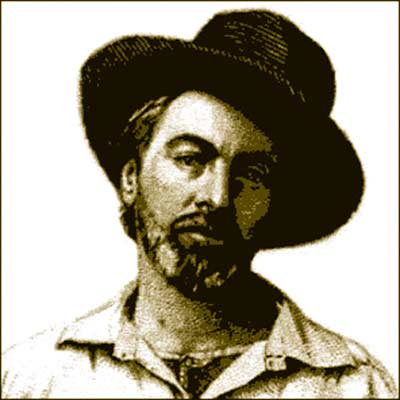
Poet Walt Whitman at age 37A new Levi’s commercial overlays Walt Whitman’s O PIONEERS on scenes of fashion-conscious youth, distilling substance like just another stylizing element. It reminds me of the false portraits our society is content to hang over its radicals. This week, a statue of Helen Keller was unveiled at the US Capitol. Commemorated safely for being an advocate for the disabled, Keller is represented at age seven, before she became the notorious socialist and antiwar crusader. The reverse fate befalls Whitman, who is always represented as a massively-bearded authority figure, and not the authority-challenging reprobate.

Richard Brautigan was my favorite Beatle

Richard Brautigan recorded on Apple RecordsYou know you’re a Post- Baby Boomer when you had to learn that Lucy in the Sky With Diamonds was not an Elton John song. I remember being told by a nanny that you liked either the Monkeys or the Beatles. They broke up before I began listening to pop music. John became an activist, Paul was determined to return to commercial sounds, and George and Ringo faded to slackerdom, having ever only composed While My Guitar Gently Weeps and Octopus’s Garden between them, so I thought. I knew only the Beatles Red and White anthologies.

Barbara Bach and Got My Heart Set on You redeemed Ringo Starr fairly enough, and later I came to appreciate George Harrison. Actually later I heard Ravi Shankar liken Harrison’s exertions on the sitar to a monkey handling a violin, and we come full circle.

But before that was Handmade Films, Harrison’s project to finance Monty Python adventures, and something I’ve just come upon, recordings of my favorite post-beat writer Richard Brautigan. Someone at Apple Records, and I like to imagine it was George, approached RB about putting his poems on vinyl. Someone in the production process knew what to add to the poetry to please his fans. The tracks recorded Brautigan taking off his clothes, answering the phone, and brushing his teeth. I knew of the recordings, I didn’t know it was on Apple.

I came upon Richard Brautigan late too. In 1986 I read The Springhill Mine Disaster, and In Watermelon Sugar, and was pleased enough to imagine one day meeting him. It wasn’t until I was standing in the reference shelves of Penrose Library several years later, that I read a jacket liner which referenced Brautigan in the past tense. I was profoundly shattered that he lived no more, and I am still confused that a voice so lyrically optimistic could choose to commit suicide. I collected all his books but eventually lost a curiosity to read them.

Brautigan wrote: “All of us have a place in history. Mine is clouds.”

He took his life two years before I encountered The Confederate General and Trout Fishing. There is something uniformly post-mortem about my generation.

Richard Brautigan is considered a beat writer, although he came on the scene a decade later. Which oddly leads me to mention my favorite of his, The Abortion.

History Begins at Sumer

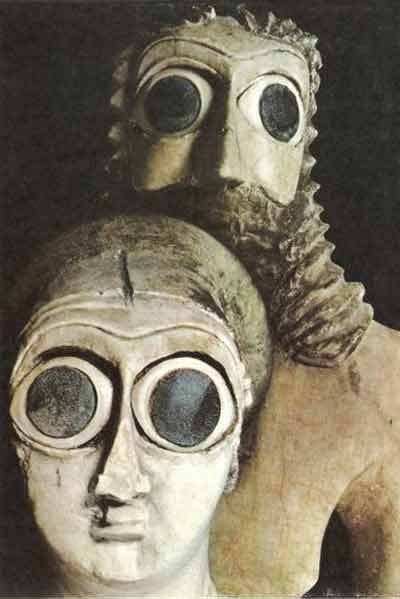
Sumerian statuesI’m reading about the Sumarians (5,300 – 2,000 B.C.) FROM THE TABLETS OF SUMER: 39 Firsts in Man’s Recorded History. The Sumarians originated civilization as we know it, and their demise may look a lot like ours too. In case you missed the memo, Sumer was earliest Mesopotamia in southern Iraq.

Until the mid 19th Century, we didn’t know Sumerians from Adam. Their history is traced by now deciphered cuneiform writings on clay vessels. Now thanks to Bush’s Folly, we may learn very little more.

Until I have more to relate, I’ll treat you to the table of contents, where Princeton Assyriologist Samuel Noah Kramer lays out his thesis. You might be surprised at which cultural themes are apparently elemental.

From the Tablets of Sumer was published in 1956. The latest edition, History Begins at Sumer can be read online. Kramer also compiled an 18-volume Sumerian dictionary.

Thirty-Nine Firsts in Man’s Recorded History

1.     EDUCATION: The First School
2.     SCHOOLDAYS: The First Case of “Apple-Polishing”
3.     FATHER AND SON: The First Case of Juvenile Delinquency
4.     INTERNATIONAL AFFAIRS: The First “War of Nerves”
5.     GOVERNMENT: The First Bicameral Congress
6.     CIVIL WAR IN SUMER: The First Historian
7.     SOCIAL REFORM: The First Case of Tax Reduction
8.     LAW CODES: The First “Moses”
9.     JUSTICE: The First Legal Precedent
10.   MEDICINE: The First Pharmacopoeia
11.   AGRICULTURE: The First “Farmer’s Almanac”
12.   HORTICULTURE: The First Experiment in Shade-Tree Gardening
13.   PHILOSOPHY: Man’s First Cosmogony and Cosmology
14.   ETHICS: The First Moral Ideals
15.   SUFFERING AND SUBMISSION: The First “Job”
16.   WISDOM: The First Proverbs and Sayings
17.   “AESOPICA”: The First Animal Fables
18.   LOGOMACHY: The First Literary Debates
19.   PARADISE: The First Biblical Parallels
20.   A FLOOD: The First “Noah”
21.   HADES: The First Tale of Resurrection
22.   SLAYING OF THE DRAGON: The First “St. George”
23.   TALES OF GILGAMESH: The First Case of Literary Borrowing
24.   EPIC LITERATURE: Man’s First Heroic Age
25.   TO THE ROYAL BRIDEGROOM: The First Love Song
26.   BOOK LISTS: The First Library Catalogue
27.   WORLD PEACE AND HARMONY: Man’s First Golden Age
28.   ANCIENT COUNTERPARTS OF MODERN WOES:
The First “Sick” Society
29.   DESTRUCTION AND DELIVERANCE: The First Liturgic Laments
30.   THE IDEAL KING: The First Messiahs
31.   SHULGI OF UR: The First Long-Distance Champion
32.   POETRY: The First Literary Imagery
33.   THE SACRED MARRIAGE RITE: The First Sex Symbolism
34.   WEEPING GODDESSES: The First Mater Dolorosa
35.   AU-A A-U-A: The First Lullaby
36.   THE IDEAL MOTHER: Her First Literary Portrait
37.   THREE FUNERAL CHANTS: The First Elegies
38.   THE PICKAXE AND THE PLOW: Labor’s First Victory
39.   HOME OF THE FISH: The First Aquarium

The poetry of kick-the-can in the rain

Refrigerator magnet poetryI hate random stream of consciousness when you can tell the author thinks they’re building to something. It’s so, so tedious. Such was my reaction to officially-described poet Elizabeth Alexander, who recited a piece she composed for the inauguration of the First Black American President. I’ll just note Alexander is a professor at Yale, the alma matter of Bush, Kerry, et al the Skull and Bones secret society.

If there’s anything that makes me crankier than war criminals being hugged, saluted, and wished a bon voyage, it’s applause for crappy poetry.

The awful result begins with noise –a cacophony which Alexander captures with brute mimicry. When she describes uniforms as common as tires and hems, of course I’m going to object. Why not add Coca-cola while you’re pandering to product placement?

Repairing done, Alexander moves on to people of disparate means “trying to make music.” Maybe a tenured African-American studies professor wouldn’t know, no one tries to make music. It doesn’t even take a non-musician to make music, without having to try. Obviously you’re confusing music with poetry.

It may be that Alexander’s challenge was corrupted by the insincerity of the “we have overcome” moment, where a half-black man’s ascent to figurehead is taken as penultimate achievement of the underground railroad. It comforts me to see artistes fall flat when they dip their quills in propaganda.

Here’s the whole drippy thing. Hate the ambiguously half phrase.

Praise song for the day.

Each day we go about our business, walking past each other, catching each others’ eyes or not, about to speak or speaking. All about us is noise. All about us is noise and bramble, thorn and din, each one of our ancestors on our tongues. Someone is stitching up a hem, darning a hole in a uniform, patching a tire, repairing the things in need of repair.

Someone is trying to make music somewhere with a pair of wooden spoons on an oil drum with cello, boom box, harmonica, voice.

A woman and her son wait for the bus.

A farmer considers the changing sky; A teacher says, “Take out your pencils. Begin.”

We encounter each other in words, words spiny or smooth, whispered or declaimed; words to consider, reconsider.

We cross dirt roads and highways that mark the will of someone and then others who said, “I need to see what’s on the other side; I know there’s something better down the road.”

We need to find a place where we are safe; We walk into that which we cannot yet see.

Say it plain, that many have died for this day. Sing the names of the dead who brought us here, who laid the train tracks, raised the bridges, picked the cotton and the lettuce, built brick by brick the glittering edifices they would then keep clean and work inside of.

Praise song for struggle; praise song for the day. Praise song for every hand-lettered sign; The figuring it out at kitchen tables.

Some live by “Love thy neighbor as thy self.”

Others by first do no harm, or take no more than you need.

What if the mightiest word is love, love beyond marital, filial, national. Love that casts a widening pool of light. Love with no need to preempt grievance.

In today’s sharp sparkle, this winter air, anything can be made, any sentence begun.

On the brink, on the brim, on the cusp — praise song for walking forward in that light.

Harold Pinter on drama and US banditry

“What has happened to our moral sensibility? Did we ever have any? What do these words mean? Do they refer to a term very rarely employed these days – conscience? A conscience to do not only with our own acts but to do with our shared responsibility in the acts of others? Is all this dead?”
-Harold Pinter (1930-2008)

I’m reminded of a friend of mine who asked “You know what PTSD is? It’s a bad conscience.”

An outspoken critic of the Iraq War, Harold Pinter died Christmas Eve. Here is the address he prerecorded for his acceptance of the Nobel Prize in 2005, when he had become too infirm to attend in person.

Nobel Lecture: Art, Truth & Politics

In 1958 I wrote the following:

‘There are no hard distinctions between what is real and what is unreal, nor between what is true and what is false. A thing is not necessarily either true or false; it can be both true and false.’

I believe that these assertions still make sense and do still apply to the exploration of reality through art. So as a writer I stand by them but as a citizen I cannot. As a citizen I must ask: What is true? What is false?

Truth in drama is forever elusive. You never quite find it but the search for it is compulsive. The search is clearly what drives the endeavour. The search is your task. More often than not you stumble upon the truth in the dark, colliding with it or just glimpsing an image or a shape which seems to correspond to the truth, often without realising that you have done so. But the real truth is that there never is any such thing as one truth to be found in dramatic art. There are many. These truths challenge each other, recoil from each other, reflect each other, ignore each other, tease each other, are blind to each other. Sometimes you feel you have the truth of a moment in your hand, then it slips through your fingers and is lost.

I have often been asked how my plays come about. I cannot say. Nor can I ever sum up my plays, except to say that this is what happened. That is what they said. That is what they did.

Most of the plays are engendered by a line, a word or an image. The given word is often shortly followed by the image. I shall give two examples of two lines which came right out of the blue into my head, followed by an image, followed by me.

The plays are The Homecoming and Old Times. The first line of The Homecoming is ‘What have you done with the scissors?’ The first line of Old Times is ‘Dark.’

In each case I had no further information.

In the first case someone was obviously looking for a pair of scissors and was demanding their whereabouts of someone else he suspected had probably stolen them. But I somehow knew that the person addressed didn’t give a damn about the scissors or about the questioner either, for that matter.

‘Dark’ I took to be a description of someone’s hair, the hair of a woman, and was the answer to a question. In each case I found myself compelled to pursue the matter. This happened visually, a very slow fade, through shadow into light.

I always start a play by calling the characters A, B and C.

In the play that became The Homecoming I saw a man enter a stark room and ask his question of a younger man sitting on an ugly sofa reading a racing paper. I somehow suspected that A was a father and that B was his son, but I had no proof. This was however confirmed a short time later when B (later to become Lenny) says to A (later to become Max), ‘Dad, do you mind if I change the subject? I want to ask you something. The dinner we had before, what was the name of it? What do you call it? Why don’t you buy a dog? You’re a dog cook. Honest. You think you’re cooking for a lot of dogs.’ So since B calls A ‘Dad’ it seemed to me reasonable to assume that they were father and son. A was also clearly the cook and his cooking did not seem to be held in high regard. Did this mean that there was no mother? I didn’t know. But, as I told myself at the time, our beginnings never know our ends.

‘Dark.’ A large window. Evening sky. A man, A (later to become Deeley), and a woman, B (later to become Kate), sitting with drinks. ‘Fat or thin?’ the man asks. Who are they talking about? But I then see, standing at the window, a woman, C (later to become Anna), in another condition of light, her back to them, her hair dark.

It’s a strange moment, the moment of creating characters who up to that moment have had no existence. What follows is fitful, uncertain, even hallucinatory, although sometimes it can be an unstoppable avalanche. The author’s position is an odd one. In a sense he is not welcomed by the characters. The characters resist him, they are not easy to live with, they are impossible to define. You certainly can’t dictate to them. To a certain extent you play a never-ending game with them, cat and mouse, blind man’s buff, hide and seek. But finally you find that you have people of flesh and blood on your hands, people with will and an individual sensibility of their own, made out of component parts you are unable to change, manipulate or distort.

So language in art remains a highly ambiguous transaction, a quicksand, a trampoline, a frozen pool which might give way under you, the author, at any time.

But as I have said, the search for the truth can never stop. It cannot be adjourned, it cannot be postponed. It has to be faced, right there, on the spot.

Political theatre presents an entirely different set of problems. Sermonising has to be avoided at all cost. Objectivity is essential. The characters must be allowed to breathe their own air. The author cannot confine and constrict them to satisfy his own taste or disposition or prejudice. He must be prepared to approach them from a variety of angles, from a full and uninhibited range of perspectives, take them by surprise, perhaps, occasionally, but nevertheless give them the freedom to go which way they will. This does not always work. And political satire, of course, adheres to none of these precepts, in fact does precisely the opposite, which is its proper function.

In my play The Birthday Party I think I allow a whole range of options to operate in a dense forest of possibility before finally focussing on an act of subjugation.

Mountain Language pretends to no such range of operation. It remains brutal, short and ugly. But the soldiers in the play do get some fun out of it. One sometimes forgets that torturers become easily bored. They need a bit of a laugh to keep their spirits up. This has been confirmed of course by the events at Abu Ghraib in Baghdad. Mountain Language lasts only 20 minutes, but it could go on for hour after hour, on and on and on, the same pattern repeated over and over again, on and on, hour after hour.

Ashes to Ashes, on the other hand, seems to me to be taking place under water. A drowning woman, her hand reaching up through the waves, dropping down out of sight, reaching for others, but finding nobody there, either above or under the water, finding only shadows, reflections, floating; the woman a lost figure in a drowning landscape, a woman unable to escape the doom that seemed to belong only to others.

But as they died, she must die too.

Political language, as used by politicians, does not venture into any of this territory since the majority of politicians, on the evidence available to us, are interested not in truth but in power and in the maintenance of that power. To maintain that power it is essential that people remain in ignorance, that they live in ignorance of the truth, even the truth of their own lives. What surrounds us therefore is a vast tapestry of lies, upon which we feed.

As every single person here knows, the justification for the invasion of Iraq was that Saddam Hussein possessed a highly dangerous body of weapons of mass destruction, some of which could be fired in 45 minutes, bringing about appalling devastation. We were assured that was true. It was not true. We were told that Iraq had a relationship with Al Quaeda and shared responsibility for the atrocity in New York of September 11th 2001. We were assured that this was true. It was not true. We were told that Iraq threatened the security of the world. We were assured it was true. It was not true.

The truth is something entirely different. The truth is to do with how the United States understands its role in the world and how it chooses to embody it.

But before I come back to the present I would like to look at the recent past, by which I mean United States foreign policy since the end of the Second World War. I believe it is obligatory upon us to subject this period to at least some kind of even limited scrutiny, which is all that time will allow here.

Everyone knows what happened in the Soviet Union and throughout Eastern Europe during the post-war period: the systematic brutality, the widespread atrocities, the ruthless suppression of independent thought. All this has been fully documented and verified.

But my contention here is that the US crimes in the same period have only been superficially recorded, let alone documented, let alone acknowledged, let alone recognised as crimes at all. I believe this must be addressed and that the truth has considerable bearing on where the world stands now. Although constrained, to a certain extent, by the existence of the Soviet Union, the United States’ actions throughout the world made it clear that it had concluded it had carte blanche to do what it liked.

Direct invasion of a sovereign state has never in fact been America’s favoured method. In the main, it has preferred what it has described as ‘low intensity conflict’. Low intensity conflict means that thousands of people die but slower than if you dropped a bomb on them in one fell swoop. It means that you infect the heart of the country, that you establish a malignant growth and watch the gangrene bloom. When the populace has been subdued – or beaten to death – the same thing – and your own friends, the military and the great corporations, sit comfortably in power, you go before the camera and say that democracy has prevailed. This was a commonplace in US foreign policy in the years to which I refer.

The tragedy of Nicaragua was a highly significant case. I choose to offer it here as a potent example of America’s view of its role in the world, both then and now.

I was present at a meeting at the US embassy in London in the late 1980s.

The United States Congress was about to decide whether to give more money to the Contras in their campaign against the state of Nicaragua. I was a member of a delegation speaking on behalf of Nicaragua but the most important member of this delegation was a Father John Metcalf. The leader of the US body was Raymond Seitz (then number two to the ambassador, later ambassador himself). Father Metcalf said: ‘Sir, I am in charge of a parish in the north of Nicaragua. My parishioners built a school, a health centre, a cultural centre. We have lived in peace. A few months ago a Contra force attacked the parish. They destroyed everything: the school, the health centre, the cultural centre. They raped nurses and teachers, slaughtered doctors, in the most brutal manner. They behaved like savages. Please demand that the US government withdraw its support from this shocking terrorist activity.’

Raymond Seitz had a very good reputation as a rational, responsible and highly sophisticated man. He was greatly respected in diplomatic circles. He listened, paused and then spoke with some gravity. ‘Father,’ he said, ‘let me tell you something. In war, innocent people always suffer.’ There was a frozen silence. We stared at him. He did not flinch.

Innocent people, indeed, always suffer.

Finally somebody said: ‘But in this case “innocent people” were the victims of a gruesome atrocity subsidised by your government, one among many. If Congress allows the Contras more money further atrocities of this kind will take place. Is this not the case? Is your government not therefore guilty of supporting acts of murder and destruction upon the citizens of a sovereign state?’

Seitz was imperturbable. ‘I don’t agree that the facts as presented support your assertions,’ he said.

As we were leaving the Embassy a US aide told me that he enjoyed my plays. I did not reply.

I should remind you that at the time President Reagan made the following statement: ‘The Contras are the moral equivalent of our Founding Fathers.’

The United States supported the brutal Somoza dictatorship in Nicaragua for over 40 years. The Nicaraguan people, led by the Sandinistas, overthrew this regime in 1979, a breathtaking popular revolution.

The Sandinistas weren’t perfect. They possessed their fair share of arrogance and their political philosophy contained a number of contradictory elements. But they were intelligent, rational and civilised. They set out to establish a stable, decent, pluralistic society. The death penalty was abolished. Hundreds of thousands of poverty-stricken peasants were brought back from the dead. Over 100,000 families were given title to land. Two thousand schools were built. A quite remarkable literacy campaign reduced illiteracy in the country to less than one seventh. Free education was established and a free health service. Infant mortality was reduced by a third. Polio was eradicated.

The United States denounced these achievements as Marxist/Leninist subversion. In the view of the US government, a dangerous example was being set. If Nicaragua was allowed to establish basic norms of social and economic justice, if it was allowed to raise the standards of health care and education and achieve social unity and national self respect, neighbouring countries would ask the same questions and do the same things. There was of course at the time fierce resistance to the status quo in El Salvador.

I spoke earlier about ‘a tapestry of lies’ which surrounds us. President Reagan commonly described Nicaragua as a ‘totalitarian dungeon’. This was taken generally by the media, and certainly by the British government, as accurate and fair comment. But there was in fact no record of death squads under the Sandinista government. There was no record of torture. There was no record of systematic or official military brutality. No priests were ever murdered in Nicaragua. There were in fact three priests in the government, two Jesuits and a Maryknoll missionary. The totalitarian dungeons were actually next door, in El Salvador and Guatemala. The United States had brought down the democratically elected government of Guatemala in 1954 and it is estimated that over 200,000 people had been victims of successive military dictatorships.

Six of the most distinguished Jesuits in the world were viciously murdered at the Central American University in San Salvador in 1989 by a battalion of the Alcatl regiment trained at Fort Benning, Georgia, USA. That extremely brave man Archbishop Romero was assassinated while saying mass. It is estimated that 75,000 people died. Why were they killed? They were killed because they believed a better life was possible and should be achieved. That belief immediately qualified them as communists. They died because they dared to question the status quo, the endless plateau of poverty, disease, degradation and oppression, which had been their birthright.

The United States finally brought down the Sandinista government. It took some years and considerable resistance but relentless economic persecution and 30,000 dead finally undermined the spirit of the Nicaraguan people. They were exhausted and poverty stricken once again. The casinos moved back into the country. Free health and free education were over. Big business returned with a vengeance. ‘Democracy’ had prevailed.

But this ‘policy’ was by no means restricted to Central America. It was conducted throughout the world. It was never-ending. And it is as if it never happened.

The United States supported and in many cases engendered every right wing military dictatorship in the world after the end of the Second World War. I refer to Indonesia, Greece, Uruguay, Brazil, Paraguay, Haiti, Turkey, the Philippines, Guatemala, El Salvador, and, of course, Chile. The horror the United States inflicted upon Chile in 1973 can never be purged and can never be forgiven.

Hundreds of thousands of deaths took place throughout these countries. Did they take place? And are they in all cases attributable to US foreign policy? The answer is yes they did take place and they are attributable to American foreign policy. But you wouldn’t know it.

It never happened. Nothing ever happened. Even while it was happening it wasn’t happening. It didn’t matter. It was of no interest. The crimes of the United States have been systematic, constant, vicious, remorseless, but very few people have actually talked about them. You have to hand it to America. It has exercised a quite clinical manipulation of power worldwide while masquerading as a force for universal good. It’s a brilliant, even witty, highly successful act of hypnosis.

I put to you that the United States is without doubt the greatest show on the road. Brutal, indifferent, scornful and ruthless it may be but it is also very clever. As a salesman it is out on its own and its most saleable commodity is self love. It’s a winner. Listen to all American presidents on television say the words, ‘the American people’, as in the sentence, ‘I say to the American people it is time to pray and to defend the rights of the American people and I ask the American people to trust their president in the action he is about to take on behalf of the American people.’

It’s a scintillating stratagem. Language is actually employed to keep thought at bay. The words ‘the American people’ provide a truly voluptuous cushion of reassurance. You don’t need to think. Just lie back on the cushion. The cushion may be suffocating your intelligence and your critical faculties but it’s very comfortable. This does not apply of course to the 40 million people living below the poverty line and the 2 million men and women imprisoned in the vast gulag of prisons, which extends across the US.

The United States no longer bothers about low intensity conflict. It no longer sees any point in being reticent or even devious. It puts its cards on the table without fear or favour. It quite simply doesn’t give a damn about the United Nations, international law or critical dissent, which it regards as impotent and irrelevant. It also has its own bleating little lamb tagging behind it on a lead, the pathetic and supine Great Britain.

What has happened to our moral sensibility? Did we ever have any? What do these words mean? Do they refer to a term very rarely employed these days – conscience? A conscience to do not only with our own acts but to do with our shared responsibility in the acts of others? Is all this dead? Look at Guantanamo Bay. Hundreds of people detained without charge for over three years, with no legal representation or due process, technically detained forever. This totally illegitimate structure is maintained in defiance of the Geneva Convention. It is not only tolerated but hardly thought about by what’s called the ‘international community’. This criminal outrage is being committed by a country, which declares itself to be ‘the leader of the free world’. Do we think about the inhabitants of Guantanamo Bay? What does the media say about them? They pop up occasionally – a small item on page six. They have been consigned to a no man’s land from which indeed they may never return. At present many are on hunger strike, being force-fed, including British residents. No niceties in these force-feeding procedures. No sedative or anaesthetic. Just a tube stuck up your nose and into your throat. You vomit blood. This is torture. What has the British Foreign Secretary said about this? Nothing. What has the British Prime Minister said about this? Nothing. Why not? Because the United States has said: to criticise our conduct in Guantanamo Bay constitutes an unfriendly act. You’re either with us or against us. So Blair shuts up.

The invasion of Iraq was a bandit act, an act of blatant state terrorism, demonstrating absolute contempt for the concept of international law. The invasion was an arbitrary military action inspired by a series of lies upon lies and gross manipulation of the media and therefore of the public; an act intended to consolidate American military and economic control of the Middle East masquerading – as a last resort – all other justifications having failed to justify themselves – as liberation. A formidable assertion of military force responsible for the death and mutilation of thousands and thousands of innocent people.

We have brought torture, cluster bombs, depleted uranium, innumerable acts of random murder, misery, degradation and death to the Iraqi people and call it ‘bringing freedom and democracy to the Middle East’.

How many people do you have to kill before you qualify to be described as a mass murderer and a war criminal? One hundred thousand? More than enough, I would have thought. Therefore it is just that Bush and Blair be arraigned before the International Criminal Court of Justice. But Bush has been clever. He has not ratified the International Criminal Court of Justice. Therefore if any American soldier or for that matter politician finds himself in the dock Bush has warned that he will send in the marines. But Tony Blair has ratified the Court and is therefore available for prosecution. We can let the Court have his address if they’re interested. It is Number 10, Downing Street, London.

Death in this context is irrelevant. Both Bush and Blair place death well away on the back burner. At least 100,000 Iraqis were killed by American bombs and missiles before the Iraq insurgency began. These people are of no moment. Their deaths don’t exist. They are blank. They are not even recorded as being dead. ‘We don’t do body counts,’ said the American general Tommy Franks.

Early in the invasion there was a photograph published on the front page of British newspapers of Tony Blair kissing the cheek of a little Iraqi boy. ‘A grateful child,’ said the caption. A few days later there was a story and photograph, on an inside page, of another four-year-old boy with no arms. His family had been blown up by a missile. He was the only survivor. ‘When do I get my arms back?’ he asked. The story was dropped. Well, Tony Blair wasn’t holding him in his arms, nor the body of any other mutilated child, nor the body of any bloody corpse. Blood is dirty. It dirties your shirt and tie when you’re making a sincere speech on television.

The 2,000 American dead are an embarrassment. They are transported to their graves in the dark. Funerals are unobtrusive, out of harm’s way. The mutilated rot in their beds, some for the rest of their lives. So the dead and the mutilated both rot, in different kinds of graves.

Here is an extract from a poem by Pablo Neruda, ‘I’m Explaining a Few Things’:

And one morning all that was burning,
one morning the bonfires
leapt out of the earth
devouring human beings
and from then on fire,
gunpowder from then on,
and from then on blood.
Bandits with planes and Moors,
bandits with finger-rings and duchesses,
bandits with black friars spattering blessings
came through the sky to kill children
and the blood of children ran through the streets
without fuss, like children’s blood.

Jackals that the jackals would despise
stones that the dry thistle would bite on and spit out,
vipers that the vipers would abominate.

Face to face with you I have seen the blood
of Spain tower like a tide
to drown you in one wave
of pride and knives.

Treacherous
generals:
see my dead house,
look at broken Spain:
from every house burning metal flows
instead of flowers
from every socket of Spain
Spain emerges
and from every dead child a rifle with eyes
and from every crime bullets are born
which will one day find
the bull’s eye of your hearts.

And you will ask: why doesn’t his poetry
speak of dreams and leaves
and the great volcanoes of his native land.

Come and see the blood in the streets.
Come and see
the blood in the streets.
Come and see the blood
in the streets!

Let me make it quite clear that in quoting from Neruda’s poem I am in no way comparing Republican Spain to Saddam Hussein’s Iraq. I quote Neruda because nowhere in contemporary poetry have I read such a powerful visceral description of the bombing of civilians.

I have said earlier that the United States is now totally frank about putting its cards on the table. That is the case. Its official declared policy is now defined as ‘full spectrum dominance’. That is not my term, it is theirs. ‘Full spectrum dominance’ means control of land, sea, air and space and all attendant resources.

The United States now occupies 702 military installations throughout the world in 132 countries, with the honourable exception of Sweden, of course. We don’t quite know how they got there but they are there all right.

The United States possesses 8,000 active and operational nuclear warheads. Two thousand are on hair trigger alert, ready to be launched with 15 minutes warning. It is developing new systems of nuclear force, known as bunker busters. The British, ever cooperative, are intending to replace their own nuclear missile, Trident. Who, I wonder, are they aiming at? Osama bin Laden? You? Me? Joe Dokes? China? Paris? Who knows? What we do know is that this infantile insanity – the possession and threatened use of nuclear weapons – is at the heart of present American political philosophy. We must remind ourselves that the United States is on a permanent military footing and shows no sign of relaxing it.

Many thousands, if not millions, of people in the United States itself are demonstrably sickened, shamed and angered by their government’s actions, but as things stand they are not a coherent political force – yet. But the anxiety, uncertainty and fear which we can see growing daily in the United States is unlikely to diminish.

I know that President Bush has many extremely competent speech writers but I would like to volunteer for the job myself. I propose the following short address which he can make on television to the nation. I see him grave, hair carefully combed, serious, winning, sincere, often beguiling, sometimes employing a wry smile, curiously attractive, a man’s man.

‘God is good. God is great. God is good. My God is good. Bin Laden’s God is bad. His is a bad God. Saddam’s God was bad, except he didn’t have one. He was a barbarian. We are not barbarians. We don’t chop people’s heads off. We believe in freedom. So does God. I am not a barbarian. I am the democratically elected leader of a freedom-loving democracy. We are a compassionate society. We give compassionate electrocution and compassionate lethal injection. We are a great nation. I am not a dictator. He is. I am not a barbarian. He is. And he is. They all are. I possess moral authority. You see this fist? This is my moral authority. And don’t you forget it.’

A writer’s life is a highly vulnerable, almost naked activity. We don’t have to weep about that. The writer makes his choice and is stuck with it. But it is true to say that you are open to all the winds, some of them icy indeed. You are out on your own, out on a limb. You find no shelter, no protection – unless you lie – in which case of course you have constructed your own protection and, it could be argued, become a politician.

I have referred to death quite a few times this evening. I shall now quote a poem of my own called ‘Death’.

Where was the dead body found?
Who found the dead body?
Was the dead body dead when found?
How was the dead body found?

Who was the dead body?

Who was the father or daughter or brother
Or uncle or sister or mother or son
Of the dead and abandoned body?

Was the body dead when abandoned?
Was the body abandoned?
By whom had it been abandoned?

Was the dead body naked or dressed for a journey?

What made you declare the dead body dead?
Did you declare the dead body dead?
How well did you know the dead body?
How did you know the dead body was dead?

Did you wash the dead body
Did you close both its eyes
Did you bury the body
Did you leave it abandoned
Did you kiss the dead body

When we look into a mirror we think the image that confronts us is accurate. But move a millimetre and the image changes. We are actually looking at a never-ending range of reflections. But sometimes a writer has to smash the mirror – for it is on the other side of that mirror that the truth stares at us.

I believe that despite the enormous odds which exist, unflinching, unswerving, fierce intellectual determination, as citizens, to define the real truth of our lives and our societies is a crucial obligation which devolves upon us all. It is in fact mandatory.

If such a determination is not embodied in our political vision we have no hope of restoring what is so nearly lost to us – the dignity of man.

Staging Homer for Generation Simpson

Odyssey by Derek WalcottTHE ODYSSEY,
A STAGE VERSION-
Greek myth would be no more complicated than JK Rowling, JRR Tolkien, or GRG Lucas, but I suspect that to impress Homer unto modern audiences might have the disagreeable consequence of educating them.

This weekend Colorado College students staged Derek Walcott’s 1992 The Odyssey in the South Theater of the Cornerstone Arts Building. And performed it brilliantly. Every role, every effect, executed with vitality and aplomb.

Except for the Jamaican nursemaid and Aussie shepherd, the CC actors dropped Walcott’s New World islander accents, but their production honored his post imperialism critique.

My favorite sequence depicted Cyclops as an all-seeing 1984 distillation of mortal man’s inclination toward totalitarianism. The Circe episode is nagging me for further reflection, if I’m to imagine that Walcott would not succumb to the traditional Siren/Mermaid/Nymph misogyny.

If you can’t shake the admonition that rational man’s chief torment is woman, you need look for no literary antecedent before Homer.

Obviously, not all that is Greek is instructional, but wouldn’t it serve our education nicely if, instead of the insipid nuances of fictional worlds imagined by scribes steeped in the decay of Western Civilization, our children could commit to their memories the literary plots –no less compelling– which form the building blocks to a greater appreciation of all art?

We told the kids that the Odyssey was Western Civilization’s first sequel. Of course, the Iliad was a lot to have to recap. Not surprisingly, their experience was “the most random ever.” But while I lamented my missed advance opportunity to have brought them up to speed on the gods and heroes of antiquity, our eleven year old noted, of the lines spoken by the mysterious personages: “Everything they said was always about something else!”

Poetry!

OF FURTHER INTEREST:
Creolizing Homer for the stage: Walcott’s The Odyssey, by Robert D. Hamner, Twentieth Century Literature, Fall, 2001

Playing With Europe: Derek Walcott’s Retelling of Homer’s Odyssey, by Irene Martyniuk, Callaloo 28.1, 2005

Marianne Moore’s Utopian Turtletop

Ford EdselIn the mid-fifties the newly-public Ford Motor Company sought a name for its soon-to-be-released experimental car, known in its design stage as the E-car. After in-house marketers came up with 300-odd names which were felt to be embarrassing in their pedestrianism, the company approached Pulitzer Prize-winning poet Marianne Moore, an icon of the popular culture, known as much for her wild passion for baseball and boxing as for her poetry…

What Ford wanted was a car name that “flashes a dramatically desirable picture in people’s minds,” from a woman who seemed to know mainstream America. What they got was “Anticipator,” “Thunder Crester,” “Pastelogram,” “Intelligent Whale,” “The Resilient Bullet,” “Mongoose Civique,” “Andante con Moto,” “Varsity Stroke” and then, as her very last try for the name magic, “Utopian Turtletop.”

Understandably disappointed by Moore’s ideas, the company hired a marketing firm. When the agency forwarded a list of 18,000 possible names, it fell upon corporate executives to choose the best among them for final consideration. Every day an appointed panel of executives would assemble in an appointed projection room to watch as thousands of names were flashed across a screen in six-inch high letters, to oblivion unless someone shouted, “Stop!” and gave reasons for his enthusiasm.

None of the final contenders, neither “Corsair” nor “Citation” nor “Ranger” nor “Pacer,” made the grade in the end, and Ford returned to its earlier idea — one that had been rejected for years by the Ford family — and named the car after company scion, Edsel Ford.

Of course, the Edsel was a spectacular failure on many levels, marketing most notably. Later consumer surveys revealed that the public strongly disliked the name, associating it with Edson tractors, dead cells (batteries) and weasels.

Who did not play Faust for George Bush

I’d like to compile a collection of letters from famous personages in which they decline to dance with the Bush Administration. Were there many?

Shouldn’t any artist/musician/author or intellectual/humanitarian of note have publicly refused to collaborate with the immoral tyrant and his saccharine-smile patronizing librarian wife?

I have some favorites:
Mr. Feiffer Regrets -by Jules Feiffer, 2002
Poets Against War -Sam Hamill, 2003
Statement of Conscience -by Jennifer Warn, 2003
Open Letter to Laura Bush -by Sharon Olds, 2005

Archived copies are below:

Mr. Feiffer Regrets

October 12, 2002

Mrs. George W. Bush
The White House
Washington, DC

Dear Mrs. Bush,

I wish that I could come to your National Book Festival breakfast at the White House on Saturday, but after giving it much thought, I can’t attend.

I was thrilled to be invited, along with other writers and illustrators, to help celebrate your campaign to inspire young people in the pleasures of reading.

But I find it unbearably ironic that, while the uses of language are celebrated by you and your renowned guests, elsewhere in the White House language is being traduced and transformed to nudge us into war.

There are honest arguments on both sides of the Iraq debate (such as it is), but it seems necessary on the occasion of a celebration of reading to press the point that words, at their finest, don’t set out to confuse or obscure. Their aim is to clarify.

But clarity is not what we’re getting from your husband’s White House. It seems that clarity would deny him a war.

I am a father and a grandfather. As every parent knows, most children can intuit whether the stories their parents tell them are true or if they’re making them up.

The American people are able to tell too.

I am delighted to participate in National Book Festival events scheduled for the Library of Congress and the Capitol grounds. But as for your breakfast, may I convey my regrets and best wishes to you and your guests.

Sincerely,
/s/Jules Feiffer

Sam Hamill

Dear Friends and Fellow Poets:

“When I picked up my mail and saw the letter marked “The White House,” I felt no joy. Rather I was overcome by a kind of nausea as I read the card enclosed:

Laura Bush requests the pleasure of your company at a reception and White House Symposium on “Poetry and the American Voice” on Wednesday, February 12, 2003 at one o’clock

Only the day before I had read a lengthy report on George Bush’s proposed “Shock and Awe” attack on Iraq, calling for saturation bombing that would be like the firebombing of Dresden or Tokyo, killing countless innocent civilians.

I believe the only legitimate response to such a morally bankrupt and unconscionable idea is to reconstitute a Poets Against the War movement like the one organized to speak out against the war in Vietnam.

I am asking every poet to speak up for the conscience of our country and lend his or her name to our petition against this war, and to make February 12 a day of Poetry Against the War. We will compile an anthology of protest to be presented to the White House on that afternoon…

Statement of Conscience -Jennifer Warn

February 12, 2003

Mrs. Laura Bush
1600 Pennsylvania Avenue
Washington, D.C.

Dear Laura Bush,

Thank you for inviting me to the White House symposium on Poetry and the American Voice. Your call to better understand and celebrate the poetry of Walt Whitman, Emily Dickinson and Langston Hughes led me and many thousands of American poets to find their voices of dissent.

Since January 30th poets in many countries have joined in an upsurge of conscience and compassion, submitting over [15,000] poems to the Poets Against the War web site (www.poetsagainstthewar.org), organizing hundreds of anti-war poetry readings around the world, and joining with millions of others in vigils, processions, prayers and intercessions, lobbying and rallying for peace.

You have inadvertently presented a gift to the American people and to the world by providing poets an opportunity to express their most passionately held beliefs about their vision for the world’s future. Your gesture has revealed the very relationship it was meant to deny: the connection between poetry and politics, between literature and reality. Another great American poet, Wallace Stevens, presented this relationship succinctly:

“In life what is most important is the truth as it is, while in arts and letters what is most important is the truth as we see it.”

This wisdom is excerpted from “Imagination as Value,” an essay in the long tradition of poets puzzling over the power of poetry and asserting its place in a world primarily shaped by the machinations of politics and money.

What is poetry’s power? Why should you, vested with the power of the White House as First Lady, pay attention to such a rush of words at this late hour?

Poetry’s power lies in its perceptive ability to describe both inner and outer realities. In reading a poem we experience the paradoxical delight and anguish of human life. Poetry holds a mirror to the reality that our political systems and values create and in doing so reveals both the limitations of our current state and life’s endless possibilities. In its refracted light we see our intangible connections, the irrefutable unity of all people and beings on the planet.

We invite you to read this selection of poems which represents some of the most powerful in the Poetry Against the War Anthology. These poems were written by Pulitzer Prize winners, former U.S. poets laureate, and poets who work as professors, business people, homemakers and veterans. Those who have submitted poems or personal statements to register their opposition to ill-considered military action, including a pre-emptive strike on Iraq, honor a long and rich tradition of thoughtful and moral opposition by poets and other artists to senseless and murderous policies, including those of our own government.

We believe that the world is poised on the knife-edge of a decision between war and peace. It is our hope and conviction that peaceful American voices, conveyed in part and without historical precedent by the poets of this country, may help to avert a disaster of tragic proportions.

We call upon the Bush administration to halt the headlong rush toward war, to heed the voices of the people of the world, and to seek peaceful means of resolving conflicts in company with the world community.

Never before in history have so many poets gathered to speak in a single voice.

Sincerely,

Emily Warn
Poets Against the War

Open letter to Laura Bush -Sharon Olds

September 19, 2005

Laura Bush
First Lady
The White House

Dear Mrs. Bush,

I am writing to let you know why I am not able to accept your kind invitation to give a presentation at the National Book Festival on September 24, or to attend your dinner at the Library of Congress or the breakfast at the White House.

In one way, it’s a very appealing invitation. The idea of speaking at a festival attended by 85,000 people is inspiring! The possibility of finding new readers is exciting for a poet in personal terms, and in terms of the desire that poetry serve its constituents–all of us who need the pleasure, and the inner and outer news, it delivers.

And the concept of a community of readers and writers has long been dear to my heart. As a professor of creative writing in the graduate school of a major university, I have had the chance to be a part of some magnificent outreach writing workshops in which our students have become teachers. Over the years, they have taught in a variety of settings: a women’s prison, several New York City public high schools, an oncology ward for children. Our initial program, at a 900-bed state hospital for the severely physically challenged, has been running now for twenty years, creating along the way lasting friendships between young MFA candidates and their students–long-term residents at the hospital who, in their humor, courage and wisdom, become our teachers.

When you have witnessed someone nonspeaking and almost nonmoving spell out, with a toe, on a big plastic alphabet chart, letter by letter, his new poem, you have experienced, close up, the passion and essentialness of writing. When you have held up a small cardboard alphabet card for a writer who is completely nonspeaking and nonmoving (except for the eyes), and pointed first to the A, then the B, then C, then D, until you get to the first letter of the first word of the first line of the poem she has been composing in her head all week, and she lifts her eyes when that letter is touched to say yes, you feel with a fresh immediacy the human drive for creation, self-expression, accuracy, honesty and wit–and the importance of writing, which celebrates the value of each person’s unique story and song.

So the prospect of a festival of books seemed wonderful to me. I thought of the opportunity to talk about how to start up an outreach program. I thought of the chance to sell some books, sign some books and meet some of the citizens of Washington, DC. I thought that I could try to find a way, even as your guest, with respect, to speak about my deep feeling that we should not have invaded Iraq, and to declare my belief that the wish to invade another culture and another country–with the resultant loss of life and limb for our brave soldiers, and for the noncombatants in their home terrain–did not come out of our democracy but was instead a decision made “at the top” and forced on the people by distorted language, and by untruths. I hoped to express the fear that we have begun to live in the shadows of tyranny and religious chauvinism–the opposites of the liberty, tolerance and diversity our nation aspires to.

I tried to see my way clear to attend the festival in order to bear witness–as an American who loves her country and its principles and its writing–against this undeclared and devastating war.

But I could not face the idea of breaking bread with you. I knew that if I sat down to eat with you, it would feel to me as if I were condoning what I see to be the wild, highhanded actions of the Bush Administration.

What kept coming to the fore of my mind was that I would be taking food from the hand of the First Lady who represents the Administration that unleashed this war and that wills its continuation, even to the extent of permitting “extraordinary rendition”: flying people to other countries where they will be tortured for us.

So many Americans who had felt pride in our country now feel anguish and shame, for the current regime of blood, wounds and fire. I thought of the clean linens at your table, the shining knives and the flames of the candles, and I could not stomach it.

Sincerely,
SHARON OLDS

The Man With a Hoe

Palin and McCain  THE MAN WITH A HOE

THE MAN WITH A HOE

Bowed by the weight of centuries he leans
Upon his hoe and gazes on the ground,
The emptiness of ages in his face,
And on his back, the burden of the world.
Who made him dead to rapture and despair,
A thing that grieves not and that never hopes,
Stolid and stunned, a brother to the ox?
Who loosened and let down this brutal jaw?
Whose was the hand that slanted back this brow?
Whose breath blew out the light within this brain?

Is this the Thing the Lord God made and gave
To have dominion over sea and land;
To trace the stars and search the heavens for power;
To feel the passion of Eternity?
Is this the dream He dreamed who shaped the suns
And marked their ways upon the ancient deep?
Down all the caverns of Hell to their last gulf
There is no shape more terrible than this–
More tongued with cries against the world’s blind greed–
More filled with signs and portents for the soul–
More packed with danger to the universe.

What gulfs between him and the seraphim!
Slave of the wheel of Capital, what to him
Are Plato and the swing of the Pleiades?
What the long reaches of the peaks of song,
The rift of dawn, the reddening of the rose?
Through this dread shape the suffering ages look;
Time’s tragedy is in that aching stoop;
Through this dread shape humanity betrayed,
Plundered, profaned and disinherited,
Cries protest to the Powers that made the world,
A protest that is also prophecy.

O masters, lords and rulers in all lands,
Is this the handiwork you give to God,
This monstrous thing distorted and soul-quenched?
How will you ever straighten up this shape;
Touch it again with immortality;
Give back the upward looking and the light;
Rebuild in it the music and the dream;
Make right the immemorial infamies,
Perfidious wrongs, immedicable woes?

O masters, lords and rulers in all lands,
How will the future reckon with this Man?
How answer his brute question in that hour
When whirlwinds of rebellion shake all shores?
How will it be with kingdoms and with kings–
With those who shaped him to the thing he is–
When this dumb Terror shall rise to judge the world,
After the silence of the centuries?

Whose turn is it on Afghanistan’s plains?

It was a hard lesson for the Soviets, and before them the Soldiers of the Queen. I think Kipling’s advice bears repeating as we consider that American casualties are on the rise in Afghanistan. Afghanistan is the Forgotten Campaign of the GWOT, where we’re still taking a victory lap in a pool filling with crocodiles.

When you’re wounded and left on Afghanistan’s plains,
and the women come out to cut up what remains,
jest roll to your rifle and blow out your brains
and go to your gawd like a soldier.
    -Rudyard Kipling, The Young British Soldier

Global economic rapists are at it again

G8 protest
Why protest the G8 Summit July 7-9? Those hoodlums always look so determined. Here’s the rationale by the Emergency Exit Collective:

The 2008 G8 on Hokkaido, a Strategic Assessment
Emergency Exit Collective
Bristol, Mayday, 2008

The authors of this document are a collection of activists, scholars, and writers currently based in the United States and Western Europe who have gotten to know and work with each other in the movement against capitalist globalization. We’re writing this at the request of some members of No! G8 Action Japan, who asked us for a broad strategic analysis of the state of struggle as we see it, and particularly, of the role of the G8, what it represents, the dangers and opportunities that may lie hidden in the moment. It is in no sense programmatic. Mainly, it is an attempt to develop tools that we hope will be helpful for organizers, or for anyone engaged in the struggle against global capital.

I
It is our condition as human beings that we produce our lives in common.

II
Let us then try to see the world from the perspective of the planet’s commoners, taking the word in that sense: those whose most essential tradition is cooperation in the making and maintenance of human social life, yet who have had to do so under conditions of suffering and separation; deprived, ignored, devalued, divided into hierarchies, pitted against each other for our very physical survival. In one sense we are all commoners. But it’s equally true that just about everyone, at least in some ways, at some points, plays the role of the rulers—of those who expropriate, devalue and divide—or at the very least benefits from such divisions.

Obviously some do more than others. It is at the peak of this pyramid that we encounter groups like the G8.

III
The G8’s perspective is that of the aristocrats, the rulers: those who command and maintain that global machinery of violence that defends existing borders and lines of separation: whether national borders with their detention camps for migrants, or property regimes, with their prisons for the poor. They live by constantly claiming title to the products of others collective creativity and labour, and in thus doing they create the poor; they create scarcity in the midst of plenty, and divide us on a daily basis; they create financial districts that loot resources from across the world, and in thus doing they turn the spirit of human creativity into a spiritual desert; close or privatize parks, public water taps and libraries, hospitals, youth centers, universities, schools, public swimming pools, and instead endlessly build shopping malls that channels convivial life into a means of commodity circulation; work toward turning global ecological catastrophe into business opportunities.

These are the people who presume to speak in the name of the “international community” even as they hide in their gated communities or meet protected by phalanxes of riot cops. It is critical to bear in mind that the ultimate aim of their policies is never to create community but to introduce and maintain divisions that set common people at each other’s throats. The neoliberal project, which has been their main instrument for doing so for the last three decades, is premised on a constant effort either to uproot or destroy any communal or democratic system whereby ordinary people govern their own affairs or maintain common resources for the common good, or, to reorganize each tiny remaining commons as an isolated node in a market system in which livelihood is never guaranteed, where the gain of one community must necessarily be at the expense of others. Insofar as they are willing to appeal to high-minded principles of common humanity, and encourage global cooperation, only and exactly to the extent that is required to maintain this system of universal competition.

IV
At the present time, the G8—the annual summit of the leaders of “industrial democracies”—is the key coordinative institution charged with the task of maintaining this neoliberal project, or of reforming it, revising it, adapting it to the changing condition of planetary class relations. The role of the G8 has always been to define the broad strategic horizons through which the next wave of planetary capital accumulation can occur. This means that its main task is to answer the question of how 3?4 in the present conditions of multiple crises and struggles 3?4 to subordinate social relations among the producing commoners of the planet to capital’s supreme value: profit.

V
Originally founded as the G7 in 1975 as a means of coordinating financial strategies for dealing with the ‘70s energy crisis, then expanded after the end of the Cold War to include Russia, its currently face a moment of profound impasse in the governance of planetary class relations: the greatest since the ‘70s energy crisis itself.

VI
The ‘70s energy crisis represented the final death-pangs of what might be termed the Cold War settlement, shattered by a quarter century of popular struggle. It’s worth returning briefly to this history.

The geopolitical arrangements put in place after World War II were above all designed to forestall the threat of revolution. In the immediate wake of the war, not only did much of the world lie in ruins, most of world’s population had abandoned any assumption about the inevitability of existing social arrangements. The advent of the Cold War had the effect of boxing movements for social change into a bipolar straightjacket. On the one hand, the former Allied and Axis powers that were later to unite in the G7 (the US, Canada, UK, France, Italy, Germany, Japan)—the “industrialized democracies”, as they like to call themselves—engaged in a massive project of co-optation. Their governments continued the process, begun in the ‘30s, of taking over social welfare institutions that had originally been created by popular movements (from insurance schemes to public libraries), even to expand them, on condition that they now be managed by state-appointed bureaucracies rather than by those who used them, buying off unions and the working classes more generally with policies meant to guarantee high wages, job security and the promise of educational advance—all in exchange for political loyalty, productivity increases and wage divisions within national and planetary working class itself. The Sino-Soviet bloc—which effectively became a kind of junior partner within the overall power structure, and its allies remained to trap revolutionary energies into the task of reproducing similar bureaucracies elsewhere. Both the US and USSR secured their dominance after the war by refusing to demobilize, instead locking the planet in a permanent threat of nuclear annihilation, a terrible vision of absolute cosmic power.

VII
Almost immediately, though, this arrangement was challenged by a series of revolts from those whose work was required to maintain the system, but who were, effectively, left outside the deal: first, peasants and the urban poor in the colonies and former colonies of the Global South, next, disenfranchised minorities in the home countries (in the US, the Civil Rights movement, then Black Power), and finally and most significantly, by the explosion of the women’s movement of the late ‘60s and early ‘70s—the revolt of that majority of humanity whose largely unremunerated labor made the very existence “the economy” possible. This appears to have been the tipping point.

VIII
The problem was that the Cold War settlement was never meant to include everyone. It by definition couldn’t. Once matters reached tipping point, then, the rulers scotched the settlement. All deals were off. The oil shock was first edge of the counter-offensive, breaking the back of existing working class organizations, driving home the message that there was nothing guaranteed about prosperity. Under the aegis of the newly hatched G7, this counter-offensive involved a series of interwoven strategies that were later to give rise to what is known as neoliberalism.

IX
These strategies resulted in what came to be known as “Structural Adjustment” both in the North and in the South, accompanied by trade and financial liberalization. This, in turn, made possible crucial structural changes in our planetary production in common extending the role of the market to discipline our lives and divide us into more and more polarized wage hierarchy. This involved:

· In the immediate wake of ‘70s oil shock, petrodollars were recycled from OPEC into Northern banks that then lent them, at extortionate rates of interest, to developing countries of the Global South. This was the origin of the famous “Third World Debt Crisis.” The existence of this debt allowed institutions like the IMF to impose its monetarist orthodoxy on most of the planet for roughly twenty years, in the process, stripping away most of even those modest social protections that had been won by the world’s poor—large numbers of whom were plunged into a situation of absolute desperation.

· It also opened a period of new enclosures through the capitalist imposition of structural adjustment policies, manipulation of environmental and social catastrophes like war, or for that matter through the authoritarian dictates of “socialist” regimes. Through such means, large sections of the world’s population have over the past thirty years been dispossessed from resources previously held in common, either by dint of long traditions, or as the fruits of past struggles and past settlements.

· Through financial deregulation and trade liberalization, neoliberal capital, which emerged from the G7 strategies to deal with the 1970s crisis aimed thus at turning the “class war” in communities, factories, offices, streets and fields against the engine of competition, into a planetary “civil war”, pitting each community of commoners against every other community of commoners.

· Neoliberal capital has done this by imposing an ethos of “efficiency” and rhetoric of “lowering the costs of production” applied so broadly that mechanisms of competition have come to pervade every sphere of life. In fact these terms are euphemisms, for a more fundamental demand: that capital be exempt from taking any reduction in profit to finance the costs of reproduction of human bodies and their social and natural environments (which it does not count as costs) and which are, effectively, “exernalized” onto communities and nature.

· The enclosure of resources and entitlements won in previous generations of struggles both in the North and the South, in turn, created the conditions for increasing the wage hierarchies (both global and local), by which commoners work for capital—wage hierarchies reproduced economically through pervasive competition, but culturally, through male dominance, xenophobia and racism. These wage gaps, in turn, made it possible to reduce the value of Northern workers’ labour power, by introducing commodities that enter in their wage basket at a fraction of what their cost might otherwise have been. The planetary expansion of sweatshops means that American workers (for example) can buy cargo pants or lawn-mowers made in Cambodia at Walmart, or buy tomatoes grown by undocumented Mexican workers in California, or even, in many cases, hire Jamaican or Filipina nurses to take care of children and aged grandparents at such low prices, that their employers have been able to lower real wages without pushing most of them into penury. In the South, meanwhile, this situation has made it possible to discipline new masses of workers into factories and assembly lines, fields and offices, thus extending enormously capital’s reach in defining the terms—the what, the how, the how much—of social production.

· These different forms of enclosures, both North and South, mean that commoners have become increasingly dependent on the market to reproduce their livelihoods, with less power to resist the violence and arrogance of those whose priorities is only to seek profit, less power to set a limit to the market discipline running their lives, more prone to turn against one another in wars with other commoners who share the same pressures of having to run the same competitive race, but not the same rights and the same access to the wage. All this has meant a generalized state of precarity, where nothing can be taken for granted.

X
In turn, this manipulation of currency and commodity flows constituting neoliberal globalization became the basis for the creation of the planet’s first genuine global bureaucracy.

· This was multi-tiered, with finance capital at the peak, then the ever-expanding trade bureaucracies (IMF, WTO, EU, World Bank, etc), then transnational corporations, and finally, the endless varieties of NGOs that proliferated throughout the period—almost all of which shared the same neoliberal orthodoxy, even as they substituted themselves for social welfare functions once reserved for states.

· The existence of this overarching apparatus, in turn, allowed poorer countries previously under the control of authoritarian regimes beholden to one or another side in the Cold War to adopt “democratic” forms of government. This did allow a restoration of formal civil liberties, but very little that could really merit the name of democracy (the rule of the “demos”, i.e., of the commoners). They were in fact constitutional republics, and the overwhelming trend during the period was to strip legislatures, that branch of government most open to popular pressure, of most of their powers, which were increasingly shifted to the executive and judicial branches, even as these latter, in turn, largely ended up enacting policies developed overseas, by global bureaucrats.

· This entire bureaucratic arrangement was justified, paradoxically enough, by an ideology of extreme individualism. On the level of ideas, neoliberalism relied on a systematic cooptation of the themes of popular struggle of the ‘60s: autonomy, pleasure, personal liberation, the rejection of all forms of bureaucratic control and authority. All these were repackaged as the very essence of capitalism, and the market reframed as a revolutionary force of liberation.

· The entire arrangement, in turn, was made possible by a preemptive attitude towards popular struggle. The breaking of unions and retreat of mass social movements from the late ‘70s onwards was only made possible by a massive shift of state resources into the machinery of violence: armies, prisons and police (secret and otherwise) and an endless variety of private “security services”, all with their attendant propaganda machines, which tended to increase even as other forms of social spending were cut back, among other things absorbing increasing portions of the former proletariat, making the security apparatus an increasingly large proportion of total social spending. This approach has been very successful in holding back mass opposition to capital in much of the world (especially West Europe and North America), and above all, in making it possible to argue there are no viable alternatives. But in doing so, has created strains on the system so profound it threatens to undermine it entirely.

XI
The latter point deserves elaboration. The element of force is, on any number of levels, the weak point of the system. This is not only on the constitutional level, where the question of how to integrate the emerging global bureaucratic apparatus, and existing military arrangements, has never been resolved. It is above all an economic problem. It is quite clear that the maintenance of elaborate security machinery is an absolute imperative of neoliberalism. One need only observe what happened with the collapse of the Soviet bloc in Eastern Europe: where one might have expected the Cold War victors to demand the dismantling of the army, secret police and secret prisons, and to maintain and develop the existing industrial base, in fact, what they did was absolutely the opposite: in fact, the only part of the industrial base that has managed fully to maintain itself has been the parts required to maintained the security apparatus itself! Critical too is the element of preemption: the governing classes in North America, for example, are willing to go to almost unimaginable lengths to ensure social movements never feel they are accomplishing anything. The current Gulf War is an excellent example: US military operations appear to be organized first and foremost to be protest-proof, to ensure that what happened in Vietnam (mass mobilization at home, widespread revolt within the army overseas) could never be repeated. This means above all that US casualties must always be kept to a minimum. The result are rules of engagement, and practices like the use of air power within cities ostensibly already controlled by occupation forces, so obviously guaranteed to maximize the killing of innocents and galvanizing hatred against the occupiers that they ensure the war itself cannot be won. Yet this approach can be taken as the very paradigm for neoliberal security regimes. Consider security arrangements around trade summits, where police are so determined prevent protestors from achieving tactical victories that they are often willing to effectively shut down the summits themselves. So too in overall strategy. In North America, such enormous resources are poured into the apparatus of repression, militarization, and propaganda that class struggle, labor action, mass movements seem to disappear entirely. It is thus possible to claim we have entered a new age where old conflicts are irrelevant. This is tremendously demoralizing of course for opponents of the system; but those running the system seem to find that demoralization so essential they don’t seem to care that the resultant apparatus (police, prisons, military, etc) is, effectively, sinking the entire US economy under its dead weight.

XII
The current crisis is not primarily geopolitical in nature. It is a crisis of neoliberalism itself. But it takes place against the backdrop of profound geopolitical realignments. The decline of North American power, both economic and geopolitical has been accompanied by the rise of Northeast Asia (and to a increasing extent, South Asia as well). While the Northeast Asian region is still divided by painful Cold War cleavages—the fortified lines across the Taiwan straits and at the 38th parallel in Korea…—the sheer realities of economic entanglement can be expected to lead to a gradual easing of tensions and a rise to global hegemony, as the region becomes the new center of gravity of the global economy, of the creation of new science and technology, ultimately, of political and military power. This may, quite likely, be a gradual and lengthy process. But in the meantime, very old patterns are rapidly reemerging: China reestablishing relations with ancient tributary states from Korea to Vietnam, radical Islamists attempting to reestablish their ancient role as the guardians of finance and piety at the in the Central Asian caravan routes and across Indian Ocean, every sort of Medieval trade diaspora reemerging… In the process, old political models remerge as well: the Chinese principle of the state transcending law, the Islamic principle of a legal order transcending any state. Everywhere, we see the revival too of ancient forms of exploitation—feudalism, slavery, debt peonage—often entangled in the newest forms of technology, but still echoing all the worst abuses of the Middle Ages. A scramble for resources has begun, with US occupation of Iraq and saber-rattling throughout the surrounding region clearly meant (at least in part) to place a potential stranglehold the energy supply of China; Chinese attempts to outflank with its own scramble for Africa, with increasing forays into South America and even Eastern Europe. The Chinese invasion into Africa (not as of yet at least a military invasion, but already involving the movement of hundreds of thousands of people), is changing the world in ways that will probably be felt for centuries. Meanwhile, the nations of South America, the first victims of the “Washington consensus” have managed to largely wriggle free from the US colonial orbit, while the US, its forces tied down in the Middle East, has for the moment at least abandoned it, is desperately struggling to keep its grip Mexico, Central America and the Caribbean—its own “near abroad”.

XIII
In another age all this might have led to war—that is, not just colonial occupations, police actions, or proxy wars (which are obviously already taking place), but direct military confrontations between the armies of major powers. It still could; accidents happen; but there is reason to believe that, when it comes to moments of critical decision, the loyalties of the global elites are increasingly to each other, and not to the national entities for whom they claim to speak. There is some compelling evidence for this.

Take for example when the US elites panicked at the prospect of the massive budget surpluses of the late 1990s. As Alan Greenspan, head of the Federal Reserve at the time warned, if these were allowed to stand they would have flooded government coffers with so many trillions of dollars that it could only have lead to some form of creeping socialism, even, he predicted, to the government acquiring “equity stakes” in key US corporations. The more excitable of capitalism’s managers actually began contemplating scenarios where the capitalist system itself would be imperiled. The only possible solution was massive tax cuts; these were duly enacted, and did indeed manage to turn surpluses into enormous deficits, financed by the sale of treasury bonds to Japan and China. Conditions have thus now reached a point where it is beginning to look as if the most likely long term outcome for the US (its technological and industrial base decaying, sinking under the burden of its enormous security spending) will be to end up serve as junior partner and military enforcer for East Asia capital. Its rulers, or at least a significant proportion of them, would prefer to hand global hegemony to the rulers of China (provided the latter abandon Communism) than to return to any sort of New Deal compromise with their “own” working classes.

A second example lies in the origins of what has been called the current “Bretton Woods II” system of currency arrangements, which underline a close working together of some “surplus” and “deficit” countries within global circuits. The macroeconomic manifestation of the planetary restructuring outlined in XIX underlines both the huge US trade deficit that so much seem to worry many commentators, and the possibility to continually generate new debt instruments like the one that has recently resulted in the sub-prime crisis. The ongoing recycling of accumulated surplus of countries exporting to the USA such as China and oil producing countries is what has allowed financiers to create new credit instruments in the USA. Hence, the “deal” offered by the masters in the United States to its commoners has been this: ‘you, give us a relative social peace and accept capitalist markets as the main means through which you reproduce your own livelihoods, and we will give you access to cheaper consumption goods, access to credit for buying cars and homes, and access to education, health, pensions and social security through the speculative means of stock markets and housing prices.’ Similar compromises were reached in all the G8 countries.

Meanwhile, there is the problem of maintaining any sort of social peace with the hundreds of millions of unemployed, underemployed, dispossessed commoners currently swelling the shanty-towns of Asia, Africa, and Latin America as a result of ongoing enclosures (which have speeded up within China and India in particular, even as “structural adjustment policies” in Africa and Latin America have been derailed). Any prospect of maintaining peace in these circumstances would ordinarily require either extremely high rates of economic growth—which globally have not been forthcoming, since outside of China, growth rates in the developing world have been much lower than they were in the ‘50s, ‘60s, or even ‘70s—or extremely high levels of repression, lest matters descend into rebellion or generalized civil war. The latter has of course occurred in many parts of the world currently neglected by capital, but in favored regions, such as the coastal provinces of China, or “free trade” zones of India, Egypt, or Mexico, commoners are being offered a different sort of deal: industrial employment at wages that, while very low by international standards, are still substantially higher than anything currently obtainable in the impoverished countryside; and above all the promise, through the intervention of Western markets and (privatized) knowledge, of gradually improving conditions of living. While over the least few years wages in many such areas seem to be growing, thanks to the intensification of popular struggles, such gains are inherently vulnerable: the effect of recent food inflation has been to cut real wages back dramatically—and threaten millions with starvation.

What we really want to stress here, though, is that the long-term promise being offered to the South is just as untenable as the idea that US or European consumers can indefinitely expand their conditions of life through the use of mortgages and credit cards.

What’s being offered the new dispossessed is a transposition of the American dream. The idea is that the lifestyle and consumption patterns of existing Chinese, Indian, or Brazilian or Zambian urban middle classes (already modeled on Northern ones) will eventually become available to the children of today’s miners, maquila or plantation laborers, until, ultimately, everyone on earth is brought up to roughly the same level of consumption. Put in these terms, the argument is absurd. The idea that all six billion of us can become “middle class” is obviously impossible. First of all there is a simple problem of resources. It doesn’t matter how many bottles we recycle or how energy efficient are the light bulbs we use, there’s just no way the earth’s ecosystem can accommodate six billion people driving in private cars to work in air-conditioned cubicles before periodically flying off to vacation in Acapulco or Tahiti. To maintain the style of living and producing in common we now identify with “middle classness” on a planetary scale would require several additional planets.

This much has been pointed out repeatedly. But the second point is no less important. What this vision of betterment ultimately proposes is that it would be possible to build universal prosperity and human dignity on a system of wage labor. This is fantasy. Historically, wages are always the contractual face for system of command and degradation, and a means of disguising exploitation: expressing value for work only on condition of stealing value without work— and there is no reason to believe they could ever be anything else. This is why, as history has also shown, human beings will always avoid working for wages if they have any other viable option. For a system based on wage labor to come into being, such options must therefore be made unavailable. This in turn means that such systems are always premised on structures of exclusion: on the prior existence of borders and property regimes maintained by violence. Finally, historically, it has always proved impossible to maintain any sizeable class of wage-earners in relative prosperity without basing that prosperity, directly or indirectly, on the unwaged labor of others—on slave-labor, women’s domestic labor, the forced labor of colonial subjects, the work of women and men in peasant communities halfway around the world—by people who are even more systematically exploited, degraded, and immiserated. For that reason, such systems have always depended not only on setting wage-earners against each other by inciting bigotry, prejudice, hostility, resentment, violence, but also by inciting the same between men and women, between the people of different continents (“race”), between the generations.

From the perspective of the whole, then, the dream of universal middle class “betterment” must necessarily be an illusion constructed in between the Scylla of ecological disaster, and the Charybdis of poverty, detritus, and hatred: precisely, the two pillars of today’s strategic impasse faced by the G8.

XIV
How then do we describe the current impasse of capitalist governance?

To a large degree, it is the effect of a sudden and extremely effective upswing of popular resistance—one all the more extraordinary considering the huge resources that had been invested in preventing such movements from breaking out.

On the one hand, the turn of the millennium saw a vast and sudden flowering of new anti-capitalist movements, a veritable planetary uprising against neoliberalism by commoners in Latin America, India, Africa, Asia, across the North Atlantic world’s former colonies and ultimately, within the cities of the former colonial powers themselves. As a result, the neoliberal project lies shattered. What came to be called the “anti-globalization” movement took aim at the trade bureaucracies—the obvious weak link in the emerging institutions of global administration—but it was merely the most visible aspect of this uprising. It was however an extraordinarily successful one. Not only was the WTO halted in its tracks, but all major trade initiatives (MAI, FTAA…) scuttled. The World Bank was hobbled and the power of the IMF over most of the world’s population, effectively, destroyed. The latter, once the terror of the Global South, is now a shattered remnant of its former self, reduced to selling off its gold reserves and desperately searching for a new global mission.

In many ways though spectacular street actions were merely the most visible aspects of much broader changes: the resurgence of labor unions, in certain parts of the world, the flowering of economic and social alternatives on the grassroots levels in every part of the world, from new forms of direct democracy of indigenous communities like El Alto in Bolivia or self-managed factories in Paraguay, to township movements in South Africa, farming cooperatives in India, squatters’ movements in Korea, experiments in permaculture in Europe or “Islamic economics” among the urban poor in the Middle East. We have seen the development of thousands of forms of mutual aid association, most of which have not even made it onto the radar of the global media, often have almost no ideological unity and which may not even be aware of each other’s existence, but nonetheless share a common desire to mark a practical break with capitalism, and which, most importantly, hold out the prospect of creating new forms of planetary commons that can—and in some cases are—beginning to knit together to provide the outlines of genuine alternative vision of what a non-capitalist future might look like.

The reaction of the world’s rulers was predictable. The planetary uprising had occurred during a time when the global security apparatus was beginning to look like it lacked a purpose, when the world threatened to return to a state of peace. The response—aided of course, by the intervention of some of the US’ former Cold War allies, reorganized now under the name of Al Qaeda—was a return to global warfare. But this too failed. The “war on terror”—as an attempt to impose US military power as the ultimate enforcer of the neoliberal model—has collapsed as well in the face of almost universal popular resistance. This is the nature of their “impasse”.

At the same time, the top-heavy, inefficient US model of military capitalism—a model created in large part to prevent the dangers of social movements, but which the US has also sought to export to some degree simply because of its profligacy and inefficiency, to prevent the rest of the world from too rapidly overtaking them—has proved so wasteful of resources that it threatens to plunge the entire planet into ecological and social crisis. Drought, disaster, famines, combine with endless campaigns of enclosure, foreclosure, to cast the very means of survival—food, water, shelter—into question for the bulk of the world’s population.

XV
In the rulers’ language the crisis understood, first and foremost, as a problem of regulating cash flows, of reestablishing, as they like to put it, a new “financial architecture”. Obviously they are aware of the broader problems. Their promotional literature has always been full of it. From the earliest days of the G7, through to the days after the Cold War, when Russia was added as a reward for embracing capitalism, they have always claimed that their chief concerns include

· the reduction of global poverty

· sustainable environmental policies

· sustainable global energy policies

· stable financial institutions governing global trade and currency transactions

If one were to take such claims seriously, it’s hard to see their overall performance as anything but a catastrophic failure. At the present moment, all of these are in crisis mode: there are food riots, global warming, peak oil, and the threat of financial meltdown, bursting of credit bubbles, currency crises, a global credit crunch. [**Failure on this scale however, opens opportunities for the G8 themselves, as summit of the global bureaucracy, to reconfigure the strategic horizon. Therefore, it’s always with the last of these that they are especially concerned. ]The real problem, from the perspective of the G8, is one of reinvestment: particularly, of the profits of the energy sector, but also, now, of emerging industrial powers outside the circle of the G8 itself. The neoliberal solution in the ‘70s had been to recycle OPEC’s petrodollars into banks that would use it much of the world into debt bondage, imposing regimes of fiscal austerity that, for the most part, stopped development (and hence, the emergence potential rivals) in its tracks. By the ‘90s, however, much East Asia in particular had broken free of this regime. Attempts to reimpose IMF-style discipline during the Asian financial crisis of 1997 largely backfired. So a new compromise was found, the so-called Bretton Woods II: to recycle the profits from the rapidly expanding industrial economies of East Asia into US treasury debt, artificially supporting the value of the dollar and allowing a continual stream of cheap exports that, aided by the US housing bubble, kept North Atlantic economies afloat and buy off workers there with cheap oil and even cheaper consumer goods even as real wages shrank. This solution however soon proved a temporary expedient. Bush regime’s attempt to lock it in by the invasion of Iraq, which was meant to lead to the forced privatization of Iraqi oil fields, and, ultimately, of the global oil industry as a whole, collapsed in the face of massive popular resistance (just as Saddam Hussein’s attempt to introduce neoliberal reforms in Iraq had failed when he was still acting as American deputy in the ‘90s). Instead, the simultaneous demand for petroleum for both Chinese manufacturers and American consumers caused a dramatic spike in the price of oil. What’s more, rents from oil and gas production are now being used to pay off the old debts from the ‘80s (especially in Asia and Latin America, which have by now paid back their IMF debts entirely), and—increasingly—to create state-managed Sovereign Wealth Funds that have largely replaced institutions like the IMF as the institutions capable of making long-term strategic investments. The IMF, purposeless, tottering on the brink of insolvency, has been reduced to trying to come up with “best practices” guidelines for fund managers working for governments in Singapore, Seoul, and Abu Dhabi.

There can be no question this time around of freezing out countries like China, India, or even Brazil. The question for capital’s planners, rather, is how to channel these new concentrations of capital in such a way that they reinforce the logic of the system instead of undermining it.

XVI
How can this be done? This is where appeals to universal human values, to common membership in an “international community” come in to play. “We all must pull together for the good of the planet,” we will be told. The money must be reinvested “to save the earth.”

To some degree this was always the G8 line: this is a group has been making an issue of climate change since 1983. Doing so was in one sense a response to the environmental movements of the ‘70s and ‘80s. The resultant emphasis on biofuels and “green energy” was from their point of view, the perfect strategy, seizing on an issue that seemed to transcend class, appropriating ideas and issues that emerged from social movements (and hence coopting and undermining especially their radical wings), and finally, ensuring such initiatives are pursued not through any form of democratic self-organization but “market mechanisms”—to effective make the sense of public interest productive for capitalism.

What we can expect now is a two-pronged attack. On the one hand, they will use the crisis to attempt to reverse the gains of past social movements: to put nuclear energy back on the table to deal with the energy crisis and global warming, or genetically modified foods to deal with the food crisis. Prime Minister Fukuda, the host of the current summit, for example, is already proposing the nuclear power is the “solution” to the global warming crisis, even as the German delegation resists. On the other, and even more insidiously, they will try once again to co-opt the ideas and solutions that have emerged from our struggles as a way of ultimately undermining them. Appropriating such ideas is simply what rulers do: the bosses brain is always under the workers’ hat. But the ultimate aim is to answer the intensification of class struggle, of the danger of new forms of democracy, with another wave of enclosures, to restore a situation where commoners’ attempts to create broader regimes of cooperation are stymied, and people are plunged back into mutual competition.

We can already see the outlines of how this might be done. There are already suggestions that Sovereign Wealth Funds put aside a certain (miniscule) proportion of their money for food aid, but only as tied to a larger project of global financial restructuring. The World Bank, largely bereft of its earlier role organizing dams and pipe-lines across the world, has been funding development in China’s poorer provinces, freeing the Chinese government to carry out similar projects in Southeast Asia, Africa, and even Latin America (where, of course, they cannot effectively be held to any sort of labor or environmental standards). There is the possibility of a new class deal in China itself, whose workers can be allowed higher standards of living if new low wage zones are created elsewhere—for instance, Africa (the continent where struggles over maintaining the commons have been most intense in current decades)—with the help of Chinese infrastructural projects. Above of all, money will be channeled into addressing climate change, into the development of alternative energy, which will require enormous investments, in such a way as to ensure that whatever energy resources do become important in this millennium, they can never be democratized—that the emerging notion of a petroleum commons, that energy resources are to some degree a common patrimony meant primarily to serve the community as a whole, that is beginning to develop in parts of the Middle East and South America—not be reproduced in whatever comes next.

Since this will ultimately have to be backed up by the threat of violence, the G8 will inevitably have to struggle with how to (yet again) rethink enforcement mechanisms. The latest move , now that the US “war on terror” paradigm has obviously failed, would appear to be a return to NATO, part of a reinvention of the “European security architecture” being proposed at the upcoming G8 meetings in Italy in 2009 on the 60th anniversary of NATO’s foundation—but part of a much broader movement of the militarization of social conflict, projecting potential resource wars, demographic upheavals resulting from climate change, and radical social movements as potential military problems to be resolved by military means. Opposition to this new project is already shaping up as the major new European mobilization for the year following the current G-8.

XVII
While the G-8 sit at the pinnacle of a system of violence, their preferred idiom is monetary. Their impulse whenever possible is to translate all problems into money, financial structures, currency flows—a substance whose movements they carefully monitor and control.

Money, on might say, is their poetry—a poetry whose letters are written in our blood. It is their highest and most abstract form of expression, their way of making statements about the ultimate truth of the world, even if it operates in large part by making things disappear. How else could it be possible to argue—no, to assume as a matter of common sense—that the love, care, and concern of a person who tends to the needs of children, teaching, minding, helping them to become decent , thoughtful, human beings, or who grows and prepares food, is worth ten thousand times less than someone who spends the same time designing a brand logo, moving abstract blips across a globe, or denying others health care.

The role of money however has changed profoundly since 1971 when the dollar was delinked from gold. This has created a profound realignment of temporal horizons. Once money could be said to be primarily congealed results of past profit and exploitation. As capital, it was dead labor. Millions of indigenous Americans and Africans had their lives pillaged and destroyed in the gold mines in order to be rendered into value. The logic of finance capital, of credit structures, certainly always existed as well (it is at least as old as industrial capital; possibly older), but in recent decades these logic of financial capital has come to echo and re-echo on every level of our lives. In the UK 97% of money in circulation is debt, in the US, 98%. Governments run on deficit financing, wealthy economies on consumer debt, the poor are enticed with microcredit schemes, debts are packaged and repackaged in complex financial derivatives and traded back and forth. Debt however is simply a promise, the expectation of future profit; capital thus increasingly brings the future into the present—a future that, it insists, must always be the same in nature, even if must also be greater in magnitude, since of course the entire system is premised on continual growth. Where once financiers calculated and traded in the precise measure of our degradation, having taken everything from us and turned it into money, now money has flipped, to become the measure of our future degradation—at the same time as it binds us to endlessly working in the present.

The result is a strange moral paradox. Love, loyalty, honor, commitment—to our families, for example, which means to our shared homes, which means to the payment of monthly mortgage debts—becomes a matter of maintaining loyalty to a system which ultimately tells us that such commitments are not a value in themselves. This organization of imaginative horizons, which ultimately come down to a colonization of the very principle of hope, has come to supplement the traditional evocation of fear (of penury, homelessness, joblessness, disease and death). This colonization paralyzes any thought of opposition to a system that almost everyone ultimately knows is not only an insult to everything they really cherish, but a travesty of genuine hope, since, because no system can really expand forever on a finite planet, everyone is aware on some level that in the final analysis they are dealing with a kind of global pyramid scheme, what we are ultimately buying and selling is the real promise of global social and environmental apocalypse.

XVIII
Finally then we come to the really difficult, strategic questions. Where are the vulnerabilities? Where is hope? Obviously we have no certain answers here. No one could. But perhaps the proceeding analysis opens up some possibilities that anti-capitalist organizers might find useful to explore.

One thing that might be helpful is to rethink our initial terms. Consider communism. We are used to thinking of it as a total system that perhaps existed long ago, and to the desire to bring about an analogous system at some point in the future—usually, at whatever cost. It seems to us that dreams of communist futures were never purely fantasies; they were simply projections of existing forms of cooperation, of commoning, by which we already make the world in the present. Communism in this sense is already the basis of almost everything, what brings people and societies into being, what maintains them, the elemental ground of all human thought and action. There is absolutely nothing utopian here. What is utopian, really, is the notion that any form of social organization, especially capitalism, could ever exist that was not entirely premised on the prior existence of communism. If this is true, the most pressing question is simply how to make that power visible, to burst forth, to become the basis for strategic visions, in the face of a tremendous and antagonistic power committed to destroying it—but at the same time, ensuring that despite the challenge they face, they never again become entangled with forms of violence of their own that make them the basis for yet another tawdry elite. After all, the solidarity we extend to one another, is it not itself a form of communism? And is it not so above because it is not coerced?

Another thing that might be helpful is to rethink our notion of crisis. There was a time when simply describing the fact that capitalism was in a state of crisis, driven by irreconcilable contradictions, was taken to suggest that it was heading for a cliff. By now, it seems abundantly clear that this is not the case. Capitalism is always in a crisis. The crisis never goes away. Financial markets are always producing bubbles of one sort or another; those bubbles always burst, sometimes catastrophically; often entire national economies collapse, sometimes the global markets system itself begins to come apart. But every time the structure is reassembled. Slowly, painfully, dutifully, the pieces always end up being put back together once again.

Perhaps we should be asking: why?

In searching for an answer, it seems to us, we might also do well to put aside another familiar habit of radical thought: the tendency to sort the world into separate levels—material realities, the domain of ideas or “consciousness”, the level of technologies and organizations of violence—treating these as if these were separate domains that each work according to separate logics, and then arguing which “determines” which. In fact they cannot be disentangled. A factory may be a physical thing, but the ownership of a factory is a social relation, a legal fantasy that is based partly on the belief that law exists, and partly on the existence of armies and police. Armies and police on the other hand exist partly because of factories providing them with guns, vehicles, and equipment, but also, because those carrying the guns and riding in the vehicles believe they are working for an abstract entity they call “the government”, which they love, fear, and ultimately, whose existence they take for granted by a kind of faith, since historically, those armed organizations tend to melt away immediately the moment they lose faith that the government actually exists. Obviously exactly the same can be said of money. It’s value is constantly being produced by eminently material practices involving time clocks, bank machines, mints, and transatlantic computer cables, not to mention love, greed, and fear, but at the same time, all this too rests on a kind of faith that all these things will continue to interact in more or less the same way. It is all very material, but it also reflects a certain assumption of eternity: the reason that the machine can always be placed back together is, simply, because everyone assumes it must. This is because they cannot realistically imagine plausible alternatives; they cannot imagine plausible alternatives because of the extraordinarily sophisticated machinery of preemptive violence that ensure any such alternatives are uprooted or contained (even if that violence is itself organized around a fear that itself rests on a similar form of faith.) One cannot even say it’s circular. It’s more a kind of endless, unstable spiral. To subvert the system is then, to intervene in such a way that the whole apparatus begins to spin apart.

XIX
It appears to us that one key element here—one often neglected in revolutionary strategy—is the role of the global middle classes. This is a class that, much though it varies from country (in places like the US and Japan, overwhelming majorities consider themselves middle class; in, say, Cambodia or Zambia, only very small percentages), almost everywhere provides the key constituency of the G8 outside of the ruling elite themselves. It has become a truism, an article of faith in itself in global policy circles, that national middle class is everywhere the necessary basis for democracy. In fact, middle classes are rarely much interested in democracy in any meaningful sense of that word (that is, of the self-organization or self-governance of communities). They tend to be quite suspicious of it. Historically, middle classes have tended to encourage the establishment of constitutional republics with only limited democratic elements (sometimes, none at all). This is because their real passion is for a “betterment”, for the prosperity and advance of conditions of life for their children—and this betterment, since it is as noted above entirely premised on structures of exclusion, requires “security”. Actually the middle classes depend on security on every level: personal security, social security (various forms of government support, which even when it is withdrawn from the poor tends to be maintained for the middle classes), security against any sudden or dramatic changes in the nature of existing institutions. Thus, politically, the middle classes are attached not to democracy (which, especially in its radical forms, might disrupt all this), but to the rule of law. In the political sense, then, being “middle class” means existing outside the notorious “state of exception” to which the majority of the world’s people are relegated. It means being able to see a policeman and feel safer, not even more insecure. This would help explain why within the richest countries, the overwhelming majority of the population will claim to be “middle class” when speaking in the abstract, even if most will also instantly switch back to calling themselves “working class” when talking about their relation to their boss.

That rule of law, in turn, allows them to live in that temporal horizon where the market and other existing institutions (schools, governments, law firms, real estate brokerages…) can be imagined as lasting forever in more or less the same form. The middle classes can thus be defined as those who live in the eternity of capitalism. (The elites don’t; they live in history, they don’t assume things will always be the same. The disenfranchized don’t; they don’t have the luxury; they live in a state of precarity where little or nothing can safely be assumed.) Their entire lives are based on assuming that the institutional forms they are accustomed to will always be the same, for themselves and their grandchildren, and their “betterment” will be proportional to the increase in the level of monetary wealth and consumption. This is why every time global capital enters one of its periodic crises, every time banks collapse, factories close, and markets prove unworkable, or even, when the world collapses in war, the managers and dentists will tend to support any program that guarantees the fragments will be dutifully pieced back together in roughly the same form—even if all are, at the same time, burdened by at least a vague sense that the whole system is unfair and probably heading for catastrophe.

XIX
The strategic question then is, how to shatter this sense of inevitability? History provides one obvious suggestion. The last time the system really neared self-destruction was in the 1930s, when what might have otherwise been an ordinary turn of the boom-bust cycle turned into a depression so profound that it took a world war to pull out of it. What was different? The existence of an alternative: a Soviet economy that, whatever its obvious brutalities, was expanding at breakneck pace at the very moment market systems were undergoing collapse. Alternatives shatter the sense of inevitability, that the system must, necessarily, be patched together in the same form; this is why it becomes an absolute imperative of global governance that even small viable experiments in other ways of organizing communities be wiped out, or, if that is not possible, that no one knows about them.

If nothing else, this explains the extraordinary importance attached to the security services and preemption of popular struggle. Commoning, where it already exists, must be made invisible. Alternatives— Zapatistas in Chiapas, APPO in Oaxaca, worker-managed factories in Argentina or Paraguay, community-run water systems in South Africa or Bolivia, living alternatives of farming or fishing communities in India or Indonesia, or a thousand other examples—must be made to disappear, if not squelched or destroyed, then marginalized to the point they seem irrelevant, ridiculous. If the managers of the global system are so determined to do this they are willing to invest such enormous resources into security apparatus that it threatens to sink the system entirely, it is because they are aware that they are working with a house of cards. That the principle of hope and expectation on which capitalism rests would evaporate instantly if almost any other principle of hope or expectation seemed viable.

The knowledge of alternatives, then, is itself a material force.

Without them, of course, the shattering of any sense of certainty has exactly the opposite effect. It becomes pure precarity, an insecurity so profound that it becomes impossible to project oneself in history in any form, so that the one-time certainties of middle class life itself becomes a kind of utopian horizon, a desperate dream, the only possible principle of hope beyond which one cannot really imagine anything. At the moment, this seems the favorite weapon of neoliberalism: whether promulgated through economic violence, or the more direct, traditional kind.

One form of resistance that might prove quite useful here – and is already being discussed in some quarters – are campaigns against debt itself. Not demands for debt forgiveness, but campaigns of debt resistance.

XX
In this sense the great slogan of the global justice movement, “another world is possible”, represents the ultimate threat to existing power structures. But in another sense we can even say we have already begun to move beyond that. Another world is not merely possible. It is inevitable. On the one hand, as we have pointed out, such a world is already in existence in the innumerable circuits of social cooperation and production in common based on different values than those of profit and accumulation through which we already create our lives, and without which capitalism itself would be impossible. On the other, a different world is inevitable because capitalism—a system based on infinite material expansion—simply cannot continue forever on a finite world. At some point, if humanity is to survive at all, we will be living in a system that is not based on infinite material expansion. That is, something other than capitalism.

The problem is there is no absolute guarantee that ‘something’ will be any better. It’s pretty easy to imagine “other worlds” that would be even worse. We really don’t have any idea what might happen. To what extent will the new world still organized around commoditization of life, profit, and pervasive competition? Or a reemergence of even older forms of hierarchy and degradation? How, if we do overcome capitalism directly, by the building and interweaving of new forms of global commons, do we protect ourselves against the reemergence of new forms of hierarchy and division that we might not now even be able to imagine?

It seems to us that the decisive battles that will decide the contours of this new world will necessarily be battles around values. First and foremost are values of solidarity among commoners. Since after all, every rape of a woman by a man or the racist murder of an African immigrant by a European worker is worth a division in capital’s army.

Similarly, imagining our struggles as value struggles might allow us to see current struggles over global energy policies and over the role of money and finance today as just an opening salvo of an even larger social conflict to come. For instance, there’s no need to demonize petroleum, for example, as a thing in itself. Energy products have always tended to play the role of a “basic good”, in the sense that their production and distribution becomes the physical basis for all other forms of human cooperation, at the same time as its control tends to organize social and even international relations. Forests and wood played such a role from the time of the Magna Carta to the American Revolution, sugar did so during the rise of European colonial empires in the 17th and 18th centuries, fossil fuels do so today. There is nothing intrinsically good or bad about fossil fuel. Oil is simply solar radiation, once processed by living beings, now stored in fossil form. The question is of control and distribution. This is the real flaw in the rhetoric over “peak oil”: the entire argument is premised on the assumption that, for the next century at least, global markets will be the only means of distribution. Otherwise the use of oil would depend on needs, which would be impossible to predict precisely because they depend on the form of production in common we adopt. The question thus should be: how does the anti-capitalist movement peak the oil? How does it become the crisis for a system of unlimited expansion?

It is the view of the authors of this text that the most radical planetary movements that have emerged to challenge the G8 are those that direct us towards exactly these kind of questions. Those which go beyond merely asking how to explode the role money plays in framing our horizons, or even challenging the assumption of the endless expansion of “the economy”, to ask why we assume something called “the economy” even exists, and what other ways we can begin imagining our material relations with one another. The planetary women’s movement, in its many manifestations, has and continues to play perhaps the most important role of all here, in calling for us to reimagine our most basic assumptions about work, to remember that the basic business of human life is not actually the production of communities but the production, the mutual shaping of human beings. The most inspiring of these movements are those that call for us to move beyond a mere challenge to the role of money to reimagine value: to ask ourselves how can we best create a situation where everyone is secure enough in their basic needs to be able to pursue those forms of value they decide are ultimately important to them. To move beyond a mere challenge to the tyranny of debt to ask ourselves what we ultimately owe to one another and to our environment. That recognize that none this needs to invented from whole cloth. It’s all already there, immanent in the way everyone, as commoners, create the world together on a daily basis. And that asking these questions is never, and can never be, an abstract exercise, but is necessarily part of a process by which we are already beginning to knit these forms of commons together into new forms of global commons that will allow entirely new conceptions of our place in history.

It is to those already engaged in such a project that we offer these initial thoughts on our current strategic situation.

Battlefield without Borders a reading

Battlefield Without BordersAn excerpt from STANDING THERE, After the death of Abu Musab al-Zarqawi, June, 2006
 
Days before,
Rachael had told a story.
It seemed simple then.
“A bug flew into my eye
while I played soccer.
For a full minute,
I stumbled across the field,
half-blind, frantically blinking,
trying to free the bug,
holding my big, clumsy
fingers at my side.
It was hilarious.
Teammates told me ‘Just kill it,’
but I laughed and blinked
and the bug broke free.”

Poet David Ferri-Smith will be reciting from BATTLEFIELDS WITHOUT BORDERS on Sunday April 13, 7pm TONIGHT at the Gill Foundation.
    David’s Colorado tour raises money for Direct Aid Iraq:
Monday April 14, Pueblo 12noon CSU Aspen Room, 7pm UU Church
Tuesday April 15, Alamosa 12noon Nielson Library, 7pm Carson Aud.
Wednesday April 16, Montrose 7pm
Thursday April 17, Grand Junction, Grand Valley Peace & Justice
Friday April 18, Durango 7pm Fort Lewis College, 130 Noble Hall
Saturday April 19, Durango Bookstore
Monday April 21, Grand Junction 11am, Frisco 7pm Senior Center
Tuesday April 22, Fort Collins 7pm, Bean Cycle Matter Bookstore
Wednesday April 23, Boulder 7pm, Friends Meeting House

Poetry Slams slam poetry

Poetry Slams have reduced our most elevated literary genre to the arena of Hallmark Cards. Can you imagine compelling Longfellow to extemporize on the spot, faced with one-upping a fast-rapping carnival barker? Perhaps Oscar Wilde could have risen to the challenge against a ghetto phoenix such as Eminem, but Eminem is not representative of the norm. We have to acknowledge the aberration of genius.

These days we are prepared to recognize the profound in autism. Improvised mental acuity may be the specialty of some few, but it will remain a statistical improbability that such genius resides in your neighborhood. I’d say poetry voice-offs in malls or coffee shops, with contests open to all comers, are most likely efforts in philistinism. Like all things pop, crap for crap tastes.

Poetry appreciation in common circles is for reading not writing. Poetry writing is therapy fodder, meant for no further than the support group circle.

I say more art appreciation, less gluing of noodles to paper plates painted gold. Otherwise to a passerby, unschooled like the majority have become, poetry is an abysmal cacophony of disjointed near-sighted observations, shall I compare thee to a navel on the half-gazed?

Eyes Wide Open for friends only

Attire for a memorial to the cost of war?An Air Force soldier participated in our candlelight vigil tonight. A vigil held at the Colorado Springs Eyes Wide Open Exhibit, for the lives lost in the Iraq War. He spoke about losing a close friend, and about his friends who are deployed in Iraq for whom he fears. He read a poem he’d written about looking at the names of the casualties everyday and hoping, praying it would be no one he knows.
 
Did he miss the point of the 2,700 boots?

If I try to be charitable, I’d say the soldier added a human aspect to the ceremony, not just his grief, and his fear, but the self-centeredness of a soldier’s world view. It certainly made me irritated. The rest of us were here, apparently, to give him company in his fear.

I was not.

He introduced himself, Sam, an Air Force enlistee, and a student at the Colorado College. He’s gone to basic training but has yet to be deployed to the war. I’d seen him recite at a poetry gathering the year before. He goes around campus in his fatigues, often fresh from training. My guess is he’s among many college recruits who serve the military by living among students to project an air of normalcy about the military.

Tonight Sam wore a leather jacket with a skull insignia on the back, with the slogan “where do special forces go when they die? They go to hell to regroup.” (or so)

Enlistee Sam fish-out-of-water spoke tonight of dreading when he’d be sent to war, I was listening but didn’t hear that his disposition toward warfare had changed by developments since the last time I saw him. At the poetry reading he spoke of planning to bringing back his war experiences through the eyes of a poet. Most of the other student poets looked aside as he read. Too polite to roll their eyes. The eyes at the vigil were wiser than mine.

There are some attendees who are turned off by the religiosity of gatherings such as the vigil, I could not bear the banality of this foolish enlistee, worrying for himself and his friends, thinking not at all to question the work he was doing or the profound repercussions upon the lives of so many countless thousand innocents.

Homey poem

BE CALM LITTLE WHITE MAN

You’re the man,
People respect your money
You’re the head stag
You get all the women.

What do you do about the hispanic boys
Postering with their tattoos their shirts up over their bellies
Doing the nobody’s badder parade, pick a fight
Here I am my car makes buildings tremble baddass shit?

What about the black boys, strutting, pointing,
Bending their knees, putting their weight into you
Telling you they own this corner rhyming
King of the hill I’m so bad?

And the white boy homeys
Emulating the poor man macho trip
The talk the walk?

Or the cowboy dude or the army dude
Embarrassing you with the girl-as-thing lingo?

They’re saying they get a piece of the action.
What do you do?

Do you meet them on the street with a razor?
Do a drive-by? A drag race? Do you buck horns?
White man money’s got big horns.

I’ll tell you little man what your daddy’ll do.

Homey’s getting no education.
Homey’s getting no job.
Homey’s going to prison.
Let him fight for his dominant life.

If you’re not king of the turd pile there
And there can be only one- you get fucked.
Everyone can act proud but everyone gets fucked.

This is me down your throat my angry poverty-struck friend.
Cute muthafucker.