HOW TO GET OUT OF JURY DUTY

[Disclaimer: Jury duty is a service we owe our fellow citizens. It is a critical community responsibility. That said. If you really absolutely can’t. This instructional allows you to make an alternative civic contribution.]

Here’s how to get out of jury duty. GUARANTEED to work. I just did it and you can too, without getting into trouble, without feeling like you’re not being a responsible member of society, and while providing a laudable service to other prospective jurors in the courtroom, not least of all to the defendant.

Please note: This doesn’t work for civil trials. To get yourself out of adjudicating a civil dispute you need a pressing previous engagement. For criminal cases, this single spoken line will make defense attorneys love you but more to the point, city prosecutors will immediately wipe you from the list and hope you never show up to pee in their jury pool again.

I’m talking about being an apostle for “jury nullification”. That’s two words, and they’re fully legal. But please, please, do explain them or you really will be copping out. You have a constitutionally guaranteed right to talk about jury nullification. And where better than in front of prospective jurors about to take responsibility for a defendant’s fate?

Here’s how it works. Every jury selection involves “voir dire”, where attorneys question potential jurors to weed out difficult ones. During every voir dire the prosecution will ask “Is there anyone here who cannot follow what the judge instructs you to do?”

Take a deep breath, raise your hand, that’s your cue.

The prosecutor will likely elaborate, to pretend you may have misheard. “Does anyone think they don’t have to reach a verdict based on the judge’s expert instructions?”

The prosecutor may have already explained that jurors are often surprised to find their own interpretation of the law at odds with that of the judge. Regardless of personal feelings, the prosecutor will insist, jurors must weigh the evidence according to the law AS INSTRUCTED.

Your hand is still raised. You answer:

“Not really. The legal principle of jury nullification holds that it’s a citizen’s responsibility to consider their conscience in whether or not a law is applied or how it is applied.”

A foolish prosecutor will ask you to explain, and you can.

“Jury Nullification is the only way that people have changed repressive laws in this country. The decision to discard unfair or abusive laws is made by juries who refuse to enforce them. Jurors, for example, who came to feel that maybe it shouldn’t be illegal for slaves to run away from slave owners.”

At this point you are essentially contaminating the jury with a very subversive idea. Though you’ll be eliminated, the concept will hang in the back of the other jurors’ heads. If the prosecutor wants to hear more, or wants to debate, let them have it.

“The constitution guarantees us all the right to a trial by a jury of our peers. Not a jury composed of judges. Of peers. That’s us. Common citizens, like the defendant. A jury of peers are meant to provide parity against an abusive justice system or government.”

Very likely the jury orientation video or presentation in the jury assembly room will have mentioned that Thomas Jefferson considered the right to be a juror more valuable than the right to vote. You can invoke their own propaganda.

“If Thomas Jefferson valued the individual power of a juror over the power to vote in elections, you can bet he was talking about more than just walking into a jury box, doing what the judge told you, and walking out.”

At this point a prosecuting attorney might try to ostracize you by asking “does anyone else agree with this person?” Most will submissively shake their heads and frown, but quick thinking prospects will raise their hands too. If they do, and if they have grasped what you are saying, they too will be excused. You have essentially offered everyone the chance to escape this jury if they want to.

At worse, the slower thinkers will revisit your words as they spend the next hours and days getting to know the defendant. Very likely the prosecutor will be up at the bench, motioning for a fresh pool of jurors.

There is of course more you can say. You need only respond to what is asked, so as not to look like you’re being deliberate. Relax, the defense team will have their turn and they are CERTAIN to revisit the subject you’ve raised. The judge might prevent them from letting you ramble on, but make the most of it until that happens.

“Pot laws had to be relaxed when juries stopped convicting smokers of what they considered to be victimless crimes. Judges didn’t do that. Juries did.”

“And think about it: should poor people really be prosecuted if they have to shoplift food to feed themselves? Shouldn’t that be for a jury of poor people to decide?”

“And what if you realize that our prisons and jails are too full, and certainly too full of a disproportionate number of people of color? If police and judges are going to keep targeting certain people for convictions, how will we ever empty the jails? Thoughtful jurors can do it!”

“And the joy if it is, it only takes one juror on the jury to stand up for the defendant. Guilty verdicts require a unanimous vote. Just one juror can deprive the state of a conviction. That one juror who saves the defendant’s neck can be YOU!”

Don’t feel bad if the defense attorney doesn’t exploit you as much as you’d like. Keep in mind the defense attorney is incurring the wrath of the judge the longer you go on.

All US lawyers are forbidden to talk about jury nullification unless the subject comes up. Of course a defense attorney cannot ask a jury to disregard the law, but once you’ve brought up the legal concept, it’s their golden opportunity to kick the idea around.

Are Colorado Springs Citizens Being Gagged On Fracking Issue?

Our colleague Lotus has initiated some fruitful correspondence on the subject of the still-impending fracking of the Pikes Peak region. In light of the City’s abrupt cancellation of the May 17 public hearing, we’ll present excerpts of his emails and telephone notes here.

Are Colorado Springs Citizens Being Gagged On Fracking Issue?

The fracking hearing was cancelled. The more I learn about how the fracking issue is being dealt with in Colorado Springs, the more it looks like citizens have very little room for input. This even seems to be true of the way the City Council Advisory Committee on fracking was run – very little room for public input.

The letter from Councilman Val Snider below seems to be saying that the public will only be allowed to respond to the recommendations of the advisory committee, will not be allowed general input concerning the issue of fracking.

It appears that 4-5 people from Huerfano/Las Animas Counties, who have been harmed by fracking, may be willing to speak to the city council and the public here in Colorado Springs. But the process seems to be so closed that it does not appear likely that these people who were harmed will be allowed to speak, allowed to warn people here in Colorado Springs what may be in store for them if they allow fracking in Colorado Springs. The informal Council meetings do not allow for public input. The formal meeting only allow for 3 minutes of input on subjects not on the agenda. And what will be on the agenda may not allow for general input, will be limited to discussion of the recommendations of the committee.

I read articles about how the El Paso County Commission dealt with fracking, and they ignored the recommendations of their own planning commission when they watered down their regulations. Where is the protection of our water, land and air when it comes to fracking? There does not seem to be much of any.

Lotus

From Colorado Springs City Councilman Val Snyder:

Hi Lotus,

The city will not be having any public meetings on fracking. The city will have public meetings on the recommendations of the Oil and Gas Committee on areas of potential regulation for oil and gas activities. The first public meeting on this is May 24, 6-8pm, at the City Administration Building.

There will be opportunities for public comment before City Council, as the potential oil and gas regulations work their way through the process. The first is tentatively scheduled for June 12, a formal Council meeting.

Thank you for your writing.

Val

From a telephone conversation with May Jensen:

Anti-Fracking Info From Mary Jensen & Other Info
(From my notes, so hope is accurate.)

I have been wondering why people from other communities who have been harmed by fracking (their land, water, personally, etc) have not been asked to speak to the local Colorado Springs City Council, El Paso County Commissioners, etc. So I finally located the author of a letter to the editor of the CS Independent, Mary Jensen, who has a doctorate in applied clinical nutrition.

Mary Jensen’s March 8-14, 2012 email:

Fracking concoction by Mary Jensen:

Across the state and the country, there is documented evidence of wells being contaminated by chemicals used in oil and gas fracking. Yet Gov. John Hickenlooper recently demonstrated how supposedly safe fracked water is by taking “a swig of it.”

I am incensed at the example he’s setting — playing Russian roulette by drinking water that may or may not have been sanitized for a cheap publicity stunt. He need only look as far as his own state to see the irreparable harm done to our people, our livestock, our air, our water and our lands.
Here are some materials Hickenlooper might have ingested in his fracked beverage:

• Benzene, a powerful bone-marrow poison (aplastic anemia) associated with leukemia, breast and uterine cancer. It may also cause fatigue, skin and mucous membrane irritation, and narcotic behavior including lightheadedness, disorientation, loss of consciousness and coma.

• Styrene, which may cause eye and mucous membrane irritation, neurotoxic effects in the central and peripheral nervous systems, loss of consciousness and death.

• Toluene, which may cause muscular incoordination, tremors, hearing loss, dizziness, vertigo, emotional instability and delusions, liver and kidney damage, and anemia — besides potential harm to developing fetuses.

• Xylene, with cancer-causing and neurotoxic effects, which can cause reproductive abnormalities and death through respiratory or cardiac arrest. More toxic than benzene and toluene!

• Methylene chloride, which may cause cancer, liver and kidney damage, central nervous system disorders and worse.

• Or any of more than 1,000 other safe “food additives” used by the oil and gas industry.

Hickenlooper is welcome to come down to Huerfano and Las Animas counties to talk with the ranchers and other folks who have been irreparably damaged by these poisons.

— Mary Jensen, Ph.D.

From telephone conversation with Mary Jensen on 5-12-12:

Mary especially emphasized that we should get Josh Joswick to speak to our elected leaders. Josh Joswick: commissioner in southern Colorado’s La Plata County, which successfully fought state regulators and companies in court for a say in oil and gas production.

http://www.chron.com/business/energy/article/Drilling-threatens-nature-Colorado-residents-say-1968302.php

Josh Joswick is now a Staff Organizer, Oil and Gas Issues the San Juan Citizens Alliance Staff Organizer, Colorado Energy Issues josh@sanjuancitizens.org Josh brings nearly 20 years of experience in dealing with the oil and gas industry to the position of Oil and Gas Issues Organizer. He served three terms as a La Plata County Commissioner from January 1993 to January 2005; in that capacity, locally he worked to see that La Plata County’s oil and gas land use regulations were not only enforced but expanded to protect surface owners’ rights. Josh has dealt with numerous agencies, and legislative and Congressional elected officials, to uphold the rights of local governments to exercise their land use authority as it pertained to oil and gas development, and to assert the right of local government to address with the environmental impacts of oil and gas development.

http://www.sanjuancitizens.org/otherpages/contact.shtml

http://www.spoke.com/people/josh-joswick-3e1429c09e597c10008191b9

Mary Jensen said there are probably at least 4-5 people who have been adversely affected by fracking that would be willing to travel to Colorado Springs in order to speak to the Council. Many people have gone to court and signed a settlement that they later learned prevents them from speaking to the press. Many of these people have spent everything they have fighting the fracking companies in court.

Silencing Communities: How the Fracking Industry Keeps Its Secrets
http://truth-out.org/news/item/9004-silencing-communities-how-the-fracking-industry-keeps-its- secrets

See attached two page fracking information add that was run in the LaVeta Signature and Huerfano County Journal. Organizers paid over $2,000 for these adds.

Mary mentioned that 6 people in her area have died of brain cancer, and another person has brain cancer.

Mary Jensen went on to say that she had heard that drilling down around Trinidad was disastrous in terms of contaminating many wells, but she did not have specifics. Her understanding is that the gas company declared bankruptcy and walked away from it all. (Contaminated wells are not likely to be usable for 100 years.)

In one of the Gazette articles, see below, it said that the Colorado Springs moratorium on fracking ends May 31, 2012. (A reason to extend the moratorium would be in order to provide more time to revise the regulatory structure.)

Mary said that fracking, this dangerous method of oil and gas extraction, is not more effective than simply drilling for oil and gas. Read: Deborah Rogers Transcript of “In Their Own Words: Examining Shale Gas Hype”

http://preservethefingerlakes.org/?p=127

Mary said that there is now a network of 14 anti-fracking organizations. The contact for getting on the Grassroots EnErgy activist Network (GREEN) is Citizens for Huerfano County, Kelly Kringel, kkringel@gmail.com

The CHC website is http://www.huerfanofrack.com/.

Also there is going to be a Colorado Grassroots Fractivist Summit, Jun 9, 2012

Mary stated that it was important that I visit the website TEDX http://www.endocrinedisruption.com/home.php and learn about the 600+ chemical used in fracking hundreds of which adversely affect the endocrine system.

http://www.endocrinedisruption.com/home.php

Mary said another important resource on fracking is A Primer for Local Governments on Environmental Liability

http://www.mrsc.org/subjects/environment/envliabprim.pdf

She said that the president of Citizens for Huerfano County, Kelly Kringel, kkringel@gmail.com , would be able to provide me with access to this document. The CHC website is
http://www.huerfanofrack.com/

On http://www.huerfanofrack.com/ I located POW: Protect Our Wells appears to be a mainly Colorado Springs based group. The president is Sandy Martin, 719-351-1640, sandra@protectourwells.org .

Other board members also seem to have CS area phone numbers

http://www.protectourwells.org/ ,
http://www.protectourwells.org/BOD.html .
http://www.huerfanofrack.com/
also listed the Sierra Club
http://rmc.sierraclub.org/ppg/
and Green Cities Coalition, which I am already familiar with.
http://www.greencitiescoalition.net/index.php?option=com_content&view=article&id=88&Itemid=30

Both of these organizations have people on the committee advising the Colorado Springs City Council on fracking.

Mary said that Perry Cabot from Colorado State University in Pueblo was helping people in her area with base line water studies. These are needed in order to later prove well contamination.

Mary said the Land Owner’s Guide To Oil and Gas Development by the Oil and Gas Accountability Project was another important document. And also the book Oil and Gas At Your Door: 970-259-3353.

Citizens for Huerfano County President, Kelly Kringel, kkringel@gmail.com, asked in an email if I knew Mary Talbott. I do not, so I did a search and came up with:

Mary Talbott & fracking issue:

Commissioner to energy company: ‘We’re scared of you’

http://www.gazette.com/articles/drilling-127253-county-approved.html

Citizens, county respond to frack attack

(Talbott, who is retired from the El Paso County Department of Health and Environment and does not live near prospective drill sites)

County, city leaders to get a present on Tuesday

(She plans to hand them a copy of “Split Estate,” a 75-minute DVD about drilling issues in Rifle, Colo. )

http://thecountyseat.freedomblogging.com/tag/el-paso-county-commissioners/

Talbott presented fracking report to El Paso County Board of Health (bottom p 3)

http://www.elpasocountyhealth.org/sites/default/files/11_14_11_Minutes.pdf

What has happened in El Paso County…Majority of Commissioners Ignored head of own planning commission, and the recommendations of the Commission!

Gazette article:

County adopts slimmed-down oil and gas regulations

ANDREW WINEKE
THE GAZETTE

http://www.gazette.com/articles/talbott-129368-denver-citizens.html

El Paso County commissioners on Tuesday narrowly approved a basic set of regulations to govern oil and gas drilling in the county.

The Board of County Commissioners voted 3-2 to approve a proposal that was significantly scaled down from what the county’s planning commission approved earlier this month. The regulations govern transportation, emergency response, noxious weeds and, controversially, water quality issues related to drilling.

Commissioners Peggy Littleton and Darryl Glenn objected to the water quality regulations, arguing that the county was overstepping its authority because the Colorado Oil and Gas Conservation Commission also regulates drilling-related water issues.

“I think it would be irresponsible for us to open ourselves up to lawsuits,” Littleton said.
The Attorney General’s Office and oil and gas commission director Dave Neslin have expressed concern over the county’s proposed rules, both in the version approved by the planning commission and a trimmed-down version the county’s planning staff developed last week, arguing that the county can’t regulate areas where the state has its rules in place.

However, commissioners Amy Lathen, Sallie Clark and Dennis Hisey said that water quality was too important to leave up to the state.

“I really don’t mind pushing the envelope when it comes to our water quality,” Hisey said.
The water quality monitoring regulations adopted by the county are similar to what the oil and gas commission has agreed to in other counties, requiring wells to be monitored initially for a baseline measurement and then at one, three, and six-year intervals after drilling begins.

The commissioners scrapped most of the rules proposed by the planning commission, including measures that would have governed setbacks from structures and property lines, mitigation of visual impacts and noise and impacts to wildlife. The commissioners will instead try to address those issues by working with the oil and gas commission on an intergovernmental agreement.

Getting some kind of oil and gas regulations in place was vitally important for the county, since a moratorium on oil and gas permits expired at midnight Tuesday and the county had no other regulations in place. Houston-based Ultra Resources has applied to drill six wells in El Paso County, four in unincorporated parts of the county and two more in Banning Lewis Ranch, inside the Colorado Springs city limits. The city imposed its own moratorium and set up a task force to study oil and gas regulations. The task force plans to make a recommendation to City Council by early May.
All of this was decided in a meeting that stretched nearly nine hours Tuesday. Several dozen speakers weighed in on the proposed regulations on each side of the issue.

Jeff Cahill, who lives near the Corral Bluffs Open Space, said that the proposed drilling has already hurt his property values and made it difficult for he and his wife to sell their home.
“They say they’re not going to impact us,” he told the commission. “Well, they’ve already impacted me.”

Steve Hicks, chairman of the El Paso County planning commission, urged the commission to pass more stringent regulations such as those approved by the planning commission.

“At times, there needs to be extra regulation where the state doesn’t go far enough, and this is one of them,” he said.

Other speakers praised the economic potential of expanded oil and gas development in the county.
Bob Stovall recounted his experience as an oil and gas lawyer and a city attorney in Farmington, N.M.

“Air is pretty clean there. Water is pretty clean there – and that’s after 100 years of oil and gas,” he said. “If oil and gas is around in this county, it could be good for us and it can be done well.”

Tisha Conoly Schuller, president and CEO of the Colorado Oil and Gas Association, said the county’s new regulations were a good framework to build on.

“The El Paso County commissioners made significant progress today,” she said. “The rules passed are 90 percent within the guidance provided by the Attorney General. There are still a couple of important issues to work through, but I am confident that the county is serious about finding common ground, and after seeing the progress made today, we will continue to work toward county regulations that are protective of the environment and within the scope of the county’s jurisdiction.”

Read more:

http://www.gazette.com/articles/county-132696-water-quality.html#ixzz1ujNiqAjK

Split Estate: an eye-opening examination of the consequences and conflicts that can arise between surface land owners in the western United States, and those who own and extract the energy and mineral rights below. http://splitestate.com/

http://www.splitestate.com/video_clips.html
http://www.amazon.com/s/ref=nb_sb_noss?rh=n%3A2625373011%2Ck%3Asplit+estate+dvd&k eywords=split+estate+dvd&ie=UTF8

“split estate,” in which landowners have surface rights but someone else owns the rights to the underground minerals. Josh Joswick : commissioner in southern Colorado’s La Plata County, which successfully fought state regulators and companies in court for a say in oil and gas production.

http://www.chron.com/business/energy/article/Drilling-threatens-nature-Colorado-residents-say- 1968302.php ;

http://www.spoke.com/people/josh-joswick-3e1429c09e597c10008191b9

Gasland, a documentary on fracking.
http://www.gaslandthemovie.com/whats- fracking/affirming-gasland ,
http://www.gaslandthemovie.com/
http://gizmodo.com/5905909/gasland-the-definitive-documentary-on-fracking

Frack-happy Ultra Petroleum is the city’s largest private landowner. What kind of neighbor might it be?

Ultra Petroleum Corp., which owns subsidiary Ultra Resources…has most of the leases and permits in El Paso County and Colorado Springs

http://www.csindy.com/coloradosprings/close-up/Content?oid=2422410

In the Leigh of the Storm

“Because we all share an identical need for love, it is possible to feel that anybody we meet, in whatever circumstances, is a brother or sister. No matter how new the face or how different the dress or behavior, there is no significant division between us and other people. It is foolish to dwell on basic differences, because our basic natures are the same.” — Dalai Lama

So our little Occupy group met with Colorado Springs City Council member Tim Leigh the other night. He came to meet us at our regular haunt, graciously provided by independent local business the Cafe Corto.

Tim is an affable dude, and our meeting seemed to go well, at least in the sense that we were able to develop a rapport with him and come away with a sense of friendliness, if not friendship. Tim is a self-described member of the 1%, an appellation that derives from specific statistics involving wealth which has acquired connotations as a result of Occupy that Tim may not be so quick to embrace. Fact is, i really don’t know enough about the guy to decide for myself whether or not he deserves application of the darker connotations or not. The group at the meeting is as diverse as any formed in October’s Occupy crucible, and as has been characteristic of the movement in general, each in attendance holds individual interpretations of just what Occupy is, and what we mean to accomplish. Good ol’ Thomas, in the course of his regular series of uncontrolled and only marginally civil outbursts, vehemently denied we constitute a “movement.” Others sought mostly to find little political fulcra with which to pry at Tim’s scales, (in case he’s a shape-shifting alien, i suppose). None of this was surprising–we are a group dedicated to disruption of the entrenched, monied status quo, working within a rough framework of fairly aggressive expression worldwide, if nothing else.

Tim weathered the various clods of dirt whipped up by the wind as one might expect from either a politician, which label he denies, or a very rich real estate wheeler-dealer, which would be ludicrous to attempt to gainsay. I don’t have the motivation to dig up lots of facts about Tim Leigh’s business dealings, but we know well enough that his name is on an awful lot of buildings around town, and he lives on a tidy and isolated landscaped lot up on the Mesa, where the houses are all overpriced, the better to keep the riff-raff away. His house is almost certainly bigger than yours. No one is apt to be shocked by those minor revelations. In fact, his now predictable assertions to be “in the same boat” as we would be fairly ludicrous to the casual observer, except that i think he’s right on the money with that one, though perhaps not as he sees it. Thomas asserts that we are an issue-driven–something not a movement–and he’s right about issues, at least in part. Tim is himself in a political position and making plenty of sounds i recognized as definitively politician-like in spite of his disavowals of the label. Focus on issues seems to be relatively comfortable, and certainly easier than addressing the grand thematics that permeate Occupy to the chagrin of some of its more terrestrially grounded aspirants, as well as its critics. As a result our conversation with Tim was often siderailed into issue-oriented lulls, at least in my mind, though i acknowledge the importance of issues as well. I’m just a grand theme kind of guy.

Tim had a few disturbing things to say about a few issues, like his statement that fracking in eastern El Paso county is “inevitable.” He said a few intriguing things as well. I bet he already regrets toying with the notion of giving OCS a building. He even let slip his own secret fears that the whole economic system might collapse. One thing that immediately raised lots of hackles, oddly enough, was his bemused question about the religious orientation of us Occupiers. And there’s the rub. Or at least one big one.

I promised to eschew incidental reporting for a while, and i am. Really. This may seem like reporting, but it’s otherworldly speculation. I suppose Chet will handle specifics well enough. Tim demonstrated a bit of a dichotomy one comes across in the Occupy phenomenon by stressing issues and suggesting ways for us to work with the System to get things to work out our way. This response to Occupy crops up all the time, both externally and internally. I met with a foreclosure working group in Denver last weekend, and spoke with a “constituent advocate” in Senator Michael Bennett’s office last week. The dichotomy arose there as well. The thing is, lots of people, including lots of Occupiers, are trying to figure out how to work within the System, however it may manifest, to change Things for the better. This is the ground where one finds the crossover between Occupy here in America, and the Tea Party. Again, everyone has a different take, but many express the thing as a desire to return to the Constitution, or to reclaim the “American Dream,” “End the Fed,” get money out of politics, or whatever, within a range of tactical thinking from addressing Congress and local pols, through–well, shooting Congress and local pols.

On the other hand, there’s a big batch of us that see the problems Occupy engages as rather beyond systemic reach and veering into if not fully established as spiritual issues. Although some at our meeting took auto-umbrage at Tim’s query, i think he asked the question in good faith, (ahem), and had worked up a rather bemused state for himself about our expression and motivation. Tim, you see, is a “pragmatist,” he says. He works the old system like a farm pump, and out comes serviceable, if foul-tasting, water. We look like Jesus freaks or something, to him, idealistic apotheoses.

We esoteric Occupiers, as one might call us, don’t see any hope at all from within the System, or at best, very little. (I’m willing to entertain the possible viability of the U.S. constitution, for example, if only because of its inherent malleability). We aren’t especially interested in, for example, the slick approach of establishment solutions to the foreclosure crisis where the government throws grease on the banking cartels’ bone-grinding machinery, setting up programs that allow mortgage holders to continue to be pillaged, a little less uncomfortably. Or policies that allow politicians to bray like drunken mules over the reductions in increase (!) in toxic emissions over the next fifty years when we all know damn well that the rate of extinction of species will have the very cockroaches fighting over table scraps soon enough to make fifty years seem a shaky proposition. Or bullshit excuses about some XX-anianstani or another that’s supposed to be aiming another batch of invisible weaponry at us while cartel honchos hop on a plane for Jerusalem so they can watch the fireworks from there, and record their profit and loss at close quarters.

We don’t like the damn crooked, snaky, backstabbing, cheststabbing, competitive, might-give-you-a break-after-i-get-mine-otherwise-fuck-you-and-yours System, and really we figure that even if it sounds ridiculous to many we’ve come to a point where abolishing the System is the only way to save our now tenuous hold on viable life here on Earth. We don’t see much pragmatism in working within the System in an effort to abolish the System. In fact there’s some concern that the thing may collapse on your head, doing it that way. There’s a real sense of unobtainability in working inside the System, akin to the application of Godel’s Incompleteness Theorem i posted earlier. It really seems to us fringe thinkers that the best one can do by working within the System is to expose it’s inherent, indivisible, insuperable bankruptcy.

I’ve been criticized, (by an Atheist that simply couldn’t tolerate discussion of Anything outside his Box), for attaching Undue significance to certain ordinary terms by targeted capitalization. Here in this very post, i’ve capitalized the terms, “System,” and “Things,” in order to attach significance to them that i don’t see as undue. I’m really not so sure what Tim Leigh, or even other Occupiers mean when we bandy those terms about in conversation so very casually. I strongly suspect, though, that their use is far more fluid and troublesome than we notice until we condemn our fellows for misstatements that only derive from failing to recognize one another’s usage. So let me explain that i am not restricting the Terms to ordinary usage involving mere political or financial systems or things, but expect them to be interpreted in a kind of supra-dimensional sense where the mundane is enfolded into a set batch of meaning we can’t really plumb so well.

The point is we need a new System if Things are going to work out for Us. Get it? I’ve often said that i’m part of the 100%. That includes Tim Leigh, whether or not we can trust him. It includes N-eeew-t Grinch-rich. I includes, say, Eric Holder the U.S. AG that has the sheer balls to hire on in his current capacity, straight off the payroll at Covington & Burling where he helped big bankers commit the crime of the millennium. No shit. There’s just no way to trust a guy like that. But we’re all in this boat together, alright, even if some of us are busy drilling holes in the bottom. This System where we steadily compete to see which of us can screw the most of us over simply isn’t working. And i don’t think we can come out any better if we simply rearrange the game board a little so we can screw Holder, instead.

A different Eric, this one a dear friend, says i oughtn’t to hesitate to speak “for Occupy” in the media, and expresses discomfiture when i say i can only speak for myself. But i can’t always speak for everyone. Not all Occupiers agree with the idea that a spiritually oriented reimagining of Human consciousness and interaction–a Paradigm Shift–is central to our focus. But it is, because no political ideology is apt to rescue us from ourselves. We humans have soundly fucked Things up. We have the wherewithal to fix our messes, but only if we completely and utterly rearrange our values. Sometimes we Occupiers still need some rearranging, too, and the business of demolition of our own hoary paradigms and approaches has been uncomfortable already. It’s not so likely to get much easier, either, but here we are at sea together. We’d best all put our drills away.

All these themes are in earlier posts, and i expect they’ll come up again. We esotericists could be wrong about it all. The huge body of science professionals warning of impending and serious environmental dangers could be completely wrong, or even manipulated by power-grabbing globalists, (though that would fall within the scope of this notion of System over system). Being wrong about the imminence of karmic backlash doesn’t negate the ethical reality that we just don’t do each other right. That we’re simply way to caught up with our own rather infantile egos. We really don’t think the numbers are to easily deniable, though, so even though we know this business of attempting to shift the consciousness and motivation of the entire species is absurdly grandiose and improbable, what else can we do? Do or die, it is. And when the whole Thing collapses, hopefully some of us will still be standing. If it does, and we are, Tim, Newt, and Eric are all welcome to stop by for a sandwich, if we still have one. Same goes for those Occupiers alienated by differences of opinion. In the meantime, we mean to fight the Dark aspects of the System tooth and nail, both from within and without.

Tea Partying with the Freak Brothers

Whew! These Occupy posts are far more difficult to pry from myself than their predecessors; the hands-on mechanics of putting the earlier stuff into practice in the present world, amongst the isolated pools of individuated consciousness we humans represent, each with his or her own vision of the whole, has been at the very least disorienting. I’ve lately revived an old motto i swiped from the good people at Oat Willie’s down in Austin, Texas: Onward Through the Fog! How odd is it that i’ve recently connected with some folks that hark back to that place in ways that are deeply surreal. Oat Willie’s and Fat Freddie will seem to be completely out of place in this bit, in which i mean to address the notion of cooperation amongst disparate factions, but not permanently i hope. By the end of this post, i hope to connect Occupy, The Tea Party, disparate passions, and yes, Hippies. It will be necessary to engage in some relatively surreal thinking.

Last night on a new Facebook page, “UNITE: OCCUPY,” (cap lock and all), i got into a conversation about this stuff started by a guy that asked whether anyone thought a joint event between Occupiers and Tea Partiers might be possible. Sure, i said, our Colorado Springs group had lots of Tea Partiers among its earliest enthusiasts, and although many have pulled away, there still exists a close association with many that veer sharply toward the Te Party camp, especially among Ron Paul supporters. The common ground Occupy shares with the Tea Party, at least t a grass root level, is substantial. There can be no doubt of the equally substantial differences. I suspect that it would take some pretty serious ideological barnstorming to bring the two camps together, but nothing prevents the groups from at least tentative discussion to find commonalities.

Tonight our Occupy group staged a talk by Tea Party stalwart, Constitutionalist Mike Holler. Mike seemed for all appearances to be an earnest and well-versed supporter of Constitutional “fundamentalism,” if you will. He peppered his talk with lots of my favorite quotes from my favorite founding fathers. He got a little testy about the revisionist history his kids bring home from college early on–perhaps indicative of one point of separation between Occupiers and Tea Partiers. Some of those are important. Occupy is international, where the Tea Party can display degrees of jingoism. I, personally, respect the earnest efforts of our Enlightenment founders, but recognize that they were flawed, and aver that their document was dated by racist, sexist, and elitist provisions and thinking that they might be excused from by noting their temporal milieu. We don’t have the same luxury. Occupy is legitimately grass root, supported by sweat and blood more than funded, where TP is, or at least became very quickly corporately funded “astroturf,” disingenuously proffering libertarian ideals as a smoke screen for corporate license to plunder. Occupiers are in my experience far more diverse than Tea Partiers. Socialist and Anarchist Occupiers are common, as are assorted races, genders, orientations, and religious persuasions, where Tea Partiers seem to my limited observation to be relatively homogeneously white Christian capitalist patriots. Mike interjected that both groups had been misrepresented by the media, and that seems likely to be so given that mainstream media seems content to misrepresent ’bout anything they report in this country, but Fox news and the rabid right like the Tea Party so much i have to wonder if he’s fallen victim to a personal soft spot.

Mike spoke eloquently enough in his effort to simplify the Constitution, focusing on issues of freedom, and state’s rights. He said very little with which i could find disagreement. He pointed out two major points of confluence between Occupy and the Tea Party–personal liberty, and a rally-cry, “No more Bailouts!” I suspect he fastidiously avoided some points he knew or at least feared might be contentious, like for example the ludicrous assertions i’ve heard often that environmental warnings from the scientific community stem from some kind of Satanic control scheme from the–well just whom is never too clear. The Vatican or something. Commies, i guess. That just maybe the best way for Tea Partiers and Occupiers to interact, though, for now, concentrating on the common aversion to what amounts to Fascism. Interacting from that perspective could exclude much conversation. It could put the Tea Party in the same position as the Occupy movement, after their Fascist sponsors withdraw in horror. Whatever. We Occupiers got on just fine with Tea Party Mike–“Mr. Constitution.”

Mike largely expressed notions we Occupiers could embrace. I suppose he could have done a bit of research and tailored his speech toward that end, but i think we just agree; he seemed a grassroot kind of guy, to me. He briefly alluded to schisms within the Tea Party, and there’s no sensible reason to avoid acknowledging the same within Occupy. Last night’s event was attended by Occupy people that have had such extreme altercations in their attempts to wrestle a semblance of ideological unity from a stubbornly liquid platform that it could easily enough have disintegrated into bedlam. I attended with my dear friend Thomas, with whom i often disagree. In fact, he and i often disagree so strongly that sometimes i feel like smacking him in back of the head. I expect he feels the same way about me at times. Maybe much of the time. Take note, war-mongers of the world: Thomas is a great guy, and even though we disagree with one another, sometimes strongly, neither of us has smacked the other in back of the head. Get it?

So here we were last night, disparate Occupiers engaging a Tea Party mouthpiece in a room full of people that have all experienced the vagaries of human interaction under a fairly pressurized circumstance over the past few months. No butterflies fluttered around the room, but no one worked up a bickering session, either. We worked together. All of us. One could recall the old adage that “The enemy of my enemy is my friend,” but that would be devolution. I prefer to imagine that those with arguments present recognized the futility of scrapping amongst friends, if only below the radar of their Egos. Whether my nobler hopes for those pained souls in the room last night are valid or not, the assertions i made in these non-pages well before Occupy began remain true. The system we wrestle against is collapsing around our heads. And the solution is spiritual, to a far greater extent than it is temporal.

Fat Freddy is a comic book character that lives in Denver. Seriously. I met him a little while ago. (This only seems out of place, i promise.) Mr. Constitution Mike Holler expressed the opinion last night that our American republic, our constitutional federation of states, is in its final throes; that we are in a position where, ” it’s too late to save the country, but too early to start shooting.” Mike seemed tentative in expressing his hope that God might pull some kind of supernatural rabbit from his celestial hat to resolve our monumental national woes. I expect he feared perturbing the often non-Christian sensibilities of the Occupiers. He needn’t have worried quite so much–we may be largely skeptical of literal interpretations, but we’re pretty tolerant of that sort of thing. When i met Fat Freddy–an icon of counter-cultural activism important to me since childhood, an old-school Hippie with connection to the most famous and infamous of that crowd–he singled me out and pulled me aside to explain in some detail his expectation for a spiritual upheaval in coming days. Freddy’s taken up with the Urantia Book, a tome i’ve heard Christians disparage as devilish. I couldn’t see anything devilish about what he showed me. He earnestly explained his expectation for resolution. Soon.

We had come to Denver to talk about foreclosures and bank jiggery-pokery with another guy, and pulled up at Freddy’s house without knowing it. It just happened that way. These old Hippies like Tea Party fave, Ron Paul. (Follow along, now, i know it’s weird, and yeah, i know a lot of Occupiers don’t like Paul; i’m not sure about him myself). Also in attendance at that meeting was a woman i had been conversing with on line for quite a while in the context of Occupy. It took me nearly through the whole meeting to recognize her, because i knew her to live down in the Four Corners neighborhood of Colorado. She lives at Freddy’s now. This juxtaposition is so weird that now i’m expecting the Mad Hatter, or Lewis Carroll himself to pop up at some meeting quoting from Jabberwocky. Mike Holler holds out for resolution to the country’s woes in a traditional Christian context. My own suspicion, shared with J.B.S. Haldane, is that the Universe is not only queerer than we suppose, but queerer than we can suppose. But somewhere in the mix i am convinced that some divine Thing many of us think of as God is deeply interested in the little proceedings here on our little blue marble and that our interactions are subsequently and necessarily thus influenced.

We live right here. We have no choice but to manage things on a coarse, physical level; but we also live, i think, on an overlapping and less tangible plane, where we have more influence than we might ordinarily imagine. At the same time, things seem to occur herethere without our conscious direction. We’ll need to keep plugging away at things like grasping the Constitution, and taking on massive, quixotic quests like fighting banks and a world full of renegade, intransigent governments and power brokers, not to mention our own internal battles, as finely defined as within our own Souls. We’ll need to recognize the Truth in one another, even when it’s obscured by a bunch of worldly disagreement and fog. And so far as i can tell, were learning. Whatever that means.

Reprinted from hipgnosis.

City Hall of Mirrors

As cities around the US bully Occupy groups around on park verges and college campuses, we here in Colorado Springs have not remained unscathed. Monday morning saw our friendly neighborhood “Homeless Outreach Team,” (HOT), and a much less friendly contingent from the city’s code enforcement office dismantle the previously permitted Occupy site at Acacia Park in downtown Colorado Springs. A surprisingly good-sized group materialized after midnight to vocally express displeasure at the actions of the city as rendered by the police and what appeared to be a rather callous batch of contracted laborers hired to accomplish the actual dismantling. No one got beat up or gassed. The permit surrounding which had developed controversy in our little microcosm is gone and we will now be required to redefine, restructure, and proceed without it. Personally, i feel it to be a good riddance even though we here in Colorado Springs seem to be experiencing a bit of disorientation as a result.

Dan and M.J. of the HOT team, (a redundancy, i know, but common parlance), were present for the dismantling of the tents that had been a fixture at our protest site. Some 50 or so protesters managed to flood the scene, even at the late hour of the event. Despite the relative peace between authorities and Occupiers here, the police present were fully prepared to inflict harm if we protesters had engaged in any form other than the sometimes obnoxious yelling. The whole scene, not unlike other aspects of our unusual local manifestation of the Movement, produced and continues to produce a sense of extreme ambiguity in my own psyche. I like to think of Dan and M.J. as friends, at least in a provisional sense, but i have no choice but to acknowledge that none of my closest friends would ever even think of putting me in jail or beating me up, even if i piss them off.

Tuesday a fairly large group of Occupiers attended a City Council meeting with a previously established agenda, none of which was to address Occupy directly, though it would be difficult to conjure a government meeting with an agenda that pertained to no issue encompassed by Occupy at this juncture. My own experience at the council meeting felt very much like an exercise in futility. A gentleman preceded us Occupiers with a request to restore city funding to his non-profit that helps supply transportation to disabled city residents. As the council and mayor did with our objections next, they seemed to tolerate the man’s speech and then perfunctorily ignore it. No indication of interest or intention to act was in evidence. Aimee Cox, serving as some sort of city liaison, distributed a few sheets describing the city’s appeal process in a few sentences. The remainder of the council meeting involved investment strategy and plans to extract additional money from residents in the form of utility rate hikes.

The minutiae to all this wrangling is just about as pointless to describe as anything i can picture. The clearest vision afforded by the whole scene is still one of a struggle to get things from those that control them on the one hand, while struggling to keep people from getting things on the other. There remains a sense of entitlement held both by those with little, and by those generally smug players with much. I remain convinced that the current state of affairs is fully unsustainable. The global takeover of industry and commerce by factions that appear fully unconcerned by any consideration other than personal enrichment has led to a scenario in which those at the winning end of that paradigm are in as much trouble as anyone else. Sure, if our supply of food, energy, shelter, and so on becomes insufficient those with more clout in hand may well be able to hold out rather longer than those otherwise equipped. A few survivalists will likely outlast inner city dope fiends; but what’s the point? Is the object of human interaction to feel smugger than the next guy? Who gets to feel the smuggest?

Directly attacking the intractable problems of human interaction seems as futile as ever. No amount of negotiation seems effective enough to overcome the entrenched cultural aversion to cooperation and insistence on coming out on top that has produced such a three ring circus of a society. Observe that Colorado Springs’s Mayor Bach is in office after a campaign financed largely by real estate and development interests. Really, now, do we need more buildings around here, or aren’t these activities really just the outcome of individual efforts to scrabble up money? Think about that a moment. How much human activity is nothing more than bullshit make-work designed not to be productive, but to shift money around? How much useless crap does Madison Avenue convince us we need for no better reason than to supply income to its players. I’m suggesting that most of the stupid jobs we Occupiers hear we should get so often are self-destructive bullshit. That the great majority of laws and regulations we have allowed to overwhelm our hard-won liberty, spawning the parasitic legal industry, the real estate industry, the huge regulatory bureaucracies of governments all around, and in fact most of the “work” we humans do is utterly pointless. I’m suggesting that we humans will, in fact, need to rethink our entire interaction with one another if we are to survive our own more ridiculous tendencies.

I’m hardly the first person to posit this notion. Jeremy Rifkin, for one, discussed the ideas i merely hint at above in rather more depth in his 1995 book, The End of Work. Of course, suspicious religious folk have raised an uproar at the mere mention of Rifkin for decades now, claiming him to be a Devil-worshiper, among other things. The sad truth seems to be that fundamentalists in this country and others, of Christian orientation and others, seem content to allow their Creator’s handiwork to burn to ash rather than to work together with anyone else to resolve the problems we humans have cobbled together to our own collective detriment. As little as i relish the sort of fight that generally ensues from arguing about spiritual matters, i’ll be finding it necessary to head in that direction in upcoming posts. Hold on tight, and please feel free to engage….

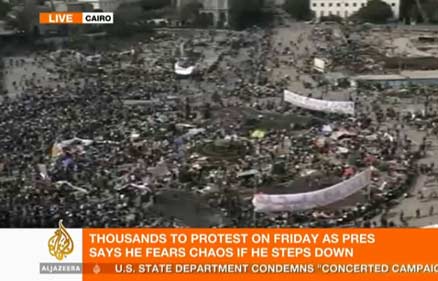
Crowd builds in Al Tahrir Square, Cairo, two million defy Mubarak intimidation

Al Jazeera has reasserted live footage in Cairo today, for the Friday demonstration billed as “Day of Departure” meant to depose dictator Mubarak. Already gone are the US major network talking heads, fleeing in advance the predicted mayhem as if to dot the exclamation point of their Chaos in Egypt meme. Alas, they won’t be here to offer color commentary on the hundreds of dozens of demonstrators of indeterminate religious-political orientation massing for Egyptian on Egyptian rioting. For the rest of us, this is a veritable revolution before our eyes. Perhaps the monumental event of our lifetime. Regardless the outcome, most of us are probably so estranged from reality to recognize it. This is what Democracy looks like.

We only know representative democracy, warped beyond recognition by an electoral college system only a statistician’s mother could love. Switzerland is the only direct democracy we’re taught in school. But democratic participation in Switzerland is not much more complicated than a homeowners association in an affluent neighborhood. People power taking to the street, denouncing the illegitimacy of its authoritarian masters, leaderless, allied, that’s real democracy.

What a shame the American celebrities are missing the party. Williams and Couric fled with the expat community, Amanpour is already giving her veneer of respectability to the next interviewee, Zuckerberg not Assange, because the corporate media wants to call this a Facebook revolution sooner than Wikileaks’. Anderson Cooper is cowering on the hotel floor of an undisclosed location, unafraid to confess that he’s fearing for his life, working that [brown] people-are-revolting angle.

On the heroic independent media side, Democracy Now! correspondent Sharif Abdel Kouddous spent the night in Tahrir Square, sleeping among the activists, half of them with bandaged heads, waking at intervals by the alarm sounding for anticipated stone-throwers.

None of the network journos showed any hesitation to criticize the harassment they encountered on the streets, though blaming Mubarak’s thugs was never explicit, and none of them veered from celebrating the riots as “Egypts killing each other.” Even Al Jazeera pretended to confuse the Pro and Anti sides, failing to discriminate between the side which was armed from the side taking cover, the knife wielders from desperate stone throwers trying to keep their attackers at bay.

Finally this morning an AJ text crawl mentioned 300 fatalities since the protests began January 25th, otherwise there has been scant mention of innocent civilians killed, some of them shot in the head by nighttime snipers.

All of the networks, even Al Jazeera express their incredulity that the demonstrators project no central leadership, failing to speculate why that may be.

Al Jazeera takes care to mention, every time they consult one of their three correspondents on the ground, that they omit speaker identities “for their own safety.” Even when they interview activists, the AJ anchors thank them for being brave enough to reveal their real names. Not discussed is the certain probability that calling out a demonstration leader will direct the security apparatus to deploy their snipers, summary arrest, or detention of family members. As the media wax horrific the barbarity of Cairo’s street culture chaos, they maintain a rudely unrealistic civil pretense to mask Egypt’s cruel police state.

My nightmare scenario, now that I’m looking over millions of peaceful undaunted Egyptians chanting for deliverance from their uncaring dictator? I worry about the US advisors reported to have flown into Cairo this morning, reassuring their cabby, it was reported, that everything was going to be fine.

I worry that Washington has spot on advice to offer Mubarak about how to respond to a “million man march.” After all, that’s old hat for DC. Let ’em eat waffle cake.

American protesters get the same response from Obama as they did from Bush 43. Praise for the glorious display of citizens exercising their constitutional rights. Talk away, shout it to the rooftops. Feel better? I hear you America. Thank you for your faith in the system. You are the change you’ve been waiting for. Please collect your refuse on the way out. Be sure to leave something in the hat to cover the expense of the Port-a-Johns. Thank you America, I’m honored, really. Yes we can, see you at the polls in 2012. Thank you for flying Air of Democracy. Bu’bye.

PPLFF says no BDS of Israeli Apartheid

Crap. The Anti-Apartheid BDS campaign targeted Cannes because of it, Hollywood luminaries boycotted the Toronto Film Festival over the same principles in 2009, you’d think the Springs gay community might have paid heed. Instead the 2010 Pikes Peak Lavender Film Festival opted to screen the Israeli melodrama Eyes Wide Open, Zionists’ illegal appropriation of Jerusalem be damned. When Canadian gays made international news for allowing Queers Against Israeli Apartheid to march in their pride parade, in spite of Jewish philanthropists pressuring the City of Toronto to withdraw funding, I hoped that COS pride festivities might opt to climb aboard. Instead this weekend Colorado Springs gets a full-on endorsement of Israel’s ongoing illegal invasion of Palestine.

It was a false hope. The Pikes Peak area gay community has found itself so embattled since Amendment Two’s 1992 measure to legalize discrimination on the basis of sexual orientation, that common social causes are easily crowded out by Gay Marriage, DADT and brand recognition for LGBT. So much so that social justice activists can only participate in the pride parade on the condition that it be about solidarity, not antiwar. With gay issues being so politicized, should gays and lesbians get a pass on staying apolitical about war or racism? Whatever excuses we make, it’s a perfectly flamboyant example of silence equals consent. I count apolitical queens every bit as complicit with US military criminality as the above-it-all new-agers and NASCAR jackasses.

Set in an Orthodox neighborhood of Jerusalem, Eyes Wide Open doesn’t address the Israeli-Palestinian troubles, it ignores them, effectively normalizing an ethnically-cleansed Palestine. The film tells the story of an extramarital gay affair between Jewish scholars, blablabla, minus the evictions of Palestinians in the path of encroachment by Israeli settlers, and the hijacking of Muslim holy sites . “Beverly Hills 90210” was fine without scenes of the LAPD repression of Watts or East LA, but 90210 wasn’t pretending to be taped on non-Jewish land.

Eyes Wide Open was the title of the 2005 American Friends Service Committee antiwar boot-counting exercise to open American eyes to the enormity of casualties of the Iraq War — before the Eyes Wide Open slogan was adopted by a 2008 Israeli PR project to encourage American Jews to pay more attention to their birthright offer of Israeli citizenship. The death count of US soldiers in Iraq and Afghanistan (now that the AFSC has been cleared to consider both wars illegal) has long since outgrown the AFSC budget for buying boots or lugging them around in rented trucks, and now EWO (Einaym Pkuhot) is a miserable tale about infidelity and sin.

Frankly, Trembling Before G-d was an incredible documentary about gay Orthodox men struggling with the DADT policy of Orthodox Judaism. I remember seeing it at the 2003 PPLFF, or so. I remember Rabbinical experts expounded on both sides of the argument with authority and humor. But that was before the BDS movement to curb Israel’s racist apartheid system. You either support the picket or you scab.

Objective reviews of EWO are scarce in the Zionist-dominated press, and increasing numbers are honoring the cultural and academic boycott of Israeli Apartheid. Refusing to see EWO is by no means concluding it is bad. For all I know the film may be using the ostracism of homosexuals within the Orthodox community to represent the growing alienation Israelis are feeling in the face of the open revulsion expressing itself by the rest of the world. Maybe it’s brilliant.

But I’m not deliberating about whether to see it. BDS means no to Israel, to its statesmen, artists, scholars and products. And the American companies which support Israel’s policy of Apartheid, several dozen, and now that includes our own PPLFF.

Yeah look at those dead bastards. Nice.


Here’s the Wikileaks decrypted Apache AH-64 combat footage of 2007 collateral murder of Iraqi civilians including two journalists, wounding two children.

Wikileaks is tweeting the ensuing developments. Democracy Now has interviews recorded the day after July 12, 2007 by Big Noise Films.

We have individuals going to the scene, looks like possibly uh picking up bodies and weapons.

Let me engage.

Roger, hey, we need to stop that.

Can I shoot?

Request permission to engage.

Picking up the wounded?

Yeah, we’re trying to get permission to engage.

Come on, let us shoot!

They’re taking him.

We have a Black SUV err, Bongo Truck picking up the bodies.

Fuck.

Request permission to engage.

Engage.

Transcript from the Full video:

00:03 Okay I got it.
00:05 Last conversation Hotel Two-Six.
00:09 Roger Hotel Two-Six [Apache helicopter 1], uh, [this is] Victor Charlie Alpha. Look, do you want your Hotel Two-Two two el-
00:14 I got a black vehicle under target. It’s arriving right to the north of the mosque.
00:17 Yeah, I would like that. Over.
00:21 Moving south by the mosque dome. Down that road.
00:27 Okay we got a target fifteen coming at you. It’s a guy with a weapon.
00:32 Roger [acknowledged].
00:39 There’s a…
00:42 There’s about, ah, four or five…
00:44 Bushmaster Six [ground control] copy [i hear you] One-Six.
00:48 …this location and there’s more that keep walking by and one of them has a weapon.
00:52 Roger received target fifteen.
00:55 K.
00:57 See all those people standing down there.
01:06 Stay firm. And open the courtyard.
01:09 Yeah roger. I just estimate there’s probably about twenty of them.
01:13 There’s one, yeah.
01:15 Oh yeah.
01:18 I don’t know if that’s a…
01:19 Hey Bushmaster element [ground forces control], copy on the one-six.
01:21 Thats a weapon.
01:22 Yeah.
01:23 Hotel Two-Six; Crazy Horse One-Eight [second Apache helicopter].
01:29 Copy on the one-six, Bushmaster Six-Romeo. Roger.
01:32 Fucking prick.
01:33 Hotel Two-Six this is Crazy Horse One-Eight [communication between chopper 1 and chopper 2]. Have individuals with weapons.
01:41 Yup. He’s got a weapon too.
01:43 Hotel Two-Six; Crazy Horse One-Eight. Have five to six individuals with AK47s [automatic rifles]. Request permission to engage [shoot].
01:51 Roger that. Uh, we have no personnel east of our position. So, uh, you are free to engage. Over.
02:00 All right, we’ll be engaging.
02:02 Roger, go ahead.
02:03 I’m gonna… I cant get ’em now because they’re behind that building.
02:09 Um, hey Bushmaster element…
02:10 Is that an RPG [Rocket Propelled Grenade]?
02:11 All right, we got a guy with an RPG.
02:13 I’m gonna fire.
02:14 Okay.
02:15 No hold on. Lets come around. Behind buildings right now from our point of view. … Okay, we’re gonna come around.
02:19 Hotel Two-Six; have eyes on individual with RPG. Getting ready to fire. We won’t…
02:23 Yeah, we had a guy shoot—and now he’s behind the building.
02:26 God damn it.
02:28 Uh, negative, he was, uh, right in front of the Brad [Bradley Fighting Vehicle; an tracked Armored Personal Carrier that looks like a tank]. Uh, ’bout, there, one o’clock. [direction/orientation]
02:34 Haven’t seen anything since then.
02:36 Just fuckin’, once you get on ’em just open ’em up.
02:38 All right.
02:40 I see your element, uh, got about four Humvees [Armored cars], uh, out along…
02:43 You’re clear.
02:44 All right, firing.
02:47 Let me know when you’ve got them.
02:49 Lets shoot.
02:50 Light ’em all up.
02:52 Come on, fire!
02:57 Keep shoot, keep shoot. [keep shooting]
02:59 keep shoot.
03:02 keep shoot.
03:05 Hotel.. Bushmaster Two-Six, Bushmaster Two-Six, we need to move, time now!
03:10 All right, we just engaged all eight individuals.
03:12 Yeah, we see two birds [helicopters] and we’re still fire [not firing].
03:14 Roger.
03:15 I got ’em.
03:16 Two-six, this is Two-Six, we’re mobile.
03:19 Oops, I’m sorry what was going on?
03:20 God damn it, Kyle.
03:23 All right, hahaha, I hit [shot] ’em…
03:28 Uh, you’re clear.
03:30 All right, I’m just trying to find targets again.
03:38 Bushmaster Six, this is Bushmaster Two-Six.
03:40 Got a bunch of bodies layin’ there.
03:42 All right, we got about, uh, eight individuals.
03:46 Yeah, we got one guy crawling around down there, but, uh, you know, we got, definitely got something.
03:51 We’re shooting some more.
03:52 Roger.
03:56 Hey, you shoot, I’ll talk.
03:57 Hotel Two-Six; Crazyhorse One-Eight.
04:01 Crazyhorse One-Eight; this is Hotel Two-Six. Over.
04:03 Roger. Currently engaging [fighting/shooting at] approximately eight individuals, uh KIA [Killed In Action], uh RPGs, and AK-47s.
04:12 Hotel Two-Six, you need to move to that location once Crazyhorse is done and get pictures. Over.
04:20 Six beacon gaia.
04:24 Sergeant Twenty is the location.
04:28 Hotel Two-Six; Crazyhorse One-Eight.
04:31 Oh, yeah, look at those dead bastards.
04:36 Nice.
04:37 Two-Six; Crazyhorse One-Eight.
04:44 Nice.
04:47 Good shoot.
04:48 Thank you.
04:53 Hotel Two-Six.
04:55 Hotel Two-Six; Crazyhorse One-Eight.
05:03 Crazyhorse One-Eight; Bushmaster Seven. Go ahead.
05:06 Bushmaster Seven; Crazyhorse One-Eight. Uh, location of bodies, Mike Bravo five-four-five-eight eight-six-one-seven [military map grid reference].
05:15 Hey, good on the uh…
05:17 Five-four-five-eight eight-six-one-seven [map grid reference]. Over.
05:21 This is Crazyhorse One-Eight, that’s a good copy. They’re on a street in front of an open, uh, courtyard with a bunch of blue uh trucks, bunch of vehicles in the courtyard.
05:30 There’s one guy moving down there but he’s uh, he’s wounded.
05:35 All right, we’ll let ’em know so they can hurry up and get over here.
05:40 One-Eight, we also have one individual, uh, appears to be wounded trying to crawl away.
05:49 Roger, we’re gonna move down there.
05:51 Roger, we’ll cease fire.
05:54 Yeah, we won’t shoot anymore.
06:01 He’s getting up.
06:02 Maybe he has a weapon down in his hand?
06:04 No, I haven’t seen one yet.
06:07 I see you guys got that guy crawling right now on that curb.
06:08 Yeah, I got him. I put two rounds [30mm cannon shells] near him, and you guys were shooting over there too, so uh we’ll see.
06:14 Yeah, roger that.
06:16 Bushmaster Thirty-Six Element; this is uh Hotel Two-Seven over.
06:21 Hotel Two-Seven; Bushmaster Seven go ahead.
06:24 Roger I’m just trying to make sure you guys have my turf [area], over.
06:31 Roger we got your turf.
06:33 Come on, buddy.
06:38 All you gotta do is pick up a weapon.
06:44 Crazyhorse this is Bushmaster Five, Bushmaster Four break. We are right below you right time now can you walk us onto that location over.
06:54 This is Two-Six roger. I’ll pop flares [drop flares]. We also have one individual moving. We’re looking for weapons. If we see a weapon, we’re gonna engage.
07:07 Yeah Bushmaster, we have a van that’s approaching and picking up the bodies.
07:14 Where’s that van at?
07:15 Right down there by the bodies.
07:16 Okay, yeah.
07:18 Bushmaster; Crazyhorse. We have individuals going to the scene, looks like possibly uh picking up bodies and weapons.
07:25 Let me engage.
07:28 Can I shoot?
07:31 Roger. Break. Uh Crazyhorse One-Eight request permission to uh engage.
07:36 Picking up the wounded?
07:38 Yeah, we’re trying to get permission to engage.
07:41 Come on, let us shoot!
07:44 Bushmaster; Crazyhorse One-Eight.
07:49 They’re taking him.
07:51 Bushmaster; Crazyhorse One-Eight.
07:56 This is Bushmaster Seven, go ahead.
07:59 Roger. We have a black SUV-uh Bongo truck [van] picking up the bodies. Request permission to engage.
08:02 Fuck.
08:06 This is Bushmaster Seven, roger. This is Bushmaster Seven, roger. Engage.
08:12 One-Eight, engage.
08:12 Clear.
08:13 Come on!
08:17 Clear.
08:20 Clear.
08:21 We’re engaging.
08:26 Coming around. Clear.
08:27 Roger. Trying to uh…
08:32 Clear.
08:35 I hear ’em co.. I lost ’em in the dust.
08:36 I got ’em.
08:41 I’m firing.
08:42 This is Bushmaster Forty got any BDA [Battle Damage Assessment] on that truck. Over.
08:44 You’re clear.
08:47 This is ah Crazyhorse. Stand by.
08:47 I can’t shoot for some reason.
08:49 Go ahead.
08:50 I think the van’s disabled.
08:53 Go ahead and shoot it.
08:54 I got an azimuth limit for some reason [gunner moved gunsight too far]
09:00 Go left.
09:03 Clear left.
09:15 All right, Bushmaster Crazyhorse One-Eight.
09:20 A vehicle appears to be disabled.
09:22 There were approximately four to five individuals in vehicle moving bodies.
09:28 Your lead Bradley should take the next right.
09:31 That’s cruising east down the road.
09:34 No more shooting.
09:38 Crazyhorse; this is Bushmaster Four. We’re moving a dismounted element [troops] straight south through the Bradleys [tanks].
09:44 I have your Elem- uh, Bradley element turning south down the road where the engagements were.
09:53 Last call on station’s uh Bradley element say again.
09:56 Roger this is Crazyhorse.
09:58 Your lead Bradley just turned south down the road where all the engagements [shooting] happened.
10:03 Should have a van in the middle of the road with about twelve to fifteen bodies.
10:11 Oh yeah, look at that. Right through the windshield!
10:14 Ha ha!
10:16 All right. There were uh approximately four to five individuals in that truck, so I’m counting about twelve to fifteen.
10:24 I would say that’s a fairly accurate assessment so far.
10:27 Roger that.
10:29 I want to just be advised Six, Bushmaster Six are getting mounted up right now.
10:35 Okay, roger. Hey, we can’t flex down that road towards that, uh, where Crazyhorse engaged.
10:43 So, uh, I don’t know if you want us to do so or stay put. Over.
10:46 Why can’t they go down there?
10:56 I think we whacked [killed] ’em all.
10:58 That’s right, good.
10:59 This is Hotel Two-Six.
11:03 Hey you got my dismounted element [troops] right there over to your left.
11:06 Roger, I see ’em.
11:11 Hey yeah, roger, be advised, there were some guys popping out with AKs behind that dirt pile break.
11:19 We also took some RPGs off, uh, earlier, so just uh make sure your men keep your eyes open.
11:26 Roger.
11:27 And, uh, Bushmaster ahead are, uh, Hotel Two-Six; Crazyhorse One-Eight.
11:33 Crazyhorse One-Eight; this is Hotel Two-Six.
11:35 Yeah Two-Six; Crazyhorse One-Eight.
11:37 Uh, location I have about twelve to fifteen dead bodies.
11:42 Uh, where else are we taking fire from?
11:48 Currently we’re not being engaged, ah, but just south of that location. Break.
11:55 You should see dismounted elements with Humvees [armored cars] moving to the east, over.
12:01 This is Crazyhorse One-Eight; we have elements in sight.
12:05 Bushmaster Three-Six.
12:07 I’m gonna get down a little lower.
12:09 All right.
12:10 I’m gonna come down a little lower and take a quick gander.
12:13 Roger that.
12:14 Six; this is four. We’re headed to the area where Crazyhorse engaged.
12:26 Bushmaster Six; this is Hotel Two-Six.
12:28 Request to go to the south to our original BP so if you flushed them to the south we will be there to uh intercept over.
12:39 Hey this is Bushmaster Seven; we’re coming up on B… on the ass end of the Brads [tanks].
12:54 Hey uh, Bushmaster Element; this is Copperhead One-Six break.
13:00 We’re moving in the vicinity of the engagement area and looks like we’ve got some slight movement from ah, the ah van that was engaged.
13:06 Looks like a kid. Over.
13:11 This is Bushmaster Seven, roger. Uh, we’re about a hundred meters behind you.
13:16 Got that big pile, to the right?
13:18 Roger, you gonna pull in here? Do you want me to push stuff so you can, uh, get clear of it?
13:21 Right on the corner?
13:22 What’s that?
13:23 Got that big pile of bodies to the right, on the corner?
13:24 Yeah, right here.
13:25 We got a dismounted infantry and vehicles, over.
13:30 Again, roger.
13:31 And clear.
13:48 There’s the Bradley right there.
13:51 Got ’em.
14:00 Hotel two-six; are you uh at this grid over?
14:05 Yeah I wanted to get you around so didn’t you just get that one dude to scare them all away. It worked out pretty good.
14:11 I didn’t want those fuckers to run away and scatter.
14:12 Yeah.
14:15 Bushmaster Six; Hotel Two-Six. Roger, we linked up with our two element they are all mounted up in our trucks break.
14:23 We moved south so that we could ah possibly intercept personnel being flushed south. So we are vicinity Fifth Street.
14:30 And ah please line Gadins. Over.
14:37 Bring the trucks in, cordon this area off.
14:39 Can we move the Bradley forward so we can bring trucks in and cordon off this area.
14:44 If the Bradleys could take the south cordon, that could help out a lot.
14:53 Bushmaster or element. Which Element called in Crazyhorse to engage the eight-elem- eight-men team on top of a roof.
15:02 Bushmaster Six; this is Hotel Two-Six. Uh, I believe that was me.
15:07 They uh had AK-47s and were to our east, so, where we were taking small arms fire. Over.
15:20 Hotel Crazyhorse One-Eight.
15:26 Crazyhorse One-Eight; this is Hotel Two-Six.
15:28 Yeah Two-Six. One-Eight I just also wanted to make sure you knew that we had a guy with an RPG cropping round the corner getting ready to fire on your location.
15:36 That’s why we ah, requested permission to engage.
15:40 Ok, roger that. Tango mike.
15:46 Hotel Two-Six; do you understand me, over?
15:51 I did not copy last, uh, you got stepped on. Say again please?
16:00 They cordoned off the building that the helicopters killed the personnel on.
16:04 Don’t go anywhere else we need to cordon off that building so we can get on top of the roof and SSC the building. Over.
16:13 Hotel Two-Six; Crazyhorse One-Eight.
16:16 This is Hotel Two-Six.
16:19 Hey, whoever was talking about rooftops, know that all the personnel we engaged were ground level. I say again ground level.
16:27 Roger I copy ground level. Over.
16:30 One-Eight roger.
16:33 Can I get a grid to that one more time please?
16:36 Target twenty.
16:36 Roger.
16:40 You want me to take over talking to them?
16:42 S’alright.
16:46 Seven-Six Romeo Over.
16:49 Roger, I’ve got uh eleven Iraqi KIAs [Killed In Action]. One small child wounded. Over.
16:57 Roger. Ah damn. Oh well.
17:04 Roger, we need, we need a uh to evac [evacuate] this child. Ah, she’s got a uh, she’s got a wound to the belly.
17:10 I can’t do anything here. She needs to get evaced. Over.
17:18 Bushmaster Seven, Bushmaster Seven; this is Bushmaster Six Romeo.
17:20 We need your location over.
17:25 Roger, we’re at the location where Crazyhorse engaged the RPG fire break.
17:37 Grid five-four-five-eight.
17:46 Well it’s their fault for bringing their kids into a battle.
17:48 That’s right.
17:56 Got uh, eleven.
18:01 Yeah uh, roger. We’re monitoring [observing].
18:02 Sorry.
18:04 No problem.
18:07 Correction eight-six-one-six.
18:16 Looking for more individuals-south.
18:18 Bushmaster Six-Bushmaster Seven.
18:29 I think they just drove over a body.
18:31 Hey hey!
18:32 Yeah!
18:37 Maybe it was just a visual illusion, but it looked like it.
18:41 Well, they’re dead, so.
18:44 Bushmaster Six; Hotel Two-Six over.
18:56 Six; this is Four. I got one individual looks like he’s got an RPG round laying underneath him. Break.
19:05 Probably like to get…
19:10 Look at that.
19:12 Bushmaster Six; Hotel Two-Six over.
19:29 Bushmaster Six; Romeo Hotel Two-Six over.
19:44 Bushmaster Six; Hotel Two-Six over.
19:56 Hotel Two-Six; Bushmaster Seven colocated with Six.
20:08 Hotel Two-Six; Bushmaster Seven.
20:10 Bushmaster Seven; Hotel Two-Six over.
20:14 Roger, we got a little girl who needs to be evaced. What’s your location over?
20:22 On route Gadins, I am all the way to the south. So I am Gadins and Fifth Street.
20:28 I say again Gadins and Fifth Street, over.
20:40 Bushmaster Seven; Hotel Two-Six. Do you want us to push to your location?
20:55 Hey, uh, I need to get the Brads to drop rads I got a wounded little girl we need to take her off the maya.
21:04 Bushmaster Seven; Hotel Two-Six. Do you want us to move to your location over?
21:30 Bushmaster Six; Hotel Two-Six over.
21:34 Hotel Two-Six; this is Bushmaster Seven. Roger, come to our location.
21:39 Okay, roger, we’re coming up north on Gadins and then we will push east to your location.
22:06 Bushmaster elements be advised we have friendlies coming from the south to your location. Over.
22:13 All right, got ’em moving up from the south.
22:35 Bushmaster elements be advised we are coming up from the east.
23:49 Hey One-Two; follow me over. I’m going to try and get out of here as quickly as possible.
24:10 You guys all right back there?
24:13 Yeah, we’re with you.
24:35 Lotta guys down there.
24:37 Oh yeah.
24:37 Came out of the woodwork.
24:38 This is Operation, ah, Operation Secure.
25:16 Yeah we have fifty rounds left.
25:17 Yep.
25:19 Two-Six; Six Romeo over.
25:21 Two-Six; Romeo over.
25:23 Hey roger, what’s your current location over?
25:47 Six; speak it’s Romeo.
25:50 Three-Six Romeo; Six Romeo over.
25:52 Roger, at the six once it’s back on this guy.
25:56 Lost him.
26:00 What’s he got for us?
26:01 Stand by.
26:06 Hotel Two-Six; Crazyhorse One-Eight.
26:21 Hey, did you got action on that target yet over?
26:25 Speak to Charlie roger.
26:32 Hotel Two-Six; Crazyhorse One-Eight.
26:55 Bushmaster Six; Crazyhorse One-Eight.
26:59 Roger, you have traffic over.
27:02 Roger. Uh, just wondering if you had anything else you wanted us to drive on?
27:08 Yeah roger keep on, ah, for the time being over.
27:11 Six calls Six Romeo. Can you tell battalion that two civilian children casualties are coming back to SMI in the Bradley over.
27:26 Six calls Six Romeo.
27:29 Bushmaster Six Copper White Six.
27:32 Copperhead White Six; this is Bushmaster Six Romeo over.
27:36 Roger, that’s a negative on the evac of the two, ah, civilian, ah, kids to, ah, rusty they’re going to have the IPs [Iraqi Police] link up. They can put us over here. Break. IPs will take them up to a local hospital over.
27:50 Copy over.
27:54 One six oh.
28:08 … they’re all going to.
28:10 Say again?
28:12 Where all those dismounts [infantry] are going to?
28:18 Going into this hous-. Sorry
29:29 Three Six, Three Six; Bushmaster Six Romeo over.
29:37 Six Romeo, Six Romeo.
29:39 Roger, Bushmaster Seven wants an up on all personnel in your battalion over.
29:44 Roger.
30:08 …friendlies [US troops] on the roof.
30:10 Crazyhorse One-Eight; this is Bushmaster Four over.
30:12 Bushmaster Four; this is Crazyhorse One-Eight.
30:15 Roger, I can ah hear small arms fire from your engagement area at two zero zero zero ah about three hundred meters from that objective over.
30:27 Crazyhorse; from what I understand small arms fire at two zero zero zero degrees about two hundred meters.
30:39 Just to the southwest.
30:41 Yup.
30:49 Right about where we engaged.
30:51 Yeah, One of them with that RPG or whatever.
30:55 He’s got a weapon. Got an RK–AK 47.
30:58 Hotel Two-Six; Crazyhorse One-Eight.
31:02 Gonna lose him.
31:03 Crazyhorse One-Eight this is Hotel Two-Six over.
31:08 Roger, have another individual with a weapon.
31:10 Dammit, they’re in the same building.
31:12 Hey roger that, just make sure that ah, you’re firing from west to east over.
31:16 Just went in the building.
31:18 Crazyhorse Three and Four will be on their way.
31:21 The individual walked into the building previously past grid [map reference]. So there’s at least six individuals in that building with weapons.
31:30 We can put a missile in it.
31:31 If you’d like, ah, Crazyhorse One-Eight could put a missile in that building.
31:46 It’s a triangle building. Appears to be ah, abandoned.
31:51 Yeah, looks like it’s under construction, abandoned.
31:52 Appears to be abandoned, under construction.
31:56 Uh, like I said, six individuals walked in there from our previous engagement.
32:01 Crazyhorse One-Eight; this is Bushmaster Six Romeo. If you’ve PIDed [Positively IDentified] the individuals in the building with weapons, go ahead and engage the building over.
32:08 Crazyhorse One-Eight; will be coming up north to south engaging with Hellfire [missiles].
32:13 All right, I’m going to do manual.
32:17 All right, we’ve been cleared to engage with…
32:18 This is Bushmaster Six Romeo. Crazyhorse One Eight is going to be engaging north to south with Hellfire missiles over.
32:24 This is Hotel Two-Six. Roger.
32:26 All right, you ready?
32:27 No, I’m trying to get over to the November [target]. Trying to find the fucking…
32:33 This is Bushmaster Six. Has that RPG round been extended already or is it still live, over.
32:38 Looks live to me.
32:40 Let me know when you’re going to fire.
32:44 All right, I’m fucking having a brain fart. Where’s the man [manual] advancement?
32:48 You got one on the clutch on the bottom left on your left door.
32:54 Roger let me stand by.
32:57 Got it?
32:59 No.
33:03 All right.
33:09 Let me just put a kilo [Hellfire missile] in there.
33:12 Ok.
33:15 Got it?
33:21 Put a kilo in?
33:22 All right, let me get back.
33:26 I’m gonna come around, get some more distance.
33:27 Roger that, you’re clear.
33:33 Got more individuals in there.
33:36 You wanna hit from north to south or you wanna go from west to east? I don’t wanna fire with the friendlies [US forces] right there, you know.
33:41 Yeah, go north to south.
33:53 Right, come around, right.
33:56 I’m just gonna put one or two in, if they want any more.
34:09 Right.
34:12 Found the missile.
34:15 Roger, I’ll get you in this straight.
34:16 You’re clear.
34:17 I’m firing.
34:26 Target hit.
34:28 It was a missile.
34:29 Left.
34:32 You’re clear. I’m above you.
34:36 Crazyhorse One-Eight; was that explosion you engaging over?
34:38 Crazyhorse One Eight, roger. Engaging building with one hellfire.
34:46 Let’s come around and we’ll clear the smoke. We’ll fire one more.
34:50 Hey uh, we’re going to wait for the smoke to clear.
34:52 Yes Crazyhorse One Eight now. We’re going to put one more missile into the building.
34:57 Yeah, did it ah, go in the building? I see the wall knocked out of the way.
34:59 Yeah, it went in.
35:01 Bushmaster Six Romeo; this is Hotel Two-Six. Yeah roger, that was Crazyhorse engaging with one Hellfire over.
35:10 Yeah roger, I got a November [target] if you want.
35:12 Fire away.
35:13 You want us to fire?
35:18 You ready?
35:19 Yep.
35:20 Bushmaster Six Romeo. They are going to engage ah, with one more Hellfire in that building.
35:24 Uh shit, why I do I have AP flashing on there? [warning on helicopter display]
35:47 We’re not even going to watch this fucking shit?
35:49 Till next one. It won’t come around, I need a little more distance.
35:53 Still want me to shoot?
35:57 You guys, following hot.
35:59 Roger.
36:13 You are clear.
36:14 Roger.
36:16 You going to bring up the missile?
36:18 Roger.
36:19 And firing.
36:20 Come down? There you go.
36:23 Fire.
36:24 All right.
36:28 I’ve got, ah BACKSCATTER [warning on helicopter display].
36:30 All right, come around.
36:32 Roger.
36:34 Coming around left, backscatter.
36:49 Firing.
36:53 There it goes! Look at that bitch go!
36:56 Patoosh!
37:03 Ah, sweet.
37:07 Need a little more room.
37:09 Nice missile.
37:11 Does it look good?
37:12 Sweet!
37:16 Uh, you ready?
37:18 Roger.
37:30 There’s a lot of dust.
37:36 Crazyhorse One-Eight; this is Hotel Two-Six. Was there a BDA [Battle Damage Assessment]?
37:40 This is Crazyhorse One-Eight. Stand by, engaging with another Hellfire.
37:43 All right.
37:45 You’re clear.
37:47 Lemme know when I’m clear.
37:50 Roger that.
37:59 He wasn’t.
38:02 Hotel Two-Six; Crazyhorse One-Eight.
38:07 Crazyhorse One-Eight.
38:09 Roger, building destroyed. Engaged with three hellfire missiles.

No. 1 domestic terrorist Daniel McGowan

The Huffington Post published a letter by ELF/ALF political prisoner Daniel McGowan, who is allowed to send one letter per week from CMU36, the controversial “Communication Management Unit” whose cover-name is USP Marion. According to McGowan, prison guards call it the “I Unit,” which probably does not stand for illegal.

As of May 2009, I have been at USP Marion’s “Communication Management Unit,” or CMU, for roughly nine months and now is a good time to address the misconceptions (and the silence) regarding this unit. I want to offer a snapshot of my day-to-day life here as well as some analysis of what the existence of CMUs in the federal prison system implies. It is my hope that this article will partially fill the void of information that exists concerning the CMU, will help dispel rumors, and will inspire you to support those of us on the inside fighting the existence of these isolation units — in the courts and in the realm of public opinion.

It is best to start from the beginning — or at least where my story and the CMU meet. My transfer here is no different from that of many of the men here who were living at Federal Correctional Institutions (normal prisons) prior to the genesis of the CMUs. On May 12, 2008, on my way back from a decent lunch, I was told to report to “R&D” (receiving and discharge). I was given two boxes and half an hour to pack up my meager possessions. After complying I was placed in the SHU (secure housing unit or “hole”) and put on a bus the next day. There was no hearing and no information given to me or my attorneys — only after a day was I told I was on my way to Marion, Illinois’ CMU.

Hearing the term “CMU” made my knees buckle as it drummed up some memory I had of the infamous “control units” at Marion (closed in 1995 and replaced by Florence ADX: the lone Federal “Supermax” prison). Then it hit me. The lawyers, in challenging the application of the terrorist enhancement in my case, made the prescient argument that if I receive the enhancement, the Bureau of Prisons (BoP) would use that to place me in the CMU at FCI Terre Haute, Indiana (at the time just 5 months old). In fact, on the way to FCI Sandstone in August 2007, I not only saw the CMU but met one of its residents while in transit. Let me back up and offer a brief history of the Communication Management Units.

The CMU I reside in, at USP Marion, received its first prisoner in May 2008 and when I arrived, held about 17 men, the majority of whom were Muslim. Currently, the unit has 25, with a capacity of 52 cells. In April 2009, we received seven new people, all of whom were from the CMU at FCI Terre Haute. The unit is overwhelmingly Muslim with 18 men identifying as such. Most, but not all of the prison, have so-called terrorism cases. According to a BoP spokesperson, the unit “will not be limited to inmates convicted of terrorism-related cases through all of the prisoners fit that description.” Others have prison disciplinary violation or allegations related to communication and the misuse of telephones etc. Here, almost everyone has a terrorism related case — whether it is like my case (destruction of property characterized as “domestic terrorism”) or conspiracy and “providing material aid” cases.

Before the Marion CMU opened, there was the original CMU, opened in December 2006 at the former death row at FCI Terre Haute. According to early articles, the unit was intended for “second tier terrorism inmates, most of them Arab Muslims and a less restrictive version of the Supermax in Florence, Colorado.”

Additionally, BoP Director Harley Lappin, in a July 2008 hearing on the 2009 BoP budget request, said of the CMUs, “A lot of the more serious offenders, terrorists, were housed at ADX Florence. So, we are ramping up two communications management units that are less restrictive but will ensure that all mail and phone calls of the offenders are monitored on a daily basis.”

Terre Haute’s CMU has 36 men (27 of whom are Muslim) and is roughly comparable to Marion’s CMU. The rest of this place focuses on the latter, in which I have resided and of which I have seen firsthand.

You may be curious about just what a CMU actually is. From my correspondence, I can tell that many correspondents do not know much about what goes on here. I hope this can clear up any misperceptions. According to the BoP,

The CMU is [sic] established to house inmates who, due to their current offense of conviction, offense conduct or other verified information, require increased monitoring of communication between inmates and persons in the community in order to protect the safety, security, and orderly operations of Bureau facilities and protect the public…The CMU is a self-contained general population housing unit.

There are, of course, alternate views to the above definition including the belief that the CMUs are Muslim units, a political prisoner unit (similar to the HSU operated by the BoP in the 80’s, and a punishment unit.

The CMUs have an extremely high Muslim population; here at Marion, it is 65-75%. An overrepresentation of any one demographic in a prison raises constitutional issues of equal protection as well as safety issues. Nowhere in the BoP will you find any group represented in such extreme disproportion. To counter these claims, the BoP brought in a small number of non-Muslims to be used as proof that the units are not strictly Muslim (an interesting note is that some of the Muslim men here have cases unrelated to terrorism). Does the inclusion of six people that are non-Muslim really negate the claim of segregation though? What are the criteria for determining who comes to the CMU? The BoP claims there are 211 international terrorists (and 1000 domestic terrorists) in their system. Yet, the CMUs have no more than 60 men at the present time. Where are the rest of these people? How does the BOP determine who of those 1200 are sent to a CMU and who to normal prisons? These are questions that need to be asked — in court and in the media.

Many of the men here (both Muslim and non) are considered political prisoners in their respective movements and have been engaged in social justice, religious organizations, charities and humanitarian efforts. Another conception of the CMU is that it is a location designed to isolate us from our movements and to act as a deterrent for others from those movements (as in “step outside the line and you too will end up there”). The intended effect of long-term housing of this kind is a profound sense of dislocation and alienation. With your mail, email, phones, and visits monitored and no human touch allowed at the visits, it is difficult to feel a connection to “the streets.” There is historical evidence of the BoP utilizing political prisons — despite the fact that the Department of Justice refuses to acknowledge the concept of political prisoners in US prisons, choosing to call us “criminal” instead.

The Lexington High Security Unit (HSU) was one such example. Having opened its 16-bed facilities in 1988 and housing a number of female political prisoners, the HSU functioned as an isolation unit — underground, bathed in fluorescence, and limited interaction with staff. In the opinion of Dr. Richard Korn, speaking on behalf of the American Civil Liberties Union, the unit’s goal was “…to reduce prisoners to a state of submission essential for their ideological conversion. That failing, the next objective is to reduce them as efficient, self-directing antagonists. That failing, the only alternative is to destroy them by making them destroy themselves.”

After an arduous campaign by human rights advocates and supporters, the BoP capitulated, stating it would close its facility (when it did not, it was sued). The judge ruled that the plaintiffs were illegally designated based on their past political affiliations, statements and political beliefs. The unit was closed and the women were transferred to other prisons.

The correlations between the HSU and CMU are many and seem to have some of the same goals as well as methods used to designate us here. Knowing they are dealing with people committed to ideals and the movements they are a part of, we were placed here in order to weaken those connections and harm our relationships. An example is the horrendous strain that the CMU puts on our familial relations — especially our marriages. It was certainly considered by the architects of the CMU that preventing visits that allow human touch for long-term prisoners would have a disastrous impact on our relationships and would lead to weaker inmates.

Finally, the CMU can be viewed as “the stick” — a punitive unit for those who don’t play ball or who continue to express political beliefs anathema to the BoP or the US government. Although I am not aware of the BoP’s criteria for sending people here (due to their refusal to release specific CMU information), it is curious who is and who is not here. Out of roughly 18 codefendants in my criminal case, I am the only one at a CMU (the remainder of them are at low and medium security prisons). The same goes for a member of the SHAC7 campaign, Andrew Stepanian, one of 6 defendants in his case who was sent here for the last 6 months of his sentence. Other men here have codefendants at the Terre Haute CMU while others have codefendants at normal federal prisons. Despite numerous Freedom of Information Requests, the BoP refuses to grant the documents that specify the rules governing transfer to the CMU. Remember, hardly any of the men here have received any disciplinary violations and some have been in general population over 15 years! How can someone be okay in general population for that long and then one day be seen as a communication threat?

So, I have hypothesized about the goals of the CMU. Let me discuss the many problems and injustices associated with the existence of the CMUs.

Due process
More appropriately, a lack thereof. A term I never thought much about before my imprisonment, due process is:

…the conduct of legal proceedings according to established rules and principles for the protection and enforcement of private rights, including notice and the right to hearing before a tribunal [my emphasis] with the power to decide the case.

I was moved from FCI Sandstone, against my will and at a moment’s notice, with no hearing and thus no chance to contest the reason for my transfer. A FOIA request recently received states I was redesignated May 6th, my transfer was signed the next day and I was moved on May 13th with the reason given as “program participation”. Since I got here, I have not had a hearing to contest the claims made in the “Notice to Inmate of Transfer to CMU, ” some of which were woefully inaccurate. Instead, I was told I can utilize the administrative remedy process (which I have done to no avail) and request a transfer after 18 months of “clear conduct”.

The irony is that all prisoners who violate prison rules are subject to a series of disciplinary hearings in which they could offer their defense. For legal units such as Florence ADX (Supermax) or the control unit program, there exists a codified set of rules and hearings for transfer to these locations. The BoP has deliberately ignored this process and has instead transferred us to this special, brand-new CMU without due process. My notice of transfer was given to me 12 days after I arrived!

Similar to the callous disregard for due process (and the US Constitution), there is no “step down” process for the CMU. Unlike the ones that exist at Florence ADX, control units or even the gang units, the CMU has no stages, no requisite amount of time we are to spend here before being sent back to a normal prison.

Because these preceding programs are specifically for prison misbehavior, there is a logical and orderly way to finish the program and eventually transfer. For us, the BoP has set up a paradox — if we are here for our offense conduct, which we cannot ever change, how can we reasonably leave the unit? In its “Admissions and Orientation” guide for Marion’s CMU, here is what they say:

Every new commitment to the CMU will be evaluated by his unit team regarding his suitability for incarceration in this institution. If, for some reason, the inmate is deemed not acceptable for confinement in this unit, he will be processed as expeditiously as possible…

[I am still roughly 10 months from my 18-month period in which I must wait before requesting a transfer. Considering the fact that all my remedies have been denied, I am not hopeful about this.]

CMU as Secret
In addition to the due process and transfer issues, there is the secretive and illegal manner that the CMU was created (Note: for historical perspectives, it needs to be stated that the CMU was established roughly halfway through the second term of George W. Bush and his Attorney General Alberto Gonzales.)

In April 2006, the BoP proposed a “Limited Communication for Terrorist Inmates” policy, which suggested new restrictions for “terrorists” and “terrorism related inmates” such as:

1) One 6-page letter per week.

2) One 15-minute phone call a month.

3) One 1-hour visit a month.

A coalition of civil rights organizations signed a letter of protest criticizing the proposed rules and raising numerous constitutional, practical and ethical objectives. The outcry appears to have caused the BoP to reconsider it and just 6 months later, open the CMU at FCI Terre Haute quietly. Since the BoP never sought public comment on the new CMU, it certainly appears to be a violation of the Administrative Procedural Act (APA), an argument a federal judge in Miami raised in response to a prisoner’s legal challenge to transfer to the CMU.

The unit is functionally an open secret. While the BoP circumvented the standard public comment (and feedback process), it has sought to get around this by describing the CMU as a “self-contained general population unit,” implying that the unit is legally and penally no different than a normal unit at an FCI. There is no mention of the CMU on the BoP’s website (ww.bop.gov) or USP Marion’s subpage on the same site. You will not find extensive Congressional hearings on the subject — other than a July 2008 subcommittee hearing in which it appears that the BoP director was not fully forthcoming on the CMU36. Letters here are stamped “USP Marion,” not CMU, and the unit is called “I Unit” by staff. (An interesting anecdote: while on transit in Winter 2009, I met men from the FCI here and asked them what they knew about I Unit. Without hesitation, they said, “That’s where the terrorists are.” They informed me this is what BoP Staff routinely told them.)

Media queries are met with silence or vague information. Requests by the media to interview me by coming to Marion have been denied — due to it “being detrimental to the safety, security and good order of the institution.” There still is no Program Statement on the CMU — a legal requirement, outlining the specific rules of the CMU and its designation criteria.

Because of this, and the general refusal of the BoP to hand over relevant documents through FOIA, it is impossible to determine the specific reasons why one is sent here — and thus, how to contest this process. In effect, the CMU was created on the fly, with no eye toward legality; they are free to operate it in whatever manner they choose.

Communication Management (The Promotion of Isolation and Alienation)
The most painful aspect of this unit, to me, is how the CMU restricts my contact with the world beyond these walls. It is difficult for those who have not known prison to understand what a lifeline contact with our family and friends is to us. It is our link to the world — and our future (for those of us who are fortunate enough to have release dates). Prison authorities and architects are well aware that those with strong family ties and in good communication with their loved ones are well behaved and have significantly lower rates of recidivism. The BoP, in theory, recognizes this by claiming they try to situate us within 500 miles of our homes. Mostly, this is a cruel farce for many prisoners — I have not been within 1000 miles of my family in 2 years.

The most Orwellian aspects of the CMU are in how they manage our communications:

A) Telephones- at my previous prison, I was able to use the phones for 300 minutes a month — days, nights, weekends and holidays — basically at any point I was not in my housing unit (6am-10pm). Here, we receive one 15-minute phone call a week. The call can only take place between 8am and 2:30pm, never on weekends or holidays and must be scheduled one and a half weeks in advance (we can choose a back-up number to call but if neither picks up, we don’t get a call). The call is live-monitored and recorded. Not only do we receive one fifth of the minutes granted to other federal prisoners but the call is also very trying for our families — all of whom have day jobs and many of whom have children in school. The CMU requires calls be made in English only — a difficult demand considering over half of the men here speak English as a second language (this restriction is not present at other federal prisons).

B) Visits- At FCI Sandstone, I received up to eight visiting days a month (56 hours) — contact visits in which I could embrace my wife, play cards with my nieces and share vending machine food with my visitors. These visits were my lifeline. I got about twelve of them in eight months and it aided in my adjustment to prison.

The CMU restricts our visits to one four-hour non-contract visit a month. One short visit through two inches of plate glass with cameras hanging overhead and my visitors stuffed in a four-and-a-half by three-and-a-half-foot stuffy booth — a tight squeeze for two. The visits can only take place on weekdays from 8am-2pm — no more Christmas or Thanksgiving visits — and worse, no physical contact (Consider what it would be like to have no contact with your loved ones. What if you couldn’t hug or kiss your lover, partner, wife, husband? What would that do to you?) I find myself riddled with guilt when I ask friends to spend $500 to fly across the country, drive three hours (and repeat) for a four-hour non-contact visit. I’m lucky though, having people who will do this. Many of the men here can’t afford it or don’t want to subject their children to this reality.

C) Mail- We can only send out mail once a day and we cannot visit the mail room to send out packages. We are one-hundred-percent reliant on the one staff person who deals with our mail to do so and sending a box home is a laborious procedure. We must leave our envelopes unsealed so that staff can read, copy, scan and send to whatever other agency studies our correspondence. A letter to NYC takes roughly seven to nine days (which should take five). Letters sent abroad, especially those not written in English, could take a month or more — a common complaint of some of my fellow prisoners.

Staff here has an interesting reading of the rules governing legal mail leading to the charge that they open our legal mail (this is the subject of an administrative remedy I filed with the BoP Central Office in Washington DC). The rule states that the lawyer’s name must be clearly identified and that the envelope must say “Special Mail- Open only in the presence of inmates” and yet staff has opened my legal mail that said “Law Offices of Jane Doe” stating that it should have said, “Jane Doe, Attorney at Law”! The staff looks for any reason to disqualify our legal mail as protected and gather intelligence this way. In doing so, they violate the sanctity of the attorney-client confidentiality principle.

Most of my violations have been petty — a package has more than twenty pieces of paper or a friend kindly enclosed stamps. A few instances though amount to censorship and a limiting of political expression and dialogue. See Appendix B for a detailed discussion of these instances.

D) Media Contact- Although requests have been made to interview people in the CMU, none have been granted to date. This is a violation of the spirit of the BoP’s own media policy. There is an imperative on the Bureau’s part to control and ultimately suppress information on the CMU from making it to a mass audience.

Daily Life at the CMU
Neither one of the two CMUs were built for long-term habitation. The Marion CMU was the site of the Secure Housing Unit (SHU), the USP that closed here in 2005. Terre Haute’s CMU is in “D-wing” — the site of the former federal death row.

The CMU was seemingly converted to its current use with the addition of televisions, steel tables, and new wiring and yet it is not suitable for long-term use due to its “open cell” design (i.e. with bars). With 25 prisoners, our movements are restricted to two housing ranges (hallways about 100 by 12 feet); a recreation range where we also eat (consisting of seven cells with a computer, typewriter, barber shop, religious library, social library, art room and recreational equipment); and a small rec yard (all concrete, a lap equals one-eighteenth of a mile, four cages with two basketball hoops, one handball court, a weather awning with tables and some sit-up benches). We are lucky to be visited daily by a resident bird population of doves and blackbirds, and overhead, the occasional hawk or falcon (ironically, as I write this, I overhear warnings from staff that if we continue to feed the birds, we will receive violations). The appearance of the yard with its cages, concrete, and excessive barbed wire has earned it nickname “Little Guantanamo” (of course a punitive unit with seventy-five percent Muslims also contributes to the name as well).

The conditions here are not dire — in fact, the horror stories I have heard over the last two years have convinced me it is far worse at many prisons and yet, I believe it is important to be descriptive and accurate — to dispel fears (about violence, for instance) but also to demonstrate just how different life is for us at the CMU.

There are many things we lack here that other prisons in the federal system have to offer:

1- A residential drug/alcohol program- despite at least one person here having completion of it ordered by the court.

2- Enough jobs for the prisoners here- There is not nearly enough jobs for all the men here and most are extremely low paying.

3- UNICOR- This is Federal Prison Industries which has shops at many federal prisons (including this one outside the CMU). These jobs pay much more, allow men to pay their court fees, restitution and child support and, as the BoP brags, teaches people job skills.

4- Adequate educational opportunities- Until recently, we did not have GED or vocational programs. Due to inmate pressure and persistence, we now have both of those as well as a few prisoner-taught classes but no college courses at all.

5- Access to staff on a daily basis- At other federal prisons, you are able to approach staff members at lunch every day, including the Warden. Here, we get (at most) two quick walk-throughs a week, usually taking place early in the morning. You are often left waiting days to resolve a simple question.

6- Law library access- We have a very small law library here with only twenty-five percent of the books required by law. We can only request books twice weekly and those are only delivered if the other nine hundred prisoners at the adjacent Medium are not using them. We lack Federal Court and Supreme Court reports as well as books on Immigration Law (fifty percent or more of the men here face deportation). This lack of access makes for an arduous and ineffective research path.

7- Computers- We have four computers for our email system (two for reading, one for printing and one that we were told would be for legal but it still isn’t working). Unlike my previous prison, where we had forty computers with a robust computer-class program, or like other prisons that teach a vocational computer course, we have no such thing.

8- Access to general population- Being in an isolation unit makes for a situation in which we cannot have organized sports leagues and tournaments due to not having enough people at all. This may not seem crucial but sports are a very useful diversion from the stress of prison life and separation.

After reading the preceding sections, perhaps like me you are wondering what really is the purpose of the CMU. In short, the SMU is Florence ADX-LITE for those men whose security points are low and present no real problems to staff. From my interactions with the men here, I can say with certainty, that people here are remarkably well-behaved and calm — many without any disciplinary violations. If these men, like myself, don’t get in trouble, and have been in the system for some time, why are we here? Consider my case.

My short time in prison prior to coming to the CMU consisted of two months at MDC Brooklyn and eight months at FCI Sandstone. I had never gotten in trouble and spent my days as a clerk in psychology, working toward a Master’s degree, reading, writing and exercising. My goal was to get closer to home and my loved ones. In April 2008, I filed a “hardship transfer” request due to my mother’s illness and her inability to travel to Minnesota to visit me. I had my team meeting, and my security points were lowered. Weeks later, I was moved to the CMU.

The irony is that I was moved to the CMU to have my communication managed, but what changed in that one year to justify this move? If I was a danger, then why did the BoP house me in a low-security prison? The same applies to many of the men here– some have been in general population for twenty years and then suddenly a need to manage their communication is conjured up. During my pre-CMU time, I had used 3500 phone minutes and sent hundreds of letters. If there was a problem with my communication, shouldn’t the BoP have raised this with me? My notice stating their rationale for placing me here attributed it to me “being a member and leader in the ELF and ALF” and “communicating in code.” But if this is true, then shouldn’t I have been sent to the CMU as soon as I self-reported to prison in July 2007?

The CMUs were crafted and opened under the Bush administration as some misguided attempt to be tough on the “war on terror.” This unit contains many prisoners from cases prosecuted during the hyper-paranoid and over-the-top period after 9/11 and the passage of the USA Patriot Act.44 The number of prosecutions categorized as terrorism-related more than doubled to reach 1,200 in 2002. It seemed that every other week, there was some plot uncovered by overzealous FBI agents — in Lackawanna, NY, Miami, FL, Portland, OR, and Virginia and elsewhere (never mind the illegal wiretaps and unscrupulous people used in these cases). These cases may not be headlines anymore but these men did not go away — they were sent to prison and, when it was politically advantageous for Bush, transferred to the CMUs. The non-Muslim populations of these units (although definitely picked judiciously) were sent there to dispel charges that the CMUs were exclusively Muslim units.

The codified rationale for all prisoners being transferred here are “contact with persons in community require heightened control and reviews” and “your transfer to this facility for greater communication management is necessary to the safe, secure, and orderly function of Bureau institutions…” Should an increase in monitoring of communication mean a decrease in privileges? If the goal is to manage our contact with the outside world, shouldn’t the BoP hire enough staff so that we can maintain the same rights and privileges as other prisoners (since the party line is that we are not here for punishment)? The reality is the conditions, segregation, lack of due process and such are punishment regardless of whether the BoP admits it or not.

Forward!
Where to from here, then? Does the new President and his Attorney General take issue with segregation? Will Obama view the CMU, as he did with Guantanamo Bay, as a horrible legacy of his predecessor and close it? Many people are hopeful for an outcome like that. On April 7th, 2009, Mr. Obama, while in Turkey, said, “The United States will not make war on Islam,” and that he wanted to “extend the hand of friendship to the Muslim world.” While that sounds wonderful, what does that look like in concrete terms? Will he actualize that opinion by closing the CMU? Or will he marry the policy of Bush and condone a secret illegal set of political units for Muslims and activists? What of the men here? Will he transfer us back to normal prisons and review the outrageous prosecutions of many of the CMU detainees? If it can be done with (former) Senator Ted Steven’s case, it can be done here.

While lawsuits have been filed in both Illinois and Indiana federal courts, what is needed urgently is for these units to be dragged out into the open. I am asking for your help and advocacy in dealing with this injustice and the mindset that allows a CMU to exist. Please pursue the resource section at the end of this article and consider doing something. I apologize for the length of this piece — it was suggested to me (by people way smarter than myself) that it would be best to start from the beginning and offer as many details as possible. I hope I gave you a clearer idea of what’s going on here. Thank you for all your support and love — your letters are a bright candle in a sea of darkness.

UCSB Hillel students Rebecca Joseph, Tova Hausman highlight poor education

Charges against Professor William RobinsonToday’s university campuses have to deal with College Republicans, ACTA and NeoMcCarthyists. The latest uneducable creeps shopped their leftist-professor- horror-story to the Anti-Defamation League, to brand their teacher’s criticism of Israel as “anti-Semitic.” UCSB senior Rebecca Joseph and junior Tova Hausman both took exception to Professor William Robinson’s Sociology Listserv email comparing Israel’s mop up operation in Gaza to the Warsaw Ghetto. Below are the words they cut and pasted together to accuse Robinson.

The literacy level of these two students is probably on par for Twilight fans, but definitely unbecoming for the University of California system. The first letter is reputedly from a college senior. Rebecca Joseph‘s opening argument was plagiarized from the internet, but she continues to scold Professor Robinson for straying from her idea of what makes a university professor. The second complaint from UCSB junior Tova Hausman copies the first letter’s form, but adds the accusation of sexual misconduct for leaving her feeling raped.

Is it unfair to put simple college students under national scrutiny like this? From their own words they show themselves to be rather helpless. But what to do when students, or some unscrupulous backers, are taking aim at a respected tenured professor? It’s serious business. Organizations like ACTA and Hillel are out to enforce a veritable Right Wing PC rectitude. As if it’s politically incorrect to make fun of uneducated on campus!

Keeping educators silenced was easier during the Bush administration, but the dampers are still on Academic Freedom. Ward Churchill may have won his case in court against the University of Colorado, but opinionated faculty are still few and far between. The latest attack against William Robinson attempts to reinforce more of the same.

UCSB senior Rebecca JosephProbably by now Hillel is wishing they’d coaxed a better educated pair of students to face off against Robinson. The administrators who received the complaint letters should have earmarked the girls for a remedial English refresher in anticipation of their graduation. But let’s look beyond the cheap shots.

The accusations inarticulated here are scurrilous where they are not outright illogical. You be the judge.

First Student Complaint
Here’s the first complaint received by UCSB, from Rebecca Joseph, Vice-president of the Santa Barbara campus Orthodox Jewish Chabad. Interestingly, UCSB has a number of pro-Israel action groups: Hillel, Jewish Awareness Movement on Campus, American Students for Israel, Stand With Us, AIPAC and the Israeli Palestinian Film Festival (which judging by the lineup runs films only by un-self-critical Israelis and sympathetic Palestinians).

Here is Rebecca Joseph’s complaint, uncorrected.

To Whom It May Concern:

On Monday, january 19, at 1:02 pm, I received an email from Professor Robinson for the course Sociology of Globalization (Soc 130SG). The subject of the email was “Parallel images of Nazis and Israelis.” This email compared the aggression of the Nazis to the Jews in Germany, to that which is going on between Palestine and Israel today. Professor Robinson wrote the first three paragraphs including the following: “Gaza is Israel’s Warsaw…” In addition to his few words, he attached an email describing the comparison which goes on to another attachment showing pictures to prove his point.

This email shocked me; before I did anything I gave him the benefit of the doubt and emailed him back asking, “I just wanted to know what this information was for? Is it for some assignment or just information that you put out there for us?” His response was “Rebecca, just for your interest….. I should have clarified.”

At this point I felt nauseous that a professor could use his power to send this email with his views attached, to each student in his class. To me this overstepped the boundaries of a professor and his conduct in a system of higher education. Due to this horrific email I had to drop the course. being a senior and needing any classes I could get, this left me in need of more classes which added more stress.

Two weeks later I saw a friend that was in the course with me and I asked him if it was ever brought up in class or discussed even for a brief minute or two, he responded by telling me that he never even mentioned it in class and that he too would have dropped the course, but he needed it to graduate on time.

Anti Semitism is considered to be hatred toward Jews –individually and as a group– that can be attributed to the Jewish religion and/or ethnicity. An important issue is the distinction between legitimate criticism of policies and practices of the State of Israel, and commentary that assumes an anti-Semitic character. The demonization of Israel, or vilification of Israeli leaders, sometimes through comparisons with Nazi leaders, and through the use of Nazi symbols to caricature them, indicates an anti-Semitic bias rather than a valid criticism of policy.

I found these parallel images intimidating, disgusting, and beyond a teacher role as an educator in the university system. I feel that something must be done so other students don’t have to go through the same intimidating, disgust I went through. I was asked to speak to him and get him to apologize but I feel that it will not make a difference for future students of his.

Whatever the outcome may be, I am hoping for some apology from Robinson, for not only my self and but for my peers in the class as well. In addition I would like to see more happen then just an apology because he has breached the University’s Code of Conduct for Professors and that this issue must be dealt with immediately.

In the Faculty Code of Conduct in Part II, Professional Responsibilities, Ethical Principles, and Unacceptable Faculty conduct, in Section A, Teaching and Students, it states that “The integrity of the faculty-student relationship is the foundation of the University’s educational mission. This relationship vests considerable trust in the faculty member, who, in turn, bears authority and accountability as mentor, educator, and evaluator.”

However Professor Robinson has turned away from his professional responsibilities through his “significant intrusion of material unrelated to the course.” (Part II, Section A, Number 1, b). He has also violated the universities policy by “participating in or deliberately abetting disruption, interference, or intimidation in the classroom,” (Part II, Section A, Number 5). Robinson has done so through this intimidating email which had pushed me to withdraw from this course and take another one.

In the University System professors above all, are to be “effective teachers and scholars,” Robinson has gone against his rights as a professor at the university through his, “unauthorized use of University resources or facilities on a significant scale for personal, commercial, political, or religious purposes,” (Section II, Section C, Number 3). Robinson used his university resources, to email each student in this course to get his view across, in doing so; he became a representation of the faculty members of the University of California Santa Barbara. The code of conduct state that, “faculty members have the same rights and obligations as all citizens. They are as free as other citizens to express their views and to participate in the political process of the community. When they act or speak in their personal and private capacities, they should avoid deliberately creating the impression that they represent the University.” By Robinson using his university email account he attaches his thoughts with that of the university and they become a single entity sharing the same ideas.

Thank you very much for your time and consideration of this matter and I am hoping to here [sic] back in the near future.

Thank you,

Rebecca Joseph

Junior Tova Hausman accused UCSB professor William Robinson of being anti-SemiticSecond student complaint
The second letter, which cribs from the first obviously, was sent by UCSB junior Tova Hausman. At least she credits the US State Dept as the source of her definition of “anti-Semitism.” But Hausman adds the accusation of sexual impropriety, taking a page it seems from David Mamet’s Oleanna.

February 19, 2009

To whom it may concern,

My name is Tova Hausman, and I was enrolled in Professor William Robinson’s Sociology 130 SG course this Winter 2009. The course was called Social Globalization. Our class received an email in the second week of class, from the professor, called “Parallel images of Nazis and Israelis.” It discussed the parallel acts and images between Nazi Germany during World War II and the present day Israelis. He claims that what the Nazis did to the Jews during the war is parallel to what Israel is doing to Palestine right now. Professor Robinson clearly stated his anti Semitic political views in this email that were unjust and unsolicited. The department of states 2004 definition of anti-Semitism: Anti Semitism is considered to be hatred toward Jews –individually and as a group– that can be attributed to the Jewish religion and/or ethnicity. An important issue is the distinction between legitimate criticism of policies and practices of the State of Israel, and commentary that assumes an anti-Semitic character. The demonization of Israel, or vilification of Israeli leaders, sometimes through comparisons with Nazi leaders, and through the use of Nazi symbols to caricature them, indicates an anti-Semitic bias rather than a valid criticism of policy……

In all the years of schooling and higher education I have never experienced an abuse of an educator position. Taking the opportunity to disseminate personal political views through obtaining email addresses of the class roster that are only for academic use, show betrayal and complete abuse of powers by the professor. To hide behind a computer and send this provocative email shows poor judgment and perhaps a warped personality. The classroom and the forum of which higher education is presented needs to be safe and guarded so the rights of individuals are respected. handle

To express one’s political views is not necessarily wrong but here it was not relevant to the subject matter. How could one continue to participate in this professor’s class? The fact that the professor attached his views to the depiction of what my great grandparents and family experienced shows lack of sensitivity and awareness. What he did was criminal because he took my trust and invaded something that is very personal. I felt as if I have been violated by this professor. Yes I am aware of Anti-Semites, but to abuse this position in an environment of higher education where I always thought it to be safe, until now, is intimidating.

This professor should be stopped immediately from continuing to disseminate this information and be punished because his damage is irreversible. He abused his privilege to teach, to lead, and to mentor.

Bellow is a list of the faculty code of conduct in which I believe Professor Robinson violated:

Part I — Professional Rights of Faculty
2. the right to present controversial material relevant to a course of instruction.

Part II — Professional Responsibilities, Ethical Principles, and Unacceptable Faculty Conduct
A. Teaching and Student

The integrity of the faculty-student relationship is the foundation of the University’s educational mission. This relationship vests considerable trust in the faculty member, who, in turn, bears authority and accountability as mentor, educator, and evaluator. The unequal institutional power inherent in this relationship heighten the vulnerability of the student and the potential for coercion. The pedagogical relationship between faculty member and student must be protected from influences or activities that can interfere with learning consistent with the goals and ideals of the University. Whenever a faculty member is responsible for academic supervision of a student, a personal relationship between them of a romantic or sexual nature, even if consensual, is inappropriate. Any such relationship jeopardizes the integrity of the educational process.

1. Failure to meet the responsibilities of instruction, including:
(b) significant intrusion of material unrelated to the course;

2. Discrimination, including harassment, against a student on political grounds, or for reasons of race, religion, sex, sexual orientation, ethnic origin, national origin, ancestry, marital status, medical condition, status as a covered veteran, or, within the limits imposed by law or University regulation, because of age or citizenship or for other arbitrary or personal reasons.

5. Participating in or deliberately abetting disruption, interference, or intimidation in the classroom.

Types of unacceptable conduct:

B. Scholarship
Violation of canons of intellectual honesty, such as research misconduct and/or intentional misappropriation of the writings, research, and findings of others.

C. University
3. Unauthorized use of University resources or facilities on a significant scale for personal, commercial, political, or religious purposes.

E. The Community Ethical Principles.
“Faculty members have the same rights and obligations as all citizens. They are as free as other citizens to express their views and to participate in the political processes of the community. When they act or speak in their personal and private capacities, they should avoid deliberately creating the impression that they represent the University.” (U.C. Academic Council Statement, 1971)

I expect this matter to be looked into and wish to be contacted soon.

Thank you,

Tova Hausman

Well let’s make a point to contact this McCarthy wannabe. These are crummy students fancying themselves campus sanitizers for Israel. What contemptible innuendo and vacuous indignation! The two students reportedly approached the Simon Wiesenthal Center, where they were advised to work through the Jewish Anti-Defamation League.

Abraham FoxmanLetter sent from the ADL
Pressure then came from Anti-Defamation League National Director Abraham Foxman who visited the campus in a covert meeting to recommend the immediate reprimand of Professor Robinson. (Foxman even had these words for the Gaza analysis offered by Bill Moyers.)

February 9, 2009

William I. Robinson
Professor of Sociology
Global and international Studies
Latin American and Iberian Studies
University of California – Santa Barbara
Santa Barbara, CA 93106

Dear Professor Robinson:

We have received complaints that on January 19, 2009, you sent an email to a number of your student entitled “parallel images of Nazis and Israelis.” If this allegation is true, ADL strongly condemns the views expressed in your email and urges you to unequivocally repudiate them.

While your writings are protected by the First Amendment and academic freedom, we rely upon our own rights to say that your comparisons of Nazis and Israelis were offensive, a historical and have crossed the line well beyond legitimate criticism of Israel.

In our view, no accurate comparison can be made between the complex Israeli-Palestinian conflict and the atrocities committed by the Nazis against the Jews. Nor can Israeli actions or policies be fairly characterized as acts of ethnic cleansing or genocide. Unlike the Holocaust (and to more recent examples of genocide and ethnic cleansing in Darfur, Rwanda and Kosovo), there is no Israeli ideology, policy or plan to persecute, exterminate or expel the Palestinian population — nor has there ever been. In direct contrast, the Nazis’ “final solution” to the “Jewish problem” was the deliberate, systematic and mechanized extermination of European Jewry. Hitler’s “final Solution” led to the calculated, premeditated murder of six million Jews and the destruction of thriving Jewish communities across Europe.

We also think it is important to note that the tone and extreme views presented in your email were intimidating to students and likely chilled thoughtful discussion on the Israeli-Palestinian conflict. Clearly, that is antithetical to the very purpose of the academy. Finally, using your university email address to send out material that appears unrelated to your Globalization of Sociology course likely violates numerous parts of the University of Santa Barbara Faculty Code of Conduct (see, for example, Part I, 2; Part II, A, 1, b; Part II, C, 3; Part II, E, 1).

Again, ADL strongly condemns the views expressed in the January 19, 2009 email and we urge you to unequivocally repudiate them.

Sincerely,

Cynthia Silverman
Santa Barbara Regional Director
Anti-Defamation League

Cc:
Department Chair, Verta Dean
Chancellor, Henry T. Yang
President, Mark G. Yudof

Martin Scharlemann, University of California at Santa BarbaraEmail from UCSB Charges Officer:
Instead of dismissing the dubious accusations, the school is convening an investigation. But not without impropriety on the part of the Charges Officer Martin Scharlemann. Prof. Scharlemann insisted that Robinson produce a written refutation BEFORE he would reveal the formal accusations leveled by the two students. Read the formidable exchanges at the website mounted by the UCSB students and faculty rallying to Robinson’s defense.

Charges Officer E-mail Re: Charges

Professor Robinson,

Responding to your memo of 3 April, here is a summary of the allegations:

* You, as professor of an academic course, sent to each student enrolled in that course a highly partisan email accompanied by lurid
photographs.

* The email was unexpected and without educational context.

* You offered no explanation of how the material related to the content of the course.

* You offered no avenue to discuss, nor encouraged any response, to the opinions and photographs included in the email.

* You directly told a student who inquired that the email was not connected to the course.

* As a result, two enrolled students were too distraught to continue with the course.

* The constellation of allegations listed above, if substantially true, may violate the Faculty Code of Conduct.

In the (”not exhaustive”) list of examples included with that Faculty Code of Conduct, the most proximate are part II, A. 1. b and A. 4.

On the other matters you raise, while my conversation with the students was confidential, I can tell you that I did not advise them to seek an “apology” from you. And yes, I did offer you an opportunity “if you wish” to provide a written response to the complaint before I met with the Charges Advisory Committee, which is solely vested with the authority to dismiss a complaint as frivolous and unfounded.

-Martin Scharlemann

Dan ChinitzAnd from the internets…
And let’s not overlook the attempts to initiate an email campaign to bring public pressure on UCSB to reprimand Professor Robinson. A commenter to this blog linked to a website advocating a form email to convey (our) universal indignation over the anti-Semitism at UCSB. The form letter is suggested by “anonymous” (possibly Alvin Black aka Dr. Mike) and he recommended signing it “Name withheld to protect privacy.” We reprint the opening and closing here:

Dear Chancellor Yang,

As I am sure you know, several months ago, Professor William I. Robinson, a self described “scholar -activist” and professor of Sociology and Global Studies at your university, forwarded an email to his students condemning Israel. The email contained images of Nazi atrocities along with images from Israel’s defensive campaign against Hamas’s terror. This comparison is considered by both the US State Dept and the European Union, in their working paper on anti-Semitism, to cross the line into anti-Semitism. This email was so disturbing to at least two students that they felt compelled to drop his class. Because of the nature of the emails, the Anti-Defamation League, as well as the UCSB Academic Senate’s Charges Committee have become involved.

[…etc…]

And thus the Arab world’s war against Israel becomes a nation-wide campus war against Jews.

Professor Robinson seems to have chosen to join the ranks of these “erstwhile defenders.”

I most sincerely urge you, therefore, to draw a line in the sand. The university should not be a promoter of Jew-hatred, nor an inciter of violence.

Sincerely yours,

Name withheld to protect privacy

Anonymity
Isn’t that what this post is about actually? We’ve aggregated the criticisms flying against Professor Robinson, but most notably this article seeks to expose the UCSB students who led the faceless attack against Professor Robinson.

Until the Los Angeles Times revealed their names today, the identities of both Joseph and Hausman had been concealed. Even the specific complaints they brought against Robinson were kept secret from the accused himself. Now, what kind of people insist on slandering others from the shadows?

At NMT, we make ourselves known, while many of our detractors do not. We could not care less, but if apologists for Israel’s crimes consider themselves in the right, why do they hide behind aliases?

If you support Israel’s “right to defend itself” by breaking international conventions and committing war crimes, stand up and say it. If you think Israel has every right to take the land of the Palestinians and keep it, Goddamn it come out from behind your creepy disguises and say it. If you’re going to impugn others for whatever false transgression, without the courage to reveal yourself, do you expect anyone to accord you credibility?

If you are going to condemn the Palestinians of Gaza for exercising their basic human right to resist an illegal foreign invasion and occupation of their land, you better have the nerve to say it publicly. Cowards.

Mark 6TH YEAR of Iraq Occupation with profiteers Boeing, Lockheed, GD and KBR

answer-march-on-pentagon
A.N.S.W.E.R.’s March 21 MARCH ON THE PENTAGON to mark the sixth year of the War in Iraq will be directed not only at the US Department of Defense, but at the war profiteers for whom 2007 was a record year, among them Boeing, Lockheed Martin, General Dynamics and KBR. In Colorado Springs the merchants of death can be visited on one corner.

answer

On March 21, 2009,
March on the Pentagon and the Corporate War Profiteers

Department of the Defense HeadquartersThe March on the Pentagon on Saturday, March 21 is shaping up to be a dramatic and highly significant demonstration. Many thousands of people are coming to Washington, D.C. to make their voices heard.

March 21 will culminate in a dramatic direct action where hundreds of coffins—representing the multinational victims of militarism, Empire and corporate greed—will be carried and delivered to the headquarters of the Corporate War Profiteers and Merchants of Death.

From the Pentagon, we will march to the nearby giant corporate offices of Boeing Company, Lockheed Martin Corporation, General Dynamics and KBR (the former subsidiary of Halliburton).

The march will start close to the State Department in Washington, D.C. (assemble at 12 noon at 23rd St. and Constitution Ave. NW).

Please make an urgently needed donation today by clicking this link to donate online through our secure server, where you can also find information on how to donate by check.

These are the Corporate War Profiteers and Merchants of Death. They are the vultures who profit off the death and suffering of the people of Iraq, Afghanistan and Palestine, and off of the thousands of U.S. soldiers and marines who have died or been wounded in these wars of aggression. They are anti-worker and anti-union.

The march will be led by a large contingent of veterans and family members of veterans from the Iraq and Afghanistan wars, and from earlier conflicts.

Militarism and Corporate Capitalism
We will march on their slick-and-shiny corporate offices that are located less than a mile from the Pentagon. Their location in the very shadow of the Pentagon speaks volumes about the intimate connection between militarism and corporate capitalism.

When the Pentagon brass retire, they rotate out of their Pentagon offices and directly into the Corporate boardrooms and office suites of the Death Merchants. It is a very cozy and very profitable relationship for the elites—in and out of uniform. They make the profits, others do the bleeding.

Last year was a great year for the Corporate War Profiteers and Merchants of Death. Profits soared even as the rest of the economy neared collapse. The CEOs of the four corporations that we will be visiting on March 21 received more than $319 million in compensation in 2007 alone (and remember, that’s just for four individuals). “We the People” paid the bill for the high tech weapons that were used against occupied people in Iraq, Afghanistan and Palestine. The Corporate Executives laughed all the way to the bank while grieving parents and children buried their loved ones from Baghdad to Kabul to Gaza to Detroit.

A quick examination shows that the CEOs of the Military-Industrial Complex contributed to both the Democratic and Republican Party candidates in almost equal amounts. They favor a system that ensures that politicians will come and go every four years but the military machine—that fusion of industry, banks and the Pentagon brass—will remain as is.

We Need Jobs & Schools – Not War!
The same banks that are being bailed out to the tune of trillions of dollars even while they foreclose families who can’t pay their mortgage debts are double-dipping from the national treasury by making huge profits in their investments in Boeing, Lockheed Martin, General Dynamics and KBR.

War is just good business for these corporate executives. Every F-16 bomber, attack helicopter, cruise missile and Drone bomber is a source of profit. If the wars stopped they would be out of business.

The people of this country are fed up with the status quo. They want decent-paying jobs, and affordable health care and housing for all. Students want to study rather than be driven out by soaring tuition rates. People want a complete—not partial—withdrawal of ALL troops from Iraq. They want the war in Afghanistan to end rather than escalate. They are increasingly opposed to sending $2.6 billion each year to Israel.

People are coming to Washington, D.C. on March 21 from college campuses, high schools, and cities and towns throughout the United States.

It is time for real change. Unless the movement for change stays in the streets, the powerful corporate and banking interests will certainly dominate the politics of this country. That is unacceptable. That is a path toward endless war and occupation abroad, and a massive transfer of wealth to the already rich at home.

All out for March 21! Jobs Not War! Schools Not War! Occupation is a Crime!

From pentagonmarch.org:

Meet the Corporate War Profiteers and Merchants of Death

James Mcnerney Jr BoeingW. James McNerney Jr.
CEO of Boeing.

2007 Total Compensation: $19 million. Value of Boeing Stock Owned: $25.7 million

Facts about Boeing:
Boeing currently produces numerous jets and bombers, including the B-2 Spirit Stealth Bomber and the F/A-22 Raptor, as well as multiple surface-to-air missiles and various bombs. Boeing also produces the bolt-on JDAM (Joint Direct Attack Munition) that turns gravity bombs into “smart” munitions.

Boeing supplies Israel with various weapon systems, including the F-15 Eagle fighter jet and A-64 Apache attack helicopter, as well as numerous types of bombs and missiles. It was these weapons that helped to kill 1,017 Palestinians killed in the Israeli invasion of Gaza in December 2008 and January 2009.

In 2008, Boeing made $2,225,947 in campaign contributions. 58 percent of these contributions were to Democrats, and 42 percent were to Republicans. In 2008, they spent $16,610,000 on lobbying.

Despite massive profits, Boeing opposed raises for plant employees, and attempted to outsource union jobs so that the company could be “more flexible.”

Robert Stevens Lockheed MartinRobert J. Stevens
CEO of Lockheed Martin

2007 Total Compensation: $37 million. Value of Lockheed Martin Stock Owned: $33.8 million

Facts about Lockheed Martin:
Lockheed Martin currently produces the F-117 Stealth Fighter that was used in the brutal “Shock and Awe” bombings of Iraq, as well as the F/A-22 Raptor fighter jet. They also produces various missile systems, including the Hellfire and Javelin, and various nuclear weapon designs. Lockheed supplies fighter jets and other weapon systems to Israel.

Lockheed’s 2008 first-quarter revenue was $9.98 billion–an increase of $700 million from the year prior. By 2015, the F-35 program alone could represent more than $16 billion in annual revenue for the company.

Lockheed’s former vice-president, Bruce Jackson, headed the Committee for the Liberation of Iraq.

In 2005, Lockheed received $65 million every single day of the year from the U.S. government. That year, Lockheed garnered $228 in federal tax money from every household in the United States.

In 2008, Lockheed made $2.6 million in political contributions—49 percent to the Democrats and 51 percent to the Republicans.

In 2004, Lockheed spent nearly $10 million on more than 100 lobbyists. From 2001-2005, only Philip Morris and GE spent more money lobbying Congress. By 2008, that number was $15.8 million.

Nicholas Chabraja General DynamicsNicholas D. Chabraja
CEO of General Dynamics

2007 Total Compensation: $60 million. Value of GD Stock Owned: $154.2 million

Facts about General Dynamics:
General Dynamics currently produces dozens of weapon systems, which include the Stryker Armored Combat Vehicle and the M-1 Abrams Main Battle Tank series, as well as other highly devastating artillery systems and the Trident Nuclear Submarine.

General Dynamics has supplied Israel with various weapon systems, including the F-16 Falcon fighter jet.

In 2008, General Dynamics made $1,682,595 in campaign contributions—58 percent to the Democrats and 42 percent to the Republicans.

Also in 2008, General Dynamics spent $8,562,439 lobbying for government contracts.

Fueled by sales of business jets and military-combat equipment, General Dynamics reported a 32 percent jump in first-quarter profits for 2008, to $573 million. The backlog of work not completed far outpaced revenues, growing by 14 percent to nearly $50 billion.

Analysts think General Dynamics and Mr. Chabraja will do even better next year, noting the “upside potential” of the combat-systems group, which is benefiting from the U.S. Army’s restocking of equipment lost, damaged or worn by operations in Iraq and Afghanistan, in addition to a $12 billion backlog of orders for corporate jets.

William Utt KBRWilliam P. Utt
CEO of Kellogg Brown & Root.

2007 Total Compensation: $3.29 million. Value of KBR Stock Owned: $6.5 million

Facts about KBR:
There are roughly 14,000 KBR employees inside of Iraq that provide logistical support to the U.S. military. KBR has made billions off of “reconstruction” contracts within Iraq.

KBR is the largest non-union construction company in the United States. It has won many contracts with the U.S. government, including $100 million to build a U.S. embassy in Afghanistan, as well as $216 million for the construction of several base camps and training foreign troops from the Republic of Georgia.

Despite at least a dozen former employees alleging they had been raped by co-workers in Iraq and other employees saying co-workers regularly stole gold, artwork, and weapons, KBR remains in the Pentagon’s good graces. In mid-April, it received a 10-year, $150 billion contract to support the military overseas.

CEO William Utt called 2008 an “outstanding year,” saying KBR posted record profitability.

Despite many scandals and controversies, KBR reported that its first quarter net profits for 2008 more than tripled, from $28 million the previous year to $98 million.

answer

ANSWER Coalition Responds to President Obama’s Iraq Speech of Friday, February 27

With his speech today, President Obama has essentially agreed to continue the criminal occupation of Iraq indefinitely. He announced that there will be an occupation force of 50,000 U.S. troops in Iraq for at least three more years. President Obama used carefully chosen words to avoid a firm commitment to remove the 50,000 occupation troops, even after 2011.

The war in Iraq was illegal. It was aggression. It was based on lies and false rationales. President Obama’s speech today made Bush’s invasion sound like a liberating act and congratulated the troops for “getting the job done.” More than a million Iraqis died and a cruel civil war was set into motion because of the foreign invasion. President Obama did not once criticize the invasion itself.

He has also requested an increase in war spending for Iraq and Afghanistan, and plans to double the number of U.S. troops sent to fight in Afghanistan.

President Obama has asked Congress to provide more than $200 billion for the Iraq and Afghanistan wars over the next two years, in addition to increasing the Pentagon budget by four percent.

Based on President Obama’s new budget, the Pentagon would rank as the world’s 17th largest economy—if it were a country. This new budget increases war spending. Total spending in 2010 would roughly equate to an average of $21,000 a second.

This is not the end of the occupation of Iraq, but rather the continuation of the occupation.

There is only one reason that tens of thousands of troops will remain in Iraq: It is because this is a colonial-type occupation of a strategically important and oil-rich country located in the Middle East where two-thirds of the world’s oil reserve can be found.

Obama’s speech was a major disappointment for anyone who was hoping that Obama would renounce the illegal occupation of Iraq. Today, the U.S. government spends $480 million per day to fund the occupation of Iraq. Even if 100,000 troops are drawn out by August 2010, that means the indefinite occupation of Iraq will cost more than $100 million each day. The continued occupation of Iraq for two years or three years or more makes a complete mockery out of the idea that the Iraqi people control their own destiny. It is a violation of Iraq’s sovereignty and independence.

It is no wonder that John McCain came out to support President Obama’s announced plan on Iraq. McCain was an supporter of former President Bush’s and Vice President Cheney’s war and occupation in Iraq.

Bush, Cheney and Rumsfeld—the architects of regime change in Iraq—never had the goal of indefinitely keeping 150,000 U.S. troops in Iraq. They wanted to subdue the Iraqi people and exercise control with a smaller force. The Iraqi armed resistance prolonged the stationing of 150,000 U.S. troops.

Bush’s goal was domination over Iraq and its oil supplies, and domination over the region. This continues to be the goal of the U.S. political and economic establishment, including that of the new administration.

President Obama decided not to challenge the fundamental strategic orientation. That explains why he kept the Bush team—Secretary of Defense Robert Gates, and Generals Petraeus and Odierno—on the job to oversee and manage the Iraq occupation. They will also manage the widening U.S. war in Afghanistan and the aerial assaults on Pakistan. There have been over 30 U.S. bombing attacks in Pakistan in the last two months.

We are marching on Saturday, March 21 because the people of this country are fed up with the status quo. They want decent-paying jobs, and affordable health care and housing for all. Students want to study rather than be driven out by soaring tuition rates. The majority of people want a complete—not partial—withdrawal of ALL troops from Iraq. They want the war in Afghanistan to end rather than escalate. They are increasingly opposed to sending $2.6 billion each year to Israel and want an end to the colonial occupation of Palestine.

Liability and the value of a human life…

How much does one person or all of society owe for injuries, deaths or other damages caused by actions that an individual or the representatives of Society take?

(I posted this on another forum, alfrankenweb.com. This hits at the core of a few issues that have been brought out in the forum recently.)

For instance, this time last year, an Insurance Agency, Cigna, made the decision to allow a young lady to die, even though there was a transplant liver available for her, under the notion that she only had about a 50% chance of surviving such an operation.

This mirrors the Terri Schiavo case, in several important ways.

George Bush, Jeb Bush, Karl Rove, Pat Buchanan, Rush Limbaugh, Newt Gingrich, just a representative sampling of Republican “Leadership”… not only didn’t condemn the decision but some actually applauded it.
(A Mirror doesn’t show the same image as a photograph, the orientation is that Left and Right are reversed.)

Mrs Schiavo had, apparently, about a zero percent chance of survival or ever recovering from her coma.

Richard Cheney, even though his company has surpassed Microsoft as the richest corporation in America and therefore the world, had a life prolonging surgery done, at Taxpayer Expense, even though:

his age, condition and personal habits will nullify the surgery within a decade anyway…

He has never contributed anything to Society in his entire sojourn on our planet…

And has himself denied and been an accomplice to denying the same types of life-prolonging surgeries not only to his own employees but also to any Americans who weren’t smart enough to be born, like him, with silver spoons in our mouths.

And he’s an accomplice to more than a Million murders.

Then there’s the issue of Guns.

The “Swimming Pool” analogy was brought up, and having car seats for kids too small to effectively be protected by seatbelts, and the issue of Seat-Belts themselves.

But it’s the Insurance Underwriters who brought legislation that ordered the Seat Belt and Car Seat laws, also not allowing people to burn toxic waste in their backyards, or burn anything that will set their neighborhood on fire or even their own houses.

Insurance companies = not social liberals.

In Texas, which the Frightened Wing love to proclaim as their primary territory, you can’t operate a motor vehicle without Fiscal Responsibility. You either have to have 50,000 dollars in a bank account specifically set aside for the purpose, for each vehicle, for liability claims… or purchase insurance for each vehicle.

If you own dogs which are prone to bite, your homeowners insurance goes up.

If you have a history of driving like you’re stupid your car insurance premiums go up, AND you have to carry more liability coverage.

Here’s where the disconnect begins… If you own a business,even if it’s a business like Construction which has a very high attrition rate among the workers (the ones who do the actual building both of the properties and the profits of the company) you DON’T have to carry basic Workman’s Compensation insurance. and there’s even moves afoot to Decrease employer contributions to Social Security, the ONLY disability insurance available to the vast majority of non-union Workers.

You’re also not required to carry insurance on firearms in case you, your kids, your spouse etcetera decide to do something either deliberately evil or blatantly STUPID and get people killed.

The “Poster Child Case” for this attitude was India v Union Carbide for damages done including Human Lives Lost (and yes, for those right wingers who hate being called Baby-Killers, a lot of the people killed or crippled for life were in fact infants.)

The Right Wing argue that the judgment was excessive because the “Third World” meaning dark brown people would never in their lifetimes earn more than $30K (conveniently ignoring the FACT that these were the families of Union Carbide’s Corporate Slave Labor Poolerrr… “Valued Employees” yeah, that’s the ticket) and thus the value of their lives was not equivalent to the lives of American White Collar Workers

They also, in cases of Capital Murder, or the global “war on terror” trot out the Old Testament law of “eye shall go for eye, tooth for tooth, stripe for stripe and life for life”

So, here’s an interesting theory of how that would work.

Say you’re responsible, through arrogance and ignorance, for your employee being crippled for life.

The catfish-processing workers Mr Bush declared to not be worthy of any compensation for their Carpal Tunnel injuries, for instance, every person who was crippled by that policy and the practices of the Catfish farms and their processing plants, should be able to demand that one person in the corporate heirarchy or amongst the investors in those operations should be taken out, and made to stretch his hand out across a cement block, and have it smashed irreparably with a large heavy object.

Because, you see, stripe shall go for stripe.

That refers to the seriousness of a wound.

The War on Terror, should have ended immediately at the time 3,000 of the people responsible had been killed.

Oh, wait, me ams forgot, instead of going after the ones actually responsible the Bush-Cheney people chose to go after civilian targets.

As Gilda Radner used to say, “never mind”.

Instead of the Right Wing screaming and howling about the victims and their families at Bhopal being compensated at a rate of One Years Salary for one of the Office Workers who were their Overseers on the Union Carbide Plantation errr … Supervisors and managers… yeah, that’s the ticket… for each HUMAN LIFE LOST and for those who merely had injuries that would cripple them for life, less money than it would take to have their injuries treated at anything other than a Third World hospital.

You know, the hospitals the same Right Wingers say are so very inferior to Our System…

Instead of that, for every life lost, starting from the CEO, the Board of Directors, on down, the Corporate Officers and shareholders, from the ones who own the most shares in the company on down, being taken out and asphyxiated in a Gas Chamber, just like their victims.

I think the Right Wing would scream very loudly about something like that.

Let’s turn it to a more pleasant subject.

If you have a Swimming Pool you have to have insurance on it. And routine inspections and random inspections.

If you don’t you get fined. That’s the way it is and even that wasn’t brought about by “Those Librul Elitist Latte-sippin’ Prius-Drivin’ Khaki pants-wearin’ sissy-boys” but instead as a cold, analytical business decision.

So, since that was the standard argument trotted out to counter the notion that gun owners should be held responsible for their TOYS

Let’s see the Masculinity Challenged Ones put their money where their mouths are.

Or at least find out, because, you know, unlike the freaks hanging out at the local firing range or the gun shop, Insurance Companies hire persons called “Actuaries” who maintain statistics like the number of accidental drownings per number of swimming pools, the number of Automobile fatalities as compared to the number of automobiles, the number of dog-bites by breed,…

Number of accidental and/or intentional gunshot wounds compared to the number and types of firearms…

Go to an Insurance Company Website.

And get the price quotes for Liability on your guns.

You’ll be asked questions, answer them honestly.

How many firearms you own.

How much ammunition you typically keep on hand.

Do you have a secured gun rack or safe for your firearms?

Keep in mind that your idea of secure probably isn’t as stringent as that of people who actually keep track of such things and actually know what the hell they’re doing.

Do you keep your ammunition inside your house?

If you do, you’re storing EXPLOSIVES in the same area where your family lives.

Buy some extra fire insurance, life insurance for every person in the house, and liability for your neighbors who might also perish or be seriously injured if you’re not SUPREMELY careful.

How many children do you have living with you or who typically visit?

How many of them are disabled and not as likely to survive without injuries if the Unthinkable Happens.

Hell with that, it’s not Unthinkable, if you don’t THINK about this you have absolutely no business whatsoever owning firearms…

Since bullets typically go through the wall of a house, even a BRICK wall, and into the neighboring house, get life insurance for each person living around you.

Answer all the questions honestly…

When you get through all the questions click the “Calculate your Liability” button or the “Calculate your Rate” button…. doesn’t matter which, and see what you’ll pay… IF YOU REALLY ARE HONEST AND ACTUALLY GIVE THREE QUARTERS OF A FAT RAT’S ARSE ABOUT ANYBODY.

If you can’t afford the premiums you sure as hell can’t afford the potential liability.

For those too lazy or not honest enough to go through that, if you shoot somebody, accidentally of course, BECAUSE I SIMPLY KNOW YOU WOULDN’T DO IT DELIBERATELY and the guy isn’t killed, just oh, let’s see, what’s a common occurrence with gunshot wounds, hey, I know, permanent brain damage where the person is on life support for the rest of his life…

Or simply made paraplegic or quadriplegic… that happens a lot too.

Your liability for his or her medical care could run into the MILLIONS, plus the cost of him to survive with as much normalcy and dignity as possible.

What’s that you say? You DON’T HAVE a few million laying around?

Hmmmm…….

‘Patriotic’ pacifists and ‘Peace’crats to hold UFPJ lobbyfest gathering in Chicago

Hillary and JesusUnited for Peace and Justice (UFPJ) will be holding a gathering in Chicago next week to start their plans for a 2009 Lobbyfest of Barack Obama. They still haven’t figured any of it out and most likely never will. Ostensibly the UFPJ has not decided on doing anything just yet and the gathering is for the group to supposedly decide just what should be done?

That’s all a big joke since the Democratic Party and liberal Christian group controlled leadership of the UFPJ has but just one strategy, and that is to try to make themselves ‘heard’ by the Powers that be (though they refuse to try to mobilize any power of their own). They are like beggars of a sort, who will be pleading with Barack, Hillary, and Gates for some bones of recognition. They promise not to talk too much about imperialism, Afghanistan, Somalia, and anything else of dispute, say like… torture use by the US military, the US threatening Russia with nuclear weapons, Iraq, or US military made pollution… and the list goes on of none issues to these people., or the issues they just plain out want people not to be talking about.

The UFPJ are the ‘patriotic’ Democratic Party liberal middle class voters and churchly pacifists, whose ‘eyes are wide open’ onto the boots of several thousand US soldiers, but not much on the damage these soldiers actually did to other peoples. They voted for ‘change’, but they’re not too pressured about when it comes, where it comes from, or even if it will ever come? A pretty word or two from their Democratic Party gurus will keep most of them totally satisfied for years.

YES, the UFPJ will want to go lobby this new year, and that’s what they will project doing though they will smokescreen it with some sort of ‘national week’ of blah, blah, blah, etc. These are the very same folk that always say that large demonstrations don’t work, so just go out and vote DP. Don’t expect a change of heart from them, or any insight.

How happy they are at the success of that profoundly absurd strategy they must be with the New Administration? The more abjectly they get thrown to the side by Power, the more committed they get to their own masochistic policy of turning out the vote…. to always vote for those who will ignore them, piss on them, and marginalize them as much as they can.

The UFPJ has even been offered a challenge by other antiwar activists to give up their sectarianism and come together with others to help build national and unified demonstrations against the war. That is anathema to the UFPJ leadership though, and we should expect absolutely nothing from them that would help bring that about. They’re sticking with the Democrats come rain or shine, and come the chaos and mayhem the Democratic Party will work alongside their Republican Party cohorts to bring us more of.

The ‘Patriotic’ pacifists and ‘Peace’crats are like small business owners in their outlook, and they have the DP franchise for ownership over the antiwar movement, just as long as the rest of us put up with it and stay demobilized ourselves? That is the big question? Just how long will the real activists in the national antiwar movement keep pumping money and time into this US national coalition, the UFPJ, who are out to simply not do much at all?

Passively accepting such a group of incompetent and chained down to the DP leaders as the UFJP is, is just more of a loser strategy that does nothing to help out a country currently experiencing a collapse of the US economy and the bankruptcy of the corporate class, fallen deathly ill from their own total corruption. The country needs a real antiwar coalition at work for the country, and not just a prayer group of multiple paid office hacks. The longer a real Movement is not actually built, the more damage the Pentagon will actually do to the country and the world, Lockheed and all the other corporate powers behind them feeding from the public trough. The UFJP is not even close to being the leadership for a real Antiwar Movement in this country, and can never be that as it is organized and structured to not be one, but rather to just be a pacifist coalition of a few nice people who pray and vote and not much else.

The UFPJ not only cannot be looked upon to provide leadership for us in the next years of Obama Nation, but will be an active barrier against all that do try to work to build dissent against US militarism. That is sad to say, but efforts to try to change the orientation of this group will be about as futile as trying to pull MoveOn away from their Democratic Party foundation. Better to spend your time, energy, and efforts to build other organizations as alternative to these obstructionists. The UFPJ is simply their church, and not much else.

Weathermen for a Democratic Society

Bernadine Dohrn addresses S.D.S. in ChicagoIn 1969, the Radical Youth Movement (RYM) within Students for a Democratic Society (SDS) expelled the passive participants to reconfigure the SDS to Bring the War Home. At left, Bernardine Dohrn uninvites the Progressive Labor Party (PL) and the Worker Student Alliance (WSA) from the Chicago conference. Below is the founding document after which the RYM was renamed.

You Don’t Need A Weatherman
To Know Which Way The Wind Blows

June 18, 1969

Submitted by Karin Asbley, Bill Ayers, Bernardine Dohrn, John Jacobs, Jeff Jones, Gerry Long, Home Machtinger, Jim Mellen, Terry Robbins, Mark Rudd and Steve Tappis.

I. International Revolution

The contradiction between the revolutionary peoples of Asia, Africa and Latin America and the imperialists headed by the United States is the principal contradiction in the contemporary world. The development of this contradiction is promoting the struggle of the people of the whole world against US imperialism and its lackeys.

Lin Piao, Long Live the Victory of People’s War!

People ask, what is the nature of the revolution that we talk about- Who will it be made by, and for, and what are its goals and strategy-

The overriding consideration in answering these questions is that the main struggle going on in the world today is between US imperialism and the national liberation struggles against it. This is essential in defining political matters in the whole world: because it is by far the most powerful, every other empire and petty dictator is in the long run dependent on US imperialism, which has unified, allied with, and defended all of the reactionary forces of the whole world. Thus, in considering every other force or phenomenon, from Soviet imperialism or Israeli imperialism to “workers struggle” in France or Czechoslovakia, we determine who are our friends and who are our enemies according to whether they help US imperialism or fight to defeat it.

So the very first question people in this country must ask in considering the question of revolution is where they stand in relation to the United States as an oppressor nation, and where they stand in relation to the masses of people throughout the world whom US imperialism is oppressing.

The primary task of revolutionary struggle is to solve this principal contradiction on the side of the people of the world. It is the oppressed peoples of the world who have created the wealth of this empire and it is to them that it belongs; the goal of the revolutionary struggle must be the control and use of this wealth in the interests of the oppressed peoples of the world.

It is in this context that we must examine the revolutionary struggles in the United States. We are within the heartland of a worldwide monster, a country so rich from its worldwide plunder that even the crumbs doled out to the enslaved masses within its borders provide for material existence very much above the conditions of the masses of people of the world. The US empire, as a worldwide system, channels wealth, based upon the labor and resources of the rest of the world, into the United States. The relative affluence existing in the United States is directly dependent upon the labor and natural resources of the Vietnamese, the Angolans, the Bolivians and the rest of the peoples of the Third World. All of the United Airlines Astrojets, all of the Holiday Inns, all of Hertz’s automobiles, your television set, car and wardrobe already belong, to a large degree to the people of the rest of the world.

Therefore, any conception of “socialist revolution” simply in terms of the working people of the United States, failing to recognize the full scope of interests of the most oppressed peoples of the world, is a conception of a fight for a particular privileged interest, and is a very dangerous ideology. While the control and use of the wealth of the Empire for the people of the whole world is also in the interests of the vast majority of the people in this country, if the goal is not clear from the start we will further the preservation of class society, oppression, war, genocide, and the complete emiseration of everyone, including the people of the US.

The goal is the destruction of US imperialism and the achievement of a classless world: world communism. Winning state power in the US will occur as a result of the military forces of the US overextending themselves around the world and being defeated piecemeal; struggle within the US will be a vital part of this process, but when the revolution triumphs in the US it will have been made by the people of the whole world. For socialism to be defined in national terms within so extreme and historical an oppressor nation as this is only imperialist national chauvinism on the part of the “movement.”

II. What Is The Black Colony-

Not every colony of people oppressed by imperialism lies outside the boundaries of the US. Black people within North America, brought here 400 years ago as slaves and whose labor, as slaves, built this country, are an internal colony within the confines of the oppressor nation. What this means is that black people are oppressed as a whole people, in the institutions and social relations of the country, apart from simply the consideration of their class position, income, skill, etc., as individuals- What does this colony look like- What is the basis for its common oppression and why is it important-

One historically important position has been that the black colony only consists of the black belt nation in the South, whose fight for national liberation is based on a common land, culture, history and economic life. The corollary of this position is that black people in the rest of the country are a national minority but not actually part of the colony themselves; so the struggle for national liberation is for the black belt, and not all blacks; black people in the north, not actually part of the colony, are part of the working class of the white oppressor nation. In this formulation northern black workers have a “dual role”—one an interest in supporting the struggle in the South, and opposing racism, as members of the national minority; and as northern “white nation” workers whose class interest is in integrated socialism in the north. The consistent version of this line actually calls for integrated organizing of black and white workers in the north along what it calls “class” lines.

This position is wrong; in reality, the black colony does not exist simply as the “black belt nation,” but exists in the country as a whole. The common oppression of black people and the common culture growing out of that history are not based historically or currently on their relation to the territory of the black belt, even though that has been a place of population concentration and has some very different characteristics than the north, particularly around the land question.

Rather, the common features of oppression, history and culture which unify black people as a colony (although originating historically in a common territory apart from the colonizers, i.e., Africa, not the South) have been based historically on their common position as slaves, which since the nominal abolition of slavery has taken the form of caste oppression, and oppression of black people as a people everywhere that they exist. A new black nation, different from the nations of Africa from which it came, has been forged by the common historical experience of importation and slavery and caste oppression; to claim that to be a nation it must of necessity now be based on a common national territory apart from the colonizing nation is a mechanical application of criteria which were and are applicable to different situations.

What is specifically meant by the term caste is that all black people, on the basis of their common slave history, common culture and skin color are systematically denied access to particular job categories (or positions within job categories), social position, etc., regardless of individual skills, talents, money or education. Within the working class, they are the most oppressed section; in the petit bourgeoisie, they are even more strictly confined to the lowest levels. Token exceptions aside, the specific content of this caste oppression is to maintain black people in the most exploitative and oppressive jobs and conditions. Therefore, since the lowest class is the working class, the black caste is almost entirely a caste of the working class, or [holds] positions as oppressed as the lower working-class positions (poor black petit bourgeoisie and farmers); it is a colonial labor caste,, a colony whose common national character itself is defined by their common class position.

Thus, northern blacks do not have a “dual interest”—as blacks on the one hand and “US-nation workers” on the other. They have a single class interest, along with all other black people in the US, as members of the Black Proletarian Colony.

III. The Struggle For Socialist Self-Determination

The struggle of black people—as a colony—is for self-determination, freedom, and liberation from US imperialism. Because blacks have been oppressed and held in an inferior social position as a people, they have a right to decide, organize and act on their common destiny as a people apart from white interference. Black self-determination does not simply apply to determination of their collective political destiny at some future time. It is directly tied to the fact that because all blacks experience oppression in a form that no whites do, no whites are in a position to fully understand and test from their own practice the real situation black people face and the necessary response to it. This is why it is necessary for black people to organize separately and determine their actions separately at each stage of the struggle.

It is important to understand the implications of this. It is not legitimate for whites to organizationally intervene in differences among revolutionary black nationalists. It would be arrogant for us to attack any black organization that defends black people and opposes imperialism in practice. But it is necessary to develop a correct understanding of the Black Liberation struggle within our own organization, where an incorrect one will further racist practice in our relations with the black movement.

In the history of some external colonies, such as China and Vietnam, the struggle for self-determination has had two stages: (1) a united front against imperialism and for New Democracy (which is a joint dictatorship of anti-colonial classes led by the proletariat, the content of which is a compromise between the interests of the proletariat and nationalist peasants, petit bourgeoisie and national bourgeoisie); and (2) developing out of the new democratic stage, socialism.

However, the black liberation struggle in this country will have only one “stage”; the struggle for self-determination will embody within it the struggle for socialism.

As Huey P. Newton has said, “In order to be a revolutionary nationalist, you would of necessity have to be a socialist.” This is because—given the caste quality of oppression-as-a-people-through-a-common-degree-of-exploitation—self-determination requires being free from white capitalist exploitation in the form of inferior (lower caste) jobs, housing, schools, hospitals, prices. In addition, only what was or became in practice a socialist program for self-determination—one which addressed itself to reversing this exploitation—could win the necessary active mass support in the “proletarian colony.”

The program of a united front for new democracy, on the other hand, would not be as thorough, and so would not win as active and determined support from the black masses. The only reason for having such a front would be where the independent petit bourgeois forces which it would bring in would add enough strength to balance the weakening of proletarian backing. This is not the case: first, because much of the black petit bourgeoisie is actually a “comprador” petit bourgeoisie (like so-called black capitalists who are promoted by the power structure to seem independent but are really agents of white monopoly capital), who would never fight as a class for any real self-determination; and secondly, because many black petit bourgeoisie, perhaps most, while not having a class interest in socialist self-determination, are close enough to the black masses in the oppression and limitations on their conditions that they will support many kinds of self-determination issues, and, especially when the movement is winning, can be won to support full (socialist) self-determination. For the black movement to work to maximize this support from the petit bourgeoisie is correct; but it is in no way a united front where it is clear that the Black Liberation Movement should not and does not modify the revolutionary socialist content of its stand to win that support.

From /New Left Notes/, June 18, 1969

IV. Black Liberation Means Revolution

What is the relationship of the struggle for black self-determination to the whole worldwide revolution to defeat US imperialism and internationalize its resources toward the goal of creating a classless world-

No black self-determination could be won which would not result in a victory for the international revolution as a whole. The black proletarian colony, being dispersed as such a large and exploited section of the work force, is essential to the survival of imperialism. Thus, even if the black liberation movement chose to try to attain self-determination in the form of a separate country (a legitimate part of the right to self-determination), existing side by side with the US, imperialism could not survive if they won it—and so would never give up without being defeated. Thus, a revolutionary nationalist movement could not win without destroying the state power of the imperialists; and it is for this reason that the black liberation movement, as a revolutionary nationalist movement for self-determination, is automatically in and of itself an inseparable part of the whole revolutionary struggle against US imperialism and for international socialism.

However, the fact that black liberation depends on winning the whole revolution does not mean that it depends on waiting for and joining with a mass white movement to do it. The genocidal oppression of black people must be ended, and does not allow any leisure time to wait; if necessary, black people could win self-determination, abolishing the whole imperialist system and seizing state power to do it, without this white movement, although the cost among whites and blacks both would be high.

Blacks could do it alone if necessary because of their centralness to the system, economically and geo-militarily, and because of the level of unity, commitment, and initiative which will be developed in waging a people’s war for survival and national liberation. However, we do not expect that they will have to do it alone, not only because of the international situation, but also because the real interests of masses of oppressed whites in this country lie with the Black Liberation struggle, and the conditions for understanding and fighting for these interests grow with the deepening of the crises. Already, the black liberation movement has carried with it an upsurge of revolutionary consciousness among white youth; and while there are no guarantees, we can expect that this will extend and deepen among all oppressed whites.

To put aside the possibility of blacks winning alone leads to the racist position that blacks should wait for whites and are dependent on whites acting for them to win. Yet the possibility of blacks winning alone cannot in the least be a justification for whites failing to shoulder the burden of developing a revolutionary movement among whites. If the first error is racism by holding back black liberation, this would be equally racist by leaving blacks isolated to take on the whole fight—and the whole cost—for everyone.

It is necessary to defeat both racist tendencies: (1) that blacks shouldn’t go ahead with making the revolution, and (2) that blacks should go ahead alone with making it. The only third path is to build a white movement which will support the blacks in moving as fast as they have to and are able to, and still itself keep up with that black movement enough so that white revolutionaries share the cost and the blacks don’t have to do the whole thing alone. Any white who does not follow this third path is objectively following one of the other two (or both) and is objectively racist.

V. Anti-Imperialist Revolution And The United Front

Since the strategy for defeating imperialism in semi-feudal colonies has two stages, the new democratic stage of a united front to throw out imperialism and then the socialist stage, some people suggest two stages for the US too—one to stop imperialism, the anti-imperialist stage, and another to achieve the dictatorship of the proletariat, the socialist stage. It is no accident that even the proponents of this idea can’t tell you what it means. In reality, imperialism is a predatory international stage of capitalism. Defeating imperialism within the US couldn’t possibly have the content, which it could in a semi-feudal country, of replacing imperialism with capitalism or new democracy; when imperialism is defeated in the US, it will be replaced by socialism—nothing else. One revolution, one replacement process, one seizure of state power—the anti-imperialist revolution and the socialist revolution, one and the same stage. To talk of this as two separate stages, the struggle to overthrow imperialism and the struggle for socialist revolution, is as crazy as if Marx had talked about the proletarian socialist revolution as a revolution of two stages, one the overthrow of capitalist state power, and second the establishment of socialist state power.

Along with no two stages, there is no united front with the petit bourgeoisie, because its interests as a class aren’t for replacing imperialism with socialism. As far as people within this country are concerned, the international war against imperialism is the same task as the socialist revolution, for one overthrow of power here. There is no “united front” for socialism here.

One reason people have considered the “united front” idea is the fear that if we were talking about a one-stage socialist revolution we would fail to organize maximum possible support among people, like some petit bourgeoisie, who would fight imperialism on a particular issue, but weren’t for revolution. When the petit bourgeoisie’s interest is for fighting imperialism on a particular issue, but not for overthrowing it and replacing it with socialism, it is still contributing to revolution to that extent—not to some intermediate thing which is not imperialism and not socialism. Someone not for revolution is not for actually defeating imperialism either, but we still can and should unite with them on particular issues. But this is not a united front (and we should not put forth some joint “united front” line with them to the exclusion of our own politics), because their class position isn’t against imperialism as a system. In China, or Vietnam, the petit bourgeoisie’s class interests could be for actually winning against imperialism; this was because their task was driving it out, not overthrowing its whole existence. For us here, “throwing it out” means not from one colony, but all of them, throwing it out of the world, the same thing as overthrowing it.

VI. International Strategy

What is the strategy of this international revolutionary movement- What are the strategic weaknesses of the imperialists which make it possible for us to win- Revolutionaries around the world are in general agreement on the answer, which Lin Piao describes in the following way:

US imperialism is stronger, but also more vulnerable, than any imperialism of the past. It sets itself against the people of the whole world, including the people of the United States. Its human, military, material and financial resources are far from sufficient for the realization of its ambition of domination over the whole world. US imperialism has further weakened itself by occupying so many places in the world, overreaching itself, stretching its fingers out wide and dispersing its strength, with its rear so far away and its supply lines so long.

—/Long Live the Victory of People’s War/

The strategy which flows from this is what Ché called “creating two, three, many Vietnams”—to mobilize the struggle so sharply in so many places that the imperialists cannot possibly deal with it all. Since it is essential to their interests, they will try to deal with it all, and will be defeated and destroyed in the process.

In defining and implementing this strategy, it is clear that the vanguard (that is, the section of the people who are in the forefront of the struggle and whose class interests and needs define the terms and tasks of the revolution) of the “American Revolution” is the workers and oppressed peoples of the colonies of Asia, Africa and Latin America. Because of the level of special oppression of black people as a colony, they reflect the interests of the oppressed people of the world from within the borders of the United States; they are part of the Third World and part of the international revolutionary vanguard.

The vanguard role of the Vietnamese and other Third World countries in defeating US imperialism has been clear to our movement for some time. What has not been so clear is the vanguard role black people have played, and continue to play, in the development of revolutionary consciousness and struggle within the United States. Criticisms of the black liberation struggle as being “reactionary” or of black organizations on campus as being conservative or “racist” very often express this lack of understanding. These ideas are incorrect and must be defeated if a revolutionary movement is going to be built among whites.

The black colony, due to its particular nature as a slave colony, never adopted a chauvinist identification with America as an imperialist power, either politically or culturally. Moreover, the history of black people in America has consistently been one of the greatest overall repudiations of and struggle against the state. From the slave ships from Africa to the slave revolts, the Civil War, etc., black people have been waging a struggle for survival and liberation. In the history of our own movement this has also been the case: the civil rights struggles, initiated and led by blacks in the South; the rebellions beginning with Harlem in 1964 and Watts in 1965 through Detroit and Newark in 1967; the campus struggles at all-black schools in the South and struggles led by blacks on campuses all across the country. As it is the blacks—along with the Vietnamese and other Third World people—who are most oppressed by US imperialism, their class interests are most solidly and resolutely committed to waging revolutionary struggle through to its completion. Therefore it is no surprise that time and again, in both political content and level of consciousness and militancy, it has been the black liberation movement which has upped the ante and defined the terms of the struggle.

What is the relationship of this “black vanguard” to the “many Vietnams” around the world- Obviously this is an example of our strategy that different fronts reinforce each other. The fact that the Vietnamese are winning weakens the enemy, advancing the possibilities for the black struggle, etc. But it is important for us to understand that the interrelationship is more than this. Black people do not simply “choose” to intensify their struggle because they want to help the Vietnamese, or because they see that Vietnam heightens the possibilities for struggle here. The existence of any one Vietnam, especially a winning one, spurs on others not only through consciousness and choice, but through need, because it is a political and economic, as well as military, weakening of capitalism, and this means that to compensate, the imperialists are forced to intensify their oppression of other people.

Thus the loss of China and Cuba and the loss now of Vietnam not only encourages other oppressed peoples (such as the blacks) by showing what the alternative is and that it can be won, but also costs the imperialists billions of dollars which they then have to take out of the oppression of these other peoples. Within this country increased oppression falls heavier on the most oppressed sections of the population, so that the condition of all workers is worsened through rising taxes, inflation and the fall of real wages, and speedup. But this increased oppression falls heaviest on the most oppressed, such as poor white workers and, especially, the blacks, for example through the collapse of state services like schools, hospitals and welfare, which naturally hits the hardest at those most dependent on them.

This deterioration pushes people to fight harder to even try to maintain their present level. The more the ruling class is hurt in Vietnam, the harder people will be pushed to rebel and to fight for reforms. Because there exist successful models of revolution in Cuba, Vietnam, etc., these reform struggles will provide a continually larger and stronger base for revolutionary ideas. Because it needs to maximize profits by denying the reforms, and is aware that these conditions and reform struggles will therefore lead to revolutionary consciousness, the ruling class will see it more and more necessary to come down on any motion at all, even where it is not yet highly organized or conscious. It will come down faster on black people, because their oppression is increasing fastest, and this makes their rebellion most thorough and most dangerous, and fastest growing. It is because of this that the vanguard character and role of the black liberation struggle will be increased and intensified, rather than being increasingly equal to and merged into the situation and rebellion of oppressed white working people and youth. The crises of imperialism (the existence of Vietnam and especially that it’s winning) will therefore create a “Black Vietnam” within the US.

Given that black self-determination would mean fully crushing the power of the imperialists, this “Vietnam” has certain different characteristics than the external colonial wars. The imperialists will never “get out of the US” until their total strength and every resource they can bring to bear has been smashed; so the Black Vietnam cannot win without bringing the whole thing down and winning for everyone. This means that this war of liberation will be the most protracted and hardest fought of all.

It is in this context that the question of the South must be dealt with again, not as a question of whether or not the black nation, black colony, exists there, as opposed to in the North as well, but rather as a practical question of strategy and tactics: Can the black liberation struggle—the struggle of all blacks in the country—gain advantage in the actual war of liberation by concentrating on building base areas in the South in territory with a concentration of black population-

This is very clearly a different question than that of “where the colony is,” and to this question the “yes” answer is an important possibility. If the best potential for struggle in the South were realized, it is fully conceivable and legitimate that the struggle there could take on the character of a fight for separation; and any victories won in that direction would be important gains for the national liberation of the colony as a whole. However, because the colony is dispersed over the whole country, and not just located in the black belt, winning still means the power and liberation of blacks in the whole country.

Thus, even the winning of separate independence in the South would still be one step toward self-determination, and not equivalent to winning it; which, because of the economic position of the colony as a whole, would still require overthrowing the state power of the imperialists, taking over production and the whole economy and power, etc.

VII. The Revolutionary Youth Movement: Class Analysis

The revolutionary youth movement program was hailed as a transition strategy, which explained a lot of our past work and pointed to new directions for our movement. But as a transition to what- What was our overall strategy- Was the youth movement strategy just an organizational strategy because SDS is an organization of youth and we can move best with other young people-

We have pointed to the vanguard nature of the black struggle in this country as part of the international struggle against American imperialism, and the impossibility of anything but an international strategy for winning. Any attempt to put forth a strategy which, despite internationalist rhetoric, assumes a purely internal development to the class struggle in this country, is incorrect. The Vietnamese (and the Uruguayans and the Rhodesians) and the blacks and Third World peoples in this country will continue to set the terms for class struggle in America.

In this context, why an emphasis on youth- Why should young people be willing to fight on the side of Third World peoples- Before dealing with this question about youth, however, there follows a brief sketch of the main class categories in the white mother country which we think are important, and [which] indicate our present estimation of their respective class interests (bearing in mind that the potential for various sections to understand and fight for the revolution will vary according to more than just their real class interests).

Most of the population is of the working class, by which we mean not simply industrial or production workers, nor those who are actually working, but the whole section of the population which doesn’t own productive property and so lives off of the sale of its labor power. This is not a metaphysical category either in terms of its interests, the role it plays, or even who is in it, which very often is difficult to determine.

As a whole, the long-range interests of the non-colonial sections of the working class lie with overthrowing imperialism, with supporting self-determination for the oppressed nations (including the black colony), with supporting and fighting for international socialism. However, virtually all of the white working class also has short-range privileges from imperialism, which are not false privileges but very real ones which give them an edge of vested interest and tie them to a certain extent to the imperialists, especially when the latter are in a relatively prosperous phase. When the imperialists are losing their empire, on the other hand, these short-range privileged interests are seen to be temporary (even though the privileges may be relatively greater over the faster-increasing emiseration of the oppressed peoples). The long-range interests of workers in siding with the oppressed peoples are seen more clearly in the light of imperialism’s impending defeat. Within the whole working class, the balance of anti-imperialist class interests with white mother country short-term privilege varies greatly.

First, the most oppressed sections of the mother country working class have interests most clearly and strongly anti-imperialist. Who are the most oppressed sections of the working class- Millions of whites who have as oppressive material conditions as the blacks, or almost so: especially poor southern white workers; the unemployed or semi-employed, or those employed at very low wages for long hours and bad conditions, who are non-unionized or have weak unions; and extending up to include much of unionized labor which has it a little better off but still is heavily oppressed and exploited. This category covers a wide range and includes the most oppressed sections not only of production and service workers but also some secretaries, clerks, etc. Much of this category gets some relative privileges (i.e. benefits) from imperialism, which constitute some material basis for being racist or pro-imperialist; but overall it is itself directly and heavily oppressed, so that in addition to its long-range class interest on the side of the people of the world, its immediate situation also constitutes a strong basis for sharpening the struggle against the state and fighting through to revolution.

Secondly, there is the upper strata of the working class. This is also an extremely broad category, including the upper strata of unionized skilled workers and also most of the “new working class” of proletarianized or semi-proletarianized “intellect workers.” There is no clearly marked dividing line between the previous section and this one; our conclusions in dealing with “questionable” strata will in any event have to come from more thorough analysis of particular situations. The long-range class interests of this strata, like the previous section of more oppressed workers, are for the revolution and against imperialism. However, it is characterized by a higher level of privilege relative to the oppressed colonies, including the blacks, and relative to more oppressed workers in the mother country; so that there is a strong material basis for racism and loyalty to the system. In a revolutionary situation, where the people’s forces were on the offensive and the ruling class was clearly losing, most of this upper strata of the working class will be winnable to the revolution, while at least some sections of it will probably identify their interests with imperialism till the end and oppose the revolution (which parts do which will have to do with more variables than just the particular level of privilege). The further development of the situation will clarify where this section will go, although it is clear that either way we do not put any emphasis on reaching older employed workers from this strata at this time. The exception is where they are important to the black liberation struggle, the Third World, or the youth movement in particular situations, such as with teachers, hospital technicians, etc., in which cases we must fight particularly hard to organize them around a revolutionary line of full support for black liberation and the international revolution against US imperialism. This is crucial because the privilege of this section of the working class has provided and will provide a strong material basis for national chauvinist and social democratic ideology within the movement, such as anti-internationalist concepts of “student power” and “workers control.” Another consideration in understanding the interests of this segment is that, because of the way it developed and how its skills and its privileges were “earned over time,” the differential between the position of youth and older workers is in many ways greater for this section than any other in the population. We should continue to see it as important to build the revolutionary youth movement among the youth of this strata.

Thirdly, there are “middle strata” who are not petit bourgeoisie, who may even technically be upper working class, but who are so privileged and tightly tied to imperialism through their job roles that they are agents of imperialism. This section includes management personnel, corporate lawyers, higher civil servants, and other government agents, army officers, etc. Because their job categories require and promote a close identification with the interests of the ruling class, these strata are enemies of the revolution.

Fourthly, and last among the categories we’re going to deal with, is the petit bourgeoisie. This class is different from the middle level described above in that it has the independent class interest which is opposed to both monopoly power and to socialism. The petit bourgeoisie consists of small capital—both business and farms—and self-employed tradesmen and professionals (many professionals work for monopoly capital, and are either the upper level of the working class or in the dent class interests-anti-monopoly capital, but for capitalism rather than socialism—gives it a political character of some opposition to “big government,” like its increased spending and taxes and its totalitarian extension of its control into every aspect of life, and to “big labor,” which is at this time itself part of the monopoly capitalist power structure. The direction which this opposition takes can be reactionary or reformist. At this time the reformist side of it is very much mitigated by the extent to which the independence of the petit bourgeoisie is being undermined. Increasingly, small businesses are becoming extensions of big ones, while professionals and self-employed tradesmen less and less sell their skills on their own terms and become regular employees of big firms. This tendency does not mean that the reformist aspect is not still present; it is, and there are various issues, like withdrawing from a losing imperialist war, where we could get support from them. On the question of imperialism as a system, however, their class interests are generally more for it than for overthrowing it, and it will be the deserters from their class who stay with us.

VIII. Why A Revolutionary Youth Movement-

In terms of the above analysis, most young people in the US are part of the working class. Although not yet employed, young people whose parents sell their labor power for wages, and more important who themselves expect to do the same in the future—or go into the army or be unemployed—are undeniably members of the working class. Most kids are well aware of what class they are in, even though they may not be very scientific about it. So our analysis assumes from the beginning that youth struggles are, by and large, working-class struggles. But why the focus now on the struggles of working-class youth rather than on the working class as a whole-

The potential for revolutionary consciousness does not always correspond to ultimate class interest, particularly when imperialism is relatively prosperous and the movement is in an early stage. At this stage, we see working-class youth as those most open to a revolutionary movement which sides with the struggles of Third World people; the following is an attempt to explain a strategic focus on youth for SDS.

In general, young people have less stake in a society (no family, fewer debts, etc.), are more open to new ideas (they have not been brainwashed for so long or so well), and are therefore more able and willing to move in a revolutionary direction. Specifically in America, young people have grown up experiencing the crises in imperialism. They have grown up along with a developing black liberation movement, with the liberation of Cuba, the fights for independence in Africa and the war in Vietnam. Older people grew up during the fight against fascism, during the Cold War, the smashing of the trade unions, McCarthy, and a period during which real wages consistently rose—since 1965 disposable real income has decreased slightly, particularly in urban areas where inflation and increased taxation have bitten heavily into wages. This crisis in imperialism affects all parts of the society. America has had to militarize to protect and expand its empire; hence the high draft calls and the creation of a standing army of three and a half million, an army which still has been unable to win in Vietnam. Further, the huge defense expenditures—required for the defense of the empire and at the same time a way of making increasing profits for the defense industries—have gone hand in hand with the urban crisis around welfare, the hospitals, the schools, housing, air and water pollution. The State cannot provide the services it has been forced to assume responsibility for, and needs to increase taxes and to pay its growing debts while it cuts services and uses the pigs to repress protest. The private sector of the economy can’t provide jobs, particularly unskilled jobs. The expansion of the defense and education industries by the State since World War II is in part an attempt to pick up the slack, though the inability to provide decent wages and working conditions for “public” jobs is more and more a problem.

As imperialism struggles to hold together this decaying social fabric, it inevitably resorts to brute force and authoritarian ideology. People, especially young people, more and more find themselves in the iron grip of authoritarian institutions. Reaction against the pigs or teachers in the schools, welfare pigs or the army, is generalizable and extends beyond the particular repressive institution to the society and the State as a whole. The legitimacy of the State is called into question for the first time in at least 30 years, and the anti-authoritarianism which characterizes the youth rebellion turns into rejection of the State, a refusal to be socialized into American society. Kids used to try to beat the system from inside the army or from inside the schools; now they desert from the army and burn down the schools.

The crisis in imperialism has brought about a breakdown in bourgeois social forms, culture and ideology. The family falls apart, kids leave home, women begin to break out of traditional “female” and “mother” roles. There develops a “generation gap” and a “youth problem.” Our heroes are no longer struggling businessmen, and we also begin to reject the ideal career of the professional and look to Mao, Chef, the Panthers, the Third World, for our models, for motion. We reject the elitist, technocratic bullshit that tells us only experts can rule, and look instead to leadership from the people’s war of the Vietnamese. Chuck Berry, Elvis, the Temptations brought us closer to the “people’s culture” of Black America. The racist response to the civil rights movement revealed the depth of racism in America, as well as the impossibility of real change through American institutions. And the war against Vietnam is not “the heroic war against the Nazis”; it’s the big lie, with napalm burning through everything we had heard this country stood for. Kids begin to ask questions: Where is the Free World- And who do the pigs protect at home-

The breakdown in bourgeois culture and concomitant anti-authoritarianism is fed by the crisis in imperialism, but also in turn feeds that crisis, exacerbates it so that people no longer merely want the plastic ’50s restored, but glimpse an alternative (like inside the Columbia buildings) and begin to fight for it. We don’t want teachers to be more kindly cops; we want to smash cops, and build a new life.

The contradictions of decaying imperialism fall hardest on youth in four distinct areas—the schools, jobs, the draft and the army, and the pigs and the courts. (A) In jail-like schools, kids are fed a mish-mash of racist, male chauvinist, anti-working class, anti-communist lies while being channeled into job and career paths set up according to the priorities of monopoly capital. At the same time, the State is becoming increasingly incapable of providing enough money to keep the schools going at all. (B) Youth unemployment is three times average unemployment. As more jobs are threatened by automation or the collapse of specific industries, unions act to secure jobs for those already employed. New people in the labor market can’t find jobs, job stability is undermined (also because of increasing speed-up and more intolerable safety conditions) and people are less and less going to work in the same shop for 40 years. And, of course, when they do find jobs, young people get the worst ones and have the least seniority. (C) There are now two and a half million soldiers under thirty who are forced to police the world, kill and be killed in wars of imperialist domination. And (D) as a “youth problem” develops out of all this, the pigs and courts enforce curfews, set up pot busts, keep people off the streets, and repress any youth motion whatsoever.

In all of this, it is not that life in America is toughest for youth or that they are the most oppressed. Rather, it is that young people are hurt directly—and severely—by imperialism. And, in being less tightly tied to the system, they are more “pushed” to join the black liberation struggle against US imperialism. Among young people there is less of a material base for racism—they have no seniority, have not spent 20 years securing a skilled job (the white monopoly of which is increasingly challenged by the black liberation movement), and aren’t just about to pay off a 25-year mortgage on a house which is valuable because it’s located in a white neighborhood.

While these contradictions of imperialism fall hard on all youth, they fall hardest on the youth of the most oppressed (least privileged) sections of the working class. Clearly these youth have the greatest material base for struggle. They are the ones who most often get drafted, who get the worst jobs if they get any, who are most abused by the various institutions of social control, from the army to decaying schools, to the pigs and the courts. And their day-to-day existence indicates a potential for militancy and toughness. They are the people whom we can reach who at this stage are most ready to engage in militant revolutionary struggle.

The point of the revolutionary youth movement strategy is to move from a predominant student elite base to more oppressed (less privileged) working-class youth as a way of deepening and expanding the revolutionary youth movement—not of giving up what we have gained, not giving up our old car for a new Dodge. This is part of a strategy to reach the entire working class to engage in struggle against imperialism; moving from more privileged sections of white working-class youth to more oppressed sections to the entire working class as a whole, including importantly what has classically been called the industrial proletariat. But this should not be taken to mean that there is a magic moment, after we reach a certain percentage of the working class, when all of a sudden we become a working-class movement. We are already that if we put forward internationalist proletarian politics. We also don’t have to wait to become a revolutionary force. We must be a self-conscious revolutionary force from the beginning, not be a movement which takes issues to some mystical group—”THE PEOPLE”—who will make the revolution. We must be a revolutionary movement of people understanding the necessity to reach more people, all working people, as we make the revolution.

The above arguments make it clear that it is both important and possible to reach young people wherever they are—not only in the shops, but also in the schools, in the army and in the streets—so as to recruit them to fight on the side of the oppressed peoples of the world. Young people will be part of the International Liberation Army. The necessity to build this International Liberation Army in America leads to certain priorities in practice for the revolutionary youth movement which we should begin to apply this summer. …

IX. Imperialism Is The Issue

The Communists are distinguished from the other working-class parties by this only: 1. In the national struggles of the proletariat of different countries, they point out and bring to the front the common interests of the entire proletariat, independently of all nationality. 2. In the various stages of development which the struggle of the working-class against the bourgeoisie has to pass through, they always and everywhere represent the interests of the movement as a whole.”

—Communist Manifesto

How do we reach youth; what kinds of struggles do we build; how do we make a revolution- What we have tried to lay out so far is the political content of the consciousness which we want to extend and develop as a mass consciousness: the necessity to build our power as part of the whole international revolution to smash the state power of the imperialists and build socialism. Besides consciousness of this task, we must involve masses of people in accomplishing it. Yet we are faced with a situation in which almost all of the people whose interests are served by these goals, and who should be, or even are, sympathetic to revolution, neither understand the specific tasks involved in making a revolution nor participate in accomplishing them. On the whole, people don’t join revolutions just because revolutionaries tell them to. The oppression of the system affects people in particular ways, and the development of political consciousness and participation begins with particular problems, which turn into issues and struggles. We must transform people’s everyday problems, and the issues and struggles growing out of them, into revolutionary consciousness, active and conscious opposition to racism and imperialism.

This is directly counterposed to assuming that struggles around immediate issues will lead naturally over time to struggle against imperialism. It has been argued that since people’s oppression is due to imperialism and racism, then any struggle against immediate oppression is “objectively anti-imperialist,” and the development of the fight against imperialism is a succession of fights for reforms. This error is classical economism.

A variant of this argument admits that this position is often wrong, but suggests that since imperialism is collapsing at this time, fights for reforms become “objectively anti-imperialist.” At this stage of imperialism there obviously will be more and more struggles for the improvement of material conditions, but that is no guarantee of increasing internationalist proletarian consciousness.

On the one hand, if we, as revolutionaries, are capable of understanding the necessity to smash imperialism and build socialism, then the masses of people who we want to fight along with us are capable of that understanding. On the other hand, people are brainwashed and at present don’t understand it; if revolution is not raised at every opportunity, then how can we expect people to see it in their interests, or to undertake the burdens of revolution- We need to make it clear from the very beginning that we are about revolution. But if we are so careful to avoid the dangers of reformism, how do we relate to particular reform struggles- We have to develop some sense of how to relate each particular issue to the revolution.

In every case, our aim is to raise anti-imperialist and anti-racist consciousness and tie the struggles of working-class youth (and all working people) to the struggles of Third World people, rather than merely joining fights to improve material conditions, even though these fights are certainly justified. This is not to say that we don’t take immediate fights seriously, or fight hard in them, but that we are always up front with our politics, knowing that people in the course of struggle are open to a class line, ready to move beyond narrow self-interest.

It is in this sense that we point out that the particular issue is not the issue, is important insofar as it points to imperialism as an enemy that has to be destroyed. Imperialism is always the issue. Obviously, the issue cannot be a good illustration, or a powerful symbol, if it is not real to people, if it doesn’t relate to the concrete oppression that imperialism causes. People have to be (and are being) hurt in some material way to understand the evils of imperialism, but what we must stress is the systematic nature of oppression and the way in which a single manifestation of imperialism makes clear its fundamental nature. At Columbia it was not the gym, in particular, which was important in the struggle, but the way in which the gym represented, to the people of Harlem and Columbia, Columbia’s imperialist invasion of the black colony. Or at Berkeley, though people no doubt needed a park (as much, however, as many other things-), what made the struggle so important was that people, at all levels of militancy, consciously saw themselves attacking private property and the power of the State. And the Richmond Oil Strike was exciting because the militant fight for improvement of material conditions was part and parcel of an attack on international monopoly capital. The numbers and militancy of people mobilized for these struggles has consistently surprised the left, and pointed to the potential power of a class-conscious mass movement.

The masses will fight for socialism when they understand that reform fights, fights for improvement of material conditions, cannot be won under imperialism. With this understanding, revolutionaries should never put forth a line which fosters the illusion that imperialism will grant significant reforms. We must engage in struggles forthrightly as revolutionaries, so that it will be clear to anyone we help to win gains that the revolution rather than imperialism is responsible for them. This is one of the strengths of the Black Panther Party Breakfast for Children Program. It is “socialism in practice” by revolutionaries with the “practice” of armed self-defense and a “line” which stresses the necessity of overthrowing imperialism and seizing state power. Probably the American Friends Service Committee serves more children breakfast, but it is the symbolic value of the program in demonstrating what socialism will do for people which makes the Black Panther Program worthwhile.

What does it mean to organize around racism and imperialism in specific struggles- In the high schools (and colleges) at this time, it means putting forth a mass line to close down the schools, rather than to reform them, so that they can serve the people. The reason for this line is not that under capitalism the schools cannot serve the people, and therefore it is silly or illusory to demand that. Rather, it is that kids are ready for the full scope of militant struggle, and already demonstrate a consciousness of imperialism, such that struggles for a people-serving school would not raise the level of their struggle to its highest possible point. Thus, to tell a kid in New York that imperialism tracks him and thereby oppresses him is often small potatoes compared to his consciousness that imperialism oppresses him by jailing him, pigs and all, and the only thing to do is break out and tear up the jail. And even where high school kids are not yet engaged in such sharp struggle, it is crucial not to build consciousness only around specific issues such as tracking or ROTC or racist teachers, but to use these issues to build toward the general consciousness that the schools should be shut down. It may be important to present a conception of what schools should or could be like (this would include the abolition of the distinction between mental and physical work), but not offer this total conception as really possible to fight for in any way but through revolution.

A mass line to close down the schools or colleges does not contradict demands for open admissions to college or any other good reform demand. Agitational demands for impossible, but reasonable, reforms are a good way to make a revolutionary point. The demand for open admissions by asserting the alternative to the present (school) system exposes its fundamental nature—that it is racist, class-based, and closed—pointing to the only possible solution to the present situation: “Shut it down!” The impossibility of real open admissions—all black and brown people admitted, no flunk-out, full scholarship, under present conditions—is the best reason (that the schools show no possibility for real reform) to shut the schools down. We should not throw away the pieces of victories we gain from these struggles, for any kind of more open admissions means that the school is closer to closing down (it costs the schools more, there are more militant blacks and browns making more and more fundamental demands on the schools, and so on). Thus our line in the schools, in terms of pushing any good reforms, should be, Open them up and shut them down!”

The spread of black caucuses in the shops and other workplaces throughout the country is an extension of the black liberation struggle. These groups have raised and will continue to raise anti-racist issues to white workers in a sharper fashion than any whites ever have or could raise them. Blacks leading struggles against racism made the issue unavoidable, as the black student movement leadership did for white students. At the same time these black groups have led fights which traditional trade-union leaders have consistently refused to lead—fights against speed-up and for safety (issues which have become considerably more serious in the last few years), forcing white workers, particularly the more oppressed, to choose in another way between allegiance to the white mother country and black leadership. As white mother country radicals we should try to be in shops, hospitals, and companies where there are black caucuses, perhaps organizing solidarity groups, but at any rate pushing the importance of the black liberation struggle to whites, handing out Free Huey literature, bringing guys out to Panther rallies, and so on. Just one white guy could play a crucial role in countering UAW counter-insurgency.

We also need to relate to workplaces where there is no black motion but where there are still many young white workers. In the shops the crisis in imperialism has come down around speed-up, safety, and wage squeeze—due to higher taxes and increased inflation, with the possibility of wage-price controls being instituted.

We must relate this exploitation back to imperialism. The best way to do this is probably not caucuses in the shops, but to take guys to citywide demonstrations, Newsreels, even the latest administration building, to make the Movement concrete to them and involve them in it. Further, we can effect consciousness and pick up people through agitational work at plants, train stops, etc., selling Movements, handing out leaflets about the war, the Panthers, the companies’ holdings overseas or relations to defense industry, etc.

After the Richmond strike, people leafleted about demonstrations in support of the Curaçao Oil workers, Free Huey May Day, and People’s Park.

SDS has not dealt in any adequate way with the women question; the resolution passed at Ann Arbor did not lead to much practice, nor has the need to fight male supremacy been given any programmatic direction within the RYM. As a result, we have a very limited understanding of the tie-up between imperialism and the women question, although we know that since World War II the differential between men’s and women’s wages has increased, and guess that the breakdown of the family is crucial to the woman question. How do we organize women against racism and imperialism without submerging the principled revolutionary question of women’s liberation- We have no real answer, but we recognize the real reactionary danger of women’s groups that are not self-consciously revolutionary and anti-imperialist.

To become more relevant to the growing women’s movement, SDS women should begin to see as a primary responsibility the self-conscious organizing of women. We will not be able to organize women unless we speak directly to their own oppression. This will become more and more critical as we work with more oppressed women. Women who are working and women who have families face male supremacy continuously in their day-to-day lives; that will have to be the starting point in their politicization. Women will never be able to undertake a full revolutionary role unless they break out of their woman’s role. So a crucial task for revolutionaries is the creation of forms of organization in which women will be able to take on new and independent roles. Women’s self-defense groups will be a step toward these organizational forms, as an effort to overcome women’s isolation and build revolutionary self-reliance.

The cultural revolt of women against their “role” in imperialism (which is just beginning to happen in a mass way) should have the same sort of revolutionary potential that the RYM claimed for “youth culture.” The role of the “wife-mother” is reactionary in most modern societies, and the disintegration of that role under imperialism should make women more sympathetic to revolution.

In all of our work we should try to formulate demands that not only reach out to more oppressed women, but ones which tie us to other ongoing struggles, in the way that a daycare center at U of C [University of Chicago] enabled us to tie the women’s liberation struggle to the Black Liberation struggle.

There must be a strong revolutionary women’s movement, for without one it will be impossible for women’s liberation to be an important part of the revolution. Revolutionaries must be made to understand the full scope of women’s oppression, and the necessity to smash male supremacy.

X. Neighborhood-Based Citywide Youth Movement

One way to make clear the nature of the system and our tasks working off of separate struggles is to tie them together with each other: to show that we’re one “multi-issue” movement, not an alliance of high school and college students, or students and GIs, or youth and workers, or students and the black community. The way to do this is to build organic regional or sub-regional and citywide movements, by regularly bringing people in one institution or area to fights going on on other fronts.

This works on two levels. Within a neighborhood, by bringing kids to different fights and relating these fights to each other—high school stuff, colleges, housing, welfare, shops—we begin to build one neighborhood-based multi-issue movement off of them. Besides actions and demonstrations, we also pull different people together in day-to-day film showings, rallies, for speakers and study groups, etc. On a second level, we combine neighborhood “bases” into a citywide or region-wide movement by doing the same kind of thing; concentrating our forces at whatever important struggles are going on and building more ongoing interrelationships off of that.

The importance of specifically neighborhood-based organizing is illustrated by our greatest failing in RYM practice so far—high school organizing. In most cities we don’t know the kids who have been tearing up and burning down the schools. Our approach has been elitist, relating to often baseless citywide groups by bringing them our line, or picking up kids with a false understanding of “politics” rather than those whose practice demonstrates their concrete anti-imperialist consciousness that schools are prisons. We’ve been unwilling to work continuously with high school kids as we did in building up college chapters. We will only reach the high school kids who are in motion by being in the schoolyards, hangouts and on the streets on an everyday basis. From a neighborhood base, high school kids could be effectively tied in to struggles around other institutions and issues, and to the anti-imperialist movement as a whole.

We will try to involve neighborhood kids who aren’t in high schools too; take them to anti-war or anti-racism fights, stuff in the schools, etc.; and at the same time reach out more broadly through newspapers, films, storefronts. Activists and cadres who are recruited in this work will help expand and deepen the Movement in new neighborhoods and high schools. Mostly we will still be tied in to the college-based movement in the same area, be influencing its direction away from campus-oriented provincialism, be recruiting high school kids into it where it is real enough and be recruiting organizers out of it. In its most developed form, this neighborhood-based movement would be a kind of sub-region. In places where the Movement wasn’t so strong, this would be an important form for being close to kids in a day-to-day way and yet be relating heavily to a lot of issues and political fronts which the same kids are involved with.

The second level is combining these neighborhoods into citywide and regional movements. This would mean doing the same thing—bringing people to other fights going on—only on a larger scale, relating to various blow-ups and regional mobilizations. An example is how a lot of people from different places went to San Francisco State, the Richmond Oil Strike, and now Berkeley. The existence of this kind of cross-motion makes ongoing organizing in other places go faster and stronger, first by creating a pervasive politicization, and second by relating everything to the most militant and advanced struggles going on so that they influence and set the pace for a lot more people. Further, cities are a basic unit of organization of the whole society in a way that neighborhoods aren’t. For example, one front where we should be doing stuff is the courts; they are mostly organized citywide, not by smaller areas. The same for the city government itself. Schools where kids go are in different neighborhoods from where they live, especially colleges; the same for hospitals people go to, and where they work. As a practical question of staying with people we pick up, the need for a citywide or area-wide kind of orientation is already felt in our movement.

Another failure of this year was making clear what the RYM meant for chapter members and students who weren’t organizers about to leave their campus for a community college, high school, GI organizing, shops or neighborhoods. One thing it means for them is relating heavily to off-campus activities and struggles, as part of the citywide motion. Not leaving the campus movement like people did for ERAP [Education Research Action Project] stuff; rather, people still organized on the campus in off-campus struggles, the way they have in the past for national actions. Like the national actions, the citywide ones will build the on-campus movement, not compete with it.

Because the Movement will be defining itself in relation to many issues and groups, not just schools (and the war and racism as they hit at the schools), it will create a political context that non-students can relate to better, and be more useful to organizing among high school students, neighborhood kids, the mass of people. In the process, it will change the consciousness of the students too; if the issues are right and the Movement fights them, people will develop a commitment to the struggle as a whole, and an understanding of the need to be revolutionaries rather than a “student movement.” Building a revolutionary youth movement will depend on organizing in a lot of places where we haven’t been, and just tying the student movement to other issues and struggles isn’t a substitute for that. But given our limited resources we must also lead the on-campus motion into a RYM direction, and we can make great gains toward citywide youth movements by doing it.

Three principles underlie this multi-issue, “cross-institutional” movement, on the neighborhood and citywide levels, as to why it creates greater revolutionary consciousness and active participation in the revolution:

(1) Mixing different issues, struggles and groups demonstrates our analysis to people in a material way. We claim there is one system and so all these different problems have the same solution, revolution. If they are the same struggle in the end, we should make that clear from the beginning. On this basis we must aggressively smash the notion that there can be outside agitators on a question pertaining to the imperialists.

(2) “Relating to Motion”: the struggle activity, the action, of the Movement demonstrates our existence and strength to people in a material way. Seeing it happen, people give it more weight in their thinking. For the participants, involvement in struggle is the best education about the Movement, the enemy and the class struggle. In a neighborhood or whole city the existence of some struggle is a catalyst for other struggles—it pushes people to see the Movement as more important and urgent, and as an example and precedent makes it easier for them to follow. If the participants in a struggle are based in different institutions or parts of the city, these effects are multiplied. Varied participation helps the Movement be seen as political (wholly subversive) rather than as separate grievance fights. As people in one section of the Movement fight beside and identify closer with other sections, the mutual catalytic effect of their struggles will be greater.

(3) We must build a Movement oriented toward power. Revolution is a power struggle, and we must develop that understanding among people from the beginning. Pooling our resources area-wide and citywide really does increase our power in particular fights, as-well as push a mutual-aid-in-struggle consciousness.

XI. The RYM And The Pigs

A major focus in our neighborhood and citywide work is the pigs, because they tie together the various struggles around the State as the enemy, and thus point to the need for a Movement oriented toward power to defeat it.

The pigs are the capitalist state, and as such define the limits of all political struggles; to the extent that a revolutionary struggle shows signs of success, they come in and mark the point it can’t go beyond. In the early stages of struggle, the ruling class lets parents come down on high school kids, or jocks attack college chapters. When the struggle escalates the pigs come in; at Columbia, the left was afraid its struggle would be co-opted to anti-police brutality, cops off campus, and said pigs weren’t the issue. But pigs really are the issue and people will understand this, one way or another. They can have a liberal understanding that pigs are sweaty working-class barbarians who over-react and commit “police brutality” and so shouldn’t be on campus. Or they can understand pigs as the repressive imperialist State doing its job. Our job is not to avoid the issue of the pigs as “diverting” from anti-imperialist struggle, but to emphasize that they are our real enemy if we fight that struggle to win.

Even when there is no organized political struggle, the pigs come down on people in everyday life in enforcing capitalist property relations, bourgeois laws and bourgeois morality; they guard stores and factories and the rich and enforce credit and rent against the poor. The overwhelming majority of arrests in America are for crimes against property. The pigs will be coming down on the kids we’re working with in the schools, on the streets, around dope; we should focus on them, point them out all the time, like the Panthers do. We should relate the daily oppression by the pig to their role in political repression, and develop a class understanding of political power and armed force among the kids we’re with.

As we develop a base these two aspects of the pig role increasingly come together. In the schools, pig is part of daily oppression—keeping order in halls and lunch rooms, controlling smoking—while at the same time pigs prevent kids from handing out leaflets, and bust “outside agitators.” The presence of youth, or youth with long hair, becomes defined as organized political struggle and the pigs react to it as such. More and more everyday activity is politically threatening, so pigs are suddenly more in evidence; this in turn generates political organization and opposition, and so on. Our task will be to catalyze this development, pushing out the conflict with the pig so as to define every struggle—schools (pigs out, pig institutes out), welfare (invading pig-protected office), the streets (curfew and turf fights)—as a struggle against the needs of capitalism and the force of the State.

Pigs don’t represent State power as an abstract principle; they are a power that we will have to overcome in the course of struggle or become irrelevant, revisionist, or dead. We must prepare concretely to meet their power because our job is to defeat the pigs and the army, and organize on that basis. Our beginnings should stress self-defense—building defense groups around karate classes, learning how to move on the street and around the neighborhood, medical training, popularizing and moving toward (according to necessity) armed self-defense, all the time honoring and putting forth the principle that “political power comes out of the barrel of a gun.” These self-defense groups would initiate pig surveillance patrols, visits to the pig station and courts when someone is busted, etc.

Obviously the issues around the pig will not come down by neighborhood alone; it will take at least citywide groups able to coordinate activities against a unified enemy—in the early stages, for legal and bail resources and turning people out for demonstrations, adding the power of the citywide movement to what may be initially only a tenuous base in a neighborhood. Struggles in one part of the city will not only provide lessons for but [will] materially aid similar motion in the rest of it.

Thus the pigs are ultimately the glue—the necessity—that holds the neighborhood-based and citywide movement together; all of our concrete needs lead to pushing the pigs to the fore as a political focus:

(1) making institutionally oriented reform struggles deal with State power, by pushing our struggle till either winning or getting pigged;

(2) using the citywide inter-relation of fights to raise the level of struggle and further large-scale anti-pig movement-power consciousness;

(3) developing spontaneous anti-pig consciousness in our neighborhoods to an understanding of imperialism, class struggle and the State;

(4) and using the citywide movement as a platform for reinforcing and extending this politicization work, like by talking about getting together a citywide neighborhood-based mutual aid anti-pig self-defense network.

All of this can be done through citywide agitation and propaganda and picking certain issues—to have as the central regional focus for the whole Movement.

XII. Repression And Revolution

As institutional fights and anti-pig self-defense off of them intensify, so will the ruling class’s repression. Their escalation of repression will inevitably continue according to how threatening the Movement is to their power. Our task is not to avoid or end repression; that can always be done by pulling back, so we’re not dangerous enough to require crushing. Sometimes it is correct to do that as a tactical retreat, to survive to fight again.

To defeat repression, however, is not to stop it but to go on building the Movement to be more dangerous to them; in which case, defeated at one level, repression will escalate even more. To succeed in defending the Movement, and not just ourselves at its expense, we will have to successively meet and overcome these greater and greater levels of repression.

To be winning will thus necessarily, as imperialism’s lesser efforts fail, bring about a phase of all-out military repression. To survive and grow in the face of that will require more than a larger base of supporters; it will require the invincible strength of a mass base at a high level of active participation and consciousness, and can only come from mobilizing the self-conscious creativity, will and determination of the people.

Each new escalation of the struggle in response to new levels of repression, each protracted struggle around self-defense which becomes a material fighting force, is part of the international strategy of solidarity with Vietnam and the blacks, through opening up other fronts. They are anti-war, anti-imperialist and pro-black liberation. If they involve fighting the enemy, then these struggles are part of the revolution.

Therefore, clearly the organization and active, conscious, participating mass base needed to survive repression are also the same needed for winning the revolution. The Revolutionary Youth Movement speaks to the need for this kind of active mass-based Movement by tying citywide motion back to community youth bases, because this brings us close enough to kids in their day-to-day lives to organize their “maximum active participation” around enough different kinds of fights to push the “highest level of consciousness” about imperialism, the black vanguard, the State and the need for armed struggle.

III. The Need For A Revolutionary Party

The RYM must also lead to the effective organization needed to survive and to create another battlefield of the revolution. A revolution is a war; when the Movement in this country can defend itself militarily against total repression it will be part of the revolutionary war.

This will require a cadre organization, effective secrecy, self-reliance among the cadres, and an integrated relationship with the active mass-based Movement. To win a war with an enemy as highly organized and centralized as the imperialists will require a (clandestine) organization of revolutionaries, having also a unified “general staff”; that is, combined at some point with discipline under one centralized leadership. Because war is political, political tasks—the international communist revolution—must guide it. Therefore the centralized organization of revolutionaries must be a political organization as well as military, what is generally called a “Marxist-Leninist” party.

How will we accomplish the building of this kind of organization- It is clear that we couldn’t somehow form such a party at this time, because the conditions for it do not exist in this country outside the Black nation. What are these conditions-

One is that to have a unified centralized organization it is necessary to have a common revolutionary theory which explains, at least generally, the nature of our revolutionary tasks and how to accomplish them. It must be a set of ideas which have been tested and developed in the practice of resolving the important contradictions in our work.

A second condition is the existence of revolutionary leadership tested in practice. To have a centralized party under illegal and repressive conditions requires a centralized leadership, specific individuals with the understanding and the ability to unify and guide the Movement in the face of new problems and be right most of the time.

Thirdly, and most important, there must be the same revolutionary mass base mentioned earlier, or (better) revolutionary mass movement. It is clear that without this there can’t be the practical experience to know whether or not a theory, or a leader, is any good at all. Without practical revolutionary activity on a mass scale the party could not test and develop new ideas and draw conclusions with enough surety behind them to consistently base its survival on them. Especially, no revolutionary party could possibly survive Without relying on the active support and participation of masses of people.

These conditions for the development of a revolutionary party in this country are the main “conditions” for winning. There are two kinds of tasks for us.

One is the organization of revolutionary collectives within the Movement. Our theory must come from practice, but it can’t be developed in isolation. Only a collective pooling of our experiences can develop a thorough understanding of the complex conditions in this country. In the same way, only our collective efforts toward a common plan can adequately test the ideas we develop. The development of revolutionary Marxist-Leninist-Maoist collective formations which undertake this concrete evaluation and application of the lessons of our work is not just the task of specialists or leaders, but the responsibility of every revolutionary. Just as a collective is necessary to sum up experiences and apply them locally, equally the collective interrelationship of groups all over the country is necessary to get an accurate view of the whole movement and to apply that in the whole country. Over time, those collectives which prove themselves in practice to have the correct understanding (by the results they get) will contribute toward the creation of a unified revolutionary party.

The most important task for us toward making the revolution, and the work our collectives should engage in, is the creation of a mass revolutionary movement, without which a clandestine revolutionary party will be impossible. A revolutionary mass movement is different from the traditional revisionist mass base of “sympathizers.” Rather it is akin to the Red Guard in China, based on the full participation and involvement of masses of people in the practice of making revolution; a movement with a full willingness to participate in the violent and illegal struggle. It is a movement diametrically opposed to the elitist idea that only leaders are smart enough or interested enough to accept full revolutionary conclusions. It is a movement built on the basis of faith in the masses of people.

The task of collectives is to create this kind of movement. (The party is not a substitute for it. and in fact is totally dependent on it.) This will be done at this stage principally among youth, through implementing the Revolutionary Youth Movement strategy discussed in this paper. It is practice at this, and not political “teachings” in the abstract, which will determine the relevance of the political collectives which are formed.

The strategy of the RYM for developing an active mass base, tying the citywide fights to community and citywide anti-pig movement, and for building a party eventually out of this motion, fits with the world strategy for winning the revolution, builds a movement oriented toward power, and will become one division of the International Liberation Army, while its battlefields are added to the many Vietnams which will dismember and dispose of US imperialism. Long Live the Victory of People’s War!

Corral Bluffs safe from tire track erosion

COLORADO SPRINGS- El Paso County Board of Commissioners decided today not to pursue a proposed Corral Bluffs OHV park. Their reluctant vote followed a recommendation from El Paso Parks Department that the site would be inappropriate for motorcycle trails. Open Space proponents exchanged smiles at the unexpected turn, but bore the brunt of scolding as the board tripped over each other to pander to their yokel constituency.

Our speakers today were careful to point out the argument had never been against OHV parks in general, merely for this site. Off-road motorcycling being a recreational orientation like any other. As if gas-guzzling, air-noise-polluting, and terrain-shredding were inalienable rights, a God-given American pursuit of happiness guaranteed by the Constitution.

El Paso hayseeds.

The El Paso County commissioners could have made this vote a stand on environmental grounds and heralded the Pikes Peak region’s awakening to the enlightened frame of mind generally attributed to the rest of Colorado. But no, El Paso County are proud hayseeds.

Voting down the OHV turned into protestations for having to do the right thing, without understanding, nor fully believing why. This included repeated admonitions to the Open Space group for its presumed condescending attitude toward the lowly off-road bikers. One commissioner even called upon the presumed eco-nimby crowd to help their motorcycle-preoccupied brethren to find a suitable alternative OHV location, and “not a dump, or under power lines,” etc. She would “hold [our] feet to the fire” until an OHV site was found for them.

Do we have to?

With receding fuel supplies, global warming, and a rising appreciation for man’s unsustainable environmental footprint, the days of feeling entitled to moshing about on motorized dirt devastators are probably coming to a close. I’m not sure how to defend the argument that hillbillies must be permitted their heritage of behaving badly.

It’s fun? I’m sure it is. So was bear-baiting I’m sure, and spitting, smoking or snag-hooking spawning salmon. Having come up against man’s better judgement, maybe it’s time to rain on our off-road thrill-seeking destructo-hicks. Who has the time to police whether they can tell an anthill from a pile of sawdust? They’ll scatter either like it was confetti.

A chief argument made by Commissioner Bensberg had to do with the sticker fees already collected from motorcycle owners. They’re entitled to something for that. I say they’re entitled to get their money back. Having collected the fee is not a reason to keep prostituting your down syndrome sister once someone with better judgment has let you know it’s wrong. Give the fee back. Go pimp something else, if that’s all you know to do.

El Paso County is clearly a poor steward of our land resources. Beside the sprawl, beside the lacking mass-transit system, look at our mountain scape. How are we doing? There are the mining scars along the Front Range, our part of the Front Range, where we shave for aggregate because it’s cheaper than digging for it like every other town. The mining companies have old, pre-environmental contracts, but apparently we do not care enough to stop them. For tourists, our mountains are our natural resource. How much deep-thinking do we have to do to figure out they are worth more than cheap aggregate?

There’s the Pikes Peak Highway. Still unpaved, despite the environmental devastation it causes. Was it the advent of automobiles that convinced civilized man to pave the roads? Did I say autos? I meant Romans. Of course, paved roads came late to the American West, but they came when we tired of wiping the mud off our boots every time we crossed the street. Later we learned that paved roads are better for the environment. Well some folks believe that.

There are the ridge top homes. Pikes Peak is the only region of Colorado where homes are permitted on ridge tops. The practice is terrible for erosion and flooding, not to mention everyone else’s view, but in these parts we say Okie Dokie!

Of proposed methods for saving the archeology of Corral Bluffs, Commissioner Bensberg professed he didn’t see how either flooding or paving would preserve the artifacts, hence his preference for motorcycle trails. If you are not prepared to follow the recommendation of experts because your inexpert self doesn’t understand it, you’re probably not suited to vote on the matter.

Pikes Peak region trustees can point to the mining scars on the Front Range, the still unpaved Pikes Peak Highway, and the ridge top homes as proof that Colorado Springs won’t be told how to care for nature. And we’ll look to serve the OHV throwbacks too. Give those yokels their spitoons!

Stop Homophobic Violence!

There is a rally 7 pm today on the steps of City Hall downtown in Colorado Springs that will be demanding that we all put an end to homophobic violence, especially that violence directed against young gay teenagers in public schools. Be there, or be straight!

No, just kidding…. Be there, or be square and hateful. Those of us who are (relatively) straight should be there, too. We all stand together or fall together as far as basic human rights are concerned. Our ‘straight’ presence is important alongside those Gays that stand up for the right to not be physically assaulted, or emotionally abused, by others.

DAY OF SILENCE RALLY TODAY

Supporters of the National Day of Silence will hold a rally starting at 7 p.m. today at the steps of City Hall in Colorado Springs, 107 N. Nevada Ave. The event is sponsored by the Colorado Springs Gay and Lesbian Community Center. It’s intended to honor people who have faced discrimination and violence because of their sexual orientation.

Eulogy for a Republican

My pal John passed away this weekend. He succumbed to cancer after a 3-pack-a-day habit. He’d been an army officer, insurance agent and counter clerk at the West Side post office. It was in the latter incarnation that I knew John, but at one time he used to live in the same condo complex as I, and therein lies a tale I’d like to relate.

One of John’s coworkers told me about his memorial service, and teared up remembering the bagpipes. I asked if nice things had been spoken about John. She told me with John there had only been good. I asked like what, considering to many customers John could be very surly. Immediately she replied there was nothing he wouldn’t do for anyone. I’ll come back to that one in a mo. Otherwise she remembered fondly John’s wicked sense of humor and his co-workers chimed in about his mastery of rubber band war. As an example of the former, John delighted in applying hand lotion to door knobs and critical postal utensils and then leave his coworkers to the consequences.

The only cross words I ever received from John happened when news reached him of my antiwar activities. He told me that during the Vietnam War, protesters had spit on returning soldiers. Had anyone done that to him, he would have decked them, is what he felt the need to tell me. I didn’t complicate his account by pointing out that the infamous spitting event had been contrived to smear the antiwar movement. Not one soldier nor any protester has ever come forth to claim they witnessed the much derided event.

But I did have a bone to pick with John, but never took the chance. He was on vacation when I stormed into the post office to give him what for, and afterwards I reconciled myself to his opposite political view. It was the eve of the last election, the week before actually, when John through despicable dishonesty put a big wrench in State Representative Mike Merrifield’s reelection campaign.

Retired high school music teacher Mike Merrifield lived in our condo community, and owing to the disparate political orientations of the units’ multiple owners, a consensus had to be reached about what to do about election yard signs. It was not enough to agree that inhabitants could post whatever signs they wanted outside their abodes, what about those with units deeper in the complex with no exposure to passing traffic?

At first the sign posting was a free-for-all, with Republican signs adjacent those of Democrats, whomever’s sign was let be. But soon signs were being replaced by their opponent’s. I knew something was up when fresh lawn signs kept winding up in the dumpster. Finally the homeowners had to reach an agreement. Everybody was opinionated, but only Merrifield was a candidate, and he didn’t have frontage real estate. If the neighbors around the edges couldn’t see themselves permitting any Democratic Party signs without wearing Merrifield down by surreptitiously removing his, no lawn signs would be permitted. As president of the condo HOA, John our Post Office activist presided over an agreement to forbid all lawn signs.

No sooner was the decision made, that John promptly called some friends with a video camera. Actually it was a PR outfit that did work for the local Republican party. They set up a video camera across the street, a little ways down the block, to lay in wait. Then someone put out a Republican lawn sign where it was agreed there would be none.

Later that morning the camera captured Mrs. Merrified pulling up the opponent’s sign. The video footage was sent to the TV stations and Merrified was widely derided, even by his fellow Democrats. Merrifield and his wife answered the reporters who besieged their front step that the lawn signs had been a contentious issue, and that his wife had acted in accordance to the HOA decision not to allow any signs.

But when the reporters sought out the HOA president, John, to confirm the HOA policy, John calmly cleared up the issue: He told them he didn’t know what those incorrigible Merrifields were trying to pull, because there had been no such agreement.

Greens and the energy companies

Everybody says they’re for helping out the environment these days, and yet nobody seems to be for protecting the environment that much. After all, who is going to say they are for dumping a pile of personal refuse into the middle of the city park, so to speak?

The most prolific talkers about the need to save the environment are the supporters of the world wide Green Party Movement. This political movement was formed because neither the Marxists nor the capitalists of the world seemed to take the issue seriously enough. Still, today the real issue is, does the Green Movement itself take saving the environment all that seriously? Unfortunately I think that the answer is really… NO, it does not. Why is that conclusion warranted?

Let’s take a look at the energy companies and the Green Movement, for example, and what do all the Green supporters always seem to advocate? They basically seem to advocate nothing. They usually talk about finding new non-polluting energy sources and turning to that as replacement for oil, coal, and nuclear. They advocate that individuals use less energy personally. They advocate less personal consumerism, but they don’t advocate much any real change in the structure of who runs the energy businesses, which is in private hands.
Is that really advocating for protecting the environment in a serious manner?

These energy companies are monstrous in size and are the major multi-nationals in the world. Can their structure just be allowed to stay as it is now, and the earth can be protected by that? Are these energy companies in private hands going to respond to reason and turn to ‘clean’ fuels in lesser amounts? We have to keep in mind that the rest of the multi-nationals demand humongous amounts of energy to be supplied to them for production, transportation, and sales.

Demanding that individuals reduce personal consumption while humongous multi-nationals should merely remain organized as they are is not a serious plan to combat ecological disintegration. Where is the Green Movement’s call to take these companies out of private hands and control their management so that profit making is not their single orientation? Have we missed something here, because allowing private ownership of multi-national energy corporations is not going to conserve Earth?

The Greens have to do what many countries have had to do in the past to be a movement that can seriously change the world. Many countries when confronted by huge multi-nationals that wanted to merely loot national resources and make a profit off that, nationalized these companies. They took them over and took back some of the loot taken into private hands by the super rich. It was necessary to do so, just as it is still necessary to do this with today’s humongous energy conglomerates. In short, the Green Movement must stop just making demands that individual peons change their consumer habits, and demand that energy multi-nationals be nationalized.

The Green Movement, to save Earth’s ecology, has to change from being a group of nice individuals talking intellectually about good things, and become a Movement that has serious demands that can actually effect serious change if implemented. Nationalize the energy multi-nationals now!

Think that costs too much in the long run? Then think some about how these companies have directed the spending of $2 1/2 trillion dollars PLUS into occupying Iraq and Afghanistan? Save some money and help save the planet from non-sustainable production directed by private owners looting Earth for private profit.

I had to say something

James Harris has a great interview on Alternet with Mike Jones, friend and counselor of Ted Haggard. It is about his book, the one rejected by local lizard small shop keeper Poor Richard, and is titled, ‘I had to say something’. Thank good he did say something, too.

Jones is quite a contrast to many in America, who turn their back on the issues and turn their back on their own liberal communities and constituencies in cowardly, defeatist, and self serving manners. Leadership on issues and causes often can come from stranger quarters, while those who stand as leaders often or not leading.

If you get this book ordered from elsewhere, be sure to go into Poor Richards, and let the employees know that their owner, Richard Skorman is a pathetic nitwit for not carrying the book in his bookstore. With Democratic Party tied ‘liberals’ like Skorman all over America, rest assured that their call to reform that political party is as weightless as the multitude of advocates for that political orientation themselves.

Hateful Hamas and Friendless Fatah

FatahHamas and Fatah. Do you know which is which? I try to keep abreast of the people’s struggle, so I find it strange and disappointing that in the news I so often cannot differentiate the two. I blame a slanderous media intent on confusing us about which are the Honest representatives of Palestine, and which are the Fake.

Fatah stands for Palestinian National Liberation Movement in Arabic backward, and they came First. Though they emerged from Yasser Arafat’s PLO, they settled into the bureaucracy of the Palestinian Authority, Israel’s Kapos in the occupied territories. Fatah now enforce Western Foreign interests in the Middle East and as concerns representing the oppressed Palestinians, Fatah have become Frauds.

That’s how in a landslide election last year, Hamas came to take the reins, and why Israel which holds the purse strings, refuses to give Hamas its due tax revenues.

Hamas, or Islamic Resistance Movement, may sound like Hotheads to you, but who are we to say what will work best for the Palestinians? Their land has been stateless for going on sixty years, they remain in permanent dislocation, made worse forty years ago under direct Israeli occupation. But I oversimplify. Israelis seem satisfied to create a Palestinian Diaspora same as was done to the Israelites in 500 BC, or let the non-Jews die in refugee camps in the meantime, but for Hamas.

Still uncertain? Watch how the corporate media covers Palestine. If there’s something Favorable to say, it’s about Fatah. If it’s Horrible, it’s about Hamas. Perhaps my continued disorientation grows from the optimism that one day the media will show some respect and Hope for the Palestinian people.

Hamas are considered terrorists, and like the IRA and Sinn Fein, they lead Palestine’s fight for independence from colonial empire. Those who do not want to condone armed struggle should ponder Occupied France under the Nazis, a cakewalk compared to Gaza. With whom would Gandhi or Mandela have sided, the Resistance or Vichy?

Resistance to gay marriage is inevitable

Avenue Bistro on Nevada Avenue in downtown Colorado SpringsGay Pride kicked off this week at the Avenue Bistro on Nevada where a banner on the terrace reads GAY MARRIAGE IS INEVITABLE. May I just say, not to dampen the optimism, but what an unfortunate choice of a taunt.
 
Inevitable? Like death and taxes? Both are acknowledged certainties, but who relinquishes to either without a fight? Over my dead body would be my involuntary response, and I favor gay marriage. What kind of reaction does the gay movement expect to provoke from their detractors?

The decline and fall of Roman Empire was inevitable, as most certainly shall be ours. Is such the inevitability gay marriage advocates want to conjure? The association would be foremost on the Colorado Springs Fundamentalist mind I would guess. Don’t you see Sodom and Gomorrah haunting the imaginations of those resolved to protect the sanctity of marriage from the [sweaty] grasp of homosexuals? My biblical knowledge is limited, was there a sex act of preference in Gomorrah?

The new Bistro banner replaced a straggler from last year’s campaign, featuring the dog who mooed, a theme wisely euthanized (to injure the concept further). To my mind that poor dog was an incredibly ill advised analogy for diversity of sexual orientation. Accept him or not, celebrate him if you were so inclined, but a dog who said moo by definition was not natural.

Raul Castro’s daughter blasts homophobia

I thought that this news item was of note, so here it is in full. Walter Lippmann’s website is worth visiting, too. See below… Tony

Raul Castro’s daughter blasts homophobia

Havana, May 21 (EFE).- The daughter of acting Cuban President Raul
Castro spoke out in favor of tolerance and against gay-bashing on the
occasion of the International Day against Homophobia.

“The communications media have a big responsibility in the education
of the public, in developing a culture of respect for people due to
their sexual identity and sexual orientation,” said Mariela Castro,
the head of the National Sex Education Center, in remarks broadcast
Sunday by state television.

Castro attended an unusual film-debate held in the “23 y 12” hall in
Havana, where organizers showed the U.S. film “Boys Don’t Cry,” which
tells a story based on real events of the difficulties,
discrimination and violence to which a young transsexual woman was
subjected.

“Starting with the advances we have had on these matters in our
country, it’s that we (are) trying to better visualize the goal of
this international – and in this case national – day,” said the
sexologist.

Castro said that “homophobia and transphobia still exist in the world
in a very strong, very cruel, very distriminatory way against
homosexual, transsexual and transgender people in a general sense
and, above all, as a result of ignorance.”

The government of Fidel Castro, who provisionally handed over power
to younger brother Raul last July after undergoing major surgery, has
in the past displayed marked intolerance for homosexuals, imprisoning
gays and quarantining AIDS sufferers.

The National Sex Education Center, a teaching, research and
assistance institution created in 1989, has proposed in the Cuban
legislature a bill to legally recognize the sex changes undergone by
transsexuals, at the same time it has been pushing for some time an
awareness campaign in the state-controlled media.

The International Day against Homophobia was begun on May 17, 2005, a
decade after the World Health Organization removed homosexuality from
its list of mental illnesses.

Thirteen years after its first showing in movie theaters on the
island, on May 5, Cubans watched the first broadcast on local
television of the 1993 film “Fresa y chocolate” (Strawberry and
Chocolate), an allegory against intolerance and discrimination
against homosexuals. Recently, Cuban TV also showed “La mujer de mi
hermano” (My Brother’s Wife), which also deals with the theme of
homosexuality. EFE

=============================
WALTER LIPPMANN
Editor-in-Chief, CubaNews
writer – photographer – activist

Front Page


=============================

Rush Limbaugh needs to get the can for Hate Speech, too

Here is a video of Rush Limbaugh’s promotion of ‘black face’ in the wake of Imus’s getting his papers from his sponsors for his own racist hate speech. Barack the magic negro The timing was deliberate, too. It is Limbaugh’s defense of Hate Speech in general, of which he is one of the biggest practitioners of.

These hypocrites call for the firing of any even mildly liberal professor they can dig up, and then try to wrap themselves in the mantle of ‘Free Speech’ when it comes to themselves and their constant spreading of Hate Speech across the airways. But there is a big difference between the two types of speech. Let me give my own experience at an antiwar vigil yesterday to illustrate.

Yesterday me and another antiwar protester were practicing our right to Free Speech by appearing with signs at a busy intersection. They said ‘PEACE’ and ‘NO WAR’. Some hecklers who disagreed with our message started shouting ‘Bush, Bush, Bush’ from their cars. They, too, were practicing their right to Free Speech, but then it turned nasty.

It turned into an example of them practicing Hate Speech. These young and belligerent men parked their cars and started to menace us. One of them told me to ‘Suck his Dick’, as they threateningly seemed to be building up to a physical assault on us, even though hundreds of driver-byers would have been watching! They made it clear that they would have assaulted us physically, except for the fact that so many onlookers would have witnessing their attack if they did.

As they left, one of them who had worked himself up full of hatred for us, angrily backed his vehicle into the tall lamp post in the parking lot of the Fast Food ‘restaurant’ he was at. Comical and sad. That’s what practicing Hate Speech usually comes down to, but it does have the danger of potentially causing others deep harm, and usually in an effort to stop others from their right to exercise their Free Speech.

Let’s face it. Much of the work of people like Ann Coulter Imus and Rush Limbaugh is nothing more than the most flimsily camouflaged Hate Speech. It’s basically not much more than telling others to ‘suck their dicks’, and it’s usually directed at people of other races, other sexual orientation, and those from other cultures. Oh, and against others practicing their Free Speech to openly disagree with government policies.

It is not being against hate mongers’ Free Speech to demand of their sponsors that these practitioners of Hate Speech either clear up tehri acts and eliminate their Hate Speech routines, or just hit the road. There are plenty of ways to express one’s disagreement with ‘liberals’ than in using Hate Speech, so let the message be sent out that we are tired of this constant hate mongering on the airways.

Some like Rush Limbaugh and Imus will never engage in civil exercise of Free Speech, but rather will continue to principally engage in Hate Speech if continually allowed to. So let’s hope that Rush will get the can, too, like Imus did. That would be a big victory against Hate Speech, and a big victory in favor of Free Speech. Similarly, me and my fellow antiwar protesters of yesterday will continue to engage in our right to Free Speech, no matter how many middle fingers come our way along with the threats to possibly physically attack us.

We will meet soon with the city police to discuss how to keep them from physically attacking us for practicing Free Speech in this city. I don’t expect much, or anything for that matter. The police, just like the Bush Adminstration, are totally in favor of Hate Speech and totally incapable of defending the public’s right to engage in Free Speech. I’d have to see a miracle from God before I would ever think otherwise.

COINTELPRO report presented to UN

Report presented to the UN High Commissioner for Human Rights in September 2001. Authored by Paul Wolf.

COINTELPRO: The Untold American Story

By Paul Wolf with contributions from Robert Boyle, Bob Brown, Tom Burghardt, Noam Chomsky, Ward Churchill, Kathleen Cleaver, Bruce Ellison, Cynthia McKinney, Nkechi Taifa, Laura Whitehorn, Nicholas Wilson, and Howard Zinn.

Presented to U.N. High Commissioner for Human Rights Mary Robinson at the World Conference Against Racism in Durban, South Africa by the members of the Congressional Black Caucus attending the conference: Donna Christianson, John Conyers, Eddie Bernice Johnson, Barbara Lee, Sheila Jackson Lee, Cynthia McKinney, and Diane Watson, September 1, 2001.

Table of Contents

Overview
Victimization
COINTELPRO Techniques
Murder and Assassination
Agents Provocateurs
The Ku Klux Klan
The Secret Army Organization
Snitch Jacketing
The Subversion of the Press
Political Prisoners
Leonard Peltier
Mumia Abu Jamal
Geronimo ji Jaga Pratt
Dhoruba Bin Wahad
Marshall Eddie Conway
Justice Hangs in the Balance
Appendix: The Legacy of COINTELPRO
CISPES
The Judi Bari Bombing
Bibliography

Overview

We’re here to talk about the FBI and U.S. democracy because here we have this peculiar situation that we live in a democratic country – everybody knows that, everybody says it, it’s repeated, it’s dinned into our ears a thousand times, you grow up, you pledge allegiance, you salute the flag, you hail democracy, you look at the totalitarian states, you read the history of tyrannies, and here is the beacon light of democracy. And, of course, there’s some truth to that. There are things you can do in the United States that you can’t do many other places without being put in jail.

But the United States is a very complex system. It’s very hard to describe because, yes, there are elements of democracy; there are things that you’re grateful for, that you’re not in front of the death squads in El Salvador. On the other hand, it’s not quite a democracy. And one of the things that makes it not quite a democracy is the existence of outfits like the FBI and the CIA. Democracy is based on openness, and the existence of a secret policy, secret lists of dissident citizens, violates the spirit of democracy.

Despite its carefully contrived image as the nation’s premier crime fighting agency, the Federal Bureau of Investigation has always functioned primarily as America’s political police. This role includes not only the collection of intelligence on the activities of political dissidents and groups, but often times, counterintelligence operations to thwart those activities. The techniques employed are easily recognized by anyone familiar with military psychological operations. The FBI, through the use of the criminal justice system, the postal system, the telephone system and the Internal Revenue Service, enjoys an operational capability surpassing even that of the CIA, which conducts covert actions in foreign countries without having access to those institutions.

Although covert operations have been employed throughout FBI history, the formal COunter INTELligence PROgrams (COINTELPRO’s) of the period 1956-1971 were the first to be both broadly targeted and centrally directed. According to FBI researcher Brian Glick, “FBI headquarters set policy, assessed progress, charted new directions, demanded increased production, and carefully monitored and controlled day-to-day operations. This arrangement required that national COINTELPRO supervisors and local FBI field offices communicate back and forth, at great length, concerning every operation. They did so quite freely, with little fear of public exposure. This generated a prolific trail of bureaucratic paper. The moment that paper trail began to surface, the FBI discontinued all of its formal domestic counterintelligence programs. It did not, however, cease its covert political activity against U.S. dissidents.” 1

Of roughly 20,000 people investigated by the FBI solely on the basis of their political views between 1956-1971, about 10 to 15% were the targets of active counterintelligence measures per se. Taking counterintelligence in its broadest sense, to include spreading false information, it’s estimated that about two-thirds were COINTELPRO targets. Most targets were never suspected of committing any crime.

The nineteen sixties were a period of social change and unrest. Color television brought home images of jungle combat in Vietnam and protesters and priests burning draft cards and American flags. In the spring and summer months of 1964, 1965, 1966, 1967 and 1968, massive black rebellions swept across almost every major US city in the Northeast, Midwest and California. 2 Presidents Johnson and Nixon, and many others feared violent revolution and denounced the protesters. President Kennedy had felt the opposite: “Those who make peaceful revolution impossible will make violent revolution inevitable.”

The counterculture of the sixties, and the FBI’s reaction to it, were in many ways a product of the 1950s, the so-called “Age of McCarthyism.” John Edgar Hoover, longtime Director of the FBI, was a prominent spokesman of the anti-communist paranoia of the era:

The forces which are most anxious to weaken our internal security are not always easy to identify. Communists have been trained in deceit and secretly work toward the day when they hope to replace our American way of life with a Communist dictatorship. They utilize cleverly camouflaged movements, such as peace groups and civil rights groups to achieve their sinister purposes. While they as individuals are difficult to identify, the Communist party line is clear. Its first concern is the advancement of Soviet Russia and the godless Communist cause. It is important to learn to know the enemies of the American way of life. 3

Throughout the 1960s, Hoover consistently applied this theory to a wide variety of groups, on occasion reprimanding agents unable to find “obvious” communist connections in civil rights and anti-war groups. 4 During the entire COINTELPRO period, no links to Soviet Russia were uncovered in any of the social movements disrupted by the FBI.

The commitment of the FBI to undermine and destroy popular movements departing from political orthodoxy has been extensive, and apparently proportional to the strength and promise of such movements, as one would expect in the case of the secret police organization of any state, though it is doubtful that there is anything comparable to this record among the Western industrial democracies.

In retrospect, the COINTEPRO’s of the 1960s were thoroughly successful in achieving their stated goals, “to expose, disrupt, misdirect, discredit, or otherwise neutralize” the enemies of the State.

Victimization

The most serious of the FBI disruption programs were those directed against “Black Nationalists.” Agents were instructed to undertake actions to discredit these groups both within “the responsible Negro community” and to “Negro radicals,” also “to the white community, both the responsible community and to `liberals’ who have vestiges of sympathy for militant black nationalists simply because they are Negroes…”

A March 4th, 1968 memo from J Edgar Hoover to FBI field offices laid out the goals of the COINTELPRO – Black Nationalist Hate Groups program: “to prevent the coalition of militant black nationalist groups;” “to prevent the rise of a messiah who could unify and electrify the militant black nationalist movement;” “to prevent violence on the part of black nationalist groups;” “to prevent militant black nationalist groups and leaders from gaining respectability;” and “to prevent the long-range growth of militant black nationalist organizations, especially among youth.” Included in the program were a broad spectrum of civil rights and religious groups; targets included Martin Luther King, Malcolm X, Stokely Carmichael, Eldridge Cleaver, and Elijah Muhammad.

A top secret Special Report 5 for President Nixon, dated June 1970 gives some insight into the motivation for the actions undertaken by the government to destroy the Black Panther party. The report describes the party as “the most active and dangerous black extremist group in the United States.” Its “hard-core members” were estimated at about 800, but “a recent poll indicates that approximately 25 per cent of the black population has a great respect for the BPP, incuding 43 per cent of blacks under 21 years of age.” On the basis of such estimates of the potential of the party, counterintelligence operations were carried out to ensure that it did not succeed in organizing as a substantial social or political force.

Another memorandum explains the motivation for the FBI operations against student protesters: “the movement of rebellious youth known as the ‘New Left,’ involving and influencing a substantial number of college students, is having a serious impact on contemporary society with a potential for serious domestic strife.” The New Left has “revolutionary aims” and an “identification with Marxism-Leninism.” It has attempted “to infiltrate and radicalize labor,” and after failing “to subvert and control the mass media” has established “a large network of underground publications which serve the dual purpose of an internal communication network and an external propaganda organ.” Its leaders have “openly stated their sympathy with the international communist revolutionary movements in South Vietnam and Cuba; and have directed others into activities which support these movements.”

The effectiveness of the state disruption programs is not easy to evaluate. Black leaders estimate the significance of the programs as substantial. Dr. James Turner of Cornell University, former president of the African Heritage Studies Association, assessed these programs as having “serious long-term consequences for black Americans,” in that they “had created in blacks a sense of depression and hopelessness.” 6

He states that “the F.B.I. set out to break the momentum developed in black communities in the late fifties and early sixties”; “we needed to put together organizational mechanisms to deliver services,” but instead, “our ability to influence things that happen to us internally and externally was killed.” He concludes that “the lack of confidence and paranoia stimulated among black people by these actions” is just beginning to fade.

The American Indian Movement, arguably the most hopeful vehicle for indigenous pride and self-determination in the late 20th century, was also destroyed. As AIM leader Dennis Banks has observed:

“The FBI’s tactics eventually proved successful in a peculiar sort of way. It’s remarkable under the circumstances – and a real testament to the inner strength of the traditional Oglalas – that the feds were never really able to divide them from us, to have the traditionals denouncing us and working against us. But, in the end, the sort of pressure the FBI put on people on the reservation, particularly the old people, it just wore ’em down. A kind of fatigue set in. With the firefight at Oglala, and all the things that happened after that, it was easy to see we weren’t going to win by direct confrontation. So the traditionals asked us to disengage, to try and take some of the heaviest pressure off. And, out of respect, we had no choice but to honor those wishes. And that was the end of AIM, at least in the way it had been known up till then. The resistance is still there, of course, and the struggle goes on, but the movement itself kind of disappeared.” 7

The same can be said for socialist movements targeted by COINTELPRO. Alone among the parliamentary democracies, the United States has no mass-based socialist party, however mild and reformist, no socialist voice in the media, and virtually no departure from Keynesian economics in American universities and journals. The people of the United States have paid dearly for the enforcement of domestic privilege and the securing of imperial domains. The vast waste of social wealth, miserable urban ghettos, the threat and reality of unemployment, meaningless work in authoritarian institutions, standards of health and social welfare that should be intolerable in a society with such vast productive resources — all of this must be endured and even welcomed as the “price of freedom” if the existing order is to stand without challenge.

COINTELPRO Techniques

From its inception, the FBI has operated on the doctrine that the “preliminary stages of organization and preparation” must be frustrated, well before there is any clear and present danger of “revolutionary radicalism.”

At its most extreme dimension, political dissidents have been eliminated outright or sent to prison for the rest of their lives. There are quite a number of individuals who have been handled in that fashion.

Many more, however, were “neutralized” by intimidation, harassment, discrediting, snitch jacketing, a whole assortment of authoritarian and illegal tactics.

Neutralization, as explained on record by the FBI, doesn’t necessarily pertain to the apprehension of parties in the commission of a crime, the preparation of evidence against them, and securing of a judicial conviction, but rather to simply making them incapable of engaging in political activity by whatever means.

For those not assessed as being in themselves, necessarily a security risk, but engaged in what the Bureau views to be politically objectionable activity, those techniques might consist of disseminating derogatory information to the target’s family, friends and associates, visiting and questioning them, basically, making it clear that the FBI are paying attention to them, to try to intimidate them.

If the subject continues their activities, and particularly if they respond by escalating them, the FBI will escalate its tactics as well. Maybe they’ll be arrested and prosecuted for spurious reasons. Maybe there will be more vicious rumors circulated about them. False information may be planted in the press. The targets’ efforts to speak in public are frustrated, employers may be contacted to try to get them fired. Anonymous letters have been sent by the FBI to targets’ spouses, accusing them of infidelity. Others have contained death threats.

And if the subject persists then there will be a further escalation.

According to FBI memoranda of the 1960s, “Key black activists” were repeatedly arrested “on any excuse” until “they could no longer make bail.” The FBI made use of informants, often quite violent and emotionally disturbed individuals, to present false testimony to the courts, to frame COINTELPRO targets for crimes they knew they did not commit. In some cases the charges were quite serious, including murder.

Another option is “snitch jacketing” – making the target look like a police informant or a CIA agent. This serves the dual purposes of isolating and alienating important leaders, and increasing the general level of fear and factionalism in the group.

“Black bag jobs” are burglaries performed in order to obtain the written materials, mailing lists, position papers, and internal documents of an organization or an individual. At least 10,000 American homes have been subjected to illegal breaking and entering by the FBI, without judicial warrants.

Group membership lists are used to expand the operation. Anonymous mailings of newspaper and magazine articles may be mailed to group members and supporters to convince them of the error of their ways. Anonymous or spurious letters and cartoons are sent to promote factionalism and widen rifts in or between organizations.

According to the FBI’s own records, agents have been directed to use “established local news media contacts” and other “sources available to the Seat of Government” to “disrupt or neutralize” organizations and to “ridicule and discredit” them.

Many counterintelligence techniques involve the use of paid informants. Informants become agents provocateurs by raising controversial issues at meetings to take advantage of ideological divisions, by promoting emnity with other groups, or by inciting the group to violent acts, even to the point of providing them with weapons.

Over the years, FBI provocateurs have repeatedly urged and initiated violent acts, including forceful disruptions of meetings and demonstrations, attacks on police, bombings, and so on, following an old strategy of Tsarist police director TC Zubatov: “We shall provoke you to acts of terror and then crush you.”

A concise description of political warfare is given in a passage from a CIA paper entitled “Nerve War Against Individuals,” referring to the overthrowing of the government of Guatemala in 1954:

The strength of an enemy consists largely of the individuals who occupy key positions in the enemy organization, as leaders, speakers, writers, organizers, cabinet members, senior government officials, army commanders and staff officers, and so forth. Any effort to defeat the enemy must therefore concentrate to a great extent upon these key enemy individuals.

If such an effort is made by means short of physical violence, we call it “psychological warfare.” If it is focussed less upon convincing those individuals by logical reasoning, but primarily upon moving them in the desired direction by means of harassment, by frightening, confusing and misleading them, we speak of a “nerve war”. 8

The COINTELPROs clearly met the above definition of “nerve wars,” and, in the case of the American Indian Movement in Pine Ridge, South Dakota, the FBI conducted a full-fledged counterinsurgency war, complete with death squads, disappearances and assassinations, recalling Guatemala in more recent years.

The full story of COINTELPRO may never be told. The Bureau’s files were never seized by Congress or the courts or sent to the National Archives. Some have been destroyed. Many counterintelligence operations were never committed to writing as such, or involve open investigations, and ex-operatives are legally prohibited from talking about them. Most operations remain secret until long after the damage has been done.

Murder and Assassination

Among the most remarkable of the COINTELPRO revelations are those relating to the FBI’s attempts to incite gang warfare and murderous attacks on Black Panther leaders. For example, a COINTELPRO memo from FBI Headquarters mailed November 25, 1968, informs recipient offices that:

a serious struggle is taking place between the Black Panther Party (BPP) and the US [United Slaves] organization. The struggle has reached such proportions that it is taking on the aura of gang warfare with attendant threats of murder and reprisals.

In order to fully capitalize upon BPP and US differences as well as to exploit all avenues of creating further dissension in the ranks of the BPP, recipient offices are instructed to submit imaginative and hard-hitting counterintelligence measures aimed at crippling the BPP. 9

According to the national chairman of the US organization, who became a professor at San Diego State, the US and the Panthers had been negotiating to avoid bloodshed: “Then the F.B.I. stepped in and the shooting started.”

A series of cartoons were produced in an effort to incite violence between the Black Panther Party and the US; for example, one showing Panther leader David Hilliard hanging dead with a rope around his neck from a tree. The San Diego office reported to the director that:

in view of the recent killing of BPP member SYLVESTER BELL, a new cartoon is being considered in the hopes that it will assist in the continuance of the rift between BPP and US. This cartoon, or series of cartoons, will be similar in nature to those formerly approved by the Bureau and will be forwarded to the Bureau for evaluation and approval immediately upon their completion.

Under the heading “TANGIBLE RESULTS” the memo continues:

Shootings, beatings, and a high degree of unrest continues to prevail in the ghetto area of southeast San Diego. Although no specific counterintelligence action can be credited with contributing to this over-all situation, it is felt that a substantial amount of the unrest is directly attributable to this program.

Between 1968-1971, FBI-initiated terror and disruption resulted in the murder of Black Panthers Arthur Morris, Bobby Hutton, Steven Bartholomew, Robert Lawrence, Tommy Lewis, Welton Armstead, Frank Diggs, Alprentice Carter, John Huggins, Alex Rackley, John Savage, Sylvester Bell, Larry Roberson, Nathaniel Clark, Walter Touré Pope, Spurgeon Winters, Fred Hampton, Mark Clark, Sterling Jones, Eugene Anderson, Babatunde X Omarwali, Carl Hampton, Jonathan Jackson, Fred Bennett, Sandra Lane Pratt, Robert Webb, Samuel Napier, Harold Russell, and George Jackson.

One of the more dramatic incidents occurred on the night of December 4, 1969, when Panther leaders Fred Hampton and Mark Clark were shot to death by Chicago policemen in a predawn raid on their apartment. Hampton, one of the most promising leaders of the Black Panther party, was killed in bed, perhaps drugged. Depositions in a civil suit in Chicago revealed that the chief of Panther security and Hampton’s personal bodyguard, William O’Neal, was an FBI infiltrator. O’Neal gave his FBI contacting agent, Roy Mitchell, a detailed floor plan of the apartment, which Mitchell turned over to the state’s attorney’s office shortly before the attack, along with “information” — of dubious veracity — that there were two illegal shotguns in the apartment. For his services, O’Neal was paid over $10,000 from January 1969 through July 1970, according to Mitchell’s affidavit.

The availability of the floor plan presumably explains why “all the police gunfire went to the inside corners of the apartment, rather than toward the entrances,” and undermines still further the pretense that the barrage was caused by confusion in unfamiliar surroundings that led the police to believe, falsely, that they were being fired upon by the Panthers inside. 10

Agent Mitchell was named by the Chicago Tribune as head of the Chicago COINTELPRO directed against the Black Panthers and other black groups. Whether or not this is true, there is substantial evidence of direct FBI involvement in this Gestapo-style political assassination. O’Neal continued to report to Agent Mitchell after the raid, taking part in meetings with the Hampton family and their discussion with their lawyers.

There has as yet been no systematic investigation of the FBI campaign against the Black Panther Party in Chicago, as part of its nationwide program against the Panthers.

Malcolm X was supposedly murdered by former colleagues in the Nation of Islam (NOI) as a result of the faction-fighting which had led to his splitting away from that movement, and their “natural wrath” at his establishment of a separate mosque, the Muslim Mosque, Inc.

However, the NOl factionalism at issue didn’t just happen. It had been developed by deliberate Bureau actions, through infiltration and the “sparking of acrimonious debates within the organization,” rumor-mongering, and other tactics designed to foster internal disputes. 11 The Chicago Special Agent in Charge, Marlin Johnson, who also oversaw the assassinations of Fred Hampton and Mark Clark, makes it quite obvious that he views the murder of Malcolm X as something of a model for “successful” counterintelligence operations.

“Over the years considerable thought has been given, and action taken with Bureau approval, relating to methods through which the NOI could be discredited in the eyes of the general black populace or through which factionalism among the leadership could be created. Serious consideration has also been given towards developing ways and means of changing NOI philosophy to one whereby the members could be developed into useful citizens and the organization developed into one emphasizing religion – the brotherhood of mankind – and self improvement. Factional disputes have been developed – most notable being Malcolm X Little.” 12

In an internal FBI monograph dated September 1963 found that, given the scope of support it had attracted over the preceding five years, civil rights agitation represented a clear threat to “the established order” of the U.S., and that Martin Luther “King is growing in stature daily as the leader among leaders of the Negro movement … so goes Martin Luther King, and also so goes the Negro movement in the United States.” This accorded well with COINTELPRO specialist William C. Sullivan’s view, committed to writing shortly after King’s landmark “I Have a Dream” speech during the massive civil rights demonstration in Washington, D.C., on August 28 of the same year:

We must mark [King] now, if we have not before, as the most dangerous Negro in the future of this Nation from the standpoint of communism, the Negro, and national security … it may be unrealistic to limit [our actions against King] to legalistic proofs that would stand up in court or before Congressional Committees.

The stated objective of the SCLC, and the nature of its practical activities, was to organize for the securing of black voting rights across the rural South, with an eye toward the ultimate dismantlement of at least the most blatant aspects of the southern U.S. system of segregation. Even this seemingly innocuous agenda was, however, seen as a threat by the FBI. In mid-September of 1957, FBI supervisor J.G. Kelly forwarded a newspaper clipping describing the formation of the SCLC to the Bureau’s Atlanta field office – that city being the location of SCLC headquarters – informing local agents, for reasons which were never specified, the civil rights group was “a likely target for communist infiltration,” and that “in view of the stated purpose of the organization you should remain alert for public source information concerning it in connection with the racial situation.” 13

The Atlanta field office “looked into” the matter and ultimately opened a COMINFIL (communist-inflitrated group) investigation of the SCLC, apparently based on the fact that a single SWP member, Lonnie Cross, had offered his services as a clerk in the organization’s main office. 14 By the end of the first year of FBI scrutiny, in September of 1958, a personal file had been opened on King himself, ostensibly because he had been approached on the steps of a Harlem church in which he’d delivered a guest sermon by black CP member Benjamin J. Davis. 15 By October 1960, as the SCLC call for desegregation and black voting rights in the south gained increasing attention and support across the nation, the Bureau began actively infiltrating organizational meetings and conferences. 16

By July of 1961, FBI intelligence on the group was detailed enough to recount that, while an undergraduate at Atlanta’s Morehouse College in 1948, King had been affiliated with the Progressive Party, and that executive director Wyatt Tee Walker had once subscribed to a CP newspaper, The Worker. 17

Actual counterintelligence operations against King and the SCLC seem to have begun with a January 8, 1962 letter from Hoover to Attorney General Robert F. Kennedy, contending that the civil rights leader enjoyed a “close relationship” with Stanley D. Levison, “a member of the Communist Party, USA,” and that Isadore Wofsy, “a high ranking communist leader,” had written a speech for King. 18

On the night of March 15-16,1962, FBI agents secretly broke into Levison’s New York office and planted a bug; a wiretap of his office phone followed on March 20. 19 Among the other things picked up by the surveillance was information that Jack ODell, who also had an alleged “record of ties to the Communist party,” had been recommended by both King and Levison to serve as an assistant to Wyatt Tee Walker. 20 Although none of these supposed communist affiliations were ever substantiated, it was on this basis that SCLC was targeted within the Bureau’s ongoing COINTELPRO-CP,USA, beginning with the planting of five disinformational “news stories” concerning the organization’s “communist connections” on October 24, 1962. 21 By this point, Martin Luther King’s name had been placed in Section A of the FBI Reserve Index, one step below those individuals registered in the Security Index and scheduled to be rounded up and “preventively detained” in the event of a declared national emergency; Attorney General Kennedy had also authorized round-the-clock surveillance of all SCLC offices, as well as King’s home. 22 Hence, by November 8,1963, comprehensive telephone taps had been installed at all organizational offices, and King’s residence. 23

By 1964, King was not only firmly established as a preeminent civil rights leader, but was beginning to show signs of pursuing a more fundamental structural agenda of social change. Meanwhile, the Bureau continued its efforts to discredit King, maintaining a drumbeat of mass media-distributed propaganda concerning his supposed “communist influences” and sexual proclivities, as well as triggering a spate of harassment by the Internal Revenue Service (IRS). 24 When it was announced on October 14 of that year that King would receive a Nobel Peace Prize as a reward for his work in behalf of the rights of American blacks, the Bureau – exhibiting a certain sense of desperation – dramatically escalated its efforts to neutralize him.

Two days after announcement of the impending award, COINTELPRO specialist William Sullivan caused a composite audio tape to be produced, supposedly consisting of “highlights” taken from the taps of King’s phones and bugs placed in his various hotel rooms over the preceding two years.

The result, prepared by FBI audio technician John Matter, purported to demonstrate the civil rights leader had engaged in a series of “orgiastic” trysts with prostitutes and, thus, “the depths of his sexual perversion and depravity.” The finished tape was packaged, along with an accompanying anonymous letter (prepared by Bureau Internal Security Supervisor Seymore F. Phillips on Sullivan’s instruction), informing King that the audio material would be released to the media unless he committed suicide prior to bestowal of the Nobel Prize.

King, look into your heart. You know you are a complete fraud and a great liability to all of us Negroes. White people in this country have enough frauds of their own but I am sure that they don’t have one at this time that is any where near your equal. You are no clergyman and you know it. I repeat you are a colossal fraud and an evil, vicious one at that. …

King, there is only one thing left for you to do. You know what it is. You have just 34 days in which to do (this exact number has been selected for a specific reason, it has definite practical significant. You are done. There is but one way out for you. You better take it before your filthy, abnormal fraudulent self is bared to the nation. [sic]. 25

Sullivan then instructed veteran COINTELPRO operative Lish Whitson to fly to Miami with the package; once there, Whitson was instructed to address the parcel and mail it to the intended victim. 26 When King failed to comply with Sullivan’s anonymous directive that he kill himself, FBI Associate Director Cartha D. “Deke” DeLoach attempted to follow through with the threat to make the contents of the doctored tape public:

The Bureau Crime Records Division, headed by DeLoach, initiated a major campaign to let newsmen know just what the Bureau [claimed to have] on King. DeLoach personally offered a copy of the King surveillance transcript to Newsweek Washington bureau chief Benjamin Bradlee. Bradlee refused it, and mentioned the approach to a Newsday colleague, Jay Iselin. 27

Bradlee’s disclosure of what the FBI was up to served to curtail the effectiveness of DeLoach’s operation, and Bureau propagandists consequently found relatively few takers on this particular story. More, in the face of a planned investigation of electronic surveillance by government agencies announced by Democratic Missouri Senator Edward V. Long, J. Edgar Hoover was forced to order the rapid dismantling of the electronic surveillance coverage of both King and the SCLC, drying up much of the source material upon which Sullivan and his COINTELPRO specialists depended for “authenticity.”

Still, the Bureau’s counterintelligence operations against King continued apace, right up to the moment of the target’s death by sniper fire on a Memphis hotel balcony on April 4, 1968. 28 By 1969, “[FBI] efforts to ‘expose’ Martin Luther King, Jr., had not slackened even though King had been dead for a year.” 29

Those seeking independence for Puerto Rico were similarly attacked. The Bureau considered independentista leader Juan Mari Bras’ near-fatal heart attack during April of 1964 to have been brought on, at least in part, by an anonymous counterintelligence letter:

[deleted] stated that MARI BRAS’ heart attack on April 21, 1964, was obviously brought on by strain and overwork and opinioned that the anonymous letter certainly did nothing to ease his tensions for he felt the effects of the letter deeply. The source pointed out that with MARI BRAS’ illness and effects of the letter on the MPIPR leaders, that the organization’s activities had come to a near halt.

[paragraph deleted]

It is clear from the above that our anonymous letter has seriously disrupted the MPIPR ranks and created a climate of distrust and dissension from which it will take them some time to recover. This particular technique has been outstandingly successful and we shall be on the lookout to further exploit the achievements in this field. The Bureau will be promptly advised of other positive results of this program that may come to our attention. 30

The pattern remained evident more than a decade later when, after reviewing portions of the 75 volumes of documents the FBI had compiled on him, Mari Bras testified before the United Nations Commission on Decolonization:

[The documents] reflect the general activity of the FBI toward the movement. But some of the memos are dated 1976 and 1977; long after COINTELPRO was [supposedly] ended as an FBI activity … At one point, there is a detailed description of the death of my son, in 1976, at the hands of a gun-toting assassin. The bottom of the memo is fully deleted, leaving one to wonder who the assassin was. The main point, however, is that the memo is almost joyful about the impact his death will have upon me in my Gubernatorial campaign, as head of our party, in 1976. 31

When Mari Bras suffered from an attack of severe depression the same year, the San Juan Special Agent in Charge noted in a memo to FBI headquarters that, “It would hardly be idle boasting to say that some of the Bureau’s activities have provoked the situation of Mari Bras.” Given the context established by the Bureau’s own statements vis a vis Mari Bras, it also seems quite likely that one of the means by which the FBI continued to “exploit its achievements” in “provoking the situation” of the independentista leader was to arrange for the firebombing of his home in 1978.

Lethal COINTELPRO operations against the independentistas continued well into the 1980s. As Alfredo Lopez recounted in 1988:

[O]ver the past fifteen years, 170 attacks – beatings, shootings, and bombings of independence organizations and activists – have been documented … there have been countless attacks and beatings of people at rallies and pickets, to say nothing of independentistas walking the streets. The 1975 bombing of a rally at Mayaguez that killed two restaurant workers was more dramatic, but like the other 170 attacks remains unsolved. Although many right-wing organizations claimed credit for these attacks, not one person has been arrested or brought to trial. 32

A clear instance of direct FBI involvement in anti-independentista violence is the “Cerro Maravilla Episode” of July 25,1978. On that date, two young activists, Arnaldo Dario Rosado and Carlos Soto Arrivi, accompanied a provocateur named Alejandro Gonzalez Malave, were lured into a trap and shot to death by police near the mountain village. Official reports claimed the pair had been on the way to blow up a television tower near Cerro Maravilla, and had fired first when officers attempted to arrest them. A taxi driver who was also on the scene, however, adamantly insisted that this was untrue, that neither independentista had offered resistance when captured, and that the police themselves had fired two volleys of shots in order to make it sound from a distance as if they’d been fired upon. “It was a planned murder,” the witness said, “and it was carried out like that.” What had actually happened became even more obvious when a police officer named Julio Cesar Andrades came forward and asserted that the assassination had been planned “from on high” and in collaboration with the Bureau. This led to confirmation of Gonzalez Molave’s role as an infiltrator reporting to both the local police and the FBI, a situation which prompted him to admit “having planned and urged the bombing” in order to set the two young victim up for execution. In the end, it was shown that:

Dario and Soto [had] surrendered. Police forced the men to their knees, handcuffed their arms behind their backs, and as the two independentistas pleaded for justice, the police tortured and murdered them. 33

None of the police and other officials involved were ever convicted of the murders and crimes directly involved in this affair. However, despite several years of systematic coverup by the FBI and U.S. Justice Department, working in direct collaboration with the guilty officers, ten of the latter were finally convicted on multiple counts of perjury and sentenced to prison terms ranging from six to 30 years apiece. Having evaded legal responsibility for his actions altogether, provocateur Gonzalez Molave was shot to death in front of his home on April 29,1986, by “party or parties unknown.” This was followed, on February 28,1987, by the government’s payment of $575,000 settlements to both victims’ families, a total of $1,150,000 in acknowledgment of the official misconduct attending their deaths and the subsequent investigation(s).

Despite tens of thousands of pages of documentary evidence, the idea that the Bureau would utilize private right-wing operatives and terrorists is a chilling, alien concept to most Americans. Nevertheless, the FBI has financed, organized, and supplied arms to right-wing groups that carried out fire-bombings, burglaries, and shootings. 34

This was the case during the FBI’s COINTELPRO in South Dakota in the 1970’s against the Oglala Sioux Nation and the American Indian Movement. Right-wing vigilantes were used to disrupt the American Indian Movement (AIM) and selectively terrorize and murder the Oglala Sioux people 35, in what could only be described as a counter-insurgency campaign. During the 36 months roughly beginning with the 1973 seige of Wounded Knee and continuing through the first of May 1976, more than sixty AIM members and supporters died violently on or in locations immediately adjacent to the Pine Ridge Reservation. A minimum of 342 others suffered violent physical assaults. As Roberto Maestas and Bruce Johansen have observed:

Using only these documented political deaths, the yearly murder rate on Pine Ridge Reservation between March 1, 1973, and March 1, 1976, was 170 per 100,000. By comparison, Detroit, the reputed “murder capital of the United States,” had a rate of 20.2 in 1974. … The political murder rate at Pine Ridge between March 1, 1973, and March 1, 1976, was almost equivalent to that in Chile during the three years after the military coup supported by the United States deposed and killed President Salvador Allende. 36

To commemorate the 1890 massacre of Wounded Knee, in which 300 Minnecojou Lakota were slaughtered by the U.S. Seventh Cavalry, hundreds of Native Americans from reservations across the West gathered in Wounded Knee, on the Pine Ridge Reservation in South Dakota, during the winter of 1972-73. 37

This situation was already tense due to a series of unsolved murders on the reservation, and a struggle between the administration of the Oglala Sioux tribal president, Dick Wilson, and opposition organizations on the reservation, including AIM. Wilson had been bestowed with a $62,000 Bureau of Indian Affairs (BIA) grant for purposes of establishing a “tribal ranger group” – an entity which designated itself as “Guardians Of the OgIala Nation” (GOONs). Wilson’s “goon squads” patrolled the reservation, unleashing a reign of terror against Wilson’s enemies. When victims attempted to seek the protection of the BIA police, they quickly discovered that perhaps a third of its roster – including its head, Delmar Eastman (Crow), and his second-in-command, Duane Brewer (OgIala) – were doubling as GOON leaders or members. For their part, BIA officials – who had set the whole thing up – consistently turned aside requests for assistance from the traditionals as being “purely internal tribal matters,” beyond the scope of BIA authority.

On Feb 28th, 1973, residents of Wounded Knee, South Dakota found the roads to the hamlet blockaded by GOONs, later reinforced by marshals service Special Operations Group (SOG) teams and FBI personnel. By 10 p.m., Minneapolis SAC Joseph Trimbach had flown in to assume personal command of the GOONs and BIA police, while Wayne Colburn, director of the U.S. Marshals Service, had arrived to assume control over his now reinforced SOG unit. Colonel Volney Warner of the 82nd Airborne Division and 6th Army Colonel Jack Potter – operating directly under General Alexander Haig, military liaison in the Nixon White House – had also been dispatched from the Pentagon as “advisors” coordinating a flow of military personnel, weapons and equipment to those besieging Wounded Knee. As Rex Weyler has noted:

Documents later subpoenaed from the Pentagon revealed that Colonel Potter directed the employment of 17 APCs [armored personnel carriers], 130,000 rounds of M-16 ammunition, 41,000 rounds of M-40 high explosive, as well as helicopters, Phantom jets, and personnel. Military officers, supply sergeants, maintenance technicians, chemical officers, and medical teams remained on duty throughout the 71 day siege, all working in civilian clothes [to conceal their unconstitutional involvement in this “civil disorder”]. 38

On March 5, Dick Wilson – with federal officials present – held a press conference to declare “open season” on AIM members on Pine Ridge, declaring “AIM will die at Wounded Knee.” For their part, those inside the hamlet announced their intention to remain where they were until such time as Wilson was removed from office, the GOONs disbanded, and the massive federal presence withdrawn.

Beginning on March 13, federal forces directed fire from heavy .50 caliber machineguns into the AIM positions. The following month was characterized by alternating periods of negotiation, favored by the army and the marshals – which the FBI and GOONs did their best to subvert – and raging gun battles when the latter held sway. Several defenders were severely wounded in a firefight on March 17, and on March 23 some 20,000 more rounds were fired into Wounded Knee in a 24-hour period.

The FBI’s “turf battle” with the “soft” elements of the federal government rapidly came to a head. On April 23, Chief U.S. Marshal Colburn and federal negotiator Kent Frizzell were detained at a GOON roadblock and a gun pointed at Frizzell’s head. By his own account, Frizzell was saved only after Colburn leveled a weapon at the GOON and said, “Go ahead and shoot Frizzell, but when you do, you’re dead.” The pair were then released. Later the same day, a furious Colburn returned with several of his men, disarmed and arrested eleven GOONs, and dismantled the roadblock. However, “that same night… some of Wilson’s people put it up again. The FBI, still supporting the vigilantes, had [obtained the release of those arrested and] supplied them with automatic weapons.” The GOONs were being armed by the FBI with fully automatic M-16 assault rifles, apparently limitless quantifies of ammunition, and state-of-the-art radio communications gear. When Colburn again attempted to dismantle the roadblock:

FBI [operations consultant] Richard [G.] Held arrived by helicopter to inform the marshals that word had come from a high Washington source to let the roadblock stand … As a result the marshals were forced to allow several of Wilson’s people to be stationed at the roadblock and to participate in … patrols around the village. 39

On the evening of April 26, the marshals reported that they were taking automatic weapons fire from behind their position, undoubtedly from GOON patrols. The same “party or parties unknown” was also pumping bullets into the AIM/ION positions in front of the marshals, a matter which caused return fire from AIM. The marshals were thus caught in a crossfire. At dawn on the 27th, the marshals, unnerved at being fired on all night from both sides, fired tear gas cannisters from M-79 grenade launchers into the AIM/ION bunkers. They followed up with some 20,000 rounds of small arms ammunition. AIM member Buddy Lamont (Oglala), driven from a bunker by the gas, was hit by automatic weapons fire and bled to death before medics, pinned down by the barrage, could reach him.

When the siege finally ended through a negotiated settlement on May 7, 1973, the AIM casualty count stood at two dead and fourteen seriously wounded. An additional eight-to-twelve individuals had been “disappeared” by the GOONs. They were in all likelihood murdered and – like an untold number of black civil rights workers in the swamps of Mississippi and Louisiana – their bodies secretly buried somewhere in the remote vastness of the reservation.

Of the 60-plus murders occurring in an area in which the FBI held “preeminent jurisdiction,” not one was solved by the Bureau. In most instances, no active investigation was ever opened, despite eye-witnesses identifying members of the Wilson GOON squad as killers.

U.S. Court of Appeals Judge Gerald Heaney, after reviewing numerous court transcripts and FBI documents, concluded that the United States Government overreacted at Wounded Knee. Instead of carefully considering the legitimate grievances of Native Americans, the response was essentially a military one.

While Judge Heaney believed that the “Native Americans” had some culpability in the firefight that day, he concluded the United States must share the responsibility. It never has. The FBI has never been held accountable or even publicly investigated for what one Federal petit jury and Judge Heaney concluded was complicity in the creation of a climate of fear and terror on the Pine Ridge Reservation.

Other AIM casualties include Richard Oaks, leader of the 1970 occupation of Alcatraz Island by “Indians of All Tribes,” who was gunned down in California the following year. Larray Cacuse, a Navajo AIM leader, was shot to death in Arizona in 1972. In 1979, AIM leader John Trudell, preparing to make a speech in Washington, was told by FBI personnel that, if he gave the speech, there would be “consequences.” Trudell not only made his speech, calling for the U.S. to get out of North America and detailing the nature of federal repression in Indian country, he burned a U.S. flag as well. That night, his wife, mother-in-law, and three children were “mysteriously” burned to death at their home on the Duck Valley Reservation in Nevada.

Agents Provocateurs

Many details are now available concerning these extensive campaigns of terror and disruption, in part through right-wing paramilitary groups organized and financed by the national government, but primarily through the much more effective means of infiltration and provocation of existing groups. In particular, much of the violence that occurred on college campuses can be attributed to government provocateurs.

The Alabama branch of the ACLU argued in court that in May 1970 an FBI agent “committed arson and other violence that police used as a reason for declaring that university students were unlawfully assembled” — 150 students were arrested. The court ruled that the agent’s role was irrelevant unless the defense could establish that he was instructed to commit the violent acts, but this was impossible, according to defense counsel, since the FBI and police thwarted his efforts to locate the agent who had admitted the acts to him. 40

William Frapolly, who surfaced as a government informer in the Chicago Eight conspiracy trial, an active member of student and off-campus peace groups in Chicago, “during an antiwar rally at his college, … grabbed the microphone from the college president and wrestled him off the stage” and “worked out a scheme for wrecking the toilets in the college dorms…as an act of antiwar protest.” 41

One FBI provocateur resigned when he was asked to arrange the bombing of a bridge in such a way that the person who placed the booby-trapped bomb would be killed. This was in Seattle, where it was revealed that FBI infiltrators had been engaged in a campaign of arson, terrorism, and bombings of university and civic buildings, and where the FBI arranged a robbery, entrapping a young black man who was paid $75 for the job and killed in a police ambush. 42

In another case, an undercover operative who had formed and headed a pro-Communist Chinese organization “at the direction of the bureau” reports that at the Miami Republican convention he incited “people to turn over one of the buses and then told them that if they really wanted to blow the bus up, to stick a rag in the gas tank and light it.” They were unable to overturn the vehicle. 43

The Ku Klux Klan

During the 1960’s, the FBI’s role was not to protect civil rights workers, but rather, through the use of informants, the Bureau actively assisted the Ku Klux Klan in their campaign of racist murder and terror.

Church Committee hearings and internal FBI documents revealed that more than one quarter of all active Klan members during the period were FBI agents or informants. 44 However, Bureau intelligence “assets” were neither neutral observers nor objective investigators, but active participants in beatings, bombings and murders that claimed the lives of some 50 civil rights activists by 1964. 44

Bureau spies were elected to top leadership posts in at least half of all Klan units. 45 Needless to say, the informants gained positions of organizational trust on the basis of promoting the Klan’s fascist agenda. Incitement to violence and participation in terrorist acts would only confirm the infiltrator’s loyalty and commitment.

Unlike slick Hollywood popularizations of the period, such as Alan Parker’s film, “Mississippi Burning,” the FBI was instrumental in building the Ku Klux Klan in the South,

“…setting up dozens of Klaverns, sometimes being leaders and public spokespersons. Gary Rowe, an FBI informant, was involved in the Klan killing of Viola Liuzzo, a civil rights worker. He claimed that he had to fire shots at her rather than ‘blow his cover.’ One FBI agent, speaking at a rally organized by the Klavern he led, proclaimed to his followers, ‘We will restore white rights if we have to kill every negro to do it.'” 46

Throughout its history, the Klan has had a contradictory relationship with the national government: as a defender of white privilege and the patriarchal status quo, and as an implicit threat, however provisional, to federal power. Depending on political conditions in society as a whole, vigilante terror can be supplemental to official violence, or kept on the proverbial shortleash. 47 As a surrogate army in the field of terror against official enemies, the Klan enjoys wide latitude. But when it moves into an oppositional mode and attacks key institutions of national power, Klan paramilitarism – but not its overt white supremacist ideology – is treated as an imminent threat to the social order, suppressed, but never destroyed, unlike other COINTELPRO target groups.

These roles are not mutually exclusive. As anti-racist researcher Michael Novick warns: “The KKK and its successor and fraternal organizations are deeply rooted in the actual white supremacist power relations of US society. They exist as a supplement to the armed power of the state, available to be used when the rulers and the state find it necessary.” 48

The Klan’s “supplemental” role, particularly as a private armed force sporadically deployed to arrest the development of movements for Black freedom, is best considered by comparison to other Bureau operations. Unlike other COINTELPROs, the “Klan – White Hate Groups” program was of a different order entirely. Senior FBI management and a majority of agents in the field endorsed the Klan’s values, if not the vigilante character of their tactics; from militaristic anti-communism to extreme racial hatred; from ultra-nationalism to misogynist puritanism. 49

This was evident during the civil rights struggles of the sixties, when Freedom Riders and local community activists directly confronted hostile police forces – many of whom were openly allied with the Klan. Despite clear jurisdictional authority to enforce federal law, the FBI consistently refused to protect civil rights workers under attack across the South. More than once, the Bureau refused to warn those under imminent threat of violence.

FBI inaction in the area of civil rights enforcement wasn’t simply a matter of what the Pike Committee of the House of Representatives dubbed “FBI racism.” Rather, FBI bureaucratic lethargy, when it came to protecting Black lives, underscored its mission against subversion for constituents whose privileges and power were threatened by a militant movement for Black rights. 50

Strikingly different from anti-communist COINTELPROs that enmeshed broad social sectors in a web of entanglements, FBI monitoring of the Klan was strictly confined to the organization itself. No serious efforts were made to explore the supplemental role of White Citizens’ Councils, many of which were active Klan fronts, let alone investigate the obvious and widespread police complicity in racist violence. 51 Bureau surveillance of the Klan was purely passive, hardly the directed aggression reserved for left-wing targets.

In May, 1961, as civil rights activists turned up the heat, the FBI passed information to the Klan about Freedom Rider buses on their way to Birmingham, Alabama. A police sergeant, Thomas Cook, attached to the Birmingham police intelligence branch was plied with reports by Bureau informants. A Klan member himself, Cook furnished this information to Robert Shelton’s Alabama Knights and arranged several meetings to discuss “matters of interest.” Cook supplied Klan leaders with the names of “inter-racial organizations,” the location of meetings, and the membership lists of civil rights groups for circulation in Klan publications. FBI informant Gary Thomas Rowe wrote a confidential memo to the Birmingham Special Agent in Charge (SAC) stating that Cook had handed over inter-office intelligence memos on civil rights activists during a Klan meeting. Rowe insisted that Cook not only gave him relevant information that police had in their files, but urged Rowe to “help himself to any material he thought he would need for the Klan.” 52

According to documents obtained by the American Civil Liberties Union, the Birmingham SAC called Cook and informed him of the progress that Freedom Rider buses had made and when they were scheduled to arrive in the city. According to Rowe, Cook and Birmingham’s public safety director, arch-segregationist Eugene “Bull” Connor conspired with Klan leaders and directly organized physical attacks on Freedom Riders when the buses reached their destination. According to one FBI memo, Connor declared: “By God, if you are going to do this thing, do it right.” 53

In consultation with Shelton’s group, Birmingham police agreed not to show up for 15 or 20 minutes after the buses pulled in, to give Klansmen sufficient time to carry out their attack. Assailants were promised lenient treatment if through some fluke, they managed to get arrested. During a planning meeting that finalized logistical details, Grand Titan Hubert Page advised Klansmen that Imperial Wizard Shelton had spoken with Detective Cook, and was informed that Freedom Rider buses were scheduled to arrive at 11:00 am.

Earlier that day, the KKK intercepted another bus on its way to Birmingham, beating the passengers and setting the vehicle ablaze. As agreed during consultations with Klan leadership, when the buses arrived no police were present at either of Birmingham’s bus terminals, but 60 Klansmen – including Rowe – were waiting. Klansmen attacked civil rights workers, reporters and photographers, viciously beating anyone within reach with chains, pipes and baseball bats.

According to ACLU attorney Howard Simon, “We found that the FBI knew that the Birmingham Police Department was infiltrated by the Klan, that many members of the police department were Klan members, that they knew a person in intelligence was passing information directly to leaders of the Klan, and they also knew their undercover agent had worked out an agreement with the police department to stay away from the terminals. They knew all that and still continued their relationship with the police department.” 54

Though the Bureau claimed that its “Klan – White Hate Groups” COINTELPRO was launched in order to stifle white supremacist activities, the historical record proves otherwise. The more well known, but by no means only examples of Klan terror during the period – the 1963 bombing of the Sixteenth Street Baptist Church that killed four black children; the 1964 murders of civil rights workers Goodman, Chaney and Schwerner in Mississippi: and the 1965 assassination of Viola Liuzzo and her companion near Selma, Alabama, point to knowledge of the crimes, and complicity in subsequent cover-ups by FBI officials.

Bureau informant Gary Thomas Rowe was a central figure in some of the most publicized crimes of the period, indulging in freelance acts of racist terror. He was suspected of involvement in firebombing the home of a wealthy Black Birmingham resident, the detonation of shrapnel bombs in Black neighborhoods and the murder of a Black man during a 1963 demonstration. He became a prime suspect in the Birmingham church bombing after he failed two polygraph tests. His answers were described by investigators as “deceptive” when he denied having been with the Klan group that planted the bomb. 55

Despite enough evidence to open a preliminary investigation, the FBI refused, covering-up for Rowe even when another informant, John Wesley Hall, named him as a member of a three-man Klan security committee holding veto power over all proposed acts of violence. Years later, an independent inquiry uncovered evidence that Hall became a Bureau informant two months after the bombing and despite the fact that a polygraph test convinced the Alabama FBI that he was probably involved in the attack himself, Hall admitted to having moved dynamite for the plot’s ringleader, Robert E. Chambliss, a Klan member since 1924. Even though court testimony and a wealth of evidence linked Hall, Rowe and other members of the Alabama Knight’s to the bombing, the suspects were convicted on a misdemeanor charge – “possession of an explosive without a permit.” It took more than a decade and three bungled investigations to finally convict Chambliss of the crime. 56

In July 1997, almost 35 years after the Sixteenth Street Baptist Church bombing, the FBI re-opened its investigation based on “new information.” However, mainstream news accounts failed to report the pivotal role played by Bureau informants. The Rev. Fred Shuttlesworth, a target of a 1963 Klan assassination plot, believes he knows why only one man was convicted for the bombing. “It is well known,” the 75-year old civil rights leader said, “there was collusion all along between the FBI, local law enforcement and the Klan.” Rev. Shuttlesworth should know: Bureau informant John Wesley Hall was the man who proposed killing the minister. 57

New light was shed on Rowe’s privileged position as an FBI provocateur tasked to “disrupt and neutralize” the civil rights struggle. During a subsequent investigation into the murder of Viola Liuzzo, evidence surfaced that it was Rowe who actually fired the fatal shots that took her life. But instead of prosecuting Rowe, the Bureau placed him in a federal witness protection program. 58

In 1978, Rowe was indicted by an Alabama grand jury as Liuzzo’s killer. But complicity in shielding Rowe and the Bureau from exposure came to light when the contents of a J. Edgar Hoover memo to President Lyndon Johnson became public. Hours after the killings Hoover wrote: “A Negro man was with Mrs. Liuzzo and reportedly was sitting close to her.” In a subsequent memo to aides, Hoover said he informed the President that “she was sitting very, very close to the Negro in the car, that it had the appearance of a necking party.” 59 While providing a glimpse into the pathological nature of Hoover’s racism and misogyny, the Director fails to enlighten us as to the mechanics of a “necking party” during a 100 mph car chase in the dead of night, a “party” by terrorized individuals fleeing armed Klan thugs intent on killing them in cold blood. However twisted, Hoover’s slander was calculated to establish a motive; one that would “justify” Mrs. Liuzzo’s murder on grounds of breaking one of nativism’s primal laws: the prohibition against sex between the races.

On November 3, 1979, a posse organized by Klansmen and neo-Nazis murdered five members of the Communist Workers Party (CWP) in broad daylight. The CWP had organized a “Smash the Klan” demonstration in Greensboro, North Carolina among the city’s mostly black and working class mill workers. CWP members included union organizers and activists who had upset “the fundamental order of things.” 60

An essential component for the operation, organized by night-riding Klansmen, was U.S. Bureau of Alcohol, Tobacco, and Firearms (BATF) agent, Bernard Butkovich. The BATF agent, a Vietnam veteran and demolitions expert undercover in the local branch of the American Nazi Party, helped the Klan obtain automatic weapons, and also in making their escape. 61

The posse had been organized and led by an FBI infiltrator, Edward Dawson. Dawson was also a paid informant for the Greensboro Police Department. 62 Dawson reported to his handlers that eighty-five Klansmen meeting in nearby Lincolnton had expressed their intent to counter-demonstrate on November 3. 63

The night-riders had stated they intended to arm themselves for their counter-demonstration and that Klan leader, Grand Dragon Virgil Griffin, was actively calling out Klansmen from other states to participate. It was also rumored that neo-Nazis from the Winston-Salem area had obtained a machine gun and other weapons. Dawson reported to Greensboro detective Jerry Cooper that Klansmen and neo-Nazis were assembling at the home of a local Klan member and that they were armed. 64

The police/FBI informant had received a copy of the parade route the day before the CWP-initiated march; a map had been supplied by Detective Cooper. Dawson had driven over the parade route three hours earlier with a contingent of out-of-town Klansmen. Dawson also alerted Cooper that the Klansmen and neo- Nazis possessed three handguns and nine long-barrelled rifles, including automatic weapons supplied by BATF agent Bernard Butkovich. 65

Prior to the beginning of the CWP’s march and demonstration, Cooper and other police officials drove by the house where the Klansmen and neo-Nazis were assembling. They jotted down license plate numbers and then declared a lunch break — at approximately 10 a.m. 66 Less than an hour later, Cooper, trailing behind the Klan caravan reported, “shots fired” and then “heavy gunfire.” The tactical squad assigned to monitor the march were still out to lunch. 67

Two other officers, responding to a domestic disturbance call, noted the absence of patrol cars usually assigned to the area. They arrived at the Morningside projects, the site of the CWP march. Officer Wise later reported having received a most unusual call from the police communications center. The officers were asked how long they anticipated being at their call; they were subsequently advised to “clear the area as soon as possible.” 68

Moments later, five demonstrators lay dead, murdered in broad daylight by members of the Ku Klux Klan and the American Nazi Party. 69 According to Michael Novick, the Greensboro massacre “set the tone for neo-Nazi organizing by the KKK and other white supremacists in the ensuing decade.” 70

A subsequent civil suit brought against the neo-Nazis, the Klan and the Greensboro police resulted in a partial award to the surviving family members. FBI and BATF agents walked away scott-free.

The Secret Army Organization

Convinced that the United States was under threat of an imminent communist takeover, Robert DePugh, a disenchanted member of the John Birch Society, founded the Minutemen in the early sixties. Forged as a “last line of defense against communism,” DePugh’s secret warriors were dedicated to building an underground army to fight against “the enemy within.” 71

However absurd this paranoia may appear on the surface, it had serious and deadly consequences for anyone caught in the cross-hairs. Before their undoing in 1969, the result not of a sinister plot by “communist infiltrators in the government,” but because DePugh and others were prepared to rob banks to finance the organization, the Minutemen had built a formidable national network, with thousands of members stockpiling secret arsenals with more than enough firepower to match their feverish rhetoric. In 1966, 19 New York Minutemen were arrested and accused of plotting to bomb three summer camps allegedly used by “Communist, left wing and liberal” groups “for indoctrination purposes.” Subsequent raids uncovered a huge arms cache that included military assault rifles, bombs, mortars, machine guns, grenade launchers and a bazooka.

In February 1970, six Minutemen from four states led by Jerry Lynn Davis held a clandestine summit in northern Arizona. Surveying the ruins, they were convinced that “communist elements” in the Justice Department had destroyed the group. Undeterred by recent events, they formed the nucleus of the Secret Army Organization (SAO).

As conceived by Davis and the others, the SAO would be armed but low-key: a propaganda group with a potential for waging guerrilla war against leftists, should the need arise. Emphasizing regional autonomy and a decentralized structure, they believed they had inoculated themselves against unwanted attention from “communist-controlled” government agencies. Shortly after the meeting, chapters were established in San Diego, Las Vegas, Phoenix and Seattle with promising contacts made in Portland, El Paso, Los Angeles and Oklahoma. 72

A review of events in San Diego, submitted to the Church Committee in June 1975 and based on “pubic admissions of the officers and agents involved, including sworn testimony at various criminal trials and statements given to news reporters and investigators,” 73 describes how the FBI played a central role in the creation of the Secret Army Organization, placing informant Howard Berry Godfrey in a leadership position.

Godfrey, a San Diego fireman, devout Mormon, and self-styled commando, was an FBI informant for more than five years. According to ex-members, it was Godfrey who was the real force behind the SAO. While employed by the FBI, Godfrey selected the organization’s name and defrayed its start-up costs, including expenditures for printing and mailing literature. By September 1971, there were four active cells in San Diego. Little did they know they were under the direction of the FBI, the State’s ultimate “secret army organization.”

San Diego was the center of a thriving activist community committed to a multitude of projects anathema to the nativist right. With 200,000 active-duty soldiers stationed at nearby bases, the Movement for a Democratic Military (MDM) was the outgrowth of antiwar efforts to influence soldiers bound for Vietnam. MDM organizing had made small, but promising chinks in the military’s armor. Campus organizing by the Students for a Democratic Society (SDS), and the emergence of militant Chicano organizations in the area were viewed as serious threats to the successful prosecution of the war. A thriving underground press, in the form of the San Diego Street Journal, was in stark contrast to the conservative and establishment-oriented media. But when the Journal ran a series of exposes on the shady financial empire of Nixon crony, C. Arnholt Smith, the response from the right was swift. It would soon turn violent. 74

Between November 1969 and January 1970, remnants of the Minutemen launched attacks against the Journal. Bullets were fired into the office, paint splashed over furniture, equipment smashed, records and subscription lists stolen, staff cars firebombed, Journal vending machines vandalized. When the newspaper attempted to relocate to new offices, their prospective landlord was arrested by the San Diego police on a fabricated murder charge. Released after an hour, he told the Journal they’d have to look elsewhere. As the SAO gradually came online as a Bureau surrogate, attacks against the newspaper and its staff intensified. 75

Another SAO target was Dr. Peter Bohmer, a radical economics professor at San Diego State University who was popular with students and an articulate spokesperson against the war. Harassed by conservative university bureaucrats who objected to his antiwar activism, Bohmer was fired after a protracted struggle. Predictably, his much-publicized battle with the university drew SAO scrutiny. Beginning in 1971, a vicious campaign was launched against the professor. In April, tear gas crystals were dumped in a car parked in front of his home. On May 4, a muffled voice warned over the phone “the cross hairs are on you.”

In the summer of 1971, San Diego was chosen as the site for the 1972 Republican convention. Harassment against Bohmer increased, punctuated by assaults targeting the antiwar and Chicano movements. 76 Among these acts were destruction of newspaper offices and book stores, firebombing of cars, and the distribution of leaflets giving the address of the collective where anti-war activist Peter Bohmer lived “for any of our readers who may care to look up this Red Scum, and say hello.”

On January 6, 1972 the SAO dramatically upped the ante. Earlier that day SAO cross-hair stickers were plastered on the door of Bohmer’s office; that evening a caller threatened, “This time we left a sticker, next time we may leave a grenade. This is the SAO!”

A few hours later, in a car parked outside Bohmer’s home, SAO soldier George Mitchell Hoover fiddled with a gun. Sitting next to him was Godfrey, the FBI’s informant. Aiming a 9mm Polish Radom pistol, Hoover fired two shots into the house; he would have fired a third but the weapon jammed. The first bullet struck San Diego Street Journal reporter Paula Tharp, shattering her elbow. The second shot narrowly missed Shari Whitehead and lodged in a window frame above her head. Two shell-casings matching the slug removed from Tharp’s arm were retrieved from the street.

The next day Godfrey turned over the gun to his FBI control agent, Steve Christiansen, a devout Mormon and dedicated anti-communist himself. The Special Agent hid the weapon under his couch for more than six months while the San Diego police conducted a half-hearted investigation. Though guilty of covering-up a criminal act, Christiansen insisted that Bureau superiors knew he was hiding the gun and fully approved of his actions to protect “confidential sources.” 77

Although the Tharp shooting generated considerable publicity, and even some pressure to make arrests, the San Diego police responded with the absurd story that Bohmer carried out the attack himself in an effort “to attract sympathy for his cause.” 78

Relentless harassment continued throughout the spring of 1972; more firebombings, threatening phone calls, more cross-hair stickers, just another day at the office for right-wing counterguerrillas. But then the group made a fatal mistake, one that would cost them dearly.

On June 19, 1972, William Yakopec entered the Guild Theater, a local porno house; concealed under his jacket was a bomb. After he pried a cover loose from a vent at the rear of the building, he hurriedly left the premises. Moments later a powerful explosion ripped through the theater, destroying the screen, blowing debris 60 feet into the air and showering the terrified audience with concrete shards and two-by-fours. Unfortunately for Yakopec and the SAO, a deputy district attorney and a San Diego cop were in the audience, conducting an “investigation” to determine whether I am Curious (Yellow) met pertinent criteria to be banned as pornography. 79

Though city fathers had no problem when right-wing militias directed their wrath at suitable targets, taking out a cop and a district attorney was too much even in San Diego. Rubien D. Brandon, the officer who narrowly escaped being blown to kingdom come, angrily phoned the FBI and demanded the name of their informer. A week later, seven members of the SAO were behind bars. Yakopec was charged with the Guild Theater bombing, George Hoover with the Tharp shooting and the group’s nominal leader, Jerry Lynn Davis, with receiving stolen property and possession of illegal explosives. Reluctantly, the Bureau realized the time had come to shut the project down.

During the investigation of the Guild Theater bombing, the Yakopec home and those of other SAO members were raided by police. Investigators recovered two half pound blocks of C-4 plastique, HDP primers, blasting caps, 30-40 feet of fuses, SAO literature, stacks of cross-hair stickers ready to go and a small arsenal of weapons, including an unopened case of M-16’s valued at more than $60,000. During a simultaneous raid on the home of Genevieve and Richard Fleury, police seized ammunition, dozens of revolvers, lugers and eight bandoliers containing more than a thousand rounds of 30-caliber bullets. It was later revealed that some of these munitions had been transferred to the SAO from the Marine base at Camp Pendelton by a right-wing physician, Dr. Harold Young. Ex-Minuteman Dino Martinelli claimed he had been involved in the transfer and that the SDPD and FBI were aware of the thefts but did nothing. 80

American Civil Liberties Union (ACLU) attorney Frederick Hetter discovered during a subsequent investigation “that [FBI infiltrator] Godfrey supplied 75% of the money for the SAO” in order for the terrorist army to acquire the weapons. 81

What were the results of exposing the extensive links between federal authorities and the Secret Army Organization? While Yakopec, Hoover and Davis went to prison, Godfrey, the FBI’s point-man, was rewarded with a job in the state fire marshal’s office. Agent Christiansen left the Bureau shortly after his role in the affair came to light. Refusing to talk, Christiansen would only tell reporters that “The FBI is taking good care of us.” 82 The FBI then continued with other illegal intelligence and terror programs directed against Bohmer and associates, including several assassination plots. Not one FBI agent or informer has been prosecuted.

Snitch Jacketing

Under the guidance of the FBI, informants were often able to work their way into positions of power, such as was the case with Chicago-BPP Chief of Security William O’Neal, or American Indian Movement bodyguard Douglas Durham. Such individuals were often considered valuable due to the (FBI-supplied) information they were able to provide. Besides misleading and provoking the infiltrated groups, another technique used by informants was to “snitch jacket” genuine activists, to make them appear to be the informants. One such person was Kwame Toure, formerly Stokely Carmichael.

Utilizing the services of an infiltrator who had worked his way into a position as the Student Nonviolent Coordinating Committee leader’s bodyguard, the Bureau deliberately created the false appearance that Stokely Carmichael was himself an operative. 83 In a memo dated July 10, 1968, the SAC, New York, proposed to Hoover that:

… consideration be given to convey the impression that CARMICHAEL is a CIA informer. One method of accomplishing [this] would be to have a carbon copy of an informant report supposedly written by CARMICHAEL to the CIA carefully deposited in the automobile of a close Black Nationalist friend … It is hoped that when the informant report is read it will help promote distrust between CARMICHAEL and the Black Community … It is also suggested that we inform a certain percentage of reliable criminal and racial informants that “we have it from reliable sources that CARMICHAEL is a CIA agent. It is hoped that the informants would spread the rumor in various large Negro communities across the land. 84

Pursuant to a May 19,1969 Airtel from the SAC, San Francisco, to Hoover, the Bureau then proceeded to “assist” the BPP in “expelling” Carmichael through the forgery of letters on party letterhead. The gambit worked, as is evidenced in the September 5, 1970 assertion by BPP head Huey P. Newton: “We … charge that Stokely Carmichael is operating as an agent of the CIA.” 85

Snitch jacketing has even resulted in the target’s death. This appears to have occurred in 1975 in the case of Anna Mae Pictou Aquash, a young Micmac woman working with the American Indian Movement on the Pine Ridge Reservation. According to attorney Bruce Ellison,

“I represented a young mother and AIM member named Anna Mae Pictou on weapons charges. She told me after her arrest that the FBI threatened to see her dead within a year unless she cooperated against members of AIM. In an operation [similar to those] previously used against members of the Black Panther Party, the FBI, through an informant named Doug Durham who had infiltrated AIM leadership, began a rumor that she was an informant.

“Six months later her body was found on the Pine Ridge Reservation. The FBI said she died of exposure. They cut off her hands, claiming that this was necessary to identify her, and buried her under the name of Jane Doe.

“We were able to get her body exhumed, and a second, independent autopsy revealed that rather than dying of exposure, that someone had placed a pistol to the back of her head and pulled the trigger. When I asked for her hands after the second autopsy, because she was originally not buried with her hands, an FBI agent went to his car and came back and handed me a box, and with a big smile on his face he said, ‘You want her hands? Here.'” 86

The FBI agents involved then used the morgue photos of Aquash to frighten another victim, Myrtle Poor Bear, a woman with a history of deep psychological disorder, for which she had undergone extensive treatment, explaining to their captive that she’d end up “the same way” unless she did exactly what they wanted. Poor Bear quoted Agent Wood as informing her, in specific reference to Aquash, that “they [Price and Wood] could get away with killing because they were agents.” Poor Bear was coerced into giving false testimony which led to the extradition of Leonard Peltier, who remains a political prisoner to this day. [See “Political Prisoners” section].

The Subversion of the Press

In 1960, the FBI implemented a formal COINTELPRO with the expressed intent of destroying pro-independence groups in Puerto Rico. In doing so, the Bureau engaged in the same kind of political warfare that was used by the United States in Chile and elsewhere in Latin America. In an August 4, 1960 memorandum to the Special Agent in Charge, San Juan, Director Hoover wrote:

“In considering this matter, you should bear in mind the Bureau desires to disrupt the activities of these organizations and is not interested in mere harrassment.” 87

San Juan complied, at least on the level of planting disinformation in the island press. Agents systematically planted articles and editorials, often containing malicious gossip concerning independentista leaders’ alleged sexual or financial affairs, in “friendly” newspapers, and dispensed “private” warnings to the owners of island radio stations that their FCC licenses might be revoked if pro independence material were aired.

There is clear evidence that agents “talked to” the owners of radio stations WLEO in Ponce, WKFE in Yauco and WJRS in San German about their licensing as early as 1963. One result was cancellation of the one hour daily time-block allotted to “Radio Bandera,” a program produced by the APU. Such tactics to deny a media voice to independentistas accord well with other, more directly physical methods employed during the 1970s, after COINTELPRO supposedly ended:

[There was] the bombing of Claridad [daily paper first of the MPIPR and then the PSP] printing presses which has occurred at least five times in the present decade. Although the MPI [now PSP] usually furnished the police with detailed information as to the perpetrators of these acts, not even one trial has ever been held on this island in connection with these bombings, nor even one arrest made. The same holds true for a 1973 bombing of the National Committee of the [PIP]. 88

In the same memo, Hoover recommended gearing up the COINTELPRO, using existing infiltrators within “groups seeking independence for Puerto Rico” as agents provocateurs. The director felt that “carefully selected informants” might be able to raise “controversial issues” within independentista formations. Further, he pointed out that such individuals might be utilized effectively to create situations in which “nationalist elements could be pitted against the communist elements to disrupt some of the organizations, particularly the MPIPR and … FUPI.”

Hoover also instructed that “the San Juan Office should be constantly alert for articles extolling the virtues of Puerto Rico’s relationship to the United States as opposed to complete separation from the United States, for use in anonymous mailings to selected subjects in the independence movement who may be psychologically affected by such information.”

The Bureau engaged in intensive investigation of independentista leaders both on the island and in New York in order to ascertain their “weaknesses” in terms of “morals, criminal records, spouses, children, family life, educational qualifications and personal activities other than independence activities.” The findings, however flimsy or contrived, were pumped into the media, disseminated as bogus cartoons or “political broadsides,” and/or surfaced within organizational contexts by provocateurs, all with the express intent of setting the leaders one against the other and at odds with their respective organizational memberships.

When evidence to support such redbaiting contentions could not be discovered, the FBI’s COINTELPRO specialists simply made it up:

MPIPR leaders, cognizant of the basic antipathy of Puerto Ricans, predominantly Roman Catholic, to communism, have consistently avoided, at times through public statements, any direct, overt linkage of the MPIPR to communism … The [San Juan office] feels that the above situation can be exploited by means of a counterintelligence letter, purportedly by an anonymous veteran MPIPR member. This letter would alert MPIPR members to a probable Communist takeover of the organization. 89

Not only did the Bureau’s systematic denial of media access to, spreading of disinformation about, and fostering of factionalism within the independentista movement have the effect of negating much of the movement’s electoral potential within the island arena itself, such tactics also subverted other initiatives to resolve the issue of Puerto Rico’s colonial status in a peaceful fashion. This concerns in particular a plebescite called for July 23, 1967. During the ten months prior to the scheduled referendum to determine the desires of the Puertorriqueno public with regard to the political status of their island, the Bureau went far out of its way to spread confusion. The COINTELPRO methods used included creation of two fictitious organizations Grupo pro-Uso Voto del MPI (roughly, “Group within the MPIPR in Favor of Voting to Achieve Independence”) and the “Committee Against Foreign Domination of the Fight for Independence” – as the medium through which to misrepresent independentista positions “from the inside .” One outcome was that Puertorriqueno voters increasingly shied away from the apparently jumbled and bewildering independentista agenda and “accepted” continuation of a “commonwealth” status under U.S. domination.

A 1967 Airtel from SAC, San Juan to J. Edgar Hoover describes a portion of the COINTELPRO methods to be used in subverting the 1967 United Nations plebescite to determine the political status of Puerto Rico:

[deleted] of the MPIPR Youth, has a personal following, and the San Juan Office feels that if [deleted] can be split from the MPIPR at this time, enough of the MPIPR Youth members would be sufficiently confused and disgruntled to effectively neutralize the MPIPR during the critical period just prior to the plebescite scheduled for July 23, 1967. 90

With this accomplished, the Bureau set about seeing to it the independentistas remained artificially discredited (and the overall Puertorriqueño option to mount a coherent effort to protest or reconvene the plebescite truncated) by shifting responsibility for the disaster onto its foremost victims:

It might be desirable to blame the communist bloc and particularly Cuba for the failure of the United Nations and to criticize Mari Bras and others for isolating the Puerto Rican independence forces from the democratic countries. 91

The other COINTELPRO’s also made use the news media. One tragic story concerns Jean Seberg, a well known actress and white supporter of the Black Panther Party. According to former FBI agent M. Wesley Swearingen, who worked in Los Angeles at the time, a culture of racism had so permeated the Bureau and its field offices that the agents seethed with hatred toward the Panthers and the white women who associated with them.

“In the view of the Bureau,” Swearingen reported, “Jean was giving aid and comfort to the enemy, the BPP … The giving of her white body to a black man was an unbearable thought for many of the white agents. An agent [allegedly Richard W. Held] was overheard to say, a few days after I arrived in Los Angeles from New York, ‘I wonder how she’d like to gobble my dick while I shove my .38 up that black bastard’s ass [a reference to BPP theorist Raymond “Masai” Hewitt, with whom Seberg was reputedly having an affair].” 92

On May 27, 1970, when Seberg was in her fifth month of pregnancy, Held sent a telegram to headquarters requesting approval to plant a story with Hollywood gossip columnists to the effect that Seberg was pregnant, not by her husband, Romaine Gary, but by a Panther. Held’s idea was approved, although implementation was to be postponed “approximately two additional months,” to protect the secrecy of a wiretap the Bureau had installed in the LA and San Francisco BPP headquarters, and until the victim’s “pregnancy would be more visible to everyone.” Hoover felt that Seberg should be “neutralized” because she’d been a financial supporter of the Black Panther Party.

The schedule was apparently accelerated, because on June 6, Held sent Hoover a letter and attached newspaper clipping demonstrating the “success” of his COINTELPRO action: a column by Joyce Haber, which had run in the Los Angeles Times on May 19. Known by the FBI to have been emotionally unstable and in the care of a psychiatrist before the operation began, Seberg responded to the “disclosure” by attempting suicide with an overdose of sleeping pills. This in turn precipitated the premature delivery of her fetus; it died two days later. Seberg held a press conference, and brought the fetus in a glass jar, to prove that it was white.

Henceforth, a shattered Jean Seberg was to regularly attempt suicide on or near the anniversary of her child’s death. In 1979, she was successful. Romaine Gary, her ex-husband, who all along maintained he was the father of the child, followed suit shortly thereafter. There is no indication that this was ever considered to be anything other than an extremely successful COINTELPRO operation.

The FBI actively promoted the idea that the Panthers and other black nationalists were anti-Semitic, in order to weaken their support “among liberal and naive elements.” In one indicent, the New York Office sent anonymous letters to Rabbi Meir Kahane of the right-wing Jewish Defense League to try to provoke a response against the BPP. In reference to a July 25, 1969 FBI report entitled, “JEWISH DEFENSE LEAGUE, RACIAL MATTERS” the New York Field Office proposed:

Referenced report has been reviewed by the NYO in an effort to target one individual within the Jewish Defense League (JEDEL) who would be the suitable recipient of information furnished on an anonymous basis that the Bureau wishes to disseminate and/or use for future counterintelligence purposes.

NY is of the opinion that the individual within JEDEL who would most suitably serve the above stated purposed would be Rabbi MEIR KAHANE, a Director of JEDEL. It is noted that Rabbi KAHANE’s background as a writer for the NY newspaper “Jewish Press” would enable him to give widespread coverage of anti-Semetic [sic] statements made by the BPP and other Black Nationalist hate groups not only to members of JEDEL but to other individuals who would take cognizance of such statements. …

In view of the above comments the following is submitted as the suggested communication to be used to establish rapport between the anonymous source and the selected individual associated with JEDEL:

Dear Rabbi Kahane:

I am a negro man who is 48 years old and served his country in the U.S. Army in WW2 and worked as a truck driver with “the famous red-ball express” in Gen. Eisenhour’s Army in France and Natzi Germany. One day I had a crash with the truck I was driving, a 2 1/2 ton truck, and was injured real bad. I was treated and helped by a Jewish Army Dr. named “Rothstein” who helped me get better again.

Also I was encouraged to remain in high school for two years by my favorite teacher, Mr. Katz. I have always thought Jewish people are good and they have helped me all my life. That is why I became so upset about my oldest son who is a Black Panther and very much against Jewish people. My oldest son just returned from Algiers in Africa where he met a bunch of other Black Panthers from all over the world. He said to me that they all agree that the Jewish people are against all the colored people and that the only friends the colored people have are the Arabs.

I told my child that the Jewish people are the friends of the colored people but he calls me a Tom and says I’ll never be anything better than a Jew boy’s slave.

Last night my boy had a meeting at my house with six of his Black Panther friends. From the way they talked it sounded like they had a plan to force Jewish store owners to give them money or they would drop a bomb on the Jewish store. Some of the money they will get will be sent to the Arabs in Africa.

They left books and pictures around with Arab writing on them and pictures of Jewish soldiers killing Arab babys. I think they are going to give these away at Negro Christian Churchs.

I thought you might be able to stop this. I think I can get some of the pictures and books without getting myself in trouble. I will send them to you if you are interested.

I would like not to use my real name at this time.

A friend”

It is further suggested that a second communication be sent to Rabbi KAHANE approximately one week after the above described letter which will follow the same foremat [sic], but will contain as enclosures some BPP artifacts such as pictures of BOBBY SEALE, ELDRIDGE CLEAVER, a copy of a BPP newspaper, etc. It is felt that a progression of letters should then follow which would further establish rapport with the JEDEL and eventually culminate in the anonymous letter writer requesting some response from the JEDEL recipient of these letters. 93

Political Prisoners

When the government can select a person for criminal persecution because of their political activity, when they can fabricate evidence against that person and suppress evidence proving that fabrication, and prosecute a person and put them in prison for any amount of time, let alone for life, then you have a political prisoner.

There are numerous people in American jails who’ve dedicated their lives to the transformation of their country, who put the benefit of their communities ahead of themselves, who believed that transformation was not only possible but they were willing to die for it. They were willing to die to end brutality, racism, economic discrimination, imperialism, war.

In the case of AIM, this has meant the wholesale jailing of the movement’s leadership. Virtually every known AIM leader in the United States has been incarcerated in either state or federal prisons since (or even before) the organization’s formal emergence in 1968, some repeatedly. After the 1973 siege of Wounded Knee the FBI caused 542 separate charges to be filed against those it identified as “key AIM leaders.” This resulted in 15 convictions, all on such petty or contrived offenses as “interfering with a federal officer in the performance of his duty.” Russell Means was faced with 37 felony and three misdemeanor charges, none of which held up in court. Organization members often languished in jail for months as the cumulative bail required to free them outstripped resource capabilities of AIM and supporting groups.

Another example was the “Panther 21” case, which in 1969 was the longest criminal trial in New York history. It took the jury just ninety minutes to reach “not guilty” verdicts in all of the 156 of the charges against the thirteen defendants who ultimately stood trial.

A fair accounting of American political prisoners is beyond the scope of this report, which seeks only to draw attention to the problem of political repression and the tactics used, making note of a few illustrative cases.

Leonard Peltier

U.S. Court of Appeals Judge Gerald Heaney, after reviewing numerous court transcripts and FBI documents, concluded that the United States Government overreacted at Wounded Knee. Instead of carefully considering the legitimate grievances of Native Americans, the response was essentially a military one which culminated in a deadly firefight on June 26, 1975, between Native Americans and FBI agents and U.S. Marshals.

While Judge Heaney believed that the “Native Americans” had some culpability in the firefight that day, he concluded the United States must share the responsibility. It never has. The FBI has never been held accountable or even publicly investigated for what one Federal petit jury and Judge Heaney concluded was complicity in the creation of a climate of fear and terror on the Pine Ridge Reservation.

The resulting firefight near Oglala was preceded by FBI documents internally declaring AIM to be one of the most dangerous organizations in the country and a threat to national security. It followed by two months the issuing of a position paper entitled “FBI Paramilitary Operations in Indian Country,” a how-to plan for dealing with AIM in the battlefield. It used such terms as “neutralization,” which in the document was defined as “shooting to kill.” It included the role of the then-Nixon White House in handling complaints as to such military tactics being utilized domestically.

It followed by one month the build-up of FBI personnel on the Pine Ridge Reservation with mostly SWAT team members from various divisions of the FBI. It followed by three weeks an inspection tour of the reservation by senior FBI officials and the reporting of concern by those officials for the widespread support enjoyed by AIM in the outlying communities on the Pine Ridge Reservation, such as Oglala.

The FBI headquarters document further referred to an area near Oglala which reportedly contained bunkers and would require the use of paramilitary forces to assault. Three weeks later a firefight broke out on the ranch of elders Cecelia and Harry Jumping Bull which lasted for nearly nine hours. FBI documents describe as many as 47 people being involved in the battle with SWAT teams of the FBI, the Bureau of Indian Affairs, and State police agencies.

Three young men lost their lives that day, each shot in the head, two FBI agents and one AIM member. Members of the American Indian Movement, before they escaped, sat and prayed for the three men who died that day. The FBI has always only considered that only two men died that day, their own agents.

One of the agents had in his briefcase a map of the reservation. It had the Jumping Bull ranch circled with the word “bunkers” written next to it. The bunkers turned out to be aged and crumbling root cellars.

Leonard Peltier and other AIM members from outside the reservation had come into the Jumping Bull area to join other local AIM members because the climate of violence on the reservation had gotten so intense that people felt the need to gain assistance from the outside, so men and women came in, including Leonard Peltier, and they brought with them their single-shot 22’s and their rusted shotguns and a few hunting rifles that they were able to get, and they were in a camp on the Jumping Bull ranch.

The government used the incident to increase its campaign of disruption and destruction of the American Indian Movement. FBI agents, dressed and equipped like combat soldiers, searched homes and questioned Pine Ridge residents at gunpoint. Armored vehicles patrolled the reservation, as did SWAT teams and National Guard helicopters.

This was accompanied by a public disinformation campaign by the FBI, designed to make Oglala residents and their guests appear to be the aggressors and, in fact, terrorists. The U.S. Commission on Civil Rights would soon report, “It is patently clear that many of the statements released to the media regarding the incident are either false, unsubstantiated, or directly misleading.”

Noting Leonard Peltier’s regular presence and involvement in AIM activities throughout the country, the FBI targeted him for prosecution from the desks of its agents. According to FBI documents, about two and a half weeks after the firefight, the Bureau was going to, in its own words, “develop information to lock Peltier into the case,” and it set out to do so.

The FBI eventually charged four AIM members, including Peltier, with the killing of the agents. No one has ever been prosecuted for the killing of AIM member Joe Stuntz that day.

After hearing testimony of numerous eyewitnesses to the violence directed at AIM members by the goon squad and the Federal Bureau of Investigation, two of Leonard Peltier’s codefendants were acquitted on self-defense grounds by an all-white jury in the conservative town of Cedar Rapids, Iowa — truly a remarkable thing, but people who were willing to keep their eyes and their ears open and listen to the truth, and were able, by a judge who had the courage and willingness to learn himself, to allow this evidence to be presented.

However, after those acquittals, the FBI analyzed why these two men, these two long-haired indian militant men could be acquitted by an all-white jury, and decided a new judge was needed. FBI documents show that in a meeting in Washington, D.C. at FBI headquarters, there was a decision made to “put the full prosecutive weight of the Federal Government” against Leonard Peltier.

Evidence shows the government used now admittedly false eyewitness affidavits to extradite Peltier from Canada. This would catch the attention of Amnesty International and the Eighth Circuit Court of Appeals, but only a little bit.

The Court of Appeals would call such conduct “a clear abuse of the investigative process by the FBI” and give credence to the claims of indian people that if the government is willing to fabricate evidence to extradite a person in this country, it is willing to fabricate evidence to convict those branded as the enemy. Well, absolutely true, but Leonard Peltier remains in prison.

At Peltier’s trial the government presented evidence and argued to the jury that he personally shot and killed the agents. To do this, the government presented ballistics evidence purportedly connecting a shell casing found near the agents’ bodies with a rifle said to be possessed by Peltier on that day, and the coerced and fabricated eyewitness account of a terrified teenager, claiming that the agents followed Peltier in a van, precipitating the firefight in Oglala.

Documents obtained under the Freedom of Information Act show that the ballistics evidence was a fraud; that the rifle could not have fired the expended casing found near the body. Further, the FBI had suppressed evidence showing the agents followed a pickup, not a van, into the compound, and thought someone else, not Peltier, was in that vehicle.

Citing the case of Leonard Peltier as an example, Amnesty International has called for an independent inquiry into the use of our criminal justice system for political purposes by the FBI and other intelligence agencies in this country. Amnesty cited similar concerns for other members of AIM and other victims of the COINTELPRO-type operations by the FBI.

Upon disclosure of these documents, a renewed effort in a new trial was sought from the courts. While concluding that the suppressed evidence “casts a strong doubt” on the government’s case, the appellate courts denied relief. The U.S. Attorney’s office has now admitted in court that it had no credible evidence Leonard Peltier killed the agents, and speciously claimed it never tried to prove it did. Under our system, if there is a reasonable doubt, then Leonard Peltier is not guilty, yet he has been in prison for nearly 25 years for a crime he did not commit.

The FBI still withholds thousands of pages of documents in this case, claiming in many instances that disclosure would compromise the national security. In the absence of such disclosure, no further efforts in a new trial are possible. And Leonard Peltier is not alone in his imprisonment for his political activities.

Mumia Abu Jamal

In the case of Mumia Abu-Jamal, neutralization occurred by falsely creating the appearance that he was in commission of a crime he did not commit, to put him in prison. The cost of political activism can include judicial railroading into the electric chair, or the gas chamber or lethal injection.

It is unquestionable that from a very early age, Mumia Abu-Jamal was specifically targeted for neutralization by the Federal Bureau of Investigation and the Philadelphia Police, and that the pattern of police activity evident in that targeting, was continued, as it was in a number of comparable cases, so long as he maintained political activism, and this creates the basis to believe that he was in fact framed for the crime.

Mumia was deprived a fair trial, in which key witnesses were not allowed to testify, exculpatory evidence was excluded, and a key witness had been arrested numerous times for prostitution, opening the possibility that her testimony was paid or coerced. Although no motive was ever shown for why Mumia would have killed a police officer, there was a certainly a motive to neutralize and frame him.

Geronimo ji Jaga Pratt

Elmer Gerard (“Geronimo” or “G” ji Jaga) Pratt was an active member of the Los Angeles Black Panther Party (LA-BPP) Chapter during the counterintelligence campaign which resulted in the “shooting war” described earlier, between the US organization and the Panthers.

When Bunchy Carter and Ed Huggins were assassinated by US gunmen on January 17, 1969, it was discovered that Carter had prepared an audio tape for such an eventuality, designating Pratt his successor as head of the LA-BPP. Pratt was also named by Carter to succeed himself and Huggins as chapter representative on the national Panther Central Committee. 94 It was at precisely this point that he appears to have been personally targeted for “neutralization” through the application of COINTELPRO techniques.

Pratt was designated a “Key Black Extremist” by the L.A. Bureau office and placed in the National Security Index. 95 As a consequence, he was targeted not only for neutralization by the FBI, but, as former Panther infiltrator Louis Tackwood had pointed out, this automatically placed him “on the wall’ of the Los Angeles Police Department’s (LAPD) Criminal Conspiracy Section (CCS) “glass-house” (headquarters) as an individual to be eliminated by local police action. As the informant explained the CCS operation:

The room is broken up into divisions, see my point? Black, white, chicano and subversives. Everybody’s there. And every last one of the walls has pictures of them. This one black, the middle all white, and the chicanos all on this side. Most of the files are on the walls, you see? … They got everybody. Panthers, SDS, Weathermen. Let me explain to you. They got a national hookup. You see my point? And because of this national power, they are the only organization in the police department that has a liaison man, that works for the FBI, and the FBI has a liaison man who works with the CCS.” 96

The inevitable consequence of this was that the new LA-BPP was placed under intensely close surveillance by the FBI 97 and subjected to a series of unfounded but serious arrests by the Bureau’s local police affiliates at CCS.

A conspiracy investigation of Pratt was opened with regard to the robbery of a Bank of America facility already known by the Bureau to have been carried out by US members. 98 Pratt was also made the subject of a personalized series of COINTELPRO cartoons designed to make him a target for the attentions of US.

This was followed very closely by a Bureau effort to ensnarl both Pratt and Roger Lewis in a violation of the 1940 Smith Act and plotting of “insurrection.” 99

Four days after a similar raid on a Panther apartment in Chicago (the raid which left Mark Clark and Fred Hampton dead), forty men of the Special Weapons and Tactics (SWAT) squad, with more than a hundred regular police as backup, raided the Los Angeles Panther headquarters at 5:30 in the morning … (No suggestion has been made that the two raids were linked. But it’s interesting to note that Fred Hampton had been in Los Angeles one or two days before his death, meeting with Geronimo Pratt, whom Tackwood says was the main target of the second raid.) The Panthers chose to defend themselves, and for four hours they fought off police, refusing to surrender until press and public were on the scene. Six of them were wounded. Thirteen were arrested. Miraculously, none of them were killed. 100

The similarities between the Chicago and Los Angeles raids are undeniable, with a special local police unit closely linked to the FBI involved in both assaults, spurious warrants seeking “illegal weapons” utilized on both occasions, predawn timing of both raids to catch the Panthers asleep and a reliance upon overwhelming police firepower to the exclusion of all other methods. Both raids occurred in the context of an ongoing and highly energetic anti-BPP COINTELPRO, and – as in the Hampton assassination – bullets were fired directly into Pratt’s bed. Unlike the Chicago leader, however, Pratt was sleeping on the floor, the result of spinal injuries sustained in Vietnam. 101

Pratt was explicitly singled out for neutralization by the head of the Bureau’s LA-COINTELPRO section, Richard Wallace Held – the son of Richard G. Held, who orchestrated the coverup of FBI involvement in the Hampton-Clark assassinations. 102

In both instances, the FBI had managed to place an infiltrator/provocateur very high within the local BPP chapter – O’Neal in Chicago, in Los Angeles it was Melvin “Cotton” Smith, number three man in the LA-BPP, who provided detailed floorplans, including sleeping arrangements of the Panther facility, prior to the raid. 103 And, in both cases, surviving Panthers were immediately arrested for their “assault upon the police.” 104

When the resultant case against the L.A. Panthers was finally prosecuted in July, 1971:

… there was a “surprise” development. Melvin “Cotton” Smith turned up as a star witness for the prosecution. According to Deputy District Attorney Ronald H. Carroll, Smith had turned State’s evidence to escape prosecution … [However] on November 22, 1971, Tackwood testified … he had started working for [CCS Sergeant R.G.] Farwell in the fall of 1969, before the December 8 raid, and had been told by Farwell that [FBI infiltrator] Cotton Smith was to be Tackwood’s contact. Since Smith’s testimony was crucial to the State’s case, Tackwood’s exposure of Smith’s real role was a devastating blow to the prosecution. 105

One consequence of this revelation was that, after eleven days of deliberation, the jury returned acquittals or failed to reach any verdict whatsoever relative to charges of conspiring to assault and murder police officers brought against all thirteen Panther defendants. Oddly, nine of the defendants, including Pratt, were convicted of the relatively minor and technical charge of conspiring to possess illegal weapons. 106 In addition:

In order for the armed police assault on the Panther headquarters to have been justified, the police contention that the Panthers had fired on them first would have had to have been true, in which case at least some of the Panthers would have been guilty of conspiracy to commit murder and assault charges … The failure of the jury to return guilty verdicts on these charges represented a total repudiation of the CCS [and FBI] “conspiracy” theory that led to the raids on December 8. 107

On December 18, 1968, two black men robbed and shot a white couple, Caroline and Kenneth Olsen, on a Santa Monica, California tennis court. Caroline Olsen died one week later.

Pratt was accused of “the tennis court murder” in a letter dated August 10, 1969, addressed to LAPD Sergeant Duwayne Rice by an “underworld informant” and marked “Do Not Open Except In Case of My Death.” Although the informant had not died, Rice opened and read the accusation, and turned it over to CCS detective Ray Callahan for presentation to a grand jury which secretly indicted Pratt.

The informant would later testify at trial that Pratt, in direct personal conversation with him, had “bragged” of the crime. He further testified that a .45 calibre Colt automatic seized by the LAPD, belonging to Pratt but not ballistically matching the tennis court murder weapon, was actually the gun in question, Pratt having “changed the barrel” in order to alter its ballistic pattern. A second informant, who did not testify, corroborated this testimony. 108

The supposed informant corroboration testimony, it was later revealed, was obtained from Cotton Smith, already unmasked as an infiltrator/provocateur during the 1971 shootout trial and thus unable to credibly take the stand in the Olsen murder case. In 1985, Smith totally recanted his allegations against Pratt, stating unequivocally that the former Panther leader had been “framed,” but by “the FBI rather than local police”; he specifically named LA FBI COINTELPRO operative George Aiken as having been instrumental in the affair. 109

Kenneth Olsen, the surviving victim, identified Pratt as the murderer in open court, as did Barbara Reed, a shopkeeper who had seen the gunmen prior to the shooting. Mitchell Lachman, who had been near the tennis court on the evening of the murder, testified the gunmen fled in a vehicle matching the description of Pratt’s white over red GTO convertible.

However, both Olsen and the District Attorney omitted mention of the fact that he had positively identified another man – Ronald Perkins – in a police lineup very shortly after the fact, on December 24, 1968; they had similarly neglected to mention that LAPD personnel had “worked with” Olsen from photo spreads for some months prior to the trial, with an eye toward obtaining the necessary ID of Pratt. 110 Again, both the prosecutors and Mrs. Reed, the other witness who offered a positive ID on Pratt, “forgot” comparable police coaching, and all parties to the State’s case somehow managed to overlook the fact that both Olsen and Reed had repeatedly described both gunmen as “clean shaven,” while Pratt was known to have worn a mustache and goatee for the entirety of his adult life. 111 This leaves Lachman’s testimony that the assailants fled the scene in a white-over-red convertible “like” (but not necessarily) Pratt’s; even if it were the same car, it was well established – and never contested by the State – that virtually the whole LA-BPP had use of the vehicle during the period in question. 112

Pratt’s defense was that he was in Oakland, some 400 miles north of Santa Monica, attending a BPP national leadership meeting on the evening in question. Presentation of this alibi was, however, severely hampered by the refusal of many of those also in attendance – such as David, June, and Pat Hilliard, Bobby and John Seale, Nathan Hare, Rosemary Gross and Brenda Presley (all of the Newton faction) – to testify on his behalf. 113 Kathleen Cleaver, also in attendance at the meeting, did testify that Pratt was in Oakland from December 13-25, 1968, but even her efforts to do so had been hampered by COINTELPRO letters to her husband “explaining” that it was “too dangerous” for her to return to the United States during the trial. 114 With the weight of testimony heavily on the side of the prosecution, Pratt was convicted of first degree murder on July 28, 1972 and sentenced to seven years to life. 115

There were other problems with the case which went beyond Pratt’s inability to assemble defense witnesses. For instance, it did occur to the defense that if the FBI were tapping the phones of the BPP national offices in Oakland during December of 1968 – as seems likely – the Bureau itself might well be able to substantiate Pratt’s whereabouts on the crucial night. The FBI, however, submitted at trial that no such taps or bugs existed, an assertion which was later shown to be untrue. 116

The Bureau then refused to release its logs from the wiretaps, on “national security” grounds, until forced to do so by an FOIA suit brought by attorneys Jonathan Lubell, Mary O’Melveny and William H. O’Brien. 117 At that point (1981), the transcripts were delivered, minus precisely the records covering the period of time which might serve to establish Pratt’s innocence; “The FBI has indicated that the transcripts of the conversations recorded by these telephone taps have been lost or destroyed,” wrote the frustrated judge. 118

The State’s star witness, who first accused Pratt of the tennis court murder in his letter to Rice, testified to Pratt’s “confession” of the crime (i.e., “bragging”) and finally reconciled the prosecution’s ballistics difficulties, was none other than the infiltrator/provocateur, expelled from the BPP by Pratt, Julius C. (aka Julio) Butler. At the trial, the prosecution went considerably out of its way to bolster Butler’s credibility before the jury by “establishing” that the witness was not a paid FBI informant:

Q: And when you were working for the Black Panther Party, were you also working for law enforcement at the same time?

A: No.

Q: You had severed any ties you had with law enforcement?

A: That’s correct.

Q: Have you at any time since leaving the Sheriffs Department worked for the FBI or the CIA?

A: No.

Q: Are you now working for the FBI or CIA?

A: No.

This testimony was entered despite the fact that Los Angeles FBI Field Office informant reports concerning one Julius Carl Butler show he performed exactly this function, at least during the period beginning in August of 1969 (the time when he ostensibly made his initial accusation against Pratt) until January 20, 1970 (after Pratt was jailed without bond on the Olsen murder charge). During the whole of 1970, he filed monthly reports with the Bureau, he was “evaluated” by the FBI as an informant during that year, and his informant file was not closed until May of 1972 – immediately prior to his going on the witness stand. 119

Louis Tackwood has consistently contended that Butler was an FBI infiltrator of the BPP from the day he joined the Party in early 1968 and that he actively worked with CCS detectives Ray Callahan and Daniel P. Mahoney to eliminate Pratt. 120

At the trial, the Bureau also submitted that Pratt was not the target of COINTELPRO activity; several hundred documents subsequently released under the FOIA demonstrate this to have been categorically untrue. Further:

On 18 December 1979, eight years after Pratt’s trial, the California Attorney-General’s office filed a declaration in court that his defense camp had been infiltrated by one FBI informant. The Deputy Attorney-General wrote to the court and defense counsel on 28 July 1980, enclosing a copy of a letter of the same date from the Executive Assistant Director of the FBI. This letter revealed that two had been in a position to obtain information about Elmer Pratt’s defense strategy. 121

One reason for the seemingly blanket recalcitrance of the authorities – federal, state and local – in extending even the most elementary pretense of justice in the Pratt case may revolve around his quiet refusal to abandon the political principles which caused him to become a COINTELPRO target in the first place. Whatever the particulars of official motivation in the handling of the Pratt case, it must be assessed within the overall COINTELPRO-BPP context, especially a counterintelligence-related instructional memo, dated October 24, 1968, and sent by Bureau headquarters to all field offices. It reads in part:

Successful prosecution is the best deterrent to such unlawful activities [as dissident political organizing]. Intensive investigations of key activists … are logically expected to result in prosecutions under substantive violation within the Bureau’s jurisdiction. 122

To this, the Church Committee’s rejoinder in its investigation of the Bureau’s COINTELPRO illegalities still seems quite appropriate: “While the FBI considered Federal prosecution a ‘logical’ result, it should be noted that key activists were chosen not because they were suspected of having committed or planning [sic] to commit any specific Federal crime.” 123 After 27 years in prison and five habeus corpus motions, the conviction for the tennis court murder was finally vacated and Geronimo ji Jaga was released.

Dhoruba Bin Wahad

In 1966, the New York City Police Department commenced its own investigation of the Black Panther Party. Detective Ralph White of the New York City Police Department was directed to infiltrate the Black Panther Party and submit daily reports on the Party and its members. The NYPD regularly communicated with police departments throughout the country, sharing information on the BPP, its members and activities.

The NYPD was also working with the FBI on a daily basis. On August 29, 1968 FBI Special Agent Henry Naehle reported on his meeting with a member of an NYPD “Special Unit” investigating the BPP. SA Naehle acknowledged that the FBI?s New York Field Office (NYO) “has been working closely with BSS in exchanging information of mutual interest and to our mutual advantage.”

An FBI “Inspector?s Review” for the first quarter of 1969 shows that the NYPD, in conjunction with the FBI, had an “interview” and “arrest” program as part of their campaign to neutralize and disrupt the BPP. The NYPD advised the FBI that these programs have severely hampered and disrupted the BPP, particularly in Brooklyn, New York, where, for a while, BPP operations were at a complete standstill and in fact have never recovered sufficiently to operate effectively.

A series of FBI documents reveal a joint FBI/NYPD plan to gather information on BPP members and their supporters in late 1968. During an unprovoked attack by off-duty members of the NYPD on BPP members attending a court appearance in Brooklyn, the briefcase of BPP leader David Brothers was stolen by the NYPD and its contents photocopied and given to the FBI. Rather than seeking to prosecute the police officers for this theft, the FBI ordered “a review of these names and telephone numbers [so that] appropriate action will be taken.”

That “appropriate action” included an effort to label Brothers and two other BPP leaders, Jorge Aponte and Robert Collier, as police informants. On December 12, 1968, the FBI?s New York Office proposed circulating flyers warning the community of the “DANGER” posed by Brothers, Collier and Aponte. The NYO proposed that the flyers “be left in restaurants where Negroes are known to frequent (Chock Full of Nuts, etc.)” BSS later told the FBI that its proposal was successful in that David Brothers had come under suspicion by the BPP. An FBI memorandum dated December 2, 1968 captioned “Counterintelligence Program” lists several operations during the previous two-week period. It closes by stating that “every effort is being made in the NYO to misdirect the operations of the BPP on a daily basis.”

In August 1968, Dhoruba Bin Wahad, then known as Richard Dhoruba Moore, joined the BPP, and within a few months was promoted to a position of leadership. He was soon identified by the Bureau and by the NYPD as a “key agitator” and placed in the FBI’s “Security Index”, “Agitator Index,” and “Black Nationalist Photograph Album.” FBI supervisors instructed the NYO to “develop better liaison and closer working relationship with the NYCPD” in their investigation of Dhoruba Bin Wahad.

On April 2, 1969 Bin Wahad and 20 other members of the Black Panther Party were indicted on charges of conspiracy in the so-called “Panther 21” case. A NYPD memorandum notes that the Panther 21 arrests were considered a “summation” of the overt and covert investigation commenced in 1966. In a bi-weekly report to FBI Headquarters listing several counterintelligence operations the FBI reported that

To date, the NYO has conducted over 500 interviews with BPP members and sympathizers. Additionally, arrests of BPP members have been made by Bureau Agents and the NYCPD. These interviews and arrests have helped disrupt and cripple the activities of the BPP in the NYC area. Every effort will be made to continue pressure on the BPP…

In July 1969, the NYPD sent officers to Oakland, California to monitor the Black Panther Party’s nationwide conference calling for community control of police departments. An NYPD memorandum candidly acknowledged that community control of the police, “may not be in the interests of the department.”

Through its warrantless wiretaps of BPP telephones, the FBI learned that the BPP was trying to raise the $100,000 bail that had been set for Bin Wahad, whose release was considered by the BPP to be a priority over the other 20 defendants, due to his leadership role in the organization. Fundraising efforts were impeded by FBI/NYPD counterintelligence operations. For example, following a fund raiser at the home of conductor Leonard Bernstein, the FBI sent falsified letters to those in attendance in order to “thwart the aims and efforts of the BPP in their attempt to solicit money from socially prominent groups…” Unable to raise bail, Dhoruba Bin Wahad spent the next year incarcerated.

The FBI continued to target BPP community programs. For example, the FBI pressured several churches not to institute the BPP’s Free Breakfast for Children Program at their parishes. In September, 1969, an NYPD BSS representative told the FBI that the BPP was disintegrating in New York.

By March of 1970, the BPP had raised enough money to post bail for the most articulate leaders and chose Mr. Bin Wahad for release. The FBI ordered that he be immediately and continuously surveilled and that donors of bail money be identified. Director Hoover reminded his New York Office that the activities of Panther 21 defendants were of “vital interest” to the “Seat of Government”.

Through their warrantless wiretaps of BPP offices and residences, the FBI became aware in May 1970 of dissatisfaction among New York BPP members, including Bin Wahad, with West Coast BPP members. A COINTELPRO operation prepared by the New Haven Field Office and submitted to the FBI’s New York Office consisted of an FBI-fabricated note wherein Bin Wahad accused BPP leader Robert Bay of being an informant.

This successful operation resulted in Dhoruba Bin Wahad’s demotion within the BPP. Aware of his disillusionment, the FBI disseminated information regarding BPP strife to the media and participated in a plan to either recruit Bin Wahad as an informant or have BPP members believe he was an agent for the FBI.

In August 1970, BPP leader Huey P. Newton was released from prison. A plethora of counterintelligence actions followed which sought to make Newton suspicious of fellow BPP members, particularly those, like the Bin Wahad, who were on the East Coast.

By early 1971, the plan bore fruit. On January 28, 1971, FBI Director Hoover reported that Newton had become increasingly paranoid and had expelled several loyal BPP members:

Newton responds violently…The Bureau feels that this near hysterical reaction by the egotistical Newton is triggered by any criticism of his activities, policies or leadership qualities and some of this criticism undoubtedly is result of our counterintelligence projects now in operation.

This operation was enormously successful, resulting in a split within the BPP with violent repercussions. In early January 1971, Fred Bennett, a BPP member affiliated with the New York chapter, was shot and killed, allegedly by Newton supporters. Newton came to believe that Bin Wahad was plotting to kill him. Bin Wahad, in turn, was told by Connie Matthews, Newton?s secretary, that Newton was planning to have Bin Wahad and Panther 21 co-defendants Edward Joseph and Michael Tabor killed during Newton?s upcoming East Coast speaking tour. As a result of the split and fearing for his life, Bin Wahad, along with Tabor and Joseph, were forced to flee during the Panther 21 trial.

On May 13, 1971, the Panther 21, including Dhoruba Bin Wahad, were acquitted of all charges in the less than one hour of jury deliberations, following what was at that time the longest trial in New York City history. BSS Detective Edwin Cooper begrudgingly reported to defendant Michael Codd that the case “was not proven to the jury?s satisfaction.” Alarmed and embarrassed by the acquittal, Director Hoover ordered an “intensification” of the investigations of acquitted Panther 21 members with special emphasis on those, like Bin Wahad, who were fugitives.

On May 19, 1971, NYPD Officers Thomas Curry and Nicholas Binetti were shot on Riverside Drive in Manhattan. Two nights later, two other officers, Waverly Jones and Joseph Piagentini, were shot and killed in Harlem. In separate communiques delivered to the media, the Black Liberation Army claimed responsibility for both attacks.

Immediately after these shootings, the FBI made the investigation of these incidents, called “Newkill,” a part of their long-standing program against the BPP. Before any evidence had been collected, BPP members, in particular those acquitted in the Panther 21 case, were targeted as suspects. Hoover instructed the New York Office to consider [the] possibility that both attacks may be result of revenge taken against NYC police by the Black Panther Party (BPP) as a result of its arrest of BPP members in April, 1969 [i.e. the Panther 21 case].

On May 26, 1971, J. Edgar Hoover met with then President Richard Nixon who told Hoover that he wanted to make sure that the FBI did not “pull any punches in going all out in gathering information…on the situation in New York.” Hoover informed his subordinates that Nixon’s interest and the FBI’s involvement were to be kept strictly confidential.

“Newkill” was a joint FBI/NYPD operation involving total cooperation and sharing of information. The FBI made all its facilities and resources, including its laboratory, available to the NYPD. In turn, NYPD Chief of Detectives Albert Seedman, who coordinated the NYPD’s investigation, ordered his subordinates to give the FBI “all available information developed to date, as well as in future investigations.”

On June 5, 1971, Bin Wahad was arrested during a robbery of a Bronx after hours “social club”, a hangout for local drug merchants. Seized from inside the social club was a .45 caliber machine gun. Although the initial ballistics test on the weapon failed to link it with the Curry-Binetti shooting, the NYPD publicly declared they had seized the weapon used in May 19. The NYPD now had in custody a well-known and vocal Black Panther leader and the alleged weapon linked to a police shooting. His prosecution and conviction would both neutralize an effective leader and justify the failed Panther 21 case. But there was no direct evidence linking Bin Wahad to the shooting.

Pauline Joseph, a diagnosed paranoid schizophrenic, became the prosecution?s star witness. Ms. Joseph first surfaced when she made a phone call to the NYPD on June 12, 1971, supplying her name and address and stating that Bin Wahad and Edward Joseph (a Panther 21 defendant who jumped bail with Bin Wahad) were innocent of the Curry-Binetti shooting. She told the police that Bin Wahad “did not do it, either the Riverside Drive [Curry-Binetti] shooting or the 32nd precinct [Piagentini-Jones] shooting…”

The first person to arrive at Ms. Joseph?s apartment was NYPD Lieutenant Kenneth Sauer, the head of the 24th precinct detective squad. Contrary to her testimony at trial, Ms. Joseph continued to maintain that Bin Wahad was innocent of the Curry-Binetti shooting. Later that day she was interviewed by BSS Detective Edwin Cooper. Joseph repeated that Bin Wahad was innocent.

Ms. Joseph was arrested, and committed as a material witness. For nearly two years she remained in the exclusive custody of the New York County District Attorney?s Office. She was repeatedly interviewed by state and federal authorities.

Ms. Joseph, while in the custody of the District Attorney, was recruited as a “racial informant” for the FBI. She was paid for her services and housed first in a hotel and then in a furnished apartment, paid for by the District Attorney. Pauline Joseph, a diagnosed paranoid schizophrenic, became the prosecution?s star witness in the case.

Dhoruba Bin Wahad was indicted for the attempted murder of Officers Curry and Binetti on July 30, 1971. Although the NYPD and FBI continuously interviewed Ms. Joseph, and prepared written memoranda of those interviews, the Assistant District Attorney represented that, except for a one paragraph statement made on the night of her commitment and her grand jury testimony, there were no prior statements. The text of Ms. Joseph?s initial phone call was withheld by the prosecution through two trials. No notes of memoranda of the initial, exculpatory interviews by Lieutenant Sauer and Detective Cooper were ever provided to Bin Wahad. Neither were reports of subsequent interiews during the two years she was in custody. After three trials, Dhoruba Bin Wahad was convicted of attempted murder and sentenced by Justice Martinisto to the maximum penalty, 25 years to life.

In December 1975, after learning of Congressional hearings which disclosed the FBI’s covert operations against the BPP, Dhoruba Bin Wahad filed a lawsuit in Federal District Court, charging that he had been the victim of numerous illegal and unconstitutional actions designed to “neutralize” him, including the frame-up in the Curry-Binetti case.

In 1980, the FBI and NYPD were ordered by the Court to produce their massive files on Mr. Bin Wahad and the BPP, that they had claimed did not exist. The FBI and NYPD documents revealed that Mr. Bin Wahad was indeed a target of FBI/NYPD covert operations and, for the first time, depicted the FBI’s intimate involvement in the Curry-Binetti investigation. The “Newkill” file, which was finally produced in unredacted form in 1987, after 12 years of litigation, contains numerous reports which should have been provided to Dhoruba Bin Wahad during his trial.

In a decision announced December 20, 1992, Justice Bruce Allen of the New York State Supreme Court ordered a new trial. The court exhaustively analyzed the prosecution?s circumstantial case, particularly the testimony of Pauline Joseph. The court found that the inconsistencies and omissions in the prior statements contradicted testimony “crucial to establishing the People?s theory of the case”. The inconsistencies, said the Court “went beyond mere details” and involve “what one would expect to have been the most memorable aspects of [the night of the shooting]”. On January 19, 1995, the District Attorney moved to dismiss the indictment, acknowledging that they could not prove their case. The indictment was dismissed. After more than 20 years in prison, Mr. Bin Wahad is at liberty today, residing in Accra, Ghana.

The COINTELPRO off-shoot “Newkill” and later “Chesrob” (an FBI acronym named after Assata Shakur, aka Joanne Chesimard) had other targets as well. Members of the Black Panther Party forced underground by Cointelpro-instigated violence were hunted down by local and federal law enforcement officials. In the three years after the 1971 BPP split, BPP members, Harold Russsel, Woody Green, Twyman Meyers and Zayd Shakur were killed during confrontations with law enforcement. Others were captured and charged with crimes. All were tried at a time when the public (and juries) knew nothing of COINTELPRO. During these trials, as in the trials of Dhoruba Bin Wahad and Geronimo Pratt, exculpatory evidence was withheld and other violations of the United States Constitution were committed. However, post-conviction motions on behalf of these former BPP members were unsuccessful and they remain in prison today. They include Anthony Jalil Bottom, Herman Bell, Robert Seth Hayes, Sundiata Acoli, Abdul Majid and Bashir Hameed. Two of these former BPP members died while in prison: Albert Nuh Washington in 2000 and Teddy Jah Heath in 2001. Both spent over 25 years in prison but were denied compassionate release even in their last days.

Marshall Eddie Conway

In 1970, Marshall Eddie Conway was Minister of Defense of the Baltimore chapter of the Black Panther Party. He was also employed by the United States Postal Service. Unbeknownst to Conway, some of the founding members of the Baltimore chapter were undercover officers with the Baltimore Police Department, who reported daily on his activities in the chapter. At the same time, the Federal Bureau of Investigation began its own investigation of Conway, recording his whereabouts, contacting his employers at the Post Office and maintaining “liaison” with the Baltimore Police Department.

On April 23, 1970, a Baltimore Police officer was shot and killed. Later that night, another officer named Nolan was fired upon by an unapprehended Black male. Two men arrested at the scene of the first shooting were allegedly associates of members of the Baltimore BPP chapter. Because of this, the police attributed both incidents to the BPP. Not surprisingly, Nolan then claimed that a picture of Conway, a well-known BPP member, resembled the unapprehended shooter. The next day, Conway was arrested while working at the Post office. He was charged with both the homicide and the attempted homicide of Nolan. Conway was held without bail.

Conway petitioned the court to have either Charles Garry or William Kunstler, two attorneys who consistently represented party members, represent him at his trial. Although both offered their services free of charge, the court denied Conway?s request. Instead, a lawyer was appointed who performed no pre-trial investigation and never met with Conway. Deprived of his rights, Conway chose to absent himself from much of his January, 1971 trial.

But the state’s case, relying solely upon Nolan?s equivocal and highly suspect photo identification, was shaky. To buttress their case, the state called one Charles Reynolds, a known jailhouse informant. He ultimately testified that while he shared a cell with Conway pre-trial, Conway made admissions to him. In fact, as was verified by the court transcript, Conway loudly objected when Reynolds was placed in his cell because everyone knew he was an informant. Reynolds, who was a fugitive from Michigan, was promised release if he testified. When the trial was over, he got his wish.

Represented by inadequate counsel and tried at a time when the existence of COINTELPRO was not known, Conway was convicted and sentenced to life imprisonment. All appeals have been denied and he has been denied parole, as are all “lifers” in the State if Maryland. He has now been incarcerated for over 31 years and is probably the longest held political prisoner in the United States, if not the world.

Justice Hangs in the Balance

Although COINTELPRO was first exposed during the Watergate period, and incomparably more serious than anything charged against Nixon, it was virtually ignored by the national press and journals of opinion. A review of these programs demonstrates the relative insignificance of the charges raised against Nixon and his associates, specifically, the charges presented in the Congressional Articles of Impeachment. 124

In the early 1970s, there occurred a seemingly endless series of revelations about governmental transgressions. A “credibility gap” was engendered by the federal executive branch having been caught lying too many times, too red-handedly and over too many years in its efforts to dupe the public into supporting the U.S. war in Southeast Asia. This had reached epic proportions when Daniel Ellsberg leaked the “Pentagon Papers,” a highly secret government documentary history of official duplicity by which America had become embroiled in Indochina, and caused particularly sensitive excerpts to be published in the New York Times. 125

Then on March 8, 1971, a group calling itself the Citizen’s Commission to Investigate the FBI, broke into an FBI office in a small town called Media, Pennsylvania. They subjected the FBI to what the FBI has been habitually subjecting political dissidents to throughout the course of its history. That is, in Bureau parlance, a black bag job. The information they obtained was widely distributed through left and peace movement channels, and summarized the following week in the Washington Post. 126

An analysis of the documents in this FBI office revealed that 1 percent were devoted to organized crime, mostly gambling; 30 percent were “manuals, routine forms, and similar procedural matter”; 40 percent were devoted to political surveillance and the like, including two cases involving right-wing groups, ten concerning immigrants, and over 200 on left or liberal groups. Another 14 percent of the documents concerned draft resistance and “leaving the military without government permission.” The remainder – only 15% – concerned bank robberies, murder, rape, and interstate theft. 127

“Among the 34 cases [of infiltration] for which some information is available, 11 involved white campus groups, 11, predominantly white peace groups and/or economic groups; 10, black and Chicano groups; and two right-wing groups.” Furthermore, “in two-thirds of the 34 cases considered here, the specious activists appear to have gone beyond passive information gathering to active provocation.” 128

One year later, the political scandal known as Watergate began to unravel, when five men were arrested for breaking into the headquarters of the Democratic National Committee, located in the Watergate apartment and office complex in Washington, D.C. It was soon discovered that one of the men was employed by the Committee to Re-elect the President (CRP or CREEP) and that the break-in had been planned by two others with close ties to the White House.

In this peculiar and potentially volatile set of circumstances, a government-wide effort was undertaken to convince the public that its institutions were fundamentally sound, albeit in need of fine-tuning and a bit of housecleaning. It was immediately announced that U.S. ground forces would be withdrawn from Vietnam as rapidly as possible. Televised congressional hearings were staged to “get to the bottom of Watergate,” a spectacle which soon led to the resignations of a number of Nixon officials, the brief imprisonment of a few of them, and the eventual resignation of the president himself.

The ousting of Richard Nixon for his misdeeds on August 9, 1974 was described in the nation’s press as “a stunning vindication of our constitutional system.” 129 Yet the Watergate affair — allegedly the media’s finest hour — merely demonstrated their continued subservience to power and official ideology. Until the dust had settled over Watergate, there was virtually no mention of the government programs of violence and disruption or comment concerning them, and even after the Watergate affair was successfully concluded, there has been only occasional discussion.

Beginning in 1974, the Senate held hearings to investigate COINTELPRO and other intelligence agency abuses. No other congressional investigation into these types of matters has been so extensive, either before or since.

The Senate Select Committee to Study Governmental Operations with Respect to Intelligence Activities, commonly known as the Church committee, after Chairman Frank Church, produced a extensive series of reports entitled, “Intelligence Activities and the Rights of Americans,” encompassing not only COINTELPRO, but also a wide variety of other subjects, including electronic surveillance by the National Security Agency, domestic CIA mail opening programs, the misuse of the IRS, the assassination of President Kennedy, covert actions abroad, assassination plots involving foreign leaders, and various topics related to military intelligence.

The Church committee found that COINTELPRO, presumably set up to protect national security and prevent violence, actually engaged in other actions “which had no conceivable rational relationship to either national security or violent activity. The unexpressed major premise of much of COINTELPRO is that the Bureau has a role in maintaining the existing social order, and that its efforts should be aimed toward combating those who threaten that order.”

This meant that the Bureau would take actions against individuals and organizations simply because they were critical of government policy. The Church committee report gives examples of such actions, violations of the right of free speech and association, where the FBI targeted people because they opposed U.S. foreign policy, or criticized the Chicago police actions at the 1968 Democratic National Convention. The documents assembled by the Church committee “compel the conclusion that Federal law enforcement officers looked upon themselves as guardians of the status quo” and cite the surveillance and harassment of Martin Luther King Jr. as an example of this.

With regard to COINTELPRO, the Church committee’s report was based, it says, on a staff study of more than 20,000 pages of Bureau documents, and included depositions of many of the Bureau agents involved in the programs. The FBI eventually acknowledged having conducted 2,218 separate COINTELPRO actions from mid-1956 through mid-1974. These, the bureau conceded, were undertaken in conjunction with other significant illegalities: 2,305 warrantless telephone taps, 697 buggings, and the opening of 57,846 pieces of mail. 130 This itemization, although an indicator of the magnitude and extent of FBI criminality, was far from complete. The counterintelligence campaign against the Puerto Rican independence movement was not mentioned at all, while whole categories of operational techniques – assassinations, for example, and obtaining false convictions against key activists – were not divulged with respect to the rest. There is solid evidence that other sorts of illegality were downplayed as well.

The FBI’s quid pro quo for cooperating in this charade seems to have been that none of its agents would actually see the inside of a prison as a result of the “excesses” thereby revealed. 131 The result was that

“The Justice Department has decided not to prosecute anyone in connection with the Federal Bureau of Investigation’s 15-year campaign to disrupt the activities of suspected subversive organizations.” 132

J. Stanley Pottinger, head of the Civil Rights Division, reported to the attorney general that he had found “no basis for criminal charges against any particular individuals involving particular incidents.” The director of the FBI also made clear that he saw nothing particularly serious in the revelations of the Church and Pike Committees. There is as yet no public record or evidence of any systematic investigation of these practices. The press paid little heed to the record that was being exposed during the Watergate period and even since has generally ignored the more serious cases and failed to present anything remotely resembling an accurate picture of the full record and what it implies.

The object of all this muscle-flexing was, of course, to create a perception that congress had finally gotten tough, placing itself in a position to administer appropriate oversight of the FBI. It followed that citizens had no further reason to worry over what the Bureau was doing at that very moment, or what it might do in the future.

In 1975 the Senate Select Committee concluded that in order to complete its (re)building of the required public impression, it might be necessary to risk going beyond exploration of the Bureau’s past counterintelligence practices and explore ongoing (i.e.: ostensibly post-COINTELPRO) FBI conduct vis a vis political activists. Specifically at issue in this connection was what was even then being done to the American Indian Movement, and hearings were scheduled to begin in July. But this is where the Bureau, which had been reluctantly going along up to that point, drew the line. The hearings never happened. Instead, they were “indefinitely postponed” in late June of 1975, at the direct request of the FBI. 133

The Church committee cites the testimony of FBI director Clarence M. Kelley as indication that even after the official end of COINTELPRO, “faced with sufficient threat, covert disruption is justified.” 134

The Legacy of COINTELPRO

The repression of dissident groups can be traced far back into US history, at least to the passage of the Alien and Sedition Acts, by which “the Federalists sought to suppress political opposition and to stamp out lingering sympathy for the principles of the French Revolution,” or to the judicial murder of four anarchists for “having advocated doctrines” which allegedly lay behind the explosion of a bomb in Chicago’s Haymarket Square after a striker had been killed by police in May 1886. 135 The Pinkerton Detective Agency, a private investigating agency of the ninteenth century, made extensive use of informants, strike-breakers and provocateurs.

During the first World War, when the long-time, powerful head of the FBI, J. Edgar Hoover led the Bureau of Investigation, there was a “mass deprivation of rights incident to the deserter and selective service violator raids in New York and New Jersey in 1918…” 136 What happened is that 35 Bureau Agents assisted by police and military personnel and a “citizens auxiliary” of the Bureau, “rounded up some 50,000 men without warrants of sufficient probable cause for arrest.”

In 1920 the Bureau, along with Immigration Bureau agents, carried on the “Palmer Raids” (authorized by Attorney General A. Mitchell Palmer), which, in 33 cities rounded up 10,000 persons. The Church Committee report 137 talks of “the abuses of due process of law incident to the raids,” quoting a scholarly study 138 that these raids involved “indiscriminate arrests of the innocent with the guilty, unlawful seizures by federal detectives…” and other violations of constitutional rights.

The Church Committee cites a report of distinguished legal scholars 139 made after the Palmer Raids, and says the scholars “found federal agents guilty of using third-degree tortures, making illegal searches and arrests, using agents provocateurs….”

Attorney General Palmer justified his actions “to clean up the country almost unaided by any virile legislation” on grounds of the failure of Congress “to stamp out these seditious societies in their open defiance of law by various forms of propaganda”:

Upon these two basic certainties, first that the “Reds” were criminal aliens, and secondly that the American Government must prevent crime, it was decided that there could be no nice distinctions drawn between the theoretical ideals of the radicals and their actual violations of our national laws. Palmer’s “information showed that communism in this country was an organization of thousands of aliens, who were direct allies of Trotzky.” Thus “the Government is now sweeping the nation clean of such alien filth,” with the overwhelming support of the press, until they perceived that their own interests were threatened. 140

Elsewhere he described the prisoners as follows:

Out of the sly and crafty eyes of many of them leap cupidity, cruelty, insanity, and crime; from their lopsided faces, sloping brows, and misshapen features may be recognized the unmistakable criminal type.

Palmer’s declared purpose was “to tear out the radical seeds that have entangled American ideas in their poisonous theories.” 141

One early FBI target was Marcus Garvey, founder of the Universal Negro Improvement Association. Under his leadership, UNIA, which to this day remains the largest organization of African Americans ever assembled, devoted itself mainly to the realization of various “bootstrapping” strategies (i.e., undertaking business ventures as a means of attaining its twin goals of black pride and self-sufficiency).

Nonetheless, despite UNIAs explicitly capitalist orientation, or maybe because of it, Hoover launched an inquiry into Garvey’s activities in August 1919. When this initial probe revealed no illegalities, Hoover, railing against Garvey’s “pro-Negroism,” ordered that the investigation be not only continued but intensified. UNIA was quickly infiltrated by operatives recruited specifically for the purpose, and a number of informants developed within it. Still, it was another two years before the General Intelligence Division was able to find a pretext – Garvey’s technical violation of the laws governing offerings of corporate stock – upon which to bring charges of “mail fraud.” Convicted in July 1923 by an all-white jury, the UNIA leader was first incarcerated in the federal prison at Atlanta, then deported as an undesirable alien in 1927. By then, the organization he’d founded had disintegrated. Hoover, in the interim, had vowed to prevent anyone from ever again assuming the standing of what he called a “Negro Moses.”

World War II brought a return of the FBI to counterintelligence operations as President Franklin D. Roosevelt issued a series of instructions establishing the basic domestic intelligence structure for the federal government. Roosevelt was advised by Hoover to proceed with the utmost degree of secrecy:

In considering the steps to be taken for the expansion of the present structure of intelligence work, it is believed imperative that it proceed with the utmost degree of secrecy in order to avoid criticism or objections which might be raised to such an expansion by either ill-informed persons or individuals having some ulterior motive … Consequently, it would seem undesirable to seek any special legislation which would draw attention to the fact that it was proposed to develop a special counterespionage drive of any great magnitude. 142

According to William C. Sullivan, Hoover’s assistant for many years:

Such a very great man as Franklin D. Roosevelt saw nothing wrong in asking the FBI to investigate those opposing his lend-lease policy — a purely political request. He also had us look into the activities of others who opposed our entrance into World War II, just as later Administrations had the FBI look into those opposing the conflict in Vietnam. It was a political request also when he [Roosevelt] instructed us to put a telephone tap, a microphone, and a physical surveillance on an internationally known leader in his Administration. It was done. The results he wanted were secured and given to him. Certain records of this kind … were not then or later put into the regular FBI filing system. Rather, they were deliberately kept out of it. 143

The passage in 1940 of the Smith Act, made “sedition” a peacetime as well as a wartime offense. The doctrine was laid out clearly by Supreme Court Justice Robert H. Jackson in his opinion upholding of the Smith Act on the grounds “that it was no violation of free speech to convict Communists for conspiring to teach or advocate the forcible overthrow of the government, even if no clear and present danger could be proved.” For if the clear and present danger test were applied, Jackson argued, “it means that Communist plotting is protected during its period of incubation; its preliminary stages of organization and preparation are immune from the law, the Government can move only after imminent action is manifest, when it would, of course, be too late.” Thus there must be “some legal formula that will secure an existing order against revolutionary radicalism…. There is no constitutional right to `gang up’ on the Government.” Opposition tendencies, however minuscule, must be nipped in the bud prior to “imminent action.”

Hoover claimed that in 1940, “advocates of foreign isms” had succeeded in boring into every phase of American life, masquerading behind front organizations. 144 In 1939, Hoover told the House Appropriations Committee that his General Intelligence Division had compiled extensive indices of individuals, groups, and organizations engaged in subversive activities, in espionage activities, or any activities that are possibly detrimental to the internal security of the United States.. . . Their backgrounds and activities are known to the Bureau. These indexes will be extremely important and valuable in a grave emergency. 145

After World War II, the FBI’s attention turned from fascism to communism. This was the beginning of the Cold War. In March of 1946, Hoover informed Attorney General Tom Clark that the FBI had found it necessary to intensify its investigation of Communist party activities and Soviet espionage cases and it was taking steps to list all members of the Communist party and any others who might be dangerous in the event of a break with the Soviet Union, or other serious crisis involving the United States and the USSR.. . . It might be necessary in a crisis to immediately detain a large number of American citizens. 146

As for the Communist party, “ordinary conspiracy principles” sufficed to charge any individual associated with it “with responsibility for and participation in all that makes up the Party’s program” and “even an individual,” acting alone and apart from any “conspiracy,” “cannot claim that the Constitution protects him in advocating or teaching overthrow of government by force or violence.” 147

In 1948, the Mundt-Nixon bill, calling for the registration of the Communist party, was reported out of Nixon’s House Committee on Un-American Activities. Senate liberals objected, and after a Truman veto they proposed as a substitute “the ultimate weapon of repression: concentration camps to intern potential troublemakers on the occasion of some loosely defined future ‘Internal Security Emergency’,” 148 including, as one case, “insurrection within the United States in aid of a foreign enemy.” 149

This substitute was advocated by Benton, Douglas, Graham, Kefauver, Kilgore, Lehman, and Humphrey, then a freshman senator. Humphrey later voted against the bill, though he did not retreat from his concentration camp proposal. In fact, he was concerned that the conference committee had brought back “a weaker bill, not a bill to strike stronger blows at the Communist menace, but weaker blows.” The problem with the new bill was that those interned in the detention centers would have “the right of habeas corpus so they can be released and go on to do their dirty business.” 150

In 1949 the attorney general’s list was established, excluding members of “communist front organizations” from federal employment, since their influence on government policies would be such that those policies will either favor the foreign country of their ideological choice or will weaken the United States government domestically or abroad to the ultimate advantage of the … foreign power. Consequently, [Mr. Hoover] urged that attention be given to the association of government employees with front organizations. These included not only established fronts but also temporary organizations, spontaneous campaigns, and pressure movements so frequently used by subversive groups. If a disloyal employee was affiliated with such fronts, he could be expected to influence government policy in the direction taken by the group. 151

The first formal COINTELPRO, aimed at the U.S. Communist Party, commenced on August 28, 1956. Although this was the first instance in which the Internal Security Branch was instructed to employ the full range of extralegal techniques developed by the bureau’s counterintelligence specialists against a domestic target in a centrally coordinated and programmatic way, the FBI had conducted such operations against the CP and to a lesser extent the Socialist Workers Party (SWP) on an ad hoc basis at least as early as 1941.

Instructively, Hoover began at the same time to include a section on “Negro Organizations” in reports otherwise dedicated to “Communist Organizations” and “Axis Fifth Columnists.” In 1954 there was also the Communist Control Act, a statute outlawing the CP and prohibiting its members from holding certain types of employment.

Viewed against this backdrop, it is commonly believed that, however misguided, COINTELPRO-CPUSA was in some ways well intended, undertaken out of a genuine concern that the CP was engaged in spying for the Soviet Union. Declassified FBI documents, however, reveal quite the opposite. While espionage and sabotage “potentials” are mentioned almost as afterthoughts in the predicating memoranda, unabashedly political motives take center stage. The objective of the COINTELPRO was, as Internal Security Branch chief Alan Belmont put it at the time, to block the CP’s “penetration of specific channels of American life where public opinion is molded” and to prevent thereby its attaining “influence over the masses.”

From the outset, considerable emphasis was placed on intensifying the bureau’s long-standing campaign to promote factional disputes within the Party. To this end, the CP was infiltrated more heavily than ever before. It has been estimated that by 1965 approximately one-third of the CP’s nominal membership consisted of FBI infiltrators and paid informants, while bona fide activists were systematically snitch jacketed. A formal “Mass Media Program” was also created, “wherein derogatory information on prominent radicals was leaked to the news media.”

The programs directed against the Communist party continued through the 1960s, with such interesting innovations as Operation Hoodwink from 1966 through mid-1968, designed to incite organized crime against the Communist party through documents fabricated by the FBI, evidently in the hope that criminal elements would carry on the work of repression and disruption in their own manner. 152

In October 1961, the “SWP Disruption Program” was put into operation against the Socialist Workers Party. The grounds offered, in a secret FBI memorandum, were the following: the party had been “openly espousing its line on a local and national basis through running candidates for public office and strongly directing and/or supporting such causes as Castro’s Cuba and integration problems…in the South.” The SWP Disruption Program, put into operation during the Kennedy administration, reveals very clearly the FBI’s understanding of its function: to block legal political activity that departs from orthodoxy, to disrupt opposition to state policy, to undermine the civil rights movement.

CISPES

The FBI has continued to violate the constitutional rights of citizens through the 1980’s, up to 1990, as revealed by Ross Gelbspan in his book Break-Ins, Death Threats And The FBI. Utilizing thousands of pages of FBI documents secured through the Freedom of Information Act, Gelbspan found that activists who opposed U.S. policy in Central America “experienced nearly 200 incidents of harassment and intimidation, many involving…break-ins and thefts or rifling of files.” Gelbspan?s intent was to “add a small document to the depressingly persistent history of the FBI as a national political police force.”

During the 1980’s as the FBI waged an “active measures” campaign against the Committee In Solidarity with the People of El Salvador (CISPES), a former FBI informant, Frank Varelli, became disillusioned with the Bureau’s attempt to destroy CISPES. Acting on disinformation supplied by the murderous Salvadoran National Guard, false information was forwarded by the FBI to the Defense Intelligence Agency.

The National Guard claimed that one FMLN coalition member, the Armed Revolutionary Group (GAR), “were to promote in North America a strong and violent campaign of agitation and propaganda on behalf of FMLN-FDR, having obtained immediate support from different sectors of North American society. Among the groups providing support were labor unions, Gay Power groups, Pro- Abortion groups, groups involved in the women’s liberation movement, and organizations that are opposed to the strengthening of the military forces of the US.” 153

Although not a shred of evidence existed linking these North American organizations to the GAR, the groups were included in the National Guard communique — at the direct request of the FBI.

According to Varelli, “Can you imagine if gay rights groups, abortion rights groups, the Equal Rights Amendment groups were known to support a group that had killed more than 20 police and soldiers in a year?” The informant added, “Once the FBI had this data in their files, they could proceed to investigate all these other groups. What is even worse, the FBI knew that this material from the National Guard was strictly disinformation. But they passed the same material along to the Secret Service, the Defense Intelligence Agency and other agencies in the intelligence community without alerting them to the fact that it was completely fabricated.” 154

The FBI found it “imperative to formulate some plan of attack against CISPES,” not because of its suspected involvement in terrorism or any other criminal activity, but because of its association with “individuals [deleted] who defiantly display their contempt for the U.S. government by making speeches and propagandizing their cause.” In plain English, CISPES was politically objectionable to the Bureau – no more, or less – and was therefore deliberately targeted for repression. 155

The investigation was ultimately expanded to include not only CISPES itself, but nearly 2000 organizations and individuals with which CISPES had some sort of interactive relations. This included pastors of local churches who were sympathetic to the Salvadorean peasantry, and Duke University, which provided meeting space.

The Bureau admits it paid Varelli from 1981 to 1984 to infiltrate CISPES. Varelli has testified that the FBI’s stated objective was to “break” CISPES. He recounts a modus operandi straight out of the annals COINTELPRO – from break-ins, bogus publications and disruption of public events to planting guns on CISPES members and seducing CISPES leaders in order to get blackmail photos for the FBI. 156

Alerted by Varelli’s disclosures, the Center for Constitutional Rights obtained a small portion of the Bureau’s CISPES files and released them to the press. The files show the U.S. government targeting a very broad range of religious, labor and community groups opposed to its Central America policies. They confirm that the FBI’s objective was to attack and “neutralize” these groups. 157 Mainstream media coverage of these revelations elicited a flurry of congressional investigations and hearings. Publicly exposed, the FBI tried to scapegoat the whistle blower. Its in-house investigation found Varelli “unreliable” and held that his reports of CISPES terrorism were false. The Bureau denied any violation of the constitutional rights of U.S. citizens or involvement in the hundreds of break-ins reported by Central America activists. A grand total of six agents received “formal censure” and three were suspended for 14 days. FBI Director William Sessions declared the case closed, a mere “aberration” due to “failure in FBI management.” 158

The Judi Bari Bombing

There is no better example than the Judi Bari “boom and bust” case to show that the FBI kept on well into the 1990s using covert action tactics against political movements and activists which they perceived as threats to the established order. One can make a case that the FBI is still using such tactics in the Bari case in 2001.

The car bombing of Judi Bari and Darryl Cherney on May 24, 1990 made headlines across the nation. At the FBI’s instigation, Oakland California police immediately arrested the two nonviolent environmental leaders and told the media that they were terrorists blown up by their own bomb. For the next two months, the FBI and police held a series of press conferences where they dribbled out false evidence of the pair’s guilt to feed a drumbeat of sensational media coverage.

But there was clear evidence that Bari was targeted because of her leftist environmental and labor organizing. Someone wanted to stop the two Northern California Earth First! leaders, the organizers of Redwood Summer, the largest ever campaign of nonviolent protests against corporate liquidation logging of the redwoods.

After two months, the Alameda County District Attorney declined to file any charges, citing lack of evidence against the pair. There is evidence, though, from the FBI’s own files, that agents falsified evidence, suppressed exonerating evidence, and conspired with Oakland police to frame the two bombing victims. Moreover, the records show that the FBI stubbornly refused to do a genuine investigation of the bombing, and failed to pursue real evidence and leads turned over to them, such as fingerprints or death threats Bari received.

Bari, the mother of two young daughters, was nearly killed when the powerful motion-triggered pipe bomb wrapped with nails for shrapnel effect blew up directly under her driver’s seat. The bomb caused horrifying maiming and crippling injuries, leaving her with a paralyzed right foot and unending pain for the rest of her life.

Bari and Cherney were on an organizing tour for their campaign, which at first they called Mississippi Summer in the Redwoods in homage to the civil rights movement that inspired it. The idea was to have mass nonviolent civil disobedience to delay the cutting of redwoods long enough to let voters decide the issue in November 1990, when two statewide timber reform initiatives would be on the ballot. The call went out to college students across America: Come to Northern California and save the redwoods.

In the June 10, 1990 San Francisco Examiner, writer Jane Kay raised the issue of law enforcement interest:

“Environmental activism is the new target of political suspicion and surveillance, and law enforcement agencies are stepping up action against those who demand radical change. Calling them agitators, outsiders, the mafia and extremists, local, state and federal investigators and prosecutors say they suspect them of violent acts — or the potential for them. They have responded in the last year with arrests, searches, seizures and questioning.”

FBI files contained evidence of Bari and Cherney’s innocence, but not until three years after the bombing did the FBI begin (grudgingly) to disclose that evidence, and then only under court order and Congressional pressure. A year after the bombing, with no progress in the official investigation, and with the FBI still telling the media that there were no other suspects but Bari and Cherney, the pair filed a federal civil rights suit against the FBI and Oakland Police, charging them with conspiring “to suppress, chill and ‘neutralize’ their constitutionally protected activities in defense of the environment.”

Now Bari and Cherney could investigate the bombing themselves, using civil discovery and subpoena power to compel the FBI and police to turn over files and evidence and to submit to questioning under oath. Ten years later, their charges are supported by over 20,000 pages of evidence, including FBI files and the testimony of over 70 FBI agents and police officers. The evidence of police misconduct is strong enough that the suit has survived repeated motions by the FBI and Oakland to dismiss it.

Bari and Cherney discovered that police crime scene photos clearly showed that the bomb ripped a two foot by four foot hole in the floorboard centered directly under the driver’s seat. FBI files revealed that a top explosives expert, agent David R. Williams, inspected the bombed car three weeks after the explosion and showed the local agents that the bomb had been completely hidden under the driver’s seat. He told them the bomb was detonated by a motion trigger, and had functioned as designed rather than exploding accidentally.

That put the lie to FBI statements that the bomb was on the back seat floorboard where they would have seen it — the principal claim used to justify arresting Bari and Cherney for possession and transportation of an explosive device. Knowing full well from their own expert’s testimony that Bari and Cherney were innocent victims, the FBI and Oakland police continued to lie to the media for another five weeks, saying they had plenty of evidence they were the bombers.

Bari’s last work in her life was to oversee a crucial phase of her lawsuit so that her legal team could take the case to trial on behalf of her children, to clear her name, and to secure the rights of all activists to be free from FBI interference with their constitutional rights. Although she died of cancer on March 2, 1997, the suit is continued by Bari’s estate and Cherney.

Bari felt sure as soon as it happened that timber interests were behind the bombing. She told investigating officers in the hospital that she began receiving death threats soon after she had announced plans for Redwood Summer. Police found copies of written threats in her bombed car.

Perhaps the key incident that made her the target of the bomb attack was her demand for government seizure of timber corporation property. Bari appeared in a coalition with Louisiana Pacific workers before an April 3, 1990 meeting of Mendocino County’s Board of Supervisors. LP had closed several sawmills as the trees were used up, leaving many of their workers jobless. Bari demanded that the county use eminent domain powers to seize LP corporate timberlands and turn them over to the workers.

Her property seizure demand and her coalition with disgruntled timber workers certainly focused negative timber industry attention on Bari, and probably the FBI’s too. A local paper published a large front page photo of Bari from the board meeting. A copy of that photo with the circle and cross hairs of a rifle scope drawn over her face was the most frightening death threat Bari received, she said. The photo was smeared with excrement and stapled to the door of the Mendocino Environmental Center along with a yellow ribbon, the symbol of timber industry support groups opposed to Redwood Summer and Proposition 130, the “Forests Forever” initiative on the November ballot.

If the “Forests Forever” initiative, Prop. 130, had passed in the fall 1990 election, the three big logging corporations of the redwood region — Georgia Pacific, Louisiana Pacific and Pacific Lumber — would have lost billions of dollars. It would have put an end to unsustainable liquidation logging and clearcutting, and ended industry control over the board that wrote timber regulations.

With an enormous financial motive to defeat the initiative, the corporations hired the giant public relations firm Hill & Knowlton to manage a PR campaign to turn public opinion against the initiative. An important part of the campaign was to derail Redwood Summer. It was drawing media attention to the overlogging, which would work in favor of Prop.130.

There were many signs of an orchestrated COINTELPRO-like campaign of harassment and intimidation against Bari and other environmentalists in the weeks before the bombing. Someone cooked up counterfeit EF! flyers and press releases calling for violence and sabotage during Redwood Summer, and Pacific Lumber and Louisiana Pacific knowingly distributed the fakes to workers, community members and media in a move calculated to deceive people about EF!’s nonviolent intentions and create an atmosphere of hatred and violence toward environmentalists.

As the FBI and police smeared Bari, Cherney and Earth First! as terrorists after the bombing, the PR company quickly put out propaganda falsely labeling Prop. 130 “the Earth First! initiative,” and calling it “too extreme.” By some reports, they spent up to $20 million by the time voters defeated the initiative by a narrow margin.

FBI records obtained through the Freedom of Information Act show that the FBI infiltrated and spied on Earth First! almost from its beginning in 1980, with the earliest known FBI report on it dated 1981. Heavily censored FBI documents obtained through Bari’s suit indicate weekly meetings in spring 1990 between an FBI agent and a secret informant in Northern California. Deposition testimony by Oakland Police Department officers and FBI agents states the FBI had an informant on EF! leaders, and the FBI told OPD that Cherney and Bari were already “the subjects of an investigation in the terrorist field” when they were bombed. They could have been under surveillance when the bomb was placed.

Just before the Bari bombing, the FBI was wrapping up “Operation Thermcon” in Arizona, a 3-year covert operation employing over 50 FBI agents designed to entrap and discredit EF! and its co-founder Dave Foreman as explosive-using terrorists. The FBI infiltrated a tiny Arizona EF! group with an undercover agent provocateur, won their trust over a couple of years, and tried to persuade them to use thermite, an explosive incendiary, to take down a power line. The activists refused the FBI infiltrator’s offer to provide explosives, and he settled for providing them with a cutting torch instead. The FBI provocateur provided the equipment, trained the activists in its use, chose the target, drove them to the site, and joined an FBI strike team in busting them in the act on May 31, 1989, almost a year to the day before the Bari bombing. Foreman was not directly involved, but was charged with conspiracy for providing $100 to the group. The resulting “Arizona Five” trial ended in plea bargains in August, 1991, with prison sentences for two of the activists, and with probation and fines for the others, including Foreman. Note that the Bari bombing came midway between the arrest and the trial in the Thermcon case.

Thermcon was the FBI’s code name meaning “thermite conspiracy,” but there was no thermite involved except in the FBI scheme to tie EF! to explosives despite the fact they have never advocated or used explosives in their entire history. The FBI had a public relations goal in Thermcon, to deceive the public into believing EF! were violent extremists so as to neutralize their effectiveness and isolate them from public support. It was a classic COINTELPRO against Earth First!

The true goal of Thermcon was revealed when Michael Fain, the FBI’s undercover agent provocateur in the case, accidentally left his body wire running and recorded his conversation with other agents. On the tape, Fain is heard to say, “I don’t really look for them to be doing a lot of hurting people. (Foreman) isn’t really the guy we need to pop — I mean in terms of an actual perpetrator. This is the guy we need to pop to send a message. And that’s all we’re really doing. . . . Uh-oh! We don’t need that on tape! Hoo boy!” The FBI’s true goal was to “send a message” to the public that Earth First! was a terrorist group.

Bari and Cherney’s investigation turned up several connections between the timber industry and the FBI, including a chummy “Dear Bill” letter sent to FBI Director William Sessions by a board member of Maxxam, which owns Pacific Lumber.

Louisiana Pacific had an FBI connection that directly involved bombs. One month before the Bari bombing, the FBI conducted a bomb investigator school in Humboldt County. FBI terrorist squad bomb expert Frank Doyle blew up cars with pipe bombs on a Louisiana Pacific logging site, then his students practiced investigating. Louisiana Pacific was the company whose timberlands Bari asked the government to seize, after which she immediately began receiving death threats.

There is the mystery of another bomb at an LP sawmill in Cloverdale, California, about an hour’s drive south of Bari’s home. Two weeks after the FBI bomb school (and two weeks before Bari’s car exploded), a partly-exploded firebomb was found. That bomb, a pipe bomb next to a can of gasoline, failed to fully explode or to ignite the gasoline. A cardboard sign near the firebomb bore the words, “LP screws millworkers,” a message that could be associated with Bari. A cardboard sign next to a firebomb makes no sense, unless it was designed to fail and to leave evidence that could be used to help to frame Bari for the Oakland bomb two weeks later.

The FBI lab found that the Cloverdale and Oakland bombs matched exactly in components and construction method, and were built by the same person(s). This same type of bomb was studied at the FBI bomb school two weeks earlier, according to testimony of an Oakland officer who was there. Investigators found a usable fingerprint on the cardboard sign, but there is no record that the FBI ever tried to match the print to Bari or Cherney, or to anyone else.

Less than an hour after the Oakland explosion, none other than Special Agent Frank Doyle, the bomb school instructor, took charge of the bomb scene investigation. There were at least five of his bomb school students at the scene, and they were overheard on a videotape joking about the scene being the “final exam.” Since he was the FBI’s terrorist squad bomb expert and their instructor the other FBI and Oakland bomb investigators who were at the scene first deferred to his pronouncements about the evidence.

It was Doyle who overruled the Oakland sergeant who got there first and said the bomb was under the driver’s seat and that he could see the pavement under the car through the hole in the seat bottom. It was Doyle who falsely said the bomb was on the floor behind the driver’s seat where it would have been easily seen. It was also Doyle who falsely claimed that two bags of nails found in the back of Bari’s car matched nails taped to the bomb for shrapnel effect, when in fact they were not even the same type, and were clearly different to the naked eye. (Bari worked as a carpenter, and always had tools and nails in the car.)

Other officers on the scene testified that Doyle argued with them, and quoted him saying, “I’ve been looking at bomb scenes for 20 years, and I’m looking at this one, and I’m telling you you can rely on it. This bomb was visible to the people who loaded the back seat of this car.”

Exactly three weeks later, when Supervisory Special Agent David R. Williams — the FBI crime laboratory’s top explosives expert — inspected the bombed car, he pointed out to Doyle that impact marks left by the pipe bomb’s end caps on the transmission tunnel and driver’s door, combined with the location of the hole in the floorboard and the damage to the seat cushion, clearly proved the bomb was under the driver’s seat, not in the back where Doyle had said.

Despite this early clear evidence that Bari was the target of attempted murder, the FBI and Oakland PD continued telling the media and the court that Bari and Cherney were their only suspects, and fabricating other stories about nails from the bomb matching nails found in Bari’s house. Repetition is a fundamental of the “Big Lie” propaganda technique, maintaining a drumbeat of false information until it is accepted by the media and the public as the truth. There can be no doubt that the FBI was knowingly lying about the evidence.

M. Wesley Swearingen, a retired career FBI agent with first-hand inside knowledge of COINTELPRO wrote in his book “FBI Secrets — An Agent’s Expose:

“(COINTELPRO) is still in operation today, but under a different code name. The operation is no longer placed on paper where it can be discovered through the release of documents under the Freedom of Information Act. ? A clear example of the FBI’s continued COINTELPRO is in the FBI’s alleged involvement in the 1990 bombing of the vehicle occupied by Judi Bari and Darryl Cherney … which was an effort to neutralize Judi Bari.”

There could hardly have been a more ideal location than Oakland for an FBI covert operation against Bari. The media coverage of the Oakland bombing was far more extensive, and was far more easily manipulated by the FBI, than if it had happened in Mendocino or Humboldt Counties where Bari lived and spent nearly all of her time. Oakland was the home of the Black Panther Party for Self Defense, which bore the brunt of the most extreme COINTELPRO of all, including multiple assassinations and frame-ups of its leaders. The Oakland Police Department has a long history of cooperating with the Bureau in targeting progressive and radical groups.

In deposition in the Bari case, OPD intelligence division chief Kevin Griswold admitted that his department keeps files on over 300 political groups and individuals in the Bay Area. Griswold said the Oakland Police have spied on EF! since 1984, and had their own informant inside EF! who reported back to Griswold on plans for upcoming demonstrations. This even though EF! is not based in Oakland and was not active there prior to the Bari bombing. Griswold said he shares information from his spies with the FBI. Encouraging and tapping into political spying operations run by local police like Oakland’s was one of the key ways the FBI got around the Attorney General’s guidelines that barred the bureau from purely political spying.

The special agent in charge of the FBI’s San Francisco office at the time of the bombing was Richard W. Held, a 26-year veteran of the FBI’s COINTELPRO “dirty tricks” campaigns against the Black Panthers, American Indian Movement and Puerto Rican independence activists.

Under deposition under oath in the Bari case, Held claimed he was unaware of the details of the Bari-Cherney case, and implied that it was not important enough to merit his attention. But files in the San Francisco FBI office contained a memo from Washington ordering his office to provide weekly reports on the Bari case so that headquarters could respond to the “numerous inquiries” they were getting from the media. Held’s testimony was also contradicted by FBI agents under his command who said in their depositions that they briefed him daily on the case.

The unraveling of the frame-up of Bari and Cherney may have brought an early end to Held’s 25-year FBI career. It is a strong tradition in the FBI not to embarrass the bureau. Held announced his early resignation from the FBI in May of 1993, the day before Bari held a press conference with the newly released Oakland Police crime scene photos exposing the FBI lies about the location of the bomb. Held told reporters he resigned because he expected reassignment to a new post and didn’t want to move his family. His father, Richard G. Held, had risen to the high post of Deputy Director of the FBI, and Held’s career track was headed for the top as well. He told reporters his mother cried when he told her he was resigning, so clearly Held’s FBI career was very important to him and his family, and it seems unlikely he would end it early just to avoid a relocation.

Other cases have come to light where the FBI allegedly used bombs to frame radicals twenty years before the Bari bombing. FBI agent provocateur David Sannes was used to get radicals in Seattle to use bombs so that they could be arrested and discredited. When he learned that the FBI wanted him to set up one bomber to die in a booby-trapped explosion, he refused to go along and went public.

Sannes said in an interview on WBAI radio “My own knowledge is that the FBI along with other Federal law enforcement agencies has been involved in a campaign of bombing, arson and terrorism in order to create in the mass public mind a connection between political dissidence of whatever stripe and revolutionaries of whatever violent tendencies.”

Though the Seattle cases happened in the early 1970s, just before the supposed termination of COINTELPRO, the goal of the FBI’s Operation Thermcon at the time of the Bari bombing 20 years later was to connect well-known Earth First! leaders with the use of explosives in the public mind, the same FBI strategy Sannes exposed in the Seattle cases.

Until the Bari-Cherney suit finally has its day in court, beginning October 1, 2001, many questions will lie unanswered. But it seems more rational than paranoid to believe there was an FBI and corporate timber connection to the bombing. Both timber and the FBI had ample motives, history, means and opportunity to bomb Bari. There are also FBI connections to both Maxxam/Pacific Lumber and Louisiana Pacific — even involving bombs, in LP’s case.

Big Timber’s PR firm may have planned the bombing and arranged the FBI cooperation in the frame-up, but it meshed perfectly with the FBI’s own Operation Thermcon to neutralize Earth First! by trying to connect its best known leaders to explosives, first Dave Foreman, then Judi Bari and Darryl Cherney.

Judi Bari was the redwood timber industry’s most outspoken, brilliant, and effective opponent. The industry would go to any length to defeat Prop. 130, because billions of dollars were at stake. Framing Judi Bari for a bombing would serve that goal. It would be used to demonize Earth First! as violent extremists. Then voters could be turned against the initiative by falsely linking it with Earth First!. And that’s exactly what they did.

The bombing was expertly planned, including the Cloverdale sawmill bomb which the FBI immediately cited as evidence of Bari’s guilt in her own bombing. Both bombs were expertly conceived and built, according to the FBI’s top expert, and the one in Bari’s car functioned as designed. Because of that, Bari believed the bombing was a professional hit.

The bombing happened in the midst of a sophisticated psychological warfare blitz of disinformation, intimidation and death threats, while Bari was organizing the biggest mass demonstrations against corporate overlogging in history, while she was taking on multi-billion dollar corporations and threatening their bottom line, and while she was building a coalition between timber workers and environmentalists by pointing to the corporations as the problem. She had also led Earth First! in her region to disavow tree-spiking and equipment sabotage, and insisted that a strict non-violence code be adhered to during Redwood Summer. The fact that Bari was an outspoken advocate of nonviolence gave all the more sensational impact to framing her as a terrorist bomber.

In depositions the FBI agents involved in the Bari investigation admitted that they never found any evidence whatsoever that she built the bomb that nearly killed her, or any other bomb, But the FBI has never issued any statement of exoneration or any apology. Not only has the FBI not retracted their false charges, they continue to repeat them. Speaking to students at an October 1999 Humboldt State University recruiting event, FBI agent Candice DeLong told the students: “Judi Bari was a terrorist. They were carrying that bomb.” The FBI recently spent $200,000 of the taxpayers’ money paying a U. S. Air Force laboratory to do simulation experiments aimed at showing that the bomb could have been in the back seat of Bari’s car after all.

Regardless who bombed Bari, it is plainly evident that FBI agents made a determined effort to frame her for it. After years of delay by the FBI, Bari’s civil rights suit is set for trial beginning October 1, 2001 in federal court in Oakland.

Footnotes

1 Civil Liberties, no. 273, December 1970; publication of the ACLU.

2 Race, Reform and Rebellion, Marable, pp. 102-3. For more on the Detroit rebellion, see Hersey, John, The Algiers Motel Incident, Alfred A. Knopf Publishers, New York, 1968. Of related interest, see Hayden, Tom, Rebellion in Newark: Official Violence and Ghetto Response, Vintage Books, New York, 1967; and Gilbert, Ben W., et. al., Ten Blocks From the White House: Anatomy of the Washington Riots of 1968, Frederick A. Praeger Publishers, New York, 1968. For an overall appraisal of the motivations underlying the urban rebellions from the perspective of a former CORE field secretary, see Wright, Nathan Jr., Black Power and Urban Unrest: Creative Possibilities, Hawthorn Books, Inc., New York, 1967. In general, see Boesel, David, and Peter H. Rossi (eds.), Cities Under Siege: An Anatomy of the Ghetto Riots, 1964-1968, Basic Books, New York, 1971.

3 Hoover, statement, July 26, 1950 (Harry S. Truman Library, Bontecore Papers), from Ideological Warfare: The FBI’s Path Toward Power, Frank M. Sorrentino, Associated Faculty Press, Inc. 1985.

4 See Memorandum from F.J. Baumgardner to W.C. Sullivan, October 1, 1964; Memorandum from Sullivan to A. Belmont, August 30, 1963; J. Edgar Hoover, chairman, Interdepartmental Intelligence Conference Report to McGeorge Bundy, special assistant to the President, July 25, 1961, enclosing IIC, Status of U.S. Internal Security Programs, July 1, 1960, through June 30, 1961. From Ideological Warfare, op. cit.

5 Special Report of Interagency Committee on Intelligence (Ad Hoc), Chairman J. Edgar Hoover, along with the directors of the CIA, DIA, and NSA, prepared for the President, June 25, 1970, marked “Top Secret.” A censored version was later released. Quotes are from Book 7, Part 1: Summary of Internal Security Threat.

6 C. Gerald Fraser, “F.B.I. Action in 1961 Called Still Harmful to Hopes of Blacks,” New York Times, April 6, 1974. See also Jesse Jackson and Alvin Poussaint. “The Danger Behind FBI Obstruction of Black Movements,” Boston Globe, April 2, 1974.

7

8 Nerve War Against Individuals, forwarded to CIA station in Guatemala City on June 9, 1954 http://www.parascope.com/ds/articles/nervewardoc.htm

9

10 John Kifner, “F.B.I. Gave Chicago Police Plan of Slain Panther’s Apartment,” New York Times, May 25, 1974. Although the act of FBI involvement in the Hampton assassination, along with other details of this major state crime, was not widely publicized outside of Chicago, nevertheless there were a few reports, such as this one. There can be no excuse for the general silence on this matter, which alone overshadows the entire Watergate Affair by a substantial margin.

11 On the significance of the threat, both actual and potential, as perceived at high levels of policy planning, see Noam Chomsky’s review of some of the evidence contained in the “Pentagon Papers” in _For Reasons of State_, chapter 1. For discussion of the impact on the American expeditionary force, see David Cortright, _Soldiers in Revolt_, Doubleday, 1975).

12 January 22, 1969 memo from SAC, Chicago, to Director Hoover, cited in The COINTELPRO Papers, by Ward Churchill and Jim Vander Wall, South End Press.

13 Kelly’s memorandum is reproduced in U.S. Department of Justice, Report of the Justice Department Task Force to Review FBI Martin Luther King, Jr., Security and Assassination Investigations, Washington, D.C., January 11, 1977.

14 Cross is mentioned in a memorandum from Atlanta agent Robert A. Murphy to J. Stanley Pottinger, at FBI headquarters, in July 1958. Interestingly, Murphy suggests the “SWP connection” is not a sufficient basis from which to undertake a COMINFIL investigation. Pottinger apparently did not agree; see Pottinger, J. Stanley, “Martin Luther King Report” (to U.S. Attorney General Edward H. Levi), U.S. Department of Justice, Washington, D.C., April 9,1976.

15 The King file was opened by the New York rather than Atlanta field office. It should be noted that although the Bureau has always maintained that there was no COMINFIL activity directed at King and the SCLC during the 1950s, the code prefixed to the files on both was “100,” indicating they were viewed as “internal security” or “subversive” matters. The numerical file prefix for material accruing from what was considered an investigation of civil rights activities per se would have been “44.”

16 See U.S. Senate, Committee on the Judiciary, FBI Statutory Charter – Appendix to Hearings Before the Subcommittee an Administrative Practice and Procedure, Part 3, 95th Congress, 2d Session, U.S. Government Printing Office, Washington, D.C., 1979, pp. 33-73.

17 Concerning King see Lee v. Kelly, Civil Action No. 76-1185, U.S. District Court for the District of Columbia, “Memorandum Opinion and Order” (by U.S. District Judge John Lewis Smith, Jr.), January 31, 1977. Certain of the information on both King and Walker was attributed by FBI Associate Director Cartha D. DeLoach to NAACP head Roy Wilkens (see report on the SCLC from Atlanta agent Robert R. Nichols to DeLoach, dated July 1961). Wilkens later vehemently denied any such interaction between himself and the Bureau; see Lardner, George Jr., ‘Wilkens Denies Any Link to FBI Plot to Discredit King,” Washington Post, May 31, 1978.

18 Levison’s CP membership was never established although it was demonstrable that he maintained dose relations with party members from roughly 1949 through ’54. The speech attributed to Wofsy was actually drafted by Levison and can be found in Proceedings of the Fourth Constitutional Convention of the AFL-CIO, Vol. 1, American Federation of Labor – Congress of Industrial Organizations, Washington, D.C., 1962, pp. 282-9. Levison also had much to do with the preparation of the manuscript for King’s first book Stride Toward Freedom (Harper and Brothers Publishers, New York, 1958); see King, Coretta Scott, My Life With Martin Luther King, Jr., Holt, Rinehart and Winston Publishers, New York, 1969.

19 Such Bureau activities with regard to Levison were nothing new and seem to have stemmed largely from reports coming from “Solo,” two brothers – Jack and Morris (Chilofsky) Childs – who served from as early as 1951 as highly placed FBI informants within the CP, USA. It was they who appear to have originally ‘linked” Levison to the party even though they could never attest to his actual membership and essentially stopped referring to him by early 1954. J. Edgar Hoover’s predictable (and quite unsubstantiated) response was to declare Levison a “secret” CP member; see Garrow, op. cit., pp. 21-77.

20 Memorandum, SAC, New York, to Director, FBI, captioned “Martin Luther Kin& Jr., SM-C,” and dated June 21, 1962. Shortly thereafter, the New York field office began to openly affix a COMINFIL caption to correspondence concerning King and the SCLC. The Atlanta field office followed suit on October 23. The designation was officially approved by FBI headquarters supervisor R.J. Rampton in identical letters to the SACs on the latter date.

21 Targeting the SCLC under COINTELPRO-CP, USA was first proposed by the SAC, New York in a memorandum to Hoover dated September 28,1962. The operation was approved by memo in an exchange between Assistant Director William C. Sullivan and one of his aides, Fred J. Baumgardner, on October 8. The initial five newspapers selected for purposes of surfacing the anti-King propaganda were the Long Island Star-Journal, Augusta (GA) Chronicle, Birmingham (AL) News, New Orleans Times-Picayune, and the St. Louis Globe Democrat (where the reporter utilized in spreading the lies was Patrick J. Buchanan, later part of the White House press corps under Presidents Nixon and Reagan, as well as a current host on the Cable News Network Crossfire program).

22 The ELSURS authorization was signed by Kennedy on October 10, 1963 and provided to FBI liaison Courtney A. Evans. The attorney general’s main concern, detailed in the minutes of his meeting with Evans, seems to have been not that the bugging and tapping of King and the SCLC for purely political purposes was wrong but that it might be found out. Once Evans convinced him that this was genuinely improbable, “the Attorney General said he felt [the FBI] should go ahead with the technical coverage of King on a trial basis, and to continue if productive results were forthcoming.” See Denniston, Lyle, “FBI Says Kennedy OKed King Wiretap,” Washington Evening Star, June 18,1969. Also see OLeary, Jeremiah, “King Wiretap Called RFK’s Idea,” Washington Evening Star, June 19, 1969. Concerning continuation of the taps after the “trial period” had concluded, see Rowan, Carl, “FBI Won’t Talk about Additional Wiretappings,” Washington Evening Star, June 20,1969.

23 The New York SAC reported in a memorandum to Hoover, dated November 1, 1963, and captioned ‘Martin Luther Kin& Jr., SM-C; CIRM (JUNE),” that his agents had tapped all three SCLC office lines in his area of operations, with coverage on two lines beginning October 24. He also recommended installation of a tap on the residence line of civil rights leader Bayard Rustin; the tap was approved and installed in early January 1964. On November 27,1963, the Atlanta SAC informed Hoover by a memo captioned “COMINFIL, RM; Martin Luther Kin& Jr., SM-C (JUNE),” that Atlanta operatives had tapped King’s home phone and all four organizational SCLC lines in that city as of November 8.

24 For its disinformation campaign, the Bureau made ample use of “friendly media contacts” such as the nationally syndicated columnist Joseph Alsop, who proved quite willing to smear King in print on the basis of FBI “tips” lacking so much as a shred of supporting evidence. Concerning the IRS, as Garrow (op. cit.) notes at p. 114, ‘in mid-March [1964) the Internal Revenue Service reported that despite careful scrutiny it had been unable to discover any violations in either King’s or SCLC’s tax returns. Director Hoover scrawled ‘what a farce’ on the margin when the disappointing memo reached his desk.”

25

26 The instructions by Sullivan to Whitson and others are summarized in a memorandum from a member of the Internal Security Section named Jones to FBI Associate Director Cartha D. DeLoach on December 1, 1964, captioned simply ‘Martin Luther King, Jr.” For further information, see Lardner, George, Jr., “FBI Bugging and Blackmail of King Bared, Washington Post, November 19,1975. Also see Horrock, Nicholas M., “Ex-Officials Say FBI Harassed Dr. King to Stop His Criticism,” New York Times (March 9,1978), and Kunstler, William, “Writers of the Purple Page,” The Nation (No. 227, December 30, 1978).

27 Garrow, op. cit., p. 127. It appears DeLoach had to content himself with the “contributions” of right-wing hacks like Victor Riesel. However, Bureau efforts to place the “story” in more respectable quarters are known to have included overtures to – at the very least -reporters John Herbers of the New York Times, James McCartney of the Chicago Daily News, David Kraslow of the Los Angeles Times, Eugene Patterson of the Atlanta Constitution, Lou Harris of the Augusta Chronicle, and syndicated columnist Mike Royko. Herbers appears to have passed word of what was happening to civil rights leader James Farmer, who confronted DeLoach with the matter during an appointment on December 2, 1964.

28 There are serious questions concerning the possibility that the FBI might have been involved in the assassination of Martin Luther King. See, for example, Lane, Mark, and Dick Gregory, Code Name “Zorro:” The Assassination of Martin Luther King, Jr., Prentice-Hall Publishers, Englewood Cliffs, NJ, 1977. Also see Lawson, James, “And the Character Assassination That Followed,” Civil Liberties Review, No. 5, July-August 1978. Of further interest, see Lewis, David L., King: A Biography, University of Illinois Press, Urbana, 1979, especially pp. 399-403.

29 Gid Powers, Richard, Secrecy and Power: The Life of J. Edgar Hoover, The Free Press, New York, 1987, p. 4,58.

30 Churchill, Ward, The COINTELPRO Papers, http://www.derechos.net/paulwolf/cointelpropapers/copap4.htm

31 Ibid.

32 Ibid.

33 Ibid.

34 For a review of some of these actions, see Dave Dellinger, More Power than We Know (Garden City, NY: Doubleday, 1975); Gary T. Marx, “Thoughts on a Neglected Category of Social Movement Participant: The Agent Provocateur and the Informant,” American Journal of Sociology, vol. 80, no. 2 (September 1974, pp. 402-42).

35 Ward Churchill and Jim Vander Wall, Agents of Repression: The FBI’s Secret Wars Against the Black Panther Party and the American Indian Movement, South End Press, Boston, MA, 1990.

36 Churchill, Ward, The COINTELPRO Papers, http://www.derechos.net/paulwolf/cointelpropapers/copap7a.htm

37 Kunstler, William, My Life as a Radical Lawyer

38 Voices From Wounded Knee, 1973, (Institute for Policy Studies, Washington, D.C., 1974)p. 81. Warner and Potter were specifically ordered to wear civilian clothes, in order to hide the fact of direct military participation at Wounded Knee. They arranged for supply sergeants, maintenance personnel and medical teams to be present on the federal perimeter throughout the 71-day siege, all similarly attired in civilian garb. Further, the colonels placed a special army assault unit to be placed on 24-hour-a-day alert at Ft. Carson, Colorado for the duration of the siege. See The Nation, November 9,1974. Also see University Review, the same month.

39 Churchill, Ward, The COINTELPRO Papers, http://www.derechos.net/paulwolf/cointelpropapers/copap7b.htm

40

41 Dave Dellinger, More Power than We Know (Garden City, NY: Doubleday, 1975) Many such cases have been exposed throughout the country.

42 For information on these and other FBI actions in Seattle, see Dellinger, op. cit., and Frank J. Donner, “Hoover’s Legacy,” Nation, June 1, 1974.

43 John M. Crewdson, “Ex-Operative Says He Worked for F.B.I. To Disrupt Political Activities up to ’74,” New York Times, February 24, 1975.

44 Donner Frank Donner, Protectors of Privilege: Red Squads and Police Repression in Urban America, University of California Press, Berkeley, 1990, p. , P. 207

45 Ibid.

46 Michael Novick, “BLUE BY DAY, WHITE BY NIGHT: Organized White Supremacist Groups in Law Enforcement Agencies,” People Against Racist Terror (PART), PO BOX 1990, Burbank, CA 91507, Revised and Updated, February 1993, p. 4

47 Ken Lawrence, “Vigilante Repression,” Covert Action Information Bulletin, Washington, D.C., Number 31, Winter 1989

48 Michael Novick, White Lies, White Power. The Fight Against White Supremacy and Reactionary Violence, Common Courage Press, Monroe, Maine, 1995, PP. 35-57

49 For an insider’s account of FBI racism and misogyny, particularly the Bureau’s role in the frame-up of Black Panther Party leader Geronimo ji Jaga [Pratt] see: M. Wesley Swearingen, FBI Secrets: An Agent’s Expose, South End Press, Boston, 1995

50 For a discussion of the nature of the FBI’s “White Hate Groups” COINTELPRO see: Donner 1980, PP. 204-211

51 Donner Frank Donner, Protectors of Privilege: Red Squads and Police Repression in Urban America, University of California Press, Berkeley, 1990, p. 206

52 Frank Donner, Protectors of Privilege: Red Squads and Police Repression in Urban America, University of California Press, Berkeley, 1990, p. 309

53 National Lawyer’s Guild, Counterintelligence: A Documentary Look at America’s Political Police, Volume One, Chicago, 1978, p. 7

54 “Documents detail FBI-Klan links in early rights strife,” Chicago Tribune, August 2,1978

55 Howell Raines, “Police Given Data on Boast by Rowe, The New York Times, July 14, 1978

56 Churchill and Vander Wall, The COINTELPRO Papers, p. 369

57 Elizabeth Wine, “Blacks Hope for Best as Feds Reopen Bombing Case,” Reuters, July 21, 1997

58 The COINTELPRO Papers, p. 170

59 Donner, Protectors of Privilege, p. 214

60

61 Churchill And Vander Wall, op. cit., p. 182

62 Frank Donner, PROTECTORS OF PRIVILEGE: Red Squads and Police Repression in America, University of California Press, Berkeley and Los Angeles, 1990, p. 360

63 ibid.

64 ibid.

65 Novick, op. cit., p. 4

66Donner, op. cit., p. 361

67 ibid.

68 ibid.

69 ibid.

70 Novick, op. cit., p. 4

71 Ridgeway, op. cit. pp. 76-81

72 Peter Biskind, “The FBI’s Secret Soldiers,” New Times, Volume 6, Number 1, January 9, 1976, pp. 21-22

73 Everett R. Holles, “A.C.L.U. Says F.B.I. Funded `Army To terrorize Antiwar Protesters’,” N.Y. Times, June 27, 1975. Information and quotes are from the 18-page single-space report submitted to the Senate Select Committee on June 27, 1975, unless otherwise indicated. See also Steven V. Roberts, “F.B.I. Informer Is Linked to Right-Wing Violence, N.Y. Times, June 24, 1974.

74 Biskind, op. cit., P. 21

75 ibid.

76 CARIC, op. cit., PP. 5-6

77 Biskind, op. cit., P. 23

78 Ibid.

79 Ibid.

80 CARIC, op. cit., p. 6

81 Churchill and Vander Wall, op. cit., p. 182. Also, Godfrey “has testified in a California court that the bureau gave him $10,000 to $20,000 worth of weapons and explosives for use by the [SAO] in addition to his $250-a-month salary as an informant.” John M. Crewdson, “Kelley Discounts F.B.I.’s Link to a Terrorist Group,” N.Y. Times, January 12, 1976.

82 Biskind, op. cit., P. 25

83

84 The Bureau was also busy trying to split up the SNCC leadership during this period. In Agents, op. cit., at p. 50, a document is reproduced proposing a bogus letter designed to achieve this effect vis a vis H. Rap Brown, Stokely Carmichael and James Forman.

85 See Newton, Huey P., To Die for the People, Vintage Books, New York, 1972, p. 191.

86 Current Political Prisoners – Victims of COINTELPRO, roundtable dicsussion of Congresswoman Cynthia McKinney, September 14, 2000 http://www.house.gov/mckinney/news/if_000914_humanrights.htm

87 Churchill, Ward, The COINTELPRO Papers, http://www.derechos.net/paulwolf/cointelpropapers/copap4.htm

88 Ibid.

89 Ibid.

90 Ibid.

91 Ibid.

92

93 Churchill, Ward, The COINTELPRO Papers, http://www.derechos.net/paulwolf/cointelpropapers/copap5a.htm

94 Summary, p. 5.

95 The “Key Black Extremist” tag seems to have been adopted for local use by the LA office COINTELPRO group from at least as early as January 20, 1969, based upon internal office memos. A memo from SAC, Los Angeles to the Director, dated 4/21/69 and captioned BLACK PANTHER PARTY-ARRESTS, RESTS, RACIAL MATTERS, recommended placing both Pratt and his second in command, Roger Lee Lewis, in the National Security Index.

96 Durden-Smith, op. cit., pp. 145-46.

97 This is readily borne out in a Bureau document, LA 157-3436 which, in Section V (MISCELLANEOUS ITEMS RELATING TO ACTIVITIES ASSOCIATED WITH THE BPP), describes how Pratt and several other Panthers, in a private residence, had sawn off the barrels of “15 to 20 weapons” (a legal act, so long as resulting barrel length is not less than 18 inches) during January of 1969; for no apparent reason, it stated that “it was believed the weapons were obtained in a burglary.” The document then goes on to itemize other legal activities in which Pratt had engaged, such as target practice in the Mojave Desert, travel to and from Kansas City, providing a guided tour of the local BPP office for Angela Davis, etc. This is intermixed with suggestions (no reference to evidence of any sort) that Pratt illegally possessed at least one .45 caliber submachinegun and engaged in other criminal behavior.

98 Memo from SCA, Los Angeles to the Director, FBI, dated 5/6/69 and captioned ELMER PRATT, BR–CONSPIRACY states, “As the Bureau is aware, Los Angeles is investigating one bank robbery committed by persons known to be involved in ‘US’ [several words deleted] UNSUBS 131; BANK OF AMERICA, NT & SA, Jefferson HUI Branch, 3320 South Hill Street, Los Angeles, California, 1/10/69, BR’).” The document then goes on, for no logical reason, to announce that BPP members “have possibly been involved in bank robbery matters in the Los Angeles area,” singles Pratt out by name in a heavily deleted passage, and ends with the observation that, “A bank robbery conspiracy case is being opened in the Los Angeles Office on ELMER PRATT … appropriate investigation to attempt to develop a conspiracy case will be conducted [emphasis added].” In a memo to the Director dated 6/5/69 and captioned “ELMER PRATT, BR–CONSPIRACY,” the SAC, Los Angeles, eventually acknowledged that the matter was being dropped because “no information has been developed to indicate that any Black Panther Party (BPP) members have been plotting bank robberies in Los Angeles or elsewhere.” The document concludes that the “captioned case is … subject to being reopened at any time information is received to indicate that Pratt or other members of the BPP are plotting or are responsible for bank robberies.”

99 Los Angeles office Field Report, LA 157-3553, dated 5/14/69. The character of the case reported upon is described as, “RM-SMITH ACT OF 1940; SEDITIOUS CONSPIRACY AND INSURRECTION.”The document was circulated to 8 Bureau offices, the Norton Air Force Base Office of Strategic Intelligence, 115th Military Intelligence Group, and the Secret Service in its initial distribution.

100

101 Summary at p. 6.

102 See Counterintelligence Report from the SAC, Los Angeles, to Director, FBI, (LA 157-17511), dated 6/3/69 and captioned “COUNTERINTELLIGENCE PROGRAM, BLACK NATIONALIST-HATE GROUPS, RACIAL INTELLIGENCE (BLACK PANTHER PARTY).” As to the younger Held’s position in the LA-COINTELPRO operation, see Swearingen deposition, op. cit., p. 1: “1 knew RICHARD WALLACE HELD as head of the COINTELPRO section in Los Angeles [during this period].”

103 Durden-Smith, op. cit., p. 136, quotes Tackwood describing Cotton Smith before the raid, “cutting up this cardboard and making this budding, and he’s putting little dolls with names on them, where they were, and associations and such and such.” The LA version of the O’Neal floorplan in Chicago was thus apparently in three dimensions.

104 Although not so straightforward as the Chicago memoranda in the aftermath of the HamptonClark assassinations, a memo from SAC, Los Angeles to Director, FBI, dated 12/8/69 and captioned BLACK PANTHER PARTY, ARRESTS-RACIAL MATTERS, indicates the Bureau was directly involved in the LA raid and that the local FBI office sought credit for this “success.” Among the BPP members listed in this document as having been arrested on (spurious) attempted murder charges and other offenses as a result of Bureau/police efforts on 12/8 are Robert Bryan, Roland Freeman, Craig Williams, Jackie Johnson, Wayne L. Pharr, Isiah Houston, Elmer Pratt, Sandra Lane Pratt (wife), Willie Stafford, Tommy E. Williams, Renee Moore, Paul Redd, Albert Armor, Melvin Smith and George Young. The situation seems to have sparked substantial interest at the very highest levels of the FBI, as is indicated by a memo on the matter between national COINTELPRO head W.C. Sullivan and his primary operational coordinator, G.C. Moore, dated 12/17/69, in which Moore expresses delight that, “Both Pratts were arrested for their participation in the shooting battle with the Los Angeles Police Department on 12-8-69.”

105 Churchill, Ward, The COINTELPRO Papers, http://www.derechos.net/paulwolf/cointelpropapers/copap5a.htm

106 See “63 Verdicts End Panther Trial”, Los Angeles Times, December 24, 1971.

107 The Glass House Tapes, op. cit., pp. 104-105.

108 Summary at pp. 1-2.

109 Richardson, Lee, “Ex-FBI Agent Exposes Use of Informants to Destroy the BPP,” Freedom Magazine, 18:5, January 1985, P. 31.

110 Summary at P. 3; this was a matter raised in a motion for retrial by Johnnie Cochran, which was denied by trial judge Kathleen Parker.

111 Ibid. at p. 2.

112 Ibid. at pp. 91-93.

113 On prosecution presentation, see ibid. at pp. 2-3; on Newton faction refusal to testify for Pratt, see pp. 94-96.

114 AIRTEL from SAC, Los Angeles, to Acting Director, FBI, dated 7/18/72 (caption deleted), from The COINTELPRO Papers.

115 An “URGENT” Teletype, sent at 1:26 PM, 7-28-72, from the Los Angeles Field Office to the Acting Director, FBI, and reading, “LOS ANGELES SHERIFF’S OFFICE INTELLIGENCE, ADVISED INSTANT DATE ELMER GERARD PRATT FOUND GUILTY FIRST DEGREE MURDER … DETAILS TO FOLLOW,” gives some indication of the ownership and priority the Bureau felt in this case, from The COINTELPRO Papers.

116 See Amnesty International, Proposal for a commission of inquiry into the effect of domestic in telligence activities on criminal trials in the United States of America, Amnesty International, New York, 1980, p. 29: “[The defense obtained] over 7,000 pages of FBI surveillance records dated after 2 January 1969. Elmer Pratt claimed earlier records would reveal that he was at a meeting in Oakland at the time of the murder on 18 December 1968 but the FBI’s initial response to this was that there had been no surveillance before 1969. This was later shown to be untrue.”

117 See Elmer G. Pratt v. William Webster, et al., United States Court of Appeals in the District of Columbia (No. 81 1907) for presentation of the case, and Pratt v. Webster; et. al. (508 F. Supp. 751 [19811) for the ruling. The federal “national security” argument may be found in the reply brief (No. 81-1907).

118 For Judge J. Dunn’s dissenting remarks, see his minority opinion In Re: Pratt, 112 Cal. App. 3d. 795,-Cal. Rptr. (Crim. No. 3 7534. Second Dist., Div. One. 3 December 1980); hereinafter referred to as “Minority’ and “Majority. ”

119 Proposal for a commission of inquiry into the effect of domestic in telligence activities on criminal trials in the United States of America, op. cit., pp. 107-110. Informant Reports and related memoranda on file.

120 Summary at p. 15.

121 Proposal for a commission of inquiry into the effect of domestic in telligence activities on criminal trials in the United States of America, op. cit., p. 25.

122 The document also posits “the absolute necessity for intensive investigative efforts in [political] matters.”

123 Select Committee, Final Report, Book III, OP. cit., p. 517.

124 See New York Times, August 4, 1974, for documents and commentary.

125 This led directly to one of the three post-1971 “COINTELPRO-type” operations:”The leaking of derogatory information about Daniel Ellsberg’s lawyer to Ray McHugh, chief of the Copley News Service.” (Spying on Americans, op. cit., p. 151).

126 The break-in at the Media resident agency, which occurred on the night of March 8, 1971, compromised the secrecy of COINTELPRO and thereby set in motion a process of high level “re-evaluation” of the program’s viability. This led to an April 28 memorandum from Charles D. Brennan, number two man in the COINTELPRO administrative hierarchy, to his boss, FBI Assistant Director William C. Sullivan. Brennan recommended the acronym be dropped, but that the activities at issue be continued under a new mantle “with tight procedures to insure absolute secrecy.” Hoover’s famous “COINTELPRO termination” memo of the following day was merely a toned-down paraphrase of the Brennan missive. In another connection, it should be noted that publication of the COINTELPRO documents taken from the Media office was not in itself sufficient to cause the FBI to admit either the long-term existence or the dimension of its domestic counterintelligence activities. Instead, this required a suit brought by NBC correspondent Carl Stern after the reporter had requested that Attorney General Richard Kleindienst provide him with a copy of any Bureau document which “(i) authorized the establishment of Cointelpro – New Left, (ii) terminated such program, and (iii) ordered or authorized any change in the purpose, scope or nature of such program” on March 20,1972. Kleindienst stalled until January 13, 1973 before denying Stern’s request. Stern then went to court under provision of the 1966 version of the FOIA, with the Justice Department counter-arguing that the judiciary itself “lacks jurisdiction over the subject matter of the complaint.” Finally, on July 16, 1973 U.S. District Judge Barrington Parker ordered the documents delivered to his chambers for in camera review and, on September 25, ordered their release to Stern.

The Justice Department attempted to appeal this decision on October 20, but abandoned the effort on December 6. On the latter date, Acting Attorney General Robert Bork released the first two documents to Stern, an action followed on March 7,1974 by the release of seven more. By this point, there was no way to put the genie back in the bottle, and the Senate Select Committee as well as a number of private attorneys began to force wholesale disclosures of COINTELPRO papers.

127 Examples abound. Early instances come with Jimmy Carter’s Executive Order 12036, signed on January 24,1978, which moved important areas of intelligence/counterintelligence activity under the umbrella of “executive restraint” rather than effective oversight, and the electronic surveillance loopholes imbedded in S. 1566, a draft bill allegedly intended to protect citizens’ rights from such police invasion of privacy, which passed the senate by a vote of 99-1 on April 20,1978. This was followed on December 4,1981 by Ronald Reagan’s Executive Order 12333, expanding the range of activities in which U.S. intelligence agencies might “legally” engage. Then there was the Intelligence Identifies Protection Act of 1982 which made it a “crime” to disclose the identities of FBI informants, infiltrators and provocateurs working inside domestic political organizations. And, in 1983, Reagan followed up with Executive Order 12356, essentially allowing agencies such as the FBI to void the Freedom of Information Act by withholding documents on virtually any grounds they choose. Arguably, things are getting worse, not better.

128 For analysis and texts of the Media documents, see Paul Cowan, Nick Egleson, and Nat Hentoff, State Secrets (Holt, Rinehart and Winston, 1973).

129 Henry Steele Commager, “The Constitution Is Alive and Well,” New York Times, August 11, 1974. Commager, who has been forceful in defense of civil liberties and opposition to the Indochina war, states that prior to Nixon, “no President has ever attempted to subvert” the Constitution or “challenged the basic assumptions of our constitutional system itself.” But “the system worked” and the challenge was defeated.

130

131 The classic articulation of how this was rationalized came in the 1974 Justice Department report on COINTELPRO produced by an “investigating committee” headed by Assistant Attorney General Henry Peterson. After reviewing no raw files (innocuously worded FBI “summary reports” were accepted instead), but still having to admit that many aspects of COINTELPRO violated the law, the Peterson committee nonetheless recommended against prosecuting any of the Bureau personnel involved. “Any decision as to whether prosecution should be undertaken must also take into account several other important factors which bear on the events in question. These factors are: first, the historical context in which the programs were conceived and executed by the Bureau in response to public and even Congressional demands for action to neutralize the self-proclaimed revolutionary aims and violence prone activities of extremist groups which posed a threat to the peace and tranquility of our cities in the mid and late sixties; second, the fact that each of the COINTELPRO programs were personally approved and supported by the late Director of the FBI; and third, the fact that the interference with First Amendment rights resulting from individual implemented program actions were insubstantial.” The Senate Select Committee and other bodies went rather further in their research and used much harsher language in describing what had happened under COINTELPRO auspices, but the net result in terms of consequences to the Bureau and its personnel were precisely the same: none.

132 “Charges Over F.B.I.’s Tactics on Subversive Suspects Barred,” Washington Star-News; New York Times, January 4, 1975.

133 For an in-depth analysis of the disinformation campaign at issue, see Weisman, Joel D., “About that ‘Ambush’ at Wounded Knee,” Columbia Journalism Review, September-October 1975.

134

135 David Brion Davis, ed., _The Fear of Conspiracy_ (Ithaca: Cornell University Press, 1971). A fifth committed suicide before the sentence of death could be executed. Three others were sentenced to hanging as well, but were not executed. No proof was offered that any of the eight had been involved in the bomb-throwing.

136

137

138

139

140 See excerpts from Palmer in Davis, _op. cit._ On the role of the press, see Levin, _op. cit._.

141 See excerpt in Davis, op.cit.

142

143

144 Proceedings of the Federal-State Conference on Law Enforcement Problems of National Defense, August 5-6, 1940. From Ideological Warfare, op. cit. p. 44.

145 U.S. Congress, House, House Committee on Appropriations, First Deficiency Appropriations Bill, Hearing, February 19, 1941, pp. 188-89. 77th Congress, 1st session. From Ideological Warfare, op. cit. p. 43.

146 Personal and confidential memorandum from Hoover to Attorney General Tom Clark, March 8, 1946. Ibid., p. 44-45.

147

148

149

150

151

152

153 Ross Gelbspan, “Break-ins, Death Threats and the FBI: The Covert War Against the Central American Movement,” South End Press, Boston, MA, 1991, pp. 71-72

154 Ibid.

155 For further information on the FBI’s anti-CISPES operations, see Buitrago, Ann Mari, Report on CISPES Files Maintained by the FBI and Released under the Freedom of Information Act, FOIA, Inc., New York, January 1988.

156 U.S. House of Representatives, Committee on the Judiciary, Subcommittee on Civil and Constitutional Rights, Break-Ins at Sanctuary Churches and Organizations Opposed to Administration Policy in Central America, Serial No. 42, 100th Congress, 1st Session, Government Printing Office, Washington, D.C., 1988, Hearing of February 19 20,1987, pp. 432 ff. Also see Harlan, Christi, “The Informant Left Out in the Cold,” Dallas Morning News, April 6,1986, Gelbspan, Ross, “Documents show Moon group aided FBI,” Boston Globe, April 118,1988; and Ridgeway, James, “Spooking the Left,” Village Voice, March 3, 1987. For more on Varelli’s role and the FBI’s attempt to scapegoat him, see Gelbspan, Ross, “COINTELPRO in the’80s: The ‘New’ FBI,” Covert Action Information Bulletin, No. 31 (Winter 1989), pp. 14-16.

157 See, for example, the FBI teletype on p. 18. Also see Buitrago, Report on CISPES Files Maintained by FBI Headquarters and Released Under the Freedom of Information Act, Fund for Open Information and Accountability, Inc., New York, 1988; Groups Included in the CISPES Files Obtained from FBI Headquarters, Center for Constitutional Rights, 1988; Ridgeway, James, “Abroad at Home: The FBI’s Dirty War,” Village Voice, February 9, 1988.

158 U.S. House of Representatives, Committee on the Judiciary, Subcommittee on Civil and Constitutional Rights, CISPES and FBI Counter-Terrorism Investigations, Serial No. 122, 100th Congress, 2nd Session, U.S. Government Printing Office, Washington, D.C., 1989, Hearing of September 16,1988, pp. 116-27. The changing public positions taken by Webster and Sessions concerning the FBI’s CISPES operations are well traced in Buitrago, Ann Mari, “Sessions’ Confessions,” Covert Action Information Bulletin, No. 31 (Winter 1989), pp. 17-19.

Bibliography

Books

The COINTELPRO Papers: Documents From the FBI’s Secret Wars Against Dissent in the United States, by Ward Churchill & Jim Vander Wall, South End Press

Agents of Repression: The FBI’s Secret Wars Against the Black Panther Party and the American Indian Movement, by Ward Churchill & Jim Vander Wall, South End Press

COINTELPRO: The FBI’s Secret War on Political Freedom, by Nelson Blackstock, Pathfinder, 1975

FBI Secrets: An Agent’s Expose, by M. Wesley Swearingen, South End Press

War at Home: Covert Action Against U.S. Activists and What We Can Do About It by Brian Glick, South End Press

In the Spirit of Crazy Horse by Peter Matthiessen, 1991, Viking Press

Break-ins, Death Threats and the FBI: The Covert War Against the Central America Movement, by Ross Gelbspan, 1991, South End Press

Are You Now or Have You Ever Been in the FBI FILES: How to Secure and Interpret Your FBI Files by Ann Mari Buitrago and Leon Andrew Immermann, Grove Press Inc.

All Power to the People! The Black Panther Party and Beyond, video by the Electronic News Group

Vincent, Ted, Black Power and the Garvey Movement, Nzinga Publishing House, Oakland, CA, 1987.

Cronon, E. Davis, Black Moses: The Story of Marcus Garvey and the United Negro Improvement Association, University of Wisconsin Press, Madison, 1955.

Frank J. Donner, The Age of Surveillance: The Aims and Methods of America’s Political Intelligence System, New York: Knopf, 1980

Ideological Warfare: The FBI’s Path Toward Power, Frank M. Sorrentino, Associated Faculty Press, Inc. 1985.

Robert J. Goldstein, Political Repression in Modern America, Cambridge: Schenkman, 1978

Morton H. Halperin et. al., The Lawless State, New York: Penguin, 1976

Kenneth O’Reilly, Racial Matters, New York: Free Press, 1989

Hersey, John, The Algiers Motel Incident, Alfred A. Knopf Publishers, New York, 1968

Hayden, Tom, Rebellion in Newark: Official Violence and Ghetto Response, Vintage Books, New York, 1967

Gilbert, Ben W., et. al., Ten Blocks From the White House: Anatomy of the Washington Riots of 1968, Frederick A. Praeger Publishers, New York, 1968

Wright, Nathan Jr., Black Power and Urban Unrest: Creative Possibilities, Hawthorn Books, Inc., New York, 1967.

Boesel, David, and Peter H. Rossi (eds.), Cities Under Siege: An Anatomy of the Ghetto Riots, 1964-1968, Basic Books, New York, 1971

Paul Cowan, Nick Egleson, and Nat Hentoff, State Secrets, Holt, Rinehart and Winston, 1973

Chomsky, Noam, For Reasons of State, New York: Pantheon, 1973

Chomsky and E.S. Herman, Counterrevolutionary Violence: Bloodbaths in Fact and Propaganda (New York: Warner Modular, 1973), suppressed by order of the parent conglomerate (Warner Brothers) but available in French (Bains de Sang, Paris: Seghers/Laffont, 1974)

Chomsky and Herman, The Political Economy of Human Rights (Boston: South End Press, 1979).

Herman and Chomsky, Manufacturing Consent (New York: Pantheon, 1988).

Zinn, Howard, A People’s History of the United States, Harper and Row Publishers, New York, 1980.

Johnson, Loch, A Season of Inquiry. The Senate Intelligence Investigation, University of Kentucky Press, Lexington, 1985

Hersh, Seymour, The Price of Power, Simon and Schuster, New York, 1983, p. 295

Barry, John M., The Ambition and the Power: The Fall of Jim Wright, A True Story of Washington, Viking, New York 1989

David Brion Davis, ed., The Fear of Conspiracy, Ithaca: Cornell University Press, 1971

Murray B. Levin, Political Hysteria in America: the Democratic Capacity for Repression, New York: Basic Books, 1972

Max Lowenthal, The Federal Bureau of Investigation, William Sloane Associates, Inc., 1950

Novick, Michael, Blue by Day, White by Night: Organized White Supremacist Groups in Law Enforcement Agencies, People Against Racist Terror (PART), PO BOX 1990, Burbank, CA 91507, Revised and Updated, February 1993

Novick, Michael, White Lies, White Power: The Fight Against White Supremacy and Reactionary Violence, Common Courage Press, Monroe, Maine, 1995

Donner, Frank, Protectors of Privilege: Red Squads and Police Repression in Urban America, University of California Press, Berkeley, 1990

National Lawyer’s Guild, Counterintelligence: A Documentary Look at America’s Political Police, Volume One, Chicago, 1978

Newton, Huey P., To Die for the People, Vintage Books, New York, 1972, p. 191.

King, Coretta Scott, My Life With Martin Luther King, Jr., Holt, Rinehart and Winston Publishers, New York, 1969

Lane, Mark, and Dick Gregory, Code Name “Zorro:” The Assassination of Martin Luther King, Jr., Prentice-Hall Publishers, Englewood Cliffs, NJ, 1977.

Lewis, David L., King: A Biography, University of Illinois Press, Urbana, 1979.

Gid Powers, Richard, Secrecy and Power: The Life of J. Edgar Hoover, The Free Press, New York, 1987

Tom Burghardt, “Paramilitary Violence and the State: The ‘Public-Private Partnership’ in Political Repression,” Toronto, Antifa Forum, Number 3, 1998.

Nicholas Wilson, “The Judi Bari Bombing Revisited: Big Timber, Public Relations and the FBI,” The Albion Monitor, http://www.monitor.net/monitor/9905a/jbrevisited.html

Government Reports and Newspaper Articles

Final Report of the Select Committee to Study Governmental Operations with Respect to Intelligence Activities of the United States Senate, Ninety Fourth Congress, First Session,

U.S. Government Printing Office, No. 94-755, April 14, 1976, Vol 1-6.

Hearings Before the Select Committee to Study Governmental Operations with Respect to Intelligence Activities of the United States Senate, Ninety Fourth Congress, First Session,

U.S. Government Printing Office, Sept. 16 – Dec. 5, 1975, Vol 1-7.

U.S. Congress, Joint Committee on Assassinations, Hearings on the Investigation of the Assassination of Martin Luther King, Jr., Vol. 6, 95th Congress, 2d Session, U.S. Government Printing Office, Washington, D.C., 1978

U.S. Senate, Committee on the Judiciary, FBI Statutory Charter – Appendix to Hearings Before the Subcommittee an Administrative Practice and Procedure, Part 3, 95th Congress, 2d Session, U.S. Government Printing Office, Washington, D.C., 1979

U.S. House of Representatives, Committee on the Judiciary, Subcommittee on Civil and Constitutional Rights, Break-Ins at Sanctuary Churches and Organizations Opposed to Administration Policy in Central America, Serial No. 42, 100th Congress, 1st Session, Government Printing Office, Washington, D.C., 1988, Hearing of February 19 20,1987, pp. 432

U.S. House of Representatives, Committee on the Judiciary, Subcommittee on Civil and Constitutional Rights, CISPES and FBI Counter-Terrorism Investigations, Serial No. 122, 100th Congress, 2nd Session, U.S. Government Printing Office, Washington, D.C., 1989, Hearing of September 16,1988

Proposal for a commission of inquiry into the effect of domestic intelligence activities on criminal trials in the United States of America, Amnesty International, New York, 1980

Special Report of Interagency Committee on Intelligence (Ad Hoc), Chairman J. Edgar Hoover, along with the directors of the CIA, DIA, and NSA, prepared for the President, June 25, 1970,

Gary T. Marx, “Thoughts on a Neglected Category of Social Movement Participant: The Agent Provocateur and the Informant,” American Journal of Sociology, vol. 80, no. 2, September 1974

Weisman, Joel D., “About that ‘Ambush’ at Wounded Knee,” Columbia Journalism Review, September-October 1975.

See “63 Verdicts End Panther Trial”, Los Angeles Times, December 24, 1971.

Richardson, Lee, “Ex-FBI Agent Exposes Use of Informants to Destroy the BPP,” Freedom Magazine, January 1985

“Charges Over F.B.I.’s Tactics on Subversive Suspects Barred,” Washington Star-News; New York Times, January 4, 1975.

Hill, Robert A., “The Foremost Radical of His Race: Marcus Garvey and the Black Scare, 1918-1920,” Prologue, No. 16, Winter 1984.

Frank Wilkinson, The Era of Libertarian Repression – 1948 to 1973: from Congressman to President, with Substantial Support from the Liberal Establishment, University of Akron, 1974; reprinted from the University of Akron Law Review.

Nicholas M. Horrock, “The F.B.I.’s Appetite for Very Small Potatoes,” New York Times, March 23, 1975.

C. Gerald Fraser, “F.B.I. Action in 1961 Called Still Harmful to Hopes of Blacks,” New York Times, April 6, 1974.

Jesse Jackson and Alvin Poussaint, “The Danger Behind FBI Obstruction of Black Movements,” Boston Globe, April 2, 1974

Henry Steele Commager, “The Constitution Is Alive and Well,” New York Times, August 11, 1974

John M. Crewdson, “Black Pastor Got F.B.I. Threat in ’69,” New York Times, March 17, 1975

Vin McLellan, “FBI Heists Names of 1970 Student Strikers,” Boston Phoenix, March 5, 1974

John Kifner, “F.B.I. Gave Chicago Police Plan of Slain Panther’s Apartment,” New York Times, May 25, 1974.

John Kifner, “Security Aide for Indians Says He Was F.B.I. Informer,” New York Times, March 13, 1975

Harry Kelly, “FBI spurred gang fight in Chicago, Senate says,” Chicago Tribune, November 20, 1975.

Harlan, Christi, “The Informant Left Out in the Cold,” Dallas Morning News, April 6,1986

Ridgeway, James, “Abroad at Home: The FBI’s Dirty War,” Village Voice, February 9, 1988

“Documents detail FBI-Klan links in early rights strife,” Chicago Tribune, August 2,1978

Raines, Howell, “Police Given Data on Boast by Rowe, The New York Times, July 14, 1978

Elizabeth Wine, “Blacks Hope for Best as Feds Reopen Bombing Case,” Reuters, July 21, 1997

Biskind, Peter, “The FBI’s Secret Soldiers,” New Times, January 9, 1976

Everett R. Holles, “A.C.L.U. Says F.B.I. Funded `Army To terrorize Antiwar Protesters’,” N.Y. Times, June 27, 1975

Steven V. Roberts, “F.B.I. Informer Is Linked to Right-Wing Violence, N.Y. Times, June 24, 1974

John M. Crewdson, “Kelley Discounts F.B.I.’s Link to a Terrorist Group,” N.Y. Times, January 12, 1976.

Churchill, Ward, and Jim Vander Wall, “COINTELPRO Against the Black Panthers: The Case of Geronimo Pratt,” Covert Action Information Bulletin, No. 31, January 1989

U.S. Department of Justice, Report of the Justice Department Task Force to Review FBI Martin Luther King, Jr., Security and Assassination Investigations, Washington, D.C., January 11, 1977

Pottinger, J. Stanley, “Martin Luther King Report” (to U.S. Attorney General Edward H. Levi), U.S. Department of Justice, Washington, D.C., April 9,1976

Goldstein, Robert Justin, “The FBI’s Forty Year Plot,” The Nation, No. 227, July 1, 1978

“An American Gulag? Summary Arrest and Emergency Detention of Political Dissidents in the United States,” Columbia Human Rights Law Review, No. 10, 1978

Denniston, Lyle, “FBI Says Kennedy OKed King Wiretap,” Washington Evening Star, June 18,1969.

OLeary, Jeremiah, “King Wiretap Called RFK’s Idea,” Washington Evening Star, June 19, 1969.

Rowan, Carl, “FBI Won’t Talk about Additional Wiretappings,” Washington Evening Star, June 20,1969.

Jacobs, James, “An Overview of National Political Intelligence,” University of Detroit Journal of Urban Law, No. 55, 1978.

Lardner, George, Jr., “FBI Bugging and Blackmail of King Bared, Washington Post, November 19,1975.

Horrock, Nicholas M., “Ex-Officials Say FBI Harassed Dr. King to Stop His Criticism,” New York Times, March 9,1978

Kunstler, William, “Writers of the Purple Page,” The Nation, No. 227, December 30, 1978.

Lawson, James, “And the Character Assassination That Followed,” Civil Liberties Review, No. 5, July-August 1978.