Libyan humanitarian aid ship to Gaza undaunted by Israeli Navy death threat

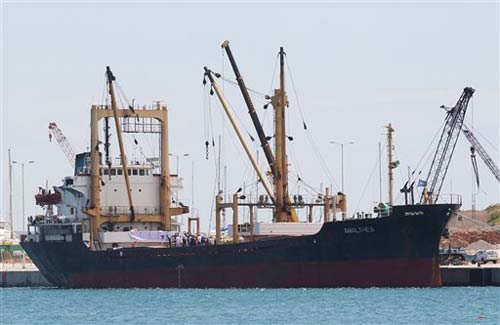
While Israel releases redacted portions of its internal investigation of the Mavi Marmara Massacre, another aid ship steams toward the Gaza Blockade. The cargo ship Amalthea carries humanitarian aid from Libya and is due to cross into Gazan waters on Wednesday, barring interception by the Israeli navy in international waters.

Israel was able to exert international pressure on various fronts to try to prevent the departure of the humanitarian cargo ship. It’s flagged in Moldova, and had to port in Greece before making its run to relieve the Siege of Gaza.

Robert Fisk and the language of power, danger words: Competing Narratives

Celebrated reporter -and verb- Robert Fisk had harsh words, “danger words” he called them, for host Al-Jazeera where he gave an address about the language of power which has infected newsman and reader alike. Beware your unambiguous acceptance of empty terms into which state propagandists let you infer nuance: power players, activism, non-state actors, key players, geostrategic players, narratives, external players, meaningful solutions, –meaning what?
I’ll not divulge why these stung Al-J, but I’d like to detail the full list, and commit not to condone their false usage at NMT, without ridicule, “quotes” or disclaimer.

Fisk listed several expressions which he attributes to government craftsmen. Unfortunately journalists have been parroting these terms without questioning their dubious meaning. Fisk began with a favorite, the endless, disingenuous, “peace process.” What is that – victor-defined purgatory? Why would “peace” be a “process” Fisk asks.

How appropriate that some of the West’s strongest critics are linguists. Fisk lauded the current seagoing rescue of Gaza, the convoy determined to break the Israeli blockade. He compared it to the Berlin Airlift, when governments saw fit to help besieged peoples, even former enemies. This time however, the people have to act where their governments do not.

I read recently that the Gaza Freedom Flotilla might be preparing accommodations for Noam Chomsky to join the passage. Won’t that be an escalation? I imagine if Robert Fisk would climb aboard too, it would spell doom for any chance the relief supplies would reach the Gazans. A ship convoy with Chomsky and Fisk on board would present an opportunity that an Israeli torpedo could not resist.

Here is his list. If you can’t peruse the lecture, at least ponder these words with as much skepticism as you can. The parenthesis denote my shorthand.

peace process (detente under duress, while enduring repression)

“Peace of the Brave” (accept your subjugation, coined for Algeria, then France lost)

“Hearts and Minds” (Vietnam era psych-ops, then US lost)

spike (to avoid saying: increase)

surge (reinforcements, you send them in you’re losing)

key players (only puppets and their masters need apply)

back on track (the objective has been on rails?)

peace envoy (in mob-speak: the cleaner)

road map (winner’s bill of lading for the spoils)

experts (vetted opinions)

indirect talks (concurrent soliloquies, duets performed solo in proximity to common fiddler calling tune)

competing narratives (parallel universes in one? naturally the perpetrator is going to tell a different tale, disputing that of victim’s; ungoing result is no justice and no injustice) examples:
occupied vs. disputed;
wall vs. security barrier;
colonization vs settlements, outposts or Jewish neighborhoods.

foreign fighters (them, but always us)

Af-Pak (ignores third party India and thus dispute to Kashmir)

appeasers (sissies who don’t have bully’s back)

Weapons of Mass Destruction (not Iraq, now not Iran)

think tanks (ministry of propaganda privatized)

challenges (avoids they are problems)

intervention (asserted authority by military force)

change agents (by undisclosed means?)

Until asked otherwise, I’ll append Fisk’s talk here:

Robert Fisk, The Independent newspaper’s Middle East correspondent, gave the following address to the fifth Al Jazeera annual forum on May 23.

Power and the media are not just about cosy relationships between journalists and political leaders, between editors and presidents. They are not just about the parasitic-osmotic relationship between supposedly honourable reporters and the nexus of power that runs between White House and state department and Pentagon, between Downing Street and the foreign office and the ministry of defence. In the western context, power and the media is about words – and the use of words.

It is about semantics.

It is about the employment of phrases and clauses and their origins. And it is about the misuse of history; and about our ignorance of history.

More and more today, we journalists have become prisoners of the language of power.

Is this because we no longer care about linguistics? Is this because lap-tops ‘correct’ our spelling, ‘trim’ our grammar so that our sentences so often turn out to be identical to those of our rulers? Is this why newspaper editorials today often sound like political speeches?

Let me show you what I mean.

For two decades now, the US and British – and Israeli and Palestinian – leaderships have used the words ‘peace process’ to define the hopeless, inadequate, dishonourable agreement that allowed the US and Israel to dominate whatever slivers of land would be given to an occupied people.

I first queried this expression, and its provenance, at the time of Oslo – although how easily we forget that the secret surrenders at Oslo were themselves a conspiracy without any legal basis. Poor old Oslo, I always think! What did Oslo ever do to deserve this? It was the White House agreement that sealed this preposterous and dubious treaty – in which refugees, borders, Israeli colonies – even timetables – were to be delayed until they could no longer be negotiated.

And how easily we forget the White House lawn – though, yes, we remember the images – upon which it was Clinton who quoted from the Qur’an, and Arafat who chose to say: “Thank you, thank you, thank you, Mr. President.” And what did we call this nonsense afterwards? Yes, it was ‘a moment of history’! Was it? Was it so?

Do you remember what Arafat called it? “The peace of the brave.” But I don’t remember any of us pointing out that “the peace of the brave” was used originally by General de Gaulle about the end of the Algerian war. The French lost the war in Algeria. We did not spot this extraordinary irony.

Same again today. We western journalists – used yet again by our masters – have been reporting our jolly generals in Afghanistan as saying that their war can only be won with a “hearts and minds” campaign. No-one asked them the obvious question: Wasn’t this the very same phrase used about Vietnamese civilians in the Vietnam war? And didn’t we – didn’t the West – lose the war in Vietnam?

Yet now we western journalists are actually using – about Afghanistan – the phrase ‘hearts and minds’ in our reports as if it is a new dictionary definition rather than a symbol of defeat for the second time in four decades, in some cases used by the very same soldiers who peddled this nonsense – at a younger age – in Vietnam.

Just look at the individual words which we have recently co-opted from the US military.

When we westerners find that ‘our’ enemies – al-Qaeda, for example, or the Taliban -have set off more bombs and staged more attacks than usual, we call it ‘a spike in violence’. Ah yes, a ‘spike’!

A ‘spike’ in violence, ladies and gentlemen is a word first used, according to my files, by a brigadier general in the Baghdad Green Zone in 2004. Yet now we use that phrase, we extemporise on it, we relay it on the air as our phrase. We are using, quite literally, an expression created for us by the Pentagon. A spike, of course, goes sharply up, then sharply downwards. A ‘spike’ therefore avoids the ominous use of the words ‘increase in violence’ – for an increase, ladies and gentlemen, might not go down again afterwards.

Now again, when US generals refer to a sudden increase in their forces for an assault on Fallujah or central Baghdad or Kandahar – a mass movement of soldiers brought into Muslim countries by the tens of thousands – they call this a ‘surge’. And a surge, like a tsunami, or any other natural phenomena, can be devastating in its effects. What these ‘surges’ really are – to use the real words of serious journalism – are reinforcements. And reinforcements are sent to wars when armies are losing those wars. But our television and newspaper boys and girls are still talking about ‘surges’ without any attribution at all! The Pentagon wins again.

Meanwhile the ‘peace process’ collapsed. Therefore our leaders – or ‘key players’ as we like to call them – tried to make it work again. Therefore the process had to be put ‘back on track’. It was a railway train, you see. The carriages had come off the line. So the train had to be put ‘back on track’. The Clinton administration first used this phrase, then the Israelis, then the BBC.

But there was a problem when the ‘peace process’ had been put ‘back on track’ – and still came off the line. So we produced a ‘road map’ – run by a Quartet and led by our old Friend of God, Tony Blair, who – in an obscenity of history – we now refer to as a ‘peace envoy’.

But the ‘road map’ isn’t working. And now, I notice, the old ‘peace process’ is back in our newspapers and on our television screens. And two days ago, on CNN, one of those boring old fogies that the TV boys and girls call ‘experts’ – I’ll come back to them in a moment – told us again that the ‘peace process’ was being put ‘back on track’ because of the opening of ‘indirect talks’ between Israelis and Palestinians.

Ladies and gentlemen, this isn’t just about clichés – this is preposterous journalism. There is no battle between power and the media. Through language, we have become them.

Maybe one problem is that we no longer think for ourselves because we no longer read books. The Arabs still read books – I’m not talking here about Arab illiteracy rates – but I’m not sure that we in the West still read books. I often dictate messages over the phone and find I have to spend ten minutes to repeat to someone’s secretary a mere hundred words. They don’t know how to spell.

I was on a plane the other day, from Paris to Beirut – the flying time is about three hours and 45 minutes – and the woman next to me was reading a French book about the history of the Second World War. And she was turning the page every few seconds. She had finished the book before we reached Beirut! And I suddenly realised she wasn’t reading the book – she was surfing the pages! She had lost the ability to what I call ‘deep read’. Is this one of our problems as journalists, I wonder, that we no longer ‘deep read’? We merely use the first words that come to hand …

Let me show you another piece of media cowardice that makes my 63-year-old teeth grind together after 34 years of eating humus and tahina in the Middle East.

We are told, in so many analysis features, that what we have to deal with in the Middle East are ‘competing narratives’. How very cosy. There’s no justice, no injustice, just a couple of people who tell different history stories. ‘Competing narratives’ now regularly pop up in the British press. The phrase is a species – or sub-species – of the false language of anthropology. It deletes the possibility that one group of people – in the Middle East, for example – are occupied, while another group of people are doing the occupying. Again, no justice, no injustice, no oppression or oppressing, just some friendly ‘competing narratives’, a football match, if you like, a level playing field because the two sides are – are they not – ‘in competition’. It’s two sides in a football match. And two sides have to be given equal time in every story.

So an ‘occupation’ can become a ‘dispute’. Thus a ‘wall’ becomes a ‘fence’ or a ‘security barrier’. Thus Israeli colonisation of Arab land contrary to all international law becomes ‘settlements’ or ‘outposts’ or ‘Jewish neighbourhoods’.

You will not be surprised to know that it was Colin Powell, in his starring, powerless appearance as secretary of state to George W. Bush, who told US diplomats in the Middle East to refer to occupied Palestinian land as ‘disputed land’ – and that was good enough for most of the American media.

So watch out for ‘competing narratives’, ladies and gentlemen. There are no ‘competing narratives’, of course, between the US military and the Taliban. When there are, however, you’ll know the West has lost.

But I’ll give you a lovely, personal example of how ‘competing narratives’ come undone. Last month, I gave a lecture in Toronto to mark the 95th anniversary of the 1915 Armenian genocide, the deliberate mass murder of one and a half million Armenian Christians by the Ottoman Turkish army and militia. Before my talk, I was interviewed on Canadian Television, CTV, which also owns the Toronto Globe and Mail newspaper. And from the start, I could see that the interviewer had a problem. Canada has a large Armenian community. But Toronto also has a large Turkish community. And the Turks, as the Globe and Mail always tell us, “hotly dispute” that this was a genocide. So the interviewer called the genocide “deadly massacres”.

Of course, I spotted her specific problem straight away. She could not call the massacres a ‘genocide’, because the Turkish community would be outraged. But equally, she sensed that ‘massacres’ on its own – especially with the gruesome studio background photographs of dead Armenians – was not quite up to defining a million and a half murdered human beings. Hence the ‘deadly massacres’. How odd!!! If there are ‘deadly’ massacres, are there some massacres which are not ‘deadly’, from which the victims walk away alive? It was a ludicrous tautology.

In the end, I told this little tale of journalistic cowardice to my Armenian audience, among whom were sitting CTV executives. Within an hour of my ending, my Armenian host received an SMS about me from a CTV reporter. “Shitting on CTV was way out of line,” the reporter complained. I doubted, personally, if the word ‘shitting’ would find its way onto CTV. But then, neither does ‘genocide’. I’m afraid ‘competing narratives’ had just exploded.

Yet the use of the language of power – of its beacon-words and its beacon-phrases -goes on among us still. How many times have I heard western reporters talking about ‘foreign fighters’ in Afghanistan? They are referring, of course, to the various Arab groups supposedly helping the Taliban. We heard the same story from Iraq. Saudis, Jordanians, Palestinian, Chechen fighters, of course. The generals called them ‘foreign fighters’. And then immediately we western reporters did the same. Calling them ‘foreign fighters’ meant they were an invading force. But not once – ever – have I heard a mainstream western television station refer to the fact that there are at least 150,000 ‘foreign fighters’ in Afghanistan. And that most of them, ladies and gentlemen, are in American or other Nato uniforms!

Similarly, the pernicious phrase ‘Af-Pak’ – as racist as it is politically dishonest – is now used by reporters when it originally was a creation of the US state department, on the day that Richard Holbrooke was appointed special US representative to Afghanistan and Pakistan. But the phrase avoided the use of the word ‘India’ whose influence in Afghanistan and whose presence in Afghanistan, is a vital part of the story. Furthermore, ‘Af-Pak’ – by deleting India – effectively deleted the whole Kashmir crisis from the conflict in south-east Asia. It thus deprived Pakistan of any say in US local policy on Kashmir – after all, Holbrooke was made the ‘Af-Pak’ envoy, specifically forbidden from discussing Kashmir. Thus the phrase ‘Af-Pak’, which totally deletes the tragedy of Kashmir – too many ‘competing narratives’, perhaps? – means that when we journalists use the same phrase, ‘Af-Pak’, which was surely created for us journalists, we are doing the state department’s work.

Now let’s look at history. Our leaders love history. Most of all, they love the Second World War. In 2003, George W. Bush thought he was Churchill as well as George W. Bush. True, Bush had spent the Vietnam war protecting the skies of Texas from the Vietcong. But now, in 2003, he was standing up to the ‘appeasers’ who did not want a war with Saddam who was, of course, ‘the Hitler of the Tigris’. The appeasers were the British who did not want to fight Nazi Germany in 1938. Blair, of course, also tried on Churchill’s waistcoat and jacket for size. No ‘appeaser’ he. America was Britain’s oldest ally, he proclaimed – and both Bush and Blair reminded journalists that the US had stood shoulder-to-shoulder with Britain in her hour of need in 1940.

But none of this was true.

Britain’s old ally was not the United States. It was Portugal, a neutral fascist state during World War Two. Only my own newspaper, The Independent, picked this up.

Nor did America fight alongside Britain in her hour of need in 1940, when Hitler threatened invasion and the German air force blitzed London. No, in 1940 America was enjoying a very profitable period of neutrality – and did not join Britain in the war until Japan attacked the US naval base at Pearl Harbour in December of 1941.

Ouch!

Back in 1956, I read the other day, Eden called Nasser the ‘Mussolini of the Nile’. A bad mistake. Nasser was loved by the Arabs, not hated as Mussolini was by the majority of Africans, especially the Arab Libyans. The Mussolini parallel was not challenged or questioned by the British press. And we all know what happened at Suez in 1956.

Yes, when it comes to history, we journalists really do let the presidents and prime ministers take us for a ride.

Today, as foreigners try to take food and fuel by sea to the hungry Palestinians of Gaza, we journalists should be reminding our viewers and listeners of a long-ago day when America and Britain went to the aid of a surrounded people, bringing food and fuel – our own servicemen dying as they did so – to help a starving population. That population had been surrounded by a fence erected by a brutal army which wished to starve the people into submission. The army was Russian. The city was Berlin. The wall was to come later. The people had been our enemies only three years earlier. Yet we flew the Berlin airlift to save them. Now look at Gaza today. Which western journalist – and we love historical parallels – has even mentioned 1948 Berlin in the context of Gaza?

Look at more recent times. Saddam had ‘weapons of mass destruction’ – you can fit ‘WMD’ into a headline – but of course, he didn’t, and the American press went through embarrassing bouts of self-condemnation afterwards. How could it have been so misled, the New York Times asked itself? It had not, the paper concluded, challenged the Bush administration enough.

And now the very same paper is softly – very softly – banging the drums for war in Iran. Iran is working on WMD. And after the war, if there is a war, more self-condemnation, no doubt, if there are no nuclear weapons projects.

Yet the most dangerous side of our new semantic war, our use of the words of power – though it is not a war since we have largely surrendered – is that it isolates us from our viewers and readers. They are not stupid. They understand words, in many cases – I fear – better than we do. History, too. They know that we are drowning our vocabulary with the language of generals and presidents, from the so-called elites, from the arrogance of the Brookings Institute experts, or those of those of the Rand Corporation or what I call the ‘THINK TANKS’. Thus we have become part of this language.

Here, for example, are some of the danger words:

· POWER PLAYERS

· ACTIVISM

· NON-STATE ACTORS

· KEY PLAYERS

· GEOSTRATEGIC PLAYERS

· NARRATIVES

· EXTERNAL PLAYERS

· PEACE PROCESS

· MEANINGFUL SOLUTIONS

· AF-PAK

· CHANGE AGENTS (whatever these sinister creatures are).

I am not a regular critic of Al Jazeera. It gives me the freedom to speak on air. Only a few years ago, when Wadah Khanfar (now Director General of Al Jazeera) was Al Jazeera’s man in Baghdad, the US military began a slanderous campaign against Wadah’s bureau, claiming – untruthfully – that Al Jazeera was in league with al-Qaeda because they were receiving videotapes of attacks on US forces. I went to Fallujah to check this out. Wadah was 100 per cent correct. Al-Qaeda was handing in their ambush footage without any warning, pushing it through office letter-boxes. The Americans were lying.

Wadah is, of course, wondering what is coming next.

Well, I have to tell you, ladies and gentlemen, that all those ‘danger words’ I have just read out to you – from KEY PLAYERS to NARRATIVES to PEACE PROCESS to AF-PAK – all occur in the nine-page Al Jazeera programme for this very forum.

I’m not condemning Al Jazeera for this, ladies and gentlemen. Because this vocabulary is not adopted through political connivance. It is an infection that we all suffer from – I’ve used ‘peace process’ a few times myself, though with quotation marks which you can’t use on television – but yes, it’s a contagion.

And when we use these words, we become one with the power and the elites which rule our world without fear of challenge from the media. Al Jazeera has done more than any television network I know to challenge authority, both in the Middle East and in the West. (And I am not using ‘challenge’ in the sense of ‘problem’, as in ‘”I face many challenges,” says General McCrystal.’)

How do we escape this disease? Watch out for the spell-checkers in our lap-tops, the sub-editor’s dreams of one-syllable words, stop using Wikipedia. And read books – real books, with paper pages, which means deep reading. History books, especially.

Al Jazeera is giving good coverage to the flotilla – the convoy of boats setting off for Gaza. I don’t think they are a bunch of anti-Israelis. I think the international convoy is on its way because people aboard these ships – from all over the world – are trying to do what our supposedly humanitarian leaders have failed to do. They are bringing food and fuel and hospital equipment to those who suffer. In any other context, the Obamas and the Sarkozys and the Camerons would be competing to land US Marines and the Royal Navy and French forces with humanitarian aid – as Clinton did in Somalia. Didn’t the God-like Blair believe in humanitarian ‘intervention’ in Kosovo and Sierra Leone?

In normal circumstances, Blair might even have put a foot over the border.

But no. We dare not offend the Israelis. And so ordinary people are trying to do what their leaders have culpably failed to do. Their leaders have failed them.

Have the media? Are we showing documentary footage of the Berlin airlift today? Or of Clinton’s attempt to rescue the starving people of Somalia, of Blair’s humanitarian ‘intervention’ in the Balkans, just to remind our viewers and readers – and the people on those boats – that this is about hypocrisy on a massive scale?

The hell we are! We prefer ‘competing narratives’. Few politicians want the Gaza voyage to reach its destination – be its end successful, farcical or tragic. We believe in the ‘peace process’, the ‘road map’. Keep the ‘fence’ around the Palestinians. Let the ‘key players’ sort it out.

Ladies and gentlemen, I am not your ‘key speaker’ this morning.

I am your guest, and I thank you for your patience in listening to me.

2. Socialism

The Green Book

Part Two: The Solution of the Economic Problem

“Socialism”

THE ECONOMIC BASIS OF THE THIRD UNIVERSAL THEORY

Important historical developments contributing to the solution of the problem of work and wages – the relationship between producers and owners, workers and employers – have occurred in recent history. These developments include the determination of fixed working hours, overtime pay, leaves, minimal wages, profit sharing, the participation of workers in administration, the banning of arbitrary dismissal, social security, the right to strike, and other provisions contained in labour codes of almost all contemporary legislation. Of no less significance are changes in the realm of ownership, such as the enactment of laws transferring private ownership to the state, and also those limiting income. Despite these not inconsiderable developments in the history of economics, the problem still fundamentally exists, even though it has been made less severe than in past centuries through improvements, refinements and developments that have brought many benefits to the workers.

However, the economic problem still persists unsolved in the world. Attempts aimed at ownership have failed to solve the problems of producers. They are still wage-earners, despite the state ownership which may vary from the extreme right to the extreme left to the centre of the political spectrum.

Attempts to improve wages were equally significant to those that were aimed at the transferral of ownership. In the wake of the Industrial Revolution, benefits from wage negotiations secured for workers certain privileges that were guaranteed by legislation and protected by trade unions, thus improving the lot of the workers. As time passed, workers, technicians, and administrators have acquired certain rights which were previously unattainable. However, in reality, the economic problem still exists.

Attempts that were aimed at wages were contrived and reformative, and have failed to provide a solution. They were more of a charity than a recognition of the rights of the workers. Why do workers receive wages? Because they carry out a production process for the benefit of others who hire them to produce a certain product. In this case, they do not consume what they produce; rather, they are compelled to concede their product for wages. Hence, the sound rule: those who produce consume. Wage-earners, however improved their wages may be, are a type of slave.

Wage-earners are but slaves to the masters who hire them. They are temporary slaves, and their slavery lasts as long as they work for wages from employers, be they individuals or the state. The workers’ relationship to the owner or the productive establishment, and to their own interests, is similar under all prevailing conditions in the world today, regardless of whether ownership is right or left. Even publicly-owned establishments give workers wages as well as other social benefits, similar to the charity endowed by the rich owners of economic establishments upon those who work for them.

Unlike the privately-owned establishment where income benefits the owner, the claim that the income from the public-owned establishment benefits all of the society, including the workers, is true only if we take into consideration the general welfare of the society and not the private well-being of the workers. Further, we would have to assume that the political authority controlling ownership is that of all the people, practised through the Popular Conferences and People’s Committees, and not the authority of one class, one party, several parties, one sect, tribe, family, individual, or any form of representative authority. Failing this, what is received directly by the workers with respect to their own interests, in the form of wages, percentage of profits or social benefits, is the same as that received by workers in a private corporation. In both instances, the producers are wage-earners, despite the difference in ownership. Thus, this change in ownership has not solved the problem of the producer’s right to benefit directly from what he produces, and not through the society nor through wages. The proof thereof is the fact that producers are still wage-earners despite the change in this state of ownership.

The ultimate solution lies in abolishing the wage-system, emancipating people from its bondage and reverting to the natural laws which defined relationships before the emergence of classes, forms of governments and man-made laws. These natural rules are the only measures that ought to govern human relations.

These natural rules have produced natural socialism based on equality among the components of economic production, and have maintained public consumption almost equal to natural production among individuals. The exploitation of man by man and the possession by some individuals of more of the general wealth than their needs required is a manifest departure from the natural rule and the beginning of distortion and corruption in the life of the human community. It heralds the start of the exploitative society.

If we analyse the factors of economic production from ancient times to the present, we always find that they essentially consist of certain basic production components, i.e., raw materials, means of production, and a producer. The natural rule of equality requires that each of these components receives a share of this production. Because production cannot be achieved without the essential role of each of these components, it has to be equally divided amongst them. The preponderance of one of them contravenes the natural rule of equality and becomes an encroachment upon the others’ rights. Thus, each must be awarded an equal share, regardless of the number of components in the process of production. If the components are two, each receives half of the production; if three, then one-third.

Applying this natural rule to both ancient and modern situations, we arrive at the following. At the stage of manual production, the process of production resulted from raw material and a producer. Later, new means of production were added to the process. Animals, utilized as power units, constitute a good example. Gradually, machines replaced animals, types and amounts of raw materials evolved from the simple and inexpensive to the valuable and complex. Likewise, the unskilled workers became skilled workers and engineers; their former huge numbers dwindling to a few specialized technicians.

Despite the fact that components have qualitatively and quantitatively changed, their essential role in production has remained basically unaltered. For example, iron ore, a component of both past and present production, was manufactured primitively by iron smiths into knives, axes, spears, etc. The same iron ore is now manufactured by engineers and technicians by means of smelting furnaces into all kinds of machines, engines and vehicles. The animal – horse, mule, camel, or the like – which was a component of production, has been replaced by factories and huge machines. Production, based upon primitive tools, is now founded upon sophisticated technical instruments. Despite these tremendous changes, the components of natural production remain basically the same. This consistency inevitably necessitates returning to sound natural rules to solve the economic problems that are the result of all previous historical attempts to formulate solutions that ignore these rules.

All previous historical theories tackled the economic problem either from the angle of ownership of any of the components of production, or from that of wages for production. They failed to solve the real problem; the problem of production itself. Thus, the most important characteristic of economic order prevailing in the world today is a wage system that deprives the workers of any right to the products being produced, be it for the society or for a private establishment.

An industrial establishment is composed of material for production, machines and workers. Production is achieved by workers manufacturing materials and using machines. Thus, manufactured goods would not have been ready for use and consumption had they not gone through a production process requiring raw materials, factories, and workers. Clearly, without basic raw materials, the factory cannot operate and without the factory, raw materials will not be manufactured. Likewise, without producers, the factory comes to a halt. Thus, the three factors are equally essential to the process of production, and without them there can be no production. The absence of any one of these components cannot be replaced by the others. Therefore, the natural rule necessitates each component receiving an equal share of the benefits of production. It is not only the factory that is important, but those who consume its production as well.

The same is applicable to agricultural production processes resulting from only two components: man and land. The product must be divided equally into two shares congruent with the number of production components. Furthermore, if any additional mode, mechanical or otherwise is utilized in the process, production must be equally divided into three shares: the land, the farmer, and the means of production. Consequently, a socialist system emerges under which all production processes are governed by this natural rule.

The producers are the workers; they are called producers because the terms “worker,” “labourer,” and “toiler” have become invalid. The traditional definition is revised because workers are undergoing qualitative and quantitative changes. The working class is declining proportionately to the advancement of science and technology.

Tasks once performed by a number of workers are now being carried out by a single machine. Operating a machine requires fewer workers; this has brought about a quantitative change in the labour force, while the replacement of physical force by technical skill has resulted in a qualitative change in the labour force.

The labour force has become a component of the production process. As a result of technical advancement, multitudes of unskilled toilers have been transformed into limited numbers of technicians, engineers and scientists. Consequently, trade unions will subsequently disappear and be replaced by syndicates of engineers and technicians. Scientific advancement is an irreversible gain for humankind. Thanks to this process, illiteracy will be eliminated and unskilled workers will become a temporary phenomenon destined to gradual disappearance. However, even in this new environment, persons will always remain the basic component in the production process.

NEED

The freedom of a human being is lacking if his or her needs are controlled by others, for need may lead to the enslavement of one person by another. Furthermore, exploitation is caused by need. Need is an intrinsic problem and conflict is initiated by the control of one’s needs by another.

HOUSING

Housing is an essential need for both the individual and the family and should not be owned by others. Living in another’s house, whether paying rent or not, compromises freedom. Attempts made by various countries to solve the housing problem did not provide a definite solution because such attempts did not target the ultimate solution – the necessity that people own their dwellings – but rather offered the reduction, increase, or standardization of rent, whether it went to privately or publicly-owned enterprise. In a socialist society, no one, including society itself, has the right to control people’s needs. No one has the right to acquire a house additional to his or her own dwelling and that of his or her heirs for the purpose of renting it because this additional house is, in fact, a need of someone else. Acquiring it for such a purpose is the beginning of controlling the needs of others, and “in need freedom is latent”.

INCOME

Income is an imperative need for man. In a socialist society, it should not be in the form of wages from any source or charity from any one. In this society, there are no wage-earners, but only partners. One’s income is a private matter and should either be managed privately to meet one’s needs or be a share from a production process of which one is an essential component. It should not be a wage in return for production.

MEANS OF TRANSPORTATION

Transportation is also a necessity both to the individual and to the family. It should not be owned by others. In a socialist society, no person or authority has the right to own a means of transportation for the purpose of renting it, for this also means controlling the needs of others.

LAND

Land is the private property of none. Rather, everyone has the right to beneficially utilize it by working, farming or pasturing as long as he and his heirs live on it – to satisfy their needs, but without employing others with or without a wage. If lands were privately owned, only the living would have a share in it.

Land is permanent, while those who benefit from the land undergo, in the course of time, changes in profession, capabilities and existence.

The aspiration of the new socialist society is to create a society which is happy because it is free. This can only be achieved by satisfying, man’s material and spiritual needs, and that, in turn, comes about through the liberation of these needs from the control of others. Satisfaction of these needs must be attained without exploiting or enslaving others; otherwise, the aspirations of the new socialist society are contradicted.

Thus, the citizen in this new society secures his material needs either through self-employment, or by being a partner in a collectively-owned establishment, or by rendering public service to society which, in return, provides for his material needs.

Economic activity in the new socialist society is a productive one aimed at the satisfaction of material needs. It is not an unproductive activity, nor one which seeks profit for surplus savings beyond the satisfaction of such needs. This, according to the new socialist basis, is unacceptable. The legitimate purpose for private economic activities is only to satisfy one’s needs because the wealth of the world, as well as that of each individual society, is finite at each stage. No one has the right to undertake an economic activity whereby wealth exceeding the satisfaction of one’s needs can be amassed. Such accumulations are, in fact, the deprived right of others. One only has the right to save from his own production and not by employing others, or to save at the expense of his or her own needs and not of others. If economic activity is allowed to extend beyond the satisfaction of needs, some will acquire more than required for their needs while others will be deprived. The savings which are in excess of one’s needs are another person’s share of the wealth of society. Allowing private economic activity to amass wealth beyond the satisfaction of one’s needs and employing others to satisfy one’s needs or beyond, or to secure savings, is the very essence of exploitation.

Work for wages, in addition to being enslavement as previously mentioned, is void of incentives because the producer is a wage-earner and not a partner. Self-employed persons are undoubtedly devoted to their work because from it they satisfy their material needs. Likewise, those who work in a collective establishment are also devoted to their work because they are partners in it and they satisfy their material needs from the production. Whoever works for a wage, on the other hand, has little incentive to work.

Work for wages has failed to solve the problem of motivation for increasing and developing production. Whether it is a service or goods production, work for wages is continuously deteriorating because it is performed by unmotivated wage-earners.

EXAMPLES OF WAGE-LABOUR: FOR THE SOCIETY, FOR PRIVATE ENTERPRISE, AND SELF-EMPLOYMENT:

First example:

(a) A worker produces ten apples for society. The society gives him one apple for his production and it fully satisfies his needs.

(b) A worker produces ten apples for society. The society gives him one apple for his production which does not satisfy his needs.

Second example:

A worker produces ten apples for another person and gets wages less than the price of one apple.

Third example:

A worker produces ten apples for himself.

The conclusion:

In the first example (a), because the worker’s wages are limited to one unit which satisfies his needs, he has no incentive to increase his production. Thus, all the labour force that works for society is psychologically apathetic.

(b) The worker has no incentive even to produce because he cannot satisfy his needs from the wages. However, he continues working without any incentives because generally, like all members, he is forced to acquiesce to the working conditions of the society.

In the second example, the worker works basically to get wages and not to produce. Since his wages cannot satisfy his needs, the choices are either to look for another master to get a better price for his work, or be forced, as a matter of survival, to remain where he is.

In the third example, the self-employed alone is the one who produces eagerly and voluntarily.

In a socialist society, there is no possibility for private production to exceed the satisfaction of one’s needs because satisfaction of needs at the expense or by means of others is not permitted. Moreover, socialist establishments operate only for the satisfaction of the needs of society. Accordingly, the third example demonstrates the sound basis of its economic production.

However, in all instances, even the bad ones production is associated with survival. The proof thereof is that, even though in capitalist societies production accumulates and expands in the hands of only a few owners who do not work but exploit the efforts of others, the toilers are still forced to produce in order to survive. However, THE GREEN BOOK not only solves the problem of material production but also prescribes a comprehensive solution for the problems facing human societies so that individuals may be totally liberated, materially and spiritually, in order to attain their happiness.

Other examples:

If we assume that the wealth of a society is ten units and its inhabitants are ten persons, then the share of each member is one-tenth of the total one unit per person. If some members of this society get more than one unit each, then a certain number from the society get nothing. Their share of the wealth of their society has been acquired by others. Hence, the presence of rich and poor in an exploitative society. Let us also suppose that five members of that particular society each own two units. In such a case, half of the society is deprived of their rights to the wealth of their society, for what should be theirs has been acquired by others.

If an individual of that society needs only one of the units of the wealth of the society to satisfy his needs, then those who possess more than one unit are, in fact, seizing the rights of other members of the society. Because the one unit is all that is required to satisfy the needs of an individual, the additional units are acquired for the purpose of savings. This can only be achieved at the expense of the needs of others; the acquisition of others’ share in this wealth. This is the reason behind the existence of those who hoard and do not spend; those who save beyond the satisfaction of their needs; and the existence of those who beg and are deprived of their right to the wealth of the society and do not find enough to consume. Such is an act of plunder and theft, yet according to the unjust and exploitative rules governing such a society, it is legitimate and overt.

Any surplus beyond the satisfaction of needs should ultimately belong to all members of society. Individuals, however, have a right to effect savings from the share allocated to their own needs since it is the amassing of wealth beyond the satisfaction of one’s needs that is an encroachment upon public wealth.

The industrious and skilful in a society have no right, as a result of this advantage, to take from the shares of others. They can use their talents to satisfy their own needs and save from those needs. Like any other member of the society, the aged and the mentally and physically disabled should have their fair share of the wealth of the society.

The wealth of a society may be likened to a supply establishment or a store providing a certain number of people with daily rations satisfying their needs. Each person has a right to save from such provisions what he wants, i.e., to consume or save whatever portions of his share he decides, utilizing his talents and skill for such purposes. However, those who use their talents to acquire excessively from the “supply establishment” are undoubtedly thieves. Therefore, those using their skill to acquire wealth exceeding the satisfaction of their needs are, in fact, infringing upon the public right, namely, the wealth of society which is like the store in the said example.

Disparity in the wealth of individuals in the new socialist society is not tolerated, save for those rendering certain services to the society for which they are accorded an amount congruent with their services. Individual shares only differ relative to the amount of production or public service rendered in excess.

Hence, human experiences through history have produced a new experiment in a unique attempt to culminate the struggle of persons to complete their freedom, to achieve happiness through satisfying their needs, to ward off exploitation by others, to put an end to tyranny, and to find a method to distribute the wealth of the society equitably, without exploiting others or compromising their needs. It is the theory of the fulfilment of needs for the emancipation of humanity.

The new socialist society is but a dialectical outcome of the unjust relationships prevailing in the world today. The new socialist society will introduce the natural solution – privately-owned property to satisfy one’s needs without exploitation, and collective property in which the producers are partners replacing private enterprise, which is based on the production of others without recognizing their right to a just share of the product.

Whoever possesses the house in which you dwell, the vehicle in which you ride or the income on which you live, possesses your freedom, or part of it. Freedom is indivisible. For people to be happy, they must be free, and to be free, they must possess the possibility of satisfying their own needs. Whoever possesses the means of fulfilling your needs controls or exploits you, and may enslave you despite any legislation to the contrary.

The material needs of people that are basic and personal start with food, housing, clothing and transport and must be regarded as private and sacred and their satisfaction should not depend on hire.

To satisfy these material needs through rent, gives the original owner the right to interfere in your personal life and to control your imperative needs, even if the original owner be the society in general. The original owner can usurp your freedom and take away your happiness. The interference of the original owner may include repossessing your clothes, even leaving you naked on the street. Likewise, the owner of your means of transportation may leave you stranded on the sidewalk, and the owner of your house may make you homeless.

People’s imperative needs cannot be regulated by legal or administrative procedures. They must be fundamentally implanted into the society in accordance with natural rules.

The aim of the socialist society is the happiness of the human being, which cannot be attained except by the establishment of one’s material, and spiritual freedom. The achievement of freedom depends on the private and sacred attainment of man’s needs. One’s needs should not be under the domination of others and should not be subject to plunder by any source in society, otherwise one will live in insecurity. Deprivation of the means of fulfilment compromises freedom because, in attempting to satisfy basic needs, one would be subject to the interference of outside forces in one’s basic interests.

The transformation of existing societies of wage-earners into those of partners is inevitable as a dialectical outcome of the contradictory economic theories prevailing in the world today. It is also a dialectical outcome of the unjust relationship based on the wage system. None of these issues have been resolved to date.

The antagonistic force of the trade unions in the capitalist world is capable of replacing capitalistic wage societies by a society of partnerships. The possibility of a socialist revolution starts by producers taking over their share of the production. Consequently, the aims of the producers’ strikes will change from demanding increases in wages to controlling their share in production. Guided by THE GREEN BOOK , this will sooner or later take place. The final step is for the new socialist society to reach a stage in which profit and money disappear. Society will become fully productive; the material needs of society will be met. In this final stage, profit will disappear, as will the need for money.

The recognition of profit is an acknowledgment of exploitation, for profit has no limit. Attempts so far to limit profit by various means have been reformative, not radical, intending to prohibit exploitation of man by man. The final solution lies in eradicating profit, but because profit is the dynamic force behind the economic process, eliminating profit is not a matter of decree but, rather, an outcome of the evolving socialist process. This solution can be attained when the material satisfaction of the needs of society and its members is achieved. Work to increase profit will itself lead to its final eradication.

DOMESTIC SERVANTS

Domestic servants, paid or unpaid, are a type of slave. Indeed, they are the slaves of the modern age.

Since the new socialist society is based on partnership and not on a wage system, natural socialist rules do not apply to domestic servants because they render services rather than production. Services have no tangible material product and cannot be divided into shares according to the natural socialist rule.

Domestic servants have no alternative but to work for wages, or even be unpaid in the worst of situations. As wage-earners are a type of slave and their slavery exists as long as they work for wages, domestic servants, whose position is lower than that of wage-earners in economic establishments and corporations, have an even greater need to be emancipated from the society of wage-labour and the society of slaves.

Domestic servants is a phenomenon that comes next to slavery.

The Third Universal Theory heralds emancipation from the fetters of injustice, despotism, exploitation, and economic and political hegemony, for the purpose of establishing a society of all the people where all are free and share equally in authority, wealth and arms. Freedom will then triumph definitively and universally.

THE GREEN BOOK thus defines the path of liberation to masses of wage-earners and domestic servants in order that human beings may achieve freedom. The struggle to liberate domestic servants from their status of slavery and to transform them into partners, where their material production can be divided into its necessary basic components, is an inevitable process. Households should be serviced by their habitants. Essential household services should not be performed by domestic servants, paid or unpaid, but by employees who can be promoted in rendering their services and can enjoy social and material benefits as any other public employee would.

1. Democracy

by Colonel Moammar Gadhafi

Part One: The Solution of the Problem of Democracy

“The Authority of the People”

THE INSTRUMENT OF GOVERNMENT

The instrument of government is the prime political problem confronting human communities (The problem of the instrument of government entails questions of the following kind. What form should the exercise of authority assume? How ought societies to organize themselves politically in the modern world?)

Even conflict within the family is often the result of the failure to resolve this problem of authority. It has clearly become more serious with the emergence of modern societies.

People today face this persistent question in new and pressing ways. Communities are exposed to the risks of uncertainty, and suffer the grave consequences of wrong answers. Yet none has succeeded in answering it conclusively and democratically. THE GREEN BOOK presents the ultimate solution to the problem of the proper instrument of government.

All political systems in the world today are a product of the struggle for power between alternative instruments of government. This struggle may be peaceful or armed, as is evidenced among classes, sects, tribes, parties or individuals. The outcome is always the victory of a particular governing structure – be it that of an individual, group, party or class – and the defeat of the people; the defeat of genuine democracy.

Political struggle that results in the victory of a candidate with, for example, 51 per cent of the votes leads to a dictatorial governing body in the guise of a false democracy, since 49 per cent of the electorate is ruled by an instrument of government they did not vote for, but which has been imposed upon them. Such is dictatorship. Besides, this political conflict may produce a governing body that represents only a minority. For when votes are distributed among several candidates, though one polls more than any other, the sum of the votes received by those who received fewer votes might well constitute an overwhelming majority. However, the candidate with fewer votes wins and his success is regarded as legitimate and democratic! In actual fact, dictatorship is established under the cover of false democracy. This is the reality of the political systems prevailing in the world today. They are dictatorial systems and it is evident that they falsify genuine democracy.

PARLIAMENTS

Parliaments are the backbone of that conventional democracy prevailing in the world today. Parliament is a misrepresentation of the people, and parliamentary systems are a false solution to the problem of democracy. A parliament is originally founded to represent the people, but this in itself is undemocratic as democracy means the authority of the people and not an authority acting on their behalf. The mere existence of a parliament means the absence of the people. True democracy exists only through the direct participation of the people, and not through the activity of their representatives. Parliaments have been a legal barrier between the people and the exercise of authority, excluding the masses from meaningful politics and monopolizing sovereignty in their place. People are left with only a facade of democracy, manifested in long queues to cast their election ballots.

To lay bare the character of parliaments, one has to examine their origin. They are either elected from constituencies, a party, or a coalition of parties, or are appointed. But all of these procedures are undemocratic, for dividing the population into constituencies means that one member of parliament represents thousands, hundreds of thousands, or millions of people, depending on the size of the population. It also means that a member keeps few popular organizational links with the electors since he, like other members, is considered a representative of the whole people. This is what the prevailing traditional democracy requires. The masses are completely isolated from the representative and he, in turn, is totally removed from them. Immediately after winning the electors’ votes the representative takes over the people’s sovereignty and acts on their behalf. The prevailing traditional democracy endows the member of parliament with a sacredness and immunity which are denied to the rest of the people. Parliaments, therefore, have become a means of plundering and usurping the authority of the people. It has thus become the right of the people to struggle, through popular revolution, to destroy such instruments – the so-called parliamentary assemblies which usurp democracy and sovereignty, and which stifle the will of the people. The masses have the right to proclaim reverberantly the new principle: no representation in lieu of the people.

If parliament is formed from one party as a result of its winning an election, it becomes a parliament of the winning party and not of the people. It represents the party and not the people, and the executive power of the parliament becomes that of the victorious party and not of the people. The same is true of the parliament of proportional representation in which each party holds a number of seats proportional to their success in the popular vote. The members of the parliament represent their respective parties and not the people, and the power established by such a coalition is the power of the combined parties and not that of the people. Under such systems, the people are the victims whose votes are vied for by exploitative competing factions who dupe the people into political circuses that are outwardly noisy and frantic, but inwardly powerless and irrelevant. Alternatively, the people are seduced into standing in long, apathetic, silent queues to cast their ballots in the same way that they throw waste paper into dustbins. This is the traditional democracy prevalent in the whole world, whether it is represented by a one-party, two-party, multiparty or non-party system. Thus it is clear that representation is a fraud.

Moreover, since the system of elected parliaments is based on propaganda to win votes, it is a demagogic system in the real sense of the word. Votes can be bought and falsified. Poor people are unable to compete in the election campaigns, and the result is that only the rich get elected. Assemblies constituted by appointment or hereditary succession do not fall under any form of democracy.
Philosophers, thinkers, and writers advocated the theory of representative parliaments at a time when peoples were unconsciously herded like sheep by kings, sultans and conquerors. The ultimate aspiration of the people of those times was to have someone to represent them before such rulers. When even this aspiration was rejected, people waged bitter and protracted struggle to attain this goal.

After the successful establishment of the age of the republics and the beginning of the era of the masses, it is unthinkable that democracy should mean the electing of only a few representatives to act on behalf of great masses. This is an obsolete structure. Authority must be in the hands of all of the people.

The most tyrannical dictatorships the world has known have existed under the aegis of parliaments.

THE PARTY

The party is a contemporary form of dictatorship. It is the modern instrument of dictatorial government. The party is the rule of a part over the whole. As a party is not an individual, it creates a superficial democracy by establishing assemblies, committees, and propaganda through its members. The party is not a democratic instrument because it is composed only of those people who have common interests, a common perception or a shared culture; or those who belong to the same region or share the same belief. They form a party to achieve their ends, impose their will, or extend the dominion of their beliefs, values, and interests to the society as a whole. A party’s aim is to achieve power under the pretext of carrying out its program. Democratically, none of these parties should govern a whole people who constitute a diversity of interests, ideas, temperaments, regions and beliefs. The party is a dictatorial instrument of government that enables those with common outlooks or interests to rule the people as a whole. Within the community, the party represents a minority.

The purpose of forming a party is to create an instrument to rule the people, i.e., to rule over non-members of the party. The party is, fundamentally, based on an arbitrary authoritarian concept – the domination of the members of the party over the rest of the people. The party presupposes that its accession to power is the way to attain its ends, and assumes that its objectives are also those of the people. This is the theory justifying party dictatorship, and is the basis of any dictatorship. No matter how many parties exist, the theory remains valid.

The existence of many parties intensifies the struggle for power, and this results in the neglect of any achievements for the people and of any socially beneficial plans. Such actions are presented as a justification to undermine the position of the ruling party so that an opposing party can replace it. The parties very seldom resort to arms in their struggle but, rather, denounce and denigrate the actions of each other. This is a battle which is inevitably waged at the expense of the higher, vital interests of the society. Some, if not all, of those higher interests will fall prey to the struggle for power between instruments of government, for the destruction of those interests supports the opposition in their argument against the ruling party or parties. In order to rule, the opposition party has to defeat the existing instrument of government.

To do so, the opposition must minimize the government’s achievements and cast doubt on its plans, even though those plans may be beneficial to the society. Consequently, the interests and programs of the society become the victims of the parties’ struggle for power. Such struggle is, therefore, politically, socially, and economically destructive to the society, despite the fact that it creates political activity.

Thus, the struggle results in the victory of another instrument of government; the fall of one party, and the rise of another. It is, in fact, a defeat for the people, i.e., a defeat for democracy. Furthermore, parties can be bribed and corrupted either from inside or outside.

Originally, the party is formed ostensibly to represent the people. Subsequently, the party leadership becomes representative of the membership, and the leader represents the party elite. It becomes clear that this partisan game is a deceitful farce based on a false form of democracy. It has a selfish authoritarian character based on maneuvres, intrigues and political games. This confirms the fact that the party system is a modern instrument of dictatorship. The party system is an outright, unconvincing dictatorship, one which the world has not yet surpassed. It is, in fact, the dictatorship of the modern age.

The parliament of the winning party is indeed a parliament of the party, for the executive power formed by this parliament is the power of the party over the people. Party power, which is supposedly for the good of the whole people, is actually the arch-enemy of a fraction of the people, namely, the opposition party or parties and their supporters. The opposition is, therefore, not a popular check on the ruling party but, rather, is itself opportunistically seeking to replace the ruling party. According to modern democracy, the legitimate check on the ruling party is the parliament, the majority of whose members are from that ruling party. That is to say, control is in the hands of the ruling party, and power is in the hands of the controlling party. Thus the deception, falseness and invalidity of the political theories dominant in the world today become obvious. From these emerge contemporary conventional democracy.

“The party represents a segment of the people, but the sovereignty of the people is indivisible.”

“The party allegedly governs on behalf of the people, but in reality the true principle of democracy is based upon the notion that there can be no representation in lieu of the people.”

The party system is the modern equivalent of the tribal or sectarian system. A society governed by one party is similar to one which is governed by one tribe or one sect. The party, as shown, represents the perception of a certain group of people, or the interests of one group in society, or one belief, or one region. Such a party is a minority compared with the whole people, just as the tribe and the sect are. The minority has narrow, common sectarian interests and beliefs, from which a common outlook is formed. Only the blood-relationship distinguishes a tribe from a party, and, indeed, a tribe might also be the basis for the foundation of a party. There is no difference between party struggle and tribal or sectarian struggles for power. Just as tribal and sectarian rule is politically unacceptable and inappropriate, likewise the rule under a party system. Both follow the same path and lead to the same end.The negative and destructive effects of the tribal or sectarian struggle on society is identical to the negative and destructive effects of the party struggle.

CLASS

The political class system is the same as a party, tribal, or sectarian system since a class dominates society in the same way that a party, tribe or sect would. Classes, like parties, sects or tribes, are groups of people within society who share common interests. Common interests arise from the existence of a group of people bound together by blood-relationship, belief, culture, locality or standard of living. Classes, parties, sects and tribes emerge because blood-relationship, social rank, economic interest, standard of living, belief, culture and locality create a common outlook to achieve a common end. Thus, social structures, in the form of classes, parties, tribes or sects, emerge. These eventually develop into political entities directed toward the realization of the goals of that group. In all cases, the people are neither the class, the party, the tribe, nor the sect, for these are no more than a segment of the people and constitute a minority. If a class, a party, a tribe, or a sect dominates a society, then the dominant system becomes a dictatorship. However, a class or a tribal coalition is preferable to a party coalition since societies originally consisted of tribal communities. One seldom finds a group of people who do not belong to a tribe, and all people belong to a specific class. But no party or parties embrace all of the people, and therefore the party or party coalition represents a minority compared to the masses outside their membership. Under genuine democracy, there can be no justification for any one class to subdue other classes for its interests. Similarly, no party, tribe or sect can crush others for their own interests.

To allow such actions abandons the logic of democracy and justifies resort to the use of force. Such policies of suppression are dictatorial because they are not in the interest of the whole society, which consists of more than one class, tribe or sect, or the members of one party. There is no justification for such actions, though the dictatorial argument is that society actually consists of numerous segments, one of which must undertake the liquidation of others in order to remain solely in power. This exercise is not, accordingly, in the interests of the whole society but, rather, in the interests of a specific class, tribe, sect, party, or those who claim to speak for the society. Such an act is basically aimed at the member of the society who does not belong to the party, class, tribe or sect which carries out the liquidation.

A society torn apart by party feud is similar to one which is torn apart by tribal or sectarian conflicts.

A party that is formed in the name of a class inevitably becomes a substitute for that class and continues in the process of spontaneous transformation until it becomes hostile to the class that it replaces.

Any class which inherits a society also inherits its characteristics. If the working class, for example, subdues all other classes of a particular society, it then becomes its only heir and forms its material and social base. The heir acquires the traits of those from whom it inherits, though this may not be evident all at once. With the passage of time, characteristics of the other eliminated classes will emerge within the ranks of the working class itself. The members of the new society will assume the attitudes and perspectives appropriate to their newly evolved characteristics. Thus, the working class will develop a separate society possessing all of the contradictions of the old society. In the first stage, the material standard and importance of the members become unequal. Thereafter, groups emerge which automatically become classes that are the same as the classes that were eliminated. Thus, the struggle for domination of the society begins again. Each group of people, each faction, and each new class will all vie to become the instrument of government.

Being social in nature, the material base of any society is changeable. The instrument of government of this material base may be sustained for some time, but it will eventual become obsolete as new material and social standards evolve to form a new material base. Any society which undergoes a class conflict may at one time have been a one-class society but, through evolution, inevitably becomes a multi-class society.

The class that expropriates and acquires the possession of others to maintain power for itself will soon find that, through evolution, it will be itself subject to change as though it were the society as a whole.

In summary, all attempts at unifying the material base of a society in order to solve the problem of government, or at putting an end to the struggle in favour of a party, class, sect or tribe have failed. All endeavours aimed at appeasing the masses through the election of representatives or through parliaments have equally failed. To continue such practices would be a waste of time and a mockery of the people.

PLEBISCITES

Plebiscites are a fraud against democracy. Those who vote “yes” or “no” do not, in fact, express their free will but, rather, are silenced by the modern conception of democracy as they are not allowed to say more than “yes” or “no”. Such a system is oppressive and tyrannical. Those who vote “no” should express their reasons and why they did not say “yes”, and those who say “yes” should verify such agreement and why they did not vote “no”. Both should state their wishes and be able to justify their “yes” or “no” vote.
What then, is the path to be taken by humanity in order to conclusively rid itself of the elements of dictatorship and tyranny?
The intricate problem in the case of democracy is reflected in the nature of the instrument of government, which is demonstrated by conflicts of classes, parties and individuals. The elections and plebiscites were invented to cover the failure of these unsuccessful experiments to solve this problem. The solution lies in finding an instrument of government other than those which are subject to conflict and which represent only one faction of society; that is to say, an instrument of government which is not a party class, sect or a tribe, but an instrument of government which is the people as a whole. In other words, we seek an instrument of government which neither represents the people nor speaks in their name.

There can be no representation in lieu of the people and representation is fraud. If such an instrument can be found, then the problem is solved and true popular democracy is realized. Thus, humankind would have terminated the eras of tyranny and dictatorships, and replaced them with the authority of the people.

THE GREEN BOOK presents the ultimate solution to the problem of the instrument of government, and indicates for the masses the path upon which they can advance from the age of dictatorship to that of genuine democracy.

This new theory is based on the authority of the people, without representation or deputation. It achieves direct democracy in an orderly and effective form. It is superior to the older attempts at direct democracy which were impractical because they lacked popular organizations at base levels.

POPULAR CONFERENCES AND PEOPLE’S COMMITTEES

Popular Conferences are the only means to achieve popular democracy. Any system of government contrary to this method, the method of Popular Conferences, is undemocratic. All the prevailing systems of government in the world today will remain undemocratic, unless they adopt this method. Popular Conferences are the end of the journey of the masses in quest of democracy.
Popular Conferences and People’s Committees are the fruition of the people’s struggle for democracy. Popular Conferences and People’s Committees are not creations of the imagination; they are the product of thought which has absorbed all human experiments to achieve democracy.

Direct democracy, if put into practice, is indisputably the ideal method of government. Because it is impossible to gather all people, however small the population, in one place so that they can discuss, discern and decide policies, nations departed from direct democracy, which became an utopian idea detached from reality. It was replaced by various theories of government, such as representative councils, party-coalitions and plebiscites, all of which isolated the masses and prevented them from managing their political affairs.

These instruments of government – the individual, the class, the sect, the tribe, the parliament and the party struggling to achieve power have plundered the sovereignty of the masses and monopolized politics and authority for themselves.

THE GREEN BOOK guides the masses to an unprecedented practical system of direct democracy. No two intelligent people can dispute the fact that direct democracy is the ideal, but until now no practical method for its implementation has been devised. The Third Universal Theory, however, now provides us with a practical approach to direct democracy. The problem of democracy in the world will finally be solved. All that is left before the masses now is the struggle to eliminate all prevailing forms of dictatorial governments, be they parliament, sect, tribe, class, one-party system, two-party system or multi-party system, which falsely call themselves democracies.

True democracy has but one method and one theory. The dissimilarity and diversity of the systems claiming to be democratic do, in fact, provide evidence that they are not so. Authority of the people has but one face which can only be realized through Popular Conferences and People’s Committees. There can be no democracy without Popular Conferences and Committees everywhere.
First, the people are divided into Basic Popular Conferences. Each Basic Popular Conference chooses its secretariat. The secretariats of all Popular Conferences together form Non-Basic Popular Conferences. Subsequently, the masses of the Basic Popular Conferences select administrative People’s Committees to replace government administration. All public institutions are run by People’s Committees which will be accountable to the Basic Popular Conferences which dictate the policy and supervise its execution. Thus, both the administration and the supervision become the people’s and the outdated definition of democracy – democracy is the supervision of the government by the people – becomes obsolete. It will be replaced by the true definition: Democracy is the supervision of the people by the people.

All citizens who are members of these Popular Conferences belong, vocationally and functionally, to various sectors and have, therefore, to form themselves into their own professional Popular Conferences in addition to being, by virtue of citizenship, members of the Basic Popular Conferences or People’s Committees. Subjects dealt with by the Popular Conferences and People’s Committees will eventually take their final shape in the General People’s Congress, which brings together the Secretariats of the Popular Conferences and People’s Committees. Resolutions of the General People’s Congress, which meets annually or periodically, are passed on to the Popular Conferences and People’s Committees, which undertake the execution of those resolutions through the responsible committees, which are, in turn, accountable to the Basic Popular Conferences.

The General People’s Congress is not a gathering of persons or members such as those of parliaments but, rather, a gathering of the Popular Conferences and People’s Committees.

Thus, the problem of the instrument of government is naturally solved, and all dictatorial instruments disappear. The people become the instrument of government, and the dilemma of democracy in the world is conclusively solved.

THE LAW OF SOCIETY

Law represents the other problem, parallel to that of the instrument of government, which has not been resolved. Although it was dealt with in different periods of history, the problem still persists today.

For a committee or an assembly to be empowered to draft the law of society is both invalid and undemocratic. It is also invalid and undemocratic for the law of society to be abrogated or amended by individual, a committee, or an assembly.

What then is the law of society? Who drafts it and what is its relevance to democracy?

The natural law of any society is grounded in either tradition (custom) or religion. Any other attempt to draft law outside these two sources is invalid and illogical. Constitutions cannot be considered the law of society. A constitution is fundamentally a (man-made) positive law, and lacks the natural source from which it must derive its justification.

The problem of freedom in the modern age is that constitutions have become the law of societies. These constitutions are based solely on the premises of the instruments of dictatorial rule prevailing in the world today, ranging from the individual to the party. Proof of this are the differences existing in various constitutions, although human freedom is one and the same. The reason for the differences is the variation in the assumptions and values implicit in diverse instruments of government. This is how freedom becomes vulnerable under contemporary forms of government.

The method by which a specific modality of government seeks to dominate the people is contained in the constitution. The people are compelled to accept it by virtue of the laws derived from that constitution, which is itself the product of the tendencies within particular instruments of governments.

The laws of the dictatorial instruments of government have replaced the natural laws, i.e., positive law has replaced natural law. Consequently, ethical standards have become confused. The human being is essentially, physically and emotionally, the same everywhere. Because of this fact, natural laws are applicable to all. However, constitutions as conventional laws do not perceive human beings equally. This view has no justification, except for the fact that it reflects the will of the instrument of government, be it an individual, an assembly, a class or a party. That is why constitutions change when an alteration in the instruments of government takes place, indicating that a constitution is not natural law but reflects the drive of the instrument of government to serve its own purpose.

The abrogation of natural laws from human societies and their replacement by conventional laws is the fundamental danger that threatens freedom. Any ruling system must be made subservient to natural laws, not the reverse.

The fundamental law of society must not be subject to historical drafting or composition. Its importance lies in being the decisive criterion in light of which truth and falsehood, right and wrong, and individual rights and duties can be judged. Freedom is threatened unless society adheres to a sacred law with established rules that are not subject to alteration or change by any instrument of government. It is, rather, the responsibility of the instrument of government to adhere to the laws of society. Unfortunately, people the world over are currently ruled by manmade laws that can be changed or abrogated, depending upon the struggle for power among competing forms of government.

Conducting plebiscites on constitutions is often insufficient. Plebiscites are essentially a counterfeit of democracy since a “yes” or “no” is the only option. Moreover, under man-made law, people are compelled to vote on these plebiscites. Conducting a plebiscite on a constitution does not necessarily make the constitution the law of society. In other words, the status of a constitution will not be altered by a plebiscite; it will remain no more than the subject of a plebiscite.

The law of society is an eternal human heritage that does not belong only to the living. Therefore, drafting a constitution or conducting a plebiscite on it is a mockery.

The catalogues of man-made laws emanating from man-made constitutions are fraught with physical penalties directed against human beings, while tradition contains few such measures. Tradition lays down moral, non-physical penalties that conform to the intrinsic nature of humanity. Religion contains tradition and absorbs it; and tradition is a manifestation of the natural life of people. Its teachings comprise basic social guidelines and answers to the fundamental questions of existence.

Most physical penalties are deferred to a future judgment. This is the most appropriate law affording due respect to the human being. Religion does not provide for prompt penalties, save in certain compelling instances necessary to the well-being of society.
Religion contains tradition, and tradition is an expression of the natural life of the people. Therefore, religion is an affirmation of natural laws which are discerned therein. Laws which are not premised on religion and tradition are merely an invention by man to be used against his fellow man. Consequently, such laws are invalid because they do not emanate from the natural source of tradition and religion.

WHO SUPERVISES THE CONDUCT OF SOCIETY?

The question arises: who has the right to supervise society, and to point out deviations that may occur from the laws of society? Democratically, no one group can claim this right on behalf of society. Therefore, society alone supervises itself. It is dictatorial for any individual or group to claim the right of the supervision of the laws of the society, which is, democratically, the responsibility of the society as a whole. This can be arrived at through the democratic instrument of government that results from the organization of the society itself into Basic Popular Conferences, and through the government of these people through People’s Committees and the General People’s Congress – the national congress – where Secretariats of the Popular Conferences and the People’s Committees convene. In accordance with this theory, the people become the instrument of government and, in turn, become their own supervisors. Society thus secures self-supervision over its laws.

HOW CAN SOCIETY REDIRECT ITS COURSE WHEN DEVIATIONS FROM ITS LAWS OCCUR?

If the instrument of government is dictatorial, as is the case in the world’s political systems today, society’s awareness of deviation from its laws is expressed only through violence to redirect its course, i.e., revolution against the instrument of government. Violence and revolution, even though they reflect the sentiments of society regarding deviation, do not constitute an exercise in which the whole of society takes part. Rather, violence and revolution are carried out by those who have the capability and courage to take the initiative and proclaim the will of society. However, this unilateral approach is dictatorial because the revolutionary initiative in itself provides the opportunity for a new instrument of government representing the people to arise. This means that the governing structure remains dictatorial. In addition, violence and effecting change by force are both undemocratic, even though they take place as a reaction against an undemocratic prior condition. The society that revolves around this concept is backward. What, then, is the solution?

The solution lies in the people being themselves the instrument of government whose authority is derived from Basic Popular Conferences and the General People’s Congress; in eliminating government administration and replacing it by People’s Committees; and finally, in the General People’s Congress becoming a truly national convention where Basic Popular Conferences and People’s Committees convene.

In such a system, if deviation takes place, it is then rectified by a total democratic revision, and not through the use of force. The process here is not a voluntary option for social change and treatment of social ills. It is, rather, an inevitable result of the nature of this democratic system because, in such a case, there is no outside group who can be held responsible for such deviation or against whom violence can be directed.

THE PRESS

An individual has the right to express himself or herself even if he or she behaves irrationally to demonstrate his or her insanity. Corporate bodies too have the right to express their corporate identity. The former represent only themselves and the latter represent those who share their corporate identity. Since society consists of private individuals and corporate bodies, the expression, for example, by an individual of his or her insanity does not mean that the other members of society are insane. Such expression reflects only in the individual’s character. Likewise, corporate expression reflects only the interest or view of those making up the corporate body. For instance, a tobacco company, despite the fact that what it produces is harmful to health, expresses the interests of those who make up the company.

The press is a means of expression for society: it is not a means of expression for private individuals or corporate bodies. Therefore, logically and democratically, it should not belong to either one of them.

A newspaper owned by any individual is his or her own, and expresses only his or her point of view. Any claim that a newspaper represents public opinion is groundless because it actually expresses the viewpoint of that private individual. Democratically, private individuals should not be permitted to own any public means of publication or information. However, they have the right to express themselves by any means, even irrationally, to prove their insanity. Any journal issued by a professional sector, for example, is only a means of expression of that particular social group. It presents their own points of view and not that of the general public. This applies to all other corporate and private individuals in society.

The democratic press is that which is issued by a People’s Committee, comprising all the groups of society. Only in this case, and not otherwise, will the press or any other information medium be democratic, expressing the viewpoints of the whole society, and representing all its groups.

If medical professionals issue a journal, it must be purely medical. Similarly, this applies to other groups. Private individuals have the right to express only their own, and not anyone else’s opinions.

What is known as the problem of the freedom of the press in the world will be radically and democratically solved. Because it is by-product of the problem of democracy generally, the problem of freedom of the press cannot be solved independently of that of democracy in society as a whole. Therefore, the only solution to the persistent problem of democracy is through The Third Universal Theory.

According to this theory, the democratic system is a cohesive structure whose foundations are firmly laid on Basic Popular Conferences and People’s Committees which convene in a General People’s Congress. This is absolutely the only form of genuine democratic society.

In summary, the era of the masses, which follows the age of the republics, excites the feelings and dazzles the eyes. But even though the vision of this era denotes genuine freedom of the masses and their happy emancipation from the bonds of external authoritarian structures, it warns also of the dangers of a period of chaos and demagoguery, and the threat of a return to the authority of the individual, the sect and party, instead of the authority of the people.

Theoretically, this is genuine democracy but, realistically, the strong always rules, i.e., the stronger party in the society is the one that rules.

Sept 11 – America Reaps What It Sows!

A post-911 perspective by Black Liberation Army prisoner of war Jalil Muntaqim.

U.S. International Warfare Initiates World War III Human Rights During Wartime
By Jalil A. Muntaqim

In the aftermath of the September 11, 2001, attack on the World Trade Center and Pentagon, Americans have displayed their true colors of jingoism, a militaristic spirit of nationalism. Similarly, it was witnessed how the people of Iraq rallied in support of their President, Saddam Hussein, after the U.S. bombed to death 250,000 Iraqis, and continued devastation of that country with collateral damage of 1 million dead women and children. Hence, people rallying in support of their government and representatives is a common phenomenon when a country is attacked by an outsider. The U.S. has been foremost in the world extending foreign policy of free-market economy, to the extent of undermining other countries cultures and ideologies expressed as their way of life. Such conflicts inevitably positions the U.S. as the centerpiece, the bulls-eye for international political dissent, as indicated by demonstrations against the U.S. controlled IMF, WTO and World Bank conferences. The attack on the World Trade Center and Pentagon did not occur in a vacuum. The people that carried out the attacks were not blind followers or robots with an irrational hatred of the U.S. peoples. Rather, this attack was part of an overall blowback to U.S. imperialist policy in support of zionist Israel and opposition to fundamentalist Islam.

There are essentially three primary world ideologies or world views: the capitalist free-market economy/democracy; the socialist production economy; and Islamic theocratic government, of which has been in competition for many decades. However, in the last 20 years the socialist economies has been severely subverted and co-opted by free-market economies, the ideals of American style democracy. This isolated, for the most part, Islamic theocratic ideology and system of government as the principle target of the U.S. in its quest for world hegemony. This reality of competing world views and economies is further complicated due to religious underpinning of beliefs that motivates actions, especially as they are expressed by U.S. and Western European christianity and Israel zionist judaism in opposition to Islam. From the struggles of the Crusades to the present confrontation, the struggle for ideological supremacy reigns, as the faithful continue to proselytize in the name of the Supreme Being.

When geopolitics are combined with religious fervor in the character of nationalist identity and patriotism, rational and logical thinking is shoved aside as matters of the moment takes historical precedents. It has often been said that “Truth Crush to the Earth Will Rise Again”. Since truth is relative to ones belief, can it be safely said that America has reaped what it has sowed? The American truth of capitalist christian democracy and its imperialist hegemonic aspirations has crushed both socialist and Islamic world views. It has extended its avaricious tentacles as the world police and economic harbinger of all that is beneficent, in stark denial of its history as a purveyor of genocides, slavery and colonial violence.

The U.S. was the first to use biological-germ warfare on people when it distributed blankets infected with smallpox to Native Americans; it has refused to apologize for Afrikan slavery acknowledging it engaged in a crime against humanity requiring reparations; it is the first and only country to use the atomic bomb on the people of Hiroshima and Nagasaki and intern thousands of Japanese and Italians in this country; it used carpet bombing and defoliates against the peoples of Vietnam; it has initiated embargoes, coup d’etats and assassinations against those it opposes, while propping-up right-wing military dictators; as well as continued military bombing of Vieques. In essence, the U.S. governments hegemonic goals has created the ire of millions of people throughout the world. While domestically, racial profiling, police killing and mass incarceration of Black and Brown people has eroded patriotic sentiments in opposition to white supremacy.

As America weeps and laments its loss, the public find itself joining the torn ranks of those whose heartaches beat opposing U.S. greed and international profiteering. The American public acquiesce to U.S. international folly has cause them to feel the economic pains of those who live daily in poverty. Indeed, Americans should brace for years of economic uncertainty, where the American ideal of freedom and liberty will resemble plight of those who live under the right-wing dictatorships the U.S. has supported. The tyranny suffered by others in the world as a result of U.S. imperialism, has come full circle to visit this country with the wrath of the U.S. own mechanization. Since the U.S. taught and trained right-wing military dictators in the School of the Americas, including the CIA training of Osama bin Laden in the Afghanistan proxy war against the Russians, it will be this same kind of terrorist activist that will be unleashed on American soil, as El-Hajj Malik Shabazz stated after the assassination of John Kennedy, a matter of the chicken coming home to roost. Therefore, American civil liberties and human rights are being garrotted by the yoke of the right-wing in the name of national security. The legalization of U.S. fascism was initiated with the war against political dissent (Cointelpro); the war against organized crime (RICO laws); the war against illegal drugs (plethora of drug laws) and now culminating in the war against terrorism with the American Joint Anti-Terrorist Taskforce and Office of Home Security, further extending police, FBI and CIA powers to undermine domestic civil liberties and human rights.

The U.S. Secretary of Defense, Donald Rumsfeld, recently stated that the U.S. need to create a new language in defining how to combat terrorism. This Orwellian propaganda in the media espouses the U.S. is venturing in a new type of warfare to defend the American way of life. However, what this double-speak propagates as a long-term and sustained initiative against terrorism is essentially a way of embellishing and enlarging U.S. counter-insurgency activity it has been engaged in since the advent of the Green Berets, Rangers, Delta Force and Navy Seals. The U.S. has been involved in counter-insurgency activity in Afrika, Latin America and Asia for decades. But due to the September 11, 2001, attack on U.S. soil, the government has seized the opportunity to offensively pursue left-wing revolutionaries and Muslim insurgents throughout the world. This U.S. military action extends and substantiates its position as the international police.

Since the establishment of the Trilateral Commission that initiated the process for the development of one world government, the U.S. has broaden its capacity to impose and enforce its will on oppressed peoples globally. The FBI and CIA has been operating in Europe, Afrika, Asia and Latin America establishing the long arm of U.S. law and order. Its bases of operations have conducted surveillance, investigations to arrest, prosecute or neutralize left-wing revolutionaries or Muslim insurgents. As the U.S. consolidates its political and economic influence throughout the world, it will seek to protect its overall hegemonic imperialist goals. After the Gulf War, and the air (bombing) campaign in Yugoslavia, the U.S. has employed its military might to ensure its foreign policy are achieved.

Because NATO has evolved into a European military entity that Russia is seeking to join, today, the U.S. has positioned itself beyond the mission of NATO. The U.S. now concentrates its military might in opposing Islamic countries (Iran, Iraq, Libya, Sudan, Afghanistan, Philippines, etc.) and those the U.S. deem as rogue nations (North Korea, Vietnam, Cuba, etc.). The new military initiatives will be directed to towards Southeast Asia as the secondary target, as it continues to direct the Middle East conflict to preserve its oil investments and zionist interest. As the U.S. expand its imperialist military mission, as seen with committing military troops in Uzbekistan to also protect oil interest in the Caspian Sea, it has sought to redefine itself by targeting what it identify as the terrorist thereat wherever in the world it might exist. Hence, with the employment of conventional warfare combined with counter-insurgency tactical activities, the U.S. has pronounced itself as the military guardian of the world.

Although, the U.S. states its actions are in its self-interest, in terms of what is euphemistically defined as defending the free world, the truth of the matter is this action is a prelude to evolving one world government with the U.S. as its governing authority. Once the Peoples Republic of China becomes a full member of the WTO, and North Korea and Vietnam has been compromised, with Russia becoming an ally of NATO, the U.S. political-military influence in the world will be consolidated. The U.S. geopolitical strategy is not confined to the present crisis in the aftermath of the September 11, 2001, attack and targeting Osama bin Laden as the world’s nemesis. Rather, the U.S. strategy is to preserve its capacity to establish one world government as originally envisioned by the Trilateral Commission.

Nonetheless, there are some serious obstacles to this hegemonic goal, of which the world of fundamentalist Islam has become the principle target. Here, it should be noted that Islam condemns suicide or the mass killings of women, children and non-combatant males. Yet, the U.S., Israel, western Europe, Russia, India and China all view Islam as the enemy. Although, there are over 1.2 billion Muslims in the world, the current alliance of economic interest headed by the U.S., are united to vanquish what they consider the growing menace of fundamentalist Islam. It is with this understanding of U.S. geopolitics one is able to comprehend why the U.S. has redefine its military mission, as opposition to globalization and U.S. imperialism metamorph into a political struggle without borders or territorial imperatives.

The ideological struggle between capitalist free-market economy and Islamic theocratic determinates has exploded into an international conflagration of insurgency with the potential of initiating World War III. The Islamic fundamentalist movements throughout the world has the potential to test the U.S. military, political and economic resolve as the world’s leader and authority of an one world government. With over 1.2 billion adherents, Islam has become a formidable foe to contend with for ideological supremacy in the world’s geopolitics. Even without discussing the religious (moral and ethics) aspects that motivates the geopolitics of Islam in opposition to U.S. imperialist hegemony, the call for Jihad/Holy War against the U.S. presents a serious threat that could precipitate WW-III. Therefore, the U.S. find it necessary to redefine its military mission, develop new language to codify warfare and legitimize its international political and economic purpose. Yet, many of the world’s oppressed peoples’ have already experienced U.S. military counter-insurgency tactics (Ethiopia, Somalia, Nicaragua, Guatemala, Chile, Congo, etc.), including parts of the Islamic world. No matter how or why the U.S. attempts to persuade Americans that it is entering a new type of warfare, in reality it is more of the same, only extending the military arena to further protect its authority to establish one world government.

However, the U.S. is not the homogeneous country that people are deluded into believing exist. Rather, the U.S. has been held together due its ability to exploit the world’s resources and distribute (unequally) the profits amongst its citizens with its culture of conspicuous consumption. But, the recent attack on the U.S., and its aftermath may very well lead to the untangling and unraveling of the U.S. fabric as has been witnessed with the USSR and Yugoslavia. In understanding this true history of U.S. imperialism, outside and within its borders, essentially tells a story of why U.S. imperialism has been and will continue to be attacked.

Ultimately, the U.S. will eventually find itself at war with itself, as the ideology of a free democratic society will be found to be a big lie. This is especially disconcerting as greater restrictions on civil and human rights are made into law eroding the First and Fourth Amendment of the U.S. Constitution. As during the Vietnam conflict, internal contradictions of racism, poverty and inequality will be exacerbated as a result of the U.S. military campaign and domestic undermining of civil and human rights. It is expected that strife in America will eventually become violent dissolving any semblance of the illusion of America the Beautiful. In anticipation of U.S. progressive activist opposing this claimed war against terrorism, the federal government will pass new laws to severely restrict protest, demonstrations and dissent. In the ’60s, U.S. progressive activists evolved the slogan “Bring the War Home!” – the question is what will be the slogan this time, now that the war has been brought home?

Free the Land!!

Americans want clemency only for their own

How gracious of us! The US is beneficiary of a succession of clemencies shown to American citizens. Iran releases an American propagandist, North Korea forgives two more, Myanmar allows us to extricate a oddly errant citizen. All of them Americans, for which we are thankful, but still indignant and unrepentant. When Scotland elects to release a Libyan prisoner on compassionate grounds, the US president cannot object enough.

Do I compare a terrorist against journalists; someone who’s been incarcerated since 1990, versus 2009; someone extradited based on dubious testimony versus Americans caught red-handed?

When Abdel Basset al-Megrahi returned to a hero’s welcome in Libya, American family members of Lockerbie victims are incensed. The man spent nearly two decades in prison, maintaining his innocence throughout. Al-Megrahi only dropped his appeal when the Scottish court indicated it might grant him clemency. Nevertheless, the usual parade of American terrorism-decriers still want his blood. The families of victims received compensation strong-armed from Libya. They have to believe in al-Megrahi’s guilt or else question their entitlement to the payments.

Do Americans know the evidence upon which Abdel Basset al-Megrahi was convicted? Forensic experts found fragments of a shirt thought to have been wrapped around the bomb aboard Pan Am Flight 103. The garment was traced to a small slothing store in Malta, where the clerk identified al-Megrahi months later, from a photograph shown him by US investigators, as the customer who purchased the item.

Al-Megrahi made this statement upon his release:

“I always believed I would come back if justice prevailed … I say in the clearest possible terms, which I hope every person in every land will hear – all of this I have had to endure for something that I did not do,”

Who put the bomb into the suitcase, and who got the suitcase on the plane? How did the suitcase bomb escape detection by airport security? Was the package sneaked past inspectors through a security breach created by US law enforcement, to smuggle heroin across the Atlantic in a sting operation targeting a drug ring?

Al-Megrahi wanted such questions answered, to bring to light his innocence. The great travesty of al-Megrahi’s release is that there will be no further scrutiny. All the international participants, it’s being reported rather candidly, are relieved. The US is bellowing not about the miscarriage of justice, but about letting a non-American off the hook.

Lockerbie bomber(s) get away for good

Libyan Abdel Basset al-Megrahi has been imprisoned in the UK since 2000, for the 1988 bombing of PanAm Flight 103 over Lockerbie Scotland. Libya paid restitution for the act, but maintain their –and al-Megrahi’s– innocence. It was announced yesterday that Al-Megrahi is being freed on humanitarian grounds, because he’s been diagnosed with prostate cancer, and not in exchange for his dropping the appeal of his conviction. Thus ends further inquiry into who else was suspected of responsibility for the suitcase bomb.
Cockpit of Flight103

–which resulted in the deaths of 270 people.

Scottish MP Tam Dalyell has cause for suspicion, as documented in the 1995 The Maltese Doublecross. Prevented from being widely screened, its first venue fire-bombed, the documentary was successfully quashed by the US and UK governments. Lockerbie victim survivors opposed evidence that threatened the compensation they were seeking from Libya.

Maltese Doublecross director Allan Francovich survived attempts to run him off the road, for two years. In 1997 Francovich died while in the custody of US customs agents in Houston, age 56.

Let’s just say that Francovich’s findings bore the same elements and cast of characters as the investigations of award-winning also-dead journalist Gary Webb, found suicided in 2005, with two gunshots to the head.

US gov finally murders ‘ghost detainee’ (POW) tortured by CIA for 7 1/2 years

al Fakhiri, Ali Mohamed Abdul Aziz al ZaraniLibya reports prison suicide of top Qaeda man this week. Translated form CIA Arabic speak, that means he was murdered. Sure… so much has changed with Obama in office! I’m being facetious here. This man was murdered simply because he knew too much about how the Bush Administration tortured POWs in order to try to get them to fabricate ‘evidence’ about a Saddam Hussein-al Qaeda connection to justify their illegal invasion and occupation of Iraq.

A hit by the Libyans for Barack to help put a lid on this scandal? Well you speculate some… (Oh, Tony! Barack is not like that at all!) Sure he is. Certainly the government he heads is! I don’t doubt it for a second.

This reminds me of the President of Guatemala who has been just accused by an assassinated dead man of having murdered him. Luckily, unlike this victim of the CIA and Obama, he taped his accusation on youtube and it begins…

‘if you are hearing this, then I am already dead.’ And he is! See the video The Unspeakable Murder of Rodrigo Rosenberg (English subtitles) and the second part The Unspeakable Murder of Rodrigo Rosenberg Marzano (English sub.) part 2/2

A side note to this report about the CIA murder of this tortured American-held POW, is the last words this man made to Human Rights Watch which were…

“Where were you when I was being tortured in American prisons?”

Good question, Fakhiri. I went to the Human Rights Watch website again and it is amazing how this group never sees wars of aggression as being human rights violations. There’s nothing about US occupation of Iraq and Afghanistan there! Seems to simply have escaped their interest or concern! They, at best, have been like a gnat to the US government at times, but in the meantime, they usually are absolutely MIA. Fakhiri’s murder case is case in point.

Gore says 2009 is Turning Point in Environment Battle- Isn’t that a bunch of complete nonsense?

al gore aglowThe DP liberals over at the Common Dreams website are out there pushing Al Gore dope off on us once again.

To the liberal ‘Peace’crat voter, somehow they have remade in their own minds Al Gore out to be the MAX ‘Green’, who is then made to stand alongside that MAX ‘Peacenic’, Jimmy ‘Peanut Butter’ Carter, always the two out under the spotlight as neo Democratic Party Saints!

Here it is then… Gore: 2009 Turning Point in Environment Battle …WTF? Not hardly, Al. Not even by a long shot! What a dope! And what a Democratic Party hack!

If you’re not on CD’s no fly shun list feel free to write them about pee GREEN Al. I did, and my comment is listed at #5 on the list of comments. I wonder if it will be removed? (I’m hoping that CD has gotten away from that sort of thing though???)

Just in case, here below are my remarks about Al Gore there.
—————————————————————————–
Gore, wasn’t he the ‘environmentalist’ who administered 8 years of economic war against the children of Iraq? YES! Now I remember him! He also began the fencing off and militarization of The Border between the US and Mexico, too. He is some sort of Green for sure! He and his Administration friends, Silvestre Reyes and Madelyn Albright.

Wait, something about oil in Colombia, too? And here’s Al in March this year…

‘I’m not a reflexive opponent of nuclear. I used to be enthusiastic about it, but I’m now sceptical about it.’

Well, YES, Al! My you’ve changed! Or have you really?

‘Yes, there is [more appetite for nuclear power now]. And because of the carbon crisis there will be more nuclear plants built and some of those being retired will be replaced by others. I think it will play a somewhat larger role, but it will not be the main option chosen.’

YES, such scepticism!

‘. People have said for years that there are now completely different [nuclear] technologies. OK, but if you have a team of scientists that can build a reactor, and you’re a dictator, you can make them work at night to build a nuclear weapon. That’s what’s happened in North Korea and Iran. And in Libya before they gave it up. So the idea of, say, Chad, Burma, and Sudan having lots of nuclear reactors is insane and it’s not going to happen.’

Let’s go to war, Gore! It’s the ‘green’ thing to do and now I see what a great environmentalist you are! You’re against nuclear power in Iran and Chad and Burma! Of course, but here it will be an option, but just maybe not ‘the major option’?

(Remarks taken from a Leo Hickman interview with Gore for the UK Guardian)
——————————————————————————————

And a final comment about Al Gore not put on CD just yet from The Tennessee Center for policy Research a comment titled

Al Gore’s Personal Energy Use Is His Own “Inconvenient Truth”
Gore’s home uses more than 20 times the national average

He says he’s fixed all that up though, using his own company, Generation Investment Management. He hopes to turn a nice profit in the eco- Business World while saving the planet for the Democratic Party!

Nuclear power versus nuclear powers

Thirty one nations have nuclear power. Three more are building their first nuclear plants. They are Lithuania, Mongolia, and the one we’re worried about, Iran.

Of all places, Slovenia, Slovakia, Romania, Bulgaria, Armenia and Kazakhstan are able to generate nuclear power, but we deny Iran?

Why Iran? Because we don’t want nuclear technology in the hands of Islamic fundamentalists.

Thirteen countries are considered to be contemplating first nuclear facilities, among them, Turkey, Morocco, Algeria, Libya, Egypt, Syria, Saudi Arabia, Oman and the UAE. And Iran looks scary? The list also includes Indonesia, which has the world’s largest Muslim population. Turkey and Egypt rank above Iran in number of Muslims. Saudi Arabia is home to Mecca and the 9/11 hijackers.

The list of countries which have nuclear weapons bears listing entirely. United States, Russia, UK, France, China, India, Israel, and Pakistan.

Like Israel, Pakistan is not a signatory to the Nuclear Non-proliferation Treaty. It is also home to the world’s second largest population of Muslims, somewhere among them, Osama bin Laden.

Otpor and the US made coup attempts against Chavez in Venezuela

As a leader of Otpor (now called Canvas) meets with people in Colorado Springs and at Colorado College, it might be of interest to follow the trail of Otpor to Venezuela, and efforts of the US to overthrow Hugo Chavez there.

Contrary to how Otpor represents itself, it is not just a group of nice Serbian student leaders from Belgrade, that through Gandhi inspired tactics non-violently overthrew Milosevic in the wake of a very violent US war on Yugoslavia. The story is quite a bit more complex than that, so we follow their trail to Venezuela.

To understand the following Reuters report dated back in 2003, though, one must first realize that Otpor is connected with ‘The Albert Einstein Institute’ of which Colonel Robert Helvey is an integral part of. This is a US government run operation designed to link Gandhian methods of nonviolent protest to Pentagon and US State Department efforts to overthrow foreign governments. Hence, we move from Belgrade to Caracas as the US government goes after Hugo Chavez. It’s Gandhi in the service of the Pentagon to help make a coup!
—————————–
US democracy expert teaches Venezuelan opposition
By Pascal Fletcher

CARACAS, Venezuela, April 30, 2003 (Reuters) – Retired U.S. army colonel Robert Helvey has trained pro-democracy activists in several parts of the world so he knows something about taking on military regimes and political strongmen.

Now he is imparting his skills in Venezuela, invited by opponents of President Hugo Chavez who accuse the leftist leader of ruling like a dictator in the world’s No. 5 oil exporter.

Helvey, who has taught young activists in Myanmar and Serbian students who helped topple the former Yugoslav leader Slobodan Milosevic in 2000, is giving courses on non-violent opposition tactics this week at an east Caracas university.

Secrecy surrounds the classes. A sign outside the door, apparently there to deflect the curious, reads: “Seminar on strategic marketing.”

But the strategies Helvey is sharing with some of Chavez’s foes focuses not on balance sheets but on how to resist, oppose and change a government without the use of bombs and bullets.

After initially declining to answer questions, Helvey, a former U.S. military attache in Burma and now a consultant with the private U.S. Albert Einstein Institution that promotes non-violent action in conflicts, told Reuters non-violence was the key to the tactics he taught.

“In every political conflict, there is a potential for violence, and it is incumbent on leaders to make sure they don’t cross the threshold of violence,” he said.

Organizers of the seminar did not welcome journalists. “This is a private meeting of friends,” one said.

The attendees included representatives of Venezuela’s broad-based but fragmented opposition, who are struggling to regroup after failing to force Chavez from office in an anti-government strike in December and January.

Chavez, a fiery populist first elected in 1998, survived a brief coup last year by dissident military officers who now form part of the opposition movement, which also includes labor and business chiefs, politicians and anti-Chavez civic groups.

CHAVEZ, DEMOCRAT OR DICTATOR?

Opposition sources said Helvey was invited to Caracas by a group of businessmen and professionals. They in turn organized the course involving a broad cross-section of the opposition.

Helvey’s presence comes at a time when a debate is raging inside and outside Venezuela about whether Chavez is a democrat or a power-hungry autocrat. That debate is important for the United States, which is a major buyer of Venezuelan oil.

Chavez’s critics portray him as a dangerous, anti-U.S. maverick who has extended his personal political control of the country’s political institutions, judiciary and armed forces.

They say he has strengthened his country’s ties with anti-U.S. states like communist Cuba, Iran, Libya and — until the U.S.-led invasion toppled Saddam Hussein — Iraq.

Since the April 2002 coup that briefly overthrew him, Chavez’s relations with the United States have remained edgy. The U.S. government has fiercely denied accusations from some Venezuelan officials that it encouraged or supported the coup.

Chavez fiercely condemned the invasion of Iraq. But Venezuelan oil shipments to the U.S. have kept on flowing.

The Venezuelan leader, who was elected to office six years after failing to seize power in a botched coup, denies he is a communist, says his government is democratic and regularly pillories his opponents as “terrorists” and “coup-mongers.”

His foes have staged huge, anti-Chavez street protests over the last 18 months. He portrays them as a wealthy, resentful elite opposed to his self-styled “revolution” which he says aims to benefit the oil-rich nation’s poor majority.

Neither Helvey nor the organizers of the Caracas seminar would give details of exactly what opposition tactics were being taught. But in his work in Serbia before Milosevic’s fall, Helvey briefed students on ways to organize a strike and on how to undermine the authority of a dictatorial regime.

In the mid 1990s, he traveled to the Thailand/Myanmar border to give classes in non-violent resistance to exiled Burmese students opposing the military junta in their country.

His former students remember him as “Bob.”

“He used his military skills in strategic planning for non-violent protest methods … Everybody was fascinated by Bob, because he was a military man and was applying that to non-violence,” Aung Naing Oo, former foreign secretary for the All Burma Students Democratic Front, told Reuters.

A spokesman for the U.S. Embassy in Caracas told Reuters the embassy knew nothing about Helvey’s visit and had nothing to do with the secretive seminar.
———————————————-

Oh, yes, for sure. lol… This article, interestingly enough, is from ‘Burma Related News’. It’s a small world it does appear.

http://www.burmalibrary.org/TinKyi/archives/2003-05/msg00000.html

Sept 11 – America Reaps What It Sows!

By Black Liberation Army prisoner of war Jalil Muntaqim.

U.S. International Warfare Initiates World War III Human Rights During Wartime
By Jalil A. Muntaqim

In the aftermath of the September 11, 2001, attack on the World Trade Center and Pentagon, Americans have displayed their true colors of jingoism, a militaristic spirit of nationalism. Similarly, it was witnessed how the people of Iraq rallied in support of their President, Saddam Hussein, after the U.S. bombed to death 250,000 Iraqis, and continued devastation of that country with collateral damage of 1 million dead women and children. Hence, people rallying in support of their government and representatives is a common phenomenon when a country is attacked by an outsider. The U.S. has been foremost in the world extending foreign policy of free-market economy, to the extent of undermining other countries cultures and ideologies expressed as their way of life. Such conflicts inevitably positions the U.S. as the centerpiece, the bulls-eye for international political dissent, as indicated by demonstrations against the U.S. controlled IMF, WTO and World Bank conferences. The attack on the World Trade Center and Pentagon did not occur in a vacuum. The people that carried out the attacks were not blind followers or robots with an irrational hatred of the U.S. peoples. Rather, this attack was part of an overall blowback to U.S. imperialist policy in support of zionist Israel and opposition to fundamentalist Islam.

There are essentially three primary world ideologies or world views: the capitalist free-market economy/democracy; the socialist production economy; and Islamic theocratic government, of which has been in competition for many decades. However, in the last 20 years the socialist economies has been severely subverted and co-opted by free-market economies, the ideals of American style democracy. This isolated, for the most part, Islamic theocratic ideology and system of government as the principle target of the U.S. in its quest for world hegemony. This reality of competing world views and economies is further complicated due to religious underpinning of beliefs that motivates actions, especially as they are expressed by U.S. and Western European christianity and Israel zionist judaism in opposition to Islam. From the struggles of the Crusades to the present confrontation, the struggle for ideological supremacy reigns, as the faithful continue to proselytize in the name of the Supreme Being.

When geopolitics are combined with religious fervor in the character of nationalist identity and patriotism, rational and logical thinking is shoved aside as matters of the moment takes historical precedents. It has often been said that “Truth Crush to the Earth Will Rise Again”. Since truth is relative to ones belief, can it be safely said that America has reaped what it has sowed? The American truth of capitalist christian democracy and its imperialist hegemonic aspirations has crushed both socialist and Islamic world views. It has extended its avaricious tentacles as the world police and economic harbinger of all that is beneficent, in stark denial of its history as a purveyor of genocides, slavery and colonial violence.

The U.S. was the first to use biological-germ warfare on people when it distributed blankets infected with smallpox to Native Americans; it has refused to apologize for Afrikan slavery acknowledging it engaged in a crime against humanity requiring reparations; it is the first and only country to use the atomic bomb on the people of Hiroshima and Nagasaki and intern thousands of Japanese and Italians in this country; it used carpet bombing and defoliates against the peoples of Vietnam; it has initiated embargoes, coup d’etats and assassinations against those it opposes, while propping-up right-wing military dictators; as well as continued military bombing of Vieques. In essence, the U.S. governments hegemonic goals has created the ire of millions of people throughout the world. While domestically, racial profiling, police killing and mass incarceration of Black and Brown people has eroded patriotic sentiments in opposition to white supremacy.

As America weeps and laments its loss, the public find itself joining the torn ranks of those whose heartaches beat opposing U.S. greed and international profiteering. The American public acquiesce to U.S. international folly has cause them to feel the economic pains of those who live daily in poverty. Indeed, Americans should brace for years of economic uncertainty, where the American ideal of freedom and liberty will resemble plight of those who live under the right-wing dictatorships the U.S. has supported. The tyranny suffered by others in the world as a result of U.S. imperialism, has come full circle to visit this country with the wrath of the U.S. own mechanization. Since the U.S. taught and trained right-wing military dictators in the School of the Americas, including the CIA training of Osama bin Laden in the Afghanistan proxy war against the Russians, it will be this same kind of terrorist activist that will be unleashed on American soil, as El-Hajj Malik Shabazz stated after the assassination of John Kennedy, a matter of the chicken coming home to roost. Therefore, American civil liberties and human rights are being garrotted by the yoke of the right-wing in the name of national security. The legalization of U.S. fascism was initiated with the war against political dissent (Cointelpro); the war against organized crime (RICO laws); the war against illegal drugs (plethora of drug laws) and now culminating in the war against terrorism with the American Joint Anti-Terrorist Taskforce and Office of Home Security, further extending police, FBI and CIA powers to undermine domestic civil liberties and human rights.

The U.S. Secretary of Defense, Donald Rumsfeld, recently stated that the U.S. need to create a new language in defining how to combat terrorism. This Orwellian propaganda in the media espouses the U.S. is venturing in a new type of warfare to defend the American way of life. However, what this double-speak propagates as a long-term and sustained initiative against terrorism is essentially a way of embellishing and enlarging U.S. counter-insurgency activity it has been engaged in since the advent of the Green Berets, Rangers, Delta Force and Navy Seals. The U.S. has been involved in counter-insurgency activity in Afrika, Latin America and Asia for decades. But due to the September 11, 2001, attack on U.S. soil, the government has seized the opportunity to offensively pursue left-wing revolutionaries and Muslim insurgents throughout the world. This U.S. military action extends and substantiates its position as the international police.

Since the establishment of the Trilateral Commission that initiated the process for the development of one world government, the U.S. has broaden its capacity to impose and enforce its will on oppressed peoples globally. The FBI and CIA has been operating in Europe, Afrika, Asia and Latin America establishing the long arm of U.S. law and order. Its bases of operations have conducted surveillance, investigations to arrest, prosecute or neutralize left-wing revolutionaries or Muslim insurgents. As the U.S. consolidates its political and economic influence throughout the world, it will seek to protect its overall hegemonic imperialist goals. After the Gulf War, and the air (bombing) campaign in Yugoslavia, the U.S. has employed its military might to ensure its foreign policy are achieved.

Because NATO has evolved into a European military entity that Russia is seeking to join, today, the U.S. has positioned itself beyond the mission of NATO. The U.S. now concentrates its military might in opposing Islamic countries (Iran, Iraq, Libya, Sudan, Afghanistan, Philippines, etc.) and those the U.S. deem as rogue nations (North Korea, Vietnam, Cuba, etc.). The new military initiatives will be directed to towards Southeast Asia as the secondary target, as it continues to direct the Middle East conflict to preserve its oil investments and zionist interest. As the U.S. expand its imperialist military mission, as seen with committing military troops in Uzbekistan to also protect oil interest in the Caspian Sea, it has sought to redefine itself by targeting what it identify as the terrorist thereat wherever in the world it might exist. Hence, with the employment of conventional warfare combined with counter-insurgency tactical activities, the U.S. has pronounced itself as the military guardian of the world.

Although, the U.S. states its actions are in its self-interest, in terms of what is euphemistically defined as defending the free world, the truth of the matter is this action is a prelude to evolving one world government with the U.S. as its governing authority. Once the Peoples Republic of China becomes a full member of the WTO, and North Korea and Vietnam has been compromised, with Russia becoming an ally of NATO, the U.S. political-military influence in the world will be consolidated. The U.S. geopolitical strategy is not confined to the present crisis in the aftermath of the September 11, 2001, attack and targeting Osama bin Laden as the world’s nemesis. Rather, the U.S. strategy is to preserve its capacity to establish one world government as originally envisioned by the Trilateral Commission.

Nonetheless, there are some serious obstacles to this hegemonic goal, of which the world of fundamentalist Islam has become the principle target. Here, it should be noted that Islam condemns suicide or the mass killings of women, children and non-combatant males. Yet, the U.S., Israel, western Europe, Russia, India and China all view Islam as the enemy. Although, there are over 1.2 billion Muslims in the world, the current alliance of economic interest headed by the U.S., are united to vanquish what they consider the growing menace of fundamentalist Islam. It is with this understanding of U.S. geopolitics one is able to comprehend why the U.S. has redefine its military mission, as opposition to globalization and U.S. imperialism metamorph into a political struggle without borders or territorial imperatives.

The ideological struggle between capitalist free-market economy and Islamic theocratic determinates has exploded into an international conflagration of insurgency with the potential of initiating World War III. The Islamic fundamentalist movements throughout the world has the potential to test the U.S. military, political and economic resolve as the world’s leader and authority of an one world government. With over 1.2 billion adherents, Islam has become a formidable foe to contend with for ideological supremacy in the world’s geopolitics. Even without discussing the religious (moral and ethics) aspects that motivates the geopolitics of Islam in opposition to U.S. imperialist hegemony, the call for Jihad/Holy War against the U.S. presents a serious threat that could precipitate WW-III. Therefore, the U.S. find it necessary to redefine its military mission, develop new language to codify warfare and legitimize its international political and economic purpose. Yet, many of the world’s oppressed peoples’ have already experienced U.S. military counter-insurgency tactics (Ethiopia, Somalia, Nicaragua, Guatemala, Chile, Congo, etc.), including parts of the Islamic world. No matter how or why the U.S. attempts to persuade Americans that it is entering a new type of warfare, in reality it is more of the same, only extending the military arena to further protect its authority to establish one world government.

However, the U.S. is not the homogeneous country that people are deluded into believing exist. Rather, the U.S. has been held together due its ability to exploit the world’s resources and distribute (unequally) the profits amongst its citizens with its culture of conspicuous consumption. But, the recent attack on the U.S., and its aftermath may very well lead to the untangling and unraveling of the U.S. fabric as has been witnessed with the USSR and Yugoslavia. In understanding this true history of U.S. imperialism, outside and within its borders, essentially tells a story of why U.S. imperialism has been and will continue to be attacked.

Ultimately, the U.S. will eventually find itself at war with itself, as the ideology of a free democratic society will be found to be a big lie. This is especially disconcerting as greater restrictions on civil and human rights are made into law eroding the First and Fourth Amendment of the U.S. Constitution. As during the Vietnam conflict, internal contradictions of racism, poverty and inequality will be exacerbated as a result of the U.S. military campaign and domestic undermining of civil and human rights. It is expected that strife in America will eventually become violent dissolving any semblance of the illusion of America the Beautiful. In anticipation of U.S. progressive activist opposing this claimed war against terrorism, the federal government will pass new laws to severely restrict protest, demonstrations and dissent. In the ’60s, U.S. progressive activists evolved the slogan “Bring the War Home!” – the question is what will be the slogan this time, now that the war has been brought home?

Free the Land!!

Human rights during wartime

The following is a public service message for Human Rights Day, received by Resistance in Brooklyn from political prisoner Jaan Laaman.

Human Rights During Wartime
By Jaan Laaman, Ohio 7 anti-imperialist political prisoner

The struggle for Human, civil and legal rights is always so important, but particularly now in this time of war and increasing repression. Even as they expand this ridiculous war in Afghanistan, Bush and his government are laying plans to spread imperialist war to other countries. Iraq, Somalia, Yemen and Sudan have all been singled out. Threats have been made against Liberation movements in Columbia, the Philippines and Nepal, as well as against popular leaders and governments of Cuba, Venezuela, Palestine and Libya. With no sense of shame or even irony, Bush threatens war against countries who may have some weapons of mass destruction. This from a country that without question has the largest stockpile of every form of weapon of mass destruction known to modern civilization, and a long historic record of using them against civilian populations around the world!

Domestically, with this so-called Homeland Defense, creepy and fascist sounding as that is, we’ve seen the corporate media totally cave, becoming the new cheerleaders for each new police state law and measure. The recent quickly passed federal anti-terror legislation, allowing seven-day police detention and other repressive measures, is almost certainly unconstitutional. Even more dangerous are the slew of executive branch orders enacted by Bush, Ashcroft and Ridge. Secret military tribunals, over 1100 people from across the country (including citizens and legal residents, not just overseas visitors), snatched up and detained incommunicado in federal custody, countless roadblocks and searches of vehicles, Muslim men across America being profiled and harassed, government agents and soldiers all over the place, etc., etc. Congress has NOT declared a State of War. There is no state of martial law existing anywhere in the U.S. As powerful as the presidency is, Bush and his executive department people have authority only under the Constitution and federal laws. Secret tribunals, disappearing people, warrentless searches, etc., are gross violations of American law. The corporate press may be silent about all this, but the people should not.

It isn’t overblown rhetoric to say that there is a more massive assault on Human and civil rights happening in the U.S. today than anytime since the founding of Human Rights Day over fifty years ago. Under a blizzard of waving flags, frequent “terror” and anthrax alerts to keep the public panicky, and an expanding war, a real police state apparatus is being laid down in the United States today.

Under the rubric of 9/11 and safety for the American people, rights are being stripped away across the board. For example, here in Massachusetts prisons, a new legal mail policy was just established, “due to recent national events.” Previously and based on court rulings, all legal mail was only opened in front of the prisoner, checked for contraband but not read. Now under the new policy, all legal mail is delivered to us already opened and censored, along with our regular mail. Various government agencies are jumping on the bandwagon to enact measures not even remotely related to 9/11.

As often happens, many political prisoners have been singled out and further victimized since September 11. Just hours after the plane attacks, most political prisoners in the federal system were snatched from their work assignments and thrown into extreme segregation. Many were held incommunicado for weeks and only recently have been able to contact their lawyers. People like Sundiata Acoli, Marilyn Buck, Father Phil Berrigan, Carlos Alberto Torres and Richard Williams; people who have been in captivity since the 70’s and 80’s and who don’t share bin Laden’s politics or have any connections with him, were opportunistically locked down. Some, like my comrade Richard Williams, are still in segregation in Lompoc penitentiary.

The need to powerfully proclaim support for Human Rights for all of us, in and out of prisons here in the U.S., as well as Human Rights for Afghani mothers and children and men, along with all the people of this planet is crucial. Probably most critical is the need to support all those people and nations under physical and verbal attack by the U.S. government. I wholeheartedly join with you in this, as well as salute you and your work. The struggle for Human Rights is never easy, but always so necessary.

For Peace and Justice!

12/10/01

Jaan Laaman (W41514)
Box 100
South Walpole, MA 02071