Spanish protesters offer funnier response to police brutality than chanting “shame, shame” – VIDEO
1


DISNEYLAND, California– Out of Iraq, into Anaheim, Orange County California. You thought the militarization of America’s urban police forces was overkill? You didn’t know the police state they had in mind. Next come the drones.

If one image captures the “Relief Strike Riot” of October 30, 1934, it’s of Patrolman CV Satt who continues to fire his service revolver after he’s felled by a bottle thrown by a striking picketer. Although Colorado newspapers were anti-union, their accounts vary enough to reveal the escalation of violence for which the DPD was responsible and for which they and the newspapers I’ll bet have never apologized. This article will be the first of a series to unearth the newspaper accounts which documented the events of Oct. 29 through Nov. 3, 1934, mostly because the police tactics and media defamation are remarkably similar today.
(Caption on above photograph: “This remarkable photograph was taken when the rioting between Denver police and “relief strike” picketers was at its height at W. Jewell ave. and the Platte River yesterday. Patrolman C. V. Satt is shown rising after he had been struck over the head with bricks and a shovel. He has his service pistol in his hand, ready to fire at his assailants, but Sergt. Henry Durkop is restraining him.”)
INTRODUCTION: THE BATTLE
As with many “riots”, the confrontation of Oct. 30, 1934 was instigated by the abrupt arrest and detention of a union organizer. What follows is an entertaining eyewitness account which attempts to defame the picketers and laud the police officers for their restraint, although the other reports and photographic record suggested otherwise.

Colorado Springs Evening Telegraph, October 31, 1934, page 1, column 8: GIRL RADICAL LEADS MOB IN DENVER RIOT — FERA Project Pickets Spurred Into Battle by Woman Believed Imported Agitator By DAVIS CAMPBELL, United Press Staff Correspondent
DENVER, Colo, Oct 30 (UP)– A dark haired, attractive girl led demonstrators into hand to hand battle with police here today, as the picketers, under alleged communist leadership, sought to force a strike of Denver FERA workers.
The girl, who was believed by police to have been an imported communist sympathizer, was the spearhead of the rush of demonstrators who attempted to rescue their arrested leader, Gene Corish, 35, of Denver, from the hands of police.
I followed the demonstrators from the time they gathered with the intention of picketing the FERA projects. Police believed they planned to descend on a project at Alameda avenue and Cherry creek. Instead they headed for another at Evans street and the Platte river.
FERA Workers Fight Reds.
There they rushed into a group of FERA workers and sought to take away their tools. The relief workers fought back. But, by the force of superior numbers the demonstrators were winning the spirited battle when police rushed up.
Several picks and shovels had been thrown into the stream.
The police leaped into the midst of the hand to hand fighting. They seized Corish, who appeared to be the leader of the rioters, and dragged him to a patrol wagon.
Instantly the girl leader of the rioters set up a cry of “Don’t let the (here she used an unprintable epithet) have him” and she started toward the patrol wagon swinging a shovel someone had wrenched from a worker.
Others joined the rush. Bricks and clods flew thru the air toward the little band of a dozen husky policemen, outnumbered about 50 to 1 by the rioters.
The patrolmen formed a cordon around the patrol wagon, and retreated slowly toward it, fighting every step of the way, but using only their clubs and fists. They very apparently were seeking to avoid serious injury to anyone.
Officer Felled by Bottle.
Suddenly a beer bottle flew thru the air and struck one of the patrolmen (I learned later he was Carl V. Satt), squarely on the head. Satt dropped like a log.
A rioter stood over him with a shovel in his hands, apparently ready to swing another blow at the unconscious man.
Driven to desperation by this development, police drew their pistols and fired what sounded to me like more than 30 shots.
A rioter dropped, wounded thru the hip. He was Henry Brown, later found to be superficially wounded.
I think Patrolman Marshall Stanton shot him. Stanton told me later he believed this was the case.
I was certain, as I watched from some distance away, that I saw two other rioters drop, but, if others were wounded, they were carried along by their fellows and were not taken to hospitals.
Rapidly the ranks of the demonstrators broke, giving ground before the police fire. Several paused long enough to hurl bricks and rocks such as those which had already injured Sergt. James Pitt and Sergt. Henry Duerkop.
The police made 10 arrests in all.
Thru all the violence, FERA workers sided with police. They appeared determined not to give up their jobs.
INTRO 2: PHOTOGRAPHS
From the Rocky Mountain News, October 31, 1934, page 4

Caption reads: “A group of the “strikers” parading near the Cherry Creek relief project. Only 21 bona fide relief workers in Denver left their jobs yesterday to strike.”

Caption reads: “This view was taken just before police and so-called relief striker started their bloody battle at the Platte River near W. Jewell ave. yesterday. The arrow points to Patrolman C. V. Satt, who was struck in the head by a missile and critically injured. Other patrolmen are shown on duty around the patrol wagon, as one of the picket leaders is being placed inside.”
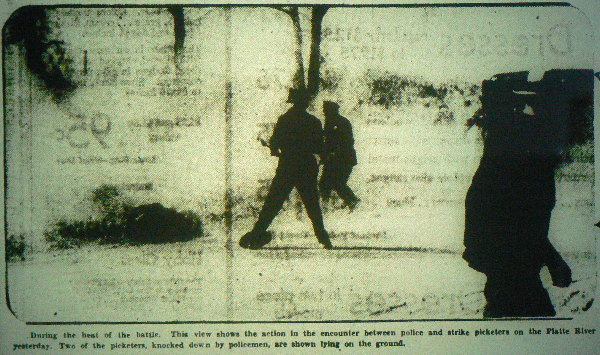
Caption reads: “During the heat of the battle. This view shows the action in the encounter between police and strike picketers on the Platte River yesterday. Two of the picketers, knocked down by policemen, are shown lying on the ground.”

Caption reads: “After the smoke of battle. This shows the battleground where strikers and police met yesterday just after all the action had ceased. Two strikers are shown down on the ground and beyond them is Patrolman C. V. Satt, who was perhaps fatally injured when struck by missiles of the strikers. He is prone on the ground but has pulled out his revolver.”

Caption reads: “R. W. Rankin, a relief supervisor, shown waiting for the ambulance after he had been struck over the head by a patrolman following a private fight at the strike demonstration held yesterday at Civic Center. He suffered a severe scalp wound.”

Caption reads: Henry W. Brown, who was shot in the hip during the encounter between the demonstrators and police on the Platte River yesterday. He is shown here as he lay on a cot in county jail after his wound had been treated in Colorado General Hospital.”
INTRO 3: NEWS HEADLINES
CS Gazette, (AP) Oct 29, 1934:
Relief Strikers March on Capitol – Governor Refuses to Talk to Crowd When One ‘Red’ Won’t Keep Still
Rocky Mountain News, Oct 30
‘Relief Strikers’ March On Capitol, make Demands – Threaten Violence at Projects Today If Officials Do Not Grant All They Seek
Will Rogers – Says Bread Line Is Encouraged by Deficit of New York Stock Exchange
Young Folk Lambast Older Generation For Getting World Into Present Mess – No Punches Pulled as Boys and Girls Have Their Say
CS Evening Telegraph, Oct 30,
RELIEF RIOTERS BATTLE DENVER POLICE
Agitators Shot and Four Officers Injured as Mob Tries to Foment Strike – Blazing Guns Disperse Communist Led Crowd, Radio Car and Gas Station Burned, Score of Attackers Hurt, FERA Workers Refuse to Walk Out
Girl Radical Leads Mob in Denver Riot – FERA Project Pickets Spurred Into Battle by Woman Believed Imported Agitator
RMN, Oct 31
POLICE ARMY WITH MACHINE GUNS WILL GUARD FERA WORKERS TODAY
Force of 300 Officers Will Use Bullets and Tear Gas If Necessary to Protect Relief Workers From Molestation – Agitators Threaten Violence After Yesterday’s Bloody Clash
Witness Says Police Fired When Driven Back to Car – Gives Graphic Account of Rush by Screaming Men and Women Who Volleyed Rocks at Officers
CS Gazette, Oct 31,
RESUMPTION OF VIOLENCE IN DENVER STRIKE FEARED
City Tense After Bloody Riot on South Platte – Barricade Erected at Table Mountain, to Be Visited Today by Agitators
CS Evening Telegraph, Oct 31,
DENVER QUIET BUT TENSE AFTER RIOTING
Mob Gathers But Fails to Carry Out Threat to March on projects – Police Precautions Against Further Outbreaks Nip New Demonstrations; Report Agitators on Way to Foment Trouble in El Paso County – Mob Gathers in Englewood but Fails to Carry Out Threat to March Against FERA Projects
Don’t Expect Any Agitator Trouble on C. S. Relief Jobs p1, c7
Mountain at Golden Resembles Fortified Castle as Workers Prepare to Resist Strike Mob p1, c7
New York Times, Oct 31
‘Hunger Marchers’ Routed at Albany; Rioting in Denver – Many Injured in Denver – Relief Strikers Attempt to halt Federal Project–One Shot Fighting Police, p1, c1
RMN, Nov 1
Relief Strike Riots Subside as Police Act – Agitators Fail to Start Anything at Various FERA Projects
Pretty Girl From Illinois Finds Denver Police Nice p4, c1
CSET, Nov 1
Roundup Ends Denver Relief Strike Threat – With Agitators Arrested, Leaderless Mob’s Spirit Broken; Plot to Spread Disorder in State Fails
U.C.L.A. Branded Communist Hotbed
RMN, Nov 2
File Charges Today Naming 15 as Rioters – Two of Group Face Fine of $1,000 and Year in Jail If Acts Are Proved, p14
College Students Battle Radicalism – Form Vigilante Committee at Coast School

OCCUPIED CHICAGO- President Obama got last weekend’s protest message loud and clear, he’s lost that voter to antiwar favorite Vermin Supreme. A week after the NATO Summit, his Democratic Party headquarters in the Prudential Building leaves the office lights on for the law enforcement vote. Or was it to compensate for Mayor Rahm Emanuel stiffing the CPD on their overtime pay for quelling popular dissent at the summit?

OCCUPIED CHICAGO- That sea of light blue helmets protecting the NATO summit in Chicago last weekend may be a novel visual to those accustomed to police state armor black, but that’s because most 60s era news images were black & white. Color photos from Life Magazine remind us that light blue was the team color of the Alabama state troopers who brutalized the Civil Rights marchers trying to march from Selma to Montgomery.

OCCUPIED DENVER- March 24.

Denver occupiers took to the streets last night in solidarity with OCCUPYs nationwide to protest the brutal January 27 clampdown on an attempted squat in Oakland, California. My favorite chant of the evening was “THEY SAY GET BACK, WE SAY FUCK THAT!” but by the march’s end it was DPD officers who were told to back off. As the protesters took Colfax Avenue and adjacent street, Denver cruisers kept traffic away, eliminating potential witnesses or passersby who might join in. But when Occupy Denver led their protest to the police station, officers with riot control weapons closed in to encircle them in what’s now referred to as a “kettle”, or extrajudicial detainment. Taking a page from the DPD manual the occupiers told their would-be attackers to “GET BACK, GET BACK!” and Obi-Wan-Kenobied their way out of the uncivil-liberty trap. [more on the evening’s account later today]
OCCUPIED DENVER- I heard a lot of taunts aimed at the imposing armored police officers who were crashing our peaceful assembly. Curses, ridicule, warnings, pleas. The best was this admonition:
Dude, this video will go on the internet. Your children will see it.
The brutality of the Oakland Police against #OccupyOakland and Iraq vet Scott Olsen is prompting many to measure their eminent victory with ol’ Gandhi’s hopeful adage: “First they ignore you, then they laugh at you, then they fight you, then you win.” Apparently we’ve reached the fight stage. Yeah no. Sorry folks but teargas and nonlethal measures while dressed in riot gear is still the LAUGH AT YOU stage. You’ll recognize FIGHTING. It’s what America does to everywhere.

DENVER- Concert, 1000-strong march, and the customary Broadway sidewalk shenanigans. Here’s a paint-tub drummer, PVC didjeridoo and my vote for best sign: MIND THE GAP. Saturday’s musical festivities in Civic Center Park meshed well with the annual Zombie Crawl, but the day’s highlight came after dark, when Denver’s anarchist community held a march against police brutality in memory of DPD victim Marvin Booker. The unpermitted route began at Denver Zoo and defined “Whose streets? OUR STREETS!” as it took 23rd, York, Colfax, Broadway, around OCCUPY DENVER’s CC park and into the 16th Street Mall where nocturnal Zombies swelled the ranks and found themselves chanting and carrying the banners STOP POLICE TERRORISM and LAW ENFORCEMENT: END YOUR WAR AGAINST THE PEOPLE.

OCCUPYWALLSTREET- Eighty nonviolent #OWS protesters arrested Saturday by NYPD, some penned in and maced, others manhandled, as they marched in NYC against America’s bankster oligarchs. Wall Street proper remains fortified by anti-invasion barriers preventing pedestrians and demonstrators from getting anywhere near. The protest encampment in Liberty Square enters its second week and today’s baptism of police brutality ensures that the Second American Revolution is taking wing.
What are their demands, everyone asks? At the crux, the same as Tahrir Square, REGIME CHANGE, a decapitation of corporatist imperial fascism. The trouble of course is that to average Americans, a “regime” is a foreign entity, usually incorrigible. So long as the MSM defines the terms, the concept of a US regime doesn’t compute. Another reason why #OccupyWallStreet has to be vague about its goals is because calling for the overthrow one’s masters is not legal. For now, what the protesters against Wall Street say they want, is what they want. If you want to have a say in what direction they take, go there and take part. Otherwise, settle for this, their ONE DEMAND:
A Message From Occupied Wall Street (Day Five)
Published 2011-09-22 07:51:42 UTC by OccupyWallSt
at OccupyWallStreet.orgThis is the fifth communiqué from the 99 percent. We are occupying Wall Street.
On September 21st, 2011, Troy Davis, an innocent man, was murdered by the state of Georgia. Troy Davis was one of the 99 percent.
Ending capital punishment is our one demand.
On September 21st, 2011, four of our members were arrested on baseless charges.
Ending police intimidation is our one demand.
On September 21st, 2011, the richest 400 Americans owned more than half of the country’s population.
Ending wealth inequality is our one demand.
On September 21st, 2011, we determined that Yahoo lied about occupywallst.org being in spam filters.
Ending corporate censorship is our one demand.
On September 21st, 2011, roughly eighty percent of Americans thought the country was on the wrong track.
Ending the modern gilded age is our one demand.
On September 21st, 2011, roughly 15% of Americans approved of the job Congress was doing.
Ending political corruption is our one demand.
On September 21st, 2011, roughly one sixth of Americans did not have work.
Ending joblessness is our one demand.
On September 21st, 2011, roughly one sixth of America lived in poverty.
Ending poverty is our one demand.
On September 21st, 2011, roughly fifty million Americans were without health insurance.
Ending health-profiteering is our one demand.
On September 21st, 2011, America had military bases in around one hundred and thirty out of one hundred and sixty-five countries.
Ending American imperialism is our one demand.
On September 21st, 2011, America was at war with the world.
Ending war is our one demand.
On September 21st, 2011, we stood in solidarity with Madrid, San Francisco, Los Angeles, Madison, Toronto, London, Athens, Sydney, Stuttgart, Tokyo, Milan, Amsterdam, Algiers, Tel Aviv, Portland and Chicago. Soon we will stand with Phoenix, Montreal, Cleveland and Atlanta. We’re still here. We are growing. We intend to stay until we see movements toward real change in our country and the world.
You have fought all the wars. You have worked for all the bosses. You have wandered over all the countries. Have you harvested the fruits of your labors, the price of your victories? Does the past comfort you? Does the present smile on you? Does the future promise you anything? Have you found a piece of land where you can live like a human being and die like a human being? On these questions, on this argument, and on this theme, the struggle for existence, the people will speak. Join us.
We speak as one. All of our decisions, from our choice to march on Wall Street to our decision to continue occupying Liberty Square, were decided through a consensus based process by the group, for the group.
 “American Fall” would be a pun, yes. A pan-Arabian-like Spring causing the US anti-democracy to tumble, being the objective. The English riots have put a dark spin on what might be Middle America’s reception to popular uprising, but mark the dates, because the brass ring nears whether you have the courage or not, and you won’t have the stomach for the alternative.
You’ve probably already sensed the buzz about #SEPT17, campus groups across the country have been bypassing the conventional chaperones to coordinate OCCUPY WALL STREET. Can they do it? Not without your help, and that doesn’t mean switching your phone service or knocking on doors to Get Out The Vote.
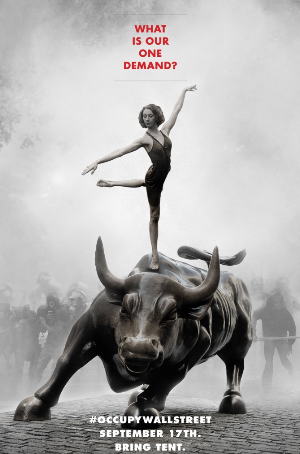 Donate, organize or help with the logistics. If you’ve the temerity, attend in person. At the very least, you’ll have your expenses reimbursed when the city settles your civil suit against them for false arrest. New York City already budgeted for the insurance policy that will pay the legal settlements for the probably now textbook law enforcement practice of kettling inconvenient protests. Or, thinking positively, you may just witness history. To make history you have to make it. Don’t leave it up to the Little Red Hen if you want a piece.
 Next up is #OCT6, although the day varies regionally. The date marks the 10th anniversary of the Afghan invasion, but social justice groups of all stripes are throwing their sundry complaints unto one banner and have organized marches nationwide. Of course the nationals aims to SEIZE DC, where activists will converge on Freedom Square, English for “Tahrir Square”, with plans to camp there until the people’s voice is heard. DC has passed ordinances against overnight protests, but Freedom Square may be cut some slack for being off the National Mall. It’s a smaller public space which lies on the diagonal between the White House and the Capitol Building, abreast of General Tecumseh Sherman’s horse actually.
The determination to reclaim American Democracy with an action in DC hopes to recreate Madison Wisconsin on the Potomac, with the same grassroots support for a broad set of issues to which both parties have shown themselves unresponsive.
 A successful DC foothold will get real traction being closely followed by an international call for a worldwide uprising. #OCT15 is being spearheaded by Spain’s movement for GLOBAL DEMOCRACY. Will it dilute regional efforts to have actions running concurrently, or will synchronized demonstrations overwhelm our transnational overseers? We can wait and see, or we can give it our best shot.
 Here are more graphics in support of the kickoff September 17. Borrowing from Tunisia and Egypt, and before that Chicago 1968, it’s US Days of Rage.
In the course of a single spring we’ve seen massive demonstrations which provoked governments to interrupt cellphone service, shut down internet access, and answer protestors with direct gunfire. To what extreme will the USG be driven? What rights remain inviolate in the US? Not communication. Activist cellphones were blocked on the BART in San Francisco to thwart protests against police brutality.

 I imprison without charges,
I torture, I assassinate,
I overlook police brutality,
I kill foreign journalists,
I kill innocent civilians,
I lie about how many.
I spy on my people,
I violate civil liberties,
I impose emergency law,
I persuade with propaganda of a complicit state media,
I preside over a despised single party system,
I rule with military might,
I ally with tyrants & racists,
I steal from the people,
I provide for my cronies,
I ignore public protest,
I promise meaningful reform, when I have to,
I deliver meaningless.
Who am I?
Answers: Guantanamo, Quantico, drones, Houston PD, Al Jazeera reporters, collateral damage, no body counts, warrant-less wiretaps, free-speech zones, Patriot Act, corporate MSM, phony twin corporate parties, military industrial complex, privatization, banks, unpopular wars, change, false hope.
Family of killer cop victim Oscar Grant appealed for calm after officer given Involuntary Manslaughter verdict. How likely would it be that Oakland would riot with court having reaffirmed that police can murder with impunity?
 Palestinian solidarity volunteer Emily Henochowicz was protesting Israel’s brutal raid on the Gaza relief convoy, to be more precise, she was acting as Western observer to protect the Palestinian right to protest, and she lost her eye when she was hit by an IDF teargas canister. You might have hoped Israel forces would temper their tactics after having shocked world opinion with the Mavi Marmara massacre, but no. Only the day after, IDF policemen aimed high velocity teargas rounds directly at the faces of the solidarity activists. Emily lost her eye and requires metal plates to reconstruct her face.
 Here are a few troubling images of the G-20 protests in Pittsburgh, where police brutality insulated the globalist ministers from the anti-capitalist demonstrations.
Look at this smile. Next time they’re eulogizing a policeman killed on the job, or the city proposes changing a street name to commemorate a fallen officer, think about this image. A Pittsburgh cop does not conceal a fiendish grin as he throws tear gas canisters at the G-20 protesters.
Video footage captured three policemen disguised as black bloc anarchists, walking menacingly among the much younger, more educated looking demonstrators.

Whether the undercover cops were intended to be provocateurs or thinly veiled intimidation is debatable. In any case, bystanders reported that these three broke cameras and can be overheard making sarcastic comments. The protesters kept them surrounded and confronted.
 This widely circulated video purported to show uniformed paramilitary thugs in the act of abducting a black-clad protester. The unmarked sedan pulled up, made the grab, and rolled away. Inconsistencies with the perp attire, mode of undress, and odd accessorizing, point to doubt as to whose street theater this was. God Bless ’em.
Village President John Deschane, 60, an Army veteran who served in Vietnam, said many people in town believe it’s disrespectful to fly the flag upside down.
“If he wants to protest, let him protest but find a different way to do it,” Deschane said
Translation from Right Wing Bullshit to Real English:
“You have the right to free speech unless we dislike what you say or how you say it”
“We’re Fighting For Your Freedom, How DARE you go ahead and actually use that Freedom?”
Dispute over flag protest erupts in Wisc. village
APBy ROBERT IMRIE, Associated Press Writer Robert Imrie, Associated Press Writer – Fri Jul 10, 2:44 pm ET
WAUSAU, Wis. – An American flag flown upside down as a protest in a northern Wisconsin village was seized by police before a Fourth of July parade and the businessman who flew it — an Iraq war veteran — claims the officers trespassed and stole his property.
A day after the parade, police returned the flag and the man’s protest — over a liquor license — continued.
The American Civil Liberties Union of Wisconsin is considering legal action against the village of Crivitz for violating Vito Congine Jr.’s’ First Amendment rights, Executive Director Chris Ahmuty said.
“It is not often that you see something this blatant,” Ahmuty said.
In mid-June, Congine, 46, began flying the flag upside down — an accepted way to signal distress — outside the restaurant he wants to open in Crivitz, a village of about 1,000 people some 65 miles north of Green Bay.
He said his distress is likely bankruptcy because the village board refused to grant him a liquor license after he spent nearly $200,000 to buy and remodel a downtown building for an Italian supper club.
Congine’s upside-down-flag represents distress to him; to others in town, it represents disrespect of the flag.
Hours before a Fourth of July parade, four police officers went to Congine’s property and removed the flag under the advice of Marinette County District Attorney Allen Brey.
Neighbor Steven Klein watched in disbelief.
“I said, ‘What are you doing?’ Klein said. “They said, ‘It is none of your business.'”
The next day, police returned the flag.
Brey declined comment Friday.
Marinette County Sheriff Jim Kanikula said it was not illegal to fly the flag upside down but people were upset and it was the Fourth of July.
“It is illegal to cause a disruption,” he said.
The parade went on without any problems, Kanikula said.
Village President John Deschane, 60, an Army veteran who served in Vietnam, said many people in town believe it’s disrespectful to fly the flag upside down.
“If he wants to protest, let him protest but find a different way to do it,” Deschane said.
Congine, a Marine veteran who served in Iraq in 2004, said he intends to keep flying the flag upside down.
“It is pretty bad when I go and fight a tyrannical government somewhere else,” Congine said, “and then I come home to find it right here at my front door.”
At least they didn’t beat up any elderly and disabled people…
This time…
 From A.N.S.W.E.R.:
–Capitalism is a form of organized crime. The U.S. government is greasing the system’s wheels to ensure that banks and big corporations get trillions in bailout funds. Meanwhile, millions of workers are losing their jobs and homes. Deep cuts are gutting public education, making health care even less accessible and decimating much-needed social programs. Police brutality and racial profiling are rampant. Working-class people are being hit from all sides.
The conference will link the struggles against war and militarism with the fight for economic justice. This conference will be an important opportunity for political activists to meet, analyze, discuss and propose solutions. The conference organizers believe that a radical reorganization of society is necessary to meet the needs of the people rather than to maximize the profits of bankers and corporate executives who have driven society onto the path of endless war and economic suffering.
Featured speakers at the April 19th Conference will include: Marcos García, Mara Verheyden-Hilliard, Brian Becker, Hodari Abdul-Ali, Eugene Puryear, Prof. Zachary Wolfe, Maurice Carney, Muna Coobtee, Frances Villar, James Circello, and Crystal Kim.
MAR 2009
2- Edward Prescott: Economic Integration of Sovereign States, Gaylord Hall, CC, 7:30pm
4- Russell Hittinger: the Modern State: Devolution or Subsidiary, Gaylord Hall, CC, 3:30pm
5- Bill Ayres, Derrick Jensen FORBIDDEN EDUCATION, Glenn Miller Ballroom, Boulder, 7pm
6- PARADE SFPJ/Backbone Campaign, CU Boulder, 3-4:30pm
8- (International Women’s Strike)
9- Ward Churchill vs CU, Denver State Court, Courtroom 6, 9:30am
13-19 –GENERAL STRIKE Stop bankers from plundering treasury
14- St Patricks Day Parade, Tejon Ave, 12noon
15- Day Against Police Brutality
20- UFPJ Iraq War Moratorium
21- A.N.S.W.E.R. antiwar demonstrations
26- Poet XJ Kennedy, Gates Common Room, CC, 7pm
30- PROTEST 25th Annual Space Symposium, Broadmoor Hotel (thru April 2)
31- Robin Bell: Antartica’s Hidden Mountains, Armstrong Theatre, CC, 7:30pm
 The Oakland transit police murder a man in cold blood in front of multiple witnesses and then try to confiscate all the videos of their crime, but they miss one. That one got away on the subway with the film. BART shooting captured on video As you can see by this newspaper article, the police are trying to figure how best to get away with their murder with an excuse, and the press is always willing to cooperate with these cover ups of cop crimes. Oakland Police Cop Watch has the video here…
New Footage of Oakland Man Murdered By BART Cop
NEWS FROM RECREATE-68- The trial of R-68 organizer Carlo Garcia will begin Monday, January 5, in Denver. Carlo’s arrest was one of the worst cases of racism and police misconduct at the DNC. Below is a video of the incident which then led to the police assault on Code Pink organizer Alicia Forest.
Where: The City and County Building of Denver, Court Room 117
When: January 5 at 8:30 am. The trial should last 2 – 3 days. Please come to all if you can.
Carlo can use all the support you can show him. Other R-68 organizers will be testifying, please come and show support for this young important member of our community and stand against the racism of this police attack. When you watch the video, notice the police do not bother the white person on the other end of the sign doing the same thing as Carlo. When the police ask Carlo to leave, as they protect the hate speech being spewed by Rubin Israel and others, Carlo tells them that R-68 has the permit for the park and the hate speech folks are disputing the event. Almost immediately the police choke than attack Carlo.
 In 1969, the Radical Youth Movement (RYM) within Students for a Democratic Society (SDS) expelled the passive participants to reconfigure the SDS to Bring the War Home. At left, Bernardine Dohrn uninvites the Progressive Labor Party (PL) and the Worker Student Alliance (WSA) from the Chicago conference. Below is the founding document after which the RYM was renamed.
You Don’t Need A Weatherman
To Know Which Way The Wind Blows
June 18, 1969Submitted by Karin Asbley, Bill Ayers, Bernardine Dohrn, John Jacobs, Jeff Jones, Gerry Long, Home Machtinger, Jim Mellen, Terry Robbins, Mark Rudd and Steve Tappis.
I. International Revolution
The contradiction between the revolutionary peoples of Asia, Africa and Latin America and the imperialists headed by the United States is the principal contradiction in the contemporary world. The development of this contradiction is promoting the struggle of the people of the whole world against US imperialism and its lackeys.
Lin Piao, Long Live the Victory of People’s War!
People ask, what is the nature of the revolution that we talk about- Who will it be made by, and for, and what are its goals and strategy-
The overriding consideration in answering these questions is that the main struggle going on in the world today is between US imperialism and the national liberation struggles against it. This is essential in defining political matters in the whole world: because it is by far the most powerful, every other empire and petty dictator is in the long run dependent on US imperialism, which has unified, allied with, and defended all of the reactionary forces of the whole world. Thus, in considering every other force or phenomenon, from Soviet imperialism or Israeli imperialism to “workers struggle” in France or Czechoslovakia, we determine who are our friends and who are our enemies according to whether they help US imperialism or fight to defeat it.
So the very first question people in this country must ask in considering the question of revolution is where they stand in relation to the United States as an oppressor nation, and where they stand in relation to the masses of people throughout the world whom US imperialism is oppressing.
The primary task of revolutionary struggle is to solve this principal contradiction on the side of the people of the world. It is the oppressed peoples of the world who have created the wealth of this empire and it is to them that it belongs; the goal of the revolutionary struggle must be the control and use of this wealth in the interests of the oppressed peoples of the world.
It is in this context that we must examine the revolutionary struggles in the United States. We are within the heartland of a worldwide monster, a country so rich from its worldwide plunder that even the crumbs doled out to the enslaved masses within its borders provide for material existence very much above the conditions of the masses of people of the world. The US empire, as a worldwide system, channels wealth, based upon the labor and resources of the rest of the world, into the United States. The relative affluence existing in the United States is directly dependent upon the labor and natural resources of the Vietnamese, the Angolans, the Bolivians and the rest of the peoples of the Third World. All of the United Airlines Astrojets, all of the Holiday Inns, all of Hertz’s automobiles, your television set, car and wardrobe already belong, to a large degree to the people of the rest of the world.
Therefore, any conception of “socialist revolution” simply in terms of the working people of the United States, failing to recognize the full scope of interests of the most oppressed peoples of the world, is a conception of a fight for a particular privileged interest, and is a very dangerous ideology. While the control and use of the wealth of the Empire for the people of the whole world is also in the interests of the vast majority of the people in this country, if the goal is not clear from the start we will further the preservation of class society, oppression, war, genocide, and the complete emiseration of everyone, including the people of the US.
The goal is the destruction of US imperialism and the achievement of a classless world: world communism. Winning state power in the US will occur as a result of the military forces of the US overextending themselves around the world and being defeated piecemeal; struggle within the US will be a vital part of this process, but when the revolution triumphs in the US it will have been made by the people of the whole world. For socialism to be defined in national terms within so extreme and historical an oppressor nation as this is only imperialist national chauvinism on the part of the “movement.”
II. What Is The Black Colony-
Not every colony of people oppressed by imperialism lies outside the boundaries of the US. Black people within North America, brought here 400 years ago as slaves and whose labor, as slaves, built this country, are an internal colony within the confines of the oppressor nation. What this means is that black people are oppressed as a whole people, in the institutions and social relations of the country, apart from simply the consideration of their class position, income, skill, etc., as individuals- What does this colony look like- What is the basis for its common oppression and why is it important-
One historically important position has been that the black colony only consists of the black belt nation in the South, whose fight for national liberation is based on a common land, culture, history and economic life. The corollary of this position is that black people in the rest of the country are a national minority but not actually part of the colony themselves; so the struggle for national liberation is for the black belt, and not all blacks; black people in the north, not actually part of the colony, are part of the working class of the white oppressor nation. In this formulation northern black workers have a “dual role”—one an interest in supporting the struggle in the South, and opposing racism, as members of the national minority; and as northern “white nation” workers whose class interest is in integrated socialism in the north. The consistent version of this line actually calls for integrated organizing of black and white workers in the north along what it calls “class” lines.
This position is wrong; in reality, the black colony does not exist simply as the “black belt nation,” but exists in the country as a whole. The common oppression of black people and the common culture growing out of that history are not based historically or currently on their relation to the territory of the black belt, even though that has been a place of population concentration and has some very different characteristics than the north, particularly around the land question.
Rather, the common features of oppression, history and culture which unify black people as a colony (although originating historically in a common territory apart from the colonizers, i.e., Africa, not the South) have been based historically on their common position as slaves, which since the nominal abolition of slavery has taken the form of caste oppression, and oppression of black people as a people everywhere that they exist. A new black nation, different from the nations of Africa from which it came, has been forged by the common historical experience of importation and slavery and caste oppression; to claim that to be a nation it must of necessity now be based on a common national territory apart from the colonizing nation is a mechanical application of criteria which were and are applicable to different situations.
What is specifically meant by the term caste is that all black people, on the basis of their common slave history, common culture and skin color are systematically denied access to particular job categories (or positions within job categories), social position, etc., regardless of individual skills, talents, money or education. Within the working class, they are the most oppressed section; in the petit bourgeoisie, they are even more strictly confined to the lowest levels. Token exceptions aside, the specific content of this caste oppression is to maintain black people in the most exploitative and oppressive jobs and conditions. Therefore, since the lowest class is the working class, the black caste is almost entirely a caste of the working class, or [holds] positions as oppressed as the lower working-class positions (poor black petit bourgeoisie and farmers); it is a colonial labor caste,, a colony whose common national character itself is defined by their common class position.
Thus, northern blacks do not have a “dual interest”—as blacks on the one hand and “US-nation workers” on the other. They have a single class interest, along with all other black people in the US, as members of the Black Proletarian Colony.
III. The Struggle For Socialist Self-Determination
The struggle of black people—as a colony—is for self-determination, freedom, and liberation from US imperialism. Because blacks have been oppressed and held in an inferior social position as a people, they have a right to decide, organize and act on their common destiny as a people apart from white interference. Black self-determination does not simply apply to determination of their collective political destiny at some future time. It is directly tied to the fact that because all blacks experience oppression in a form that no whites do, no whites are in a position to fully understand and test from their own practice the real situation black people face and the necessary response to it. This is why it is necessary for black people to organize separately and determine their actions separately at each stage of the struggle.
It is important to understand the implications of this. It is not legitimate for whites to organizationally intervene in differences among revolutionary black nationalists. It would be arrogant for us to attack any black organization that defends black people and opposes imperialism in practice. But it is necessary to develop a correct understanding of the Black Liberation struggle within our own organization, where an incorrect one will further racist practice in our relations with the black movement.
In the history of some external colonies, such as China and Vietnam, the struggle for self-determination has had two stages: (1) a united front against imperialism and for New Democracy (which is a joint dictatorship of anti-colonial classes led by the proletariat, the content of which is a compromise between the interests of the proletariat and nationalist peasants, petit bourgeoisie and national bourgeoisie); and (2) developing out of the new democratic stage, socialism.
However, the black liberation struggle in this country will have only one “stage”; the struggle for self-determination will embody within it the struggle for socialism.
As Huey P. Newton has said, “In order to be a revolutionary nationalist, you would of necessity have to be a socialist.” This is because—given the caste quality of oppression-as-a-people-through-a-common-degree-of-exploitation—self-determination requires being free from white capitalist exploitation in the form of inferior (lower caste) jobs, housing, schools, hospitals, prices. In addition, only what was or became in practice a socialist program for self-determination—one which addressed itself to reversing this exploitation—could win the necessary active mass support in the “proletarian colony.”
The program of a united front for new democracy, on the other hand, would not be as thorough, and so would not win as active and determined support from the black masses. The only reason for having such a front would be where the independent petit bourgeois forces which it would bring in would add enough strength to balance the weakening of proletarian backing. This is not the case: first, because much of the black petit bourgeoisie is actually a “comprador” petit bourgeoisie (like so-called black capitalists who are promoted by the power structure to seem independent but are really agents of white monopoly capital), who would never fight as a class for any real self-determination; and secondly, because many black petit bourgeoisie, perhaps most, while not having a class interest in socialist self-determination, are close enough to the black masses in the oppression and limitations on their conditions that they will support many kinds of self-determination issues, and, especially when the movement is winning, can be won to support full (socialist) self-determination. For the black movement to work to maximize this support from the petit bourgeoisie is correct; but it is in no way a united front where it is clear that the Black Liberation Movement should not and does not modify the revolutionary socialist content of its stand to win that support.
From /New Left Notes/, June 18, 1969
IV. Black Liberation Means Revolution
What is the relationship of the struggle for black self-determination to the whole worldwide revolution to defeat US imperialism and internationalize its resources toward the goal of creating a classless world-
No black self-determination could be won which would not result in a victory for the international revolution as a whole. The black proletarian colony, being dispersed as such a large and exploited section of the work force, is essential to the survival of imperialism. Thus, even if the black liberation movement chose to try to attain self-determination in the form of a separate country (a legitimate part of the right to self-determination), existing side by side with the US, imperialism could not survive if they won it—and so would never give up without being defeated. Thus, a revolutionary nationalist movement could not win without destroying the state power of the imperialists; and it is for this reason that the black liberation movement, as a revolutionary nationalist movement for self-determination, is automatically in and of itself an inseparable part of the whole revolutionary struggle against US imperialism and for international socialism.
However, the fact that black liberation depends on winning the whole revolution does not mean that it depends on waiting for and joining with a mass white movement to do it. The genocidal oppression of black people must be ended, and does not allow any leisure time to wait; if necessary, black people could win self-determination, abolishing the whole imperialist system and seizing state power to do it, without this white movement, although the cost among whites and blacks both would be high.
Blacks could do it alone if necessary because of their centralness to the system, economically and geo-militarily, and because of the level of unity, commitment, and initiative which will be developed in waging a people’s war for survival and national liberation. However, we do not expect that they will have to do it alone, not only because of the international situation, but also because the real interests of masses of oppressed whites in this country lie with the Black Liberation struggle, and the conditions for understanding and fighting for these interests grow with the deepening of the crises. Already, the black liberation movement has carried with it an upsurge of revolutionary consciousness among white youth; and while there are no guarantees, we can expect that this will extend and deepen among all oppressed whites.
To put aside the possibility of blacks winning alone leads to the racist position that blacks should wait for whites and are dependent on whites acting for them to win. Yet the possibility of blacks winning alone cannot in the least be a justification for whites failing to shoulder the burden of developing a revolutionary movement among whites. If the first error is racism by holding back black liberation, this would be equally racist by leaving blacks isolated to take on the whole fight—and the whole cost—for everyone.
It is necessary to defeat both racist tendencies: (1) that blacks shouldn’t go ahead with making the revolution, and (2) that blacks should go ahead alone with making it. The only third path is to build a white movement which will support the blacks in moving as fast as they have to and are able to, and still itself keep up with that black movement enough so that white revolutionaries share the cost and the blacks don’t have to do the whole thing alone. Any white who does not follow this third path is objectively following one of the other two (or both) and is objectively racist.
V. Anti-Imperialist Revolution And The United Front
Since the strategy for defeating imperialism in semi-feudal colonies has two stages, the new democratic stage of a united front to throw out imperialism and then the socialist stage, some people suggest two stages for the US too—one to stop imperialism, the anti-imperialist stage, and another to achieve the dictatorship of the proletariat, the socialist stage. It is no accident that even the proponents of this idea can’t tell you what it means. In reality, imperialism is a predatory international stage of capitalism. Defeating imperialism within the US couldn’t possibly have the content, which it could in a semi-feudal country, of replacing imperialism with capitalism or new democracy; when imperialism is defeated in the US, it will be replaced by socialism—nothing else. One revolution, one replacement process, one seizure of state power—the anti-imperialist revolution and the socialist revolution, one and the same stage. To talk of this as two separate stages, the struggle to overthrow imperialism and the struggle for socialist revolution, is as crazy as if Marx had talked about the proletarian socialist revolution as a revolution of two stages, one the overthrow of capitalist state power, and second the establishment of socialist state power.
Along with no two stages, there is no united front with the petit bourgeoisie, because its interests as a class aren’t for replacing imperialism with socialism. As far as people within this country are concerned, the international war against imperialism is the same task as the socialist revolution, for one overthrow of power here. There is no “united front” for socialism here.
One reason people have considered the “united front” idea is the fear that if we were talking about a one-stage socialist revolution we would fail to organize maximum possible support among people, like some petit bourgeoisie, who would fight imperialism on a particular issue, but weren’t for revolution. When the petit bourgeoisie’s interest is for fighting imperialism on a particular issue, but not for overthrowing it and replacing it with socialism, it is still contributing to revolution to that extent—not to some intermediate thing which is not imperialism and not socialism. Someone not for revolution is not for actually defeating imperialism either, but we still can and should unite with them on particular issues. But this is not a united front (and we should not put forth some joint “united front” line with them to the exclusion of our own politics), because their class position isn’t against imperialism as a system. In China, or Vietnam, the petit bourgeoisie’s class interests could be for actually winning against imperialism; this was because their task was driving it out, not overthrowing its whole existence. For us here, “throwing it out” means not from one colony, but all of them, throwing it out of the world, the same thing as overthrowing it.
VI. International Strategy
What is the strategy of this international revolutionary movement- What are the strategic weaknesses of the imperialists which make it possible for us to win- Revolutionaries around the world are in general agreement on the answer, which Lin Piao describes in the following way:
US imperialism is stronger, but also more vulnerable, than any imperialism of the past. It sets itself against the people of the whole world, including the people of the United States. Its human, military, material and financial resources are far from sufficient for the realization of its ambition of domination over the whole world. US imperialism has further weakened itself by occupying so many places in the world, overreaching itself, stretching its fingers out wide and dispersing its strength, with its rear so far away and its supply lines so long.
—/Long Live the Victory of People’s War/
The strategy which flows from this is what Ché called “creating two, three, many Vietnams”—to mobilize the struggle so sharply in so many places that the imperialists cannot possibly deal with it all. Since it is essential to their interests, they will try to deal with it all, and will be defeated and destroyed in the process.
In defining and implementing this strategy, it is clear that the vanguard (that is, the section of the people who are in the forefront of the struggle and whose class interests and needs define the terms and tasks of the revolution) of the “American Revolution” is the workers and oppressed peoples of the colonies of Asia, Africa and Latin America. Because of the level of special oppression of black people as a colony, they reflect the interests of the oppressed people of the world from within the borders of the United States; they are part of the Third World and part of the international revolutionary vanguard.
The vanguard role of the Vietnamese and other Third World countries in defeating US imperialism has been clear to our movement for some time. What has not been so clear is the vanguard role black people have played, and continue to play, in the development of revolutionary consciousness and struggle within the United States. Criticisms of the black liberation struggle as being “reactionary” or of black organizations on campus as being conservative or “racist” very often express this lack of understanding. These ideas are incorrect and must be defeated if a revolutionary movement is going to be built among whites.
The black colony, due to its particular nature as a slave colony, never adopted a chauvinist identification with America as an imperialist power, either politically or culturally. Moreover, the history of black people in America has consistently been one of the greatest overall repudiations of and struggle against the state. From the slave ships from Africa to the slave revolts, the Civil War, etc., black people have been waging a struggle for survival and liberation. In the history of our own movement this has also been the case: the civil rights struggles, initiated and led by blacks in the South; the rebellions beginning with Harlem in 1964 and Watts in 1965 through Detroit and Newark in 1967; the campus struggles at all-black schools in the South and struggles led by blacks on campuses all across the country. As it is the blacks—along with the Vietnamese and other Third World people—who are most oppressed by US imperialism, their class interests are most solidly and resolutely committed to waging revolutionary struggle through to its completion. Therefore it is no surprise that time and again, in both political content and level of consciousness and militancy, it has been the black liberation movement which has upped the ante and defined the terms of the struggle.
What is the relationship of this “black vanguard” to the “many Vietnams” around the world- Obviously this is an example of our strategy that different fronts reinforce each other. The fact that the Vietnamese are winning weakens the enemy, advancing the possibilities for the black struggle, etc. But it is important for us to understand that the interrelationship is more than this. Black people do not simply “choose” to intensify their struggle because they want to help the Vietnamese, or because they see that Vietnam heightens the possibilities for struggle here. The existence of any one Vietnam, especially a winning one, spurs on others not only through consciousness and choice, but through need, because it is a political and economic, as well as military, weakening of capitalism, and this means that to compensate, the imperialists are forced to intensify their oppression of other people.
Thus the loss of China and Cuba and the loss now of Vietnam not only encourages other oppressed peoples (such as the blacks) by showing what the alternative is and that it can be won, but also costs the imperialists billions of dollars which they then have to take out of the oppression of these other peoples. Within this country increased oppression falls heavier on the most oppressed sections of the population, so that the condition of all workers is worsened through rising taxes, inflation and the fall of real wages, and speedup. But this increased oppression falls heaviest on the most oppressed, such as poor white workers and, especially, the blacks, for example through the collapse of state services like schools, hospitals and welfare, which naturally hits the hardest at those most dependent on them.
This deterioration pushes people to fight harder to even try to maintain their present level. The more the ruling class is hurt in Vietnam, the harder people will be pushed to rebel and to fight for reforms. Because there exist successful models of revolution in Cuba, Vietnam, etc., these reform struggles will provide a continually larger and stronger base for revolutionary ideas. Because it needs to maximize profits by denying the reforms, and is aware that these conditions and reform struggles will therefore lead to revolutionary consciousness, the ruling class will see it more and more necessary to come down on any motion at all, even where it is not yet highly organized or conscious. It will come down faster on black people, because their oppression is increasing fastest, and this makes their rebellion most thorough and most dangerous, and fastest growing. It is because of this that the vanguard character and role of the black liberation struggle will be increased and intensified, rather than being increasingly equal to and merged into the situation and rebellion of oppressed white working people and youth. The crises of imperialism (the existence of Vietnam and especially that it’s winning) will therefore create a “Black Vietnam” within the US.
Given that black self-determination would mean fully crushing the power of the imperialists, this “Vietnam” has certain different characteristics than the external colonial wars. The imperialists will never “get out of the US” until their total strength and every resource they can bring to bear has been smashed; so the Black Vietnam cannot win without bringing the whole thing down and winning for everyone. This means that this war of liberation will be the most protracted and hardest fought of all.
It is in this context that the question of the South must be dealt with again, not as a question of whether or not the black nation, black colony, exists there, as opposed to in the North as well, but rather as a practical question of strategy and tactics: Can the black liberation struggle—the struggle of all blacks in the country—gain advantage in the actual war of liberation by concentrating on building base areas in the South in territory with a concentration of black population-
This is very clearly a different question than that of “where the colony is,” and to this question the “yes” answer is an important possibility. If the best potential for struggle in the South were realized, it is fully conceivable and legitimate that the struggle there could take on the character of a fight for separation; and any victories won in that direction would be important gains for the national liberation of the colony as a whole. However, because the colony is dispersed over the whole country, and not just located in the black belt, winning still means the power and liberation of blacks in the whole country.
Thus, even the winning of separate independence in the South would still be one step toward self-determination, and not equivalent to winning it; which, because of the economic position of the colony as a whole, would still require overthrowing the state power of the imperialists, taking over production and the whole economy and power, etc.
VII. The Revolutionary Youth Movement: Class Analysis
The revolutionary youth movement program was hailed as a transition strategy, which explained a lot of our past work and pointed to new directions for our movement. But as a transition to what- What was our overall strategy- Was the youth movement strategy just an organizational strategy because SDS is an organization of youth and we can move best with other young people-
We have pointed to the vanguard nature of the black struggle in this country as part of the international struggle against American imperialism, and the impossibility of anything but an international strategy for winning. Any attempt to put forth a strategy which, despite internationalist rhetoric, assumes a purely internal development to the class struggle in this country, is incorrect. The Vietnamese (and the Uruguayans and the Rhodesians) and the blacks and Third World peoples in this country will continue to set the terms for class struggle in America.
In this context, why an emphasis on youth- Why should young people be willing to fight on the side of Third World peoples- Before dealing with this question about youth, however, there follows a brief sketch of the main class categories in the white mother country which we think are important, and [which] indicate our present estimation of their respective class interests (bearing in mind that the potential for various sections to understand and fight for the revolution will vary according to more than just their real class interests).
Most of the population is of the working class, by which we mean not simply industrial or production workers, nor those who are actually working, but the whole section of the population which doesn’t own productive property and so lives off of the sale of its labor power. This is not a metaphysical category either in terms of its interests, the role it plays, or even who is in it, which very often is difficult to determine.
As a whole, the long-range interests of the non-colonial sections of the working class lie with overthrowing imperialism, with supporting self-determination for the oppressed nations (including the black colony), with supporting and fighting for international socialism. However, virtually all of the white working class also has short-range privileges from imperialism, which are not false privileges but very real ones which give them an edge of vested interest and tie them to a certain extent to the imperialists, especially when the latter are in a relatively prosperous phase. When the imperialists are losing their empire, on the other hand, these short-range privileged interests are seen to be temporary (even though the privileges may be relatively greater over the faster-increasing emiseration of the oppressed peoples). The long-range interests of workers in siding with the oppressed peoples are seen more clearly in the light of imperialism’s impending defeat. Within the whole working class, the balance of anti-imperialist class interests with white mother country short-term privilege varies greatly.
First, the most oppressed sections of the mother country working class have interests most clearly and strongly anti-imperialist. Who are the most oppressed sections of the working class- Millions of whites who have as oppressive material conditions as the blacks, or almost so: especially poor southern white workers; the unemployed or semi-employed, or those employed at very low wages for long hours and bad conditions, who are non-unionized or have weak unions; and extending up to include much of unionized labor which has it a little better off but still is heavily oppressed and exploited. This category covers a wide range and includes the most oppressed sections not only of production and service workers but also some secretaries, clerks, etc. Much of this category gets some relative privileges (i.e. benefits) from imperialism, which constitute some material basis for being racist or pro-imperialist; but overall it is itself directly and heavily oppressed, so that in addition to its long-range class interest on the side of the people of the world, its immediate situation also constitutes a strong basis for sharpening the struggle against the state and fighting through to revolution.
Secondly, there is the upper strata of the working class. This is also an extremely broad category, including the upper strata of unionized skilled workers and also most of the “new working class” of proletarianized or semi-proletarianized “intellect workers.” There is no clearly marked dividing line between the previous section and this one; our conclusions in dealing with “questionable” strata will in any event have to come from more thorough analysis of particular situations. The long-range class interests of this strata, like the previous section of more oppressed workers, are for the revolution and against imperialism. However, it is characterized by a higher level of privilege relative to the oppressed colonies, including the blacks, and relative to more oppressed workers in the mother country; so that there is a strong material basis for racism and loyalty to the system. In a revolutionary situation, where the people’s forces were on the offensive and the ruling class was clearly losing, most of this upper strata of the working class will be winnable to the revolution, while at least some sections of it will probably identify their interests with imperialism till the end and oppose the revolution (which parts do which will have to do with more variables than just the particular level of privilege). The further development of the situation will clarify where this section will go, although it is clear that either way we do not put any emphasis on reaching older employed workers from this strata at this time. The exception is where they are important to the black liberation struggle, the Third World, or the youth movement in particular situations, such as with teachers, hospital technicians, etc., in which cases we must fight particularly hard to organize them around a revolutionary line of full support for black liberation and the international revolution against US imperialism. This is crucial because the privilege of this section of the working class has provided and will provide a strong material basis for national chauvinist and social democratic ideology within the movement, such as anti-internationalist concepts of “student power” and “workers control.” Another consideration in understanding the interests of this segment is that, because of the way it developed and how its skills and its privileges were “earned over time,” the differential between the position of youth and older workers is in many ways greater for this section than any other in the population. We should continue to see it as important to build the revolutionary youth movement among the youth of this strata.
Thirdly, there are “middle strata” who are not petit bourgeoisie, who may even technically be upper working class, but who are so privileged and tightly tied to imperialism through their job roles that they are agents of imperialism. This section includes management personnel, corporate lawyers, higher civil servants, and other government agents, army officers, etc. Because their job categories require and promote a close identification with the interests of the ruling class, these strata are enemies of the revolution.
Fourthly, and last among the categories we’re going to deal with, is the petit bourgeoisie. This class is different from the middle level described above in that it has the independent class interest which is opposed to both monopoly power and to socialism. The petit bourgeoisie consists of small capital—both business and farms—and self-employed tradesmen and professionals (many professionals work for monopoly capital, and are either the upper level of the working class or in the dent class interests-anti-monopoly capital, but for capitalism rather than socialism—gives it a political character of some opposition to “big government,” like its increased spending and taxes and its totalitarian extension of its control into every aspect of life, and to “big labor,” which is at this time itself part of the monopoly capitalist power structure. The direction which this opposition takes can be reactionary or reformist. At this time the reformist side of it is very much mitigated by the extent to which the independence of the petit bourgeoisie is being undermined. Increasingly, small businesses are becoming extensions of big ones, while professionals and self-employed tradesmen less and less sell their skills on their own terms and become regular employees of big firms. This tendency does not mean that the reformist aspect is not still present; it is, and there are various issues, like withdrawing from a losing imperialist war, where we could get support from them. On the question of imperialism as a system, however, their class interests are generally more for it than for overthrowing it, and it will be the deserters from their class who stay with us.
VIII. Why A Revolutionary Youth Movement-
In terms of the above analysis, most young people in the US are part of the working class. Although not yet employed, young people whose parents sell their labor power for wages, and more important who themselves expect to do the same in the future—or go into the army or be unemployed—are undeniably members of the working class. Most kids are well aware of what class they are in, even though they may not be very scientific about it. So our analysis assumes from the beginning that youth struggles are, by and large, working-class struggles. But why the focus now on the struggles of working-class youth rather than on the working class as a whole-
The potential for revolutionary consciousness does not always correspond to ultimate class interest, particularly when imperialism is relatively prosperous and the movement is in an early stage. At this stage, we see working-class youth as those most open to a revolutionary movement which sides with the struggles of Third World people; the following is an attempt to explain a strategic focus on youth for SDS.
In general, young people have less stake in a society (no family, fewer debts, etc.), are more open to new ideas (they have not been brainwashed for so long or so well), and are therefore more able and willing to move in a revolutionary direction. Specifically in America, young people have grown up experiencing the crises in imperialism. They have grown up along with a developing black liberation movement, with the liberation of Cuba, the fights for independence in Africa and the war in Vietnam. Older people grew up during the fight against fascism, during the Cold War, the smashing of the trade unions, McCarthy, and a period during which real wages consistently rose—since 1965 disposable real income has decreased slightly, particularly in urban areas where inflation and increased taxation have bitten heavily into wages. This crisis in imperialism affects all parts of the society. America has had to militarize to protect and expand its empire; hence the high draft calls and the creation of a standing army of three and a half million, an army which still has been unable to win in Vietnam. Further, the huge defense expenditures—required for the defense of the empire and at the same time a way of making increasing profits for the defense industries—have gone hand in hand with the urban crisis around welfare, the hospitals, the schools, housing, air and water pollution. The State cannot provide the services it has been forced to assume responsibility for, and needs to increase taxes and to pay its growing debts while it cuts services and uses the pigs to repress protest. The private sector of the economy can’t provide jobs, particularly unskilled jobs. The expansion of the defense and education industries by the State since World War II is in part an attempt to pick up the slack, though the inability to provide decent wages and working conditions for “public” jobs is more and more a problem.
As imperialism struggles to hold together this decaying social fabric, it inevitably resorts to brute force and authoritarian ideology. People, especially young people, more and more find themselves in the iron grip of authoritarian institutions. Reaction against the pigs or teachers in the schools, welfare pigs or the army, is generalizable and extends beyond the particular repressive institution to the society and the State as a whole. The legitimacy of the State is called into question for the first time in at least 30 years, and the anti-authoritarianism which characterizes the youth rebellion turns into rejection of the State, a refusal to be socialized into American society. Kids used to try to beat the system from inside the army or from inside the schools; now they desert from the army and burn down the schools.
The crisis in imperialism has brought about a breakdown in bourgeois social forms, culture and ideology. The family falls apart, kids leave home, women begin to break out of traditional “female” and “mother” roles. There develops a “generation gap” and a “youth problem.” Our heroes are no longer struggling businessmen, and we also begin to reject the ideal career of the professional and look to Mao, Chef, the Panthers, the Third World, for our models, for motion. We reject the elitist, technocratic bullshit that tells us only experts can rule, and look instead to leadership from the people’s war of the Vietnamese. Chuck Berry, Elvis, the Temptations brought us closer to the “people’s culture” of Black America. The racist response to the civil rights movement revealed the depth of racism in America, as well as the impossibility of real change through American institutions. And the war against Vietnam is not “the heroic war against the Nazis”; it’s the big lie, with napalm burning through everything we had heard this country stood for. Kids begin to ask questions: Where is the Free World- And who do the pigs protect at home-
The breakdown in bourgeois culture and concomitant anti-authoritarianism is fed by the crisis in imperialism, but also in turn feeds that crisis, exacerbates it so that people no longer merely want the plastic ’50s restored, but glimpse an alternative (like inside the Columbia buildings) and begin to fight for it. We don’t want teachers to be more kindly cops; we want to smash cops, and build a new life.
The contradictions of decaying imperialism fall hardest on youth in four distinct areas—the schools, jobs, the draft and the army, and the pigs and the courts. (A) In jail-like schools, kids are fed a mish-mash of racist, male chauvinist, anti-working class, anti-communist lies while being channeled into job and career paths set up according to the priorities of monopoly capital. At the same time, the State is becoming increasingly incapable of providing enough money to keep the schools going at all. (B) Youth unemployment is three times average unemployment. As more jobs are threatened by automation or the collapse of specific industries, unions act to secure jobs for those already employed. New people in the labor market can’t find jobs, job stability is undermined (also because of increasing speed-up and more intolerable safety conditions) and people are less and less going to work in the same shop for 40 years. And, of course, when they do find jobs, young people get the worst ones and have the least seniority. (C) There are now two and a half million soldiers under thirty who are forced to police the world, kill and be killed in wars of imperialist domination. And (D) as a “youth problem” develops out of all this, the pigs and courts enforce curfews, set up pot busts, keep people off the streets, and repress any youth motion whatsoever.
In all of this, it is not that life in America is toughest for youth or that they are the most oppressed. Rather, it is that young people are hurt directly—and severely—by imperialism. And, in being less tightly tied to the system, they are more “pushed” to join the black liberation struggle against US imperialism. Among young people there is less of a material base for racism—they have no seniority, have not spent 20 years securing a skilled job (the white monopoly of which is increasingly challenged by the black liberation movement), and aren’t just about to pay off a 25-year mortgage on a house which is valuable because it’s located in a white neighborhood.
While these contradictions of imperialism fall hard on all youth, they fall hardest on the youth of the most oppressed (least privileged) sections of the working class. Clearly these youth have the greatest material base for struggle. They are the ones who most often get drafted, who get the worst jobs if they get any, who are most abused by the various institutions of social control, from the army to decaying schools, to the pigs and the courts. And their day-to-day existence indicates a potential for militancy and toughness. They are the people whom we can reach who at this stage are most ready to engage in militant revolutionary struggle.
The point of the revolutionary youth movement strategy is to move from a predominant student elite base to more oppressed (less privileged) working-class youth as a way of deepening and expanding the revolutionary youth movement—not of giving up what we have gained, not giving up our old car for a new Dodge. This is part of a strategy to reach the entire working class to engage in struggle against imperialism; moving from more privileged sections of white working-class youth to more oppressed sections to the entire working class as a whole, including importantly what has classically been called the industrial proletariat. But this should not be taken to mean that there is a magic moment, after we reach a certain percentage of the working class, when all of a sudden we become a working-class movement. We are already that if we put forward internationalist proletarian politics. We also don’t have to wait to become a revolutionary force. We must be a self-conscious revolutionary force from the beginning, not be a movement which takes issues to some mystical group—”THE PEOPLE”—who will make the revolution. We must be a revolutionary movement of people understanding the necessity to reach more people, all working people, as we make the revolution.
The above arguments make it clear that it is both important and possible to reach young people wherever they are—not only in the shops, but also in the schools, in the army and in the streets—so as to recruit them to fight on the side of the oppressed peoples of the world. Young people will be part of the International Liberation Army. The necessity to build this International Liberation Army in America leads to certain priorities in practice for the revolutionary youth movement which we should begin to apply this summer. …
IX. Imperialism Is The Issue
The Communists are distinguished from the other working-class parties by this only: 1. In the national struggles of the proletariat of different countries, they point out and bring to the front the common interests of the entire proletariat, independently of all nationality. 2. In the various stages of development which the struggle of the working-class against the bourgeoisie has to pass through, they always and everywhere represent the interests of the movement as a whole.”
—Communist Manifesto
How do we reach youth; what kinds of struggles do we build; how do we make a revolution- What we have tried to lay out so far is the political content of the consciousness which we want to extend and develop as a mass consciousness: the necessity to build our power as part of the whole international revolution to smash the state power of the imperialists and build socialism. Besides consciousness of this task, we must involve masses of people in accomplishing it. Yet we are faced with a situation in which almost all of the people whose interests are served by these goals, and who should be, or even are, sympathetic to revolution, neither understand the specific tasks involved in making a revolution nor participate in accomplishing them. On the whole, people don’t join revolutions just because revolutionaries tell them to. The oppression of the system affects people in particular ways, and the development of political consciousness and participation begins with particular problems, which turn into issues and struggles. We must transform people’s everyday problems, and the issues and struggles growing out of them, into revolutionary consciousness, active and conscious opposition to racism and imperialism.
This is directly counterposed to assuming that struggles around immediate issues will lead naturally over time to struggle against imperialism. It has been argued that since people’s oppression is due to imperialism and racism, then any struggle against immediate oppression is “objectively anti-imperialist,” and the development of the fight against imperialism is a succession of fights for reforms. This error is classical economism.
A variant of this argument admits that this position is often wrong, but suggests that since imperialism is collapsing at this time, fights for reforms become “objectively anti-imperialist.” At this stage of imperialism there obviously will be more and more struggles for the improvement of material conditions, but that is no guarantee of increasing internationalist proletarian consciousness.
On the one hand, if we, as revolutionaries, are capable of understanding the necessity to smash imperialism and build socialism, then the masses of people who we want to fight along with us are capable of that understanding. On the other hand, people are brainwashed and at present don’t understand it; if revolution is not raised at every opportunity, then how can we expect people to see it in their interests, or to undertake the burdens of revolution- We need to make it clear from the very beginning that we are about revolution. But if we are so careful to avoid the dangers of reformism, how do we relate to particular reform struggles- We have to develop some sense of how to relate each particular issue to the revolution.
In every case, our aim is to raise anti-imperialist and anti-racist consciousness and tie the struggles of working-class youth (and all working people) to the struggles of Third World people, rather than merely joining fights to improve material conditions, even though these fights are certainly justified. This is not to say that we don’t take immediate fights seriously, or fight hard in them, but that we are always up front with our politics, knowing that people in the course of struggle are open to a class line, ready to move beyond narrow self-interest.
It is in this sense that we point out that the particular issue is not the issue, is important insofar as it points to imperialism as an enemy that has to be destroyed. Imperialism is always the issue. Obviously, the issue cannot be a good illustration, or a powerful symbol, if it is not real to people, if it doesn’t relate to the concrete oppression that imperialism causes. People have to be (and are being) hurt in some material way to understand the evils of imperialism, but what we must stress is the systematic nature of oppression and the way in which a single manifestation of imperialism makes clear its fundamental nature. At Columbia it was not the gym, in particular, which was important in the struggle, but the way in which the gym represented, to the people of Harlem and Columbia, Columbia’s imperialist invasion of the black colony. Or at Berkeley, though people no doubt needed a park (as much, however, as many other things-), what made the struggle so important was that people, at all levels of militancy, consciously saw themselves attacking private property and the power of the State. And the Richmond Oil Strike was exciting because the militant fight for improvement of material conditions was part and parcel of an attack on international monopoly capital. The numbers and militancy of people mobilized for these struggles has consistently surprised the left, and pointed to the potential power of a class-conscious mass movement.
The masses will fight for socialism when they understand that reform fights, fights for improvement of material conditions, cannot be won under imperialism. With this understanding, revolutionaries should never put forth a line which fosters the illusion that imperialism will grant significant reforms. We must engage in struggles forthrightly as revolutionaries, so that it will be clear to anyone we help to win gains that the revolution rather than imperialism is responsible for them. This is one of the strengths of the Black Panther Party Breakfast for Children Program. It is “socialism in practice” by revolutionaries with the “practice” of armed self-defense and a “line” which stresses the necessity of overthrowing imperialism and seizing state power. Probably the American Friends Service Committee serves more children breakfast, but it is the symbolic value of the program in demonstrating what socialism will do for people which makes the Black Panther Program worthwhile.
What does it mean to organize around racism and imperialism in specific struggles- In the high schools (and colleges) at this time, it means putting forth a mass line to close down the schools, rather than to reform them, so that they can serve the people. The reason for this line is not that under capitalism the schools cannot serve the people, and therefore it is silly or illusory to demand that. Rather, it is that kids are ready for the full scope of militant struggle, and already demonstrate a consciousness of imperialism, such that struggles for a people-serving school would not raise the level of their struggle to its highest possible point. Thus, to tell a kid in New York that imperialism tracks him and thereby oppresses him is often small potatoes compared to his consciousness that imperialism oppresses him by jailing him, pigs and all, and the only thing to do is break out and tear up the jail. And even where high school kids are not yet engaged in such sharp struggle, it is crucial not to build consciousness only around specific issues such as tracking or ROTC or racist teachers, but to use these issues to build toward the general consciousness that the schools should be shut down. It may be important to present a conception of what schools should or could be like (this would include the abolition of the distinction between mental and physical work), but not offer this total conception as really possible to fight for in any way but through revolution.
A mass line to close down the schools or colleges does not contradict demands for open admissions to college or any other good reform demand. Agitational demands for impossible, but reasonable, reforms are a good way to make a revolutionary point. The demand for open admissions by asserting the alternative to the present (school) system exposes its fundamental nature—that it is racist, class-based, and closed—pointing to the only possible solution to the present situation: “Shut it down!” The impossibility of real open admissions—all black and brown people admitted, no flunk-out, full scholarship, under present conditions—is the best reason (that the schools show no possibility for real reform) to shut the schools down. We should not throw away the pieces of victories we gain from these struggles, for any kind of more open admissions means that the school is closer to closing down (it costs the schools more, there are more militant blacks and browns making more and more fundamental demands on the schools, and so on). Thus our line in the schools, in terms of pushing any good reforms, should be, Open them up and shut them down!”
The spread of black caucuses in the shops and other workplaces throughout the country is an extension of the black liberation struggle. These groups have raised and will continue to raise anti-racist issues to white workers in a sharper fashion than any whites ever have or could raise them. Blacks leading struggles against racism made the issue unavoidable, as the black student movement leadership did for white students. At the same time these black groups have led fights which traditional trade-union leaders have consistently refused to lead—fights against speed-up and for safety (issues which have become considerably more serious in the last few years), forcing white workers, particularly the more oppressed, to choose in another way between allegiance to the white mother country and black leadership. As white mother country radicals we should try to be in shops, hospitals, and companies where there are black caucuses, perhaps organizing solidarity groups, but at any rate pushing the importance of the black liberation struggle to whites, handing out Free Huey literature, bringing guys out to Panther rallies, and so on. Just one white guy could play a crucial role in countering UAW counter-insurgency.
We also need to relate to workplaces where there is no black motion but where there are still many young white workers. In the shops the crisis in imperialism has come down around speed-up, safety, and wage squeeze—due to higher taxes and increased inflation, with the possibility of wage-price controls being instituted.
We must relate this exploitation back to imperialism. The best way to do this is probably not caucuses in the shops, but to take guys to citywide demonstrations, Newsreels, even the latest administration building, to make the Movement concrete to them and involve them in it. Further, we can effect consciousness and pick up people through agitational work at plants, train stops, etc., selling Movements, handing out leaflets about the war, the Panthers, the companies’ holdings overseas or relations to defense industry, etc.
After the Richmond strike, people leafleted about demonstrations in support of the Curaçao Oil workers, Free Huey May Day, and People’s Park.
SDS has not dealt in any adequate way with the women question; the resolution passed at Ann Arbor did not lead to much practice, nor has the need to fight male supremacy been given any programmatic direction within the RYM. As a result, we have a very limited understanding of the tie-up between imperialism and the women question, although we know that since World War II the differential between men’s and women’s wages has increased, and guess that the breakdown of the family is crucial to the woman question. How do we organize women against racism and imperialism without submerging the principled revolutionary question of women’s liberation- We have no real answer, but we recognize the real reactionary danger of women’s groups that are not self-consciously revolutionary and anti-imperialist.
To become more relevant to the growing women’s movement, SDS women should begin to see as a primary responsibility the self-conscious organizing of women. We will not be able to organize women unless we speak directly to their own oppression. This will become more and more critical as we work with more oppressed women. Women who are working and women who have families face male supremacy continuously in their day-to-day lives; that will have to be the starting point in their politicization. Women will never be able to undertake a full revolutionary role unless they break out of their woman’s role. So a crucial task for revolutionaries is the creation of forms of organization in which women will be able to take on new and independent roles. Women’s self-defense groups will be a step toward these organizational forms, as an effort to overcome women’s isolation and build revolutionary self-reliance.
The cultural revolt of women against their “role” in imperialism (which is just beginning to happen in a mass way) should have the same sort of revolutionary potential that the RYM claimed for “youth culture.” The role of the “wife-mother” is reactionary in most modern societies, and the disintegration of that role under imperialism should make women more sympathetic to revolution.
In all of our work we should try to formulate demands that not only reach out to more oppressed women, but ones which tie us to other ongoing struggles, in the way that a daycare center at U of C [University of Chicago] enabled us to tie the women’s liberation struggle to the Black Liberation struggle.
There must be a strong revolutionary women’s movement, for without one it will be impossible for women’s liberation to be an important part of the revolution. Revolutionaries must be made to understand the full scope of women’s oppression, and the necessity to smash male supremacy.
X. Neighborhood-Based Citywide Youth Movement
One way to make clear the nature of the system and our tasks working off of separate struggles is to tie them together with each other: to show that we’re one “multi-issue” movement, not an alliance of high school and college students, or students and GIs, or youth and workers, or students and the black community. The way to do this is to build organic regional or sub-regional and citywide movements, by regularly bringing people in one institution or area to fights going on on other fronts.
This works on two levels. Within a neighborhood, by bringing kids to different fights and relating these fights to each other—high school stuff, colleges, housing, welfare, shops—we begin to build one neighborhood-based multi-issue movement off of them. Besides actions and demonstrations, we also pull different people together in day-to-day film showings, rallies, for speakers and study groups, etc. On a second level, we combine neighborhood “bases” into a citywide or region-wide movement by doing the same kind of thing; concentrating our forces at whatever important struggles are going on and building more ongoing interrelationships off of that.
The importance of specifically neighborhood-based organizing is illustrated by our greatest failing in RYM practice so far—high school organizing. In most cities we don’t know the kids who have been tearing up and burning down the schools. Our approach has been elitist, relating to often baseless citywide groups by bringing them our line, or picking up kids with a false understanding of “politics” rather than those whose practice demonstrates their concrete anti-imperialist consciousness that schools are prisons. We’ve been unwilling to work continuously with high school kids as we did in building up college chapters. We will only reach the high school kids who are in motion by being in the schoolyards, hangouts and on the streets on an everyday basis. From a neighborhood base, high school kids could be effectively tied in to struggles around other institutions and issues, and to the anti-imperialist movement as a whole.
We will try to involve neighborhood kids who aren’t in high schools too; take them to anti-war or anti-racism fights, stuff in the schools, etc.; and at the same time reach out more broadly through newspapers, films, storefronts. Activists and cadres who are recruited in this work will help expand and deepen the Movement in new neighborhoods and high schools. Mostly we will still be tied in to the college-based movement in the same area, be influencing its direction away from campus-oriented provincialism, be recruiting high school kids into it where it is real enough and be recruiting organizers out of it. In its most developed form, this neighborhood-based movement would be a kind of sub-region. In places where the Movement wasn’t so strong, this would be an important form for being close to kids in a day-to-day way and yet be relating heavily to a lot of issues and political fronts which the same kids are involved with.
The second level is combining these neighborhoods into citywide and regional movements. This would mean doing the same thing—bringing people to other fights going on—only on a larger scale, relating to various blow-ups and regional mobilizations. An example is how a lot of people from different places went to San Francisco State, the Richmond Oil Strike, and now Berkeley. The existence of this kind of cross-motion makes ongoing organizing in other places go faster and stronger, first by creating a pervasive politicization, and second by relating everything to the most militant and advanced struggles going on so that they influence and set the pace for a lot more people. Further, cities are a basic unit of organization of the whole society in a way that neighborhoods aren’t. For example, one front where we should be doing stuff is the courts; they are mostly organized citywide, not by smaller areas. The same for the city government itself. Schools where kids go are in different neighborhoods from where they live, especially colleges; the same for hospitals people go to, and where they work. As a practical question of staying with people we pick up, the need for a citywide or area-wide kind of orientation is already felt in our movement.
Another failure of this year was making clear what the RYM meant for chapter members and students who weren’t organizers about to leave their campus for a community college, high school, GI organizing, shops or neighborhoods. One thing it means for them is relating heavily to off-campus activities and struggles, as part of the citywide motion. Not leaving the campus movement like people did for ERAP [Education Research Action Project] stuff; rather, people still organized on the campus in off-campus struggles, the way they have in the past for national actions. Like the national actions, the citywide ones will build the on-campus movement, not compete with it.
Because the Movement will be defining itself in relation to many issues and groups, not just schools (and the war and racism as they hit at the schools), it will create a political context that non-students can relate to better, and be more useful to organizing among high school students, neighborhood kids, the mass of people. In the process, it will change the consciousness of the students too; if the issues are right and the Movement fights them, people will develop a commitment to the struggle as a whole, and an understanding of the need to be revolutionaries rather than a “student movement.” Building a revolutionary youth movement will depend on organizing in a lot of places where we haven’t been, and just tying the student movement to other issues and struggles isn’t a substitute for that. But given our limited resources we must also lead the on-campus motion into a RYM direction, and we can make great gains toward citywide youth movements by doing it.
Three principles underlie this multi-issue, “cross-institutional” movement, on the neighborhood and citywide levels, as to why it creates greater revolutionary consciousness and active participation in the revolution:
(1) Mixing different issues, struggles and groups demonstrates our analysis to people in a material way. We claim there is one system and so all these different problems have the same solution, revolution. If they are the same struggle in the end, we should make that clear from the beginning. On this basis we must aggressively smash the notion that there can be outside agitators on a question pertaining to the imperialists.
(2) “Relating to Motion”: the struggle activity, the action, of the Movement demonstrates our existence and strength to people in a material way. Seeing it happen, people give it more weight in their thinking. For the participants, involvement in struggle is the best education about the Movement, the enemy and the class struggle. In a neighborhood or whole city the existence of some struggle is a catalyst for other struggles—it pushes people to see the Movement as more important and urgent, and as an example and precedent makes it easier for them to follow. If the participants in a struggle are based in different institutions or parts of the city, these effects are multiplied. Varied participation helps the Movement be seen as political (wholly subversive) rather than as separate grievance fights. As people in one section of the Movement fight beside and identify closer with other sections, the mutual catalytic effect of their struggles will be greater.
(3) We must build a Movement oriented toward power. Revolution is a power struggle, and we must develop that understanding among people from the beginning. Pooling our resources area-wide and citywide really does increase our power in particular fights, as-well as push a mutual-aid-in-struggle consciousness.
XI. The RYM And The Pigs
A major focus in our neighborhood and citywide work is the pigs, because they tie together the various struggles around the State as the enemy, and thus point to the need for a Movement oriented toward power to defeat it.
The pigs are the capitalist state, and as such define the limits of all political struggles; to the extent that a revolutionary struggle shows signs of success, they come in and mark the point it can’t go beyond. In the early stages of struggle, the ruling class lets parents come down on high school kids, or jocks attack college chapters. When the struggle escalates the pigs come in; at Columbia, the left was afraid its struggle would be co-opted to anti-police brutality, cops off campus, and said pigs weren’t the issue. But pigs really are the issue and people will understand this, one way or another. They can have a liberal understanding that pigs are sweaty working-class barbarians who over-react and commit “police brutality” and so shouldn’t be on campus. Or they can understand pigs as the repressive imperialist State doing its job. Our job is not to avoid the issue of the pigs as “diverting” from anti-imperialist struggle, but to emphasize that they are our real enemy if we fight that struggle to win.
Even when there is no organized political struggle, the pigs come down on people in everyday life in enforcing capitalist property relations, bourgeois laws and bourgeois morality; they guard stores and factories and the rich and enforce credit and rent against the poor. The overwhelming majority of arrests in America are for crimes against property. The pigs will be coming down on the kids we’re working with in the schools, on the streets, around dope; we should focus on them, point them out all the time, like the Panthers do. We should relate the daily oppression by the pig to their role in political repression, and develop a class understanding of political power and armed force among the kids we’re with.
As we develop a base these two aspects of the pig role increasingly come together. In the schools, pig is part of daily oppression—keeping order in halls and lunch rooms, controlling smoking—while at the same time pigs prevent kids from handing out leaflets, and bust “outside agitators.” The presence of youth, or youth with long hair, becomes defined as organized political struggle and the pigs react to it as such. More and more everyday activity is politically threatening, so pigs are suddenly more in evidence; this in turn generates political organization and opposition, and so on. Our task will be to catalyze this development, pushing out the conflict with the pig so as to define every struggle—schools (pigs out, pig institutes out), welfare (invading pig-protected office), the streets (curfew and turf fights)—as a struggle against the needs of capitalism and the force of the State.
Pigs don’t represent State power as an abstract principle; they are a power that we will have to overcome in the course of struggle or become irrelevant, revisionist, or dead. We must prepare concretely to meet their power because our job is to defeat the pigs and the army, and organize on that basis. Our beginnings should stress self-defense—building defense groups around karate classes, learning how to move on the street and around the neighborhood, medical training, popularizing and moving toward (according to necessity) armed self-defense, all the time honoring and putting forth the principle that “political power comes out of the barrel of a gun.” These self-defense groups would initiate pig surveillance patrols, visits to the pig station and courts when someone is busted, etc.
Obviously the issues around the pig will not come down by neighborhood alone; it will take at least citywide groups able to coordinate activities against a unified enemy—in the early stages, for legal and bail resources and turning people out for demonstrations, adding the power of the citywide movement to what may be initially only a tenuous base in a neighborhood. Struggles in one part of the city will not only provide lessons for but [will] materially aid similar motion in the rest of it.
Thus the pigs are ultimately the glue—the necessity—that holds the neighborhood-based and citywide movement together; all of our concrete needs lead to pushing the pigs to the fore as a political focus:
(1) making institutionally oriented reform struggles deal with State power, by pushing our struggle till either winning or getting pigged;
(2) using the citywide inter-relation of fights to raise the level of struggle and further large-scale anti-pig movement-power consciousness;
(3) developing spontaneous anti-pig consciousness in our neighborhoods to an understanding of imperialism, class struggle and the State;
(4) and using the citywide movement as a platform for reinforcing and extending this politicization work, like by talking about getting together a citywide neighborhood-based mutual aid anti-pig self-defense network.
All of this can be done through citywide agitation and propaganda and picking certain issues—to have as the central regional focus for the whole Movement.
XII. Repression And Revolution
As institutional fights and anti-pig self-defense off of them intensify, so will the ruling class’s repression. Their escalation of repression will inevitably continue according to how threatening the Movement is to their power. Our task is not to avoid or end repression; that can always be done by pulling back, so we’re not dangerous enough to require crushing. Sometimes it is correct to do that as a tactical retreat, to survive to fight again.
To defeat repression, however, is not to stop it but to go on building the Movement to be more dangerous to them; in which case, defeated at one level, repression will escalate even more. To succeed in defending the Movement, and not just ourselves at its expense, we will have to successively meet and overcome these greater and greater levels of repression.
To be winning will thus necessarily, as imperialism’s lesser efforts fail, bring about a phase of all-out military repression. To survive and grow in the face of that will require more than a larger base of supporters; it will require the invincible strength of a mass base at a high level of active participation and consciousness, and can only come from mobilizing the self-conscious creativity, will and determination of the people.
Each new escalation of the struggle in response to new levels of repression, each protracted struggle around self-defense which becomes a material fighting force, is part of the international strategy of solidarity with Vietnam and the blacks, through opening up other fronts. They are anti-war, anti-imperialist and pro-black liberation. If they involve fighting the enemy, then these struggles are part of the revolution.
Therefore, clearly the organization and active, conscious, participating mass base needed to survive repression are also the same needed for winning the revolution. The Revolutionary Youth Movement speaks to the need for this kind of active mass-based Movement by tying citywide motion back to community youth bases, because this brings us close enough to kids in their day-to-day lives to organize their “maximum active participation” around enough different kinds of fights to push the “highest level of consciousness” about imperialism, the black vanguard, the State and the need for armed struggle.
III. The Need For A Revolutionary Party
The RYM must also lead to the effective organization needed to survive and to create another battlefield of the revolution. A revolution is a war; when the Movement in this country can defend itself militarily against total repression it will be part of the revolutionary war.
This will require a cadre organization, effective secrecy, self-reliance among the cadres, and an integrated relationship with the active mass-based Movement. To win a war with an enemy as highly organized and centralized as the imperialists will require a (clandestine) organization of revolutionaries, having also a unified “general staff”; that is, combined at some point with discipline under one centralized leadership. Because war is political, political tasks—the international communist revolution—must guide it. Therefore the centralized organization of revolutionaries must be a political organization as well as military, what is generally called a “Marxist-Leninist” party.
How will we accomplish the building of this kind of organization- It is clear that we couldn’t somehow form such a party at this time, because the conditions for it do not exist in this country outside the Black nation. What are these conditions-
One is that to have a unified centralized organization it is necessary to have a common revolutionary theory which explains, at least generally, the nature of our revolutionary tasks and how to accomplish them. It must be a set of ideas which have been tested and developed in the practice of resolving the important contradictions in our work.
A second condition is the existence of revolutionary leadership tested in practice. To have a centralized party under illegal and repressive conditions requires a centralized leadership, specific individuals with the understanding and the ability to unify and guide the Movement in the face of new problems and be right most of the time.
Thirdly, and most important, there must be the same revolutionary mass base mentioned earlier, or (better) revolutionary mass movement. It is clear that without this there can’t be the practical experience to know whether or not a theory, or a leader, is any good at all. Without practical revolutionary activity on a mass scale the party could not test and develop new ideas and draw conclusions with enough surety behind them to consistently base its survival on them. Especially, no revolutionary party could possibly survive Without relying on the active support and participation of masses of people.
These conditions for the development of a revolutionary party in this country are the main “conditions” for winning. There are two kinds of tasks for us.
One is the organization of revolutionary collectives within the Movement. Our theory must come from practice, but it can’t be developed in isolation. Only a collective pooling of our experiences can develop a thorough understanding of the complex conditions in this country. In the same way, only our collective efforts toward a common plan can adequately test the ideas we develop. The development of revolutionary Marxist-Leninist-Maoist collective formations which undertake this concrete evaluation and application of the lessons of our work is not just the task of specialists or leaders, but the responsibility of every revolutionary. Just as a collective is necessary to sum up experiences and apply them locally, equally the collective interrelationship of groups all over the country is necessary to get an accurate view of the whole movement and to apply that in the whole country. Over time, those collectives which prove themselves in practice to have the correct understanding (by the results they get) will contribute toward the creation of a unified revolutionary party.
The most important task for us toward making the revolution, and the work our collectives should engage in, is the creation of a mass revolutionary movement, without which a clandestine revolutionary party will be impossible. A revolutionary mass movement is different from the traditional revisionist mass base of “sympathizers.” Rather it is akin to the Red Guard in China, based on the full participation and involvement of masses of people in the practice of making revolution; a movement with a full willingness to participate in the violent and illegal struggle. It is a movement diametrically opposed to the elitist idea that only leaders are smart enough or interested enough to accept full revolutionary conclusions. It is a movement built on the basis of faith in the masses of people.
The task of collectives is to create this kind of movement. (The party is not a substitute for it. and in fact is totally dependent on it.) This will be done at this stage principally among youth, through implementing the Revolutionary Youth Movement strategy discussed in this paper. It is practice at this, and not political “teachings” in the abstract, which will determine the relevance of the political collectives which are formed.
The strategy of the RYM for developing an active mass base, tying the citywide fights to community and citywide anti-pig movement, and for building a party eventually out of this motion, fits with the world strategy for winning the revolution, builds a movement oriented toward power, and will become one division of the International Liberation Army, while its battlefields are added to the many Vietnams which will dismember and dispose of US imperialism. Long Live the Victory of People’s War!
Rita and her GRANDMOTHERS FOR PEACE found change.gov and gave them an earful. (change.gov is the President-Elect’s change.org)
FOLLOWING OBAMA OUT OF LA LA LAND
I was afraid. The 2/26/08 e-mail from Bob Nemanich, Obama El Paso County Co-Coordinator, had come in minutes earlier. It read in part:
“Now this is important. Jay Ferguson, the vice chair of the El Paso County Democratic Party and I have been receiving numerous reports of curious and even worse descriptions of attempts, by some volunteers managing the entrance doors last Saturday morning, attempting to turn rightfully elected delegates away from the convention. This is serious stuff. If any of you witnessed or experienced an attempt by someone telling delegates who were in line Saturday morning and told to go home because: “the crowds were too big,” “no more room inside,” “they had enough delegates,” “the fire marshal was going to close us down,” or were told “their name was not on their lists” or other intimidations…You need to contact us immediately! We will need the description of th e person who was at the door making these or other statements or intimidating anyone, which line you were in, the time, and other circumstances which might further identify this person and activity of attempting to suppress the vote.”
I’d read the words and shuddered. What should I do?
I stood and walked away from the computer, passing the side-by-side pictures of my brother and son – both very precious to me and both very disabled. What could happen to them if I spoke out and told what I knew and had seen?
More than a decade ago, my “Rainman” duplicate son was working at his part-time job in the laundry of a local hotel. Suddenly a C.S.P.D. cop appeared and began roughing my boy up as he arrested him. The hotel maid who witnessed the arrest later told me she had begged the cop not to scare or hurt him, that he was autistic and retarded and didn’t understand what was happening. The cop ignored her as he threw my son against the wall, handcuffed him, and roughly led him to the waiting squad car and onto jail.
My boy’s “crime” was a false accusation beyond the belief of all who know my son and understand his limitations. Eventually the deputy district attorney dismissed all charges against him, but only after the nearly unsurmountable fear and suffering of my son and all who love him. His “crime” could have possibly have been based on his coming from a well-to-do family, thereby designating him and us as a target for monetary awards from fraudulent civil actions. And just as likely was the possibility that his being so brutalized, charged and arrested was a result of my political activism and stands against discrimination and intimidation. I’ll most likely go to my grave not knowing which was the case. One thing for certain – from now on I’ll be on guard against dirty political retaliation, particularly against those I love.
Months before my son’s false arrest, I had taken on an infamous Colorado Republican state senator who had publicly and to the press referred to all women of color as ‘promiscuous.” Following her nationally publicized remark, at a Colorado Springs “Cure Rally,” I had jokingly awarded her the “Jackass of the Year Award.” A few months later, at the urging of a retired judge and former colleague of mine, I had filed a criminal charge of harassment against the senator’s son, who had spear-headed the anti-gay Colorado Amendment Two, an amendment approved by the voters and later overturned by the U.S. Supreme Court.
Representing the Colorado Springs Minority Coalition, I had appeared on a local t.v. talk show with the senator’s son and responded to phone calls from viewers regarding the Minority Coalition’s stands on Amendment Two and other issues. Following the show, the senator’s son had invited me, along with a man from the N.A.A.C.P., into a studio back room where he had attempted to intimidate me by stating that it looked like we were going to fight. He then knuckle punched me in the arm. I followed the advice of my judicial friend, and reported the incident. Shortly thereafter, others came forward, citing similar attempts at intimidation by the senator’s son.
The same week my son was brutalized and falsely arrested, it was announced that the senator’s son was being removed from his job as head of “Colorado for Family Values,” the organization behind Amendment Two. A longtime observer of partisan politics in this one-party town of Colorado Springs observed that the senator’s son’s political career had been nipped the bud due to what had happened following the t.v. show.
I will always wonder if my son’s being charged and arrested for a crime he could never have committed was in reality an attack on me for standing up to blatant bigotry and an attempt at intimidation. And now I was being asked by an official of the Obama campaign to come forward once again, and stand up to undemocratic manipulation and outrageous intimidation. What should I do?
Torn by indecision, my view switched from the photo of my beautiful, autistic son, to the photo taken years earlier of my beloved brother, a mentally ill, fully disabled vet. And I was jolted into the present. Weeks earlier, my brother had gone into a local fast food restaurant, and had been questioned by the police for his part in a fist fight that had occurred in the restaurant.
My brother had watched and listened to a man in the restaurant as the man loudly and angrily berated the “stupid nigger” Barack Obama. My brother, a gently and caring person, had gone up to the man and told him he disagreed with him about Sen. Obama, and was offended at what the man was saying, and how he was saying it.
The man then swung at my brother twice, causing my brother to punch the man in defense, knocking the man to the floor and bloodying the man’s nose. The man ceased his hate filled outrage, and the police were called in. A restaurant employee explained to the police that it was not brother who had instigated the attack, but rather it was my brother who was defending himself. The man was arrested, and my brother, feeling very guilty for having struck someone, returned home to tell me the story. I consoled him, and complimented him for his bravery in speaking out against such hatred and bigotry.
And now, remembering my brother’s courage and glancing at my deceased uncle and god father’s purple heart from World War II, I made my decision. Courage is vital if heaven is to be gained and democracy is to be maintained. Scared as I was, I returned to the computer and began typing my affidavit, the soon to be sworn to statement of what I had witnessed at the El Paso County Democratic Assembly days earlier.
The story was not a pretty one. Elected Obama delegates and alternates had stood outside for hours in the frigid cold, only to be kept from entering the high school where the assembly was held. They were turned away in number at the door by none other than the then head of the Colorado Springs ACLU, a former NSA man. This former NSAer reportedly later stated he was merely following the directions of the local Democratic party chairman.
Within days of my submitting my signed and sworn to affidavit to the Obama and party official who had requested information, with copies to state and national party officials and ACLU officials, my house and grounds and the neighbor’s house was broken into in the middle of the night. According to both my neighbor and my brother who resides with me, the intruder appeared to be eager to be both heard and seen, and did not attempt to run and hide when spotted. This is the first break-in we have experienced since living here.
I went to the police station and added my brother’s citing of the intruder onto the neighbor’s report to the police the neighbor had made at the time of the incident. The police officer asked me if, to the best of my knowledge, anyone was attempting to intimidate me, my brother, or my neighbor. I gave the officer a copy of my affidavit, and told him an attempt to intimidate me had been made by the ACLU chairman immediately prior to my submission of my affidavit.
The officer then advised me to go as public as possible with the information I had. The officer state that his grandmother had been among those at the the Democratic assembly and, along with so many others, had wondered just what was going on.
Shortly thereafter, a representative from the local Democratic party notified me that the platform committee, to which I had been elected at the recent assembly, had been disbanded. It was hardly a surprise when three months later, two peace demonstrators were arrested at the Democratic state convention, which was held in Colorado Springs. The demonstrators were standing outside an area which was taped off by police, and were being cheered on and waved at by Obama delegates and alternates who were entering the World Arena building where the convention was being held.
The demonstrators were arrested, handcuffed, and transported first to a nearby station, then transported and left miles away from where the convention was being held. The support poles of the banner they displayed (“Dems – please stop funding the war in Iraq”) were destroyed by police. Significant rooftop audio surveillance occurred prior to and during the arrest, but was denied and not produced during the motions for discovery at time of preliminary hearings. Prior to going to trial, charges were dropped by the city, just as charges were eventually dropped by the city after the first trial against peace demonstrators (google Colorado Springs St. Patrick’s Day Parade 2007, n.b. “Police Brutality”) resulted in a hung jury.
This is not one person’s story – this is a city’s story, a state’s story, an entire country’s story. The coup d’etat of which President Eisenhower warned us during a radio address on his last day in office is well established and is going to be extremely difficult to undo. The undoing of the military/industrial/corporate coup will require courage and persistence of the highest order.
Forty fusion centers nationwide, and super fusion centers such as Colorado Springs, will continue to strip away basic civil rights by means of surveillance, and infiltration of peace, justice, and political organizations. These centers will not go away easily. The return of a free and non-spin press will not just happen. Improvement in education nationwide is essential if democracy is to return and survive. We must discontinue simply educating to enable every child to eventually get a bigger and better paying job so as to produce a bigger and better consumer, but rather we must provide truly meaningful education that turns out perpetually self-educating, critical thinkers who are impervious to spin and manipulation.
The need for change list goes on and one, and as long as President elect Obama hangs tough and maintains the heart, brains, and courage that are so necessary to oversee the change, hope we indeed survive. Then he can and will indeed lead us our of La La Land, and forward to the top of the mountain of all our dreams.
God bless and protect Barack Obama and his oh so wonderful and brave and bright family. And, please God, bless and protect not just America, but the entire world and all our sisters and brothers in it. Peace and love be with you and with us all.
Rita Walpole Ague
by Adam1010 on Thu Oct 16, 2008 5:17 pm
My cousin emailed me this sad news today:________________________
Folks,
Please make your friends and family aware of this incident, described, below.For more details see: http://ivaw.org/
Dear friends and supporters,
Yesterday Veterans For Peace Long Island was privileged to march in
solidarity with the Iraq Veterans Against the War to the front gates
of Hofstra University. As I am sure you are aware, the peaceful march
to express concerns to the Presidential candidates was meet with
unprovoked violence and brutality by the Nassau County Police.
Following a mounted police assault in which we all peaceably moved
back from the front gate of Hofstra, the Police abusively sought out
and arrested members of IVAW. Three veterans were injured in the
assault and taken to local hospitals. In all fifteen demonstrators
were arrested, twelve of them Iraq War veterans.The Hempstead 15 will be arraigned on November 10 and VFPLI will be
there to stand in solidarity with those who continue to sacrifice so
much for our country. Please remember them and join us
to support our courageous brothers and sisters and to demonstrate to
our representatives that such police brutality will not be tolerated
on Long Island.Peace and justice for the Hempstead 15.
The following photos are of Nick Morgan, IVAW member, after the above described police assault targeting Iraq veterans exercising their rights to freedom of speech and assembly. His injury is a result of being trampled by one of the police horses. He suffered a broken cheekbone.
The photos were taken by Vietnam Veterans Against the War member Bill Perry.


I bet their mommas must be real damn proud…