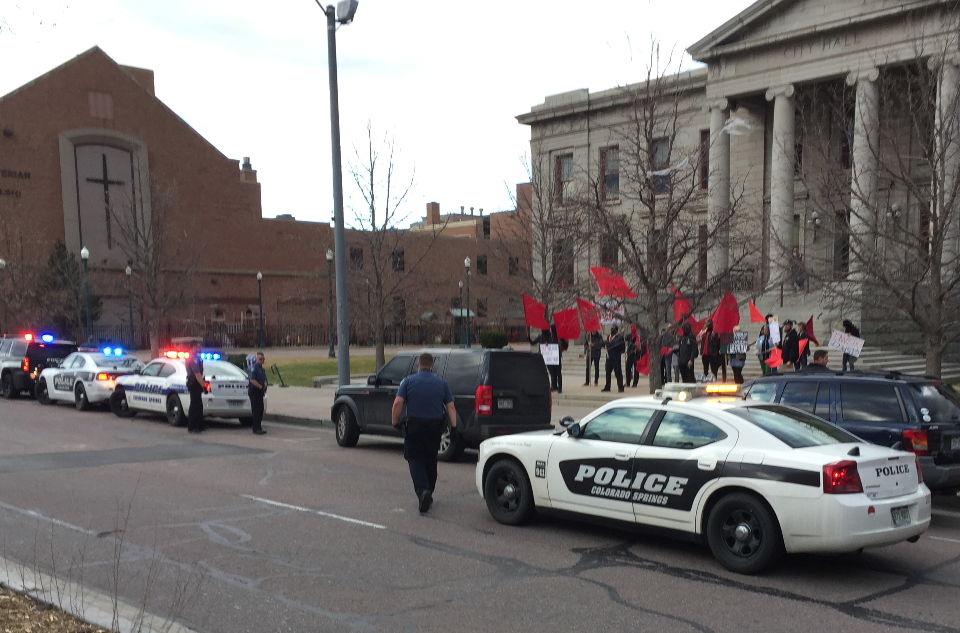
Police body cameras reveal Colorado Springs law enforcement used arrests to infiltrate a student socialist group.


COLORADO SPRINGS, COLORADO- Police body worn camera footage accidentally discovered to defendants in the March 26, 2017, protest cases, has revealed a mysterious side story at the Colorado Springs Socialists’ “March Against Imperialism”. At that march, six participants were cited for marching in the street. Meanwhile, a curious seventh was detained, driven off, but not cited. CSPD Officer Krueger’s body-cam recorded what happened and more.

What happened at the March 26 rally, beside the police dispersing a fully legal assembly? This video documents that the CSPD tried to give deeper cover to a team of El Paso County Sheriff’s plainclothes operatives, by giving one of them the credibility of an arrest. In truth, it worked for three weeks and several socialist actions, until the undercover team spooked everyone with their excessively sketchy zeal. As the March 26 evidence was released to defendants, the contradictory police reports began to accrue. Then a file labeled KRUEGER BODY-CAM emerged.

1. Krueger-cam
The first thing you see is the twenty or so protesters, clad in black, waving red flags, rallying on the steps of Colorado Springs City Hall. Speakers are railing against capitalism and imperialism. CSPD Officer Krueger comes upon this scene, among the reinforcements called, because fourteen of the protesters, mostly masked, were observed to have marched on the street.

(Marchers had followed Nevada to Bijou to Tejon to Colorado back to Nevada, trailed by the cruisers of CSPD Officers Mark Keller and Roberto Williamson. Returning to City Hall, participants were told by CSPD Sergeant Clayton Blackwell that they could protest on the sidewalk but would be ticketed if they stepped back into the street.)

As the rally goes on, the officers hear that orders have changed and everyone is going to be ticketed. On camera, Officer Keller relates a possible motive: “LT wants everyone identified.”

(Most of the protesters are masked. Arrests will give police the pretext to register everyone’s identity, whether the person walked in the street or not. By “LT”, Keller may be refering to Lieutenant Webber, who dispatched officers to the scene, or Lieutenant Mark Comte, in charge of CSPD intelligence.)

As officers discuss whether to rush the group or detain two or three protesters at a time, CSPD Sergeant Blackwell discloses to his men: “There’s two UCs in there, and they’ll just take a ticket like everybody else.” Blackwell adds, jokingly: “So hopefully we don’t have to start spraying ‘cause I don’t know which ones they are.”

Officer Keller tells Krueger and Canaan he thinks one of the protesters is concealing a knife. He fingers a masked protester wearing a Carhartt jacket.

CSPD Officer Dustin Canaan knew nothing about the undercover scheme.Though Krueger and his partner, CSPD Officer Dustin Canaan, were informed about undercovers, they don’t know that they are being tasked with arresting one.

Officers Krueger and Canaan are formally instructed that when the move is made to issue citations to the protesters, they are to apprehend “Carhartt”.

In fact, the first planned arrestee of March 26 is “Carhartt”. Aka the sheriff’s undercover.

Officers encircle the rally as Sergeants Ingram and Blackwell tell the socialists that “Everyone is getting a ticket!”

When the officers confront “Carhartt” he loudly abuses them with expletives proclaiming his innocence. He does this to incite fellow protesters to resist the police effort to detain him. Everybody else however is either walking swiftly away or calmly accepting their citations for Pedestrian-in-the-Roadway and Failure-to-Disperse.

City police unknowingly encircle sheriffs undercovers

Officers Krueger and Canaan ask “Carhartt” whether he has a weapon. The suspect responds with a strange command, voiced between clenched teeth: “Pat me down at the car.”

CSPD Office Krueger escorts detainee Mark JacksonThey don’t hear his response and so repeat their question. “Carhartt” sticks to his odd refrain: “Pat me down at the car!”

Krueger and Canaan walk “Carhartt” to their cruiser where he admits he has a weapon, a “M&P Shield 9mm”. He alerts the officers that his gun is tucked into his front waistline, with the safety off. In his pocket the officers find an additional magazine clip.

(Let us reflect for a moment, that only Officer Keller knew about this undercover. Imagine if events had escalated and any of the other dozens of police officers had caught a glimpse of the undercover’s gun. What kind of trigger-happy confrontation could have resulted with the socialist marchers caught in the middle? We might also wonder what Carhartt intended to do with two magazines full of bullets.)

Officer Canaan unloads the 9mm, removes the bullet from the chamber, and places everything on the front seat.

Sheriffs undercover Mark Jackson concealed a loaded 9mm

The officers ask “Carhartt” whether he wants to be cited and released on the spot, or taken to be booked at the station? The detainee responds he wants to go wherever the other arrestees are being processed.

Asked whether he has a concealed carry permit “Carhartt” replies no.

It occurs to the officers that they can’t catch and release someone, however cooperative, if they’ve apprehended you carrying a concealed weapon without a permit.

Officer Krueger leaves to consult his supervisor Sergeant Blackwell about this arrestee who is carrying a gun without a permit.

Blackwell asks Krueger: “Is he one of our UCs?” He explains again: “We have two UCs. Do you recognize him?”

Krueger says no.

Blackwell comes to the cruiser to see for himself.

Sergeant Clayton Blackwell and Officer Dustin Canaan look at their unfamiliar detainee.

Blackwell doesn’t recognize the detainee either.

As Sergeant Blackwell walks away from the cruiser, he tells Krueger the suspect is not one of their UCs, then he ponders: “…unless he’s with the sheriff’s office?”

The suspect gives his name as Mark Jackson, d.o.b. 7/20/75, last digits of SS# 1033, phone number (281) 606-0532. All of which is probably phony.

Undercover Amy Walter speaks with an Eastern European accent.His partner “Amy Walter” has been sitting nearby on the curb. She didn’t flee like the other participants, but oddly, was neither cited nor unmasked like all those who remained.

(“Amy Walter” kept her cover for months after the arrests. She claimed to drive up from Pueblo and only appeared fully bloc’d up. She’s gregarious and eager, and speaks with an Eastern European accent.)

Jackson remains detained in the back seat. After a few minutes CSPD Officer Mark Keller comes to the window to look at the suspect. He walks off camera, probably to tell Sergeant Blackwell that he can confirm the detainee is indeed an undercover.

Blackwell returns shortly to the cruiser to tell Krueger “We’re good.” Lowering his voice, he adds: “He’s UC.”

After some thought, Krueger turns to Jackson and asks in a whisper: ”Are you with the Sheriffs?” The undercover answers in the affirmative.

Krueger turns off his body-cam.

2. Canaan-cam
The body-cam worn by Krueger’s partner, Officer Canaan, has all the while recorded the same sequence of events, but he wasn’t paying attention to the whispers, so his camera continues to record.

Officer Keller walks back to the cruiser, this time to tease the undercover. Keller leans in and jokes about the arrest he arranged by pretending to suspect that Jackson had a knife.

Keller begins: “You really should hang out with a better crowd.”

Mocks Jackson: “I know. ‘Fuck the Police’. Ha ha.”

Keller goes on: “Hey, youse in the street, I figured you should get a ticket like everybody else.”

The undercover then says: “That’s why I yelled ‘COME FUCKING ARREST ME!’”

The two then discuss whether the undercover’s female partner should also be ticketed. Jackson theorizes that one ticket is enough.

Meanwhile an unspoken decision is made not to carry through with Jackson’s citation. This disturbs the undercover. He asks “How will it look when I don’t get a ticket?”


As Officer Mark Keller leaves the conversation at the cruiser, he looks directly at Canaan’s body-cam.

Undercover Jackson then notices that Officer Canaan did not grasp the development. He tells Krueger “You better tell your partner what’s going on.” Canaan turns off the audio on his body-cam.

ANALYSIS
To recap. Sergeant Blackwell revealed that the city had two UCs planted in the Socialist march. Officer Keller knew of the undercover Sheriff’s deputies “Jackson” and “Walter”. An effort was orchestrated to give a citation to “Jackson” but that plan was aborted. Wouldn’t it be interesting to know why?

Jackson’s detainment did not generate officer reports from either Krueger or Canaan, but the alias “Mark Jackson” was listed in three places. 1) on the March 26 police blotter, 2) in the radio log as “Mark Jackson in custody”, and 3) mentioned in passing in the report filed by Officer Roberto Williamson.

For three weeks “Mark Jackson” continued to infiltrate the socialist group, participating in several counterprotests, until everyone gave him the cold shoulder. His partner “Amy Walter” continues to contact group members.

The infiltration operation is extraordinary when you consider that the “Colorado Springs Socialists” essentially comprises the UCCS Socialist Discussion Group, a year-old student club chartered at the school. Though the students sometimes conceal themselves bandanas and hoodies when they attend social justice protests, they’ve committed zero acts of rioting, violence, or property destruction.

Once the video files had been released to the March 26 defendants, city prosecutors fought tooth and nail to quash the defendants’ subpoenas to the officers involved. The judge refused to review the body-cam footage, explaining that the El Paso Sheriffs Office had the discretion to refuse to provide further information.

Defendants insisted the prosecution was obligated to produce all the witnesses it knew to be on the scene of the alleged offenses, whether the witnesses were uniformed police or undercover. But the court won’t concede that the undercover operation merits looking into. The city stresses the importance of detectives being able to remain undercover to monitor ongoing crimes, in this case, jaywalking. The defendants are charged with obstruction and failure to disperse. If those are the crimes worth embedding undercovers, then the officers ought to be summoned to the trial to testify and secure convictions.

The defendants risked just that by insisting that the undercovers come forward as witnesses, but that risk was worth what the defendants were really after. What were those undercovers doing at the rally and at the march? Were they leading marchers into the street? Were undercovers taunting the cops as a demonstration that the protesters heard police orders to get off the street. Most marchers did not hear any orders, nor see police do much other than block traffic for their procession, contrary to the tone set by undercover Mark Jackson’s “COME FUCKING ARREST ME”. To prove the charge of Failure to Disperse” the prosecution has to prove that the accused wilfully defied the police. Jackson’s words seem meant to stand in for that proof.

Likewise, was Jackson’s belligerant response to police trying to arrest him meant to spark more resistance? Very often, riot cops target their own infiltrators who know to act outraged and resistive so that the crowd responds protectively. Jackson was clearly trying to do that.

Most of all, defendants wanted to get to the bottom of CSPD’s complicated operation to set their undercovers up to “take a ticket like everybody else.” How many officer were involved, and why didn’t officers recognize each other? Are the undercovers in fact with the El Paso Sheriffs Office or are they intelligence contractors or government agents? Who was coordinating this infiltration operation and who decided to call off issuing the ticket?

Who above all, thought they needed to insert an armed undercover, or two, possibly four, in the midst of a peaceful anti-imperialism march? Could a socialist group’s reckless co-opting of city streets warrant an undercover team’s reckless endangerment of unsuspecting activists surounded by very likley PTSD-addled police officers?

Jackson’s jittery behavior while detained in the back of the police cruiser hardly gives you confidence that even he should be trusted to wield a gun.

APPENDIX
The Krueger and Canaan body cam videos are circulating online. We’ll link to them as we locate stable copies. Below is an index of the events described above.

On the KRUEGER body-cam:

[0:45] Officer Mark Keller: “L.T. wants everyone identified.”

[3:05] Sergeant Clayton Blackwell: “There’s two UCs in there, and they’ll just take a ticket like everybody else. So hopefully we don’t have to start spraying ‘cause I don’t know which ones they are.”

[3:50] Off-camera officer: “Guy in the Carhartt [jacket] has a knife in his pocket.”

[9:00] Officers Krueger and Canaan discuss orders to arrest “Carhartt” suspected of carrying a knife.

[14:02] Sergeant John Ingram shouts: “Everyone is going to get a ticket!”

[15:20] Krueger and Canaan contact “Carhartt” who responds in a hostile and provocative manner. Unlike the other arrestees who are fully cooperative, he objects with loud profanity and derision.

[18:05] Krueger and Canaan discover “Carhartt” is armed with a 9mm handgun, tucked in his front waistband, and no concealed carry permit.

[20:04] Suspect gives his name as “Mark Jackson, d.o.b. 7/20/75”, and asks: “How do you know I was in the street?” Officer Canaan replies “An officer pointed you out. He’s been watching you the whole time.”

[23:38] Krueger consults Sgt. Blackwell who determines that “Jackson” is not one of their two UCs embedded in the march.

[28:56] Off camera Sgt. Blackwell tells Krueger “He’s U.C.”

[29:20] “Mark Jackson” admits he is with Sheriff’s Office.

[29:50] Krueger turns off body-cam.

On the CANAAN body-cam:

[16:41] Officer Dustin Canaan unloads the detainee’s “M&P Shield 9mm” and places gun, magazines, and extra bullet on front seat.

[22:02] Officer Mark Keller approaches cruiser to take a look at the detainee’s face.

[24:52] Sergeant Blackwell taps on cruiser window, says “We’re good.” Whispers to Krueger (inaudible, but it’s on the Krueger cam where we hear: “He’s UC”)

[25:03] Officer Keller returns to cruiser to joke with “Mark Jackson” about having arranged his fake arrest. Says Keller: “Hey, you’se in the street, I figured you should get a ticket like everybody else.” To which Jackson replies: “That’s why I said ‘Come fucking arrest me!’”

[25:25] Keller discusses with Jackson whether or not to ticket his female partner.

[26:27] Canaan turns off the audio of his body-cam.

Coppelia and the Viennese Hesitation

If you are hardwired with a cultural affliction like mine, if you find yourself with a compulsive affinity for the waltz, I’ll wager you will also be a sucker for what’s called the Viennese Hesitation. It was just such a hook that led me to a Slav melody that immersed me into a ballet called Coppélia, two days ago, and I still haven’t surfaced.
 
Any fan of ballet, or parent whose child has studied dance, will know about this beguiling comic classic. To the rest of us unwashed, Coppélia or The Girl with Enamel Eyes, draws a blank, likewise even of its composer, Leo Delibes. Most of us outside the world of dance think ballet is all nutcrackers and swans, or the usual literary themes transposed to choreography. What are ballets but silent films to opera’s talkies? In today’s terms, ballet scores were the first soundtracks, and if you find new film scores overwrought, you might be delighted to alight on Delibes and his clever heroine, yes, Swanilda.

The title character Coppélia is actually a doll, the creation of aging Dr. Coppelius in his efforts to fashion his idealized bride. Seated in a window above the square, the mechanical beauty entrances the village boys, in particular Swanilda’s suitor Franz, so it falls to the assertive girl to break the spell. Hilarity ensues. Or, beyond the traditional lighthearted reading…

You may not recognize the name Delibes, but you know his Mazurka. And I’ll bet you can hum his Pizzicato (a divertissement from Silvia) in its entirety. Tchaikovsky said if he’d fully appreciated Delibes’ mastery of composing for the ballet, he would not have dared write Swan Lake.

If you’d like to share my Coppélia experience, I’d love to curate it for you. Start with the Royal Ballet production available on Youtube, mostly because the entire performance is there, and its intertitles explain the plot. There are more lauded productions, but Youtube has enough of their highlights to satiate without testing your patience with Netflix. That said, you’ll want to put the 1994 Lyon Ballet adaptation to the top of your queue now, because we want to save that for last.

The 2000 Royal Ballet production provides an ideal example of a classic interpretation of COPPÉLIA on a Disney budget. The comedy is writ large enough for opera glasses in the nosebleed seats. The choreography is traditional with a Sorcerers Apprentice perfection to it. The costumes are precisely Galician, where this adaptation of a Hoffman tale is set, an agrarian village in a region now part of the Ukraine, but in 1870 belonged to the Austro-Hungarian Empire. The red boots go to the Hungarian wine makers who dance the Csardas, and the black boots to the Mazurka dancers returning from the wheat harvest.

Unfortunately the Royal Ballet appeared satisfied to play to the popular misconception that the story of Coppélia is a trifle. I’ll suggest as a rebuttal the 2001 production staged by the National Ballet School of Paris, where the students were clearly able to imbue the lovers with emotion and spirit. This Swanilda is danced by a 16-year-old ballerina, by coincidence the same age as the Italian-Parisian who originated the part before she succumbed to disease after the 18th performance, during the Prussian siege of Paris.

The student production dispenses with Act III, which was all divertissements as you’ll have noted, beautiful musical scenes, but extraneous to the plot, although the love story looses the enchanting La Paix (Peace) variation and the Dance de Fete pas de deux. But they manage to sneak in Act III’s La Fileuse into a dance.

By the way, in my opinion this production makes the very best of the aforementioned hesitation, basically a hanging pause. There’s a suspended hesitation inherent in every waltz, Viennese or otherwise, but Delibes renders this one monumental. In the Theme Slav in question, the fickle Franz punctuates each break with an entreaty, and each time Swanilda resumes her dance. Other choreographies of the Them Slav don’t even slow for those moments, some notably expunge the hesitations from the score altogether.

(Note: If you are curious about the solo for Franz interposed into this variation, it’s a short Scena taken from Act II of Delibes’ 1866 ballet The Source.)

You can compare and contrast or not, but I will suggest checking on other Swanildas to flesh out the flirtations, coy games and lovers quarrels of Act I. For example, ?do not miss Lucia Lacarra of the Munich production, in particular this less coy prelude to the Ballade de L’epi.

For a heartier rendition of the first folk dance, check out the 1993 Kirov Ballet Mazurka.

You will want to see Lisa Parvane of the 1990 Melborne Ballet, in the denouement of Act II, made to dance for Coppelius’ amusement, the Boléro Spanish dancer, and Gigue referred to as the Scottish reel, (actually “Gigue” pronounced in French is Jig), but mostly for the cathartic finale, where the mad Coppelius does not merely mourn the broken mechanical doll, as Delibes’ score makes clear, his heart breaks.

Where the students of Paris may have glossed over the old man’s loss, they did grasp the sociological theme of this tale, natural versus unnatural love, nature versus industrial modernity. The violin Ballade de L’Epi, where a spear of wheat is shaken to reveal if you’ve found true love. We know it as plucking the daisy. But where we’ve come to leave the outcome to chance, in a farming community the answer is sought from nature. Green grains will remain silent until they’re ripe and ready for harvest. This concept is faithfully conveyed by the students, as was the sequence which preceded it, where the tinkerer’s labors to animate his lone world are derided while the villagers anticipate the next day’s social festivities.

If you’re still looking for what makes COPPÉLIA more than a silly tale, you’re ready for the absolutely mesmerizing modernized interpretation filmed by the Opera Ballet de Lyon.

Lyon is not coincidentally France’s industrial center, and here the Coppelius malaise is contemporary. Ballet purists appeared to be aghast, and isn’t that the surest sign of a heretical message? Extracts one and two are online and make obvious this production pulls COPPÉLIA right back from the purgatory of children’s repertory. And here it helps I think to know the tale they’re supposed to be telling, to see what they really have to say. The peasants of Lyon are today much the wiser to the false reality foisted upon them by industrial culture. Their Mazurka is a silent glare. Swanilda’s waltz is a childish mocking of the inanimate Deneuve clone.

While some have describe the Lyon staging as a new twist on the tale, I’d say it’s a brilliant reexamination that gets to the core of why Coppélia became an immediate classic in the first place.

An aside about the Theme Slav. Like Offenbach and other contemporaries composing for the ballet, Delibes borrowed from folk melodies to inform his dances. His partner Saint-Leon returned from travels in Eastern Europe praising this popular melody he had overheard. The Slavic theme turned out not to have folk origins at all, but was a piece by composer Stanislaw Moniuszko, actually Poland’s national composer, author of numerous ballets and operas. Delibes gave credit where it was due, and the Slav melody stands out from among the indigenous varieties. At seven minutes it is Coppélia’s longest sequence. But it was Delibes who lent it the memorable hesitation motif which permeates the score.

In the Lyon production the musical hesitation comes in an early variation, a dramatic leap that already feels like it will haunt me forever.

COPPÉLIA celebrates the strength and wisdom of women, and nature, to overcome a young man’s hesitation, where that of the old man may be doomed, and his technology damned.

Harold Pinter on drama and US banditry

“What has happened to our moral sensibility? Did we ever have any? What do these words mean? Do they refer to a term very rarely employed these days – conscience? A conscience to do not only with our own acts but to do with our shared responsibility in the acts of others? Is all this dead?”
-Harold Pinter (1930-2008)

I’m reminded of a friend of mine who asked “You know what PTSD is? It’s a bad conscience.”

An outspoken critic of the Iraq War, Harold Pinter died Christmas Eve. Here is the address he prerecorded for his acceptance of the Nobel Prize in 2005, when he had become too infirm to attend in person.

Nobel Lecture: Art, Truth & Politics

In 1958 I wrote the following:

‘There are no hard distinctions between what is real and what is unreal, nor between what is true and what is false. A thing is not necessarily either true or false; it can be both true and false.’

I believe that these assertions still make sense and do still apply to the exploration of reality through art. So as a writer I stand by them but as a citizen I cannot. As a citizen I must ask: What is true? What is false?

Truth in drama is forever elusive. You never quite find it but the search for it is compulsive. The search is clearly what drives the endeavour. The search is your task. More often than not you stumble upon the truth in the dark, colliding with it or just glimpsing an image or a shape which seems to correspond to the truth, often without realising that you have done so. But the real truth is that there never is any such thing as one truth to be found in dramatic art. There are many. These truths challenge each other, recoil from each other, reflect each other, ignore each other, tease each other, are blind to each other. Sometimes you feel you have the truth of a moment in your hand, then it slips through your fingers and is lost.

I have often been asked how my plays come about. I cannot say. Nor can I ever sum up my plays, except to say that this is what happened. That is what they said. That is what they did.

Most of the plays are engendered by a line, a word or an image. The given word is often shortly followed by the image. I shall give two examples of two lines which came right out of the blue into my head, followed by an image, followed by me.

The plays are The Homecoming and Old Times. The first line of The Homecoming is ‘What have you done with the scissors?’ The first line of Old Times is ‘Dark.’

In each case I had no further information.

In the first case someone was obviously looking for a pair of scissors and was demanding their whereabouts of someone else he suspected had probably stolen them. But I somehow knew that the person addressed didn’t give a damn about the scissors or about the questioner either, for that matter.

‘Dark’ I took to be a description of someone’s hair, the hair of a woman, and was the answer to a question. In each case I found myself compelled to pursue the matter. This happened visually, a very slow fade, through shadow into light.

I always start a play by calling the characters A, B and C.

In the play that became The Homecoming I saw a man enter a stark room and ask his question of a younger man sitting on an ugly sofa reading a racing paper. I somehow suspected that A was a father and that B was his son, but I had no proof. This was however confirmed a short time later when B (later to become Lenny) says to A (later to become Max), ‘Dad, do you mind if I change the subject? I want to ask you something. The dinner we had before, what was the name of it? What do you call it? Why don’t you buy a dog? You’re a dog cook. Honest. You think you’re cooking for a lot of dogs.’ So since B calls A ‘Dad’ it seemed to me reasonable to assume that they were father and son. A was also clearly the cook and his cooking did not seem to be held in high regard. Did this mean that there was no mother? I didn’t know. But, as I told myself at the time, our beginnings never know our ends.

‘Dark.’ A large window. Evening sky. A man, A (later to become Deeley), and a woman, B (later to become Kate), sitting with drinks. ‘Fat or thin?’ the man asks. Who are they talking about? But I then see, standing at the window, a woman, C (later to become Anna), in another condition of light, her back to them, her hair dark.

It’s a strange moment, the moment of creating characters who up to that moment have had no existence. What follows is fitful, uncertain, even hallucinatory, although sometimes it can be an unstoppable avalanche. The author’s position is an odd one. In a sense he is not welcomed by the characters. The characters resist him, they are not easy to live with, they are impossible to define. You certainly can’t dictate to them. To a certain extent you play a never-ending game with them, cat and mouse, blind man’s buff, hide and seek. But finally you find that you have people of flesh and blood on your hands, people with will and an individual sensibility of their own, made out of component parts you are unable to change, manipulate or distort.

So language in art remains a highly ambiguous transaction, a quicksand, a trampoline, a frozen pool which might give way under you, the author, at any time.

But as I have said, the search for the truth can never stop. It cannot be adjourned, it cannot be postponed. It has to be faced, right there, on the spot.

Political theatre presents an entirely different set of problems. Sermonising has to be avoided at all cost. Objectivity is essential. The characters must be allowed to breathe their own air. The author cannot confine and constrict them to satisfy his own taste or disposition or prejudice. He must be prepared to approach them from a variety of angles, from a full and uninhibited range of perspectives, take them by surprise, perhaps, occasionally, but nevertheless give them the freedom to go which way they will. This does not always work. And political satire, of course, adheres to none of these precepts, in fact does precisely the opposite, which is its proper function.

In my play The Birthday Party I think I allow a whole range of options to operate in a dense forest of possibility before finally focussing on an act of subjugation.

Mountain Language pretends to no such range of operation. It remains brutal, short and ugly. But the soldiers in the play do get some fun out of it. One sometimes forgets that torturers become easily bored. They need a bit of a laugh to keep their spirits up. This has been confirmed of course by the events at Abu Ghraib in Baghdad. Mountain Language lasts only 20 minutes, but it could go on for hour after hour, on and on and on, the same pattern repeated over and over again, on and on, hour after hour.

Ashes to Ashes, on the other hand, seems to me to be taking place under water. A drowning woman, her hand reaching up through the waves, dropping down out of sight, reaching for others, but finding nobody there, either above or under the water, finding only shadows, reflections, floating; the woman a lost figure in a drowning landscape, a woman unable to escape the doom that seemed to belong only to others.

But as they died, she must die too.

Political language, as used by politicians, does not venture into any of this territory since the majority of politicians, on the evidence available to us, are interested not in truth but in power and in the maintenance of that power. To maintain that power it is essential that people remain in ignorance, that they live in ignorance of the truth, even the truth of their own lives. What surrounds us therefore is a vast tapestry of lies, upon which we feed.

As every single person here knows, the justification for the invasion of Iraq was that Saddam Hussein possessed a highly dangerous body of weapons of mass destruction, some of which could be fired in 45 minutes, bringing about appalling devastation. We were assured that was true. It was not true. We were told that Iraq had a relationship with Al Quaeda and shared responsibility for the atrocity in New York of September 11th 2001. We were assured that this was true. It was not true. We were told that Iraq threatened the security of the world. We were assured it was true. It was not true.

The truth is something entirely different. The truth is to do with how the United States understands its role in the world and how it chooses to embody it.

But before I come back to the present I would like to look at the recent past, by which I mean United States foreign policy since the end of the Second World War. I believe it is obligatory upon us to subject this period to at least some kind of even limited scrutiny, which is all that time will allow here.

Everyone knows what happened in the Soviet Union and throughout Eastern Europe during the post-war period: the systematic brutality, the widespread atrocities, the ruthless suppression of independent thought. All this has been fully documented and verified.

But my contention here is that the US crimes in the same period have only been superficially recorded, let alone documented, let alone acknowledged, let alone recognised as crimes at all. I believe this must be addressed and that the truth has considerable bearing on where the world stands now. Although constrained, to a certain extent, by the existence of the Soviet Union, the United States’ actions throughout the world made it clear that it had concluded it had carte blanche to do what it liked.

Direct invasion of a sovereign state has never in fact been America’s favoured method. In the main, it has preferred what it has described as ‘low intensity conflict’. Low intensity conflict means that thousands of people die but slower than if you dropped a bomb on them in one fell swoop. It means that you infect the heart of the country, that you establish a malignant growth and watch the gangrene bloom. When the populace has been subdued – or beaten to death – the same thing – and your own friends, the military and the great corporations, sit comfortably in power, you go before the camera and say that democracy has prevailed. This was a commonplace in US foreign policy in the years to which I refer.

The tragedy of Nicaragua was a highly significant case. I choose to offer it here as a potent example of America’s view of its role in the world, both then and now.

I was present at a meeting at the US embassy in London in the late 1980s.

The United States Congress was about to decide whether to give more money to the Contras in their campaign against the state of Nicaragua. I was a member of a delegation speaking on behalf of Nicaragua but the most important member of this delegation was a Father John Metcalf. The leader of the US body was Raymond Seitz (then number two to the ambassador, later ambassador himself). Father Metcalf said: ‘Sir, I am in charge of a parish in the north of Nicaragua. My parishioners built a school, a health centre, a cultural centre. We have lived in peace. A few months ago a Contra force attacked the parish. They destroyed everything: the school, the health centre, the cultural centre. They raped nurses and teachers, slaughtered doctors, in the most brutal manner. They behaved like savages. Please demand that the US government withdraw its support from this shocking terrorist activity.’

Raymond Seitz had a very good reputation as a rational, responsible and highly sophisticated man. He was greatly respected in diplomatic circles. He listened, paused and then spoke with some gravity. ‘Father,’ he said, ‘let me tell you something. In war, innocent people always suffer.’ There was a frozen silence. We stared at him. He did not flinch.

Innocent people, indeed, always suffer.

Finally somebody said: ‘But in this case “innocent people” were the victims of a gruesome atrocity subsidised by your government, one among many. If Congress allows the Contras more money further atrocities of this kind will take place. Is this not the case? Is your government not therefore guilty of supporting acts of murder and destruction upon the citizens of a sovereign state?’

Seitz was imperturbable. ‘I don’t agree that the facts as presented support your assertions,’ he said.

As we were leaving the Embassy a US aide told me that he enjoyed my plays. I did not reply.

I should remind you that at the time President Reagan made the following statement: ‘The Contras are the moral equivalent of our Founding Fathers.’

The United States supported the brutal Somoza dictatorship in Nicaragua for over 40 years. The Nicaraguan people, led by the Sandinistas, overthrew this regime in 1979, a breathtaking popular revolution.

The Sandinistas weren’t perfect. They possessed their fair share of arrogance and their political philosophy contained a number of contradictory elements. But they were intelligent, rational and civilised. They set out to establish a stable, decent, pluralistic society. The death penalty was abolished. Hundreds of thousands of poverty-stricken peasants were brought back from the dead. Over 100,000 families were given title to land. Two thousand schools were built. A quite remarkable literacy campaign reduced illiteracy in the country to less than one seventh. Free education was established and a free health service. Infant mortality was reduced by a third. Polio was eradicated.

The United States denounced these achievements as Marxist/Leninist subversion. In the view of the US government, a dangerous example was being set. If Nicaragua was allowed to establish basic norms of social and economic justice, if it was allowed to raise the standards of health care and education and achieve social unity and national self respect, neighbouring countries would ask the same questions and do the same things. There was of course at the time fierce resistance to the status quo in El Salvador.

I spoke earlier about ‘a tapestry of lies’ which surrounds us. President Reagan commonly described Nicaragua as a ‘totalitarian dungeon’. This was taken generally by the media, and certainly by the British government, as accurate and fair comment. But there was in fact no record of death squads under the Sandinista government. There was no record of torture. There was no record of systematic or official military brutality. No priests were ever murdered in Nicaragua. There were in fact three priests in the government, two Jesuits and a Maryknoll missionary. The totalitarian dungeons were actually next door, in El Salvador and Guatemala. The United States had brought down the democratically elected government of Guatemala in 1954 and it is estimated that over 200,000 people had been victims of successive military dictatorships.

Six of the most distinguished Jesuits in the world were viciously murdered at the Central American University in San Salvador in 1989 by a battalion of the Alcatl regiment trained at Fort Benning, Georgia, USA. That extremely brave man Archbishop Romero was assassinated while saying mass. It is estimated that 75,000 people died. Why were they killed? They were killed because they believed a better life was possible and should be achieved. That belief immediately qualified them as communists. They died because they dared to question the status quo, the endless plateau of poverty, disease, degradation and oppression, which had been their birthright.

The United States finally brought down the Sandinista government. It took some years and considerable resistance but relentless economic persecution and 30,000 dead finally undermined the spirit of the Nicaraguan people. They were exhausted and poverty stricken once again. The casinos moved back into the country. Free health and free education were over. Big business returned with a vengeance. ‘Democracy’ had prevailed.

But this ‘policy’ was by no means restricted to Central America. It was conducted throughout the world. It was never-ending. And it is as if it never happened.

The United States supported and in many cases engendered every right wing military dictatorship in the world after the end of the Second World War. I refer to Indonesia, Greece, Uruguay, Brazil, Paraguay, Haiti, Turkey, the Philippines, Guatemala, El Salvador, and, of course, Chile. The horror the United States inflicted upon Chile in 1973 can never be purged and can never be forgiven.

Hundreds of thousands of deaths took place throughout these countries. Did they take place? And are they in all cases attributable to US foreign policy? The answer is yes they did take place and they are attributable to American foreign policy. But you wouldn’t know it.

It never happened. Nothing ever happened. Even while it was happening it wasn’t happening. It didn’t matter. It was of no interest. The crimes of the United States have been systematic, constant, vicious, remorseless, but very few people have actually talked about them. You have to hand it to America. It has exercised a quite clinical manipulation of power worldwide while masquerading as a force for universal good. It’s a brilliant, even witty, highly successful act of hypnosis.

I put to you that the United States is without doubt the greatest show on the road. Brutal, indifferent, scornful and ruthless it may be but it is also very clever. As a salesman it is out on its own and its most saleable commodity is self love. It’s a winner. Listen to all American presidents on television say the words, ‘the American people’, as in the sentence, ‘I say to the American people it is time to pray and to defend the rights of the American people and I ask the American people to trust their president in the action he is about to take on behalf of the American people.’

It’s a scintillating stratagem. Language is actually employed to keep thought at bay. The words ‘the American people’ provide a truly voluptuous cushion of reassurance. You don’t need to think. Just lie back on the cushion. The cushion may be suffocating your intelligence and your critical faculties but it’s very comfortable. This does not apply of course to the 40 million people living below the poverty line and the 2 million men and women imprisoned in the vast gulag of prisons, which extends across the US.

The United States no longer bothers about low intensity conflict. It no longer sees any point in being reticent or even devious. It puts its cards on the table without fear or favour. It quite simply doesn’t give a damn about the United Nations, international law or critical dissent, which it regards as impotent and irrelevant. It also has its own bleating little lamb tagging behind it on a lead, the pathetic and supine Great Britain.

What has happened to our moral sensibility? Did we ever have any? What do these words mean? Do they refer to a term very rarely employed these days – conscience? A conscience to do not only with our own acts but to do with our shared responsibility in the acts of others? Is all this dead? Look at Guantanamo Bay. Hundreds of people detained without charge for over three years, with no legal representation or due process, technically detained forever. This totally illegitimate structure is maintained in defiance of the Geneva Convention. It is not only tolerated but hardly thought about by what’s called the ‘international community’. This criminal outrage is being committed by a country, which declares itself to be ‘the leader of the free world’. Do we think about the inhabitants of Guantanamo Bay? What does the media say about them? They pop up occasionally – a small item on page six. They have been consigned to a no man’s land from which indeed they may never return. At present many are on hunger strike, being force-fed, including British residents. No niceties in these force-feeding procedures. No sedative or anaesthetic. Just a tube stuck up your nose and into your throat. You vomit blood. This is torture. What has the British Foreign Secretary said about this? Nothing. What has the British Prime Minister said about this? Nothing. Why not? Because the United States has said: to criticise our conduct in Guantanamo Bay constitutes an unfriendly act. You’re either with us or against us. So Blair shuts up.

The invasion of Iraq was a bandit act, an act of blatant state terrorism, demonstrating absolute contempt for the concept of international law. The invasion was an arbitrary military action inspired by a series of lies upon lies and gross manipulation of the media and therefore of the public; an act intended to consolidate American military and economic control of the Middle East masquerading – as a last resort – all other justifications having failed to justify themselves – as liberation. A formidable assertion of military force responsible for the death and mutilation of thousands and thousands of innocent people.

We have brought torture, cluster bombs, depleted uranium, innumerable acts of random murder, misery, degradation and death to the Iraqi people and call it ‘bringing freedom and democracy to the Middle East’.

How many people do you have to kill before you qualify to be described as a mass murderer and a war criminal? One hundred thousand? More than enough, I would have thought. Therefore it is just that Bush and Blair be arraigned before the International Criminal Court of Justice. But Bush has been clever. He has not ratified the International Criminal Court of Justice. Therefore if any American soldier or for that matter politician finds himself in the dock Bush has warned that he will send in the marines. But Tony Blair has ratified the Court and is therefore available for prosecution. We can let the Court have his address if they’re interested. It is Number 10, Downing Street, London.

Death in this context is irrelevant. Both Bush and Blair place death well away on the back burner. At least 100,000 Iraqis were killed by American bombs and missiles before the Iraq insurgency began. These people are of no moment. Their deaths don’t exist. They are blank. They are not even recorded as being dead. ‘We don’t do body counts,’ said the American general Tommy Franks.

Early in the invasion there was a photograph published on the front page of British newspapers of Tony Blair kissing the cheek of a little Iraqi boy. ‘A grateful child,’ said the caption. A few days later there was a story and photograph, on an inside page, of another four-year-old boy with no arms. His family had been blown up by a missile. He was the only survivor. ‘When do I get my arms back?’ he asked. The story was dropped. Well, Tony Blair wasn’t holding him in his arms, nor the body of any other mutilated child, nor the body of any bloody corpse. Blood is dirty. It dirties your shirt and tie when you’re making a sincere speech on television.

The 2,000 American dead are an embarrassment. They are transported to their graves in the dark. Funerals are unobtrusive, out of harm’s way. The mutilated rot in their beds, some for the rest of their lives. So the dead and the mutilated both rot, in different kinds of graves.

Here is an extract from a poem by Pablo Neruda, ‘I’m Explaining a Few Things’:

And one morning all that was burning,
one morning the bonfires
leapt out of the earth
devouring human beings
and from then on fire,
gunpowder from then on,
and from then on blood.
Bandits with planes and Moors,
bandits with finger-rings and duchesses,
bandits with black friars spattering blessings
came through the sky to kill children
and the blood of children ran through the streets
without fuss, like children’s blood.

Jackals that the jackals would despise
stones that the dry thistle would bite on and spit out,
vipers that the vipers would abominate.

Face to face with you I have seen the blood
of Spain tower like a tide
to drown you in one wave
of pride and knives.

Treacherous
generals:
see my dead house,
look at broken Spain:
from every house burning metal flows
instead of flowers
from every socket of Spain
Spain emerges
and from every dead child a rifle with eyes
and from every crime bullets are born
which will one day find
the bull’s eye of your hearts.

And you will ask: why doesn’t his poetry
speak of dreams and leaves
and the great volcanoes of his native land.

Come and see the blood in the streets.
Come and see
the blood in the streets.
Come and see the blood
in the streets!

Let me make it quite clear that in quoting from Neruda’s poem I am in no way comparing Republican Spain to Saddam Hussein’s Iraq. I quote Neruda because nowhere in contemporary poetry have I read such a powerful visceral description of the bombing of civilians.

I have said earlier that the United States is now totally frank about putting its cards on the table. That is the case. Its official declared policy is now defined as ‘full spectrum dominance’. That is not my term, it is theirs. ‘Full spectrum dominance’ means control of land, sea, air and space and all attendant resources.

The United States now occupies 702 military installations throughout the world in 132 countries, with the honourable exception of Sweden, of course. We don’t quite know how they got there but they are there all right.

The United States possesses 8,000 active and operational nuclear warheads. Two thousand are on hair trigger alert, ready to be launched with 15 minutes warning. It is developing new systems of nuclear force, known as bunker busters. The British, ever cooperative, are intending to replace their own nuclear missile, Trident. Who, I wonder, are they aiming at? Osama bin Laden? You? Me? Joe Dokes? China? Paris? Who knows? What we do know is that this infantile insanity – the possession and threatened use of nuclear weapons – is at the heart of present American political philosophy. We must remind ourselves that the United States is on a permanent military footing and shows no sign of relaxing it.

Many thousands, if not millions, of people in the United States itself are demonstrably sickened, shamed and angered by their government’s actions, but as things stand they are not a coherent political force – yet. But the anxiety, uncertainty and fear which we can see growing daily in the United States is unlikely to diminish.

I know that President Bush has many extremely competent speech writers but I would like to volunteer for the job myself. I propose the following short address which he can make on television to the nation. I see him grave, hair carefully combed, serious, winning, sincere, often beguiling, sometimes employing a wry smile, curiously attractive, a man’s man.

‘God is good. God is great. God is good. My God is good. Bin Laden’s God is bad. His is a bad God. Saddam’s God was bad, except he didn’t have one. He was a barbarian. We are not barbarians. We don’t chop people’s heads off. We believe in freedom. So does God. I am not a barbarian. I am the democratically elected leader of a freedom-loving democracy. We are a compassionate society. We give compassionate electrocution and compassionate lethal injection. We are a great nation. I am not a dictator. He is. I am not a barbarian. He is. And he is. They all are. I possess moral authority. You see this fist? This is my moral authority. And don’t you forget it.’

A writer’s life is a highly vulnerable, almost naked activity. We don’t have to weep about that. The writer makes his choice and is stuck with it. But it is true to say that you are open to all the winds, some of them icy indeed. You are out on your own, out on a limb. You find no shelter, no protection – unless you lie – in which case of course you have constructed your own protection and, it could be argued, become a politician.

I have referred to death quite a few times this evening. I shall now quote a poem of my own called ‘Death’.

Where was the dead body found?
Who found the dead body?
Was the dead body dead when found?
How was the dead body found?

Who was the dead body?

Who was the father or daughter or brother
Or uncle or sister or mother or son
Of the dead and abandoned body?

Was the body dead when abandoned?
Was the body abandoned?
By whom had it been abandoned?

Was the dead body naked or dressed for a journey?

What made you declare the dead body dead?
Did you declare the dead body dead?
How well did you know the dead body?
How did you know the dead body was dead?

Did you wash the dead body
Did you close both its eyes
Did you bury the body
Did you leave it abandoned
Did you kiss the dead body

When we look into a mirror we think the image that confronts us is accurate. But move a millimetre and the image changes. We are actually looking at a never-ending range of reflections. But sometimes a writer has to smash the mirror – for it is on the other side of that mirror that the truth stares at us.

I believe that despite the enormous odds which exist, unflinching, unswerving, fierce intellectual determination, as citizens, to define the real truth of our lives and our societies is a crucial obligation which devolves upon us all. It is in fact mandatory.

If such a determination is not embodied in our political vision we have no hope of restoring what is so nearly lost to us – the dignity of man.

Holy Land claimants want DNA pedigree

OMG-d. In their continuing effort to rationalize Israel’s right to exist as a European Jewish colonial authority over the lesser Palestinian Semites, Zionists are reconstituting a DNA claim check to redeem their lost Judea. Researchers are hoping to link today’s Israelis via DNA to the forefathers to whom their G-d, so the scripture says, promised the land. Though the scientific sampling is still small, the “proof” thus far is already showing an incredible racist temerity.

Anti-Negroid, anti-Semite, and anti-Goyim.

The following excerpts are from a 1999 study published in the Proceedings of the National Academy of Sciences of the USA revealing the intent to differentiate Jewish DNA.

Several lines of evidence support the hypothesis that Diaspora Jews from Europe, Northwest Africa, and the Near East resemble each other more closely than they resemble their non-Jewish neighbors. … The only exception was the Ethiopian Jews, who were affiliated more closely with non-Jewish Ethiopians and other North Africans.

dna-ashkenazi-jewAnti-Negroid
Does this suggest to you that Zionists may be more interested in granting a right-of-return El-Al ticket to white Jews over black? Forget Affirmative Action. They didn’t report the detail that only a handful of Ethiopian “Beta Israel” had yet been surveyed.

Emphasizing that the Beta Israel of Ethiopia were largely only converts to Judaism, fends off another contentious population, the Khazars of Ukraine/Turkey/Kasakhstan who converted during the Middle Ages. Why? It’s disputed that the European, less-Semitic looking Ashkenazi Jews may have originated from Khazaria.

–The graph above positions DNA types in relation to each other. Jewish groups (ASHkenazi, ROMan, North AFrican, KURdish, Near EAstern, YEMenite, and Ethiopian EtJ) are marked with triangles. Note the proximity of the non-Jewish PALestinian and SYRian. Likewise the Turk. (Algebra students will note the locations are plotted according to two coordinates, out of 18 possible lines.)

Let’s revisit the aim of the 1999 study. To bolster the claim of modern Jews to the ancient lands of Judea, required this hypothesis:

…a major portion of NRY biallelic diversity present in most of the contemporary Jewish communities surveyed here traces to a common Middle Eastern source population several thousand years ago.

This places the Jewish Peoples at the scene of the original land grant. But hark, the 1999 study came to an additional conclusion, less welcome, but significant enough to become the study’s vexing title:

Jewish and Middle Eastern non-Jewish populations share a common pool of Y-chromosome biallelic haplotypes

The possibility has been oft suggested by “Anti-Semites” of course, that the pre-1948 inhabitants of Palestine could be more closely related to the original Chosen People, than the prodigal European Jews. In lieu of a “Diaspora,” many of the original Israelites might more pragmatically have abandoned Judaism in order to assimilate with their conquerors. In other words, the Palestinians and Syrians of today might have a genetic claim to match their hereditary claim to ownership of the farms and orchards inhabited over a continuum of millennia.

Anti-Semitic
Semantics, like DNA, accord the inhabitants of the Middle East a common heritage. “Semites” refer to the Semitic people, not just the Hebrew.

The 1999 study was quick to put qualifiers on the direction in which the findings appeared to be leading:

The extremely close affinity of Jewish and non-Jewish Middle Eastern populations observed here supports the hypothesis of a common Middle Eastern origin. Of the Middle Eastern populations included in this study, only the Syrian and Palestinian samples mapped within the central cluster of Jewish populations. Continued studies of variation in larger samples, additional populations, and at other loci are needed to confirm our inferences as well as to clarify the affinities of Jewish and Middle Eastern Arab populations.

Imagine a South African Boer using such evidence to lay claim to the Transvaal, without of course wanting to suggest a common heritage with native Africans. Note too, here the researchers will point out that additional data is needed, whereas no such footnote accompanied their dismissal of the Ethiopian Jews.

Regardless, finding affinities between the Semitic peoples does not serve a Jewish state, created from land seized from Palestinians, and growing by the acquisition of more. What to do about this troublesome suggestion? Discredit the work of the past:

A number of earlier studies found evidence for Middle Eastern affinities of Jewish genes; however, results have depended to a great extent on which loci were being compared, possibly because of the confounding effects of selection. Although the NRY tends to behave as a single genetic locus, the DNA results presented here are less likely to be biased by selective effects.

Obfuscate with genetic drift, gene flow, admixture and ancestry.

At the most basic level, the genetic distances observed among Jewish and non-Jewish populations can be interpreted as reflecting common ancestry, genetic drift, and gene flow. The latter two processes will tend to increase genetic distances among Jewish populations, whereas admixture will also have the effect of decreasing genetic distances between Jewish and non-Jewish populations. Our results suggest that common ancestry is the major determinant of the genetic distances observed among Jewish communities, with admixture playing a secondary role.

And emphasize the insufficient breadth of this survey:

Although some mtDNA studies suggest close affinities of Jewish and Middle Eastern populations, comprehensive comparisons of mtDNA variation in Jewish and neighboring non-Jewish populations are not yet available.

But don’t let that hinder your overreaching premise:

The results support the hypothesis that the paternal gene pools of Jewish communities from Europe, North Africa, and the Middle East descended from a common Middle Eastern ancestral population,

And try a dose of straight-speak about your assumptions, lest scientists notice you pretend to have proven your assertion. In particular that you are overriding the DNA processes of drift, flow and admixture with assumptions of “ancestry.”

A Middle Eastern origin of the Jewish gene pool is generally assumed because of the detailed documentation of Jewish history and religion. There are not many genetic studies that have attempted to infer the genetic relationships among Diaspora Jews and non-Jewish Middle Eastern populations.

Anti-Goyim
Finally, note the problem of tracing DNA through paternal lines. Although in Judaism the priesthood is traced through men, membership is matrilineal. Drawing some conclusions requires the need for approximation, in particular for the Ashkenazi Jews of Europe.

To address the degree to which paternal gene flow may have affected the Jewish gene pool, we estimated approximate admixture levels in our Jewish samples from Europe. This question remains unresolved in particular for the Ashkenazi community. Our results indicated a relatively minor contribution of European Y chromosomes to the Ashkenazim.

Ashkenazi Jews are the progenitors of the Jewish populations who came to America, coming from Europe and before that Central Europe. In contrast to the Sephardic Jews of Southern Europe and the Mizrahi Jews of the Middle East, the Ashkenazi were the primary community behind Zionism, who lobbied the United Nations to legitimize the creation of a Jewish nation of Israel. DNA researchers are as motivated to link the Ashkenazi to Middle Eastern origin as they are to break their connections to Eastern Europe and the Caucasus.

Some genetic studies suggest that Jewish populations show substantial non-Jewish admixture and the occurrence of mass conversion of non-Jews to Judaism. In contrast, other research points to considerably greater genetic similarity among Jewish communities with only slight gene flow from their respective host populations. Furthermore, it has been demonstrated that the degree of genetic similarity among Jewish communities and between Jewish and non-Jewish populations depends on the particular locus that is being investigated. This observation raises the possibility that variation associated with a given locus has been influenced by natural selection.

Subsequent genetic studies are chipping away at the original construct. Here’s a 2003 study: Multiple origins of Ashkenazi Levites: Y chromosome evidence for both Near Eastern and European ancestries.

Comparisons with other Jewish and non-Jewish groups suggest that a founding event, probably involving one or very few European men occurring at a time close to the initial formation and settlement of the Ashkenazi community, is the most likely explanation for the presence of this distinctive haplogroup found today in >50% of Ashkenazi Levites.

A 2004 study published in the European Journal of Human Genetics further explores the founder effect, opening the door to the influence of the Khazars: Y chromosome evidence for a founder effect in Ashkenazi Jews.

Recent genetic studies, based on Y chromosome polymorphic markers, showed that Ashkenazi Jews are more closely related to other Jewish and Middle Eastern groups than to their host populations in Europe. However, Ashkenazim have an elevated frequency of R-M17, the dominant Y chromosome haplogroup in Eastern Europeans, suggesting possible gene flow. In the present study of 495 Y chromosomes of Ashkenazim, 57 (11.5%) were found to belong to R-M17. Detailed analyses of haplotype structure, diversity and geographic distribution suggest a founder effect for this haplogroup, introduced at an early stage into the evolving Ashkenazi community in Europe. R-M17 chromosomes in Ashkenazim may represent vestiges of the mysterious Khazars.

And a 2006 study: The matrilineal ancestry of Ashkenazi Jewry: portrait of a recent founder event.

Both the extent and location of the maternal ancestral deme from which the Ashkenazi Jewry arose remain obscure. Here, using complete sequences of the maternally inherited mitochondrial DNA (mtDNA), we show that close to one-half of Ashkenazi Jews, estimated at 8,000,000 people, can be traced back to only 4 women carrying distinct mtDNAs that are virtually absent in other populations, with the important exception of low frequencies among non-Ashkenazi Jews. We conclude that four founding mtDNAs, likely of Near Eastern ancestry, underwent major expansion(s) in Europe within the past millennium.

A 2008 study: Counting the founders: the matrilineal genetic ancestry of the Jewish Diaspora.

Unlike the previously reported pattern observed among Ashkenazi Jews, the numerically major portion of the non-Ashkenazi Jews, currently estimated at 5 million people and comprised of the Moroccan, Iraqi, Iranian and Iberian Exile Jewish communities showed no evidence for a narrow founder effect,

Shlomo Sand and shattering a national mythology

Shlomo SandShattering a ‘national mythology’ Shlomo Sand’s book is titled “When and How the Jewish People Was Invented?” and you probably will not find it stacked up on tables for sale in Barnes and Noble or Borders. I don’t expect it to be readily available for Colorado Springs librarian patrons either. Ask for it though.

The Haaretz interview:

Actually, most of your book does not deal with the invention of the Jewish people by modern Jewish nationalism, but rather with the question of where the Jews come from.

Sand: “My initial intention was to take certain kinds of modern historiographic materials and examine how they invented the ‘figment’ of the Jewish people. But when I began to confront the historiographic sources, I suddenly found contradictions. And then that urged me on: I started to work, without knowing where I would end up. I took primary sources and I tried to examine authors’ references in the ancient period – what they wrote about conversion.”

Experts on the history of the Jewish people say you are dealing with subjects about which you have no understanding and are basing yourself on works that you can’t read in the original.

“It is true that I am an historian of France and Europe, and not of the ancient period. I knew that the moment I would start dealing with early periods like these, I would be exposed to scathing criticism by historians who specialize in those areas. But I said to myself that I can’t stay just with modern historiographic material without examining the facts it describes. Had I not done this myself, it would have been necessary to have waited for an entire generation. Had I continued to deal with France, perhaps I would have been given chairs at the university and provincial glory. But I decided to relinquish the glory.”

Inventing the Diaspora

“After being forcibly exiled from their land, the people remained faithful to it throughout their Dispersion and never ceased to pray and hope for their return to it and for the restoration in it of their political freedom” – thus states the preamble to the Israeli Declaration of Independence. This is also the quotation that opens the third chapter of Sand’s book, entitled “The Invention of the Diaspora.” Sand argues that the Jewish people’s exile from its land never happened.

“The supreme paradigm of exile was needed in order to construct a long-range memory in which an imagined and exiled nation-race was posited as the direct continuation of ‘the people of the Bible’ that preceded it,” Sand explains. Under the influence of other historians who have dealt with the same issue in recent years, he argues that the exile of the Jewish people is originally a Christian myth that depicted that event as divine punishment imposed on the Jews for having rejected the Christian gospel.

“I started looking in research studies about the exile from the land – a constitutive event in Jewish history, almost like the Holocaust. But to my astonishment I discovered that it has no literature. The reason is that no one exiled the people of the country. The Romans did not exile peoples and they could not have done so even if they had wanted to. They did not have trains and trucks to deport entire populations. That kind of logistics did not exist until the 20th century. From this, in effect, the whole book was born: in the realization that Judaic society was not dispersed and was not exiled.”

If the people was not exiled, are you saying that in fact the real descendants of the inhabitants of the Kingdom of Judah are the Palestinians?

“No population remains pure over a period of thousands of years. But the chances that the Palestinians are descendants of the ancient Judaic people are much greater than the chances that you or I are its descendents. The first Zionists, up until the Arab Revolt [1936-9], knew that there had been no exiling, and that the Palestinians were descended from the inhabitants of the land. They knew that farmers don’t leave until they are expelled. Even Yitzhak Ben-Zvi, the second president of the State of Israel, wrote in 1929 that, ‘the vast majority of the peasant farmers do not have their origins in the Arab conquerors, but rather, before then, in the Jewish farmers who were numerous and a majority in the building of the land.'”

And how did millions of Jews appear around the Mediterranean Sea?

“The people did not spread, but the Jewish religion spread. Judaism was a converting religion. Contrary to popular opinion, in early Judaism there was a great thirst to convert others. The Hasmoneans were the first to begin to produce large numbers of Jews through mass conversion, under the influence of Hellenism. The conversions between the Hasmonean Revolt and Bar Kochba’s rebellion are what prepared the ground for the subsequent, wide-spread dissemination of Christianity. After the victory of Christianity in the fourth century, the momentum of conversion was stopped in the Christian world, and there was a steep drop in the number of Jews. Presumably many of the Jews who appeared around the Mediterranean became Christians. But then Judaism started to permeate other regions – pagan regions, for example, such as Yemen and North Africa. Had Judaism not continued to advance at that stage and had it not continued to convert people in the pagan world, we would have remained a completely marginal religion, if we survived at all.”

How did you come to the conclusion that the Jews of North Africa were originally Berbers who converted?

“I asked myself how such large Jewish communities appeared in Spain. And then I saw that Tariq ibn Ziyad, the supreme commander of the Muslims who conquered Spain, was a Berber, and most of his soldiers were Berbers. Dahia al-Kahina’s Jewish Berber kingdom had been defeated only 15 years earlier. And the truth is there are a number of Christian sources that say many of the conquerors of Spain were Jewish converts. The deep-rooted source of the large Jewish community in Spain was those Berber soldiers who converted to Judaism.”

Sand argues that the most crucial demographic addition to the Jewish population of the world came in the wake of the conversion of the kingdom of Khazaria – a huge empire that arose in the Middle Ages on the steppes along the Volga River, which at its height ruled over an area that stretched from the Georgia of today to Kiev. In the eighth century, the kings of the Khazars adopted the Jewish religion and made Hebrew the written language of the kingdom. From the 10th century the kingdom weakened; in the 13th century is was utterly defeated by Mongol invaders, and the fate of its Jewish inhabitants remains unclear.

Sand revives the hypothesis, which was already suggested by historians in the 19th and 20th centuries, according to which the Judaized Khazars constituted the main origins of the Jewish communities in Eastern Europe.

“At the beginning of the 20th century there is a tremendous concentration of Jews in Eastern Europe – three million Jews in Poland alone,” he says. “The Zionist historiography claims that their origins are in the earlier Jewish community in Germany, but they do not succeed in explaining how a small number of Jews who came from Mainz and Worms could have founded the Yiddish people of Eastern Europe. The Jews of Eastern Europe are a mixture of Khazars and Slavs who were pushed eastward.”

If the Jews of Eastern Europe did not come from Germany, why did they speak Yiddish, which is a Germanic language?

“The Jews were a class of people dependent on the German bourgeoisie in the East, and thus they adopted German words. Here I base myself on the research of linguist Paul Wechsler of Tel Aviv University, who has demonstrated that there is no etymological connection between the German Jewish language of the Middle Ages and Yiddish. As far back as 1828, the Ribal (Rabbi Isaac Ber Levinson) said that the ancient language of the Jews was not Yiddish. Even Ben Zion Dinur, the father of Israeli historiography, was not hesitant about describing the Khazars as the origin of the Jews in Eastern Europe, and describes Khazaria as ‘the mother of the diasporas’ in Eastern Europe. But more or less since 1967, anyone who talks about the Khazars as the ancestors of the Jews of Eastern Europe is considered naive and moonstruck.”

Why do you think the idea of the Khazar origins is so threatening?

“It is clear that the fear is of an undermining of the historic right to the land. The revelation that the Jews are not from Judea would ostensibly knock the legitimacy for our being here out from under us. Since the beginning of the period of decolonization, settlers have no longer been able to say simply: ‘We came, we won and now we are here’ the way the Americans, the whites in South Africa and the Australians said. There is a very deep fear that doubt will be cast on our right to exist.”

Is there no justification for this fear?

“No. I don’t think that the historical myth of the exile and the wanderings is the source of the legitimization for me being here, and therefore I don’t mind believing that I am Khazar in my origins. I am not afraid of the undermining of our existence, because I think that the character of the State of Israel undermines it in a much more serious way. What would constitute the basis for our existence here is not mythological historical right, but rather would be for us to start to establish an open society here of all Israeli citizens.”

In effect you are saying that there is no such thing as a Jewish people.

“I don’t recognize an international people. I recognize ‘the Yiddish people’ that existed in Eastern Europe, which though it is not a nation can be seen as a Yiddishist civilization with a modern popular culture. I think that Jewish nationalism grew up in the context of this ‘Yiddish people.’ I also recognize the existence of an Israeli people, and do not deny its right to sovereignty. But Zionism and also Arab nationalism over the years are not prepared to recognize it.

“From the perspective of Zionism, this country does not belong to its citizens, but rather to the Jewish people. I recognize one definition of a nation: a group of people that wants to live in sovereignty over itself. But most of the Jews in the world have no desire to live in the State of Israel, even though nothing is preventing them from doing so. Therefore, they cannot be seen as a nation.”

What is so dangerous about Jews imagining that they belong to one people? Why is this bad?

“In the Israeli discourse about roots there is a degree of perversion. This is an ethnocentric, biological, genetic discourse. But Israel has no existence as a Jewish state: If Israel does not develop and become an open, multicultural society we will have a Kosovo in the Galilee. The consciousness concerning the right to this place must be more flexible and varied, and if I have contributed with my book to the likelihood that I and my children will be able to live with the others here in this country in a more egalitarian situation – I will have done my bit.

“We must begin to work hard to transform our place into an Israeli republic where ethnic origin, as well as faith, will not be relevant in the eyes of the law. Anyone who is acquainted with the young elites of the Israeli Arab community can see that they will not agree to live in a country that declares it is not theirs. If I were a Palestinian I would rebel against a state like that, but even as an Israeli I am rebelling against it.”

The question is whether for those conclusions you had to go as far as the Kingdom of the Khazars.

“I am not hiding the fact that it is very distressing for me to live in a society in which the nationalist principles that guide it are dangerous, and that this distress has served as a motive in my work. I am a citizen of this country, but I am also a historian and as a historian it is my duty to write history and examine texts. This is what I have done.”

If the myth of Zionism is one of the Jewish people that returned to its land from exile, what will be the myth of the country you envision?

“To my mind, a myth about the future is better than introverted mythologies of the past. For the Americans, and today for the Europeans as well, what justifies the existence of the nation is a future promise of an open, progressive and prosperous society. The Israeli materials do exist, but it is necessary to add, for example, pan-Israeli holidays. To decrease the number of memorial days a bit and to add days that are dedicated to the future. But also, for example, to add an hour in memory of the Nakba [literally, the “catastrophe” – the Palestinian term for what happened when Israel was established], between Memorial Day and Independence Day.”

South America unites in rejecting US subversion on continent

evo moralesMuch of Latin America has watched on in disgust as the US government has fomented regional strife, civil war, and racist pogroms against the indigenous community in Bolivia that has claimed at least 30 lives so far. Reuters reports though that South American leaders back Bolivia’s Morales and not Washington DC in this battle.

Leaders of countries all around the globe are beginning to resist US government terrorism. Pakistan also has begun to fight back against US subversion of peace in their country, just as Russia gave a kick in the teeth to US subversion in Eastern Europe and the Caucasus. See Pakistan troop fire turns back U.S. helicopters

Latin America, too, is just fed up with the US government. Yankees Go Home! That is the cry every where these days!

‘Missile shield’, or nuclear war weapon placement in Poland?

It is a sign of the Orwellian double speak of our imperialist capitalist Empire times, that a weapon to wage nuclear war with is now being called a ‘missile defence shield’. See Polish President Lech Kaczynski stressed the missile defence shield was purely a defensive system and not a threat Of course it is no such thing, but rather is instead weaponry designed to help win a nuclear war for a US Empire that is straining at its reins to fight one.

Seeing how the US has advanced its systems for waging nuclear war into being placed in The Czech Republic and Poland, it is easy to see why the former Soviet Union did what it did in Hungary in 1956. It invaded the small satellite country in Eastern Europe to militarily protect itself from an aggressive empire.

Russia today is a capitalist country but that has not stopped the US Empire from continuing to try to militarily dominate it. Like in 1956 Russia has to currently decide just how far it will allow an offensive military system designed to win a nuclear war against it to advance itself toward its borders? Georgia was their limit, and so is Ukraine. We have to ask ourselves though, why is our capitalist economy so intent on ‘winning’ a nuclear war? Is this written into our for-profit economic system? Ask yourself….?

Poland, Ukraine and Georgia are three troops in US battle plan against Russia

MDAThe US is advancing its battle plans against Russia on multiple military fronts, with Georgia, Ukraine, and Poland being the most key ones. That is not to forget about US missile plans in The Czech Republic and the US manipulations in other tiny nation-lets now under at least partial US command, Lithuania, Latvia, and Estonia. All this NATO-Pentagon joint buildup against Russia goes on under a virtual blackout of media coverage.
Shhhh…. says the corporate press. It’s not news you need to know.

Russia is vocally telling the US what it plans to do about this, and we should all be up in arms about the Pentagon game plans for conflict with Russia. Russia could strike Poland over U.S. shield: report But quite frankly, with all ‘resistance’ contained by the Democratic Party, Americans are basically a flock of passive sheep. Add to that, the antiwar movement under liberal church direction is now dead asleep.

What are you personally doing to help change all that? Oh, and does that ‘missile Defense Agency’ logo seem somewhat familiar? Head on over to Colorado Springs’ Schriever Air Force Base to see who’s goading on a possible nuclear war with Russia? You can see that logo there once again.

Global economic rapists are at it again

G8 protest
Why protest the G8 Summit July 7-9? Those hoodlums always look so determined. Here’s the rationale by the Emergency Exit Collective:

The 2008 G8 on Hokkaido, a Strategic Assessment
Emergency Exit Collective
Bristol, Mayday, 2008

The authors of this document are a collection of activists, scholars, and writers currently based in the United States and Western Europe who have gotten to know and work with each other in the movement against capitalist globalization. We’re writing this at the request of some members of No! G8 Action Japan, who asked us for a broad strategic analysis of the state of struggle as we see it, and particularly, of the role of the G8, what it represents, the dangers and opportunities that may lie hidden in the moment. It is in no sense programmatic. Mainly, it is an attempt to develop tools that we hope will be helpful for organizers, or for anyone engaged in the struggle against global capital.

I
It is our condition as human beings that we produce our lives in common.

II
Let us then try to see the world from the perspective of the planet’s commoners, taking the word in that sense: those whose most essential tradition is cooperation in the making and maintenance of human social life, yet who have had to do so under conditions of suffering and separation; deprived, ignored, devalued, divided into hierarchies, pitted against each other for our very physical survival. In one sense we are all commoners. But it’s equally true that just about everyone, at least in some ways, at some points, plays the role of the rulers—of those who expropriate, devalue and divide—or at the very least benefits from such divisions.

Obviously some do more than others. It is at the peak of this pyramid that we encounter groups like the G8.

III
The G8’s perspective is that of the aristocrats, the rulers: those who command and maintain that global machinery of violence that defends existing borders and lines of separation: whether national borders with their detention camps for migrants, or property regimes, with their prisons for the poor. They live by constantly claiming title to the products of others collective creativity and labour, and in thus doing they create the poor; they create scarcity in the midst of plenty, and divide us on a daily basis; they create financial districts that loot resources from across the world, and in thus doing they turn the spirit of human creativity into a spiritual desert; close or privatize parks, public water taps and libraries, hospitals, youth centers, universities, schools, public swimming pools, and instead endlessly build shopping malls that channels convivial life into a means of commodity circulation; work toward turning global ecological catastrophe into business opportunities.

These are the people who presume to speak in the name of the “international community” even as they hide in their gated communities or meet protected by phalanxes of riot cops. It is critical to bear in mind that the ultimate aim of their policies is never to create community but to introduce and maintain divisions that set common people at each other’s throats. The neoliberal project, which has been their main instrument for doing so for the last three decades, is premised on a constant effort either to uproot or destroy any communal or democratic system whereby ordinary people govern their own affairs or maintain common resources for the common good, or, to reorganize each tiny remaining commons as an isolated node in a market system in which livelihood is never guaranteed, where the gain of one community must necessarily be at the expense of others. Insofar as they are willing to appeal to high-minded principles of common humanity, and encourage global cooperation, only and exactly to the extent that is required to maintain this system of universal competition.

IV
At the present time, the G8—the annual summit of the leaders of “industrial democracies”—is the key coordinative institution charged with the task of maintaining this neoliberal project, or of reforming it, revising it, adapting it to the changing condition of planetary class relations. The role of the G8 has always been to define the broad strategic horizons through which the next wave of planetary capital accumulation can occur. This means that its main task is to answer the question of how 3?4 in the present conditions of multiple crises and struggles 3?4 to subordinate social relations among the producing commoners of the planet to capital’s supreme value: profit.

V
Originally founded as the G7 in 1975 as a means of coordinating financial strategies for dealing with the ‘70s energy crisis, then expanded after the end of the Cold War to include Russia, its currently face a moment of profound impasse in the governance of planetary class relations: the greatest since the ‘70s energy crisis itself.

VI
The ‘70s energy crisis represented the final death-pangs of what might be termed the Cold War settlement, shattered by a quarter century of popular struggle. It’s worth returning briefly to this history.

The geopolitical arrangements put in place after World War II were above all designed to forestall the threat of revolution. In the immediate wake of the war, not only did much of the world lie in ruins, most of world’s population had abandoned any assumption about the inevitability of existing social arrangements. The advent of the Cold War had the effect of boxing movements for social change into a bipolar straightjacket. On the one hand, the former Allied and Axis powers that were later to unite in the G7 (the US, Canada, UK, France, Italy, Germany, Japan)—the “industrialized democracies”, as they like to call themselves—engaged in a massive project of co-optation. Their governments continued the process, begun in the ‘30s, of taking over social welfare institutions that had originally been created by popular movements (from insurance schemes to public libraries), even to expand them, on condition that they now be managed by state-appointed bureaucracies rather than by those who used them, buying off unions and the working classes more generally with policies meant to guarantee high wages, job security and the promise of educational advance—all in exchange for political loyalty, productivity increases and wage divisions within national and planetary working class itself. The Sino-Soviet bloc—which effectively became a kind of junior partner within the overall power structure, and its allies remained to trap revolutionary energies into the task of reproducing similar bureaucracies elsewhere. Both the US and USSR secured their dominance after the war by refusing to demobilize, instead locking the planet in a permanent threat of nuclear annihilation, a terrible vision of absolute cosmic power.

VII
Almost immediately, though, this arrangement was challenged by a series of revolts from those whose work was required to maintain the system, but who were, effectively, left outside the deal: first, peasants and the urban poor in the colonies and former colonies of the Global South, next, disenfranchised minorities in the home countries (in the US, the Civil Rights movement, then Black Power), and finally and most significantly, by the explosion of the women’s movement of the late ‘60s and early ‘70s—the revolt of that majority of humanity whose largely unremunerated labor made the very existence “the economy” possible. This appears to have been the tipping point.

VIII
The problem was that the Cold War settlement was never meant to include everyone. It by definition couldn’t. Once matters reached tipping point, then, the rulers scotched the settlement. All deals were off. The oil shock was first edge of the counter-offensive, breaking the back of existing working class organizations, driving home the message that there was nothing guaranteed about prosperity. Under the aegis of the newly hatched G7, this counter-offensive involved a series of interwoven strategies that were later to give rise to what is known as neoliberalism.

IX
These strategies resulted in what came to be known as “Structural Adjustment” both in the North and in the South, accompanied by trade and financial liberalization. This, in turn, made possible crucial structural changes in our planetary production in common extending the role of the market to discipline our lives and divide us into more and more polarized wage hierarchy. This involved:

· In the immediate wake of ‘70s oil shock, petrodollars were recycled from OPEC into Northern banks that then lent them, at extortionate rates of interest, to developing countries of the Global South. This was the origin of the famous “Third World Debt Crisis.” The existence of this debt allowed institutions like the IMF to impose its monetarist orthodoxy on most of the planet for roughly twenty years, in the process, stripping away most of even those modest social protections that had been won by the world’s poor—large numbers of whom were plunged into a situation of absolute desperation.

· It also opened a period of new enclosures through the capitalist imposition of structural adjustment policies, manipulation of environmental and social catastrophes like war, or for that matter through the authoritarian dictates of “socialist” regimes. Through such means, large sections of the world’s population have over the past thirty years been dispossessed from resources previously held in common, either by dint of long traditions, or as the fruits of past struggles and past settlements.

· Through financial deregulation and trade liberalization, neoliberal capital, which emerged from the G7 strategies to deal with the 1970s crisis aimed thus at turning the “class war” in communities, factories, offices, streets and fields against the engine of competition, into a planetary “civil war”, pitting each community of commoners against every other community of commoners.

· Neoliberal capital has done this by imposing an ethos of “efficiency” and rhetoric of “lowering the costs of production” applied so broadly that mechanisms of competition have come to pervade every sphere of life. In fact these terms are euphemisms, for a more fundamental demand: that capital be exempt from taking any reduction in profit to finance the costs of reproduction of human bodies and their social and natural environments (which it does not count as costs) and which are, effectively, “exernalized” onto communities and nature.

· The enclosure of resources and entitlements won in previous generations of struggles both in the North and the South, in turn, created the conditions for increasing the wage hierarchies (both global and local), by which commoners work for capital—wage hierarchies reproduced economically through pervasive competition, but culturally, through male dominance, xenophobia and racism. These wage gaps, in turn, made it possible to reduce the value of Northern workers’ labour power, by introducing commodities that enter in their wage basket at a fraction of what their cost might otherwise have been. The planetary expansion of sweatshops means that American workers (for example) can buy cargo pants or lawn-mowers made in Cambodia at Walmart, or buy tomatoes grown by undocumented Mexican workers in California, or even, in many cases, hire Jamaican or Filipina nurses to take care of children and aged grandparents at such low prices, that their employers have been able to lower real wages without pushing most of them into penury. In the South, meanwhile, this situation has made it possible to discipline new masses of workers into factories and assembly lines, fields and offices, thus extending enormously capital’s reach in defining the terms—the what, the how, the how much—of social production.

· These different forms of enclosures, both North and South, mean that commoners have become increasingly dependent on the market to reproduce their livelihoods, with less power to resist the violence and arrogance of those whose priorities is only to seek profit, less power to set a limit to the market discipline running their lives, more prone to turn against one another in wars with other commoners who share the same pressures of having to run the same competitive race, but not the same rights and the same access to the wage. All this has meant a generalized state of precarity, where nothing can be taken for granted.

X
In turn, this manipulation of currency and commodity flows constituting neoliberal globalization became the basis for the creation of the planet’s first genuine global bureaucracy.

· This was multi-tiered, with finance capital at the peak, then the ever-expanding trade bureaucracies (IMF, WTO, EU, World Bank, etc), then transnational corporations, and finally, the endless varieties of NGOs that proliferated throughout the period—almost all of which shared the same neoliberal orthodoxy, even as they substituted themselves for social welfare functions once reserved for states.

· The existence of this overarching apparatus, in turn, allowed poorer countries previously under the control of authoritarian regimes beholden to one or another side in the Cold War to adopt “democratic” forms of government. This did allow a restoration of formal civil liberties, but very little that could really merit the name of democracy (the rule of the “demos”, i.e., of the commoners). They were in fact constitutional republics, and the overwhelming trend during the period was to strip legislatures, that branch of government most open to popular pressure, of most of their powers, which were increasingly shifted to the executive and judicial branches, even as these latter, in turn, largely ended up enacting policies developed overseas, by global bureaucrats.

· This entire bureaucratic arrangement was justified, paradoxically enough, by an ideology of extreme individualism. On the level of ideas, neoliberalism relied on a systematic cooptation of the themes of popular struggle of the ‘60s: autonomy, pleasure, personal liberation, the rejection of all forms of bureaucratic control and authority. All these were repackaged as the very essence of capitalism, and the market reframed as a revolutionary force of liberation.

· The entire arrangement, in turn, was made possible by a preemptive attitude towards popular struggle. The breaking of unions and retreat of mass social movements from the late ‘70s onwards was only made possible by a massive shift of state resources into the machinery of violence: armies, prisons and police (secret and otherwise) and an endless variety of private “security services”, all with their attendant propaganda machines, which tended to increase even as other forms of social spending were cut back, among other things absorbing increasing portions of the former proletariat, making the security apparatus an increasingly large proportion of total social spending. This approach has been very successful in holding back mass opposition to capital in much of the world (especially West Europe and North America), and above all, in making it possible to argue there are no viable alternatives. But in doing so, has created strains on the system so profound it threatens to undermine it entirely.

XI
The latter point deserves elaboration. The element of force is, on any number of levels, the weak point of the system. This is not only on the constitutional level, where the question of how to integrate the emerging global bureaucratic apparatus, and existing military arrangements, has never been resolved. It is above all an economic problem. It is quite clear that the maintenance of elaborate security machinery is an absolute imperative of neoliberalism. One need only observe what happened with the collapse of the Soviet bloc in Eastern Europe: where one might have expected the Cold War victors to demand the dismantling of the army, secret police and secret prisons, and to maintain and develop the existing industrial base, in fact, what they did was absolutely the opposite: in fact, the only part of the industrial base that has managed fully to maintain itself has been the parts required to maintained the security apparatus itself! Critical too is the element of preemption: the governing classes in North America, for example, are willing to go to almost unimaginable lengths to ensure social movements never feel they are accomplishing anything. The current Gulf War is an excellent example: US military operations appear to be organized first and foremost to be protest-proof, to ensure that what happened in Vietnam (mass mobilization at home, widespread revolt within the army overseas) could never be repeated. This means above all that US casualties must always be kept to a minimum. The result are rules of engagement, and practices like the use of air power within cities ostensibly already controlled by occupation forces, so obviously guaranteed to maximize the killing of innocents and galvanizing hatred against the occupiers that they ensure the war itself cannot be won. Yet this approach can be taken as the very paradigm for neoliberal security regimes. Consider security arrangements around trade summits, where police are so determined prevent protestors from achieving tactical victories that they are often willing to effectively shut down the summits themselves. So too in overall strategy. In North America, such enormous resources are poured into the apparatus of repression, militarization, and propaganda that class struggle, labor action, mass movements seem to disappear entirely. It is thus possible to claim we have entered a new age where old conflicts are irrelevant. This is tremendously demoralizing of course for opponents of the system; but those running the system seem to find that demoralization so essential they don’t seem to care that the resultant apparatus (police, prisons, military, etc) is, effectively, sinking the entire US economy under its dead weight.

XII
The current crisis is not primarily geopolitical in nature. It is a crisis of neoliberalism itself. But it takes place against the backdrop of profound geopolitical realignments. The decline of North American power, both economic and geopolitical has been accompanied by the rise of Northeast Asia (and to a increasing extent, South Asia as well). While the Northeast Asian region is still divided by painful Cold War cleavages—the fortified lines across the Taiwan straits and at the 38th parallel in Korea…—the sheer realities of economic entanglement can be expected to lead to a gradual easing of tensions and a rise to global hegemony, as the region becomes the new center of gravity of the global economy, of the creation of new science and technology, ultimately, of political and military power. This may, quite likely, be a gradual and lengthy process. But in the meantime, very old patterns are rapidly reemerging: China reestablishing relations with ancient tributary states from Korea to Vietnam, radical Islamists attempting to reestablish their ancient role as the guardians of finance and piety at the in the Central Asian caravan routes and across Indian Ocean, every sort of Medieval trade diaspora reemerging… In the process, old political models remerge as well: the Chinese principle of the state transcending law, the Islamic principle of a legal order transcending any state. Everywhere, we see the revival too of ancient forms of exploitation—feudalism, slavery, debt peonage—often entangled in the newest forms of technology, but still echoing all the worst abuses of the Middle Ages. A scramble for resources has begun, with US occupation of Iraq and saber-rattling throughout the surrounding region clearly meant (at least in part) to place a potential stranglehold the energy supply of China; Chinese attempts to outflank with its own scramble for Africa, with increasing forays into South America and even Eastern Europe. The Chinese invasion into Africa (not as of yet at least a military invasion, but already involving the movement of hundreds of thousands of people), is changing the world in ways that will probably be felt for centuries. Meanwhile, the nations of South America, the first victims of the “Washington consensus” have managed to largely wriggle free from the US colonial orbit, while the US, its forces tied down in the Middle East, has for the moment at least abandoned it, is desperately struggling to keep its grip Mexico, Central America and the Caribbean—its own “near abroad”.

XIII
In another age all this might have led to war—that is, not just colonial occupations, police actions, or proxy wars (which are obviously already taking place), but direct military confrontations between the armies of major powers. It still could; accidents happen; but there is reason to believe that, when it comes to moments of critical decision, the loyalties of the global elites are increasingly to each other, and not to the national entities for whom they claim to speak. There is some compelling evidence for this.

Take for example when the US elites panicked at the prospect of the massive budget surpluses of the late 1990s. As Alan Greenspan, head of the Federal Reserve at the time warned, if these were allowed to stand they would have flooded government coffers with so many trillions of dollars that it could only have lead to some form of creeping socialism, even, he predicted, to the government acquiring “equity stakes” in key US corporations. The more excitable of capitalism’s managers actually began contemplating scenarios where the capitalist system itself would be imperiled. The only possible solution was massive tax cuts; these were duly enacted, and did indeed manage to turn surpluses into enormous deficits, financed by the sale of treasury bonds to Japan and China. Conditions have thus now reached a point where it is beginning to look as if the most likely long term outcome for the US (its technological and industrial base decaying, sinking under the burden of its enormous security spending) will be to end up serve as junior partner and military enforcer for East Asia capital. Its rulers, or at least a significant proportion of them, would prefer to hand global hegemony to the rulers of China (provided the latter abandon Communism) than to return to any sort of New Deal compromise with their “own” working classes.

A second example lies in the origins of what has been called the current “Bretton Woods II” system of currency arrangements, which underline a close working together of some “surplus” and “deficit” countries within global circuits. The macroeconomic manifestation of the planetary restructuring outlined in XIX underlines both the huge US trade deficit that so much seem to worry many commentators, and the possibility to continually generate new debt instruments like the one that has recently resulted in the sub-prime crisis. The ongoing recycling of accumulated surplus of countries exporting to the USA such as China and oil producing countries is what has allowed financiers to create new credit instruments in the USA. Hence, the “deal” offered by the masters in the United States to its commoners has been this: ‘you, give us a relative social peace and accept capitalist markets as the main means through which you reproduce your own livelihoods, and we will give you access to cheaper consumption goods, access to credit for buying cars and homes, and access to education, health, pensions and social security through the speculative means of stock markets and housing prices.’ Similar compromises were reached in all the G8 countries.

Meanwhile, there is the problem of maintaining any sort of social peace with the hundreds of millions of unemployed, underemployed, dispossessed commoners currently swelling the shanty-towns of Asia, Africa, and Latin America as a result of ongoing enclosures (which have speeded up within China and India in particular, even as “structural adjustment policies” in Africa and Latin America have been derailed). Any prospect of maintaining peace in these circumstances would ordinarily require either extremely high rates of economic growth—which globally have not been forthcoming, since outside of China, growth rates in the developing world have been much lower than they were in the ‘50s, ‘60s, or even ‘70s—or extremely high levels of repression, lest matters descend into rebellion or generalized civil war. The latter has of course occurred in many parts of the world currently neglected by capital, but in favored regions, such as the coastal provinces of China, or “free trade” zones of India, Egypt, or Mexico, commoners are being offered a different sort of deal: industrial employment at wages that, while very low by international standards, are still substantially higher than anything currently obtainable in the impoverished countryside; and above all the promise, through the intervention of Western markets and (privatized) knowledge, of gradually improving conditions of living. While over the least few years wages in many such areas seem to be growing, thanks to the intensification of popular struggles, such gains are inherently vulnerable: the effect of recent food inflation has been to cut real wages back dramatically—and threaten millions with starvation.

What we really want to stress here, though, is that the long-term promise being offered to the South is just as untenable as the idea that US or European consumers can indefinitely expand their conditions of life through the use of mortgages and credit cards.

What’s being offered the new dispossessed is a transposition of the American dream. The idea is that the lifestyle and consumption patterns of existing Chinese, Indian, or Brazilian or Zambian urban middle classes (already modeled on Northern ones) will eventually become available to the children of today’s miners, maquila or plantation laborers, until, ultimately, everyone on earth is brought up to roughly the same level of consumption. Put in these terms, the argument is absurd. The idea that all six billion of us can become “middle class” is obviously impossible. First of all there is a simple problem of resources. It doesn’t matter how many bottles we recycle or how energy efficient are the light bulbs we use, there’s just no way the earth’s ecosystem can accommodate six billion people driving in private cars to work in air-conditioned cubicles before periodically flying off to vacation in Acapulco or Tahiti. To maintain the style of living and producing in common we now identify with “middle classness” on a planetary scale would require several additional planets.

This much has been pointed out repeatedly. But the second point is no less important. What this vision of betterment ultimately proposes is that it would be possible to build universal prosperity and human dignity on a system of wage labor. This is fantasy. Historically, wages are always the contractual face for system of command and degradation, and a means of disguising exploitation: expressing value for work only on condition of stealing value without work— and there is no reason to believe they could ever be anything else. This is why, as history has also shown, human beings will always avoid working for wages if they have any other viable option. For a system based on wage labor to come into being, such options must therefore be made unavailable. This in turn means that such systems are always premised on structures of exclusion: on the prior existence of borders and property regimes maintained by violence. Finally, historically, it has always proved impossible to maintain any sizeable class of wage-earners in relative prosperity without basing that prosperity, directly or indirectly, on the unwaged labor of others—on slave-labor, women’s domestic labor, the forced labor of colonial subjects, the work of women and men in peasant communities halfway around the world—by people who are even more systematically exploited, degraded, and immiserated. For that reason, such systems have always depended not only on setting wage-earners against each other by inciting bigotry, prejudice, hostility, resentment, violence, but also by inciting the same between men and women, between the people of different continents (“race”), between the generations.

From the perspective of the whole, then, the dream of universal middle class “betterment” must necessarily be an illusion constructed in between the Scylla of ecological disaster, and the Charybdis of poverty, detritus, and hatred: precisely, the two pillars of today’s strategic impasse faced by the G8.

XIV
How then do we describe the current impasse of capitalist governance?

To a large degree, it is the effect of a sudden and extremely effective upswing of popular resistance—one all the more extraordinary considering the huge resources that had been invested in preventing such movements from breaking out.

On the one hand, the turn of the millennium saw a vast and sudden flowering of new anti-capitalist movements, a veritable planetary uprising against neoliberalism by commoners in Latin America, India, Africa, Asia, across the North Atlantic world’s former colonies and ultimately, within the cities of the former colonial powers themselves. As a result, the neoliberal project lies shattered. What came to be called the “anti-globalization” movement took aim at the trade bureaucracies—the obvious weak link in the emerging institutions of global administration—but it was merely the most visible aspect of this uprising. It was however an extraordinarily successful one. Not only was the WTO halted in its tracks, but all major trade initiatives (MAI, FTAA…) scuttled. The World Bank was hobbled and the power of the IMF over most of the world’s population, effectively, destroyed. The latter, once the terror of the Global South, is now a shattered remnant of its former self, reduced to selling off its gold reserves and desperately searching for a new global mission.

In many ways though spectacular street actions were merely the most visible aspects of much broader changes: the resurgence of labor unions, in certain parts of the world, the flowering of economic and social alternatives on the grassroots levels in every part of the world, from new forms of direct democracy of indigenous communities like El Alto in Bolivia or self-managed factories in Paraguay, to township movements in South Africa, farming cooperatives in India, squatters’ movements in Korea, experiments in permaculture in Europe or “Islamic economics” among the urban poor in the Middle East. We have seen the development of thousands of forms of mutual aid association, most of which have not even made it onto the radar of the global media, often have almost no ideological unity and which may not even be aware of each other’s existence, but nonetheless share a common desire to mark a practical break with capitalism, and which, most importantly, hold out the prospect of creating new forms of planetary commons that can—and in some cases are—beginning to knit together to provide the outlines of genuine alternative vision of what a non-capitalist future might look like.

The reaction of the world’s rulers was predictable. The planetary uprising had occurred during a time when the global security apparatus was beginning to look like it lacked a purpose, when the world threatened to return to a state of peace. The response—aided of course, by the intervention of some of the US’ former Cold War allies, reorganized now under the name of Al Qaeda—was a return to global warfare. But this too failed. The “war on terror”—as an attempt to impose US military power as the ultimate enforcer of the neoliberal model—has collapsed as well in the face of almost universal popular resistance. This is the nature of their “impasse”.

At the same time, the top-heavy, inefficient US model of military capitalism—a model created in large part to prevent the dangers of social movements, but which the US has also sought to export to some degree simply because of its profligacy and inefficiency, to prevent the rest of the world from too rapidly overtaking them—has proved so wasteful of resources that it threatens to plunge the entire planet into ecological and social crisis. Drought, disaster, famines, combine with endless campaigns of enclosure, foreclosure, to cast the very means of survival—food, water, shelter—into question for the bulk of the world’s population.

XV
In the rulers’ language the crisis understood, first and foremost, as a problem of regulating cash flows, of reestablishing, as they like to put it, a new “financial architecture”. Obviously they are aware of the broader problems. Their promotional literature has always been full of it. From the earliest days of the G7, through to the days after the Cold War, when Russia was added as a reward for embracing capitalism, they have always claimed that their chief concerns include

· the reduction of global poverty

· sustainable environmental policies

· sustainable global energy policies

· stable financial institutions governing global trade and currency transactions

If one were to take such claims seriously, it’s hard to see their overall performance as anything but a catastrophic failure. At the present moment, all of these are in crisis mode: there are food riots, global warming, peak oil, and the threat of financial meltdown, bursting of credit bubbles, currency crises, a global credit crunch. [**Failure on this scale however, opens opportunities for the G8 themselves, as summit of the global bureaucracy, to reconfigure the strategic horizon. Therefore, it’s always with the last of these that they are especially concerned. ]The real problem, from the perspective of the G8, is one of reinvestment: particularly, of the profits of the energy sector, but also, now, of emerging industrial powers outside the circle of the G8 itself. The neoliberal solution in the ‘70s had been to recycle OPEC’s petrodollars into banks that would use it much of the world into debt bondage, imposing regimes of fiscal austerity that, for the most part, stopped development (and hence, the emergence potential rivals) in its tracks. By the ‘90s, however, much East Asia in particular had broken free of this regime. Attempts to reimpose IMF-style discipline during the Asian financial crisis of 1997 largely backfired. So a new compromise was found, the so-called Bretton Woods II: to recycle the profits from the rapidly expanding industrial economies of East Asia into US treasury debt, artificially supporting the value of the dollar and allowing a continual stream of cheap exports that, aided by the US housing bubble, kept North Atlantic economies afloat and buy off workers there with cheap oil and even cheaper consumer goods even as real wages shrank. This solution however soon proved a temporary expedient. Bush regime’s attempt to lock it in by the invasion of Iraq, which was meant to lead to the forced privatization of Iraqi oil fields, and, ultimately, of the global oil industry as a whole, collapsed in the face of massive popular resistance (just as Saddam Hussein’s attempt to introduce neoliberal reforms in Iraq had failed when he was still acting as American deputy in the ‘90s). Instead, the simultaneous demand for petroleum for both Chinese manufacturers and American consumers caused a dramatic spike in the price of oil. What’s more, rents from oil and gas production are now being used to pay off the old debts from the ‘80s (especially in Asia and Latin America, which have by now paid back their IMF debts entirely), and—increasingly—to create state-managed Sovereign Wealth Funds that have largely replaced institutions like the IMF as the institutions capable of making long-term strategic investments. The IMF, purposeless, tottering on the brink of insolvency, has been reduced to trying to come up with “best practices” guidelines for fund managers working for governments in Singapore, Seoul, and Abu Dhabi.

There can be no question this time around of freezing out countries like China, India, or even Brazil. The question for capital’s planners, rather, is how to channel these new concentrations of capital in such a way that they reinforce the logic of the system instead of undermining it.

XVI
How can this be done? This is where appeals to universal human values, to common membership in an “international community” come in to play. “We all must pull together for the good of the planet,” we will be told. The money must be reinvested “to save the earth.”

To some degree this was always the G8 line: this is a group has been making an issue of climate change since 1983. Doing so was in one sense a response to the environmental movements of the ‘70s and ‘80s. The resultant emphasis on biofuels and “green energy” was from their point of view, the perfect strategy, seizing on an issue that seemed to transcend class, appropriating ideas and issues that emerged from social movements (and hence coopting and undermining especially their radical wings), and finally, ensuring such initiatives are pursued not through any form of democratic self-organization but “market mechanisms”—to effective make the sense of public interest productive for capitalism.

What we can expect now is a two-pronged attack. On the one hand, they will use the crisis to attempt to reverse the gains of past social movements: to put nuclear energy back on the table to deal with the energy crisis and global warming, or genetically modified foods to deal with the food crisis. Prime Minister Fukuda, the host of the current summit, for example, is already proposing the nuclear power is the “solution” to the global warming crisis, even as the German delegation resists. On the other, and even more insidiously, they will try once again to co-opt the ideas and solutions that have emerged from our struggles as a way of ultimately undermining them. Appropriating such ideas is simply what rulers do: the bosses brain is always under the workers’ hat. But the ultimate aim is to answer the intensification of class struggle, of the danger of new forms of democracy, with another wave of enclosures, to restore a situation where commoners’ attempts to create broader regimes of cooperation are stymied, and people are plunged back into mutual competition.

We can already see the outlines of how this might be done. There are already suggestions that Sovereign Wealth Funds put aside a certain (miniscule) proportion of their money for food aid, but only as tied to a larger project of global financial restructuring. The World Bank, largely bereft of its earlier role organizing dams and pipe-lines across the world, has been funding development in China’s poorer provinces, freeing the Chinese government to carry out similar projects in Southeast Asia, Africa, and even Latin America (where, of course, they cannot effectively be held to any sort of labor or environmental standards). There is the possibility of a new class deal in China itself, whose workers can be allowed higher standards of living if new low wage zones are created elsewhere—for instance, Africa (the continent where struggles over maintaining the commons have been most intense in current decades)—with the help of Chinese infrastructural projects. Above of all, money will be channeled into addressing climate change, into the development of alternative energy, which will require enormous investments, in such a way as to ensure that whatever energy resources do become important in this millennium, they can never be democratized—that the emerging notion of a petroleum commons, that energy resources are to some degree a common patrimony meant primarily to serve the community as a whole, that is beginning to develop in parts of the Middle East and South America—not be reproduced in whatever comes next.

Since this will ultimately have to be backed up by the threat of violence, the G8 will inevitably have to struggle with how to (yet again) rethink enforcement mechanisms. The latest move , now that the US “war on terror” paradigm has obviously failed, would appear to be a return to NATO, part of a reinvention of the “European security architecture” being proposed at the upcoming G8 meetings in Italy in 2009 on the 60th anniversary of NATO’s foundation—but part of a much broader movement of the militarization of social conflict, projecting potential resource wars, demographic upheavals resulting from climate change, and radical social movements as potential military problems to be resolved by military means. Opposition to this new project is already shaping up as the major new European mobilization for the year following the current G-8.

XVII
While the G-8 sit at the pinnacle of a system of violence, their preferred idiom is monetary. Their impulse whenever possible is to translate all problems into money, financial structures, currency flows—a substance whose movements they carefully monitor and control.

Money, on might say, is their poetry—a poetry whose letters are written in our blood. It is their highest and most abstract form of expression, their way of making statements about the ultimate truth of the world, even if it operates in large part by making things disappear. How else could it be possible to argue—no, to assume as a matter of common sense—that the love, care, and concern of a person who tends to the needs of children, teaching, minding, helping them to become decent , thoughtful, human beings, or who grows and prepares food, is worth ten thousand times less than someone who spends the same time designing a brand logo, moving abstract blips across a globe, or denying others health care.

The role of money however has changed profoundly since 1971 when the dollar was delinked from gold. This has created a profound realignment of temporal horizons. Once money could be said to be primarily congealed results of past profit and exploitation. As capital, it was dead labor. Millions of indigenous Americans and Africans had their lives pillaged and destroyed in the gold mines in order to be rendered into value. The logic of finance capital, of credit structures, certainly always existed as well (it is at least as old as industrial capital; possibly older), but in recent decades these logic of financial capital has come to echo and re-echo on every level of our lives. In the UK 97% of money in circulation is debt, in the US, 98%. Governments run on deficit financing, wealthy economies on consumer debt, the poor are enticed with microcredit schemes, debts are packaged and repackaged in complex financial derivatives and traded back and forth. Debt however is simply a promise, the expectation of future profit; capital thus increasingly brings the future into the present—a future that, it insists, must always be the same in nature, even if must also be greater in magnitude, since of course the entire system is premised on continual growth. Where once financiers calculated and traded in the precise measure of our degradation, having taken everything from us and turned it into money, now money has flipped, to become the measure of our future degradation—at the same time as it binds us to endlessly working in the present.

The result is a strange moral paradox. Love, loyalty, honor, commitment—to our families, for example, which means to our shared homes, which means to the payment of monthly mortgage debts—becomes a matter of maintaining loyalty to a system which ultimately tells us that such commitments are not a value in themselves. This organization of imaginative horizons, which ultimately come down to a colonization of the very principle of hope, has come to supplement the traditional evocation of fear (of penury, homelessness, joblessness, disease and death). This colonization paralyzes any thought of opposition to a system that almost everyone ultimately knows is not only an insult to everything they really cherish, but a travesty of genuine hope, since, because no system can really expand forever on a finite planet, everyone is aware on some level that in the final analysis they are dealing with a kind of global pyramid scheme, what we are ultimately buying and selling is the real promise of global social and environmental apocalypse.

XVIII
Finally then we come to the really difficult, strategic questions. Where are the vulnerabilities? Where is hope? Obviously we have no certain answers here. No one could. But perhaps the proceeding analysis opens up some possibilities that anti-capitalist organizers might find useful to explore.

One thing that might be helpful is to rethink our initial terms. Consider communism. We are used to thinking of it as a total system that perhaps existed long ago, and to the desire to bring about an analogous system at some point in the future—usually, at whatever cost. It seems to us that dreams of communist futures were never purely fantasies; they were simply projections of existing forms of cooperation, of commoning, by which we already make the world in the present. Communism in this sense is already the basis of almost everything, what brings people and societies into being, what maintains them, the elemental ground of all human thought and action. There is absolutely nothing utopian here. What is utopian, really, is the notion that any form of social organization, especially capitalism, could ever exist that was not entirely premised on the prior existence of communism. If this is true, the most pressing question is simply how to make that power visible, to burst forth, to become the basis for strategic visions, in the face of a tremendous and antagonistic power committed to destroying it—but at the same time, ensuring that despite the challenge they face, they never again become entangled with forms of violence of their own that make them the basis for yet another tawdry elite. After all, the solidarity we extend to one another, is it not itself a form of communism? And is it not so above because it is not coerced?

Another thing that might be helpful is to rethink our notion of crisis. There was a time when simply describing the fact that capitalism was in a state of crisis, driven by irreconcilable contradictions, was taken to suggest that it was heading for a cliff. By now, it seems abundantly clear that this is not the case. Capitalism is always in a crisis. The crisis never goes away. Financial markets are always producing bubbles of one sort or another; those bubbles always burst, sometimes catastrophically; often entire national economies collapse, sometimes the global markets system itself begins to come apart. But every time the structure is reassembled. Slowly, painfully, dutifully, the pieces always end up being put back together once again.

Perhaps we should be asking: why?

In searching for an answer, it seems to us, we might also do well to put aside another familiar habit of radical thought: the tendency to sort the world into separate levels—material realities, the domain of ideas or “consciousness”, the level of technologies and organizations of violence—treating these as if these were separate domains that each work according to separate logics, and then arguing which “determines” which. In fact they cannot be disentangled. A factory may be a physical thing, but the ownership of a factory is a social relation, a legal fantasy that is based partly on the belief that law exists, and partly on the existence of armies and police. Armies and police on the other hand exist partly because of factories providing them with guns, vehicles, and equipment, but also, because those carrying the guns and riding in the vehicles believe they are working for an abstract entity they call “the government”, which they love, fear, and ultimately, whose existence they take for granted by a kind of faith, since historically, those armed organizations tend to melt away immediately the moment they lose faith that the government actually exists. Obviously exactly the same can be said of money. It’s value is constantly being produced by eminently material practices involving time clocks, bank machines, mints, and transatlantic computer cables, not to mention love, greed, and fear, but at the same time, all this too rests on a kind of faith that all these things will continue to interact in more or less the same way. It is all very material, but it also reflects a certain assumption of eternity: the reason that the machine can always be placed back together is, simply, because everyone assumes it must. This is because they cannot realistically imagine plausible alternatives; they cannot imagine plausible alternatives because of the extraordinarily sophisticated machinery of preemptive violence that ensure any such alternatives are uprooted or contained (even if that violence is itself organized around a fear that itself rests on a similar form of faith.) One cannot even say it’s circular. It’s more a kind of endless, unstable spiral. To subvert the system is then, to intervene in such a way that the whole apparatus begins to spin apart.

XIX
It appears to us that one key element here—one often neglected in revolutionary strategy—is the role of the global middle classes. This is a class that, much though it varies from country (in places like the US and Japan, overwhelming majorities consider themselves middle class; in, say, Cambodia or Zambia, only very small percentages), almost everywhere provides the key constituency of the G8 outside of the ruling elite themselves. It has become a truism, an article of faith in itself in global policy circles, that national middle class is everywhere the necessary basis for democracy. In fact, middle classes are rarely much interested in democracy in any meaningful sense of that word (that is, of the self-organization or self-governance of communities). They tend to be quite suspicious of it. Historically, middle classes have tended to encourage the establishment of constitutional republics with only limited democratic elements (sometimes, none at all). This is because their real passion is for a “betterment”, for the prosperity and advance of conditions of life for their children—and this betterment, since it is as noted above entirely premised on structures of exclusion, requires “security”. Actually the middle classes depend on security on every level: personal security, social security (various forms of government support, which even when it is withdrawn from the poor tends to be maintained for the middle classes), security against any sudden or dramatic changes in the nature of existing institutions. Thus, politically, the middle classes are attached not to democracy (which, especially in its radical forms, might disrupt all this), but to the rule of law. In the political sense, then, being “middle class” means existing outside the notorious “state of exception” to which the majority of the world’s people are relegated. It means being able to see a policeman and feel safer, not even more insecure. This would help explain why within the richest countries, the overwhelming majority of the population will claim to be “middle class” when speaking in the abstract, even if most will also instantly switch back to calling themselves “working class” when talking about their relation to their boss.

That rule of law, in turn, allows them to live in that temporal horizon where the market and other existing institutions (schools, governments, law firms, real estate brokerages…) can be imagined as lasting forever in more or less the same form. The middle classes can thus be defined as those who live in the eternity of capitalism. (The elites don’t; they live in history, they don’t assume things will always be the same. The disenfranchized don’t; they don’t have the luxury; they live in a state of precarity where little or nothing can safely be assumed.) Their entire lives are based on assuming that the institutional forms they are accustomed to will always be the same, for themselves and their grandchildren, and their “betterment” will be proportional to the increase in the level of monetary wealth and consumption. This is why every time global capital enters one of its periodic crises, every time banks collapse, factories close, and markets prove unworkable, or even, when the world collapses in war, the managers and dentists will tend to support any program that guarantees the fragments will be dutifully pieced back together in roughly the same form—even if all are, at the same time, burdened by at least a vague sense that the whole system is unfair and probably heading for catastrophe.

XIX
The strategic question then is, how to shatter this sense of inevitability? History provides one obvious suggestion. The last time the system really neared self-destruction was in the 1930s, when what might have otherwise been an ordinary turn of the boom-bust cycle turned into a depression so profound that it took a world war to pull out of it. What was different? The existence of an alternative: a Soviet economy that, whatever its obvious brutalities, was expanding at breakneck pace at the very moment market systems were undergoing collapse. Alternatives shatter the sense of inevitability, that the system must, necessarily, be patched together in the same form; this is why it becomes an absolute imperative of global governance that even small viable experiments in other ways of organizing communities be wiped out, or, if that is not possible, that no one knows about them.

If nothing else, this explains the extraordinary importance attached to the security services and preemption of popular struggle. Commoning, where it already exists, must be made invisible. Alternatives— Zapatistas in Chiapas, APPO in Oaxaca, worker-managed factories in Argentina or Paraguay, community-run water systems in South Africa or Bolivia, living alternatives of farming or fishing communities in India or Indonesia, or a thousand other examples—must be made to disappear, if not squelched or destroyed, then marginalized to the point they seem irrelevant, ridiculous. If the managers of the global system are so determined to do this they are willing to invest such enormous resources into security apparatus that it threatens to sink the system entirely, it is because they are aware that they are working with a house of cards. That the principle of hope and expectation on which capitalism rests would evaporate instantly if almost any other principle of hope or expectation seemed viable.

The knowledge of alternatives, then, is itself a material force.

Without them, of course, the shattering of any sense of certainty has exactly the opposite effect. It becomes pure precarity, an insecurity so profound that it becomes impossible to project oneself in history in any form, so that the one-time certainties of middle class life itself becomes a kind of utopian horizon, a desperate dream, the only possible principle of hope beyond which one cannot really imagine anything. At the moment, this seems the favorite weapon of neoliberalism: whether promulgated through economic violence, or the more direct, traditional kind.

One form of resistance that might prove quite useful here – and is already being discussed in some quarters – are campaigns against debt itself. Not demands for debt forgiveness, but campaigns of debt resistance.

XX
In this sense the great slogan of the global justice movement, “another world is possible”, represents the ultimate threat to existing power structures. But in another sense we can even say we have already begun to move beyond that. Another world is not merely possible. It is inevitable. On the one hand, as we have pointed out, such a world is already in existence in the innumerable circuits of social cooperation and production in common based on different values than those of profit and accumulation through which we already create our lives, and without which capitalism itself would be impossible. On the other, a different world is inevitable because capitalism—a system based on infinite material expansion—simply cannot continue forever on a finite world. At some point, if humanity is to survive at all, we will be living in a system that is not based on infinite material expansion. That is, something other than capitalism.

The problem is there is no absolute guarantee that ‘something’ will be any better. It’s pretty easy to imagine “other worlds” that would be even worse. We really don’t have any idea what might happen. To what extent will the new world still organized around commoditization of life, profit, and pervasive competition? Or a reemergence of even older forms of hierarchy and degradation? How, if we do overcome capitalism directly, by the building and interweaving of new forms of global commons, do we protect ourselves against the reemergence of new forms of hierarchy and division that we might not now even be able to imagine?

It seems to us that the decisive battles that will decide the contours of this new world will necessarily be battles around values. First and foremost are values of solidarity among commoners. Since after all, every rape of a woman by a man or the racist murder of an African immigrant by a European worker is worth a division in capital’s army.

Similarly, imagining our struggles as value struggles might allow us to see current struggles over global energy policies and over the role of money and finance today as just an opening salvo of an even larger social conflict to come. For instance, there’s no need to demonize petroleum, for example, as a thing in itself. Energy products have always tended to play the role of a “basic good”, in the sense that their production and distribution becomes the physical basis for all other forms of human cooperation, at the same time as its control tends to organize social and even international relations. Forests and wood played such a role from the time of the Magna Carta to the American Revolution, sugar did so during the rise of European colonial empires in the 17th and 18th centuries, fossil fuels do so today. There is nothing intrinsically good or bad about fossil fuel. Oil is simply solar radiation, once processed by living beings, now stored in fossil form. The question is of control and distribution. This is the real flaw in the rhetoric over “peak oil”: the entire argument is premised on the assumption that, for the next century at least, global markets will be the only means of distribution. Otherwise the use of oil would depend on needs, which would be impossible to predict precisely because they depend on the form of production in common we adopt. The question thus should be: how does the anti-capitalist movement peak the oil? How does it become the crisis for a system of unlimited expansion?

It is the view of the authors of this text that the most radical planetary movements that have emerged to challenge the G8 are those that direct us towards exactly these kind of questions. Those which go beyond merely asking how to explode the role money plays in framing our horizons, or even challenging the assumption of the endless expansion of “the economy”, to ask why we assume something called “the economy” even exists, and what other ways we can begin imagining our material relations with one another. The planetary women’s movement, in its many manifestations, has and continues to play perhaps the most important role of all here, in calling for us to reimagine our most basic assumptions about work, to remember that the basic business of human life is not actually the production of communities but the production, the mutual shaping of human beings. The most inspiring of these movements are those that call for us to move beyond a mere challenge to the role of money to reimagine value: to ask ourselves how can we best create a situation where everyone is secure enough in their basic needs to be able to pursue those forms of value they decide are ultimately important to them. To move beyond a mere challenge to the tyranny of debt to ask ourselves what we ultimately owe to one another and to our environment. That recognize that none this needs to invented from whole cloth. It’s all already there, immanent in the way everyone, as commoners, create the world together on a daily basis. And that asking these questions is never, and can never be, an abstract exercise, but is necessarily part of a process by which we are already beginning to knit these forms of commons together into new forms of global commons that will allow entirely new conceptions of our place in history.

It is to those already engaged in such a project that we offer these initial thoughts on our current strategic situation.

Obama in our bastion of white bigotry

Camera folliesCOLORADO SPRINGS- News reports far and wide recounted Barack Obama’s visit yesterday to our “Bastion of the Religious Right.” He toured the Air Force Academy and Peterson AFB, and spoke with veterans at UCCS on the Christian North side. He finished off with the fundraiser at the Broadmoor, an atmosphere so genteel, Obama would have stood out against his Caucasian audience like a white man on the Broadmoor wait staff. Clearly our peace contingent had the less embarrassing task outside with our banners, where we were enthusiastically received, tourists stopped to pose for pictures with us.

For years the Broadmoor has been scamming the system by applying for work visas for temporary workers, claiming that the Colorado workforce is inadequate for their resort needs. Which might be true. While much of their low-wage earners are recruited from Eastern Europe, for the food service they’ve settled on Jamaicans. I can only conjecture that it’s because the Caribbean is closer, the labor pool is cheaper, the Jamaicans already speak English but can’t entangle themselves with the African American community several neighborhoods away, and they look good in all-white uniforms. I do hope Obama remarked on the jarring plantation racial divide last night at dinner.

As habitues of protesting the Broadmoor, we detected some interesting adjustments last night. For a start, the key security posts were being manned by Secret Service men who’d donned the maroon crested jackets. Not only did it make them look less conspicuous, they were in charge. Except they didn’t stand flat-footed, and deftly multi-tasked with PDAs. This left the usual security manager free to offer us his assistance! We think he was tickled that on this occasion we would be protesting his political opposites. But there was the suggestion of a racist fervor as the big southern guy and erstwhile asshole jumped into his SUV, and pulled beside us, beaconing us to hop in for a ride to the west entrance, the quicker to have banners in place before Mr. Obama’s arrival.

Otherwise, passersby and attendees were positively convivial. Salutations were warm and familiar. One couple visiting from Iowa hopped out of their car and asked to hold placards with us while we snapped their picture. Between reports into their headsets, the guards engaged us in friendly conversation.

News coverage of Obama’s earlier speech at UCCS showed that the audience of “veterans” in the gym was well seeded with dark faces, many of them recognizable to locals as active Democrats of color. KRDO Channel 13 went so far as to put a microphone on African American June Waller, to record her “yessirs” like amens at a gospel service. Which they played as chorus to Obama’s remarks.

June’s audio track began with her asking the person beside her for help with a camera “How do I get this going?” I know June as outgoing and self-deprecating, not the least bit incompetent. We can imagine the Dems were stage managing the event to project racial diversity. It the same wallpapering that Bush’s handlers do. But what was KRDO doing?

How the Far Right targets Africa

Let’s face it, the US Antiwar Movement has had an abysmal record for mobilizing people to oppose the military-industrial complex. Over a decade and a half since the US first militarily attacked Iraq, the killing still goes on. And the record in regards to Africa is much worse, despite the fact that the US has a large African American population that should potentially be easy to mobilize support against US military interventionism on that continent.

For decades, the US used Portugal and South Africa as its subordinate clients in ruling Africa, much in the same way that it now uses Israel to help it rule the Middle East, but these regimes were ultimately forced to disassemble themselves. Now the US has a plan to bully into formation a new group of subordinate African client regimes. This is an interesting article about what led to the formation of AFRICOM, the new Pentagon command system or African interventionism. How the Far Right targets Africa In it, we discover the role of the Heritage Foundation.

If we don’t begin to pay some attention to what’s really going on in Africa, we will soon become bogged down there with US troops in the same way as has occurred quite recently in Muslim Asia and the Balkans in Eastern Europe.

From Y to V- The CIA’s Otpor strategy to overthrow governments

Since so many pacifists seem prone to accept at face value and fall for any rhetoric that appears to be supporting ‘peaceful’ means of protest, even when it is being pushed from the Pentagon and Washington DC, the following information is quite important. This is from Setting the Stage for Turmoil in Caracas
—Repeating the East European experience in Venezuela—

The new imperial strategy includes something called “American Corners.” These “corners” are small offices set up by Washington throughout the target country that basically serve as mini-embassies. It is not completely clear what exactly these “corners” do, but inside you will find an array of information about the United States, including study abroad opportunities, English classes, and pro-U.S. propaganda. On top of this, the mini-embassies also organize events, trainings, and lectures for young students.

Interestingly, they seem to be very abundant in countries that Washington seeks to destabilize. The former Yugoslavian countries have a total of 22 American Corners, including 7 in Serbia. The Ukraine has 24, Belarus 11, Russia 30, even Iraq, with 11. By far the highest concentration of the “corners” is in Eastern Europe, where Washington has focused its destabilization efforts in recent years. [17]

There are at least 4 “American Corners” in Venezuela, the most for any Latin American country, and the U.S. also finances literally hundreds of organizations throughout the country to the tune of more than $5 million a year. [18] Together, these U.S.-funded organizations are working to implant the Eastern European experience in Venezuela. As reported by Reuters, the Venezuelan opposition is already learning the Serbian tactics to overthrow a regime from a retired U.S. army colonel named Robert Helvey.

“Helvey, who has taught young activists in Myanmar and Serbian students who helped topple the former Yugoslav leader Slobodan Milosevic in 2000, is giving courses on non-violent opposition tactics this week at an east Caracas university,” said the article. “Neither Helvey nor the organizers of the Caracas seminar would give details of exactly what opposition tactics were being taught. But in his work in Serbia before Milosevic’s fall, Helvey briefed students on ways to organize a strike and on how to undermine the authority of a dictatorial regime,” reported Reuters. [19]

And more recently, in the university city of Mérida, history professor from Texas, Neil Foley, hosted an event sponsored by the U.S. embassy and the Venezuelan-American Center (Cevam), not an official “American Corner” but serving the same purpose. Foley, who has also spoken in various “American Corners” in Serbia, gave speeches in both Bolivia and Venezuela on “American values.” [20]

I attended one of Foley’s speeches and, as expected, it was a complete pro-U.S. propaganda campaign imposed upon the university students. The professor gave exactly the message that the U.S. Embassy had paid him to give, speaking wonders about American society and “American democracy.” According to Foley, the United States solves all of its problems by tolerance for others and an all-inclusive “dialogue,” between opposing parties. And sending a clear hint to the Venezuelan students, Foley implied that any government that does not live up to these standards “must be overthrown.” [21

Also, besides the full article (which is well worth reading) from where this excerpt came from, the additional following article is also of interest. Behind Venezuela’s “Student Rebellion”. Who’s pulling the strings?

Why should Bush and Blair be telling Sudan what to do?

Bush and Blair have begun to order Sudan around. Do this or we will wage war on you. But why on earth do some of us seem to think that Bush and Blair have the right to intervene in Sudan? Don’t tell us that it is to stop genocide, PLEASE! The simple call to make is to just demand that the US, British, and any other colonialists just stay altogether out of Sudan’s affairs. And stay out of the affairs of all of Africa, too.

If you are worried about genocide, then do something about your own damn governments role in causing genocides around the planet first. Get them out of Africa, Asia, and Latin America, as well as Eastern Europe. That”s the best way to be spending your time, Liberals. Otherwise you end up in bed with people like John Negroponte. You should be ashamed of yourselves for calling for imperialist intervention into other countries’ affairs. There is nothing humanitarian or progressive about that at all.

White Mountain

Hitch your horse to this manservantWhite Mountain met its match last night, at their homecoming football game. The idea usually is to pick an opponent to beat at your homecoming festivities. Later you might visit a fellow school on their homecoming weekend and lose to them in return. But “South,” the underprivileged shoe-in with half the athletic department and budget, would not play ball. And that was the good news.

There was a distinct home advantage, the bigger, better lit bleachers, the multiple cheerleading squads, the band, the fireworks, everything uphill and upwind from the diminutive visitors stands. But the Indians got whooped by the visiting Pueblo South Colts, and maybe expected it. It felt like a surprise to most, and it was pretty dark out there. Add to that the anonymity of shiny football helmets under high school stadium lights, but if you looked closely you could tell it was darker on the south side of the field. The Pueblo South High School players were black and hispanic.

White Mountain gets its name because there are no children of color there. Well, there are the occasional adopted black children, and the whitish black children of privilege, but few others. Cheyenne Mountain is very very white. Nothing wrong with that, it’s an affluent neighborhood and welcomes all who can afford to be there.

But at the base of Cheyenne Mountain is a racism more overt and the children of White Mountain pass it everyday. Cheyenne Mountain Resort is a terribly exclusive country club with amazingly expensive membership fees and golf tee fees. And all the attendants there are black. It’s the Pullman porter valet concept with plantation era uniforms. They look like lawn jockey figurines. Thin black people in pure white clothes. Smiling black faces, happy to be there. Nothing illegal about the hiring standard, here’s how it works:

Cheyenne Mountain Resorts applies for an immigration waiver to hire international workers. They claim the jobs which resorts offer cannot be filled by the local labor force. The pay’s not enough, the career prospects are not enough, and true enough, the local populace is not enough either. Too fat maybe, poor work ethic, have social problems perhaps, and locals have their own transport to bring or fetch complications for the resort. Locals bring too much financial baggage to the table.

On the other hand, imported laborers are housed at company apartments. They’re shuttled to and from work. When they’ve finished their three month stint they are sent home. Deliriously uncomplicated and cheap. Cheyenne Mountain Resorts does its hiring in Jamaica. Know any white people in Jamaica? Well, they don’t appear to sign up to work across the sea, away from their home and family, on a rich man’s plantation.

The Broadmoor takes advantage of the same immigrant labor waiver to staff its hotel and restaurant, except they hire exclusively in Eastern Europe. I’m not sure that’s not racist to another extreme. The slavic labor force is the least expensive in the world, in the world of white people. There are no colored peoples there.

The immigrant labor waiver is an unfair means for local employers to escape contributing to a sustainable and healthy local community. It’s a foreign aid program of sorts, but at the expense of what could be local jobs. And when it’s racially segregated, it’s ugly. I plan to ask around if White Mountain prefers its golf jockeys all black. If they can’t say it with a straight face, they should stop it.

This isn’t about racism, it’s about economic justice. If we want to believe in the notion that the American dream is available to people of all shades and heritage, we must not teach our children that racial differences dictate social status.

The 911 Reichtag Fire

In 1933 someone set fire to the Reichstag, the historic German Parliament Building. Hitler seized on the occasion to incite in the German population a fear of terrorists and foreign agents, and trumped up his case for the preemptive invasion of Eastern Europe.
 
To prevent further acts of terrorism, Hitler curtailed civil rights and created the first concentration camp at Dachau. Predating the extermination camps by a half dozen years, Dachau began as an internment camp for political foes and other “enemies of the state.” Many Germans felt that the Reichstag fire was a Nazi deception, set deliberately to further Nazi goals.

2001 brought the American People their 9-11, with similar doubt as to how it came to happen. Americans were also given their Dachau at Guantanamo Bay, a prison camp absent every American notion of civil right. Americans soon became responsible as well for waging a preemptive war on Iraq based on trumped up charges of WMDs, and American atrocities at Mazar-i-Sharif and Fallujah, which beg comparison to the Nazi taking of Czechoslovakia, and Nazi acts at Babi Yar and Lidice.

To compare American to Nazis may seem like a profound trivialization of the horror of the Holocaust. There is no evil greater than that which perpetrated the Holocaust. But the Final Solution didn’t start until 1940. The U.S. Neocons are comparatively early in their game.

History has now confirmed that it was the Nazis themselves who started the Reichstag fire. They set the fire at night, while no one was in the building. Not a single life was lost. Not very Nazi-like. Someday history will reveal the truth about who perpetrated the events of September 11, 2001 at the World Trade Center. Time will eventually have to overcome this administration’s persistent efforts to thwart investigation and accountability.

IF the Neocons in the U. S. administration, either by negligence or malice, did allow or facilitate or instigate or perpetrate this ugly tragedy, if they did this, what can they have yet in store for the American people?

(Reprinted ArmchairCommando.)

Toons is discovered by Business Journal

Here’s a very nice article about the unique film collection at TOONS.
Reprinted from The Colorado Springs Business Journal:

‘Oasis’ for the offbeat
By BOZENA WELBORNE, Editorial Intern

Most people, when they think of Toons — if they’ve heard of the store at all — will envision a graffiti-ridden former gas station-turned-store on Nevada Avenue. Its location and its ambience make it a likely hangout for the Colorado College students in its vicinity.

But it’s much more than that. Toons actually draws much of its clientele from “working, commuting students from UCCS or other community colleges, as well as students who come by during the holidays,” said Eric Verlo, the founder of the music, video and vintage items store.

The store has an eclectic collection of videos, used albums and CDs, vintage posters and collectibles that run the gamut from “clairvoyant,” heat-sensitive gummy fish (the cheapest item in the store at 25 cents, and very popular with those CC students) to $2,000 vintage jukeboxes (the most expensive item and the least likely to be sold, Verlo says).

Most of the used goods come directly from the closets and attics of the Colorado Springs community. Generally, Toons will purchase used items at 50 percent of their original price, though it may vary according to the quality of the item or how many copies of the item Toons has in stock.

Toons’ owner is especially proud of the store’s diverse video collection, with 4,700 titles and maintains they are not merely hard-to-find videos, but videos the average person has “probably never even heard of.” What the store can’t make up in number, it makes up in the sheer diversity of its collection. There is also a very strong Eastern European film collection, as well as the obligatory French films.

Verlo emphasizes the highly academic nature of a portion of the collection, maintaining that many of the films are chosen specifically because of their sociopolitical or cultural significance.

Because the store carries such a diverse assortment of items diverging from the mainstream, Verlo is hard-pressed to identify any competitors. The most likely candidates would be Media Play, Best Buy and Blockbuster Video. Verlo says those retailers are just beginning to realize the potential of catering to the non-mainstream market, of “introducing people to new things,” and may increasingly compete directly with Toons.

Few people know that there are actually two Toons stores, one at 802 N. Nevada Ave., but also a less well-known store at 3163 W. Colorado Ave. The latter, actually called the Bookman, opened first in 1990, while the Nevada Avenue location opened at the site of an old gas station in 1993, in a conscious effort to drift away from the typical strip-mall-feel evident at many stores.

Verlo came up with the idea of opening such a store while visiting his retired parents in Colorado Springs. Verlo started contemplating what he would do after his own retirement and, considering his passion for books, decided that he would like to own a bookstore and thus, the initial idea of Toons was formed. Verlo’s unique life has also had an influence on the eclectic nature of the store. Verlo is a graduate of UCLA who has lived in France and the Philippines, and has traveled extensively.

Verlo estimates startup costs fell somewhere in the $10,000 range. Since the idea of the store was a gradual development, the inventory itself was gradually collected without a specific vision. So, the cost of accumulating the inventory wound up being more expensive. Today, Verlo knows that probably was not the best way to purchase the store’s inventory, but the method is responsible for the store’s unique, museum-like feel. He emphasizes that the store’s existence is not really driven as much by a profit motive as it is by the idea of creating a collection of unusual items to intrigue and be enjoyed by the entire community. Toons is still pretty much breaking even with any excess profit immediately re-invested into enlarging the diversity of the store’s wares. This accentuates the fact that it is really a labor of love on Verlo’s part, as well as that of the staff.

Although it expanded to the Nevada Avenue store in 1993, Toons is now branching out onto the Internet with its own Web site at http://www.toonsmusic.com. The store’s staff created and maintains the site.

Ironically, Colorado Springs’ growth has not benefited Toons. Verlo said most of the growth has been at the outskirts of the city. Because of this, he says, fewer people come downtown, where the store is located.

Currently, Toons is trying to attract a more upscale, older clientele at the Nevada Avenue store and has consequently sectioned off a portion of the store, hoping to appeal to this new client base. Jitterbuzz.com, a top Washington D.C.-based Web site for swing and lindy hop aficionados, called the section “the largest swing selection of any record store in town (Colorado Springs).” Verlo hopes the store’s new setup offers some variety, while allowing the older and younger generations to choose whether to interact or keep to themselves.

Verlo believes that Toons’ ultimate legacy for the Colorado Springs community is its very existence. It provides the city with an oasis of non-mainstream ideas. Verlo advises those who seek success or at least contentment in the business arena to “do what (they) want in life,” as he did in creating Toons.