By “rocked” I mean she was its posterchild, so it’s small wonder we celebrate her today as the Guilded Age makes a comeback. Miss Potter honors a scion of British high society who made her own fortune in Edwardian England, bucked expectations that she marry and have a family, then saved England’s Lake District from development so that it remains a trust for the enjoymment of the leisure class.
Tag Archives: Rock
The Putin knock-knock joke is easier to find than his Kremlin speech on Crimea
This graphic circulating on the interwebs is a lot easier to find than Vladimir Putin’s March 18 address to the Kremlin about the referendum in Crimea after the Western coup in Ukraine. Bypassing dubious translations excerpted on Capitalist media sites, here is a transcript of his speech direct from the Kremlin. Putin is no hero, but he threatens US-EU banking hegemony, gives asylum to Edward Snowden, and executes zero people with drones.
QUOTING PRESIDENT OF RUSSIA VLADIMIR PUTIN:
Federation Council members, State Duma deputies, good afternoon. Representatives of the Republic of Crimea and Sevastopol are here among us, citizens of Russia, residents of Crimea and Sevastopol!Dear friends, we have gathered here today in connection with an issue that is of vital, historic significance to all of us. A referendum was held in Crimea on March 16 in full compliance with democratic procedures and international norms.
More than 82 percent of the electorate took part in the vote. Over 96 percent of them spoke out in favour of reuniting with Russia. These numbers speak for themselves.
To understand the reason behind such a choice it is enough to know the history of Crimea and what Russia and Crimea have always meant for each other.
Everything in Crimea speaks of our shared history and pride. This is the location of ancient Khersones, where Prince Vladimir was baptised. His spiritual feat of adopting Orthodoxy predetermined the overall basis of the culture, civilisation and human values that unite the peoples of Russia, Ukraine and Belarus. The graves of Russian soldiers whose bravery brought Crimea into the Russian empire are also in Crimea. This is also Sevastopol – a legendary city with an outstanding history, a fortress that serves as the birthplace of Russia’s Black Sea Fleet. Crimea is Balaklava and Kerch, Malakhov Kurgan and Sapun Ridge. Each one of these places is dear to our hearts, symbolising Russian military glory and outstanding valour.
Crimea is a unique blend of different peoples’ cultures and traditions. This makes it similar to Russia as a whole, where not a single ethnic group has been lost over the centuries. Russians and Ukrainians, Crimean Tatars and people of other ethnic groups have lived side by side in Crimea, retaining their own identity, traditions, languages and faith.
Incidentally, the total population of the Crimean Peninsula today is 2.2 million people, of whom almost 1.5 million are Russians, 350,000 are Ukrainians who predominantly consider Russian their native language, and about 290,000-300,000 are Crimean Tatars, who, as the referendum has shown, also lean towards Russia.
True, there was a time when Crimean Tatars were treated unfairly, just as a number of other peoples in the USSR. There is only one thing I can say here: millions of people of various ethnicities suffered during those repressions, and primarily Russians.
Crimean Tatars returned to their homeland. I believe we should make all the necessary political and legislative decisions to finalise the rehabilitation of Crimean Tatars, restore them in their rights and clear their good name.
We have great respect for people of all the ethnic groups living in Crimea. This is their common home, their motherland, and it would be right – I know the local population supports this – for Crimea to have three equal national languages: Russian, Ukrainian and Tatar.
Colleagues,
In people’s hearts and minds, Crimea has always been an inseparable part of Russia. This firm conviction is based on truth and justice and was passed from generation to generation, over time, under any circumstances, despite all the dramatic changes our country went through during the entire 20th century.
After the revolution, the Bolsheviks, for a number of reasons – may God judge them – added large sections of the historical South of Russia to the Republic of Ukraine. This was done with no consideration for the ethnic make-up of the population, and today these areas form the southeast of Ukraine. Then, in 1954, a decision was made to transfer Crimean Region to Ukraine, along with Sevastopol, despite the fact that it was a federal city. This was the personal initiative of the Communist Party head Nikita Khrushchev. What stood behind this decision of his – a desire to win the support of the Ukrainian political establishment or to atone for the mass repressions of the 1930’s in Ukraine – is for historians to figure out.
What matters now is that this decision was made in clear violation of the constitutional norms that were in place even then. The decision was made behind the scenes. Naturally, in a totalitarian state nobody bothered to ask the citizens of Crimea and Sevastopol. They were faced with the fact. People, of course, wondered why all of a sudden Crimea became part of Ukraine. But on the whole – and we must state this clearly, we all know it – this decision was treated as a formality of sorts because the territory was transferred within the boundaries of a single state. Back then, it was impossible to imagine that Ukraine and Russia may split up and become two separate states. However, this has happened.
Unfortunately, what seemed impossible became a reality. The USSR fell apart. Things developed so swiftly that few people realised how truly dramatic those events and their consequences would be. Many people both in Russia and in Ukraine, as well as in other republics hoped that the Commonwealth of Independent States that was created at the time would become the new common form of statehood. They were told that there would be a single currency, a single economic space, joint armed forces; however, all this remained empty promises, while the big country was gone. It was only when Crimea ended up as part of a different country that Russia realised that it was not simply robbed, it was plundered.
At the same time, we have to admit that by launching the sovereignty parade Russia itself aided in the collapse of the Soviet Union. And as this collapse was legalised, everyone forgot about Crimea and Sevastopol – the main base of the Black Sea Fleet. Millions of people went to bed in one country and awoke in different ones, overnight becoming ethnic minorities in former Union republics, while the Russian nation became one of the biggest, if not the biggest ethnic group in the world to be divided by borders.
Now, many years later, I heard residents of Crimea say that back in 1991 they were handed over like a sack of potatoes. This is hard to disagree with. And what about the Russian state? What about Russia? It humbly accepted the situation. This country was going through such hard times then that realistically it was incapable of protecting its interests. However, the people could not reconcile themselves to this outrageous historical injustice. All these years, citizens and many public figures came back to this issue, saying that Crimea is historically Russian land and Sevastopol is a Russian city. Yes, we all knew this in our hearts and minds, but we had to proceed from the existing reality and build our good-neighbourly relations with independent Ukraine on a new basis. Meanwhile, our relations with Ukraine, with the fraternal Ukrainian people have always been and will remain of foremost importance for us.
Today we can speak about it openly, and I would like to share with you some details of the negotiations that took place in the early 2000s. The then President of Ukraine Mr Kuchma asked me to expedite the process of delimiting the Russian-Ukrainian border. At that time, the process was practically at a standstill. Russia seemed to have recognised Crimea as part of Ukraine, but there were no negotiations on delimiting the borders. Despite the complexity of the situation, I immediately issued instructions to Russian government agencies to speed up their work to document the borders, so that everyone had a clear understanding that by agreeing to delimit the border we admitted de facto and de jure that Crimea was Ukrainian territory, thereby closing the issue.
We accommodated Ukraine not only regarding Crimea, but also on such a complicated matter as the maritime boundary in the Sea of Azov and the Kerch Strait. What we proceeded from back then was that good relations with Ukraine matter most for us and they should not fall hostage to deadlock territorial disputes. However, we expected Ukraine to remain our good neighbour, we hoped that Russian citizens and Russian speakers in Ukraine, especially its southeast and Crimea, would live in a friendly, democratic and civilised state that would protect their rights in line with the norms of international law.
However, this is not how the situation developed. Time and time again attempts were made to deprive Russians of their historical memory, even of their language and to subject them to forced assimilation. Moreover, Russians, just as other citizens of Ukraine are suffering from the constant political and state crisis that has been rocking the country for over 20 years.
I understand why Ukrainian people wanted change. They have had enough of the authorities in power during the years of Ukraine’s independence. Presidents, prime ministers and parliamentarians changed, but their attitude to the country and its people remained the same. They milked the country, fought among themselves for power, assets and cash flows and did not care much about the ordinary people. They did not wonder why it was that millions of Ukrainian citizens saw no prospects at home and went to other countries to work as day labourers. I would like to stress this: it was not some Silicon Valley they fled to, but to become day labourers. Last year alone almost 3 million people found such jobs in Russia. According to some sources, in 2013 their earnings in Russia totalled over $20 billion, which is about 12% of Ukraine’s GDP.
I would like to reiterate that I understand those who came out on Maidan with peaceful slogans against corruption, inefficient state management and poverty. The right to peaceful protest, democratic procedures and elections exist for the sole purpose of replacing the authorities that do not satisfy the people. However, those who stood behind the latest events in Ukraine had a different agenda: they were preparing yet another government takeover; they wanted to seize power and would stop short of nothing. They resorted to terror, murder and riots. Nationalists, neo-Nazis, Russophobes and anti-Semites executed this coup. They continue to set the tone in Ukraine to this day.
The new so-called authorities began by introducing a draft law to revise the language policy, which was a direct infringement on the rights of ethnic minorities. However, they were immediately ‘disciplined’ by the foreign sponsors of these so-called politicians. One has to admit that the mentors of these current authorities are smart and know well what such attempts to build a purely Ukrainian state may lead to. The draft law was set aside, but clearly reserved for the future. Hardly any mention is made of this attempt now, probably on the presumption that people have a short memory. Nevertheless, we can all clearly see the intentions of these ideological heirs of Bandera, Hitler’s accomplice during World War II.
It is also obvious that there is no legitimate executive authority in Ukraine now, nobody to talk to. Many government agencies have been taken over by the impostors, but they do not have any control in the country, while they themselves – and I would like to stress this – are often controlled by radicals. In some cases, you need a special permit from the militants on Maidan to meet with certain ministers of the current government. This is not a joke – this is reality.
Those who opposed the coup were immediately threatened with repression. Naturally, the first in line here was Crimea, the Russian-speaking Crimea. In view of this, the residents of Crimea and Sevastopol turned to Russia for help in defending their rights and lives, in preventing the events that were unfolding and are still underway in Kiev, Donetsk, Kharkov and other Ukrainian cities.
Naturally, we could not leave this plea unheeded; we could not abandon Crimea and its residents in distress. This would have been betrayal on our part.
First, we had to help create conditions so that the residents of Crimea for the first time in history were able to peacefully express their free will regarding their own future. However, what do we hear from our colleagues in Western Europe and North America? They say we are violating norms of international law. Firstly, it’s a good thing that they at least remember that there exists such a thing as international law – better late than never.
Secondly, and most importantly – what exactly are we violating? True, the President of the Russian Federation received permission from the Upper House of Parliament to use the Armed Forces in Ukraine. However, strictly speaking, nobody has acted on this permission yet. Russia’s Armed Forces never entered Crimea; they were there already in line with an international agreement. True, we did enhance our forces there; however – this is something I would like everyone to hear and know – we did not exceed the personnel limit of our Armed Forces in Crimea, which is set at 25,000, because there was no need to do so.
Next. As it declared independence and decided to hold a referendum, the Supreme Council of Crimea referred to the United Nations Charter, which speaks of the right of nations to self-determination. Incidentally, I would like to remind you that when Ukraine seceded from the USSR it did exactly the same thing, almost word for word. Ukraine used this right, yet the residents of Crimea are denied it. Why is that?
Moreover, the Crimean authorities referred to the well-known Kosovo precedent – a precedent our western colleagues created with their own hands in a very similar situation, when they agreed that the unilateral separation of Kosovo from Serbia, exactly what Crimea is doing now, was legitimate and did not require any permission from the country’s central authorities. Pursuant to Article 2, Chapter 1 of the United Nations Charter, the UN International Court agreed with this approach and made the following comment in its ruling of July 22, 2010, and I quote: “No general prohibition may be inferred from the practice of the Security Council with regard to declarations of independence,” and “General international law contains no prohibition on declarations of independence.” Crystal clear, as they say.
I do not like to resort to quotes, but in this case, I cannot help it. Here is a quote from another official document: the Written Statement of the United States America of April 17, 2009, submitted to the same UN International Court in connection with the hearings on Kosovo. Again, I quote: “Declarations of independence may, and often do, violate domestic legislation. However, this does not make them violations of international law.” End of quote. They wrote this, disseminated it all over the world, had everyone agree and now they are outraged. Over what? The actions of Crimean people completely fit in with these instructions, as it were. For some reason, things that Kosovo Albanians (and we have full respect for them) were permitted to do, Russians, Ukrainians and Crimean Tatars in Crimea are not allowed. Again, one wonders why.
We keep hearing from the United States and Western Europe that Kosovo is some special case. What makes it so special in the eyes of our colleagues? It turns out that it is the fact that the conflict in Kosovo resulted in so many human casualties. Is this a legal argument? The ruling of the International Court says nothing about this. This is not even double standards; this is amazing, primitive, blunt cynicism. One should not try so crudely to make everything suit their interests, calling the same thing white today and black tomorrow. According to this logic, we have to make sure every conflict leads to human losses.
I will state clearly – if the Crimean local self-defence units had not taken the situation under control, there could have been casualties as well. Fortunately this did not happen. There was not a single armed confrontation in Crimea and no casualties. Why do you think this was so? The answer is simple: because it is very difficult, practically impossible to fight against the will of the people. Here I would like to thank the Ukrainian military – and this is 22,000 fully armed servicemen. I would like to thank those Ukrainian service members who refrained from bloodshed and did not smear their uniforms in blood.
Other thoughts come to mind in this connection. They keep talking of some Russian intervention in Crimea, some sort of aggression. This is strange to hear. I cannot recall a single case in history of an intervention without a single shot being fired and with no human casualties.
Colleagues,
Like a mirror, the situation in Ukraine reflects what is going on and what has been happening in the world over the past several decades. After the dissolution of bipolarity on the planet, we no longer have stability. Key international institutions are not getting any stronger; on the contrary, in many cases, they are sadly degrading. Our western partners, led by the United States of America, prefer not to be guided by international law in their practical policies, but by the rule of the gun. They have come to believe in their exclusivity and exceptionalism, that they can decide the destinies of the world, that only they can ever be right. They act as they please: here and there, they use force against sovereign states, building coalitions based on the principle “If you are not with us, you are against us.” To make this aggression look legitimate, they force the necessary resolutions from international organisations, and if for some reason this does not work, they simply ignore the UN Security Council and the UN overall.
This happened in Yugoslavia; we remember 1999 very well. It was hard to believe, even seeing it with my own eyes, that at the end of the 20th century, one of Europe’s capitals, Belgrade, was under missile attack for several weeks, and then came the real intervention. Was there a UN Security Council resolution on this matter, allowing for these actions? Nothing of the sort. And then, they hit Afghanistan, Iraq, and frankly violated the UN Security Council resolution on Libya, when instead of imposing the so-called no-fly zone over it they started bombing it too.
There was a whole series of controlled “colour” revolutions. Clearly, the people in those nations, where these events took place, were sick of tyranny and poverty, of their lack of prospects; but these feelings were taken advantage of cynically. Standards were imposed on these nations that did not in any way correspond to their way of life, traditions, or these peoples’ cultures. As a result, instead of democracy and freedom, there was chaos, outbreaks in violence and a series of upheavals. The Arab Spring turned into the Arab Winter.
A similar situation unfolded in Ukraine. In 2004, to push the necessary candidate through at the presidential elections, they thought up some sort of third round that was not stipulated by the law. It was absurd and a mockery of the constitution. And now, they have thrown in an organised and well-equipped army of militants.
We understand what is happening; we understand that these actions were aimed against Ukraine and Russia and against Eurasian integration. And all this while Russia strived to engage in dialogue with our colleagues in the West. We are constantly proposing cooperation on all key issues; we want to strengthen our level of trust and for our relations to be equal, open and fair. But we saw no reciprocal steps.
On the contrary, they have lied to us many times, made decisions behind our backs, placed us before an accomplished fact. This happened with NATO’s expansion to the East, as well as the deployment of military infrastructure at our borders. They kept telling us the same thing: “Well, this does not concern you.” That’s easy to say.
It happened with the deployment of a missile defence system. In spite of all our apprehensions, the project is working and moving forward. It happened with the endless foot-dragging in the talks on visa issues, promises of fair competition and free access to global markets.
Today, we are being threatened with sanctions, but we already experience many limitations, ones that are quite significant for us, our economy and our nation. For example, still during the times of the Cold War, the US and subsequently other nations restricted a large list of technologies and equipment from being sold to the USSR, creating the Coordinating Committee for Multilateral Export Controls list. Today, they have formally been eliminated, but only formally; and in reality, many limitations are still in effect.
In short, we have every reason to assume that the infamous policy of containment, led in the 18th, 19th and 20th centuries, continues today. They are constantly trying to sweep us into a corner because we have an independent position, because we maintain it and because we call things like they are and do not engage in hypocrisy. But there is a limit to everything. And with Ukraine, our western partners have crossed the line, playing the bear and acting irresponsibly and unprofessionally.
After all, they were fully aware that there are millions of Russians living in Ukraine and in Crimea. They must have really lacked political instinct and common sense not to foresee all the consequences of their actions. Russia found itself in a position it could not retreat from. If you compress the spring all the way to its limit, it will snap back hard. You must always remember this.
Today, it is imperative to end this hysteria, to refute the rhetoric of the cold war and to accept the obvious fact: Russia is an independent, active participant in international affairs; like other countries, it has its own national interests that need to be taken into account and respected.
At the same time, we are grateful to all those who understood our actions in Crimea; we are grateful to the people of China, whose leaders have always considered the situation in Ukraine and Crimea taking into account the full historical and political context, and greatly appreciate India’s reserve and objectivity.
Today, I would like to address the people of the United States of America, the people who, since the foundation of their nation and adoption of the Declaration of Independence, have been proud to hold freedom above all else. Isn’t the desire of Crimea’s residents to freely choose their fate such a value? Please understand us.
I believe that the Europeans, first and foremost, the Germans, will also understand me. Let me remind you that in the course of political consultations on the unification of East and West Germany, at the expert, though very high level, some nations that were then and are now Germany’s allies did not support the idea of unification. Our nation, however, unequivocally supported the sincere, unstoppable desire of the Germans for national unity. I am confident that you have not forgotten this, and I expect that the citizens of Germany will also support the aspiration of the Russians, of historical Russia, to restore unity.
I also want to address the people of Ukraine. I sincerely want you to understand us: we do not want to harm you in any way, or to hurt your national feelings. We have always respected the territorial integrity of the Ukrainian state, incidentally, unlike those who sacrificed Ukraine’s unity for their political ambitions. They flaunt slogans about Ukraine’s greatness, but they are the ones who did everything to divide the nation. Today’s civil standoff is entirely on their conscience. I want you to hear me, my dear friends. Do not believe those who want you to fear Russia, shouting that other regions will follow Crimea. We do not want to divide Ukraine; we do not need that. As for Crimea, it was and remains a Russian, Ukrainian, and Crimean-Tatar land.
I repeat, just as it has been for centuries, it will be a home to all the peoples living there. What it will never be and do is follow in Bandera’s footsteps!
Crimea is our common historical legacy and a very important factor in regional stability. And this strategic territory should be part of a strong and stable sovereignty, which today can only be Russian. Otherwise, dear friends (I am addressing both Ukraine and Russia), you and we – the Russians and the Ukrainians – could lose Crimea completely, and that could happen in the near historical perspective. Please think about it.
Let me note too that we have already heard declarations from Kiev about Ukraine soon joining NATO. What would this have meant for Crimea and Sevastopol in the future? It would have meant that NATO’s navy would be right there in this city of Russia’s military glory, and this would create not an illusory but a perfectly real threat to the whole of southern Russia. These are things that could have become reality were it not for the choice the Crimean people made, and I want to say thank you to them for this.
But let me say too that we are not opposed to cooperation with NATO, for this is certainly not the case. For all the internal processes within the organisation, NATO remains a military alliance, and we are against having a military alliance making itself at home right in our backyard or in our historic territory. I simply cannot imagine that we would travel to Sevastopol to visit NATO sailors. Of course, most of them are wonderful guys, but it would be better to have them come and visit us, be our guests, rather than the other way round.
Let me say quite frankly that it pains our hearts to see what is happening in Ukraine at the moment, see the people’s suffering and their uncertainty about how to get through today and what awaits them tomorrow. Our concerns are understandable because we are not simply close neighbours but, as I have said many times already, we are one people. Kiev is the mother of Russian cities. Ancient Rus is our common source and we cannot live without each other.
Let me say one other thing too. Millions of Russians and Russian-speaking people live in Ukraine and will continue to do so. Russia will always defend their interests using political, diplomatic and legal means. But it should be above all in Ukraine’s own interest to ensure that these people’s rights and interests are fully protected. This is the guarantee of Ukraine’s state stability and territorial integrity.
We want to be friends with Ukraine and we want Ukraine to be a strong, sovereign and self-sufficient country. Ukraine is one of our biggest partners after all. We have many joint projects and I believe in their success no matter what the current difficulties. Most importantly, we want peace and harmony to reign in Ukraine, and we are ready to work together with other countries to do everything possible to facilitate and support this. But as I said, only Ukraine’s own people can put their own house in order.
Residents of Crimea and the city of Sevastopol, the whole of Russia admired your courage, dignity and bravery. It was you who decided Crimea’s future. We were closer than ever over these days, supporting each other. These were sincere feelings of solidarity. It is at historic turning points such as these that a nation demonstrates its maturity and strength of spirit. The Russian people showed this maturity and strength through their united support for their compatriots.
Russia’s foreign policy position on this matter drew its firmness from the will of millions of our people, our national unity and the support of our country’s main political and public forces. I want to thank everyone for this patriotic spirit, everyone without exception. Now, we need to continue and maintain this kind of consolidation so as to resolve the tasks our country faces on its road ahead.
Obviously, we will encounter external opposition, but this is a decision that we need to make for ourselves. Are we ready to consistently defend our national interests, or will we forever give in, retreat to who knows where? Some Western politicians are already threatening us with not just sanctions but also the prospect of increasingly serious problems on the domestic front. I would like to know what it is they have in mind exactly: action by a fifth column, this disparate bunch of ‘national traitors’, or are they hoping to put us in a worsening social and economic situation so as to provoke public discontent? We consider such statements irresponsible and clearly aggressive in tone, and we will respond to them accordingly. At the same time, we will never seek confrontation with our partners, whether in the East or the West, but on the contrary, will do everything we can to build civilised and good-neighbourly relations as one is supposed to in the modern world.
Colleagues,
I understand the people of Crimea, who put the question in the clearest possible terms in the referendum: should Crimea be with Ukraine or with Russia? We can be sure in saying that the authorities in Crimea and Sevastopol, the legislative authorities, when they formulated the question, set aside group and political interests and made the people’s fundamental interests alone the cornerstone of their work. The particular historic, population, political and economic circumstances of Crimea would have made any other proposed option – however tempting it could be at the first glance – only temporary and fragile and would have inevitably led to further worsening of the situation there, which would have had disastrous effects on people’s lives. The people of Crimea thus decided to put the question in firm and uncompromising form, with no grey areas. The referendum was fair and transparent, and the people of Crimea clearly and convincingly expressed their will and stated that they want to be with Russia.
Russia will also have to make a difficult decision now, taking into account the various domestic and external considerations. What do people here in Russia think? Here, like in any democratic country, people have different points of view, but I want to make the point that the absolute majority of our people clearly do support what is happening.
The most recent public opinion surveys conducted here in Russia show that 95 percent of people think that Russia should protect the interests of Russians and members of other ethnic groups living in Crimea – 95 percent of our citizens. More than 83 percent think that Russia should do this even if it will complicate our relations with some other countries. A total of 86 percent of our people see Crimea as still being Russian territory and part of our country’s lands. And one particularly important figure, which corresponds exactly with the result in Crimea’s referendum: almost 92 percent of our people support Crimea’s reunification with Russia.
Thus we see that the overwhelming majority of people in Crimea and the absolute majority of the Russian Federation’s people support the reunification of the Republic of Crimea and the city of Sevastopol with Russia.
Now this is a matter for Russia’s own political decision, and any decision here can be based only on the people’s will, because the people is the ultimate source of all authority.
Members of the Federation Council, deputies of the State Duma, citizens of Russia, residents of Crimea and Sevastopol, today, in accordance with the people’s will, I submit to the Federal Assembly a request to consider a Constitutional Law on the creation of two new constituent entities within the Russian Federation: the Republic of Crimea and the city of Sevastopol, and to ratify the treaty on admitting to the Russian Federation Crimea and Sevastopol, which is already ready for signing. I stand assured of your support.
Pueblo museum excises Mine Workers Union from Ludlow Massacre exhibit!

PUEBLO, COLORADO- 2014 marks one hundred years since the Ludlow Massacre of 1914. A variety of commemorations are planned before the formal anniversary on April 20. I attended one such event on Wednesday, a lecture by a CSU professor to footnote the “Children of Ludlow” exhibit at El Pueblo History Museum. I’m always excitied when attention is paid to Ludlow, a subject regularly left out of American schoolbooks, but I was disappointed to find key elements of labor history excised from the museum’s narrative. Literally. The United Mine Workers of America, the organization central to the strike, which supplied the tent city, and which even today maintains the memorial site, was mentioned only once, IN FINE PRINT! The Ludlow miners voted to strike because the mining companies refused to recognize the UMWA. Unmentioned. The horrors of the atrocity were not tempered, in their explicitness perhaps we think them enough, but there was also the apologist suggestion that some culpability belonged to the miners. I questioned one curator who admitted they were at pains to keep the story “balanced” and that the squeakiest wheel thus far has been the National Guard. Apparently the Guard is offended that its role will be misconstrued. What balance do they want, I wondered. Had they lost children in the “battlezone” too?
Children are at the heart of commemorating Ludlow and at the heart of this preversion of the massacre’s memory. Were they recklessly endangered by their parents and union organizers? Were they dragged into a battlezone? The museum seems to suggest as much, highlighting the beligerence of the miners, mischaracterizing the soldiers, and leaving the union actions largely unexplained.
First I’d like to declare how I tire of the objective irrelevance which results when academics seek the approval of government technocrats. I am also disturbed by educators who pretend blindness to subtle inferences which shape a political takeaway. To them, “remembering” Ludlow seems sufficient in itself. I can hardly see the point to remembering Ludlow unless we have discerned its lessons. Until we are remembering the LESSONS OF LUDLOW, our educators’ self-proclaimed raison d’etre will be self-fulfilling: “history will repeat itself.” This Pueblo exhibit suggests no lesson other than the exploitation of tragedy, and leaves me fearful about the Ludlow commemorations to follow. The anti-union, pro-military climate which prevails these hundred years since the massacre will make for a travesty of a remembrance unless someone with a worker’s perspective speaks up.
NOT BROUGHT TO YOU BY…
Let’s start with this exhibit, which alas has already escaped critique since September. Its full title, as evidenced in the photo above: “Black Hills Energy presents: Children of Ludlow, Life in a Battlezone, 1913-1914.”
I’ll bet curators thought it a measure of truth and reconciliation that the Ludlow presentation was sponsored by a local extraction industry business. Black Hills Energy trades not in coal but natural gas. In fact they’re among the frackers tearing up Southeastern Colorado. I think the irony more likely suggests how the UMWA’s starring role was left on the cutting room floor. There are generic mentions of “the union”, as at right, keeping a ledger of which families were assigned tents, but only in the fine print is the UMWA named as owning the ledger.
BATTLEZONES
More troubling is the skewed framing of the museum’s narrative. It begins with the subtitle, “life in a battlezone.” That’s taking a rather curious liberty don’t you think? The event we accept now as “Ludlow” became a battlezone on April 20, and the regional Coal Field War which followed was a battlezone to which both revenge-seekers and militia thronged, but the tent colonies in which 12,000 lived, 9,000 of whom were the children of the title role, were camps full of families. That they were straffed regularly by the guards makes them shooting galleries not battlegrounds.
Calling Ludlow a battlezone is like calling Sand Creek a “collision” or calling the Middle East a “conflict”. All of these mask the role of the aggressor.
I will credit the curators for offering a candid detail of horrific import. In a description of the day before the massacre, when the Greeks among the immigrants were celebrating Greek Easter, mention is made of the mounted National Guards offered this taunt: “You enjoy your roast today; we will have ours tomorrow.” No one should deny today that the events of April 20, which culminated in the torching of the tents and asphyxiation of women and children, was a premeditated act.
THE CHILDREN
Should the miners have put their children in harm’s way by defying the mining companies? How could they not? As immigrants they didn’t have nearby relatives to foster their children away from the random bullets. Also left unsaid by the display: many of the children had already been working in the mines and counted among those on strike. This was before child labor reforms.
Curiously, the exhibit did include a famous photograph of the notorious activist Mother Jones leading a childrens’ march through Trinidad. The caption explained that Jones “wasn’t above using real children to advance the cause of Colorado’s coal miners.” Emphasis mine. While technically true in a modern context, it’s probably disingenuous to imply someone is using the children when a key issue of the demonstration is CHILD LABOR.
No really. Mother Jones was leading a march of children, many of them workers of the mines, for the reform of labor practices which abused children. This and subsequent campaigns eventually led to child labor laws. Is saying “Mother Jones wasn’t above using children” in any way an accurate characterization?
Compounding the inference that the Children of Ludlow were jeopardized for the cause, was the implication that the miners were combatants who contributed to the battlezone. As the displays progressed in chronological order, the first weapon on display was a rifle used by the miners. Immediately behind it was an enlarged photograph vividly depicting miners posed with two identical specimens.
Moving along the exhibit chronologically, anticipating the rising violence, the museum goers is apparently supposed to register that the strikers were firing too, if not first. Recent historical accounts have deliberated about who fired first. I think the motive is suspiciously revisionist in view of today’s dogma of nonviolence absolutism: if your protest devolves into violence, you deserve every bit of the beating you get.
Whenever it was that the miners began firing, the single militia and three guard casualties were not recorded until after the massacre took place, belying the narrative that the miners invited the massacre. Witnesses conflict about when the three union leaders were executed. I’ll give the museum credit for defying the National Guard in summarizing that among the casualties, three of the miners were “executed”.
PARITY OF WEAPONS
Students of the Ludlow accounts know that many of the miners were better riflemen than the soldiers. Many were immigrants who’d served in Bulkan wars and outmatched Colorado’s green guardsmen. That is not to suggest that the miners and their harrassers were equally armed, yet…
The only other weapon on display is a rifle of vintage used by the national guard. It shares a case with a uniform and sabre, lending it official authority. Also, the rifle is not presented as having been used at Ludlow, so it doesn’t project an aura of culpability. Missing is the machine gun depicted in the photograph of the machine gun nest which fired down upon the camp. It’s depicted with a caption about the Guard being a welcome presence. Missing too is the armored car dubbed the “Death Special”. Obviously the armor protected its operators from being hit by striking-miner bullets as it drove through the canvas encampment, straffing the tents with its mounted machine gun.
HUMANIZING THE PERP
Right after the photo of armed miners was the display at right, with a very contrived bit of spin catering to today’s military families. Although the photo shows soldiers actively aiming their gun at the camp, the caption assures us that the “Ludlow families feel relief with the arrival of National Guard”. This supposition is based on the fact that when the soldiers first arrived they were serenaded with the “Battle Cry of Freedom” and greeted with American flags. Most of the miners being immigrants, they were eager to show their patriotism, but the conclusion drawn here is a terrible mendacity. The miners and union organizers knew full well the purpose of the National Guard. They knew the strikebreaking role it played in famous strikes of the past. The miners feted the soldiers hoping to sway them from their eventual task. Protesters of all eras hold out this hope every time they face riot police.
A following paragraph suggested that by the time the massacre was committed, most of the soldiers had been mustered out and replaced with militia members and company guards. This is slight of hand. After the official inquiry, which was prompted by the public outcry, twenty National Guard soldiers were court martialed. All were acquitted. Is the Guard wanting us to believe they were acquitted because they weren’t there?
This attempt to put a friendly face on the National Guard, coupled with an abdication of effort to give the union its due, seems engineered to appeal to the average Pueblan of today, many probably related to an active-duty soldier and long since indoctrinated against evil unions. When I asked the lecturer about the omission of the UMWA, she prefaced her answer for the audience, explaining that unions of old were not like those despised today. I told her I thought failing to describe the hows and whys of the strike was a real teaching opportunity missed.
HISTORY COLORADO
It’s probably important to point out that the Ludlow presentation at the History Museum was developed with the assistance of History Colorado, which finally shuttered a contested display: a Sand Creek Massacre exhibit with a similar flavor of whitewash. Like labeling Ludlow a battlezone, History Colorado tried to typify Sand Creek as a “collision.”
Also typical of History Colorado is the propensity to address their exhibits to children. Programming for school bus visits invariably dumbs down what can be presented and I hardly think the compromise is worth it. If children ran the world, maybe Disney versions of history would suffice.
I’d like to have seen it highlighted that the Ludlow miners were mainly immigrants who were looked down upon by the residents of Colorado. If the museum audience were the “Children of Ludlow” in the extended sense, as a few descendants probably were, more of us were the children of the soldiers of Ludlow, or the citizens who cheered them on, or joined the militia or built the armored car at Rockefeller’s Pueblo factory. If we’re going to remember Ludlow, we ought to remember our role in it so we don’t do that again. It’s easy to pretend we were the martyrs. In all probability that’s who we will be if the lessons of Ludlow are discarded.
Bystander video of Schumacher ski crash puts lie to “off-piste” connerie
When Formula One racer Michael Schumacher broke his crown on a French ski slope last week, Meribel resort spokesmen went into damage control mode by declaring the speed champion was skiing “off-piste”. That’s Anglo-French for off-the-trail or out-of-bounds. Initial reports mentioned the specific slope on which Schumacher crashed, but subsequent press releases amended the account to reassure tourists that this downhill interruptus occurred outside of the permitted area. Isn’t that always the official line of resort operators and their insurers –ski accidents result when patrons stray where they’re not allowed? This theme puzzles regular skiers who know the back country is usually thoroughly demarcated and sealed. It was no surprise then when a bystander video emerged which showed Schumacher’s accident happening exactly where originally stated, on the Grand Couloir (trans: Big Corridor) between Mauduit and La Biche. Thus we discover the disingenuous definition of “off-piste”. It means the piste’s edge! Be it trees, rocks or cliff, it’s the most probable thing with which a skier can collide: the border of a groomed slope. Saying Schumacher crashed off-piste is like saying his Ferrarir didn’t crash at a racetrack, but rather against the track’s wall; or like saying a person didn’t fall from a building but rather died on the sidewalk. Now we know how so many ski accident victims got past barriers, substantial enough to deter most reckless impulses: They didn’t, they crashed into them.
Okay then, self-congratulations to you for thirty years of justice and peace!
How about those journeyman activists throwing their social justice experience around like it’s inviolate because they’ve been at this longer than the whippersnappers trying to rock their slow boat to China. They know what works after thirty years of utter failure, and they’ll admit to not a single inkling that their nonconfrontational passivism has only accelerated injustice and war. By what aggrandized blindness to irony can they congratulate themselves for their contribution to justice and peace? I don’t care that they decorate themselves like the dumb soldiers above whom they hold themselves, but hear this: don’t you dare coopt the enthusiasm of your youngers, or obstruct their path because their fresh directions offend you.
WWII air veterans of Doolittle Raiders celebrate 71 years of bombing civilians

I read 30 Seconds Over Tokyo when I was still a war-playing kid, before I would understand the mischievous consequences of the Doolittle Raiders B-25 bombers deploying without their bombsights. This was to prevent US war-making advantages falling into enemy hands but it also precluded dropping bombs with accuracy. I’m pretty certain the account for young readers also didn’t explain why over a quarter of the squadron’s bombs were of the incidiary cluster variety. Readers today know what those are for. Doolittle claimed to be targeting military sites in Japan’s capitol, but “invariably” hit civilian areas including four schools and a hospital. Of the American fliers captured, three were tried and executed by the despicable “Japs”, who considered the straffing of civilians to be war crimes. After the war, the US judged the Japanese officers responsible, as if their verdict was a greater injustice against our aviators’ “honest errors”. Today we rationalize our systemic overshoot policy as “collateral damage”.
Every year since WWII, Doolittle’s commandos are feted for their milestone bombing mission. This Veterans Day is to be the last due to their advanced ages. But it is fitting, because isn’t it time Americans faced what we’re celebrating? There’s no denying it took suicidal daring, but the Doolittle Raid inaugurated what became a staple of US warfare, the wholesale terrorizing of civilians from on high, with impunity and indifference. To be fair, the American public has always been kept in the dark. American aircraft have fire-bombed civilians at every diplomatic opportunity since 1942, and a Private Manning sits in the brig for trying to give us a chance to object.
We now know that the Doolittle Raid didn’t turn the tide, nor shake Japanese resolve. It was a retalliation for the attack on Pearl Harbor, intended to boost US morale as if to say, America wasn’t defeated. Kinda like why and how we struck back at Afghanistan after 9/11, just as indiscriminately.
The “Mark Twain” ersatz bombsight
The Norden bombsight was a closely guarded US secret weapon. An airstrike without it would today be like lobotomizing so-called smart bombs, and deciding to opt for imprecision bombing. The official army record recounts that a subsitute sighting mechanism was improvised for the raid, dubbed the “Mark Twain” and judged to be effective enough. Now a bad joke. Indochina and Wikileaks-wisened, we know the mendacity of that assessment. The vehemently anti-imperialist, anti-racist Twain would not have been honored.
Twain satirized Western so-called Enlightenment thus: “good to fire villages with, upon occasion”.
Post-postwar hagiographies of the raid have suggested the improvised bombsight was better suited to low-altitude missions than the Norden model. That conclusion is easily dismissed because the device was used only for the Doolittle run and never after. The sight’s designer, mission aviator C. Ross Greening, offered a explanation for why he named the device after Mark Twain in his pothumously published memoir Not As Briefed. He didn’t.
The bombsight is named the “Mark Twain” in reference to the “lead line” depth finder used on the Mississippi River paddle wheelers in bygone days.
Because its design was so simple, we’re left to suppose. Greening’s bombsight was named for the same “mark” which Samuel Langhorne Clemens adopted as his celebrated pen name. I find it disingeneous to pretend to repurpose an archaic expression whose meaning was already eclipsed by the household name of America’s most outspoken anti-imperialist. Who would believe you named your dog “Napoleon” after a French pastry?
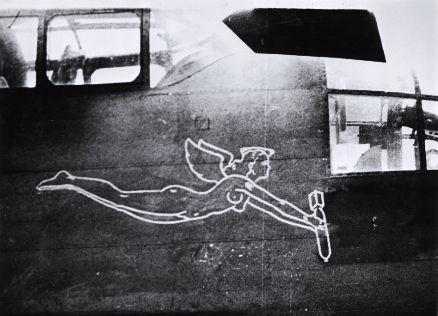
We are given another glimpse into Greening’s sense of humor by how he named his plane, the “Hari-Kari-er” ready to deal death by bomb-induced suicide. Greening’s B-25 is the one pictured above, with the angelic tart holding a bomb aloft. Greening’s plane was another that carried only incendiary ordnance.
Much was made of the sight’s two-piece aluminum construction, reportedly costing 20 cents at the time compared to the $10,000 Norden. This provided the jingoist homefront the smug satisfaction perhaps, combining a frugality born of the Depression with the American tradition of racism, that only pennies were expensed and or risked on Japanese lives.
War Crimes
Targeting civilians, taking insufficient care to avoid civilian casualties, using disproportunate force, acts of wanton retaliation, and the use of collective punishment are all prohibited by international convention. They are war crimes for which the US prosecutes adversaries but with which our own military refuses to abide. Americans make much of terrorism, yet remain blind to state terrorism. Doolittle’s historic raid, judged by the objective against which it is celebrated as a success, was an act of deliberate terrorism.
Forcing the Japanese to deploy more of their military assets to protect the mainland sounds like a legitimate strategy, except not by targeting civilians to illustrate the vulnerability, nor by terrorizing the population, one of Doolittle’s stated aims. He called it a “fear complex”.
It was hoped that the damage done would be both material and psychological. Material damage was to be the destruction of specific targets with ensuing confusion and retardation of production. The psychological results, it was hoped, would be the recalling of combat equipment from other theaters for home defense, the development of a fear complex in Japan, improved relationships with our Allies, and a favorable reaction in the American people.
There is no defending Japan’s imperialist expansion in the Pacific, and certainly not its own inhumanity. The Japanese treated fellow Asians with the same racist disregard with which we dispatched Filipinos. While Americans point in horror at how the Japanese retalliated against the Chinese population for the Doolittle Raid, we ignore that Doolittle purposely obscured from where our bombers were launched, leaving China’s coast as the only probably suspect.
To be fair, most of Doolittle’s team was kept in the dark about the mission until they were already deployed. I hardly want to detract from the courage they showed to undertake a project that seemed virtually suicidal. But how long should all of us remain in the dark about the true character of the Doolittle Raid?
Out of deference for the earlier generation of WWII veterans, those in leadership, certain intelligence secrets were kept until thirty years after the war. Unveiled, they paint a very different picture of what transpired. The fact that the US knew the German and Japanese codes from early on revealed an imbalance not previously admitted, as an example.
About the Doolittle Raid, much is already openly documented, if not widely known. The impetus for the raid was public knowledge, the evidence of its intent in full view.
BY DESIGN
In the aftermath of Pearl Harbor, American newspapers were already touting offers of cash rewards for whoever would be the first to strike back at Japan. President Roosevelt expressed a deliberate interest in hitting the Japanese mainland, in particular Tokyo, to retaliate for the Japanese strike against Pearl Harbor, never mind it had been a solely military target.
Plans were made to exploit the Japanese homeland’s vulnerability to fire, as ninety percent of urban structures were made of paper and wood. Writes historian William Bruce Jenson:
In his “confidential” meeting with reporters back in November, Marshall had declared that the US would have no cavil about burning Japan’s paper cities.
For the Doolittle Raid, a bombing strategy was developed to overwhelm the fire department of his target, the Shiba ward.
A former naval attache in Tokyo told Doolittle: “I know that Tokyp fire department very well. Seven big scattered fires would be too much for it to cope with.”
As lead plane, Doolittle’s role was to literally blaze the way. Fellow pilot Richard Joyce told Nebraska History Magazine in 1995:
The lead airplane, which was going to have Doolittle on board as the airplane commander, was going to be loaded with nothing but incendiaries -2.2 pound thermite incendiaries- in clusters. They drop these big clusters and then the straps break and they spray, so they set a whole bunch of fires. He was to be the pathfinder and set a whole bunch of fires in Tokyo for pathfinding purposes.
Doolittle’s report outlined his objective more formally:
one plane was to take off ahead of the others, arrive over Tokyo at dusk and fire the most inflammable part of the city with incendiary bombs. This minimized the overall hazard and assured that the target would be lighted up for following airplanes.
Greening paints the most vivid picture, of burning the Japanese paper houses to light the way:
Doolittle planned to leave a couple of hours early, and in the dark set fire to Tokyo’s Shiba ward … the mission’s basic tactic had been that Doolittle would proceed alone and bomb a flammable section of Tokyo, creating a beacon in the night to help guide following planes to their targets.
Doolittle’s copilot Lt Richard Cole, told this to interviews in 1957:
Since we had a load of incendiaries, our target was the populated areas of the west and northwest parts of Tokyo.
After the bombers had left on their raid, and before news got back about whether or not they accomplished it, the Navy crew on the carrier USS Hornet already sang this song, which went in part:
Little did Hiro think that night
The skies above Tokyo would be alight
With the fires that Jimmy started in Tokyo’s dives
To guide to their targets the B-25s.
When all of a sudden from out of the skies
Came a basket of eggs for the little slant eyes
Incendiaries

Most of the bombers were loaded with three demolition bombs and an incendiary cluster bomb. Some of the planes carried only incendiaries. According to Doolittle’s official report of the raid, here were some of their stated objectives:
Plane no. 40-2270, piloted by Lt. Robert Gray:
thickly populated small factories district. … Fourth scattered incendiary over the correct areaPlane No. 40-2250, Lt. Richard Joyce:
Incendiary cluster dropped over thickly populated and dense industrial residential sector immediately inshore from primary target. (Shiba Ward)“The third dem. bomb and the incendiary were dropped in the heavy industrial and residential section in the Shiba Ward 1/4 of a mile in shore from the bay and my tat.”
Aircraft 40-2303, Lt Harold Watson:
the congested industrial districts near the railroad station south of the Imperial PalaceAC 40-2283, David Jones:
the congested area Southeast of the Imperial Palace
Even though the planned night raid became a daytime mission, Doolittle did not alter his original role, intended to light the way for the following planes. His target remained the Shiba District of Tokyo. His own plane: “changed course to the southwest and incendiary-bombed highly inflammable section.”
Doolittle’s report included a description of the incendiary bombs:
The Chemical Warfare Service provided special 500 incendiary clusters each containing 128 incendiary bombs. These clusters were developed at the Edgewood Arsenal and test dropped by the Air Corps test group at Aberdeen. Several tests were carried on to assure their proper functioning and to determine the dropping angle and dispersion. Experimental work on and production of these clusters was carried on most efficiently.
As has become an aerial bombardment tradition, crews were let to inscribe messages on the bombs about to be dropped. Accounts made the most of these chestnuts: “You’ll get a BANG out of this.” And “I don’t want to set the world on fire –only Tokyo.”
These details, which reveal the intentions of the raid, were not made known to the public immediately. The Doolittle Raid was planned and executed in secret, with US government and military spokesmen denying knowledge of the operation even in its aftermath. The first word to reach the American public came from the New York Times, citing Japanese sources:
Enemy bombers appeared over Tokyo for the first time in the current war, inflicting damage on schools and hospitals. Invading planes failed to cause and damage on military establishments, although casualties in the schools and hospitals were as yet unknown. This inhuman attack on these cultural establishments and on residential districts is causing widespread indignation among the populace.
This report was dismissed as propaganda. When Japan declared its intention to charge the airman it had taken captive with war crimes, the US protestations redoubled. The accusations were belittled even as our own reports conceded to the possibilities.
Lieutenant Dawson’s Thirty Seconds Over Tokyo was the first published account of the raid. Printed less than a year after the event, wartime-sensitive details such as the phony guns made of broomstick handles poking out the back were left out. Targets were also not specified, but a candor remained, probably intended to be threatening. Lawson described the 500-pound incendiaries as “something like the old Russian Molotov Breadbasket”, and related US naval attache Jurika’s advice:
“If you can start seven good fires in Tokyo, they’ll never put them out,” Jurika promised us. … “I wouldn’t worry too much about setting fires in flimsy-looking sections of Tokyo,” he said. “The Japanese have done an amazing job of spreading out some of their industries, instead of concentrating them in large buildings. There’s probably a small machine shop under half of these fragile-looking roofs.”
“Flimsy” became Lawson’s keyword for the residential areas. Here Lawson described dropping his third and fourth bombs, when he saw their corresponding red light indicators:
The third red light flickered, and, since we were now over a flimsy area in the southern part of the city, the fourth light blinked. That was the incendiary, which I knew would separate as soon as it hit the wind and that dozens of small fire bombs would molt from it.
I was satisfied about the steel-smelter and hoped the other bombs had done as well. There was no way of telling, but I was positive that Tokyo could have been damaged that day with a rock.
Our actual bombing operation, from the time the first one went until the dive, consumed not more than thirty seconds.
Thus: Chance of hitting civilian homes: 50/50.
Charges of Excessive Force could be expected, because
blame the victim for being weaker than: a rock.
Care taken to avoid innocent casualties: 30 seconds.
In a later afterword, Lawson blamed Tokyo for having insufficient bomb shelters.
After the war, US occupation forces recovered Japanese records which documented the losses attributed to the Doolittle Raid: fifty dead, 252 wounded, ninety buildings. Besides military or strategic targets, that number included nine electric power buildings, a garment factory, a food storage warehouse, a gas company, two misc factories, six wards of Nagoya 2nd Temporary Army Hospital, six elementary or secondary schools, and “innumerable nonmilitary residences”.
Strafing
Japan accused the fliers of indescriminate strafing civilians. The US countered that defending fighters were responsible for stray bullets when their gunfire missed the bombers. That’s very likely, except the raiders were candid about their strafing too. Lawson:
I nosed down a railroad track on the outskirts of the city and passed a locomotive close enough to see the surprised face of the engineer. As I went by I could have kicked myself for not giving the locomotive’s boiler a burst of our forward 30-calibre guns, then I remembered that we might have better use for the ammunition.
A big yacht loomed up ahead of us and, figuring it must be armed, I told Thatcher to give it a burst. We went over it, lifted our nose to put the tail down and Thatcher sprayed its deck with our 50-calibre stingers.
Greening’s account of firing on a sailor, raises the moral ambiguity of air warfare with which few airmen grapple. By virtue that technology allows it, combatants become slave to a predetermined outcome:
When we attacked the next patrol boat, a Japanese sailor threw his hands up as if to surrender. I guess he expected us to stop and take him prisoner. We shot him and left this boat smoking too.
The Medals
Friendship Medals exchanged between Japan and the US found themselves requisitioned for Doolittle’s Raid:
Several years prior to the war, medals of friendship and good relationship were awarded to several people of the United States by the Japanese government. In substance these medals were symbolic of the friendship and cooperation between the nations and were to represent the duration of this attitude. It was decided by the Secretary of the Navy, Mr. Frank Knox, that the time was appropriate to have these medals returned. They had been awarded to Mr. Daniel J. Quigley, Mr. John D. Laurey, Mr. H. Vormstein and Lt. Stephen Jurkis.
After arrangements had been made and the medals secured, a ceremony was held on the deck of the Hornet during which the medals were wired to a 500 lb. bomb to be carried by Lt. Ted Lawson and returned to the Japanese government in an appropriate fashion.
Lawson’s plane no 40-2261 dropped that bomb on an “industrial section of Tokyo” omitting to mention that Japan’s industry was still a post-feudal cottage industry.
“The medals were subsequently delivered in small pieces to their donors in Tokyo by Lt. Ted Lawson at about noon, Saturday, April 18, 1942.”
–Mitscher, M.A. Letter Report to Commander Pacific Fleet.
“Through the courtesy of the War Department your Japanese medal and similar medals, turned in for shipment, were returned to His Royal Highness, The Emperor of Japan on April 18, 1942.”
–Knox, F. Letter Report to Mr. H. Vormstein
Prince Harry displays British hypocracy to uneducated Colorado warmongers
Want to know where you can find Prince Harry on his war cheerleading US tour? Half of it is in Colorado. On Friday he’ll be at a UK Consul-General’s reception at the private Sanctuary Golf Course in Sedalia. Between Denver and Castle Rock, that’s the Castle Pines exit off of I-25. He’s staying overnight in Colorado Springs and leads the opening ceremonies of the Warrior Games at the US Olympic Training Center at Union and Uintah. He concludes his Colorado visit on Sunday at the Air Force Academy on Sunday before flying east for a polo match. How unseemly for American media to be fawning over a British royal, and what a slap in the face for Colorado Springs Tea Partiers, if they weren’t so uniformly stupid, to celebrate a monarch for which they claim so much credit for having expelled. Nathan Hale would have hung a second time and a third and forth presumably to have had the chance to show smug twits like Prince Harry the door. Harry pretends to continue the work of his mother Lady Diana, ridding the world of land mines, yet how much credit does he get when he advocates for their root cause, war?
“Turn off your cellphone” or police will light you up like the next Chris Dorner

STREAMING OF CONSCIOUSNESS ON BOSTON MARATHON BOMBING DENOUEMENT: DID YOU KNOW that law enforcement can tell you “If you want to live, turn off your cell phone.”? That was shouted to an AP reporter tonight in Watertown, just before he heard officers shout “Fire in the hole” as they encircled a suspect. So they’re chasing a marathon attendee whose face matches the surveillance video, who they can refer to as a suspect with impunity if he’s dead so they’re about to Dorner his ass (Remember Chris Dorner? Remember Waco? The gov-lit inferno, not the gov-neglected “Waco” redux.) to beyond facial recognition. Boston Marathon Bombing solved.
Do cellphone beacons mess with police pyrotechnics like we pretend they do aviation electronics? Or was the officer concerned the reporter might be tweeting, enabling a suspect to triangulate his encirclement on Twitter? I bet the officer just wanted to shoot the reporter if he didn’t jump on command.
We know police have the authority to tell television reporters to turn their cameras away lest they jeopardize a SWAT stakeout. Apparently cameras also endanger oil spill cleanups. Are media reporters complicit or simply that stupid? A recent consensus of journalists asserted to me “they’re stupid” but that’s probably a cop-out, odd expression that, to protect media assets who are as enslaved by the system as police officers or oil workers.
Who knows what’s going on in Boston, er, Watertown. Major sports teams are attributed to greater metropolitan areas. Crimes are branded to satellite communities like Watertown, Mayflower, Aurora, Littleton, aka Boston, Little Rock, Denver, Denver. The point of a press pass is that your objective is supposed to be respected by the authorities. In a police state it means they can treat you like an embedded bitch.
Update: “First suspect” reported to be in custody was captured, released, and also killed. A police briefing just clarified all three congruent incongruities. Police scanner suggests the captured suspect detonated himself in custody. Twitter beat television media by an hour in relaying the development that the first suspect was killed.
Update 2: Hospital which admitted suspect won’t reveal his identity, or extent of his injuries, or his age. They were embarrassed sufficiently to admit they could confirm his gender. Most interesting, the doctor who addressed the press would not say if he worked on the suspect, but described how he had witnessed the gun fight from his home, then dressed and reported to the emergency room before the suspect was transported there. Hmm.
Now they’re evacuating blocks of Watertown, so it’s going to be a MOVE climax. Follow police instructions yes, but call them on bullshit. So far the entire narrative has come from authorities, including the inconsistencies which go unchallenged.
Crowdsourced Boston Marathon pics point to usual paramilitary suspects
YES, MORE CSI DIY CROWDSOURCING PHOTO-ANALYSIS! If you could anticipate that criminologists would scrutinize surveillance videos for who left what at the scene, or who behaved oddly after a bomb blast, you could probably plan to evade detection, by, for example, bringing a larger bag to conceal the bag you’re going to drop off.
A soft bag would be least suspicious but would need a reinforced shell to pretend it wasn’t empty afterward. That might explain some of the bag photos cropping up online, some of them dismissed because they’re mistaken for before shots that were really taken after. It turns out the after photo of the Craft/Seal Special Ops at the Boston Marathon Bombing isn’t problematic because their full packs appear to be weightless. Yet the bags are bulging at the same time. Would your elbow be bent, or would you be rocking on your heels, bearing a full load? What are they packing, parachutes?
No need to compare their uniform backpacks with scraps of bags shredded by the bomb inside. We need to ask, what WERE these guys carrying, before then after? Obviously it wasn’t first aid equipment or anything that came in handy for this deployment, apparently. Don’t you find it disturbing that the unspeakable happened at the Boston Marathon, everyone’s scrambling to be helpful and these two authorized attendees don’t appear to have anything to do?
This rock could change the world if thrown through the right window
By “power the world” does Time Magazine mean HEAT IT?! To a rolling boil? –How incredibly inane. This piece of rock’s jagged asymmetry (probably to differentiate it from a lump of coal – the other fossil fuel) and its other-earthly lighting, mean to suggest shale has a meteoric value. The disingenuous cover story, “why shale can solve the energy crisis”, is a curve ball pretending the problem is supply not demand, and FRACKING is the hero not the terminator. Let’s throw this projectile back like we would ordinary crowd control ordnance deployed to disorient waking masses. I think it’s fitting that Time has given its cover to a rock. In the hands of children it’s the bane of US and Israeli occupiers, it’s what defended Tahrir Square, and it will probably be the only sidearm we’ll be left to bear as our own occupiers try to forestall global revolution. But it’s enough.
If Israel can intercept Hamas rockets, it can stop pounding Gazans
If the Iron Dome works, Israel won’t have to retaliate after each Hamas rocket! These acts of desperation by the besieged Gazans, victims of Israel’s occupation, will become like the rocks thrown by Palestinian youth, futile. Hopefully Israel will expand its dome of impunity to protect Gazans too, from whoever is striking at them.
NOW: Support the Tar Sands Blockade, includes DIY direct action supply list!
BREAKING: Does effective direct action get more exciting than this?
You can support the ongoing action: here’s their wish list. At the same time, an excellent inventory of what YOU’LL NEED to scramble a tree-sit if the XL Pipeline is coming your way.
To read this list is like being there, and I think, it brings you one step closer.
CLIMB GEAR
• 91/2-12 mm static kern-mantle/ arborist climb lines
• 5/8ths CWC truck rope or Tytan
• arborist throw lines and throw bags.
• 6mm accessory cord (climb rated)
• 1” tubular webbing
• rock/tree climbing harnesses all sizes mostly medium
• locking climb rated steel and aluminum carabiners
• climb rated pulleys (preferably tandem speed)
• Petzl steel quick links
TECH
• gmrs radios with silent and ear bud options
• Energizer XP18000s
• batteries (AA/AAA/Go Pro Batteries)
• GoProHero2?s & extra batteries
• Netbooks
• small portable solar panels with battery
• Pelican cases (large and small)
• deer/trail cameras
• satellite phones
• MacBook Pro’s
• MiniDV tapes
• 16GB SDcards (Class 10 preferred)
• 8GB+ flash drives
• Canon VIXIA HF R300?s (and extra batteries & charger deck)
• verizon wifi hotspots
• ATN PVS7-3A 3rd Gen or similar Night Vision Binocular Goggles
• Field watches
• car inverters
• 1TB USB External Hard Drives (mac&pc compatible)
MEDICAL
• splints
• coband
• braces (limb)
• disinfectant/antibacterial swabs
• compact girny
• saline
• epsom salt
• joint braces
• gauze rolls
• ace bandage
• Benedryl (anti-allergy)
• nitrile gloves
• trauma shears
APPAREL
• rain gear
• warm clothes (wool or synthetic earth tones) and socks!
• tarps/tents
• wool blanketss
• sleeping bags
• camping hammocks
• headlamps with blue or green (preferred) or red LED option
• work gloves
• towels
TOOLS & MATERIALS
• angle grinder
• chopsaws
• battery powered drills and impact drivers (makita, delta, bosch)
• welder (arc)
• handsaws
• shovels
• pickaxes
• rope: seriously, anything
• 550 parachute cord
• chain
• knives
• multitools (Leatherman or Gerber)
• plywood (3/8”-3/4” – 4?x8? sheets)
• 2×4?s
• decking screws
• 3/8-1/2” bolts and nuts
FOOD
• coffee (good and strong)
• bulk grains
• produce
• spices
• condiments
• non-perishables
• EmergenC
• tea
• MRE’s
ART
• muslin/canvas
• paint (buckets and spray)
• general art supplies
• projector (mac/pc compatible)
• gromet kit
• paint brushes
• paint sticks /mops
• supplies for building 15 ft + puppets
OTHER
• cans of rolling tobacco
• vehicles (junk or drivable)
• All Terrain Vehicles ATV’s
• thermoses
• dirt bikes
• toilet paper
• soap
• water filters
• backpacks
• all-natural cleaning supplies
• camelbaks
• generator 600watt plus
• all-natural mosquito repellant
• condoms
• tampons
• verizon prepaid phone cards
Opposition forces kill US Ambassador Chris Stevens, America In Libya’s No. 1
Maybe it could have happened to a more deserving operative, but that’s splitting hairs. Obviously we can’t call the late ambassador Chris Stevens the “mastermind” of the US covert destabilization of Libya. However, he was Our Man in Benghazi, essentially the NO. 1 in charge of the state-terrorist cell poised to exploit the rolling “Arab Spring” for the forces of capitalist neo-democracy, let’s call it AMERICA IN LIBYA. Stevens organized and armed the US-sponsored rebels who exploited the pan-Arab protests to foment unrest, then civil war, then NATO intervention, against the West’s nemesis Muammar Gaddafi. Remember how Gaddafi was unceremoniously deposed? Captured, tormented, then shot most likely by a CIA-contracted assassin? Where was the humanitarian outcry against that sanctioned barbarity?
How undignified of Westerners to decry the killing of Ambassador Stevens, legally, in the field of battle, by opposition fighters in Libya, on this rare occasion when they got their man. Actually four: the ambassador, a military attache, and two Americans whose identities the USG won’t reveal, I’m thinking mercenaries. The USG is speculating that the rocket attack was planned, and by none other than al-Qaeda, because it’s unlikely the Libyans who stormed the US consulate in Benghazi brought impromptu grenade launchers. Funny, Gaddafi had the same nagging complaint about his supposed “protesters.”
Everyone is condemning this killing, even President Obama vows to exact “justice”. But by his own definition, this was justice meted by Libyans, perhaps even some of the allies we’d mobilized to remove Gaddafi. Whereas Obama’s “justice” means retaliatory air strikes and death squads against unnamed, unproven adversaries, immolating their homes, families and friends.
Steve Bass to get his day in court, but he can’t say what he was doing or why, & above all he can’t mention “Occupy”

COLORADO SPRINGS, Colo.– Municipal Court Judge Spottswood W. F. Williams heard a final motion today before the AUGUST 10 trial of Occupier Steve Bass, charged with violating the city’s camping ban. The prosecution motioned to forbid from trial, “discussion of political, economic, or religious beliefs or ideology as a purported justification for the alleged acts”, and even “arguments related to the belief that the defendant’s conduct was constitutionally protected”, and in true Colorado Springs fashion, the judge GRANTED the city’s motion! YES THAT’S RIGHT, now if Bass wanted to say he wasn’t “camping,” he can’t say what else you would call it! In effect, Defendant Bass is prevented from explaining WHY he was occupying, or even THAT he was occupying, because saying “OCCUPY” is expressly forbidden. The judge will play it by ear whether to make an exception for himself during “voir dire” if selecting impartial jurors might require asking their opinion of “Occupy”. That’s IF BASS GETS A JURY AT ALL, because next, Judge Williams prompted the city prosecutor to research whether Bass was entitled to a jury of his peers for the infraction of camping…
The issue had already been resolved in an earlier hearing. Unable to find definitive wording on whether a camping ban violation invoked the right to a jury trial, the court ruled to proceed as if it did. But at today’s hearing Judge Williams related that in the interim over a casual dinner conversation, another judge informed him that the law read otherwise. So he put the question again to the prosecution. And again the citations came up inconclusive. This time however, with the clerk advised to continue the search, the decision stands at “pending”.
If Judge Williams opts to eliminate the jury, the forbidding of political or constitutional discussion is a moot point, actually two. There won’t be a jury to confuse, nor a judge either, because Judge Williams decided, by allowing the city’s motion, that the defendant has no arguments to make. Case closed. If the judge gets his way.
The point of today’s hearing was to hear not a judge’s motion but the city’s, a “motion in limine” used to reach agreement about what arguments can be excluded from the trial, often a defendant’s prior convictions which might prejudice a jury.
The core of the city’s motion was this:
…that the Defendant be ordered to refrain from raising the following issues at the Jury Trial…
1. Discussion of political, economic, or religious beliefs or ideology as a purported justification for the alleged acts, or as an issue to be evaluated by the jury;
2. Presentation of facts or arguments related to the belief that the defendant’s conduct was constitutionally protected expressive conduct;
3. Presentation of facts or arguments with the primary purpose or effect of proselytizing for the occupy movement, or otherwise using the Courtroom as a public forum;
4. Any reference to settlement negotiations with the Defendant prior to trial;
The city is guessing that because defendant Bass has passed on all opportunities to dismiss his case on technicalities, or plead for a deferred sentence, that he’s hanging on to get “his day in court.” Whatever that’s going to look like, the city doesn’t like it.
Points three and four were conceded by the defendant. No proselytizing was intended, and of course plea deals are confidential. But the discussion of #3 was amusing, because the city expanded it to mean absolutely NO MENTION of “Occupy.” Even though the defendant was cited in ACACIA PARK, in OCTOBER, under 24/7 media coverage, the prosecutor argued that mentioning OCCUPY “would be unfairly prejudicial to the City.” Further:
To admit evidence related to any political, economic, and religious debate concerning the “Occupy Movement” at trial in this matter would result in prejudice, confusion, and a waste of Court time. By allowing such testimony, the jury would be misled as to the elements of the charged offense which would result in confusion during jury deliberations. Furthermore, the prosecution would suffer unfair prejudice if the jury were allowed to consider the defendant’s private ideology…
Not only did the city fear it would lose a popularity contest with “Occupy”, it worried that the courtroom would be abused by public debate. The point was ceded by the defense because the “primary purpose” would always have been to present defending arguments, not proselytize.
The City’s request is that the Court be treated as a forum for resolving criminal disputes and not as a public forum for debate. Political, economic and religious debate should be restricted to appropriate public forums.
The prosecutor raises an incongruous irony: Steve Bass is on trial because the city doesn’t consider Acacia Park to be an appropriate forum either.
Naturally the defense objected to points one and two, though on the three particular defense strategies the city wanted to preempt, “Choice of Evils Defense”, “Defense of Others”, and “Duress”, the defense ceded as irrelevant. Judge Williams then granted points one and two with the proviso that Steve Bass be permitted to draft his own defense argument, to be presented to the court no later than the Wednesday before trial. Did you know that a defendant must have his arguments approved by his accusers before he’s allowed to make them in court?
I’m not sure it’s accurate to say that Steve Bass is going to get his day in court if he’s going to spend it gagged.
Was Steve Bass arrested for “camping” or was the city trying to curtail “Occupy”? Let’s remember that Jack Semple and Amber Hagan were arrested for taping themselves to a tent, and Nic Galetka was arrested for setting his things on the ground.
But Steve Bass won’t be allowed to mention those details.
———-
FOR REFERENCE: The city’s full motion is reprinted below:
MUNICIPAL COURT, CITY OF COLORADO SPRINGS, COLORADO
PEOPLE OF THE CITY OF COLORADO SPRINGS, Plaintiff
v.
Steven Bass, DefendantCase Number: 11M32022
MOTION IN LIMINE
COMES NOW the Office of the City Attorney, by and through Jamie V. Smith, Prosecuting Attorney, and submits this “Motion in Limine,” moving that the Defendant be ordered to refrain from raising the following issues at the Jury Trial in the above-captioned matter:
1. Discussion of political, economic, or religious beliefs or ideology as a purported justification for the alleged acts, or as an issue to be evaluated by the jury;
2. Presentation of facts or arguments related to the belief that the defendant’s conduct was constitutionally protected expressive conduct;
3. Presentation of facts or arguments with the primary purpose or effect of proselytizing for the occupy movement, or otherwise using the Courtroom as a public forum;
4. Any reference to settlement negotiations with the Defendant prior to trial;
ARGUMENTS IN SUPPORT OF MOTION
1. Discussion of political, economic, or religious beliefs or ideology as a purported justification for the alleged acts, or as an issue to be evaluated by the jury.
The Defendant is charges with violating Section 9.6.110 of the Code of the City of Colorado Springs, 2001, as amended (“the City Code”), entitled “Camping on Public Property.” Political, economic, or religious beliefs or ideology are not relevant to any of the elements of an alleged violation of City Code Section 9.6.110, nor are they relevant to any potential defense to that City Code Section.
City Code Section 9.6.110 makes it “unlawful for any person to camp on public property, except as may be specifically authorized by the appropriate governmental authority.” Testimony or arguments irrelevant to the elements contained in that language should be exclude from trial. C.R.E. Rule 401 defines relevant evidence as “evidence having any tendency to make the existence of any fact that is of consequence to the determination of the action more probable or less probably than it would be without the evidence.” Evidence and argument regarding political, economic or religious beliefs of ideology have no bearing on the offense charged and do not meet the definition of relevant evidence.
Even if some discussion of these issues could be found to be of limited relevance, such discussion would only serve to confuse the issues and waste the court’s and jurors’ time, and would be unfairly prejudicial to the City. C.R.E. Rule 403 allows relevant evidence to be excluded when its admission would cause prejudice, confusion, or waste of time. To admit evidence related to any political, economic, and religious debate concerning the “Occupy Movement” at trial in this matter would result in prejudice, confusion, and a waste of Court time. By allowing such testimony, the jury would be misled as to the elements of the charged offense which would result in confusion during jury deliberations. Furthermore, the prosecution would suffer unfair prejudice if the jury were allowed to consider the defendant’s private ideology, as it is not an element that the prosecution must prove. Time and resources of the Court would also be wasted by allowing such testimony.
Furthermore, this Court denied the defendant’s “Motion to Dismiss-First Amendment,” on June 7, 2012, holding that City Code Section 9.6.110 is content-neutral, and that the defendant did not have a Constitutionally protected right to express his views in the manner that he chose on the date of the violation. Therefore, the sole issue before the jury is whether or not Mr. bass was camping on public property without appropriate governmental authority. Any evidence concerning political, economic or religious views that he was attempting to express through his conduct has no relevance whatsoever to any of the elements of the offense.
Discussion of the “Occupy Movement” as a political, economic or religious issue is also irrelevant to any potential defense which could be raised in this matter. Economic, political and religious beliefs or ideology are irrelevant to the following defenses that the Defendant might attempt to raise:
a. Choice of Evils Defense. C.R.S. Section 18-1-702(1) provides, in pertinent part, that “conduct which would otherwise constitute an offense is justifiable and not criminal when it is necessary as an emergency measure to avoid an imminent public or private injury which is about to occur… .” The statute goes on the state in subsection (2) that “the necessity and justifiability of conduct under subsection (1) of this section shall not rest upon considerations pertaining only to the morality and advisability of the statute, either in its general application or with respect to its application to a particular class of cases arising thereunder.” (Emphasis added.) Subsection (2) also states that:
[w]hen evidence relating to the defense of justification under this section is offered by the defendant, before it is submitted for the consideration of the jury, the court shall first rule as a matter of law whether the claimed facts and circumstances would, if established, constitute a justification.
The choose of evils defense “does not arise from a ‘choice’ of several courses of action, but rather is based on a real emergency involving specific and imminent grave injury that presents the defendant with no alternatives other that the one take.” People v. Strock, 623 P.2d 42, 44 (Colo.1981). in order to invoke the “choice of evils” defense, the Defendant must show that his conduct was necessitated by a specific and imminent threat of public or private injury under circumstances which left him no reasonable and viable alternative other than the violation of law for which he stand charged. Andrews v. People, 800 P.2d 607 (Colo. 1990).
There has been no allegation by the defense, and no facts in the police reports previously submitted to this Court, that allege a specific and imminent public or private injury would occur if Mr. Bass had not erected a tent on public property. Furthermore, reasonable and potentially viable alternatives were available to Mr. Bass to achieve his goal, such as picketing and handing out literature, on the date of violation. This was accepted as true and ruled upon by this Court at the motions hearing on June 7, 2012. it should also be noted that no state “has enacted legislation that makes the choice of evils defense available as a justification for behavior that attempts to bring about social and political change outside the democratic governmental process.” Id. at 609; see also United States v. Dorrell, 758 F.2d 427, 431 (9th Cir. 1985) (mere impatience with the political process does not constitute necessity).
b. Defense of Others. C.R.S. Section 18-1-704 describes the circumstance under which the use of physical force in defense of a person constitutes a justification for a criminal offense. Subsection (1) of that statute states, in part, that “a person is justified in using physical force upon another person in order to defend himself or a third person from what he reasonably believes to be the use or imminent use of unlawful physical force by that other person…”. The defense does not apply considering the allegation in this case. There is no allegation that the Defendant was using physical force to protect himself from unlawful force by another at any time during the violation. Furthermore, no unlawful force was used or imminently threatened against any third party that would allow the Defendant to raise the defense.
c. Duress. C.R.S. Section 18-1-708 defines duress as conduct in which a defendant engages in at the direction of another person because use or threatened use of unlawful force upon him or another person. Duress does not apply in this case. There is no evidence that anyone was using or threatening to use unlawful force against Defendant or any third party to cause the Defendant to commit a violation.
2. Presentation of facts or arguments related to the belief that the defendant’s conduct was constitutionally protected expressive conduct.
Any claim by the Defendant that his conduct was protected by the First Amendment of the United States Constitution is not a proper issue to be raised before the jury in this case. This is a constitutional defense that was already raised by the Defendant in his “motion to Dismiss-First Amendment,” and which was denied by this Court on June 7, 2012. The Court ruled as a matter of law that the Defendant’s alleged conduct was not a constitutionally protected form of expression.
3. Presentation of facts or arguments with the primary purpose or effect of proselytizing for the occupy movement, or otherwise using the Courtroom as a public forum.
It is anticipated that the Defendant will attempt to use this trial as a public forum to assert his political, economic, and religious views on the “Occupy Movement.” Courtrooms are not public forums. People v. Aleem, 149 P.3d 765 (Colo. 2007). This Court has the authority to restrict political speech within the courtroom and preserve its purpose as a forum for adjudication of criminal disputes,m so long as the restriction is reasonable and viewpoint neutral. Id. The restriction requested by the City is both reasonable and viewpoint neutral. The purpose of this Motion is to limit the evidence presented in this matter to the offense charged and potential defenses thereto. The Motion is also viewpoint neutral as the City is not taking a stance on political, economic, or religious issues and would not request that the Court do so either. The City’s request is that the Court be treated as a forum for resolving criminal disputes and not as a public forum for debate. Political, economic and religious debate should be restricted to appropriate public forums. To allow Defendant to raise thee issues would be contrary to legal precedent and the rules of evidence.
4. Any reference to settlement negotiations with the Defendant prior to trial.
C.R.E. 408 excludes from permissible evidence compromise or offers to compromise. Plea negotiations fall under this rule and may not be discussed in the presence of the Judge or Jury.
Colorado police brutality retrospective: the 1934 Relief Strike Battle, UP story “Girl Radical Leads Mob in Denver Riot”

If one image captures the “Relief Strike Riot” of October 30, 1934, it’s of Patrolman CV Satt who continues to fire his service revolver after he’s felled by a bottle thrown by a striking picketer. Although Colorado newspapers were anti-union, their accounts vary enough to reveal the escalation of violence for which the DPD was responsible and for which they and the newspapers I’ll bet have never apologized. This article will be the first of a series to unearth the newspaper accounts which documented the events of Oct. 29 through Nov. 3, 1934, mostly because the police tactics and media defamation are remarkably similar today.
(Caption on above photograph: “This remarkable photograph was taken when the rioting between Denver police and “relief strike” picketers was at its height at W. Jewell ave. and the Platte River yesterday. Patrolman C. V. Satt is shown rising after he had been struck over the head with bricks and a shovel. He has his service pistol in his hand, ready to fire at his assailants, but Sergt. Henry Durkop is restraining him.”)
INTRODUCTION: THE BATTLE
As with many “riots”, the confrontation of Oct. 30, 1934 was instigated by the abrupt arrest and detention of a union organizer. What follows is an entertaining eyewitness account which attempts to defame the picketers and laud the police officers for their restraint, although the other reports and photographic record suggested otherwise.

Colorado Springs Evening Telegraph, October 31, 1934, page 1, column 8: GIRL RADICAL LEADS MOB IN DENVER RIOT — FERA Project Pickets Spurred Into Battle by Woman Believed Imported Agitator By DAVIS CAMPBELL, United Press Staff Correspondent
DENVER, Colo, Oct 30 (UP)– A dark haired, attractive girl led demonstrators into hand to hand battle with police here today, as the picketers, under alleged communist leadership, sought to force a strike of Denver FERA workers.
The girl, who was believed by police to have been an imported communist sympathizer, was the spearhead of the rush of demonstrators who attempted to rescue their arrested leader, Gene Corish, 35, of Denver, from the hands of police.
I followed the demonstrators from the time they gathered with the intention of picketing the FERA projects. Police believed they planned to descend on a project at Alameda avenue and Cherry creek. Instead they headed for another at Evans street and the Platte river.
FERA Workers Fight Reds.
There they rushed into a group of FERA workers and sought to take away their tools. The relief workers fought back. But, by the force of superior numbers the demonstrators were winning the spirited battle when police rushed up.
Several picks and shovels had been thrown into the stream.
The police leaped into the midst of the hand to hand fighting. They seized Corish, who appeared to be the leader of the rioters, and dragged him to a patrol wagon.
Instantly the girl leader of the rioters set up a cry of “Don’t let the (here she used an unprintable epithet) have him” and she started toward the patrol wagon swinging a shovel someone had wrenched from a worker.
Others joined the rush. Bricks and clods flew thru the air toward the little band of a dozen husky policemen, outnumbered about 50 to 1 by the rioters.
The patrolmen formed a cordon around the patrol wagon, and retreated slowly toward it, fighting every step of the way, but using only their clubs and fists. They very apparently were seeking to avoid serious injury to anyone.
Officer Felled by Bottle.
Suddenly a beer bottle flew thru the air and struck one of the patrolmen (I learned later he was Carl V. Satt), squarely on the head. Satt dropped like a log.
A rioter stood over him with a shovel in his hands, apparently ready to swing another blow at the unconscious man.
Driven to desperation by this development, police drew their pistols and fired what sounded to me like more than 30 shots.
A rioter dropped, wounded thru the hip. He was Henry Brown, later found to be superficially wounded.
I think Patrolman Marshall Stanton shot him. Stanton told me later he believed this was the case.
I was certain, as I watched from some distance away, that I saw two other rioters drop, but, if others were wounded, they were carried along by their fellows and were not taken to hospitals.
Rapidly the ranks of the demonstrators broke, giving ground before the police fire. Several paused long enough to hurl bricks and rocks such as those which had already injured Sergt. James Pitt and Sergt. Henry Duerkop.
The police made 10 arrests in all.
Thru all the violence, FERA workers sided with police. They appeared determined not to give up their jobs.
INTRO 2: PHOTOGRAPHS
From the Rocky Mountain News, October 31, 1934, page 4

Caption reads: “A group of the “strikers” parading near the Cherry Creek relief project. Only 21 bona fide relief workers in Denver left their jobs yesterday to strike.”

Caption reads: “This view was taken just before police and so-called relief striker started their bloody battle at the Platte River near W. Jewell ave. yesterday. The arrow points to Patrolman C. V. Satt, who was struck in the head by a missile and critically injured. Other patrolmen are shown on duty around the patrol wagon, as one of the picket leaders is being placed inside.”

Caption reads: “During the heat of the battle. This view shows the action in the encounter between police and strike picketers on the Platte River yesterday. Two of the picketers, knocked down by policemen, are shown lying on the ground.”

Caption reads: “After the smoke of battle. This shows the battleground where strikers and police met yesterday just after all the action had ceased. Two strikers are shown down on the ground and beyond them is Patrolman C. V. Satt, who was perhaps fatally injured when struck by missiles of the strikers. He is prone on the ground but has pulled out his revolver.”

Caption reads: “R. W. Rankin, a relief supervisor, shown waiting for the ambulance after he had been struck over the head by a patrolman following a private fight at the strike demonstration held yesterday at Civic Center. He suffered a severe scalp wound.”

Caption reads: Henry W. Brown, who was shot in the hip during the encounter between the demonstrators and police on the Platte River yesterday. He is shown here as he lay on a cot in county jail after his wound had been treated in Colorado General Hospital.”
INTRO 3: NEWS HEADLINES
CS Gazette, (AP) Oct 29, 1934:
Relief Strikers March on Capitol – Governor Refuses to Talk to Crowd When One ‘Red’ Won’t Keep Still
Rocky Mountain News, Oct 30
‘Relief Strikers’ March On Capitol, make Demands – Threaten Violence at Projects Today If Officials Do Not Grant All They Seek
Will Rogers – Says Bread Line Is Encouraged by Deficit of New York Stock Exchange
Young Folk Lambast Older Generation For Getting World Into Present Mess – No Punches Pulled as Boys and Girls Have Their Say
CS Evening Telegraph, Oct 30,
RELIEF RIOTERS BATTLE DENVER POLICE
Agitators Shot and Four Officers Injured as Mob Tries to Foment Strike – Blazing Guns Disperse Communist Led Crowd, Radio Car and Gas Station Burned, Score of Attackers Hurt, FERA Workers Refuse to Walk Out
Girl Radical Leads Mob in Denver Riot – FERA Project Pickets Spurred Into Battle by Woman Believed Imported Agitator
RMN, Oct 31
POLICE ARMY WITH MACHINE GUNS WILL GUARD FERA WORKERS TODAY
Force of 300 Officers Will Use Bullets and Tear Gas If Necessary to Protect Relief Workers From Molestation – Agitators Threaten Violence After Yesterday’s Bloody Clash
Witness Says Police Fired When Driven Back to Car – Gives Graphic Account of Rush by Screaming Men and Women Who Volleyed Rocks at Officers
CS Gazette, Oct 31,
RESUMPTION OF VIOLENCE IN DENVER STRIKE FEARED
City Tense After Bloody Riot on South Platte – Barricade Erected at Table Mountain, to Be Visited Today by Agitators
CS Evening Telegraph, Oct 31,
DENVER QUIET BUT TENSE AFTER RIOTING
Mob Gathers But Fails to Carry Out Threat to March on projects – Police Precautions Against Further Outbreaks Nip New Demonstrations; Report Agitators on Way to Foment Trouble in El Paso County – Mob Gathers in Englewood but Fails to Carry Out Threat to March Against FERA Projects
Don’t Expect Any Agitator Trouble on C. S. Relief Jobs p1, c7
Mountain at Golden Resembles Fortified Castle as Workers Prepare to Resist Strike Mob p1, c7
New York Times, Oct 31
‘Hunger Marchers’ Routed at Albany; Rioting in Denver – Many Injured in Denver – Relief Strikers Attempt to halt Federal Project–One Shot Fighting Police, p1, c1
RMN, Nov 1
Relief Strike Riots Subside as Police Act – Agitators Fail to Start Anything at Various FERA Projects
Pretty Girl From Illinois Finds Denver Police Nice p4, c1
CSET, Nov 1
Roundup Ends Denver Relief Strike Threat – With Agitators Arrested, Leaderless Mob’s Spirit Broken; Plot to Spread Disorder in State Fails
U.C.L.A. Branded Communist Hotbed
RMN, Nov 2
File Charges Today Naming 15 as Rioters – Two of Group Face Fine of $1,000 and Year in Jail If Acts Are Proved, p14
College Students Battle Radicalism – Form Vigilante Committee at Coast School
Patrick Henry’s priest would’ve favored Give me liberty, or give me the serenity to accept the things I cannot change.
Some juxtaposition, don’t you think? Patrick Henry’s call to arms Give me liberty or give me death mashed up with the Goddamn Serenity Prayer: God, grant me the serenity to accept the things I cannot change, the courage to change the things I can, and the wisdom to know the difference. It sure puts passivism into religious perspective. It’s the fog of the opiate of masses, with church as enforcer of nonviolence, keeping the people down in advance of the king’s Dragoons. What a mockery serenity makes of poor fools eager to feel self-respect for docile servitude. It calls to my mind the impoverished parents who cripple their young so to be more effective beggars. Or who sell their children into slavery. What cretinous vile beings. Their desperation to be pitied of course, but their fate to be repudiated, not accepted with whatever boat-non-rocking serenity.
From The War Inevitable, March, 1775, by Patrick Henry
They tell us, Sir, that we are weak – unable to cope with so formidable an adversary. But when shall we be stronger? Will it be the next week, or the next year? Will it be when we are totally disarmed, and when a British guard shall be stationed in every house? Shall we gather strength by irresolution and inaction? Shall we acquire the means of effectual resistance by lying supinely on our backs, and hugging the delusive phantom of hope, until our enemies shall have bound us hand and foot? Sir, we are not weak, if we make a proper use of those means which the God of nature hath placed in our power.
Three millions of People, armed in the holy cause of liberty, and in such a country as that which we possess are invincible by any force which our enemy can send against us. Beside, Sir, we shall not fight our battles alone. There is a just God who presides over the destinies of Nations, and who will raise up friends to fight our battles for us. The battle, Sir, is not to the strong alone; it is to the vigilant, the active, the brave. Besides, Sir, we have no election. If we were base enough to desire it, it is now too late to retire from the contest. There is no retreat but in submission and slavery! Our chains are forged! Their clanking may be heard on the plains of Boston! The war is inevitable; and let it come! I repeat, Sir, let it come!
It is in vain, Sir, to extenuate the matter. Gentleman may cry, Peace, Peace! – but there is no peace. The war is actually begun! The next gale that sweeps from the North will bring to our ears the clash of resounding arms! Our brethren are already in the field! Why stand we here idle? What is it that Gentlemen wish? What would they have? Is life so dear, or peace so sweet, as to be purchased at the price of chains and slavery? Forbid it, Almighty God! I know not what course others may take; but as for me, GIVE ME LIBERTY OR GIVE ME DEATH!
Hey Mike!
After last week, it seemed this entry would be a pep talk for disheartened Colorado Springs Occupiers. Instead it seems it will need to be my own mind meandering around in an attempt to make sense of the new dynamic rising from the ashes of the original manifestation we had going here, which has surely been destroyed. It feels something like a kids cabin make of Lincoln Logs or something after he knocks it over to build something else.
It’s been over a week since the City shut our permit down and confiscated our ramshackle, wind-ragged tents down at Acacia Park. After a few days of curious and somewhat disconcerting quiet, Occupiers in Colorado Springs are reconnected, reinvigorated, and in many cases really pissed off. Yesterday a contingency of us made our way to the old Venetucci Farm south of CSprings to harass Colorado’s Gov. Hickenlooper at the groundbreaking ceremony for a solar garden project of the city’s publicly owned utilities company. About 20 Occupiers of Colorado Springs mic-checked the governor and briefly disrupted the speechifying before a group that was made largely of Occupy’s natural allies, raising the ire of some attendees, but most assuredly reminding Hickenlooper that he won’t be allowed to ignore the movement simply by leaving Denver.
Some Occupiers present , including i, were ambivalent about our project. Hickenlooper is something of a liberal darling, having supported projects like the SunShare solar garden in the past, and the crowd at the event was populated by many of Colorado Springs’s “liberal” elite. The business of interrupting at these proceedings is a little sticky, and may have cost some in support for Occupy among this crowd. On the other hand, some of the issues addressed by Occupy were aptly illustrated within the very brief span of our attendance. Jerry Forte, who wrangles close to $300,000 a year for himself without considering bonuses as CEO of Colorado Springs Utilities, spent a few smooth-talking minutes going on about how cool the city’s utility non-profit is, noting the great advance the two or three dozen solar panels undergoing installation at Venetucci Farm toward his goal of deriving 20% of city power from renewable resources by 2020 represents. Gee whiz! At today’s use rates, by 2020, the world’s inhabitants, especially in the U.S., will be stabbing one another over firewood if we can survive the toxic byproducts of the petroleum industry, or the potentially nuclear wars we are preparing for our next trick in the Middle East. Hmm–wonder what gas prices will look like if the Levant and its environs are sealed under a “sea of glass.”
Forte also sits on the board at the local branch of the United Way, where Bob Holmes’s Homeward Pikes Peak brought in around $650,000 last year, and still can’t figure out how to house or manage the low-ball ,(and variable), estimate of around 1,100 homeless residents in Colorado Springs. Hickenlooper, a million dollar winner in the American sweepstakes who loves to project an aw-shucks, up-by-the-bootstrap, populist kind of image came to his ability to start restaurant empires via the petroleum industry. He presides over a state that panders shamelessly to the U.S. military and its attendant industrial complex, both of which entities these days seem to be no more than acquisition arms of the energy and financial elite about which you may have heard Occupiers railing in recent months. Mike Hannigan of the Pikes Peak Community Foundation was there, and i’m sure he was butt-hurt by the Occupiers implication by their mere presence that his organization might be elitist or something. The CC student i spoke with on the way off the farm grounds was perplexed and hurt herself, expressing solidarity with Occupy, but begging that we not “do it again, ” referring to our admittedly rather obnoxious interruption. She will likely go on from CC to join the cultured pseudo-liberal aristocracy of our guilt-laden Western catechism spinning its wheels till the Apocalypse. Hannigan manages some $50m in assets, and to be sure the foundation does some good work, but all the back-slapping and genteel coffee-sipping over a couple of ultimately meaningless solar panels sure feels a lot like John Rockefeller’s habit of passing out dimes to street urchins late in his life.
I am not accusing Hannigan, Forte, or others of comparability with Rockefeller, who made his initial fortune by arson and murder. Consider this, though. No one seems interested in whether the numbers in the mix add up to anything substantive or not. None of the serious players mentioned above have ever questioned the 1,000% spread between some of the salaries involved at CS Utilities, and when and if they do it’s generally to argue that we have to pay such ridiculous amounts to attract the “best and the brightest,” even though recent history shows plainly enough that it’s painfully obvious huge salaries hardly translate into top performance. No one scratches his head over the disconnect between the high-minded goal of CS Utilities for 20% renewable energy within minutes of the utter collapse of projected petroleum reserves. And aren’t we Americans, including especially those of us with the clout big money wields, responsible for our own politics? Are we really a bastion of freedom and intelligent, realistically utilitarian process or is all that rhetoric just a roll of dimes to cover up our guilt every time we go down to Wal-Mart to perpetuate our slave economy, without which we have never lived? What’s the disparity between Forte’s salary and the annual income of the guy that made his spiffy shoes?
Occupiers love solar projects. But nothing’s ever about just one thing, and it seems to me it’s about as rarely mostly about the thing at the top of the presentation program. We Occupiers are often accused of stupidly purveying no solid agenda. it may be apparent that at least my Occupy agenda is complicated. The above connects Big Oil, Third World labor, charitable impulse, income disparity, under-girding Western guilt, competitive job markets, and spiritual malaise, among other things, including much that remains implied. Many Occupiers i have met personally are still perturbed at the scanty portion of the American Pie they find available on their own plate. We’ve brought this whole scenario upon ourselves, though, and the current program will remain fully unsustainable whether the polite society of charity in the Pikes Peak region dismisses us over our antics or not. That’s why Occupy in general will be not so easily dislodged from its place in history.
The bitch about saying all this is i really, really like most of the people i recognized at Venetucci Farms yesterday. I like Americans in general–but man, we’ve got problems, just like the homeless guys Bob Holmes and his philosophical brethren like to try to control all the time. When i talk to those guys in line at the soup kitchen, i tell them, “Man, ya really ought to leave that dope alone a little.” They know me, and they know i love them. Really. I do–and really, they know it. They know they’re fucked up, too. Sometimes i’ll tell the most torn down that they need to leave the dope alone completely, before it kills them. That’s what i’m saying about our society here in Colorado Springs, in Colorado, the U.S.A., and the whole world. I really don’t have a beef with the bankers, politicians, and half-assed, dime-roll charities of the world, or the foolish scrabblers grasping at the American Nightmare. They’re working a system designed by haphazard evolutionary processes to favor ruthless competition. But i am saying that we need to get serious about fixing all these interwoven problems that stem from deep down in human souls, because we’re running out of time. If we lose, and everything goes to Hell in a handbasket, if none of us learn a genuinely cooperative technique for living together with ourselves, and with the Earth before she rejects us, we Occupiers will be able to tell our kids we fought the deadly processes that brought us down with everything at our disposal. Even if it’s with our dying breaths. What will those of us that insist on competing our species to death be telling theirs?
Occupy is not going away, here in Colorado Springs, or anywhere else. We’re planning more and escalating prodding at the fat, lazy system and its symbiotic remorae. We hope the World listens closely to what we’re saying and its members genuinely look inward to find that bit of truth that remains, concealed behind layers of self-deception and avarice. Because, sure, we’re pissed off about injustice–who wouldn’t be? But we also really like humans, and other living things, and we don’t want to see them all go away.
Whose streets? Occupy Jack spreads COS occupation to parking spots!

OCCUPIED COLORADO SPRINGS- Why stop at protest tents? Jack’s got a protest car, now there are two. Two cars used by Occupy Colorado Springs have now been booted for not paying their way alongside Acacia Park. No homeless allowed, so no homeless cars allowed. The plan? Occupy Cars! Activists are sleeping in shifts, occupying these cars to prevent them being impounded. Did you watch yesterday’s video of the Saturday arrests? Jack Semple is a rockstar. If you can help Jack and his fellow occupiers, figure out something, they can use your help. They’ve already got the outrageous ideas, it’s the run of the mill support that will turn the tide.
#Occupy Colo. Springs Municipal Court

OCCUPIED COLORADO SPRINGS- Attention local media, if you’re looking for authentic spokespeople for Occupy Colorado Springs, you need look no further than today’s front row. Holding the big sign is first arrestee Steve Bass, to his right: three times arrestee Iraq vet Jack Semple, arrestee Amber Hagen, arrestee Raven Martinez, and arrestee Thomas G.
Also pictured, former Colorado Congressman Dennis Apuan, Occupy founding member Jon Martinez and Socialist activist Patrick Jay. Not pictured, Joel Aigner and Hossein Forouzandeh who were speaking at a UCCS occupy teach-in.
Here’s a video of the Saturday arrests of veteran of Fallujah Timothy “Jack” Semple and Amber Hagen of the 7-11 incident. Worth the watch. ROCKSTARS!
Mark your calendars, upcoming arraignments are scheduled November 21, 29 and 30.
Raven addressed the Colorado Springs City Council today on the unconstitutionality of the no-camping ordinance being enforced to curb the Occupy protest. Here’s what she said:
As a citizen of the United States, one has a given right to life, liberty, & property. These rights are protected by both the 5th & 14th Amendments to the Constitution.
In Bolling v Sharpe, The Supreme Court interpreted the 5th Amendment’s due process clause to include an equal protection element.
The 14th Amendment states:
“No State shall make or enforce any law which shall abridge the privileges or immunities of the citizens of the United States; nor shall any state deprive any person of LIFE, LIBERTY, or PROPERTY, without due process of law; nor deny to any person within its jurisdiction the equal protection of the laws.”
Knowing that sleep is a necessity of Life, every American citizen has a right to sleep, regardless of status.
“HOMELESSNESS” is considered a status.
The camping ordinance ultimately denies one the right to sleep, therefore the right to live, based on their status. How many people have been arrested for setting up a canopy, with blankets & food, to take a nap or have a picnic on public property.
Now if a homeless person sets up a canopy, has blankets and food with them, will they be told to take down their canopy under the current camping ordinance? If so, then the ordinance is based on status, therefore unconstitutional.
If not, then it leaves too much discretion in the hands of the individual law enforcement officer, making the ordinance over-broad and unconstitutionally vague.
When one is homeless, where can that person sleep? If they set up to sleep on Public property they would be violating the current city ordinance, they will be told to leave and told of a shelter to go to, being their only alternative. This amounts to incarceration in the shelter without a violation of law having been committed. This also violates ones right to due process in that it allows for arbitrary enforcement.
When you criminalize a non-criminal act of necessity, you greatly increase the possibility of that person committing other crimes, as well as decrease that persons ability to obtain employment.
State v Folks, No. 96-19569 MM found that a city ordinance which punished innocent conduct, such as sleeping/camping on public property, violated the defendant’s right to be free from cruel and unusual punishment, which is protected under the 8th Amendment.
I ask you to look at the constitutionality as well as the long term effects of such an ordinance, it starts a domino effect that negatively impacts an already hurting economy.
How much does it cost in tax payers money to pursue such a case?
We have to have change! If we want a better economy and overall society, then the government, Federal, State, & Local, must change the way they conduct business. Criminalizing acts of necessity is business, not a way to protect our American citizens.
“Definition of Insanity: Doing the same thing over & over again and expecting different results.” -Albert Einstein
Pass a new ordinance to repeal the current one.
Ye Aulde Memoir
Another old piece. These stories are distorted by romanticized memory, at times, and others likely remember them differently. I by no means intend to insult any of the real persons that lived through this stuff with a cavalier treatment of tender recollections, or harsh description of personalities or actions. Each of us always did exactly what seemed to be exactly the right things to do at the time. And there survives much, much love, which has grown and developed like it always does, in ways we never see coming.
I’m not putting these old ones up because i’m too lazy to write new. I’ll have one of those next–but some of this old stuff fits. Hope you like it.
11 May 2009
One day during the summer of 1980 my brother David was in the hospital at Case Western Reserve University for yet another open-heart surgery. The scene that day was dramatic I suppose, but for our family at the time, it was in many ways just another day. The state of the relationships between us had come to the condition that existed then because each and every incident that had occurred in the history of the Universe had added to that cumulative point. The way it came together then could have been viewed as tragic, I suppose, but we never noticed.
I don’t even remember how I got the news that this particular episode was approaching. David’s surgery that year was one of many—so many, in fact, that by now surgeons and academics had written papers on his congenital condition, and even given it a polysyllabic title. His lead surgeon, a Dr. Ankeny as I recall, had once claimed that he had “learned more from David Bass than fourteen years of medical school.” We four siblings had in effect grown up in the hospital, with the constant potential for death in attendance on a daily basis. Many years would pass between that summer and the moment I decided any of this was applicable to self-reflection, and the sweltering summer afternoon was as present and imminently experiential as any other I lived through during that period.
Our family seemed done that year. I had been out of the picture for over a year. Dad had left soon after, leaving a sour tinge in the air with those remaining, though I never blamed him. When David queued up for one more death-defying, experimental, split-chest open-heart surgery, Dad came back to Cleveland from Florida to put in an obligatory appearance.Here was a meeting that defied conventional description. Dave, the least guilty of all our immediate family, had been deeply affected by Dad’s exit from the filial stage earlier that year. I hadn’t seen, or even spoken to Dad for well over a year, nor could our interactions prior to then be described as warm and supportive. Outnumbered by angry or indifferent family members, and perhaps less acclimated to hospitals as the rest of us, Dad was way out of his simpler, down-to-earth element.
I showed up unannounced, with glorious southern tart Candy Stone from Mobile, Alabama in tow, she in dirty bare feet, nearly illegal shorts, one of those dangerous eighties tube-tops, and very red eyes. I don’t think Dad spoke more than a half dozen words to me. His eyes told the whole story of uncertainty, pain, and failure. Dave, fresh from surgery, quite literally green, with a repulsive grey crust around his lips and appending to the tubes and what not projecting from several of his orifices, refused to see Dad. Refused to allow him in the room. Dad left unrequited to return to his exile in Florida. I didn’t see him again for many years.
Once, David, following the Dead tour in our Mom’s old family van showing all the effects of the Rust Belt, with his underage Russian girlfriend, his fiddle, and a patchouli oil manufacturing operation, got pulled over in Alabama, for sport. By this time, David was unkempt, smelly, and obviously committing some crime or another. The cops shook him down pretty good, but of course he had no contraband. He has a vice or two, but the heart thing keeps him from excess. He had that young Russian girlfriend, though, and Alabama’s finest figured they could really hang him out to dry, (dang hippie). But she and Dave convince the alpha cop to let them call her mom in New York to confirm that permission had been granted for the road trip and no heinous kidnapping was going on. The mother spoke zero English, but somehow the girlfriend convinced the cop to allow her to translate for her mother. Mother and daughter held a five minute conversation about the mental acuity of Alabama cops, duly translated as an expression of permission, and the travelers were on their way. David drawls this story on stage in his hillbilly persona, fiddle in hand. It’s hilarious.
It seemed to me for a long time that David was the only one of us to escape that little bubble of anti-reality that made up our family life while we siblings were young. Maybe he somehow managed to avoid being trapped in it in the first place, residing only temporarily, with some sort of metaphysical pass associated with potential imminent death. I don’t know, but years later, during one of the high points of my own endeavor, Renaissance Paint and Remodeling, I remember feeling jealous of David. This was a recurring sentiment, and all the more abberant for the fact that my strongest memory of it falls during a visit to Dave’s place in North Carolina that amounted to a just-in-case kind of deal before a heart transplant. Whatever the rationality or fairness of my little envy, (not real envy, mind you, but one of those little personality spikes that one notes and passes through), David is the one of us that got away the least damaged, and has lived his idiosyncratic dream out in full, down to the fine print, with joy.
Mom tells a story about my first day at school. Or maybe the second. I had asked some question that Miss Gardner couldn’t answer, and after day two, came home grousing about how those people were ignorant, and furthermore lazy, since no one had even bothered to look up a response. Mom likes to carry on about how smart her offspring are. She doesn’t usually bring up in public how warped we can be.
Mom, we brothers agree, bequeathed us a legacy of somewhat dubious mental processes. She’s nuts. We all know it. She knows it. Dad knows it. The rest of her family knows it well, and most of them recognize a common bond of familial, brand-name insanity that we all seem to share. I expect this is a more or less common thing among families, but I remain convinced that we are a bit stranger than most, at least in part because of the unique circumstances we lived through.
Back in the day, Mom’s thing was what they call control issues. The dynamic of her issues was so complex I can’t imagine I’ll ever figure it out. Some of her personality came to her by heredity from her mother, whom we call Mo. Much of it developed in that crucible of stress Dave kept heated by his repeated, continuous flirtation with death. Mom, responding to my over-the-top reaction to a pubescent hormonal tsunami, became madly obsessive with minutiae, dividing her time among us brothers and badgering us constantly in a fashion no one can really get unless they have their own experience to compare. I think she and I trapped ourselves in a sort of feedback loop that could have ended no other way.
I was out of the house for good, by the age of fifteen, for all purposes off to lead a life of crime, I suppose. For some years, I lived out my interpretation of the old Kerouac/Kesey/Abbie Hoffman mythos, on the road, in the street, an utterly directionless rebel. A good five or six years passed without more that a word or two passing between Mom and me.
I was nineteen when I came to Colorado Springs. The vague and unformulated manifesto for global revolution I had worked out in my head was on hold, kept in place by a twelve-pack of cheap beer. I had a job as an electrician, and didn’t see any reason to change that, but we actually didn’t do much of anything but work and drink beer that year.
One day Mom called to say Mike, another brother, got himself in trouble again and she expected him to “run away.” I told her to give him my number and I’d let her know when he called. He did just a few days later, and can I come pick him up over on south Circle.
Mike and I spent a couple years engaging in the sort of insanity to which we had become habituated in Cleveland. The reader will require imagination to add flesh to the story here. The statute of limitations may prevent backlash, but I don’t mean to poke at a bees’ nest, and it seems unlikely you might imagine anything more extreme than what actually took place. We weren’t stupid, though, and the business of working for wages, or relying on illicit behavior for advancement just wasn’t good enough, so we formed a construction company and went to work. That proved to be a trap. Maybe an extension of the weird, family trap that all of us have discussed so deeply, without resolution.
Mike and I had it in our minds that the working man’s habit of grousing over how management acts is crap and that if we were going to grouse, we ought to just take the reins ourselves. It turned out we were pretty good, too, in a lot of ways. We worked together for the best part of twenty years, and reached moments of national prominence in our little niche. The whole period was characterized by more bone-crushing stress and absurd, super-human feats. We had little breaks from the madness when we’d crash the business, which we did three times. We were great at getting shit done, but lousy at administration in the final analysis.
Hiring employees in the construction business kept me exposed to the street element to which I had become accustomed. I involved myself in various efforts to assist folks in their low-budget struggles, imagining still that I could somehow change the world. In fact, contrary to Mike’s primary obsession with business success, I figured the whole pursuit as a means to some vague end involving social revolution. For a while a religious experience had me involved with a church effort to “reach out” to the hoodlums that used to cruise Nevada Avenue on Friday and Saturday nights. I even managed to glean an ordination from the Baptists, though now I suspect they’d regret bequeathing me with it. My identification with street folks and the urge to help them rise above conditions has never left me. Actually I’ve worked up the notion that we could all stand to rise above conditions.
Dad. I went even longer without speaking with him than I did with Mom. He dealt with our family’s teen-aged fulguration by folding his hand and striking out on his own. Offered a transfer by his employer, the story goes, he told Mom, “I’d like you to come to Florida with me, but I don’t think I can love you anymore.” No woman in her right mind would go for that deal, and Mom didn’t fall for it either. Dad packed his company car and struck out, leaving his all-important nest egg, and everything else, behind. When David was in the hospital again that summer, that’s where Dad came from to visit him.
I had been away, and I don’t recall blaming Dad for his poor dealings with the family. He had been raised in a very old-school, European style, and he simply couldn’t handle our ways. To this day, in spite of Dad’s expression of a taste for “philosophy,” our conversations are often guarded, pregnant with unspoken truths. I still don’t know his philosophy.
Last summer Dad, my youngest brother, and I went to Montana to camp and fish, riding an outfitter’s horses into some of the most pristine wilderness left in the lower forty-eight. I had genuinely hoped to break the communication barrier that stands between us, but we had to settle for hugs and meaningful silences, for the most part. Dad still plays with his cards pressed tightly to his chest, flashing a look of panic if the conversational waters begin to threaten him with submersion. I guess he can’t swim.
Dad’s experience, it seems to me has also been different from the norm, though I’m uncertain that any human being matches that mythical standard. His family, unlike Mom’s, which fought in the Revolution, was barely American. They were proud American citizens, but their traditions came from old Europe, and they still lived communally on the old Bass farm as they had done for a thousand years.
During my childhood, whenever David was out of the hospital, we’d spend weekends at the farm with the scene looking very much like something from an era that had long since passed in this country, all Dad’s siblings and extended family eating together, playing cards, children roaming the grounds like Huck Finn. It was all rather idyllic, truly, and the moment Grandma Bass died and the farm disappeared under a layer of vulgar office towers marked the shift from one childhood to another.
Dad’s life since then became an effort to recreate those years. His brother and sister had never left the farm. Even when his brother Paul married and had a child, he stayed there on Rockside, as the place was known. I think that scene served as an anchor for my Dad, and when he retired, impressively early despite having suffered huge financial setbacks, he bought his own farm, secluded and sylvan, and moved his socially inept brother and sister in with him.
Paul was a very strange dude. Throughout his lifetime he suffered from some sort of condition that caused him to wobble quite a bit and to mumble when he spoke, like a cartoon character. I still have no idea what the actual condition was–it was never discussed in medical terms, and Paul worked, loved, laughed, and lived in a fashion perfectly suited to him. He represented another unusual facet of our lives that never seemed unusual to us, simply because it just had always been what it was. During his declining years, Paul became more and more difficult to live with, his condition developing into a matter that caused him to actually require care, rather than merely one engendering bemusement. He became cantankerous, incontinent, and dangerous to himself, given his refusal to use a cane. Dad actively cared for him, there on the new farm, forty-five minutes from a paved road, until he died a few years ago.
I couldn’t make the funeral, but I spoke to Dad on the phone as he was back in the city making arrangements. I told him I thought his dealings with Paul were among the most impressive and moving things I had ever seen. I still see it that way. The conversation, which lasted no more than ten minutes I guess, may have been the deepest we’ve ever shared.
For the past eight or nine years every Sunday, so long as I’m in town, I give away food we cook up to whomever we can get to come up to the Colorado College campus and sample our fare. Often our guests are homeless or dirt poor, but we’re not so much stipulating low economic clout as a qualifier. We’ll feed anyone. Dick Celeste, the former governor of my home state, Ohio, and once ambassador to India, comes now and then. He’s a friend, and I visit him at his home, during party season at CC. Arlo Guthrie came down to our basement kitchen once–I put him to work washing dishes. Many of the crowd I see every week are chronic though, plagued by demons I surmise to have been born in conditions similar to mine as a youth. I’ve occasionally contemplated the accusation of “enabling” bad behavior that people toss my way once in a while, but many of our regulars, some of whom I’ve known for twenty-five years, are simply never going to approach any sort of productivity. They are simply too extraordinarily damaged, and as the proverb goes, there, but for the grace of God, go I.
The Christian experience I mentioned earlier was a reflection, or maybe an extension, of spiritual drives I always apprehended. I pursued it heartily for a time, beginning my adult involvement with the sort of hands-on charity our Sunday kitchen represents in a Christian context. The Church always felt skewed to me though, and a couple years’ studying of the questions involved convinced me to adopt thinking anathema to most of my Christian friends. The exclusionary thinking shared by many church folk, in turn, began to seem anathema to me.
Something about my family and its ability to weather long, rending forces, becoming over time a stronger entity for all its roiling turbulence, seems to me akin to the aspect of the human condition that produces the wrecked lives that bring folks to visit me on Sunday afternoons. Further spiritual thinking–some would say metaphysical thinking–concerning Chaos and Oneness has encouraged me to feel like the separation between me and the crowd I serve is illusory in some indefinable fashion. When members of our family passed through periods during which we found it necessary to step back from one another, the bonds that hold us together never broke, and the etheric bonds between my soup kitchen crowd and me, and ambassadors or presidents, don’t seem breakable either. We all seem to share certain common struggles, differences arising simply from disparate approaches, variant perspectives. Our family, it turns out was never what we imagined it ought to be, but perhaps something greater, and more viable, after all.
Part of my mission in ditching the construction business for more cerebral and perhaps less lucrative pursuits at an age when many of my peers in the building industry are thinking of golf courses and retirement comes from a belief that the differences in individuals are reconcilable. Feeding people is necessary, but falls short of bridging the apparent expanse between souls. I still want to change the world, even though I understand the futility of such a grandiose notion. Utopians always fail. But I expect that each time some failure becomes apparent, we can learn a little something, and maybe the next day we can fail a little better.
No account of self-examination is ever going to be complete. I won’t be asserting anything about how I’ve come full circle. Our family will never return to the conditions of my childhood. Nor is the new generation my brothers and cousins and I have brought into the world a retread of old lives. I haven’t even touched on my own experiences as head of a new family, but my children live lives vastly different from their forbears, and even though I rather hope they can avoid some of my mistakes, I suspect they’ll be making many of their own. It seems to be in their genes to require hard lessons. But, like my tortured friends in line at CC on Sunday mornings, or those in my circle equally tortured but accustomed to fine linens, whatever they may suffer holds its own value.
We all learn what we must learn. Life is perfectly safe. Its lessons are self-taught, but deep. I genuinely plan to write a real memoir and a family history, for my kids’ sake, but by the time we come full circle, it’s too late to write about it.
Legal artistry
(In response to questions received on another forum: “I’m curious as to why, exactly, you feel that you are entitled to stay in a public park at all?”, “What makes you feel that you are entitled to enjoy the ‘right’ of pursuing your happiness — that is, living in Acacia park — without having to contribute monetarily to the upkeep of that public facility.. Furthermore, why is it that you believe that, in the interest of effecting a change in a law which you disagree with, the best course of action is to choose to voluntarily break said law, rather than getting involved in the legal process and effecting a change in the typical fashion? After all, all that really accomplishes is an additional waste of taxpayer-funded services, in this case law enforcement.”)
I’ll reiterate again before i take this on that these are profoundly excellent questions that i think every Occupier, observer, and citizen of any country ought to contemplate deeply before entering the fray–maybe even before leaving the house this morning.
First I should clarify what may amount to a few misconceptions wrought largely by the media of late. As has been reported I am living with dear friends who find my comfort to be a valuable thing and have extended their hospitality freely absent any solicitation on my end. J. Adrian Stanley of the CS Independent has referred to me as a “technically homeless…couch[-]surf[er],” which is true, though only by certain technical legal definitions, which are generally designed to either skirt or address issues involving benefits of some sort. I am “technically” employed as the sole proprietor of the Paint Squad, a remodeling company that has been defunct for practical purposes since the media began trumpeting a new Great Depression, and the guy i had been working with abandoned the project. For the record, i collect no unemployment, disability, food stamps, or any other money or benefits of any kind from the government. Plainly stated, i have no monetary income. This is not meant to offer ethical assessment of my situation nor to elicit sympathy or whatever, but is merely offered to add perspective to my positions, and to rectify factual errors that have made it into the mix. Bear in mind i was camping at Acacia Park not out of necessity, but to effect the specific outcome that you may observe to have been effected. Note that although hundreds of campers are now down along Fountain Creek in violation of the same ordinance, they are not at Acacia Park kicking the bee’s nest with me–they have different and rather more imminent needs than i.
I believe i adequately responded to Mark’s first question by directing him to the appropriate pages here at hipgnosis. The second is a continuation of the first, with the addenda about “contributing monetarily.” A response must necessarily involve the natures of money, property and its use, and our interaction amongst ourselves as human beings. The third involves political processes and movements, civil disobedience, and my own spiritual foundation. I hope those statements enlightens the reader on the length of this post, and Mark in particular on the reason for the time taken for its development.
Some questions in answer to a question: Who owns public land? What does it mean to “own” it? Whence the resources to maintain the land, and what does that mean? We Americans have never adequately addressed these matters, and our ethical foundation for holding this conversation will remain forever spongy until we do. All land ownership in the United States harks back to the arbitrary decrees of that series of monarchies our predecessors here acknowledged to be so corrupt that a bloody war was necessary to shed the influence thereof. Land was simply declared by powerful people to be “owned” by favored sycophants, regardless of the opinions of the contemporary inhabitants. The Founders adopted the same attitudes governing property as had been utilized by their enemies. Every piece of property in the country now, public or private, is viewed through the lens of this fact. Its “ownership” is determined by arbitrary acts of murder and fiat. It’s understandable that this is the case–effecting such jarring and massive shifts in foundational thinking is never blithely easy, though it does appear simple once accomplished.
Having had an ear to the ground for some time on matters such as we are discussing , i am alert to numerous suggestion that “we” give land back to the “Indians.” This idea is as flawed as the other, and the thinking of indigenous peoples advocating it has been corrupted by our Western philosophical bias. The only genuine option uncorrupted by avarice and murder is to revert to a state of ignorance of ownership where the land is concerned. The elaboration of this notion constitutes a genuine system of political economy and i will carry it no further here, (but will link below). This is put in the mix to allow the reader to investigate further, and to establish that the following points are argued from an academic point of view rendered at least partially moot by the actual philosophical basis for the actions in question.
Be alert, Mark, that i have not been a societal parasite. I have worked and paid taxes since the age of 12, in spite of strenuous effort to limit the absurd, onerous, and unethical share the Government has taken through any nefarious means available. Maintenance at Acacia Park is paid out of city sales tax, unless i’m mistaken, which i certainly paid when i bought the sleeping bag i slept in there, the bicycle i rode to the park, the tobacco i smoked while there. Additionally, though i have not camped there in a week or so, one might readily visit the Park and ascertain that it is in a far cleaner state than before Occupiers carved out a space there, the rest rooms were locked coincident to their arrival, and the only maintenance in evidence is a guy that comes around in the morning to collect the bags of trash the Occupiers have gathered from around the whole park, and the sprinklers which still douse the tree lawns where people are camping even though watering season is so obviously over that infrastructure damage is imminent. Regardless, and without additional verbosity, the land in question is public, and we Occupiers clean up after ourselves requiring less maintenance, not more, of the City. Opposition to the notion that smaller contributions in tax payments ought to equal diminished rights to enjoy publicly held assets, with which we are endowed at birth is quite close to the heart of the Occupiers’ battles, whether individual Occupiers have become aware of the idea yet or not. We all pay for it, both monetarily and in karmic debt, or by whatever system of spiritual balance you may care to invoke. Any Rockefeller is welcome to pop a tent next to mine.
Your final point, that is, why civil disobedience rather than ordinary action is yet another that might be expanded at length. In the interest of getting this up i’ll restrain myself from that in hopes that you will recognize that i am not attempting to be glib or brusque with you here, Mark, but merely brief. Additional commentary on all these points is both available and forthcoming. Simply enough–civil disobedience, and in fact in my mind and those of many, many others, full-blown political and ideological restructuring is necessary because no approach within the confines of less strenuous discourse has worked thus far, and people all over the planet have had quite enough bullshit. If you imagine to yourself that this business of mine, or the business of Occupy in general is about camping in Acacia Park, or the stupid camping ordinance enacted but not enforced by the City of Colorado Springs then you have badly missed some very important news. I suggest you follow the links below. Visit the Occupiers, both here and in many other cities around the whole wide World right now.
This’ll do. Ask more questions! Read these links:
I’m not angry, but, hmmm… http://www.businessinsider.com/what-wall-street-protesters-are-so-angry-about-2011-10?op=1
Henry George developed a system addressing this stuff. I can’t say his system is complete, and in fact, i am personally convinced our problem as humans must be addressed spiritually. That’s a topic for another moment, and it does not detract from George’s thesis: http://www.henrygeorge.org/
This strikes me as so obvious that it could be seen as a jab, and almost feels that way, but it’s still the place to go for primary discourse on civil disobedience: http://thoreau.eserver.org/civil.html
This is obviously unnecessary, but i’ll point out once more that the reader will find an abundance of words of my own that bounce around all these topics and more. It’s all the same conversation: http://www.hipgnosis21.blogspot.com
PPCC Philo Club page: https://www.facebook.com/groups/168063276537761/
Some other discussion and reporting establishing basis: http://wwwwendolbloggercom.blogspot.com/
There’s no end. Keep looking.
Cajun squirrels and field peas
One more time, for the Community Kitchen Cookbook. This is something like the coon-asses I planted tree with for a season used to do over a propane cooking ring. They used a couple dozen squirrels and fed us all at once. Man, that was some good times. If you want it coon-ass authentic, serve with plenty of cheap beer. Don’t get too drunk and kick the pot over.
Squirrel with Black-Eyed Peas
Four medium-size squirrels, drawn, skinned, and cleaned
1/2 lb Black-eyed peas
3 md Onions
2 sm Carrots
1/2 pk Frozen sweet peas
1/4 lb Smoked link sausage
Flour
Bacon fat or lard
Garlic
Little dab of oregano and marjoram
Salt and pepper
1 c Chicken broth
For the slow cooker: serves two
Put the squirrels into salted water and hold overnight in the refrigerator; the next day, rinse and pat dry.
Bring 4-6 cups of water to vigorous boil in a large saucepan, then add the black-eyed peas to it. Boil furiously for 2 minutes, then remove from the heat and cover; hold 15 minutes and drain. Quarter the squirrels, and dredge with flour. Sauté in a skillet in hot bacon fat or lard until golden brown, then drain on a paper towel and place in a crock-pot. Saute the garlic til golden before adding onion. . Chop the onions coarsely, and sauté in bacon fat and pan drippings until translucent, and add to the pot. Cut the carrots into 3/4″ lengths, and the sausage into 1/8″ disks, then add them along with the frozen peas and the cooked black-eyed peas. Salt and pepper to taste and stir gently; add the chicken broth and cook in the crock-pot for 8 hours on low setting, or until the meat is almost falling off the bones. For a different flavor, you can substitute lentils or navy beans for the black-eyed peas.
(Reprinted from Hipgnosis)
Today’s Tom Sawyer
It’s 4am here and this occurred to me strongly enough just now to have me say it just now. For Vic, Ken and the rest of my Christian friends, as well as Michele, Kathryn, and others who get twitchy when I bring up the Bible.
I had breakfast with my friend Vic a little while ago and we had some of this conversation–I mean this conversation. The one we’ve been having if you’ve read any of this stuff around here, or if you’ve been to see me at my Facebook, or on the sidewalk or whatever. Vic is a Christian, and about as solid a practitioner as I’ve ever met. He “works” as a prayer director for one of the internationally influential untaxed Christian pseudo-businesses one might easily enough find scattered around town here in Colorado Springs. Years ago I lived in Lindale, Texas and I used to say Lindale was the buckle of the Bible Belt. Now that some of the big organizations down in Lindale have disappeared due to fraud and embezzlement and the like and some of the people I knew down in East Texas have moved to this very town I sometimes say America’s waistline has risen with age and the buckle has found a home in Colorado Springs.
Anyhow, Vic is an affable guy and a good friend and we had a good time over our platesful of arterial lubrication such as we Americans like to do at breakfast. He said he had read some here on these e-pages–I aaalmost cringed because of a certain propensity of mine. Then I remembered one of the axiomatic rules I’ve taught my kids since they started picking up English: “There’s no such thing as a bad word, only bad timing.” It’s time for this.
Vic said he found some of the thoughts he’d come across here, “interesting,” and mused that I had a bone to pick with “organized religion,” which is true, but hasn’t really come up at hipgnosis just yet, I don’t think. I cringed a bit at having utilized terms like “motherfuckah” while discussing a Bible tidbit known as the Beatitudes from a longer passage known as the Sermon on the Mount. It’s one of those axiomatic rules for lots of Christians, and for many who’ve never set foot in a Christian edifice as well. One finds the passage, (from the book of Matthew, chapter 5, in the Bible, if you’re interested), hanging on wooden plaques and the like in people’s living rooms and over their toilets and chapel entrances all over the world, and I suppose in every tongue still in print. I felt a twinge of embarrassment at the time that I get now and then from writing strongly about such grand subject matter knowing well that I’m no saint myself. So I brushed my way by that one at the time, and we went on with breakfast, and with other portions of the Conversation. That’s why this is for Vic at the top of the page, not ’cause I mean to point him out as a prime exemplar or anything.
I have lots of Christian friends, and I often claim that very appellation amongst them, (though not so often amongst the “Romans”); some of them may now think of me as shooting my own foot as I continue. I also have friends that are occultist dope fiends. They’ll find this bit rather more amusing, I expect, but I’ll implicate myself with them too, when I get a round tuit. This is not about organized religion–it’s personal, you see, and directed at people I know, among others including myself where it applies, by which I mean, “where it applies.” Not, “where it applies unless it’s uncomfortable to apply it there like Mercurochrome or something.”
Christians are full of shit as a defining point–the idea of Christian full-of-shitness is all over the New Testament. Many if not most of them have not the merest clue about their own doctrine and those that do spend hours and hours at intricately complex and totally reducible discussions about irreducible complexity and such while ignoring the business of Love so central to their own foundations. (Recall my comments about pseudo-statements now, if you will). One of the so-called Ten Commandments reads, “Thou shalt not take the name of the LORD thy God in vain; for the LORD will not hold him guiltless that taketh his name in vain,” in that poetic old Frank Bacon English I love so much, (Exodus 20:7, if you give a damn). I’m not gonna dig out a Hebrew lexicon to make this point, and some translations say “misuse” or something instead of “take…in vain”. Whatever. You Christians quit tapdancing and think about this.
Just about any Christian will get at least a little uncomfortable if you say, “God damn it.” There are injunctions in their doctrine warning them away from curses, as well as oaths, unpiloted tongues, and “coarse language”. They don’t so often know the difference and figure this sort of thing for “taking the LORD’s name in vain.” Think about this: When a woman marries a man in most contemporary societies, she takes his name, though this is no longer so mandatory as it had been given the slow and incremental abandonment of the notion of women as property in vogue these days. If a woman, say, marries some patriarchal dude and then goes to work for some pimp on the side, she’s taken Dude’s name in vain. So when Christians do their little tapdancing around points in their own bedrock supposedly established by Gawd Himself and endorsed by His Only Begotten where they’ve not-quite-deliberately, (that’s a dance move called an NQD in the studios, BTW), failed even to drill for pylons, they join the Golden Calf Party, and according to their own lore will be consumed in the fires as they fall through the very fissure in that bedrock I describe here now.
This is the same sort of thing going on when a guy zips up his fly after reading about turning the other cheek and steps out to shoot his quota of Afghans for the day. Or votes a “hawk” into office at his 8-year-old’s school assembly room. Or works up a smokin’ hot head of steam about the crackhead that broke into his garage to feed a real live demon that lives in any crackhead’s pocket and gets real hungry and cranky, (snicker), when its belly is empty. And practicing the sort of bullshit Christianity that allows for this sort of Gene Kelly move is like sailing down the mighty Mississip’ on a flat Tom Sawyer raft made of the concrete that you ought to have been using to build your foundation instead. You’re already at the bottom of the river and the Water of Life is flowing right by your drowned bones.
I’ll be danged…the Sun is coming up over a fine Colorado Sunday morning and I’ve just come to wrapping up a genuine sermon, complete with brimstone. Who’da thunk it?
Pay attention Christian: The World doesn’t hate you because you bring Jesus up all the time. It hates you because you sully a beautiful thing. It hates you because you’re an abject hypocrite, the worst variety of an asshole! And they can smell it, even if they can’t articulate the thought. And none of this is wrong; the fact that it’s coarse is a separate matter. I may have blown my disguise for some…it’s ok, I’m still pretty clear with my own notion of where I stand, and this is for you at least as much as it’s for my own amusement. To paraphrase Gandhi, “I’d be a Christian if it weren’t for the God damn Christians.” That nor any of the above has nothing at all to do with whether I’m actually a Christian or not, nor does it have to do with “religion”, organized or otherwise. It’s about that personal relationship you guys keep talking about. It’s dysfunctional, Yo, and it’s up to you to straighten yours out while I worry about my own.
(Reprinted from Hipgnosis)
Not a tribute to Steve Jobs, just a sad note. Nicola Tesla or Thomas Edison?
I’m more than a reluctant adherent to Apple technology, and am personally saddened at the death of Steve Jobs. Was he only 56? I assumed by his accomplishment that he was decades older. But my sadness is probably selfishly motivated, as a suspect of Apple acolytes, believing that Apple’s fruitfulness was owed chiefly to its larger-than-life leader, so a return to Jobless Apple means no more candy. But Jobs wasn’t larger than life really, he seems to have led less than a life. The fact that Steve Jobs was unable to discuss his cancer for fear of rocking the markets and hurting his company’s stock value, betrays the preoccupation he had with the bottom line. One of the richest persons in the world, who’d influenced so many lives in an incredibly personal way, went to his death a mystery. And while convention may hold that’s it’s too early for heresies before the wake, accelerated Twitter lag means a post mortem enforced deference for Steve Jobs has probably already expired.
Was Steve Jobs a visionary? Only for business models. He appears to have been a workaholic dedicated to the singular goal of building a better mousetrap. I suppose to give him his due, he built some swell ones, even as we catch on very slowly that the promise of computers enhancing our productivity has resulted in compounded labors, not savings, the mouse in question was us.
The sum of Apple’s product line was basically a self-enforced electronic ankle bracelet.
Steven Spielberg probably meant to honor Steve Jobs by comparing him to Thomas Alva Edison. Interesting, because those of us more familiar with history know that’s probably accurate for reasons Spielberg did not intend. Edison was not an inventor, instead he jumped on the scientific discovery of electromagnetism and maintained a sweatshop of scientists to innovate applications. It’s well known that Steve Wozniak invented the first personal computer, his friend Jobs simply marketed it. The Woz went on to invent the universal remote, so we have to credit Jobs for having a vision beyond the barcalounger. No disrespect of Wozniak intended.
If the Woz had an Edison contemporary, it was Nicola Tesla, renowned mad scientist, robbed of the credit and profit for inventing Alternating Current. He was Edison’s nemesis actually, and Edison lobbied against AC for a national power grid in favor of his patents for Direct Current. Probably by now everyone has heard that Edison would rush to circuses when they had to publicly execute an elephant for insubordination. Edison would electrocute the animals to demonstrate the lethal properties of AC.
So how does all this relate to Steve Jobs, the secrets of whose proprietary technologies we have yet to explore? Whose industry record high profit margins were dependent on cheap Chinese labor, factories which suffered high rates of suicide? Even the most ardent Mac addicts had a hard time championing Apple’s iTunes direct attack on peer to peer file sharing.
Let’s be honest. Steve Jobs was a Hamiltonian elitist when it came to Open Source. The Mac was never intended for everybody, it was trickle down technology and where software designers gave you what they knew was good for you. Hard to argue with much of it, including Jobs’ personal crusade to free his users from porn. But the business model also resembled a table top jukebox, where users paid, through the nose if you figure the charges compounded, for every ounce of content. The Apple became a virtual parking meter bluenosed into your bank account. Following the Java model meant Jobs got you to pay for the apps themselves.
Imagine if Steve Jobs had applied his visionary acumen to the $99 Laptop Project to fight poverty and lift the third world into the information age. Yeah, hard to imagine. Maybe after his death secrets will leak out about a philanthropic visionary Steve Jobs. Too bad we never knew him.
As innovative as Jobs appeared, compared to PT Barnum innovation-retrograde Bill Gates, Apple technology may likely prove to be the DC that has holding the internet back from open source radical transcendence.
Hey Pikes Peak Region lazy bones, #OccupyColoradoSprings is calling!
By lazy bones I don’t mean the average inattentive public, I’m talking about you do-gooders out there trying to right wrongs and effect political change, usually. A growing gatherings of youthful idealists are “occupying” hometowns across the country, focusing on the heart of all problems, corporate greed, and you’re carrying on as if no one’s taken the bull by the horns. They’re inexperienced youth, but they know enough not to get pulled off message by Tea Partiers or partisan Dems. Daily General Assemblies at noon and 7pm refortify them that the movement is about LOVE. Of course they could use your help, opportunity’s knocking, but apparently your regular routine says “do not disturb.”
What makes you any different from the bankers, corporate brigands and their armies of minions, except that you’re not accessories to their crimes? You’re still part of the unactivated mass. Your petitions, your fundraising, your lobbying, your vigils, are as routine as the pushback you get from your adversaries. It’s a dance where your partner always leads, and you get nowhere, every. single. time. The colloquial definition of insanity comes to mind. Finally a youth movement emerges that might tip the scales, and you’re waiting for what? It’s hard not to conclude that actually rocking the boat is too much rocking for you. Faith in Democrats over Republicans, electoral equality, politicians to defy their sponsors, a corporate media open to the truth, justice for ordinary people, wars that will respond to reason, these are delusions. People not even smarter, nor as educated as you have figured this out. What’s happened to you? Tomorrow, WEDNESDAY, OCT 5, the occupiers of Wall Street will be marching with several of New York City’s largest unions, and NY campuses have declared a walk out in solidarity. Are you going to be sitting on the fence?
DENVER, Colo, Oct 30 (UP)– A dark haired, attractive girl led demonstrators into hand to hand battle with police here today, as the picketers, under alleged communist leadership, sought to force a strike of Denver FERA workers.