Does your elected representative need to hear from you?

Change that worksThe emails are flowing in furiously. Senator So & So needs to hear from you; we need your donation to run this ad; our voices must be louder than the interests arrayed against reform. I ask you. On the issue of health reform, climate change, or ending the US wars, does your elected representative still need to hear from you? What sort of amnesia is there in DC, that the party given a mandate in 2008 suddenly lacks for moraL conviction?

Change That Works has organized an AMBULANCE TOUR for Colorado Springs, Canon City and Pueblo on December 8 to keep alive the issue of Health Care Reform, although of course it’s still framed unfortunately to specifications dictated by the insurance lobby as “Health Insurance Reform.”

It may not happen tomorrow at 10am, give or take a sign or two calling HEALTH CARE REFORM A SHAM, but the callous bastards will ultimately get what’s coming to them, being cut out of the middle entirely. Health is a universal human right which the insurance giants will not be able to deny Americans for much longer. Universal health care is a human right There is no moral basis for earning profits by standing between people and the care they need. Universal health care for all. Profiteers to the gallows.

The war on Christmas they worry about

Rise above itWhat it’s going to take to revisit 350ppm, to reverse climate change, is not carbon trading, wind turbines, miraculous scientific leaps, or a COP15 conference. The anti-technology has been known to us since sustainable times, when mankind didn’t have to transcend his wants, because it was challenge enough to seek for his needs. Conservation.

UN Climate Change Conference COP15 should call for coping, less hoping

Kobenhavn Copenhague CopenhagenYes, we know the theme. Ich bin ein Hopenhagener. With climate change about to engulf us, today we are all Hopenhageners. I think “COPE” might be a better derivation for the summit in Copenhagen than the ol’ Obama bait ‘n switch. Anyway, do they know it’s only “Copenhagen” in English? To the Danes –and yes, they call their land Danmark– their capital is København. The anglo-centrics who bring you the COP15 “Hopehagen” campaign are the International Advertising Association, in partnership with Coca-Cola, Siemens, BMW, Dupont, plus some who did not collaborate with the Nazis. The admen behind Product Obama know full well where HOPE got us in 2008. Will they be so cavalier about addressing climate CHANGE too?

The consumer goods Killer App -KILLED

A consumer goods bar code scannerFinally a real KILLER APP. A free iPhone application called the Good Guide lets you scan the barcodes of (eventually) every consumer good to learn immediately its goodness rating on a scale of 0-10. No more Consumer Report printouts, mental notes or improvisational evaluation. The Good Guide score is the synthesis of three criteria, the ratings for which are also shown: health, environment and social. How healthy is this item? How environmentally friendly? And how socially-responsible is the producer? Notably missing is a ranking for price, sidestepping the inescapable real world cost vs. benefit compromise.

UPDATE: FALSE HOPE ALARM. So far the products itemized by the GoodGuide are the General Mills variety, all of them rank highly. There’s a sugared cinnamon cereal that gets a 10 for health. Hoho.

According to an article in Grist, GoodGuide emerged from a project called TAO IT, created by Dara O’Rourke, associate professor at UC Berkeley’s Department of Environmental Science, Management and Policy. Goodguide’s aim sounds like a watchdog function better administrated by a regulatory agency. I can already see industry lobbyists setting up offices to influence the GoodGuide analysts.

A lot will depend on the transparency of the GoodGuide benchmarks and the objective distance they can keep from market interests. For example, the PR budget of one conglomerate alone could create a faux ratings mechanism to usurp GoogGuide as consumers-aid du jour. A recent processed food industry Smart Choices badge comes to mind.

The GoodGuide evaluation policies do give a good impression.

GoodGuide aggregates and analyzes data on both product and company performance. We employ a range of scientific methods – health hazard assessment, environmental impact assessment, and social impact assessment – to identify major impacts to human health, the environment, and society. Each of these categories is then further analyzed within specific issue areas, such as climate change policies, labor concerns, and product toxicity. Currently, GoodGuide’s database has over 600 base criteria by which we evaluate products and companies.

Health Performance
As an example, for health performance, GoodGuide’s system takes into account both the impacts of a company’s operations on its workers and local communities, and the impacts of using a specific product on your health. Our team has gathered data on important health hazards such as:

• Cancer risks
• Reproductive health hazards
• Mutagenicity
• Endocrine disruption
• Respiratory hazards
• Skin and eye irritation

Our research currently uses a simplified health hazard assessment process that allows us to rate thousands of products along standard criteria. It should be noted that while these ratings are not risk assessments of products or chemicals, they do highlight potential hazards associated with the use of these products.

Environmental Performance
For environmental performance, GoodGuide is aggregating data on the life-cycle impacts of products, from manufacturing to transportation to use to final disposal. For companies, impact categories include:

• Environmental emissions and their impacts on air, water, land, and climate
• Natural resource impacts
• Environmental management programs

GoodGuide uses these categories to generate overall environmental performance ratings for companies.

Social Performance
For social issues, GoodGuide aggregates data on the social impacts companies have on their employees:

• Compensation
• Labor and human rights practices
• Diversity policies
• Working conditions

In addition to impacts on employees, Social Performance ratings consider impact on consumers and communities. The social scoring system also brings together information on corporate governance, disclosure policies, and overall practices.

OUR RATINGS

Types of Information
Different types of information flow into GoodGuide’s system: absolute measures, relative measures, and binary measures. Absolute measures describe measurable activities of a company or product. For example, the pounds of toxic air emissions released per year, the CEO’s salary, or the amount of money a company donated to charity. Relative measures are scores, such as a numerical grade of “6.5 out of 10” or a textual grade of “bad” to “excellent.” Binary (or Yes/No) measures indicate whether a product or company does or does not have specific characteristics. For example, a product may or may not have earned an environmental certification, or a company may or may not test its products on animals.

The GoodGuide Rating
These measures are then used to create GoodGuide’s ratings. To calculate a single rating for a product or company, we convert all of the existing measures into a 0 to 10 score. In GoodGuide’s system, a score of 10 is the best and a score of 0 is the worst. Products and companies are rated relative to the performance of similar products or companies in the same industry.

The initial ratings are based on a set of selected criteria from a broad pool of data available within the GoodGuide database. We think these criteria are some of the most representative and understandable. As this is the first time all of this data has ever been aggregated in the same place, we are currently working to assess the consistency and comparability of measures across our many data sources. We would love to hear your suggestions on the relative importance of these various measures of product and company performance.

GoodGuide recognizes that even the most quantitative assessment of environmental, health, or social issues requires value judgments about the relative importance of various issues. For example, rational people can disagree over the relative importance of animal testing in evaluating a product or company. We have used our best scientific judgment in building our current ratings, and in future versions we will flag issues where personal values and preferences are particularly relevant. We will then enable people to create personalized ratings based on their own concerns.

In order to facilitate your ability to assess the data, we will also be providing an assessment of data uncertainty, completeness, and quality. These assessments can be used to weight the existing data within the GoodGuide database.

Incomplete Data
In some cases data is unavailable for a company or a product. This may be because we have not yet identified a credible data source for a given issue or topic. It may also be that the data is not publicly available because companies have not disclosed critical information. One goal of this project is to work collaboratively with key stakeholders around the world, including government agencies, non-profit organizations, private research firms, and companies to promote the quantity and quality of disclosure of important data to the public.

Learn more about GoodGuide’s methodology.

Leave it to pirates to run honest bourse

rocket propelled grenade RPG-22With investment bankers trying to weasel another broker’s percentage from a carbon-credit trading system, comes a living example of rudimentary venture capitalism. In Haradheere, Somalia, there’s a stock market for pirates, by comparison, something benefiting all participants.

The pirate’s market is no middleman’s monopoly. It works just like the collectives of investors who floated Britain’s privateers and the Dutch East Indies Trading Companies, just two examples of crown-sanctioned adventure-mercenary conquerors. Had you wondered why the definition of “float” includes the economies participant to navigational buoyancy?

Got a boat, a weapon, a tip on an incoming treasure galleon? Invest the pirates with your contribution and reap a stake in the rewards. Every successive stock market since the formative times, from commodities, to insurance, to futures, etc, have well surpassed the illegitimacy and immorality of the seafaring pirate variety.

Sang the Pirate King in The Pirates of Penzance: Away to the cheating world go you, Where pirates all are well-to-do.

While the corporate media decries the savagery of the lawless Somali coastal enterprises, sophisticated traders descend upon COP15 to extort a cap-and-trade protection racket from a world desperate to arrest climate change.

The pirate bourse is a reminder of what purpose the stock markets used to play. If you had a money-making idea, and needed investors, that’s where you went. But to describe a business proposal as germinating from an idea, is to peddle platitudes defining entrepreneurship as being about intellectual innovation. In practice, business opportunities chiefly present themselves from licenses obtained from the state, to operate lucrative monopolies. It usually takes the combination of disproportionate profits and manageable risk to interest wealthy investors.

I think I enjoy this Somalia juxtaposition particularly because Wall Street can’t get a piece of the pirate action. Only those with real pirate commodities need apply. And of course, only those financiers brave enough to circulate in a “pirate’s lair” like Haradheere. So the suddenly infamous Dalsan Bank of Haradheere is basically for scrappers and warlords only, and certainly no whites need apply, unless it’s to be ransomed.

Here’s a snippet from yesterday’s Reuters article:

Piracy investor Sahra Ibrahim, a 22-year-old divorcee, was lined up with others waiting for her cut of a ransom pay-out after one of the gangs freed a Spanish tuna fishing vessel.

“I am waiting for my share after I contributed a rocket-propelled grenade for the operation,” she said, adding that she got the weapon from her ex-husband in alimony.

“I am really happy and lucky. I have made $75,000 in only 38 days since I joined the ‘company’.”

If it sounds like a personal testament for a get-rich-quick scheme, it is! But unlike the television infomercials, this bourse is grounded in providing a legitimate function in Somalia.

Note that the ransom from which Ms. Ibrahim expects to profit was paid for the release of a “tuna fishing vessel.” For those who want to judge the pirates like terrorists, the inconvenient characteristic about the Somali pirates is the role they play as coast guard for a national government not up to the task. Somalia’s inability to police its waters means that international boats visit to plunder the fisheries and dump toxic waste. Illegally, obviously. The fishing villages of Somalia suffer the most, and it’s from their workforces that the pirates recruit their expeditions. The pirates arrest the wrongdoers and assess large penalties and criminal fines before the lawbreaking crews are released.

Annie Leonard versus the people who brought you Enron and Goldman Sachs

Video by Annie Leonard
COLORADO COLLEGE- Environmentalist Annie Leonard of THE STORY OF STUFF visits CC’s Packard Hall. Here’s an inescapably blunt video she’s made in advance of the climate summit in Copenhagen, called The Story of Cap & Trade, where Leonard looks at the devils in the details: “free permits to big polluters, fake offsets and distraction from what’s really required to tackle the climate crisis.”

Leonard knocked it out of the park at CC, setting a fine example for forward-thinking reformers. Keep moving, come back for the stragglers later.

How exciting for this Colorado Springs audience that Leonard visits just as her internet impact is being targeted by those previously presumed to be her allies. It’s a clever move, before COP15, to unmask the delinquents in our midst. Normally eco-radical Grist is alight with attacks on Leonard’s Cap and Trade dressing down, but the charlatans can’t see the clearcut from the trees. They’re cap and trade insiders, who short Leonard for arguments she omits, although her video is only ten minutes long.

One accuses the “semi-famous” Leonard of missing the mark, the other scolds the first for going too easy on her, beginning a catalog of errors with “Just colossally ignorant.” Both Grist dopes with too much invested in eco-business as usual.

December activism calendar

1- PROTEST Escalation of War in Afghanistan, Acacia Park, 5pm
3- STORY OF STUFF Annie Leonard, CC Packard Hall, 6pm
7-18 – COP15, UN Climate Change Conference, Kobenhavn DK
8- Sarah Palin book signing, Borders, Briargate Mall
9- Health Care Reform ambulance visit, S. Tejon, 10-11am
27-31 BOYCOTT ISRAELI APARTHEID, Chapel Hills Mall, for Free Gaza March
BOYCOTT ISRAELI APARTHEID, Chapel Hills Mall, noon

Palestinians don’t have “right to exist?”

The Palestinian Authority has declared the people of Palestine want statehood on what’s left of their land. Mahmoud Abbas plans to seek the support of the UN. Why is the media calling this decision unilateral? I need a bath –the media needn’t report if the verdict was or wasn’t unilateral.

Of course the accusation of Palestine acting “unilaterally” is coming from Israel, a unilateral categorization in itself. Israel is waving its arms that the Palestinians have acted without consulting their occupiers, in the manner King George of England might have when confronted with the American states’ Declaration of Independence. How could they? Without asking! Now just like George, the Israelis are threatening to lay claim to the “disputed” territories.

The Middle East “Peace Process” has been alleged to be the solitary means by which the original population of Palestine was supposed to achieve self-determination. Where has it got them? It does seem a dubious prospect, jumping through hoops for your occupier, while he confiscates what remains of the reservation land which you’d negotiated in your retreat.

Israel is most agitated that Abbas intends to enlist the UN members to vote for Palestinian independence, because the international climate is heavy with sympathy for Palestine. The UN General Assembly just might do it. That’s why Israel has preemptively announced that its American partner in the Security Council will veto any such unilateral move. It threatens the peace negotiations, it will erode Israel’s goodwill toward the Palestinians. Hmm.

Israel was created by a vote of the United Nations. Now the UN can’t do it for Palestine? And this time it doesn’t even mean carving up somebody else’s property to do it.

Israel responds to those who question the legitimacy of a For-Jews-only state, that its people a “right to exist.” Palestinians who reject the taking of their homeland, are accused of refusing “Israel’s right to exist.” It’s a major sticking point, even while by international law, an occupied people cannot be compelled to legitimize their invader’s act.

Israel BDS - Boycott Divestiture SanctionsAmerican audiences who’ve been attending Israel’s recent panicked Hasbara blitz have heard the speakers deny there is any such thing as a Palestinian people. Which explains why a reciprocated “right to exist” is not even on the table.

Where then were the Israelis really leading the poor Palestinians with their “peace talks?”

Now I say it is time for my bath, and I am unanimous in that.

Footnotes: Arthur, Are You Being Served?

Three meals away from revolution

Brochure from ready.govThe phrase is oft quoted, but no one knows who originated it –or, even if it’s true. It could just be an old pharah’s wives tale. But Obama buys it: from the people who brought you hope.gov we’ve now come to ready.gov. Where the White House assures you there is no need to fear coming plagues and pestilence so long as you “Prepare. Plan. Stay Informed.” and be sure to have food for three days.

Is it three meals or nine? Is the consequence anarchy or revolution? The “truism” is commonly sited as being an old Russian expression, but it’s so pithy, others guess it has a literary source like Dumas. A contemporary scholar placed it back much further:

The Romans believed that civilization is never more than three meals away from anarchy.

Of course, when Stalin or Trotsky are thought to have said it, the dire consequence for civilization is revolution. Which is where the saying catches the popular imagination. Internet sleuths are eager to credit the wisdom to a BBC situation comedy. “[Arnold] Rimmer said it in Red Dwarf.” Although two decades before, Science Fiction authors Larry Niven and Jerry Pournelle wrote in Lucifer’s Hammer, that civilization is “only three meals removed from savagery.”

Doubtless in earlier times, you ate well if you could rely on one solid meal every day, which no doubt holds true for the majority of the world still. In the developed nations of course, we cannot see ourselves subsisting on less than three.

The makers of the documentary King Corn interviewed Senator Chuck Grassley about America’s food supply, which is where the expression piqued my interest. Grassley explained: “A society is always nine meals away from a revolution. If you have people going without food for three days and there are enough of them out there, they will revolt.”

Like the “300 pound gorilla” which has now become 900lbs, the units have indexed with man’s inflated prosperity, likewise the vicarious sense that salvation from inequity might come by revolution. A better educated Briton is thought to have coined the nine meals abstraction. At the height of last year’s food crisis, it was recalled that Lord Cameron of Dillington, in his capacity of head of the UK’s Countryside Agency, coined version 2.0 “nine meals from anarchy.”

The distinction between anarchy and revolution was noted by Fredick Upham Adams in 1896, unearthed by Wikiquotes, who speculated on the veracity of the concept:

…I realize that the spirit of liberty does not exist in hungry men. People talked about a day coming when the people would become so hungry and desperate that they would rise in a revolution and sweep all before them. Such a day will never come. Hungry men may fight, but it will be for a bone—not for liberty. The perpetuity of liberty rests with those who eat three square meals a day.

Of course, Maslow would later quantify this with his hierarchy of needs, but I think modern man clings to the revolutionary idyll over anarchy because it gives him imaginary elbow room to believe right could prevail over the totalitarian misrule of the state. For the common man, it grants him reprieve from the likelihood that Orwell was correct to imagine that the future of mankind will be a soldier’s foot on your face forever. For the affluent, thoughts of a revolutionary cleansing assuage their guilt.

But Obama’s crew appears to be taking no chances. They’ve unveiled a website at www.ready.gov which expands on George W. Bush’s plastic and duct tape. Actually, the plastic and duct tape are still there, but at the top Obama wants us to be sure to get our three squares, for three days.

Ready
Prepare. Plan. Stay Informed.

EMERGENCY SUPPLY LIST

Recommended Items to Include in a Basic Emergency Supply Kit:

– Water, one gallon of water per person per day for at least three days, for drinking and sanitation
– Food, at least a three-day supply of non-perishable food
– Battery-powered or hand crank radio and a NOAA Weather Radio with tone alert and extra batteries for both
– Flashlight and extra batteries
– First aid kit
– Whistle to signal for help
– Dust mask, to help filter contaminated air and plastic sheeting and duct tape to shelter-in-place
– Moist towelettes, garbage bags and plastic ties for personal sanitation
– Wrench or pliers to turn off utilities
– Can opener for food (if kit contains canned food)
– Local maps
– Cell phone with chargers

Additional Items to Consider Adding to an Emergency Supply Kit:

– Prescription medications and glasses
– Infant formula and diapers
– Pet food and extra water for your pet
– Important family documents such as copies of insurance policies, identification and bank account records in a waterproof, portable container
– Cash or traveler’s checks and change
– Emergency reference material such as a first aid book or information from http://www.ready.gov
– Sleeping bag or warm blanket for each person. Consider additional bedding if you live in a cold-weather climate.
– Complete change of clothing including a long sleeved shirt, long pants and sturdy shoes. Consider additional clothing if you live in a cold-weather climate.
– Household chlorine bleach and medicine dropper – When diluted nine parts water to one part bleach, bleach can be used as a disinfectant. Or in an emergency, you can use it to treat water by using 16 drops of regular household liquid bleach per gallon of water. Do not use scented, color safe or bleaches with added cleaners.
– Fire Extinguisher
– Matches in a waterproof container
– Feminine supplies and personal hygiene items
– Mess kits, paper cups, plates and plastic utensils, paper towels
– Paper and pencil
– Books, games, puzzles or other activities for children

Through its Ready Campaign, the U.S. Department of Homeland Security educates and empowers Americans to take some simple steps to prepare for and respond to potential emergencies, including natural disasters and terrorist attacks. Ready asks individuals to do three key things: get an emergency supply kit, make a family emergency plan, and be informed about the different types of emergencies that could occur and their appropriate responses.

All Americans should have some basic supplies on hand in order to survive for at least three days if an emergency occurs. Following is a listing of some basic items that every emergency supply kit should include. However, it is important that individuals review this list and consider where they live and the unique needs of their family in order to create an emergency supply kit that will meet these needs. Individuals should also consider having at least two emergency supply kits, one full kit at home and smaller portable kits in their workplace, vehicle or other places they spend time.

Michael Moore CAPITALISM postscript

From Michael Moore: “15 Things Every American Can Do Right Now:”
> Friends, It’s the #1 question I’m constantly asked after people see my movie: “OK — so NOW what can I DO?!” You want something to do? Well, you’ve come to the right place! ‘Cause I got 15 things you and I can do right now to fight back and try to fix this very broken system. Here they are:

FIVE THINGS WE DEMAND THE PRESIDENT AND CONGRESS DO IMMEDIATELY:

1. Declare a moratorium on all home evictions. Not one more family should be thrown out of their home. The banks must adjust their monthly mortgage payments to be in line with what people’s homes are now truly worth — and what they can afford. Also, it must be stated by law: If you lose your job, you cannot be tossed out of your home.

2. Congress must join the civilized world and expand Medicare For All Americans. A single, nonprofit source must run a universal health care system that covers everyone. Medical bills are now the #1 cause of bankruptcies and evictions in this country. Medicare For All will end this misery. The bill to make this happen is called H.R. 3200. You must call AND write your members of Congress and demand its passage, no compromises allowed.

3. Demand publicly-funded elections and a prohibition on elected officials leaving office and becoming lobbyists. Yes, those very members of Congress who solicit and receive millions of dollars from wealthy interests must vote to remove ALL money from our electoral and legislative process. Tell your members of Congress they must support campaign finance bill H.R.1826.

4. Each of the 50 states must create a state-owned public bank like they have in North Dakota. Then congress MUST reinstate all the strict pre-Reagan regulations on all commercial banks, investment firms, insurance companies — and all the other industries that have been savaged by deregulation: Airlines, the food industry, pharmaceutical companies — you name it. If a company’s primary motive to exist is to make a profit, then it needs a set of stringent rules to live by — and the first rule is “Do no harm.” The second rule: The question must always be asked — “Is this for the common good?” (Click here for some info about the state-owned Bank of North Dakota.)

5. Save this fragile planet and declare that all the energy resources above and beneath the ground are owned collectively by all of us. Just like they do it in Sarah Palin’s socialist Alaska. We only have a few decades of oil left. The public must be the owners and landlords of the natural resources and energy that exists within our borders or we will descend further into corporate anarchy. And when it comes to burning fossil fuels to transport ourselves, we must cease using the internal combustion engine and instruct our auto/transportation companies to rehire our skilled workforce and build mass transit (clean buses, light rail, subways, bullet trains, etc.) and new cars that don’t contribute to climate change. (For more on this, here’s a proposal I wrote in December.) Demand that General Motors’ de facto chairman, Barack Obama, issue a JFK man-on-the-moon-style challenge to turn our country into a nation of trains and buses and subways. For Pete’s sake, people, we were the ones who invented (or perfected) these damn things in the first place!!

FIVE THINGS WE CAN DO TO MAKE CONGRESS AND THE PRESIDENT LISTEN TO US:

1. Each of us must get into the daily habit of taking 5 minutes to make four brief calls: One to the President (202-456-1414), one to your Congressperson (202-224-3121) and one to each of your two Senators (202-224-3121). To find out who represents you, click here. Take just one minute on each of these calls to let them know how you expect them to vote on a particular issue. Let them know you will have no hesitation voting for a primary opponent — or even a candidate from another party — if they don’t do our bidding. Trust me, they will listen. If you have another five minutes, click here to send them each an email. And if you really want to drop an anvil on them, send them a snail mail letter!

2. Take over your local Democratic Party. Remember how much fun you had with all those friends and neighbors working together to get Barack Obama elected? YOU DID THE IMPOSSIBLE. It’s time to re-up! Get everyone back together and go to the monthly meeting of your town or county Democratic Party — and become the majority that runs it! There will not be many in attendance and they will either be happy or in shock that you and the Obama Revolution have entered the room looking like you mean business. President Obama’s agenda will never happen without mass grass roots action — and he won’t feel encouraged to do the right thing if no one has his back, whether it’s to stand with him, or push him in the right direction. When you all become the local Democratic Party, send me a photo of the group and I’ll post it on my website.

3. Recruit someone to run for office who can win in your local elections next year — or, better yet, consider running for office yourself! You don’t have to settle for the incumbent who always expects to win. You can be our next representative! Don’t believe it can happen? Check out these examples of regular citizens who got elected: State Senator Deb Simpson, California State Assemblyman Isadore Hall, Tempe, Arizona City Councilman Corey Woods, Wisconsin State Assemblyman Chris Danou, and Washington State Representative Larry Seaquist. The list goes on and on — and you should be on it!

4. Show up. Picket the local branch of a big bank that took the bailout money. Hold vigils and marches. Consider civil disobedience. Those town hall meetings are open to you, too (and there’s more of us than there are of them!). Make some noise, have some fun, get on the local news. Place “Capitalism Did This” signs on empty foreclosed homes, closed down businesses, crumbling schools and infrastructure. (You can download them from my website.)

5. Start your own media. You. Just you (or you and a couple friends). The mainstream media is owned by corporate America and, with few exceptions, it will never tell the whole truth — so you have to do it! Start a blog! Start a website of real local news (here’s an example: The Michigan Messenger). Tweet your friends and use Facebook to let them know what they need to do politically. The daily papers are dying. If you don’t fill that void, who will?

FIVE THINGS WE SHOULD DO TO PROTECT OURSELVES AND OUR LOVED ONES UNTIL WE GET THROUGH THIS MESS:

1. Take your money out of your bank if it took bailout money and place it in a locally-owned bank or, preferably, a credit union.

2. Get rid of all your credit cards but one — the kind where you have to pay up at the end of the month or you lose your card.

3. Do not invest in the stock market. If you have any extra cash, put it away in a savings account or, if you can, pay down on your mortgage so you can own your home as soon as possible. You can also buy very safe government savings bonds or T-bills. Or just buy your mother some flowers.

4. Unionize your workplace so that you and your coworkers have a say in how your business is run. Here’s how to do it (more info here). Nothing is more American than democracy, and democracy shouldn’t be checked at the door when you enter your workplace. Another way to Americanize your workplace is to turn your business into a worker-owned cooperative. You are not a wage slave. You are a free person, and you giving up eight hours of your life every day to someone else is to be properly compensated and respected.

5. Take care of yourself and your family. Sorry to go all Oprah on you, but she’s right: Find a place of peace in your life and make the choice to be around people who are not full of negativity and cynicism. Look for those who nurture and love. Turn off the TV and the Blackberry and go for a 30-minute walk every day. Eat fruits and vegetables and cut down on anything that has sugar, high fructose corn syrup, white flour or too much sodium (salt) in it (and, as Michael Pollan says, “Eat (real) food, not too much, mostly plants”). Get seven hours of sleep each night and take the time to read a book a month. I know this sounds like I’ve turned into your grandma, but, dammit, take a good hard look at Granny — she’s fit, she’s rested and she knows the names of both of her U.S. Senators without having to Google them. We might do well to listen to her. If we don’t put our own “oxygen mask” on first (as they say on the airplane), we will be of no use to the rest of the nation in enacting any of this action plan!

I’m sure there are many other ideas you can come up with on how we can build this movement. Get creative. Think outside the politics-as-usual box. BE SUBVERSIVE! Think of that local action no one else has tried. Behave as if your life depended on it. Be bold! Try doing something with reckless abandon. It may just liberate you and your community and your nation.

I want Obama to win a JUSTICE prize

Bush-to-Hague-international-criminal-courtThen our Nobel Laureate can restore Habeas Corpus, stop rendition and torture, repeal the Patriot Act, confess to illegal wars, war crimes and crimes against humanity, end all occupations, smash the weapons trade, pursue antitrust action against banks and multinational monopolies, abolish the Fed, IMF, World Bank and WTO, renounce globalism and free trade neoliberalism, own up to climate change and third world plunder, initiate restitution for US misrule, and #prosecutebushnowgoddamnit!

Honeybees were dying because?

Lollipop by MikaNon-Bing-ers know the net is about the journey, not the destination. My search yesterday became the acquisition: from a Posterous tweet, to revisiting OK Go’s 2006 treadmill video, to their backyard dance gone-viral, to choreographer sister Trish Sie in LOLLIPOP (new tab: Mika’s highschool anthem WE ARE GOLDEN), to Sie’s PSA for Saatchie & Saatchie: HELP THE HONEY BEES. When the worry was climate change or pesticides: poor bees. Then the suspect was GMOs.

Treesit halts W. Va mountaintop removal

W-Va Treesitters Nick Stocks and Laura SteepletonMountain Justice activists Laura Steepleton and Nick Stocks continue to occupy trees adjacent Massey Energy’s West Virginia coal mine, preventing further blasting of the Edwight mountaintop removal site. Assistants at the base of the trees were arrested for trespassing, but called back, expected to help the police communicate with the sitters.
Earth First! spokesman Mike Roselle has been visited by State troopers, demanding he command the Coal River Valley treesitters to climb down. Check Climate Ground Zero for updates, where you can leave messages of encouragement.

From Climate Ground Zero:

This is the thirteenth in a series of non-violent direct actions and protests that have brought together Coal River Valley residents, NASA climate scientist James Hansen, students, underground miners, military veterans, concerned citizens and environmentalists from across the nation with the goal of ending mountaintop removal. This is the third protest in two weeks to focus attention on the WV Department of Environmental Protection and their embattled Secretary, Randy Huffman. It also follows days after the leak of DEP biologist Doug Wood’s memo on the scale of environmental degradation caused by mountaintop removal, directly contradicting Huffman’s statements at a senate hearing last June.

UPDATE: DAY FIVE
A flyover of the treesit and adjacent decapitated mount. Audio is radio interview of Massey Energy director explaining that land ownership means you can do whatever you want to it.

Some screen grabs from the video.
Laura Steepleton at Pettry Bottom Treesit

Nick Stocks at Pettry Bottom Treesit

Aerial overview of Pettry Bottom, Massey Operation, and Steepleton-Stocks Treesit

Flyover view of treesit banners preventing blasting at Massey Edwight Mine

One good thing about Colorado Springs

I’m going to tell you something great about Colorado Springs, because sometimes it’s pretty hard not to hate it. On odd summer afternoons, today it’s Saturday, downtown at the Southwest corner of Acacia Park, across the street actually, there assemble seven or so male gospel singers, who sit against a cement planter and sway, harmonizing to an incredible lead vocalist, through song after energetic, soothing song.
Gospel Septet

Sometimes a crowd assembles, sometimes there is clapping. Often passersby make a point to greet the line of singers, shaking hands with them before walking on. Of all Colorado Springs cultural offerings, this is my favorite.

Because isn’t it pretty hard sometimes not to hate Colorado Springs for the ignorant, artless, soul-killers who populate it? The climate may be top of the line, but the cultural atmosphere brings on endless waves of despair, thoughts of suicide, or a determination to emigrate. And it’s hard to argue against the logic of splitting. Jason Zacharias decided to seek his fortune elsewhere. To have tried to change his mind would have meant a lot of selfish reasons on our part, and telling lies about this place.

Many who chose emigration eventually return. Why? I’ll posit it’s because the region is where we have our roots. I was always sure the solution was to build the environment we prefer to inhabit. I’m no longer so sure it can be done with our too few hands.

Damn the greedy, incurious, time-theving idiots who’ve moved into our midst. Or who’ve grown like uneducated weeds between the crack of what we thought were good school systems. How do we urge them to emigrate? We might have to build a Mall-of-America-sized Walmart a half-day’s drive away, and offer that they can live in it. Imagine, McDonalds in bed, someone to greet your friends at the door. Make the parking lot big enough to accommodate all their gasoline powered vehicles.

Th-Th-Th-Th-That’s all folks, in lipstick

Full text of Alaska Ex-Governor Sarah Palin‘s poetic address, porky pigwherein she explains that her contract with the voters of Alaska has a “lame duck” escape clause, stuff about a God-given right to despoil, some veiled threats to shoot gun-control revenuers, and the protections of both First Amendments.

Sarah Palin, July 26, 2009, Fairbanks AK:

“What an absolutely beautiful day it is,
and it is my honor to speak to all Alaskans,
to our Alaskan family
this last time as your governor.
And it is always great to be in Fairbanks.
The rugged rugged hardy people that live up here
and some of the most patriotic people
whom you will ever know live here,
and one thing that you are known for
is your steadfast support
of our military community up here
and I thank you for that
and thank you United States military
for protecting the greatest nation on Earth.
Together we stand.

And getting up here
I say it is the best road trip in America
soaring through nature’s finest show.
Denali, the great one, soaring
under the midnight sun.

And then the extremes.
In the winter time
it’s the frozen road that is competing
with the view of ice fogged frigid beauty,
the cold though, doesn’t it
split the Cheechakos
from the Sourdoughs?

And then in the summertime
such extreme summertime
about a hundred and fifty degrees hotter
than just some months ago,
than just some months from now,
with fireweed blooming
along the frost heaves
and merciless rivers that are rushing
and carving and reminding us
that here, Mother Nature wins.
It is as throughout all Alaska
that big wild good life
teeming along the road
that is north to the future.

That is what we get to see every day.
Now what the rest of America
gets to see along with us
is in this last frontier
there is hope and opportunity
and there is country pride.

And it is our men and women in uniform securing it,
and we are facing tough challenges in America
with some seeming to just be Hell bent
maybe on tearing down our nation,
perpetuating some pessimism, and suggesting
American apologetics, suggesting perhaps
that our best days were yesterdays.

But as other people have asked,
“How can that pessimism be,
when proof of our greatness, our pride today
is that we produce the great proud volunteers
who sacrifice everything for country?”
Now this week alone, Sean Parnell and I
were on the, um, on Ft. Rich
the base there, the army chapel,
and we heard the last roll call,
and the sounding of Taps
for three very brave, very young Alaskan soldiers
who just gave their all for all of us.
Together we do stand with gratitude
for our troops who protect all of our cherished freedoms,
including our freedom of speech
which, par for the course, I’m going to exercise.

And first, some straight talk
for some, just some in the media
because another right protected for all of us
is freedom of the press,
and you all have such important jobs
reporting facts and informing the electorate,
and exerting power to influence.
You represent what could and should be
a respected honest profession
that could and should be
the cornerstone of our democracy.

Democracy depends on you,
and that is why, that’s why
our troops are willing to die for you.
So, how ’bout in honor of the American soldier,
ya quite makin’ things up?
And don’t underestimate the wisdom of the people,
and one other thing for the media,
our new governor has a very nice family too,
so leave his kids alone.

OK, today is a beautiful day
and today as we swear in Sean Parnell,
no one will be happier than I
to witness by God’s grace
Alaskans with strength of character
advancing our beloved state.
Sean has that.
Craig Campbell has that.
I remember on that December day,
we took the oath to uphold our state constitution,
and it was written right here in Fairbanks
by very wise pioneers.

We shared the vision for government
that they ground in that document.
Our founders wrote “all political power is inherent in the people.
All government originates with the people.
It’s founded upon their will only
and it’s instituted for the good of the people as a whole.”
Their remarkably succinct words
guided us in all of our efforts
in serving you and putting you first,
and we have done our best to fulfill promises
that I made on Alaska Day, 2005,
when I first asked for the honor of serving you.

Remember then, our state so desired
and so deserved ethics reform.
We promised it, and now it is the law.
Ironically, it needs additional reform
to stop blatant abuse from partisan operatives,
and I hope the lawmakers will continue that reform.
We promised that you would finally see
a fair return on your Alaskan owned natural resources
so we build a new oil and gas appraisal system,
an is an equitable formula to usher in
a new era of competition and transparency
and protection for Alaskans and the producers.

ACES incentivizes new exploration
and it’s the exploration that is our future.
It opens up oil basins and it ensures
that the people will never be taken advantage of again.
Don’t forget Alaskans
you are the resource owners per our constitution
and that’s why for instance last year
when oil prices soared and state coffers swelled,
but you were smacked with high energy prices,
we sent you the energy rebate. See,
it’s your money and I’ve always believed
that you know how to better spend it
than government can spend it.

I promised that we would protect this beautiful environment
while safely and ethically developing resources, and we did.
We built the Petroleum Oversight Office
and a sub-cabinet to study climate conditions.
And I promised I’d govern with fiscal restraint,
so to not immorally burden futre generations.
And we did…we slowed the rate of government growth
and I vetoed hundreds of millions of dollars of excess
and wtih lawmakers we saved billions for the future.

I promsed that we’d lead the charge
to forward funding education,
and hold schools accountable,
and improve opportunities for special needs students
and elevate vo-tech training
and we paid down pension debt.

I promised that we would manage our fish and wildlife for abundance,
and that we would defend the constitution, and we have,
though outside special interest groups
they still just don’t get it on this one.
Let me tell you, Alaskans really need to stick together on this
with new leadership in this area especially,
encouraging new leadership…
got to stiffen your spine to do what’s right
for Alaska when the pressure mounts,
because you’re going to see anti-hunting,
anti-second amendment circuses from Hollywood
and here’s how they do it.

They use these delicate, tiny, very talented celebrity starlets,
they use Alaska as a fundraising tool
for their anti-second amendment causes.
Stand strong, and remind them
patriots will protect our guaranteed,
individual right to bear arms,
and by the way, Hollywood needs to know,
we eat, therefore we hunt.

I promised energy solutions and we have,
we have a plan calling for 50% of our electricity
generated by renewable resources
and we can now insist that those who hold the leases
to develop our resources
that they do so now on Alaska’s terms.
So now finally after decades of just talk,
finally we’re seeing oil and gas drilling
up there at Point Thompson.

And I promised that we would get
a natural gas pipeline underway and we did.
Since I was a little kid growing up here,
I remember the discussions,
especially the political discussions
just talking about and hoping for
and dreaming of commercializing
our clean, abundant, needed natural gas.

Our gas line inducement act, AGIA,
that was the game-changer
and this is thanks to our outstanding gas line team,
and the legislature adopting this law, 58-1.
They knew, they know AGIA is the vehicle
to drive this monumental energy project
and bring everyone to the table,
this bipartisan victory,
it came from Alaskans working together
with free market private sector principles,
and now we are on the road
to the largest private-sector energy project
in the history of America.
It is for Alaska’s future,
it is for America’s energy independence
and it will make us a more peaceful,
prosperous and secure nation.

What I promised, we accomplished.
“We” meaning state staff,
amazing commissioners,
great staff assisting them,
and conscientious Alaskans
outside the bureaucracy –
Tom Van Flein, and Meg Stapleton
and Kristan Cole, so many others,
many volunteers who just stepped up
to the challenge as good Alaskans,
but nothing, nothing could have succeeded
without my right-hand man Kris Perry.
She is the sharpest, boldest, hardest-working partner.
Kris is my right-hand man and much success is due to Kris.

So much success, and Alaska
there is much good in store further down the road,
but to reach it we must value
and live the optimistic pioneering spirit
that made this state proud and free,
and we can resist enslavement to big central government
that crushes hope and opportunity.
Be wary of accepting government largess.
It doesn’t come free and often, accepting it
takes away everything that is free,
melting into Washington’s powerful “care-taking” arms
will just suck incentive to work hard
and chart our own course
right out of us,
and that not only contributes to an unstable economy
and dizzying national debt,
but it does make us less free.

I resisted the stimulus package.
I resisted the stimulus package
and we have championed earmark reform,
slashing earmark requests by 85%
to break the cycle of dependency
on a stifling, unsustainable federal agenda,
and other states should follow this
for their and for America’s stability.
We don’t have to feel
that we must beg an allowance from Washington,
except to beg the allowance to be self-determined.
See, to be self-sufficient,
Alaska must be allowed to develop –
to drill and build and climb,
to fulfill statehood’s promise.
At statehood we knew this.

At statehood we knew this,
that we are responsible for ourselves
and our families and our future,
and fifty years later,
please let’s not start believing
that government is the answer.
It can’t make you happy
or healthy or wealthy or wise.
What can? It is the wisdom of the people
and our families and our small businesses,
and industrious individuals,
and it is God’s grace,
helping those who help themselves,
and then this allows that very generous
voluntary hand up that we’re known for,
enthusiastically providing those who need it.

Alaskans will remember that years ago,
remember we sported the old bumper sticker that said,
“Alaska. We Don’t Give a Darn How They Do It Outside?”
Do you remember that? I remember that,
and remember it was because we would be different.
We’d roll up our sleeves,
and we would diligently sow and reap,
and we can still do this
to carve wealth out of the wilderness
and make our living on the water,
with strong hands and innovative minds,
now with smarter technology.

It is what our first people and our parents did.
It worked, because they worked.
We must be prudent and persistent
and press for the people’s right
to responsibly develop God-given resources
for the maximum benefit of the people.

And we have come so far in just 50 years.
We’re no longer a frontier outpost
on the periphery of the world’s greatest nation.
Now, as a contributor and a securer of America,
we can attain our destiny
in the promise of our motto “North to the Future.”
See, the pressing issue of our time,
it’s energy independence,
because there is an inherent link
between energy and security,
and energy and prosperity.
Alaska will lead with energy,
we will prove you can be both
pro-development and pro-environment,
because no one loves their clean air
and their land and their wildlife
and their water more than an Alaskan.
We will protect it.

Yes, America must look north to the future
for security, for energy independence,
for our strategic location on the globe.
Alaska is the gate-keeper of the continent.

So, we are here today at a changing of the guard.
Now, people who know me,
and they know how much I love this state,
some still are choosing not to hear
why I made the decision
to chart a new course to advance the state.
And it should be so obvious to you. (indicating heckler)
It is because I love Alaska this much, sir (at heckler)
that I feel it is my duty to avoid
the unproductive, typical, politics as usual,
lame duck session in one’s last year in office.
How does that benefit you?
No, with this decision now,
I will be able to fight even harder for you,
for what is right, for truth.
And I have never felt
like you need a title to do that.

So, as we all move forward together,
let’s vow to keep championing Alaska,
to advocate responsible development,
and smaller government, and freedom,
and when I took the oath to serve you,
I promised… remember I promised
to steadfastly and doggedly guard
the interests of this great state
like that grizzly guards her cubs,
as a mother naturally guards her own.

And I will keep that vow
wherever the road may lead.
Todd and I, and Track, Bristol,
Tripp, Willow, Piper, Trig…I think I got ’em all.
We will forever be so grateful
for the honor of our lifetime to have served you.
Our whole big diverse full and fun family,
we all thank you and I am very very blessed
to have had their support all along,
for Todd’s support. I am thankful too.
I have been blessed
to have been raised in this last frontier.
Thank you for our home, Mom and Dad,
because in Alaska
it is not an easy living,
but it is a good living,
and here it is impossible to lose your way.
Wherever the road may lead you,
we have that steadying great north star to guide us home.

So let’s all enjoy the ride, and I thank you Alaska,
and God bless Alaska and God bless America.”

Tulane kicks Kimberly-Clark off campus!

From the Greenpeace Students’ Network: “Hi ya’ll! My name is Laney White, and I am spring 2009 graduate of Tulane University in New Orleans. I am writing to tell you the great news: Tulane just kicked Kimberly-Clark off campus!!!”

After working with the campus’s Facilities Services throughout the spring semester, my environmental group, Tulane Environmental Action League (TEAL), and I convinced the University to drop Kimberly-Clark, which uses wood clearcut from ancient forests to produce disposable products, in favor of a more sustainable company. Over the course of this summer, Tulane will be making the switch!

Despite obstacles like an apathetic student body, TEAL discovered that the concerted efforts of a small group of individuals could alter how a university chooses to do business. Over a series of meetings with Facilities Services, my student group presented viable alternatives to Kimberly-Clark and provided clear, well-researched arguments for making the switch. Persistence in communication with Facilities was crucial, as was coordinating with potential allies on campus. Tulane’s Office of Environmental Affairs, which is currently working to obtain LEED certification for some buildings on campus, was instrumental in helping make the final push for the switch because the new products will earn the buildings additional LEED points.

As a school located in New Orleans, the Tulane community has a greater stake in climate change and environmental stewardship than the average university. Placed on the frontlines of global warming, the impacts of the clearcutting practices supported by corporations like Kimberly-Clark have the potential to disproportionately affect the Crescent City. Kicking Kimberly-Clark off of Tulane’s campus is a small change that, when joined with the efforts of likeminded students across the country, has the potential to alter the market, change Kimberly-Clark’s practices, and have a huge impact!

I plan to continue my work as an environmental leader and look forward to working with many of you as we work to save the planet from climate catastrophe in the coming years. It is our actions, together, that will determine history and the fate of our planet.

For a green and peaceful future,
Laney White
Tulane University
Class of 2009

High Country Earth First Denver Meeting

Earth First roadshowHigh Country Earth First is hosting the EF! ROADSHOW, in DENVER, May 25-26: Monday 2pm in Cheesman Park, and Tuesday 6pm at the Gypsy House.
 
Four ongoing EF! projects in Colorado: DENVER: Stop I-70 Expansion through North Denver; SAN LUIS VALLEY: Halt gas drilling in Baca National Wildlife Refuge: and WESTERN SLOPE: Red Cliff mine campaign and Feral Futures (May 24 – June 7).

From “Rockslide,” High Country Earth First!

The need for resistance in solidarity with the wild has never been louder or clearer than it is today; the EF! roadshow is a great tool for growing that resistance. There are countless examples to draw from in the story of radical movements before us: militant labor organizing tours, anti-fascist resistance recruitment and international speaking tours to build cross-border solidarity. The origin of Earth First! itself is credited to a few roadshows that kicked it all off in the early 1980s. We are building on this tradition; akin to a fellowship crossing Middle Earth to amass insurgents to face Mordor head-on.

List-serves and websites aren’t enough
This Roadshow’s primary intention is to strengthen our radical grassroots ecological network. For almost 30 years, we have been an organized voice bridging conservation biology with grassroots community organizing, road blockading and eco-sabotage. In the past 5 years we have seen numbers and experience-level in the EF! movement decline drastically. Yet, our place has never been more urgent. New groups are popping up across the country, but they are detached from many of the groups, history, and skills that came before them. We can’t afford to stumble and make the same mistakes over again.

We are at the tail end of a decade where corporate globalization rooted itself in the US and spread across the planet like a plague. And now that the reality of climate change is finally sinking into the mainstream consciousness, the same superpowers that pushed so-called ‘free trade’ policies to exploit wild nature more efficiently are promoting carbon trading in attempt to make a profitable industry out of the disasters they’ve created. The spineless Big Green environmental NGOs are scrambling for crumbs and cutting deals with the industry for shallow public relations victories. Earth First! must rise and recognize that it’s presence is a strong component of making the broader environmental movement truly effective. We are its spine, or as an EF! co-founder, Howie Wolke, has put it, we are the lions of a movement ‘ecosystem’. Our niche is critical, and its presence (or absence) is felt deeply by our surroundings.

We need to reconnect the multi-generational aspect of Earth First! that has fallen by the wayside in recent years. We need to broaden our network’s base—from radical rural grandparents to revolutionary urban youth. We need re-establish lost relationships with scholars and scientists who resonate with us. We need to re-inspire musicians and artists to contribute their passion to our battles.

When it comes down to it, solid movements are based on strong personal relationships; and real relationships don’t go very far over the internet. We need face-to-face interaction to build trust with—and support for—each other.

From EF! Here is a glimpse of ongoing local and national campaigns and projects related to EF!. They could all use your support in a variety of ways—from fundraising to showing up in person. Please contact the organizing groups directly to find out what they need most:

Northern California Redwood Defense
Since the fall of Maxxam/Pacific Lumber, forest defenders in the Redwoods have been directing attention on another logging empire: Green Diamond Resource Company (formerly Simpson). In the last 10 years they have clear-cut 52,000 acres of Northern California forests. They are killing off endangered Spotted Owls and have aspirations to sell off thousands of acres in Humboldt County for Salmon killing suburban development. We have set up multiple treesit villages to oppose the destruction, and we need your help TODAY.
www.efhumboldt.org

Appalachian Anti-Mountain Top Removal
The presence of coal plants are threats to the lives within both the human community and the mountain ecosystem. One of the most biologically flourishing areas of the world is being environmentally and socially impoverished by companies practicing mountain top removal. Mountain top removal clogs streams, destroys forests, threatens biodiversity and forces coalfield residents into the unjust choice between income and well-being.
www.blueridgeef.com

Stop I-69 in Indiana
I-69 is a NAFTA superhighway, already constructed from Canada to Indianapolis and projected to extend down into Mexico. This highway is intended for the mass transportation of goods and resources, to further exploit workers and the land, and to lessen companies’ accountability in terms of human and environmental rights. In 2008, they began construction of this road through southwestern Indiana, which will evict hundreds of rural families, destroy hundreds of acres of land, and devastate the habitats of countless species of animals, including the endangered Indiana Bat. www.stopi69.wordpress.com

Fight Development in the North Woods of Maine
The largest piece of undeveloped land east of the Mississippi is under attack. Plum Creek, the nation’s largest corporate landowner, is in the process of rezoning 20,000 acres of the Moosehead Lake region in Maine for luxury house and resorts, while trying to balance it off with a fraudulent conservation easement plan. This plan would still allow timber harvesting, commercial water extraction and the building of new infrastructure, among many other ecologically devastating practices. www.maineearthfirst.wordpress.com

Defend the Last Free-Roaming Wild Buffalo in Montana
The Buffalo Field Campaign (BFC) is the only group working in the field, everyday, to stop the slaughter and harassment of Yellowstone’s wild buffalo. Volunteers from around the world defend buffalo on their traditional winter habitat and advocate for their protection. Our daily patrols stand with the buffalo on the ground they choose to be on, and document every move made against them. Tactics range from video documentation to nonviolent civil disobedience. www.buffalofieldcampaign.org

Fight new Copper Mines and Roads in the Deserts of Arizona
Chuk’shon Earth First! is fighting the proposed Rosemont Copper Mine in the Santa Rita Mountains, which is greenwashing itself by claiming a need for increased copper extraction for the solar panel industry. The group is also opposing the expansion of I-10, part of the Department of Transportation’s “Corridors of the Future” program to increase capacity of global industrial commerce. The proposed I-10 Bypass would bisect wild/rural lands and facilitate more sprawl between Tucson and Phoenix. www.chukshonef.wordpress.com

Blue Mountain Biodiversity Project in eastern Oregon
Blue Mountains Biodiversity Project (BMBP) formed in 1991 to increase regional and national awareness of the Blue Mountains ecosystems, to ensure the protection for and reintroduction of diverse native wildlife species, to promote ecologically sound restoration and address the root causes of ecological and community instability. They have trained countless EF!ers is forest monitoring. They are one of the country’s premier grassroots ‘paper-wrenchers’, filing legal challenges that help make our blockades successful. They can be reached at 541-385-9167

Stop Florida Power & Light from trashing the Everglades
Everglades Earth First! (EEF!) have been battling FPL’s plans to build the country’s largest fossil fuel power plant in the Loxahatchee Basin; a headwaters to the remaining Everglades ecosystem. EEF! Is also challenging over 500 miles of new gas pipelines and 2 new Liquified Natural Gas (LNG) facilities. Get more details: www.evergladesearthfirst.org

Stop Gas Drilling in Western New York
There is a proposal on the table to begin one of the largest fossil fuel exploration projects in the country. This project would result hundreds of millions of tons of CO2 emissions, along with the impacts of pipelines, power plants, and new LNG storage facilities. Get in touch with Shale Shock: www.shaleshock.org

Bank of America, Stop Funding Coal!
A national campaign is well underway to stop Bank of America (BoA), who is the largest investor to Mountain Top Removal coal mining. The company recently offered lip-service to address their support for the coal industry, but have made no real steps towards cutting ties with King Coal. With BoA locations in cities across the U.S., this campaign can easily be supported in a decentralized fashion. Give ‘em hell! For more info: www.ran.org

No 2010 Olympics
The Native Youth Movement and other First Nations groups in occupied Canada have called for full-scale resistance to the Winter Olympics proposed in British Colombia. The Olympics proposal includes a mess of development, ski-resorts and infrastructure on indigenous land. Learn more at: www.no2010.com

Root Force
This project is a research database and strategic think tank for direct action intended to target corporate/colonial infrastructure, such as: roads, dams, power plants, and mines. Their website offers background information on transnational companies, government agencies and their local affiliations across the United States. www.rootforce.org

What happens in Vegas, kills in Pakistan

ARMED UAS Conference May 12-13 in Las VegasHappening in Las Vegas this week: the Armed UAS Unmanned Aerial Surveillance Conference,
May 12-13, where military brass can catch up on the latest remote killing devices proving so, so popular with Pakistanis right now. (I heard a correspondent relate that the US drone attacks in Pakistan were making the people there “very, very, very, very angry.”) Wouldn’t what happens in Vegas –at a conference center or a climate controlled, video-console barcalounger at a base nearby— be akin to a terrorist training camp in the remote Hindu Kush mountains, where militants made plans to terrorize a civilian populace from afar?

Cable TV’s History Channel sucks coal

The History Channel - Empires of Industry series - The Legacy of CoalNeed further proof that The History Channel is Fox News for the archives? From rewriting the Vietnam War to mythologizing Harry Truman, The History Channel is determined to paint the televised record askew. For example, even in light of the current climate crisis, you will not find a more glowing tribute to America’s monarch of energy, especially its potential for continuing to supply America’s energy needs.

Capitalism is killing off nature itself

dodo extinctionMost people say that overpopulation is what’s destroying our Planet, but in reality, it is how the world population organizes its economic activity that is responsible.
 
In truth, most of us have no say about how the rich and powerful run their economic system, no more than the slaves of Rome could influence how the Roman Empire was run. We still live in a world run from the top down. Our large number is not the determinant part of the equation that just doesn’t add up very well for long term survival. Threat to European biodiversity ‘as serious as climate change.’

Summer Peace Camp versus a Colombian Caribbean Vacation?

Medellin
As usual, with summer coming up, my little girl wanted to know just how mad at her about her …uh… behaviors over the Winter I really was? She knows that if I had got really upset at her, I would be planning on sending her off to Vacation Bible School, otherwise known in our weird circles as the Pikes Peak Justice and Peace Commission Summer Peace Camp. There she could learn about the cleansing effects of ‘non-violence’ as taught to her by some PPJPC version of ‘Mother Angelica’.

Too, she was really getting worried about being bored this summer and was not looking to going off to the family farm located right next to the Zetas’ paintball playground at Presa Marte Gomez, Tamaulipas and staring at the adobe (plaster) walls. So one night, as she watched Johnny Depp pirate around, I suggested maybe we too could go to Pirate Land- Cartagena, Colombia this summer, and fight crocodiles or something? So I said to her,

‘How about a vacation in Colombia this summer? There’s lots of family things to do down there!’

Her response to me was,

‘Sure, why not?’

That’s what I love about kids these days, they simply are open to anything. I told her then that if we do go to Colombia and live with the Caribbean Pirates that she would have to live off fried ants and guinea pig (cuy), since that’s all those poor people have to eat. That and aguardiente.

It just so happens that she has a boyfriend from Colombia who is a Pastuzo (Texas Aggie of Colombia) and that he has eaten cuy and says it is muy rico! The fried ants she kind of balks at though, but still, she was sufficiently excited at the thought of leaving the USA, that she had me rush off and buy us both one way tickets to Bogota! America, love it or leave it!

And that’s how it is that at long last, I will get to go on my Caribbean Vacation, that’s if we don’t spend too much time in the beautiful city of Eternal Spring, Medellin? I’m definitely looking forward to staying on for the Flower Festival there in early August!… Plus, you can simply just get lost in sightseeing in this under-appreciated city!

That’s Medellin in the picture above. It’s a Colombia emerald, a Colombia orchid, and a Colombian museo de oro… all rolled up into one! Honestly, it really does look like a nice place to spend some time on a family vacation. I’ll let you know how it works out! And then, there is always Mompox!

“As they sailed down to the coast the river had grown more vast and solemn, like a swamp with no beginning or end, and the heat was so dense you could touch it with your hands.”

from Gabriel Garcia Marquez – The General in His Labyrinth

General Simon Bolivar was headed to Mompox… As for us, when I have told people that we are headed for a vacation in Colombia this year, they look at me as if I had just told them I’m flying for Alpha Centauri instead. Oh well… But Mompox does sound like a rather relaxing place o me, though maybe the climate’s not quite right?

Ludlow Massacre or unhappy incident?

Ludlow Tent Colony 1914
COLORADO COLLEGE- CC is holding a symposium on the 1914 Ludlow Massacre. Actually, it’s only called the Ludlow Symposium. True to Colorado Springs form, several among the audience want to call it an “incidence,” instead of a “massacre.” One of the participants, author Scott Martelle, is willing to oblige, explaining that if the militia hadn’t known that women and children were taking shelter beneath the tents which they were putting to the torch, then the soldiers were guilty only of criminally negligent homicide.

(*Note 4/12/09: this article has been revised in light of helpful comments offered by symposium participants. Also: Differences of opinion aside, I am remiss if I do not praise the scholars who were very generous with their time and encyclopedic memories to enrich this symposium.
1. CC’s own Professor David Mason authored an evocative narrative of lives caught up in the 1914 events, written in verse, entitled Ludlow.
2. Journalist Scott Thomas researched the most recent definitive account to date, the 2007 Blood Passion: the Ludlow Massacre and Class War in the American West.
3. Thomas Andrews, Associate Professor at CU Denver, enlarged the context in 2008 with his award winning Killing For Coal: America’s Deadliest Labor War.
4. Zeese Papanikolas represented his authorative Buried Unsung: Louis Tikas and the Ludlow Massacre, written in 1984.)

Does it matter what it’s called, or with what certainty? The symposium is filled with public school system educators looking for an angle with which to approach Ludlow with their kids. One of them expresses her doubt about teaching about Mother Jones, having just heard from the panelists a probably too-nuanced assessment of the labor hero’s tactics. The political climate of our age can’t find any purchase with moral nuance.

I’m stuck thinking that in recording social history, scholars cannot avoid writing the victor’s narrative. In particular as regards the history of labor, because neither academics nor even middle class hobbyists in the symposium’s audience can look at the events from the perspective of the working class.

Even the scholar’s objectivity is middle class. The opinion was expressed by the panel that the Ludlow aftermath was one of the few occasions when the story was spun to the benefit of labor interests. But this does not account for why authors and educators find themselves having to resurrect the tale of Ludlow these many years later. When it occurred, Americans may have swallowed the hyperbole, but since that time they’ve internalized its internment, effaced by a corporate culture so as to have disappeared from even our school textbooks.

I think this may have been something of the question posed by symposium organizer Jaime Stevensen to the panel, when she asked how the authors insulated themselves from the fictions woven into their own perspectives of history. She didn’t get any takers.

The very concept that history adds up to only so much trivial pursuit, is inherently a view from the ivory tower. BLOOD PASSION by Scott Martelle Do the Ludlow scholars not recognize that common people today face the same foes as did the miners of Ludlow? With the added impediment of a corporate PR system erasing its malevolent deeds. Have not American unions been maligned to the point of extinction? Yet at the same time, capitalists have thoroughly reprised their Machiavellian ways. History can be a tool, not only for statecraft, but for the common American to protect his hard-fought democratic gains.

The United Mine Workers of America having successfully spun the deaths of the striking miner families as a “massacre” may have made an unmerited impact on the public’s sympathies, but likewise, deciding to call Ludlow “not a massacre” will be falsely charged as well. Is there a valuable lesson in unlearning that unbridled corporate greed can be unthinkably inhumane?

OUT OF THE DEPTHS by Barron BeshoarHistorians can fancy themselves objective to ambivalence, but is that a luxury their readers and in particular the schoolchildren can afford? As we witness today the gloves coming off of the globalisation taskmasters?

How I prefer the emotional truth of earlier chroniclers like Barron Beshoar, author of OUT OF THE DEPTHS, a 1942 account of Ludlow, whose preface included this gem:

“If the mine guards and detectives, the mercenaries who served as the Gestapo and the coal districts appear to be scoundrels who sold themselves and their fellowmen for a few corporation dollars, the author will consider them adequately presented.”

KILLING FOR COAL by Thomas AndrewsAt Colorado College the consensus of contemporary historical synthesis, embodied by CU Denver’s Thomas Andrews‘ excellent book KILLING FOR COAL, seems to conclude about Ludlow, “we may never know exactly what happened.” This may reflect the Factual Truth, but it does so at the expense of unrecorded oral accounts, by depreciating their traditional path to us through of folklore.
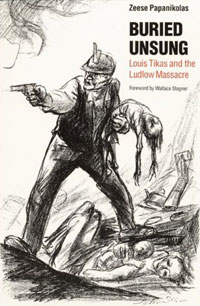
Buried UnsungAnother author made pains to debunk the lyrics “Sixteen tons, and what do you get, another day older and deeper in debt,” a cultural indictment of the “company store,” which was one of the grievances of the Ludlow strikers. He postulated that modern readers could be prone to let folklore color a predisposition against the company store. Perhaps a company store was in fact a convenience, derided because it was an arbitrary restriction against which human nature bucked. Trying to be helpful, another panelist suggested: “Imagine if the company store was 7-11, and you were told you could only shop there.” I believe both of these gentlemen are overlooking the much grosser complaint which the miners were protesting, that of insurmountable debt, systematically forced on them by their employers. That’s a phenomena on the rise today, if maybe not among college professors. Around the world, indentured servitude has never abated.

In our ivory tower we can debate which side, the union or the militia, fired the first shots on April 20. Who was at fault, seemed to be what that question would decide. At least panelist Anne Hyde had the presence of mind to lay some of the responsibility on the mine owners, who weren’t there of course, but whose stubborn greed played a not unsubstantial part in what the other panelists were attributing to “macho intransigence.”

That expression was in vogue to describe Cowboy presidencies. What an effete put down of militant activism. Are we to blame the striking miners for holding firm to their demands?

Thank goodness someone in the audience brought up recent efforts to deny the Sand Creek Massacre, which two panelists quickly weighed in to say “that was a real massacre,” discrediting Ludlow, obviously, and failing to grasp her point that indeed some Colorado Springs locals are rewriting Sand Creek as a battle, and not a massacre.

Another isolationist luxury has become to judge every action as it compares to a nonviolent ideal. It was noted that UMWA union leader John Lawson always recused himself from violent tactics. During the symposium’s opening reception, someone performed a song dedicated to the Ludlow martyr Louis Tikas, which lauded him for choosing to fight with words not guns, as if guns would discredit him.

I’ll play devil’s advocate and suggest that the miners fired the first shots. They saw Louis Tikas bludgeoned in the back of the head and then executed as he lay on the ground unconscious, they saw the National Guard move a machine gun into position above their tent city, and they probably began to fire at the soldiers lest a rain of bullets descend on miners’ wives and children before they had a chance to flee the camp.

The miners were asking that their union be recognized, that the Colorado eight hour work day be enforced, that the scales which determined their pay be verified, that their full hours be compensated, etc. The mine owners clung to their profits, and ordered the miners’ tent city, their only shelter and all their worldly possessions burned to the ground. Women and children were hiding in underground pits dug to escape the sniper fire which the mine guards sporadically aimed at the tents. The guards drove an armored car around the perimeter of the union camp, at all hours, for that purpose.

Ultimately this climate erupted into the violent clash on April 20, 1914, in which the miners battled with the far better equipped soldiers. The casualties were 25 to 1. I call that a massacre.

ADDENDUM: Photographs from visit to the Ludlow Memorial.
Site of Ludlow Massacre, photographed 2009
LUDLOW MEMORIAL, COLORADO- Day three of the Colorado College Ludlow Symposium featured a bus ride to the site of the 1914 Ludlow Massacre, then on to Trinidad to the grave of Union leader Louis Tikas. A reporter for Colorado Public Radio interviewed the symposium panelists at the U.M.W.A. memorial grounds.

April 2009 Visit to Ludlow site
David Mason is interviewed by a freelance reporter for Colorado Public Radio.

April 2009 Visit to Ludlow site
Scott Martelle and Thomas Andrews are interviewed above the fatal cellar.

April 2009 Visit to Ludlow site

April 2009 Visit to Ludlow site

TRINIDAD, COLORADO- Masonic Cemetary.
April 2009 Visit to Louis Tikas grave site

April 2009 Visit to Louis Tikas grave site
Zeese Papanikolas spoke about his protagonist’s gravestone and its reference to Tikas as a “Patriot.”

April 2009 Visit to Louis Tikas grave site

April 2009 Visit to Louis Tikas grave site

Tim DeChristopher on Democracy Now!

Edward-Abbey-Tim-DeChristopher-Arches
 
Tim DeChristopher, a University of Utah disobedient civilian, was interviewed on Democracy Now! today. Amy Goodman asked him what relevance Edward Abbey had to his move to disrupt the bidding process for oil and gas leases in Utah’s red rock country.

His answer:
I think that the most powerful relevance of Edward Abbey to what I did was his statement and really his expression of the idea that sentiment without action is the ruin of the soul, because I think that’s what I had seen throughout my work as an environmentalist previous to this, where I had seen this massive crisis and massive challenge that we were facing in climate change, and I saw that my efforts of writing the letter here and there and riding my bike and things like that weren’t really aligning. My actions weren’t aligning with my sentiment of how serious this threat was, and I knew that. And so, I felt that kind of conflict within myself.
And when I stepped it up at this auction and was putting myself out there and winning all these parcels was really the first time I felt like my sentiment—or I felt like my actions were aligning with my sentiment. And I felt this tremendous sense of calm when I started doing that, because for the first time that conflict within me was gone, and I knew that when I was, you know, standing up and risking going to prison, my actions really were aligning with how big of a crisis this is.

A grand jury indicted Tim DeChristopher Wednesday afternoon with two felony counts of violating the Federal Onshore Oil and Gas Leasing Act. If convicted, Tim could face up to 10 years in the slammer. This, despite the fact that Ken Salazar cancelled the contested leases because the government failed to follow its own procedures, but more on that later!

For now, tune in to KRCC at 7 to hear Tim (and then Noam Chomsky) on Democracy Now! tonight.

Colorado Springs own cloud maker

capitol climate action
Last week’s POWER SHIFT 09, where 12,000 student environmentalists converged on Washington, culminated with a protest of a DC power plant which still produced 40% of its electricity from coal. A threatened largest act of mass civil disobedience pushed Washington legislators to order the plant converted completely to natural gas. What a contrast to the awareness level in our own Colorado Springs, where the city wraps around a single coal power plant which consumes two coal train loads a day, its billowing stacks, local moms describe to their kids, give it the name “cloud maker.”

From a Capitol Climate Action PDF:

Ten Problems with Coal

1. Coal Fuels Global Warming
Coal is the largest single source of global warming pollution in the United States. The Intergovernmental Panel on Climate Change (IPCC) has reported that global warming threatens human populations and the world’s ecosystems with intensifying heat waves, floods, drought, extreme weather, and by spreading infectious diseases. Furthermore, it is conservatively estimated that the climate crisis will place a $271 billion annual drag on the U.S. economy alone by 2025. According to the IPCC, the United States and other industrialized countries need to reduce global warming pollution by 25–40 percent by 2025 to avoid the most severe impacts of the climate crisis.

climate justice2. Coal Kills People and Causes Disease
According to the American Lung Association, pollution from coal-fired power plants causes 23,600 premature deaths, 21,850 hospital admissions, 554,000 asthma attacks, and 38,200 heart attacks every year. The Center for Disease Control (CDC) estimates that 12,000 coal miners died from black lung disease between 1992 and 2002.

3. Coal Kills Jobs
The coal industry is one of the least job-intensive industries in America. Every dollar we invest in coal is a dollar we can’t spend creating jobs in the clean energy economy. In fact, the country’s wind sector now employs more workers than the coal industry. Investing in wind and solar power would create 2.8 times as many jobs as the same investment in coal; mass transit and conservation would create 3.8 times as many jobs as coal.

4. Coal Costs Billions in Taxpayer Subsidies
The U.S. government continues to subsidize coal-related projects despite its impact on health, climate and the economy.

5. Coal Destroys Mountains
Many coal companies now use mountaintop removal to extract coal. The process involves clear-cutting forests, using dynamite to blast away as much as 800–1000 feet of mountaintop and dumping the waste into nearby valleys and streams. Mountain-top removal has leveled more than 450 mountains across Appalachia. Mountain-top removal destroys ecosystems, stripping away topsoil, trees, and understory habitats, filling streams and valleys with rubble, poisoning water supplies, and generating massive impoundments that can cause catastrophic floods.

6. Burning Coal Emits Mercury
Coal-fired power plants are the largest source of man-made mercury pollution. Mercury can interfere with the development of babies’ brains and neurological systems. Elevated levels of mercury in Americans’ blood puts one in six babies born in the United States at elevated risk of learning disabilities, developmental delays, and problems with fine motor coordination. Already 49 U.S. states have issued fish consumption advisories due to high mercury concentrations in freshwater bodies throughout the country, largely due to coal emissions.

7. There’s No Such Thing as “Clean Coal”
Carbon capture and sequestration (CCS), or what the coal industry is marketing as “clean coal,” is a hypothetical technology that may one day capture carbon dioxide from power plants and store it underground. However, the scheme has never been successfully demonstrated at a commercial scale, is wildly expensive, and can’t deliver in time to help with the climate crisis. Nationwide, approximately $5.2 billion in taxpayer and ratepayer money has been invested in the technology, but a recent government report found that of 13 projects examined, eight had serious delays or financial problems, six were years behind schedule, and two were bankrupt. Even if engineers are able to overcome the chemical and geological challenges of separating and safely storing massive quantities of CO2, a study published recently shows that CCS requires so much energy that it would increase emissions by up to 40 percent of smog, soot, and other dangerous pollution.

8. Coal Kills Rivers
Last December, a billion gallons of toxic coal sludge broke through a dike at the Kingston Fossil Plant in Tennessee and flooded the Emory and Clinch Rivers, tributaries of the massive Tennessee River system. Within hours, ash laden with mercury, lead, arsenic, benzene, and other toxic chemicals had contaminated the river and fish were washing up dead on the shore. The spill, which was followed days later by another coal ash spill at a TVA facility in Alabama, soon became a national symbol of the reality of “clean coal” and led to hearings in Congress; legislation is pending to regulate coal ash as a hazardous waste. The TVA recently estimated the clean-up costs from this one spill to be up to $825 million, with higher costs possible as a result of a variety of pending civil suits against the TVA.

9. Coal Plants Are Expensive
Communities considering construction of new coal-fired power plants are seeing these impacts first-hand. During a recent debate over building a new coal-fired power plant in southwest Virginia, state officials estimated that building a new plant (which would employ just 75 people permanently), would cost 1,474 jobs as businesses laid people off to pay the higher electricity costs from a new coal plant. With the United States running a huge deficit, we’ve got to make sure that whatever investments we do make pack the biggest job-creation bang for the buck.

10. Acid Rain
Acid rain, a byproduct of burning coal, destroys ecosystems, including streams and lakes, by changing their delicate pH balance. It can destroy forests, devastate plant and animal life, and eat away at man-made monuments and buildings.

Clean Coal is a fossil fuels Free Lunch

Clean Coal is a free lunchThere’s no such thing as Clean Coal. The concept is an ingenious public relations gambit like Clean-Skies, an No-Child-Left-Behind. Colorado’s supposedly progressive Governor Bill Ritter is an dirty backer. The attempted makeover of the dark fossil fuel has prompted an equal and opposite public reaction.

Laudably, the industry is trying to raise public awareness to “what lies behind the plug.” They ask energy consumers to face the reality that lights –their television even– have to be powered somehow. The image they use is a piece of coal being tapped by an extension cord. It certainly looks magically detached from any complication. Leaving alone that you have to burn the coal (imagine depicting steaks cooking on a stone cold barbecue grill), I’d defy anyone to handle the piece of coal without getting the orange plug completely smudged.

Of course, clean or not, coal is a fossil fuel, the consumption of which is one of the primary causes of Global Warming, aka Climate Change. “Clean Coal” is just a way for the oldest energy industry to get in on the alternative energy gravy train.

Clean coal is odorless shitThe Coen Brothers have directed a hilarious television ad which parodies the Coal Companies pitching their product as an air freshener, even as the aerosol spews pure smoke.

It’s absolutely dispiriting to see Barack Obama championing “Clean Coal” in a TV spot. Who would not like to think that American ingenuity can figure out a way to burn coal cleanly? If we can reverse osmosis, halt aging and make 0% fat fat, why disbelieve we can’t strip carbon of its essence?

At the America’s Power website, the coal industry promises to use Clean Coal to reduce our dependence on foreign oil, and of course, to provide jobs. A US map reveals several Clean Coal research sites in Colorado. They are Boulder, Denver, Englewood, Littleton, Wheat Ridge, Nucla and La Vita.

colorado clean coal

Even if the lipstick on pig research is just a boondoggle to snag Federal funded jobs, aren’t there real alternative energy sources to pursue?