Is the Israeli Left any lesser invasive? Support Israelis who don’t live in Israel

Happening upon a Middle Eastern restaurant advertising itself to be Israeli-owned, I wondered, as a BDS-adherant promoting boycott, divestment and sanctions to pressure the state of Israel to abandon apartheid and illegal occupation, if this business fell under the BDS dragnet. BDS targets Israel and not just products from the Occupied Territories as moderates might prefer. At times BDS also focuses on prominent Zionist enterprises whether they be Israeli or American. Very likely these proprietors evangelize for Israel, but I thought a broader principle suggested itself: LET’S DO SUPPORT ISRAELIS WHO DON’T LIVE IN ISRAEL! Wouldn’t that be precisely the goal?! But a word about other Israelis for whom BDS is asked to make an exception, the oft-celebrated Israeli Left. Are we supposed to be reassured that many Israelis do not support the ethnic cleansing perpetuated by their right wing government? What of the purported majority of Americans who oppose our continued wars and our drone extrajudicial executions? If populations cannot prevent the crimes perpetrated in their name, indeed the responsibility falls to who other but them, does their objection earn any points until they act?

Bottom of Sept 11 Memorial is for eyes of One World Trade Center penthouse

The two holes left from Buildings 1 and 2 of the pre-911 World Trade Center, figuratively or is it ostensibly, constitute the public area of the September 11 Memorial. Both are square, sunken “reflecting pools” into which water falls. Inside each an inner square hole appears to sink forever, deep enough that the base cannot be seen by even the tallest of visitors standing on tiptoe. Ironically the only location that affords a view into the bottomless mystery is the adjacent One World Trade Center, situated where the former WTC Building 7 stood, which I guess didn’t merit a memorial, the better to erase its memory. It would not surprise me if the fresh Eichmanns who will soon again populate the OWTC will be treated to an inside joke fitting for whichever of them chooses to stare into the abyss. At the base of the bottomless pools, printed in bold letters, shielded from errant-eyes by the post-911 no-fly zone, entrusted only to the exclusive fraternity of the top floor who know it already, read the words “WE DI DI T!”

Fracked Gas – the Other Fossil Fuel

YES, Colorado Springs is so dumb, its local renewable energy fans had to rename themselves green energy advocates after they were called out for promoting NATURAL GAS! UnNatural Gas is not renewable and, guess what, it’s not green either. Of course even the Sierra Club got taken in by the natural gas frackers, and I’m not convinced 350.ORG isn’t equally soft. The upcoming People’s Climate March in New York City features among its speakers President Obama’s faux eco radical Van Jones who tours the country pitching a green jobs revolution equal parts solar panels and fracking rigs. Not only is the gas extraction process more injurious to the atmosphere than coal, on top of the unsustainable contamination of hydraulic fracturing, but “natural gas” is among the fuel reserves which scientists insist must be left untapped if Earth has any hope of mitigating climate change. Eco moderates harp about our economy needing gas as a transition fuel. Ironically the Climate Transition does not need our economy.

Forget the one state solution, or two, Israelis have earned a no state solution

Ayelet Shaked
It used to be controversial to call for a ONE STATE SOLUTION to end the fighting over Palestine. Israelis and their American Zionist supporters rightly feared that without bantustans to isolate Palestinians, Israel’s Jews would become the minority and democracy would upend the legitimacy of a Jewish state. To be fair, that’s not only probable, it’s inevitable. But how cavalier to wait confidently as Palestinians continue to suffer reprisals and recently a teenager abducted and burned alive by marauding Jewish settlers incited by Israeli ministers calling for collective punishment and genocide. Nevermind the IDF air strikes burning Gazans alive. Yeah, maybe it’s time to stop pretending a Zionist theocracy can be democratic, and stop pretending that invaders and occupiers want “peace”. They want their conquest and human rights abuses left in peace. End this thinly veiled western colonial adventure. Palestine for Palestinians, not Europeans and Americans claiming a “birthright” that usurps a refugee’s right of return.

Colo. Springs peaceniks, Unitarians and NAACP fall for latest Africom campaign

They fell for Darfur and Kony (and Obama!) and now the Colorado Springs social justice community confirms that the city’s national repution for dim-bulbedness doesn’t reflect just its conservatives. Even the dissenting voice in this belly of the US military-judeo-christian-racist beast, is pro-imperial, toe-the-line, neoliberal dumbass. They’re against war and injustice, they even understand illegal war, but cloak it in terms of “intervention” and they stand beside their warmonger neighbors cheerleading for US aggression in Sudan, Libya, Syria, and wherever Pax Americana dictates we bomb in Africa. Where the local armed-forces community might be slow on the uptake regarding a Democratic president’s pandering to transnational corporate needs, the Springs peacekeeping Left will lead the way. On Monday, the usual shepherds of non-confrontational conformity held a vigil for the Lost Girls of Sudan -pardon- Nigeria, echoing the White House call to #bringbackourgirls. Unlike authentic antiwar vigils, this action got press, quelle surprise, from the media war machine! Congratulations AFRICOM-dupes! Nevermind non-American girls lost to US collateral malfeasance, no official hashtag for them, ergo no Springs peacenik campaign that would give a conscience indigestion.
 
Would we care more if the 267 kidnapped schoolgirls were not black? (!) If they were white they wouldn’t be from a country we’re trying to destabilize.

DPD waits until dark to make 5 arrests, but blunders pretext for May 5 charges

may5-anon-nmt
DENVER, COLORADO- Five arrests resulted from last Monday’s Anonymous march, two on the scene and three afterward, but measures employed by combined Municipal, County and Homeland Security forces to suppress the demonstration will likely prove to undermine charges of wrongdoing. Marchers were accused of obstructing the roadway, but all vehicular traffic had already been blocked while ordinary pedestrian usage continued unhindered.

SELECTIVE ENFORCEMENT was the least of the DPD’s abuses that night, whose strategies also included INTIMIDATION and direct SUPPRESSION of free speech. During the march participants faced a continuous escort of SUV-mounted riot police, who chose an arbitrary moment to dismount and assault the procession. After the march, a number of participants were met by officers as they neared their home addresses. Some were interrogated, three were arrested. At several times during the demonstration, empty city buses queued to form long barriers to obstruct passerby access to the protestors.

16th Street “Mall Ride” buses were decommissioned to inhibit public view of the march, which prevented the protest being witnessed more widely. It also gave intended commuters reason to be angry at the activists. However the action also negated any useful reason why pedestrians needed to heed a throughway for buses, the only vehicles allowed on the walking mall.

Actually the May 5th march of approximately 50 people was small enough to stick to the sidewalk and it did. Police warnings made over a loudspeaker to “get out of the street” occurred on only transitory occasions and were directed at stragglers.

On the 16th Street Mall the distinction between sidewalk and street was not always clear. On the walking mall bicycle cops used their bicycles to ram marchers in an attempted to allege that the central pedestrian area was off limits. No curbs distinguish this area from the bus lane, but the absence of buses made the distinction mute.

Just after dark, on the march’s final turn toward the state capitol, officers in riot gear suddenly dismounted and thrust into the crowd to arrest two participants they considered to have received three warnings. The action caused a stampede. Activists who didn’t scatter were pushed to the ground by the police. A half hour standoff eventually diffused, the militarized officers were withdrawn, and the tired marchers left to their dispersement area, escorted by the bicycle police.

It was not until later that participants learned of colleagues followed, swarmed in front of their apartments, interviewed, assaulted or arrested for having obstructed the path of buses that were not running.

Should the DPD be allowed to deploy the Mall-Ride buses to block a protest march, and simultaneously hold protesters responsible for getting out of their way? They want to throw cake in our face and have us to eat it too.

On May 5th, “Every 5th” activists were deprived the public audiences they were seeking, blocked from view by municipal vehicle barricades, and forbidden the public space. Neither bus-riders nor dissenters could use the public bus lane because Denver law enforcement commandeered it to squelch free speech.

Pueblo museum excises Mine Workers Union from Ludlow Massacre exhibit!


PUEBLO, COLORADO- 2014 marks one hundred years since the Ludlow Massacre of 1914. A variety of commemorations are planned before the formal anniversary on April 20. I attended one such event on Wednesday, a lecture by a CSU professor to footnote the “Children of Ludlow” exhibit at El Pueblo History Museum. I’m always excitied when attention is paid to Ludlow, a subject regularly left out of American schoolbooks, but I was disappointed to find key elements of labor history excised from the museum’s narrative. Literally. The United Mine Workers of America, the organization central to the strike, which supplied the tent city, and which even today maintains the memorial site, was mentioned only once, IN FINE PRINT! The Ludlow miners voted to strike because the mining companies refused to recognize the UMWA. Unmentioned. The horrors of the atrocity were not tempered, in their explicitness perhaps we think them enough, but there was also the apologist suggestion that some culpability belonged to the miners. I questioned one curator who admitted they were at pains to keep the story “balanced” and that the squeakiest wheel thus far has been the National Guard. Apparently the Guard is offended that its role will be misconstrued. What balance do they want, I wondered. Had they lost children in the “battlezone” too?

Children are at the heart of commemorating Ludlow and at the heart of this preversion of the massacre’s memory. Were they recklessly endangered by their parents and union organizers? Were they dragged into a battlezone? The museum seems to suggest as much, highlighting the beligerence of the miners, mischaracterizing the soldiers, and leaving the union actions largely unexplained.

First I’d like to declare how I tire of the objective irrelevance which results when academics seek the approval of government technocrats. I am also disturbed by educators who pretend blindness to subtle inferences which shape a political takeaway. To them, “remembering” Ludlow seems sufficient in itself. I can hardly see the point to remembering Ludlow unless we have discerned its lessons. Until we are remembering the LESSONS OF LUDLOW, our educators’ self-proclaimed raison d’etre will be self-fulfilling: “history will repeat itself.” This Pueblo exhibit suggests no lesson other than the exploitation of tragedy, and leaves me fearful about the Ludlow commemorations to follow. The anti-union, pro-military climate which prevails these hundred years since the massacre will make for a travesty of a remembrance unless someone with a worker’s perspective speaks up.

NOT BROUGHT TO YOU BY…
Let’s start with this exhibit, which alas has already escaped critique since September. Its full title, as evidenced in the photo above: “Black Hills Energy presents: Children of Ludlow, Life in a Battlezone, 1913-1914.”

I’ll bet curators thought it a measure of truth and reconciliation that the Ludlow presentation was sponsored by a local extraction industry business. Black Hills Energy trades not in coal but natural gas. In fact they’re among the frackers tearing up Southeastern Colorado. I think the irony more likely suggests how the UMWA’s starring role was left on the cutting room floor. There are generic mentions of “the union”, as at right, keeping a ledger of which families were assigned tents, but only in the fine print is the UMWA named as owning the ledger.

BATTLEZONES
More troubling is the skewed framing of the museum’s narrative. It begins with the subtitle, “life in a battlezone.” That’s taking a rather curious liberty don’t you think? The event we accept now as “Ludlow” became a battlezone on April 20, and the regional Coal Field War which followed was a battlezone to which both revenge-seekers and militia thronged, but the tent colonies in which 12,000 lived, 9,000 of whom were the children of the title role, were camps full of families. That they were straffed regularly by the guards makes them shooting galleries not battlegrounds.

Calling Ludlow a battlezone is like calling Sand Creek a “collision” or calling the Middle East a “conflict”. All of these mask the role of the aggressor.

I will credit the curators for offering a candid detail of horrific import. In a description of the day before the massacre, when the Greeks among the immigrants were celebrating Greek Easter, mention is made of the mounted National Guards offered this taunt: “You enjoy your roast today; we will have ours tomorrow.” No one should deny today that the events of April 20, which culminated in the torching of the tents and asphyxiation of women and children, was a premeditated act.

THE CHILDREN
Should the miners have put their children in harm’s way by defying the mining companies? How could they not? As immigrants they didn’t have nearby relatives to foster their children away from the random bullets. Also left unsaid by the display: many of the children had already been working in the mines and counted among those on strike. This was before child labor reforms.

Curiously, the exhibit did include a famous photograph of the notorious activist Mother Jones leading a childrens’ march through Trinidad. The caption explained that Jones wasn’t above using real children to advance the cause of Colorado’s coal miners.” Emphasis mine. While technically true in a modern context, it’s probably disingenuous to imply someone is using the children when a key issue of the demonstration is CHILD LABOR.

No really. Mother Jones was leading a march of children, many of them workers of the mines, for the reform of labor practices which abused children. This and subsequent campaigns eventually led to child labor laws. Is saying “Mother Jones wasn’t above using children” in any way an accurate characterization?

Compounding the inference that the Children of Ludlow were jeopardized for the cause, was the implication that the miners were combatants who contributed to the battlezone. As the displays progressed in chronological order, the first weapon on display was a rifle used by the miners. Immediately behind it was an enlarged photograph vividly depicting miners posed with two identical specimens.

Moving along the exhibit chronologically, anticipating the rising violence, the museum goers is apparently supposed to register that the strikers were firing too, if not first. Recent historical accounts have deliberated about who fired first. I think the motive is suspiciously revisionist in view of today’s dogma of nonviolence absolutism: if your protest devolves into violence, you deserve every bit of the beating you get.

Whenever it was that the miners began firing, the single militia and three guard casualties were not recorded until after the massacre took place, belying the narrative that the miners invited the massacre. Witnesses conflict about when the three union leaders were executed. I’ll give the museum credit for defying the National Guard in summarizing that among the casualties, three of the miners were “executed”.

PARITY OF WEAPONS
Students of the Ludlow accounts know that many of the miners were better riflemen than the soldiers. Many were immigrants who’d served in Bulkan wars and outmatched Colorado’s green guardsmen. That is not to suggest that the miners and their harrassers were equally armed, yet…

The only other weapon on display is a rifle of vintage used by the national guard. It shares a case with a uniform and sabre, lending it official authority. Also, the rifle is not presented as having been used at Ludlow, so it doesn’t project an aura of culpability. Missing is the machine gun depicted in the photograph of the machine gun nest which fired down upon the camp. It’s depicted with a caption about the Guard being a welcome presence. Missing too is the armored car dubbed the “Death Special”. Obviously the armor protected its operators from being hit by striking-miner bullets as it drove through the canvas encampment, straffing the tents with its mounted machine gun.

HUMANIZING THE PERP
Right after the photo of armed miners was the display at right, with a very contrived bit of spin catering to today’s military families. Although the photo shows soldiers actively aiming their gun at the camp, the caption assures us that the “Ludlow families feel relief with the arrival of National Guard”. This supposition is based on the fact that when the soldiers first arrived they were serenaded with the “Battle Cry of Freedom” and greeted with American flags. Most of the miners being immigrants, they were eager to show their patriotism, but the conclusion drawn here is a terrible mendacity. The miners and union organizers knew full well the purpose of the National Guard. They knew the strikebreaking role it played in famous strikes of the past. The miners feted the soldiers hoping to sway them from their eventual task. Protesters of all eras hold out this hope every time they face riot police.

A following paragraph suggested that by the time the massacre was committed, most of the soldiers had been mustered out and replaced with militia members and company guards. This is slight of hand. After the official inquiry, which was prompted by the public outcry, twenty National Guard soldiers were court martialed. All were acquitted. Is the Guard wanting us to believe they were acquitted because they weren’t there?

This attempt to put a friendly face on the National Guard, coupled with an abdication of effort to give the union its due, seems engineered to appeal to the average Pueblan of today, many probably related to an active-duty soldier and long since indoctrinated against evil unions. When I asked the lecturer about the omission of the UMWA, she prefaced her answer for the audience, explaining that unions of old were not like those despised today. I told her I thought failing to describe the hows and whys of the strike was a real teaching opportunity missed.

HISTORY COLORADO
It’s probably important to point out that the Ludlow presentation at the History Museum was developed with the assistance of History Colorado, which finally shuttered a contested display: a Sand Creek Massacre exhibit with a similar flavor of whitewash. Like labeling Ludlow a battlezone, History Colorado tried to typify Sand Creek as a “collision.”

Also typical of History Colorado is the propensity to address their exhibits to children. Programming for school bus visits invariably dumbs down what can be presented and I hardly think the compromise is worth it. If children ran the world, maybe Disney versions of history would suffice.

I’d like to have seen it highlighted that the Ludlow miners were mainly immigrants who were looked down upon by the residents of Colorado. If the museum audience were the “Children of Ludlow” in the extended sense, as a few descendants probably were, more of us were the children of the soldiers of Ludlow, or the citizens who cheered them on, or joined the militia or built the armored car at Rockefeller’s Pueblo factory. If we’re going to remember Ludlow, we ought to remember our role in it so we don’t do that again. It’s easy to pretend we were the martyrs. In all probability that’s who we will be if the lessons of Ludlow are discarded.

Will Colo. Springs raise energy bills by 3% to give 50% raise to utilities CEO?

COLORADO SPRINGS residents are left to wonder what kind of leverage the public utilities CEO holds over his board of directors. City Council wants to raise Jerry Forte’s salary to half a million in spite of the coal-black hole in which he put the city’s energy portfolio. They won’t consider investing in renewables lest it bump utility rates by 1%, put they will raise the rates by 3% to resolve a payables problem, austensibly, (They want to act quick while higher winter usage means the rate hike will yield more) and I guess for the CEO’s raise.

Bear Creek Massacre, January 29, 1863


The year 2014 will mark the 150th anniversary of the Sand Creek Massacre, on November 29, two days after Thanksgiving. But on this day, January 29 of the year before, a Shoshone village suffered an identical fate. The Bear Creek Massacre was also once called the Battle of Bear Creek, but the only grounds which western military history buffs have to argue that such engagements were “battles” not massacres, is that was how the US cavalry waged its fights against the hostiles, its only victories were raids upon unsuspecting villages.

Here is the official contemporary report of Colonel Connor’s attack. First the cover letter which sets the scene. From the Official Records of the War of Rebellion (what the Civil War was called then), series 1, volume 50, part 1:

HEADQUARTERS DEPARTMENT OF THE PACIFIC,
San Francisco, February 20, 1863.
Adjt. General L. THOMAS, U. S. Army,
Washington, D. C.:
SIR: I have the honor to inclose herewith the report of Colonel P. E. Connor, Third Infantry California Volunteers of the battle fought on the 29th of January, on Bear River, Utah, Ter., between U. S. troops and hostile Indians. Our victory was complete; 224 of the enemy left dead on the field. Colonel Connor’s loss was heavy. Out of 200 men engaged 14 were killed on the field and 4 officers and 49 men wounded; 1 officer and 5 of the men wounded have since died. Colonel Connor’s report of the suffering of his troops on the march and the gallant and heroic conduct of both officers and men in that terrible combat will commend the Column from California and its brave commander to the favorable notice of the General-in-Chief and War Department.
Very respectfully, your obedient servant,
G. WRIGHT,
Brigadier-General, U. S. Army, Commanding.

I’ll parse those totals for you. Cowboy casualties: 20 dead, 47 wounded. Indians: 224 dead, 0 wounded.

Here are the more relevant passages of Connor’s report. Notice he puts plenty of emphasis on the fight he encountered, even suggesting that the Shoshones initiated the attack. Connor sheds much less light on the aftermath. (I’ve bolded some parts of import:)

Report of Colonel P. Edward Connor, Third California Infantry, commanding District of Utah. (Excerpt)

As daylight was approaching I was apprehensive that the Indians would discover the strength of my force and make their escape. I therefore made a rapid march with the cavalry and reached the bank of the river shortly after daylight in full view of the Indian encampment and about one mile distant. I immediately ordered Major McGarry to advance with the cavalry and surround before attacking them, while I remained a few minutes in the rear to give orders to the infantry and artillery.

On my arrival on the field I found that Major Mcgarry had dismounted the cavalry and was engaged with the Indians who had sallied out of their hiding places on foot and horseback, and with fiendish malignity waved the scalps of white women and challenged the troops to battle, at the same time attacking them. Finding it impossible to surround them in consequence of the nature of the ground, he accepted their challenge.

The “scalps of white women” was a common motif used in justifying ensuing slaughters. Colonel Chivington cited the presence of same at the Sand Creek camp, although none were ever produced.

The position of the Indians was one of strong natural defenses, and almost inaccessible to the troops, being in a deep, dry ravine from six to twelve feet deep and from thirty to forty feet wide, banks and running across level table-land, along which they had constructed steps from which they could deliver their fire without being themselves exposed. Under the embankments they had constructed artificial covers of willows thickly woven together, from being which they could fire without being observed.

After being engaged about twenty minutes I found it was impossible to dislodge them without great sacrifice of life. I accordingly ordered Major McGarry with twenty men to turn their left flank, which was in the ravine where it entered the mountains. Shortly afterward Captain Hoyt reached the ford three-quarters of a mile distant, but found it impossible to cross footmen. Some of them tried it, however, rushing into the river, but, finding it deep and rapid, retired. I immediately ordered a detachment of cavalry with led horses to cross the infantry, which was done accordingly and upon their arrival upon the field I ordered them to the support of Major McGarry’s flanking party, who shortly afterward succeeded in turning the enemy’s flank.

Up to this time, in consequence of being exposed on a level and open plain while the Indians were under cover, they had every advantage of us, fighting with the ferocity of demons. My men fell fast and thick around me, but after flanking them we had the advantage and made good use of it. I ordered the flanking party to advance down the ravine on either side, which gave us the advantage of an enfilading fire and caused some of the Indians to give way and run toward the north of the ravine.

At this point I had a company stationed, who shot them as they ran out. I also ordered a detachment of cavalry across the ravine to cut off the retreat of any fugitives who might escape the company at the mouth of the ravine. But few tried to escape, however, but continued fighting with unyielding obstinacy, frequently engaging hand to hand with the troops until killed in their hiding places.

The most of those who did escape from the ravine were afterward shot in attempting to swim the river, or killed while desperately fighting under cover of the dense willow thicket which lined the river-banks.

Most were shot, but Connor skimps on the detail. The wounded Shoshones and those feigning injury were prodded with bayonettes then shot, violated sometimes before, sometimes after. Few escaped this fate. Like any population of civilians, the village was at least seventyfive percent women and children.

I have also to report to the general commanding that previous to my departure Chief Justice Kinney, of Great Salt Lake City, made a requisition for troops for the purpose of arresting the Indian chiefs Bear Hunter, San Pitch, and Sagwich. I informed the marshal that my arrangements for our expedition against the Indians were made, and that it was not my intention to take any prisoners, but that he could accompany me. Marshal Gibbs accordingly accompanied me and rendered efficient aid in caring for the wounded.

Of the good conduct and bravery of both officers and men California has reason to be proud. We found 224 bodies on the field, among which were those of the chiefs Bear Hunter, Sagwich, and Leight. How many more were killed than stated I am unable to say, as the condition of the wounded rendered their immediate removal a necessity. I was unable to examine the field. I captured 175 horses, some arms, destroyed over seventy lodges, a large quantity of wheat and other provisions, which had been furnished them by the Mormons; left a small quantity of wheat for the sustenance of 16 and children, whom I left on the field.

WWII air veterans of Doolittle Raiders celebrate 71 years of bombing civilians

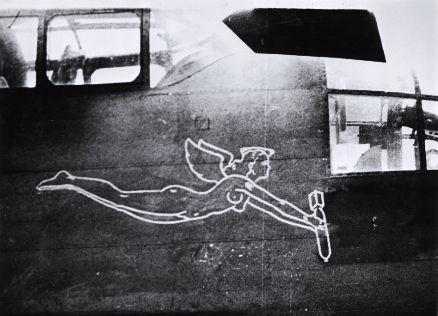
Doolittle nose-art
I read 30 Seconds Over Tokyo when I was still a war-playing kid, before I would understand the mischievous consequences of the Doolittle Raiders B-25 bombers deploying without their bombsights. This was to prevent US war-making advantages falling into enemy hands but it also precluded dropping bombs with accuracy. I’m pretty certain the account for young readers also didn’t explain why over a quarter of the squadron’s bombs were of the incidiary cluster variety. Readers today know what those are for. Doolittle claimed to be targeting military sites in Japan’s capitol, but “invariably” hit civilian areas including four schools and a hospital. Of the American fliers captured, three were tried and executed by the despicable “Japs”, who considered the straffing of civilians to be war crimes. After the war, the US judged the Japanese officers responsible, as if their verdict was a greater injustice against our aviators’ “honest errors”. Today we rationalize our systemic overshoot policy as “collateral damage”.

Every year since WWII, Doolittle’s commandos are feted for their milestone bombing mission. This Veterans Day is to be the last due to their advanced ages. But it is fitting, because isn’t it time Americans faced what we’re celebrating? There’s no denying it took suicidal daring, but the Doolittle Raid inaugurated what became a staple of US warfare, the wholesale terrorizing of civilians from on high, with impunity and indifference. To be fair, the American public has always been kept in the dark. American aircraft have fire-bombed civilians at every diplomatic opportunity since 1942, and a Private Manning sits in the brig for trying to give us a chance to object.

We now know that the Doolittle Raid didn’t turn the tide, nor shake Japanese resolve. It was a retalliation for the attack on Pearl Harbor, intended to boost US morale as if to say, America wasn’t defeated. Kinda like why and how we struck back at Afghanistan after 9/11, just as indiscriminately.

The “Mark Twain” ersatz bombsight
substitute bombsightThe Norden bombsight was a closely guarded US secret weapon. An airstrike without it would today be like lobotomizing so-called smart bombs, and deciding to opt for imprecision bombing. The official army record recounts that a subsitute sighting mechanism was improvised for the raid, dubbed the “Mark Twain” and judged to be effective enough. Now a bad joke. Indochina and Wikileaks-wisened, we know the mendacity of that assessment. The vehemently anti-imperialist, anti-racist Twain would not have been honored.

Twain satirized Western so-called Enlightenment thus: “good to fire villages with, upon occasion”.

Post-postwar hagiographies of the raid have suggested the improvised bombsight was better suited to low-altitude missions than the Norden model. That conclusion is easily dismissed because the device was used only for the Doolittle run and never after. The sight’s designer, mission aviator C. Ross Greening, offered a explanation for why he named the device after Mark Twain in his pothumously published memoir Not As Briefed. He didn’t.

The bombsight is named the “Mark Twain” in reference to the “lead line” depth finder used on the Mississippi River paddle wheelers in bygone days.

Because its design was so simple, we’re left to suppose. Greening’s bombsight was named for the same “mark” which Samuel Langhorne Clemens adopted as his celebrated pen name. I find it disingeneous to pretend to repurpose an archaic expression whose meaning was already eclipsed by the household name of America’s most outspoken anti-imperialist. Who would believe you named your dog “Napoleon” after a French pastry?

We are given another glimpse into Greening’s sense of humor by how he named his plane, the “Hari-Kari-er” ready to deal death by bomb-induced suicide. Greening’s B-25 is the one pictured above, with the angelic tart holding a bomb aloft. Greening’s plane was another that carried only incendiary ordnance.

Much was made of the sight’s two-piece aluminum construction, reportedly costing 20 cents at the time compared to the $10,000 Norden. This provided the jingoist homefront the smug satisfaction perhaps, combining a frugality born of the Depression with the American tradition of racism, that only pennies were expensed and or risked on Japanese lives.

War Crimes
Targeting civilians, taking insufficient care to avoid civilian casualties, using disproportunate force, acts of wanton retaliation, and the use of collective punishment are all prohibited by international convention. They are war crimes for which the US prosecutes adversaries but with which our own military refuses to abide. Americans make much of terrorism, yet remain blind to state terrorism. Doolittle’s historic raid, judged by the objective against which it is celebrated as a success, was an act of deliberate terrorism.

Forcing the Japanese to deploy more of their military assets to protect the mainland sounds like a legitimate strategy, except not by targeting civilians to illustrate the vulnerability, nor by terrorizing the population, one of Doolittle’s stated aims. He called it a “fear complex”.

It was hoped that the damage done would be both material and psychological. Material damage was to be the destruction of specific targets with ensuing confusion and retardation of production. The psychological results, it was hoped, would be the recalling of combat equipment from other theaters for home defense, the development of a fear complex in Japan, improved relationships with our Allies, and a favorable reaction in the American people.

There is no defending Japan’s imperialist expansion in the Pacific, and certainly not its own inhumanity. The Japanese treated fellow Asians with the same racist disregard with which we dispatched Filipinos. While Americans point in horror at how the Japanese retalliated against the Chinese population for the Doolittle Raid, we ignore that Doolittle purposely obscured from where our bombers were launched, leaving China’s coast as the only probably suspect.

To be fair, most of Doolittle’s team was kept in the dark about the mission until they were already deployed. I hardly want to detract from the courage they showed to undertake a project that seemed virtually suicidal. But how long should all of us remain in the dark about the true character of the Doolittle Raid?

Out of deference for the earlier generation of WWII veterans, those in leadership, certain intelligence secrets were kept until thirty years after the war. Unveiled, they paint a very different picture of what transpired. The fact that the US knew the German and Japanese codes from early on revealed an imbalance not previously admitted, as an example.

About the Doolittle Raid, much is already openly documented, if not widely known. The impetus for the raid was public knowledge, the evidence of its intent in full view.

BY DESIGN
In the aftermath of Pearl Harbor, American newspapers were already touting offers of cash rewards for whoever would be the first to strike back at Japan. President Roosevelt expressed a deliberate interest in hitting the Japanese mainland, in particular Tokyo, to retaliate for the Japanese strike against Pearl Harbor, never mind it had been a solely military target.

Plans were made to exploit the Japanese homeland’s vulnerability to fire, as ninety percent of urban structures were made of paper and wood. Writes historian William Bruce Jenson:

In his “confidential” meeting with reporters back in November, Marshall had declared that the US would have no cavil about burning Japan’s paper cities.

For the Doolittle Raid, a bombing strategy was developed to overwhelm the fire department of his target, the Shiba ward.

A former naval attache in Tokyo told Doolittle: “I know that Tokyp fire department very well. Seven big scattered fires would be too much for it to cope with.”

As lead plane, Doolittle’s role was to literally blaze the way. Fellow pilot Richard Joyce told Nebraska History Magazine in 1995:

The lead airplane, which was going to have Doolittle on board as the airplane commander, was going to be loaded with nothing but incendiaries -2.2­ pound thermite incendiaries- in clus­ters. They drop these big clusters and then the straps break and they spray, so they set a whole bunch of fires. He was to be the pathfinder and set a whole bunch of fires in Tokyo for pathfinding purposes.

Doolittle’s report outlined his objective more formally:

one plane was to take off ahead of the others, arrive over Tokyo at dusk and fire the most inflammable part of the city with incendiary bombs. This minimized the overall hazard and assured that the target would be lighted up for following airplanes.

Greening paints the most vivid picture, of burning the Japanese paper houses to light the way:

Doolittle planned to leave a couple of hours early, and in the dark set fire to Tokyo’s Shiba ward … the mission’s basic tactic had been that Doolittle would proceed alone and bomb a flammable section of Tokyo, creating a beacon in the night to help guide following planes to their targets.

Doolittle’s copilot Lt Richard Cole, told this to interviews in 1957:

Since we had a load of incendiaries, our target was the populated areas of the west and northwest parts of Tokyo.

After the bombers had left on their raid, and before news got back about whether or not they accomplished it, the Navy crew on the carrier USS Hornet already sang this song, which went in part:

Little did Hiro think that night
The skies above Tokyo would be alight
With the fires that Jimmy started in Tokyo’s dives
To guide to their targets the B-25s.
When all of a sudden from out of the skies
Came a basket of eggs for the little slant eyes

Incendiaries

Most of the bombers were loaded with three demolition bombs and an incendiary cluster bomb. Some of the planes carried only incendiaries. According to Doolittle’s official report of the raid, here were some of their stated objectives:

Plane no. 40-2270, piloted by Lt. Robert Gray:
thickly populated small factories district. … Fourth scattered incendiary over the correct area

Plane No. 40-2250, Lt. Richard Joyce:
Incendiary cluster dropped over thickly populated and dense industrial residential sector immediately inshore from primary target. (Shiba Ward)

“The third dem. bomb and the incendiary were dropped in the heavy industrial and residential section in the Shiba Ward 1/4 of a mile in shore from the bay and my tat.”

Aircraft 40-2303, Lt Harold Watson:
the congested industrial districts near the railroad station south of the Imperial Palace

AC 40-2283, David Jones:
the congested area Southeast of the Imperial Palace

Even though the planned night raid became a daytime mission, Doolittle did not alter his original role, intended to light the way for the following planes. His target remained the Shiba District of Tokyo. His own plane: “changed course to the southwest and incendiary-bombed highly inflammable section.”

Doolittle’s report included a description of the incendiary bombs:

The Chemical Warfare Service provided special 500 incendiary clusters each containing 128 incendiary bombs. These clusters were developed at the Edgewood Arsenal and test dropped by the Air Corps test group at Aberdeen. Several tests were carried on to assure their proper functioning and to determine the dropping angle and dispersion. Experimental work on and production of these clusters was carried on most efficiently.

As has become an aerial bombardment tradition, crews were let to inscribe messages on the bombs about to be dropped. Accounts made the most of these chestnuts: “You’ll get a BANG out of this.” And “I don’t want to set the world on fire –only Tokyo.”

These details, which reveal the intentions of the raid, were not made known to the public immediately. The Doolittle Raid was planned and executed in secret, with US government and military spokesmen denying knowledge of the operation even in its aftermath. The first word to reach the American public came from the New York Times, citing Japanese sources:

Enemy bombers appeared over Tokyo for the first time in the current war, inflicting damage on schools and hospitals. Invading planes failed to cause and damage on military establishments, although casualties in the schools and hospitals were as yet unknown. This inhuman attack on these cultural establishments and on residential districts is causing widespread indignation among the populace.

This report was dismissed as propaganda. When Japan declared its intention to charge the airman it had taken captive with war crimes, the US protestations redoubled. The accusations were belittled even as our own reports conceded to the possibilities.

Lieutenant Dawson’s Thirty Seconds Over Tokyo was the first published account of the raid. Printed less than a year after the event, wartime-sensitive details such as the phony guns made of broomstick handles poking out the back were left out. Targets were also not specified, but a candor remained, probably intended to be threatening. Lawson described the 500-pound incendiaries as “something like the old Russian Molotov Breadbasket”, and related US naval attache Jurika’s advice:

“If you can start seven good fires in Tokyo, they’ll never put them out,” Jurika promised us. … “I wouldn’t worry too much about setting fires in flimsy-looking sections of Tokyo,” he said. “The Japanese have done an amazing job of spreading out some of their industries, instead of concentrating them in large buildings. There’s probably a small machine shop under half of these fragile-looking roofs.”

“Flimsy” became Lawson’s keyword for the residential areas. Here Lawson described dropping his third and fourth bombs, when he saw their corresponding red light indicators:

The third red light flickered, and, since we were now over a flimsy area in the southern part of the city, the fourth light blinked. That was the incendiary, which I knew would separate as soon as it hit the wind and that dozens of small fire bombs would molt from it.

I was satisfied about the steel-smelter and hoped the other bombs had done as well. There was no way of telling, but I was positive that Tokyo could have been damaged that day with a rock.

Our actual bombing operation, from the time the first one went until the dive, consumed not more than thirty seconds.

Thus: Chance of hitting civilian homes: 50/50.
Charges of Excessive Force could be expected, because
blame the victim for being weaker than: a rock.
Care taken to avoid innocent casualties: 30 seconds.

In a later afterword, Lawson blamed Tokyo for having insufficient bomb shelters.

After the war, US occupation forces recovered Japanese records which documented the losses attributed to the Doolittle Raid: fifty dead, 252 wounded, ninety buildings. Besides military or strategic targets, that number included nine electric power buildings, a garment factory, a food storage warehouse, a gas company, two misc factories, six wards of Nagoya 2nd Temporary Army Hospital, six elementary or secondary schools, and “innumerable nonmilitary residences”.

Strafing
Japan accused the fliers of indescriminate strafing civilians. The US countered that defending fighters were responsible for stray bullets when their gunfire missed the bombers. That’s very likely, except the raiders were candid about their strafing too. Lawson:

I nosed down a railroad track on the outskirts of the city and passed a locomotive close enough to see the surprised face of the engineer. As I went by I could have kicked myself for not giving the locomotive’s boiler a burst of our forward 30-calibre guns, then I remembered that we might have better use for the ammunition.

A big yacht loomed up ahead of us and, figuring it must be armed, I told Thatcher to give it a burst. We went over it, lifted our nose to put the tail down and Thatcher sprayed its deck with our 50-calibre stingers.

Greening’s account of firing on a sailor, raises the moral ambiguity of air warfare with which few airmen grapple. By virtue that technology allows it, combatants become slave to a predetermined outcome:

When we attacked the next patrol boat, a Japanese sailor threw his hands up as if to surrender. I guess he expected us to stop and take him prisoner. We shot him and left this boat smoking too.

The Medals
Friendship Medals exchanged between Japan and the US found themselves requisitioned for Doolittle’s Raid:

Several years prior to the war, medals of friendship and good relationship were awarded to several people of the United States by the Japanese government.  In substance these medals were symbolic of the friendship and cooperation between the nations and were to represent the duration of this attitude.  It was decided by the Secretary of the Navy, Mr. Frank Knox, that the time was appropriate to have these medals returned.  They had been awarded to Mr. Daniel J. Quigley, Mr. John D. Laurey, Mr. H. Vormstein and Lt. Stephen Jurkis.

After arrangements had been made and the medals secured, a ceremony was held on the deck of the Hornet during which the medals were wired to a 500 lb. bomb to be carried by Lt. Ted Lawson and returned to the Japanese government in an appropriate fashion.

Lawson’s plane no 40-2261 dropped that bomb on an “industrial section of Tokyo” omitting to mention that Japan’s industry was still a post-feudal cottage industry.

“The medals were subsequently delivered in small pieces to their donors in Tokyo by Lt. Ted Lawson at about noon, Saturday, April 18, 1942.”

–Mitscher, M.A. Letter Report to Commander Pacific Fleet.

“Through the courtesy of the War Department your Japanese medal and similar medals, turned in for shipment, were returned to His Royal Highness, The Emperor of Japan on April 18, 1942.”

–Knox, F. Letter Report to Mr. H. Vormstein

Springs Democrats hope democracy loses to State Senator John Morse

COLORADO SPRINGS, CO- International news headlines read “G-20 Summit Overshadowed by Syrian Crisis” but not in Colorado Springs! Here every politically active Democrat was working to defeat a recall of state senate leader John Morse, a democrat though barely. Morse is a duly elected, if unlikely, representative of conservative El Paso County, being assailed by a mutinous GOP majority angered by his stewarding of gun control legislation. The NRA has backed a blitzkrieg recall campaign, aided by local Republican officials and judges who connived election parameters designed to coax a recall victory. But who’s on the side of right, presumably with the people?

Democrats are crying foul. They’re cursing corporate money and lobbyist-villain NRA, complaining that recalls shouldn’t be motivated by ideological reasons. Really? Are recalls only for impropriety? I’d prefer corruption be answered with criminal charges, and scandal should produce resignations. I’d say ideology would be the most appropriate reason for a recall, especially if it’s about a difference of opinion about the idea of representational government.

Ironically, the underdog’s usual complaint is that incumbents are always impossible to unseat, even when they act in total defiance of their constituents. Don’t you hate that? The irony is compounded because no one will deny that the overwhelming majority in these neighborhoods oppose any abridgement of the Second Amendment right to wave guns. Senator Morse acted in defiance of that interest. Undemocratic, is what he was, as his critics accuse.

We like to vilify the NRA as the worst of special interest lobbies, but one can’t accuse them of being corporate, they’re famously supported by members! The NRA is probably the single MOST democratic of lobbying outfits. The fact that the corporate media loves to demonize the NRA should give one pause about who’s looking after who.

What’s very odd is that the NRA-backed Republicans are targeting a term-limited Democrat who has only a year left in office. What’s that about? Pundits speculate that an NRA win would be symbolic, so it’s worth the money they’re spending. Maybe. It certainly will reinforce the corporate narrative that legislators daren’t cross the NRA. How convenient.

But the recall campaign, a national story now, is not so mysterious if you think about the Kabuki nature of our two party theater. The defense campaign contrived for Senator Morse is a disquietingly artificial shade for grassroots. Against “People Against Morse” the Democrats countered with: “A Whole Lot of People For Morse”, which is certainly a catchy slogan for a politician looking to highten his visibility for a run at a next office, but for locals it lacks the ring of authenticity. What viewers outside the area don’t know is that John Morse has been a superlatively minor functionary, with a reputation for backstabbing more than leading, and certainly no one to bother defending or applauding, even if his name came up, which it rarely did.

Before this recall, people hadn’t cared enough to even think about John Morse, except to spout the usual lesser of evils rap, when there is consensus, it’s that Morse isn’t the creepiest person they knew, depending on who you asked. Now the louse has “a whole lot of people” behind him, how odd. That’s a whole lot of people who don’t care that Morse misrepresented his district, who don’t care that he’s been a war-monger right-of-center pro-industry shill. Because he’s of their party, Democrats want to propel Morse upward. And this is how malignant anti-democratic corporate bureaucrats roll into power.

To judge by the press, and the surge of effort to combat the recall effort, it appears John Morse does have “a whole lot” of support. Propaganda and amnesia.

If the recall succeeds, Americans will be shown that money does influence elections and special interest groups are adversaries to be feared. Sounds like an honest lesson. If the recall succeeds, the displeasure of the gun-loving voters of Colorado Springs will have been heard. If the recall fails, you’ll have Democrats unironically cheering against what Democracy is supposed to look like. In either event, John Morse comes out looking like somebody likes him, and that’s a step in the wrong direction for those of us without a political machine.

Colorado Springs gay pride festival 2013 moves back into the closet

Haven’t we seen this countless times before: a nonprofit buys bigger britches forgetting that there was a reason it wore tight pink shorts, esthetics being the governing factor in neither case. Local Pride organizers may tell you they needed a larger park, but for what? The world’s loudest private barbeque? Over the span of two decades the annual Colorado Springs pride festival became the preeminent outdoor festival, dwarfing Spring Spree and Cinqo de Mayo in attendance and charm. The city even tried to dislodge it with its own “Diversity Fair” in lieu of formally endorsing Pride. And the authentic pride event took place where this traditional homophobic city had to look at it, smack dab in the middle of downtown, at town center, the square block of Acacia Park. This was also convenient for the pride parade which marched to it from blocks away. Convenient because the Springs gay community may fill a park, or a parade, hardly both, with barely enough leftover to be spectators. This year the festival is installing itself into America The Beautiful Park, formerly Confluence Park, formerly the unpaved ramshackle neighborhood in the lee of the coal power plant, adjacent too, as recently profiled in the local newsweekly, a toxic cleanup site. But mostly it’s a park invisible to anyone not going there and nearly inaccessible to them, by virtue of its single entrance and minimal parking. To ameliorate and confound access it’s going to be surrounded by police cruisers, so gay pride will be a guarded closet. Will enough of the gay community turn up to man the booths, trek 1.5 miles to the parade staging ground, and or attend along the parade route? Crowd enough to leave everybody feeling pride? Let’s hope so, this year of victory for gay marriage.
 
I haven’t been a loud advocate of gay marriage, not while grievous inequities mount worldwide, and especially as American gays clamor for the right to join the war making not end it. I was also disappointed by pride organizers in San Francisco who declined to name Bradley Manning as honorary grand marshal in response to the brilliant campaign by Bradley supporters: “Parade Marshal not Courts Martial!” What are the chances of that flying here? Last year we marched with a sign saying “I am Bradley Manning” and they took it literally, asking “And?”

BIDDER 70 doc reduces super-activist Tim DeChristopher to a number, lonely

BUMMER. I was thrilled a documentary would tell the world about Tim DeChristopher. You might think his achievement would be more widely know. It’s a testament of the power he’s up against, added to the meager support he has received, that even here I have to explain who he is and what he did. Tired of the futility of outdoor protests to prevent BLM land sales to the extraction industry, Tim DeChristopher attended an auction of particularly dubious legitimacy and successfully thwarted it by posing as a bidder and buying many of the lots. This happened at the close of Bush’s presidency, but Obama’s administration pursued a successful prosecution. DeChristopher has just been released after serving two years in federal prison. The documentary “Bidder 70” recounts the ordeal in a manner that provides neither encouragement nor inspiration, and leaves me to question how DeChristopher might have been better represented in court, publicized in actions, and celebrated in film. To say Bidder 70 reduces Tim DeChristopher to a number distorts the idiom. No mere number, DeChristopher is the important but solitary number one, among a casualty count always rising. In the sea of ineffectual activism that prompted his improvisational escalation, DeChristopher emerges more singular than when he started, but that’s to judge based on a flawed documentary. Hardly an surprising result.

It’s certainly armchair quarterbacking to suggest Tim DeChristopher’s legal team failed him miserably, likewise his publicity crew, but I can unequivocally conclude that DeChristopher would have served the environmental movement much more successfully had he been free to apply his imagination and energies, literally. Jail time helped Mandela, MLK and Thoreau, but that’s because you heard about it. The makers of “Bidder 70” can’t be faulted for their subject’s obscurity, but they are applying themselves to sealing his fate with coffin nails.

“Bidder 70” has major shortcomings: you are left with an informed impression that one, there is nothing to be done, two, you don’t want to do it in prison, and three, our collective impotence is inescapable. What’s the point then of attending the movie?

Of all the questions left for a post-screening Q&A, probably one should not be whether the subject is other than he appears. Explain this, how does a protagonist gain inspiration from being told there’s nothing to be done, by a Nobel Prize winner, whom he believes and holds as his mentor? Everyone loves a good challenge, but DeChristopher comes off as a poor listener. Nothing? I’ll see your nothing and raise you nothing. Futile? Count me in! Everyone loves an underdog, but he gathers no recruits.

Never mind his in-denial heroics, the audience takeaway is that his cause is lost. This is swiftly reinforced with the story of Tim DeChristopher’s road less traveled to prison. Offered encouragement by other activists who’ve served time, who we’ve also not heard of, it’s painted to be a fate of unimaginable awfulness and given an ominous soundtrack.

Who could not to admire Tim DeChristopher and respect his dedication and courage? The filmmakers painted in super-heroic light, notwithstanding his irrational adjustments, and so their thematic choice look awfully suspect. Are we likely to learn that they’re new to activism and have no idea what does or doesn’t motivate?

Filmed between 2009 and 2011 and released last year, “Bidder 70” makes no mention of “fracking.” The environmental movement has been literally bursting with opposition to hydraulic fracturing and these filmmakers were at the forefront of the national rallies. This omission is juxtaposed with a clip of 350’s Bill McKibbon praising the consumption of natural gas over coal.

Teen Dzhokhar Tsarnaev is diminishing excuse for Boston police state tyranny

We pick up yesterday’s story with Watertown and Boston under lockdown, it’s a prison term go figure, while paramilitary police conduct door to door warrantless searches to find an immigrant teen, college wrestler Dzhokhar Tsarnaev, said to be armed and extremely dangerous, who fled from last night’s firefight with the police which left his older brother Tamerlan alive then dead. The two brothers are said by police to be suspects in the Boston Marathon bombing, said to have killed an MIT campus officer, said to have lobbed grenades during a car chase, yet law enforcement spokesmen are not saying how 19-yr old Dzhokhar escaped the ten minute shootout. Now they’re treating him like Rambo. What, did he leap away wearing a bandolier loaded with pressure cookers? Won’t somebody cry BULLSHIT!?

Won’t some lawyer please jump on this menacing language coming from the Boston Police, quoted in the Boston Globe:

“This kid is obviously going down fighting,” the official said. “You can rest assured the cops are looking for a fight right now.”

Being raised in the Chechen war zone may give Dzhokhar an edge in evading the militarized joint forces pursuing him, but the profile emerging as reporters hound his relatives and friends hardly describes how and why he could be expected to pose further threat, he didn’t kill the driver whose car they highjacked, he didn’t shoot up the marathon or the 7-11.

Police are now admitting themselves into houses to check for booby-traps as if their evadee is a Johnny Poison-Appleseed with an unlimited cache of ordnance he can draw from like in a video game. At best their scared teen is bleeding to death in some corner, a fate for which Chechnya was excellent training. Otherwise this manhunt is a highly inappropriate pretext for normalizing police state tyranny.

ADDENDUM: THIS

Crowdsourced Boston Marathon pics point to usual paramilitary suspects

YES, MORE CSI DIY CROWDSOURCING PHOTO-ANALYSIS! If you could anticipate that criminologists would scrutinize surveillance videos for who left what at the scene, or who behaved oddly after a bomb blast, you could probably plan to evade detection, by, for example, bringing a larger bag to conceal the bag you’re going to drop off.

A soft bag would be least suspicious but would need a reinforced shell to pretend it wasn’t empty afterward. That might explain some of the bag photos cropping up online, some of them dismissed because they’re mistaken for before shots that were really taken after. It turns out the after photo of the Craft/Seal Special Ops at the Boston Marathon Bombing isn’t problematic because their full packs appear to be weightless. Yet the bags are bulging at the same time. Would your elbow be bent, or would you be rocking on your heels, bearing a full load? What are they packing, parachutes?

No need to compare their uniform backpacks with scraps of bags shredded by the bomb inside. We need to ask, what WERE these guys carrying, before then after? Obviously it wasn’t first aid equipment or anything that came in handy for this deployment, apparently. Don’t you find it disturbing that the unspeakable happened at the Boston Marathon, everyone’s scrambling to be helpful and these two authorized attendees don’t appear to have anything to do?

This rock could change the world if thrown through the right window

Time Magazine coverBy “power the world” does Time Magazine mean HEAT IT?! To a rolling boil? –How incredibly inane. This piece of rock’s jagged asymmetry (probably to differentiate it from a lump of coal – the other fossil fuel) and its other-earthly lighting, mean to suggest shale has a meteoric value. The disingenuous cover story, “why shale can solve the energy crisis”, is a curve ball pretending the problem is supply not demand, and FRACKING is the hero not the terminator. Let’s throw this projectile back like we would ordinary crowd control ordnance deployed to disorient waking masses. I think it’s fitting that Time has given its cover to a rock. In the hands of children it’s the bane of US and Israeli occupiers, it’s what defended Tahrir Square, and it will probably be the only sidearm we’ll be left to bear as our own occupiers try to forestall global revolution. But it’s enough.
For Presidential Debate No 2, your reflection on television is dumber than you appear

If Mitt Romney’s candidacy serves one purpose, it’s to highlight what fools Americans have become. Without question, Romney shows his supporters to possess a thinking deficit virtually unfathomable. But more dispiriting, Romney’s opponents run from him like Team Scooby Doo from a masked ghoul, Saturday after Saturday never wiser. Tonight’s second presidential debate was no exception, with Romney contriving ever more spookier hogwash, to an audience and media taking it seriously. As a result tonight, people who otherwise pretend to know better were cheering for a “clean coal” fossil fuel president who’s “all about pipelines” because they’re afraid of a GOP foil who can’t prove he’d be better than Bush. If tonight’s town hall questions were vetted, can we not guess they were also ordered? Two subjects, the so-called Libya debacle and Anyone-but-Bush, seemed pedestrian enough to boost the illusion of reality television, but suited campaign camps rather equitably. Are we to believe Romney was left to improvise deficient answers? Any middle schooler could disprove Romney’s math, but that’s probably more schooling than we can attribute to the corporate media’s pretend audience. The public, polled to believe they’re as dumb as the level to which pundits condescend, think they have to chose a lesser of two color-coded evils. Most people, uncomfortably above the charade, are given to conclude that America’s foolish public could never govern itself, demand a responsive leader, or even crawl unaided from a paper bag. And that’s to confuse reality for television.

Next, illustrious talking heads pronounce the winner. NPR had this handicap prepared to suggest a Romney win: it was a tie, but a tie is a victory for the last person in the lead. Then come the fact-checkers, as if a debate is adjudicated based on facts. Are we really to expect that either candidate does not know the facts? A lie on national television used to mean immemorial disgrace.

Colo. Springs content to see Obama, skip chance to put a message TO him


COLORADO SPRINGS, Colo.– It’s so dispiriting to witness the perpetual truancy of the local social justice community. They can attend prayer meeting circle jerks apparently, but when President Obomber comes to town, on the anniversary of the targeted assassination of the City of Nagasaki via atom bomb no less, August 9, those finks are nowhere. We saw teabags, potheads and Paultards with more spirit. You might be satisfied to hear that none of the other sign-bearers divined the motorcade route, but with patience we were able to see and be seen by the president twice, as he left Cutler Hall for the Olympic Training Center and on his return to Peterson AFB via Uintah to I-25. We would have welcomed antiwar colleagues, but what are you going to do? I guess advocating for military intervention in Darfur, Libya and Syria occupies a pacifist dupe full time, not to mention cheerleading for the Army’s “sustainability” PR. And you can’t speak up for immigrants, prisoners, women, gays, the environment, the poor and oppressed, if you’re sucking on Obama supporters’ toes for the duration of the election season. Some of the democrats exiting the campaign stop thanked us for our message. One asked: “Are you with the Justice and Peace?” Sadly, no, we said. They don’t turn up in public anymore. You might ask them about that, I recommended. I write this after the next day’s anti-activist trial, also a no-show by the excuse-making louts.

Steve Bass found guilty of camping not occupying, but could jury have ruled otherwise without hearing his defense?


COLORADO SPRINGS, Colo.– You may have underestimated the importance of today’s Camping Ban trial. The local media, social justice community and rights watchdogs missed it. But judging from the police force on hand and the elaborate lock-downs placed on the jury pools, it was evident the City of Colorado Springs thought a lot was at stake. I’ve written already about the draconian motions to prevent defendant Steve Bass from explaining his motives, including a ban of the word “Occupy.” Today the court made audience members remove their “Occupy Colorado Springs” t-shirts, but let the cat out of the bag by the palpable gravitas with which the court officials and police handled jury selection. Except for the absence of TV crews outside, you’d have thought Steve Bass was Hannibal Lector tripped up by an urban camping ordinance at “what happened last year in October at a park downtown.”

Yeah, even mention of “Acacia Park” was giving away too much, the prosecuting attorney preferred to call it “115 W. Platte Ave.” Every so often a prospective juror would stand up and say “I presume you’re referring to OCCUPY WALL STREET?” like he was solving a riddle, but instead of the door prize that volunteer would be dismissed from the pool for knowing too much.

After a trial that lasted one third the length of the jury selection, Steve Bass was found guilty. He offered no testimony, his lawyer, the very capable Patty Perelo, made no closing statement, because what defense could be made? Steve and his council elected not to have him testify, because to begin with, he’d have to swear to tell the whole truth, and if he explained he could only tell part of the truth, he’d be slapped with Contempt of Court.

We thought the jurors might have been curious, after seeing the city’s 8×10 glossy pictures with the circles and arrows telling what each one was and hearing not a peep from Bass, but they didn’t express it, and left after giving their verdict. This is Colorado Springs.

One of the prosecution’s witnesses, the arresting officer, nearly spilled the beans when he identified the defendant as someone he couldn’t have confused for someone else, because he’d said he’d encountered Bass many times in the park and shared many conversations.

“Oh?” the defense attorney Perelo perked her ears and asked, “and WHAT did you talk about?”

“Um… homeless policy, mostly.” That’s all HE could say. He couldn’t explain why he’d encountered the defendant so many times, or what the defendant was doing. Attorney Perelo couldn’t push it, because that would be leading him into forbidden territory. His testimony for the prosecutor was delivered straight from his notes.

There were two police witnesses, a map and several photographs, showing the tent and another showing just the poles. Was this necessary for a conviction? Because it necessitated explaining to the jury that said poles were in their “unerected state”. Not to be confused with the tent which was “fully erected”, which the judge pronounced like expressions which tripped off the tongue in cases of serious crime.

A photo of two sleeping bags required the officer to say he found the defendant sleeping “in the bags in the tent in the park” to prove all the elements of a violation of the camping ban.

The prosecuting attorney summarized it thus: “there was a tent, there was a sleeping bag, looks like camping to me.”

Not according to a dictionary definition of course. But that too had been motioned inadmissible. If you look it up, camping is variously defined as to “Live for a time in a camp, tent, or camper, as when on vacation.” Or as when destitute? Dictionaries don’t go there. That’s more like sheltering.

A couple of other examples: Soldiers sleep in tents. They’re not camping. Mountaineers overnighting on the side of a mountain aren’t camping. Refugees of war and natural disasters stay in refuge camps, but aren’t said to be camping. Anyway.

Steve Bass didn’t get his day in court. Everything he wanted to say he couldn’t. His attorney’s strategy today was to prepare for an appeal, on the grounds that the judge deprived Bass of the ability to defend himself.

Did Bass violate the camping ban as the jury decided? The prosecutor explained that nobody, not the judge, nor police officers or herself or the jury was in the position to decide the law. So Steve Bass has to take his case to someone who can.

Jury Selection
Over four hours were spent on choosing a jury, by far the most interesting part of the day. It took three sets of 25 potential jurors to pick six and one alternate. As the process approached lunch hour, the court was eager to buy pizza for seven instead of twenty five, but they didn’t make it.

As I mentioned, usually a juror familiar with “Occupy Wall Street” was dismissed, whether their opinions were favorable or unfavorable. I saw one juror dismissed because delving further would have meant discussing Occupy too much and would expose the other jurors to more occupy talk than the judge or prosecutor wanted.

On the other hand, many jurors had direct relatives in law enforcement, one juror considered a CSPD officer her “knight in shining armor,” so that was another cause for eliminations.

During the second batch, another juror stood up to say he was a former corrections officer, who wasn’t sure if he might have met Steve Bass “in the course of his duties” which poisoned the entire group by suggesting Steve had spent time in prison. That batch was dismissed. In actuality, Steve recognized him, because they both frequented the Dulcimer Shop.

Though Judge Williams maintained a convivial air of impartiality, he betrayed an awful prejudice. Whenever a juror expressed knowing something of what was in the news in October 2011, the judge would asked them if they could refrain from judging Bass based on the misbehavior of others. If jurors who knew about the protests were let to remain in the running, the assumption the judge offered was that “Occupy” was a taint that the defendant hoped they would overcome.

I don’t doubt that this slant extends well beyond Occupy, because municipal courts are notorious for being rubber stamps of a city’s citation process.

For example, in Judge Williams’ instructions to the jury, he read the sample guilty verdict first, in all its solemnity. When he read the not-guilty sample, he broke character to explain that he was not going to repeat the redundant stuff, etc, etc, and then he told the jury they shouldn’t be swayed by the order in which the two samples were read. The dramatic guilty versus the blah blah not-guilty.

Occupy harassment
Knowing about the prohibition against Steve mentioning Occupy, we thought we’d exercise our right not to be gagged. Could it matter? Should it? How preposterous that Steve was being tried and not permitted to say what he was doing. As if some precedent would be set that a defendant might convince a jury that forbidding a person shelter was a bad law.

So we came to court with t-shirts that read OCCUPY COLORADO SPRINGS. Immediately when we sat down, the judge called the lawyers up and decided we’d have to remove our shirts. We were given a chance to explain who we were, but the choice was invert the shirts, put on new ones, or leave. So we walked out.

I had an extra shirt outside with a peace symbol on it. Admittedly a politically-charged shirt, somewhat iconic locally, because it recalled an event in 2007 when peaceful protesters were forcibly removed from a city parade, one of them dragged across the pavement, an elderly woman who subsequently died of complications. So I knew I might be pushing it.

The point being to give Defendant Bass some context. He’s an activist. Alone without a voice he was a perp. With an audience of protestors he becomes a man of mystery. Every accused person in court is sized up in part based on his relations sitting behind him. Why shouldn’t Steve be allowed to show who his friends are?

As I reemerged from my car, already a police supervisor was yelling across the street to tell me I wouldn’t be allowed to wear that shirt. “Are you kidding?” I asked. I had a bag full of them, prepared for this eventuality if other spectators wanted to show solidarity. He was crossing the street to preempt my bringing the confrontation to the steps of the courthouse.

“Eric, you know the judge won’t let you wear that shirt.”

“I know no such thing. He only forbid things that say Occupy.” I knew this to be true, technically.

But they weren’t budging, they claimed a jury pool was already in the courtroom and they didn’t want to take any chances. Oddly, the officer blocking my way, beside the supervisor, was Good Old Officer Paladino who’d brutalized my friends and me in 2007. So he knew the t-shirt too well. Actually Officer Irwin Paladino’s history of abusing protesters goes back to 2003. I decided to dispense with plan B and invert my black t-shirt so I could go back in.

Did the CSPD make the smart call forbidding my t-shirt? I’ll be the first to admit the CSPD have outwitted the local social justice movement at every turn in Colorado Springs. They’re clever and competent, but they’re in the wrong. The CSPD are stepping on our rights, and overstepping their authority to do it. While it may have been superior gamesmanship, it was wrong.

Have I mentioned that they followed us everywhere? As if we were the accused in need of escort. On the officers’ radios we could hear them narrating our movements throughout the building. When Patrick went to the bathroom, an officer followed him inside and made small talk as Patrick peed. Did they think we were going to Mike Check the men’s room?

At one point we were able to see from a window on the second floor hall that CSPD were conferring with a parking enforcement officer around our cars. She was examining the license plates, getting on her phone, standing by the cars, as if waiting for something. The cars were legally parked, the meters fed, and well within the four hour limit. But who wants to argue with an impound lot? I assure you this intimidation tactic worked very well to send us out of the courthouse to rescue our vehicles.

Meanwhile, another friend came into the courthouse and overheard officers discussing whether to deny us entry again, and by what pretext, but I’m getting ahead of myself.

While watching the jury selection, it was the batch that was being dismissed in full, the court bailiff suddenly bolted from behind where we were sitting and told the judge she’d overheard us whispering about inappropriate subjects, specifically using profanity. This accusation was based on a dear Occupier’s habit of muttering colorful asides. Okay this was true, but in his defense, it was after the jury being spoiled, about the jury being spoiled, but inappropriate none-the-less and he apologized. But to tie all together in the misbehavior was a fabrication. The prosecutor tried to have us evicted, and Officer Paladino chimed in about the confrontation I instigated at the door. That’s when my friend told the judge she’d overheard CSPD officers discussing plans to keep us out, so the bailiff’s actions began to appear a little contrived.

This complaint was finally settled with the judge’s warning that one peep out of us would get us 90 days in jail for Contempt of Court. At this point we knew the pieces of duct tape we’d brought in to use to protest Steve’s gagging were definitely OUT.

Just before lunch recess I was able to clarify with Judge Williams whether the peace t-shirt I had wanted to wear was acceptable to the court. Receiving no objection from the prosecutor, the judge told me it would be okay, and then assured me he’d inform CSPD.

Returning from lunch, once again with the peace shirt, the security screeners nearly didn’t let me pass, but I barreled past with the confidence of someone who knows his rights. This time Officer Paladino came upon me at the courtroom door, swaggering right into my face assuring me he was not going to let me pass. FORTUNATELY before he could wrestle my arms behind my back, another supervisor arrived who’d heard the judge, and I was allowed to proceed. Boring story I know. But the pattern was unsettling.

Then Steve was found guilty, you could feel the city’s giddiness as they discussed sentencing. We’re only talking community service, but Colorado Springs has only one contractor for that, the odious Keep Colorado Springs Beautiful, whose hi profile task is to clean up after the CSPD Homeless Outreach Team scoops up the homeless and puts them in shelters very much in the model of correctional facilities. Steve was able to negotiate a less anti-homeless agency, and that’s the story so far.

Should the London Olympics remember the 1972 Munich Holocaust? Do you?

America can’t memorialize the 1972 Munich hostage killings, because that act of terrorism was not unlike our own airstrikes or special ops raids, against purported enemy combatants, off the field of combat, except we don’t even try to kidnap them alive.
 
Of course the Israeli Olympic wrestlers and weightlifters killed in Munich in 1972 should be memorialized. But to call the deaths a massacre pretends the German police meant their ambush to kill everyone.* What happened at the 1972 Olympics is being recalled as the “Munich Massacre” but even the propagandists tweaking the Wikipedia entry don’t have the temerity to doff the disclaimer that “massacre” is the informal name. Shall we recall what happened? On September 5, 1972, PLO terrorists infiltrated the Olympic village and tried to kidnap Israeli hostages to exchange for 234 Palestinians held by Israel. Two Israelis fought back and were killed. Next the eight gunman and their nine captives were led into an ambush at a military airfield. After a 1 & 1/2 hour gun battle on the tarmac, trapped under the helicopters by police snipers, the PLO killed four of their captives. A police investigation revealed the remaining five captives may have died in sniper crossfire. This detail is disputed, but a secret financial settlement was sought and reached with German authorities. So, was Munich a massacre or a botched hostage rescue? Do words matter? The Mossad’s retaliatory murder of an innocent Moroccan waiter in Norway, mistaken for the Munich mastermind, is trivialized as the Lillehammer Affair.

Proponents want an Olympic tribute to the Munich Massacre “so that it never happens again.” Boy does that ever have a familiar ring to it. Look out for an Elie Wieselish re-tailoring of the original narrative, Steven Spielberg’s Munich being only a recent example of a myth-makeover remembrance.

To begin with, the PLO kidnappers were a faction of the PLO called the Black September Brigade, named after the Black September purge of the PLO from Jordan. This ouster, aided by the US and fought by Syria, was initiated by Israel’s attack on the village of Karameh, in which the PLO suffered 200 killed, to the IDF’s 28. Not a massacre because 150 PLO fighters were taken captive. Wikistorians taking liberties with translation are calling the PLO group “Black September”, with the effect of obfuscating the event which preceded the Munich operation.

The Munich raid to seize hostages was actually named “Operation Iqrit and Kafr Bir’im” after the Christian villages of Kafr Bir’im and Iqrit, ethnically cleansed by Israel in 1948. Villagers were granted right of return by Israel’s supreme court, but overruled by the military. An attempt to return had been repulsed by police as recently as August 1972, as the Olympics began.

Next, the identity of the Israeli athletes is always left incomplete. With the exception of the 18 year old Russian immigrant, all the Israeli hostages were IDF soldiers who’d participated in military acts against Palestine, Egypt, lebanon, Jordan, or Syria, and so are not exactly the innocent civilians of current retellings.

Who killed the Israeli captives during the gun battle with German police? An immediate investigation found that sniper fire may have hit the captives, as it had also severely wounded a fellow policeman. A cover-up long obscured the official reports. While this could be pretended to protect the German participants, it also kept the blame on the PLO gunmen, which would have been critical to justify Israel’s “eye for an eye” revenge killings.

Did the gunman strafe their hostages with bullets upon seeing the arrival of the police armored reinforcements? The only witness accounts come from the German authorities. We might accept that the lead PLO gunman lobbed a grenade into the first helicopter with the intention of killing the four hostages it contained, if they were still alive. An autopsy revealing that one of the Israelis died from the flames is used the emphasize that the grenade, and thus a PLO terrorist, certainly killed him.

Though the German police admitted potential culpability for the deaths of the five hostages in the second helicopter, a later analysis put convenient blame on a particular gunman, one of them ones captured and who eventually escaped justice by being released. Certainly this narrative would be critical if Israel hoped for popular support for their effort to hunt the gunman down.

Many of Israel’s revenge killings involved car bombs which risked collateral deaths and injuries. Assassinating the “mastermind” killed eight others, including a nun, and injured 18 more.

Whether the PLO gunmen killed the Israelis or not, even the operation’s planners can’t be said to have intended it. No one masterminded a massacre.

Of the PLO participants in Munich, five gunman were killed, and three were captured. Those three were released weeks later to meet the demands of a subsequent hijacking. Israel’s Mossad boasted of having tracked them down and assassinated them shortly thereafter. But accounts vary, and one of them was interviewed decades later for a documentary. What’s known is that Israel implemented an “eye for an eye” operation that over 20 years hunted and killed 20-35 Palestinian targets. They weren’t sought out to take hostage but to murder, and most of them were unconnected to the Black September Brigade. The Mossad long-arm-of-the-law theme was less about revenge than deterrence, because anyone who might have masterminded or abetted the Munich plot was planning a kidnapping not a murder.

If a massacre is measured by an imbalance of casualties, let’s look at the numbers. After 11 Israelis were murdered, Israel retaliatory airstrikes killed 200 in Syria and Lebanon, an IDF raid killed up to 100 in Lebanon, and the Mossad targeted up to 35 in subsequent assassinations. Here’s an accounting:

Sept 5-6, 1972
11 Israeli athletes, coaches former IDF
(2 killed by BSB in initial break-in, 9 killed during the ambush rescue attempt, possibly by crossfire)
1 German police
5 PLO gunmen

Sept 8, 1972
IAF retaliatory airstrikes on PLO bases in Syria and Lebanon.
200 Palestinians killed, including women and children

IDF Operation “SPRING OF YOUTH” raid on Lebanon, April 1973
3 PLO suspected planners
12-100 PLO members
1 PLO wife
1 Italian woman
2 Lebanese policemen
Unknown number of Lebanese civilians

Mossad Operation “WRATH OF GOD”, (20-35 targets over 20 years)
PLO translator of disputed BSB involvement, Oct 1972
PLO senior official, December 1972
Palestinian activist “expertly” pushed under bus, London, 1972
Jordanian Fatah rep, January 1973
Law professor at Am Univ of Beirut, April, 1973
Replacement for Fatah rep, Athens, April 1973
(2 BSB minor members injured, Rome, April 1973)
PLO director of operations for BSB, June 1973
Moroccan waiter, mistaken identity, Norway, July 1973
3 Arab-looking men, Switzerland, January 1974
Arab security guard, Spain, August 1974
PLO rep, blamed on the Abu Nidal Org, London, January 1978
2 PLO reps, Paris, August 1978 (3 injured)
PLO suspected “mastermind”, car-bomb, January 1979, also killed:
4 Bodyguards
1 British student
1 German nun
2 Lebanese passersby (also 18 injured)
PLO military head, Cannes, July 1979
2 Palestinians, December, 1979
PLO rep, Brussels, June 1981
2 PLO senior figures, car bomb, Rome, June 1982
PLO senior official, car bomb, Paris, July 1982
PLO senior official, drive-by, Athens, August 1983
PLO Secretary-General, drive-by, Athens, June 1986
PLO official, car bomb, Athens, October 1986
2 Palestinians, car bomb, Cyprus, February 1988 (1 other wounded)
PLO suspected head of intelligence, June 1992

What’s that? The ratio is 11 to 335 and the Israelis want to call it a massacre? If you count the Palestinians killed in the initial Black September attack on the PLO in Jordan, the comparison becomes irrelevant.

But the Munich ratio is nothing compared to the 1,500 Gazans killed in Operation Cast Lead. Now there’s a massacre.

*ON THE OTHER HAND. The botched hostage rescue in Munich might very well have been a massacre. Do we really want to go there? The German snipers who initiated the gun battle at Furstenfeldbruck Airbase may really have behaved with a total disregard to the fate of the Israeli hostages. With the antisemitism that prevailed in Europe, and still prevails there among the working classes, it’s very likely the policemen looked at the gunmen and their captives with equal scorn. If the bound Israelis weren’t hit in the crossfire, it could certainly be held that the sniper attack provoked their killing. The coverup and subsequent private financial settlement reached between Germany and the Israeli survivors suggests a culpability of the like. In that respect, if European Jews look back at Munich 1972 and say it was a massacre, I believe them.

Steve Bass to get his day in court, but he can’t say what he was doing or why, & above all he can’t mention “Occupy”


COLORADO SPRINGS, Colo.– Municipal Court Judge Spottswood W. F. Williams heard a final motion today before the AUGUST 10 trial of Occupier Steve Bass, charged with violating the city’s camping ban. The prosecution motioned to forbid from trial, “discussion of political, economic, or religious beliefs or ideology as a purported justification for the alleged acts”, and even “arguments related to the belief that the defendant’s conduct was constitutionally protected”, and in true Colorado Springs fashion, the judge GRANTED the city’s motion! YES THAT’S RIGHT, now if Bass wanted to say he wasn’t “camping,” he can’t say what else you would call it! In effect, Defendant Bass is prevented from explaining WHY he was occupying, or even THAT he was occupying, because saying “OCCUPY” is expressly forbidden. The judge will play it by ear whether to make an exception for himself during “voir dire” if selecting impartial jurors might require asking their opinion of “Occupy”. That’s IF BASS GETS A JURY AT ALL, because next, Judge Williams prompted the city prosecutor to research whether Bass was entitled to a jury of his peers for the infraction of camping…

The issue had already been resolved in an earlier hearing. Unable to find definitive wording on whether a camping ban violation invoked the right to a jury trial, the court ruled to proceed as if it did. But at today’s hearing Judge Williams related that in the interim over a casual dinner conversation, another judge informed him that the law read otherwise. So he put the question again to the prosecution. And again the citations came up inconclusive. This time however, with the clerk advised to continue the search, the decision stands at “pending”.

If Judge Williams opts to eliminate the jury, the forbidding of political or constitutional discussion is a moot point, actually two. There won’t be a jury to confuse, nor a judge either, because Judge Williams decided, by allowing the city’s motion, that the defendant has no arguments to make. Case closed. If the judge gets his way.

The point of today’s hearing was to hear not a judge’s motion but the city’s, a “motion in limine” used to reach agreement about what arguments can be excluded from the trial, often a defendant’s prior convictions which might prejudice a jury.

The core of the city’s motion was this:

…that the Defendant be ordered to refrain from raising the following issues at the Jury Trial…

1. Discussion of political, economic, or religious beliefs or ideology as a purported justification for the alleged acts, or as an issue to be evaluated by the jury;

2. Presentation of facts or arguments related to the belief that the defendant’s conduct was constitutionally protected expressive conduct;

3. Presentation of facts or arguments with the primary purpose or effect of proselytizing for the occupy movement, or otherwise using the Courtroom as a public forum;

4. Any reference to settlement negotiations with the Defendant prior to trial;

The city is guessing that because defendant Bass has passed on all opportunities to dismiss his case on technicalities, or plead for a deferred sentence, that he’s hanging on to get “his day in court.” Whatever that’s going to look like, the city doesn’t like it.

Points three and four were conceded by the defendant. No proselytizing was intended, and of course plea deals are confidential. But the discussion of #3 was amusing, because the city expanded it to mean absolutely NO MENTION of “Occupy.” Even though the defendant was cited in ACACIA PARK, in OCTOBER, under 24/7 media coverage, the prosecutor argued that mentioning OCCUPY “would be unfairly prejudicial to the City.” Further:

To admit evidence related to any political, economic, and religious debate concerning the “Occupy Movement” at trial in this matter would result in prejudice, confusion, and a waste of Court time. By allowing such testimony, the jury would be misled as to the elements of the charged offense which would result in confusion during jury deliberations. Furthermore, the prosecution would suffer unfair prejudice if the jury were allowed to consider the defendant’s private ideology…

Not only did the city fear it would lose a popularity contest with “Occupy”, it worried that the courtroom would be abused by public debate. The point was ceded by the defense because the “primary purpose” would always have been to present defending arguments, not proselytize.

The City’s request is that the Court be treated as a forum for resolving criminal disputes and not as a public forum for debate. Political, economic and religious debate should be restricted to appropriate public forums.

The prosecutor raises an incongruous irony: Steve Bass is on trial because the city doesn’t consider Acacia Park to be an appropriate forum either.

Naturally the defense objected to points one and two, though on the three particular defense strategies the city wanted to preempt, “Choice of Evils Defense”, “Defense of Others”, and “Duress”, the defense ceded as irrelevant. Judge Williams then granted points one and two with the proviso that Steve Bass be permitted to draft his own defense argument, to be presented to the court no later than the Wednesday before trial. Did you know that a defendant must have his arguments approved by his accusers before he’s allowed to make them in court?

I’m not sure it’s accurate to say that Steve Bass is going to get his day in court if he’s going to spend it gagged.

Was Steve Bass arrested for “camping” or was the city trying to curtail “Occupy”? Let’s remember that Jack Semple and Amber Hagan were arrested for taping themselves to a tent, and Nic Galetka was arrested for setting his things on the ground.

But Steve Bass won’t be allowed to mention those details.

———-
FOR REFERENCE: The city’s full motion is reprinted below:

MUNICIPAL COURT, CITY OF COLORADO SPRINGS, COLORADO

PEOPLE OF THE CITY OF COLORADO SPRINGS, Plaintiff
v.
Steven Bass, Defendant

Case Number: 11M32022

MOTION IN LIMINE

COMES NOW the Office of the City Attorney, by and through Jamie V. Smith, Prosecuting Attorney, and submits this “Motion in Limine,” moving that the Defendant be ordered to refrain from raising the following issues at the Jury Trial in the above-captioned matter:

1. Discussion of political, economic, or religious beliefs or ideology as a purported justification for the alleged acts, or as an issue to be evaluated by the jury;

2. Presentation of facts or arguments related to the belief that the defendant’s conduct was constitutionally protected expressive conduct;

3. Presentation of facts or arguments with the primary purpose or effect of proselytizing for the occupy movement, or otherwise using the Courtroom as a public forum;

4. Any reference to settlement negotiations with the Defendant prior to trial;

ARGUMENTS IN SUPPORT OF MOTION

1. Discussion of political, economic, or religious beliefs or ideology as a purported justification for the alleged acts, or as an issue to be evaluated by the jury.

The Defendant is charges with violating Section 9.6.110 of the Code of the City of Colorado Springs, 2001, as amended (“the City Code”), entitled “Camping on Public Property.” Political, economic, or religious beliefs or ideology are not relevant to any of the elements of an alleged violation of City Code Section 9.6.110, nor are they relevant to any potential defense to that City Code Section.

City Code Section 9.6.110 makes it “unlawful for any person to camp on public property, except as may be specifically authorized by the appropriate governmental authority.” Testimony or arguments irrelevant to the elements contained in that language should be exclude from trial. C.R.E. Rule 401 defines relevant evidence as “evidence having any tendency to make the existence of any fact that is of consequence to the determination of the action more probable or less probably than it would be without the evidence.” Evidence and argument regarding political, economic or religious beliefs of ideology have no bearing on the offense charged and do not meet the definition of relevant evidence.

Even if some discussion of these issues could be found to be of limited relevance, such discussion would only serve to confuse the issues and waste the court’s and jurors’ time, and would be unfairly prejudicial to the City. C.R.E. Rule 403 allows relevant evidence to be excluded when its admission would cause prejudice, confusion, or waste of time. To admit evidence related to any political, economic, and religious debate concerning the “Occupy Movement” at trial in this matter would result in prejudice, confusion, and a waste of Court time. By allowing such testimony, the jury would be misled as to the elements of the charged offense which would result in confusion during jury deliberations. Furthermore, the prosecution would suffer unfair prejudice if the jury were allowed to consider the defendant’s private ideology, as it is not an element that the prosecution must prove. Time and resources of the Court would also be wasted by allowing such testimony.

Furthermore, this Court denied the defendant’s “Motion to Dismiss-First Amendment,” on June 7, 2012, holding that City Code Section 9.6.110 is content-neutral, and that the defendant did not have a Constitutionally protected right to express his views in the manner that he chose on the date of the violation. Therefore, the sole issue before the jury is whether or not Mr. bass was camping on public property without appropriate governmental authority. Any evidence concerning political, economic or religious views that he was attempting to express through his conduct has no relevance whatsoever to any of the elements of the offense.

Discussion of the “Occupy Movement” as a political, economic or religious issue is also irrelevant to any potential defense which could be raised in this matter. Economic, political and religious beliefs or ideology are irrelevant to the following defenses that the Defendant might attempt to raise:

a. Choice of Evils Defense. C.R.S. Section 18-1-702(1) provides, in pertinent part, that “conduct which would otherwise constitute an offense is justifiable and not criminal when it is necessary as an emergency measure to avoid an imminent public or private injury which is about to occur… .” The statute goes on the state in subsection (2) that “the necessity and justifiability of conduct under subsection (1) of this section shall not rest upon considerations pertaining only to the morality and advisability of the statute, either in its general application or with respect to its application to a particular class of cases arising thereunder.” (Emphasis added.) Subsection (2) also states that:

[w]hen evidence relating to the defense of justification under this section is offered by the defendant, before it is submitted for the consideration of the jury, the court shall first rule as a matter of law whether the claimed facts and circumstances would, if established, constitute a justification.

The choose of evils defense “does not arise from a ‘choice’ of several courses of action, but rather is based on a real emergency involving specific and imminent grave injury that presents the defendant with no alternatives other that the one take.” People v. Strock, 623 P.2d 42, 44 (Colo.1981). in order to invoke the “choice of evils” defense, the Defendant must show that his conduct was necessitated by a specific and imminent threat of public or private injury under circumstances which left him no reasonable and viable alternative other than the violation of law for which he stand charged. Andrews v. People, 800 P.2d 607 (Colo. 1990).

There has been no allegation by the defense, and no facts in the police reports previously submitted to this Court, that allege a specific and imminent public or private injury would occur if Mr. Bass had not erected a tent on public property. Furthermore, reasonable and potentially viable alternatives were available to Mr. Bass to achieve his goal, such as picketing and handing out literature, on the date of violation. This was accepted as true and ruled upon by this Court at the motions hearing on June 7, 2012. it should also be noted that no state “has enacted legislation that makes the choice of evils defense available as a justification for behavior that attempts to bring about social and political change outside the democratic governmental process.” Id. at 609; see also United States v. Dorrell, 758 F.2d 427, 431 (9th Cir. 1985) (mere impatience with the political process does not constitute necessity).

b. Defense of Others. C.R.S. Section 18-1-704 describes the circumstance under which the use of physical force in defense of a person constitutes a justification for a criminal offense. Subsection (1) of that statute states, in part, that “a person is justified in using physical force upon another person in order to defend himself or a third person from what he reasonably believes to be the use or imminent use of unlawful physical force by that other person…”. The defense does not apply considering the allegation in this case. There is no allegation that the Defendant was using physical force to protect himself from unlawful force by another at any time during the violation. Furthermore, no unlawful force was used or imminently threatened against any third party that would allow the Defendant to raise the defense.

c. Duress. C.R.S. Section 18-1-708 defines duress as conduct in which a defendant engages in at the direction of another person because use or threatened use of unlawful force upon him or another person. Duress does not apply in this case. There is no evidence that anyone was using or threatening to use unlawful force against Defendant or any third party to cause the Defendant to commit a violation.

2. Presentation of facts or arguments related to the belief that the defendant’s conduct was constitutionally protected expressive conduct.

Any claim by the Defendant that his conduct was protected by the First Amendment of the United States Constitution is not a proper issue to be raised before the jury in this case. This is a constitutional defense that was already raised by the Defendant in his “motion to Dismiss-First Amendment,” and which was denied by this Court on June 7, 2012. The Court ruled as a matter of law that the Defendant’s alleged conduct was not a constitutionally protected form of expression.

3. Presentation of facts or arguments with the primary purpose or effect of proselytizing for the occupy movement, or otherwise using the Courtroom as a public forum.

It is anticipated that the Defendant will attempt to use this trial as a public forum to assert his political, economic, and religious views on the “Occupy Movement.” Courtrooms are not public forums. People v. Aleem, 149 P.3d 765 (Colo. 2007). This Court has the authority to restrict political speech within the courtroom and preserve its purpose as a forum for adjudication of criminal disputes,m so long as the restriction is reasonable and viewpoint neutral. Id. The restriction requested by the City is both reasonable and viewpoint neutral. The purpose of this Motion is to limit the evidence presented in this matter to the offense charged and potential defenses thereto. The Motion is also viewpoint neutral as the City is not taking a stance on political, economic, or religious issues and would not request that the Court do so either. The City’s request is that the Court be treated as a forum for resolving criminal disputes and not as a public forum for debate. Political, economic and religious debate should be restricted to appropriate public forums. To allow Defendant to raise thee issues would be contrary to legal precedent and the rules of evidence.

4. Any reference to settlement negotiations with the Defendant prior to trial.

C.R.E. 408 excludes from permissible evidence compromise or offers to compromise. Plea negotiations fall under this rule and may not be discussed in the presence of the Judge or Jury.

Colorado police brutality retrospective: the 1934 Relief Strike Battle, UP story “Girl Radical Leads Mob in Denver Riot”


If one image captures the “Relief Strike Riot” of October 30, 1934, it’s of Patrolman CV Satt who continues to fire his service revolver after he’s felled by a bottle thrown by a striking picketer. Although Colorado newspapers were anti-union, their accounts vary enough to reveal the escalation of violence for which the DPD was responsible and for which they and the newspapers I’ll bet have never apologized. This article will be the first of a series to unearth the newspaper accounts which documented the events of Oct. 29 through Nov. 3, 1934, mostly because the police tactics and media defamation are remarkably similar today.

(Caption on above photograph: “This remarkable photograph was taken when the rioting between Denver police and “relief strike” picketers was at its height at W. Jewell ave. and the Platte River yesterday. Patrolman C. V. Satt is shown rising after he had been struck over the head with bricks and a shovel. He has his service pistol in his hand, ready to fire at his assailants, but Sergt. Henry Durkop is restraining him.”)

INTRODUCTION: THE BATTLE
As with many “riots”, the confrontation of Oct. 30, 1934 was instigated by the abrupt arrest and detention of a union organizer. What follows is an entertaining eyewitness account which attempts to defame the picketers and laud the police officers for their restraint, although the other reports and photographic record suggested otherwise.


Colorado Springs Evening Telegraph, October 31, 1934, page 1, column 8: GIRL RADICAL LEADS MOB IN DENVER RIOT — FERA Project Pickets Spurred Into Battle by Woman Believed Imported Agitator By DAVIS CAMPBELL, United Press Staff Correspondent

DENVER, Colo, Oct 30 (UP)– A dark haired, attractive girl led demonstrators into hand to hand battle with police here today, as the picketers, under alleged communist leadership, sought to force a strike of Denver FERA workers.

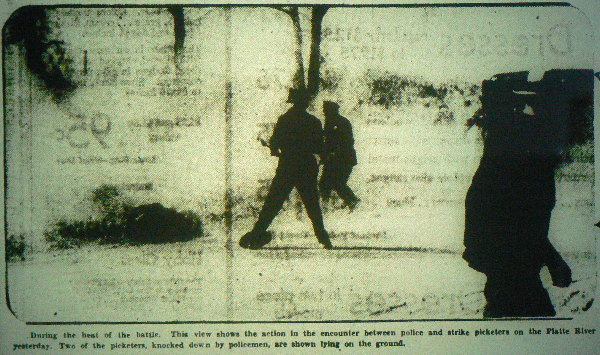
The girl, who was believed by police to have been an imported communist sympathizer, was the spearhead of the rush of demonstrators who attempted to rescue their arrested leader, Gene Corish, 35, of Denver, from the hands of police.

I followed the demonstrators from the time they gathered with the intention of picketing the FERA projects. Police believed they planned to descend on a project at Alameda avenue and Cherry creek. Instead they headed for another at Evans street and the Platte river.

FERA Workers Fight Reds.

There they rushed into a group of FERA workers and sought to take away their tools. The relief workers fought back. But, by the force of superior numbers the demonstrators were winning the spirited battle when police rushed up.

Several picks and shovels had been thrown into the stream.

The police leaped into the midst of the hand to hand fighting. They seized Corish, who appeared to be the leader of the rioters, and dragged him to a patrol wagon.

Instantly the girl leader of the rioters set up a cry of “Don’t let the (here she used an unprintable epithet) have him” and she started toward the patrol wagon swinging a shovel someone had wrenched from a worker.

Others joined the rush. Bricks and clods flew thru the air toward the little band of a dozen husky policemen, outnumbered about 50 to 1 by the rioters.

The patrolmen formed a cordon around the patrol wagon, and retreated slowly toward it, fighting every step of the way, but using only their clubs and fists. They very apparently were seeking to avoid serious injury to anyone.

Officer Felled by Bottle.

Suddenly a beer bottle flew thru the air and struck one of the patrolmen (I learned later he was Carl V. Satt), squarely on the head. Satt dropped like a log.

A rioter stood over him with a shovel in his hands, apparently ready to swing another blow at the unconscious man.

Driven to desperation by this development, police drew their pistols and fired what sounded to me like more than 30 shots.

A rioter dropped, wounded thru the hip. He was Henry Brown, later found to be superficially wounded.

I think Patrolman Marshall Stanton shot him. Stanton told me later he believed this was the case.

I was certain, as I watched from some distance away, that I saw two other rioters drop, but, if others were wounded, they were carried along by their fellows and were not taken to hospitals.

Rapidly the ranks of the demonstrators broke, giving ground before the police fire. Several paused long enough to hurl bricks and rocks such as those which had already injured Sergt. James Pitt and Sergt. Henry Duerkop.

The police made 10 arrests in all.

Thru all the violence, FERA workers sided with police. They appeared determined not to give up their jobs.

INTRO 2: PHOTOGRAPHS
From the Rocky Mountain News, October 31, 1934, page 4


Caption reads: “A group of the “strikers” parading near the Cherry Creek relief project. Only 21 bona fide relief workers in Denver left their jobs yesterday to strike.”


Caption reads: “This view was taken just before police and so-called relief striker started their bloody battle at the Platte River near W. Jewell ave. yesterday. The arrow points to Patrolman C. V. Satt, who was struck in the head by a missile and critically injured. Other patrolmen are shown on duty around the patrol wagon, as one of the picket leaders is being placed inside.”


Caption reads: “During the heat of the battle. This view shows the action in the encounter between police and strike picketers on the Platte River yesterday. Two of the picketers, knocked down by policemen, are shown lying on the ground.”


Caption reads: “After the smoke of battle. This shows the battleground where strikers and police met yesterday just after all the action had ceased. Two strikers are shown down on the ground and beyond them is Patrolman C. V. Satt, who was perhaps fatally injured when struck by missiles of the strikers. He is prone on the ground but has pulled out his revolver.”


Caption reads: “R. W. Rankin, a relief supervisor, shown waiting for the ambulance after he had been struck over the head by a patrolman following a private fight at the strike demonstration held yesterday at Civic Center. He suffered a severe scalp wound.”


Caption reads: Henry W. Brown, who was shot in the hip during the encounter between the demonstrators and police on the Platte River yesterday. He is shown here as he lay on a cot in county jail after his wound had been treated in Colorado General Hospital.”

INTRO 3: NEWS HEADLINES

CS Gazette, (AP) Oct 29, 1934:
Relief Strikers March on Capitol – Governor Refuses to Talk to Crowd When One ‘Red’ Won’t Keep Still

Rocky Mountain News, Oct 30
‘Relief Strikers’ March On Capitol, make Demands – Threaten Violence at Projects Today If Officials Do Not Grant All They Seek
Will Rogers – Says Bread Line Is Encouraged by Deficit of New York Stock Exchange
Young Folk Lambast Older Generation For Getting World Into Present Mess – No Punches Pulled as Boys and Girls Have Their Say

CS Evening Telegraph, Oct 30,
RELIEF RIOTERS BATTLE DENVER POLICE
Agitators Shot and Four Officers Injured as Mob Tries to Foment Strike – Blazing Guns Disperse Communist Led Crowd, Radio Car and Gas Station Burned, Score of Attackers Hurt, FERA Workers Refuse to Walk Out
Girl Radical Leads Mob in Denver Riot – FERA Project Pickets Spurred Into Battle by Woman Believed Imported Agitator

RMN, Oct 31
POLICE ARMY WITH MACHINE GUNS WILL GUARD FERA WORKERS TODAY
Force of 300 Officers Will Use Bullets and Tear Gas If Necessary to Protect Relief Workers From Molestation – Agitators Threaten Violence After Yesterday’s Bloody Clash
Witness Says Police Fired When Driven Back to Car – Gives Graphic Account of Rush by Screaming Men and Women Who Volleyed Rocks at Officers

CS Gazette, Oct 31,
RESUMPTION OF VIOLENCE IN DENVER STRIKE FEARED
City Tense After Bloody Riot on South Platte – Barricade Erected at Table Mountain, to Be Visited Today by Agitators

CS Evening Telegraph, Oct 31,
DENVER QUIET BUT TENSE AFTER RIOTING
Mob Gathers But Fails to Carry Out Threat to March on projects – Police Precautions Against Further Outbreaks Nip New Demonstrations; Report Agitators on Way to Foment Trouble in El Paso County – Mob Gathers in Englewood but Fails to Carry Out Threat to March Against FERA Projects
Don’t Expect Any Agitator Trouble on C. S. Relief Jobs p1, c7
Mountain at Golden Resembles Fortified Castle as Workers Prepare to Resist Strike Mob p1, c7

New York Times, Oct 31
‘Hunger Marchers’ Routed at Albany; Rioting in Denver – Many Injured in Denver – Relief Strikers Attempt to halt Federal Project–One Shot Fighting Police, p1, c1

RMN, Nov 1
Relief Strike Riots Subside as Police Act – Agitators Fail to Start Anything at Various FERA Projects
Pretty Girl From Illinois Finds Denver Police Nice p4, c1

CSET, Nov 1
Roundup Ends Denver Relief Strike Threat – With Agitators Arrested, Leaderless Mob’s Spirit Broken; Plot to Spread Disorder in State Fails
U.C.L.A. Branded Communist Hotbed

RMN, Nov 2
File Charges Today Naming 15 as Rioters – Two of Group Face Fine of $1,000 and Year in Jail If Acts Are Proved, p14
College Students Battle Radicalism – Form Vigilante Committee at Coast School

How to testify at a grand jury: David House “invokes” on Bradley Manning, Julian Assange, & taking illegal notes

Bradley Manning supporter David House was called last year before the grand jury preparing charges against Julian Assange, in the event Assange is successfully remanded to Sweden. Despite being told a transcript was forbidden, House took notes which have now found themselves (A)nonymously online, reproduced here with David House’s refrain in bold. Here’s Grand Jury, a comedy:  

1. Record of proceedings
2. As recorded by David House
3. Grand Jury, Alexandria VA
4. 15 June 2011, 4:10pm to 5pm
5.  
6. Inside the Grand Jury:
7. DOJ Counterespionage Section: Attorney Patrick Murphy *
8. DOJ Counterespionage Section: Attorney Deborah Curtis *
9. Eastern District of Virginia: AUSA Bob Wiechering
10. Eastern District of Virginia: AUSA Tracy McCormick
11. Eastern District of Virginia: AUSA Karen Dunn
12. Unspecified number of Grand Jurors
13. Court Steganographer
14. David House
15.  
16. Directly outside the Grand Jury:
17. Mike Condon, FBI Agent from Washington, D.C. field office
18. James Farmer, Chief of Anti-Terrorism and National Security Unit at the U.S. Attorney’s Office in D. Mass
19. Peter Krupp, David House’s attorney
20.  
21.  
22. Record begins: 4:10pm
23. [David House is sworn in and informed of his rights]
24. Patrick Murphy: Would you please state your full name for the record?
25. David House: My name is David House.
26. PM: Did you meet Bradley Manning in January 2010?
27. DH: On the advice of counsel, I invoke my right to remain silent under the Fifth Amendment to the United States Constitution. I am concerned that this grand jury is seeking information designed to infringe or chill my associational privacy, and that of others, guaranteed by the First Amendment to the United States Constitution, and that it is using information obtained without a search warrant in violation of the Fourth Amendment to the United States Constitution. I define the preceding statement as “invoke”, and when I say “I invoke” in the future I am referring to this statement.
28. Deborah Curtis: Exhibit 1-A?
29. PM: Mr. House, please direct your attention to the screen behind you, exhibit 1-A.
30. DC: I can’t make it bigger.
31. PM: Try… here, remove that bar on the side.
32. DC: That didn’t work.
33. DH: Do you guys need help?
34. DC: We just need to make it bigger. Can everyone see this okay?
35. PM: Ok… we’re going to continue.
36.  
37. [A still image from the Frontline PBS special is displayed on the screen. Four figures are standing in front of the BUILDS logo, one figure has her back turned.]
38.  
39. PM: Mr. House, can you identify the man on the right?
40. DH: I invoke.
41. PM: Can you identify the man standing second from right?
42. DH: I invoke.
43. PM: Ok, can you identify the person with bright-colored hair, standing here?
44. DH: I invoke.
45. PM: Are we to believe that identifying that individual would somehow incriminate you?
46. DH: On the advice of counsel, I invoke my right to remain silent under the Fifth Amendment to the United States Constitution. I am concerned that this grand jury is seeking information designed to infringe or chill my associational privacy, and that of others, guaranteed by the First Amendment to the United States Constitution, and that it is using information obtained without a search warrant in violation of the Fourth Amendment to the United States Constitution.
47. PM: Ok, can you identify the man on the left?
48. PM: I would like to observe for the record that Mr. House is taking notes.
49. DH: As to the previous question, I invoke.
50. PM: Why are you taking notes?
51. DH: Invoke.
52. Bob Wiechering: I’d like to recommend, at this point, that we take a break and talk to your counsel.
53.  
54. [AUSAs and House leave the grand jury]
55. [Peter Krupp, House’s attorney, asserts House’s right to invoke]
56. [AUSAs and House return to the grand jury]
57.  
58. PM: What is your birthdate?
59. DH: March 14, 1987
60. PM: Where do you live?
61. DH: Can you restate the question?
62. PM: What is your address?
63. DH: I invoke.
64. PM: What is your current occupation?
65. DH: I invoke.
66. PM: Were you a senior in computer science at Boston University in January 2010?
67. DH: I invoke.
68. PM: Isn’t it true that you told PBS Frontline that you were a senior at Boston University in January 2010?
69. DH: I invoke.
70. PM: Do you know what a hackerspace is?
71. DH: I invoke.
72. PM: Do you know what BUILDS is, the acronym?
73. DH: I invoke.
74. Bob Wiechering: Mr. House, I notice you are taking notes. Attempting to create your own transcript is a violation of rule 6(e) of this grand jury. We have brought this to the attention of your counsel, and although he feels differently on the matter, we assert that you must stop taking notes at this time.
75. DH: Let me consult with my attorney.
76. [House leaves the grand jury room and returns one minute later]
77. DH: My lawyer asks that you refer all questions about notes to him.
78. BW: Let’s continue.
79. PM: Mr. House, are you involved with the Bradley Manning Support Network?
80. DH: I invoke.
81. PM: Did you respond in the affirmative when asked by the FBI if you had heard of known WikiLeaks associate Jacob Appelbaum?
82. PM: I would like to state for the record that Mr. House is not answering the question and is instead taking notes.
83. DH: I invoke.
84. PM: Do you intend to answer any of my questions, aside from your date of birth and your name?
85. DH: I invoke.
86. PM: Is that because of the phalanx of attorneys present here today?
87. Court Stenographer: I’m sorry, the what of attorneys?
88. PM: Phalanx… the phalanx of attorneys.
89. DH: As to the phalanx of attorneys, I invoke.
90. PM: At this time, I will let Deborah Curtis ask a few questions.
91. DC: Mr. House, have you ever been to the Oxford Spa restaurant in Cambridge, MA?
92. DH: Allow me to consult with my attorney.
93. [House leaves the grand jury and returns one minute later.]
94. DH: As to the previous question, I invoke.
95. DC: You admitted to federal agents in Boston that you had met Bradley Manning in January 2010, is that correct?
96. DH: I invoke.
97. DC: Isn’t it true that you spent the night of January 27 2010 with Daniel Clark and Bradley Manning?
98. DH: Can you repeat the question?
99. DC: Isn’t it true that you spent the night of January 27 2010 with Daniel Clark and Bradley Manning?
100. DH: One more time.
101. DC: Isn’t it true that you spent the night of January 27 2010 with Daniel Clark and Bradley Manning?
102. PM: He’s writing it down.
103. DC: Are you getting this, are you writing it all down?
104. DH: Was the last question a question to be answered?
105. DC: Yes.
106. DH: I invoke.
107. DC: And the question before?
108. DH: I also invoke.
109. DC: Where did Danny Clark have breakfast on the morning of January 28, 2010?
110. DH: Allow me to consult with my attorney.
111. [House leaves the grand jury and returns one minute later.]
112. DH: As to the previous question, I invoke.
113. DC: Do you intend to answer any questions about Daniel Clark?
114. DH: Invoke.
115. DC: Do you intend to answer any questions about Bradley Manning?
116. DH: [Writing] Could you please repeat the question?
117. DC: Do you intend to answer any questions about Jacob Appelbaum?
118. DH: I invoke.
119. DC: At this time, we’d like to stop the proceedings. You are free to leave.

Occupy was fooled by undocumented Obama Dream Activists, so were you

DENVER- Who wouldn’t want to stand in solidarity with undocumented immigrants willing to stage sit-ins in Obama campaign headquarters across the country, risking arrest and certain deportation –we thought– to demand that President Obama hear their plea? Yeah, the Dream Act is an economic draft to ensnare illegal aliens, but these “Dream Activists” spoke mainly of schooling opportunities and the prospect of legal jobs thereafter. So they locked themselves in, began hunger strikes, and left support crews outside to hold press conferences, until yesterday, when Obama announced he would cease deportations! A win-win for Obama and his Hispanic constituents. On cue, Bogeyman Romney vowed he’d reverse that order. Did you see that coming? You might have, if you’d noticed that these campaign HQ occupiers had decorated their handmade signs with Obama logos. That, and the DPD never ever rattled its sabers. You try to hold a sit-in and you’ll be cited for trespass before you sit down. Denver Police were never called, and we figured it was because the Obama campaign didn’t dare upset the Latino community, like they do environmentalists, labor, feminists, social justice…

Collaborators, rats and pigs

I found this unsigned flier in Denver, a collage of the American eagle, globe in mouth, and Stars & Stripes over US misdeeds, clockwise from top left: race lynching, branding slaves, blindfolded Iraqi detainees, combatant corpse desecration, Hiroshima, torture of Viet Cong, My Lai, Columbus’ mass burning of Taíno Indians, Filipino insurgents executed in trenches, the gruesome trophy pic, etc, framing this succinct condemnation: “The US military, intelligence operatives, and police are traitors to humanity. Those who work with them, those who friend them, and those who sleep with them are collaborators. They are rats and pigs.”