KOAA thanks Waldo Canyon firefighters but doesn’t think their dangerous work merits healthcare benefits, apparently

Monday July 2 community thank-you to Waldo Canyon firefighters held in Pleasant Valley neighborhood of Colorado Springs
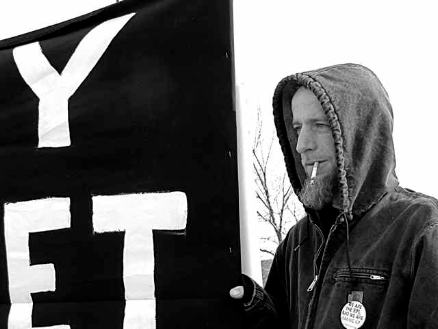
COLORADO SPRINGS, Colo.- Funny story. KOAA was covering the community thank you given to the firefighters returning from the Waldo Canyon Fire last night. Members of Occupy Colorado Springs joined the crowd with signs calling attention to the fact that many of the firefighters don’t have healthcare benefits. The Channel 5 reporter instructed his cameraman to avoid filming those signs, including one which read “WE SUPPORT THE FIREFIGHTER’S UNION” which incidentally, got a lot of thumbs up from the passing fire crews. Local TV crews will extend adulation for the wildfire-fighting heroes, but their conservatism has limits. Don’t you think the rigors of firefighting, and exposure to unknowably toxic smoke, merits health coverage? It’s alright to show adulating communities thanking the heroic fire crews but not caring about them.

War is the neo millennium Jobs Bill

To laud this tragic now banality, Fort Carson has a job fair today, but those most suffering under the neo liberal economy need not apply. To attend the event held on post, potential job applicants for the military industrial sector, need what voter disenfranchisement projects push for election restrictions, a federal or state ID, vehicle registration and proof of insurance, for entry level non-union contractor labor that will barely support that.

Why I Occupy Walmart

MY ENDGAME in occupying Walmart is to rally union members to the Occupy Movement. Union members, not unions. Taking the fight straight to Walmart, one of the most despicable, exploitative despoilers of the world’s people and economy is something the big unions should have been doing thirty years ago. Maybe their members will finally see that they’ve been sold up the river by their supposed representatives. That neither local nor national unions are expressing solidarity with us on the sidewalks of these super centers is proof that the only wages and working conditions they’ve been protecting are their own.

PICS: Occupy Walmart 12/12 First of our Twelve Walmart Days of Christmas

OCCUPIED COLORADO SPRINGS- Occupy CSprings occupied the Walmart on 8TH STREET for our first of 12 Walmart Days of Christmas. Slogans you can use for your own superstore boycott: WALMART: ROLLING BACK UNION GAINS, ALWAYSWALMART KILLS MOM & POPSSHOP LOCAL, NOT WALMART and HEALTHCARE FOR CHRISTMAS. Up next: POWERS BLVD!
More posters: WALMART SUCKS THE LIFE OUT OF OUR TOWNWALMART: BAD JOBS, BAD KARMAWALMART: LOW WAGES, NO HEALTH CAREDON’T SUPPORT SLAVE LABORBOYCOTT WALMART: COMPANY STORE OF THE GLOBAL PLANTATION.


Photos by Roger, Robin, Loring and OCS.

George Who?

This is a paper from some time ago, well prior to the advent of Occupy events. Henry George wrote from a sensibility one rarely finds expressed so explicitly today. The modern reader should note that Christian underpinnings in no way disrupt either the reasoned logic or the passionate humanity behind George’s arguments. Follow the links! Many Occupiers have promoted education, the deeper aspects of which are rarely available in 3 page tracts….

For Eric Stephenson
16 February 2009

George Who?

It seems peculiar that in 2009 no one has heard of Henry George, if only for the fact that during his prime a hundred years past his was easily one of the most recognizable names on Earth. Just a journalist really, George’s hardscrabble upbringing, his early experience in the business world, and maybe just a little OCD inspired him to craft an entirely new approach to economic theory. Its publication very quickly garnered him international acclaim, respect, and supportive friendship from many of the greatest figures of his day. Many, encountering his work for the first time today, would no doubt label him a Commie, particularly given that George’s work followed Marx and Engels’ by three decades. This misinterprets George. His thinking split the difference between Adam Smith and the Communist theorists in many ways, sharing common ground with both camps but firmly establishing his own territory. His work deserves a second reading.

George was born in Philadelphia, September, 1839, to a family headed by a hardworking but low-budget printer. By providing the Church cut-rate printing services, George’s devout father enabled Henry to garner a relatively high-standard primary education from the Episcopal Academy. He left home after high-school seeking his own way, and after a brief period of adventuring, found himself in San Francisco where he joined the Printer’s Union, following in his father’s footsteps after all.

George lived a poor man’s life–same as any tradesman at the height of the Robber Barons’ power–until an editor at the San Francisco Times came across a piece he had written and left lying around. He accepted an offered staff writing position at $50 a week, which seemed a princely amount compared with his father’s $800 a year. He traveled quite a bit for the Times, and in 1868 on assignment in New York City first encountered the squalid conditions surrounding and adjoining vaunted islands of luxury and power that would inform and undergird his writing for the rest of his life.

Having gained considerable respect as a newsman and a fair amount of seed-money, George and a partner, William Hinton, established the San Francisco Evening Post in 1871. George unabashedly used the paper as a human rights platform until 1877, when, some say, powerful railroad interests against whom he had written since his SF Times days shut the Evening Post down. Quickly landing a government post through highly-placed friendships he had developed, he used the leisure time it afforded to produce his magnum opus, Progress and Poverty, and published it in 1879. George moved to New York in 1880 and promptly left for England and Ireland, touring there to support Irish land support. By the time he returned, his life had changed forever. Progress and Poverty had made him a celebrity (de Mille 1-152).

George’s political economy laid out in his roughly 600 page book begins with his assertion that Smith’s approach established private land ownership as the foundation of economic and social structure, referring often to “the sacred rights of private property” (Smith, par. 1.11.79). So far few would argue, but George figured this skewed, and brazenly wrote that, “[t]he great cause of inequality in the distribution of wealth is inequality in the ownership of land. The ownership of land is the great fundamental fact which ultimately determines the intellectual and moral condition of a people….[I]t necessarily follows that the only remedy for the unjust distribution of wealth is in making land common property” (295, 391). He argued that as a foundational natural resource there is no basis for sequestering land in private hands. He proposed to hold land in common and allot it to users for as long as they needed, for whatever production they could derive from it, and the holder would pay tax, (rent), on its assessed value until relinquished. The holder and any capital or labor involved would keep whatever profit came from the working of the land, and the public would base taxation only upon the land itself. Note that this negates both income and capital gains taxes. (During George’s prominence, no federal income tax existed in the United States). George insisted the extensive system described philosophically in Progress and Poverty, and rather more technically in The Science of Political Economy, would adequately supply the government’s fiscal needs without additional taxes while simultaneously encouraging entrepreneurship and curtailing development of a landed class.

Marx, whose seminal works came before George, but close enough that both wrote from the surrounding milieu of the Industrial Revolution, addressed similar problems. He and those following took the matter to a deeper extreme, however, allowing for no private ownership of either property or capital. Marx expressed a well known hostility to capital. The familiar Communist adage, “Property is Theft,” represents a drastic condensation from Marx’s arguments that labor always seems to wind up on the short end of dealings with those holding either land or capital (Marx, chap. 6, par.2). Like George, Marx chafed at the inequities this arrangement produced, especially with the exacerbations of capital lording over labor, which industrial development had completely disassociated from the land producing the wealth. “The means of production and of exchange, on whose foundation the bourgeoisie built itself up,” says Marx, “were generated in feudal society,” (Marx, and Engels 1848, chap. 1, par. 21).The Communists implemented a far more radical seizure of all private property, including both land and capital, consolidating it under a central federal power (chap. 2, par. 75). Contrarily, George felt that capital deserved its due, and sought to rectify the problems he saw by implementation of a more enlightened “single tax.”

A few germane observations present themselves for discussion. Smith, George, and Marx all expressed notions we might call idealist—Utopian even. Each sought to solve timeless conundrums with an incredibly optimistic approach. Jaded 21st century readers might consider any one of them painfully naive, in retrospect. None of them had the advantage of the hindsight we enjoy, however, and fruitlessly denying the problems each pointed out in his broader work does not help at all. Smith wrote when, fresh from the collapse of European Feudalism, land served as the key to wealth of any kind, and still viewed as an unlimited resource for the grabbing. The vast inequities the Industrial Revolution had abruptly produced vexed George and the Communists. None of these could have predicted today’s technological, information based economies, with the problems they addressed dispersed over the entire planet. Today, the rate of separation between the “Haves” and the “Have Nots” poises to exceed the conditions affecting either set of writers.
George did not design a perfect system. Neither, as amply demonstrated by both history and current events, did Smith or Marx. Henry George thoughtfully and humanely addressed a terribly intractable matter in human affairs, however, and deliberately allowed for future thinkers to expand his work. His work deserves contemplation as we forge into a new century fraught with uncertainties. Our present crisis may help encourage just that.

Works Cited

De Mille, Anna George. Henry George: Citizen of the World. Chapel Hill: University of North Carolina Press, 1950.
George, Henry. Progress and Poverty: An Inquiry into the Cause of Industrial Depressions and of Want with Increase of Wealth: The Remedy. 1898. New York, New York: The Robert Shalkenbach Foundation, 1979. 17 February 2009

Marx, Karl. Wage-Labor Capital. 1849. 17 February 2009

Marx, K. and Engels, F. Manifesto of the Communist Party. 1848. 17 February 2009

Smith, Adam. An Inquiry into the Nature and Causes of the Wealth of Nations. 1776. Ed. Edwin Cannan. 5th ed. London: Methuen & Co., Ltd., 1904. 17 February 2009

United States Department of the Treasury. Fact Sheets: Taxes. 17 February 2009 (This link is obsolete).

CSPD acquires urban assault vehicle. What line have activist informants been feeding them?

COLO. SPRINGS- This image just in from a reconnoiter of the downtown police garage. The CSPD has mobilized an urban assault vehicle, for, I don’t know what, keeping up with the Jones’s? Ever since Springs police decided that the Pikes Peak Justice & Peace Commission held gravitational pull over all political dissent in El Paso County, the CSPD holds weekly briefings with a PPJPC staffer, and of late they’ve added morning tete-a-tetes with an OCCUPY delegate from Acacia Park. What are those “representatives” telling them? That law enforcement needs bigger ammo? Would now be the time to suggest we call organizers who grease the mechanisms of oppression, however ill-conceived their intention, by a more appropriate term, RATS?

I can understand neighbors with differing opinions about whether cops need more helicopters, or K-9 intimidation duos, but how ever does the ordinary citizen rationalize that their police department needs riot equipment? To protect us from ourselves? We found out a couple years ago that the CSPD has a busload of their own people-suppression gear. Now we have an armored personnel carrier for cops? Because they can’t drag defenseless nonviolent protesters across the pavement without mechanization? The Acacia Park protesters have been happy to seek permits to set up their literature canopies and have organized community service cleanup actions to put a shine on their model compliance, meanwhile the police are arming up…

EPILOG:
Is this a political cheap shot? Yes. It’s trash talk. No argument. Why and when Colorado Springs took delivery of an armored vehicle is entirely conjecture. Maybe it’s the usual cost-plus profiteering scheme. That’s not really the point. The point is, what intelligence is CSPD getting from their de facto adversaries?

The sight of a new armored vehicle to use against civilians should be a major embarrassment to someone who considers themselves tasked with offering assurances to the city that all local protest will be inoffensive and dismissible.

The CSPD needs armor WHY? Not even crime here has ever escalated to a level which would require an armored assault by the police.

I was content to leave it at that, but oh well, some people need it explained.

It is not conceivable that anything public citizen advisers might have whispered at regular meetups would have prompted the CSPD to armor up. But what are the collaborators conferring with police about? We know the why, for a seat at the table, so what goals are they selling out?

It would be false praise to suggest the PPJPC had a role in bringing the armored UAV to town. But the PPJPC cannot escape responsibility for eroding the role and breadth of activism in this city. In particular for playing informant to the CSPD, for being the conduit of intimidation which the police want to push the other way, and for employing an executive director who has a personal resolve against confrontational activism. You won’t see him at protests, organizing protests, or promoting protests. You’ll see him keeping his meetings with other respectable nonprofit heads, and his appointments with the CSPD, and fielding their calls when they catch wind of other dissenters. No surprise that a once energetic PPJPC is now but a social justice knitting circle of communion takers.

Of course it’s worse, because Colorado Springs social circles are small enough that the CSPD only needs one snitch. Not that any illegal activities have been planned, certainly no violence, but the CSPD wants to keep tabs, and the PPJPC is happy enough to believe that if you have nothing to hide, then keeping city authorities informed shouldn’t threaten you.

For those who need this spelled out: civil disobedience is by definition illegal, and benefits incalculably from putting authorities on the spot. Giving them your game plan in exchange for not upsetting the apple cart does not favor those who are protesting the apple cart.

So what is whispered in these regular meetings with the police? Let’s imagine only the most innocent possibilities. Who’s new to town, who’s jumping on this national campaign, who’s retreating from the fallout from that recent action, what’s the scuttlebutt, what’s to these rumors, and what are CSPD’s concerns. It makes me nearly sick to think about. The relationship must be as with a lobbyist. The collaborator is enjoined to take responsibility for keeping the peace. Any surprises and it’s their rapport that suffers. Police embarrassed on the street? No cookie for you.

Occupy Colorado Springs organizers have fallen for the same bait, a quasi permitted stay in Acacia Park in exchange for daily updates with the police. A special relationship is how I believe it’s being billed. You’d probably call it a morning coffee with your boss, with info flowing his way, instructions coming yours.

If you are hoping to reform the system, thinking you have allies among the blimp-necks sworn to uphold it TO THE LETTER is probably wrongheaded.

The ugly arrangement at the PPJPC didn’t begin with Executive Director Steve Saint. The PPJPC sat down in 2003 after an antiwar rally was teargassed, to hash out a code of conduct agreement with the CSPD. Membership balked at such a prospect and the project was abandoned, but left the city with a paper trail with which to claim it believed it had cemented a deal and would consider further trouble to be a breach of the agreement. This came to light after the St Patrick’s Day Parade fiasco of 2007. An event which provoked the larges upsurge in participation in the PPJPC but rapidly dropped off with its failure to capitalize on the visibility.

I know a little about that because I was chairman in that aftermath, fighting an insubordinate staff who only slowly revealed their ulterior motives and stacked the board against me. The rationale? Public protests hurt alliances with other non profits. Being anti-military preempted cooperation with almost all the other social causes in an army town.

It’s of course a long story, but in the end you’ve got a career staff member determined to jettison antiwar efforts for the comfort of taking on the environment, poverty, and whatever causes get a Democratic president elected. Steve Saint very visibly put his name to the letter which invited Van Jones to come speak at Colorado College. Van Jones is as corporate a messenger as Barack Obama, with the same empty promises. This time instead of Hope, he’s selling Green. And it’s just as easy a sugar pill to swallow.

Did you know some disgruntled Dems have set about to form a Green Party? Guess who’s put himself at the center of scuttling that effort by neutering any grassroots platform? I take no pleasure in delivering this punch line.

Of course more than anything the antiwar movement suffered with Obama’s election. Now the hopeful are disillusioned and cynical, and who is the little PPJPC to revive that crowd? But the PPJPC backed Obama, stood in line to see him while their dissenters embarrassed them by protesting outside. Dissenters who ultimately had the police called on them for trying to have a meeting in front of the PPJPC office.

The PPJPC is fully co-opted, fine, but that the organization plays the role of informant to the police is untenable. A historically, unequivocally, uninterruptedly nonviolent activist community provides no grounds for the city police to escalate their crowd-control technologies, and it certainly doesn’t merit full-time paid informants trying to snitch on them.

DPD used riot gear in dead of night to arrest camp singing national anthem


DENVER- When Occupy Denver threatens to make a difference is when authorities have to shut it down. The sweep tonight is a good sign.
I’m not worried about Occupy Denver. I have a tent booked for this weekend, the police attack tonight will just raise occupancy rate is all. Now I’ll have to move up my check-in date to be assured a space. Colorado Police have already lost this engagement. The mere threat of arrest tonight only enlarged the protest, it didn’t frighten it off. Middle of the night arrests and tent-clearing are of little consequence. At height of the crowd strength, the police backed down. Tents will go up everywhere tomorrow. There’s not enough riot gear in the US to occupy the multitude of protest occupations. Denver state capitol here we come!

Gov Hickenlooper’s use of State Troopers to clear the capitol lawn in the middle of night probably preempted actions by other Occupy camps to draw police resources away. Next time how can they distract the popo legally? Follow Occupy Denver’s lead. Apparently peaceful, nonviolent free speech is enough to bring clampdown.

GA earlier in evening reaffirmed that movement is not about having messages heard, to be ignored per usual, but SHUTTING DOWN THE SYSTEM. It’s is not about speaking truth to power. Power already knows the truth. What it doesn’t know is extent of peoples’ determination. Denver GA wasn’t won over by voices content to keep occupation as daily sidewalk protests, lasting into winter, to usual no effect. You want protracted Wall Street protest? Antiwar vigils have been ongoing for 10 years…

Tents ARE key issue for all Occupy protests. What is your right to peaceably assemble if you can’t protect yourself from cold? Does 1st Amendment only apply in summer, during the day, and when authorities aren’t too bothered by your dissent? Thinking this movement is about getting your issues heard is to pretend #OccupyWallStreet means “Voice Off to Wall Street.” Nope. Tents are needed in Denver, Wall Street and everywhere because this movement needs to stop the system, not hector it until we lose energy & body temp.

The Denver Post doesn’t have a live camera from their building which overlooks the capitol and Occupy camp. They’re not press, they’re criminals. What they have is nominal, the view above actually, but a low rez surveillance webcam is poor excuse for a media outlet.

Those who think Occupy Denver should have decamped and gone home, are not thinking of the homeless -the fullest victims of Wall Street. Hopefully Occupy members who were praising the Denver Police so warmly in earlier GAs will stick around on sidelines at least to get lesson in police state. Of course all the members who chose to flee DPD intimidation will be welcomed back tomorrow. But voicing their next 2-cents worth? Not so much.

Police are people too, but they have a job to do. By coincidence it’s to stop you from stopping Wall Street. Yep it’s a dilemma. It’s probably no surprise that pro-fracking, pro-coal, pro-war, anti-immigrant, anti-union gov of Colorado would be against Occupy Denver. Issuing a warning of arrests to be made between 11-5am is extortion, threatening unlawful arrest is police state terrorism. Do we accept police raids tonight on Denver and Seattle camps? Protest is civil right, shelter is human right. Police state is fascist wrong.

Something to thing about: Whole crowds can be subdued by one tyrant with a gun, if they remain nonviolent. Numerical superiority counts where people have courage to act. When people say there’s strength in numbers, it’s not if you’re queued obediently to have your eye put out, or shot, or for rigged elections.

Colo. State Troopers are wearing riot gear to face Denver protesters, because post-curfew peaceful campers equals RIOT in Fascist police state.

Iraq & Afghanistan should have thought to require US to withdraw occupation every night. Military bases must violate some vagrancy law.

Cops sympathetic to 99% could have shown their mettle if they’d occupy their sick leave, occupy off-duty, occupy right to refuse unlawful orders. Otherwise state troopers are dumbasses and do not represent Colorado or 99%. I know by regulation cop IQ has max limit, didn’t know cowardice was also requisite.

Occupy Denver was won Oct 14 at 11:01PM, regardless what happens now. Threat of arrest enlarged crowd, didn’t shrink it. The movement’s momentum is proved.

Mid-night raid won’t matter. Cops wouldn’t face crowd at its largest, the Occupy protests have been emboldened past critical mass.

The 40 minute warning given to the protesters is actually the police giving themselves 40 minutes to shit their pants. The OWS juggernaut is on the move and the popo have chosen to side against 99%. Denver officers, you’re marching against the 99%. Occupy Denver will forgive you and blame your bosses. But you’ve probably heard of Anonymous’ motto.

Riot gear worn by Colorado police concedes conceit that Occupy Denver issue is illegal camping. OWS protest camp is free speech and assembly.

Hey Pikes Peak Region lazy bones, #OccupyColoradoSprings is calling!

By lazy bones I don’t mean the average inattentive public, I’m talking about you do-gooders out there trying to right wrongs and effect political change, usually. A growing gatherings of youthful idealists are “occupying” hometowns across the country, focusing on the heart of all problems, corporate greed, and you’re carrying on as if no one’s taken the bull by the horns. They’re inexperienced youth, but they know enough not to get pulled off message by Tea Partiers or partisan Dems. Daily General Assemblies at noon and 7pm refortify them that the movement is about LOVE. Of course they could use your help, opportunity’s knocking, but apparently your regular routine says “do not disturb.”

What makes you any different from the bankers, corporate brigands and their armies of minions, except that you’re not accessories to their crimes? You’re still part of the unactivated mass. Your petitions, your fundraising, your lobbying, your vigils, are as routine as the pushback you get from your adversaries. It’s a dance where your partner always leads, and you get nowhere, every. single. time. The colloquial definition of insanity comes to mind. Finally a youth movement emerges that might tip the scales, and you’re waiting for what? It’s hard not to conclude that actually rocking the boat is too much rocking for you. Faith in Democrats over Republicans, electoral equality, politicians to defy their sponsors, a corporate media open to the truth, justice for ordinary people, wars that will respond to reason, these are delusions. People not even smarter, nor as educated as you have figured this out. What’s happened to you? Tomorrow, WEDNESDAY, OCT 5, the occupiers of Wall Street will be marching with several of New York City’s largest unions, and NY campuses have declared a walk out in solidarity. Are you going to be sitting on the fence?

The system was never broken, it was built this way. #occupywallstreet

The system was never broken, it was built this wayOCCUPIED WALL STREET, NYC– Protests enter their third workweek in Liberty Plaza where the cold has arrived but demonstrators are still prohibited from having shelter. Organized labor is rallying their members to join the occupation on Wednesday, with over a million union workers expected to march in solidarity. If you’re not joining in, are you in the way? Colorado Springs Occupiers in Acacia Park are being joined by Tea Partiers, Ron Paulists, and Zietgeisters. The more the merrier. Remember, target the investment bankers down the block, NOON EVERYDAY. They’re getting cranky.

#OccupyDenver gains speed in spite of counterrevolutionaries hitting brakes

You can point the finger at the angry Anarchists, or at the nonviolence biddies who refuse to mingle, but in the end the Occupy Denver General Assembly emerged unscathed. At issue was the third of the St Paul principles, that activists will not condemn each other over divergent tactics. Of course condemnation provokes… condemnation, so the disruptors succeeded with their divisive interjections, until participants concluded that violence versus nonviolence was a non issue. No one wants or plans violence, why pretend it requires sanction or prohibition? For my part I wonder who says youthful exuberance has anything to learn from voices of experience, experienced at failure? Occupy Together is the common goal. The Denver occupation on the capitol steps is now encamped 24/7 and has organized a permitted demonstration on Saturday Oct 1. Local unions have signed on to march, which mirrors the interest labor is now paying in several dozen cities worldwide, just as Occupy Wall Street garners more and more celebrity and media attention.

Ikea factory workers organized by IAM, who will unionize the retail employees?

Ikea factory workers in Danville, Virginia, voted to unionize. Did they do it alone? No, they joined the International Association of Machinists and Aerospace Workers (Upside for Ikea, its customers can pretend their prefab furniture is tooled by rocket scientists). If Ikea retail employees follow suit, maybe there’s hope for organizing the poverty-wage employees of America’s largest private retailers: Walmart, Target, Home Depot, Lowe’s, so what current retail unions are recruiting their membership to flier offending locations, circulate among the workers and initiate organizing campaigns?

First they came for the Communists, but we don’t like Communists…

First they came for the Communists,?
and I didn’t speak out because I wasn’t a Communist.
Then they came for the Trade Unionists,
?and I didn’t speak out because I wasn’t a Trade Unionist.
Then they came for the Jews,?
and I didn’t speak out because I wasn’t a Jew.
Then they came for me?
and there was no one left to speak out for me.
 
These famous words float an admonition, but isn’t it more likely an adage? They describe the passivity which permitted Hitler’s abuses, but could apply to the ordinary manifestation of totalitarianism. Has human nature yet learned except in hindsight? First they came for the Communists, but we all spoke out, the end. That’s because the big lie is “they.” Try substituting “we” and you see the tsunamic inevitability of mob ethnocentrism. First we came for the Communists, Trade Unionists, and Jews, then him, then her, pure fun until it was me. Oops.

This quote, spoken by German priest Martin Niemoll, features prominently in the US Holocaust Museum in Washington DC. When I saw it I made a note to look up what seemed a strange discrepancy. Curiously in their version, the first group to be targeted are Socialists, not Communists. I say curiously, because I wouldn’t bring it up if I didn’t think the distinction was very unfortunate.

There are several variations of this “poem” because Niemoll repeated it in many sermons and never wrote it down. Asked about it through the years, sometimes he included Jehovah’s Witnesses and gays, and omitted others. Never, however, did he fail to mention Communists, and never were they not the first.

Does it make a difference? If you consider that Communists are the beasts of burden for Socialism, yes. If there’s a boogieman of Capitalism, it’s not the straw man Socialist, it’s the grassroots, proletariat Communist. Socialists are the intellectuals. The far less palatable working class are the Communists. How unfortunate to scrub Niemoll’s warning of its authentic historical detail. The Nazis first came for the Communists.

Bed bugs have made a comeback in the lives of the American poor, lending an uncomfortable new relevance to a folk bedtime salutation. Imagine if we said “Goodnight, don’t let the butterflies bite.” That carries no folk wisdom whatever.

And so how perverse that a traditionally maligned group such as the Jews, firmly ensconcing themselves on Niemoll’s list, decide another unpopular group needn’t the same protection. Doesn’t it defeat the very threat the old priest wanted us to think about? Yes, each group is meant to represent people in general, universality. But it doesn’t work to say bunnies, or amiable characteristics, because then the prospect doesn’t make sense, our youngsters are made vigilant facing a direction from which an attack never comes.

If the exclusion of Communists was a concession to the perennial Red Scare climate of the US capitol, it sadly confirms why Martin Niemoll’s warning won’t find purchase. Even in a Holocaust Museum dedicated to “never again” coming after people based on their social group, some don’t care about looking out for the most vulnerable.

Imagine Niemoll’s dictum as paraphrased for the Hindu castes. Imagine the Brahmins reciting it, leaving off the untouchables.

French craft DIGNITY breaks for Gaza, leads Flotilla II until rest allowed to go

French cabin cruiser La Dignite - Al Karama
UPDATED– In a flurry of conflicting tweets, French Flotilla II member DIGNITE AL KARAMA made for the open sea, beyond the reach of Greek authorities currently detaining the AUDACITY OF HOPE, TAHRIR, LOUISE MICHEL, GUERNICA, JULIANO and others. Reporter Quentin Girard has been communicating the DIGNITY’s progress, its eight activists electing last night to complete their run all the way to Gaza.

The French vessel escaped Greece on a technicality, as a pleasure craft, the Dignity is not confined by the regulations being used to block the larger Flotilla participants. Aboard the Dignity with Girard, are Olivier Besancenot, Julien Rivoire, Omeyyaa Sedic, Nicole Kiil-Nielsen, Annick Coupé, Nabil Ennasr. (Both Coupé and Besancenot are registered on Twitter, but neither has communicated yet.)

Girard’s most recent tweets, translated:

July 5, 3:02
All is well thank you 🙂 but we were in an area where reception was bad.

July 5, 3:15
Despite what we can read, the Dignity is still in international waters. It will be there in one hour.

July 5, 7:41
The passengers of the Dignity have finally come to the decision (only now really) to go to Gaza.

July 5, 8:19
TF1 should attempt to rejoin Dignity and embark.

July 5, 8:43
We’re moving again after a “media” pause on the high seas. 15 hours of sea left before I might go silent. Kisses!

July 5, 12:19
Into the night the DIGNITY continues its advance. In the distance, small lights.

July 5, 13:38
Not really enough beds for everyone, so I sleep under the stars on the upper deck. beautiful sky.

In their original French:

05.07 3:02
tout va bien merci 🙂 mais on était dans un endroit où ça captait mal.

05.07 3:15
Malgré ce qu’on peut lire le Dignité n’est pas encore dans les eaux internationales. Il y sera dans une heure.

05.07 7:41
Les passagers du Dignité viennent de prendre enfin (seulement maintenant vraiment) la décision d’aller jusqu’à Gaza

05.07 8:19
TF1 devrait tenter de rejoindre le Dignité et embarquer dessus

05.07 8:43
On bouge à nouveau après une pause “média” en haute mer. C’est parti pour 15h de mer, où je risque d’être silencieux. Des bises.

05.07 12:19
Dans la nuit le dignité avance toujours. Au loin, des petites lumières.

05.07 13:38
Pas vraiment de couchettes pour tout le monde, donc je dors à la belle étoile, sur le pont supérieur. Beau ciel

Below is the Girard’s July 5 article in the LIBERTE.FR (auto-translated, sorry, until I can review it)

En route to Gaza, “Dignity” is appealing to the media

The French ship of the “freedom flotilla” sailing in international waters off the coast of Greece. The crew decided to go to Gaza.

By QUENTIN GIRARD special envoy on the “Dignity”

16 hours in Greece, somewhere in international waters, on Tuesday afternoon. After much discussion, the Dignity passengers finally made their decision. They will go to Gaza. A bit surreal moment where the middle of the sea, tossed by the waves, they set up banners and make an official statement.

When they left the industrial port of Salamina, Monday morning, they did not really know how far they try to go. There, as they finally arrived in international waters a little to 15 hours – after wet night in a small cove – they say they are determined. “We’re going to Gaza. The French and international community officially announced that they supported us regardless of our decision, “enthuses Julien Rivoire, one of the spokesmen of the campaign. “But to get there, we also need the media, as TV join us to show our work and safety issues,” he continues.

In the distance we see no island, not even a few freighters, these little black spots that usually reassuring scattered throughout the year. “We wanted to show that we could block the Greek blockade, says Julien Rivoire. It once was that we wondered what we were doing then. ”

Return to France? Impossible

That same morning, the discussion was intense as ever on the Dignity. What to do? Return to France? Impossible for them. Go to another country such as Tunisia symbolic to wait, to show that it is a stopover? Why not, it’s better, they say. But no. The only viable solution they think is necessary. Go to Gaza. “You have the dignity to the end represents French and international committees,” argues Olivier Besancenot.

“The important thing that determines the political feasibility, technical feasibility, must be as representative as possible and supported,” Nabil Esnari continues, President of the Association of Muslims in France. “We do not want to be seen as Islamic-leftist Khmer-green-act in our corner,” says the MP-Europe Ecology Nicole Kiil-Nielsen.

“My preference would be to go to Gaza without delay,” takes on Olivier Besancenot position as others. “Our protection is proof that we exist, we continue to move forward. We can not afford to become a ghost ship. ”

There remains the question of technical means. The Dignity is a small yacht of 15 meters long, categorized craft. It was originally one of the smaller boats in the fleet. He has no self to go off the ridge to Gaza. It would necessarily need to be refueled and water en route. Hence the difficulty that there will in the coming hours to coordinate the political ambitions and technical means.

A small creek, goats, and … Sea

But they want confident. The twelve passengers (1) are refreshed by their two days at sea after a week of pitfalls in Athens. Although the coup, the Greek landscapes provide a particular coloration to the adventure. In the capital locked up in meeting rooms to multiply the points and plan protests, the mood was serious and solemn. Not even have time to visit the Acropolis.
There hard to escape the Greek islands. On the night of Monday and Tuesday, the Dignity was anchored in a cove of a small island. In the morning, passengers were woken up by goats with bells tinkle merrily. A shepherd ran along the cliff, the whoop, some small white houses with blue shutters, of steep cliffs, the water so beautiful … “In the morning, you go through three stages,” said Olivier Besancenot. “First you wake up, you do not know where you are, then you look around you and you say,” oh yes, it’s beautiful. ” And just after you wonder what’s next meeting, what is the plan that will be put in place. ”

The Plan: Gaza, having embarked with TVs. Maybe he will change in the coming hours. Meanwhile, the Dignity vogue. Engine noise makes deaf. The smell of fuel oil a little drunk. In front, nothing. The sea, just the sea.

(1) On board were three crew members, eight activists – Olivier Besancenot addition there are Nicole Kiil-Nielsen, MP, Europe-ecology, Annick Coupe, spokesman for the union Solidarity trade union, or Nabil Ennasr, President the Collective of Muslims in France – and a journalist, the author of these lines.

The earlier July 4 Liberte.fr article:

On board the “Dignity”, en route to Gaza

A French ship with a few activists on board, including Olivier Besancenot and Annick Coupé, eventually left Athens and headed to Gaza despite the obstacles. The “flotilla to Gaza” is reduced to its simplest expression. The story of our special correspondent on the deck of “Dignity.”

By QUENTIN GIRARD special envoy on the “Dignity”

“The pins in the plastic, it will not be possible,” said Olivier Besancenot, in full session yourself. 11 hours on Monday, in a small Greek port. The Dignity Al Kamara, one of two ships of the French committee for Gaza, left at dawn the creek near the industrial town of Salamina, where he had hidden for three days. In another cove where he made a first step, the passengers – including Besancenot, so – try to install the satellite antenna to communicate with the outside world.

3 o’clock this morning, Julien Rivoire, a member of the NPA and a spokesman for the campaign called “Wake the captain, we’re back.” Between them and the small annex that links with the boat, watchdogs of the port or adjacent businesses. They bark violently at night. They fail to wake the whole neighborhood. Tunisian Omeyyaa Sedic and Julien Rivoire, equipped with the latest load required, can not pass. Latest in a series of tragicomic events that marked the week of the fleet. “We’re not James Bond, it is OSS 117” is trying to be amused Julien Rivoire finally climbing on Dignity.

Plaisance

Sunday evening, the decision was made. It was long in coming, interspersed with calls to Iniohos Hotel where the rest of the delegation. A consensus is emerging: the Dignity attempt to leave no matter what. This small yacht 13 meters long, having left France ten days ago, has a status of “craft” and is theoretically not subject to the same prohibition to start than other boats of the delegation.

On Friday, an American ship tried starting one. Saturday, the captain was imprisoned. It could several years in prison for having left without permission. After several announcements bullies, to show their determination and their will as strong as ever to go to Gaza to bring humanitarian assistance, the committees have defected last one after the other. Masters of Spanish ships and Canada have announced that they did not want to take as many risks as they were sure they could not be more than thirty meters. The former president of Greenpeace France, Alain Connan, captain of the main French ship Louise Michel, after long hesitation, agreed with this position, some attracted by the Greek jails.

He went to ask permission to start at the harbor. Refused of course. The passengers were then organized a demonstration on the deck of Louise Michel. They simulated a departure. They should all file a complaint for obstruction of freedom of movement in the afternoon.

Parano

5 o’clock this morning, the Dignity springs. The sun is not up yet. Some cargo ships moving in the distance. Around him, two or three carcasses that rust for too many years, the ferry may be ready to leave but which seem, at dawn, desperate still. Twelve boats, twenty-two different nationalities and several hundred passengers announced, the fleet is now reduced to three crew members, eight militants – Olivier Besancenot addition there are Nicole Kiil-Nielsen, MP europe-ecology, Annick Coupe, spokesman for the union Solidarity trade union, or Nabil Ennasr, president of the Collective of Muslims in France – and a journalist, the author of these lines.

The Dignity enters the channel. In the distance, lights, shadows indistinct, but no coastguard. Surprise among the passengers. They believed they were identified and a small star suddenly arise between two cargo ships to stop them. For two days, each gull, each fishing boat, each jet-ski with the big guys who spend every man piss in the night under the white lights of the port is an opportunity when paranoid.

To starboard there. A port, nothing. In the distance behind, already, the lights of Athens. The sun appears between two hills. After a week of failure or disruption, and the blows of fate have joined forces to keep them in port, for the first time the French committee actually managed something in Greece. They feel like defeat stress, even if they are tired, even if the tension is palpable at times between them, although discussions and waiting endlessly sometimes not.

Determination

Of course, they know that this little boat is not much. That Israel, obviously, has won the game this time and that the only issue that remains is to show that they have tried everything, it’s not a “fucking failure”, as stated Besancenot. Certainly they know that it is unlikely to go to Gaza, especially alone. Unless a Greek ship to join them. The committee led by Vengelis Pissias announced that they had a new, third, a “surprise” that the authorities do not know. But they have promised so many things since the beginning of last week …

The Dignity vogue. It will reach international waters in a few hours if not arrested by the Coast Guard before. There, passengers will make official statements. They expressed their determination against the blockade of Gaza and denounced the attitude of the international community against them. They then announce the next steps. If there is a sequel.

June 25 Le Monde article:

Gaza flotilla II imminent departure

A year after the arrest of a murderer off the first convoy of Israel, a new international fleet prepares to sail to Gaza to try to break the blockade imposed on the Palestinian enclave. Unlike last year, two French ships involved in the operation.

The first of these ships, the “Louise Michel”, is currently in Greece. The second, “Dignity-Al Karama” sailed this morning from the Ile-Rousse in Corsica. I get on one of them and try to deliver on this blog Monde.fr the story of the expedition.

A campaign launched in October 2010

This project, called “A French boat to Gaza” would not be possible without the 600,000 euros of the money raised during the campaign launched in October under the leadership of the combined platform of French NGOs for Palestine and the National Collective for a just and lasting peace between Israelis and Palestinians.

Nearly 70 organizations (associations, political parties and unions) were involved in mobilization. From Lille to Marseille via Strasbourg, Toulouse or Alencon, speakers and activists around the country. Three-week tour in February. “It was a real success,” testifies Julien Rivoire, a member of the New Anti-Capitalist Party and the coordinating committee of the campaign. “It happened in the markets with a sound truck, banners, leaflets and a bank. In Toulouse, the Mirail, 600 euros were collected in two hours. It was during the Tunisian and Egyptian revolutions. There was a particular climate, people were saying ‘it is possible to make a difference “.

SNOWBALL EFFECT

Driven by this momentum, mobilizing snowballed, quickly exceeding traditional activist circles. Events, exhibitions, film screenings or symbolic release of paper boats … In the end, more than 1,500 events are held across France. Donations tributary. “We never imagined that the movement would take on such a scale,” comments Maxim Guimberteau, communications officer of “A French boat to Gaza.”

“I feel that this campaign has awakened people. A real fervor has replaced the fatalism that had won many former activists involved in the pro-Palestinian,” observes Alain Bosc, and member of the Cimade Coordinating Committee of “A boat to Gaza”. Very relayed in associations, the initiative has been enthusiastically received in poor neighborhoods and in particular “to the French families of Arab origin, sensitive to the Palestinian question and the fate of the inhabitants of the Gaza Strip.”

90% of individual donations

Many structures such as the Christian Catholic Committee against Hunger and for Development (CCFD-Terre Solidarity) or the Christians of the Mediterranean have also mobilized their networks. An appeal, launched at the initiative of the Archbishop of Sens-Auxerre and bishops of Troyes and La Rochelle, was sent to all dioceses to encourage the faithful “to a special place in their personal prayer and a community for the second flotilla of freedom to achieve its objectives in the service of peace. ”

The result of all collected 600 000 euros, 90% of donations come from individuals. According to organizers, “most people participated at 5, 10 or 50 euros.” Added to the contributions of the signatory organizations, grants from several local and payment of the foundation “A world for all.” All support checks were made payable to the Movement against Racism and for Friendship between Peoples (MRAP), which opened a special account to centralize. “Everything was done in a transparent, ensures the collective. We have not accepted money from foreign countries or associations.”

46 PEOPLE IN FRENCH VESSELS

The funds raised were allocated to the purchase of two vessels, the formation of crews, and communications expenses. “Chartering vessels is what has been the most difficult in the end, recognizes Alain Bosc. We’re not owners, there have been some setbacks.”

Finally, 46 people are expected on board. Alongside the militants of the various associations involved in the campaign, carrying several personalities from the political or voluntary, as Olivier Besancenot (NPA), the Communist deputy in Le Havre, Jean-Paul Lecoq, MEP Nicole Kiil-Nielsen (EELV) the Breton sailor Jo Le Guen, or Julien Bayou, the collective “Out of colonialism.”

From June 25 FRANCE3

The “Dignity-Al Karama”, a 19-meter boat flying the French flag, left the waters of the Ile-Rousse to 11:15. It must join in the next ten to twelve days boats that make up the flotilla to Gaza.

“The entire fleet will sail next week from various Mediterranean ports,” Julien Rivoire told AFP a committee member coordinating the French countryside. Ships, including two freighters carrying medical supplies, “should reach the port of Gaza at the end of next week,” he added. Among them, a cargo bought a quarter of France and the rest of Sweden, Norway and France, making the “Dignity” the only boat in the fleet entirely French.

“We hope we can do it so as to breach the blockade,” said Omeyya Seddik, a passenger on the “Dignity”, reached by telephone by the AFP, for whom “joy is the feeling that dominates the time of departure. “This fleet is part of “the natural continuation of the revolution for freedom and democracy,” in Arab countries, said Seddik, of Tunisian origin.

Before taking off, a passenger on the boat at the stern hoisted a Palestinian flag and made the “V” for victory.

ACLU and Shepard Fairey drape Lady Liberty in nationalism & jingo-freedom

New ACLU promotional poster by Shepard Farley (sic) features Statue of LibertyIs “Freedom” the same thing as Liberty? Let’s see, ACFU? It has an unfriendly ring to it.
 
The American Civil Liberties Union commissioned this fundraising magnet from halftone-deaf one-note Obamartist Shepard Fairey, but somebody confused this for a Department Of Defense contract. “Leading Freedom Forward”? That’s USA’s imperialist catchphrase! Please note at the helm is Fairey’s first client: Obama.

Linguists have long lamented America’s abandonment of liberty for the nefariously vacuous “freedom.” Freedom is for Operations, Markets, CIA-funded Pro-Democracy [sic] ops, and O-wellian doublespeak. “The Price of Freedom” is the title of the Smithsonian’s military history exhibit. Now the ACLU jumps on the war-wagon? That’s the Statue of Liberty with a bullhorn, as a union organizer — you can tell by the clipboard, but they’ve draped her in a flag, literally. Can you imagine any national monument with less need to prove her patriotism? I would have preferred they had used blind Lady Justice in reference to nationalism, where her blindfolded could have been the Red, White and Blue. But that’s probably a too obvious fashion statement about fascism. Dear ACLU, where are you going with this?

Let me clarify my criticism of Shepard Fairey. He’s a brilliant artist. By “halftone-deaf one-note” I refer to the FANS of his Blue Period, circa 2008. My beef is that this work recalls Fairey’s iconic Obama poster, though obviously it wouldn’t be considered a “Shepard Fairey creation” if it hadn’t. But. Is it appropriate that the ACLU wants to promote itself and its vital uni-partisan cause, with a ubiquivisual trademark that screams Democratic Party? Thankfully ACLU’s legal team at least has not failed to recognize Obama’s DP as the current reigning champion of civil liberty oppression.

Morons at AFL-CIO say AT&T/T-Mobile merger will benefit union workers

That’s the problem with unions. Collective bargaining is key to making capitalists heed the people, but the big unions are co-opted by back- peddling idiots. Aka, counter-revolutionaries. The AFL-CIO praised this merger because the unionized AT&T will absorb the non-union T-Mobile workforce? Yeah, what’s left of the jobs. Increased monopolization means streamlined payrolls, more pressure to force concessions, and less leverage. In offering this endorsement of a proposed antitrust offense, the AFL-CIO takes its members for chumps. Remember the UFCW betraying the P-9 meatpackers, or the SEIU taking out the nurses’ union? Of course the Democratic Party is chiming in, claiming a merger will help gays, by the same tortured moron math. Americans need their unions, their own political party, and advocacy groups, but they have to start with taking a guillotine to the top. Finding his pro-corporate support uncharacteristic GLAAD members unmasked their leader. This can be a one-strike litmus test. Favor AT&T, mistaken or not, you’re out.

Freedom Flotilla II faces Shayetet13 in showdown at the naval siege of Gaza

Freedom Flotilla II - Stay HumanIt promises to be quite a showdown. Israel has repeated that it will let no ship through to Gaza, the IDF has promised “surprises” for the would-be blockade-runners, while this relief convoy is upping the ante with luminaries political and literary. The US boat is carrying novelist Alice Walker and a who’s who of peace activists, no less than Medea Benjamin, Kathy Kelly, Ray McGovern, and Ann Wright. There will be journalists from CBS, CNN and NPR, so you’d think Israel wouldn’t dare jam their signal and superimpose its own news package like it did with the Mavi Marmara, but maybe it won’t have to.

We’ve seen water hose on Freedom Riders before, only this time the blastees will be activist-squires. You might wonder what kind of sympathy they’ll garner, that is if an audience will see it at all. Will there be an independent media vessel cruising alongside the flotilla, with footage and equipment outside the jurisdiction of an Isreali commando raid? In the past the IDF was able to confiscate every scrap of evidence which could be used against them, at least until their doctored video could shape the official narrative.

Then too, with the absence of the Muslim Brotherhood, and Palestine-champions like Ken O’Keefe, the IDF’s interdiction may meet no resistance at all. Remember the MV Rachel Corrie, surrendering themselves with nary a ripple of media coverage?

Another less provocative strategy adopted by the US boat was not to carry any aid cargo, simply letters of support from American donors. I’m not sure why, except that the IDF cannot accuse them of smuggling anything past the blockade. But what does that make the Audacity of Hope exactly? The Freedom Flotilla is what, if it’s not a relief convoy?

There’s time before the flotilla leaves from Greece, please please please put something aboard to take to Gaza. Break the siege with SOMETHING. You can’t very well assert that Israel wouldn’t otherwise grant entry to all these American activists, many of the Jewish, through the formal border crossings, with or without stacks of correspondence.

I’ll spare further critique for now and wish Team Nonviolence the best success. NotMyTribe has complied a Twitter list of who to follow on the Freedom Flotilla II. Here is an incomplete listing of the passengers on three ships, Ireland’s MV Saoirse, Canada’s Tahrir, and USA’s The Audacity of Hope.

Ireland – MV Saoirse
National Coordinator Fintan Lane, Skipper Shane Dillon, John Hearne, Pat Fitzgerald, Paul Murphy, Hugh Lewis, Rik Walton, Mags O’Brien, Gerard Barron, Jim Roche, Zoe Lawlor, John Mallon, Charlie McMenamin, Philip McCullough, Hussein Hamed, Aine Joyce, Former Fianna Fáil TD Chris Andrews, Senator Mark Daly, Sinn Féin TD Aengus Ó’ Snodaigh, Sinn Féin councilor Gerry MacLochlainn, artist Felim Egan, rugby international Trevor Hogan. Representing the Irish Ship to Gaza campaign, the Free Gaza Movement, Irish Anti-War Movement, and Ireland-Palestine Solidarity Campaign.

Canada – Tahrir
Rifat Audeh, Stéphan Corriveau, Karen DeVito, Bachar Elsolh, David Heap, Miles Howe, Soha Kneen, Irene MacInnes, David Milne, Marie-Eve Rancourt, Jase Tanner, Kevin Neish, Dylan Penner (Independent Jewish Voices Canada), Vivienne Porzsolt (Jews Against Occupation in Australia), Harmeet Singh Sooden, Muhammed Hamou (the London Muslim Mosque), Robert Lovelace (Former Chief of the Ardoch Algonquin First Nation and professor of Indigenous Studies at Queen’s University), Lyn Adamson (Canadian Voice of Women for Peace Co-Chair), Manon Massé (Quebec Solidaire representative), Sue Breeze, Kate Wilson, filmmaker John Greyson, Mary Hughes-Thompson, co-founder of the Free Gaza Movement), Sofia Smith, Amira Haas

US Boat – The Audacity of Hope
Medea Benjamin, Hedy Epstein, Ray McGovern, Kathy Kelly, Ken Mayers, Richard Levy, Henry Norr, Gail Miller, Ridgely Fuller, Robert Naiman, Linda Durham, Brad Taylor, Nic Abramson, Alice Walker, ?Libor Kožnar?, Hagit Borer, Kit Kittredge, G. Kaleo Larson

French
Two boats: Louise Michel & Le Dignité-El Karameh
Julien Bayou (co-founder, Black Thursday), Olivier Besancenot (NPA), Alain Bosc (Cimade), Annick Coupé (porte-parole et déléguée générale de l’Union Syndicale Solidaires), Ismahane Chouder (Participation et Spiritualité Musulmane), Jean-François Courbe (département international de la CGT), Nabil Ennasri (président du Collectif des Musulmans de France), Raymond Fabrègues (Coalition contre Agrexco et Confédération paysanne), Patrice Finel (Parti de Gauche), Georges Gumpel (membre du bureau national de l’UJFP et représentant de l’EJJP), Nicole Kill Nielsen (députée européenne EE-LV), Claude Léostic (vice présidente de l’AFPS), Jean-Paul Lecoq (député du PCF), Catherine Lecoq (Mouvement de la Paix et le Collectif 13 Un bateau pour Gaza), Jo le Guen (navigateur), Yamin Makri (Collectif 69 de soutien au peuple palestinien), Oussama Mouftah (Collectif 59 Palestine), Marie Jo Parbot (auteur de BD), Eugène Riguidel (navigateur), Thomas Sommer (CCIPPP), Henri Stoll (Collectif Palestine 68), Omeyya Seddik

Norway
Torstein Dahle, Stine Renate Haheim, Aksel Hagen, Mina Boldermo Eriksen, Bjørn O. Bjørnsen, Tove Henny Lehre, Bard Vegar Solhjell

Denmark
Gitte Seeberg
John Ekebjaerg-Jakobsen
Adam Qvist

(NOTE: This post will be updated an appended as more information becomes available.)

The lynching of Preston John Porter Jr. by a mob from Limon and Colo. Springs

A propos of, let’s
say, LYNCHING.
Burned at the stake, at Lake Station Colorado, near LimonColorado
state history records 175+ lynchings, of mostly cattle rustlers and horse thieves. Boosters laud our state’s few (5) racially-motivated lynchings, but in relation to Colorado’s small portion of African- Americans, the incident rate is not insignificant. What’s more, Colorado can tie any state for the worst race lynching ever, when in 1900, along the railroad tracks near Lake Station, black 16-year-old, 130 lb. Preston Porter Jr, innocent and probably mentally feeble, was burned at the stake by a cheering mob numbering over 300.

Lynching describes the physical act of hanging, stringing someone up without inexpedient formalities. In principal lynching means a death sentence without recourse to due justice. And of course, in practice the summary execution is often motivated by racial prejudice. I explain the obvious because today no one appears to acknowledge that US drones over Pakistan, Yemen, et al, are terminating lives based on mere suspicions of being enemies of the state, these are darker skinned lives, with the full enthusiasm of the American TV mob.

Out West, lynchings were rough justice. Everywhere else they were and are hate crimes. Colorado sidesteps having to include the killing of Native Americans as lynchings because those were massacres. One western memoir recounts that “lynch law” was as necessary to keeping peace in the Wild West as were Indian Massacres and shooting wolves.

Preston Porter was a young railroad worker accused of the rape and murder of 12-year-old Louise Frost. After having accused another African-American, three “Mexicans” and a Native American, enraged parties in Limon and Denver settled on Porter. After a week of interrogation, enhanced by trying hypnosis and reading his palm, they coerced a confession.

Next they let the victim’s father decide the manner of death. “Burnt at the stake” was his choice. The mob marched poor Preston to the site of the crime, near what was then Lake Station, and they used a rail for the stake. Preston had no coat but was made to wait for hours in the cold because crowds were delayed getting to the affair by rail from Colorado Springs.

The etching below is reprinted from the Denver Times newspaper article of November 17, 1900. It portrays Porter crying out for the Lord to forgive his tormentors. Don’t think the reporter reflected Porter’s act with sympathy. He wrote: “The great crowd shook with pure enjoyment of the situation.”

Here’s what happened next, as reported by the New York Times:

For an instant the body stood erect, the arms were raised in supplication while burning pieces of clothing dropped from them. The body then fell away from the fire, the head lower than the feet still fastened to the rail.

This was not expected, and for a few minutes those stolid men were disconcerted; they feared that the only remaining chain would give way. If this had occurred the partly burned human being would have dashed among them in his blazing garments. And not many would have cared to capture him again. But the chain held fast.

The body was then in such a position that only the legs were in the fire. The cries of the wretch were redoubled, and he again begged to be shot. Some wanted to throw him over into the fire, others tried to dash oil upon him. Boards were carried, and a large pile made over the prostrate body. They soon were ignited, and the terrible heat and lack of air quickly rendered the victim unconscious, bringing death a few moments later.

All told, the fire took 20 minutes to kill the young black victim.

How was Preston Porter’s ordeal unlike the targets of American aerial assassinations? Americans just heap on the fuel as they burn alive.

EPILOG:
Preston’s executioners left the rail at the site to serve as a warning to other coloreds. Fortunately there wasn’t any trace of it when I made a recent visit. But a docent at the nearby railroad museum knew exactly the incident I was asking about and dismissed me curtly, disgusted with my interest in the matter and refusing to offer any directions to the location. It hadn’t occured to me that Limon’s “native” residents would be related to Preston’s killers. Fortunately another local, not born-and-bred, overherd my inquiry and gave me a lift to a probable starting point.

It wasn’t hard to find. Lake Station was the train stop before the bend at Limon. Before trains, “Lake” was a stage for stagecoaches, providing water to the Butterfield Overland Dispatch heading to Denver. Later it became a “siding” where steam locomotives could take water. After water stops became unnecessary. Lake Station was demolished. Building foundations remain. Its namesake lake dried to wetland long ago.

Victim Louise Frost was returning to her home in Hugo when she was accosted as she drove her surrey across the Big Sandy River where the dry river bed was forded by the old wagon trail. The old trail refers to the famous Smokey Hill Trail which led aspiring prospectors to Colorado gold. Erosion has altered the topography of the dry river but Preston Porter was executed on a rise between the crossing and the railroad tracks.

There is no memorial for the black martyred teen. Nothing marks or commemorates the atrocity. There should and could be. The site of Preston Porter’s death lies adjacent to a protected wetands along the Big Sandy. There’s a nature walk which could easily incorporate a monument. If Limon would own up to the deed.

Lake Station, Colorado, where Lake Creek crosses into the Big Sandy
The Union Pacific Railroad track at Lake Station, looking Southwest toward Pikes Peak.

Cartographic traces of Lake, Colorado


Maybe like me you’re wondering how a landmark falls off the face of the earth, in particular Google Earth, assuming as we do that web crowdsourcing is archival, not perishable. A stagecoach watering hole in Kansas Territory, formerly Arapaho, was Hedinger’s Lake, between present day Limon and Hugo. Like the history of Colorado’s water, Lake became Lake Station, later a railway siding, today a creek.


First some back-story: 1750. When gold looked to become the carrot to drive white man’s Manifest Destiny, the Indian Territories of what would become Colorado were labeled simply the Gold Region.


Back in 1815, the West was still La Louisiane, and place names were native, French and Spanish. Taos was one of the oldest Spanish settlements, site of the First American Revolution, against the Spaniards, and another revolt when the US invaded. Camp de Baroney sits on the Arkansas River, eventually resettled as El Pueblo. And there’s La Fourche Republicaine, a fork of la Rivoire Missouri, soon to lead a prominent migration trail west.


By 1848, St. Vrain’s Fort and Grante Ft., Bent’s Fort, were already protecting Anglo trading interests. (Note by the way, Old Park and New Park, eventually to be become the “North” to South Park.)


By 1864, the Cheyenne and Arapaho found themselves bordered on the west by the “Military Department of Utah” and ceding their lands to the Kansas Territory. (On this map we can see Montana City, the original Denver City. Denver eventually overtook Auroria and the metropolis. Mineral Springs became Manitou and Colorado Springs at the foot of Pikes Peak.)

Note the curiously singular representation of a “Kansas Lake” depicted at the tip of the south fork of the Republican River, whose waters will originate in the later to be named Lincoln County, at whose heart will lie Lake, Colorado.

The Rocky Mountain region lost many lakes by the mid 1800s when beaver were hunted to near extinction and with them the beaver dams. Note just West of “Kansas Lake” lies Beaver Creek.


With the gold rush, settler trails crisscrossed the West, for wagon trains, stagecoach and mail carriers. Lake was a stage at the convergence of the Butterfield Overland Dispatch and Republican Fork Trails, where they crossed the Big Sandy Creek to join the Smoky Hill South and North Roads (after similarly named rivers which were starting points in Kansas) or the spartan Starvation Trail to Denver. Today’s I-70 follows Smoky Hill North.


Was Hedinger’s Lake the water which travelers sought at the end of the South Republican Fork Trail?


This 1868 Union Pacific map predicted the stops heading eastward from Denver to be Parkhurst, Beaver, which later became Deer Trail, and Coon Creek, which became Kit Carson, opposite Sand Creek.


By 1870, Kansas was a state and the Kansas Union Pacific RR reached Denver. (Beyond the mountains: North Park, Middle Park and South Park.)


By 1873, leaving for Denver from Fort Wallace, there were stops at Kit Carson, Aroyo, Lake, Agate (pronounced “A-Gate”) and Deer Trail. (Note: still no Colorado Springs.)


A map circa 1880s, shows Hugo, Lake, River Bend, Godfrey, Agate, Deer Trail, and Byers, named for the founder of the Rocky Mountain News, formerly Bijou.


When the Chicago Kansas and Nebraska Railroad sought a direct route to Colorado Springs, it decided to intersect the Kansas Pacific at a new stop called Limon and that was the end of Lake. At Limon the westbound trains performed what was called the “Limon Shuffle” where passenger and freight cars were separated depending on which were going to Denver and which to Colorado Springs.


Lake Station remained a stop for the Union Pacific, and on this map which accompanied the 1910 census, it’s gone, in favor of a late addition, Bagdad.

As trains no longer needed to take on water, and could reach their destinations more quickly, many stops were eliminated. This 1925 train Union Pacific train schedule lists only Cheyenne Wells, Kit Carson, Hugo and Limon before reaching Denver.


Lake is still marked on railroad maps, though there’s not even an access road to reach it.


On other maps it’s just Lake Creek, spanned by an impassable decaying bridge. It’s now a wetlands area that provides a bird sanctuary.


For the USGS, Lake still serves as namesake for the topographical map of the Lake Quadrangle.

To be continued…

A union worker, a citizen and a CEO …

Via UNAC’s Ward Reilly: A unionized public employee, an ill-informed citizen, and a CEO are sitting at a table. In the middle of the table is a plate with a dozen cookies on it. The CEO reaches across and takes 11 cookies, looks at the ill-informed citizen and says, “Watch out for that union guy. He wants a piece of your cookie.”

If you have to ask for whom the fat lady sings, it is not for Tahrir Square.

–And to really mix my malaprops, she sings for them that bought her. If there was one variable which got away from the underdogs of Egypt’s Jan25 Revolution, it was who would referee the endgame. While Hosni Mubarak’s stunning defiance Thursday night looked like a Hail Mary pass hoping to provoke the protesters to mayhem, as a defensive strategy he was moving the goalposts. Anticipating a capitulation, the Tahrir Square demonstrators made clear it was the entire regime which needed ousting, no Suleiman, no Emergency Law, an inviolate list of demands. Mubarak’s insulting buffoonery focused the great beast’s wrath like a rodeo clown. When the announcement came he was stepping down, who could not help but raise a cheer, drowning out the earlier precautions. Mubarak played Egypt like a fiddle, as he burned it, while the fat lady of state media called the game over.

It’s not over until the fat lady sings
So opera advises American football, in reality a game governed strictly by elapsed time. The expression describes the mutual sense that every competition has a natural denouement. Actually another false notion, as this feeling is not often shared by the side fallen behind at the final score.

I’ve convoluted ask not for whom the bell tolls– and if you have to ask how much it costs–, Hemingway and Bugatti I believe, to stress the obvious, that Wagnerian sopranos are kept in furs by the wealthiest of patrons. As epic as might be your struggle, unless you transcend the stage to torch the theater, the status quo raises and lowers the curtain. Without seizing the state media, if even that had been possible, and without staging a narrative to compete with Mubarak’s Greekest of tragic high dives, the Tahrir Square revolutionaries became mere players to please the king.

How could we have missed the grand theatricality of Mubarak’s televised last stands, lighting and makeup dialed to Bela Lugosi? Anyone who knows to dramatize a campfire tale by holding a flashlight under his chin also knows they don’t do that for their profile pic.

In all three of his televised responses to the Jan25 reformers, Mubarak could be paraphrased to have said “over my dead body.” It was a road map his adversaries probably should have heeded. Where is Mubarak now? He’s not gone, he hasn’t even left Egypt. We are informed Mubarak has stepped down by the same henchmen who told protesters “all your demands will be met,” then meeting none.

We learn now that Egypt’s Supreme Council of the Military is trying to clear Tahrir Square. It’s outlawing those who would cause chaos and disorder, and forbidding labor unions to assemble or strike. It’s refusing to end Egypt’s emergency law, or to release the unknown thousand detained during the protests. What of Suleiman and the regime’s other cronies? We have only Mubarak’s doppelganger in an army cap. Field Marshall “Happy” Tantawi, takes to the microphone with no other agenda it appears than to restore Egypt its accustomed sonorous normalcy. If Tibetan throat-singing has an antecedent we can wager now it was Pharaoh throat-talking.

Dance with the one who brought you
A mantra worth cursing out, when Americans wonder why their elected representatives answer only to their biggest campaign donors. So why would Egypt’s Jan25 upstarts have banked on winning the cooperation of the army? I almost said “their” army, but it’s bought and paid for by Mubarak, actually by the same interests who buy US politicians. Deciding not to challenge the army spared lives, but it’s left the military regime in place. Regime unchanged.

There’s a problem when you harness the protection of the military without knowing the intentions of its leaders. You can win a nonviolent revolution against the schoolyard bully if you’ve got the deterrence of “My Bodyguard,” but when the army does that on a national scale it’s called a “bloodless coup.” I’d be curious to know if nonviolence cultists rank bloodless coups among behaviors they condone.

Egypt’s April 6 Youth Movement, chief instigators of the Jan25 uprising, attribute much of their organizing skill to training with OTPOR, the famously successful Serbian youth rebellion which ousted a Balkan despot. OTPOR is now a “pro-Democracy” consultant group that tours the world to awaken nascent freedom-seeking insurgents aspiring to popular uprisings. OTPOR refutes insinuations rising from the disclosure that it has accepted CIA funding, but curiously OTPOR is more often by happenstance advising malcontents in Venezuela, Bolivia, Equador, Iran, the usual outspoken rivals to US hegemony. What are they doing in Egypt? Had Hosni Mubarak gone rogue and we didn’t know it?

When pan-Arabists think of events in Tunisia and Egypt igniting popular uprisings across North Africa and the Middle East, there’s a line to draw between the common dictators and those more hostile to the West, whose rule is autocratic by necessity of having to defend against CIA and Mossad activities designed to foment instability.

Whether against anti-US foes or pro, it might be safe to say that OTPOR talks a good game, without having yet had a victory. They too deposed a dictator, but not his regime. The problem with OTPOR’s advice has to do with the end game.

I sat in on an OTPOR seminar once. They make a yearly visit to Colorado College to lecture for the nonviolence program. At the conclusion of one lecture I witnessed a tremendously telling aside, which emerged during the Q&A, and definitely wasn’t in the nonviolence syllabus. I wonder if the A6YM got the memo.

This presenter, a veteran of the student uprising that deposed Slobodan Milosevic in 2000, contended that after this victory for Democracy, etc, etc, after the attention span of the media had moved on, the same Milosevic cronies who’d been driven to the shadows, assassinated the opposition leaders and crept right back to power. His lesson, a mere thesis, which I paraphrase to reflect his muted emphasis: we should maybe have taken it one step further and made sure to kill the fuckers.

A6YM is still gambling they can separate the lower ranks of the army from the brass. If Robert Fisk’s report that Egyptian tank commanders refused January 30 orders to make a Tiananmen Square out of Tahrir, there may still be hope in such a strategy. But it certainly won’t work if no one will announce that it has worked. If a tyrant falls in the forest and no one hears, his rule doesn’t fall. The funeral cortege of Genghis Khan killed everyone in its path to keep word of his death from spreading across the empire until his successor could consolidate power. If you’re not going to push him off the cliff literally, perhaps Slavoj Zizek is right to say you’ve got to create a Tom and Jerry moment where despots like Mubarak see that there is no longer any foundation beneath him, where visualizing his own demise brings it upon himself. But can that be done without having director’s cut over the narrative?

What kind of farce are we perpetuating to pretend that Hosni Mubarak must be granted a dignified exit? What dignity commanded firing on unarmed protesters? Are we to pretend men who torture to retain their power can be cajoled to release it?

Instead, the Egyptian rebels find themselves with no ground beneath their feet, their “victorious revolution” now a meme being used to rally dissenters against America’s chief adversary Iran.

Remember the Maine? Egyptians will.

Remember the Maine? In 1898 a popular uprising was threatening Spanish rule in Cuba. alright, it's actually the USS Baltimore, Flaccus Brothers Prepared Mustard The US Navy cruised to the rescue. The rescue of whom, we never got the chance to find out. An explosion aboard the USS Maine gave America the pretext to blame a Spanish torpedo. An America inflamed by a jingoist press declared war on Spain and promptly seized her colonies “to protect US interests,” by coincidence just as the indigenous populations were overcoming their colonizer and were about to win their freedom. Today a US attack fleet speeds toward Egypt. Washington asserts its mission is to evacuate US nationals if need be.

I’d like to imagine the amphibious assault ship USS Kearsarge will position itself off Egypt’s coast to facilitate the Egyptian government’s stable transition to Democracy.

Perhaps the fleet intends to augment the security which Hosni Mubarak is deliberately destabilizing in Egypt. Perhaps they will offer medical care for Egyptian protesters denied access to Cairo hospitals if their wounds incriminate the government. Perhaps sophisticated Navy electronics will provide an alternate internet backbone if Mubarak tries cut his people off the web. Perhaps the US Navy can help jam the state television station still broadcasting lies to the broader population. I’m hoping our navy can erect a gallows prominently on the bow, to threaten Mubarak, speaking in the only language the despicable dictator might understand, an urgency he doesn’t feel from the peaceful protesters of Tahrir Square.

Possible?

Is it more likely to be a false flag like the Maine? Remember the USS Liberty? That was a US intelligence ship attacked in 1967 by unmarked Israeli planes, hoping that Egypt would catch the blame? There was more to that story and anyway it didn’t work out.

Remember whatever boat it was attacked/not-attacked in the Gulf of Tonkin Incident? That worked.

“Showing the Flag” doesn’t have to be false flag. Remember the USS Cole? Worked in Yemen. Traditional foreign policy teaches that gunboat diplomacy asserts military dominance. Actually it runs a calculated risk. It draws out indignation and a show of defiance. Because a military wants to flush out resistance sooner than being taken by surprise.

Remember the enterprising Marines in Iraq who drove around with a megaphone insulting the Prophet Mohammad? They repeated Jesus Killed Mohammad until every last proud Muslim to renounce their blasphemy was baptized in an obliteration of firepower.

Remember the Maine? Americans remember the Maine like it remembers the Alamo or 9-11. We have no idea. We have no sense of deja vu about the US spreading its forces in defense of empire. I’m really hoping this is not the equivalent of the Soviets sending their tanks into Hungary in 1956.

But Americans have nothing on the educated Egyptians. Whatever America’s gunships have in mind, the Arab world has seen it. Jan25 organizers continue to defy media expectations about the movement losing steam. Attendance keep rising, yesterday pro-Mubarak citizens were proclaiming their changed allegiance. Today the labor unions are recognizing the imperative of launching a general strike, and protesters are venturing outside of the central demonstrations, threatening government buildings and facilities.

With every successive day of victories for the Democracy-seeking demonstrators of Tahrir Square, I have every confidence that the Egyptians will outwit this latest US envoy convoy.

Your father’s Lili Marlene, specifically

On the subject of historical misconceptions, you might say I’m hugely sentimental. So the tale of Lili Marlene catches me up like a honey trap. What does the name conjure for you? A Nazi Mata Hari? A fictional musical persona beloved by soldiers on both sides of the Good War? While even antiwar sentiments wax nostalgic about its universal love-conquers-all popularity, the WWII melody evokes romantic memories fueled by dueling propagandas. And when a victorious meme writes the history, it can erase its footprints, leading from what was effectively a literary rape.

A recent folk reference for example, an otherwise impeccably adroit Lili Marlene Walks Away, about Marlene the streetwalker, leaves me just sick in the heart.

The historical narrative has it that Lili Marlene was actually Lili and Marleen, two girlfriends for whom German soldier Hans Liep pined from the trenches of WWI. With unchivalrous poetic license Liep conflated the two and penned a love poem as it might have been written to him, “signed, Lili Marleen.” Two decades later a German composer set the words to music and then came the outbreak of the next war. The original recording by Lale Anderson was a flop until broadcasts to the front lines over Radio Belgrade captivated homesick Wehrmacht soldiers and eventually the lovelorn battling on both sides. Lili Marlene emerged the most popular song of all time, translated in as many languages as fought in the war. Was this owed to a universal empathy toward the pangs of love, or was it the appeal of a truly catchy melody and lyrics carefully crafted to suit the moment? And how did Lili’s character become redefined?

For the German audience, the character of Lili Marlene did not change. For some the song lost its sheen for having been co-opted by the Third Reich war machine. But even as the singer’s living embodiment of “Lili Marleen” became tarnished by her Faustian-won fame, the title role of “Lili” remained the non-fictional love interest with whom her soldier lover spent every furtive off-duty moment, revisited in memory and in anticipation. Concurrent translations across the European continent stuck to the same essential theme, owing no doubt to listeners being in the main multilingual. They understood enough of the original German not to be sold another Lili Marlene. English was another story, but the Allies didn’t start it.

Nazi propaganda minister Joseph Goebbels at first banned the song because he saw it as demoralizing to soldiers enduring the deprivations of war. He referred to Lili Marlene as “The tearjerker with the death-dance smell” until its popularity reached a critical mass even he couldn’t stop. When opposing forces seemed also to succumb to the song’s wiles, Goebbels sought to intensify the poison’s venom.

The original German lyric was written in an ambiguous voice, either that of the soldier or his faithful girl, revisiting their every last moment together and the promise of more. Even as the imagery may have been accepted as a soldier’s fantasies, the singer’s female gender was consistent with the voice of his lover’s reassurances. As a result, the original singer came to personify the character Lili Marleen. For soldiers of every side the voice they heard was that of “Lili Marlene.”

The popular account goes that when Allied soldiers were observed singing along to Radio Belgrade, an English lyric was ordered post haste lest American GIs and British Tommies be singing in German. Rarely mentioned is that the seduction interrupted had been in English.

A recent compilation of nearly 200 different renditions of Lili Marlene gives an unprecedented look into the WWII propaganda battle waged over control of the Lili Marlene narrative. Many of the key recordings have reached Youtube.

When the Germans surmised that Allied soldiers wanted to do more than whistle along, a lyric was devised for them which changed the ambiguity of the narrator to the first person. YOUR Lili Marleen became MY Lili Marlene. And oddly, but for reasons un-mysterious obviously, the vocalist remained a woman. The English version was supposed to be a translation after all, and no one was under any illusion that the song’s original appeal with soldiers was not owed to the enchantment of the chanteuse.

The plodding, dripping sentimentality of the melody also lent well to marches. Lili Marleen, in English, Marlene, was an ideal tonic for a war long on effort and deprivation.

An American GI today could still be forgiven for hearing Lili Marlene and saying: those aren’t the lyrics I remember. Late and post war USO tours effaced the earlier Nazi radio broadcasts. There was a German English version before the British and American after that, when Lili of the home front became the seductress became the whore.

If the song conjures an American image at all, it’s Marlene Dietrich, who subsequently claimed the song for her own, perhaps why it’s named Marlene and not Marleen, I don’t know. But her vampy rendition colors interpretations to this day. An American film star from the 30s, Dietrich is still mistakenly remembered as a reformed German double agent, possibly the Axis Sally propagandist who originated her namesake song. To my mind, familiarity would be the only reason to favor Dietrich’s rendition of Lili Marlene. The original 1938 German and its first English incarnation in 1942 were both by Lale Andersen, easily the most moving. But Marlene Dietrich wasn’t selling love, or was, to be more precise.

The lyric to the original German recording translates thus:

In front of the barracks, in front of the main gate,
Stood a lamppost, if it stands there still,
So will we see each other there again,
By the lamppost we’ll stand,
As before, Lili Marleen. As before, Lili Marleen.

Our two shadows looked like one.
That we were so much in love, at a glance anyone could see.
And everyone will see it,
When we stand by the lamppost,
As before, Lili Marleen. As before, Lili Marleen.

(The motif of female narrator was conceded by a 1943 BBC propaganda rerecording made for broadcast back to Germany. Instead of a love song, the lyric became a war-weary rant where a hoarse-throated middle-aged “Lili” calls for an uprising against Hitler. Loosely translated it went:

Maybe you’ll die in Russia, maybe you’ll die in Africa,
You will die somewhere, that’s what your Führer wants.
But if you see us again, where will this lamppost be?
In another Germany.
Your Lili Marleen.

The Führer is a oppressor, that’s what we all see,
Making every child an orphan, every woman a widow,
It’s all his fault, I want to see? him at the lamppost,
Hang him up at the lamppost.
Your Lili Marleen.

)

The German propagandists were more insidious with their subversion of Andersen’s 1942 recording, sticking closely to the original setting, shifting the narrator squarely to the male, relegating Lili not just to the third person but to the past, and interjecting heaping doses of sentimentality:

Underneath the lantern, by the barrack gate,
There I met Marleen every night at eight.
That was a time in early Spring,
When birds all sing, then love was king
Of my heart and Marleen’s, of my heart and Marleen’s.

The next verse begins with a cringe-worthy overstep of a military put-down, perhaps however to divert critical faculties from the real manipulation. Even though the song is now in English, the soldiers expect it serves German propaganda. Disarmed by the amateurish mocking of “retreat,” the listener is vulnerable as the rest of the lyric preys on a soldier’s insecurity about his sweetheart’s fidelity, the longer the war years become interminable. The subject is the usual propaganda leaflet fare, but animated with the potency of music. Faithful “as before” became “time would part” Marlene.

Waiting for the drumbeat, signaling retreat,
Walking in the shadows, where all lovers meet.
Yes those were days of long ago,
I loved her so, I couldn’t know
That time would part Marleen, that time would part Marleen.

The pace leadens to deliver the fatal pronouncement, again the anticipation of reunion becomes perseveration and lament:

When I heard the bugle, calling me away,
By the gate I kissed her, kissed her tears away.
And by the flick’ring lantern’s light,
I held her tight, t’was our last night,
My last night with Marleen, my last night with Marleen.

The last verse repeats the first, which I omitted earlier. It’s a call to action, obviously absent the original, “Now is the time-” meaning desertion into the aforementioned shadows, “to meet your-” and I must admit to be unsure of a transcription. From Andersen’s accent to the unclear recording quality of her backup chorus, it’s difficult to determine whom Lili wants the soldier to meet. “Your girl” and two other words which rhyme with girl, the first begins with P, the last with S.

Still I hear the bugle, hear its silv’ry call,
Carried by the night air, telling one and all:
Now is the time to meet your pearl,
To meet your girl, to meet your soul,
As once I met Marleen, my sweet Lili Marleen.

Your girl, not Lili Marleen. She’s gone, a love lost to regret. In their German-accented affected English, the male chorus appeared to provide a mocking echo “Now is the time to meet your death.”

Needless to say it was imperative that while Radio Belgrade reached the English and American soldiers in North Africa and Italy, the Allies had to record an antidote. A first version by a Brit kept with the romantic original:

In the dark of evening, where you stand and wait,
Hangs a lantern gleaming by the barrack gate.
We’ll meet again by lantern shine
As we did once upon a time.
We two Lili Marlene, we two Lili Marlene.

Our shadows once stood facing, a tall one and a small.
They mingled in embracing, upon the lighted wall.
And passers by could see and tell
Who kissed my shadow there so well:
My girl Lili Marlene, my girl Lili Marlene.

But that didn’t address the problem of demoralization, Goebbels’ original concern shared by military commanders no matter which side: soldiers overtaken by depression.

Plus the Allies needed less a song about the girl back home than one about the German lass awaiting the Yankee conqueror. Who are we kidding? Lili Marlene’s German voice did not invoke thoughts of home so much as a foreign woman taunting, however innocent, from behind enemy lines. Eventually those lands would be overrun, her lover to die in their defense, Lili to await the last man standing. How many soldiers listened to Radio Belgrade and did not fantasize about cuckolding their adversary with his beloved Lili Marlene? The Allied troops needed a Lili of not-unfaithful character, but one available to them. It was no big leap for an American lyricist to transform Fritz’s Lili, faithfully waiting for him under the lamppost, to “Lili of the Lamplight,” the only type of German woman with whom American GIs would be able to get near, a prostitute.

Underneath the lantern by the barrack gate,
Darling I remember the way you used to wait.
Twas there that you whispered tenderly
That you loved me, you’d always be
My Lili of the lamplight, my own Lili Marlene.

You’ll always be mine? My love? No, my lover by the lamplight. In the new scheme, the mentions of love and tears become sublimated by kisses, caresses, whispers of tender nothings and feet waiting in the street. Sung to the Allied troops as they marched unto Berlin by a husky voiced vamp. That’s your Lili Marlene.

Are FBI raids on activists focused on UNAC strategies?

The UNAC is claiming that recent FBI raids on the offices of various antiwar organizations are linked to those which attended its July conference, an attempt to coordinate national antiwar activities.

Even the title of the conference was never pinned down. Here are the 28 action points decided for the upcoming year, which reads like a clearinghouse of ideas.

Action Program Adopted by the National Conference to Bring the Troops Home Now!

Albany, New York, July 25, 2010

1.
The Rainbow PUSH Coalition and the United Auto Workers (UAW) have invited peace organizations to endorse and participate in a campaign for Jobs, Justice, and Peace. We endorse this campaign and plan to be a part of it. On August 28, 2010, in Detroit, we will march on the anniversary of that day in 1963 when Walter Reuther, president of the UAW, Martin Luther King, Jr., and other civil rights leaders joined with hundreds of thousands of Americans for the March on Washington. In Detroit, prior to the March on Washington, 125,000 marchers participated in the Freedom Walk led by Dr. King. At the march, King delivered his “I Have a Dream” speech for the first time before sharing it with the world in Washington. This year, a massive march has been called for October 2 in Washington. We will begin to build momentum again in Detroit on August 28th. We also endorse the August 28, 2010 Reclaim the Dream Rally and March called by Rev. Al Sharpton and the National Action Network to begin at 11 a.m. at Dunbar High School, 1301 New Jersey Avenue Northwest, Washington D.C. .

2.
Endorse, promote and mobilize for the Saturday, October 2nd “One Nation” march on Washington, DC initiated by 1199SEIU and the NAACP, now being promoted by a growing coalition, which includes the AFL-CIO and U.S. Labor Against the War, and civil rights, peace and other social justice forces in support of the demand for jobs, redirection of national resources from militarism and war to meeting human needs, fully funding vital social programs, and addressing the fiscal crisis of state and local governments. Organize and build an antiwar contingent to participate in the march. Launch a full-scale campaign to get endorsements for the October 2 march on Washington commencing with the final plenary session of this conference.

3.
Endorse the call issued by a range of student groups for Thursday, October 7, as a national day of action to defend education from the horrendous budget cuts that are laying off teachers, closing schools, raising tuition and limiting access to education, especially for working and low income people. Demand “Money for Education, not U.S. Occupations” and otherwise link the cuts in spending for education to the astronomical costs of U.S. wars and occupations.

4.
Devote October 7-16 to organizing local and regional protests to commemorate the ninth anniversary of the invasion and occupation of Afghanistan through demonstrations, marches, rallies, vigils, teach-ins, cultural events and other actions to demand an immediate end to the wars and occupations in both Iraq and Afghanistan and complete withdrawal of all military forces and private security contractors and other mercenaries. The nature and scheduling of these events will reflect the needs of local sponsors and should be designed to attract broad co-sponsorship and diverse participation of antiwar forces with other social justice organizations and progressive constituencies.

5.
The U.S. military is the largest polluter in the world. Therefore, we endorse the “climate chaos” demonstration in Washington D.C. on October 11, coordinated by the National Campaign for Nonviolent Resistance.

6.
Support and build Remember Fallujah Week November 15-19.

7.
Join the new and existing broad-based campaigns to fund human needs and cut the military budget. Join with organizations representing the fight against cutbacks (especially labor and community groups) to build coalitions at the city/town, state and national level. Draft resolutions for city councils, town and village meetings and voter referendum ballot questions linking astronomical war spending to denial of essential public services at home. (Model resolutions and ballot questions will be circulated for consideration of local groups.) Obtain endorsements of elected officials, town and city councils, state parties and legislatures, and labor bodies. Work the legislative process to make military spending an issue. Oppose specific military funding programs and bills, and couple them with human needs funding issues. Use lobbying and other forms of protest, including civil disobedience campaigns, to focus attention on the issue.

8.
Mid-March, 2011 nationally coordinated local teach-ins and protests to mark the eighth year of the Iraq War and to prepare for bi-coastal spring demonstrations the following month.

9.
Bi-Coastal mass spring mobilizations in New York City, San Francisco and Los Angeles on April 9, 2011. These will be accompanied by distinct and separate non-violent direct actions on the same day. A prime component of these mobilizations will be major efforts to include broad new forces from youth to veterans to trade unionists to civil and human rights groups to the Arab, Muslim and other oppressed communities, to environmental organizations, social justice and faith-based groups. Veterans and military families will be key to these mobilizations with special efforts to organize this community to be the lead contingent. Launch a full-scale campaign to get endorsements for these actions commencing with the final plenary session of this conference.

10.
Select a week prior to or after the April actions for local lobbying of elected officials at a time when Congress is not in session. Lobbying to take multiple forms from meeting with local officials to protests at their offices and homes. We will attend the town hall meetings of our Congresspersons and confront them vigorously on their support for the wars and occupations of Iraq and Afghanistan and sanctions on Iran. We also will press them on the unconstitutional diminution of the civil liberties of all Americans and targeted populations.

11.
Consistent with the call to include broad popular sectors of society in our efforts and to contend with the challenges of opposing U.S. wars and occupations while also rejecting attacks at home, National Peace Conference participants will join May Day actions on May 1, 2011, so as to unite all those standing against war and for rights. U.S. military and trade wars force millions of refugees and migrants to the U.S., where they face growing repression, including mass detentions and deportations. Many immigrants, including youth, are forced into the military, through the economic draft as well as under threat of deportation and using false promises of citizenship. By standing together as one on May Day, the antiwar and immigrant rights movements make clear their united stand against U.S. wars and for the rights of all at home and abroad.

12.
National tours: Organize, over a series of months, nationally-coordinated tours of prominent speakers and local activists that link the demands for immediate withdrawal to the demands for funding social programs, as outlined above. Encourage alternatives to military/lethal intervention, relying on research and experience of local and international peace team efforts.

13.
Pressure on Iran from the U.S., Israel and other quarters continues to rise and the threat of a catastrophic military attack on Iran, as well as the ratcheting up of punitive sanctions that primarily impact the people of that country, are of grave concern. In the event of an imminent U.S. government attack on Iran, or such an attack, or a U.S.-backed Israeli attack against Iran, or any other major international crisis triggered by U.S. military action, a continuations committee approved by the conference will mount rapid, broad and nationally coordinated protests by antiwar and social justice activists.

14.
In the event of U.S.-backed military action by Israel against Palestinians, aid activists attempting to end the blockade of Gaza, or attacks on other countries such as Lebanon, Syria, or Iran, a continuations committee approved by the conference will condemn such attacks and support widespread protest actions.

15.
In solidarity with the antiwar movements of Japan and Korea, each calling for U.S. Troops to Get Out Now, and given the great increase in U.S. military preparations against the Democratic People’s Republic of Korea, National Peace Conference participants will organize immediate protests following any attack by the U.S. on Korea. U.S. war preparations include stockpiling hundreds of bunker-busters and conducting major war games near the territorial waters of China and Korea. In keeping with our stand for the right of self-determination and our demand of Out Now, the National Peace Conference calls for Bringing All U.S. Troops Home Now!

16.
Support actions to end the Israeli occupation and repression of Palestinians and the blockade of Gaza.

17.
Support actions aimed at dismantling the Cold War nuclear, biological, radiological and chemical weapons and delivery systems. Support actions aimed at stopping the nuclear renaissance of this Administration, which has proposed to spend $80 billion over the next 10 years to build three new nuclear bomb making facilities and “well over” $100 billion over the same period to modernize nuclear weapons delivery systems. We must support actions aimed at dismantling nuclear, biological, radiological and chemical weapons and delivery systems. We must oppose the re-opening of the uranium mining industry, new nuclear power plants, and extraction of other fossil fuels that the military consumes.

18.
Work in solidarity with GIs, veterans, and military families to support their campaigns and calls for action. Demand support for the troops when they return home and support efforts to counter military recruitment.

19.
Take actions against war profiteers, including oil and energy companies, weapons manufacturers, and engineering firms, whose contractors are working to insure U.S. economic control of Iraq’s and Afghanistan’s resources.

20.
Support actions, educational efforts and lobbying campaigns to promote a transition to a sustainable peace economy.

21.
Develop and implement a multi-pronged national media campaign which includes the following: the honing of a message which will capture our message: “End the Wars and Occupations, Bring the Dollars Home;” a fundraising campaign which would enable the creation and national placement and broadcast of professionally developed print ads as public service radio and television spots which communicate this imperative to the public as a whole (which would involve coordinated outreach to some major funders); outreach to sympathetic media artists to enable the creation of these pieces; an intentional, aggressive, coordinated campaign to garner interviews on as many targeted national news venues as possible which would feature movement voices speaking our nationally coordinated message to the honed; a plan to place on message op-ed pieces in papers around the country on a nationally coordinated schedule.

22.
We demand the immediate and total withdrawal of U.S. military forces, mercenaries and contractors from Afghanistan and Iraq, and an end to drone attacks on Pakistan, Afghanistan and other countries and call for self-determination for the people of all countries. In this demand is the necessity for full truth and transparency regarding all U.S./NATO actions and an expanded development of independent news sources for broad public knowledge of the state of the wars and occupations. We demand an end to censorship of news topics and full democratic access to freedom of information within the U.S. NATO Military Industrial Media Empire.

23.
We call for the equal participation of women in all aspects of the antiwar movement. We propose nonviolent direct actions either in Congressional offices or other appropriate and strategic locations, possibly defense contractors, Federal Buildings, or military bases in the U.S. These actions would be local and coordinated nationally, i.e., the same day for everyone (times may vary). The actions would probably result in arrests for sitting in after offices close. Entering certain facilities could also result in arrests. Participants would be prepared for that possible outcome before joining the action. Nonviolence training would be offered locally, with lists of trainers being made available. The message/demand would be a vote, a congressional action to end the wars: Iraq, Afghanistan, Pakistan. Close U.S. bases. Costs of war and financial issues related to social needs neglected because of war spending would need to be studied and statements regarding same be prepared before the actions. Press release would encourage coverage because of the actions being local and nationally coordinated.

24.
We will convene one or more committees or conferences for the purpose of identifying and arranging boycotts, sit-ins, and other actions that directly interfere with the immoral aspects of the violence and wars that we protest.

25.
We call for the immediate release from Israeli prisons of Mordechai Vanunu and for ending restrictions on his right to speak. We also call upon the Israeli government to let him travel freely and to leave Israel permanently if he so desires.

26.
We oppose the prosecution for Bradley Manning for being the source of the Wikileaks leaks. Manning has done what all GIs should do when they see war crimes: expose them! Bradley Manning’s prosecution sends a message that if you expose illegal activity in the military, you will be prosecuted. We call for the unconditional release of Bradley Manning and an end to all war crimes.

27.
We call for building and expanding the movement for peace by consciously and continually linking it with the urgent necessity to create jobs and fund social needs. We call for support from the antiwar movement to tie the wars and the funding for the wars to the urgent domestic issues through leaflets, signs, banners and active participation in the growing number of mass actions demanding jobs, health care, housing, education and immigrant rights such as:

July 25 – March in Albany in Support of Muslims Targeted by Preemptive Prosecution called by the Muslim Solidarity Committee and Project SALAM.

July 29 & 30 – Boycott Arizona Actions across the country as racist Arizona law SB 1070 goes into effect, including the mass march July 30 in NYC as the Arizona Diamondbacks play the Mets.

All the other mass actions listed above leading up to the bi-coastal actions on April 9, 2011.

28.
The continuations committee elected at this conference shall reach out to other peace and social justice groups holding protests in the fall of 2010 and the spring of 2011, where such groups’ demands and tactics are not inconsistent with those adopted at the UNAC conference, on behalf of exploring ways to maximize unity within the peace and social justice movements this fall and next spring.

Emma Goldman on Direct Action

Yes it was Emma Goldman who said “If voting changed anything, they’d make it illegal.”
It was no mere quip. The turn of the last century activist was a fierce advocate of every social reform and was ultimately exiled to Europe for challenging forced conscription. Do you wonder what else Goldman had to say, about political violence, prisons, patriotism, puritanism, the traffic of women, suffrage, poverty, birth control, and the struggle of minorities? Far from being a cynic, Goldman offered an alternative to the false hope of the ballot box.

What does the history of parliamentarism show? Nothing but failure and defeat, not even a single reform to ameliorate the economic and social stress of the people. Laws have been passed and enactments made for the improvement and protection of labor. Thus it was proven only last year that Illinois, with the most rigid laws for mine protection, had the greatest mine disasters. In States where child labor laws prevail, child exploitation is at its highest, and though with us the workers enjoy full political opportunities, capitalism has reached the most brazen zenith.

It may be claimed that men of integrity would not become corrupt in the political grinding mill. Perhaps not; but such men would be absolutely helpless to exert the slightest influence in behalf of labor, as indeed has been shown in numerous instances. The State is the economic master of its servants. Good men, if such there be, would either remain true to their political faith and lose their economic support, or they would cling to their economic master and be utterly unable to do the slightest good. The political arena leaves one no alternative, one must either be a dunce or a rogue.

The political superstition is still holding sway over the hearts and minds of the masses, but the true lovers of liberty will have no more to do with it. Instead, they believe with Stirner that man has as much liberty as he is willing to take.

Universal suffrage itself owes its existence to direct action. If not for the spirit of rebellion, of the defiance on the part of the American revolutionary fathers, their posterity would still wear the King’s coat. If not for the direct action of a John Brown and his comrades, America would still trade in the flesh of the black man. True, the trade in white flesh is still going on; but that, too, will have to be abolished by direct action. Trade-unionism, the economic arena of the modern gladiator, owes its existence to direct action. It is but recently that law and government have attempted to crush the trade-union movement, and condemned the exponents of man’s right to organize to prison as conspirators. Had they sought to assert their cause through begging, pleading, and compromise, trade-unionism would today be a negligible quantity. In France, in Spain, in Italy, in Russia, nay even in England (witness the growing rebellion of English labor unions), direct, revolutionary, economic action has become so strong a force in the battle for industrial liberty as to make the world realize the tremendous importance of labor’s power. The General Strike, the supreme expression of the economic consciousness of the workers, was ridiculed in America but a short time ago. Today every great strike, in order to win, must realize the importance of the solidaric general protest.

Direct action, having proven effective along economic lines, is equally potent in the environment of the individual. There a hundred forces encroach upon his being, and only persistent resistance to them will finally set him free. Direct action against the authority in the shop, direct action against the authority of the law, direct action against the invasive, meddlesome authority of our moral code, is the logical, consistent method of Anarchism.

Will it not lead to a revolution? Indeed, it will. No real social change has ever come about without a revolution. People are either not familiar with their history, or they have not yet learned that revolution is but thought carried into action.

Here’s the full essay from which the above was excerpted, where Goldman cites Emerson, Wilde, Burroughs, Thoreau and GBS to laud the promise of anarchism and direct action.

ANARCHISM: WHAT IT REALLY STANDS FOR

ANARCHY.??

Ever reviled, accursed, ne’er understood,?
Thou art the grisly terror of our age.?
“Wreck of all order,” cry the multitude,?
“Art thou, and war and murder’s endless rage.
“?O, let them cry. To them that ne’er have striven?
The truth that lies behind a word to find,?
To them the word’s right meaning was not given.?
They shall continue blind among the blind.?
But thou, O word, so clear, so strong, so pure,
?Thou sayest all which I for goal have taken.?
I give thee to the future! Thine secure
?When each at least unto himself shall waken.?
Comes it in sunshine? In the tempest’s thrill??
I cannot tell–but it the earth shall see!
?I am an Anarchist! Wherefore I will
?Not rule, and also ruled I will not be!?
?
JOHN HENRY MACKAY.

THE history of human growth and development is at the same time the history of the terrible struggle of every new idea heralding the approach of a brighter dawn. In its tenacious hold on tradition, the Old has never hesitated to make use of the foulest and cruelest means to stay the advent of the New, in whatever form or period the latter may have asserted itself. Nor need we retrace our steps into the distant past to realize the enormity of opposition, difficulties, and hardships placed in the path of every progressive idea. The rack, the thumbscrew, and the knout are still with us; so are the convict’s garb and the social wrath, all conspiring against the spirit that is serenely marching on.

Anarchism could not hope to escape the fate of all other ideas of innovation. Indeed, as the most revolutionary and uncompromising innovator, Anarchism must needs meet with the combined ignorance and venom of the world it aims to reconstruct.

To deal even remotely with all that is being said and done against Anarchism would necessitate the writing of a whole volume. I shall therefore meet only two of the principal objections. In so doing, I shall attempt to elucidate what Anarchism really stands for.

The strange phenomenon of the opposition to Anarchism is that it brings to light the relation between so-called intelligence and ignorance. And yet this is not so very strange when we consider the relativity of all things. The ignorant mass has in its favor that it makes no pretense of knowledge or tolerance. Acting, as it always does, by mere impulse, its reasons are like those of a child. “Why?” “Because.” Yet the opposition of the uneducated to Anarchism deserves the same consideration as that of the intelligent man.

What, then, are the objections? First, Anarchism is impractical, though a beautiful ideal. Second, Anarchism stands for violence and destruction, hence it must be repudiated as vile and dangerous. Both the intelligent man and the ignorant mass judge not from a thorough knowledge of the subject, but either from hearsay or false interpretation.

A practical scheme, says Oscar Wilde, is either one already in existence, or a scheme that could be carried out under the existing conditions; but it is exactly the existing conditions that one objects to, and any scheme that could accept these conditions is wrong and foolish. The true criterion of the practical, therefore, is not whether the latter can keep intact the wrong or foolish; rather is it whether the scheme has vitality enough to leave the stagnant waters of the old, and build, as well as sustain, new life. In the light of this conception, Anarchism is indeed practical. More than any other idea, it is helping to do away with the wrong and foolish; more than any other idea, it is building and sustaining new life.

The emotions of the ignorant man are continuously kept at a pitch by the most blood-curdling stories about Anarchism. Not a thing too outrageous to be employed against this philosophy and its exponents. Therefore Anarchism represents to the unthinking what the proverbial bad man does to the child,–a black monster bent on swallowing everything; in short, destruction and violence.

Destruction and violence! How is the ordinary man to know that the most violent element in society is ignorance; that its power of destruction is the very thing Anarchism is combating? Nor is he aware that Anarchism, whose roots, as it were, are part of nature’s forces, destroys, not healthful tissue, but parasitic growths that feed on the life’s essence of society. It is merely clearing the soil from weeds and sagebrush, that it may eventually bear healthy fruit.

Someone has said that it requires less mental effort to condemn than to think. The widespread mental indolence, so prevalent in society, proves this to be only too true. Rather than to go to the bottom of any given idea, to examine into its origin and meaning, most people will either condemn it altogether, or rely on some superficial or prejudicial definition of non-essentials.

Anarchism urges man to think, to investigate, to analyze every proposition; but that the brain capacity of the average reader be not taxed too much, I also shall begin with a definition, and then elaborate on the latter.

ANARCHISM: –The philosophy of a new social order based on liberty unrestricted by man-made law; the theory that all forms of government rest on violence, and are therefore wrong and harmful, as well as unnecessary.

The new social order rests, of course, on the materialistic basis of life; but while all Anarchists agree that the main evil today is an economic one, they maintain that the solution of that evil can be brought about only through the consideration of every phase of life,–individual, as well as the collective; the internal, as well as the external phases.

A thorough perusal of the history of human development will disclose two elements in bitter conflict with each other; elements that are only now beginning to be understood, not as foreign to each other, but as closely related and truly harmonious, if only placed in proper environment: the individual and social instincts. The individual and society have waged a relentless and bloody battle for ages, each striving for supremacy, because each was blind to the value and importance of the other. The individual and social instincts,–the one a most potent factor for individual endeavor, for growth, aspiration, self-realization; the other an equally potent factor for mutual helpfulness and social well-being.

The explanation of the storm raging within the individual, and between him and his surroundings, is not far to seek. The primitive man, unable to understand his being, much less the unity of all life, felt himself absolutely dependent on blind, hidden forces ever ready to mock and taunt him. Out of that attitude grew the religious concepts of man as a mere speck of dust dependent on superior powers on high, who can only be appeased by complete surrender. All the early sagas rest on that idea, which continues to be the Leitmotiv of the biblical tales dealing with the relation of man to God, to the State, to society. Again and again the same motif, man is nothing, the powers are everything. Thus Jehovah would only endure man on condition of complete surrender. Man can have all the glories of the earth, but he must not become conscious of himself. The State, society, and moral laws all sing the same refrain: Man can have all the glories of the earth, but he must not become conscious of himself.

Anarchism is the only philosophy which brings to man the consciousness of himself; which maintains that God, the State, and society are non-existent, that their promises are null and void, since they can be fulfilled only through man’s subordination. Anarchism is therefore the teacher of the unity of life; not merely in nature, but in man. There is no conflict between the individual and the social instincts, any more than there is between the heart and the lungs: the one the receptacle of a precious life essence, the other the repository of the element that keeps the essence pure and strong. The individual is the heart of society, conserving the essence of social life; society is the lungs which are distributing the element to keep the life essence–that is, the individual–pure and strong.

“The one thing of value in the world,” says Emerson, “is the active soul; this every man contains within him. The soul active sees absolute truth and utters truth and creates.” In other words, the individual instinct is the thing of value in the world. It is the true soul that sees and creates the truth alive, out of which is to come a still greater truth, the re-born social soul.

Anarchism is the great liberator of man from the phantoms that have held him captive; it is the arbiter and pacifier of the two forces for individual and social harmony. To accomplish that unity, Anarchism has declared war on the pernicious influences which have so far prevented the harmonious blending of individual and social instincts, the individual and society.

Religion, the dominion of the human mind; Property, the dominion of human needs; and Government, the dominion of human conduct, represent the stronghold of man’s enslavement and all the horrors it entails. Religion! How it dominates man’s mind, how it humiliates and degrades his soul. God is everything, man is nothing, says religion. But out of that nothing God has created a kingdom so despotic, so tyrannical, so cruel, so terribly exacting that naught but gloom and tears and blood have ruled the world since gods began. Anarchism rouses man to rebellion against this black monster. Break your mental fetters, says Anarchism to man, for not until you think and judge for yourself will you get rid of the dominion of darkness, the greatest obstacle to all progress.

Property, the dominion of man’s needs, the denial of the right to satisfy his needs. Time was when property claimed a divine right, when it came to man with the same refrain, even as religion, “Sacrifice! Abnegate! Submit!” The spirit of Anarchism has lifted man from his prostrate position. He now stands erect, with his face toward the light. He has learned to see the insatiable, devouring, devastating nature of property, and he is preparing to strike the monster dead.

“Property is robbery,” said the great French Anarchist Proudhon. Yes, but without risk and danger to the robber. Monopolizing the accumulated efforts of man, property has robbed him of his birthright, and has turned him loose a pauper and an outcast. Property has not even the time-worn excuse that man does not create enough to satisfy all needs. The A B C student of economics knows that the productivity of labor within the last few decades far exceeds normal demand. But what are normal demands to an abnormal institution? The only demand that property recognizes is its own gluttonous appetite for greater wealth, because wealth means power; the power to subdue, to crush, to exploit, the power to enslave, to outrage, to degrade. America is particularly boastful of her great power, her enormous national wealth. Poor America, of what avail is all her wealth, if the individuals comprising the nation are wretchedly poor? If they live in squalor, in filth, in crime, with hope and joy gone, a homeless, soilless army of human prey.

It is generally conceded that unless the returns of any business venture exceed the cost, bankruptcy is inevitable. But those engaged in the business of producing wealth have not yet learned even this simple lesson. Every year the cost of production in human life is growing larger (50,000 killed, 100,000 wounded in America last year); the returns to the masses, who help to create wealth, are ever getting smaller. Yet America continues to be blind to the inevitable bankruptcy of our business of production. Nor is this the only crime of the latter. Still more fatal is the crime of turning the producer into a mere particle of a machine, with less will and decision than his master of steel and iron. Man is being robbed not merely of the products of his labor, but of the power of free initiative, of originality, and the interest in, or desire for, the things he is making.

Real wealth consists in things of utility and beauty, in things that help to create strong, beautiful bodies and surroundings inspiring to live in. But if man is doomed to wind cotton around a spool, or dig coal, or build roads for thirty years of his life, there can be no talk of wealth. What he gives to the world is only gray and hideous things, reflecting a dull and hideous existence,–too weak to live, too cowardly to die. Strange to say, there are people who extol this deadening method of centralized production as the proudest achievement of our age. They fail utterly to realize that if we are to continue in machine subserviency, our slavery is more complete than was our bondage to the King. They do not want to know that centralization is not only the death-knell of liberty, but also of health and beauty, of art and science, all these being impossible in a clock-like, mechanical atmosphere.

Anarchism cannot but repudiate such a method of production: its goal is the freest possible expression of all the latent powers of the individual. Oscar Wilde defines a perfect personality as “one who develops under perfect conditions, who is not wounded, maimed, or in danger.” A perfect personality, then, is only possible in a state of society where man is free to choose the mode of work, the conditions of work, and the freedom to work. One to whom the making of a table, the building of a house, or the tilling of the soil, is what the painting is to the artist and the discovery to the scientist,–the result of inspiration, of intense longing, and deep interest in work as a creative force. That being the ideal of Anarchism, its economic arrangements must consist of voluntary productive and distributive associations, gradually developing into free communism, as the best means of producing with the least waste of human energy. Anarchism, however, also recognizes the right of the individual, or numbers of individuals, to arrange at all times for other forms of work, in harmony with their tastes and desires.

Such free display of human energy being possible only under complete individual and social freedom, Anarchism directs its forces against the third and greatest foe of all social equality; namely, the State, organized authority, or statutory law,–the dominion of human conduct.

Just as religion has fettered the human mind, and as property, or the monopoly of things, has subdued and stifled man’s needs, so has the State enslaved his spirit, dictating every phase of conduct. “All government in essence,” says Emerson, “is tyranny.” It matters not whether it is government by divine right or majority rule. In every instance its aim is the absolute subordination of the individual.

Referring to the American government, the greatest American Anarchist, David Thoreau, said:

“Government, what is it but a tradition, though a recent one, endeavoring to transmit itself unimpaired to posterity, but each instance losing its integrity; it has not the vitality and force of a single living man. Law never made man a whit more just; and by means of their respect for it, even the well disposed are daily made agents of injustice.”

Indeed, the keynote of government is injustice. With the arrogance and self-sufficiency of the King who could do no wrong, governments ordain, judge, condemn, and punish the most insignificant offenses, while maintaining themselves by the greatest of all offenses, the annihilation of individual liberty. Thus Ouida is right when she maintains that

“the State only aims at instilling those qualities in its public by which its demands are obeyed, and its exchequer is filled. Its highest attainment is the reduction of mankind to clockwork. In its atmosphere all those finer and more delicate liberties, which require treatment and spacious expansion, inevitably dry up and perish. The State requires a taxpaying machine in which there is no hitch, an exchequer in which there is never a deficit, and a public, monotonous, obedient, colorless, spiritless, moving humbly like a flock of sheep along a straight high road between two walls.”

Yet even a flock of sheep would resist the chicanery of the State, if it were not for the corruptive, tyrannical, and oppressive methods it employs to serve its purposes. Therefore Bakunin repudiates the State as synonymous with the surrender of the liberty of the individual or small minorities,–the destruction of social relationship, the curtailment, or complete denial even, of life itself, for its own aggrandizement. The State is the altar of political freedom and, like the religious altar, it is maintained for the purpose of human sacrifice.

In fact, there is hardly a modern thinker who does not agree that government, organized authority, or the State, is necessary only to maintain or protect property and monopoly. It has proven efficient in that function only.

Even George Bernard Shaw, who hopes for the miraculous from the State under Fabianism, nevertheless admits that “it is at present a huge machine for robbing and slave-driving of the poor by brute force.” This being the case, it is hard to see why the clever prefacer wishes to uphold the State after poverty shall have ceased to exist.

Unfortunately, there are still a number of people who continue in the fatal belief that government rests on natural laws, that it maintains social order and harmony, that it diminishes crime, and that it prevents the lazy man from fleecing his fellows. I shall therefore examine these contentions.

A natural law is that factor in man which asserts itself freely and spontaneously without any external force, in harmony with the requirements of nature. For instance, the demand for nutrition, for sex gratification, for light, air, and exercise, is a natural law. But its expression needs not the machinery of government, needs not the club, the gun, the handcuff, or the prison. To obey such laws, if we may call it obedience, requires only spontaneity and free opportunity. That governments do not maintain themselves through such harmonious factors is proven by the terrible array of violence, force, and coercion all governments use in order to live. Thus Blackstone is right when he says, “Human laws are invalid, because they are contrary to the laws of nature.”

Unless it be the order of Warsaw after the slaughter of thousands of people, it is difficult to ascribe to governments any capacity for order or social harmony. Order derived through submission and maintained by terror is not much of a safe guaranty; yet that is the only “order” that governments have ever maintained. True social harmony grows naturally out of solidarity of interests. In a society where those who always work never have anything, while those who never work enjoy everything, solidarity of interests is non-existent; hence social harmony is but a myth. The only way organized authority meets this grave situation is by extending still greater privileges to those who have already monopolized the earth, and by still further enslaving the disinherited masses. Thus the entire arsenal of government–laws, police, soldiers, the courts, legislatures, prisons,–is strenuously engaged in “harmonizing” the most antagonistic elements in society.

The most absurd apology for authority and law is that they serve to diminish crime. Aside from the fact that the State is itself the greatest criminal, breaking every written and natural law, stealing in the form of taxes, killing in the form of war and capital punishment, it has come to an absolute standstill in coping with crime. It has failed utterly to destroy or even minimize the horrible scourge of its own creation.

Crime is naught but misdirected energy. So long as every institution of today, economic, political, social, and moral, conspires to misdirect human energy into wrong channels; so long as most people are out of place doing the things they hate to do, living a life they loathe to live, crime will be inevitable, and all the laws on the statutes can only increase, but never do away with, crime. What does society, as it exists today, know of the process of despair, the poverty, the horrors, the fearful struggle the human soul must pass on its way to crime and degradation. Who that knows this terrible process can fail to see the truth in these words of Peter Kropotkin:

“Those who will hold the balance between the benefits thus attributed to law and punishment and the degrading effect of the latter on humanity; those who will estimate the torrent of depravity poured abroad in human society by the informer, favored by the Judge even, and paid for in clinking cash by governments, under the pretext of aiding to unmask crime; those who will go within prison walls and there see what human beings become when deprived of liberty, when subjected to the care of brutal keepers, to coarse, cruel words, to a thousand stinging, piercing humiliations, will agree with us that the entire apparatus of prison and punishment is an abomination which ought to be brought to an end.”

The deterrent influence of law on the lazy man is too absurd to merit consideration. If society were only relieved of the waste and expense of keeping a lazy class, and the equally great expense of the paraphernalia of protection this lazy class requires, the social tables would contain an abundance for all, including even the occasional lazy individual. Besides, it is well to consider that laziness results either from special privileges, or physical and mental abnormalities. Our present insane system of production fosters both, and the most astounding phenomenon is that people should want to work at all now. Anarchism aims to strip labor of its deadening, dulling aspect, of its gloom and compulsion. It aims to make work an instrument of joy, of strength, of color, of real harmony, so that the poorest sort of a man should find in work both recreation and hope.

To achieve such an arrangement of life, government, with its unjust, arbitrary, repressive measures, must be done away with. At best it has but imposed one single mode of life upon all, without regard to individual and social variations and needs. In destroying government and statutory laws, Anarchism proposes to rescue the self-respect and independence of the individual from all restraint and invasion by authority. Only in freedom can man grow to his full stature. Only in freedom will he learn to think and move, and give the very best in him. Only in freedom will he realize the true force of the social bonds which knit men together, and which are the true foundation of a normal social life.

But what about human nature? Can it be changed? And if not, will it endure under Anarchism?

Poor human nature, what horrible crimes have been committed in thy name! Every fool, from king to policeman, from the flatheaded parson to the visionless dabbler in science, presumes to speak authoritatively of human nature. The greater the mental charlatan, the more definite his insistence on the wickedness and weaknesses of human nature. Yet, how can any one speak of it today, with every soul in a prison, with every heart fettered, wounded, and maimed?

John Burroughs has stated that experimental study of animals in captivity is absolutely useless. Their character, their habits, their appetites undergo a complete transformation when torn from their soil in field and forest. With human nature caged in a narrow space, whipped daily into submission, how can we speak of its potentialities?

Freedom, expansion, opportunity, and, above all, peace and repose, alone can teach us the real dominant factors of human nature and all its wonderful possibilities.

Anarchism, then, really stands for the liberation of the human mind from the dominion of religion; the liberation of the human body from the dominion of property; liberation from the shackles and restraint of government. Anarchism stands for a social order based on the free grouping of individuals for the purpose of producing real social wealth; an order that will guarantee to every human being free access to the earth and full enjoyment of the necessities of life, according to individual desires, tastes, and inclinations.

This is not a wild fancy or an aberration of the mind. It is the conclusion arrived at by hosts of intellectual men and women the world over; a conclusion resulting from the close and studious observation of the tendencies of modern society: individual liberty and economic equality, the twin forces for the birth of what is fine and true in man.

As to methods. Anarchism is not, as some may suppose, a theory of the future to be realized through divine inspiration. It is a living force in the affairs of our life, constantly creating new conditions. The methods of Anarchism therefore do not comprise an iron-clad program to be carried out under all circumstances. Methods must grow out of the economic needs of each place and clime, and of the intellectual and temperamental requirements of the individual. The serene, calm character of a Tolstoy will wish different methods for social reconstruction than the intense, overflowing personality of a Michael Bakunin or a Peter Kropotkin. Equally so it must be apparent that the economic and political needs of Russia will dictate more drastic measures than would England or America. Anarchism does not stand for military drill and uniformity; it does, however, stand for the spirit of revolt, in whatever form, against everything that hinders human growth. All Anarchists agree in that, as they also agree in their opposition to the political machinery as a means of bringing about the great social change.

“All voting,” says Thoreau, “is a sort of gaming, like checkers, or backgammon, a playing with right and wrong; its obligation never exceeds that of expediency. Even voting for the right thing is doing nothing for it. A wise man will not leave the right to the mercy of chance, nor wish it to prevail through the power of the majority.” A close examination of the machinery of politics and its achievements will bear out the logic of Thoreau.

What does the history of parliamentarism show? Nothing but failure and defeat, not even a single reform to ameliorate the economic and social stress of the people. Laws have been passed and enactments made for the improvement and protection of labor. Thus it was proven only last year that Illinois, with the most rigid laws for mine protection, had the greatest mine disasters. In States where child labor laws prevail, child exploitation is at its highest, and though with us the workers enjoy full political opportunities, capitalism has reached the most brazen zenith.

Even were the workers able to have their own representatives, for which our good Socialist politicians are clamoring, what chances are there for their honesty and good faith? One has but to bear in mind the process of politics to realize that its path of good intentions is full of pitfalls: wire-pulling, intriguing, flattering, lying, cheating; in fact, chicanery of every description, whereby the political aspirant can achieve success. Added to that is a complete demoralization of character and conviction, until nothing is left that would make one hope for anything from such a human derelict. Time and time again the people were foolish enough to trust, believe, and support with their last farthing aspiring politicians, only to find themselves betrayed and cheated.

It may be claimed that men of integrity would not become corrupt in the political grinding mill. Perhaps not; but such men would be absolutely helpless to exert the slightest influence in behalf of labor, as indeed has been shown in numerous instances. The State is the economic master of its servants. Good men, if such there be, would either remain true to their political faith and lose their economic support, or they would cling to their economic master and be utterly unable to do the slightest good. The political arena leaves one no alternative, one must either be a dunce or a rogue.

The political superstition is still holding sway over the hearts and minds of the masses, but the true lovers of liberty will have no more to do with it. Instead, they believe with Stirner that man has as much liberty as he is willing to take. Anarchism therefore stands for direct action, the open defiance of, and resistance to, all laws and restrictions, economic, social, and moral. But defiance and resistance are illegal. Therein lies the salvation of man. Everything illegal necessitates integrity, self-reliance, and courage. In short, it calls for free, independent spirits, for “men who are men, and who have a bone in their backs which you cannot pass your hand through.”

Universal suffrage itself owes its existence to direct action. If not for the spirit of rebellion, of the defiance on the part of the American revolutionary fathers, their posterity would still wear the King’s coat. If not for the direct action of a John Brown and his comrades, America would still trade in the flesh of the black man. True, the trade in white flesh is still going on; but that, too, will have to be abolished by direct action. Trade-unionism, the economic arena of the modern gladiator, owes its existence to direct action. It is but recently that law and government have attempted to crush the trade-union movement, and condemned the exponents of man’s right to organize to prison as conspirators. Had they sought to assert their cause through begging, pleading, and compromise, trade-unionism would today be a negligible quantity. In France, in Spain, in Italy, in Russia, nay even in England (witness the growing rebellion of English labor unions), direct, revolutionary, economic action has become so strong a force in the battle for industrial liberty as to make the world realize the tremendous importance of labor’s power. The General Strike, the supreme expression of the economic consciousness of the workers, was ridiculed in America but a short time ago. Today every great strike, in order to win, must realize the importance of the solidaric general protest.

Direct action, having proven effective along economic lines, is equally potent in the environment of the individual. There a hundred forces encroach upon his being, and only persistent resistance to them will finally set him free. Direct action against the authority in the shop, direct action against the authority of the law, direct action against the invasive, meddlesome authority of our moral code, is the logical, consistent method of Anarchism.

Will it not lead to a revolution? Indeed, it will. No real social change has ever come about without a revolution. People are either not familiar with their history, or they have not yet learned that revolution is but thought carried into action.

Anarchism, the great leaven of thought, is today permeating every phase of human endeavor. Science, art, literature, the drama, the effort for economic betterment, in fact every individual and social opposition to the existing disorder of things, is illumined by the spiritual light of Anarchism. It is the philosophy of the sovereignty of the individual. It is the theory of social harmony. It is the great, surging, living truth that is reconstructing the world, and that will usher in the Dawn.