Occupy Wall Street mentor Adbusters issues latest tactical briefing. Chicago. May. Occupy.

Vancouver’s Adbusters Magazine sent the initial callouts to occupy Wall Street, to be the natural successor to unfinished revolutions in Tahrir Square and Madrid. Quickly enough it escaped their grasp. Adusters has issued two dozen “Tactical Briefings” since before September 17 to advise the growing rebellion, to be interpreted coming from a valued mentor, albeit an outsider, technically now, a non-occupier. The distinction was never more obvious than when one of their briefings advised striking the camps and waiting out the winter. But their briefing #25 offers more than retreat, it sets OWS sights on the joint NATO-G8 summit to be held in Chicago this May, against which very large demonstrations are already being planned. No specific advice on the other hand for local occupies, wisely perhaps, where tacticians can add no more to the strategy than hold your ground, by definition, occupy.

ADBUSTERS TACTICAL BRIEFING #25

Hey you redeemers, rebels and radicals out there,

Against the backdrop of a global uprising that is simmering in dozens of countries and thousands of cities and towns, the G8 and NATO will hold a rare simultaneous summit in Chicago this May. The world’s military and political elites, heads of state, 7,500 officials from 80 nations, and more than 2,500 journalists will be there.

And so will we.

On May 1, 50,000 people from all over the world will flock to Chicago, set up tents, kitchens, peaceful barricades and #OCCUPYCHICAGO for a month. With a bit of luck, we’ll pull off the biggest multinational occupation of a summit meeting the world has ever seen.

And this time around we’re not going to put up with the kind of police repression that happened during the Democratic National Convention protests in Chicago, 1968 … nor will we abide by any phony restrictions the City of Chicago may want to impose on our first amendment rights. We’ll go there with our heads held high and assemble for a month-long people’s summit … we’ll march and chant and sing and shout and exercise our right to tell our elected representatives what we want … the constitution will be our guide.

And when the G8 and NATO meet behind closed doors on May 19, we’ll be ready with our demands: a Robin Hood Tax … a ban on high frequency ‘flash’ trading … a binding climate change accord … a three strikes and you’re out law for corporate criminals … an all out initiative for a nuclear-free Middle East … whatever we decide in our general assemblies and in our global internet brainstorm – we the people will set the agenda for the next few years and demand our leaders carry it out.

And if they don’t listen … if they ignore us and put our demands on the back burner like they’ve done so many times before … then, with Gandhian ferocity, we’ll flashmob the streets, shut down stock exchanges, campuses, corporate headquarters and cities across the globe … we’ll make the price of doing business as usual too much to bear.

Jammers, pack your tents, muster up your courage and prepare for a big bang in Chicago this Spring. If we don’t stand up now and fight now for a different kind of future we may not have much of a future … so let’s live without dead time for a month in May and see what happens …

for the wild,
Culture Jammers HQ

#Occupy Colo. Springs Municipal Court

Occupy Colorado Springs arrestees
OCCUPIED COLORADO SPRINGS- Attention local media, if you’re looking for authentic spokespeople for Occupy Colorado Springs, you need look no further than today’s front row. Holding the big sign is first arrestee Steve Bass, to his right: three times arrestee Iraq vet Jack Semple, arrestee Amber Hagen, arrestee Raven Martinez, and arrestee Thomas G.

Also pictured, former Colorado Congressman Dennis Apuan, Occupy founding member Jon Martinez and Socialist activist Patrick Jay. Not pictured, Joel Aigner and Hossein Forouzandeh who were speaking at a UCCS occupy teach-in.


Here’s a video of the Saturday arrests of veteran of Fallujah Timothy “Jack” Semple and Amber Hagen of the 7-11 incident. Worth the watch. ROCKSTARS!

Mark your calendars, upcoming arraignments are scheduled November 21, 29 and 30.

Raven addressed the Colorado Springs City Council today on the unconstitutionality of the no-camping ordinance being enforced to curb the Occupy protest. Here’s what she said:

As a citizen of the United States, one has a given right to life, liberty, & property. These rights are protected by both the 5th & 14th Amendments to the Constitution.

In Bolling v Sharpe, The Supreme Court interpreted the 5th Amendment’s due process clause to include an equal protection element.

The 14th Amendment states:

“No State shall make or enforce any law which shall abridge the privileges or immunities of the citizens of the United States; nor shall any state deprive any person of LIFE, LIBERTY, or PROPERTY, without due process of law; nor deny to any person within its jurisdiction the equal protection of the laws.”

Knowing that sleep is a necessity of Life, every American citizen has a right to sleep, regardless of status.

“HOMELESSNESS” is considered a status.

The camping ordinance ultimately denies one the right to sleep, therefore the right to live, based on their status. How many people have been arrested for setting up a canopy, with blankets & food, to take a nap or have a picnic on public property.

Now if a homeless person sets up a canopy, has blankets and food with them, will they be told to take down their canopy under the current camping ordinance? If so, then the ordinance is based on status, therefore unconstitutional.

If not, then it leaves too much discretion in the hands of the individual law enforcement officer, making the ordinance over-broad and unconstitutionally vague.

When one is homeless, where can that person sleep? If they set up to sleep on Public property they would be violating the current city ordinance, they will be told to leave and told of a shelter to go to, being their only alternative. This amounts to incarceration in the shelter without a violation of law having been committed. This also violates ones right to due process in that it allows for arbitrary enforcement.

When you criminalize a non-criminal act of necessity, you greatly increase the possibility of that person committing other crimes, as well as decrease that persons ability to obtain employment.

State v Folks, No. 96-19569 MM found that a city ordinance which punished innocent conduct, such as sleeping/camping on public property, violated the defendant’s right to be free from cruel and unusual punishment, which is protected under the 8th Amendment.

I ask you to look at the constitutionality as well as the long term effects of such an ordinance, it starts a domino effect that negatively impacts an already hurting economy.

How much does it cost in tax payers money to pursue such a case?

We have to have change! If we want a better economy and overall society, then the government, Federal, State, & Local, must change the way they conduct business. Criminalizing acts of necessity is business, not a way to protect our American citizens.

“Definition of Insanity: Doing the same thing over & over again and expecting different results.” -Albert Einstein

Pass a new ordinance to repeal the current one.

George Who?

This is a paper from some time ago, well prior to the advent of Occupy events. Henry George wrote from a sensibility one rarely finds expressed so explicitly today. The modern reader should note that Christian underpinnings in no way disrupt either the reasoned logic or the passionate humanity behind George’s arguments. Follow the links! Many Occupiers have promoted education, the deeper aspects of which are rarely available in 3 page tracts….

For Eric Stephenson
16 February 2009

George Who?

It seems peculiar that in 2009 no one has heard of Henry George, if only for the fact that during his prime a hundred years past his was easily one of the most recognizable names on Earth. Just a journalist really, George’s hardscrabble upbringing, his early experience in the business world, and maybe just a little OCD inspired him to craft an entirely new approach to economic theory. Its publication very quickly garnered him international acclaim, respect, and supportive friendship from many of the greatest figures of his day. Many, encountering his work for the first time today, would no doubt label him a Commie, particularly given that George’s work followed Marx and Engels’ by three decades. This misinterprets George. His thinking split the difference between Adam Smith and the Communist theorists in many ways, sharing common ground with both camps but firmly establishing his own territory. His work deserves a second reading.

George was born in Philadelphia, September, 1839, to a family headed by a hardworking but low-budget printer. By providing the Church cut-rate printing services, George’s devout father enabled Henry to garner a relatively high-standard primary education from the Episcopal Academy. He left home after high-school seeking his own way, and after a brief period of adventuring, found himself in San Francisco where he joined the Printer’s Union, following in his father’s footsteps after all.

George lived a poor man’s life–same as any tradesman at the height of the Robber Barons’ power–until an editor at the San Francisco Times came across a piece he had written and left lying around. He accepted an offered staff writing position at $50 a week, which seemed a princely amount compared with his father’s $800 a year. He traveled quite a bit for the Times, and in 1868 on assignment in New York City first encountered the squalid conditions surrounding and adjoining vaunted islands of luxury and power that would inform and undergird his writing for the rest of his life.

Having gained considerable respect as a newsman and a fair amount of seed-money, George and a partner, William Hinton, established the San Francisco Evening Post in 1871. George unabashedly used the paper as a human rights platform until 1877, when, some say, powerful railroad interests against whom he had written since his SF Times days shut the Evening Post down. Quickly landing a government post through highly-placed friendships he had developed, he used the leisure time it afforded to produce his magnum opus, Progress and Poverty, and published it in 1879. George moved to New York in 1880 and promptly left for England and Ireland, touring there to support Irish land support. By the time he returned, his life had changed forever. Progress and Poverty had made him a celebrity (de Mille 1-152).

George’s political economy laid out in his roughly 600 page book begins with his assertion that Smith’s approach established private land ownership as the foundation of economic and social structure, referring often to “the sacred rights of private property” (Smith, par. 1.11.79). So far few would argue, but George figured this skewed, and brazenly wrote that, “[t]he great cause of inequality in the distribution of wealth is inequality in the ownership of land. The ownership of land is the great fundamental fact which ultimately determines the intellectual and moral condition of a people….[I]t necessarily follows that the only remedy for the unjust distribution of wealth is in making land common property” (295, 391). He argued that as a foundational natural resource there is no basis for sequestering land in private hands. He proposed to hold land in common and allot it to users for as long as they needed, for whatever production they could derive from it, and the holder would pay tax, (rent), on its assessed value until relinquished. The holder and any capital or labor involved would keep whatever profit came from the working of the land, and the public would base taxation only upon the land itself. Note that this negates both income and capital gains taxes. (During George’s prominence, no federal income tax existed in the United States). George insisted the extensive system described philosophically in Progress and Poverty, and rather more technically in The Science of Political Economy, would adequately supply the government’s fiscal needs without additional taxes while simultaneously encouraging entrepreneurship and curtailing development of a landed class.

Marx, whose seminal works came before George, but close enough that both wrote from the surrounding milieu of the Industrial Revolution, addressed similar problems. He and those following took the matter to a deeper extreme, however, allowing for no private ownership of either property or capital. Marx expressed a well known hostility to capital. The familiar Communist adage, “Property is Theft,” represents a drastic condensation from Marx’s arguments that labor always seems to wind up on the short end of dealings with those holding either land or capital (Marx, chap. 6, par.2). Like George, Marx chafed at the inequities this arrangement produced, especially with the exacerbations of capital lording over labor, which industrial development had completely disassociated from the land producing the wealth. “The means of production and of exchange, on whose foundation the bourgeoisie built itself up,” says Marx, “were generated in feudal society,” (Marx, and Engels 1848, chap. 1, par. 21).The Communists implemented a far more radical seizure of all private property, including both land and capital, consolidating it under a central federal power (chap. 2, par. 75). Contrarily, George felt that capital deserved its due, and sought to rectify the problems he saw by implementation of a more enlightened “single tax.”

A few germane observations present themselves for discussion. Smith, George, and Marx all expressed notions we might call idealist—Utopian even. Each sought to solve timeless conundrums with an incredibly optimistic approach. Jaded 21st century readers might consider any one of them painfully naive, in retrospect. None of them had the advantage of the hindsight we enjoy, however, and fruitlessly denying the problems each pointed out in his broader work does not help at all. Smith wrote when, fresh from the collapse of European Feudalism, land served as the key to wealth of any kind, and still viewed as an unlimited resource for the grabbing. The vast inequities the Industrial Revolution had abruptly produced vexed George and the Communists. None of these could have predicted today’s technological, information based economies, with the problems they addressed dispersed over the entire planet. Today, the rate of separation between the “Haves” and the “Have Nots” poises to exceed the conditions affecting either set of writers.
George did not design a perfect system. Neither, as amply demonstrated by both history and current events, did Smith or Marx. Henry George thoughtfully and humanely addressed a terribly intractable matter in human affairs, however, and deliberately allowed for future thinkers to expand his work. His work deserves contemplation as we forge into a new century fraught with uncertainties. Our present crisis may help encourage just that.

Works Cited

De Mille, Anna George. Henry George: Citizen of the World. Chapel Hill: University of North Carolina Press, 1950.
George, Henry. Progress and Poverty: An Inquiry into the Cause of Industrial Depressions and of Want with Increase of Wealth: The Remedy. 1898. New York, New York: The Robert Shalkenbach Foundation, 1979. 17 February 2009

Marx, Karl. Wage-Labor Capital. 1849. 17 February 2009

Marx, K. and Engels, F. Manifesto of the Communist Party. 1848. 17 February 2009

Smith, Adam. An Inquiry into the Nature and Causes of the Wealth of Nations. 1776. Ed. Edwin Cannan. 5th ed. London: Methuen & Co., Ltd., 1904. 17 February 2009

United States Department of the Treasury. Fact Sheets: Taxes. 17 February 2009 (This link is obsolete).

Legal artistry

(In response to questions received on another forum: “I’m curious as to why, exactly, you feel that you are entitled to stay in a public park at all?”, “What makes you feel that you are entitled to enjoy the ‘right’ of pursuing your happiness — that is, living in Acacia park — without having to contribute monetarily to the upkeep of that public facility.. Furthermore, why is it that you believe that, in the interest of effecting a change in a law which you disagree with, the best course of action is to choose to voluntarily break said law, rather than getting involved in the legal process and effecting a change in the typical fashion? After all, all that really accomplishes is an additional waste of taxpayer-funded services, in this case law enforcement.”)

I’ll reiterate again before i take this on that these are profoundly excellent questions that i think every Occupier, observer, and citizen of any country ought to contemplate deeply before entering the fray–maybe even before leaving the house this morning.

First I should clarify what may amount to a few misconceptions wrought largely by the media of late. As has been reported I am living with dear friends who find my comfort to be a valuable thing and have extended their hospitality freely absent any solicitation on my end. J. Adrian Stanley of the CS Independent has referred to me as a “technically homeless…couch[-]surf[er],” which is true, though only by certain technical legal definitions, which are generally designed to either skirt or address issues involving benefits of some sort. I am “technically” employed as the sole proprietor of the Paint Squad, a remodeling company that has been defunct for practical purposes since the media began trumpeting a new Great Depression, and the guy i had been working with abandoned the project. For the record, i collect no unemployment, disability, food stamps, or any other money or benefits of any kind from the government. Plainly stated, i have no monetary income. This is not meant to offer ethical assessment of my situation nor to elicit sympathy or whatever, but is merely offered to add perspective to my positions, and to rectify factual errors that have made it into the mix. Bear in mind i was camping at Acacia Park not out of necessity, but to effect the specific outcome that you may observe to have been effected. Note that although hundreds of campers are now down along Fountain Creek in violation of the same ordinance, they are not at Acacia Park kicking the bee’s nest with me–they have different and rather more imminent needs than i.

I believe i adequately responded to Mark’s first question by directing him to the appropriate pages here at hipgnosis. The second is a continuation of the first, with the addenda about “contributing monetarily.” A response must necessarily involve the natures of money, property and its use, and our interaction amongst ourselves as human beings. The third involves political processes and movements, civil disobedience, and my own spiritual foundation. I hope those statements enlightens the reader on the length of this post, and Mark in particular on the reason for the time taken for its development.

Some questions in answer to a question: Who owns public land? What does it mean to “own” it? Whence the resources to maintain the land, and what does that mean? We Americans have never adequately addressed these matters, and our ethical foundation for holding this conversation will remain forever spongy until we do. All land ownership in the United States harks back to the arbitrary decrees of that series of monarchies our predecessors here acknowledged to be so corrupt that a bloody war was necessary to shed the influence thereof. Land was simply declared by powerful people to be “owned” by favored sycophants, regardless of the opinions of the contemporary inhabitants. The Founders adopted the same attitudes governing property as had been utilized by their enemies. Every piece of property in the country now, public or private, is viewed through the lens of this fact. Its “ownership” is determined by arbitrary acts of murder and fiat. It’s understandable that this is the case–effecting such jarring and massive shifts in foundational thinking is never blithely easy, though it does appear simple once accomplished.

Having had an ear to the ground for some time on matters such as we are discussing , i am alert to numerous suggestion that “we” give land back to the “Indians.” This idea is as flawed as the other, and the thinking of indigenous peoples advocating it has been corrupted by our Western philosophical bias. The only genuine option uncorrupted by avarice and murder is to revert to a state of ignorance of ownership where the land is concerned. The elaboration of this notion constitutes a genuine system of political economy and i will carry it no further here, (but will link below). This is put in the mix to allow the reader to investigate further, and to establish that the following points are argued from an academic point of view rendered at least partially moot by the actual philosophical basis for the actions in question.

Be alert, Mark, that i have not been a societal parasite. I have worked and paid taxes since the age of 12, in spite of strenuous effort to limit the absurd, onerous, and unethical share the Government has taken through any nefarious means available. Maintenance at Acacia Park is paid out of city sales tax, unless i’m mistaken, which i certainly paid when i bought the sleeping bag i slept in there, the bicycle i rode to the park, the tobacco i smoked while there. Additionally, though i have not camped there in a week or so, one might readily visit the Park and ascertain that it is in a far cleaner state than before Occupiers carved out a space there, the rest rooms were locked coincident to their arrival, and the only maintenance in evidence is a guy that comes around in the morning to collect the bags of trash the Occupiers have gathered from around the whole park, and the sprinklers which still douse the tree lawns where people are camping even though watering season is so obviously over that infrastructure damage is imminent. Regardless, and without additional verbosity, the land in question is public, and we Occupiers clean up after ourselves requiring less maintenance, not more, of the City. Opposition to the notion that smaller contributions in tax payments ought to equal diminished rights to enjoy publicly held assets, with which we are endowed at birth is quite close to the heart of the Occupiers’ battles, whether individual Occupiers have become aware of the idea yet or not. We all pay for it, both monetarily and in karmic debt, or by whatever system of spiritual balance you may care to invoke. Any Rockefeller is welcome to pop a tent next to mine.

Your final point, that is, why civil disobedience rather than ordinary action is yet another that might be expanded at length. In the interest of getting this up i’ll restrain myself from that in hopes that you will recognize that i am not attempting to be glib or brusque with you here, Mark, but merely brief. Additional commentary on all these points is both available and forthcoming. Simply enough–civil disobedience, and in fact in my mind and those of many, many others, full-blown political and ideological restructuring is necessary because no approach within the confines of less strenuous discourse has worked thus far, and people all over the planet have had quite enough bullshit. If you imagine to yourself that this business of mine, or the business of Occupy in general is about camping in Acacia Park, or the stupid camping ordinance enacted but not enforced by the City of Colorado Springs then you have badly missed some very important news. I suggest you follow the links below. Visit the Occupiers, both here and in many other cities around the whole wide World right now.

This’ll do. Ask more questions! Read these links:

I’m not angry, but, hmmm… http://www.businessinsider.com/what-wall-street-protesters-are-so-angry-about-2011-10?op=1

Henry George developed a system addressing this stuff. I can’t say his system is complete, and in fact, i am personally convinced our problem as humans must be addressed spiritually. That’s a topic for another moment, and it does not detract from George’s thesis: http://www.henrygeorge.org/

This strikes me as so obvious that it could be seen as a jab, and almost feels that way, but it’s still the place to go for primary discourse on civil disobedience: http://thoreau.eserver.org/civil.html

This is obviously unnecessary, but i’ll point out once more that the reader will find an abundance of words of my own that bounce around all these topics and more. It’s all the same conversation: http://www.hipgnosis21.blogspot.com

PPCC Philo Club page: https://www.facebook.com/groups/168063276537761/

Some other discussion and reporting establishing basis: http://wwwwendolbloggercom.blogspot.com/

There’s no end. Keep looking.

Oct 24-29 is Mile High Showdown, plus Obama, Tar Sands, 1% Robin Hood Tax

Mile High Showdown, Oct 24 - Oct 29
DENVER- Is it a vanguard action? Check it out and decide, but make sure YOUR itinerary includes TUES 25TH protest of Tar Sands pipeline with American Indian Movement at the UC-Denver Auraria Campus, WED 26TH protest of Obama visit, also on Auraria Campus, and SAT 29TH global march to demand Robin Hood Tax, the 1% tax on all international banking transactions. Really, just 1%? The Robin Hood of yore took more like 99% and left his highborn victims with just enough to limp back to the castle. 1% from the 1% is a start.

Next Adbusters proposes a Robin Hood Tax, 1% on global banking transactions

Looking for the next big thing? ADBUSTERS hasn’t mislead you yet. An October 29 mobilization for OCCUPY WALL STREET to call for a Robin Hood Tax, a 1% tax on all global banking transaction. I know 1% from the 1% sounds meager, but it’s a start toward 99% for the 99%.

Today’s Tom Sawyer

It’s 4am here and this occurred to me strongly enough just now to have me say it just now. For Vic, Ken and the rest of my Christian friends, as well as Michele, Kathryn, and others who get twitchy when I bring up the Bible.
 
I had breakfast with my friend Vic a little while ago and we had some of this conversation–I mean this conversation. The one we’ve been having if you’ve read any of this stuff around here, or if you’ve been to see me at my Facebook, or on the sidewalk or whatever. Vic is a Christian, and about as solid a practitioner as I’ve ever met. He “works” as a prayer director for one of the internationally influential untaxed Christian pseudo-businesses one might easily enough find scattered around town here in Colorado Springs. Years ago I lived in Lindale, Texas and I used to say Lindale was the buckle of the Bible Belt. Now that some of the big organizations down in Lindale have disappeared due to fraud and embezzlement and the like and some of the people I knew down in East Texas have moved to this very town I sometimes say America’s waistline has risen with age and the buckle has found a home in Colorado Springs.

Anyhow, Vic is an affable guy and a good friend and we had a good time over our platesful of arterial lubrication such as we Americans like to do at breakfast. He said he had read some here on these e-pages–I aaalmost cringed because of a certain propensity of mine. Then I remembered one of the axiomatic rules I’ve taught my kids since they started picking up English: “There’s no such thing as a bad word, only bad timing.” It’s time for this.

Vic said he found some of the thoughts he’d come across here, “interesting,” and mused that I had a bone to pick with “organized religion,” which is true, but hasn’t really come up at hipgnosis just yet, I don’t think. I cringed a bit at having utilized terms like “motherfuckah” while discussing a Bible tidbit known as the Beatitudes from a longer passage known as the Sermon on the Mount. It’s one of those axiomatic rules for lots of Christians, and for many who’ve never set foot in a Christian edifice as well. One finds the passage, (from the book of Matthew, chapter 5, in the Bible, if you’re interested), hanging on wooden plaques and the like in people’s living rooms and over their toilets and chapel entrances all over the world, and I suppose in every tongue still in print. I felt a twinge of embarrassment at the time that I get now and then from writing strongly about such grand subject matter knowing well that I’m no saint myself. So I brushed my way by that one at the time, and we went on with breakfast, and with other portions of the Conversation. That’s why this is for Vic at the top of the page, not ’cause I mean to point him out as a prime exemplar or anything.

I have lots of Christian friends, and I often claim that very appellation amongst them, (though not so often amongst the “Romans”); some of them may now think of me as shooting my own foot as I continue. I also have friends that are occultist dope fiends. They’ll find this bit rather more amusing, I expect, but I’ll implicate myself with them too, when I get a round tuit. This is not about organized religion–it’s personal, you see, and directed at people I know, among others including myself where it applies, by which I mean, “where it applies.” Not, “where it applies unless it’s uncomfortable to apply it there like Mercurochrome or something.”

Christians are full of shit as a defining point–the idea of Christian full-of-shitness is all over the New Testament. Many if not most of them have not the merest clue about their own doctrine and those that do spend hours and hours at intricately complex and totally reducible discussions about irreducible complexity and such while ignoring the business of Love so central to their own foundations. (Recall my comments about pseudo-statements now, if you will). One of the so-called Ten Commandments reads, “Thou shalt not take the name of the LORD thy God in vain; for the LORD will not hold him guiltless that taketh his name in vain,” in that poetic old Frank Bacon English I love so much, (Exodus 20:7, if you give a damn). I’m not gonna dig out a Hebrew lexicon to make this point, and some translations say “misuse” or something instead of “take…in vain”. Whatever. You Christians quit tapdancing and think about this.

Just about any Christian will get at least a little uncomfortable if you say, “God damn it.” There are injunctions in their doctrine warning them away from curses, as well as oaths, unpiloted tongues, and “coarse language”. They don’t so often know the difference and figure this sort of thing for “taking the LORD’s name in vain.” Think about this: When a woman marries a man in most contemporary societies, she takes his name, though this is no longer so mandatory as it had been given the slow and incremental abandonment of the notion of women as property in vogue these days. If a woman, say, marries some patriarchal dude and then goes to work for some pimp on the side, she’s taken Dude’s name in vain. So when Christians do their little tapdancing around points in their own bedrock supposedly established by Gawd Himself and endorsed by His Only Begotten where they’ve not-quite-deliberately, (that’s a dance move called an NQD in the studios, BTW), failed even to drill for pylons, they join the Golden Calf Party, and according to their own lore will be consumed in the fires as they fall through the very fissure in that bedrock I describe here now.

This is the same sort of thing going on when a guy zips up his fly after reading about turning the other cheek and steps out to shoot his quota of Afghans for the day. Or votes a “hawk” into office at his 8-year-old’s school assembly room. Or works up a smokin’ hot head of steam about the crackhead that broke into his garage to feed a real live demon that lives in any crackhead’s pocket and gets real hungry and cranky, (snicker), when its belly is empty. And practicing the sort of bullshit Christianity that allows for this sort of Gene Kelly move is like sailing down the mighty Mississip’ on a flat Tom Sawyer raft made of the concrete that you ought to have been using to build your foundation instead. You’re already at the bottom of the river and the Water of Life is flowing right by your drowned bones.

I’ll be danged…the Sun is coming up over a fine Colorado Sunday morning and I’ve just come to wrapping up a genuine sermon, complete with brimstone. Who’da thunk it?

Pay attention Christian: The World doesn’t hate you because you bring Jesus up all the time. It hates you because you sully a beautiful thing. It hates you because you’re an abject hypocrite, the worst variety of an asshole! And they can smell it, even if they can’t articulate the thought. And none of this is wrong; the fact that it’s coarse is a separate matter. I may have blown my disguise for some…it’s ok, I’m still pretty clear with my own notion of where I stand, and this is for you at least as much as it’s for my own amusement. To paraphrase Gandhi, “I’d be a Christian if it weren’t for the God damn Christians.” That nor any of the above has nothing at all to do with whether I’m actually a Christian or not, nor does it have to do with “religion”, organized or otherwise. It’s about that personal relationship you guys keep talking about. It’s dysfunctional, Yo, and it’s up to you to straighten yours out while I worry about my own.

(Reprinted from Hipgnosis)

Gee, is it any surprise that in America the brown shirts would be white?


There he is in all his glory, an NYPD “White Shirt”, the now feared NYC police commanders, raring back and using both hands to club Occupy Wall Street marchers. Other footage shows a whole squad of white shirts swinging away. But “squad” is wrong word, that already denotes boys in blue. So what’s the Murder-of-Crows syntax for a gang of black-gloved White-shirts? Love it: a thug of whiteshirts.

In Italy the fascists were blackshirts, in German they were brownshirts. Corporate America is white collar, so it’s armed enforcers are whiteshirts.

Sorry but Youtube is keeping the above video behind its sign-in wall. Gawker’s got it.


NYPD skinhead swaggers at thought that “my nightstick is going to get a workout tonight.”

Willie and Waylon and Some Other Dude: A story about weed, marriage, and Texas tall tales, Part 2

For you, Willie. God bless the Hell out of ya! Alright, so this is all the same thought and I’m just thinkering around with it some for y’all. And it’s all bullshit.
 
I bet some of y’all forgot this was in the offing. I didn’t, and it really is all one thought. It’s about more than lost weekends or divorce fodder, too. It’s about God and country, life, liberty, and the pursuit of revolution in the fast lane. Let’s hope no one gets hurt, because it’s not me in the fast lane. And you thought I was going to tell you something torrid, din’cha!? Wait–maybe I am!

A lot of the guys that started this country–the U.S.A., where I live–were church folk. They tried real hard, ya have to grant, but they were church folk after all, so they had blinders on just like lots of church folk always have, and still do today. Get to lookin’ too closely at the periphery of things and it’s scary, don’t we all know….
They came over here in the first place on the run from some other church folk, that wanted to kill the Hell out of them. So, naturally they immediately set about establishing a domicile, ( in someone else’s back yard, mind you), where they could kill the shit out of everyone else, instead. After a while that arrangement started to smell a little funny–on account of the bullshit, see–and a few got together to to try and straighten things out. Besides, the Grand Game wasn’t working out quite right and the game pieces kept getting scattered.

The Occupiers read St. Thomas’s Declaration at Acacia Park the other day, ( I call him St. Thomas just to mess with him–he was just as scrambled as the rest of us, if ya didn’t know). It was a beautiful thing. It was beautiful when Kyle read it with his shredded voice. It was beautiful when Jefferson wrote it, and beautiful when they read it in the Boston Common. It’s all the more applicable today if you crunch a few names and change a few numbers, and Jefferson would certainly be needing to restrain Patrick Henry from swinging blows by now if those guys lived now, and had let it all slide as far.

Jefferson wrote the Declaration, , but he had nothing to do with the Bill o’ Rights. He was out of town when they threw that stuff together, which they did ’cause they knew he hated the idea. In fact, he may have ditched town because he knew they were gonna just have to write it and he just couldn’t stand it. He figured it best to leave well enough alone, for fear of a thing developing like we’ve heard, “Everything not forbidden is mandatory.” Now would be the moment to mention that this is an axiom in–wait for it… Quantum Physics, stolen from literature fair and square by a fellow named Gell-Mann and named the “Totalitarian Principle”. That’s right–physicists see the poetry and the downright ridiculous humor in all this, too, sometimes.

The Bill o’ Rights contains stuff designed to keep government unobtrusive. No one could figure out a way to make it go away completely back in the day, but those guys had eaten enough shit to realize they didn’t want a buncha power to inhere in the Halls of Power. Even the church guys had had enough–my mom’s family came over to escape religious persecution real early on, (my aunt Leslie paid someone a boatload of money to tell her we came over with a boatload. Surely it’s not bullshit). So that’s what they were thinking about when they put together the addenda to the Constitution. How could Jefferson and the rest have guessed that it didn’t matter about the enumeration? We were bound to fuck it up, anyhow.

Willie, still onea my heroes, used to let his freak flag fly without regard for whom it may have snapped when the wind caught it. No doubt being out in the weather like that has worn his flag out some, so I hope I can spiff it up some for him–add some color, if you will. That weed-rag interview that set me off about all this was sad as a dirge, to me, simply ’cause I still idolize Mr. Nelson. I still hope he gets to be POTUS. If he does I wanna do some bongs in the Oval Office! But when I read his carryings on about medical marijuana, and how we ought to tax and regulate it and all that Republican, party-line shyte, I wanted to spend the rest of the week wearing a black arm-band, even though I know most of the”patients” at the weed stores here in Colorado just want to get stoned.

The decision to alter one’s consciousness, which each and every human being makes every single day as soon as the notion to open his eyes in the morning passes across the surface of his frontal lobes, is absolutely private, to be rendered with the final consultation of no one but the individual in question, and his or her God, (or absence of god, if such a thing were really possible). I promised I wouldn’t use that clunky English, but it’s important to be sure no one feels left out of this. Maybe I should say “his and her” now, to be sure I don’t miss any hermaphrodites, drag queens, or Chas Bono. The fact that this is a strictly spiritual decision relieves the government, and everyfuckin’body else of responsibility for my decisions, or anyone else’s decisions other than their very own. It also renders it illegal for them to regulate or tax. “Sin” tax, right? Ooooh– I can smell the smoke coming form y’alls ears from here, though I know not all those brain cells are heating up for the same reasons.

I promised to squeeze marriage into this, right? Still think I can’t do it? Watch this….

We have spent an awful lot of effort in this country worrying about whether or not queers ought to be allowed, allowed, to marry each other. Who is it gonna do the allowing? We the people? Aren’t we talking about the government? Isn’t marriage at its very most basic essence an spiritual agreement between some people and whatever god or non-god they deign to invoke? So what the fuck is a secular government doing in the marriage business at all??? If your church doesn’t like queers, don’t have any. If your church doesn’t like straights, get the pastor to put on lots of makeup and a Dolly Parton wig–that ought to scare them off well enough. But if those perverts in Washington start foisting their own crap on us then–oh, wait–they have, and the shit is totally screwed now!

St. Thomas said the government should do no more than to prevent folks from harming one another. (He got that idea from J.S. Mill, who likely got it by Divine Inspiration, if you ask me). So, a bit of tastefully rendered social contract law wouldn’t hurt, but licensing marriage is utterly unconstitutional, and maybe straight from the Devil, or the Balrog, or something. Just like prohibition laws of any stripe. You just can’t write one in stripes that are recognizably red, white, and blue. Maybe Willie’s flag is too faded for it to remind him of that, but I know the damn thing is still flying. I have to believe it. ‘Cause Willie’s a hero, an icon of the War from back before he was born.

And when we get together next summer we’re gonna laaaugh–’cause he gets it, ya know….

I lied about it bein’ part two, though. It’s all been the same story–all of it. I lied about the bullshit, too –it’s all fuckin’ True!!!

(Reprinted from Hipgnosis)

Never Forget 9/11, much less decode it

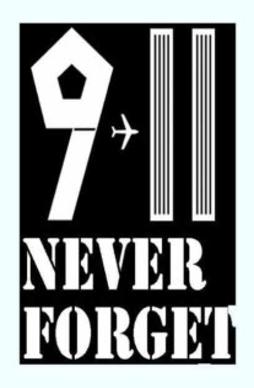
Never Forget 9-11 illustrating airliner flying from Pentagon to Twin TowersNever Forget What? The Alamo? The Maine? The Lusitania? Pearl Harbor? Every example of a tragedy our government exploits has turned out to be a fraud. Interesting company then for Nine Eleven… Although the traditional syntax is “Remember the–“. Usually “Never Forget” has been proprietary to Holocaust remembrance. Curious they’d want to dilute the tag line for a mere few thousand WTC victims. It makes me sick at heart. The event was seared into our memories, television broadcast at half mast for days afterward the better to sober the public to a terrorist attack’s ramifications. So WHY must we Never Forget? Revenge? Of course it’s shorthand for “Never Forget, Never Forgive.” You want an eye for an eye? How about vigilance? To prevent an alleged 9/11, we might be best to NEVER FORGET what got us here, brutal imperialist abuse heaped on the rest of the world. That’s the perspective it would be good to remember. Never forget Bhopal. Fallujah. Abu Ghraib, Gaza and Cast Lead. “Never Forget 9/11” is one of the first slogans trotted out at anti-Palestinian rallies. Curiouser and curiouser. So I’ve got more ships for you: Never forget the USS Liberty, or the Mavi Marmara.
 
As to 9/11, never forget that you haven’t been let to get to the bottom of it. But you don’t have to tell people not to forget something they know. “Never Forget” is for propagandists worried their brainwash is leaking.

IRS says Cindy Sheehan owes $104K more in taxes than MF General Electric

From Cindy Sheehan, Facebook, Aug 29, 7PM PST: “I just got a notice from the IRS that I owe them 104 grand and they are going to levy my bank accounts and property. I don’t have any property and there’s less than 150.00 in my bank accounts. Looks like Fed Prison is in my future. I would rather go to prison than fund the crimes of this government. I am going to send them a notice that they owe me infinity dollars for killing my son.”
 
When the MF IRS goes after the highest visibility, loudest voice, friend of world leaders, first name world celebrity, icon of American antiwar and anti-imperialist movement… WHO CAN DISSENT and feel safe?
(Cindy- “Infinity” won’t compute and doesn’t allow for a ceiling, I’m sorry to suggest you put a value on Casey’s head, but how about 1.7 Trillion? Obviously they can manage that.)

Li’l Abner on the debt ceiling panic

Patterned after GM president Charlie Wilson, who said: what's good for General Motors is good for AmericaWhen the satiric cartoon Li’l Abner was made a musical on Broadway, robber baron General Bullmoose sang Bring back the good old days, lamenting the regulation of capitalism, pondering:
“How can you break the market?
            How?
The SEC will not allow
            …one little panic.”

Today with graft unregulated and un-policed, the American public is made to panic for every swindle, to extort from them bank bailouts, tax breaks for the rich, and now cuts to “entitlements” such as poverty class pensions and medical care.

The Li’l Abner strip may not have had the legacy of Pogo, or longevity of Gasoline Alley, but it was the Doonesbury of the 30s and up to the 70s. In the introduction to From Dogpatch to Slobbovia, a little compendium of Abner scenarios, cartoonist Al Capp said this about his artistic intentions:

“to create suspicion of, and disrespect for, the perfection of all established institutions. That’s what I think education is. Anybody who gets out of college having had his confidence in the perfection of existing institutions affirmed has not been educated. Just suffocated.”

Avid fans included Queen Elizabeth, Charlie Chaplin and John Steinbeck who wrote:

Capp is probably the greatest contemporary writer and my suggestion is that if the Nobel Prize committee is at all alert, they should seriously consider him.”

As a side note, the Broadway cast of Li’l Abner included the character Stupefyin’ Jones, played by Julie Newmar aka Catwoman, and Appassionata Von Climax, played by Tina Louise, Ginger of Gilligan’s Island –if you always wondered how the character Ginger could not have failed to be a real “movie star.” Tina Louise began her career on Broadway in the 50s and was age thirty-something when the TV series aired. Imagine green-lighting an actress of that age today to play a sex symbol, yet Louise became as yet TV’s most enduring sex symbol.

Find the Michele Bachmann inside you

So Michele Bachmann was a tax collector. Sarah Palin was an oil industry stooge. The media didn’t conjure these villainesses from whole or rare cloth. Most politicians are corporate functionaries before they bill the public to do it. If they haven’t dedicated their lives expressly to destroying the environment, the social fabric, your job and everyone’s quality of life, they’ve always understood your loss was somebody’s gain, and theirs. Know anyone like that around you? Practically everyone! That’s whose throats you need to wrap your fingers around. Shake the blinders off their eyes with good old-fashioned throttling. Shout them down. Shut them up. Shame and scorn them, the heartless, uninformed, apathetic pricks. Activism begins at the grassroots, pull those weeds from the roots.
The media sets up Bachmann and Palin as characters you love to hate, there for you to pillory in effigy. You can flame them with your wit, call for their heads, but ultimately their pulpits lay beyond your reach, from where they safely goad you at the media’s whim. Wake up. Bachmann and Palin are the effigies. Burning them accomplishes nothing. They’re the poster children rotten apples among the joe public rotten apples which fill the American barrel. Look around you. See all the clueless, amoral, self-serving opportunists? Time to drop the agree-to-disagree, polite society pretense. Take the gloves off and have at ’em.

I just got an email from Pres. Obama

I just got an email from President Obama. He wants me to lead. He says the politicians in Washington won’t do their job unless I do their job for them. At face value, that’s just weird. Are constituents to imagine that stump speeches fall by the wayside when the polls close and representatives develop amnesia from which only lobbyists can deliver them? Does anyone really believe that the public has to jump hoops for good governance? Who drinks crap-flavored Kool-Aid?

Pardon my disrespect. Yeah, Obama writes to me directly, and would you believe, often. He’s practically asking my advice on a daily basis, or that’s the impression he gives with his personable tone. Actually it’s strictly a one-way conversation, telling me what to do, offering gentle encouragement, and asking for money. It’s gotten so I can’t differentiate fund-raising from tax-collecting. I confess I’ve tired of inferring that if Obama is running low on fairy dust, it’s because I’m not clapping hard enough.

The problem is I think Obama is wearing thin with all this intra-constituent communication, and he’s delegating too much of the multi-tasks to Dumbama. In today’s letter, Obama wants me to solve an “Immigration Crisis,” his contribution? Boots on the ground.

Did Abraham Lincoln write the Gettysburg Address? That’s always the impression my teachers gave. No Civil Warmongering William Safire of his day laid claim to coining four score nattering nabobs. When did Americans decide their leaders needed ghostwriters? Why do we accept that an Ersatzbama can come across with the same winning sparkle? Because you know the president is not even reviewing these compositions either. He’s got ghost-readers on staff for that.

Alright, so we like our speeches peppered with wit, and we know not even the most luminous television hosts can tread water without a staff of gag-writers. Fine, if celebrities need personal assistants to hold their phones, we can’t begrudge a busy president his showbiz consultants.

But oh my goodness, why would we countenance forged personal emails?! Who wants a Notobama pretending to give us the inside scoop on the President’s daily thoughts? What kind of charade is that for a presidential parade?

And I ask you, have you yet heard Obama answer a simple question, and you’re left wanting to hear more? If I got an email that confided he didn’t believe the crap vetted for the corporate media, that would be a believable email. Instead we all get Minimebama email numbing us with what we know is the web’s potential for a ceaseless stream of digital drivel.

But I’m making quite an ignorant assumption, that we’re all getting the same stupid email. We assume the White House is spamming a consistent message, but maybe it’s highly customized, and for some reason, and I’d better take it to heart, they’ve pegged me as a big idiot.

Sunday Afternoon sur Lac du Prospect

Prospect Lake, Colorado Springs, circa 1970
I don’t know if this scene strikes me because it’s George Seurat’s idyllic park, or because I’m nostalgic for Colorado circa prosperity. Circa 2011, the privatization cronies are after our city’s public gem, Prospect Lake. Colorado Springs local John Moore made a video, which features this and other vintage memories. (See video below)

Moore’s video show a webpage on which City Councilman Tim Leigh outlines his proposal for Prospect Lake, a recurring theme among his “fresh ideas” for Colorado Springs, in which he targets now public resources for lease or sale to private for-profit enterprises.

Leigh’s text below:

RE-IMAGINE NEIGHBORHOODS AND REESTABLISH A SENSE OF COMMUNITY
Imagine that, instead of continuously developing the open prairie to Kansas, we took a 2nd look at existing neighborhoods, utilized existing utilities & roadway infrastructure and created a culture where existing, stable neighborhoods were prized and could be reasonably redeveloped and modernized.

RE-IMAGINE PROSPECT LAKE
Imagine that Prospect Lake is fully utilized as the prized asset that it is; where a private entrepreneur promoted the water venue with exciting events throughout the summer.  Imagine the boat house being re-deployed as a high-end restaurant or some similar use all acting as a catalyst for redevelopment of the entire neighborhood.  Imagine immediate benefits to the city – funding the operation of Memorial park, not from general collections, but from leasing fees and new found sales and property tax generated specifically from that venue.  Imagine playing to our vision as recreational Mecca and imagine a public/private partnership creating a community asset where we all win.

Ugh Bruce, but imperturbable

Campaign sign for Colorado Springs 2011 municipal election
COLORADO SPRINGS– It was Doug Bruce himself, the anti-tax man most responsible for the region’s decaying services and infrastructure, polishing his own campaign sign, on land belonging to Griffis/Blessing. The fit was not entirely out of the realm of possibility, but I made a second pass, conspicuously taking photos that he might worry could inform a landlord. To his credit, instead of ignoring me he kept trying to wave me over, as if despite my direct attacks on him in city council sessions, he could win me over out there on the corner. He left with the sign.

Okay I’ll bite, why did Colorado Springs City Council candidate Lisa Czeladtko call a Nebraska animator a Sick F-ck?

Youtube scene at Colorado Springs city hall
Actually conservative candidate Lisa Czeladtko called former Colorado Springs resident Dan Robertson a Sick F#^& in an email saying she was filing a police report against him. Robertson has been helping his friend Ed Billings lampoon the aspiring bureaucrat on their respective Youtube channels. Their animations are irreverent, and self-evidently grasping at straws, so the characterizations seem wildly inspired when they appear to have got Czeladtko’s goat. But is it harassment? Let me say for the record, I think the humor will prove just infantile enough to torpedo a conservative like Czeladtko. Where progressive critics elevate the debate, straightforward differences of opinion are easy to parry. No one’s saying pro-business candidates aren’t clever, but satire seems to bring out deficiencies common to uncritical thinkers, for example an inability to see things through the eyes of others. Wouldn’t empathy be an indispensable qualification for a municipal representative? Lisa Czeladtko and mentor-development-lobbyest Sally Clark may be indignant about these low brow attacks, but I believe they’re about to get schooled on the hazards of grabbing for public office as an unrepresentative. Blue collar heroes Robertson and Billings are simply tired of suburban class socialites who think they can traipse into city hall to curry the favor of fat cat friends. Wage-earning, bus-riding, social service using citizens don’t need more tax-cutting, poverty-indifferent private-interest shills thumbing their noses with smug hors-d’oeuvre-fed smiles.

Facebook message sent to Dan Robertson from Lisa Czeladtko

Compared to George W. Bush, Obama demonstrates W didn’t stand for Worse

War, Rights, WealthMedia voices this morning are positively giddy with Obama’s extension of tax cuts for the rich. Probably anticipating a hefty Christmas bonus. Today would be a good time to apologize to Debby Downers you vilified in ’08 because they cautioned that Barack Obama was not the change you wanted to believe in.
I wasn’t among them, I didn’t have the temerity to rain on everyone’s hopeful desperation. Today I have to laugh. LAUGH. We traded in a thieving bumbler for a hypocritical lying bore who’s only changed gears on corporate graft, a higher gear. The heist Obama just pulled for America’s rich leaves absolutely no question whom he serves. I mean, he can pretend to be thwarted at every turn, the wars, Guantanamo, DADT, but in this case, he’s plain shilling for the other side, telling regular Americans this is a good deal for them.

It’s Obama’s tax cut for the rich

Barack Obama and Bill Clinton steal from the poor to give to the rich
It seems just an election ago that Candidate Obama objected to the Bush Tax Cuts which launched a new gilded age. Now that those grievously unfair giveaways are up for extension, President Obama is not just a cheerleader, he’s the pitcher, with relief pitcher Clinton in the final inning. Obama pushed so hard to close this deal, even the GOP, the supposed heavies, were able to log their opposition. To the “compromise” — an extenuating detail future campaign ads can omit.

American sheep vote for being fleeced

Call it a setback, Obama calls it “humbling,” but the election obviously provided a sweeping mandate, and the president is running with it. The spectacle of Americans unquestioningly casting their vote for worse or worser, is the usual reinvestment of political take-me-for-a-ride capital, to jaw dropping limits. The new Republican majority can refuse to fund “Obama Care” but now President Obama is inexplicably floating conciliatory balloons about having to extend the tax cuts for the rich, as if the [sunsetted] Bush Tax Cuts needed a congressional vote to end, not to resume. Apparently the election day show of imbecility has emboldened DC polemicists to pretend the sun never sets on government graft.

Green is the new blue

I’m not talking about the verdant environmentalists, of the “Green Scare,” the syntax applied by the government to categorize eco-defenders under the axis of terrorism. Nor the hue of the ecological mind shift that launched the global political movement. The US Green Party stands for what, beside outsiders to the corporate party? Socialism, humanism, ecology — if you try to find common ground in a nutshell — all the progressive reform commonsensical to the educated class. It’s the Democratic Party platform sine qua non. Left unarticulated, the objectives are the Green Party’s to table for discussion when they will meet less opposition. In administrative parlance that’s to go nowhere.

Emma Goldman on Direct Action

Yes it was Emma Goldman who said “If voting changed anything, they’d make it illegal.”
It was no mere quip. The turn of the last century activist was a fierce advocate of every social reform and was ultimately exiled to Europe for challenging forced conscription. Do you wonder what else Goldman had to say, about political violence, prisons, patriotism, puritanism, the traffic of women, suffrage, poverty, birth control, and the struggle of minorities? Far from being a cynic, Goldman offered an alternative to the false hope of the ballot box.

What does the history of parliamentarism show? Nothing but failure and defeat, not even a single reform to ameliorate the economic and social stress of the people. Laws have been passed and enactments made for the improvement and protection of labor. Thus it was proven only last year that Illinois, with the most rigid laws for mine protection, had the greatest mine disasters. In States where child labor laws prevail, child exploitation is at its highest, and though with us the workers enjoy full political opportunities, capitalism has reached the most brazen zenith.

It may be claimed that men of integrity would not become corrupt in the political grinding mill. Perhaps not; but such men would be absolutely helpless to exert the slightest influence in behalf of labor, as indeed has been shown in numerous instances. The State is the economic master of its servants. Good men, if such there be, would either remain true to their political faith and lose their economic support, or they would cling to their economic master and be utterly unable to do the slightest good. The political arena leaves one no alternative, one must either be a dunce or a rogue.

The political superstition is still holding sway over the hearts and minds of the masses, but the true lovers of liberty will have no more to do with it. Instead, they believe with Stirner that man has as much liberty as he is willing to take.

Universal suffrage itself owes its existence to direct action. If not for the spirit of rebellion, of the defiance on the part of the American revolutionary fathers, their posterity would still wear the King’s coat. If not for the direct action of a John Brown and his comrades, America would still trade in the flesh of the black man. True, the trade in white flesh is still going on; but that, too, will have to be abolished by direct action. Trade-unionism, the economic arena of the modern gladiator, owes its existence to direct action. It is but recently that law and government have attempted to crush the trade-union movement, and condemned the exponents of man’s right to organize to prison as conspirators. Had they sought to assert their cause through begging, pleading, and compromise, trade-unionism would today be a negligible quantity. In France, in Spain, in Italy, in Russia, nay even in England (witness the growing rebellion of English labor unions), direct, revolutionary, economic action has become so strong a force in the battle for industrial liberty as to make the world realize the tremendous importance of labor’s power. The General Strike, the supreme expression of the economic consciousness of the workers, was ridiculed in America but a short time ago. Today every great strike, in order to win, must realize the importance of the solidaric general protest.

Direct action, having proven effective along economic lines, is equally potent in the environment of the individual. There a hundred forces encroach upon his being, and only persistent resistance to them will finally set him free. Direct action against the authority in the shop, direct action against the authority of the law, direct action against the invasive, meddlesome authority of our moral code, is the logical, consistent method of Anarchism.

Will it not lead to a revolution? Indeed, it will. No real social change has ever come about without a revolution. People are either not familiar with their history, or they have not yet learned that revolution is but thought carried into action.

Here’s the full essay from which the above was excerpted, where Goldman cites Emerson, Wilde, Burroughs, Thoreau and GBS to laud the promise of anarchism and direct action.

ANARCHISM: WHAT IT REALLY STANDS FOR

ANARCHY.??

Ever reviled, accursed, ne’er understood,?
Thou art the grisly terror of our age.?
“Wreck of all order,” cry the multitude,?
“Art thou, and war and murder’s endless rage.
“?O, let them cry. To them that ne’er have striven?
The truth that lies behind a word to find,?
To them the word’s right meaning was not given.?
They shall continue blind among the blind.?
But thou, O word, so clear, so strong, so pure,
?Thou sayest all which I for goal have taken.?
I give thee to the future! Thine secure
?When each at least unto himself shall waken.?
Comes it in sunshine? In the tempest’s thrill??
I cannot tell–but it the earth shall see!
?I am an Anarchist! Wherefore I will
?Not rule, and also ruled I will not be!?
?
JOHN HENRY MACKAY.

THE history of human growth and development is at the same time the history of the terrible struggle of every new idea heralding the approach of a brighter dawn. In its tenacious hold on tradition, the Old has never hesitated to make use of the foulest and cruelest means to stay the advent of the New, in whatever form or period the latter may have asserted itself. Nor need we retrace our steps into the distant past to realize the enormity of opposition, difficulties, and hardships placed in the path of every progressive idea. The rack, the thumbscrew, and the knout are still with us; so are the convict’s garb and the social wrath, all conspiring against the spirit that is serenely marching on.

Anarchism could not hope to escape the fate of all other ideas of innovation. Indeed, as the most revolutionary and uncompromising innovator, Anarchism must needs meet with the combined ignorance and venom of the world it aims to reconstruct.

To deal even remotely with all that is being said and done against Anarchism would necessitate the writing of a whole volume. I shall therefore meet only two of the principal objections. In so doing, I shall attempt to elucidate what Anarchism really stands for.

The strange phenomenon of the opposition to Anarchism is that it brings to light the relation between so-called intelligence and ignorance. And yet this is not so very strange when we consider the relativity of all things. The ignorant mass has in its favor that it makes no pretense of knowledge or tolerance. Acting, as it always does, by mere impulse, its reasons are like those of a child. “Why?” “Because.” Yet the opposition of the uneducated to Anarchism deserves the same consideration as that of the intelligent man.

What, then, are the objections? First, Anarchism is impractical, though a beautiful ideal. Second, Anarchism stands for violence and destruction, hence it must be repudiated as vile and dangerous. Both the intelligent man and the ignorant mass judge not from a thorough knowledge of the subject, but either from hearsay or false interpretation.

A practical scheme, says Oscar Wilde, is either one already in existence, or a scheme that could be carried out under the existing conditions; but it is exactly the existing conditions that one objects to, and any scheme that could accept these conditions is wrong and foolish. The true criterion of the practical, therefore, is not whether the latter can keep intact the wrong or foolish; rather is it whether the scheme has vitality enough to leave the stagnant waters of the old, and build, as well as sustain, new life. In the light of this conception, Anarchism is indeed practical. More than any other idea, it is helping to do away with the wrong and foolish; more than any other idea, it is building and sustaining new life.

The emotions of the ignorant man are continuously kept at a pitch by the most blood-curdling stories about Anarchism. Not a thing too outrageous to be employed against this philosophy and its exponents. Therefore Anarchism represents to the unthinking what the proverbial bad man does to the child,–a black monster bent on swallowing everything; in short, destruction and violence.

Destruction and violence! How is the ordinary man to know that the most violent element in society is ignorance; that its power of destruction is the very thing Anarchism is combating? Nor is he aware that Anarchism, whose roots, as it were, are part of nature’s forces, destroys, not healthful tissue, but parasitic growths that feed on the life’s essence of society. It is merely clearing the soil from weeds and sagebrush, that it may eventually bear healthy fruit.

Someone has said that it requires less mental effort to condemn than to think. The widespread mental indolence, so prevalent in society, proves this to be only too true. Rather than to go to the bottom of any given idea, to examine into its origin and meaning, most people will either condemn it altogether, or rely on some superficial or prejudicial definition of non-essentials.

Anarchism urges man to think, to investigate, to analyze every proposition; but that the brain capacity of the average reader be not taxed too much, I also shall begin with a definition, and then elaborate on the latter.

ANARCHISM: –The philosophy of a new social order based on liberty unrestricted by man-made law; the theory that all forms of government rest on violence, and are therefore wrong and harmful, as well as unnecessary.

The new social order rests, of course, on the materialistic basis of life; but while all Anarchists agree that the main evil today is an economic one, they maintain that the solution of that evil can be brought about only through the consideration of every phase of life,–individual, as well as the collective; the internal, as well as the external phases.

A thorough perusal of the history of human development will disclose two elements in bitter conflict with each other; elements that are only now beginning to be understood, not as foreign to each other, but as closely related and truly harmonious, if only placed in proper environment: the individual and social instincts. The individual and society have waged a relentless and bloody battle for ages, each striving for supremacy, because each was blind to the value and importance of the other. The individual and social instincts,–the one a most potent factor for individual endeavor, for growth, aspiration, self-realization; the other an equally potent factor for mutual helpfulness and social well-being.

The explanation of the storm raging within the individual, and between him and his surroundings, is not far to seek. The primitive man, unable to understand his being, much less the unity of all life, felt himself absolutely dependent on blind, hidden forces ever ready to mock and taunt him. Out of that attitude grew the religious concepts of man as a mere speck of dust dependent on superior powers on high, who can only be appeased by complete surrender. All the early sagas rest on that idea, which continues to be the Leitmotiv of the biblical tales dealing with the relation of man to God, to the State, to society. Again and again the same motif, man is nothing, the powers are everything. Thus Jehovah would only endure man on condition of complete surrender. Man can have all the glories of the earth, but he must not become conscious of himself. The State, society, and moral laws all sing the same refrain: Man can have all the glories of the earth, but he must not become conscious of himself.

Anarchism is the only philosophy which brings to man the consciousness of himself; which maintains that God, the State, and society are non-existent, that their promises are null and void, since they can be fulfilled only through man’s subordination. Anarchism is therefore the teacher of the unity of life; not merely in nature, but in man. There is no conflict between the individual and the social instincts, any more than there is between the heart and the lungs: the one the receptacle of a precious life essence, the other the repository of the element that keeps the essence pure and strong. The individual is the heart of society, conserving the essence of social life; society is the lungs which are distributing the element to keep the life essence–that is, the individual–pure and strong.

“The one thing of value in the world,” says Emerson, “is the active soul; this every man contains within him. The soul active sees absolute truth and utters truth and creates.” In other words, the individual instinct is the thing of value in the world. It is the true soul that sees and creates the truth alive, out of which is to come a still greater truth, the re-born social soul.

Anarchism is the great liberator of man from the phantoms that have held him captive; it is the arbiter and pacifier of the two forces for individual and social harmony. To accomplish that unity, Anarchism has declared war on the pernicious influences which have so far prevented the harmonious blending of individual and social instincts, the individual and society.

Religion, the dominion of the human mind; Property, the dominion of human needs; and Government, the dominion of human conduct, represent the stronghold of man’s enslavement and all the horrors it entails. Religion! How it dominates man’s mind, how it humiliates and degrades his soul. God is everything, man is nothing, says religion. But out of that nothing God has created a kingdom so despotic, so tyrannical, so cruel, so terribly exacting that naught but gloom and tears and blood have ruled the world since gods began. Anarchism rouses man to rebellion against this black monster. Break your mental fetters, says Anarchism to man, for not until you think and judge for yourself will you get rid of the dominion of darkness, the greatest obstacle to all progress.

Property, the dominion of man’s needs, the denial of the right to satisfy his needs. Time was when property claimed a divine right, when it came to man with the same refrain, even as religion, “Sacrifice! Abnegate! Submit!” The spirit of Anarchism has lifted man from his prostrate position. He now stands erect, with his face toward the light. He has learned to see the insatiable, devouring, devastating nature of property, and he is preparing to strike the monster dead.

“Property is robbery,” said the great French Anarchist Proudhon. Yes, but without risk and danger to the robber. Monopolizing the accumulated efforts of man, property has robbed him of his birthright, and has turned him loose a pauper and an outcast. Property has not even the time-worn excuse that man does not create enough to satisfy all needs. The A B C student of economics knows that the productivity of labor within the last few decades far exceeds normal demand. But what are normal demands to an abnormal institution? The only demand that property recognizes is its own gluttonous appetite for greater wealth, because wealth means power; the power to subdue, to crush, to exploit, the power to enslave, to outrage, to degrade. America is particularly boastful of her great power, her enormous national wealth. Poor America, of what avail is all her wealth, if the individuals comprising the nation are wretchedly poor? If they live in squalor, in filth, in crime, with hope and joy gone, a homeless, soilless army of human prey.

It is generally conceded that unless the returns of any business venture exceed the cost, bankruptcy is inevitable. But those engaged in the business of producing wealth have not yet learned even this simple lesson. Every year the cost of production in human life is growing larger (50,000 killed, 100,000 wounded in America last year); the returns to the masses, who help to create wealth, are ever getting smaller. Yet America continues to be blind to the inevitable bankruptcy of our business of production. Nor is this the only crime of the latter. Still more fatal is the crime of turning the producer into a mere particle of a machine, with less will and decision than his master of steel and iron. Man is being robbed not merely of the products of his labor, but of the power of free initiative, of originality, and the interest in, or desire for, the things he is making.

Real wealth consists in things of utility and beauty, in things that help to create strong, beautiful bodies and surroundings inspiring to live in. But if man is doomed to wind cotton around a spool, or dig coal, or build roads for thirty years of his life, there can be no talk of wealth. What he gives to the world is only gray and hideous things, reflecting a dull and hideous existence,–too weak to live, too cowardly to die. Strange to say, there are people who extol this deadening method of centralized production as the proudest achievement of our age. They fail utterly to realize that if we are to continue in machine subserviency, our slavery is more complete than was our bondage to the King. They do not want to know that centralization is not only the death-knell of liberty, but also of health and beauty, of art and science, all these being impossible in a clock-like, mechanical atmosphere.

Anarchism cannot but repudiate such a method of production: its goal is the freest possible expression of all the latent powers of the individual. Oscar Wilde defines a perfect personality as “one who develops under perfect conditions, who is not wounded, maimed, or in danger.” A perfect personality, then, is only possible in a state of society where man is free to choose the mode of work, the conditions of work, and the freedom to work. One to whom the making of a table, the building of a house, or the tilling of the soil, is what the painting is to the artist and the discovery to the scientist,–the result of inspiration, of intense longing, and deep interest in work as a creative force. That being the ideal of Anarchism, its economic arrangements must consist of voluntary productive and distributive associations, gradually developing into free communism, as the best means of producing with the least waste of human energy. Anarchism, however, also recognizes the right of the individual, or numbers of individuals, to arrange at all times for other forms of work, in harmony with their tastes and desires.

Such free display of human energy being possible only under complete individual and social freedom, Anarchism directs its forces against the third and greatest foe of all social equality; namely, the State, organized authority, or statutory law,–the dominion of human conduct.

Just as religion has fettered the human mind, and as property, or the monopoly of things, has subdued and stifled man’s needs, so has the State enslaved his spirit, dictating every phase of conduct. “All government in essence,” says Emerson, “is tyranny.” It matters not whether it is government by divine right or majority rule. In every instance its aim is the absolute subordination of the individual.

Referring to the American government, the greatest American Anarchist, David Thoreau, said:

“Government, what is it but a tradition, though a recent one, endeavoring to transmit itself unimpaired to posterity, but each instance losing its integrity; it has not the vitality and force of a single living man. Law never made man a whit more just; and by means of their respect for it, even the well disposed are daily made agents of injustice.”

Indeed, the keynote of government is injustice. With the arrogance and self-sufficiency of the King who could do no wrong, governments ordain, judge, condemn, and punish the most insignificant offenses, while maintaining themselves by the greatest of all offenses, the annihilation of individual liberty. Thus Ouida is right when she maintains that

“the State only aims at instilling those qualities in its public by which its demands are obeyed, and its exchequer is filled. Its highest attainment is the reduction of mankind to clockwork. In its atmosphere all those finer and more delicate liberties, which require treatment and spacious expansion, inevitably dry up and perish. The State requires a taxpaying machine in which there is no hitch, an exchequer in which there is never a deficit, and a public, monotonous, obedient, colorless, spiritless, moving humbly like a flock of sheep along a straight high road between two walls.”

Yet even a flock of sheep would resist the chicanery of the State, if it were not for the corruptive, tyrannical, and oppressive methods it employs to serve its purposes. Therefore Bakunin repudiates the State as synonymous with the surrender of the liberty of the individual or small minorities,–the destruction of social relationship, the curtailment, or complete denial even, of life itself, for its own aggrandizement. The State is the altar of political freedom and, like the religious altar, it is maintained for the purpose of human sacrifice.

In fact, there is hardly a modern thinker who does not agree that government, organized authority, or the State, is necessary only to maintain or protect property and monopoly. It has proven efficient in that function only.

Even George Bernard Shaw, who hopes for the miraculous from the State under Fabianism, nevertheless admits that “it is at present a huge machine for robbing and slave-driving of the poor by brute force.” This being the case, it is hard to see why the clever prefacer wishes to uphold the State after poverty shall have ceased to exist.

Unfortunately, there are still a number of people who continue in the fatal belief that government rests on natural laws, that it maintains social order and harmony, that it diminishes crime, and that it prevents the lazy man from fleecing his fellows. I shall therefore examine these contentions.

A natural law is that factor in man which asserts itself freely and spontaneously without any external force, in harmony with the requirements of nature. For instance, the demand for nutrition, for sex gratification, for light, air, and exercise, is a natural law. But its expression needs not the machinery of government, needs not the club, the gun, the handcuff, or the prison. To obey such laws, if we may call it obedience, requires only spontaneity and free opportunity. That governments do not maintain themselves through such harmonious factors is proven by the terrible array of violence, force, and coercion all governments use in order to live. Thus Blackstone is right when he says, “Human laws are invalid, because they are contrary to the laws of nature.”

Unless it be the order of Warsaw after the slaughter of thousands of people, it is difficult to ascribe to governments any capacity for order or social harmony. Order derived through submission and maintained by terror is not much of a safe guaranty; yet that is the only “order” that governments have ever maintained. True social harmony grows naturally out of solidarity of interests. In a society where those who always work never have anything, while those who never work enjoy everything, solidarity of interests is non-existent; hence social harmony is but a myth. The only way organized authority meets this grave situation is by extending still greater privileges to those who have already monopolized the earth, and by still further enslaving the disinherited masses. Thus the entire arsenal of government–laws, police, soldiers, the courts, legislatures, prisons,–is strenuously engaged in “harmonizing” the most antagonistic elements in society.

The most absurd apology for authority and law is that they serve to diminish crime. Aside from the fact that the State is itself the greatest criminal, breaking every written and natural law, stealing in the form of taxes, killing in the form of war and capital punishment, it has come to an absolute standstill in coping with crime. It has failed utterly to destroy or even minimize the horrible scourge of its own creation.

Crime is naught but misdirected energy. So long as every institution of today, economic, political, social, and moral, conspires to misdirect human energy into wrong channels; so long as most people are out of place doing the things they hate to do, living a life they loathe to live, crime will be inevitable, and all the laws on the statutes can only increase, but never do away with, crime. What does society, as it exists today, know of the process of despair, the poverty, the horrors, the fearful struggle the human soul must pass on its way to crime and degradation. Who that knows this terrible process can fail to see the truth in these words of Peter Kropotkin:

“Those who will hold the balance between the benefits thus attributed to law and punishment and the degrading effect of the latter on humanity; those who will estimate the torrent of depravity poured abroad in human society by the informer, favored by the Judge even, and paid for in clinking cash by governments, under the pretext of aiding to unmask crime; those who will go within prison walls and there see what human beings become when deprived of liberty, when subjected to the care of brutal keepers, to coarse, cruel words, to a thousand stinging, piercing humiliations, will agree with us that the entire apparatus of prison and punishment is an abomination which ought to be brought to an end.”

The deterrent influence of law on the lazy man is too absurd to merit consideration. If society were only relieved of the waste and expense of keeping a lazy class, and the equally great expense of the paraphernalia of protection this lazy class requires, the social tables would contain an abundance for all, including even the occasional lazy individual. Besides, it is well to consider that laziness results either from special privileges, or physical and mental abnormalities. Our present insane system of production fosters both, and the most astounding phenomenon is that people should want to work at all now. Anarchism aims to strip labor of its deadening, dulling aspect, of its gloom and compulsion. It aims to make work an instrument of joy, of strength, of color, of real harmony, so that the poorest sort of a man should find in work both recreation and hope.

To achieve such an arrangement of life, government, with its unjust, arbitrary, repressive measures, must be done away with. At best it has but imposed one single mode of life upon all, without regard to individual and social variations and needs. In destroying government and statutory laws, Anarchism proposes to rescue the self-respect and independence of the individual from all restraint and invasion by authority. Only in freedom can man grow to his full stature. Only in freedom will he learn to think and move, and give the very best in him. Only in freedom will he realize the true force of the social bonds which knit men together, and which are the true foundation of a normal social life.

But what about human nature? Can it be changed? And if not, will it endure under Anarchism?

Poor human nature, what horrible crimes have been committed in thy name! Every fool, from king to policeman, from the flatheaded parson to the visionless dabbler in science, presumes to speak authoritatively of human nature. The greater the mental charlatan, the more definite his insistence on the wickedness and weaknesses of human nature. Yet, how can any one speak of it today, with every soul in a prison, with every heart fettered, wounded, and maimed?

John Burroughs has stated that experimental study of animals in captivity is absolutely useless. Their character, their habits, their appetites undergo a complete transformation when torn from their soil in field and forest. With human nature caged in a narrow space, whipped daily into submission, how can we speak of its potentialities?

Freedom, expansion, opportunity, and, above all, peace and repose, alone can teach us the real dominant factors of human nature and all its wonderful possibilities.

Anarchism, then, really stands for the liberation of the human mind from the dominion of religion; the liberation of the human body from the dominion of property; liberation from the shackles and restraint of government. Anarchism stands for a social order based on the free grouping of individuals for the purpose of producing real social wealth; an order that will guarantee to every human being free access to the earth and full enjoyment of the necessities of life, according to individual desires, tastes, and inclinations.

This is not a wild fancy or an aberration of the mind. It is the conclusion arrived at by hosts of intellectual men and women the world over; a conclusion resulting from the close and studious observation of the tendencies of modern society: individual liberty and economic equality, the twin forces for the birth of what is fine and true in man.

As to methods. Anarchism is not, as some may suppose, a theory of the future to be realized through divine inspiration. It is a living force in the affairs of our life, constantly creating new conditions. The methods of Anarchism therefore do not comprise an iron-clad program to be carried out under all circumstances. Methods must grow out of the economic needs of each place and clime, and of the intellectual and temperamental requirements of the individual. The serene, calm character of a Tolstoy will wish different methods for social reconstruction than the intense, overflowing personality of a Michael Bakunin or a Peter Kropotkin. Equally so it must be apparent that the economic and political needs of Russia will dictate more drastic measures than would England or America. Anarchism does not stand for military drill and uniformity; it does, however, stand for the spirit of revolt, in whatever form, against everything that hinders human growth. All Anarchists agree in that, as they also agree in their opposition to the political machinery as a means of bringing about the great social change.

“All voting,” says Thoreau, “is a sort of gaming, like checkers, or backgammon, a playing with right and wrong; its obligation never exceeds that of expediency. Even voting for the right thing is doing nothing for it. A wise man will not leave the right to the mercy of chance, nor wish it to prevail through the power of the majority.” A close examination of the machinery of politics and its achievements will bear out the logic of Thoreau.

What does the history of parliamentarism show? Nothing but failure and defeat, not even a single reform to ameliorate the economic and social stress of the people. Laws have been passed and enactments made for the improvement and protection of labor. Thus it was proven only last year that Illinois, with the most rigid laws for mine protection, had the greatest mine disasters. In States where child labor laws prevail, child exploitation is at its highest, and though with us the workers enjoy full political opportunities, capitalism has reached the most brazen zenith.

Even were the workers able to have their own representatives, for which our good Socialist politicians are clamoring, what chances are there for their honesty and good faith? One has but to bear in mind the process of politics to realize that its path of good intentions is full of pitfalls: wire-pulling, intriguing, flattering, lying, cheating; in fact, chicanery of every description, whereby the political aspirant can achieve success. Added to that is a complete demoralization of character and conviction, until nothing is left that would make one hope for anything from such a human derelict. Time and time again the people were foolish enough to trust, believe, and support with their last farthing aspiring politicians, only to find themselves betrayed and cheated.

It may be claimed that men of integrity would not become corrupt in the political grinding mill. Perhaps not; but such men would be absolutely helpless to exert the slightest influence in behalf of labor, as indeed has been shown in numerous instances. The State is the economic master of its servants. Good men, if such there be, would either remain true to their political faith and lose their economic support, or they would cling to their economic master and be utterly unable to do the slightest good. The political arena leaves one no alternative, one must either be a dunce or a rogue.

The political superstition is still holding sway over the hearts and minds of the masses, but the true lovers of liberty will have no more to do with it. Instead, they believe with Stirner that man has as much liberty as he is willing to take. Anarchism therefore stands for direct action, the open defiance of, and resistance to, all laws and restrictions, economic, social, and moral. But defiance and resistance are illegal. Therein lies the salvation of man. Everything illegal necessitates integrity, self-reliance, and courage. In short, it calls for free, independent spirits, for “men who are men, and who have a bone in their backs which you cannot pass your hand through.”

Universal suffrage itself owes its existence to direct action. If not for the spirit of rebellion, of the defiance on the part of the American revolutionary fathers, their posterity would still wear the King’s coat. If not for the direct action of a John Brown and his comrades, America would still trade in the flesh of the black man. True, the trade in white flesh is still going on; but that, too, will have to be abolished by direct action. Trade-unionism, the economic arena of the modern gladiator, owes its existence to direct action. It is but recently that law and government have attempted to crush the trade-union movement, and condemned the exponents of man’s right to organize to prison as conspirators. Had they sought to assert their cause through begging, pleading, and compromise, trade-unionism would today be a negligible quantity. In France, in Spain, in Italy, in Russia, nay even in England (witness the growing rebellion of English labor unions), direct, revolutionary, economic action has become so strong a force in the battle for industrial liberty as to make the world realize the tremendous importance of labor’s power. The General Strike, the supreme expression of the economic consciousness of the workers, was ridiculed in America but a short time ago. Today every great strike, in order to win, must realize the importance of the solidaric general protest.

Direct action, having proven effective along economic lines, is equally potent in the environment of the individual. There a hundred forces encroach upon his being, and only persistent resistance to them will finally set him free. Direct action against the authority in the shop, direct action against the authority of the law, direct action against the invasive, meddlesome authority of our moral code, is the logical, consistent method of Anarchism.

Will it not lead to a revolution? Indeed, it will. No real social change has ever come about without a revolution. People are either not familiar with their history, or they have not yet learned that revolution is but thought carried into action.

Anarchism, the great leaven of thought, is today permeating every phase of human endeavor. Science, art, literature, the drama, the effort for economic betterment, in fact every individual and social opposition to the existing disorder of things, is illumined by the spiritual light of Anarchism. It is the philosophy of the sovereignty of the individual. It is the theory of social harmony. It is the great, surging, living truth that is reconstructing the world, and that will usher in the Dawn.

FRIDAY 9/17: See Jim Hightower, then rally to save Social Security, sort of

This Friday evening, September 17, Colorado Springs activists can have their cake and eat it too. The Jim Hightower event and the Colorado Senate race debate are back to back. So it’s sheet cake.

Jim Hightower is still plugging his populist pun, The People Are Revolting, which may be true of the hoi polloi in the whimsical sense, but hardly describes their political momentum –unless you count the Tea Party and its pretend rebellion, if anything, a conservative counter-revolution to reinstate the tea tax. Though Hightower’s tales are getting as long in the tooth as his common super-citizens meant to serve as examples for us all, he’s still worth lots of laughs, and his material angers, even if it fraudulently attempts to raise hope. That’s at 4:45PM, at the Cornerstone Arts Building, the southern-most encroachment of the Colorado College campus.

At 6:30PM there’s a rally planned for outside Centennial Hall, where Michael Bennet will be debating Ken Buck for the US Senate seat. Democrats have organized to protest Buck’s campaign promise to privatize Social Security. A progressive group is supplying the placards which read “HANDS OFF MY SOCIAL SECURITY.” It’s a worthy message, but like all slogans pre-printed by the SEIU, it tempers the more appropriate syntax. “Hands off” should be “Do not steal.” The bid to swipe the public monies is more like pillage than misguided tinkering.

And will those attending the rally be directing their outrage at only the Republican nominee? What about Bennet, the Democratic incumbent, who’s already been doing Wall Street’s bidding without fail? Thorough activists might want to bring ther own signage, for example: TELL BOTH CORPORATE PARTIES: DON’T STEAL SOCIAL SECURITY or perhaps: PRIVATIZATION IS CLASS WARFARE.

Otherwise, both events are exercises in placating public unrest. This Friday evening you can pretend your voice is being heard by the senate candidates, while Hightower comforts you with stories of others who think they’re making a difference too.

LTE, 1899: May the thunderbolt which is to fall from heaven upon this nation

For Independence day we might ask: is it more patriotic to support illegal wars than to oppose them? I’d like to revisit a century-old letter to the editor submitted to the Springfield Republican on April 21, 1899, by Caroline Hollingsworth Pemberton a few days after tax day. She wrote to defend another letter writer, critic of America’s imperial expansion into the Philippines, accused of “treason” for suggesting that his taxes should not be funding a war of aggression.

The number of persons who share, without expressing, the sentiments of the young single taxer, F. Stevens, is doubtless increasing daily. It may be a wise economical policy for the government executives to decide that his utterances do not constitute “treason,” for the reason that there are not, and probably never will be, enough prisons in his land to contain all the “traitors” that now reside in it.

Alas! we are all of us made traitors (and against our wills in many cases) by the deliberate acts of those whom we have chosen to represent us. We are already traitors to the high ideals of a free people: traitors to our constitution and to the principles of the Declaration of Independence. Whether we want to or not, we “treacherously” support a policy of “criminal aggression” whenever we lick a revenue stamp and stick it on a check or receipt, and help pay the cost of sacrificing our principles before the world.

My soul loathes this Filipino slaughter, yet I am actively supporting it out of my own pocket every day of my life. I count myself the worst kind of a traitor, –yet it is well that our government has decided to look leniently on traitors, for there are thousands and millions like me, some willingly and many most unwillingly made traitors like myself!

One can choose between two kinds of treason. Mr. Stevens chooses what he takes to be the lesser kind. We have that much choice and that is all that is left to us.

For my part, I pray that the thunderbolt which is to fall from heaven upon this nation for its career of crime in the Pacific ocean may fall quickly and end the iniquities for which in the sight of God we are all individually responsible. If this is “treason” of the peculiar brand that newspapers do not approve, it is to be remembered as an “extenuating circumstance” that my education in treason has not progressed far enough yet for me to distinguish with certainty the various brands, –accidentally, as it were, I have picked up the wrong kind– for which I ask their kindly indulgence.

C. H. Pemberton

Springfield Republican, April 21, 1899

Quoted in The Anti-Imperialist Reader, Volume I, Philip S. Foner, ed., p. 404

Composer Jason Robert Brown wants to protect his unintellectual rights

As a musician and fan of stage musicals, I must proffer this disclaimer about American theater composer Jason Robert Brown: he’s terrible. Brown is a poster child for the music industry’s common mediocrity, of commerce’s habitual triumph over art. Now Brown has appointed himself defender of intellectual property rights, holding that teens should not use the internet to pirate his sheet music. Of course, I can only wish him foolproof success.

American musical theater saw a golden age in the 1940s, with notable glimmers of resurgence since then, in ever infrequent cycles. I don’t think anyone would argue that in-between was constant dreck –to which “show tunes” owe their stigma. Defenders of Andrew Lloyd Webber will find themselves similarly unrestrained enthusiasts for popular music, popular fiction and television. To each his own slop.

I have particular antipathy for contemporary composers of awfulness because they drive the inartistic music publishing industry where it does irreparable harm. School bands and theater departments are influenced to pay royalties for the performance pieces whose rights are most profitably leveraged, at the expense of older works of renown. Instead of seeding young repertoires with melodies and lyrics to enrich their memories, teachers pollute their students with forgettable claptrap, courtesy of bards like Brown.

I have the same prejudice with regard to literature. Why aren’t today’s students reading Stevenson or Poe instead of Blume or Rowling? Of course, composer JR Brown is more on par with author RL Stine, he’s that horrible. But don’t take my word for it, have a listen.

That said, here’s Jason Robert Brown championing not just the exclusive right to sell online what his publishers hawk through their network of scholastic pushers, but he wants the same markup. If ever a commodity could change hands for its true worth, Brown’s entire catalog should be ventilated for free through file sharing. Instead he’s personally joining various trading websites and then emailing each and every member who appears to be trading in his goods.

To paraphrase: Hello, I’m Jason Robert Brown, yes, The Jason Robert Brown, and I’d appreciate it if you stopped illegally sharing my music, since it deprives me of my rightful royalties.

Brown has posted some of the ensuing email exchanges on his blog, without any mention of offering remuneration for their contributions. Most laughable, but consistent with the weakness of his music work, Brown has engaged chiefly teens in his discussion of intellectual rights. He lists one discussion in which he compares his stolen sheet music to a loaned screwdriver, a Xerox’d book, and a copied CD.

Mr. Brown, might I direct you to the innumerable organizations which argue that intellectual property rights are not inalienable. They are restraints to trade, impediments to idea sharing, and diametric to elevating community wealth.

You have every right to contrive a product and sell it by whatever connivance, but your monopoly ends there. Whoever were your customers should have the right to do with their purchases what they will. What right have you to tax the use of your thought fart as it passes from ear to ear? Home Depot can’t charge multiple times for a screwdriver it’s already sold; to use your example.

Consider also that your melody was plucked from the ether of shared cultural experience. Should a rights police attach royalty liens on every whiff of inspiration you borrowed? Better to admit we are all channels of a community expression.

Mr. Brown, please be satisfied to exploit the business advantages you’ve built. Your Tony Award is indication enough of that accomplishment. Insisting that you deserve more only invites scrutiny of your ouevre. Your arguments may find refuge with fans of the “Twilight” caliber, but I am not about to underestimate the sophistication of your own musical taste. If you love Broadway, you know the incredible deficiency of the songs you are peddling. Describing your “music sensibility [which] fuses pop-rock stylings with theatrical lyrics” is faint self-praise enough.

Young stage enthusiasts. To you, JRB may appear a “genius” but what else would we expect of a generation raised on High School Musical. For superior fare, check out the pre maudlin days of Broadway, the shows which see regular revivals. If you want something further afield, look to lesser known works by those same composers. Even their obscure productions eclipse the best efforts of hacks today. Much of this material is freely available, but you’ll find that real showstoppers will have you showing no reluctance to part with your lunch money.

Jason Robert Brown, please stop your indecorous whine about the new leak in your traditional income monopoly. Leave your fans to trade them for their real worth.