Charles Dickens and the Tattered Cover Bookstore

“Pause you who read this, and think for a moment of the long chain of iron or gold, of thorns or flowers, that would never have bound you, but for the formation of the first link on one memorable day.” ?? Charles Dickens, Great Expectations
 
Pause you who read this and think of the man, Charles Dickens, who gave to the world some of our most memorable stories and books; A Christmas Carol, Oliver Twist, David Copperfield, A Tale of Two Cities and Great Expectations, to name only a few. Charles Dickens, a man filled with compassion for the poor and hungry, who he wrote about so eloquently. Now comes The Tattered Cover Book Store who seeks to make a profit from this man’s stories and the people Charles wrote about; the Tattered Cover who through their membership in the Downtown Business Partnership, supports the Denver Camping Ban, a law that criminalize the poor and homeless.

Pause a moment for the poor and hungry. Tell The Tattered Cover, in the eyes of Charles Dickens, they are hypocrites. Stop selling his books or send a letter to the Denver City Council resending their support of the camping ban.

Send an e-mail to books@tatteredcover.com if you have compassion for the poor. Your voice will make a difference for those less fortunate. Please pass this on to all your friends and family; Together we can change the world.

Police try to enforce vagrancy code to halt protest at Clinton Global Initiative


DENVER, COLORADO- It was day two of protesting the neoliberal agenda of the Clinton Global Initiative 2015 conference held at the Denver Sheraton. Activist had already had Secret Service warn them about jumping out in front of the motorcade and security guards claim the sidewalk was private property, when a Denver motorcycle cop threatened to issue tickets to any protester who didn’t remain standing. Denver does have an unfortunate anti-vagrancy ordinance that forbids sitting on the sidewalk. Though activist were surrounded by ordinary people eating their lunch or catching some sun, this officer made it clear that he had the discretion to decide which activity was allowed and which wasn’t. To quote David Anderson, who took the picture: “What a Joke!…One of Denver’s finest? Lard ass cops tells Caryn and Brandi they cannot sit down on buckets while protesting. Notice! Fat ass cop gives out warnings from a SITTING position!”

Are escapees Richard Matt and David Sweat hardened criminals? Maybe, but they’re only dangerous if you’re a cop.

david sweat and richard matt
New York State authorities are warning the pubic that prison escapees David Sweat, 34, and Richard Matt, 48, are hardened criminals and extremely dangerous. However, they didn’t kill anyone while making their escape from a maximum security prison, and unless you are Matt’s former boss, who he killed, or a Sheriff’s deputy who stood in their way, such as Sweat plead guilty to co-killing, there’s no past record to suggest the pair mean you any harm. Having the police tell everyone “if you see something, say something” does make everyone the fugitives encounter a potential snitch. NY law enforcement should be held accountable for what the pair might be forced to do as a result. Freedom for prisoners. Abolish all prisons.
 
Now we need homeless vagabonds to head to New York state in pairs to assist the manhunt.

PHOTOS: Denver cops serve complaint against a six year old playing a bucket drum at Friday Tattered Cover protest.

Weekly boycott of Tattered Cover Bookstore
DENVER, COLORADO- The weekly protest and homeless feeding in front of the LoDo Tattered Cover bookstore was interrupted on Friday night by the police, this time to serve a noise complaint against a six year-old who’d been beating on the bucket drums with his friends. The operation required two backup cruisers while six more laid in wait.

Weekly boycott of Tattered Cover Bookstore
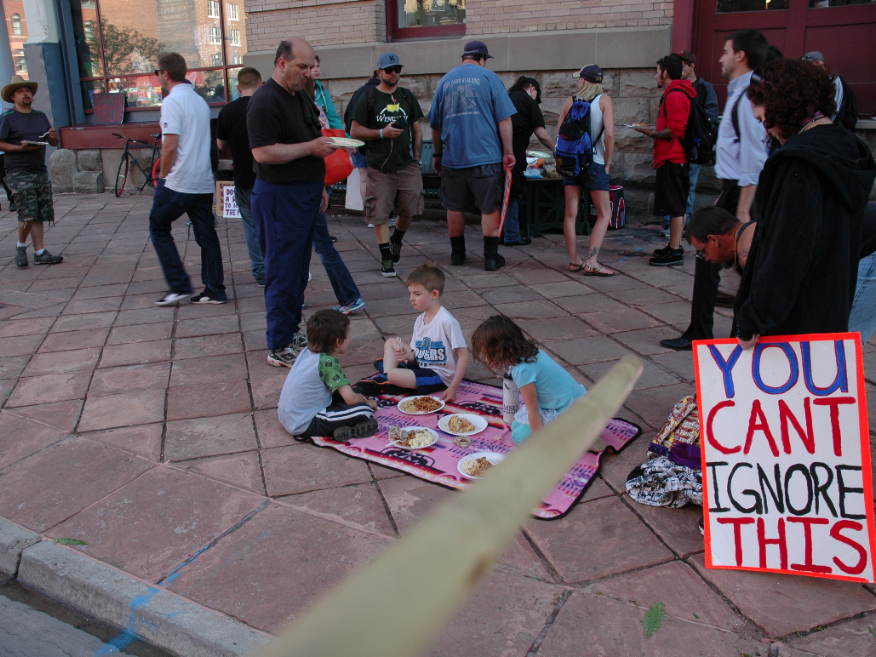
The feeding began as it does every week. (Photos by David Anderson and Eric Verlo.)

Weekly boycott of Tattered Cover Bookstore
There was a kid’s picnic.

Weekly boycott of Tattered Cover Bookstore
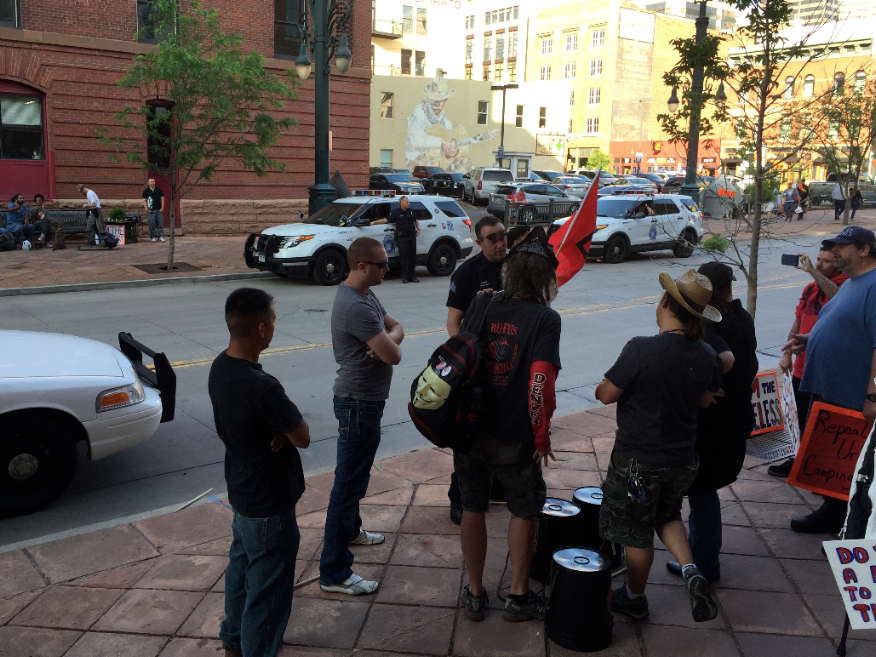
Late arrivals noticed a buildup of police cruisers to the South.

Weekly boycott of Tattered Cover Bookstore
We stopped for a photo op with an array of cruisers waiting to the East as well.

Weekly boycott of Tattered Cover Bookstore
We hadn’t intended on drumming or chanting this week but by special request we brought three drums from the car for the amusement of the children.

Weekly boycott of Tattered Cover Bookstore
They played merrily until Officer Friendly rolled up.

Weekly boycott of Tattered Cover Bookstore

Weekly boycott of Tattered Cover Bookstore

Weekly boycott of Tattered Cover Bookstore

Weekly boycott of Tattered Cover Bookstore

Weekly boycott of Tattered Cover Bookstore
To quote David Anderson:

Denver police get tough with children; During a protest of the Denver Camping Ban, at the Tatter Cover Bookstore a police officer admonished a five year old boy. The officer explained to the little boy, that it was OK to protest but that he was not allowed to have any fun while doing it

Weekly boycott of Tattered Cover Bookstore

Weekly boycott of Tattered Cover Bookstore
Not only three cruisers but an undercover officer (in the grey t-shirt).

Weekly boycott of Tattered Cover Bookstore

Osama bin Laden’s books. They could do you more good than they did him.

Last week the CIA decided
Crossing the Rubicon, The New Pearl Harbor, Imperial Hubris, Obama's Wars, The Best Democracy Money Can Buy... to declassify the list of books found in Osama bin Laden’s last hideout when Seal Team Six made their raid. There were 39 titles, which the press has categorized as heavy on conspiracy theory. That’s true, untrue, and unsurprising if you consider the official White House line is that the US does not support illegal coups. These authors beg to differ, including the unimpeachable Noam Chomski. Other investigative standouts include William Blum, Greg Palast, John Perkins. The list did not include publication dates or editions, just author and title. A closer inspection of the list is revealing.
 
(This is part one of a continuing series.)

It would be more accurate to describe Osama bin Laden’s bookshelf as history, mostly contemporary with notable exceptions. For example, bin Laden’s reference on Christianity and Islam in Spain 756-1031 was published in 1889 with the full title “The Relations and Mutual Influences of Christianity and Mohammedanism During the Khalifate of Cordova.” In 1889 European perspectives on the Moorish occupation appear dramatically antisemitic.

The history of The US and Vietnam 1787-1941 begins with Thomas Jefferson’s first interests in trading for rice with “Cochinchina”. Written by a former ambassador, it was published in 1990 by the National Defense University Press. The Best Enemy Money Can Buy is about the symbiotic relationship between the US military industrial complex and Russia’s.

Some of bin Laden’s “books” such as Michael O’Hanlon’s Unfinished Business were staple-bound publications from US policy think tanks. I’ll review those and the various intelligence agency exposés in subsequent posts.

Here are the 39 titles listed alphabetically:
The 2030 Spike by Colin Mason; A Brief Guide to Understanding Islam by I. A. Ibrahim; America’s Strategic Blunders by Willard Matthias; America’s ‘War on Terrorism’ by Michel Chossudovsky; Al-Qaeda’s Online Media Strategies: From Abu Reuter to Irhabi 007 by Hanna Rogan; The Best Democracy Money Can Buy by Greg Palast; The Best Enemy Money Can Buy by Anthony Sutton; Black Box Voting: Ballot Tampering in the 21st Century by Bev Harris; Bloodlines of the Illuminati by Fritz Springmeier; Bounding the Global War on Terror by Jeffrey Record; Checking Iran’s Nuclear Ambitions by Henry Sokolski and Patrick Clawson; Christianity and Islam in Spain 756-1031 A.D. by C. R. Haines; Civil Democratic Islam: Partners, Resources, and Strategies by Cheryl Benard; Confessions of an Economic Hit Man by John Perkins; Conspirators’ Hierarchy: The Committee of 300 by John Coleman; Crossing the Rubicon by Michael Ruppert; Fortifying Pakistan: The Role of U.S. Internal Security Assistance (only the book’s introduction) by C. Christine Fair and Peter Chalk; Guerrilla Air Defense: Antiaircraft Weapons and Techniques for Guerrilla Forces by James Crabtree; Handbook of International Law by Anthony Aust; Hegemony or Survival: America’s Quest for Global Dominance by Noam Chomsky; Imperial Hubris by Michael Scheuer; In Pursuit of Allah’s Pleasure by Asim Abdul Maajid, Esaam-ud-Deen and Dr. Naahah Ibrahim; International Relations Theory and the Asia-Pacific by John Ikenberry and Michael Mastandano; Killing Hope: U.S. Military and CIA Interventions since World War II by William Blum; Military Intelligence Blunders by John Hughes-Wilson; Project MKULTRA, the CIA’s program of research in behavioral modification. Joint hearing before the Select Committee on Intelligence and the Subcommittee on Health and Scientific Research of the Committee on Human Resources, United States Senate, Ninety-fifth Congress, first session, August 3, 1977. United States Congress Senate Select Committee on Intelligence; Necessary Illusions: Thought Control in Democratic Societies by Noam Chomsky; New Pearl Harbor: Disturbing Questions about the Bush Administration and 9/11 by David Ray Griffin; New Political Religions, or Analysis of Modern Terrorism by Barry Cooper; Obama’s Wars by Bob Woodward; Oxford History of Modern War by Charles Townsend; The Rise and Fall of the Great Powers by Paul Kennedy; Rogue State: A Guide to the World’s Only Superpower by William Blum; The Secret Teachings of All Ages by Manly Hall (1928); Secrets of the Federal Reserve by Eustace Mullins; The Taking of America 1-2-3 by Richard Sprague; Unfinished Business: U.S. Overseas Military Presence in the 21stCentury by Michael O’Hanlon; The U.S. and Vietnam 1787-1941 by Robert Hopkins Miller; “Website Claims Steve Jackson Games Foretold 9/11,” article posted on ICV2.com.

Deadliest motorcycle “gang” in Waco shoot-out was not Bandidos, Cossacks, Scimitars, or Vaqueros. It was police.

Bandidos, Cossacks, Scimitars, Vaqueros Motorcycle Clubs
Was the Waco Shoot-out a gunfight between rival gangs or an ambush laid by law enforcement? Police are monopolizing the testimony but the evidence suggests a barroom brawl became a pretext to kill or arrest club officers, essentially grassroots organizers, now charged with “organized crime”. Investigators can litter the crime scene with brass-knuckles, knives and wallet chains, but the shell casings are going to be police issue. Motorcycle headlights were on, indicating club members were trying to leave. Police claim that the brawlers redirected their fire toward officers, but did that happen while the bikers were trying to ride off? Because riding requires both hands. This gangland “shoot-out” was a St Valentine’s Day Massacre executed by cops.
 
[5/20 Update: HA! The nine casualties died of gunshot wounds, sustained outside the restaurant. No shell casings were found around the bodies. Eight of the nine were Cossacks. The eighteen wounded are not expected to be charged. So much for the narrative that gangs were fighting each other, or that Bandidos were the aggressors.]

It’s described as being a gang shoot-out, but what happened in Waco is still shrouded in the fog of the official POV. Did motorcycle club members shoot at each other? They’re unavailable for interviews, locked up on million dollar bonds. The Twin Peaks restaurant claims the shooting started outside. The only witnesses reaching reporters are the sergeant giving the press briefing and undercover cops purporting to describe the tensions between the “gangs”. By my reading, informant provocateurs incited trouble by “rocking” patches which claimed the territory of “Texas” for the Cossacks Motorcycle Club.

Something like three dozen undercover officers were monitoring the usually uneventful bi-monthly meeting of the Confederation of Clubs and Independents, in anticipation that the “Texas” patch would offend the Bandidos MC. They were able to respond within 45 seconds of the alleged altercation. What might have been an unremarkable barroom brawl, if even that was not contrived, turned into an ambush that killed nine and wounded eighteen. Zero officers were hit and I will bet every bullet was theirs.

Let’s say the melee happened as the police and media describe. Why the blackout on the club affiliations? Why are the 170 arrestees being detained on a million dollar bond each? Why aren’t reporters challenging the police narrative? Witnesses assert that at least four of the dead were killed by police. How long before we learn how many undercover officers had fired their guns?

The media is making much of the anticipation that fellow gang members are converging on Texas to avenge their comrades. I think the police know that it’s themselves who are the targets of the bikers’ vengeance.

No doubt one can say the bikers were not boy scouts, but have you seen the photos? These “gangs” wore their colors, in this case patches, like boy scout badges. And everyone in uniform creased jeans and leather vests as tidy as bowling shirts. Did you see the mugshots? If you look past the long hair and tattoos you’ll note everyone is clean shaven. This was a Sunday outing. These are family men and women, not gang members. The Cossacks are a “Harleys Only” motorcycle club for God’s sake!

Police aren’t naming the “gangs” involved in what’s being called the “Waco Shoot-out”. Because they are motorcycle clubs, for one, and because the only gang deserving of the notoriety is really the police.

NOTES 5/20:
Names of 9 dead. All killed by gunshot wounds, all outside the restaurant: COSSACKS MC ROAD CAPTAIN Daniel Raymond Boyett, 44, of Waco TX; COSSACKS MC ROAD CAPTAIN Wayne Lee Campbell, 43, of Arlington TX; COSSACKS MC SERGEANT AT ARMS Richard Vincent Kirschner Jr., 47, of Kylie TX; COSSACKS MC Matthew Mark Smith, 27, of Keller TX, formerly of Scimitars; COSSACKS MC Charles Wayne Russell, 46, of Tyler TX; COSSACKS MC Jacob Lee Rhyne, 39, of Ranger TX; Jesus Delgado Rodriguez, 65, of New Braunfels TX; Richard Matthew Jordan II, 31, of Pasadena, TX; and BANDIDOS MC Manuel Isaac Rodriguez, 40, of Allen TX.

Names of the 170 booked and charged with organized criminal activity: Martin Lewis, 62, retired San Antonio PD detective; Marcus Pilkington, 37; Michael Kenes, 57; Michael Woods, 49; Julie Perkins, 52; Nate Farish, 30; Ronald Warren (wounded), 55; Morgan English, 30; Ryan Craft, 22; Rolando Reyes, 40; Jonathan Lopez, 27; Richard Benavides, 60; Michael Baxley, 57; Aaron Carpenter, 33; Jarrod Lehman, 30; Ricky Wycough, 56; Royce Vanvleck, 25; Ester Weaver, 46; Ryan Harper, 28; Timothy Bayless, 53; Michael Chaney, 53; Mitchell Bradford, 29; Nathan Champeau, 34; Noe Adame, 34; Owen Bartlett, 34; Rene Cavazos, 46; Berton Bergman, 47; Greg Corrales, 47; John Wiley, 32; Jeff Battey, 50; Kenneth Carlisle, 36; John Craft, 47; Lindell Copeland, 63; Matthew Clendennen, 30; Michael Thomas, 59; Narciso Luna, 54; Owen Reeves, 43; Richard Donias, 46; Robert Robertson, 36; Reginald Weathers, 43; Richard Dauley, 47; Rudy Mercado, 49; Seth Smith, 25; Steven Walker, 50; Thomas Landers, 58; Valdemar Guajardo, 37; Walter Weaver, 54; William English, 33; Marco Dejong, 37; Melvin Pattenaude, 51; Jarron Hernandez, 21; Jason Moreno, 30; Jeremy King, 32; John Martinez, 30; Jeremy Ojeda, 37; John Guerrero, 44; John Moya, 26; Jose Valle, 43; Joseph Ortiz, 34; John Vensel, 62; John Wilson, 52; Jorge Salinas, 24; Justin Garcia, 23; Justin Waddington, 37; Lance Geneva, 37; Lawrence Kemp, 40; Lawrence Garcia, 51; Josh Martin, 25; Eliodoro Munguia, 49; Lawrence Yager, 65; James Rosas, 47; James Stalling, 56; James Venable, 47; Gage Yarborough, 22; Gilbert Zamora, 60; Gregory Salazar, 42; George Wingo, 51; James Eney, 43; Edward Keller, 47; Christopher Eaton, 46; Christopher Stainton, 42; Daniel Johnson, 44; Daniel Pesina, 21; Don Fowler, 51; Doss Murphy, 44; Drew King, 31; Brian Eickenhorst, 28; Edgar Kelleher, 50; Andrew Sandoval, 30; Andrew Stroer, 49; Arley Harris, 32; Bobby Samford, 35; George Rogers, 52; Jacob Reese, 29; Joseph Matthews, 41; Juventino Montellano, 46; Mark White, 41; Bradley Terwilliger, 27; Ares Phoinix, 36; Benjamin Matcek, 27; Craig Rodahl, 29; Daryle Walker, 39; David Martinez, 45; David Rasor, 37; Christopher Rogers, 33; Andres Ramirez, 41; Robert Nichols, 32; Seth Smith, 28; Theron Rhoten, 35; Timothy Satterwhite, 47; Anthony Palmer, 40; Terry Martin, 48; Wesley McAlister, 32; William Redding, 35; Matthew Yocum, 25; Phillip Sampson, 43; Phillip Smith, 37; Jason Dillard, 39; Jacob Wilson, 28; Dustin McCann, 22; Billy Mcree, 38; Kevin Rash, 42; John Arnold, 43; Kristoffer Rhyne, 26; Raymond Hawes, 29; Richard Kreder, 33; Robert Bucy, 36; Ronald Atterbury, 45; William Aikin, 24; Trey Short, 27; Christian Valencia, 26; Michael Moore, 42; Jason Cavazos, 40; Roy Covey, 27; Brian Logan, 38; Colter Bajovich, 28; Ronnie Bishop, 28; Nathan Grindstaff, 37; James Gray, 61; Jimmy Pond, 43; Clayton Reed, 29; Tommy Jennings, 56; Ray Allen, 45; James Devoll, 33; Blake Taylor, 24; Matthew Folse, 31; Sandra Lynch, 54; Marshall Mitchell, 61; Mario Gonzalez, 36; Larry Pina, 50; Richard Luther, 58; Salvador Campos, 27; Michael Lynch, 31; Michael Herring, 36; Richard Cantu, 30; Tom Mendez, 40; Sergio Reyes, 44; Bohar Crump, 46; Jerry Pollard, 27; Eleazar Martinez, 41; Jim Harris, 27; Christopher Carrizal, 33; Diego Obledo, 40; David Cepeda, 43; Brian Brincks, 23; Dusty O’Ehlert, 33; Juan Garcia, 40, engineer for Austin water dept; Kyle Smith, 48; and Jimmy Spencer, 23.

PHOTOS: DPD riot cops deploy pepper spray like it was Youtube repellent


DENVER, COLORADO- It started with a cop falling off his motorcycle, being pushed it’s alleged, by a bicyclist. Paramilitary officers piled on the cyclist while playing Orkin Man to Civic Center Park’s infestation of free speech. Photos from Denver’s April 29 march against police violence reveal that pepper spray was used less to disperse the hundred or so marchers than to repel Youtube bites. Photos by Patrick Jay and Jason Metter.


Although the marchers had already been herded back unto the sidewalk, militarized state troopers laid down a smokescreen of spray to create a no man’s land around their arrestee.


The march was 2% black, but the DPD chose from the 2% minority for the first arrests. Here activist Al Nesby has been pulled from the crowd while tablet-bearing witness David Long records the irony.


An officer assists in Al’s arrest by directing pepper spray at David whose perspective was apparently too up close and personal.


The officer also arcs his spray toward photojournalist Tanner Spendley.


Here officers spray an activist who was only mouthing off.

When the DPD aimed their pepper spray at individuals, it was because they bore cameras. Otherwise the spray seemed intended to fumigate. At no time were police officers under attack or trying to break apart a stubborn crowd. The pepper spray was dispensed like backwoods insect repellent toward an unseen foe whose sting the officers feared.

Wrote activist Jason Metter:

I believe the cops intended to attack us from the moment the march began. The cop who dropped his motorcycle, unprovoked, started a mini cop-riot by pretending to have been pushed. I did not see any protestors take aggressive actions against the cops. It seems the cops pepper sprayed us to prevent us from photographing and filming them and to punish us for not being meekly obedient to their unreasonable orders.

Even as the clouds of cayenne aerosol appear distant in these photos, each debilitated the nearby subjects and required rinsing of clothes, hands and faces.


Production note: all photographers were harmed in the taking of these pictures.

City of Denver wins court battle to ignore the homeless, one arrest made


DENVER, COLORADO- The trial of the Tattered Cover Five concluded this week. For three days a municipal court considered whether a complaint made against protesters drumming in front of the downtown Tattered Cover Bookstore should or should not curb the protesters’ freedom of speech. And the jury really didn’t get it. Not only did their verdict uphold the police’s discretion to decide whose speech can be considered to be disturbing the peace, but the jury introduced their own arbitrary enforcement, judging some drummers guilty and some not, even though the complaint which prompted the charges was based on the “loud and unusual noise” generated by the ensemble.

The jury had even heard testimony that defendants were threatened with arrest if we “so much as touched a drum.” How then could this case be about disturbing the peace via loud noise? Defense attorney David Lane knew our acts of defiance were more accurately “disturbing the police.”

More obtuse than the Denver jury was the presiding judge, who resisted every rational objection and motion to insure that blunt authoritarianism always received the benefit of the doubt. I’ll admit our supporters in the audience were glib throughout the trial as our lawyer David Lane could hardly sidestep using the dumb and dumber city attorneys for mops. But the judge always ruled in dumb’s favor. It was as if courtroom 3H was an Affirmative Action program for logical fallacies, and the judge was a rubber-stamp for the rule of bad law.

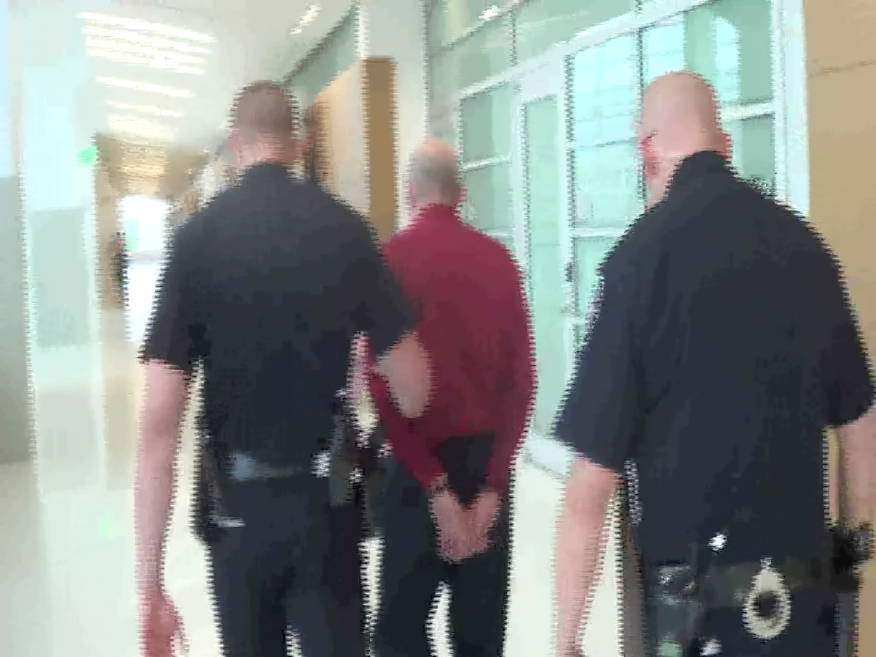
This was never more clear than in the trial’s final moments, when extra deputies ringed the courtroom and then arrested an audience member.

Just before the jury was to emerge with its verdict, the judge reminded everyone that filming or recording the jury was prohibited. David Lane voiced his objection at the buildup of officers in the courtroom without cause. As usual the judge was dismissive.

Lane emphasized that in all his years this was an uncharacteristic show of force. The judge didn’t care: “Objection noted.” It was her usual refrain.

As the officers moved closer to the audience to make their oppressive presence felt, the activism instinct to raise cell phones at the ready gave the officers their cause. This escalated into a standoff, with the deputies ordering an activist to leave the courtroom. His protestations of innocence were interpreted as resisting so he was led off in handcuffs, prompting of course more impulses to film the arrest.

When more officers began targeting more cellphones, a voice of authority rang out. It wasn’t the judge calling for order in the court. No, she was satisfied to let the deputes maraud through the audience and extract people with physical force without even looking up from her monitor. It was the sonorous voice of David Lane that brought the officers to heel. He said “Nobody can take anyone’s phone.” Lane’s gravitas had never given the judge pause but it stopped the deputes in their tracks.

“The most an officer can ask you to do is to put your phone in your pocket” Lane continued. One activist was holding his phone aloft in a game of keep-away with two deputes. Hesitantly he and the other audience members pocketed their phones.

When the jury members made their entrance they were greeted by a militarized courtroom and an audience numb with shock over the justice system’s indifference to abuse of power. We were in for a worse surprise.

It could be the jury did step up to David Lane’s challenge. He’d told them they would never in their lives wield as much power as they did on this jury, their chance to fashion how First Amendment protections are upheld. Except they didn’t share Lane’s or our concern for holding off a police state. Instead they sided with the prosecution, who urged they preserve “the right to ignore someone else’s opinion.”

Honest to God, our weekly protest at the Tattered Cover was presented to have been about the Urban Camping Ban. The jury understood we were urging people not to ignore the plight of the homeless. The city prosecutor’s words could not have been more ill chosen if one is embarassed by irony.

I was one of the defendants in the Trial of the Tattered Cover Five. One of us escaped charges due to a clerical error, two others were found not guilty for lack of self-incrimination. Tim Calahan and I were convicted of Disturbing the Peace, specifically for having created a loud and unusual noise in violation of a City of Denver ordinance. I got two convictions, community service, court fees, one year’s unsupervised probation, and supervision fees (yes that is a non sequitur), but all of it stayed pending appeal.

David Hughes arrested
So what happened to the courtroom arrestee? I’m free now to say that his name is David Hughes, Denver Occupier and IWW organizer. David wasn’t released until the next day, mostly because neither the city nor county was sure with what to charge him. David was kept in an underground cell between the courthouse and the county jail while the trial went on.

Stunned by our defeat in court, our now un-merry band’s attention was diverted to our imprisoned comrade. David had refused to be excluded from the courtroom and next we learned that, like any good Wobbly, David was refusing to reveal his identity. By chance his wife held his wallet and phone so David was free to complicate his abduction as anyone innocent of charges might. We continued to shout “Free John Doe” outside the courthouse in solidarity late into the night.

Was David guilty of using his phone camera? It’s generally understood that recording devices are not to be used in courtrooms, to respect the privacy of witnesses, the jury, and the accused. In this case the judge had specified not recording the jury which had not yet entered. What had interested David was the disproportionate buildup of sheriffs deputees. How many law enforcement officers can you have in a courtroom before the public feels threatened enough that they need to film the officers for the public’s own protection? What doesn’t get filmed, the cops get away with. The judge certainly wasn’t concerned for our protection.

Reflection
I really can’t understate the disappointment we all felt about the verdict. It was predictable yes, but unsettling to see it happen. We had the best lawyer that money can’t even buy, undone by the steady creep of Fascism. I associate it with our society’s declining education and public engagement, abetted by oppressive law.

For three days, attendees who were not readily recognized as being with the defendants could circulate the halls of the Linsey-Flanigan courthouse and overhear deputees talk about the case. All the deputees were greatly chagrined that The David Lane was representing us. Apparently they all know his reputation. There was no press interest except by KGNU, but lawyers who saw David Lane walk through the hall made a point to stop by our courtroom when they had the chance to watch him work.

And so it was really a blow to the ego to meet with failure. I’ve written before about how police intervention at our Tattered Cover protests ceased entirely after the first arraignment date when David Lane showed up in our stead. We’d been surveilled by a half dozen cruisers every Friday for a half year. After David Lane officially filed our papers that number went to zero. No more visits from officers, no more drivebys with videocameras, for almost a solid year now. It should be interesting to see what happens this Friday. Will the cruisers be back? They still have no cause. No disruptions, no conflicts, no threat of lawbreaking whatsoever.

Before Lane the officers regularly interrupted our assemblies to recite their warnings in spite of our objections. When Tim and I were arrested, we had to sit in a holding cell, shackled to a bench, while Sergeant Stiggler berated us for looking like fools. We were wrong about the camping ban, we were wrong about our rights, bla bla bla bla. We kept our mouths shut to shorten his lecture. After enduring our bullhorn for three months, he’d composed quite a rebuttal. His diatribe contradicted the suggestion that our arrests were about the noise and not our message.

For now unfortunately the sergeant turns out to have been correct about our rights. And looking like fools I guess.

For now Denver’s Disturbing the Peace ordinance does dismantle the First Amendment. For now it does allow what’s called a “heckler’s veto.” That’s a marker of unconstitutionality where one person’s complaint could be used to silence political speech to which they object. It does allow police officers to decide what “time place and manner” limits to place on free speech. Nevermind “Congress shall make no law to abridge” –that’s up to the police. It’s their call!

At our earlier motions hearing David Lane spent two days arguing that Denver’s ordinance was unconstitutional, to deaf ears obviously. At that hearing, DPD officer after officer testified that what qualified as a disturbance was entirely theirs to decide. Lane laid the groundwork to show that Denver police officers aren’t given a clue how to respect free speech. This judge was already satisfied I guess to pass the buck to a higher court.

In the meantime activists can no longer brey with confidence about free speech rights in Denver. We’ll have to engage with police submiting their proposed abridgements. We’ll have to bite our tongues, as they do I’m sure, feeling our hands tied more than we’d like, they longing to beat us. It’s going to be more difficult to recruit newcomers, uneasy with what confidence we can responsibly instill in them. “Am I going to get in trouble” is the first question they ask. Now the more probable answer is not maybe.

Denver Anons light torches in spite of being surrounded by five SWAT SUVs

Anonymous Denver
DENVER, COLORADO- Anonymous activists converged on the capitol on Sunday, as they do “Every 5th”, this time to remember the growing list of victims of Denver police violence, and this time was going to be different. This time the call went out for torches or similar flamables and enough unnamed Anons delivered. As dusk approached and numbers grew, so did sightings of SUVs ferrying riot cops, at five staging areas. Despite another SUV whose officers were glued to binoculars, and a new HALO camera installed on a nearby streetlight, Anonymous lit its torches to send an angry message before the police rushed in.

Justicia para Jessie Hernandez
This banner commemorated Jessica Hernandez, the Latina teen killed by DPD on January 26. Others remembered were: Joseph Valverde, Ryan Ronquillo, Alberto Romero, Ismael Mena, Mark Ashford, James Watkins, Marvin Booker, David Flores, Clay Rampon, Carlos Jurado, Joel Jurado, Juan Vasquez, Eric Winfield, Alex Buck, Jared Lunn, John Heaney, Michael DeHerrera, Nicolas Alvardo, and Kevin Ryberg. Anonymous also called for justice for survivors Sharod Kindel and Alex Landau.

CASE DISMISSED! City of Denver drops charges against Occupier Patrick Jay


DENVER, COLORADO- Prosecuting attorneys for the City of Denver were granted their own motion to have their case against Patrick Jay dismissed for lack of evidence! Prominent civil rights lawyer David Lane was informed this weekend that all charges against Patrick have been dropped.

Patrick was arrested last December while returning to his car after a ?#?BlackLivesMatter? protest. He was seized by SWAT officers while VIDEOTAPING the snatch and grab arrest of fellow activist Max Mendieta. Patrick was charged with obstructing traffic while marchers staged die-ins at prominent Denver intersections. *

According to police, HALO cameras recorded Patrick and others blocking vehicles. The cameras might also have confirmed that their actions prevented cars from running over the marchers laying prone on the pavement. We’ll never know because the DPD now says the footage is gone. After defendants declined to take plea deals, Patrick’s defense attorney David Lane learned the HALO footage would not be available for discovery because the surveillance files had been accidentally overwritten! In view of this, David Lane motioned for a dismissal, but city attorneys assured the judge that there were DPD officers enough to bear witness against Patrick Jay. Lane vowed to compel those officers to first have to pick Patrick from out of a line up. Patrick’s jury trial was set for April, but last week city attorneys tendered their own motion for a dismissal and that motion was granted.

Patrick Jay’s charges were dropped and his First Amendment rights were vindicated, but of course the Denver Police achieved their goal of intimidating activists who have to brace themselves for arbitrary arrest even though they know their rights. Over the course of many months of marches, participation has suffered attrition not just because people are frightened, don’t want to or can’t subject themselves to arrest, but some activists who had no alternative but to take plea deals now cannot risk violating the terms of probation which forbid their participation in protests.

Only a few days after Patrick’s arrest, he and I were leaving another anti-police-brutality march when multiple DPD cruisers swooped up to us on the sidewalk. This time instead of jumping off and unto us, an officer in the lead vehicle shouted from his rolled-down window: “Scared you?!”

Yes, officer, you did. **

Arrests and harassment have helped the DPD reduce protest numbers. Because of favorable plea deals or inadequate legal representation, no one has yet had the chance to challenge the veracity of their charges, until now. Several cases, including Max Mendieta’s, are still pending. Max is also represented by David Lane. Hopefully the recognition of Patrick’s arrest being unwarranted will turn the tide.

————-
NOTES:
* PATRICK’S ARREST
WAS SURREAL. Everyone was returning to their cars, putting signs into trunks etc, when the police SUV carrying riot cops on its sideboards made a slow pass. This was a development we began to notice at earlier events. Even though the officers in riot gear might not have had to show themselves during a march, they would emerge afterward on their SUVs to cruise by our vehicles, almost to a stop as if scanning our cars looking for suspicious occupants. We didn’t think much of it except this time they stopped and the entire gang lept off to seize one of our group, Max Mendieta, as he walked the few solitary steps to his car. Patrick started to film the whole incident, from when police forced Max to the ground until they hauled him into custody. We’d reconstituted into a small group of less than a dozen, activists eager to dissuade further arressts, but the riot cops elbowed past us to seize another, which Patrick filmed, and then they grabbed Patrick. Patrick asked what they were arresting him for, but the officers wouldn’t say, only that it would be listed on his arrest warrant.

Ironically their irreverant answer turned out to be incorrect. But first I want to tell you what happened when the police drove off. They left an officer behind. The SUV loaded with riot cops, minus one, stopped several car lengths away when someone noticed the error. Their sargeant had been left on the street, in his cumbersome riot gear, unable to fit in the ordinary cruisers, and barely able to catch up with the waiting SUV. I guess the SUV driver didn’t want to risk backing over his sargeant, so the fat man lumbered slowly back to his perch, his riot gear clinking with every plodding step, like a minuscule robocop, the crowd barely able to sustain its “nah-nah-nah-nah” chant for laughing so hard.

Perhaps as payback, the arrestees that night -there were four total- had to wait sixteen hours “for their fingerprints to clear.”

Back to Patrick’s undeclared charges. Due to what we could only construe to be a typo, Patrick’s citation read “database-error” where the offense was supposed to be. Patrick had to sit in jail for 16 hours, post bail, await arraignment, and seek a lawyer, knowing only that he was charged with database-error. When the magistrate asked if he pled guilty, Patrick said “To what? Database error?” “No.”

** YES THERE’S MORE TO THIS STORY TOO. After the DPD pulled their gag, the officers watched as we walked to the building under which we’d parked our vehicle. The hour having become late, we discovered the stairwell doors locked. We imagined the officers laughing as they saw us circle the office building testing every door. We soon realized that our only recourse was to descend the car ramp to the parking area, but we were afraid that the police would follow and corner us there, out of view of other late night passersby. Security cameras or no, we feared what two dozen or so cops could do to two pedestrians; what we know often happens to homeless indigents in back alleys and poorly lit spaces; what happens to African Americans in broad daylight while they scream “I Can’t Breathe!” So we waited until the police cars lost interest before we ventured down the ramp.

Not being able to count on even our own police to obey the law, knowing the brutality of which police are capable, and witnessing the capriciousness of police abuse of authority, is the terror that defines living in a police state.

Film critics toe corporate line to re-kill messenger Gary Webb, after Hollywood

Gary Webb
AT BEST “KILL THE MESSENGER” portrays suspiciously deceased journalist Gary Webb as a heroic sleuth who refused to compromise his principles. At best, the film re-reports the enormous crime which Webb exposed in his series DARK ALLIANCE, that the CIA’s support of the Nicaraguan CONTRAs in the 1980s involved facilitating the smuggling of drugs into the US, in such large quantities as to precipitate the crack cocaine epidemic, delivered to our major inner cities by the CIA. UNFORTUNATELY the film muddies the crack connection, as Webb’s detractors did back then. Two deliberate plot omissions suggest this is probably not a coincidence.

Conveniently the screenplay ends before the years when Gary Webb was able to elaborate on those links. By then he’d lost his audience. Unfortunately the film that might have given his life’s work a main stage reprise chose not to go that far. Does it matter anymore? These days the CIA and its covert cohorts are understood to have authored a litany of unimaginable evils. So it’s not too early to demonize the CIA. Evidently someone thinks the American public is not ready to be shown the racist stratagems of corportate class war.

Exposing the genesis of the crack attack on African American ghettos is clearly a missed opportunity for a film in 2014. Given Ferguson. Given the rising awareness of our government’s coordinated and premeditated containment and criminalization of dark-skinned populations. Let’s remember that while the US was fighting Nicaraguan rebels, it was also at war with the Black Liberation Army. Funding and arming drug warlords was the same strategy Brazil used to administrate the favelas, via proxy gangs. One might say that LA’s Bloods and Crips played domestic Contras set loose to destabilize community building efforts by militant Black Power.

UNPARDONABLE however are the film’s departures from the truth, which paint a curious fiction as if to indemnify the national press from its complicity with the intelligence community. Two lies will stand out to anyone who was there. (Did the filmmakers think their audience would be only millennials?)

First, the San Jose Mercury News was hardly a “local news outlet” unfamiliar with handling national stories and unknown to the average reader. The Mercury News was an award winning paper which competed with metropolitan mastheads. I can’t imagine its employees aren’t indignant by the film’s yokel characterization. The Los Angeles Times’ vindictive campaign to defame Gary Webb was hardly driven by professional embarassment over a missed scoop.

Second, the Contra-CIA drug smuggling link was suspected well before Gary Webb brought it to the mainstream. I remember during the Iran-Contra Hearings a decade earlier, the alternative media often lamented that the official investigation had been narrowed to exclude mention of the cocaine connection.

These amendments might be excused for simplifying the plot except that they minimize the breadth of the corporate identity of Webb’s censors. How very 90s of this narrative to pretend that Capitalist media outlets compete for news scoops like highschoolers at a science olympics. Newspapers and networks have always only ever peddled the themes their owners dictate. Media consolidation has only meant the manufacturing of public consent has become more uniform, perfectly illustrated by the collusion of the tag-team that hit Gary Webb.

AND AFTER HOLLYWOOD FAILED GARY WEBB, the film critics were waiting with daggers.

David Denby begins his New Yorker review by associating KTM with other crusading journalist thrillers, “some depicting real events, some not”, then pointing to director Michael Cuesta’s “paranoid” TV work, finally contriving that the film botches “many contraditory assertions.” Um, sorry, neither. But I do worry that giving all thumbs down will succeed in scaring away viewers. Denby finishes by making it all about actor Jeremy Renner, un-ironically aping the campaign waged on Gary Webb, overtly described in the film, shifting the focus from the story to all about the messenger.

The Washington Post dispatched one-time Webb adversary Jeff Leen to reprise the hatchet job begun when Gary Webb broke the story. Labeling Webb as “no journalism hero”, Leen’s rebuttal hangs on the technicality that no CIA “employees” were implicated, ignoring what everyone knows post-Blackwater, post-Wikileaks, that the US has long outsourced its crimes, from torture to food service. Dimwit.

Arrests reach seven at weekly protest of two-faced Denver bookstore

Tattered Cover arrests
DENVER, COLORADO- Occupy Denver’s Tim Calahan and I were arrested and jailed at last Friday’s boycott action against the Tattered Cover Bookstore. This marked Tim’s third citation for drumming, my second, and Janet Matzen’s first. For drumming. Disturbing the peace is what the DPD charges. We maintain the DPD are curbing our free speech. SO NOW I want to tell you the story of how famed civil rights attorney David Lane came to represent us.

The story begins Thursday before the Anonymous “Every5th” march. A couple friends and I were feeling trepidatious about the Anonymous march because the previous month’s Every5th had been abruptly curtailed by riot police. Several Anons were arrested and a number more pepper-sprayed, and so we wondered if we couldn’t get legal advice about how to assert our First Amendment rights without surrendering ourselves to jail. Also on our minds were the past two fridays at the Tattered Cover where citations had been handed out, drums confiscated, and warnings given that if we drummed again, the next arrestees would be jailed. So we went to the celebrated lawyer’s office and tried our luck with the receptionist.

I told her we were activists who were having a rough time with police, we thought they were violating our civil liberties, could David Lane be of any help? She looked at us increduously. We couldn’t just walk in she said, we had to take a card, we had to call in, we could leave a message, they’d call back if they were interested, they might not call back at all, it certainly wouldn’t be right away.

We told her time was rather of the essence, these arrests were as predictable as they were egregious, we didn’t know where to turn and these arrests seemed to present the kind of case in which David Lane specialized. The receptionist repeated her instructions in a tone that reflected she was not sure I wasn’t simply a lunatic.

After making more prolonged and embarassing enteaties, I finally submitted to following her instructions but I insisted too on leaving a written note which gave me further time to expound on our DPD versus the people predicament.

Turning to make our exit, I explained that we would be leaving her office to join a protest at which chances were pretty good we were going to be arrested, but that the next night at the Tattered Cover, we were most definitely going to be arrested. The receptionist made the oddest face as she search my eyes for some sign that I spoke her language. “Wait just a minute please” she told us as she beat a hasty retreat. Within that minute she returned to say “David Lane will meet you in the conference room.”

We spent the next half hour relating the details of our past arrests, how each had been captured on video, in front of witnesses, and how we’d been warned arrests would continue. We offered too that the police were also videotaping assiduously and that their accounts would match ours. David Lane assured us if we were conducting ourselves as we presented and if arrests endured, he would represent us and anyone else who stepped up to the plate. If exercising our freedom of speech became a risk where it was supposed to be right, standing up for us was the least he could do.

That night we hit the streets with a renewed sense of confidence, and the following evening at the Tattered Cover was an empowering experience like no other. As you can see in the photo above, we couldn’t keep our eyes off the half dozen cruisers keeping watch on us. Would they swoop in? When would they descend on us? The anticipation was frustrating. Who should film, who should take whose keys and phone, who did or didn’t want to beat the drum. We were ready for jail, we were ready to tell the officers, as we had the weeks before, that they couldn’t do what they were doing, we knew our rights. This time we could assure our DPD captors that they were asking for trouble in messing with Occupy. Stay tuned!

WWII air veterans of Doolittle Raiders celebrate 71 years of bombing civilians

Doolittle nose-art
I read 30 Seconds Over Tokyo when I was still a war-playing kid, before I would understand the mischievous consequences of the Doolittle Raiders B-25 bombers deploying without their bombsights. This was to prevent US war-making advantages falling into enemy hands but it also precluded dropping bombs with accuracy. I’m pretty certain the account for young readers also didn’t explain why over a quarter of the squadron’s bombs were of the incidiary cluster variety. Readers today know what those are for. Doolittle claimed to be targeting military sites in Japan’s capitol, but “invariably” hit civilian areas including four schools and a hospital. Of the American fliers captured, three were tried and executed by the despicable “Japs”, who considered the straffing of civilians to be war crimes. After the war, the US judged the Japanese officers responsible, as if their verdict was a greater injustice against our aviators’ “honest errors”. Today we rationalize our systemic overshoot policy as “collateral damage”.

Every year since WWII, Doolittle’s commandos are feted for their milestone bombing mission. This Veterans Day is to be the last due to their advanced ages. But it is fitting, because isn’t it time Americans faced what we’re celebrating? There’s no denying it took suicidal daring, but the Doolittle Raid inaugurated what became a staple of US warfare, the wholesale terrorizing of civilians from on high, with impunity and indifference. To be fair, the American public has always been kept in the dark. American aircraft have fire-bombed civilians at every diplomatic opportunity since 1942, and a Private Manning sits in the brig for trying to give us a chance to object.

We now know that the Doolittle Raid didn’t turn the tide, nor shake Japanese resolve. It was a retalliation for the attack on Pearl Harbor, intended to boost US morale as if to say, America wasn’t defeated. Kinda like why and how we struck back at Afghanistan after 9/11, just as indiscriminately.

The “Mark Twain” ersatz bombsight
substitute bombsightThe Norden bombsight was a closely guarded US secret weapon. An airstrike without it would today be like lobotomizing so-called smart bombs, and deciding to opt for imprecision bombing. The official army record recounts that a subsitute sighting mechanism was improvised for the raid, dubbed the “Mark Twain” and judged to be effective enough. Now a bad joke. Indochina and Wikileaks-wisened, we know the mendacity of that assessment. The vehemently anti-imperialist, anti-racist Twain would not have been honored.

Twain satirized Western so-called Enlightenment thus: “good to fire villages with, upon occasion”.

Post-postwar hagiographies of the raid have suggested the improvised bombsight was better suited to low-altitude missions than the Norden model. That conclusion is easily dismissed because the device was used only for the Doolittle run and never after. The sight’s designer, mission aviator C. Ross Greening, offered a explanation for why he named the device after Mark Twain in his pothumously published memoir Not As Briefed. He didn’t.

The bombsight is named the “Mark Twain” in reference to the “lead line” depth finder used on the Mississippi River paddle wheelers in bygone days.

Because its design was so simple, we’re left to suppose. Greening’s bombsight was named for the same “mark” which Samuel Langhorne Clemens adopted as his celebrated pen name. I find it disingeneous to pretend to repurpose an archaic expression whose meaning was already eclipsed by the household name of America’s most outspoken anti-imperialist. Who would believe you named your dog “Napoleon” after a French pastry?

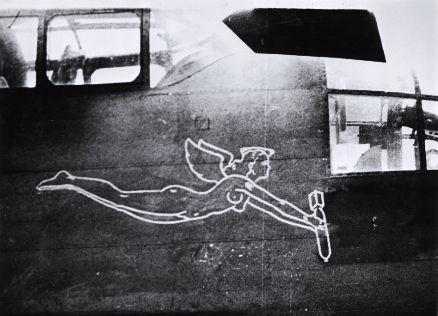
We are given another glimpse into Greening’s sense of humor by how he named his plane, the “Hari-Kari-er” ready to deal death by bomb-induced suicide. Greening’s B-25 is the one pictured above, with the angelic tart holding a bomb aloft. Greening’s plane was another that carried only incendiary ordnance.

Much was made of the sight’s two-piece aluminum construction, reportedly costing 20 cents at the time compared to the $10,000 Norden. This provided the jingoist homefront the smug satisfaction perhaps, combining a frugality born of the Depression with the American tradition of racism, that only pennies were expensed and or risked on Japanese lives.

War Crimes
Targeting civilians, taking insufficient care to avoid civilian casualties, using disproportunate force, acts of wanton retaliation, and the use of collective punishment are all prohibited by international convention. They are war crimes for which the US prosecutes adversaries but with which our own military refuses to abide. Americans make much of terrorism, yet remain blind to state terrorism. Doolittle’s historic raid, judged by the objective against which it is celebrated as a success, was an act of deliberate terrorism.

Forcing the Japanese to deploy more of their military assets to protect the mainland sounds like a legitimate strategy, except not by targeting civilians to illustrate the vulnerability, nor by terrorizing the population, one of Doolittle’s stated aims. He called it a “fear complex”.

It was hoped that the damage done would be both material and psychological. Material damage was to be the destruction of specific targets with ensuing confusion and retardation of production. The psychological results, it was hoped, would be the recalling of combat equipment from other theaters for home defense, the development of a fear complex in Japan, improved relationships with our Allies, and a favorable reaction in the American people.

There is no defending Japan’s imperialist expansion in the Pacific, and certainly not its own inhumanity. The Japanese treated fellow Asians with the same racist disregard with which we dispatched Filipinos. While Americans point in horror at how the Japanese retalliated against the Chinese population for the Doolittle Raid, we ignore that Doolittle purposely obscured from where our bombers were launched, leaving China’s coast as the only probably suspect.

To be fair, most of Doolittle’s team was kept in the dark about the mission until they were already deployed. I hardly want to detract from the courage they showed to undertake a project that seemed virtually suicidal. But how long should all of us remain in the dark about the true character of the Doolittle Raid?

Out of deference for the earlier generation of WWII veterans, those in leadership, certain intelligence secrets were kept until thirty years after the war. Unveiled, they paint a very different picture of what transpired. The fact that the US knew the German and Japanese codes from early on revealed an imbalance not previously admitted, as an example.

About the Doolittle Raid, much is already openly documented, if not widely known. The impetus for the raid was public knowledge, the evidence of its intent in full view.

BY DESIGN
In the aftermath of Pearl Harbor, American newspapers were already touting offers of cash rewards for whoever would be the first to strike back at Japan. President Roosevelt expressed a deliberate interest in hitting the Japanese mainland, in particular Tokyo, to retaliate for the Japanese strike against Pearl Harbor, never mind it had been a solely military target.

Plans were made to exploit the Japanese homeland’s vulnerability to fire, as ninety percent of urban structures were made of paper and wood. Writes historian William Bruce Jenson:

In his “confidential” meeting with reporters back in November, Marshall had declared that the US would have no cavil about burning Japan’s paper cities.

For the Doolittle Raid, a bombing strategy was developed to overwhelm the fire department of his target, the Shiba ward.

A former naval attache in Tokyo told Doolittle: “I know that Tokyp fire department very well. Seven big scattered fires would be too much for it to cope with.”

As lead plane, Doolittle’s role was to literally blaze the way. Fellow pilot Richard Joyce told Nebraska History Magazine in 1995:

The lead airplane, which was going to have Doolittle on board as the airplane commander, was going to be loaded with nothing but incendiaries -2.2­ pound thermite incendiaries- in clus­ters. They drop these big clusters and then the straps break and they spray, so they set a whole bunch of fires. He was to be the pathfinder and set a whole bunch of fires in Tokyo for pathfinding purposes.

Doolittle’s report outlined his objective more formally:

one plane was to take off ahead of the others, arrive over Tokyo at dusk and fire the most inflammable part of the city with incendiary bombs. This minimized the overall hazard and assured that the target would be lighted up for following airplanes.

Greening paints the most vivid picture, of burning the Japanese paper houses to light the way:

Doolittle planned to leave a couple of hours early, and in the dark set fire to Tokyo’s Shiba ward … the mission’s basic tactic had been that Doolittle would proceed alone and bomb a flammable section of Tokyo, creating a beacon in the night to help guide following planes to their targets.

Doolittle’s copilot Lt Richard Cole, told this to interviews in 1957:

Since we had a load of incendiaries, our target was the populated areas of the west and northwest parts of Tokyo.

After the bombers had left on their raid, and before news got back about whether or not they accomplished it, the Navy crew on the carrier USS Hornet already sang this song, which went in part:

Little did Hiro think that night
The skies above Tokyo would be alight
With the fires that Jimmy started in Tokyo’s dives
To guide to their targets the B-25s.
When all of a sudden from out of the skies
Came a basket of eggs for the little slant eyes

Incendiaries

Most of the bombers were loaded with three demolition bombs and an incendiary cluster bomb. Some of the planes carried only incendiaries. According to Doolittle’s official report of the raid, here were some of their stated objectives:

Plane no. 40-2270, piloted by Lt. Robert Gray:
thickly populated small factories district. … Fourth scattered incendiary over the correct area

Plane No. 40-2250, Lt. Richard Joyce:
Incendiary cluster dropped over thickly populated and dense industrial residential sector immediately inshore from primary target. (Shiba Ward)

“The third dem. bomb and the incendiary were dropped in the heavy industrial and residential section in the Shiba Ward 1/4 of a mile in shore from the bay and my tat.”

Aircraft 40-2303, Lt Harold Watson:
the congested industrial districts near the railroad station south of the Imperial Palace

AC 40-2283, David Jones:
the congested area Southeast of the Imperial Palace

Even though the planned night raid became a daytime mission, Doolittle did not alter his original role, intended to light the way for the following planes. His target remained the Shiba District of Tokyo. His own plane: “changed course to the southwest and incendiary-bombed highly inflammable section.”

Doolittle’s report included a description of the incendiary bombs:

The Chemical Warfare Service provided special 500 incendiary clusters each containing 128 incendiary bombs. These clusters were developed at the Edgewood Arsenal and test dropped by the Air Corps test group at Aberdeen. Several tests were carried on to assure their proper functioning and to determine the dropping angle and dispersion. Experimental work on and production of these clusters was carried on most efficiently.

As has become an aerial bombardment tradition, crews were let to inscribe messages on the bombs about to be dropped. Accounts made the most of these chestnuts: “You’ll get a BANG out of this.” And “I don’t want to set the world on fire –only Tokyo.”

These details, which reveal the intentions of the raid, were not made known to the public immediately. The Doolittle Raid was planned and executed in secret, with US government and military spokesmen denying knowledge of the operation even in its aftermath. The first word to reach the American public came from the New York Times, citing Japanese sources:

Enemy bombers appeared over Tokyo for the first time in the current war, inflicting damage on schools and hospitals. Invading planes failed to cause and damage on military establishments, although casualties in the schools and hospitals were as yet unknown. This inhuman attack on these cultural establishments and on residential districts is causing widespread indignation among the populace.

This report was dismissed as propaganda. When Japan declared its intention to charge the airman it had taken captive with war crimes, the US protestations redoubled. The accusations were belittled even as our own reports conceded to the possibilities.

Lieutenant Dawson’s Thirty Seconds Over Tokyo was the first published account of the raid. Printed less than a year after the event, wartime-sensitive details such as the phony guns made of broomstick handles poking out the back were left out. Targets were also not specified, but a candor remained, probably intended to be threatening. Lawson described the 500-pound incendiaries as “something like the old Russian Molotov Breadbasket”, and related US naval attache Jurika’s advice:

“If you can start seven good fires in Tokyo, they’ll never put them out,” Jurika promised us. … “I wouldn’t worry too much about setting fires in flimsy-looking sections of Tokyo,” he said. “The Japanese have done an amazing job of spreading out some of their industries, instead of concentrating them in large buildings. There’s probably a small machine shop under half of these fragile-looking roofs.”

“Flimsy” became Lawson’s keyword for the residential areas. Here Lawson described dropping his third and fourth bombs, when he saw their corresponding red light indicators:

The third red light flickered, and, since we were now over a flimsy area in the southern part of the city, the fourth light blinked. That was the incendiary, which I knew would separate as soon as it hit the wind and that dozens of small fire bombs would molt from it.

I was satisfied about the steel-smelter and hoped the other bombs had done as well. There was no way of telling, but I was positive that Tokyo could have been damaged that day with a rock.

Our actual bombing operation, from the time the first one went until the dive, consumed not more than thirty seconds.

Thus: Chance of hitting civilian homes: 50/50.
Charges of Excessive Force could be expected, because
blame the victim for being weaker than: a rock.
Care taken to avoid innocent casualties: 30 seconds.

In a later afterword, Lawson blamed Tokyo for having insufficient bomb shelters.

After the war, US occupation forces recovered Japanese records which documented the losses attributed to the Doolittle Raid: fifty dead, 252 wounded, ninety buildings. Besides military or strategic targets, that number included nine electric power buildings, a garment factory, a food storage warehouse, a gas company, two misc factories, six wards of Nagoya 2nd Temporary Army Hospital, six elementary or secondary schools, and “innumerable nonmilitary residences”.

Strafing
Japan accused the fliers of indescriminate strafing civilians. The US countered that defending fighters were responsible for stray bullets when their gunfire missed the bombers. That’s very likely, except the raiders were candid about their strafing too. Lawson:

I nosed down a railroad track on the outskirts of the city and passed a locomotive close enough to see the surprised face of the engineer. As I went by I could have kicked myself for not giving the locomotive’s boiler a burst of our forward 30-calibre guns, then I remembered that we might have better use for the ammunition.

A big yacht loomed up ahead of us and, figuring it must be armed, I told Thatcher to give it a burst. We went over it, lifted our nose to put the tail down and Thatcher sprayed its deck with our 50-calibre stingers.

Greening’s account of firing on a sailor, raises the moral ambiguity of air warfare with which few airmen grapple. By virtue that technology allows it, combatants become slave to a predetermined outcome:

When we attacked the next patrol boat, a Japanese sailor threw his hands up as if to surrender. I guess he expected us to stop and take him prisoner. We shot him and left this boat smoking too.

The Medals
Friendship Medals exchanged between Japan and the US found themselves requisitioned for Doolittle’s Raid:

Several years prior to the war, medals of friendship and good relationship were awarded to several people of the United States by the Japanese government.  In substance these medals were symbolic of the friendship and cooperation between the nations and were to represent the duration of this attitude.  It was decided by the Secretary of the Navy, Mr. Frank Knox, that the time was appropriate to have these medals returned.  They had been awarded to Mr. Daniel J. Quigley, Mr. John D. Laurey, Mr. H. Vormstein and Lt. Stephen Jurkis.

After arrangements had been made and the medals secured, a ceremony was held on the deck of the Hornet during which the medals were wired to a 500 lb. bomb to be carried by Lt. Ted Lawson and returned to the Japanese government in an appropriate fashion.

Lawson’s plane no 40-2261 dropped that bomb on an “industrial section of Tokyo” omitting to mention that Japan’s industry was still a post-feudal cottage industry.

“The medals were subsequently delivered in small pieces to their donors in Tokyo by Lt. Ted Lawson at about noon, Saturday, April 18, 1942.”

–Mitscher, M.A. Letter Report to Commander Pacific Fleet.

“Through the courtesy of the War Department your Japanese medal and similar medals, turned in for shipment, were returned to His Royal Highness, The Emperor of Japan on April 18, 1942.”

–Knox, F. Letter Report to Mr. H. Vormstein

How to testify at a grand jury: David House “invokes” on Bradley Manning, Julian Assange, & taking illegal notes

Bradley Manning supporter David House was called last year before the grand jury preparing charges against Julian Assange, in the event Assange is successfully remanded to Sweden. Despite being told a transcript was forbidden, House took notes which have now found themselves (A)nonymously online, reproduced here with David House’s refrain in bold. Here’s Grand Jury, a comedy:  

1. Record of proceedings
2. As recorded by David House
3. Grand Jury, Alexandria VA
4. 15 June 2011, 4:10pm to 5pm
5.  
6. Inside the Grand Jury:
7. DOJ Counterespionage Section: Attorney Patrick Murphy *
8. DOJ Counterespionage Section: Attorney Deborah Curtis *
9. Eastern District of Virginia: AUSA Bob Wiechering
10. Eastern District of Virginia: AUSA Tracy McCormick
11. Eastern District of Virginia: AUSA Karen Dunn
12. Unspecified number of Grand Jurors
13. Court Steganographer
14. David House
15.  
16. Directly outside the Grand Jury:
17. Mike Condon, FBI Agent from Washington, D.C. field office
18. James Farmer, Chief of Anti-Terrorism and National Security Unit at the U.S. Attorney’s Office in D. Mass
19. Peter Krupp, David House’s attorney
20.  
21.  
22. Record begins: 4:10pm
23. [David House is sworn in and informed of his rights]
24. Patrick Murphy: Would you please state your full name for the record?
25. David House: My name is David House.
26. PM: Did you meet Bradley Manning in January 2010?
27. DH: On the advice of counsel, I invoke my right to remain silent under the Fifth Amendment to the United States Constitution. I am concerned that this grand jury is seeking information designed to infringe or chill my associational privacy, and that of others, guaranteed by the First Amendment to the United States Constitution, and that it is using information obtained without a search warrant in violation of the Fourth Amendment to the United States Constitution. I define the preceding statement as “invoke”, and when I say “I invoke” in the future I am referring to this statement.
28. Deborah Curtis: Exhibit 1-A?
29. PM: Mr. House, please direct your attention to the screen behind you, exhibit 1-A.
30. DC: I can’t make it bigger.
31. PM: Try… here, remove that bar on the side.
32. DC: That didn’t work.
33. DH: Do you guys need help?
34. DC: We just need to make it bigger. Can everyone see this okay?
35. PM: Ok… we’re going to continue.
36.  
37. [A still image from the Frontline PBS special is displayed on the screen. Four figures are standing in front of the BUILDS logo, one figure has her back turned.]
38.  
39. PM: Mr. House, can you identify the man on the right?
40. DH: I invoke.
41. PM: Can you identify the man standing second from right?
42. DH: I invoke.
43. PM: Ok, can you identify the person with bright-colored hair, standing here?
44. DH: I invoke.
45. PM: Are we to believe that identifying that individual would somehow incriminate you?
46. DH: On the advice of counsel, I invoke my right to remain silent under the Fifth Amendment to the United States Constitution. I am concerned that this grand jury is seeking information designed to infringe or chill my associational privacy, and that of others, guaranteed by the First Amendment to the United States Constitution, and that it is using information obtained without a search warrant in violation of the Fourth Amendment to the United States Constitution.
47. PM: Ok, can you identify the man on the left?
48. PM: I would like to observe for the record that Mr. House is taking notes.
49. DH: As to the previous question, I invoke.
50. PM: Why are you taking notes?
51. DH: Invoke.
52. Bob Wiechering: I’d like to recommend, at this point, that we take a break and talk to your counsel.
53.  
54. [AUSAs and House leave the grand jury]
55. [Peter Krupp, House’s attorney, asserts House’s right to invoke]
56. [AUSAs and House return to the grand jury]
57.  
58. PM: What is your birthdate?
59. DH: March 14, 1987
60. PM: Where do you live?
61. DH: Can you restate the question?
62. PM: What is your address?
63. DH: I invoke.
64. PM: What is your current occupation?
65. DH: I invoke.
66. PM: Were you a senior in computer science at Boston University in January 2010?
67. DH: I invoke.
68. PM: Isn’t it true that you told PBS Frontline that you were a senior at Boston University in January 2010?
69. DH: I invoke.
70. PM: Do you know what a hackerspace is?
71. DH: I invoke.
72. PM: Do you know what BUILDS is, the acronym?
73. DH: I invoke.
74. Bob Wiechering: Mr. House, I notice you are taking notes. Attempting to create your own transcript is a violation of rule 6(e) of this grand jury. We have brought this to the attention of your counsel, and although he feels differently on the matter, we assert that you must stop taking notes at this time.
75. DH: Let me consult with my attorney.
76. [House leaves the grand jury room and returns one minute later]
77. DH: My lawyer asks that you refer all questions about notes to him.
78. BW: Let’s continue.
79. PM: Mr. House, are you involved with the Bradley Manning Support Network?
80. DH: I invoke.
81. PM: Did you respond in the affirmative when asked by the FBI if you had heard of known WikiLeaks associate Jacob Appelbaum?
82. PM: I would like to state for the record that Mr. House is not answering the question and is instead taking notes.
83. DH: I invoke.
84. PM: Do you intend to answer any of my questions, aside from your date of birth and your name?
85. DH: I invoke.
86. PM: Is that because of the phalanx of attorneys present here today?
87. Court Stenographer: I’m sorry, the what of attorneys?
88. PM: Phalanx… the phalanx of attorneys.
89. DH: As to the phalanx of attorneys, I invoke.
90. PM: At this time, I will let Deborah Curtis ask a few questions.
91. DC: Mr. House, have you ever been to the Oxford Spa restaurant in Cambridge, MA?
92. DH: Allow me to consult with my attorney.
93. [House leaves the grand jury and returns one minute later.]
94. DH: As to the previous question, I invoke.
95. DC: You admitted to federal agents in Boston that you had met Bradley Manning in January 2010, is that correct?
96. DH: I invoke.
97. DC: Isn’t it true that you spent the night of January 27 2010 with Daniel Clark and Bradley Manning?
98. DH: Can you repeat the question?
99. DC: Isn’t it true that you spent the night of January 27 2010 with Daniel Clark and Bradley Manning?
100. DH: One more time.
101. DC: Isn’t it true that you spent the night of January 27 2010 with Daniel Clark and Bradley Manning?
102. PM: He’s writing it down.
103. DC: Are you getting this, are you writing it all down?
104. DH: Was the last question a question to be answered?
105. DC: Yes.
106. DH: I invoke.
107. DC: And the question before?
108. DH: I also invoke.
109. DC: Where did Danny Clark have breakfast on the morning of January 28, 2010?
110. DH: Allow me to consult with my attorney.
111. [House leaves the grand jury and returns one minute later.]
112. DH: As to the previous question, I invoke.
113. DC: Do you intend to answer any questions about Daniel Clark?
114. DH: Invoke.
115. DC: Do you intend to answer any questions about Bradley Manning?
116. DH: [Writing] Could you please repeat the question?
117. DC: Do you intend to answer any questions about Jacob Appelbaum?
118. DH: I invoke.
119. DC: At this time, we’d like to stop the proceedings. You are free to leave.

David Gilbert took an axe, gave US war effort forty wacks, SDS, WUO, BLA…

If you watched the 2003 documentary about the 1960s radical antiwar anti-imperialist anti- racist activists turned 1970s nonviolent bombers The Weather Underground, you’re going to be thrilled to know David Gilbert, lone Weatherman behind bars yet irrepressible idealist, finally WROTE A BOOK!
 
I’ll begin with insight prompted by Gilbert’s recollections. In the 1970s, bombings were inseparable from bomb scares, and I remember thinking, who’d plant a bomb but divulge it beforehand with an anonymous phone call? Was it a change of heart, a betrayal, an informer? Eventually phoning in bomb scares was itself made illegal. That seemed imprudent. It turns out the expression “bomb scare” was a misrepresentation. The call wasn’t made to scare anyone, but to evacuate the building. If a bomb failed to detonate, as sometimes happened, the authorities could characterize the then-false warning as a “scare”. It didn’t make sense, until the behind the scenes accounts come to light from voices such as Bill Ayres and now Gilbert. The WUO bombings of government facilities and landmarks associated with America’s warmaking apparatus were not intended to kill people, and they didn’t, because the bombers always gave forewarning of when the timer was set to go off. (TO BE CONTINUED..)

This American Life caves to Apple Corp, swaps Mike Daisey Chinese factory horror story for Marketplace puff spin

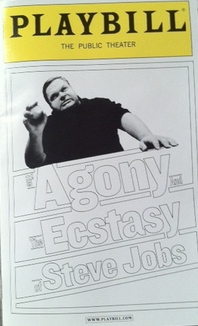
PlaybillThis American Life host Ira Glass tried to pull an Oprah on playwright Mike Daisey, to dress him down on creative license Daisey took with an excerpt of a monolog aired on TAL titled Mr. Daisey and the Apple Factory. The debunking came courtesy of American Public Media’s laughable “Marketplace” Wall Street PR engine, which Glass pretended were reliable experts on the subject of China’s apparently resolved labor abuses. That’s not even funny. This “retraction” reeks even upwind, and Apple’s having become the most highly valued corporation probably explains Glass’s uncharacteristically virulent condemnation. Shameful is what it was, and I hold it unforgivable, for the pretend-affable Glass, so-called folk archivist, to scuttle someone else’s too successful artistic quest for fundamental truth.

Let’s be clear. Mike Daisey was “debunked” based on his Chinese translator contradicting his version of events, and Marketplace finding Hong Kong based activists ready to give Chinese labor problems the all-clear signal. Both sources no longer protected by anonymity are under duress in China, and it’s not mentioned under whose employ they are now.

The Apple Factory story was the first best thing TAL had aired since pioneering post-sardonic navel gazing, but this week Glass issued a full retraction, removed the episode from the archive, and aired a blistering character assassination complete with manipulatively edited confrontations with Daisey, loaded with the expectation he’d buckle like fictional-confession memoir author James Frey. Except Frey’s lies unraveled because they contrived to propagate untruth. Daisey’s truths were undisputed, but the liberties he took to weave a personal narrative were “debunked” to cast doubt on his every word. It was a shameful moment for This American Life, and I’m hoping this time Glass has overestimated the vapidity of his listeners.

For example, when Mike Daisey explained his rationale for not wanting to “unpack the complexity” of his narrative, Ira Glass responded that he didn’t know what that meant. To what kind of reporter, editor, producer, or storyteller would that concept be foreign?

APM’s Marketplace
This was not the first collaboration between Marketplace and TAL. As the Occupy Wall Street protests grew, Ira Glass commissioned folksy research pieces from a Marketplace team to explain world banking and derivatives trading in terms sufficiently lazy to not disturb the usual NPR stupor. It was bunk coiffed in TAL’s typical carefree je ne care pas.

So this time, Marketplace’s man in China was consulted to fact-check Mike Daisey’s account. ACTUALLY, Glass reveals that he was approached by Marketplace AFTER they’d looked into Daisey’s sources. Glass thanked Marketplace for offering the story to TAL, instead of exploiting the exposé themselves. That’s Glass pretending he doesn’t know PR is about getting someone else to say it for you. Absolving Apple required more than one media property criticizing another. Somebody probably wanted a full retraction.

To foul Mike Daisey’s story required one phone call to the translator and guide he’d used in China, whose contact information he tried hide from Glass and co. No mention that this might have been to protect her from angry Chinese authorities, or from Apple and its supplier Foxconn and the inevitable underworld that rides herd on its victim laborers.

Marketplace’s feat consisted of tracking down his translator, breaking her cover, and putting her on the spot for the harsh criticisms which Daisey laid on Apple, Foxconn and their Chinese hosts. Especially as the popularity of Mike Daisey’s performance piece grew, and after its airing on TAL and his many media interviews, the anonymity of his Chinese translator would remain of paramount concern, but once exposed by Marketplace, what choice might she have had but to denounce Daisey’s heresies?

Could Apple’s being the world’s most high valued company have had anything to do with this kill-the-messenger hit piece? Apple has scheduled a press conference Monday morning to announce what it plans to do with its now famous $100 Billion cash holdings.

Storytelling
Isn’t it rich that TAL suddenly wants to hold its stories to journalistic standards? Imagine if someone had called them on the Christmas elven adventures of David Sedaris. Was that fact-checked? Or what of the elementary Christmas play Sedaris so gloriously skewered? IF YOU Criticize TAL for its too-often neglect of difficult subjects and you’re scolded that the show is about culture and storytelling.

Mike Daisey’s TAL recording is now offline, although the transcript remains. In it you’ll find an indictment that Ira Glass perhaps lacks the temerity to redact as well. It’s his introduction to the segment, and I’ll reprint it here, because Glass praises exactly Daisey’s storytelling technique, separate from the facts he recounts.

A couple weeks ago I saw this one-man show where this guy did something on stage I thought was really kind of amazing. He took this fact that we all already know, right, this fact that our stuff is made overseas in maybe not the greatest working conditions, and he made the audience actually feel something about that fact. Which is really quite a trick. You really have to know how to tell a story to be able to pull something like that off.

In his own words, Glass concedes what his show’s retraction is all about. He’s not retracting the facts, these “we all already know”. Glass and Apple are trying to retract Mike Daisey’s effect, that “he made the audience actually feel something about that fact.”

TO BE CONTINUED

Visit Chicago for mirth and adventure


MoveOn wants to mobilize the world’s largest nonviolence movement, calling on the 99% to teach-in itself in time for their American Spring. That’s certain to sound more palatable to America’s unbaptized middle-roaders, than the invitation above, invoking the reception likely awaiting protesters who plan to converge on Chicago in May. The G8 has been relocated to Camp David, but the larger NATO summit is still scheduled to warrant a two mile wide security perimeter around downtown Chicago. What does this poster communicate to you? I’m guessing the menacing image wasn’t chosen at random, it says to me the unadventurous need not apply.

If you don’t see Merry Christmas in the window, no, you don’t go in that store! The Star of David used to do that trick.

This season’s War-On-Christmas email is pushing a holiday ditty whose refrain goes “If you don’t see Merry Christmas in the window, then you don’t go in that store.” Seems like it might be easier to mark those stores with a Star of David on the window, or would that be too obviously Nazi?
On the other hand, it is refreshing to see even Dumbfox recognize the imperative of targeting commerce to make your point heard. So, boycotts do work?

You can see the Christmas-lovers’ point of course. They’d prefer that merchants exploiting the Christmas purchasing season at least be paying lip service to Christmas and not the ever-looming Godless “Holiday” eclipse, supposed.

This song reminds us “it’s all about the little baby Jesus” and goes on to list all the things Christmas wouldn’t be without him. Of course, half the list traces back to pagan tradition, but what to Christian Holiday-goers know of that?

And the latter half goes back as far as they remember, as their grandmother and her grandmother before might remember, but no more. The commercial Christmas charts its provenance to the industrial revolution, the birth of consumer goods and marketing. Santa Claus as we recognize him stepped right off Coca-cola calendars of the last mid-century.

Christmas was the religious Trojan Horse to pitch the shopping holiday to reluctant hedonists. Now the same parishioners who don’t have an needle’s-eye chance to get to Heaven, feel like the can pay their tithes in Christmas presents.

Yes, I do think it’s funny that people who abhor the prospect of disruptive economic boycotts are willing to consider it at the drop of Santa’s cap. Unless of course they’re satisfied that making this video viral is a shot across the bow enough. I doubt their Christmas Spirit has any room for Lenten restraint.

Oddly enough, one of their potential boycott targets, and mine, has hung banners in its outlets to announce they will be open for Christmas, introducing a delectable dilemma. Starbucks says Merry Christmas in the window, so it’s exempt from this singing email picket, yet it disrespects Christmas by working through it. What do you do?

I answer that one unequivocally. Yes, boycott Starbucks. They fund Israeli settlements in the Occupied Territories. That may be somewhat directly related to their celebrating Hanukkah not Christmas, but that’s NO KIND OF REASON to boycott a business. If you want to boycott a store because it’s not Christian, take it up with the Anti-Defamation League. Leave bigotry to the Zionists.

Ye Aulde Memoir

Another old piece. These stories are distorted by romanticized memory, at times, and others likely remember them differently. I by no means intend to insult any of the real persons that lived through this stuff with a cavalier treatment of tender recollections, or harsh description of personalities or actions. Each of us always did exactly what seemed to be exactly the right things to do at the time. And there survives much, much love, which has grown and developed like it always does, in ways we never see coming.

I’m not putting these old ones up because i’m too lazy to write new. I’ll have one of those next–but some of this old stuff fits. Hope you like it.

11 May 2009

One day during the summer of 1980 my brother David was in the hospital at Case Western Reserve University for yet another open-heart surgery. The scene that day was dramatic I suppose, but for our family at the time, it was in many ways just another day. The state of the relationships between us had come to the condition that existed then because each and every incident that had occurred in the history of the Universe had added to that cumulative point. The way it came together then could have been viewed as tragic, I suppose, but we never noticed.

I don’t even remember how I got the news that this particular episode was approaching. David’s surgery that year was one of many—so many, in fact, that by now surgeons and academics had written papers on his congenital condition, and even given it a polysyllabic title. His lead surgeon, a Dr. Ankeny as I recall, had once claimed that he had “learned more from David Bass than fourteen years of medical school.” We four siblings had in effect grown up in the hospital, with the constant potential for death in attendance on a daily basis. Many years would pass between that summer and the moment I decided any of this was applicable to self-reflection, and the sweltering summer afternoon was as present and imminently experiential as any other I lived through during that period.
Our family seemed done that year. I had been out of the picture for over a year. Dad had left soon after, leaving a sour tinge in the air with those remaining, though I never blamed him. When David queued up for one more death-defying, experimental, split-chest open-heart surgery, Dad came back to Cleveland from Florida to put in an obligatory appearance.

Here was a meeting that defied conventional description. Dave, the least guilty of all our immediate family, had been deeply affected by Dad’s exit from the filial stage earlier that year. I hadn’t seen, or even spoken to Dad for well over a year, nor could our interactions prior to then be described as warm and supportive. Outnumbered by angry or indifferent family members, and perhaps less acclimated to hospitals as the rest of us, Dad was way out of his simpler, down-to-earth element.

I showed up unannounced, with glorious southern tart Candy Stone from Mobile, Alabama in tow, she in dirty bare feet, nearly illegal shorts, one of those dangerous eighties tube-tops, and very red eyes. I don’t think Dad spoke more than a half dozen words to me. His eyes told the whole story of uncertainty, pain, and failure. Dave, fresh from surgery, quite literally green, with a repulsive grey crust around his lips and appending to the tubes and what not projecting from several of his orifices, refused to see Dad. Refused to allow him in the room. Dad left unrequited to return to his exile in Florida. I didn’t see him again for many years.

Once, David, following the Dead tour in our Mom’s old family van showing all the effects of the Rust Belt, with his underage Russian girlfriend, his fiddle, and a patchouli oil manufacturing operation, got pulled over in Alabama, for sport. By this time, David was unkempt, smelly, and obviously committing some crime or another. The cops shook him down pretty good, but of course he had no contraband. He has a vice or two, but the heart thing keeps him from excess. He had that young Russian girlfriend, though, and Alabama’s finest figured they could really hang him out to dry, (dang hippie). But she and Dave convince the alpha cop to let them call her mom in New York to confirm that permission had been granted for the road trip and no heinous kidnapping was going on. The mother spoke zero English, but somehow the girlfriend convinced the cop to allow her to translate for her mother. Mother and daughter held a five minute conversation about the mental acuity of Alabama cops, duly translated as an expression of permission, and the travelers were on their way. David drawls this story on stage in his hillbilly persona, fiddle in hand. It’s hilarious.

It seemed to me for a long time that David was the only one of us to escape that little bubble of anti-reality that made up our family life while we siblings were young. Maybe he somehow managed to avoid being trapped in it in the first place, residing only temporarily, with some sort of metaphysical pass associated with potential imminent death. I don’t know, but years later, during one of the high points of my own endeavor, Renaissance Paint and Remodeling, I remember feeling jealous of David. This was a recurring sentiment, and all the more abberant for the fact that my strongest memory of it falls during a visit to Dave’s place in North Carolina that amounted to a just-in-case kind of deal before a heart transplant. Whatever the rationality or fairness of my little envy, (not real envy, mind you, but one of those little personality spikes that one notes and passes through), David is the one of us that got away the least damaged, and has lived his idiosyncratic dream out in full, down to the fine print, with joy.

Mom tells a story about my first day at school. Or maybe the second. I had asked some question that Miss Gardner couldn’t answer, and after day two, came home grousing about how those people were ignorant, and furthermore lazy, since no one had even bothered to look up a response. Mom likes to carry on about how smart her offspring are. She doesn’t usually bring up in public how warped we can be.

Mom, we brothers agree, bequeathed us a legacy of somewhat dubious mental processes. She’s nuts. We all know it. She knows it. Dad knows it. The rest of her family knows it well, and most of them recognize a common bond of familial, brand-name insanity that we all seem to share. I expect this is a more or less common thing among families, but I remain convinced that we are a bit stranger than most, at least in part because of the unique circumstances we lived through.

Back in the day, Mom’s thing was what they call control issues. The dynamic of her issues was so complex I can’t imagine I’ll ever figure it out. Some of her personality came to her by heredity from her mother, whom we call Mo. Much of it developed in that crucible of stress Dave kept heated by his repeated, continuous flirtation with death. Mom, responding to my over-the-top reaction to a pubescent hormonal tsunami, became madly obsessive with minutiae, dividing her time among us brothers and badgering us constantly in a fashion no one can really get unless they have their own experience to compare. I think she and I trapped ourselves in a sort of feedback loop that could have ended no other way.

I was out of the house for good, by the age of fifteen, for all purposes off to lead a life of crime, I suppose. For some years, I lived out my interpretation of the old Kerouac/Kesey/Abbie Hoffman mythos, on the road, in the street, an utterly directionless rebel. A good five or six years passed without more that a word or two passing between Mom and me.

I was nineteen when I came to Colorado Springs. The vague and unformulated manifesto for global revolution I had worked out in my head was on hold, kept in place by a twelve-pack of cheap beer. I had a job as an electrician, and didn’t see any reason to change that, but we actually didn’t do much of anything but work and drink beer that year.

One day Mom called to say Mike, another brother, got himself in trouble again and she expected him to “run away.” I told her to give him my number and I’d let her know when he called. He did just a few days later, and can I come pick him up over on south Circle.

Mike and I spent a couple years engaging in the sort of insanity to which we had become habituated in Cleveland. The reader will require imagination to add flesh to the story here. The statute of limitations may prevent backlash, but I don’t mean to poke at a bees’ nest, and it seems unlikely you might imagine anything more extreme than what actually took place. We weren’t stupid, though, and the business of working for wages, or relying on illicit behavior for advancement just wasn’t good enough, so we formed a construction company and went to work. That proved to be a trap. Maybe an extension of the weird, family trap that all of us have discussed so deeply, without resolution.

Mike and I had it in our minds that the working man’s habit of grousing over how management acts is crap and that if we were going to grouse, we ought to just take the reins ourselves. It turned out we were pretty good, too, in a lot of ways. We worked together for the best part of twenty years, and reached moments of national prominence in our little niche. The whole period was characterized by more bone-crushing stress and absurd, super-human feats. We had little breaks from the madness when we’d crash the business, which we did three times. We were great at getting shit done, but lousy at administration in the final analysis.

Hiring employees in the construction business kept me exposed to the street element to which I had become accustomed. I involved myself in various efforts to assist folks in their low-budget struggles, imagining still that I could somehow change the world. In fact, contrary to Mike’s primary obsession with business success, I figured the whole pursuit as a means to some vague end involving social revolution. For a while a religious experience had me involved with a church effort to “reach out” to the hoodlums that used to cruise Nevada Avenue on Friday and Saturday nights. I even managed to glean an ordination from the Baptists, though now I suspect they’d regret bequeathing me with it. My identification with street folks and the urge to help them rise above conditions has never left me. Actually I’ve worked up the notion that we could all stand to rise above conditions.

Dad. I went even longer without speaking with him than I did with Mom. He dealt with our family’s teen-aged fulguration by folding his hand and striking out on his own. Offered a transfer by his employer, the story goes, he told Mom, “I’d like you to come to Florida with me, but I don’t think I can love you anymore.” No woman in her right mind would go for that deal, and Mom didn’t fall for it either. Dad packed his company car and struck out, leaving his all-important nest egg, and everything else, behind. When David was in the hospital again that summer, that’s where Dad came from to visit him.

I had been away, and I don’t recall blaming Dad for his poor dealings with the family. He had been raised in a very old-school, European style, and he simply couldn’t handle our ways. To this day, in spite of Dad’s expression of a taste for “philosophy,” our conversations are often guarded, pregnant with unspoken truths. I still don’t know his philosophy.

Last summer Dad, my youngest brother, and I went to Montana to camp and fish, riding an outfitter’s horses into some of the most pristine wilderness left in the lower forty-eight. I had genuinely hoped to break the communication barrier that stands between us, but we had to settle for hugs and meaningful silences, for the most part. Dad still plays with his cards pressed tightly to his chest, flashing a look of panic if the conversational waters begin to threaten him with submersion. I guess he can’t swim.

Dad’s experience, it seems to me has also been different from the norm, though I’m uncertain that any human being matches that mythical standard. His family, unlike Mom’s, which fought in the Revolution, was barely American. They were proud American citizens, but their traditions came from old Europe, and they still lived communally on the old Bass farm as they had done for a thousand years.

During my childhood, whenever David was out of the hospital, we’d spend weekends at the farm with the scene looking very much like something from an era that had long since passed in this country, all Dad’s siblings and extended family eating together, playing cards, children roaming the grounds like Huck Finn. It was all rather idyllic, truly, and the moment Grandma Bass died and the farm disappeared under a layer of vulgar office towers marked the shift from one childhood to another.

Dad’s life since then became an effort to recreate those years. His brother and sister had never left the farm. Even when his brother Paul married and had a child, he stayed there on Rockside, as the place was known. I think that scene served as an anchor for my Dad, and when he retired, impressively early despite having suffered huge financial setbacks, he bought his own farm, secluded and sylvan, and moved his socially inept brother and sister in with him.

Paul was a very strange dude. Throughout his lifetime he suffered from some sort of condition that caused him to wobble quite a bit and to mumble when he spoke, like a cartoon character. I still have no idea what the actual condition was–it was never discussed in medical terms, and Paul worked, loved, laughed, and lived in a fashion perfectly suited to him. He represented another unusual facet of our lives that never seemed unusual to us, simply because it just had always been what it was. During his declining years, Paul became more and more difficult to live with, his condition developing into a matter that caused him to actually require care, rather than merely one engendering bemusement. He became cantankerous, incontinent, and dangerous to himself, given his refusal to use a cane. Dad actively cared for him, there on the new farm, forty-five minutes from a paved road, until he died a few years ago.

I couldn’t make the funeral, but I spoke to Dad on the phone as he was back in the city making arrangements. I told him I thought his dealings with Paul were among the most impressive and moving things I had ever seen. I still see it that way. The conversation, which lasted no more than ten minutes I guess, may have been the deepest we’ve ever shared.

For the past eight or nine years every Sunday, so long as I’m in town, I give away food we cook up to whomever we can get to come up to the Colorado College campus and sample our fare. Often our guests are homeless or dirt poor, but we’re not so much stipulating low economic clout as a qualifier. We’ll feed anyone. Dick Celeste, the former governor of my home state, Ohio, and once ambassador to India, comes now and then. He’s a friend, and I visit him at his home, during party season at CC. Arlo Guthrie came down to our basement kitchen once–I put him to work washing dishes. Many of the crowd I see every week are chronic though, plagued by demons I surmise to have been born in conditions similar to mine as a youth. I’ve occasionally contemplated the accusation of “enabling” bad behavior that people toss my way once in a while, but many of our regulars, some of whom I’ve known for twenty-five years, are simply never going to approach any sort of productivity. They are simply too extraordinarily damaged, and as the proverb goes, there, but for the grace of God, go I.

The Christian experience I mentioned earlier was a reflection, or maybe an extension, of spiritual drives I always apprehended. I pursued it heartily for a time, beginning my adult involvement with the sort of hands-on charity our Sunday kitchen represents in a Christian context. The Church always felt skewed to me though, and a couple years’ studying of the questions involved convinced me to adopt thinking anathema to most of my Christian friends. The exclusionary thinking shared by many church folk, in turn, began to seem anathema to me.

Something about my family and its ability to weather long, rending forces, becoming over time a stronger entity for all its roiling turbulence, seems to me akin to the aspect of the human condition that produces the wrecked lives that bring folks to visit me on Sunday afternoons. Further spiritual thinking–some would say metaphysical thinking–concerning Chaos and Oneness has encouraged me to feel like the separation between me and the crowd I serve is illusory in some indefinable fashion. When members of our family passed through periods during which we found it necessary to step back from one another, the bonds that hold us together never broke, and the etheric bonds between my soup kitchen crowd and me, and ambassadors or presidents, don’t seem breakable either. We all seem to share certain common struggles, differences arising simply from disparate approaches, variant perspectives. Our family, it turns out was never what we imagined it ought to be, but perhaps something greater, and more viable, after all.

Part of my mission in ditching the construction business for more cerebral and perhaps less lucrative pursuits at an age when many of my peers in the building industry are thinking of golf courses and retirement comes from a belief that the differences in individuals are reconcilable. Feeding people is necessary, but falls short of bridging the apparent expanse between souls. I still want to change the world, even though I understand the futility of such a grandiose notion. Utopians always fail. But I expect that each time some failure becomes apparent, we can learn a little something, and maybe the next day we can fail a little better.

No account of self-examination is ever going to be complete. I won’t be asserting anything about how I’ve come full circle. Our family will never return to the conditions of my childhood. Nor is the new generation my brothers and cousins and I have brought into the world a retread of old lives. I haven’t even touched on my own experiences as head of a new family, but my children live lives vastly different from their forbears, and even though I rather hope they can avoid some of my mistakes, I suspect they’ll be making many of their own. It seems to be in their genes to require hard lessons. But, like my tortured friends in line at CC on Sunday mornings, or those in my circle equally tortured but accustomed to fine linens, whatever they may suffer holds its own value.

We all learn what we must learn. Life is perfectly safe. Its lessons are self-taught, but deep. I genuinely plan to write a real memoir and a family history, for my kids’ sake, but by the time we come full circle, it’s too late to write about it.

To the Fine Folks at the PPCC Philosophy Club

I feel like a point is at hand where any of you who have observed or participated in the conversation between David Arnold and me, including David, deserve a pause for breath. The two of us have come to dominate the message board, it seems to me, and this has never been my intention. So I’ve given the thing a little thought and here’s how it comes out, extemporaneously for you all to consider.

I love Philosophy. I think it’s fundamental and unavoidable–an existential imperative–that is, intrinsic to the condition of existing as a live, conscious human being. No matter how we live, or what we do or do not do, it depends directly from how we think. I also believe that we have little, if any control over what we believe, that being further dependent from what we think. I find the whole business of such dramatic import that I obsess over it all the time, and seek out forae like this one from which to further explore the mutiple, if not infinite facets of the jewel.

Having said that…this board is a tool for the furtherance of education for students enrolled at PPCC. Neither David nor I are any more than interlopers, guests in your house. I am grateful to the club for the experience as it has already unfolded, and I truly hope to continue. I believe I have a couple assets to offer and I hope you’ll all receive me with the humor with which I intend myself. Please–argue. I will not fight.

David, whom I address here personally, though I will continue in the second person for the group’s sake, has suggested that I am guilty of unspecified errors in reasoning. I would love to treat those errors specifically here, hoping the rest of the club will engage as well. In fact, given the best of all possible outcomes, I’d like to be allowed to invite David and the entire Stanford University Philosopy Department to debate the question of Materialism v Theism as the conversation has been tentatively labeled in our previous chatting, and to have the thing judged by an unbiased panel, right here on the PPCC club’s site.

I WILL NOT be an imposition here. I insist on explicit permission from the club, its officers, and Bruce if he considers himself in a position to arbitrate. This is about your education far more than it’s about mine. I’ve seen to my own learnin’ for some while now. It’s working out plenty fine for me. I’ll go away quietly at the simplest word from one with a legitimate say.

You’ll notice I carry on about what I “think,” and my “opinion,” quite a lot, and that’s part of what David finds elusive in me, I think. I don’t “know” very much at all, and I think you all will discover soon enough that nailing knowledge down is a very slippery business indeed. I do think I have something of interest to the average PPCC philosophy student, though, if not the average Stanford variety. Though the halls of Stanford may be filled with a rarified air too thin for my blood to endure, I ain’t ascairt.

Spread the word David. Even if they’re not game here at PPCC, Stanford’s been called out publically by an insousciant housepainter with a full 8th grade education. It’ll be FUN!

(Reprinted from Hipgnosis)

Angela Merkel il culone intrombabile

But Silvio Berlusconi might alternatively have used “strutto culo inchiavabile” to describe any other Euro usury kapo, like himself, or his mates Nicolas Sarkozy and David Cameron who paid a surprise visit to Tripoli yesterday to herald the victory of Neoliberal World Bank “Democracy” over Libyan sovereignty –or was it to say thanks in advance for the oil? News of Berlusconi’s wiretapped indiscretion via Twitter offered what online translators would not reveal, how to say “unf*ckable” in the languages of your upstream: infollable, onneukbare… his choice of words remain as yet censored in the German press. Wouldn’t it be curious to learn which cultures have no word for the concept? I’d have thought that would be American.

Willie and Waylon and Some Other Guy: A story about weed, marriage, and Texas tall tales. Part I

I like telling the story of the time we went to Telluride with my brother David to catch the Bluegrass Festival there. Dave is a pretty dang famous fiddler, and this happened 13 or 14 years ago when his Freight Hoppers were riding a crest, having two then current Billboard Top 20 Americana list releases on Rounder, (Rounder is pretty much a ripoff, but that’s for another time). The Freight Hoppers were hot in Colorado, and their set would draw some 30, 000 festival-goers, with a respectable bevy of hairy Deadheads looking for an outlet following Jerry’s departure bouncing , flouncing and working their little Tai Chi dance up at the stage. Lots of really notable musicians liked them, too, and still do, actually.

Anyhow, we would meet up with Dave and the band at the festivals after winding through a long cattle-line setup, to get to the will-call desk and pick up our magic-rainbow all-access wristbands and hang out all weekend with all these niche-famous musicians, eating, drinking, being merry, smoking, and playing music together. That shit is great!

So one day we’re back stage chillin’ with Tony Furtado, (hi Tony—rock on!), and someone goes, “Is that Johnny Cash?” and sure enough, the Highwaymen had showed up to play an unscheduled set. We never made it away from whatever we were doing at the time to see them play, but not long later, as if they had come for no other purpose, Willie Nelson and Kris Kristofferson show up looking for my brother to tell him how much they dig his music. How cool is that!? Well, we all got to jawin’, and knowing a little about Willie I pulled a little fairly decent weed out of my pocket and offered it, but Willie said, “Oh, no thanks, son, put that away,” and busted out some G13 mutant weed or something, and sparked the stoniest joint I’ve ever smoked in my life, to this very day. What a day!

Now, Willie has always been a hero of mine. His heroes have always been cowboys, he says; mine have always been outlaws, and I always figured Willie for a true outlaw, to the core. I mean the guy runs for president on a platform built of pot smoke, with Ani DiFranco as his running mate. Go Willie! That’s why some things he’s said lately trouble me. I’ll get to that in a minute but the first order of business here is to retell that story one more time, (not that I won’t tell it again—it’s a great staple of mine at parties and such), and to let you in on a secret: It’s all bullshit! It never happened!

***

I am a teller of tall tales, a spinner of yarns, a slinger of bool-shyte. That’s what I do. I’m gonna do some now, here; it’s my schtick, and folks who know me will instantly recognize some of the regular phraseology of my everyday standup, right here on the page. Hi Tim! Hi kids! Hi Willie! Some will recognize little inside tidbits and feel special. They’ll pick out my little eddies and anticipate how I circle back around myself. Hell, if you’re reading you might just as well go ahead and start feeling all conspiratorial and special right now. I mean, this is certainly not USA Today. You can pretty much count on being in an exclusive number by this count.
So if this is a bit of improv by a bullshit artist, how do you know this isn’t all bullshit right now? I’ll let you in on another secret: it is! That’s right—it’s the Lying Cretin. Everything I say is a lie. The Lie is truer than the Truth. Willie and I will be burning one in Austin when I make it down that way in a few months and we’ll laaaugh and laugh about this whole thing, because he gets it, you know. This statement does not belong in the set of all true statements.

Wrap your head around that a spell. It can’t be done. And no side-winding tap-dance involving imaginary words like”pseudo-statement” allowed, either. This is True Lies. It’s a breakdown in reason, a blind spot in our panoramic window to Reality like that thing with the dots you learned in elementary school. You can not manipulate the notions here to fit your mind, though you may, just maybe, be able to manipulate your mind to fit the notions. OK, so I’ll admit we can’t prove the magick here, and maybe someday some mathematician will build a technical ladder up and out of Gödel’s pit, but, we can’t prove a negative, right? But let’s see ya prove that. And now follow it back to the beginning of this paragraph, the beginning of this rant, the beginning of everything you’ve ever read, heard, saw, sensed felt.

And, lo and behold, you find yourself “poised on the wave of explicit Presence, the clockless Nowever.” But don’t forget what kinda bullshit you’re reading.

(Reprinted from Hipgnosis)

I know where Congressman Lamborn is – because no one is telling OR asking. Re: media blackout on junkets to Israel

Calls to Doug Lamborn’s office inquiring as to his whereabouts produces this charade: “Um, I don’t know. Let me ask. They don’t know. I’m not certain who would know. Could you hold please?” And we never get an answer. That his office won’t say, coupled with the media’s strange incuriosity, points to a self-enforced news moratorium on where a fifth of US congress is spending the August recess: as guests of Israel and the most powerful DC lobby. It’s been reported that a record 81 members are on an all-expense-paid junket to Israel, but their identities are a closely guarded secret. The US TV audience can be let to see their representatives give standing ovations to the Israeli prime minister, but visit Israel? The media blackout would have you think there’s something wrong with that.

Middle East peace groups and Palestinian rights organizations have had to painstakingly gather the information from stray news reports out of Israel, or from congressional offices reluctant to let it be know. So far 45 names are known to be on this year’s junket. Doug Lamborn is not on the list, but his office probably has a lower self-respect threshold for playing dumb.

You’d think with the recent furor about calling Obama a Tar Baby, that the media would want to be calling Lamborn to the hot seat. Apparently not. All that’s said is that he hasn’t surfaced to meet with constituents, or give interviews. Last week Lamborn issued a press release unrelated to his recent trouble, probably preplanned, in collaboration with fellow Colorado Congressman Tipton. Tipton, by the way, is among the officeholders known to be in Israel.

Lamborn vacationing in Israel would not be a far-fetched possibility. He attended the junket in 2007 and since then has acted on Israel’s behest in lobbying to drop charges against an accused Israeli spy, in removing legislation which prevented the US from relocating its Tel Aviv Embassy to Jerusalem, and this Spring Lamborn was made co-chair of the Israel Allies Caucus.

What a damn missed opportunity to press them on contacting Tar Baby Lamborn. It would appear that keeping the congressional Israeli lobbying junket on the QT outweighs making Lamborn squirm on camera to explain his non-racist remark. Never mind complicating the issue. What’s a racist WASP doing in the land of Apartheid racism? Well, of course, they’re absolutely related. Oooh, terrible timing. And Lamborn’s a Christian Zionist, so he “likes” Jews, but come the end times, he won’t touch them either.

How is it American elected officials are allowed to behave as agents of a foreign government would be one question, but the more glaring one would be why it is the media is complicit in keeping citizens in the dark?

Partial list of 81 US congressmembers on Israel junket over August recess, according to MoveOver AIPAC

Gus Bilirakis R-9 FL
Mo Brooks R-5 AL
Anne Marie Buerkle R-25 NY
Eric Cantor R-7 VA
Russ Carnahan D-3 MO
Kathy Castor D-11 FL
Steve Chabot R-1 OH (went last month)
Judy Chu D-32 CA
David Cicilline D-1 RI
Yvette Clarke D-11 NY
Mark Critz D- 12 PA
Scott DesJarlais R- 4 TN
Bob Dold R-10 IL (unconfirmed)
Jeff Duncan R-3 SC
Blake Farenthold R-27 TX
Stephen Fincher R-8 TN
Mike Fitzpatrick R-8 PA
Chuck Fleischman R-3 TN
John Garamendi D-10 CA
Kay Granger R-12 TX
Michael Grimm NY-13
Janice Hahn D-36 CA
Jaime Herrera Buetler R-3 WA
Steny Hoyer D-5 MD
Jesse Jr. Jackson D-2 IL
Hank Johnson D-4 GA
Kevin McCarthy CA-22
Gwen Moore D-4 WI
Bill Owens D-23 NY
Steven Palazzo R-4 MS
Ed Perlmutter D-7 CO
Tom Price R-6 GA
Tom Reed R-29 NY
Peter Roskam R-6 IL
Dennis Ross R-12 FL
Loretta Sanchez D-47 CA
David Schweikert R-5 AZ
Terri Sewell D-7 AL (not confirmed)
Adam Smith D-9 WA
Steve Southerland R-2 FLA
Betty Sutton D-13 OH
Scott Tipton R-3 CO
Allen West R-22 FL
Frederica Wilson D-17 FL
Kevin Yoder R-3 KS

Freedom Flotilla II faces Shayetet13 in showdown at the naval siege of Gaza

Freedom Flotilla II - Stay HumanIt promises to be quite a showdown. Israel has repeated that it will let no ship through to Gaza, the IDF has promised “surprises” for the would-be blockade-runners, while this relief convoy is upping the ante with luminaries political and literary. The US boat is carrying novelist Alice Walker and a who’s who of peace activists, no less than Medea Benjamin, Kathy Kelly, Ray McGovern, and Ann Wright. There will be journalists from CBS, CNN and NPR, so you’d think Israel wouldn’t dare jam their signal and superimpose its own news package like it did with the Mavi Marmara, but maybe it won’t have to.

We’ve seen water hose on Freedom Riders before, only this time the blastees will be activist-squires. You might wonder what kind of sympathy they’ll garner, that is if an audience will see it at all. Will there be an independent media vessel cruising alongside the flotilla, with footage and equipment outside the jurisdiction of an Isreali commando raid? In the past the IDF was able to confiscate every scrap of evidence which could be used against them, at least until their doctored video could shape the official narrative.

Then too, with the absence of the Muslim Brotherhood, and Palestine-champions like Ken O’Keefe, the IDF’s interdiction may meet no resistance at all. Remember the MV Rachel Corrie, surrendering themselves with nary a ripple of media coverage?

Another less provocative strategy adopted by the US boat was not to carry any aid cargo, simply letters of support from American donors. I’m not sure why, except that the IDF cannot accuse them of smuggling anything past the blockade. But what does that make the Audacity of Hope exactly? The Freedom Flotilla is what, if it’s not a relief convoy?

There’s time before the flotilla leaves from Greece, please please please put something aboard to take to Gaza. Break the siege with SOMETHING. You can’t very well assert that Israel wouldn’t otherwise grant entry to all these American activists, many of the Jewish, through the formal border crossings, with or without stacks of correspondence.

I’ll spare further critique for now and wish Team Nonviolence the best success. NotMyTribe has complied a Twitter list of who to follow on the Freedom Flotilla II. Here is an incomplete listing of the passengers on three ships, Ireland’s MV Saoirse, Canada’s Tahrir, and USA’s The Audacity of Hope.

Ireland – MV Saoirse
National Coordinator Fintan Lane, Skipper Shane Dillon, John Hearne, Pat Fitzgerald, Paul Murphy, Hugh Lewis, Rik Walton, Mags O’Brien, Gerard Barron, Jim Roche, Zoe Lawlor, John Mallon, Charlie McMenamin, Philip McCullough, Hussein Hamed, Aine Joyce, Former Fianna Fáil TD Chris Andrews, Senator Mark Daly, Sinn Féin TD Aengus Ó’ Snodaigh, Sinn Féin councilor Gerry MacLochlainn, artist Felim Egan, rugby international Trevor Hogan. Representing the Irish Ship to Gaza campaign, the Free Gaza Movement, Irish Anti-War Movement, and Ireland-Palestine Solidarity Campaign.

Canada – Tahrir
Rifat Audeh, Stéphan Corriveau, Karen DeVito, Bachar Elsolh, David Heap, Miles Howe, Soha Kneen, Irene MacInnes, David Milne, Marie-Eve Rancourt, Jase Tanner, Kevin Neish, Dylan Penner (Independent Jewish Voices Canada), Vivienne Porzsolt (Jews Against Occupation in Australia), Harmeet Singh Sooden, Muhammed Hamou (the London Muslim Mosque), Robert Lovelace (Former Chief of the Ardoch Algonquin First Nation and professor of Indigenous Studies at Queen’s University), Lyn Adamson (Canadian Voice of Women for Peace Co-Chair), Manon Massé (Quebec Solidaire representative), Sue Breeze, Kate Wilson, filmmaker John Greyson, Mary Hughes-Thompson, co-founder of the Free Gaza Movement), Sofia Smith, Amira Haas

US Boat – The Audacity of Hope
Medea Benjamin, Hedy Epstein, Ray McGovern, Kathy Kelly, Ken Mayers, Richard Levy, Henry Norr, Gail Miller, Ridgely Fuller, Robert Naiman, Linda Durham, Brad Taylor, Nic Abramson, Alice Walker, ?Libor Kožnar?, Hagit Borer, Kit Kittredge, G. Kaleo Larson

French
Two boats: Louise Michel & Le Dignité-El Karameh
Julien Bayou (co-founder, Black Thursday), Olivier Besancenot (NPA), Alain Bosc (Cimade), Annick Coupé (porte-parole et déléguée générale de l’Union Syndicale Solidaires), Ismahane Chouder (Participation et Spiritualité Musulmane), Jean-François Courbe (département international de la CGT), Nabil Ennasri (président du Collectif des Musulmans de France), Raymond Fabrègues (Coalition contre Agrexco et Confédération paysanne), Patrice Finel (Parti de Gauche), Georges Gumpel (membre du bureau national de l’UJFP et représentant de l’EJJP), Nicole Kill Nielsen (députée européenne EE-LV), Claude Léostic (vice présidente de l’AFPS), Jean-Paul Lecoq (député du PCF), Catherine Lecoq (Mouvement de la Paix et le Collectif 13 Un bateau pour Gaza), Jo le Guen (navigateur), Yamin Makri (Collectif 69 de soutien au peuple palestinien), Oussama Mouftah (Collectif 59 Palestine), Marie Jo Parbot (auteur de BD), Eugène Riguidel (navigateur), Thomas Sommer (CCIPPP), Henri Stoll (Collectif Palestine 68), Omeyya Seddik

Norway
Torstein Dahle, Stine Renate Haheim, Aksel Hagen, Mina Boldermo Eriksen, Bjørn O. Bjørnsen, Tove Henny Lehre, Bard Vegar Solhjell

Denmark
Gitte Seeberg
John Ekebjaerg-Jakobsen
Adam Qvist

(NOTE: This post will be updated an appended as more information becomes available.)

Banned books: the subversive dystopia

Eugene Zamiatin, We; Jack London, The Iron Heel; Ambrose Bierce, Can Such Things Be?; Aldous Huxley, Brave New World; Ayn Rand, Anthem; Sinclair Lewis, It Can't Happen Here; George Orwell, Nineteen Eighty-Four; Norbert Weiner, The Human Use of Human Beings: Cybernetics and Society; David Karp, One; Frederick Pohl and C. M. Kornbluth, The Space Merchants; Kurt Vonnegut, Jr, Player Piano; Ray Bradbury, Fahrenheit 451; Anthony Burgess, A Clockwork Orange; Harlan Ellison, The Glass Teat; Margaret Atwood, The Handmaid's Tale.Banned Books, p.2–
I put a lot of faith in an internet resilient enough to remain an unrestricted archive of crowd-sourced human knowledge, even more I hope public data will eventually permeate the proprietary, but continued access to subversive literature I have little doubt will meet the full brunt of digital book burners. If there’s any text not to download unto your Kindle, as an easily vaporized or expurgate-able file, it’s one of these classic oft-censored, perpetually-offense-giving titles. These are the dystopian novels and science fictions which paint a bleak picture of the society we are engineering.

As pictured, here are some notoriously subversive dystopian novels, (as differentiated from commercial drivel which reinforces mainstream dogma, such as Lord of the Flies, or Hunger Games)

Atwood, Margaret, THE HANDMAID’S TALE
Bierce, Ambrose, CAN SUCH THINGS BE?
Bradbury, Ray, FAHRENHEIT 451
Burgess, Anthony, A CLOCKWORK ORANGE
Ellison, Harlan, THE GLASS TEAT
Huxley, Aldous, BRAVE NEW WORLD
Karp, David, ONE
Lewis, Sinclair, IT CAN’T HAPPEN HERE
London, Jack, THE IRON HEEL
Orwell, George, NINETEEN EIGHTY FOUR
Pohl, Frederick, & C.M. Kornbluth, THE SPACE MERCHANTS
Rand, Ayn, ANTHEM
Vonnegut, Kurt, PLAYER PIANO
Wiener, Norbert, THE HUMAN USE OF OTHER BEINGS
Zamiatin, Eugene, WE

Haven’t heard of many of these? Curious, don’t you think?