Jesus Springs welcomes fugitive Bush

After seeing Colorado College gush over a whitewashed CIA murderer, I’m not in any mood to watch local Christian groupies applaud George War-criminal Bush. The plan for Saturday at the Broadmoor is to pummel the arrogant creep with shoes, ceremoniously of course, and probably in effigy. We’ll have a Bush impersonator, a little monkey in a suit strutting about with impunity. And it appeals to me more that we not land any hits, so we’ll have Junior ducking this shoe and that, taunting us with his sick hehehe. And won’t that reflect reality? Justice frustrated by a snickering good ol’ boy. Except, is there outrage left for Bush? I know I hardly feel it anymore. It’s Obama dissembling about torture and dropping the bombs now.

Here’s the list of embarrassing local businesses and idiotri welcoming George Bush to Colorado Springs, they’re even giving him an award, apparently he’s an inspiration to charter school students:

Colorado Springs Christian Schools
Steve Schuck
Dick Saunders, Saunders Construction
El Pomar Foundation
Pete & Jackie Kuyper
Sonya Camarco, LPL Financial
Dewhirst & Dolven, Attorneys
Bob & Kelly McGrath
Dr. Ron & Renee Rains
Interim Healthcare
Clear Ink Foundation
Colorado Custom Decks
Dr. Mike & Kathy Hall
Mateos Salon & Day Spa
Dar Howard
Envision Investment Group
Dave & Lynda Bjorklund
First Western Trust Bank
Scott & Beth Bugosh
Richard King Brown
Freedom Financial Services
The Milestone Group
Clear View Properties
The Sonchar Family
Joseph & Melissa Hornsey
Ken & Rae Driscoll
Rick & Margaret Brown
David & Gloria Neuder
Todd Pickle
Lee & Mickey Bolin
Seelye Group Ltd.
Liberty Toyota
Matrix Design Group
DWG & Associates
Blazer Electric Supply
ACSI
Joe Woodford
Thor Iverson Consulting
Rothgerber Johnson Lyons LLP
Kathryn Emrick
American Iron & Metal
Stephanie Brock Design
Integrity First Financial
Phil & Mary Kiemel
Weavers Online
Rocky Mountain Custom Trim

In the struggle for Middle East land, Palestinian violence will always win

Israel can build all the new settlements it wants, take heart, it only takes one horrific Tate-Labianca-like crime scene to curb the Zionist homecoming charade. Israel can terrorize Gaza to smithereens, the Palestinians have nowhere to flee. American Jews on the other hand, are not going to leave comfortable digs, to relocate to Jerusalem where their 11-month-old might be slashed to death in her crib. Such dastardly strategy comes at a price of course, against a military willing to defy international law and exact collective punishment for the deed of one zealot, but Israel knows that even its US billions in weapons cannot compete with one Palestinian knife that finds its mark.

Odd, isn’t it? On the battlefield, Goliath can slay an entire West Bank of Davids, but when the contest is holding ground, you can take it, but if you can’t convince your people to settle it, the land will revert to its rightful inhabitants.

I’ll leave you to decide if the murder of an Israeli settler family is off-limits. They’re moved unto properties appropriated from Palestinians, illegal settlement of occupied land, they’re ferried by armored SUVs in military convoys, their rooftops, front gates, walls and streets are guarded by soldiers, their neighborhoods buffered by “sterile zones” purged of all inhabitants, the persistence of their habitation is used to advertise for more settlers and demoralize the non-Jewish native population in waiting of cleansing. Are settlers “innocent civilians,” irrespective old or young age? Who is to blame for putting settler children into homes whose previous inhabitants have been put out on the street, who can only assail their walls with stones?

Remember too, it’s the Israeli settlers, more than the IDF soldiers, who routinely raid Palestinian homes, orchards and farms, killing their neighbors with impunity. Where does any settler get to pretend they should be considered an innocent civilian?

Arab Palestine is confronted with a slow death by attrition. Israel has never disguised its plan to ethnically purge the entire of what it calls Judea and Sumaria. What does it matter then, if resistance violence begets occupier retaliation, if this brazen home-invasion-family-murder provokes an avenging of deaths ten fold? The Russian Partisans paid fifty to one. The Gaza massacre was 300 to one. The Gilad Shalit prisoner ratio is tens of thousands to one, still well shy of US military disproportional force.

Peace activists want to curb armed resistance in favor of nonviolence, calculating that peace will come when Palestinian martyrdom awakens the Israeli conscience, or whichever comes first, Palestinian blood runs dry. This suits Israel of course, its Apartheid State needs the Palestinians gone, for Jews cannot forever pretend they have a Democray while subjugating an inferior untouchable class. So long as one Palestinian remains who fights back, Israel will never conquer Palestine.

Israel can plan all the settlement construction sites it wants, the more beautiful the better, in the end the people of Palestine can claim them in partial compensation.

Bradley Manning’s heroism magnified

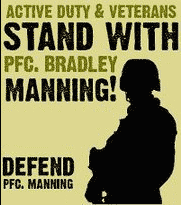
PFC Bradley Manning’s last approved visitor David House was denied access to visit the Adrian-Lamo-named Wikileaks source, in this eighth month of solitary confinement without charges. Last week Manning’s lawyer described the conditions endured by his client: For 23 hours per day, he will sit in his cell. The guards will check on him every five minutes by asking him if he is okay. PFC Manning will be required to respond in some affirmative manner. At night, if the guards cannot see him clearly, because he has a blanket over his head or is curled up towards the wall, they will wake him in order to ensure that he is okay. He will receive each of his meals in his cell. He will not be allowed to have a pillow or sheets. He will not be allowed to have any personal items in his cell. … He will be prevented from exercising in his cell. If he attempts to do push-ups, sit-ups, or any other form of exercise he will be forced to stop. He will receive one hour of exercise outside of his cell daily. The guards will take him to an empty room and allow him to walk. He will usually just walk in figure eights around the room until his hour is complete. When he goes to sleep, he will be required to strip down to his underwear and surrender his clothing to the guards.

Revisiting the Weather Underground’s 1970 pantheon of empire-fighters

Former Weatherman Bill Ayers, now a respected professor of education, was recently nominated for emeritus status but ran into trouble when a right wing blogger complained that a 1970 underground publication coauthored by Ayers, Prairie Fire, had been dedicated to Sirhan Sirhan, the assassin of Robert F. Kennedy. (Let’s not leave aside the possibility that lone Sirhan was the fall guy in a conference room full of CIA operatives, the immediately the suppressed narrative, which would make Sirhan a victim among the 209 other anti-imperialist heroes to which the Weather Underground wanted to dedicate their efforts.) While hindsight might reveal the WUO to have erred with some of its honorees, it seems likely the majority might be worthy of a following up.

Preceding the longer list is a preliminary dedication to the three WUO comrades who died in the NYC townhouse accident: Teddy Gold, Diana Oughton and Terry Robbins.

The full page list framed this dedication:

To Harriet Tubman and John Brown
To all who continue to fight
To all political prisoners in the US

Here’s the total list, for your own wiki googling, alphabetized and annotated. The dedication page of PRAIRIE FIRE changed between the varied mimeographed copies produced by WUO satellite publishers around the US between the years 1970 through 1974. Bracketed names represent people not included on all reprints.

Frank Khali Abney
Sundiata Acoli
Ahmend
Akil
Eugene Allen
W. T. Allen
Gary Alston
Michael Alston – BPP, BLA
James Amaker
Hekima Anna – RNA11
Karl Armstrong -New Years Eve Gang
Atuma
Robert Austin
Richie B.
Baba
Kwasi Balagoon
Joe Bandy
[Jimmy Barett]
Leon Bates
Herman Bell – BPP, SF8
Odell Bennett
Bro. Bernard
Jesse Bishop
Debbie Black
Victor Gerardo Bono – MOSCA
Anthony Bottoms – Jalil Abdul Muntaqim – BLM, NY3
Billy X Boulware
Clarence Jabari Shinda Bount
Joseph Bowen
Raymond Brooks
H. Rap Brown
Henry Sha sha Brown – BLA
Isaiah Brown
Richard Brown – BPP, SF8
[Sarah Brown]
Marilyn Buck
Fred Burton
Carter Camp – AIM
Larry Cannon
Michael Clark – De Mau Mau
Dennis Cole
Oscar Collazo – PRNP
Marshal Conway
Paul Coppella
Andres Figueroa Cordero – PRNP
Carol Crooks
Tony Cruz
E. Dabney
Dalou
James Daniels
Alicia Davis
Tyrone Davis
Alexander de Hoyo
[Albert Deutschmann]
Fleeta Drumgo – SQ6
Timothy Earl Dudley
Ahmed Evans
Jesse Evans
Keith X Farries
James Fedd
Stephen X Ferguson
Juan Fernandez
Micky Finn
Fish
Joe-Joe Fleischman
Irving Flores – PRNP
Allen Fooke Jr.
Robert Foulks
Eugene Gaither
Thomas Gaither
Denny Gathing
Nathaniel Gides
Frank Goree
Ernest Grahm?
Jim Grant
Nancy Harras
Jodi Jean Harris
Richard Harris – BPP, Panther21
Stanley Harris
James Hastings
Herman Hawkins
Robert Hayes
Alf Hill
David Hilliard – BPP
Fred Hilton – Kamau Sadiki – BLA
[Bruce Hobson] – Venceremos
[Jean Hobson] – Venceremos
Mark Holder -BLA
[Doc Holiday]
Louis X Holloway
Hutch
Thomas Ingram
Andrew Jackson – BLA
[Chester Jackson]
Jaja
Patricia James
Ollie Jamonds
Alfredo Jasper
Anthony X Jenkins
Randolph X Jenkins
David Johnson – SQ6
Edward Joseph X. – Jamal – BPP, Panther21
Gari Kaiser
Ron Karenga -creator of Kwanzaa
Muhonnet Kassimir
Ja Ja Omar Kenyatta
Melvin Kearney – BLA
Samuel Killey
Kimanthi
Kin-Du
Stephanie Klein
Komie Kombuibe
Lolita Lebron – PRNP
Russell Little – SLA
Jesse Lopez
Hugh Lumpkin
Albert Lyon
Gail Madden
Ruchell Cinque Magee – SQ6
Louise Martinez
Randy McCleary
George Meritt
Gloria Miller
Armado Miramon
Rafael Miranda – PRNP
Rose Mohrstine
Gilbert Montague
Richard Dhoruba Moore
Obgarofowe James Morse
Benjamin Murdock
[Morton Newman] – Venceremos
Roy Nixt
Karrim Nyabadfudi
Imari Obadele – RNA11
Odessabakely
Alberto Ortiz
Jacqueline Paige
Charles Parker
Darrell Peatry – De Mau Mau
Betty Person
Hugo Pinnell – SQ6
William Poole
William Prather
Eller Geronimo Pratt
Euther X Presha
Arthur Prince
Offaga Quaddus – RNA11
Oji
Outlaw
T. S. Reddy
Joseph Remiro – SLA
Harrison Robison
Rock
Norma Rockamore
Eddy Sanchez
Rodolfe Sanchez
Marvin Saunders
Ruben Scott – BPP
[Robert Seabrock] – Venceremos
Assata Shakur
Shango
Harold Simmons
John Simone
Samual Singeton
Sirhan Sirhan
Marvin X Smith
Nathaniel Smith
Martin Sostre -bookseller
Johnny Larry Spain – SQ6
Gloria Strickland
Kenneth X Swanson
Luis Talamantes – SQ6
Willie Tate – SQ6
Ben Taylor
Donald Taylor – De Mau Mau
James Taylor
Bro. Thomas
John Thomas – BLA
Steve Tillman
Alexander X Tisdale
Francisco Torres – NY5
Gabriel Torres – NY5
Toukie
Tommy Trentino
Herman Wallace – Angola3
Robert Wamack
Thomas Wansley
Mamie Lee Ward
Albert Washington – Nuh – BPP, NY3
Fred Waters
Jesse Watson
Marshall Weathers
Bob Wells
Warren Wells – BLM
Fred Shanda West
Clifford Whaley
Clifton Wiggins
John Wilkerson
Deborah Williams
Ricky Williams
Tine Williams
Robert Wilson – De Mau Mau
Mira Witherspoon
Deothea Woodburn
Albert Woodfox – Angola3
Nathaniel Wright III
Candice Yacqui
Robert Youngblood

Wikileaks reveals inventory of US possessions critical to corporations

To complain that a wikileaked list of off-US-soil “critical infrastructure and key resources” provides a checklist of targets for aspiring terrorists is to pretend that opponents of the US empire are as simple minded as American television viewers. The importance of most of the so-called Critical Foreign Dependencies is self-evident, more curious is how the US deems these proprietary interests, to what extent it will protect them, and for whom. Sole manufacturers of vaccines might be vital to public health, but what of communications cables, international ports, supplies of industrial metals and suppliers of components to US weapons systems? Those are critical only to bottom lines. The 2008 report in the State Department cable leaked yesterday reveals infrastructure critical to multinational corporations, whether US or not.

While American airwaves are full of denunciations of Wikileaks and Julian Assange for endangering the US, the Western press is ignoring incendiary cables making their rounds in the Middle East, in which the Lebanese Defence Minister Elias El-Murr asks his American liaison to assure Israel that a next invasion, restricted to rooting out Hezbollah, would not be opposed by Lebanese forces.

Amazon, Paypal and EveryDNS have thrown in with those that would censor Wikileaks, likely also Google and Twitter. Try to find the El-Murr story through Google News or Twitter.

Here’s the text of the 2009 cable:

2008 Critical Foreign Dependencies Initiative (CFDI)
critical infrastructure and key resources (CI/KR)

AFRICA

Congo
(Kinshasa): Cobalt (Mine and Plant)

Gabon:
Manganese – Battery grade, natural; battery grade, synthetic; chemical grade; ferro; metallurgical grade

Guinea:
Bauxite (Mine)

South Africa:
BAE Land System OMC, Benoni, South Africa
Brown David Gear Industries LTD, Benoni, South Africa
Bushveld Complex (chromite mine) Ferrochromium Manganese – Battery grade, natural; battery grade, synthetic; chemical grade; ferro; metallurgical grade
Palladium Mine and
Plant Platinum Mines Rhodium

EAST ASIA AND THE PACIFIC

Australia:
Southern Cross undersea cable landing, Brookvale, Australia
Southern Cross undersea cable landing, Sydney, Australia
Manganese – Battery grade, natural; battery grade, synthetic; chemical grade; ferro; metallurgical grade
Nickel Mines Maybe Faulding Mulgrave Victoria, Australia:
Manufacturing facility for Midazolam injection. Mayne Pharma (fill/finish), Melbourne, Australia: Sole suppliers of Crotalid Polyvalent Antivenin (CroFab).

China:
C2C Cable Network undersea cable landing, Chom Hom Kok, Hong Kong
C2C Cable Network undersea cable landing Shanghai, China
China-US undersea cable landing, Chongming, China
China-US undersea cable landing Shantou, China
EAC undersea cable landing Tseung Kwan O, Hong Kong
FLAG/REACH North Asia Loop undersea cable landing Tong Fuk, Hong Kong
Hydroelectric Dam Turbines and Generators Fluorspar (Mine)
Germanium Mine
Graphite Mine
Rare Earth Minerals/Elements Tin Mine and Plant Tungsten – Mine and Plant Polypropylene Filter Material for N-95 Masks
Shanghai Port
Guangzhou Port
Hong Kong Port
Ningbo Port
Tianjin Port

Fiji:
Southern Cross undersea cable landing, Suva, Fiji

Indonesia:
Tin Mine and Plant Straits of Malacca

Japan:
C2C Cable Network undersea cable landing, Chikura, Japan
C2C Cable Network undersea cable landing, Shima, Japan
China-US undersea cable, Okinawa, Japan
EAC undersea cable landing Ajigaura, Japan
EAC undersea cable landing Shima, Japan
FLAG/REACH North Asia Loop undersea cable landing Wada, Japan
Japan-US undersea cable landing, Maruyama, Japan
Japan-US undersea cable landing Kitaibaraki, Japan
KJCN undersea cable landing Fukuoka, Japan
KJCN undersea cable landing Kita-Kyushu, Japan
Pacific Crossing-1 (PC-1) undersea cable landing Ajigaura, Japan
Pacific Crossing-1 (PC-1) undersea cable landing Shima, Japan
Tyco Transpacific undersea cable landing, Toyohashi, Japan
Tyco Transpacific undersea cable landing Emi, Japan
Hitachi, Hydroelectric Dam Turbines and Generators
Port of Chiba
Port of Kobe
Port of Nagoya
Port of Yokohama
Iodine Mine
Metal Fabrication Machines Titanium Metal (Processed) Biken, Kanonji City, Japan
Hitachi Electrical Power Generators and Components Large AC Generators above 40 MVA

Malaysia:
Straits of Malacca

New Zealand:
Southern Cross undersea cable landing, Whenuapai, New Zealand
Southern Cross undersea cable landing, Takapuna, New Zealand

Philippines:
C2C Cable Network undersea cable landing, Batangas, Philippines
EAC undersea cable landing Cavite, Philippines

Republic of Korea:
C2C Cable Network undersea cable landing, Pusan, Republic of Korea.
EAC undersea cable landing Shindu-Ri, Republic of Korea
FLAG/REACH North Asia Loop undersea cable landing Pusan, Republic of Korea
KJCN undersea cable landing Pusan, Republic of Korea
Hitachi Large Electric Power Transformers 230 – 500 kV
Busan Port

Singapore:
C2C Cable Network undersea cable landing, Changi, Singapore
EAC undersea cable landing Changi North, Singapore
Port of Singapore
Straits of Malacca

Taiwan:
C2C Cable Network undersea cable landing, Fangshan, Taiwan
C2C Cable Network undersea cable landing, Tanshui, Taiwan
China-US undersea cable landing Fangshan, Taiwan
EAC undersea cable landing Pa Li, Taiwan
FLAG/REACH North Asia Loop undersea cable landing Toucheng, Taiwan
Kaohsiung Port

EUROPE AND EURASIA

Europe

(Unspecified):
Metal Fabrication Machines: Small number of Turkish companies (Durma, Baykal, Ermaksan)

Austria:
Baxter AG, Vienna, Austria: Immune Globulin Intravenous (IGIV)
Octapharma Pharmazeutika, Vienna, Austria: Immune Globulin Intravenous (IGIV)

Azerbaijan:
Sangachal Terminal
Baku-Tbilisi-Ceyhan Pipeline

Belarus:
Druzhba Oil Pipeline

Belgium:
Germanium Mine
Baxter SA, Lessines, Belgium: Immune Globulin Intravenous (IGIV)
Glaxo Smith Kline, Rixensart, Belgium: Acellular Pertussis Vaccine Component
GlaxoSmithKline Biologicals SA, Wavre, Belgium: Acellular Pertussis Vaccine Component
Port of Antwerp

Denmark:
TAT-14 undersea cable landing, Blaabjerg, Denmark
Bavarian Nordic (BN), Hejreskovvej, Kvistgard, Denmark: Smallpox Vaccine
Novo Nordisk Pharmaceuticals, Inc. Bagsvaerd, Denmark: Numerous formulations of insulin
Novo Nordisk Insulin Manufacturer: Global insulin supplies
Statens Serum Institut, Copenhagen, Denmark: DTaP (including D and T components) pediatric version

France:
APOLLO undersea cable, Lannion, France
FA-1 undersea cable, Plerin, France
TAT-14 undersea cable landing St. Valery, France
Sanofi-Aventis Insulin Manufacturer: Global insulin supplies Foot and Mouth Disease Vaccine finishing
Alstrom, Hydroelectric Dam Turbines and Generators
Alstrom Electrical Power Generators and Components
EMD Pharms Semoy, France: Cyanokit Injection
GlaxoSmithKline, Inc. Evreux, France: Influenza neurominidase inhibitor
RELENZA (Zanamivir) Diagast, Cedex, France: Olympus (impacts blood typing ability)
Genzyme Polyclonals SAS (bulk), Lyon, France: Thymoglobulin
Sanofi Pasteur SA, Lyon, France: Rabies virus vaccine

Georgia:
Baku-Tbilisi-Ceyhan Pipeline

Germany:
TAT-14 undersea cable landing, Nodren, Germany.
Atlantic Crossing-1 (AC-1) undersea cable landing Sylt, Germany
BASF Ludwigshafen: World’s largest integrated chemical complex
Siemens Erlangen: Essentially irreplaceable production of key chemicals
Siemens, GE, Hydroelectric Dam Turbines and Generators
Draeger Safety AG & Co., Luebeck, Germany: Critical to gas detection capability
Junghans Fienwerktechnik Schramberg, Germany: Critical to the production of mortars
TDW-Gasellschaft Wirksysteme, Schroebenhausen, Germany: Critical to the production of the Patriot Advanced Capability Lethality Enhancement Assembly
Siemens, Large Electric Power Transformers 230 – 500 kV
Siemens, GE Electrical Power Generators and Components
Druzhba Oil Pipeline Sanofi Aventis Frankfurt am Main, Germany: Lantus Injection (insulin)
Heyl Chemish-pharmazeutische Fabrik GmbH: Radiogardase (Prussian blue)
Hameln Pharmaceuticals, Hameln, Germany: Pentetate Calcium Trisodium (Ca DTPA) and Pentetate Zinc Trisodium (Zn DTPA) for contamination with plutonium, americium, and curium IDT
Biologika GmbH, Dessau Rossiau, Germany: BN Small Pox Vaccine.
Biotest AG, Dreiech, Germany: Supplier for TANGO (impacts automated blood typing ability) CSL
Behring GmbH, Marburg, Germany: Antihemophilic factor/von Willebrand factor
Novartis Vaccines and Diagnostics GmbH, Marburg, Germany: Rabies virus vaccine
Vetter Pharma Fertigung GmbH & Co KG, Ravensburg, Germany (filling): Rho(D) IGIV
Port of Hamburg

Ireland:
Hibernia Atlantic undersea cable landing, Dublin Ireland
Genzyme Ireland Ltd. (filling), Waterford, Ireland: Thymoglobulin

Italy:
Glaxo Smith Kline SpA (fill/finish), Parma, Italy: Digibind (used to treat snake bites)
Trans-Med gas pipeline

Netherlands:
Atlantic Crossing-1 (AC-1) undersea cable landing Beverwijk, Netherlands
TAT-14 undersea cable landing, Katwijk, Netherlands
Rotterdam Port

Norway:
Cobalt Nickel Mine

Poland:
Druzhba Oil Pipeline

Russia:
Novorossiysk Export Terminal
Primorsk Export Terminal.
Nadym Gas Pipeline Junction: The most critical gas facility in the world
Uranium Nickel Mine: Used in certain types of stainless steel and superalloys
Palladium Mine and Plant Rhodium

Spain:
Strait of Gibraltar
Instituto Grifols, SA, Barcelona, Spain: Immune Globulin Intravenous (IGIV)
Maghreb-Europe (GME) gas pipeline, Algeria

Sweden:
Recip AB Sweden: Thyrosafe (potassium iodine)

Switzerland:
Hoffman-LaRoche, Inc. Basel, Switzerland: Tamiflu (oseltamivir)
Berna Biotech, Berne, Switzerland: Typhoid vaccine CSL
Behring AG, Berne, Switzerland: Immune Globulin Intravenous (IGIV)

Turkey:
Metal Fabrication Machines: Small number of Turkish companies (Durma, Baykal, Ermaksan)
Bosporus Strait
Baku-Tbilisi-Ceyhan Pipeline

Ukraine:
Manganese – Battery grade, natural; battery grade, synthetic; chemical grade; ferro; metallurgical grade

United Kingdom:
Goonhilly Teleport, Goonhilly Downs, United Kingdom
Madley Teleport, Stone Street, Madley, United Kingdom
Martelsham Teleport, Ipswich, United Kingdom
APOLLO undersea cable landing Bude, Cornwall Station, United Kingdom
Atlantic Crossing-1 (AC-1) undersea cable landing Whitesands Bay
FA-1 undersea cable landing Skewjack, Cornwall Station
Hibernia Atlantic undersea cable landing, Southport, United Kingdom
TAT-14 undersea cable landing Bude, Cornwall Station, United Kingdom
Tyco Transatlantic undersea cable landing, Highbridge, United Kingdom
Tyco Transatlantic undersea cable landing, Pottington, United Kingdom.
Yellow/Atlantic Crossing-2 (AC-2) undersea cable landing Bude, United Kingdom
Foot and Mouth Disease Vaccine finishing
BAE Systems (Operations) Ltd., Presont, Lancashire, United Kingdom: Critical to the F-35 Joint Strike Fighter
BAE Systems Operations Ltd., Southway, Plymouth Devon, United Kingdom: Critical to extended range guided munitions
BAE Systems RO Defense, Chorley, United Kingdom: Critical to the Joint Standoff Weapon (JSOW) AGM-154C (Unitary Variant)
MacTaggart Scott, Loanhead, Edinburgh, Lothian, Scotland, United Kingdom: Critical to the Ship Submersible Nuclear (SSN)

NEAR/MIDDLE EAST
Djibouti:
Bab al-Mendeb: Shipping lane is a critical supply chain node

Egypt:
‘Ayn Sukhnah-SuMEd Receiving Import Terminal
‘Sidi Kurayr-SuMed Offloading Export Terminal
Suez Canal

Iran:
Strait of Hormuz
Khark (Kharg) Island
Sea Island Export Terminal
Khark Island T-Jetty

Iraq:
Al-Basrah Oil Terminal

Israel:
Rafael Ordnance Systems Division, Haifa, Israel: Critical to Sensor Fused Weapons (SFW), Wind Corrected Munitions Dispensers (WCMD), Tail Kits, and batteries

Kuwait:
Mina’ al Ahmadi Export Terminal

Morocco:
Strait of Gibraltar
Maghreb-Europe (GME) gas pipeline, Morocco

Oman:
Strait of Hormuz

Qatar:
Ras Laffan Industrial Center: By 2012 Qatar will be the largest source of imported LNG to U.S.

Saudi Arabia:
Abqaiq Processing Center: Largest crude oil processing and stabilization plant in the world
Al Ju’aymah Export Terminal: Part of the Ras Tanura complex
As Saffaniyah Processing Center
Qatif Pipeline Junction
Ras at Tanaqib Processing Center
Ras Tanura Export Terminal
Shaybah Central Gas-oil Separation Plant

Tunisia:
Trans-Med Gas Pipeline

United Arab Emirates (UAE):
Das Island Export Terminal
Jabal Zannah Export Terminal
Strait of Hormuz

Yemen:
Bab al-Mendeb: Shipping lane is a critical supply chain node

SOUTH AND CENTRAL ASIA

Kazakhstan:
Ferrochromium Khromtau Complex, Kempersai, (Chromite Mine)

India:
Orissa (chromite mines) and Karnataka (chromite mines)
Generamedix Gujurat, India: Chemotherapy agents, including florouracil and methotrexate

WESTERN HEMISPHERE

Argentina:
Foot and Mouth Disease Vaccine finishing

Bermuda:
GlobeNet (formerly Bermuda US-1 (BUS-1) undersea cable landing Devonshire, Bermuda

Brazil:
Americas-II undersea cable landing Fortaleza, Brazil
GlobeNet undersea cable landing Fortaleza, Brazil
GlobeNet undersea cable landing Rio de Janeiro, Brazil
Iron Ore from Rio Tinto Mine Manganese – Battery grade, natural; battery grade, synthetic; chemical grade; ferro; metallurgical grade Niobium (Columbium), Araxa,
Minas Gerais State (mine)
Ouvidor and Catalao I,
Goias State: Niobium

Chile:
Iodine Mine

Canada:
Hibernia Atlantic undersea cable landing Halifax , Nova Scotia, Canada
James Bay Power Project, Quebec: monumental hydroelectric power development
Mica Dam, British Columbia: Failure would impact the Columbia River Basin.
Hydro Quebec, Quebec: Critical irreplaceable source of power to portions of Northeast U. S.
Robert Moses/Robert H. Saunders Power, Ontario: Part of the St. Lawrence Power Project, between Barnhart Island, New York, and Cornwall, Ontario
Seven Mile Dam, British Columbia: Concrete gravity dam between two other hydropower dams along the Pend d’Oreille River
Pickering Nuclear Power Plant, Ontario, Canada
Chalk River Nuclear Facility, Ontario: Largest supplier of medical radioisotopes in the world
Hydrofluoric Acid Production Facility, Allied Signal, Amherstburg, Ontario
Enbridge Pipeline Alliance Pipeline: Natural gas transmission from Canada
Maritime and Northeast Pipeline: Natural gas transmission from Canada
Transcanada Gas: Natural gas transmission from Canada
Alexandria Bay POE, Ontario: Northern border crossing
Ambassador Bridge POE, Ontario: Northern border crossing
Blaine POE, British Columbia: Northern border crossing
Blaine Washington Rail Crossing, British Columbia
Blue Water Bridge POE, Ontario: Northern border crossing
Champlain POE, Quebec: Northern border crossing
CPR Tunnel Rail Crossing, Ontario (Michigan Central Rail Crossing)
International Bridge Rail Crossing, Ontario
International Railway Bridge Rail Crossing
Lewiston-Queenstown POE, Ontario: Northern border crossing
Peace Bridge POE, Ontario: Northern border crossing
Pembina POE, Manitoba: Northern border crossing
North Portal Rail Crossing, Saskatchewan
St. Claire Tunnel Rail Crossing, Ontario
Waneta Dam, British Columbia: Earthfill/concrete hydropower dam
Darlington Nuclear Power Plant, Ontario, Canada.
E-ONE Moli Energy, Maple Ridge, Canada: Critical to production of various military application electronics
General Dynamics Land Systems – Canada, London Ontario, Canada: Critical to the production of the Stryker/USMC LAV Vehicle Integration
Raytheon Systems Canada Ltd.
ELCAN Optical Technologies Division, Midland, Ontario, Canada: Critical to the production of the AGM-130 Missile
Thales Optronique Canada, Inc., Montreal, Quebec: Critical optical systems for ground combat vehicles
Germanium Mine Graphite Mine
Iron Ore Mine
Nickel Mine
Niobec Mine, Quebec, Canada: Niobium Cangene, Winnipeg, Manitoba:
Plasma Sanofi Pasteur Ltd., Toronto, Canada: Polio virus vaccine
GlaxoSmithKile Biologicals, North America, Quebec, Canada: Pre-pandemic influenza vaccines

French Guiana:
Americas-II undersea cable landing Cayenne, French Guiana

Martinique:
Americas-II undersea cable landing Le Lamentin, Martinique

Mexico:
FLAG/REACH North Asia Loop undersea cable landing Tijuana, Mexico
Pan-American Crossing (PAC) undersea cable landing Mazatlan, Mexico
Amistad International Dam: On the Rio Grande near Del Rio, Texas and Ciudad Acuna, Coahuila, Mexico
Anzalduas Dam: Diversion dam south of Mission, Texas, operated jointly by the U.S. and Mexico for flood control Falcon International Dam: Upstream of Roma, Texas and Miguel Aleman, Tamaulipas, Mexico
Retamal Dam: Diversion dam south of Weslaco, Texas, operated jointly by the U.S. and Mexico for flood control
GE Hydroelectric Dam Turbines and Generators: Main source for a large portion of larger components
Bridge of the Americas: Southern border crossing
Brownsville POE: Southern border crossing
Calexico East POE: Southern border crossing
Columbia Solidarity Bridge: Southern border crossing
Kansas City Southern de Mexico (KCSM) Rail Line, (Mexico)
Nogales POE: Southern border crossing
Laredo Rail Crossing
Eagle Pass Rail Crossing
Otay Mesa Crossing: Southern border crossing
Pharr International Bridge: Southern border crossing
World Trade Bridge: Southern border crossing
Ysleta Zaragosa Bridge: Southern border crossing
Hydrofluoric Acid Production Facility
Graphite Mine
GE Electrical Power Generators and Components
General Electric, Large Electric Power Transformers 230 – 500 kV

Netherlands Antilles:
Americas-II undersea cable landing Willemstad, Netherlands Antilles.

Panama:
FLAG/REACH North Asia Loop undersea cable landing Fort Amador, Panama
Panama Canal

Peru:
Tin Mine and Plant

Trinidad and Tobago:
Americas-II undersea cable landing
Port of Spain
Atlantic LNG: Provides 70% of U.S. natural gas import needs

Venezuela:
Americas-II undersea cable landing Camuri, Venezuela
GlobeNet undersea cable landing, Punta Gorda, Venezuela
GlobeNet undersea cable landing Catia La Mar, Venezuela
GlobeNet undersea cable landing Manonga, Venezuela

Ward Churchill wants his dollar back


DENVER– Remember the dollar bill awarded to Professor Churchill last year because the jury took him at his word that return of his tenure at the University of Colorado was the chief demand of his lawsuit for unlawful dismissal? Judge Larry [K]naves vacated the award and the verdict, which is why Churchill v CU is now being reprised for the Colorado Court of Appeals. As Lawyer David Lane outlined for the reporters, Churchill wants the reinstatement of an original secondary claim dismissed without a trial, he wants to resume teaching at CU Boulder, and precisely for its symbolism, Ward Churchill wants that dollar back. This post’s title is my guess at the Denver News headline.

Actually, mention of the solitary dollar was made in court, but from the other side. Believe it or not, CU argued against having to reinstate Ward Churchill because it adjudged the small award to be indicative of the 2009 jury’s intent. Instead of believing the jury’s statement, that they chose reinstatement in lieu of awarding damages, CU pretended that the trivial remuneration meant they couldn’t give a fig if the wronged professor got his job back either.

Oral arguments were heard today by the Colorado Court of Appeals, in a temporary venue located in the Denver Post building, which until recently was also home to the Rocky Mountain News. Was this a supreme irony, or like the usual M.O. in matters of Native American affairs, a direct insult? Ward Churchill had to plead for redress with authorities under the roof of the establishment most responsible for having slandered him.

How did it go? The room was packed, the judges did not appear to show their hand and promised a judgment would be forthcoming. Probably they say that to everybody.

David Lane gave his usual masterful performance, parrying cuts to the quick from the three judges as if his client’s claims were a foregone conclusion. Lane was ready with his trademark descriptive quips, Churchill’s persecution dubbed a “torchlight parade” where the CU trustees fell over each other to grab the microphone to denounce his September 11th Little Eichmanns quote, even as later they claim quasi-judicial immunity for terminating Churchill without prejudice.

Providing the perfect foil was CU’s counsel Patrick O’Rourke, the down syndrome-coiffed wunderbreadkind, who has me convinced there’s a niche for the incompetent lawyer shtick. How else to battle charismatic speakers like Lane, than play the everyman with a limp to elicit the jury’s sympathies. Lingering on my mind, as CU’s attack-defender lost his train of thought and asked a judge to repeat his question, was the news that O’Rourke is reportedly shortlisted for an appointment as judge, perhaps in recompense for his dispatch of Churchill v CU through the backdoor.

O’Rourke raised the inanity of having been presented with no evidence that the Boulder campus suffered a chilling effect as a result of Professor Churchill’s first amendment rights being violated. One judge ran with the theme, until Lane was able to politely corral the sophomoric philosophy quandary. I wished Lane could have gone for a laugh line: Clearly the CU faculty have become frightened to speak their minds, how else to explain the ongoing dearth of critics among them, in times of continuing and escalating barbarity by our history makers?

The turnout saw a good collection of Denver’s rising legal luminaries, Lane’s team from the original trial, the ACLU legal eagles, and members of the National Lawyers’ Guild. Also in attendance were notorious Denver activists and other Churchill supporters, including the owners of Boulder’s Left Hand Books. A notable absence for me was activist lawyer Lynne Stewart, who’d stopped by the original trial to show her solidarity for Ward Churchill and the besieged academics who served as his witnesses. At that time Stewart was appealing her sentence for aiding-and-abetting terrorists in her role as their defense counsel. This summer, Stewart received not a reprieve, but an even longer sentence, and consequently this month spent her 71st birthday behind bars.

As he did in the original trial, David Lane opened with the suggestion that this case was likely to have a legacy more broad than the presiding judges may all imagine. So far, whether the jurists for the establishment concur or not, I’d say he has been proven correct.

Emma Goldman on Direct Action

Yes it was Emma Goldman who said “If voting changed anything, they’d make it illegal.”
It was no mere quip. The turn of the last century activist was a fierce advocate of every social reform and was ultimately exiled to Europe for challenging forced conscription. Do you wonder what else Goldman had to say, about political violence, prisons, patriotism, puritanism, the traffic of women, suffrage, poverty, birth control, and the struggle of minorities? Far from being a cynic, Goldman offered an alternative to the false hope of the ballot box.

What does the history of parliamentarism show? Nothing but failure and defeat, not even a single reform to ameliorate the economic and social stress of the people. Laws have been passed and enactments made for the improvement and protection of labor. Thus it was proven only last year that Illinois, with the most rigid laws for mine protection, had the greatest mine disasters. In States where child labor laws prevail, child exploitation is at its highest, and though with us the workers enjoy full political opportunities, capitalism has reached the most brazen zenith.

It may be claimed that men of integrity would not become corrupt in the political grinding mill. Perhaps not; but such men would be absolutely helpless to exert the slightest influence in behalf of labor, as indeed has been shown in numerous instances. The State is the economic master of its servants. Good men, if such there be, would either remain true to their political faith and lose their economic support, or they would cling to their economic master and be utterly unable to do the slightest good. The political arena leaves one no alternative, one must either be a dunce or a rogue.

The political superstition is still holding sway over the hearts and minds of the masses, but the true lovers of liberty will have no more to do with it. Instead, they believe with Stirner that man has as much liberty as he is willing to take.

Universal suffrage itself owes its existence to direct action. If not for the spirit of rebellion, of the defiance on the part of the American revolutionary fathers, their posterity would still wear the King’s coat. If not for the direct action of a John Brown and his comrades, America would still trade in the flesh of the black man. True, the trade in white flesh is still going on; but that, too, will have to be abolished by direct action. Trade-unionism, the economic arena of the modern gladiator, owes its existence to direct action. It is but recently that law and government have attempted to crush the trade-union movement, and condemned the exponents of man’s right to organize to prison as conspirators. Had they sought to assert their cause through begging, pleading, and compromise, trade-unionism would today be a negligible quantity. In France, in Spain, in Italy, in Russia, nay even in England (witness the growing rebellion of English labor unions), direct, revolutionary, economic action has become so strong a force in the battle for industrial liberty as to make the world realize the tremendous importance of labor’s power. The General Strike, the supreme expression of the economic consciousness of the workers, was ridiculed in America but a short time ago. Today every great strike, in order to win, must realize the importance of the solidaric general protest.

Direct action, having proven effective along economic lines, is equally potent in the environment of the individual. There a hundred forces encroach upon his being, and only persistent resistance to them will finally set him free. Direct action against the authority in the shop, direct action against the authority of the law, direct action against the invasive, meddlesome authority of our moral code, is the logical, consistent method of Anarchism.

Will it not lead to a revolution? Indeed, it will. No real social change has ever come about without a revolution. People are either not familiar with their history, or they have not yet learned that revolution is but thought carried into action.

Here’s the full essay from which the above was excerpted, where Goldman cites Emerson, Wilde, Burroughs, Thoreau and GBS to laud the promise of anarchism and direct action.

ANARCHISM: WHAT IT REALLY STANDS FOR

ANARCHY.??

Ever reviled, accursed, ne’er understood,?
Thou art the grisly terror of our age.?
“Wreck of all order,” cry the multitude,?
“Art thou, and war and murder’s endless rage.
“?O, let them cry. To them that ne’er have striven?
The truth that lies behind a word to find,?
To them the word’s right meaning was not given.?
They shall continue blind among the blind.?
But thou, O word, so clear, so strong, so pure,
?Thou sayest all which I for goal have taken.?
I give thee to the future! Thine secure
?When each at least unto himself shall waken.?
Comes it in sunshine? In the tempest’s thrill??
I cannot tell–but it the earth shall see!
?I am an Anarchist! Wherefore I will
?Not rule, and also ruled I will not be!?
?
JOHN HENRY MACKAY.

THE history of human growth and development is at the same time the history of the terrible struggle of every new idea heralding the approach of a brighter dawn. In its tenacious hold on tradition, the Old has never hesitated to make use of the foulest and cruelest means to stay the advent of the New, in whatever form or period the latter may have asserted itself. Nor need we retrace our steps into the distant past to realize the enormity of opposition, difficulties, and hardships placed in the path of every progressive idea. The rack, the thumbscrew, and the knout are still with us; so are the convict’s garb and the social wrath, all conspiring against the spirit that is serenely marching on.

Anarchism could not hope to escape the fate of all other ideas of innovation. Indeed, as the most revolutionary and uncompromising innovator, Anarchism must needs meet with the combined ignorance and venom of the world it aims to reconstruct.

To deal even remotely with all that is being said and done against Anarchism would necessitate the writing of a whole volume. I shall therefore meet only two of the principal objections. In so doing, I shall attempt to elucidate what Anarchism really stands for.

The strange phenomenon of the opposition to Anarchism is that it brings to light the relation between so-called intelligence and ignorance. And yet this is not so very strange when we consider the relativity of all things. The ignorant mass has in its favor that it makes no pretense of knowledge or tolerance. Acting, as it always does, by mere impulse, its reasons are like those of a child. “Why?” “Because.” Yet the opposition of the uneducated to Anarchism deserves the same consideration as that of the intelligent man.

What, then, are the objections? First, Anarchism is impractical, though a beautiful ideal. Second, Anarchism stands for violence and destruction, hence it must be repudiated as vile and dangerous. Both the intelligent man and the ignorant mass judge not from a thorough knowledge of the subject, but either from hearsay or false interpretation.

A practical scheme, says Oscar Wilde, is either one already in existence, or a scheme that could be carried out under the existing conditions; but it is exactly the existing conditions that one objects to, and any scheme that could accept these conditions is wrong and foolish. The true criterion of the practical, therefore, is not whether the latter can keep intact the wrong or foolish; rather is it whether the scheme has vitality enough to leave the stagnant waters of the old, and build, as well as sustain, new life. In the light of this conception, Anarchism is indeed practical. More than any other idea, it is helping to do away with the wrong and foolish; more than any other idea, it is building and sustaining new life.

The emotions of the ignorant man are continuously kept at a pitch by the most blood-curdling stories about Anarchism. Not a thing too outrageous to be employed against this philosophy and its exponents. Therefore Anarchism represents to the unthinking what the proverbial bad man does to the child,–a black monster bent on swallowing everything; in short, destruction and violence.

Destruction and violence! How is the ordinary man to know that the most violent element in society is ignorance; that its power of destruction is the very thing Anarchism is combating? Nor is he aware that Anarchism, whose roots, as it were, are part of nature’s forces, destroys, not healthful tissue, but parasitic growths that feed on the life’s essence of society. It is merely clearing the soil from weeds and sagebrush, that it may eventually bear healthy fruit.

Someone has said that it requires less mental effort to condemn than to think. The widespread mental indolence, so prevalent in society, proves this to be only too true. Rather than to go to the bottom of any given idea, to examine into its origin and meaning, most people will either condemn it altogether, or rely on some superficial or prejudicial definition of non-essentials.

Anarchism urges man to think, to investigate, to analyze every proposition; but that the brain capacity of the average reader be not taxed too much, I also shall begin with a definition, and then elaborate on the latter.

ANARCHISM: –The philosophy of a new social order based on liberty unrestricted by man-made law; the theory that all forms of government rest on violence, and are therefore wrong and harmful, as well as unnecessary.

The new social order rests, of course, on the materialistic basis of life; but while all Anarchists agree that the main evil today is an economic one, they maintain that the solution of that evil can be brought about only through the consideration of every phase of life,–individual, as well as the collective; the internal, as well as the external phases.

A thorough perusal of the history of human development will disclose two elements in bitter conflict with each other; elements that are only now beginning to be understood, not as foreign to each other, but as closely related and truly harmonious, if only placed in proper environment: the individual and social instincts. The individual and society have waged a relentless and bloody battle for ages, each striving for supremacy, because each was blind to the value and importance of the other. The individual and social instincts,–the one a most potent factor for individual endeavor, for growth, aspiration, self-realization; the other an equally potent factor for mutual helpfulness and social well-being.

The explanation of the storm raging within the individual, and between him and his surroundings, is not far to seek. The primitive man, unable to understand his being, much less the unity of all life, felt himself absolutely dependent on blind, hidden forces ever ready to mock and taunt him. Out of that attitude grew the religious concepts of man as a mere speck of dust dependent on superior powers on high, who can only be appeased by complete surrender. All the early sagas rest on that idea, which continues to be the Leitmotiv of the biblical tales dealing with the relation of man to God, to the State, to society. Again and again the same motif, man is nothing, the powers are everything. Thus Jehovah would only endure man on condition of complete surrender. Man can have all the glories of the earth, but he must not become conscious of himself. The State, society, and moral laws all sing the same refrain: Man can have all the glories of the earth, but he must not become conscious of himself.

Anarchism is the only philosophy which brings to man the consciousness of himself; which maintains that God, the State, and society are non-existent, that their promises are null and void, since they can be fulfilled only through man’s subordination. Anarchism is therefore the teacher of the unity of life; not merely in nature, but in man. There is no conflict between the individual and the social instincts, any more than there is between the heart and the lungs: the one the receptacle of a precious life essence, the other the repository of the element that keeps the essence pure and strong. The individual is the heart of society, conserving the essence of social life; society is the lungs which are distributing the element to keep the life essence–that is, the individual–pure and strong.

“The one thing of value in the world,” says Emerson, “is the active soul; this every man contains within him. The soul active sees absolute truth and utters truth and creates.” In other words, the individual instinct is the thing of value in the world. It is the true soul that sees and creates the truth alive, out of which is to come a still greater truth, the re-born social soul.

Anarchism is the great liberator of man from the phantoms that have held him captive; it is the arbiter and pacifier of the two forces for individual and social harmony. To accomplish that unity, Anarchism has declared war on the pernicious influences which have so far prevented the harmonious blending of individual and social instincts, the individual and society.

Religion, the dominion of the human mind; Property, the dominion of human needs; and Government, the dominion of human conduct, represent the stronghold of man’s enslavement and all the horrors it entails. Religion! How it dominates man’s mind, how it humiliates and degrades his soul. God is everything, man is nothing, says religion. But out of that nothing God has created a kingdom so despotic, so tyrannical, so cruel, so terribly exacting that naught but gloom and tears and blood have ruled the world since gods began. Anarchism rouses man to rebellion against this black monster. Break your mental fetters, says Anarchism to man, for not until you think and judge for yourself will you get rid of the dominion of darkness, the greatest obstacle to all progress.

Property, the dominion of man’s needs, the denial of the right to satisfy his needs. Time was when property claimed a divine right, when it came to man with the same refrain, even as religion, “Sacrifice! Abnegate! Submit!” The spirit of Anarchism has lifted man from his prostrate position. He now stands erect, with his face toward the light. He has learned to see the insatiable, devouring, devastating nature of property, and he is preparing to strike the monster dead.

“Property is robbery,” said the great French Anarchist Proudhon. Yes, but without risk and danger to the robber. Monopolizing the accumulated efforts of man, property has robbed him of his birthright, and has turned him loose a pauper and an outcast. Property has not even the time-worn excuse that man does not create enough to satisfy all needs. The A B C student of economics knows that the productivity of labor within the last few decades far exceeds normal demand. But what are normal demands to an abnormal institution? The only demand that property recognizes is its own gluttonous appetite for greater wealth, because wealth means power; the power to subdue, to crush, to exploit, the power to enslave, to outrage, to degrade. America is particularly boastful of her great power, her enormous national wealth. Poor America, of what avail is all her wealth, if the individuals comprising the nation are wretchedly poor? If they live in squalor, in filth, in crime, with hope and joy gone, a homeless, soilless army of human prey.

It is generally conceded that unless the returns of any business venture exceed the cost, bankruptcy is inevitable. But those engaged in the business of producing wealth have not yet learned even this simple lesson. Every year the cost of production in human life is growing larger (50,000 killed, 100,000 wounded in America last year); the returns to the masses, who help to create wealth, are ever getting smaller. Yet America continues to be blind to the inevitable bankruptcy of our business of production. Nor is this the only crime of the latter. Still more fatal is the crime of turning the producer into a mere particle of a machine, with less will and decision than his master of steel and iron. Man is being robbed not merely of the products of his labor, but of the power of free initiative, of originality, and the interest in, or desire for, the things he is making.

Real wealth consists in things of utility and beauty, in things that help to create strong, beautiful bodies and surroundings inspiring to live in. But if man is doomed to wind cotton around a spool, or dig coal, or build roads for thirty years of his life, there can be no talk of wealth. What he gives to the world is only gray and hideous things, reflecting a dull and hideous existence,–too weak to live, too cowardly to die. Strange to say, there are people who extol this deadening method of centralized production as the proudest achievement of our age. They fail utterly to realize that if we are to continue in machine subserviency, our slavery is more complete than was our bondage to the King. They do not want to know that centralization is not only the death-knell of liberty, but also of health and beauty, of art and science, all these being impossible in a clock-like, mechanical atmosphere.

Anarchism cannot but repudiate such a method of production: its goal is the freest possible expression of all the latent powers of the individual. Oscar Wilde defines a perfect personality as “one who develops under perfect conditions, who is not wounded, maimed, or in danger.” A perfect personality, then, is only possible in a state of society where man is free to choose the mode of work, the conditions of work, and the freedom to work. One to whom the making of a table, the building of a house, or the tilling of the soil, is what the painting is to the artist and the discovery to the scientist,–the result of inspiration, of intense longing, and deep interest in work as a creative force. That being the ideal of Anarchism, its economic arrangements must consist of voluntary productive and distributive associations, gradually developing into free communism, as the best means of producing with the least waste of human energy. Anarchism, however, also recognizes the right of the individual, or numbers of individuals, to arrange at all times for other forms of work, in harmony with their tastes and desires.

Such free display of human energy being possible only under complete individual and social freedom, Anarchism directs its forces against the third and greatest foe of all social equality; namely, the State, organized authority, or statutory law,–the dominion of human conduct.

Just as religion has fettered the human mind, and as property, or the monopoly of things, has subdued and stifled man’s needs, so has the State enslaved his spirit, dictating every phase of conduct. “All government in essence,” says Emerson, “is tyranny.” It matters not whether it is government by divine right or majority rule. In every instance its aim is the absolute subordination of the individual.

Referring to the American government, the greatest American Anarchist, David Thoreau, said:

“Government, what is it but a tradition, though a recent one, endeavoring to transmit itself unimpaired to posterity, but each instance losing its integrity; it has not the vitality and force of a single living man. Law never made man a whit more just; and by means of their respect for it, even the well disposed are daily made agents of injustice.”

Indeed, the keynote of government is injustice. With the arrogance and self-sufficiency of the King who could do no wrong, governments ordain, judge, condemn, and punish the most insignificant offenses, while maintaining themselves by the greatest of all offenses, the annihilation of individual liberty. Thus Ouida is right when she maintains that

“the State only aims at instilling those qualities in its public by which its demands are obeyed, and its exchequer is filled. Its highest attainment is the reduction of mankind to clockwork. In its atmosphere all those finer and more delicate liberties, which require treatment and spacious expansion, inevitably dry up and perish. The State requires a taxpaying machine in which there is no hitch, an exchequer in which there is never a deficit, and a public, monotonous, obedient, colorless, spiritless, moving humbly like a flock of sheep along a straight high road between two walls.”

Yet even a flock of sheep would resist the chicanery of the State, if it were not for the corruptive, tyrannical, and oppressive methods it employs to serve its purposes. Therefore Bakunin repudiates the State as synonymous with the surrender of the liberty of the individual or small minorities,–the destruction of social relationship, the curtailment, or complete denial even, of life itself, for its own aggrandizement. The State is the altar of political freedom and, like the religious altar, it is maintained for the purpose of human sacrifice.

In fact, there is hardly a modern thinker who does not agree that government, organized authority, or the State, is necessary only to maintain or protect property and monopoly. It has proven efficient in that function only.

Even George Bernard Shaw, who hopes for the miraculous from the State under Fabianism, nevertheless admits that “it is at present a huge machine for robbing and slave-driving of the poor by brute force.” This being the case, it is hard to see why the clever prefacer wishes to uphold the State after poverty shall have ceased to exist.

Unfortunately, there are still a number of people who continue in the fatal belief that government rests on natural laws, that it maintains social order and harmony, that it diminishes crime, and that it prevents the lazy man from fleecing his fellows. I shall therefore examine these contentions.

A natural law is that factor in man which asserts itself freely and spontaneously without any external force, in harmony with the requirements of nature. For instance, the demand for nutrition, for sex gratification, for light, air, and exercise, is a natural law. But its expression needs not the machinery of government, needs not the club, the gun, the handcuff, or the prison. To obey such laws, if we may call it obedience, requires only spontaneity and free opportunity. That governments do not maintain themselves through such harmonious factors is proven by the terrible array of violence, force, and coercion all governments use in order to live. Thus Blackstone is right when he says, “Human laws are invalid, because they are contrary to the laws of nature.”

Unless it be the order of Warsaw after the slaughter of thousands of people, it is difficult to ascribe to governments any capacity for order or social harmony. Order derived through submission and maintained by terror is not much of a safe guaranty; yet that is the only “order” that governments have ever maintained. True social harmony grows naturally out of solidarity of interests. In a society where those who always work never have anything, while those who never work enjoy everything, solidarity of interests is non-existent; hence social harmony is but a myth. The only way organized authority meets this grave situation is by extending still greater privileges to those who have already monopolized the earth, and by still further enslaving the disinherited masses. Thus the entire arsenal of government–laws, police, soldiers, the courts, legislatures, prisons,–is strenuously engaged in “harmonizing” the most antagonistic elements in society.

The most absurd apology for authority and law is that they serve to diminish crime. Aside from the fact that the State is itself the greatest criminal, breaking every written and natural law, stealing in the form of taxes, killing in the form of war and capital punishment, it has come to an absolute standstill in coping with crime. It has failed utterly to destroy or even minimize the horrible scourge of its own creation.

Crime is naught but misdirected energy. So long as every institution of today, economic, political, social, and moral, conspires to misdirect human energy into wrong channels; so long as most people are out of place doing the things they hate to do, living a life they loathe to live, crime will be inevitable, and all the laws on the statutes can only increase, but never do away with, crime. What does society, as it exists today, know of the process of despair, the poverty, the horrors, the fearful struggle the human soul must pass on its way to crime and degradation. Who that knows this terrible process can fail to see the truth in these words of Peter Kropotkin:

“Those who will hold the balance between the benefits thus attributed to law and punishment and the degrading effect of the latter on humanity; those who will estimate the torrent of depravity poured abroad in human society by the informer, favored by the Judge even, and paid for in clinking cash by governments, under the pretext of aiding to unmask crime; those who will go within prison walls and there see what human beings become when deprived of liberty, when subjected to the care of brutal keepers, to coarse, cruel words, to a thousand stinging, piercing humiliations, will agree with us that the entire apparatus of prison and punishment is an abomination which ought to be brought to an end.”

The deterrent influence of law on the lazy man is too absurd to merit consideration. If society were only relieved of the waste and expense of keeping a lazy class, and the equally great expense of the paraphernalia of protection this lazy class requires, the social tables would contain an abundance for all, including even the occasional lazy individual. Besides, it is well to consider that laziness results either from special privileges, or physical and mental abnormalities. Our present insane system of production fosters both, and the most astounding phenomenon is that people should want to work at all now. Anarchism aims to strip labor of its deadening, dulling aspect, of its gloom and compulsion. It aims to make work an instrument of joy, of strength, of color, of real harmony, so that the poorest sort of a man should find in work both recreation and hope.

To achieve such an arrangement of life, government, with its unjust, arbitrary, repressive measures, must be done away with. At best it has but imposed one single mode of life upon all, without regard to individual and social variations and needs. In destroying government and statutory laws, Anarchism proposes to rescue the self-respect and independence of the individual from all restraint and invasion by authority. Only in freedom can man grow to his full stature. Only in freedom will he learn to think and move, and give the very best in him. Only in freedom will he realize the true force of the social bonds which knit men together, and which are the true foundation of a normal social life.

But what about human nature? Can it be changed? And if not, will it endure under Anarchism?

Poor human nature, what horrible crimes have been committed in thy name! Every fool, from king to policeman, from the flatheaded parson to the visionless dabbler in science, presumes to speak authoritatively of human nature. The greater the mental charlatan, the more definite his insistence on the wickedness and weaknesses of human nature. Yet, how can any one speak of it today, with every soul in a prison, with every heart fettered, wounded, and maimed?

John Burroughs has stated that experimental study of animals in captivity is absolutely useless. Their character, their habits, their appetites undergo a complete transformation when torn from their soil in field and forest. With human nature caged in a narrow space, whipped daily into submission, how can we speak of its potentialities?

Freedom, expansion, opportunity, and, above all, peace and repose, alone can teach us the real dominant factors of human nature and all its wonderful possibilities.

Anarchism, then, really stands for the liberation of the human mind from the dominion of religion; the liberation of the human body from the dominion of property; liberation from the shackles and restraint of government. Anarchism stands for a social order based on the free grouping of individuals for the purpose of producing real social wealth; an order that will guarantee to every human being free access to the earth and full enjoyment of the necessities of life, according to individual desires, tastes, and inclinations.

This is not a wild fancy or an aberration of the mind. It is the conclusion arrived at by hosts of intellectual men and women the world over; a conclusion resulting from the close and studious observation of the tendencies of modern society: individual liberty and economic equality, the twin forces for the birth of what is fine and true in man.

As to methods. Anarchism is not, as some may suppose, a theory of the future to be realized through divine inspiration. It is a living force in the affairs of our life, constantly creating new conditions. The methods of Anarchism therefore do not comprise an iron-clad program to be carried out under all circumstances. Methods must grow out of the economic needs of each place and clime, and of the intellectual and temperamental requirements of the individual. The serene, calm character of a Tolstoy will wish different methods for social reconstruction than the intense, overflowing personality of a Michael Bakunin or a Peter Kropotkin. Equally so it must be apparent that the economic and political needs of Russia will dictate more drastic measures than would England or America. Anarchism does not stand for military drill and uniformity; it does, however, stand for the spirit of revolt, in whatever form, against everything that hinders human growth. All Anarchists agree in that, as they also agree in their opposition to the political machinery as a means of bringing about the great social change.

“All voting,” says Thoreau, “is a sort of gaming, like checkers, or backgammon, a playing with right and wrong; its obligation never exceeds that of expediency. Even voting for the right thing is doing nothing for it. A wise man will not leave the right to the mercy of chance, nor wish it to prevail through the power of the majority.” A close examination of the machinery of politics and its achievements will bear out the logic of Thoreau.

What does the history of parliamentarism show? Nothing but failure and defeat, not even a single reform to ameliorate the economic and social stress of the people. Laws have been passed and enactments made for the improvement and protection of labor. Thus it was proven only last year that Illinois, with the most rigid laws for mine protection, had the greatest mine disasters. In States where child labor laws prevail, child exploitation is at its highest, and though with us the workers enjoy full political opportunities, capitalism has reached the most brazen zenith.

Even were the workers able to have their own representatives, for which our good Socialist politicians are clamoring, what chances are there for their honesty and good faith? One has but to bear in mind the process of politics to realize that its path of good intentions is full of pitfalls: wire-pulling, intriguing, flattering, lying, cheating; in fact, chicanery of every description, whereby the political aspirant can achieve success. Added to that is a complete demoralization of character and conviction, until nothing is left that would make one hope for anything from such a human derelict. Time and time again the people were foolish enough to trust, believe, and support with their last farthing aspiring politicians, only to find themselves betrayed and cheated.

It may be claimed that men of integrity would not become corrupt in the political grinding mill. Perhaps not; but such men would be absolutely helpless to exert the slightest influence in behalf of labor, as indeed has been shown in numerous instances. The State is the economic master of its servants. Good men, if such there be, would either remain true to their political faith and lose their economic support, or they would cling to their economic master and be utterly unable to do the slightest good. The political arena leaves one no alternative, one must either be a dunce or a rogue.

The political superstition is still holding sway over the hearts and minds of the masses, but the true lovers of liberty will have no more to do with it. Instead, they believe with Stirner that man has as much liberty as he is willing to take. Anarchism therefore stands for direct action, the open defiance of, and resistance to, all laws and restrictions, economic, social, and moral. But defiance and resistance are illegal. Therein lies the salvation of man. Everything illegal necessitates integrity, self-reliance, and courage. In short, it calls for free, independent spirits, for “men who are men, and who have a bone in their backs which you cannot pass your hand through.”

Universal suffrage itself owes its existence to direct action. If not for the spirit of rebellion, of the defiance on the part of the American revolutionary fathers, their posterity would still wear the King’s coat. If not for the direct action of a John Brown and his comrades, America would still trade in the flesh of the black man. True, the trade in white flesh is still going on; but that, too, will have to be abolished by direct action. Trade-unionism, the economic arena of the modern gladiator, owes its existence to direct action. It is but recently that law and government have attempted to crush the trade-union movement, and condemned the exponents of man’s right to organize to prison as conspirators. Had they sought to assert their cause through begging, pleading, and compromise, trade-unionism would today be a negligible quantity. In France, in Spain, in Italy, in Russia, nay even in England (witness the growing rebellion of English labor unions), direct, revolutionary, economic action has become so strong a force in the battle for industrial liberty as to make the world realize the tremendous importance of labor’s power. The General Strike, the supreme expression of the economic consciousness of the workers, was ridiculed in America but a short time ago. Today every great strike, in order to win, must realize the importance of the solidaric general protest.

Direct action, having proven effective along economic lines, is equally potent in the environment of the individual. There a hundred forces encroach upon his being, and only persistent resistance to them will finally set him free. Direct action against the authority in the shop, direct action against the authority of the law, direct action against the invasive, meddlesome authority of our moral code, is the logical, consistent method of Anarchism.

Will it not lead to a revolution? Indeed, it will. No real social change has ever come about without a revolution. People are either not familiar with their history, or they have not yet learned that revolution is but thought carried into action.

Anarchism, the great leaven of thought, is today permeating every phase of human endeavor. Science, art, literature, the drama, the effort for economic betterment, in fact every individual and social opposition to the existing disorder of things, is illumined by the spiritual light of Anarchism. It is the philosophy of the sovereignty of the individual. It is the theory of social harmony. It is the great, surging, living truth that is reconstructing the world, and that will usher in the Dawn.

Tony, David Barsamian says hello

The local Pikes Peak Justice & Peace Commission found a little more between the lines than they may have counted on from visiting scholar/lecturer David Barsamian. Although he preached the habitual Gandhian nonviolent civil disobedience, and putting faith in reforming electoral politics, some heresy emerged from the mix. Asked how he could cite 1984 with the authority of scripture, three times, but overlook how Orwell derided nonviolence as a tool of totalitarian control, Barsamian reminded the audience that Orwell joined the Spanish Civil War against Franco, believing that Fascist threat justified armed struggle. Barsamian then clarified that neither of the sainted NV Big 3, Gandhi, Mandela or MLK, completely eschewed violent resistance.

The PPJPC audience may be too far gone to appreciate the distinction. This was demonstrated by a rambling question/interjection by a PPJPC member luminary. Not only is the PPJPC nonviolent, it sanctions only nonviolent communication, to elaborate further, non-protest, and even non-talking about negative things. While she was thankful for David Barsamian informing his audiences, she felt what he was doing served to defeat the positive outlook necessary to float a new consciousness. There’s a growing world movement, apparently. What’s required, said she, was a concentrated focus on the positive. I paraphrase, but I lack the parochial school vocabulary.

Fortunately, Barsamian politely pooh-pooed that notion, though not with the ridicule I would have liked. Barsamian’s theme was about historical illiteracy, and while he could fault education and media for the sad state of US critical aptitude, he could offer just the usual intra-capitalism strategies of consumer boycotts and hope for turning our legislators around. For Barsamian, our task as activists is to spread understanding to the oligarchs. The corporate bosses have children too, how could they fail to recognize that the destruction of our planet will be their doom as well?

Barsamian could have found the answer in a parable he recited while illustrating another point. He asked the audience if we’d heard the story of the scorpion and the camel, a parable circulating in popular culture to vilify Islam.

The tale recounts a scorpion who asked a camel to ferry him across the river. The camel declined, certain the scorpion would sting him. After much pleading from the scorpion, the camel eventually decided to offer the benefit of the doubt, hoping his good deed would overcome the scorpion’s reputation. In the middle of the river, “Oy vay” Barsamian lampooned, the scorpion struck. Asked why he betrayed the camel, the scorpion replied “Welcome to the Middle East.”

Yes, it’s a despicable slander of the Arab, and by intentional extension, the Muslim character. Especially as you consider the original version of this tale, an ancient Sanskrit parable, which the Zionist propagandists are not foolish enough to quote in the original. When you pretend a universal truth damns an entire people, the racism is too obvious.

Originally the scorpion’s victim was a turtle, and the argument which won the turtle over was: why would the scorpion sting him in the middle of the river, were both would surely drown? After the backstabbing, the explanation given to the turtle was a moral that has enlightened mankind since ancient times, I’m certain everyone in the audience knew it. Quoth the scorpion: it is my nature.

You knew I was a scorpion when you took me on your back.

Who are the turtles today, thinking that corporations and capitalism can be turned by our altruism?

A last question came from an audience member who expressed their faltering hopefulness. In reply, Barsamian pointed to other milestones in history when dramatic relief was also more than the average person could have foreseen. 1958 in Cuba, 1788 in France and 1775 in the American Colonies. YES, thank you David Barsamian!

I’m guessing I’m going to regret not having yelled out to put the exclamation mark on where Barsamian puts his faith. Each of the events which he tenders to offer hope, was a VIOLENT REVOLUTION!

As to the cryptic title of this post. On every visit to the Springs, the indefatigable Barsamian witnesses a further disintegration of our local peace community. Not long ago, Tony caused an uproar with his boisterous complaints of the PPJPC’s misplaced piety. Perhaps David witnesses such fractures everywhere in the movement these days, the bristling tension growing between activists and the elders ascended into their delusions. Into such atmospheres Barsamian does not hold himself above the fray. To even the divisive Tony, for example he wished to convey his warmest regards.

Opportunities for September, updated

SEPTEMBER
12- Day of Solidarity with the People of Zimbabwe
15- GLOBAL VOTE international plebiscite
16- Dave Rovics concert, CC Slocum Commons, 7pm
16-19 A.N.S.W.E.R. Days of Action in Solidarity with BRADLEY MANNING
17- Gender And Liberation demonstration against unsolved crimes against women of West Mesa, NM. At UCCS Upper Plaza, 1:30pm
17- Jim Hightower lecture, The People Are Revolting, CC Cornerstone, 4:45pm
17- Rally: HANDS OFF MY SOCIAL SECURITY, Centennial Hall, 6:30pm
20- David Barsamian, “War & Peace in Central Asia: Thinking Globally, Acting Locally,” CC Slocum Commons, 7:30pm
21- UN International Day of Peace, sponsors PTP, UF & CPI
22- World CAR FREE Day, bike or walk to work
23- Day of Solidarity with the People of Puerto Rico
23- Emma Goldman biographer, Candace Falk, lecture, Packard Hall, 3:30pm
25- Banned Book Week

Accounting for IDF missing intelligence

The results of Israel’s self-investigation of the Mavi Marmara Massacre are in: surprise, the IDF commandos did no wrong, but were set back by a deficiency of intelligence. It’s what many of us were already thinking, but there’s another punchline which Israel invites by pairing the deadly raid with IDF “intelligence” assets gone missing.
Infiltrators aboard the Gaza Freedom Flotilla, seen on thermal video purporting to depict Israeli commandos being beat by Turkish peace activists
Six passengers of the humanitarian convoy are still unaccounted for. Rumors spread they may have been tossed off the ship, or languish in Israeli detention, but the trouble is, the six are also lacking for anyone missing them. Without friends or families registering concern, the convoy organizers can now deduce that the six were agents of Israel, who elected obviously to stay behind in Israel. Might this be because they were the principal provocateurs brandishing the pipes to give the IDF boarders pretext to fire upon the activists?

That would be a “pretext” in hindsight of course, because the record is emerging that the Israeli commandos were firing on the ship well in advance of attempting a boarding party. One of the objectives Israel had in detaining the activists was to prevent their account of the raid from reaching public eyes before the IDF could inundate Youtube with clips of what it planned to pretend had happened.

From the video spread round by the IDF, one gets the impression the Israeli soldiers were pummeled to within an inch of their lives. But in reality the soldiers emerged nearly unscathed. Is it possible the pipe-wielders were striking against the deck and serving also to keep the genuine activists at bay?

In fact the video footage which the activists succeeded in spiriting past their IDF jailers show the same scene devoid of what Israel described as a “lynch.” What may have looked like beatings, from Israel’s thermal camera aimed from beside the Marmara, did not register at all from up close. Curiously stealthy choreography.

While we look for the incriminating names, here are the US senators and congressmen who’ve signed on to letters drafted by AIPAC to show their support for Israel’s raid on the humanitarian convoy, and to urge President Obama to use the Security Council veto power to block any effort to investigate the killings.

Signatories to the Reid-McConnell Letter
on the Gaza Flotilla Incident

Total Number of Signatories: 85

As of June 18, 2010

Senator State Party
Alexander, Lamar TN R
Barrasso, John WY R
Baucus, Max MT D
Bayh, Evan IN D
Begich, Mark AK D
Bennet, Michael CO D
Bennett, Robert UT R
Bond, Christopher MO R
Boxer, Barbara CA D
Brown, Scott MA R
Brown, Sherrod OH D
Brownback, Sam KS R
Burr, Richard NC R
Burris, Roland W. IL D
Cantwell, Maria WA D
Cardin, Ben MD D
Carper, Tom DE D
Casey Jr., Bob PA D
Chambliss, Saxby GA R
Coburn, Tom OK R
Cochran, Thad MS R
Collins, Susan ME R
Conrad, Kent ND D
Corker, Bob TN R
Cornyn, John TX R
Crapo, Mike ID R
DeMint, Jim SC R
Dorgan, Byron ND D
Durbin, Richard IL D
Ensign, John NV R
Enzi, Mike WY R
Feinstein, Dianne CA D
Franken, Al MN D
Gillibrand, Kirsten NY D
Graham, Lindsey SC R
Grassley, Charles IA R
Hagan, Kay NC D
Hatch, Orrin UT R
Hutchinson, Kay Bailey TX R
Inhofe, Jim OK R
Inouye, Daniel HI D
Isakson, Johnny GA R
Johanns, Mike NE R
Johnson, Tim SD D
Kaufman, Ted DE D
Klobuchar, Amy MN D
Kohl, Herbert WI D
Kyl, Jon AZ R
Landrieu, Mary LA D
Lautenberg, Frank NJ D
LeMieux, George FL R
Levin, Carl MI D
Lieberman, Joseph CT I
Lincoln, Blanche AR D
Lugar, Richard IN R
McCain, John AZ R
McCaskill, Claire MO D
McConnell, Mitch KY R
Menendez, Bob NJ D
Mikulski, Barbara MD D
Murkowski, Lisa AK R
Murray, Patty WA D
Nelson, Ben NE D
Nelson, Bill FL D
Pryor, Mark AR D
Reed, Jack RI D
Reid, Harry NV D
Risch, Jim ID R
Roberts, Pat KS R
Schumer, Charles NY D
Sessions, Jeff AL R
Shaheen, Jeanne NH D
Shelby, Richard AL R
Snowe, Olympia ME R
Specter, Arlen PA D
Stabenow, Debbie MI D
Tester, John MT D
Thune, John SD R
Udall, Mark CO D
Vitter, David LA R
Voinovich, George OH R
Warner, Mark VA D
Whitehouse, Sheldon RI D
Wicker, Roger MS R
Wyden, Ron OR D

Colorado’s on board!

Signatories to the Poe-Peters Letter
on the Gaza Flotilla Incident

Total Number of Signatories: 292

As of June 21, 2010

House Member Party State
Ackerman, Gary D NY
Aderholt, Robert R AL
Adler, John D NJ
Akin, Todd R MO
Alexander, Rodney R LA
Altmire, Jason D PA
Andrews, Rob D NJ
Arcuri, Mike D NY
Austria, Steve R OH
Baca, Joe D CA
Bachmann, Michele R MN
Bachus, Spencer R AL
Barrett, Gresham R SC
Barrow, John D GA
Bartlett, Roscoe R MD
Barton, Joe R TX
Berkley, Shelley D NV
Berman, Howard D CA
Biggert, Judy R IL
Bilbray, Brian R CA
Bilirakis, Gus R FL
Bishop, Rob R UT
Bishop, Sanford D GA
Bishop, Tim D NY
Blackburn, Marsha R TN
Blunt, Roy R MO
Boccieri, John D OH
Boehner, John R OH
Bonner, Jo R AL
Bono Mack, Mary R CA
Boozman, John R AR
Boren, Dan D OK
Boswell, Leonard D IA
Boyd, Allen D FL
Brady, Kevin R TX
Brady, Robert D PA
Bright, Bobby D AL
Broun, Paul R GA
Brown, Corrine D FL
Brown, Henry R SC
Brown-Waite, Ginny R FL
Buchanan, Vern R FL
Burgess, Michael R TX
Burton, Dan R IN
Buyer, Steve R IN
Calvert, Ken R CA
Camp, Dave R MI
Campbell, John R CA
Cantor, Eric R VA
Cao, Anh “Joseph” R LA
Capito, Shelley Moore R WV
Cardoza, Dennis D CA
Carnahan, Russ D MO
Carney, Chris D PA
Carter, John R TX
Cassidy, Bill R LA
Castle, Michael R DE
Castor, Kathy D FL
Chaffetz, Jason R UT
Chandler, Ben D KY
Childers, Travis D MS
Coble, Howard R NC
Coffman, Mike R CO
Cohen, Steve D TN
Cole, Tom R OK
Conaway, Michael R TX
Cooper, Jim D TN
Costa, Jim D CA
Crenshaw, Ander R FL
Critz, Mark D PA
Crowley, Joseph D NY
Cuellar, Henry D TX
Culberson, John R TX
Davis, Artur D AL
Davis, Geoff R KY
Davis, Lincoln D TN
Davis, Susan D CA
DeLauro, Rosa D CT
Dent, Charlie R PA
Deutch, Ted D FL
Diaz-Balart, Lincoln R FL
Diaz-Balart, Mario R FL
Djou, Charles R HI
Donnelly, Joe D IN
Dreier, David R CA
Driehaus, Steve D OH
Ehlers, Vern R MI
Ellsworth, Brad D IN
Emerson, JoAnn R MO
Engel, Eliot D NY
Fallin, Mary R OK
Flake, Jeff R AZ
Fleming, John R LA
Forbes, Randy R VA
Foster, Bill D IL
Foxx, Virginia R NC
Frank, Barney D MA
Franks, Trent R AZ
Frelinghuysen, Rodney R NJ
Gallegly, Elton R CA
Garrett, Scott R NJ
Gerlach, James R PA
Giffords, Gabrielle D AZ
Gingrey, Phil R GA
Gohmert, Louie R TX
Goodlatte, Robert R VA
Gordon, Bart D TN
Granger, Kay R TX
Graves, Sam R MO
Grayson, Alan D FL
Green, Gene D TX
Griffith, Parker R AL
Guthrie, Brett R KY
Hall, John D NY
Hall, Ralph R TX
Halvorson, Debbie D IL
Hare, Phil D IL
Harman, Jane D CA
Harper, Gregg R MS
Hastings, Alcee D FL
Hastings, Doc R WA
Heinrich, Martin D NM
Heller, Dean R NV
Hensarling, Jeb R TX
Herger, Wally R CA
Herseth Sandlin, Stephanie D SD
Higgins, Brian D NY
Himes, Jim D CT
Hodes, Paul D NH
Holden, Tim D PA
Holt, Rush D NJ
Hoyer, Steny D MD
Hunter, Duncan D. R CA
Israel, Steve D NY
Jackson, Jesse, Jr. D IL
Jenkins, Lynn R KS
Johnson, Sam R TX
Johnson, Tim R IL
Jordan, Jim R OH
Kagen, Steve D WI
Kildee, Dale D MI
King, Peter R NY
King, Steve R IA
Kingston, Jack R GA
Kirk, Mark R IL
Kirkpatrick, Ann D AZ
Kissell, Larry D NC
Klein, Ron D FL
Kline, John R MN
Kosmas, Suzanne D FL
Kratovil, Frank D MD
Lamborn, Doug R CO
Lance, Leonard R NJ
Langevin, Jim D RI
Larsen, Rick D WA
Larson, John D CT
Latham, Tom R IA
LaTourette, Steven R OH
Latta, Bob R OH
Lee, Christopher R NY
Levin, Sander D MI
Lewis, Jerry R CA
Linder, John R GA
Lipinski, Daniel D IL
LoBiondo, Frank R NJ
Lowey, Nita D NY
Lucas, Frank R OK
Luetkemeyer, Blaine R MO
Lummis, Cynthia R WY
Lungren, Dan R CA
Mack, Connie R FL
Maffei, Dan D NY
Maloney, Carolyn D NY
Manzullo, Donald R IL
Marchant, Kenny R TX
Marshall, Jim D GA
Matheson, Jim D UT
McCarthy, Carolyn D NY
McCarthy, Kevin R CA
McCaul, Michael R TX
McClintock, Tom R CA
McCotter, Thaddeus R MI
McHenry, Patrick R NC
McIntyre, Mike D NC
McKeon, Howard “Buck” R CA
McMahon, Michael D NY
McMorris Rodgers, Cathy R WA
McNerney, Jerry D CA
Meek, Kendrick D FL
Mica, John R FL
Miller, Candice R MI
Miller, Gary R CA
Miller, Jeff R FL
Minnick, Walt D ID
Mitchell, Harry D AZ
Moore, Dennis D KS
Moran, Jerry R KS
Murphy, Patrick D PA
Myrick, Sue R NC
Nadler, Jerrold D NY
Neal, Richard D MA
Neugebauer, Randy R TX
Nunes, Devin R CA
Nye, Glenn D VA
Olson, Pete R TX
Ortiz, Solomon D TX
Owens, Bill D NY
Pallone, Frank D NJ
Paulsen, Erik R MN
Pence, Mike R IN
Perlmutter, Ed D CO
Peters, Gary D MI
Peterson, Collin D MN
Pitts, Joseph R PA
Platts, Todd R PA
Poe, Ted R TX
Polis, Jared D CO
Posey, Bill R FL
Price, Tom R GA
Putnam, Adam R FL
Quigley, Mike D IL
Radanovich, George R CA
Rehberg, Dennis R MT
Reichert, Dave R WA
Reyes, Silvestre D TX
Roe, Phil R TN
Rogers, Harold R KY
Rogers, Mike R MI
Rogers, Mike R AL
Rohrabacher, Dana R CA
Rooney, Tom R FL
Roskam, Peter R IL
Ros-Lehtinen, Ileana R FL
Ross, Mike D AR
Rothman, Steve D NJ
Royce, Ed R CA
Ruppersberger, C.A. Dutch D MD
Ryan, Paul R WI
Salazar, John D CO
Sanchez, Linda D CA
Sarbanes, John D MD
Scalise, Steve R LA
Schakowsky, Jan D IL
Schauer, Mark D MI
Schiff, Adam D CA
Schmidt, Jean R OH
Schock, Aaron R IL
Schwartz, Allyson D PA
Sensenbrenner, James R WI
Sessions, Pete R TX
Sestak, Joe D PA
Shadegg, John R AZ
Sherman, Brad D CA
Shimkus, John R IL
Shuler, Heath D NC
Shuster, William R PA
Simpson, Mike R ID
Sires, Albio D NJ
Skelton, Ike D MO
Slaughter, Louise D NY
Smith, Adrian R NE
Smith, Christopher R NJ
Smith, Lamar R TX
Space, Zack D OH
Spratt, John D SC
Stearns, Cliff R FL
Sullivan, John R OK
Sutton, Betty D OH
Teague, Harry D NM
Terry, Lee R NE
Terry, Lee R TX
Thompson, Glenn R PA
Thornberry, William R TX
Tiahrt, Todd R KS
Tiberi, Pat R OH
Titus, Dina D NV
Tonko, Paul D NY
Turner, Mike R OH
Upton, Fred R MI
Walden, Greg R OR
Wamp, Zach R TN
Wasserman Schultz, Debbie D FL
Waxman, Henry D CA
Weiner, Anthony D NY
Westmoreland, Lynn R GA
Whitfield, Edward R KY
Wilson, Joe R SC
Wittman, Rob R VA
Wolf, Frank R VA
Yarmuth, John D KY
Young, C.W. Bill R FL
Young, Don R AK

19-year-old American killed on flotilla did not hold Israeli dual citizenship

Among the nine martyrs shot by the IDF as they attacked the Mavi Marmara –in Israel’s nighttime preemptive enforcement of the enstranglement of Gaza– was 19-year-old American Furkan Dogan, shot in the back and four times in the face. Well the US media is diligent to describe the doctor’s son as “Turkish-American,” holding dual citizenship with Turkey, and not “American,” which might risk provoking nationalist indignation that IDF troops may have executed one of ours. Interesting distinction. The same pundits never disclaim the curious proportion of American government officials who hold dual citizenship with Israel. White House Chief of Staff Rahm Emanuel, Israeli-American, springs to mind, and…

The Neocon cabal of Israeli-Americans: Paul Wolfowitz, Richard Perle, Douglas Feith, Dov Zakheim, George Tenet, Michael Chertoff, Michael Mukasey, Marc Grossman, Philip Zelikow, Ari Fleischer, Elliot Abrams, “Scooter” Libby, William Kristol, Henry Kissinger, Keneth Adelman, Robert Satloff, Richard Haass, Robert Zoellick, James Schlesinger, David Frum, Joshua Bolten, John Bolton, David Wurmser, Eliot Cohen, Mel Sembler, Steve Goldsmith, Adam Goldman, Joseph Gildenhorn, Christopher Gersten, Mark Weinberger, Samuel Bodman, Bonnie Cohen, Ruth Davis…

And in the diplomatic corps: Daniel Kurtzer, Ambassador to Israel; Cliff Sobel, Ambassador to the Netherlands; Stuart Bernstein, Ambassador to Denmark; Nancy Brinker, Ambassador to Hungary; Frank Lavin, Ambassador to Singapore; Ron Weiser, Ambassador to Slovakia; Mel Sembler, Ambassador to Italy; Martin Silverstein, Ambassador to Uruguay…

And the previous administration’s Lincoln Bloomfield, Assistant Secretary of State for Political Military Affairs; Jay Lefkowitz, Deputy Assistant to the President and Director of the Domestic Policy Council; Ken Melman, White House Political Director; Brad Blakeman, White House Director of Scheduling.

The Gazan People’s Front or People’s Front of Gaza less funny than Nazirene

A Gaza Flotilla PR mishap, as minor as a participant speaking out of place, was seized upon by one reporter to suggest rivalry between co-sponsors of the relief convoy due to convene Saturday at Gaza’s door. When an interviewee said “Free Palestine Movement” instead of “Free Gaza,” the reporter recalled scenes from Monty Python’s Life of Brian and the mortal rivalry between the “People’s Judean Front” and the “People’s Front of Judea,” often understood to lampoon the PLO and it splinter groups. Haha. But why didn’t the reporter mention Python’s other irreverent terrorist gang also fighting the Roman occupation: the uber-Zionist Nazirene? Because Otto and the Nazirene, that’s right, not Nazarene, were cut from the video when control was wrestled from Monty Python for the rights.

Why the offense? Because they wore swastika-like Stars-of-David and they goose-stepped? Because they followed a small-mustached leader named Otto who dreamed of a racially pure state for Jews only?

I’m surprised that more Monty Python fans aren’t livid at the suggestion the classic has been censored for all posterity. But only those who saw Life of Brian in the theater, or can pick up an out-of-print paperback of the screenplay, would know what lines successive viewers don’t hear to memorize.

Lines like these between Eric Idle and Graham Chapman:

OTTO: It’s time, you know … Time that we Jews racially purified ourselves … We need more living room. We must move into the traditionally Jewish areas of Samaria.

BRIAN: What about the Samaritans?

OTTO: Well, we can put them in little camps. And after Samaria we must move into Jordan and create a great Jewish state that will last a thousand years.

Imagine a Zionist depicted using Hitler’s expression “living space!” Lebensraum meant a homeland where the German people could live unmolested, with room for their population to grow.

Associating Zionists with Nazis has always meant courting trouble. Does it sound incredible that defenders of Israel would take a knife to Monty Python’s work? Know any other blockbuster movies of the late 70s which mysteriously shed memorable scenes when they reemerged on video?

Criterion recently released a DVD with extras that purport to include the deleted scenes, you can see them on Youtube, but they are actually outtakes with bits missing still, in particular the lines above.

I wrote about this at length in an earlier post, when I came upon the missing dialog just by chance. In that post I also transcribed the full text of the censored scenes.

Back to the joke made at the Free Gaza Movement‘s expense. Hopefully the organizers can laugh it off. Really Jerusalem-based reporter Jackie Rowland was making hay of an email shown to her by a participant being compelled to switch the word “Palestine” for “Gaza” because they were not authorized to speak officially for the “Free Gaza Movement.” With any improvised collection of activists, only those tasked should speak for the whole. Especially someone who may have been admonished beforehand not to present themselves as a spokesman.

I cannot presume to know what were the motives in this instance, but it’s been my experience that characters bent on disrupting the work of activists often put themselves before the cameras to sabotage the message. Leaders have to guard against that tactic.

The reporter should have know as much. Imagine interviewing Rush Limbaugh and taking him at his word that he represented the White House.

The activist should have made that fact more clear. It certainly was disingenuous of the reporter however, because it would be easy to confirm that there was no such group, instead of concluding that rival non-profits were vying for taking credit for the convoy. In that way Jackie Rowland’s article seemed like a mean-spirited laugh.

The groups which have brought the multi-million dollar enterprise together that is the Gaza Freedom Flotilla appear to me to be far from adversaries, otherwise how could this be the ninth unified attempt?

The same cannot be said for Fatah and Hamas of course, nor of the extremists in Israel.

monty-python-life-brian-ottoThe latest reports have the relief convoy meeting in the international waters off of Gaza on Saturday. The story has been playing well in the international press, and is beginning to see daylight in the US. Apart from those with a Zionist slant, two decent reports emerged today in the WSJ and Time.

Whistleblower prosecuted, Palin not charged

Email hackerHacker David Kernell blew the whistle on then-governor Sarah Palin’s illegal use of personal emails to evade the State of Alaska’s record-keeping requirements. For guessing her password and posting her emails in public, Kernell is found guilty of four felony counts, while Palin mocks the justice system from her pedestal on Fox News. From abuse of authority, influence peddling, to turning tricks for the oil industry, it’s not like obstructing justice didn’t fit her MO.

We’ll all be neo-know-sumpin’ Texans

Texas State Board of EducationThe conservative majority of the Texas Board of Education thinks school textbooks are “skewed” too much toward education. They want social studies to smile more favorably on Neoclassical Economics, America’s Christian heritage, and the legacy of today’s Neocons. Does it matter if Texas children are being taught dillwad propaganda? Well, the Texas school system is such a quantity buyer, scholastic publishers tailor national texts to conform to Texas know-nothing standards.

If your glass is half full, you might think the Tex-idiots have finally pushed illiteracy so far that American parents and teachers will simply laugh it off and adopt supplementary reading. On the other hand, this conservative surge compounds the devastation of No Child Left Behind. American schoolchildren are being made into absolute idiots, in the image of these 10 Republicans who voted along party lines to teach a history that challenges the separation of church and state.

If your kid doesn’t learn anything from the past, you have these folk to thank:

Don McLeroy– TA&M, dentist, veteran, sunday-school teacher
Gail Lowe– LSU, Lampasas County Conservative Club “Conservative of the Year”
Terri Leo– TA&M, Republican op
Barbara Cargill– Baylor, Methodist Wonders of the Woodlands Science Camp,
Ken Mercer– Texas Homeland Security Council
Geraldine “Tincy” Miller– SMU, TA&M, realtor
David Bradley– TA&M, insurance agent, Beaumont’s Citizens on Patrol
Cynthia Noland Dunbar– Spirit of Freedom Republican Women’s Club
Bob Craig– Texas Tech, SMU
Patricia Hardy– Howard Payne University

Mountaintop removal halted into DAY 8

CGZ actionAs you come in from the cold spell, think of the Coal River Mountain tree-sitters who are passing their seventh night in drizzling cold, getting by with just what they could pack in the first day, their support crews arrested, their trees now blockaded by fences. Attempts to resupply their brave squats have been intercepted, yesterday Ben Fiorillo was arrested, this morning, David Baghdadi. A flyover today yielded great photos, but no means of reaching the sitters with food, water, heat, batteries or ear protection against the high decibel air horns with which the coal mine security men have been harassing the activists. If you can conjure any alternatives for support, contact Climate Ground Zero. The good news: calls from internet supporters have persuaded West Virginia authorities to temper their aggressive counter-eco-insurgency tactics, and thus far Massey Energy has been prevented from blasting in its Mountaintop Removal efforts because of the treesit presence.

I was hoping to provide some insight into the logistics of manning a treesit. So far I’ve not found much available by way of tutorials online, except for a slim pamphlet (PDF) from Reach Out Publications, and great video instructions for cooking in a tree: Buck’s Canopy Cooking.

One reason perhaps is the need to keep the adversaries in the dark. Another very good reason might be that treesitting skills might be best taught like any skill labor, from journeyman to apprentice. Suffice it to say, treesits are 90% about tree climbing. Hence the majority of your focus will be rope skills. Experts recommend these two titles: The Tree Climbers Companion by Jeff Jepson, and On Rope: North American Vertical Rope Techniques
by Bruce Smith and Allen Padgett.

The complexity of climbing should not stop anyone who’s determined to save our wilderness from the industrial rapists. If extreme sport is your thing, why not look into thrills which go beyond your own adrenalin levels? You want to support the troops? These are our troops. Can you think of any braver?

Coal River Mountain BEE TREE Treesit

DAY 5 Coal River Mountain Treesit

Stop Massey Energy mountain top removalCLIMATE GROUND ZERO activist enter their fifth day of their treesit against Massey Energy’s mountaintop removal operations at Coal River Mountain. Tree-sitters David Aaron Smith, Amber Nitchman and Eric Blevins are going strong despite efforts by mine operators to disrupt their perches 60ft above. Support crew Josh Graupera and Isabelle Rozendaal were arrested for trespass and then released on bond; Josh has the latest update on the Bee Tree site. Get involved here.

UPDATE: David Aaron Smith is now in police custody. Nitchman and Blevins remain aloft.

Youtube video updates are provided here. And photos from the treesits are viewable here. The Coal River Wind website details the alternatives to coal mining and mountaintop removal.

The Cairo Declaration

gaza-freedom-march-cairo-egypt
Ambitions for a greater Gaza Freedom March have been set aside for another decade, but the hopeful delegates thwarted in Cairo issued the following declaration:

End Israeli Apartheid?
Cairo Declaration
?January 1, 2010

We, international delegates meeting in Cairo during the Gaza Freedom March 2009 in collective response to an initiative from the South African delegation, state:

In view of:

* Israel’s ongoing collective punishment of Palestinians through the illegal occupation and siege of Gaza;?

* the illegal occupation of the West Bank, including East Jerusalem, and the continued construction of the illegal Apartheid Wall and settlements;?

* the new Wall under construction by Egypt and the US which will tighten even further the siege of Gaza;?

* the contempt for Palestinian democracy shown by Israel, the US, Canada, the EU and others after the Palestinian elections of 2006;?

* the war crimes committed by Israel during the invasion of Gaza one year ago;?

* the continuing discrimination and repression faced by Palestinians within Israel;?

* and the continuing exile of millions of Palestinian refugees;?

* all of which oppressive acts are based ultimately on the Zionist ideology which underpins Israel;?

* in the knowledge that our own governments have given Israel direct economic, financial, military and diplomatic support and allowed it to behave with impunity;?

* and mindful of the United Nations Declaration on the Rights of Indigenous People (2007)

We reaffirm our commitment to:

Palestinian Self-Determination?Ending the Occupation?Equal Rights for All within historic Palestine?The full Right of Return for Palestinian refugees.

We therefore reaffirm our commitment to the United Palestinian call of July 2005 for Boycott, Divestment and Sanctions (BDS) to compel Israel to comply with international law.

To that end, we call for and wish to help initiate a global mass, democratic anti-apartheid movement to work in full consultation with Palestinian civil society to implement the Palestinian call for BDS.

Mindful of the many strong similarities between apartheid Israel and the former apartheid regime in South Africa, we propose:

1) An international speaking tour in the first 6 months of 2010 by Palestinian and South African trade unionists and civil society activists, to be joined by trade unionists and activists committed to this programme within the countries toured, to take mass education on BDS directly to the trade union membership and wider public internationally;

2) Participation in the Israeli Apartheid Week in March 2010;

3) A systematic unified approach to the boycott of Israeli products, involving consumers, workers and their unions in the retail, warehousing, and transportation sectors;

4) Developing the Academic, Cultural and Sports boycott;

5) Campaigns to encourage divestment of trade union and other pension funds from companies directly implicated in the Occupation and/or the Israeli military industries;

6) Legal actions targeting the external recruitment of soldiers to serve in the Israeli military, and the prosecution of Israeli government war criminals; coordination of Citizen’s Arrest Bureaux to identify, campaign and seek to prosecute Israeli war criminals; support for the Goldstone Report and the implementation of its recommendations;

7) Campaigns against charitable status of the Jewish National Fund (JNF).

We appeal to organisations and individuals committed to this declaration to sign it and work with us to make it a reality.

Signed by:

(* Affiliation for identification purposes only.)

1. Hedy Epstein, Holocaust Survivor/ Women in Black*, USA?
2. Nomthandazo Sikiti, Nehawu, Congress of South African Trade Unions (COSATU), Affiliate International Officer*, South Africa?
3. Zico Tamela, Satawu, Congress of South African Trade Unions (COSATU) Affiliate International Officer*, South Africa?
4. Hlokoza Motau, Numsa, Congress of South African Trade Unions (COSATU) Affiliate International Officer*, South Africa?
5. George Mahlangu, Congress of South African Trade Unions (COSATU) Campaigns Coordinator*, South Africa?
6. Crystal Dicks, Congress of South African Trade Unions (COSATU) Education Secretary*, South Africa?
7. Savera Kalideen, SA Palestinian Solidarity Committee*, South Africa?
8. Suzanne Hotz, SA Palestinian Solidarity Group*, South Africa?
9. Shehnaaz Wadee, SA Palestinian Solidarity Alliance*, South Africa?
10. Haroon Wadee, SA Palestinian Solidarity Alliance*, South Africa?
11. Sayeed Dhansey, South Africa?
12. Faiza Desai, SA Palestinian Solidarity Alliance*, South Africa?
13. Ali Abunimah, Electronic Intifada*, USA?
14. Hilary Minch, Ireland Palestine Solidarity Committee*, Ireland?
15. Anthony Loewenstein, Australia?
16. Sam Perlo-Freeman, United Kingdom?
17. Julie Moentk, Pax Christi*, USA?
18. Ulf Fogelström, Sweden?
19. Ann Polivka, Chico Peace and Justice Center*, USA?
20. Mark Johnson, Fellowship of Reconciliation*, USA?
21. Elfi Padovan, Munich Peace Committee*/Die Linke*, Germany?
22. Elizabeth Barger, Peace Roots Alliance*/Plenty I*, USA?
23. Sarah Roche-Mahdi, CodePink*, USA?
24. Svetlana Gesheva-Anar, Bulgaria?
25. Cristina Ruiz Cortina, Al Quds-Malaga*, Spain?
26. Rachel Wyon, Boston Gaza Freedom March*, USA?
27. Mary Hughes-Thompson, Women in Black*, USA?
28. David Letwin, International Jewish Anti-Zionist Network (IJAN)*, USA?
29. Jean Athey, Peace Action Montgomery*, USA?
30. Gael Murphy, Gaza Freedom March*/CodePink*, USA?
31. Thomas McAfee, Journalist/PC*, USA?
32. Jean Louis Faure, International Jewish Anti-Zionist Network (IJAN)*, France?
33. Timothy A King, Christians for Peace and Justice in the Middle East*, USA?
34. Gail Chalbi, Palestine/Israel Justice Project of the Minnesota United Methodist Church*, USA?
35. Ouahib Chalbi, Palestine/Israel Justice Project of the Minnesota United Methodist Church*, USA?
36. Greg Dropkin, Liverpool Friends of Palestine*, England?
37. Felice Gelman, Wespac Peace and Justice New York*/Gaza Freedom March*, USA?
38. Ron Witton, Australian Academic Union*, Australia?
39. Hayley Wallace, Palestine Solidarity Committee*, USA?
40. Norma Turner, Manchester Palestine Solidarity Campaign*, England?
41. Paula Abrams-Hourani, Women in Black (Vienna)*/ Jewish Voice for Just Peace in the Middle East*, Austria?
42. Mateo Bernal, Industrial Workers of the World*, USA?
43. Mary Mattieu, Collectif Urgence Palestine*, Switzerland?
44. Agneta Zuppinger, Collectif Urgence Palestine*, Switzerland?
45. Ashley Annis, People for Peace*, Canada?
46. Peige Desgarlois, People for Peace*, Canada?
47. Hannah Carter, Canadian Friends of Sabeel*, Canada?
48. Laura Ashfield, Canadian Friends of Sabeel*, Canada?
49. Iman Ghazal, People for Peace*, Canada?
50. Filsam Farah, People for Peace*, Canada?
51. Awa Allin, People for Peace*, Canada?
52. Cleopatra McGovern, USA?
53. Miranda Collet, Spain?
54. Alison Phillips, Scotland?
55. Nicholas Abramson, Middle East Crisis Response Network*/Jews Say No*, USA?
56. Tarak Kauff, Middle East Crisis Response Network*/Veterans for Peace*, USA?
57. Jesse Meisler-Abramson, USA?
58. Hope Mariposa, USA?
59. Ivesa Lübben. Bremer Netzwerk fur Gerechten Frieden in Nahost*, Germany?
60. Sheila Finan, Mid-Hudson Council MERC*, USA?
61. Joanne Lingle, Christians for Peace and Justice in the Middle East (CPJME)*, USA?
62. Barbara Lubin, Middle East Children’s Alliance*, USA?
63. Josie Shields-Stromsness, Middle East Children’s Alliance*, USA?
64. Anna Keuchen, Germany?
65. Judith Mahoney Pasternak, WRL* and Indypendent*, USA?
66. Ellen Davidson, New York City Indymedia*, WRL*, Indypendent*, USA?
67. Ina Kelleher, USA?
68. Lee Gargagliano, International Jewish Anti-Zionist Network (Chicago)*, USA?
69. Brad Taylor, OUT-FM*, USA?
70. Helga Mankovitz, SPHR (Queen’s University)*, Canada?
71. Mick Napier, Scottish Palestine Solidarity Campaign*, Scotland?
72. Agnes Kueng, Paso Basel*, Switzerland?
73. Anne Paxton, Voices of Palestine*, USA?
74. Leila El Abtah, The Netherlands?
75. Richard, Van der Wouden, The Netherlands?
76. Rafiq A. Firis, P.K.R.*/Isra*, The Netherlands?
77. Sandra Tamari, USA?
78. Alice Azzouzi, Way to Jerusalem*, USA?
79. J’Ann Schoonmaker Allen, USA?
80. Ruth F. Hooke, Episcopalian Peace Fellowship*, USA?
81. Jean E. Lee, Holy Land Awareness Action Task Group of United Church of Canada*, Canada?
82. Delphine de Boutray, Association Thèâtre Cine*, France?
83. Sylvia Schwarz, USA?
84. Alexandra Safi, Germany?
85. Abdullah Anar, Green Party – Turkey*, Turkey?
86. Ted Auerbach, USA?
87. Martha Hennessy, Catholic Worker*, USA?
88. Father Louis Vitale, Interfaile Pace e Bene*, USA?
89. Leila Zand, Fellowship of Reconciliation*, USA?
90. Emma Grigore, CodePink*, USA?
91. Sammer Abdelela, New York Community of Muslim Progressives*, USA?
92. Sharat G. Lin, San Jose Peace and Justice Center*, USA?
93. Katherine E. Sheetz, Free Gaza*, USA?
94. Steve Greaves, Free Gaza*, USA?
95. Trevor Baumgartner, Free Gaza*, USA?
96. Hanan Tabbara, USA?
97. Marina Barakatt, CodePink*, USA?
98. Keren Bariyov, USA?
99. Ursula Sagmeister, Women in Black – Vienna*, Austria?
100. Ann Cunningham, Australia?
101. Bill Perry, Delaware Valley Veterans for Peace*, USA?
102. Terry Perry, Delaware Valley Veterans for Peace*, USA?
103. Athena Viscusi, USA?
104. Marco Viscusi, USA?
105. Paki Wieland, Northampton Committee*, USA?
106. Manijeh Saba, New York / New Jersey, USA?
107. Ellen Graves, USA?
108. Zoë Lawlor, Ireland – Palestine Solidarity Campaign*, Ireland?
109. Miguel García Grassot, Al Quds – Málaga*, Spain?
110. Ana Mamora Romero, ASPA-Asociacion Andaluza Solidaridad y Paz*, Spain?
111. Ehab Lotayef, CJPP Canada*, Canada?
112. David Heap, London Anti-War*, Canada?
113. Adie Mormech, Free Gaza* / Action Palestine*, England?
114. Aimee Shalan, UK?
115. Liliane Cordova, International Jewish Anti-Zionist Network (IJAN)*, Spain?
116. Priscilla Lynch, USA?
117. Jenna Bitar, USA?
118. Deborah Mardon, USA?
119. Becky Thompson, USA?
120. Diane Hereford, USA?
121. David Heap, People for Peace London*, Canada?
122. Donah Abdulla, Solidarity for Palestinian Human Rights*, Canada?
123. Wendy Goldsmith, People for Peace London*, Canada?
124. Abdu Mihirig, Solidarity for Palestinian Human Rights-UBC*, Canada?
125. Saldibastami, Solidarity for Palestinian Human Rights-UBC*, Canada?
126. Abdenahmane Bouaffad, CMF*, France?
127. Feroze Mithiborwala, Awami Bharat*, India?
128. John Dear, Pax Christi*, USA?
129. Ziyaad Lunat, Portugal?
130. Michael Letwin, New York City Labor Against the War (NYCLAW)?
131. Labor For Palestine

We Are United For a Peaceful Obama

Come to Acacia Park, TUESDAY, 5PM
ACACIA PARK, 5PM- COLORADANS FOR PEACE are not alone urging President Obama to escalate his attention to the antiwar mandate given him by the American voters. Michael Moore & Keith Olbermann have made eleventh hour pleas, and the nation’s prominent antiwar activists signed a collective letter to President Obama (see below). Here are the national organizations taking to the streets tomorrow:

United Against Afghan Escalation, Women Say No To War (Code Pink), No Escalation in Afghanistan (UFPJ), Veterans Oppose Troop Build-up (IVAW), US Labor Against War, A.N.S.W.E.R., Stop the Escalation (World Can’t Wait), American Friends Service Committee (AFSC), Just Foreign Policy, Pax Christi USA, Peace Action, Progressive Democrats of America, The Peace and Justice Resource Center and Voters for Peace.

The letter composed by the National Assembly:

President Barack Obama?
The White House?Washington, D.C.
November 30, 2009

Dear President Obama,
With millions of U.S. people feeling the fear and desperation of no longer having a home; with millions feeling the terror and loss of dignity that comes with unemployment; with millions of our children slipping further into poverty and hunger, your decision to deploy thousands more troops and throw hundreds of billions more dollars into prolonging the profoundly tragic war in Afghanistan strikes us as utter folly. We believe this decision represents a war against ordinary people, both here in the United States and in Afghanistan.  The war in Afghanistan, if continued, will result in the deaths of hundreds if not thousands of U.S. troops, and untold thousands of Afghans.

Polls indicate that a majority of those who labored with so much hope to elect you as president now fear that you will make a wrong decision — a tragic decision that will destroy their dreams for America. More tragic is the price of your decision. It will be paid with the blood, suffering and broken hearts of our young troops, their loved ones and an even greater number of Afghan men, women and children.

The U.S. military claims that this war must be fought to protect U.S. national security, but we believe it is being waged to expand U.S. empire in the interests of oil and pipeline companies.

Your decision to escalate U.S. troops and continue the occupation will cause other people in other lands to despise the U.S. as a menacing military power that violates international law. Keep in mind that to most of the peoples of the world, widening the war in Afghanistan will look exactly like what it is: the world’s richest nation making war on one of the world’s very poorest.

The war must be ended now. Humanitarian aid programs should address the deep poverty that has always been a part of the life of Afghan people.

We will keep opposing this war in every nonviolent way possible. We will urge elected representatives to cut all funding for war. Some of us will be led to withhold our taxes, practice civil resistance, and promote slowdowns and strikes at schools and workplaces.

In short, President Obama, we will do everything in our power, as nonviolent peace activists, to build the kind of massive movement –which today represents the sentiments of a majority of the American people–that will play a key role in ending U.S. war in Afghanistan.

Such would be the folly of a decision to escalate troop deployment and such is the depth of our opposition to the death and suffering it would cause.

Sincerely, (Signers names listed in alphabetical order)

Jack Amoureux, Executive Committee
Military Families Speak Out

Michael Baxter
Catholic Peace Fellowship

Medea Benjamin, Co-founder
Global Exchange

Frida Berrigan
Witness Against Torture

Elaine Brower
World Can’t Wait

Leslie Cagan, Co-Founder
United for Peace and Justice

Tom Cornell
Catholic Peace Fellowship

Matt Daloisio
War Resisters League

Marie Dennis, Director
Maryknoll Office for Global Concerns

Robby Diesu
Our Spring Break

Pat Elder, Co-coordinator
National Network Opposing Militarization of Youth

Mike Ferner, President
Veterans For Peace

Joy First, Convener
National Campaign for Nonviolent Resistance

Sara Flounders, Co-Director
International Action Center

Sunil Freeman
ANSWER Coalition, Washington, D.C.

Diana Gibson, Coordinator
Multifaith Voices for Peace and Justice

Jerry Gordon, Co-Coordinator
National Assembly To End Iraq and Afghanistan Wars and Occupation

Rabbi Lynn Gottlieb
Shomer Shalom Network for Jewish Nonviolence

David Hartsough
Peaceworkers San Francisco

Mike Hearington, Steering Committee
Georgia Peace and Justice Coalition, Atlanta

Larry Holmes, Coordinator
Troops Out Now Coalition

Mark C. Johnson, Ph.D., Executive Director
Fellowship of Reconciliation

Hany Khalil
War Times

Kathy Kelly, Co-Coordinator
Voices for Creative Nonviolence

Leslie Kielson , Co-Chair
United for Peace and Justice

Malachy Kilbride
National Campaign for Nonviolent Resistance

Adele Kubein, Executive Committee
Military Families Speak Out

Jeff Mackler, Co-Coordinator
National Assembly to End Iraq and Afghanistan Wars and Occupations

Imam Abdul Malik Mujahid, Chair-Elect
World Parliament of Religion

Michael T. McPhearson, Executive Director
Veterans For Peace

Gael Murphy, Co-founder
Code Pink

Michael Nagler, Founder
Metta Center for Nonviolence

Max Obuszewski, Director
Baltimore Nonviolence Center

Pete Perry
Peace of the Action

Dave Robinson, Executive
Director Pax Christi USA

Terry Rockefeller
September 11th Families For Peaceful Tomorrows

Samina Sundas, Founding Executive Director
American Muslim Voice

David Swanson
AfterDowningStreet.org

Carmen Trotta
Catholic Worker

Nancy Tsou, Coordinator
Rockland Coalition for Peace and Justice

Kevin Zeese
Voters for Peace

And Michael Moore’s letter:

An Open Letter to President Obama from Michael Moore

Monday, November 30th, 2009

Dear President Obama,

Do you really want to be the new “war president”? If you go to West Point tomorrow night (Tuesday, 8pm) and announce that you are increasing, rather than withdrawing, the troops in Afghanistan, you are the new war president. Pure and simple. And with that you will do the worst possible thing you could do — destroy the hopes and dreams so many millions have placed in you. With just one speech tomorrow night you will turn a multitude of young people who were the backbone of your campaign into disillusioned cynics. You will teach them what they’ve always heard is true — that all politicians are alike. I simply can’t believe you’re about to do what they say you are going to do. Please say it isn’t so.

It is not your job to do what the generals tell you to do. We are a civilian-run government. WE tell the Joint Chiefs what to do, not the other way around. That’s the way General Washington insisted it must be. That’s what President Truman told General MacArthur when MacArthur wanted to invade China. “You’re fired!,” said Truman, and that was that. And you should have fired Gen. McChrystal when he went to the press to preempt you, telling the press what YOU had to do. Let me be blunt: We love our kids in the armed services, but we f*#&in’ hate these generals, from Westmoreland in Vietnam to, yes, even Colin Powell for lying to the UN with his made-up drawings of WMD (he has since sought redemption).

So now you feel backed into a corner. 30 years ago this past Thursday (Thanksgiving) the Soviet generals had a cool idea — “Let’s invade Afghanistan!” Well, that turned out to be the final nail in the USSR coffin.

There’s a reason they don’t call Afghanistan the “Garden State” (though they probably should, seeing how the corrupt President Karzai, whom we back, has his brother in the heroin trade raising poppies). Afghanistan’s nickname is the “Graveyard of Empires.” If you don’t believe it, give the British a call. I’d have you call Genghis Khan but I lost his number. I do have Gorbachev’s number though. It’s + 41 22 789 1662. I’m sure he could give you an earful about the historic blunder you’re about to commit.

With our economic collapse still in full swing and our precious young men and women being sacrificed on the altar of arrogance and greed, the breakdown of this great civilization we call America will head, full throttle, into oblivion if you become the “war president.” Empires never think the end is near, until the end is here. Empires think that more evil will force the heathens to toe the line — and yet it never works. The heathens usually tear them to shreds.

Choose carefully, President Obama. You of all people know that it doesn’t have to be this way. You still have a few hours to listen to your heart, and your own clear thinking. You know that nothing good can come from sending more troops halfway around the world to a place neither you nor they understand, to achieve an objective that neither you nor they understand, in a country that does not want us there. You can feel it in your bones.

I know you know that there are LESS than a hundred al-Qaeda left in Afghanistan! A hundred thousand troops trying to crush a hundred guys living in caves? Are you serious? Have you drunk Bush’s Kool-Aid? I refuse to believe it.

Your potential decision to expand the war (while saying that you’re doing it so you can “end the war”) will do more to set your legacy in stone than any of the great things you’ve said and done in your first year. One more throwing a bone from you to the Republicans and the coalition of the hopeful and the hopeless may be gone — and this nation will be back in the hands of the haters quicker than you can shout “tea bag!”

Choose carefully, Mr. President. Your corporate backers are going to abandon you as soon as it is clear you are a one-term president and that the nation will be safely back in the hands of the usual idiots who do their bidding. That could be Wednesday morning.

We the people still love you. We the people still have a sliver of hope. But we the people can’t take it anymore. We can’t take your caving in, over and over, when we elected you by a big, wide margin of millions to get in there and get the job done. What part of “landslide victory” don’t you understand?

Don’t be deceived into thinking that sending a few more troops into Afghanistan will make a difference, or earn you the respect of the haters. They will not stop until this country is torn asunder and every last dollar is extracted from the poor and soon-to-be poor. You could send a million troops over there and the crazy Right still wouldn’t be happy. You would still be the victim of their incessant venom on hate radio and television because no matter what you do, you can’t change the one thing about yourself that sends them over the edge.

The haters were not the ones who elected you, and they can’t be won over by abandoning the rest of us.

President Obama, it’s time to come home. Ask your neighbors in Chicago and the parents of the young men and women doing the fighting and dying if they want more billions and more troops sent to Afghanistan. Do you think they will say, “No, we don’t need health care, we don’t need jobs, we don’t need homes. You go on ahead, Mr. President, and send our wealth and our sons and daughters overseas, ’cause we don’t need them, either.”

What would Martin Luther King, Jr. do? What would your grandmother do? Not send more poor people to kill other poor people who pose no threat to them, that’s what they’d do. Not spend billions and trillions to wage war while American children are sleeping on the streets and standing in bread lines.

All of us that voted and prayed for you and cried the night of your victory have endured an Orwellian hell of eight years of crimes committed in our name: torture, rendition, suspension of the bill of rights, invading nations who had not attacked us, blowing up neighborhoods that Saddam “might” be in (but never was), slaughtering wedding parties in Afghanistan. We watched as hundreds of thousands of Iraqi civilians were slaughtered and tens of thousands of our brave young men and women were killed, maimed, or endured mental anguish — the full terror of which we scarcely know.

When we elected you we didn’t expect miracles. We didn’t even expect much change. But we expected some. We thought you would stop the madness. Stop the killing. Stop the insane idea that men with guns can reorganize a nation that doesn’t even function as a nation and never, ever has.

Stop, stop, stop! For the sake of the lives of young Americans and Afghan civilians, stop. For the sake of your presidency, hope, and the future of our nation, stop. For God’s sake, stop.

Tonight we still have hope.

Tomorrow, we shall see. The ball is in your court. You DON’T have to do this. You can be a profile in courage. You can be your mother’s son.

We’re counting on you.

Yours,
Michael Moore

Original Anti-Zionist jokes in Monty Python’s LIFE OF BRIAN remain cut out of Criterion special edition

monty-python-life-brian-ottoThink you know the saga of the deleted scenes from Monty Python’s LIFE OF BRIAN? Not if you trust Wikipedia. The 1979 comedy didn’t just take the mickey out of Jesus and the feuding Palestinian Liberation fronts, it poked fun at Zionists, as goose-stepping racists led by Eric Idle’s OTTO the NAZIRENE determined to promote Jewish racial purity, carve a Lebensraum from the “traditional Jewish areas of Samaria,” displace the Samaritans into internment camps, and plan an Anschluss of Jordan to “create a great Jewish state that will last a thousand years.” My, my, my. But the defamed parties had the last laugh. They acquired the studio with the rights to the film, obliterated the offending celluloid, reedited the video release, and have rewritten cinematic history.

Maybe you don’t care what Israel has been doing to the Palestinians. Did you know someone is messing with the oeuvre of Monty Python? We had the comedy sketches memorized in college. Who could have imagined the originals would be vulnerable to tampering?

I’m not sure this is an overreaction. Monty Python is not Shakespeare, what is? But it’s not Nicholas Sparks either. For a populist phenom I say Python rivals Swift. This is book burning, is what it is — a sinister effacing of creative work. In a recent British poll, Life of Brian was in contention for England’s greatest film comedy. But for your consideration, instead of a director’s cut, we’ve got a censor’s cut.

Here’s the lowdown in brief: three integral scenes of the theatrical release were removed from the video version. The third scene was recut to make up for the absence of the first two. And a key character was stricken from the credits.

When Criterion later released a collector’s edition, the missing sequences were included in the extras as “deleted scenes.” But these scenes were represented by mangled outtakes of the originals, from which key lines remain excised. Then an official narrative was fabricated to recount how the sequences had been removed from the original version to improve the flow, the crude outtakes testifying to why they didn’t make the cut.

But that’s all bullocks –and the niggling weak spot to this digital book burning is, ironically enough, that BOOKS were published in 1979 to accompany the film’s release: a mass-market paperback of the screenplay, and an oversized Monty Python Scrapbook.

The rewrite runs afoul too of anyone who remembers seeing the film in its first release.

Not My Tribe has suffered its own internal dissension over comparing Israel to the Nazis. Apparently it’s SO not done, not even Monty Python can get away with it.

You may have revisited the video many times, now the DVD, maybe you read about the scandals about the film’s release, maybe you memorized some of the Biggus Dickus dialog; are you curious that you missed the bits about Samaria, Jordan and purified Jewish blood?

When the Catholic church objects to a movie, it declares a boycott. Zionists take a more effective strategy. When pulling funding from the project doesn’t work, they buy the rights and delete the scenes. You’d think a film as celebrated as Life of Brian would be inviolate to culture vandals. And so far the desecration has escaped the legions of Monty Python fans. Wikipedia recounts how Otto’s scenes were deleted from the film, and thankfully resurfaced to be included as outtakes on the 2007 Criterion edition. But the account is untrue.

From restored out-takes we might surmise that Jewish objection were limited to the Star of David embellished as a swastika, but from the un-restored material it seems that the modern censors objected to Zionists depicted as determined to carve their own Lebensraum in Samariaby by means of Anschluss and concentration camps, for the sake of a third Jewish reich. And what have we now happening in the Occupied Territories which Israeli settlers insist on calling their Sumaria and Judea of biblical history, and what of the open air internment of the Palestinians in Gaza. Oh My Goodness.

The Criterion edition of Monty Python’s Life of Brian has some famously restored scenes, alleged to have been cut from the original version. They’re available again, and you can see them on Youtube. But it’s Poppycock. The scenes in question were actually removed from the video release, and “lost” by the studio which took over handmade films. The deleted scenes were actually out-takes of the originals. Fortunately, the screenplay published to accompany the 1979 release has the original lines, which vary quite curiously from what’s being peddled as the restored original. Yes, the deleted scenes have deleted scenes.

If you saw the 1979 film in the theater, you might remember Otto, the Hitleresque Zionist with the curiously non-German accent. Here is the original script made from the final take. The out-take restored as “deleted scenes” stray considerably from these lines. The lines in bold have simply been simply clipped.

BRIAN slips out through the back door and descends some steps into MANDY’S garden where he sits, head in hands.

Suddenly a voice assails him.

life of brian deleted sceneOTTO: Hail, Leader!

BRIAN: What?

OTTO: Oh, I– I’m so sorry. Have you seen the new Leader?

BRIAN: The what?

OTTO: The new Leader. Where is the new leader? I wish to hail him. Hail, Leader. See.

BRIAN: Oh. Who are you?

OTTO: My name. Is. Otto.

BRIAN: Oh.

OTTO: Yes. Otto. It’s time, you know. . .

BRIAN: What?

OTTO: . . . Time that we Jews racially purified ourselves.

BRIAN: Oh.

OTTO: He’s right you know. The new leader. We need more living room. We must move into the traditionally Jewish areas of Samaria.

BRIAN: What about the Samaritans?

OTTO: Well, we can put them in little camps. And after Samaria we must move into Jordan and create a great Jewish state that will last a thousand years.

BRIAN: Yes, I’m not sure, but I . . .

OTTO: Oh, I grow so impatient, you know. To see the Leader that has been promised our people for centuries. The Leader who will save Israel by ridding it of the scum of non-Jewish people, making it pure, no foreigners, no gypsies, no riff-raff.

BRIAN: Shh! Otto!

OTTO: What? The Leader? Hail Leader!

BRIAN: No, no. It’s dangerous.

OTTO: Oh, danger: There’s no danger. (flicks his fingers) Men!

A phalanx of armed, rather sinister, men appear from the shadows and fall in.

OTTO: Impressive, eh?

BRIAN: Yes.

OTTO: Yes, we are a thoroughly trained suicide squad.

BRIAN: Ah-hah.

OTTO: Oh yes, we can commit suicide within twenty seconds.

BRIAN: Twenty seconds?

OTTO: You don’t believe me?

BRIAN: Well . . .Yes . . .

OTTO: I think you question me.

BRIAN: No. No.

OTTO: I can see you do not believe me.

BRIAN: No, no. I do.

OTTO: Enough. I prove it to you. Squad.

SQUAD: Hail Leader.

OTTO: Co-mmit Suicide.

They all pull out their swords with military precision and plunge them into themselves in time, falling in a big heap on the ground. Dead.

OTTO: (with pride) See.

BRIAN: Yes.

OTTO: I think now you believe me. Yes?

BRIAN: Yes.

OTTO: I think now I prove it to you, huh?

BRIAN: Yes, you certainly did.

OTTO: All dead.

BRIAN: Yes.

OTTO: Not one living.

BRIAN: No.

OTTO: You see, they are all of them quite dead. See I kick this one. He’s dead. And this one’s dead, I tread on his head. And he’s dead. And he’s dead. All good Jewish boys, no foreigners. But they died a hero’s death and their names will live forever. Helmut . . . Johnny . . . the little guy . . . er . . . the other fat one . . . their names will be remembered . . . eventually . . . forever. So now I go. Hail Leader.

BRIAN: Wait Otto. You can’t just leave them all here.

OTTO: Why not–they’re all dead.

One oh the ‘corpses’ farts. There is a giggle.

OTTO: Wait a minute. There is somebody here who is not dead. There’s somebody here who is only pretending to be dead. Stand up, you.

One of the bodies stands up sheepishly. As he does so, he stands on someone else who quite clearly says ‘Ow.’

OTTO: Who said ‘ow’? You’re not dead either. Neither are you. Stand up, stand up, all of you. Oh, my heck, is there not even one dead?!

They have all stood up averting their eyes in shame.

HELMUT: No, sir. Not one.

ADOLF: We thought it was a practice, sir.

OTTO: Oh my cock! Tomorrow, as a punishment, you will all eat–pork sausages!

There is a horrified muttering at this suggestion. OTTO turns sharply to BRIAN.

OTTO: OK. Tell the Leader that we are ready to die for him the moment he gives the sign.

BRIAN: What sign?

OTTO: The sign that is the sign, that shall be the sign. Men, forward!

OTTO’S MEN march away singing their exciting song.

OTTO’S MEN’S SONG:
There’s a man we call our Leader.
He’s fine and strong and brave,
And we’ll follow him unquestioning
Towards an early grave. He-e gives us hope of sacrifice
And a chance to die in vain,
And if we’re one of the lucky ones,
We’ll live to die again.

BRIAN: Silly bugger.

A second scene involves Otto and his Nazirenes receiving the sign, as the crucifixion party departs the city gates.

JUDITH now is running through the crowded streets. She reaches some steps and climbs up onto a roof. Quickly, she opens a basket and releases a flock of pigeons.

A very STRANGE MAN is lying on a lonely hilltop. Suddenly he rouses himself, sits up and peers into the distance towards Jerusalem.

A flock of pigeons flies up against the sun.

Seeing this, the STRANGE MAN rouses himself and does an extremely odd but elaborate dance.

Further away, on an even lonelier hilltop, a pile of straw moves to reveal that it is in fact a MAN dressed in straw. He watches the STRANGE MAN’S dance closely.

STRAW LOOK-OUT: It is the sign!

Instantly OTTO appears, with all his men.

OTTO: The sign that is the sign?

LOOK-OUT: Yes!

life of brian deleted scene the signOTTO: Men! Our time has come! Our leader calls! Men forward!

The MEN march into the wall and each other.

OTTO: Oh my cock.

Of course the omission of Otto’s gang created a problem for the film’s final scene, where his men repeat their self-sacrifice beneath the crosses. Here was the original sequence:

Suddenly PARVUS looks up. He has heard something.

OTTO and his MEN appear over the skyline.

BRIAN: Otto! (a new flicker of hope in his eyes)

OTTO: Men, charge!

They charge.

The ROMANS, seeing this formidable army bearing down on them, finger their swords rather nervously and then break and run away back towards the city gate.

BRIAN’S face lights up with renewed hope as he sees OTTO’S army advancing at the double. The army arrives under the cross, swords held aloft. The ROMANS have all run away.

OTTO: (to Brian) Leader! We salute you. Men! Die for your cause!

With immaculate precision they all run themselves through, including OTTO.

OTTO: You see. Every man a hero. They died for their country.

BRIAN: You silly sods.

For the re-edited video and subsequent DVD versions, audio voice-overs were added to explain Otto’s final charge. None of this was in the original.

–[A group of faux oriental-looking warriors come over a hill, led by their leader, King Otto. Care to venture a guess as to who they are? Yes, it’s…]

WORKER
The Judean People’s Front!

PARVUS
The Judean People’s Front!

OTTO
Forward all!

WORKERS
Look out! The Judean People’s Front!

–[The JPF stop in front of Brian’s cross.]

OTTO
Ve are the Judean People’s Front! Crack suicide squad. Suicide Squad! Attack!!!
–[drumroll]
–[They all ceremonially whip out their weapons, open a hatch in their armor, and proceed to kill themselves.]

OTTO
Ungggghhh… that showed ’em, huh?

BRIAN
You silly sods.

11/16
ADDENDUM:

Scan from Monty Python Scrapbook of Brian of Nazareth, (NY: Grosset & Dunlap, 1979) page 5: “Dramatis Personae, in order of appearance” lower ninth tenth of list.

LIFE OF BRIAN cast credits
Note Eric Idle as Otto, the Nazirene, evidently scrubbed from the revised credits too.

Sarah Palin dons lipstick for Dog Dinner

Sarah Palin with lipstick
She’s got a book tour, so what? But Oprah is willing to suffer her for two couch sessions, now Hillary Clinton wants to grant her a beer summit. Foreign leaders can’t get an audience without preconditions. Why is Sarah Palin accorded such stature?

David Letterman protested his contractual obligation to feature reality TV “Survivor” contestants on Late Night. He made them stand at the edge of the stage, at audience level, instead of joining him on the furniture reserved for celebrities and real people lifted from the news. But Letterman’s rejection of the contrived importance of the Survivor casts worked against him. The television audience grown fond of the individual contestants tuned in to see their moment in the spotlight with the king of late night, and felt intimately slighted themselves by Letterman’s haughtiness.

Maybe it’s a lesson the Dem powerbrokers don’t want to relive with John McCain’s last mate from tribe GOP. With the media able to make it all Sarah, all the time, who is the Obama administration to pretend Sarah Palin is just a hockey mom in lipstick –or was it a dog– I’m surprised to have forgotten the distinction.

Actually the distinction is the difference between Sarah Palin being champion idiot at a Dinner Game, or the winner’s date at a Dog Dinner.

I know what they’re doing, and it’s every bit as gruesome as parading the circus freaks. And worse. Those Palin supporters who are also railing at the loss of whatever it was the Constitution meant to them, are going to be proved right.

Of course it depends whether you think Sarah Palin ever had a chance in 2008, or whether she has any viability in 2012. I’m inclined to think not. And I’m pretty sure that’s the consensus of those eagerly pandering to Palin’s political aspirations.

Palin makes an ideal straw candidate. She is who the people want, by “the people” I mean of course, the sans culottes. What’s the new equivalent — the American ill-dressed? Palin appeals to all variety of voters who think politics need a shot of authenticity, whatever. And she hasn’t got a chance, she couldn’t even squeeze a middle school education between now and the start of a 2012 campaign. For the coup de grace, Palin’s character assassins could parade freak two, Levi Johnston, to drop a second shoe.

There’s everything to gain by floating Palin’s balloon, because you prevent opponents from materializing a real one. By all means, inflate Palin’s ego, and let her people’s hopes take flight. Blow, blow, the sky’s the limit.

This is the American two party system at its most efficient. It’s Billie Jean Kings versus Bobby Riggs, all show. Unlike King who only reluctantly agreed to the Battle of the Sexes with the aging baffoon, the Democrats are courting their challenger. The closer she can bring her big mug into camera frame, the bigger the money the Dems can draw from those staking odds.

It’s good for Las Vegas, it’s good for the Dems, it’s good for those who think the Democrats are better then the Repugs, but it’s curtains for democracy.

Ward Churchill to speak for O’odham

O'odham rightsAccording to Censored News, Activist and scholar Ward Churchill will speak at the Unitarian Universalist Church of Tucson, 4831 W. 22nd St., on November 13, 2009 at 7:00 p.m. to benefit O’odham VOICE Against the Wall, which since 2003 has organized and advocated for the traditional O’odham leaders and elders of the Tohono O’odham communities in the southern territory of the United States and northern territory of Mexico. Professor Churchill’s talk is part of the “Apartheid in America: Surviving Occupation in O’odham Lands”

O’odham activist Ofelia Rivas will also participate. The event is sponsored by the Dry River Radical Resource Center, the Earth First! Journal, and Voices against the Wall.

Here’s some background on the O’odham struggle:

pamphlet cover illustrationBy J. D. Hendricks, 2004
TIAMAT PUBLICATIONS #5

The People Who Emerged From the Earth

Over two thousand years ago the descendents of the O’odham moved into the southwestern region of the area now claimed by the U.S. as the state of Arizona. 1 The O’odham have had one of the longest histories of contact with the forces of European colonization compared with the rest of the native North American peoples. The O’odham’s first contact with Spanish invaders took place in the mid 16th century; nearly one hundred years before the colonization of the North Atlantic coast and Great Lakes regions were begun by the French and English colonists. As such, the history of the O’odham provides a good context for an investigation of the colonization of Native North America, and more specifically, an investigation of the interplay between, and results of, the varied responses to colonization – that of collaboration, accommodation, and resistance.

Many histories of the O’odham refer to these desert people as the Papago. The term Papago was a name given to the O’odham by the Spanish colonizers, and is likely the result of a Spanish corruption of the O’odham word “papabi” which was the O’odham name for one of their principal bean varieties. Thus, the Spanish colonizers term for the O’odham (Papago) came to mean “the bean eaters.” 2 For the purposes of this study I will refrain from the use of the term Papago and will refer to “the people” 3 by their traditional pre-colonial name. 4

As is often the case, with the name Papago being a good example, European constructs are often imposed upon indigenous peoples by the historians that seek to portray their past. This result can occur when historians seek to glorify European norms and traditions at the expense of indigenous ones, and can also be the result of the subconscious indoctrination of the historian by the dominant culture – in this case that of western style industrial civilization. In other cases it can be the result of a simple uncritical usage of language.

One of the most dominant and reoccurring “civilized” constructs imposed upon indigenous peoples history is the commonly understood notion that the O’odham, or any other indigenous North American culture for that matter, existed as a totality or uniformed mass. This study will seek to use the history of the interaction between the O’odham peoples and the United States, both its government and its peoples, to deconstruct this myth of the totality and provide a history of the O’odham’s varied responses to colonization from an anti-colonial and anti-industrial perspective. By investigating various important case studies in O’odham history, and looking not only at resistance but also accommodation and collaboration, it is hoped that this work will help to provide a more realistic historical picture of the effects of colonization, and the intentions and reactions of both the colonizer and the colonized. Within the previously stated context and theoretical framework, this study will argue that while the O’odham responded to the U.S. invasion of their lands in various ways, the choices to resist, accommodate, or collaborate with the forces of colonization did not affect the overall U.S. policy concerning the O’odham – that policy being the eventual total assimilation of the O’odham into the dominant “civilized” industrial system. 5

This investigation will include a strong focus on O’odham resistance to colonization, as any anti-colonial history should, however it will not discount or ignore the many historical occurrences of accommodation, and in some cases outright collaboration, with the colonizers. It is important to always keep in mind that none of the actions and reactions in any of the case studies looked at are attributable to the O’odham as a “totality,” but rather are attributable only to the various groupings of O’odham, be they incarnated in the form of the individual, the clan, the village, an economic or spiritual grouping, or an established political organization.

A God of Civilization and Coercion Comes to the O’odham

The O’odham’s first encounter with Spanish invaders took place in the mid sixteenth century when a group of conquistadors led by Alvaro Nunez Cabeza de Vaca entered O’odham territory in search of gold. These men did not find the riches they were looking for and left the desert region to return to the Spanish colony. However, soon after word spread of the O’odham villages on the northern periphery of the Spanish colony, missionaries began to travel north to bring God and “civilization” to the native people residing there. By 1686, Catholic missionaries had formed a few small missions in O’odham territory using what they believed to be the influence of their soft power 6 techniques to lure the O’odham into their missions where they were then subjected to a rigorous schedule of cultural indoctrination. Most O’odham historians, including Winston Erickson, 7 and to a lesser extent, Bernard Fontana 8 have, during this time period, focused on the O’odham who chose to reside nearby and within these early missions, thus painting a picture of the O’odham as accepting of Spanish influence and cultural indoctrination.

However a closer look at this time period reveals that mission O’odham were only a small percentage of the total population of O’odham residing in the Sonoran desert 9 and that the ones who were there may not have been so for the reasons that the colonizers believed. San Xavier del Bac, the largest mission in O’odham lands, as well as many other missions, took advantage of the fact that the desert O’odham migrated in the dry winter months to the Northern Piman settlements along the rivers to work the small farm plots for sustenance. 10 The Catholic missions inserted themselves into this traditional pattern. Those O’odham who worked and lived near the missions were, for the most part, seasonal residents, which shows that the missions were viewed merely as being of utilitarian value. Thus, the O’odham as a totality were not necessarily accommodating to or interested in anything the missionaries had to offer per se, and when the missionaries began to employ “hard power” techniques and abuse or overstep the grounds for their welcome it did not go without consequence. 11

Accommodating and ignoring the missionaries was not the only response to colonization practiced by the O’odham during the seventeenth and eighteenth centuries. Although historians such as Erickson feel that “the missions did serve the O’odham well….,” 12 that assertion is contradicted by the fact that there were many large scale rebellions waged against the missions from outside and from within. In 1695, 1751, 1756, and 1776, large scale rebellions occurred in which missionaries were killed and their missions burned to the ground. 13 In some cases these rebellions were the doing of joint O’odham/Apache alliances, which is significant considering that many histories of the O’odham and Apache portray them as immemorial enemies. This may be the result of the fact that by the early nineteenth century the Spanish government initiated a campaign of divide and conquer that was continued later by the Mexican and U.S. governments to turn the O’odham and Apache against one another, thus easing the project of their subjugation.

A Change in the Occupation Government: Washington Enters O’odham Lands

In 1821, Mexican Independence from Spain was achieved and interest in the O’odham dropped away nearly entirely. By 1828, the new and secular Mexican government began the process of shutting down the missions in O’odham territory and by 1842, the last of the missions were closed. Soon after, in 1846, the United Stated initiated a war for territorial expansion against Mexico. This war was not of immediate consequence to the O’odham peoples. Isolated in desert regions, the fighting between the two occupation powers affected them little in the short run. However, the signing of the Treaty of Guadalupe Hidalgo in 1848, which ended the war, would lay the foundations for a series of disastrous events which would affect the O’odham in very negative ways.

Of greatest consequence to the O’odham was the fact that the boundary between the United States and Mexico was not finalized by the treaty of Guadalupe Hidalgo. The boundary was designated by Article Five of the Treaty as being an arbitrary line roughly following the 32nd parallel, an area which runs through the southern part of modern Arizona. To the east, the border was provided by the Rio Grande. The exact boundary line along the 32nd parallel was to be decided at a later date. It is also important to note here that the Treaty also provided that all Mexican citizens absorbed by the United States were to be granted U.S. citizenship, which included all indigenous peoples in the annexed territory since under Mexican law they were considered citizens. In the treaty the United States also assumed the responsibility for preventing cross border raiding into Mexico by the southwestern tribes, specifically the Apache. 14

In the aftermath of the signing of the treaty of Guadalupe Hidalgo, it became quickly apparent that an acceptable border between Mexico and the United States along the 32nd parallel would not be achieved. An official survey expedition was assembled by the United States and Mexico in 1849 to trace out the boundary between the two countries with little success. Various borderlines were agreed to and then abandoned and re-made by the United States, sometimes in a unilateral decision that dismissed the positions of the Mexican government altogether. 15

The principal concern for the United States was to secure title to an area of land in northern Sonora, Mexico that was ideally suited for the construction of a portion of the southern continental railroad whose building was being discussed in the U.S. Congress at the time. One of the main advocates for this southern railroad route was a South Carolina man by the name of Colonel James Gadsden. Gadsden’s history of connections to powerful business, military, and political leaders is very interesting and his appointment by the United States to be Minister to Mexico in 1853 serves as a very informative source to gauge the United States’ intentions towards Native Americans and the O’odham in particular.

James Gadsden was born into an influential southern family and graduated from Yale University. After enlisting and serving in the war of 1812, Gadsden was sent to the Florida territory with Andrew Jackson to aid in the campaign of removal and extermination being waged against the Seminole Indians, which took place from 1816-1818. After this war against the Seminole, Gadsden was appointed by President Monroe as commissioner to oversee the removal of the Seminole Indians to Indian Territory. Like the more famous removal of the Cherokee, the removal of the Seminole, and the high death rate suffered as a result, unarguably constituted genocide. 16 As a reward for a job well done, Gadsden was appointed by Monroe to a seat on the legislative council of the territory of Florida, thus beginning Gadsden’s political career. In 1840, Gadsden was elected President of the Louisville, Charleston, and Cincinnati Railroad. In 1853, the Secretary of War, an ardent white supremacist and slavery defender by the name of Jefferson Davis, appointed Gadsden to be Minister to Mexico. 17 As Minister to Mexico, one of Gadsden’s primary missions was to negotiate a final demarcation of the boundary between the U.S. and Mexico. Although Gadsden was a zealous believer in Manifest Destiny, his ideas concerning racial Anglo-Saxonism 18 caused him to be an opponent of the total annexation of Mexico. Gadsden, like many racist U.S. politicians of that time, felt that the total absorption of Mexico and its non-Anglo population into the United States would pollute the Anglo bloodline too much and thus he sought only to gain enough territory for the United States to build the southern pacific route. 19 Thus, a man who had presided over a war of genocide against the Seminole Indians, was a devout racist, and who had obvious conflicts of interest due to his connections to the railroads, was put into a position to determine the territorial boundary between the United States and Mexico and in the process also determine the boundaries of the O’odham’s land. With its appointment of Gadsden, the intent of the U.S. government could not be clearer. Business interests and territorial expansion were to run roughshod, by any means necessary, over any native peoples who stood in the way.

It is no surprise that when James Gadsden finally successfully negotiated a treaty with Santa Anna to secure what is now the southern portion of Arizona, the O’odham were not consulted. In fact, the Gadsden Treaty, signed into law in 1853, did not contain any mention of the O’odham at all. Considering that the new boundary line put in place by the Gadsden Treaty literally split the traditional O’odham lands in two, it is obvious that the intentions of the United States were in no way benevolent. Here it is also important to point out that the terms of the Gadsden Treaty specifically included the same citizenship provisions which were spelled out in the earlier Treaty of Guadalupe Hidalgo. 20 Although the Gadsden treaty was of great significance for the O’odham, their isolation and the outbreak of the Civil War enabled them to live another decade in relative isolation from Anglo encroachment.

Assimilation, Cultural Destruction, Double Speak and Ordained Genocide

The causes which the Almighty originates, when in their appointed time he wills that one race of men – as in races of lower animals – shall disappear off the face of the earth and give place to another race, and so on, in the great cycle traced out by Himself, which may be seen, but has reasons too deep to be fathomed by us. The races of the mammoths and mastodons, and the great sloths, came and passed away: The red man of America is passing away!
–United States Congress Committee on Indian Affairs report, 1865. 21

No doubt with similar justifications in mind as those of the Committee on Indian Affairs, Anglo settlers began their invasion of O’odham lands less than a year after the conclusion of the Civil War. The Homestead Act had opened up the lands of Southern Arizona to Anglo squatters and in 1866, one of the first of many bills was passed by Congress granting mineral rights to any citizen who claimed them. 22 Every one of these homesteads opened and every resource extraction operation initiated without the express consent of the O’odham represented an illegal action under the Gadsden Treaty. The citizenship provisions of the Gadsden Treaty had granted citizenship to all former Mexican citizens and the O’odham were, by legal definition, included in this formulation. The United States, however, refused to consider “uncivilized” peoples as being worthy of the protections granted to citizens by the fourth amendment of the U.S. Constitution, which prohibits the expropriation of property. This refusal of the United States government to follow its own laws pertaining to Native Americans when those laws happen to stand in the way of U.S. interests has been a common occurrence in United States Indian policy. This land grab was only the first of many illegalities committed against the O’odham people by the United States and its citizens. In this respect the O’odham are in a special position when compared with many other tribes. While the theft of native lands by the United States Government was usually legally justified by treaty stipulations signed between a tribe and the U.S. government, this justification could not and cannot be used in the case of the O’odham since no treaty was ever signed with the O’odham by the United States Government. 23

For the most part, the O’odham did not resist this initial incursion of Anglo settlement, rather the O’odham practiced accommodation and moved farther out into the desert to shield themselves from the new settlers invading their lands. Traditional ways were maintained with the exception of the introduction of cattle ranching. The O’odham territory was well suited for the raising of cattle and a good number of O’odham became cattle ranchers, both for purposes of subsistence as well as for sale to Anglos residing in and around Tucson. In the 1880s, as increasing numbers of Anglo cattle ranchers began to invade and take over their pasture, some O’odham began to resist.

The O’odham resisted by stealing the Anglo cattle herds which were rounded up and driven south to be sold on the Mexican market. The expropriation of Anglo cattle herds was not isolated, and it became a major concern for the settlers and the government. In at least one case, a large cattle outfit was driven out of business. 24 The concern over this outbreak of O’odham theft of Anglo cattle was large enough that newspapers as far away as Los Angeles ran stories about the phenomenon. For the most part these stories seem to have been deliberately used to justify the enclosure of the O’odham into reservations as the government and Anglo cattle ranchers seized the opportunity to gain even more O’odham land by arguing that it was an unfair burden for the Anglo cattle ranchers to have to “support” the O’odham. 25 Here, in previous case study, we have another common attribute of U.S. Indian policy in general, and one which occurs again and again in the history of O’odham contact with the U.S. government and Anglo settlers – blaming the victim.

Another official position of United States Indian policy during this time period was that everything done to the Indians was, in the words of Indian Commissioner J. Q. Smith, in their own “best interests.” 26 Whether this obvious sham was based on a subconscious guilt and delusion or was a cynical example of “double-speak,” it is obvious that Native American’s best interest’s were the last thing on the government’s mind. Nevertheless, with this reasoning as justification, the first official reservation for the O’odham was created by executive order of President Grant on July 1, 1874. This small reservation surrounded the Old Catholic mission at San Xavier del Bac. It is estimated that only about ten percent 27 of the desert O’odham took up residence within this reservation – these were labeled as “civilized” O’odham by U.S. census takers. The vast majority of O’odham were labeled as “wild” and continued to live in the vast desert regions west of San Xavier del Bac. While it is obvious that the desert O’odham were resisting cultural assimilation by avoidance, even the mission O’odham maintained a resistance to European culture as the next example will illustrate.

While visiting the old mission at San Xavier a newspaper columnist from the Los Angeles Times wrote that upon her visit in 1882, she could see “not a single civilized human habitation within miles.” This writer goes on to state that the O’odham’s dwellings were in the form of “conical mud huts.” In the casual racism and Social Darwinist rhetoric of the period she also adds that,

“The Papagos are but little in advance of gophers and prairie dogs in their habitations.” 28

The point is that after more than 200 years of European influence, even the mission O’odham continued to build their traditional shelters. 29

Progressivism and Cultural Genocide: The Dawes Act

In 1887, the General Allotment Act, also known as the Dawes Act, was signed into law. The Dawes Act was the staging point for the forced assimilation of those remnants of Native American groupings which had not been totally decimated by the preceding period of “Indian Wars” and forced relocations. The essential function of the Dawes Act was to disrupt traditional tribal land holding patterns and thus force Native Americans into the Anglo system of private property. The O’odham, like most other Native American cultures, did not have a concept of private property – land was held in common for the benefit of the village group. Communally held land was an essential pre-requisite for their Anarchistic political system and extremely de-centralized tribal structure. 30

The first section of the Dawes Act provides for equal “sections” of land to be parceled out to each “head of family.” This head of family was always understood to be the father of each family when land was allotted. Thus, this first section of the act not only attempted to destroy the communal land system of Native Americans, it also instituted Patriarchy as the basis for social functioning in Native America. 31 In addition, Section Five of the Act also provides that any un-allotted lands be subject to purchase by the United States government. Section Six and Seven provide that all monies paid by the U.S. for un-allotted Native lands be held for each tribe by the U.S. Treasury and “subject to appropriation” by the U.S. government to repay itself for the implementation of allotment as well as to provide for the “civilization” of Native Americans. 32 In less veiled words, these sections are basically stating that Native Americans will be forced to pay for their own cultural annihilation.

This interpretation of the intent of the Dawes Act becomes clearer when one looks at the arguments and debates that took place in Congress and within self described progressive “Indian rights” groups such as the Indian Rights Association. Critics of the Dawes Act in Congress such as Rep. Russell Errett understood that

“the main purpose of this bill is not to help the Indian troubles so much as it is to provide a method for getting at the valuable Indian lands and opening them up for settlement.” 33

And Senator Dawes, the namesake of the final bill, speaking of the land and resources of Native Americans stated that

“civilization has got after these possessions with a greed never before equaled but it is idle to expect to stay it….” 34

As for the progressive Indian Rights Association, they argued that

“the organization of the Indians into tribes is, and has been, one of the most serious hindrances to the advancement of civilization, and that every effort should be made to secure disintegration of all tribal organizations….” 35

And one of their leaders, Reverend L. Abbott, provided justification with the statement:

“Barbarism has no rights which civilization is bound to respect.” 36

So here we have a self-proclaimed progressive Indian Rights organization arguing for cultural genocide and against the notion that Native Americans have any rights that civilized people are bound to respect! This conclusion provides a perfect example of the essence of “progressive” or “civilized” thought.

The Dawes Act had a much less devastating effect for the O’odham than it did for many other Native American tribes. At the time of its passage, the only official reservation for the O’odham was the San Xavier reservation which, as was stated earlier, was only a small 71,090 acre reservation around the old mission San Xavier del Bac. When the allotment agent came to San Xavier in 1890, he allotted out 41,600 acres of land to the 363 O’odham whom he counted in his census as being resident at the time. 37 The vast majority of the O’odham still continued to live west of San Xavier in the expansive desert regions and were little affected by the allotment schemes. Even those O’odham who lived in San Xavier and were allotted land paid little attention to the artificial boundaries drawn on paper which supposedly privatized their land – they continued to farm and graze the land communally. 38 This refusal to abide by the provisions of the Dawes Act is also a form of resistance to cultural assimilation and adds one more example to show that for those O’odham who resisted, the most often employed method of resistance was non-compliance and avoidance. This specific response to colonization was made possible by the isolation and expansiveness of their desert home, which many Anglo’s continued to view as a “hopeless desert.” 39

The Domestication of the “Wild Papago”

The vast majority of the O’odham continued to resist assimilation and maintained a fairly traditional lifestyle – minus the introduction of cattle herding and horse rearing. In the twenty years following the passage of the Dawes Act, a growing effort was made to enclose the “Wild Papago” 40 and forcibly strip them of their traditional culture and instill them with the “civilized” values of the industrial Anglo. As was mentioned previously in the paper, ranchers and the government used O’odham cattle theft from Anglo ranchers as one tool to justify the enclosure of the O’odham within a reservation. During this period, Anglo Cattle ranchers continued to encroach deeper and deeper into O’odham territory and scuffles began to break out.

In another classic example of the “blame the victim” tactic, a pro-enclosure story was printed in the Los Angeles Times, no doubt to build public pressure for the domestication of the “Wild Papago.” The story concerns a group of O’odham who had resisted an Anglo cattleman’s attempts to enclose one of their water sources. When these O’odham continually tore down the fence that this cattleman had built, the rancher filed a report with the local Indian Agency sheriff to have the men arrested. When the sheriff arrived to arrest the O’odham responsible for defending their water source, he was taken hostage. The sheriff was later released unharmed; however, the incident was used to make the argument that such troubles can only be expected to increase if the O’odham were not enclosed on a reservation where they could be more easily controlled and monitored. 41

The tactic of occupying and diverting natural water sources was one of the tools used by the Anglo settlers and government to destroy the self sufficiency of the O’odham and force them into reservations where they would be dependent on the government for their water and would thus be easier to control and monitor. Some of the O’odham clearly understood what was happening, which is evidenced by instances of resistance both to the enclosure of natural water sources as well as resistance to the drilling of wells. One example of the U.S. government using water as a tool of forced cultural assimilation can be found by looking at an event recorded by an O’odham calendar stick 42 keeper. In 1912, the O’odham residing in the village of Santa Rosa, an isolated and traditional village in the western desert region of O’odham territory, were paid a visit by an Anglo Indian Commissioner who wished to drill a well for them. The Chief of the village objected to the drilling of the well on the grounds that it would disturb their culture, their autonomy and their self-sufficiency. The government agent proceeded to have the well drilled anyway. Upon completion of the well, the Chief of the village, according to the calendar stick keeper, stated that

“the well must be left alone and, in order that the Papagos might continue their old life, water must still be carried from the spring in the foothills.” 43

However, the prohibition by the Chief could not be upheld due to the overwhelming convenience of the new well and after a period of abstaining from its usage, the village of Santa Rosa (including the Chief) gave in and thus was assimilated into the industrial system by being made dependent on the Government well. 44 During this same time period, encroaching Anglo farmers engaged in the diversion of O’odham water sources to irrigate their farms. This practice served as another method of forcing the self sufficient O’odham into a relationship of dependence upon the government. In many areas so much water was diverted that the O’odham could no longer grow their traditional summer crops. 45

In 1919, the first incarnation of an O’odham reservation to enclose the nearly two million acres of desert that the “Wild Papago” were residing in was established. The formation of the desert O’odham reservation in 1919 ushered in a period of exponentially increased government interference in O’odham matters, and of course, the various forms of coercive assimilation were multiplied. By 1933, thirty-two unwanted wells were drilled all over the new reservation. 46 The well drilling was often opposed by those who were trying to maintain the O’odham Him’dag – the traditional ways of the desert people.

Resistance and Collaboration: O’odham Responses to Forced Modernization

In contrast to the traditional O’odham who had maintained resistance to cultural assimilation for the past 300 years, there was also a small number of O’odham based in the new reservation that welcomed collaboration with the forces of Anglo modernization and advocated for cultural accommodation and in some instances for total cultural assimilation. These men would later form an organization called the Papago Good Government League, which would serve as the propaganda arm of the Bureau of Indian Affairs and government policy in general. The leadership of this new faction had been taken from their families as youths and placed in Protestant boarding schools to be culturally indoctrinated. The Tucson Presbyterian Training School was one of the indoctrination centers where many future members of the Good Government League had been sent. 47

Religious indoctrination, whether Catholic or Protestant, has always been one of the most powerful tools of colonization and its justification used by European invaders against the indigenous peoples of the Americas. The necessary counterpart to the forced indoctrination of Christian principals and morals has always been the repression of indigenous spiritual practices. The United States government understood the profound power that traditional spiritual practices had in maintaining group solidarity and cohesion and it is for this reason that such spiritual practices were made illegal and repressed historically. In 1883, a Court of Indian Offenses was established by congress at the request of Secretary of Interior Henry M. Teller to eliminate traditional spiritual practices. In a report to the commissioner of Indian Affairs, Teller laid out his goals and his rationale stating that,

“If it is the purpose of the Government to civilize the Indians, they must be compelled to desist from the savage and barbarous practices that are calculated to continue them in savagery….”

Teller went on to associate those who resisted the repression of their spirituality with the “non-progressive” faction of Indians and labeled traditional spiritualism as “debauchery,” “diabolism,” and “savagery.” The overarching argument of his letter is that in order to civilize the Indians and bring them into the industrial system, their traditional spiritualism must be destroyed. As an initial step towards this end, Teller advised that Medicine Men be “compelled” to desist from their practice of “deception.” 48

Although the Court of Indian Offenses advocated that coercion be used to repress and destroy indigenous spiritualism, it failed to succeed in this project even when it used force to try to stop traditional spiritual rituals. According to Historian Edward Spicer, the only thing the Court succeeded in doing was driving traditional spiritual practices underground. In the case of many resistant O’odham, traditional spiritual practices were continued without regard to regulations or prohibitions against them, and in many cases, federal authorities resorted to repression and arrest to try to stop these practices. One traditional spiritual practice of the O’odham which was particularly hated by the Protestant Missionaries and Indian Agents was the Vi-kita ceremony.

The Vi-kita ceremony of the O’odham has been written about and studied by many Anglo historians and anthropologists, the most prominent being Columbia Anthropologist Ruth Underhill. 49 Before going into a short description of the Vi-kita it is important to understand that this ceremony varied depending on who was conducting it and where it was being conducted. Peter Blaine, an influential O’odham man sympathetic to the traditional ways, wrote in his autobiography about Underhill’s methods. Blaine explained the traditional way for the O’odham to tell about their past was to do it

“in a group so that everybody had a chance to talk and tell it their way. Underhill was talking to just one man…Dr. Underhill was wrong all the way in how she got her information.” 50

As scholars from the dominant culture often do, Underhill had applied her own notions of hierarchy, authority and individualism to her work with the O’odham and totally disregarded their traditional methods of conveying information in a communal fashion.

The Vi-kita itself was a yearly rain and fertility festival preformed to initiate and give thanks for the yearly summer rains. The ceremony itself consisted of the communal singing of rain songs, dancing, intimate encounters, and the consumption of Navait (Saguaro wine), an alcoholic drink made by the fermentation of Saguaro Cactus buds. The consumption of this wine was meant to symbolize the connection between the sky and the earth. The intake of the Navait was representative of the earth’s intake of rain. Participants drank Navait until vomiting occurred as this act embodied the clouds issuing forth rain unto the earth. It was a powerful ceremony that bonded the O’odham with the elements of nature.

When Protestant missionaries, and a small number of Protestant O’odham in the Good Government League, backed by U.S. Indian Agents, began their attempts to usurp power on the newly formed western O’odham (Sells) 51 reservation in the early 20th century, one of the first things they attacked was the practice of the Vi-kita ceremony. In the early 1930s, Peter Blaine explained that the traditional O’odham from the San Xavier reservation would travel to the western reservation for the Vi-kita. He states that,

“In the late 1920s the government tried to stop this wine drinking ceremony on the Sells reservation. But no Papago or Agency police could ever stop it.”

In one instance Blaine tells the story of how he helped defend three traditional O’odham Vi-kita ceremony leaders when they were arrested by agents from the Indian Bureau and jailed in Tucson. During the trial, a group of Protestant O’odham men from the Good Government League 52 argued for the repression of the ceremony – one of these men, Richard Hendrix, would continue to plague the traditional O’odham in future encounters. To respond to the collaborationist Good Government League, the resistant traditional O’odham formed the League of Papago Chiefs to counter the attempts of the Protestant Good Government League to usurp control on the reservation. 53

The Indian Reorganization Act and O’odham land rights

On June 18th, 1934, President Roosevelt signed into law the Indian Reorganization Act which finally stopped the forced allotment process initiated by the Dawes Act in 1887. The Indian Reorganization Act was viewed by its proponents as being in the best interests of the Indians. One of the reasons for this view was the fact that the Dawes Act and its forced allotment provisions had resulted in the loss of 90,000,000 acres of tribal lands and it was hoped by some, including then Indian Commissioner John Collier, that the Indian Reorganization Act could be used to regain some of this lost land.

The public was also encouraged to view the Indian Reorganization Act as being beneficial for Native Americans. A large article in the Los Angles Times entitled “The Bill to Return Indian Rights” stated that:

“After a century of graft, plunder and injustice, this bill has the objective of handing their own souls back to the Indians.” 54

However, such optimism and notions of cultural relativism were not held by all. As a precursor to the Indian Reorganization Act, a report was prepared for the Secretary of the Interior in 1928 to lay out the need for a change in Federal Indian Policy. The report stated that the “great majority of Indians are ultimately to merge into the general population” and that it was the government’s responsibility to assimilate Native Americans into “white civilization” because “the hands of the clock cannot be turned backwards.” Sympathetic attempts to help Native Americans retain their culture were stigmatized as attempts to “preserve them as museum specimens.” 55 Indian Commissioner John Collier was one of those who believed that Native Americans should retain their culture and that “the awakening of the racial spirit must be sustained….” 56 However, although the finalized Indian Reorganization Act did contain elements that were meant to “help” Native Americans, many of its articles were still designed to impose “civilized” systems on Native Americans.

It can be argued that the intent of the finalized Indian Reorganization Act was to initiate a new chapter in the push for the total cultural assimilation of the Native American tribes. The argument that there was no qualitative change between the Dawes Act and the Reorganization Act is legitimate. The Indian Reorganization Act provides the examples for the argument. The main tool of assimilation in the Indian Reorganization Act was the provision in Section 17 which allowed for Native American tribes to form their own tribal governments, constitutions and laws which, although it is not specifically stated, were intended to be Anglo in structure and functioning. In the case that these native governments were not sufficiently acceptable to the U.S. government, section 17 also provided that all Tribal Government formations must be “approved by the Secretary of the Interior.” 57 This clearly shows that the intent of the Act was not to allow Native Americans to become fully autonomous, either culturally or politically. For a tribe such as the O’odham, which had a long history of decentralization and consensus decision making, the imposition of western style liberal democracy, with its attendant centralization and majority rule system, was an obvious method of forced cultural indoctrination. Peter Blaine, who was mentioned earlier, was an O’odham man who had sympathy for the traditional, decentralized and communal way of O’odham societal organization. When the collaborationist Papago Good Government League began to maneuver themselves into the position of representing all of the O’odham, Blaine took it upon himself to lead the charge to discredit their assertions to business interests and the Federal Government that they represented the O’odham. Blaine wrote that:

“This so-called council represented only their own church people, but they took it upon themselves to become a council for all Papagos. They had meetings. Nobody attended them but these four guys because most people didn’t recognize them as leaders.” 58

In 1934 Blaine, along with another O’odham from the Gila Bend reservation named Leon Pancho became the first O’odham to travel to Washington D.C. These two men were sent as representatives of the traditional chiefs of the O’odham villages to argue against a recent court order that closed the Sells reservation to outside, Anglo owned, mining. The court order was a result of a lawsuit brought by the members of the Good Government League, including Richard Hendrix, who had teamed up with outside lawyers. These lawyers were to receive as payment a ten percent share of all land reclaimed from the mining companies, or a monetary equivalent. As this entire procedure was done behind the backs of the majority of the O’odham, when it was revealed, there was great resentment towards the Good Government League by many of the O’odham.

While in Washington D.C., Blaine was informed of the pending Indian Reorganization Act, and he became a supporter of the Act due to its provision allowing for the self government of Native Americans, as well as a provision in section Six that allowed the Secretary of Interior to manage mineral, mining, and livestock on the reservation. 59 In the case of the O’odham this meant that the reservation would be re-opened to mining and they would regain an important means of economic sustenance. According to Blaine, the mines were an important economic resource for the O’odham as they provided jobs and a market where beef and other O’odham products could be sold. 60 This is yet another unfortunate example of how the incursion of Anglo industrial technology served to destroy the self-sufficiency of the O’odham by making them dependent on it for survival.

Whether or not the mines were truly in the best interest of the O’odham is a complex topic which cannot be dealt with here. However it should be stated that Blaine and his companions’ trip to Washington D.C. was financed by the Tucson Chamber of Commerce, an organization that functioned in support of the mining interests, not the O’odham. This Tucson Chamber of Commerce was the same organization that had aggressively petitioned President Wilson to rescind his 1916 act forming the Sells reservation because it prevented Anglo agricultural interests from exploiting the area’s “best agricultural and grazing lands.” 61

Resistance to and Collaboration with the “White Man’s War”

Not long after the passage of the Indian Reorganization Act and the formation of the first O’odham Tribal Government, the United States declared war on Japan, thus entering World War II. The participation of Native Americans in World War II has been well publicized, especially the role the Dineh (Navajo) played as code talkers in the South Pacific. The United States government and the mainstream media portrayed Native Americans as being eager to fight for their homeland, and eager to assimilate into “white civilization” once they returned from the war. Nearly 25,000 62 Native Americans served in the United States military during World War II, many of whom were no doubt under the impression that their service would be rewarded with increased “rights” after the war’s end. Instead, as a “reward” for Native Americans participation in World War II the United States government established the Indian Claims commission in 1946 to legalize the U.S. occupation of Native American Lands never granted to the U.S. by treaty, passed House Concurrent Resolution 108 to terminate tribal recognition as separate entities from the Federal Government, and then instituted a plan in 1954 to relocate Native Americans off the reservation and into “Indian Ghettos” in the nation’s large cities. 63 These were the “rewards” for participation in World War II.

Like many other Native American Tribes, some of the O’odham Nations members participated in World War II. Ruth Underhill claims that the O’odham enlisted to serve in World War II “in droves” 64 and it is documented that the O’odham tribal government bought $10,000 in war bonds. 65 However, the extent of this involvement was distorted by the media, academia, and even some of the O’odham leaders in the tribal government. Richard Hendrix, a former member of the collaborationist Good Government League, had risen to prominence in the new O’odham tribal government by this time and was interviewed by the Arizona Archaeological and Historical Society on November 16, 1942. In this interview Hendrix exposed the extent to which he had allowed his mind to be colonized and assimilated into that of the dominant white culture. Speaking of colonization in general and World War II in particular, Hendrix stated that the O’odham had:

Learned to love the American government and they learned to love the Stars and Stripes. And when the war came and the time came for our boys to be registered, there was no exception. They registered just the same as white boys did. And now they are out fighting alongside the white boys, the American boys. They are just as anxious as the white boys to kill as many Japs, to kill as many Germans, and they are very anxious to win this great war so that the Papago people in this desert land may continue to enjoy the freedom of their homes. 66

Hendrix’s internalization of white supremacist racial notions is a heart breaking and shocking example of the extent to which he had accepted the ideology of “white civilization.” In addition, his assertion that every O’odham boy registered for the war with “no exception” is glaringly false.

Aside from the fact that there are always exceptions to everything, there was also a large scale organized resistance to World War II led by an old Chief and medicine man, Pia Machita, and his band of traditional O’odham who resided in an isolated village in the north western area of the Sells Reservation known as the Hickwan district. According to Peter Blaine, the O’odham residing in some of the most isolated villages in the Hickwan district had not seen a white man until the 1930s, and continued to practice the traditional O’odham Him’dag. 67 When Pia Machita was informed of the compulsory registration of young O’odham boys for induction into World War II, he instructed the youth of his village to refuse to sign the registration forms when they were visited by the local Indian Agent. Pia Machita was a very traditional leader who refused cultural assimilation and would not accept the authority of the Bureau of Indian Affairs or the O’odham tribal government. Finally, after all efforts to persuade Pia Machita’s village to register had failed, the tribal chief of police and a gang of Federal Marshals led by U.S. Marshall Ben McKinney invaded the village at two in the morning on October 16th, 1941, with tear gas bombs and guns drawn – when the Marshals attempted to take Pia Machita into custody some of the young men from the village used force to liberate him and severely beat one of the federal marshals. In the face of this resistance, the government agents and their local collaborators retreated to Tucson. When the Attorney General’s Office heard of the resistance on the O’odham reservation, they immediately got involved in the effort to repress this draft resistance movement as quickly as possible to prevent its possible spread to other reservations. By May 17th, 1941, after a period of about six months of trying to track down Pia Machita and his small band of men, Marshall McKinney and O’odham collaborators including Jose Ignacio from the tribal government, surrounded Pia Machita in the village of Stoa Pitk and took him into custody without incident. 68

Peter Blaine was the O’odham tribal chairman during the time that Pia Machita was leading the draft resistance movement. Although he did not believe that Pia Machita and his men were threats in any way, he was annoyed by what he perceived to be their stubbornness and attributed their draft resistance to his belief that they “didn’t really understand what they were doing.” 69 In reality, it was Blaine who did not understand the reasons behind Pia Machita and his men’s resistance to enlistment. Pia Machita and his men understood very well what they were doing – they were resisting giving aid to a government that they understood was their enemy. Given this understanding, and given the dictionary definition of the word “collaboration,” it becomes necessary to label those O’odham who participated in the arrest of Pia Machita as such – collaborators. The understanding that the U.S. government was the enemy of the traditional O’odham of the Hickwan district was based upon a long history of attempts by the U.S. government to force the Traditional O’odham of that area to abandon the Him’dag and embrace elements of Anglo “progress” such as dams, railroads, wells, and the protestant religion. Despite Peter Blaine’s inability to understand why the O’odham in the Hickwan district rejected Anglo-civilization in its totality, he still maintained sympathy for the people there. When Pia Machita and two co-defendants were finally sentenced to serve 18 months in prison at Terminal Island Federal Prison for their roles in leading the resistance movement, Peter Blaine eventually came to their aid and used his connections as tribal chairman to persuade the sentencing Judge to release Pia Machita early and allow him to return to the reservation and his family. 70

Conclusion

The history of the O’odham’s contact with the United States government has been one marked by a persistent current of resistance to cultural assimilation into “white civilization.” This resistance has included a variety of tactics and actions. The favored tactic of resistance to assimilation for many of the O’odham groupings seems to have been that of avoidance and feigned accommodation to Anglo culture when expedient. However, as was evidenced by the O’odham’s early history of contact with the Spanish, they did not refrain from waging armed resistance to colonization when they were pushed into a situation where other tactics might have been ineffectual.

In addition to resistance and accommodation, it has also been shown that some of the O’odham choose to engage in direct collaboration with the Anglo colonization of their lands and minds. As this paper has shown, the levels of collaborative activity amongst the O’odham varied, and so did the effects of such collaboration. When investigating instances of collaboration it is always important to understand the context which produced them and to remember that the ultimate blame for a situation of oppression should always be placed upon the group committing the acts of repression – in this case the United States government and allied business interests. It is important to show such examples of collaboration and to understand that all human cultures who have been the victim of colonization have invariably contained individuals who chose to collaborate for a variety of reasons. The O’odham are no exception to this rule. Making apologies for collaboration or failing to mention the instances where such collaboration did occur creates a historical distortion and does nothing to aid present struggles for liberation.

The O’odham responses to colonization never represented a totality, but a strong current of resistance is evident throughout their history. In regards to the United States government, it can be said, given the primary sources looked at, and the final drafts of laws signed and policies followed, that the intent of the United States government toward all Native American tribes, when it was not outright genocidal, has been the cultural destruction and absorption of remaining Native Americans into the dominant industrial culture of “white civilization.” Regardless of the varying tactics used, and the various lip service about “best interests” and “justice,” it has been shown that there has never been a qualitative change in United States policy toward the O’odham people and Native Americans in general. The O’odham have maintained aspects of their traditional culture despite the best efforts of the government to force assimilation, not as a result of such efforts. A continuing current of struggle between the forces of colonization and resistance has persisted for centuries, in all its various forms, within the minds and bodies of many O’odham and will continue until liberation.

NOTES:

1
This date is based on archeological evidence gathered by E.W. Haury in Ventana Cave. Haury, E.W. The Stratigraphy and Archeology of Ventana Cave Arizona. Tuscon: University of Arizona Press, 1950. Cited from Williams, Thomas R. “The Structure of the Socialization Process in Papago Indian Society.” Social Forces, Vol.36, No.3. p.253.

2
Fontana, Bernard L. Of Earth and Little Rain: The Papago Indians. Tuscon: University of Arizona Press, 1989. pp.37-39.

3
The name “O’odham” is roughly translated as “the people” in the Piman dialect spoken by the various O’odham groupings.

4
In 1986 the tribal government of the Papago reservation officially changed its name to the Tohono O’odham Nation.

5
The term “civilized” is a problematic historical term, and its definition tends to be very subjective. The meaning of the term and its use as a label is heavily influenced by how the author and the reader understand its meaning. For the purposes of this paper, the term “civilized” refers to the totality of the “western” cultural, political, and economic system – and most importantly the belief that technological/industrial progress is inherently beneficial and liberatory. For most, being labeled “civilized” is viewed as a positive and the label of “un-civilized” or “savage” is viewed in the reverse. However, for the purposes of this study it is imperative to understand that this author views “civilization” itself as an inherently oppressive and destructive entity, and this must be kept in mind to correctly understand the arguments and analyses in the paper.

6
The term “soft power” refers to the concept of gaining influence and control over another group by means of the attraction of the dominating group’s cultural attributes and the use of commodification rather than using military might and coercion (“hard power”) to gain that influence. See Joseph S. Nye, Jr. Soft Power: The means to success in world politics. New York: Perseus Books, 2004.

7
Erickson, Winston T. Sharing the Desert: The Tohono O’odham in History. Tucson: University of Arizona Press, 2003.

8
Fontana, Bernard L. Of Earth and Little Rain: The Papago Indians. Tucson: University of Arizona Press, 1989.

9
According to Catholic missionary records, the numbers of mission O’odham during this time period were somewhere around 2,000. However, according to population estimates there were at least 10,000 O’odham peoples living in this area. See Fontana, Bernard L. Of Earth and Little Rain . pp.11,46.

10
Fontana, Bernard L., p.40.

11
It is well documented that many of the Missions resorted to physical abuse, forced confinement and occasional murder to coerce the O’odham into compliance. San Xavier del Bac, the largest and most famous of Catholic missions in O’odham lands was built with forced labor. See Daniel McCool; “Federal Indian Policy and the Sacred Mountains of the Papago Indians.” Journal of Ethnic Studies 9.3 (1981).p59.

12
Erickson, Winston P., p.66.

13
Fontana, Bernard L., pp.61-64.

14
Treaty of Guadalupe Hidalgo, Feb 2nd, 1848. United States Statutes At Large, pp. 922-943

15
For a detailed treatment of this series of events see; Garber, Paul N. The Gadsden Treaty. Glouchester: Peter Smith, 1959.

16
For more information on the removal of the Seminole; Stannard, David E. American Holocaust: The Conquest of the New World. New York: Oxford University Press, 1992. P.124. For additional information about the Seminole Wars see; Churchill, Ward. “A Little Matter Of Genocide: Holocaust and Denial in the Americas 1492 to the Present.” San Francisco: City Lights Books, 1997.

17
All dates for the political appointments of James Gadsden are cited from Paul Garber’s “The Gadsden Treaty.” Pages 74-81.

18
Racial Anglo-Saxonism was a belief popular in the later 19th century which held that Europeans of Anglo-Saxon descent were at the forefront of evolution and were responsible to bring civilization to the world. This ideology was used as a convenient justification for the extermination and removal of Native Americans. For a detailed study of this ideology see: Horsman, Reginald. Race And Manifest Destiny: The Origins of American Racial Anglo-Saxonism. Cambridge: Harvard University Press, 1981.

19
For a detailed investigation of the role that the railroads played in the Gadsden purchase see; Schmidt, Louis B. “Manifest Opportunity and the Gadsden Purchase.” Arizona and the West, vol.3 (autumn 1961).

20
Forbes, Jack D. The Papago-Apache Treaty of 1853: Property Rights and Religious Liberties of the O’odham, Maricopa and Other Native Peoples. Davis: Native American Studies Tecumseh Center, U.C. Davis, 1979. p.1.

21
United States Congress. Joint Special Committee. Condition of The Indian Tribes. Report of the joint special committee, appointed under joint resolution of March 3, 1865. With an appendix. Washington, D.C.: United States Government Printing Office, 1865.

22
Erickson, p.77

23
During this time period many treaties were negotiated with native tribes in the regions west of the Mississippi to gain legal justification for the United States’ theft of their lands. For a detailed list of treaties signed between the United States and Native American tribes, see the compendium edited by Charles J. Kappler. Indian Affairs: Laws and Treaties. 7 volumes. Washington, D.C.: Unites States Government Printing Office, 1903-4.

24
Spicer, Edward H. Cycles of Conquest: The Impact of Spain, Mexico, and the United States on the Indians of the Southwest, 1533-1960. Tucson: The University of Arizona Press, 1962. p.138.

25
“Arizona News; Papago Cattle-thieves Brought to Justice.” Los Angeles Times. Feb 1, 1894. Also see: “Arizona News; Report Showing the Depredations Committed by Papago Indians on Stockmen’s Herds.” Los Angeles Times. June 8, 1895, In addition see; “Arizona News: Papagoes Destroying Cattle in Large Numbers.” Los Angeles Times. Mar 23, 1894.

26
Kehoe, Lawrence. “Our New Indian Policy and Religious Liberty.” Catholic World, vol. 26 (Oct. 1887). P.96.

27
Erickson p.78.

28
“Tucson And Fort Lowell; Notes of a Visitor – The Church of San Xavier.” Los Angeles Times. Nov 18, 1882.

29
The Spanish had brought the adobe style of construction to the O’odham but, although the resources for adobe construction were readily available to the O’odham at San Xavier, they continued to build their traditional grass huts.

30
For a detailed study of traditional O’odham tribal structure and life style see; Underhill, Ruth M. Social Organization of the Papago Indians. Columbia: Columbia University Press, 1939. ________. Papago Woman. New York: Holt, Rinehart and Winston, 1979.

31
For the most part, traditional Native American societies exhibited gender parallelism and were rarely if ever patriarchal by definition. For a detailed study of gender in Native America see: Allen, Paula G. The Sacred Hoop: Recovering the Feminine in American Indian Traditions. Boston: Beacon Press, 1986.

32
All direct quotations from Dawes Act. General Allotment Act (Dawes Act). February 8, 1887. Printed in its totality in: Prucha, Francis, P. ed. Documents of United States Indian Policy. 3rd ed. Lincoln: University of Nebraska Press, 2000.

33
U.S. Congress, House Committee on Indian Affairs, Lands in Severalty to Indians: Report to Accompany H.R. 5038, 46th Cong., 2nd sess., May 28, 1880, H. Rept. 1576, pp.7-10. Reproduced in: Washburn, Wilcomb E. The Assault on Indian Tribalism: The General Allotment Law (Dawes Act) of 1887. Philadelphia: J.B. Lippincott Co., 1975.

34
Letter from Henry L. Dawes to Henry M. Teller (Commissioner of Indian Affairs), September 19, 1882. Dawes Papers, Library of Congress, Washington, D.C. Reproduced in: Washburn, Wilcomb E. The Assault on Indian Tribalism: The General Allotment Law (Dawes Act) of 1887. Philadelphia: J.B. Lippincott Co., 1975.

35
Washburn, Wilcomb E. The Assault on Indian Tribalism: The General Allotment Law (Dawes Act) of 1887. P.12.

36
Washburn, p.16.

37
Fontana, pp. 77-79.

38
Erickson, p. 92.

39
“Baboquivari Peak.” Los Angeles Times. Nov 4, 1894.

40
The term “Wild Papago” was a term used by the government and media to marginalize those O’odham who continued to resist “civilization.”

41
“The Indian War Cloud.” Los Angeles Times. May 22, 1885.

42
The Calendar Stick was a device used by the O’odham as a tool to aid in the remembering of their history. The Calendar Stick itself was a cactus stick on which notches were carved at various intervals which aided the history keeper in the remembrance of events.

43
Fontana, p.54.

44
This example is meant to show the insidious nature of industrial technology and is not intended to place any blame on this specific group of O’odham for their ultimate choice to begin using the well. This example is given to show how industrial technology always comes with strings attached. In this case, once the village becomes dependent on the well they in turn become dependent on the Anglo civilization which is needed to maintain the functioning of such a well, and thus become less able to resist other Anglo incursions. In addition it must be pointed out here that the traditional water gathering procedure talked about was preformed by O’odham women. Due to this fact, some may feel that by resisting the building of the well, the male O’odham are in fact seeking to perpetuate patriarchy. It is true that the O’odham did have a system of gendered roles, but the overall system made room for exceptions and is best characterized as one of gender parallelism, not patriarchy. It is the Anglo industrial system that brought patriarchy to the O’odham. For more information see: Underhill, Ruth. Papago Woman. New York: Holt, Rinehart and Winston, 1979. Also see: Allen, Paula G. The Sacred Hoop: Recovering the Feminine in American Indian Traditions. Boston: Beacon Press, 1986.

45
Forbes, Jack D. The Papago-Apache Treaty of 1853: Property Rights and Religious Liberties of the O’odham, Maricopa and Other Native Peoples. Davis: Native American Studies Tecumseh Center, U.C. Davis, 1979. pp..5-8.

46
Spicer, p. 140.

47
Spicer, p.141.

48
All quotes taken directly from: House Executive Document no.1, 48th Cong., 1st sess., serial 2190, pp.x-xii. Reproduced in; Prucha, Francis, P. ed. Documents of United States Indian Policy. 3rd ed. Lincoln: University of Nebraska Press, 2000.

49
For a detailed account of the Vi-kita see: Davis, Edward H. The Papago Ceremony of Vikita. New York: Museum of The American Indian, 1920. Also see: Underhill, Ruth. Papago Woman. New York: Holt, Rinehart and Winston, 1979.

50
Blaine, Peter. Papagos and Politics. Tucson: The Arizona Historical Society, 1981. p.42.

51
The expansive western O’odham reservation was officially called the Sells reservation. It was named after the first Indian agent in the region, John Sells.

52
The Good Government League was formed by a small group of Protestant O’odham who used the organization to advocate for the assimilation of the O’odham into Anglo civilization as well as to promote general U.S. Indian policy.

53
Blaine, pp.40-50.

54
“Bill To Return Indian Rights ” Los Angeles Times. June 8, 1934.

55
Lewis Meriam et al., The Problem of Indian Administration. Baltimore: Johns Hopkins Press, 1928. Selection printed in: Prucha, Francis, P. ed. Documents of United States Indian Policy. 3rd ed. Lincoln: University of Nebraska Press, 2000.

56
Annual Report of the Secretary of Interior, 1934, pp.78-83. Reprinted in; Prucha, Francis, P. ed. Documents of United States Indian Policy. 3rd ed. Lincoln: University of Nebraska Press, 2000.

57
Wheeler-Howard Act (Indian Reorganization Act) June 18, 1934. U.S. Statutes at Large, 48:984-88. Re-printed in: Prucha, Francis, P. ed. Documents of United States Indian Policy. 3rd ed. Lincoln: University of Nebraska Press, 2000.

58
Blaine, p.50.

59
Wheeler-Howard Act (Indian Reorganization Act) June 18, 1934. U.S. Statutes at Large, 48:984-88. Re-printed in: Prucha, Francis, P. ed. Documents of United States Indian Policy. 3rd ed. Lincoln: University of Nebraska Press, 2000.

60
Blaine, pp.50-53.

61
McCool, Daniel. “Federal Indian Policy and the Sacred Mountains of the Papago Indians.” Journal of Ethnic Studies 9.3 (1981). p.62.

62
Holm, Tom. “Fighting A White Mans War: The Extent and Legacy of American Indian Participation in World War II.” The Journal of Ethnic Studies. 9.2. p.70.

63
For more on this aspect of the Indian Claims Commission, and a discussion about the termination act see: Forbes, Jack D. The Papago-Apache Treaty of 1853: Property Rights and Religious Liberties of the O’odham, Maricopa and Other Native Peoples. Davis: Native American Studies Tecumseh Center, U.C. Davis, 1979.

64
Underhill, Ruth. Papago Woman. New York: Holt, Rinehart and Winston, 1979. P.94.

65
Blaine, p.115.

66
Hendrix, Richard. Talk by Richard Hendricks, Prominent Papago Indian, Given at the Arizona Archaeological and Historical Society, November 16, 1942. The Kiva, vol. 8 (Nov. 1942).

67
Blaine, p.92.

68
Flaccus, Elmer. “Arizona’s Last Great Indian War: The Saga of Pia Machita.” The Journal of Arizona History, vol. 22 (1981).

69
Blaine, p.101.

70
Blain, pp.103-4.

© 2004, REPRODUCTION FOR NON-PROFIT INFORMATIONAL PURPOSES IS ALLOWED

The face of the health insurance lobby

Nurse Ratchet torments Jack Nicholson and Brad DourifNurse Ratched, to my imagination, was the most despised movie villainess of all time. She didn’t murder anyone, but by the sheer frigidity of her indifference, Nurse Ratched caused debilitating anxiety and heart-break. She’s my nominee for the face of the US health insurance lobby.

When Nurse Ratched –yes, it’s not spelled Ratchet– callously provoked the suicide of Brad Dourif’s vulnerable character in One Flew Over the Cuckoo’s Nest, I would defy any viewer to deny they wanted to see the evil nurse dismembered. Couldn’t we rekindle a little of that seething anger for those who are obstructing health care reform?

How is their dispassionate defense of our nation’s feudal profit-based medical system any less homocidal than Jeffrey Dahmer? The health insurance business is doing the deed, but their DC lobbyists, like Richard Umbdenstock (AHA), Karen Ignagni (AHIP), Nancy Nielsen (AMA), Billy Tauzin (PhRMA), and David Nexon (AMTA) are keeping would-be rescuers at bay. They’re riding shotgun on genocidal manhunts.

Health coverage triage isn’t some genteel game of music chairs in the waiting room. These are wheelchairs, and the losers who fall are swept out the door and in the gutter. And the for-profit health industry is removing thousands of chairs at a time.

What is this polite respect opponents are showing one another over the immoral behavior of health insurers? Signa and Humana are killers plain and simple. They deny coverage, delay approvals, withhold disbursements, and throw up bureaucratic barriers until their patients are too enfeebled to fight, or too dead to sue.

While the public is made to debate whether our nation can afford to offer health care to its citizens, and feeling like cheapskates for wanting to deprive the insurance industry of its cleverly earned, admirable profits.

Owl City writes lyrics most foul, shitty

owl-city-adam-young-lyricsThat’s it, I’ve hit my generation gap with new music. Jonas Brothers I could abide, and Hannah, Britney, Hanson and the boy bands, because pop is fun. But holy mother of god Owl City’s lyrics are AWFUL.

Generations older than mine have taken issue with hair length, drugs, promiscuity, and noise. We’ve even hit insipid before, usually disguised by unintelligible enunciation and drowned in amplitude. But webroots Owl City takes stupid to a nails-on-chalkboard low, dubbing over loops of mechanical saccharine, with a prominent emo-sensitive vocal track.

OC’s Adam Young wines like James Blunt impersonated by a digital clone. The singer’s voice is not helped by being equalized to imitate the shrill tin of skype. But maybe he is. The vocal effects improve pitch, and perhaps producers know their tween audience these days hear their Romeos through the disembodied voices of computer chat. This is new territory. Imagine Leif Garrett trying to croon through a tracheostomy mike.

But the insanely awful lyrics are where Owl City really breaks ground. Neither David nor Shawn Cassidy’s songs were ever this embarrassing, and much of their sentimentalism was tongue in cheek. Adam Young’s Cave In, for example, could benefit with a laugh track.

Yeah, I’ll ride the range / and hide all my loose change
In my bedroom,
Cause riding a dirt bike / down a turn pike
Always takes its toll on me.

Fireflies suggests to me that someone’s developed a plugin for Garage Band which sorts random cliches according to rhyme. But the grammar’s still a rudimentary, this ’cause that.

It’s hard to say / that I’d rather stay
Awake when I’m asleep,
‘Cause everything / is never as it seems
Because my dreams / are bursting at the seams.

Vanilla Twilight throws metaphors into a mixer:

I’ll find repose in new ways / though I haven’t slept in two days,
‘Cause cold nostalgia chills me to the bone.
But drenched in Vanilla twilight, / I’ll sit on the front porch all night,
Waist deep in thought because
when I think of you I don’t feel so alone.

He had to have pulled “repose” out of the thesaurus. But “waist deep in thought” is too honest to be contrived. Obviously no thoughts here rise above the neck, except the stench of what we usually measure by increments of leg bones as we wade: ankle, knee…

My visceral gag reflex to these lyrics has everything to do with Owl City’s populist ascent through our idiot’s meritocracy. Our cultural figures, counting even our professional class of opinion shapers, are no dullards, but they will exploit any dim light for which there are moths. If pop music is candy, this treacle is pharmaceutical quality lithium. Young minds eager to stretch their realities on poetry, will have their spark of vitality mucked in industrial effluent.

To me, this dreck is worse horror than Kafka could devise. New world order, failed education, twilight of Democracy, now idiocracy for eternity. Vanilla’s Twilight streams past and future tenses in real time.

As many times as I blink / I’ll think / of you tonight.

When violet eyes get brighter, / and heavy wings grow lighter,
I’ll taste the sky / and feel alive, / again.
And I’ll forget the world that I knew, / but I swear I won’t forget you.
Oh if my voice could reach back through the past,
I’d whisper in your ear: / Oh darling I wish you were here.

Obama relinquishes O to Olympics

obama olympic rings
I thought the decision of where to host the 2016 Olympics might have been an offer the IOC couldn’t refuse. Copenhagen faced giving the West’s Great White Hope an early black eye, but didn’t hesitate. Chicago’s loss is no TKO for Obama, but it doesn’t help a fighter to trip on the ropes when everyone’s holding their breath for “Waterloo.” I find it odd that Democratic party strategists thought it worth the risk to pit the 0-0 bantamweight against Latin America, Obama tic tac toe the original “Si Se Puede!” Curious timing on David Letterman’s part, taking center stage with an impromptu television confession, extorted on the eve of the Girl From Ipanema’s predicted triumph.