WWII air veterans of Doolittle Raiders celebrate 71 years of bombing civilians

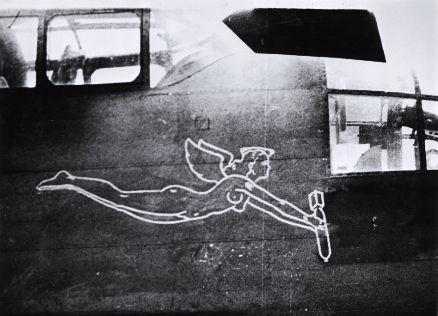
Doolittle nose-art
I read 30 Seconds Over Tokyo when I was still a war-playing kid, before I would understand the mischievous consequences of the Doolittle Raiders B-25 bombers deploying without their bombsights. This was to prevent US war-making advantages falling into enemy hands but it also precluded dropping bombs with accuracy. I’m pretty certain the account for young readers also didn’t explain why over a quarter of the squadron’s bombs were of the incidiary cluster variety. Readers today know what those are for. Doolittle claimed to be targeting military sites in Japan’s capitol, but “invariably” hit civilian areas including four schools and a hospital. Of the American fliers captured, three were tried and executed by the despicable “Japs”, who considered the straffing of civilians to be war crimes. After the war, the US judged the Japanese officers responsible, as if their verdict was a greater injustice against our aviators’ “honest errors”. Today we rationalize our systemic overshoot policy as “collateral damage”.

Every year since WWII, Doolittle’s commandos are feted for their milestone bombing mission. This Veterans Day is to be the last due to their advanced ages. But it is fitting, because isn’t it time Americans faced what we’re celebrating? There’s no denying it took suicidal daring, but the Doolittle Raid inaugurated what became a staple of US warfare, the wholesale terrorizing of civilians from on high, with impunity and indifference. To be fair, the American public has always been kept in the dark. American aircraft have fire-bombed civilians at every diplomatic opportunity since 1942, and a Private Manning sits in the brig for trying to give us a chance to object.

We now know that the Doolittle Raid didn’t turn the tide, nor shake Japanese resolve. It was a retalliation for the attack on Pearl Harbor, intended to boost US morale as if to say, America wasn’t defeated. Kinda like why and how we struck back at Afghanistan after 9/11, just as indiscriminately.

The “Mark Twain” ersatz bombsight
substitute bombsightThe Norden bombsight was a closely guarded US secret weapon. An airstrike without it would today be like lobotomizing so-called smart bombs, and deciding to opt for imprecision bombing. The official army record recounts that a subsitute sighting mechanism was improvised for the raid, dubbed the “Mark Twain” and judged to be effective enough. Now a bad joke. Indochina and Wikileaks-wisened, we know the mendacity of that assessment. The vehemently anti-imperialist, anti-racist Twain would not have been honored.

Twain satirized Western so-called Enlightenment thus: “good to fire villages with, upon occasion”.

Post-postwar hagiographies of the raid have suggested the improvised bombsight was better suited to low-altitude missions than the Norden model. That conclusion is easily dismissed because the device was used only for the Doolittle run and never after. The sight’s designer, mission aviator C. Ross Greening, offered a explanation for why he named the device after Mark Twain in his pothumously published memoir Not As Briefed. He didn’t.

The bombsight is named the “Mark Twain” in reference to the “lead line” depth finder used on the Mississippi River paddle wheelers in bygone days.

Because its design was so simple, we’re left to suppose. Greening’s bombsight was named for the same “mark” which Samuel Langhorne Clemens adopted as his celebrated pen name. I find it disingeneous to pretend to repurpose an archaic expression whose meaning was already eclipsed by the household name of America’s most outspoken anti-imperialist. Who would believe you named your dog “Napoleon” after a French pastry?

We are given another glimpse into Greening’s sense of humor by how he named his plane, the “Hari-Kari-er” ready to deal death by bomb-induced suicide. Greening’s B-25 is the one pictured above, with the angelic tart holding a bomb aloft. Greening’s plane was another that carried only incendiary ordnance.

Much was made of the sight’s two-piece aluminum construction, reportedly costing 20 cents at the time compared to the $10,000 Norden. This provided the jingoist homefront the smug satisfaction perhaps, combining a frugality born of the Depression with the American tradition of racism, that only pennies were expensed and or risked on Japanese lives.

War Crimes
Targeting civilians, taking insufficient care to avoid civilian casualties, using disproportunate force, acts of wanton retaliation, and the use of collective punishment are all prohibited by international convention. They are war crimes for which the US prosecutes adversaries but with which our own military refuses to abide. Americans make much of terrorism, yet remain blind to state terrorism. Doolittle’s historic raid, judged by the objective against which it is celebrated as a success, was an act of deliberate terrorism.

Forcing the Japanese to deploy more of their military assets to protect the mainland sounds like a legitimate strategy, except not by targeting civilians to illustrate the vulnerability, nor by terrorizing the population, one of Doolittle’s stated aims. He called it a “fear complex”.

It was hoped that the damage done would be both material and psychological. Material damage was to be the destruction of specific targets with ensuing confusion and retardation of production. The psychological results, it was hoped, would be the recalling of combat equipment from other theaters for home defense, the development of a fear complex in Japan, improved relationships with our Allies, and a favorable reaction in the American people.

There is no defending Japan’s imperialist expansion in the Pacific, and certainly not its own inhumanity. The Japanese treated fellow Asians with the same racist disregard with which we dispatched Filipinos. While Americans point in horror at how the Japanese retalliated against the Chinese population for the Doolittle Raid, we ignore that Doolittle purposely obscured from where our bombers were launched, leaving China’s coast as the only probably suspect.

To be fair, most of Doolittle’s team was kept in the dark about the mission until they were already deployed. I hardly want to detract from the courage they showed to undertake a project that seemed virtually suicidal. But how long should all of us remain in the dark about the true character of the Doolittle Raid?

Out of deference for the earlier generation of WWII veterans, those in leadership, certain intelligence secrets were kept until thirty years after the war. Unveiled, they paint a very different picture of what transpired. The fact that the US knew the German and Japanese codes from early on revealed an imbalance not previously admitted, as an example.

About the Doolittle Raid, much is already openly documented, if not widely known. The impetus for the raid was public knowledge, the evidence of its intent in full view.

BY DESIGN
In the aftermath of Pearl Harbor, American newspapers were already touting offers of cash rewards for whoever would be the first to strike back at Japan. President Roosevelt expressed a deliberate interest in hitting the Japanese mainland, in particular Tokyo, to retaliate for the Japanese strike against Pearl Harbor, never mind it had been a solely military target.

Plans were made to exploit the Japanese homeland’s vulnerability to fire, as ninety percent of urban structures were made of paper and wood. Writes historian William Bruce Jenson:

In his “confidential” meeting with reporters back in November, Marshall had declared that the US would have no cavil about burning Japan’s paper cities.

For the Doolittle Raid, a bombing strategy was developed to overwhelm the fire department of his target, the Shiba ward.

A former naval attache in Tokyo told Doolittle: “I know that Tokyp fire department very well. Seven big scattered fires would be too much for it to cope with.”

As lead plane, Doolittle’s role was to literally blaze the way. Fellow pilot Richard Joyce told Nebraska History Magazine in 1995:

The lead airplane, which was going to have Doolittle on board as the airplane commander, was going to be loaded with nothing but incendiaries -2.2­ pound thermite incendiaries- in clus­ters. They drop these big clusters and then the straps break and they spray, so they set a whole bunch of fires. He was to be the pathfinder and set a whole bunch of fires in Tokyo for pathfinding purposes.

Doolittle’s report outlined his objective more formally:

one plane was to take off ahead of the others, arrive over Tokyo at dusk and fire the most inflammable part of the city with incendiary bombs. This minimized the overall hazard and assured that the target would be lighted up for following airplanes.

Greening paints the most vivid picture, of burning the Japanese paper houses to light the way:

Doolittle planned to leave a couple of hours early, and in the dark set fire to Tokyo’s Shiba ward … the mission’s basic tactic had been that Doolittle would proceed alone and bomb a flammable section of Tokyo, creating a beacon in the night to help guide following planes to their targets.

Doolittle’s copilot Lt Richard Cole, told this to interviews in 1957:

Since we had a load of incendiaries, our target was the populated areas of the west and northwest parts of Tokyo.

After the bombers had left on their raid, and before news got back about whether or not they accomplished it, the Navy crew on the carrier USS Hornet already sang this song, which went in part:

Little did Hiro think that night
The skies above Tokyo would be alight
With the fires that Jimmy started in Tokyo’s dives
To guide to their targets the B-25s.
When all of a sudden from out of the skies
Came a basket of eggs for the little slant eyes

Incendiaries

Most of the bombers were loaded with three demolition bombs and an incendiary cluster bomb. Some of the planes carried only incendiaries. According to Doolittle’s official report of the raid, here were some of their stated objectives:

Plane no. 40-2270, piloted by Lt. Robert Gray:
thickly populated small factories district. … Fourth scattered incendiary over the correct area

Plane No. 40-2250, Lt. Richard Joyce:
Incendiary cluster dropped over thickly populated and dense industrial residential sector immediately inshore from primary target. (Shiba Ward)

“The third dem. bomb and the incendiary were dropped in the heavy industrial and residential section in the Shiba Ward 1/4 of a mile in shore from the bay and my tat.”

Aircraft 40-2303, Lt Harold Watson:
the congested industrial districts near the railroad station south of the Imperial Palace

AC 40-2283, David Jones:
the congested area Southeast of the Imperial Palace

Even though the planned night raid became a daytime mission, Doolittle did not alter his original role, intended to light the way for the following planes. His target remained the Shiba District of Tokyo. His own plane: “changed course to the southwest and incendiary-bombed highly inflammable section.”

Doolittle’s report included a description of the incendiary bombs:

The Chemical Warfare Service provided special 500 incendiary clusters each containing 128 incendiary bombs. These clusters were developed at the Edgewood Arsenal and test dropped by the Air Corps test group at Aberdeen. Several tests were carried on to assure their proper functioning and to determine the dropping angle and dispersion. Experimental work on and production of these clusters was carried on most efficiently.

As has become an aerial bombardment tradition, crews were let to inscribe messages on the bombs about to be dropped. Accounts made the most of these chestnuts: “You’ll get a BANG out of this.” And “I don’t want to set the world on fire –only Tokyo.”

These details, which reveal the intentions of the raid, were not made known to the public immediately. The Doolittle Raid was planned and executed in secret, with US government and military spokesmen denying knowledge of the operation even in its aftermath. The first word to reach the American public came from the New York Times, citing Japanese sources:

Enemy bombers appeared over Tokyo for the first time in the current war, inflicting damage on schools and hospitals. Invading planes failed to cause and damage on military establishments, although casualties in the schools and hospitals were as yet unknown. This inhuman attack on these cultural establishments and on residential districts is causing widespread indignation among the populace.

This report was dismissed as propaganda. When Japan declared its intention to charge the airman it had taken captive with war crimes, the US protestations redoubled. The accusations were belittled even as our own reports conceded to the possibilities.

Lieutenant Dawson’s Thirty Seconds Over Tokyo was the first published account of the raid. Printed less than a year after the event, wartime-sensitive details such as the phony guns made of broomstick handles poking out the back were left out. Targets were also not specified, but a candor remained, probably intended to be threatening. Lawson described the 500-pound incendiaries as “something like the old Russian Molotov Breadbasket”, and related US naval attache Jurika’s advice:

“If you can start seven good fires in Tokyo, they’ll never put them out,” Jurika promised us. … “I wouldn’t worry too much about setting fires in flimsy-looking sections of Tokyo,” he said. “The Japanese have done an amazing job of spreading out some of their industries, instead of concentrating them in large buildings. There’s probably a small machine shop under half of these fragile-looking roofs.”

“Flimsy” became Lawson’s keyword for the residential areas. Here Lawson described dropping his third and fourth bombs, when he saw their corresponding red light indicators:

The third red light flickered, and, since we were now over a flimsy area in the southern part of the city, the fourth light blinked. That was the incendiary, which I knew would separate as soon as it hit the wind and that dozens of small fire bombs would molt from it.

I was satisfied about the steel-smelter and hoped the other bombs had done as well. There was no way of telling, but I was positive that Tokyo could have been damaged that day with a rock.

Our actual bombing operation, from the time the first one went until the dive, consumed not more than thirty seconds.

Thus: Chance of hitting civilian homes: 50/50.
Charges of Excessive Force could be expected, because
blame the victim for being weaker than: a rock.
Care taken to avoid innocent casualties: 30 seconds.

In a later afterword, Lawson blamed Tokyo for having insufficient bomb shelters.

After the war, US occupation forces recovered Japanese records which documented the losses attributed to the Doolittle Raid: fifty dead, 252 wounded, ninety buildings. Besides military or strategic targets, that number included nine electric power buildings, a garment factory, a food storage warehouse, a gas company, two misc factories, six wards of Nagoya 2nd Temporary Army Hospital, six elementary or secondary schools, and “innumerable nonmilitary residences”.

Strafing
Japan accused the fliers of indescriminate strafing civilians. The US countered that defending fighters were responsible for stray bullets when their gunfire missed the bombers. That’s very likely, except the raiders were candid about their strafing too. Lawson:

I nosed down a railroad track on the outskirts of the city and passed a locomotive close enough to see the surprised face of the engineer. As I went by I could have kicked myself for not giving the locomotive’s boiler a burst of our forward 30-calibre guns, then I remembered that we might have better use for the ammunition.

A big yacht loomed up ahead of us and, figuring it must be armed, I told Thatcher to give it a burst. We went over it, lifted our nose to put the tail down and Thatcher sprayed its deck with our 50-calibre stingers.

Greening’s account of firing on a sailor, raises the moral ambiguity of air warfare with which few airmen grapple. By virtue that technology allows it, combatants become slave to a predetermined outcome:

When we attacked the next patrol boat, a Japanese sailor threw his hands up as if to surrender. I guess he expected us to stop and take him prisoner. We shot him and left this boat smoking too.

The Medals
Friendship Medals exchanged between Japan and the US found themselves requisitioned for Doolittle’s Raid:

Several years prior to the war, medals of friendship and good relationship were awarded to several people of the United States by the Japanese government.  In substance these medals were symbolic of the friendship and cooperation between the nations and were to represent the duration of this attitude.  It was decided by the Secretary of the Navy, Mr. Frank Knox, that the time was appropriate to have these medals returned.  They had been awarded to Mr. Daniel J. Quigley, Mr. John D. Laurey, Mr. H. Vormstein and Lt. Stephen Jurkis.

After arrangements had been made and the medals secured, a ceremony was held on the deck of the Hornet during which the medals were wired to a 500 lb. bomb to be carried by Lt. Ted Lawson and returned to the Japanese government in an appropriate fashion.

Lawson’s plane no 40-2261 dropped that bomb on an “industrial section of Tokyo” omitting to mention that Japan’s industry was still a post-feudal cottage industry.

“The medals were subsequently delivered in small pieces to their donors in Tokyo by Lt. Ted Lawson at about noon, Saturday, April 18, 1942.”

–Mitscher, M.A. Letter Report to Commander Pacific Fleet.

“Through the courtesy of the War Department your Japanese medal and similar medals, turned in for shipment, were returned to His Royal Highness, The Emperor of Japan on April 18, 1942.”

–Knox, F. Letter Report to Mr. H. Vormstein

De mortuis nil nisi bonum is well and good but upholds the victor’s narrative

NeroIt’s probably older than Latin. “De mortuis nil nisi bonum” is a propriety imposed at death, as if to offer the deceased a false comfort that, however fraudulent the pretense of their reputation in life, they can take it with them. Well, most commonly, “Don’t speak ill of the dead” is a reminder not to rehash petty grievances in the face of another’s mortality, death being after all mankind’s mutual adversary. It’s a pact I suppose that’s meant to benefit everyone equally. But the tradition does sort of cement history as written by the victor, where revisionists dare not speak truth to power while that authority is alive.
 
I saw the adage used in a disturbingly upbeat eulogy for Margaret Thatcher in this week’s New Yorker. Disturbing because it was fair handed enough, but mired like New York City, insulated by the growing wealth and cultural disparity, in the Western master narrative. I find that not speaking ill of the dead is completely irresponsible with historic figures like Margaret Thatcher and Henry Kissinger. If we are prevented from hanging them to hasten their death, we must at the minimum garrotte their memory before it’s set in stone. To beat a dead horse.

Julian Assange and Bradley Manning put lie to Western pretense of freedom and rule of law


The UK wouldn’t extradite Pinochet, but they’re threatening to storm the Ecuadorian embassy in London to see that Wikileaks impresario Julian Assange is extradited to Sweden where a prosecutor wants to decide whether to charge him for sexual violations, more likely so that the Australian can then be rendered to the US to be imprisoned like Bradley Manning and face the death penalty for espionage. The US denies this intention, though it voted against Ecuador’s allies to hold a meeting about the continuing US-UK assault on journalism and whistleblowers. Can the Western empire let Assange and Manning escape severe reprimand? The two are only the mastermind and the alleged-source who’ve ignited the global uprising behind the anti- austerity movements, Arab Spring, and Occupy. President Obama cannot leave either off the hook without encouraging a deluge of more insider defections. Bradley Manning is already under torture in military custody, but Assange continues to evade US clutches. Should he escape to asylum in Ecuador where Obama’s exterminator drones can deal “American Justice”? The US has yet to condemn a white man to targeted assassination, but in the Global South, in darker-skinned populations, who will know? I favor Ecuador expanding its embassy to more than the first floor office, to offer Wikileaks an entire center of operations for as long as Julian Assange is confined under virtual house arrest. In Assange’s speech from the embassy balcony he repeated three times: “Bradley Manning must be released.” Journalists must be free to expose the crimes of the rich. Citing prison sentences for a Bahrain dissident and Russia’s Pussy Riot, Assange concluded: “There is unity in the oppression. There must be absolute unity and determination in the response.”

Here’s the full text of Assange’s statement:

“I am here today because I cannot be there with you today. But thank you for coming. Thank you for your resolve and your generosity of spirit.

“On Wednesday night, after a threat was sent to this embassy and the police descended on this building, you came out in the middle of the night to watch over it and you brought the world’s eyes with you.

“Inside this embassy, after dark, I could hear teams of police swarming up into the building through its internal fire escape. But I knew there would be witnesses. And that is because of you.

“If the UK did not throw away the Vienna conventions the other night, it is because the world was watching. And the world was watching because you were watching.

“So, the next time somebody tells you that it is pointless to defend those rights that we hold dear, remind them of your vigil in the dark before the Embassy of Ecuador.

“Remind them how, in the morning, the sun came up on a different world and a courageous Latin America nation took a stand for justice.

And so, to those brave people. I thank President Correa for the courage he has shown in considering and in granting me political asylum.

“And I also thank the government, and in particular Foreign Minister Ricardo Patino, who upheld the Ecuadorian constitution and its notion of universal rights in their consideration of my asylum. And to the Ecuadorian people for supporting and defending this constitution.

“And I also have a debt of gratitude to the staff of this embassy, whose families live in London and who have shown me the hospitality and kindness despite the threats we all received.

“This Friday, there will be an emergency meeting of the foreign ministers of Latin America in Washington DC to address this very situation.

“And so, I am grateful to those people and governments of Argentina, Bolivia, Brazil, Chile, Columbia, El Salvador, Honduras, Mexico, Nicaragua, Argentina, Peru, Venezuela, and to all other Latin American countries who have come out to defend the right to asylum.

“And to the people of the United States, United Kingdom, Sweden and Australia who have supported me in strength, even when their governments have not. And to those wiser heads in government who are still fighting for justice. Your day will come.

“To the staff, supporters and sources of Wikileaks, whose courage and commitment and loyalty has seen no equal.

“To my family and to my children who have been denied their father. Forgive me, we will be reunited soon.

“As Wikileaks stands under threat, so does the freedom of expression and the health of all our societies. We must use this moment to articulate the choice that is before the government of the United States of America.

“Will it return to and reaffirm the values, the revolutionary values it was founded on, or will it lurch off the precipice dragging us all into a dangerous and oppressive world, in which journalists fall silent under the fear of prosecution and citizens must whisper in the dark?

“I say it must turn back. I ask President Obama to do the right thing. The United States must renounce its witch-hunts against Wikileaks. The United States must dissolve its FBI investigation.

“The United States must vow that it will not seek to prosecute our staff or our supporters. The United States must pledge before the world that it will not pursue journalists for shining a light on the secret crimes of the powerful.

“There must be no more foolish talk about prosecuting any media organisation; be it Wikileaks, or be it the New York Times.

“The US administration’s war on whistleblowers must end.

“Thomas Drake, William Binney and John Kirakou and the other heroic whistleblowers must – they must – be pardoned or compensated for the hardships they have endured as servants of the public record.

“And to the Army Private who remains in a military prison in Fort Leavenworth, Kansas, who was found by the United Nations to have endured months of torturous detention in Quantico, Virginia and who has yet – after two years in prison – to see a trial: he must be released.

“Bradley Manning must be released.

“And if Bradley Manning did as he is accused, he is a hero and an example to us all and one of the world’s foremost political prisoners.

“Bradley Manning must be released.

“On Wednesday, Bradley Manning spent his 815th day of detention without trial. The legal maximum is 120 days.

“On Thursday, my friend Nabeel Rajab, President of the Bahrain Human Rights Centre, was sentenced to three years in prison for a tweet. On Friday, a Russian band were sentenced to two years in jail for a political performance.

“There is unity in the oppression. There must be absolute unity and determination in the response.

“Thank you.”

Colorado police brutality retrospective: the 1934 Relief Strike Battle, UP story “Girl Radical Leads Mob in Denver Riot”


If one image captures the “Relief Strike Riot” of October 30, 1934, it’s of Patrolman CV Satt who continues to fire his service revolver after he’s felled by a bottle thrown by a striking picketer. Although Colorado newspapers were anti-union, their accounts vary enough to reveal the escalation of violence for which the DPD was responsible and for which they and the newspapers I’ll bet have never apologized. This article will be the first of a series to unearth the newspaper accounts which documented the events of Oct. 29 through Nov. 3, 1934, mostly because the police tactics and media defamation are remarkably similar today.

(Caption on above photograph: “This remarkable photograph was taken when the rioting between Denver police and “relief strike” picketers was at its height at W. Jewell ave. and the Platte River yesterday. Patrolman C. V. Satt is shown rising after he had been struck over the head with bricks and a shovel. He has his service pistol in his hand, ready to fire at his assailants, but Sergt. Henry Durkop is restraining him.”)

INTRODUCTION: THE BATTLE
As with many “riots”, the confrontation of Oct. 30, 1934 was instigated by the abrupt arrest and detention of a union organizer. What follows is an entertaining eyewitness account which attempts to defame the picketers and laud the police officers for their restraint, although the other reports and photographic record suggested otherwise.


Colorado Springs Evening Telegraph, October 31, 1934, page 1, column 8: GIRL RADICAL LEADS MOB IN DENVER RIOT — FERA Project Pickets Spurred Into Battle by Woman Believed Imported Agitator By DAVIS CAMPBELL, United Press Staff Correspondent

DENVER, Colo, Oct 30 (UP)– A dark haired, attractive girl led demonstrators into hand to hand battle with police here today, as the picketers, under alleged communist leadership, sought to force a strike of Denver FERA workers.

The girl, who was believed by police to have been an imported communist sympathizer, was the spearhead of the rush of demonstrators who attempted to rescue their arrested leader, Gene Corish, 35, of Denver, from the hands of police.

I followed the demonstrators from the time they gathered with the intention of picketing the FERA projects. Police believed they planned to descend on a project at Alameda avenue and Cherry creek. Instead they headed for another at Evans street and the Platte river.

FERA Workers Fight Reds.

There they rushed into a group of FERA workers and sought to take away their tools. The relief workers fought back. But, by the force of superior numbers the demonstrators were winning the spirited battle when police rushed up.

Several picks and shovels had been thrown into the stream.

The police leaped into the midst of the hand to hand fighting. They seized Corish, who appeared to be the leader of the rioters, and dragged him to a patrol wagon.

Instantly the girl leader of the rioters set up a cry of “Don’t let the (here she used an unprintable epithet) have him” and she started toward the patrol wagon swinging a shovel someone had wrenched from a worker.

Others joined the rush. Bricks and clods flew thru the air toward the little band of a dozen husky policemen, outnumbered about 50 to 1 by the rioters.

The patrolmen formed a cordon around the patrol wagon, and retreated slowly toward it, fighting every step of the way, but using only their clubs and fists. They very apparently were seeking to avoid serious injury to anyone.

Officer Felled by Bottle.

Suddenly a beer bottle flew thru the air and struck one of the patrolmen (I learned later he was Carl V. Satt), squarely on the head. Satt dropped like a log.

A rioter stood over him with a shovel in his hands, apparently ready to swing another blow at the unconscious man.

Driven to desperation by this development, police drew their pistols and fired what sounded to me like more than 30 shots.

A rioter dropped, wounded thru the hip. He was Henry Brown, later found to be superficially wounded.

I think Patrolman Marshall Stanton shot him. Stanton told me later he believed this was the case.

I was certain, as I watched from some distance away, that I saw two other rioters drop, but, if others were wounded, they were carried along by their fellows and were not taken to hospitals.

Rapidly the ranks of the demonstrators broke, giving ground before the police fire. Several paused long enough to hurl bricks and rocks such as those which had already injured Sergt. James Pitt and Sergt. Henry Duerkop.

The police made 10 arrests in all.

Thru all the violence, FERA workers sided with police. They appeared determined not to give up their jobs.

INTRO 2: PHOTOGRAPHS
From the Rocky Mountain News, October 31, 1934, page 4


Caption reads: “A group of the “strikers” parading near the Cherry Creek relief project. Only 21 bona fide relief workers in Denver left their jobs yesterday to strike.”


Caption reads: “This view was taken just before police and so-called relief striker started their bloody battle at the Platte River near W. Jewell ave. yesterday. The arrow points to Patrolman C. V. Satt, who was struck in the head by a missile and critically injured. Other patrolmen are shown on duty around the patrol wagon, as one of the picket leaders is being placed inside.”


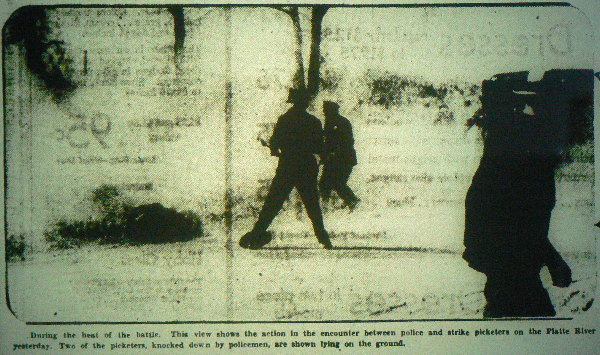
Caption reads: “During the heat of the battle. This view shows the action in the encounter between police and strike picketers on the Platte River yesterday. Two of the picketers, knocked down by policemen, are shown lying on the ground.”


Caption reads: “After the smoke of battle. This shows the battleground where strikers and police met yesterday just after all the action had ceased. Two strikers are shown down on the ground and beyond them is Patrolman C. V. Satt, who was perhaps fatally injured when struck by missiles of the strikers. He is prone on the ground but has pulled out his revolver.”


Caption reads: “R. W. Rankin, a relief supervisor, shown waiting for the ambulance after he had been struck over the head by a patrolman following a private fight at the strike demonstration held yesterday at Civic Center. He suffered a severe scalp wound.”


Caption reads: Henry W. Brown, who was shot in the hip during the encounter between the demonstrators and police on the Platte River yesterday. He is shown here as he lay on a cot in county jail after his wound had been treated in Colorado General Hospital.”

INTRO 3: NEWS HEADLINES

CS Gazette, (AP) Oct 29, 1934:
Relief Strikers March on Capitol – Governor Refuses to Talk to Crowd When One ‘Red’ Won’t Keep Still

Rocky Mountain News, Oct 30
‘Relief Strikers’ March On Capitol, make Demands – Threaten Violence at Projects Today If Officials Do Not Grant All They Seek
Will Rogers – Says Bread Line Is Encouraged by Deficit of New York Stock Exchange
Young Folk Lambast Older Generation For Getting World Into Present Mess – No Punches Pulled as Boys and Girls Have Their Say

CS Evening Telegraph, Oct 30,
RELIEF RIOTERS BATTLE DENVER POLICE
Agitators Shot and Four Officers Injured as Mob Tries to Foment Strike – Blazing Guns Disperse Communist Led Crowd, Radio Car and Gas Station Burned, Score of Attackers Hurt, FERA Workers Refuse to Walk Out
Girl Radical Leads Mob in Denver Riot – FERA Project Pickets Spurred Into Battle by Woman Believed Imported Agitator

RMN, Oct 31
POLICE ARMY WITH MACHINE GUNS WILL GUARD FERA WORKERS TODAY
Force of 300 Officers Will Use Bullets and Tear Gas If Necessary to Protect Relief Workers From Molestation – Agitators Threaten Violence After Yesterday’s Bloody Clash
Witness Says Police Fired When Driven Back to Car – Gives Graphic Account of Rush by Screaming Men and Women Who Volleyed Rocks at Officers

CS Gazette, Oct 31,
RESUMPTION OF VIOLENCE IN DENVER STRIKE FEARED
City Tense After Bloody Riot on South Platte – Barricade Erected at Table Mountain, to Be Visited Today by Agitators

CS Evening Telegraph, Oct 31,
DENVER QUIET BUT TENSE AFTER RIOTING
Mob Gathers But Fails to Carry Out Threat to March on projects – Police Precautions Against Further Outbreaks Nip New Demonstrations; Report Agitators on Way to Foment Trouble in El Paso County – Mob Gathers in Englewood but Fails to Carry Out Threat to March Against FERA Projects
Don’t Expect Any Agitator Trouble on C. S. Relief Jobs p1, c7
Mountain at Golden Resembles Fortified Castle as Workers Prepare to Resist Strike Mob p1, c7

New York Times, Oct 31
‘Hunger Marchers’ Routed at Albany; Rioting in Denver – Many Injured in Denver – Relief Strikers Attempt to halt Federal Project–One Shot Fighting Police, p1, c1

RMN, Nov 1
Relief Strike Riots Subside as Police Act – Agitators Fail to Start Anything at Various FERA Projects
Pretty Girl From Illinois Finds Denver Police Nice p4, c1

CSET, Nov 1
Roundup Ends Denver Relief Strike Threat – With Agitators Arrested, Leaderless Mob’s Spirit Broken; Plot to Spread Disorder in State Fails
U.C.L.A. Branded Communist Hotbed

RMN, Nov 2
File Charges Today Naming 15 as Rioters – Two of Group Face Fine of $1,000 and Year in Jail If Acts Are Proved, p14
College Students Battle Radicalism – Form Vigilante Committee at Coast School

Here’s to the ladies who lunch – everybody laugh

“Ladies Who Lunch” used to mean the idle spouses of financially successful husbands, as one New Yorker cartoonist fondly dubbed them, his Grand Dames, until Broadway in the mid-seventies where Stephen Sondheim subverted the idiom for Elaine Stritch’s COMPANY showstopper which exploded the pretense of the ladies’ self-serving philanthropy. Forty years on, out in the provinces, the expression adorns a Colorado Springs radio show on what is an otherwise erudite classical music station, at lunchtime, for ladies. Cultural illiterates too, probably. Imagine thinking that Titanic means big like Titan, absent the hubris. My neighbors could happily move back to the farm after they’d seen Paree, wondering what idiot decreed “you can’t go home again.”

Here are the lyrics since you missed them.

Here’s to the ladies who lunch
By Stephen Sondheim

Here’s to the ladies who lunch–
Everybody laugh.
Lounging in their caftans
And planning a brunch
On their own behalf.
Off to the gym,
Then to a fitting,
Claiming they’re fat.
And looking grim,
‘Cause they’ve been sitting
Choosing a hat.
Does anyone still wear a hat?
I’ll drink to that.

And here’s to the girls who play smart–
Aren’t they a gas?
Rushing to their classes
In optical art,
Wishing it would pass.
Another long exhausting day,
Another thousand dollars,
A matinee, a Pinter play,
Perhaps a piece of Mahler’s.
I’ll drink to that.
And one for Mahler!

And here’s to the girls who play wife–
Aren’t they too much?
Keeping house but clutching
A copy of LIFE,
Just to keep in touch.
The ones who follow the rules,
And meet themselves at the schools,
Too busy to know that they’re fools.
Aren’t they a gem?
I’ll drink to them!
Let’s all drink to them!

And here’s to the girls who just watch–
Aren’t they the best?
When they get depressed,
It’s a bottle of Scotch,
Plus a little jest.
Another chance to disapprove,
Another brilliant zinger,
Another reason not to move,
Another vodka stinger.
Aaaahhhhhh!
I’ll drink to that.

So here’s to the girls on the go–
Everybody tries.
Look into their eyes,
And you’ll see what they know:
Everybody dies.
A toast to that invincible bunch,
The dinosaurs surviving the crunch.
Let’s hear it for the ladies who lunch–
Everybody rise!
Rise!

Four Occupy tormentors unmasked


Occupy Colo. Springs held a NO WAR ON IRAN demo today, counter- protested by some soldiers who think any antiwar criticism of their mission fails to Support The Troops. (Horrifyingly curious don’t you think, that US soldiers would already consider war with Iran as their mission?!) Joining them it turned out, were four of OCS’s sneakiest saboteurs. I got them with one camera click! From right to ultra-right: Raven Martinez aka Briaunna Webbing aka Occupy Csprings, Michael Clifton aka Agent of Doubt, Ian Carman aka “Father” Ian, and Ryan Butler aka Ry King aka Lone Wolf.

My policy until now was not to dignify any of these Facebook twits with attention, but their rumor campaign against OCS has become so virulent and untrue, and their misdeeds are now tipping the balance. Today the entire intersection had to bear personal megaphone taunts, but I’ll say that the final straw was yesterday when I learned of misinformation they attempted to spread to the local news. Occupy CS’s hand was forced in issuing a public statement about accused-arsonist Kyle Lawrence, because someone asserted Kyle had joined a violent group that had sprung up in OCS. Uh, let’s get to the bottom of that one, shall we?

WARNING: OCCUDRAMA AHEAD. All of it boring, but these creeps need to crawl back under their mouse pads. Ignoring them hasn’t worked, and even though they crave attention, I’ll give that a try.

Exhibit A
Ryan Butler, Ryan King, Lucky Dog, Lone Wolf
At far right is RYAN BUTLER aka Lucky Dog, aka Lone Wolf. When he disrupted OCS GAs he went by “Ry King”.

The secretive Ryan Butler is half of the Clifton/Butler nerd team that hijacked the “Occupy Colorado Springs” Facebook Open Group. It’s got about 400 members, doesn’t represent Occupy at all, and is maintained as a launchpad for Tea Party occu-haters under the pretext of “free speech” as decided by its unlisted admins Ryan & Michael. The open group was originally created by authentic occupier Amber Hagen, who in her idealism let all participant have admin privileges. When Amber discovered that haters among the admins kept wrecking the page, she began to delete them. Michael Clifton once recounted at a meeting how he and Ryan scrambled over Skype to keep Amber from shutting them out. They hurriedly deleted Amber’s admin access, thus exiling her from her own group. This was the act that inspired Raven Martinez to do the same with the OCS Facebook community page, in all fairness I should say, to prevent others from doing it to her.

Ryan’s claim to fame in OCS came from a failed coup to share the spokesmanship monopoly held by occupothead Jason Warf, but I digress.

Ryan had to step away from OCS after legal trouble from a drunken poker game gone awry, which he tried to blame on authentic occupy vet RTG. Ryan has a criminal record of domestic violence and wears a gun in his home in violation of having lost his permit to carry. That much is not disputed. But Ryan refutes RTG’s version of the event: that Ryan pistol-whipped his ex-girlfriend, which enraged RTG and the two fought, trashing the house. Both face assault charges and Ryan’s ex has filed her usual plea to the court to dismiss any notion that Ryan abused her. Instead we are to believe Ryan tried to defend himself with a vice-grips laying about (leaves a strike pattern similar to a gun maybe), accidentally striking his ex.

I’ll add that my perspective doesn’t come from hearing RTG’s testimony, but rather from eavesdropping on private IMs sent by Ryan as he deliberated what to say by way of damage control. Anyway.

Entirely relevant here however is Ryan Butler’s favorite bragging right, his secret Fight Club-inspired “PLAN-B” CLUB (First rule of Plan-B, you don’t talk about Plan B, snore). Apparently “Plan B” is for Amendment Two fans who want an alternate plan “when the revolution fails.” Was this the pro-violence group to which Michael Clifton alluded in TV interviews? It had nothing to do with Occupy, didn’t come from Occupy, and if its membership is limited to Ryan’s friends, I’m guessing that pares it down to two: he and Clifton. Thus Clifton’s statement about his disassociation from proponents of violence was also facetious, because the above photo was taken upon their arrival at the counter-protest, they came together.

But how absolutely scurrilous to attempt to tarnish OCS with the suggestion that occupy was the breeding ground of their pro-gun Amendment Two fantasy life?!

Exhibit B
Michael Clifton, Agent of Doubt
Occupying more than the center of this photo is Michael Clifton, self-appointed videographer of the local occupy, known on Youtube and DIY newsites as “Agent of Doubt”.

Michael Clifton was a very early supporter of OCS, donating water and food as he documented its progress on Youtube, each segment introduced in his best impersonation of Alfred Hitchcock, minus the wit, or substance. Let’s say Clifton’s motives started out good, what would lead him last week to step forward and break the story about arsonist Kyle having a history with OCS, packaging his videos for best consumption by the local media?

Of course the answer is simple, and we’ve seen it before. Apparently 15-minutes of personal soundbite, TV attention converted to Youtube views, trumps any consideration for possible negative blowback for the movement. Clifton actually keeps distancing himself from OCS every time he alleges to speak authoritatively as an insider. It’s laughable if it wasn’t damnable, because this time the oaf said he quit when OCS members began to plan illegal strategies. Whaaat? –leaving listeners to infer that arson was among the strategies. What kind of tomfoolery insinuation is that?

Not surprisingly, once more Clifton is defending himself against accusations of being an informer or provocateur. I make no such charge. He’s an idiot. What can you do, Colorado Springs is full of them. Am I being too harsh? Read on.

In an earlier episode in front of City Council, Clifton famously declared himself an outsider to OCS so that he could take all the credit for a –he-thought– brilliant bit of investigative deduction regarding CSPD’s billing of man hours charged for policing OCS. Our friend had videotaped an OCS march you see, and noticed there weren’t any police officers in sight, ergo, the billings must have been fraudulent, yes, ignoring the possibility the cops were plain-clothed, or observing from a perimeter, or on call, etc. So like a flat-earther who draws conclusions based on only what he can see, our intrepid Sherlock declares the CSPD guilty of fraud, and… marches straight into the local office of the FBI to make the charge! The FBI, he reports, were only too happy to accept all his video footage into evidence!

This might point to Clifton’s real reason to declare he was not part of Occupy, because a GA consensus would have vetoed his FBI idea. OCS had recently endorsed a no-snitch policy, not on anyone, not even the city, and let’s face it, not least of all I’m guessing, TO the FBI.

Thus, however unwittingly, let’s call it witlessly, Clifton is an FBI informant in the very technical sense, isn’t he?

To put a fine point on it: everyone who’s participated in OCS activities recorded by Agent of Doubt Clifton, is now on record at the FBI, in not just the lossy Youtube segments available online, but the original hi-def digital sequences, in their entirety.

And while Agent Dork has been a stalwart companion to Occupy, if only for the videos which he converts into ad-views whose revenue he “contributes” to the Occupy movement by funding his own efforts to “promote” it, so far the sum of his efforts has been to give law enforcement and the local media evidence to build a case against Occupy. Thanks a ton Agent Dork. From here onward, your camera aught to record everyone giving you the finger!

Exhibit C
Department of Homeland Security Officer Ian Carman
I was tempted because of his sign to give Father Ian Carman a pass. Who’s to say a Department of Homeland Security employee shouldn’t consider himself part of the 99%? But after successive absences from GAs, then hiding among the haters, it might be time to take a close look at this very disruptive occupier.

Divisive behavior can be very subtle, so I’ll cut to the quick on Father Ian. He revealed to us that he worked for DHS because he wanted to explain that he had access to confidential files on certain occupiers, one of whom, supposedly a veteran, still had a very high security clearance, indicating he was likely still active duty, or perhaps in the intelligence service. Father Ian was asserting this about our high profile occupy star JWS, effectively trying to snitchjacket JWS. Come down on that whichever way you like.

Exhibit D

Raven Martinez writes on Facebook under the identity of her daughter, or the occunonymous Facebook user “Occupy Csprings”. Once a formidable OCS volunteer, Raven suddenly became my own personal raving critic. It’s been suggested that her fury bears the air of a woman scorned — I’ll delve into that further down, if I feel like it.

As reported above, the Tea Party mutiny of Amber’s Facebook OCS open group is what inspired Raven to hijack the OCS Facebook COMMUNITY PAGE. Raven might have done it with the best intentions, but did it utterly undemocratically and to everyone’s chagrin and condemnation. Here’s what happened.

Embattled by internal struggle against the very identity of mothership Occupy Wall Street, the OCS GA had adopted the moderating policy implemented by the New York OWS to thwart vanguards and saboteurs, but the Springs admins at that time were refusing to implement them. Admins were continuing to post political endorsements, conspiracy theories and statements critical of fellow occupiers. Further protocols were adopted by OCS to require admins to use their initials to identify who was responsible. Again this was ignored, and now many of the admins were refusing to attend the GAs.

One day Raven noticed important posts being deleted and snide comments being made about OCS protest actions, all being done by an admin who would not reveal his/her identity, and worst of all, in the name of Occupy Colorado Springs. An admin herself, Raven made the clever move of temporarily deleting all the other admin users on the chance that this one might be stupid enough to reveal himself by complaining about his suddenly lost access. The idiot took the bait, and turned out to be none other than OCS-permit-holder and self-important-leader Hossein Momsforpot. For shit. Well this left Raven with a dilemma. Who was going to believe that Hoss was anti-OWS? More critically, who among the admins she had deleted, could she reinstate without the risk that Hoss would convince them to reinstate his admin status with which he could then delete Raven? This was the lesson Raven had gleaned from the hijack perpetrated by Wolf & Agent Duh.

I neglected to mention that the earlier hijack was accomplished anonymously, with Ryan pretending that sole admin status was held by “his dog”. So with her hijack, Raven added her own innovation, Raven loudly proclaimed that she’d been shut out too! She planned to claim that her eventual “reinstatement” was the result of an omniscient AnonymousTM hacker who’d intervened for the betterment of the movement.

Raven’s problem was that I had just the day before publicly refused an admin appointment, and when she cavalierly let suspicions fall on occupier PJ, he promptly deleted himself. Funny story, no?

Well, although a number of very earnest admins felt slighted, oddly enough things worked out for the better after Raven’s purge because all the internal occuhating stopped, and a number of the admins who felt pushed out ultimately outed themselves as Ron Paul enthusiasts, conspiracy nuts, or single-issue MMJ addicts. In reality, no one was ejected from OCS, but having lost their control over the Facebook page, they chose to make kissoff statements and move on.

So Raven was able to coax PJ and me to share the admin responsibilities with her, and it’s a good thing too, because when Raven eventually turned against the broader OWS mission, she’ll say it was because of my personal agenda, Raven went and DELETED the Facebook page. She thought she’d done it, but Facebook has safeguards fortunately, PJ and I were alerted and able to save the 3,300 member page from oblivion.

And the rest is history in the making. Three of us administrate the community page now, we trust each other and our dedication to the values and goals of the original Wall Street occupiers, and the Facebook likes continue to rise.

Is that enough about Raven? Yes it is. She’s doing her best to vilify and destroy our efforts, but that’s as much as I want to say about her.

What the hell. Each of these four unsavory characters knows that I could say far more than I’ve divulged here. I’m already embarrassed enough to talk about them as I did, good grief. The personal attacks on me are based on nothing that I hadn’t written about on NMT, yet they persist via email and phone calls to everyone they can reach. Well, here’s my shot across the bow.

Ye Aulde Memoir

Another old piece. These stories are distorted by romanticized memory, at times, and others likely remember them differently. I by no means intend to insult any of the real persons that lived through this stuff with a cavalier treatment of tender recollections, or harsh description of personalities or actions. Each of us always did exactly what seemed to be exactly the right things to do at the time. And there survives much, much love, which has grown and developed like it always does, in ways we never see coming.

I’m not putting these old ones up because i’m too lazy to write new. I’ll have one of those next–but some of this old stuff fits. Hope you like it.

11 May 2009

One day during the summer of 1980 my brother David was in the hospital at Case Western Reserve University for yet another open-heart surgery. The scene that day was dramatic I suppose, but for our family at the time, it was in many ways just another day. The state of the relationships between us had come to the condition that existed then because each and every incident that had occurred in the history of the Universe had added to that cumulative point. The way it came together then could have been viewed as tragic, I suppose, but we never noticed.

I don’t even remember how I got the news that this particular episode was approaching. David’s surgery that year was one of many—so many, in fact, that by now surgeons and academics had written papers on his congenital condition, and even given it a polysyllabic title. His lead surgeon, a Dr. Ankeny as I recall, had once claimed that he had “learned more from David Bass than fourteen years of medical school.” We four siblings had in effect grown up in the hospital, with the constant potential for death in attendance on a daily basis. Many years would pass between that summer and the moment I decided any of this was applicable to self-reflection, and the sweltering summer afternoon was as present and imminently experiential as any other I lived through during that period.
Our family seemed done that year. I had been out of the picture for over a year. Dad had left soon after, leaving a sour tinge in the air with those remaining, though I never blamed him. When David queued up for one more death-defying, experimental, split-chest open-heart surgery, Dad came back to Cleveland from Florida to put in an obligatory appearance.

Here was a meeting that defied conventional description. Dave, the least guilty of all our immediate family, had been deeply affected by Dad’s exit from the filial stage earlier that year. I hadn’t seen, or even spoken to Dad for well over a year, nor could our interactions prior to then be described as warm and supportive. Outnumbered by angry or indifferent family members, and perhaps less acclimated to hospitals as the rest of us, Dad was way out of his simpler, down-to-earth element.

I showed up unannounced, with glorious southern tart Candy Stone from Mobile, Alabama in tow, she in dirty bare feet, nearly illegal shorts, one of those dangerous eighties tube-tops, and very red eyes. I don’t think Dad spoke more than a half dozen words to me. His eyes told the whole story of uncertainty, pain, and failure. Dave, fresh from surgery, quite literally green, with a repulsive grey crust around his lips and appending to the tubes and what not projecting from several of his orifices, refused to see Dad. Refused to allow him in the room. Dad left unrequited to return to his exile in Florida. I didn’t see him again for many years.

Once, David, following the Dead tour in our Mom’s old family van showing all the effects of the Rust Belt, with his underage Russian girlfriend, his fiddle, and a patchouli oil manufacturing operation, got pulled over in Alabama, for sport. By this time, David was unkempt, smelly, and obviously committing some crime or another. The cops shook him down pretty good, but of course he had no contraband. He has a vice or two, but the heart thing keeps him from excess. He had that young Russian girlfriend, though, and Alabama’s finest figured they could really hang him out to dry, (dang hippie). But she and Dave convince the alpha cop to let them call her mom in New York to confirm that permission had been granted for the road trip and no heinous kidnapping was going on. The mother spoke zero English, but somehow the girlfriend convinced the cop to allow her to translate for her mother. Mother and daughter held a five minute conversation about the mental acuity of Alabama cops, duly translated as an expression of permission, and the travelers were on their way. David drawls this story on stage in his hillbilly persona, fiddle in hand. It’s hilarious.

It seemed to me for a long time that David was the only one of us to escape that little bubble of anti-reality that made up our family life while we siblings were young. Maybe he somehow managed to avoid being trapped in it in the first place, residing only temporarily, with some sort of metaphysical pass associated with potential imminent death. I don’t know, but years later, during one of the high points of my own endeavor, Renaissance Paint and Remodeling, I remember feeling jealous of David. This was a recurring sentiment, and all the more abberant for the fact that my strongest memory of it falls during a visit to Dave’s place in North Carolina that amounted to a just-in-case kind of deal before a heart transplant. Whatever the rationality or fairness of my little envy, (not real envy, mind you, but one of those little personality spikes that one notes and passes through), David is the one of us that got away the least damaged, and has lived his idiosyncratic dream out in full, down to the fine print, with joy.

Mom tells a story about my first day at school. Or maybe the second. I had asked some question that Miss Gardner couldn’t answer, and after day two, came home grousing about how those people were ignorant, and furthermore lazy, since no one had even bothered to look up a response. Mom likes to carry on about how smart her offspring are. She doesn’t usually bring up in public how warped we can be.

Mom, we brothers agree, bequeathed us a legacy of somewhat dubious mental processes. She’s nuts. We all know it. She knows it. Dad knows it. The rest of her family knows it well, and most of them recognize a common bond of familial, brand-name insanity that we all seem to share. I expect this is a more or less common thing among families, but I remain convinced that we are a bit stranger than most, at least in part because of the unique circumstances we lived through.

Back in the day, Mom’s thing was what they call control issues. The dynamic of her issues was so complex I can’t imagine I’ll ever figure it out. Some of her personality came to her by heredity from her mother, whom we call Mo. Much of it developed in that crucible of stress Dave kept heated by his repeated, continuous flirtation with death. Mom, responding to my over-the-top reaction to a pubescent hormonal tsunami, became madly obsessive with minutiae, dividing her time among us brothers and badgering us constantly in a fashion no one can really get unless they have their own experience to compare. I think she and I trapped ourselves in a sort of feedback loop that could have ended no other way.

I was out of the house for good, by the age of fifteen, for all purposes off to lead a life of crime, I suppose. For some years, I lived out my interpretation of the old Kerouac/Kesey/Abbie Hoffman mythos, on the road, in the street, an utterly directionless rebel. A good five or six years passed without more that a word or two passing between Mom and me.

I was nineteen when I came to Colorado Springs. The vague and unformulated manifesto for global revolution I had worked out in my head was on hold, kept in place by a twelve-pack of cheap beer. I had a job as an electrician, and didn’t see any reason to change that, but we actually didn’t do much of anything but work and drink beer that year.

One day Mom called to say Mike, another brother, got himself in trouble again and she expected him to “run away.” I told her to give him my number and I’d let her know when he called. He did just a few days later, and can I come pick him up over on south Circle.

Mike and I spent a couple years engaging in the sort of insanity to which we had become habituated in Cleveland. The reader will require imagination to add flesh to the story here. The statute of limitations may prevent backlash, but I don’t mean to poke at a bees’ nest, and it seems unlikely you might imagine anything more extreme than what actually took place. We weren’t stupid, though, and the business of working for wages, or relying on illicit behavior for advancement just wasn’t good enough, so we formed a construction company and went to work. That proved to be a trap. Maybe an extension of the weird, family trap that all of us have discussed so deeply, without resolution.

Mike and I had it in our minds that the working man’s habit of grousing over how management acts is crap and that if we were going to grouse, we ought to just take the reins ourselves. It turned out we were pretty good, too, in a lot of ways. We worked together for the best part of twenty years, and reached moments of national prominence in our little niche. The whole period was characterized by more bone-crushing stress and absurd, super-human feats. We had little breaks from the madness when we’d crash the business, which we did three times. We were great at getting shit done, but lousy at administration in the final analysis.

Hiring employees in the construction business kept me exposed to the street element to which I had become accustomed. I involved myself in various efforts to assist folks in their low-budget struggles, imagining still that I could somehow change the world. In fact, contrary to Mike’s primary obsession with business success, I figured the whole pursuit as a means to some vague end involving social revolution. For a while a religious experience had me involved with a church effort to “reach out” to the hoodlums that used to cruise Nevada Avenue on Friday and Saturday nights. I even managed to glean an ordination from the Baptists, though now I suspect they’d regret bequeathing me with it. My identification with street folks and the urge to help them rise above conditions has never left me. Actually I’ve worked up the notion that we could all stand to rise above conditions.

Dad. I went even longer without speaking with him than I did with Mom. He dealt with our family’s teen-aged fulguration by folding his hand and striking out on his own. Offered a transfer by his employer, the story goes, he told Mom, “I’d like you to come to Florida with me, but I don’t think I can love you anymore.” No woman in her right mind would go for that deal, and Mom didn’t fall for it either. Dad packed his company car and struck out, leaving his all-important nest egg, and everything else, behind. When David was in the hospital again that summer, that’s where Dad came from to visit him.

I had been away, and I don’t recall blaming Dad for his poor dealings with the family. He had been raised in a very old-school, European style, and he simply couldn’t handle our ways. To this day, in spite of Dad’s expression of a taste for “philosophy,” our conversations are often guarded, pregnant with unspoken truths. I still don’t know his philosophy.

Last summer Dad, my youngest brother, and I went to Montana to camp and fish, riding an outfitter’s horses into some of the most pristine wilderness left in the lower forty-eight. I had genuinely hoped to break the communication barrier that stands between us, but we had to settle for hugs and meaningful silences, for the most part. Dad still plays with his cards pressed tightly to his chest, flashing a look of panic if the conversational waters begin to threaten him with submersion. I guess he can’t swim.

Dad’s experience, it seems to me has also been different from the norm, though I’m uncertain that any human being matches that mythical standard. His family, unlike Mom’s, which fought in the Revolution, was barely American. They were proud American citizens, but their traditions came from old Europe, and they still lived communally on the old Bass farm as they had done for a thousand years.

During my childhood, whenever David was out of the hospital, we’d spend weekends at the farm with the scene looking very much like something from an era that had long since passed in this country, all Dad’s siblings and extended family eating together, playing cards, children roaming the grounds like Huck Finn. It was all rather idyllic, truly, and the moment Grandma Bass died and the farm disappeared under a layer of vulgar office towers marked the shift from one childhood to another.

Dad’s life since then became an effort to recreate those years. His brother and sister had never left the farm. Even when his brother Paul married and had a child, he stayed there on Rockside, as the place was known. I think that scene served as an anchor for my Dad, and when he retired, impressively early despite having suffered huge financial setbacks, he bought his own farm, secluded and sylvan, and moved his socially inept brother and sister in with him.

Paul was a very strange dude. Throughout his lifetime he suffered from some sort of condition that caused him to wobble quite a bit and to mumble when he spoke, like a cartoon character. I still have no idea what the actual condition was–it was never discussed in medical terms, and Paul worked, loved, laughed, and lived in a fashion perfectly suited to him. He represented another unusual facet of our lives that never seemed unusual to us, simply because it just had always been what it was. During his declining years, Paul became more and more difficult to live with, his condition developing into a matter that caused him to actually require care, rather than merely one engendering bemusement. He became cantankerous, incontinent, and dangerous to himself, given his refusal to use a cane. Dad actively cared for him, there on the new farm, forty-five minutes from a paved road, until he died a few years ago.

I couldn’t make the funeral, but I spoke to Dad on the phone as he was back in the city making arrangements. I told him I thought his dealings with Paul were among the most impressive and moving things I had ever seen. I still see it that way. The conversation, which lasted no more than ten minutes I guess, may have been the deepest we’ve ever shared.

For the past eight or nine years every Sunday, so long as I’m in town, I give away food we cook up to whomever we can get to come up to the Colorado College campus and sample our fare. Often our guests are homeless or dirt poor, but we’re not so much stipulating low economic clout as a qualifier. We’ll feed anyone. Dick Celeste, the former governor of my home state, Ohio, and once ambassador to India, comes now and then. He’s a friend, and I visit him at his home, during party season at CC. Arlo Guthrie came down to our basement kitchen once–I put him to work washing dishes. Many of the crowd I see every week are chronic though, plagued by demons I surmise to have been born in conditions similar to mine as a youth. I’ve occasionally contemplated the accusation of “enabling” bad behavior that people toss my way once in a while, but many of our regulars, some of whom I’ve known for twenty-five years, are simply never going to approach any sort of productivity. They are simply too extraordinarily damaged, and as the proverb goes, there, but for the grace of God, go I.

The Christian experience I mentioned earlier was a reflection, or maybe an extension, of spiritual drives I always apprehended. I pursued it heartily for a time, beginning my adult involvement with the sort of hands-on charity our Sunday kitchen represents in a Christian context. The Church always felt skewed to me though, and a couple years’ studying of the questions involved convinced me to adopt thinking anathema to most of my Christian friends. The exclusionary thinking shared by many church folk, in turn, began to seem anathema to me.

Something about my family and its ability to weather long, rending forces, becoming over time a stronger entity for all its roiling turbulence, seems to me akin to the aspect of the human condition that produces the wrecked lives that bring folks to visit me on Sunday afternoons. Further spiritual thinking–some would say metaphysical thinking–concerning Chaos and Oneness has encouraged me to feel like the separation between me and the crowd I serve is illusory in some indefinable fashion. When members of our family passed through periods during which we found it necessary to step back from one another, the bonds that hold us together never broke, and the etheric bonds between my soup kitchen crowd and me, and ambassadors or presidents, don’t seem breakable either. We all seem to share certain common struggles, differences arising simply from disparate approaches, variant perspectives. Our family, it turns out was never what we imagined it ought to be, but perhaps something greater, and more viable, after all.

Part of my mission in ditching the construction business for more cerebral and perhaps less lucrative pursuits at an age when many of my peers in the building industry are thinking of golf courses and retirement comes from a belief that the differences in individuals are reconcilable. Feeding people is necessary, but falls short of bridging the apparent expanse between souls. I still want to change the world, even though I understand the futility of such a grandiose notion. Utopians always fail. But I expect that each time some failure becomes apparent, we can learn a little something, and maybe the next day we can fail a little better.

No account of self-examination is ever going to be complete. I won’t be asserting anything about how I’ve come full circle. Our family will never return to the conditions of my childhood. Nor is the new generation my brothers and cousins and I have brought into the world a retread of old lives. I haven’t even touched on my own experiences as head of a new family, but my children live lives vastly different from their forbears, and even though I rather hope they can avoid some of my mistakes, I suspect they’ll be making many of their own. It seems to be in their genes to require hard lessons. But, like my tortured friends in line at CC on Sunday mornings, or those in my circle equally tortured but accustomed to fine linens, whatever they may suffer holds its own value.

We all learn what we must learn. Life is perfectly safe. Its lessons are self-taught, but deep. I genuinely plan to write a real memoir and a family history, for my kids’ sake, but by the time we come full circle, it’s too late to write about it.

George Who?

This is a paper from some time ago, well prior to the advent of Occupy events. Henry George wrote from a sensibility one rarely finds expressed so explicitly today. The modern reader should note that Christian underpinnings in no way disrupt either the reasoned logic or the passionate humanity behind George’s arguments. Follow the links! Many Occupiers have promoted education, the deeper aspects of which are rarely available in 3 page tracts….

For Eric Stephenson
16 February 2009

George Who?

It seems peculiar that in 2009 no one has heard of Henry George, if only for the fact that during his prime a hundred years past his was easily one of the most recognizable names on Earth. Just a journalist really, George’s hardscrabble upbringing, his early experience in the business world, and maybe just a little OCD inspired him to craft an entirely new approach to economic theory. Its publication very quickly garnered him international acclaim, respect, and supportive friendship from many of the greatest figures of his day. Many, encountering his work for the first time today, would no doubt label him a Commie, particularly given that George’s work followed Marx and Engels’ by three decades. This misinterprets George. His thinking split the difference between Adam Smith and the Communist theorists in many ways, sharing common ground with both camps but firmly establishing his own territory. His work deserves a second reading.

George was born in Philadelphia, September, 1839, to a family headed by a hardworking but low-budget printer. By providing the Church cut-rate printing services, George’s devout father enabled Henry to garner a relatively high-standard primary education from the Episcopal Academy. He left home after high-school seeking his own way, and after a brief period of adventuring, found himself in San Francisco where he joined the Printer’s Union, following in his father’s footsteps after all.

George lived a poor man’s life–same as any tradesman at the height of the Robber Barons’ power–until an editor at the San Francisco Times came across a piece he had written and left lying around. He accepted an offered staff writing position at $50 a week, which seemed a princely amount compared with his father’s $800 a year. He traveled quite a bit for the Times, and in 1868 on assignment in New York City first encountered the squalid conditions surrounding and adjoining vaunted islands of luxury and power that would inform and undergird his writing for the rest of his life.

Having gained considerable respect as a newsman and a fair amount of seed-money, George and a partner, William Hinton, established the San Francisco Evening Post in 1871. George unabashedly used the paper as a human rights platform until 1877, when, some say, powerful railroad interests against whom he had written since his SF Times days shut the Evening Post down. Quickly landing a government post through highly-placed friendships he had developed, he used the leisure time it afforded to produce his magnum opus, Progress and Poverty, and published it in 1879. George moved to New York in 1880 and promptly left for England and Ireland, touring there to support Irish land support. By the time he returned, his life had changed forever. Progress and Poverty had made him a celebrity (de Mille 1-152).

George’s political economy laid out in his roughly 600 page book begins with his assertion that Smith’s approach established private land ownership as the foundation of economic and social structure, referring often to “the sacred rights of private property” (Smith, par. 1.11.79). So far few would argue, but George figured this skewed, and brazenly wrote that, “[t]he great cause of inequality in the distribution of wealth is inequality in the ownership of land. The ownership of land is the great fundamental fact which ultimately determines the intellectual and moral condition of a people….[I]t necessarily follows that the only remedy for the unjust distribution of wealth is in making land common property” (295, 391). He argued that as a foundational natural resource there is no basis for sequestering land in private hands. He proposed to hold land in common and allot it to users for as long as they needed, for whatever production they could derive from it, and the holder would pay tax, (rent), on its assessed value until relinquished. The holder and any capital or labor involved would keep whatever profit came from the working of the land, and the public would base taxation only upon the land itself. Note that this negates both income and capital gains taxes. (During George’s prominence, no federal income tax existed in the United States). George insisted the extensive system described philosophically in Progress and Poverty, and rather more technically in The Science of Political Economy, would adequately supply the government’s fiscal needs without additional taxes while simultaneously encouraging entrepreneurship and curtailing development of a landed class.

Marx, whose seminal works came before George, but close enough that both wrote from the surrounding milieu of the Industrial Revolution, addressed similar problems. He and those following took the matter to a deeper extreme, however, allowing for no private ownership of either property or capital. Marx expressed a well known hostility to capital. The familiar Communist adage, “Property is Theft,” represents a drastic condensation from Marx’s arguments that labor always seems to wind up on the short end of dealings with those holding either land or capital (Marx, chap. 6, par.2). Like George, Marx chafed at the inequities this arrangement produced, especially with the exacerbations of capital lording over labor, which industrial development had completely disassociated from the land producing the wealth. “The means of production and of exchange, on whose foundation the bourgeoisie built itself up,” says Marx, “were generated in feudal society,” (Marx, and Engels 1848, chap. 1, par. 21).The Communists implemented a far more radical seizure of all private property, including both land and capital, consolidating it under a central federal power (chap. 2, par. 75). Contrarily, George felt that capital deserved its due, and sought to rectify the problems he saw by implementation of a more enlightened “single tax.”

A few germane observations present themselves for discussion. Smith, George, and Marx all expressed notions we might call idealist—Utopian even. Each sought to solve timeless conundrums with an incredibly optimistic approach. Jaded 21st century readers might consider any one of them painfully naive, in retrospect. None of them had the advantage of the hindsight we enjoy, however, and fruitlessly denying the problems each pointed out in his broader work does not help at all. Smith wrote when, fresh from the collapse of European Feudalism, land served as the key to wealth of any kind, and still viewed as an unlimited resource for the grabbing. The vast inequities the Industrial Revolution had abruptly produced vexed George and the Communists. None of these could have predicted today’s technological, information based economies, with the problems they addressed dispersed over the entire planet. Today, the rate of separation between the “Haves” and the “Have Nots” poises to exceed the conditions affecting either set of writers.
George did not design a perfect system. Neither, as amply demonstrated by both history and current events, did Smith or Marx. Henry George thoughtfully and humanely addressed a terribly intractable matter in human affairs, however, and deliberately allowed for future thinkers to expand his work. His work deserves contemplation as we forge into a new century fraught with uncertainties. Our present crisis may help encourage just that.

Works Cited

De Mille, Anna George. Henry George: Citizen of the World. Chapel Hill: University of North Carolina Press, 1950.
George, Henry. Progress and Poverty: An Inquiry into the Cause of Industrial Depressions and of Want with Increase of Wealth: The Remedy. 1898. New York, New York: The Robert Shalkenbach Foundation, 1979. 17 February 2009

Marx, Karl. Wage-Labor Capital. 1849. 17 February 2009

Marx, K. and Engels, F. Manifesto of the Communist Party. 1848. 17 February 2009

Smith, Adam. An Inquiry into the Nature and Causes of the Wealth of Nations. 1776. Ed. Edwin Cannan. 5th ed. London: Methuen & Co., Ltd., 1904. 17 February 2009

United States Department of the Treasury. Fact Sheets: Taxes. 17 February 2009 (This link is obsolete).

Denver hasn’t looked this beautiful since it was an Arapaho campsite


DENVER- The #OccupyDenver encampment at the base of Capitol Hill has quadrupled after the weekend, there are now tents north and south of war memorial obelisk. The crowd tonight was merry, and the GA spirited. More pictures below.

Monday’s 7pm GA was diverted for a bit by the now customary pro and anti popo talk. A contingent from We Are Change seemed to want to make a point of praising the Denver Police Department, which was difficult for past DPD victims to abide. If I had to peg provocateurs, I’m inclined to suspect it of participants who kept raising the ire of offended protesters, defying calls for unity, finding it more important to compose odes to police civility than to return to the meeting agenda. Loopy almost. If I was a CHANGE-ist I’d want to be on my best behavior to atone for having pushed Obama on everyone, made them to compromise their objectives for what turned out to be zero reason.

Best zinger almost went over most heads, a gentleman introduced himself as having led a large antiwar march in 1960s New York, but you never heard of it because the entire event remained peaceful.

Judging the New Yorker by its cover

There are two qualities about the New Yorker I find irresistible though I’m loath to praise any part of the established press. No matter how suddenly forthright or honorable their editorial might appear, it’s only a feint. The Grey Lady NYT for example, has expressed accord with Wall Street’s recent invaders, but otherwise will spew at best neoliberal subterfuge. The WSJ will only ever be Murdoch pretending. But I have the suspicion that some artsy pretense prevents the New Yorker from bowing to the corporatist agenda. It’s the usual PUP on Israel of course, but too elitist for bourgeois self-deceit. That’s my theory. As a result the most disturbing investigative journalism leaks regularly through its pages. It competes with Harper’s among very few, but where the New Yorker has no peer is its cover art, which is often surprisingly subversive. The Oval Office Jihadist being a notorious example. Last week’s cover illustration was a nod to the Liberty Plaza demonstrators, showing Manhattan tourists being subjected to special use sidewalks akin to the restrictions NYC reserves for protesters. This week’s cover depicts Wall Street as sinister metropolis, literally an industrial behemoth, with the inhospitable accouterments of smog, smokestacks, cooling towers, and obelisk(!), looked over by a sphinx-like sacred bull with glowing eyes, nostrils and smoking horns, really if I had to guess, Mammon. Fitting that the bull signified indisputable power in the dawn of agrarian civilization, now its only symbolism is a brutish money-above-all-else juggernaut.

Hey Pikes Peak Region lazy bones, #OccupyColoradoSprings is calling!

By lazy bones I don’t mean the average inattentive public, I’m talking about you do-gooders out there trying to right wrongs and effect political change, usually. A growing gatherings of youthful idealists are “occupying” hometowns across the country, focusing on the heart of all problems, corporate greed, and you’re carrying on as if no one’s taken the bull by the horns. They’re inexperienced youth, but they know enough not to get pulled off message by Tea Partiers or partisan Dems. Daily General Assemblies at noon and 7pm refortify them that the movement is about LOVE. Of course they could use your help, opportunity’s knocking, but apparently your regular routine says “do not disturb.”

What makes you any different from the bankers, corporate brigands and their armies of minions, except that you’re not accessories to their crimes? You’re still part of the unactivated mass. Your petitions, your fundraising, your lobbying, your vigils, are as routine as the pushback you get from your adversaries. It’s a dance where your partner always leads, and you get nowhere, every. single. time. The colloquial definition of insanity comes to mind. Finally a youth movement emerges that might tip the scales, and you’re waiting for what? It’s hard not to conclude that actually rocking the boat is too much rocking for you. Faith in Democrats over Republicans, electoral equality, politicians to defy their sponsors, a corporate media open to the truth, justice for ordinary people, wars that will respond to reason, these are delusions. People not even smarter, nor as educated as you have figured this out. What’s happened to you? Tomorrow, WEDNESDAY, OCT 5, the occupiers of Wall Street will be marching with several of New York City’s largest unions, and NY campuses have declared a walk out in solidarity. Are you going to be sitting on the fence?

NY #OccupyWallStreet protest is going to be this generation’s Woodstock. Are you going to miss it?

If you can’t bum a ride to New York City, you are going to miss out, it’s plain as that. But you can make the revolution happen where you are. The Egyptian victory in Tahrir Square wasn’t achieved without simultaneous demos in Alexandria and Suez, etc. The earliest heavy casualties actually happened outside Cairo. In the Colorado capitol, a nascent #OccupyDenver is building steam. President Obama is making a campaign stop in Denver on Tuesday at Lincoln High School at Evans and Federal. That will be an excellent chance to force the media to break its blackout against the anti-capitalist uprising. What’s there to say to President Obama? Nothing right? He’s shown he answers only to Wall Street. But the message to the TV coverage of Obama, and to the people of Denver can be: Why is the bank-owned corporate media not telling you about #OccupyWallStreet? Reclaim our democracy from the bankers.
 
Colorado Springs is gaga for warmongers, bigots, Zionists and conservative educational campuses. The local Intelligence Quotient doesn’t rise to the level of critical thinking, which is a heartbreaking trait in its youth. But there is an ongoing effort to aid #OccupyWallStreet’s visibility. It’s held on the noon hour, at Tejon and Colorado Ave downtown, at the Booz Allen Hamilton Building, where area war profiteers laugh all the way to the investment banks across the hall, passing by the local FBI office, btw. Our protest doesn’t have the music, mahem & hijinks of NYC Liberty Plaza, but none of the beatings either. Come a few minutes late and you get to pass reserve cops hiding out of our view in the alleys around the critical intersection, in case the bankers want their critics squashed. Possible messaging: DON’T LET BANKERS FORECLOSE ON DEMOCRACY, OCCUPY WALL STREET NOW!
 
WALL STREET BANKS ARE STEALING YOUR HOME, HEALTH, RETIREMENT, STANDARD OF LIVING, & WORLD RESOURCES. #OCCUPYWALLSTREET –LOOK IT UP.

Make Wall Street pay for bankrupting, debasing & corrupting American dream

Yeah I know, it was SEPT 17, SEPT 17 and detractors laughed because the denizens of New York’s financial district are not there to see a weekend protest, but Saturday was to get a running start on the morning bell Monday. Wall Street is not a street, a square or even a market, it’s a den of thieves, privately owned, publicly subsidized, licensed grand larceny. Demonstrators are asked, why protest Wall Street when the decision-makers are in DC? Uh, candidate Obama’s biggest backers were investment banks. We thought it was because they were opting for sanity over Dumber Bush. Turns out it was for the bailout, ongoing, and to ensure he’d laissez faire their free market, globalist usury.

The Wall Street protest needs PIZZA!

The #OCCUPYWALLSTREET protesters are pulling their second overnight, anticipating a showdown when traders and bankster return to the financial district on Monday, and especially as international delegates arrive for the UN General Assembly. So you’re not there, what can you do? Remember in the thick of the Madison confab, when pizzas arrived courtesy of Egyptians in Tahrir Square? Do that! USDOR Tweets are favoring Liberato’s Pizza, who’ve restocked for fresh orders, but the more eateries who receive calls, the broader will be the demonstration’s support. Here’s a list of nearby pizzerias, but chose whatever food YOU would like, and don’t look for solidarity from corporate chains.

Liberato’s Pizza (via Seamless)
17 Cedar Street, New York – 212.344.3464

Adrienne’s Pizzabar
54 Stone Street New York – 212.248.3838

Underground Pizzeria
3 Hanover Square, New York  – 212.425.4442

Caruso’s Pizza & Pasta
140 Fulton Street, New York – 212.267.2927

Masterpiece Pizzeria
2 Rector Street, New York – 212.349.4500

Harry’s Italian Pizza Bar
2 Gold Street, New York – 212.747.0797

Cucina Bene Pizza
41 Exchange Place, New York – 212.635.0345

Cordato’s New York
94 1/2 Greenwich St, New York – 212.233.1573

Majestic Pizza
8 Cortlandt Street, New York  – 212.349.4046

Rosella Pizzeria
164 William Street, New York  – 212.619.826

Zeytuna
59 Maiden Lane, New York – 212.742.2436 

Big Al’s Chicago Style Pizza
9 Thames Street, New York – 212.964.3269 

Grotto Pizzeria & Restaurant
69 New Street, New York – 212.809.6990

From Syntagma Square to Wall Street, the people want their money back!

If the Wall Street bankers are going to be made to give the world’s wealth back to the people, they’ll ask to “you and whose army?” Your dumb lazy ass on the line would be helpful, but no one’s waiting on you to press the banks for economic justice. Around the world, youth activists are converging September 17 on the international centers of grand larceny. In New York City, that’s Wall Street.

From antibanks.net

Occupy financial districts on September 17:

#OCCUPYWALLSTREET in New York, USA – Read the plan of action.

#TOMALABOLSA in Madrid, Spain – Read the plan of action. Fb event.

#TOMALABOLSA in Valencia, Spain – Fb event 

#TOMALABOLSA in Bilbao, Spain – Fb event

#TOMALABOLSA in Santander, in Spain – Camping 2 days in front of Bank Santander. Read the plan of action.

#TOMALABOLSA in Las Palmas, in Spain – Read the plan of action.

#OCCUPAZIONEPIAZZAAFFARI in Milan, Italy – Fb event.

#OCCUPYBANKOFENGLAND#UKUncut in London, England – Fb event. other fb event.

#USDORSF San Francisco, USA – Read the plan of action.

#USDORLosA Los Angeles, USA – Read the plan of action.

#OCCUPYWALLSTREET in Austin, USA – Read the plan of action.

#OCCUPYWALLSTREET in Seattle, USA – Read the plan of action.

#TAKETHESQUARE return to the Capitol Square in Madison, Wisconsin – USA Webpage

#OCCUPYBAYSTREET in Toronto, Canada – Fb event.

in Athens, Greece – Hellenic Stock Exchange Fb event. Also gathering in Syntagma square at 12:00 and then march to the Bank of Greece on Panepistimioy Avenue. Fb event. Web flyer here.

in Berlin, Germany – Occupy Börse Berlin Fb Event.

in Frankfurt, Germany – Occupy Frankfurter Börse Fb Event.

in Stuttgart, Germany – Occupy börsenstrasse Fb event.

in Lisboa, Portugal – Demonstration in front of Stock-Market headquarters. Fb event.

in Porto, Portugal – Demonstration in front of Stock-Market headquarters. Portugal – Fb event.

in Vienna, Austria – Read the plan of action.

#BEURSPLEINBEZETTING in Amsterdam, Netherlands – Camping in the Exchange Market Square. Fb event. Preparation meeting (13.09.2011) link.

in Tel-Aviv, Israel. Demonstration in front of Stock Exchange Headquarters. FB event.

Adbusters says: let US Days Of Rage begin Sept 17, Occupy Wall Street!

US Days of Rage, Occupy Wall Street, September 17, 2011, New York CityIT’S ON. Street kitchens are set to roll into place September 17, one week after New York City observes its remembrance of the still suspiciously inexplicable, commercially branded, “9/11” foundational myth to launch the Global War On Terror, dose of public trauma to ease final steps of Capitalist Shock Doctrine. Yes, #OccupyWallStreet is being called on a Saturday, when the stock market is closed, the better to be encamped when the bell rings on Monday morning. Is it too late to protest the New World Disorder? We’ll know #Sept17.

Will occupying the streets Sept 17, Oct 6 and 15 precipitate an American Fall?

“American Fall” would be a pun, yes. A pan-Arabian-like Spring causing the US anti-democracy to tumble, being the objective. The English riots have put a dark spin on what might be Middle America’s reception to popular uprising, but mark the dates, because the brass ring nears whether you have the courage or not, and you won’t have the stomach for the alternative.
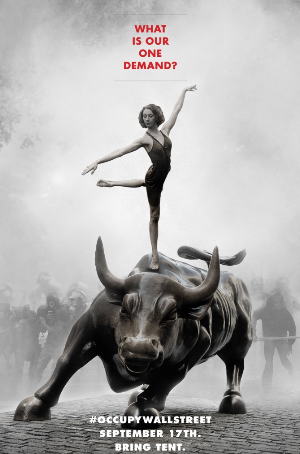
 
You’ve probably already sensed the buzz about #SEPT17, campus groups across the country have been bypassing the conventional chaperones to coordinate OCCUPY WALL STREET. Can they do it? Not without your help, and that doesn’t mean switching your phone service or knocking on doors to Get Out The Vote.

Donate, organize or help with the logistics. If you’ve the temerity, attend in person. At the very least, you’ll have your expenses reimbursed when the city settles your civil suit against them for false arrest. New York City already budgeted for the insurance policy that will pay the legal settlements for the probably now textbook law enforcement practice of kettling inconvenient protests. Or, thinking positively, you may just witness history. To make history you have to make it. Don’t leave it up to the Little Red Hen if you want a piece.

Next up is #OCT6, although the day varies regionally. The date marks the 10th anniversary of the Afghan invasion, but social justice groups of all stripes are throwing their sundry complaints unto one banner and have organized marches nationwide. Of course the nationals aims to SEIZE DC, where activists will converge on Freedom Square, English for “Tahrir Square”, with plans to camp there until the people’s voice is heard. DC has passed ordinances against overnight protests, but Freedom Square may be cut some slack for being off the National Mall. It’s a smaller public space which lies on the diagonal between the White House and the Capitol Building, abreast of General Tecumseh Sherman’s horse actually.

The determination to reclaim American Democracy with an action in DC hopes to recreate Madison Wisconsin on the Potomac, with the same grassroots support for a broad set of issues to which both parties have shown themselves unresponsive.

A successful DC foothold will get real traction being closely followed by an international call for a worldwide uprising. #OCT15 is being spearheaded by Spain’s movement for GLOBAL DEMOCRACY. Will it dilute regional efforts to have actions running concurrently, or will synchronized demonstrations overwhelm our transnational overseers? We can wait and see, or we can give it our best shot.

Here are more graphics in support of the kickoff September 17. Borrowing from Tunisia and Egypt, and before that Chicago 1968, it’s US Days of Rage.

In the course of a single spring we’ve seen massive demonstrations which provoked governments to interrupt cellphone service, shut down internet access, and answer protestors with direct gunfire. To what extreme will the USG be driven? What rights remain inviolate in the US? Not communication. Activist cellphones were blocked on the BART in San Francisco to thwart protests against police brutality.

Tom Hayden says there’s nothing to a US conspiracy against Julian Assange, and he’s got the nothing to confirm it

What an ugly hit piece against Julian Assange, by Tom Hayden in The Nation. Formerly of the American Left, Hayden used to need no introduction, now he mistakenly cross-posts assignments for the State Department (see A view from Sweden). Hayden dismisses notions of a US-led conspiracy to render the Wikileaks mastermind from the UK to Sweden and thence into the US torture system, along the logic that such accusations only anger the Swedes and make the outcome self-fulfilling. Hayden’s argument is to shoehorn Assange to Sweden now, to take his licks, before you make Dad really angry.
 
Based on everyone he’s talked to, Hayden says there’s no conspiracy. Seriously, that’s his logic. And he admonishes us against speculating wildly about unknowns. Whenever a writer prefaces their investigation with “some facts will never be known” I can picture them already leaning on the shovel. Even if Hayden intended to dig, it’s like he’s come upon a suspect’s backyard full of holes. Glancing into each one he concludes, yep, no evidence here.

You wonder what Hayden would make of a document completely redacted.

That’s right, what the Swedish prosecutors won’t tell us, what the USG won’t say, the extraordinarily swift synchronicity of legal actions against Assange kept under a veil? Not even question marks. More important to Hayden are questions he can load, like this one:

Why is the United States pursuing Assange as the conspiratorial mastermind of WikiLeaks, when his reputation, credibility and organization have been so damaged?

I think Assange’s reluctance to be sucked into the black hole that Sweden has become, is reinforced by the fact that the Nation Magazine has to get its “view from Sweden” from an American.

My best clue about Hayden’s focus is when he pretends to restore perspective by reflecting that aspersions cast against Assange (each with an assist by Hayden, if you’re keeping score), be weighed against the good which Wikileaks has done. Thereupon Hayden lists revelations we owe to Wikileaks. But they’re body counts from the Iraq and Afghan documents and nothing from the diplomatic cables, about the Middle East, North Africa, etc. I guess that underlies why Hayden can’t find probable cause for US forces to ally against Assange. It’s the “nothing new here” talking point.

Based on everyone I’ve talked to, Hayden’s an idiot. I’d rather give him less credit.

At the Frontline Club forum on Saturday, Assange said what’s needed now are troves of files from the CIA and FBI, and he added temptingly, the New York Times, the pace car of American media. Assange related that he’d just learned from Daniel Ellsberg that the NYT had 1,000 pages of the Pentagon Papers one month before Ellsberg leaked them. We know the corporate press prints “all the news that’s fit” but wouldn’t it be great to get confirmation?

Don’t worry about Hayden’s nothing, he already has all the confirmation he wants.

The lynching of Preston John Porter Jr. by a mob from Limon and Colo. Springs

A propos of, let’s
say, LYNCHING.
Burned at the stake, at Lake Station Colorado, near LimonColorado
state history records 175+ lynchings, of mostly cattle rustlers and horse thieves. Boosters laud our state’s few (5) racially-motivated lynchings, but in relation to Colorado’s small portion of African- Americans, the incident rate is not insignificant. What’s more, Colorado can tie any state for the worst race lynching ever, when in 1900, along the railroad tracks near Lake Station, black 16-year-old, 130 lb. Preston Porter Jr, innocent and probably mentally feeble, was burned at the stake by a cheering mob numbering over 300.

Lynching describes the physical act of hanging, stringing someone up without inexpedient formalities. In principal lynching means a death sentence without recourse to due justice. And of course, in practice the summary execution is often motivated by racial prejudice. I explain the obvious because today no one appears to acknowledge that US drones over Pakistan, Yemen, et al, are terminating lives based on mere suspicions of being enemies of the state, these are darker skinned lives, with the full enthusiasm of the American TV mob.

Out West, lynchings were rough justice. Everywhere else they were and are hate crimes. Colorado sidesteps having to include the killing of Native Americans as lynchings because those were massacres. One western memoir recounts that “lynch law” was as necessary to keeping peace in the Wild West as were Indian Massacres and shooting wolves.

Preston Porter was a young railroad worker accused of the rape and murder of 12-year-old Louise Frost. After having accused another African-American, three “Mexicans” and a Native American, enraged parties in Limon and Denver settled on Porter. After a week of interrogation, enhanced by trying hypnosis and reading his palm, they coerced a confession.

Next they let the victim’s father decide the manner of death. “Burnt at the stake” was his choice. The mob marched poor Preston to the site of the crime, near what was then Lake Station, and they used a rail for the stake. Preston had no coat but was made to wait for hours in the cold because crowds were delayed getting to the affair by rail from Colorado Springs.

The etching below is reprinted from the Denver Times newspaper article of November 17, 1900. It portrays Porter crying out for the Lord to forgive his tormentors. Don’t think the reporter reflected Porter’s act with sympathy. He wrote: “The great crowd shook with pure enjoyment of the situation.”

Here’s what happened next, as reported by the New York Times:

For an instant the body stood erect, the arms were raised in supplication while burning pieces of clothing dropped from them. The body then fell away from the fire, the head lower than the feet still fastened to the rail.

This was not expected, and for a few minutes those stolid men were disconcerted; they feared that the only remaining chain would give way. If this had occurred the partly burned human being would have dashed among them in his blazing garments. And not many would have cared to capture him again. But the chain held fast.

The body was then in such a position that only the legs were in the fire. The cries of the wretch were redoubled, and he again begged to be shot. Some wanted to throw him over into the fire, others tried to dash oil upon him. Boards were carried, and a large pile made over the prostrate body. They soon were ignited, and the terrible heat and lack of air quickly rendered the victim unconscious, bringing death a few moments later.

All told, the fire took 20 minutes to kill the young black victim.

How was Preston Porter’s ordeal unlike the targets of American aerial assassinations? Americans just heap on the fuel as they burn alive.

EPILOG:
Preston’s executioners left the rail at the site to serve as a warning to other coloreds. Fortunately there wasn’t any trace of it when I made a recent visit. But a docent at the nearby railroad museum knew exactly the incident I was asking about and dismissed me curtly, disgusted with my interest in the matter and refusing to offer any directions to the location. It hadn’t occured to me that Limon’s “native” residents would be related to Preston’s killers. Fortunately another local, not born-and-bred, overherd my inquiry and gave me a lift to a probable starting point.

It wasn’t hard to find. Lake Station was the train stop before the bend at Limon. Before trains, “Lake” was a stage for stagecoaches, providing water to the Butterfield Overland Dispatch heading to Denver. Later it became a “siding” where steam locomotives could take water. After water stops became unnecessary. Lake Station was demolished. Building foundations remain. Its namesake lake dried to wetland long ago.

Victim Louise Frost was returning to her home in Hugo when she was accosted as she drove her surrey across the Big Sandy River where the dry river bed was forded by the old wagon trail. The old trail refers to the famous Smokey Hill Trail which led aspiring prospectors to Colorado gold. Erosion has altered the topography of the dry river but Preston Porter was executed on a rise between the crossing and the railroad tracks.

There is no memorial for the black martyred teen. Nothing marks or commemorates the atrocity. There should and could be. The site of Preston Porter’s death lies adjacent to a protected wetands along the Big Sandy. There’s a nature walk which could easily incorporate a monument. If Limon would own up to the deed.

Lake Station, Colorado, where Lake Creek crosses into the Big Sandy
The Union Pacific Railroad track at Lake Station, looking Southwest toward Pikes Peak.

No America, justice has not been done

This didn’t always need explaining– lynching and body snatching are INJUSTICES. There used to be an understanding of what “taking the law into your own hands” meant. Killing someone outright doesn’t bring them to justice, and I’m not alone to assert that killing someone -even after a trial- is premeditated murder. We’re not hearing any such voices on the media unfortunately. Even in the days of mob lynching, the crowd once drained of its blood-lust would sober to the crime it committed, often masked. That said, the press has always responded with statements of pitiable glee. In Colorado, even the most gruesome lynchings, race-related and otherwise, prompted congratulatory editorials from the Colorado Springs Gazette, the Rocky Mountain News and the rest. However, political leaders were usually more careful not to be celebrating extra-judicial revenge killing.

Today even world leaders seem to be piling on with attaboys. Dispiriting really.

The facts emerging from bin Laden’s killing just get worse and worse. If Osama was indeed in a military-secured compound, a whole secured zone apparently, what reason could possibly be given for why every usual method would not be used to bring him into custody? Where was he going to go? Did we need to kill his entourage like we did Saddam Hussein’s sons? The fact that this raid is purported to have been planned for months makes the assassination all the more purposeful.

And then we learn his body was buried at sea, which the media uncritically recite is “in accordance to Islamic tradition” even as Muslims refute it. Besides of course suggesting that today’s raid was only Kabuki theater for disposing of OBL’s ten-year-dead corpse, conveniently making the body disappear makes dark humor of mocking Habeas Corpus. Where already America disregards the fundamental right of a trial of your peers.

Bin Laden’s colleagues are denied the jury of peers and instead judged through kangaroo military tribunals, patently illegal by international law. Lynching of course dispenses of even that formality.

But lynching victims of the earlier times were not deprived of their bodies. How dare the US declare itself judge, executioner AND God over Osama bin Laden’s remains?!

The pretext is that they don’t want a shrine made of wherever his family would have chosen to bury him. But of course, that will not be ours to decide. At the very least the site of bin Laden’s murder will already be a shrine for those in Islamabad. It will certainly be ironic if the WTC in New York City will be the most significant memory of Osama bin Laden’s deeds and become ground zero for his enormous fame worldwide.

Local cyclists shred Garden of the Gods

Jason MemmelgnarGARDEN OF THE GODS, COLORADO SPRINGS– Mountain bike X-tremists and thrillcraft eco-vandals Jason Memmelaar and Chris Heath weren’t apprehended by the El Paso County Sheriff or the CSPD, but interrupted by off-duty park ranger Stephanie Stover, who saw them cutting tree limbs to expand an illegal downhill run. When she scattered the limbs across the trail to ameliorate erosion, she later found a note which warned:
“Why would you do that? You will hurt my friends. If I see you do this I will hurt you and no one will hear you scream.”KHS rider Chris Heath
Reached by the Gazette via Facebook, Heath denied he left the note, or that he’d built the mile-long trail across protected park land, though he did brag about using the trail “a bunch.” So there it is, CSPD, let the citations fly. Trail repairs won’t begin until May, so there’s still time if you want to make their downhill track a surprise obstacle course. Will screams go unheard? We can test that hypothesis.

I don’t really recommend leaving malicious booby traps like tire spikes, barbed-wire, or a chest high bailing wire strung with tensioners because that could injure others, for example children on bikes however errant, and then too, wildlife. Branches across the path are enough to interrupt the course and can be seen and avoided by hikers. Best of course to safeguard the vicinity by hiking nearby with a camera and cellphone and report the offenders directly to park authorities. Curious to see what the bikers would do if they came upon YOU scattering branches, if you’re not a woman alone on that stretch of the Garden of the Gods.

In the case of Messrs. Memmelaar and Heath, they’re not just asshole despoilers of nature, they’re pro-racers for some kind of circuit for environment-scarring sports. Probably the exposure in Barry Noreen’s column is the last thing their sponsors want. It will be interesting to see how much they care about a public outcry.

I should think they might want to orchestrate a public apology for their “rogue” bikers. Maybe the white Dodge Spirit van with New York plates mentioned in the Gazette is already ferrying friends to the site where they are volunteering to repair the damage before official efforts begin.

If not, keep a lookout for the two elsewhere around town. Perhaps with the heat on Rampart Range Road, they’ll now be looking to foul fresh topsoil of other open spaces, like that of Red Rock canyon.

Have a look at this photographic confession offered at Memmelaar‘s website:
Jason Memmelaar rides in Garden of the Gods

As Wikileaks threatens establishment, Apple wields sledgehammer FOR 1984

Remember when Apple pretended to be the defiant sledgehammer to 1984? Today as Julian Assange swings the hammer, Apple joins its big brothers on the giant screen as it removes the Wikileaks app for iPones and iPads. Did you think there were any heroes in the corporate firmament? Amazon, Paypal, Visa, Mastercard, now Apple, nobody wants YOU to get un-manipulated news. But here Steve Jobs has missed an innovation bigger than he has ever rolled out. For man’s innate curiosity about himself, Wikileaks has become the reason to get up in the morning. Every new day is a chance to learn or confirm something you intuited about the facade erected around you. Odd, but isn’t that what the NEWS used to do?

And it’s a curious news model, it’s all old news, serialized because 250,000 revelations is too much transformitive revisionist history for anyone to handle.

Wikileaks is providing what the corporate news media will not. Into the vacuum, leaks. How can anyone dispute that Wikileaks has not single-handedly changed the accepted narrative of recent history? Although the Cablegate diplomatic cables represent the opinions of US personnel, they are unspun by the media propagandists, as it were, straight from the horsemen’s mouths.

Which lend themselves to government’s traditional role for “leaks,” disseminating lies which the media can get more excited about than their humdrum press releases. Cablegate has probably launched a new office within the state department to poison future databases with false cables.

Michael Moore had to defend his anti-US-healthcare documentary Sicko from the Wikileaked untruth that it had been banned in Cuba. The cable in question was a US diplomat’s idea of creating spin for the US insurance industry’s smear campaign against Moore.

(Did you see him trying to untangle that mess, and explain his support for Wikileaks’ Julian Assange to MSNBC’s Rachel Maddow last night? They were broadcasting from New York’s 92Y to an audience strangely cool to Michael Moore. When Moore proclaimed his Christian values, asking if it was safe to use the word in present company, Maddow missed the gist of his “YMCA” joke, because the 92nd Street “Y” is actually a Jewish center, a Young Men’s Hebrew Association facility, and the NY audience last night were neither Wikileaks supporters nor fans of Moore’s criticism of America’s six ongoing wars.)

The Wikileaks v. Cuba scenario reminds me of the famous Alec Guinness spy farce Our Man in Havana where a clueless vacuum cleaner salesman is recruited by western intelligence services to be their eyes and ears in Cuba. Failing to chance upon serviceable info, he makes sketches of the latest futuristic vacuum, enlarged to industrial scale to suggest it’s a secret missile facility. In fact another recent cable which purported to document a Fidel Castro “crush on Obama” was based on nothing more than reading Castro’s regular “Reflections” as printed in the Cuban press. It used to be our government had a lock on what Americans could observe about Cuba, but today Fidel’s Reflections are available to all online.

Another unique aspect of Wikileaks as a news organization, is that it is beholden to no corporations, and no benevolent noblesse oblige, but to a 24 year-old military hero now held in solitary confinement.

Nominate Julian Assange for a Nobel? Time Person of the Year? No, jail him.

I Am Just Sick. Julian Assange arrested, denied bail, confined to a UK jail cell deemed unsuitable for Bush, Blair or their murderous peers. Britain even assured Israel that its war criminals could visit England without fear of politically motivated arrest warrants. So much for the Assange-is-Mossad rumor. Arrested for what? Publishing evidence of governments conspiring against their peoples’ interests, in their own words? Really, what’s next for our pretense of Democracy?

No, it was accusations of sexual impropriety, technically. Rape and molestation being the corporate media’s chosen translation of how Swedes might describe a consensual sexual encounter gone off, according to post-coital television interviewees, turned insufficiently feminist-sensitive. Do I sound flippant? Two women in Sweden, described as groupies, of activist pedigree it’s alleged, one elder cementing the resolve of the younger, shall we call them Lewinsky and Tripp, accusing Assange of disrespecting their gender.

They play right into the stereotype I have of single-issue advocates who can’t get past affronts to their own personal agendas. Whatever Assange’s transgressions, is not the fate of the western world, the awakening of its public participants in the balance? Though Swedish authorities originally dismissed the accusations, the pair is determined to interrupt Wikileaks’ Cablegate to school Assange in his bedside manner?

Whether instigated by intelligence operatives or not, the charges made by the two women have been the only hooks which authorities have been able to get into Assange. Will extradition to Sweden to answer police inquiries lead to US rendition to a secret facility? Should we hope that at the very least the Brits resist US pressure to interrogate Assange, or affect the operation of Wikileaks by coercion and duress?

We must hope the Assange’s colleagues can secure Wikileaks before their sysadmin is tortured for his access codes.

Hearing the New York Times assail the character of Julian Assange as having delusions of grandeur, I’m reminded of how a centuries earlier ruling class rid themselves of the populist scourge Napoleon. Defeated once, Napoleon was able to escape banishment and had but to set foot on French soil and with only the force of his personality he was able to reconstitute his campaign to free the European citizenry of their despotic monarchs. Defeated again, Napoleon was too popular to execute and so was banished again. This time, it’s alleged, a heroic loyalist submitted to be contaminated with syphilis and thence to infect and ground the upstart Napoleon for good.

The remaining Wikileaks crew is at greater risk than Julian Assange, lacking his media visibility, they could be disappeared without fanfare. But that’s evidently a fading misconception of mine. Assange’s high profile hasn’t helped him.

Wikileaks reveals inventory of US possessions critical to corporations

To complain that a wikileaked list of off-US-soil “critical infrastructure and key resources” provides a checklist of targets for aspiring terrorists is to pretend that opponents of the US empire are as simple minded as American television viewers. The importance of most of the so-called Critical Foreign Dependencies is self-evident, more curious is how the US deems these proprietary interests, to what extent it will protect them, and for whom. Sole manufacturers of vaccines might be vital to public health, but what of communications cables, international ports, supplies of industrial metals and suppliers of components to US weapons systems? Those are critical only to bottom lines. The 2008 report in the State Department cable leaked yesterday reveals infrastructure critical to multinational corporations, whether US or not.

While American airwaves are full of denunciations of Wikileaks and Julian Assange for endangering the US, the Western press is ignoring incendiary cables making their rounds in the Middle East, in which the Lebanese Defence Minister Elias El-Murr asks his American liaison to assure Israel that a next invasion, restricted to rooting out Hezbollah, would not be opposed by Lebanese forces.

Amazon, Paypal and EveryDNS have thrown in with those that would censor Wikileaks, likely also Google and Twitter. Try to find the El-Murr story through Google News or Twitter.

Here’s the text of the 2009 cable:

2008 Critical Foreign Dependencies Initiative (CFDI)
critical infrastructure and key resources (CI/KR)

AFRICA

Congo
(Kinshasa): Cobalt (Mine and Plant)

Gabon:
Manganese – Battery grade, natural; battery grade, synthetic; chemical grade; ferro; metallurgical grade

Guinea:
Bauxite (Mine)

South Africa:
BAE Land System OMC, Benoni, South Africa
Brown David Gear Industries LTD, Benoni, South Africa
Bushveld Complex (chromite mine) Ferrochromium Manganese – Battery grade, natural; battery grade, synthetic; chemical grade; ferro; metallurgical grade
Palladium Mine and
Plant Platinum Mines Rhodium

EAST ASIA AND THE PACIFIC

Australia:
Southern Cross undersea cable landing, Brookvale, Australia
Southern Cross undersea cable landing, Sydney, Australia
Manganese – Battery grade, natural; battery grade, synthetic; chemical grade; ferro; metallurgical grade
Nickel Mines Maybe Faulding Mulgrave Victoria, Australia:
Manufacturing facility for Midazolam injection. Mayne Pharma (fill/finish), Melbourne, Australia: Sole suppliers of Crotalid Polyvalent Antivenin (CroFab).

China:
C2C Cable Network undersea cable landing, Chom Hom Kok, Hong Kong
C2C Cable Network undersea cable landing Shanghai, China
China-US undersea cable landing, Chongming, China
China-US undersea cable landing Shantou, China
EAC undersea cable landing Tseung Kwan O, Hong Kong
FLAG/REACH North Asia Loop undersea cable landing Tong Fuk, Hong Kong
Hydroelectric Dam Turbines and Generators Fluorspar (Mine)
Germanium Mine
Graphite Mine
Rare Earth Minerals/Elements Tin Mine and Plant Tungsten – Mine and Plant Polypropylene Filter Material for N-95 Masks
Shanghai Port
Guangzhou Port
Hong Kong Port
Ningbo Port
Tianjin Port

Fiji:
Southern Cross undersea cable landing, Suva, Fiji

Indonesia:
Tin Mine and Plant Straits of Malacca

Japan:
C2C Cable Network undersea cable landing, Chikura, Japan
C2C Cable Network undersea cable landing, Shima, Japan
China-US undersea cable, Okinawa, Japan
EAC undersea cable landing Ajigaura, Japan
EAC undersea cable landing Shima, Japan
FLAG/REACH North Asia Loop undersea cable landing Wada, Japan
Japan-US undersea cable landing, Maruyama, Japan
Japan-US undersea cable landing Kitaibaraki, Japan
KJCN undersea cable landing Fukuoka, Japan
KJCN undersea cable landing Kita-Kyushu, Japan
Pacific Crossing-1 (PC-1) undersea cable landing Ajigaura, Japan
Pacific Crossing-1 (PC-1) undersea cable landing Shima, Japan
Tyco Transpacific undersea cable landing, Toyohashi, Japan
Tyco Transpacific undersea cable landing Emi, Japan
Hitachi, Hydroelectric Dam Turbines and Generators
Port of Chiba
Port of Kobe
Port of Nagoya
Port of Yokohama
Iodine Mine
Metal Fabrication Machines Titanium Metal (Processed) Biken, Kanonji City, Japan
Hitachi Electrical Power Generators and Components Large AC Generators above 40 MVA

Malaysia:
Straits of Malacca

New Zealand:
Southern Cross undersea cable landing, Whenuapai, New Zealand
Southern Cross undersea cable landing, Takapuna, New Zealand

Philippines:
C2C Cable Network undersea cable landing, Batangas, Philippines
EAC undersea cable landing Cavite, Philippines

Republic of Korea:
C2C Cable Network undersea cable landing, Pusan, Republic of Korea.
EAC undersea cable landing Shindu-Ri, Republic of Korea
FLAG/REACH North Asia Loop undersea cable landing Pusan, Republic of Korea
KJCN undersea cable landing Pusan, Republic of Korea
Hitachi Large Electric Power Transformers 230 – 500 kV
Busan Port

Singapore:
C2C Cable Network undersea cable landing, Changi, Singapore
EAC undersea cable landing Changi North, Singapore
Port of Singapore
Straits of Malacca

Taiwan:
C2C Cable Network undersea cable landing, Fangshan, Taiwan
C2C Cable Network undersea cable landing, Tanshui, Taiwan
China-US undersea cable landing Fangshan, Taiwan
EAC undersea cable landing Pa Li, Taiwan
FLAG/REACH North Asia Loop undersea cable landing Toucheng, Taiwan
Kaohsiung Port

EUROPE AND EURASIA

Europe

(Unspecified):
Metal Fabrication Machines: Small number of Turkish companies (Durma, Baykal, Ermaksan)

Austria:
Baxter AG, Vienna, Austria: Immune Globulin Intravenous (IGIV)
Octapharma Pharmazeutika, Vienna, Austria: Immune Globulin Intravenous (IGIV)

Azerbaijan:
Sangachal Terminal
Baku-Tbilisi-Ceyhan Pipeline

Belarus:
Druzhba Oil Pipeline

Belgium:
Germanium Mine
Baxter SA, Lessines, Belgium: Immune Globulin Intravenous (IGIV)
Glaxo Smith Kline, Rixensart, Belgium: Acellular Pertussis Vaccine Component
GlaxoSmithKline Biologicals SA, Wavre, Belgium: Acellular Pertussis Vaccine Component
Port of Antwerp

Denmark:
TAT-14 undersea cable landing, Blaabjerg, Denmark
Bavarian Nordic (BN), Hejreskovvej, Kvistgard, Denmark: Smallpox Vaccine
Novo Nordisk Pharmaceuticals, Inc. Bagsvaerd, Denmark: Numerous formulations of insulin
Novo Nordisk Insulin Manufacturer: Global insulin supplies
Statens Serum Institut, Copenhagen, Denmark: DTaP (including D and T components) pediatric version

France:
APOLLO undersea cable, Lannion, France
FA-1 undersea cable, Plerin, France
TAT-14 undersea cable landing St. Valery, France
Sanofi-Aventis Insulin Manufacturer: Global insulin supplies Foot and Mouth Disease Vaccine finishing
Alstrom, Hydroelectric Dam Turbines and Generators
Alstrom Electrical Power Generators and Components
EMD Pharms Semoy, France: Cyanokit Injection
GlaxoSmithKline, Inc. Evreux, France: Influenza neurominidase inhibitor
RELENZA (Zanamivir) Diagast, Cedex, France: Olympus (impacts blood typing ability)
Genzyme Polyclonals SAS (bulk), Lyon, France: Thymoglobulin
Sanofi Pasteur SA, Lyon, France: Rabies virus vaccine

Georgia:
Baku-Tbilisi-Ceyhan Pipeline

Germany:
TAT-14 undersea cable landing, Nodren, Germany.
Atlantic Crossing-1 (AC-1) undersea cable landing Sylt, Germany
BASF Ludwigshafen: World’s largest integrated chemical complex
Siemens Erlangen: Essentially irreplaceable production of key chemicals
Siemens, GE, Hydroelectric Dam Turbines and Generators
Draeger Safety AG & Co., Luebeck, Germany: Critical to gas detection capability
Junghans Fienwerktechnik Schramberg, Germany: Critical to the production of mortars
TDW-Gasellschaft Wirksysteme, Schroebenhausen, Germany: Critical to the production of the Patriot Advanced Capability Lethality Enhancement Assembly
Siemens, Large Electric Power Transformers 230 – 500 kV
Siemens, GE Electrical Power Generators and Components
Druzhba Oil Pipeline Sanofi Aventis Frankfurt am Main, Germany: Lantus Injection (insulin)
Heyl Chemish-pharmazeutische Fabrik GmbH: Radiogardase (Prussian blue)
Hameln Pharmaceuticals, Hameln, Germany: Pentetate Calcium Trisodium (Ca DTPA) and Pentetate Zinc Trisodium (Zn DTPA) for contamination with plutonium, americium, and curium IDT
Biologika GmbH, Dessau Rossiau, Germany: BN Small Pox Vaccine.
Biotest AG, Dreiech, Germany: Supplier for TANGO (impacts automated blood typing ability) CSL
Behring GmbH, Marburg, Germany: Antihemophilic factor/von Willebrand factor
Novartis Vaccines and Diagnostics GmbH, Marburg, Germany: Rabies virus vaccine
Vetter Pharma Fertigung GmbH & Co KG, Ravensburg, Germany (filling): Rho(D) IGIV
Port of Hamburg

Ireland:
Hibernia Atlantic undersea cable landing, Dublin Ireland
Genzyme Ireland Ltd. (filling), Waterford, Ireland: Thymoglobulin

Italy:
Glaxo Smith Kline SpA (fill/finish), Parma, Italy: Digibind (used to treat snake bites)
Trans-Med gas pipeline

Netherlands:
Atlantic Crossing-1 (AC-1) undersea cable landing Beverwijk, Netherlands
TAT-14 undersea cable landing, Katwijk, Netherlands
Rotterdam Port

Norway:
Cobalt Nickel Mine

Poland:
Druzhba Oil Pipeline

Russia:
Novorossiysk Export Terminal
Primorsk Export Terminal.
Nadym Gas Pipeline Junction: The most critical gas facility in the world
Uranium Nickel Mine: Used in certain types of stainless steel and superalloys
Palladium Mine and Plant Rhodium

Spain:
Strait of Gibraltar
Instituto Grifols, SA, Barcelona, Spain: Immune Globulin Intravenous (IGIV)
Maghreb-Europe (GME) gas pipeline, Algeria

Sweden:
Recip AB Sweden: Thyrosafe (potassium iodine)

Switzerland:
Hoffman-LaRoche, Inc. Basel, Switzerland: Tamiflu (oseltamivir)
Berna Biotech, Berne, Switzerland: Typhoid vaccine CSL
Behring AG, Berne, Switzerland: Immune Globulin Intravenous (IGIV)

Turkey:
Metal Fabrication Machines: Small number of Turkish companies (Durma, Baykal, Ermaksan)
Bosporus Strait
Baku-Tbilisi-Ceyhan Pipeline

Ukraine:
Manganese – Battery grade, natural; battery grade, synthetic; chemical grade; ferro; metallurgical grade

United Kingdom:
Goonhilly Teleport, Goonhilly Downs, United Kingdom
Madley Teleport, Stone Street, Madley, United Kingdom
Martelsham Teleport, Ipswich, United Kingdom
APOLLO undersea cable landing Bude, Cornwall Station, United Kingdom
Atlantic Crossing-1 (AC-1) undersea cable landing Whitesands Bay
FA-1 undersea cable landing Skewjack, Cornwall Station
Hibernia Atlantic undersea cable landing, Southport, United Kingdom
TAT-14 undersea cable landing Bude, Cornwall Station, United Kingdom
Tyco Transatlantic undersea cable landing, Highbridge, United Kingdom
Tyco Transatlantic undersea cable landing, Pottington, United Kingdom.
Yellow/Atlantic Crossing-2 (AC-2) undersea cable landing Bude, United Kingdom
Foot and Mouth Disease Vaccine finishing
BAE Systems (Operations) Ltd., Presont, Lancashire, United Kingdom: Critical to the F-35 Joint Strike Fighter
BAE Systems Operations Ltd., Southway, Plymouth Devon, United Kingdom: Critical to extended range guided munitions
BAE Systems RO Defense, Chorley, United Kingdom: Critical to the Joint Standoff Weapon (JSOW) AGM-154C (Unitary Variant)
MacTaggart Scott, Loanhead, Edinburgh, Lothian, Scotland, United Kingdom: Critical to the Ship Submersible Nuclear (SSN)

NEAR/MIDDLE EAST
Djibouti:
Bab al-Mendeb: Shipping lane is a critical supply chain node

Egypt:
‘Ayn Sukhnah-SuMEd Receiving Import Terminal
‘Sidi Kurayr-SuMed Offloading Export Terminal
Suez Canal

Iran:
Strait of Hormuz
Khark (Kharg) Island
Sea Island Export Terminal
Khark Island T-Jetty

Iraq:
Al-Basrah Oil Terminal

Israel:
Rafael Ordnance Systems Division, Haifa, Israel: Critical to Sensor Fused Weapons (SFW), Wind Corrected Munitions Dispensers (WCMD), Tail Kits, and batteries

Kuwait:
Mina’ al Ahmadi Export Terminal

Morocco:
Strait of Gibraltar
Maghreb-Europe (GME) gas pipeline, Morocco

Oman:
Strait of Hormuz

Qatar:
Ras Laffan Industrial Center: By 2012 Qatar will be the largest source of imported LNG to U.S.

Saudi Arabia:
Abqaiq Processing Center: Largest crude oil processing and stabilization plant in the world
Al Ju’aymah Export Terminal: Part of the Ras Tanura complex
As Saffaniyah Processing Center
Qatif Pipeline Junction
Ras at Tanaqib Processing Center
Ras Tanura Export Terminal
Shaybah Central Gas-oil Separation Plant

Tunisia:
Trans-Med Gas Pipeline

United Arab Emirates (UAE):
Das Island Export Terminal
Jabal Zannah Export Terminal
Strait of Hormuz

Yemen:
Bab al-Mendeb: Shipping lane is a critical supply chain node

SOUTH AND CENTRAL ASIA

Kazakhstan:
Ferrochromium Khromtau Complex, Kempersai, (Chromite Mine)

India:
Orissa (chromite mines) and Karnataka (chromite mines)
Generamedix Gujurat, India: Chemotherapy agents, including florouracil and methotrexate

WESTERN HEMISPHERE

Argentina:
Foot and Mouth Disease Vaccine finishing

Bermuda:
GlobeNet (formerly Bermuda US-1 (BUS-1) undersea cable landing Devonshire, Bermuda

Brazil:
Americas-II undersea cable landing Fortaleza, Brazil
GlobeNet undersea cable landing Fortaleza, Brazil
GlobeNet undersea cable landing Rio de Janeiro, Brazil
Iron Ore from Rio Tinto Mine Manganese – Battery grade, natural; battery grade, synthetic; chemical grade; ferro; metallurgical grade Niobium (Columbium), Araxa,
Minas Gerais State (mine)
Ouvidor and Catalao I,
Goias State: Niobium

Chile:
Iodine Mine

Canada:
Hibernia Atlantic undersea cable landing Halifax , Nova Scotia, Canada
James Bay Power Project, Quebec: monumental hydroelectric power development
Mica Dam, British Columbia: Failure would impact the Columbia River Basin.
Hydro Quebec, Quebec: Critical irreplaceable source of power to portions of Northeast U. S.
Robert Moses/Robert H. Saunders Power, Ontario: Part of the St. Lawrence Power Project, between Barnhart Island, New York, and Cornwall, Ontario
Seven Mile Dam, British Columbia: Concrete gravity dam between two other hydropower dams along the Pend d’Oreille River
Pickering Nuclear Power Plant, Ontario, Canada
Chalk River Nuclear Facility, Ontario: Largest supplier of medical radioisotopes in the world
Hydrofluoric Acid Production Facility, Allied Signal, Amherstburg, Ontario
Enbridge Pipeline Alliance Pipeline: Natural gas transmission from Canada
Maritime and Northeast Pipeline: Natural gas transmission from Canada
Transcanada Gas: Natural gas transmission from Canada
Alexandria Bay POE, Ontario: Northern border crossing
Ambassador Bridge POE, Ontario: Northern border crossing
Blaine POE, British Columbia: Northern border crossing
Blaine Washington Rail Crossing, British Columbia
Blue Water Bridge POE, Ontario: Northern border crossing
Champlain POE, Quebec: Northern border crossing
CPR Tunnel Rail Crossing, Ontario (Michigan Central Rail Crossing)
International Bridge Rail Crossing, Ontario
International Railway Bridge Rail Crossing
Lewiston-Queenstown POE, Ontario: Northern border crossing
Peace Bridge POE, Ontario: Northern border crossing
Pembina POE, Manitoba: Northern border crossing
North Portal Rail Crossing, Saskatchewan
St. Claire Tunnel Rail Crossing, Ontario
Waneta Dam, British Columbia: Earthfill/concrete hydropower dam
Darlington Nuclear Power Plant, Ontario, Canada.
E-ONE Moli Energy, Maple Ridge, Canada: Critical to production of various military application electronics
General Dynamics Land Systems – Canada, London Ontario, Canada: Critical to the production of the Stryker/USMC LAV Vehicle Integration
Raytheon Systems Canada Ltd.
ELCAN Optical Technologies Division, Midland, Ontario, Canada: Critical to the production of the AGM-130 Missile
Thales Optronique Canada, Inc., Montreal, Quebec: Critical optical systems for ground combat vehicles
Germanium Mine Graphite Mine
Iron Ore Mine
Nickel Mine
Niobec Mine, Quebec, Canada: Niobium Cangene, Winnipeg, Manitoba:
Plasma Sanofi Pasteur Ltd., Toronto, Canada: Polio virus vaccine
GlaxoSmithKile Biologicals, North America, Quebec, Canada: Pre-pandemic influenza vaccines

French Guiana:
Americas-II undersea cable landing Cayenne, French Guiana

Martinique:
Americas-II undersea cable landing Le Lamentin, Martinique

Mexico:
FLAG/REACH North Asia Loop undersea cable landing Tijuana, Mexico
Pan-American Crossing (PAC) undersea cable landing Mazatlan, Mexico
Amistad International Dam: On the Rio Grande near Del Rio, Texas and Ciudad Acuna, Coahuila, Mexico
Anzalduas Dam: Diversion dam south of Mission, Texas, operated jointly by the U.S. and Mexico for flood control Falcon International Dam: Upstream of Roma, Texas and Miguel Aleman, Tamaulipas, Mexico
Retamal Dam: Diversion dam south of Weslaco, Texas, operated jointly by the U.S. and Mexico for flood control
GE Hydroelectric Dam Turbines and Generators: Main source for a large portion of larger components
Bridge of the Americas: Southern border crossing
Brownsville POE: Southern border crossing
Calexico East POE: Southern border crossing
Columbia Solidarity Bridge: Southern border crossing
Kansas City Southern de Mexico (KCSM) Rail Line, (Mexico)
Nogales POE: Southern border crossing
Laredo Rail Crossing
Eagle Pass Rail Crossing
Otay Mesa Crossing: Southern border crossing
Pharr International Bridge: Southern border crossing
World Trade Bridge: Southern border crossing
Ysleta Zaragosa Bridge: Southern border crossing
Hydrofluoric Acid Production Facility
Graphite Mine
GE Electrical Power Generators and Components
General Electric, Large Electric Power Transformers 230 – 500 kV

Netherlands Antilles:
Americas-II undersea cable landing Willemstad, Netherlands Antilles.

Panama:
FLAG/REACH North Asia Loop undersea cable landing Fort Amador, Panama
Panama Canal

Peru:
Tin Mine and Plant

Trinidad and Tobago:
Americas-II undersea cable landing
Port of Spain
Atlantic LNG: Provides 70% of U.S. natural gas import needs

Venezuela:
Americas-II undersea cable landing Camuri, Venezuela
GlobeNet undersea cable landing, Punta Gorda, Venezuela
GlobeNet undersea cable landing Catia La Mar, Venezuela
GlobeNet undersea cable landing Manonga, Venezuela

CIA role in so-called Yemen bomb plot wafts odor of who smelt it dealt it

Everything I need to know about CIA Intelligence I learned in elementary school, 9/11, al-Qaeda. Who smelt it, dealt it. Student in Yemen –allegedly, even to herself– mails a package containing explosives, CIA forwards a tip-off. YOU, think of a number between 1 and 10. Even Ockham’s Razor would not predict the CIA can guess it. Do you suppose the New York Times headline got it right? “Bomb Plot Shows Key Role Played by Intelligence.”