Can art rehabilitate a parking meter?

Colorado Springs Parking MeterIt’s become another art medium in itself. Like oil, watercolor, and macaroni sprayed gold, we now have painted industrial objects. I’ve seen fiberglass cows, pigs, and elk cast to provide uniform canvases for ensemble-scale kitsch. Colorado Springs is probably not the first municipality to recycle obsolete parking meters as art pieces. The scheme is actually fairly clever: scatter beautified meters around retail areas to collect spare change “for the homeless,” to scoop the tug of panhandlers who may have less responsible designs on charitable donations.

My favorite is a meter painted like a Muslim imam, with the time-expired flag made to be a cry for help showing through his clear forehead.

Of course, I interpret this “help” to be a desperate cry from embattled Islam, a message in a bottle aimed at the English-speaking westerners whose soldiers have the Islamic world besieged. But the artist might just as well have meant to portray this Muslim’s spiritual lobe as less pellucid than vacuous. Imprisoned behind the soundproof uniformity of Sharia grooming and dress might echo a lonely S.O.S. seeking a secular salvation.

After the city’s counter-sidewalk-insurgency fund-raising is through, the painted meters will be auctioned for charity. But would you want one?

As upcycled sculptures go, I’m not big on commemorating parking meters. Of all industrial contraptions, it’s hard to imagine a function less popular. Meter maids must vie with dentists for trying a therapist’s sympathies. For most people, paying for parking is an investment in nothing. Isn’t it inherently objectionable when civil authorities charge tolls on already tax-funded thoroughfares? One of the liberating feelings you experience from taking mass-transportation is not worrying about a ticking parking meter. We most often approach parking meters with great anxiety and at a run, they take our coins like terrible vending machines, returning sometimes not even the incremental reprieve for which we paied, with no one to call for a refund. When we return to find a parking ticket, it’s the meter who ratted us out. What are we supposed to do with one of these at home, but beat it?

The analog charm of these retired meters cannot help but remind us what mercenaries their replacements have become. Newer models have all sorts of digital enhancements. They can tell when the previous vehicle leaves the parking space so as to reset the timer to zero. They can monitor whether you’ve overstayed the posted time limit, preventing you from feeding the meter, although without refunding the excess of your solicitous enticements. And when your permission to park has expired, they can send off a wireless signal to alert a parking enforcement officer posthaste. Can you imagine one day we will be playfully decorating these humorless machines?

A coworker of mine was retiring from the payroll department at around the same time the factory was updating its time clocks. He’d spent virtually his entire career tabulating punch cards collected multiple times a day from the various department clock-in areas. Actually it was our employer’s policy to take a sledgehammer to all obsolete equipment, sooner than risk the liability posed by an uncertain post-operational utility. I suggested we decorate one of the antiquated models like a big hunting trophy to present as a retirement gift. In none too many words my friend was able to articulate his lack of even curiosity for my proposal.

There might be a call for imbuing nostalgic utilitarian items with a creative after-life: toasters and typewriters for example, even drill presses and lathes. But granting immortal persistence to machines whose function it was to measure our labor, or tax our time? I don’t think so.

Who were the 1,415 victims in Gaza?

PCHR Palestinian center for human rightsAmericans aren’t accustomed to seeing their adversaries as human. The victims of our wars remain faceless and nameless, and maybe as a consequence we accept that our military “doesn’t do body counts.” Not only do we minimize the number of civilians we kill, but their deaths are commodified as “collateral.” Our military proxy in the Middle East does the same. In last year’s attack on Gaza, Israel calculated its casualties in three digits. Those killed behind the confines of Gaza may be faceless to Americans and Israelis, but they leave behind loved ones and dependents, and of course, they had names.

The IDF dismiss the 1415 victims as Palestinian propaganda. But here are their names. Notice, it is not enough that the dead be identified, but each name is accompanied with their address, and location where the death can be verified. Not only must Palestinian civilians mourn their loved ones, they have to account for them.

This list is made available by the Palestinian Center for Human Rights and commemorates “The Dead in the course of the Israeli recent military offensive on the Gaza strip between 27 December 2008 and 18 January 2009.”

The victims are listed in order of casualty, grouped by date. Each person has a number, for those counting in the West, as well as name, sex, age, vocation, home address, date of attack if different from date of death, location of attack if different from address, and designation as militant if not purely civilian. I can’t find fault with those Gazans who took up arms against an indiscriminate incursion into their homes and neighborhoods.

——————————————-
PALESTINIAN CENTRE FOR HUMAN RIGHTS
???????? ??????? ?????????? ??????????

DECEMBER 27, 20081
Mustafa Khader Saber Abu Ghanima
Male 16 Student
Tal al-Hawa / Gaza

2
Reziq Jamal Reziq al- Haddad
Male 21 Policeman
al-Sha’af / Gaza
Arafat Police City/ Gaza

3
Ali Mohammed Jamil Abu Riala
Male 24 Policeman
Al-Shati Refugee Camp / Gaza
Arafat Police City/ Gaza

4
Ahmed Mohammed Ahmed Badawi
Male 27 Policeman
Al-Shati Refugee Camp / Gaza
Al-Mashtal Intelligence Outpost/ Gaza

5
Mahmoud Khalil Hassan Abu Harbeed
Male 31 Policeman
Martyr Bassil Naim Street/ Beit Hanoun
Al-Mashtal Intelligence Outpost/ Gaza

6
Fadia Jaber Jabr Hweij
Female 22 Student
Al-Tufah / Gaza

7
Mohammed Jaber Jabr Hweij
Male 19 Student
Al-Tufah / Gaza

8
Nu’aman Fadel Salman Hejji
Male 56 Jobless
Al-Zaytoon / Gaza
Tal al-Hawa

9
Riyad Omar Murjan Radi
Male 24 Student
Yarmouk Street / Gaza
Al-Sena’a Street / Gaza

10
Mumtaz Mohammed Ramiz al-Banna
Male 37 Policeman
Al-Sabra/ Gaza
Arafat Police City/ Gaza

11
Ahmed Hamdi Youssef al-Dreimly
Male 26 Policeman
Al-Sabra/ Gaza
Saraya Security Service Compound/ Gaza

12
Fares Isma’il Helmi al-‘Ashy
Male 28 Policeman
Remal/ Gaza
Arafat Police City/ Gaza

13
Naser Mahmoud Mas’oud Hammouda
Male 35
Al-Zaytoon / Gaza
Wa’ed Society for Prisoners / Gaza
Militant

14
Munir Amin Mass’oud Hammouda
Male 32
Al-Zaytoon / Gaza
Wa’ed Society for Prisoners / Gaza
Militant

15
Ahmed Adnan Hamdi Hammouda
Male 25
Al-Zaytoon / Gaza
Wa’ed Society for Prisoners / Gaza
Militant

16
Ibrahim Mahmoud Abdul Hafiz al-Farra
Male 23 Policeman
Khan Younis
Arafat Police City/ Gaza

17
Mohammed Abdul Karim Ramadan al- ‘Aklouk
Male 24 Policeman
Jabalyia / Northern Gaza
Arafat Police City/ Gaza

18
‘Ali Marwan ‘Ali Abu Rabi’a
Male 21 Student /UNRWA
Gaza Training college
Rimal/ Gaza
Al-Sena’a Street/ Gaza

19
Ra’ed Nazmi Mohammed Dughmosh
Male 36 Policeman
Dughmosh area / Gaza
Arafat Police City/ Gaza

20
Munir Mansour Ahmed Esbeita
Male 25 Policeman
Sheja’eya / Gaza
Arafat Police City/ Gaza

21
Deya’a Talal Kamel al- Habil
Male 22 Policeman
al-Shati Refugee Camp / Gaza
Near al-Katiba Mosque/ Gaza

22
Mayssara Hamed Mohammed Bulbul
Male 21 Policeman
Tal al-Hawa / Gaza
Arafat Police City/ Gaza

23
Nazik Hassan Yasin Abu Raia
Female 28 Policewoman
Tal al-Za’atar area/ Northern Gaza
Presidential Compound / Gaza

24
Khamis Mustafa Mahmoud Abu Ramadan
Male 52 Driver
Near Abu Iskandar Roundabout / Gaza
Near al-Shifa Hospital / Gaza

25
Mahmoud Mtaw’e Mahmoud al-Khaldi
Male 39 Policeman
Al -Jala’a Street / Gaza
Arafat Police City/ Gaza

26
Mohammed Khamis
Male 27 Policeman
Gaza airport area / Al-‘Abbas Police Gaza
Hassan Habbush behind al-Quds international Hotel/ Gaza Station/ Gaza

27
Shadi Jawad Khalil Qweider
Male 24 Policeman
Al-Daraj / Gaza
Arafat Police City/ Gaza

28
Jihad Ziyad Badawi al-Gharabli
Male 24 Policeman
Sheja’eya / Gaza
Arafat Police City/ Gaza

29
Mohammed Khamis Mohammed Baker (Zughra)
Male 21 Policeman
Al-Shati Refugee Camp / Gaza
Al-‘Abbas Police Station / Gaza

30
Ahmed Mohammed Nafez Abu Hadayed
Male 21 Policeman
Khan Younis
Presidential Compound / Gaza

31
Rafiq Musa Abu ‘Ujeirim
Male 30 Policeman
Khan Younis

32
Haneen Wa’el Dhaban
Female 15 Student
Tal al-Hawa / Gaza
Near Preventive Security HQ / Gaza

33
Adham Hamdy Al-‘Udeini
Male 19 Student/UNRWA Gaza Training College
Deir al-Balah / Middle Gaza
Al-Sena’a Street/ Gaza

34
Wafa’a Marwan ‘Ali al-Dsouqi
Female 18 Student/UNRWA Gaza Training College
Khan Younis
Al-Sena’a Street/ Gaza

35
‘Allam Nehru Jawdat al-Rayyes
Male 18 Student
Al-Sabra / Gaza
Al-Sena’a Street/ Gaza

36
Hisham Mohammed Shehada Seyam
Male 27
Al-Zaytoon / Gaza
Militant

37
Ehab Abdullah Mohammed Hamdan
Male 21 Policeman
Bir al-Na’aja / Northern Gaza
Arafat Police City/ Gaza

38
Na’im Reziq Hassan Jendeya
Male 27 Jobless
Sheja’eya / Gaza
Tal al-Hawa / Gaza
Militant

39
Iyad Ziyad Fares Jaber
Male 32 Jobless
Al-Daraj / Gaza
Al-Tufah

40
Diab Rebhi Diab al-Haddad
Male 20 Policeman
Al-Tufah / Gaza
Arafat Police City/ Gaza

41
Mohammed Tawfiq Mohammed al-Nemra
Male 22 Policeman
Al-Sabra / Gaza
Arafat Police City/ Gaza

42
Ziyad ‘Adel Mustafa al-Najjar
Male 24 Policeman
Khan Younis
Presidential Compound / Gaza

43
Sa’ad Mohammed ‘Antar Esleem
Male 28 Policeman
Al-Sabra / Gaza
Al-Katiba Mosque/Gaza

44
Mohammed Ziyad Sadiq al-Nabih
Male 27 Policeman
Al-Sabra / Gaza
Arafat Police City/ Gaza

45
Hatem Khader Mohammed ‘Aiyad
Male 30 Jobless
Al-Zaytoon/ Gaza

46
Nizar Ibrahim Mohammed al-Deiry
Male 34 Policeman
Al-Sabra / Gaza
Presidential Compound / Gaza

47
Mohammed Baker Mohammed al-Nims
Male 31 Policeman
Al-Sabra / Gaza
Near al-Katiba Mosque / Gaza

48
Mohammed Nabil Mohammed Barghouth
Male 28 Policeman
Al-Zaytoon/ Gaza
presidential compound / Gaza

49
Mahmoud Mohammed Hilmy al-‘Amarin
Male 28 Policeman
Al-Zaytoon/ Gaza
Presidential Compound / Gaza

50
Muhannad Hussein Moussa Abu Draz
Male 28 Policeman
Abasan al-Kabira / Khan Younis
Al-Sabra / Gaza
Militant

51
‘Umar Baker Musa Shamaly
Male 23 Policeman
Sheja’eya / Gaza
Arafat Police City/ Gaza

52
Abdul Kader Mohammed Abdul Kader Diab
Male 33 Policeman
Tal al- Hawa / Gaza
Arafat Police City/ Gaza

53
Hamed Fou’ad Shehda Abu Yasin
Male 24 Policeman
Al-Twam area /’Amer housing project / near al-Mashtal Intelligence Outpost
Arafat Police City/ Gaza

54
Baha’a Zuheir ‘Adel al- Khaldi
Male 26 Policeman
Tal al-Za’atar area / Northern Gaza
Arafat Police City/ Gaza

55
Mahmoud Juma’a Mohammed al-Labban
Male 20 Policeman
Al-Naser / Gaza
Arafat Police City/ Gaza

56
Yahya Ibrahim Abdul Jawad Diab
Male 30 Worker
Al-Zaytoon/ Gaza
Wa’ed Society for Prisoners / Gaza
Militant

57
Yasmin Wa’el Dhaban
Female 17 Student
Tal al -Hawa / Gaza

58
Abdul Hamid Jamal Khaled al-Sawi
Male 15 Student
Al-Tufah / Gaza

59
Akram Mohammed Ahmed Abu Zriba
Male 32 Policeman
Al-Sabra / Gaza
Arafat Police City/ Gaza

60
Ramadan Ahmed Ibrahim Abu Kheir
Male 23 Policeman
Al-Shati Refugee Camp / Gaza
Arafat Police City/ Gaza

61
Adib Hassan Abdul ‘Aziz Abu Harb
Male 32 Policeman
Al-Shati Refugee Camp /Gaza
Al-’Abbas Police Station / Gaza

62
Ahmed Hani Ahmed Qannou’a
Male 24 Policeman
Sheja’eya / Gaza
Arafat Police City/ Gaza

63
Salim Khalil al-Banna
Male 24 Policeman
Al-Naser District
Presidential Compound / Gaza

64
Tha’er Mohammed Hassan Madhi
Male 22 Policeman
Al-Shati Refugee Camp / Gaza
Arafat Police City/ Gaza

65
Mohammed Sa’adi Mohammed al-Qatati
Male 30 Driver
Al-Zaytoon/ Gaza
Arafat Police City/ Gaza

66
‘Aisha Suleiman Hammad Rafi’
Female 52 Jobless
Al-Zaytoon/ Gaza

67
Hussam Sa’id Mohammed Seyam
Male 27 Policeman
Sheikh Radwan / Gaza
Arafat Police City/ Gaza

68
Mohammed Ahmed Mahmoud al-Adgham
Male 25 Policeman
Sheikh Radwan / Gaza
Arafat Police City/ Gaza

69
Fayez Mohammed Abed Eqteifan
Male 45 Policeman
Al-Sabra / Gaza
Arafat Police City/ Gaza

70
Hammam Mohammed Moussa Mohammed al-Najjar
Male 24 Policeman
Rimal / Gaza
Al-Mashtal Intelligence Outpost/ Gaza

71
Wisam Abdul Majid Ibrahim al- Quqa
Male 27 Policeman
Al-Shati Refugee Camp / Gaza
Arafat Police City/ Gaza

72
Farouq Fou’ad Mohammed Esleem
Male 21 Policeman
Al-Shati Refugee Camp / Gaza
Al-Mashtal Intelligence Outpost/ Gaza

73
‘Imad Abdul Mu’in Abdullah al-Barbari
Male 22 Employee
Yarmouk Street / Gaza
Al-Nafaq Street / Gaza

74
Salah Mohammed Saleh al-Kheiry
Male 23 Policeman
Sheikh Radwan / Gaza
Arafat Police City/ Gaza

75
Ahmed Mohammed Shreiteh al-Kurd
Male 35 Policeman
Beit Lahiya / near al-Mashtal Intelligence Outpost
Arafat Police City/ Gaza

76
Sabri Jebril Sabri al-Rafati
Male 26 Policeman
Al-Mashahra neighborhood / Gaza
Al-’Abbas Police Station / Gaza

77
Amjad Maher Ahmed Mushtaha
Male 28 Policeman
Sheja’eya / Gaza
Arafat Police City/ Gaza

78
Mohammed Amin Mass’oud Hammouda
Male 25 Jobless
Al-Zaytoon/ Gaza
Wa’ed Society for Prisoners / Gaza
Militant

79
Belal Mohammed Hussein ‘Umar
Male 20 Policeman
Al-Shati Refugee Camp / Gaza
Arafat Police City/ Gaza

80
Bassam Issa Qasem al-‘Akkawi
Male 27 Policeman
Sheja’eya / Gaza
Presidential Compound / Gaza

81
Yahya Ibrahim Farouq al-Hayek
Male 13 Student
Tal al-Hawa / Gaza

82
Mohammed Talal Kamel al-Habil
Male 20 Student
Al-Shati Refugee Camp / Gaza
Near al- Katiba Mosque / Gaza

83
Abdul Rahman Nizar Zuhdi Shahato
Male 22 Policeman
Northern Rimal/ Gaza
Presidential Compound / Gaza

84
Suhaib Fawzi Salman Abdul ‘Al
Male 28 Policeman
Yarmouk Street / near Yarmouk Mosque/ Gaza
Arafat Police City/ Gaza

85
Yousif Rafiq Mohammed al-Deiri
Male 33 Policeman
Al-Sabra / Gaza
Arafat Police City/ Gaza

86
Maher Isma’il Diab ‘Azzam
Male 37 Policeman
Al-Zaytoon/ Gaza
Al-Katiba Mosque / Gaza

87
Rami Jihad Mohammed al-Salut
Male 27 Medical lab. Specialist/
Military Medical Services
Sheikh Radwan / Gaza
Near al-Shifa Hospital / Gaza

88
Mohammed Abdul Kader Mubarak Saleh
Male 26 Policeman
Jabaliya/ Northern Gaza
Arafat Police City/ Gaza

89
Mohammed Abdul Wahhab Abdul Rahman ‘Aziz
Male 20 Policeman
Beit Lahiya / Northern Gaza
Arafat Police City/ Gaza

90
Yehia ‘Awni ‘Awad Muheisen
Male 30 Policeman
Sheja’eya / Gaza
Arafat Police City/ Gaza

91
Hisham Nehru Jawdat al-Rayyes
Male 25 UNRWA
Gaza Training College\ Gaza
Al-Sena’a Street/ Gaza

92
Jamil Nasri Mohammed Abdul- ‘Al
Male 28 Policeman
Al Yarmouk Street/ Gaza
Ansar Security Service Compound

93
‘AliYahia Mohammed Banat
Male 31 Policeman
Al-Jala’a Street / Gaza
Arafat Police City/ Gaza

94
Mansour Yaser Mohammed al-Turk
Male 29 Policeman
Rimal / Gaza
Arafat Police City/ Gaza

95
Hussam Mohammed Hammad al-Majayda
Male 26 Policeman
Khan Younis
Arafat Police City/ Gaza

96
Fayez Fayeq Ahmed Abu al-Qumsan
Male 20 Policeman
Jabalyia / Northern Gaza
Arafat Police City/ Gaza

97
Walid Jabr Mohammed Abu Hein
Male 37 Policeman
Juhr al-Dik / Gaza
Saraya Security Service Compound/ Gaza

98
Naser Abdullah Sha’aban al-Gharra
Male 46 Policeman
Al-Sabra / Gaza
Arafat Police City/ Gaza

99
Mohammed ‘Adnan Salim ‘Attallah
Male 26 Policeman
Rimal/ Gaza
Presidential Compound / Gaza

100
Tala’at Mukhlis Khalaf Basal
Male 19 Policeman
Al-Tufah / Gaza
Arafat Police City/ Gaza

101
Sha’alan, Abdul Latif Khalil Abdul Salam
Male 33 Policeman
Al-Jala’a Street / Gaza
Presidential Compound / Gaza

102
Majed Tawfiq Mohammed Mteir
Male 46 Policeman
Al-Naser / Gaza
Presidential Compound / Gaza

103
‘Ammar Khamis ‘Umar al-Lad’a
Male 25 Policeman
Tal al-Hawa / Gaza
Arafat Police City/ Gaza

104
Wa’el Mohammed Marzouq al-Sha’er
Male 24 Policeman
Khan Younis
Presidential Compound / Gaza

105
Mohammed Zuheir al-‘Aydi Abu Sha’aban
Male 20 Policeman
Al-Sabra / Gaza
Presidential Compound / Gaza

106
Ibrahim Yousif Ahmed Nofal
Male 42 Policeman
Al-Naser / Gaza
Presidential Compound / Gaza

107
Jaber Jabr Ibrahim Hweij
Male 51 Al-Tufah/ Gaza

108
Rami ‘Amer Deeb Abdul Halim
Male 18
Al-Zaytoon/ Gaza

109
Wa’el Samir ‘Ali al-Hawajri
Male 33 Policeman
Tal al-Za’atar area / Northern Gaza
Arafat Police City/ Gaza

110
Hisham Salim Abu ‘Ajwa
Male 48 Policeman
Al-Naser / Gaza
Arafat Police City/ Gaza

111
Ala’a Fadel Mohmmed ‘Afana
Male 23 Policeman
Al-Shati Refugee Camp / Gaza
Al-’Abbas Police Station / Gaza

112
Ra’afat Ahmed ‘Oda ‘Eqeilan
Male 32 Policeman
Al-Shati Refugee Camp / Gaza
Arafat Police City/ Gaza

113
Tawfiq Jabr Mohammed Yousif
Male 47 Policeman
Tal al-Hawa / Gaza
Arafat Police City/ Gaza

114
Ahmed Abdul Majid Hussein Abu ‘Oda
Male 21 Policeman
Nuseirat / Middle Gaza
Al-Zahra City/ Middle Gaza

115
Hassan Isma’il Hassan Abu Shanab
Male 26 Policeman
Sheikh Radwan / Gaza
Arafat Police City/ Gaza

116
Abdul Rahman Ahmed Khamis aL-Shweiki
Male 22 Policeman
Al-Daraj / Gaza

117
Ra’afat Nabil Sha’aban Shameya
Male 28 Policeman
Sheikh Radwan / Gaza
Arafat Police City/ Gaza

118
Amjad Kamel Abu Jazar
Male 26 Policeman
Khan Younis
Arafat Police City/ Gaza

119
Mansour Abdullah Sha’aban Al-Gharra
Male 42 Policeman
Al-Sabra / Gaza
Arafat Police City/ Gaza

120
Ra’ed Mohammed Mohammed Al-Najjar
Male 32 Policeman
Al-Shati Refugee Camp / Gaza
Arafat Police City/ Gaza

121
Nahiz Salim ‘Awwad Abu Namous
Male 20 Policeman
Tal al-Hawa / Gaza
Arafat Police City/ Gaza

122
Basil Jihad Mohammed Dababish
Male 33 Policeman
Sheikh Radwan / Gaza
Arafat Police City/ Gaza

123
‘Asim Ahmed Hassan al-Sha’er
Male 27 Policeman
Tal al-Hawa / Gaza
Presidential Compound / Gaza

124
Sami Tayseer al-Sayed al-Halabi
Male 27 Policeman
Al-Shati Refugee Camp / Gaza
Al-Mashtal Intelligence Outpost/ Gaza

125
Mohammed Jamil ‘Ateya Abu Hajjaj
Male 42 Policeman
Khan Younis
Presidential Compound / Gaza

126
Mohammed Khaled Asa’ad Shuheibar
Male 22 Policeman
Yarmouk Street / Gaza
Arafat Police City/ Gaza

127
Mohammed Jamil ‘Ateya Abu Juha
Male 43 Policeman
Al-Zaytoon/ Gaza
Arafat Police City/ Gaza

128
Abdul Salam Isma’il Mohammed Al-Reba’i
Male 49 Policeman
Al-Shati Refugee Camp / Gaza
Presidential Compound / Gaza

129
Abdullah Munther Jawdat al-Rayyes
Male 20 Seller in computers shop
Al-Sabra / Gaza

130
Mohammed Mansour Abdul Karim Nayfa
Male 21 Policeman
Beit Lahiya / Northern Gaza
Arafat Police City/ Gaza

131
Na’im ‘Ashour Ahmed Al Ghifary
Male 36 Policeman
Al-Sahaba Street/ Al-Daraj / Gaza
Arafat Police City/ Gaza

132
Mohammed Hafiz Mohammed al-Kharoubi
Male 22 Policeman
Al-Tufah/ Gaza
Arafat Police City/ Gaza

133
Mohammed Salah Hassan al-Sawaf
Male 28 Policeman
Al-Tufah/ Gaza
Al-Kattiba area / Gaza

134
Mustafa Mohammed Mustafa al-Sabbagh
Male 20 Policeman
Al-Tufah / Gaza
Arafat Police City/ Gaza

135
Sharaf Mohammed Abu Shammala
Male 22 Policeman
Khan Younis
Presidential Compound / Gaza

136
Ahmed Mohammed Jamil Ba’alousha
Male 21 Policeman
Yarmouk Street / Gaza
Al-Nafaq Street / Gaza

137
Yousif Fawzi Salman Abdul ‘Al
Male 19 Worker
Yarmouk Street / Gaza
Al-Mashtal Intelligence Outpost/ Gaza

138
Mohammed Subhi Isma’il Aal-Maqadma
Male 34 Policeman
Jabaliya/ Northern Gaza
Arafat Police City/ Gaza

139
Baha’a Nahid Fawzi Sukeik
Male 28
Al-Zaytoon/ Gaza
Militant

140
Suheil Mohammed Naser Tanbura
Male 43 Policeman
Aslan Neighborhood/ Beit Lahia/ Northern Gaza
Arafat Police City/ Gaza

141
Abdul Samia’ Mohammed Abdullah Eal-Nashar
Male 35 Policeman
Al-Sabra / Gaza
Arafat Police City/ Gaza

142
Fayez Riyad Fayez al-Madhoun
Male 33 Policeman
Al-Zaytoon/ Gaza

143
Isma’il Ibrahim al- Ja’abari
Male 36 Policeman
Khan Younis
Presidential Compound / Gaza

144
Hisham Mohammed Ali Abu Sharar
Male 40 Policeman
Aa-Tufah / Gaza
Near al-Katiba Mosque / Gaza

145
Ahmed Abdul Kader Ibrahim al-Haddad
Male 27 Policeman
Aa-Tufah / Gaza
Ansar Security Service Compound / Gaza

146
Tamer Mohammed ‘Asafa
Male 28 Policeman
Deir Al-Balah – Albrook area / Middle of the Gaza Strip

147
Rabi’ Mahmoud al-Muzayan
Male 29 Policeman
Deir al-Balah / Middle Gaza

148
Mohammed Salem Mohammed Abu ‘Abda
Male 29 Policeman
Block 7 / al-Bureij / Middle Gaza

149
Isma’il Mohammed Suleiman al-‘Awawda
Male 24 Policeman
Block 6/ al-Bureij / Middle Gaza

150
Samir ‘Ubeid ‘Ali al-‘Awawda
Male 30 Policeman
Block 6/ al-Bureij / Middle Gaza
Al-Zahra City / Middle Gaza

151
‘Uday Abdul Hakim Rajab Mansi
Male 6 Student
Deir al-Balah / Middle Gaza

152
kamilia Ra’afat al-Bardini
Female 13 Student
Deir al-Balah / Middle Gaza
Wadi al-Salqa Village / Middle Gaza

153
Ibrahim Abdul Salam Mohammed Abu al-Rous
Male 24 Policeman
Block 6 / al-Bureij / Middle Gaza

154
Wisam Ibrahim ‘Ayyash
Male 22 Policeman
Albrook / Deir al-Balah / Middle Gaza

155
‘Awwad Nafez ‘Awwad al-Qatshan
Male 24 Policeman
Maqbula area/ al-Bureij / Middle Gaza

156
Mohammed Yahya Mhanna
Male 21 Policeman
Al-Brook / Deir al-Balah / Middle Gaza

157
Suheib Mohammed ‘Asafa
Male 21 Policeman
Al-Brook / Deir al-Balah / Middle Gaza

158
Hakim Rajab Mansi
Male 32 Farmer /
Deir al-Balah / Middle Gaza

159
Hassan Sa’adi Hamdan Abu ‘Arbas
Male 20 Policeman
Al-Brook / Deir al-Balah / Middle Gaza

160
‘Umar Sa’id ‘Umar al-Lahham
Male 22 Policeman
Deir al-Balah / Middle Gaza

161
Ahmed Salah Ahmed al-Lahham
Male 23 Policeman
Deir al-Balah / Middle Gaza

162
Shadi Mohammed Fayez ‘Ateya
Male 34 Policeman
Al-Sahaba Street/ Al-Daraj / Gaza
Presidential Compound / Gaza

163
Yaser Mohammed Deeb al-Lahham
Male 32 Policeman
Deir al-Balah / Middle Gaza

164
Wasim Ibrahim Hassan ‘Azara
Male 23 Policeman
Block 7/ al-Bureij / Middle Gaza
Abu Meddein Police Station

165
Anas Sbeih Abdullah Abu Nar
Male 23 Policeman
Al-Zahra’a City / Middle Gaza

166
Hussam Abdullah Ibrahim al-Sane’
Male 27 Policeman
Nuseirat New Refugee Camp / Middle Gaza
Al-Zahra City/ Middle Gaza

167
‘Imad Abdul Hamid Mohammed Abu al-Haj
Male 38 Policeman
Al-Bahnasawi area/ Nuseirat Camp / Middle Gaza

168
Mohammed Mesbah Hussein Hamad
Male 23 Policeman
Nuseirat Refugee Camp 1 / Middle Gaza

169
Mohammed Isma’il Abed al-Ghamri
Male 23 Policeman
Block D/ al-Maghazi / Middle Gaza

170
Zaki Ibrahim Mohammed Dweik
Male 45 Policeman
Block 12 / al-Bureij / Middle Gaza

171
Ramzi Rajab Khader Tanjara
Male 26 Policeman
Block 6 / al-Bureij / Middle Gaza

172
Khaled Abdul Fattah Ali Abu Hasna
Male 42 Policeman
Block 3 / al-Bureij / Middle Gaza

173
Ibrahim Abdul Rahman Jbeil Zu’rub
Male 28 Worker in ex-settlements
Palestine Mosque /Zu’rub neighborhood / Khan Younis
ex-settlements/west of Younis Khan

174
Samer Heidar Hussein al-Qreinawi
Male 21 Policeman
Block 7 / al-Bureij / Middle Gaza
Al-Zahra City / Middle Gaza

175
Ahmed Mohammed Salama al-Qreinawi
Male 37 Policeman
Block 7 / al-Bureij / Middle Gaza

176
Tamer Heidar Hussein al-Qreinawi
Male 22 Policeman
Block 7 / al-Bureij / Middle Gaza

177
Majdi Nader Juma’a Jabr
Male 21 Policeman
Block 7 / al-Bureij / Middle Gaza

178
Ahmed Abdul Ghani, Khalil Kullab
Male 70 Jobless
Block 7 / al-Bureij / Middle Gaza

179
‘Issam Nabil Mohammed al-Gherbawi
Male 24 Policeman
Block 6 /al-Bureij / Middle Gaza

180
Usama Hassan Mohammed Abu al-Rish
Male 44 Worker
Block D /al-Maghazi / Middle Gaza
Al-Tufah

181
Ala’a Nasri Mohammed al-Ra’i
Male 30 Policeman
Nuseirat Refugee Camp 1 / Middle Gaza

182
Mohammed Ibrahim Abdul Rahman Abu ‘Amer
Male 22 Policeman
Near Nuseirat Martyrs Clinic/ Nuseirat / Middle Gaza

183
Abdullah Salim Aal-Lahham
Male 19 Policeman
Deir al-Balah / Middle Gaza
Militant
Militant

184
Abdul Rahman Nazmi Abdul Rahman Hamdan
Male 23 Policeman
Nuseirat / Middle Gaza
Abu Meddein Police Station / Middle Gaza

185
Mahmoud Hisham ‘Azmi Abu Dalal
Male 22 Policeman
Near Abu Dalal Supermarket/ Nuseirat / Middle Gaza
Al-Zahra City/ Middle Gaza

186
‘Azmi Hisham ‘Azmi Abu Dalal
Male 26 Medic / Military Medical Services
Near Abu Dalal Supermarket/ Nuseirat / Middle Gaza
Al-Zahra City/ Middle Gaza

187
Khaled Yousif Jabr Shahin
Male 40 Policeman
Nuseirat Refugee Camp 2 / Middle Gaza
Al-Zahra City/ Middle Gaza

188
Abed Mohammed Salem al-Shaf’i
Male 24 Worker
Near al-Salama Petrol Station, near Nuseirat / Middle Gaza

189
Haitham Fadel Muhareb Hamdan
Male 28 Policeman
Abu Slim area near Nuseirat Refugee Camp 2/ Middle Gaza

190
Shadi Abdul Majid Abdul Jalil al-Sabakhi
Male 29 Policeman
Near Nuseirat Martyrs Clinic/ Nuseirat / Middle Gaza

191
Usama Abdul Fattah Khamis Fadel
Male 44 Jobless
Block 12 /al-Bureij / Middle Gaza
Abu Meddein Police Station

192
Ibrahim Hassan Ibrahim al-Jamal
Male 26 Policeman
Near Abu Meddein Police Station in Nuseirat / Middle Gaza

193
Yousif Mohammed Mahmoud Diab
Male 35 Policeman
Nuseirat Refugee camp 2 / Middle Gaza

194
Abdul Hakim Ahmed Abdul Fattah Abu Sharaf
Male 28 Policeman
Nuseirat Refugee camp 2 / Middle Gaza

195
Ala’a Addin Ibrahim Abdul Rahim al-Qatarawi
Male 22 Policeman
Nuseirat Refugee Camp 2/ Middle Gaza

196
Abdul Karim Sa’id Abdul Karim Wahba
Male 25 Policeman
Nuseirat / Middle Gaza

197
Mohammed Abdul Fattah Ahmed al-Qatarawi
Male 36 Policeman
Al-Kala’aboush area, behind the al-Qassam Mosque/ Nuseirat / Middle Gaza
Al-Zahra City/ Middle Gaza

198
Tawfiq Ali Hassan al-fallit
Male 51 Employee
Deir al-Balah / Middle Gaza

199
Mustafa Yousif Mustafa al-Khatib
Male 26 Policeman
Nuseirat Refugee Camp 2 / Middle Gaza

200
‘Umar Ahmed Hassan Abu Sa’id
Male 24 Policeman
East of al-Bureij / Middle Gaza

201
Mohammed Khalil Jarid Zu’rub
Male 26 Employee
Khan Younis
ex-settlement of Gadid/ southwest of Khan Younis

202
‘Adnan Ahmed al-Bheisi
Male 27 Policeman Deir al-Balah / Middle Gaza
Al-Zahra City/ Middle Gaza

203
Ahmed Jamal Ahmed Aal-Nuri
Male 29 Policeman
Block 7/al-Bureij/ Middle Gaza
Deir Al-Balah / Middle Gaza

204
Mohammed Hisham Salem Zahra
Male 21 Policeman
Block 7/al-Bureij/ Middle Gaza

205
Abdullah Mohammed Ibrahim al-Ghaffari
Male 59 Jobless
Block 12/al-Bureij/ Middle Gaza

206
Ahmed Reyad Mohammed al-Sinwar
Male 3
Behind the civil Defense service site/ al-Zahra City / Middle Gaza

207
Thiab Abed Issa Hamid
Male 50 Policeman
Bloc C/ Nuseirat / Middle Gaza
Abu Meddein Police Station / Middle Gaza

208
Nemer Ahmed Abdullah Amum
Male 101 Farmer
Block 4 / al-Bureij/ Middle Gaza

209
Abdul Karim Isma’il ‘Ali Abu Jarbou’a
Male 46 Policeman
Al-Zawaida area / Middle Gaza
Presidential Compound / Gaza

210
Rami Suleiman Ahmed Abu al-Sheikh
Male 26 Policeman
Behind schools compound area in al-Maghazi / Middle Gaza
Al-Bureij/ Middle Gaza

211
Na’im, Aal-Sayed Abed Rabbu Mbit
Male 30 Policeman
Block 4/ al-Bureij/ Middle Gaza

212
Mohammed ‘Awad Yousif ‘Awad
Male 27 Policeman
Block 3 / al-Bureij/ Middle Gaza

213
Mohammed Ahmed Abdul Rahman Tabasha
Male 27 Policeman al-Bureij/ Middle Gaza

214
Ghassan Mahmoud Isma’il Abu ‘Awwad
Male 32 Policeman
Block D in al-Maghazi / Middle Gaza
Presidential Compound / Gaza

215
Ashraf Hamada Mustafa Abu Qwiek
Male 21 Policeman
Block 4 / al-Bureij/ Middle Gaza
Deir Al-Balah / Middle Gaza

216
Ma’moun Mohammed Ahmed Aal-Sayed Msallam
Male 22 Policeman
Block 4 / al-Bureij/ Middle Gaza

217
Mazen Mahmoud Abdul Aziz ‘Aleyan
Male 35 Policeman
Block 4 / al-Bureij/ Middle Gaza
Al-Zahra Police Station/ Middle Gaza

218
Hassan Atallah Mohammed Abdullah
Male 40 Worker
Tal al-Sultan / Rafah
Al-Mawasi area/ Rafah

219
‘Asem Mohammed Sa’id Abu Kmeil
Male 28 Policeman
AlMughraqa area/ Middle Gaza

220
Tala’at Mahmoud Salman Salman
Male 39 Worker
JabaliyaRefugee camp/ Northern Gaza
Civil Administration HQ/ Northern Gaza

221
Reziq Mahmoud Salman Salman
Male 24 Policeman
Block 5/ JabaliyaRefugee Camp / Northern Gaza
Force 17 Site/ Northern Gaza

222
Annan Saber Ayoub Ghalya
Male 25 Policeman
Beit Lahia / Northern Gaza
Force 17 Site/ Northern Gaza

223
Ali Hassan Ahmed al-Mabhouh
Male 26 Policeman
Jabaliya/ Northern Gaza
Navy Site/ Northern Gaza

224
Yousif Tayseer Harb Sha’aban
Male 19 Student
Al-Juneina neighborhood / Rafah
Al-Talatini Street/ Gaza

225
Isma’il Jihad Isma’il Ghneim
Male 24 Policeman
JabaliyaRefugee Camp/ Northern Gaza
Force 17 Site/ Northern Gaza

226
Ni’ma Ali Ahmed al-Mghari
Female 18 Student in UNRWA Gaza Training School
Al-Bahar Street / Rafah
UNRWA Gaza Training College/ Gaza

227
‘Imran Isma’il Darwish al-Run
Male 24 Policeman
Beit Lahia / Northern Gaza
Force 17 Site/ Northern Gaza

228
Baha’a Samir ‘Oda Abu Zuhri
Male 19 Student
‘Awad Building in al-Juneina neighborhood / Rafah
UNRWA Gaza Training College/ Gaza

229
Ahmed Samih Shehada al-Halabi
Male 19 Student in UNRWA Gaza Training School
Gaza Block M / Rafah
UNRWA Gaza Training College/ Gaza

230
Mohammed Mahmoud Hammad al-Najra
Male 46 Policeman
Al-Hashash area / Rafah
Nuseirat/ Middle Gaza

231
Salem Ahmed Salem Abu Shamla
Male 35 Jobless
Near the Police Station/ Al-Maghazi / Middle Gaza
Al-Bureij/ Middle Gaza

232
Hashim Faris Hashim ‘Uweida
Male 33 Engineer
Khan Younis
Ex-Settlement of Gadid/ southwest of Khan Younis

233
Wa’el Abdul Karim Shehda al-Raqab
Male 32 Policeman
Bani Suheila village/ Khan Younis
Western Khan Younis Police Station/ Khan Younis

234
Ahmed Maher Ahmed Abu Mussa
Male 22 Policeman
Al-Amal neighborhood / Khan Younis
Western Khan Younis Police Station/ Khan Younis

235
Mahmoud Majid al-‘Abed Abu Tyour
Male 18 Student in UNRWA Gaza Training School
Block N / Rafah
UNRWA Gaza Training College/ Gaza

236
Ayman Hamed Ahmed Abu Ammuna
Male 38 Jobless
JabaliyaRefugee Camp / Norther Gaza
Civil Administration/ Northern Gaza
Militant
Militant

237
Mohammed Na’im Shakshak
Male 23 Policeman
Khan Younis
Presidential Compound/ Gaza

238
‘Ammar ‘Oda Faraj Shamali
Male 23 Policeman
Sheja’eya / Gaza
Presidential Compound/ Gaza

239
Ibrahim Shafiq Shabat
Male 24 Employee in Paltel company
Beit Hanoun / Northern Gaza
Al-Amal neighborhood/ Northern Gaza

240
Ibrahim Shafiq Ali Abdul Hadi
Male 23 worker
Beit Hanoun / Northern Gaza

241
Ayman Hussein Ahmed Ahmed
Male 41 Employee in Paltel company
JabaliyaRefugee Camp / Northern Gaza
Near Civil Adminstration HQ/ Northern Gaza

242
Mahmoud Ahmed al-Najjar
Male 48 Employee in Paltel.
Jabaliya Refugee Camp / Northern Gaza
Near Civil Adminstration HQ/ Northern Gaza

243
Ahmed Naser Ahmed Tbeil
Male 24 Policeman
JabaliyaRefugee Camp/ North Gaza
Force 17 Site/ Northern Gaza

244
Ali Abdul Rahim Mohammed ‘Awad
Male 24 Policeman
Jabaliya/ Northern Gaza
Force 17 Site/ Northern Gaza

245
‘Umar Salman Salim Darawsha
Male 27 Employee
Qarara village – Khan Younis
Ex-settlement of Gadid/ southwest of Khan Younis

246
Hussein Ahmed Hussein Daoud
Male 26 Policeman
Beit Lahia / Northern Gaza
Arafat Police City/ Gaza

247
Sarah Eid Ali al-Hawwajri
Female 57
Izbat Abed Rabbu / Northern Gaza
Civil Adminstration HQ/ Northern Gaza

248
Mahmoud Jamil Fakhri al-Khaldi
Male 26 Policeman
Tal al-Za’atar area /Jabalyia / Northern Gaza
Force 17 Site/ Northern Gaza

249
Mysara Mohammed Mohammed ‘Udwan
Female 48 Housewife
Beit Hanoun / Northern Gaza
Al-Amal neighborhood/ Northern Gaza

250
Mahmoud Fou’ad Ahmed Abu Matar
Male 38 Policeman
Beit Lahia / Northern Gaza
Navy Site/ Northern Gaza

251
Mohammed Aal-Desouqi Kamel Hammad Asaleya
Male 27 Policeman
Jabaliya/ Northern Gaza
Navy Site/ Northern Gaza

252
Yousif Ibrahim Mohammed Thary
Male 33 Policeman
Haifa Street / Northern Gaza
Force 17 Site/ Northern Gaza

253
Khalil, Mahmoud Abed Aal-Kurd
Male 49 Employee in PalTel.
Beit Lahia / Northern Gaza
Near Civil Adminstration HQ/ Northern Gaza

254
Hassan Salem Hammed al-Rahhal
Male 50
Al-Maghazi / Middle Gaza
al-Bureij / Middle Gaza

255
Zeyad Daoud ‘Oda Abu ‘Eyada
Male 33 Policeman
Shaboura Refugee Camp / Rafah
Rafah Police Station/ Rafah

256
Heidar Mahmoud Mohammed Hassouna
Male 36 Policeman
Tal al-Sultan / Rafah
Rafah Police Station/ Rafah

257
Ayman Fou’ad Eid al-Nahhal
Male 22 Policeman
Khirbat al-‘Adas village / Rafah
Rafah Police Station/ Rafah

258
Hamdan Khamis Rabi’ Abu Nqeira
Male 32 Policeman
Shaboura Refugee Camp / Rafah
Rafah Police Station/ Rafah

259
Anas Fawzi Nafez Hamad
Male 23 Policeman
Nuseirat / Middle Gaza

260
Ahmed Abdullah Salem Al-Khatib
Male 26 Nurse in the Military Medical Services
Tal al-Sultan / Rafah
Rafah Police Station/ Rafah

261
Hamada Ahmed Msallam Abu Daqqa
Male 22 Policeman
Khan Younis
Internal Security HQ/ west of Khan Younis

262
Mohammed Fou’ad Abu Sabra
Male 19 Policeman
Al-Salam Street / Deir al-Balah / Middle Gaza

263
Qareeb ‘Umar ‘Abid
Male 32 Lawyer
Shaboura Refugee Camp / Rafah
Rafah Police Station/ Rafah

264
Shehada Abdul Rahman Hussein Kuffa
Male 50 Policeman
Block 2 / al-Maghazi / Middle Gaza
Al-Zahra City/ Middle Gaza

265
Hatem Adnan Abu Sha’ira
Male 27 Policeman
Al-Zawaida area / Middle Gaza
Nuseirat / Middle Gaza

266
Nizar ‘Ateya Hassan Abu Salem
Male 35 Policeman
Nuseirat New Refugee Camp/ Middle Gaza
Al-Zahra City/ Middle Gaza

267
Abdullah Talal Ibrahim Aal-Sane’
Male 27 Policeman
Nuseirat New Camp / Middle Gaza
Presidential Compound/ Gaza

268
Arafat Faraj Allah Sleiman Faraj Allah
Male 37 Policeman
Nuseirat New Refugee Camp / Middle Gaza

269
Isma’il Ahmed Mohammed Salem (Hamdan)
Male 34 Policeman
Near the Ahli Club in Nuseirat / Middle Gaza

270
Yousif Ibrahim Mohammed Thabet
Male 18 Jobless
Gaza

271
Mohammed Yunis Abu Libda
Male 23 Policeman
Deir al-Balah / Middle Gaza

272
Khaled Radwan Ali Inshasi
Male 24 Member of the al-Qassam Brigades
Al-Namsawi neighborhood/ Khan Younis
A site of the al-Qassam Brigades in Khan Youni

273
Suleiman Subhi Mohammed al-Ghariz
Male 50 Policeman
Nuseirat / Middle Gaza

274
Hamdan Qasim Abdullah Safi
Male 45 Employee
Khan Younis
Ex-settlement of Netser Hazani/ Khan Younis

275
Khaled Sami Tarraf al-Astal
Male 14 Student
Al-Satar/ Khan Younis
Ex-settlement of Netser Hazani/ Khan Younis

276
Shaker Fayez Salim al-Zeini
Male 60 Plumber
Khan Younis
Internal Security HQ/ Khan Younis

277
Nabil Ahmed Mahmoud al-Beiram
Male 43 Employee
Khan Younis
Ex-settlement of Gadid/ southwest of Khan Younis

278
Ibrahim Mohammed Ali Mahfouz
Male 46 Employee
Khan Younis
Ex-settlement of Gadid/ southwest of Khan Younis

279
(Mohammed Nour) Mohammed Reziq al- Fayoumi
Male 24 Policeman
Khan Younis
Western Khan Younis Police Sattion/ Khan Younis

280
Ahmed Rasmi Mohammed Abu Jazar
Male 16 Student
Al-Juneiena neighborhood/ Rafah
Rafah Police Station/ Rafah

281
Mohammed Abdul Shafouq Mohammed al-Abadla
Male 40 Employee
Al-Mawasi / Khan Younis
Ex-settlement of Gadid/ southwest of Khan Younis

282
Mo’in Mahmoud Abdul Rahman Aal-Qen
Male 43 Worker
Tal al-Sultan / Rafah
Rafah Police Station/ Rafah

283
Salman Fahmi Hassan al-Astal
Male 30 Policeman
Khan Younis

284
Ibrahim Mohammed Ibrahim Abu Teir
Male 54 Worker
Abasan al-Kabira / Khan Younis

285
Nazir Khalil Hussain Aal-louka
Male 52 Imam
Tal al-Sultan / Rafah
Rafah Police Station/ Rafah

286
Haitham Yaser Ahmed al-Sha’er
Male 22 Policeman
Tal al-Sultan / Rafah
Rafah Police Station/ Rafah

287
Yaser Ahmed Mohammed al-Sha’er
Male 46 Policeman
Tal al-Sultan / Rafah
Rafah Police Station/ Rafah

288
Ihab Jaser Ahmed al-Sha’er
Male 32 Physician
Tal al-Sultan / Rafah
Rafah Police Station/ Rafah

289
Ibrahim Abdul Rahman Jbeil Zu’rub
Male 28 Employee
Khan Younis
Ex-settlement of Gadid/ southwest of Khan Younis

290
Yousif Murshid Ahmed al-Najjar
Male 38 Employee
Khan Younis
Ex-settlement of Gadid/ southwest of Khan Younis

291
Mazen Ahmed Mohammed Matar
Male 15 Student
Al-Shati Refugee Camp / Gaza

292
Salem Zeyad Mohammed al-Hallaq (Malalha)
Male 24 Jobless
Al-Daraj / Gaza
Al-‘Abbas Police Station/ Gaza

293
Mohammed Hussein Abdul Ra’ouf al-Mabhouh
Male 28 Policeman
Al-Sekka Street/ Tal al-Za’atar / Northern Gaza
Presidential Compound/ Gaza

294
Ihab Abdullah Mohammed Hamdan
Male 22 Policeman
Al-Twam / Jabaliya/ Northern Gaza
Arafat Police City/ Gaza

295
Ali Abdul Ra’ouf Hassans Rihan
Male 27 Student
Jabaliya/ Northern Gaza
Al-Soudaneya area/ Northern Gaza

296
Mohammed Na’im Mohammed Muharram
Male 29 Policeman
Jabaliya/ Northern Gaza
Arafat Police City/ Gaza

297
Mohammed Subhi Abdul Rahman Dahlan
Male 34 Policeman
Jabaliya/ Northern Gaza
Presidential Compound/ Gaza

298
Ahmed Abdul Latif Hussein Sa’ad Eddin
Male 24 Policeman
Sheikh Zayed Housing Area / Beit Lahia / Northern Gaza
Presidential Compound/ Gaza

299
Ismail Ahmed Hassan Abu Hani
Male 18 Policeman
Al-Shati Refugee Camp / Gaza
Al-Mashtal Intelligence Outpost/ Gaza

300
Hamid Ahmed Mohammed al-‘A’araj
Male 29 Policeman
Jabaliya/ Northern Gaza
Arafat Police City/ Gaza

301
Abdul Hai Shafiq al-Dahshan
Male 40 Policeman
Al-Sabra / Gaza
Al-Zahra Ciy/ Middle Gaza

302
Mohammed Fahmi Abdul Fattah Fahmi Tafesh
Male 22 Student
Al-Zaytoon/ Gaza

303
Taysir Abdullah Mohammed Weshah
Male 23 Policeman
Jabaliya/ Northern Gaza
Arafat Police City/ Gaza

304
Yahia Mohammed Shehda Sheikha
Male 24 Policeman
Al-Tufah/ Gaza
Al-‘Abbas Police Station/ Gaza

305
Basem ‘Umar ‘Awad Jundeya
Male 43 Policeman
Sheja’eya/ Gaza
Civil Administration HQ/ Gaza

306
Tareq Salah Diab Rahmi
Male 31 Policeman
Al-Sabra / Gaza
Arafat Police City/ Gaza

307
Samer Ahmed Deeb Ahmed
Male 27 Policeman
Jabaliya/ Northern Gaza
Presidential Compound/ Gaza

308
Belal Ghazi al-Raqab
Male 23 Policeman
Khan Younis
Presidential Compound/ Gaza

309
Amin Fou’ad Mohammed al-Zerbatli
Male 28 Policeman
Sheja’eya/ Gaza
Arafat Police City/ Gaza

310
Izz Addin Rafiq ‘Eleyan ‘Atallah
Male 20 Policeman
Yarmouk Street / Gaza
Arafat Police City/ Gaza

311
Islam Mohammed Abdul Rahim al-Sahhar
Male 24 Policeman
Al-Karama area/ Gaza
Arafat Police City/ Gaza

312
Anwar Rafiq ‘Eleyan ‘Atallah
Male 30 Policeman
Yarmouk Street / Gaza
Al-Nafaq Street/ Gaza

313
Hisham Salama Salem Kawari’
Male 36 Policeman
Al-Naser / Gaza
Arafat Police City/ Gaza

314
Abdullah Isma’il Abdullah al-Zein
Male 49 Municipal officer
Opposite to Ministry of Interior /Al-Quds Street / Northern Gaza
Jabaliya/ Northern Gaza

315
Khalil Ramadan Salim al-Muranakh
Male 38 Policeman
Jabaliya/ Northern Gaza
Force 17 Site/ al-Twam Area/ Northern Gaza

316
Yousif Mohammed al-Jallad
Male 34 Member of civil defense services
Khan Younis
Civil Defense HQ/ al-Zahra/ Middle of Gaza City.

317
Islam Mohammed Abdul Rahim al-Sahhar
Male 23 Policeman
‘Amer Housing Project/ Northern Gaza
Presidential Compound/ Gaza

318
Haitham Samir Tabasi
Male 28 Policeman
Khan Younis
Presidential Compound/ Gaza

319
Ayman Sa’ad Allah Faraj al-‘Ejla
Male 19 Policeman
Sheja’eya/ Gaza
Arafat Police City/ Gaza

320
Tamer Hassan Ali al-Akhras
Male 5
Al-Zaytoon/ Gaza

321
Mohammed Khalil Hassan Al Mukayad
Male 27 Policeman
Jabaliya Refugee Camp / Northern Gaza
Arafat Police City/ Gaza

322
Hassan Maher Hassan ‘Orouq
Male 23 Policeman
Beit Lahiya Housing Project / Northern Gaza
Arafat Police City/ Gaza

323
Huda Hani Husni Zuhd
Female 22 Policewoman
Jabaliya Refugee Camp / Northern Gaza
Arafat Police City/ Gaza

324
Mohammed Farid Abdul Fattah Abdul Nabi
Male 22 Policeman
Bir al-Na’aja area / Northern Gaza
Al-Twam Area/ Northern Gaza

325
Mohammed Suheil Mohammed Hassan
Male 28 Policeman
Block 6/ Jabaliya Refugee Camp / Northern Gaza
Arafat Police City/ Gaza

326
Iyad Sha’aban Ibrahim al-Maqousi
Male 27 Policeman
Al-‘Amoudi neighborhood/ Jabaliya/ Northern Gaza
Jabaliya/ Northern Gaza

327
Munther Mohammed Ahmed Maniya
Male 32
Al-Tufah/ Gaza
Wa’ed Society for Prisoners/ Gaza
Gaza Militant
Militant

328
Hamdi Issa Diab Hajjaj
Male 25 Dressmaker
Al-Sahaba Street/ Al-Daraj / Gaza
Al-Nafaq Street/ al-Daraj/ Gaza

329
Ashraf Zuheir Mahmoud al-Sharbasi
Male 33 Policeman
Jabaliya Refugee Camp / Northern Gaza
Presidential Compound/ Gaza

330
Wa’el Yahya Mohammed Abu Ni’ma
Male 32 Policeman
Jaffa Street / Gaza
Presidential Compound/ Gaza

331
Hisham Ibrahim Salman al-Msaddar
Male 26 Policeman
Al-Mssaddar Village/ Middle Gaza
Arafat Police City/ Gaza

332
Yaser Mohammed Hijazi al-Zarqa
Male 20 Policeman
Al-Tufah/ Gaza
Arafat Police City/ Gaza

333
Khaled Saleem Zu’rub
Male 43 Seller
Al-Batn al-Samin / Khan Younis
Deir al-Balah / Middle Gaza

334
Abdul Azim ‘Adel al-Jadba
Male 27 Jobless
Al-Sha’af / Gaza
Al-Zahra Police Sattion/ Middle Gaza

DECEMBER 28, 2008

335
Mohammed Ali Salim Abu Khubeiza
Male 21 Driver
Block C/ Nuseirat / Middle Gaza

336
Ibrahim Akram Ibrahim Abu Daqqa
Male 15
Abasan al-Kabira / Khan Younis

337
Ramiz Talal Ahmed Hamdan
Male 28 Policeman
Near the Ahli Club in Nuseirat / Middle Gaza
27-Dec-08

338
Ebtehal Abdullah Tawfiq Keshko
Female 8 Student
Al-Zaytoon/ Gaza

339
Ahmed Jamil Mahmoud al-Talouli
Male 28
Al-‘Alami Housing Project/ Beit Lahiya / Northern Gaza
27-Dec-08
Near the Civil Administration HQ/ Northern Gaza
Militant
Militant

340
Ahmed Fou’ad Mahmoud al-‘Askari
Male 22 Policeman
Tal al-Za’atar / Northern Gaza
Near the Civil Defense HQ/ Northern Gaza

341
Mohammed Akram Ibrahim Abu Daqqa
Male 14 Student
Abasan al-Kabira / Khan Younis

342
Refa’t Salim ‘Ashur Sa’ada
Male 34 Policeman
Beit Lahia / Northern Gaza
Jabaliya/ Northern Gaza

343
Mohammed Ahmed Helmi Jarada
Male 18 Policeman
Al-Daraj / Gaza
27-Dec-08
Al-‘Abbas Police Station/ Gaza

344
Ahmed Abdul Latif Hussein Sa’ad Eddin
Male 24 Policeman
Jabaliya/ Northern Gaza
Presidential Compound/ Gaza

345
Abdullah Isma’il Jneid
Male 45
Jabaliya/ Northern Gaza

346
Maysa’a Mounir Yahia Keshko
Female 22
Al-Zaytoon/ Gaza

347
Mustafa Kamal Ibrahim al-Hattab
Male 20 Jobless
Sheja’eya/ Gaza

348
Younis Jamil Farhood Abu Khubeiza
Male 20 Student
Block 2 in Nuseirat / Middle Gaza

349
Mohammed Nafez Sha’aban Mheisen
Male 34 Policeman
Sheja’eya/ Gaza 28-Dec-08 27-Dec-08
Arafat Police City/ Gaza

350
Farid Mohammed al-Waleedi
Male 32 Jobless
Khan Younis

351
Tamer Saleh Abdullah al-Gherbawi
Male 20 Student
Block 5 / Jabaliya Refugee Camp / Northern Gaza

352
‘Usama Mahmoud Salim Dardas
Male 35 Jobless
Khan Younis
Al-‘Abbas Police Station/ Gaza

353
Nabil Mahmoud Mohammed Abu Ti’eima
Male 16 Student
Khan Younis
East of Khza’a Village/ Khan Younis

354
Ahmed Asa’ad Abdul Karim Fayyad
Male 22
Khan Younis
Al-Qarara / Khan Younis
Militant
Militant

355
Fayez Husni ‘Atta Ja’arour
Male 26 Policeman
Al-Jawhara Tower/ Gaza
Saraya Security Service Compound/ Gaza

356
Khalil Tayseer Khalil ‘Uweida
Male 34 Worker
Beit Lahiya Housing Project / Northern Gaza
Near the al-Shifa Hospital/ Gaza

357
Tahreer Anwar Khalil Ba’alousha
Female 17 Student
Jabaliya Refugee Camp / Northern Gaza

358
Samar Anwar Khalil Ba’alousha
Female 6 Student
Jabaliya Refugee Camp / Northern Gaza

359
Dina Anwar Khalil Ba’alousha
Female 7 Student
Jabaliya Refugee Camp / Northern Gaza

360
Akram Anwar Khalil Ba’alousha
Female 14
Jabaliya Refugee Camp / Northern Gaza

361
Jawaher Anwar Khalil Ba’alousha
Female 8 Student
Jabaliya Refugee Camp / Northern Gaza

362
Khaled Khaled Ahmed al-Huwari
Male 18 Student
Al-Zaytoon/ Gaza

DECEMBER 29, 2008

363
Zeyad al-‘Abed Ahmed Abu Teir
Male 32 Nurse
Abasan al-Kabira / Khan Younis
Militant
Militant

364
Ma’ather Mohammed Zneid
Female 23 UNRWA teacher
Al-Qarara / Khan Younis

365
‘Atwa ‘Awad ‘Oda Abu Mdeif
Male 70
Al-Qarara / Khan Younis

366
Ashraf Sayed Khamis al-Abdul Rahman
Male 28 Jobless
Dabbagh neighborhood / Jabaliya / Northern Gaza /
Zemmu Roundabout/ Northern Gaza
Northern Militant
Militant

367
Ahmed Yousif Ibrahim Khella
Male 18 Student
Al-Saftawi area / Northern Gaza Strip
Zemmu Roundabout/ Northern Gaza

368
Mohammed Basil Mahmoud Madi
Male 17 Student
Jabaliya Refugee Camp / Northern Gaza
Zemmu Roundabout/ Northern Gaza

369
Mohammed Mohy Addin Ahmed al-Madhoun
Male 48 Worker
Jabaliya Refugee Camp / Northern Gaza

370
Mohammed Jalal Shehda Abu Teir
Male 21 Jobless
Abasan al-Kabira / Khan Younis
Militant
Militant

371
Yaser al-‘Abed Ahmed Abu Teir
Male 32 Municipal officer
Abasan al-Kabira / Khan Younis
Militant
Militant

372
Mu’ath Yaser al-‘Abed Abu Teir
Male 6 Student
Abasan al-Kabira / Khan Younis

373
Mohammed Abdul ‘Aziz Khalil al-Farra
Male 23 Policeman
Abasan al-Kabira / Khan Younis
Militant
Militant

374
Mohammed Zeyad Mahmoud al-‘Absi
Male 14 Student
Yebna Refugee camp / Rafah

375
Rami Sa’adi Deeb Ghabayen
Male 23 Student
Jabaliya Refugee Camp / Northern Gaza
Zemmu Roundabout/ Northern Gaza

376
‘Imad Ahmed Abdullah Sammour
Male 34 Owner of metal workshop
‘Amer Housing Project / Northern Gaza
Zemmu Roundabout/ Northern Gaza

377
Faten Abdul ‘Aziz Zneid
Female 31 Housewife
Al-Qarara / Khan Younis

378
Sidqi Zeyad Mahmoud al-‘Absi
Male 4
Yebna Refugee Camp / Rafah

379
Mahmoud Nabil Deeb Ghabayen
Male 13 Student
Jabaliya Refugee Camp / Northern Gaza
Zemmu Roundabout/ Northern Gaza

380
Suheil Nawwaf al-Ta’aban
Male 35 Worker
Al-Zawaida / Middle Gaza
29-Dec-08 27-Dec-08
Deir al-Balah / Middle Gaza

381
Shadi Yousif Ramadan Ghabin
Male 14 Student
Beit Lahia / Northern Gaza

382
Wisam Akram Rabi’ Eid
Male 12 Student
Opposite to Ministry of Interior/ Al-Quds Street / Northern Gaza
Zemmu Roundabout/ Northern Gaza

383
Deya’a ‘Aref Farhood Abu Khubeiza
Male 15 Student
Block C in Nuseirat / Middle Gaza
28-Dec-08

384
‘Imad Jamal Shehda Abu Khater
Male 15 Student
Jabaliya/ Northern Gaza
Zemmu Roundabout/ Northern Gaza

385
Khalil Ibrahim Jaber Abu Nadi
Male 69 Jobless
Al-Saftawi area / Jabalia/ Northern Gaza

386
Ahmed Zeyad Mahmoud al-‘Absi
Male 12 Student
Yebna Refugee Camp / Rafah

DECEMBER 30, 2008

387
Ayman Yousif Khalil al-Majayda
Male 45 Cook
Khan Younis 30-Dec-08 27-Dec-08
A site of the al-Qassam Brigades in Khan Younis

388
Mohammed Yousif Abdullah Hassanein
Male 34 Worker
Al-Sourani mountain/ al-Sha’af / Gaza
Al-Zahra City/ Middle Gaza

389
Tawfiq Reyad ‘Uthman Qannan
Male 22
Al-Sahaba Street/ Al-Daraj / Gaza
Al-Rayes Mountain/ Gaza
Militant
Militant

390
Walid Mohammed Suleiman Jabr
Male 20 Worker
Al-Shati Refugee Camp / Gaza
28-Dec-08
Border strip/ Rafah Gaza

391
Isma’il ‘Uleiwa al- ‘Abed al-Qirem
Male 43 Jobless
Al-Sha’af / Gaza

392
Lama Talal Shehda Hamdan
Female 4
Beit Hanoun / Northern Gaza

393
Yahya Mohammed Suleiman Abu Nemer
Male 45 Guard
Khan Younis Refugee Camp / Khan Younis

394
Mohammed ‘Ateya Hassan Kharoof
Male 55 Worker
Abu Salim area in Nuseirat / Middle Gaza
27-Dec-08

395
Mohammed Majed Ibrahim Ka’abar
Male 17 Student
Jabaliya/ Northern Gaza
Zemmu Roundabout/ Northern Gaza

396
Haya Talal Shehda Hamdan
Female 12 Student
Beit Hanoun / Northern Gaza
Al-Rayes Mountain/ Gaza Northern

397
Amin Salem Darwish Al ‘Udeini
Male 24 Jobless
Deir al-Balah / Middle Gaza
Militant
Militant

398
Hussein Na’im Hussein ‘Abbas
Male 33 Policeman
Beit Lahia / Northern Gaza

DECEMBER 31, 2008

399
Mohammed Sa’id Mohammed Abu Hassira
Male 19 Medic / Military Medical Services
Al-Daraj / Gaza
Al-Rayes Mountain/ Gaza

400
Fatma Abu Jubah Faraj ‘Alloush
Female 63 Housewife
Jabaliya/ Northern Gaza

401
Ihab ‘Umar Khalil al-Madhoun
Male 33 Physician / Military Medical Services
Al-Daraj / Gaza
Al-Rayes Mountain/ Gaza

402
Isma’il Talal Shehda Hamdan
Male 9 Student
Al-Rayes Mountain/ Gaza
30-Dec-08
Al-Rayes Mountain/ Gaza

403
Amin Saleh Ahmed Shabet
Male 71 Jobless
Al-Tufah/ Gaza

404
Sha’aban ‘Adel Hamed Hanif
Male 16 Student in UNRWA Gaza Training School
Al-Juneina neighborhood / Rafah
27-Dec-08
UNRWA Gaza Training School/ Gaza

405
Tareq Yaser Mohammed ‘Afana
Male 16 Student
Jabalyia Refugee camp /Northern Gaza

406
Ali Zuheir Mahmoud al-Houbi
Male 21 Policeman
Al-Shaboura Refugee Camp / Rafah
Al-Najma Park

407
Iman Hassan Mahmoud Abu ‘Arida
Female 34 Housewife
Al-Shaboura Refugee Camp / Rafah
Al-Najma Park

408
Mohammed Isma’il ‘Abed Abu Daqqa
Male 20 Student
Bani Sheila / Khan Younis

409
Mahmoud Majed Mahmoud Abu Nahla
Male 16 Student
Rafah 31-Dec-08 27-Dec-08
Rafah Police Station/ Rafah

410
Nafez Kamal Abdul Jawad Abu Sabet
Male 24 Worker
Bani Sheila / Khan Younis

JANUARY 1, 2009

411
Mohammed Hussam Radwan ‘Eleyan
Male 17 Electrician
Al-Sawarha area / Middle Gaza

412
Nizar Abdul Kader Mohammed Rayan
Male 50 University Professor
Jabaliya Refugee Camp / Northern Gaza

413
‘Aisha Nizar Abdul Kader Rayan
Female 2
Jabaliya Refugee Camp / Northern Gaza

414
Zeinab Nizar Abdul Kader Rayan
Female 9 Student
Jabaliya Refugee Camp / Northern Gaza

415
Ghassan Nizar Abdul Kader Rayan
Male 16 Student
Jabaliya Refugee Camp / Northern Gaza

416
Jamil Ali Mohammed al-Dardasawi
Male 28 Worker
Sheja’eya / Gaza
Militant
Militant

417
Nawal Isma’il Rayan
Female 40 Housewife
Jabaliya Refugee Camp / Northern Gaza

418
‘Usama Ibn Zeid Nizar Abdul Kader Rayan
Male 3
Jabaliya Refugee Camp / Northern Gaza

419
Bashir Isma’il Sha’aban ‘Ubeid
Male 47 Worker
Sheja’eya / Gaza

420
‘Oyoun Jihad Yousif al- Nasla
Female 16 Student
Al-Nada Apartment Buildings/ Izbat Beit Hanoun / Northern Gaza

421
Rim Nizar Abdul Kader Rayan
Female 5
Jabaliya Refugee Camp / Northern Gaza

422
Shehda Hamdan Hussein Abu Tilekh
Male 50 Jobless
Nuseirat Refugee camp 2/ Middle Gaza
31-Dec-08

423
Halima Nizar Abdul Kader Rayan
Female 5
Jabaliya Refugee Camp / Northern Gaza

424
Hussein Sa’id Abdullah al-Neder
Male 20 Student
Opposite to Abu Shbak Petrol Station/ Jaffa Street / North
Jabaliya/ Northern Gaza
Militant
Militant

425
Al-mo’iz Lideen Allah Jihad al-Nasla
Male 3
Al-Nada Apartment Buildings/ Northern Gaza

426
Mahmoud Mustafa Darwish ‘Ashour
Male 22
Block 3/ al-Bureij / Middle Gaza
Militant
Militant

427
Maryam Nizar Abdul Kader Rayan
Female 10 Student
Jabaliya Refugee Camp / Northern Gaza

428
Abdul Kader Nizar Abdul Kader Rayan
Male 12 Student
Jabaliya Refugee Camp / Northern Gaza

429
Aya Nizar Abdul Kader Rayan
Female 12 Student
Jabaliya Refugee Camp / Northern Gaza

430
Sherine Sa’id Rayan
Female 25
Jabaliya Refugee Camp / Northern Gaza

431
Iman Khalil Rayan
Female 45
Jabaliya Refugee Camp / Northern Gaza

432
Fatma Salah Isma’il Salah
Female 42 Housewife
Jabaliya Refugee Camp / Northern Gaza

433
Abdul Rahman Nizar Abdul Qader Rayyan
Male 6 Student
Jabaliya Refugee Camp / Northern Gaza

434
Mohammed Maher Abu Sweireh
Male 16 Student
Al-Sawarha area / Middle Gaza
18-Jan-09

435
Asa’ad Nizar Abdul Kader Rayan
Male 2
Jabaliya Refugee Camp / Northern Gaza

436
Heyam Abdul Rahman Rayan
Female 46 Housewife
Jabaliya Refugee Camp / Northern Gaza

JANUARY 2, 2009

437
Ahmed Diab Nemer Ja’arour
Male 24 Jobless
Al-Tufah/ Gaza

438
Reda Khalil Hassan Ali
Female 53 Jobless
Khan Younis
Netzarim Roundabout/ Gaza

439
Wa’el Yousif Matar Abu Jarad
Male 21 Worker
Al-Zaytoon/ Gaza

440
Krestin Wadi’ Estandi al-Turk
Female 15 Student
Al-Sahaba area / Gaza
Al-Daraj

441
Belal Suheil Deeb Ghabayen
Male 19 University student
Jabaliya Refugee Camp / Northern Gaza
29-Dec-08
Zemmu Roundabout/ Northern Gaza

442
Na’el Hassan Matar Ramadan (Shoha)
Male 28
Beit Lahia Housing Project / Northern Gaza
East of Jabaliya/ Northern Gaza
Militant
Militant

443
Hamada Ibrahim Ali Msabeh
Male 15 Student
Sheja’eya / Gaza

444
Mohammed Iyad Abed Rabbu al-Astal
Male 12 Student
Al-Qarara / Khan Younis

445
Tahani Kamal Abu ‘Ayesh
Female 24
Wadi Gaza Village / Juhr al-Dik / Middle Gaza

446
Sami Ibrahim Ibrahim Lubbad
Male 29 Teacher
Beit Lahiya Housing Project / Northern Gaza
Sheikh Zayed Housing City/ Northern Gaza
Militant
Militant

447
Halima Mohammed Mohammed Seyam
Female 77 Jobless
Izbat Abed Rabbu / Northern Gaza

448
Nafez Mohammed Issa al-Mtawaq
Male 49 Worker
Gaza old Street / Northern Gaza
Jabaliya/ Northern Gaza

449
Abed Rabbu Iyad Abed Rabbu al-Astal
Male 8 Student
Al-Qarara / Khan Younis

450
Fadi Naser Mussa Shabat
Male 24 University student
Al-Amal neighborhood / Beit Hanoun / Northern Gaza
01-Jan-09

451
‘Oda Hammad ‘Oda Abu al-Fita
Male 34 Civil defense member
Al-Satar Village/ Khan Younis
27-Dec-08
Al-Satar al-Gharbi Village/ Khan Younis

452
Abdul Sattar Walid Abdul Rahim al-Astal
Male 10 Student
Al-Qarara / Khan Younis

453
Majed Khalil Mohammed al-Bardawil
Male 29 Driver
Nuseirat New Camp/ Middle Gaza

JANUARY 3, 2009

454
Ahmed Isma’il Mousa al-Silawi
Male 21 Worker
Jabaliya Refugee Camp / Northern Gaza

455
Rajeh Nahed Rajeh Zyada
Male 18 Jobless
Al-‘Alami Housing Project/ Jabaliya Refugee Camp / Northern Gaza

456
Hani Mohammed Moussa al-Silawi
Male 7 Student
Jabaliya Refugee Camp / Northern Gaza

457
Hamza ‘Awni Mohammed al-Shaghnoubi
Male 22
Al-Sabra / Gaza
Al-Zaytoon/ Gaza
Militant
Militant

458
‘Umar Abdul Hafez Mousa al-Silawi
Male 35 Journalist in al-Aqsa Satallite channel
Jabaliya Refugee Camp / Northern Gaza
Beit Lahia / Northern Gaza

459
Ra’ed Abdul Rahman Mohammed al-Msamha
Male 21
Jabaliya Refugee Camp / Northern Gaza

460
Ahmed Asa’ad Tbeil
Male 16
Beit Lahia Housing Project/ Northern Gaza
Jabaliya Refugee Camp / Northern Gaza

461
Akram Faris Jaber al-Ghoul
Male 47 Employee
Al-Karama Apartment Buildings/ Jabaliya/ Northern Gaza
Al-Seyafa area/ Northern Gaza

462
Sa’id Salah Sa’id Battah
Male 23 Employee in Ministry of Interior
Beit Lahia Housing Project / Northern Gaza
Jabaliya Refugee Camp / Northern Gaza

463
Sharif Abdul Mu’ti Suleiman al-Rmeilat
Male 16 Student
Al-Shuka Village / Rafah

464
Salem Mohammed Selmi Abu Qleiq
Male 25 Guard
Jabaliya Refugee Camp / Northern Gaza
American School / Beit Lahia / Northern Gaza

465
Sujood Hamdi Juma’a al-Dardasawi
Female 14 Student
Sheja’eya / Gaza

466
Sabrin Mohammed ‘Azara Abu Samaha
Female 18 Student
Beit Lahia / Northern Gaza

467
Mohammed Mousa Isma’il al-Silawi
Male 12 Student
Jabaliya Refugee Camp / Northern Gaza

468
Mahmoud ‘Adnan Mahmoud Abu Ma’arouf
Male 24 Policeman
Al-Sekka area/ al-Satar al-Gharbi Village/ Khan Younis

469
Shadi ‘Ayesh Hussein al-Shorbaji
Male 27
Al-Sekka area/ al-Satar al-Gharbi Village/ Khan Younis
Militant
Militant

470
‘Awatef Salman Salama Abu Khusa
Female 43 Housewife
Al-Zaytoon/ Gaza

471
Belal Abdul Karim Ali al-Haj Ali
Male 21
Jabaliya Refugee Camp / Northern Gaza
Al-‘Atatra /Beit Lahia / Northern Gaza
Militant
Militant

472
Mo’men Mousa Mohammed al-khuzundar
Male 22 Worker
Al-Daraj / Gaza
Al-Rayes Mountain/ Gaza
Militant
Militant

473
‘Ata Samir ‘Ata Bhar
Male 23 Employee
Al-Sha’af/Gaza
Militant
Militant

474
Salah Na’im Ahmed Shaldan
Male 22 Jobless
Al-Zaytoon/ Gaza
Militant
Militant

475
Hisham Hamdan al-‘Abed al-Fayoumi
Male 35 Jobless
Al-Sha’af / Gaza

476
Yousif ‘Uthman Mustafa Abu Hassanein
Male 36 Worker
Opposite to Care Int. / Rafah
Yebna Refugee Camp/ Rafah

477
Mohammed Nahed Ali Abed Rabbu
Male 22 Student
Izbat Abed Rabbu / Northern Gaza
Militant
Militant

478
Muhannad Ibrahim ‘Ata al-Tannani
Male 21 University student
Beit Lahiya Housing Project/ Northern Gaza
Jabaliya Refugee Camp / Northern Gaza

479
Mamdouh ‘Umar Mousa al-Jammal
Male 36 Jobless
Sheja’eya / Gaza
Tal al-Hawa/ Gaza
Militant
Militant

480
Mahmoud Salah Ahmed al-Ghoul
Male 18 Student
Sheikh Radwan / Gaza
Al-Seyafa area/ Beit Lahia / Northern Gaza

481
Eyad Ahmed Mohammed Abu Khousa
Male 36
Al-Zaytoon/ Gaza

482
Baha’a Bassam Hassan al-Ashkar
Male 19 University student
Jabaliya Refugee Camp /
Beit Lahia / Northern Gaza

483
Abdul Rahman Mohammed Qteifan al-Msamha
Male 47
Jabaliya Refugee Camp / Northern Gaza

484
Ibrahim Mousa Issa al-Silawi
Male 45 Employee
Jabaliya Refugee Camp / Northern Gaza

485
Hassan Nasim ‘Amer Hijo
Male 16
Jabaliya Refugee Camp / Northern Gaza

JANUARY 4, 2009

486
‘Ateya Helmi Mahmoud al-Samouni
Male 46 Farmer
Al-Zaytoon/ Gaza

487
Shatha al-‘Abed Abed Rabbu al-Habbash
Female 10 Student
Al-Tufah/ Gaza

488
Suheir Zeyad Ramadan al-Nemer
Female 11 Student
Al-Zaytoon/ Gaza

489
Mohammed Suleiman Khalil al-Jammasi
Male 23 Jobless
Al-Sha’af / Gaza
Militant
Militant

490
‘Awni Sa’adi Salman al-Deeb
Male 54 Jobless
Al-Zaytoon/ Gaza

491
Ruba Mohammed Fadel Abu Ras
Female 14 Student
Al-Zaytoon/ Gaza

492
Khalil Mohammed Ibrahim Meqdad
Male 21 Worker
Al-Shati Refugee Camp / Gaza

493
Ahmed Khalil Saleh Abu Daf
Male 38 Jobless
Al-Zaytoon/ Gaza
East of al-Zaytoon/ Gaza

494
Ibrahim Zeyad Ramadan al-Nemar
Male 21 Jobless
Al-Zaytoon/ Gaza

495
Mustafa Zuhdi Mustafa Erhayem
Male 22
Al-Zaytoon/ Gaza
Militant
Militant

496
Jihad Samir Fayez Erhayem
Male 9 Student
Al-Zaytoon/ Gaza

497
Abdul Hamid Juma’a Juma’a
Male 80 Jobless
Al-Zaytoon/ Gaza

498
Mohammed Fou’ad Mahmoud al-Helu
Male 26
Al-Zaytoon/ Gaza
Militant
Militant

499
Bassam Mohammed Farouq Suleiman Abu ‘Ajwah
Male 32 Worker
Sheja’eya / Gaza

500
Mohammed Khamis Suleiman ‘Awad
Male 24
Jabaliya/ Northern Gsxs
Militant
Militant

501
‘Umar Sa’ad Allah bdul Jawad al-Jaro
Male 63 Worker
Al-Tufah/ Gaza
Jafa Street

502
Farah ‘Ammar Fou’ad al-Helu
Female 1
Al-Zaytoon/ Gaza

503
Abdul Sayed Yousif Khamis ‘Umar
Male 19 Worker
Abu Iskandar area near Halima al-Sa’adeya School/ Gaza
Al-‘Atatra/ Northern Gaza

504

505
Qusai Reyad Mohammed al-Batrikhy
Male 18 Student
Sheja’eya / Gaza
Al-Sha’af

506
Ahmed Yousif Ibrahim al-Batsh
Male 19 Student
Al-Tufah/ Gaza
Al-Zaytoon

507
Hamdi Mahmoud Mohammed al-Samouni
Male 85 Farmer
Al-Zaytoon/ Gaza

508
Asma’a Ibrahim Hussein ‘Afana
Female 12 Student
Al-Zaytoon/ Gaza

509
Fou’ad Mahmoud Hassan al-Helu
Male 62 Jobless
Al-Zaytoon/ Gaza

510
Isra’a Qusai Mohammed al-Habbash
Female 13 Student
Al-Tufah/ Gaza

511
Yaser Kamal Shbeir
Male 25 Medic / Military Medical Services
Al-Shati Refugee Camp / Gaza
Tal al-Hawa

512
Abdul Aziz Mohammed Mustafa al-Najjar
Male 23
Al-Sabra / Gaza
Militant
Militant

513
Mahmoud Khaled ‘Eleyan al-Mashharawi
Male 13 Student
Al-Daraj / Gaza

514
Abdul Karim Zeyad Ramadan Aal-Nemer
Male 14
Al-Zaytoon/ Gaza

515
Mohammed Bassam Mohammed ‘Anan
Male 25
Rimal / Gaza
Al-Zaytoon/ Gaza
Militant
Militant

516
Jihan Sami Sa’adi al- Helu
Female 17 Student
Al-Mina’a area / Gaza

517
Mohammed Faraj Isma’il Hassouna
Male 16 Student
Yarmouk Street / Gaza
Jafa Street

518
Ahmmed Khader Diab Subeih
Male 17 Student
Yarmouk Street / Gaza
Al-Daraj

519
Anas Fadel Na’im
Male 23 Medic / Military Medical Services
Al-Zaytoon/ Gaza
Tal al-Hawa

520
Ra’afat Sami Ibrahim (Muharram)
Male 20 Medic / Military Medical Services
Al-Sabra / Gaza
Tal al-Hawa

521
Maryam Mutaw’i Nasrallah Mtawe’in
Female 75
Sheikh Ejlin / Gaza

522
‘Umar Mahmoud al-Barade’i
Male 12 Student
Tal al-Hawa / Gaza

523
Mohammed Hekmat Abu Halima
Male 18 Student
Al-‘Atatra area / Northern Gaza

524
Mohammed Khader Yousif Hammouda
Male 19 Student
Beit Lahia / Northern Gaza

525
Abdullah Heidar Khalil Abu ‘Oda
Male 19 Fisherman
Al-Shati Refugee Camp / Gaza

526
Ala’a Addin Yahya Mohammed Zaqout
Male 31 Employee
Beit Lahia / Northern Gaza

527
Mohammed Hassan al-Baba
Male 35 Jobless
Beit Lahia / Northern Gaza

528
Yousif ‘Abed Hassan Barbakh
Male 14 Student
Al-Shuka Village / Rafah

529
Belal Abed Rabbu Mohammed Shehab
Male 26 Employee
Jabaliya/ Northern Gaza

530
Hassan ‘Isam Hassan al-Jammasi
Male 20
Al-Sabra / Gaza
Al-Zaytoon/ Gaza
Militant
Militant

531
Mohammed Ahmed Mohammed al-Da’our
Male 32 Jobless
Beit Lahia / Northern Gaza

532
Mohammed Khamis Hussein al-Kilani
Male 36
Al-Daraj / Gaza
Gaza Police Station

533
Abdul Rahim Helmi al-‘Abed al-Ashqar
Male 53 Teacher
Beit Lahia / Northern Gaza

534
Belal Mohammed Ghaben
Male 27 Employee
Beit Lahia / Northern Gaza
Militant
Militant

535
‘Ayed ‘Imad Jamal Khira
Male 14 Student
Al-Daraj / Gaza
Sheja’eya

536
Na’im Hussein Mustafa ‘Abbas
Male 59 Jobless
Beit Lahia / Northern Gaza

537
Yahya Salman Abu Halima
Male 17
Beit Lahia / Northern Gaza

538
Eyad Nabil Abdul Rahman Saleh
Male 16 Student
Al-‘Awda Apartment Buildings / Northern Gaza

539
Samir ‘Iyada Yousif al-Shrafi
Male 48 Trader
Jabaliya/ Northern Gaza

540
Rayya Salama Salman Abu Hajjaj
Female 56
Wadi Gaza Village / Middle Gaza

541
Mohammed ‘Isam Mohammed Naser
Male 25 Employee
Jabaliya/ Northern Gaza
East of Jabaliya / Northern Gaza
Militant
Militant

542
Mo’in ‘Ata Mohammed Hussein
Male 39
Al-‘Atatra area/ Northern Gaza

543
Ibrahim Kamal Subhi
Male 9 Student
Al-Zahra Cityy/ Beit
Beit Lahia / Northern ‘Awaja Lahia/ Northern Gaza

544
Louay Yahya Salman Abu Halima
Male 18 Student
Al-Seyafa area/ Beit Lahia / Northern Gaza

545
Majda Abdul Karim Abu Hajjaj
Female 35
Wadi Gaza Village / Middle Gaza

546
Salman Fayyad Abu Meddein
Male 72
Sheikh Ejlin / Gaza

547
Ghassan Ali Ali Abu al-‘Amarin
Male 23 Student
Beit Lahia / Northern Gaza

548
Jamila Abdul Aziz Salem al-Da’our
Female 61 Housewife
Beit Lahia / Northern Gaza

549
Jihad Kamal Hassan Ahmed
Female 18 Student
Beit Lahia / Northern Gaza
Sheikh Ejlin

550
‘Ayed Abdul Hadi Abdul Khaleq Abu Nada
Male 40 Worker
Beit Lahia Housing Project / Northern Gaza
Al-Zahra Roundabout/ Middle Gaza

551
Mohammed Abdul Razzaq Ali al-Hila
Male 23 University student
Al-Amal neighborhood/ Khan Younis

552
‘Arafa Hani ‘Arafat Abdul Dayem
Male 35 Medic / Military Medical Services + (teacher)
Izbat Beit Hanoun / Northern Gaza
Western Roundabout of Beit Lahia / Northern Gaza

553
Adham Na’im Mohammed Abdul Malik
Male 17 Student
Beit Lahia / Northern Gaza
Al-Isra’a neighborhood/ Northern Gaza

554
Ahmed Mohammed Mahmoud al-Adham
Male 53 Farmer
Beit Lahia Main Street / Northern Gaza

555
Tha’er Shaker Sha’aban Qarmout
Male 17 Student
Jabaliya Refugee Camp / Northern Gaza
29-Dec-08

556
Wadi’ Amin ‘Umar
Male 3
Al-Nuzha Street / Beit Lahia / Northern Gaza

557
Mohammed Muti’a Mohammed al-Shrafi
Male 23 Policeman
Jabaliya/ Northern Gaza
Militant
Militant

558
Zeyad Mohammed Selmi Abu Sneima
Male 10 Student
Miraj area / Rafah
Al-Naser Village / Rafah

559
Mousa Yousif Hassan Barbakh
Male 16 Student
Al-Shuka Village / Rafah

560
Al-Sayed Hammouda Shehada Abu Sultan
Male 27 Jobless
Beit Lahia / Northern Gaza

561
Hammouda Shehada Khader Abu Sultan
Male 53 Jobless
Beit Lahia / Northern Gaza

562
Salman Hammad Mraziq Abu Khammash
Male 39 Farmer
Al-Naser Village / Rafah

563
‘Usama Mesleh Suleiman
Male 20 Jobless
Jabaliya/ Northern Gaza
Beit Lahia / Northern Gaza

564
Isma’il Mousa Isma’il al-Soussi
Male 50 Jobless
Beit Lahia / Northern Gaza

565
Adnan Mohammed Abdul Latif al-Shalfouh
Male 22
Jabaliya/ Northern Gaza
Militant
Militant

566
Hamza Zuheir Reziq Tantish
Male 12 Student
Beit Lahia / Northern Gaza

567
Mahmoud Zaher Reziq Tantish
Male 18 Student
Beit Lahia / Northern Gaza

568
Mohammed Akram Mohammed Abu Harbid
Male 19 Student
Beit Hanoun / Northern Gaza
04-Jan-09 03-Jan-09
Beit Hanoun / Northern Gaza

569
Ahmed Hussein Abed Rabbu al-Mabhouh
Male 29
Izbat Abed Rabbu / Northern Gaza

570
Mahmoud Sami Yahya ‘Asaleya
Male 3
Jabaliya/ Northern Gaza

571
Mohammed Mu’in ‘Ateya Abu al-Jedian
Male 20 Jobless
Beit Lahia / Northern Gaza

572
Mahdi Abed Hassan Barbakh
Male 20 Worker
Al-Shuka Village / Rafah

573
Mohammed Bashir Mohammed Khader
Male 25 Worker
Al-Tufah/ Gaza

574
Tamer Daoud Mohammed Baker
Male 24 Policeman
Tal al-Hawa / Gaza 04-Jan-09 27-Dec-08
Arafat Police City/ Gaza

575
Abed Hassan Mohammed Barbakh
Male 44 Worker
Al-Shuka Village / Rafah

576
Ayman Mohammed Mohammed ‘Afana
Male 27 Policeman
Tal al-Sultan / Rafah
Al-Zaytoon

577
Nouh Hammouda Shehada Abu Sultan
Male 20 Student
Beit Lahia / Northern Gaza

578
Ahmed Sami Ahmed Abu Meddein
Male 54
Al-Zahra / Middle Gaza

Al-Zahra / Middle Gaza

579
Mohammed Ahmed Sa’id al-Hashim
Male 19
Jabaliya/ Northern Gaza
Militant
Militant

580
‘Ateya Rushdi Khalil Aal-Khuli
Male 16 Student
Al-Zaytoon/ Gaza
Militant
Militant

581
Baha’a Mou’ayad Kamal Abu Wadi
Male 8 Student
Al-Zaytoon/ Gaza

582
Ahmed Mohammed Ahmed al-Bal’awi
Male 63 Jobless
Opposite to the Specialist Children Hospital/ al-Naser/ Gaza
Al-Shati Refugee Camp / Gaza

583
Mohammed Abed Hassan Barbakh
Male 19 Jobless
Al-Shuka Village / Rafah

584
Isma’il Abdullah Suleiman Abu Sneima
Male 15 Student
Al-Shuka Village / Rafah

585
Shawqi Abdul Jawad al-‘Attar
Male 46
Beit Lahia / Northern Gaza

586
Mohammed Ibrahim Abu Sha’ar
Male 21 Policeman/ member of the al-Qassam Brigades
Kherbat al-‘Adas/ Rafah
Militant
Militant

JANUARY 5, 2009

587
Ahmed Mohammed Msallam Salama Abu Hatab
Male 24 Assistant Pharmacist
Khan Younis Refugee camp/ Khan Younis
30-Dec-08
Vicinity of al-Qarara Police Station/ Khan Younis

588
Muti’ Abdul Rahman Ibrahim al-Samouni
Female 63 Housewife
Al-Zaytoon/ Gaza

589
Walid Rashad Helmi al-Samouni
Male 17 Student
Al-Zaytoon/ Gaza

590
Nidal Ahmed Mahmoud al-Samouni
Male 32 Farmer
Al-Zaytoon/ Gaza

591
Abdul Naser Jamal Asa’ad Shuheibar
Male 45 Worker
Al-Sabra / Gaza
Eastern Road

592
Ashraf Abdul Hakim Salem al-Issi
Male 25 Quran Memorizer
Al-Tufah/ Gaza
Militant
Militant

593
Rawhi Jamal Ramadan al-Sultan
Male 28 Worker
Al-Salatin area/ Beit Lahia / Northern Gaza
Al-Shati Refugee Camp / Gaza

594
Nahil Khaled Abu ‘Eisha
Female 32 Housewife
Al-Shati Refugee Camp / Gaza

595
Usama Jihad Ali Abu Jbara
Male 22 Jobless
Block 4 / al-Bureij / Middle Gaza

596
Rabab Izzat Ali al-Samouni
Female 32 Housewife
Al-Zaytoon/ Gaza

597
Ghaida’a ‘Amer Abu ‘Eisha
Female 8 Student
Al-Shati Refugee Camp / Gaza

598
Nassar Ibrahim Helmi al-Samouni
Male 5
Al-Zaytoon/ Gaza

599
Hussein Mahmoud Abdul Malek al-Sultan
Male 23 Worker
Beit Lahiya / Northern Gaza
Al-Shati Refugee Camp / Gaza

600
Rahma Mohammed Mahmoud al-Samouni
Female 50 Housewife
Al-Zaytoon/ Gaza

601
Samir ‘Umar Saleh Sa’adeya
Male 50 Jobless
Sheja’eya/ Gaza
Rimal

602
‘Azza Salah Talal al- Samouni
Female 5 mnths
Al-Zaytoon / Gaza

603
Ibrahim Rawhi Mohammed ‘Aqel
Male 16 Student
Block 4 / al-Bureij / Middle Gaza
Al-Bureij Refugee camp / Middle Gaza

604
Ahmed Fathi Mustafa al-Nazli
Male 20 Student
‘Asqoula area/ Gaza
Al-Zaytoon

605
Isma’il Ibrahim Helmi al-Samouni
Male 14 Student
Al-Zaytoon / Gaza

606
Naji Nedal Abdul Salam al-Hamalawi
Male 15 Student
Block 12 / al-Bureij / Middle Gaza
Al-Bureij Refugee camp / Middle Gaza

607
Jihad Ali Ahmed Abu Jbara
Male 53 Teacher
Block 4 / al-Bureij / Middle Gaza
Al-Bureij Refugee camp / Middle Gaza

608
Mohammed Abdul Hamid ASa’ad Abu Kmeil
Male 21
Al-Mughraqa area/ Middle Gaza
Militant

609
Abed Samir Ali al-Sultan
Male 19.5 Student
Al-Salatin area/ Northern Gaza
Al-Shati Refugee Camp / Gaza

610
Basel Jihad Ali Abu Jbara
Male 30 Employee
Block 4 / al-Bureij / Middle Gaza
Al-Bureij Refugee Camp / Middle Gaza

611
Mohammed Shehada Ali Ahmed “’Abed”
Male 19
Al-Sha’af / Gaza

612
Mohammed Samir Hijji
Male 16 Student
Al-Zaytoon / Gaza

613
Hamdi Maher Hamdi al-Samouni
Male 22 Farmer
Al-Zaytoon / Gaza

614
Huda Na’el Fares al-Samouni
Female 7 Student
Al-Zaytoon / Gaza

615
Mo’men Mahmoud Talal ‘Ilaw
Male 12 Student
Al-Tufah/ Gaza

616
Issa Ahmed al-‘At’out
Male 21 Student
Jabalia Town/ Northern Gaza

617
Lubna Fou’ad Tawfiq Aal-Maleh
Female 27 Housewife
Sheja’eya/ Gaza

618
Zakaria Abdul Naser Ibrahim al-kayali
Male 20 Jobless
Al-Tufah/ Gaza
Jafa Street

619
Mahrous Amin Mohammed Shuheibar
Male 37 Driver
Gaza

620
Fayez Yousif Rezeq Hassan
Male 45 Driver
Tal al-Hawa/ Gaza

621
Mohammed Helmi Talal al-Samouni
Male 6 mnths
Al-Zaytoon / Gaza

622
Khadra al-‘Abed Khalil al-Maleh
Female 80 Housewife
Sheja’eya/ Gaza

623
Hanadi Basem Kamel Khalifa
Female 13 Student
Al-Zaytoon / Gaza

624
‘ Amer Rezeq Saber Abu ‘Eisha
Male 40 Worker
Al-Shati Refugee Camp / Gaza

625
Ramadan Ali Mohammed Filfil
Male 15 Student
Al-Zaytoon / Gaza

626
Salah Hassan Salama Rafi’a
Male 37
Al-Zaytoon / Gaza

627
Tawfiq Rashad Helmi al-Samouni
Male 21 Student
Al-Zaytoon / Gaza

628
Asa’ad Sa’adi Ahmed Hammouda
Male 75 Retired
Al-Zaytoon / Gaza
03-Jan-09

629
Mohammed ‘Amer Abu ‘Eisha
Male 10 Student
Al-Shati Refugee Camp / Gaza

630
Mohammed Amin Mustfa Hijji
Male 36
Al-Zaytoon / Gaza

631
Shahd Mohammed Amin Hijji
Female 3
Al-Zaytoon / Gaza

632
Ayat Yousif Mohammed al-Dufda’a
Female 13 Student
Al-Tufah/ Gaza

633
Nadia Misbah Salem Sa’ad
Female 14 Student
Sheja’eya/ Gaza

634
Leila Nabih Mahmoud al-Samouni
Female 45 Housewife
Al-Zaytoon / Gaza

635
Fatheia Ayman Salim al-Dabbari
Female 4 mnths
Al-Shuka village/ Rafah

636
Mohammed Rashad Khalil al-Khouli
Male 18
Al-Zaytoon / Gaza

637
Lutfi ‘Awni Abdul Fattah Jaddou’a
Male 19 Student
Near the Community College of Applied Science and Technology/ Gaza
Al-Sabra

638
Hashim ‘Awni Abdul Fattah Jaddou’a
Male 18 Black Smith
Al-Sabra / Gaza

639
Mohammed Mohammed Nabih al-Ghazali
Male 27 Jobless
Al-Zaytoon / Gaza
Militant

640
Rezqa Mohammed Mahmoud al-Samouni
Female 59 Housewife
Al-Zaytoon / Gaza

641
Rashad Helmi Mahmoud al-Samouni
Male 36 Farmer
Al-Zaytoon / Gaza
Militant

642
Mohammed Ibrahim Helmi al-Samouni
Male 24 Employee
Al-Zaytoon / Gaza

643
Maha Mohammed Ibrahim al-Samouni
Female 22 Housewife
Al-Zaytoon / Gaza

644
Ahmed Sedqi Hamdan Kuheil
Male 25 Worker
Al-Zaytoon / Gaza

645
Isma’il Heidar ‘Eleiwa
Male 7 Student
Sheja’eya/ Gaza

646
Ghazi ‘Awni Abdul Fattah Jaddoua’
Male 24 Blacksmith
Al-Sabra / Gaza

647
Rezqa Wa’el Faris al-Samouni
Female 13 Student
Al-Zaytoon / Gaza

648
Faris Wa’el Faris al-Samouni
Male 14 Student
Al-Zaytoon / Gaza

649
Hanan Khamis Sa’adi al-Samouni
Female 20 Housewife
Al-Zaytoon / Gaza

650
Ishaq Ibrahim Helmi al-Samouni
Male 13 Student
Al-Zaytoon / Gaza

651
Amal Zaki ‘Eleiwa
Female 40 Housewife
Sheja’eya/ Gaza

652
Lana Heidar ‘Eliwa
Female 10 Student
Sheja’eya/ Gaza

653
Mo’’men Heidar ‘Eleiwa
Male 12 Student
Sheja’eya/ Gaza

654
Aya Usama Nayef al-Sersawy
Female 6 Student
Sheja’eya/ Gaza

655
Leila Salman Suleiman Hamada
Female 61 Housewife
Al-Tufah/ Gaza

656
Ala’a Ibrahim Matar (al-Harazin)
Male 19 Student
Sheja’eya/ Gaza

657
Safa’a Subhi Mahmoud al-Samouni
Female 23 Housewife
Al-Zaytoon / Gaza

658
Ahmed Mahmoud Hussein al-Shafe’i
Male 21 Student
Beit Lahia / Northern Gaza
Militant

659
Kamla Ali Mustafa al-‘Attar
Female 82 Housewife
Beit Lahia / Northern Gaza
‘Alatatra area / Northern Gaza

660
Ghanima Mas’oud Mohammed Abu Halima
Female 63 Housewife
Beit Lahia / Northern Gaza

661
Samir Rashid Mohammed Mohammed
Male 44 UNRWA employee
Izbat Abed Rabbu / Northern Gaza

662
Seif al-Islam Ahmed Mohammed ‘Odwan
Male 20 Employee
Beit Hanoun / Northern Gaza
Militant

663
Akram Mohammed Isma’il Jarad
Male 21 Employee
Beit Hanoun / Northern Gaza
Militant

664
Basem Mustafa Abdullah al-Habil
Male 26 Volunteer in the Civil Defense Service
‘Amer Housning Project/ Northern Gaza

665
Al-Syed Jawad Mohammed al-Siksik
Male 16 Student
Al-Twam area/ Northern Gaza
04-Jan-09

666
Ali Salama Deeb al-Khatib
Male 42 Worker
‘Asaleya Housing Project/ al-Seqqa Street/ Northern Gaza
Jabaliya Refugee Camp / Northern Gaza

667
Hussein Khalil Ibrahim Abu Jarad
Male 21 Employee
Jabaliya Refugee Camp / Northern Gaza
Militant

668
Mohmmed Salam ‘Awwad al-Tarfawi
Male 4
Opposite to al-Je’el Petrol Station/ al-Karama Street/ al-Qerem Area / Northern Gaza

669
Mohammed Naser ‘Ateya Hamdona
Male 19 Student
Beit Lahiya Housing Project / Northern Gaza

670
Nada Radwan Na’im Mardi
Female 6 Student
Al-Seyafa area/ Beit Lahia/ Northern Gaza

671
Ahmed Jihad Mohammed Abu Skheila
Male 20 University student
Beit Lahiya Housing Project / Northern Gaza
Militant

672
We’am Jamal Mahmoud al-Kafarneh
Female 2
Beit Hanoun / Northern Gaza
04-Jan-09

673
Amjad Isma’il Mohammed Radwan
Male 36 Worker
Jabalia Refugee Camp/ Northern Gaza
Militant

674
Younis Mohammed Abdul Wahab al-Ghandour
Male 24 Policeman
Sheikh Zayed Housing City/ Beit Lahia/ Northern Gaza
Jabalia Refugee Camp/ Northern Gaza

675
Maher Younis Ramadan Abdul Dayem
Male 32 Worker
Izbat Beit Hanoun / Northern Gaza

676
Nafez Jamal Sa’id Abdul Dayem
Male 22 Worker
Izbat Beit Hanoun / Northern Gaza

677
‘Arafat Mohammed ‘Arafat Abdul Dayem
Male 12 Student
Izbat Beit Hanoun / Northern Gaza

678
Rami Yousif Mohammed al-Ghandour
Male 29
Jabalia Refugee Camp/ Northern Gaza

679
Suheil Ahmed Rashad al-‘Asali
Male 24 Worker
Opposite to al-Kuzundar Petrol Station/ ‘Amer Housning Project/ al-Twam area/ Northern Gaza

680
Ahmed Samih Ahmed al-Kafarna
Male 18 Student
Beit Hanoun / Northern Gaza
03-Jan-09

681
Ahmed Hassan Abdul Karim Abu Zour
Male 20 Student
Al-Zaytoon / Gaza

682
Ahmed Fathi Mohammed Matar
Male 19 Student
Al-Zaytoon / Gaza

683
Mohammed Samir Abdul Latif Salim
Male 28 Policeman
Al-Zaytoon / Gaza

684
Bassam Mahmoud Mohammed Hammouda
Male 35 Jobless
Jabalia Town/ Northern Gaza

685
Talal Helmi Mahmoud al-Samouni
Male 50 Worker
Al-Zaytoon / Gaza

686
Ibtisam Ahmed Mohammed al-Qanu’a
Female 40 Housewife
Opposite to Mu’aweya Ibn Abi Sufian School/ Beit Lahia/ Northern Gaza
04-Jan-09

687
Eyad ‘Izzat Ali al-Samouni
Male 20 Farmer
Al-Zaytoon / Gaza

688
Mahmoud Mo’in Ishaq al-Rifi
Male 18 Student
Al-Tufah/ Gaza
Militant

689
Mousa Mohammed Suleiman al-Jatali
Male 36 Worker
The Bedouin Village/ north of Beit Lahia/ Northern Gaza

690
Mahmoud Mohammed Khamis Abu Qamar
Male 15 Student
Block 4 / Jabalia Refugee Camp / Northern Gaza

691
Sayed ‘Amer Abu ‘Eisha
Male 12 Student
Al-Shati Refugee Camp / Gaza

692
Ahmed Helmi ‘Ateya al-Samouni
Male 4
Al-Zaytoon / Gaza

693
Al-Mu’tasim Bellah Mohammed Ibrahim al-Samouni
Male 1 mnth
Al-Zaytoon / Gaza

694
Mansour Mahmoud Madi
Male 21
Rafah
Al-Sha’af/ Gaza
Militant

695
Khalil Mohammed Khalil Helles
Male 16 Student
Sheja’eya/ Gaza
03-Jan-09

696
Mu’tasim Heider ‘Eleiwa
Male 13 Student
Sheja’eya/ Gaza

JANUARY 6, 2009

697
Mohammed Eyad Fayez al-Daia
Male 7 mnths
Al-Zaytoon / Gaza

698
Fayez Misbah Hashim al-Daia
Male 60 Jobless
Al-Zaytoon / Gaza

699
Ala’a Eyad Fayez al-Daia
Female 7 Student
Al-Zaytoon / Gaza

700
Ali Eyad Fayez al-Daia
Male 10 Student
Al-Zaytoon / Gaza

701
Sabrin Fayez Mesbah al-Daia
Female 24 Jobless
Al-Zaytoon / Gaza

702
Bara’a Ramez Fayez al-Daia
Female 1.5
Al-Zaytoon / Gaza

703
Rawya Rajab ‘Awad
Female 32 Pharmacist / Military Medical Services
Al-Zaytoon / Gaza
28-Dec-08
Sheja’eya

704
Hussein Khalil Hassan ‘Arafat
Male 63 Jobless
Al-Zaytoon / Gaza

705
Fadwa Khalil Mohammed Kuheil
Female 50 Housewife
Al-Zaytoon / Gaza

706
Hussam Fathi Abu al-Sabah
Male 21
Deir al-Balah Refugee Camp
Militant

707
Mohammed Ahmed Diab Shweideh
Male 20
Al-Tufah/ Gaza
Sheja’eya/ Gaza
Militant
Militant

708
Islam Isma’il Suleiman Abdul Jawwad
Female 26 Housewife
Al-Maghazi/ Middle Gaza

709
Mesbah Ayoub Ibrahim Ayoub
Male 66 Jobless
Izbat ‘Abed Rabbu/ Northern Gaza

710
‘Ahed Eyad Mohammed Qadas
Male 14 Student
Near al-Fakhoura School/ Jabalia Refugee Camp/ Northern Gaza

711
Rehab Abdul Mon’im Ramadan ‘Awad
Female 47
Near al-Fakhoura School/ Jabalia Refugee Camp/ Northern Gaza

712
Ahmed Mousa Ahmed ‘Arafat
Male 29 University student
Abasan Village/ Khan Younis
Abasan al-Jadida/ Khan Younis

713
Khadra Abdul ‘Aziz Abdul ‘Aziz ‘Awad
Female 40 Housewife
Near al-Fakhoura School/ Jabalia Refugee Camp/ Northern Gaza
Jabalia Refugee Camp/ Northern Gaza

714
Tha’er Jihad Ahmed al-Najjar
Male 21 Jobless
Khza’a/ Khan Younis

715
Ibrahim Suleiman Mohammed Baraka
Male 12 Student
Bani Sheila/ Khan Younis

716
Mohammed Bassam Mohammed Eid
Male 18
Al-Bassa area/ Deir al-Balah/ Middle Gaza
Militant

717
Raghda Fayez Mesbah al-Daia
Female 34 Housewife
Al-Zaytoon / Gaza

718
Mohammed Kamal Mohammed Mekdad
Male 26 Jobless
Sheja’eya/ Gaza
Al-Tufah

719
Islam ‘Oda Khalil Abu ‘Amsha
Female 12 Student
Sheja’eya/ Gaza
Al-Tufah

720
Mohammed Mo’in Shafiq Deeb
Male 16 Student
Opposite to al-Fakhoura School/ Jabalia Refugee Camp/ Northern Gaza

721
Amal Matar Saleh Deeb
Female 38 Housewife
Opposite to al-Fakhoura School/ Jabalia Refugee Camp/ Northern Gaza

722
Radwan Fayez Mesbah Al- Daia
Male 22 Student
Al-Zaytoon / Gaza

723
Abdul Wahab Ahmed Hussein Hassanein
Male 63 Jobless
Al-Zaytoon / Gaza

724
Ahmed Jaber Jabr Hweij
Male 6 Student
Al-Tufah/ Gaza 06-Jan-09 27-Dec-08 Al-Tufah

725
Safa’a Saleh Mohammed al-Daia
Female 20 Student
Al-Zaytoon / Gaza

726
Yousif Mohammed Fayez al-Daia
Male 2
Al-Zaytoon / Gaza

727
Eyad Hassan Mohammed ‘Ubeid
Male 21 Employee
Al-Nuzha Street/ Jabalia Town/ Northern Gaza
Militant

728
Amani Mohammed Fayez al-Daia
Female 6 Student
Al-Zaytoon / Gaza

729
Kawkab Sa’id Hussein al-Daia
Female 57 Housewife
Al-Zaytoon / Gaza

730
Mahmoud Sedkqi Hamdan Kuheil
Male 20 Worker
Al-Zaytoon / Gaza

731
Qamar Mohammed Fayez al-Daia
Female 5
Al-Zaytoon / Gaza

732
Arij Mohammed Fayez al-Daia
Female 3
Al-Zaytoon / Gaza

733
Sharaf Addin Eyad Fayez al-Daia
Male 5
Al-Zaytoon / Gaza

734
Ramez Fayez Mesbah al-Daia
Male 27 Jobless
Al-Zaytoon / Gaza

735
Mohammed Marwan Mahmoud ‘Abed
Male 25 Carpenter
Jafa Street/ Gaza

736
Raba’a Eyad Fayez al-Daia
Female 6 Student
Al-Zaytoon / Gaza

737
Mohammed Abdullah Mohammed ‘Ubeid
Male 31 Employee
Jabalia/ Northern Gaza
Militant

738
Heijar Isma’il Yousif Ansyo
Female 60 Housewife
Jabalia Refugee Camp/ Northern Gaza

739
Sa’id Jamal Sa’id Abdul Dayem
Male 28 University student
Izbat Beit Hanoun/ Northern Gaza
05-Jan-09

740
Ranin Abdullah Ahmed Saleh
Female 12 Student
Jabalia Refugee Camp/ Northern Gaza

741
Mahtheya Shehada Hassan Saleh
Female 51 Housewife
Jabalia Refugee Camp/ Northern Gaza

742
Fatma Samir Shafiq Deeb
Female 23 Housewife
Opposite to al-Fakhoura School/ Jabalia Refugee Camp/ Northern Gaza

743
Ra’afat Fou’ad Sa’id Abu Askar
Male 30 Employee
Jabalia Refugee Camp/ Northern Gaza

744
Ibrahim Ahmed Hassan Ma’arouf
Male 15 Student
Beit Lahia/ Northern Gaza
Jabalia Refugee Camp/ Northern Gaza

745
Abdul Rahim Yousif Mousa al-Debis
Male 24
Beit Lahia/ Northern Gaza
Near al-Fakhoura School/ Jabalia Refugee Camp/ Northern Gaza

746
Abdullah Ahmed Qaddura Saleh
Male 55 Jobless
Jabalia Refugee Camp/ Northern Gaza

747
Mohammed ‘Ayesh Mansour Abu Naser
Male 25 Worker
Al-‘Atatara area/ Beit Lahia/ Northern Gaza
Jabalia/ Northern Gaza

748
Khader Ahmed Ibrahim Zidan
Male 40 Jobless
Jabalia Refugee Camp / Northern Gaza

749
Mohammed Samir Shafiq Deeb
Male 24 Student
Jabalia Refugee Camp/ Northern Gaza

750
Adam Ma’amoun Saqer Ramadan al-Kurdi
Male 3
Jabalia Refugee Camp/ Northern Gaza

751
Amin Eid Mohammed Khdeir
Male 24 Worker
Jabalia Refugee Camp/ Northern Gaza
Al-Fakhoura School/ Northern Gaza

752
Ishteiwi Moussa’d Msharraf al-Sheikh Manna’a
Male 61 Jobless
The Bedouin Village/ Northern Gaza

753
‘Afaf Mohammed al-‘Abed Dmeida
Female 28 Housewife
Martyr Saleh Dardona/ Jabalia/ Northern Gaza

754
‘Imad Mohammed Abdul
Rahman Sha’alaq Male 52 Policeman
Jabalia Refugee Camp/ Northern Gaza

755
Isma’il Mohammed Mahmoud Abu Naser
Male 55 Dressmaker
Beit Lahiya Housing Project / Northern Gaza
Jabalia/ Northern Gaza

756
Hamdi Yousif Ibrahim Hammad
Male 34 Jobless
Jabalia Refugee Camp/ Northern Gaza

757
Abdul Rahman Saleh Abdul Hamid Yasin
Male 22 Jobless
Jabalia Refugee Camp/ Northern Gaza

758
Ayman Ahmed ‘Amer al-Kurd
Male 28 Employee
Al-Falouja area/ Jabalia/ Northern Gaza
Beit Lahia/ Northern Gaza
Militant

759
Basel Abdul Hamid Mahmoud Abu Ghabin
Male 40 Jobless
Jabalia Refugee Camp/ Northern Gaza

760
Huthayfa Jihad Khaled al-Kahlut
Male 18 Student
Tal al-Za’atar/ Northern Gaza

761
Tareq Mahmoud Yousif (Hussein)
Male 22 Employee
Jabalia Refugee Camp/ Northern Gaza

762
Samia Fathi Abdul Fattah Saleh
Female 19 Housewife
Jabalia Refugee Camp/ Northern Gaza

763
‘Isam Samir Shafiq Deeb
Male 13 Student
Opposite to al-Fakhoura School/ Jabalia Refugee Camp/ Northern Gaza

764
Marwan Hassan Abdul Mo’min Qdeih
Male 5
Abasan Village/ Khan Younis

765
Anwar Hassan Mohammed Lubbad
Male 53 Employee
Beit Lahiya Housing Project / Northern Gaza
Jabalia Refugee Camp/ Northern Gaza

766
Ala’a Mo’in Shafiq Deeb
Female 20 Student
Opposite to al-Fakhoura School/ Jabalia Refugee Camp/ Northern Gaza

767
Shamma Salim Hussein Deeb
Female 65 Housewife
Opposite to al-Fakhoura School/ Jabalia Refugee Camp/ Northern Gaza

768
Bashar Samir Mousa Naji
Male 14 Student
Jabalia Refugee Camp/ Northern Gaza

769
Isma’il ‘Adnan Hassan Hweila
Male 16 Student
Near al-Fakhoura School/ Jabalia Refugee Camp/ Northern Gaza

770
Mohammed Ramadan Hamad al-Debis
Male 29 Jobless
Beit Lahia/ Northern Gaza
Jabalia Refugee Camp/ Northern Gaza

771
‘Ateya Hassan Mustafa al-Madhoun
Male 59 Jobless
Near al-Fakhoura School/ Jabalia Refugee Camp/ Northern Gaza

772
Zaher Mohammed Mahmoud ‘Abed
Male 20 Student
Al-Tufah/ Gaza
Jaffa Street

773
Zeyad ‘Ateya Hassan al-Madhoun
Male 34 Employee
Near al-Fakhoura School/ Jabalia Refugee Camp/ Northern Gaza

774
Shahd Hussein Nazmi Sultan
Female 8 Student
Jabalia Refugee Camp/ Northern Gaza

775
Mofid Fathi Abdullah Abu Sa’ada
Male 38 Dressmaker
Jabalia Refugee Camp/ Northern Gaza

776
Ahmed Shaher Fayeq
Khdeir
Male 10 Student
Al-Seyafa area/ Beit Lahia/ Northern Gaza
03-Jan-09

777
Samir Shafiq Abud Hamid Deeb
Male 42 Worker
Jabalia Refugee Camp/ Northern Gaza

778
Eyad Fayezz Mesbah al-Daia
Male 36 Jobless
Al-Zaytoon / Gaza

779
Nour Mo’in Shafiq Deeb
Male 3
Opposite to al-Fakhoura School/ Jabalia Refugee Camp/ Northern Gaza

780
Mustafa Mo’in Shafiq Deeb
Male 13 Student
Opposite to al-Fakhoura School/ Jabalia Refugee Camp/ Northern Gaza

781
Asil Mo’in Shafiq Deeb
Female 10 Student
Near al-Fakhoura School/ Jabalia Refugee Camp/ Northern Gaza

782
Khaled Mohammed Fou’ad Abu ‘Askar
Male 20 Employee
Jabalia Refugee Camp/ Northern Gaza

783
Belal Hamza Ali ‘Ubeid
Male 17 Student
Near al-Fakhoura School/ Jabalia Refugee Camp/ Northern Gaza

784
Mohammed Basem Ahmed Shaqqoura
Male 9 Student
Near al-Fakhoura School/ Jabalia Refugee Camp/ Northern Gaza

785
Yousif Sa’ad Ramadan al-Kahlut
Male 18 Student
Jabalia Refugee Camp/ Northern Gaza

786
Lina Abdul Mon’im Nafez Hassan
Female 10 Student
Near al-Fakhoura School/ Jabalia Refugee Camp/ Northern Gaza

787
Eyad Jaber Ibrahim Amen
Male 20 Jobless
Jabalia Refugee Camp/ Northern Gaza

788
‘Imad Mohammed Fou’ad Abu ‘Askar
Male 14 Student
Jabalia Refugee Camp/ Northern Gaza

789
Amjad Majdi Ahmed al-Bayed
Male 16 Student
Rimal/ Gaza

790
Mohammed Rezeq al-Banna
Male 25 Member of National Security Service
Deir al-Balah Refugee Camp/ Middle Gaza
Militant

791
Khetam Eyad Fayez al-Daia
Female 9 Student
Al-Zaytoon / Gaza

792
Heba Ali Jamil Abu ‘Amsha ( Ma’arouf)
Female 28 Housewife
Sheja’eya/ Gaza
Al-Tufah

793
Zeyad Sa’id Hassan Nassar
Male 25 Jobless
Deir al-Balah/ Middle Gaza
Militant

794
Khalil Madi Mohmmed al-Hasanat
Male 21 Jobless
Deir al-Balah Refugee Camp/ Middle Gaza
02-Jan-09
Militant

795
Ala’a Isma’il Jaber Isma’il
Male 19 Student
Al-Bassa area/ Deir al-Balah
02-Jan-09
Militant

796
Ala’a Addin Tawfiq Ghattas al-Fayoumi
Male 35 Jobless
Al-Tufah/ Gaza

797
Fida’a Farid Salama Abu Sha’ar
Female 20
Wadi al-Salqa/ Middle Gaza

798
Rawda Helal Hussein al-Daia
Female 32 Housewife
Al-Zaytoon / Gaza

799
Mohammed Hashem Isma’il ‘Afana
Male 22 Jobless
Deir al-Balah/ Middle Gaza
Vicinity of Middle Gaza Police Station
Militant

800
Mohammed Mohammed Abou She’ira
Male 24
Deir al-Balah Refugee Camp/ Middle Gaza
Militant

801
Rafiq Abdul Baset Saleh al-Khudary
Male 16 Student
Rimal/ Gaza

802
Tazal Isma’il Mohammed al-Daia
Female 28 Housewife
Al-Zaytoon / Gaza

803
Salsabil Ramez Fayez al-Daia
Female 5 mnths
Al-Zaytoon / Gaza

804
Ahmed ‘Abed Hamad al-Hasanat
Male 32 Policeman
Deir al-Balah Refugee Camp/ Middle Gaza
02-Jan-09

805
Hassan Ahmed Masmah
Male 21 Policeman
Deir al-Balah Refugee Camp/ Middle Gaza
02-Jan-09

806
Mohammed ‘Ata Hassan ‘Azzam
Male 13 Student
Al-Mughraqa/ Middle Gaza

807
Abdul Jalil Hassan Abdul Jalil al-Halis
Male 8 Student
Al-Shati Refugee Camp/ Gaza

808
Nesrin Suleiman Abu Sweireh
Female 24 Housewife
Al-Sawarha area/ Middle Gaza
04-Jan-09

809
Sahar Hatem Hesham Daoud
Female 17 Student
Al-Tufah/ Gaza

810
Hassan ‘Ata Hassan ‘Azzam
Male 20 mnths
Al-Mughraqa/ Middle Gaza

811
‘Ata Hassan ‘Azzam
Male 44
Al-Mughraqa/ Middle Gaza

812
Zakaria Yahya Ibrahim al-Tawil
Male 5
Behind the al-Qassam Mosque/ Nuseirat/ Middle Gaza
Block 2

813
Mahmoud Abdullah ‘Eteiwa Abou Sha’ar
Male 26
Wadi al-Salqa/ Deir al-Balah/ Middle Gaza

JANUARY 7, 2009

814
Abdul Rahman Jamil Badawi (Qasem)
Male 25
Al-Zaytoon / Gaza
Sheikh Radwan/ Gaza

815
Hammam Mohammed Khamis Issa
Male 26
Block 3/ al-Bureij/ Middle Gaza
Militant

816
Hassan Salem Naji al-Hawwari
Male 80
Al-Zaytoon / Gaza

817
Tawfiq Khaled Isma’il al-Kahlut
Male 12 Student
Jabalia Refugee Camp/ Northern Gaza
Beit Lahiya Housing Project / Northern Gaza

818
Mo’in Akram Ahmed Selmi
Male 34
Al-Zaytoon / Gaza
Militant

819
Hassan Khalil Ahmed al-Kahlut
Male 20
Beit Lahiya Housing Project / Northern Gaza

820
‘Ula Maso’ud Khalil ‘Arafat
Male 27 Jobless
Al-Zaytoon / Gaza
04-Jan-09

821
Rabi’a Mesbah Mahmoud al-‘Arini
Male 49 Worker
Tal al-Za’atar/ Northern Gaza
Jabalia/ Northern Gaza

822
Basel Sami Rezeq Sbeih
Male 28 Farmer
Al-Seyafa area/ Beit Lahiya / Northern Gaza
Militant

823
Rezeq Sami Rezeq Sbeih
Male 42 Farmer
Al-Seyafa area/ Beit Lahiya / Northern Gaza

824
Mahmoud Asa’ad Mohammed Fattouh
Male 24 Worker
Al-Zaytoon / Gaza
Al-Sha’af/ Gaza
Militant

825
Abdullah Jihad Hussein Juda
Male 15 Student
Sheikh Radwan/ Gaza

826
Mahmoud Zaki Issa Hmeid
Male 18 Student
Sheikh Radwan/ Gaza

827
Jebril ‘Ateya Ibrahim Mansour
Male 19 Student
Al-Zawya Street/ Northern Gaza
Jabalia/ Northern Gaza
Militant

828
Wafa’a Nabil ‘Ali Abu Jarad
Female 21 Housewife
Beit Hanoun/ Northern Gaza
05-Jan-09

829
Nasim Salama Ispero Saba
Male 25 Electrician
Sheikh Radwan / Gaza

830
Ahmed Fawzi Hassan Lubbad
Male 17
Al-Zaytoon / Gaza
Militant

831
Nader Bassam Ibrahim Qaddoura
Male 17 Student
Jabalia Refugee Camp/
Northern Gaza

832
Mohammed Maher Nemer Badawi (Qasem)
Male 18 Worker
Al-Zaytoon / Gaza

833
Ihab ‘Isam Rajab al-Harazin
Male 22 Policeman
Al-Tufah/ Gaza
27-Dec-08
‘Arafat Police City/ Gaza

834
Basel Nabil Ibrahim Faraj
Male 21 Journalist
Sheja’eya/ Gaza
27-Dec-08
Tal al-Hawa

835
Radwan Mohammed Radwan ‘Ashour
Male 12 Student
Al-Zaytoon / Gaza

836
Mohammed Khaled Isma’il al-Kahlut
Male 43 Student
Beit Lahiya Housing Project / Northern Gaza

837
Hatem Walid Salem Ghazal
Male 42 Jobless
Al-Tufah/ Gaza

838
Nasha’at Sami Rezeq Sbeih
Male 24 Farmer/ student
Al-Seyafa area/ Beit Lahiya / Northern Gaza
Militant

839
Majed Subhi Ramadan Mushtaha
Male 22
Sheja’eya/ Gaza
Militant

840
‘Azmi Mohammed Ibrahim Diab
Male 22 Jobless
Al-Tufah/ Gaza
Al-Zaytoon / Gaza
Militant

841
Ahmed Yousif Mohammed Hassanein
Male 21 Employee
Block 4/ al-Bureij/ Middle Gaza

842
Ahmed Salah Ali Hawwas
Male 19 Jobless
Al-Zaytoon / Gaza
Militant

843
Abdul Rahman Mohammed Radwan ‘Ashour
Male 11 Student
Al-Zaytoon / Gaza

844
Husam Ra’ed Rezeq Subuh
Male 12 Student
Beit Lahiya/ Northern Gaza

845
Mustafa Rashad Fadel al-Khaldi
Male 18 Student
Sheikh Radwan/ Gaza

846
Sherif Zaki Rezeq Subuh
Male 22 Farmer
Al-Seyafa area/ Beit
Lahiya / Northern Gaza
Al-Seyafa area / Beit Lahiya / Northern Gaza
Militant

847
Abdul Karim Shafiq Hussein Hassan
Male 18 Student
Al-Saftawi area/ Northern Gaza
Al-‘Atatra area/ Northern Gaza

848
Habib Khaled Isma’il al-Kahlut
Male 14 Student
Beit Lahiya Housing Project / Northern Gaza

849
Ihsan ‘Eleyan Abdul Rahman al-Ashqar
Male 24 Employee
Jabalia/ Northern Gaza

850
Sabri Mohammed Hassan Salman
Male 55 Worker
Tal al-Za’atar/ Jabalia/ Northern Gaza

851
Mohammed Ali Ahmed Mohammed al-Sultan
Male 56 Jobless
Al-Salatin Area/ Northern Gaza
Beit Lahiya / Northern Gaza
Militant

852
Mohammed ‘Eleyan Abdul Rahman al-Ashkar
Male 30 Employee
Jabalia / Northern Gaza
Al-‘Amoudi Neighborhood/ Northern Gaza

853
Tayseer Mohammed Abdul ‘Aziz Zumlot
Male 50 Security forces officer
Jabalia Refugee Camp/ Northern Gaza

854
Anas ‘Aref Baraka
Male 8 Student
Al-Mahatta Area/ Wadi al-Salqa/ Deir al-Balah/ Middle Gaza
04-Jan-09

855
Salem Hamid Salem Abu Muosa
Male 23 Teacher
Khan Younis Refugee Camp/ Khan Younis
Militant

856
Hassan Rateb Mohammed Sama’an
Male 18 Student
Khan Younis Refugee Camp/ Khan Younis
Militant

857
Hamza ‘Oda Mohammed al-Khaldi
Male 25 Policeman
Block 12/ al-Bureij/ Middle Gaza
27-Dec-08

858
Salem Harb Hammad al-Bensh
Male 57 Nurse
Al-Salam Neighborhood/ Rafah

859
Mohammed Farid Ahmed al-Ma’asawabi
Male 16
Sheikh Radwan/ Gaaza

860
Abdullah Mohammed Shafiq Abdullah
Male 11 Student
Beit Lahiya / Northern Gaza
06-Jan-09
Near al-Fakhoura School/ Jabalia Refugee Camp/ Northern Gaza

861
Mohammed Farid Abdullah
Male 32 Employee
Jabalia Town / Northern Gaza
Militant

862
Mohammed Mohammed Hassan Ma’arouf
Male 60 Jobless
Izbat Abed Rabbu / Northern Gaza
Beit Lahiya / Northern Gaza

863
Safeya Salem Hussein Abu Heidar
Female 40 Housewife
Al-‘Atatra Area/ Northern Gaza

864
Tareq Mohammed Nemer Abu ‘Amsha
Male 22 Employee
Al-Amal Neighborhood/
Beit Hanoun / Northern Gaza

865
Hazem ‘Eleyan Abdel Rahman al-Ashkar
Male 31 Employee
Jabalia / Northern Gaza

866
Jihad Rashad Mohammed al-‘Asali
Male 20 Student
‘Amer Housing Project/ Norhern Gaza
Jabalia / Northern Gaza

867
Khadija Abdul Razeq Abdul Fattah Zumlot
Female 70
Jabalia Refugee Camp / Northern Gaza

868
Khaled Isma’il Mohammed al-Kahlut
Male 44 Worker
Beit Lahiya Housing Project / Northern Gaza

869
Bader Mohammed Mousa Abu Rashed
Female 70 Jobless
Izbat Abed Rabbu / Northern Gaza

870
Mohammed Mohammed Ahmed Abu Rokba
Male 85 Jobless
Jabalia / Northern Gaza

871
Su’ad Khaled Mohammed Munib ‘Abed Rabbu
Female 7 Student
Izbat Beit Hanoun / Northern Gaza

872
Amal Khaled Mohammed Munib ‘Abed Rabbu
Female 2
Izbat Abed Rabbu / Jabalia/ Northern Gaza

873
Ibrahim Abdul Rahim Rajab Suleiman
Male 18 Student
Jabalia / Northern Gaza
Militant

874
Ahmed Adib Faraj Jneid
Male 25 Student
Al-Nader Steet/ Northern Gaza
Al-Zawya Street/ Jabalia/ Northern Gaza
Militant

875
Shadi ‘Isam Yousif Hamad
Male 32 Employee
Beit Hanoun / Northern Gaza
05-Jan-09
Zemmu Roundabout/ Jabalia/ Northern Gaza

JANUARY 8, 2009

876
Yousif Zeyad Ahmed Zaqout
Male 24 Policeman
Al-‘Alami Housing Project/ Jabalia Refugee Camp / Northern Gaza
03-Jan-09

877
Jihad ‘Awwad ‘Oda Abu Mdeif
Male 56
Al-Qarara / Khan Younis

878
Bassam Sha’aban Ibrahim Abu Quta
Male 26 Worker
Al-Tufah/ Gaza
Hammouda Roundabout/ Beit Lahia/ Northern Gaza

879
Hamed Mohi Addin al-Smeiri
Male 58 Worker
Al-Qarara / Khan Younis

880
Ahmed Mubarak Ahmed al-Sharihi
Male 65
Al-Qarara / Khan Younis

881
Basem Mohammed Shehda Dheir
Male 22
Sheja’eya / Gaza

882
‘Umar Ali Hammad Abu Magheisib
Male 20 Jobless
Wadi al-Salqa Village/ Middle Gaza

883
Ahmed Mohammed Mahmoud al-Astal
Male 27
Khan Younis
Militant

884
Ibrahim Mo’in al-‘Abed Juha
Male 14 Student
Al-Zaytoon/ Gaza
05-Jan-09

885
Amr Mohammed Abdallah Nassar
Male 21 University student
Nuseirat New Refugee Camp/ Middle Gaza
Militant

886
Ala’a Mohammed Shehda Dheir
Male 23 Jobless
Sheja’eya / Gaza

887
Matar Sa’ad Abu Halima
Male 17
Izbat Beit Hanoun / Northern Gaza
Al-‘Atatra Area/ Northern Gaza

888
Basma Yaser ‘Abed Rabbu al-Jallawi
Female 5
Izbat Beit Hanoun / Northern Gaza
Jabalia Refugee Camp / Northern Gaza

889
‘Amer Ibrahim Khalil Ba’alousha
Male 10 Student
Apartment Building 12/ Al-Zahra’a City/ Middle Gaza

890
Halima Mohammed Hassan Badwan
Female 61 Jobless
Izbat Abed Rabbu / Northern Gaza

891
Asa’ad Mohammed Asa’ad al-Jamala
Male 24
Al-Zaytoon/ Gaza
Militant

892
Albina Vladimir yousif al-Jaru
Female 25 Physician / military medical services
Al-Tufah/ Gaza
Sheja’eya

893
Bara’a Eyad Samih Shalha
Male 7 Student
Beit Lahiya Housing Project / Northern Gaza

894
Mohammed Khader ‘Abed Rajab
Male 17
Al-Zaytoon/ Gaza

895
Yousif ‘Awni Abdul Rahim al-Jaru
Male 2
Al-Tufah/ Gaza

896
Islam Jaber ‘Arafat Abdul Dayem
Male 16 Student
Beit Hanoun / Northern Gaza
05-Jan-09
Izbat Beit Hanoun / Northern Gaza

897
Ra’ed Nafez Ahmed al-Malfouh
Male 27 Employee
Beit Lahiya Housing Project / Northern Gaza
Militant

898
Mohammed Ali Hassan al- Sultan
Male 55 Jobless
Beit Lahiya Housing
Project / Northern Gaza
Al-Salatin Area/ Northern Gaza

899
Anwar Jabr Abdul Hafiz Abu Salem
Male 24
Beit Lahiya Housing Project / Northern Gaza
Militant

900
Mohammed Nafez Deeb al-Hendi
Male 25 Jobless
Beit Lahiya Housing Project / Northern Gaza
Militant

901
Usama Sa’id Mohammed Lubbad
Male 18 Student
Beit Lahiya Housing Project / Northern Gaza

902
Ahmed Talal Dader
Male 20
Al-Zaytoon/ Gaza
Militant

903
Ruqaya Mohammed Mohammed Abou al-Naja
Female 55 Housewife
Tal al-Hawa/ Gaza
Al-Zaytoon

904
Ashraf Hassan Salman Kali
Male 18 Worker
Al-Sabra/ Gaza
Al-Zaytoon/ Gaza
Militant

905
Fawzi Mahmoud Abu al-‘Araj
Male 21
Deir al-Balah Refugee Camp/ Middle Gaza
Militant

906
Njud Rajab Ghabin
Female 30 Housewife
Al-‘Atatra Area/ Northern Gaza
Beit Lahiya/ Northern Gaza

907
Ihab Jamal Hassan al-Wheidi
Male 32 Journalist
Tal al-Hawa/ Gaza

908
Jamal Ahmed Hussein Nashwan
Male 42 Employee
Al-Amal Neighborhood/ Beit Hanoun/ Northern Gaza

909
Abdul Nasser Khalil Hassan ‘Oda
Male 21 Student
Beit Lahiya Housing Project / Northern Gaza
Militant

JANUARY 9, 2009

910
Jawad Mahmoud Mohammed al-Hessi
Male 37 Journalist
Al-Shati Refugee Camp/ Gaza

911
Ala’a Hammad Mahmoud Murtaja
Male 26 Journalist
Al-Zaytoon/ Gaza

912
Fatma Fayez Mohammed al-Haw
Female 22 Housewife
Jabalia/ Northern Gaza
Beit Lahiya Housing Project / Northern Gaza

913
Sa’id Mohammed Yousif Abu Matar
Male 51 Jobless
Sheikh Radwan/ Gaza

914
Suheib Mohammed al-Qara’an
Male 16 Student
Northern Qara’a/ al-Zawayda Village/ Middle Gaza

915
Nariman Ahmed Abdul Karim Abu ‘Oda
Female 16 Student
Al-Amal Neighborhood/ Beit Hanoun/ Northern Gaza

916
Fatma Ra’ed Zaki Jad Allah
Female 11 Student
Tal al-Za’atar/ Jabalia Refugee Camp/ Northern Gaza

917
Reyad Yahya Mohammed al-Qara’an
Male 21
Northern Qara’a/ al-Zawayda Village/ Middle Gaza
Militant

918
Shams ‘Umar Khamis ‘Umar
Male 22
Sheikh Radwan/ Gaza
Militant

919
Fatma Sa’id Mustafa Sa’ad
Female 43 Jobless
Jabalia/ Northern Gaza

920
Ahmed Mohammed ‘Uda al-Kurd
Male 31 Jobless
Al-Qerem Street/ Northern Gaza
Jabalia Refugee Camp/ Northern Gaza

921
‘Ammar Salim Mohammed al-Kayal
Male 35 Jobless
Al-Shati Refugee Camp/ Gaza

922
Baha’a Addin Zaki ‘Antar Eslim
Male 24 Jobless
Al-Sabra/ Gaza
Al-Zaytoon/ Gaza
Militant

923
Rana Fayez Nour Salha
Female 12
Beit Lahiya Housing Project / Northern Gaza

924
Sha’aban Mohammed Sha’aban Mushtaha
Male 22 Policeman
Sheja’eya / Gaza
‘Arafat Police City/ Gaza

925
Randa Fayez Mohammed Salha
Female 35 Housewife
Beit Lahiya Housing Project / Northern Gaza

926
Baha’a Addin Fayez Nour Salha
Male 5
Beit Lahiya Housing Project / Northern Gaza

927
Ramez Mahmoud Kamel Abu al-Kheir
Male 29
Sheja’eya / Gaza
Militant

928
Mohammed Hussein al-Qara’an
Male 40
Northern Qara’a/ al-Zawayda Village/ Middle Gaza
Militant

929
Hussam Ibrahim Mteir Nassar (al-Qara’an)
Male 23
Northern Qara’a/ al-Zawayda Village/ Middle Gaza

930
Basem Ibrahim Hussein al-Qra’an
Male 24
Northern Qara’a/ al-Zawayda Village/ Middle Gaza

931
Shahd Sa’ad Allah Matar Abu Halima
Female 2
Beit Lahiya Housing Project / Northern Gaza

932
Isma’il Ayman Jamil Yasin
Male 17 Student
Al-Zaytoon/ Gaza

933
Deya’a Addin Fayez Nour Salha
Male 14 Student
Beit Lahiya Housing Project / Northern Gaza

934
Rula Fayez Nour Salha
Female 2
Beit Lahiya Housing Project / Northern Gaza

935
‘Is’id Suleiman Sa’id al-Rweidi
Male 54 Worker
Al-Zaytoon/ Gaza

936
Ibrahim Mahmoud Ahmed Weshah
Male 25 Policeman
Main Roundabout/ Nuseirat/ Middle Gaza
Nuseirat Refugee camp 1/ Middle Gaza

937
Mohammed Ibrahim al-Qara’an
Male 56 Fisherman
Northern Qara’a/ al-Zawayda Village/ Middle Gaza

938
Eyad Saber Nassar
Male 28
Northern Qara’a/ al-Zawayda Village/ Middle Gaza

939
Mohammed Mubarak al-‘Abed Saleh
Male 65 Jobless
Beit Lahiya Housing Project / Northern Gaza

940
Ibrahim Rashid Abdul Ghani Qweider
Male 25 Electrician
Near al-Quds Open University/ Nuseirat/ Middle Gaza
Militant

941
Ahmed Ibrahim Selmi Abu Qleiq
Male 18
Bedouin Village/ Northern Gaza

942
Ibrahim Mustafa Sa’id
Male 17
Al-Zaytoon/ Gaza
Militant

943
Wedad Mohammed al-Qara’an
Female 17 Student
Northern Qara’a/ al-Zawayda Village/ Middle Gaza

944
Halima Ismail Ibrahim Saleh
Female 57 Housewife
Beit Lahiya Housing Project / Northern Gaza

945
Mohammed Othman Khalil Ishteiwi
Male 29 Jobless
Al-Tufah/ Gaza

946
Mazen Sa’id Mohammed Abu Matar
Male 29 Policeman
Sheikh Radwan/ Gaza

947
‘Umar Khader Mohammed Juma’a
Male 18
Jabalia/ Northern Gaza
Al-Isra’a Neighborhood/ Northern Gaza
Militant

948
Ala’a Ahmed Fathi Jaber
Female 13 Student
Gaza Old Street/ Northern Gaza
Jabalia/ Northern Gaza

949
Sumaia Juma’a Sa’id Sa’ad
Female 20 Jobless
Jabalia/ Northern Gaza

950
Ghanima Sultan Fawzi Halawa
Female 11 Student
Jafa Street/ Jabalia Town/ Northern Gaza
Jabalia/ Northern Gaza

951
Ahmed Ibrahim Ahmed Juma’a
Male 24 University student
Al-Twam area/ Jabalia/ Northern Gaza
Militant

952
Tamer Jamal Mahmoud Abu Hlayel
Male 24 Worker
Near al-Shuhada Roundabout/ Jabalia Refugee Camp/ Northern Gaza

953
Jamal Hussein Msallam al-Smeiri
Male 23
Al-Qarara / Khan Younis
Militant

954
Usama Mohammed Ahmed Juma’a
Male 29 Driver
Al-Twam area/ Jabalia/ Northern Gaza
Al-Isra’a Neighborhood/ Northern Gaza
Militant

955
Hesham Mahmoud Deeb Senan (Mansour)
Male 23 Worker
Jabalia Town/ Northern Gaza

JANUARY 10, 2009

956
Sufyan Abdul Hay Juda Abed Rabbu
Male 25 Worker
Jabalia/ Northern Gaza

957
Ahmed Subhi Khalaf Ahel
Male 21 Policeman
Al-Yarmouk Street/ Gaza
Sheikh Radwan/ Gaza
Militant

958
Younis Mohammed Ahmed Hamad
Male 19 Hairdresser
Al-Shati Refugee Camp/ Gaza
Sheikh Radwan/ Gaza
Militant

959
Amir Yousif Mahmoud al-Mansi
Male 25 Engineer/ member of the Civil Defense
Al-Tufah/ Gaza
Rimal

960
Sami Mohammed Saleh Abed Rabbu
Male 25
‘Amer Housing Project/ Northern Gaza
Jabalia/ Northern Gaza

961
Samed Mahfouz Mahmoud Abed Rabbu
Male 16 Student
Jabalia/ Northern Gaza

962
Ana’am Abed Darwish Baba
Female 32 Housewife
Near al-Ansar Mosque/ al-Barrawi area/ Beit Lahia/ Northern Gaza

963
Ramez Jamal Faraj Abed Rabbu
Male 38 Worker
The Court Street/ Jabalia / Northern Gaza

964
Yusri Mahmoud Juda Abed Rabbo
Male 19 Worker
The Court Street/ Jabalia / Northern Gaza

965
Hanan Fathi Qdeih ak-Najjar
Female 41 Housewife
Khza’a/ Khan Younis

966
Mohammed Nafeth Mohammed al-Helu
Male 21 Student
Beit Lahia/ Northern Gaza

967
Mohammed Majed Ali Hussein
Male 17 Student
Al-Naser/ Gaza
Al-Mukhabarat Apartment Buildings/ Gaza

968
Tareq Ibrahim Mohammed Abu Tabikh
Male 26
Sheja’eya/ Gaza
Militant

969
‘Ahed Kamel Shehada
Banar
Male 23 Employee Sheja’eya/ Gaza

970
Shadi Fathi Ahmed Jneid
Male 28 Worker
Jafa Street/ Jabalia/ Northern Gaza

971
Abdul Rahman Ahmed Habboush
Male 4
Al-Tufah/ Gaza

972
‘Amer Kamal Ali al-Nether
Male 15 Student
Al-Nader Steet/ Northern Gaza
Jabalia / Northern Gaza

973
Sami Bashir Abed Sa’ad
Male 32 Policeman
Sheja’eya/ Gaza
27-Dec-08
‘Arafat Police City/ Gaza

974
Ahmed Juma’a Suleiman al-Sha’er
Male 21 Student
Kherbat al-‘Adas Village/ Rafah

975
Rashid Hamdan Shehda Dheir
Male 24 Jobless
Sheja’eya/ Gaza

976
Medhat Fares Mahmoud Hajjaj
Male 76 Jobless
Sheja’eya/ Gaza

977
Wesam Ibrahim Mesbah Nabhan
Male 17 Student
Al-Nuzha Street/ Northern Gaza
Jabalia / Northern Gaza

978
‘Ata Kamal Abdul Rahman al-Dahdouh
Male 23 Policeman
Al-Zaytoon/ Gaza

979
Mohammed Mustafa Rebhi Abdul Khaleq Hussein Abed Rabbu
Male 18 Jobless
The Court Street/ Jabalia / Northern Gaza

980
Abdul Mu’ti Rateb Abdul Mu’ti Salman
Male 22 Worker
Al-Khazan Neibourhood/ Beit Lahiya / Northern Gaza

981
Abdul Hakim Khader Mohammed Al- Sultan
Male 15 Student
Jabalia Town/ Northern Gaza

982
Ibrahim Mohammed Ghali ‘Asaleya
Male 42
‘Asaleya Housing Project/ Northern Gaza
Jabalia Refugee Camp/ Northern Gaza

983
Ali Kamal Ali al-Nether
Male 11 Student
Al-Naser Street/ Northern Gaza
Jabalia / Northern Gaza

984
Izz Addin Ali ‘Awad al-Burs
Male 17 Student
Al-Nouri Tower/ Nuseirat/ Middle Gaza

985
Hassan Mohammed Mahmoud Harb
Male 22
Block 3/ al-Bureij/ Middle Gaza
Militant

986
Amina Nafeth Mohammed al-Helu
Female 14 Student
Beit Lahiya / Northern Gaza

987
Ahmed Hamed Hassan Abu ‘Eita
Male 24 Policeman
Jabalia/ Northern Gaza
03-Jan-09
Jabalia Refugee Camp/ Northern Gaza

988
Bayan Khaled Ibrahim Khalif
Male 13 Student
Beit Lahiya Housing Project / Northern Gaza

989
Ibrahim Mohammed Mustafa Abu Hmeidan
Male 74
‘Asaleya Housing Project/ Northern Gaza
Jabalia Refugee Camp/ Northern Gaza

990
Randa Jamal Faraj Abed Rabbu
Female 43 Housewife
Jabalia/ Northern Gaza

991
Sami Mohammed Ahmed Saleh
Male 32 Worker
Jabalia/ Northern Gaza

992
Mohammed Jaber Mohammed ‘Eleyan
Male 16 Student
Aslan Street/ Beit Lahiya / Northern Gaza

993
Rami Jamal Ramadan Salman
Male 24 University student
Al-Khazan Neibourhood/ Beit Lahiya / Northern Gaza

994
Daoud Mohammed Ghali ‘Asaleya
Male 35
Jabalia/ Northern Gaza
Jabalia Refugee Camp/ Northern Gaza

995
Fatma Mohammed Ahmed Tbeil
Female 82 Housewife
Nuseirat New Camp/ Middle Gaza

996
Sami ‘Umar Sa’id Salman
Male 37
Beit Lahia / Northern Gaza

JANUARY 11, 2009

997
Ala’a Addin Fathi Saleh Bashir
Male 42 Jobless
‘Amer Housing Project/ Jabalia/ Northern Gaza

998
Abdul Rahman Tawfik Mustafa al-Kashif
Male 20 Student
Sheikh ‘Ejleen/ Gaza
Militant

999
TasnimYaser Jaber al-Rafati
Female 2.5
Mas’oud Street/ Northern Gaza
Jabalia/ Northern Gaza

1000
Muhannad Mazen Jamil al-Naji
Male 19
Tal al-Hawa/ Gaza
Sheikh ‘Ejleen/ Gaza
Militant

1001
Jamila Hassan Zyada Zyada
Female 77 Housewife
‘Amer Housing Project/ Jabalia/ Northern Gaza

1002
Zakareia Hamed Khamis al-Samouni
Male 8 Student
Al-Zaytoon/ Gaza
04-Jan-09

1003
Abdullah Arafat ‘Eid Shamalakh
Male 37
Sheikh ‘Ejlin/ Gaza
Militant

1004
Mahmoud Ahmed Abdul Fattah Shamalakh
Male 28
Tal al-Hawa/ Gaza
Sheikh ‘Ejlin/ Gaza
Militant

1005
Khawla Ahmed Ramadan Ghaben
Female 15 Student
Beit Lahia/ Northern Gaza

1006
Sahar Ahmed Ramadan Ghaben
Female 17 Student
Beit Lahia/ Northern Gaza
Izbat Dawwas

1007
Belal Yahya Mohammed Khalaf
Male 19 Jobless
Near al-Twam Roundabout/ ‘Amer Housing Project/ Northern Gaza
Jabalia/ Northern Gaza

1008
Ibrahim Yousif Mohammed Hamdan
Male 18
Sheikh ‘Ejlin/ Gaza
Militant

1009
Fatma Mohammed Rushdi Ma’arouf
Female 16 Student
Beit Lahia/ Northern Gaza

1010
Ibrahim ‘Ayesh Taha Suleiman
Male 21 Student
‘Amer Housing Project/ Jabalia/ Northern Gaza

1011
Musa’ab Abdul Mohsen Ali Khader
Male 14 Student
Jafa Street/ Jabalia/ Northern Gaza

1012
Mohammed Mansour Shokri Sa’ada
Male 20
Sheikh ‘Ejlin/ Gaza
Militant

1013
Suhaib Ala’a Addin Fathi Bashir
Male 20 Student
‘Amer Housing Project/ Northern Gaza

1014
Ibrahim Mohammed Hussein Khalaf
Male 40 Worker
Near al-Twam Roundabout/ ‘Amer Housing Project/ Northern Gaza
Jabalia/ Northern Gaza

1015
Rami Mohammed Sa’id Abu al-‘Ata
Male 29
Sheja’eya/ Gaza
Militant

1016
Jihad Rashad Sha’aban Dallul
Male 16 Jobless
Al-Zaytoon/ Gaza
03-Jan-09

1017
Lamia’a Hassan Rashid Bashir
Female 42 Housewife
‘Amer Housing Project/ Jabalia/ Northern Gaza

1018
Fares Tala’at Asa’ad Hammouda
Male 2
Tal al-Hawa/ Gaza

1019
Wajih Ahmed Wasfi Mushtaha
Male 24
Al-Sha’af/ Gaza
Militant

1020
Mohammed Abdullah Mustafa al-Sha’er
Male 25 Worker
Msabbeh Village/ Rafah
Kherbat al-‘Adas Village/ Rafah

1021
Dalal ‘Ashour Asa’ad Aal-Qatati “Hannouna”
Female 50
Al-Zaytoon/ Gaza

1022
Mahmoud Jamal Hassan Mohammadin
Male 16 Student
Sheja’eya/ Gaza

1023
Ali Ishaq Ali Shamalakh
Male 22
Sheikh ‘Ejlin/ Gaza
Militant

1024
‘Isam Ishaq Ali Shamalakh
Male 22
Sheikh ‘Ejlin/ Gaza
Militant

1025
Ramzi Rafe’ Matar Abu Ghanima
Male 21
Tal al-Hawa/ Gaza
Sheikh ‘Ejlin/ Gaza
Militant

1026
Fathi Shaiboub Ahmed al-Shenbari
Male 21 Jobless
Al-Amal Neighborhood/ Beit Hanoun/ Northern Gaza
Sheikh ‘Ejlin/ Gaza
Militant

1027
Nour Mohammed Nour Addin ‘Emeish
Male 24 Student
Khza’a Village/ Khan Younis
Militant

1028
Ibrahim Mahmoud Ahmed al-Jundi
Male 20 Jobless
Al-Sha’af/ Gaza

1029
Mohammed Nasir Abu Jame’ Younis
Male 17 Student
Bani Sheila/ Khan Younis

1030
Mohammed Tala’at Asa’ad Hammouda
Male 17 Student
Sheikh ‘Ejlin/ Gaza

1031
Munther Mahmoud Mohammed al-Jundi
Male 34 Jobless
Al-Sha’af/ Gaza

1032
Amal Najib Mohammed Alloush
Female 12 Student
Near Abu Shbak Clinic/ Mas’oud Street/ Northern Gaza
Jabalia/ Northern Gaza

1033
Ala’a Hamed Mohammed Abu Jame’
Male 20 University student
Bani Sheila/ Khan Younis

1034
Mohammed Abed Taher al-Jalb
Male 67 Jobless
Sheikh ‘Ejlin/ Gaza

1035
Baha’a Khaled Abdul Mune’m ‘Abed
Male 26
Al-Jurun area/ Jabalia / Northern Gaza

1036
Haitham Yasser Yousif Ma’arouf
Male 11 Student
Beit Lahia/ Northern Gaza

1037
Amal Ahmed Yasin al-Madhoun
Female 22 University student
Beit Lahia/ Northern Gaza
09-Jan-09

1038
Usama Khaled Hussein Abu Rjeila
Male 17 Student
Khza’a Village/ Khan Younis

JANUARY 12, 2009

1039
Ferial Kamal Mahmoud al-Banna
Female 24 Jobless
Jabalia/ Northern Gaza

1040
Mustafa Juma’a Ibrahim al-Basha
Male 20 Student
Haifa Street/ Northern Gaza
Jabalia/ Northern Gaza

1041
Jabr Hussein Helmi Habib
Male 50 Jobless
Sheja’eya/ Gaza

1042
Khalil Ahmed Ghali Abu al-Kheir
Male 22
Sheja’eya/ Gaza
Palestine Sequare/ Gaza
Militant

1043
Usama Ayoub Yousif al-Seifi
Male 24
Al-Zaytoon/ Gaza
Militant

1044
Ayat Kamal Mahmoud al-Banna
Female 12 Student
Al-Nazla/ Jabalia/ Northern Gaza

1045
Ayman Faraj Habib Shaldan
Male 35 Jobless
Al-Zaytoon/ Gaza
Militant

1046
Issa Abdul Rahim Saleh
Male 29 Physician / member of military medical services
Jabalia / Northern Gaza

1047
Ahmed Ibrahim Mohammed Abu Jazar
Male 18 Student
Abu Bakr al-Seddiq/ Rafah

1048
Abdul Rahman Mohammed ‘Ateya Ghaben
Male 15 Student
Beit Lahia/ Northern Gaza

1049
Mohammed Jamal Mshamekh Nassar
Male 25
Sheja’eya/ Gaza
Militant

1050
Mohammed Lutfi Mahmoud al-Hor
Male 19 Student
Block O/ Rafah
Abu Bakr al-Seddiq/ Rafah
Militant

1051
Sha’aban Abdul Moawla Sha’aban al-Ghurra
Male 29
Al-Sabra/ Gaza
Al-Zaytoon/ Gaza
Militant

1052
‘Anan Nemer Sha’aban Mansour
Male 44 Driver
Jabalia / Northern Gaza
Jabalia Refugee Camp/ Northern Gaza

1053
Fad Allah ‘Imad Hassan al-Najjar
Male 2
Block 2/ Jabalia Refugee Camp/ Northern Gaza

1054
Sa’ad Mohammed Abdullah Hassan
Male 21 Jobless
Al-Zaytoon/ Gaza

1055
Mohammed Habib Diab Abu Lubbad
Male 20
Al-Zaytoon/ Gaza
Militant

1056
Ehsan Fawzi Nazmi al-Nadim
Male 33
Al-Zaytoon/ Gaza
Militant

1057
Ala’a Addin Munther Abdul Ra’ouf al-Shafi
Male 27 Worker
Rimal/ Gaza
Al-Zaytoon/ Gaza
Militant

1058
Mohammed Mu’in ‘Ata al-Ketnani
Male 18 Policeman
Sheja’eya/ Gaza
27-Dec-08
‘Arafat Police City/ Gaza

1059
Madallah Ahmed Abu Rukba
Female 81 Housewife
Jabalia/ Northern Gaza

1060
Abdullah Sa’id Saleh al-‘Imawi
Male 22 Nurse /member of military medical services
Sheja’eya

1061
Tareq Fadel Abdullah Ja’afar
Male 24
Palestine Sequare/ Gaza
Militant

1062
Mohammed ‘Adnan Khalaf al-Haddad
Male 21 Blacksmith
Al-Zaytoon

1063
‘Afaf Rabi’ Hassan Juma’a
Female 30 Housewife
Jabalia / Northern Gaza
Al-Saftawi area/ Northern Gaza

1064
Sharif Sami Ghali Abu al-Kheir
Male 23
Sheja’eya/ Gaza
Gaza Minicipality
Militant

1065
Sa’id Mahmoud Hassan al-‘Umary
Male 34 Employee
Jabalia Refugee Camp/ Northern Gaza
06-Jan-09

1066
Nasha’at Ra’ed al-Firi
Male 12 Student
Jabalia / Northern Gaza

1067
Mamdouh Walid Asa’ad Shhiebar
Male 18 Student
Al-Sabra/ Gaza
Al-Sena’a Street/ Gaza

1068
‘Eid ‘Oda al-Shandi
Male 30 Jobless
Sheja’eya/ Gaza

1069
Raji Rushdi Mahmoud Dalloul
Male 21
Al-Zaytoon/ Gaza
Militant

1070
Mahmoud Ahmed Fares Juha
Male 16
Al-Zaytoon/ Gaza
Militant

1071
Hassan Mohammed Ali Eshteiwi
Male 64 Jobless
Al-Tufah/ Gaza

1072
Mohammed Hassan Badawi al-B|arrawi
Male 22 Trader
‘Amer Housing Project/ Jabalia/ Northern Gaza
Militant

1073
Mahmoud Salamah Mohammed
Male 24
Al-Tufah/ Gaza
Al-Rayes Hamada Mountain/ Gaza
Militant

1074
Khaled Hassan Ahmed al-‘Abed
Male 20 Student
Sheikh Radwan/ Gaza
Al-‘Atatra area/ Northern Gaza
Militant

1075
Younis Mohammed Younis al-Sherbasi
Male 24 Employee
Al-Soudaneya area/ Jabalia/ Northern Gaza
Militant

1076
Eyad Taher Ahmed Shehada
Male 17 Student
Al-Nazla area/ Jabalia/ Northern Gaza

1077
Naji Ramzi Yousif Mustafa Meet
Male 21 Jobless
Block 4/ al-Bureij/ Middle Gaza
06-Jan-09

JANUARY 13, 2009

1078
Asa’ad Sa’adi Abdul Fattah Ahmed
Male 24 University student
Al-Saftawi area/ Northern Gaza
Jabalia/ Northern Gaza
Militant

1079
Mohammed Abdul Mu’ti Hamad Abu Sneima
Male 31
Al-Shuka Village/ Rafah
Militant

1080
Munir Abdul Aziz Mohammed Abu Sneima
Male 25 Farmer
Al-Shuka Village/ Rafah
Al-Naser Neighborhood/ Rafah
Militant

1081
Abdul Rahman Ibrahim Tawfiq Jaballah
Male 14 Student
Al-Sekka Street/ Jabalia Refugee Camp/ Northern Gaza

1082
Mamdouh Msa’ed Mohammed Qdeih
Male 17 Student
Khza’a Village/ Khan Younis

1083
Abdul Majid Shehada Abdul Khaleq Khader
Male 78 Guard
Beit Hanoun/ Northern Gaza
Eastern Road

1084
Hassan Na’im Hassan Abu Hasira
Male 37 Worker
Al-Mansheya Street/ Gaza
11-Jan-09
Al-Zaytoon/ Gaza
Militant

1085
Ala’a Hamed Mohammed Abu Rida
Male 20 University student
Khza’a Village/ Khan Younis

1086
Ala’a Khaled Khalil al-Najjar
Female 15 Student
Khza’a Village/ Khan Younis

1087
Ashraf Hamdi Mohammed ‘Ayyad
Male 22 Farmer
Al-Zaytoon/ Gaza

1088
Hani Mohammed Abdullah Abu Rayyan
Male 25 Jobless
?Aslan Neighborhood/ Beit Lahia/ Northern Gaza

1089
Mahmoud Mohammed Mahmoud Jaballah
Male 14 Student
Jabalia Refugee Camp/ Northern Gaza

1090
Mazen Fayez Mohammed al-Sherbasi
Male 25
‘Amer Housing Project/ Northern Gaza
Militant

1091
Mohammed Maher Ahmed al-Zenati
Male 17 Student
Sheikh Radwan/ Gaza
Al-Andalus Hotel/ Gaza

1092
Belal Mohammed Kamel Diba
Male 21 Student
Al-Sabra/ Gaza
Militant

1093
Ghassan Ibrahim Mahmoud Abu Zer
Male 25 Jobless
Khza’a Village/ Khan Younis

1094
Mohammed Nader Khalil Abu Sha’aban
Male 17 Student
Rimal/ Gaza
Tal al-Hawa/ Gaza
Militant

1095
Suleiman Juma’a Ibrahim ‘Emeish
Male 19 Student
Khza’a Village/ Khan Younis

1096
Fathi Yousif Fathi al-Mzeini
Male 19 Student
Al-Sabra/ Gaza
Tal al-Hawa/ Gaza
Militant

1097
Yousif Mohammed Ahmed al-Farahta
Male 17 Student
Sheja’eya/ Gaza

1098
Rawheya Ahmed Suleiman al-Najjar
Female 45 Housewife
Khza’a Village/ Khan Younis

1099
Ali ‘Umar Ali al-Tannani
Male 24
Al-Twam Area/ Northern Gaza
Jabalia/ Northern Gaza
Militant

1100
Mohammed Jamil Abdullah Qdeih
Male 15 Student
Khza’a Village/ Khan Younis

1101
Yahya Jamil Mesbah ‘Ayyad
Male 30 Worker
Al-Zaytoon/ Gaza

1102
Basem TAla’at Abdul
Male 12 Student
Jabalia Refugee Camp/ Northern Gaza
Nabi Northern Gaza Camp

1103
Khalil Hamdan Ahmed al-Najjar
Male 75 Farmer
Khza’a Village/ Khan Younis

1104
Ibrahim Isma’il Mohammed Dababsheh
Male 22 Employee
Al-Twam area/ ‘Amer Housing Project/ Jabalia/ Northern Gaza
Militant

1105
Mahmoud Suleiman Mahmoud al- Najjar
Male 55 Jobless
Khza’a Village/ Khan Younis

1106
Murad Rezeq Jamil Tanbura
Male 27 Jobless
Beit Lahia/ Northern Gaza

1107
Na’el Rajab Mohammed Ali
Male 34 Employee
‘Amer Housing Project/ Jabalia/ Northern Gaza
Militant

1108
Ibrahim Rafiq Saber Abu al-Kheir
Male 27
Sheja’eya/ Gaza
Al-Zaytoon/ Gaza
Militant

1109
Usama Ahmed al-‘Absi
Male 20 Student
‘Amer Housing Project/ Northern Gaza
Jabalia/ Northern Gaza
Militant

1110
Majdi Nahed Harb Eselim al-Bassous
Male 15 Student
Sheja’eya/ Gaza

1111
Mohammed Khalil Ibrahim Abu Leila
Male 20 University student
Al-Maqqousi area/ Jabalia/ /Northern Gaza
‘Amer Housing Project/ Jabalia/ Northern Gaza
Militant

1112
Hazem Khaled Mahmoud ‘Ayyad
Male 28 Student
Al-Zaytoon/ Gaza
Salah Addin Street/ Gaza
Militant

1113
Amjad Fadel Abdullah Abu Rayyan
Male 24 Jobless
Aslan Neighborhood/ Beit Lahia/ Northern Gaza

1114
Mohammed Khalil Diab al-Tatar
Male 28 Jobless
Tal al-Hawa/ Gaza
Sheikh ‘Ejlin/ Gaza
Militant

1115
Ra’ed Ahmed Mohammed al-Safadi
Male 21 Jobless
Al-Sabra/ Gaza
Tal al-Hawa/ Gaza
Militant

1116
Nabil Kamal Mohammed Abu Samra (Mekhraq)
Male 19 Government employee
Al-Zaytoon/ Gaza

1117
Hassan Mohammed Mohammed Abu Zamar
Male 22
Al-Karam Apartment Buildings/ Northern Gaza
Militant

1118
Kamel Jamil Kamel al-Sarhi
Male 22 Student
Al-Maqqousi Apartment Buildings/ Gaza
Al-Soudaneya area/ Northern Gaza
Militant

1119
Mohammed Na’im ‘Ata
Male 25 Policeman
Sheja’eya/ Gaza
‘Arafat Police City/ Gaza

1120
Yasser Abdullah Mousa Qdeih
Male 36 Worker
Khza’a Village/ Khan Younis

1121
Mo’men Ahmed Juma’a al-Smeiri
Male 22 Student
Al-Qarara/ Khan Younis
Al-Zanna area/ Khan Younis

1122
Saddam Jamil Salim Abdul Nabi
Male 19
Al-Falouja area/ Jabalia Refugee Camp/ Northern Gaza

1123
Mahmoud Sa’id Mohammed al-Sha’er
Male 47 Money changer
Khan Younis

1124
Feras Fayez Kamel Abu Samra
Male 17 Student
Al-Zaytoon/ Gaza

1125
Mohammed Zaki Ahmed (Abu ‘Oda) Abu Teir
Male 20 Student
Abasan al-Kabira/ Khan Younis

1126
Mustafa Mohammed Nasser Tawfiq al-‘Ashi
Male 17 Student
‘Amer Housing Project/ Jabalia/ Northern Gaza

1127
Mohammed Medhat Harb Eslim al-Bassous
Male 10 Student
Sheja’eya/ Gaza

1128
Nedal Mohammed Hussein Abu Rida
Male 18 Student
Khza’a Village/ Khan Younis

1129
‘Ammar Fadel al-Abed Sa’ad
Male 25 Jobless
Sheja’eya/ Gaza

1130
Ahmed Kamal Hammouda al-Borlu
Male 23 Policeman
Al-Naser/ Gaza
Near al-Khuzundar Petrol Station/ Al-Soudaneya area/ Northern Gaza
Militant

1131
Hatem Mousa Deeb Abu Daf
Male 24
Al-Zaytoon/ Gaza
Militant

1132
Yasser Shehab Addin ‘Ukasha
Male 27 Egyptian
Jabalia/ Northern Gaza
Militant

1133
Yousif ‘Umar Mohammed Lubbad
Male 23 University student
‘Amer Housing Project/ Jabalia/ Northern Gaza
Militant

1134
Na’im Abdullah Ali Abu Rayyan
Male 54 jobless
Beit Lahia/ Northern Gaza

1135
Mohammed ‘Adel Khalil al-Ashkar
Male 29 Worker
Beit Lahia/ Northern Gaza

1136
Mohammed Ala’a Addin Falah al-Sawafiri
Male 14
Al-Zaytoon/ Gaza

1137
Rasha Ahmed Khalil al-Skeiri Abu Jame’
Female 21 Housewife
Al-Qarara/ Khan Younis
Al-Zanna area/ Khan Younis

1138
Qasem Tala’at Jamil Abdul Nabi
Male 7 Student
Al-Falouja area/ Jabalia Refugee Camp/ Northern Gaza

1139
Mohammed Maher Mohammed Herzalla
Male 23 Journalist in Al-Quds channel
Rimal/ Gaza
Al-Zaytoon/ Gaza
Militant

1140
Ahmed Juma’a Ahmed Abu Jamous
Male 28 Jobless
Khza’a Village/ Khan Younis

1141
Rami Mahmoud Rajab al-Qedra
Male 30
Beit Lahia/ Northern Gaza

JANUARY 14, 2009

1142
Mahmoud Khader Mohammed Abu Kamil
Male 14 Student
Al-Mughraqa village/ Middle Gaza

1143
Ahmed Mohammed Abdul Rahman al-Bursh
Male 47 Jobless
Jabalia/ Northern Gaza

1144
Izz Addin ‘Adel Khaled al-Farra
Male 14 Student
Al-Qarara/ Khan Younis

1145
Ramzi Rawhi Khalil ‘Awad
Male 25 Jobless
Block 1/ al-Bureij/ Nuseirat/ Middle Gaza
Militant

1146
Mohammed Izz Addin Wahid Mousa
Male 24 Worker
Al-Sabra/ Gaza

1147
Raja’a Mohammed Ghaben
Female 22
Izbat Dawwas/ Beit Lahia/ Northern Gaza

1148
Mohammed al-Sayed Mohammed ‘Akkila
Male 7 Student
Al-Naser/ Gaza

1149
Shadia Ahmed Jaber (Hassan)
Female 53 Housewife
Al-Maqqousi Apartment Buildings/ Gaza

1150
Izz Addin Wahid Mohammed Mousa
Male 51
Al-Sabra/ Gaza

1151
Tawfiq Hassan Saleh al-Deiri
Male 20
Al-Sabra/ Gaza
Tal al-Hawa/ Gaza
Militatnt

1152
Reyad Mohammed Ali Mahmoud al-Ra’i
Male 27 Teacher
Al-Zaytoon/ Gaza
Militant

1153
Walid Hamouda Mohammed al-za’about
Male 32 Jobless
Al-Zaytoon/ Gaza

1154
Mohammed al-‘Abed Mohammed Naser
Male 24
Near al-Tawba Mosque/ Jabalia Refugee Camp/ Northern Gaza
Militant

1155
Hussein Mohammed Ahmed al-Sha’er
Male 21
Rafah
Al-Sha’af/ Gaza
Militant

1156
Hammam Mohammed Hassan al-Khudary
Male 16
Al-Sha’af/ Gaza

1157
Sa’ad Allah Matar Mas’oud Abu Halimah
Male 46 Worker
Beit Lahia/ Northern Gaza

1158
Tawfiq Fares Shehada Shehada
Male 58
Al-Fayrouz Apartment Buildings/ Gaza

1159
Mazen Asa’ad Salem al-Dhash
Male 31
Al-Zaytoon/ Gaza
Militant

1160
Hadil Jabr Diab al-Rafati
Female 9 Student
Beit Lahia/ Northern Gaza
Jabalia/ Northern Gaza

1161
Abdul Rahim Sa’ad Allah Abu Halima
Male 14 Student
Beit Lahia/ Northern Gaza

1162
Belal Jamal Isma’il Abu ‘Awwad
Male 17 Student
Block 1/ Jabalia Refugee Camp/ Northern Gaza

1163
Hassan Hesham al-Sakka
Male 21
Izbat ‘Abed Rabbu/ Northern Gaza
Militant

1164
Khalil Mohammed Mousa Bhar
Male 12 Student
Al-Zaytoon/ Gaza
Al-Sha’af

1165
Samir Mohammed Kamel Mkat
Male 18 Student
Al-Tufah/ Gaza

1166
Hamza Sa’ad Allah Matar Abu Halima
Male 8 Student
Beit Lahia/ Northern Gaza

1167
Mohammed Sa’adi Sa’id ‘Eleiwa
Male 23 Worker
Al-Zaytoon/ Gaza
12-Jan-09

1168
Zeyad Sa’ad Allah Matar Abu Halima
Male 10 Student
Beit Lahia/ Northern Gaza

1169
Mahmoud Bakr Mahmoud al-Za’about
Male 20 Jobless
Al-Sabra/ Gaza
Al-Zaytoon/ Gaza
Militant

1170
Yousif Mustafa Hassan al-Kurdi
Male 21
Al-Shabura Refugee Camp/ Rafah
Al-Naser village/ Rafah
Militant

1171
Ahmed Izz Addin Wahid Mousa
Male 28 Dressmaker
Al-Sabra/ Gaza

1172
Usama Kayed Mohammed Abu Jayyab
Male 45 Dressmaker
Sheikh Radwan/ Gaza

1173
Nour Izz Addin Wahid Mousa
Male 15 Student
Al-Sabra/ Gaza

1174
Wahid Izz Addin Wahid Mousa
Male 29 Dressmaker
Al-Sabra/ Gaza

1175
Seif Addin Mohammed Ibrahim al-Firani
Male 20 Employee
Al-Nazla area/ Jabalia/ Northern Gaza

1176
Ahmed Mustafa Ahmed Mekdad “Abu Tawaha”
Male 81
Sheikh Radwan/ Gaza

1177
Akram Matar Mohammed al-Seiqali
Male 54 Taxi driver
Al-Naser Neighborhood/ Rafah
‘Abasan al-Kabira/ Khan Younis

1178
Fares Mohammed Khalil ‘Abdeen
Male 31 Jobless
Al-Naser Village/ Rafah

1179
Uthman Ibrahim ‘Ateya Abu Sneima
Male 21 Farmer
Al-Naser Village/ Rafah
Militant

1180
Ahmed Mohammed Abd Rabbu al-Belbisi
Male 42 Worker
Al-Naser Village/ Rafah

1181
Jihad Ala’a Addin Abdul Rahman al-‘Amassi
Male 19 Student
Al-Tufah/ Gaza

1182
Mohammed Ibrahim Abdul Ghaffar Jahjouj
Male 25
‘Amer Housing Project/ Northern Gaza
Militant

1183
Haitham ‘Adnan Mohammed Abu al-Qumsan
Male 18 Student
Opposite to ‘Uthman Ibn ‘Affan School/ al-Twam area/ Northern Gaza
Jabalia/ Northern Gaza
Militant

1184
‘Ahed Fayeq ‘Ayesh Abu ‘Asi
Male 27
Al-Sabra/ Gaza
Militant

1185
Hamdi Saleh Mohammed Hamada
Male 25 Civil defense member
Jabalia/ Northern Gaza

1186
Hanan Shaba’an ‘Urabi al- Najjar
Female 40 Jobless
Jabalia/ Northern Gaza

1187
‘Aisha Ibrahim al-Sayed al-Najjar
Female 4
Al-Nader Street/ Northern Gaza
Jabalia/ Northern Gaza

1188
Kafa Mohammed Abdul Rahman al-Nader
Female 38 Housewife
Jabalia/ Northern Gaza

1189
Mohammed Wajih Mohammed al-Refa’i
Male 24 Worker
Al-Sha’af/ Gaza

1190
Fadi Mohammed ‘Umar Znad
Male 25 Worker
Al-Tufah/ Gaza

1191
Izz Addin Ali Mohammed al-Ashqar
Male 33 Jobless
Beit Lahia/ Northern Gaza

1192
Khalil al-‘Abed Jaber (Hassan)
Male 63 Employee
Al-Maqqousi Apartment Buildings/ Gaza

1193
Ahmed Mohammed Ayoub Khella
Male 23 University student
Beit Lahia/ Northern Gaza

JANUARY 15, 2009

1194
Mustafa Kamel Ahmed Baraka
Male 44 Jobless
Al-Berka Street/ Deir al-Balah/ Middle Gaza
Rafah

1195
Karim Mesbah Mohammed Abu Sidu
Male 16 Student
Al-Tufah/ Gaza
13-Jan-09
Jafa Street

1196
Rajab Mahmoud Ahmed ‘Elwan
Male 27 Jobless
Jabalia Town/ Northern Gaza

1197
Issa Mohammed Jabr Abu ‘Ubeida
Male 17 Student
Jabalia/ Northern Gaza
Jabalia Refugee Camp/ Northern Gaza

1198
Hala ‘Isam Ahmed al-Mnei’i
Female 1 mnth
Beit Lahia/ Northern Gaza
13-Jan-09

1199
Fathi Daoud ‘Abed al-Kerem
Male 50 Jobless
Tal al-Hawa/ Gaza

1200
Ala’a Fathi Daoud al-Kerem
Male 14 Student
Tal al-Hawa/ Gaza

1201
Amir ‘Aziz Mahmoud Abu Reyala
Male 23
Al-Karama Apartment Buildings/ Northern Gaza
Militant

1202
Hamdi Ibrahim Mohammed al-Banna
Male 22
Al-Sabra/ Gaza
Tal al-Hawa/ Gaza
Militant

1203
‘Uday Salama Yousif al-Haddad
Male 54 Jobless
Tal al-Hawa/ Gaza

1204
Khader Abdul Ghaffar al-Jadba
Male 41 Teacher
Al-Tufah/ Gaza

1205
Ayman Mohammed Darwish ‘Emara
Male 25 Policeman
Al-Sha’af/ Gaza
10-Jan-09

1206
Shaima’a ‘Adel Ibrahim al-Jdba
Female 9 Student
Al-Sourani Street/ Al-Tufah/ Gaza

1207
Samira ‘Afif Hassan Mousa
Female 48
Al-Sabra/ Gaza
14-Jan-09

1208
Rasmi Mohammed Ali Abu Jarir
Male 36
Al-Heker area/ Deir al-Balah/ Middle Gaza
Rafah

1209
Abdullah al-Souri
Male 24
Al-Karama area/ Northern Gaza
Militant

1210
Yasmin ‘Adel Ibrahim al-Jadba
Female 15 Student
Al-Tufah/ Gaza

1211
Diab Abdul Kader Rajab Mkat
Male 48 Jobless
Al-Tufah/ Gaza

1212
Mohammed Mzein Mousa Sha’aban
Male 23 Worker
Al-Sabra/ Gaza

1213
Medhat ‘Abed Ali Banar
Male 23 Jobless
Sheja’eya/ Gaza
Tal al-Hawa

1214
Iman Abdul Kader Eslim
Female 20 Housewife
Rimal/ Gaza

1215
Ahmed Fayez Sha’aban al-Bahtiti
Male 19 Jobless
Al-Tufah/ Gaza
Al-Bashir Mosque/ al-Tufah/ Gaza

1216
Mohammed Nawwaf Ahmed Na’im
Male 24
Tal al-Hawa/ Gaza
Al-Zaytoon

1217
Sa’eb Nafez Sha’aban al-Bahtiti
Male 18 Jobless
Al-Tufah/ Gaza

1218
Munther Ghaleb Hamdan Dughmush
Male 41 Jobless
Tal al-Hawa/ Gaza

1219
‘Ahed Mazen Abdullah al-Ghura
Male 29 Policeman
Al-Sabra/ Gaza
Al-Zaytoon

1220
‘Imad Sa’id Mohammed aa-Najjar
Male 34 Policeman
Al-Karama Apartment Buildings/ Northern Gaza
Jabalia/ Northern Gaza

1221
Samih Mohammed Mohammed al-Na’oouq
Male 39 Employee
Jabalia/ Northern Gaza

1222
Zayed Mohammed Mohammed Jneid
Male 30 Member of military medical services
Al-Qerem Roundabout/ Northern Gaza
Jabalia/ Northern Gaza

1223
Leila Rashid Wahdan Abu Aqlein
Female 66 Housewife
Tal al-Hawa/ Gaza

1224
Bara’a ‘Ata Hassan Ermeilat
Female 1
Beit Lahia/ Northern Gaza

1225
Ramadan Sha’aban al-Barrawi al-Faluji
Male 23 Jobless
Al-Sha’af/ Gaza
Militant

1226
Louay Jabr ‘Ata Hussein
Male 20 University student
Jabalia Refugee Camp/ Northern Gaza
14-Jan-09
Al-Salatin area/ Northern Gaza
Militant

1227
Ahmed ‘Ata Mousa al-Ketnani
Male 19.5 Worker
Al-Tufah/ Gaza

1228
Ahmed Fou’ad Mohammed Thabet
Male 26 Jobless
Berket al-Waz al-Maghazi/ Middle Gaza
Sofa Road/ Rafah

1229
‘Imad Maher Saleh Ferwana
Male 17
Tal al-Hawa/ Gaza

1230
Ahmed Mzein Mousa Sha’aban
Male 21 Jobless
Al-Sabra/ Gaza

1231
‘Adel Sabri Abu al-‘Own
Male 27
Al-Karama area/ Northern Gaza
Militant

1232
Mohammed Ahmed Abdullah Saleh
Male 62 Jobless
Jabalia Town/ Northern Gaza

1233
Amal ‘Ayad ‘Oda (Ermeilat)
Female 30 Housewife
Beit Lahia/ Northern Gaza

1234
Mohammed Zeyad Ibrahim Abu ‘Abdu
Male 24
Al-Karama Apartment Buildings/ Northern Gaza
Militant

1235
Abdul Latif Mohammed Mohammed al-Na’ouq
Male 52 Teacher
Jabalia Town/ Northern Gaza

1236
Mohammed Ahmed Mahmoud Abdullah
Male 63 Jobless
Al-Twam area/ Northern Gaza
Jabalia/ Northern Gaza

1237
Mohammed Issa Ahmed al-Shrafi
Male 27
Al-Shati Refugee Camp/ Gaza
Al-Karama area/ Northern Gaza
Militant

1238
Sabrin ‘Ata Hassan Ermeilat
Female 14 Student
Beit Lahia/ Northern Gaza

1239
Yahya Mahmoud al-‘Abed al-Quqa
Male 24 Jobless
Al-Shati Refugee Camp/ Gaza
Al-Soudaneya area/ Northern Gaza
Militant

1240
Suheil Younis Ibrahim al-Safadi
Male 18 Student
Al-Zaytoon/ Gaza
Al-Tufah

1241
‘Aisha ‘Eid ‘Ayyad al-Bahri
Female 70 Housewife
Beit Lahia/ Northern Gaza

1242
Arij ‘Ata Hassan Ermeilat
Female 2 mnths
Beit Lahia/ Northern Gaza

1243
Mohammed Salem al-Na’ouq
Male 75 Retired
Jabalia/ Northern Gaza

1244
Ala’a ‘Uday Salama al-Haddad
Female 15 Student
Tal al-Hawa/ Gaza

1245
Ahmed Zuheir Abdul Hamid al-‘Aloul
Male 21 Student
Al-Sabra/ Gaza
Militant

1246
Eyad Mohammed Seyam
Male 35 Jobless
Al-Yarmouq Street/ Gaza

1247
Sa’id Mohammed Sha’aban Seyam
Male 48 Legislative Council Memebr
Sheikh Radwan/ Gaza

1248
Jamal Taha Mohammed Mghames
Male 49 Employee
Al-Maqqousi Apartment Buildings/ Gaza
14-Jan-09

1249
Mahmoud Zuheir Abdul Hamid al-‘Aloul
Male 18 Worker
Al-Sabra/ Gaza
Militant

1250
Zuheir Abdul Hamid Ramadan al-‘Aloul
Male 47
Al-Sabra/ Gaza

1251
Hussam Mohammed Sha’aban Eslim
Male 7 Student
Northern Rimal/ Gaza
Al-Zaytoon

1252
Ahmed Mohammed Sha’aban Eslim
Male 13 Student
Northern Rimal/ Gaza

1253
Hamdan Jalal Jamil Dughmush
Male 19 Student
Southern Rimal/ Gaza
Militant

1254
Zaki Rafiq Jayab Shheibar
Male 24 Policeman
Al-Sabra/ Gaza
Militant

1255
Sahar Ali Sha’aban Eslim
Female 17 Student
Al-Yarmouq Street/ Northern Rimal/ Gaza

1256
Tamer Reyad Ibrahim Faza’a
Male 17 Student
Sheikh ‘Ejlin/ Gaza
Al-Sabra/ Gaza
Militant

1257
Na’im Khader Salman Hamada
Male 20 Blacksmith
Al-Sahaba Neighborhood/ Gaza
Tal al-Hawa/ Gaza
Militant

1258
Bilal Mzeinn Mousa Sha’aban
Male 19 Worker
Al-Sabra/ Gaza

1259
Mohammed Faraj Sa’id Dughmush
Male 35
Southern Rimal/ Gaza
Militant

1260
Ehsan Mohammed Zaki al-Haddad
Female 45 Housewife
Tal al-Hawa/ Gaza

1261
Hanin Fadel Mohammed al-Batran
Female 10 Student
Al-Tufah/ Gaza
Tal al-Hawa

1262
‘Ismat Fathi Daoud al-Qerem
Female 15 Student
Tal al-Hawa/ Gaza

1263
Ahmed Usama Mohammed Kurtom
Male 7 Student
Northern Rimal/ Gaza

1264
Maher Khaled Ja’afar al-Beik
Male 49 Policeman
Tal al-Hawa/ Gaza
Al-Sabra

1265
Haitham Abdul Hafez Yousif Abdul ‘Al
Male 23
Al-Sabra/ Gaza
Militant

1266
Mamdouh Lutfi al-‘Abed Abu al-Ruk
Male 23 University student
Khza’a Village/ Khan Younis

1267
Maher Hashem Hamdan Dughmush
Male 50 Jobless
Tal al-Hawa/ Gaza

1268
Mohammed Zuheir Abdul Hamid al-‘Aloul
Male 23 Student
Al-Sabra/ Gaza
Militant

1269
Abdullah Abdul Hamid Hussam Abu Mu’ammar
Male 22 Student
Rafah
14-Jan-09

1270
Shehda Fathi Shihda al-Kurd
Male 28
Yebna Refugee camp/ Rafah
Militant

1271
Hatem ‘Uday Salama al-Haddad
Male 19
Tal al-Hawa/ Gaza

1272
Ramadan Abdul Hamid Ramadan al-‘Aloul
Male 27
Al-Sabra/ Gaza
Militant

1273
Ali Kamal Badawi al-Barrawi
Male 14 Student
Al-Tufah/ Gaza
Al-Nafaq Street/ Gaza

1274
Mekbel ‘Eid Salem Jarabi’a
Male 92
Al-Karama Apartment Buildings/ Nortern Gaza
Izbat ‘Abed Rabbu/ Northern Gaza

1275
Samer Mohammed al-‘Abed Abu ‘Aser
Male 17 Student
Sheja’eya/ Gaza

1276
Tha’er Suheil Ali Hussein
Male 19
Al-Mukhabarat Apartmetn Buildings/ Gaza

1277
Tamer Ibrahim ‘Ateya Abu ‘Aser
Male 24
Al-Zaytoon/ Gaza
Al-Rayes Mountain/ Gaza
Militant

1278
Eyad ‘Adli Ramadan Al-Najjar
Male 25
Mas’oud Street/ Northern Gaza
Jabalia/ Northern Gaza
Militant

1279
Mohammed Sa’id Mohammed Seyam
Male 22 Policeman
Sheikh Radwan/ Gaza

1280
Fayez Sha’aban ‘Umar al-Bahtiti
Male 42 Jobless
Al-Tufah/ Gaza

1281
Mohammed Isma’il Seyam
Male 27 Policeman
Sheikh Radwan/ Gaza

1282
Samah ‘Ateya Mohammed Seyam
Female 33 Housewife
Al-Yarmouq Street/ Gaza

1283
Ahmed Mansour Husni Hassuna
Male 27 Jobless
Al-Tufah/ Gaza
Tal al-Hawa

1284
Mohammed Nabil Sha’aban Eslim
Male 20 Student
Al-Yarmouq Street/ Northern Rimal/ Gaza

1285
Farid Hejazi Mohammed al-Helu
Male 23 Security officer
Near al-Rahma Mosque/ al-Sena’a Street/ Gaza
Tal al-Hawa/ Gaza
Militant

1286
Ahmed Ayoub ‘Isam al-Bitar
Male 31 Worker
Al-Sabra/ Gaza
Tal al-Hawa/ Gaza
Militant

JANUARY 16, 2009

1287
Fayez Ali al-‘Abed Banar
Male 25 Policeman
Sheja’eya/ Gaza

1288
Iman Issa Abdul Hadi al-Batran
Female 11 Student
Block 4/ al-Bureij/ Middle Gaza

1289
Hussam Mohammed Ali Abu Daqqa
Male 24 Farmer
Al-Fukhari village/ Khan Younis

1290
Ra’afat Khalil Hamdan Abu al-‘Ela
Male 47 Plumber
Bani Sheila/ Khan Younis

1291
Ibrahim Mohammed Kassab Shurrab
Male 18 University student
Al-Fukhari village/ Khan Younis

1292
Ahmed al-‘Abed Ali Banar
Male 17 Student
Sheja’eya/ Gaza

1293
Kassab Mohammed Kassab Shurab
Male 28 Engineer
Al-Fukhari village/ Khan Younis

1294
Naser Yusif Abdul Hadi al-Siefi
Male 41 Jobless
Al-Zaytoon/ Gaza

1295
Hashem Rabah Muhi Addin al-Hetu
Male 47 Trader
Al-Zaytoon/ Gaza
Palestine Sequare/ Gaza

1296
Abdul Rahman Haitham Juda Zumlut
Male 19 Policeman
Al-Karama Apartment Building/ Northern Gaza
Militant

1297
Rawan Isma’il Mohammed Al-Najjar
Female 7 Student
Gaza Old Street/ Northern Gaza
Jabalia/ Northern Gaza

1298
Belal Issa Abdul Hadi al-Batran
Male 6 Student
Block 4/ al-Bureij/ Middle Gaza

1299
Ala’a Sa’id Khamis Modad
Male 40
Sheja’eya/ Gaza

1300
‘Umar Mahmoud Ramadanal- Mranakh
Male 18 Student
Beit Lahia/ Northern Gaza

1301
Malak Salama Abdul Hay Abu ‘Eita
Female 3
Beit Lahia/ Northern Gaza

1302
Hamouda Zayed Ahmed Thabet
Male 21 Farmer
Al-Naser village/ Rafah
Militant

1303
Mohammed Usama Abdul Fattah ‘Eqeilan
Male 21 Jobless
Al-Naser/ Gaza
Jabalia/ Northern Gaza
Militant

1304
Anwar Salman Rushdi Abdul Hai Abu ‘Eita
Male 7 Student
Beit Lahia/ Northern Gaza

1305
Zakia Abdul Hai Ali Abu ‘Eita
Female 50 Housewife
Beit Lahia/ Northern Gaza

1306
Maiar Izzi Addin Mohammed Abu al-‘Eish
Female 15 Student
Izbat ‘Abed Rabbu/ East of Jabalia/ Northern Gaza

1307
Noura Shhab Addin Mohammed Abu al-‘Eish
Female 17 Student
Izbat ‘Abed Rabbu/ East of Jabalia/ Northern Gaza

1308
Bisan Izzi Addin Mohammed Abu al-‘Eish
Female 21 University student
Izbat ‘Abed Rabbu/ East of Jabalia/ Northern Gaza

1309
Aya Izzi Addin Abu al-‘Eish
Female 14 Student
Izbat ‘Abed Rabbu/ East of Jabalia/ Northern Gaza

1310
Belal Tysir Taha Mousa
Male 29 Policeman
Opposite to al-Yazji Mosque/ al-Nafaq Street/ Gaza
Militant

1311
Usama Jamal Mohammed ‘Ubeid
Male 21 Student
Jabalia Refugee Camp/ Northern Gaza
04-Jan-09
Beer al-Na’aja area/ Northern Gaza

1312
Mohammed ‘Atef Mohammed Abu al-Husni
Male 12 Student
Gaza Old street/ Jabalia/ Northern Gaza

1313
Izz Addin Issa Abdul Hadi al-Batran
Male 3
Block 4/ al-Bureij/ Middle gaza

1314
Ashraf Rebhi al-‘Abed Banar
Male 35 Jobless
Sheja’eya/ Gaza

1315
Ahmed Abdul Hay Hassan al-Safadi
Male 24
Al-Daraj/ Gaza
15-Jan-09
Al-Nafaq Street/ Gaza
Militant

1316
Fadi Hassan Khader Hassanein
Male 24
Sheikh Radwan/ Gaza
Al-Shati Refugee camp/ Gaza
Militant

1317
Abdullah Nawwaf Ahmed Na’im
Male 19
Al-Zaytoon/ Gaza

1318
Ehsan Issa Abdul Hadi al-Batran
Male 14 Student
Block 4/ al-Bureij/ Middle Gaza

1319
Al-Mu’taz Bellah Abdul Muttaleb Zidan Dahman
Male 23 Student
Tal al-Hawa/ Gaza
15-Jan-09
Militant

1320
Subhi Mohammed Khamis Modad
Male 50 Jobless
Sheja’eya/ Gaza

1321
Hussam Hassan Rajab al-Jmasi
Male 35 Worker
Al-Tufah/ Gaza
Militant

1322
Musa’ab Subhi Mohammed Modad
Male 17
Sheja’eya/ Gaza
Tal al-Hawa

1323
‘Abed Ali ‘Abed Banar
Male 48 Jobless
Sheja’eya/ Gaza

1324
Mahmoud Khader Fadel Abu Salem
Male 19 Jobless
Al-Sabra/ Gaza
14-Jan-09
Tal al-Hawa/ Gaza
Militant

1325
Ammar Mohammed Ahmed Hassouna
Male 19 Student
Al-Shati Refugee camp/ Gaza
Al-Soudaneya area/ Northern Gaza
Militant

1326
Ahmed Salamah Abdul Hay Abu ‘Eita
Male 10 Student
Beit Lahia/ Northern Gaza

1327
Mohammed Yasser Mansour al-Qerem
Male 22
Sheja’eya/ Gaza
Militant

1328
Abdullah Mohammed Abdul Rahman al-Juju
Male 17 Student
Tal al-Hawa/ Gaza

1329
Fayez Sa’id Faraj Shamali
Male 52 Worker
Sheja’eya/ Gaza

1330
Islam Issa Abdul Hadi al-Batran
Female 14 Student
Block 4/ al-Bureij/ Middle gaza

1331
Manal Hassan Ali al-Batran (al-Sha’arawi)
Female 32 Housewife
Block 4/ al-Bureij/ Middle gaza

1332
Nassar Abdul Mahdi Mtawe’
Male 85
Al-Mughraqa Village/ Middle Gaza

1333
Shadi al-‘Abed Ali Banar
Male 28
Sheja’eya/ Gaza

1334
Muhannad ‘Amer Khalil al-Jdeili
Male 8 Student
Block 7/ al-Bureij/ Middle gaza

JANUARY 17, 2009

1335
Mohammed Saleh Sa’id Abu Daiya
Male 52 Farmer
Al-Zaytoon/ Gaza

1336
‘Ateya Talab Abed Rabbu Abu al-Hsein
Male 45 Employee
Al-Naser Village/ Rafah

1337
Mohammed Abdullah Salama Abu ‘Eteiwi
Male 16 Student
Nuseirat New Refugee Camp/ Middle Gaza

1338
Fatma Mahmoud Abdallah ‘Ubeid
Female 55 Jobless
East of Izbat ‘Abed Rabbu/ Northern Gaza

1339
Musa’ab Mohammed Ali Abu al-‘Amarin
Male 22
Sheikh Radwan/ Gaza
Al-Karama Apartment Buildings/ Gaza
Militant

1340
Jabr Mohammed Mohammed al-Dawawsa
Male 22
Beit Lahia/ Northern Gaza
06-Jan-09

1341
Munir Sami Amin Ahmed Sheibar
Male 15 Student
Al-Sabra/ Gaza
07-Jan-09

1342
Na’im Mohammed Shehada
Male 52 Jobless
Jabalia/ Northern Gaza

1343
Usama Mohammed Abdullah Khella
Male 30 Worker
Beit Lahia/ Northern Gaza
13-Jan-09

1344
Abdullah Malek Addin al-Hajj Ali
Male 22 Student
Jabalia/ Northern Gaza
Izbat ‘Abed Rabbu/ Northern Gaza
Militant

1345
Maryam Abdul Rahman Shaker Abu Daher
Female 87 Jobless
Al-Isra’a Neighborhood/ Beit Lahia/ Northern Gaza

1346
Eyad Abdul Hay al-Najjar
Male 25 Jobless
Izbat ‘Abed Rabbu/ Northern Gaza

1347
Mohammed Mohammed Shehda al-Ashkar
Male 4
Beit Lahia/ Northern Gaza

1348
Nour Addin Mohammed Jamil Hamada
Male 22 Employee
‘Amer Husing Project/ Jabalia/ Northern Gaza
Militant

1349
Rami Nahed Mohammed Abu ‘Ubeid
Male 25
Abu Eskandar area/ Gaza
Al-Mukhabarat Apartment Buildings/ al-Soudaneya area/ Northern Gaza
Militant

1350
Anwar Marwan Fayeq Shehada
Female 14 Student
Al-Ghabbari Neighborhood/ Jabalia Town/ Northern Gaza

1351
Fawzeya Fawwaz Ahmed Saleh
Female 4
Jabalia Town/ Northern Gaza

1352
Ahmed Fawwaz Ahmed Saleh
Male 5
Jabalia/ Northern Gaza
Jabalia Refugee Camp/ Northern Gaza

1353
Fathi Mohammed Abdallah ‘Ubeid
Male 63 Trader
Al-Karama Street/ Izbat ‘Abed Rabbu/ Northern Gaza

1354
Belal Mohammed Sehda al-Ashkar
Male 6 Student
Beit Lahia/ Northern Gaza

1355
Asil Munir Matar al-Kafarna
Female 1
Al-Amal Neighborhood/ Beit Hanoun/ Northern Gaza

1356
Khaled Hafez Khaled al-Turk
Male 25 Cypercafé owner
Al-Karama Apartment Buildings/ Northern Gaza
‘Amer Housing Project/ Northern Gaza
Militant

JANUARY 18, 2009

1357
‘Abed Juma’a Mahmoud ‘Ayyad
Male 80 Jobless
Al-Zaytoon/ Gaza

1358
Wa’el Khalil Mesbah Aal-‘Attar
Male 33 Worker
Al-‘Atatra area/ Beit Lahia/ Northern Gaza

1359
Akram Khader Abdul Kader Ma’arouf
Male 46 Worker
Beit Lahia/ Northern Gaza

1360
Ibrahim Mohammed Mousa al-‘Ir
Male 12 Student
Izbat ‘Abed Rabbu/ Northern Gaza

1361
Rakan Mohammed Mousa al-‘Ir
Male 5
Izbat ‘Abed Rabbu/ Jabalia/ Northern Gaza

1362
Feda’a Mohammed Mousa al-‘Ir
Female 18 Student
Izbat ‘Abed Rabbu/ Northern Gaza

1363
Mohammed Mousa Hassan al-‘Ir
Male 43 Worker
Izbat ‘Abed Rabbu/ East of Jabalia/ Northern Gaza
Jabalia/ Northern Gaza

1364
Entesar Farid Suleiman al-Masri
Female 35 Housewife
Al-Masreyen Street/ Beit Hanoun/ Northern Gaza

1365
Nazira Mohammed Khaled Abu al-Kas
Female 61 Housewife
Jabalia/ Northern Gaza

1366
Khamis Nemer Abdul Latif Zughra
Male 22
Al-‘Atatra area/ Northern Gaza
Al-Karama area/ Northern Gaza

1367
Mohammed Abdul Hadi Mohammed Daher
Male 22 Policeman
Izbat ‘Abed Rabbu/ Northern Gaza
Civil Administration Headquarters/ Northern Gaza

1368
Amjad Majed Subhi al-‘Attar
Male 23
Al-‘Atatra area/ Beit Lahia/ Northern Gaza

1369
Iman Nemer Salman al-‘Ir
Female 27 Housewife
Izbat ‘Abed Rabbu/ East of Jabalia/ Northern
Jabalia/ Northern Gaza

1370
Bassam ‘Azmi Mohammed al-Hattab
Male 25 Worker
Al-Tufah/ Gaza
Al-Zaytoon

1371
Hakma Abdul Rahman Mustafa al-‘Attar
Female 78 Housewife
Al-‘Atatra area/ Beit Lahia/ Northern Gaza

1372
Angham Ra’afat Atalla al-Masri
Female 10 Student
Al-Masreyen Street/ Beit Hanoun/ Northern Gaza

1373
Mahdeya Suleiman Mohammed ‘Ayyad
Female 70 Housewife
Al-Zaytoon/ Gaza

1374
Salima Mesleh Subhi Sallam
Female 70 Jobless
Al-Karama Street/ Jabalia/ Northern Gaza
Opposite to al-Ja’el Petrol Station/ al-Karama Street/ Northern Gaza

1375
Maher Abdul Azim Abu Rejeila
Male 24 Worker
Khza’a Village/ Khan Younis

1376
Issa Mohammed ‘Eyada Ermeilat
Male 12 Student
Al-Shaboura Refugee Camp/ Rafah

1377
Abdul Rahman Ahmed Abed Rabbu al-‘Atawna
Male 16 Student
Jabalia Refugee Camp/ Northern Gaza

1378
Anwar Salah Ibrahim Abu Tleikh
Male 21 Student
Al-Shuka Village/ Rafah
17-Jan-09
Al-Naser village/ Rafah

1379
Mohammed Naser Hashem al-Tatar
Male 22 Jobless
Al-‘Atatra area/ Beit Lahia/ Northern Gaza
Al-Karama area/ Northern Gaza

1380
Na’im ‘Aref Eshteiwi
Male 49 Jobless
Al-Tufah/ Gaza
Al-Zaytoon

1381
Fayez Ahmed Mohammed Abu Warda
Male 30
Jabalia/ Northern Gaza
Izbat ‘Abed Rabbu/ Northern Gaza
Militant

1382
Eyad Khamis Abed al-Banna
Male 21 Jobless
Al-Nazla area/ Jabalia/ Northern Gaza
Izbat ‘Abed Rabbu/ Northern Gaza
Militant

1383
Mahmoud Khader Abed Bahar
Male 21
‘Amer Housing Project/ Northern Gaza
16-Jan-09
Al-Karama Roundabout/ Northern Gaza
Militant

1384
Ibrahim Ahmed Abdullah ‘Elwan
Male 32 Jobless
Jabalia Town/ Northern Gaza
Izbat ‘Abed Rabbu/ Northern Gaza
Militant

1385
Ibrahim Saber Rabi’ Jneid
Male 21 Student
Saleh Dardona Street/ Jabalia/ Northern Gaza
Izbat ‘Abed Rabbu/ Northern Gaza
Militant

1386
Isma’il Abdul Rahim Rajab Suleiman
Male 20 Student
Al-Qasasib Street/ Northern Gaza
Jabalia/ Northern Gaza
Militant

1387
Yousif Anwar Sha’aban Dakka
Male 21 Student
Near Abu ‘Ubeida Ibn al-Jarrah School/ Beit Lahia/ Northern Gaza
Militant

1388
Rezeq Salim Hussein Abu al-Kas
Male 63 Jobless
Jabalia/ Northern Gaza
Izbat ‘Abed Rabbu/ Northern Gaza

1389
Fatma ‘Awad Khalil Ghaben
Female 62 Housewife
Beit Lahia/ Northern Gaza

JANUARY 19 – MARCH 3, 2009

1390
Abdullah Naser Abdullah al-Sdoudi
Male 7 Student
Near the Ahli Club/ Nuseirat/ Middle Gaza
19-Jan-09 18-Jan-09

1391
Ala’a Addin Ashraf Khaled Abu al-Kumbuz
Male 24
Sheja’eya/ Gaza
19-Jan-09 27-Dec-08
Near Ansar roundabout/ Gaza
Militant

1392
Jamal ‘Ata Mohammed al-Habashi
Male 43
Employee Sheja’eya/ Gaza
19-Jan-09 15-Jan-09
Al-Sha’af

1393
Mahmoud Hussein Mohammed Matar
Male 27 Jobless
Al-Naser/ Gaza
20-Jan-09 18-Jan-09
Al-‘Amoudi area/ Northern Gaza

1394
‘Imad Abdullah Ahmed Mekdad
Male 20 Student
Nuseirat New Refugee Camp/ Middle Gaza
20-Jan-09 15-Jan-09
Nuseirat / Middle Gaza
Militant

1395
Khamis Nemer Abdul Latif Zughra
Male 22 Worker
Sheikh Radwan/ Gaza
20-Jan-09 17-Jan-09
Al-Twam area/ Northern Gaza
Militant

1396
Belal Subhi Mohammed Nabhan
Male 26
University student
Jabalia/ Northern Gaza
21-Jan-09 17-Jan-09
Militant

1397
Tamer ‘Umar Isma’il al-Louh
Male 17 Al-Zaytoon/ Gaza
21-Jan-09 12-Jan-09
Militant

1398
‘Eid ‘Eyada Salem Abu Rabi’
Male 59 Teacher
Al-Mughraqa village/
Middle Gaza
22-Jan-09 04-Jan-09

1399
Abdullah Mohammed Hamdan Abu al-Ruq
Male 17 Student
Khza’a Village/ Khan Younis
23-Jan-09 11-Jan-09

1400
Mohammed Mahmoud Mohammed Jarbou’a
Male 21 Worker
Al-Shati Refugee Camp/ Gaza
25-Jan-09 17-Jan-09

1401
Nansy Sa’id Mohammed Waked
Female 6 mnths
Al-Zaytoon/ Gaza
25-Jan-09 18-Jan-09

1402
Mohammed Mahmoud Mohammed al-Bori’
Male 40 Policeman
Tal al-Za’atar/ Northern Gaza
26-Jan-09 27-Dec-08
Arafat Police City/ Gaza

1403
Mohammed Yahya Sa’id Baba
Male 11 Student
Near al-Ansar Mosque/ al-Barrawi area/ Beit Lahia/ Northern Gaza
26-Jan-09 10-Jan-09

1404
Sedqi Isma’il Mohammed Hammad
Male 26
Al-Sabra/ Gaza
27-Jan-09 04-Jan-09
Al-Katiba Mosque/ Gaza
Militant

1405
Fadi Tysir Mustafa Abdullah
Male 23 Student
Al-Nuzha Street/ Jabalia Town/ Northern Gaza
28-Jan-09 14-Jan-09

1406
Sundus Sa’id Hassan Abu Sultan
Female 4
Jabalia Refugee Camp/ Northern Gaza
28-Jan-09 17-Jan-09
Refugee Camp/ Northern Gaza

1407
Adham Khamis Mohammed Nasir
Male 35 Worker
Beit Hanoun/ Northern Gaza
29-Jan-09 04-Jan-09
Jabalia / Northern Gaza

1408
Mohammed Rajab Abdu al-‘Awadi
Male 17 Jobless
Al-Daraj/ Gaza
29-Jan-09 27-Dec-08
Al-‘Abbas Police Station/ Gaza

1409
Mohammed Fayez Sa’id al-Sawafiri
Male 35 Jobless
Al-Zaytoon/ Gaza
01-Feb-09 14-Jan-09

1410
Methqal Jamal ‘Ata al-Radi’
Male 22 Employee
Al-Hatabeya Street/ Beit Lahia/ Northern Gaza
04-Feb-09 17-Jan-09
Militant

1411
Nay Fayez Yousif Hassan
Female 28 Student
Al-Sa’ada apartment building/ Tal al-Hawa/ Gaza
12-Feb-09 05-Jan-09

1412
Mahmoud Mohammed Abdul Rahman ‘Abed
Male 60
Deir al-Balah/ Middle Gaza
15-Feb-09 27-Dec-08

1413
Abdullah Tabil Sha’aban Eslim
Male 17 Student
Northern Rimal/ Gaza
24-Feb-09 15-Jan-09
Rimal

1414
Nihad Mohammed Fayyad Abu Kmeil
Male 29
Al-Mughraqa Village/ Middle Gaza
27-Feb-09 13-Jan-09

1415
Dima Sa’id Ahmed al-Zahal
Female 5
Beit Lahia/ Northern Gaza
03-Mar-09 07-Jan-09

Did you elect Obama to finish the job?

obama cabbage patch doll

President Obama wants to “finish the job?” What job would that be? Are we talking about a job which Bush started? Because I am pretty sure Mr. Obama was elected NOT to do that. “Finish” Afghanistan? Where was Obama when the rest of us were learning what it meant to try to finish off Vietnam?

We don’t have to look further than Afghanistan to wonder what other jobs Barack Obama is already carrying water for. America is in some trouble if Obama is bent on finishing the job on our civil liberties. Guantanamo is still open isn’t it? Justice is still being obstructed, the Patriot Act still holds, the economy still crumbles; President Obama is doing George Bush’s job just fine.

Whether Afghanistan was about an oil pipeline, striking at Islam, or containing America’s rivals to superpower, it’s also the venture to break the back of the US middle class, and break all pretense of Democracy in America. We’ve gone from republic to empire, with citizens having no say in the matter. That job is done. What is the job Obama intends to finish when he promises to “finish the job?”

Supposedly it took Obama and Co all this decision-making time to come up with “Finish the Job TM.” It’s a branded meme, isn’t it? Like The Surge TM, the Financial Crisis TM and Nine Eleven TM. But like its forerunners, it’s probably no last minute inspiration, but a focus-group tested theme. Damn, who knew the American people wanted Obama to finish what they expended so much energy to have George Bush stop?

Stop recruiting US soldier terrorists

Did I hear this right — Minnesota families are alarmed that their young men are recruited to travel overseas to commit acts of terrorism? Except reporters aren’t talking about shadowy military recruiters with unfettered access to US classrooms and kindergartens enticing American youth to join the global capitalist Jihad, the alarm is about Somali relatives enjoining their fellow refugees to return to their homeland to defend Somalia against Ethiopian invaders.

Trouble is, al-Shabaab, the organization leading the fight in Somalia is being declared a terrorist organization by the US Government. Strange really, because the only acts of terrorism in Somalia are being committed by the US military or their Ethiopian proxy. But terrorism has always been defined by authoritarian propagandists as only what the enemy does. Whether it is a state or an insurgency.

I should think this is problematic when the definition of terrorism is linked to a religious cause. Radical Islam, it would seem, becomes by definition a terrorist goal. Is there not something about the separation of church and state that should hinder the US from deciding that one religion can be outlawed?

Doesn’t this mark an escalation of US state oppression — for the state to decide on which side of foreign struggles its citizens are permitted to weigh? How are foreign populist movements to manage lobbyists in Washington to ensure their struggle isn’t blacklisted as “terrorist?”

It does open the door to American domestic counter-recruiting efforts. Declare the US military a terrorist organization, and we can halt its recruiters in their tracks. No more fresh recruit pipeline to the occupation zones, no more “underground railroad” to Fort Hood. Have the US Congress declare our military a perpetrator of terrorism. It’s not a difficult argument to make. Evidence goes back to before US independence, when “Americans” fought dirty against the continent’s aboriginal population. Now examples of US state sponsored terrorism are gratuitous. The young men we send on Jihad return with haunted consciences from the acts they inflict on innocent populations. What are the motives of indiscriminate bombing, apprehension and torture, but pure terrorism to buttress subjugation to US goals?

Obama imprisons civil rights attorney Lynne Stewart instead of George Bush

I’ll admit to a disquieting feeling of topsy-turvy. Until now I would have advised war resisters to take the brig and let Bush’s Democratic successor grant them amnesty. But now a trial for the accused 9/11 conspirators approaches, worrying some that the additional protections of a civilian court might result in the accused might be found not-guilty. To which Attorney General Eric Holder says “Failure is not an option.” Hello? And did I hear President Obama correctly –suggesting the 9/11 perpetrators will get the death penalty? I’d be all for it, IF Obama’s hangmen were eyeballing the real perps! Instead this administration has taking civil rights attorney Lynne Stewart to prison, and rehiring Bush spokesperson Dana Perino. What in Hope’s name is going on?

You can send a letter of support to Lynne Stewart at the following address.

Lynne Stewart
53504-054
MCC-NY
150 Park Row
New York, NY NY 10007

Here’s the interview she gave Democracy Now, in her way to turn herself in:

AMY GOODMAN: Civil rights attorney Lynne Stewart has been ordered to prison to begin serving a two-and-a-half-year sentence after a federal appeals court upheld her conviction on Tuesday.

Lynne Stewart was found guilty in 2005 of distributing press releases on behalf of her jailed client, Sheikh Omar Abdel-Rahman, also known as the “Blind Sheikh,” who’s serving a life sentence on terror-related charges. Prosecutors had sought a thirty-year sentence, but Stewart was sentenced to two-and-a-half years after the judge rejected the prosecutors’ argument that she threatened national security and ruled there was no evidence her actions caused any harm.

On Tuesday, a three-judge appeals court panel ordered the trial judge to revoke Stewart’s bond and said she must begin serving her twenty-eight-month sentence. The panel rejected Stewart’s claim she was acting only as a “zealous advocate” for her imprisoned client when she passed messages for him. The appellate ruling said, quote, “a genuinely held intent to represent a client ‘zealously’ is not necessarily inconsistent with criminal intent.”

The panel also described Stewart’s twenty-eight-month sentence as, quote, “strikingly low” and sent the case back to the trial judge to determine whether she deserved a longer prison term. The ruling said Stewart, who’s seventy years old, was to surrender to US marshals immediately, but her lawyers won her an extension until at least 5:00 p.m. today.

Well, Lynne Stewart has come to our studios here in New York. And we welcome you, Lynne, to Democracy Now! Can you describe your reaction to the ruling?

LYNNE STEWART: Well, in its sweeping and negative tone, I must say I was first a little bit shocked, because we had expected, or had hoped, at least, that some of these important constitutional issues would be decided, and then very disappointed, on my own behalf, certainly—personally, you can’t discount—but actually, for all of us, Amy, because these important constitutional issues—the right to speak to your lawyer privately without the government listening in, the right to be safe from having a search conducted of your lawyer’s office—all these things are now swept under the rug and available to the government.

AMY GOODMAN: Can you, for people who haven’t followed your case, explain exactly what happened, why you were charged?

LYNNE STEWART: I represented Sheikh Omar at trial—that was in 1995—along with Ramsey Clark and Abdeen Jabara. I was lead trial counsel. He was convicted in September of ’95, sentenced to a life prison plus a hundred years, or some sort—one of the usual outlandish sentences. We continued, all three of us, to visit him while he was in jail—he was a political client; that means that he is targeted by the government—and because it is so important to prisoners to be able to have access to their lawyers.

Sometime in 1998, I think maybe it was, they imposed severe restrictions on him. That is, his ability to communicate with the outside world, to have interviews, to be able to even call his family, was limited by something called special administrative measures. The lawyers were asked to sign on for these special administrative measures and warned that if these measures were not adhered to, they could indeed lose contact with their client—in other words, be removed from his case.

In 2000, I visited the sheikh, and he asked me to make a press release. This press release had to do with the current status of an organization that at that point was basically defunct, the Gama’a al-Islamiyya. And I agreed to do that. In May of—maybe it was later than that. Sometime in 2000, I made the press release.

Interestingly enough, we found out later that the Clinton administration, under Janet Reno, had the option to prosecute me, and they declined to do so, based on the notion that without lawyers like me or the late Bill Kunstler or many that I could name, the cause of justice is not well served. They need the gadflies.

So, at any rate, they made me sign onto the agreement again not to do this. They did not stop me from representing him. I continued to represent him.

And it was only after 9/11, in April of 2002, that John Ashcroft came to New York, announced the indictment of me, my paralegal and the interpreter for the case, on grounds of materially aiding a terrorist organization. One of the footnotes to the case, of course, is that Ashcroft also appeared on nationwide television with Letterman that night ballyhooing the great work of Bush’s Justice Department in indicting and making the world safe from terrorism.

The course of the case followed. We tried the case in 2005 to a jury, of course sitting not ten blocks from the World Trade Center, and an anonymous jury, I might add, which I think went a long way to contribute to our convictions. And all three of us were convicted. Since that time, the appeals process has followed. The appeal was argued almost two years ago, and the opinion just came like a—actually like a thunderclap yesterday. And to just put it in perspective, I think, it comes hard on the heels of Holder’s announcement that they are bringing the men from Guantanamo to New York to be tried. That—I’ll expand on that, if you wish, but that basically is where we’re at. It’s said that I should be immediately remanded, my bail revoked.

AMY GOODMAN: We’re talking to Lynne Stewart. She could be going to prison at any point. Lynne, I wanted to read to you from the Times, their description, saying,

“In addressing whether [Ms.] Stewart’s sentence was too lenient, Judge Sack wrote that Judge Koeltl had cited her ‘extraordinary’ personal characteristics, and had described her as ‘a dedicated public servant who had, throughout her career, “represented the poor, the disadvantaged and the unpopular.”’

“But Judge Koeltl had declined to determine whether Ms. Stewart had lied at trial, a factor he should have considered in weighing her sentence, Judge Sack wrote. ‘We think that whether Stewart lied under oath at her trial is directly relevant to whether her sentence was appropriate.’”

What they talking about? What is their accusation about you lying at trial?

LYNNE STEWART: Well, of course, I’m not rendering a legal opinion here, Amy, because I’m officially disbarred. But I will say that my understanding of the law is that the judge may consider whether or not a client or a person who testified in their own defense lied or even shaded the truth to their own benefit. And my sense of reading—and I haven’t read them over recently, but my sense of the sentencing was that the judge did consider it, at least in a manner. He basically said he did not think it was relevant, and the court of appeals argued with this.

I, of course, committed no perjury. I spoke on my own behalf. I described what I did. I’m not sure that the court of appeals may have liked what I said, but that is, you know, because the US attorney went into my politics at great length, as if to say, “See, she has radical politics, so we know she would have done something radical.” I’ve always said my politics are very, very different from the sheikh’s politics, and that was an unfair cut. But notwithstanding that, they do have the right to consider it. It can be something, if the judge believed you lied, that can increase your sentence.

I have every reason to believe that Judge Koeltl, who is a most careful judge, a most—a judge described, in the opinion by Judge Calabresi, as being someone who makes very wise decisions, considered it—considered it, rejected it, and went ahead. This was the number—the sentence he arrived at, twenty-eight months, and we hope that he will retain the courage that he had in making that sentence, to stick with it now that the government, through the Second Circuit, has challenged it.

AMY GOODMAN: Lynne Stewart, as you were being sentenced in 2006, you had breast cancer. How are you today? How’s your health?

LYNNE STEWART: The breast cancer is good; I have no recurrence. I just had a mammogram, even though I’m seventy. I don’t know how that falls into the new warnings. But at any rate, I’m cancer-free. I have some other aging problems, woman plumbing stuff, which I actually am scheduled for surgery on December 7th. My lawyers are hoping to be able to go to the Second Circuit and ask them to extend the period of time that I would have to surrender, in order that this surgery may be accomplished right here in New York at Lenox Hill Hospital. We’re not sure of that. It does seem that they’re—

AMY GOODMAN: Can you explain how this happens today, because at this point you have an extension until 5:00 p.m. today—

LYNNE STEWART: Yes.

AMY GOODMAN: —before going to prison? What will happen today?

LYNNE STEWART: Well, the judge has asked the lawyers to research whether he has the power at this point—I mean, this is like ancient English Magna Carta law. You know, the case has been appealed. It’s in the Second Circuit. In order for him to order me to prison, it has to be before him. In other words, the papers, I guess, have to be carried from the upper floor to the lower floor to the district court. He wanted them to research whether or not he can do anything before he has that mandate. He, of course, can decide that I’m turning myself in tomorrow. He can also decide that he doesn’t have it until—usually the mandate takes a week to ten days to come down. So we’re sort of on the edge. It will not preclude my lawyers from going to the circuit directly and asking them to stay their order of my immediate remand and revocation of bail. So we’re sort of on the edge. We’re—

AMY GOODMAN: Do you know where you will be imprisoned?

LYNNE STEWART: Say that again?

AMY GOODMAN: Do you know where you will be imprisoned?

LYNNE STEWART: No. See, that’s one of the other reasons. It’s not only my surgery. It also is the fact that I’ve never been designated and also the fact that the pre-sentence report on which they usually base these designations is three years old at this point. It doesn’t take into account anything that has happened since then.
So we think there are some grounds for extending the time, but I think it’s fair to say that at this point I have brought my books and my medicines with me to go to court this afternoon, and I expect—I expect the worst, being Irish, but hope for the best, because I’m a leftist and always optimistic.

AMY GOODMAN: What books have you brought with you?

LYNNE STEWART: I have Snow by—I never pronounce his name right—Orhan Pamuk. I have The Field of Poppies; I can’t remember the author, terrible, given to me by a dear comrade, Ralph Schoenman. And I have a couple of mysteries, because I’m an addict of mysteries, and it passes the time quickly for me.

AMY GOODMAN: Lynne, would you do anything differently today, or would you do anything differently back then, if you knew what you knew today?

LYNNE STEWART: I think I should have been a little more savvy that the government would come after me. But do anything differently? I don’t—I’d like to think I would not do anything differently, Amy. I made these decisions based on my understanding of what the client needed, what a lawyer was expected to do. They say that you can’t distinguish zeal from criminal intent sometimes. I had no criminal intent whatsoever. This was a considered decision based on the need of the client. And although some people have said press releases aren’t client needs, I think keeping a person alive when they are in prison, held under the conditions which we now know to be torture, totally incognito—not incognito, but totally held without any contact with the outside world except a phone call once a month to his family and to his lawyers, I think it was necessary. I would do it again. I might handle it a little differently, but I would do it again.

AMY GOODMAN: Lynne Stewart, I want to thank you for being with us. I hope we can talk to you in prison. Lynne Stewart has been sentenced to two-and-a-half years in jail, to be served beginning today, unless a judge is able to intervene. Thanks so much for being with us.

Technology, is it science or alchemy?

Symbols for X and YWoman and man? The X and Y for creating life? Actually, symbols for copper and iron, designated by the alchemists; curiously, X/Y to the Bronze Age overtaken by Iron, the supremacy of technology.

Our sixth-graders are learning that alchemy was a science that is no longer practiced. I must be oversimplifying the lesson, because it occurs to me that modern science, on the contrary, has become exclusively alchemist.

Not in its eastern spiritual form seeking enlightenment, nor the pre-Chemistry Islamic alchemy of Geber, but its indecorous European operation in pursuit of wealth-conjuring.

We call it applied science, it’s the academic denomination which gets the funding, whose patrons justify their investment in exchange for technological leaps, intent to deliver mankind from the laws of nature, by spinning straw into gold.

It feels no less heretical to say it. Because we know something of alchemy’s prospects.

As distinguished from the spiritual seekers, the European alchemists were charged by their monarchs to make gold. They had very little to go on, except that lead was a substance closely resembling gold, it had the heft and malleability, it needed only luster. Those kings inclined to invest in laboratories jumped into the technology race. The more their scientists came to understand the material properties, the closer it seemed they got. Eventually of course we can all see on the Periodic Table that the alchemists had only to nudge Pb just a couple of frames over. But now we understand elements are as intractable as prime numbers.

In their early grasping at straws, the alchemists figured the seven heavenly bodies which moved across the stars, might have an influence over the metals they hoped to manipulate. Maybe not so strangely, they were never closer to the truth.

No, and not even.

A Wiki-tangent: the seven celestial objects visible to the ancients already held influence over the days of the week. They were, in order of proximity to the Earth from farthest to nearest: Saturn, Jupiter, Mars, the sun, Venus, Mercury, and the moon. The Romans believed that these beings kept watch over the Earth in hourly turns, repeating in cycles of seven. Thus the English days of the week are named for which god/planet took the first hour that day, starting with Saturn’s day, Sunday, Moon, Mars, Mercury, Jupiter, and Venus (we substituted their Norse god counterparts: Tiw, Wodan, Thor and Frigg).

Alchemy symbols for the metal

The celestial bodies were associated by many cultures with the classic elements, earth, fire, water, air. When the alchemists correlated the planets to the known metallic elements, the sun became gold; the moon, silver; Mercury, itself; Venus, copper; Mars, iron; Jupiter, tin; and Saturn, lead. Interesting alignment isn’t it? Lead and tin seemed the choicest starting blocks from which to morph a precious metal, but astronomically, they were the furthest away.

The answer was literally in the stars, and could have saved a lot of trouble.

Eventually man learned that he couldn’t change the elements. Since then, the gold-from-lead alchemist has gone the way of the druid. But what of today’s wealth-from-ether scientists? How is man’s presumption to master Gaia any less foolish than the gibberish of the alchemists?

I wonder where modern man should be looking for his best clues to scientific advances. For all we enhance our measure of the known world, progress seems to lead us further from a holistic understanding. Mankind’s earliest wisdom might lack for technological remedies, but may already have the answers to what will be sustainable.

DC Sniper John Allen Muhammad was early post-911 Muslim Avenger

john allen muhammad beltway sniperWhat morbid fortuity that as President Obama heads to Fort Hood to commemorate the victims of renegade Nidal Malik Hasan, preparations are being made for the execution of another Islamic avenger, the Beltway sniper. As Americans satiate their blood lust against Muslims in the person of John Allen Muhammad who is scheduled to die tonight by lethal injection, perhaps comparisons to Major Hasan will draw attention to the ideological motives behind the 2002 shooting spree. We don’t have to like them, but it would obviously pay us to listen.

Not to excuse the Washington DC killings, nor suggest that the Gulf War veteran and convert to Islam is any less a cold-blooded murderer, but TV crime shows have painted he and accomplice Lee Boyd Malvo as sadistic serial killers, completely burying the sociopolitical elements which tie the snipers to the Global War On Terror/Islam, the legacy of the African American struggle, and its extreme incarnation as the Black Liberation Army.

Muhammad maintains his innocence, primarily because the evidence implicating him remains circumstantial. He was convicted on the strength of partner Malvo’s testimony, and recently lost a Supreme Court appeal. In his testimony, Malvo described three phases to Muhammad’s murderous plans. First was to be the sniper killings, which the two calculated could claim six victims a day. Phase two involved plans to murder a policeman and set bombs at the site of his funeral, to claim an unprecedented toll of police casualties. With money extorted from the government in return for a cessation to the killings, Muhammad and Malvo planned to retreat to Canada, where they planned to build a Utopian community for other disenfranchised African American men, where they would be trained for bigger and more numerous missions against the US.

While I can understand US public figures having to distance themselves from Muhammad, I’m not sure why the organizations speaking out for US political prisoners weren’t showing their solidarity for his motives. Were Muhammad’s ambitions much different from the freedom fighters of the EZLN? Does the rejection of Muhammad reflect the post 9/11 pallor of insurrection in word only?

The case against Major Hasan proceeds apace with the usual unofficial press leaks. I heard reporters site sources who don’t want to be identified by name, in deference to the legal constraints of the ongoing investigation. The accusations they make against Hasan, however, for the benefit of the media outlets, reflects not a concern for Hasan’s due process, but rather their fear for getting themselves in trouble. But the media is eating it up.

Boycott Israeli propaganda lecture at CC

Israel consul general Dayan JacobSince the damning UN Goldstone Report about Gaza, Israel has intensified its US PR speaking engagements, but social justice activists have risen to the challenge: in London, the Israeli Ambassador had to flee a citizens arrest, the ambassador to Turkey was pelted with eggs, while another minister met similar trouble at a university in Holland. No wonder last week’s appearances by Uzi Landau at CU-Denver and Nir Barkat at DU were conducted behind rows of policemen. This week Colorado Springs gets a chance to confront an Israeli lecture circuit propagandist. On Thursday November 12 at noon, Israel Consul General Jacob Dayan visits Colorado College Gaylord Hall, to speak on “Israel Today.”

I do not know enough about Jacob Dayan to accuse him of war crimes, although before his current appointment he served as Chief of Staff for Tzipi Livni, who does stand accused of crimes against humanity. By his own words, Dayan is a genocide denier and an advocate of illegal acts.

Being Consul General to Los Angeles is no small assignment; the city’s population represents the largest Jewish community outside of Tel Aviv. Jacob Dayan is responsible for shoring up vital US support for Israel’s unpopular actions. While the subject of Thursday’s presentation sounds bucolic –you might think CC schedules periodic “(Countryname) Today” updates for all its homesick students– a survey of Mr Dayan’s current campus addresses points to an agenda much less agreeable.

First of all, Jacob Dayan’s appearance is sponsored by the same organizations which hosted Landau and Barkat in Denver, both of whom are actively engaged in violations of international law. The underwriters are the Institute for the Study of Israel in the Middle East, the Josef Korbel School of International Studies, the University of Denver, and Hillel.

(Last week, DU’s Hillel members serenaded Pro-Palestinian demonstrators with an endless stream of songs in Hebrew, while holding signs which read REMEMBER 9/11 and AMERICANS AGAINST TERRORISM.)

According to Jacob Dayan’s bio, his main themes stress the significance of the Israel Christian friendship. He most recently collected American rabbis from all extremes of the Jewish community, to send them as a delegation to Israel, so

that they will stand in the front lines of their communities and will strongly tell the true story of the state of Israel and of a democracy that is defending itself … And by standing on the front lines in the fight against extremism, they are defending the entire enlightened world and showing what a strong ally the state of Israel has with the U.S.”

Dayan’s current talking points are more focused: Iran is greatest threat to Western Civilization, All terrorists believe in fundamentalist Islam, and, paraphrased at UCLA:

The recent conflict in Gaza wasn’t a war between Israelis and Palestinians, nor between Israelis and Arabs, but a clash of civilizations pitting Israel against Iran and extremist groups supported by the Islamic state.

COME THURSDAY, AT NOON OR BEFORE, to give this Jacob Dayan a war propagandist reception. Colorado Springs needn’t always be counted on for stupidly following the call for war. We’re jingoists, most of us, and Christian Zionists many, but that shouldn’t translate to occupier oppressor. We’re American racists in our own right, we can leave semitic racism to the Israeli Zionists.

Let’s echo the international calls to Boycott Israel. Follow university campuses across the world to call for Boycott, Sanctions and Divestiture of Israel, until the Palestinian people are returned their human rights. Until Israel ceases its blockaid of Gaza, ceases its illegal collective punishment, its extrajudicial executions, its torture, and disproportionate use of military force.

Zionists accuse their critics of anti-Semitism because America and Britain commit these crimes too. So of course activists must not ignore that we have blood on their own hands. But that doesn’t grant Israel carte rouge.

As long as Israel sends envoys to urge American support for an attack on Iran, antiwar activists must protest. COLORADANS FOR PEACE URGES YOU: Send Jacob Dayan packing. We can protest his arrival outside, and lambaste him with ridicule inside. If his lecture-circuit colleagues are any indication, Dayan’s message is a sitting duck for critical thought.

Major Abu Nidal Hasan to meet Jack Ruby

So who was the Fort Hood shooter, do we know? The media’s got the back story all lined up for it to be Nidal Malik Hasan, he has three names like all assassins (and sound bites), and now the Army is trotting out witnesses to point their fingers at the Muslim Major. Addressing reports of multiple gunmen, the Army says “there was only one shooter.” Although five of the victims may have fallen to friendly fire. So there was a “friendly shooter?” Which one was Hasan?

I’m thinking the multiple shooter stories came out of the Army deciding the shooter was Hasan, but witnesses insisting it was another soldier. Sooner than contradict what they’d seen with their own eyes, Investigators and victims agree to disagree, until a uniform narrative can be worked out.

With a mess of dead soldiers, all dead by PTSD, who the hell cares which killed which? But poor Major Hasan’s name had the right evildoer pedigree, with an Abu Nidal ring to it, which could bring Americans to a boil.

What’s going on right now, by the way, big picture wise? Is the American public vacillating about sending more troops to Afghanistan? It took a 9/11 surge of Muslim-hating to send our invaders off in the first place.

The Army must have shit bricks when it turned out that Hasan was still alive. The fall guy they’d chosen wasn’t dead. It’s hard to pin the tale on someone who can still tell. But who am I kidding? Either we’re going to see a Jack Ruby pay a visit to Hasan in the hospital, the end, or the military’s going to control Mr. Hasan with its usual heavy hand. And that’s the New World Order MO. I can already see Jose Padilla being shuttled between tortures and deprivations, losing his mind as the government confounds him with accusations.

Hasan is already as cooked as Padilla. No matter what happened, we’ll see confusion and confession and absolutely no access to civilian lawyers or the press. Hasan is this year’s American Taliban, the caricature John Walker Lind painted as America-hating wuss.

The Army’s having nobody think this is PTSD. Did you see the JAG lawyer on CNN, ruling out PTSD because Hasan was an officer?

Antiwarriors can laud the shooting as “fragging” but it’s not. Fragging means to kill your superior officer. At Fort Hood, the only dead were grunts.

Antifada antiwarriors can hope this was Islam striking back, hitting Americans with their own MO. But where was the collateral damage? Where were the wives and children, the innocents among the dead soldiers? Nope, none of those. The evidence indeed points to a principled Mujahadeen who wanted to kill only the US killers, or the soon to be deployed killers.

The Fort Hood shooter might have been sparing the readying soldiers the horrors of Afghanistan, and the DU poison they’d bring back to their families.

The real story is that this is what PTSD looks like, and it may have played out as Russian Roulette, it wouldn’t matter who pulled the trigger. But of course the big worry for the Pentagon is that this sort of thing could be infectious. The expression “going postal” doesn’t have to morph very far to become going PTSD.

In Vietnam, the GIs started fragging their lieutenants. In Afghanistan and Iraq, in the age of the suicide bombers, the American rebel is killing himself.

War on Islam brought home to Ft Hood

Says President Obama of the Fort Hood shooting that claimed 12 US soldiers: “It is horrifying that they should come under fire at an Army base on American soil.” Where does Obama think we are killing our adversaries? On their home soil, actually the majority of them in their own homes, with their family members.

According to Army spokesmen at Ft Hood, the shooter has been identified as an Islamic-named man, Major Nidal Malik Hasan, himself now slain. Confusion persists among witnesses that there may have been several shooters, in part because the civilian police officer who shot the shooter was himself then killed.

How convenient the shooter bears a name that infers an al-Qaeda sleeper cell operative, and not a corn-fed PTSD case gone postal. Twelve soldiers lay dead, among them the killer. How do you know which it was. We have only the Army’s word, the Army which misreports, whether it’s fired a missile, whether it’s raped a village, or whether a whole truckload of female US soldiers has been blown to bits, but the Army believes it more prudent to tell the public about it one gal at a time. So why believe the Army?

I’m not going to suggest that Major Hasan’s body was kept on ice for just such an eventuality, but I do believe he is among the November 6 casualties of Ft Hood, and he may not be the triggerman at all. I believe the Army might have looked over the mess and decided that Hasan would make a far better villain than a good old Baptist jock. Who’s going to know the difference? This would certainly explain why witnesses and wounded cannot agree on who did the shooting.

His very Muslim name notwithstanding, the FBI is already telling the press that the Ft Hood killings were not terrorism. In an act of sheer Zionist defiance, NPR is second guessing that statement. They believe everything else they’re told, but when the government want to make sure that the public isn’t roused to acts of racist violence, NPR decides to be skeptical. In news reports tonight, they’re letting the audience decide for itself, if Major Hasan’s suicidal gunman mission wasn’t an act of terrorism.

Stop Jewish A-bomb. Say what? Whose?

barkat-stop-jewish-abomb-438DENVER- Barkat Protest. Tony’s sign proved effective right out of the bag. Tony had no sooner pulled it out when a pro-Israel organizer saw “STOP JEWISH A-BOMB” and immediately scolded Tony for his sloppy choice of words. “Your sloppiness reveals the anti-Semite you are.” We chased after him, demanding why it’s alright to say “Muslims” mustn’t have nukes.

Indeed, the Israeli lobby has become more careful to say in public that “Iran” must not have nuclear weapons. But not far behind that argument, is the rationale that radical Islam must not, and Muslims themselves cannot be trusted. According to Uzi Landau last week, Islam is the nemesis of our (yours and my) Judeo-Christian civilization.

Tony’s sign was designed to point at this hypocrisy. As well, of course, to remind all parties that Israel is a nuclear power. As much as it’s an alarmist about a nuclear Middle East, Israel possesses an estimated 200 nuclear warheads. But I didn’t expect the slogan to provoke the confession that a choice of words, Jewish versus Israel, Muslim versus Iran, was a mere matter of sloppiness. It is not.

For the most part, the crowd protesting Nir Barkat’s speech were on message. Barkat’s mission was to promote tourism to Jerusalem, and to rally the Jewish community to reverse the trend of Jews leaving his city. Those outside protested the demolition of Palestinian homes, and the building of new settlements. Some of the protesters were Palestinian, and all were pro-Palestinian. We were admonished for straying from the focus, in particular with our signs urging US OUT OF AFGHANISTAN.

Strangely, the counter-protesters supporting Barkat had a singular message, besides I HEART ISRAEL. It was about terrorism. Not just against Israel, but all terrorism. You’d not believe the signs borne by the pro-Israeli demonstrators: God bless US troops, Remember 9-11, Americans against Terrorism. They show up to support the Mayor of Jerusalem, but their message is about the Global War on Terrorism. I think it’s rather interesting to see Israel’s relationship to that meme authenticated by members of the Jewish community.

Inside, someone was able to unfold a sign which read “Barkat: Destroyer of Palestinian Homes” until quickly asked to conceal it. The questions for Nir Barkat posed by the moderator were mostly softballs. Barkat’s presentation was mostly to urge Jewish migration to Jerusalem, or at least, come for a visit.

(Work in progress: more by morning)

Jerusalem Mayor Nir Barkat addresses University of Denver audience

Uzi Landau doesn’t steal Palestinian homes because there is no such thing

Dr. Uzi Landau speaks to University of Colorado Denver, October 28
DENVER- Israeli PR envoy Uzi Landau addressed CU Denver students today, the majority of whom were antagonistic to his message. Denver policemen lined the walls, altar and choir loft, as Landau went on about the mortal threat which “extremist” Islam poses to Judeo-Christian civilization. Landau likened Iran to Nazi Germany and Ahmadinejad to Hitler, but had no comparison for the nefarious and subversive terror plots which Iran has been foisting on the free world. I’m thinking perhaps, like the CIA or Mossad?

Landau entered the room strangely like a Mafia don, flanked by an entourage of black coats and security. A well dressed man and a woman who an hour earlier had been loitering behind me as I protested outside, and whom I took to be Russian when I heard them speak to each other, now appeared as part of Landau’s party.

CU Denver Auraria Campus in front of church

Due to the sudden snowfall, the campus closed for the afternoon. As a result, the turnout for Landau’s speech was sparse. The security detail of Denver and campus police officers which subjected attendees to metal detectors and bag searches, and kept vigil from the sidelines, would have been disproportionate even if all the seats had been filled. One got the impression that law enforcement were there to assure the audience stayed awake and respectful. Policemen could be seen conspicuously conferring about the seating area occupied by activist Glenn Spagnuolo and his colleagues. When Glenn rose and walked forward to queue for the microphone, a handful of the officers adjusted their positions accordingly.

Glenn was responsible for pulling together voices to oppose Uzi Landau’s appearance. Glenn had a personal connection to Landau, having worked in the occupied territories like Rachel Corrie, and knew the activist who was ultimately killed by a bulldozer working under orders of Uzi Landau. Subsequent to that event, Glenn was deported to Jordan.

When Glenn announced the protest against Landau’s visit, the CU organizers were faced with additional security costs, for which they had no budget. Attempts were made to negotiate calling off the protest. Ultimately the Israeli embassy fronted the funds for the added police.

You might ask, against whom were the officers protecting Uzi Landau? Considering audience members had already been search for weapons, were the police trying to prevent a citizen’s arrest?

The good news, Israeli PR envoy Uzi Landau is not a very good speaker. His heavy accent and habit of letting his voice trail off confident the audience is hanging on his words, makes Landau a fortuitous emissary for those cheering against a military attack upon Iran. The bad news is that landau is as far right as they come, and if he’s reaching sympathetic ears, there are too many racist Americans without any understanding of international law.

I was surprised to discover that this Israeli minister’s talking points were no more nuanced than the flack we receive at this website from IDF Internet Megaphone trolls. Landau reflected the same disrespect for the people from whom lands were taken, and are still being taken. He argued that soldiers must be permitted to target insurgents regardless the civilian casualties.

Landau spoke confidently without batting an eye about the plight of Palestinians. He justified increased Israeli settlements based on Israel’s better record of land stewardship, and of course, he argued that anti-Semitism nugget: why should there be any lands forbidden to Jews? Specifically, to paraphrase: “If Israel can be 20% Palestinian, why cannot the Occupied Territories be 20% Jewish?”

Because Israel then builds walls around settlements and claims more land.

To his credit, Uzi Landau was entertainingly pugilistic in his response to audience questions. Instead of ignoring comments being made out of turn, he took them on, so confident and self-righteous he was about Israel’s actions. Even in Gaza, even in the context of over 60 years of occupation. But to Landau, the Palestinian Problem is dismissed easily. Palestinians don’t exist. They didn’t exist, they didn’t accept the offers of statehood when given the chance, their opportunity past, they never were.

Landau accused his detractors of offering no facts. He, on the other hand, came equipped with facts. One fact of his, from history: Even before it was declared a Jewish nation by the UN, the land of Israel had been in continuous possession of the Jews. So called “Palestinians” only came to the area for the jobs the Israelis offered them.

One of the best questions posed had to do with borders. If G-d promised the holy land to the Jews, which land was that precisely, as defined by what borders? For example, the UN granted land to inaugurate the nation of Israel. It didn’t include Jerusalem, nor much of to what Israel is laying claim. Does the “promised land” encompass more than Israel has even now? What can be the expected boundaries of Israel’s assumed birthright?

Dr. Landau didn’t dwell long on this polemic, except to say with a smile: “that will depend on our neighbors.”

Armed UAS drones need no defending

Predator Unmanned Attack VehicleI was curious about the etymology of the term “drone” applied to military (& DHS) Unmanned Aerial Surveillance aircraft, these days, mostly Armed. Obviously Armed UAS are not named after the stingless unproductive bees whose task it is to impregnate the queen, nor lazy idlers, nor clueless computer sales techies, nor thankless menial worker drones. Anyone who’s been around Radio Controlled model planes knows drones are named for the sound they make, a steady drone as they labor across the sky. While military aerial surveillance predates the Wright Brothers, and RC model airplanes have been around for half that time, it took the advent of asymmetric warfare to open the window to military drones. Their constant buzz offering the most intractable reason.

By “asymmetric” I do not mean the US intelligence code for off-textbook warfare, for counter-insurgency methods outside von Clausewitz etiquette. I mean the inherency they obscure, war between foes lopsided.

Look at a drone’s design. It’s more Gossamer Condor than military aircraft. Obviously an unmanned vehicle comprises fewer mechanical systems because it doesn’t need to propel, nor sustain, a crew of human beings. It might need less armature for the same reason, except of course, today’s drones are of high value in their own right. So why no armament?

Why too, no powerful jet engines or swept wings for aeronautic superiority? This drone looks about as robust as a paper glider. Laymen can distinguish bombers from jet fighters, as they can trucks from a race cars. I’d say the military drone resembles more a stick insect than its accidental namesake the bee. Do Armed UASs have no need for evasive maneuver capability?

I’ll ask another obvious question, why do drones carry no customary insignia designating to whose side it belongs? In particular this element would be of primary importance when encountered by other aircraft.

But a drone doesn’t encounter enemy aircraft, nor allied aircraft who might confuse it for belonging to an adversary, because drones operate where aerial supremacy is already absolute. The key to a drone’s military usefulness is that there is no opponent to shoot it down.

An Armed UAS can drone all it wants, taking its sweet time laying siege to defenseless objectives and other targets of opportunity. The US Predator or Reaper models can glide when they want to surveil in silence, although otherwise their motors project their presence with the deliberate imposition of a school hall monitor. It is more efficient to deter the placing of IEDs than to try to catch insurgents in the act.

Meanwhile all civilians are terrorized by the sound, associating it with sudden, unpredictable and often unjustified destruction and death.

The WWII German Stuka dive bomber had inverted gull wings which were thought to produce a horrifying wail as the notorious aircraft attacked city populations, Guernica among them. In fact the sound was produced by a siren the Nazis called Jericho’s Trumpet, mounted purposefully to spread fear on the ground. Like modern drones, the Stuka were not designed to fend off attackers from the sky.

Before the fighter planes of WWI, artillery spotters would rise in balloons to survey the enemy trenches. From these tethered balloons, artillery strikes could be directed with increasing accuracy. These remote eyes in the sky were the rudiments of aerial surveillance, the precursors to today’s Armed UAS. The balloons were manned obviously, and they weren’t armed, but the spotters they held aloft were despised much as drones are today. When WWI biplanes eventually came along to pick off the balloonists like sitting ducks, the soldiers in the trenches were jubilant.

When the Soviets invaded Afghanistan, the Taliban had been fortified by the US military. We’d helped the Taliban destabilize the region, to force Russia’s hand in rushing to restore order to its southern neighbor. We wanted to draw the Russian troops in before we assisted the Afghan insurgency with the real weapons it needed to combat their invaders’ superior fire power. When Bin Laden’s Mujihadeen and the Taliban got US Stinger Missiles, the Russians could no longer deploy their helicopter gunships with impunity and the end drew near.

Eventually whoever drew the US into its war on Islam, is going to start distributing the means to take the US out. It might be Stinger Missiles or a modern equivalent. Eventually someone will develop sympathy for the victimized Muslims of Pakistan, Afghanistan, Iraq and Gaza (add Somalia, Sudan, Yemen, etc) and help them flick the killer drones from the sky.

Would attacking the drones provide retribution enough, knowing that the real operators are safe in virtual cockpit command centers located safely within US homeland borders. Would it be sufficient to keep clearing the skies of drones, or will our victims have to weed US drones from the roots?

Will the drones prove as easily replaceable as GIs? The American Public keeps count of its lost soldiers, but in no way has this stanched the flow of fresh reinforcements. We do not count expended ordnance, or expensive equipment fallen casualty. Would such tallies discourage the war mongers or encourage weapons industry stockholders?

The American public has shown itself mostly contemptuous of the economic-draft soldiers who man today’s volunteer army, the deaths accumulate, but working poor are expendable. What about those who joined the military to clean up their act? We don’t want those back. After years of war, the public is already seeing too much PTSD, without contemplating bringing all of it home.

Perhaps instead Americans will react to a casualty list of aeronautic losses, maybe for reasons of pure economics. How many helicopters and jets we are losing adds to the federal deficit. But the losses of big equipment might offer the same decision making information we glean from the higher value chess pieces. Rooks and knights represent offensive capability. Hopes for victory or a draw hinge on which of those you have left. No one capitulates based on a count of their pawns. The cumulative tallies will reflect which way the tide is going. Military drones may be worth zero lives, but their destruction will signal an insurgence indomitable.

October calendar

2- Michael Moore’s CAPITALISM: A LOVE STORY
3-10 – International Week of Protest: KEEP SPACE FOR PEACE
7- Anniversary of Afghan invasion
    (marks HALFWAY POINT of US – ISLAM WAR)
8- Day of the Heroic Guerrilla
9- TAOS: David Swanson, Ann Wright, Ray McGovern, Cindy Sheehan, and Elliott Adams
10- Indigenous Peoples Day
19- International Media Democracy Day

Greg Mortenson US occupation pitchman

Red Rocks concertGreg Mortenson, stealth poster boy for the GWOT Pax Americana, nominated for the same Nobel suggested for Henry Kissinger, will be in Denver this Sunday at Red Rocks, to emcee JOURNEY OF HOPE, to collect “Pennies For Peace” to build Western Education settlements to justify more US military advance camps, and to lead a “Prayer For Peace.” Wanna bet it’s not an Islamic prayer?

Sept 11 – America Reaps What It Sows!

A post-911 perspective by Black Liberation Army prisoner of war Jalil Muntaqim.

U.S. International Warfare Initiates World War III Human Rights During Wartime
By Jalil A. Muntaqim

In the aftermath of the September 11, 2001, attack on the World Trade Center and Pentagon, Americans have displayed their true colors of jingoism, a militaristic spirit of nationalism. Similarly, it was witnessed how the people of Iraq rallied in support of their President, Saddam Hussein, after the U.S. bombed to death 250,000 Iraqis, and continued devastation of that country with collateral damage of 1 million dead women and children. Hence, people rallying in support of their government and representatives is a common phenomenon when a country is attacked by an outsider. The U.S. has been foremost in the world extending foreign policy of free-market economy, to the extent of undermining other countries cultures and ideologies expressed as their way of life. Such conflicts inevitably positions the U.S. as the centerpiece, the bulls-eye for international political dissent, as indicated by demonstrations against the U.S. controlled IMF, WTO and World Bank conferences. The attack on the World Trade Center and Pentagon did not occur in a vacuum. The people that carried out the attacks were not blind followers or robots with an irrational hatred of the U.S. peoples. Rather, this attack was part of an overall blowback to U.S. imperialist policy in support of zionist Israel and opposition to fundamentalist Islam.

There are essentially three primary world ideologies or world views: the capitalist free-market economy/democracy; the socialist production economy; and Islamic theocratic government, of which has been in competition for many decades. However, in the last 20 years the socialist economies has been severely subverted and co-opted by free-market economies, the ideals of American style democracy. This isolated, for the most part, Islamic theocratic ideology and system of government as the principle target of the U.S. in its quest for world hegemony. This reality of competing world views and economies is further complicated due to religious underpinning of beliefs that motivates actions, especially as they are expressed by U.S. and Western European christianity and Israel zionist judaism in opposition to Islam. From the struggles of the Crusades to the present confrontation, the struggle for ideological supremacy reigns, as the faithful continue to proselytize in the name of the Supreme Being.

When geopolitics are combined with religious fervor in the character of nationalist identity and patriotism, rational and logical thinking is shoved aside as matters of the moment takes historical precedents. It has often been said that “Truth Crush to the Earth Will Rise Again”. Since truth is relative to ones belief, can it be safely said that America has reaped what it has sowed? The American truth of capitalist christian democracy and its imperialist hegemonic aspirations has crushed both socialist and Islamic world views. It has extended its avaricious tentacles as the world police and economic harbinger of all that is beneficent, in stark denial of its history as a purveyor of genocides, slavery and colonial violence.

The U.S. was the first to use biological-germ warfare on people when it distributed blankets infected with smallpox to Native Americans; it has refused to apologize for Afrikan slavery acknowledging it engaged in a crime against humanity requiring reparations; it is the first and only country to use the atomic bomb on the people of Hiroshima and Nagasaki and intern thousands of Japanese and Italians in this country; it used carpet bombing and defoliates against the peoples of Vietnam; it has initiated embargoes, coup d’etats and assassinations against those it opposes, while propping-up right-wing military dictators; as well as continued military bombing of Vieques. In essence, the U.S. governments hegemonic goals has created the ire of millions of people throughout the world. While domestically, racial profiling, police killing and mass incarceration of Black and Brown people has eroded patriotic sentiments in opposition to white supremacy.

As America weeps and laments its loss, the public find itself joining the torn ranks of those whose heartaches beat opposing U.S. greed and international profiteering. The American public acquiesce to U.S. international folly has cause them to feel the economic pains of those who live daily in poverty. Indeed, Americans should brace for years of economic uncertainty, where the American ideal of freedom and liberty will resemble plight of those who live under the right-wing dictatorships the U.S. has supported. The tyranny suffered by others in the world as a result of U.S. imperialism, has come full circle to visit this country with the wrath of the U.S. own mechanization. Since the U.S. taught and trained right-wing military dictators in the School of the Americas, including the CIA training of Osama bin Laden in the Afghanistan proxy war against the Russians, it will be this same kind of terrorist activist that will be unleashed on American soil, as El-Hajj Malik Shabazz stated after the assassination of John Kennedy, a matter of the chicken coming home to roost. Therefore, American civil liberties and human rights are being garrotted by the yoke of the right-wing in the name of national security. The legalization of U.S. fascism was initiated with the war against political dissent (Cointelpro); the war against organized crime (RICO laws); the war against illegal drugs (plethora of drug laws) and now culminating in the war against terrorism with the American Joint Anti-Terrorist Taskforce and Office of Home Security, further extending police, FBI and CIA powers to undermine domestic civil liberties and human rights.

The U.S. Secretary of Defense, Donald Rumsfeld, recently stated that the U.S. need to create a new language in defining how to combat terrorism. This Orwellian propaganda in the media espouses the U.S. is venturing in a new type of warfare to defend the American way of life. However, what this double-speak propagates as a long-term and sustained initiative against terrorism is essentially a way of embellishing and enlarging U.S. counter-insurgency activity it has been engaged in since the advent of the Green Berets, Rangers, Delta Force and Navy Seals. The U.S. has been involved in counter-insurgency activity in Afrika, Latin America and Asia for decades. But due to the September 11, 2001, attack on U.S. soil, the government has seized the opportunity to offensively pursue left-wing revolutionaries and Muslim insurgents throughout the world. This U.S. military action extends and substantiates its position as the international police.

Since the establishment of the Trilateral Commission that initiated the process for the development of one world government, the U.S. has broaden its capacity to impose and enforce its will on oppressed peoples globally. The FBI and CIA has been operating in Europe, Afrika, Asia and Latin America establishing the long arm of U.S. law and order. Its bases of operations have conducted surveillance, investigations to arrest, prosecute or neutralize left-wing revolutionaries or Muslim insurgents. As the U.S. consolidates its political and economic influence throughout the world, it will seek to protect its overall hegemonic imperialist goals. After the Gulf War, and the air (bombing) campaign in Yugoslavia, the U.S. has employed its military might to ensure its foreign policy are achieved.

Because NATO has evolved into a European military entity that Russia is seeking to join, today, the U.S. has positioned itself beyond the mission of NATO. The U.S. now concentrates its military might in opposing Islamic countries (Iran, Iraq, Libya, Sudan, Afghanistan, Philippines, etc.) and those the U.S. deem as rogue nations (North Korea, Vietnam, Cuba, etc.). The new military initiatives will be directed to towards Southeast Asia as the secondary target, as it continues to direct the Middle East conflict to preserve its oil investments and zionist interest. As the U.S. expand its imperialist military mission, as seen with committing military troops in Uzbekistan to also protect oil interest in the Caspian Sea, it has sought to redefine itself by targeting what it identify as the terrorist thereat wherever in the world it might exist. Hence, with the employment of conventional warfare combined with counter-insurgency tactical activities, the U.S. has pronounced itself as the military guardian of the world.

Although, the U.S. states its actions are in its self-interest, in terms of what is euphemistically defined as defending the free world, the truth of the matter is this action is a prelude to evolving one world government with the U.S. as its governing authority. Once the Peoples Republic of China becomes a full member of the WTO, and North Korea and Vietnam has been compromised, with Russia becoming an ally of NATO, the U.S. political-military influence in the world will be consolidated. The U.S. geopolitical strategy is not confined to the present crisis in the aftermath of the September 11, 2001, attack and targeting Osama bin Laden as the world’s nemesis. Rather, the U.S. strategy is to preserve its capacity to establish one world government as originally envisioned by the Trilateral Commission.

Nonetheless, there are some serious obstacles to this hegemonic goal, of which the world of fundamentalist Islam has become the principle target. Here, it should be noted that Islam condemns suicide or the mass killings of women, children and non-combatant males. Yet, the U.S., Israel, western Europe, Russia, India and China all view Islam as the enemy. Although, there are over 1.2 billion Muslims in the world, the current alliance of economic interest headed by the U.S., are united to vanquish what they consider the growing menace of fundamentalist Islam. It is with this understanding of U.S. geopolitics one is able to comprehend why the U.S. has redefine its military mission, as opposition to globalization and U.S. imperialism metamorph into a political struggle without borders or territorial imperatives.

The ideological struggle between capitalist free-market economy and Islamic theocratic determinates has exploded into an international conflagration of insurgency with the potential of initiating World War III. The Islamic fundamentalist movements throughout the world has the potential to test the U.S. military, political and economic resolve as the world’s leader and authority of an one world government. With over 1.2 billion adherents, Islam has become a formidable foe to contend with for ideological supremacy in the world’s geopolitics. Even without discussing the religious (moral and ethics) aspects that motivates the geopolitics of Islam in opposition to U.S. imperialist hegemony, the call for Jihad/Holy War against the U.S. presents a serious threat that could precipitate WW-III. Therefore, the U.S. find it necessary to redefine its military mission, develop new language to codify warfare and legitimize its international political and economic purpose. Yet, many of the world’s oppressed peoples’ have already experienced U.S. military counter-insurgency tactics (Ethiopia, Somalia, Nicaragua, Guatemala, Chile, Congo, etc.), including parts of the Islamic world. No matter how or why the U.S. attempts to persuade Americans that it is entering a new type of warfare, in reality it is more of the same, only extending the military arena to further protect its authority to establish one world government.

However, the U.S. is not the homogeneous country that people are deluded into believing exist. Rather, the U.S. has been held together due its ability to exploit the world’s resources and distribute (unequally) the profits amongst its citizens with its culture of conspicuous consumption. But, the recent attack on the U.S., and its aftermath may very well lead to the untangling and unraveling of the U.S. fabric as has been witnessed with the USSR and Yugoslavia. In understanding this true history of U.S. imperialism, outside and within its borders, essentially tells a story of why U.S. imperialism has been and will continue to be attacked.

Ultimately, the U.S. will eventually find itself at war with itself, as the ideology of a free democratic society will be found to be a big lie. This is especially disconcerting as greater restrictions on civil and human rights are made into law eroding the First and Fourth Amendment of the U.S. Constitution. As during the Vietnam conflict, internal contradictions of racism, poverty and inequality will be exacerbated as a result of the U.S. military campaign and domestic undermining of civil and human rights. It is expected that strife in America will eventually become violent dissolving any semblance of the illusion of America the Beautiful. In anticipation of U.S. progressive activist opposing this claimed war against terrorism, the federal government will pass new laws to severely restrict protest, demonstrations and dissent. In the ’60s, U.S. progressive activists evolved the slogan “Bring the War Home!” – the question is what will be the slogan this time, now that the war has been brought home?

Free the Land!!

Charges dropped against Phillip Garrido, Obama wants to look forward not back

The latest of Phillip Garrido’s sex crimes occured in 1991, too far in the past to interest President Obama. Rehashing the injustices of 1990-91 would mean looking into American war crimes of the First Gulf War. To Obama’s reconciliatory way of thinking, this would open a can of worms which could only lead to redressing subsequent US bombings of civilians, including actions by the recently deposed administration, and now the ongoing state terror against a growing variety of Muslim populations.

The Coming Insurrection

by The Invisible Committee

Translated from the French, 2007

From whatever angle you approach it, the present offers no way out. This is not the least of its virtues. From those who seek hope above all, it tears away every firm ground. Those who claim to have solutions are contradicted almost immediately. Everyone agrees that things can only get worse. “The future has no future” is the wisdom of an age that, for all its appearance of perfect normalcy, has reached the level of consciousness of the first punks.

The sphere of political representation has come to a close. From left to right, it’s the same nothingness striking the pose of an emperor or a savior, the same sales assistants adjusting their discourse according to the findings of the latest surveys. Those who still vote seem to have no other intention than to desecrate the ballot box by voting as a pure act of protest. We’re beginning to suspect that it’s only against voting itself that people continue to vote. Nothing we’re being shown is adequate to the situation, not by far. In its very silence, the populace seems infinitely more mature than all these puppets bickering amongst themselves about how to govern it. The ramblings of any Belleville chibani contain more wisdom than all the declarations of our so-called leaders. The lid on the social kettle is shut triple-tight, and the pressure inside continues to build. From out of Argentina, the specter of Que Se Vayan Todos is beginning to seriously haunt the ruling class.

The flames of November 2005 still flicker in everyone’s minds. Those first joyous fires were the baptism of a decade full of promise. The media fable of “banlieue vs. the Republic” may work, but what it gains in effectiveness it loses in truth. Fires were lit in the city centers, but this news was methodically suppressed. Whole streets in Barcelona burned in solidarity, but no one knew about it apart from the people living there. And it’s not even true that the country has stopped burning. Many different profiles can be found among the arrested, with little that unites them besides a hatred for existing society – not class, race, or even neighborhood. What was new wasn’t the “banlieue revolt,” since that was already going on in the 80s, but the break with its established forms. These assailants no longer listen to anybody, neither to their Big Brothers and Big Sisters, nor to the community organizations charged with overseeing the return to normal. No “SOS Racism” could sink its cancerous roots into this event, whose apparent conclusion can be credited only to fatigue, falsification and the media omertà. This whole series of nocturnal vandalisms and anonymous attacks, this wordless destruction, has widened the breach between politics and the political. No one can honestly deny the obvious: this was an assault that made no demands, a threat without a message, and it had nothing to do with “politics.” One would have to be oblivious to the autonomous youth movements of the last 30 years not to see the purely political character of this resolute negation of politics. Like lost children we trashed the prized trinkets of a society that deserves no more respect than the monuments of Paris at the end of the Bloody Week- and knows it.

There will be no social solution to the present situation. First, because the vague aggregate of social milieus, institutions, and individualized bubbles that is called, with a touch of antiphrasis, “society,” has no consistency. Second, because there’s no longer any language for common experience. And we cannot share wealth if we do not share a language. It took half a century of struggle around the Enlightenment to make the French Revolution possible, and a century of struggle around work to give birth to the fearsome “welfare state.” Struggles create the language in which a new order expresses itself. But there is nothing like that today. Europe is now a continent gone broke that shops secretly at discount stores and has to fly budget airlines if it wants to travel at all. No “problems” framed in social terms admit of a solution. The questions of “pensions,” of “job security,” of “young people” and their “violence” can only be held in suspense while the situation these words serve to cover up is continually policed for signs of further unrest. Nothing can make it an attractive prospect to wipe the asses of pensioners for minimum wage. Those who have found less humiliation and more advantage in a life of crime than in sweeping floors will not turn in their weapons, and prison won’t teach them to love society. Cuts to their monthly pensions will undermine the desperate pleasure-seeking of hordes of retirees, making them stew and splutter about the refusal to work among an ever larger section of youth. And finally, no guaranteed income granted the day after a quasi-uprising will be able to lay the foundation of a new New Deal, a new pact, a new peace. The social feeling has already evaporated too much for that.

As an attempted solution, the pressure to ensure that nothing happens, together with police surveillance of the territory, will only intensify. The unmanned drone that flew over Seine-Saint-Denis last July 14th – as the police later confirmed – presents a much more vivid image of the future than all the fuzzy humanistic projections. That they were careful to assure us that the drone was unarmed gives us a clear indication of the road we’re headed down. The territory will be partitioned into ever more restricted zones. Highways built around the borders of “problem neighborhoods” already form invisible walls closing off those areas off from the middle-class subdivisions. Whatever defenders of the Republic may think, the control of neighborhoods “by the community” is manifestly the most effective means available. The purely metropolitan sections of the country, the main city centers, will go about their opulent lives in an ever more crafty, ever more sophisticated, ever more shimmering deconstruction. They will illuminate the whole planet with their glaring neon lights, as the patrols of the BAC and private security companies (i.e. paramilitary units) proliferate under the umbrella of an increasingly shameless judicial protection.

The impasse of the present, everywhere in evidence, is everywhere denied. There will be no end of psychologists, sociologists, and literary hacks applying themselves to the case, each with a specialized jargon from which the conclusions are especially absent. It’s enough to listen to the songs of the times – the asinine “alt-folk” where the petty bourgeoisie dissects the state of its soul, next to declarations of war from Mafia K’1 Fry – to know that a certain coexistence will end soon, that a decision is near.

This book is signed in the name of an imaginary collective. Its editors are not its authors. They were content merely to introduce a little order into the common-places of our time, collecting some of the murmurings around barroom tables and behind closed bedroom doors. They’ve done nothing more than lay down a few necessary truths, whose universal repression fills psychiatric hospitals with patients, and eyes with pain. They’ve made themselves scribes of the situation. It’s the privileged feature of radical circumstances that a rigorous application of logic leads to revolution. It’s enough just to say what is before our eyes and not to shrink from the conclusions.

First Circle

“I AM WHAT I AM”

“I AM WHAT I AM.” This is marketing’s latest offering to the world, the final stage in the development of advertising, far beyond all the exhortations to be different, to be oneself and drink Pepsi. Decades of concepts in order to get where we are, to arrive at pure tautology. I = I. He’s running on a treadmill in front of the mirror in his gym. She’s coming back from work, behind the wheel of her Smart car. Will they meet?

“I AM WHAT I AM.” My body belongs to me. I am me, you are you, and something’s wrong. Mass personalization. Individualization of all conditions – life, work and misery. Diffuse schizophrenia. Rampant depression. Atomization into fine paranoiac particles. Hysterization of contact. The more I want to be me, the more I feel an emptiness. The more I express myself, the more I am drained. The more I run after myself, the more tired I get. We cling to our self like a coveted job title. We’ve become our own representatives in a strange commerce, guarantors of a personalization that feels, in the end, a lot more like an amputation. We insure our selves to the point of bankruptcy, with a more or less disguised clumsiness.

Meanwhile, I manage. The quest for a self, my blog, my apartment, the latest fashionable crap, relationship dramas, who’s fucking who… whatever prosthesis it takes to hold onto an “I”! If “society” hadn’t become such a definitive abstraction, then it would denote all the existential crutches that allow me to keep dragging on, the ensemble of dependencies I’ve contracted as the price of my identity. The handicapped person is the model citizen of tomorrow. It’s not without foresight that the associations exploiting them today demand that they be granted a “subsistence income.”

The injunction, everywhere, to “be someone” maintains the pathological state that makes this society necessary. The injunction to be strong produces the very weakness by which it maintains itself, so that everything seems to take on a therapeutic character, even working, even love. All those “how’s it goings?” that we exchange give the impression of a society composed of patients taking each other’s temperatures. Sociability is now made up of a thousand little niches, a thousand little refuges where you can take shelter. Where it’s always better than the bitter cold outside. Where everything’s false, since it’s all just a pretext for getting warmed up. Where nothing can happen since we’re all too busy shivering silently together. Soon this society will only be held together by the mere tension of all the social atoms straining towards an illusory cure. It’s a power plant that runs its turbines on a gigantic reservoir of unwept tears, always on the verge of spilling over.

“I AM WHAT I AM.” Never has domination found such an innocent-sounding slogan. The maintenance of the self in a permanent state of deterioration, in a chronic state of near-collapse, is the best-kept secret of the present order of things. The weak, depressed, self-critical, virtual self is essentially that endlessly adaptable subject required by the ceaseless innovation of production, the accelerated obsolescence of technologies, the constant overturning of social norms, and generalized flexibility. It is at the same time the most voracious consumer and, paradoxically, the most productive self, the one that will most eagerly and energetically throw itself into the slightest project, only to return later to its original larval state.

“WHAT AM I,” then? Since childhood, I’ve passed through a flow of milk, smells, stories, sounds, emotions, nursery rhymes, substances, gestures, ideas, impressions, gazes, songs, and foods. What am I? Tied in every way to places, sufferings, ancestors, friends, loves, events, languages, memories, to all kinds of things that obviously are not me. Everything that attaches me to the world, all the links that constitute me, all the forces that compose me don’t form an identity, a thing displayable on cue, but a singular, shared, living existence, from which emerges – at certain times and places – that being which says “I.” Our feeling of inconsistency is simply the consequence of this foolish belief in the permanence of the self and of the little care we give to what makes us what we are.

It’s dizzying to see Reebok’s “I AM WHAT I AM” enthroned atop a Shanghai skyscraper. The West everywhere rolls out its favorite Trojan horse: the exasperating antimony between the self and the world, the individual and the group, between attachment and freedom. Freedom isn’t the act of shedding our attachments, but the practical capacity to work on them, to move around in their space, to form or dissolve them. The family only exists as a family, that is, as a hell, for those who’ve quit trying to alter its debilitating mechanisms, or don’t know how to. The freedom to uproot oneself has always been a phantasmic freedom. We can’t rid ourselves of what binds us without at the same time losing the very thing to which our forces would be applied.

“I AM WHAT I AM,” then, is not simply a lie, a simple advertising campaign, but a military campaign, a war cry directed against everything that exists between beings, against everything that circulates indistinctly, everything that invisibly links them, everything that prevents complete desolation, against everything that makes us exist, and ensures that the whole world doesn’t everywhere have the look and feel of a highway, an amusement park or a new town: pure boredom, passionless but well-ordered, empty, frozen space, where nothing moves apart from registered bodies, molecular automobiles, and ideal commodities.

France wouldn’t be the land of anxiety pills that it’s become, the paradise of anti-depressants, the Mecca of neurosis, if it weren’t also the European champion of hourly productivity. Sickness, fatigue, depression, can be seen as the individual symptoms of what needs to be cured. They contribute to the maintenance of the existing order, to my docile adjustment to idiotic norms, and to the modernization of my crutches. They specify the selection of my opportune, compliant, and productive tendencies, as well as those that must be gently discarded. “It’s never too late to change, you know.” But taken as facts, my failings can also lead to the dismantling of the hypothesis of the self. They then become acts of resistance in the current war. They become a rebellion and a force against everything that conspires to normalize us, to amputate us. The self is not some thing within us that is in a state of crisis; it is the form they mean to stamp upon us. They want to make our self something sharply defined, separate, assessable in terms of qualities, controllable, when in fact we are creatures among creatures, singularities among similars, living flesh weaving the flesh of the world. Contrary to what has been repeated to us since childhood, intelligence doesn’t mean knowing how to adapt – or if that is a kind of intelligence, it’s the intelligence of slaves. Our inadaptability, our fatigue, are only problems from the standpoint of what aims to subjugate us. They indicate rather a departure point, a meeting point, for new complicities. They reveal a landscape more damaged, but infinitely more sharable than all the fantasy lands this society maintains for its purposes.

We are not depressed; we’re on strike. For those who refuse to manage themselves, “depression” is not a state but a passage, a bowing out, a sidestep towards a political disaffiliation. From then on medication and the police are the only possible forms of conciliation. This is why the present society doesn’t hesitate to impose Ritalin on its over-active children, or to strap people into life-long dependence on pharmaceuticals, and why it claims to be able to detect “behavioral disorders” at age three. Because everywhere the hypothesis of the self is beginning to crack.

Second Circle

“Entertainment is a vital need”

A government that declares a state of emergency against fifteen-year-old kids. A country that takes refuge in the arms of a football team. A cop in a hospital bed, complaining about being the victim of “violence.” A city councilwoman issuing a decree against the building of tree houses. Two ten year olds, in Chelles, charged with burning down a video game arcade. This era excels in a certain situation of the grotesque that seems to escape it every time. The truth is that the plaintive, indignant tones of the news media are unable to stifle the burst of laughter that welcomes these headlines.

A burst of laughter is the only appropriate response to all the serious “questions” posed by news analysts. To take the most banal: there is no “immigration question.” Who still grows up where they were born? Who lives where they grew up? Who works where they live? Who lives where their ancestors did? And to whom do the children of this era belong, to television or their parents? The truth is that we have been completely torn from any belonging, we are no longer from anywhere, and the result, in addition to a new disposition to tourism, is an undeniable suffering. Our history is one of colonizations, of migrations, of wars, of exiles, of the destruction of all roots. It’s the story of everything that has made us foreigners in this world, guests in our own family. We have been expropriated from our own language by education, from our songs by reality TV contests, from our flesh by mass pornography, from our city by the police, and from our friends by wage-labor. To this we should add, in France, the ferocious and secular work of individualization by the power of the state, that classifies, compares, disciplines and separates its subjects starting from a very young age, that instinctively grinds down any solidarities that escape it until nothing remains except citizenship – a pure, phantasmic sense of belonging to the Republic. The Frenchman, more than anyone else, is the embodiment of the dispossessed, the destitute. His hatred of foreigners is based on his hatred of himself as a foreigner. The mixture of jealousy and fear he feels toward the “cités“ expresses nothing but his resentment for all he has lost. He can’t help envying these so-called “problem” neighborhoods where there still persists a bit of communal life, a few links between beings, some solidarities not controlled by the state, an informal economy, an organization that is not yet detached from those who organize. We have arrived at a point of privation where the only way to feel French is to curse the immigrants and those who are more visibly foreign. In this country, the immigrants assume a curious position of sovereignty: if they weren’t here, the French might stop existing.

France is a product of its schools, and not the inverse. We live in an excessively scholastic country, where one remembers passing an exam as a sort of life passage. Where retired people still tell you about their failure, forty years earlier, in such and such an exam, and how it screwed up their whole career, their whole life. For a century and a half, the national school system has been producing a type of state subjectivity that stands out amongst all others. People who accept competition on the condition that the playing field is level. Who expect in life that each person be rewarded as in a contest, according to their merit. Who always ask permission before taking. Who silently respect culture, the rules, and those with the best grades. Even their attachment to their great, critical intellectuals and their rejection of capitalism are branded by this love of school. It’s this construction of subjectivities by the state that is breaking down, every day a little more, with the decline of the scholarly institutions. The reappearance, over the past twenty years, of a school and a culture of the street, in competition with the school of the republic and its cardboard culture, is the most profound trauma that French universalism is presently undergoing. On this point, the extreme right is already reconciled with the most virulent left. However, the name Jules Ferry – Minister of Thiers during the crushing of the Commune and theoretician of colonization – should itself be enough to render this institution suspect.

When we see teachers from some “citizens’ vigilance committee” come on the evening news to whine about someone burning down their school, we remember how many times, as children, we dreamed of doing exactly this. When we hear a leftist intellectual blabbering about the barbarism of groups of kids harassing passersby in the street, shoplifting, burning cars, and playing cat and mouse with riot police, we remember what they said about the greasers in the 50s or, better, the apaches in the “Belle Époque”: “The generic name apaches,” writes a judge at the Seine tribunal in 1907, “has for the past few years been a way of designating all dangerous individuals, enemies of society, without nation or family, deserters of all duties, ready for the most audacious confrontations, and for any sort of attack on persons and properties.” These gangs who flee work, who adopt the names of their neighborhoods, and confront the police are the nightmare of the good, individualized French citizen: they embody everything he has renounced, all the possible joy he will never experience. There is something impertinent about existing in a country where a child singing as she pleases is inevitably silenced with a “stop, you’re going to stir things up,” where scholastic castration unleashes floods of policed employees. The aura that persists around Mesrine has less to do with his uprightness and his audacity than with the fact that he took it upon himself to enact vengeance on what we should all avenge. Or rather, of what we should avenge directly, when instead we continue to hesitate and defer endlessly. Because there is no doubt that in a thousand imperceptible and undercover ways, in all sorts of slanderous remarks, in every spiteful little expression and venomous politeness, the Frenchman continues to avenge, permanently and against everyone, the fact that he’s resigned himself to being trampled over. It was about time that fuck the police! replaced yes sir, officer! In this sense, the un-nuanced hostility of certain gangs only expresses, in a slightly less muffled way, the poisonous atmosphere, the rotten spirit, the desire for a salvational destruction in which the country is completely consumed.

To call this population of strangers in the midst of which we live “society” is such an usurpation that even sociologists dream of renouncing a concept that was, for a century, their bread and butter. Now they prefer the metaphor of a network to describe the connection of cybernetic solitudes, the intermeshing of weak interactions under names like “colleague,” “contact,” “buddy,” “acquaintance,” or “date.” Such networks sometimes condense into a milieu, where nothing is shared but codes, and where nothing is played out except the incessant recomposition of identity.

It would be a waste of time to detail all that which is agonizing in existing social relations. They say the family is coming back, that the couple is coming back. But the family that’s coming back is not the same one that went away. Its return is nothing but a deepening of the reigning separation that it serves to mask, becoming what it is through this masquerade. Everyone can testify to the rations of sadness condensed from year to year in family gatherings, the forced smiles, the awkwardness of seeing everyone pretending in vain, the feeling that a corpse is lying there on the table, and everyone acting as though it were nothing. From flirtation to divorce, from cohabitation to stepfamilies, everyone feels the inanity of the sad family nucleus, but most seem to believe that it would be sadder still to renounce it. The family is no longer so much the suffocation of maternal control or the patriarchy of beatings as it is this infantile abandon to a fuzzy dependency, where everything is familiar, this carefree moment in the face of a world that nobody can deny is breaking down, a world where “becoming self-sufficient” is a euphemism for “having found a boss.” They want to use the “familiarity” of the biological family as an excuse to eat away at anything that burns passionately within us and, under the pretext that they raised us, make us renounce the possibility of growing up, as well as everything that is serious in childhood. It is necessary to preserve oneself from such corrosion.

The couple is like the final stage of the great social debacle. It’s the oasis in the middle of the human desert. Under the auspices of “intimacy,” we come to it looking for everything that has so obviously deserted contemporary social relations: warmth, simplicity, truth, a life without theater or spectator. But once the romantic high has passed, “intimacy” strips itself bare: it is itself a social invention, it speaks the language of glamour magazines and psychology; like everything else, it is bolstered with so many strategies to the point of nausea. There is no more truth here than elsewhere; here too lies and the laws of estrangement dominate. And when, by good fortune, one discovers this truth, it demands a sharing that belies the very form of the couple. What allows beings to love each other is also what makes them lovable, and ruins the utopia of autism-for-two.

In reality, the decomposition of all social forms is a blessing. It is for us the ideal condition for a wild, massive experimentation with new arrangements, new fidelities. The famous “parental resignation” has imposed on us a confrontation with the world that demands a precocious lucidity, and foreshadows lovely revolts to come. In the death of the couple, we see the birth of troubling forms of collective affectivity, now that sex is all used up and masculinity and femininity parade around in such moth-eaten clothes, now that three decades of non-stop pornographic innovation have exhausted all the allure of transgression and liberation. We count on making that which is unconditional in relationships the armor of a political solidarity as impenetrable to state interference as a gypsy camp. There is no reason that the interminable subsidies that numerous relatives are compelled to offload onto their proletarianized progeny can’t become a form of patronage in favor of social subversion. “Becoming autonomous,” could just as easily mean learning to fight in the street, to occupy empty houses, to cease working, to love each other madly, and to shoplift.

Third Circle

“Life, health and love are precarious – why should work be an exception?”

No question is more confused, in France, than the question of work. No relation is more disfigured than the one between the French and work. Go to Andalusia, to Algeria, to Naples. They despise work, profoundly. Go to Germany, to the United States, to Japan. They revere work. Things are changing, it’s true. There are plenty of otaku in Japan, frohe Arbeitslose in Germany and workaholics in Andalusia. But for the time being these are only curiosities. In France, we get down on all fours to climb the ladders of hierarchy, but privately flatter ourselves that we don’t really give a shit. We stay at work until ten o’clock in the evening when we’re swamped, but we’ve never had any scruples about stealing office supplies here and there, or carting off the inventory in order to resell it later. We hate bosses, but we want to be employed at any cost. To have a job is an honor, yet working is a sign of servility. In short: the perfect clinical illustration of hysteria. We love while hating, we hate while loving. And we all know the stupor and confusion that strike the hysteric when he loses his victim – his master. Most of the time he never recovers.

This neurosis is the foundation upon which successive governments could declare war on joblessness, pretending to wage a “battle on unemployment” while ex-managers camped with their cell phones in Red Cross shelters along the banks of the Seine. While the Department of Labor was massively manipulating its statistics in order to bring unemployment numbers below two million. While welfare checks and drug dealing were the only guarantees, as the French state has recognized, against the possibility of social unrest at each and every moment. It’s the psychic economy of the French as much as the political stability of the country that is at stake in the maintenance of the workerist fiction.

Excuse us if we don’t give a fuck.

We belong to a generation that lives very well in this fiction. That has never counted on either a pension or the right to work, let alone rights at work. That isn’t even “precarious,” as the most advanced factions of the militant left like to theorize, because to be precarious is still to define oneself in relation to the sphere of work, that is, to its decomposition. We accept the necessity of finding money, by whatever means, because it is currently impossible to do without it, but we reject the necessity of working. Besides, we don’t work anymore: we do our time. Business is not a place where we exist, it’s a place we pass through. We aren’t cynical, we are just reluctant to be deceived. All these discourses on motivation, quality and personal investment pass us by, to the great dismay of human resources managers. They say we are disappointed by business, that it failed to honor our parents’ loyalty, that it let them go too quickly. They are lying. To be disappointed, one must have hoped for something. And we have never hoped for anything from business: we see it for what it is and for what it has always been, a fool’s game of varying degrees of comfort. On behalf of our parents, our only regret is that they fell into the trap, at least the ones who believed.

The sentimental confusion that surrounds the question of work can be explained thus: the notion of work has always included two contradictory dimensions: a dimension of exploitation and a dimension of participation. Exploitation of individual and collective labor power through the private or social appropriation of surplus value; participation in a common effort through the relations linking those who cooperate at the heart of the universe of production. These two dimensions are perversely confused in the notion of work, which explains workers’ indifference, at the end of the day, to both Marxist rhetoric – which denies the dimension of participation – and managerial rhetoric – which denies the dimension of exploitation. Hence the ambivalence of the relation of work, which is shameful insofar as it makes us strangers to what we are doing, and – at the same time – adored, insofar as a part of ourselves is brought into play. The disaster has already occurred: it resides in everything that had to be destroyed, in all those who had to be uprooted, in order for work to end up as the only way of existing. The horror of work is less in the work itself than in the methodical ravaging, for centuries, of all that isn’t work: the familiarities of one’s neighborhood and trade, of one’s village, of struggle, of kinship, our attachment to places, to beings, to the seasons, to ways of doing and speaking.

Here lies the present paradox: work has totally triumphed over all other ways of existing, at the very moment when workers have become superfluous. Gains in productivity, outsourcing, mechanization, automated and digital production have so progressed that they have almost reduced to zero the quantity of living labor necessary in the manufacture of any product. We are living the paradox of a society of workers without work, where entertainment, consumption and leisure only underscore the lack from which they are supposed to distract us. The mine in Carmaux, famous for a century of violent strikes, has now been reconverted into Cape Discovery. It’s an entertainment “multiplex” for skateboarding and biking, distinguished by a “Mining Museum” in which methane blasts are simulated for vacationers.

In corporations, work is divided in an increasingly visible way into highly skilled positions of research, conception, control, coordination and communication which deploy all the knowledge necessary for the new, cybernetic production process, and unskilled positions for the maintenance and surveillance of this process. The first are few in number, very well paid and thus so coveted that the minority who occupy these positions will do anything to avoid losing them. They and their work are effectively bound in one anguished embrace. Managers, scientists, lobbyists, researchers, programmers, developers, consultants and engineers, literally never stop working. Even their sex lives serve to augment productivity. A Human Resources philosopher writes,

“[t]he most creative businesses are the ones with the greatest number of intimate relations.” “Business associates,” a Daimler-Benz Human Resources Manager confirms, “are an important part of the business’s capital […] Their motivation, their know-how, their capacity to innovate and their attention to clients’ desires constitute the raw material of innovative services […] Their behavior, their social and emotional competence, are a growing factor in the evaluation of their work […] This will no longer be evaluated in terms of number of hours on the job, but on the basis of objectives attained and quality of results. They are entrepreneurs.”

The series of tasks that can’t be delegated to automation form a nebulous cluster of jobs that, because they cannot be occupied by machines, are occupied by any old human – warehousemen, stock people, assembly line workers, seasonal workers, etc. This flexible, undifferentiated workforce that moves from one task to the next and never stays long in a business can no longer even consolidate itself as a force, being outside the center of the production process and employed to plug the holes of what has not yet been mechanized, as if pulverized in a multitude of interstices. The temp is the figure of the worker who is no longer a worker, who no longer has a trade – but only abilities that he sells where he can – and whose very availability is also a kind of work.

On the margins of this workforce that is effective and necessary for the functioning of the machine, is a growing majority that has become superfluous, that is certainly useful to the flow of production but not much else, which introduces the risk that, in its idleness, it will set about sabotaging the machine. The menace of a general demobilization is the specter that haunts the present system of production. Not everybody responds to the question “why work?” in the same way as this ex-welfare recipient: “for my well-being. I have to keep myself busy.” There is a serious risk that we will end up finding a job in our very idleness. This floating population must somehow be kept occupied. But to this day they have not found a better disciplinary method than wages. It’s therefore necessary to pursue the dismantling of “social gains” so that the most restless ones, those who will only surrender when faced with the alternative between dying of hunger or stagnating in jail, are lured back to the bosom of wage-labor. The burgeoning slave trade in “personal services” must continue: cleaning, catering, massage, domestic nursing, prostitution, tutoring, therapy, psychological aid, etc. This is accompanied by a continual raising of the standards of security, hygiene, control, and culture, and by an accelerated recycling of fashions, all of which establish the need for such services. In Rouen, we now have “human parking meters:” someone who waits around on the street and delivers you your parking slip, and, if it’s raining, will even rent you an umbrella.

The order of work was the order of a world. The evidence of its ruin is paralyzing to those who dread what will come after. Today work is tied less to the economic necessity of producing goods than to the political necessity of producing producers and consumers, and of preserving by any means necessary the order of work. Producing oneself is becoming the dominant occupation of a society where production no longer has an object: like a carpenter who’s been evicted from his shop and in desperation sets about hammering and sawing himself. All these young people smiling for their job interviews, who have their teeth whitened to give them an edge, who go to nightclubs to boost the company spirit, who learn English to advance their careers, who get divorced or married to move up the ladder, who take courses in leadership or practice “self-improvement” in order to better “manage conflicts” – “the most intimate ’self-improvement’”, says one guru, “will lead to increased emotional stability, to smoother and more open relationships, to sharper intellectual focus, and therefore to a better economic performance.” This swarming little crowd that waits impatiently to be hired while doing whatever it can to seem natural is the result of an attempt to rescue the order of work through an ethos of mobility. To be mobilized is to relate to work not as an activity but as a possibility. If the unemployed person removes his piercings, goes to the barber and keeps himself busy with “projects,” if he really works on his “employability,” as they say, it’s because this is how he demonstrates his mobility. Mobility is this slight detachment from the self, this minimal disconnection from what constitutes us, this condition of strangeness whereby the self can now be taken up as an object of work, and it now becomes possible to sell oneself rather than one’s labor power, to be remunerated not for what one does but for what one is, for our exquisite mastery of social codes, for our relational talents, for our smile and our way of presenting ourselves. This is the new standard of socialization. Mobility brings about a fusion of the two contradictory poles of work: here we participate in our own exploitation, and all participation is exploited. Ideally, you are yourself a little business, your own boss, your own product. Whether one is working or not, it’s a question of generating contacts, abilities, networking, in short: “human capital.” The planetary injunction to mobilize at the slightest pretext – cancer, “terrorism,” an earthquake, the homeless – sums up the reigning powers’ determination to maintain the reign of work beyond its physical disappearance.

The present production apparatus is therefore, on the one hand, a gigantic machine for psychic and physical mobilization, for sucking the energy of humans that have become superfluous, and, on the other hand, it is a sorting machine that allocates survival to conformed subjectivities and rejects all “problem individuals,” all those who embody another use of life and, in this way, resist it. On the one hand, ghosts are brought to life, and on the other, the living are left to die. This is the properly political function of the contemporary production apparatus.

To organize beyond and against work, to collectively desert the regime of mobility, to demonstrate the existence of a vitality and a discipline precisely in demobilization, is a crime for which a civilization on its knees is not about to forgive us. In fact, it’s the only way to survive it.

Fourth Circle

“More simple, more fun, more mobile, more secure!”

We’ve heard enough about the “city” and the “country,” and particularly about the supposed ancient opposition between the two. From up close or from afar, what surrounds us looks nothing like that: it is one single urban cloth, without form or order, a bleak zone, endless and undefined, a global continuum of museum-like city centers and natural parks, of enormous suburban housing developments and massive agricultural projects, industrial zones and subdivisions, country inns and trendy bars: the metropolis. Certainly the ancient city existed, as did the cities of medieval and modern times. But there is no such thing as a metropolitan city. All territory is synthesized within the metropolis. Everything occupies the same space, if not geographically then through the intermeshing of its networks.

It’s because the city has finally disappeared that it has now become fetishized, as history. The factory buildings of Lille become concert halls. The rebuilt concrete core of Le Havre is now a UNESCO World Heritage sire. In Beijing, the hutongs surrounding the Forbidden City were demolished, replaced by fake versions, placed a little farther out, on display for sightseers. In Troyes they paste half-timber facades onto cinderblock buildings, a type of pastiche that resembles the Victorian shops at Disneyland Paris more than anything else. The old historic centers, once hotbeds of revolutionary sedition, are now wisely integrated into the organizational diagram of the metropolis. They’ve been given over to tourism and conspicuous consumption. They are the fairy-tale commodity islands, propped up by their expos and decorations, and by force if necessary. The oppressive sentimentality of every “Christmas Village” is offset by ever more security guards and city patrols. Control has a wonderful way of integrating itself into the commodity landscape, showing its authoritarian face to anyone who wants to see it. It’s an age of fusions, of muzak, telescoping police batons and cotton candy. Equal parts police surveillance and enchantement!

This taste for the “authentic,” and for the control that goes with it, is carried by the petty bourgeoisie through their colonizing drives into working class neighborhoods. Pushed out of the city centers, they find on the frontiers the kind of “neighborhood feeling” they missed in the prefab houses of suburbia. In chasing out the poor people, the cars, and the immigrants, in making it tidy, in getting rid of all the germs, the petty bourgeoisie pulverizes the very thing it came looking for. A police officer and a garbage man shake hands in a picture on a town billboard, and the slogan reads: “Montauban – Clean City.”

The same sense of decency that obliges urbanists to stop speaking of the “city” (which they destroyed) and instead to talk of the “urban,” should compel them also to drop “country” (since it no longer exists). The uprooted and stressed-out masses are instead shown a countryside, a vision of the past that’s easy to stage now that the country folk have been so depleted. It is a marketing campaign deployed on a “territory” in which everything must be valorized or reconstituted as national heritage. Everywhere it’s the same chilling void, reaching into even the most remote and rustic corners.

The metropolis is this simultaneous death of city and country. It is the crossroads where all the petty bourgeois come together, in the middle of this middle class that stretches out indefinitely, as much a result of rural flight as of urban sprawl. To cover the planet with glass would fit perfectly the cynicism of contemporary architecture. A school, a hospital, or a media center are all variations on the same theme: transparency, neutrality, uniformity. These massive, fluid buildings are conceived without any need to know what they will house. They could be here as much as anywhere else. What to do with all the office towers at La Défense in Paris, the apartment blocks of Lyon’s La Part Dieu, or the shopping complexes of EuraLille? The expression “flambant neuf” perfectly captures their destiny. A Scottish traveler testifies to the unique attraction of the power of fire, speaking after rebels had burned the Hôtel de Ville in Paris in May, 1871:

“Never could I have imagined anything so beautiful. It’s superb. I won’t deny that the people of the Commune are frightful rogues. But what artists! And they were not even aware of their own masterpiece! […] I have seen the ruins of Amalfi bathed in the azure swells of the Mediterranean, and the ruins of the Tung-hoor temples in Punjab. I’ve seen Rome and many other things. But nothing can compare to what I have seen here tonight before my very eyes.”

There still remain some fragments of the city and some traces of the country caught up in the metropolitan mesh. But vitality has taken up quarters in the so-called “problem” neighborhoods. It’s a paradox that the places thought to be the most uninhabitable turn out to be the only ones still in some way inhabited. An old squatted shack still feels more lived in than the so-called luxury apartments where it is only possible to set down the furniture and get the décor just right while waiting for the next move. Within many of today’s megalopolises, the shantytowns are the last living and livable areas, and also, of course, the most deadly. They are the flip-side of the electronic décor of the global metropolis. The dormitory towers in the suburbs north of Paris, abandoned by a petty bourgeoisie that went off hunting for swimming pools, have been brought back to life by mass unemployment and now radiate more energy than the Latin Quarter. In words as much as fire.

The conflagration of November 2005 was not a result of extreme dispossession, as it is often portrayed. It was, on the contrary, a complete possession of a territory. People can burn cars because they are pissed off, but to keep the riots going for a month, while keeping the police in check – to do that you have to know how to organize, you have to establish complicities, you have to know the terrain perfectly, and share a common language and a common enemy. Mile after mile and week after week, the fire spread. New blazes responded to the original ones, appearing where they were least expected. Rumors can’t be wiretapped.

The metropolis is a terrain of constant low-intensity conflict, in which the taking of Basra, Mogadishu, or Nablus mark points of culmination. For a long time, the city was a place for the military to avoid, or if anything, to besiege; but the metropolis is perfectly compatible with war. Armed conflict is only a moment in its constant reconfiguration. The battles led by the great powers resemble a kind of never-ending police work in the black holes of the metropolis, “whether in Burkina Faso, in the South Bronx, in Kamagasaki, in Chiapas, or in La Courneuve.” No longer undertaken in view of victory or peace, or even the re-establishment of order, such “interventions” continue a security operation that is always already at work. War is no longer a distinct event in time, but instead diffracts into a series of micro-operations, by both military and police, to ensure security.

The police and the army are evolving in parallel and in lock-step. A criminologist requests that the national riot police reorganize itself into small, professionalized, mobile units. The military academy, cradle of disciplinary methods, is rethinking its own hierarchical organization. For his infantry battalion a NATO officer employs a

“participatory method that involves everyone in the analysis, preparation, execution, and evaluation of an action. The plan is considered and reconsidered for days, right through the training phase and according to the latest intelligence […] There is nothing like group planning for building team cohesion and morale.”

The armed forces don’t simply adapt themselves to the metropolis, they produce it. Thus, since the battle of Nablus, Israeli soldiers have become interior designers. Forced by Palestinian guerrillas to abandon the streets, which had become too dangerous, they learned to advance vertically and horizontally into the heart of the urban architecture, poking holes in walls and ceilings in order to move through them. An officer in the Israel Defense Forces, and a graduate in philosophy, explains: “the enemy interprets space in a traditional, classical manner, and I do not want to obey this interpretation and fall into his traps. […] I want to surprise him! This is the essence of war. I need to win […] This is why that we opted for the methodology of moving through walls […] Like a worm that eats its way forward.” Urban space is more than just the theater of confrontation, it is also the means. This echoes the advice of Blanqui who recommended (in this case for the party of insurrection) that the future insurgents of Paris take over the houses on the barricaded streets to protect their positions, that they should bore holes in the walls to allow passage between houses, break down the ground floor stairwells and poke holes in the ceilings to defend themselves against potential attackers, rip out the doors and use them to barricade the windows, and turn each floor into a gun turret.

The metropolis is not just this urban pile-up, this final collision between city and country. It is also a flow of beings and things, a current that runs through fiber-optic networks, through high-speed train lines, satellites, and video surveillance cameras, making sure that this world never stops running straight to its ruin. It is a current that would like to drag everything along in its hopeless mobility, to mobilize each and every one of us. Where information pummels us like some kind of hostile force. Where the only thing left to do is run. Where it becomes hard to wait, even for the umpteenth subway train.

With the proliferation of means of movement and communication, and with the lure of always being elsewhere, we are continuously torn from the here and now. Hop on an intercity or commuter train, pick up a telephone – in order to be already gone. Such mobility only ever means uprootedness, isolation, exile. It would be insufferable if it weren’t always the mobility of a private space, of a portable interior. The private bubble doesn’t burst, it floats around. The process of cocooning is not going away, it is merely being put into motion. From a train station, to an office park, to a commercial bank, from one hotel to another, there is everywhere a foreignness, a feeling so banal and so habitual it becomes the last form of familiarity. Metropolitan excess is this capricious mixing of definite moods, indefinitely recombined. The city centers of the metropolis are not clones of themselves, but offer instead their own auras; we glide from one to the next, selecting this one and rejecting that one, to the tune of a kind of existential shopping trip among different styles of bars, people, designs, or playlists. “With my mp3 player, I’m the master of my world.” To cope with the uniformity that surrounds us, our only option is to constantly renovate our own interior world, like a child who constructs the same little house over and over again, or like Robinson Crusoe reproducing his shopkeeper’s universe on a desert island – yet our desert island is civilization itself, and there are billions of us continually washing up on it.

It is precisely due to this architecture of flows that the metropolis is one of the most vulnerable human arrangements that has ever existed. Supple, subtle, but vulnerable. A brutal shutting down of borders to fend off a raging epidemic, a sudden interruption of supply lines, organized blockades of the axes of communication – and the whole facade crumbles, a facade that can no longer mask the scenes of carnage haunting it from morning to night. The world would not be moving so fast if it didn’t have to constantly outrun its own collapse.

The metropolis aims to shelter itself from inevitable malfunction via its network structure, via its entire technological infrastructure of nodes and connections, its decentralized architecture. The internet is supposed to survive a nuclear attack. Permanent control of the flow of information, people and products makes the mobility of the metropolis secure, while its’ tracking systems ensure that no shipping containers get lost, that not a single dollar is stolen in any transaction, and that no terrorist ends up on an airplane. All thanks to an RFID chip, a biometric passport, a DNA profile.

But the metropolis also produces the means of its own destruction. An American security expert explains the defeat in Iraq as a result of the guerrillas’ ability to take advantage of new ways of communicating. The US invasion didn’t so much import democracy to Iraq as it did cybernetic networks. They brought with them one of the weapons of their own defeat. The proliferation of mobile phones and internet access points gave the guerrillas newfound ways to self-organize, and allowed them to become such elusive targets.

Every network has its weak points, the nodes that must be undone in order to interrupt circulation, to unwind the web. The last great European electrical blackout proved it: a single incident with a high-tension wire and a decent part of the continent was plunged into darkness. In order for something to rise up in the midst of the metropolis and open up other possibilities, the first act must be to interrupt its perpetuum mobile. That is what the Thai rebels understood when they knocked out electrical stations. That is what the French anti-CPE protestors understood in 2006 when they shut down the universities with a view toward shutting down the entire economy. That is what the American longshoremen understood when they struck in October, 2002 in support of three hundred jobs, blocking the main ports on the West Coast for ten days. The American economy is so dependent on goods coming from Asia that the cost of the blockade was over a billion dollars per day. With ten thousand people, the largest economic power in the world can be brought to its knees. According to certain “experts,” if the action had lasted another month, it would have produced “a recession in the United States and an economic nightmare in Southeast Asia.”

Fifth Circle

“Less possessions, more connections!”

Thirty years of “crisis,” mass unemployment and flagging growth, and they still want us to believe in the economy. Thirty years punctuated, it is true, by delusionary interludes: the interlude of 1981-83, when we were deluded into thinking a government of the left might make people better off; the “easy money” interlude of 1986-89, when we were all supposed to be playing the market and getting rich; the internet interlude of 1998-2001, when everyone was going to get a virtual career through being well-connected, when a diverse but united France, cultured and multicultural, would bring home every World Cup. But here we are, we’ve drained our supply of delusions, we’ve hit rock bottom and are totally broke, or buried in debt.

We have to see that the economy is not “in” crisis, the economy is itself the crisis. It’s not that there’s not enough work, it’s that there is too much of it. All things considered, it’s not the crisis that depresses us, it’s growth. We must admit that the litany of stock market prices moves us about as much as a Latin mass. Luckily for us, there are quite a few of us who have come to this conclusion. We’re not talking about those who live off various scams, who deal in this or that, or who have been on welfare for the last ten years. Or of all those who no longer find their identity in their jobs and live for their time off. Nor are we talking about those who’ve been swept under the rug, the hidden ones who make do with the least, and yet outnumber the rest. All those struck by this strange mass detachment, adding to the ranks of retirees and the cynically overexploited flexible labor force. We’re not talking about them, although they too should, in one way or another, arrive at a similar conclusion.

We are talking about all of the countries, indeed entire continents, that have lost faith in the economy, either because they’ve seen the IMF come and go amid crashes and enormous losses, or because they’ve gotten a taste of the World Bank. The soft crisis of vocation that the West is now experiencing is completely absent in these places. What is happening in Guinea, Russia, Argentina and Bolivia is a violent and long-lasting debunking of this religion and its clergy. “What do you call a thousand IMF economists lying at the bottom of the sea?” went the joke at the World Bank, – “a good start.” A Russian joke: “Two economists meet. One asks the other: ‘You understand what’s happening?’ The other responds: ‘Wait, I’ll explain it to you.’ ‘No, no,’ says the first, ‘explaining is no problem, I’m an economist, too. What I’m asking is: do you understand?” Entire sections of this clergy pretend to be dissidents and to critique this religion’s dogma. The latest attempt to revive the so-called “science of the economy” – a current that straight-facedly refers to itself as “post autistic economics” – makes a living from dismantling the usurpations, sleights of hand and cooked books of a science whose only tangible function is to rattle the monstrance during the vociferations of the chiefs, giving their demands for submission a bit of ceremony, and ultimately doing what religions have always done: providing explanations. For total misery becomes intolerable the moment it is shown for what it is, without cause or reason.

Nobody respects money anymore, neither those who have it nor those who don’t. When asked what they want to be some day, twenty percent of young Germans answer “artist.” Work is no longer endured as a given of the human condition. The accounting departments of corporations confess that they have no idea where value comes from. The market’s bad reputation would have done it in a decade ago if not for the bluster and fury, not to mention the deep pockets, of its apologists. It is common sense now to see progress as synonymous with disaster. In the world of the economic, everything is in flight, just like in the USSR under Andropov. Anyone who has spent a little time analyzing the final years of the USSR knows very well that the pleas for goodwill coming from our rulers, all of their fantasies about some future that has disappeared without a trace, all of their professions of faith in “reforming” this and that, are just the first fissures in the structure of the wall. The collapse of the socialist bloc was in no way victory of capitalism; it was merely the bankrupting of one of the forms capitalism takes. Besides, the demise of the USSR did not come about because a people revolted, but because the nomenclature was undergoing a process of reconversion. When it proclaimed the end of socialism, a small fraction of the ruling class emancipated itself from the anachronistic duties that still bound it to the people. It took private control of what it already controlled in the name of “everyone.” In the factories, the joke went: “we pretend to work, they pretend to pay us.” The oligarchy replied, “there’s no point, let’s stop pretending!” They ended up with the raw materials, industrial infrastructures, the military-industrial complex, the banks and the nightclubs. Everyone else got poverty or emigration. Just as no one in Andropov’s time believed in the USSR, no one in the meeting halls, workshops and offices believes in France today. “There’s no point,” respond the bosses and political leaders, who no longer even bother to file the edges off the “iron laws of the economy.” They strip factories in the middle of the night and announce the shutdown early next morning. They no longer hesitate to send in anti-terrorism units to shut down a strike, like with the ferries and the occupied recycling center in Rennes. The brutal activity of power today consists both in administering this ruin while, at the same time, establishing the framework for a “new economy.”

And yet there is no doubt that we are cut out for the economy. For generations we were disciplined, pacified and made into subjects, productive by nature and content to consume. And suddenly everything that we were compelled to forget is revealed: that the economy is political. And that this politics is, today, a politics of discrimination within a humanity that has, as a whole, become superfluous. From Colbert to de Gaulle, by way of Napoleon III, the state has always treated the economic as political, as have the bourgeoisie (who profit from it) and the proletariat (who confront it). All that’s left is this strange, middling part of the population, the curious and powerless aggregate of those who take no sides: the petty bourgeoisie. They have always pretended to believe that the economy is a reality-because their neutrality is safe there. Small business owners, small bosses, minor bureaucrats, managers, professors, journalists, middlemen of every sort make up this non-class in France, this social gelatin composed of the mass of all those who just want to live their little private lives at a distance from history and its tumults. This swamp is predisposed to be the champion of false consciousness, half-asleep and always ready to close its eyes on the war that rages all around it. Each clarification of a front in this war is thus accompanied in France by the invention of some new fad. For the past ten years, it was ATTAC and its improbable Tobin tax -a tax whose implementation would require nothing less than a global government-with its sympathy for the “real economy” as opposed to the financial markets, not to mention its touching nostalgia for the state. The comedy lasts only so long before turning into a sham. And then another fad replaces it. So now we have “degrowth“. Whereas ATTAC tried to save economics as a science with its popular education courses, degrowth preserves the economic as a morality. There is only one alternative to the coming apocalypse: reduce growth. Consume and produce less. Become joyously frugal. Eat organic, ride your bike, stop smoking, and pay close attention to the products you buy. Be content with what’s strictly necessary. Voluntary simplicity. “Rediscover true wealth in the blossoming of convivial social relations in a healthy world.” “Don’t use up our natural capital.” Work toward a “healthy economy.” “No regulation through chaos.” “Avoid a social crisis that would threaten democracy and humanism.” Simply put: become economical. Go back to daddy’s economy, to the golden age of the petty bourgeoisie: the 1950s. “When an individual is frugal, property serves its function perfectly, which is to allow the individual to enjoy his or her own life sheltered from public existence, in the private sanctuary of his or her life.”

A graphic designer wearing a handmade sweater is drinking a fruity cocktail with some friends on the terrace of an “ethnic” café. They’re chatty and cordial, they joke around a bit, they make sure not to be too loud or too quiet, they smile at each other, a little blissfully: we are so civilized. Afterwards, some of them will go work in the neighborhood community garden, while others will dabble in pottery, some Zen Buddhism, or in the making of an animated film. They find communion in the smug feeling that they constitute a new humanity, wiser and more refined than the previous one. And they are right. There is a curious agreement between Apple and the degrowth movement about the civilization of the future. Some people’s idea of returning to the economy of yesteryear offers others the convenient screen behind which a great technological leap forward can be launched. For in history there is no going back. Any exhortation to return to the past is only the expression of one form of consciousness of the present, and rarely the least modern. It is not by chance that degrowth is the banner of the dissident advertisers of the magazine Casseurs de Pub. The inventors of zero growth-the Club of Rome in 1972-were themselves a group of industrialists and bureaucrats who relied on a research paper written by cyberneticians at MIT.

This convergence is hardly a coincidence. It is part of the forced march towards a modernized economy. Capitalism got as much as it could from undoing all the old social ties, and it is now in the process of remaking itself by rebuilding these same ties on its own terms. Contemporary metropolitan social life is its incubator. In the same way, it ravaged the natural world and is driven by the fantasy that it can now be reconstituted as so many controlled environments, furnished with all the necessary sensors. This new humanity requires a new economy that would no longer be a separate sphere of existence but, on the contrary, its very tissue, the raw material of human relations; it requires a new definition of work as work on oneself, a new definition of capital as human capital, a new idea of production as the production of relations, and consumption as the consumption of situations; and above all a new idea of value that would encompass all of the qualities of beings. This burgeoning “bioeconomy” conceives the planet as a closed system to be managed and claims to establish the foundations for a science that would integrate all the parameters of life. Such a science threatens to make us miss the good old days when unreliable indices like GDP growth were supposed to measure the well-being of a people-for at least no one believed in them.

“Revalorize the non-economic aspects of life” is the slogan shared by the degrowth movement and by capital’s reform program. Eco-villages, video-surveillance cameras, spirituality, biotechnologies and sociability all belong to the same “civilizational paradigm” now taking shape, that of a total economy rebuilt from the ground up. Its intellectual matrix is none other than cybernetics, the science of systems-that is, the science of their control. In the 17th century it was necessary, in order to completely impose the force of economy and its ethos of work and greed, to confine and eliminate the whole seamy mass of layabouts, liars, witches, madmen, scoundrels and all the other vagrant poor, a whole humanity whose very existence gave the lie to the order of interest and continence. The new economy cannot be established without a similar screening of subjects and zones singled out for transformation. The chaos that we constantly hear about will either provide the opportunity for this screening, or for our victory over this odious project.

Sixth Circle

“The environment is an industrial challenge.”

Ecology is the discovery of the decade. For the last thirty years we’ve left it up to the environmentalists, joking about it on Sunday so that we can act concerned again on Monday. And now it’s caught up to us, invading the airwaves like a hit song in summertime, because it’s 68 degrees in December.

One quarter of the fish species have disappeared from the ocean. The rest won’t last much longer.

Bird flu alert: we are given assurances that hundreds of thousands of migrating birds will be shot from the sky.

Mercury levels in human breast milk are ten times higher than the legal level for cows. And these lips which swell up after I bite the apple – but it came from the farmer’s market. The simplest gestures have become toxic. One dies at the age of 35 from “a prolonged illness” that’s to be managed just like one manages everything else. We should’ve seen it coming before we got to this place, to pavilion B of the palliative care center.

You have to admit: this whole “catastrophe,” which they so noisily inform us about, it doesn’t really touch us. At least not until we are hit by one of its foreseeable consequences. It may concern us, but it doesn’t touch us. And that is the real catastrophe.

There is no “environmental catastrophe.” The catastrophe is the environment itself. The environment is what’s left to man after he’s lost everything. Those who live in a neighborhood, a street, a valley, a war zone, a workshop – they don’t have an “environment;” they move through a world peopled by presences, dangers, friends, enemies, moments of life and death, all kinds of beings. Such a world has its own consistency, which varies according to the intensity and quality of the ties attaching us to all of these beings, to all of these places. It’s only us, the children of the final dispossession, exiles of the final hour – the ones who come into the world in concrete cubes, pick our fruits at the supermarket, and watch for an echo of the world on television – only we get to have an environment. And there’s no one but us to witness our own annihilation, as if it were just a simple change of scenery, to get indignant about the latest progress of the disaster, to patiently compile its encyclopedia.

What has congealed as an environment is a relationship to the world based on management, which is to say, on estrangement. A relationship to the world wherein we’re not made up just as much of the rustling trees, the smell of frying oil in the building, running water, the hubbub of schoolrooms, the mugginess of summer evenings. A relationship to the world where there is me and then my environment, surrounding me but never really constituting me. We have become neighbors in a planetary co-op owners’ board meeting. It’s difficult to imagine a more complete hell.

No material habitat has ever deserved the name “environment,” except perhaps the metropolis of today. The digitized voices making announcements, tramways with such a 21st century whistle, bluish streetlamps shaped like giant matchsticks, pedestrians done up like failed fashion models, the silent rotation of a video surveillance camera, the lucid clicking of the subway turnstyles supermarket checkouts, office time-clocks, the electronic ambiance of the cyber café, the profusion of plasma screens, express lanes and latex. Never has a setting been so able to do without the souls traversing it. Never has a surrounding been more automatic. Never has a context been so indifferent, and demanded in return – as the price of survival – such equal indifference from us. Ultimately the environment is nothing more than the relationship to the world that is proper to the metropolis, and that projects itself onto everything that would escape it.

It goes like this: they hired our parents to destroy this world, now they’d like to put us to work rebuilding it, and – to top it all off – at a profit. The morbid excitement that animates journalists and advertisers these days as they report each new proof of global warming reveals the steely smile of the new green capitalism, in the making since the 70s, which we waited for at the turn of the century but which never came. Well, here it is! It’s sustainability! Alternative solutions, that’s it too! The health of the planet demands it! No doubt about it anymore, it’s a green scene; the environment will be the crux of the political economy of the 21st century. A new volley of “industrial solutions” comes with each new catastrophic possibility.

The inventor of the H-bomb, Edward Teller, proposes shooting millions of tons of metallic dust into the stratosphere to stop global warming. NASA, frustrated at having to shelve its idea of an anti-missile shield in the museum of cold war horrors, suggests installing a gigantic mirror beyond the moon’s orbit to protect us from the sun’s now-fatal rays. Another vision of the future: a motorized humanity, driving on bio-ethanol from Sao Paulo to Stockholm; the dream of cereal growers the world over, for it only means converting all of the planet’s arable lands into soy and sugar beet fields. Eco-friendly cars, clean energy, and environmental consulting coexist painlessly with the latest Chanel ad in the pages of glossy magazines.

We are told that the environment has the incomparable merit of being the first truly global problem presented to humanity. A global problem, which is to say a problem that only those who are organized on a global level will be able to solve. And we know who they are. These are the very same groups that for close to a century have been the vanguard of disaster, and certainly intend to remain as such, for the small price of a change of logo. That EDF had the impudence to bring back its nuclear program as the new solution to the global energy crisis says plenty about how much the new solutions resemble the old problems.

From Secretaries of State to the back rooms of alternative cafés, concerns are always expressed in the same words, the same as they’ve always been. We have to get mobilized. This time it’s not to rebuild the country like in the post-war era, not for the Ethiopians like in the 1980s, not for employment like in the 1990s. No, this time it’s for the environment. It will thank you for it. Al Gore and degrowth movement stand side by side with the eternal great souls of the Republic to do their part in resuscitating the little people of the Left and the well-known idealism of youth. Voluntary austerity writ large on their banner, they work benevolently to make us compliant with the “coming ecological state of emergency.” The round and sticky mass of their guilt lands on our tired shoulders, coddling us to cultivate our garden, sort out our trash, and eco-compost the leftovers of this macabre feast.

Managing the phasing out of nuclear power, excess CO2 in the atmosphere, melting glaciers, hurricanes, epidemics, global over-population, erosion of the soil, mass extinction of living species… this will be our burden. They tell us, “everyone must do their part,” if we want to save our beautiful model of civilization. We have to consume a little less in order to be able to keep consuming. We have to produce organically in order to keep producing. We have to control ourselves in order to go on controlling. This is the logic of a world straining to maintain itself whilst giving itself an air of historical rupture. This is how they would like to convince us to participate in the great industrial challenges of this century. And in our bewilderment we’re ready to leap into the arms of the very same ones who presided over the devastation, in the hope that they will get us out of it.

Ecology isn’t simply the logic of a total economy; it’s the new morality of capital. The system’s internal state of crisis and the rigorous screening that’s underway demand a new criterion in the name of which this screening and selection will be carried out. From one era to the next, the idea of virtue has never been anything but an invention of vice. Without ecology, how could we justify the existence of two different food regimes, one “healthy and organic” for the rich and their children, and the other notoriously toxic for the plebes, whose offspring are damned to obesity. The planetary hyper-bourgeoisie wouldn’t be able to make their normal lifestyle seem respectable if its latest caprices weren’t so scrupulously “respectful of the environment.” Without ecology, nothing would have enough authority to gag any and all objections to the exorbitant progress of control.

Tracking, transparency, certification, eco-taxes, environmental excellence, and the policing of water, all give us an idea of the coming state of ecological emergency. Everything is permitted to a power structure that bases its authority in Nature, in health and in well-being.

“Once the new economic and behavioral culture has become common practice, coercive measures will doubtless fall into disuse of their own accord.” You’d have to have all the ridiculous aplomb of a TV crusader to maintain such a frozen perspective and in the same breath incite us to feel sufficiently “sorry for the planet” to get mobilized, whilst remaining anesthetized enough to watch the whole thing with restraint and civility. The new green-asceticism is precisely the self-control that is required of us all in order to negotiate a rescue operation where the system has taken itself hostage. From now on, it’s in the name of environmentalism that we must all tighten our belts, just as we did yesterday in the name of the economy. The roads could certainly be transformed into bicycle paths, we ourselves could perhaps, to a certain degree, be grateful one day for a guaranteed income, but only at the price of an entirely therapeutic existence. Those who claim that generalized self-control will spare us from an environmental dictatorship are lying: the one will prepare the way for the other, and we’ll end up with both.

As long as there is Man and Environment, the police will be there between them.

Everything about the environmentalist’s discourse must be turned upside-down. Where they talk of “catastrophes” to label the present system’s mismanagement of beings and things, we only see the catastrophe of its all too perfect operation. The greatest wave of famine ever known in the tropics (1876-1879) coincided with a global drought, but more significantly, it also coincided with the apogee of colonization. The destruction of the peasant’s world and of local alimentary practices meant the disappearance of the means for dealing with scarcity. More than the lack of water, it was the effect of the rapidly expanding colonial economy that littered the Tropics with millions of emaciated corpses. What presents itself everywhere as an ecological catastrophe has never stopped being, above all, the manifestation of a disastrous relationship to the world. Inhabiting a nowhere makes us vulnerable to the slightest jolt in the system, to the slightest climactic risk. As the latest tsunami approached and the tourists continued to frolic in the waves, the islands’ hunter-gatherers hastened to flee the coast, following the birds. Environmentalism’s present paradox is that under the pretext of saving the planet from desolation it merely saves the causes of its desolation.

The normal functioning of the world usually serves to hide our state of truly catastrophic dispossession. What is called “catastrophe” is no more than the forced suspension of this state, one of those rare moments when we regain some sort of presence in the world. Let the petroleum reserves run out earlier than expected; let the international flows that regulate the tempo of the metropolis be interrupted, let us suffer some great social disruption and some great “return to savagery of the population,” a “planetary threat,” the “end of civilization!” Either way, any loss of control would be preferable to all the crisis management scenarios they envision. When this comes, the specialists in sustainable development won’t be the ones with the best advice. It’s within the malfunction and short-circuits of the system that we find the elements of a response whose logic would be to abolish the problems themselves. Among the signatory nations to the Kyoto Protocol, the only countries that have fulfilled their commitments, in spite of themselves, are the Ukraine and Romania. Guess why. The most advanced experimentation with “organic” agriculture on a global level has taken place since 1989 on the island of Cuba. Guess why. And it’s along the African highways, and nowhere else, that auto mechanics has been elevated to a form of popular art. Guess how.

What makes the crisis desirable is that in the crisis the environment ceases to be the environment. We are forced to reestablish contact, albeit a potentially fatal one, with what’s there, to rediscover the rhythms of reality. What surrounds us is no longer a landscape, a panorama, a theater, but something to inhabit, something we need to come to terms with, something we can learn from. We won’t let ourselves be led astray by the one’s who’ve brought about the contents of the “catastrophe.” Where the managers platonically discuss among themselves how they might decrease emissions “without breaking the bank,” the only realistic option we can see is to “break the bank” as soon as possible and, in the meantime, take advantage of every collapse in the system to increase our own strength.

New Orleans, a few days after Hurricane Katrina. In this apocalyptic atmosphere, here and there, life is reorganizing itself. In the face of the inaction of the public authorities, who were too busy cleaning up the tourist areas of the French Quarter and protecting shops to help the poorer city dwellers, forgotten forms are reborn. In spite of occasionally strong-armed attempts to evacuate the area, in spite of white supremacist lynch mobs, a lot of people refused to leave the terrain. For the latter, who refused to be deported like “environmental refugees” all over the country, and for those who came from all around to join them in solidarity, responding to a call from a former Black Panther, self-organization came back to the fore. In a few weeks time, the Common Ground Clinic was set up. From the very first days, this veritable “country hospital” provided free and effective treatment to those who needed it, thanks to the constant influx of volunteers. For more than a year now, the clinic is still the base of a daily resistance to the clean-sweep operation of government bulldozers, which are trying to turn that part of the city into a pasture for property developers. Popular kitchens, supplies, street medicine, illegal takeovers, the construction of emergency housing, all this practical knowledge accumulated here and there in the course of a life, has now found a space where it can be deployed. Far from the uniforms and sirens.

Whoever knew the penniless joy of these New Orleans neighborhoods before the catastrophe, their defiance towards the state and the widespread practice of making do with what’s available wouldn’t be at all surprised by what became possible there. On the other hand, anyone trapped in the anemic and atomized everyday routine of our residential deserts might doubt that such determination could be found anywhere anymore. Reconnecting with such gestures, buried under years of normalized life, is the only practicable means of not sinking down with the world. The time will come when we take these up once more.

Seventh Circle

“We are building a civilized space here”

The first global slaughter, which from 1914 to 1918 did away with a large portion of the urban and rural proletariat, was waged in the name of freedom, democracy, and civilization. For the past five years, the so-called “war on terror” with its special operations and targeted assassinations has been pursued in the name of these same values. Yet the resemblance stops there: at the level of appearances. The value of civilization is no longer so obvious that it can brought to the natives without further ado. Freedom is no longer a name scrawled on walls, for today it is always followed, as if by its shadow, with the word “security.” And it is well known that democracy can be dissolved in pure and simple “emergency” edicts – for example, in the official reinstitution of torture in the US, or in France’s Perben II law.

In a single century, freedom, democracy and civilization have reverted to the state of hypotheses. Our leaders’ work from here on out will consist in shaping the material and moral as well as symbolic and social conditions in which these hypotheses can be more or less validated, in configuring spaces where they can seem to function. All means to these ends are acceptable, even the least democratic, the least civilized, the most repressive. This is a century in which democracy regularly presided over the birth of fascist regimes, civilization constantly rhymed – to the tune of Wagner or Iron Maiden – with extermination, and in which, one day in 1929, freedom- showed its two faces: a banker throwing himself from a window and a family of workers dying of hunger. Since then – let’s say, since 1945 – it’s taken for granted that manipulating the masses, secret service operations, the restriction of public liberties, and the complete sovereignty of a wide array of police forces were appropriate ways to ensure democracy, freedom and civilization. At the final stage of this evolution, we see the first socialist mayor of Paris putting the finishing touches on urban pacification with a new police protocol for a poor neighborhood, announced with the following carefully chosen words: “We’re building a civilized space here.” There’s nothing more to say, everything has to be destroyed.

Though it seems general in nature, the question of civilization is not at all a philosophical one. A civilization is not an abstraction hovering over life. It is what rules, takes possession of, colonizes the most banal, personal, daily existence. It’s what holds together that which is most intimate and most general. In France, civilization is inseparable from the state. The older and more powerful the state, the less it is a superstructure or exoskeleton of a society and the more it constitutes the subjectivities that people it. The French state is the very texture of French subjectivities, the form assumed by the centuries-old castration of its subjects. Thus it should come as no surprise that in their deliriums psychiatric patients are always confusing themselves with political figures, that we agree that our leaders are the root of all our ills, that we like to grumble so much about them and that this grumbling is the consecration that crowns them as our masters. Here, politics is not considered something outside of us but as part of ourselves. The life we invest in these figures is the same life that’s taken from us.

If there is a French exception, this is why. Everything, even the global influence of French literature, is a result of this amputation. In France, literature is the prescribed space for the amusement of the castrated. It is the formal freedom conceded to those who cannot accommodate themselves to the nothingness of their real freedom. That’s what gives rise to all the obscene winks exchanged, for centuries now, between the statesmen and men of letters in this country, as each gladly dons the other’s costume. That’s also why intellectuals here tend to talk so loud when they’re so meek, and why they always fail at the decisive moment, the only moment that would’ve given meaning to their existence, but that also would’ve had them banished from their profession.

There exists a credible thesis that modern literature was born with Baudelaire, Heine, and Flaubert as a repercussion of the state massacre of June 1848. It’s in the blood of the Parisian insurgents, against the silence surrounding the slaughter, that modern literary forms were born – spleen, ambivalence, fetishism of form, and morbid detachment. The neurotic affection that the French pledge to their Republic – in the name of which every smudge of ink assumes an air of dignity, and any pathetic hack is honored – underwrites the perpetual repression of its originary sacrifices. The June days of 1848 – 1,500 dead in combat, thousands of summary executions of prisoners, and the Assembly welcoming the surrender of the last barricade with cries of “Long Live the Republic!” – and the Bloody Week of 1871 are birthmarks no surgery can hide.

In 1945, Kojeve wrote:

“The “official” political ideal of France and of the French is today still that of the nation-State, of the ‘one and indivisible Republic.’ On the other hand, in the depths of its soul, the country understands the inadequacy of this ideal, of the political anachronism of the strictly “national” idea. This feeling has admittedly not yet reached the level of a clear and distinct idea: The country cannot, and still does not want to, express it openly. Moreover, for the very reason of the unparalleled brilliance of its national past, it is particularly difficult for France to recognize clearly and to accept frankly the fact of the end of the ‘national’ period of History and to understand all of its consequences. It is hard for a country which created, out of nothing, the ideological framework of nationalism and which exported it to the whole world to recognize that all that remains of it now is a document to be filed in the historical archives.”

This question of the nation-state and its mourning is at the heart of what for the past half-century can only be called the French malaise. We politely give the name of “alternation” to this twitchy indecision, this pendulum-like oscillation from left to right, then right to left; like a manic phase after a depressive one that is then followed by another, or like the way a completely rhetorical critique of individualism uneasily co-exists with the most ferocious cynicism, or the most grandiose generosity with an aversion to crowds. Since 1945, this malaise, which seems to have dissipated only during the insurrectionary fervor of May 68, has continually worsened. The era of states, nations and republics is coming to an end; this country that sacrificed all its life to these forms is still dumbfounded. The firestorm caused by Jospin’s simple sentence “the state can’t do everything” allowed us to glimpse the one that will ignite when it becomes clear that the state can no longer do anything at all. The feeling that we’ve been tricked is like a wound that is becoming increasingly infected. It’s the source of the latent rage that just about anything will set off these days. The fact that in this country the obituary of the age of nations has yet to be written is the key to the French anachronism, and to the revolutionary possibilities France still has in store.

Whatever their outcome may be, the role of the next presidential elections will be to signal the end of French illusions and the bursting of the historical bubble in which we are living – and which makes possible events like the anti-CPE movement, which was puzzled over by other countries as if it were some bad dream that escaped the 1970s. That’s why, deep down, no one wants these elections. France is indeed the red lantern of the western zone.

Today the West is the GI who dashes into Fallujah on an M1 Abrams tank, listening to heavy metal at top volume. It’s the tourist lost on the Mongolian plains, mocked by all, who clutches his credit card as his only lifeline. It’s the CEO who swears by the game Go. It’s the young girlchchases who chases happiness in clothes, guys, and moisturizing creams. It’s the Swiss human rights activist who travels to the four corners of the earth to show solidarity with all the world’s rebels – provided they’ve been defeated. It’s the Spaniard who couldn’t care less about political freedom once he’s been granted sexual freedom. It’s the art lover who wants us to be awestruck before the “modern genius” of a century of artists, from surrealism to Viennese actionism, all competing to see who could best spit in the face of civilization. It’s the cyberneticist who’s found a realistic theory of consciousness in Buddhism and the quantum physicist who’s hoping that dabbling in Hindu metaphysics will inspire new scientific discoveries.

The West is a civilization that has survived all the prophecies of its collapse with a singular stratagem. Just as the bourgeoisie had to deny itself as a class in order to permit the bourgeoisification of society as a whole, from the worker to the baron; just as capital had to sacrifice itself as a wage relation in order to impose itself as a social relation – becoming cultural capital and health capital in addition to finance capital; just as Christianity had to sacrifice itself as a religion in order to survive as an affective structure – as a vague injunction to humility, compassion, and weakness; so the West has sacrificed itself as a particular civilization in order to impose itself as a universal culture. The operation can be summarized like this: an entity in its death throws sacrifices itself as a content in order to survive as a form.

The fragmented individual survives as a form thanks to the “spiritual” technologies of counseling. Patriarchy survives by attributing to women all the worst attributes of men: willfulness, self-control, insensitivity. A disintegrated society survives by propagating an epidemic of sociability and entertainment. So it goes with all the great, outmoded fictions of the West maintaining themselves through artifices that contradict these fictions point by point.

There is no “clash of civilizations.” There is a clinically dead civilization kept alive by all sorts of life-support machines that spread a peculiar plague into the planet’s atmosphere. At this point it can no longer believe in a single one of its own “values”, and any affirmation of them is considered an impudent act, a provocation that should and must be taken apart, deconstructed, and returned to a state of doubt. Today Western imperialism is the imperialism of relativism, of the “it all depends on your point of view”; it’s the eye-rolling or the wounded indignation at anyone who’s stupid, primitive, or presumptuous enough to still believe in something, to affirm anything at all. You can see the dogmatism of constant questioning give its complicit wink of the eye everywhere in the universities and among the literary intelligentsias. No critique is too radical among postmodernist thinkers, as long as it maintains this total absence of certitude. A century ago, scandal was identified with any particularly unruly and raucous negation, while today it’s found in any affirmation that fails to tremble.

No social order can securely found itself on the principle that nothing is true. Yet it must be made secure. Applying the concept of “security” to everything these days is the expression of a project to securely fasten onto places, behaviors, and even people themselves, an ideal order to which they are no longer ready to submit. Saying “nothing is true” says nothing about the world but everything about the Western concept of truth. For the West, truth is not an attribute of beings or things, but of their representation. A representation that conforms to experience is held to be true. Science is, in the last analysis, this empire of universal verification. Since all human behavior, from the most ordinary to the most learned, is based on a foundation of unevenly formulated presuppositions, and since all practices start from a point where things and their representations can no longer be distinguished, a dose of truth that the Western concept knows nothing about enters into every life. We talk in the West about “real people,” but only in order to mock these simpletons. This is why Westerners have always been thought of as liars and hypocrites by the people they’ve colonized. This is why they’re envied for what they have, for their technological development, but never for what they are, for which they are rightly held in contempt. Sade, Nietzsche and Artaud wouldn’t be taught in schools if the kind of truth mentioned above was not discredited in advance. Containing all affirmations and deactivating all certainties as they irresistibly come to light-such is the long labor of the Western intellect. The police and philosophy are two convergent, if formally distinct, means to this end.

Of course, this imperialism of the relative finds a suitable enemy in every empty dogmatism, in whatever form of Marxist-Leninism, Salifism, or Neo-Nazism: anyone who, like Westerners, mistakes provocation for affirmation.

At this juncture, any strictly social contestation that refuses to see that what we’re faced with is not the crisis of a society but the extinction of a civilization becomes an accomplice in its perpetuation. It’s even become a contemporary strategy to critique this society in the vain hope of saving this civilization.

So we have a corpse on our backs, but we won’t be able to rid ourselves of it just like that. Nothing is to be expected from the end of civilization, from its clinical death. In and of itself, it can only be of interest to historians. It’s a fact, and it must be translated into a decision. Facts can be conjured away, but decision is political. To decide on the death of civilization, then to work out how it will happen: only decision will rid us of the corpse.

GET GOING!

We can no longer even see how an insurrection might begin. Sixty years of pacification and containment of historical upheavals, sixty years of democratic anesthesia and the management of events, have dulled our perception of the real, our sense of the war in progress. We need to start by recovering this perception.

It’s useless to get indignant about openly unconstitutional laws such as Perben II. It’s futile to legally protest the complete implosion of the legal framework. We have to get organized.

It’s useless to get involved in this or that citizens’ group, in this or that dead-end of the far left, or in the latest “community effort.” Every organization that claims to contest the present order mimics the form, mores and language of miniature states. Thus far, every impulse to “do politics differently” has only contributed to the indefinite spread of the state’s tentacles.

It’s useless to react to the news of the day; instead we should understand each report as a maneuver in a hostile field of strategies to be decoded, operations designed to provoke a specific reaction. It’s these operations themselves that should be taken as the real information contained in these pieces of news.

It’s useless to wait-for a breakthrough, for the revolution, the nuclear apocalypse or a social movement. To go on waiting is madness. The catastrophe is not coming, it is here. We are already situated within the collapse of a civilization. It is within this reality that we must choose sides.

To no longer wait is, in one way or another, to enter into the logic of insurrection. It is to once again hear the slight but always present trembling of terror in the voices of our leaders. Because governing has never been anything other than postponing by a thousand subterfuges the moment when the crowd will string you up, and every act of government is nothing but a way of not losing control of the population.

We’re setting out from a point of extreme isolation, of extreme weakness. An insurrectional process must be built from the ground up. Nothing appears less likely than an insurrection, but nothing is more necessary.

FIND EACH OTHER

Attach yourself to what you feel to be true.

Begin there.

An encounter, a discovery, a vast wave of strikes, an earthquake: every event produces truth by changing our way of being in the world. Conversely, any observation that leaves us indifferent, doesn’t affect us, doesn’t commit us to anything, no longer deserves the name truth. There’s a truth beneath every gesture, every practice, every relationship, and every situation. We usually just avoid it, manage it, which produces the madness of so many in our era. In reality, everything involves everything else. The feeling that one is living a lie is still a truth. It is a matter of not letting it go, of starting from there. A truth isn’t a view on the world but what binds us to it in an irreducible way. A truth isn’t something we hold but something that carries us. It makes and unmakes me, constitutes and undoes me as an individual; it distances me from many and brings me closer to those who also experience it. An isolated being who holds fast to a truth will inevitably meet others like her. In fact, every insurrectional process starts from a truth that we refuse to give up. During the 1980s in Hamburg, a few inhabitants of a squatted house decided that from then on they would only be evicted over their dead bodies. A neighborhood was besieged by tanks and helicopters, with days of street battles, huge demonstrations – and a mayor who, finally, capitulated. In 1940, Georges Guingouin, the “first French resistance fighter,” started with nothing other than the certainty of his refusal of the Nazi occupation. At that time, to the Communist Party, he was nothing but a “madman living in the woods,” until there were 20,000 madmen living in the woods, and Limoges was liberated.

Don’t back away from what is political in friendship

We’ve been given a neutral idea of friendship, understood as a pure affection with no consequences. But all affinity is affinity within a common truth. Every encounter is an encounter within a common affirmation, even the affirmation of destruction. No bonds are innocent in an age when holding onto something and refusing to let go usually leads to unemployment, where you have to lie to work, and you have to keep on working in order to continue lying. People who swear by quantum physics and pursue its consequences in all domains are no less bound politically than comrades fighting against a multinational agribusiness. They will all be led, sooner or later, to defection and to combat.

The pioneers of the workers’ movement were able to find each other in the workshop, then in the factory. They had the strike to show their numbers and unmask the scabs. They had the wage relation, pitting the party of capital against the party of labor, on which they could draw the lines of solidarity and of battle on a global scale. We have the whole of social space in which to find each other. We have everyday insubordination for showing our numbers and unmasking cowards. We have our hostility to this civilization for drawing lines of solidarity and of battle on a global scale.

Expect nothing from organizations.

Beware of all existing social milieus,

and above all, don’t become one.

It’s not uncommon, in the course of a significant breaking of the social bond, to cross paths with organizations – political, labor, humanitarian, community associations, etc. Among their members, one may even find individuals who are sincere – if a little desperate – who are enthusiastic – if a little conniving. Organizations are attractive due to their apparent consistency – they have a history, a head office, a name, resources, a leader, a strategy and a discourse. They are nonetheless empty structures, which, in spite of their grand origins, can never be filled. In all their affairs, at every level, these organizations are concerned above all with their own survival as organizations, and little else. Their repeated betrayals have often alienated the commitment of their own rank and file. And this is why you can, on occasion, run into worthy beings within them. But the promise of the encounter can only be realized outside the organization and, unavoidably, at odds with it.

Far more dreadful are social milieus, with their supple texture, their gossip, and their informal hierarchies. Flee all milieus. Each and every milieu is orientated towards the neutralization of some truth. Literary circles exist to smother the clarity of writing. Anarchist milieus to blunt the directness of direct action. Scientific milieus to withhold the implications of their research from the majority of people today. Sport milieus to contain in their gyms the various forms of life they should create. Particularly to be avoided are the cultural and activist circles. They are the old people’s homes where all revolutionary desires traditionally go to die. The task of cultural circles is to spot nascent intensities and to explain away the sense of whatever it is you’re doing, while the task of activist circles is to sap your energy for doing it. Activist milieus spread their diffuse web throughout the French territory, and are encountered on the path of every revolutionary development. They offer nothing but the story of their many defeats and the bitterness these have produced. Their exhaustion has made them incapable of seizing the possibilities of the present. Besides, to nurture their wretched passivity they talk far too much and this makes them unreliable when it comes to the police. Just as it’s useless to expect anything from them, it’s stupid to be disappointed by their sclerosis. It’s best to just abandon this dead weight.

All milieus are counter-revolutionary because they are only concerned with the preservation of their sad comfort.

Form communes

Communes come into being when people find each other, get on with each other, and decide on a common path. The commune is perhaps what gets decided at the very moment when we would normally part ways. It’s the joy of an encounter that survives its expected end. It’s what makes us say “we,” and makes that an event. What’s strange isn’t that people who are attuned to each other form communes, but that they remain separated. Why shouldn’t communes proliferate everywhere? In every factory, every street, every village, every school. At long last, the reign of the base committees! Communes that accept being what they are, where they are. And if possible, a multiplicity of communes that will displace the institutions of society: family, school, union, sports club, etc. Communes that aren’t afraid, beyond their specifically political activities, to organize themselves for the material and moral survival of each of their members and of all those around them who remain adrift. Communes that would not define themselves – as collectives tend to do – by what’s inside and what’s outside them, but by the density of the ties at their core. Not by their membership, but by the spirit that animates them.

A commune forms every time a few people, freed of their individual straitjackets, decide to rely only on themselves and measure their strength against reality. Every wildcat strike is a commune; every building occupied collectively and on a clear basis is a commune, the action committees of 1968 were communes, as were the slave maroons in the United States, or Radio Alice in Bologna in 1977. Every commune seeks to be its own base. It seeks to dissolve the question of needs. It seeks to break all economic dependency and all political subjugation; it degenerates into a milieu the moment it loses contact with the truths on which it is founded. There are all kinds of communes that wait neither for the numbers nor the means to get organized, and even less for the “right moment” – which never arrives.

GET ORGANIZED

Get organized in order to no longer have to work

We know that individuals are possessed of so little life that they have to earn a living, to sell their time in exchange for a modicum of social existence. Personal time for social existence: such is work, such is the market. From the outset, the time of the commune eludes work, it doesn’t function according to that scheme – it prefers others. Groups of Argentine piqueteros collectively extort a sort of local welfare conditioned by a few hours of work; they don’t clock their hours, they put their benefits in common and acquire clothing workshops, a bakery, putting in place the gardens that they need.

The commune needs money, but not because we need to earn a living. All communes have their black markets. There are plenty of hustles. Aside from welfare, there are various benefits, disability money, accumulated student aid, subsidies drawn off fictitious childbirths, all kinds of trafficking, and so many other means that arise with every mutation of control. It’s not for us to defend them, or to install ourselves in these temporary shelters or to preserve them as a privilege for those in the know. The important thing is to cultivate and spread this necessary disposition towards fraud, and to share its innovations. For communes, the question of work is only posed in relation to other already existing incomes. And we shouldn’t forget all the useful knowledge that can be acquired through certain trades, professions and well-positioned jobs.

The exigency of the commune is to free up the most time for the most people. And we’re not just talking about the number of hours free of any wage-labor exploitation. Liberated time doesn’t mean a vacation. Vacant time, dead time, the time of emptiness and the fear of emptiness – this is the time of work. There will be no more time to fill, but a liberation of energy that no “time” contains; lines that take shape, that accentuate each other, that we can follow at our leisure, to their ends, until we see them cross with others.

Plunder, cultivate, fabricate

Some former MetalEurop employees become bank robbers rather prison guards. Some EDF employees show friends and family how to rig the electricity meters. Commodities that “fell off the back of a truck” are sold left and right. A world that so openly proclaims its cynicism can’t expect much loyalty from proletarians.

On the one hand, a commune can’t bank on the “welfare state” being around forever, and on the other, it can’t count on living for long off shoplifting, nighttime dumpster diving at supermarkets or in the warehouses of the industrial zones, misdirecting government subsidies, ripping off insurance companies and other frauds, in a word: plunder. So it has to consider how to continually increase the level and scope of its self-organization. Nothing would be more logical than using the lathes, milling machines, and photocopiers sold at a discount after a factory closure to support a conspiracy against commodity society.

The feeling of imminent collapse is everywhere so strong these days that it would be hard to enumerate all of the current experiments in matters of construction, energy, materials, illegality or agriculture. There’s a whole set of skills and techniques just waiting to be plundered and ripped from their humanistic, street-culture, or eco-friendly trappings. Yet this group of experiments is but one part of all of the intuitions, the know-how, and the ingenuity found in slums that will have to be deployed if we intend to repopulate the metropolitan desert and ensure the viability of an insurrection beyond its first stages.

How will we communicate and move about during a total interruption of the flows? How will we restore food production in rural areas to the point where they can once again support the population density that they had sixty years ago? How will we transform concrete spaces into urban vegetable gardens, as Cuba has done in order to withstand both the American embargo and the liquidation of the USSR?

Training and learning

What are we left with, having used up most of the leisure authorized by market democracy? What was it that made us go jogging on a Sunday morning? What keeps all these karate fanatics, these DIY, fishing, or mycology freaks going? What, if not the need to fill up some totally idle time, to reconstitute their labor power or “health capital”? Most recreational activities could easily be stripped of their absurdity and become something else. Boxing has not always been limited to the staging of spectacular matches. At the beginning of the 20th century, as China was carved up by hordes of colonists and starved by long droughts, hundreds of thousands of its poor peasants organized themselves into countless open-air boxing clubs, in order to take back what the colonists and the rich had taken from them. This was the Boxer Rebellion. It’s never too early to learn and practice what less pacified, less predictable times might require of us. Our dependence on the metropolis – on its medicine, its agriculture, its police – is so great at present that we can’t attack it without putting ourselves in danger. An unspoken awareness of this vulnerability accounts for the spontaneous self-limitation of today’s social movements, and explains our fear of crises and our desire for “security.” It’s for this reason that strikes have usually traded the prospect of revolution for a return to normalcy. Escaping this fate calls for a long and consistent process of apprenticeship, and for multiple, massive experiments. It’s a question of knowing how to fight, to pick locks, to set broken bones and treat sicknesses; how to build a pirate radio transmitter; how to set up street kitchens; how to aim straight; how to gather together scattered knowledge and set up wartime agronomics; understand plankton biology; soil composition; study the way plants interact; get to know possible uses for and connections with our immediate environment as well as the limits we can’t go beyond without exhausting it. We must start today, in preparation for the days when we’ll need more than just a symbolic portion of our nourishment and care.

Create territories. Multiply zones of opacity

More and more reformists today agree that with “the approach of peak oil,” and in order to “reduce greenhouse gas emissions,” we will need to “relocalize the economy,” encourage regional supply lines, small distribution circuits, renounce easy access to imports from faraway, etc. What they forget is that what characterizes everything that’s done in a local economy is that it’s done under the table, in an “informal” way; that this simple ecological measure of relocalizing the economy implies nothing less than total freedom from state control. Or else total submission to it.

Today’s territory is the product of many centuries of police operations. People have been pushed out of their fields, then their streets, then their neighborhoods, and finally from the hallways of their buildings, in the demented hope of containing all life between the four sweating walls of privacy. The territorial question isn’t the same for us as it is for the state. For us it’s not about possessing territory. Rather, it’s a matter of increasing the density of the communes, of circulation, and of solidarities to the point that the territory becomes unreadable, opaque to all authority. We don’t want to occupy the territory, we want to be the territory.

Every practice brings a territory into existence – a dealing territory, or a hunting territory; a territory of child’s play, of lovers, of a riot; a territory of farmers, ornithologists, or flaneurs. The rule is simple: the more territories there are superimposed on a given zone, the more circulation there is between them, the harder it will be for power to get a handle on them. Bistros, print shops, sports facilities, wastelands, second-hand book stalls, building rooftops, improvised street markets, kebab shops and garages can all easily be used for purposes other than their official ones if enough complicities come together in them. Local self-organization superimposes its own geography over the state cartography, scrambling and blurring it: it produces its own secession.

Travel. Open our own lines of communication.

The principle of communes is not to counter the metropolis and its mobility with local slowness and rootedness. The expansive movement of commune formation should surreptitiously overtake the movement of the metropolis. We don’t have to reject the possibilities of travel and communication that the commercial infrastructure offers; we just have to know their limits. We just have to be prudent, innocuous. Visits in person are more secure, leave no trace, and forge much more consistent connections than any list of contacts on the internet. The privilege many of us enjoy of being able to “circulate freely” from one end of the continent to the other, and even across the world without too much trouble, is not a negligible asset when it comes to communication between pockets of conspiracy. One of the charms of the metropolis is that it allows Americans, Greeks, Mexicans, and Germans to meet furtively in Paris for the time it takes to discuss strategy.

Constant movement between friendly communes is one of the things that keeps them from drying up and from the inevitability of abandonment. Welcoming comrades, keeping abreast of their initiatives, reflecting on their experiences and making use of new techniques they’ve developed does more good for a commune than sterile self-examinations behind closed doors. It would be a mistake to underestimate how much can be decisively worked out over the course of evenings spent comparing views on the war in progress.

Remove all obstacles, one by one

It’s well known that the streets teem with incivilities. Between what they are and what they should be stands the centripetal force of the police, doing their best to restore order to them; and on the other side there’s us, the opposite centrifugal movement. We can’t help but delight in the fits of anger and disorder wherever they erupt. It’s not surprising that these national festivals that aren’t really celebrating anything anymore are now systematically going bad. Whether sparkling or dilapidated, the urban fixtures – but where do they begin? where do they end? – embody our common dispossession. Persevering in their nothingness, they ask for nothing more than to return to that state for good. Take a look at what surrounds us: all this will have its final hour. The metropolis suddenly takes on an air of nostalgia, like a field of ruins.

All the incivilities of the streets should become methodical and systematic, converging in a diffuse, effective guerrilla war that restores us to our ungovernability, our primordial unruliness. It’s disconcerting to some that this same lack of discipline figures so prominently among the recognized military virtues of resistance fighters. In fact though, rage and politics should never have been separated. Without the first, the second is lost in discourse; without the second the first exhausts itself in howls. When words like “enragés” and “exaltés” resurface in politics they’re always greeted with warning shots.

As for methods, let’s adopt the following principle from sabotage: a minimum of risk in taking the action, a minimum of time, and maximum damage. As for strategy, we will remember that an obstacle that has been cleared away, leaving a liberated but uninhabited space, is easily replaced by another obstacle, one that offers more resistance and is harder to attack.

No need to dwell too long on the three types of workers’ sabotage: reducing the speed of work, from “easy does it” pacing to the “work-to-rule” strike; breaking the machines, or hindering their function; and divulging company secrets. Broadened to the dimensions of the whole social factory, the principles of sabotage can be applied to both production and circulation. The technical infrastructure of the metropolis is vulnerable. Its flows amount to more than the transportation of people and commodities. Information and energy circulates via wire networks, fibers and channels, and these can be attacked. Nowadays sabotaging the social machine with any real effect involves reappropriating and reinventing the ways of interrupting its networks. How can a TGV line or an electrical network be rendered useless? How does one find the weak points in computer networks, or scramble radio waves and fill screens with white noise?

As for serious obstacles, it’s wrong to imagine them invulnerable to all destruction. The promethean element in all of this boils down to a certain use of fire, all blind voluntarism aside. In 356 BC, Erostratus burned down the temple of Artemis, one of the seven wonders of the world. In our time of utter decadence, the only thing imposing about temples is the dismal truth that they are already ruins.

Annihilating this nothingness is hardly a sad task. It gives action a fresh demeanor. Everything suddenly coalesces and makes sense – space, time, friendship. We must use all means at our disposal and rethink their uses – we ourselves being means. Perhaps, in the misery of the present, “fucking it all up” will serve – not without reason – as the last collective seduction.

Flee visibility. Turn anonymity into an offensive position

In a demonstration, a union member tears the mask off of an anonymous person who has just broken a window. “Take responsibility for what you’re doing instead of hiding yourself.” To be visible is to be exposed, that is to say above all, vulnerable. When leftists everywhere continually make their cause more “visible” – whether that of the homeless, of women, or of undocumented immigrants – in hopes that it will get dealt with, they’re doing exactly the contrary of what must be done. Not making ourselves visible, but instead turning the anonymity to which we’ve been relegated to our advantage, and through conspiracy, nocturnal or faceless actions, creating an invulnerable position of attack. The fires of November 2005 offer a model for this. No leader, no demands, no organization, but words, gestures, complicities. To be socially nothing is not a humiliating condition, the source of some tragic lack of recognition – from whom do we seek recognition? – but is on the contrary the condition for maximum freedom of action. Not claiming your illegal actions, only attaching to them some fictional acronym – we still remember the ephemeral BAFT (Brigade Anti-Flic des Tarterêts)- is a way to preserve that freedom. Quite obviously, one of the regime’s first defensive maneuvers was the creation of a “banlieue” subject to treat as the author of the “riots of November 2005.” Just looking at the faces on some of this society’s somebodies illustrates why there’s such joy in being nobody.

Visibility must be avoided. But a force that gathers in the shadows can’t avoid it forever. Our appearance as a force must be pushed back until the opportune moment. The longer we avoid visibility, the stronger we’ll be when it catches up with us. And once we become visible our days will be numbered. Either we will be in a position to pulverize its reign in short order, or we’ll be crushed in no time.

Organize Self-Defense

We live under an occupation, under police occupation. Undocumented immigrants are rounded up in the middle of the street, unmarked police cars patrol the boulevards, metropolitan districts are pacified with techniques forged in the colonies, the Minister of the Interior makes declarations of war on “gangs” that remind us of the Algerian war – we are reminded of it every day. These are reasons enough to no longer let ourselves be beaten down, reasons enough to organize our self-defense.

To the extent that it grows and radiates, a commune begins to see the operations of power target that which constitutes it. These counterattacks take the form of seduction, of recuperation, and as a last resort, brute force. For a commune, self-defense must be a collective fact, as much practical as theoretical. Preventing an arrest, gathering quickly and in large numbers against eviction attempts and sheltering one of our own, will not be superfluous reflexes in coming times. We cannot ceaselessly reconstruct our bases from scratch. Let’s stop denouncing repression and instead prepare to meet it.

It’s not a simple affair, for we expect a surge in police work being done by the population itself – everything from snitching to occasional participation in citizens’ militias. The police forces blend in with the crowd. The ubiquitous model of police intervention, even in riot situations, is now the cop in civilian clothes. The effectiveness of the police during the last anti-CPE demonstrations was a result of plainclothes officers mixing among us and waiting for an incident before revealing who they are: gas, nightsticks, tazers, detainment; all in strict coordination with demonstration stewards. The mere possibility of their presence was enough to create suspicion amongst the demonstrators – who’s who? – and to paralyze action. If we agree that a demonstration is not merely a way to stand and be counted but a means of action, we have to equip ourselves better with resources to unmask plainclothes officers, chase them off, and if need be snatch back those they’re trying to arrest.

The police are not invincible in the streets, they simply have the means to organize, train, and continually test new weapons. Our weapons, on the other hand, are always rudimentary, cobbled-together, and often improvised on the spot. They certainly don’t have a hope of rivaling theirs in firepower, but can be used to hold them at a distance, redirect attention, exercise psychological pressure or force passage and gain ground by surprise. None of the innovations in urban guerilla warfare currently deployed in the French police academies are sufficient to respond rapidly to a moving multiplicity that can strike a number of places at once and that tries to always keep the initiative.

Communes are obviously vulnerable to surveillance and police investigations, to policing technologies and intelligence gathering. The waves of arrests of anarchists in Italy and of eco-warriors in the US were made possible by wiretapping. Everyone detained by the police now has his or her DNA taken to be entered into an ever more complete profile. A squatter from Barcelona was caught because he left fingerprints on fliers he was distributing. Tracking methods are becoming better and better, mostly through biometric techniques. And if the distribution of electronic identity cards is instituted, our task will just be that much more difficult. The Paris Commune found a partial solution to the keeping of records: they burned down City Hall, destroying all the public records and vital statistics. We still need to find the means to permanently destroy computerized databases.

INSURRECTION

The commune is the basic unit of partisan reality. An insurrectional surge may be nothing more than a multiplication of communes, their coming into contact and forming of ties. As events unfold, communes will either merge into larger entities or fragment. The difference between a band of brothers and sisters bound “for life” and the gathering of many groups, committees and gangs for organizing the supply and self-defense of a neighborhood or even a region in revolt, is only a difference of scale, they are all communes.

A commune tends by its nature towards self-sufficiency and considers money, internally, as something foolish and ultimately out of place. The power of money is to connect those who are unconnected, to link strangers as strangers and thus, by making everything equivalent, to put everything into circulation.

The cost of money’s capacity to connect everything is the superficiality of the connection, where deception is the rule. Distrust is the basis of the credit relation. The reign of money is, therefore, always the reign of control. The practical abolition of money will happen only with the extension of communes. Communes must be extended while making sure they do not exceed a certain size, beyond which they lose touch with themselves and give rise, almost without fail, to a dominant caste. It would be preferable for the commune to split up and to spread in that way, avoiding such an unfortunate outcome.

The uprising of Algerian youth that erupted across all of Kabylia in the spring of 2001 managed to take over almost the entire territory, attacking police stations, courthouses and every representation of the state, generalizing the revolt to the point of compelling the unilateral retreat of the forces of order and physically preventing the elections. The movement’s strength was in the diffuse complementarity of its components-only partially represented by the interminable and hopelessly male-dominated village assemblies and other popular committees. The “communes” of this still-simmering insurrection had many faces: the young hotheads in helmets lobbing gas canisters at the riot police from the rooftop of a building in Tizi Ouzou; the wry smile of an old resistance fighter draped in his burnous; the spirit of the women in the mountain villages, stubbornly carrying on with the traditional farming, without which the blockades of the region’s economy would never have been as constant and systematic as they were.

Make the most of every crisis

“So it must be said, too, that we won’t be able to treat the entire French population. Choices will have to be made.” This is how a virology expert sums up, in a September 7, 2005 article in Le Monde, what would happen in the event of a bird flu pandemic. “Terrorist threats,” “natural disasters,” “virus warnings,” “social movements” and “urban violence” are, for society’s managers, so many moments of instability where they reinforce their power, by the selection of those who please them and the elimination of those who make things difficult. Clearly these are, in turn, opportunities for other forces to consolidate or strengthen one another as they take the other side.

The interruption of the flow of commodities, the suspension of normality (it’s sufficient to see how social life returns in a building suddenly deprived of electricity to imagine what life could become in a city deprived of everything) and police control liberate potentialities for self-organization unthinkable in other circumstances. People are not blind to this. The revolutionary workers’ movement understood it well, and took advantage of the crises of the bourgeois economy to gather strength. Today, Islamic parties are strongest when they’ve been able to intelligently compensate for the weakness of the state – as when they provided aid after the earthquake in Boumerdes, Algeria, or in the daily assistance offered the population of southern Lebanon after it was ravaged by the Israeli army.

As we mentioned above, the devastation of New Orleans by hurricane Katrina gave a certain fringe of the North American anarchist movement the opportunity to achieve an unfamiliar cohesion by rallying all those who refused to be forcefully evacuated. Street kitchens require building up provisions beforehand; emergency medical aid requires the acquisition of necessary knowledge and materials, as does the setting up of pirate radios. The political richness of such experiences is assured by the joy they contain, the way they transcend individual stoicism, and their manifestation of a tangible reality that escapes the daily ambience of order and work.

In a country like France, where radioactive clouds stop at the border and where we aren’t afraid to build a cancer research center on the former site of a nitrogen fertilizer factory that has been condemned by the EU’s industrial safety agency, we should count less on “natural” crises than on social ones. It is usually up to the social movements to interrupt the normal course of the disaster. Of course, in recent years the various strikes were primarily opportunities for the government and corporate management to test their ability to maintain a larger and larger “minimum service,” to the point of reducing the work stoppage to a purely symbolic dimension, causing little more damage than a snowstorm or a suicide on the railroad tracks. By going against established activist practices through the systematic occupation of institutions and obstinate blockading, the high-school students’ struggle of 2005 and the struggle against the CPE-law reminded us of the ability of large movements to cause trouble and carry out diffuse offensives. In all the affinity groups they spawned and left in their wake, we glimpsed the conditions that allow social movements to become a locus for the emergence of new communes.

Sabotage every representative authority. Spread the palaver. Abolish general assemblies.

The first obstacle every social movement faces, long before the police proper, are the unions and the entire micro-bureaucracy whose job it is to control the struggle. Communes, collectives and gangs are naturally distrustful of these structures. That’s why the parabureaucrats have for the past twenty years been inventing coordination committees and spokes councils that seem more innocent because they lack an established label, but are in fact the ideal terrain for their maneuvers. When a stray collective makes an attempt at autonomy, they won’t be satisfied until they’ve drained the attempt of all content by preventing any real question from being addressed. They get fierce and worked up not out of passion for debate but out of a passion for shutting it down. And when their dogged defense of apathy finally does the collective in, they explain its failure by citing a lack of political consciousness. It must be noted that in France the militant youth are well versed in the art of political manipulation, thanks largely to the frenzied activity of various trotskyist factions. They could not be expected to learn the lesson of the conflagration of November 2005: that coordinations are unnecessary where coordination exists, organizations aren’t needed when people organize themselves.

Another reflex is to call a general assembly at the slightest sign of movement, and vote. This is a mistake. The business of voting and deciding a winner, is enough to turn the assembly into a nightmare, into a theater where all the various little pretenders to power confront each other. Here we suffer from the bad example of bourgeois parliaments. An assembly is not a place for decisions but for palaver, for free speech exercised without a goal.

The need to assemble is as constant among humans as the necessity of making decisions is rare. Assembling corresponds to the joy of feeling a common power. Decisions are vital only in emergency situations, where the exercise of democracy is already compromised. The rest of the time, “the democratic character of decision making” is only a problem for the fanatics of process. It’s not a matter of critiquing assemblies or abandoning them, but of liberating the speech, gestures, and interplay of beings that take place within them. We just have to see that each person comes to an assembly not only with a point of view or a motion, but with desires, attachments, capacities, forces, sadnesses and a certain disposition toward others, an openness. If we manage to set aside the fantasy of the General Assembly and replace it with an assembly of presences, if we manage to foil the constantly renewed temptation of hegemony, if we stop making the decision our final aim, then there is a chance for a kind of massification, one of those moments of collective crystallization where a decision suddenly takes hold of beings, completely or only in part.

The same goes for deciding on actions. By starting from the principle that “the action in question should govern the assembly’s agenda” we make both vigorous debate and effective action impossible. A large assembly made up of people who don’t know each other is obliged to call on action specialists, that is, to abandon action for the sake of its control. On the one hand, people with mandates are by definition hindered in their actions, on the other hand, nothing hinders them from deceiving everyone.

There’s no ideal form of action. What’s essential is that action assume a certain form, that it give rise to a form instead of having one imposed on it. This presupposes a shared political and geographical position – like the sections of the Paris Commune during the French Revolution – as well as the circulation of a shared knowledge. As for deciding on actions, the principle could be as follows: each person should do their own reconnaissance, the information would then be put together, and the decision will occur to us rather than being made by us. The circulation of knowledge cancels hierarchy; it equalizes by raising up. Proliferating horizontal communication is also the best form of coordination among different communes, the best way to put an end to hegemony.

Block the economy, but measure our blocking power by our level of self-organization

At the end of June 2006 in the State of Oaxaca, the occupations of city halls multiply, and insurgents occupy public buildings. In certain communes, mayors are kicked out, official vehicles are requisitioned. A month later, access is cut off to certain hotels and tourist compounds. Mexico’s Minister of Tourism speaks of a disaster “comparable to hurricane Wilma.” A few years earlier, blockades had become the main form of action of the revolt in Argentina, with different local groups helping each other by blocking this or that major road, and continually threatening, through their joint action, to paralyze the entire country if their demands were not met. For years such threats have been a powerful lever for railway workers, truck drivers, and electrical and gas supply workers. The movement against the CPE in France did not hesitate to block train stations, ring roads, factories, highways, supermarkets and even airports. In Rennes, only three hundred people were needed to shut down the main access road to the town for hours and cause a 40-kilometer long traffic jam.

Jam everything-this will be the first reflex of all those who rebel against the present order. In a delocalized economy where companies function according to “just-in-time” production, where value derives from connectedness to the network, where the highways are links in the chain of dematerialized production which moves from subcontractor to subcontractor and from there to another factory for assembly, to block circulation is to block production as well.

But a blockade is only as effective as the insurgents’ capacity to supply themselves and to communicate, as effective as the self-organization of the different communes. How will we feed ourselves once everything is paralyzed? Looting stores, as in Argentina, has its limits; as large as the temples of consumption are, they are not bottomless pantries. Acquiring the skills to provide, over time, for one’s own basic subsistence implies appropriating the necessary means of its production. And in this regard, it seems pointless to wait any longer. Letting two percent of the population produce the food of all the others – the situation today – is both a historical and a strategic anomaly.

Liberate territory from police occupation. If possible, avoid direct confrontation.

“This business shows that we are not dealing with young people making social demands, but with individuals who are declaring war on the Republic,” noted a lucid cop about recent clashes. The push to liberate territory from police occupation is already underway, and can count on the endless reserves of resentment that the forces of order have marshaled against it. Even the “social movements” are gradually being seduced by the riots, just like the festive crowds in Rennes who fought the cops every Thursday night in 2005, or those in Barcelona who destroyed a shopping district during a botellion. The movement against the CPE witnessed the recurrent return of the Molotov cocktail. But on this front certain banlieues remain unsurpassed. Specifically, when it comes to the technique they’ve been perfecting for some time now: the surprise attack. Like the one on October 13, 2006 in Epinay. A private-security team headed out after getting a report of something stolen from a car. When they arrived, one of the security guards “found himself blocked by two vehicles parked diagonally across the street and by more than thirty people carrying metal bars and pistols who threw stones at the vehicle and used tear gas against the police officers.” On a smaller scale, think of all the local police stations attacked in the night: broken windows, burnt-out cop cars.

One of the results of these recent movements is the understanding that henceforth a real demonstration has to be “wild,” not declared in advance to the police. Having the choice of terrain, we can, like the Black Bloc of Genoa in 2001, bypass the red zones and avoid direct confrontation. By choosing our own trajectory, we can lead the cops, including unionist and pacifist ones, rather than being herded by them. In Genoa we saw a thousand determined people push back entire buses full of carabinieri, then set their vehicles on fire. The important thing is not to be better armed but to take the initiative. Courage is nothing, confidence in your own courage is everything. Having the initiative helps.

Everything points, nonetheless, toward a conception of direct confrontations as that which pins down opposing forces, buying us time and allowing us to attack elsewhere – even nearby. The fact that we cannot prevent a confrontation from occurring doesn’t prevent us from making it into a simple diversion. Even more than to actions, we must commit ourselves to their coordination. Harassing the police means that by forcing them to be everywhere they can no longer be effective anywhere.

Every act of harassment revives this truth, spoken in 1842: “The life of the police agent is painful; his position in society is as humiliating and despised as crime itself… Shame and infamy encircle him from all sides, society expels him, isolates him as a pariah, society spits out its disdain for the police agent along with his pay, without remorse, without regrets, without pity… The police badge that he carries in his pocket documents his shame.” On November 21, 2006, firemen demonstrating in Paris attacked the riot police with hammers and injured fifteen of them. This by way of a reminder that wanting to “protect and serve” can never be an excuse for joining the police.

Take up arms. Do everything possible to make their use unnecessary. Against the army, the only victory is political.

There is no such thing as a peaceful insurrection. Weapons are necessary: it’s a question of doing everything possible to make using them unnecessary. An insurrection is more about taking up arms and maintaining an “armed presence” than it is about armed struggle. We need to distinguish clearly between being armed and the use of arms. Weapons are a constant in revolutionary situations, but their use is infrequent and rarely decisive at key turning points: August 10th 1792, March 18th 1871, October 1917. When power is in the gutter, it’s enough to walk over it.

Because of the distance that separates us from them, weapons have taken on a kind of double character of fascination and disgust that can be overcome only by handling them. An authentic pacifism cannot mean refusing weapons, but only refusing to use them. Pacifism without being able to fire a shot is nothing but the theoretical formulation of impotence. Such a priori pacifism is a kind of preventive disarmament, a pure police operation. In reality, the question of pacifism is serious only for those who have the ability to open fire. In this case, pacifism becomes a sign of power, since it’s only in an extreme position of strength that we are freed from the need to fire.

From a strategic point of view, indirect, asymmetrical action seems the most effective kind, the one best suited to our time: you don’t attack an occupying army frontally. That said, the prospect of Iraq-style urban guerilla warfare, dragging on with no possibility of taking the offensive, is more to be feared than to be desired. The militarization of civil war is the defeat of insurrection. The Reds had their victory in 1921, but the Russian Revolution was already lost.

We must consider two kinds of state reaction. One openly hostile, one more sly and democratic. The first calls for our out and out destruction, the second, a subtle but implacable hostility, seeks only to recruit us. We can be defeated both by dictatorship and by being reduced to opposing only dictatorship. Defeat consists as much in losing the war as in losing the choice of which war to wage. Both are possible, as was proven by Spain in 1936: the revolutionaries there were defeated twice-over, by fascism and by the republic.

When things get serious, the army occupies the terrain. Whether or not it engages in combat is less certain. That would require that the state be committed to a bloodbath, which for now is no more than a threat, a bit like the threat of using nuclear weapons for the last fifty years. Though it has been wounded for a long while, the beast of the state is still dangerous. A massive crowd would be needed to challenge the army, invading its ranks and fraternizing with the soldiers. We need a March 18th 1871. When the army is in the street, we have an insurrectionary situation. Once the army engages, the outcome is precipitated. Everyone finds herself forced to take sides, to choose between anarchy and the fear of anarchy. An insurrection triumphs as a political force. It is not impossible to defeat an army politically.

Depose authorities at a local level

The goal of any insurrection is to become irreversible. It becomes irreversible when you’ve defeated both authority and the need for authority, property and the taste for appropriation, hegemony and the desire for hegemony. That is why the insurrectionary process carries within itself the form of its victory, or that of its defeat. Destruction has never been enough to make things irreversible. What matters is how it’s done. There are ways of destroying that unfailingly provoke the return of what has been crushed. Whoever wastes their energy on the corpse of an order can be sure that this will arouse the desire for vengeance. Thus, wherever the economy is blocked and the police are neutralized, it is important to invest as little pathos as possible in overthrowing the authorities. They must be deposed with the most scrupulous indifference and derision.

In times like these, the end of centralized revolutions reflects the decentralization of power. Winter Palaces still exist but they have been relegated to assaults by tourists rather than revolutionary hordes. Today it is possible to take over Paris, Rome, or Buenos Aires without it being a decisive victory. Taking over Rungis would certainly be more effective than taking over the Elysée Palace. Power is no longer concentrated in one point in the world; it is the world itself, its flows and its avenues, its people and its norms, its codes and its technologies. Power is the organization of the metropolis itself. It is the impeccable totality of the world of the commodity at each of its points. Anyone who defeats it locally sends a planetary shock wave through its networks. The riots that began in Clichy-sous-Bois filled more than one American household with joy, while the insurgents of Oaxaca found accomplices right in the heart of Paris. For France, the loss of centralized power signifies the end of Paris as the center of revolutionary activity. Every new movement since the strikes of 1995 has confirmed this. It’s no longer in Paris that the most daring and consistent actions are carried out. To put it bluntly, Paris now stands out only as a target for raids, as a pure terrain to be pillaged and ravaged. Brief and brutal incursions from the outside strike at the metropolitan flows at their point of maximum density. Rage streaks across this desert of fake abundance, then vanishes. A day will come when this capital and its horrible concretion of power will lie in majestic ruins, but it will be at the end of a process that will be far more advanced everywhere else.

All power to the communes!

In the subway, there’s no longer any trace of the screen of embarrassment that normally impedes the gestures of the passengers. Strangers make conversation without making passes. A band of comrades conferring on a street corner. Much larger assemblies on the boulevards, absorbed in discussions. Surprise attacks mounted in city after city, day after day. A new military barracks has been sacked and burned to the ground. The evicted residents of a building have stopped negotiating with the mayor’s office; they settle in. A company manager is inspired to blow away a handful of his colleagues in the middle of a meeting. There’s been a leak of files containing the personal addresses of all the cops, together with those of prison officials, causing an unprecedented wave of sudden relocations. We carry our surplus goods into the old village bar and grocery store, and take what we lack. Some of us stay long enough to discuss the general situation and figure out the hardware we need for the machine shop. The radio keeps the insurgents informed of the retreat of the government forces. A rocket has just breached a wall of the Clairvaux prison. Impossible to say if it has been months or years since the “events” began. And the prime minister seems very alone in his appeals for calm.

From whence shines that Bat Signal?

iran bat signalIt’s a droll cartoon, calling Twitter to the rescue. But I believe MARSDEN got the metropolis wrong. It’s Paris, London or Amsterdam, and French and English diplomats are in an Iranian court today because Tehran suspects the Green Revolutionists are being stirred up from points international.

The telecommunications companies could clear this up, if they weren’t themselves eager to reform Iran’s economy to favor capitalism unfettered by Islamic morality.

The US antiwar community in particular is split on whether to play along with the charade. Secular freedoms are good, but are there real verifiable indications that Iran’s populace wants them? On the one side, the Campaign for Peace and Democracy is cracking the whip to keep the usual pacifists in line. They’ve issued talking points to refute criticisms that the CPD effort in Pax Americana disguised.

Here are their straw questions:

1. Was the June 12, 2009 election fair?

2. Isn’t it true that the Guardian Council is indirectly elected by the Iranian people?

3. Was there fraud, and was it on a scale to alter the outcome?

4. Didn’t a poll conducted by U.S.-based organizations conclude that Ahmadinejad won the election?

5. Didn’t Ahmadinejad get lots of votes from conservative religious Iranians among the rural population and the urban poor? Might not these votes have been enough to overwhelm his opponents?

6. Hasn’t the U.S. (and Israel) been interfering in Iran and promoting regime change, including by means of supporting all sorts of “pro-democracy” groups?

7. Has the Western media been biased against the Iranian government?

8. Is Mousavi a leftist? A neoliberal? What is the relation between Mousavi and the demonstrators in the streets?

9. Is Ahmadinejad good for world anti-imperialism?

10. Is Ahmadinejad more progressive than his opponents in terms of social and economic policy? Is he a champion of the Iranian poor?

11. What do we want the U.S. government to do about the current situation in Iran?

12. What should we do about the current situation in Iran?

13. Is it right to advocate a different form of government in Iran?

The response to question one is amusing:

1. Was the June 12, 2009 election fair?

Even if every vote was counted fairly, this was not a fair election. 475 people wished to run for president, but the un-elected Guardian Council, which vets all candidates for supposed conformity to Islamic principles, rejected all but 4.

Free elections also require free press, free expression, and freedom to organize, all of which have been severely curtailed.”

Now, can they say the exact same thing about US elections? But they haven’t, nor have the CPD addressed Peace and Democracy issues anywhere but Iran.

Taking the admittedly lonely side is the Monthly Review, where academic Edward Herman can easily parry the CPD’s rationalizations.

Didn’t it used to be illegal to spend government monies to propagandize the American public? Someone wants a war with Iran, and their using do-gooder grass-roots to sell it.

Lessons from antiwar antecedents

peace nowI have for several weeks been submerged in the writings and poster art of the revolutionary sixties, and I’ll catch my breath to say this to the Antiwar Now from the Anti-Imperialists Then. We won no victory with the fall of Saigon, the Vietnam War wasn’t ended by protests, bombs, or the fragging of front line officers. The portend is good for those hoping to see the end of the War on Islam, but on the whole it is not.
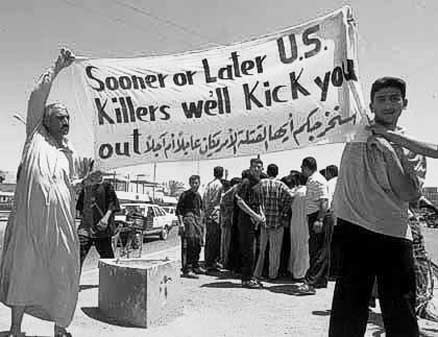
The conflict in Vietnam ended when the ammunition ran out. The military industry spent its wad as it earned its wad. Lucrative mission accomplished. Gun nut thrillcraft ride over. American public opinion turned against the mass killing, the funding dried up, and the hawks receded with their loot.

Then public attention diverted to more selfish worries. The economy. An energy crisis. A surge of concern for a death spiral into environmental disaster. Does this sound familiar? FUCKING A!

Legitimate concerns all, then and now. The problems remain the same. Just as American imperialism will persist unabated. Scholars might say after Vietnam, American militarism had to be tempered, such that the US was compelled to conduct its counter-insurgency genocides by more discrete means.

Like the Red, White and Blue ordnance jamboree of Southeast Asia, the US-Islam War will expend itself. But the war of the capitalist white against indigenous brown will continue unless the Western populations step up to a serious rise in consciousness. Not a higher spiritual conscience, but an honest self-assessment of First-World selfishness.

The US – Islam War nears halfway mark

I have to do more research, but I’m pretty sure October 7, 2009 should mark the HALFWAY POINT of the US-ISLAM WAR. I realize the Pentagon brass are calling for fifty years more of insurgency suppression in Afghanistan and Iraq, but if we grant them no more time than for America’s longest military intervention, we’ve got another eight years before beating our humiliating retreat.
iraq

Those who insist we could have won the Vietnam War, would have our murderous troops there still. No foreign occupation has succeeded in modern times, with the ongoing exception of Israel, which by its swallowing of Palestine has been skewing the definition of occupation to the Old Testament model of mass extermination. The treacherous method worked against the Native Americans, it may still doom the (Palestinian) Native Israelis.

Afghanistan and Iraq remain occupations, where Vichy puppet governments prosecute genocide against the native resistance. How long before Americans lose their stomach for continuous bloody repression? I cannot account for the Russians in Chechnya, but on the US-Islam front, we are halfway there.

In Afghanistan and Iraq, we may already have surpassed half the civilian death tolls in Vietnam, Cambodia and Laos. It’s hard to say, the US “doesn’t do body counts” now, and we didn’t then either. Our own military casualties grew exponentially in Vietnam. If such statistics bear comparison, today’s numbers cannot be but comparable.

It’s being whispered that American casualties are approaching a multiple of a thousand mark. Official soldier deaths in Afghanistan and Iraq are conjectured to be reaching a round number.

I’m not told how many US mercenaries are being killed. We have as many hired-guns contracted as government soldiers. Want to lay odds on how many body bags they’ve required?

Nor are we told how many US soldiers are being wounded, many of them with injuries which would not have sustained their lives in Vietnam. Surely there is a sad gray area of injury which we could round up as it approximates death.

Arguments for and against Anarchism

by Albert Meltzer

Introduction

The Historical Background to Anarchism

It is not without interest that what might be called the anarchist approach goes back into antiquity; nor that there is an anarchism of sorts in the peasant movements that struggled against State oppression over the centuries. But the modern anarchist movement could not claim such precursors of revolt as its own more than the other modern working class theories. To trace the modern Anarchist movement we must look closer to our own times. While there existed libertarian and non-Statist and federalist groups, which were later termed anarchistic in retrospect, before the middle of the nineteenth century, it was only about then that they became what we now call Anarchists.

In particular, we may cite three philosophical precursors of Anarchism, Godwin, Proudhon, and perhaps Hegel. None of these was in fact an Anarchist, though Proudhon first used the word in its modern sense (taking it from the French Revolution, when it was first used politically and not entirely pejoratively). None of them engaged in Anarchist activity or struggle, and Proudhon engaged in parliamentary activity. One of the poorest, though ostensibly objective, books on Anarchism, Judge Eltzbacher’s Anarchism, describes Anarchism as a sort of hydra-headed theory some of which comes from Godwin or Proudhon or Stirner (another who never mentions anarchism), or Kropotkin, each a different variation on a theme. The book may be tossed aside as valueless except in its description of what these particular men thought. Proudhon did not write a programme for all time, nor did Kropotkin in his time write for a sect of Anarchists. But many other books written by academics are equally valueless: many professors have a view of anarchism based on the popular press. Anarchism is neither a mindless theory of destruction nor, despite some liberal-minded literary conceptions, is it hero-worship of people or institutions, however liberated they might be.

Godwin is the father of the Stateless Society movement, which diverged into three lines. One, that of the Anarchists (with which we will deal). Two, that of classic American Individualism, which included Thoreau and his school, sometimes thought of as anarchistic, but which equally gives rise to the ‘rugged individualism’ of modern ‘libertarian’ capitalism and to the pacifist cults of Tolstoy and Gandhi which have influenced the entire hippy cult. Individualism (applying to the capitalist and not the worker) has become a right-wing doctrine.

The second line of descent from Godwin is responsible for the ‘Pacifist Anarchist’ approach or the ‘Individualist Anarchist’ approach that differs radically from revolutionary anarchism in the first line of descent. It is sometimes too readily conceded that ‘this is, after all, anarchism’. Pacifist movements, and the Gandhian in particular, are usually totalitarian and impose authority (even if only by moral means); the school of Benjamin Tucker — by virtue of their individualism — accepted the need for police to break strikes so as to guarantee the employer’s ‘freedom’. All this school of so-called Individualists accept, at one time or another, the necessity of the police force, hence for Government, and the definition of anarchism is no Government.

The third school of descent from Godwin is simple liberalism, or conservative individualism.

Dealing here with the ‘first line of descent’ from Godwin, his idea of Stateless Society was introduced into the working class movement by Ambrose Cuddon (jun). His revolutionary internationalist and non-Statist socialism came along the late days of English Chartism. It was in sympathy with the French Proudhonians. Those who in Paris accepted Proudhon’s theory did not consider themselves Anarchists, but Republicans. They were for the most part self-employed artisans running their own productive businesses. The whole of French economy was geared both to the peasantry and to the artisan — this, the one-person business of printer, bookbinder, wagon and cart maker, blacksmith, dressmaker, goldsmith, diamond polisher, hat maker as distinct from the factory or farm worker of the time, who worked for an employer. Independent, individualistic and receiving no benefit from the State but the dubious privilege of paying taxes and fighting, they were at that time concerned to find out an economic method of survival and to withstand encroaching capitalism.

Marx described them as ‘petty bourgeois’, which had a different meaning in the nineteenth century. He justifiably claimed that these ‘petty bourgeois’ were not as disciplined as the then factory workers (he despised farm workers) and said that when they were forced into industry they did not faithfully follow the line laid down by a disciplined party from outside the class, but were independent of mind and troublesome to organisation imposed from above, their frustration often leading to violence. They moved to anarchism and through syndicalism spread it through the working class. (This claim is echoed by Marxists nowadays, when the term ‘petty bourgeois’ means something utterly different — solicitors and chartered accountants — and thus makes Marx’s quite sensible analysis sound utterly ridiculous.)

These French and English movements came together in the First International. The International Workingmen’s Association owed its existence to Marx, indirectly to Hegelian philosophy. But within the International, there was not only the ‘scientific socialism’ of Marx, but also Utopian Socialism, Blanquism (working-class republicanism), English Trade Unionism, German-authoritarian and opportunistic socialism, and Spanish, Swiss, and Italian stateless socialism, as well as national Republicanism and the various federalistic trends.

Bakunin was not the ‘father’ of anarchism, as often described. He was not an anarchist until later in life. He learned his federalism and socialism from the Swiss workers of the Jura, and gave expression to the ideas of the Godwinian and Proudhonian ‘federalists’, or non-State socialists. In many countries, Spain and Italy in particular, it was Bakunin’s criticism of the ideas of Marx that gave the federalist movement its definition. (While to Anarchists, Marx is of course “the villain of the piece” in the International, it must be granted that without Marx defining one form of socialism there would have been no clash, no Bakunin defining the opposite.)

There had grown up by 1869 a very noticeable trend within the International that was called ‘Bakuninist’ which was in one line from Godwin and another from Proudhon. When the Paris Commune exploded in the face of the International, it was the parting of the ways (though this was deferred a little longer and seemed to follow personal lines). From the non-Anarchists and Marxists knew by their different analyses and interpretations and actions during the Paris Commune, that they were separate.

All the same, for many years Anarchists continued to form part of the Socialist Movement that included Marxists and Social-Democrats. Marx had not succeeded in building a mass movement. The German socialist movement was more influenced by Lassalle; English socialism by reformist and Christian traditions of radical nonconformity. Only after Marx’s death, when Marxism was the official doctrine of German social-democracy, were Anarchists finally excluded from Socialist Internationals; social-democracy marched on to its own schism, that between English Liberalism on the one hand, and social-democracy on the other; and that between ‘majority’ Social-Democrats (Bolsheviks, actually never more than a minority) and reformism.

There were no such schisms at that time in the anarchist movement as such. Popular opinion made such figures as Tolstoy into (what he never claimed to be) an anarchist (he was not; neither in the normal sense of the words was he a Christian or a Pacifist, as popularly supposed, but his idolators always know better than he), but derived from the ‘second line’ of Godwinism like many other caricature-Anarchists. What we may call ‘mainstream’ anarchism was coherent and united, and was given body by the writings of a number of theoreticians, such as Peter Kropotkin.

After the bloody suppression of the Paris Commune, and repression in many parts of the world — notably Tsarist Russia, Anarchism passed into its well-known stage of individual terrorism. It fought back and survived and gave birth to (or was carried forward in) the revolutionary syndicalist movement which began in France. It lost ground after the First World War, because of the revival of patriotic feeling, the growth of reformist socialism, and the rise of fascism; and while it made a contribution to the Russian Revolution, it was defeated by the Bolshevik counterrevolution. It was seen in both resistance and in a constructive role in the Spanish Revolution of 1936.

By the time of the Second World War, Anarchism had been tried and tested in many revolutionary situations and labour struggles. Alternative forms had been tried and discarded; the German Revolution had introduced the idea of Workers Councils. The experience of the American IWW had shown the possibilities of industrial unionism and ‘how one can build the new society in the shell of the old’. In the ‘flint against flint’ argument against Marxist Communism, the lesson of what socialism without freedom meant in Russia, and the failure of reformist socialism everywhere, the anarchist doctrine was shaped.

There were never theoreticians of Anarchism as such, though it produced a number of theoreticians who discussed aspects of the philosophy. Anarchism has remained a creed that has been worked out in practice rather than from a philosophy. Very often, a bourgeois writer comes along and writes down what has already been worked out in practice by workers and peasants; he is attributed by bourgeois historians as being a leader, and by successive bourgeois writers (citing the bourgeois historians) as being one more case that proves the working class relies on bourgeois leadership.

More often, bourgeois academics borrow the name ‘Anarchism’ to give expression to their own liberal philosophies or, alternatively, picking up their cue from journalists, assorted objects of their dislike. For some professors and teachers, ‘Anarchism’ is anything from Tolstoyism to the IRA, from drug-taking to militant-trade unionism, from nationalism to bolshevism, from the hippy cult to Islamic fundamentalism, from the punk scene to violent resistance to almost anything! This is by no means an exaggeration but a sign of academic illiteracy, to be distinguished from journalists who in the 1960s obeyed a directive to call anything Marxist-Leninist that involved action as ‘Anarchist’ and anything Anarchist as ‘nationalist’.

Inalienable Tenets of Anarchism

That Mankind is Born Free

Our rights are inalienable. Each person born on the world is heir to all the preceding generations. The whole world is ours by right of birth alone. Duties imposed as obligations or ideals, such as patriotism, duty to the State, worship of God, submission to higher classes or authorities, respect for inherited privileges, are lies.

If Mankind is Born Free, Slavery is Murder

Nobody is fit to rule anybody else. It is not alleged that Mankind is perfect, or that merely through his/her natural goodness (or lack of same) he/she should (or should not) be permitted to rule. Rule as such causes abuse. There are no superpeople nor privileged classes who are above ‘imperfect Mankind’ and are capable or entitled to rule the rest of us. Submission to slavery means surrender of life.

As Slavery is Murder, so Property is Theft

The fact that Mankind cannot enter into his/her natural inheritance means that part of it has been taken from him or her, either by means of force (old, legalised conquest or robbery) or fraud (persuasion that the State or its servants or an inherited property-owning class is entitled to privilege). All present systems of ownership mean that some are deprived of the fruits of their labour. It is true that, in a competitive society, only the possession of independent means enables one to be free of the economy (that is what Proudhon meant when, addressing himself to the self-employed artisan, he said “property is liberty”, which seems at first sight a contradiction with his dictum that it was theft). But the principle of ownership, in that which concerns the community, is at the bottom of inequity.

If Property is Theft, Government is Tyranny

If we accept the principle of a socialised society, and abolish hereditary privilege and dominant classes, the State becomes unnecessary. If the State is retained, unnecessary Government becomes tyranny since the governing body has no other way to maintain its hold. “Liberty without socialism is exploitation: socialism without liberty is tyranny” (Bakunin).

If Government is Tyranny, Anarchy is Liberty

Those who use the word “Anarchy” to mean disorder or misrule are not incorrect. If they regard Government as necessary, if they think we could not live without Whitehall directing our affairs, if they think politicians are essential to our well-being and that we could not behave socially without police, they are right in assuming that Anarchy means the opposite to what Government guarantees. But those who have the reverse opinion, and consider Government to be tyranny, are right too in considering Anarchy, no Government, to be liberty. If Government is the maintenance of privilege and exploitation and inefficiency of distribution, then Anarchy is order.

The Class Struggle

Revolutionary Anarchism is based on the class struggle, though it is true that even the best of Anarchist writers, to avoid Marxist phraseology, may express it differently. It does not take the mechanistic view of the class struggle taken by Marx and Engels that only the industrial proletariat can achieve socialism, and that the inevitable and scientifically-predictable victory of this class represents the final victory. On the contrary: had anarchism been victorious in any period before 1914, it would have been a triumph for the poorer peasants and artisans, rather than among the industrial proletariat amongst whom the concept of anarchy was not widespread.

As we have said, Marxists accuse the Anarchists of being petty bourgeois. Using the term in its modern sense, it makes Marx look ridiculous. Marx was distinguishing between the bourgeois (with full rights of citizens as employers and merchants) and the minor citizens — i.e. self-employed workers). When Marx referred to the Anarchists being ‘petty bourgeois’ who when they were forced by monopoly capitalism and the breakdown of a peasant-type society into industry, and being therefore ‘frustrated’ and turning to violence, because they did not accept the discipline taken for granted by the industrial proletariat, he was expressing something that was happening, especially after the breaking up of the independent Communes of Paris and Barcelona, and the breakdown of the capitalist economy, in his day. But, with the change of meaning, to think of today’s Anarchists as frustrated bowler-hatted bank managers turning to violence because they have been forced into industry is straining one’s sense of the ridiculous.

Marx thought the industrial proletariat was not used to thinking for itself — not having the leisure or independence of the self-employed — and was therefore capable ‘of itself’ of a ‘trade union mentality, needing the leadership of an ‘educated class’ coming from outside, and presumably not being frustrated. This in his day was thought of as the scholars as an elite, in later times the students.

Marx certainly did not foresee the present day, when the students as a frustrated class, having absorbed the Marxist teachings, are being forced into monotonous jobs or unemployment and create the New Left with its own assumptions and preoccupations, but are clearly not a productive class. Any class may be revolutionary in its day and time; only a productive class may be libertarian in nature, because it does not need to exploit. The industrialisation of most Western countries meant that the industrial proletariat replaced the old ‘petty bourgeois’ class and what is left of them became capitalist instead of working class, because it had to expand and therefore employ in order to survive. But recent tendencies in some Western countries are tending to the displacement of the working class and certainly the divorcing of them from their productive role. Mining, shipbuilding, spinning, manufacturing industries, and whole towns are closed down and people are forced to into service jobs like car-park attendants or supermarket assistants which are not productive and so carry no industrial muscle.

When the industrial proletariat developed, the Anarchist movement developed into anarcho-syndicalism, something coming from the workers themselves, contrary to the idea that they needed a leadership from outside the class or could not think beyond the wage struggle. Anarcho-syndicalism is the organisation at places of work both to carry on the present struggle and eventually to take over the places of work. It would thus be more effective than the orthodox trade-union movement and at the same time be able to bypass a State-run economy in place of capitalism.

Neither Anarchism nor Marxism has ever idealised the working class (except sometimes by way of poetic licence in propaganda!) — this was a feature of the Christian Socialists. Nor was it ever suggested that they could not be reactionary, In fact, deprivation of education makes the poorer class on the whole the more resistant to change. It would be trying the reader’s patience too much to reiterate all the ‘working class are not angels’ statements purporting to refute that the working class could not run their own places of work. Only in heaven, so I am informed, will it be necessary for angels to take over the functions of management!

Organisation and Anarchism

Those belonging to or coming from authoritarian parties find it hard to accept that one can organise without ‘some form’ of Government. Therefore they conclude, and it is a general argument against Anarchism, that ‘Anarchists do not believe in organisation’. But Government is of people, organisation is of things.

There is a belief that Anarchists ‘break up other people’s organisations but are unable to build their own’, often expressed where dangerous, hierarchical, or useless organisations dominate and prevent libertarian ones being created. It can well be admitted that particular people in particular places have failed in the task of building Anarchist organisations but in many parts of the world they do exist

An organisation may be democratic or dictatorial, it may be authoritarian or libertarian, and there are many libertarian organisations, not necessarily anarchist, which prove that all organisation need not be run from the top downwards.

Many trade unions, particularly if successful, in order to keep their movement disciplined and an integral part of capitalist society, become (if they do not start so) authoritarian; but how many employers’ organisations impose similar discipline? If they do, their affiliates would walk out if it did not suit their interests. They must come to free agreement because some have the means to resist intimidation. Even when they resort to fascism to keep the workers down, the employers retain their own independence and financial power; Nazism goes too far for smaller capitalists in that after having crushed the workers it also limits, or even negates, the independence of the class that put it in power.

Only the most revolutionary unions of the world have ever learned how to keep the form of organisation of mass labour movements on an informal basis, with a minimum of central administration, and with every decision referred back to the workers on the shop floor.

The Role of an Anarchist in an Authoritarian Society

“The only place for a free man in a slave society is in prison,” said Thoreau (but he only spent a night there). It is a stirring affirmation but not one to live by, however true it is. The revolutionary must be prepared for persecution and prosecution, but only the masochist would welcome it. It must always remain an individual action and decision as to how far one can be consistent in one’s rebellion: it is not something that can be laid down. Anarchists have pioneered or participated in many forms of social rebellion and reconstruction, such as libertarian education, the formation of labour movements, collectivisation, individual direct action in its many forms and so on.

When advocating anarcho-syndicalist tactics, it is because social changes for the whole of society can only come about through a change of the economy. Individual action may serve some liberatory process, it’s true. Individuals, for example, may retire to a country commune, surround themselves with like-minded people and ignore the world so long as it overlooks them. They might certainly meanwhile live in a free economy if they could overcome certain basic problems, but it would not bring about social change.

This is not to decry individual action, far from it. Whole nations can live under dictatorship and sacrifice whole peoples one by one, and nobody will do anything about it until one individual comes along and cuts off the head of the hydra, in other words, kills the tyrant. But genocide can take place before the individual with the courage, ability, and luck required comes along.

In such cases, we see waiting for mass action as queuing up for the gas chamber (it can be literally so). We do not think “the proletariat can do no wrong” and most of all; by submission, it can. But organisation is strength. We advocate mass action because it is effective and because the proletariat has in its hands the means to destroy the old economy and build anew. The Free Society will come about through workers’ control councils taking over the places of work and by conscious destruction of the authoritarian structure. They can be built within unionisation of the work-forces of the present time.

Workers Control

When advocating workers’ control for the places of work, we differ from those who are only advocating a share of management or imagine there can be an encroachment upon managerial function by the workers within capitalism. Self-management within a capitalist society is a sizeable reform, and is occasionally attainable when the work-force is in a particularly strong position, or more often when the work is sufficiently hazardous to defy outside inspection. That is all it is, however, and is not to be confused with syndicalism, except in the sense that the syndicalist thinks the future society should be self-controlled. We want no authority supreme to that of the workers, not even one of their delegates.

This probably means breaking industry down into small units, and we accept this. We reject ‘nationalisation’ = State control.

It should not be (but unfortunately is) necessary to explain that there are, of course, ways of personal liberation other than class action, and in some cases these may be necessary lest one starve. But none of these can at present help to change society. The self-employed artisan no longer plays an important part as in Proudhon’s day (and perhaps this will be revived with a new society). One can get satisfaction working on one’s own, one may have to do so by economic necessity, but the means of changing society rest with those who are working in the basic economy.

Trends over recent years show the importance of the self-employed artisan. As major industries are decimated by the ruling class because no longer necessary to capitalism, a means of integrating those working outside mainstream capitalism will increasingly need to be found if we are to achieve change. It was the necessity of finding this in a previous reversal of capitalist trends that led to the original formation of anarcho-syndicalism.

The Anarchist as Rebel

It is not unknown for the individual Anarchist to fight on alone, putting forward his or her ideas in a hostile environment. There were many examples in the past of Anarchists struggling on alone, sometimes only one in the country. It is less the case at the present time when there are usually many people calling themselves Anarchists, though perhaps only one or two in a locality who really are so, and not just adopting the label to describe rebellion when young.

Anarchists in such circumstances may fight alone for the principle of Anarchism, but usually participate in other struggles, such as anti-militarism, anti-imperialism, anti-nationalism or solely within the content of the class struggle or they may form organisations of their own.

It is no part of the case for Anarchism to say that the profession of its ideas changes peoples’ character; or that the movement invites itself to be judged on anyone who happened to be around at any one time. Organisations they create may become reformist or authoritarian; people themselves may become corrupted by money or power. All we can say is that ultimately such corruption normally leads them to drop the name ‘Anarchist’, as standing in their way. If ever the term became ‘respectable’, no doubt we would have to choose a fresh one, equally connotative of libertarian rebellion — at present it can still stand as descriptive though increasingly misused.

In all organisations, personalities play a part and it may be that in different countries different schisms may occur. Some say that there are different types of Anarchism. Syndicalism, Communism, individualism, pacifism, have all been cited as such. This is not so. If one wishes to cause a schism, purely on personal reasons or because one wishes to become more quietist or reformist, it is no doubt convenient to pick a name as a ‘banner’. But in reality there are not different forms of Anarchism. Anarchist-Communism, in any definition (usually that of Kropotkin), means a method of socialism without Government, not a different style of anarchism. An alternative idea, called Anarchist-Collectivism, once favoured by Spanish Anarchists, was found in practice to be exactly the same. If one is going to have no rule from above, one cannot lay down a precise economic plan for the future, and Communism and collectivisation controlled from below upwards proved to be no different from each other, or from syndicalism, a permanent means of struggle toward the same goal.

Communism, in the sense used by Anarchists, is a society based on the community. Collectivism is a division of the commune into economic units. Unless the commune is very small — based upon the village — it has to be divided into smaller units, collectives, so that all can participate and not just their elected representatives. Otherwise it would merely be industrial democracy. While free Communism is an aim, syndicalism is a method of struggle. It is the union of workers within the industrial system attempting to transform it into a free Communistic society.

State Communism is not an alternative Communism to free Communism, but its opposite. It is the substitution of the State or the Party for the capitalist class. Communism is not necessarily Anarchist, even if it is not State Communism but the genuine authoritarian form of Communism (total State control without having degenerated into absolute power from above, or even governmental dominated socialisation). Syndicalism is not necessarily revolutionary and even revolutionary syndicalism (the idea that workers can seize places of work through factory organisation) need not be libertarian, as it can go hand-in-hand with the idea of a political party exercising political control. This is why we use the mouthful: anarcho-syndicalism. Workers control of production, community control from below, no Government from above.

Nonviolence

Is pacifism a trend within Anarchism? Though phoney Anarchism contains a large streak of pacifism, being militant liberalism and renouncing any form of positive action for Anarchism, pacifism (implying extreme nonviolence, and not just anti-militarism) is authoritarian. The cult of extreme nonviolence always implies an elite, the Satyagrahi of Gandhi, for instance, who keeps everyone else in check either by force or by moral persuasion. The general history of the orthodox pacifist movements is that they attempt to dilute a revolutionary upsurge but come down on the side of force either in an imperialist war or by condoning aggressive actions by governments they support.

Both India and Israel were once the realisation of the pacifist ideals; the atom bomb was largely developed and created by nonviolent pacifists and by League of Nations enthusiasts; the Quakers as peace-loving citizens but commercial tyrants and colonialists are notorious. In recent times, many who rejected Anarchist actions of the Spanish Resistance (though claiming to be “nonviolent Anarchists”) had no difficulty late in supporting far more “violent” actions of different nationalist movements.

It is true to say that there are Anarchists who consider pacifism compatible with Anarchism in the sense that they advocate the use of non-violent methods though usually nowadays advocating this on the grounds of expediency or tactics rather than principle. But this should not be confused with the so-called “Tolstoyan Anarchism” (neither Tolstoyan or Anarchist). Tolstoy considered the Anarchists were right in everything but that they believed in revolution to achieve it. His idea of social change was “within one” (which is to say in the sky). He did not advocate nonviolent revolution, he urged nonresistance as a way of life compatible with Christian teaching though not practised as such.

One has to say also that this refers to pacifism in the Anglo-American sense, somewhat worse in Great Britain where the concept of legalised conscientious objection led to a dialogue between pacifism and the State. In countries where objection to military service remained a totally illegal act, the concept of pacifism is not necessarily extreme nonviolence.

Immediate Aims of the Anarchist

A “reformist” is not someone who brings about reforms (usually they do not, they divert attention to political manoeuvring): it is someone who can see no further than amelioration of certain parts of the system. It is necessary to agitate for the abolition of certain laws or for the immediate reform of some, but to idealise the agitation for reforms, or even the interests in reform of minorities or even whole communities, is reformist. This reformism has permeated the whole of what is now called the left wing. It creates new industries in the interests of aspiring bureaucrats allegedly guarding over minority interests, preventing people in those minorities from acting on their own behalf. This is noticeable even in women’s struggles which the left marginalises as if it were a minority issue.

Sometimes laws are more harmful than the offences they legislate against. No law is worth passing even to hope which are socially beneficial on the surface, since they are sure to be interpreted wrongly and are often used to bolster the private opinion of judges who carry them out. The old British custom of sentencing poorer classes to death for minor thefts above a small pecuniary value was not abolished by Parliament nor by the judges, but by the final refusal of juries to admit when forced to a guilty verdict that the goods were above that value.

The Anarchists can as individuals or in groups press for reforms but as Anarchists they seek to change minds and attitudes, not to pass laws. When minds are changed, laws become obsolete and, sooner or later, law enforcers are unable to operate them. Prohibition in America, the Poll Tax in Britain, are instances. At that point the law has to adapt itself to public opinion.

The Witchcraft Act remained on the statute books until some 40 years ago and it was enforced right up to the time of its abolition though the Public Prosecutor only dared to use a few of its clauses for fear of ridicule. It was abolished for political reasons but the equally ridiculous Blasphemy Act was retained, being unquestioned by Parliament until the agitation by Muslims that it was clearly unfair that one could be fined for offending Christianity while one could not be executed for offending Islam.

The ‘1381’ law was useful for squatters to persuade people they could occupy neglected buildings without offence, the odd thing being that the law did not exist. The myth was enough provided people believed in it.

One has to carry on a resistance to any and every form of tyranny. When governments use their privileges threatened, they drop the pretence of democracy and benevolence which most politicians prefer. Anarchists are forced to become what politicians describe them as: ‘agents of disorder’, though there is a lot more to Anarchism to that, and all ‘agents of disorder’ are not necessarily Anarchists.

A Marxist-Leninist would say, “Anarchists are able to bring about disorder but cannot seize power. Hence they are unable to make take advantage of the situations they create, and the bourgeoisie, regrouping its strength, turns to fascism”.

A Tory would say that Marxist-Leninists are Anarchists “because they wish to create Anarchy to create the conditions in which they would seize power”. Both are absurdities. Anarchists can, of course, “seize power” no less than anyone just as a teetotaler can get blind drunk, but they would hardly continue to merit the name. Anarchists in power would not necessarily be any better or worse than anyone else, and they might even be as bad as Communists or fascists. There is no limit of degradation to which power cannot bring anyone even with the loftiest principles. We would hope that being unprepared for power, they would be ineffective. Their task is not to “seize power” (those who use this term show that they seek personal power for themselves) but to abolish the bases of power. Power to all means power to nobody in particular.

If one leaves the wild beast of State power partially wounded, it becomes more ferocious than ever, a raging wild beast that will destroy or be destroyed. This is why Anarchists form organisations to bring about revolutionary change. The nature of Anarchism as an individualistic creed in the true sense has often caused many to say such organisations might well be left to ‘spontaneity’, ‘voluntary will’ and so on — in other words, there can be no organisation (except for propaganda only) until the entire community forms its own organisations. This is a recipe for a sort of armchair Anarchism which never gets off the ground, but at the same time with a point that cannot be ignored — until the whole community has control of its own organisations, such bodies cannot and should not take over the social and economic means of life.

It is shown by events that unity of resistance is needed against repression, that there must be united forms of action. Even when workers’ councils are formed, there may be representatives on them from political factions, united outside on party lines and able to put forward a united front within such councils and thus to dominate and ultimately destroy them. That is why we need an organised movement to destroy such efforts at totalitarianism. In some cases one may need the ultimate sanction of acts of individual terrorism to be used against leadership from within quite as much as that imposed from above. This form of specific terrorism has nothing in common with nationalist terrorism, which by its nature is as indiscriminate as State terrorism, for all that it is judged in a far harsher light. Anarchist terrorism is against individual despots, ruling or endeavouring to rule. Nationalist terrorism is a form of war against peoples. State terrorism is the abuse of power.

Workers’ Self-Defence

The Marxist-Leninists in time of revolution rely upon the formation of a Red Army. Under the control of one party, the “Red” Army is the old army under a red flag. We have seen many times how this can become a major instrument of repression, just as a nationalist army under a new flag can also become one, sometimes even before it attains power.

The very formation of an army to supersede workers’ militias will destroy the Revolution (Spain 1936). Che Guevara introduced a new romantic ideas of the Red Army as the advance guard of a peasants army — combining the spontaneity of a Makhnovista (Ukraine 1917) and Zapatista/Magonista (Mexican-Anarchistic) peasant army with the disciplined ideas of Party intellectuals. In such cases, after the initial enthusiasm carries through to victory, the disciplined leadership takes over; if it fails, the leaders run off elsewhere.

The self-defence notions of anarcho-syndicalists are that workers use arms in their own defence against the enemy at hand, and that the democratic notion of workers’ militias prevails. While there may be technical leadership, instruction and duties such as are at present in the hands of noncommissioned officers up to the rank of sergeant, there should be no officers whose job is to command, or lower-ranking NCOs to transmit the chain of command.

The idea of an armed people is derided by many so-called military and political experts, but only is used by workers in their own interests. If smaller nations use it successfully, they admit that a citizens’ army — that is to say, a nonprofessional one that can hang up its rifles and go back to work, coming out when called upon — is possible provided only that, as in the case of (say) Israel or South Africa, they obey nationalistic and aggressive policies from above. Providing they don’t maintain the force in international-class interests, the “experts” are prepared to admit the efficiency of such an army remaining democratically controlled within its own ranks.

How Will a Revolution Come About?

We do not know. When a revolutionary situation presents itself — as it did with the occupation of factories in France, 1936 and 1968; as it did in Spain, 1936 with the fascist uprising; or with the breakdown of the Russian Armies, 1917; or in many other times and places; we are ready for it or we are not (and usually not). Many times the workers are partially ready and leave the “wounded wild animal” of Statism fiercer than ever. It may be purely individual action that sets off the spark. But only if, at that period, there is a conscious movement towards a Free Society that throws off the shackles of the past, will that situation become a social revolution. The problem today that faces us is that half the world is prepared to rise almost at any opportune time, but have no military power to resist repression and no industrial muscle to sustain it. The other half of the world has such might, but no real desire to rise, being either bought off by capitalism or succumbing to persuasion.

Bringing About the New Society

What Constitutes an Authoritarian Society?

Exploitation — Manipulation — Suppression. The organs of repression consist of many arms of the State:

The Apparatus of Government: The legislature, the judicature, the monarchy, the Civil Service, the Armed Forces, the Police etc.

The Apparatus of Persuasion: The educational system, the media, including TV, radio and the press, the Church, and even forms of apparent dissent that in reality condition us to accept the present system — the parliamentary Opposition is the most obvious, but many other alternatives to the accepted system too, e.g., revolution presented as merely one in lifestyle or musical preference, academic teaching of Marxist-Leninism etc.

The Apparatus of Exploitation: The monetary system; financial control; the Banks; the Stock Exchange; individual, collective, and State employers; land ownership. Under capitalism there is no escaping this.

Most political reformers have some part of the unfree system they wish to abolish Republicans would abolish the monarchy, Secularists would abolish or disestablish the Church, Socialists would (or used to) wish to abolish the apparatus of exploitation; pacifists would abolish the Army. Anarchism is unique in wishing to abolish all. The only true definition of an Anarchist is one who wishes to believes it desirable to abolish all; who believe it possible to abolish all, the sooner the better; and who works to bring such abolition about.

There are many, usually on the left, who think it desirable but impossible, many on the right who think it only too probable but undesirable. Others may be sympathetic to Anarchism as both desirable and possible but refrain from action in its favour. To borrow a phrase from another part of the forest, they may be fellow travelers of Anarchism.

The Police are the cornerstone of the State (though sometimes, in extreme cases, the Government of the day needs to use the armed forces in lieu of, or in addition to the police — in some countries this has led to replacement or control of the Government by the army so long as the officers are tightly in control).

Only Anarchism believes in abolition of the Police, and this is the most hotly-disputed argument of Anarchism. Yet the police force as we know it is a comparatively modern phenomenon, fiercely resisted when introduced for reasons which have since been proved up to the hilt, such as the ability of the Police to introduce or bolster up a dictatorship, known indeed as a police state. Without control of the Police, debates at Westminster become as sterile of result as debates in the West Kensington Debating Society (and probably less interesting).

With German money, supplied by Helphand-Parvus, Lenin was able to return to Russia and pay Lettish mercenaries to act as Police. He was the only politician in a position to do so and in this way Bolshevik success was achieved. The Nazis in their turn created murder gangs that roamed the streets, which were tacitly tolerated by the Republican Police, but their victory came when they controlled the Police by legal means.

Can One Do Without the State?

It seems to be generally agreed that we can do without some organs of the State: can we do without them all, altogether? Some are admittedly useless, some decorative, some have impossible intentions, others are necessary for class rule, some may well be useful and carry out functions essential to any society.

One cannot do the work of another. If the monarchy has no Army it cannot save you from foreign invasion any more than the police will get you into heaven if you do not have a Church! Any commonsense codification of conduct would be better than the farrago of laws we have at present, which occupy both the lawyers and politicians, the one interpreting the apparent desires of the other.

It is true that the Government can and sometimes does take over certain necessary social functions, as do every organ of the State however repressive. The railways were not always run by the State but belonged to capitalists, and could equally in a future society belong to the workers. It would be foolish to say that if mines belonged to the State, that proves the State is necessary, or we would have no coal without it. The Army is often given socially necessary jobs, such as flood or earthquake relief; it is sometimes used as a scab labour force, such as in strikes; it is sometimes used as a police force. This is because the State does not want the breakup of a society that supports it.

Even the police at times fulfill some necessary functions — one goes to the police station to find lost dogs simply because it happens to be there and has taken over that function. It does not follow that we should never find lost dogs if there were no Police, and that we need to be clubbed over the head in times of social unrest so that old ladies can need not lose their dogs. For insurance purposes, all car owners report their lost or stolen cars to the Police, but it does not mean that the police force as such is indispensable.

Just as insurance companies would find some way of seeing they could not pay out on fraudulent claims if there were no police force, society would see to it that it could protect itself. Unfortunately, having a police force atrophies the ability of society to defend itself. People have lost all sense of social organisation and control. They can be put in terror by a few kids running wild, however young. The only reaction is to run to the Police, and the Police cannot cope.

There was an old superstition that if the Church excommunicated a country, it was under a terrible disaster. One could not be married, buried, leave property, do business in safety, be educated, be tended while sick, in a country which was excommunicated. The superstition was not an idle one, so long as people believed in the Church. If the country was banned from the communion of believers, the hospitals (run by the Church) were closed; there could be no trust in business (the clerics administered oaths and without them no promises need be kept); no education (they ran the schools); children could indeed be begotten (no way of preventing that by the Church!), but not christened, and were therefore barred from the community of believers and under a threat, as they thought, of eternal damnation, while unmarried parents could not leave property to their “illegitimate” children. The physical reality of Hell was not necessary to make excommunication effective. We are wiser now. But one superstition has been replaced by another. It has been transferred to belief in the State. If we were to reject Government there would be no education (for Government, national or local, controls the schools — with obvious exceptions), no hospitals (ditto), nobody could carry one working because the Government regulates its conduct, and so on. The truth all the time has been that not the Church and not the State but we the People have worked for everything we’ve got, and if we have not done so they have not provided for us. Even the privileged have been maintained by us not them.

The Money Myth

With the State myth comes a second myth — the money myth. The value of money is dependent on the strength of the State. When Governments collapse, their money is worthless. For years American crooks travelled Europe offering to change Confederate dollars, worth nothing since the Southern States had lost the Civil War, presenting them to unsuspecting Europeans as valid U.S. dollars — until they became collectors’ pieces and were worth more than several U.S. dollars! At that point the Federal Government utilised the original printing plants to publish Confederate dollars and gave them away with bubble-gum, lest their own currency became devalued.

When the Kaiser’s Germany collapsed, Imperial marks were useless. When the Spanish Republic was defeated, the banks simply canceled the value of its money. The story is endless. Yet according to a legend many still believe, the wealth of the country is to be found at Waterlow’s printing works. As the notes roll off the press, so our wealth is created, and if this ceased we should be impoverished! The banks have come up with an alternative in printing their own credit cards. Another alternative myth, now dated, was that the money printed had to correspond with a quantity of closely-guarded gold buried in a mysterious vault, after having been dug up under tight security from mines thousands of miles away. However, Governments have long since defaulted on the premises behind this myth (though they still continue the ritual). The newer governmental myth is that if too many notes are printed we shall have inflation which will make us all poor, so to prevent this we must be prepared to endure conditions of stringency and poverty, lose jobs and homes, or in other words become poor.

During the war, rationing of food and clothes meant that what counted was coupons, by which it was hoped to ensure there were fair shares of what was available. As the money system continued, a black market in commodities was inevitable, but rationing gave an idea of what State Socialism — without money — would be like. If there were too many coupons printed there would be no point in the scheme. Money is another form of rationing, by which one set of people get more than another. Wage struggles are fights to get a bigger slice of the cake. The wealthy are those who have first access to slicing the cake. But neither money nor coupons make any difference to the size of the cake, they are simply means of dealing with its distribution, whether fairly — or more likely — unfairly. So essential is money to the obtaining of goods in a State society, it sounds humorous to say money is a myth — “I don’t care if it’s mythical, give me more” — but myth it is.

Many worthy people believe if Lady X did not spend her money on a yacht, that money could somehow be transformed into an x-ray apparatus for the hospital. They do not understand, it would seem, that yacht builders cannot produce x-ray machines. Others think that those on National Assistance are supported by those at work — yet the margin of unemployment is essential to the State as a pitfall to make the incentives to work stick. Others believe there is a relation between their wages going up and the wages received by other people going down. In a competitive society, however, one gets what one is able to command.

The Myth of Taxation

There is a patent absurdity in supposing that those who work and produce are helped by those who profit from the system and do nothing. It is equally absurd to suppose that the rich help the poor by providing work or charity. As Brendan Behan commented to someone who pointed out how much the Guinness family had done for the poor people of Dublin — “It’s nothing compared to what the poor people of Dublin have done for the Guinness family”. Taxation perpetuates the myth that those with more money help those with less. Taxation grabs money out of the pockets of the less well-off even before they have a chance to look at it. The rich dress up their accounts by means of professional advisors. But aside from that, money does not create wealth, it is muscle, brain, and natural resources that do. Money is used to restrict the application of human endeavour. It is possible to print money, or arrange credit, when it is in the interests of money manipulators to do so. When they wish to go into recession, they do so by withdrawing money and credit. Recession is not a natural disaster like famine, drought, floods, or earthquakes though it is presented as such.

The Effect of Immigration

The large scale employer looking at greater profitability or the way to cut costs has several options open, the easiest and laziest being to cut wages. If the workers are well-organised they can resist this so there are two options open to the major capitalist. Either take the factories to where the cheap labour is or take the cheap labour to where the factories are. The first option entails great pollution, as a rule — not that they ever care about that — and in some cases they have to go into areas of political instability. It is cheaper to move the cheap labour.

Having thus encouraged immigration, wearing the financial hat as it were, the capitalist in the capacity of a right-wing politician, dons the political hat and denounces immigration. This has the advantage of setting worker against worker, fuelled by religious and/or racial antipathies which can persist for generations, and have the added bonus of inducing the worker to support the right wing electorally. It does the capitalist no harm to have a work force hated by those who surround them, or in fear of deportation if they step out of line. Nor does it harm the capitalist, in a political context, to have issues such as immigration replace the basic issue of the wage and monetary system. It only becomes harmful from that point of view when a fascist force such as Hitler’s gains such armed might that it can ignore the wishes of the capitalists which gave them that power and strives for its own superiority.

The Abolition of the Wage and Monetary Systems

“Socialism” has become so diffused a term today that it is used of almost any reformist or indeed positively counter-revolutionary movement that wishes to use the term and covers a multitude of ideas from liberalism to tyranny, but in reality the essentials of any socialistic theory are the abolition of the wage and monetary systems. This is because a genuine socialistic movement should be of the working class and intended for its own emancipation from wage slavery. The wage and monetary systems are the chains of that slavery that need to be broken.

Some modified form of wage or some means of exchange might be consistent with a free communistic society, especially among a post-revolutionary society accustomed to some form of labour-rewarding assessment, but the present form of monetary system is one in which money is not a servant (a means of exchange) but a boss in its own right. Wages are a means of denoting the position in society’s pecking order which a person is deemed to hold. It is not even fair as regards the assessment it makes. Such systems must be swept aside.

At present, as indicated above, the Government, or the effective controller which may in some cases be over the Government (the banks, for instance) assess the national wealth. A corresponding number of bank notes are printed, coin is struck, credits are granted to financial houses. According to the degree of efficiency or inefficiency of a current Government (which is the stuff of day-to-day press political sloganeering and need not concern us) the assessment, or budget may be correct or incorrect. According to his or her assessment, the Chancellor of the Exchequer may be “generous” or “niggardly” in sharing out the national “cake” and apportioning our slices. But in reality salaries and wages are determined by social convention, tradition, Government patronage, economic competition, hereditary power, trade union bargaining, individual enterprise and wildcat strikes. According to their effectiveness, so is the “slice of cake” each receives. Those unable to use any of the pressures are simply left out of the reckoning and must be content with what is given them in order solely to survive. The “cake” is the same whatever the Government does about it.

Is Anarchism Compatible with Capitalism?

It is only possible to conceive of Anarchism in a form in which it is free, communistic, and offering no economic necessity for repression or countering it. Common sense shows that any capitalist society might dispense with a “State” (in the American sense of the word) but it could not dispense with organised Government, or a privatised form of it, if there were people amassing money and others working to amass it for them. The philosophy of “anarcho-capitalism” dreamed up by the “libertarian” New Right, has nothing to do with Anarchism as known by the Anarchist movement proper. It is a lie that covers an unpleasant reality in its way — such as National Socialism does in another. Patently unbridled capitalism, not even hampered by a reformist State, which has to put some limits on exploitation to prevent violent clashes in society, needs some force at its disposal to maintain class privileges, either from the State itself or from private Armies. What they believe in is in fact a limited State — that is, one in which the State has one function, to protect the ruling class, does not interfere with exploitation, and comes as cheap as possible for the ruling class. The idea also serves another purpose beyond its fulfillment — a moral justification for bourgeois consciences in avoiding taxes without feeling guilty about it — just as pacifism sometimes serves as an excuse for bourgeois consciences in avoiding danger without feeling guilty.

Community Control

The history of collective control in a capitalist society is a pretty dismal one. There have been many attempts to bypass the system by forming “communities” which because they are less than the whole, real community, are bound in the end not to prosper. Cooperative societies no less than small businesses rarely withstand the pressure of monopoly capitalism. Collective farms — collective enterprises at which one works at less than the normal wage to for the sake of independence — like craft businesses, never quite get off the ground and it always comes down to the monopoly market. All could flourish if the system were free, but it is not.

Nevertheless, one can note that many communal products are equally available to all, either on payment of a fixed sum, or free. The highways are free — neither State nor capitalism has got round (yet) to making all roads toll roads to enter which one must pay (but they’ve got round to it on main motorways on the Continent). It would probably make no economic difference if the underground railway was also free, bearing in mind the cost of ticket collecting. Water used to be free — even when water rates came in one could draw as much as one liked from the tap. Now there are water meters, as if we were living in the Sahara where water has long been rationed. So far they have not got round to making us pay for air.

Anarchism presupposes that all these arguments based on economics are bunkum. Services which come naturally or are produced by the people should belong to the people.

Need There be a Transitional Society?

A transitional society to Anarchism isn’t necessary. The idea touted by Leninists was that the State would fade away after years of the harshest dictatorship — originally claimed to be only as much as was necessary to save the infant Soviet Republic but which lasted for seventy years until the people got fed up with it. All that faded away was people rash enough to want to go forward to free socialism. The prospect of ‘withering away of the State’ after years of strengthening it is illogical. Leninists justify this by saying the State is only that part of the State apparatus which favours the capitalist class by suppressing the working class. This might fade away (though it did not do so in the years of State Communism). What cannot fade away is the rest of the State apparatus, unless the State is destroyed root and branch.

The fact that a transitional society to Anarchism isn’t necessary does not necessarily mean there will not be one. Who can say? After all, changing attitudes to such matters as racial domination, sexual discrimination, religious orientation, conformity, and so on might be part of a transition to a Free Society already existing. There might be an occupation of the places of work without a conscious revolution, which in itself would be a transitional period.

One could even visualise a curious transitional period in which part of society was evolving to a new system and part was sticking to the old — with workers’ control coexisting with private capitalism in the market the way rigid old-time family styles coexist with free relationships in the same street. But clearly in the long run one or the other system would have to go. Capitalism could not exist if people could be free to choose the way they work without being compelled by conscription or necessity — therefore it would either need to reinforce its authority (possibly by fascist gangs, as during the occupation of the factories in Italy) or go under (which is the choice the Italian capitalists as a while, even though many had democratic viewpoints, were forced to take).

A Free Society

A society cannot be free unless not only are there no governmental restraints, but the essentials of life are free in that sense too.

It is true that if some products were in short supply, however free the society, access to them would have to be rationed by some means. It could be by ‘labour-value’ cards, by ordinary ‘fair rationing’, it might imply retention of a different monetary system (but not money as an ends in itself, in which money has a value beyond that of exchanging goods).

We cannot lay down the economics for a Free Society which by its nature is free to reject or accept anything it fancies. The authoritarian economist can do so (“so long as I, or my party, is in power, we will do this or that”).

An anarchist society is by definition a Free Society, but a Free Society is not necessarily Anarchist. It might fall short in several respects. Some failings might seriously limit its desirability. For instance, a Revolution carried out by men in a male-dominated society, might perpetuate sex discrimination, which would limit freedom and undermine the Revolution by leaving it possible for aggressive attitudes to be fostered. The liberal illusion that repressive forces must be tolerated which will ultimately wipe out all freedom — lest the right to dissent be imperilled — could well destroy the revolution.

A Free Society head to rid itself or repressive institutions and some might long last longer than others. The Church is one instance — yet religious beliefs, which continue under the most repressive and brutal dictatorships, could surely continue under No Government. Only those creeds which have not had their claws cut and demand suppression of other religions or unbelief, forced conversions or marriages, censorship by themselves and obedience to their own laws from those not wishing to do so, have anything to fear from an Anarchist Revolution.

The Employers Do Not Give Work

It is Primitive basic socialist thinking, to which Anarchism subscribes, that work is not something that is given by the employer. The employer may have the legal right to distribute work, but the wealth of a country is due to the workers and to natural resources, not to an employer or a State. They have the chance of preventing wealth being created.

It is the Anarchist case that fluctuations of the money market, inflation, recesssion, unemployment, as well as war, are artificially created and are not natural disasters like flood, famine, earthquake, drought — and as one knows nowadays, even some of these are created by abuse of natural resources.

It may be that in some technological society of the future, run by the State, in a sort of boss utopia, the working class will be displaced as a productive class. We see signs of that even today as large part of the economy are closed down as unprofitable and people uprooted. There is a technology, still in its infancy but making great strides, which will reduce us, as a productive class, to turners of switches and openers of the scientists’ doors; to secretaries and receptionists; to janitors and clerks; to domestic servants of the rich. Anarcho-syndicalsts think such a society must be resisted. They do not worship work as a fetish in itself but fight dehumanisation and alienation. In this they differ from some other Anarchists who think work has no purpose and who become state-dependent by conviction.

Objections to Anarchism

Whenever Anarchists attack present-day society, they touch on the fears and prejudices of average people who know that society is a jungle today and cannot visualise life without the safeguards needed in the jungle. When they hear of Anarchism they bring forward objections which are, in fact, criticisms of the present system they do not otherwise admit but think of as objections to a Free Society of the future.

They fear what is known in the Statist language as a “state of Anarchy” — they think murder, rape, robbery, violent attack would ensue if there were no Government to prevent it. And yet we all know that Government cannot, certainly does not., prevent it. One has only to pick up the papers to learn that it flourishes though Government is strong, and also where Government is weak, and more so perhaps where there are numerous bodies competing as to which is the Government and Government is said to have broken down. “A state of Anarchy” nowhere exists — in the sense there a society where there is no Government and not just a weak or divided Government.

The most a functioning Government can do is not prevention but punishment — when it finds out, sometimes wrongly or not at all — who the culprits are, its own methods of repressive action can cause far more damage than the original crimes — the “cure” is worse than the disease.

“What would you do without a police force?” Society would never tolerate murder, whether it had a police force or not. The institutionalisation of a body to look after crime means that it not only “looks after” crime and nourishes crime, but that the rest of society is absolved from doing so. The reasoning is that a murder next door is the State’s business, not mine! Responsibility for one’s neighbour is reduced in an authoritarian society, in which the State is solely responsible for our behaviour.

“Who will do the dirty work?”. This is a question society, not just the apologist for Anarchism, has to ask itself. There are dirty jobs which are socially unacceptable and poorly paid, so that nobody wants to do them. People have therefore been enslaved to do them, or there is competition in a market economy and the jobs become better paid (and therefore socially acceptable), or there is conscription for such jobs, whether by political direction or the pressures of unemployment. Sometimes the capitalist introduces immigration in the hope of cheap labour, thus putting off the problem for a generation or two. Or it can be that jobs don’t get done and, say, the streets aren’t swept anymore and so we get deluged with water shooting out from cars driven by graduate psychologists and step gingerly past refuse, clutching our theses on sociology.

What the State does in such circumstances seems to depend on political factors. What an Anarchist society would do could only be foretold by a clairvoyant. It is plain what it could not do — use force, since it would lack repressive machinery or the means of economic coercion. The question implies a criticism of prosperity and freedom, which bring problems in their train. Are we to reject prosperity and freedom for that reason?

“If the Anarchists do not seize power, and have superseded other forms of socialism that would, they objectively make way for fascism”. This allegation presupposes the dilution of anarchism with pacifism, for there is always, in any circumstances, one sure way of avoiding dictatorship, whether from the right, left, centre or within one’s own ranks, and that is by personal removal of the dictator. This only becomes a symbolic gesture when the dictator is in power with all the machinery of command-and-obey at the disposal of the head of State.

Anyone will seize power if given the opportunity. Anarchists do not claim to be a privileged elite and cannot truthfully assert they would be better able to resist the temptations of power, or to wield it more successfully, than anyone else.

Leadership

Do Anarchists believe in leadership? They always deny they do, but undoubtedly many Anarchists have emerged as leaders, sometimes even of armies (like Buenaventura Durruti and Nestor Makhno) or of ideas, or of organisations. In any grouping some people do naturally “give a lead”, but this should not mean they are a class apart. What they always reject is responsibility for leadership. That means their supporters become blind followers and the leadership not one of example or originality but of unthinking acceptance.

Musical geniuses, artists, scientists can be of an “elite” without being elitist — there is no reason why excelling in certain spheres should make one better entitled to the world’s goods or more worthy of consideration in matters in which one does not have specialised consideration (the correspondence between Freud and Einstein in which they discuss whether war can be prevented is a classic example of futility — Einstein looking to Freud for a psychological lead in pacifism and Freud explaining it is in the nature of Man. In the end, scientists who were pacifists, or believers in the League of Nations enthusiasts, or — like Einstein — both, invented the atom bomb).

In the same way, people can work in an office without being bureaucrats: a bureaucrat is a person whose power is derived from the office they hold. Holding an office in an organisation can bring supreme power by being at the head of a chain of command-and-obey (as it did in the case of Joseph Stalin). In slang it is a term flung at anyone who happens to be efficient, which is far from being the same thing. v In the same way, no real Anarchist — as distinct from someone pretending to be or remain one — would agree to be part of an institutionalised leadership. Neither would an Anarchist wait for a lead, but give one. That is the mark of being an Anarchist, not a formal declaration of being one. What above all is the curse of leadership is not the curse of leadership, but agreement to being led blindly — not the faults of the shepherd but the meekness of the sheep. What would the crimes of Hitler have amounted to, had he had to carry them out by himself?

Can Public Opinion Itself be Authoritarian?

Yes. Even in a Free Society? Certainly. But this is not an argument against a Free Society, it is a reason why public opinion should not be molded by an outside force. There might well be a society controlled economically by the workers where prejudice against some minorities, or traditional family attitudes, or rules laid down by religions rooted in the past, might still exist. The society would be free in one respect only — economically.

But without any means of codifying prejudices; no repressive machinery against nonconformists; above all, no means of repression by persuasion when the media is controlled from above; public opinion can become superior to its prejudices. The majority is not automatically right. The manipulation of the idea of a majority is part of the Government technique.

Unity

One last objection is made against Anarchism, usually by those about to “come over” — Why disunity in the ranks of those who take up a similar position on many stands? Why cannot we be all one libertarian left? Why any divisions at all?

If we create councils of action — workers’ industrial proto-unions — as we intend to do given the chance and agreement of workers, even if as a first step we form social groups based upon industrial activity or support, obviously we are going to be united to others not only of the libertarian left, or indeed (in the case of workers’ councils) with people of reformist, reactionary, or authoritarian points of view. We mix with them in everyday life anyway. The expression of Anarchist views and attitudes does not make us hermits. Anarchist groups need to keep alive their identity, but only a party machine would make them into walls against meeting others outside.

It is certainly the curse of the present day that pseudo-Anarchists, whether liberal or “lifestylist”, create their own “ghettos” within a “left”, which has become itself a ghetto, in which acceptance of a package deal of ideas is obligatory. This endemic isolation, in the name of youth, sex, race, nationality, alternative culture, or whatever, has nothing to do with Anarchism though it has been wished on it by journalistic propaganda pressure.

The Marxist Criticism of Anarchism

The Marxist criticism of Anarchism is the first with which most people with a serious interest in politics come in contact. There follows from it the Marxist-Leninist critique and the Social-Democratic objections. vMarxist-Leninists, faced with Anarchism, find that by its nature it undermines all the suppositions basic to Marxism. Marxism was held out to be the basic working-class philosophy (a belief which has utterly ruined the working-class movement everywhere). It holds in theory that the industrial proletariat cannot owe its emancipation to anyone but themselves alone, It is hard to go back on that and say that the working class is not yet ready to dispense with authority placed over it by someone outside the class.

Marxism normally tries to refrain from criticising Anarchism as such — unless driven to doing so, when it exposes its own authoritarianism ( “how can the workers run the railways, for instance, without direction — that is to say, without authority?”) and concentrates its attack not on Anarchism, but on Anarchists. This is based on a double standard: Anarchists are held responsible for the thought and actions of all persons, live or dead, calling themselves Anarchists, even only temporarily, or persons referred to as Anarchists by others, even if they disagree, or whose actions could be held to be Anarchistic by non-Anarchists. even on a faulty premise, or are referred to by others as Anarchists. Marxists take responsibility for Marxists holding their particular party card at the time.

Marxism has — whether one agrees with it or not — a valid criticism of the Anarchists in asking how one can (now) dispense with political action — or whether one should throw away so vital a weapon. But this criticism varies between the schools of Marxism, since some have used it to justify complete participation in the whole capitalist power structure, while others talk vaguely only of “using Parliament as a platform”. Lenin recognised the shortcomings of Marxism in this respect and insisted that the anarchist workers could not be criticised for rejecting so Philistine a Marxism that it used political participation for its own sake and expected the capitalist state to let itself be voted out of existence peacefully. He therefore concentrated on another aspect, which Marx pioneered, viz. criticism of particular Anarchists, and this has dominated all Leninist thinking ever since.

Because of the lack of any other criticism of the Anarchists, Leninists — especially Trotskyists — to this day use the personal criticism method. But as Lenin selected only a few well-known personalities who for a few years fell short of the ideas they preached, the latter-day Leninists have to hold that all Anarchists are responsible for everyone who calls himself or herself an Anarchist — or even, such as the Russian Socialist-Revolutionaries in Russia, were only called such (if indeed so) by others.

This wrinkle in Leninism has produced another criticism of Anarchism (usually confined to Trots and Maoists); Anarchists are responsible not only for all referred to as Anarchists, but for all workers influenced by Anarchist ideas. The C.N.T. is always quoted here, but significantly its whole history before and after the civil war is never mentioned, solely the period of participation in the Government. For this, the Anarchists must for ever accept responsibility! But the Trots may back the reformist union U.G.T. without accepting any period in its entire history. In all countries (if workers), they presumably join or (if students) accept the reformist trade unions. That is all right. But a revolutionary trade union must for ever be condemned for any one deviation. Moreover, if broken it must never be rebuilt; the reformist union must be rebuilt in preference. This is the logical consequence of all Trot thinking on Spain or other countries where such unions exist, proving their preference for reformist unions’ negative character, which lends itself to a leadership they may capture; as against a decentralised union which a leadership cannot capture.

Petty Bourgeois

Notwithstanding this preference for non-revolutionary unions, and condemnation of Anarchists for unions built from the bottom up, all Marxist-Leninists have a seemingly contradictory criticism of Anarchists, namely “they are petty bourgeois”.

This leads them into another difficulty — how can one reconcile the existence of anarcho-syndicalist unions with “petty-bourgeois” origins — and how does one get over the fact that most Marxist-Leninists of today are professional ladies and gentlemen studying for or belonging to the conservative professions? The answer is usually given that because anarchism is “petty bourgeois” those embracing it “whatever their occupation or social origins” must also be “petty bourgeois”; and because Marxism is working class, its adherents must be working class “at least subjectively”. This is a sociological absurdity, as if “working class” meant an ideological viewpoint. It is also a built-in escape clause.

Yet Marx was not such a fool as his followers. “Petty bourgeois” in his day did not mean a solicitor or an accountant, a factory manager, sociologist ,or anything of that sort (they were “bourgeois” — the term was “petit” or small not “petty” that qualified the adjective — and meant precisely that these were not the same as bourgeoisie). The small burgher was one who had less privileges, economically, than the wealthy but had some privileges by virtue of his craft. Anarchism, said Marx, was the movement of the artisan worker — that is to say, the self-employed craftsman with some leisure to think and talk, not subject to factory hours and discipline, independently-minded and difficult to threaten, not backward like the peasantry. In England, these people tended to become Radicals, perhaps because the State was less oppressive and less obviously unnecessary. In many countries, however, they were much more extreme in their Radicalism and in the Swiss Jura the clockmakers’ Anarchism prospered. It spread to Paris — and the Paris Commune was, above all, a rising of the artisans who had been reduced to penury by Napoleon III and his war. As the capitalist technique spread throughout the world, the artisans were ruined and driven into the factories. It is these individual craftsmen entering industrialisation who became Anarchists, pointed out successive Marxists. They are not conditioned to factory discipline which produces good order, unlike a proletariat prepared to accept a leadership and a party, and to work for ever in the factory provided it comes under State control.

That this observation was true is seen by the crushing of the commune in Paris and in Spain and throughout the world, especially in places like Italy, Bulgaria, in the Jewish pale of settlement in Russia, and so on. It should be the task of an Anarchist union movement to seize the factories, but only in order to break down mass production and get back to craftsmanship. This is what Marx meant by a “petit bourgeois” outlook and the term having changed its meaning totally, the Marxists — like believers accepting Holy Writ –misunderstood him totally.
Vanguards

The reluctance of Marxist-Leninists to accept change is, however, above all seen in the acceptance of Lenin’s conception of the Party. (It is not that of Marx.) Lenin saw that Russia was a huge mass of inertia, with a peasantry that would not budge but took all its suffering with “Asiatic” patience. He looked to the “proletariat” to push it. But the “proletariat” was only a small part of the Russia of his day. Still he recognised it as the one class with an interest in progress — provided, he felt, it was led by shrewd, calculating, ruthless, and highly-educated people (who could only come from the upper classes in the Russia of the time). The party they created should become, as much as possible, the party of the proletariat in which that class could organise and seize power. It had then the right and the duty to wipe out all other parties.

The idiocy of applying this today in, say, a country like Britain is incredible. One has only to look at the parties which offer themselves as the various parties of the proletariat of which, incidentally, there could be only one. Compare them with the people around. The parties’ memberships are far behind in political intelligence and understanding. They are largely composed of shallow and inexperienced enthusiasts who understand far less about class struggle than the average worker.

Having translated the Russian Revolution into a mythology which places great stress on the qualities possessed by its leadership, they then pretend to possess that leadership charisma. But as they don’t have it, there is a total divorce between the working class and the so-called New Left which has, therefore, to cover itself up with long-winded phrases in the hope that this will pass for learning. In the wider “Movement” with the definitions at second hand from Marxist-Leninism, they scratch around to find someone really as backward and dispossessed as the moujik, and fall back on the “Third World” mythology.

The one criticism, applied by Marxist-Leninists, of Anarchism with any serious claim to be considered is, therefore, solely that of whether political action should be considered or not. Whenever it has been undertaken outside the class it has proved of benefit only to leaders from outside the class.

The Social-Democratic Critique of Anarchism

The early Socialists did not understand that there would be necessarily a difference between Anarchism and Socialism. Both were socialist, but whereas the latter hoped to achieve socialism by Parliamentary means, the latter felt that revolutionary means were necessary. As a result many early Anarchist and socialist groups (especially in Britain) were interchangeable in working-class membership. Something might come from political action; something by industrial methods; the Revolution had to be fought as soon as possible; the one therefore was complementary to the other though it was recognised that they might have to follow separate paths. At least. so it was thought.

This, however, changed because the face of socialism changed. It dropped its libertarian ideas for Statism. “Socialism” gradually came to mean State Control of everything and, therefore, so far from being another face of Anarchism, was its direct opposite. From saying originally that “the Anarchists were too impatient”, therefore, the parliamentary Socialists turned to a criticism of the Anarchists leveled at them by people who had no desire to change society at all, whether sooner or later. They picked up what is essentially the conservative criticism of Anarchism which is essentially that the State is the arbiter of all legality and the present economic order is the only established legal order. A Stateless society — or even its advocacy — is thus regarded as criminal in itself! It is not, as a law, but to this day a police constable in court — or a journalist — will for this reason refer to Anarchism as if it were self-evidently criminal.

Most upholders of any parliamentary system deliberately confuse parliamentarism with democracy as an ideal system of equal representation, as if it already existed. Thus ultra-parliamentarism is “undemocratic, suggesting that a few hundred men and a few dozen women selected at random and alone had the right of exercising control over the rest of the country.

Since the Russianisation of “Communism”, turning away from both parliamentarism and democracy, it has suited the Social-Democrat to speak of criticism from the revolutionary side as being necessarily from those wanting dictatorship. The Anarchists, who can hardly be accused of dictatorship — except by politically illiterate journalists who do not understand the differences between parties — must therefore be “criminal” and whole labour movements have been so stigmatised by the Second International. This was picked up by the U.S. Government with its “criminal-syndicalism” legislation which was similar to that in more openly fascist countries.

No more than the Marxist-Leninists, the Social-Democrats (in the sense of orthodox Labourites) are unable to state that their real objection to Anarchism is that fact that it is against power and privilege and so undermines their whole case. They bring up, if challenged, the objection that it is “impossible”. If “impossible”, what have they to fear from it? Why, in countries like Spain and Portugal, where the only chance of resisting tyranny was the Anarchist Movement, did Social-Democrats prefer to help the Communist Party? In Spain, up to the appearance of the Socialist Party when it was politically profitable to switch, the British Labour Party helped the Communist-led factions but did nothing for the Anarchist resistance.

Dictatorship of the proletariat is “possible”, only too much so. When it comes it will sweep the socialists away. But if the Anarchists resist, the Socialists will at least survive to put forward their alternative. They fear only the consequences of that alternative being decisively rejected — for who would choose State Socialism out of the ashcan for nothing if they could have Stateless Socialism instead?

In the capitalist world, the Social Democrat objects to revolutionary methods, the “impatient” and alleged “criminality” of the Anarchists. But in the Communist world, social-democracy was by the same conservative token equally “criminal” (indeed more so) since it presumably postulated connection with enemy powers, as is now proved. The charge of “impatience” could hardly be leveled when there was no way of effecting a change legally and the whole idea of change by parliamentary methods was a dream. Social-democracy, in the sense of Labourism, gives up the fight without hope when tyranny triumphs (unless it can call on foreign intervention, as in occupied war-time Europe). It has nothing to offer. There is no struggle against fascism or Leninism from social-democracy because no constitutional methods offer themselves. In the former Soviet Union and its satellites, they had no ideas on how to change and hoped that nationalists and religious dissidents would put through a bit of liberalism to ease the pressure. We know now how disastrous that policy has been. Yet anarchism offers a revolutionary attack upon the communist countries that is not only rejected by the Social-Democrats; powerful, they unite with other capitalist powers to harass and suppress that attack.

The Liberal-Democratic Objection to Anarchism

Liberal-Democracy, or non-fascist conservatism, is afraid to make direct criticisms of Anarchism because to do so undermines the whole reasoning of Liberal-Democracy. It therefore resorts to falsification: Anarchists are equated with Marxists (and thereby the whole Marxist criticism of anarchism ignored). The most frequent target of attack is to suggest that Anarchism is some form of Marxism plus violence, or some extreme form of Marxism.

The reason Liberal-Democracy has no defence to offer against real Anarchist argument is because Liberal-Democracy is using it as its apologia, in the defence of “freedom”, yet placing circumscribing walls around it. It pretends that parliamentarism is some form of democracy, but though sometimes prepared to admit (under pressure) that parliamentarism is no form of democracy at all, occasionally seeks to find ways of further democratising it. The undoubtedly dictatorial process that a few people, once elected by fair means or foul, have a right to make decisions for a majority, is covered up by a defence of the constitutional rights or even the individual liberty of members of Parliament only. Burke’s dictum that they are representatives, not delegates, is quoted ad nauseam (as if this reactionary politician had bound the British people for ever, though he as himself admitted, did not seek to ask their opinions of the matter once).

Liberal economics are almost as dead as the dodo. What rules is either the monopoly of the big firms, or of the State. Yet laissez-faire economics remain embodied aspirations of the Tory Party which they never implement. They object to the intervention of the State in business, but they never care to carry the spirit of competition too far. There is no logical reason why there should be any restriction on the movement of currency — and this is good Tory policy (though never implemented! Not until the crisis, any crisis, is over!). From this point of view, why should we not be able to deal in gold pieces or U.S. dollars, or Maria Theresa tales, or Francs, or Deutschmarks, or even devalued Deutschmarks? The pound sterling would soon find its own level, and if it were devalued, so much the worse for it. But why stop there? If we can choose any currency we like, free socialism could coexist with capitalism and it would drive capitalism out.

Once free socialism competes with capitalism — as it would if we would choose to ignore the State’s symbolic money and deal in one of our own choosing, which reflected real work values — who would choose to be exploited? Quite clearly no laissez-faire economist who had to combine his role with that of party politician would allow things to go that far.

Liberal-Democracy picks up one of the normal arguments against Anarchism which begin on the right wing: namely, it begins with the objections against socialism — that is Statism — but if there is an anti-Statist socialism that is in fact more liberal than itself, then it is “criminal”. If it is not, then it seeks law to make it so.

This argument is in fact beneath contempt, yet it is one that influences the press, police, and judiciary to a surprising extent. In fact Anarchism as such (as distinct from specific Anarchist organisations) could never be illegal, because no laws can make people love the State. It is only done by false ideals such as describing the State as “country”.

The fact is that Liberal-Democracy seldom voices any arguments against Anarchism as such — other than relying on prejudice — because its objections are purely authoritarian and unmask the innate Statism and authoritarianism of liberalism. Nowadays conservatives like to appropriate the name “liberalism” to describe themselves as if they were more receptive to freedom than socialists. But their liberalism is confined to keeping the State out of interfering in their business affairs. Once anarchism makes it plain that it is possible to have both social justice and to dispense with the Statethey are shown in their true colours. Their arguments against State socialism and Communism may sound “libertarian”, but their arguments against Anarchism reveal that they are essentially authoritarian. That is why they prefer to rely upon innuendo, slanders. and false reporting, which is part of the establishment anti-anarchism, faithfully supported by the media.

The Fascist Objection to Anarchism

The fascist objection to Anarchism is, curiously enough, more honest than that of the Marxist, the liberal or the Social-Democrat. Most of these will say, if pressed, that Anarchism is an ideal, perhaps imperfectly understood, but either impossible of achievement or possible only in the distant future. The fascist, on the contrary, admits its possibility; What is denied is its desirability.

The right-wing authoritarian (which term includes many beyond those naming themselves fascists) worships the very things which are anathema to Anarchists, especially the State. Though the conception of the State is idealised in fascist theory, it is not denied that one could do without it. But the “first duty of the citizen is to defend the State” and it is high treason to oppose it or advocate its abolition.

Sometimes the State is disguised as the “corporate people” or the “nation,” giving a mystical idea of the State beyond the mere bureaucratic apparatus of rule. The forces of militarism and oppression are idealised (after the German emperor who said that universal peace was “only a dream and not even a good dream”). Running throughout right-wing patriotism is a mystical feeling about the “country”, but though Nazis in particular sometimes have recourse to an idealisation of the “people” (this has more of a racial than popular connotation in German), it is really the actual soil that is held sacred, thus taking the State myth to its logical conclusion. For the Anarchist this, of course, is nonsense. The nonsense can be seen in its starkest form with the followers of Franco who killed off so many Spaniards even after the Civil War was ended, while hankering for the barren rock of Gibraltar: especially in General Milan de Astrray, who wanted to kill off “bad Spaniards” and eradicate Catalans and Basques in the name of unitary Spain, thus (as Unamuno pointed out) making Spain as “one-armed and one-eyed, as the General was himself”.

Anarchism is clearly seen by fascists as a direct menace and not a purely philosophical one. It is not merely the direct action of Anarchists but the thing itself which represents the evil. The “democratic” media finally got around to picking up these strands in fascist thinking, ironing them out nicely, and presenting them in the “news” stories. Hitler regarded the Authoritarian State he had built as millennial (the thousand-year state) but he knew it could be dismembered and rejected. His constant theme was the danger of this and while he concentrated (for political reasons) attacks on a totalitarian rival, State Communism (since Russia presented a military menace), his attacks on “cosmopolitanism” have the reiterated theme of anti-Anarchism.

“Cosmopolitanism” and “Statelessness” are the “crimes” Nazism associated with Jews, though since Hitler’s day large numbers of them have reverted to nationalism and a strong state. The theme of “Jewish domination” goes hand in hand with “anarchist destruction of authority, morals, and discipline”, since fascism regards personal freedom as bad in itself and only national freedom permissible. Insofar as one can make any sense of Hitler’s speeches (which are sometimes deceptive since he followed different strands of thought according to the way he could sway an audience), he believed “plunging into Anarchy” of a country (abolition of State restraints) will lead to chaos, which will make it possible for a dictatorship other than the one in the people’s interests to succeed.

Hitler did not confuse State Communism with Anarchism (as Franco did deliberately) for propaganda purposes, to try to eradicate Anarchism from history. He equated Communism with “Jewish domination”, and the case against the Jews (in original Nazi thinking) that they are a racially-pure people who will gain conquest over helots like the Germans.

A “Master Race” must control the Germans to keep the rival State out. In a condition of freedom the German “helots” would revert to Anarchy, just as the racially “inferior” Celts of France threw out the Norman Nordic overlords (the Houston Chamberlain version of the French Revolution). Later, of course, when Nazism became a mass Party it was expedient to amend this to saying the Germans were the Master Race, but this was not the original Nazi philosophy, nor was it privately accepted by the Nazi leaders (“the German people were not worthy of me”). But they could hardly tell mass meetings that they were all “helots”. At least not until their power was complete. This idea that a whole people (whichever it was) can be born “helots” could not be better expressed as the contrary opposite of Anarchism, since in this case it would indeed be impossible.

This Nazi propaganda is echoed by the media today; “plunging the country into Anarchy would be followed by a Communist or extreme right-wing dictatorship” is current newspaper jargon.

To sum up the fascist objection to Anarchism: It is not denied the abolition of the State can come about, but if so, given economic, social, and political freedom, the “helots” — who are “naturally inclined” to accept subjection from superior races — will seek for masters. They will have a nostalgia for “strong rule”.

In Nazi thinking, strong rule can only come from (in theory) racially-pure members of the “Master Race” (something a little more than a class and less than a people), which can be constructive masters (i.e., the “Aryans”), or a race which has had no contact with the “soil” and will be thus destructive.

In other types of fascist thinking, given freedom, the people will throw off all patriotic and nationalistic allegiances and so the “country” will cease to be great. This is the basis of Mussolini’s fascism, and, of course, it is perfectly true, bearing in mind that “the country” is his synonym for the State and his only conception of greatness is militaristic. The frankest of all is the Spanish type of fascism which sought to impose class domination of the most brutal kind and make it plain that its opposition to Anarchism was simply in order to keep the working class down. If necessary, the working class may be, and was, decimated in order to crush Anarchism.

It is true of all political philosophies and blatant with the fascist one, that its relationship to Anarchism throws as clear light upon itself!

The Average Person’s Objection to Anarchism

Generally speaking, the ordinary people pick up their objection to Anarchism from the press, which in turn is influenced by what the establishment wants. For many years there was a press conspiracy of silence against Anarchism, followed in the 1960 by a ruling on transcribing Anarchism and Marxism, or Anarchism and nationalism, so that the one must be referred to the other, in order to confuse. This was bourn out in many exposures in Black Flag showing where avowed Marxists were in the turbulent Sixties described in the press as “Anarchists” while avowed Anarchists were described as “Marxists” or “nationalists”. On some occasions nationalists were called “Anarchists,” but usually when the word “Anarchist” was being used as if to describe oneself as an Anarchist, it was to make a confession of guilt. This, as we have seen, is picked up from the Liberal-Democratic attitude to Anarchism. But it is flavoured strongly with the fascist attitude, too. Because of it, the phrase “self-confessed Anarchist” came to be used by the Press to describe a person who is an Anarchist as opposed to someone who they have merely labeled Anarchist in order to confuse.

This has altered somewhat with the commercial exploitation of Anarchism by commercial exploitation of music and academic exploitation of philosophy, giving rise to a middle-class liberal version of an Anarchist as a liberal-minded philosopher, a harmless eccentric, a drop out, or a person wearing fashionably unfashionable clothes.

As opposed to this increasingly popular misconception, the average person takes the fascist view of anarchism — as picked up in its entirety by police officers and others — as genuine, but tempered with the fact that they do not take it quite seriously. Sometimes they confuse the word “revolutionary”, and assume all who protest are thereby Anarchist. This ignorance, however, is more often displayed by journalists than it is by the general public.

When it comes down to an objection to Anarchism as it is, as distinct from objections to a mythological Anarchism as imagined or caricatured by the authoritarian Parties or establishment, or practised by the alternative establishment, there are not many serious objections from the general public. They may not think it practical of realisation if presented in a positive way to them, but they usually do so if presented in a negative way — i.e. describing the tyranny of the State. The fact that we could dispense with authoritarian parties, the worthlessness of politicians, and so on is generally agreed. The sole main objection is perhaps the feeling that they want to make the best out of life as it is: and they do not feel strong enough to challenge the State or to face the struggle involved in bringing about a Free Society, or put up with the many vicissitudes (major and minor) that make up the life of a militant or someone reasonably committed to an ideal. The temptations are greatto conform and to accept the bribes which the capitalist class can now hold out. Only when the State wants its last ounce of blood do people wake up to the need for resistance, but then it is too late and also, of course, the State then takes on the pretence of being “the country”, in order to be loved instead of hated or disliked.

The Reduction of Anarchism to Marginalisation

By crafty methods, not used against other political theories, it is endeavoured by Statist propaganda to marginalise Anarchism to nothing. It is confused by journalists, professors, and subsidised “researchers” to show that Anarchists are identical to dropouts, drug-takers, nationalist assassins, New-Age travelers, political dissidents, militant trade unionists, young rebels, middle-class theorists, dreamers, plotters, comedians, frustrated reformers, extreme pacifists, murderers, schoolboy rebels, and criminals. Some Anarchists, one supposes, could be any but hardly all of these — as could members of all political persuasions — but none could be descriptive of the cause. By misuse of the word “Anarchist”, or by added “alleged” or “self-confessed” Anarchist; or by conjoining the word with an obvious contradiction, Anarchism can be marginalised and, by implication, Statist theories made to seem the norm.

Who killed Neda Agha-Soltan?

neda soltaniThe video footage is shocking. An attractive young woman watching the demonstrations in Tehran is struck by a sniper’s bullet and dies before several video cameras. The tragedy is projected unto Facebook and Youtube, with advocates hoping it will galvanize (American) public support for the brave reform movement in Iran. News accounts blame “Basij snipers” on the rooftops. Other protesters have been killed in confrontations with Iranian riot police, without the benefit of video witnesses, much like two million Iraqis, Afghans, Pakistanis et al. Poor 27-year-old bystander Neda Soltani stood at the quite improbable convergence of bullet and camera –correction– cameras. I don’t have to suggest the scene was staged; whether or not the triggerman was an American is immaterial.

Think about just the improbability of your seeing this video. When was the last time the mainstream press has circulated a snuff film? The average person is embarrassed to watch a person die. It’s exploitive. Even when America was fixated on beheaded hostages, our television gatekeepers refused to broadcast the footage. Many horrific war killing moments have found their way unto Youtube, which antiwar activists could only hope would find wider distribution, if only to bring home the inhumanity of our soldiers’ deeds. It never happens.

The western press is running with this story because it demonizes the apparently naked inhumanity of Islam. Muslims stone women, hang gays, look: the bastards shoot their own people arbitrarily. Curiously our media doesn’t make hay with the hapless victims of US snipers.

neda salehi agha soltanThe Neda Soltani snuff footage hit internet shores prepackaged with a smiling mug, and a name that translated means “the voice.” Could a casting director have picked a better title character to represent Iran’s repressed? The western press is even poised to outdo the Muslims in indignant piety, already lauding Neda as a martyr, whom we are informed should launch a thousand Shiite funeral processions. Western pundits compare Neda to the first Shiite martyr, the grandson of Mohammed himself.
Of course, also showing excessive Islamic sensitivity, western reporters readily dismiss the vanishing of Neda’s body, to the Muslim tradition of hasty burials. For the record, in case you missed it, Neda dies onscreen from an apparent gunshot. We do not see the bullet strike, nor now can anyone habeas corpus.

If the scenario was acted entirely, given the success with which the girl’s face is being made into an icon, young Neda’s life is probably as utterly expendable now as already depicted. You think you’re mourning Neda now, imagine her fate if this is a hoax.

OR the gunman could just as well have been a US black-op hit-man who had his eye on the videographers approaching innocent Neda. The US military has long admitted that special forces are already operating in Iran. If the Iranian forces are shooting civilian protesters, what’s the harm of helping them out where there’s a camera ready?

When we’re not meant to see it, the soldiers shoot the cameramen too.

It could be the work of Moussavi henchmen, who are our henchmen.

The Green Revolution, or TwitterTM Revolution, rebranded a “Social Media Revolution,” is a fabrication of the US pro-democracy agents working to destabilize Iran. They are hard at work in Cuba, in Venezuela, in Bolivia, and everywhere regimes threaten US globalization by enslavement. Remember the Orange Revolution? Any movement that is color-coded is the work of organizers reading US how-to manuals or attending OTPOR training seminars.

Where are the international voices decrying election fraud in Iran? No one other than the US and its stooges is asserting that populist leader Ahmadinejad did not win by a landslide. Only Iran’s urban middle class has taken to the streets of Tehran. And to protest what? Their minority standing in Iran?

The reformists in Iran are protesting democracy, not the failure of democracy. They are protesting Mahmoud Ahmadinejad’s hard line against irreligious western economic and colonial policies which traditionally benefit the secular urban elite. “Pro-Democracy” is neoliberal for pro-capitalist plunder.

See: Shah’s Son Backs Iranian Protesters.

Like the “dissidents” of Cuba, the Green greenback-seekers are marching on the CIA’s dime, and being meted the fate of foreign provocateurs. I have no doubt the majority are idealists and are well-intended, but like the Kurds who rose against Saddam Hussein, the US has set them up for slaughter, the sooner to motivate western support for military aggression against their evil regime.

Our media pundits point out that the protest banners are written in English, a sign that the Iranians are desperate to appeal to American viewers. They dismiss Iranian accusations of the demonstrations being US-backed as pure paranoia, and ignore the most simple explanation behind the English slogans, and the websites and networks amplifying the message to English speakers: these materials are being crafted by USAID advisers. This is a propaganda campaign aimed at Western ears, to call for regime change in Iran.

Neda’s Theme is tried and true: Jessica Lynch, Roxana Saberi, Euna Lee and Laura Ling, Neda Salehi Agha Soltan. Onward Christian Soldiers.

Neda Agha Soltan iranian martyr victim of US sniperThe American public won’t believe another fiction about Kuwaiti babies dumped from incubators, or of Belgian children impaled on the bayonets of the evil Hun. So Madison Avenue has upped the amperage. Today’s television armchair adjudicators have to see innocent young women snuffed on film before our eyes. Provided to us by a press too otherwise prurient to show us the mass of death we deal everyday.
The Iranians in the streets, and poor pretty Neda, are being sacrificed by heartless US strategists. I doubt even an errant Iranian bullet can match the American military for cruelty.

No. 1 domestic terrorist Daniel McGowan

The Huffington Post published a letter by ELF/ALF political prisoner Daniel McGowan, who is allowed to send one letter per week from CMU36, the controversial “Communication Management Unit” whose cover-name is USP Marion. According to McGowan, prison guards call it the “I Unit,” which probably does not stand for illegal.

As of May 2009, I have been at USP Marion’s “Communication Management Unit,” or CMU, for roughly nine months and now is a good time to address the misconceptions (and the silence) regarding this unit. I want to offer a snapshot of my day-to-day life here as well as some analysis of what the existence of CMUs in the federal prison system implies. It is my hope that this article will partially fill the void of information that exists concerning the CMU, will help dispel rumors, and will inspire you to support those of us on the inside fighting the existence of these isolation units — in the courts and in the realm of public opinion.

It is best to start from the beginning — or at least where my story and the CMU meet. My transfer here is no different from that of many of the men here who were living at Federal Correctional Institutions (normal prisons) prior to the genesis of the CMUs. On May 12, 2008, on my way back from a decent lunch, I was told to report to “R&D” (receiving and discharge). I was given two boxes and half an hour to pack up my meager possessions. After complying I was placed in the SHU (secure housing unit or “hole”) and put on a bus the next day. There was no hearing and no information given to me or my attorneys — only after a day was I told I was on my way to Marion, Illinois’ CMU.

Hearing the term “CMU” made my knees buckle as it drummed up some memory I had of the infamous “control units” at Marion (closed in 1995 and replaced by Florence ADX: the lone Federal “Supermax” prison). Then it hit me. The lawyers, in challenging the application of the terrorist enhancement in my case, made the prescient argument that if I receive the enhancement, the Bureau of Prisons (BoP) would use that to place me in the CMU at FCI Terre Haute, Indiana (at the time just 5 months old). In fact, on the way to FCI Sandstone in August 2007, I not only saw the CMU but met one of its residents while in transit. Let me back up and offer a brief history of the Communication Management Units.

The CMU I reside in, at USP Marion, received its first prisoner in May 2008 and when I arrived, held about 17 men, the majority of whom were Muslim. Currently, the unit has 25, with a capacity of 52 cells. In April 2009, we received seven new people, all of whom were from the CMU at FCI Terre Haute. The unit is overwhelmingly Muslim with 18 men identifying as such. Most, but not all of the prison, have so-called terrorism cases. According to a BoP spokesperson, the unit “will not be limited to inmates convicted of terrorism-related cases through all of the prisoners fit that description.” Others have prison disciplinary violation or allegations related to communication and the misuse of telephones etc. Here, almost everyone has a terrorism related case — whether it is like my case (destruction of property characterized as “domestic terrorism”) or conspiracy and “providing material aid” cases.

Before the Marion CMU opened, there was the original CMU, opened in December 2006 at the former death row at FCI Terre Haute. According to early articles, the unit was intended for “second tier terrorism inmates, most of them Arab Muslims and a less restrictive version of the Supermax in Florence, Colorado.”

Additionally, BoP Director Harley Lappin, in a July 2008 hearing on the 2009 BoP budget request, said of the CMUs, “A lot of the more serious offenders, terrorists, were housed at ADX Florence. So, we are ramping up two communications management units that are less restrictive but will ensure that all mail and phone calls of the offenders are monitored on a daily basis.”

Terre Haute’s CMU has 36 men (27 of whom are Muslim) and is roughly comparable to Marion’s CMU. The rest of this place focuses on the latter, in which I have resided and of which I have seen firsthand.

You may be curious about just what a CMU actually is. From my correspondence, I can tell that many correspondents do not know much about what goes on here. I hope this can clear up any misperceptions. According to the BoP,

The CMU is [sic] established to house inmates who, due to their current offense of conviction, offense conduct or other verified information, require increased monitoring of communication between inmates and persons in the community in order to protect the safety, security, and orderly operations of Bureau facilities and protect the public…The CMU is a self-contained general population housing unit.

There are, of course, alternate views to the above definition including the belief that the CMUs are Muslim units, a political prisoner unit (similar to the HSU operated by the BoP in the 80’s, and a punishment unit.

The CMUs have an extremely high Muslim population; here at Marion, it is 65-75%. An overrepresentation of any one demographic in a prison raises constitutional issues of equal protection as well as safety issues. Nowhere in the BoP will you find any group represented in such extreme disproportion. To counter these claims, the BoP brought in a small number of non-Muslims to be used as proof that the units are not strictly Muslim (an interesting note is that some of the Muslim men here have cases unrelated to terrorism). Does the inclusion of six people that are non-Muslim really negate the claim of segregation though? What are the criteria for determining who comes to the CMU? The BoP claims there are 211 international terrorists (and 1000 domestic terrorists) in their system. Yet, the CMUs have no more than 60 men at the present time. Where are the rest of these people? How does the BOP determine who of those 1200 are sent to a CMU and who to normal prisons? These are questions that need to be asked — in court and in the media.

Many of the men here (both Muslim and non) are considered political prisoners in their respective movements and have been engaged in social justice, religious organizations, charities and humanitarian efforts. Another conception of the CMU is that it is a location designed to isolate us from our movements and to act as a deterrent for others from those movements (as in “step outside the line and you too will end up there”). The intended effect of long-term housing of this kind is a profound sense of dislocation and alienation. With your mail, email, phones, and visits monitored and no human touch allowed at the visits, it is difficult to feel a connection to “the streets.” There is historical evidence of the BoP utilizing political prisons — despite the fact that the Department of Justice refuses to acknowledge the concept of political prisoners in US prisons, choosing to call us “criminal” instead.

The Lexington High Security Unit (HSU) was one such example. Having opened its 16-bed facilities in 1988 and housing a number of female political prisoners, the HSU functioned as an isolation unit — underground, bathed in fluorescence, and limited interaction with staff. In the opinion of Dr. Richard Korn, speaking on behalf of the American Civil Liberties Union, the unit’s goal was “…to reduce prisoners to a state of submission essential for their ideological conversion. That failing, the next objective is to reduce them as efficient, self-directing antagonists. That failing, the only alternative is to destroy them by making them destroy themselves.”

After an arduous campaign by human rights advocates and supporters, the BoP capitulated, stating it would close its facility (when it did not, it was sued). The judge ruled that the plaintiffs were illegally designated based on their past political affiliations, statements and political beliefs. The unit was closed and the women were transferred to other prisons.

The correlations between the HSU and CMU are many and seem to have some of the same goals as well as methods used to designate us here. Knowing they are dealing with people committed to ideals and the movements they are a part of, we were placed here in order to weaken those connections and harm our relationships. An example is the horrendous strain that the CMU puts on our familial relations — especially our marriages. It was certainly considered by the architects of the CMU that preventing visits that allow human touch for long-term prisoners would have a disastrous impact on our relationships and would lead to weaker inmates.

Finally, the CMU can be viewed as “the stick” — a punitive unit for those who don’t play ball or who continue to express political beliefs anathema to the BoP or the US government. Although I am not aware of the BoP’s criteria for sending people here (due to their refusal to release specific CMU information), it is curious who is and who is not here. Out of roughly 18 codefendants in my criminal case, I am the only one at a CMU (the remainder of them are at low and medium security prisons). The same goes for a member of the SHAC7 campaign, Andrew Stepanian, one of 6 defendants in his case who was sent here for the last 6 months of his sentence. Other men here have codefendants at the Terre Haute CMU while others have codefendants at normal federal prisons. Despite numerous Freedom of Information Requests, the BoP refuses to grant the documents that specify the rules governing transfer to the CMU. Remember, hardly any of the men here have received any disciplinary violations and some have been in general population over 15 years! How can someone be okay in general population for that long and then one day be seen as a communication threat?

So, I have hypothesized about the goals of the CMU. Let me discuss the many problems and injustices associated with the existence of the CMUs.

Due process
More appropriately, a lack thereof. A term I never thought much about before my imprisonment, due process is:

…the conduct of legal proceedings according to established rules and principles for the protection and enforcement of private rights, including notice and the right to hearing before a tribunal [my emphasis] with the power to decide the case.

I was moved from FCI Sandstone, against my will and at a moment’s notice, with no hearing and thus no chance to contest the reason for my transfer. A FOIA request recently received states I was redesignated May 6th, my transfer was signed the next day and I was moved on May 13th with the reason given as “program participation”. Since I got here, I have not had a hearing to contest the claims made in the “Notice to Inmate of Transfer to CMU, ” some of which were woefully inaccurate. Instead, I was told I can utilize the administrative remedy process (which I have done to no avail) and request a transfer after 18 months of “clear conduct”.

The irony is that all prisoners who violate prison rules are subject to a series of disciplinary hearings in which they could offer their defense. For legal units such as Florence ADX (Supermax) or the control unit program, there exists a codified set of rules and hearings for transfer to these locations. The BoP has deliberately ignored this process and has instead transferred us to this special, brand-new CMU without due process. My notice of transfer was given to me 12 days after I arrived!

Similar to the callous disregard for due process (and the US Constitution), there is no “step down” process for the CMU. Unlike the ones that exist at Florence ADX, control units or even the gang units, the CMU has no stages, no requisite amount of time we are to spend here before being sent back to a normal prison.

Because these preceding programs are specifically for prison misbehavior, there is a logical and orderly way to finish the program and eventually transfer. For us, the BoP has set up a paradox — if we are here for our offense conduct, which we cannot ever change, how can we reasonably leave the unit? In its “Admissions and Orientation” guide for Marion’s CMU, here is what they say:

Every new commitment to the CMU will be evaluated by his unit team regarding his suitability for incarceration in this institution. If, for some reason, the inmate is deemed not acceptable for confinement in this unit, he will be processed as expeditiously as possible…

[I am still roughly 10 months from my 18-month period in which I must wait before requesting a transfer. Considering the fact that all my remedies have been denied, I am not hopeful about this.]

CMU as Secret
In addition to the due process and transfer issues, there is the secretive and illegal manner that the CMU was created (Note: for historical perspectives, it needs to be stated that the CMU was established roughly halfway through the second term of George W. Bush and his Attorney General Alberto Gonzales.)

In April 2006, the BoP proposed a “Limited Communication for Terrorist Inmates” policy, which suggested new restrictions for “terrorists” and “terrorism related inmates” such as:

1) One 6-page letter per week.

2) One 15-minute phone call a month.

3) One 1-hour visit a month.

A coalition of civil rights organizations signed a letter of protest criticizing the proposed rules and raising numerous constitutional, practical and ethical objectives. The outcry appears to have caused the BoP to reconsider it and just 6 months later, open the CMU at FCI Terre Haute quietly. Since the BoP never sought public comment on the new CMU, it certainly appears to be a violation of the Administrative Procedural Act (APA), an argument a federal judge in Miami raised in response to a prisoner’s legal challenge to transfer to the CMU.

The unit is functionally an open secret. While the BoP circumvented the standard public comment (and feedback process), it has sought to get around this by describing the CMU as a “self-contained general population unit,” implying that the unit is legally and penally no different than a normal unit at an FCI. There is no mention of the CMU on the BoP’s website (ww.bop.gov) or USP Marion’s subpage on the same site. You will not find extensive Congressional hearings on the subject — other than a July 2008 subcommittee hearing in which it appears that the BoP director was not fully forthcoming on the CMU36. Letters here are stamped “USP Marion,” not CMU, and the unit is called “I Unit” by staff. (An interesting anecdote: while on transit in Winter 2009, I met men from the FCI here and asked them what they knew about I Unit. Without hesitation, they said, “That’s where the terrorists are.” They informed me this is what BoP Staff routinely told them.)

Media queries are met with silence or vague information. Requests by the media to interview me by coming to Marion have been denied — due to it “being detrimental to the safety, security and good order of the institution.” There still is no Program Statement on the CMU — a legal requirement, outlining the specific rules of the CMU and its designation criteria.

Because of this, and the general refusal of the BoP to hand over relevant documents through FOIA, it is impossible to determine the specific reasons why one is sent here — and thus, how to contest this process. In effect, the CMU was created on the fly, with no eye toward legality; they are free to operate it in whatever manner they choose.

Communication Management (The Promotion of Isolation and Alienation)
The most painful aspect of this unit, to me, is how the CMU restricts my contact with the world beyond these walls. It is difficult for those who have not known prison to understand what a lifeline contact with our family and friends is to us. It is our link to the world — and our future (for those of us who are fortunate enough to have release dates). Prison authorities and architects are well aware that those with strong family ties and in good communication with their loved ones are well behaved and have significantly lower rates of recidivism. The BoP, in theory, recognizes this by claiming they try to situate us within 500 miles of our homes. Mostly, this is a cruel farce for many prisoners — I have not been within 1000 miles of my family in 2 years.

The most Orwellian aspects of the CMU are in how they manage our communications:

A) Telephones- at my previous prison, I was able to use the phones for 300 minutes a month — days, nights, weekends and holidays — basically at any point I was not in my housing unit (6am-10pm). Here, we receive one 15-minute phone call a week. The call can only take place between 8am and 2:30pm, never on weekends or holidays and must be scheduled one and a half weeks in advance (we can choose a back-up number to call but if neither picks up, we don’t get a call). The call is live-monitored and recorded. Not only do we receive one fifth of the minutes granted to other federal prisoners but the call is also very trying for our families — all of whom have day jobs and many of whom have children in school. The CMU requires calls be made in English only — a difficult demand considering over half of the men here speak English as a second language (this restriction is not present at other federal prisons).

B) Visits- At FCI Sandstone, I received up to eight visiting days a month (56 hours) — contact visits in which I could embrace my wife, play cards with my nieces and share vending machine food with my visitors. These visits were my lifeline. I got about twelve of them in eight months and it aided in my adjustment to prison.

The CMU restricts our visits to one four-hour non-contract visit a month. One short visit through two inches of plate glass with cameras hanging overhead and my visitors stuffed in a four-and-a-half by three-and-a-half-foot stuffy booth — a tight squeeze for two. The visits can only take place on weekdays from 8am-2pm — no more Christmas or Thanksgiving visits — and worse, no physical contact (Consider what it would be like to have no contact with your loved ones. What if you couldn’t hug or kiss your lover, partner, wife, husband? What would that do to you?) I find myself riddled with guilt when I ask friends to spend $500 to fly across the country, drive three hours (and repeat) for a four-hour non-contact visit. I’m lucky though, having people who will do this. Many of the men here can’t afford it or don’t want to subject their children to this reality.

C) Mail- We can only send out mail once a day and we cannot visit the mail room to send out packages. We are one-hundred-percent reliant on the one staff person who deals with our mail to do so and sending a box home is a laborious procedure. We must leave our envelopes unsealed so that staff can read, copy, scan and send to whatever other agency studies our correspondence. A letter to NYC takes roughly seven to nine days (which should take five). Letters sent abroad, especially those not written in English, could take a month or more — a common complaint of some of my fellow prisoners.

Staff here has an interesting reading of the rules governing legal mail leading to the charge that they open our legal mail (this is the subject of an administrative remedy I filed with the BoP Central Office in Washington DC). The rule states that the lawyer’s name must be clearly identified and that the envelope must say “Special Mail- Open only in the presence of inmates” and yet staff has opened my legal mail that said “Law Offices of Jane Doe” stating that it should have said, “Jane Doe, Attorney at Law”! The staff looks for any reason to disqualify our legal mail as protected and gather intelligence this way. In doing so, they violate the sanctity of the attorney-client confidentiality principle.

Most of my violations have been petty — a package has more than twenty pieces of paper or a friend kindly enclosed stamps. A few instances though amount to censorship and a limiting of political expression and dialogue. See Appendix B for a detailed discussion of these instances.

D) Media Contact- Although requests have been made to interview people in the CMU, none have been granted to date. This is a violation of the spirit of the BoP’s own media policy. There is an imperative on the Bureau’s part to control and ultimately suppress information on the CMU from making it to a mass audience.

Daily Life at the CMU
Neither one of the two CMUs were built for long-term habitation. The Marion CMU was the site of the Secure Housing Unit (SHU), the USP that closed here in 2005. Terre Haute’s CMU is in “D-wing” — the site of the former federal death row.

The CMU was seemingly converted to its current use with the addition of televisions, steel tables, and new wiring and yet it is not suitable for long-term use due to its “open cell” design (i.e. with bars). With 25 prisoners, our movements are restricted to two housing ranges (hallways about 100 by 12 feet); a recreation range where we also eat (consisting of seven cells with a computer, typewriter, barber shop, religious library, social library, art room and recreational equipment); and a small rec yard (all concrete, a lap equals one-eighteenth of a mile, four cages with two basketball hoops, one handball court, a weather awning with tables and some sit-up benches). We are lucky to be visited daily by a resident bird population of doves and blackbirds, and overhead, the occasional hawk or falcon (ironically, as I write this, I overhear warnings from staff that if we continue to feed the birds, we will receive violations). The appearance of the yard with its cages, concrete, and excessive barbed wire has earned it nickname “Little Guantanamo” (of course a punitive unit with seventy-five percent Muslims also contributes to the name as well).

The conditions here are not dire — in fact, the horror stories I have heard over the last two years have convinced me it is far worse at many prisons and yet, I believe it is important to be descriptive and accurate — to dispel fears (about violence, for instance) but also to demonstrate just how different life is for us at the CMU.

There are many things we lack here that other prisons in the federal system have to offer:

1- A residential drug/alcohol program- despite at least one person here having completion of it ordered by the court.

2- Enough jobs for the prisoners here- There is not nearly enough jobs for all the men here and most are extremely low paying.

3- UNICOR- This is Federal Prison Industries which has shops at many federal prisons (including this one outside the CMU). These jobs pay much more, allow men to pay their court fees, restitution and child support and, as the BoP brags, teaches people job skills.

4- Adequate educational opportunities- Until recently, we did not have GED or vocational programs. Due to inmate pressure and persistence, we now have both of those as well as a few prisoner-taught classes but no college courses at all.

5- Access to staff on a daily basis- At other federal prisons, you are able to approach staff members at lunch every day, including the Warden. Here, we get (at most) two quick walk-throughs a week, usually taking place early in the morning. You are often left waiting days to resolve a simple question.

6- Law library access- We have a very small law library here with only twenty-five percent of the books required by law. We can only request books twice weekly and those are only delivered if the other nine hundred prisoners at the adjacent Medium are not using them. We lack Federal Court and Supreme Court reports as well as books on Immigration Law (fifty percent or more of the men here face deportation). This lack of access makes for an arduous and ineffective research path.

7- Computers- We have four computers for our email system (two for reading, one for printing and one that we were told would be for legal but it still isn’t working). Unlike my previous prison, where we had forty computers with a robust computer-class program, or like other prisons that teach a vocational computer course, we have no such thing.

8- Access to general population- Being in an isolation unit makes for a situation in which we cannot have organized sports leagues and tournaments due to not having enough people at all. This may not seem crucial but sports are a very useful diversion from the stress of prison life and separation.

After reading the preceding sections, perhaps like me you are wondering what really is the purpose of the CMU. In short, the SMU is Florence ADX-LITE for those men whose security points are low and present no real problems to staff. From my interactions with the men here, I can say with certainty, that people here are remarkably well-behaved and calm — many without any disciplinary violations. If these men, like myself, don’t get in trouble, and have been in the system for some time, why are we here? Consider my case.

My short time in prison prior to coming to the CMU consisted of two months at MDC Brooklyn and eight months at FCI Sandstone. I had never gotten in trouble and spent my days as a clerk in psychology, working toward a Master’s degree, reading, writing and exercising. My goal was to get closer to home and my loved ones. In April 2008, I filed a “hardship transfer” request due to my mother’s illness and her inability to travel to Minnesota to visit me. I had my team meeting, and my security points were lowered. Weeks later, I was moved to the CMU.

The irony is that I was moved to the CMU to have my communication managed, but what changed in that one year to justify this move? If I was a danger, then why did the BoP house me in a low-security prison? The same applies to many of the men here– some have been in general population for twenty years and then suddenly a need to manage their communication is conjured up. During my pre-CMU time, I had used 3500 phone minutes and sent hundreds of letters. If there was a problem with my communication, shouldn’t the BoP have raised this with me? My notice stating their rationale for placing me here attributed it to me “being a member and leader in the ELF and ALF” and “communicating in code.” But if this is true, then shouldn’t I have been sent to the CMU as soon as I self-reported to prison in July 2007?

The CMUs were crafted and opened under the Bush administration as some misguided attempt to be tough on the “war on terror.” This unit contains many prisoners from cases prosecuted during the hyper-paranoid and over-the-top period after 9/11 and the passage of the USA Patriot Act.44 The number of prosecutions categorized as terrorism-related more than doubled to reach 1,200 in 2002. It seemed that every other week, there was some plot uncovered by overzealous FBI agents — in Lackawanna, NY, Miami, FL, Portland, OR, and Virginia and elsewhere (never mind the illegal wiretaps and unscrupulous people used in these cases). These cases may not be headlines anymore but these men did not go away — they were sent to prison and, when it was politically advantageous for Bush, transferred to the CMUs. The non-Muslim populations of these units (although definitely picked judiciously) were sent there to dispel charges that the CMUs were exclusively Muslim units.

The codified rationale for all prisoners being transferred here are “contact with persons in community require heightened control and reviews” and “your transfer to this facility for greater communication management is necessary to the safe, secure, and orderly function of Bureau institutions…” Should an increase in monitoring of communication mean a decrease in privileges? If the goal is to manage our contact with the outside world, shouldn’t the BoP hire enough staff so that we can maintain the same rights and privileges as other prisoners (since the party line is that we are not here for punishment)? The reality is the conditions, segregation, lack of due process and such are punishment regardless of whether the BoP admits it or not.

Forward!
Where to from here, then? Does the new President and his Attorney General take issue with segregation? Will Obama view the CMU, as he did with Guantanamo Bay, as a horrible legacy of his predecessor and close it? Many people are hopeful for an outcome like that. On April 7th, 2009, Mr. Obama, while in Turkey, said, “The United States will not make war on Islam,” and that he wanted to “extend the hand of friendship to the Muslim world.” While that sounds wonderful, what does that look like in concrete terms? Will he actualize that opinion by closing the CMU? Or will he marry the policy of Bush and condone a secret illegal set of political units for Muslims and activists? What of the men here? Will he transfer us back to normal prisons and review the outrageous prosecutions of many of the CMU detainees? If it can be done with (former) Senator Ted Steven’s case, it can be done here.

While lawsuits have been filed in both Illinois and Indiana federal courts, what is needed urgently is for these units to be dragged out into the open. I am asking for your help and advocacy in dealing with this injustice and the mindset that allows a CMU to exist. Please pursue the resource section at the end of this article and consider doing something. I apologize for the length of this piece — it was suggested to me (by people way smarter than myself) that it would be best to start from the beginning and offer as many details as possible. I hope I gave you a clearer idea of what’s going on here. Thank you for all your support and love — your letters are a bright candle in a sea of darkness.

Political Prisoners

political prisonerThe United States has the largest per capita prison population in the world. Many of our nation’s inmates are political prisoners, having been caught on the wrong side of discriminatory socio-economic policies. This brief list mentions the more celebrated activist political prisoners, in no particular order.

(This page is a work in progress. Thanks are due to the prisoner activist organizations from whom graphics and blurbs have been adapted.)

——– LATEST
Animal rights activists have been arrested, accused of stalking.

Linda GreeneLinda Greene #1300927
Century Regional Detention Facility
11705 S. Alameda Street
Lynwood, CA 90262

Arrested April 16, 2009. Charges are unclear at this time but apparently stem from peaceful, legal demonstrations against UCLA primate vivisectors. Lindy is a committed animal rights activist who has been active against Huntingdon Life Sciences, LA Animal Services’ needless killing of homeless animals, and UCLA primate vivisection, along with a number of other social justice and anti-war issues.

kevin olliffKevin Olliff #1300931
Terminal Annex
P.O. Box 86164
Los Angeles, CA 90086-0164

Arrested again April 16 after indictment by a secretive Grand Jury in Los Angeles. Charges are unclear at this time but apparently stem from peaceful, legal demonstrations against UCLA primate vivisectors. Kevin is a committed animal rights activist who has organized against Huntingdon Life Sciences.

Alex Jason Hall #323748
Booking number: 906610
Salt Lake County Metro Jail
3415 S. 900 W.
Salt Lake City, UT 84119

On March 5, William “BJ” Veihl and Alex Hall, were raided and arrested accused of raiding a mink farm in Utah, last August, and attempting to raid a second mink farm, in October 2008. Both are being held at Salt Lake County Jailed charged with Animal Enterprise Terrorism.

William Veihl #323754
Booking #:906617
Salt Lake County Metro Jail
3415 S. 900 W.
Salt Lake City, UT 84119

——– SHAC 7:
shac7The SHAC 7 are 6 activists and a corporation, Stop Huntingdon Animal Cruelty USA Inc., found guilty of multiple federal felonies for their alleged role in campaigning to close down the notorious animal testing lab, Huntingdon Life Sciences. They were not accused of actually smashing windows, liberating animals or even attending demonstrations, rather reporting on and encouraging others to engage in legal demonstrations and supporting the ideology of direct action.

Jacob Conroy #93501-011
FCI Terminal Island
Federal Correctional Institution
P.O. Box 3007
San Pedro, CA 90731

One of the SHAC 7, sentenced: 4 years. Visit Jake’s support website: www.myspace.com/veganjedi.

Lauren Gazzola #93497-011
FCI Danbury
Federal Correctional Institution
Route #37
Danbury, CT 06811

One of the SHAC 7, sentenced: 4 years, 4 months. Visit Lauren’s support website: www.myspace.com/supportlauren

Joshua Harper #29429-086
FCI Sheridan
Federal Correctional Institution
P.O. Box 5000
Sheridan, OR 97378

One of the SHAC 7, sentenced: 3 years. Visit Josh’s support website: www.myspace.com/jharps

Kevin Kjonaas #93502-011
FCI Sandstone
P.O. Box 1000
Sandstone, MN 55072

One of the SHAC 7, sentenced: 6 years.

——— GREEN SCARE
tre arrowTre Arrow #70936065
FCI Herlong
Federal Correctional Institution
P.O. Box 800
Herlong, CA 96113

In August 2008, Tre was sentenced to 78 months in federal prison after pleading guilty to two counts of arson, charges resulting from fires that destroyed several cement and logging trucks in Oregon in 2001. The sentence is less time served (Tre has been incarcerated in Canada and the US since March 2004), leaving a little more than 30 months to serve.

“I plead guilty to these charges to avoid going to trial and possibly spending the rest of my life behind bars if found guilty. I want to reiterate very clearly that this was a non cooperation plea agreement, wherein I didn’t give any information to the government about anyone or any action in order to receive this sentence. Unlike the three other defendants in this case I have not snitched on anyone. They received a 41 month sentence because they implicated me and cooperated fully with the government.”

nathan blockNathan Block #36359-086
FCI Lompoc
Federal Correctional Institution
3600 Guard Road
Lompoc, CA 93436

Serving 7 years & 8 months for an ELF arson against a Poplar Tree Farm and an ELF arson against an SUV dealership. Also admitted his role in an ELF/ALF conspiracy.

Resist the green scareJordan Halliday #24836
Cache County Jail
1225 West Valley View Highway, Suite 100
Logan, UT 84321

On March 13, 2009, animal rights activist Jordan Halliday was found in contempt of court for refusing to testify before a grand jury (a secret proceeding where witnesses are not allowed to have attorneys present). He may be held until the grand jury closes in June.

Jeff LuersJeffrey Luers #13797671
CRCI
9111 NE Sunderland Avenue
Portland, OR 97211-1708

In 2007, Jeff “Free” Luers won an appeal of his outrageous 23-year sentence for the burning of three SUV’s in Eugene, Oregon. His sentence was reduced to 10 years. He is scheduled to be released in December 2009.

Marie Mason #04672-061
FCI Waseca
Federal Correctional Institution
P.O. Box 1731
Waseca, MN 56093

Marie Mason is a long-time environmental and social justice activist and loving mother of two. In March 2008, she was arrested on charges related to Earth Liberation Front actions that occurred in Michigan in 1999 and 2000; no one was injured in the actions. On February 5, 2009, Marie received an outrageous 262 month sentence (a little under 22 years). The sentence was higher than even that asked for by federal prosecutors. Marie’s sentence is the longest given to any “Green Scare” defendant to date. Support website: www.freemarie.org

Eric McDavidEric McDavid #16209-097
FCI Victorville Medium II
Federal Correctional Institution
P.O. Box 5300
Adelanto, CA 92301

In September 2007, Eric McDavid was found guilty of conspiracy to sabotage federal facilities in the name of the environment. The government’s case was based on the word of an FBI informant who was paid over $75,000 to fabricate a crime. Both of Eric’s co-defendants testified against Eric in return for a lesser charge. On May 8, 2008, Eric was sentenced to an outrageous 19 years and 7 months in prison for a crime that was never committed. Eric is appealing his conviction.

Daniel McGowanDaniel McGowan #63794-053
USP Marion
U.S. Penitentiary
P.O. Box 1000
Marion, IL 62959

In June 2007, Daniel McGowan was sentenced to seven years in prison. Learn more about Daniel at the following websites: www.myspace.com/danielmcgowan.

jonathan paulJonathan Paul #07167-085
FCI Phoenix
Federal Correctional Institution
37910 N 45th Ave.
Phoenix, AZ 85086

Jonathan Paul was sentenced to 4 years and 3 months imprisonment for role in 1997 fire that destroyed the Cavel West horsemeat packing plant in Redmond, Oregon. He began his sentence on October 31, 2007. Jonathan said as he reported to prison, “This is way bigger than us, this is for the animals and the planet, we will never suffer as much as they do.”

Michael Sykes #696693
Richard A. Handlon Correctional Facility
1728 Bluewater Highway
Ionia, MI 48846

Serving four to ten years for anti-sprawl arsons, criminal damage to a utility pole, spray-painting political graffiti and burning the American flag.

justin uribeJustin Uribe #T-29257
C-5/236 up
Pleasant Valley State Prison
PO Box 8503
Coalinga, CA 93210

Serving the final years of a 6-year term for arson. These actions were not animal or environmentally motivated, but Justin is an avowed animal liberationist, scheduled for release within the next year.

briana watersBriana Waters #36432-086
FCI Danbury
Federal Correctional Institution
Route 37
Danbury, CT 06811

On June 19, 2008, Briana was sentenced to six years in prison. She maintains her innocence and will be appealing her conviction.

joyanna zacherJoyanna Zacher #36360-086
FCI Dublin
Federal Correctional Institution
5701 8th Street – Camp Parks – Unit F
Dublin, CA 94568

In June 2007, Joyanna Zacher (“Sadie”) and Nathan Block (“Exile”) were sentenced to 7 years and 8 months imprisonment each. For more information, please contact their support campaign: solidaritywithsadieandexile@gmail.com.

——– CUBAN 5
Free the Cuban 5The Cuban Five are five Cuban men who are in U.S. prison, serving four life sentences and 75 years collectively, after being wrongly convicted in U.S. federal court in Miami, on June 8, 2001. The Five were falsely accused by the U.S. government of committing espionage conspiracy against the United States, and other related charges. But the Five pointed out vigorously in their defense that they were involved in monitoring the actions of Miami-based terrorist groups, in order to prevent terrorist attacks on their country of Cuba.

cuban five drawingRUBEN CAMPA #58733-004
FCI Terre Haute
P.O. Box 33
Terre Haute, IN 47808

cuban fiveANTONIO GUERRERO #58741-004
U.S.P. Florence
P.O. Box 7500
Florence, CO 81226

GERARDO HERNANDEZ #58739-004
U.S. Penitentiary-Victorville
P.O. Box 5500
Adelanto, CA 92301

cuban fiveRENE GONZALEZ #58738-004
FCI Marianna
P.O. Box 7007
Marianna, FL 32447-7007

LUIS MEDINA #58734-004
USP McCreary
P.O. Box 3000
Pine Knot, KY 42635

——– MOVE 9
free move nineThe MOVE 9 are innocent men and women who have been imprisoned since 1979, following a massive police assault on MOVE headquarters in Powerton Village, Philadelphia (seven years before the government dropped a bomb on MOVE killing 11 people including 5 children).

MOVE is an eco-revolutionary group who carried out protests in defense of all life. There are currently eight MOVE activists in prison each serving 100 years after been framed for the murder of a cop in 1979. 9th defendant, Merle Africa, died in prison in 1998.

MICHAEL DAVIS AFRICA #AM-4973
SCI Graterford
P.O. Box 244
Graterford, PA 19426-0244

EDWARD GOODMAN AFRICA #AM-4974
SCI Mahoney
301 Morea Road
Frackville, PA 17932

janet hollaway afrikaJANET HOLLOWAY AFRICA #OO-6308
16403-1238
451 Fullerton Ave
Cambridge Springs, PA

DELBERT ORR AFRICA #AM4985
SCI Dallas
Follies Road, Drawer K
Dallas, PA 18612

JANINE PHILLIPS AFRICA #OO-6309
16403-1238
451 Fullerton Ave
Cambridge Springs, PA

move9WILLIAM PHILLIPS AFRICA #AM-4984
SCI Dallas
Follies Road, Drawer K
Dallas, PA 18612

CHUCK SIMS AFRICA #AM-4975
SCI Graterford
P.O. Box 244
Graterford, PA 19426-0244

DEBBIE SIMS AFRICA #OO-6307
16403-1238
451 Fullerton Ave
Cambridge Springs, PA

mumia abu-jamalMUMIA ABU-JAMAL #AM-8335
175 Progress Drive
Waynesburg, PA 15370-8090

In 1981 Mumia, former Black Panther and vocal supporter of MOVE, was framed for the murder of a cop. He was originally sentenced to death but is currently awaiting re-sentencing following a court hearing in 2001.

——– VIRGIN ISLANDS FIVE:
Free the virgin island fiveABDUL AZIZ (Warren Ballentine)
Golden Groove Correctional Facility
P.O. Box 1100
Kingshill, St Croix, V.I U.S 00850

hanif shabazz beyHANIF S. BEY (B. GEREAU) #295933
Keen Mountain Correctional Center
P.O. Box 860
Oakwood, Virginia 24631

MALIK SMITH #295945
Wallensridge Supermax
P.O. Box 759
Big Stone Gap, VA 24219

———- BLACK PANTHERS / BLA / BPP
Black panthers san francisco 8

imam jamil - revolution the bookIMAM JAMIL ABDULLAH AL-AMIN (H. Rap Brown) #99974-555
USP Florence ADMAX
P.O. Box 8500
Florence, CO 81226

Herman BellHERMAN BELL #2318931
San Francisco County Jail
850 Bryant Street
San Francisco CA 94103

One of NEW YORK FIVE.

JOSEPH “JOE-JOE” BOWEN #AM-4272
1 Kelley Drive
Coal Township, PA 17866-1021

FRED “MUHAMMAD” BURTON #AF 3896
SCI Somerset
1590 Walters Mill Rd
Somerset, PA 15510

marshall eddie conwayMARSHALL EDDIE CONWAY #116469
Jessup Correctional Institution
P.O. Box 534
Jessup, MD 20794

Veteran Black Panther Party leader Marshall Edward (“Eddie”) Conway continues to maintain his innocence of a police murder in 1970, which he claims not to have committed.

Romaine chip fitzgeraldROMAINE CHIP FITZGERALD #B27527
FC-2-110
P.O. Box 921
Imperial, CA 92251

robert seth hayesROBERT SETH HAYES #74-A-2280
Wende Correctional Facility
P.O. Box 1187
Alden, NY 14004-1187

Mondo we langaMONDO WE LANGA (DAVID RICE) #27768
P.O. Box 2500
Lincoln, NE 68542-2500

MALIKI LATINE #81-A-4469
P.O. Box 2000
Dannemora, New York 12929

abdul majidABDUL MAJID #83-A-0483
Green Haven Correctional Facility
Drawer B
Stormville, NY 12582-0010

One of QUEENS TWO.

Jalil muntaqimJALIL MUNTAQIM (Anthony Bottom) #2311826
San Francisco County Jail
850 Bryant St
San Francisco, CA 94103

One of NEW YORK THREE, Jalil Muntaqim was arrested in 1971 at the age of nineteen following an armed confrontation between Black Liberation Army members and the San Fransisco police. He was subsequenmtly framed for the murder of two New York City police officers, and has consequently spent the last thirty years in prison.

ed poindexterED POINDEXTER #27767
P. O. Box 2500
Lincoln, NE 68542

RONALD REED #2195311
5329 Osgood Avenue North
Stillwater, Minnesota 55082-1117

Mutulu ShakurDR. MUTULU SHAKUR #83205-012
USP Florence ADX
P.O. Box 8500
Florence, CO 81226

Father of Tupak Shakur, Dr. Mutulu Shakur, a lifelong activist in the New Afrikan (Black) Independence Movement and a Doctor of Acupuncture, was cofounder of the Republic of New Afrika (1968); the Black Acupuncture Advisory Association of America and was one of the pioneers in using acupuncture in the treatment of substance abuse; the Islamic Young Men’s Movement, a youth prisoner organization; and was a key organizer in the historic gang truce between the Bloods and the Crips at Lompoc Penitentiary. Shakur was sentenced to 60 years imprisonment for an alleged conspiracy by the Black Liberation Army/New Afrikan Freedom Fighters against the U.S. government.

Russell maroon shoatzRUSSELL MAROON SHOATS #AF-3855
175 Proggress Dr.
Waynesburg, PA 15370

Russel Maroon Shoats is a Black (New Afrikan) POW. Maroon is imprisoned for his activities on behalf of Black Liberation. In 1967, Maroon was a founding member of Philadelphia’s Black Unity Council (BUC). The BUC eventually merged with the Black Panther Party, and Maroon became a member of the Philadelphia’s BPP chapter.

In 1970, Maroon and five other comrades were accused of attacking a Philadelphia Police station, resulting in the death and wounding of several police officers. This attack was carried out in response to the unjustified deaths in the Black community commited by these officers.

SEKOU KAMBUI (William Turk) #113058
P.O. Box 56 SCC (B1-21)
Elmore, AL 36025-0056

sekou odingaSEKOU ODINGA #05228-054
P.O. Box 8500 ADX
Florence, CO 81226-8500

SUNDIATA ACOLI (C. SQUIRE) #39794-066
USP Otisville
P.O. Box 1000
Otisville, NY 10963

In 1969 he and 13 others were arrested in the Panther 21 conspiracy case. He was held in jail without bail and on trial for two years before being acquitted, along with all other defendants, by a jury deliberating less than two hours.

Upon release, FBI intimidation of potential employers shut off all employment possibilities in the computer profession and stepped-up COINTELPRO harassment, surveillance, and provocations soon drove him underground.

In May 1973, while driving the New Jersey Turnpike, he and his comrades were ambushed by N.J. state troopers. One companion, Zayd Shakur, was killed, another companion, Assata Shakur, was wounded and captured. One state trooper was killed and another wounded, and Sundiata was captured days later.

——— INDIGENOUS RIGHTS
oso blancoBYRON SHANE CHUBBUCK #07909-051
USP Talladega
P.O. Box 1000
Talladega, AL 35160

Byron is a wolf clan Cherokee/Choctaw raised in New Mexico, his Indian name is Oso Blanco and he became known by the authorities as “Robin the Hood” after the FBI and local gang unit APD officers learned from a CI that Oso Blanco was robbing banks to send thousands of dollars worth of supplies to the Zapatista Rebels of Chiapas on a regular basis during 1998 and 1999.

“I am serving 80 years in Beaumont federal Penitentiary for bank robbery and firearms violation. I robbed from the banks and gave to the Hood and indigenous warriors. I was dubbed by the FBI as Robin The Hood. For my info on me all you need to do is Google my name you will find both the lies of main stream media and some independent interviews where I was able to give my accounts of the situation. Do this and then write me if your still interested in me helping others.”

Support Oso Blanco/White Bear/Yona Unaga on Myspace.

alvaro chicano mexicanALVARO LUNA HERNANDEZ #255735
Hughes Unit
Rt. 2, Box 4400
Gatesville, TX 76597

Alvaro was charged with one count for disarming the sheriff and one count for a wound suffered by Sgt. Curtis Hines from a ricocheting police bullet. Alvaro’s elderly mother was charged with “hindering apprehension” and jailed. On June 2-9, 1997, Alvaro was convicted of “threatening” the sheriff, but acquitted on the charge of shooting Sgt. Hines. He received a 50-year sentence. His case is currently on appeal.

leonard peltierLEONARD PELTIER #89637-132
USP Lewisburg
P.O. Box 1000
Lewisburg, PA 178371

Leonard Peltier is a Native American PP imprisoned for the 1975 shoot-out between the FBI and the American Indian Movement (AIM) in which two federal agents and an Native American man were killed. Four years after his incarceration, a Freedom of Information Act (FOIA) suit released documents which prove Leonard Peltier’s innocence and FBI’s targeting of the activist. Leonard was a close associate of Dennis Banks (one of the founders of AIM).

puerto ricoCommittee to free Puerto Rican POWs.

oscar lopez riveraOSCAR LOPEZ RIVERA #87651-024
U.S.P. Terre Haute
P.O. Box 33
Terre Haute, IN 47808

He was arrested in 1981 and sentenced to 55 years for seditious conspiracy. In 1988 he was given an additional 15 years for conspiracy to escape. His release date is 2021.

puerto rico carlosCARLOS ALBERTO TORRES #88976-024
FCI Pekin
P.O. Box 5000
Pekin, IL 61555

In 1980 he was arrested and charged with seditious conspiracy and related charges, and sentenced to 78 years in prison. The parole commission recently told him he must serve another 15 years in prison before they will consider his case. His release date is 2024.

———— ANTI-IMPERIALISM
marilyn buckMARILYN BUCK #00482-285
Unit A
5701 8th St. Camp Parks
Dublin, CA 94568

She was charged with conspiracy to support and free PP/POW’s and to support the New Afrikan Independence struggle through expropriations. In 1988 she was indicted for conspiracy to protest and alter government policies through use of violence against government and military buildings and received an additional 10 years for conspiracy to bomb the Capitol. She is serving a total of 80 years.

matthew depalmaMATTHEW DEPALMA
Sherburne County Jail
13880 Business Center Drive
Elk River, MN 55330-4601

DePalma is an anarchist convicted of illegally possessing Molotov cocktails allegedly intended to be used at the Republican National Convention and against the police outside the convention.

The government indictment stated that between August 22, 1008 and August 29, 2008, DePalma began to build roughly about five Molotov cocktails. Police started watching him during a CrimeThinc Convergence near Waldo, Wis. It was here where they claim he devised his plan to use explosives to disrupt the RNC at the Xcel Center. He was arrested on August 30, 2008 by agent of the FBI Joint Terrorism Task Force at a residence in Minneapolis. The plan involved tunnels near the center and using explosives to destroy cables and cause a power outage.

As with the more recent arrests, a great deal of evidence against DePalma has come from the assistance of a paid informant. DePalma pleaded guilty on October 21, 2008. He pleaded guilty to 1 count of possession of destruction device.

david gilbertDAVID GILBERT #83-A-6158
Clinton Correctional Facility
P.O. Box 2001
Dannemora, NY 12929

David Gilbert is a North American political prisoner. On October 20, 1981, he and other comrades were captured at Nyack, NY during an attempted expropriation by a unit of the Black Liberation Army and other white revolutionaries (known as the Revolutionary Armed Task Force – RATF). During the expropriation attempt, 3 officers were killed. Charged and convicted of felony murder, David is serving a 75 year (minimum) to life sentence. While in prison, David has been actively involved in the struggle against AIDS, and has remained a staunch opponent of oppression still dedicated to human liberation.

jaan laamanJAAN K. LAAMAN #10372-016
USP Tucson
P.O. Box 24550
Tucson, AZ 85734

Jaan Karl Laaman is an Anti-Imperialist political prisoner, imprisoned for actions carried out by United Freedom Front (UFF)­ a left-wing guerrilla group active in the US in the early ’80s. He is currently serving a 98 years sentence for charges ranging from Seditious Conspiracy, firefights with government forces and weapon possession.

In the 1960’s, Jaan was involved in various grassroots movements, ranging from the peace movement, anti-racist struggles to the labor organizing. During this time, he joined the Students for a Democratic Society (SDS), where he worked side by side with Black Panther Party and Young Lords organizing the youth. Due to a combination of government repression and slow progress of the movements of change, Jaan joined up with the underground revolutionary movement.

WILLIAM ‘LEFTY’ GILDAY
MCI Shirley
P.O. Box 1218
Shirley, MA 01464-1218

William “Lefty” Gilday is a 60’s radical sentenced to death for his involvement in bank expropriation while attempting to finance the anti-war movement during the Vietnam war.

THOMAS MANNING #10373-016
USP Hazelton
P. O. Box 2000
Bruceton Mills, WV 26525

Helen Woodson #03231-045
FMC Carswell
P.O. Box 27137
Fort Worth, TX 76127

Serving 8 years & 10 months for a series of actions that focused the interrelationship of war and the destruction of the natural world. The actions included destruction of Government property (pouring a tin of red paint over the security desk of a federal court) and making threatening communications. Prior to her arrest Helen had served 20Þ years for actions which included: 1) Using a hammer to disarm a nuclear missile silo. 2) Burning $25,000 on the floor of a bank whilst denouncing war, environmental destruction and economic injustice. 3) Mailing warning letters with bullets attached to Government & corporate officials.

— MISC:
BILL DUNNE #10916-086
USP Big Sandy
P.O. Box 2068
Inez, KY 41224

ojore lutaloOJORE NURU LUTALO #59860
P.O. Box 861
SBI# 0000901548
Trenton, NJ 08625

tsutomo shirosakiTSUTOMU SHIROSAKI #20924-016
FCI Terre Haute
P.O. Box 33
Terre Haute, IN 47808

veronza bowersVERONZA BOWERS JR. #35316-136
P.O. Box 150160
Atlanta, GA 30315

azania zoloZOLO AGONA AZANIA #4969
Indiana State Prison
P.O. Box 41
Michigan City, IN 46361

lumumba fordPatrice Lumumba Ford #96639-011
USP Coleman I
P.O. Box 1033
Coleman , FL 33521

Herman Wallace #76759
Elaine Hunt Correctional Center
Unit 5, E-Tier
PO Box 174
St Gabriel, LA 70776

Albert Woodfox #72148
CCR, Lower A5
Louisiana State Penitentiary
Angola, LA 70712

gary tylerGary Tyler # 84156
Louisiana State Penitentiary
ASH-4
Angola, LA 70712

In 1975, Gary Tyler, an African-American teenager, was wrongly convicted by an all-white jury for the murder of Timothy Weber, a thirteen-year-old white youth. Weber had been killed the previous year during an attack by a racist white mob on a school bus filled with African-American high school students in Destrehan, Louisiana. Tyler ‘s trial was characterized by coerced testimony, planted evidence, judicial misconduct, and an incompetent defense. He was sentenced to death by electrocution at the age of seventeen.

pol brennanPol Brennan #A88 785 324
South Texas Detention Complex
566 Veteran’s Drive
Pearsall, TX 78061

Former Irish Republican Prisoner of War, Pol Brennan, has been detained by the US Border Patrol and is awaiting possible deportation.

yu kikumuraYu Kikumura, #09008-050,
P.O. Box 8500-ADX,
Florence, CO 81226.

Yu Kikumura, a Japanese National – US Political Prisoner is imprisoned at A D X Florence in Colorado. This is a super maximum-security federal control-unit prison. He needs some direct legal support (advice and/or representation). Yu Kikumura was a member of the Japanese Red Army. They acted in support of the Palestinian struggle. In 1986 Yu Kikumura was arrested in Amsterdam carrying a bomb in his luggage. He was later deported to Japan but released on a technicality. He was arrested on April 12, 1988 at a rest stop on the New Jersey Turnpike by a state trooper who thought he was acting suspiciously.

hugo pinellHugo L.A. Pinell #A88401 SHU D3-221
Pelican Bay State Prison
P.O. Box 7500
Crescent City, CA 95531-7500

Hugo was a student and comrade of the legendary Black Panther Field Marshall, the late George Jackson, with whom he worked to organize other Black prisoners against the racist violence and prison conditions of the ’60s and ’70s.

————–
Visitation Info, from ABCF:

Restrictions and criteria for visiting Federal and State prisons are different. Generally, it is easier to visit state prisoners. Visiting condtions are usually better at Federal prisons. Listed below are some of the different guidelines for visiting Federal/State prisoners, and some guidelines useful to visit any prisoner.

Federal Prisons. To visit Federal prisoners, you must first be approved by filling out a form that the prisoner must send you in advance. Only people who say they had a relationship to a federal prisoner prior to their imprisonment can be approved. Usually, the prison will not approve people who say they visit other prisoners. Once you complete and mail the form to the prisoners counselor, the prisoner will tell you if you have been approved or denied.

State Prisons. Some state prisons require you to be placed on an approved visitors list but most do not. Contact the state prisoner you want to see and have them fill you in on the procedures of the particular prison they are held. Some state prisoners may receive food packages. Check with the prisoner for restrictions on what they can receive.

Before visiting any prisoner, write to them, be considerate and send a postal money order made payable to the prisoners name and number so they can buy stamps to reply. (most prisons DO NOT allow you to send stamps). Ask all questions through the mail before your visit. Ask about visiting days/hours, dress codes, maximum number of vistors allowed per visit, about getting photos of your visit, and anything else you can think of. You wont be allowed to visit without presenting a valid photo ID like a drivers license or county ID. Bring small bills or change for the vending machines in the visiting room.

Writing prisoners, from ELPSN:

Things to remember when writing to prisoners:

1. Don’t discuss any illegal activity (ALL mail is read by prison officials).

2. Each prison has its own mail restrictions.

3. Do not put any stickers inside or outside the card/letter (including Air Mail/Par Avion stickers, if writing from overseas)

4. Do not include any paperclips, staples or anything extra in your letter.

5. Write your address on the envelope AND inside the letter, since prisoners often are not given the envelope.

6. Do not send money to the prison address (please contact activist’s support groups to financially support prisoners).

7. Prisoners appreciate books, but they must be paperback, and must ship directly from the publisher or from online retailers like Amazon.com.

8. Your letters are appreciated , even if you don’t receive a response (prisoners are only allowed a limited amount of paper, envelopes and stamps, making it difficult to respond to every letter).