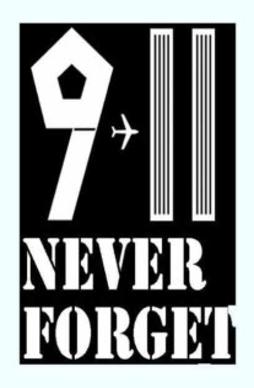
Never Forget 9/11, much less decode it

Never Forget 9-11 illustrating airliner flying from Pentagon to Twin TowersNever Forget What? The Alamo? The Maine? The Lusitania? Pearl Harbor? Every example of a tragedy our government exploits has turned out to be a fraud. Interesting company then for Nine Eleven… Although the traditional syntax is “Remember the–“. Usually “Never Forget” has been proprietary to Holocaust remembrance. Curious they’d want to dilute the tag line for a mere few thousand WTC victims. It makes me sick at heart. The event was seared into our memories, television broadcast at half mast for days afterward the better to sober the public to a terrorist attack’s ramifications. So WHY must we Never Forget? Revenge? Of course it’s shorthand for “Never Forget, Never Forgive.” You want an eye for an eye? How about vigilance? To prevent an alleged 9/11, we might be best to NEVER FORGET what got us here, brutal imperialist abuse heaped on the rest of the world. That’s the perspective it would be good to remember. Never forget Bhopal. Fallujah. Abu Ghraib, Gaza and Cast Lead. “Never Forget 9/11” is one of the first slogans trotted out at anti-Palestinian rallies. Curiouser and curiouser. So I’ve got more ships for you: Never forget the USS Liberty, or the Mavi Marmara.
 
As to 9/11, never forget that you haven’t been let to get to the bottom of it. But you don’t have to tell people not to forget something they know. “Never Forget” is for propagandists worried their brainwash is leaking.

ACLU and Shepard Fairey drape Lady Liberty in nationalism & jingo-freedom

New ACLU promotional poster by Shepard Farley (sic) features Statue of LibertyIs “Freedom” the same thing as Liberty? Let’s see, ACFU? It has an unfriendly ring to it.
 
The American Civil Liberties Union commissioned this fundraising magnet from halftone-deaf one-note Obamartist Shepard Fairey, but somebody confused this for a Department Of Defense contract. “Leading Freedom Forward”? That’s USA’s imperialist catchphrase! Please note at the helm is Fairey’s first client: Obama.

Linguists have long lamented America’s abandonment of liberty for the nefariously vacuous “freedom.” Freedom is for Operations, Markets, CIA-funded Pro-Democracy [sic] ops, and O-wellian doublespeak. “The Price of Freedom” is the title of the Smithsonian’s military history exhibit. Now the ACLU jumps on the war-wagon? That’s the Statue of Liberty with a bullhorn, as a union organizer — you can tell by the clipboard, but they’ve draped her in a flag, literally. Can you imagine any national monument with less need to prove her patriotism? I would have preferred they had used blind Lady Justice in reference to nationalism, where her blindfolded could have been the Red, White and Blue. But that’s probably a too obvious fashion statement about fascism. Dear ACLU, where are you going with this?

Let me clarify my criticism of Shepard Fairey. He’s a brilliant artist. By “halftone-deaf one-note” I refer to the FANS of his Blue Period, circa 2008. My beef is that this work recalls Fairey’s iconic Obama poster, though obviously it wouldn’t be considered a “Shepard Fairey creation” if it hadn’t. But. Is it appropriate that the ACLU wants to promote itself and its vital uni-partisan cause, with a ubiquivisual trademark that screams Democratic Party? Thankfully ACLU’s legal team at least has not failed to recognize Obama’s DP as the current reigning champion of civil liberty oppression.

Semper Fido Bitches

Semper FidelisCOLO. SPRINGS– Tough crowd at this week’s antiwar bannering: the usual plentiful honks of support, but now intermittent servicemen heckling in crew-cutted indignation. And we haven’t yet inaugurated our WARMONGERS GO TO HELL banner. The best the driver of a white van-load of them could muster was “Semper Fi” so they must have been Marines because they shout it like it means “America! Fuck Yeah!” Are they taught it’s abbreviated Latin for Always Faithful? I believe Fidelis is the root of Fido.

Makes sense, doesn’t it? Man’s faithful companion, the original boot-licker.

Faithful to what honestly? Not the Constitution, or law, liberty or the will of the American People. The US military boot-licking dogs pledge an oath to big oil and the rest of the corporate monied interests. Semper Bitches.

Another soldier-driver asked me with smug arrogance, where was my sign that read “Support the Troops?” Huh? I don’t support the troops. Does he support baby killers, rapists, torturers, drone-pilot-cowards and snipers? WTF. We parted calling each other names. Hippie. Blimp-neck enabler. Dirty hippie. Moron.

Do the other branches of the Defense Department resent the Marines because they don’t have their own pithy Latin je-ne-sais-quoi –literally– to represent their own mistaken-self identity? The Navy and Air Force already have a Native American name, he-who-shoots-from-cover. US Army GIs can modify the USM slogan: Semper Fuckers.

Jesus Springs welcomes fugitive Bush

After seeing Colorado College gush over a whitewashed CIA murderer, I’m not in any mood to watch local Christian groupies applaud George War-criminal Bush. The plan for Saturday at the Broadmoor is to pummel the arrogant creep with shoes, ceremoniously of course, and probably in effigy. We’ll have a Bush impersonator, a little monkey in a suit strutting about with impunity. And it appeals to me more that we not land any hits, so we’ll have Junior ducking this shoe and that, taunting us with his sick hehehe. And won’t that reflect reality? Justice frustrated by a snickering good ol’ boy. Except, is there outrage left for Bush? I know I hardly feel it anymore. It’s Obama dissembling about torture and dropping the bombs now.

Here’s the list of embarrassing local businesses and idiotri welcoming George Bush to Colorado Springs, they’re even giving him an award, apparently he’s an inspiration to charter school students:

Colorado Springs Christian Schools
Steve Schuck
Dick Saunders, Saunders Construction
El Pomar Foundation
Pete & Jackie Kuyper
Sonya Camarco, LPL Financial
Dewhirst & Dolven, Attorneys
Bob & Kelly McGrath
Dr. Ron & Renee Rains
Interim Healthcare
Clear Ink Foundation
Colorado Custom Decks
Dr. Mike & Kathy Hall
Mateos Salon & Day Spa
Dar Howard
Envision Investment Group
Dave & Lynda Bjorklund
First Western Trust Bank
Scott & Beth Bugosh
Richard King Brown
Freedom Financial Services
The Milestone Group
Clear View Properties
The Sonchar Family
Joseph & Melissa Hornsey
Ken & Rae Driscoll
Rick & Margaret Brown
David & Gloria Neuder
Todd Pickle
Lee & Mickey Bolin
Seelye Group Ltd.
Liberty Toyota
Matrix Design Group
DWG & Associates
Blazer Electric Supply
ACSI
Joe Woodford
Thor Iverson Consulting
Rothgerber Johnson Lyons LLP
Kathryn Emrick
American Iron & Metal
Stephanie Brock Design
Integrity First Financial
Phil & Mary Kiemel
Weavers Online
Rocky Mountain Custom Trim

Remember the Maine? Egyptians will.

Remember the Maine? In 1898 a popular uprising was threatening Spanish rule in Cuba. alright, it's actually the USS Baltimore, Flaccus Brothers Prepared Mustard The US Navy cruised to the rescue. The rescue of whom, we never got the chance to find out. An explosion aboard the USS Maine gave America the pretext to blame a Spanish torpedo. An America inflamed by a jingoist press declared war on Spain and promptly seized her colonies “to protect US interests,” by coincidence just as the indigenous populations were overcoming their colonizer and were about to win their freedom. Today a US attack fleet speeds toward Egypt. Washington asserts its mission is to evacuate US nationals if need be.

I’d like to imagine the amphibious assault ship USS Kearsarge will position itself off Egypt’s coast to facilitate the Egyptian government’s stable transition to Democracy.

Perhaps the fleet intends to augment the security which Hosni Mubarak is deliberately destabilizing in Egypt. Perhaps they will offer medical care for Egyptian protesters denied access to Cairo hospitals if their wounds incriminate the government. Perhaps sophisticated Navy electronics will provide an alternate internet backbone if Mubarak tries cut his people off the web. Perhaps the US Navy can help jam the state television station still broadcasting lies to the broader population. I’m hoping our navy can erect a gallows prominently on the bow, to threaten Mubarak, speaking in the only language the despicable dictator might understand, an urgency he doesn’t feel from the peaceful protesters of Tahrir Square.

Possible?

Is it more likely to be a false flag like the Maine? Remember the USS Liberty? That was a US intelligence ship attacked in 1967 by unmarked Israeli planes, hoping that Egypt would catch the blame? There was more to that story and anyway it didn’t work out.

Remember whatever boat it was attacked/not-attacked in the Gulf of Tonkin Incident? That worked.

“Showing the Flag” doesn’t have to be false flag. Remember the USS Cole? Worked in Yemen. Traditional foreign policy teaches that gunboat diplomacy asserts military dominance. Actually it runs a calculated risk. It draws out indignation and a show of defiance. Because a military wants to flush out resistance sooner than being taken by surprise.

Remember the enterprising Marines in Iraq who drove around with a megaphone insulting the Prophet Mohammad? They repeated Jesus Killed Mohammad until every last proud Muslim to renounce their blasphemy was baptized in an obliteration of firepower.

Remember the Maine? Americans remember the Maine like it remembers the Alamo or 9-11. We have no idea. We have no sense of deja vu about the US spreading its forces in defense of empire. I’m really hoping this is not the equivalent of the Soviets sending their tanks into Hungary in 1956.

But Americans have nothing on the educated Egyptians. Whatever America’s gunships have in mind, the Arab world has seen it. Jan25 organizers continue to defy media expectations about the movement losing steam. Attendance keep rising, yesterday pro-Mubarak citizens were proclaiming their changed allegiance. Today the labor unions are recognizing the imperative of launching a general strike, and protesters are venturing outside of the central demonstrations, threatening government buildings and facilities.

With every successive day of victories for the Democracy-seeking demonstrators of Tahrir Square, I have every confidence that the Egyptians will outwit this latest US envoy convoy.

Amazon pedophile guide author Phillip Greaves is going to Disneyland!

PUEBLO, CO – Self-published self-abuser Phillip R. Greaves is going to Disneyland! Do I mean Disney World –because the molestation e-book author is being extradited to Florida? Naw. Thanks to the gung-ho deviant-phobic Florida Polk County Sheriff, the Amazon-banned-infamous, now civil-liberty-abridged, self-scribed child-lover will be jerking off all the way to the bank. Greaves’ The Pedophile’s Guide to Love and Pleasure is accused of violating obscenity laws and haven’t we been down this road before? Freedom of speech, what’s indecent, Larry Flynt, Nabokov, to name the obvious?

Now I have to tell you, I’d much prefer to defend a literary classic than this Stuart Smalley act for the NAMBLA set, and I wince as I imagine the ACLU inviting more tar-and-feathers as it defends another pedophile, but freedom of expression is absolute. It applies to heretical dissidents as much as to Sarah Palin. Idiots have opinions too, that doesn’t mean you have to listen to them.

Greaves’ DIY rotten-oeuvre probably does not redeem itself with literary merit, I’m guessing, nor do charges mention the book contains contraband photos. Thus the Polk County Sheriff attack may be soiling new ground. The how-to manual is being adjudged indecent based on written accounts of defiling underage fictional characters. Greaves is not under suspicion of having committed the crimes. We can deduce by the lack of charges that no minors were harmed in the making of Phillip Greaves’ fantasies. His “guide book” contains no pictures of exploited children. Greaves is being charged with describing illegal sexual acts which are injurious to minors. So what exactly differentiates this book from other tasteless works of fiction which recount criminal acts, even the most taboo?

There will always be a bible-belt backwater to send out invites for a book-burning. I’m upset I suppose because the Polk County authorities were able to convince Colorado law enforcement in Pueblo to arrest Greaves on their behalf, based on his having shipped a copy of his weirdo book over to their Florida jurisdiction. So it turns our Colorado lawmen are uneducated enough that they went along. At least we could be grateful that evidently they lack the initiative to devise such a sting themselves.

In his zeal to whomp on Phillip Greaves on behalf of the angry mob over at Amazon thirsty for fictional pedophile blood, the Polk County Sheriff bragged he hoped to have the author “eating processed-turkey this Christmas.” As good an admission as any that prison chow is intended to be punishment. This one defines “cruel and unusual” which used to be rationale enough to prohibit state practice, but these days we can’t be bothered to prevent torture.

I shouldn’t minimize the ordeal which Greaves will face with his jailers and fellow inmates, needless to say he’ll be earning every penny of the huge civil liberties settlement to which he is entitled. Maybe in turn he’ll be able to sue Amazon too.

The upshot for the residents of Polk County Florida is that internet merchants will have to be very careful about what they ship to zip codes 33830, 33837, 33841, 33843, 33868, 33898, and 34759. I hope the Polkels get nothing at all in the mail until they recall the grandstanding idiot they have for a sheriff.

But seriously. Are we cheerleading for the prosecution of thought crime? If Greaves had written in the third person, would police be serving a warrant on a page-bound protagonist?

Compared to pedestrian pornography, Phillip Greaves is an amateur. In US sex culture every fetish seems to find its audience. Who can deny that the sexualization of American children is pervasive across print and screen? This isn’t about the arbitrary condemnation of the fantasy life of perverts. Subversive classics of literature are often censored based on accusations of obscenity.

Marlon Brando’s lost Oscar speech

In 1973 Marlon Brando declined a best actor award for the Godfather in solidarity with the American Indian. Yada yada yada, only that much we remember. Something to do with Wounded Knee, but the average American might be excused for confusing the massacre of 300 Lakota in 1890, the contemporary deadly FBI-AIM confrontation, and Dee Brown’s bestseller. A new documentary Reel Injun, about Hollywood’s skewed portrayal of Native Americans, unearths Apache Sasheen Littlefeather’s incredibly poised delivery of Brando’s Oscar message.

Littlefeather was confined by time limits to present only this abbreviation, interrupted by audience booing and then simultaneous applause. Youtube has the clip, for which the transcript is below.

“Marlon Brando … has asked me to tell you, in a very long speech which I cannot share with you presently —because of time— but I will be glad to share with the press afterward, that he must… very regretfully cannot accept this very generous award.

And the reason for this being… are the treatment of American Indians today by the film industry… excuse me… and on television in movie re-runs, and also the recent happenings at Wounded Knee.

I beg at this time that I have not intruded upon this evening and that we will, in the future…our hearts and our understanding will meet with love and generosity. Thank you on behalf of Marlon Brando.”

Brando’s formal statement was released to reporters after the ceremonies.

For 200 years we have said to the Indian people who are fighting for their land, their life, their families and their right to be free: ”Lay down your arms, my friends, and then we will remain together. Only if you lay down your arms, my friends, can we then talk of peace and come to an agreement which will be good for you.”?

     When they laid down their arms, we murdered them. We lied to them. We cheated them out of their lands. We starved them into signing fraudulent agreements that we called treaties which we never kept. We turned them into beggars on a continent that gave life for as long as life can remember. And by any interpretation of history, however twisted, we did not do right. We were not lawful nor were we just in what we did. For them, we do not have to restore these people, we do not have to live up to some agreements, because it is given to us by virtue of our power to attack the rights of others, to take their property, to take their lives when they are trying to defend their land and liberty, and to make their virtues a crime and our own vices virtues.?

?     But there is one thing which is beyond the reach of this perversity and that is the tremendous verdict of history. And history will surely judge us. But do we care? What kind of moral schizophrenia is it that allows us to shout at the top of our national voice for all the world to hear that we live up to our commitment when every page of history and when all the thirsty, starving, humiliating days and nights of the last 100 years in the lives of the American Indian contradict that voice??

?     It would seem that the respect for principle and the love of one’s neighbor have become dysfunctional in this country of ours, and that all we have done, all that we have succeeded in accomplishing with our power is simply annihilating the hopes of the newborn countries in this world, as well as friends and enemies alike, that we’re not humane, and that we do not live up to our agreements.?

?     Perhaps at this moment you are saying to yourself what the hell has all this got to do with the Academy Awards? Why is this woman standing up here, ruining our evening, invading our lives with things that don’t concern us, and that we don’t care about? Wasting our time and money and intruding in our homes.?

?     I think the answer to those unspoken questions is that the motion picture community has been as responsible as any for degrading the Indian and making a mockery of his character, describing his as savage, hostile and evil. It’s hard enough for children to grow up in this world. When Indian children watch television, and they watch films, and when they see their race depicted as they are in films, their minds become injured in ways we can never know.?

?     Recently there have been a few faltering steps to correct this situation, but too faltering and too few, so I, as a member in this profession, do not feel that I can as a citizen of the United States accept an award here tonight. I think awards in this country at this time are inappropriate to be received or given until the condition of the American Indian is drastically altered. If we are not our brother’s keeper, at least let us not be his executioner.?

?     I would have been here tonight to speak to you directly, but I felt that perhaps I could be of better use if I went to Wounded Knee to help forestall in whatever way I can the establishment of a peace which would be dishonorable as long as the rivers shall run and the grass shall grow.?

?     I would hope that those who are listening would not look upon this as a rude intrusion, but as an earnest effort to focus attention on an issue that might very well determine whether or not this country has the right to say from this point forward we believe in the inalienable rights of all people to remain free and independent on lands that have supported their life beyond living memory.?

?     Thank you for your kindness and your courtesy to Miss Littlefeather. Thank you and good night.

Was Jesus a Muslim (tee-hee)?

Listening to Islamic studies scholar Robert Shedinger taunt the CC audience with whether Jesus may have been a Muslim reminds me of the not-so-old joke about returning the Statue of Liberty to the French, because we’re not using her anymore. At his fundamental, Jesus espoused what we are accustomed to consider were basic Christian Values, but who are American Christians to lay claim to those anymore?

Islam, on the other hand, is a religion to suit the poor and oppressed, traditionally Jesus’ favorites. Unless we’re talking Embed Jesus.

Shedinger urged “constructive dialog” between Muslims and Christians, that each might learn of our common ideals. But his lesson would seem to be entirely for the Christians. All religions share the Golden Rule, do unto others as you would have them do unto you, although one might doubt Americans have given that much thought for awhile.

While many would argue that American religious hypocrisy has been growing fetid over the course of a centuries of imperialist invasions and wars, the Fundamentalist Christian/Moral Majority “WWJD” has taken a turn since 9/11 to mean bomb, maim and torture. Has the American Jesus become Un-Christian, or is this the New World Order Christianity?

In spite of what may be pious America’s best intentions, Capitalism has relegated its moral cover to doublespeak and subterfuge, American churchgoers to dupes, and US missionaries to unwitting cohorts to the deprivations of our businessmen, soldiers and loan officers.

The War on Islam isn’t being waged by Christianity Proper, but by the systemic greed of Western Capitalism, secular and godless, unless you count money to be divine. Capitalism may have Xmas, but it has no claim on Jesus.

Emma Goldman on Direct Action

Yes it was Emma Goldman who said “If voting changed anything, they’d make it illegal.”
It was no mere quip. The turn of the last century activist was a fierce advocate of every social reform and was ultimately exiled to Europe for challenging forced conscription. Do you wonder what else Goldman had to say, about political violence, prisons, patriotism, puritanism, the traffic of women, suffrage, poverty, birth control, and the struggle of minorities? Far from being a cynic, Goldman offered an alternative to the false hope of the ballot box.

What does the history of parliamentarism show? Nothing but failure and defeat, not even a single reform to ameliorate the economic and social stress of the people. Laws have been passed and enactments made for the improvement and protection of labor. Thus it was proven only last year that Illinois, with the most rigid laws for mine protection, had the greatest mine disasters. In States where child labor laws prevail, child exploitation is at its highest, and though with us the workers enjoy full political opportunities, capitalism has reached the most brazen zenith.

It may be claimed that men of integrity would not become corrupt in the political grinding mill. Perhaps not; but such men would be absolutely helpless to exert the slightest influence in behalf of labor, as indeed has been shown in numerous instances. The State is the economic master of its servants. Good men, if such there be, would either remain true to their political faith and lose their economic support, or they would cling to their economic master and be utterly unable to do the slightest good. The political arena leaves one no alternative, one must either be a dunce or a rogue.

The political superstition is still holding sway over the hearts and minds of the masses, but the true lovers of liberty will have no more to do with it. Instead, they believe with Stirner that man has as much liberty as he is willing to take.

Universal suffrage itself owes its existence to direct action. If not for the spirit of rebellion, of the defiance on the part of the American revolutionary fathers, their posterity would still wear the King’s coat. If not for the direct action of a John Brown and his comrades, America would still trade in the flesh of the black man. True, the trade in white flesh is still going on; but that, too, will have to be abolished by direct action. Trade-unionism, the economic arena of the modern gladiator, owes its existence to direct action. It is but recently that law and government have attempted to crush the trade-union movement, and condemned the exponents of man’s right to organize to prison as conspirators. Had they sought to assert their cause through begging, pleading, and compromise, trade-unionism would today be a negligible quantity. In France, in Spain, in Italy, in Russia, nay even in England (witness the growing rebellion of English labor unions), direct, revolutionary, economic action has become so strong a force in the battle for industrial liberty as to make the world realize the tremendous importance of labor’s power. The General Strike, the supreme expression of the economic consciousness of the workers, was ridiculed in America but a short time ago. Today every great strike, in order to win, must realize the importance of the solidaric general protest.

Direct action, having proven effective along economic lines, is equally potent in the environment of the individual. There a hundred forces encroach upon his being, and only persistent resistance to them will finally set him free. Direct action against the authority in the shop, direct action against the authority of the law, direct action against the invasive, meddlesome authority of our moral code, is the logical, consistent method of Anarchism.

Will it not lead to a revolution? Indeed, it will. No real social change has ever come about without a revolution. People are either not familiar with their history, or they have not yet learned that revolution is but thought carried into action.

Here’s the full essay from which the above was excerpted, where Goldman cites Emerson, Wilde, Burroughs, Thoreau and GBS to laud the promise of anarchism and direct action.

ANARCHISM: WHAT IT REALLY STANDS FOR

ANARCHY.??

Ever reviled, accursed, ne’er understood,?
Thou art the grisly terror of our age.?
“Wreck of all order,” cry the multitude,?
“Art thou, and war and murder’s endless rage.
“?O, let them cry. To them that ne’er have striven?
The truth that lies behind a word to find,?
To them the word’s right meaning was not given.?
They shall continue blind among the blind.?
But thou, O word, so clear, so strong, so pure,
?Thou sayest all which I for goal have taken.?
I give thee to the future! Thine secure
?When each at least unto himself shall waken.?
Comes it in sunshine? In the tempest’s thrill??
I cannot tell–but it the earth shall see!
?I am an Anarchist! Wherefore I will
?Not rule, and also ruled I will not be!?
?
JOHN HENRY MACKAY.

THE history of human growth and development is at the same time the history of the terrible struggle of every new idea heralding the approach of a brighter dawn. In its tenacious hold on tradition, the Old has never hesitated to make use of the foulest and cruelest means to stay the advent of the New, in whatever form or period the latter may have asserted itself. Nor need we retrace our steps into the distant past to realize the enormity of opposition, difficulties, and hardships placed in the path of every progressive idea. The rack, the thumbscrew, and the knout are still with us; so are the convict’s garb and the social wrath, all conspiring against the spirit that is serenely marching on.

Anarchism could not hope to escape the fate of all other ideas of innovation. Indeed, as the most revolutionary and uncompromising innovator, Anarchism must needs meet with the combined ignorance and venom of the world it aims to reconstruct.

To deal even remotely with all that is being said and done against Anarchism would necessitate the writing of a whole volume. I shall therefore meet only two of the principal objections. In so doing, I shall attempt to elucidate what Anarchism really stands for.

The strange phenomenon of the opposition to Anarchism is that it brings to light the relation between so-called intelligence and ignorance. And yet this is not so very strange when we consider the relativity of all things. The ignorant mass has in its favor that it makes no pretense of knowledge or tolerance. Acting, as it always does, by mere impulse, its reasons are like those of a child. “Why?” “Because.” Yet the opposition of the uneducated to Anarchism deserves the same consideration as that of the intelligent man.

What, then, are the objections? First, Anarchism is impractical, though a beautiful ideal. Second, Anarchism stands for violence and destruction, hence it must be repudiated as vile and dangerous. Both the intelligent man and the ignorant mass judge not from a thorough knowledge of the subject, but either from hearsay or false interpretation.

A practical scheme, says Oscar Wilde, is either one already in existence, or a scheme that could be carried out under the existing conditions; but it is exactly the existing conditions that one objects to, and any scheme that could accept these conditions is wrong and foolish. The true criterion of the practical, therefore, is not whether the latter can keep intact the wrong or foolish; rather is it whether the scheme has vitality enough to leave the stagnant waters of the old, and build, as well as sustain, new life. In the light of this conception, Anarchism is indeed practical. More than any other idea, it is helping to do away with the wrong and foolish; more than any other idea, it is building and sustaining new life.

The emotions of the ignorant man are continuously kept at a pitch by the most blood-curdling stories about Anarchism. Not a thing too outrageous to be employed against this philosophy and its exponents. Therefore Anarchism represents to the unthinking what the proverbial bad man does to the child,–a black monster bent on swallowing everything; in short, destruction and violence.

Destruction and violence! How is the ordinary man to know that the most violent element in society is ignorance; that its power of destruction is the very thing Anarchism is combating? Nor is he aware that Anarchism, whose roots, as it were, are part of nature’s forces, destroys, not healthful tissue, but parasitic growths that feed on the life’s essence of society. It is merely clearing the soil from weeds and sagebrush, that it may eventually bear healthy fruit.

Someone has said that it requires less mental effort to condemn than to think. The widespread mental indolence, so prevalent in society, proves this to be only too true. Rather than to go to the bottom of any given idea, to examine into its origin and meaning, most people will either condemn it altogether, or rely on some superficial or prejudicial definition of non-essentials.

Anarchism urges man to think, to investigate, to analyze every proposition; but that the brain capacity of the average reader be not taxed too much, I also shall begin with a definition, and then elaborate on the latter.

ANARCHISM: –The philosophy of a new social order based on liberty unrestricted by man-made law; the theory that all forms of government rest on violence, and are therefore wrong and harmful, as well as unnecessary.

The new social order rests, of course, on the materialistic basis of life; but while all Anarchists agree that the main evil today is an economic one, they maintain that the solution of that evil can be brought about only through the consideration of every phase of life,–individual, as well as the collective; the internal, as well as the external phases.

A thorough perusal of the history of human development will disclose two elements in bitter conflict with each other; elements that are only now beginning to be understood, not as foreign to each other, but as closely related and truly harmonious, if only placed in proper environment: the individual and social instincts. The individual and society have waged a relentless and bloody battle for ages, each striving for supremacy, because each was blind to the value and importance of the other. The individual and social instincts,–the one a most potent factor for individual endeavor, for growth, aspiration, self-realization; the other an equally potent factor for mutual helpfulness and social well-being.

The explanation of the storm raging within the individual, and between him and his surroundings, is not far to seek. The primitive man, unable to understand his being, much less the unity of all life, felt himself absolutely dependent on blind, hidden forces ever ready to mock and taunt him. Out of that attitude grew the religious concepts of man as a mere speck of dust dependent on superior powers on high, who can only be appeased by complete surrender. All the early sagas rest on that idea, which continues to be the Leitmotiv of the biblical tales dealing with the relation of man to God, to the State, to society. Again and again the same motif, man is nothing, the powers are everything. Thus Jehovah would only endure man on condition of complete surrender. Man can have all the glories of the earth, but he must not become conscious of himself. The State, society, and moral laws all sing the same refrain: Man can have all the glories of the earth, but he must not become conscious of himself.

Anarchism is the only philosophy which brings to man the consciousness of himself; which maintains that God, the State, and society are non-existent, that their promises are null and void, since they can be fulfilled only through man’s subordination. Anarchism is therefore the teacher of the unity of life; not merely in nature, but in man. There is no conflict between the individual and the social instincts, any more than there is between the heart and the lungs: the one the receptacle of a precious life essence, the other the repository of the element that keeps the essence pure and strong. The individual is the heart of society, conserving the essence of social life; society is the lungs which are distributing the element to keep the life essence–that is, the individual–pure and strong.

“The one thing of value in the world,” says Emerson, “is the active soul; this every man contains within him. The soul active sees absolute truth and utters truth and creates.” In other words, the individual instinct is the thing of value in the world. It is the true soul that sees and creates the truth alive, out of which is to come a still greater truth, the re-born social soul.

Anarchism is the great liberator of man from the phantoms that have held him captive; it is the arbiter and pacifier of the two forces for individual and social harmony. To accomplish that unity, Anarchism has declared war on the pernicious influences which have so far prevented the harmonious blending of individual and social instincts, the individual and society.

Religion, the dominion of the human mind; Property, the dominion of human needs; and Government, the dominion of human conduct, represent the stronghold of man’s enslavement and all the horrors it entails. Religion! How it dominates man’s mind, how it humiliates and degrades his soul. God is everything, man is nothing, says religion. But out of that nothing God has created a kingdom so despotic, so tyrannical, so cruel, so terribly exacting that naught but gloom and tears and blood have ruled the world since gods began. Anarchism rouses man to rebellion against this black monster. Break your mental fetters, says Anarchism to man, for not until you think and judge for yourself will you get rid of the dominion of darkness, the greatest obstacle to all progress.

Property, the dominion of man’s needs, the denial of the right to satisfy his needs. Time was when property claimed a divine right, when it came to man with the same refrain, even as religion, “Sacrifice! Abnegate! Submit!” The spirit of Anarchism has lifted man from his prostrate position. He now stands erect, with his face toward the light. He has learned to see the insatiable, devouring, devastating nature of property, and he is preparing to strike the monster dead.

“Property is robbery,” said the great French Anarchist Proudhon. Yes, but without risk and danger to the robber. Monopolizing the accumulated efforts of man, property has robbed him of his birthright, and has turned him loose a pauper and an outcast. Property has not even the time-worn excuse that man does not create enough to satisfy all needs. The A B C student of economics knows that the productivity of labor within the last few decades far exceeds normal demand. But what are normal demands to an abnormal institution? The only demand that property recognizes is its own gluttonous appetite for greater wealth, because wealth means power; the power to subdue, to crush, to exploit, the power to enslave, to outrage, to degrade. America is particularly boastful of her great power, her enormous national wealth. Poor America, of what avail is all her wealth, if the individuals comprising the nation are wretchedly poor? If they live in squalor, in filth, in crime, with hope and joy gone, a homeless, soilless army of human prey.

It is generally conceded that unless the returns of any business venture exceed the cost, bankruptcy is inevitable. But those engaged in the business of producing wealth have not yet learned even this simple lesson. Every year the cost of production in human life is growing larger (50,000 killed, 100,000 wounded in America last year); the returns to the masses, who help to create wealth, are ever getting smaller. Yet America continues to be blind to the inevitable bankruptcy of our business of production. Nor is this the only crime of the latter. Still more fatal is the crime of turning the producer into a mere particle of a machine, with less will and decision than his master of steel and iron. Man is being robbed not merely of the products of his labor, but of the power of free initiative, of originality, and the interest in, or desire for, the things he is making.

Real wealth consists in things of utility and beauty, in things that help to create strong, beautiful bodies and surroundings inspiring to live in. But if man is doomed to wind cotton around a spool, or dig coal, or build roads for thirty years of his life, there can be no talk of wealth. What he gives to the world is only gray and hideous things, reflecting a dull and hideous existence,–too weak to live, too cowardly to die. Strange to say, there are people who extol this deadening method of centralized production as the proudest achievement of our age. They fail utterly to realize that if we are to continue in machine subserviency, our slavery is more complete than was our bondage to the King. They do not want to know that centralization is not only the death-knell of liberty, but also of health and beauty, of art and science, all these being impossible in a clock-like, mechanical atmosphere.

Anarchism cannot but repudiate such a method of production: its goal is the freest possible expression of all the latent powers of the individual. Oscar Wilde defines a perfect personality as “one who develops under perfect conditions, who is not wounded, maimed, or in danger.” A perfect personality, then, is only possible in a state of society where man is free to choose the mode of work, the conditions of work, and the freedom to work. One to whom the making of a table, the building of a house, or the tilling of the soil, is what the painting is to the artist and the discovery to the scientist,–the result of inspiration, of intense longing, and deep interest in work as a creative force. That being the ideal of Anarchism, its economic arrangements must consist of voluntary productive and distributive associations, gradually developing into free communism, as the best means of producing with the least waste of human energy. Anarchism, however, also recognizes the right of the individual, or numbers of individuals, to arrange at all times for other forms of work, in harmony with their tastes and desires.

Such free display of human energy being possible only under complete individual and social freedom, Anarchism directs its forces against the third and greatest foe of all social equality; namely, the State, organized authority, or statutory law,–the dominion of human conduct.

Just as religion has fettered the human mind, and as property, or the monopoly of things, has subdued and stifled man’s needs, so has the State enslaved his spirit, dictating every phase of conduct. “All government in essence,” says Emerson, “is tyranny.” It matters not whether it is government by divine right or majority rule. In every instance its aim is the absolute subordination of the individual.

Referring to the American government, the greatest American Anarchist, David Thoreau, said:

“Government, what is it but a tradition, though a recent one, endeavoring to transmit itself unimpaired to posterity, but each instance losing its integrity; it has not the vitality and force of a single living man. Law never made man a whit more just; and by means of their respect for it, even the well disposed are daily made agents of injustice.”

Indeed, the keynote of government is injustice. With the arrogance and self-sufficiency of the King who could do no wrong, governments ordain, judge, condemn, and punish the most insignificant offenses, while maintaining themselves by the greatest of all offenses, the annihilation of individual liberty. Thus Ouida is right when she maintains that

“the State only aims at instilling those qualities in its public by which its demands are obeyed, and its exchequer is filled. Its highest attainment is the reduction of mankind to clockwork. In its atmosphere all those finer and more delicate liberties, which require treatment and spacious expansion, inevitably dry up and perish. The State requires a taxpaying machine in which there is no hitch, an exchequer in which there is never a deficit, and a public, monotonous, obedient, colorless, spiritless, moving humbly like a flock of sheep along a straight high road between two walls.”

Yet even a flock of sheep would resist the chicanery of the State, if it were not for the corruptive, tyrannical, and oppressive methods it employs to serve its purposes. Therefore Bakunin repudiates the State as synonymous with the surrender of the liberty of the individual or small minorities,–the destruction of social relationship, the curtailment, or complete denial even, of life itself, for its own aggrandizement. The State is the altar of political freedom and, like the religious altar, it is maintained for the purpose of human sacrifice.

In fact, there is hardly a modern thinker who does not agree that government, organized authority, or the State, is necessary only to maintain or protect property and monopoly. It has proven efficient in that function only.

Even George Bernard Shaw, who hopes for the miraculous from the State under Fabianism, nevertheless admits that “it is at present a huge machine for robbing and slave-driving of the poor by brute force.” This being the case, it is hard to see why the clever prefacer wishes to uphold the State after poverty shall have ceased to exist.

Unfortunately, there are still a number of people who continue in the fatal belief that government rests on natural laws, that it maintains social order and harmony, that it diminishes crime, and that it prevents the lazy man from fleecing his fellows. I shall therefore examine these contentions.

A natural law is that factor in man which asserts itself freely and spontaneously without any external force, in harmony with the requirements of nature. For instance, the demand for nutrition, for sex gratification, for light, air, and exercise, is a natural law. But its expression needs not the machinery of government, needs not the club, the gun, the handcuff, or the prison. To obey such laws, if we may call it obedience, requires only spontaneity and free opportunity. That governments do not maintain themselves through such harmonious factors is proven by the terrible array of violence, force, and coercion all governments use in order to live. Thus Blackstone is right when he says, “Human laws are invalid, because they are contrary to the laws of nature.”

Unless it be the order of Warsaw after the slaughter of thousands of people, it is difficult to ascribe to governments any capacity for order or social harmony. Order derived through submission and maintained by terror is not much of a safe guaranty; yet that is the only “order” that governments have ever maintained. True social harmony grows naturally out of solidarity of interests. In a society where those who always work never have anything, while those who never work enjoy everything, solidarity of interests is non-existent; hence social harmony is but a myth. The only way organized authority meets this grave situation is by extending still greater privileges to those who have already monopolized the earth, and by still further enslaving the disinherited masses. Thus the entire arsenal of government–laws, police, soldiers, the courts, legislatures, prisons,–is strenuously engaged in “harmonizing” the most antagonistic elements in society.

The most absurd apology for authority and law is that they serve to diminish crime. Aside from the fact that the State is itself the greatest criminal, breaking every written and natural law, stealing in the form of taxes, killing in the form of war and capital punishment, it has come to an absolute standstill in coping with crime. It has failed utterly to destroy or even minimize the horrible scourge of its own creation.

Crime is naught but misdirected energy. So long as every institution of today, economic, political, social, and moral, conspires to misdirect human energy into wrong channels; so long as most people are out of place doing the things they hate to do, living a life they loathe to live, crime will be inevitable, and all the laws on the statutes can only increase, but never do away with, crime. What does society, as it exists today, know of the process of despair, the poverty, the horrors, the fearful struggle the human soul must pass on its way to crime and degradation. Who that knows this terrible process can fail to see the truth in these words of Peter Kropotkin:

“Those who will hold the balance between the benefits thus attributed to law and punishment and the degrading effect of the latter on humanity; those who will estimate the torrent of depravity poured abroad in human society by the informer, favored by the Judge even, and paid for in clinking cash by governments, under the pretext of aiding to unmask crime; those who will go within prison walls and there see what human beings become when deprived of liberty, when subjected to the care of brutal keepers, to coarse, cruel words, to a thousand stinging, piercing humiliations, will agree with us that the entire apparatus of prison and punishment is an abomination which ought to be brought to an end.”

The deterrent influence of law on the lazy man is too absurd to merit consideration. If society were only relieved of the waste and expense of keeping a lazy class, and the equally great expense of the paraphernalia of protection this lazy class requires, the social tables would contain an abundance for all, including even the occasional lazy individual. Besides, it is well to consider that laziness results either from special privileges, or physical and mental abnormalities. Our present insane system of production fosters both, and the most astounding phenomenon is that people should want to work at all now. Anarchism aims to strip labor of its deadening, dulling aspect, of its gloom and compulsion. It aims to make work an instrument of joy, of strength, of color, of real harmony, so that the poorest sort of a man should find in work both recreation and hope.

To achieve such an arrangement of life, government, with its unjust, arbitrary, repressive measures, must be done away with. At best it has but imposed one single mode of life upon all, without regard to individual and social variations and needs. In destroying government and statutory laws, Anarchism proposes to rescue the self-respect and independence of the individual from all restraint and invasion by authority. Only in freedom can man grow to his full stature. Only in freedom will he learn to think and move, and give the very best in him. Only in freedom will he realize the true force of the social bonds which knit men together, and which are the true foundation of a normal social life.

But what about human nature? Can it be changed? And if not, will it endure under Anarchism?

Poor human nature, what horrible crimes have been committed in thy name! Every fool, from king to policeman, from the flatheaded parson to the visionless dabbler in science, presumes to speak authoritatively of human nature. The greater the mental charlatan, the more definite his insistence on the wickedness and weaknesses of human nature. Yet, how can any one speak of it today, with every soul in a prison, with every heart fettered, wounded, and maimed?

John Burroughs has stated that experimental study of animals in captivity is absolutely useless. Their character, their habits, their appetites undergo a complete transformation when torn from their soil in field and forest. With human nature caged in a narrow space, whipped daily into submission, how can we speak of its potentialities?

Freedom, expansion, opportunity, and, above all, peace and repose, alone can teach us the real dominant factors of human nature and all its wonderful possibilities.

Anarchism, then, really stands for the liberation of the human mind from the dominion of religion; the liberation of the human body from the dominion of property; liberation from the shackles and restraint of government. Anarchism stands for a social order based on the free grouping of individuals for the purpose of producing real social wealth; an order that will guarantee to every human being free access to the earth and full enjoyment of the necessities of life, according to individual desires, tastes, and inclinations.

This is not a wild fancy or an aberration of the mind. It is the conclusion arrived at by hosts of intellectual men and women the world over; a conclusion resulting from the close and studious observation of the tendencies of modern society: individual liberty and economic equality, the twin forces for the birth of what is fine and true in man.

As to methods. Anarchism is not, as some may suppose, a theory of the future to be realized through divine inspiration. It is a living force in the affairs of our life, constantly creating new conditions. The methods of Anarchism therefore do not comprise an iron-clad program to be carried out under all circumstances. Methods must grow out of the economic needs of each place and clime, and of the intellectual and temperamental requirements of the individual. The serene, calm character of a Tolstoy will wish different methods for social reconstruction than the intense, overflowing personality of a Michael Bakunin or a Peter Kropotkin. Equally so it must be apparent that the economic and political needs of Russia will dictate more drastic measures than would England or America. Anarchism does not stand for military drill and uniformity; it does, however, stand for the spirit of revolt, in whatever form, against everything that hinders human growth. All Anarchists agree in that, as they also agree in their opposition to the political machinery as a means of bringing about the great social change.

“All voting,” says Thoreau, “is a sort of gaming, like checkers, or backgammon, a playing with right and wrong; its obligation never exceeds that of expediency. Even voting for the right thing is doing nothing for it. A wise man will not leave the right to the mercy of chance, nor wish it to prevail through the power of the majority.” A close examination of the machinery of politics and its achievements will bear out the logic of Thoreau.

What does the history of parliamentarism show? Nothing but failure and defeat, not even a single reform to ameliorate the economic and social stress of the people. Laws have been passed and enactments made for the improvement and protection of labor. Thus it was proven only last year that Illinois, with the most rigid laws for mine protection, had the greatest mine disasters. In States where child labor laws prevail, child exploitation is at its highest, and though with us the workers enjoy full political opportunities, capitalism has reached the most brazen zenith.

Even were the workers able to have their own representatives, for which our good Socialist politicians are clamoring, what chances are there for their honesty and good faith? One has but to bear in mind the process of politics to realize that its path of good intentions is full of pitfalls: wire-pulling, intriguing, flattering, lying, cheating; in fact, chicanery of every description, whereby the political aspirant can achieve success. Added to that is a complete demoralization of character and conviction, until nothing is left that would make one hope for anything from such a human derelict. Time and time again the people were foolish enough to trust, believe, and support with their last farthing aspiring politicians, only to find themselves betrayed and cheated.

It may be claimed that men of integrity would not become corrupt in the political grinding mill. Perhaps not; but such men would be absolutely helpless to exert the slightest influence in behalf of labor, as indeed has been shown in numerous instances. The State is the economic master of its servants. Good men, if such there be, would either remain true to their political faith and lose their economic support, or they would cling to their economic master and be utterly unable to do the slightest good. The political arena leaves one no alternative, one must either be a dunce or a rogue.

The political superstition is still holding sway over the hearts and minds of the masses, but the true lovers of liberty will have no more to do with it. Instead, they believe with Stirner that man has as much liberty as he is willing to take. Anarchism therefore stands for direct action, the open defiance of, and resistance to, all laws and restrictions, economic, social, and moral. But defiance and resistance are illegal. Therein lies the salvation of man. Everything illegal necessitates integrity, self-reliance, and courage. In short, it calls for free, independent spirits, for “men who are men, and who have a bone in their backs which you cannot pass your hand through.”

Universal suffrage itself owes its existence to direct action. If not for the spirit of rebellion, of the defiance on the part of the American revolutionary fathers, their posterity would still wear the King’s coat. If not for the direct action of a John Brown and his comrades, America would still trade in the flesh of the black man. True, the trade in white flesh is still going on; but that, too, will have to be abolished by direct action. Trade-unionism, the economic arena of the modern gladiator, owes its existence to direct action. It is but recently that law and government have attempted to crush the trade-union movement, and condemned the exponents of man’s right to organize to prison as conspirators. Had they sought to assert their cause through begging, pleading, and compromise, trade-unionism would today be a negligible quantity. In France, in Spain, in Italy, in Russia, nay even in England (witness the growing rebellion of English labor unions), direct, revolutionary, economic action has become so strong a force in the battle for industrial liberty as to make the world realize the tremendous importance of labor’s power. The General Strike, the supreme expression of the economic consciousness of the workers, was ridiculed in America but a short time ago. Today every great strike, in order to win, must realize the importance of the solidaric general protest.

Direct action, having proven effective along economic lines, is equally potent in the environment of the individual. There a hundred forces encroach upon his being, and only persistent resistance to them will finally set him free. Direct action against the authority in the shop, direct action against the authority of the law, direct action against the invasive, meddlesome authority of our moral code, is the logical, consistent method of Anarchism.

Will it not lead to a revolution? Indeed, it will. No real social change has ever come about without a revolution. People are either not familiar with their history, or they have not yet learned that revolution is but thought carried into action.

Anarchism, the great leaven of thought, is today permeating every phase of human endeavor. Science, art, literature, the drama, the effort for economic betterment, in fact every individual and social opposition to the existing disorder of things, is illumined by the spiritual light of Anarchism. It is the philosophy of the sovereignty of the individual. It is the theory of social harmony. It is the great, surging, living truth that is reconstructing the world, and that will usher in the Dawn.

What are US Special Forces doing in the Philippines? Killing Filipinos.


At a recent party, I ran into a friend who mentioned her son was in the Philippines. “He’s in the Special Forces,” she explained tentatively in view of her audience, adding disarmingly “who knows what they are doing there.” I couldn’t help but snap back “They’re killing Filipinos is what they’re doing.”

I instantly regretted my cheap shot but spent the ensuing days rationalizing why the Philippines in particular should not have to abide American shoulder-shrugging.

What right has civil society to insulate itself from the unpleasant details about how it maintains order?

If her soldier had been deployed to Afghanistan or Iraq, I would have held my tongue, in the context of unrelated festivity at least. Whether you support the current occupations or not, the violent facts about who’s doing what are not disputed, generally. I’ve no business facing off with a lone mother who more than likely has mixed feelings about the wars, although put on parade it’s a different story.

Perhaps too, other US interventions prompt only vague comprehension of their nature, of the true evil which our country is perpetrating. But we can say the same thing about commercial enterprises which comprise the capitalist global onslaught. None of it party talk.

Few examples match the longevity of US imperial atrocities in the Philippines. There our public ignorance has no right to be ambivalent.

US military activities in the Philippines may as well be the Indian Wars for all the American public understands them, as racist and despotic, and ongoing. Our specialists have been exterminating Filipino insurgents for over a century. When we are not committing the atrocities ourselves, our military advisers are directing them for what has never risen above a client state. The rebels of Mindanao have been trying to fight off foreign occupation since the original Spanish invaders. They are the Philippines’ indigenous Taliban, and we keep trying to put them down.

The insignia of the 4rth Cavalry still commemorates what we call the “Battle of Bud Dajo” but what was in reality a massacre. where US Marines scaled an extinct crater to mount machine guns to fire into a Moro village and exterminate thousands of men, women and children.

The antiwar, anti-imperialist movement of the early 1900s knew the barbarity which our boys were visiting on the Filipinos. It was US soldiers who popularized “waterboarding” there. But since the facade of granting the islands their independence after WWII, Americans have absolved themselves of what is an ongoing occupation.

Will this be the future of Afghanistan’s puppet regime? Continued suppression of the Afghan’s efforts to fight for their liberty?

MV Rachel Corrie outsmarts Israeli navy, Hasbara pundits, US media, itself


All eyes are on the MV Rachel Corrie, but where are the pictures?! There hasn’t been a photograph of the relief ship since she left Ireland, even then in darkness. Worrying everyone that her attempt to run the Gaza blockade would be cloaked like the USS Liberty, the Freedom Flotilla straggler has pulled a fast one and approached Gaza from the East, visible from the coast of Egypt, not really.

At 4AM GMT one of her support groups Tweeted that the MV Rachel Corrie had passed Alexandria. Curious geometry that. By latitude, I could be said to round Malta everyday. The Corrie passed nothing and no one.

Is it a testament to the Zionist influence over not just the US media but the international media, that there are no live correspondents awaiting the Rachel Corrie? Even paparazzi stringers could make a fortune if they hired a boat to accost what must surely be the most famous ship since the maritime misadventure of the Sea Shepherd Society’s Ady Gil.

Free Gaza Freedom Flotilla flagship leaves Ireland for GazaThe MV Rachel Corrie set off from Ireland in darkness, prohibiting a public sendoff and certainly any good pictures. Their strategy to confront the Israeli navy during daylight presumes they will be able to cache whatever footage they get of their interception. Without third party witnesses, whatever befalls the relief ship will never see the light of day, even in the light of day.

I’ll admit it, we held a local protest on Monday in response to Israel’s violent attack on the Freedom Flotilla. It was a decent turnout for having been spontaneous, but I didn’t take any pictures, and we got no press. The only evidence that it happened rests with the cars which drove by, the passersby who approached us to defend Israel being right no matter what, and our own memories of feeling like we did something. I hate that kind of activism.

If an activist pushes a tree over in the woods, but nobody is there to see it, that gesture hasn’t activated anyone.

Photos of the Rachel Corrie have been so sparse that media outlets are still using the image used on the Corrie’s unveiling, featuring a Photoshopped logo on her stern. Her previous name was still the Linda, but enthusiastic activists no doubt wanted to get the ball rolling.

UPDATE 6/5: And there she is finally, we can now see her being guided into port by Israeli pilots. If the IDF account is to be believed, the activists offered the boarding party a ladder. So there it was, broad daylight, not a reporter present, in international waters where observers would have had every right to be.

Was all the reaction to the violence visited upon the Mavi Marmara all bluster? Did the various Free Gaza enterprises receive additional donations or no? Italy ad Greece are teeming with multimillion dollar motor yachts with helipads which could have steamed to the scene.

Apparently online fans didn’t get the memo that the cruise of the Rachel Corrie was to come to naught. Neither Al-Jazeera, Russia Today or Press TV were preparing for breaking news. To say nothing about CNN or Sky. Not even in Gaza were authorities preparing for an auspicious arrival.

Did it happen? I was beginning to wonder if the MV Rachel Corrie existed at all. Imagine donors and well-wishers and even the seasick crew told this is about aid, not publicity. It’s about one shipload, not the hundred ships Gaza needs. It seemed a cruel joke to make Gazans hopeful based on an effort that was never tangable, and then ultimately would never reach them.

Did the Rachel Corrie really want to get through? Is it enough to travel the ocean to place your offering at the feet of the wall, as opposed to trying to pierce what you accuse to be an illegal blockade? What do you gain by submitting to your assailant, especially if no one’s watching? This humanitarian effort for the people of Gaza became like a Frisbee thrown vaguely in their direction. Except the Palestinians aren’t at liberty to run and catch it. From afar we can only shout, “Sorry!”

Which was more awesome: power of nonviolence, or right of self-defense?

IDF raid on Mavi Marmara, Freedom Flotilla
Give praise to Allah where praise is due

As the Freedom Flotilla made its slow approach last week, a popular Huffpo article pronounced the convoy a testament to the awesome power of nonviolence. That sentiment went about as viral as activist-geeks can get. But the blockade running denouement proved something of the opposite, didn’t it? I hope the sanctimonious pacifist will be brave enough to admit it. The Muslim Brotherhood bravely charging the Israeli navy was surely the definition of martyr, if anyone has ever earned it. Without pushing the IDF to bare its authoritarian fangs, there would have been no story, no outrage, the end. An entirely compliant convoy would have been led by the nose to Ashdod and diplomatic compromise. Neither Gandhi nor King nor Mandela gained without a massacre they didn’t provoke. It’s a slander to their legacy that nonviolent movements have been co-opted by religious purists who subordinate social justice to self-fulfilment, generally in the guise of your post-earthly reward. Labor organizers used to curse the industrialists’ first line of union busters, the churches which practiced appeasement and promised “pie in the sky when you die, by and by.”

We may view and review the IDF night vision tapes which recorded the hardly nonviolent reception given Israel’s would-be swashbuckling commandos. Those convoy defenders delivering the first blows may appear to be having way too much fun for our sense of propriety. But it’s hard to begrudge men who’ve suffered under the Israeli boot, perhaps even Israeli torture, who’ve never gotten closer to their oppressors than an Israeli sniper’s range would allow. Perhaps they have loved ones to avenge, or ideals higher than secular humanists can credit. Whatever hatred or anger, the bravery it took to lift metal pipes against modern firepower is undeniable. And just like the stone-throwers of their youth, this is the indomitable spirit that buoys their survival. Without this fight, their numbers would entropy to servitude and attrition, lifeless bodies suspended on their invader’s web, to feed the occupier’s young until they are gone.

From our church pews and academic perches we can supplicate they heed the road most honorably traveled. What do Westerners know of pragmatics? At best our reality is theoretical. Really, who are we, we are always wrong. We can neither elect presidents who matter, nor pass legislation that does not agree with our corporate landlords. And we presume to advise on struggles that mean life and death.

Am I saying that there is no efficacy to nonviolent action? Not at all. But I do say, give human nature and righteous anger its due. Nonviolent passivity is for sheep. It will lead us all to an unceremonious death. Wolves count on sheep that don’t bite back. If humans can be divided between wolves and sheep, be upfront with the sheep and perhaps you’ll rouse in some of them a wolf’s courage. That is what will lift your collective humanity.

At this moment a second wave of the Freedom Flotilla is poised to make a second go at Gaza. The MV Rachel Corrie waits in mid Mediterranean for reinforcements to join it, whereupon it too will push Israel’s buttons. Rumors are already circulating that a diplomatic compromise may already have been reached to divert the aid supplies through Egypt. Of course that rumor was spread about the recent flotilla. From the horses mouth however, the Rachel Corrie crew are expressing the desire to avoid a similar disaster, they vow to sit peaceably with arms raised lest IDF interlopers mistake resistance.

This may be the false pacifist bluster that led Israel to underestimate the fighting spirit of the Mavi Marmara’s above deck. Or it may be genuine. Which Israeli game theorists will be eager to plug and play. The MV Rachel Corrie wheelhouse will be handed to the IDF just as a harbor pilot boards to guide a ship into port, IDF gunboats serving as tugboats, aid supplies unloaded at Ashdod, then transferred through an approved border crossing with as much fanfare as collaboration with occupiers will garner. Humanitarian relief delivered but no blockade breached. A Pyrrhic victory that means private interests will forever subsidize the bill which Israel owes.

I have more faith than that in the Free Gaza Movement, they’ve played their cards superbly, if of course lacking the visual aids which it would seem would greatly enliven media coverage. But I’m second guessing there too. Perhaps an imagined picture is better than the reality mundane. The public knows enough about what happened on the Mavi Marmara with just a sliver of video coverage. Even with IDF fine-tuned selective snippets, the public imagination can run with the truth. And organizers are not at liberty to praise the Marmara martyrs. So I will.

I was dismayed when heard on the Marmara’s last video stream, someone pleading with the “brotherhood” to cease their resistance because the activists were facing live ammunition. The admonition was in English, meaning most of the brotherhood would not understand it anyway. If you watched the continuous broadcast, it was almost exclusively in Turkish, suited to its main audience in Turkey. When participants wanted to testify in another language, many onscreen slunk their shoulders until the Turkish was back. Bilingual announcers who asked the hosts which language they should speak were always advised against English. So when the final plea was made to the “brotherhood,” the language seemed deliberately aimed at the Western viewer, a telltale conceit that would bolster Israel’s version of events.

For the most part, what Israel says happened is what happened, to the most significant degree. A lot of damning gunfire may have been omitted from the IDF tapes volunteered to skew public perception, but what pretext more did the brotherhood need to defend the ship against the surprise nocturnal invaders? None.

Just as Israel insists on its right to defend itself, it can hardly deny the convoy the same right.

What is utterly clear is that the Muslim brotherhood didn’t raise its arms chanting Kumbaya, neither did they lock arms to be trampled afoot. As the Israeli special-ops came down from the helicopters, the brotherhood gave them their best wallops. They had no guns, nor swords nor explosives nor booby-traps. They showed amazing restraint for the anger they carried. Yet in the face of overwhelming firepower they ran straight forward, some of them armed only with a plastic chair. I had practically to sympathize with the soldiers coming one at a time down the ropes. That brave first one certainly caught the brunt of a violent ride. Only an inhumanly ardent partisan could not feel pain for that solitary first Israeli battered like a rag doll. We are certainly never treated to videos which have shown that IDF soldiers might feel the pangs in the face of what the violence they are committing.

Flotilla not a Love Boat, it was a lynch, says Netanyahu, describing beating of IDF soldiers, not deaths of aid workers

What’s a lynch? I find it intriguing that Israel’s spin machine can drop an American pop culture reference like Love Boat, and simultaneously flub basic usage with “a lynch.” According to Israel, that describes what befell their crack-troop Mavi Marmara party-crashers. What does “a lynch” mean? Apparently someone feels at liberty to shorten Lynch Mob, or Lynching, to coin a new threat to Israel. But doesn’t it stretch credulity to imagine the IDF has never claimed to have been baited into an “ambush?”

Every modern military with a propaganda office, when it suffers a setback, attributes it to an ambush. When the US and Israel do it, it’s an attack; when our dastardly adversaries do it, it’s an ambush. Let’s set aside that the night watch on the Mavi Marmara’s deck might have been defending themselves. For the moment the IDF version of events is the only one Israel is allowing.

Ambush, trap, beating, getting jumped, wouldn’t these be appropriate descriptions for what Israel is asserting its night-vision video depicts? To lynch someone -it’s a verb- implies a hanging, extrajudicial, usually perpetrated by a crowd against a lone victim, unarmed. So where does the IDF get “lynch?”

To my mind, the Israeli-accented tender of “lynch” is feigned bad English, stuttered -I hope in shame- as perpetrator blames victim, but stuttered conveniently, to make the accusation less preposterous. Isn’t a rape victim who is too well versed in the crime perpetrated against her, less convincing than a victim who fumbles to comprehend the outrage she suffered? Poor Israel, its soldiers stepped into a, a, a lynch.

Emitted from military spokespeople however, one projects a reflexive followup “-that’s the ticket.”

I’m guessing grasping a straws like “lynch” is played for sympathy. And while I deconstruct the false unfamiliarity of otherwise precisely crafted English: PM Netanyahu’s mention of “Love Boat” had a bumbling Bush “the internets” ring to it. Anyone old enough to know the television show about the enchanted cruise ship knows there’s not “a Love Boat” but The Love Boat.

If the newly nouned “lynch” is intended to define a hate crime unique to anti-Semites, the motive fits with Israel’s insistence that first genocide, now holocaust, can only apply to Jews. Such an implication is aided by Netanyahu’s suggestion that the lynch was “plotted.” Because common understanding of mob misbehavior precludes a premeditated plot. This may reflect a naive dismissal of the responsibility of authorities who manipulated the lynch mobs and witch hunts, but dictionaries seldom chronicle the injustice of the victors who write the history. Conventional wisdom holds that lynchings were improvisational.

Perhaps the English speaking viewers are meant to associate the implicit racism of the term. Ambush after all doesn’t conjure the slightest whiff of antisemitism. But here’s where Israel’s liberal arts wordsmiths may have outsmarted themselves. While it’s true that thousands of African Americans were lynched through our nation’s history, to the average American who dwells not very often on shameful pasts, the definition of lynching encompasses simply an execution in lieu a trial. Even an unfair trial, or kangaroo court, can be called a lynching. A lynch mob is an enraged crowd meting vigilante justice, hanging high what to them is an indisputable wrongdoer. The overwhelming number of lynching victims in America’s lawless west were hunted criminals. While xenophobia may always have skewed the mob’s judgment against Indian, Chinese, Mexican, or Black, a lynching was not by definition about racial prejudice.

If the beating of the Israeli commandos illustrated a hatred, was it racist? One is meant to assume the motive was anti-Semitic, but I wonder if Arab-Israelies serving in the IDF, or foreign nationals or mercenaries, don’t garner antagonism as vociferous. The historic prejudice decried by ADL and holocaust remembrance stalwarts has been against Jews, but the world today reviles Israeli arrogance. The US has become universal despised, but American tourists are still assured the world hates America, not its people. It’s what we’re told, if even if it is untrue. I do not know of course if Israelis are proffered the same polite assurance.

Did Israel mean that the Freedom Flotilla was an attempted lynching of Israel’s international reputation? In that case, Israel’s predictable militant reaction made such a hanging a matter of assisted suicide. If the Israeli national character suffers irreparably, who’s going to be to bame?

Presuming to paint its soldiers into a lynching scene, which character does Israel assert they played? Were the IDF the horse thieves? Bandying about the connotations of lynchings makes for an interesting turning of the tables. Were the convoy defenders the ones pronouncing hasty judgment upon their dark-of-night assailants? Or were Israel’s commandos declaring themselves judge and jury on the alleged arms smugglers?

In cases of breaking and entering, the home field advantage is accorded the right to self-defense. A SWAT team might make the argument that identifying itself as law enforcement preempts a homeowner’s recourse to armed resistance, based on the principle that an arresting officer’s safety is inviolate. Israel may assert it was policing its border, but unfortunately last Monday it was operating beyond its border. What protection can a law enforcement function claim if outside its jurisdiction?

It might be well and good to say Israel reserves the right to protect itself from enemies anywhere in the world, but it can’t pretend its badge should command universal obeisance.

The Mavi Marmara had declared her intention to run Israel’s blockade, but hadn’t yet attempted the crossing. In fact the Freedom Flotilla was moving away from the contentious area at the time of Israel’s attack.

Who then was the victim of this “lynch?”

I’ll tell you why it’s lynch and not lynching. Because Israel’s soldiers weren’t killed, they were beaten. Not to diminish what might have been their adversaries’ worst intentions, but the gantlet the IDF commandoes received was not a hanging specifically, and not very effective in terms of proving fatal. On the other hand, the outcome was the killing of an as yet undisclosed multitude of civilians, unarmed to an extent that the killings can be defined as executions, the entire result already adjudged to have been a massacre.

Israel’s invention of “lynch” is an utterance which I believe betrays the sign of shame the world longs to see from Israel. Even as the public revels in watching the Israeli hubris on self-destruct, empathy has us hoping to see Israel grasp for its lost humanity. To describe the events on the Turkish passenger ship as a “lynch” is to fail to summon the chutzpah to bear false witness, to accuse the dead of capital murder. Neither does Israel dare to raise the specter that summary executions were committed that night at all.

There is a term to describe

a) Israel’s taking the law into its own hands by pirating a ship belonging to another nation while it sailed in international waters,

b) Israel’s soldiers not being a police force but an ideology-deputized posse,

c) opting in a confused fervor to punish outlaws thought to have been caught red handed,

d) issuing on the spot death sentences.

It’s called a mass lynching.

Condemnation of Israeli state piracy

New Israeli flagCOLO. SPRINGS- Join IMPROMPTU PROTEST OF US-ISRAEL MILITARIZED REPRESSION. Protest Israel’s deadly raid on the Gaza Freedom Flotilla. Called by Coloradans For Peace, Colorado Springs, Acacia Park, NOON. Pro-Palestinian, Free-Gaza, and all anti-imperial voices welcome. This Memorial Day, remember the USS Liberty!

Relief convoy to bring media Armada


What this Freedom Flotilla has over previous relief efforts like the Viva Palestina caravans is a momentum building in the international press. It’s the big ship effect that works for gunship diplomacy, brought to bear this time to enforce social justice, too big to ignore.
(Update 5/24: Australia’s Sidney Morning Herald has three articles: 1. the Turkish sendoff 2. Elvis Costello honoring the BDS cultural boycott, and 3. an in-depth story featuring the trademarked media logo BUSTING THE BLOCKADE!)

Admittedly America’s is a Zionist media. That’s where I suppose the social media campaign must wag the Zionist dog, to mix pun with metaphor. It’s going to help no doubt that the Israeli press is already awash with anticipation.

Where the last Viva Palestina humanitarian convoy crossed continents before the BBC begrudged it coverage, the 2010 Freedom Flotilla, including ShiptoGaza and the Free Gaza Movement have already hit BBC radar. The IHH efforts are being joined by a cargo ship which just left Algiers.

Here are the latest photos from Turkey, a Convoy to Gaza blog being updated by UK activist Lorbital, and Tox’s notes about DAY ONE of relief convoy, day 1075 of Gaza Siege.

With Israel vowing to stop them, and the Freedom Flotilla determined to push through, the showdown will have Western media outlets unable to maintain their news blackout. This will be no USS Liberty pummeled by sneak attack with no witnesses permitted to break the story. The Gaza relief convoy numbers nine ships, with more adventurers joining the escort no doubt, a measure of supporters’ anticipation of an inevitable catharsis for the siege.

The inertia looks good to me. Press releases are flying announcing who’s joining the convoy (now a USS Liberty survivor), and European diplomats are issuing statements that they expect Israel to give the convoy safe passage. Wait until the ships are making the final crossing from Cyprus for heavyweight supporters such as George Galloway or Hugo Chavez to weigh in.

Israeli welcome flotillaThe Israeli press is already running circles. A fleet of Israeli sailboats from the Herziliya Marina is preparing to greet the relief convoy with banners that say HAMAS SUCKS to counter whatever humanitarian message they worry the “peace activists” might score. There’s some speculation that Israel would fare better PR by letting the aid through.

A fortuitous coincidence places White House Chief of Staff Rahm Emanuel in Israel when the blockade-runners are due to arrive. By Israel, I actually mean the Occupied Territories. Emanuel was trying to book the Western Wall for his son’s barmitzvah. Plans were changed due either to threats from the ultra-right because of US criticisms of continuing settlement building, or because US officials are prohibited from conducting personal business outside of Israel’s Green Line.

Algerian relif convoy shipThe cargo ship which sailed from Algeria today is the al-Jazair. More info on this ship as we find it.

ShiptoGaza Sweden has uploaded more pictures of the loading of the charming Sofia in Athens.

Turkey’s third convoy vessel has been identified as the massive cargo ship Defne Y (IMO: 7725518), loading in Istanbul and due to join the Gazze and Mavi Marmara in Cyprus.

“Warrior” drops peacekeeping pretense

Wounded Warrior OlympicsCOLO. SPRINGS- Just down the street, all week, the Olympic Training Center hosts the Warrior Games,
a Special Olympics for wounded vets. And there it is.
Not injured peace- keepers, not disabled freedom-bringers, not usurpers of foreign lives and liberty taken down a notch, but Wounded fucking Warriors. I suppose it had a ring to it that trumped showing moral decorum. We’re soliciting slogans for a cross-the-street banner.

BABY KILLING, cost: ARM & LEG
CLEAN CONSCIENCE: PRICELESS
Is that to mean undue disrespect? Just what part of 1.4 million deaths seems out of proportion to you?

If “warrior” is just a word, so is killer. Why not wounded paid-killers? Or wounded not-sorry death dealers?

Again, if disabled veterans need something to keep themselves busy and out of the halls of the VA, they can give back to Iraq or Afghanistan and stop feeding the Department of Defense propaganda machine. A four star general joined the Colorado governor to give props to their uniformed mercenaries. All volunteer, remember. Do they recognize the harm they did? Do they feel like they were duped into the deeds? They’ve got a lot more soul searching to do if they think salvation will come of rolling up and down a basketball court in a wheelchair. Community Service. Figure it out.

Support the troops? Of Course — Bring them home!

Proud of our boys? You’ve got to be kidding.

ACLU defends Freedom of Speech: that of yours, mine, Nazis or corporations

COLORADO SPRINGS- The local Springs ACLU chapter is challenging the national office’s position on the recent Citizens United victory and I’m torn. I am as anti-corporate as the next rabid class-war insurgent, but the longstanding corporate personhood abomination is a separate abuse than the oppression of civil liberties. It’s clear that one impacts the other, but until we clarify who’s a “who,” the ACLU is determined to exclude no one from First Amendment protection. Make sense?

When and if the immortality advantages of corporate trusts can reigned in, the political power of the individual will be more secure. But an opposite Citizens United verdict would have left American individuals with limits on their speech. You don’t pass respiratory restrictions in Pigville just because the Big Bad Wolf is in town. You charge him with threatening illegal acts, etc, before you abridge the rights of all citizens in the name of security.

In social justice type affinity groups, I certainly believe there are times when the grassroots have to wag their dog gone somnolent. More often however, dissension generates from a malignant insurrection against the founding principles with which the provincial members have lost sight. My experience has been that local ACLU groups, Denver included, are exaggeratedly vigilant about asking “is this a civil liberties issue?” for fear of being seen to address a problem that has become politicized.

Defenders of the last administration for example were desperate to prevent activists from getting the support and sponsorship of established advocacy groups like the ACLU.

Lamentably, believe it or not, some ACLU self-obstructionists differentiate human rights abuses from civil liberties. They see the issue as “partisan.” Because critics of the Patriot Act are often Democrats, Republicans find themselves tasked with defending it. Likewise, illegal war, war crimes, rendition, illegal detention, etc, are also too partisan to address, even as they constitute affronts to the civil liberties of all.

It’s become very clear to me that both Denver and Colorado Springs chapters are dominated by conservative voices who restrict local ACLU activities to conducting public discussion groups, as opposed to speaking out about federal and local abuses which are usual targets of the national office.

The upcoming forum on Corporate Personhood, this Thursday night at Shove Chapel at Colorado College, is clearly outside the purview of civil liberties, but may have escaped our local ACLU’s conservative corporatists explicitly because it goes against the ACLU leadership.

To my mind however, the event will serve two goods. One, we take on corporations, and two our action alerts ACLU Washington about the rotten apples in our midst. Obstructionists are perhaps ever present, but headquarters might generate some guidelines about how to further root them out. A simple essay test about “what are civil liberties” would suffice for me. The next member who points to an ACLU talking point and avers “I don’t see how this is a civil liberties issue” gets the boot.

The most pathetic recurring argument is that the ACLU should only concern itself with the Civil Liberties of “Americans.” The National ACLU has of course argued for the rights of foreign nationals, even those living overseas who have been targets of extradition, as well as peoples of foreign lands under the jurisdiction of American authority; leased properties such as oversees bases for example, and entire nations we’ve invaded. Where should borders demarc free-of-liberties-zones?

The same critics of course show no qualms about US military forces subjugating other peoples in the name of “Freedom” without thought that our liberation of capitalist forces should come with some protections. Pax Americana minus the Americana Bill of Rights.

Challenged about its public support of the Citizens United case, the ACLU offered this unapologetic explanation:

“The ACLU has consistently taken the position that section 203 is facially unconstitutional under the First Amendment because it permits the suppression of core political speech, and our amicus brief takes that position again.”

The fallout has been heated, but I’ve enjoyed the parallels drawn to the infamous occasion when the ACLU protected the right of Nazis to march in the predominantly Jewish Chicago suburb of Skokie Illinois. Yes the ACLU will fight for NAMBLA, Nazis and corporations, and no one bats an eye at the affinity of the three.

The 2009 Amicus Brief which the ACLU filed in support of Citizens United is viewable online (PDF), here are the preface sections:

AMICUS CURIAEBRIEF OF THE AMERICAN CIVIL

LIBERTIES UNION IN SUPPORT OF APPELLANT

ON SUPPLEMENTAL QUESTION

INTEREST OF AMICUS

The American Civil Liberties Union (ACLU) is a nationwide, nonprofit, nonpartisan organization with more than 500,000 members dedicated to the principles of liberty and equality embodied in the Constitution and our nation’s civil rights laws.

For the past three decades, the ACLU has been deeply engaged in the effort to reconcile campaign finance legislation and First Amendment principles, from Buckley v. Valeo, 424 U.S. 1 (1976), where we represented our New York affiliate, to McConnell v. FEC, 540 U.S. 93 (2003), where the ACLU was both co-counsel and plaintiff, to Randall v. Sorrell, 548 U.S. 230 (2006), where we were lead counsel. In addition, the ACLU has appeared as amicus curiae in many of this Court’s campaign finance cases, including FEC v. Wisconsin Right to Life, Inc. (“WRTL”), 551 U.S. 449 (2007).

As framed by the Court’s reargument order, 2009 WL 1841614 (2009), this case presents fundamental questions concerning the constitutionally permissible scope of campaign finance regulation that this Court first confronted in Buckley and subsequently revisited in McConnell and WRTL. The proper resolution of that delicate balance remains an issue of substantial importance to the ACLU and its members.

SUMMARY OF ARGUMENT

The broad prohibition on “electioneering communications” set forth in § 203 of the Bipartisan Campaign Reform Act of 2002 (BCRA), 2 U.S.C. § 441b(b)(2), violates the First Amendment, and the limiting construction adopted by this Court in WRTL is insufficient to save it. Accordingly, the Court should strike down § 203 as facially unconstitutional and overrule that portion of McConnell that holds otherwise.

This brief addresses only that question. It does not address the additional question raised by this Court’s reargument order: namely, whether Austin v. Michigan Chamber of Commerce, 494 U.S. 652 (1990), should be overruled. However, if Austin is overruled and the ban on express advocacy by corporations and unions is struck down, then the ban on “electioneering communications” in § 203 would necessarily fall as a consequence.

Even if Austin is not overruled, § 203 is unconstitutional precisely because it extends beyond the express advocacy at issue in Austin. The history of the McConnell litigation, as well as campaign finance litigation before and after McConnell, demonstrates that there is no precise or predictable way to determine whether or not political speech is the “functional equivalent” of express advocacy.

The decision in WRTL correctly recognized that the BCRA’s prophylactic ban on “electioneering communications” threatened speech that lies at the heart of the First Amendment, including genuine issue ads by nonpartisan organizations like the ACLU. But the reformulated ban crafted by this Court in WRTL continues to threaten core First Amendment speech. Its reliance on the hypothetical response of a reasonable listener still leaves speakers guessing about what speech is lawful and what speech is not. That uncertainty invites arbitrary and discriminatory enforcement. It will also lead many speakers to self-censor rather than risk sanctions or undertake the expense of suing the FEC prior to speaking, especially since most suits will not be resolved until long after the speech is timely and relevant.

In short, § 203 was a poorly conceived effort to restrict political speech and should be struck down.

Behind the screen with Sea Shepherd

Sea Shepherd Conservation Society Captain Pete Bethune takes aim at Japanese whalersYou have to wonder where nonviolence would get activists on the high seas. Whales can be grateful the Sea Shepherd Society heros don’t opt to sacrifice the whales to save them. Captain Paul Watson is visiting Colorado College tomorrow to elaborate, but I have no illusion he’s at liberty to detail his provocative strategies. First off, he can’t spoil the upcoming TV season of Whale Wars and second, doesn’t playing for the media really turn on illusion?

Sea Shepherd’s fight to defend whales scored big when the cameramen began to film their adventures for the Animal Planet network. Even for veteran activists the reality TV format has necessitated they take some stage direction, and meant that the documentary lens presuming to take viewers behind the scenes, created a layer behind that one.

For example, look at the action shot at the top right, where a Sea Shepherd inflatable comes in close to harass a whaling ship. Everyone is helmeted and goggled, except leading man Pete Bethune aiming his stink bomb launcher as the camera focuses in. He doesn’t even have gloves or the bulkier dry-suit of his comrades. Are we to imagine protection from the Japanese water cannons is optional? Obviously adventuring with a script requires taking greater risks to get more drama in the shot. I’m contemplating now about the controversy surrounding the ramming of the Ady Gil. It was certainly dramatic.

When I went to check out one of two Whale Wars DVDs at my public library, I discovered a waiting list fourteen borrowers long. Certainly Sea Shepherd got its money worth from the sinking of the Ady Gil, whether by accident or not. After the collision the whale warriors demanded the Japanese whalers be charged with attempted murder. There could have been casualties, if anyone had been below deck. Skeptics suspect the Ady Gil’s helmsman sneaked his bow into harm’s way. How will we ever know?

By all appearances the Ady Gil was coasting slowly, all hands on deck, when the Japanese ship suddenly turned on her. Unseen might have been a quick lunge to intersect with the whaler’s bow. It’s hard to tell from the footage, taken from just the right angle by the Bob Barker coasting nearby. The Ady Gil was an innovative speed boat designed to pierce waves, not ride them, and could well disguise a last forward thrust.

I don’t think Paul Watson is about to fess up.

The third season of Whale Wars promises to reveal what happened behind the scenes, at Sea Shepherd, because they don’t have cameras following the Japanese fleet. And I think we’re going to see where reality television hits the wall. Whale Wars is not documentary filmmaking, it’s advocacy and drama. I love it, and I’d like to see more of it.

I’m not such a kill-joy to say that fashioning 43-minute long narratives prevents telling the truth. But I suspect filming the whaling renegades is something akin to televised poker, pretending to film behind the dark glasses. After seasons of strategies and bluffs, some inferred, some revealed, Watson and co now have to play close to the chest, and certainly must never been seen by their adversaries to have something up their sleeve.

I already lament the distance which official history keeps in relation to historical truth. What really happened, the story of mankind, is reserved for the student with no whale in the race.

Rush is right. Make him pay for Haiti.

Reading 538’s excellent qualified defense of Pat Robertson‘s accusation that Haiti really had made a pact with the devil, I am prompted to weigh in behind Rush Limbaugh’s hypocritical rant that the American public has already paid enough for Haiti’s relief, “it’s called the US Income Tax.” Well it’s true. It is the role of government to see after the suffering among us. Of course you’d think conservatives like Limbaugh wouldn’t highlight that role while images of disaster haunt us, because they’re the ones behind depleting the aid coffers. Bush’s tax cuts for the rich alone could have relieved Haiti, Katrina and every Tsunami in between without costing tearful American TV viewers one extra dime of credit card debt.

The Haitian rebels made this prayer to their god in 1791. European slave owners might conclude an insurgent god would be their devil. This prayer was recited by rebellion priestess Boukman at the Bois Caiman (Bwa Kayiman). French speakers can read it in Creole.

The god who created the earth; who created the sun that gives us light. The god who holds up the ocean; who makes the thunder roar. Our God who has ears to hear. You who are hidden in the clouds; who watch us from where you are. You see all that the white has made us suffer. The white man’s god asks him to commit crimes. But the god within us wants to do good. Our god, who is so good, so just, He orders us to revenge our wrongs. It’s He who will direct our arms and bring us the victory. It’s He who will assist us. We all should throw away the image of the white men’s god who is so pitiless. Listen to the voice for liberty that speaks in all our hearts.

The Toussaint Louverture Project is an online documentation of our western hemisphere’s only successful slave uprising.

Just as the USA still refuses to let Cuba free its people from our tyranny after 40 years, so did the Western powers fight to keep Haiti from success, lest their free slaves inspire ours.

Identity of CIA bomb victims spill forth

khost victim of CIA bomberUS forces in Afghanistan suffered an unprecedented setback this weekend when a suicide bomber was able to blow to smithereens a gathering of CIA operatives in an outpost in Khost Province. Seven agents were killed and six injured, and a great tragedy is that these covert deaths, like that of the security contractor killed with them, are not counted as official casualties of war, to weigh against the public conscience for us to wonder, was it worth it? These were professional killers and torturers whose names are now withheld to protect their families.

But some Americans –God bless them– will not be denied the deification of their downed warriors, and so some families have gone public about the loss of their mercenary kin. Thus we have names, and Facebook memorials, to the men and women who commit the clandestine crimes for which the rest of the world holds us accountable. But first, a word about what they were doing.

Forward Operating Base Chapman caught my attention because that’s the kind of military post which protects the celebrated school building projects of Greg Mortenson, and Khost Province is one of his territories. It turns out that the US Army is also busy [re]-building schools, and boasts 53 in Khost. Also, for reasons of deteriorating security, FOB Chapman was no longer housing US military, but instead was strictly for private firms contracted to the reconstruction, except now journalists are at liberty to say that the camp was always known to be “not regular” — code for CIA.

“Although Chapman was officially a camp for civilians involved in reconstruction, it was well-known locally as a CIA base. Over the past couple of years, it focused on gathering information on so-called high-value targets for drone attacks, the unmanned missile planes that have played a growing role in taking out suspected terrorists since President Barack Obama took office. The Haqqanis were their principal target.

” ‘That far forward they were almost certainly from the CIA’s paramilitary rather than analysts,’ said one agent.”

So FOB Chapman was used for a drone command post. Not controlling drones, but gathering intelligence about where to target their missiles. I’d be curious that what had been an “underground gym” for US soldiers, where the dozen CIA officers were meeting their informant/surprise-bomber, wasn’t being put to an altogether more menacing function by the CIA. Obviously on this particular occasion it was a briefing room/wake.

It’s conjectured that the CIA at FOB Chapman was targeted because the local Taliban had suffered one too many CIA drone attacks. Other accusations emerge that the CIA had recently killed Afghan detainees while in custody, in their effort to break the Haqqani network. One reporter’s source phrased it: “Those guys have recently been on a big Haqqani binge.”

The CIA is not releasing the name of the bomber, reportedly an informant “candidate,” but strangely his name is being reported in the Arabic press. He was a Jordanian doctor named Khalil Abu Hammam Mellal Al-Balawi, of the Beer Al-Saba’a family, codenamed “Abu Dajana Al-Kharasani,” a supervisor on the Al-Hisba internet forums, where so-called official al-Qaeda communications are regularly transmitted. His identity might explain how a visit with this “informant” warranted the attendance of a dozen agents, including a high ranking officer from Kabul and the Khost station chief.

The station chief was reported to have been an agent in Afghanistan for 14 years, since the days of the so-called Alec Station which was tasked with tracking the whereabouts of Osama bin Laden. She was a loving mother of three, so it’s possible her identity is being concealed until her family can be extracted from the region.

The first agent to be identified publicly was Harold Brown Jr., 37, of Bolton, Mass., whose father thought he worked for the State Department. Before the “State Department,” Brown worked for Science Applications International Corp.

The next to be identified was Scott Michael Roberson, 39, of Akron, Ohio. He was a policeman when he wasn’t a CIA security officer. Robertson co-founded the Metro Atlanta Police Emerald Society and was a member of the Iron Pigs, a national motorcycle club for police and firefighters.

Another of the CIA agents wasn’t American at all, but a member of the Jordanian royal family. The body of Capitan As-Sharif Ali bin Zeid Al Awn has been returned to Jordan with much pomp and ceremony, without an official report of the incidence of his death, the family unable to explain what he was doing in Afghanistan, except to deny accusations that he was employed by the CIA.

The lone non-CIA victim was security contractor and former Navy SEAL, Jeremy Jason Wise, 35, of Virginia Beach. Wrote the WSJ: “Today, the CIA and President Obama acknowledged that seven of those killed were CIA agents. No one would say who employed the eighth American.”

(Except he was really the seventh American, because one of the dead was a Jordanian.)

UPDATE: It’s now revealed that Jeremy Wise was employed by Xe/Blackwater, who admit now that two of the CIA victims were Blackwater.

With suicide bombers all over the news, from the successful to the pantywaist, as blogs spill over with nuke-em-all comments which reveal Americans seem perfectly comfortable with the idea that peoples are collectively accountable for the deeds of criminals among them.

Or the deeds of insurgents aka freedom fighters, about whom you or I might disagree.

US Blackwater goons for example, have been let off the hook for the Nisour Square atrocity in Iraq. According to our neoliberal world order, Iraq should be able to track miscreants with drones, and since we refuse to bring them to justice, lay waste entire American neighborhoods and schools if informants report they are nearby.

I’ve certainly always argued that Americans are all of us responsible for the crimes our government is committing. Even with our combatant criminals killed in battle, I’m not sure that the people who cheered them on don’t still owe their victims responsibility.

Anniversaries can have meaning

They’re trotting out the geezers to remember Pearl Harbor, like the Maine and the Alamo before it –but not the USS Liberty, or Salvator Allende’s 9-11. Since they show no reticence beating memorialized horses, I’ll commemorate a real tragic anniversary. John Brown was hanged December 2, 1859, one hundred and fifty years ago, by craven assholes whose descendants still will not own up to their inhumanity.
Osawatomie Brown

Such boobs

Pink Beast Cancer Awareness Yogi Ball
All that pink was not only for cancer awareness, advocates insisted, it was for breast cancer research. But when research finally yielded a result, which was to recommend fewer mammograms, the whole pink bandwagon wailed in defense of its major sponsor!

That would not you madam, standing there dressed to the hilt all pink, but the mammogram/awareness purveyors.

What exactly can they pretend to want by way of research results? Ending cancer is going to mean eventually someone will no longer profit from it.

Spokesmen are scrambling to distance themselves from the new recommendations. Breast cancer survivors are making appearances to decry that they wouldn’t have survived except for the early detection via mammogram. Still none question why they contracted the cancer in the first place. That’s a chief problem I have with the committee’s announcement. Without alluding to the possibility that mammograms may induce breast cancer, the recommendations only suggest that the regular checkups are unnecessary. This leaves plenty of space for the medical industry –should we call it the breast cancer treatment industry?– to caution falsely against a lost stamina for prevention.

Everybody’s problem, it’s broadcast, is that insurers may decide to cut back on their coverage of mammograms. People who may want them, and especially people whose living is made giving them, are worried. So the Surgeon General has spoken out against the recent findings, assuring all that nothing’s changed and mammograms should proceed apace. The committee was only a committee and its recommendations are not binding.

News to me is that regardless of the official line, it’s still up to the health insurance companies to decide what they want to cover. Thus the Surgeon General’s comforting reassurances were only ceremonial edicts as well.

If the recommendations have done their damage, the insurance adjuster can’t be put back in the bag, then why not turn the bag inside out for the silver lining? The good news is that all these years of pink meditation on the problem of breast cancer has for once yielded a result! Stop the unnecessary mammograms. No one is at liberty to say they cause breast cancer because that would be a malpractice genie that no one can afford. Read it between the lines. Reduce the incidence of breast cancer by following the new recommendations.

This Israel public relations jig is up

Colorado College lecture in Gaylord HallCOLORADO COLLEGE- The news from the ISRAEL TODAY lecture is all good. If you’d been there, you might wonder how my takeaway from such a bilious gathering could be upbeat. I’ll tell you. The Palestinian voice was well represented, Israel’s presentation was Old Testament, and the writing on the wall grows ever more clear. And I got a few nice pics.

The Audience
To begin, I would certainly have preferred everyone had acted with more decorum. That is, if there had been impressionable attendees there. As it was, the seats were only half occupied. Except for the young men with “JEW CREW” on their backs, or girls with Hebrew script across their pullovers, there were almost no CC students. The audience was one third voices for Palestine, and two thirds vitriolic Jew, amazingly indignant to disruption of their world view. No one was there to listen, except to cheer for what they already believed. But I’m certain it was an eye opener for all.

My friends and I were sure to supplement the speaker’s pauses with color to augment his heavily loaded statements. For example, when Gil Artzyeli described the objective and feat of Israel’s 2006 incursion into Lebanon “to silence them,” and did that not prove effective? Who could refrain from adding “you killed them.” The 2/3 supporters grew more and more angry. But the speaker had an inopportune manner of posing rhetorical questions, which we couldn’t resist answering.

It almost got us kicked out. I spent the duration with security guards poised right behind me, ready to escort me out of the room. I learned it would be more prudent to avoid the back row at opportunities like this, because you can be pulled out of your chair, or distracted into involuntary conversation with security personnel more readily than if you were well ensconced among the other attendees.

Those voicing support for Palestinians were made to wait until question and answer portion to voice their objections. Even then, the pro-Israel audience would cut them off. It became impossible to ask a complex question without interruptions of “What is your question? State your question!” They hounded everyone who wasn’t setting the speaker up for a softy. It was a ruthless crowd with the civility of Tea Partiers. When the pro-Israel attendees took their turn posing questions, no one interrupted. When it was a detractor, their time suddenly became too valuable to entrust to us. Even a CC student from Gaza, who hasn’t been permitted to visit his family in two years, was not given a hearing.

I’m positive that as these rude people think on how the event transpired, they will not be able to help feeling ashamed. Our interactions were spirited and engaging, addressed to a speaker with the hubris to take us on. We interrupted the speaker, but never tried to drown him out. Our adversaries on the other hand tried to flat out shut their fellow audience members up.

That crowd is immovable. I’ve no optimism for influencing their resolve. On the other hand, their rigidity was laughable. Their logic will not sway anyone new. They were positively shrill about their speaker being permitted to deliver his message as abridged. “Let him speak!” they shouted, as if their attention was rapt by information they’d never heard before, a preposterous notion. I’m neither Palestinian nor American Jew, but this was Israel Foundation Myth for Dummies. I can only think that this crowd sat tightly clenched, thrilled that the others among the audience were forced to listen to their dogma.

The Presentation
Old school. Palestinians offered their own statehood, but rejected it. Israel is pretext for Arab countries to oppress their peoples. No such thing as a Palestinian, Jewish presence in Judea has been continuous, Palestinians teach their children to hate, Israelis teach love, etc, etc. The old greenhouses of Gaza story was the example given to show that Palestinians don’t want to help themselves. Arab neighbor states are blamed for not resettling the Palestinians. Gaza is free, it is not occupied.

Would you believe Israel justifies the force it used in Lebanon and Gaza based on what NATO was permitted to do in Bosnia? Those were war crimes too! Israel accuses its critics of anti-Semitism because they don’t take other militaries to task for their crimes. But really Israel gives itself the latitude to commit crimes commensurate with the worst.

And here’s a wild gem! Israel owes its enormously successful economy (no mention of US foreign aid or direct sponsorship by Jewish American interests) to, among progressive business practices, the fact that all Israelis, both men and women, have to serve compulsory military service. It gives them the skills and discipline to excel in business and strengthen Israel. Mr. Artzyeli showed a video clip taken from CNBC, recommending that such a policy in American would certainly greatly improve its prospects for an economic recovery!

A word about the delivery of the presentation. Though impeccably dressed Gil Artzyeli affected the presence of someone wearing a Tony Soprano tracksuit. He sat back on his heels, his eyes directed to the ceiling as he dismissed his questioners. When a Palestinian girl raised a specific instance of an IDF strategy deployed in Lebanon, wondering how it was not a war crime. Artzyeli ignored it completely, making an aside to someone up front that the he wasn’t about to dignify that accusation with a response.

It’s kinda the problem Israel is having, isn’t it?

The Jig is Up
Over the last weeks I’ve had a chance to participate in three presentation by Israeli officials. The sum experience has fortified me with hope. With world opinion against them, and now the Goldstone Report, Israel is on the run.

The first lecture by Uzi Landau was on the offensive, directed toward Iran. It went over poorly. The Q&A revealed that Landau hadn’t connected the dots at all. The audience he had hoped to rally became only more concerned about Israeli nukes than Iran’s.

The second presentation delivered by Nir Barkat was an encouragement to the Denver Jewish community to support Jerusalem, with donations, travel, and by encouraging emigration. There the audience was equally smug and oblivious to the notion that increased settlements constituted violations of international law. But Israel’s continuous push for Jewish immigrants provides the clue to what Barkat inadvertently confirmed. Jews are leaving Jerusalem. The balance of the population is shifting toward the non-Jew.

This third event with the Deputy Consul General took the rhetoric down to basics, a demonstration of how far Israel is slipping. The dogma behind Zionism’s right to its own state, and their right to defend themselves, used to go without saying. Today Gil Artzyeli was forced to defend the most basic assumptions. The Jewish diaspora, their right to return, the expanding borders, the wall, the military retaliation. I was thrilled to see arguments slip back past the basics.

The Jewish American communities may still be a resolute, but their numbers are not large. It appears to me that the compatriots they’ve recruited, from the Christian right and the neoliberal conservatives are receding quickly.

The image of the much-oppressed Jew is becoming eclipsed by the militant arrogant Zionist, earning no one’s sympathy.

A few pictures from the event:
Deputy Consul General Gil Artzyeli lecture November 12, 2009
Castigated for raising his voice, Ed Nace insisted on standing for the duration of the lecture, to lend omniscience to his objection.

Deputy Consul General Gil Artzyeli lecture November 12, 2009
Colorado College Poli-Sci professor, and Middle East specialist Bob Lee rose several times to forbid the impromptu participation by the audience. Here he calls for security to remove Ed.

Deputy Consul General Gil Artzyeli lecture November 12, 2009
Security reconsidered asking Ed Nace to leave as he informed them in his booming voice that he was a Colorado College alum.

Deputy Consul General Gil Artzyeli lecture November 12, 2009
Would you believe Mr. Artzyeli trotted out the old Farfur the Mouse clip, depicting Muslim children being taught to admire suicide bombers. It’s a favorite example whose relevant context was long ago dismissed.

Footnote
One lamentable observation I had regarded a member of the chaplain’s office at CC, who is also a peace community activist. She was not at liberty to take sides on the Palestinian – Israel discussions for fear of alienating the Jewish students. I do not personally doubt her motives, nor her sympathies for the victims of injustice in Palestine.

However, when our 85 year-old Ed Nace raised his voice, or stood angrily, the chaplain’s assistant moved to calm him down. She may have thought he needed assistance, but in reality his stubborn act was working. His offense at the slanders against Palestinians, his incredulity that such a one-sided presentation was being allowed, and his indignation at the ferocity with which he was being silenced, expressed itself as a hard-of-hearing old man who was not about to be bullied. His performance, even inadvertent, worked to disrupt the lecture and temper the smug untruths being passed as academic fact. But Ed’s act was not made any easier by a colleague trying to calm him down. To his credit, Ed persevered and was able to put a human emotional context to Mr. Artzyeli’s slick propaganda.

The chaplain is no doubt schooled in nonviolent communication. She needs to bone up on effective nonviolent theater. Non-confrontational communication isn’t going to bring racist bullies like Artzyeli to heel. Zionist Apartheid is going to fall when it is condemned and pilloried.

Ward Churchill to speak for O’odham

O'odham rightsAccording to Censored News, Activist and scholar Ward Churchill will speak at the Unitarian Universalist Church of Tucson, 4831 W. 22nd St., on November 13, 2009 at 7:00 p.m. to benefit O’odham VOICE Against the Wall, which since 2003 has organized and advocated for the traditional O’odham leaders and elders of the Tohono O’odham communities in the southern territory of the United States and northern territory of Mexico. Professor Churchill’s talk is part of the “Apartheid in America: Surviving Occupation in O’odham Lands”

O’odham activist Ofelia Rivas will also participate. The event is sponsored by the Dry River Radical Resource Center, the Earth First! Journal, and Voices against the Wall.

Here’s some background on the O’odham struggle:

pamphlet cover illustrationBy J. D. Hendricks, 2004
TIAMAT PUBLICATIONS #5

The People Who Emerged From the Earth

Over two thousand years ago the descendents of the O’odham moved into the southwestern region of the area now claimed by the U.S. as the state of Arizona. 1 The O’odham have had one of the longest histories of contact with the forces of European colonization compared with the rest of the native North American peoples. The O’odham’s first contact with Spanish invaders took place in the mid 16th century; nearly one hundred years before the colonization of the North Atlantic coast and Great Lakes regions were begun by the French and English colonists. As such, the history of the O’odham provides a good context for an investigation of the colonization of Native North America, and more specifically, an investigation of the interplay between, and results of, the varied responses to colonization – that of collaboration, accommodation, and resistance.

Many histories of the O’odham refer to these desert people as the Papago. The term Papago was a name given to the O’odham by the Spanish colonizers, and is likely the result of a Spanish corruption of the O’odham word “papabi” which was the O’odham name for one of their principal bean varieties. Thus, the Spanish colonizers term for the O’odham (Papago) came to mean “the bean eaters.” 2 For the purposes of this study I will refrain from the use of the term Papago and will refer to “the people” 3 by their traditional pre-colonial name. 4

As is often the case, with the name Papago being a good example, European constructs are often imposed upon indigenous peoples by the historians that seek to portray their past. This result can occur when historians seek to glorify European norms and traditions at the expense of indigenous ones, and can also be the result of the subconscious indoctrination of the historian by the dominant culture – in this case that of western style industrial civilization. In other cases it can be the result of a simple uncritical usage of language.

One of the most dominant and reoccurring “civilized” constructs imposed upon indigenous peoples history is the commonly understood notion that the O’odham, or any other indigenous North American culture for that matter, existed as a totality or uniformed mass. This study will seek to use the history of the interaction between the O’odham peoples and the United States, both its government and its peoples, to deconstruct this myth of the totality and provide a history of the O’odham’s varied responses to colonization from an anti-colonial and anti-industrial perspective. By investigating various important case studies in O’odham history, and looking not only at resistance but also accommodation and collaboration, it is hoped that this work will help to provide a more realistic historical picture of the effects of colonization, and the intentions and reactions of both the colonizer and the colonized. Within the previously stated context and theoretical framework, this study will argue that while the O’odham responded to the U.S. invasion of their lands in various ways, the choices to resist, accommodate, or collaborate with the forces of colonization did not affect the overall U.S. policy concerning the O’odham – that policy being the eventual total assimilation of the O’odham into the dominant “civilized” industrial system. 5

This investigation will include a strong focus on O’odham resistance to colonization, as any anti-colonial history should, however it will not discount or ignore the many historical occurrences of accommodation, and in some cases outright collaboration, with the colonizers. It is important to always keep in mind that none of the actions and reactions in any of the case studies looked at are attributable to the O’odham as a “totality,” but rather are attributable only to the various groupings of O’odham, be they incarnated in the form of the individual, the clan, the village, an economic or spiritual grouping, or an established political organization.

A God of Civilization and Coercion Comes to the O’odham

The O’odham’s first encounter with Spanish invaders took place in the mid sixteenth century when a group of conquistadors led by Alvaro Nunez Cabeza de Vaca entered O’odham territory in search of gold. These men did not find the riches they were looking for and left the desert region to return to the Spanish colony. However, soon after word spread of the O’odham villages on the northern periphery of the Spanish colony, missionaries began to travel north to bring God and “civilization” to the native people residing there. By 1686, Catholic missionaries had formed a few small missions in O’odham territory using what they believed to be the influence of their soft power 6 techniques to lure the O’odham into their missions where they were then subjected to a rigorous schedule of cultural indoctrination. Most O’odham historians, including Winston Erickson, 7 and to a lesser extent, Bernard Fontana 8 have, during this time period, focused on the O’odham who chose to reside nearby and within these early missions, thus painting a picture of the O’odham as accepting of Spanish influence and cultural indoctrination.

However a closer look at this time period reveals that mission O’odham were only a small percentage of the total population of O’odham residing in the Sonoran desert 9 and that the ones who were there may not have been so for the reasons that the colonizers believed. San Xavier del Bac, the largest mission in O’odham lands, as well as many other missions, took advantage of the fact that the desert O’odham migrated in the dry winter months to the Northern Piman settlements along the rivers to work the small farm plots for sustenance. 10 The Catholic missions inserted themselves into this traditional pattern. Those O’odham who worked and lived near the missions were, for the most part, seasonal residents, which shows that the missions were viewed merely as being of utilitarian value. Thus, the O’odham as a totality were not necessarily accommodating to or interested in anything the missionaries had to offer per se, and when the missionaries began to employ “hard power” techniques and abuse or overstep the grounds for their welcome it did not go without consequence. 11

Accommodating and ignoring the missionaries was not the only response to colonization practiced by the O’odham during the seventeenth and eighteenth centuries. Although historians such as Erickson feel that “the missions did serve the O’odham well….,” 12 that assertion is contradicted by the fact that there were many large scale rebellions waged against the missions from outside and from within. In 1695, 1751, 1756, and 1776, large scale rebellions occurred in which missionaries were killed and their missions burned to the ground. 13 In some cases these rebellions were the doing of joint O’odham/Apache alliances, which is significant considering that many histories of the O’odham and Apache portray them as immemorial enemies. This may be the result of the fact that by the early nineteenth century the Spanish government initiated a campaign of divide and conquer that was continued later by the Mexican and U.S. governments to turn the O’odham and Apache against one another, thus easing the project of their subjugation.

A Change in the Occupation Government: Washington Enters O’odham Lands

In 1821, Mexican Independence from Spain was achieved and interest in the O’odham dropped away nearly entirely. By 1828, the new and secular Mexican government began the process of shutting down the missions in O’odham territory and by 1842, the last of the missions were closed. Soon after, in 1846, the United Stated initiated a war for territorial expansion against Mexico. This war was not of immediate consequence to the O’odham peoples. Isolated in desert regions, the fighting between the two occupation powers affected them little in the short run. However, the signing of the Treaty of Guadalupe Hidalgo in 1848, which ended the war, would lay the foundations for a series of disastrous events which would affect the O’odham in very negative ways.

Of greatest consequence to the O’odham was the fact that the boundary between the United States and Mexico was not finalized by the treaty of Guadalupe Hidalgo. The boundary was designated by Article Five of the Treaty as being an arbitrary line roughly following the 32nd parallel, an area which runs through the southern part of modern Arizona. To the east, the border was provided by the Rio Grande. The exact boundary line along the 32nd parallel was to be decided at a later date. It is also important to note here that the Treaty also provided that all Mexican citizens absorbed by the United States were to be granted U.S. citizenship, which included all indigenous peoples in the annexed territory since under Mexican law they were considered citizens. In the treaty the United States also assumed the responsibility for preventing cross border raiding into Mexico by the southwestern tribes, specifically the Apache. 14

In the aftermath of the signing of the treaty of Guadalupe Hidalgo, it became quickly apparent that an acceptable border between Mexico and the United States along the 32nd parallel would not be achieved. An official survey expedition was assembled by the United States and Mexico in 1849 to trace out the boundary between the two countries with little success. Various borderlines were agreed to and then abandoned and re-made by the United States, sometimes in a unilateral decision that dismissed the positions of the Mexican government altogether. 15

The principal concern for the United States was to secure title to an area of land in northern Sonora, Mexico that was ideally suited for the construction of a portion of the southern continental railroad whose building was being discussed in the U.S. Congress at the time. One of the main advocates for this southern railroad route was a South Carolina man by the name of Colonel James Gadsden. Gadsden’s history of connections to powerful business, military, and political leaders is very interesting and his appointment by the United States to be Minister to Mexico in 1853 serves as a very informative source to gauge the United States’ intentions towards Native Americans and the O’odham in particular.

James Gadsden was born into an influential southern family and graduated from Yale University. After enlisting and serving in the war of 1812, Gadsden was sent to the Florida territory with Andrew Jackson to aid in the campaign of removal and extermination being waged against the Seminole Indians, which took place from 1816-1818. After this war against the Seminole, Gadsden was appointed by President Monroe as commissioner to oversee the removal of the Seminole Indians to Indian Territory. Like the more famous removal of the Cherokee, the removal of the Seminole, and the high death rate suffered as a result, unarguably constituted genocide. 16 As a reward for a job well done, Gadsden was appointed by Monroe to a seat on the legislative council of the territory of Florida, thus beginning Gadsden’s political career. In 1840, Gadsden was elected President of the Louisville, Charleston, and Cincinnati Railroad. In 1853, the Secretary of War, an ardent white supremacist and slavery defender by the name of Jefferson Davis, appointed Gadsden to be Minister to Mexico. 17 As Minister to Mexico, one of Gadsden’s primary missions was to negotiate a final demarcation of the boundary between the U.S. and Mexico. Although Gadsden was a zealous believer in Manifest Destiny, his ideas concerning racial Anglo-Saxonism 18 caused him to be an opponent of the total annexation of Mexico. Gadsden, like many racist U.S. politicians of that time, felt that the total absorption of Mexico and its non-Anglo population into the United States would pollute the Anglo bloodline too much and thus he sought only to gain enough territory for the United States to build the southern pacific route. 19 Thus, a man who had presided over a war of genocide against the Seminole Indians, was a devout racist, and who had obvious conflicts of interest due to his connections to the railroads, was put into a position to determine the territorial boundary between the United States and Mexico and in the process also determine the boundaries of the O’odham’s land. With its appointment of Gadsden, the intent of the U.S. government could not be clearer. Business interests and territorial expansion were to run roughshod, by any means necessary, over any native peoples who stood in the way.

It is no surprise that when James Gadsden finally successfully negotiated a treaty with Santa Anna to secure what is now the southern portion of Arizona, the O’odham were not consulted. In fact, the Gadsden Treaty, signed into law in 1853, did not contain any mention of the O’odham at all. Considering that the new boundary line put in place by the Gadsden Treaty literally split the traditional O’odham lands in two, it is obvious that the intentions of the United States were in no way benevolent. Here it is also important to point out that the terms of the Gadsden Treaty specifically included the same citizenship provisions which were spelled out in the earlier Treaty of Guadalupe Hidalgo. 20 Although the Gadsden treaty was of great significance for the O’odham, their isolation and the outbreak of the Civil War enabled them to live another decade in relative isolation from Anglo encroachment.

Assimilation, Cultural Destruction, Double Speak and Ordained Genocide

The causes which the Almighty originates, when in their appointed time he wills that one race of men – as in races of lower animals – shall disappear off the face of the earth and give place to another race, and so on, in the great cycle traced out by Himself, which may be seen, but has reasons too deep to be fathomed by us. The races of the mammoths and mastodons, and the great sloths, came and passed away: The red man of America is passing away!
–United States Congress Committee on Indian Affairs report, 1865. 21

No doubt with similar justifications in mind as those of the Committee on Indian Affairs, Anglo settlers began their invasion of O’odham lands less than a year after the conclusion of the Civil War. The Homestead Act had opened up the lands of Southern Arizona to Anglo squatters and in 1866, one of the first of many bills was passed by Congress granting mineral rights to any citizen who claimed them. 22 Every one of these homesteads opened and every resource extraction operation initiated without the express consent of the O’odham represented an illegal action under the Gadsden Treaty. The citizenship provisions of the Gadsden Treaty had granted citizenship to all former Mexican citizens and the O’odham were, by legal definition, included in this formulation. The United States, however, refused to consider “uncivilized” peoples as being worthy of the protections granted to citizens by the fourth amendment of the U.S. Constitution, which prohibits the expropriation of property. This refusal of the United States government to follow its own laws pertaining to Native Americans when those laws happen to stand in the way of U.S. interests has been a common occurrence in United States Indian policy. This land grab was only the first of many illegalities committed against the O’odham people by the United States and its citizens. In this respect the O’odham are in a special position when compared with many other tribes. While the theft of native lands by the United States Government was usually legally justified by treaty stipulations signed between a tribe and the U.S. government, this justification could not and cannot be used in the case of the O’odham since no treaty was ever signed with the O’odham by the United States Government. 23

For the most part, the O’odham did not resist this initial incursion of Anglo settlement, rather the O’odham practiced accommodation and moved farther out into the desert to shield themselves from the new settlers invading their lands. Traditional ways were maintained with the exception of the introduction of cattle ranching. The O’odham territory was well suited for the raising of cattle and a good number of O’odham became cattle ranchers, both for purposes of subsistence as well as for sale to Anglos residing in and around Tucson. In the 1880s, as increasing numbers of Anglo cattle ranchers began to invade and take over their pasture, some O’odham began to resist.

The O’odham resisted by stealing the Anglo cattle herds which were rounded up and driven south to be sold on the Mexican market. The expropriation of Anglo cattle herds was not isolated, and it became a major concern for the settlers and the government. In at least one case, a large cattle outfit was driven out of business. 24 The concern over this outbreak of O’odham theft of Anglo cattle was large enough that newspapers as far away as Los Angeles ran stories about the phenomenon. For the most part these stories seem to have been deliberately used to justify the enclosure of the O’odham into reservations as the government and Anglo cattle ranchers seized the opportunity to gain even more O’odham land by arguing that it was an unfair burden for the Anglo cattle ranchers to have to “support” the O’odham. 25 Here, in previous case study, we have another common attribute of U.S. Indian policy in general, and one which occurs again and again in the history of O’odham contact with the U.S. government and Anglo settlers – blaming the victim.

Another official position of United States Indian policy during this time period was that everything done to the Indians was, in the words of Indian Commissioner J. Q. Smith, in their own “best interests.” 26 Whether this obvious sham was based on a subconscious guilt and delusion or was a cynical example of “double-speak,” it is obvious that Native American’s best interest’s were the last thing on the government’s mind. Nevertheless, with this reasoning as justification, the first official reservation for the O’odham was created by executive order of President Grant on July 1, 1874. This small reservation surrounded the Old Catholic mission at San Xavier del Bac. It is estimated that only about ten percent 27 of the desert O’odham took up residence within this reservation – these were labeled as “civilized” O’odham by U.S. census takers. The vast majority of O’odham were labeled as “wild” and continued to live in the vast desert regions west of San Xavier del Bac. While it is obvious that the desert O’odham were resisting cultural assimilation by avoidance, even the mission O’odham maintained a resistance to European culture as the next example will illustrate.

While visiting the old mission at San Xavier a newspaper columnist from the Los Angeles Times wrote that upon her visit in 1882, she could see “not a single civilized human habitation within miles.” This writer goes on to state that the O’odham’s dwellings were in the form of “conical mud huts.” In the casual racism and Social Darwinist rhetoric of the period she also adds that,

“The Papagos are but little in advance of gophers and prairie dogs in their habitations.” 28

The point is that after more than 200 years of European influence, even the mission O’odham continued to build their traditional shelters. 29

Progressivism and Cultural Genocide: The Dawes Act

In 1887, the General Allotment Act, also known as the Dawes Act, was signed into law. The Dawes Act was the staging point for the forced assimilation of those remnants of Native American groupings which had not been totally decimated by the preceding period of “Indian Wars” and forced relocations. The essential function of the Dawes Act was to disrupt traditional tribal land holding patterns and thus force Native Americans into the Anglo system of private property. The O’odham, like most other Native American cultures, did not have a concept of private property – land was held in common for the benefit of the village group. Communally held land was an essential pre-requisite for their Anarchistic political system and extremely de-centralized tribal structure. 30

The first section of the Dawes Act provides for equal “sections” of land to be parceled out to each “head of family.” This head of family was always understood to be the father of each family when land was allotted. Thus, this first section of the act not only attempted to destroy the communal land system of Native Americans, it also instituted Patriarchy as the basis for social functioning in Native America. 31 In addition, Section Five of the Act also provides that any un-allotted lands be subject to purchase by the United States government. Section Six and Seven provide that all monies paid by the U.S. for un-allotted Native lands be held for each tribe by the U.S. Treasury and “subject to appropriation” by the U.S. government to repay itself for the implementation of allotment as well as to provide for the “civilization” of Native Americans. 32 In less veiled words, these sections are basically stating that Native Americans will be forced to pay for their own cultural annihilation.

This interpretation of the intent of the Dawes Act becomes clearer when one looks at the arguments and debates that took place in Congress and within self described progressive “Indian rights” groups such as the Indian Rights Association. Critics of the Dawes Act in Congress such as Rep. Russell Errett understood that

“the main purpose of this bill is not to help the Indian troubles so much as it is to provide a method for getting at the valuable Indian lands and opening them up for settlement.” 33

And Senator Dawes, the namesake of the final bill, speaking of the land and resources of Native Americans stated that

“civilization has got after these possessions with a greed never before equaled but it is idle to expect to stay it….” 34

As for the progressive Indian Rights Association, they argued that

“the organization of the Indians into tribes is, and has been, one of the most serious hindrances to the advancement of civilization, and that every effort should be made to secure disintegration of all tribal organizations….” 35

And one of their leaders, Reverend L. Abbott, provided justification with the statement:

“Barbarism has no rights which civilization is bound to respect.” 36

So here we have a self-proclaimed progressive Indian Rights organization arguing for cultural genocide and against the notion that Native Americans have any rights that civilized people are bound to respect! This conclusion provides a perfect example of the essence of “progressive” or “civilized” thought.

The Dawes Act had a much less devastating effect for the O’odham than it did for many other Native American tribes. At the time of its passage, the only official reservation for the O’odham was the San Xavier reservation which, as was stated earlier, was only a small 71,090 acre reservation around the old mission San Xavier del Bac. When the allotment agent came to San Xavier in 1890, he allotted out 41,600 acres of land to the 363 O’odham whom he counted in his census as being resident at the time. 37 The vast majority of the O’odham still continued to live west of San Xavier in the expansive desert regions and were little affected by the allotment schemes. Even those O’odham who lived in San Xavier and were allotted land paid little attention to the artificial boundaries drawn on paper which supposedly privatized their land – they continued to farm and graze the land communally. 38 This refusal to abide by the provisions of the Dawes Act is also a form of resistance to cultural assimilation and adds one more example to show that for those O’odham who resisted, the most often employed method of resistance was non-compliance and avoidance. This specific response to colonization was made possible by the isolation and expansiveness of their desert home, which many Anglo’s continued to view as a “hopeless desert.” 39

The Domestication of the “Wild Papago”

The vast majority of the O’odham continued to resist assimilation and maintained a fairly traditional lifestyle – minus the introduction of cattle herding and horse rearing. In the twenty years following the passage of the Dawes Act, a growing effort was made to enclose the “Wild Papago” 40 and forcibly strip them of their traditional culture and instill them with the “civilized” values of the industrial Anglo. As was mentioned previously in the paper, ranchers and the government used O’odham cattle theft from Anglo ranchers as one tool to justify the enclosure of the O’odham within a reservation. During this period, Anglo Cattle ranchers continued to encroach deeper and deeper into O’odham territory and scuffles began to break out.

In another classic example of the “blame the victim” tactic, a pro-enclosure story was printed in the Los Angeles Times, no doubt to build public pressure for the domestication of the “Wild Papago.” The story concerns a group of O’odham who had resisted an Anglo cattleman’s attempts to enclose one of their water sources. When these O’odham continually tore down the fence that this cattleman had built, the rancher filed a report with the local Indian Agency sheriff to have the men arrested. When the sheriff arrived to arrest the O’odham responsible for defending their water source, he was taken hostage. The sheriff was later released unharmed; however, the incident was used to make the argument that such troubles can only be expected to increase if the O’odham were not enclosed on a reservation where they could be more easily controlled and monitored. 41

The tactic of occupying and diverting natural water sources was one of the tools used by the Anglo settlers and government to destroy the self sufficiency of the O’odham and force them into reservations where they would be dependent on the government for their water and would thus be easier to control and monitor. Some of the O’odham clearly understood what was happening, which is evidenced by instances of resistance both to the enclosure of natural water sources as well as resistance to the drilling of wells. One example of the U.S. government using water as a tool of forced cultural assimilation can be found by looking at an event recorded by an O’odham calendar stick 42 keeper. In 1912, the O’odham residing in the village of Santa Rosa, an isolated and traditional village in the western desert region of O’odham territory, were paid a visit by an Anglo Indian Commissioner who wished to drill a well for them. The Chief of the village objected to the drilling of the well on the grounds that it would disturb their culture, their autonomy and their self-sufficiency. The government agent proceeded to have the well drilled anyway. Upon completion of the well, the Chief of the village, according to the calendar stick keeper, stated that

“the well must be left alone and, in order that the Papagos might continue their old life, water must still be carried from the spring in the foothills.” 43

However, the prohibition by the Chief could not be upheld due to the overwhelming convenience of the new well and after a period of abstaining from its usage, the village of Santa Rosa (including the Chief) gave in and thus was assimilated into the industrial system by being made dependent on the Government well. 44 During this same time period, encroaching Anglo farmers engaged in the diversion of O’odham water sources to irrigate their farms. This practice served as another method of forcing the self sufficient O’odham into a relationship of dependence upon the government. In many areas so much water was diverted that the O’odham could no longer grow their traditional summer crops. 45

In 1919, the first incarnation of an O’odham reservation to enclose the nearly two million acres of desert that the “Wild Papago” were residing in was established. The formation of the desert O’odham reservation in 1919 ushered in a period of exponentially increased government interference in O’odham matters, and of course, the various forms of coercive assimilation were multiplied. By 1933, thirty-two unwanted wells were drilled all over the new reservation. 46 The well drilling was often opposed by those who were trying to maintain the O’odham Him’dag – the traditional ways of the desert people.

Resistance and Collaboration: O’odham Responses to Forced Modernization

In contrast to the traditional O’odham who had maintained resistance to cultural assimilation for the past 300 years, there was also a small number of O’odham based in the new reservation that welcomed collaboration with the forces of Anglo modernization and advocated for cultural accommodation and in some instances for total cultural assimilation. These men would later form an organization called the Papago Good Government League, which would serve as the propaganda arm of the Bureau of Indian Affairs and government policy in general. The leadership of this new faction had been taken from their families as youths and placed in Protestant boarding schools to be culturally indoctrinated. The Tucson Presbyterian Training School was one of the indoctrination centers where many future members of the Good Government League had been sent. 47

Religious indoctrination, whether Catholic or Protestant, has always been one of the most powerful tools of colonization and its justification used by European invaders against the indigenous peoples of the Americas. The necessary counterpart to the forced indoctrination of Christian principals and morals has always been the repression of indigenous spiritual practices. The United States government understood the profound power that traditional spiritual practices had in maintaining group solidarity and cohesion and it is for this reason that such spiritual practices were made illegal and repressed historically. In 1883, a Court of Indian Offenses was established by congress at the request of Secretary of Interior Henry M. Teller to eliminate traditional spiritual practices. In a report to the commissioner of Indian Affairs, Teller laid out his goals and his rationale stating that,

“If it is the purpose of the Government to civilize the Indians, they must be compelled to desist from the savage and barbarous practices that are calculated to continue them in savagery….”

Teller went on to associate those who resisted the repression of their spirituality with the “non-progressive” faction of Indians and labeled traditional spiritualism as “debauchery,” “diabolism,” and “savagery.” The overarching argument of his letter is that in order to civilize the Indians and bring them into the industrial system, their traditional spiritualism must be destroyed. As an initial step towards this end, Teller advised that Medicine Men be “compelled” to desist from their practice of “deception.” 48

Although the Court of Indian Offenses advocated that coercion be used to repress and destroy indigenous spiritualism, it failed to succeed in this project even when it used force to try to stop traditional spiritual rituals. According to Historian Edward Spicer, the only thing the Court succeeded in doing was driving traditional spiritual practices underground. In the case of many resistant O’odham, traditional spiritual practices were continued without regard to regulations or prohibitions against them, and in many cases, federal authorities resorted to repression and arrest to try to stop these practices. One traditional spiritual practice of the O’odham which was particularly hated by the Protestant Missionaries and Indian Agents was the Vi-kita ceremony.

The Vi-kita ceremony of the O’odham has been written about and studied by many Anglo historians and anthropologists, the most prominent being Columbia Anthropologist Ruth Underhill. 49 Before going into a short description of the Vi-kita it is important to understand that this ceremony varied depending on who was conducting it and where it was being conducted. Peter Blaine, an influential O’odham man sympathetic to the traditional ways, wrote in his autobiography about Underhill’s methods. Blaine explained the traditional way for the O’odham to tell about their past was to do it

“in a group so that everybody had a chance to talk and tell it their way. Underhill was talking to just one man…Dr. Underhill was wrong all the way in how she got her information.” 50

As scholars from the dominant culture often do, Underhill had applied her own notions of hierarchy, authority and individualism to her work with the O’odham and totally disregarded their traditional methods of conveying information in a communal fashion.

The Vi-kita itself was a yearly rain and fertility festival preformed to initiate and give thanks for the yearly summer rains. The ceremony itself consisted of the communal singing of rain songs, dancing, intimate encounters, and the consumption of Navait (Saguaro wine), an alcoholic drink made by the fermentation of Saguaro Cactus buds. The consumption of this wine was meant to symbolize the connection between the sky and the earth. The intake of the Navait was representative of the earth’s intake of rain. Participants drank Navait until vomiting occurred as this act embodied the clouds issuing forth rain unto the earth. It was a powerful ceremony that bonded the O’odham with the elements of nature.

When Protestant missionaries, and a small number of Protestant O’odham in the Good Government League, backed by U.S. Indian Agents, began their attempts to usurp power on the newly formed western O’odham (Sells) 51 reservation in the early 20th century, one of the first things they attacked was the practice of the Vi-kita ceremony. In the early 1930s, Peter Blaine explained that the traditional O’odham from the San Xavier reservation would travel to the western reservation for the Vi-kita. He states that,

“In the late 1920s the government tried to stop this wine drinking ceremony on the Sells reservation. But no Papago or Agency police could ever stop it.”

In one instance Blaine tells the story of how he helped defend three traditional O’odham Vi-kita ceremony leaders when they were arrested by agents from the Indian Bureau and jailed in Tucson. During the trial, a group of Protestant O’odham men from the Good Government League 52 argued for the repression of the ceremony – one of these men, Richard Hendrix, would continue to plague the traditional O’odham in future encounters. To respond to the collaborationist Good Government League, the resistant traditional O’odham formed the League of Papago Chiefs to counter the attempts of the Protestant Good Government League to usurp control on the reservation. 53

The Indian Reorganization Act and O’odham land rights

On June 18th, 1934, President Roosevelt signed into law the Indian Reorganization Act which finally stopped the forced allotment process initiated by the Dawes Act in 1887. The Indian Reorganization Act was viewed by its proponents as being in the best interests of the Indians. One of the reasons for this view was the fact that the Dawes Act and its forced allotment provisions had resulted in the loss of 90,000,000 acres of tribal lands and it was hoped by some, including then Indian Commissioner John Collier, that the Indian Reorganization Act could be used to regain some of this lost land.

The public was also encouraged to view the Indian Reorganization Act as being beneficial for Native Americans. A large article in the Los Angles Times entitled “The Bill to Return Indian Rights” stated that:

“After a century of graft, plunder and injustice, this bill has the objective of handing their own souls back to the Indians.” 54

However, such optimism and notions of cultural relativism were not held by all. As a precursor to the Indian Reorganization Act, a report was prepared for the Secretary of the Interior in 1928 to lay out the need for a change in Federal Indian Policy. The report stated that the “great majority of Indians are ultimately to merge into the general population” and that it was the government’s responsibility to assimilate Native Americans into “white civilization” because “the hands of the clock cannot be turned backwards.” Sympathetic attempts to help Native Americans retain their culture were stigmatized as attempts to “preserve them as museum specimens.” 55 Indian Commissioner John Collier was one of those who believed that Native Americans should retain their culture and that “the awakening of the racial spirit must be sustained….” 56 However, although the finalized Indian Reorganization Act did contain elements that were meant to “help” Native Americans, many of its articles were still designed to impose “civilized” systems on Native Americans.

It can be argued that the intent of the finalized Indian Reorganization Act was to initiate a new chapter in the push for the total cultural assimilation of the Native American tribes. The argument that there was no qualitative change between the Dawes Act and the Reorganization Act is legitimate. The Indian Reorganization Act provides the examples for the argument. The main tool of assimilation in the Indian Reorganization Act was the provision in Section 17 which allowed for Native American tribes to form their own tribal governments, constitutions and laws which, although it is not specifically stated, were intended to be Anglo in structure and functioning. In the case that these native governments were not sufficiently acceptable to the U.S. government, section 17 also provided that all Tribal Government formations must be “approved by the Secretary of the Interior.” 57 This clearly shows that the intent of the Act was not to allow Native Americans to become fully autonomous, either culturally or politically. For a tribe such as the O’odham, which had a long history of decentralization and consensus decision making, the imposition of western style liberal democracy, with its attendant centralization and majority rule system, was an obvious method of forced cultural indoctrination. Peter Blaine, who was mentioned earlier, was an O’odham man who had sympathy for the traditional, decentralized and communal way of O’odham societal organization. When the collaborationist Papago Good Government League began to maneuver themselves into the position of representing all of the O’odham, Blaine took it upon himself to lead the charge to discredit their assertions to business interests and the Federal Government that they represented the O’odham. Blaine wrote that:

“This so-called council represented only their own church people, but they took it upon themselves to become a council for all Papagos. They had meetings. Nobody attended them but these four guys because most people didn’t recognize them as leaders.” 58

In 1934 Blaine, along with another O’odham from the Gila Bend reservation named Leon Pancho became the first O’odham to travel to Washington D.C. These two men were sent as representatives of the traditional chiefs of the O’odham villages to argue against a recent court order that closed the Sells reservation to outside, Anglo owned, mining. The court order was a result of a lawsuit brought by the members of the Good Government League, including Richard Hendrix, who had teamed up with outside lawyers. These lawyers were to receive as payment a ten percent share of all land reclaimed from the mining companies, or a monetary equivalent. As this entire procedure was done behind the backs of the majority of the O’odham, when it was revealed, there was great resentment towards the Good Government League by many of the O’odham.

While in Washington D.C., Blaine was informed of the pending Indian Reorganization Act, and he became a supporter of the Act due to its provision allowing for the self government of Native Americans, as well as a provision in section Six that allowed the Secretary of Interior to manage mineral, mining, and livestock on the reservation. 59 In the case of the O’odham this meant that the reservation would be re-opened to mining and they would regain an important means of economic sustenance. According to Blaine, the mines were an important economic resource for the O’odham as they provided jobs and a market where beef and other O’odham products could be sold. 60 This is yet another unfortunate example of how the incursion of Anglo industrial technology served to destroy the self-sufficiency of the O’odham by making them dependent on it for survival.

Whether or not the mines were truly in the best interest of the O’odham is a complex topic which cannot be dealt with here. However it should be stated that Blaine and his companions’ trip to Washington D.C. was financed by the Tucson Chamber of Commerce, an organization that functioned in support of the mining interests, not the O’odham. This Tucson Chamber of Commerce was the same organization that had aggressively petitioned President Wilson to rescind his 1916 act forming the Sells reservation because it prevented Anglo agricultural interests from exploiting the area’s “best agricultural and grazing lands.” 61

Resistance to and Collaboration with the “White Man’s War”

Not long after the passage of the Indian Reorganization Act and the formation of the first O’odham Tribal Government, the United States declared war on Japan, thus entering World War II. The participation of Native Americans in World War II has been well publicized, especially the role the Dineh (Navajo) played as code talkers in the South Pacific. The United States government and the mainstream media portrayed Native Americans as being eager to fight for their homeland, and eager to assimilate into “white civilization” once they returned from the war. Nearly 25,000 62 Native Americans served in the United States military during World War II, many of whom were no doubt under the impression that their service would be rewarded with increased “rights” after the war’s end. Instead, as a “reward” for Native Americans participation in World War II the United States government established the Indian Claims commission in 1946 to legalize the U.S. occupation of Native American Lands never granted to the U.S. by treaty, passed House Concurrent Resolution 108 to terminate tribal recognition as separate entities from the Federal Government, and then instituted a plan in 1954 to relocate Native Americans off the reservation and into “Indian Ghettos” in the nation’s large cities. 63 These were the “rewards” for participation in World War II.

Like many other Native American Tribes, some of the O’odham Nations members participated in World War II. Ruth Underhill claims that the O’odham enlisted to serve in World War II “in droves” 64 and it is documented that the O’odham tribal government bought $10,000 in war bonds. 65 However, the extent of this involvement was distorted by the media, academia, and even some of the O’odham leaders in the tribal government. Richard Hendrix, a former member of the collaborationist Good Government League, had risen to prominence in the new O’odham tribal government by this time and was interviewed by the Arizona Archaeological and Historical Society on November 16, 1942. In this interview Hendrix exposed the extent to which he had allowed his mind to be colonized and assimilated into that of the dominant white culture. Speaking of colonization in general and World War II in particular, Hendrix stated that the O’odham had:

Learned to love the American government and they learned to love the Stars and Stripes. And when the war came and the time came for our boys to be registered, there was no exception. They registered just the same as white boys did. And now they are out fighting alongside the white boys, the American boys. They are just as anxious as the white boys to kill as many Japs, to kill as many Germans, and they are very anxious to win this great war so that the Papago people in this desert land may continue to enjoy the freedom of their homes. 66

Hendrix’s internalization of white supremacist racial notions is a heart breaking and shocking example of the extent to which he had accepted the ideology of “white civilization.” In addition, his assertion that every O’odham boy registered for the war with “no exception” is glaringly false.

Aside from the fact that there are always exceptions to everything, there was also a large scale organized resistance to World War II led by an old Chief and medicine man, Pia Machita, and his band of traditional O’odham who resided in an isolated village in the north western area of the Sells Reservation known as the Hickwan district. According to Peter Blaine, the O’odham residing in some of the most isolated villages in the Hickwan district had not seen a white man until the 1930s, and continued to practice the traditional O’odham Him’dag. 67 When Pia Machita was informed of the compulsory registration of young O’odham boys for induction into World War II, he instructed the youth of his village to refuse to sign the registration forms when they were visited by the local Indian Agent. Pia Machita was a very traditional leader who refused cultural assimilation and would not accept the authority of the Bureau of Indian Affairs or the O’odham tribal government. Finally, after all efforts to persuade Pia Machita’s village to register had failed, the tribal chief of police and a gang of Federal Marshals led by U.S. Marshall Ben McKinney invaded the village at two in the morning on October 16th, 1941, with tear gas bombs and guns drawn – when the Marshals attempted to take Pia Machita into custody some of the young men from the village used force to liberate him and severely beat one of the federal marshals. In the face of this resistance, the government agents and their local collaborators retreated to Tucson. When the Attorney General’s Office heard of the resistance on the O’odham reservation, they immediately got involved in the effort to repress this draft resistance movement as quickly as possible to prevent its possible spread to other reservations. By May 17th, 1941, after a period of about six months of trying to track down Pia Machita and his small band of men, Marshall McKinney and O’odham collaborators including Jose Ignacio from the tribal government, surrounded Pia Machita in the village of Stoa Pitk and took him into custody without incident. 68

Peter Blaine was the O’odham tribal chairman during the time that Pia Machita was leading the draft resistance movement. Although he did not believe that Pia Machita and his men were threats in any way, he was annoyed by what he perceived to be their stubbornness and attributed their draft resistance to his belief that they “didn’t really understand what they were doing.” 69 In reality, it was Blaine who did not understand the reasons behind Pia Machita and his men’s resistance to enlistment. Pia Machita and his men understood very well what they were doing – they were resisting giving aid to a government that they understood was their enemy. Given this understanding, and given the dictionary definition of the word “collaboration,” it becomes necessary to label those O’odham who participated in the arrest of Pia Machita as such – collaborators. The understanding that the U.S. government was the enemy of the traditional O’odham of the Hickwan district was based upon a long history of attempts by the U.S. government to force the Traditional O’odham of that area to abandon the Him’dag and embrace elements of Anglo “progress” such as dams, railroads, wells, and the protestant religion. Despite Peter Blaine’s inability to understand why the O’odham in the Hickwan district rejected Anglo-civilization in its totality, he still maintained sympathy for the people there. When Pia Machita and two co-defendants were finally sentenced to serve 18 months in prison at Terminal Island Federal Prison for their roles in leading the resistance movement, Peter Blaine eventually came to their aid and used his connections as tribal chairman to persuade the sentencing Judge to release Pia Machita early and allow him to return to the reservation and his family. 70

Conclusion

The history of the O’odham’s contact with the United States government has been one marked by a persistent current of resistance to cultural assimilation into “white civilization.” This resistance has included a variety of tactics and actions. The favored tactic of resistance to assimilation for many of the O’odham groupings seems to have been that of avoidance and feigned accommodation to Anglo culture when expedient. However, as was evidenced by the O’odham’s early history of contact with the Spanish, they did not refrain from waging armed resistance to colonization when they were pushed into a situation where other tactics might have been ineffectual.

In addition to resistance and accommodation, it has also been shown that some of the O’odham choose to engage in direct collaboration with the Anglo colonization of their lands and minds. As this paper has shown, the levels of collaborative activity amongst the O’odham varied, and so did the effects of such collaboration. When investigating instances of collaboration it is always important to understand the context which produced them and to remember that the ultimate blame for a situation of oppression should always be placed upon the group committing the acts of repression – in this case the United States government and allied business interests. It is important to show such examples of collaboration and to understand that all human cultures who have been the victim of colonization have invariably contained individuals who chose to collaborate for a variety of reasons. The O’odham are no exception to this rule. Making apologies for collaboration or failing to mention the instances where such collaboration did occur creates a historical distortion and does nothing to aid present struggles for liberation.

The O’odham responses to colonization never represented a totality, but a strong current of resistance is evident throughout their history. In regards to the United States government, it can be said, given the primary sources looked at, and the final drafts of laws signed and policies followed, that the intent of the United States government toward all Native American tribes, when it was not outright genocidal, has been the cultural destruction and absorption of remaining Native Americans into the dominant industrial culture of “white civilization.” Regardless of the varying tactics used, and the various lip service about “best interests” and “justice,” it has been shown that there has never been a qualitative change in United States policy toward the O’odham people and Native Americans in general. The O’odham have maintained aspects of their traditional culture despite the best efforts of the government to force assimilation, not as a result of such efforts. A continuing current of struggle between the forces of colonization and resistance has persisted for centuries, in all its various forms, within the minds and bodies of many O’odham and will continue until liberation.

NOTES:

1
This date is based on archeological evidence gathered by E.W. Haury in Ventana Cave. Haury, E.W. The Stratigraphy and Archeology of Ventana Cave Arizona. Tuscon: University of Arizona Press, 1950. Cited from Williams, Thomas R. “The Structure of the Socialization Process in Papago Indian Society.” Social Forces, Vol.36, No.3. p.253.

2
Fontana, Bernard L. Of Earth and Little Rain: The Papago Indians. Tuscon: University of Arizona Press, 1989. pp.37-39.

3
The name “O’odham” is roughly translated as “the people” in the Piman dialect spoken by the various O’odham groupings.

4
In 1986 the tribal government of the Papago reservation officially changed its name to the Tohono O’odham Nation.

5
The term “civilized” is a problematic historical term, and its definition tends to be very subjective. The meaning of the term and its use as a label is heavily influenced by how the author and the reader understand its meaning. For the purposes of this paper, the term “civilized” refers to the totality of the “western” cultural, political, and economic system – and most importantly the belief that technological/industrial progress is inherently beneficial and liberatory. For most, being labeled “civilized” is viewed as a positive and the label of “un-civilized” or “savage” is viewed in the reverse. However, for the purposes of this study it is imperative to understand that this author views “civilization” itself as an inherently oppressive and destructive entity, and this must be kept in mind to correctly understand the arguments and analyses in the paper.

6
The term “soft power” refers to the concept of gaining influence and control over another group by means of the attraction of the dominating group’s cultural attributes and the use of commodification rather than using military might and coercion (“hard power”) to gain that influence. See Joseph S. Nye, Jr. Soft Power: The means to success in world politics. New York: Perseus Books, 2004.

7
Erickson, Winston T. Sharing the Desert: The Tohono O’odham in History. Tucson: University of Arizona Press, 2003.

8
Fontana, Bernard L. Of Earth and Little Rain: The Papago Indians. Tucson: University of Arizona Press, 1989.

9
According to Catholic missionary records, the numbers of mission O’odham during this time period were somewhere around 2,000. However, according to population estimates there were at least 10,000 O’odham peoples living in this area. See Fontana, Bernard L. Of Earth and Little Rain . pp.11,46.

10
Fontana, Bernard L., p.40.

11
It is well documented that many of the Missions resorted to physical abuse, forced confinement and occasional murder to coerce the O’odham into compliance. San Xavier del Bac, the largest and most famous of Catholic missions in O’odham lands was built with forced labor. See Daniel McCool; “Federal Indian Policy and the Sacred Mountains of the Papago Indians.” Journal of Ethnic Studies 9.3 (1981).p59.

12
Erickson, Winston P., p.66.

13
Fontana, Bernard L., pp.61-64.

14
Treaty of Guadalupe Hidalgo, Feb 2nd, 1848. United States Statutes At Large, pp. 922-943

15
For a detailed treatment of this series of events see; Garber, Paul N. The Gadsden Treaty. Glouchester: Peter Smith, 1959.

16
For more information on the removal of the Seminole; Stannard, David E. American Holocaust: The Conquest of the New World. New York: Oxford University Press, 1992. P.124. For additional information about the Seminole Wars see; Churchill, Ward. “A Little Matter Of Genocide: Holocaust and Denial in the Americas 1492 to the Present.” San Francisco: City Lights Books, 1997.

17
All dates for the political appointments of James Gadsden are cited from Paul Garber’s “The Gadsden Treaty.” Pages 74-81.

18
Racial Anglo-Saxonism was a belief popular in the later 19th century which held that Europeans of Anglo-Saxon descent were at the forefront of evolution and were responsible to bring civilization to the world. This ideology was used as a convenient justification for the extermination and removal of Native Americans. For a detailed study of this ideology see: Horsman, Reginald. Race And Manifest Destiny: The Origins of American Racial Anglo-Saxonism. Cambridge: Harvard University Press, 1981.

19
For a detailed investigation of the role that the railroads played in the Gadsden purchase see; Schmidt, Louis B. “Manifest Opportunity and the Gadsden Purchase.” Arizona and the West, vol.3 (autumn 1961).

20
Forbes, Jack D. The Papago-Apache Treaty of 1853: Property Rights and Religious Liberties of the O’odham, Maricopa and Other Native Peoples. Davis: Native American Studies Tecumseh Center, U.C. Davis, 1979. p.1.

21
United States Congress. Joint Special Committee. Condition of The Indian Tribes. Report of the joint special committee, appointed under joint resolution of March 3, 1865. With an appendix. Washington, D.C.: United States Government Printing Office, 1865.

22
Erickson, p.77

23
During this time period many treaties were negotiated with native tribes in the regions west of the Mississippi to gain legal justification for the United States’ theft of their lands. For a detailed list of treaties signed between the United States and Native American tribes, see the compendium edited by Charles J. Kappler. Indian Affairs: Laws and Treaties. 7 volumes. Washington, D.C.: Unites States Government Printing Office, 1903-4.

24
Spicer, Edward H. Cycles of Conquest: The Impact of Spain, Mexico, and the United States on the Indians of the Southwest, 1533-1960. Tucson: The University of Arizona Press, 1962. p.138.

25
“Arizona News; Papago Cattle-thieves Brought to Justice.” Los Angeles Times. Feb 1, 1894. Also see: “Arizona News; Report Showing the Depredations Committed by Papago Indians on Stockmen’s Herds.” Los Angeles Times. June 8, 1895, In addition see; “Arizona News: Papagoes Destroying Cattle in Large Numbers.” Los Angeles Times. Mar 23, 1894.

26
Kehoe, Lawrence. “Our New Indian Policy and Religious Liberty.” Catholic World, vol. 26 (Oct. 1887). P.96.

27
Erickson p.78.

28
“Tucson And Fort Lowell; Notes of a Visitor – The Church of San Xavier.” Los Angeles Times. Nov 18, 1882.

29
The Spanish had brought the adobe style of construction to the O’odham but, although the resources for adobe construction were readily available to the O’odham at San Xavier, they continued to build their traditional grass huts.

30
For a detailed study of traditional O’odham tribal structure and life style see; Underhill, Ruth M. Social Organization of the Papago Indians. Columbia: Columbia University Press, 1939. ________. Papago Woman. New York: Holt, Rinehart and Winston, 1979.

31
For the most part, traditional Native American societies exhibited gender parallelism and were rarely if ever patriarchal by definition. For a detailed study of gender in Native America see: Allen, Paula G. The Sacred Hoop: Recovering the Feminine in American Indian Traditions. Boston: Beacon Press, 1986.

32
All direct quotations from Dawes Act. General Allotment Act (Dawes Act). February 8, 1887. Printed in its totality in: Prucha, Francis, P. ed. Documents of United States Indian Policy. 3rd ed. Lincoln: University of Nebraska Press, 2000.

33
U.S. Congress, House Committee on Indian Affairs, Lands in Severalty to Indians: Report to Accompany H.R. 5038, 46th Cong., 2nd sess., May 28, 1880, H. Rept. 1576, pp.7-10. Reproduced in: Washburn, Wilcomb E. The Assault on Indian Tribalism: The General Allotment Law (Dawes Act) of 1887. Philadelphia: J.B. Lippincott Co., 1975.

34
Letter from Henry L. Dawes to Henry M. Teller (Commissioner of Indian Affairs), September 19, 1882. Dawes Papers, Library of Congress, Washington, D.C. Reproduced in: Washburn, Wilcomb E. The Assault on Indian Tribalism: The General Allotment Law (Dawes Act) of 1887. Philadelphia: J.B. Lippincott Co., 1975.

35
Washburn, Wilcomb E. The Assault on Indian Tribalism: The General Allotment Law (Dawes Act) of 1887. P.12.

36
Washburn, p.16.

37
Fontana, pp. 77-79.

38
Erickson, p. 92.

39
“Baboquivari Peak.” Los Angeles Times. Nov 4, 1894.

40
The term “Wild Papago” was a term used by the government and media to marginalize those O’odham who continued to resist “civilization.”

41
“The Indian War Cloud.” Los Angeles Times. May 22, 1885.

42
The Calendar Stick was a device used by the O’odham as a tool to aid in the remembering of their history. The Calendar Stick itself was a cactus stick on which notches were carved at various intervals which aided the history keeper in the remembrance of events.

43
Fontana, p.54.

44
This example is meant to show the insidious nature of industrial technology and is not intended to place any blame on this specific group of O’odham for their ultimate choice to begin using the well. This example is given to show how industrial technology always comes with strings attached. In this case, once the village becomes dependent on the well they in turn become dependent on the Anglo civilization which is needed to maintain the functioning of such a well, and thus become less able to resist other Anglo incursions. In addition it must be pointed out here that the traditional water gathering procedure talked about was preformed by O’odham women. Due to this fact, some may feel that by resisting the building of the well, the male O’odham are in fact seeking to perpetuate patriarchy. It is true that the O’odham did have a system of gendered roles, but the overall system made room for exceptions and is best characterized as one of gender parallelism, not patriarchy. It is the Anglo industrial system that brought patriarchy to the O’odham. For more information see: Underhill, Ruth. Papago Woman. New York: Holt, Rinehart and Winston, 1979. Also see: Allen, Paula G. The Sacred Hoop: Recovering the Feminine in American Indian Traditions. Boston: Beacon Press, 1986.

45
Forbes, Jack D. The Papago-Apache Treaty of 1853: Property Rights and Religious Liberties of the O’odham, Maricopa and Other Native Peoples. Davis: Native American Studies Tecumseh Center, U.C. Davis, 1979. pp..5-8.

46
Spicer, p. 140.

47
Spicer, p.141.

48
All quotes taken directly from: House Executive Document no.1, 48th Cong., 1st sess., serial 2190, pp.x-xii. Reproduced in; Prucha, Francis, P. ed. Documents of United States Indian Policy. 3rd ed. Lincoln: University of Nebraska Press, 2000.

49
For a detailed account of the Vi-kita see: Davis, Edward H. The Papago Ceremony of Vikita. New York: Museum of The American Indian, 1920. Also see: Underhill, Ruth. Papago Woman. New York: Holt, Rinehart and Winston, 1979.

50
Blaine, Peter. Papagos and Politics. Tucson: The Arizona Historical Society, 1981. p.42.

51
The expansive western O’odham reservation was officially called the Sells reservation. It was named after the first Indian agent in the region, John Sells.

52
The Good Government League was formed by a small group of Protestant O’odham who used the organization to advocate for the assimilation of the O’odham into Anglo civilization as well as to promote general U.S. Indian policy.

53
Blaine, pp.40-50.

54
“Bill To Return Indian Rights ” Los Angeles Times. June 8, 1934.

55
Lewis Meriam et al., The Problem of Indian Administration. Baltimore: Johns Hopkins Press, 1928. Selection printed in: Prucha, Francis, P. ed. Documents of United States Indian Policy. 3rd ed. Lincoln: University of Nebraska Press, 2000.

56
Annual Report of the Secretary of Interior, 1934, pp.78-83. Reprinted in; Prucha, Francis, P. ed. Documents of United States Indian Policy. 3rd ed. Lincoln: University of Nebraska Press, 2000.

57
Wheeler-Howard Act (Indian Reorganization Act) June 18, 1934. U.S. Statutes at Large, 48:984-88. Re-printed in: Prucha, Francis, P. ed. Documents of United States Indian Policy. 3rd ed. Lincoln: University of Nebraska Press, 2000.

58
Blaine, p.50.

59
Wheeler-Howard Act (Indian Reorganization Act) June 18, 1934. U.S. Statutes at Large, 48:984-88. Re-printed in: Prucha, Francis, P. ed. Documents of United States Indian Policy. 3rd ed. Lincoln: University of Nebraska Press, 2000.

60
Blaine, pp.50-53.

61
McCool, Daniel. “Federal Indian Policy and the Sacred Mountains of the Papago Indians.” Journal of Ethnic Studies 9.3 (1981). p.62.

62
Holm, Tom. “Fighting A White Mans War: The Extent and Legacy of American Indian Participation in World War II.” The Journal of Ethnic Studies. 9.2. p.70.

63
For more on this aspect of the Indian Claims Commission, and a discussion about the termination act see: Forbes, Jack D. The Papago-Apache Treaty of 1853: Property Rights and Religious Liberties of the O’odham, Maricopa and Other Native Peoples. Davis: Native American Studies Tecumseh Center, U.C. Davis, 1979.

64
Underhill, Ruth. Papago Woman. New York: Holt, Rinehart and Winston, 1979. P.94.

65
Blaine, p.115.

66
Hendrix, Richard. Talk by Richard Hendricks, Prominent Papago Indian, Given at the Arizona Archaeological and Historical Society, November 16, 1942. The Kiva, vol. 8 (Nov. 1942).

67
Blaine, p.92.

68
Flaccus, Elmer. “Arizona’s Last Great Indian War: The Saga of Pia Machita.” The Journal of Arizona History, vol. 22 (1981).

69
Blaine, p.101.

70
Blain, pp.103-4.

© 2004, REPRODUCTION FOR NON-PROFIT INFORMATIONAL PURPOSES IS ALLOWED

Three meals away from revolution

Brochure from ready.govThe phrase is oft quoted, but no one knows who originated it –or, even if it’s true. It could just be an old pharah’s wives tale. But Obama buys it: from the people who brought you hope.gov we’ve now come to ready.gov. Where the White House assures you there is no need to fear coming plagues and pestilence so long as you “Prepare. Plan. Stay Informed.” and be sure to have food for three days.

Is it three meals or nine? Is the consequence anarchy or revolution? The “truism” is commonly sited as being an old Russian expression, but it’s so pithy, others guess it has a literary source like Dumas. A contemporary scholar placed it back much further:

The Romans believed that civilization is never more than three meals away from anarchy.

Of course, when Stalin or Trotsky are thought to have said it, the dire consequence for civilization is revolution. Which is where the saying catches the popular imagination. Internet sleuths are eager to credit the wisdom to a BBC situation comedy. “[Arnold] Rimmer said it in Red Dwarf.” Although two decades before, Science Fiction authors Larry Niven and Jerry Pournelle wrote in Lucifer’s Hammer, that civilization is “only three meals removed from savagery.”

Doubtless in earlier times, you ate well if you could rely on one solid meal every day, which no doubt holds true for the majority of the world still. In the developed nations of course, we cannot see ourselves subsisting on less than three.

The makers of the documentary King Corn interviewed Senator Chuck Grassley about America’s food supply, which is where the expression piqued my interest. Grassley explained: “A society is always nine meals away from a revolution. If you have people going without food for three days and there are enough of them out there, they will revolt.”

Like the “300 pound gorilla” which has now become 900lbs, the units have indexed with man’s inflated prosperity, likewise the vicarious sense that salvation from inequity might come by revolution. A better educated Briton is thought to have coined the nine meals abstraction. At the height of last year’s food crisis, it was recalled that Lord Cameron of Dillington, in his capacity of head of the UK’s Countryside Agency, coined version 2.0 “nine meals from anarchy.”

The distinction between anarchy and revolution was noted by Fredick Upham Adams in 1896, unearthed by Wikiquotes, who speculated on the veracity of the concept:

…I realize that the spirit of liberty does not exist in hungry men. People talked about a day coming when the people would become so hungry and desperate that they would rise in a revolution and sweep all before them. Such a day will never come. Hungry men may fight, but it will be for a bone—not for liberty. The perpetuity of liberty rests with those who eat three square meals a day.

Of course, Maslow would later quantify this with his hierarchy of needs, but I think modern man clings to the revolutionary idyll over anarchy because it gives him imaginary elbow room to believe right could prevail over the totalitarian misrule of the state. For the common man, it grants him reprieve from the likelihood that Orwell was correct to imagine that the future of mankind will be a soldier’s foot on your face forever. For the affluent, thoughts of a revolutionary cleansing assuage their guilt.

But Obama’s crew appears to be taking no chances. They’ve unveiled a website at www.ready.gov which expands on George W. Bush’s plastic and duct tape. Actually, the plastic and duct tape are still there, but at the top Obama wants us to be sure to get our three squares, for three days.

Ready
Prepare. Plan. Stay Informed.

EMERGENCY SUPPLY LIST

Recommended Items to Include in a Basic Emergency Supply Kit:

– Water, one gallon of water per person per day for at least three days, for drinking and sanitation
– Food, at least a three-day supply of non-perishable food
– Battery-powered or hand crank radio and a NOAA Weather Radio with tone alert and extra batteries for both
– Flashlight and extra batteries
– First aid kit
– Whistle to signal for help
– Dust mask, to help filter contaminated air and plastic sheeting and duct tape to shelter-in-place
– Moist towelettes, garbage bags and plastic ties for personal sanitation
– Wrench or pliers to turn off utilities
– Can opener for food (if kit contains canned food)
– Local maps
– Cell phone with chargers

Additional Items to Consider Adding to an Emergency Supply Kit:

– Prescription medications and glasses
– Infant formula and diapers
– Pet food and extra water for your pet
– Important family documents such as copies of insurance policies, identification and bank account records in a waterproof, portable container
– Cash or traveler’s checks and change
– Emergency reference material such as a first aid book or information from http://www.ready.gov
– Sleeping bag or warm blanket for each person. Consider additional bedding if you live in a cold-weather climate.
– Complete change of clothing including a long sleeved shirt, long pants and sturdy shoes. Consider additional clothing if you live in a cold-weather climate.
– Household chlorine bleach and medicine dropper – When diluted nine parts water to one part bleach, bleach can be used as a disinfectant. Or in an emergency, you can use it to treat water by using 16 drops of regular household liquid bleach per gallon of water. Do not use scented, color safe or bleaches with added cleaners.
– Fire Extinguisher
– Matches in a waterproof container
– Feminine supplies and personal hygiene items
– Mess kits, paper cups, plates and plastic utensils, paper towels
– Paper and pencil
– Books, games, puzzles or other activities for children

Through its Ready Campaign, the U.S. Department of Homeland Security educates and empowers Americans to take some simple steps to prepare for and respond to potential emergencies, including natural disasters and terrorist attacks. Ready asks individuals to do three key things: get an emergency supply kit, make a family emergency plan, and be informed about the different types of emergencies that could occur and their appropriate responses.

All Americans should have some basic supplies on hand in order to survive for at least three days if an emergency occurs. Following is a listing of some basic items that every emergency supply kit should include. However, it is important that individuals review this list and consider where they live and the unique needs of their family in order to create an emergency supply kit that will meet these needs. Individuals should also consider having at least two emergency supply kits, one full kit at home and smaller portable kits in their workplace, vehicle or other places they spend time.