Scriptmatix “penny auctions” such as Quibids are less scams than pure fraud

Shell games tempt only the gullible, don’t they? So long as YOU don’t fall for them, what’s a little income redistribution among wretches? That’s an attitude shared only by the uninitiated. So-called internet “penny auctions” exploit human vulnerability like trust and avarice, leaving victims to blame their own stupidity or greed. You may shrug off getting burned as a lesson learned, but all confidence tricks count on that. Websites like Quibids and Scriptmatix’s PennyAuction are neither novel discount methods, adventure shopping, gambling scenarios or lotteries. They are con games that lead you to believe you are getting something for your money, until you don’t.

Just because YOU can figure it out -from an objective distance- doesn’t mean Quibids is not patently dishonest. US laws governing fraud are enforced by local statutes, but common law is enough to define this internet scam as representation of falsehood with the intent to profit. Whether or not the auctions use shill bidders, or fail to honor unprofitable outcomes, as have been accused by disgruntled victims, the websites are misrepresentations. The former are obvious illegal practices. The latter is fraud. Or are we so cynical that we accept this kind of scam as merely “predatory capitalism?”

Wikipedia defines fraud in layman’s terms:

1. a representation of an existing fact;
2. its materiality;
3. its falsity;
4. the speaker’s knowledge of its falsity;
5. the speaker’s intent that it shall be acted upon by the plaintiff;
6. plaintiff’s ignorance of its falsity;
7. plaintiff’s reliance on the truth of the representation;
8. plaintiff’s right to rely upon it; and
9. consequent damages suffered by plaintiff.

In particular this scam begin with what’s known as the advance-fee fraud except this buy-in is ongoing and lasts until a mark is tapped-out.

Quibids and ilk call themselves “penny auctions” as if there is such a thing. Onlooker suspicions are assuaged by the inherent implication that if a business scam has a name, it must not be a crime.

Are penny auctions a veritable thing, besides the self-defined new crook on the block? Well, yes, but. The “penny auctions” of yesteryear had nothing to do with these pay-to-play auction schemes where bidders buy vouchers for the privilege to ante into a bidding pool. Penny auction refers to the Depression era strategy of sabotaging farm liquidation auctions by forcing the auctioneer to accept bids in increments of one penny. Aided by cooperative neighbors, bankruptcy victims were able to grind their creditor’s actions to a halt, for a time, because collusion was itself unlawful. Obviously this is a far cry from the neo penny auctions which require customers to buy “bids” with which to place dibs on a desired item, increasing its auction price by a penny each time and prolonging the bidding for another fixed period.

On Quibids, price and time increments can vary between auction items to confuse watchers trying to do the math. As an average, a bidder might pay 60 cents each time he wants to put his name on the desired item, raise its price a penny, and extend the auction expiration by another ten seconds. The last person to cease paying money to keep the auction up in the air gets the item for the final price. But the final cost includes of course what he paid to play.

Imagine musical chairs except you pay 60 cents for every successive measure, an unlimited number of party-goers circling a solitary chair. So long as somebody pays the piper, everyone gets to stay in. Except they’re not “in” are they? Only the last person who put money in gets to take the chair.

The music stops when the next to last person refuses to ante up.

On the internet, the victory or loss is experienced alone. Your embarrassment is “shared,” but anonymous. Now imagine a convention hall, full of sidelined bidders who dropped out as they realized the insanity of paying into a potentially endless kitty whose real value to them represented a diminishing return. Imagine dozens or scores of former adversaries looking on as the last man standing gets the chair, everyone else leaves empty handed and empty pocketed, while the house rakes in the pot worth many times the value of the chair. Think that scam would fly in a non-virtual world?

In the real world, marks who’ve fallen victim quickly learn that there’s a racket of onlookers quick to step in and silence any complaints. Try to warn off the next bystander who looks like they’re about to fall prey and you’ll see exactly what criminal muscle lurks behind the charm of the charlatan.

Oh, it’s a silly, silly hook this penny bidding scheme, and online it’s hard to tell how many dupes are actually taken in. We have only the Quibids customer relations departments to assure us that none of the other bidders are phantom bots or paid shills. It would be so easy of course for the javascript to be otherwise. The same voices explain that Quibids can afford to offer its auction items at these unbelievable discounts due to the income derived from its inventive bid-selling process.

Simple math suggests they could award a winning lot several times over and still keep a tidy profit. Yet their FAQ explain that 50% of their transaction result in an operational loss. If indeed this is true, that percentage is factoring the auctions they offer for packages of “bids,” where customers place bids to win more bids. One can only hope that buyers are given the upper hand on these transactions. Otherwise the 50% percentage tabulates the auctions by number and not their dollar value. Quibids’ losses are phantom, worthless bids sold at a fraction of their worthless value, versus their profitable ones, where $200 consumer goods net $1000 or more.

That kind of scheme resembles a lottery where more tickets are purchased for a fixed-sum reward. Quibids deflects categorization as a gambling scheme by explaining that auction losers have the option to apply their losses toward the retail price of the item, if they elect to purchase it as consolation. How many players take them up on such an offer, only they know.

Upon losing the Christmas raffle, would having the option to buy the turkey at above retail price be reassurance enough for you to prove the affair wasn’t in reality an unregulated raffle?

First of all, the sites use very clever software, and a money-changing scheme to defy the average grasp of math. But the trap mechanism well oiled, the more duplicitous energy goes into the promotion. Quibids is using social networking and email to expand the reach of the news outlets they ensnare. Our attention was drawn when this week the Colorado Springs Gazette directed its readers to this exciting new discount website.

A scan of the various “penny auction” websites would seem to indicate they are using identical software. That opens a whole other can of worms, doesn’t it? This could be an installation one can license, just as one would WordPress or Zen Cart. In fact there is a PHP setup marketed by Scriptmatix who charge $1,250 plus for an installation. First they nail people greedy enough to want Nikon D90s for next to nothing, then they turn their dupes into willing con artists themselves.

Here’s a screen grab from the Scriptmatix brochure, where they explain what kind of return eager entrepreneurs can expect on their $1,249 investment.

It might look like a safer legal recourse to franchise the “penny auction” scheme and let client operators do the defrauding and ultimately face the authorities. Maybe selling the blueprint to a confidence trick does not constitute a crime. Unless of course you are pretending to peddle a fully legitimate business model that you know is actually against the law. We’re back to fraud.

Of course the key to convincing users that your site is not a ripoff lies with successful PR. It’s very likely that many of these multiple installations are Quibids figuring out how to outrun Google searches of Quibids+Scam. Aptly-named rival Swipe-bids for example looks more to me like a designated heavy, meant to make Quibids appear to be honest by comparison. Who knows how many websites this operation has used to elude tar and feathers.

Here’s the SWIPE-BIDS website whose main page stream a promotional video, actually for a competitor, as if it was its own. On watchdog sites, Quibids cries foul, but it’s hard to tell what argument is authentic.

Does “swipe” seem a term well chosen to inspire trust? It’s as obvious as a black hat in a wrestling match. Of course “Quibids” is the most poetic choice for truth-in-tradenames. “Qui” is French for who and doesn’t that account for the mysterious identity of who is bidding against you?

And the watchdog websites sprouting up to monitor the penny auction eruption are themselves shadow operations. Any “penny auction watch” that prefaces their posts with the concession that some auction sites are good and some are bad, is obviously shilling for someone. They may be a village idiot with no concept of the scamming afoot, or they’re innocent at all. But this is speculation.

By all appearances, these sites are reaping Keystone times six, and simply drop-shipping the goods.

A legal indictment of Quibids can precede a formal investigation based simply on their of self-promotion. Theirs may look like expertly crafted PR, and these days of diminished expectations about the objectivity of our media, it may suit many to congratulate the charlatans on their savvy, but Quibids’ self-promotion documents their intent to defraud.

Layers of press releases and paid editorial columns appear to shore up a single real news item which the Quibids outfit eked from an Oklahoma news team earlier this year.

At right are stills from KWES NEWS9 reporting about Quibids, as far as they were told, a home-grown auction website.

Quibids hasn’t chintzed on PR, but they do appear to lack for real faces to front their operation…

According to their own site, Quibids was the brainchild of Oklahoma City entrepreneur Matt Beckham, joined by Shaun Tilford, Jeff Geurts, Josh Duty, Bart Consedine, and spokeswoman Jill Farrand. The 27-year-old Beckham’s identity is confirmed by the Quibids.com domain registration.

Have a look at who NEWS9 is interviewing for the so-called customer testimonial. The kyron reads “Zach Stevens” who purports to be thrilled with the deal he’s gotten on Quibids.

Do we know whether this interview footage was pre-packaged for the NEWS9 team? The distinction is unimportant, but we might note that the cuffed sleeve does not belong to the female reporter.

This TV segment streams on the upper right corner of the auction sites, serving as a de facto suggestion of the site’s legitimacy. The footage streams in a very small window.

But enlarged in these captures, a closeup of “Zach’s” laptop and username reveals this “customer” is none other than Quibids’ owner Matt Beckham, smiling like he has no idea the perp walk that awaits him.

16-year-old Jessica Watson completes solo circumnavigation, flunks geometry

When 16-year-old Jessica Watson arrives in Sidney tomorrow, she will be the youngest person to sail around the globe alone. The precocious Aussie will be denied an official record however, for the same reason the Olympics enforce a minimum age for gymnasts, protecting suggestible minors from overzealous parents ostensibly. The snubbing might seem an unenforceable formality, but it turns out Jessica comes up short on another technicality, the same principle which holds that girth is measured at the waist.

The “circum” in navigate refers to circumference. Let’s take nothing away from the young adventurer who’s proven herself plenty brave, a capable sea-person, and undeniably a class act. Criticism of her geometry or vocabulary is aimed really at her internet fans who are now raining expletives on sailing officials who would deny her a world record.

Just as we credit her home team for media, communications, and consultation, readers of her blog know that Jessica set her autopilot to daily coordinates provided to her. Thus it was Team Jessica which charted the interesting compromise.

While no one expects round-the-world sailors to follow the equator, circumnavigation at minimum requires traversing an orb over its circumference. You cannot, as an extreme example, run a few paces off the South Pole and call yourself a circumnavigator. Soon we’d have swimmers circumnavigating the North Pole. The de-icing of the Northwest Passage likewise will be providing new shortcuts for would-be record breakers. Jessica Watson’s ability to traverse the south seas owed entirely to techncal innovations which have yielded stronger crafts and better storm avoidance. The latitudes formerly named for their impenetrability, the Roaring Forties, Furious Fifties and Screaming Sixties, are now open to sporting pursuits. Making the straight shot across all longitudes there is a distance a fraction of the equator. As a result, ocean racing adjudicators have decided that a proper circumnavigation should mean at least 21,600 nautical miles across the seas, a distance that approximates the width of our planet.

Did Team Jessica miscalculate? More likely it was an expeditious decision to enable a finish before the youngster’s 17th birthday. Going the extra distance would have added extra days to Jessica’s sixteen years. The course was thus plotted to make Sidney at greatest haste. Which meant setting their own interpretation of a circumnavigation.

To do this, Team Watson contrived a simplification of the minimum requirement: crossing all longitudes and passing over the equator twice, which their sailor dutifully did. Their explanation to Jessica’s fans sounds officious, but is not universally accepted as equivalent to a full circumnavigation. Can you measure a waistline by passing the tape around one leg so long as you extend it up through a belt loop? On a globe such an approximation comes up short. Level of difficulty to sail it, still enormous, but a foreshortened route.

Actually, Miss Watson’s Burmuda rig will have traveled 23,000 sea miles taking into account her drift and the tacks required to work the wind, but her charted course accumulates to only 19,000. Imagine shortening the Tour de France to substitute sections on stationary bikes. No less effort, but not quite the Tour.

Watson’s official start was delayed by a mishap that sent she and Ella’s Pink Lady back for repairs and may have sealed the fate of her world record.

Pink Lady’s departure made the news in a bigger than expected way over a half year ago. Concerns about allowing so young a person to attempt a solo circumnavigation appeared vindicated the next day when Jessica struck a freighter on her very first night. This meant a return to harbor for the Pink Lady and having perhaps to reroute the journey of shorter duration than initially planned.

Perhaps the racing officials are right to retire seafaring records based on age. With modern technology and remote systems having become what they are, what does it mean anymore to differentiate “assisted” or “unassisted”? 2009 witnessed the first Atlantic crossing of a catamaran captained by a quadriplegic. By any conventional understanding of seamanship that feat was impossible. Before long, who or what is put at the helm will be irrelevant, watercrafts will progress –“unassisted” meaning untouched– guided by unmanned vehicle operators at computer consoles. Perhaps the control could eventually even be crowdsourced online.

The crowd’s attention to Elle’s Pink Lady was owed undeniably to its captain being a 16-year-old girl. For a period on the official blog, public comments were closed off to shed followers whose infatuations may have been unflattering to the schoolroom audiences which Australian television news was drawing to the website. If I had to guess at what was jettisoned, it was probably fan fiction fantasies thinly veiled as hopeful advice to avoid Somali pirates. While some followers were no doubt titillated by the thought of a vulnerable young woman alone on the dark sea, to the average audience, the opportunity to check-in on the Pink Lady in 10-meter swells in near-real time, took vicarious adventuring to new heights.

On the other hand a 16-year-old captain’s log had obvious drawbacks. The facility to wax poetic hits at an age later than the teens apparently. Previous age-record holders like the teen who took five years to circle the globe in the Dove was in his twenties when he chose to write about it. Jessica’s narrative was extemporized and followed a pragmatic motif. Her notes reflected the singular focus of young specialist whose technical proficiencies might have crowded out wider observation skills. Preoccupied with her boat’s speed, in between, nothing. Her typical report was peppered thus:

“Yeah, so, nothing new to report really, so, yeah, so, that’s about it for me, so, yeah.”

When Captain Jessica wasn’t relating the progress the Pink Lady was making, or the occasional repair attempt she planned to revisit, her thoughts were on the day’s menu, the supplies packed for her which she opened like a Christmas chocolate calendar, supplemental gifts scheduled to lift her spirits at regulated intervals and the latest blog comments to which she relayed personal replies.

In addition to the typical teenager sweets fixation was another unexpected first, although clearly enough foreseen by Team Jessica’s sponsors. Video blogging on a daily basis meant that Jessica had to worry about her makeup and hair. She holds the world record I’ll bet for first solo circumnavigator to concern herself with wardrobe and beauty products.

For the most part, Jessica impresses like the average gifted and talented, and disappoints where you’d expect it too. How interesting are the whims of a child of millionaire parents able to indulge a not-necessarily world-changing enterprise? Elle’s Pink Lady is a model of commercial endorsement banking on publicity spectacle. No different from most high profile sports, professional tennis for example, but of virtuoso certainly less athletic. It’s more like Lifestyles of the Rich and Famous, watch their children take to the sea.

With Jessica’s upcoming arrival garnering excitement, isn’t it fitting that an unpredicted non-sponsor is stepping forward to reap product placement. It turns out the Australian conglomerate responsible for the “Pink Lady” apple considers the name of Jessica Watson’s project a trademark infringement, but they’re ready to settle if she considers adding them to her endorsements.

ACLU defends Freedom of Speech: that of yours, mine, Nazis or corporations

COLORADO SPRINGS- The local Springs ACLU chapter is challenging the national office’s position on the recent Citizens United victory and I’m torn. I am as anti-corporate as the next rabid class-war insurgent, but the longstanding corporate personhood abomination is a separate abuse than the oppression of civil liberties. It’s clear that one impacts the other, but until we clarify who’s a “who,” the ACLU is determined to exclude no one from First Amendment protection. Make sense?

When and if the immortality advantages of corporate trusts can reigned in, the political power of the individual will be more secure. But an opposite Citizens United verdict would have left American individuals with limits on their speech. You don’t pass respiratory restrictions in Pigville just because the Big Bad Wolf is in town. You charge him with threatening illegal acts, etc, before you abridge the rights of all citizens in the name of security.

In social justice type affinity groups, I certainly believe there are times when the grassroots have to wag their dog gone somnolent. More often however, dissension generates from a malignant insurrection against the founding principles with which the provincial members have lost sight. My experience has been that local ACLU groups, Denver included, are exaggeratedly vigilant about asking “is this a civil liberties issue?” for fear of being seen to address a problem that has become politicized.

Defenders of the last administration for example were desperate to prevent activists from getting the support and sponsorship of established advocacy groups like the ACLU.

Lamentably, believe it or not, some ACLU self-obstructionists differentiate human rights abuses from civil liberties. They see the issue as “partisan.” Because critics of the Patriot Act are often Democrats, Republicans find themselves tasked with defending it. Likewise, illegal war, war crimes, rendition, illegal detention, etc, are also too partisan to address, even as they constitute affronts to the civil liberties of all.

It’s become very clear to me that both Denver and Colorado Springs chapters are dominated by conservative voices who restrict local ACLU activities to conducting public discussion groups, as opposed to speaking out about federal and local abuses which are usual targets of the national office.

The upcoming forum on Corporate Personhood, this Thursday night at Shove Chapel at Colorado College, is clearly outside the purview of civil liberties, but may have escaped our local ACLU’s conservative corporatists explicitly because it goes against the ACLU leadership.

To my mind however, the event will serve two goods. One, we take on corporations, and two our action alerts ACLU Washington about the rotten apples in our midst. Obstructionists are perhaps ever present, but headquarters might generate some guidelines about how to further root them out. A simple essay test about “what are civil liberties” would suffice for me. The next member who points to an ACLU talking point and avers “I don’t see how this is a civil liberties issue” gets the boot.

The most pathetic recurring argument is that the ACLU should only concern itself with the Civil Liberties of “Americans.” The National ACLU has of course argued for the rights of foreign nationals, even those living overseas who have been targets of extradition, as well as peoples of foreign lands under the jurisdiction of American authority; leased properties such as oversees bases for example, and entire nations we’ve invaded. Where should borders demarc free-of-liberties-zones?

The same critics of course show no qualms about US military forces subjugating other peoples in the name of “Freedom” without thought that our liberation of capitalist forces should come with some protections. Pax Americana minus the Americana Bill of Rights.

Challenged about its public support of the Citizens United case, the ACLU offered this unapologetic explanation:

“The ACLU has consistently taken the position that section 203 is facially unconstitutional under the First Amendment because it permits the suppression of core political speech, and our amicus brief takes that position again.”

The fallout has been heated, but I’ve enjoyed the parallels drawn to the infamous occasion when the ACLU protected the right of Nazis to march in the predominantly Jewish Chicago suburb of Skokie Illinois. Yes the ACLU will fight for NAMBLA, Nazis and corporations, and no one bats an eye at the affinity of the three.

The 2009 Amicus Brief which the ACLU filed in support of Citizens United is viewable online (PDF), here are the preface sections:

AMICUS CURIAEBRIEF OF THE AMERICAN CIVIL

LIBERTIES UNION IN SUPPORT OF APPELLANT

ON SUPPLEMENTAL QUESTION

INTEREST OF AMICUS

The American Civil Liberties Union (ACLU) is a nationwide, nonprofit, nonpartisan organization with more than 500,000 members dedicated to the principles of liberty and equality embodied in the Constitution and our nation’s civil rights laws.

For the past three decades, the ACLU has been deeply engaged in the effort to reconcile campaign finance legislation and First Amendment principles, from Buckley v. Valeo, 424 U.S. 1 (1976), where we represented our New York affiliate, to McConnell v. FEC, 540 U.S. 93 (2003), where the ACLU was both co-counsel and plaintiff, to Randall v. Sorrell, 548 U.S. 230 (2006), where we were lead counsel. In addition, the ACLU has appeared as amicus curiae in many of this Court’s campaign finance cases, including FEC v. Wisconsin Right to Life, Inc. (“WRTL”), 551 U.S. 449 (2007).

As framed by the Court’s reargument order, 2009 WL 1841614 (2009), this case presents fundamental questions concerning the constitutionally permissible scope of campaign finance regulation that this Court first confronted in Buckley and subsequently revisited in McConnell and WRTL. The proper resolution of that delicate balance remains an issue of substantial importance to the ACLU and its members.

SUMMARY OF ARGUMENT

The broad prohibition on “electioneering communications” set forth in § 203 of the Bipartisan Campaign Reform Act of 2002 (BCRA), 2 U.S.C. § 441b(b)(2), violates the First Amendment, and the limiting construction adopted by this Court in WRTL is insufficient to save it. Accordingly, the Court should strike down § 203 as facially unconstitutional and overrule that portion of McConnell that holds otherwise.

This brief addresses only that question. It does not address the additional question raised by this Court’s reargument order: namely, whether Austin v. Michigan Chamber of Commerce, 494 U.S. 652 (1990), should be overruled. However, if Austin is overruled and the ban on express advocacy by corporations and unions is struck down, then the ban on “electioneering communications” in § 203 would necessarily fall as a consequence.

Even if Austin is not overruled, § 203 is unconstitutional precisely because it extends beyond the express advocacy at issue in Austin. The history of the McConnell litigation, as well as campaign finance litigation before and after McConnell, demonstrates that there is no precise or predictable way to determine whether or not political speech is the “functional equivalent” of express advocacy.

The decision in WRTL correctly recognized that the BCRA’s prophylactic ban on “electioneering communications” threatened speech that lies at the heart of the First Amendment, including genuine issue ads by nonpartisan organizations like the ACLU. But the reformulated ban crafted by this Court in WRTL continues to threaten core First Amendment speech. Its reliance on the hypothetical response of a reasonable listener still leaves speakers guessing about what speech is lawful and what speech is not. That uncertainty invites arbitrary and discriminatory enforcement. It will also lead many speakers to self-censor rather than risk sanctions or undertake the expense of suing the FEC prior to speaking, especially since most suits will not be resolved until long after the speech is timely and relevant.

In short, § 203 was a poorly conceived effort to restrict political speech and should be struck down.

Wait Wait Don’t Tell Me – laughs at us

Corporate disinformation
Ha ha ha ha ha
Public media pretends to balance
Ha ha ha ha ha
Laughing at the newspeople laughing at us
Ha ha ha ha ha
NPR’s WAIT WAIT DON’T TELL ME trivializes being uniformed
Ha ha ha ha ha
Genocide, lost freedoms, the rich stealing all,
Illegal wars, torture, environmental disaster,
All too much solemnity for NPR,
Ha ha ha ha ha
The joke’s on us — Oh lighten up
Ha ha ha ha ha

US inhumanity maxed at Azimuth Limit

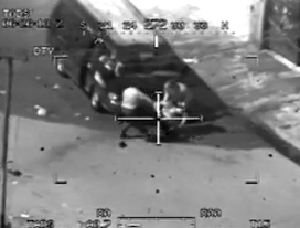
WikiLeaks video combat footage of 2007 collateral murder in Iraq“Light ’em all up. Come on, fire!” Watching the leaked combat footage of the helicopter gunships killing unarmed Iraqi civilians in 2007, I’m troubled by my own desensitized response. When I saw earlier leaked videos of an AH-64 vaporizing Iraqi farmers and a C-130 wreaking mayhem in Afghanistan, I remember my real shock at seeing a human life extinguished. This time not even flinch. “Just fuckin’, once you get on ’em just open ’em up.” Not at the brutality, nor the callousness of the play by play –even as the pilots targeted rescuers trying to help the wounded. I fault the Rules of Engagement that allowed the massacre, not the soldiers’ laughing swagger –as I hope they will not begrudge my unguarded satisfaction when eventually spectators will be treated to leaked footage of American soldiers taking some fire.

If you watched the video, perhaps you too were wishing that July 12, 2007 had recorded a massive setback for US troops in Iraq, at the height of the “surge” where a whole shitload of “dismounts” had been ambushed by IED explosions in a Baghdad square in the aftermath of a civilian massacre. Those who watched the 39-minute extended version I know were hoping to see a resolution like that, instead of an additional war crime of disproportional force and the targeting of civilians, a Hellfire missile attack on a building into which armed and unarmed men had entered, surrounded by passing innocents and rescuers scrambling to help.

There it goes! Look at that bitch go!
Patoosh!
Ah, sweet!
Need a little more room.
Nice missile.
Does it look good?
Sweet!

The Army has declared that no further inquiry will be made into the 2007 killing of the two Reuters journalists. Its FOIA requests long thwarted, even Reuters is not expressing outrage at this footage. Civilians and journalists about to be lit up The corporate media is hoping to let this story fade on the fringe. Does this mean that more pilots and gunners might become emboldened to leak other trophy reels? It doesn’t take Nelson Ratings for news outlets to see that viewers are already clamoring for more combat snuff films.

We could grant amnesty in exchange for those who turn in the most degenerate sequences.

And pretend they’ll remain anonymous. Ultimately friends and relatives will be able to place identities with the radio voices. Speaking on one of the clearest channels is the young voiced HOTEL-26, who reported taking fire from the photographers and ID’d the “RPG” with started the whole engagement. Likewise the gunner on CRAZY HORSE-18 who responded “Alright, hahaha, I hit ’em….” is addressed “God damn it, Kyle.”

And then there’s the poor 30mm gunner in CRAZY HORSE-19 who assessed his work thus:

Oh yeah, look at that. Right through the windshield! Ha ha!

While chomping at the bit to fire upon the improvised ambulance, he was momentarily thwarted by a puzzling “Azimuth Limit” which prevented his shooting.

Bloggers are now abuzz to decode the Azimuth Limit which slowed the turkey shoot when none of the gunners were showing restraint. Azimuth is the angular measurement of an object’s distance clockwise from True North. On rifles it expresses the adjustment of a gunsight to its boresight. On aircraft it apparently has something to do with the angle of relation to the axis of the fuselage. Whatever it is, maybe we can ratchet military Azimuth Limits down flat, if that’s what it will take to stop our soldiers from blowing away civilians, journalists, children and their rescuers alike. The shooters can cuss and salivate all they want so long as their trigger mechanisms respect human life or at least balk at excessive carnage.

What doesn’t come across the audio is what the US soldiers on the ground are saying to themselves as they survey “that big pile of [unarmed] bodies,” in their palaver, the “dead bastards.”

UPDATE — the testimonials begin:

From Iraq war veteran Michael Prysner, co-founder of March Forward!

The harrowing Apache footage released by WikiLeaks gives us a stomach-turning glimpse of war. Seventeen minutes of cold-blooded massacre in a war of more than seven years. A brief clip of one Apache video; a quick look at one part of one mission. Hundreds of those missions take place every day.

The video came to light thanks to military whistleblowers who provided it to WikiLeaks together with supporting documents.  Imagine if we had access to all such videos, the things we would see. Imagine all the Iraqis killed who have no one to uncover the truth about their deaths. Had the death of two Reuters news staffers not generated interest in this video, then the destruction of three families by hellfire missiles fired into an apartment building with no provocation, in a separate engagement also featured in the video, would have never been made public.

This massacre is a drop in a sea of blood. Many other such “incidents” will never be known.

Officers claimed there was “no question” that the pilots were responding to enemy fire; the video shows there is no question that they were not responding to enemy fire. They said that they had “no idea” how the journalists were killed; the video shows that they know very well how those journalists were killed. They were gunned down standing in a crowd of unarmed people.
After the slaughter of that group, the pilots beg for permission to kill the innocent passers-by who had come to the aid of one of the wounded, like any of us would have done if we saw our neighbor dying on the ground as we drove down the street. They kill everyone trying to help the dying journalist, and critically wound two children seen sitting in the front seat.

We see a group of unarmed men mowed down by a machine gun designed to destroy armored vehicles. We see a vanload of good Samaritans obliterated for trying to help a dying victim. We see all this with the soundtrack of the pilots mocking the dead, congratulating each other and laughing about the massacre.

No wonder the U.S. military goes to such great lengths to keep such videos from us. They want us to see Iraq and Afghanistan through their lens, through their embedded reporters, filtered by censorship and restrictions. They know that, once the people of this country see the extreme racism and brutality behind these occupations, they will be repulsed by what their tax dollars are paying for.

The military brass and the White House politicians have tried to justify this senseless atrocity. “Cut the pilots some slack. This was in Baghdad. This was a battle zone”—that’s been their line. The pilots had been indoctrinated with the same colonial mentality. “That’s what they get for bringing their kids into battle,” one pilot says.

The father driving that van was not “bringing his kids into battle.” He was bringing them to school, driving down the street where they live. But the U.S. occupation has made all of Iraq a battle zone. To those pilots, to their commanders over the radio and to the generals in the Pentagon, every single person in Baghdad and in Iraq is “fair game.”

The pilots joked about the people they killed, laughed about U.S. military vehicles running over dead bodies, knowing that their commanders were listening and that they were being recorded. They were not acting out of character. This is the culture of the occupation. This is how these wars are being conducted.

Having seen this, one cannot honestly believe that these atrocities are committed day in and day out for the liberation of the Iraqi people.

The Pentagon’s talking heads and media lackeys are hard at work putting their spin on this story. It’s time to tell the truth. For more than seven years, the U.S. has unleashed criminal, unprovoked aggression against the people of Iraq, and they have been doing the same thing in Afghanistan for more than eight years.

The U.S. military presence in Iraq is a colonial occupation force. The only way forward is a complete, immediate and unconditional withdrawal of all U.S. forces from Iraq and Afghanistan. This government will not do that unless all of us who are outraged by these criminal acts stand up and demand it.

Iraq war veteran Josh Stieber, US Army Specialist, 1st ID, Bravo Company 2-16 in Baghdad (Rustamiyah) 2007-2008. Although he was not present at the scene of the video, he knows those who were involved and is familiar with the environment.

A lot of my friends are in that video. After watching the video, I would definitely say that that is, nine times out of ten, the way things ended up. Killing was following military protocol. It was going along with the rules as they are.

If these videos shock and revolt you, they show the reality of what war is like. If you don’t like what you see in them, it means we should be working harder towards alternatives to war.

?

Bob Edwards asks “We still Top Dog?”

Longtime neo-liberal shill and NPR war drummer Bob Edwards consults a soothsayer to placate his weekend audience’s fears about where their hopeful handbasket appears to be headed. To his question about the USA still being top dog, the economic clairvoyant’s answer is YES. Also, America has the psyche and bipolarity of a teenager, leaving us to infer also the same self-unawareness. But the big question was about President Obama’s apparent inability to change the course set for him. YEP. The tracks of Bush’s trainwreck read like your palm. Nothing to be done.

Media reports of wingnut death threats meant to amplify fear not illuminate

What message is the media conveying by sensationalizing threatening phone calls and letters being received by US legislators in the wake of passing the health care bill? A chief element of the story is strangely missing, namely, WHO is making them. Death threats and inciting violence are criminal acts. News reports about crime usually don’t conclude without reassurances that law enforcement is pursuing the perpetrators. In this case, the media seems satisfied to blame right wing extremists, as if such acts is unpreventable, for Democrats to dodge like flaming arrows from an enraged populace –so called. This is fearmongering by a corporate media complicit in trying to block health reform.

Success! Afghan trainees mean as US

NPR ran a report praising the Afghan National Army, hoping I suppose to allay US public anticipation that Afghanistan should be conducting its own slaughters and incurring a greater share of soldier casualties. As if not enough ANA are getting caught in the friendly fire of US air strikes. They’re skilled fighters, we’re assured, especially when they have combat experience in other parts of the country, meaning, they are now being deployed outside their tribal regions, meaning, against other tribes. For every accusation of ANA soldiers mistreating civilians, there are reports apparently of them “eagerly taking up the fight.” Those don’t sound like contradictory motivations to me. Where their PR for the unpopular ANA means to ameliorate Afghan outcry, the US military trainers seem to be taking credit for inherent tribal hatred.

Healthcare reformist TR Reid visits COS to say universal coverage not possible

The Healing of America: a Global quest for better, cheaper, and fairer health care.COLORADO SPRINGS– [UPDATED]
My question to TR Reid, who speaks tonight at CC’s Palmer Hall, is how can voices for health care rights get past the corporate media editors?
As Washington Post Denver bureau chief and NPR reporter, Reid’s answer will reveal his earnestness, because most clearly his editors have kept the upper hand. The Independent, which is sponsoring tonight’s event, has invited two respondents to offer rebuttals, but both represent the health care status quo, there is no one advocating for socialized medicine, automatically framing Reid’s centrism as the people’s best hope.

I remember a TR Reid interview on NPR, which left me with the distinct impression of a hobbled argument. Look at the subtitle of his Frontline documentary: Sick Around the World: Can the U.S. learn anything from the rest of the world about how to run a health care system? They don’t say “what can the US learn” but can it. That’s the same false question the corporate media use to approach Global Warming. Though the answer is a multiplicity of affirmatives, the headline posed as a question leaves the viewer with the impression the conclusion is his to decide. The moon: is it there?

A follow-up Sick Around America was famously, in alternative media circles at least, altered to endorse insurance mandates. Reid broke away from the final product when PBS refused to mention his conclusion that health insurance should not be for profit. Reid chalked it up to a disagreement, not specifically a motive.

The book Mr. Reid will be signing is titled The Healing of America: a global quest for better, cheaper, and fairer health care. His own disjointed title reflects why he returned empty-handed. Can you imagine if it had read simply: a global quest for health care?

Better, cheaper and fairer are redundant qualifiers and load the theme with false perspective. “Better” assumes American care can be ranked on a scale, this book is obviously only for those getting care. “Cheaper” assumes health care must have a price — Universal health care is free. “Fairer” again assumes that our current equilibrium is in some measurable aspect fair, besides which, the concept is a fallacy. There’s unfair and fair. Moving from one toward the other, fairness is unfair until it is fair. Besides which, every schoolchild knows “fairer” is expressed as “more fair.” If Reid had been honest, he would have phrased it “less unfair.”

TR Reid applauds the health care available in other developed countries, but notes the other systems are not without their flaws. Is this some sort of psychological inducement to feed the American ego, that US reform can aim higher than the health care as a right provided elsewhere? I think it’s a loophole with which to scuttle his proposal.

It seems TR Reid is ignoring the chief obstacle to health care. It’s not reason, it’s not taxes. The chief obstacle is capitalist greed, it’s class warfare, and the social systems of our like nations are under attack as well. The shortcomings which TR Reid sees in Europe are the result of legislative meddling with systems enacted by the people.

Americans aren’t going to get health care by waiting on their legislators, or the benevolence of the corporations. The audience tonight may be impressed by TR Reid’s findings, but he’s offering nothing but placebo. Talking about health care, visualizing it, salivating at its proximity, is as much taste as TR Reid, the Washington Post and its corporate health industry advertisers will have us get.

UPDATE: TR Reid spoke to a standing room only crowd and received a standing ovation. As per usual for journalists, he provided his own disclaimer for venturing from objectivity when he posited that providing health care for all could be a moral obligation. But on the matter of The Politics of Health Care Reform, the topic of his speech, he had nothing to say.

Really, he threw the question back at the audience. Why won’t the USA provide universal coverage to its people. I’ve thought about it a lot, he told us, and I don’t have the answer.

When it came why some countries pay for Viagra, while others do not, TR Reid was humorously inquisitive. His rundown of the various medical systems throughout the world was decidedly comprehensive. But on the question of the hour, Reid was the customary incurious newspaperman which might explain his success in major media.

Not once, even at someone’s prompting, did Reid mention the for-profit worm in America’s medical system’s rotten apple. We’re told that Reid walked away from the second Frontline documentary for its whitewash of his criticism of the for-profit incentive which prevents payment systems from serving the public good. He’s excised the subject from his own presentation too. Instead, Reid focused on the millions of uninsured Americans, without a mention of the bigger population of victims, those insured who are denied care nonetheless.

Reid was pessimistic about the chances for near-term reform, based on anecdotal evidence of comments he’s received on the Frontline website. A year ago his documentary got mostly supportive comments. This year they are predominantly critical. Thus, Reid concludes, Americans do not want health care reform.

His audience tonight applauded every punchline about health care as a human right, yet Reid held that we did not want it badly enough. I hate it when the best of our spokesmen blame the audience.

Think Iran is coming down too hard on inciters of protest? Remember Neda!

Angel of Freedom of Green RevolutionYou might not have expected me to invoke the name of Neda Agha Soltan(i), the Green Revolution bystander “whose name in Farsi means ‘voice'” and whose angelic face adorned every subsequent Iranian reform movement ephemera. Remember the video where pretty Neda was shot by an unseen gunman, left to die on camera, the footage used to rally indignation against Mahmoud Ahmadinejad’s evident barbarity? Curiously our media chose to break from its usual sensibilities about snuff films. Remember your own blood lust? What fate were you wishing then for poor Neda’s killers? No doubt Iran would like to see justice for Neda too. They’ve conducted inquiries about who killed the unsuspecting martyr. Have you?

The Iranian government blames US operatives for instigating the reformist uprising, prompting Tehran’s secular class to take their grievances to the streets. They point to Iranian student groups organized by nonprofits funded by the West. They hold capitalist rabble-rousers accountable for inciting impressionable consumer wannabes to push against the riot police. They know the US is spending beaucoup black budget bucks to destabilize Iranian society. “Promoting Democracy” in Farsi means subverting leadership, and where there’s been a revolutionary movement against the established order, the USA habitually sets about to breed counter-revolutionaries. But that doesn’t explain Neda.

Political movements have infinitely more potential when there’s a martyr, and it’s a strategy no US adviser leaves to nuance. Movements have succeeded without them, but no psych-ops crafted scenario has done without. You wonder who volunteers for the role? We’ve seen recent examples, I can think of an incident in Honduras, were protesters pretended one of their number had been felled. But such is the weakness of the good guys, they’re not about to kill someone as a means to an end. Can we say the same about the good guys of the CIA?

When the saintly Neda was killed onscreen, the Iranian government immediately suspected a plot. Was it one of their soldiers who killed her, standing at an isolated corner, part of no confrontation? By whose orders would he have fired?

Who said the reelection of Ahmadinejad was rigged? None but the Americans. Who egged on the crowds to overturn a democratically elected government? America. Who branded the reform movement, and levitated it via social media?

Who else but America color-codes its exported “revolutions?”

“Remember Neda” has become the rallying cry of Iranian expats and Shah loyalists in exile. They’ll change their tune when authorities in Iran finger her murderers.

When Iran executes those responsible for the covert machinations meant to provoke an uprising to satisfy the US call for regime change, it’s not for crying out “freedom” but for yelling “fire” in a crowded theater, pointing at Neda.

US health industry tells Vic to snuff it

vic chestnutVic Chesnutt took his own life on Christmas Day. By coincidence, he’d just given an upbeat interview to NPR’s Fresh Air in spite of an ongoing battle with his health care providers. The segment seemed to pierce the celebrity veil we imagine insulates our talent castes from the worries of everyman. When he died, I reflected on the interview. I was reluctant to mar a eulogy with the villainy of the US medical system — but then NPR re-aired the piece, en memoriam, minus the damning testimony. They added in its place a remembrance by three colleagues who concluded: “To say poor health care killed Vic Chesnutt would be very reductive.”

Reductive? These corporate musicians, at the behest of NPR, have to throw an artisan spin on Vic Chesnutt’s legacy because his art should transcend his mortality?! Vic’s art, real art, is about mortality. Vic’s death was real and the anxiety he expressed in his interview was real. He hadn’t chosen to keep his troubles to himself for the sake of the listeners’ seamless pleasurable enjoyment. Who are these commercial artists to mute Vic’s story? It made me sick.

Others wonder aloud why Vic’s rich musician friends couldn’t have offered to pay for the medical procedures he needed. Perhaps they did, who knows. And perhaps their concern not to be “reductive” was extracted from a much longer session where Vic Chesnutt’s struggles were discussed at length.

Vic’s talent may not have been lost on these would-be eulogists, but we can’t fault them for not being artist spirits enough themselves to know how to shepherd an honest narrative about Vic.

I point my finger at NPR for the rewrite, and I’ll take issue with one of the musicians. At a wake, there’s always someone who uses the opportunity for self-promotion, and at this one it was REM’s Michael Stipe. He discovered Vic Chesnutt, let’s get that out of the way. Michael’s remembrance of Vic was an anecdote about a lyric he thought he’d stolen from Vic. It was so good, he must have stolen it. Stipe was so honest, he called Vic to confess. Vic’s response was gracious, no it’s yours. Stipe insisted, and so did Vic. Such was Vic’s grace, and so elevated was Stipe’s regard for Vic, and evidently so great is Stipe’s humility and –in the end it turns out by Vic’s own lips– his genius. He transcended his master. Much of the draw of coattail opportunism at funerals is that dead men tell no tales.

NPR’s problem, and shall we imagine, the problem of its underwriters, the major health insurers, was that Vic Chesnutt killed himself right after telling an NPR audience he could succumb any day for lack of proper medical care. Chesnutt died from an overdose of pain killers, which raised the disquieting suggestion to listeners that he lived in a lot of pain. Sure Chesnutt had attempted suicide before. He’d written a love song to suicide. The trouble was, he declared in his interview that “Flirted with You All My Life” was a break-up song with death. “I don’t want to die” Chesnutt exclaimed most earnestly.

While our nation’s health insurers have been content to let the common sick extinguish themselves by attrition, their PR crews come to the rescue of high profile victims, usually the focus of mass protests, even if they come late. Vic Chesnutt had given them no time, between the airing of his interview, and his Christmas day demise.

To listeners who heard the first airing, especially ones who might never have heard of Vic, the tragedy of this internationally renown artists being unable to get health care was a climax. It was a moment when entertainment rang dissonant.

For the rewrite, Terry Gross removed the critical segment, leaving the focus on Chesnutt’s earlier suicide attempts. Gross sounded like an insurance interrogator the way she made Chesnutt clarify that his first attempted suicide was actually before his debilitating accident, before health issues would have been a motivation. I would like to see Gross dissect her guests’ responses with such scrutiny, I wonder why she began with Vic.

Thus the rewritten interview became an indictment of Vic Chesnutt’s propensity to self-destruct. Forget narrowing Vic to health care failure, Terry reduced him to habitual suicide. The character assassination continued by next highlighting his song “I’m a Coward.”

In place of the dramatic, redemptive climax, Gross interviewed Michael Stipe, Guy Picciotto and Jem Cohen. Just before wrapping up, Gross raised the issue of Vic’s health care. All agreed the system failed him, but their pre-discussion consensus was not to be “reductive.”

As if the songwriter’s legacy wasn’t going to speak for his whole. Here his colleagues were concerned that their characterization of his death would define him. If Vic had died mid-song, would there have been a need to say his life wasn’t just about that song?

Little did they suspect that NPR would “reduce” Chesnutt however they wanted. Once again where Vic Chesnutt’s sentiment connected with his audience, the industry hovered to intercept.

If you didn’t catch Chesnutt’s original interview on NPR’s Fresh Air, here’s how it ended:

GROSS: I read that you’re in debt like $50,000 because of health insurance issues.

Mr. CHESNUTT: That’s right.

GROSS: So – and this is because you had a series of surgeries and although you pay a lot for your health insurance, it didn’t cover all of it. Is that – do I have that right?

Mr. CHESNUTT: That’s exactly true, yeah.

GROSS: Uh-huh. So, what are your thoughts now as you watch the health care legislation controversy play out?

Mr. CHESNUTT: Well, I have been amazed and confused by the health care debate. We need health care reform. There is no doubt about it, we really need health care reform in this country. Because it’s absurd that somebody like me has to pay so much, it’s just too expensive in this country. It’s just ridiculously expensive. That they can take my house away for kidney stone operation is -that’s absurd.

GROSS: Is that what you’re facing the possibility of now?

Mr. CHESNUTT: Yeah. I mean, it could – I’m not sure exactly. I mean, I don’t have cash money to pay these people. I tried to pay them. I tried to make payments and then they finally ended up saying, no, you have to pay us in full now. And so, you know, I’m not sure what exactly my options are. I just – I really – you know, my feeling is that I think they’ve been paid, they’ve already been paid $100,000 from my insurance company. That seems like plenty. I mean, this would pay for like five or six of these operations in any other country in the world. You know, it affects – I mean, right now I need another surgery and I’ve putting it off for a year because I can’t afford it. And that’s absurd, I think.

I mean, I could actually lose a kidney. And, I mean, I could die only because I cannot afford to go in there again. I don’t want to die, especially just because of I don’t have enough money to go in the hospital. But that’s the reality of it. You know, I have a preexisting condition, my quadriplegia, and I can’t get health insurance.

GROSS: Is it true you can’t get good health insurance?

Mr. CHESNUTT: I can’t get – I’m uninsurable. The only reason I have any insurance now is because I was on Capitol Records for a while. And I had excellent health insurance there. And then when I got dropped from Capitol, I Cobra’d my insurance for as long as it was legally possible. And then – and which was insanely expensive to cobra this very nice insurance. And then, when that ran out, the insurance company said they could offer me one last thing and that is hospitalization. It only covers hospital bills. That’s all it covers. And it’s still $500 a month. So, it doesn’t pay for my drugs, my doctors or anything like that. All it pays for is hospitalization. And yet, I still owe all this money on top of that.

GROSS: Wow. Well, I wish you the best with your health and your music. And I really want to thank you–

Mr. CHESNUTT: Thank you.

GROSS: –a lot for talking with us.

Mr. CHESNUTT: Oh, I’m honored, honored beyond belief.

Japan owes somebody A NEW BOAT!

sea shepherd collision ram bow
The Japanese whaling fleet, whose inhumane hunts pretend to serve the Institute for Cetacean Research, have deliberately rammed the high-tech trimaran Ady Gil, formerly the Earthrace, operated by their arch nemesis the Sea Shepherd Conservation Society. Pseudo-science spokesman Glenn Innwood was quick to declare the footage showed otherwise, saying the accusation “is just not vindicated by the video.” Obviously the Japanese need a cover who speaks better English. It’s a Freudian slip to seek to be not vindicated.

Au contraire for Kiwi Innwood-sen, the videos from both ships show the Ady Gil floating idle to the Shonan Maru’s starboard side before the whaler turns straight for it. The whalers are perhaps counting on not enough people seeing the video. That might have worked before YouTube.

If the Japanese believe “The obstructionist activities of the Sea Shepherd threaten the lives and property of those involved in our research, are very dangerous and cannot be forgiven” then aiming to ram the smaller vessel must constitute attempted murder, however unpremeditated the crime of passion may be.

Whether or not the action is ruled a crime, it’s without any doubt a violation of maritime code. The Ady Gil had right of way both by its position, and by being stationary.

Here’s the collision from the perspective of the whaler Shonan Maru 2, a highly maneuverable harpoon chase ship, as broadcast on Al Jazeera:

And here is the footage released by Paul Watson’s Sea Shepherd Conservation Society:

UPDATE: I’d say this footage clinches it, from the Animal Planet Whale Wars cameraman aboard the Ady Gil. Read a detailed description from NZ.

Identity of CIA bomb victims spill forth

khost victim of CIA bomberUS forces in Afghanistan suffered an unprecedented setback this weekend when a suicide bomber was able to blow to smithereens a gathering of CIA operatives in an outpost in Khost Province. Seven agents were killed and six injured, and a great tragedy is that these covert deaths, like that of the security contractor killed with them, are not counted as official casualties of war, to weigh against the public conscience for us to wonder, was it worth it? These were professional killers and torturers whose names are now withheld to protect their families.

But some Americans –God bless them– will not be denied the deification of their downed warriors, and so some families have gone public about the loss of their mercenary kin. Thus we have names, and Facebook memorials, to the men and women who commit the clandestine crimes for which the rest of the world holds us accountable. But first, a word about what they were doing.

Forward Operating Base Chapman caught my attention because that’s the kind of military post which protects the celebrated school building projects of Greg Mortenson, and Khost Province is one of his territories. It turns out that the US Army is also busy [re]-building schools, and boasts 53 in Khost. Also, for reasons of deteriorating security, FOB Chapman was no longer housing US military, but instead was strictly for private firms contracted to the reconstruction, except now journalists are at liberty to say that the camp was always known to be “not regular” — code for CIA.

“Although Chapman was officially a camp for civilians involved in reconstruction, it was well-known locally as a CIA base. Over the past couple of years, it focused on gathering information on so-called high-value targets for drone attacks, the unmanned missile planes that have played a growing role in taking out suspected terrorists since President Barack Obama took office. The Haqqanis were their principal target.

” ‘That far forward they were almost certainly from the CIA’s paramilitary rather than analysts,’ said one agent.”

So FOB Chapman was used for a drone command post. Not controlling drones, but gathering intelligence about where to target their missiles. I’d be curious that what had been an “underground gym” for US soldiers, where the dozen CIA officers were meeting their informant/surprise-bomber, wasn’t being put to an altogether more menacing function by the CIA. Obviously on this particular occasion it was a briefing room/wake.

It’s conjectured that the CIA at FOB Chapman was targeted because the local Taliban had suffered one too many CIA drone attacks. Other accusations emerge that the CIA had recently killed Afghan detainees while in custody, in their effort to break the Haqqani network. One reporter’s source phrased it: “Those guys have recently been on a big Haqqani binge.”

The CIA is not releasing the name of the bomber, reportedly an informant “candidate,” but strangely his name is being reported in the Arabic press. He was a Jordanian doctor named Khalil Abu Hammam Mellal Al-Balawi, of the Beer Al-Saba’a family, codenamed “Abu Dajana Al-Kharasani,” a supervisor on the Al-Hisba internet forums, where so-called official al-Qaeda communications are regularly transmitted. His identity might explain how a visit with this “informant” warranted the attendance of a dozen agents, including a high ranking officer from Kabul and the Khost station chief.

The station chief was reported to have been an agent in Afghanistan for 14 years, since the days of the so-called Alec Station which was tasked with tracking the whereabouts of Osama bin Laden. She was a loving mother of three, so it’s possible her identity is being concealed until her family can be extracted from the region.

The first agent to be identified publicly was Harold Brown Jr., 37, of Bolton, Mass., whose father thought he worked for the State Department. Before the “State Department,” Brown worked for Science Applications International Corp.

The next to be identified was Scott Michael Roberson, 39, of Akron, Ohio. He was a policeman when he wasn’t a CIA security officer. Robertson co-founded the Metro Atlanta Police Emerald Society and was a member of the Iron Pigs, a national motorcycle club for police and firefighters.

Another of the CIA agents wasn’t American at all, but a member of the Jordanian royal family. The body of Capitan As-Sharif Ali bin Zeid Al Awn has been returned to Jordan with much pomp and ceremony, without an official report of the incidence of his death, the family unable to explain what he was doing in Afghanistan, except to deny accusations that he was employed by the CIA.

The lone non-CIA victim was security contractor and former Navy SEAL, Jeremy Jason Wise, 35, of Virginia Beach. Wrote the WSJ: “Today, the CIA and President Obama acknowledged that seven of those killed were CIA agents. No one would say who employed the eighth American.”

(Except he was really the seventh American, because one of the dead was a Jordanian.)

UPDATE: It’s now revealed that Jeremy Wise was employed by Xe/Blackwater, who admit now that two of the CIA victims were Blackwater.

With suicide bombers all over the news, from the successful to the pantywaist, as blogs spill over with nuke-em-all comments which reveal Americans seem perfectly comfortable with the idea that peoples are collectively accountable for the deeds of criminals among them.

Or the deeds of insurgents aka freedom fighters, about whom you or I might disagree.

US Blackwater goons for example, have been let off the hook for the Nisour Square atrocity in Iraq. According to our neoliberal world order, Iraq should be able to track miscreants with drones, and since we refuse to bring them to justice, lay waste entire American neighborhoods and schools if informants report they are nearby.

I’ve certainly always argued that Americans are all of us responsible for the crimes our government is committing. Even with our combatant criminals killed in battle, I’m not sure that the people who cheered them on don’t still owe their victims responsibility.

Viva Palestina convoy to arrive in Rafah NPR fails to name it, or mention the Gaza Freedom March

viva palestina route el arishAfter endless impediment, not the least of which was a sudden Israeli naval exercise to block its path, the Viva Palestina aid convoy appears finally about to reach Gaza. Permission to enter has been granted, although last week Egypt reneged on the okay it had given to the 1,400 strong Gaza Freedom March. NPR had a reporter at the Rafah border crossing, but didn’t mention the aid convoy until 1/3 into the report, and then not by name, and never mentioned the New Year’s Eve march at all. As well, NPR referred to the besieged prison state as an “enclave” whose borders were forcibly closed, “understandably,” when Hamas “took over.”

Here’s the opening of this morning’s report. My favorite part? Two. First the interminable sportscast-lke intro, a beautiful day in Fenway Park, etc. Then, hesitation as the reporter explains that the border is opened to let Palestinians out, and um, sometimes back in.

Steve Inskeep: “This is a rare day in a Palestinian enclave known as the Gaza Strip. A border crossing opened today, which is rare because Gaza is surrounded by Israel and Egypt and both have kept the crossings closed for weeks at a time over the last couple years. Today people and supplies have been allowed to move and NPR’s Peter Kenyon is at the border crossing of Rafah on the Egyptian side, Hi Peter.”

Peter Kenyon: “Hi Steve, how are you?”

SI: “Okay thanks. What have you seen?”

PK: “Well it’s a beautiful sunny day here, a little bit windy but a bright blue sky, and I’m at the actual crossing point. The black iron gates are slowly swinging open and closed from time to time, letting Palestinians out into Egypt or uh, sometimes back in, people who need to get home. Now this is a very limited opening, not any kind of a max exodus.”

SI: “Is this an opportunity to move supplies in addition to people?”

PK: “It is. In fact there is an aid convoy that has endured quite a few setbacks that has now finally arrived in the port of El-Arish. That’s about twenty-five miles away and that is expected to come as early as today, possibly tonight, there’s some last minute logistical difficulties. It’s a British convoy led by the outspoken member of parliament George Galloway. And they have finally arrived and they do hope to get in.”

And that’s the extent of the coverage of the aid convoy that has been winding its way toward Gaza for the last month. No mention of “Viva Palestina” or organizations behind the effort, or even what their difficulties have been. The final “logistical difficulties” to which the reporter alludes concern Egypt’s sudden stipulation that aid consist only of medical supplies. Check with York to Gaza, the Reading Palestinian Solidarity Campaign, the Sitch, among others, for the final updates.

Meanwhile the BBC has pictures of conditions in Gaza.

While the Gaza Freedom March was kept contained in Cairo, Egypt was simultaneously stopping the Viva Palestina aid convoy from entering through Aqaba. Ultimately the convoy was forced to circle Israel and return to Syria, where it had to ferry its vehicles on the Ulusoy-6 from Lattakia to the Egyptian Port of El-Arish to reach the Rafah border crossing into Gaza.

Vaneigem on energy as commodity

NMT’s in-house Situationist has been conceptualizing a way forward well expressed in this May 2009 interview of Raoul Vaneigem:
Situationist“We are being “offered” biofuels on the condition we agree to transgenic rapeseed farming. Eco-tourism will accelerate the plundering of our biosphere. Windmill farms are being built without any advantage to the consumers. Those are the areas where intervention is possible. Natural resources belong to us, they are free, they must be made to serve the freedom of life. It will be up to the communities to secure their own energy and food independence so as to free themselves from the control of the multinationals and their state vassals everywhere. Claiming natural power for our use means reclaiming our own existence first. Only creativity will rid us of work. …

Freeness is the only absolute weapon capable of shattering the mighty self-destruction machine set in motion by consumer society, whose implosion is still releasing, like a deadly gas, bottom-line mentality, cupidity, financial gain, profit, and predation. Museums and culture should be free, for sure, but so should public services, currently prey to the scamming multinationals and states. Free trains, buses, subways, free healthcare, free schools, free water, air, electricity, free power, all through alternative networks to be set up. As freeness spreads, new solidarity networks will eradicate the stranglehold of the commodity. This is because life is a free gift, a continuous creation that the market’s vile profiteering alone deprives us of.”
–Raoul Vaneigem, 2009

Interviewed by Hans Ulrich Obrist, for e-flux, Journal #6. See original article or the copy mirrored below:

In Conversation with Raoul Vaneigem

Hans Ulrich Obrist: I just visited Edouard Glissant and Patrick Chamoiseau, who have written an appeal to Barack Obama. What would your appeal and/or advice be to Obama?

Raoul Vaneigem: I refuse to cultivate any relationship whatsoever with people of power. I agree with the Zapatistas from Chiapas who want nothing to do with either the state or its masters, the multinational mafias. I call for civil disobedience so that local communities can form, coordinate, and begin self-producing natural power, a more natural form of farming, and public services that are finally liberated from the scams of government by the Left or the Right. On the other hand, I welcome the appeal by Chamoiseau, Glissant, and their friends for the creation of an existence in which the poetry of a life rediscovered will put an end to the deadly stranglehold of the commodity.

HUO: Could we talk about your beginnings? How did your participation in situationism begin, and what was your fundamental contribution? At the outset of your relationship with the SI, there was the figure of Henri Lefebvre. What did he mean to you at the time? Why did you decide to send him poetic essays?

RV: I would first like to clarify that situationism is an ideology that the situationists were unanimous in rejecting. The term “situationist” was ever only a token of identification. Its particularity kept us from being mistaken for the throngs of ideologues. I have nothing in common with the spectacular recuperation of a project that, in my case, has remained revolutionary throughout. My participation in a group that has now disappeared was an important moment in my personal evolution, an evolution I have personally pressed on with in the spirit of the situationist project at its most revolutionary. My own radicality absolves me from any label. I grew up in an environment in which our fighting spirit was fueled by working class consciousness and a rather festive conception of existence. I found Lefebvre’s Critique of Everyday Life captivating. When La Somme et le reste [The Sum and the Remainder] was published, I sent him an essay of sorts on “poetry and revolution” that was an attempt to unify radical concepts, Lettrist language, music, and film imagery by crediting them all with the common virtue of making the people’s blood boil. Lefebvre kindly responded by putting me in touch with Guy Debord who immediately invited me to Paris. The two of us had very different temperaments, but we would agree over a period of nearly ten years on the need to bring consumer society to an end and to found a new society on the principle of self-management, where life supersedes survival and the existential angst that it generates.

HUO: Which situationist projects remain unrealized?

RV: Psychogeography, the construction of situations, the superseding of predatory behavior. The radicality, which, notwithstanding some lapses, never ceased to motivate us, remains a source of inspiration to this day. Its effects are just beginning to manifest themselves in the autonomous groups that are now coming to grips with the collapse of financial capitalism.

HUO: The Situationist International defined the situationist as someone who commits her- or himself to the construction of situations. What were those situations for you, concretely? How would you define the situationist project in 2009?

RV: By its very style of living and thinking, our group was already sketching out a situation, like a beachhead active within enemy territory. The military metaphor is questionable, but it does convey our will to liberate daily life from the control and stranglehold of an economy based on the profitable exploitation of man. We formed a “group-at-risk” that was conscious of the hostility of the dominant world, of the need for radical rupture, and of the danger of giving in to the paranoia typical of minds under siege. By showing its limits and its weaknesses, the situationist experience can also be seen as a critical meditation on the new type of society sketched out by the Paris Commune, by the Makhnovist movement and the Republic of Councils wiped out by Lenin and Trotsky, by the libertarian communities in Spain later smashed by the Communist Party. The situationist project is not about what happens once consumer society is rejected and a genuinely human society has emerged. Rather, it illuminates now how lifestyle can supersede survival, predatory behavior, power, trade and the death-reflex.

HUO: You and Guy Debord are the main protagonists of the situationist movement. How do you see Debord’s role and your role?

RV: Not as roles. That is precisely what situationism in its most ridiculous version aims at: reducing us to cardboard cut-outs that it can then set up against one another according to the spectacle’s standard operating procedure. I am simply the spokesman, among others, of a radical consciousness. I just do what I can to see that resistance to market exploitation is transformed into an offensive of life, and that an art of living sweeps away the ruins of oppression.

HUO: What were your reasons for resigning from the group?

RV: Following the occupation movements of May 1968, we knew that some recuperation was afoot. We were familiar with the mechanisms of alienation that would falsify our ideas and fit them neatly into the cultural puzzle. It became clear to us, during the last conference in Venice, that we had failed to shatter those mechanisms, that in fact they were shattering us from the inside. The group was crumbling, the Venice conference was demonstrating its increasing uselessness, and the only answers put forward were commensurate with the self-parody we had fallen into. Dissension intensified to the point of paranoid denunciation: of betrayals of radicality, of breaches of revolutionary spirit, of dereliction of conscience. Those times of catharsis and anathema are now long past, and it might be useful to examine how it is that we sowed the seeds of failure for which the group ended up paying such a heavy price. The shipwreck, however, did not indiscriminately sweep away to the shores of oblivion all of us who participated in the adventure. The group vanished in such a way as to allow the individuals to either consolidate their radicality, disown it, or lapse into the imposture of radicalism. I have attempted to analyze our experimental adventure in Entre le deuil du monde et la joie de vivre [Between Mourning the World and Exuberant Life].

HUO: You have written a lot on life, not survival. What is the difference?

RV: Survival is budgeted life. The system of exploitation of nature and man, starting in the Middle Neolithic with intensive farming, caused an involution in which creativity—a quality specific to humans—was supplanted by work, by the production of a covetous power. Creative life, as had begun to unfold during the Paleolithic, declined and gave way to a brutish struggle for subsistence. From then on, predation, which defines animal behavior, became the generator of all economic mechanisms.

HUO: Today, more than forty years after May ‘68, how do you feel life and society have evolved?

RV: We are witnessing the collapse of financial capitalism. This was easily predictable. Even among economists, where one finds even more idiots than in the political sphere, a number had been sounding the alarm for a decade or so. Our situation is paradoxical: never in Europe have the forces of repression been so weakened, yet never have the exploited masses been so passive. Still, insurrectional consciousness always sleeps with one eye open. The arrogance, incompetence, and powerlessness of the governing classes will eventually rouse it from its slumber, as will the progression in hearts and minds of what was most radical about May 1968.

HUO: Your new book takes us on a trip “between mourning the world and exuberant life.” You revisit May ‘68. What is left of May ‘68? Has it all been appropriated?

RV: Even if we are today seeing recycled ideologies and old religious infirmities being patched up in a hurry and tossed out to feed a general despair, which our ruling wheelers and dealers cash in on, they cannot conceal for long the shift in civilization revealed by May 1968. The break with patriarchal values is final. We are moving toward the end of the exploitation of nature, of work, of trade, of predation, of separation from the self, of sacrifice, of guilt, of the forsaking of happiness, of the fetishizing of money, of power, of hierarchy, of contempt for and fear of women, of the misleading of children, of intellectual dominion, of military and police despotism, of religions, of ideologies, of repression and the deadly resolutions of psychic tensions. This is not a fact I am describing, but an ongoing process that simply requires from us increased vigilance, awareness, and solidarity with life. We have to reground ourselves in order to rebuild—on human foundations—a world that has been ruined by the inhumanity of the cult of the commodity.

HUO: What do you think of the current moment, in 2009? Jean-Pierre Page has just published Penser l’après crise [Thinking the After-Crisis]. For him, everything must be reinvented. He says that a new world is emerging now in which the attempt to establish a US-led globalization has been aborted.

RV: The agrarian economy of the Ancien Régime was a fossilized form that was shattered by the emerging free-trade economy, from the 1789 revolution on. Similarly, the stock-dabbling speculative capitalism whose debacle we now witness is about to give way to a capitalism reenergized by the production of non-polluting natural power, the return to use value, organic farming, a hastily patched-up public sector, and a hypocritical moralization of trade. The future belongs to self-managed communities that produce indispensable goods and services for all (natural power, biodiversity, education, health centers, transport, metal and textile production . . .). The idea is to produce for us, for our own use—that is to say, no longer in order to sell them—goods that we are currently forced to buy at market prices even though they were conceived and manufactured by workers. It is time to break with the laws of a political racketeering that is designing, together with its own bankruptcy, that of our existence.

HUO: Is this a war of a new kind, as Page claims? An economic Third World War?

RV: We are at war, yes, but this is not an economic war. It is a world war against the economy. Against the economy that for thousands of years has been based on the exploitation of nature and man. And against a patched-up capitalism that will try to save its skin by investing in natural power and making us pay the high price for that which—once the new means of production are created—will be free as the wind, the sun, and the energy of plants and soil. If we do not exit economic reality and create a human reality in its place, we will once again allow market barbarism to live on.

HUO: In his book Making Globalization Work, Joseph Stiglitz argues for a reorganization of globalization along the lines of greater justice, in order to shrink global imbalances. What do you think of globalization? How does one get rid of profit as motive and pursue well-being instead? How does one escape from the growth imperative?

RV: The moralization of profit is an illusion and a fraud. There must be a decisive break with an economic system that has consistently spread ruin and destruction while pretending, amidst constant destitution, to deliver a most hypothetical well-being. Human relations must supersede and cancel out commercial relations. Civil disobedience means disregarding the decisions of a government that embezzles from its citizens to support the embezzlements of financial capitalism. Why pay taxes to the bankster-state, taxes vainly used to try to plug the sinkhole of corruption, when we could allocate them instead to the self-management of free power networks in every local community? The direct democracy of self-managed councils has every right to ignore the decrees of corrupt parliamentary democracy. Civil disobedience towards a state that is plundering us is a right. It is up to us to capitalize on this epochal shift to create communities where desire for life overwhelms the tyranny of money and power. We need concern ourselves neither with government debt, which covers up a massive defrauding of the public interest, nor with that contrivance of profit they call “growth.” From now on, the aim of local communities should be to produce for themselves and by themselves all goods of social value, meeting the needs of all—authentic needs, that is, not needs prefabricated by consumerist propaganda.

HUO: Edouard Glissant distinguishes between globality and globalization. Globalization eradicates differences and homogenizes, while globality is a global dialogue that produces differences. What do you think of his notion of globality?

RV: For me, it should mean acting locally and globally through a federation of communities in which our pork-barreling, corrupt parliamentary democracy is made obsolete by direct democracy. Local councils will be set up to take measures in favor of the environment and the daily lives of everyone. The situationists have called this “creating situations that rule out any backtracking.”

HUO: Might the current miscarriages of globalization have the same dangerous effects as the miscarriages of the previous globalization from the ‘30s? You have written that what was already intolerable in ‘68 when the economy was booming is even more intolerable today. Do you think the current economic despair might push the new generations to rebel?

RV: The crisis of the ‘30s was an economic crisis. What we are facing today is an implosion of the economy as a management system. It is the collapse of market civilization and the emergence of human civilization. The current turmoil signals a deep shift: the reference points of the old patriarchal world are vanishing. Percolating instead, still just barely and confusedly, are the early markers of a lifestyle that is genuinely human, an alliance with nature that puts an end to its exploitation, rape, and plundering. The worst would be the unawareness of life, the absence of sentient intelligence, violence without conscience. Nothing is more profitable to the racketeering mafias than chaos, despair, suicidal rebellion, and the nihilism that is spread by mercenary greed, in which money, even devalued in a panic, remains the only value.

HUO: In his book Utopistics, Immanuel Wallerstein claims that our world system is undergoing a structural crisis. He predicts it will take another twenty to fifty years for a more democratic and egalitarian system to replace it. He believes that the future belongs to “demarketized,” free-of-charge institutions (on the model, say, of public libraries). So we must oppose the marketization of water and air.1 What is your view?

RV: I do not know how long the current transformation will take (hopefully not too long, as I would like to witness it). But I have no doubt that this new alliance with the forces of life and nature will disseminate equality and freeness. We must go beyond our natural indignation at profit’s appropriation of our water, air, soil, environment, plants, animals. We must establish collectives that are capable of managing natural resources for the benefit of human interests, not market interests. This process of reappropriation that I foresee has a name: self-management, an experience attempted many times in hostile historical contexts. At this point, given the implosion of consumer society, it appears to be the only solution from both an individual and social point of view.

HUO: In your writing you have described the work imperative as an inhuman, almost animal condition. Do you consider market society to be a regression?

RV: As I mentioned above, evolution in the Paleolithic age meant the development of creativity—the distinctive trait of the human species as it breaks free from its original animality. But during the Neolithic, the osmotic relationship to nature loosened progressively, as intensive agriculture became based on looting and the exploitation of natural resources. It was also then that religion surfaced as an institution, society stratified, the reign of patriarchy began, of contempt for women, and of priests and kings with their stream of wars, destitution, and violence. Creation gave way to work, life to survival, jouissance to the animal predation that the appropriation economy confiscates, transcends, and spiritualizes. In this sense market civilization is indeed a regression in which technical progress supersedes human progress.

HUO: For you, what is a life in progress?

RV: Advancing from survival, the struggle for subsistence and predation to a new art of living, by recreating the world for the benefit of all.

HUO: My interviews often focus on the connections between art and architecture/urbanism, or literature and architecture/urbanism. Could you tell me about the Bureau of Unitary Urbanism?

RV: That was an idea more than a project. It was about the urgency of rebuilding our social fabric, so damaged by the stranglehold of the market. Such a rebuilding effort goes hand in hand with the rebuilding by individuals of their own daily existence. That is what psychogeography is really about: a passionate and critical deciphering of what in our environment needs to be destroyed, subjected to détournement, rebuilt.

HUO: In your view there is no such thing as urbanism?

RV: Urbanism is the ideological gridding and control of individuals and society by an economic system that exploits man and Earth and transforms life into a commodity. The danger in the self-built housing movement that is growing today would be to pay more attention to saving money than to the poetry of a new style of life.

HUO: How do you see cities in the year 2009? What kind of unitary urbanism for the third millennium? How do you envision the future of cities? What is your favorite city? You call Oarystis the city of desire. Oarystis takes its inspiration from the world of childhood and femininity. Nothing is static in Oarystis. John Cage once said that, like nature, “one never reaches a point of shapedness or finishedness. The situation is in constant unpredictable change.”2 Do you agree with Cage?

RV: I love wandering through Venice and Prague. I appreciate Mantua, Rome, Bologna, Barcelona, and certain districts of Paris. I care less about architecture than about how much human warmth its beauty has been capable of sustaining. Even Brussels, so devastated by real estate developers and disgraceful architects (remember that in the dialect of Brussels, “architect” is an insult), has held on to some wonderful bistros. Strolling from one to the next gives Brussels a charm that urbanism has deprived it of altogether. The Oarystis I describe is not an ideal city or a model space (all models are totalitarian). It is a clumsy and naïve rough draft for an experiment I still hope might one day be undertaken—so I agree with John Cage. This is not a diagram, but an experimental proposition that the creation of an environment is one and the same as the creation by individuals of their own future.

HUO: Is Oarystis based on natural power, like the Metabolist cities? Rem Koolhaas and I are working on a book on the Japanese Metabolists. When I read your wonderful text on Oarystis, I was reminded of that movement from the 1960s, especially the floating cities, Kikutake’s water cities. Is Oarystis a Metabolist city?

RV: When Oarystis was published, the architect Philippe Rothier and Diane Hennebert, who ran Brussels’ Architecture Museum at the time, rightly criticized me for ignoring the imaginative projects of a new generation of builders. Now that the old world is collapsing, the fusion of free natural power, self-built housing techniques, and the reinvention of sensual form is going to be decisive. So it is useful to remember that technical inventiveness must stem from the reinvention of individual and collective life. That is to say, what allows for genuine rupture and ecstatic inventiveness is self-management: the management by individuals and councils of their own lives and environment through direct democracy. Let us entrust the boundless freedoms of the imaginary to childhood and the child within us.

HUO: Several years ago I interviewed Constant on New Babylon. What were your dialogues with Constant and how do you see New Babylon today?

RV: I never met Constant, who if I am not mistaken had been expelled before my own association with the SI. New Babylon’s flaw is that it privileges technology over the formation of an individual and collective way of life—the necessary basis of any architectural concept. An architectural project only interests me if it is about the construction of daily life.

HUO: How can the city of the future contribute to biodiversity?

RV: By drawing inspiration from Alphonse Allais, by encouraging the countryside to infiltrate the city. By creating zones of organic farming, gardens, vegetable plots, and farms inside urban space. After all, there are so many bureaucratic and parasitical buildings that can’t wait to give way to fertile, pleasant land that is useful to all. Architects and squatters, build us some hanging gardens where we can go for walks, eat, and live!

HUO: Oarystis is in the form of a maze, but it is also influenced by Venice and its public piazzas. Could you tell us about the form of Oarystis?

RV: Our internal space-time is maze-like. In it, each of us is at once Theseus, Ariadne, and Minotaur. Our dérives would gain in awareness, alertness, harmony, and happiness if only external space-time could offer meanders that could conjure up the possible courses of our futures, as an analogy or echo of sorts—one that favors games of life, and prevents their inversion into games of death.

HUO: Will museums be abolished? Could you discuss the amphitheater of memory? A protestation against oblivion?

RV: The museum suffers from being a closed space in which works waste away. Painting, sculpture, music belong to the street, like the façades that contemplate us and come back to life when we greet them. Like life and love, learning is a continuous flow that enjoys the privilege of irrigating and fertilizing our sentient intelligence. Nothing is more contagious than creation. But the past also carries with it all the dross of our inhumanity. What should we do with it? A museum of horrors, of the barbarism of the past? I attempted to answer the question of the “duty of memory” in Ni pardon, ni talion [Neither Forgiveness Nor Retribution]:

Most of the great men we were brought up to worship were nothing more than cynical or sly murderers. History as taught in schools and peddled by an overflowing and hagiographic literature is a model of falsehood; to borrow a fashionable term, it is negationist. It might not deny the reality of gas chambers, it might no longer erect monuments to the glory of Stalin, Mao or Hitler, but it persists in celebrating the brutish conqueror: Alexander, called the Great—whose mentor was Aristotle, it is proudly intoned—Julius Caesar, Genghis Khan, Tamerlane, Napoleon, the throngs of generals, slaughterers of peoples, petty tyrants of the city or the state, torturer–judges, Javerts of every ilk, conniving diplomats, rapists and killers contracted by religions and ideologies; so much high renown carved from baseness, wickedness, and abjection. I am not suggesting we should unpave the avenues of official history and pave the side alleys instead. We are not in need of a purged history, but of a knowledge that scoops out into broad daylight facts that have been obscured, generation after generation, by the unceasing stratification of prejudice. I am not calling for a tribunal of the mind to begin condemning a bunch of undesirables who have been bizarrely put up on pedestals and celebrated in the motley pantheons of official memory. I just want to see the list of their crimes, the mention of their victims, the recollection of those who confronted them added to the inventory of their unsavory eulogies. I am not suggesting that the name of Francisco Ferrer wipe out that of his murderer, Alfonso XIII, but that at the very least everything be known of both. How dare textbooks still cultivate any respect for Bonaparte, responsible for the death of millions, for Louis XIV, slaughterer of peasants and persecutor of Protestants and freethinkers? For Calvin, murderer of Jacques Gruet and Michel Servet and dictator of Geneva, whose citizens, in tribute to Sébastien Castellion, would one day resolve to destroy the emblems and signs of such an unworthy worship? While Spain has now toppled the effigies of Francoism and rescinded the street names imposed by fascism, we somehow tolerate, towering in the sky of Paris, that Sacré-Coeur whose execrable architecture glorifies the crushing of the Commune. In Belgium there are still avenues and monuments honoring King Leopold II, one of the most cynical criminals of the nineteenth century, whose “red rubber” policy—denounced by Mark Twain, by Roger Casement (who paid for this with his life), by Edward Dene Morel, and more recently by Adam Hochschild—has so far bothered nary a conscience. This is a not a call to blow up his statues or to chisel away the inscriptions that celebrate him. This is a call to Belgian and Congolese citizens to cleanse and disinfect public places of this stain, the stain of one of the worst sponsors of colonial savagery. Paradoxically, I do tend to believe that forgetting can be productive, when it comes to the perpetrators of inhumanity. A forgetting that does not eradicate remembering, that does not blue-pencil memory, that is not an enforceable judgment, but that proceeds rather from a spontaneous feeling of revulsion, like a last-minute pivot to avoid dog droppings on the sidewalk. Once they have been exposed for their inhumanity, I wish for the instigators of past brutalities to be buried in the shroud of their wrongs. Let the memory of the crime obliterate the memory of the criminal.
3

HUO: Learning is deserting schools and going to the streets. Are streets becoming Thinkbelts? Cedric Price’s Potteries Thinkbelt used abandoned railroads for pop-up schools. What and where is learning today?

RV: Learning is permanent for all of us regardless of age. Curiosity feeds the desire to know. The call to teach stems from the pleasure of transmitting life: neither an imposition nor a power relation, it is pure gift, like life, from which it flows. Economic totalitarianism has ripped learning away from life, whose creative conscience it ought to be. We want to disseminate everywhere this poetry of knowledge that gives itself. Against school as a closed-off space (a barrack in the past, a slave market nowadays), we must invent nomadic learning.

HUO: How do you foresee the twenty-first-century university?

RV: The demise of the university: it will be liquidated by the quest for and daily practice of a universal learning of which it has always been but a pale travesty.

HUO: Could you tell me about the freeness principle (I am extremely interested in this; as a curator I have always believed museums should be free—Art for All, as Gilbert and George put it).

RV: Freeness is the only absolute weapon capable of shattering the mighty self-destruction machine set in motion by consumer society, whose implosion is still releasing, like a deadly gas, bottom-line mentality, cupidity, financial gain, profit, and predation. Museums and culture should be free, for sure, but so should public services, currently prey to the scamming multinationals and states. Free trains, buses, subways, free healthcare, free schools, free water, air, electricity, free power, all through alternative networks to be set up. As freeness spreads, new solidarity networks will eradicate the stranglehold of the commodity. This is because life is a free gift, a continuous creation that the market’s vile profiteering alone deprives us of.

HUO: Where is love in Oarystis?

RV: Everywhere. The love affair, as complex as it is simple, will serve as the building block for the new solidarity relations that sooner or later will supersede selfish calculation, competition, competitiveness, and predation, causes of our societies’ dehumanization.

HUO: Where is the city of the dead? In a forest rather than a cemetery?

RV: Yes, a forest, an auditorium in which the voices of the dead will speak amidst the lushness of nature, where life continuously creates itself anew.

HUO: Have you dreamt up other utopian cities apart from Oarystis? Or a concrete utopia in relation to the city?

RV: No, but I have not given up hope that such projects might mushroom and be realized one day, as we begin reconstructing a world devastated by the racketeering mafias.

HUO: In 1991 I founded a Robert Walser museum, a strollological museum, in Switzerland. I have always been fascinated by your notion of the stroll. Could you say something about your urban strolls with and without Debord? What about Walser’s? Have other strollologists inspired you?

RV: I hold Robert Walser in high regard, as many do. His lucidity and sense of dérive enchanted Kafka. I have always been fascinated by the long journey Hölderlin undertook following his break-up with Diotima. I admire Chatwin’s Songlines, in which he somehow manages to turn the most innocuous of walks into an intonation of the paths of fate, as though we were in the heart of the Australian bush. And I appreciate the strolls of Léon-Paul Fargue and the learning of Héron de Villefosse. My psychogeographic dérives with Guy Debord in Paris, Barcelona, Brussels, Beersel, and Antwerp were exceptional moments, combining theoretical speculation, sentient intelligence, the critical analysis of beings and places, and the pleasure of cheerful drinking. Our homeports were pleasant bistros with a warm atmosphere, havens where one was oneself because one felt in the air something of the authentic life, however fragile and short-lived. It was an identical mood that guided our wanderings through the streets, the lanes and the alleys, through the meanderings of a pleasure that our every step helped us gauge in terms of what it might take to expand and refine it just a little further. I have a feeling that the neighborhoods destroyed by the likes of Haussmann, Pompidou, and the real estate barbarians will one day be rebuilt by their inhabitants in the spirit of the joy and the life they once harbored.

HUO: What possibilities do you see for disalienation and détournement in 2009?

RV: This is a time of unprecedented chaos in material and moral conditions. Human values are going to have to compensate for the effects of the only value that has prevailed so far: money. But the implosion of financial totalitarianism means that this currency, which has so tripped us up, is now doomed to devaluation and a loss of all meaning. The absurdity of money is becoming concrete. It will gradually give way to new forms of exchange that will hasten its disappearance and lead to a gift economy.

HUO: What are the conditions for dialogue in 2009? Is there a way out of this system of isolation?

RV: Dialogue with power is neither possible nor desirable. Power has always acted unilaterally, by organizing chaos, by spreading fear, by forcing individuals and communities into selfish and blind withdrawal. As a matter of course, we will invent new solidarity networks and new intervention councils for the well-being of all of us and each of us, overriding the fiats of the state and its mafioso-political hierarchies. The voice of lived poetry will sweep away the last remaining echoes of a discourse in which words are in profit’s pay.

HUO: In your recent books you discuss your existence and temporality. The homogenizing forces of globalization homogenize time, and vice versa. How does one break with this? Could you discuss the temporality of happiness, as a notion?

RV: The productivity- and profit-based economy has implanted into lived human reality a separate reality structured by its ruling mechanisms: predation, competition and competitiveness, acquisitiveness and the struggle for power and subsistence. For thousands of years such denatured human behaviors have been deemed natural. The temporality of draining, erosion, tiredness, and decay is determined by labor, an activity that dominates and corrupts all others. The temporality of desire, love, and creation has a density that fractures the temporality of survival cadenced by work. Replacing the temporality of money will be a temporality of desire, a beyond-the-mirror, an opening to uncharted territories.

HUO: Is life ageless?

RV: I don’t claim that life is ageless. But since survival is nothing but permanent agony relieved by premature death, a renatured life that cultivates its full potential for passion and creation would surely achieve enough vitality to delay its endpoint considerably.

HUO: The Revolution of Everyday Life was a trigger for May ’68, and you have stated in other interviews that it is your key book that you are continually rewriting. Was the book an epiphany? How did it change the course of your work? What had you been doing previously?

RV: The book was prompted by an urgent need I was feeling at the time for a new perspective on the world and on myself, to pull me out of my state of survival, by means other than through suicide. This critical take on a consumer society that was corrupting and destroying life so relentlessly made me aware and conscious of my own life drive. And it became clear to me very quickly that this wasn’t a purely solipsistic project, that many readers were finding their own major concerns echoed there.

HUO: The Revolution of Everyday Life ends on an optimistic note: “We have a world of pleasures to win, and nothing to lose but boredom.”4 Are you still an optimist today?

RV: “Pessimists, what is it you were hoping for?,” Scutenaire wrote. I am neither a pessimist nor an optimist. I try to remain faithful to a principle: desire everything, expect nothing.

HUO: What is the most recent version of the book?

RV: Entre le deuil du monde et la joie de vivre [Between Mourning the World and Exuberant Life].

HUO: What book are you working on at the moment?

RV: I would love to have the resources to complete a Dictionary of Heresies, so as to clarify and correct the historical elements included in The Movement of the Free Spirit and Resistance to Christianity.

HUO: The question of temporality also brings us to Proust and his questionnaire (see inset). What might your definition of happiness be in 2009?

RV: Living ever more intensely and passionately in an ever more intense world. To those who sneer at my ecstatic candor, I reply with a phrase that brings me great comfort: “The desire for an other life is that life already.”5

HUO: Do you have unrealized projects? Unrealized books, unrealized projects in fields other than writing, unrealized architectural projects?

RV: My priority is to live better and better in a world that is more and more human. I would love to build the “urban countryside” of Oarystis, but I’m not just waiting patiently, like Fourier at the Palais Royal, for some billionaire to decide to finance the project only to lose everything to the financial crash a minute later.

HUO: What about your collaborations with other artists, painters, sculptors, designers, filmmakers?

RV: I don’t collaborate with anyone. At times I have offered a few texts to artist friends, not as a commentary on their work but as a counterpoint to it. Art moves me when, in it, I can sense its own overcoming, something that goes beyond it; when it nurtures a trace of life that blossoms as a true aspiration, the intuition of a new art of living.

HUO: Could you tell me about Brussels? What does Brussels mean to you? Where do you write?

RV: I live in the country, facing a garden and woods where the rhythm of the seasons has retained its beauty. Brussels as a city has been destroyed by urbanists and architects who are paid by real estate developers. There are still a few districts suitable for nice walks. I am fond of a good dozen wonderful cafés where one can enjoy excellent artisanal beers.

HUO: Do you agree with Geremek’s view that Europe is the big concern of the twenty-first century?

RV: I am not interested in this Europe ruled by racketeering bureaucracies and corrupt democracies. And regions only interest me once they are stripped of their regionalist ideology and are experiencing self-management and direct democracy. I feel neither Belgian nor European. The only homeland is a humanity that is at long last sovereign.

HUO: You have used a lot of pseudonyms. Je est un autre [I is an other]? How do you find or choose pseudonyms? How many pseudonyms have you used? Is there a complete list?

RV: I don’t keep any kind of score. I leave it up to the inspiration of the moment. There is nothing secret about using a pseudonym. Rather, it is about creating a distance, most often in commissioned work. This allows me to have some fun while alleviating my enduring financial difficulties, which I have always refused to resolve by compromising with the world of the spectacle.

HUO: A book that has been used by many artists and architects has been your Dictionnaire de citations pour servir au divertissement et a l’intelligence du temps [Dictionary of Quotations for the Entertainment and Intelligence of Our Time]. Where did that idea come from?

RV: It was a suggestion from my friend Pierre Drachline, who works for the Cherche Midi publishing house.

HUO: You have often criticized environmental movements who try to replace existing capitalism with capitalism of a different type. What do you think of Joseph Beuys? What non-capitalist project or movement do you support?

RV: We are being “offered” biofuels on the condition we agree to transgenic rapeseed farming. Eco-tourism will accelerate the plundering of our biosphere. Windmill farms are being built without any advantage to the consumers. Those are the areas where intervention is possible. Natural resources belong to us, they are free, they must be made to serve the freedom of life. It will be up to the communities to secure their own energy and food independence so as to free themselves from the control of the multinationals and their state vassals everywhere. Claiming natural power for our use means reclaiming our own existence first. Only creativity will rid us of work.

HUO: Last but not least, Rilke wrote that wonderful little book of advice to a young poet. What would your advice be to a young philosopher-writer in 2009?

RV: To apply to his own life the creativity he displays in his work. To follow the path of the heart, of what is most alive in him.

Translated from the French by Eric Anglès

Did Obama hear you on election day?

Here’s a quarter-page size flier you can use to spread the word about tonight’s event. Obama’s announcement will be momentous, no matter which course of action he decides. It will be either the first sign of delivering on his promise of change, or a hopeful public betrayed.
hopeless escalation flier

And thousands more Afghan dead. Let’s not forget who suffers the most from America’s reckless decisions.

Come to Acacia Park tonight at 5pm. Let him hear your voice!

Below is the Coloradans For Peace December 1 press release:

FOR IMMEDIATE RELEASE:

Colorado Springs peace community urges President Obama to chose withdrawal from Afghanistan over escalation

COLORADO SPRINGS, COLORADO, 12/1/09 — Coloradans For Peace (CFP) will gather with area community activists on Tuesday, December 1, at 5pm, in Acacia Park downtown, to urge President Barack Obama: NO ESCALATION OF THE WAR IN AFGHANISTAN.

The nonviolent assembly in Acacia Park will be part of nationwide peace demonstrations in response to President Barack Obama’s forthcoming announcement about a new US strategy in Afghanistan. National organizers include CODE PINK, UNITED FOR PEACE & JUSTICE, WORLD CAN’T WAIT, ACT NOW TO STOP WAR AND END RACISM (ANSWER), and many others.

Speculation has been rising that our president intends to increase US troop levels in Afghanistan, but CFP remains hopeful that President Obama will make a decision in the spirit of his presidential campaign. We will assemble in Acacia Park in advance of the televised presidential address, in unison with other US cities, to remind the president of the electorate’s call for an end to our nation’s military conflicts.

The CFP believes the unprecedented turnout for the 2008 election was strongly motivated by the American public’s alarm over the ongoing foreign wars. We believe President Obama would be ignoring a profound mandate given him by his voters if he decided to expand the conflict in Afghanistan instead of bring it to a close.

In urging an end to America’s foreign occupations, citizens can show their true support for the troops. More than ever before, soldiers are contacting antiwar organizations to say that they support the peace efforts to bring them home.

# # #

Olbermann offers Obama an out

obama barack hype bondKeith Olbermann’s Special Comment on Afghanistan is being summarized as telling President Obama to Get Out Now. Olbermann’s words stir our enthusiasm, but he leaves damning loopholes as far as I am concerned. The MSNBC newsman conditions his advice to the president with “unless you are right,” then at the end, showing a tact far too reckless, he tells Obama to “listen to yourself.”

No. That’s not why we elected Barack Obama.

The inexperienced senator had no record. Our hope didn’t spring from a demonstration of ability. Obama was elected for the hope he offered because he appeared to be listening to the American people. It would probably have been inconceivable to imagine then that Obama could not but respond to the unprecedented surge of electoral participation prompted by George W. Bush’s wars.

Listen to the people Mr. Obama, and no one else. To ask Obama to listen to himself is to offer him entirely too much slack. Give an authoritarian leader too much rope, that’s more rope he has to hang you.

And then there is no “unless you are right.”

What is that but a straight man’s setup? That line is for the President to show America how sure he is of his decision. The people want a leader who’s offering supreme confidence, so Olbermann is holding the door. He goes on to frame the challenges posed by Afghanistan, as surmountable by a qualified prez. Olbermann invites the President to be “precisely right.” Isn’t that exactly what will sooth the viewers, after Obama has famously taken so much time to arrive at a decision?

But there is no “unless you are right.” Unless Olbermann meant it with an implied irony. But he didn’t. He didn’t say unless black is white, or up is down. Olbermann allowed for the possibility that an escalation could be right.

“If not, Mr. President, this way lies Vietnam.”

IF NOT Olbermann says. Doesn’t he mean no if and or buts?

When Walter Cronkite finally spoke out about Vietnam, and declared the war un-winnable, it was not because it had become un-winnable. It had not transformed into a quagmire, the chance for victory had not escaped us. The illegal and immoral subjugation of the Vietnamese people was never a winnable strategy. Like Iraq and Afghanistan, it was a predictable calamity, a crime. Moral observers knew it from the beginning.

America did not LOSE Vietnam, and we will not LOSE Iraq and Afghanistan. We DESTROYED those landscapes and millions of lives, and we continue to “finish the job.” It’s an immeasurable, apocalyptic tragedy.

If Barack Obama escalates in the footsteps of Lyndon Johnson, it will similarly be no mistake. The travesty is that the American people have once again been waylaid in their determination to find a leader to represent their desire for peace.

Here is the text of Keith Olbermann’s Special Comment:

SPECIAL COMMENT
By Keith Olbermann
Anchor, ‘Countdown’
Mon., Nov . 30, 2009

Mr. President, it now falls to you to be both former Republican Senator George Aiken and the man to whom he spoke, Lyndon Johnson. You must declare victory, and get out.??

You should survey the dismal array of options in front of you — even the orders given out last night — sort them into the unacceptable, the unsuccessful, and the merely un-palatable, and then put your arm down on the table and wipe the entire assortment of them off your desk — off this nation’s desk — and into the scrap heap of history. ??

Unless you are utterly convinced — willing to bet American lives on it — that the military understands the clock is running, and that the check is not blank, and that the Pentagon will go to sleep when you tell it to, even though the Pentagon is a bunch of perpetually 12-year old boys desperate to stay up as late as possible by any means necessary — get out now. ??

We are, at present, fighting, in no particular order, the Taliban; a series of sleazy political-slash-military adventurers, not the least of whom is this mountebank election-fixer Karzai, and what National Security Advisor Jones estimated in October was around eight dozen al-Qaida in the neighborhood.??

But poll after poll, and anecdote after anecdote, of the reality of public opinion inside Afghanistan is that its residents believe we are fighting Afghanistan. That we, Sir, have become an occupying force. Yes: if we leave, Afghanistan certainly will have an occupying force, whether it’s from Pakistan, or consisting of foreign fighters who will try to ally themselves with the Taliban.??

Can you prevent that? Can you convince the Afghans that you can prevent that? Can you convince Americans that it is the only way to un-do Bush and Cheney policy catastrophes dating back to Cheney’s days as Secretary of Defense in the ’90s? If not, Mr. President, this way lies Vietnam. If you liked Iraq, you’ll love Afghanistan with 35,000 more troops, complete with the new wrinkle, straight from the minder-binder lingo of Joseph Heller’s “Catch-22.”??

President Obama will be presenting an exit strategy for Afghanistan. The exit strategy that begins by entering still further. Lose to win, sink to swim, escalate to disengage. And even this disconnect of fundamental logic is predicated on the assumption that once the extra troops go in, when the President says “okay, time for adult swim, Generals, time to get out of the pool and bring the troops with you,” that the Pentagon is just going to say “Yeppers.”??

The Pentagon, often to our eternal relief, but just as often to our eternal regret is in the War business. You were right, Mr. President, to slow the process down, once a series of exit strategies was offered to you by men whose power and in some case livelihoods are predicated on making sure all exit strategies, everywhere, forever, don’t really result in any service-man or woman actually exiting.??

These men are still in the belly of what President Eisenhower so rightly, so prophetically, christened the military-industrial complex. Now and later as the civilian gray eminences with “retired” next to their names, formally lobbying the House and Senate and informally lobbying the nation through television and the printed word, to “engage” here, or “serve” there, or “invest” everywhere, they are, in many cases, just glorified hardware salesmen. ??

It was political and operational brilliance, Sir, to retain Mr. Bush’s last Secretary of Defense Mr. Gates. It was transitional and bipartisan insight, Sir, to maintain General Stanley McChrystal as a key leader in the field. ??

And it was a subtle but powerful reminder to the authoritarian minded War-hawks like John McCain, and the blithering idiots like former Governor Palin, of the Civilian authority of the Constitution it was a picture drawn in crayon for ease of digestion by the Right, to tell our employees at the Pentagon, to take their loaded options and go away and come back with some real ones.??

You reminded them, Mr. President, that Mr. Gates works for the people of the United States of America, not the other way around. You reminded them, Mr. President, that General McChrystal is our employee, not our dictator. You’ve reminded them Mr. President. Now, tonight, remind yourself. Stanley McChrystal.??

General McChrystal has doubtless served his country bravely and honorably and at great risk, but to date his lasting legacy will be as the great facilitator of the obscenity that was transmuting the greatest symbol of this nation’s true patriotism, of its actual willingness to sacrifice, into a distorted circus fun-house mirror version of such selflessness.??

Friendly fire killed Pat Tillman. Mr. McChrystal killed the truth about Pat Tillman. And that willingness to stand truth on its head on behalf of “selling” a war or the generic idea of America being at war to turn a dead hero into a meaningless recruiting poster, should ring essentially relevant right now.??

From the very center of a part of our nation that could lie to the public, could lie to his mother, about what really happened to Pat Tillman, from the very man who was at the operational center of that plan, comes the entire series of plans to help us supposedly find the way out of Afghanistan? We are supposed to believe General McChrystal isn’t lying about Afghanistan???

Didn’t he blow his credibility by lying, so obviously and so painfully, about Pat Tillman? Why are we believing the McChrystals? Their reasons might sound better than the ones they helped George Bush and Dick Cheney fabricate for Iraq, but surely they are just as transparently oblivious of the forest. ??

Half of them insist we must stay in Afghanistan out of fear of not repeating Iraq, while the other half, believing Bush failed in Iraq by having too few troops, insist we must stay in Afghanistan out of fear of repeating Iraq. And they are suddenly sounding frighteningly similar to what the Soviet Generals were telling the Soviet Politicos in the 1980s about Afghanistan.??

Sure it’s not going well, sure we need to get out, we all see that. But first let’s make sure it’s stabilized and then we get out. The Afghans will be impressed by our commitment and will then take over the cost of policing themselves, even though the cost would be several times their gross national product. Just send in those extra troops, just for awhile. Just 350,000.

I’m sorry, did I say 350,000? I meant 35,000. Must be a coffee stain on the paper. Mr. President, last fall, you were elected. Not General McChrystal, not Secretary Gates, not another Bushian Drone of a politician. You. On the Change Ticket. On the pitch that all politicians are not created equal.??

And upon arrival you were greeted by a Three Mile Island of an economy, so bad that in the most paranoid recesses of the mind one could wonder if the Republicans didn’t plan it that way, to leave you in the position of having to prove the ultimate negative, that you staved off worldwide financial collapse, that if you had not done what you so swiftly did, that this “economic cloudy day” would have otherwise been the “biblical flood of finance.”??

So, much of the change for which you were elected, Sir, has thus far been understandably, if begrudgingly, tabled, delayed, made more open-ended. But patience ebbs, Mr. President. And while the first one thousand key decisions of your presidency were already made about the economy, the first public, easy-to-discern, mouse-or-elephant kind of decision comes tomorrow night at West Point at eight o’clock.

You know this, Mr. President: we cannot afford this war. Nothing makes less sense to our economy than the cost of supply for 35,000 new troops. Nothing will do more to slow economic recovery. You might as well shoot the revivified auto industry or embrace John Boehner Health Care Reform and Spray-Tan Reimbursement.

You know this, Mr. President: we cannot afford this war. Nothing makes less sense to our status in the world than for us to re-up as occupiers of Afghanistan and for you to look like you were unable to extricate yourself from a Military Chinese Finger Puzzle left for you by Bush and Cheney and the rest of Halliburton’s hench-men.

And most of all, and those of us who have watched these first nine months trust both your judgment and the fact you know this, Mr. President: unless you are exactly right, we cannot afford this war. For if all else is even, and everything from the opinion of the generals to the opinion of the public is even, we cannot afford to send these troops back into that quagmire for second tours, or thirds, or fourths, or fifths.

We cannot afford this ethically, Sir. The country has, for eight shameful years, forgotten its moral compass and its world purpose. And here is your chance to reassert that there is, in fact, American Exceptionalism. We are better. We know when to stop making our troops suffer, in order to make our generals happy.

You, Sir, called for change, for the better way, for the safety of our citizens including the citizens being wasted in war-for-the-sake-of-war, for a reasserting of our moral force. And we listened. And now you must listen. You must listen to yourself.

Black Friday is Buy Nothing Day

BND Nov 27The big day is upon us, the Black Friday meme is in full force, doorbuster deals are pitched to begin as early as 4am. Everyone wants to catch the early worm shopper, and NMT is no exception. We call your “growing excitement” and raise you one BUY NOTHING DAY. Consume nothing, except comestibles, go nowhere except by self-locomotion, and reclaim your pre-industrialized sustainable nature.

That’s to attack the consumer culture addiction from the abuser’s side. Stop buying what you don’t need.

This BND, Adbusters is going after the problem from the supply side by declaring a General Wildcat Strike, because how are we to arrest the consumer culture juggernaut without calling on the workers at the cogs? But it’s asking a lot of a social class who can afford it least.

Many of us already aren’t scheduled to work on the day after Thanksgiving. I’m not going to work, probably neither are you. But if you’re a retail clerk, unprotected by unions and armed with neither sick days nor savings, you can hardly risk giving your boss the finger on the day he’s expecting to earn a bonus.

Taking down the marketing megalith is going to involve enlisting the working class, but not for one day. They’re already to be the front line casualties of any successful attack on consumerism.

But you on the couch: turn off, tune out, drop down and show us some effort.

Ed Billings puts city council on Weebly

Springs’ own Guy Fawkes, aka union activist Ed Billings, has a website finally, named not unpredictably, Colorado Springs Sucks. His first salvo is aimed at Mayor Rivera and our city’s cutback of transportation services. Excerpt:

Mayor Jackass …er… I mean Mayor Lionel Rivera … wants Colorado Springs to be the best city in America to live and work. Doesn’t he know how many people will lose their jobs after January 1, 2010 because he and his third reich have just taken away our extended bus service? … Our bus service will only run Monday through Friday from 6:00 am to 6:45 pm … Colorado Springs will have the highest unemployment in the United Stated thanks to Mayor Jackass and the third reich!

DC Sniper John Allen Muhammad was early post-911 Muslim Avenger

john allen muhammad beltway sniperWhat morbid fortuity that as President Obama heads to Fort Hood to commemorate the victims of renegade Nidal Malik Hasan, preparations are being made for the execution of another Islamic avenger, the Beltway sniper. As Americans satiate their blood lust against Muslims in the person of John Allen Muhammad who is scheduled to die tonight by lethal injection, perhaps comparisons to Major Hasan will draw attention to the ideological motives behind the 2002 shooting spree. We don’t have to like them, but it would obviously pay us to listen.

Not to excuse the Washington DC killings, nor suggest that the Gulf War veteran and convert to Islam is any less a cold-blooded murderer, but TV crime shows have painted he and accomplice Lee Boyd Malvo as sadistic serial killers, completely burying the sociopolitical elements which tie the snipers to the Global War On Terror/Islam, the legacy of the African American struggle, and its extreme incarnation as the Black Liberation Army.

Muhammad maintains his innocence, primarily because the evidence implicating him remains circumstantial. He was convicted on the strength of partner Malvo’s testimony, and recently lost a Supreme Court appeal. In his testimony, Malvo described three phases to Muhammad’s murderous plans. First was to be the sniper killings, which the two calculated could claim six victims a day. Phase two involved plans to murder a policeman and set bombs at the site of his funeral, to claim an unprecedented toll of police casualties. With money extorted from the government in return for a cessation to the killings, Muhammad and Malvo planned to retreat to Canada, where they planned to build a Utopian community for other disenfranchised African American men, where they would be trained for bigger and more numerous missions against the US.

While I can understand US public figures having to distance themselves from Muhammad, I’m not sure why the organizations speaking out for US political prisoners weren’t showing their solidarity for his motives. Were Muhammad’s ambitions much different from the freedom fighters of the EZLN? Does the rejection of Muhammad reflect the post 9/11 pallor of insurrection in word only?

The case against Major Hasan proceeds apace with the usual unofficial press leaks. I heard reporters site sources who don’t want to be identified by name, in deference to the legal constraints of the ongoing investigation. The accusations they make against Hasan, however, for the benefit of the media outlets, reflects not a concern for Hasan’s due process, but rather their fear for getting themselves in trouble. But the media is eating it up.

War on Islam brought home to Ft Hood

Says President Obama of the Fort Hood shooting that claimed 12 US soldiers: “It is horrifying that they should come under fire at an Army base on American soil.” Where does Obama think we are killing our adversaries? On their home soil, actually the majority of them in their own homes, with their family members.

According to Army spokesmen at Ft Hood, the shooter has been identified as an Islamic-named man, Major Nidal Malik Hasan, himself now slain. Confusion persists among witnesses that there may have been several shooters, in part because the civilian police officer who shot the shooter was himself then killed.

How convenient the shooter bears a name that infers an al-Qaeda sleeper cell operative, and not a corn-fed PTSD case gone postal. Twelve soldiers lay dead, among them the killer. How do you know which it was. We have only the Army’s word, the Army which misreports, whether it’s fired a missile, whether it’s raped a village, or whether a whole truckload of female US soldiers has been blown to bits, but the Army believes it more prudent to tell the public about it one gal at a time. So why believe the Army?

I’m not going to suggest that Major Hasan’s body was kept on ice for just such an eventuality, but I do believe he is among the November 6 casualties of Ft Hood, and he may not be the triggerman at all. I believe the Army might have looked over the mess and decided that Hasan would make a far better villain than a good old Baptist jock. Who’s going to know the difference? This would certainly explain why witnesses and wounded cannot agree on who did the shooting.

His very Muslim name notwithstanding, the FBI is already telling the press that the Ft Hood killings were not terrorism. In an act of sheer Zionist defiance, NPR is second guessing that statement. They believe everything else they’re told, but when the government want to make sure that the public isn’t roused to acts of racist violence, NPR decides to be skeptical. In news reports tonight, they’re letting the audience decide for itself, if Major Hasan’s suicidal gunman mission wasn’t an act of terrorism.

Armed UAS drones need no defending

Predator Unmanned Attack VehicleI was curious about the etymology of the term “drone” applied to military (& DHS) Unmanned Aerial Surveillance aircraft, these days, mostly Armed. Obviously Armed UAS are not named after the stingless unproductive bees whose task it is to impregnate the queen, nor lazy idlers, nor clueless computer sales techies, nor thankless menial worker drones. Anyone who’s been around Radio Controlled model planes knows drones are named for the sound they make, a steady drone as they labor across the sky. While military aerial surveillance predates the Wright Brothers, and RC model airplanes have been around for half that time, it took the advent of asymmetric warfare to open the window to military drones. Their constant buzz offering the most intractable reason.

By “asymmetric” I do not mean the US intelligence code for off-textbook warfare, for counter-insurgency methods outside von Clausewitz etiquette. I mean the inherency they obscure, war between foes lopsided.

Look at a drone’s design. It’s more Gossamer Condor than military aircraft. Obviously an unmanned vehicle comprises fewer mechanical systems because it doesn’t need to propel, nor sustain, a crew of human beings. It might need less armature for the same reason, except of course, today’s drones are of high value in their own right. So why no armament?

Why too, no powerful jet engines or swept wings for aeronautic superiority? This drone looks about as robust as a paper glider. Laymen can distinguish bombers from jet fighters, as they can trucks from a race cars. I’d say the military drone resembles more a stick insect than its accidental namesake the bee. Do Armed UASs have no need for evasive maneuver capability?

I’ll ask another obvious question, why do drones carry no customary insignia designating to whose side it belongs? In particular this element would be of primary importance when encountered by other aircraft.

But a drone doesn’t encounter enemy aircraft, nor allied aircraft who might confuse it for belonging to an adversary, because drones operate where aerial supremacy is already absolute. The key to a drone’s military usefulness is that there is no opponent to shoot it down.

An Armed UAS can drone all it wants, taking its sweet time laying siege to defenseless objectives and other targets of opportunity. The US Predator or Reaper models can glide when they want to surveil in silence, although otherwise their motors project their presence with the deliberate imposition of a school hall monitor. It is more efficient to deter the placing of IEDs than to try to catch insurgents in the act.

Meanwhile all civilians are terrorized by the sound, associating it with sudden, unpredictable and often unjustified destruction and death.

The WWII German Stuka dive bomber had inverted gull wings which were thought to produce a horrifying wail as the notorious aircraft attacked city populations, Guernica among them. In fact the sound was produced by a siren the Nazis called Jericho’s Trumpet, mounted purposefully to spread fear on the ground. Like modern drones, the Stuka were not designed to fend off attackers from the sky.

Before the fighter planes of WWI, artillery spotters would rise in balloons to survey the enemy trenches. From these tethered balloons, artillery strikes could be directed with increasing accuracy. These remote eyes in the sky were the rudiments of aerial surveillance, the precursors to today’s Armed UAS. The balloons were manned obviously, and they weren’t armed, but the spotters they held aloft were despised much as drones are today. When WWI biplanes eventually came along to pick off the balloonists like sitting ducks, the soldiers in the trenches were jubilant.

When the Soviets invaded Afghanistan, the Taliban had been fortified by the US military. We’d helped the Taliban destabilize the region, to force Russia’s hand in rushing to restore order to its southern neighbor. We wanted to draw the Russian troops in before we assisted the Afghan insurgency with the real weapons it needed to combat their invaders’ superior fire power. When Bin Laden’s Mujihadeen and the Taliban got US Stinger Missiles, the Russians could no longer deploy their helicopter gunships with impunity and the end drew near.

Eventually whoever drew the US into its war on Islam, is going to start distributing the means to take the US out. It might be Stinger Missiles or a modern equivalent. Eventually someone will develop sympathy for the victimized Muslims of Pakistan, Afghanistan, Iraq and Gaza (add Somalia, Sudan, Yemen, etc) and help them flick the killer drones from the sky.

Would attacking the drones provide retribution enough, knowing that the real operators are safe in virtual cockpit command centers located safely within US homeland borders. Would it be sufficient to keep clearing the skies of drones, or will our victims have to weed US drones from the roots?

Will the drones prove as easily replaceable as GIs? The American Public keeps count of its lost soldiers, but in no way has this stanched the flow of fresh reinforcements. We do not count expended ordnance, or expensive equipment fallen casualty. Would such tallies discourage the war mongers or encourage weapons industry stockholders?

The American public has shown itself mostly contemptuous of the economic-draft soldiers who man today’s volunteer army, the deaths accumulate, but working poor are expendable. What about those who joined the military to clean up their act? We don’t want those back. After years of war, the public is already seeing too much PTSD, without contemplating bringing all of it home.

Perhaps instead Americans will react to a casualty list of aeronautic losses, maybe for reasons of pure economics. How many helicopters and jets we are losing adds to the federal deficit. But the losses of big equipment might offer the same decision making information we glean from the higher value chess pieces. Rooks and knights represent offensive capability. Hopes for victory or a draw hinge on which of those you have left. No one capitulates based on a count of their pawns. The cumulative tallies will reflect which way the tide is going. Military drones may be worth zero lives, but their destruction will signal an insurgence indomitable.

Michael Moore CAPITALISM postscript

From Michael Moore: “15 Things Every American Can Do Right Now:”
> Friends, It’s the #1 question I’m constantly asked after people see my movie: “OK — so NOW what can I DO?!” You want something to do? Well, you’ve come to the right place! ‘Cause I got 15 things you and I can do right now to fight back and try to fix this very broken system. Here they are:

FIVE THINGS WE DEMAND THE PRESIDENT AND CONGRESS DO IMMEDIATELY:

1. Declare a moratorium on all home evictions. Not one more family should be thrown out of their home. The banks must adjust their monthly mortgage payments to be in line with what people’s homes are now truly worth — and what they can afford. Also, it must be stated by law: If you lose your job, you cannot be tossed out of your home.

2. Congress must join the civilized world and expand Medicare For All Americans. A single, nonprofit source must run a universal health care system that covers everyone. Medical bills are now the #1 cause of bankruptcies and evictions in this country. Medicare For All will end this misery. The bill to make this happen is called H.R. 3200. You must call AND write your members of Congress and demand its passage, no compromises allowed.

3. Demand publicly-funded elections and a prohibition on elected officials leaving office and becoming lobbyists. Yes, those very members of Congress who solicit and receive millions of dollars from wealthy interests must vote to remove ALL money from our electoral and legislative process. Tell your members of Congress they must support campaign finance bill H.R.1826.

4. Each of the 50 states must create a state-owned public bank like they have in North Dakota. Then congress MUST reinstate all the strict pre-Reagan regulations on all commercial banks, investment firms, insurance companies — and all the other industries that have been savaged by deregulation: Airlines, the food industry, pharmaceutical companies — you name it. If a company’s primary motive to exist is to make a profit, then it needs a set of stringent rules to live by — and the first rule is “Do no harm.” The second rule: The question must always be asked — “Is this for the common good?” (Click here for some info about the state-owned Bank of North Dakota.)

5. Save this fragile planet and declare that all the energy resources above and beneath the ground are owned collectively by all of us. Just like they do it in Sarah Palin’s socialist Alaska. We only have a few decades of oil left. The public must be the owners and landlords of the natural resources and energy that exists within our borders or we will descend further into corporate anarchy. And when it comes to burning fossil fuels to transport ourselves, we must cease using the internal combustion engine and instruct our auto/transportation companies to rehire our skilled workforce and build mass transit (clean buses, light rail, subways, bullet trains, etc.) and new cars that don’t contribute to climate change. (For more on this, here’s a proposal I wrote in December.) Demand that General Motors’ de facto chairman, Barack Obama, issue a JFK man-on-the-moon-style challenge to turn our country into a nation of trains and buses and subways. For Pete’s sake, people, we were the ones who invented (or perfected) these damn things in the first place!!

FIVE THINGS WE CAN DO TO MAKE CONGRESS AND THE PRESIDENT LISTEN TO US:

1. Each of us must get into the daily habit of taking 5 minutes to make four brief calls: One to the President (202-456-1414), one to your Congressperson (202-224-3121) and one to each of your two Senators (202-224-3121). To find out who represents you, click here. Take just one minute on each of these calls to let them know how you expect them to vote on a particular issue. Let them know you will have no hesitation voting for a primary opponent — or even a candidate from another party — if they don’t do our bidding. Trust me, they will listen. If you have another five minutes, click here to send them each an email. And if you really want to drop an anvil on them, send them a snail mail letter!

2. Take over your local Democratic Party. Remember how much fun you had with all those friends and neighbors working together to get Barack Obama elected? YOU DID THE IMPOSSIBLE. It’s time to re-up! Get everyone back together and go to the monthly meeting of your town or county Democratic Party — and become the majority that runs it! There will not be many in attendance and they will either be happy or in shock that you and the Obama Revolution have entered the room looking like you mean business. President Obama’s agenda will never happen without mass grass roots action — and he won’t feel encouraged to do the right thing if no one has his back, whether it’s to stand with him, or push him in the right direction. When you all become the local Democratic Party, send me a photo of the group and I’ll post it on my website.

3. Recruit someone to run for office who can win in your local elections next year — or, better yet, consider running for office yourself! You don’t have to settle for the incumbent who always expects to win. You can be our next representative! Don’t believe it can happen? Check out these examples of regular citizens who got elected: State Senator Deb Simpson, California State Assemblyman Isadore Hall, Tempe, Arizona City Councilman Corey Woods, Wisconsin State Assemblyman Chris Danou, and Washington State Representative Larry Seaquist. The list goes on and on — and you should be on it!

4. Show up. Picket the local branch of a big bank that took the bailout money. Hold vigils and marches. Consider civil disobedience. Those town hall meetings are open to you, too (and there’s more of us than there are of them!). Make some noise, have some fun, get on the local news. Place “Capitalism Did This” signs on empty foreclosed homes, closed down businesses, crumbling schools and infrastructure. (You can download them from my website.)

5. Start your own media. You. Just you (or you and a couple friends). The mainstream media is owned by corporate America and, with few exceptions, it will never tell the whole truth — so you have to do it! Start a blog! Start a website of real local news (here’s an example: The Michigan Messenger). Tweet your friends and use Facebook to let them know what they need to do politically. The daily papers are dying. If you don’t fill that void, who will?

FIVE THINGS WE SHOULD DO TO PROTECT OURSELVES AND OUR LOVED ONES UNTIL WE GET THROUGH THIS MESS:

1. Take your money out of your bank if it took bailout money and place it in a locally-owned bank or, preferably, a credit union.

2. Get rid of all your credit cards but one — the kind where you have to pay up at the end of the month or you lose your card.

3. Do not invest in the stock market. If you have any extra cash, put it away in a savings account or, if you can, pay down on your mortgage so you can own your home as soon as possible. You can also buy very safe government savings bonds or T-bills. Or just buy your mother some flowers.

4. Unionize your workplace so that you and your coworkers have a say in how your business is run. Here’s how to do it (more info here). Nothing is more American than democracy, and democracy shouldn’t be checked at the door when you enter your workplace. Another way to Americanize your workplace is to turn your business into a worker-owned cooperative. You are not a wage slave. You are a free person, and you giving up eight hours of your life every day to someone else is to be properly compensated and respected.

5. Take care of yourself and your family. Sorry to go all Oprah on you, but she’s right: Find a place of peace in your life and make the choice to be around people who are not full of negativity and cynicism. Look for those who nurture and love. Turn off the TV and the Blackberry and go for a 30-minute walk every day. Eat fruits and vegetables and cut down on anything that has sugar, high fructose corn syrup, white flour or too much sodium (salt) in it (and, as Michael Pollan says, “Eat (real) food, not too much, mostly plants”). Get seven hours of sleep each night and take the time to read a book a month. I know this sounds like I’ve turned into your grandma, but, dammit, take a good hard look at Granny — she’s fit, she’s rested and she knows the names of both of her U.S. Senators without having to Google them. We might do well to listen to her. If we don’t put our own “oxygen mask” on first (as they say on the airplane), we will be of no use to the rest of the nation in enacting any of this action plan!

I’m sure there are many other ideas you can come up with on how we can build this movement. Get creative. Think outside the politics-as-usual box. BE SUBVERSIVE! Think of that local action no one else has tried. Behave as if your life depended on it. Be bold! Try doing something with reckless abandon. It may just liberate you and your community and your nation.

Change that Works as viewed by the very dim light of a thousand points

I read there were demonstrators at Texas A & M to greet President Obama as he arrived to participate in a community service symposium honoring former president George Herbert Walker Bush. I’ll admit I was surprised they were run of the mill teabaggers. Where was the indignant left, protesting LOUDLY at the dubious priority of this whistle stop, while health care reform withers in DC? So far, SNL survived a fact-check on a satiric Obama checklist, except: Kissing up to the Bushes. If the Saudi King shows up for some fealty, I just know Obama is going to hold his hand.

Was this event so important an honor to Bush 41 that it required a presidential visit? Not significant enough however, to draw Junior Bush to attend the ceremony?

Dubya defenders suggest it is too early in Obama’s term for the immediate predecessor to make an appearance with the sitting president. They overlook an unprecedented extenuating factor, the event was celebrating Bush 43’s dad.

The sight might have pushed us all over the edge to see Obama palling around with the Bush dynasty in abeyance, who should all be persons of interest in prosecutions of high crimes and misdemeanors.

Wasn’t it sickening enough to see Obama fawn over the “Thousand Points of Light?” Where was Obama when the rest of world could read H.W. Bush’s lips, teacups of bull pucky. At the Bohemian Grove they quote Bush 41 to the tune of Tiptoe Through the Tulips. TPOL is code for Let them eat light.

Seeing Obama and Daddy Bush together reminded me of Dana Carvey’s flattering portrayal of the senior Bush, before the 2000 election. Bush is hunting with his attention deficit son, and for a brief shining moment he considered accidentally shooting Dubya for the good of the nation, except that Barbara would be too upset. The fantasy practically redeemed the real Poppy Bush in my eyes, forgetting he went on to profiteer with the Carlyle Group and other crony deals. Now Obama is reconciling us against our will.

The thousand points of light was just Republican’s consolation prize for Americans who began losing their jobs. Minus the federal middle class jobs to administrate the service projects. FDR looked after the jobless by creating a welfare bureaucracy that boosted the middle class. Bush had nothing to offer but a road map of the stars. Make yourself useful, yada yada.

Now Obama is picking up the tune. Where in the hell are his constituents to say, by change, Obama, we didn’t mean spare change. Get up there with some handcuffs and make a presidential citizen’s arrest, or get off the stage. The fraternizing is making us nauseated.

Is NPR blocking health care reform?

If the corporation from which you get your news is NOT TELLING YOU that the US could give its citizens Universal Health Care for less than the cost of today’s system, and could do so tomorrow by expanding Medicare offering free medical care to all like every other developed nation, then they are lying to you. How can you expect any reform if the status quo defends itself with the complicity of the corporate media. That includes the Corporation for Public Broadcasting, all the more duplicitous for pretending to serve the “public.” The CPB’s underwriters are big oil, big agra, big pharma, the banks and the insurance villains. Listen closely and you can still hear NPR News pronounce the question mark after “Global Warming.”

NPR’s corporate clients, whose PR firms dictate the news show content, represent a near complete lineup of the opponents of the public interest. How then do NPR member radio stations have the nerve to solicit listener contributions? Our local NPR member KRCC is scheduled to begin its fund drive next weekend. Perhaps this is a fine time to question why they subscribe to a news outlet which stands between you and health care reform.

Now is no time to quibble whether NPR is lesser evil than Fox. If they distort the mandates which brought President Obama to office, if they cite polls which misrepresent the public, if they hedge their bets by protecting the insurance industry, they serve you not the least. We are better off with no NPR, than a program which poses as a progressive-leaning perspective, informed by educated commentators, only supply a fraudulent left which places the bipartisan “center” fully on the side of the conservative right.

Do you want health care, or any reforms at all? You’ll need an honest media.