To be or to be somewhere else

An attempt to address a few issues presented here in as brief a fashion possible: Re: “Occupy Colorado Springs hits legal wall.” Regardless of the opinions of any observer or participant in any protests currently under way here or across the country, police are likely to follow the direction of their superiors, apart from unauthorized behavior on the part of mavericks or rogues. Jason points out that the Bill of Rights “trumps” city ordinances and statutes, and if that is not true then I am personally inclined to object strenuously and if necessary physically, in the sense that I will camp “illegally” with the occupiers during the course of the current protestations.

A point is advanced during the meeting that separates homeless campers from active political occupiers. As a matter of personal opinion, though there are some real differences in context, the camping ordinance is bad law as yet untested in courts. However, having been involved with the free food biz in Colorado Springs for decades I am confident in stating that many homeless campers are in their position by choice, having opted out of a political system found onerous. I see no legitimate difference between this lifestyle of protest and the pointed expressions of protest embraced by Occupy Colorado Springs. Other homeless campers are thus because of uncontrolled habits, some of which fall under the label of “diseased” behavior by authoritative bodies in the U.S. or because of circumstances external to their control. There are only two varieties of property in the entirety of the U.S.–public or private. If the continuously burgeoning population of homeless campers is barred from sleeping on public property, and have no means by which to acquire access to private property, they have no option at all. Others are then required by default to put them up, thus far manifest here in conditions both unsanitary and unsavory as demonstrable by the bed-bug ridden Express Inn or the Aztec Motel, or else the Salvation Army–court ordered church. Otherwise, our only other option is to incarcerate them. I maintain that an unmentioned and “unalienable” right of all human beings is simply to be, wherever that being may take place.

Jason points out the tenuous Constitutional position of the camping ordinances in a reasonably clear manner. The position of the police is clear and understandable, though I believe they are mistaken about the issues with city statutes; they will do as directed by others. Some of us affiliated with with the Occupiers, including I, believe arrest followed by courtroom examination of these and other questions may be seen as a good thing, and would result in the elimination of obviously untenable, ill-conceived statutes that are currently being enforced only in the most visible and problematic cases anyway.

This describes some of the entanglement of the only somewhat separate matters of Occupiers in Colorado Springs, and campers in Colorado Springs. Without more than this brief mention, it also demonstrates the erosion of liberty in this country that precipitates the protests in the first place.

Finally, to nip a little at Bryce’s bait, his “dismissive” attitude is unnecessary and dishonorable. I would personally love to see the unconstitutional camping ordinances put to the test in court. The U.S. Constitution is NOT an especially arcane piece of work, in spite of generations of lawyers’ efforts to make it seem so. Here’s a copy for you to examine: http://constitutionus.com/ . Have one of these, too: ushistory.org/declaration/document/

As an individual, merely affiliated with the fine and diverse members of Occupy Colorado Springs, I can speak only for my own motivation and opinion.

(Reprinted from Hipgnosis)

Bradley Manning, Guy Fawkes, and the star chamber awaiting Julian Assange

You wonder what Elizabethan era failed coup plotter Guy Fawkes means to Anonymous. Their now iconic mask is actually an image under license from the film V FOR VENDETTA. The mask’s smirk connotes an elusive rabble-rouser and perhaps mocks Guy’s namesake bonfire holiday in Britain, meant to commemorate the burning of the would-be king-killer but ambiguously may also celebrate his near success. Anonymous wants to project an indomitable rebellious spirit, omniscient and untouchable, but Guy Fawkes most certainly met the death of revolutionaries immemorial.

If Fawkes had any reason to smirk it was because he was able to leap to his death to avoid the fate of his fellow conspirators, each hung until half dead, then castrated, disemboweled and dismembered while still conscious. Their torture was as much a punishment as a deterrent to anyone who would emulate their populist heroics. Today of course I think of the punitive treatment being meted to accused Wikileaker Bradley Manning, whose abuse would seem to be wholly unwarranted, considering he stands accused, not convicted, and for most of his detention, not even charged.

Guy Fawkes and his colleagues were found guilty by the Star Chamber, now the sinister pejorative for all subsequent secretive quasi-courts. It’s something akin to the Grand Jury mechanism being contrived to finagle the extradition of Julian Assange. Not to stop Wikileaks, but to bodily hurt Assange, have him drawn and quartered figuratively whatever, that the four corners of the kingdom bear the message, dare to defy authority and we’ll wipe that smirk off your face.

The Guy mask reminds me of the masks worn in the interrogation scenes of Terry Gilliam’s dystopian classic BRAZIL where the cherubic smiles masked unspeakably vile tortures.

Semantics aside, Bradley Manning must be freed, and Julian Assange protected. Why should our heroes be martyrs?

Temporarily embarrassed millionaires cursing guilty Casey Anthony, as theft of Social Security and Medicare begins

Thinking about the Tea Party Poor:
“Socialism never took root in America because the poor see themselves not as an exploited proletariat but as temporarily embarrassed millionaires.” — John Steinbeck
 
Think our judicial system is broke? It is, but not because it gave young Bad Mom Casey Anthony a chasmic benefit of the doubt. It’s broken because of Walmart, Citizens United, and all the corporatist, anti-democratic rulings that guarantee that ordinary Americans no longer have recourse in the courts.

Debunked, the birthers are still right


Documents can be faked, witnesses coached, others disappeared, if it really is all important that a president prove he’s home-born enough to rule the land of immigrants. It’s trivial isn’t it? An old law, fashioned to exclude one particular 18th century foreign-born candidate; a mere technicality, but just the kind of rules-are-rules mechanism sacrosanct to courts, banks, insurers and creditors. What the birthers smell in Barack Obama is a phony president, elected on extraordinarily false, felonious pretenses. And what a pejorative term the corporate media is using to trivialize the may-be-unconstitutional-foreign-birth accusers: birthers. Yes the scent they’ve picked up is irrelevant, and likely false. It’s also incredibly racist. But most fundamentally, it’s true. They are tracking a fugitive of justice, a charlatan and fraud, and for certain, a murdering, torturing, technocrat. Let’s press the White House to conjure a Long Form to disprove that.

Wikileaks Jacob Appelbaum confounds US customs w Bill of Rights thumbdrive

US-based Wikileaks colleague Jacob Appelbaum has a humorous account of his reentry yesterday to the US. Flying into Newark last July his laptop was searched and his cell phones confiscated. This time Appelbaum tweeted ahead that the ACLU would be his welcoming party, among other measures, recounted through Twitter:

Tweets by ioerror

I am not practically able to transport electronic devices. I will be radio silent before, during, and for some time after my flight.

I think that it is unlikely that there will be any serious trouble. With secret courts and sealed orders… the only way to know is to go.

I’m heading to the airport from Reykjavik and expect to be in the US around 16:40 PST Monday afternoon. Perhaps everything will go smoothly.

I am out of the airport and back in Seattle. Nothing more for now, sleep time.

It’s very frustrating that I have to put so much consideration into talking about the kind of harassment that I am subjected to in airports.

I was detained, searched, and CBP did attempt to question me about the nature of my vacation upon landing in Seattle.

The CBP specifically wanted laptops and cell phones and were visibly unhappy when they discovered nothing of the sort.

I did however have a few USB thumb drives with a copy of the Bill of Rights encoded into the block device. They were unable to copy it.

The forensic specialist (who was friendly) explained that EnCase and FTK, with a write-blocker inline were unable to see the Bill of Rights.

I requested access my lawyer and was again denied. They stated I was I wasn’t under arrest and so I was not able to contact my lawyer.

The CBP (U.S. Customs and Border Protection) agent was waiting for me at the exit gate. Remember when it was our family and loved ones?

When I handed over my customs declaration form, the female agent was initially friendly. After pulling my record, she had a sour face.

She attempted to trick me by putting words into my mouth. She marked my card with a large box with the number 1 inside, sent me on my way.

While waiting for my baggage, I noticed the CBP agent watching me and of course after my bag arrived, I was “randomly” selected for search.

Only US customs has a random number generator worse than a mid-2007 Debian random number generator. Random? Hardly.

During the search, I made it quite clear that I had no laptop and no cell phone. Only USB drives with the Bill of Rights.

The CBP agent stated that I had posted on Twitter before my flight and that slip ended the debate about their random selection process.

The CBP agents in Seattle were nicer than ones in Newark. None of them implied I would be raped in prison for the rest of my life this time.

The CBP agent asked if the ACLU was really waiting. I confirmed the ACLU was waiting and they again denied me contact with legal help.

All in all, the detainment was around thirty minutes long. They all seemed quite distressed that I had no computer and no phone.

They were quite surprised to learn that Iceland had computers and that I didn’t have to bring my own.

There were of course the same lies and threats that I received last time. They even complemented me on work done regarding China and Iran.

I think there’s a major disconnect required to do that job and to also complement me on what they consider to be work against police states.

While it’s true that Communist China has never treated me as badly as CBP, I know this isn’t true for everyone who travels to China.

All in all, if you’re going to be detained, search, and harassed at the border in an extra-legal manner, I guess it’s Seattle over Newark.

It tok a great deal of thought before I posted about my experience because it honestly appears to make things worse for me in the future.

Even if it makes things worse for me, I refuse to be silent about state sponsored systematic detainment, searching, and harassment.

In case it is not abundantly clear: I have not ben arrested, nor charged with any crime, nor indicted in any way. Land of the free? Hardly.

I’m only counting from the time that we opened my luggage until it was closed. The airport was basically empty when I left.

It’s funny that the forensics guy uses EnCase. As it, like CBP, apparently couldn’t find a copy of the Bill of Rights I dd’ed into the disk.

The forensics guy apparently enjoyed the photo with my homeboy Knuth and he was really quite kind. The forensics guy in Newark? Not so much.

The CBP agent asked me for data – was I bringing data into the country? Where was all my data from the trip? Names, numbers, receipts, etc.

The mental environment that this creates for traveling is intense. Nothing is assured, nothing is secure, and nothing provides escape.

I resisted the temptation to give them a disk filled with /dev/random because I knew that reading them the Bill of Rights was enough hassle.

I’m flying to Toronto, Canada for work on Sunday and back through Seattle again a few days later. Should be a joy to meet these guys again.

All of this impacts my ability to work and takes a serious emotional toll on me. It’s absolutely unacceptable.

What happens if I take a device they can’t image? They take it. What about the stuff they give back? Back doored? Who knows?

Does it void a warranty if your government inserts a backdoor into your computer or phone? It certainly voids the trust I have in all of it.

I dread US Customs more than I dreaded walking across the border from Turkey to Iraq in 2005. That’s something worth noting.

I will probably never feel safe about traveling internationally with a computer or phones again.

None the less, safe or not, I won’t stop working on Tor. Nor will I cease traveling. I will adapt and I will win. A hard road worth taking.

A solid argument for free software: To check the integrity of your hardware and your software against tampering. No binary (firmware) blobs.

I’d like to think that when I visit my family in Canada this weekend and attend a work conference that Canada won’t hassle me. Am I dreaming?

Will the Canadian government simply act as an arm of the US policy of detaining, searching, and harassing me? Oh Canada! I hope not.

It’s interesting to note that some media initially reported that I had no trouble because I said nothing at all. Irony abounds.

My border experience reminds me of the old monochrome quote: “Land of the Free? Land of the Free Refill!”

Why do we allow US Customs to lie and to threaten people? It’s a crime to lie to them and they do it as their day job. Why the inequality?

It’s the 9th anniversary of our illegal prison: Close Guantanamo Asshole!

Is that disrespectful? IS THAT BEING TOO IMPOLITE? Is that showing INSUFFICIENT DEFERENCE TO THE TORTURER-IN-CHIEF? –who promised to close Guantanamo two years earlier but avers now because he was not allocated the funds to lock-up the prisoners elsewhere, or can’t find courts for his kangaroos, because this president thinks don’t do illegal detention, rendition and torture means don’t do it where we can see you. CLOSE IT. Take Gitmo’s remaining operating budget and fly the whole camp home. THEN, then hold a huge gala fundraiser, several million dollars a plate, where all your warmonger and torture cronies and their spouses can hold a raffle for one lucky couple to MAYBE be granted amnesty against charges of war crimes. How’s that for an exit strategy? Last chance. THEN take the sum raised as an offering to the freed detainees, prostrate yourself to beg their forgiveness –how could you not mean it?– and dare not begrudge even one of the unfortunate souls who might demand your heads on a platter in the bargain. IN THE MEANTIME, I’ll think on whether I’m showing disrespect.

Ghailani innocence proves Guantanamo can’t trust US civilian courts to uphold terrorism threat charade

Guantanamo detainee Ahmed Khalfan Ghailani was acquitted of all significant terrorism charges. The victory/defeat is being hailed as a setback to efforts to close the illegal US detention facility. Come again? Apparently President Obama can end torture renditions to Guantanamo if he can be assured that kangaroo courts elsewhere can keep the alleged evildoers from roaming free. OR Ghailani’s acquittal could cement the precedence set by the hundreds of innocents already released from US extrajudicial detention, that not even a court of law will assert these men are guilty. America’s Islamic-blood-thirsty press, led by NYT, WP & LAT, are whining that Ghailani’s confession was determined inadmissible because it was obtained under torture, or as they put it, “torture.”

Emma Goldman on Direct Action

Yes it was Emma Goldman who said “If voting changed anything, they’d make it illegal.”
It was no mere quip. The turn of the last century activist was a fierce advocate of every social reform and was ultimately exiled to Europe for challenging forced conscription. Do you wonder what else Goldman had to say, about political violence, prisons, patriotism, puritanism, the traffic of women, suffrage, poverty, birth control, and the struggle of minorities? Far from being a cynic, Goldman offered an alternative to the false hope of the ballot box.

What does the history of parliamentarism show? Nothing but failure and defeat, not even a single reform to ameliorate the economic and social stress of the people. Laws have been passed and enactments made for the improvement and protection of labor. Thus it was proven only last year that Illinois, with the most rigid laws for mine protection, had the greatest mine disasters. In States where child labor laws prevail, child exploitation is at its highest, and though with us the workers enjoy full political opportunities, capitalism has reached the most brazen zenith.

It may be claimed that men of integrity would not become corrupt in the political grinding mill. Perhaps not; but such men would be absolutely helpless to exert the slightest influence in behalf of labor, as indeed has been shown in numerous instances. The State is the economic master of its servants. Good men, if such there be, would either remain true to their political faith and lose their economic support, or they would cling to their economic master and be utterly unable to do the slightest good. The political arena leaves one no alternative, one must either be a dunce or a rogue.

The political superstition is still holding sway over the hearts and minds of the masses, but the true lovers of liberty will have no more to do with it. Instead, they believe with Stirner that man has as much liberty as he is willing to take.

Universal suffrage itself owes its existence to direct action. If not for the spirit of rebellion, of the defiance on the part of the American revolutionary fathers, their posterity would still wear the King’s coat. If not for the direct action of a John Brown and his comrades, America would still trade in the flesh of the black man. True, the trade in white flesh is still going on; but that, too, will have to be abolished by direct action. Trade-unionism, the economic arena of the modern gladiator, owes its existence to direct action. It is but recently that law and government have attempted to crush the trade-union movement, and condemned the exponents of man’s right to organize to prison as conspirators. Had they sought to assert their cause through begging, pleading, and compromise, trade-unionism would today be a negligible quantity. In France, in Spain, in Italy, in Russia, nay even in England (witness the growing rebellion of English labor unions), direct, revolutionary, economic action has become so strong a force in the battle for industrial liberty as to make the world realize the tremendous importance of labor’s power. The General Strike, the supreme expression of the economic consciousness of the workers, was ridiculed in America but a short time ago. Today every great strike, in order to win, must realize the importance of the solidaric general protest.

Direct action, having proven effective along economic lines, is equally potent in the environment of the individual. There a hundred forces encroach upon his being, and only persistent resistance to them will finally set him free. Direct action against the authority in the shop, direct action against the authority of the law, direct action against the invasive, meddlesome authority of our moral code, is the logical, consistent method of Anarchism.

Will it not lead to a revolution? Indeed, it will. No real social change has ever come about without a revolution. People are either not familiar with their history, or they have not yet learned that revolution is but thought carried into action.

Here’s the full essay from which the above was excerpted, where Goldman cites Emerson, Wilde, Burroughs, Thoreau and GBS to laud the promise of anarchism and direct action.

ANARCHISM: WHAT IT REALLY STANDS FOR

ANARCHY.??

Ever reviled, accursed, ne’er understood,?
Thou art the grisly terror of our age.?
“Wreck of all order,” cry the multitude,?
“Art thou, and war and murder’s endless rage.
“?O, let them cry. To them that ne’er have striven?
The truth that lies behind a word to find,?
To them the word’s right meaning was not given.?
They shall continue blind among the blind.?
But thou, O word, so clear, so strong, so pure,
?Thou sayest all which I for goal have taken.?
I give thee to the future! Thine secure
?When each at least unto himself shall waken.?
Comes it in sunshine? In the tempest’s thrill??
I cannot tell–but it the earth shall see!
?I am an Anarchist! Wherefore I will
?Not rule, and also ruled I will not be!?
?
JOHN HENRY MACKAY.

THE history of human growth and development is at the same time the history of the terrible struggle of every new idea heralding the approach of a brighter dawn. In its tenacious hold on tradition, the Old has never hesitated to make use of the foulest and cruelest means to stay the advent of the New, in whatever form or period the latter may have asserted itself. Nor need we retrace our steps into the distant past to realize the enormity of opposition, difficulties, and hardships placed in the path of every progressive idea. The rack, the thumbscrew, and the knout are still with us; so are the convict’s garb and the social wrath, all conspiring against the spirit that is serenely marching on.

Anarchism could not hope to escape the fate of all other ideas of innovation. Indeed, as the most revolutionary and uncompromising innovator, Anarchism must needs meet with the combined ignorance and venom of the world it aims to reconstruct.

To deal even remotely with all that is being said and done against Anarchism would necessitate the writing of a whole volume. I shall therefore meet only two of the principal objections. In so doing, I shall attempt to elucidate what Anarchism really stands for.

The strange phenomenon of the opposition to Anarchism is that it brings to light the relation between so-called intelligence and ignorance. And yet this is not so very strange when we consider the relativity of all things. The ignorant mass has in its favor that it makes no pretense of knowledge or tolerance. Acting, as it always does, by mere impulse, its reasons are like those of a child. “Why?” “Because.” Yet the opposition of the uneducated to Anarchism deserves the same consideration as that of the intelligent man.

What, then, are the objections? First, Anarchism is impractical, though a beautiful ideal. Second, Anarchism stands for violence and destruction, hence it must be repudiated as vile and dangerous. Both the intelligent man and the ignorant mass judge not from a thorough knowledge of the subject, but either from hearsay or false interpretation.

A practical scheme, says Oscar Wilde, is either one already in existence, or a scheme that could be carried out under the existing conditions; but it is exactly the existing conditions that one objects to, and any scheme that could accept these conditions is wrong and foolish. The true criterion of the practical, therefore, is not whether the latter can keep intact the wrong or foolish; rather is it whether the scheme has vitality enough to leave the stagnant waters of the old, and build, as well as sustain, new life. In the light of this conception, Anarchism is indeed practical. More than any other idea, it is helping to do away with the wrong and foolish; more than any other idea, it is building and sustaining new life.

The emotions of the ignorant man are continuously kept at a pitch by the most blood-curdling stories about Anarchism. Not a thing too outrageous to be employed against this philosophy and its exponents. Therefore Anarchism represents to the unthinking what the proverbial bad man does to the child,–a black monster bent on swallowing everything; in short, destruction and violence.

Destruction and violence! How is the ordinary man to know that the most violent element in society is ignorance; that its power of destruction is the very thing Anarchism is combating? Nor is he aware that Anarchism, whose roots, as it were, are part of nature’s forces, destroys, not healthful tissue, but parasitic growths that feed on the life’s essence of society. It is merely clearing the soil from weeds and sagebrush, that it may eventually bear healthy fruit.

Someone has said that it requires less mental effort to condemn than to think. The widespread mental indolence, so prevalent in society, proves this to be only too true. Rather than to go to the bottom of any given idea, to examine into its origin and meaning, most people will either condemn it altogether, or rely on some superficial or prejudicial definition of non-essentials.

Anarchism urges man to think, to investigate, to analyze every proposition; but that the brain capacity of the average reader be not taxed too much, I also shall begin with a definition, and then elaborate on the latter.

ANARCHISM: –The philosophy of a new social order based on liberty unrestricted by man-made law; the theory that all forms of government rest on violence, and are therefore wrong and harmful, as well as unnecessary.

The new social order rests, of course, on the materialistic basis of life; but while all Anarchists agree that the main evil today is an economic one, they maintain that the solution of that evil can be brought about only through the consideration of every phase of life,–individual, as well as the collective; the internal, as well as the external phases.

A thorough perusal of the history of human development will disclose two elements in bitter conflict with each other; elements that are only now beginning to be understood, not as foreign to each other, but as closely related and truly harmonious, if only placed in proper environment: the individual and social instincts. The individual and society have waged a relentless and bloody battle for ages, each striving for supremacy, because each was blind to the value and importance of the other. The individual and social instincts,–the one a most potent factor for individual endeavor, for growth, aspiration, self-realization; the other an equally potent factor for mutual helpfulness and social well-being.

The explanation of the storm raging within the individual, and between him and his surroundings, is not far to seek. The primitive man, unable to understand his being, much less the unity of all life, felt himself absolutely dependent on blind, hidden forces ever ready to mock and taunt him. Out of that attitude grew the religious concepts of man as a mere speck of dust dependent on superior powers on high, who can only be appeased by complete surrender. All the early sagas rest on that idea, which continues to be the Leitmotiv of the biblical tales dealing with the relation of man to God, to the State, to society. Again and again the same motif, man is nothing, the powers are everything. Thus Jehovah would only endure man on condition of complete surrender. Man can have all the glories of the earth, but he must not become conscious of himself. The State, society, and moral laws all sing the same refrain: Man can have all the glories of the earth, but he must not become conscious of himself.

Anarchism is the only philosophy which brings to man the consciousness of himself; which maintains that God, the State, and society are non-existent, that their promises are null and void, since they can be fulfilled only through man’s subordination. Anarchism is therefore the teacher of the unity of life; not merely in nature, but in man. There is no conflict between the individual and the social instincts, any more than there is between the heart and the lungs: the one the receptacle of a precious life essence, the other the repository of the element that keeps the essence pure and strong. The individual is the heart of society, conserving the essence of social life; society is the lungs which are distributing the element to keep the life essence–that is, the individual–pure and strong.

“The one thing of value in the world,” says Emerson, “is the active soul; this every man contains within him. The soul active sees absolute truth and utters truth and creates.” In other words, the individual instinct is the thing of value in the world. It is the true soul that sees and creates the truth alive, out of which is to come a still greater truth, the re-born social soul.

Anarchism is the great liberator of man from the phantoms that have held him captive; it is the arbiter and pacifier of the two forces for individual and social harmony. To accomplish that unity, Anarchism has declared war on the pernicious influences which have so far prevented the harmonious blending of individual and social instincts, the individual and society.

Religion, the dominion of the human mind; Property, the dominion of human needs; and Government, the dominion of human conduct, represent the stronghold of man’s enslavement and all the horrors it entails. Religion! How it dominates man’s mind, how it humiliates and degrades his soul. God is everything, man is nothing, says religion. But out of that nothing God has created a kingdom so despotic, so tyrannical, so cruel, so terribly exacting that naught but gloom and tears and blood have ruled the world since gods began. Anarchism rouses man to rebellion against this black monster. Break your mental fetters, says Anarchism to man, for not until you think and judge for yourself will you get rid of the dominion of darkness, the greatest obstacle to all progress.

Property, the dominion of man’s needs, the denial of the right to satisfy his needs. Time was when property claimed a divine right, when it came to man with the same refrain, even as religion, “Sacrifice! Abnegate! Submit!” The spirit of Anarchism has lifted man from his prostrate position. He now stands erect, with his face toward the light. He has learned to see the insatiable, devouring, devastating nature of property, and he is preparing to strike the monster dead.

“Property is robbery,” said the great French Anarchist Proudhon. Yes, but without risk and danger to the robber. Monopolizing the accumulated efforts of man, property has robbed him of his birthright, and has turned him loose a pauper and an outcast. Property has not even the time-worn excuse that man does not create enough to satisfy all needs. The A B C student of economics knows that the productivity of labor within the last few decades far exceeds normal demand. But what are normal demands to an abnormal institution? The only demand that property recognizes is its own gluttonous appetite for greater wealth, because wealth means power; the power to subdue, to crush, to exploit, the power to enslave, to outrage, to degrade. America is particularly boastful of her great power, her enormous national wealth. Poor America, of what avail is all her wealth, if the individuals comprising the nation are wretchedly poor? If they live in squalor, in filth, in crime, with hope and joy gone, a homeless, soilless army of human prey.

It is generally conceded that unless the returns of any business venture exceed the cost, bankruptcy is inevitable. But those engaged in the business of producing wealth have not yet learned even this simple lesson. Every year the cost of production in human life is growing larger (50,000 killed, 100,000 wounded in America last year); the returns to the masses, who help to create wealth, are ever getting smaller. Yet America continues to be blind to the inevitable bankruptcy of our business of production. Nor is this the only crime of the latter. Still more fatal is the crime of turning the producer into a mere particle of a machine, with less will and decision than his master of steel and iron. Man is being robbed not merely of the products of his labor, but of the power of free initiative, of originality, and the interest in, or desire for, the things he is making.

Real wealth consists in things of utility and beauty, in things that help to create strong, beautiful bodies and surroundings inspiring to live in. But if man is doomed to wind cotton around a spool, or dig coal, or build roads for thirty years of his life, there can be no talk of wealth. What he gives to the world is only gray and hideous things, reflecting a dull and hideous existence,–too weak to live, too cowardly to die. Strange to say, there are people who extol this deadening method of centralized production as the proudest achievement of our age. They fail utterly to realize that if we are to continue in machine subserviency, our slavery is more complete than was our bondage to the King. They do not want to know that centralization is not only the death-knell of liberty, but also of health and beauty, of art and science, all these being impossible in a clock-like, mechanical atmosphere.

Anarchism cannot but repudiate such a method of production: its goal is the freest possible expression of all the latent powers of the individual. Oscar Wilde defines a perfect personality as “one who develops under perfect conditions, who is not wounded, maimed, or in danger.” A perfect personality, then, is only possible in a state of society where man is free to choose the mode of work, the conditions of work, and the freedom to work. One to whom the making of a table, the building of a house, or the tilling of the soil, is what the painting is to the artist and the discovery to the scientist,–the result of inspiration, of intense longing, and deep interest in work as a creative force. That being the ideal of Anarchism, its economic arrangements must consist of voluntary productive and distributive associations, gradually developing into free communism, as the best means of producing with the least waste of human energy. Anarchism, however, also recognizes the right of the individual, or numbers of individuals, to arrange at all times for other forms of work, in harmony with their tastes and desires.

Such free display of human energy being possible only under complete individual and social freedom, Anarchism directs its forces against the third and greatest foe of all social equality; namely, the State, organized authority, or statutory law,–the dominion of human conduct.

Just as religion has fettered the human mind, and as property, or the monopoly of things, has subdued and stifled man’s needs, so has the State enslaved his spirit, dictating every phase of conduct. “All government in essence,” says Emerson, “is tyranny.” It matters not whether it is government by divine right or majority rule. In every instance its aim is the absolute subordination of the individual.

Referring to the American government, the greatest American Anarchist, David Thoreau, said:

“Government, what is it but a tradition, though a recent one, endeavoring to transmit itself unimpaired to posterity, but each instance losing its integrity; it has not the vitality and force of a single living man. Law never made man a whit more just; and by means of their respect for it, even the well disposed are daily made agents of injustice.”

Indeed, the keynote of government is injustice. With the arrogance and self-sufficiency of the King who could do no wrong, governments ordain, judge, condemn, and punish the most insignificant offenses, while maintaining themselves by the greatest of all offenses, the annihilation of individual liberty. Thus Ouida is right when she maintains that

“the State only aims at instilling those qualities in its public by which its demands are obeyed, and its exchequer is filled. Its highest attainment is the reduction of mankind to clockwork. In its atmosphere all those finer and more delicate liberties, which require treatment and spacious expansion, inevitably dry up and perish. The State requires a taxpaying machine in which there is no hitch, an exchequer in which there is never a deficit, and a public, monotonous, obedient, colorless, spiritless, moving humbly like a flock of sheep along a straight high road between two walls.”

Yet even a flock of sheep would resist the chicanery of the State, if it were not for the corruptive, tyrannical, and oppressive methods it employs to serve its purposes. Therefore Bakunin repudiates the State as synonymous with the surrender of the liberty of the individual or small minorities,–the destruction of social relationship, the curtailment, or complete denial even, of life itself, for its own aggrandizement. The State is the altar of political freedom and, like the religious altar, it is maintained for the purpose of human sacrifice.

In fact, there is hardly a modern thinker who does not agree that government, organized authority, or the State, is necessary only to maintain or protect property and monopoly. It has proven efficient in that function only.

Even George Bernard Shaw, who hopes for the miraculous from the State under Fabianism, nevertheless admits that “it is at present a huge machine for robbing and slave-driving of the poor by brute force.” This being the case, it is hard to see why the clever prefacer wishes to uphold the State after poverty shall have ceased to exist.

Unfortunately, there are still a number of people who continue in the fatal belief that government rests on natural laws, that it maintains social order and harmony, that it diminishes crime, and that it prevents the lazy man from fleecing his fellows. I shall therefore examine these contentions.

A natural law is that factor in man which asserts itself freely and spontaneously without any external force, in harmony with the requirements of nature. For instance, the demand for nutrition, for sex gratification, for light, air, and exercise, is a natural law. But its expression needs not the machinery of government, needs not the club, the gun, the handcuff, or the prison. To obey such laws, if we may call it obedience, requires only spontaneity and free opportunity. That governments do not maintain themselves through such harmonious factors is proven by the terrible array of violence, force, and coercion all governments use in order to live. Thus Blackstone is right when he says, “Human laws are invalid, because they are contrary to the laws of nature.”

Unless it be the order of Warsaw after the slaughter of thousands of people, it is difficult to ascribe to governments any capacity for order or social harmony. Order derived through submission and maintained by terror is not much of a safe guaranty; yet that is the only “order” that governments have ever maintained. True social harmony grows naturally out of solidarity of interests. In a society where those who always work never have anything, while those who never work enjoy everything, solidarity of interests is non-existent; hence social harmony is but a myth. The only way organized authority meets this grave situation is by extending still greater privileges to those who have already monopolized the earth, and by still further enslaving the disinherited masses. Thus the entire arsenal of government–laws, police, soldiers, the courts, legislatures, prisons,–is strenuously engaged in “harmonizing” the most antagonistic elements in society.

The most absurd apology for authority and law is that they serve to diminish crime. Aside from the fact that the State is itself the greatest criminal, breaking every written and natural law, stealing in the form of taxes, killing in the form of war and capital punishment, it has come to an absolute standstill in coping with crime. It has failed utterly to destroy or even minimize the horrible scourge of its own creation.

Crime is naught but misdirected energy. So long as every institution of today, economic, political, social, and moral, conspires to misdirect human energy into wrong channels; so long as most people are out of place doing the things they hate to do, living a life they loathe to live, crime will be inevitable, and all the laws on the statutes can only increase, but never do away with, crime. What does society, as it exists today, know of the process of despair, the poverty, the horrors, the fearful struggle the human soul must pass on its way to crime and degradation. Who that knows this terrible process can fail to see the truth in these words of Peter Kropotkin:

“Those who will hold the balance between the benefits thus attributed to law and punishment and the degrading effect of the latter on humanity; those who will estimate the torrent of depravity poured abroad in human society by the informer, favored by the Judge even, and paid for in clinking cash by governments, under the pretext of aiding to unmask crime; those who will go within prison walls and there see what human beings become when deprived of liberty, when subjected to the care of brutal keepers, to coarse, cruel words, to a thousand stinging, piercing humiliations, will agree with us that the entire apparatus of prison and punishment is an abomination which ought to be brought to an end.”

The deterrent influence of law on the lazy man is too absurd to merit consideration. If society were only relieved of the waste and expense of keeping a lazy class, and the equally great expense of the paraphernalia of protection this lazy class requires, the social tables would contain an abundance for all, including even the occasional lazy individual. Besides, it is well to consider that laziness results either from special privileges, or physical and mental abnormalities. Our present insane system of production fosters both, and the most astounding phenomenon is that people should want to work at all now. Anarchism aims to strip labor of its deadening, dulling aspect, of its gloom and compulsion. It aims to make work an instrument of joy, of strength, of color, of real harmony, so that the poorest sort of a man should find in work both recreation and hope.

To achieve such an arrangement of life, government, with its unjust, arbitrary, repressive measures, must be done away with. At best it has but imposed one single mode of life upon all, without regard to individual and social variations and needs. In destroying government and statutory laws, Anarchism proposes to rescue the self-respect and independence of the individual from all restraint and invasion by authority. Only in freedom can man grow to his full stature. Only in freedom will he learn to think and move, and give the very best in him. Only in freedom will he realize the true force of the social bonds which knit men together, and which are the true foundation of a normal social life.

But what about human nature? Can it be changed? And if not, will it endure under Anarchism?

Poor human nature, what horrible crimes have been committed in thy name! Every fool, from king to policeman, from the flatheaded parson to the visionless dabbler in science, presumes to speak authoritatively of human nature. The greater the mental charlatan, the more definite his insistence on the wickedness and weaknesses of human nature. Yet, how can any one speak of it today, with every soul in a prison, with every heart fettered, wounded, and maimed?

John Burroughs has stated that experimental study of animals in captivity is absolutely useless. Their character, their habits, their appetites undergo a complete transformation when torn from their soil in field and forest. With human nature caged in a narrow space, whipped daily into submission, how can we speak of its potentialities?

Freedom, expansion, opportunity, and, above all, peace and repose, alone can teach us the real dominant factors of human nature and all its wonderful possibilities.

Anarchism, then, really stands for the liberation of the human mind from the dominion of religion; the liberation of the human body from the dominion of property; liberation from the shackles and restraint of government. Anarchism stands for a social order based on the free grouping of individuals for the purpose of producing real social wealth; an order that will guarantee to every human being free access to the earth and full enjoyment of the necessities of life, according to individual desires, tastes, and inclinations.

This is not a wild fancy or an aberration of the mind. It is the conclusion arrived at by hosts of intellectual men and women the world over; a conclusion resulting from the close and studious observation of the tendencies of modern society: individual liberty and economic equality, the twin forces for the birth of what is fine and true in man.

As to methods. Anarchism is not, as some may suppose, a theory of the future to be realized through divine inspiration. It is a living force in the affairs of our life, constantly creating new conditions. The methods of Anarchism therefore do not comprise an iron-clad program to be carried out under all circumstances. Methods must grow out of the economic needs of each place and clime, and of the intellectual and temperamental requirements of the individual. The serene, calm character of a Tolstoy will wish different methods for social reconstruction than the intense, overflowing personality of a Michael Bakunin or a Peter Kropotkin. Equally so it must be apparent that the economic and political needs of Russia will dictate more drastic measures than would England or America. Anarchism does not stand for military drill and uniformity; it does, however, stand for the spirit of revolt, in whatever form, against everything that hinders human growth. All Anarchists agree in that, as they also agree in their opposition to the political machinery as a means of bringing about the great social change.

“All voting,” says Thoreau, “is a sort of gaming, like checkers, or backgammon, a playing with right and wrong; its obligation never exceeds that of expediency. Even voting for the right thing is doing nothing for it. A wise man will not leave the right to the mercy of chance, nor wish it to prevail through the power of the majority.” A close examination of the machinery of politics and its achievements will bear out the logic of Thoreau.

What does the history of parliamentarism show? Nothing but failure and defeat, not even a single reform to ameliorate the economic and social stress of the people. Laws have been passed and enactments made for the improvement and protection of labor. Thus it was proven only last year that Illinois, with the most rigid laws for mine protection, had the greatest mine disasters. In States where child labor laws prevail, child exploitation is at its highest, and though with us the workers enjoy full political opportunities, capitalism has reached the most brazen zenith.

Even were the workers able to have their own representatives, for which our good Socialist politicians are clamoring, what chances are there for their honesty and good faith? One has but to bear in mind the process of politics to realize that its path of good intentions is full of pitfalls: wire-pulling, intriguing, flattering, lying, cheating; in fact, chicanery of every description, whereby the political aspirant can achieve success. Added to that is a complete demoralization of character and conviction, until nothing is left that would make one hope for anything from such a human derelict. Time and time again the people were foolish enough to trust, believe, and support with their last farthing aspiring politicians, only to find themselves betrayed and cheated.

It may be claimed that men of integrity would not become corrupt in the political grinding mill. Perhaps not; but such men would be absolutely helpless to exert the slightest influence in behalf of labor, as indeed has been shown in numerous instances. The State is the economic master of its servants. Good men, if such there be, would either remain true to their political faith and lose their economic support, or they would cling to their economic master and be utterly unable to do the slightest good. The political arena leaves one no alternative, one must either be a dunce or a rogue.

The political superstition is still holding sway over the hearts and minds of the masses, but the true lovers of liberty will have no more to do with it. Instead, they believe with Stirner that man has as much liberty as he is willing to take. Anarchism therefore stands for direct action, the open defiance of, and resistance to, all laws and restrictions, economic, social, and moral. But defiance and resistance are illegal. Therein lies the salvation of man. Everything illegal necessitates integrity, self-reliance, and courage. In short, it calls for free, independent spirits, for “men who are men, and who have a bone in their backs which you cannot pass your hand through.”

Universal suffrage itself owes its existence to direct action. If not for the spirit of rebellion, of the defiance on the part of the American revolutionary fathers, their posterity would still wear the King’s coat. If not for the direct action of a John Brown and his comrades, America would still trade in the flesh of the black man. True, the trade in white flesh is still going on; but that, too, will have to be abolished by direct action. Trade-unionism, the economic arena of the modern gladiator, owes its existence to direct action. It is but recently that law and government have attempted to crush the trade-union movement, and condemned the exponents of man’s right to organize to prison as conspirators. Had they sought to assert their cause through begging, pleading, and compromise, trade-unionism would today be a negligible quantity. In France, in Spain, in Italy, in Russia, nay even in England (witness the growing rebellion of English labor unions), direct, revolutionary, economic action has become so strong a force in the battle for industrial liberty as to make the world realize the tremendous importance of labor’s power. The General Strike, the supreme expression of the economic consciousness of the workers, was ridiculed in America but a short time ago. Today every great strike, in order to win, must realize the importance of the solidaric general protest.

Direct action, having proven effective along economic lines, is equally potent in the environment of the individual. There a hundred forces encroach upon his being, and only persistent resistance to them will finally set him free. Direct action against the authority in the shop, direct action against the authority of the law, direct action against the invasive, meddlesome authority of our moral code, is the logical, consistent method of Anarchism.

Will it not lead to a revolution? Indeed, it will. No real social change has ever come about without a revolution. People are either not familiar with their history, or they have not yet learned that revolution is but thought carried into action.

Anarchism, the great leaven of thought, is today permeating every phase of human endeavor. Science, art, literature, the drama, the effort for economic betterment, in fact every individual and social opposition to the existing disorder of things, is illumined by the spiritual light of Anarchism. It is the philosophy of the sovereignty of the individual. It is the theory of social harmony. It is the great, surging, living truth that is reconstructing the world, and that will usher in the Dawn.

Should US torturers of 15-year-old combatant Omar Khadir stay unnamed?

Extending the jurisdiction of military tribunals to civilians and adversaries is not simply unpopular, it’s illegal, and America’s kangaroo courts in Guantanamo mock even self respect. Right now we’re prosecuting Afghanistan combatant Omar Khadr, captured when he was age 15, for lobbing a grenade toward US invaders (are any of our GIs guilty of less?) meanwhile obscuring the identity of American soldiers culpable of torture and murder. Last week four key reporters were banned from Guantanamo proceedings for having revealed the name of “Interrogator #1” guilty of past episodes for abuse of detainees including a death. His name: US Army Specialist Joshua Claus.

How many of these anonymity-seeking torturers can we out on the web? From mercenaries to repentant vets, the least we can do for the memories of their victims and their captives’ loved ones is to publish their identities in public.

You might see the wisdom in protecting the confidentiality of witnesses who were victims of sexual abuse, but perps? Of course a chief problem of military tribunals in addition to permitting testimony obtained through torture is the use of unnamed accusers. Convictions obtained through tribunals will stand up so long as the USA reigns omniscient, but in the eyes of international justice, the US and its torturers remain criminals at large.

Senators Cornyn, Smith, Lieberman, Webb, McCain, not common criminals

They want war crimes trials, then book ’em. Senators John Cornyn, Lamar Smith, Joe Lieberman, Jim Webb and John McCain have mouthed off against bringing accused 9/11 mastermind Khalid Sheikh Mohammed to trial in US civilian courts. They want Mohammed and his fellow detainees tried by military tribunals, which have already been condemned as violations of international law. So has voting to support the attack on Iraq, Afghanistan, Guantanamo, secret prisons, etc.

Forget the presumption of innocence. Said Cornyn:

“These terrorists planned and executed the mass murder of thousands of innocent Americans. Treating them like common criminals is unconscionable.”

Added Lieberman, they–

“are war criminals, not common criminals … not American citizens entitled to all the constitutional rights American citizens have in our federal courts.”

Nope, sorry it doesn’t work that way. Our constitution protects the rights of everyone under US jurisdiction. Not to mention the detainees are “alleged” criminals as well.

The senators are perhaps influenced by Khalid Sheikh Mohammed’s media monicker: the self proclaimed mastermind of the 9/11 attacks. That’s a rather inflated attribution based on a confession extracted after an apparently record setting series of water boarding torture sessions.

Unless Attorney General Eric Holder plans to conduct the 9/11 trials under wraps, with the sound off like the kangaroo court lynching of Saddam Hussein, this news could be the most significant development the 9/11 Truth Movement will ever get.

Next step, join the ACLU in urging Holder to try all War on Terror detainees in US civilian courts. This isn’t about keeping American citizens safe. As the Senators rightly miserly point out, this is about according the detainees sufficient rights that they might win an inconveniently fair trial.

US Senate represents Insurance, Israel

Are you represented by a US senator? I doubt it. Today the Senate Finance Committee rejected Public Option amendments to the health care reform legislation; continued to vilify ACORN based on fraudulent accusations hyped the MSM; and thirty two senators signed a letter drafted by AIPAC, to urge Secretary of State Clinton to block further investigation of Israel for its crimes in Gaza based on the findings of the Goldstone Report.
 
Abolish the Senate! Does America have any use for a House of Lords?

Today five Democrats joined the ten Republicans on the Senate Finance Committee to reject a PUBLIC OPTION. The senators voting no were: Max Baucus (D-MT), Kent Conrad (D-ND), Blanche Lincoln (D-AR), Thomas Carper (D-DE), Bill Nelson (D-FL), Orrin Hatch (R-UT), Charles Grassley (R-IA), John Ensign (R-NV), Olympia Snowe (R-ME), Jon Kyl (R-AZ), Jim Bunning (R-KY), Mike Crapo (R-ID), Pat Roberts (R-KS), Mike Enzi (R-WY), John Cornyn (R-TX)

Senator Rockerfeller promoted his public option saying that “the public option is on the march.” There should be more pitchforks than that on the march. Who are these rich bastards who lord over our representatives in Congress? It’s a House of Lords, representing America’s moneyed interests, against the needs of the common people.

Senators Saxby Chambliss (R-Ga) and Johnny Isakson (R-Ga) collected signatures last week to urge the GAO to investigate ACORN. I mention this letter because of similar source of today’s letter.

Isakson and Kirsten Gillibrand (D-NY) circulated the letter to block the UN from taking action against Israel. The other senators, among them 16 Democrats, are: Charles Schumer (D-NY), Robert Menendez (D-NJ), Carl Levin (D-MI), Barbara Boxer (D-CA), Tim Johnson (D-SD), David Vitter (D-ND), Evan Bayh (D-IN), Mark Begich (D-AK), Benjamin Cardin (D-MD), Barbara Mikulski (D-MD), Byron Dorgan (D-ND), Ron Wyden (D-OR), Russ Feingold (D-WI), Dan Inouye(D-HI), Frank Lautenberg (D-NJ), Arlen Specter (D-PA), Joe Lieberman (I-CT), Mike Crapo (R-ID), Jon Kyl (R-AZ), James Risch (R-ID), Pat Roberts (R-KS), Susan Collins (R-ME), Jim DeMint (R-SC), John Ensign (R-NV), Orrin Hatch (R-UT), Mike Johanns (R-NE), Roger Wicker (R-MS), John McCain (R-AZ), John Thune (R-SD), and Lisa Murkowski (R-AK).

Do these people represent the American People? Here is their letter sent on behalf of Israel:

Dear Madam Secretary,

We appreciate the State Department publicly raising significant concerns about the United Nations Fact-Finding Mission led by Justice Richard Goldstone. We believe it is critical that the U.S. continue to work very hard to block any punitive actions against Israel that this report mentions, whether at the Security Council or other U.N. bodies. The loss of innocent lives is unfortunate wherever it occurs – in Israel or in Gaza. But this biased report ignores many of the key facts, and this should be recognized by the international community.

We commend the State Department statements criticizing the one-sided mandate directing the Goldstone report and highlighting the real causes of the war between Israel and Hamas. In particular, we are gratified that the Department has very serious concerns about the report’s recommendations, including calls that this issue be taken up in international fora outside the Human Rights Council and in national courts of countries not party to the conflict. As the United Nations Human Rights Council moves toward a resolution on the Goldstone report, we trust you and your team will denounce the unbalanced nature of this investigation.

There are many serious flaws with the Goldstone report and the investigatory process. The Goldstone mission’s mandate was problematic from the start. The fact that the mission exceeded this mandate by also criticizing some of Hamas’ activities does not diminish the problem that the vast majority of the report focuses on Israel’s conduct, rather than that of Hamas. The report further fails to acknowledge Israel’s right to defend itself against terrorism and other external threats, a right of all UN Members under Article 51 of the UN Charter. The report ignores the fact that Israel acted in self-defense only after its civilian population suffered eight years of attacks by rockets and mortars fired indiscriminately from Gaza. Furthermore, the report does not adequately recognize the extraordinary measures taken by the Israel Defense Forces to minimize civilian casualties, which frequently put Israeli soldiers at risk.

As the State Department has stated, Israel is a democratic country, like the United States, with an independent judiciary and democratic institutions to investigate and prosecute abuses. The Israel Defense Forces have a reputation for investigating alleged violations of international law and its internal military code of conduct. As a law-abiding state, Israel is in the process of conducting numerous investigations for which it should be commended not condemned.

We hope you will succeed in your efforts to ensure that consideration of the report at the current meetings of the UN Human Rights Council will not provide an opportunity for Israel’s critics to unfairly use the Council and the report to bring this matter to the UN Security Council.

Sincerely,

Senator Kirsten E. Gillibrand

Senator Johnny Isakson

For the record, here also is Isakson’s letter trying to bring heat to the poverty-rights advocacy group ACORN:

The Honorable Gene L. Dodaro
Acting Comptroller General
U.S. Government Accountability Office

Dear Mr. Dodaro,

I am writing to request that the Government Accountability Office (GAO) undertake a review of ACORN, otherwise known as the Association of Community Organizations for Reform Now. For purposes of this letter, the term ACORN shall mean the organization itself, its subsidiaries, its affiliates, and the employees of all such organizations.

Any such investigation should:

(1) Analyze the business structure and organizational management of ACORN.

(2) Analyze ACORN’s compliance with state, local and federal law.

(3) Examine ACORN’s tax structure focusing on a delineation of what activities fall under their 501(c)3 umbrella and what, if any, do not.

(4) Compile a comprehensive list of all federal funding that ACORN has received since its inception; including, but not limited to, contracts, cooperative agreements, grants, appropriations and emergency funding.

(5) Examine grants or payments for services made by ACORN, its subsidiaries or affiliates.

(6) Examine grants or payments for services received by ACORN, its subsidiaries or affiliates.

Current voter fraud investigations in several states, prior fraud convictions, and new video showing apparent illegal activity by ACORN employees suggest that at the very least the organization warrants a top to bottom investigation on behalf of the taxpayer. Taxpayers deserve nothing less than a thorough and transparent accounting of ACORN’s activities.

Do we have a soft spot for mercenaries

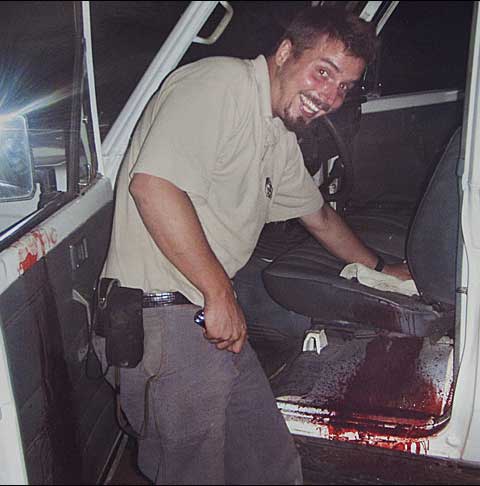
Norwegian Tjostolv Moland sentenced to death in Kisangani, DRCIt’s damning photograph. I sought it out after hearing the story of the two Norwegian mercenaries condemned to death in the Congo for the murder of their Congolese driver. Was their black companion killed in an attempt to rob the white adventurers, as they tell it? US news outlets asked Tjostolv Moland’s mothers about the picture of her son, which showed him smiling as he wiped blood from the driver’s seat of their pickup. The mother dismissed it as bad timing, she though her son was probably caught off guard, laughing at a joke unrelated to his morbid task. Boy can Americans relate.

Other US newspapers speculated about a fabled Norwegian propensity to laugh at adversity. They also described Norwegian diplomats scrambling to save the two boys from the gallows. It’s true that Norway doesn’t have a death sentence, and therefore does not condone it elsewhere. Otherwise US and BBC portrayal of Norwegian concern for the two mercenaries seemed at odds with Norway’s usual determined pacifism, so I was eager to hear from my relatives there.

The scoop? Contrary to US and UK sentiments and their projection of Norwegian concerns, there is no domestic sympathy for the two wayward boys. None.

The Norwegian public has become well aware that Moland and partner Joshua French have been traveling the Congo as mercenaries, and have been involved in other killings as well. The fact that Congolese courts are trying to extort a large fine from the Norwegian government, based on the accusation of the two travelers being agents of Norway, is due to documents which the two forged to pretend they had active duty contact with the Norwegian military.

In Norway, military service is compulsory. Every Norwegian male has a record of military service. It helps that Norway rarely involves itself with acts of aggression, sanctioned by a fraternity of nations or not. And when soldiers of fortune like Moland and French set about rampaging in Africa, it behooves Norwegian authorities to ensure that their military is not implicated by association.

How fitting that US and UK listeners should presume a reflexive maternal instinct to protect the two white boys, set upon by angry African opportunists. The boys might be mercenaries, but America and Britain have lots of those overseas. Hired guns, paid assassins, professional killers, why quibble with words?

The laws of war grant little grace for mercenaries, but that’s not what English-speaking supporters of imperial expansion want to believe. Mercenaries in the Neocon vernacular are called private contractors. They’re just ordinary soldiers who’ve escaped the poor pay of military service, to the entrepreneurial ranks of war-making free enterprise.

The Spirit of Revolt

There are periods in the life of human society when revolution becomes an imperative necessity, when it proclaims itself as inevitable. New ideas germinate everywhere, seeking to force their way into the light, to find an application in life. These ideas are opposed by the inertia of those whose interest it is to maintain the old order; they suffocate in the stifling atmosphere of prejudice and traditions. The accepted ideas of the constitution of the state, of the laws of social equilibrium, of the political and economic interrelations of citizens, can hold out no longer against the implacable criticism which is daily undermining them?…?Political, economic and social institutions are crumbling. The social structure, having become uninhabitable, is hindering, even preventing, the development of seeds which are being propagated within its damaged walls and being brought forth around them.

The need for a new life becomes apparent. The code of established morality, that which governs the greater number of people in their daily life, no longer seems sufficient. What formerly seems just is now felt to be a crying injustice. The morality of yesterday is today recognized as revolting immorality. The conflict between new ideas and old traditions flames up in every class of society?…?the popular conscience rises up against the scandals which breed amidst the privileged and leisured, against the crimes committed in the name of “the law of the stronger,” or in order to maintain these privileges. Those who long for the triumph of justice, those who would put new ideas into practice, are soon forced to recognize that the realization of their generous, humanitarian and regenerating ideas cannot take place in a society thus constituted. They perceive the necessity of a revolutionary whirlwind which will sweep away all this rottenness, revive sluggish hearts with its breath and bring to mankind that spirit of devotion, self-denial and heroism, without which society sinks through degradation and vileness into complete disintegration.

In periods of frenzied haste toward wealth, of feverish speculation and of crisis, of the sudden downfall of great industries and the ephemeral expansion of other branches of production, of scandalous fortunes amassed in a few years and dissipated as quickly, it becomes evident that the economic institutions which control production and exchange are far from giving to society the prosperity which they are supposed to guarantee. They produce precisely the opposite result. Instead of order they bring forth chaos; instead of prosperity, poverty and insecurity; instead of reconciled interests, war – a perpetual war of the exploiter against the worker, of exploiters and of workers among themselves. Human society is seen to be splitting more and more into two hostile camps, and at the same time to be subdividing into thousands of small groups waging merciless war against each other. Weary of these wars, weary of the miseries which they cause, society rushes to seek a new organization. It clamors loudly for a complete remodeling of the system of property ownership, of production, of exchange all economic relations which spring from it.

The machinery of government, entrusted with the maintenance of the existing order, continues to function, but at every turn of its deteriorated gears, it slips and stops. Its working becomes more and more difficult, and the dissatisfaction caused by its defects grows continuously. Every day gives rise to a new demand. “Reform this,” “Reform that,” is heard from all sides. “War, finance, taxes, courts, police, everything would have to be remodeled, reorganized, established on a new basis,” say the reformers. And yet all know that it is impossible to make things over, to remodel anything at all because everything is interrelated; everything would have to be remade at once. And how can society be remodeled when it is divided into two openly hostile camps? To satisfy the discontented would be only to create new malcontents.

Incapable of undertaking reforms, since this would mean paving the way for revolution, and at the same time too impotent to be frankly reactionary, the governing bodies apply themselves to half-measures which can satisfy nobody, and only cause new dissatisfaction. The mediocrities who, in such transition periods, undertake to steer the ship of state, think of but one thing: to enrich themselves against the coming debacle. Attacked from all sides they defend themselves awkwardly, they evade, they commit blunder upon blunder and they soon succeed in cutting the last rope of salvation. They drown the prestige of the government in ridicule, caused by their own incapacity.

Such periods demand revolution. It becomes a social necessity; the situation itself is revolutionary.

When we study in the works of our greatest historians the genesis and development of vast revolutionary convulsions, we generally find under the heading “The Cause of the Revolution” a gripping picture of the situation on the eve of events. The misery of the people, the general insecurity, the vexatious measures of the government, the odious scandals laying bare the immense vices of society, the new ideas struggling to come to the surface and repulsed by the incapacity of the supporters of the former regime – nothing is omitted. Examining this picture, one arrives at the conviction that the revolution was indeed inevitable, and that there was no other way out than by the road of insurrection?…?But, between this pacific arguing and insurrection or revolt, there is a wide abyss – that abyss which, for the greatest part of humanity, lies between reasoning and action, thought and the will to act. How has this abyss been bridged??…?How was it that words, so often spoken and lost in the air like the empty chiming of bells, were changed in actions?

The answer is easy. Action. The continuous action, ceaselessly renewed, of minorities brings about this transformation. Courage, devotion, the spirit of sacrifice, are as contagious as cowardice, submission and panic.

What forms will this action take? All forms – indeed, the most varied forms, dictated by circumstances, temperament and the means at disposal. Sometimes tragic, sometimes humorous, but always daring; sometimes collective, sometimes purely individual, this policy of action will neglect none of the means at hand, no event of public life, in order to keep the spirit alive, to propagate and find expression for dissatisfaction, to excite hatred against exploiters, to ridicule the government and expose its weakness and above all and always, by actual example, to awaken courage and fan the spirit of revolt.

When a revolutionary situation arises in a country, before the spirit of revolt is sufficiently awakened in the masses to express itself in violent demonstrations in the streets or by rebellions and uprisings, it is through action that minorities succeed in awakening that feeling of independence and that spirit of audacity without which no revolution can come to a head.

Men of courage, not satisfied with words, but ever searching for the means to transform them into action – men of integrity for whom the act is one with the idea, for whom prison, exile and death are preferable to a life contrary to their principles, intrepid souls who know that it is necessary to dare in order to succeed – these are the lonely sentinels who enter the battle long before the masses are sufficiently roused to raise openly the banner of insurrection and to march, arms in hand, to the conquest of their rights?…?Whoever has a slight knowledge of history and a fairly clear head knows perfectly well from the beginning that theoretical propaganda for revolution will necessarily express itself in action long before the theoreticians have decided that the moment to act has come.

Nevertheless the cautious theoreticians are angry at these madmen, they excommunicate them, they anathematize them. But the madmen win sympathy, the mass of the people secretly applaud their courage and they find imitators?…?Acts of illegal protest, of revolt, of vengeance, multiply.

Indifference from this point on is impossible?…?By actions which compel general attention, the new idea seeps into people’s minds and wins converts?…?Above all, it awakens the spirit of the revolt: it breeds daring?…?The people observe that the monster is not so terrible as they thought; they begin dimly to perceive that a few energetic efforts will be sufficient to throw it down. Hope is born in their hearts, and let us remember that if exasperation often drives men to revolt, it is always hope – the hope of victory – which makes revolutions.

The government resists; it is savage in its repressions. But, though formerly persecution killed the energy of the oppressed, now, in periods of excitement, it produces the opposite result. It provokes new acts of revolt, individual and collective. It drives the rebels to heroism, and in rapid succession these acts spread, become general, develop. The revolutionary party is strengthened by elements, which up to this time were hostile or indifferent to it. The general disintegration penetrates into the government, the ruling classes, the privileged. Some of them advocate resistance to the limit; others are in favor of concessions; others, again, go so far as to declare themselves ready to renounce their privileges for the moment, in order to appease the spirit of revolt, hoping to dominate again later on. The unity of the government and the privileged class is broken.

The ruling class may also try to find safety in savage reaction. But it is now too late; the battle only becomes more bitter, more terrible, and the revolution which is looming will only be more bloody. On the other hand, the smallest concession of the governing classes, since it comes too late, since it has been snatched in struggle, only awakes the revolutionary spirit still more. The common people, who formerly would have been satisfied with the smallest concession, observe now that the enemy is wavering. They foresee victory, they feel their courage growing, and the same men who were formerly crushed by misery and were content to sigh in secret, now lift their heads and march proudly to the conquest of a better future.

Finally, the revolution breaks out, the more terrible as the preceding struggles were bitter.

The Spirit of Revolt, Pyotr Kropotkin, 1880.

No. 1 domestic terrorist Daniel McGowan

The Huffington Post published a letter by ELF/ALF political prisoner Daniel McGowan, who is allowed to send one letter per week from CMU36, the controversial “Communication Management Unit” whose cover-name is USP Marion. According to McGowan, prison guards call it the “I Unit,” which probably does not stand for illegal.

As of May 2009, I have been at USP Marion’s “Communication Management Unit,” or CMU, for roughly nine months and now is a good time to address the misconceptions (and the silence) regarding this unit. I want to offer a snapshot of my day-to-day life here as well as some analysis of what the existence of CMUs in the federal prison system implies. It is my hope that this article will partially fill the void of information that exists concerning the CMU, will help dispel rumors, and will inspire you to support those of us on the inside fighting the existence of these isolation units — in the courts and in the realm of public opinion.

It is best to start from the beginning — or at least where my story and the CMU meet. My transfer here is no different from that of many of the men here who were living at Federal Correctional Institutions (normal prisons) prior to the genesis of the CMUs. On May 12, 2008, on my way back from a decent lunch, I was told to report to “R&D” (receiving and discharge). I was given two boxes and half an hour to pack up my meager possessions. After complying I was placed in the SHU (secure housing unit or “hole”) and put on a bus the next day. There was no hearing and no information given to me or my attorneys — only after a day was I told I was on my way to Marion, Illinois’ CMU.

Hearing the term “CMU” made my knees buckle as it drummed up some memory I had of the infamous “control units” at Marion (closed in 1995 and replaced by Florence ADX: the lone Federal “Supermax” prison). Then it hit me. The lawyers, in challenging the application of the terrorist enhancement in my case, made the prescient argument that if I receive the enhancement, the Bureau of Prisons (BoP) would use that to place me in the CMU at FCI Terre Haute, Indiana (at the time just 5 months old). In fact, on the way to FCI Sandstone in August 2007, I not only saw the CMU but met one of its residents while in transit. Let me back up and offer a brief history of the Communication Management Units.

The CMU I reside in, at USP Marion, received its first prisoner in May 2008 and when I arrived, held about 17 men, the majority of whom were Muslim. Currently, the unit has 25, with a capacity of 52 cells. In April 2009, we received seven new people, all of whom were from the CMU at FCI Terre Haute. The unit is overwhelmingly Muslim with 18 men identifying as such. Most, but not all of the prison, have so-called terrorism cases. According to a BoP spokesperson, the unit “will not be limited to inmates convicted of terrorism-related cases through all of the prisoners fit that description.” Others have prison disciplinary violation or allegations related to communication and the misuse of telephones etc. Here, almost everyone has a terrorism related case — whether it is like my case (destruction of property characterized as “domestic terrorism”) or conspiracy and “providing material aid” cases.

Before the Marion CMU opened, there was the original CMU, opened in December 2006 at the former death row at FCI Terre Haute. According to early articles, the unit was intended for “second tier terrorism inmates, most of them Arab Muslims and a less restrictive version of the Supermax in Florence, Colorado.”

Additionally, BoP Director Harley Lappin, in a July 2008 hearing on the 2009 BoP budget request, said of the CMUs, “A lot of the more serious offenders, terrorists, were housed at ADX Florence. So, we are ramping up two communications management units that are less restrictive but will ensure that all mail and phone calls of the offenders are monitored on a daily basis.”

Terre Haute’s CMU has 36 men (27 of whom are Muslim) and is roughly comparable to Marion’s CMU. The rest of this place focuses on the latter, in which I have resided and of which I have seen firsthand.

You may be curious about just what a CMU actually is. From my correspondence, I can tell that many correspondents do not know much about what goes on here. I hope this can clear up any misperceptions. According to the BoP,

The CMU is [sic] established to house inmates who, due to their current offense of conviction, offense conduct or other verified information, require increased monitoring of communication between inmates and persons in the community in order to protect the safety, security, and orderly operations of Bureau facilities and protect the public…The CMU is a self-contained general population housing unit.

There are, of course, alternate views to the above definition including the belief that the CMUs are Muslim units, a political prisoner unit (similar to the HSU operated by the BoP in the 80’s, and a punishment unit.

The CMUs have an extremely high Muslim population; here at Marion, it is 65-75%. An overrepresentation of any one demographic in a prison raises constitutional issues of equal protection as well as safety issues. Nowhere in the BoP will you find any group represented in such extreme disproportion. To counter these claims, the BoP brought in a small number of non-Muslims to be used as proof that the units are not strictly Muslim (an interesting note is that some of the Muslim men here have cases unrelated to terrorism). Does the inclusion of six people that are non-Muslim really negate the claim of segregation though? What are the criteria for determining who comes to the CMU? The BoP claims there are 211 international terrorists (and 1000 domestic terrorists) in their system. Yet, the CMUs have no more than 60 men at the present time. Where are the rest of these people? How does the BOP determine who of those 1200 are sent to a CMU and who to normal prisons? These are questions that need to be asked — in court and in the media.

Many of the men here (both Muslim and non) are considered political prisoners in their respective movements and have been engaged in social justice, religious organizations, charities and humanitarian efforts. Another conception of the CMU is that it is a location designed to isolate us from our movements and to act as a deterrent for others from those movements (as in “step outside the line and you too will end up there”). The intended effect of long-term housing of this kind is a profound sense of dislocation and alienation. With your mail, email, phones, and visits monitored and no human touch allowed at the visits, it is difficult to feel a connection to “the streets.” There is historical evidence of the BoP utilizing political prisons — despite the fact that the Department of Justice refuses to acknowledge the concept of political prisoners in US prisons, choosing to call us “criminal” instead.

The Lexington High Security Unit (HSU) was one such example. Having opened its 16-bed facilities in 1988 and housing a number of female political prisoners, the HSU functioned as an isolation unit — underground, bathed in fluorescence, and limited interaction with staff. In the opinion of Dr. Richard Korn, speaking on behalf of the American Civil Liberties Union, the unit’s goal was “…to reduce prisoners to a state of submission essential for their ideological conversion. That failing, the next objective is to reduce them as efficient, self-directing antagonists. That failing, the only alternative is to destroy them by making them destroy themselves.”

After an arduous campaign by human rights advocates and supporters, the BoP capitulated, stating it would close its facility (when it did not, it was sued). The judge ruled that the plaintiffs were illegally designated based on their past political affiliations, statements and political beliefs. The unit was closed and the women were transferred to other prisons.

The correlations between the HSU and CMU are many and seem to have some of the same goals as well as methods used to designate us here. Knowing they are dealing with people committed to ideals and the movements they are a part of, we were placed here in order to weaken those connections and harm our relationships. An example is the horrendous strain that the CMU puts on our familial relations — especially our marriages. It was certainly considered by the architects of the CMU that preventing visits that allow human touch for long-term prisoners would have a disastrous impact on our relationships and would lead to weaker inmates.

Finally, the CMU can be viewed as “the stick” — a punitive unit for those who don’t play ball or who continue to express political beliefs anathema to the BoP or the US government. Although I am not aware of the BoP’s criteria for sending people here (due to their refusal to release specific CMU information), it is curious who is and who is not here. Out of roughly 18 codefendants in my criminal case, I am the only one at a CMU (the remainder of them are at low and medium security prisons). The same goes for a member of the SHAC7 campaign, Andrew Stepanian, one of 6 defendants in his case who was sent here for the last 6 months of his sentence. Other men here have codefendants at the Terre Haute CMU while others have codefendants at normal federal prisons. Despite numerous Freedom of Information Requests, the BoP refuses to grant the documents that specify the rules governing transfer to the CMU. Remember, hardly any of the men here have received any disciplinary violations and some have been in general population over 15 years! How can someone be okay in general population for that long and then one day be seen as a communication threat?

So, I have hypothesized about the goals of the CMU. Let me discuss the many problems and injustices associated with the existence of the CMUs.

Due process
More appropriately, a lack thereof. A term I never thought much about before my imprisonment, due process is:

…the conduct of legal proceedings according to established rules and principles for the protection and enforcement of private rights, including notice and the right to hearing before a tribunal [my emphasis] with the power to decide the case.

I was moved from FCI Sandstone, against my will and at a moment’s notice, with no hearing and thus no chance to contest the reason for my transfer. A FOIA request recently received states I was redesignated May 6th, my transfer was signed the next day and I was moved on May 13th with the reason given as “program participation”. Since I got here, I have not had a hearing to contest the claims made in the “Notice to Inmate of Transfer to CMU, ” some of which were woefully inaccurate. Instead, I was told I can utilize the administrative remedy process (which I have done to no avail) and request a transfer after 18 months of “clear conduct”.

The irony is that all prisoners who violate prison rules are subject to a series of disciplinary hearings in which they could offer their defense. For legal units such as Florence ADX (Supermax) or the control unit program, there exists a codified set of rules and hearings for transfer to these locations. The BoP has deliberately ignored this process and has instead transferred us to this special, brand-new CMU without due process. My notice of transfer was given to me 12 days after I arrived!

Similar to the callous disregard for due process (and the US Constitution), there is no “step down” process for the CMU. Unlike the ones that exist at Florence ADX, control units or even the gang units, the CMU has no stages, no requisite amount of time we are to spend here before being sent back to a normal prison.

Because these preceding programs are specifically for prison misbehavior, there is a logical and orderly way to finish the program and eventually transfer. For us, the BoP has set up a paradox — if we are here for our offense conduct, which we cannot ever change, how can we reasonably leave the unit? In its “Admissions and Orientation” guide for Marion’s CMU, here is what they say:

Every new commitment to the CMU will be evaluated by his unit team regarding his suitability for incarceration in this institution. If, for some reason, the inmate is deemed not acceptable for confinement in this unit, he will be processed as expeditiously as possible…

[I am still roughly 10 months from my 18-month period in which I must wait before requesting a transfer. Considering the fact that all my remedies have been denied, I am not hopeful about this.]

CMU as Secret
In addition to the due process and transfer issues, there is the secretive and illegal manner that the CMU was created (Note: for historical perspectives, it needs to be stated that the CMU was established roughly halfway through the second term of George W. Bush and his Attorney General Alberto Gonzales.)

In April 2006, the BoP proposed a “Limited Communication for Terrorist Inmates” policy, which suggested new restrictions for “terrorists” and “terrorism related inmates” such as:

1) One 6-page letter per week.

2) One 15-minute phone call a month.

3) One 1-hour visit a month.

A coalition of civil rights organizations signed a letter of protest criticizing the proposed rules and raising numerous constitutional, practical and ethical objectives. The outcry appears to have caused the BoP to reconsider it and just 6 months later, open the CMU at FCI Terre Haute quietly. Since the BoP never sought public comment on the new CMU, it certainly appears to be a violation of the Administrative Procedural Act (APA), an argument a federal judge in Miami raised in response to a prisoner’s legal challenge to transfer to the CMU.

The unit is functionally an open secret. While the BoP circumvented the standard public comment (and feedback process), it has sought to get around this by describing the CMU as a “self-contained general population unit,” implying that the unit is legally and penally no different than a normal unit at an FCI. There is no mention of the CMU on the BoP’s website (ww.bop.gov) or USP Marion’s subpage on the same site. You will not find extensive Congressional hearings on the subject — other than a July 2008 subcommittee hearing in which it appears that the BoP director was not fully forthcoming on the CMU36. Letters here are stamped “USP Marion,” not CMU, and the unit is called “I Unit” by staff. (An interesting anecdote: while on transit in Winter 2009, I met men from the FCI here and asked them what they knew about I Unit. Without hesitation, they said, “That’s where the terrorists are.” They informed me this is what BoP Staff routinely told them.)

Media queries are met with silence or vague information. Requests by the media to interview me by coming to Marion have been denied — due to it “being detrimental to the safety, security and good order of the institution.” There still is no Program Statement on the CMU — a legal requirement, outlining the specific rules of the CMU and its designation criteria.

Because of this, and the general refusal of the BoP to hand over relevant documents through FOIA, it is impossible to determine the specific reasons why one is sent here — and thus, how to contest this process. In effect, the CMU was created on the fly, with no eye toward legality; they are free to operate it in whatever manner they choose.

Communication Management (The Promotion of Isolation and Alienation)
The most painful aspect of this unit, to me, is how the CMU restricts my contact with the world beyond these walls. It is difficult for those who have not known prison to understand what a lifeline contact with our family and friends is to us. It is our link to the world — and our future (for those of us who are fortunate enough to have release dates). Prison authorities and architects are well aware that those with strong family ties and in good communication with their loved ones are well behaved and have significantly lower rates of recidivism. The BoP, in theory, recognizes this by claiming they try to situate us within 500 miles of our homes. Mostly, this is a cruel farce for many prisoners — I have not been within 1000 miles of my family in 2 years.

The most Orwellian aspects of the CMU are in how they manage our communications:

A) Telephones- at my previous prison, I was able to use the phones for 300 minutes a month — days, nights, weekends and holidays — basically at any point I was not in my housing unit (6am-10pm). Here, we receive one 15-minute phone call a week. The call can only take place between 8am and 2:30pm, never on weekends or holidays and must be scheduled one and a half weeks in advance (we can choose a back-up number to call but if neither picks up, we don’t get a call). The call is live-monitored and recorded. Not only do we receive one fifth of the minutes granted to other federal prisoners but the call is also very trying for our families — all of whom have day jobs and many of whom have children in school. The CMU requires calls be made in English only — a difficult demand considering over half of the men here speak English as a second language (this restriction is not present at other federal prisons).

B) Visits- At FCI Sandstone, I received up to eight visiting days a month (56 hours) — contact visits in which I could embrace my wife, play cards with my nieces and share vending machine food with my visitors. These visits were my lifeline. I got about twelve of them in eight months and it aided in my adjustment to prison.

The CMU restricts our visits to one four-hour non-contract visit a month. One short visit through two inches of plate glass with cameras hanging overhead and my visitors stuffed in a four-and-a-half by three-and-a-half-foot stuffy booth — a tight squeeze for two. The visits can only take place on weekdays from 8am-2pm — no more Christmas or Thanksgiving visits — and worse, no physical contact (Consider what it would be like to have no contact with your loved ones. What if you couldn’t hug or kiss your lover, partner, wife, husband? What would that do to you?) I find myself riddled with guilt when I ask friends to spend $500 to fly across the country, drive three hours (and repeat) for a four-hour non-contact visit. I’m lucky though, having people who will do this. Many of the men here can’t afford it or don’t want to subject their children to this reality.

C) Mail- We can only send out mail once a day and we cannot visit the mail room to send out packages. We are one-hundred-percent reliant on the one staff person who deals with our mail to do so and sending a box home is a laborious procedure. We must leave our envelopes unsealed so that staff can read, copy, scan and send to whatever other agency studies our correspondence. A letter to NYC takes roughly seven to nine days (which should take five). Letters sent abroad, especially those not written in English, could take a month or more — a common complaint of some of my fellow prisoners.

Staff here has an interesting reading of the rules governing legal mail leading to the charge that they open our legal mail (this is the subject of an administrative remedy I filed with the BoP Central Office in Washington DC). The rule states that the lawyer’s name must be clearly identified and that the envelope must say “Special Mail- Open only in the presence of inmates” and yet staff has opened my legal mail that said “Law Offices of Jane Doe” stating that it should have said, “Jane Doe, Attorney at Law”! The staff looks for any reason to disqualify our legal mail as protected and gather intelligence this way. In doing so, they violate the sanctity of the attorney-client confidentiality principle.

Most of my violations have been petty — a package has more than twenty pieces of paper or a friend kindly enclosed stamps. A few instances though amount to censorship and a limiting of political expression and dialogue. See Appendix B for a detailed discussion of these instances.

D) Media Contact- Although requests have been made to interview people in the CMU, none have been granted to date. This is a violation of the spirit of the BoP’s own media policy. There is an imperative on the Bureau’s part to control and ultimately suppress information on the CMU from making it to a mass audience.

Daily Life at the CMU
Neither one of the two CMUs were built for long-term habitation. The Marion CMU was the site of the Secure Housing Unit (SHU), the USP that closed here in 2005. Terre Haute’s CMU is in “D-wing” — the site of the former federal death row.

The CMU was seemingly converted to its current use with the addition of televisions, steel tables, and new wiring and yet it is not suitable for long-term use due to its “open cell” design (i.e. with bars). With 25 prisoners, our movements are restricted to two housing ranges (hallways about 100 by 12 feet); a recreation range where we also eat (consisting of seven cells with a computer, typewriter, barber shop, religious library, social library, art room and recreational equipment); and a small rec yard (all concrete, a lap equals one-eighteenth of a mile, four cages with two basketball hoops, one handball court, a weather awning with tables and some sit-up benches). We are lucky to be visited daily by a resident bird population of doves and blackbirds, and overhead, the occasional hawk or falcon (ironically, as I write this, I overhear warnings from staff that if we continue to feed the birds, we will receive violations). The appearance of the yard with its cages, concrete, and excessive barbed wire has earned it nickname “Little Guantanamo” (of course a punitive unit with seventy-five percent Muslims also contributes to the name as well).

The conditions here are not dire — in fact, the horror stories I have heard over the last two years have convinced me it is far worse at many prisons and yet, I believe it is important to be descriptive and accurate — to dispel fears (about violence, for instance) but also to demonstrate just how different life is for us at the CMU.

There are many things we lack here that other prisons in the federal system have to offer:

1- A residential drug/alcohol program- despite at least one person here having completion of it ordered by the court.

2- Enough jobs for the prisoners here- There is not nearly enough jobs for all the men here and most are extremely low paying.

3- UNICOR- This is Federal Prison Industries which has shops at many federal prisons (including this one outside the CMU). These jobs pay much more, allow men to pay their court fees, restitution and child support and, as the BoP brags, teaches people job skills.

4- Adequate educational opportunities- Until recently, we did not have GED or vocational programs. Due to inmate pressure and persistence, we now have both of those as well as a few prisoner-taught classes but no college courses at all.

5- Access to staff on a daily basis- At other federal prisons, you are able to approach staff members at lunch every day, including the Warden. Here, we get (at most) two quick walk-throughs a week, usually taking place early in the morning. You are often left waiting days to resolve a simple question.

6- Law library access- We have a very small law library here with only twenty-five percent of the books required by law. We can only request books twice weekly and those are only delivered if the other nine hundred prisoners at the adjacent Medium are not using them. We lack Federal Court and Supreme Court reports as well as books on Immigration Law (fifty percent or more of the men here face deportation). This lack of access makes for an arduous and ineffective research path.

7- Computers- We have four computers for our email system (two for reading, one for printing and one that we were told would be for legal but it still isn’t working). Unlike my previous prison, where we had forty computers with a robust computer-class program, or like other prisons that teach a vocational computer course, we have no such thing.

8- Access to general population- Being in an isolation unit makes for a situation in which we cannot have organized sports leagues and tournaments due to not having enough people at all. This may not seem crucial but sports are a very useful diversion from the stress of prison life and separation.

After reading the preceding sections, perhaps like me you are wondering what really is the purpose of the CMU. In short, the SMU is Florence ADX-LITE for those men whose security points are low and present no real problems to staff. From my interactions with the men here, I can say with certainty, that people here are remarkably well-behaved and calm — many without any disciplinary violations. If these men, like myself, don’t get in trouble, and have been in the system for some time, why are we here? Consider my case.

My short time in prison prior to coming to the CMU consisted of two months at MDC Brooklyn and eight months at FCI Sandstone. I had never gotten in trouble and spent my days as a clerk in psychology, working toward a Master’s degree, reading, writing and exercising. My goal was to get closer to home and my loved ones. In April 2008, I filed a “hardship transfer” request due to my mother’s illness and her inability to travel to Minnesota to visit me. I had my team meeting, and my security points were lowered. Weeks later, I was moved to the CMU.

The irony is that I was moved to the CMU to have my communication managed, but what changed in that one year to justify this move? If I was a danger, then why did the BoP house me in a low-security prison? The same applies to many of the men here– some have been in general population for twenty years and then suddenly a need to manage their communication is conjured up. During my pre-CMU time, I had used 3500 phone minutes and sent hundreds of letters. If there was a problem with my communication, shouldn’t the BoP have raised this with me? My notice stating their rationale for placing me here attributed it to me “being a member and leader in the ELF and ALF” and “communicating in code.” But if this is true, then shouldn’t I have been sent to the CMU as soon as I self-reported to prison in July 2007?

The CMUs were crafted and opened under the Bush administration as some misguided attempt to be tough on the “war on terror.” This unit contains many prisoners from cases prosecuted during the hyper-paranoid and over-the-top period after 9/11 and the passage of the USA Patriot Act.44 The number of prosecutions categorized as terrorism-related more than doubled to reach 1,200 in 2002. It seemed that every other week, there was some plot uncovered by overzealous FBI agents — in Lackawanna, NY, Miami, FL, Portland, OR, and Virginia and elsewhere (never mind the illegal wiretaps and unscrupulous people used in these cases). These cases may not be headlines anymore but these men did not go away — they were sent to prison and, when it was politically advantageous for Bush, transferred to the CMUs. The non-Muslim populations of these units (although definitely picked judiciously) were sent there to dispel charges that the CMUs were exclusively Muslim units.

The codified rationale for all prisoners being transferred here are “contact with persons in community require heightened control and reviews” and “your transfer to this facility for greater communication management is necessary to the safe, secure, and orderly function of Bureau institutions…” Should an increase in monitoring of communication mean a decrease in privileges? If the goal is to manage our contact with the outside world, shouldn’t the BoP hire enough staff so that we can maintain the same rights and privileges as other prisoners (since the party line is that we are not here for punishment)? The reality is the conditions, segregation, lack of due process and such are punishment regardless of whether the BoP admits it or not.

Forward!
Where to from here, then? Does the new President and his Attorney General take issue with segregation? Will Obama view the CMU, as he did with Guantanamo Bay, as a horrible legacy of his predecessor and close it? Many people are hopeful for an outcome like that. On April 7th, 2009, Mr. Obama, while in Turkey, said, “The United States will not make war on Islam,” and that he wanted to “extend the hand of friendship to the Muslim world.” While that sounds wonderful, what does that look like in concrete terms? Will he actualize that opinion by closing the CMU? Or will he marry the policy of Bush and condone a secret illegal set of political units for Muslims and activists? What of the men here? Will he transfer us back to normal prisons and review the outrageous prosecutions of many of the CMU detainees? If it can be done with (former) Senator Ted Steven’s case, it can be done here.

While lawsuits have been filed in both Illinois and Indiana federal courts, what is needed urgently is for these units to be dragged out into the open. I am asking for your help and advocacy in dealing with this injustice and the mindset that allows a CMU to exist. Please pursue the resource section at the end of this article and consider doing something. I apologize for the length of this piece — it was suggested to me (by people way smarter than myself) that it would be best to start from the beginning and offer as many details as possible. I hope I gave you a clearer idea of what’s going on here. Thank you for all your support and love — your letters are a bright candle in a sea of darkness.

Black Pirates meted Southern Justice

US Navy Seals recover captive lifeboat from the USS Maersk Alabama
Dutch NATO forces rescued 20 hostages off the coast of Africa last week without loss of life. They thwarted a pirate attack, confiscated the booty, but must release the captured pirates owing to International Maritime Law. Contrast this with American cowboy rules of engagement.

Several US Navy warships faced a solitary lifeboat on which three teenage Somali pirated held hostage Maersk Alabama captain Richard Phillips. The covered lifeboat remained tethered to the stern of one of the Navy ships while negotiations, we’re told, progressed.

Going into day three, before the American TV audience could lose interest, US Navy Seals rescued the captive Phillips at a cost of a 100% casualty rate to the pirates. Although the DoD did not initially want to reveal its anti-pirate tactics, spokesmen have admitted that the “daring rescue” was in effect three precisely-simultaneous sniper shots to the heads of the three captors. The fourth pirate already having been entrusted to the US ship’s custody for medical care. The captain freed, the wounded pirate’s collateral was thus gone, and his grant of safe-passage was rescinded.

The official story is that US infrared imagery revealed that the American captive’s life was in danger. One of the pirates was holding a gun to his head, and this act prompted the snipers to intervene. Negotiations, apparently, were not proving fruitful. I’m guessing that this account reflects the exact opposite of what happened. The navy snipers had been holding their fire until the moment Captain Phillip was NOT in a pirate’s crosshairs.

Although the Somali pirates were just teens, I bet they knew from brutal experience, what most of us know from violent television, that holding your gun to a hostage’s head is the only way to prevent your rivals from gunning you down. Trapped in a lifeboat, the pirates knew that high powered US weaponry would be trained upon each of their heat silhouettes. The moment their captive was not in the predicted trajectory of the crossfire, nor threatened by a collateral death-spasm squeeze of a trigger, the pirates would be toast.

The rescue operation began with a greater-than-three number of US snipers aiming weapons at the little boat. The more the better, to assure that at every instant, complicated by the rocking and turning of the lifeboat in the waves, at least one sniper could claim one pirate, without the hostage laying vulnerable to leeward bullets. The images in the sniper scopes were wired to a director’s console, where the determination could be made when all three targets were spoken for, and the order could be given to fire. The last hurdle remained for the pirate who held his gun on the hostage to drop his guard for just an instant, lest he squeeze off a round into the hostage. Wanna bet that’s what happened?

Great marksmanship, no question. Plenty of training no doubt. We can take nothing away from the heroism shown in braving responsibility for jeopardizing Captain Phillip’s life. It is probably also a common law enforcement strategy. Although that doesn’t make it legal.

Unless the US Navy releases the targeting footage, we are unlikely to confirm the true sequence of events. But where the pirate’s gun was pointing makes a difference. The Navy is explaining that it acted because Phillips’ life was at stake. Otherwise, shooting people who are not shooting at you is considered underhanded.

The Dutch navy forces bay have bellyached that they had to turn loose their captured pirates, instead of leaving them imprisoned somewhere, but the Dutch had seized them in Somali waters, where the pirates operate as their nation’s only Coast Guard. The Dutch NATO commandos prevented an attack, and liberated the detainees being held by the de-facto Somali border agents, and their directive ended there.

The US on the other hand, executed three “Somali Pirates,” regardless the varying degree of culpability the individuals might have had.

Without a day in court, that’s extra-judicial murder. If you consider these were three African youths, it looks like a lynching.

Let’s take note, by whose account to we know what happened out on the high seas? Do we know even that these were pirates? Says who? I am simply playing devil’s advocate. Do we know these four youth weren’t stowaways? Perhaps they had been Shanghaied and attempted an escape via the Maersk Alabama’s lifeboat. Do we know what happened really? That’s what courts are there to decide.

Everything the American TV audience knows is from the mouths of the US military. What do we know? These youths might have been human-trafficking cargo, en route to or from war zones. They might have broken free, running straight into the Maersk’s convenient cover story that all inconvenient incidences can be labeled pirate attacks. Have we anybody’s word who has not been lying to us about war crimes everywhere, about the use of torture, about the true magnitude of renditions and secret prisons?

These black youths might just as well have been the captive sex slaves of the porky white contractor mercenaries who were planning to kill them while in the act of buggering them, but the damn Negroes slipped free. So the Navy Seals had to come play cleaner to the embarrassing mess. I exaggerate to emphasize: what the fuck do YOU know?!

“This is how the USA handles pirates” was basically our statement. Americans stateside cheered and grabbed their dicks. But overseas, and on the seas, the sentiment is much more wary. The US Navy has escalated the war on piracy. Now the rules of engagement for both sides is going to be shoot first, ask questions later.

Are the Somalis quaking in their pirate boots? When the news hit about what the Navy Seals did, the self-styled privateers of the Somali Coast redoubled their attacks on foreign ship traffic.

Prohibition is Stupid- there is something wrong with the law

McMarijuana‘Nearly half of all Americans say they have tried marijuana. That makes them criminals in the eyes of the law. Luckily, not all of them have been found out – but when one is grateful that most law-breakers go undetected, there is something wrong with the law.’
 
YES, there is something wrong with the law, when the law is made by elites to deliberately criminalize millions of poor people so as to further brutalize them.

See Financial Times columnist Clive Crook (good name!) writing about Prohibition- A criminally stupid war on drugs in the US

When elites do something as overtly and obviously dysfunctionally stupid as promoting Prohibition and a ‘War on Drugs’ then there is almost always a covert reason for why they are doing it, too. Same is true with all their other war making policies.

When a ‘Global War on Terrorism’ produces more terrorism than it eliminates yet the elites keep on pushing it, then there is a covert reason for doing that, too. What would those covert reasons be? Begging the elites to stop it because their overt reasons don’t add up right just will not succeed. They continue to do what they are doing for hidden reasons, and often even hidden from themselves reasons as well.

One of those hidden reasons is that what the program is really about is building a security apparatus to protect themselves, and not really to be used against drug spread and terrorism spread. They simply need a society blindly following authoritarian orders that are used to keep themselves, the elites, in power. Consider these ‘wars’ as excuses to build a security structure around themselves. It is a welfare program for the building of a group of security ‘servants’ for the top dogs. It is a program to make the lower classes of society more miserable and therefore more demoralized and self-destructive. Demoralized and self-destructive people are less able to rebel when there is military, courts, and police around every corner of their lives.

Corporate Murderers get away with it… AGAIN!!!

High Court Rejects Agent Orange Case -3/3/09 -Associated Press

The other two suits were filed by U.S. veterans who got sick too late to claim a piece of the $180 million settlement with makers of the chemical in 1984. In 2006, the Supreme Court deadlocked 4-4 on whether those lawsuits could proceed.

Guess if you die after the “Deadline”.. ….

WASHINGTON – The Supreme Court has turned down American and Vietnamese victims of Agent Orange who wanted to pursue lawsuits against companies that made the toxic chemical defoliant used in the Vietnam War.

The justices offer no comment on their action Monday, rejecting appeals in three separate cases, in favor of Dow Chemical, Monsanto and other companies that made Agent Orange and other herbicides used by the military in Vietnam.

Agent Orange has been linked to cancer, diabetes and birth defects among Vietnamese soldiers and civilians and American veterans.

The American plaintiffs blame their cancer on exposure to Agent Orange during the military service in Vietnam. The Vietnamese said the U.S.’ sustained program to prevent the enemy from using vegetation for cover and sustenance caused miscarriages, birth defects, breast cancer, ovarian tumors, lung cancer, Hodgkin’s disease and prostate tumors.

Learn more about Agent Orange

All three cases had been dismissed by the 2nd U.S. Circuit Court of Appeals in New York.

The appeals court said that lawsuit brought by the Vietnamese plaintiffs could not go forward because Agent Orange was used to protect U.S. troops against ambush and not as a weapon of war against human populations.

The other two suits were filed by U.S. veterans who got sick too late to claim a piece of the $180 million settlement with makers of the chemical in 1984. In 2006, the Supreme Court deadlocked 4-4 on whether those lawsuits could proceed.

The appeals court ultimately said no to both. In one case, the court said companies are shielded from lawsuits brought by U.S. military veterans or their relatives because the law protects government contractors in certain circumstances who provide defective products.

In the third suit, the appeals court ruled that the companies could transfer claims from state to federal courts.

The cases are Isaacson v. Dow Chemical Co., 08-460, Stephenson v. Dow Chemical Co., 08-461, and Vietnam Association for Victims of Agent Orange v. Dow Chemical Co., 08-470.

Little Eichmanns, anybody?

$180 million divided among thousands of veterans.

Miss Johnnies husband had more than $180K in hospital bills. Still unpaid by the VA.

Monsanto and Dow made BILLIONS selling their Death.

The Military Contractors, they’re shielded from responsibility for the lives of any of their Victims being destroyed or ended.

There’ll be Rejoicing in the Republican Households, they got away with it, AGAIN.

They sell Murder by the Ton.

I haven’t told Miss Johnnie about this one yet.

Russia to Europe- Back US war making then pay the price

RussiaRussia is starting to play tough with the US’s European allies because of their support for the constant US Pentagon aggression. No longer can the main European countries just verbally waffle along while doing absolutely nothing other than backing the belligerent US foreign policies. EU warns of legal action over gas

So the Europeans are going to try to wage their own form of economic warfare against Russia through the courts, but that just won’t work and is more straw than substance. Europe is energy short and why should Russia just lay back and do nothing as the US tries to loot the world’s remaining and rapidly declining energy resources for itself? There simply is no reason and now the Europeans are going to have to start paying the price for riding along with Pentagon aggression throughout the world. Russia’s had enough.

New York man to get up to 15 years jail for exercising free speech in the United States

free speech cartoonHave you ever listened to or seen Almanar tv? Check it out for 5-10 minutes and hear some news, some music, some soap operas. Almanar Tv

Sure it’s in Arabic, but at least it’s not NPR, PBS, Fox, or any of the other American military-industrial-government propaganda sources spewing out the same poison as always. Ooohhhh…. Pretty dangerous isn’t it?

Did you know that a man in New York State just got found guilty of broadcasting what you are now listening to and watching on Almara tv? That’s what the Pentagon torture, occupation, and murder crowd call ‘terrorism’! Free Speech! It must be stopped! We’re supposed to be believing all the US government lies and noise, and free speech might actually interrupt that? NY man pleads guilty to broadcasting Hezbollah TV.

So who defined free speech as ‘terrorism’, besides the US government, US courts, and US media corporate propagandists? It all started with an anti free speech coalition called The Coalition Against Terrorist Media. Had you ever, as an American, feared that supposedly horrible something defined by this group as ‘terrorist media’? That’s right! This group defines free speech as ‘terrorism’, which make this ‘coalition’ about as unAmerican as it gets!

But it goes deeper in doo-doo here, as the so-called ‘Coalition Against Terrorist Media’, despite its claim to be a coalition of Muslims, Jews, and Christians, is really nothing more than a front set up by the Foundation for the Defense of Democracies. Get the picture yet? The defense of democracies involves the suppression of free speech, according to these Right Wingers who are actually setting current US government and legal policies.

So who is behind the so-called ‘Foundation for the Defense of Democracies’? Let’s check out SourceWatch’s entry on this group. Below is a partial list of the names of those who helped criminalize Free Speech by campaigning to have this man thrown in jail (up to 15 years) for broadcasting a TV station that is already on air in the US, Almanar tv available on internet as you did at the beginning of this commentary.

The following information was updated August 16, 2007.[4] ]Board of Directors of ‘Foundation for the Defense of Democracies’.

Steve Forbes, Board Member; CEO Forbes Magazine (site bio)
Dr. Jeane J. Kirkpatrick, Board Member; Former Ambassador to the UN (site bio)
Jack Kemp, Chairman Emeritus; Former Secretary of Housing and Urban Development (site bio)
[edit]Distinguished Advisors
Judge Louis J. Freeh, Former Director of the FBI (site bio)
R. James Woolsey, Former Director of the CIA (site bio)
Newt Gingrich, Former. Speaker of the House (site bio)
Joe Lieberman, US Senator (D-CT) (site bio)
[edit]Board of Advisors
Gary Bauer, President, American Values (site bio)
Donna Brazile, Campaign Manager Gore 2000 (site bio)
Rep. Eric Cantor (R-VA), Task Force on Terrorism Chairman (site bio)
Rep. Eliot Engel (D-NY), U.S. House of Representatives (site bio)
Frank Gaffney, President, Center for Security Policy (site bio)
Amb. Marc Ginsberg, Former Ambassador Morroco (site bio)
Charles Jacobs, President, American Anti-Slavery Group (site bio)
Charles Krauthammer, Syndicated Columnist (site bio)
Bill Kristol, Editor, Weekly Standard (site bio)
Hon. Richard D. Lamm, Former Colorado Governor (site bio)
Rep. Jim Marshall (D-GA), U.S. House of Representatives (site bio)
Sen. Zell Miller, Former U.S. Senator (site bio)
Richard Perle, Former Chair of the Defense Policy Board and FDD Advisor (site bio)
Steven Pomerantz, Former Assistant Director FBI
Oliver “Buck” Revell, Former Associate Deputy Director FBI
Sen. Charles E. Schumer (D-NY), U.S. Senate (site bio)

These people don’t defend democracies, they destroy them. Here, watch some more Almanar Tv for free Now ponder the nature of the US society where the top leaders sponsor torture of prisoners, invasions of other countries, and state terrorism around the world, yet New York businessman, Javed Iqbal, faces 15 years in jail through our government’s labelling Free Speech an act of terrorism!

Calling Obama Calling Obama! Oops, the line went dead! Did you notice how that liberals’ American idol, Al Gore, crept into the picture. His VP candidate when he ran for the White House, DP-RP Joe Lieberman, is one of of the fat cats on this list of unAmericans against free speech rights. Are you surprised? You shouldn’t be.

And notice, too, all these former top cops from the FBI and CIA defining free speech in your country as a form of terrorism. These are the real terrorists who are undermining National Security and the American right to free speech without being jailed. They hate free speech by others, and they hate democracy… PERIOD.

Weathermen for a Democratic Society

Bernadine Dohrn addresses S.D.S. in ChicagoIn 1969, the Radical Youth Movement (RYM) within Students for a Democratic Society (SDS) expelled the passive participants to reconfigure the SDS to Bring the War Home. At left, Bernardine Dohrn uninvites the Progressive Labor Party (PL) and the Worker Student Alliance (WSA) from the Chicago conference. Below is the founding document after which the RYM was renamed.

You Don’t Need A Weatherman
To Know Which Way The Wind Blows

June 18, 1969

Submitted by Karin Asbley, Bill Ayers, Bernardine Dohrn, John Jacobs, Jeff Jones, Gerry Long, Home Machtinger, Jim Mellen, Terry Robbins, Mark Rudd and Steve Tappis.

I. International Revolution

The contradiction between the revolutionary peoples of Asia, Africa and Latin America and the imperialists headed by the United States is the principal contradiction in the contemporary world. The development of this contradiction is promoting the struggle of the people of the whole world against US imperialism and its lackeys.

Lin Piao, Long Live the Victory of People’s War!

People ask, what is the nature of the revolution that we talk about- Who will it be made by, and for, and what are its goals and strategy-

The overriding consideration in answering these questions is that the main struggle going on in the world today is between US imperialism and the national liberation struggles against it. This is essential in defining political matters in the whole world: because it is by far the most powerful, every other empire and petty dictator is in the long run dependent on US imperialism, which has unified, allied with, and defended all of the reactionary forces of the whole world. Thus, in considering every other force or phenomenon, from Soviet imperialism or Israeli imperialism to “workers struggle” in France or Czechoslovakia, we determine who are our friends and who are our enemies according to whether they help US imperialism or fight to defeat it.

So the very first question people in this country must ask in considering the question of revolution is where they stand in relation to the United States as an oppressor nation, and where they stand in relation to the masses of people throughout the world whom US imperialism is oppressing.

The primary task of revolutionary struggle is to solve this principal contradiction on the side of the people of the world. It is the oppressed peoples of the world who have created the wealth of this empire and it is to them that it belongs; the goal of the revolutionary struggle must be the control and use of this wealth in the interests of the oppressed peoples of the world.

It is in this context that we must examine the revolutionary struggles in the United States. We are within the heartland of a worldwide monster, a country so rich from its worldwide plunder that even the crumbs doled out to the enslaved masses within its borders provide for material existence very much above the conditions of the masses of people of the world. The US empire, as a worldwide system, channels wealth, based upon the labor and resources of the rest of the world, into the United States. The relative affluence existing in the United States is directly dependent upon the labor and natural resources of the Vietnamese, the Angolans, the Bolivians and the rest of the peoples of the Third World. All of the United Airlines Astrojets, all of the Holiday Inns, all of Hertz’s automobiles, your television set, car and wardrobe already belong, to a large degree to the people of the rest of the world.

Therefore, any conception of “socialist revolution” simply in terms of the working people of the United States, failing to recognize the full scope of interests of the most oppressed peoples of the world, is a conception of a fight for a particular privileged interest, and is a very dangerous ideology. While the control and use of the wealth of the Empire for the people of the whole world is also in the interests of the vast majority of the people in this country, if the goal is not clear from the start we will further the preservation of class society, oppression, war, genocide, and the complete emiseration of everyone, including the people of the US.

The goal is the destruction of US imperialism and the achievement of a classless world: world communism. Winning state power in the US will occur as a result of the military forces of the US overextending themselves around the world and being defeated piecemeal; struggle within the US will be a vital part of this process, but when the revolution triumphs in the US it will have been made by the people of the whole world. For socialism to be defined in national terms within so extreme and historical an oppressor nation as this is only imperialist national chauvinism on the part of the “movement.”

II. What Is The Black Colony-

Not every colony of people oppressed by imperialism lies outside the boundaries of the US. Black people within North America, brought here 400 years ago as slaves and whose labor, as slaves, built this country, are an internal colony within the confines of the oppressor nation. What this means is that black people are oppressed as a whole people, in the institutions and social relations of the country, apart from simply the consideration of their class position, income, skill, etc., as individuals- What does this colony look like- What is the basis for its common oppression and why is it important-

One historically important position has been that the black colony only consists of the black belt nation in the South, whose fight for national liberation is based on a common land, culture, history and economic life. The corollary of this position is that black people in the rest of the country are a national minority but not actually part of the colony themselves; so the struggle for national liberation is for the black belt, and not all blacks; black people in the north, not actually part of the colony, are part of the working class of the white oppressor nation. In this formulation northern black workers have a “dual role”—one an interest in supporting the struggle in the South, and opposing racism, as members of the national minority; and as northern “white nation” workers whose class interest is in integrated socialism in the north. The consistent version of this line actually calls for integrated organizing of black and white workers in the north along what it calls “class” lines.

This position is wrong; in reality, the black colony does not exist simply as the “black belt nation,” but exists in the country as a whole. The common oppression of black people and the common culture growing out of that history are not based historically or currently on their relation to the territory of the black belt, even though that has been a place of population concentration and has some very different characteristics than the north, particularly around the land question.

Rather, the common features of oppression, history and culture which unify black people as a colony (although originating historically in a common territory apart from the colonizers, i.e., Africa, not the South) have been based historically on their common position as slaves, which since the nominal abolition of slavery has taken the form of caste oppression, and oppression of black people as a people everywhere that they exist. A new black nation, different from the nations of Africa from which it came, has been forged by the common historical experience of importation and slavery and caste oppression; to claim that to be a nation it must of necessity now be based on a common national territory apart from the colonizing nation is a mechanical application of criteria which were and are applicable to different situations.

What is specifically meant by the term caste is that all black people, on the basis of their common slave history, common culture and skin color are systematically denied access to particular job categories (or positions within job categories), social position, etc., regardless of individual skills, talents, money or education. Within the working class, they are the most oppressed section; in the petit bourgeoisie, they are even more strictly confined to the lowest levels. Token exceptions aside, the specific content of this caste oppression is to maintain black people in the most exploitative and oppressive jobs and conditions. Therefore, since the lowest class is the working class, the black caste is almost entirely a caste of the working class, or [holds] positions as oppressed as the lower working-class positions (poor black petit bourgeoisie and farmers); it is a colonial labor caste,, a colony whose common national character itself is defined by their common class position.

Thus, northern blacks do not have a “dual interest”—as blacks on the one hand and “US-nation workers” on the other. They have a single class interest, along with all other black people in the US, as members of the Black Proletarian Colony.

III. The Struggle For Socialist Self-Determination

The struggle of black people—as a colony—is for self-determination, freedom, and liberation from US imperialism. Because blacks have been oppressed and held in an inferior social position as a people, they have a right to decide, organize and act on their common destiny as a people apart from white interference. Black self-determination does not simply apply to determination of their collective political destiny at some future time. It is directly tied to the fact that because all blacks experience oppression in a form that no whites do, no whites are in a position to fully understand and test from their own practice the real situation black people face and the necessary response to it. This is why it is necessary for black people to organize separately and determine their actions separately at each stage of the struggle.

It is important to understand the implications of this. It is not legitimate for whites to organizationally intervene in differences among revolutionary black nationalists. It would be arrogant for us to attack any black organization that defends black people and opposes imperialism in practice. But it is necessary to develop a correct understanding of the Black Liberation struggle within our own organization, where an incorrect one will further racist practice in our relations with the black movement.

In the history of some external colonies, such as China and Vietnam, the struggle for self-determination has had two stages: (1) a united front against imperialism and for New Democracy (which is a joint dictatorship of anti-colonial classes led by the proletariat, the content of which is a compromise between the interests of the proletariat and nationalist peasants, petit bourgeoisie and national bourgeoisie); and (2) developing out of the new democratic stage, socialism.

However, the black liberation struggle in this country will have only one “stage”; the struggle for self-determination will embody within it the struggle for socialism.

As Huey P. Newton has said, “In order to be a revolutionary nationalist, you would of necessity have to be a socialist.” This is because—given the caste quality of oppression-as-a-people-through-a-common-degree-of-exploitation—self-determination requires being free from white capitalist exploitation in the form of inferior (lower caste) jobs, housing, schools, hospitals, prices. In addition, only what was or became in practice a socialist program for self-determination—one which addressed itself to reversing this exploitation—could win the necessary active mass support in the “proletarian colony.”

The program of a united front for new democracy, on the other hand, would not be as thorough, and so would not win as active and determined support from the black masses. The only reason for having such a front would be where the independent petit bourgeois forces which it would bring in would add enough strength to balance the weakening of proletarian backing. This is not the case: first, because much of the black petit bourgeoisie is actually a “comprador” petit bourgeoisie (like so-called black capitalists who are promoted by the power structure to seem independent but are really agents of white monopoly capital), who would never fight as a class for any real self-determination; and secondly, because many black petit bourgeoisie, perhaps most, while not having a class interest in socialist self-determination, are close enough to the black masses in the oppression and limitations on their conditions that they will support many kinds of self-determination issues, and, especially when the movement is winning, can be won to support full (socialist) self-determination. For the black movement to work to maximize this support from the petit bourgeoisie is correct; but it is in no way a united front where it is clear that the Black Liberation Movement should not and does not modify the revolutionary socialist content of its stand to win that support.

From /New Left Notes/, June 18, 1969

IV. Black Liberation Means Revolution

What is the relationship of the struggle for black self-determination to the whole worldwide revolution to defeat US imperialism and internationalize its resources toward the goal of creating a classless world-

No black self-determination could be won which would not result in a victory for the international revolution as a whole. The black proletarian colony, being dispersed as such a large and exploited section of the work force, is essential to the survival of imperialism. Thus, even if the black liberation movement chose to try to attain self-determination in the form of a separate country (a legitimate part of the right to self-determination), existing side by side with the US, imperialism could not survive if they won it—and so would never give up without being defeated. Thus, a revolutionary nationalist movement could not win without destroying the state power of the imperialists; and it is for this reason that the black liberation movement, as a revolutionary nationalist movement for self-determination, is automatically in and of itself an inseparable part of the whole revolutionary struggle against US imperialism and for international socialism.

However, the fact that black liberation depends on winning the whole revolution does not mean that it depends on waiting for and joining with a mass white movement to do it. The genocidal oppression of black people must be ended, and does not allow any leisure time to wait; if necessary, black people could win self-determination, abolishing the whole imperialist system and seizing state power to do it, without this white movement, although the cost among whites and blacks both would be high.

Blacks could do it alone if necessary because of their centralness to the system, economically and geo-militarily, and because of the level of unity, commitment, and initiative which will be developed in waging a people’s war for survival and national liberation. However, we do not expect that they will have to do it alone, not only because of the international situation, but also because the real interests of masses of oppressed whites in this country lie with the Black Liberation struggle, and the conditions for understanding and fighting for these interests grow with the deepening of the crises. Already, the black liberation movement has carried with it an upsurge of revolutionary consciousness among white youth; and while there are no guarantees, we can expect that this will extend and deepen among all oppressed whites.

To put aside the possibility of blacks winning alone leads to the racist position that blacks should wait for whites and are dependent on whites acting for them to win. Yet the possibility of blacks winning alone cannot in the least be a justification for whites failing to shoulder the burden of developing a revolutionary movement among whites. If the first error is racism by holding back black liberation, this would be equally racist by leaving blacks isolated to take on the whole fight—and the whole cost—for everyone.

It is necessary to defeat both racist tendencies: (1) that blacks shouldn’t go ahead with making the revolution, and (2) that blacks should go ahead alone with making it. The only third path is to build a white movement which will support the blacks in moving as fast as they have to and are able to, and still itself keep up with that black movement enough so that white revolutionaries share the cost and the blacks don’t have to do the whole thing alone. Any white who does not follow this third path is objectively following one of the other two (or both) and is objectively racist.

V. Anti-Imperialist Revolution And The United Front

Since the strategy for defeating imperialism in semi-feudal colonies has two stages, the new democratic stage of a united front to throw out imperialism and then the socialist stage, some people suggest two stages for the US too—one to stop imperialism, the anti-imperialist stage, and another to achieve the dictatorship of the proletariat, the socialist stage. It is no accident that even the proponents of this idea can’t tell you what it means. In reality, imperialism is a predatory international stage of capitalism. Defeating imperialism within the US couldn’t possibly have the content, which it could in a semi-feudal country, of replacing imperialism with capitalism or new democracy; when imperialism is defeated in the US, it will be replaced by socialism—nothing else. One revolution, one replacement process, one seizure of state power—the anti-imperialist revolution and the socialist revolution, one and the same stage. To talk of this as two separate stages, the struggle to overthrow imperialism and the struggle for socialist revolution, is as crazy as if Marx had talked about the proletarian socialist revolution as a revolution of two stages, one the overthrow of capitalist state power, and second the establishment of socialist state power.

Along with no two stages, there is no united front with the petit bourgeoisie, because its interests as a class aren’t for replacing imperialism with socialism. As far as people within this country are concerned, the international war against imperialism is the same task as the socialist revolution, for one overthrow of power here. There is no “united front” for socialism here.

One reason people have considered the “united front” idea is the fear that if we were talking about a one-stage socialist revolution we would fail to organize maximum possible support among people, like some petit bourgeoisie, who would fight imperialism on a particular issue, but weren’t for revolution. When the petit bourgeoisie’s interest is for fighting imperialism on a particular issue, but not for overthrowing it and replacing it with socialism, it is still contributing to revolution to that extent—not to some intermediate thing which is not imperialism and not socialism. Someone not for revolution is not for actually defeating imperialism either, but we still can and should unite with them on particular issues. But this is not a united front (and we should not put forth some joint “united front” line with them to the exclusion of our own politics), because their class position isn’t against imperialism as a system. In China, or Vietnam, the petit bourgeoisie’s class interests could be for actually winning against imperialism; this was because their task was driving it out, not overthrowing its whole existence. For us here, “throwing it out” means not from one colony, but all of them, throwing it out of the world, the same thing as overthrowing it.

VI. International Strategy

What is the strategy of this international revolutionary movement- What are the strategic weaknesses of the imperialists which make it possible for us to win- Revolutionaries around the world are in general agreement on the answer, which Lin Piao describes in the following way:

US imperialism is stronger, but also more vulnerable, than any imperialism of the past. It sets itself against the people of the whole world, including the people of the United States. Its human, military, material and financial resources are far from sufficient for the realization of its ambition of domination over the whole world. US imperialism has further weakened itself by occupying so many places in the world, overreaching itself, stretching its fingers out wide and dispersing its strength, with its rear so far away and its supply lines so long.

—/Long Live the Victory of People’s War/

The strategy which flows from this is what Ché called “creating two, three, many Vietnams”—to mobilize the struggle so sharply in so many places that the imperialists cannot possibly deal with it all. Since it is essential to their interests, they will try to deal with it all, and will be defeated and destroyed in the process.

In defining and implementing this strategy, it is clear that the vanguard (that is, the section of the people who are in the forefront of the struggle and whose class interests and needs define the terms and tasks of the revolution) of the “American Revolution” is the workers and oppressed peoples of the colonies of Asia, Africa and Latin America. Because of the level of special oppression of black people as a colony, they reflect the interests of the oppressed people of the world from within the borders of the United States; they are part of the Third World and part of the international revolutionary vanguard.

The vanguard role of the Vietnamese and other Third World countries in defeating US imperialism has been clear to our movement for some time. What has not been so clear is the vanguard role black people have played, and continue to play, in the development of revolutionary consciousness and struggle within the United States. Criticisms of the black liberation struggle as being “reactionary” or of black organizations on campus as being conservative or “racist” very often express this lack of understanding. These ideas are incorrect and must be defeated if a revolutionary movement is going to be built among whites.

The black colony, due to its particular nature as a slave colony, never adopted a chauvinist identification with America as an imperialist power, either politically or culturally. Moreover, the history of black people in America has consistently been one of the greatest overall repudiations of and struggle against the state. From the slave ships from Africa to the slave revolts, the Civil War, etc., black people have been waging a struggle for survival and liberation. In the history of our own movement this has also been the case: the civil rights struggles, initiated and led by blacks in the South; the rebellions beginning with Harlem in 1964 and Watts in 1965 through Detroit and Newark in 1967; the campus struggles at all-black schools in the South and struggles led by blacks on campuses all across the country. As it is the blacks—along with the Vietnamese and other Third World people—who are most oppressed by US imperialism, their class interests are most solidly and resolutely committed to waging revolutionary struggle through to its completion. Therefore it is no surprise that time and again, in both political content and level of consciousness and militancy, it has been the black liberation movement which has upped the ante and defined the terms of the struggle.

What is the relationship of this “black vanguard” to the “many Vietnams” around the world- Obviously this is an example of our strategy that different fronts reinforce each other. The fact that the Vietnamese are winning weakens the enemy, advancing the possibilities for the black struggle, etc. But it is important for us to understand that the interrelationship is more than this. Black people do not simply “choose” to intensify their struggle because they want to help the Vietnamese, or because they see that Vietnam heightens the possibilities for struggle here. The existence of any one Vietnam, especially a winning one, spurs on others not only through consciousness and choice, but through need, because it is a political and economic, as well as military, weakening of capitalism, and this means that to compensate, the imperialists are forced to intensify their oppression of other people.

Thus the loss of China and Cuba and the loss now of Vietnam not only encourages other oppressed peoples (such as the blacks) by showing what the alternative is and that it can be won, but also costs the imperialists billions of dollars which they then have to take out of the oppression of these other peoples. Within this country increased oppression falls heavier on the most oppressed sections of the population, so that the condition of all workers is worsened through rising taxes, inflation and the fall of real wages, and speedup. But this increased oppression falls heaviest on the most oppressed, such as poor white workers and, especially, the blacks, for example through the collapse of state services like schools, hospitals and welfare, which naturally hits the hardest at those most dependent on them.

This deterioration pushes people to fight harder to even try to maintain their present level. The more the ruling class is hurt in Vietnam, the harder people will be pushed to rebel and to fight for reforms. Because there exist successful models of revolution in Cuba, Vietnam, etc., these reform struggles will provide a continually larger and stronger base for revolutionary ideas. Because it needs to maximize profits by denying the reforms, and is aware that these conditions and reform struggles will therefore lead to revolutionary consciousness, the ruling class will see it more and more necessary to come down on any motion at all, even where it is not yet highly organized or conscious. It will come down faster on black people, because their oppression is increasing fastest, and this makes their rebellion most thorough and most dangerous, and fastest growing. It is because of this that the vanguard character and role of the black liberation struggle will be increased and intensified, rather than being increasingly equal to and merged into the situation and rebellion of oppressed white working people and youth. The crises of imperialism (the existence of Vietnam and especially that it’s winning) will therefore create a “Black Vietnam” within the US.

Given that black self-determination would mean fully crushing the power of the imperialists, this “Vietnam” has certain different characteristics than the external colonial wars. The imperialists will never “get out of the US” until their total strength and every resource they can bring to bear has been smashed; so the Black Vietnam cannot win without bringing the whole thing down and winning for everyone. This means that this war of liberation will be the most protracted and hardest fought of all.

It is in this context that the question of the South must be dealt with again, not as a question of whether or not the black nation, black colony, exists there, as opposed to in the North as well, but rather as a practical question of strategy and tactics: Can the black liberation struggle—the struggle of all blacks in the country—gain advantage in the actual war of liberation by concentrating on building base areas in the South in territory with a concentration of black population-

This is very clearly a different question than that of “where the colony is,” and to this question the “yes” answer is an important possibility. If the best potential for struggle in the South were realized, it is fully conceivable and legitimate that the struggle there could take on the character of a fight for separation; and any victories won in that direction would be important gains for the national liberation of the colony as a whole. However, because the colony is dispersed over the whole country, and not just located in the black belt, winning still means the power and liberation of blacks in the whole country.

Thus, even the winning of separate independence in the South would still be one step toward self-determination, and not equivalent to winning it; which, because of the economic position of the colony as a whole, would still require overthrowing the state power of the imperialists, taking over production and the whole economy and power, etc.

VII. The Revolutionary Youth Movement: Class Analysis

The revolutionary youth movement program was hailed as a transition strategy, which explained a lot of our past work and pointed to new directions for our movement. But as a transition to what- What was our overall strategy- Was the youth movement strategy just an organizational strategy because SDS is an organization of youth and we can move best with other young people-

We have pointed to the vanguard nature of the black struggle in this country as part of the international struggle against American imperialism, and the impossibility of anything but an international strategy for winning. Any attempt to put forth a strategy which, despite internationalist rhetoric, assumes a purely internal development to the class struggle in this country, is incorrect. The Vietnamese (and the Uruguayans and the Rhodesians) and the blacks and Third World peoples in this country will continue to set the terms for class struggle in America.

In this context, why an emphasis on youth- Why should young people be willing to fight on the side of Third World peoples- Before dealing with this question about youth, however, there follows a brief sketch of the main class categories in the white mother country which we think are important, and [which] indicate our present estimation of their respective class interests (bearing in mind that the potential for various sections to understand and fight for the revolution will vary according to more than just their real class interests).

Most of the population is of the working class, by which we mean not simply industrial or production workers, nor those who are actually working, but the whole section of the population which doesn’t own productive property and so lives off of the sale of its labor power. This is not a metaphysical category either in terms of its interests, the role it plays, or even who is in it, which very often is difficult to determine.

As a whole, the long-range interests of the non-colonial sections of the working class lie with overthrowing imperialism, with supporting self-determination for the oppressed nations (including the black colony), with supporting and fighting for international socialism. However, virtually all of the white working class also has short-range privileges from imperialism, which are not false privileges but very real ones which give them an edge of vested interest and tie them to a certain extent to the imperialists, especially when the latter are in a relatively prosperous phase. When the imperialists are losing their empire, on the other hand, these short-range privileged interests are seen to be temporary (even though the privileges may be relatively greater over the faster-increasing emiseration of the oppressed peoples). The long-range interests of workers in siding with the oppressed peoples are seen more clearly in the light of imperialism’s impending defeat. Within the whole working class, the balance of anti-imperialist class interests with white mother country short-term privilege varies greatly.

First, the most oppressed sections of the mother country working class have interests most clearly and strongly anti-imperialist. Who are the most oppressed sections of the working class- Millions of whites who have as oppressive material conditions as the blacks, or almost so: especially poor southern white workers; the unemployed or semi-employed, or those employed at very low wages for long hours and bad conditions, who are non-unionized or have weak unions; and extending up to include much of unionized labor which has it a little better off but still is heavily oppressed and exploited. This category covers a wide range and includes the most oppressed sections not only of production and service workers but also some secretaries, clerks, etc. Much of this category gets some relative privileges (i.e. benefits) from imperialism, which constitute some material basis for being racist or pro-imperialist; but overall it is itself directly and heavily oppressed, so that in addition to its long-range class interest on the side of the people of the world, its immediate situation also constitutes a strong basis for sharpening the struggle against the state and fighting through to revolution.

Secondly, there is the upper strata of the working class. This is also an extremely broad category, including the upper strata of unionized skilled workers and also most of the “new working class” of proletarianized or semi-proletarianized “intellect workers.” There is no clearly marked dividing line between the previous section and this one; our conclusions in dealing with “questionable” strata will in any event have to come from more thorough analysis of particular situations. The long-range class interests of this strata, like the previous section of more oppressed workers, are for the revolution and against imperialism. However, it is characterized by a higher level of privilege relative to the oppressed colonies, including the blacks, and relative to more oppressed workers in the mother country; so that there is a strong material basis for racism and loyalty to the system. In a revolutionary situation, where the people’s forces were on the offensive and the ruling class was clearly losing, most of this upper strata of the working class will be winnable to the revolution, while at least some sections of it will probably identify their interests with imperialism till the end and oppose the revolution (which parts do which will have to do with more variables than just the particular level of privilege). The further development of the situation will clarify where this section will go, although it is clear that either way we do not put any emphasis on reaching older employed workers from this strata at this time. The exception is where they are important to the black liberation struggle, the Third World, or the youth movement in particular situations, such as with teachers, hospital technicians, etc., in which cases we must fight particularly hard to organize them around a revolutionary line of full support for black liberation and the international revolution against US imperialism. This is crucial because the privilege of this section of the working class has provided and will provide a strong material basis for national chauvinist and social democratic ideology within the movement, such as anti-internationalist concepts of “student power” and “workers control.” Another consideration in understanding the interests of this segment is that, because of the way it developed and how its skills and its privileges were “earned over time,” the differential between the position of youth and older workers is in many ways greater for this section than any other in the population. We should continue to see it as important to build the revolutionary youth movement among the youth of this strata.

Thirdly, there are “middle strata” who are not petit bourgeoisie, who may even technically be upper working class, but who are so privileged and tightly tied to imperialism through their job roles that they are agents of imperialism. This section includes management personnel, corporate lawyers, higher civil servants, and other government agents, army officers, etc. Because their job categories require and promote a close identification with the interests of the ruling class, these strata are enemies of the revolution.

Fourthly, and last among the categories we’re going to deal with, is the petit bourgeoisie. This class is different from the middle level described above in that it has the independent class interest which is opposed to both monopoly power and to socialism. The petit bourgeoisie consists of small capital—both business and farms—and self-employed tradesmen and professionals (many professionals work for monopoly capital, and are either the upper level of the working class or in the dent class interests-anti-monopoly capital, but for capitalism rather than socialism—gives it a political character of some opposition to “big government,” like its increased spending and taxes and its totalitarian extension of its control into every aspect of life, and to “big labor,” which is at this time itself part of the monopoly capitalist power structure. The direction which this opposition takes can be reactionary or reformist. At this time the reformist side of it is very much mitigated by the extent to which the independence of the petit bourgeoisie is being undermined. Increasingly, small businesses are becoming extensions of big ones, while professionals and self-employed tradesmen less and less sell their skills on their own terms and become regular employees of big firms. This tendency does not mean that the reformist aspect is not still present; it is, and there are various issues, like withdrawing from a losing imperialist war, where we could get support from them. On the question of imperialism as a system, however, their class interests are generally more for it than for overthrowing it, and it will be the deserters from their class who stay with us.

VIII. Why A Revolutionary Youth Movement-

In terms of the above analysis, most young people in the US are part of the working class. Although not yet employed, young people whose parents sell their labor power for wages, and more important who themselves expect to do the same in the future—or go into the army or be unemployed—are undeniably members of the working class. Most kids are well aware of what class they are in, even though they may not be very scientific about it. So our analysis assumes from the beginning that youth struggles are, by and large, working-class struggles. But why the focus now on the struggles of working-class youth rather than on the working class as a whole-

The potential for revolutionary consciousness does not always correspond to ultimate class interest, particularly when imperialism is relatively prosperous and the movement is in an early stage. At this stage, we see working-class youth as those most open to a revolutionary movement which sides with the struggles of Third World people; the following is an attempt to explain a strategic focus on youth for SDS.

In general, young people have less stake in a society (no family, fewer debts, etc.), are more open to new ideas (they have not been brainwashed for so long or so well), and are therefore more able and willing to move in a revolutionary direction. Specifically in America, young people have grown up experiencing the crises in imperialism. They have grown up along with a developing black liberation movement, with the liberation of Cuba, the fights for independence in Africa and the war in Vietnam. Older people grew up during the fight against fascism, during the Cold War, the smashing of the trade unions, McCarthy, and a period during which real wages consistently rose—since 1965 disposable real income has decreased slightly, particularly in urban areas where inflation and increased taxation have bitten heavily into wages. This crisis in imperialism affects all parts of the society. America has had to militarize to protect and expand its empire; hence the high draft calls and the creation of a standing army of three and a half million, an army which still has been unable to win in Vietnam. Further, the huge defense expenditures—required for the defense of the empire and at the same time a way of making increasing profits for the defense industries—have gone hand in hand with the urban crisis around welfare, the hospitals, the schools, housing, air and water pollution. The State cannot provide the services it has been forced to assume responsibility for, and needs to increase taxes and to pay its growing debts while it cuts services and uses the pigs to repress protest. The private sector of the economy can’t provide jobs, particularly unskilled jobs. The expansion of the defense and education industries by the State since World War II is in part an attempt to pick up the slack, though the inability to provide decent wages and working conditions for “public” jobs is more and more a problem.

As imperialism struggles to hold together this decaying social fabric, it inevitably resorts to brute force and authoritarian ideology. People, especially young people, more and more find themselves in the iron grip of authoritarian institutions. Reaction against the pigs or teachers in the schools, welfare pigs or the army, is generalizable and extends beyond the particular repressive institution to the society and the State as a whole. The legitimacy of the State is called into question for the first time in at least 30 years, and the anti-authoritarianism which characterizes the youth rebellion turns into rejection of the State, a refusal to be socialized into American society. Kids used to try to beat the system from inside the army or from inside the schools; now they desert from the army and burn down the schools.

The crisis in imperialism has brought about a breakdown in bourgeois social forms, culture and ideology. The family falls apart, kids leave home, women begin to break out of traditional “female” and “mother” roles. There develops a “generation gap” and a “youth problem.” Our heroes are no longer struggling businessmen, and we also begin to reject the ideal career of the professional and look to Mao, Chef, the Panthers, the Third World, for our models, for motion. We reject the elitist, technocratic bullshit that tells us only experts can rule, and look instead to leadership from the people’s war of the Vietnamese. Chuck Berry, Elvis, the Temptations brought us closer to the “people’s culture” of Black America. The racist response to the civil rights movement revealed the depth of racism in America, as well as the impossibility of real change through American institutions. And the war against Vietnam is not “the heroic war against the Nazis”; it’s the big lie, with napalm burning through everything we had heard this country stood for. Kids begin to ask questions: Where is the Free World- And who do the pigs protect at home-

The breakdown in bourgeois culture and concomitant anti-authoritarianism is fed by the crisis in imperialism, but also in turn feeds that crisis, exacerbates it so that people no longer merely want the plastic ’50s restored, but glimpse an alternative (like inside the Columbia buildings) and begin to fight for it. We don’t want teachers to be more kindly cops; we want to smash cops, and build a new life.

The contradictions of decaying imperialism fall hardest on youth in four distinct areas—the schools, jobs, the draft and the army, and the pigs and the courts. (A) In jail-like schools, kids are fed a mish-mash of racist, male chauvinist, anti-working class, anti-communist lies while being channeled into job and career paths set up according to the priorities of monopoly capital. At the same time, the State is becoming increasingly incapable of providing enough money to keep the schools going at all. (B) Youth unemployment is three times average unemployment. As more jobs are threatened by automation or the collapse of specific industries, unions act to secure jobs for those already employed. New people in the labor market can’t find jobs, job stability is undermined (also because of increasing speed-up and more intolerable safety conditions) and people are less and less going to work in the same shop for 40 years. And, of course, when they do find jobs, young people get the worst ones and have the least seniority. (C) There are now two and a half million soldiers under thirty who are forced to police the world, kill and be killed in wars of imperialist domination. And (D) as a “youth problem” develops out of all this, the pigs and courts enforce curfews, set up pot busts, keep people off the streets, and repress any youth motion whatsoever.

In all of this, it is not that life in America is toughest for youth or that they are the most oppressed. Rather, it is that young people are hurt directly—and severely—by imperialism. And, in being less tightly tied to the system, they are more “pushed” to join the black liberation struggle against US imperialism. Among young people there is less of a material base for racism—they have no seniority, have not spent 20 years securing a skilled job (the white monopoly of which is increasingly challenged by the black liberation movement), and aren’t just about to pay off a 25-year mortgage on a house which is valuable because it’s located in a white neighborhood.

While these contradictions of imperialism fall hard on all youth, they fall hardest on the youth of the most oppressed (least privileged) sections of the working class. Clearly these youth have the greatest material base for struggle. They are the ones who most often get drafted, who get the worst jobs if they get any, who are most abused by the various institutions of social control, from the army to decaying schools, to the pigs and the courts. And their day-to-day existence indicates a potential for militancy and toughness. They are the people whom we can reach who at this stage are most ready to engage in militant revolutionary struggle.

The point of the revolutionary youth movement strategy is to move from a predominant student elite base to more oppressed (less privileged) working-class youth as a way of deepening and expanding the revolutionary youth movement—not of giving up what we have gained, not giving up our old car for a new Dodge. This is part of a strategy to reach the entire working class to engage in struggle against imperialism; moving from more privileged sections of white working-class youth to more oppressed sections to the entire working class as a whole, including importantly what has classically been called the industrial proletariat. But this should not be taken to mean that there is a magic moment, after we reach a certain percentage of the working class, when all of a sudden we become a working-class movement. We are already that if we put forward internationalist proletarian politics. We also don’t have to wait to become a revolutionary force. We must be a self-conscious revolutionary force from the beginning, not be a movement which takes issues to some mystical group—”THE PEOPLE”—who will make the revolution. We must be a revolutionary movement of people understanding the necessity to reach more people, all working people, as we make the revolution.

The above arguments make it clear that it is both important and possible to reach young people wherever they are—not only in the shops, but also in the schools, in the army and in the streets—so as to recruit them to fight on the side of the oppressed peoples of the world. Young people will be part of the International Liberation Army. The necessity to build this International Liberation Army in America leads to certain priorities in practice for the revolutionary youth movement which we should begin to apply this summer. …

IX. Imperialism Is The Issue

The Communists are distinguished from the other working-class parties by this only: 1. In the national struggles of the proletariat of different countries, they point out and bring to the front the common interests of the entire proletariat, independently of all nationality. 2. In the various stages of development which the struggle of the working-class against the bourgeoisie has to pass through, they always and everywhere represent the interests of the movement as a whole.”

—Communist Manifesto

How do we reach youth; what kinds of struggles do we build; how do we make a revolution- What we have tried to lay out so far is the political content of the consciousness which we want to extend and develop as a mass consciousness: the necessity to build our power as part of the whole international revolution to smash the state power of the imperialists and build socialism. Besides consciousness of this task, we must involve masses of people in accomplishing it. Yet we are faced with a situation in which almost all of the people whose interests are served by these goals, and who should be, or even are, sympathetic to revolution, neither understand the specific tasks involved in making a revolution nor participate in accomplishing them. On the whole, people don’t join revolutions just because revolutionaries tell them to. The oppression of the system affects people in particular ways, and the development of political consciousness and participation begins with particular problems, which turn into issues and struggles. We must transform people’s everyday problems, and the issues and struggles growing out of them, into revolutionary consciousness, active and conscious opposition to racism and imperialism.

This is directly counterposed to assuming that struggles around immediate issues will lead naturally over time to struggle against imperialism. It has been argued that since people’s oppression is due to imperialism and racism, then any struggle against immediate oppression is “objectively anti-imperialist,” and the development of the fight against imperialism is a succession of fights for reforms. This error is classical economism.

A variant of this argument admits that this position is often wrong, but suggests that since imperialism is collapsing at this time, fights for reforms become “objectively anti-imperialist.” At this stage of imperialism there obviously will be more and more struggles for the improvement of material conditions, but that is no guarantee of increasing internationalist proletarian consciousness.

On the one hand, if we, as revolutionaries, are capable of understanding the necessity to smash imperialism and build socialism, then the masses of people who we want to fight along with us are capable of that understanding. On the other hand, people are brainwashed and at present don’t understand it; if revolution is not raised at every opportunity, then how can we expect people to see it in their interests, or to undertake the burdens of revolution- We need to make it clear from the very beginning that we are about revolution. But if we are so careful to avoid the dangers of reformism, how do we relate to particular reform struggles- We have to develop some sense of how to relate each particular issue to the revolution.

In every case, our aim is to raise anti-imperialist and anti-racist consciousness and tie the struggles of working-class youth (and all working people) to the struggles of Third World people, rather than merely joining fights to improve material conditions, even though these fights are certainly justified. This is not to say that we don’t take immediate fights seriously, or fight hard in them, but that we are always up front with our politics, knowing that people in the course of struggle are open to a class line, ready to move beyond narrow self-interest.

It is in this sense that we point out that the particular issue is not the issue, is important insofar as it points to imperialism as an enemy that has to be destroyed. Imperialism is always the issue. Obviously, the issue cannot be a good illustration, or a powerful symbol, if it is not real to people, if it doesn’t relate to the concrete oppression that imperialism causes. People have to be (and are being) hurt in some material way to understand the evils of imperialism, but what we must stress is the systematic nature of oppression and the way in which a single manifestation of imperialism makes clear its fundamental nature. At Columbia it was not the gym, in particular, which was important in the struggle, but the way in which the gym represented, to the people of Harlem and Columbia, Columbia’s imperialist invasion of the black colony. Or at Berkeley, though people no doubt needed a park (as much, however, as many other things-), what made the struggle so important was that people, at all levels of militancy, consciously saw themselves attacking private property and the power of the State. And the Richmond Oil Strike was exciting because the militant fight for improvement of material conditions was part and parcel of an attack on international monopoly capital. The numbers and militancy of people mobilized for these struggles has consistently surprised the left, and pointed to the potential power of a class-conscious mass movement.

The masses will fight for socialism when they understand that reform fights, fights for improvement of material conditions, cannot be won under imperialism. With this understanding, revolutionaries should never put forth a line which fosters the illusion that imperialism will grant significant reforms. We must engage in struggles forthrightly as revolutionaries, so that it will be clear to anyone we help to win gains that the revolution rather than imperialism is responsible for them. This is one of the strengths of the Black Panther Party Breakfast for Children Program. It is “socialism in practice” by revolutionaries with the “practice” of armed self-defense and a “line” which stresses the necessity of overthrowing imperialism and seizing state power. Probably the American Friends Service Committee serves more children breakfast, but it is the symbolic value of the program in demonstrating what socialism will do for people which makes the Black Panther Program worthwhile.

What does it mean to organize around racism and imperialism in specific struggles- In the high schools (and colleges) at this time, it means putting forth a mass line to close down the schools, rather than to reform them, so that they can serve the people. The reason for this line is not that under capitalism the schools cannot serve the people, and therefore it is silly or illusory to demand that. Rather, it is that kids are ready for the full scope of militant struggle, and already demonstrate a consciousness of imperialism, such that struggles for a people-serving school would not raise the level of their struggle to its highest possible point. Thus, to tell a kid in New York that imperialism tracks him and thereby oppresses him is often small potatoes compared to his consciousness that imperialism oppresses him by jailing him, pigs and all, and the only thing to do is break out and tear up the jail. And even where high school kids are not yet engaged in such sharp struggle, it is crucial not to build consciousness only around specific issues such as tracking or ROTC or racist teachers, but to use these issues to build toward the general consciousness that the schools should be shut down. It may be important to present a conception of what schools should or could be like (this would include the abolition of the distinction between mental and physical work), but not offer this total conception as really possible to fight for in any way but through revolution.

A mass line to close down the schools or colleges does not contradict demands for open admissions to college or any other good reform demand. Agitational demands for impossible, but reasonable, reforms are a good way to make a revolutionary point. The demand for open admissions by asserting the alternative to the present (school) system exposes its fundamental nature—that it is racist, class-based, and closed—pointing to the only possible solution to the present situation: “Shut it down!” The impossibility of real open admissions—all black and brown people admitted, no flunk-out, full scholarship, under present conditions—is the best reason (that the schools show no possibility for real reform) to shut the schools down. We should not throw away the pieces of victories we gain from these struggles, for any kind of more open admissions means that the school is closer to closing down (it costs the schools more, there are more militant blacks and browns making more and more fundamental demands on the schools, and so on). Thus our line in the schools, in terms of pushing any good reforms, should be, Open them up and shut them down!”

The spread of black caucuses in the shops and other workplaces throughout the country is an extension of the black liberation struggle. These groups have raised and will continue to raise anti-racist issues to white workers in a sharper fashion than any whites ever have or could raise them. Blacks leading struggles against racism made the issue unavoidable, as the black student movement leadership did for white students. At the same time these black groups have led fights which traditional trade-union leaders have consistently refused to lead—fights against speed-up and for safety (issues which have become considerably more serious in the last few years), forcing white workers, particularly the more oppressed, to choose in another way between allegiance to the white mother country and black leadership. As white mother country radicals we should try to be in shops, hospitals, and companies where there are black caucuses, perhaps organizing solidarity groups, but at any rate pushing the importance of the black liberation struggle to whites, handing out Free Huey literature, bringing guys out to Panther rallies, and so on. Just one white guy could play a crucial role in countering UAW counter-insurgency.

We also need to relate to workplaces where there is no black motion but where there are still many young white workers. In the shops the crisis in imperialism has come down around speed-up, safety, and wage squeeze—due to higher taxes and increased inflation, with the possibility of wage-price controls being instituted.

We must relate this exploitation back to imperialism. The best way to do this is probably not caucuses in the shops, but to take guys to citywide demonstrations, Newsreels, even the latest administration building, to make the Movement concrete to them and involve them in it. Further, we can effect consciousness and pick up people through agitational work at plants, train stops, etc., selling Movements, handing out leaflets about the war, the Panthers, the companies’ holdings overseas or relations to defense industry, etc.

After the Richmond strike, people leafleted about demonstrations in support of the Curaçao Oil workers, Free Huey May Day, and People’s Park.

SDS has not dealt in any adequate way with the women question; the resolution passed at Ann Arbor did not lead to much practice, nor has the need to fight male supremacy been given any programmatic direction within the RYM. As a result, we have a very limited understanding of the tie-up between imperialism and the women question, although we know that since World War II the differential between men’s and women’s wages has increased, and guess that the breakdown of the family is crucial to the woman question. How do we organize women against racism and imperialism without submerging the principled revolutionary question of women’s liberation- We have no real answer, but we recognize the real reactionary danger of women’s groups that are not self-consciously revolutionary and anti-imperialist.

To become more relevant to the growing women’s movement, SDS women should begin to see as a primary responsibility the self-conscious organizing of women. We will not be able to organize women unless we speak directly to their own oppression. This will become more and more critical as we work with more oppressed women. Women who are working and women who have families face male supremacy continuously in their day-to-day lives; that will have to be the starting point in their politicization. Women will never be able to undertake a full revolutionary role unless they break out of their woman’s role. So a crucial task for revolutionaries is the creation of forms of organization in which women will be able to take on new and independent roles. Women’s self-defense groups will be a step toward these organizational forms, as an effort to overcome women’s isolation and build revolutionary self-reliance.

The cultural revolt of women against their “role” in imperialism (which is just beginning to happen in a mass way) should have the same sort of revolutionary potential that the RYM claimed for “youth culture.” The role of the “wife-mother” is reactionary in most modern societies, and the disintegration of that role under imperialism should make women more sympathetic to revolution.

In all of our work we should try to formulate demands that not only reach out to more oppressed women, but ones which tie us to other ongoing struggles, in the way that a daycare center at U of C [University of Chicago] enabled us to tie the women’s liberation struggle to the Black Liberation struggle.

There must be a strong revolutionary women’s movement, for without one it will be impossible for women’s liberation to be an important part of the revolution. Revolutionaries must be made to understand the full scope of women’s oppression, and the necessity to smash male supremacy.

X. Neighborhood-Based Citywide Youth Movement

One way to make clear the nature of the system and our tasks working off of separate struggles is to tie them together with each other: to show that we’re one “multi-issue” movement, not an alliance of high school and college students, or students and GIs, or youth and workers, or students and the black community. The way to do this is to build organic regional or sub-regional and citywide movements, by regularly bringing people in one institution or area to fights going on on other fronts.

This works on two levels. Within a neighborhood, by bringing kids to different fights and relating these fights to each other—high school stuff, colleges, housing, welfare, shops—we begin to build one neighborhood-based multi-issue movement off of them. Besides actions and demonstrations, we also pull different people together in day-to-day film showings, rallies, for speakers and study groups, etc. On a second level, we combine neighborhood “bases” into a citywide or region-wide movement by doing the same kind of thing; concentrating our forces at whatever important struggles are going on and building more ongoing interrelationships off of that.

The importance of specifically neighborhood-based organizing is illustrated by our greatest failing in RYM practice so far—high school organizing. In most cities we don’t know the kids who have been tearing up and burning down the schools. Our approach has been elitist, relating to often baseless citywide groups by bringing them our line, or picking up kids with a false understanding of “politics” rather than those whose practice demonstrates their concrete anti-imperialist consciousness that schools are prisons. We’ve been unwilling to work continuously with high school kids as we did in building up college chapters. We will only reach the high school kids who are in motion by being in the schoolyards, hangouts and on the streets on an everyday basis. From a neighborhood base, high school kids could be effectively tied in to struggles around other institutions and issues, and to the anti-imperialist movement as a whole.

We will try to involve neighborhood kids who aren’t in high schools too; take them to anti-war or anti-racism fights, stuff in the schools, etc.; and at the same time reach out more broadly through newspapers, films, storefronts. Activists and cadres who are recruited in this work will help expand and deepen the Movement in new neighborhoods and high schools. Mostly we will still be tied in to the college-based movement in the same area, be influencing its direction away from campus-oriented provincialism, be recruiting high school kids into it where it is real enough and be recruiting organizers out of it. In its most developed form, this neighborhood-based movement would be a kind of sub-region. In places where the Movement wasn’t so strong, this would be an important form for being close to kids in a day-to-day way and yet be relating heavily to a lot of issues and political fronts which the same kids are involved with.

The second level is combining these neighborhoods into citywide and regional movements. This would mean doing the same thing—bringing people to other fights going on—only on a larger scale, relating to various blow-ups and regional mobilizations. An example is how a lot of people from different places went to San Francisco State, the Richmond Oil Strike, and now Berkeley. The existence of this kind of cross-motion makes ongoing organizing in other places go faster and stronger, first by creating a pervasive politicization, and second by relating everything to the most militant and advanced struggles going on so that they influence and set the pace for a lot more people. Further, cities are a basic unit of organization of the whole society in a way that neighborhoods aren’t. For example, one front where we should be doing stuff is the courts; they are mostly organized citywide, not by smaller areas. The same for the city government itself. Schools where kids go are in different neighborhoods from where they live, especially colleges; the same for hospitals people go to, and where they work. As a practical question of staying with people we pick up, the need for a citywide or area-wide kind of orientation is already felt in our movement.

Another failure of this year was making clear what the RYM meant for chapter members and students who weren’t organizers about to leave their campus for a community college, high school, GI organizing, shops or neighborhoods. One thing it means for them is relating heavily to off-campus activities and struggles, as part of the citywide motion. Not leaving the campus movement like people did for ERAP [Education Research Action Project] stuff; rather, people still organized on the campus in off-campus struggles, the way they have in the past for national actions. Like the national actions, the citywide ones will build the on-campus movement, not compete with it.

Because the Movement will be defining itself in relation to many issues and groups, not just schools (and the war and racism as they hit at the schools), it will create a political context that non-students can relate to better, and be more useful to organizing among high school students, neighborhood kids, the mass of people. In the process, it will change the consciousness of the students too; if the issues are right and the Movement fights them, people will develop a commitment to the struggle as a whole, and an understanding of the need to be revolutionaries rather than a “student movement.” Building a revolutionary youth movement will depend on organizing in a lot of places where we haven’t been, and just tying the student movement to other issues and struggles isn’t a substitute for that. But given our limited resources we must also lead the on-campus motion into a RYM direction, and we can make great gains toward citywide youth movements by doing it.

Three principles underlie this multi-issue, “cross-institutional” movement, on the neighborhood and citywide levels, as to why it creates greater revolutionary consciousness and active participation in the revolution:

(1) Mixing different issues, struggles and groups demonstrates our analysis to people in a material way. We claim there is one system and so all these different problems have the same solution, revolution. If they are the same struggle in the end, we should make that clear from the beginning. On this basis we must aggressively smash the notion that there can be outside agitators on a question pertaining to the imperialists.

(2) “Relating to Motion”: the struggle activity, the action, of the Movement demonstrates our existence and strength to people in a material way. Seeing it happen, people give it more weight in their thinking. For the participants, involvement in struggle is the best education about the Movement, the enemy and the class struggle. In a neighborhood or whole city the existence of some struggle is a catalyst for other struggles—it pushes people to see the Movement as more important and urgent, and as an example and precedent makes it easier for them to follow. If the participants in a struggle are based in different institutions or parts of the city, these effects are multiplied. Varied participation helps the Movement be seen as political (wholly subversive) rather than as separate grievance fights. As people in one section of the Movement fight beside and identify closer with other sections, the mutual catalytic effect of their struggles will be greater.

(3) We must build a Movement oriented toward power. Revolution is a power struggle, and we must develop that understanding among people from the beginning. Pooling our resources area-wide and citywide really does increase our power in particular fights, as-well as push a mutual-aid-in-struggle consciousness.

XI. The RYM And The Pigs

A major focus in our neighborhood and citywide work is the pigs, because they tie together the various struggles around the State as the enemy, and thus point to the need for a Movement oriented toward power to defeat it.

The pigs are the capitalist state, and as such define the limits of all political struggles; to the extent that a revolutionary struggle shows signs of success, they come in and mark the point it can’t go beyond. In the early stages of struggle, the ruling class lets parents come down on high school kids, or jocks attack college chapters. When the struggle escalates the pigs come in; at Columbia, the left was afraid its struggle would be co-opted to anti-police brutality, cops off campus, and said pigs weren’t the issue. But pigs really are the issue and people will understand this, one way or another. They can have a liberal understanding that pigs are sweaty working-class barbarians who over-react and commit “police brutality” and so shouldn’t be on campus. Or they can understand pigs as the repressive imperialist State doing its job. Our job is not to avoid the issue of the pigs as “diverting” from anti-imperialist struggle, but to emphasize that they are our real enemy if we fight that struggle to win.

Even when there is no organized political struggle, the pigs come down on people in everyday life in enforcing capitalist property relations, bourgeois laws and bourgeois morality; they guard stores and factories and the rich and enforce credit and rent against the poor. The overwhelming majority of arrests in America are for crimes against property. The pigs will be coming down on the kids we’re working with in the schools, on the streets, around dope; we should focus on them, point them out all the time, like the Panthers do. We should relate the daily oppression by the pig to their role in political repression, and develop a class understanding of political power and armed force among the kids we’re with.

As we develop a base these two aspects of the pig role increasingly come together. In the schools, pig is part of daily oppression—keeping order in halls and lunch rooms, controlling smoking—while at the same time pigs prevent kids from handing out leaflets, and bust “outside agitators.” The presence of youth, or youth with long hair, becomes defined as organized political struggle and the pigs react to it as such. More and more everyday activity is politically threatening, so pigs are suddenly more in evidence; this in turn generates political organization and opposition, and so on. Our task will be to catalyze this development, pushing out the conflict with the pig so as to define every struggle—schools (pigs out, pig institutes out), welfare (invading pig-protected office), the streets (curfew and turf fights)—as a struggle against the needs of capitalism and the force of the State.

Pigs don’t represent State power as an abstract principle; they are a power that we will have to overcome in the course of struggle or become irrelevant, revisionist, or dead. We must prepare concretely to meet their power because our job is to defeat the pigs and the army, and organize on that basis. Our beginnings should stress self-defense—building defense groups around karate classes, learning how to move on the street and around the neighborhood, medical training, popularizing and moving toward (according to necessity) armed self-defense, all the time honoring and putting forth the principle that “political power comes out of the barrel of a gun.” These self-defense groups would initiate pig surveillance patrols, visits to the pig station and courts when someone is busted, etc.

Obviously the issues around the pig will not come down by neighborhood alone; it will take at least citywide groups able to coordinate activities against a unified enemy—in the early stages, for legal and bail resources and turning people out for demonstrations, adding the power of the citywide movement to what may be initially only a tenuous base in a neighborhood. Struggles in one part of the city will not only provide lessons for but [will] materially aid similar motion in the rest of it.

Thus the pigs are ultimately the glue—the necessity—that holds the neighborhood-based and citywide movement together; all of our concrete needs lead to pushing the pigs to the fore as a political focus:

(1) making institutionally oriented reform struggles deal with State power, by pushing our struggle till either winning or getting pigged;

(2) using the citywide inter-relation of fights to raise the level of struggle and further large-scale anti-pig movement-power consciousness;

(3) developing spontaneous anti-pig consciousness in our neighborhoods to an understanding of imperialism, class struggle and the State;

(4) and using the citywide movement as a platform for reinforcing and extending this politicization work, like by talking about getting together a citywide neighborhood-based mutual aid anti-pig self-defense network.

All of this can be done through citywide agitation and propaganda and picking certain issues—to have as the central regional focus for the whole Movement.

XII. Repression And Revolution

As institutional fights and anti-pig self-defense off of them intensify, so will the ruling class’s repression. Their escalation of repression will inevitably continue according to how threatening the Movement is to their power. Our task is not to avoid or end repression; that can always be done by pulling back, so we’re not dangerous enough to require crushing. Sometimes it is correct to do that as a tactical retreat, to survive to fight again.

To defeat repression, however, is not to stop it but to go on building the Movement to be more dangerous to them; in which case, defeated at one level, repression will escalate even more. To succeed in defending the Movement, and not just ourselves at its expense, we will have to successively meet and overcome these greater and greater levels of repression.

To be winning will thus necessarily, as imperialism’s lesser efforts fail, bring about a phase of all-out military repression. To survive and grow in the face of that will require more than a larger base of supporters; it will require the invincible strength of a mass base at a high level of active participation and consciousness, and can only come from mobilizing the self-conscious creativity, will and determination of the people.

Each new escalation of the struggle in response to new levels of repression, each protracted struggle around self-defense which becomes a material fighting force, is part of the international strategy of solidarity with Vietnam and the blacks, through opening up other fronts. They are anti-war, anti-imperialist and pro-black liberation. If they involve fighting the enemy, then these struggles are part of the revolution.

Therefore, clearly the organization and active, conscious, participating mass base needed to survive repression are also the same needed for winning the revolution. The Revolutionary Youth Movement speaks to the need for this kind of active mass-based Movement by tying citywide motion back to community youth bases, because this brings us close enough to kids in their day-to-day lives to organize their “maximum active participation” around enough different kinds of fights to push the “highest level of consciousness” about imperialism, the black vanguard, the State and the need for armed struggle.

III. The Need For A Revolutionary Party

The RYM must also lead to the effective organization needed to survive and to create another battlefield of the revolution. A revolution is a war; when the Movement in this country can defend itself militarily against total repression it will be part of the revolutionary war.

This will require a cadre organization, effective secrecy, self-reliance among the cadres, and an integrated relationship with the active mass-based Movement. To win a war with an enemy as highly organized and centralized as the imperialists will require a (clandestine) organization of revolutionaries, having also a unified “general staff”; that is, combined at some point with discipline under one centralized leadership. Because war is political, political tasks—the international communist revolution—must guide it. Therefore the centralized organization of revolutionaries must be a political organization as well as military, what is generally called a “Marxist-Leninist” party.

How will we accomplish the building of this kind of organization- It is clear that we couldn’t somehow form such a party at this time, because the conditions for it do not exist in this country outside the Black nation. What are these conditions-

One is that to have a unified centralized organization it is necessary to have a common revolutionary theory which explains, at least generally, the nature of our revolutionary tasks and how to accomplish them. It must be a set of ideas which have been tested and developed in the practice of resolving the important contradictions in our work.

A second condition is the existence of revolutionary leadership tested in practice. To have a centralized party under illegal and repressive conditions requires a centralized leadership, specific individuals with the understanding and the ability to unify and guide the Movement in the face of new problems and be right most of the time.

Thirdly, and most important, there must be the same revolutionary mass base mentioned earlier, or (better) revolutionary mass movement. It is clear that without this there can’t be the practical experience to know whether or not a theory, or a leader, is any good at all. Without practical revolutionary activity on a mass scale the party could not test and develop new ideas and draw conclusions with enough surety behind them to consistently base its survival on them. Especially, no revolutionary party could possibly survive Without relying on the active support and participation of masses of people.

These conditions for the development of a revolutionary party in this country are the main “conditions” for winning. There are two kinds of tasks for us.

One is the organization of revolutionary collectives within the Movement. Our theory must come from practice, but it can’t be developed in isolation. Only a collective pooling of our experiences can develop a thorough understanding of the complex conditions in this country. In the same way, only our collective efforts toward a common plan can adequately test the ideas we develop. The development of revolutionary Marxist-Leninist-Maoist collective formations which undertake this concrete evaluation and application of the lessons of our work is not just the task of specialists or leaders, but the responsibility of every revolutionary. Just as a collective is necessary to sum up experiences and apply them locally, equally the collective interrelationship of groups all over the country is necessary to get an accurate view of the whole movement and to apply that in the whole country. Over time, those collectives which prove themselves in practice to have the correct understanding (by the results they get) will contribute toward the creation of a unified revolutionary party.

The most important task for us toward making the revolution, and the work our collectives should engage in, is the creation of a mass revolutionary movement, without which a clandestine revolutionary party will be impossible. A revolutionary mass movement is different from the traditional revisionist mass base of “sympathizers.” Rather it is akin to the Red Guard in China, based on the full participation and involvement of masses of people in the practice of making revolution; a movement with a full willingness to participate in the violent and illegal struggle. It is a movement diametrically opposed to the elitist idea that only leaders are smart enough or interested enough to accept full revolutionary conclusions. It is a movement built on the basis of faith in the masses of people.

The task of collectives is to create this kind of movement. (The party is not a substitute for it. and in fact is totally dependent on it.) This will be done at this stage principally among youth, through implementing the Revolutionary Youth Movement strategy discussed in this paper. It is practice at this, and not political “teachings” in the abstract, which will determine the relevance of the political collectives which are formed.

The strategy of the RYM for developing an active mass base, tying the citywide fights to community and citywide anti-pig movement, and for building a party eventually out of this motion, fits with the world strategy for winning the revolution, builds a movement oriented toward power, and will become one division of the International Liberation Army, while its battlefields are added to the many Vietnams which will dismember and dispose of US imperialism. Long Live the Victory of People’s War!

Why don’t we just round up all the aliens and go torture them at Guantanamo?

guantanamo-speedo Even the same week ‘The Debates’ between the puppet figures went on, them illegal aliens were spoiling our domestic tranquility here in The Homeland. That’s right, 300-plus workers detained in illegal-immigration raid So why don’t we just round up all the aliens and go torture them at Guantanamo? They’re messing up our nice American lives, aren’t they?

You might say to me,

‘Tony, you’re being a tad bit too extreme here, are you not?’

However, some of you just don’t see the benefit of having a Lilly American Homeland at all though, so I’m not going to try to reason with you at all here. But to the other real Americans, think about it some, why not throw those aliens into the slammer we already have built for them in Cuba? Guantanamo already has been torturing aliens now for close to 7 years, it’s just that they were aliens from alien lands. That’s right and that’s wrong!

All those people captured by our ever so alert and incredibly illiterate and monolingual Armed Forces were actually handed over to us because they were foreigners! And now judges (with the quick speed of our lawfully illegal American Legal Injustice System are letting them trickle forth once again. The Cheney Regime just got ordered to free (Oh life is so unfair to them!), a whole shitload of alien Uighurs, and here are two more of them aliens in an alien land getting released, too. They were 2 aliens (Algerian and Sudanese) caught in Pakistan. Yes, definitely aliens there caught by Pakistani folk who think just like Full Blooded American Patriots think. Two 50-Year-Olds Released From Guantánamo

‘Let’s Get Them Foreigners and let’s torture them!’

So there are already aliens in Guantanamo (other people’s illegal aliens… Aw who cares?) and the liberal courts are now freeing them inexplicably so? I guess they think that there are some legal limits on torturing these people who broke the law? Liberals can be such pussies.

Those last 2 aliens, Hassan and Mammar got off early. I would have held them until they were in their 80s, not letting them go so soon, and it would have been all for their own good! What type of people go on vacation in Pakistan anyway? These are just people prone to getting themselves in trouble, and torture they deserve! Pedophiles!

Still, gone they are at last, so why are Our Troops wasting money by allowing the spacer to go unused, when we have so many chicken butcher aliens in South Carolina just captured? The troops in Guanatanamo know how to torture people good, unlike the ICE folk in Aurora, Colorado. All those idiots know how to do is take away the blankets and turn up the air conditioner on their Detainees. Some torture that is. I bet they don’t even know how to piss on a Koran?

These are felons with their little tykes out there in South Carolina, and why is President Bush going so easy on them while federal dollars are being spent to torture other aliens and not our own? Please write a letter to your Senators and House Representative today and tell them that you are fed up with their coddling of alien criminals! And tell them that you want them ALL to be tortured at Guantanamo as the American law allows and mandates.

Americans need these high paying good jobs that aliens robbed from them at once. And their fine and luxurious housing, also. Shame on the corruption there in DC that allows aliens to not be tortured adequately to keep America safe from foreign terrorism against our American Gway!

The crime of removing reporters from the scene of police crimes

St. Paul’s Democratic Party mayor, Chris Coleman, is going to get away with his crime of allowing police removal of reporters from the scenes of police criminality. Yes, that’s exactly what he is doing by ‘dropping the charges’ against all reporters captured by the police at the Republican Party Convention, and this ‘dropping the charges’ routine seems to be the new ‘In’ way to violate American’s Constitutional Rights. No charges for reporters arrested in GOP protests

How can one protest at political events if the police have the option to just arrest you, harass you in the courts for months, and ultimately to ‘drop charges’? How can reporters go about their work? Any damages ever paid out are simply paid for with tax payers money, so it is slim consolation to actually sue for one’s rights either? Plus, that is another way to tie your one lawyer or two up in court with the brigades of municipal and police lawyers. It is a form of financial harassment by public authorities that is just as legal as torture is in present day America. Proud to be an American? Why?

Wikileaks can archive the Palin emails so she doesn’t have to, by law

palin_tongueWikileaks is off-line again. (But try 88.80.13.160) The whistle-blower safe box had just posted fragments of communications hacked from Sarah Palin’s Yahoo email account. GOP campaign reps denounced the act as “a shocking invasion of the governor’s privacy and a violation of the law” Come again? Eavesdropping is illegal?

Hackers working under the venerable pseudonym “Anonymous” posted email from the Alaska Governor which appeared to violate government safeguards about official communications. Emails regarding state business are supposed to go through government mail systems and be archived accordingly. Personal email accounts are not to be used to circumvent government oversight. The hackers invite the public to decide for themselves whether communications at the addresses sarah.palin@yahoo.com and gov.sarah@yahoo.com violated these restrictions.

Wikileaks is a repository of leaked information to which government or corporate whistle-blowers can post who want to bring evidence of wrong-doing to the public’s attention. Wired has an excellent profile of Wikileaks founder Julian Assange. The site has been targeted by the courts and corporate hackers to prevent the disclosure of sensitive information. For example, Wikileaks leaked instruction manuals from the DoD’s secret prison system.

Why Wikileaks has become inaccessible this time is hopefully due simply to too much traffic. You can check Wikileak for access updates, if lame commentary. When Wikileaks published offshore banking records showing how US corporations are evading federal taxes, the Swiss bank Julius Baer prevailed upon a US court to revoke the wikileaks.org domain name.

Apparently the Secret Service has vowed to investigate who hacked into Sarah Palin’s account. This should be a revealing test of Wikileaks’ stealth measures. Wikileaks contributors use a FIREFOX pluggin called TOR to spread their online tracks over a distribution of participating TOR users. In addition communications are encrypted with PGP -Pretty Good Privacy. Unavoidably however, a not insignificant number of machines on the network are recognized to be intelligence agents.

(Scrubbing Bubbles said “We work hard so you don’t have to.”)

DNC disruptors disrupted

R68 meeting disrupted by bullhorn
DENVER- A counter-protester tried to disrupt a DNC protest planning meeting by heckling with a bullhorn. He claimed it was his free speech right, without giving any thought obviously to R68’s right to assemble.

Courts have long supported the collective right to conduct meetings without interruption. This is one reason why the use of bullhorns is usually restricted by permit. Although several police cruisers sat parked within sight of these events, no officer came over to investigate. Do you think this was because they found this would-be disruption pretty ironic?

Social justice demonstrators often face desperately inane verbal assaults from pinheads. When these detractors are violent, as idiots are wont to be, the violence is often blamed on the original demonstrators.

Yesterday’s incident was a good reminder of the confrontations which result when ditto-heads and bigots get it in their mind to put their voices in the way of social progress. At the DNC both Rupublican and Democratic Party defenders are likely to come down to oppose the protests in the street. At street level there is no discussion. It’s only shouting and disagreement. Hopefully the DNC actions will stay focused on the message of the unity which will be necessary among the masses.

Compulsory cannibalism could end killing

“I believe in compulsory cannibalism. If people were forced to eat what they killed, there would be no more wars.

Murder in a uniform is heroic, in a costume it is a crime. False advertisements win awards, forgers end up in jail. Inflated prices guarantee large profits while shoplifters are punished. Politicians conspire to create police riots and the victims are convicted in the courts. Students are gunned down and then indicted by suburban grand juries as the trouble-makers. A modern, highly mechanized army travels 9,000 miles to commit genocide against a small nation of great vision and then accuses its people of aggression. Slumlords allow rats to maim children and then complain of violence in the streets. Everything is topsy-turvy”
-Abbie Hoffman