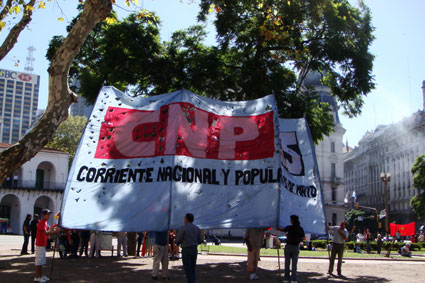
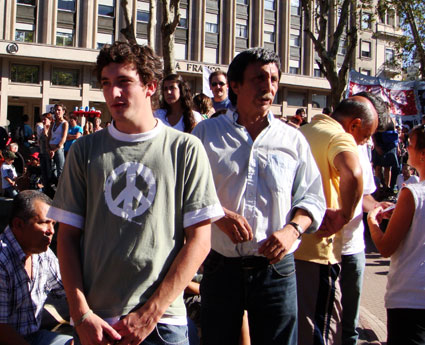
The Colorado Springs Gazette favorably headlines local Communist Party activity in our fair city!

This is, as all presidential election years are, a circus year of American comedy at its best! I mean, we got a gift from John McCain of his female Dan Quail, Sarah Pale In town even! Still, imagine my surprise to see today’s edition of our Far Right Wing daily paper (The Gagzette) with a prominent headline for our city’s only active Communist Party member, gus hall Vivian! She’s been the deliverer of the Communist Party’s national newspaper around town for years now (and a reporter for that paper, too!), but apparently our Gazette ‘reporters’, ‘editors’, and ‘newsmen’ are unaware of that!????? Go figure?

They probably are aware though, that Barack Obama is a Big Bad American Communist? I mean, we are dealing with world class geniuses over that at Freedom Communications, Inc… lol. I hope that they do not now inform the national crowd about Barack Obama’s connections to Colorado Spring’s Communist Movement, now that they are getting the real scoop about my friend Vivian, the CP reporter and paper deliverer?

OK, here’s the link to the Gazette’s pro- Communist Party activity, though you have to buy the paper’s hard copy to get the full effect, as their website really doesn’t give a good idea of how much they actually headlined their pro-CP coverage. I’ll be laughing through the next year over this one, you can bet on that! Campaigners on different sides, but have same passion

Go Vivian! I love you even if you are an evil commie! Give me a call so we can get together some! I’m not surprised that you are pushing for Obama.

Could it be that the Colorado Springs Gazette’s editors are Lenin’s useful idiots? For more about the American Communist Party, go to The Gus Hall Fan Club website …I know that our local paper would want you to do that! Go useful idiot team at our local Gagzette! Good work! I’m still not voting for Barack Obama though.

Alan is shocked!!!!!

alan-greenspan
Alan Greenspan represents more than any individual anywhere, the bipartisan fact that there is no real difference between the 2 chosen parties of our corporate dictatorship here in America. Let’s fact, it… Greenspan has been the darling of both the Democratic and Republican Parties for a very long time now. He’s The Man!

He has been running the economic show that has now put the world capitalist economies in tail spin, you and I on board. Poor Alan is shocked!!!!!! Poor Old Alan… He’s shocked!!!!!! He says he just doesn’t know any more. He’s shocked!!!!!!

This guy really takes the cake, now doesn’t he. He was held up to the level of Jesus Christ in the eyes of the American monied class who held him high above our heads as some great genius know-it-all, and now his temple is shaking in its foundations. Remember these slime balls celebrating when their Cold War spending crashed the ex Soviet Union? Remember them not giving a damn about what they did to the Russian people? Remember smug old Alan?

In spite of all these croc tears and croc shock by the like ilk of Alan Greenspan, they will give about as much a damn about you as they did about the Russians. They don’t give a damn about you and the rest of Working Class America anymore than they cared about the Gooks and Ragheads (their words for them, not mine) they screwed over to make their super profits. I take that back, they are actually worried more about you and how you might soon grow to hate them passionately. Got it? Alan is shocked!!!!!

But he’s 82, damn him, and now there’s not much justice we can do for him… He wants forgiveness does he? Who knows? He simply has no god beyond money…. just our money that is now just so much trashed out planet. Alan is shocked!!!!!!! And so is the planet.

The Scamble for Africa- Darfur, Intervention, and the USA

africaThose interested in Darfur might want to check this book, ‘The Scramble for Africa’, out some when it comes out? Especially with the Biden, Obama gang headed towards the White House soon. Certainly this is a timely release for this book.

*** Book of the Month for** **October 2008*

*THE SCRAMBLE FOR AFRICA*

*Darfur — Intervention and the USA*

*Steven Fake and Kevin Funk*

*As massive human suffering continues to engulf the Darfur region of
Sudan, the crisis has garnered a rhetorical circus of saber-rattling and
hand wringing from Western politicians, media, and activists. Yet such
bluster has not halted the violence.*

*In a careful yet scathing indictment of this constellation of
holier-than-thou government leaders, corporate media outlets, and spoon-fed
NGOs, Steven Fake and Kevin Funk reveal the myriad ways in which the West
has failed Darfur.*

*Praise for Scramble for Africa:*

*”A devastating critique of the ‘humanitarian’ response of the United
States to the Darfur crisis. Well-researched, easy to read, and utterly
convincing, a crucial book for anyone concerned about achieving a morally
and politically acceptable U.S. foreign policy.”
–Richard Falk, Milbank Professor of Law Emeritus, Princeton University*

*”Sudan has been a nightmare for many. It still is. The outside world is
responsible as well. This book shows why. The authors avoid easy answers,
and provide a quality analysis with compelling arguments to revise Western
policies.”
–Jan Pronk, Special Representative of the Secretary-General and Head of
Mission for the United Nations Mission in Sudan, 2004-06 *

*”Explosive, masterful, and impeccably fair. Consider it the thinking
person’s guide to Darfur.”
-John Ghazvinian, author of **Untapped: The Scramble for Africa’s Oil*

*STEVEN FAKE and KEVIN FUNK are activists and political commentators whose
writings have been published in such media as **Foreign Policy in Focus,
Common Dreams, CounterPunch, ZNet**, and **Black Commentator**.*

*344 pages, bibliography, index
Paperback ISBN: 978-1-55164-322-9 $19.99
Hardcover ISBN: 978-1-55164-323-6 $39.99*

*For more information on **The Scramble For Africa**, our October Book of
the Month selection, including additional testimonials and Table of
Contents, see **http://www.blackrosebooks.net/darfur.htm*
* *

*The Scramble For Africa will be launched in the Boston area on October
28th. For more information see http://www.blackrosebooks.net/events.htm*

*To Order This Book, Call Toll Free 1-800-565-9523*

*Independent Publishing for Independent Minds*

*What others are saying about Scramble for Africa*

“Kevin Funk and Steven Fake have written a devastating critique of the
‘humanitarian’ response of the United States to the Darfur crisis, while
offering a genuine humane alternative that would lessen the ordeal, if not
bring it to an end. Well-researched, easy to read, and utterly convincing, a
crucial book for anyone concerned about achieving a morally and politically
acceptable U.S. foreign policy.”
*–Richard Falk, Milbank Professor of Law Emeritus, Princeton University, and
since 2002, Visiting Distinguished Professor, Global Studies, UCSB*

“Sudan has been a nightmare for many. It still is. The outside world is
responsible as well. This book shows why. The authors avoid easy answers,
and provide a quality analysis with compelling arguments to revise Western
policies.”
*–Jan Pronk, Special Representative of the Secretary-General and Head of
Mission for the United Nations Mission in Sudan, 2004-06*

“At a time when everyone from George Clooney to George Bush is an instant
expert on Darfur, Kevin Funk and Steven Fake have given us what we so
urgently need: a clear, sober assessment of the conflict and how it fits
into the foreign policy of the United States. With neither fear nor favour,
they take us back stage, show us our blind spots, and come up with some
troubling conclusions. Explosive, masterful, and impeccably fair. Consider
it the thinking person’s guide to Darfur.”
*–John Ghazvinian, author of Untapped: The Scramble for Africa’s Oil*

“A commanding exposé of the duplicitous and damaging role played by US
leaders and others in a dark drama. Well-written, well focused, deeply
informed—an excellent corrective for the many who cannot tell the difference
between humanitarian assistance and imperial aggrandizement.”
*–Michael Parenti, author of ‘Contrary Notions’ and ‘Against Empire’*

“Elegantly written, erudite without being academic, and with a forceful yet
sensible political argument, Scramble for Africa is a must read for anyone
concerned with making sense of one of the most haunting crises of our time.”
*–Stephen Eric Bronner, Rutgers University*

“Scramble for Africa: Darfur Intervention and the USA is the book we’ve all
been waiting for. Clearly written, and scholarly without losing its
skeptical edge, this new work takes on the U.S. Government and the Save
Darfur coalition alike, offering a fresh analysis of Darfur in its larger
geopolitical context. Scramble for Africa belongs on every Darfur activist’s
bookshelf.”
*–David Morse, Darfur activist and journalist*

“So much of what has been written on Darfur is either expression of
humanitarian concern without awareness of the imperial context, or
denunciation of Western perfidy without appreciation of the horrible human
tragedy that has been unfolding. In this extremely well-documented study,
Steve Fake and Kevin Funk combine deep compassion with a keen critical
analysis to show how we might best support the suffering people of Darfur.
This is a book for all those interested in working for a more just world.”
*–Stephen R. Shalom, Professor of Political Science at William Paterson
University in New Jersey and author of, among other works, Imperial Alibis:
Rationalizing US Intervention After the Cold War*

“This extremely well-researched analysis reveals the real goals of US
foreign policy in one of the greatest horrors of our generation. The authors
have produced an essential book for analysts and activists everywhere,
together with a call to action which no-one should ignore.”
*–Mark Curtis, author, Web of Deceit: Britain’s Real Role in the World*

“One of the few works to tackle honestly the vexing question of what is to
be done about Darfur. Cheerleaders for intervention and humanitarians who
persist in rosy fantasies about the U.S. role in the world have had no
trouble advocating “solutions,” but for others on the left the question has
been much more difficult. Not content, like so many, to simply wash their
hands of the question, the authors have constructed a deeply informed and
carefully reasoned argument that addresses seriously the possibilities for
constructive humanitarian interventions in an imperfect world vitiated by
great power interests and political posturing. For the cruise-missile left
and the hard-core anti-interventionist left alike, Darfur is not about
Darfur but about their own self-image; Fake and Funk rightly bring the focus
back to what is best for the people on the ground.”
*–Rahul Mahajan, activist and author of Full Spectrum Dominance: U.S. Power
in Iraq and Beyond*

“At last there is a book on Darfur that places the conflict in the context
of the new ‘scramble for Africa,’ the contest between the old imperialism of
England and its successors, the US and China. Fake and Funk’s analysis
unmasks the propagandistic deploying of powerful language alleging
‘genocide’ and the ‘world’s worst humanitarian crisis’ in Sudan for its
political advantages to the US and its neglect of the suffering of Darfur’s
victims. When analyzing the politics of the ‘Save Darfur Coalition’ the
journalists-authors work with a scalpel in a refreshing and penetrating
analysis of why the Darfur conflict became the ’cause célèbre,’ when it
should have been the war in Iraq. Activists and astute observers of the
contemporary global political scene will find this scrupulously researched
volume a must read, virtually unique among available works on the subject.”
*–Carolyn Fluehr-Lobban, Professor of Anthropology, Rhode Island College,
veteran Sudan researcher*

“For those, like myself, who have long felt both revulsion and confusion by
the humanitarian crisis in Darfur and wished to know more, this is the
perfect handbook. …an objective, dispassionate, meticulously researched
account of the conflict… The authors of Scramble for Africa… startle us with
their documentation of the little known but equally sordid role our own
government has played in Sudan for the past thirty years – suggesting that
our present official “humanitarian concerns” are merely crocodile tears
masking another agenda.”
*–Timothy Kendall, Ph. D., Senior Research Scholar, Dept. of
African-American Studies, Northeastern University and Director of
Archaeological Mission, Jebel Barkal (Karima), Sudan, Sudan Dept. of
Antiquities and Museums (NCAM), Khartoum, Sudan*

“The Scramble for Africa stands against the muck of neo-liberal ideology,
taking us through the Darfur conflict, putting it into history and allowing
us to think of a non-imperialist way to bring peace to a tormented region.
Save Darfur, surely; but as much from Washington as Khartoum, as much from
fantasies of humanitarian intervention as the brutalities of
IMFundamentalism and Islamism.”
*–Vijay Prashad, author, The Darker Nations: A People’s History of the Third
World*

“The Darfur conflict has proven to be intractable, at terrible cost to the
people of that region. There is a crying need for on-going international
activism based on a thorough analysis of Sudan and the role of the US, China
and other states. The Scramble for Africa by Kevin Funk and Steven Fake is a
well-researched, important and progressive contribution in this regard. It
should be widely read, from the White House to the grassroots.”
*–Laurie Nathan, research fellow at the London School of Economics and
member of the African Union mediation team for Darfur in 2005/6*

“This excellent book presents the basic information on the political and
military aspects of the conflict, examines the options from a clear and
transparent ethical position, and presents ways forward with a concern for
broad international implications and concern for the hundreds of thousands
of victims. It is is exactly what is needed and I hope it is very widely
read. I will recommend it to everyone.”
*–Justin Podur, writer and activist*

Bank steals roof from over the head of a 90 yr old woman who lived in her house for 38 years!

How many years do you need to pay a mortgage off in the US to make it go away? When this woman in Ohio first started making payments on her mortgage she was 52 years old, and yet at 90 the banks were stealing her property from her! Outrageous! The story turns even more tragic as the woman now has tried to commit suicide with a gun. Ohio woman, 90, attempts suicide after foreclosure

One wonders just how it might have been, too, if the gun loving nuts had worried more about mortgages and banks instead of their stupid guns? We might have control over the banks and control over gun proliferation both and it would be a better world altogether!

The man in Nebraska who abandoned his 9 kids at the hospital this week was worried about losing his home, too. Kin of 9 abandoned kids say they would’ve helped

What a country we live in today! These types of stories are going to be popping up soon all over the place. No bailout for the people down below at all. Look, too, at the Gulf Coast. The rich have no compassion for the Common People! They seem to think of us as cattle?

A letter from an American Soldier

I received a well written letter yesterday from an American Soldier. It was addressed to me, but I thought I’d post his arguments for general comment.

Mr. Verlo,

I stumbled upon your website by a pure stroke of accidental misfortune while searching for current news on the Fort Carson Installation.. My wife, my son and I are from Colorado, and I am an American Soldier. I am college educated and studied Middle-Eastern history, and I am well versed as it pertains to Mesopotamia, global-terror and global insurgencies.

I have deployed to Iraq twice and Afghanistan once. In 2003-2004 I served in Al-Fallujah and Ar-Ramadi in the Al-Anbar province, and in 2005-2006 in Tal’afar in the western Ninewah province with the 3d Armored Cavalry from Fort Carson (maybe you heard about the letter that Najim Abdullah wrote to George Bush about my unit?).

I spent seven months in Afghanistan training Afghani Security Forces, and would go back again to either country to serve for one reason only: to support my Soldiers. Although I am career-military, I do not now, nor did I ever support the Bush Administration or the pretenses under which we invaded Iraq. But, unfortunately, our elected officials thrust us into this mess, and we (Americans and American Military alike) are essentially left to deal with it. I am writing to you to comment on a few articles that you have authored, and provide my own opinions and citations.

First, in your article titled: “It’s in the Percentages”, you note that “apparently” 30% of Soldiers don’t have a high school education, 30% are returning with PTSD and 25% percent of their children are considered “special needs”. These are very interesting statistics, yet, you provided no citations. You go on to state that (and I quote): “I find it an absolute nightmare to imagine soldiers in positions of authority, making life and death decisions over others, who don’t know right from wrong, history from high stakes poker, or intelligence from drunken stupor. How do you reason with someone whose only motivation is their next beer?” and “It’s a war crime to subject civilian populations to rule by incompetents”. Again, very interesting. Here are some solid statistics for you, as well as citations. I chose to contrast military service members to college students in this case, but the same could be applied to any demographic (i.e., individuals who were recently laid off nation-wide, or illegal immigrants).

– 40% of college students who come from middle to upper class families engage in binge drinking on a regular (weekly) basis, as opposed to 26% of military personnel who have recently returned from combat tours overseas, where they suffered some sort of physical and/or emotional trauma (ABC news poll, 2007/2008). In addition, over 22,000 service members have called suicide hotlines in an attempt to get help (VA poll, 2008).

– 20% of college students engage in heavy drug use, as opposed to less than 5% of military personnel (ABC News Poll, 2007).

Here’s my favorite one:

3% of all college women report sexual assault at some point in their college career. In 2007, there were 2,212 reported cases of sexual assault on military installations by service members. In a military that exceeds roughly 2,000,000 people, that’s less than 1%.

Second, in your article titled: “Turning out to support fewer Troops”, you allude to Soldiers “riding in on a black cloud”. Hmmm, I’m not quite sure I understand that one. Is this a reference to the environmental damage we do with our vehicles, or the perceived “evil” that we bring with us because we are all, in fact, rapists, murderers and psychopaths?

Third, in your article titled: “Colorado Springs Military Community”, you state that (and I quote) “FIVE MAJOR MILITARY INSTALLATIONS ALREADY AND THE CITY AND COUNTY ARE BROKE”. El Paso County is broke? Since when? I would love to see a citation in reference to this one, because I have “Googled” it to no end and have found nothing that would lead me to believe anything but the contrary. The Colorado Springs Economic Development Corporation reports that: “Colorado Springs has a 3.1 million labor force within an hour radius, a Fast track permitting and planning program (30-60 days), 27 Fortune 500 Companies and a quality of life which is 70% the cost of coastal communities” (CSEDC 2008).

Sir, I have read your opinions on the media (many of which I share with you, by the way), so I would presume that you think this is a fabrication. Here’s the bottom line; the military presence in Colorado (the big, scary war-machine that we are) boosts the economy of the area due to its service members buying cars, houses (and paying taxes on their properties), shopping at local businesses, applying for and receiving loans from local banks, etc. There is no doubt in my mind that if the military left Colorado Springs, the city would continue to thrive, but the economy would noticeably decline anywhere that 30,000 people leave, military or not.

Fourth and final, in your article titled: “On Jan 14 let us not expand Fort Carson”, you state that more military in the area would make (and I quote) “Colorado Springs even more dependent on poor paying jobs, predatory businesses, and skyrocketing social problems. Only developers, car-dealers, pawn shops, strip clubs, liquor stores, social workers, jails and mortuaries benefit from a higher soldier population”. Wow, seriously? These are only issues tied to the influx of more military in the area? So, if 3,000 recently released convicted felons chose Colorado Springs as their new home, it would have less of an impact? Or how about 3,000 illegal immigrants, or 3,000 pregnant teenagers?

Well, let’s go ahead and analyze this a bit further. Developers and car-dealers will benefit from ANY new arrivals to the area, not just military. In reference to pawn shops and strip clubs, the owners of these businesses know exactly what they are doing by placing them outside of military installations. Service members are targeted by these establishments. That’s why they are placed where they are in the community. The same can be said for pay-day loan houses and used car dealerships on Powers and Academy blvd. But if you placed strip clubs next to colleges, would it still be the military that held the higher attendance record? It’s all about business strategy my friend, not the assumption that all military service members are sex-crazed, alcoholic lunatics.

Social workers, jails and mortuaries benefit wherever there are people with problems, criminals and people who have died. I suppose that again, it’s only military who fall into these categories. Ah yes, and our children are even more screwed up than we are. The fact that you said (and I quote): “The rest of us suffer increased crime and their children’s behavioral problems in our schools” vividly displays your utter incompetence and lack of any compassionate notion. You realize that less than 30% of military children who have been separated from a parent experience behavioral issues (USA Today poll, 2008)? The percentage of non-military children who experience behavioral issues as a result of a parent’s incarceration, or divorce, or even domestic abuse is almost twice as high.

Sir, I will be the first to admit that military service members are not perfect. But we are human beings, who are susceptible to the same things that civilians are. We are an easy target, because so many of us are returning home from Iraq and Afghanistan with severe problems, after having served in a war that has lost most of it’s public support (and rightly so).

What I have a hard time understanding is why people such as you exercise your freedoms of speech, protest, religion, etc, and then malign the very people who provide, protect and preserve those liberties? I am as anti-Bush as the average American left-wing protestor, but to blame service members for the actions of their elected leadership is immoral. You are essentially grouping us with Nazi’s, which is absolutely ridiculous. The Nazis’ goal was global domination, and they had no clearly defined rule of engagement. They knew that what they were doing was wrong, and did it anyway.

Does the US Military have people who behave in this manner? Absolutely, and they are dealt with within the justice system for their actions. We are in fact “just following orders” with our presence in the Middle-East. As I realize that this was also the defense of Nazi war criminals at Nurnberg, allow me to elaborate. The US military has clearly defined Rules of Engagement, and our greater mission is to stabilize an unstable region, not global control as conspiracy theorists would have everyone believe. Unless you have a solid understanding of counter-terror and counterinsurgency doctrine, you are in no position to presume anything about the US Military in the Middle-East (unless YOU have been there) other than the fact that we invaded Iraq under false pretenses. I’ll give you that one, and take it for myself as well.

Sir, have you ever held a young Iraqi child in your arms, returning him to his parents as they kiss you and your Soldiers’ cheeks, after he had been treated at a US facility because terrorists sodomized him and cut out his tongue? Have you ever looked straight into the eyes of a terrorist, who swore allegiance to Zarqawi and proclaimed himself a “holy warrior”, and seen pure evil? And while your medical personnel treated him for burns (which were sustained when he poured kerosene on a child and his father and attempted to set them on fire publicly, only succeeding to set himself on fire) he spoke perfect English and vowed to remember your name and kill your family? I presume you would view this as our fault, correct?

But here’s the difference between the American Soldier and everyone else: when it is our fault, we acknowledge it, and DO something about it. We help people, good and bad, bottom line. Do bad things happen? Of course. Are all Soldiers and Marines upright citizens? Of course not.. That’s why one Marine out of 30,000 threw a puppy off of a cliff, and four Soldiers out of 121,000 raped a 14-year old girl and killed her family. These actions were inexcusable and tragic, and the individuals in question were/are being dealt with. To generalize every American service member based on these isolated incidents vividly shows your lack of any rational thought.

So in closing, allow me to say that whether you care to acknowledge it or not, it is the MILITARY who grant and preserve liberties and who TRULY make a difference, not politicians, protestors, or half-minded anti-war bloggers. And understand (or don’t) why we are involved in the Global War on Terror, it is because it doesn’t matter whether or not you are white, black, Canadian, American, gay, straight, blind, deaf, or how many anti-Bush websites you manage or protests you attend, there are fundamentalist extremists who want to murder you and your family because you represent western culture.

I want this war to be over so badly that it consumes me at times. I do not want my son to have to see what I have seen as a result of a failed administration. Sir, we are human beings also, and I gladly serve to protect the liberty and freedom of individuals like you who don’t support me at all. So at your next rally, or the next article you write which slanders US service members, take a moment to reflect on your freedoms, and understand who it is that truly grants them. I wish you all continued health and happiness.

Sincerely,

[D.]

The Man With a Hoe

Palin and McCain  THE MAN WITH A HOE

THE MAN WITH A HOE

Bowed by the weight of centuries he leans
Upon his hoe and gazes on the ground,
The emptiness of ages in his face,
And on his back, the burden of the world.
Who made him dead to rapture and despair,
A thing that grieves not and that never hopes,
Stolid and stunned, a brother to the ox?
Who loosened and let down this brutal jaw?
Whose was the hand that slanted back this brow?
Whose breath blew out the light within this brain?

Is this the Thing the Lord God made and gave
To have dominion over sea and land;
To trace the stars and search the heavens for power;
To feel the passion of Eternity?
Is this the dream He dreamed who shaped the suns
And marked their ways upon the ancient deep?
Down all the caverns of Hell to their last gulf
There is no shape more terrible than this–
More tongued with cries against the world’s blind greed–
More filled with signs and portents for the soul–
More packed with danger to the universe.

What gulfs between him and the seraphim!
Slave of the wheel of Capital, what to him
Are Plato and the swing of the Pleiades?
What the long reaches of the peaks of song,
The rift of dawn, the reddening of the rose?
Through this dread shape the suffering ages look;
Time’s tragedy is in that aching stoop;
Through this dread shape humanity betrayed,
Plundered, profaned and disinherited,
Cries protest to the Powers that made the world,
A protest that is also prophecy.

O masters, lords and rulers in all lands,
Is this the handiwork you give to God,
This monstrous thing distorted and soul-quenched?
How will you ever straighten up this shape;
Touch it again with immortality;
Give back the upward looking and the light;
Rebuild in it the music and the dream;
Make right the immemorial infamies,
Perfidious wrongs, immedicable woes?

O masters, lords and rulers in all lands,
How will the future reckon with this Man?
How answer his brute question in that hour
When whirlwinds of rebellion shake all shores?
How will it be with kingdoms and with kings–
With those who shaped him to the thing he is–
When this dumb Terror shall rise to judge the world,
After the silence of the centuries?

Peterson Air Force Base has a riot squad

Protesters in custody
COLORADO SPRINGS- There is a postscript to the Sisters Witness Against War arrests at Peterson AFB last Friday. Where we left off, three women stepped across the line to protest our nation’s ongoing militancy, and the base commander’s refusal to hear the consciences of pacifists. Barbara, Mary Ann and Esther were led away to be processed, handed to the police, then released. Esther told me the sight that awaited her as she was taken out of our view.

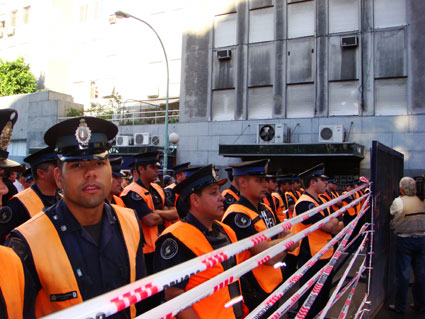
Taking this step, this year, by the way, was in honor of Elizabeth. As the three women were being escorted around the security/reception building, out of view from the protest, they encountered a line of soldiers, dressed in riot gear, being put through various drills. Asking about the apparent extremity of such measures, the women were told that this happens every time there are protests on the other side of the gate. The preparations are standard procedure.

If you can imagine what it’s like from our side, fifty or more quiet nuns usually, once or twice a year, holding home-sewn banners or small signs, facing a security booth being manned by a dozen soldiers, some with binoculars, some in plain clothes. It’s quiet and uneventful. You’d never guess there are people in riot gear being put through their paces behind the scenes.

I laugh because it’s always a nearly-spoken hope that one day we will walk toward the gate, and all of us supplicate ourselves in a compassionate plea to end the war-making. While probably every participant certainly has the courage to be arrested, decorum and a sense of pragmatism hold us back. We await a better opportunity, an impassioned leader to follow, probably. And so through the years, the sisters have only ever mounted a limited nonviolent assault on that yellow line.

This year as the arrests were wrapping up, a soldier noticed that someone’s feet had unknowingly strayed over the line. He pointed sternly and the wouldn’t-be offender hopped giddily back like a new gambler who hadn’t intended a bet.

Even this time, we murmured to ourselves, if only all of us would simply cross that line, they wouldn’t know what to do with us.

Well, as Esther’s report clarifies, they would know what to do with us. And they ready themselves every year to do it. Which has me thinking that they have a higher respect for our potential than we do ourselves. They know what’s at stake, even as we yet do not.

I struggle questioning whether we can reach across to the military mindset with our pacifist ideology. Especially as their militarism extends to dealing peace-petitioners physical blows. Will there be human consciences to reach, or just gung-ho soldier appetites to satisfy? That question holds me back.

Barack Obama Unleash the Power Within

Tony RobbinsUnleash The Power Within, Reclaiming Your True Identity, Leadership In Times of Crisis, Mastering Influence, Get The Edge, The Time of Your Life, Living Health, Live with Passion, Strategies for Creating a Compelling Future, Lessons in Mastery, The Power to Change Your Life Now

I’m Asking You to Believe, Not just in my ability to bring real change … I’m asking you to believe in yours.

Crossing the line at Peterson AFB

North gate of Peterson AFB
COLORADO SPRINGS- The annual Sisters Witness Against War took an interesting step forward Friday when three sisters decided to step across the line. Ostensibly to deliver a letter which had gone thus far unanswered by the Peterson AFB commander. Event founder Barbara Huber decided she would commit herself to this act of Civil Disobedience and was joined by two others. A press release declared this intention, the Gazette was on hand to record it, and a local patrol car stood by as well.

Barbara explained her plan to the reporter. That she’d sent the letter several times but had not received a response. The only recourse she felt she had was to deliver the letter in person, to know it had reached him. Barbara also admitted knowing that the base commander was away, and so the best she could hope for was to deliver the letter into the hands of his secretary. PAFB confers with Gazette Plain-clothed security had been circulating through our demonstration, asking for specifics about our intentions. When I saw them conferring with the Gazette team, I immediately worried for Barbara’s plan. If the Air Force officers learned that Barbara need only be introduced to their commander’s secretary, that person could be waiting to meet us at the gate and the whole hoopla could be averted.

Fortunately, the Peterson machos seemed all too eager to create a confrontation. As the demonstrators neared the gate, a soldier with the gait of a Carabinieri grabbed a megaphone and cautioned us away. But the sisters continued. Several soldiers donned riot helmets.
Riot gear

Fed intervenesThe man in pink wore a badge on his folder. He couldn’t persuade Barbara to turn back.

Barbara deliberates

(More pictures at csaction.org)

EPILOGUE: PETERSON AFB HAS A RIOT SQUAD

Protesters in custody
COLORADO SPRINGS- There is a postscript to the Sisters Witness Against War arrests at Peterson AFB last Friday. Where we left off, three women stepped across the line to protest our nation’s ongoing militancy, and the base commander’s refusal to hear the consciences of pacifists. Barbara, Mary Ann and Esther were led away to be processed, handed to the police, then released. Esther told me the sight that awaited her as she was taken out of our view.

Taking this step, this year, by the way, was in honor of Elizabeth. As the three women were being escorted around the security/reception building, out of view from the protest, they encountered a line of soldiers, dressed in riot gear, being put through various drills. Asking about the apparent extremity of such measures, the women were told that this happens every time there are protests on the other side of the gate. The preparations are standard procedure.

If you can imagine what it’s like from our side, fifty or more quiet nuns usually, once or twice a year, holding home-sewn banners or small signs, facing a security booth being manned by a dozen soldiers, some with binoculars, some in plain clothes. It’s quiet and uneventful. You’d never guess there are people in riot gear being put through their paces behind the scenes.

I laugh because it’s always a nearly-spoken hope that one day we will walk toward the gate, and all of us supplicate ourselves in a compassionate plea to end the war-making. While probably every participant certainly has the courage to be arrested, decorum and a sense of pragmatism hold us back. We await a better opportunity, an impassioned leader to follow, probably. And so through the years, the sisters have only ever mounted a limited nonviolent assault on that yellow line.

This year as the arrests were wrapping up, a soldier noticed that someone’s feet had unknowingly strayed over the line. He pointed sternly and the wouldn’t-be offender hopped giddily back like a new gambler who hadn’t intended a bet.

Even this time, we murmured to ourselves, if only all of us would simply cross that line, they wouldn’t know what to do with us.

Well, as Esther’s report clarifies, they would know what to do with us. And they ready themselves every year to do it. Which has me thinking that they have a higher respect for our potential than we do ourselves. They know what’s at stake, even as we yet do not.

I struggle questioning whether we can reach across to the military mindset with our pacifist ideology. Especially as their militarism extends to dealing peace-petitioners physical blows. Will there be human consciences to reach, or just gung-ho soldier appetites to satisfy? That question holds me back.

The Conservative Motto: Greed is Good, Greed is God!

The trouble with optimism. I especially love the first quote, by Treasury Secretary Andrew Mellon, who made billions off the Great Depression.

War with Spain? Palestinians file war crimes charges against Israel. Probably moot, as both US presidential candidates would likely bomb any court that rules against US/Israeli war crimes.

Obama makes clear that he’s
sold his soul to the parasitic state
of Israel.

AntiChrist may endorse McCain, laments “It’s getting harder and harder to determine the greater of two evils in this election.”

Will Cheney have Iraqi PM Maliki killed for backing Obama’s withdrawal plan? “Oops, so sorry. We thought we were just bombing a wedding party!”

Evidence that McCain will pick Cheney as his VP?

Grumpy old man alert! NY Times rejects op-ed written by John McCain. I know what you’re thinking: “McCain can write?” Well, according to the NYT, no.

Best gov’t money can buy. Nevada GOP cancels façade of state convention, will instead just have private conference call, where largest donors will decide the nominees. Delegates, who have been locked out by the move, are suing the Nevada Republican Party. I guess it makes sense, though. The Republicans typically sell their votes to the highest bidder, so why not pick their candidates that way?

As the McCain campaign becomes little more than a joke… A senile old geezer, an angry woman and a charming black guy walk into a bar…

Compassionless Conservatives. Bob Novak isn’t just a traitor, he’s also a hit-and-run driver. He hit a pedestrian, and drove off pretending not to even notice the man splayed across his windshield.

Man ticketed for dying in car.

Will Obama “end the war” but continue the occupation?

Proof that Obama is just another war-mongering Republican.

Dark Knight, indeed! Batman arrested for assaulting his elderly mother.

Excerpts from Thomas McCullock’s notes July 23, thomasmc.com.

Is John McCain a zombie?

Hypocrite John McCain, who thinks “Social Security is a disgrace,” received $23,157 last year from it. His total income for the year was $405,409, and his wife’s was in the tens of millions.

The McCain campaign, which has been complaining for months that Obama hasn’t visited Iraq, is now complaining that Obama is visiting Iraq. It’s amazing how many Republicans I’ve talk to say they are sick of McCain’s crap, and will vote for Obama just to spite him.

McCain isn’t just McBush, he’s also McHelms.

Calling Dr. Freud, stat! Larry Craig speaks .

Karl Rove tried to get Patrick Fitzgerald fired for investigating his role in Valerie Plame leak.

The profits of terror. Air Force caught using anti-terrorism funding to provide luxury suites on aircraft for brass.

Cop busted for blackmailing Starbucks for thousands of cups of free coffee.

What nonsense Christians can be made to believe! “The sun (and entire universe!) rotate earth”. I guess, once you have convinced yourself to believe one lie, you are open to anything.

Conservative radio host Michael Savage declares that Autism is a fraud, the kids “are just brats!” Well, that’s Compassionate Conservatism for you.

Why is Israel — the only Middle Eastern nation threatening, and on a regular basis attacking, its neighbors — allowed to have nuclear weapons, but Iran — who is only threatening to defend itself from such attacks — not? Because Israel bought our corrupt Congress (both parties) via AIPAC. Who says treason doesn’t pay?

Israeli Transportation Minister Shaul Mofaz says Israel has “no choice” but to attack Iran and drag the USA into Armageddon.

Con job. Israel alledges that al Qaeda in Israel plotted to kill Bush. Hmm. Al Qaeda is in Israel. We must attack!

Rahm Emanuel for Speaker of the House? He’d be even worse than Pelosi, but the Dems do always do seem to promote the worst of the worst.

Court Jester House of Representatives promises to investigate Bush/Cheney “Imperial presidency,” while at the same time reiterating that impeachment is “off the table.”

Excerpts from Thomas McCullock’s notes July 18, thomasmc.com.

Global economic rapists are at it again

G8 protest
Why protest the G8 Summit July 7-9? Those hoodlums always look so determined. Here’s the rationale by the Emergency Exit Collective:

The 2008 G8 on Hokkaido, a Strategic Assessment
Emergency Exit Collective
Bristol, Mayday, 2008

The authors of this document are a collection of activists, scholars, and writers currently based in the United States and Western Europe who have gotten to know and work with each other in the movement against capitalist globalization. We’re writing this at the request of some members of No! G8 Action Japan, who asked us for a broad strategic analysis of the state of struggle as we see it, and particularly, of the role of the G8, what it represents, the dangers and opportunities that may lie hidden in the moment. It is in no sense programmatic. Mainly, it is an attempt to develop tools that we hope will be helpful for organizers, or for anyone engaged in the struggle against global capital.

I
It is our condition as human beings that we produce our lives in common.

II
Let us then try to see the world from the perspective of the planet’s commoners, taking the word in that sense: those whose most essential tradition is cooperation in the making and maintenance of human social life, yet who have had to do so under conditions of suffering and separation; deprived, ignored, devalued, divided into hierarchies, pitted against each other for our very physical survival. In one sense we are all commoners. But it’s equally true that just about everyone, at least in some ways, at some points, plays the role of the rulers—of those who expropriate, devalue and divide—or at the very least benefits from such divisions.

Obviously some do more than others. It is at the peak of this pyramid that we encounter groups like the G8.

III
The G8’s perspective is that of the aristocrats, the rulers: those who command and maintain that global machinery of violence that defends existing borders and lines of separation: whether national borders with their detention camps for migrants, or property regimes, with their prisons for the poor. They live by constantly claiming title to the products of others collective creativity and labour, and in thus doing they create the poor; they create scarcity in the midst of plenty, and divide us on a daily basis; they create financial districts that loot resources from across the world, and in thus doing they turn the spirit of human creativity into a spiritual desert; close or privatize parks, public water taps and libraries, hospitals, youth centers, universities, schools, public swimming pools, and instead endlessly build shopping malls that channels convivial life into a means of commodity circulation; work toward turning global ecological catastrophe into business opportunities.

These are the people who presume to speak in the name of the “international community” even as they hide in their gated communities or meet protected by phalanxes of riot cops. It is critical to bear in mind that the ultimate aim of their policies is never to create community but to introduce and maintain divisions that set common people at each other’s throats. The neoliberal project, which has been their main instrument for doing so for the last three decades, is premised on a constant effort either to uproot or destroy any communal or democratic system whereby ordinary people govern their own affairs or maintain common resources for the common good, or, to reorganize each tiny remaining commons as an isolated node in a market system in which livelihood is never guaranteed, where the gain of one community must necessarily be at the expense of others. Insofar as they are willing to appeal to high-minded principles of common humanity, and encourage global cooperation, only and exactly to the extent that is required to maintain this system of universal competition.

IV
At the present time, the G8—the annual summit of the leaders of “industrial democracies”—is the key coordinative institution charged with the task of maintaining this neoliberal project, or of reforming it, revising it, adapting it to the changing condition of planetary class relations. The role of the G8 has always been to define the broad strategic horizons through which the next wave of planetary capital accumulation can occur. This means that its main task is to answer the question of how 3?4 in the present conditions of multiple crises and struggles 3?4 to subordinate social relations among the producing commoners of the planet to capital’s supreme value: profit.

V
Originally founded as the G7 in 1975 as a means of coordinating financial strategies for dealing with the ‘70s energy crisis, then expanded after the end of the Cold War to include Russia, its currently face a moment of profound impasse in the governance of planetary class relations: the greatest since the ‘70s energy crisis itself.

VI
The ‘70s energy crisis represented the final death-pangs of what might be termed the Cold War settlement, shattered by a quarter century of popular struggle. It’s worth returning briefly to this history.

The geopolitical arrangements put in place after World War II were above all designed to forestall the threat of revolution. In the immediate wake of the war, not only did much of the world lie in ruins, most of world’s population had abandoned any assumption about the inevitability of existing social arrangements. The advent of the Cold War had the effect of boxing movements for social change into a bipolar straightjacket. On the one hand, the former Allied and Axis powers that were later to unite in the G7 (the US, Canada, UK, France, Italy, Germany, Japan)—the “industrialized democracies”, as they like to call themselves—engaged in a massive project of co-optation. Their governments continued the process, begun in the ‘30s, of taking over social welfare institutions that had originally been created by popular movements (from insurance schemes to public libraries), even to expand them, on condition that they now be managed by state-appointed bureaucracies rather than by those who used them, buying off unions and the working classes more generally with policies meant to guarantee high wages, job security and the promise of educational advance—all in exchange for political loyalty, productivity increases and wage divisions within national and planetary working class itself. The Sino-Soviet bloc—which effectively became a kind of junior partner within the overall power structure, and its allies remained to trap revolutionary energies into the task of reproducing similar bureaucracies elsewhere. Both the US and USSR secured their dominance after the war by refusing to demobilize, instead locking the planet in a permanent threat of nuclear annihilation, a terrible vision of absolute cosmic power.

VII
Almost immediately, though, this arrangement was challenged by a series of revolts from those whose work was required to maintain the system, but who were, effectively, left outside the deal: first, peasants and the urban poor in the colonies and former colonies of the Global South, next, disenfranchised minorities in the home countries (in the US, the Civil Rights movement, then Black Power), and finally and most significantly, by the explosion of the women’s movement of the late ‘60s and early ‘70s—the revolt of that majority of humanity whose largely unremunerated labor made the very existence “the economy” possible. This appears to have been the tipping point.

VIII
The problem was that the Cold War settlement was never meant to include everyone. It by definition couldn’t. Once matters reached tipping point, then, the rulers scotched the settlement. All deals were off. The oil shock was first edge of the counter-offensive, breaking the back of existing working class organizations, driving home the message that there was nothing guaranteed about prosperity. Under the aegis of the newly hatched G7, this counter-offensive involved a series of interwoven strategies that were later to give rise to what is known as neoliberalism.

IX
These strategies resulted in what came to be known as “Structural Adjustment” both in the North and in the South, accompanied by trade and financial liberalization. This, in turn, made possible crucial structural changes in our planetary production in common extending the role of the market to discipline our lives and divide us into more and more polarized wage hierarchy. This involved:

· In the immediate wake of ‘70s oil shock, petrodollars were recycled from OPEC into Northern banks that then lent them, at extortionate rates of interest, to developing countries of the Global South. This was the origin of the famous “Third World Debt Crisis.” The existence of this debt allowed institutions like the IMF to impose its monetarist orthodoxy on most of the planet for roughly twenty years, in the process, stripping away most of even those modest social protections that had been won by the world’s poor—large numbers of whom were plunged into a situation of absolute desperation.

· It also opened a period of new enclosures through the capitalist imposition of structural adjustment policies, manipulation of environmental and social catastrophes like war, or for that matter through the authoritarian dictates of “socialist” regimes. Through such means, large sections of the world’s population have over the past thirty years been dispossessed from resources previously held in common, either by dint of long traditions, or as the fruits of past struggles and past settlements.

· Through financial deregulation and trade liberalization, neoliberal capital, which emerged from the G7 strategies to deal with the 1970s crisis aimed thus at turning the “class war” in communities, factories, offices, streets and fields against the engine of competition, into a planetary “civil war”, pitting each community of commoners against every other community of commoners.

· Neoliberal capital has done this by imposing an ethos of “efficiency” and rhetoric of “lowering the costs of production” applied so broadly that mechanisms of competition have come to pervade every sphere of life. In fact these terms are euphemisms, for a more fundamental demand: that capital be exempt from taking any reduction in profit to finance the costs of reproduction of human bodies and their social and natural environments (which it does not count as costs) and which are, effectively, “exernalized” onto communities and nature.

· The enclosure of resources and entitlements won in previous generations of struggles both in the North and the South, in turn, created the conditions for increasing the wage hierarchies (both global and local), by which commoners work for capital—wage hierarchies reproduced economically through pervasive competition, but culturally, through male dominance, xenophobia and racism. These wage gaps, in turn, made it possible to reduce the value of Northern workers’ labour power, by introducing commodities that enter in their wage basket at a fraction of what their cost might otherwise have been. The planetary expansion of sweatshops means that American workers (for example) can buy cargo pants or lawn-mowers made in Cambodia at Walmart, or buy tomatoes grown by undocumented Mexican workers in California, or even, in many cases, hire Jamaican or Filipina nurses to take care of children and aged grandparents at such low prices, that their employers have been able to lower real wages without pushing most of them into penury. In the South, meanwhile, this situation has made it possible to discipline new masses of workers into factories and assembly lines, fields and offices, thus extending enormously capital’s reach in defining the terms—the what, the how, the how much—of social production.

· These different forms of enclosures, both North and South, mean that commoners have become increasingly dependent on the market to reproduce their livelihoods, with less power to resist the violence and arrogance of those whose priorities is only to seek profit, less power to set a limit to the market discipline running their lives, more prone to turn against one another in wars with other commoners who share the same pressures of having to run the same competitive race, but not the same rights and the same access to the wage. All this has meant a generalized state of precarity, where nothing can be taken for granted.

X
In turn, this manipulation of currency and commodity flows constituting neoliberal globalization became the basis for the creation of the planet’s first genuine global bureaucracy.

· This was multi-tiered, with finance capital at the peak, then the ever-expanding trade bureaucracies (IMF, WTO, EU, World Bank, etc), then transnational corporations, and finally, the endless varieties of NGOs that proliferated throughout the period—almost all of which shared the same neoliberal orthodoxy, even as they substituted themselves for social welfare functions once reserved for states.

· The existence of this overarching apparatus, in turn, allowed poorer countries previously under the control of authoritarian regimes beholden to one or another side in the Cold War to adopt “democratic” forms of government. This did allow a restoration of formal civil liberties, but very little that could really merit the name of democracy (the rule of the “demos”, i.e., of the commoners). They were in fact constitutional republics, and the overwhelming trend during the period was to strip legislatures, that branch of government most open to popular pressure, of most of their powers, which were increasingly shifted to the executive and judicial branches, even as these latter, in turn, largely ended up enacting policies developed overseas, by global bureaucrats.

· This entire bureaucratic arrangement was justified, paradoxically enough, by an ideology of extreme individualism. On the level of ideas, neoliberalism relied on a systematic cooptation of the themes of popular struggle of the ‘60s: autonomy, pleasure, personal liberation, the rejection of all forms of bureaucratic control and authority. All these were repackaged as the very essence of capitalism, and the market reframed as a revolutionary force of liberation.

· The entire arrangement, in turn, was made possible by a preemptive attitude towards popular struggle. The breaking of unions and retreat of mass social movements from the late ‘70s onwards was only made possible by a massive shift of state resources into the machinery of violence: armies, prisons and police (secret and otherwise) and an endless variety of private “security services”, all with their attendant propaganda machines, which tended to increase even as other forms of social spending were cut back, among other things absorbing increasing portions of the former proletariat, making the security apparatus an increasingly large proportion of total social spending. This approach has been very successful in holding back mass opposition to capital in much of the world (especially West Europe and North America), and above all, in making it possible to argue there are no viable alternatives. But in doing so, has created strains on the system so profound it threatens to undermine it entirely.

XI
The latter point deserves elaboration. The element of force is, on any number of levels, the weak point of the system. This is not only on the constitutional level, where the question of how to integrate the emerging global bureaucratic apparatus, and existing military arrangements, has never been resolved. It is above all an economic problem. It is quite clear that the maintenance of elaborate security machinery is an absolute imperative of neoliberalism. One need only observe what happened with the collapse of the Soviet bloc in Eastern Europe: where one might have expected the Cold War victors to demand the dismantling of the army, secret police and secret prisons, and to maintain and develop the existing industrial base, in fact, what they did was absolutely the opposite: in fact, the only part of the industrial base that has managed fully to maintain itself has been the parts required to maintained the security apparatus itself! Critical too is the element of preemption: the governing classes in North America, for example, are willing to go to almost unimaginable lengths to ensure social movements never feel they are accomplishing anything. The current Gulf War is an excellent example: US military operations appear to be organized first and foremost to be protest-proof, to ensure that what happened in Vietnam (mass mobilization at home, widespread revolt within the army overseas) could never be repeated. This means above all that US casualties must always be kept to a minimum. The result are rules of engagement, and practices like the use of air power within cities ostensibly already controlled by occupation forces, so obviously guaranteed to maximize the killing of innocents and galvanizing hatred against the occupiers that they ensure the war itself cannot be won. Yet this approach can be taken as the very paradigm for neoliberal security regimes. Consider security arrangements around trade summits, where police are so determined prevent protestors from achieving tactical victories that they are often willing to effectively shut down the summits themselves. So too in overall strategy. In North America, such enormous resources are poured into the apparatus of repression, militarization, and propaganda that class struggle, labor action, mass movements seem to disappear entirely. It is thus possible to claim we have entered a new age where old conflicts are irrelevant. This is tremendously demoralizing of course for opponents of the system; but those running the system seem to find that demoralization so essential they don’t seem to care that the resultant apparatus (police, prisons, military, etc) is, effectively, sinking the entire US economy under its dead weight.

XII
The current crisis is not primarily geopolitical in nature. It is a crisis of neoliberalism itself. But it takes place against the backdrop of profound geopolitical realignments. The decline of North American power, both economic and geopolitical has been accompanied by the rise of Northeast Asia (and to a increasing extent, South Asia as well). While the Northeast Asian region is still divided by painful Cold War cleavages—the fortified lines across the Taiwan straits and at the 38th parallel in Korea…—the sheer realities of economic entanglement can be expected to lead to a gradual easing of tensions and a rise to global hegemony, as the region becomes the new center of gravity of the global economy, of the creation of new science and technology, ultimately, of political and military power. This may, quite likely, be a gradual and lengthy process. But in the meantime, very old patterns are rapidly reemerging: China reestablishing relations with ancient tributary states from Korea to Vietnam, radical Islamists attempting to reestablish their ancient role as the guardians of finance and piety at the in the Central Asian caravan routes and across Indian Ocean, every sort of Medieval trade diaspora reemerging… In the process, old political models remerge as well: the Chinese principle of the state transcending law, the Islamic principle of a legal order transcending any state. Everywhere, we see the revival too of ancient forms of exploitation—feudalism, slavery, debt peonage—often entangled in the newest forms of technology, but still echoing all the worst abuses of the Middle Ages. A scramble for resources has begun, with US occupation of Iraq and saber-rattling throughout the surrounding region clearly meant (at least in part) to place a potential stranglehold the energy supply of China; Chinese attempts to outflank with its own scramble for Africa, with increasing forays into South America and even Eastern Europe. The Chinese invasion into Africa (not as of yet at least a military invasion, but already involving the movement of hundreds of thousands of people), is changing the world in ways that will probably be felt for centuries. Meanwhile, the nations of South America, the first victims of the “Washington consensus” have managed to largely wriggle free from the US colonial orbit, while the US, its forces tied down in the Middle East, has for the moment at least abandoned it, is desperately struggling to keep its grip Mexico, Central America and the Caribbean—its own “near abroad”.

XIII
In another age all this might have led to war—that is, not just colonial occupations, police actions, or proxy wars (which are obviously already taking place), but direct military confrontations between the armies of major powers. It still could; accidents happen; but there is reason to believe that, when it comes to moments of critical decision, the loyalties of the global elites are increasingly to each other, and not to the national entities for whom they claim to speak. There is some compelling evidence for this.

Take for example when the US elites panicked at the prospect of the massive budget surpluses of the late 1990s. As Alan Greenspan, head of the Federal Reserve at the time warned, if these were allowed to stand they would have flooded government coffers with so many trillions of dollars that it could only have lead to some form of creeping socialism, even, he predicted, to the government acquiring “equity stakes” in key US corporations. The more excitable of capitalism’s managers actually began contemplating scenarios where the capitalist system itself would be imperiled. The only possible solution was massive tax cuts; these were duly enacted, and did indeed manage to turn surpluses into enormous deficits, financed by the sale of treasury bonds to Japan and China. Conditions have thus now reached a point where it is beginning to look as if the most likely long term outcome for the US (its technological and industrial base decaying, sinking under the burden of its enormous security spending) will be to end up serve as junior partner and military enforcer for East Asia capital. Its rulers, or at least a significant proportion of them, would prefer to hand global hegemony to the rulers of China (provided the latter abandon Communism) than to return to any sort of New Deal compromise with their “own” working classes.

A second example lies in the origins of what has been called the current “Bretton Woods II” system of currency arrangements, which underline a close working together of some “surplus” and “deficit” countries within global circuits. The macroeconomic manifestation of the planetary restructuring outlined in XIX underlines both the huge US trade deficit that so much seem to worry many commentators, and the possibility to continually generate new debt instruments like the one that has recently resulted in the sub-prime crisis. The ongoing recycling of accumulated surplus of countries exporting to the USA such as China and oil producing countries is what has allowed financiers to create new credit instruments in the USA. Hence, the “deal” offered by the masters in the United States to its commoners has been this: ‘you, give us a relative social peace and accept capitalist markets as the main means through which you reproduce your own livelihoods, and we will give you access to cheaper consumption goods, access to credit for buying cars and homes, and access to education, health, pensions and social security through the speculative means of stock markets and housing prices.’ Similar compromises were reached in all the G8 countries.

Meanwhile, there is the problem of maintaining any sort of social peace with the hundreds of millions of unemployed, underemployed, dispossessed commoners currently swelling the shanty-towns of Asia, Africa, and Latin America as a result of ongoing enclosures (which have speeded up within China and India in particular, even as “structural adjustment policies” in Africa and Latin America have been derailed). Any prospect of maintaining peace in these circumstances would ordinarily require either extremely high rates of economic growth—which globally have not been forthcoming, since outside of China, growth rates in the developing world have been much lower than they were in the ‘50s, ‘60s, or even ‘70s—or extremely high levels of repression, lest matters descend into rebellion or generalized civil war. The latter has of course occurred in many parts of the world currently neglected by capital, but in favored regions, such as the coastal provinces of China, or “free trade” zones of India, Egypt, or Mexico, commoners are being offered a different sort of deal: industrial employment at wages that, while very low by international standards, are still substantially higher than anything currently obtainable in the impoverished countryside; and above all the promise, through the intervention of Western markets and (privatized) knowledge, of gradually improving conditions of living. While over the least few years wages in many such areas seem to be growing, thanks to the intensification of popular struggles, such gains are inherently vulnerable: the effect of recent food inflation has been to cut real wages back dramatically—and threaten millions with starvation.

What we really want to stress here, though, is that the long-term promise being offered to the South is just as untenable as the idea that US or European consumers can indefinitely expand their conditions of life through the use of mortgages and credit cards.

What’s being offered the new dispossessed is a transposition of the American dream. The idea is that the lifestyle and consumption patterns of existing Chinese, Indian, or Brazilian or Zambian urban middle classes (already modeled on Northern ones) will eventually become available to the children of today’s miners, maquila or plantation laborers, until, ultimately, everyone on earth is brought up to roughly the same level of consumption. Put in these terms, the argument is absurd. The idea that all six billion of us can become “middle class” is obviously impossible. First of all there is a simple problem of resources. It doesn’t matter how many bottles we recycle or how energy efficient are the light bulbs we use, there’s just no way the earth’s ecosystem can accommodate six billion people driving in private cars to work in air-conditioned cubicles before periodically flying off to vacation in Acapulco or Tahiti. To maintain the style of living and producing in common we now identify with “middle classness” on a planetary scale would require several additional planets.

This much has been pointed out repeatedly. But the second point is no less important. What this vision of betterment ultimately proposes is that it would be possible to build universal prosperity and human dignity on a system of wage labor. This is fantasy. Historically, wages are always the contractual face for system of command and degradation, and a means of disguising exploitation: expressing value for work only on condition of stealing value without work— and there is no reason to believe they could ever be anything else. This is why, as history has also shown, human beings will always avoid working for wages if they have any other viable option. For a system based on wage labor to come into being, such options must therefore be made unavailable. This in turn means that such systems are always premised on structures of exclusion: on the prior existence of borders and property regimes maintained by violence. Finally, historically, it has always proved impossible to maintain any sizeable class of wage-earners in relative prosperity without basing that prosperity, directly or indirectly, on the unwaged labor of others—on slave-labor, women’s domestic labor, the forced labor of colonial subjects, the work of women and men in peasant communities halfway around the world—by people who are even more systematically exploited, degraded, and immiserated. For that reason, such systems have always depended not only on setting wage-earners against each other by inciting bigotry, prejudice, hostility, resentment, violence, but also by inciting the same between men and women, between the people of different continents (“race”), between the generations.

From the perspective of the whole, then, the dream of universal middle class “betterment” must necessarily be an illusion constructed in between the Scylla of ecological disaster, and the Charybdis of poverty, detritus, and hatred: precisely, the two pillars of today’s strategic impasse faced by the G8.

XIV
How then do we describe the current impasse of capitalist governance?

To a large degree, it is the effect of a sudden and extremely effective upswing of popular resistance—one all the more extraordinary considering the huge resources that had been invested in preventing such movements from breaking out.

On the one hand, the turn of the millennium saw a vast and sudden flowering of new anti-capitalist movements, a veritable planetary uprising against neoliberalism by commoners in Latin America, India, Africa, Asia, across the North Atlantic world’s former colonies and ultimately, within the cities of the former colonial powers themselves. As a result, the neoliberal project lies shattered. What came to be called the “anti-globalization” movement took aim at the trade bureaucracies—the obvious weak link in the emerging institutions of global administration—but it was merely the most visible aspect of this uprising. It was however an extraordinarily successful one. Not only was the WTO halted in its tracks, but all major trade initiatives (MAI, FTAA…) scuttled. The World Bank was hobbled and the power of the IMF over most of the world’s population, effectively, destroyed. The latter, once the terror of the Global South, is now a shattered remnant of its former self, reduced to selling off its gold reserves and desperately searching for a new global mission.

In many ways though spectacular street actions were merely the most visible aspects of much broader changes: the resurgence of labor unions, in certain parts of the world, the flowering of economic and social alternatives on the grassroots levels in every part of the world, from new forms of direct democracy of indigenous communities like El Alto in Bolivia or self-managed factories in Paraguay, to township movements in South Africa, farming cooperatives in India, squatters’ movements in Korea, experiments in permaculture in Europe or “Islamic economics” among the urban poor in the Middle East. We have seen the development of thousands of forms of mutual aid association, most of which have not even made it onto the radar of the global media, often have almost no ideological unity and which may not even be aware of each other’s existence, but nonetheless share a common desire to mark a practical break with capitalism, and which, most importantly, hold out the prospect of creating new forms of planetary commons that can—and in some cases are—beginning to knit together to provide the outlines of genuine alternative vision of what a non-capitalist future might look like.

The reaction of the world’s rulers was predictable. The planetary uprising had occurred during a time when the global security apparatus was beginning to look like it lacked a purpose, when the world threatened to return to a state of peace. The response—aided of course, by the intervention of some of the US’ former Cold War allies, reorganized now under the name of Al Qaeda—was a return to global warfare. But this too failed. The “war on terror”—as an attempt to impose US military power as the ultimate enforcer of the neoliberal model—has collapsed as well in the face of almost universal popular resistance. This is the nature of their “impasse”.

At the same time, the top-heavy, inefficient US model of military capitalism—a model created in large part to prevent the dangers of social movements, but which the US has also sought to export to some degree simply because of its profligacy and inefficiency, to prevent the rest of the world from too rapidly overtaking them—has proved so wasteful of resources that it threatens to plunge the entire planet into ecological and social crisis. Drought, disaster, famines, combine with endless campaigns of enclosure, foreclosure, to cast the very means of survival—food, water, shelter—into question for the bulk of the world’s population.

XV
In the rulers’ language the crisis understood, first and foremost, as a problem of regulating cash flows, of reestablishing, as they like to put it, a new “financial architecture”. Obviously they are aware of the broader problems. Their promotional literature has always been full of it. From the earliest days of the G7, through to the days after the Cold War, when Russia was added as a reward for embracing capitalism, they have always claimed that their chief concerns include

· the reduction of global poverty

· sustainable environmental policies

· sustainable global energy policies

· stable financial institutions governing global trade and currency transactions

If one were to take such claims seriously, it’s hard to see their overall performance as anything but a catastrophic failure. At the present moment, all of these are in crisis mode: there are food riots, global warming, peak oil, and the threat of financial meltdown, bursting of credit bubbles, currency crises, a global credit crunch. [**Failure on this scale however, opens opportunities for the G8 themselves, as summit of the global bureaucracy, to reconfigure the strategic horizon. Therefore, it’s always with the last of these that they are especially concerned. ]The real problem, from the perspective of the G8, is one of reinvestment: particularly, of the profits of the energy sector, but also, now, of emerging industrial powers outside the circle of the G8 itself. The neoliberal solution in the ‘70s had been to recycle OPEC’s petrodollars into banks that would use it much of the world into debt bondage, imposing regimes of fiscal austerity that, for the most part, stopped development (and hence, the emergence potential rivals) in its tracks. By the ‘90s, however, much East Asia in particular had broken free of this regime. Attempts to reimpose IMF-style discipline during the Asian financial crisis of 1997 largely backfired. So a new compromise was found, the so-called Bretton Woods II: to recycle the profits from the rapidly expanding industrial economies of East Asia into US treasury debt, artificially supporting the value of the dollar and allowing a continual stream of cheap exports that, aided by the US housing bubble, kept North Atlantic economies afloat and buy off workers there with cheap oil and even cheaper consumer goods even as real wages shrank. This solution however soon proved a temporary expedient. Bush regime’s attempt to lock it in by the invasion of Iraq, which was meant to lead to the forced privatization of Iraqi oil fields, and, ultimately, of the global oil industry as a whole, collapsed in the face of massive popular resistance (just as Saddam Hussein’s attempt to introduce neoliberal reforms in Iraq had failed when he was still acting as American deputy in the ‘90s). Instead, the simultaneous demand for petroleum for both Chinese manufacturers and American consumers caused a dramatic spike in the price of oil. What’s more, rents from oil and gas production are now being used to pay off the old debts from the ‘80s (especially in Asia and Latin America, which have by now paid back their IMF debts entirely), and—increasingly—to create state-managed Sovereign Wealth Funds that have largely replaced institutions like the IMF as the institutions capable of making long-term strategic investments. The IMF, purposeless, tottering on the brink of insolvency, has been reduced to trying to come up with “best practices” guidelines for fund managers working for governments in Singapore, Seoul, and Abu Dhabi.

There can be no question this time around of freezing out countries like China, India, or even Brazil. The question for capital’s planners, rather, is how to channel these new concentrations of capital in such a way that they reinforce the logic of the system instead of undermining it.

XVI
How can this be done? This is where appeals to universal human values, to common membership in an “international community” come in to play. “We all must pull together for the good of the planet,” we will be told. The money must be reinvested “to save the earth.”

To some degree this was always the G8 line: this is a group has been making an issue of climate change since 1983. Doing so was in one sense a response to the environmental movements of the ‘70s and ‘80s. The resultant emphasis on biofuels and “green energy” was from their point of view, the perfect strategy, seizing on an issue that seemed to transcend class, appropriating ideas and issues that emerged from social movements (and hence coopting and undermining especially their radical wings), and finally, ensuring such initiatives are pursued not through any form of democratic self-organization but “market mechanisms”—to effective make the sense of public interest productive for capitalism.

What we can expect now is a two-pronged attack. On the one hand, they will use the crisis to attempt to reverse the gains of past social movements: to put nuclear energy back on the table to deal with the energy crisis and global warming, or genetically modified foods to deal with the food crisis. Prime Minister Fukuda, the host of the current summit, for example, is already proposing the nuclear power is the “solution” to the global warming crisis, even as the German delegation resists. On the other, and even more insidiously, they will try once again to co-opt the ideas and solutions that have emerged from our struggles as a way of ultimately undermining them. Appropriating such ideas is simply what rulers do: the bosses brain is always under the workers’ hat. But the ultimate aim is to answer the intensification of class struggle, of the danger of new forms of democracy, with another wave of enclosures, to restore a situation where commoners’ attempts to create broader regimes of cooperation are stymied, and people are plunged back into mutual competition.

We can already see the outlines of how this might be done. There are already suggestions that Sovereign Wealth Funds put aside a certain (miniscule) proportion of their money for food aid, but only as tied to a larger project of global financial restructuring. The World Bank, largely bereft of its earlier role organizing dams and pipe-lines across the world, has been funding development in China’s poorer provinces, freeing the Chinese government to carry out similar projects in Southeast Asia, Africa, and even Latin America (where, of course, they cannot effectively be held to any sort of labor or environmental standards). There is the possibility of a new class deal in China itself, whose workers can be allowed higher standards of living if new low wage zones are created elsewhere—for instance, Africa (the continent where struggles over maintaining the commons have been most intense in current decades)—with the help of Chinese infrastructural projects. Above of all, money will be channeled into addressing climate change, into the development of alternative energy, which will require enormous investments, in such a way as to ensure that whatever energy resources do become important in this millennium, they can never be democratized—that the emerging notion of a petroleum commons, that energy resources are to some degree a common patrimony meant primarily to serve the community as a whole, that is beginning to develop in parts of the Middle East and South America—not be reproduced in whatever comes next.

Since this will ultimately have to be backed up by the threat of violence, the G8 will inevitably have to struggle with how to (yet again) rethink enforcement mechanisms. The latest move , now that the US “war on terror” paradigm has obviously failed, would appear to be a return to NATO, part of a reinvention of the “European security architecture” being proposed at the upcoming G8 meetings in Italy in 2009 on the 60th anniversary of NATO’s foundation—but part of a much broader movement of the militarization of social conflict, projecting potential resource wars, demographic upheavals resulting from climate change, and radical social movements as potential military problems to be resolved by military means. Opposition to this new project is already shaping up as the major new European mobilization for the year following the current G-8.

XVII
While the G-8 sit at the pinnacle of a system of violence, their preferred idiom is monetary. Their impulse whenever possible is to translate all problems into money, financial structures, currency flows—a substance whose movements they carefully monitor and control.

Money, on might say, is their poetry—a poetry whose letters are written in our blood. It is their highest and most abstract form of expression, their way of making statements about the ultimate truth of the world, even if it operates in large part by making things disappear. How else could it be possible to argue—no, to assume as a matter of common sense—that the love, care, and concern of a person who tends to the needs of children, teaching, minding, helping them to become decent , thoughtful, human beings, or who grows and prepares food, is worth ten thousand times less than someone who spends the same time designing a brand logo, moving abstract blips across a globe, or denying others health care.

The role of money however has changed profoundly since 1971 when the dollar was delinked from gold. This has created a profound realignment of temporal horizons. Once money could be said to be primarily congealed results of past profit and exploitation. As capital, it was dead labor. Millions of indigenous Americans and Africans had their lives pillaged and destroyed in the gold mines in order to be rendered into value. The logic of finance capital, of credit structures, certainly always existed as well (it is at least as old as industrial capital; possibly older), but in recent decades these logic of financial capital has come to echo and re-echo on every level of our lives. In the UK 97% of money in circulation is debt, in the US, 98%. Governments run on deficit financing, wealthy economies on consumer debt, the poor are enticed with microcredit schemes, debts are packaged and repackaged in complex financial derivatives and traded back and forth. Debt however is simply a promise, the expectation of future profit; capital thus increasingly brings the future into the present—a future that, it insists, must always be the same in nature, even if must also be greater in magnitude, since of course the entire system is premised on continual growth. Where once financiers calculated and traded in the precise measure of our degradation, having taken everything from us and turned it into money, now money has flipped, to become the measure of our future degradation—at the same time as it binds us to endlessly working in the present.

The result is a strange moral paradox. Love, loyalty, honor, commitment—to our families, for example, which means to our shared homes, which means to the payment of monthly mortgage debts—becomes a matter of maintaining loyalty to a system which ultimately tells us that such commitments are not a value in themselves. This organization of imaginative horizons, which ultimately come down to a colonization of the very principle of hope, has come to supplement the traditional evocation of fear (of penury, homelessness, joblessness, disease and death). This colonization paralyzes any thought of opposition to a system that almost everyone ultimately knows is not only an insult to everything they really cherish, but a travesty of genuine hope, since, because no system can really expand forever on a finite planet, everyone is aware on some level that in the final analysis they are dealing with a kind of global pyramid scheme, what we are ultimately buying and selling is the real promise of global social and environmental apocalypse.

XVIII
Finally then we come to the really difficult, strategic questions. Where are the vulnerabilities? Where is hope? Obviously we have no certain answers here. No one could. But perhaps the proceeding analysis opens up some possibilities that anti-capitalist organizers might find useful to explore.

One thing that might be helpful is to rethink our initial terms. Consider communism. We are used to thinking of it as a total system that perhaps existed long ago, and to the desire to bring about an analogous system at some point in the future—usually, at whatever cost. It seems to us that dreams of communist futures were never purely fantasies; they were simply projections of existing forms of cooperation, of commoning, by which we already make the world in the present. Communism in this sense is already the basis of almost everything, what brings people and societies into being, what maintains them, the elemental ground of all human thought and action. There is absolutely nothing utopian here. What is utopian, really, is the notion that any form of social organization, especially capitalism, could ever exist that was not entirely premised on the prior existence of communism. If this is true, the most pressing question is simply how to make that power visible, to burst forth, to become the basis for strategic visions, in the face of a tremendous and antagonistic power committed to destroying it—but at the same time, ensuring that despite the challenge they face, they never again become entangled with forms of violence of their own that make them the basis for yet another tawdry elite. After all, the solidarity we extend to one another, is it not itself a form of communism? And is it not so above because it is not coerced?

Another thing that might be helpful is to rethink our notion of crisis. There was a time when simply describing the fact that capitalism was in a state of crisis, driven by irreconcilable contradictions, was taken to suggest that it was heading for a cliff. By now, it seems abundantly clear that this is not the case. Capitalism is always in a crisis. The crisis never goes away. Financial markets are always producing bubbles of one sort or another; those bubbles always burst, sometimes catastrophically; often entire national economies collapse, sometimes the global markets system itself begins to come apart. But every time the structure is reassembled. Slowly, painfully, dutifully, the pieces always end up being put back together once again.

Perhaps we should be asking: why?

In searching for an answer, it seems to us, we might also do well to put aside another familiar habit of radical thought: the tendency to sort the world into separate levels—material realities, the domain of ideas or “consciousness”, the level of technologies and organizations of violence—treating these as if these were separate domains that each work according to separate logics, and then arguing which “determines” which. In fact they cannot be disentangled. A factory may be a physical thing, but the ownership of a factory is a social relation, a legal fantasy that is based partly on the belief that law exists, and partly on the existence of armies and police. Armies and police on the other hand exist partly because of factories providing them with guns, vehicles, and equipment, but also, because those carrying the guns and riding in the vehicles believe they are working for an abstract entity they call “the government”, which they love, fear, and ultimately, whose existence they take for granted by a kind of faith, since historically, those armed organizations tend to melt away immediately the moment they lose faith that the government actually exists. Obviously exactly the same can be said of money. It’s value is constantly being produced by eminently material practices involving time clocks, bank machines, mints, and transatlantic computer cables, not to mention love, greed, and fear, but at the same time, all this too rests on a kind of faith that all these things will continue to interact in more or less the same way. It is all very material, but it also reflects a certain assumption of eternity: the reason that the machine can always be placed back together is, simply, because everyone assumes it must. This is because they cannot realistically imagine plausible alternatives; they cannot imagine plausible alternatives because of the extraordinarily sophisticated machinery of preemptive violence that ensure any such alternatives are uprooted or contained (even if that violence is itself organized around a fear that itself rests on a similar form of faith.) One cannot even say it’s circular. It’s more a kind of endless, unstable spiral. To subvert the system is then, to intervene in such a way that the whole apparatus begins to spin apart.

XIX
It appears to us that one key element here—one often neglected in revolutionary strategy—is the role of the global middle classes. This is a class that, much though it varies from country (in places like the US and Japan, overwhelming majorities consider themselves middle class; in, say, Cambodia or Zambia, only very small percentages), almost everywhere provides the key constituency of the G8 outside of the ruling elite themselves. It has become a truism, an article of faith in itself in global policy circles, that national middle class is everywhere the necessary basis for democracy. In fact, middle classes are rarely much interested in democracy in any meaningful sense of that word (that is, of the self-organization or self-governance of communities). They tend to be quite suspicious of it. Historically, middle classes have tended to encourage the establishment of constitutional republics with only limited democratic elements (sometimes, none at all). This is because their real passion is for a “betterment”, for the prosperity and advance of conditions of life for their children—and this betterment, since it is as noted above entirely premised on structures of exclusion, requires “security”. Actually the middle classes depend on security on every level: personal security, social security (various forms of government support, which even when it is withdrawn from the poor tends to be maintained for the middle classes), security against any sudden or dramatic changes in the nature of existing institutions. Thus, politically, the middle classes are attached not to democracy (which, especially in its radical forms, might disrupt all this), but to the rule of law. In the political sense, then, being “middle class” means existing outside the notorious “state of exception” to which the majority of the world’s people are relegated. It means being able to see a policeman and feel safer, not even more insecure. This would help explain why within the richest countries, the overwhelming majority of the population will claim to be “middle class” when speaking in the abstract, even if most will also instantly switch back to calling themselves “working class” when talking about their relation to their boss.

That rule of law, in turn, allows them to live in that temporal horizon where the market and other existing institutions (schools, governments, law firms, real estate brokerages…) can be imagined as lasting forever in more or less the same form. The middle classes can thus be defined as those who live in the eternity of capitalism. (The elites don’t; they live in history, they don’t assume things will always be the same. The disenfranchized don’t; they don’t have the luxury; they live in a state of precarity where little or nothing can safely be assumed.) Their entire lives are based on assuming that the institutional forms they are accustomed to will always be the same, for themselves and their grandchildren, and their “betterment” will be proportional to the increase in the level of monetary wealth and consumption. This is why every time global capital enters one of its periodic crises, every time banks collapse, factories close, and markets prove unworkable, or even, when the world collapses in war, the managers and dentists will tend to support any program that guarantees the fragments will be dutifully pieced back together in roughly the same form—even if all are, at the same time, burdened by at least a vague sense that the whole system is unfair and probably heading for catastrophe.

XIX
The strategic question then is, how to shatter this sense of inevitability? History provides one obvious suggestion. The last time the system really neared self-destruction was in the 1930s, when what might have otherwise been an ordinary turn of the boom-bust cycle turned into a depression so profound that it took a world war to pull out of it. What was different? The existence of an alternative: a Soviet economy that, whatever its obvious brutalities, was expanding at breakneck pace at the very moment market systems were undergoing collapse. Alternatives shatter the sense of inevitability, that the system must, necessarily, be patched together in the same form; this is why it becomes an absolute imperative of global governance that even small viable experiments in other ways of organizing communities be wiped out, or, if that is not possible, that no one knows about them.

If nothing else, this explains the extraordinary importance attached to the security services and preemption of popular struggle. Commoning, where it already exists, must be made invisible. Alternatives— Zapatistas in Chiapas, APPO in Oaxaca, worker-managed factories in Argentina or Paraguay, community-run water systems in South Africa or Bolivia, living alternatives of farming or fishing communities in India or Indonesia, or a thousand other examples—must be made to disappear, if not squelched or destroyed, then marginalized to the point they seem irrelevant, ridiculous. If the managers of the global system are so determined to do this they are willing to invest such enormous resources into security apparatus that it threatens to sink the system entirely, it is because they are aware that they are working with a house of cards. That the principle of hope and expectation on which capitalism rests would evaporate instantly if almost any other principle of hope or expectation seemed viable.

The knowledge of alternatives, then, is itself a material force.

Without them, of course, the shattering of any sense of certainty has exactly the opposite effect. It becomes pure precarity, an insecurity so profound that it becomes impossible to project oneself in history in any form, so that the one-time certainties of middle class life itself becomes a kind of utopian horizon, a desperate dream, the only possible principle of hope beyond which one cannot really imagine anything. At the moment, this seems the favorite weapon of neoliberalism: whether promulgated through economic violence, or the more direct, traditional kind.

One form of resistance that might prove quite useful here – and is already being discussed in some quarters – are campaigns against debt itself. Not demands for debt forgiveness, but campaigns of debt resistance.

XX
In this sense the great slogan of the global justice movement, “another world is possible”, represents the ultimate threat to existing power structures. But in another sense we can even say we have already begun to move beyond that. Another world is not merely possible. It is inevitable. On the one hand, as we have pointed out, such a world is already in existence in the innumerable circuits of social cooperation and production in common based on different values than those of profit and accumulation through which we already create our lives, and without which capitalism itself would be impossible. On the other, a different world is inevitable because capitalism—a system based on infinite material expansion—simply cannot continue forever on a finite world. At some point, if humanity is to survive at all, we will be living in a system that is not based on infinite material expansion. That is, something other than capitalism.

The problem is there is no absolute guarantee that ‘something’ will be any better. It’s pretty easy to imagine “other worlds” that would be even worse. We really don’t have any idea what might happen. To what extent will the new world still organized around commoditization of life, profit, and pervasive competition? Or a reemergence of even older forms of hierarchy and degradation? How, if we do overcome capitalism directly, by the building and interweaving of new forms of global commons, do we protect ourselves against the reemergence of new forms of hierarchy and division that we might not now even be able to imagine?

It seems to us that the decisive battles that will decide the contours of this new world will necessarily be battles around values. First and foremost are values of solidarity among commoners. Since after all, every rape of a woman by a man or the racist murder of an African immigrant by a European worker is worth a division in capital’s army.

Similarly, imagining our struggles as value struggles might allow us to see current struggles over global energy policies and over the role of money and finance today as just an opening salvo of an even larger social conflict to come. For instance, there’s no need to demonize petroleum, for example, as a thing in itself. Energy products have always tended to play the role of a “basic good”, in the sense that their production and distribution becomes the physical basis for all other forms of human cooperation, at the same time as its control tends to organize social and even international relations. Forests and wood played such a role from the time of the Magna Carta to the American Revolution, sugar did so during the rise of European colonial empires in the 17th and 18th centuries, fossil fuels do so today. There is nothing intrinsically good or bad about fossil fuel. Oil is simply solar radiation, once processed by living beings, now stored in fossil form. The question is of control and distribution. This is the real flaw in the rhetoric over “peak oil”: the entire argument is premised on the assumption that, for the next century at least, global markets will be the only means of distribution. Otherwise the use of oil would depend on needs, which would be impossible to predict precisely because they depend on the form of production in common we adopt. The question thus should be: how does the anti-capitalist movement peak the oil? How does it become the crisis for a system of unlimited expansion?

It is the view of the authors of this text that the most radical planetary movements that have emerged to challenge the G8 are those that direct us towards exactly these kind of questions. Those which go beyond merely asking how to explode the role money plays in framing our horizons, or even challenging the assumption of the endless expansion of “the economy”, to ask why we assume something called “the economy” even exists, and what other ways we can begin imagining our material relations with one another. The planetary women’s movement, in its many manifestations, has and continues to play perhaps the most important role of all here, in calling for us to reimagine our most basic assumptions about work, to remember that the basic business of human life is not actually the production of communities but the production, the mutual shaping of human beings. The most inspiring of these movements are those that call for us to move beyond a mere challenge to the role of money to reimagine value: to ask ourselves how can we best create a situation where everyone is secure enough in their basic needs to be able to pursue those forms of value they decide are ultimately important to them. To move beyond a mere challenge to the tyranny of debt to ask ourselves what we ultimately owe to one another and to our environment. That recognize that none this needs to invented from whole cloth. It’s all already there, immanent in the way everyone, as commoners, create the world together on a daily basis. And that asking these questions is never, and can never be, an abstract exercise, but is necessarily part of a process by which we are already beginning to knit these forms of commons together into new forms of global commons that will allow entirely new conceptions of our place in history.

It is to those already engaged in such a project that we offer these initial thoughts on our current strategic situation.

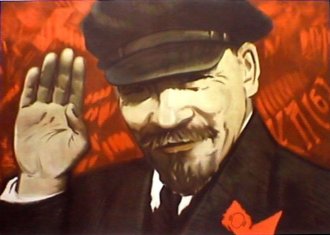
Fort Carson’s boot on your 4th of July

Colorado Springs Gazette Telegraph July 4, 2008I just love the Gazette’s headline on their July 4th front page: POST IS KEEPING TABS ON ITS ‘BOOTPRINT’. Is it a cute eco play on words, or an ironic malapropism? About collateral damage, Rumsfeld famously said the US doesn’t do body counts. I am reminded of course of George’s Orwell’s foretelling: “If you want a vision of the future, imagine a boot stamping on a human face — forever.”

Certainly the PR crew at Fort Carson meant to imply the equivalent of an environmental footprint in Army lingo. But footprint is itself no longer the literal track left behind you as you walk. It has come to mean the space you occupy, or the resources you consume. Or that of your computer or the printer on your desk for example. The portion of surface resources which each item displaces.

There must be a semantic fallacy which applies here, a mixed semaphore perhaps? As if you could tell me “put a sock in it.” And the Army would add “Put a BOOT in it. HA HA.”

If the Fort Carson sustainability spin doctors want to call the Army eco impact a “bootprint” instead, it probably is more accurate. Their activities have devastation-unleashing consequences. And as the interviews in the article reveal, the warrior’s real passion is in the warfare, hybred-whatsits be damned.

On this Independence Day when we’re all wishing ourselves “Happy” Patriotism, let’s reflect on the full context of Orwell’s 1984 passage:

Always, at every moment, there will be the thrill of victory, the sensation of trampling on an enemy who is helpless. If you want a picture of the future, imagine a boot stamping on a human face — forever.

Pete Schuermann documentary HAZE

HAZE, a documentary by Pete Schuermann
COLORADO SPRINGS- Screening this weekend at Kimball’s Twin Peaks Theater, the premier of HAZE,
a local documentary about fatal alcohol abuse which persists on college campuses.
 
A few years back Pete brought down the house at the Passion Film Festival with the short JOE GOES TO COLLEGE which satirized college drinking.

One gold equals 1,000 silvers

Chinese Olympic rowing teamNevermind that gold and silver are often separated by a hundreth of a second. Chinese statistics reflect adherence to this depressing credo. In the 2004 Summer Olympics, the USA reigned with 102 medals. China was a distant third with 63. Gold told a different story. China was second with 32, four behind the United States. “Silver? It means nothing here; you might as well finish last,” says former Soviet coach Igor Grinko. “Coaches like me come, help them win gold medals, or we are fired.”

As China prepares its debut as Olympic host, it has ramped up its effort to win gold. The strategy is to focus on sports that offer many opportunities for gold, like rowing. Rowing. Crew. Such a long Chinese tradition, right? No, of course not. But the sport offers 14 separate events, 14 chances for gold, unlike basketball or volleyball — sports that have a rightful place in Chinese culture — that offer only 1 or 2.

In China, very young children are evaluated for potential athletic prowess and shipped off to distant locales to train, train, train. Seven days a week for years, separated from family and community, they are cogs in the Chinese wheel. They head out every morning, shoulders slumped, exhausted, unmotivated, to play a sport that is meaningless to them. Great financial gain at one end, prison (for doping) at the other end, they work toward a predestined fate.

I am sure that the Chinese will fare well in Beijing. They have to. But the glory will be reserved for the athletes that defy fate. Just as computers will never outshine humanity’s best and brightest, so the Chinese machine will fall short. The 1980 Miracle on Ice — the US hockey team that defeated Cold War Russia to go on to win the gold — was not about raw talent, or national financial support, or intense training regimens. The Miracle on Ice was about the human spirit, about love of sport, reverence for tradition, synergy above all else.

Passion defies logic. Love, dedication and athletic brilliance will always trump mechanization. Even when it wears a human skin.

I can not wait to see the US kick China’s autocratic ass on its home turf.

We will miss you Elizabeth

Elizabeth poses with fellow arrestees the day after the 2007 St Patricks Day debacleWe will all miss Elizabeth. Despite the press, the city government , and The Gazette all dragging her name through the mud last year, me and my family will miss Elizabeth because she was a loving person who gave a lot of herself for, and to, others. This was the real Elizabeth, and not the fake ‘antiwar dissident’ that the killers amongst us wanted to be portrayed to the public.

 
The sad truth about Elizabeth’s last days amongst us, was that she ran a foul of our pathetic US Medical System, which quite frankly killed her with its negligent and defective ‘care’ as it does millions of other older people. Like Elizabeth, these elderly that this business kills, are our friends, neighbors, and family. It makes one weep that we have to endure such a destruction of life and spirit at this sad and reactionary moment in our country’s history.

Elizabeth knew what the world was about. She, earlier in life, had been a rather conservative though nominally liberal woman cruising through life. But somewhere, she began to question what she was seeing and living, and became a true American ‘dissident’.

She hated the racism she saw around her when she was a teacher and resident in Chicago. She hated the endless and stupid wars that our government pushes with a passion. She grew to despise the American Medical System’s uncaring and thoughtless approach to the sick and aging. She grew to want a fundamental change to the society that she had had to live with all her life, and she began to work with others constantly to see that things might begin to change.

Elizabeth was always welcome in our home, and she always welcomed us to hers. We knew her as one easily to anger, but one who was just as easy to forget and forgive. In fact, she was more likely to forgive others for their differences and bad habits than she was ever likely to bear an unnecessary grudge. That was the Elizabeth we knew and grew to love. We knew a loving and kind Elizabeth. We knew an Elizabeth who cared deeply about others.

Elizabeth and Tony at Peterson AFB

Thank you, Elizabeth, for your gifts to my daughter, who began to think of you as her adopted grandmother. In fact, you were just exactly that. And thank you for making the peace dog welcome always. This dog loved you, too. Yeah, she did. Ruf, ruf.

I remember the time when we went up to Palmer Park and I was poo-pooing your concern for this highly trained (yeah, right!) dog who was leaning out the open window. I was paying your words no attention as I rambled on about some other esoteric and stupid political point. Then lo-and-behold, Ms. Beastley did jump out of the window of our moving car and rolled over entirely once or twice after hitting the ground, then looked up stupidly at us, and then promptly proceeded to run after the squirrel! I will remember that moment between us for a lifetime, Elizabeth. You always saw what others refused to see.

My daughter will remember you for the doll you gave her, the one that has a striking likeness to you. She cherishes that doll that you so kindly gave to her. My daughter cried with the news of your death, and we are so glad that we visited you at least one more last time before you passed away so suddenly. My daughter was ready to try to get you to play a game of Risk with her. She knew you would be a good one to try to keep her from taking over the world.

At that last visit, I tried to cheer you up by saying how good you looked upon just then having escaped from the hospitals that had held you. However, you had this way of looking through others superficial chit-chat and reading the real truth in their minds. I saw it in your eyes then. I saw the despair on your face about what had been done to you by the surgeon, but by the time I realized what had been seen in your face I was already in the car.

Elizabeth advocated for health care for allMy only regret is that I did not return to inside your apartment and give you the big hug that you needed right then, even if it was to be a hug given right in front of your other 2 friends who were with you at the moment. I thought to myself, aw… you need the rest and less people around at this time, more than the hug. I was wrong once again.
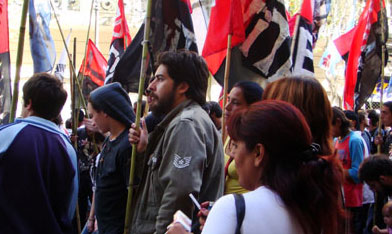
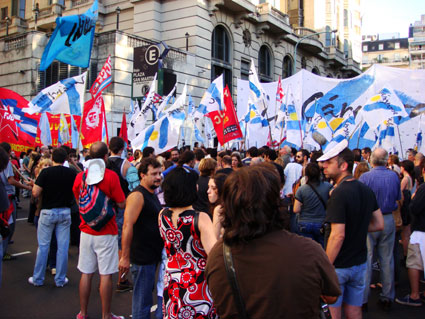

Elizabeth, we will miss you. You were a good friend, and you talked the talk, and walked the walk. You were kind and had a heart of gold most of all. They tried to tear you down, but they never did, and that spirit is what we most will remember always about you. That, and the love you gave others. You made an impact on all our lives and without you around, we will find a big void.

If there is a heaven, I have no doubt that you have already spoken to Jesus and have begun to argue politics with him right as I write. Give him Hell, Elizabeth! Somebody needs to hold him and his dad accountable, and you are the one with the spirit to do it, too.

Our love…

Thank you, sir! May I have another?

Buenos Aires protest
This morning I clicked on our new upper-left graphic which imparts info about protesting the state democratic convention. What I discovered was page after page of terms to meet and rules to obey, laid out neatly by the powers-that-be, so that would-be activists can protest the most egregious war and power-hungry administration in our country’s history. Happily chirping about meetings with policemen and attorneys, the activists invite us to join them in defining the terms of their oppression.

I’m sorry, I know these people are wannabe do-gooders, but this bullshit is akin to meeting with a gang of rapists to consent to the terms of one’s degradation. Oh yes, please! Just use lubricant and let me lie in a comfortable bed!

It’s pathetic that our passionate anti-war activists have so little vision, so little faith in human history, such a lack of conviction and temerity that they can be contented to hand out fliers and maps, cower in a cage gilded especially for them, and be completely marginalized by the system they profess to oppose.

Here’s my idea. Do not legitimize the trampling of your civil liberties and the silencing of your voices by compliantly meeting with police officers and attorneys. Instead tell them that you’ll see them on Venetucci Boulevard with a thousand of your closest friends. You’ll have drums and cowbells and bullhorns and offensive banners and whatever fuck else you feel like bringing. Tell them you’ll sing and shout and march and cross every boundary they put up to keep you on the fringe. Tell them you’ll do whatever the fuck you want to in order to make your voices heard.

What the hell? The vast majority of Americans oppose this war and despise this administration. Why aren’t they out on the streets? Do you really believe they’ll join you there as soon as they are enlightened by Amy Goodman? No! They aren’t out on the streets because they are sheep waiting for a shepherd. So where are the shepherds, our visionary and inspiring leaders? Where are the men with balls, bravely putting their necks on the line in the name of peace and justice? Where are the courageous vaginas, fresh from their New Orleans beaver fest, newly empowered to fight violence against women all over the globe? The anti-war movement in Colorado Springs does not have a single leader. It has a few worker bees — banner painters and flier makers — who don’t have a clue about what it’s going to take to stop the machine.

If you are like me you are saying “Well, Marie, why aren’t you out there making a difference?” I’ll tell you why. I am the system’s bitch. I have assets that can be frozen by the IRS. I have children in the public school system. I have dough invested in Social Security. I am tied by law to an ex-husband which precludes me from moving my family to another neighborhood, let alone another country. I am a cog in the machine. And in the scheme of things, nothing more.

I am, by position and ultimately by choice, powerless. But at least I don’t pretend to be anything more.

———————

Here are some pictures from the protest I was inadvertently caught up in in Buenos Aires. Maybe because Argentinians recently lived under a military government, one that silenced dissenters by kidnapping them and dropping them into the ocean, they appreciate their regained freedoms enough to band together and make their voices heard.

Argentina protestors
Argentina plaza protest
Banner
Blue period
Che
Drums
After the main protest
In the street
Green peace shirt
Osama

POLICE AND MEDIA! ON THE FRINGE! BEHIND THE BARRIER!
Argentina cops behind the barrier
Argentina riot police behind the fence
Argentina protest media

Tim Robbins is an activist god

Tim-Robbins-unwrapped-graphicMaybe it’s the start of baseball season — I’m watching the 22nd inning of the Rockies-Padres game! — that has me remembering the first time I saw the movie Bull Durham. It was a movie that had everything I love — sport (baseball), romance (Costner and Sarandon) and humor (in the form of an idiotic-yet-talented young pitcher). The imprint of Bull Durham remained on me for a long time. I pictured Crash Davis and Annie Savoy living in Happily Ever After, and hoped that someday I might be as lucky.

Imagine my horror when I heard that Susan Sarandon had taken up with, not Crash, but the nimrod pitcher Nuke LaLoosh. In real life! The guy was named Tim Robbins, he was twelve years her junior and, worst of all, he was a complete moron. Or so I thought, and continued to stubbornly think, for many years.

Well, no more. Tim Robbins is now the object of my fantasies. He is a guy who is brilliant and passionate about not only sex and sport, but social issues as well. The thing that sets Tim Robbins apart more than anything is his ability to clearly articulate his positions, bravely defy social norms and niceties, cleverly connect historical dots, and positively SKEWER lesser mortals with their idiocy, hypocrisy, dishonesty, immorality and overall worthlessness, while making them laugh at the same time. He is so completely likeable that those who have been ripped to shreds by his razor wit invite him to have another go.

When social change is a goal, when mindsets must be shaped and molded, we need more activists like Tim Robbins. People who strike us as pompous and obnoxious, who are heavy-handed and unlikeable, are rarely successful change agents. To educate, to influence, to sway an opinion requires first to be heard. I know that I personally refuse to listen to anyone who browbeats me, provides no inspiration, and displays a complete lack of social awareness. I refuse to cooperate in any way, even if I agree with the vision. I doubt I’m the only one.

Tim-Robbins-unwrapped-graphicIf you haven’t already done so ten times, you should listen to (not read) Tim Robbins’ keynote address to the National Association of Broadcasters. He plays the audience in a masterful progression from inculpation to inspiration, while they cling to his every word. In the end he’s left them feeling that he’s an ally, that they can work together. The broadcasters are free to walk out the door feeling empowered, dignity intact, eyes opened, ready to go.

Tim Robbins possesses keen social intelligence. Unlike many activists, he isn’t an obstacle to change.

Cynthia McKinney and Cindy Sheehan together in Mexico City!

Below, we reprint 2 speeches made in Mexico City Friday, just yesterday, April 4, 2008. The speech Greed … by Cindy Sheehan, and another speech by Cynthia McKinney that is without title.

Cynthia McKinney
Segundo Encuentro Continental de los Trabajadores
Mexico City, Mexico, April 4, 2008

Brothers and Sisters in the Movement

I am happy to be here in Mexico City where the people all over Latin
America are on the move:

On the move for justice, self-determination, and peace.

I love that you have created a Power to the People movement with your
votes that is stronger than the mightiest military force on the
planet!

With the power of your vote you have taken your countries back.

Now, all we have to do is to count all the votes in the United States
and Mexico!

In the 2000 U.S. Presidential election, an estimated six million
people went to the polls and voted, but their votes weren’t counted.

In 2000, and again in 2004, Democrats helped to install Republicans
into power rather than fight for the victory that the voters had
given them.

As a result of this kind of collusion, the Democratic majority in our
Congress has failed to impeach Bush. They have failed to institute a
livable wage, stop the multiple wars the U.S. is fighting right now,
and they have failed to protect human rights anywhere in the world,
including even at home.

That’s why I left the Democratic Party.

I refused to become complicit in war crimes, crimes against humanity,
crimes against the peace, spying on the American people, and ripping
our Bill of Rights to shreds.

And so I declared my independence from the U.S. leadership that gave
us tax cuts for the wealthy and a country 53 trillion dollars in debt
and Hurricane Katrina.

To my brothers and sisters at this Conference and in the United
States, I say:

Hands off Haiti!

Hands off Bolivia, Nicaragua, and Argentina now making a claim for
the Falklands!

Hands off Venezuela and Ecuador!

No to Plan Mexico; No to Plan Colombia! Hands off Pemex!

And finally, it was on this date, 40 years ago, that Dr. Martin
Luther King, Jr. was murdered.

We now know that Dr. King was murdered as part of a conspiracy that
included his own government. Hatched in the bowels of the Pentagon,
where so many other regime change operations have been hatched, the
government of the United States launched regime change at home on
Black America. We blacks in the United States have long known the
pain and the consequences of having authentic leadership snatched
from us; of having someone else pick our leaders before we pick them
ourselves.

I am proud to join this international movement for
self-determination; for justice and for peace. Despite today’s
difficulties, we must never let our dream be deferred. We in the U.S.
gain inspiration from your successes here so we can carry the
struggle to every nook and cranny of the United States.

Que vivan los pueblos de america!

Cindy Sheehan -Key Note Speech “GREED”
Segundo Encuentro Continental de los Trabajadores
Mexico City, Mexico, April 4, 2008

First of all I would like to thank the International Labor Council and the Electrician’s Union for such a warm welcome and I would like to assure you all, my brothers and sisters that I represent millions of North Americans who are in solidarity with you, because we are also plagued with an illegitimate President!

Once, a couple of years ago, I was getting a pedicure in the deep south in the USA, of all places, and my pedicurist was a Latina from Mexico. She lived two hours from where she and her husband owned the shop and she left her young son home with her mother-in-law for six days a week, while she and her husband toiled at the shop. She was very sweet and sympathetic to my situation as a mother whose son was killed in Iraq, but she looked up from my feet at one point and asked me: “Why do you Americans have to have everything. If you all weren’t so greedy, I could still live in my country with my family.” Greedy? Hmm? Her earnest and passionate comment gave me much to think about.

Dictionary.com defines greed as the rapacious desire, especially for wealth or possessions

Greed is also one of the seven deadly sins and I know more than most Americans that the same twisted drive for, not just a fair share of prosperity, but ALL the prosperity is what caused my son’s death and, similarly, my nail persons’ need to have to leave the beloved country of her birth.

Greed is not what drives Latin Americans to try and cross the border to go north, existential necessity is; but corporate-capitalist greed is what makes the dangerous journey necessary. Building walls on the border is not the way to solve the immigration “problem” just as invading two countries and killing innocent civilians was not the way to solve the terrorism problem. Healing the systems of oppression that cause immigration is the way to solve the “problem.” People in Latin America want the right to not have to emigrate. Like my pedicurist, they want to be able to make a good living in their own countries.

In a study done by the Economic Policy Institute in 2004, it was found that 5% of the US population owns 58% of the wealth and only 1.2% of the wealth is owned by 40% of our citizenry. I am sure if a similar study were done, this disparity would be much wider in these days of irresponsible corporate bailouts while Americans are losing their homes at the rate of 250,000 a month and the war economy has made the fat cats astronomical profits while robbing our communities of essential services and needed infrastructure improvements. The Milton Friedman model of disaster capitalism, which Naomi Klein exposes so well in her book, Shock Doctrine, is responsible for economic disaster from New Orleans to Baghdad and the basic underlying root sickness of this is greed.

Statistics can be easily manipulated as we know the statistics reporting the “success” of free trade agreements such as NAFTA are. Facts, numbers and experiential data cannot be so easily manipulated, though. In the years since the Clinton administration (with the support of my Congressional opponent, Nancy Pelosi) foisted NAFTA on our continent, both Mexico and the US have lost farmland and good paying jobs. Many of our manufacturing jobs have gone overseas to Indonesia or China and the Wal Martization of our cultures creeps up on us unchecked and corporations such as Wal Mart have been the main beneficiaries of NAFTA to the detriment of working class people in both countries.

What can we do to improve the situation and reclaim our prosperity from the control of the 21st Century Robber Barons and slave-traders?

First of all, “free” trade treaties should be replaced with fair trade agreements. Small business owners and workers should be protected from being crushed under the heels of multi-national corporations. Any agreement should have protection for workers. A worker who makes shoes, computers, cars, or grows crops should make the same livable wage in Mexico or China, as they would in America. There would be no incentive for off-shoring jobs or relocating manufacturing plants if workers in China made the same wages as workers in America.

All workers should be guaranteed the basic human right of being able to belong to a union. Unions elevate the conditions of workers and families and should remain a strong political force for good and not allow them selves to be beaten into submission or weakness by governmental or corporate pressure. (But aren’t the corporations and governments so intimately linked these days in their fascistic oppression of us average citizens?)

The fragile ecology of our planet must be protected in these agreements and the same standard of sustainability and environmental protections should be uniformly recognized and practiced globally.

Small farmers should be protected from the encroachment of “agri-giants” and their lands protected from the eminent domain of greed.

I know there are many more solutions and a comprehensive platform of “No human left behind” would guarantee the rights of all humans to safe and plentiful food and drinking water; shelter; good and free education; sustainable employment; security and safety from US corporate-militarism; and the basic rights that were guaranteed of: life, liberty and the pursuit of happiness.

For far too long, the United States of America has greedily gobbled up too much of global wealth and resources and our chickens of greed and violence are coming home to roost. As alarming as these trends are, we North Americans are only slightly beginning to feel the ravages of what we have been manufacturing and exporting for years: death and destruction. A new paradigm of global sharing and caring must be implemented and today is the beginning.

Today, as we commemorate and mourn the death of Dr. Martin Luther King, Jr who was assassinated 40 years ago in Memphis, Tn; and as I mourn the murder by the war machine of my son Casey, who was killed in Sadr City, Baghdad 4 years ago today—we must renew our commitment to peace and justice to honor their sacrifices and the sacrifices of others who have also gone before us. We just celebrated the birthday of Cesar Chavez who dedicated his life to the most marginalized and exploited of workers and I am constantly inspired by the devotion of people like Dr. King, Casey and Cesar Chavez andI hope that we all take inspiration to rededicate our lives to peace and justice.

We must build upon the coalition that we have gathered here in this beautiful and historic place to include every group that we are a part of. We can no longer say that we have to focus on “one” issue, because all the issues are the same. My country is waging deadly and lost-cause occupations of Iraq and Afghanistan and so many groups in my country say that we have to focus on bringing our troops home and not become “distracted” by other issues. Profound economic inequality and unchecked greed is the root cause of these occupations as it is the root cause of the occupation of Palestine by Israel and all the violence in the world’s hot-spots today.

In our coalition, we must educate our brothers and sisters that equalizing prosperity and neutralizing greed are the solutions to these acute problems.

I also stand here in solidarity with my brothers and sisters who are working in the Legitimate Government of Mexico to prevent the illegitimate government from privatizing PEMEX. The oil of Mexico belongs to the people of Mexico, and if I can’t be here with you all to block the crimes with my body then I will definitely be with you in spirit.

Thank you for allowing me to speak. It has been an honor to be here.

Too pretty to blog?

An oft-heard conversation in my house goes something like this:
“Mom, why did I only get one Thin Mint and Lara got two?”
“Because I like her better.”

 
Fortunately, my kids are wise enough to know that to accept this un-motherly, and of course untrue, explanation is to be spared an hour-long lecture on The Inherent Unfairness of Life or Life Is Not a Zero-Sum Game or, my favorite, From Each According to Ability To Each According to Need.

Too pretty to flyToo bad that I am not the parent of the 18-year-old girls escorted off a Southwest Airlines flight who claim that they were just too pretty to fly. Had I been on the receiving end of such a lame defense I would’ve gleefully launched into my Pretty Is As Pretty Does speech, which would be great fun since it’s not one I get to use very often.
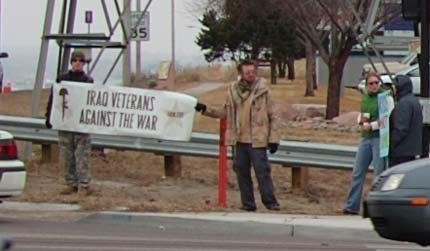
When I was in college at CU-Boulder, I thought I was rather attractive. Unfortunately for me, most of the girls there were more than rather attractive. I would occasionally go to a college bar hoping to catch the eye of a handsome fraternity boy. I would stand with good posture, trying to project an enigmatic alluring presence, hoping that someone would sense my intelligence, robust wit, and deep compassion for humanity. Well, it never happened. Not once. Finally tiring of plodding along a dead-end road, I decided to change my tack and give it one more try. I positioned myself near a table of 8 Sig Eps, reached into the depths of my being, and let rip an ear-shattering near-heroic burp. Eight heads turned my way. Chairs were pulled out, beers were purchased, and fraternity men jockeyed to be the one who’d take me home to meet the folks. Cosmic confirmation of Pretty is as Pretty Does had been attained.

What, say you, does this have to do with the poorly-mothered girls on the plane? In the twenty years since my stint in Boulder, my understanding of human nature has expanded beyond the Panhellenic membership base. Growing up I remember being unsettled by the apostle Paul’s words To the weak I became weak, that I might win the weak; I have become all things to all men, so that I may by all means save some. This seemed disingenuous to me, an outright manipulation to attain a specific goal. But I think I’ve figured out what Paul meant, and modern-day evangelists would do well to take note.

Life isn’t always about me. In fact, life is rarely about me. Or you. It is about figuring out who everyone else is, and what matters to them. It’s about showing empathy and understanding, not forcing one’s opinion or will on someone else. My parents laugh when they meet someone who knows me, because the descriptions of what I am are so varied. Sophisticated and polite. Boisterous and raunchy. Well-read and articulate. Creative and unpredictable. Conservative. Liberal. Jock. Freak. Certainly all elements of my personality. But if I’ve properly assessed who these people –or even organizations — are, then also a reflection of them. Persuasion, cooperation, effectiveness, even friendship, require common ground. Emotional intelligence is necessary to figure out where that common ground lies.

The pretty girls, if they were thirsty and in need of a bathroom, should have better assessed the situation, the timing of their requests, and the duties of the flight attendants. If they had, their tray tables would likely have been overflowing with water and snack pretzels, and a flight attendant would have extracted the bathroom dweller on their behalf. Too pretty to fly? No, too self-absorbed and emotionally-retarded to fly.

Fortunately for my kids, this entire speech has been reduced to meaningful eye contact, one arched eyebrow, and a quiet snap behind my back. This isn’t about you. Reassess. Adjust to the situation. Or you’ll be getting no Thin Mints at all.

Iraq Moratorium comes up against Feds

Feb 15, 2008 Southeast Corner
I just got back from an invigorating Iraq Moratorium street- side demonstration. The cold wasn’t so bad, the IVAW boys held down a corner, one participant traveled a ways to be here, a Gazette reporter came with a photographer, and we were deluged with the usual honks of support. Then two supervisors from the nearby Post Office visited to tell us whichever of us had parked in their lot better move our cars or expect to be towed.

I stepped forward but noted the parking lot was only a third full, plus by coincidence I had a time-dated receipt from their counter. No matter they said, the parking was private, and/or you can’t protest on government property. They incorrectly asserted plenty more, finishing with “sue me” but wouldn’t give their names. One called out for security as I entered the post office to stand in queue, shouting to everyone that I was likely to cause a scene. The clerks volunteered the info I needed: Jim Hickle and Bill Schafner, big-for-their-britches USPS supervisors of customer relations, wannabe feds.

I’m always perplexed by the politics of the postal worker. I regard a number of them as my friends actually, whom I see everyday, including the late John S, about whose horrible political ethics I’ve already written. Why are workers, who benefit mightily from the APW Union, and who more likely than not are veterans, stand so passionately behind the right-wing? Postal workers are losing their jobs to privatization, their jobs are as blue collar as any, they come face to face with so much of the local community. Why would their personal opinions be so regressive?

Mark and Garrett help on Northeast corner

UPDATE: After I left, another activist of our group was sitting in his car, having taken medication which called for a pause before he could begin driving. He was parked, as I had been, at the extreme north of the lot, far from any customer traffic. The same two postal authorities, Jim and Bill, approached his window and insisted he had to leave. My friend explained that we was quite willing, but that he was required to wait until his medication permitted it. They insisted he leave immediately or they would call the police. My friend complied, in a hallucinogenic state, and thankfully he made it home safely.

Europeans and US intervening in Darfur by way of Chad

After all those nice stories about how ‘something must be done’, the European Union is sending in its troops to Darfur by way of neighboring Chad. In so doing, it will be propping up a French maintained puppet dictator that is so unpopular, that even some of his own relatives are trying to overthrow him along with much of the population at large. Oh, Go blame it on the Arab horsemen and the Chinese, I suppose?

What is all this Chad, Darfur, and Sudan stuff really about to our Western ears? Does our ruling class now have soft hearts and now are turning to stop bad things going on in the big bad, world? Pretty comical notion I think. ‘Save the Blacks! Save the children!’ What noblesse oblige!

Is this the new compassionate conservatism in action? Oh No…. It’s the liberal Democrats once again! Working with Bush and Sarkozy all together! Oh, and it’s to ‘Stop Terrorism’, too. It’s all part of the ‘Global War on Everybody and Everything’, patent pending in Washington DC office (or is it in Alexander, Virginia?). We got such good ol’ soft hearts, we going to save the world once again.

OK, actually the news is keeping the news away from us on this one. Too early to announce yet. We have short attention spans and need to stay focused on CHANGE and DARFUR. Chad is, well it is, politically incorrect to think about. There will be no Chad displays at the local library quite just yet. Hold your breath! And whatever you do, VOTE! The System need you.

Chad president urges EU force to deploy
Chad’s President Urges European Peacekeeping Force to Quickly Deploy; PM Declares Curfew
…so many dead… so much suffering. But as Madelyn Albright would say… ‘It’s worth it.’ The European and US corporations must run Africa for themselves.

Malthus, Sisyphus and the truth of 911

911 inside job
A friend of mine, Dave, is a 911 nut. I don’t mean he’s a nutcase, I simply mean he plays into the unfortunate stereotype painted by those trying to discredit conspiracy theorists.
I don’t know how to help him.

Dave’s life priority is to expose the truth about 9/11. He maintains the websites 911blimp and 911university. I saw Dave tonight at our precinct caucus. He rose to every opportunity to speak for or against candidates, always on the theme of questioning what really happened when September 11, 2001 was used to transform our nation into a “homeland” preoccupied with its security. Each time, Dave’s presentation was tempered by the precinct chairman’s reminder of a two minute time limit. Dave spoke with clarity and passion, although often part of his audience would deliberately ignore him. Between pitches Dave circulated around the room to hand out business cards and CDs. It was a tough sell but he kept at it.

Dave may as well have been Malthus warning the end is nigh, but he cheerfully explained to me that he would regret later if he didn’t speak out as much as humanly possible. Our government’s duplicity about 9/11 is ground zero for reassessing the dysfunction of our political system. I told him I thought he was absolutely dead on, but that people were still not ready to hear it. In fact I was certain they were growing more and more blind. This crowd in particular, buzzing about Obama, was hanging on desperately to a hope it was not about to be told was false.

Perhaps another round of non-representative leadership will bring Americans around to the stench of deceit that flew into high gear on 911. It doesn’t matter what theory you favor, the official theory stinks.

Dave doesn’t want us to get bogged down with weighing the conspiracies and pseudo-conspiracies. And here I think he’s on the right track. Dave told me tonight: “You don’t have to know how the magician sawed the lady in half, to know it was a trick.”

Offending the troops

War crimes in IraqOffending the soldiers: I get into this trouble every time. IF YOU ARE A SOLDIER AND YOU ARE NOT UNEDUCATED OR NOT A MURDERER, and you know it, then neither criticism would apply to you. If you are caught up in our government’s very nasty actions and you are doing all you can not to participate, you know war critics are not addressing you. Does that make sense?

On the other hand, if you feel you’ve no recourse but to do what you’re told, kill babies, mother-raping, father-killing, and those mean nasty terrible things, you’ve got to know this: they couldn’t do it without you.

To be clear, our American wars of aggression (Iraq and Afghanistan included), our illegal occupations, our extra-judicial air strikes, our maltreatment of people, our abandonment of civilized behavior, our use of torture, etc, are WAR CRIMES. They are the uppermost of criminal acts, they are CRIMES AGAINST HUMANITY. To suggest this is a matter of opinion would be like trying to insinuate that murder is not. Just because you’ve been mislead by the war-monger bandwagon does not excuse what you and it are doing. Wake up and smell the corpses.

If it offends you to be called a murderer even though you work only behind the scenes, or even though you think you’re fighting on the side of good, or even though your definition of “good” is a dead Iraqi, it’s time to stand up and accept the condemnation you have earned. You’re a dumbass dumbfuck dupe doing the bidding of immoral mass-murdering businessmen. You bring dishonor unto everything we used to think made us Americans. You discredit the bright ambitious minds that created our democracy. You tarnish the legacy of those veterans who fought for equality and justice and prosperity. Do you think a failing grade in civics or ethics or religion calls for an attaboy? You deserve consolation without doubt, because your thinking-inability is certainly not your fault, but not an endorsement to put your failed education to work killing and marauding at whim. Put down your gun you big ol’ galloot and figure out an honorable way to earn a living.

If your mutiny would mean that your even-worse behaving comrades-in-murder feel they need to shoot you for breaking rank, well that’s what you and they have coming, isn’t it? Unless YOU can convince them otherwise. Quit looking to antiwar people to fight your battles. We don’t need to go to Iraq or wear your boots to know what you’re doing is immoral. Lucky for you, most of us are forgiving and compassionate. I see the murder of one million Iraqis and think a dressing down is the least you deserve.

The Justice and Peace Commission’s Annual Meeting

Luckily I have to work and can’t participate in the nonsense called the J&P annual meeting. You see, the J&P has no other general membership meetings but just one poorly organized charade of a participatory event per year.

CS city council woman, Jan Martin, is the headlined speaker, and was chosen by nobody other than an irresponsible office staff that couldn’t think of any thing better to do with its time than to listen to Jan. Why Jan Martin of all possible choices? She’s not exactly an outspoken voice for peace and justice at all, now is she?

The choice was simply made and stupidly done because the J&P has office staff that think it most important to nuzzle up to ‘responsible violence’ …I meant ‘responsible power’… so they can curry favor. Last year they invited Ken Salazar’s local voice, Poor Pathetic Richard, to speak to the annual gathering. That was where he argued that it would be dangerous to withdraw from Iraq. It could hurt the Iraqi people he said with regret dripping from his cynical forked tongue. A great choice for a pro peace gathering, right, this Pathetic Richard? In short, it was a bad joke having him there! He is not pro peace at all. Merely pro career.

So not having learned anything but merely blundering repetitively ahead, the J&P administration has invited another such type to this years gala ball. We should be demanding that the Colorado Springs city council pass resolutions against this war, against the use of torture, and against Fort Carson Expansion. But no! The office staff want to ‘dialog’ with power, and any power that will throw them a bone, too. They will not make demands on anybody, and they will only try to triangulate into the lowest common denominator.

Jan Martin will speak to how good is good, and bad is bad, no doubt… Clap, clap, clap. Yawn, yawn, yawn. Boo, boo, boo… And the J&P hides in the shadows of the city because it is too scared and gutless to push forward with any fervor and passion, which would all involve taking some powers on instead of hugging them.

The problem with the J$P is that it is an organization run on bigger donations that are mainly used to fund a rather conservatized, rather do little, paid staff. These staff look at non salaried J&P members at times, as if they were trespassers by having other agendas than their own ‘united way’ funding approach. In fact, some salaried staff do graduate from the J$P funding school approach and do go directly into United Way funding afterwards for their new jobs. That has happened.

So what happens when people want to meet and there is only one annual meeting? They just give up PUNTO. It certainly turns new people away with this type of doing business ‘peace organizing’. They would have more democracy in their local church working together with Pastor Pretense running the entireshow.

At the J$P, new folk run around scratching their heads trying to find what they can do to fit in? They can eventually fit in some eventually, but only if they spend hours and hours and hours getting to know the various social grouplets that are administered to by the paid office staff. They have to be baptized by immersion into the jello pudding like ‘consensus’ adminstered by the salaried staff huddled in the office.

Is all this really anyway to organize against the war and injustice? Or a gigantic waste of time? Maybe Jan Martin can tell us at the annual meeting? Jan, is it good to be good? I don’t want to be bad to be bad. Think God I am having to work today. Isn’t this a sad and corrupt way to fight for justice and peace? We deserve better than this if we are against The Wars and looking to fight them.

Paid office people…. ‘Oh no. Don’t fight! Come together.’

And this year they brought in somebody who once again is little for Peace to talk to the more liberal who are. Counselling to the annual members extreme I guess it must seem to them, those paid and conservatized ‘peace activists’ who think that their way is the best way.

They get paid to think like that… ‘consensus’ always… and never quite understand why others seem to disagree with their choices? That’s because we are not adminstrators, Dudes. In fact, we prefer an organization not divided into a caste system of paid adminstrators and general members.