The Putin knock-knock joke is easier to find than his Kremlin speech on Crimea

Putin Obama Knock Knock Joke - Crimea RiverThis graphic circulating on the interwebs is a lot easier to find than Vladimir Putin’s March 18 address to the Kremlin about the referendum in Crimea after the Western coup in Ukraine. Bypassing dubious translations excerpted on Capitalist media sites, here is a transcript of his speech direct from the Kremlin. Putin is no hero, but he threatens US-EU banking hegemony, gives asylum to Edward Snowden, and executes zero people with drones.

QUOTING PRESIDENT OF RUSSIA VLADIMIR PUTIN:
Federation Council members, State Duma deputies, good afternoon. Representatives of the Republic of Crimea and Sevastopol are here among us, citizens of Russia, residents of Crimea and Sevastopol!

Dear friends, we have gathered here today in connection with an issue that is of vital, historic significance to all of us. A referendum was held in Crimea on March 16 in full compliance with democratic procedures and international norms.

More than 82 percent of the electorate took part in the vote. Over 96 percent of them spoke out in favour of reuniting with Russia. These numbers speak for themselves.

To understand the reason behind such a choice it is enough to know the history of Crimea and what Russia and Crimea have always meant for each other.

Everything in Crimea speaks of our shared history and pride. This is the location of ancient Khersones, where Prince Vladimir was baptised. His spiritual feat of adopting Orthodoxy predetermined the overall basis of the culture, civilisation and human values that unite the peoples of Russia, Ukraine and Belarus. The graves of Russian soldiers whose bravery brought Crimea into the Russian empire are also in Crimea. This is also Sevastopol – a legendary city with an outstanding history, a fortress that serves as the birthplace of Russia’s Black Sea Fleet. Crimea is Balaklava and Kerch, Malakhov Kurgan and Sapun Ridge. Each one of these places is dear to our hearts, symbolising Russian military glory and outstanding valour.

Crimea is a unique blend of different peoples’ cultures and traditions. This makes it similar to Russia as a whole, where not a single ethnic group has been lost over the centuries. Russians and Ukrainians, Crimean Tatars and people of other ethnic groups have lived side by side in Crimea, retaining their own identity, traditions, languages and faith.

Incidentally, the total population of the Crimean Peninsula today is 2.2 million people, of whom almost 1.5 million are Russians, 350,000 are Ukrainians who predominantly consider Russian their native language, and about 290,000-300,000 are Crimean Tatars, who, as the referendum has shown, also lean towards Russia.

True, there was a time when Crimean Tatars were treated unfairly, just as a number of other peoples in the USSR. There is only one thing I can say here: millions of people of various ethnicities suffered during those repressions, and primarily Russians.

Crimean Tatars returned to their homeland. I believe we should make all the necessary political and legislative decisions to finalise the rehabilitation of Crimean Tatars, restore them in their rights and clear their good name.

We have great respect for people of all the ethnic groups living in Crimea. This is their common home, their motherland, and it would be right – I know the local population supports this – for Crimea to have three equal national languages: Russian, Ukrainian and Tatar.

Colleagues,

In people’s hearts and minds, Crimea has always been an inseparable part of Russia. This firm conviction is based on truth and justice and was passed from generation to generation, over time, under any circumstances, despite all the dramatic changes our country went through during the entire 20th century.

After the revolution, the Bolsheviks, for a number of reasons – may God judge them – added large sections of the historical South of Russia to the Republic of Ukraine. This was done with no consideration for the ethnic make-up of the population, and today these areas form the southeast of Ukraine. Then, in 1954, a decision was made to transfer Crimean Region to Ukraine, along with Sevastopol, despite the fact that it was a federal city. This was the personal initiative of the Communist Party head Nikita Khrushchev. What stood behind this decision of his – a desire to win the support of the Ukrainian political establishment or to atone for the mass repressions of the 1930’s in Ukraine – is for historians to figure out.

What matters now is that this decision was made in clear violation of the constitutional norms that were in place even then. The decision was made behind the scenes. Naturally, in a totalitarian state nobody bothered to ask the citizens of Crimea and Sevastopol. They were faced with the fact. People, of course, wondered why all of a sudden Crimea became part of Ukraine. But on the whole – and we must state this clearly, we all know it – this decision was treated as a formality of sorts because the territory was transferred within the boundaries of a single state. Back then, it was impossible to imagine that Ukraine and Russia may split up and become two separate states. However, this has happened.

Unfortunately, what seemed impossible became a reality. The USSR fell apart. Things developed so swiftly that few people realised how truly dramatic those events and their consequences would be. Many people both in Russia and in Ukraine, as well as in other republics hoped that the Commonwealth of Independent States that was created at the time would become the new common form of statehood. They were told that there would be a single currency, a single economic space, joint armed forces; however, all this remained empty promises, while the big country was gone. It was only when Crimea ended up as part of a different country that Russia realised that it was not simply robbed, it was plundered.

At the same time, we have to admit that by launching the sovereignty parade Russia itself aided in the collapse of the Soviet Union. And as this collapse was legalised, everyone forgot about Crimea and Sevastopol ­– the main base of the Black Sea Fleet. Millions of people went to bed in one country and awoke in different ones, overnight becoming ethnic minorities in former Union republics, while the Russian nation became one of the biggest, if not the biggest ethnic group in the world to be divided by borders.

Now, many years later, I heard residents of Crimea say that back in 1991 they were handed over like a sack of potatoes. This is hard to disagree with. And what about the Russian state? What about Russia? It humbly accepted the situation. This country was going through such hard times then that realistically it was incapable of protecting its interests. However, the people could not reconcile themselves to this outrageous historical injustice. All these years, citizens and many public figures came back to this issue, saying that Crimea is historically Russian land and Sevastopol is a Russian city. Yes, we all knew this in our hearts and minds, but we had to proceed from the existing reality and build our good-neighbourly relations with independent Ukraine on a new basis. Meanwhile, our relations with Ukraine, with the fraternal Ukrainian people have always been and will remain of foremost importance for us.

Today we can speak about it openly, and I would like to share with you some details of the negotiations that took place in the early 2000s. The then President of Ukraine Mr Kuchma asked me to expedite the process of delimiting the Russian-Ukrainian border. At that time, the process was practically at a standstill. Russia seemed to have recognised Crimea as part of Ukraine, but there were no negotiations on delimiting the borders. Despite the complexity of the situation, I immediately issued instructions to Russian government agencies to speed up their work to document the borders, so that everyone had a clear understanding that by agreeing to delimit the border we admitted de facto and de jure that Crimea was Ukrainian territory, thereby closing the issue.

We accommodated Ukraine not only regarding Crimea, but also on such a complicated matter as the maritime boundary in the Sea of Azov and the Kerch Strait. What we proceeded from back then was that good relations with Ukraine matter most for us and they should not fall hostage to deadlock territorial disputes. However, we expected Ukraine to remain our good neighbour, we hoped that Russian citizens and Russian speakers in Ukraine, especially its southeast and Crimea, would live in a friendly, democratic and civilised state that would protect their rights in line with the norms of international law.

However, this is not how the situation developed. Time and time again attempts were made to deprive Russians of their historical memory, even of their language and to subject them to forced assimilation. Moreover, Russians, just as other citizens of Ukraine are suffering from the constant political and state crisis that has been rocking the country for over 20 years.

I understand why Ukrainian people wanted change. They have had enough of the authorities in power during the years of Ukraine’s independence. Presidents, prime ministers and parliamentarians changed, but their attitude to the country and its people remained the same. They milked the country, fought among themselves for power, assets and cash flows and did not care much about the ordinary people. They did not wonder why it was that millions of Ukrainian citizens saw no prospects at home and went to other countries to work as day labourers. I would like to stress this: it was not some Silicon Valley they fled to, but to become day labourers. Last year alone almost 3 million people found such jobs in Russia. According to some sources, in 2013 their earnings in Russia totalled over $20 billion, which is about 12% of Ukraine’s GDP.

I would like to reiterate that I understand those who came out on Maidan with peaceful slogans against corruption, inefficient state management and poverty. The right to peaceful protest, democratic procedures and elections exist for the sole purpose of replacing the authorities that do not satisfy the people. However, those who stood behind the latest events in Ukraine had a different agenda: they were preparing yet another government takeover; they wanted to seize power and would stop short of nothing. They resorted to terror, murder and riots. Nationalists, neo-Nazis, Russophobes and anti-Semites executed this coup. They continue to set the tone in Ukraine to this day.

The new so-called authorities began by introducing a draft law to revise the language policy, which was a direct infringement on the rights of ethnic minorities. However, they were immediately ‘disciplined’ by the foreign sponsors of these so-called politicians. One has to admit that the mentors of these current authorities are smart and know well what such attempts to build a purely Ukrainian state may lead to. The draft law was set aside, but clearly reserved for the future. Hardly any mention is made of this attempt now, probably on the presumption that people have a short memory. Nevertheless, we can all clearly see the intentions of these ideological heirs of Bandera, Hitler’s accomplice during World War II.

It is also obvious that there is no legitimate executive authority in Ukraine now, nobody to talk to. Many government agencies have been taken over by the impostors, but they do not have any control in the country, while they themselves – and I would like to stress this – are often controlled by radicals. In some cases, you need a special permit from the militants on Maidan to meet with certain ministers of the current government. This is not a joke – this is reality.

Those who opposed the coup were immediately threatened with repression. Naturally, the first in line here was Crimea, the Russian-speaking Crimea. In view of this, the residents of Crimea and Sevastopol turned to Russia for help in defending their rights and lives, in preventing the events that were unfolding and are still underway in Kiev, Donetsk, Kharkov and other Ukrainian cities.

Naturally, we could not leave this plea unheeded; we could not abandon Crimea and its residents in distress. This would have been betrayal on our part.

First, we had to help create conditions so that the residents of Crimea for the first time in history were able to peacefully express their free will regarding their own future. However, what do we hear from our colleagues in Western Europe and North America? They say we are violating norms of international law. Firstly, it’s a good thing that they at least remember that there exists such a thing as international law – better late than never.

Secondly, and most importantly – what exactly are we violating? True, the President of the Russian Federation received permission from the Upper House of Parliament to use the Armed Forces in Ukraine. However, strictly speaking, nobody has acted on this permission yet. Russia’s Armed Forces never entered Crimea; they were there already in line with an international agreement. True, we did enhance our forces there; however – this is something I would like everyone to hear and know – we did not exceed the personnel limit of our Armed Forces in Crimea, which is set at 25,000, because there was no need to do so.

Next. As it declared independence and decided to hold a referendum, the Supreme Council of Crimea referred to the United Nations Charter, which speaks of the right of nations to self-determination. Incidentally, I would like to remind you that when Ukraine seceded from the USSR it did exactly the same thing, almost word for word. Ukraine used this right, yet the residents of Crimea are denied it. Why is that?

Moreover, the Crimean authorities referred to the well-known Kosovo precedent – a precedent our western colleagues created with their own hands in a very similar situation, when they agreed that the unilateral separation of Kosovo from Serbia, exactly what Crimea is doing now, was legitimate and did not require any permission from the country’s central authorities. Pursuant to Article 2, Chapter 1 of the United Nations Charter, the UN International Court agreed with this approach and made the following comment in its ruling of July 22, 2010, and I quote: “No general prohibition may be inferred from the practice of the Security Council with regard to declarations of independence,” and “General international law contains no prohibition on declarations of independence.” Crystal clear, as they say.

I do not like to resort to quotes, but in this case, I cannot help it. Here is a quote from another official document: the Written Statement of the United States America of April 17, 2009, submitted to the same UN International Court in connection with the hearings on Kosovo. Again, I quote: “Declarations of independence may, and often do, violate domestic legislation. However, this does not make them violations of international law.” End of quote. They wrote this, disseminated it all over the world, had everyone agree and now they are outraged. Over what? The actions of Crimean people completely fit in with these instructions, as it were. For some reason, things that Kosovo Albanians (and we have full respect for them) were permitted to do, Russians, Ukrainians and Crimean Tatars in Crimea are not allowed. Again, one wonders why.

We keep hearing from the United States and Western Europe that Kosovo is some special case. What makes it so special in the eyes of our colleagues? It turns out that it is the fact that the conflict in Kosovo resulted in so many human casualties. Is this a legal argument? The ruling of the International Court says nothing about this. This is not even double standards; this is amazing, primitive, blunt cynicism. One should not try so crudely to make everything suit their interests, calling the same thing white today and black tomorrow. According to this logic, we have to make sure every conflict leads to human losses.

I will state clearly – if the Crimean local self-defence units had not taken the situation under control, there could have been casualties as well. Fortunately this did not happen. There was not a single armed confrontation in Crimea and no casualties. Why do you think this was so? The answer is simple: because it is very difficult, practically impossible to fight against the will of the people. Here I would like to thank the Ukrainian military – and this is 22,000 fully armed servicemen. I would like to thank those Ukrainian service members who refrained from bloodshed and did not smear their uniforms in blood.

Other thoughts come to mind in this connection. They keep talking of some Russian intervention in Crimea, some sort of aggression. This is strange to hear. I cannot recall a single case in history of an intervention without a single shot being fired and with no human casualties.

Colleagues,

Like a mirror, the situation in Ukraine reflects what is going on and what has been happening in the world over the past several decades. After the dissolution of bipolarity on the planet, we no longer have stability. Key international institutions are not getting any stronger; on the contrary, in many cases, they are sadly degrading. Our western partners, led by the United States of America, prefer not to be guided by international law in their practical policies, but by the rule of the gun. They have come to believe in their exclusivity and exceptionalism, that they can decide the destinies of the world, that only they can ever be right. They act as they please: here and there, they use force against sovereign states, building coalitions based on the principle “If you are not with us, you are against us.” To make this aggression look legitimate, they force the necessary resolutions from international organisations, and if for some reason this does not work, they simply ignore the UN Security Council and the UN overall.

This happened in Yugoslavia; we remember 1999 very well. It was hard to believe, even seeing it with my own eyes, that at the end of the 20th century, one of Europe’s capitals, Belgrade, was under missile attack for several weeks, and then came the real intervention. Was there a UN Security Council resolution on this matter, allowing for these actions? Nothing of the sort. And then, they hit Afghanistan, Iraq, and frankly violated the UN Security Council resolution on Libya, when instead of imposing the so-called no-fly zone over it they started bombing it too.

There was a whole series of controlled “colour” revolutions. Clearly, the people in those nations, where these events took place, were sick of tyranny and poverty, of their lack of prospects; but these feelings were taken advantage of cynically. Standards were imposed on these nations that did not in any way correspond to their way of life, traditions, or these peoples’ cultures. As a result, instead of democracy and freedom, there was chaos, outbreaks in violence and a series of upheavals. The Arab Spring turned into the Arab Winter.

A similar situation unfolded in Ukraine. In 2004, to push the necessary candidate through at the presidential elections, they thought up some sort of third round that was not stipulated by the law. It was absurd and a mockery of the constitution. And now, they have thrown in an organised and well-equipped army of militants.

We understand what is happening; we understand that these actions were aimed against Ukraine and Russia and against Eurasian integration. And all this while Russia strived to engage in dialogue with our colleagues in the West. We are constantly proposing cooperation on all key issues; we want to strengthen our level of trust and for our relations to be equal, open and fair. But we saw no reciprocal steps.

On the contrary, they have lied to us many times, made decisions behind our backs, placed us before an accomplished fact. This happened with NATO’s expansion to the East, as well as the deployment of military infrastructure at our borders. They kept telling us the same thing: “Well, this does not concern you.” That’s easy to say.

It happened with the deployment of a missile defence system. In spite of all our apprehensions, the project is working and moving forward. It happened with the endless foot-dragging in the talks on visa issues, promises of fair competition and free access to global markets.

Today, we are being threatened with sanctions, but we already experience many limitations, ones that are quite significant for us, our economy and our nation. For example, still during the times of the Cold War, the US and subsequently other nations restricted a large list of technologies and equipment from being sold to the USSR, creating the Coordinating Committee for Multilateral Export Controls list. Today, they have formally been eliminated, but only formally; and in reality, many limitations are still in effect.

In short, we have every reason to assume that the infamous policy of containment, led in the 18th, 19th and 20th centuries, continues today. They are constantly trying to sweep us into a corner because we have an independent position, because we maintain it and because we call things like they are and do not engage in hypocrisy. But there is a limit to everything. And with Ukraine, our western partners have crossed the line, playing the bear and acting irresponsibly and unprofessionally.

After all, they were fully aware that there are millions of Russians living in Ukraine and in Crimea. They must have really lacked political instinct and common sense not to foresee all the consequences of their actions. Russia found itself in a position it could not retreat from. If you compress the spring all the way to its limit, it will snap back hard. You must always remember this.

Today, it is imperative to end this hysteria, to refute the rhetoric of the cold war and to accept the obvious fact: Russia is an independent, active participant in international affairs; like other countries, it has its own national interests that need to be taken into account and respected.

At the same time, we are grateful to all those who understood our actions in Crimea; we are grateful to the people of China, whose leaders have always considered the situation in Ukraine and Crimea taking into account the full historical and political context, and greatly appreciate India’s reserve and objectivity.

Today, I would like to address the people of the United States of America, the people who, since the foundation of their nation and adoption of the Declaration of Independence, have been proud to hold freedom above all else. Isn’t the desire of Crimea’s residents to freely choose their fate such a value? Please understand us.

I believe that the Europeans, first and foremost, the Germans, will also understand me. Let me remind you that in the course of political consultations on the unification of East and West Germany, at the expert, though very high level, some nations that were then and are now Germany’s allies did not support the idea of unification. Our nation, however, unequivocally supported the sincere, unstoppable desire of the Germans for national unity. I am confident that you have not forgotten this, and I expect that the citizens of Germany will also support the aspiration of the Russians, of historical Russia, to restore unity.

I also want to address the people of Ukraine. I sincerely want you to understand us: we do not want to harm you in any way, or to hurt your national feelings. We have always respected the territorial integrity of the Ukrainian state, incidentally, unlike those who sacrificed Ukraine’s unity for their political ambitions. They flaunt slogans about Ukraine’s greatness, but they are the ones who did everything to divide the nation. Today’s civil standoff is entirely on their conscience. I want you to hear me, my dear friends. Do not believe those who want you to fear Russia, shouting that other regions will follow Crimea. We do not want to divide Ukraine; we do not need that. As for Crimea, it was and remains a Russian, Ukrainian, and Crimean-Tatar land.

I repeat, just as it has been for centuries, it will be a home to all the peoples living there. What it will never be and do is follow in Bandera’s footsteps!

Crimea is our common historical legacy and a very important factor in regional stability. And this strategic territory should be part of a strong and stable sovereignty, which today can only be Russian. Otherwise, dear friends (I am addressing both Ukraine and Russia), you and we – the Russians and the Ukrainians – could lose Crimea completely, and that could happen in the near historical perspective. Please think about it.

Let me note too that we have already heard declarations from Kiev about Ukraine soon joining NATO. What would this have meant for Crimea and Sevastopol in the future? It would have meant that NATO’s navy would be right there in this city of Russia’s military glory, and this would create not an illusory but a perfectly real threat to the whole of southern Russia. These are things that could have become reality were it not for the choice the Crimean people made, and I want to say thank you to them for this.

But let me say too that we are not opposed to cooperation with NATO, for this is certainly not the case. For all the internal processes within the organisation, NATO remains a military alliance, and we are against having a military alliance making itself at home right in our backyard or in our historic territory. I simply cannot imagine that we would travel to Sevastopol to visit NATO sailors. Of course, most of them are wonderful guys, but it would be better to have them come and visit us, be our guests, rather than the other way round.

Let me say quite frankly that it pains our hearts to see what is happening in Ukraine at the moment, see the people’s suffering and their uncertainty about how to get through today and what awaits them tomorrow. Our concerns are understandable because we are not simply close neighbours but, as I have said many times already, we are one people. Kiev is the mother of Russian cities. Ancient Rus is our common source and we cannot live without each other.

Let me say one other thing too. Millions of Russians and Russian-speaking people live in Ukraine and will continue to do so. Russia will always defend their interests using political, diplomatic and legal means. But it should be above all in Ukraine’s own interest to ensure that these people’s rights and interests are fully protected. This is the guarantee of Ukraine’s state stability and territorial integrity.

We want to be friends with Ukraine and we want Ukraine to be a strong, sovereign and self-sufficient country. Ukraine is one of our biggest partners after all. We have many joint projects and I believe in their success no matter what the current difficulties. Most importantly, we want peace and harmony to reign in Ukraine, and we are ready to work together with other countries to do everything possible to facilitate and support this. But as I said, only Ukraine’s own people can put their own house in order.

Residents of Crimea and the city of Sevastopol, the whole of Russia admired your courage, dignity and bravery. It was you who decided Crimea’s future. We were closer than ever over these days, supporting each other. These were sincere feelings of solidarity. It is at historic turning points such as these that a nation demonstrates its maturity and strength of spirit. The Russian people showed this maturity and strength through their united support for their compatriots.

Russia’s foreign policy position on this matter drew its firmness from the will of millions of our people, our national unity and the support of our country’s main political and public forces. I want to thank everyone for this patriotic spirit, everyone without exception. Now, we need to continue and maintain this kind of consolidation so as to resolve the tasks our country faces on its road ahead.

Obviously, we will encounter external opposition, but this is a decision that we need to make for ourselves. Are we ready to consistently defend our national interests, or will we forever give in, retreat to who knows where? Some Western politicians are already threatening us with not just sanctions but also the prospect of increasingly serious problems on the domestic front. I would like to know what it is they have in mind exactly: action by a fifth column, this disparate bunch of ‘national traitors’, or are they hoping to put us in a worsening social and economic situation so as to provoke public discontent? We consider such statements irresponsible and clearly aggressive in tone, and we will respond to them accordingly. At the same time, we will never seek confrontation with our partners, whether in the East or the West, but on the contrary, will do everything we can to build civilised and good-neighbourly relations as one is supposed to in the modern world.

Colleagues,

I understand the people of Crimea, who put the question in the clearest possible terms in the referendum: should Crimea be with Ukraine or with Russia? We can be sure in saying that the authorities in Crimea and Sevastopol, the legislative authorities, when they formulated the question, set aside group and political interests and made the people’s fundamental interests alone the cornerstone of their work. The particular historic, population, political and economic circumstances of Crimea would have made any other proposed option – however tempting it could be at the first glance – only temporary and fragile and would have inevitably led to further worsening of the situation there, which would have had disastrous effects on people’s lives. The people of Crimea thus decided to put the question in firm and uncompromising form, with no grey areas. The referendum was fair and transparent, and the people of Crimea clearly and convincingly expressed their will and stated that they want to be with Russia.

Russia will also have to make a difficult decision now, taking into account the various domestic and external considerations. What do people here in Russia think? Here, like in any democratic country, people have different points of view, but I want to make the point that the absolute majority of our people clearly do support what is happening.

The most recent public opinion surveys conducted here in Russia show that 95 percent of people think that Russia should protect the interests of Russians and members of other ethnic groups living in Crimea – 95 percent of our citizens. More than 83 percent think that Russia should do this even if it will complicate our relations with some other countries. A total of 86 percent of our people see Crimea as still being Russian territory and part of our country’s lands. And one particularly important figure, which corresponds exactly with the result in Crimea’s referendum: almost 92 percent of our people support Crimea’s reunification with Russia.

Thus we see that the overwhelming majority of people in Crimea and the absolute majority of the Russian Federation’s people support the reunification of the Republic of Crimea and the city of Sevastopol with Russia.

Now this is a matter for Russia’s own political decision, and any decision here can be based only on the people’s will, because the people is the ultimate source of all authority.

Members of the Federation Council, deputies of the State Duma, citizens of Russia, residents of Crimea and Sevastopol, today, in accordance with the people’s will, I submit to the Federal Assembly a request to consider a Constitutional Law on the creation of two new constituent entities within the Russian Federation: the Republic of Crimea and the city of Sevastopol, and to ratify the treaty on admitting to the Russian Federation Crimea and Sevastopol, which is already ready for signing. I stand assured of your support.
Can we hope the Ukraine government snipers hit OTPOR & CIA provocateurs egging on the fascist suppremacists?

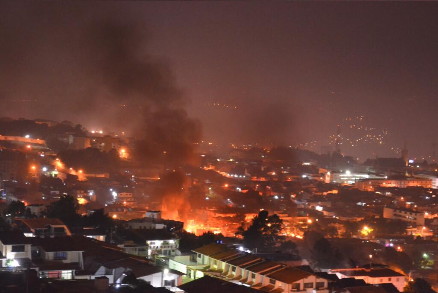
Protesters are being killed in Kiev, and revolutionaries enthusiasts are buying into the Western Media narrative. Even Democracy Now is parroting the theme, describing the demonstrations as opposing their government’s rejecting closer ties to the European Union. “Closer ties?” Ukraine was rejecting growing indebtedness to EU banks, favoring a bailout from Putin instead. Let’s remember that Senator John McCain jetted to Kiev to rally the uprising, seeing it as part of the rolling “freedom movement” not coincidentally encircling Russia, the former Soviets now no longer foe to Capitalism but rival. Unfortunate developments have led to government snipers firing at the “rebels” many of whom are dupes but many too are supremacist fascists not particularly misguided about US-EU hegemony. Perhaps we can find consolation in the hope that Ukrainian snipers were able to hit the OTPOR and CIA provocateurs coordinating the urban warriors.
 
I support all popular uprisings, but unfortunately US covert ops have picked up on our game. The only way to insulate rebellions against Western provocateurs is to build movements around political ideology they will not embrace. For the onlooker, ideology is also the means to discern destabilitation projects parading as protest. If the offending government is anti-Western-Capitalism, our counterinsurgency ops are there. Of course Socialist, Islamic, or non-World Bank client regimes are not imune to being authoritarian, but hardly more so than the Capitalist empire. Often US adversaries are forced to authoritarian measures by US covert ops working to destabilize them.

US Global War Of Terror destabilization operation opens the ball in Venezuela


To “open the ball” is a dance expression the US cavalry borrowed to describe the initiation of a military engagement. Against Native American prey this usually meant to wake the village by firing into the teepees. The US has long been covertly trying to destabilize Venezuela, but recent developments indicate they’re escalating “opposition protests” to Syrian proportions. Tunisia and Egypt may have been more spontaneous than the US-coordinated “Color Revolutions” along the former Soviet Bloc and in Iran, but the rollout of Arab Spring into Libya and Syra was entirely US-EU covert ops. With renewed “populist” uprisings cementing the encirclement of Russia, the US has detonated unrest in South America, determined to push the Venezuelan government to extremes. Next the UN will decide someone has exceded the bounds of human rights violations, ignoring of course the real Goliaths of that game.

FBI focus on Assata Shakur reveals pernicious discretion of Terrorist label

MS. SHAKUR (né Joanne Chesimard) insists she did not kill the New Jersey trooper in 1973, that she couldn’t have, she’d been disabled by a police bullet to the back while her hands were raised. Shakur contends she was the victim of a legal lynching and before that a target of the USG’s COINTELPRO. Understanding now that many black activists of that era were deliberately assassinated by law enforcement, might the 17-yr old Shakur have been justified in defending herself? She was certainly justified in escaping her torturers in prison and then gaining political asylum in Cuba. She hasn’t killed a trooper since, so it’s odd then, isn’t it, that Assata Shakur is being added to the FBI’s Most Wanted Terrorist List? She’s the “first woman” because it’s a terrorist-only list. Looking back, some of the best revolutionaries have been women. Retroactively designating enemies of the people is a strange development for President Obama who won’t even revisit the last administration to look for war crimes.
 
Certainly Assata Shakur speaks against US Capitalism but does she fit the profile of drone-strike eligibility? Apparently so and that’s telling. The intelligence community doesn’t want to stop acts of terror, it’s the ideology that terrorizes them.

This rock could change the world if thrown through the right window

Time Magazine coverBy “power the world” does Time Magazine mean HEAT IT?! To a rolling boil? –How incredibly inane. This piece of rock’s jagged asymmetry (probably to differentiate it from a lump of coal – the other fossil fuel) and its other-earthly lighting, mean to suggest shale has a meteoric value. The disingenuous cover story, “why shale can solve the energy crisis”, is a curve ball pretending the problem is supply not demand, and FRACKING is the hero not the terminator. Let’s throw this projectile back like we would ordinary crowd control ordnance deployed to disorient waking masses. I think it’s fitting that Time has given its cover to a rock. In the hands of children it’s the bane of US and Israeli occupiers, it’s what defended Tahrir Square, and it will probably be the only sidearm we’ll be left to bear as our own occupiers try to forestall global revolution. But it’s enough.
Gun Control for weapons makers not users, for war mongers not hillbillies

I’m really not big on this call for gun control, mostly because it means to further restrict individual liberties, and especially because the outcry is a media induced hysteria of disreputable provenance, aimed at America’s violence junkies instead of its dealers. Really? Is Going Postal the result of a citizenry not having laws enough to control itself? US prisons reflect a conflicting diagnosis.

In tragic synchronicity with the Sandy Hook school shooting which prompted US public calls for gun control, a knife-wielding madman in China assailed twenty schoolchildren with no resulting fatalities, giving rise to perhaps the first time the non-Mongol West has ever thought it glimpsed greener pastures over the Great Wall.

My takeaway from Bowling for Columbine was not “Gun Control Now!” but the toxic volatility of America’s culture of fear-of-violence-mongering and its gun-ho idolatry. Michael Moore called for a stepping up to our responsibilities, not a surrender to dumbassedness. I hold our national arrested adolescence to be a character flaw of pioneer, frontier provincialism, an adaptation of the civilian contractor settlers conscripted for the Westward Expansion, shock troops of the Enlightenment which became the onslaught of industrial capitalism.

Americans are hicks –we celebrate it– who define our personal space with armed borders. For us it’s bombs not education, simplistic fraternal evangelism over scientific sibling-hood, our pretended easy camaraderie really armed detente: trust but verify. Because of course, American frontierism, yet unable to see itself as invasive, from Columbus to Manila Bay, has been imperial for as long as “Yankee” has been a pejorative; Americans blissfully, Disneyfically unaware.

America’s gun problem isn’t just domestic, it’s export. For gun control I’d like to see a ban on production, not consumption. Unlike drugs whose source is organic, the manufacture of weapons is a centralized racket, easily constricted and regulated. The “Gun Show Loophole” is a stop gap for small fry; let’s muzzle the beast itself. And if you think reining in the weapons industry is improbably Herculean, why-ever do you think now is the time for Hercules to dispense with his Second Amendment protection?

Just because the Right to Bear Arms has come to exclude bazookas or drones, doesn’t mean its intent was not to protect our democracy from authoritarianism. If anyone had construed the Second Amendment as a mere hunting license, Theodore Roosevelt’s national parks would have been seen as encroachments on our revolution-conferred sovereign’s right to poach.

Are Americans thinking that democracy is lost because we can’t have bazookas — that the Second Amendment is inapplicable because the high courts adjudge the masses incapable of self-governance? The “well regulated militia” has surely gone the way of the Home Guard or Neighborhood Watch Committee, as our civic nature moved from social to anti, but it doesn’t diminish the need to have minute-men insurgents to counter would-be tyrants. Obviously we’re not talking about Minute Men privateers to whom police departments can outsource xenophobic vigilantism. If Occupy Wall Street proved anything, it lifted the fog on America’s militarized police state. Public gun ownership may be the only incentive law enforcement has to knock before entering American households.

Can you doubt it’s going to take armed resistance to overthrow Mammon? The world is teetering on uprising and already we’re seeing a stalemate on the streets, between unarmed protester and paramilitary police, a draw which upholds the power imbalance between cries for justice versus patronizing injustice. Is leading by nonviolent example going to overcome the sociopaths squeezing their underlings for blood? I’m not saying that hopes for a nonviolent transformation are misplaced, but these disciples of revolutionary pacifism espouse the same religious dogma that always shackled, never delivered, common man. Factoring sociopaths into the norm of “human nature” has been forever holding back aspirations for a harmonious social construct.

Going Postal in China is demonstrably less fatal, owing to China’s mentally imbalanced having resource only to knives. How utopian to imagine a disarmed populace, those greener pastures being a hellhole of forced interned labor. As an open air prison environmental death camp, Gaza’s got nothing on China.

ARGO is a near deftly crafted thriller, jingoist agitprop, full-on Islamophobic mockumentary

This movie is rated AYFKM– Film critics are unanimous in their praise of ARGO, Ben Affleck’s retelling of an Iran Hostage Crisis era escape caper. Either these reviews also reflect media agencies uniformly shrugging off Argo’s obvious anti-Iranian jingoism or these authors are inured to crude Islamophobic propaganda. Whatever the film’s highly praised period piece accuracies, the Angry Arab and bearded terrorist stereotype are pure post-9/11 refinements. The ill-fitting eyeglass frames, face-obstructing Prell hair, and presumed fitness-less sloop-shouldered physiques pretend to lampoon everyone of that era, but the character assassination is precision targeted at Iranians, all of them.

“Mockumentary” is meant to describe a mock documentary. Argo is not a documentary, although it asserts to be historical, but most assuredly it mocks.

Borat couldn’t have made this film more offensive. If the Muslim world wasn’t in an uproar about a fictional Hollywood video disparaging to Islam, Argo would do it. What a mockery to pretend that real Zionist movie moguls aren’t laughing about a story that depicts Jewish movie industryists pranking Iran with a fake production they called Ar-Go Fuck Yourself.

Let’s dispel right away the pretense of historical accuracy. The painstaking period details, and mimicked video footage is meant to lend a scent of authenticity to a CIA personnel expatriation that did happen, but much of the villain-at-their-heels tension was fabricated. Poetic license might excuse drama, were it not for the added perk of vilifying, parodying and humiliating a people.

I counted no insult spared. Angry Arabs (the Persians aren’t Arab — do they filmmakers know or care?) never attenuating their cacophonous accusatory gibberish. Death squads circulating house to house, Muslim-garbed women hypocritically enjoying Western fast food, every dark face a humorless compassionless fanatic, their soldiers hirsute menacing mongrels who do everything by force.

I’m off to research Argo’s fabrications which so flavor the Iran-bashing. For the time being I can surmise two. The film assert that the White House pulled the operation at the last minute, prompting ballsy improvisation when our hero agent went rogue. Later he was awarded the CIA’ highest honor. How likely was it that they gave a medal to an agent who really defied every link of his chain of command? Unless he didn’t. And second, the movie plot has Iran’s Revolutionary Guards so hot on their heels that the guards shoot their way through airport doors and mount pickup trucks to brandish guns as they chase a departing jumbo jet along the runway, providing Argo that Black Hawk Down, post-apocalypse Iraq, Libyan rebel stereotype sent up so well in Team America. The tarmac scene is witnessed only by the movie audience and the CIA extraction specialist as he looks out the airplane window. None of his charges sees it because they are of course real people who could do interviews and swiftly confirm the exaggeration.

Jefferson, Diderot: Liberty is refreshed by the blood of tyrants, kings, priests

“Men will never be free until the last king is strangled with the entrails of the last priest.” The disembowelment which prefaces Diderot’s notorious admonition seems to escape modern spiritualists who presume to advise revolutionaries. Do they think mankind has transcended rationalism? We haven’t even overcome feudalism.

Let’s not forget Wikileaks snitch Adrian Lamo, saboteur Daniel Domscheit-Berg and Swedish Woman in Red Anna Ardin

While we’re praising Wikileaks and its impact on our revolutionary times, let’s call out those who betrayed the cause, they’re already erasing their tracks on Wikipedia. First there’s hackster-confidant Adrian Lamo who turned in Bradley Manning; there’s fired Wikileaks volunteer Daniel Domscheit-Berg who permanently dismantled the anonymous leak submission mechanism; there’s jilted neoliberal faketivist Anna Ardin who schemed to bring Julian Assange to an ultra-right prosecutor’s attention in Sweden; there’s de facto honeypot Sofia Wilen whose complicity is still a mystery; and there’s President Barack Obama and Attorney General Eric Holder who persist in persecuting whistleblowers, who’ve empaneled a grand jury against Assange and who consider Wikileaks a terrorist enterprise.

Julian Assange and Bradley Manning put lie to Western pretense of freedom and rule of law


The UK wouldn’t extradite Pinochet, but they’re threatening to storm the Ecuadorian embassy in London to see that Wikileaks impresario Julian Assange is extradited to Sweden where a prosecutor wants to decide whether to charge him for sexual violations, more likely so that the Australian can then be rendered to the US to be imprisoned like Bradley Manning and face the death penalty for espionage. The US denies this intention, though it voted against Ecuador’s allies to hold a meeting about the continuing US-UK assault on journalism and whistleblowers. Can the Western empire let Assange and Manning escape severe reprimand? The two are only the mastermind and the alleged-source who’ve ignited the global uprising behind the anti- austerity movements, Arab Spring, and Occupy. President Obama cannot leave either off the hook without encouraging a deluge of more insider defections. Bradley Manning is already under torture in military custody, but Assange continues to evade US clutches. Should he escape to asylum in Ecuador where Obama’s exterminator drones can deal “American Justice”? The US has yet to condemn a white man to targeted assassination, but in the Global South, in darker-skinned populations, who will know? I favor Ecuador expanding its embassy to more than the first floor office, to offer Wikileaks an entire center of operations for as long as Julian Assange is confined under virtual house arrest. In Assange’s speech from the embassy balcony he repeated three times: “Bradley Manning must be released.” Journalists must be free to expose the crimes of the rich. Citing prison sentences for a Bahrain dissident and Russia’s Pussy Riot, Assange concluded: “There is unity in the oppression. There must be absolute unity and determination in the response.”

Here’s the full text of Assange’s statement:

“I am here today because I cannot be there with you today. But thank you for coming. Thank you for your resolve and your generosity of spirit.

“On Wednesday night, after a threat was sent to this embassy and the police descended on this building, you came out in the middle of the night to watch over it and you brought the world’s eyes with you.

“Inside this embassy, after dark, I could hear teams of police swarming up into the building through its internal fire escape. But I knew there would be witnesses. And that is because of you.

“If the UK did not throw away the Vienna conventions the other night, it is because the world was watching. And the world was watching because you were watching.

“So, the next time somebody tells you that it is pointless to defend those rights that we hold dear, remind them of your vigil in the dark before the Embassy of Ecuador.

“Remind them how, in the morning, the sun came up on a different world and a courageous Latin America nation took a stand for justice.

And so, to those brave people. I thank President Correa for the courage he has shown in considering and in granting me political asylum.

“And I also thank the government, and in particular Foreign Minister Ricardo Patino, who upheld the Ecuadorian constitution and its notion of universal rights in their consideration of my asylum. And to the Ecuadorian people for supporting and defending this constitution.

“And I also have a debt of gratitude to the staff of this embassy, whose families live in London and who have shown me the hospitality and kindness despite the threats we all received.

“This Friday, there will be an emergency meeting of the foreign ministers of Latin America in Washington DC to address this very situation.

“And so, I am grateful to those people and governments of Argentina, Bolivia, Brazil, Chile, Columbia, El Salvador, Honduras, Mexico, Nicaragua, Argentina, Peru, Venezuela, and to all other Latin American countries who have come out to defend the right to asylum.

“And to the people of the United States, United Kingdom, Sweden and Australia who have supported me in strength, even when their governments have not. And to those wiser heads in government who are still fighting for justice. Your day will come.

“To the staff, supporters and sources of Wikileaks, whose courage and commitment and loyalty has seen no equal.

“To my family and to my children who have been denied their father. Forgive me, we will be reunited soon.

“As Wikileaks stands under threat, so does the freedom of expression and the health of all our societies. We must use this moment to articulate the choice that is before the government of the United States of America.

“Will it return to and reaffirm the values, the revolutionary values it was founded on, or will it lurch off the precipice dragging us all into a dangerous and oppressive world, in which journalists fall silent under the fear of prosecution and citizens must whisper in the dark?

“I say it must turn back. I ask President Obama to do the right thing. The United States must renounce its witch-hunts against Wikileaks. The United States must dissolve its FBI investigation.

“The United States must vow that it will not seek to prosecute our staff or our supporters. The United States must pledge before the world that it will not pursue journalists for shining a light on the secret crimes of the powerful.

“There must be no more foolish talk about prosecuting any media organisation; be it Wikileaks, or be it the New York Times.

“The US administration’s war on whistleblowers must end.

“Thomas Drake, William Binney and John Kirakou and the other heroic whistleblowers must – they must – be pardoned or compensated for the hardships they have endured as servants of the public record.

“And to the Army Private who remains in a military prison in Fort Leavenworth, Kansas, who was found by the United Nations to have endured months of torturous detention in Quantico, Virginia and who has yet – after two years in prison – to see a trial: he must be released.

“Bradley Manning must be released.

“And if Bradley Manning did as he is accused, he is a hero and an example to us all and one of the world’s foremost political prisoners.

“Bradley Manning must be released.

“On Wednesday, Bradley Manning spent his 815th day of detention without trial. The legal maximum is 120 days.

“On Thursday, my friend Nabeel Rajab, President of the Bahrain Human Rights Centre, was sentenced to three years in prison for a tweet. On Friday, a Russian band were sentenced to two years in jail for a political performance.

“There is unity in the oppression. There must be absolute unity and determination in the response.

“Thank you.”

Sin las mujeres, no hay revolución

Without women there is no revolution
Camila Vallejo, Cindy Sheehan, Medea Benjamin, Ann Wright, Cynthia McKinney, Kathy Kelly, Amy Goodman, Naomi Klein, Bernardine Dorhn …an exhaustive list of the dominance of women among activist leaders would go on and on, back to earlier waves of influential organizers, Mother Jones, Lucy Parsons, Hellen Keller, Emma Goldman, Harriet Tubman, Louise Michel.

Four Occupy tormentors unmasked


Occupy Colo. Springs held a NO WAR ON IRAN demo today, counter- protested by some soldiers who think any antiwar criticism of their mission fails to Support The Troops. (Horrifyingly curious don’t you think, that US soldiers would already consider war with Iran as their mission?!) Joining them it turned out, were four of OCS’s sneakiest saboteurs. I got them with one camera click! From right to ultra-right: Raven Martinez aka Briaunna Webbing aka Occupy Csprings, Michael Clifton aka Agent of Doubt, Ian Carman aka “Father” Ian, and Ryan Butler aka Ry King aka Lone Wolf.

My policy until now was not to dignify any of these Facebook twits with attention, but their rumor campaign against OCS has become so virulent and untrue, and their misdeeds are now tipping the balance. Today the entire intersection had to bear personal megaphone taunts, but I’ll say that the final straw was yesterday when I learned of misinformation they attempted to spread to the local news. Occupy CS’s hand was forced in issuing a public statement about accused-arsonist Kyle Lawrence, because someone asserted Kyle had joined a violent group that had sprung up in OCS. Uh, let’s get to the bottom of that one, shall we?

WARNING: OCCUDRAMA AHEAD. All of it boring, but these creeps need to crawl back under their mouse pads. Ignoring them hasn’t worked, and even though they crave attention, I’ll give that a try.

Exhibit A
Ryan Butler, Ryan King, Lucky Dog, Lone Wolf
At far right is RYAN BUTLER aka Lucky Dog, aka Lone Wolf. When he disrupted OCS GAs he went by “Ry King”.

The secretive Ryan Butler is half of the Clifton/Butler nerd team that hijacked the “Occupy Colorado Springs” Facebook Open Group. It’s got about 400 members, doesn’t represent Occupy at all, and is maintained as a launchpad for Tea Party occu-haters under the pretext of “free speech” as decided by its unlisted admins Ryan & Michael. The open group was originally created by authentic occupier Amber Hagen, who in her idealism let all participant have admin privileges. When Amber discovered that haters among the admins kept wrecking the page, she began to delete them. Michael Clifton once recounted at a meeting how he and Ryan scrambled over Skype to keep Amber from shutting them out. They hurriedly deleted Amber’s admin access, thus exiling her from her own group. This was the act that inspired Raven Martinez to do the same with the OCS Facebook community page, in all fairness I should say, to prevent others from doing it to her.

Ryan’s claim to fame in OCS came from a failed coup to share the spokesmanship monopoly held by occupothead Jason Warf, but I digress.

Ryan had to step away from OCS after legal trouble from a drunken poker game gone awry, which he tried to blame on authentic occupy vet RTG. Ryan has a criminal record of domestic violence and wears a gun in his home in violation of having lost his permit to carry. That much is not disputed. But Ryan refutes RTG’s version of the event: that Ryan pistol-whipped his ex-girlfriend, which enraged RTG and the two fought, trashing the house. Both face assault charges and Ryan’s ex has filed her usual plea to the court to dismiss any notion that Ryan abused her. Instead we are to believe Ryan tried to defend himself with a vice-grips laying about (leaves a strike pattern similar to a gun maybe), accidentally striking his ex.

I’ll add that my perspective doesn’t come from hearing RTG’s testimony, but rather from eavesdropping on private IMs sent by Ryan as he deliberated what to say by way of damage control. Anyway.

Entirely relevant here however is Ryan Butler’s favorite bragging right, his secret Fight Club-inspired “PLAN-B” CLUB (First rule of Plan-B, you don’t talk about Plan B, snore). Apparently “Plan B” is for Amendment Two fans who want an alternate plan “when the revolution fails.” Was this the pro-violence group to which Michael Clifton alluded in TV interviews? It had nothing to do with Occupy, didn’t come from Occupy, and if its membership is limited to Ryan’s friends, I’m guessing that pares it down to two: he and Clifton. Thus Clifton’s statement about his disassociation from proponents of violence was also facetious, because the above photo was taken upon their arrival at the counter-protest, they came together.

But how absolutely scurrilous to attempt to tarnish OCS with the suggestion that occupy was the breeding ground of their pro-gun Amendment Two fantasy life?!

Exhibit B
Michael Clifton, Agent of Doubt
Occupying more than the center of this photo is Michael Clifton, self-appointed videographer of the local occupy, known on Youtube and DIY newsites as “Agent of Doubt”.

Michael Clifton was a very early supporter of OCS, donating water and food as he documented its progress on Youtube, each segment introduced in his best impersonation of Alfred Hitchcock, minus the wit, or substance. Let’s say Clifton’s motives started out good, what would lead him last week to step forward and break the story about arsonist Kyle having a history with OCS, packaging his videos for best consumption by the local media?

Of course the answer is simple, and we’ve seen it before. Apparently 15-minutes of personal soundbite, TV attention converted to Youtube views, trumps any consideration for possible negative blowback for the movement. Clifton actually keeps distancing himself from OCS every time he alleges to speak authoritatively as an insider. It’s laughable if it wasn’t damnable, because this time the oaf said he quit when OCS members began to plan illegal strategies. Whaaat? –leaving listeners to infer that arson was among the strategies. What kind of tomfoolery insinuation is that?

Not surprisingly, once more Clifton is defending himself against accusations of being an informer or provocateur. I make no such charge. He’s an idiot. What can you do, Colorado Springs is full of them. Am I being too harsh? Read on.

In an earlier episode in front of City Council, Clifton famously declared himself an outsider to OCS so that he could take all the credit for a –he-thought– brilliant bit of investigative deduction regarding CSPD’s billing of man hours charged for policing OCS. Our friend had videotaped an OCS march you see, and noticed there weren’t any police officers in sight, ergo, the billings must have been fraudulent, yes, ignoring the possibility the cops were plain-clothed, or observing from a perimeter, or on call, etc. So like a flat-earther who draws conclusions based on only what he can see, our intrepid Sherlock declares the CSPD guilty of fraud, and… marches straight into the local office of the FBI to make the charge! The FBI, he reports, were only too happy to accept all his video footage into evidence!

This might point to Clifton’s real reason to declare he was not part of Occupy, because a GA consensus would have vetoed his FBI idea. OCS had recently endorsed a no-snitch policy, not on anyone, not even the city, and let’s face it, not least of all I’m guessing, TO the FBI.

Thus, however unwittingly, let’s call it witlessly, Clifton is an FBI informant in the very technical sense, isn’t he?

To put a fine point on it: everyone who’s participated in OCS activities recorded by Agent of Doubt Clifton, is now on record at the FBI, in not just the lossy Youtube segments available online, but the original hi-def digital sequences, in their entirety.

And while Agent Dork has been a stalwart companion to Occupy, if only for the videos which he converts into ad-views whose revenue he “contributes” to the Occupy movement by funding his own efforts to “promote” it, so far the sum of his efforts has been to give law enforcement and the local media evidence to build a case against Occupy. Thanks a ton Agent Dork. From here onward, your camera aught to record everyone giving you the finger!

Exhibit C
Department of Homeland Security Officer Ian Carman
I was tempted because of his sign to give Father Ian Carman a pass. Who’s to say a Department of Homeland Security employee shouldn’t consider himself part of the 99%? But after successive absences from GAs, then hiding among the haters, it might be time to take a close look at this very disruptive occupier.

Divisive behavior can be very subtle, so I’ll cut to the quick on Father Ian. He revealed to us that he worked for DHS because he wanted to explain that he had access to confidential files on certain occupiers, one of whom, supposedly a veteran, still had a very high security clearance, indicating he was likely still active duty, or perhaps in the intelligence service. Father Ian was asserting this about our high profile occupy star JWS, effectively trying to snitchjacket JWS. Come down on that whichever way you like.

Exhibit D

Raven Martinez writes on Facebook under the identity of her daughter, or the occunonymous Facebook user “Occupy Csprings”. Once a formidable OCS volunteer, Raven suddenly became my own personal raving critic. It’s been suggested that her fury bears the air of a woman scorned — I’ll delve into that further down, if I feel like it.

As reported above, the Tea Party mutiny of Amber’s Facebook OCS open group is what inspired Raven to hijack the OCS Facebook COMMUNITY PAGE. Raven might have done it with the best intentions, but did it utterly undemocratically and to everyone’s chagrin and condemnation. Here’s what happened.

Embattled by internal struggle against the very identity of mothership Occupy Wall Street, the OCS GA had adopted the moderating policy implemented by the New York OWS to thwart vanguards and saboteurs, but the Springs admins at that time were refusing to implement them. Admins were continuing to post political endorsements, conspiracy theories and statements critical of fellow occupiers. Further protocols were adopted by OCS to require admins to use their initials to identify who was responsible. Again this was ignored, and now many of the admins were refusing to attend the GAs.

One day Raven noticed important posts being deleted and snide comments being made about OCS protest actions, all being done by an admin who would not reveal his/her identity, and worst of all, in the name of Occupy Colorado Springs. An admin herself, Raven made the clever move of temporarily deleting all the other admin users on the chance that this one might be stupid enough to reveal himself by complaining about his suddenly lost access. The idiot took the bait, and turned out to be none other than OCS-permit-holder and self-important-leader Hossein Momsforpot. For shit. Well this left Raven with a dilemma. Who was going to believe that Hoss was anti-OWS? More critically, who among the admins she had deleted, could she reinstate without the risk that Hoss would convince them to reinstate his admin status with which he could then delete Raven? This was the lesson Raven had gleaned from the hijack perpetrated by Wolf & Agent Duh.

I neglected to mention that the earlier hijack was accomplished anonymously, with Ryan pretending that sole admin status was held by “his dog”. So with her hijack, Raven added her own innovation, Raven loudly proclaimed that she’d been shut out too! She planned to claim that her eventual “reinstatement” was the result of an omniscient AnonymousTM hacker who’d intervened for the betterment of the movement.

Raven’s problem was that I had just the day before publicly refused an admin appointment, and when she cavalierly let suspicions fall on occupier PJ, he promptly deleted himself. Funny story, no?

Well, although a number of very earnest admins felt slighted, oddly enough things worked out for the better after Raven’s purge because all the internal occuhating stopped, and a number of the admins who felt pushed out ultimately outed themselves as Ron Paul enthusiasts, conspiracy nuts, or single-issue MMJ addicts. In reality, no one was ejected from OCS, but having lost their control over the Facebook page, they chose to make kissoff statements and move on.

So Raven was able to coax PJ and me to share the admin responsibilities with her, and it’s a good thing too, because when Raven eventually turned against the broader OWS mission, she’ll say it was because of my personal agenda, Raven went and DELETED the Facebook page. She thought she’d done it, but Facebook has safeguards fortunately, PJ and I were alerted and able to save the 3,300 member page from oblivion.

And the rest is history in the making. Three of us administrate the community page now, we trust each other and our dedication to the values and goals of the original Wall Street occupiers, and the Facebook likes continue to rise.

Is that enough about Raven? Yes it is. She’s doing her best to vilify and destroy our efforts, but that’s as much as I want to say about her.

What the hell. Each of these four unsavory characters knows that I could say far more than I’ve divulged here. I’m already embarrassed enough to talk about them as I did, good grief. The personal attacks on me are based on nothing that I hadn’t written about on NMT, yet they persist via email and phone calls to everyone they can reach. Well, here’s my shot across the bow.

US use of torture on POWs should stop

The U.S. has a long history of torturing its POWs. Torture of POWs is used by many other countries. However its use is denied by many U.S. authorities or government officials. The definition of torture put simply is to cause pain, emotionally, physically, or psychologically. Torture is used to terrify enemies, and hardly ever gains information.

Some examples of the U.S. A. military use of torture on P.O.W.s

Che Guevara
Che Guevara was murdered on October 9, 1967 in Bolivia. He was tortured and killed by Bolivian soldiers trained and equipped by CIA operatives. Che was told he was going to be killed by Felix Rodriguez. He was shot in the legs several times, and put into a dirty schoolhouse. His arms and feet were tied while he lay in the dirt. He lay by the bodies of his dead Guerrilla fighters. The USA tried to cover up his deliberate murder by shooting him in the legs to make it look like he died in battle. He was never given a trial. He was shot nine times.

Philippines war
The Philippine war was a war fought by Filipino revolutionaries and the USA. Waterboarding was one of the main techniques used by the CIA. It was used on Extra Judiciar prisoners.The department of Justice authorized this. Sleep Deprivation and de-sensorizing among other things was used. The use of solitary confinement and confusion is used frequently, prisoners are made to wear blindfolds to cause confusion and panic. Medical treatment is also refused. Bribery, and threats are used to force a confession.

Korean War
The Korean war was fought between South and North Korea. The US occupied the south, while the soviet troops occupied the North.

Vietnam War
Prisoners were put in Tiger cages. Lime was dumped on them, and water was dumped on them after.

Central America
In Nicaragua Somoza tortured people by putting them in cages with lions. Somoza was a dictator backed up by the US military. In Argentina children of communist parents were stolen, while their parents were tortured and killed.

School of The Americas
The CIA distributes an interrogation manual which shows torture techniques to use during interrogations. The manual was used by the CIA to train US-supported Latin American militaries at this school.

Abu Ghraib Prison
Torture has been recently used in Abu Ghraib prison, located in Iraq. Some of the main forms of torture used here are rape, sodomy, water boarding among many others. Military Intelligence has been present during these procedures, and highly encourages it. A prison guard said prisoners receive snake bites for minimum mis-behavior. In the AD. seg units prisoners are dumped into poop and pee.

Afghanistan war
The US invaded, tortured and suffocated thousands of POWs to death.

Officials claim that Torture must be used to gain information. During the presidency of George W. Bush some U.S government officials said that they believed water boarding was not a form of torture. In 2002 the Office of Legal Counsel stated that water boarding wasn’t a form of torture. The OLC said that the reason water boarding was not thought of as a torture was that “In order for pain or suffering to rise to the level of torture, that statute requires it to be severe & water boarding did not cause severe pain or suffering either physically or mentally.” Even though water boarding causes the victim to believe he/she is being drowned.

Torture hardly ever gains information but instead is used to terrorize people so they don’t resist, or to force a confession. Torture is used in interrogations by cops, being put in handcuffs that are to tight is also a less painful form of torture. During the st. Patrick Parade a couple of years ago the police stopped the parade and threw older people on the ground, an old lady was dragged across the pavement and put into handcuffs. She died a couple of months later.

People say that the US doesn’t torture people, because supposedly it is better than that.The fact of the matter is that the USA is the biggest user of torture in the world. It has and will continue to torture its POWs while everyone here says the USA government and military does not torture and has never tortures POWs.

Occupy Wall Street mentor Adbusters issues latest tactical briefing. Chicago. May. Occupy.

Vancouver’s Adbusters Magazine sent the initial callouts to occupy Wall Street, to be the natural successor to unfinished revolutions in Tahrir Square and Madrid. Quickly enough it escaped their grasp. Adusters has issued two dozen “Tactical Briefings” since before September 17 to advise the growing rebellion, to be interpreted coming from a valued mentor, albeit an outsider, technically now, a non-occupier. The distinction was never more obvious than when one of their briefings advised striking the camps and waiting out the winter. But their briefing #25 offers more than retreat, it sets OWS sights on the joint NATO-G8 summit to be held in Chicago this May, against which very large demonstrations are already being planned. No specific advice on the other hand for local occupies, wisely perhaps, where tacticians can add no more to the strategy than hold your ground, by definition, occupy.

ADBUSTERS TACTICAL BRIEFING #25

Hey you redeemers, rebels and radicals out there,

Against the backdrop of a global uprising that is simmering in dozens of countries and thousands of cities and towns, the G8 and NATO will hold a rare simultaneous summit in Chicago this May. The world’s military and political elites, heads of state, 7,500 officials from 80 nations, and more than 2,500 journalists will be there.

And so will we.

On May 1, 50,000 people from all over the world will flock to Chicago, set up tents, kitchens, peaceful barricades and #OCCUPYCHICAGO for a month. With a bit of luck, we’ll pull off the biggest multinational occupation of a summit meeting the world has ever seen.

And this time around we’re not going to put up with the kind of police repression that happened during the Democratic National Convention protests in Chicago, 1968 … nor will we abide by any phony restrictions the City of Chicago may want to impose on our first amendment rights. We’ll go there with our heads held high and assemble for a month-long people’s summit … we’ll march and chant and sing and shout and exercise our right to tell our elected representatives what we want … the constitution will be our guide.

And when the G8 and NATO meet behind closed doors on May 19, we’ll be ready with our demands: a Robin Hood Tax … a ban on high frequency ‘flash’ trading … a binding climate change accord … a three strikes and you’re out law for corporate criminals … an all out initiative for a nuclear-free Middle East … whatever we decide in our general assemblies and in our global internet brainstorm – we the people will set the agenda for the next few years and demand our leaders carry it out.

And if they don’t listen … if they ignore us and put our demands on the back burner like they’ve done so many times before … then, with Gandhian ferocity, we’ll flashmob the streets, shut down stock exchanges, campuses, corporate headquarters and cities across the globe … we’ll make the price of doing business as usual too much to bear.

Jammers, pack your tents, muster up your courage and prepare for a big bang in Chicago this Spring. If we don’t stand up now and fight now for a different kind of future we may not have much of a future … so let’s live without dead time for a month in May and see what happens …

for the wild,
Culture Jammers HQ

Patrick Henry’s priest would’ve favored Give me liberty, or give me the serenity to accept the things I cannot change.

Some juxtaposition, don’t you think? Patrick Henry’s call to arms Give me liberty or give me death mashed up with the Goddamn Serenity Prayer: God, grant me the serenity to accept the things I cannot change, the courage to change the things I can, and the wisdom to know the difference. It sure puts passivism into religious perspective. It’s the fog of the opiate of masses, with church as enforcer of nonviolence, keeping the people down in advance of the king’s Dragoons. What a mockery serenity makes of poor fools eager to feel self-respect for docile servitude. It calls to my mind the impoverished parents who cripple their young so to be more effective beggars. Or who sell their children into slavery. What cretinous vile beings. Their desperation to be pitied of course, but their fate to be repudiated, not accepted with whatever boat-non-rocking serenity.

From The War Inevitable, March, 1775, by Patrick Henry
 
They tell us, Sir, that we are weak – unable to cope with so formidable an adversary. But when shall we be stronger? Will it be the next week, or the next year? Will it be when we are totally disarmed, and when a British guard shall be stationed in every house? Shall we gather strength by irresolution and inaction? Shall we acquire the means of effectual resistance by lying supinely on our backs, and hugging the delusive phantom of hope, until our enemies shall have bound us hand and foot? Sir, we are not weak, if we make a proper use of those means which the God of nature hath placed in our power.
 
Three millions of People, armed in the holy cause of liberty, and in such a country as that which we possess are invincible by any force which our enemy can send against us. Beside, Sir, we shall not fight our battles alone. There is a just God who presides over the destinies of Nations, and who will raise up friends to fight our battles for us. The battle, Sir, is not to the strong alone; it is to the vigilant, the active, the brave. Besides, Sir, we have no election. If we were base enough to desire it, it is now too late to retire from the contest. There is no retreat but in submission and slavery! Our chains are forged! Their clanking may be heard on the plains of Boston! The war is inevitable; and let it come! I repeat, Sir, let it come!
 
It is in vain, Sir, to extenuate the matter. Gentleman may cry, Peace, Peace! – but there is no peace. The war is actually begun! The next gale that sweeps from the North will bring to our ears the clash of resounding arms! Our brethren are already in the field! Why stand we here idle? What is it that Gentlemen wish? What would they have? Is life so dear, or peace so sweet, as to be purchased at the price of chains and slavery? Forbid it, Almighty God! I know not what course others may take; but as for me, GIVE ME LIBERTY OR GIVE ME DEATH!

If you don’t see Merry Christmas in the window, no, you don’t go in that store! The Star of David used to do that trick.

This season’s War-On-Christmas email is pushing a holiday ditty whose refrain goes “If you don’t see Merry Christmas in the window, then you don’t go in that store.” Seems like it might be easier to mark those stores with a Star of David on the window, or would that be too obviously Nazi?
On the other hand, it is refreshing to see even Dumbfox recognize the imperative of targeting commerce to make your point heard. So, boycotts do work?

You can see the Christmas-lovers’ point of course. They’d prefer that merchants exploiting the Christmas purchasing season at least be paying lip service to Christmas and not the ever-looming Godless “Holiday” eclipse, supposed.

This song reminds us “it’s all about the little baby Jesus” and goes on to list all the things Christmas wouldn’t be without him. Of course, half the list traces back to pagan tradition, but what to Christian Holiday-goers know of that?

And the latter half goes back as far as they remember, as their grandmother and her grandmother before might remember, but no more. The commercial Christmas charts its provenance to the industrial revolution, the birth of consumer goods and marketing. Santa Claus as we recognize him stepped right off Coca-cola calendars of the last mid-century.

Christmas was the religious Trojan Horse to pitch the shopping holiday to reluctant hedonists. Now the same parishioners who don’t have an needle’s-eye chance to get to Heaven, feel like the can pay their tithes in Christmas presents.

Yes, I do think it’s funny that people who abhor the prospect of disruptive economic boycotts are willing to consider it at the drop of Santa’s cap. Unless of course they’re satisfied that making this video viral is a shot across the bow enough. I doubt their Christmas Spirit has any room for Lenten restraint.

Oddly enough, one of their potential boycott targets, and mine, has hung banners in its outlets to announce they will be open for Christmas, introducing a delectable dilemma. Starbucks says Merry Christmas in the window, so it’s exempt from this singing email picket, yet it disrespects Christmas by working through it. What do you do?

I answer that one unequivocally. Yes, boycott Starbucks. They fund Israeli settlements in the Occupied Territories. That may be somewhat directly related to their celebrating Hanukkah not Christmas, but that’s NO KIND OF REASON to boycott a business. If you want to boycott a store because it’s not Christian, take it up with the Anti-Defamation League. Leave bigotry to the Zionists.

Occupiers can learn from Anarchists

Here’s one of the more popular pamphlets distributed at Occupy Colorado Springs, courtesy of the DABC. DEAR OCCUPIERS: A LETTER FROM ANARCHISTS
 
Support and solidarity! We’re inspired by the occupations on Wall Street and elsewhere around the country. Finally, people are taking to the streets again! The momentum around these actions has the potential to reinvigorate protest and resistance in this country. We hope these occupations will increase both in numbers and in substance, and we’ll do our best to contribute to that.
 
Why should you listen to us? In short, because we’ve been at this a long time already. We’ve spent decades struggling against capitalism, organizing occupations, and making decisions by consensus. If this new movement doesn’t learn from the mistakes of previous ones, we run the risk of repeating them. We’ve summarized some of our hard-won lessons here.

Occupation is nothing new. The land we stand on is already occupied territory. The United States was founded upon the extermination of indigenous peoples and the colonization of their land, not to mention centuries of slavery and exploitation. For a counter-occupation to be meaningful, it has to begin from this history. Better yet, it should embrace the history of resistance extending from indigenous self-defense and slave revolts through the various workers’ and anti-war movements right up to the recent anti-globalization movement.

The “99%” is not one social body, but many. Some occupiers have presented a narrative in which the “99%” is characterized as a homogenous mass. The faces intended to represent “ordinary people” often look suspiciously like the predominantly white, law-abiding middle-class citizens we’re used to seeing on television programs, even though such people make up a minority of the general population.

It’s a mistake to whitewash over our diversity. Not everyone is waking up to the injustices of capitalism for the first time now; some populations have been targeted by the power structure for years or generations. Middle-class workers who are just now losing their social standing can learn a lot from those who have been on the receiving end of injustice for much longer.

The problem isn’t just a few “bad apples.” The crisis is not the result of the selfishness of a few investment bankers; it is the inevitable consequence of an economic system that rewards cutthroat competition at every level of society. Capitalism is not a static way of life but a dynamic process that consumes everything, transforming the world into profit and wreckage. Now that everything has been fed into the fire, the system is collapsing, leaving even its former beneficiaries out in the cold. The answer is not to revert to some earlier stage of capitalism—to go back to the gold standard, for example; not only is that impossible, those earlier stages didn’t benefit the “99%” either. To get out of this mess, we’ll have to rediscover other ways of relating to each other and the world around us.

Police can’t be trusted. They may be “ordinary workers,” but their job is to protect the interests of the ruling class. As long as they remain employed as police, we can’t count on them, however friendly they might act. Occupiers who don’t know this already will learn it firsthand as soon as they threaten the imbalances of wealth and power our society is based on. Anyone who insists that the police exist to protect and serve the common people has probably lived a privileged life, and an obedient one.

Don’t fetishize obedience to the law. Laws serve to protect the privileges of the wealthy and powerful; obeying them is not necessarily morally right—it may even be immoral. Slavery was legal. The Nazis had laws too. We have to develop the strength of conscience to do what we know is best, regardless of the laws.

To have a diversity of participants, a movement must make space for a diversity of tactics. It’s controlling and self-important to think you know how everyone should act in pursuit of a better world. Denouncing others only equips the authorities to delegitimize, divide, and destroy the movement as a whole. Criticism and debate propel a movement forward, but power grabs cripple it. The goal should not be to compel everyone to adopt one set of tactics, but to discover how different approaches can be mutually beneficial.

Don’t assume those who break the law or confront police are agents provocateurs. A lot of people have good reason to be angry. Not everyone is resigned to legalistic pacifism; some people still remember how to stand up for themselves. Police violence isn’t just meant to provoke us, it’s meant to hurt and scare us into inaction. In this context, self-defense is essential.

Assuming that those at the front of clashes with the authorities are somehow in league with the authorities is not only illogical—it delegitimizes the spirit it takes to challenge the status quo, and dismisses the courage of those who are prepared to do so. This allegation is typical of privileged people who have been taught to trust the authorities and fear everyone who disobeys them.

No government—that is to say, no centralized power—will ever willingly put the needs of common people before the needs of the powerful. It’s naïve to hope for this. The center of gravity in this movement has to be our freedom and autonomy, and the mutual aid that can sustain those—not the desire for an “accountable” centralized power. No such thing has ever existed; even in 1789, the revolutionaries presided over a “democracy” with slaves, not to mention rich and poor.

That means the important thing is not just to make demands upon our rulers, but to build up the power to realize our demands ourselves. If we do this effectively, the powerful will have to take our demands seriously, if only in order to try to keep our attention and allegiance. We attain leverage by developing our own strength.

Likewise, countless past movements learned the hard way that establishing their own bureaucracy, however “democratic,” only undermined their original goals. We shouldn’t invest new leaders with authority, nor even new decision-making structures; we should find ways to defend and extend our freedom, while abolishing the inequalities that have been forced on us.

The occupations will thrive on the actions we take. We’re not just here to “speak truth to power”—when we only speak, the powerful turn a deaf ear to us. Let’s make space for autonomous initiatives and organize direct action that confronts the source of social inequalities and injustices.

Thanks for reading and scheming and acting.

May your every dream come true.

Fear and Loathing in Colorado Springs

Those readers following the Occupy! Movement in its many forms around the world and in Colorado Springs will be glad to hear that Tuesday culminated a difficult week for us here with a resolution of many contentious issues, and an overall commitment to unity.
 
The subject matter behind this particular post is closely associated with the Movement in general, but it’s more a humanity thing than an Occupy thing, overall. I hope i can get the associations to make sense, and that readers will restrain themselves from developing the erroneous notion that this is meant to be a pitch for some sort of religion. It’s not.

I went to the Municipal Court in Colorado Springs to enter a plea of “not guilty” to the charge of camping on public property because of actions executed as a part of Occupy! Actually, i was camping on public property, to put it quite plainly, and the idea behind the plea is that the action does not engender guilt even if it violates a silly and badly unAmerican, (read, “oppressive,” if we’ve become a little unrecognizable in this regard), statute. A couple dozen supporters made it to the courtroom with me, and raised enough ruckus to get Municipal Judge Spottswood W. H. Williams to threaten them all with contempt charges. The whole thing was kind of a lot of fun, really. Made me feel a little like Hoffman or Hayden, in a much smaller sense. There comes a first time for everything, and this was my first visit to a courtroom during which i was able to feel utterly unencumbered by the dark nature of my own action that had led me there. My deepest thanks to all the OCS members and especially Dennis Apuan, who put his political credibility on the line to stand with us, and brought a good deal of patriotic weight to the room as State Rep for the fine soldiers of Fort Carson.

The hearing was only that, after all, and after entering the plea, we scheduled a pre-trial conference with the City Attorney, for 22 Nov, at which a government lawyer will make me an offer i’ll most assuredly refuse and we’ll schedule a jury trial. I’ll keep you news hounds posted as things progress.

The point to this post, though, is an underlying root to the no-camping ordinance, as well as to most of the woes of the day: The Fear.

Most of us don’t acknowledge the Fear because, well, it’s scary. Instead we get angry, or attempt to maneuver ourselves into a position to control uncontrollable factors like society or competitive economies. We eschew cooperation because we’re afraid of our fellows. We make assumptions about others’ behavior and how it will effect us. We bewail the corruption of society, and begin looking over our shoulders for the punishment of God, or black-clad mercenaries coming over the horizon to herd us into frigid winter FEMA camps. We worry about hunger, poverty, inglorious death. We develop elaborate political systems and foment revolution in order to establish “security” of dubious credibility. Look around. These tactics have not ever worked after attempting repeated, redundant permutations, and there is no reasonable expectation that they ever will.

The Fear has driven all this cutthroat competition. It’s what motivates folks to be sure they have more, more, more. It’s what causes us to petulantly demand our right to burn as much gas in our Hummers as possible, and to constantly engage in useless commerce. It motivates the lowest guy competing for some crappy job at Taco Bell just as surely as it motivates conspiratorial Rothschild backroom bankers. It motivates us to enact stupid, oppressive no-camping ordinances when someone that scares us becomes visible, oh my! We’re all deathly afraid of some horrible outcome, like someone else getting our stuff, or scaring tourists away, or enjoying some habitual pleasure we find repugnant.

The Fear is irrational! What’s the very worst that can happen to us in this life? We die? We find ourselves incarcerated or tortured? Consider, if you will, that we live our little spans, maybe a hundred years or so at the outside limit, surrounded at both ends by an unfathomable mass of toroidally twisted, multi-dimentional Eternity that not one of us will ever grasp while we live. What possible fear can be valid under this circumstance other than that we fail to live according to our own perceived Truths? I say “perceived” since only those afflicted by the Fear are afraid to examine those truths for the errors all honest thinkers know to exist within our own perceptions. If I knew my own blind spots they wouldn’t exist, right? We don’t even know what we’re afraid of mostly, though we can usually list a few if we set ourselves to the task. No one is to blame for his or her own irrational fears, especially cultural fears such as seem to be more or less universal. Many have been established by the direct influence of media that may well have been designed by nefarious folk for exactly the purpose of invoking unfounded fears in various populations. OMG! Now i’m making myself afraid! Not really–but what to do about the Fear?

“There is no fear in love; but perfect love casteth out fear,” reads a certain religious text, (1 Jn 4:18, for those with a source fetish like me). I won’t be digressing into a religious sermon here. The principle holds without the doctrinal baggage surrounding it in the context in which it nests. No matter how evil the Ideas we oppose as Occupiers, or as human beings in general, they can’t overwhelm a spirit of love. No matter the spiritual foundation or lack thereof, love can dissipate greed, fear, disappointment, embarrassment, and in fact any of the various bases for the secondary anger response we are all prone to manifesting in situations as apparently dire as the one we’re seeing now. As much as i can plainly see the bogus nature of the moves made in, say, the financial industry, (inseparable from other key industries at a certain level), applying some genuine empathy causes a mental process that can not end in hatred or vengefulness. Look guys like Greenspan or Geitner in the eyes next time you see them. They’re deeply miserable, and completely trapped in their own Fears. When it all collapses, i really hope they’re still available so we can feed them a plate of food, even if we can’t resist the temptation to ask, “What the fuck were you thinking!?”

We can’t fight fire with fire here. Battling greed with more greed, as some seeking to restore an “American Dream” involving bigger slices of a rotten pie seem to do. Revolution only spins us in circles: “Meet the new boss, same as the old boss.” We always seem to find ourselves standing in the same spot we started, except standing in pools of blood with fewer resources after every revolution we’ve ever effected. We don’t have these options any longer. The planet is in a condition that will not permit us to continue on the deeply ingrained, competitive course we’ve followed for so long. Learning to love, to let go, to tolerate, to work together for our futures which are common whether we like it or not is the only way out of this. It’s not easy, only necessary.

I can’t tell anyone how to save anyone else, or how to convince the next guy that any of this is true. I can’t even describe the mental processes that led to these conclusions. All i seem able to do is to proceed in the direction the thoughts lead, as they come to me in a fashion that very often seems external. Examine the assertions that continue to spill out of me at 2 in the morning like this. Notice with joy that there seem to be many others reaching similar conclusions: Things are terminally fucked up and only Love can save us. If it turns out that we’re not saved, that the whole human experiment is doomed to fail, i’ll breathe my last breath in the knowledge that i walked the talk spoken by all my heroes in tongues long lost to history, or new today, or unspoken yet understood by common nature. I don’t think i’m alone. I don’t know how to be afraid of that.

Ye Aulde Memoir

Another old piece. These stories are distorted by romanticized memory, at times, and others likely remember them differently. I by no means intend to insult any of the real persons that lived through this stuff with a cavalier treatment of tender recollections, or harsh description of personalities or actions. Each of us always did exactly what seemed to be exactly the right things to do at the time. And there survives much, much love, which has grown and developed like it always does, in ways we never see coming.

I’m not putting these old ones up because i’m too lazy to write new. I’ll have one of those next–but some of this old stuff fits. Hope you like it.

11 May 2009

One day during the summer of 1980 my brother David was in the hospital at Case Western Reserve University for yet another open-heart surgery. The scene that day was dramatic I suppose, but for our family at the time, it was in many ways just another day. The state of the relationships between us had come to the condition that existed then because each and every incident that had occurred in the history of the Universe had added to that cumulative point. The way it came together then could have been viewed as tragic, I suppose, but we never noticed.

I don’t even remember how I got the news that this particular episode was approaching. David’s surgery that year was one of many—so many, in fact, that by now surgeons and academics had written papers on his congenital condition, and even given it a polysyllabic title. His lead surgeon, a Dr. Ankeny as I recall, had once claimed that he had “learned more from David Bass than fourteen years of medical school.” We four siblings had in effect grown up in the hospital, with the constant potential for death in attendance on a daily basis. Many years would pass between that summer and the moment I decided any of this was applicable to self-reflection, and the sweltering summer afternoon was as present and imminently experiential as any other I lived through during that period.
Our family seemed done that year. I had been out of the picture for over a year. Dad had left soon after, leaving a sour tinge in the air with those remaining, though I never blamed him. When David queued up for one more death-defying, experimental, split-chest open-heart surgery, Dad came back to Cleveland from Florida to put in an obligatory appearance.

Here was a meeting that defied conventional description. Dave, the least guilty of all our immediate family, had been deeply affected by Dad’s exit from the filial stage earlier that year. I hadn’t seen, or even spoken to Dad for well over a year, nor could our interactions prior to then be described as warm and supportive. Outnumbered by angry or indifferent family members, and perhaps less acclimated to hospitals as the rest of us, Dad was way out of his simpler, down-to-earth element.

I showed up unannounced, with glorious southern tart Candy Stone from Mobile, Alabama in tow, she in dirty bare feet, nearly illegal shorts, one of those dangerous eighties tube-tops, and very red eyes. I don’t think Dad spoke more than a half dozen words to me. His eyes told the whole story of uncertainty, pain, and failure. Dave, fresh from surgery, quite literally green, with a repulsive grey crust around his lips and appending to the tubes and what not projecting from several of his orifices, refused to see Dad. Refused to allow him in the room. Dad left unrequited to return to his exile in Florida. I didn’t see him again for many years.

Once, David, following the Dead tour in our Mom’s old family van showing all the effects of the Rust Belt, with his underage Russian girlfriend, his fiddle, and a patchouli oil manufacturing operation, got pulled over in Alabama, for sport. By this time, David was unkempt, smelly, and obviously committing some crime or another. The cops shook him down pretty good, but of course he had no contraband. He has a vice or two, but the heart thing keeps him from excess. He had that young Russian girlfriend, though, and Alabama’s finest figured they could really hang him out to dry, (dang hippie). But she and Dave convince the alpha cop to let them call her mom in New York to confirm that permission had been granted for the road trip and no heinous kidnapping was going on. The mother spoke zero English, but somehow the girlfriend convinced the cop to allow her to translate for her mother. Mother and daughter held a five minute conversation about the mental acuity of Alabama cops, duly translated as an expression of permission, and the travelers were on their way. David drawls this story on stage in his hillbilly persona, fiddle in hand. It’s hilarious.

It seemed to me for a long time that David was the only one of us to escape that little bubble of anti-reality that made up our family life while we siblings were young. Maybe he somehow managed to avoid being trapped in it in the first place, residing only temporarily, with some sort of metaphysical pass associated with potential imminent death. I don’t know, but years later, during one of the high points of my own endeavor, Renaissance Paint and Remodeling, I remember feeling jealous of David. This was a recurring sentiment, and all the more abberant for the fact that my strongest memory of it falls during a visit to Dave’s place in North Carolina that amounted to a just-in-case kind of deal before a heart transplant. Whatever the rationality or fairness of my little envy, (not real envy, mind you, but one of those little personality spikes that one notes and passes through), David is the one of us that got away the least damaged, and has lived his idiosyncratic dream out in full, down to the fine print, with joy.

Mom tells a story about my first day at school. Or maybe the second. I had asked some question that Miss Gardner couldn’t answer, and after day two, came home grousing about how those people were ignorant, and furthermore lazy, since no one had even bothered to look up a response. Mom likes to carry on about how smart her offspring are. She doesn’t usually bring up in public how warped we can be.

Mom, we brothers agree, bequeathed us a legacy of somewhat dubious mental processes. She’s nuts. We all know it. She knows it. Dad knows it. The rest of her family knows it well, and most of them recognize a common bond of familial, brand-name insanity that we all seem to share. I expect this is a more or less common thing among families, but I remain convinced that we are a bit stranger than most, at least in part because of the unique circumstances we lived through.

Back in the day, Mom’s thing was what they call control issues. The dynamic of her issues was so complex I can’t imagine I’ll ever figure it out. Some of her personality came to her by heredity from her mother, whom we call Mo. Much of it developed in that crucible of stress Dave kept heated by his repeated, continuous flirtation with death. Mom, responding to my over-the-top reaction to a pubescent hormonal tsunami, became madly obsessive with minutiae, dividing her time among us brothers and badgering us constantly in a fashion no one can really get unless they have their own experience to compare. I think she and I trapped ourselves in a sort of feedback loop that could have ended no other way.

I was out of the house for good, by the age of fifteen, for all purposes off to lead a life of crime, I suppose. For some years, I lived out my interpretation of the old Kerouac/Kesey/Abbie Hoffman mythos, on the road, in the street, an utterly directionless rebel. A good five or six years passed without more that a word or two passing between Mom and me.

I was nineteen when I came to Colorado Springs. The vague and unformulated manifesto for global revolution I had worked out in my head was on hold, kept in place by a twelve-pack of cheap beer. I had a job as an electrician, and didn’t see any reason to change that, but we actually didn’t do much of anything but work and drink beer that year.

One day Mom called to say Mike, another brother, got himself in trouble again and she expected him to “run away.” I told her to give him my number and I’d let her know when he called. He did just a few days later, and can I come pick him up over on south Circle.

Mike and I spent a couple years engaging in the sort of insanity to which we had become habituated in Cleveland. The reader will require imagination to add flesh to the story here. The statute of limitations may prevent backlash, but I don’t mean to poke at a bees’ nest, and it seems unlikely you might imagine anything more extreme than what actually took place. We weren’t stupid, though, and the business of working for wages, or relying on illicit behavior for advancement just wasn’t good enough, so we formed a construction company and went to work. That proved to be a trap. Maybe an extension of the weird, family trap that all of us have discussed so deeply, without resolution.

Mike and I had it in our minds that the working man’s habit of grousing over how management acts is crap and that if we were going to grouse, we ought to just take the reins ourselves. It turned out we were pretty good, too, in a lot of ways. We worked together for the best part of twenty years, and reached moments of national prominence in our little niche. The whole period was characterized by more bone-crushing stress and absurd, super-human feats. We had little breaks from the madness when we’d crash the business, which we did three times. We were great at getting shit done, but lousy at administration in the final analysis.

Hiring employees in the construction business kept me exposed to the street element to which I had become accustomed. I involved myself in various efforts to assist folks in their low-budget struggles, imagining still that I could somehow change the world. In fact, contrary to Mike’s primary obsession with business success, I figured the whole pursuit as a means to some vague end involving social revolution. For a while a religious experience had me involved with a church effort to “reach out” to the hoodlums that used to cruise Nevada Avenue on Friday and Saturday nights. I even managed to glean an ordination from the Baptists, though now I suspect they’d regret bequeathing me with it. My identification with street folks and the urge to help them rise above conditions has never left me. Actually I’ve worked up the notion that we could all stand to rise above conditions.

Dad. I went even longer without speaking with him than I did with Mom. He dealt with our family’s teen-aged fulguration by folding his hand and striking out on his own. Offered a transfer by his employer, the story goes, he told Mom, “I’d like you to come to Florida with me, but I don’t think I can love you anymore.” No woman in her right mind would go for that deal, and Mom didn’t fall for it either. Dad packed his company car and struck out, leaving his all-important nest egg, and everything else, behind. When David was in the hospital again that summer, that’s where Dad came from to visit him.

I had been away, and I don’t recall blaming Dad for his poor dealings with the family. He had been raised in a very old-school, European style, and he simply couldn’t handle our ways. To this day, in spite of Dad’s expression of a taste for “philosophy,” our conversations are often guarded, pregnant with unspoken truths. I still don’t know his philosophy.

Last summer Dad, my youngest brother, and I went to Montana to camp and fish, riding an outfitter’s horses into some of the most pristine wilderness left in the lower forty-eight. I had genuinely hoped to break the communication barrier that stands between us, but we had to settle for hugs and meaningful silences, for the most part. Dad still plays with his cards pressed tightly to his chest, flashing a look of panic if the conversational waters begin to threaten him with submersion. I guess he can’t swim.

Dad’s experience, it seems to me has also been different from the norm, though I’m uncertain that any human being matches that mythical standard. His family, unlike Mom’s, which fought in the Revolution, was barely American. They were proud American citizens, but their traditions came from old Europe, and they still lived communally on the old Bass farm as they had done for a thousand years.

During my childhood, whenever David was out of the hospital, we’d spend weekends at the farm with the scene looking very much like something from an era that had long since passed in this country, all Dad’s siblings and extended family eating together, playing cards, children roaming the grounds like Huck Finn. It was all rather idyllic, truly, and the moment Grandma Bass died and the farm disappeared under a layer of vulgar office towers marked the shift from one childhood to another.

Dad’s life since then became an effort to recreate those years. His brother and sister had never left the farm. Even when his brother Paul married and had a child, he stayed there on Rockside, as the place was known. I think that scene served as an anchor for my Dad, and when he retired, impressively early despite having suffered huge financial setbacks, he bought his own farm, secluded and sylvan, and moved his socially inept brother and sister in with him.

Paul was a very strange dude. Throughout his lifetime he suffered from some sort of condition that caused him to wobble quite a bit and to mumble when he spoke, like a cartoon character. I still have no idea what the actual condition was–it was never discussed in medical terms, and Paul worked, loved, laughed, and lived in a fashion perfectly suited to him. He represented another unusual facet of our lives that never seemed unusual to us, simply because it just had always been what it was. During his declining years, Paul became more and more difficult to live with, his condition developing into a matter that caused him to actually require care, rather than merely one engendering bemusement. He became cantankerous, incontinent, and dangerous to himself, given his refusal to use a cane. Dad actively cared for him, there on the new farm, forty-five minutes from a paved road, until he died a few years ago.

I couldn’t make the funeral, but I spoke to Dad on the phone as he was back in the city making arrangements. I told him I thought his dealings with Paul were among the most impressive and moving things I had ever seen. I still see it that way. The conversation, which lasted no more than ten minutes I guess, may have been the deepest we’ve ever shared.

For the past eight or nine years every Sunday, so long as I’m in town, I give away food we cook up to whomever we can get to come up to the Colorado College campus and sample our fare. Often our guests are homeless or dirt poor, but we’re not so much stipulating low economic clout as a qualifier. We’ll feed anyone. Dick Celeste, the former governor of my home state, Ohio, and once ambassador to India, comes now and then. He’s a friend, and I visit him at his home, during party season at CC. Arlo Guthrie came down to our basement kitchen once–I put him to work washing dishes. Many of the crowd I see every week are chronic though, plagued by demons I surmise to have been born in conditions similar to mine as a youth. I’ve occasionally contemplated the accusation of “enabling” bad behavior that people toss my way once in a while, but many of our regulars, some of whom I’ve known for twenty-five years, are simply never going to approach any sort of productivity. They are simply too extraordinarily damaged, and as the proverb goes, there, but for the grace of God, go I.

The Christian experience I mentioned earlier was a reflection, or maybe an extension, of spiritual drives I always apprehended. I pursued it heartily for a time, beginning my adult involvement with the sort of hands-on charity our Sunday kitchen represents in a Christian context. The Church always felt skewed to me though, and a couple years’ studying of the questions involved convinced me to adopt thinking anathema to most of my Christian friends. The exclusionary thinking shared by many church folk, in turn, began to seem anathema to me.

Something about my family and its ability to weather long, rending forces, becoming over time a stronger entity for all its roiling turbulence, seems to me akin to the aspect of the human condition that produces the wrecked lives that bring folks to visit me on Sunday afternoons. Further spiritual thinking–some would say metaphysical thinking–concerning Chaos and Oneness has encouraged me to feel like the separation between me and the crowd I serve is illusory in some indefinable fashion. When members of our family passed through periods during which we found it necessary to step back from one another, the bonds that hold us together never broke, and the etheric bonds between my soup kitchen crowd and me, and ambassadors or presidents, don’t seem breakable either. We all seem to share certain common struggles, differences arising simply from disparate approaches, variant perspectives. Our family, it turns out was never what we imagined it ought to be, but perhaps something greater, and more viable, after all.

Part of my mission in ditching the construction business for more cerebral and perhaps less lucrative pursuits at an age when many of my peers in the building industry are thinking of golf courses and retirement comes from a belief that the differences in individuals are reconcilable. Feeding people is necessary, but falls short of bridging the apparent expanse between souls. I still want to change the world, even though I understand the futility of such a grandiose notion. Utopians always fail. But I expect that each time some failure becomes apparent, we can learn a little something, and maybe the next day we can fail a little better.

No account of self-examination is ever going to be complete. I won’t be asserting anything about how I’ve come full circle. Our family will never return to the conditions of my childhood. Nor is the new generation my brothers and cousins and I have brought into the world a retread of old lives. I haven’t even touched on my own experiences as head of a new family, but my children live lives vastly different from their forbears, and even though I rather hope they can avoid some of my mistakes, I suspect they’ll be making many of their own. It seems to be in their genes to require hard lessons. But, like my tortured friends in line at CC on Sunday mornings, or those in my circle equally tortured but accustomed to fine linens, whatever they may suffer holds its own value.

We all learn what we must learn. Life is perfectly safe. Its lessons are self-taught, but deep. I genuinely plan to write a real memoir and a family history, for my kids’ sake, but by the time we come full circle, it’s too late to write about it.

George Who?

This is a paper from some time ago, well prior to the advent of Occupy events. Henry George wrote from a sensibility one rarely finds expressed so explicitly today. The modern reader should note that Christian underpinnings in no way disrupt either the reasoned logic or the passionate humanity behind George’s arguments. Follow the links! Many Occupiers have promoted education, the deeper aspects of which are rarely available in 3 page tracts….

For Eric Stephenson
16 February 2009

George Who?

It seems peculiar that in 2009 no one has heard of Henry George, if only for the fact that during his prime a hundred years past his was easily one of the most recognizable names on Earth. Just a journalist really, George’s hardscrabble upbringing, his early experience in the business world, and maybe just a little OCD inspired him to craft an entirely new approach to economic theory. Its publication very quickly garnered him international acclaim, respect, and supportive friendship from many of the greatest figures of his day. Many, encountering his work for the first time today, would no doubt label him a Commie, particularly given that George’s work followed Marx and Engels’ by three decades. This misinterprets George. His thinking split the difference between Adam Smith and the Communist theorists in many ways, sharing common ground with both camps but firmly establishing his own territory. His work deserves a second reading.

George was born in Philadelphia, September, 1839, to a family headed by a hardworking but low-budget printer. By providing the Church cut-rate printing services, George’s devout father enabled Henry to garner a relatively high-standard primary education from the Episcopal Academy. He left home after high-school seeking his own way, and after a brief period of adventuring, found himself in San Francisco where he joined the Printer’s Union, following in his father’s footsteps after all.

George lived a poor man’s life–same as any tradesman at the height of the Robber Barons’ power–until an editor at the San Francisco Times came across a piece he had written and left lying around. He accepted an offered staff writing position at $50 a week, which seemed a princely amount compared with his father’s $800 a year. He traveled quite a bit for the Times, and in 1868 on assignment in New York City first encountered the squalid conditions surrounding and adjoining vaunted islands of luxury and power that would inform and undergird his writing for the rest of his life.

Having gained considerable respect as a newsman and a fair amount of seed-money, George and a partner, William Hinton, established the San Francisco Evening Post in 1871. George unabashedly used the paper as a human rights platform until 1877, when, some say, powerful railroad interests against whom he had written since his SF Times days shut the Evening Post down. Quickly landing a government post through highly-placed friendships he had developed, he used the leisure time it afforded to produce his magnum opus, Progress and Poverty, and published it in 1879. George moved to New York in 1880 and promptly left for England and Ireland, touring there to support Irish land support. By the time he returned, his life had changed forever. Progress and Poverty had made him a celebrity (de Mille 1-152).

George’s political economy laid out in his roughly 600 page book begins with his assertion that Smith’s approach established private land ownership as the foundation of economic and social structure, referring often to “the sacred rights of private property” (Smith, par. 1.11.79). So far few would argue, but George figured this skewed, and brazenly wrote that, “[t]he great cause of inequality in the distribution of wealth is inequality in the ownership of land. The ownership of land is the great fundamental fact which ultimately determines the intellectual and moral condition of a people….[I]t necessarily follows that the only remedy for the unjust distribution of wealth is in making land common property” (295, 391). He argued that as a foundational natural resource there is no basis for sequestering land in private hands. He proposed to hold land in common and allot it to users for as long as they needed, for whatever production they could derive from it, and the holder would pay tax, (rent), on its assessed value until relinquished. The holder and any capital or labor involved would keep whatever profit came from the working of the land, and the public would base taxation only upon the land itself. Note that this negates both income and capital gains taxes. (During George’s prominence, no federal income tax existed in the United States). George insisted the extensive system described philosophically in Progress and Poverty, and rather more technically in The Science of Political Economy, would adequately supply the government’s fiscal needs without additional taxes while simultaneously encouraging entrepreneurship and curtailing development of a landed class.

Marx, whose seminal works came before George, but close enough that both wrote from the surrounding milieu of the Industrial Revolution, addressed similar problems. He and those following took the matter to a deeper extreme, however, allowing for no private ownership of either property or capital. Marx expressed a well known hostility to capital. The familiar Communist adage, “Property is Theft,” represents a drastic condensation from Marx’s arguments that labor always seems to wind up on the short end of dealings with those holding either land or capital (Marx, chap. 6, par.2). Like George, Marx chafed at the inequities this arrangement produced, especially with the exacerbations of capital lording over labor, which industrial development had completely disassociated from the land producing the wealth. “The means of production and of exchange, on whose foundation the bourgeoisie built itself up,” says Marx, “were generated in feudal society,” (Marx, and Engels 1848, chap. 1, par. 21).The Communists implemented a far more radical seizure of all private property, including both land and capital, consolidating it under a central federal power (chap. 2, par. 75). Contrarily, George felt that capital deserved its due, and sought to rectify the problems he saw by implementation of a more enlightened “single tax.”

A few germane observations present themselves for discussion. Smith, George, and Marx all expressed notions we might call idealist—Utopian even. Each sought to solve timeless conundrums with an incredibly optimistic approach. Jaded 21st century readers might consider any one of them painfully naive, in retrospect. None of them had the advantage of the hindsight we enjoy, however, and fruitlessly denying the problems each pointed out in his broader work does not help at all. Smith wrote when, fresh from the collapse of European Feudalism, land served as the key to wealth of any kind, and still viewed as an unlimited resource for the grabbing. The vast inequities the Industrial Revolution had abruptly produced vexed George and the Communists. None of these could have predicted today’s technological, information based economies, with the problems they addressed dispersed over the entire planet. Today, the rate of separation between the “Haves” and the “Have Nots” poises to exceed the conditions affecting either set of writers.
George did not design a perfect system. Neither, as amply demonstrated by both history and current events, did Smith or Marx. Henry George thoughtfully and humanely addressed a terribly intractable matter in human affairs, however, and deliberately allowed for future thinkers to expand his work. His work deserves contemplation as we forge into a new century fraught with uncertainties. Our present crisis may help encourage just that.

Works Cited

De Mille, Anna George. Henry George: Citizen of the World. Chapel Hill: University of North Carolina Press, 1950.
George, Henry. Progress and Poverty: An Inquiry into the Cause of Industrial Depressions and of Want with Increase of Wealth: The Remedy. 1898. New York, New York: The Robert Shalkenbach Foundation, 1979. 17 February 2009

Marx, Karl. Wage-Labor Capital. 1849. 17 February 2009

Marx, K. and Engels, F. Manifesto of the Communist Party. 1848. 17 February 2009

Smith, Adam. An Inquiry into the Nature and Causes of the Wealth of Nations. 1776. Ed. Edwin Cannan. 5th ed. London: Methuen & Co., Ltd., 1904. 17 February 2009

United States Department of the Treasury. Fact Sheets: Taxes. 17 February 2009 (This link is obsolete).

Execution of anti-Western al-Gaddafi suggests he wasn’t strongman enough

Gaddafi, Qadhafi, Zenga Zenga, dead deadI know very little about the dark side of Colonel Gaddafi. I’ve never seen him outside the filter of Western media. For all I know he emptied baby incubators, hid WMDs and ran rape camps. He wasn’t responsible for Lockerbie, the CIA knows that much. The deposed leader’s execution yesterday was nothing to celebrate. It was sad, brutal and shrouded in mystery. Hugo Chavez hailed Gaddafi as a fallen hero, and I’ve never had occasion to disagree with Chavez. Nor have I ever taken issue with George Galloway and he hated Gaddafi. Probably the aging revolutionary was both heroic and corrupt, eccentric and lunatic. Gaddafi was the most powerful protector of Africa, and the only leader to have apologized for Arab role in African slave trade. Naturally he had to be booted from the club.

Is the US only ever up against evil strongmen? Isn’t it obvious that any leader who opposes US hegemony has to be a strongman? Putin is as formidable as any former Soviet foe, and by comparison, Gaddafi was fey. He let down his guard, thought he could sell out to the New World Order and keep his nationalized oil. But the Capitalist jackals do not respect ideologues and will exploit it as weakness.

Captured alive, Gaddafi was brutally mobbed, although the predominant Arabic voices urged keeping him alive. Multiple video angles contradict the official statement that Gaddafi succumbed to crossfire. Video images seem to show special uniformed soldiers heading against the flow of Libyan fighters converging on Gaddafi after the fatal shots.

Was this a Mussolini moment? Hardly. To the last moment Gaddafi seemed incredulous that his people would betray him. I’m not really sure they did. He railed against the CIA and al-Qaeda backed “rebels” who were tearing Libya asunder. NATO’s strength undoubtedly tipped the balance, and Gaddafi’s demilitarization of Libya left him with insufficient defenses.

Looking at a video still of the final moments of Libya’s deposed leader, I’m reminded of the picture we once posted of Silvio Berlusconi’s bloodied face. We took it down I believe because it celebrated violence I suppose. I regret caving to whatever bastards took offense. Their timid sensibilities keep fascists like Berlusconi in power. Since that one glorious grasp at justice populi the Italian despot has stayed out of the public grasp, the Prince of Wales nearly didn’t it.

The Western press is pitching Gaddafi’s undignified death as a warning to all leaders who challenge white rule. I think it’s significance reaches much further. Summary execution at the hands of a mob. Could happen to the highest of the well heeled.

“United For Global Change” is Madison Ave dilution of “Global Democracy” cry. Oct 15 not for Obameaningless change

15 Octubre, Global Democracy, now subverted to United For Global ChangeUNITED FOR GLOBAL CHANGE certainly smacks of the meaningless slogan that swept President Hope to power. My guess is that this is Advertizer Omnicom’s contract PR redesign to subvert the worldwide Global Democracy movement sparked by Spain’s Indignant rebels and the Arab Spring. Original promotional materials called for GLOBAL DEMOCRACY, which meant something obviously, but might confuse Americans who think their illusion of democracy is enough, spread via Pax Americana. Global “Change” is a straw man open to pundits critical of unspecific demands, “Democracy” less so.

Omnicom is just a guess, they’re the outfit who saved McDonalds’ skin with “I’m lovin it” and who was contracted by the USG to sell Obama’s Wars to the international public. I forgot who won all the Addy in 2008 for the ad campaign of the year, brand “Obama.”

United For Global ChangeInternational demonstrations scheduled for October 15th are more than protests in solidarity for Occupy Wall Street in NYC. OCT15 is a call for DEMOCRACIA REAL YA, which I’m sorry, doesn’t translate to REAL *CHANGE* NOW! What’s change anymore but an Obamaesque meaningless platitude? Dispiriting is the infusion they’ve intended.

“United for Global Change?” Yeah, I don’t think so. First it’s hard to swallow that “change” translates more universally than “democracy.” Second, President Obama’s neo-grassroots orgs are obviously trying to seed anticipation of 2012 with a meme of international support. We Are Change, Be the Change, Democrats For Change, Democratic Change, Change That Works, Change Happens –whatever. In your dreams Democratic party. The world isn’t taking to the street to settle for an Obama Nothing Revolution.

Wanna bet that this Global Change job was commissioned by something akin to Change International, funded by a USAID affiliate, dispersing funds meant to promote CIA-styled Democratic Astroturf pro-US counterrevolutionaries in regions not yet sufficiently subservient to US multinational extraction industries?

So what if an establishment vanguard has succeeded in rebranding OCT 15 for placebo consumption. By all means please join the marches Saturday, regardless your unlike-minded companions. The vocabulary will be mixed, the media is already preparing headlines using the approved slogan makeover, but fear not, the rest of the world is marching for real Democracy and everyone knows it.

Bradley Manning, Guy Fawkes, and the star chamber awaiting Julian Assange

You wonder what Elizabethan era failed coup plotter Guy Fawkes means to Anonymous. Their now iconic mask is actually an image under license from the film V FOR VENDETTA. The mask’s smirk connotes an elusive rabble-rouser and perhaps mocks Guy’s namesake bonfire holiday in Britain, meant to commemorate the burning of the would-be king-killer but ambiguously may also celebrate his near success. Anonymous wants to project an indomitable rebellious spirit, omniscient and untouchable, but Guy Fawkes most certainly met the death of revolutionaries immemorial.

If Fawkes had any reason to smirk it was because he was able to leap to his death to avoid the fate of his fellow conspirators, each hung until half dead, then castrated, disemboweled and dismembered while still conscious. Their torture was as much a punishment as a deterrent to anyone who would emulate their populist heroics. Today of course I think of the punitive treatment being meted to accused Wikileaker Bradley Manning, whose abuse would seem to be wholly unwarranted, considering he stands accused, not convicted, and for most of his detention, not even charged.

Guy Fawkes and his colleagues were found guilty by the Star Chamber, now the sinister pejorative for all subsequent secretive quasi-courts. It’s something akin to the Grand Jury mechanism being contrived to finagle the extradition of Julian Assange. Not to stop Wikileaks, but to bodily hurt Assange, have him drawn and quartered figuratively whatever, that the four corners of the kingdom bear the message, dare to defy authority and we’ll wipe that smirk off your face.

The Guy mask reminds me of the masks worn in the interrogation scenes of Terry Gilliam’s dystopian classic BRAZIL where the cherubic smiles masked unspeakably vile tortures.

Semantics aside, Bradley Manning must be freed, and Julian Assange protected. Why should our heroes be martyrs?

Willie and Waylon and Some Other Dude: A story about weed, marriage, and Texas tall tales, Part 2

For you, Willie. God bless the Hell out of ya! Alright, so this is all the same thought and I’m just thinkering around with it some for y’all. And it’s all bullshit.
 
I bet some of y’all forgot this was in the offing. I didn’t, and it really is all one thought. It’s about more than lost weekends or divorce fodder, too. It’s about God and country, life, liberty, and the pursuit of revolution in the fast lane. Let’s hope no one gets hurt, because it’s not me in the fast lane. And you thought I was going to tell you something torrid, din’cha!? Wait–maybe I am!

A lot of the guys that started this country–the U.S.A., where I live–were church folk. They tried real hard, ya have to grant, but they were church folk after all, so they had blinders on just like lots of church folk always have, and still do today. Get to lookin’ too closely at the periphery of things and it’s scary, don’t we all know….
They came over here in the first place on the run from some other church folk, that wanted to kill the Hell out of them. So, naturally they immediately set about establishing a domicile, ( in someone else’s back yard, mind you), where they could kill the shit out of everyone else, instead. After a while that arrangement started to smell a little funny–on account of the bullshit, see–and a few got together to to try and straighten things out. Besides, the Grand Game wasn’t working out quite right and the game pieces kept getting scattered.

The Occupiers read St. Thomas’s Declaration at Acacia Park the other day, ( I call him St. Thomas just to mess with him–he was just as scrambled as the rest of us, if ya didn’t know). It was a beautiful thing. It was beautiful when Kyle read it with his shredded voice. It was beautiful when Jefferson wrote it, and beautiful when they read it in the Boston Common. It’s all the more applicable today if you crunch a few names and change a few numbers, and Jefferson would certainly be needing to restrain Patrick Henry from swinging blows by now if those guys lived now, and had let it all slide as far.

Jefferson wrote the Declaration, , but he had nothing to do with the Bill o’ Rights. He was out of town when they threw that stuff together, which they did ’cause they knew he hated the idea. In fact, he may have ditched town because he knew they were gonna just have to write it and he just couldn’t stand it. He figured it best to leave well enough alone, for fear of a thing developing like we’ve heard, “Everything not forbidden is mandatory.” Now would be the moment to mention that this is an axiom in–wait for it… Quantum Physics, stolen from literature fair and square by a fellow named Gell-Mann and named the “Totalitarian Principle”. That’s right–physicists see the poetry and the downright ridiculous humor in all this, too, sometimes.

The Bill o’ Rights contains stuff designed to keep government unobtrusive. No one could figure out a way to make it go away completely back in the day, but those guys had eaten enough shit to realize they didn’t want a buncha power to inhere in the Halls of Power. Even the church guys had had enough–my mom’s family came over to escape religious persecution real early on, (my aunt Leslie paid someone a boatload of money to tell her we came over with a boatload. Surely it’s not bullshit). So that’s what they were thinking about when they put together the addenda to the Constitution. How could Jefferson and the rest have guessed that it didn’t matter about the enumeration? We were bound to fuck it up, anyhow.

Willie, still onea my heroes, used to let his freak flag fly without regard for whom it may have snapped when the wind caught it. No doubt being out in the weather like that has worn his flag out some, so I hope I can spiff it up some for him–add some color, if you will. That weed-rag interview that set me off about all this was sad as a dirge, to me, simply ’cause I still idolize Mr. Nelson. I still hope he gets to be POTUS. If he does I wanna do some bongs in the Oval Office! But when I read his carryings on about medical marijuana, and how we ought to tax and regulate it and all that Republican, party-line shyte, I wanted to spend the rest of the week wearing a black arm-band, even though I know most of the”patients” at the weed stores here in Colorado just want to get stoned.

The decision to alter one’s consciousness, which each and every human being makes every single day as soon as the notion to open his eyes in the morning passes across the surface of his frontal lobes, is absolutely private, to be rendered with the final consultation of no one but the individual in question, and his or her God, (or absence of god, if such a thing were really possible). I promised I wouldn’t use that clunky English, but it’s important to be sure no one feels left out of this. Maybe I should say “his and her” now, to be sure I don’t miss any hermaphrodites, drag queens, or Chas Bono. The fact that this is a strictly spiritual decision relieves the government, and everyfuckin’body else of responsibility for my decisions, or anyone else’s decisions other than their very own. It also renders it illegal for them to regulate or tax. “Sin” tax, right? Ooooh– I can smell the smoke coming form y’alls ears from here, though I know not all those brain cells are heating up for the same reasons.

I promised to squeeze marriage into this, right? Still think I can’t do it? Watch this….

We have spent an awful lot of effort in this country worrying about whether or not queers ought to be allowed, allowed, to marry each other. Who is it gonna do the allowing? We the people? Aren’t we talking about the government? Isn’t marriage at its very most basic essence an spiritual agreement between some people and whatever god or non-god they deign to invoke? So what the fuck is a secular government doing in the marriage business at all??? If your church doesn’t like queers, don’t have any. If your church doesn’t like straights, get the pastor to put on lots of makeup and a Dolly Parton wig–that ought to scare them off well enough. But if those perverts in Washington start foisting their own crap on us then–oh, wait–they have, and the shit is totally screwed now!

St. Thomas said the government should do no more than to prevent folks from harming one another. (He got that idea from J.S. Mill, who likely got it by Divine Inspiration, if you ask me). So, a bit of tastefully rendered social contract law wouldn’t hurt, but licensing marriage is utterly unconstitutional, and maybe straight from the Devil, or the Balrog, or something. Just like prohibition laws of any stripe. You just can’t write one in stripes that are recognizably red, white, and blue. Maybe Willie’s flag is too faded for it to remind him of that, but I know the damn thing is still flying. I have to believe it. ‘Cause Willie’s a hero, an icon of the War from back before he was born.

And when we get together next summer we’re gonna laaaugh–’cause he gets it, ya know….

I lied about it bein’ part two, though. It’s all been the same story–all of it. I lied about the bullshit, too –it’s all fuckin’ True!!!

(Reprinted from Hipgnosis)