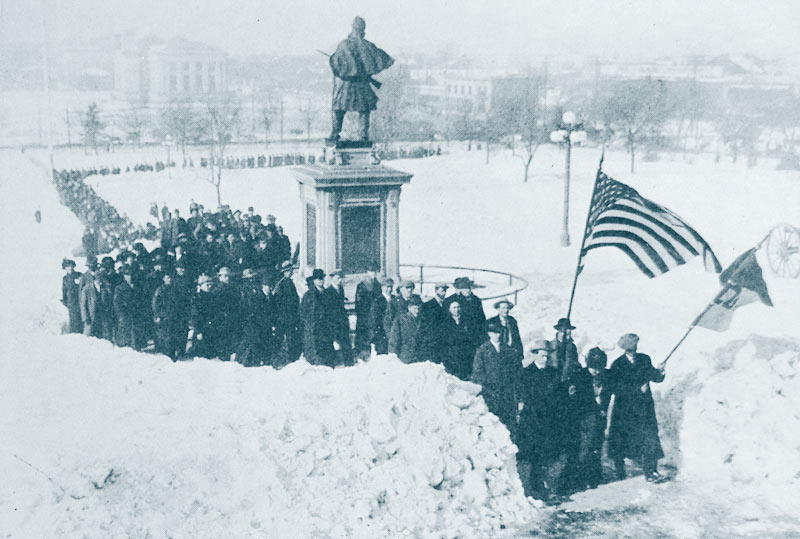
Will our city presume to prohibit life for whoever can’t afford to pay their way?

In case you thought City Council’s reprieve earlier this winter reflected a soft spot in their heart for the homeless forced to live in tents, in reality the city attorneys advised any purge of the unsightly camps be delayed until an iron-clad ordinance could be devised. The suggested legal verbiage was reviewed at Monday’s meeting, to be formally adopted today. It reads “9.6.109. Camping on Public Property Prohibited.” The definition of “camping” to include: “Sleeping or making preparation to sleep, including the lying down of bedding for the purpose of sleeping.”

No sleeping. On public property.

By the way, I care not the least about a slippery slope that might infringe on your prerogative to take a nap in the park. This is not about the average man losing his middle class privileges to the creep of authoritarian rule-making. At some point I have to presume we agree that human beings have some inalienable rights. They used to be lofty ideals, protected by fundamental principles. On the issue of sleep, we are discussing the right to an involuntary life function.

The right to defecate is what’s got these homeless camps in trouble, but it stands to reason that to shit is more than a right too, it’s a necessity. All of this is dreadful platitude unless it’s escaped our city administrators. Are they suggesting that because the city cannot provide for the services for its people, that the people must forgo their basic creature needs?

What inhuman folly. And on public ground. Where are they to go? Must man pay rent to exist?

That you can dictate the rights of another on private land is open to debate. By whose authority do you claim dominion to use land for yourself? How dare you refuse a fellow human being, wherever he might need to rest his head? Granting the argument for private property, who are you to force your will upon others on shared common property? Others can’t do what? Where?

Do public lands belong only to property owners? You can legislate the right to take property for yourself, but you can’t hoard all of it. You have the right to private land precisely because the remainder is reserved for the public. The authority to give the deed to you comes from a governing entity empowered by everyone. A government is bound to providing for the land-less in exchange for the privilege to sell premium land to the better-off.

And a city has obligations to service that public land just as much as it serves the private lots. Can local administrators say, sorry, no more money for water, sewer, utilities, or security? Neither can it fail its responsibilities to the poor.

You aren’t obligated to provide eat, drink and shelter to all, but you can’t deny men access to the basic resource of land. Would you have men born into cells until they agree to work for their sustenance? Colorado Springs would deny them heat and sleep too. If we could, would we regulate breath?

On public land you have limited authority to regulate. Where private property owners crow about property rights, so do the public have property rights. Every bit, and perhaps more sacrosanct. The public can consent to regulation, for the safety and health of all etc, but that doesn’t encompass prohibition. You want health and safety, you provide the services. You have no authority to deny the service and then deny man’s basic needs. What an absolute crock.

Below is the text of the city’s proposed ordinance. It describes the creation of a new section, under 9.6.109.

9. Public Offenses, fair enough;

6. Offenses Affecting Property, a functional necessity of course;

109. Camping on Public Property Prohibited. Huh?

NOW, THEREFORE, BE IT ORDAINED BY THE CITY COUNCIL OF THE CITY OF COLORADO SPRINGS:

9.6.109: CAMPING ON PUBLIC PROPERTY PROHIBITED:

A. It is unlawful for any person to camp on any public property, except as may be specifically authorized by the appropriate governmental authority.

B. For the purposes of this section “camp” or “camping” means to use the public area for living accommodation including, but not limited to, the activities and circumstances listed below. These activities and circumstances may be considered in determining whether reasonable grounds for belief have arisen that a person has “camped” or is “camping” in violation of this ordinance.

1. Sleeping or making preparation to sleep, including the lying down of bedding for the purpose of sleeping.

2. Occupying a shelter out-of-doors. “Shelter” shall mean any cover or protection from the elements other than clothing, such as a tent, shack, sleeping bag, or other structure or material.

3. The presence or use of a camp fire, camp stove or other heating source or cooking device.

5. Keeping or storing personal property.

Sleep, a basic animal function. Shelter, a fundamental human need. Fire, the first of mankind’s tools. Before agriculture was fire.

Property. How unbecoming that an ordinance seeking to prohibit the public’s right to public property should also deprive the public of the ability to keep personal property.

Also presented on Monday were recommendations from the city management, detailing the consequences of violating the camping prohibition. They included this paragraph:

FINANCIAL IMPLICATIONS: A violation of these updated ordinances may result in a fine and sentencing to the Criminal Justice Center (CJC). In the past, homeless individuals have been known to ignore summonses to appear in Municipal Court until it is advantageous for them to be placed in CJC (cold weather, need for food and/or shelter, etc.). The preferred method of dealing with these types of violations would be to gain the cooperation of the individuals involved without relying upon the criminal justice system, thus removing them from the circumstance by linking them with the appropriate service agency.

Making the specious argument basically that since homeless persons sometimes get themselves arrested on purpose, authorities are justified in accommodating them full time. How considerate of us.

Chapel Hills Mall boycott DAY 4 update

chapel hills mallCHAPEL HILLS MALL- Security visited the CFP picket on Wednesday. They’d observed us the past three days via video surveillance, but apparently their camera angles recorded only the backs of our signs, general slogans about Israel, Gaza, and the Gaza Freedom March, which did not adequately explain the inquiries they received about shoppers being asked to boycott VICTORIA’S SECRET and BATH & BODY WORKS. We were eager to explain. As usual, the critical question was how long we planned to be there.

Our answer was tentative: Until more than 87 delegates from the Gaza Freedom March to join Gaza demonstrators demanding an end to the Siege of Gaza. Solidarity protests and pickets are being staged worldwide. It’s up to the US and Israel, through their proxy in Egypt. Who knows if the Limited, parent company of the the aforementioned retail stores, can exert its influence? GFM would-be participant Sam Husseini reports international delegates left behind are being blocked from leaving their hotels. Mohammed Said el-Naidi reports and has picture.

A deal was brokered yesterday by which 100 peace delegates, one per nationality, could proceed by bus to Rafah. Many activists refused, choosing to demonstrate with the hundreds to be left behind. Organizers Code Pink had originally vowed to march on December 31st, regardless if permission is granted by Egyptian authorities, but now are declaring the brokered deal a victory… As a collective, the organizers forming the FGM rejected the offer, but a group left nonetheless.

The final 87 include many journalists who intended to cover the march and Palestinians hoping to be reunited with family members. No word yet whether Colorado Springs representatives are on the two buses headed to Gaza.

To support the GFM efforts, contact the Egyptian Embassy, 202-895-5400 and ask for Omar Youssef or email omaryoussef@hotmail.com with an email like the following:

I am writing/calling to express my full support for the December 31, 2009 Gaza Freedom March. I urge the Egyptian government to allow the 1,300 international delegates to enter the Gaza Strip through Egypt.

The aim of the march is to call on Israel to lift the siege. The delegates will also take in badly needed medical aid, as well as school supplies and winter jackets for the children of Gaza.

Please, let this historic March proceed.

Thank you.

Space time capsule December 21, 1968

Earth seen by ApolloWhat does it mean that the stars we see in the sky represent light coming at us from millions of years before? The images we have of Earth, of ourselves from space, reflect a distant past too actually. Although we’re accustomed now to visualizing our planet from above, as a quilt of satellite photos wrapped around a globe, viewable from any distance on Google Earth, the actual vision they mimic is a single thoroughly ubiquitous NASA photo called “The Blue Marble.”

We have only a handful of actual pictures of our planet, taken during the lunar expeditions Apollo 8-17, between 1968 and 1972. Together they allow our minds to conjure our blue globe selves floating against the continuum of space, but they’re also snapshots of the past, of home forty or so years ago.

That’s not just our planet set against the dark universe, that’s you, spinning along. Were you looking up toward the astronauts on their mission as these pictures were taken? You might have watched the launch at Cape Canaveral and hours later thought about the first men to leave Earth’s orbit.

The above photo isn’t the “Blue Marble.” The image above differs from the photo taken by Apollo 17 on Pear Harbor Day, December 7, 1972. That photograph was the first to capture the Earth in full sunlight, but it showed only the Southern Hemisphere. I wanted to chose one where you’re in the picture.

The above image is the first photograph of Earth taken from space, snapped by Apollo 8 as it left for the moon, Saturday, December 21st, 1968. If you were in North America at the time, you’re at the lower right.

If you don’t remember where you were around noon on the winter solstice in 1968, here’s a subsequent photograph they took on their eighth orbit around the moon. It’s the first “Earthrise” seen by man. That was December 24, 1968, a date for which you probably have additional family snapshots.

NASA Apollo 8 orbits the moon

Ward Churchill to speak for O’odham

O'odham rightsAccording to Censored News, Activist and scholar Ward Churchill will speak at the Unitarian Universalist Church of Tucson, 4831 W. 22nd St., on November 13, 2009 at 7:00 p.m. to benefit O’odham VOICE Against the Wall, which since 2003 has organized and advocated for the traditional O’odham leaders and elders of the Tohono O’odham communities in the southern territory of the United States and northern territory of Mexico. Professor Churchill’s talk is part of the “Apartheid in America: Surviving Occupation in O’odham Lands”

O’odham activist Ofelia Rivas will also participate. The event is sponsored by the Dry River Radical Resource Center, the Earth First! Journal, and Voices against the Wall.

Here’s some background on the O’odham struggle:

pamphlet cover illustrationBy J. D. Hendricks, 2004
TIAMAT PUBLICATIONS #5

The People Who Emerged From the Earth

Over two thousand years ago the descendents of the O’odham moved into the southwestern region of the area now claimed by the U.S. as the state of Arizona. 1 The O’odham have had one of the longest histories of contact with the forces of European colonization compared with the rest of the native North American peoples. The O’odham’s first contact with Spanish invaders took place in the mid 16th century; nearly one hundred years before the colonization of the North Atlantic coast and Great Lakes regions were begun by the French and English colonists. As such, the history of the O’odham provides a good context for an investigation of the colonization of Native North America, and more specifically, an investigation of the interplay between, and results of, the varied responses to colonization – that of collaboration, accommodation, and resistance.

Many histories of the O’odham refer to these desert people as the Papago. The term Papago was a name given to the O’odham by the Spanish colonizers, and is likely the result of a Spanish corruption of the O’odham word “papabi” which was the O’odham name for one of their principal bean varieties. Thus, the Spanish colonizers term for the O’odham (Papago) came to mean “the bean eaters.” 2 For the purposes of this study I will refrain from the use of the term Papago and will refer to “the people” 3 by their traditional pre-colonial name. 4

As is often the case, with the name Papago being a good example, European constructs are often imposed upon indigenous peoples by the historians that seek to portray their past. This result can occur when historians seek to glorify European norms and traditions at the expense of indigenous ones, and can also be the result of the subconscious indoctrination of the historian by the dominant culture – in this case that of western style industrial civilization. In other cases it can be the result of a simple uncritical usage of language.

One of the most dominant and reoccurring “civilized” constructs imposed upon indigenous peoples history is the commonly understood notion that the O’odham, or any other indigenous North American culture for that matter, existed as a totality or uniformed mass. This study will seek to use the history of the interaction between the O’odham peoples and the United States, both its government and its peoples, to deconstruct this myth of the totality and provide a history of the O’odham’s varied responses to colonization from an anti-colonial and anti-industrial perspective. By investigating various important case studies in O’odham history, and looking not only at resistance but also accommodation and collaboration, it is hoped that this work will help to provide a more realistic historical picture of the effects of colonization, and the intentions and reactions of both the colonizer and the colonized. Within the previously stated context and theoretical framework, this study will argue that while the O’odham responded to the U.S. invasion of their lands in various ways, the choices to resist, accommodate, or collaborate with the forces of colonization did not affect the overall U.S. policy concerning the O’odham – that policy being the eventual total assimilation of the O’odham into the dominant “civilized” industrial system. 5

This investigation will include a strong focus on O’odham resistance to colonization, as any anti-colonial history should, however it will not discount or ignore the many historical occurrences of accommodation, and in some cases outright collaboration, with the colonizers. It is important to always keep in mind that none of the actions and reactions in any of the case studies looked at are attributable to the O’odham as a “totality,” but rather are attributable only to the various groupings of O’odham, be they incarnated in the form of the individual, the clan, the village, an economic or spiritual grouping, or an established political organization.

A God of Civilization and Coercion Comes to the O’odham

The O’odham’s first encounter with Spanish invaders took place in the mid sixteenth century when a group of conquistadors led by Alvaro Nunez Cabeza de Vaca entered O’odham territory in search of gold. These men did not find the riches they were looking for and left the desert region to return to the Spanish colony. However, soon after word spread of the O’odham villages on the northern periphery of the Spanish colony, missionaries began to travel north to bring God and “civilization” to the native people residing there. By 1686, Catholic missionaries had formed a few small missions in O’odham territory using what they believed to be the influence of their soft power 6 techniques to lure the O’odham into their missions where they were then subjected to a rigorous schedule of cultural indoctrination. Most O’odham historians, including Winston Erickson, 7 and to a lesser extent, Bernard Fontana 8 have, during this time period, focused on the O’odham who chose to reside nearby and within these early missions, thus painting a picture of the O’odham as accepting of Spanish influence and cultural indoctrination.

However a closer look at this time period reveals that mission O’odham were only a small percentage of the total population of O’odham residing in the Sonoran desert 9 and that the ones who were there may not have been so for the reasons that the colonizers believed. San Xavier del Bac, the largest mission in O’odham lands, as well as many other missions, took advantage of the fact that the desert O’odham migrated in the dry winter months to the Northern Piman settlements along the rivers to work the small farm plots for sustenance. 10 The Catholic missions inserted themselves into this traditional pattern. Those O’odham who worked and lived near the missions were, for the most part, seasonal residents, which shows that the missions were viewed merely as being of utilitarian value. Thus, the O’odham as a totality were not necessarily accommodating to or interested in anything the missionaries had to offer per se, and when the missionaries began to employ “hard power” techniques and abuse or overstep the grounds for their welcome it did not go without consequence. 11

Accommodating and ignoring the missionaries was not the only response to colonization practiced by the O’odham during the seventeenth and eighteenth centuries. Although historians such as Erickson feel that “the missions did serve the O’odham well….,” 12 that assertion is contradicted by the fact that there were many large scale rebellions waged against the missions from outside and from within. In 1695, 1751, 1756, and 1776, large scale rebellions occurred in which missionaries were killed and their missions burned to the ground. 13 In some cases these rebellions were the doing of joint O’odham/Apache alliances, which is significant considering that many histories of the O’odham and Apache portray them as immemorial enemies. This may be the result of the fact that by the early nineteenth century the Spanish government initiated a campaign of divide and conquer that was continued later by the Mexican and U.S. governments to turn the O’odham and Apache against one another, thus easing the project of their subjugation.

A Change in the Occupation Government: Washington Enters O’odham Lands

In 1821, Mexican Independence from Spain was achieved and interest in the O’odham dropped away nearly entirely. By 1828, the new and secular Mexican government began the process of shutting down the missions in O’odham territory and by 1842, the last of the missions were closed. Soon after, in 1846, the United Stated initiated a war for territorial expansion against Mexico. This war was not of immediate consequence to the O’odham peoples. Isolated in desert regions, the fighting between the two occupation powers affected them little in the short run. However, the signing of the Treaty of Guadalupe Hidalgo in 1848, which ended the war, would lay the foundations for a series of disastrous events which would affect the O’odham in very negative ways.

Of greatest consequence to the O’odham was the fact that the boundary between the United States and Mexico was not finalized by the treaty of Guadalupe Hidalgo. The boundary was designated by Article Five of the Treaty as being an arbitrary line roughly following the 32nd parallel, an area which runs through the southern part of modern Arizona. To the east, the border was provided by the Rio Grande. The exact boundary line along the 32nd parallel was to be decided at a later date. It is also important to note here that the Treaty also provided that all Mexican citizens absorbed by the United States were to be granted U.S. citizenship, which included all indigenous peoples in the annexed territory since under Mexican law they were considered citizens. In the treaty the United States also assumed the responsibility for preventing cross border raiding into Mexico by the southwestern tribes, specifically the Apache. 14

In the aftermath of the signing of the treaty of Guadalupe Hidalgo, it became quickly apparent that an acceptable border between Mexico and the United States along the 32nd parallel would not be achieved. An official survey expedition was assembled by the United States and Mexico in 1849 to trace out the boundary between the two countries with little success. Various borderlines were agreed to and then abandoned and re-made by the United States, sometimes in a unilateral decision that dismissed the positions of the Mexican government altogether. 15

The principal concern for the United States was to secure title to an area of land in northern Sonora, Mexico that was ideally suited for the construction of a portion of the southern continental railroad whose building was being discussed in the U.S. Congress at the time. One of the main advocates for this southern railroad route was a South Carolina man by the name of Colonel James Gadsden. Gadsden’s history of connections to powerful business, military, and political leaders is very interesting and his appointment by the United States to be Minister to Mexico in 1853 serves as a very informative source to gauge the United States’ intentions towards Native Americans and the O’odham in particular.

James Gadsden was born into an influential southern family and graduated from Yale University. After enlisting and serving in the war of 1812, Gadsden was sent to the Florida territory with Andrew Jackson to aid in the campaign of removal and extermination being waged against the Seminole Indians, which took place from 1816-1818. After this war against the Seminole, Gadsden was appointed by President Monroe as commissioner to oversee the removal of the Seminole Indians to Indian Territory. Like the more famous removal of the Cherokee, the removal of the Seminole, and the high death rate suffered as a result, unarguably constituted genocide. 16 As a reward for a job well done, Gadsden was appointed by Monroe to a seat on the legislative council of the territory of Florida, thus beginning Gadsden’s political career. In 1840, Gadsden was elected President of the Louisville, Charleston, and Cincinnati Railroad. In 1853, the Secretary of War, an ardent white supremacist and slavery defender by the name of Jefferson Davis, appointed Gadsden to be Minister to Mexico. 17 As Minister to Mexico, one of Gadsden’s primary missions was to negotiate a final demarcation of the boundary between the U.S. and Mexico. Although Gadsden was a zealous believer in Manifest Destiny, his ideas concerning racial Anglo-Saxonism 18 caused him to be an opponent of the total annexation of Mexico. Gadsden, like many racist U.S. politicians of that time, felt that the total absorption of Mexico and its non-Anglo population into the United States would pollute the Anglo bloodline too much and thus he sought only to gain enough territory for the United States to build the southern pacific route. 19 Thus, a man who had presided over a war of genocide against the Seminole Indians, was a devout racist, and who had obvious conflicts of interest due to his connections to the railroads, was put into a position to determine the territorial boundary between the United States and Mexico and in the process also determine the boundaries of the O’odham’s land. With its appointment of Gadsden, the intent of the U.S. government could not be clearer. Business interests and territorial expansion were to run roughshod, by any means necessary, over any native peoples who stood in the way.

It is no surprise that when James Gadsden finally successfully negotiated a treaty with Santa Anna to secure what is now the southern portion of Arizona, the O’odham were not consulted. In fact, the Gadsden Treaty, signed into law in 1853, did not contain any mention of the O’odham at all. Considering that the new boundary line put in place by the Gadsden Treaty literally split the traditional O’odham lands in two, it is obvious that the intentions of the United States were in no way benevolent. Here it is also important to point out that the terms of the Gadsden Treaty specifically included the same citizenship provisions which were spelled out in the earlier Treaty of Guadalupe Hidalgo. 20 Although the Gadsden treaty was of great significance for the O’odham, their isolation and the outbreak of the Civil War enabled them to live another decade in relative isolation from Anglo encroachment.

Assimilation, Cultural Destruction, Double Speak and Ordained Genocide

The causes which the Almighty originates, when in their appointed time he wills that one race of men – as in races of lower animals – shall disappear off the face of the earth and give place to another race, and so on, in the great cycle traced out by Himself, which may be seen, but has reasons too deep to be fathomed by us. The races of the mammoths and mastodons, and the great sloths, came and passed away: The red man of America is passing away!
–United States Congress Committee on Indian Affairs report, 1865. 21

No doubt with similar justifications in mind as those of the Committee on Indian Affairs, Anglo settlers began their invasion of O’odham lands less than a year after the conclusion of the Civil War. The Homestead Act had opened up the lands of Southern Arizona to Anglo squatters and in 1866, one of the first of many bills was passed by Congress granting mineral rights to any citizen who claimed them. 22 Every one of these homesteads opened and every resource extraction operation initiated without the express consent of the O’odham represented an illegal action under the Gadsden Treaty. The citizenship provisions of the Gadsden Treaty had granted citizenship to all former Mexican citizens and the O’odham were, by legal definition, included in this formulation. The United States, however, refused to consider “uncivilized” peoples as being worthy of the protections granted to citizens by the fourth amendment of the U.S. Constitution, which prohibits the expropriation of property. This refusal of the United States government to follow its own laws pertaining to Native Americans when those laws happen to stand in the way of U.S. interests has been a common occurrence in United States Indian policy. This land grab was only the first of many illegalities committed against the O’odham people by the United States and its citizens. In this respect the O’odham are in a special position when compared with many other tribes. While the theft of native lands by the United States Government was usually legally justified by treaty stipulations signed between a tribe and the U.S. government, this justification could not and cannot be used in the case of the O’odham since no treaty was ever signed with the O’odham by the United States Government. 23

For the most part, the O’odham did not resist this initial incursion of Anglo settlement, rather the O’odham practiced accommodation and moved farther out into the desert to shield themselves from the new settlers invading their lands. Traditional ways were maintained with the exception of the introduction of cattle ranching. The O’odham territory was well suited for the raising of cattle and a good number of O’odham became cattle ranchers, both for purposes of subsistence as well as for sale to Anglos residing in and around Tucson. In the 1880s, as increasing numbers of Anglo cattle ranchers began to invade and take over their pasture, some O’odham began to resist.

The O’odham resisted by stealing the Anglo cattle herds which were rounded up and driven south to be sold on the Mexican market. The expropriation of Anglo cattle herds was not isolated, and it became a major concern for the settlers and the government. In at least one case, a large cattle outfit was driven out of business. 24 The concern over this outbreak of O’odham theft of Anglo cattle was large enough that newspapers as far away as Los Angeles ran stories about the phenomenon. For the most part these stories seem to have been deliberately used to justify the enclosure of the O’odham into reservations as the government and Anglo cattle ranchers seized the opportunity to gain even more O’odham land by arguing that it was an unfair burden for the Anglo cattle ranchers to have to “support” the O’odham. 25 Here, in previous case study, we have another common attribute of U.S. Indian policy in general, and one which occurs again and again in the history of O’odham contact with the U.S. government and Anglo settlers – blaming the victim.

Another official position of United States Indian policy during this time period was that everything done to the Indians was, in the words of Indian Commissioner J. Q. Smith, in their own “best interests.” 26 Whether this obvious sham was based on a subconscious guilt and delusion or was a cynical example of “double-speak,” it is obvious that Native American’s best interest’s were the last thing on the government’s mind. Nevertheless, with this reasoning as justification, the first official reservation for the O’odham was created by executive order of President Grant on July 1, 1874. This small reservation surrounded the Old Catholic mission at San Xavier del Bac. It is estimated that only about ten percent 27 of the desert O’odham took up residence within this reservation – these were labeled as “civilized” O’odham by U.S. census takers. The vast majority of O’odham were labeled as “wild” and continued to live in the vast desert regions west of San Xavier del Bac. While it is obvious that the desert O’odham were resisting cultural assimilation by avoidance, even the mission O’odham maintained a resistance to European culture as the next example will illustrate.

While visiting the old mission at San Xavier a newspaper columnist from the Los Angeles Times wrote that upon her visit in 1882, she could see “not a single civilized human habitation within miles.” This writer goes on to state that the O’odham’s dwellings were in the form of “conical mud huts.” In the casual racism and Social Darwinist rhetoric of the period she also adds that,

“The Papagos are but little in advance of gophers and prairie dogs in their habitations.” 28

The point is that after more than 200 years of European influence, even the mission O’odham continued to build their traditional shelters. 29

Progressivism and Cultural Genocide: The Dawes Act

In 1887, the General Allotment Act, also known as the Dawes Act, was signed into law. The Dawes Act was the staging point for the forced assimilation of those remnants of Native American groupings which had not been totally decimated by the preceding period of “Indian Wars” and forced relocations. The essential function of the Dawes Act was to disrupt traditional tribal land holding patterns and thus force Native Americans into the Anglo system of private property. The O’odham, like most other Native American cultures, did not have a concept of private property – land was held in common for the benefit of the village group. Communally held land was an essential pre-requisite for their Anarchistic political system and extremely de-centralized tribal structure. 30

The first section of the Dawes Act provides for equal “sections” of land to be parceled out to each “head of family.” This head of family was always understood to be the father of each family when land was allotted. Thus, this first section of the act not only attempted to destroy the communal land system of Native Americans, it also instituted Patriarchy as the basis for social functioning in Native America. 31 In addition, Section Five of the Act also provides that any un-allotted lands be subject to purchase by the United States government. Section Six and Seven provide that all monies paid by the U.S. for un-allotted Native lands be held for each tribe by the U.S. Treasury and “subject to appropriation” by the U.S. government to repay itself for the implementation of allotment as well as to provide for the “civilization” of Native Americans. 32 In less veiled words, these sections are basically stating that Native Americans will be forced to pay for their own cultural annihilation.

This interpretation of the intent of the Dawes Act becomes clearer when one looks at the arguments and debates that took place in Congress and within self described progressive “Indian rights” groups such as the Indian Rights Association. Critics of the Dawes Act in Congress such as Rep. Russell Errett understood that

“the main purpose of this bill is not to help the Indian troubles so much as it is to provide a method for getting at the valuable Indian lands and opening them up for settlement.” 33

And Senator Dawes, the namesake of the final bill, speaking of the land and resources of Native Americans stated that

“civilization has got after these possessions with a greed never before equaled but it is idle to expect to stay it….” 34

As for the progressive Indian Rights Association, they argued that

“the organization of the Indians into tribes is, and has been, one of the most serious hindrances to the advancement of civilization, and that every effort should be made to secure disintegration of all tribal organizations….” 35

And one of their leaders, Reverend L. Abbott, provided justification with the statement:

“Barbarism has no rights which civilization is bound to respect.” 36

So here we have a self-proclaimed progressive Indian Rights organization arguing for cultural genocide and against the notion that Native Americans have any rights that civilized people are bound to respect! This conclusion provides a perfect example of the essence of “progressive” or “civilized” thought.

The Dawes Act had a much less devastating effect for the O’odham than it did for many other Native American tribes. At the time of its passage, the only official reservation for the O’odham was the San Xavier reservation which, as was stated earlier, was only a small 71,090 acre reservation around the old mission San Xavier del Bac. When the allotment agent came to San Xavier in 1890, he allotted out 41,600 acres of land to the 363 O’odham whom he counted in his census as being resident at the time. 37 The vast majority of the O’odham still continued to live west of San Xavier in the expansive desert regions and were little affected by the allotment schemes. Even those O’odham who lived in San Xavier and were allotted land paid little attention to the artificial boundaries drawn on paper which supposedly privatized their land – they continued to farm and graze the land communally. 38 This refusal to abide by the provisions of the Dawes Act is also a form of resistance to cultural assimilation and adds one more example to show that for those O’odham who resisted, the most often employed method of resistance was non-compliance and avoidance. This specific response to colonization was made possible by the isolation and expansiveness of their desert home, which many Anglo’s continued to view as a “hopeless desert.” 39

The Domestication of the “Wild Papago”

The vast majority of the O’odham continued to resist assimilation and maintained a fairly traditional lifestyle – minus the introduction of cattle herding and horse rearing. In the twenty years following the passage of the Dawes Act, a growing effort was made to enclose the “Wild Papago” 40 and forcibly strip them of their traditional culture and instill them with the “civilized” values of the industrial Anglo. As was mentioned previously in the paper, ranchers and the government used O’odham cattle theft from Anglo ranchers as one tool to justify the enclosure of the O’odham within a reservation. During this period, Anglo Cattle ranchers continued to encroach deeper and deeper into O’odham territory and scuffles began to break out.

In another classic example of the “blame the victim” tactic, a pro-enclosure story was printed in the Los Angeles Times, no doubt to build public pressure for the domestication of the “Wild Papago.” The story concerns a group of O’odham who had resisted an Anglo cattleman’s attempts to enclose one of their water sources. When these O’odham continually tore down the fence that this cattleman had built, the rancher filed a report with the local Indian Agency sheriff to have the men arrested. When the sheriff arrived to arrest the O’odham responsible for defending their water source, he was taken hostage. The sheriff was later released unharmed; however, the incident was used to make the argument that such troubles can only be expected to increase if the O’odham were not enclosed on a reservation where they could be more easily controlled and monitored. 41

The tactic of occupying and diverting natural water sources was one of the tools used by the Anglo settlers and government to destroy the self sufficiency of the O’odham and force them into reservations where they would be dependent on the government for their water and would thus be easier to control and monitor. Some of the O’odham clearly understood what was happening, which is evidenced by instances of resistance both to the enclosure of natural water sources as well as resistance to the drilling of wells. One example of the U.S. government using water as a tool of forced cultural assimilation can be found by looking at an event recorded by an O’odham calendar stick 42 keeper. In 1912, the O’odham residing in the village of Santa Rosa, an isolated and traditional village in the western desert region of O’odham territory, were paid a visit by an Anglo Indian Commissioner who wished to drill a well for them. The Chief of the village objected to the drilling of the well on the grounds that it would disturb their culture, their autonomy and their self-sufficiency. The government agent proceeded to have the well drilled anyway. Upon completion of the well, the Chief of the village, according to the calendar stick keeper, stated that

“the well must be left alone and, in order that the Papagos might continue their old life, water must still be carried from the spring in the foothills.” 43

However, the prohibition by the Chief could not be upheld due to the overwhelming convenience of the new well and after a period of abstaining from its usage, the village of Santa Rosa (including the Chief) gave in and thus was assimilated into the industrial system by being made dependent on the Government well. 44 During this same time period, encroaching Anglo farmers engaged in the diversion of O’odham water sources to irrigate their farms. This practice served as another method of forcing the self sufficient O’odham into a relationship of dependence upon the government. In many areas so much water was diverted that the O’odham could no longer grow their traditional summer crops. 45

In 1919, the first incarnation of an O’odham reservation to enclose the nearly two million acres of desert that the “Wild Papago” were residing in was established. The formation of the desert O’odham reservation in 1919 ushered in a period of exponentially increased government interference in O’odham matters, and of course, the various forms of coercive assimilation were multiplied. By 1933, thirty-two unwanted wells were drilled all over the new reservation. 46 The well drilling was often opposed by those who were trying to maintain the O’odham Him’dag – the traditional ways of the desert people.

Resistance and Collaboration: O’odham Responses to Forced Modernization

In contrast to the traditional O’odham who had maintained resistance to cultural assimilation for the past 300 years, there was also a small number of O’odham based in the new reservation that welcomed collaboration with the forces of Anglo modernization and advocated for cultural accommodation and in some instances for total cultural assimilation. These men would later form an organization called the Papago Good Government League, which would serve as the propaganda arm of the Bureau of Indian Affairs and government policy in general. The leadership of this new faction had been taken from their families as youths and placed in Protestant boarding schools to be culturally indoctrinated. The Tucson Presbyterian Training School was one of the indoctrination centers where many future members of the Good Government League had been sent. 47

Religious indoctrination, whether Catholic or Protestant, has always been one of the most powerful tools of colonization and its justification used by European invaders against the indigenous peoples of the Americas. The necessary counterpart to the forced indoctrination of Christian principals and morals has always been the repression of indigenous spiritual practices. The United States government understood the profound power that traditional spiritual practices had in maintaining group solidarity and cohesion and it is for this reason that such spiritual practices were made illegal and repressed historically. In 1883, a Court of Indian Offenses was established by congress at the request of Secretary of Interior Henry M. Teller to eliminate traditional spiritual practices. In a report to the commissioner of Indian Affairs, Teller laid out his goals and his rationale stating that,

“If it is the purpose of the Government to civilize the Indians, they must be compelled to desist from the savage and barbarous practices that are calculated to continue them in savagery….”

Teller went on to associate those who resisted the repression of their spirituality with the “non-progressive” faction of Indians and labeled traditional spiritualism as “debauchery,” “diabolism,” and “savagery.” The overarching argument of his letter is that in order to civilize the Indians and bring them into the industrial system, their traditional spiritualism must be destroyed. As an initial step towards this end, Teller advised that Medicine Men be “compelled” to desist from their practice of “deception.” 48

Although the Court of Indian Offenses advocated that coercion be used to repress and destroy indigenous spiritualism, it failed to succeed in this project even when it used force to try to stop traditional spiritual rituals. According to Historian Edward Spicer, the only thing the Court succeeded in doing was driving traditional spiritual practices underground. In the case of many resistant O’odham, traditional spiritual practices were continued without regard to regulations or prohibitions against them, and in many cases, federal authorities resorted to repression and arrest to try to stop these practices. One traditional spiritual practice of the O’odham which was particularly hated by the Protestant Missionaries and Indian Agents was the Vi-kita ceremony.

The Vi-kita ceremony of the O’odham has been written about and studied by many Anglo historians and anthropologists, the most prominent being Columbia Anthropologist Ruth Underhill. 49 Before going into a short description of the Vi-kita it is important to understand that this ceremony varied depending on who was conducting it and where it was being conducted. Peter Blaine, an influential O’odham man sympathetic to the traditional ways, wrote in his autobiography about Underhill’s methods. Blaine explained the traditional way for the O’odham to tell about their past was to do it

“in a group so that everybody had a chance to talk and tell it their way. Underhill was talking to just one man…Dr. Underhill was wrong all the way in how she got her information.” 50

As scholars from the dominant culture often do, Underhill had applied her own notions of hierarchy, authority and individualism to her work with the O’odham and totally disregarded their traditional methods of conveying information in a communal fashion.

The Vi-kita itself was a yearly rain and fertility festival preformed to initiate and give thanks for the yearly summer rains. The ceremony itself consisted of the communal singing of rain songs, dancing, intimate encounters, and the consumption of Navait (Saguaro wine), an alcoholic drink made by the fermentation of Saguaro Cactus buds. The consumption of this wine was meant to symbolize the connection between the sky and the earth. The intake of the Navait was representative of the earth’s intake of rain. Participants drank Navait until vomiting occurred as this act embodied the clouds issuing forth rain unto the earth. It was a powerful ceremony that bonded the O’odham with the elements of nature.

When Protestant missionaries, and a small number of Protestant O’odham in the Good Government League, backed by U.S. Indian Agents, began their attempts to usurp power on the newly formed western O’odham (Sells) 51 reservation in the early 20th century, one of the first things they attacked was the practice of the Vi-kita ceremony. In the early 1930s, Peter Blaine explained that the traditional O’odham from the San Xavier reservation would travel to the western reservation for the Vi-kita. He states that,

“In the late 1920s the government tried to stop this wine drinking ceremony on the Sells reservation. But no Papago or Agency police could ever stop it.”

In one instance Blaine tells the story of how he helped defend three traditional O’odham Vi-kita ceremony leaders when they were arrested by agents from the Indian Bureau and jailed in Tucson. During the trial, a group of Protestant O’odham men from the Good Government League 52 argued for the repression of the ceremony – one of these men, Richard Hendrix, would continue to plague the traditional O’odham in future encounters. To respond to the collaborationist Good Government League, the resistant traditional O’odham formed the League of Papago Chiefs to counter the attempts of the Protestant Good Government League to usurp control on the reservation. 53

The Indian Reorganization Act and O’odham land rights

On June 18th, 1934, President Roosevelt signed into law the Indian Reorganization Act which finally stopped the forced allotment process initiated by the Dawes Act in 1887. The Indian Reorganization Act was viewed by its proponents as being in the best interests of the Indians. One of the reasons for this view was the fact that the Dawes Act and its forced allotment provisions had resulted in the loss of 90,000,000 acres of tribal lands and it was hoped by some, including then Indian Commissioner John Collier, that the Indian Reorganization Act could be used to regain some of this lost land.

The public was also encouraged to view the Indian Reorganization Act as being beneficial for Native Americans. A large article in the Los Angles Times entitled “The Bill to Return Indian Rights” stated that:

“After a century of graft, plunder and injustice, this bill has the objective of handing their own souls back to the Indians.” 54

However, such optimism and notions of cultural relativism were not held by all. As a precursor to the Indian Reorganization Act, a report was prepared for the Secretary of the Interior in 1928 to lay out the need for a change in Federal Indian Policy. The report stated that the “great majority of Indians are ultimately to merge into the general population” and that it was the government’s responsibility to assimilate Native Americans into “white civilization” because “the hands of the clock cannot be turned backwards.” Sympathetic attempts to help Native Americans retain their culture were stigmatized as attempts to “preserve them as museum specimens.” 55 Indian Commissioner John Collier was one of those who believed that Native Americans should retain their culture and that “the awakening of the racial spirit must be sustained….” 56 However, although the finalized Indian Reorganization Act did contain elements that were meant to “help” Native Americans, many of its articles were still designed to impose “civilized” systems on Native Americans.

It can be argued that the intent of the finalized Indian Reorganization Act was to initiate a new chapter in the push for the total cultural assimilation of the Native American tribes. The argument that there was no qualitative change between the Dawes Act and the Reorganization Act is legitimate. The Indian Reorganization Act provides the examples for the argument. The main tool of assimilation in the Indian Reorganization Act was the provision in Section 17 which allowed for Native American tribes to form their own tribal governments, constitutions and laws which, although it is not specifically stated, were intended to be Anglo in structure and functioning. In the case that these native governments were not sufficiently acceptable to the U.S. government, section 17 also provided that all Tribal Government formations must be “approved by the Secretary of the Interior.” 57 This clearly shows that the intent of the Act was not to allow Native Americans to become fully autonomous, either culturally or politically. For a tribe such as the O’odham, which had a long history of decentralization and consensus decision making, the imposition of western style liberal democracy, with its attendant centralization and majority rule system, was an obvious method of forced cultural indoctrination. Peter Blaine, who was mentioned earlier, was an O’odham man who had sympathy for the traditional, decentralized and communal way of O’odham societal organization. When the collaborationist Papago Good Government League began to maneuver themselves into the position of representing all of the O’odham, Blaine took it upon himself to lead the charge to discredit their assertions to business interests and the Federal Government that they represented the O’odham. Blaine wrote that:

“This so-called council represented only their own church people, but they took it upon themselves to become a council for all Papagos. They had meetings. Nobody attended them but these four guys because most people didn’t recognize them as leaders.” 58

In 1934 Blaine, along with another O’odham from the Gila Bend reservation named Leon Pancho became the first O’odham to travel to Washington D.C. These two men were sent as representatives of the traditional chiefs of the O’odham villages to argue against a recent court order that closed the Sells reservation to outside, Anglo owned, mining. The court order was a result of a lawsuit brought by the members of the Good Government League, including Richard Hendrix, who had teamed up with outside lawyers. These lawyers were to receive as payment a ten percent share of all land reclaimed from the mining companies, or a monetary equivalent. As this entire procedure was done behind the backs of the majority of the O’odham, when it was revealed, there was great resentment towards the Good Government League by many of the O’odham.

While in Washington D.C., Blaine was informed of the pending Indian Reorganization Act, and he became a supporter of the Act due to its provision allowing for the self government of Native Americans, as well as a provision in section Six that allowed the Secretary of Interior to manage mineral, mining, and livestock on the reservation. 59 In the case of the O’odham this meant that the reservation would be re-opened to mining and they would regain an important means of economic sustenance. According to Blaine, the mines were an important economic resource for the O’odham as they provided jobs and a market where beef and other O’odham products could be sold. 60 This is yet another unfortunate example of how the incursion of Anglo industrial technology served to destroy the self-sufficiency of the O’odham by making them dependent on it for survival.

Whether or not the mines were truly in the best interest of the O’odham is a complex topic which cannot be dealt with here. However it should be stated that Blaine and his companions’ trip to Washington D.C. was financed by the Tucson Chamber of Commerce, an organization that functioned in support of the mining interests, not the O’odham. This Tucson Chamber of Commerce was the same organization that had aggressively petitioned President Wilson to rescind his 1916 act forming the Sells reservation because it prevented Anglo agricultural interests from exploiting the area’s “best agricultural and grazing lands.” 61

Resistance to and Collaboration with the “White Man’s War”

Not long after the passage of the Indian Reorganization Act and the formation of the first O’odham Tribal Government, the United States declared war on Japan, thus entering World War II. The participation of Native Americans in World War II has been well publicized, especially the role the Dineh (Navajo) played as code talkers in the South Pacific. The United States government and the mainstream media portrayed Native Americans as being eager to fight for their homeland, and eager to assimilate into “white civilization” once they returned from the war. Nearly 25,000 62 Native Americans served in the United States military during World War II, many of whom were no doubt under the impression that their service would be rewarded with increased “rights” after the war’s end. Instead, as a “reward” for Native Americans participation in World War II the United States government established the Indian Claims commission in 1946 to legalize the U.S. occupation of Native American Lands never granted to the U.S. by treaty, passed House Concurrent Resolution 108 to terminate tribal recognition as separate entities from the Federal Government, and then instituted a plan in 1954 to relocate Native Americans off the reservation and into “Indian Ghettos” in the nation’s large cities. 63 These were the “rewards” for participation in World War II.

Like many other Native American Tribes, some of the O’odham Nations members participated in World War II. Ruth Underhill claims that the O’odham enlisted to serve in World War II “in droves” 64 and it is documented that the O’odham tribal government bought $10,000 in war bonds. 65 However, the extent of this involvement was distorted by the media, academia, and even some of the O’odham leaders in the tribal government. Richard Hendrix, a former member of the collaborationist Good Government League, had risen to prominence in the new O’odham tribal government by this time and was interviewed by the Arizona Archaeological and Historical Society on November 16, 1942. In this interview Hendrix exposed the extent to which he had allowed his mind to be colonized and assimilated into that of the dominant white culture. Speaking of colonization in general and World War II in particular, Hendrix stated that the O’odham had:

Learned to love the American government and they learned to love the Stars and Stripes. And when the war came and the time came for our boys to be registered, there was no exception. They registered just the same as white boys did. And now they are out fighting alongside the white boys, the American boys. They are just as anxious as the white boys to kill as many Japs, to kill as many Germans, and they are very anxious to win this great war so that the Papago people in this desert land may continue to enjoy the freedom of their homes. 66

Hendrix’s internalization of white supremacist racial notions is a heart breaking and shocking example of the extent to which he had accepted the ideology of “white civilization.” In addition, his assertion that every O’odham boy registered for the war with “no exception” is glaringly false.

Aside from the fact that there are always exceptions to everything, there was also a large scale organized resistance to World War II led by an old Chief and medicine man, Pia Machita, and his band of traditional O’odham who resided in an isolated village in the north western area of the Sells Reservation known as the Hickwan district. According to Peter Blaine, the O’odham residing in some of the most isolated villages in the Hickwan district had not seen a white man until the 1930s, and continued to practice the traditional O’odham Him’dag. 67 When Pia Machita was informed of the compulsory registration of young O’odham boys for induction into World War II, he instructed the youth of his village to refuse to sign the registration forms when they were visited by the local Indian Agent. Pia Machita was a very traditional leader who refused cultural assimilation and would not accept the authority of the Bureau of Indian Affairs or the O’odham tribal government. Finally, after all efforts to persuade Pia Machita’s village to register had failed, the tribal chief of police and a gang of Federal Marshals led by U.S. Marshall Ben McKinney invaded the village at two in the morning on October 16th, 1941, with tear gas bombs and guns drawn – when the Marshals attempted to take Pia Machita into custody some of the young men from the village used force to liberate him and severely beat one of the federal marshals. In the face of this resistance, the government agents and their local collaborators retreated to Tucson. When the Attorney General’s Office heard of the resistance on the O’odham reservation, they immediately got involved in the effort to repress this draft resistance movement as quickly as possible to prevent its possible spread to other reservations. By May 17th, 1941, after a period of about six months of trying to track down Pia Machita and his small band of men, Marshall McKinney and O’odham collaborators including Jose Ignacio from the tribal government, surrounded Pia Machita in the village of Stoa Pitk and took him into custody without incident. 68

Peter Blaine was the O’odham tribal chairman during the time that Pia Machita was leading the draft resistance movement. Although he did not believe that Pia Machita and his men were threats in any way, he was annoyed by what he perceived to be their stubbornness and attributed their draft resistance to his belief that they “didn’t really understand what they were doing.” 69 In reality, it was Blaine who did not understand the reasons behind Pia Machita and his men’s resistance to enlistment. Pia Machita and his men understood very well what they were doing – they were resisting giving aid to a government that they understood was their enemy. Given this understanding, and given the dictionary definition of the word “collaboration,” it becomes necessary to label those O’odham who participated in the arrest of Pia Machita as such – collaborators. The understanding that the U.S. government was the enemy of the traditional O’odham of the Hickwan district was based upon a long history of attempts by the U.S. government to force the Traditional O’odham of that area to abandon the Him’dag and embrace elements of Anglo “progress” such as dams, railroads, wells, and the protestant religion. Despite Peter Blaine’s inability to understand why the O’odham in the Hickwan district rejected Anglo-civilization in its totality, he still maintained sympathy for the people there. When Pia Machita and two co-defendants were finally sentenced to serve 18 months in prison at Terminal Island Federal Prison for their roles in leading the resistance movement, Peter Blaine eventually came to their aid and used his connections as tribal chairman to persuade the sentencing Judge to release Pia Machita early and allow him to return to the reservation and his family. 70

Conclusion

The history of the O’odham’s contact with the United States government has been one marked by a persistent current of resistance to cultural assimilation into “white civilization.” This resistance has included a variety of tactics and actions. The favored tactic of resistance to assimilation for many of the O’odham groupings seems to have been that of avoidance and feigned accommodation to Anglo culture when expedient. However, as was evidenced by the O’odham’s early history of contact with the Spanish, they did not refrain from waging armed resistance to colonization when they were pushed into a situation where other tactics might have been ineffectual.

In addition to resistance and accommodation, it has also been shown that some of the O’odham choose to engage in direct collaboration with the Anglo colonization of their lands and minds. As this paper has shown, the levels of collaborative activity amongst the O’odham varied, and so did the effects of such collaboration. When investigating instances of collaboration it is always important to understand the context which produced them and to remember that the ultimate blame for a situation of oppression should always be placed upon the group committing the acts of repression – in this case the United States government and allied business interests. It is important to show such examples of collaboration and to understand that all human cultures who have been the victim of colonization have invariably contained individuals who chose to collaborate for a variety of reasons. The O’odham are no exception to this rule. Making apologies for collaboration or failing to mention the instances where such collaboration did occur creates a historical distortion and does nothing to aid present struggles for liberation.

The O’odham responses to colonization never represented a totality, but a strong current of resistance is evident throughout their history. In regards to the United States government, it can be said, given the primary sources looked at, and the final drafts of laws signed and policies followed, that the intent of the United States government toward all Native American tribes, when it was not outright genocidal, has been the cultural destruction and absorption of remaining Native Americans into the dominant industrial culture of “white civilization.” Regardless of the varying tactics used, and the various lip service about “best interests” and “justice,” it has been shown that there has never been a qualitative change in United States policy toward the O’odham people and Native Americans in general. The O’odham have maintained aspects of their traditional culture despite the best efforts of the government to force assimilation, not as a result of such efforts. A continuing current of struggle between the forces of colonization and resistance has persisted for centuries, in all its various forms, within the minds and bodies of many O’odham and will continue until liberation.

NOTES:

1
This date is based on archeological evidence gathered by E.W. Haury in Ventana Cave. Haury, E.W. The Stratigraphy and Archeology of Ventana Cave Arizona. Tuscon: University of Arizona Press, 1950. Cited from Williams, Thomas R. “The Structure of the Socialization Process in Papago Indian Society.” Social Forces, Vol.36, No.3. p.253.

2
Fontana, Bernard L. Of Earth and Little Rain: The Papago Indians. Tuscon: University of Arizona Press, 1989. pp.37-39.

3
The name “O’odham” is roughly translated as “the people” in the Piman dialect spoken by the various O’odham groupings.

4
In 1986 the tribal government of the Papago reservation officially changed its name to the Tohono O’odham Nation.

5
The term “civilized” is a problematic historical term, and its definition tends to be very subjective. The meaning of the term and its use as a label is heavily influenced by how the author and the reader understand its meaning. For the purposes of this paper, the term “civilized” refers to the totality of the “western” cultural, political, and economic system – and most importantly the belief that technological/industrial progress is inherently beneficial and liberatory. For most, being labeled “civilized” is viewed as a positive and the label of “un-civilized” or “savage” is viewed in the reverse. However, for the purposes of this study it is imperative to understand that this author views “civilization” itself as an inherently oppressive and destructive entity, and this must be kept in mind to correctly understand the arguments and analyses in the paper.

6
The term “soft power” refers to the concept of gaining influence and control over another group by means of the attraction of the dominating group’s cultural attributes and the use of commodification rather than using military might and coercion (“hard power”) to gain that influence. See Joseph S. Nye, Jr. Soft Power: The means to success in world politics. New York: Perseus Books, 2004.

7
Erickson, Winston T. Sharing the Desert: The Tohono O’odham in History. Tucson: University of Arizona Press, 2003.

8
Fontana, Bernard L. Of Earth and Little Rain: The Papago Indians. Tucson: University of Arizona Press, 1989.

9
According to Catholic missionary records, the numbers of mission O’odham during this time period were somewhere around 2,000. However, according to population estimates there were at least 10,000 O’odham peoples living in this area. See Fontana, Bernard L. Of Earth and Little Rain . pp.11,46.

10
Fontana, Bernard L., p.40.

11
It is well documented that many of the Missions resorted to physical abuse, forced confinement and occasional murder to coerce the O’odham into compliance. San Xavier del Bac, the largest and most famous of Catholic missions in O’odham lands was built with forced labor. See Daniel McCool; “Federal Indian Policy and the Sacred Mountains of the Papago Indians.” Journal of Ethnic Studies 9.3 (1981).p59.

12
Erickson, Winston P., p.66.

13
Fontana, Bernard L., pp.61-64.

14
Treaty of Guadalupe Hidalgo, Feb 2nd, 1848. United States Statutes At Large, pp. 922-943

15
For a detailed treatment of this series of events see; Garber, Paul N. The Gadsden Treaty. Glouchester: Peter Smith, 1959.

16
For more information on the removal of the Seminole; Stannard, David E. American Holocaust: The Conquest of the New World. New York: Oxford University Press, 1992. P.124. For additional information about the Seminole Wars see; Churchill, Ward. “A Little Matter Of Genocide: Holocaust and Denial in the Americas 1492 to the Present.” San Francisco: City Lights Books, 1997.

17
All dates for the political appointments of James Gadsden are cited from Paul Garber’s “The Gadsden Treaty.” Pages 74-81.

18
Racial Anglo-Saxonism was a belief popular in the later 19th century which held that Europeans of Anglo-Saxon descent were at the forefront of evolution and were responsible to bring civilization to the world. This ideology was used as a convenient justification for the extermination and removal of Native Americans. For a detailed study of this ideology see: Horsman, Reginald. Race And Manifest Destiny: The Origins of American Racial Anglo-Saxonism. Cambridge: Harvard University Press, 1981.

19
For a detailed investigation of the role that the railroads played in the Gadsden purchase see; Schmidt, Louis B. “Manifest Opportunity and the Gadsden Purchase.” Arizona and the West, vol.3 (autumn 1961).

20
Forbes, Jack D. The Papago-Apache Treaty of 1853: Property Rights and Religious Liberties of the O’odham, Maricopa and Other Native Peoples. Davis: Native American Studies Tecumseh Center, U.C. Davis, 1979. p.1.

21
United States Congress. Joint Special Committee. Condition of The Indian Tribes. Report of the joint special committee, appointed under joint resolution of March 3, 1865. With an appendix. Washington, D.C.: United States Government Printing Office, 1865.

22
Erickson, p.77

23
During this time period many treaties were negotiated with native tribes in the regions west of the Mississippi to gain legal justification for the United States’ theft of their lands. For a detailed list of treaties signed between the United States and Native American tribes, see the compendium edited by Charles J. Kappler. Indian Affairs: Laws and Treaties. 7 volumes. Washington, D.C.: Unites States Government Printing Office, 1903-4.

24
Spicer, Edward H. Cycles of Conquest: The Impact of Spain, Mexico, and the United States on the Indians of the Southwest, 1533-1960. Tucson: The University of Arizona Press, 1962. p.138.

25
“Arizona News; Papago Cattle-thieves Brought to Justice.” Los Angeles Times. Feb 1, 1894. Also see: “Arizona News; Report Showing the Depredations Committed by Papago Indians on Stockmen’s Herds.” Los Angeles Times. June 8, 1895, In addition see; “Arizona News: Papagoes Destroying Cattle in Large Numbers.” Los Angeles Times. Mar 23, 1894.

26
Kehoe, Lawrence. “Our New Indian Policy and Religious Liberty.” Catholic World, vol. 26 (Oct. 1887). P.96.

27
Erickson p.78.

28
“Tucson And Fort Lowell; Notes of a Visitor – The Church of San Xavier.” Los Angeles Times. Nov 18, 1882.

29
The Spanish had brought the adobe style of construction to the O’odham but, although the resources for adobe construction were readily available to the O’odham at San Xavier, they continued to build their traditional grass huts.

30
For a detailed study of traditional O’odham tribal structure and life style see; Underhill, Ruth M. Social Organization of the Papago Indians. Columbia: Columbia University Press, 1939. ________. Papago Woman. New York: Holt, Rinehart and Winston, 1979.

31
For the most part, traditional Native American societies exhibited gender parallelism and were rarely if ever patriarchal by definition. For a detailed study of gender in Native America see: Allen, Paula G. The Sacred Hoop: Recovering the Feminine in American Indian Traditions. Boston: Beacon Press, 1986.

32
All direct quotations from Dawes Act. General Allotment Act (Dawes Act). February 8, 1887. Printed in its totality in: Prucha, Francis, P. ed. Documents of United States Indian Policy. 3rd ed. Lincoln: University of Nebraska Press, 2000.

33
U.S. Congress, House Committee on Indian Affairs, Lands in Severalty to Indians: Report to Accompany H.R. 5038, 46th Cong., 2nd sess., May 28, 1880, H. Rept. 1576, pp.7-10. Reproduced in: Washburn, Wilcomb E. The Assault on Indian Tribalism: The General Allotment Law (Dawes Act) of 1887. Philadelphia: J.B. Lippincott Co., 1975.

34
Letter from Henry L. Dawes to Henry M. Teller (Commissioner of Indian Affairs), September 19, 1882. Dawes Papers, Library of Congress, Washington, D.C. Reproduced in: Washburn, Wilcomb E. The Assault on Indian Tribalism: The General Allotment Law (Dawes Act) of 1887. Philadelphia: J.B. Lippincott Co., 1975.

35
Washburn, Wilcomb E. The Assault on Indian Tribalism: The General Allotment Law (Dawes Act) of 1887. P.12.

36
Washburn, p.16.

37
Fontana, pp. 77-79.

38
Erickson, p. 92.

39
“Baboquivari Peak.” Los Angeles Times. Nov 4, 1894.

40
The term “Wild Papago” was a term used by the government and media to marginalize those O’odham who continued to resist “civilization.”

41
“The Indian War Cloud.” Los Angeles Times. May 22, 1885.

42
The Calendar Stick was a device used by the O’odham as a tool to aid in the remembering of their history. The Calendar Stick itself was a cactus stick on which notches were carved at various intervals which aided the history keeper in the remembrance of events.

43
Fontana, p.54.

44
This example is meant to show the insidious nature of industrial technology and is not intended to place any blame on this specific group of O’odham for their ultimate choice to begin using the well. This example is given to show how industrial technology always comes with strings attached. In this case, once the village becomes dependent on the well they in turn become dependent on the Anglo civilization which is needed to maintain the functioning of such a well, and thus become less able to resist other Anglo incursions. In addition it must be pointed out here that the traditional water gathering procedure talked about was preformed by O’odham women. Due to this fact, some may feel that by resisting the building of the well, the male O’odham are in fact seeking to perpetuate patriarchy. It is true that the O’odham did have a system of gendered roles, but the overall system made room for exceptions and is best characterized as one of gender parallelism, not patriarchy. It is the Anglo industrial system that brought patriarchy to the O’odham. For more information see: Underhill, Ruth. Papago Woman. New York: Holt, Rinehart and Winston, 1979. Also see: Allen, Paula G. The Sacred Hoop: Recovering the Feminine in American Indian Traditions. Boston: Beacon Press, 1986.

45
Forbes, Jack D. The Papago-Apache Treaty of 1853: Property Rights and Religious Liberties of the O’odham, Maricopa and Other Native Peoples. Davis: Native American Studies Tecumseh Center, U.C. Davis, 1979. pp..5-8.

46
Spicer, p. 140.

47
Spicer, p.141.

48
All quotes taken directly from: House Executive Document no.1, 48th Cong., 1st sess., serial 2190, pp.x-xii. Reproduced in; Prucha, Francis, P. ed. Documents of United States Indian Policy. 3rd ed. Lincoln: University of Nebraska Press, 2000.

49
For a detailed account of the Vi-kita see: Davis, Edward H. The Papago Ceremony of Vikita. New York: Museum of The American Indian, 1920. Also see: Underhill, Ruth. Papago Woman. New York: Holt, Rinehart and Winston, 1979.

50
Blaine, Peter. Papagos and Politics. Tucson: The Arizona Historical Society, 1981. p.42.

51
The expansive western O’odham reservation was officially called the Sells reservation. It was named after the first Indian agent in the region, John Sells.

52
The Good Government League was formed by a small group of Protestant O’odham who used the organization to advocate for the assimilation of the O’odham into Anglo civilization as well as to promote general U.S. Indian policy.

53
Blaine, pp.40-50.

54
“Bill To Return Indian Rights ” Los Angeles Times. June 8, 1934.

55
Lewis Meriam et al., The Problem of Indian Administration. Baltimore: Johns Hopkins Press, 1928. Selection printed in: Prucha, Francis, P. ed. Documents of United States Indian Policy. 3rd ed. Lincoln: University of Nebraska Press, 2000.

56
Annual Report of the Secretary of Interior, 1934, pp.78-83. Reprinted in; Prucha, Francis, P. ed. Documents of United States Indian Policy. 3rd ed. Lincoln: University of Nebraska Press, 2000.

57
Wheeler-Howard Act (Indian Reorganization Act) June 18, 1934. U.S. Statutes at Large, 48:984-88. Re-printed in: Prucha, Francis, P. ed. Documents of United States Indian Policy. 3rd ed. Lincoln: University of Nebraska Press, 2000.

58
Blaine, p.50.

59
Wheeler-Howard Act (Indian Reorganization Act) June 18, 1934. U.S. Statutes at Large, 48:984-88. Re-printed in: Prucha, Francis, P. ed. Documents of United States Indian Policy. 3rd ed. Lincoln: University of Nebraska Press, 2000.

60
Blaine, pp.50-53.

61
McCool, Daniel. “Federal Indian Policy and the Sacred Mountains of the Papago Indians.” Journal of Ethnic Studies 9.3 (1981). p.62.

62
Holm, Tom. “Fighting A White Mans War: The Extent and Legacy of American Indian Participation in World War II.” The Journal of Ethnic Studies. 9.2. p.70.

63
For more on this aspect of the Indian Claims Commission, and a discussion about the termination act see: Forbes, Jack D. The Papago-Apache Treaty of 1853: Property Rights and Religious Liberties of the O’odham, Maricopa and Other Native Peoples. Davis: Native American Studies Tecumseh Center, U.C. Davis, 1979.

64
Underhill, Ruth. Papago Woman. New York: Holt, Rinehart and Winston, 1979. P.94.

65
Blaine, p.115.

66
Hendrix, Richard. Talk by Richard Hendricks, Prominent Papago Indian, Given at the Arizona Archaeological and Historical Society, November 16, 1942. The Kiva, vol. 8 (Nov. 1942).

67
Blaine, p.92.

68
Flaccus, Elmer. “Arizona’s Last Great Indian War: The Saga of Pia Machita.” The Journal of Arizona History, vol. 22 (1981).

69
Blaine, p.101.

70
Blain, pp.103-4.

© 2004, REPRODUCTION FOR NON-PROFIT INFORMATIONAL PURPOSES IS ALLOWED

That’s how many Black Hawk Down?

COLO. SPRINGS- A spectacular migration of Army attack helicopters traversed the city sky yesterday, flying south to Ft Carson where they will catch trains to faraway winter fear-breeding grounds in the news.
cos-helicopter-convoy-south-ftcarson

cos-helicopter-convoy

It took only one Black Hawk Down to terminate US ground operations in Somalia. If you’re hoping such a milestone could be a benchmark for Iraq or Afghanistan, unfortunately “hawk” also denotes the plurality. How many Black Hawk have to go down before Americans cry uncle? This week we are nearer to finding out.

I know I’m mixing Apaches with Chinooks, but I’m grouping all multi-million-dollar vertical-flight aircraft together obviously to note that the US lost three over the weekend in Afghanistan, with a commensurate record setting loss of US soldiers. Which will prove the more alarming?

Earlier in the week, Brazilian paramilitary forces lost a helicopter in a gunfight over a Rio slum, where a war is suspected to have been declared on the poor in preparations for the 2016 Olympics. The significance of sophisticated weaponry downed by common insurgency tactics is not going uncelebrated.

Isn’t it interesting how the official reaction, whether you’re a spokesman for the Brazilian military or Israel’s is to deny any possibility that the aircraft might have been struck by enemy fire? Uniformly that it the denial, which almost always proves untrue. As if even the cause of the crash matters. What’s probably critical to military strategists is that opponents not receive accurate feedback about the effectiveness of whatever tactics they used.

Meaning armchair strategists have no reliable information to go on, other than to keep a tally.

Ten reasons to oppose I-70 expansion

Stop I-70 expansionHigh Country Earth First has set its sights on halting expansion of Interstate 70 through Colorado. This is more than a fight over urban neighborhoods, or Rocky Mountain foothills to be despoiled. The expansion of I-70, like I-29 and others, is about bulking up America’s commercial trucking thoroughfares, the infrastructure critical to greater NAFTA globalism, and the veins into which America feeds its addiction to oil.

Here’s the HCEF flier being distributed to Denver residences.

TOP TEN REASONS TO OPPOSE I-70 EXPANSION

Environmental Racism – More than 90% of the people in Elyria / Swansea neighborhood are people of color and about 30% are officially low-income. Even the government’s official Draft Environmental Impact Statement admits the expansion would have a disproportionate impact on minority and low-income people.

Pollution – I-70 expansion would multiply the long-term impact of noise and air pollution on the community in Elyria / Swansea. Emissions of some air pollutants are expected to increase by 50% in the next 20 years if I-70 is expanded. During the three years of construction, additional noise and air pollution would be created.

Displacement – I-70 realignment would demolish 18 to 53 homes in Elyria/ Swansea. The neighborhood post office would be lost, and residents would have to travel 2 or 3 miles to the nearest post office. Many low-income residents will have to find housing outside of Denver, increasing community destruction.

Job Loss – I-70 realignment would displace 52-58 businesses. The National Western Stock Show, which hires many local residents for temporary labor, would be moved to a new location. Other neighborhood emplowers will also be displaced by expansion or re-routing. Food Access – One of the two grocery stores in the neighborhood, a Latino grocery, would be demolished. The area of North Denver is already underserved by grocers; eliminating more only increases the problem.

Recreation – The I-70 realignment plan would place a vehicle bypass near Elyria Park, increasing vehicle noise, and would create new barriers to the Park by way of increased traffic. This will further the death of the neighborhood by making it even less enjoyable to live in.

Hazardous Wastes – Construction would disturb over 100 acres of hazardous materials sites where arsenic, lead, cadmium, and contaminated soil and groundwater are located. Increased trucking on I-70 will bring greater amounts of haz-mat through the area as well, increasing the risk of accidens and spills.

Land Use – The plan requires over 300 acres of urban land acquisition including 10-41 residential properties, 101-142 commercial properties, and 17 acres of Open Space, space that could be used for homes, schools, gardens, playgrounds, parks, and, more.

Cost – Expansion would cost between $1.3 and $1.9 billion, plus $7 to $10 million yearly in additional maintenance. This at a time when human services is facing massive cuts and education is on a $300 million chopping block.

Wildlife – Realignment would destroy 220 acres of resident mule deer area, 205 acres white tail deer overall range, 50 acres bald eagle winter range and winter prey, 21 acres prarie dog habitat, and increased invasive/noxious weed infestations.

The real solution isn’t expanding the highway, but reducing the traffic. Rather than displacing a neighborhood, destroying the environment, and contributing to global warming, lets create solutions that reduce our reliance on fossil fuels and cars.

The I-70 expansion, what is it? The Colorado Department of Transportation (CDOT) has decided that Interstate 70, the main east/west freeway through Denver needs to be expanded in the section which passes through north Denver, from its intersection with I-25 to Quebec street.

There are two main proposals being considered by CDOT. The first would expand the current viaduct from six to ten lanes and keep I-70 in its current location. The second proposal, and the one favored by the power brokers in Denver, is to reroute (detour) I-70 north from its intersection with I-25 along the Platte river/Brighton boulevard area, and then connect up with highway 270 to where in reconnects with the current I-70 path at Quebec street. This expansion/detour would be eight lanes and add roughly 2 miles to the length of I-70 through this section. The cost for these proposals ranges from 1.25 to 2 BILLION dollars. Either expansion will gut the neighborhoods of Globeville, Elyria, and Swansea, and increase air pollution in other North Denver neighborhoods. These plans are discussed in detail in the Environmental Impact Statement which can be found at www.i-70east.com/

But do we even need an I-70 expansion? CDOT justifies this expansion by saying that we need to expand I-70 to meet future traffic needs, based on growth in the eastern suburbs. However, this urban sprawl is completely unsustainable and may not even happen considering the housing market. The real reason CDOT wants to expand I-70 is to decrease congestion for cross-country truck traffic. Minor slowdowns in urban areas can cost trucking companies millions of dollars; CDOT is really working for the trucking companies, not us.

There’s no real reason to expand I-70. And considering the costs, financially and otherwise (see other side) it seems like more than just a stupid idea but also a downright bad one. Several groups are working to prevent the expansion. They need you to succeed.

Email: noi70expansion@gmail.com to get involved.

Th-Th-Th-Th-That’s all folks, in lipstick

Full text of Alaska Ex-Governor Sarah Palin‘s poetic address, porky pigwherein she explains that her contract with the voters of Alaska has a “lame duck” escape clause, stuff about a God-given right to despoil, some veiled threats to shoot gun-control revenuers, and the protections of both First Amendments.

Sarah Palin, July 26, 2009, Fairbanks AK:

“What an absolutely beautiful day it is,
and it is my honor to speak to all Alaskans,
to our Alaskan family
this last time as your governor.
And it is always great to be in Fairbanks.
The rugged rugged hardy people that live up here
and some of the most patriotic people
whom you will ever know live here,
and one thing that you are known for
is your steadfast support
of our military community up here
and I thank you for that
and thank you United States military
for protecting the greatest nation on Earth.
Together we stand.

And getting up here
I say it is the best road trip in America
soaring through nature’s finest show.
Denali, the great one, soaring
under the midnight sun.

And then the extremes.
In the winter time
it’s the frozen road that is competing
with the view of ice fogged frigid beauty,
the cold though, doesn’t it
split the Cheechakos
from the Sourdoughs?

And then in the summertime
such extreme summertime
about a hundred and fifty degrees hotter
than just some months ago,
than just some months from now,
with fireweed blooming
along the frost heaves
and merciless rivers that are rushing
and carving and reminding us
that here, Mother Nature wins.
It is as throughout all Alaska
that big wild good life
teeming along the road
that is north to the future.

That is what we get to see every day.
Now what the rest of America
gets to see along with us
is in this last frontier
there is hope and opportunity
and there is country pride.

And it is our men and women in uniform securing it,
and we are facing tough challenges in America
with some seeming to just be Hell bent
maybe on tearing down our nation,
perpetuating some pessimism, and suggesting
American apologetics, suggesting perhaps
that our best days were yesterdays.

But as other people have asked,
“How can that pessimism be,
when proof of our greatness, our pride today
is that we produce the great proud volunteers
who sacrifice everything for country?”
Now this week alone, Sean Parnell and I
were on the, um, on Ft. Rich
the base there, the army chapel,
and we heard the last roll call,
and the sounding of Taps
for three very brave, very young Alaskan soldiers
who just gave their all for all of us.
Together we do stand with gratitude
for our troops who protect all of our cherished freedoms,
including our freedom of speech
which, par for the course, I’m going to exercise.

And first, some straight talk
for some, just some in the media
because another right protected for all of us
is freedom of the press,
and you all have such important jobs
reporting facts and informing the electorate,
and exerting power to influence.
You represent what could and should be
a respected honest profession
that could and should be
the cornerstone of our democracy.

Democracy depends on you,
and that is why, that’s why
our troops are willing to die for you.
So, how ’bout in honor of the American soldier,
ya quite makin’ things up?
And don’t underestimate the wisdom of the people,
and one other thing for the media,
our new governor has a very nice family too,
so leave his kids alone.

OK, today is a beautiful day
and today as we swear in Sean Parnell,
no one will be happier than I
to witness by God’s grace
Alaskans with strength of character
advancing our beloved state.
Sean has that.
Craig Campbell has that.
I remember on that December day,
we took the oath to uphold our state constitution,
and it was written right here in Fairbanks
by very wise pioneers.

We shared the vision for government
that they ground in that document.
Our founders wrote “all political power is inherent in the people.
All government originates with the people.
It’s founded upon their will only
and it’s instituted for the good of the people as a whole.”
Their remarkably succinct words
guided us in all of our efforts
in serving you and putting you first,
and we have done our best to fulfill promises
that I made on Alaska Day, 2005,
when I first asked for the honor of serving you.

Remember then, our state so desired
and so deserved ethics reform.
We promised it, and now it is the law.
Ironically, it needs additional reform
to stop blatant abuse from partisan operatives,
and I hope the lawmakers will continue that reform.
We promised that you would finally see
a fair return on your Alaskan owned natural resources
so we build a new oil and gas appraisal system,
an is an equitable formula to usher in
a new era of competition and transparency
and protection for Alaskans and the producers.

ACES incentivizes new exploration
and it’s the exploration that is our future.
It opens up oil basins and it ensures
that the people will never be taken advantage of again.
Don’t forget Alaskans
you are the resource owners per our constitution
and that’s why for instance last year
when oil prices soared and state coffers swelled,
but you were smacked with high energy prices,
we sent you the energy rebate. See,
it’s your money and I’ve always believed
that you know how to better spend it
than government can spend it.

I promised that we would protect this beautiful environment
while safely and ethically developing resources, and we did.
We built the Petroleum Oversight Office
and a sub-cabinet to study climate conditions.
And I promised I’d govern with fiscal restraint,
so to not immorally burden futre generations.
And we did…we slowed the rate of government growth
and I vetoed hundreds of millions of dollars of excess
and wtih lawmakers we saved billions for the future.

I promsed that we’d lead the charge
to forward funding education,
and hold schools accountable,
and improve opportunities for special needs students
and elevate vo-tech training
and we paid down pension debt.

I promised that we would manage our fish and wildlife for abundance,
and that we would defend the constitution, and we have,
though outside special interest groups
they still just don’t get it on this one.
Let me tell you, Alaskans really need to stick together on this
with new leadership in this area especially,
encouraging new leadership…
got to stiffen your spine to do what’s right
for Alaska when the pressure mounts,
because you’re going to see anti-hunting,
anti-second amendment circuses from Hollywood
and here’s how they do it.

They use these delicate, tiny, very talented celebrity starlets,
they use Alaska as a fundraising tool
for their anti-second amendment causes.
Stand strong, and remind them
patriots will protect our guaranteed,
individual right to bear arms,
and by the way, Hollywood needs to know,
we eat, therefore we hunt.

I promised energy solutions and we have,
we have a plan calling for 50% of our electricity
generated by renewable resources
and we can now insist that those who hold the leases
to develop our resources
that they do so now on Alaska’s terms.
So now finally after decades of just talk,
finally we’re seeing oil and gas drilling
up there at Point Thompson.

And I promised that we would get
a natural gas pipeline underway and we did.
Since I was a little kid growing up here,
I remember the discussions,
especially the political discussions
just talking about and hoping for
and dreaming of commercializing
our clean, abundant, needed natural gas.

Our gas line inducement act, AGIA,
that was the game-changer
and this is thanks to our outstanding gas line team,
and the legislature adopting this law, 58-1.
They knew, they know AGIA is the vehicle
to drive this monumental energy project
and bring everyone to the table,
this bipartisan victory,
it came from Alaskans working together
with free market private sector principles,
and now we are on the road
to the largest private-sector energy project
in the history of America.
It is for Alaska’s future,
it is for America’s energy independence
and it will make us a more peaceful,
prosperous and secure nation.

What I promised, we accomplished.
“We” meaning state staff,
amazing commissioners,
great staff assisting them,
and conscientious Alaskans
outside the bureaucracy –
Tom Van Flein, and Meg Stapleton
and Kristan Cole, so many others,
many volunteers who just stepped up
to the challenge as good Alaskans,
but nothing, nothing could have succeeded
without my right-hand man Kris Perry.
She is the sharpest, boldest, hardest-working partner.
Kris is my right-hand man and much success is due to Kris.

So much success, and Alaska
there is much good in store further down the road,
but to reach it we must value
and live the optimistic pioneering spirit
that made this state proud and free,
and we can resist enslavement to big central government
that crushes hope and opportunity.
Be wary of accepting government largess.
It doesn’t come free and often, accepting it
takes away everything that is free,
melting into Washington’s powerful “care-taking” arms
will just suck incentive to work hard
and chart our own course
right out of us,
and that not only contributes to an unstable economy
and dizzying national debt,
but it does make us less free.

I resisted the stimulus package.
I resisted the stimulus package
and we have championed earmark reform,
slashing earmark requests by 85%
to break the cycle of dependency
on a stifling, unsustainable federal agenda,
and other states should follow this
for their and for America’s stability.
We don’t have to feel
that we must beg an allowance from Washington,
except to beg the allowance to be self-determined.
See, to be self-sufficient,
Alaska must be allowed to develop –
to drill and build and climb,
to fulfill statehood’s promise.
At statehood we knew this.

At statehood we knew this,
that we are responsible for ourselves
and our families and our future,
and fifty years later,
please let’s not start believing
that government is the answer.
It can’t make you happy
or healthy or wealthy or wise.
What can? It is the wisdom of the people
and our families and our small businesses,
and industrious individuals,
and it is God’s grace,
helping those who help themselves,
and then this allows that very generous
voluntary hand up that we’re known for,
enthusiastically providing those who need it.

Alaskans will remember that years ago,
remember we sported the old bumper sticker that said,
“Alaska. We Don’t Give a Darn How They Do It Outside?”
Do you remember that? I remember that,
and remember it was because we would be different.
We’d roll up our sleeves,
and we would diligently sow and reap,
and we can still do this
to carve wealth out of the wilderness
and make our living on the water,
with strong hands and innovative minds,
now with smarter technology.

It is what our first people and our parents did.
It worked, because they worked.
We must be prudent and persistent
and press for the people’s right
to responsibly develop God-given resources
for the maximum benefit of the people.

And we have come so far in just 50 years.
We’re no longer a frontier outpost
on the periphery of the world’s greatest nation.
Now, as a contributor and a securer of America,
we can attain our destiny
in the promise of our motto “North to the Future.”
See, the pressing issue of our time,
it’s energy independence,
because there is an inherent link
between energy and security,
and energy and prosperity.
Alaska will lead with energy,
we will prove you can be both
pro-development and pro-environment,
because no one loves their clean air
and their land and their wildlife
and their water more than an Alaskan.
We will protect it.

Yes, America must look north to the future
for security, for energy independence,
for our strategic location on the globe.
Alaska is the gate-keeper of the continent.

So, we are here today at a changing of the guard.
Now, people who know me,
and they know how much I love this state,
some still are choosing not to hear
why I made the decision
to chart a new course to advance the state.
And it should be so obvious to you. (indicating heckler)
It is because I love Alaska this much, sir (at heckler)
that I feel it is my duty to avoid
the unproductive, typical, politics as usual,
lame duck session in one’s last year in office.
How does that benefit you?
No, with this decision now,
I will be able to fight even harder for you,
for what is right, for truth.
And I have never felt
like you need a title to do that.

So, as we all move forward together,
let’s vow to keep championing Alaska,
to advocate responsible development,
and smaller government, and freedom,
and when I took the oath to serve you,
I promised… remember I promised
to steadfastly and doggedly guard
the interests of this great state
like that grizzly guards her cubs,
as a mother naturally guards her own.

And I will keep that vow
wherever the road may lead.
Todd and I, and Track, Bristol,
Tripp, Willow, Piper, Trig…I think I got ’em all.
We will forever be so grateful
for the honor of our lifetime to have served you.
Our whole big diverse full and fun family,
we all thank you and I am very very blessed
to have had their support all along,
for Todd’s support. I am thankful too.
I have been blessed
to have been raised in this last frontier.
Thank you for our home, Mom and Dad,
because in Alaska
it is not an easy living,
but it is a good living,
and here it is impossible to lose your way.
Wherever the road may lead you,
we have that steadying great north star to guide us home.

So let’s all enjoy the ride, and I thank you Alaska,
and God bless Alaska and God bless America.”

No. 1 domestic terrorist Daniel McGowan

The Huffington Post published a letter by ELF/ALF political prisoner Daniel McGowan, who is allowed to send one letter per week from CMU36, the controversial “Communication Management Unit” whose cover-name is USP Marion. According to McGowan, prison guards call it the “I Unit,” which probably does not stand for illegal.

As of May 2009, I have been at USP Marion’s “Communication Management Unit,” or CMU, for roughly nine months and now is a good time to address the misconceptions (and the silence) regarding this unit. I want to offer a snapshot of my day-to-day life here as well as some analysis of what the existence of CMUs in the federal prison system implies. It is my hope that this article will partially fill the void of information that exists concerning the CMU, will help dispel rumors, and will inspire you to support those of us on the inside fighting the existence of these isolation units — in the courts and in the realm of public opinion.

It is best to start from the beginning — or at least where my story and the CMU meet. My transfer here is no different from that of many of the men here who were living at Federal Correctional Institutions (normal prisons) prior to the genesis of the CMUs. On May 12, 2008, on my way back from a decent lunch, I was told to report to “R&D” (receiving and discharge). I was given two boxes and half an hour to pack up my meager possessions. After complying I was placed in the SHU (secure housing unit or “hole”) and put on a bus the next day. There was no hearing and no information given to me or my attorneys — only after a day was I told I was on my way to Marion, Illinois’ CMU.

Hearing the term “CMU” made my knees buckle as it drummed up some memory I had of the infamous “control units” at Marion (closed in 1995 and replaced by Florence ADX: the lone Federal “Supermax” prison). Then it hit me. The lawyers, in challenging the application of the terrorist enhancement in my case, made the prescient argument that if I receive the enhancement, the Bureau of Prisons (BoP) would use that to place me in the CMU at FCI Terre Haute, Indiana (at the time just 5 months old). In fact, on the way to FCI Sandstone in August 2007, I not only saw the CMU but met one of its residents while in transit. Let me back up and offer a brief history of the Communication Management Units.

The CMU I reside in, at USP Marion, received its first prisoner in May 2008 and when I arrived, held about 17 men, the majority of whom were Muslim. Currently, the unit has 25, with a capacity of 52 cells. In April 2009, we received seven new people, all of whom were from the CMU at FCI Terre Haute. The unit is overwhelmingly Muslim with 18 men identifying as such. Most, but not all of the prison, have so-called terrorism cases. According to a BoP spokesperson, the unit “will not be limited to inmates convicted of terrorism-related cases through all of the prisoners fit that description.” Others have prison disciplinary violation or allegations related to communication and the misuse of telephones etc. Here, almost everyone has a terrorism related case — whether it is like my case (destruction of property characterized as “domestic terrorism”) or conspiracy and “providing material aid” cases.

Before the Marion CMU opened, there was the original CMU, opened in December 2006 at the former death row at FCI Terre Haute. According to early articles, the unit was intended for “second tier terrorism inmates, most of them Arab Muslims and a less restrictive version of the Supermax in Florence, Colorado.”

Additionally, BoP Director Harley Lappin, in a July 2008 hearing on the 2009 BoP budget request, said of the CMUs, “A lot of the more serious offenders, terrorists, were housed at ADX Florence. So, we are ramping up two communications management units that are less restrictive but will ensure that all mail and phone calls of the offenders are monitored on a daily basis.”

Terre Haute’s CMU has 36 men (27 of whom are Muslim) and is roughly comparable to Marion’s CMU. The rest of this place focuses on the latter, in which I have resided and of which I have seen firsthand.

You may be curious about just what a CMU actually is. From my correspondence, I can tell that many correspondents do not know much about what goes on here. I hope this can clear up any misperceptions. According to the BoP,

The CMU is [sic] established to house inmates who, due to their current offense of conviction, offense conduct or other verified information, require increased monitoring of communication between inmates and persons in the community in order to protect the safety, security, and orderly operations of Bureau facilities and protect the public…The CMU is a self-contained general population housing unit.

There are, of course, alternate views to the above definition including the belief that the CMUs are Muslim units, a political prisoner unit (similar to the HSU operated by the BoP in the 80’s, and a punishment unit.

The CMUs have an extremely high Muslim population; here at Marion, it is 65-75%. An overrepresentation of any one demographic in a prison raises constitutional issues of equal protection as well as safety issues. Nowhere in the BoP will you find any group represented in such extreme disproportion. To counter these claims, the BoP brought in a small number of non-Muslims to be used as proof that the units are not strictly Muslim (an interesting note is that some of the Muslim men here have cases unrelated to terrorism). Does the inclusion of six people that are non-Muslim really negate the claim of segregation though? What are the criteria for determining who comes to the CMU? The BoP claims there are 211 international terrorists (and 1000 domestic terrorists) in their system. Yet, the CMUs have no more than 60 men at the present time. Where are the rest of these people? How does the BOP determine who of those 1200 are sent to a CMU and who to normal prisons? These are questions that need to be asked — in court and in the media.

Many of the men here (both Muslim and non) are considered political prisoners in their respective movements and have been engaged in social justice, religious organizations, charities and humanitarian efforts. Another conception of the CMU is that it is a location designed to isolate us from our movements and to act as a deterrent for others from those movements (as in “step outside the line and you too will end up there”). The intended effect of long-term housing of this kind is a profound sense of dislocation and alienation. With your mail, email, phones, and visits monitored and no human touch allowed at the visits, it is difficult to feel a connection to “the streets.” There is historical evidence of the BoP utilizing political prisons — despite the fact that the Department of Justice refuses to acknowledge the concept of political prisoners in US prisons, choosing to call us “criminal” instead.

The Lexington High Security Unit (HSU) was one such example. Having opened its 16-bed facilities in 1988 and housing a number of female political prisoners, the HSU functioned as an isolation unit — underground, bathed in fluorescence, and limited interaction with staff. In the opinion of Dr. Richard Korn, speaking on behalf of the American Civil Liberties Union, the unit’s goal was “…to reduce prisoners to a state of submission essential for their ideological conversion. That failing, the next objective is to reduce them as efficient, self-directing antagonists. That failing, the only alternative is to destroy them by making them destroy themselves.”

After an arduous campaign by human rights advocates and supporters, the BoP capitulated, stating it would close its facility (when it did not, it was sued). The judge ruled that the plaintiffs were illegally designated based on their past political affiliations, statements and political beliefs. The unit was closed and the women were transferred to other prisons.

The correlations between the HSU and CMU are many and seem to have some of the same goals as well as methods used to designate us here. Knowing they are dealing with people committed to ideals and the movements they are a part of, we were placed here in order to weaken those connections and harm our relationships. An example is the horrendous strain that the CMU puts on our familial relations — especially our marriages. It was certainly considered by the architects of the CMU that preventing visits that allow human touch for long-term prisoners would have a disastrous impact on our relationships and would lead to weaker inmates.

Finally, the CMU can be viewed as “the stick” — a punitive unit for those who don’t play ball or who continue to express political beliefs anathema to the BoP or the US government. Although I am not aware of the BoP’s criteria for sending people here (due to their refusal to release specific CMU information), it is curious who is and who is not here. Out of roughly 18 codefendants in my criminal case, I am the only one at a CMU (the remainder of them are at low and medium security prisons). The same goes for a member of the SHAC7 campaign, Andrew Stepanian, one of 6 defendants in his case who was sent here for the last 6 months of his sentence. Other men here have codefendants at the Terre Haute CMU while others have codefendants at normal federal prisons. Despite numerous Freedom of Information Requests, the BoP refuses to grant the documents that specify the rules governing transfer to the CMU. Remember, hardly any of the men here have received any disciplinary violations and some have been in general population over 15 years! How can someone be okay in general population for that long and then one day be seen as a communication threat?

So, I have hypothesized about the goals of the CMU. Let me discuss the many problems and injustices associated with the existence of the CMUs.

Due process
More appropriately, a lack thereof. A term I never thought much about before my imprisonment, due process is:

…the conduct of legal proceedings according to established rules and principles for the protection and enforcement of private rights, including notice and the right to hearing before a tribunal [my emphasis] with the power to decide the case.

I was moved from FCI Sandstone, against my will and at a moment’s notice, with no hearing and thus no chance to contest the reason for my transfer. A FOIA request recently received states I was redesignated May 6th, my transfer was signed the next day and I was moved on May 13th with the reason given as “program participation”. Since I got here, I have not had a hearing to contest the claims made in the “Notice to Inmate of Transfer to CMU, ” some of which were woefully inaccurate. Instead, I was told I can utilize the administrative remedy process (which I have done to no avail) and request a transfer after 18 months of “clear conduct”.

The irony is that all prisoners who violate prison rules are subject to a series of disciplinary hearings in which they could offer their defense. For legal units such as Florence ADX (Supermax) or the control unit program, there exists a codified set of rules and hearings for transfer to these locations. The BoP has deliberately ignored this process and has instead transferred us to this special, brand-new CMU without due process. My notice of transfer was given to me 12 days after I arrived!

Similar to the callous disregard for due process (and the US Constitution), there is no “step down” process for the CMU. Unlike the ones that exist at Florence ADX, control units or even the gang units, the CMU has no stages, no requisite amount of time we are to spend here before being sent back to a normal prison.

Because these preceding programs are specifically for prison misbehavior, there is a logical and orderly way to finish the program and eventually transfer. For us, the BoP has set up a paradox — if we are here for our offense conduct, which we cannot ever change, how can we reasonably leave the unit? In its “Admissions and Orientation” guide for Marion’s CMU, here is what they say:

Every new commitment to the CMU will be evaluated by his unit team regarding his suitability for incarceration in this institution. If, for some reason, the inmate is deemed not acceptable for confinement in this unit, he will be processed as expeditiously as possible…

[I am still roughly 10 months from my 18-month period in which I must wait before requesting a transfer. Considering the fact that all my remedies have been denied, I am not hopeful about this.]

CMU as Secret
In addition to the due process and transfer issues, there is the secretive and illegal manner that the CMU was created (Note: for historical perspectives, it needs to be stated that the CMU was established roughly halfway through the second term of George W. Bush and his Attorney General Alberto Gonzales.)

In April 2006, the BoP proposed a “Limited Communication for Terrorist Inmates” policy, which suggested new restrictions for “terrorists” and “terrorism related inmates” such as:

1) One 6-page letter per week.

2) One 15-minute phone call a month.

3) One 1-hour visit a month.

A coalition of civil rights organizations signed a letter of protest criticizing the proposed rules and raising numerous constitutional, practical and ethical objectives. The outcry appears to have caused the BoP to reconsider it and just 6 months later, open the CMU at FCI Terre Haute quietly. Since the BoP never sought public comment on the new CMU, it certainly appears to be a violation of the Administrative Procedural Act (APA), an argument a federal judge in Miami raised in response to a prisoner’s legal challenge to transfer to the CMU.

The unit is functionally an open secret. While the BoP circumvented the standard public comment (and feedback process), it has sought to get around this by describing the CMU as a “self-contained general population unit,” implying that the unit is legally and penally no different than a normal unit at an FCI. There is no mention of the CMU on the BoP’s website (ww.bop.gov) or USP Marion’s subpage on the same site. You will not find extensive Congressional hearings on the subject — other than a July 2008 subcommittee hearing in which it appears that the BoP director was not fully forthcoming on the CMU36. Letters here are stamped “USP Marion,” not CMU, and the unit is called “I Unit” by staff. (An interesting anecdote: while on transit in Winter 2009, I met men from the FCI here and asked them what they knew about I Unit. Without hesitation, they said, “That’s where the terrorists are.” They informed me this is what BoP Staff routinely told them.)

Media queries are met with silence or vague information. Requests by the media to interview me by coming to Marion have been denied — due to it “being detrimental to the safety, security and good order of the institution.” There still is no Program Statement on the CMU — a legal requirement, outlining the specific rules of the CMU and its designation criteria.

Because of this, and the general refusal of the BoP to hand over relevant documents through FOIA, it is impossible to determine the specific reasons why one is sent here — and thus, how to contest this process. In effect, the CMU was created on the fly, with no eye toward legality; they are free to operate it in whatever manner they choose.

Communication Management (The Promotion of Isolation and Alienation)
The most painful aspect of this unit, to me, is how the CMU restricts my contact with the world beyond these walls. It is difficult for those who have not known prison to understand what a lifeline contact with our family and friends is to us. It is our link to the world — and our future (for those of us who are fortunate enough to have release dates). Prison authorities and architects are well aware that those with strong family ties and in good communication with their loved ones are well behaved and have significantly lower rates of recidivism. The BoP, in theory, recognizes this by claiming they try to situate us within 500 miles of our homes. Mostly, this is a cruel farce for many prisoners — I have not been within 1000 miles of my family in 2 years.

The most Orwellian aspects of the CMU are in how they manage our communications:

A) Telephones- at my previous prison, I was able to use the phones for 300 minutes a month — days, nights, weekends and holidays — basically at any point I was not in my housing unit (6am-10pm). Here, we receive one 15-minute phone call a week. The call can only take place between 8am and 2:30pm, never on weekends or holidays and must be scheduled one and a half weeks in advance (we can choose a back-up number to call but if neither picks up, we don’t get a call). The call is live-monitored and recorded. Not only do we receive one fifth of the minutes granted to other federal prisoners but the call is also very trying for our families — all of whom have day jobs and many of whom have children in school. The CMU requires calls be made in English only — a difficult demand considering over half of the men here speak English as a second language (this restriction is not present at other federal prisons).

B) Visits- At FCI Sandstone, I received up to eight visiting days a month (56 hours) — contact visits in which I could embrace my wife, play cards with my nieces and share vending machine food with my visitors. These visits were my lifeline. I got about twelve of them in eight months and it aided in my adjustment to prison.

The CMU restricts our visits to one four-hour non-contract visit a month. One short visit through two inches of plate glass with cameras hanging overhead and my visitors stuffed in a four-and-a-half by three-and-a-half-foot stuffy booth — a tight squeeze for two. The visits can only take place on weekdays from 8am-2pm — no more Christmas or Thanksgiving visits — and worse, no physical contact (Consider what it would be like to have no contact with your loved ones. What if you couldn’t hug or kiss your lover, partner, wife, husband? What would that do to you?) I find myself riddled with guilt when I ask friends to spend $500 to fly across the country, drive three hours (and repeat) for a four-hour non-contact visit. I’m lucky though, having people who will do this. Many of the men here can’t afford it or don’t want to subject their children to this reality.

C) Mail- We can only send out mail once a day and we cannot visit the mail room to send out packages. We are one-hundred-percent reliant on the one staff person who deals with our mail to do so and sending a box home is a laborious procedure. We must leave our envelopes unsealed so that staff can read, copy, scan and send to whatever other agency studies our correspondence. A letter to NYC takes roughly seven to nine days (which should take five). Letters sent abroad, especially those not written in English, could take a month or more — a common complaint of some of my fellow prisoners.

Staff here has an interesting reading of the rules governing legal mail leading to the charge that they open our legal mail (this is the subject of an administrative remedy I filed with the BoP Central Office in Washington DC). The rule states that the lawyer’s name must be clearly identified and that the envelope must say “Special Mail- Open only in the presence of inmates” and yet staff has opened my legal mail that said “Law Offices of Jane Doe” stating that it should have said, “Jane Doe, Attorney at Law”! The staff looks for any reason to disqualify our legal mail as protected and gather intelligence this way. In doing so, they violate the sanctity of the attorney-client confidentiality principle.

Most of my violations have been petty — a package has more than twenty pieces of paper or a friend kindly enclosed stamps. A few instances though amount to censorship and a limiting of political expression and dialogue. See Appendix B for a detailed discussion of these instances.

D) Media Contact- Although requests have been made to interview people in the CMU, none have been granted to date. This is a violation of the spirit of the BoP’s own media policy. There is an imperative on the Bureau’s part to control and ultimately suppress information on the CMU from making it to a mass audience.

Daily Life at the CMU
Neither one of the two CMUs were built for long-term habitation. The Marion CMU was the site of the Secure Housing Unit (SHU), the USP that closed here in 2005. Terre Haute’s CMU is in “D-wing” — the site of the former federal death row.

The CMU was seemingly converted to its current use with the addition of televisions, steel tables, and new wiring and yet it is not suitable for long-term use due to its “open cell” design (i.e. with bars). With 25 prisoners, our movements are restricted to two housing ranges (hallways about 100 by 12 feet); a recreation range where we also eat (consisting of seven cells with a computer, typewriter, barber shop, religious library, social library, art room and recreational equipment); and a small rec yard (all concrete, a lap equals one-eighteenth of a mile, four cages with two basketball hoops, one handball court, a weather awning with tables and some sit-up benches). We are lucky to be visited daily by a resident bird population of doves and blackbirds, and overhead, the occasional hawk or falcon (ironically, as I write this, I overhear warnings from staff that if we continue to feed the birds, we will receive violations). The appearance of the yard with its cages, concrete, and excessive barbed wire has earned it nickname “Little Guantanamo” (of course a punitive unit with seventy-five percent Muslims also contributes to the name as well).

The conditions here are not dire — in fact, the horror stories I have heard over the last two years have convinced me it is far worse at many prisons and yet, I believe it is important to be descriptive and accurate — to dispel fears (about violence, for instance) but also to demonstrate just how different life is for us at the CMU.

There are many things we lack here that other prisons in the federal system have to offer:

1- A residential drug/alcohol program- despite at least one person here having completion of it ordered by the court.

2- Enough jobs for the prisoners here- There is not nearly enough jobs for all the men here and most are extremely low paying.

3- UNICOR- This is Federal Prison Industries which has shops at many federal prisons (including this one outside the CMU). These jobs pay much more, allow men to pay their court fees, restitution and child support and, as the BoP brags, teaches people job skills.

4- Adequate educational opportunities- Until recently, we did not have GED or vocational programs. Due to inmate pressure and persistence, we now have both of those as well as a few prisoner-taught classes but no college courses at all.

5- Access to staff on a daily basis- At other federal prisons, you are able to approach staff members at lunch every day, including the Warden. Here, we get (at most) two quick walk-throughs a week, usually taking place early in the morning. You are often left waiting days to resolve a simple question.

6- Law library access- We have a very small law library here with only twenty-five percent of the books required by law. We can only request books twice weekly and those are only delivered if the other nine hundred prisoners at the adjacent Medium are not using them. We lack Federal Court and Supreme Court reports as well as books on Immigration Law (fifty percent or more of the men here face deportation). This lack of access makes for an arduous and ineffective research path.

7- Computers- We have four computers for our email system (two for reading, one for printing and one that we were told would be for legal but it still isn’t working). Unlike my previous prison, where we had forty computers with a robust computer-class program, or like other prisons that teach a vocational computer course, we have no such thing.

8- Access to general population- Being in an isolation unit makes for a situation in which we cannot have organized sports leagues and tournaments due to not having enough people at all. This may not seem crucial but sports are a very useful diversion from the stress of prison life and separation.

After reading the preceding sections, perhaps like me you are wondering what really is the purpose of the CMU. In short, the SMU is Florence ADX-LITE for those men whose security points are low and present no real problems to staff. From my interactions with the men here, I can say with certainty, that people here are remarkably well-behaved and calm — many without any disciplinary violations. If these men, like myself, don’t get in trouble, and have been in the system for some time, why are we here? Consider my case.

My short time in prison prior to coming to the CMU consisted of two months at MDC Brooklyn and eight months at FCI Sandstone. I had never gotten in trouble and spent my days as a clerk in psychology, working toward a Master’s degree, reading, writing and exercising. My goal was to get closer to home and my loved ones. In April 2008, I filed a “hardship transfer” request due to my mother’s illness and her inability to travel to Minnesota to visit me. I had my team meeting, and my security points were lowered. Weeks later, I was moved to the CMU.

The irony is that I was moved to the CMU to have my communication managed, but what changed in that one year to justify this move? If I was a danger, then why did the BoP house me in a low-security prison? The same applies to many of the men here– some have been in general population for twenty years and then suddenly a need to manage their communication is conjured up. During my pre-CMU time, I had used 3500 phone minutes and sent hundreds of letters. If there was a problem with my communication, shouldn’t the BoP have raised this with me? My notice stating their rationale for placing me here attributed it to me “being a member and leader in the ELF and ALF” and “communicating in code.” But if this is true, then shouldn’t I have been sent to the CMU as soon as I self-reported to prison in July 2007?

The CMUs were crafted and opened under the Bush administration as some misguided attempt to be tough on the “war on terror.” This unit contains many prisoners from cases prosecuted during the hyper-paranoid and over-the-top period after 9/11 and the passage of the USA Patriot Act.44 The number of prosecutions categorized as terrorism-related more than doubled to reach 1,200 in 2002. It seemed that every other week, there was some plot uncovered by overzealous FBI agents — in Lackawanna, NY, Miami, FL, Portland, OR, and Virginia and elsewhere (never mind the illegal wiretaps and unscrupulous people used in these cases). These cases may not be headlines anymore but these men did not go away — they were sent to prison and, when it was politically advantageous for Bush, transferred to the CMUs. The non-Muslim populations of these units (although definitely picked judiciously) were sent there to dispel charges that the CMUs were exclusively Muslim units.

The codified rationale for all prisoners being transferred here are “contact with persons in community require heightened control and reviews” and “your transfer to this facility for greater communication management is necessary to the safe, secure, and orderly function of Bureau institutions…” Should an increase in monitoring of communication mean a decrease in privileges? If the goal is to manage our contact with the outside world, shouldn’t the BoP hire enough staff so that we can maintain the same rights and privileges as other prisoners (since the party line is that we are not here for punishment)? The reality is the conditions, segregation, lack of due process and such are punishment regardless of whether the BoP admits it or not.

Forward!
Where to from here, then? Does the new President and his Attorney General take issue with segregation? Will Obama view the CMU, as he did with Guantanamo Bay, as a horrible legacy of his predecessor and close it? Many people are hopeful for an outcome like that. On April 7th, 2009, Mr. Obama, while in Turkey, said, “The United States will not make war on Islam,” and that he wanted to “extend the hand of friendship to the Muslim world.” While that sounds wonderful, what does that look like in concrete terms? Will he actualize that opinion by closing the CMU? Or will he marry the policy of Bush and condone a secret illegal set of political units for Muslims and activists? What of the men here? Will he transfer us back to normal prisons and review the outrageous prosecutions of many of the CMU detainees? If it can be done with (former) Senator Ted Steven’s case, it can be done here.

While lawsuits have been filed in both Illinois and Indiana federal courts, what is needed urgently is for these units to be dragged out into the open. I am asking for your help and advocacy in dealing with this injustice and the mindset that allows a CMU to exist. Please pursue the resource section at the end of this article and consider doing something. I apologize for the length of this piece — it was suggested to me (by people way smarter than myself) that it would be best to start from the beginning and offer as many details as possible. I hope I gave you a clearer idea of what’s going on here. Thank you for all your support and love — your letters are a bright candle in a sea of darkness.

June 6 — End the Siege of Gaza!

End the Siege of GazaFrom A.N.S.W.E.R.:
Saturday, June 6 marks the 42nd anniversary of the Israeli seizure of Gaza. Organizations and individuals in solidarity with the people of Palestine will be taking to the streets once again to demand: End the Siege of Gaza!

The world looked on in horror this past winter as Israel mercilessly starved and bombed the people of Gaza, killing around 1,400 Palestinians – at least one-third of whom were children. The Arab world now refers to the dark days from the end of December to mid-January “The Gaza Massacre.” Although the mainstream media no longer focuses on Gaza, the suffering continues there nonetheless. Using the pretext of combating terrorism, Israel has refused to allow in even one truckload of cement into Gaza. In other words, the city that was reduced to rubble still lies in rubble today.All these months later, people are still living in tents and are scarcely able to secure the necessities of life.

People of conscience around the world continue to raise their voices in outrage at this crime against humanity, and in solidarity with our brothers and sisters in Gaza. We will also stand for all Palestinian people’s inalienable right to return to their homes from which they were evicted. Let your voice be heard.

High Country Earth First Denver Meeting

Earth First roadshowHigh Country Earth First is hosting the EF! ROADSHOW, in DENVER, May 25-26: Monday 2pm in Cheesman Park, and Tuesday 6pm at the Gypsy House.
 
Four ongoing EF! projects in Colorado: DENVER: Stop I-70 Expansion through North Denver; SAN LUIS VALLEY: Halt gas drilling in Baca National Wildlife Refuge: and WESTERN SLOPE: Red Cliff mine campaign and Feral Futures (May 24 – June 7).

From “Rockslide,” High Country Earth First!

The need for resistance in solidarity with the wild has never been louder or clearer than it is today; the EF! roadshow is a great tool for growing that resistance. There are countless examples to draw from in the story of radical movements before us: militant labor organizing tours, anti-fascist resistance recruitment and international speaking tours to build cross-border solidarity. The origin of Earth First! itself is credited to a few roadshows that kicked it all off in the early 1980s. We are building on this tradition; akin to a fellowship crossing Middle Earth to amass insurgents to face Mordor head-on.

List-serves and websites aren’t enough
This Roadshow’s primary intention is to strengthen our radical grassroots ecological network. For almost 30 years, we have been an organized voice bridging conservation biology with grassroots community organizing, road blockading and eco-sabotage. In the past 5 years we have seen numbers and experience-level in the EF! movement decline drastically. Yet, our place has never been more urgent. New groups are popping up across the country, but they are detached from many of the groups, history, and skills that came before them. We can’t afford to stumble and make the same mistakes over again.

We are at the tail end of a decade where corporate globalization rooted itself in the US and spread across the planet like a plague. And now that the reality of climate change is finally sinking into the mainstream consciousness, the same superpowers that pushed so-called ‘free trade’ policies to exploit wild nature more efficiently are promoting carbon trading in attempt to make a profitable industry out of the disasters they’ve created. The spineless Big Green environmental NGOs are scrambling for crumbs and cutting deals with the industry for shallow public relations victories. Earth First! must rise and recognize that it’s presence is a strong component of making the broader environmental movement truly effective. We are its spine, or as an EF! co-founder, Howie Wolke, has put it, we are the lions of a movement ‘ecosystem’. Our niche is critical, and its presence (or absence) is felt deeply by our surroundings.

We need to reconnect the multi-generational aspect of Earth First! that has fallen by the wayside in recent years. We need to broaden our network’s base—from radical rural grandparents to revolutionary urban youth. We need re-establish lost relationships with scholars and scientists who resonate with us. We need to re-inspire musicians and artists to contribute their passion to our battles.

When it comes down to it, solid movements are based on strong personal relationships; and real relationships don’t go very far over the internet. We need face-to-face interaction to build trust with—and support for—each other.

From EF! Here is a glimpse of ongoing local and national campaigns and projects related to EF!. They could all use your support in a variety of ways—from fundraising to showing up in person. Please contact the organizing groups directly to find out what they need most:

Northern California Redwood Defense
Since the fall of Maxxam/Pacific Lumber, forest defenders in the Redwoods have been directing attention on another logging empire: Green Diamond Resource Company (formerly Simpson). In the last 10 years they have clear-cut 52,000 acres of Northern California forests. They are killing off endangered Spotted Owls and have aspirations to sell off thousands of acres in Humboldt County for Salmon killing suburban development. We have set up multiple treesit villages to oppose the destruction, and we need your help TODAY.
www.efhumboldt.org

Appalachian Anti-Mountain Top Removal
The presence of coal plants are threats to the lives within both the human community and the mountain ecosystem. One of the most biologically flourishing areas of the world is being environmentally and socially impoverished by companies practicing mountain top removal. Mountain top removal clogs streams, destroys forests, threatens biodiversity and forces coalfield residents into the unjust choice between income and well-being.
www.blueridgeef.com

Stop I-69 in Indiana
I-69 is a NAFTA superhighway, already constructed from Canada to Indianapolis and projected to extend down into Mexico. This highway is intended for the mass transportation of goods and resources, to further exploit workers and the land, and to lessen companies’ accountability in terms of human and environmental rights. In 2008, they began construction of this road through southwestern Indiana, which will evict hundreds of rural families, destroy hundreds of acres of land, and devastate the habitats of countless species of animals, including the endangered Indiana Bat. www.stopi69.wordpress.com

Fight Development in the North Woods of Maine
The largest piece of undeveloped land east of the Mississippi is under attack. Plum Creek, the nation’s largest corporate landowner, is in the process of rezoning 20,000 acres of the Moosehead Lake region in Maine for luxury house and resorts, while trying to balance it off with a fraudulent conservation easement plan. This plan would still allow timber harvesting, commercial water extraction and the building of new infrastructure, among many other ecologically devastating practices. www.maineearthfirst.wordpress.com

Defend the Last Free-Roaming Wild Buffalo in Montana
The Buffalo Field Campaign (BFC) is the only group working in the field, everyday, to stop the slaughter and harassment of Yellowstone’s wild buffalo. Volunteers from around the world defend buffalo on their traditional winter habitat and advocate for their protection. Our daily patrols stand with the buffalo on the ground they choose to be on, and document every move made against them. Tactics range from video documentation to nonviolent civil disobedience. www.buffalofieldcampaign.org

Fight new Copper Mines and Roads in the Deserts of Arizona
Chuk’shon Earth First! is fighting the proposed Rosemont Copper Mine in the Santa Rita Mountains, which is greenwashing itself by claiming a need for increased copper extraction for the solar panel industry. The group is also opposing the expansion of I-10, part of the Department of Transportation’s “Corridors of the Future” program to increase capacity of global industrial commerce. The proposed I-10 Bypass would bisect wild/rural lands and facilitate more sprawl between Tucson and Phoenix. www.chukshonef.wordpress.com

Blue Mountain Biodiversity Project in eastern Oregon
Blue Mountains Biodiversity Project (BMBP) formed in 1991 to increase regional and national awareness of the Blue Mountains ecosystems, to ensure the protection for and reintroduction of diverse native wildlife species, to promote ecologically sound restoration and address the root causes of ecological and community instability. They have trained countless EF!ers is forest monitoring. They are one of the country’s premier grassroots ‘paper-wrenchers’, filing legal challenges that help make our blockades successful. They can be reached at 541-385-9167

Stop Florida Power & Light from trashing the Everglades
Everglades Earth First! (EEF!) have been battling FPL’s plans to build the country’s largest fossil fuel power plant in the Loxahatchee Basin; a headwaters to the remaining Everglades ecosystem. EEF! Is also challenging over 500 miles of new gas pipelines and 2 new Liquified Natural Gas (LNG) facilities. Get more details: www.evergladesearthfirst.org

Stop Gas Drilling in Western New York
There is a proposal on the table to begin one of the largest fossil fuel exploration projects in the country. This project would result hundreds of millions of tons of CO2 emissions, along with the impacts of pipelines, power plants, and new LNG storage facilities. Get in touch with Shale Shock: www.shaleshock.org

Bank of America, Stop Funding Coal!
A national campaign is well underway to stop Bank of America (BoA), who is the largest investor to Mountain Top Removal coal mining. The company recently offered lip-service to address their support for the coal industry, but have made no real steps towards cutting ties with King Coal. With BoA locations in cities across the U.S., this campaign can easily be supported in a decentralized fashion. Give ‘em hell! For more info: www.ran.org

No 2010 Olympics
The Native Youth Movement and other First Nations groups in occupied Canada have called for full-scale resistance to the Winter Olympics proposed in British Colombia. The Olympics proposal includes a mess of development, ski-resorts and infrastructure on indigenous land. Learn more at: www.no2010.com

Root Force
This project is a research database and strategic think tank for direct action intended to target corporate/colonial infrastructure, such as: roads, dams, power plants, and mines. Their website offers background information on transnational companies, government agencies and their local affiliations across the United States. www.rootforce.org

UCSB Hillel students Rebecca Joseph, Tova Hausman highlight poor education

Charges against Professor William RobinsonToday’s university campuses have to deal with College Republicans, ACTA and NeoMcCarthyists. The latest uneducable creeps shopped their leftist-professor- horror-story to the Anti-Defamation League, to brand their teacher’s criticism of Israel as “anti-Semitic.” UCSB senior Rebecca Joseph and junior Tova Hausman both took exception to Professor William Robinson’s Sociology Listserv email comparing Israel’s mop up operation in Gaza to the Warsaw Ghetto. Below are the words they cut and pasted together to accuse Robinson.

The literacy level of these two students is probably on par for Twilight fans, but definitely unbecoming for the University of California system. The first letter is reputedly from a college senior. Rebecca Joseph‘s opening argument was plagiarized from the internet, but she continues to scold Professor Robinson for straying from her idea of what makes a university professor. The second complaint from UCSB junior Tova Hausman copies the first letter’s form, but adds the accusation of sexual misconduct for leaving her feeling raped.

Is it unfair to put simple college students under national scrutiny like this? From their own words they show themselves to be rather helpless. But what to do when students, or some unscrupulous backers, are taking aim at a respected tenured professor? It’s serious business. Organizations like ACTA and Hillel are out to enforce a veritable Right Wing PC rectitude. As if it’s politically incorrect to make fun of uneducated on campus!

Keeping educators silenced was easier during the Bush administration, but the dampers are still on Academic Freedom. Ward Churchill may have won his case in court against the University of Colorado, but opinionated faculty are still few and far between. The latest attack against William Robinson attempts to reinforce more of the same.

UCSB senior Rebecca JosephProbably by now Hillel is wishing they’d coaxed a better educated pair of students to face off against Robinson. The administrators who received the complaint letters should have earmarked the girls for a remedial English refresher in anticipation of their graduation. But let’s look beyond the cheap shots.

The accusations inarticulated here are scurrilous where they are not outright illogical. You be the judge.

First Student Complaint
Here’s the first complaint received by UCSB, from Rebecca Joseph, Vice-president of the Santa Barbara campus Orthodox Jewish Chabad. Interestingly, UCSB has a number of pro-Israel action groups: Hillel, Jewish Awareness Movement on Campus, American Students for Israel, Stand With Us, AIPAC and the Israeli Palestinian Film Festival (which judging by the lineup runs films only by un-self-critical Israelis and sympathetic Palestinians).

Here is Rebecca Joseph’s complaint, uncorrected.

To Whom It May Concern:

On Monday, january 19, at 1:02 pm, I received an email from Professor Robinson for the course Sociology of Globalization (Soc 130SG). The subject of the email was “Parallel images of Nazis and Israelis.” This email compared the aggression of the Nazis to the Jews in Germany, to that which is going on between Palestine and Israel today. Professor Robinson wrote the first three paragraphs including the following: “Gaza is Israel’s Warsaw…” In addition to his few words, he attached an email describing the comparison which goes on to another attachment showing pictures to prove his point.

This email shocked me; before I did anything I gave him the benefit of the doubt and emailed him back asking, “I just wanted to know what this information was for? Is it for some assignment or just information that you put out there for us?” His response was “Rebecca, just for your interest….. I should have clarified.”

At this point I felt nauseous that a professor could use his power to send this email with his views attached, to each student in his class. To me this overstepped the boundaries of a professor and his conduct in a system of higher education. Due to this horrific email I had to drop the course. being a senior and needing any classes I could get, this left me in need of more classes which added more stress.

Two weeks later I saw a friend that was in the course with me and I asked him if it was ever brought up in class or discussed even for a brief minute or two, he responded by telling me that he never even mentioned it in class and that he too would have dropped the course, but he needed it to graduate on time.

Anti Semitism is considered to be hatred toward Jews –individually and as a group– that can be attributed to the Jewish religion and/or ethnicity. An important issue is the distinction between legitimate criticism of policies and practices of the State of Israel, and commentary that assumes an anti-Semitic character. The demonization of Israel, or vilification of Israeli leaders, sometimes through comparisons with Nazi leaders, and through the use of Nazi symbols to caricature them, indicates an anti-Semitic bias rather than a valid criticism of policy.

I found these parallel images intimidating, disgusting, and beyond a teacher role as an educator in the university system. I feel that something must be done so other students don’t have to go through the same intimidating, disgust I went through. I was asked to speak to him and get him to apologize but I feel that it will not make a difference for future students of his.

Whatever the outcome may be, I am hoping for some apology from Robinson, for not only my self and but for my peers in the class as well. In addition I would like to see more happen then just an apology because he has breached the University’s Code of Conduct for Professors and that this issue must be dealt with immediately.

In the Faculty Code of Conduct in Part II, Professional Responsibilities, Ethical Principles, and Unacceptable Faculty conduct, in Section A, Teaching and Students, it states that “The integrity of the faculty-student relationship is the foundation of the University’s educational mission. This relationship vests considerable trust in the faculty member, who, in turn, bears authority and accountability as mentor, educator, and evaluator.”

However Professor Robinson has turned away from his professional responsibilities through his “significant intrusion of material unrelated to the course.” (Part II, Section A, Number 1, b). He has also violated the universities policy by “participating in or deliberately abetting disruption, interference, or intimidation in the classroom,” (Part II, Section A, Number 5). Robinson has done so through this intimidating email which had pushed me to withdraw from this course and take another one.

In the University System professors above all, are to be “effective teachers and scholars,” Robinson has gone against his rights as a professor at the university through his, “unauthorized use of University resources or facilities on a significant scale for personal, commercial, political, or religious purposes,” (Section II, Section C, Number 3). Robinson used his university resources, to email each student in this course to get his view across, in doing so; he became a representation of the faculty members of the University of California Santa Barbara. The code of conduct state that, “faculty members have the same rights and obligations as all citizens. They are as free as other citizens to express their views and to participate in the political process of the community. When they act or speak in their personal and private capacities, they should avoid deliberately creating the impression that they represent the University.” By Robinson using his university email account he attaches his thoughts with that of the university and they become a single entity sharing the same ideas.

Thank you very much for your time and consideration of this matter and I am hoping to here [sic] back in the near future.

Thank you,

Rebecca Joseph

Junior Tova Hausman accused UCSB professor William Robinson of being anti-SemiticSecond student complaint
The second letter, which cribs from the first obviously, was sent by UCSB junior Tova Hausman. At least she credits the US State Dept as the source of her definition of “anti-Semitism.” But Hausman adds the accusation of sexual impropriety, taking a page it seems from David Mamet’s Oleanna.

February 19, 2009

To whom it may concern,

My name is Tova Hausman, and I was enrolled in Professor William Robinson’s Sociology 130 SG course this Winter 2009. The course was called Social Globalization. Our class received an email in the second week of class, from the professor, called “Parallel images of Nazis and Israelis.” It discussed the parallel acts and images between Nazi Germany during World War II and the present day Israelis. He claims that what the Nazis did to the Jews during the war is parallel to what Israel is doing to Palestine right now. Professor Robinson clearly stated his anti Semitic political views in this email that were unjust and unsolicited. The department of states 2004 definition of anti-Semitism: Anti Semitism is considered to be hatred toward Jews –individually and as a group– that can be attributed to the Jewish religion and/or ethnicity. An important issue is the distinction between legitimate criticism of policies and practices of the State of Israel, and commentary that assumes an anti-Semitic character. The demonization of Israel, or vilification of Israeli leaders, sometimes through comparisons with Nazi leaders, and through the use of Nazi symbols to caricature them, indicates an anti-Semitic bias rather than a valid criticism of policy……

In all the years of schooling and higher education I have never experienced an abuse of an educator position. Taking the opportunity to disseminate personal political views through obtaining email addresses of the class roster that are only for academic use, show betrayal and complete abuse of powers by the professor. To hide behind a computer and send this provocative email shows poor judgment and perhaps a warped personality. The classroom and the forum of which higher education is presented needs to be safe and guarded so the rights of individuals are respected. handle

To express one’s political views is not necessarily wrong but here it was not relevant to the subject matter. How could one continue to participate in this professor’s class? The fact that the professor attached his views to the depiction of what my great grandparents and family experienced shows lack of sensitivity and awareness. What he did was criminal because he took my trust and invaded something that is very personal. I felt as if I have been violated by this professor. Yes I am aware of Anti-Semites, but to abuse this position in an environment of higher education where I always thought it to be safe, until now, is intimidating.

This professor should be stopped immediately from continuing to disseminate this information and be punished because his damage is irreversible. He abused his privilege to teach, to lead, and to mentor.

Bellow is a list of the faculty code of conduct in which I believe Professor Robinson violated:

Part I — Professional Rights of Faculty
2. the right to present controversial material relevant to a course of instruction.

Part II — Professional Responsibilities, Ethical Principles, and Unacceptable Faculty Conduct
A. Teaching and Student

The integrity of the faculty-student relationship is the foundation of the University’s educational mission. This relationship vests considerable trust in the faculty member, who, in turn, bears authority and accountability as mentor, educator, and evaluator. The unequal institutional power inherent in this relationship heighten the vulnerability of the student and the potential for coercion. The pedagogical relationship between faculty member and student must be protected from influences or activities that can interfere with learning consistent with the goals and ideals of the University. Whenever a faculty member is responsible for academic supervision of a student, a personal relationship between them of a romantic or sexual nature, even if consensual, is inappropriate. Any such relationship jeopardizes the integrity of the educational process.

1. Failure to meet the responsibilities of instruction, including:
(b) significant intrusion of material unrelated to the course;

2. Discrimination, including harassment, against a student on political grounds, or for reasons of race, religion, sex, sexual orientation, ethnic origin, national origin, ancestry, marital status, medical condition, status as a covered veteran, or, within the limits imposed by law or University regulation, because of age or citizenship or for other arbitrary or personal reasons.

5. Participating in or deliberately abetting disruption, interference, or intimidation in the classroom.

Types of unacceptable conduct:

B. Scholarship
Violation of canons of intellectual honesty, such as research misconduct and/or intentional misappropriation of the writings, research, and findings of others.

C. University
3. Unauthorized use of University resources or facilities on a significant scale for personal, commercial, political, or religious purposes.

E. The Community Ethical Principles.
“Faculty members have the same rights and obligations as all citizens. They are as free as other citizens to express their views and to participate in the political processes of the community. When they act or speak in their personal and private capacities, they should avoid deliberately creating the impression that they represent the University.” (U.C. Academic Council Statement, 1971)

I expect this matter to be looked into and wish to be contacted soon.

Thank you,

Tova Hausman

Well let’s make a point to contact this McCarthy wannabe. These are crummy students fancying themselves campus sanitizers for Israel. What contemptible innuendo and vacuous indignation! The two students reportedly approached the Simon Wiesenthal Center, where they were advised to work through the Jewish Anti-Defamation League.

Abraham FoxmanLetter sent from the ADL
Pressure then came from Anti-Defamation League National Director Abraham Foxman who visited the campus in a covert meeting to recommend the immediate reprimand of Professor Robinson. (Foxman even had these words for the Gaza analysis offered by Bill Moyers.)

February 9, 2009

William I. Robinson
Professor of Sociology
Global and international Studies
Latin American and Iberian Studies
University of California – Santa Barbara
Santa Barbara, CA 93106

Dear Professor Robinson:

We have received complaints that on January 19, 2009, you sent an email to a number of your student entitled “parallel images of Nazis and Israelis.” If this allegation is true, ADL strongly condemns the views expressed in your email and urges you to unequivocally repudiate them.

While your writings are protected by the First Amendment and academic freedom, we rely upon our own rights to say that your comparisons of Nazis and Israelis were offensive, a historical and have crossed the line well beyond legitimate criticism of Israel.

In our view, no accurate comparison can be made between the complex Israeli-Palestinian conflict and the atrocities committed by the Nazis against the Jews. Nor can Israeli actions or policies be fairly characterized as acts of ethnic cleansing or genocide. Unlike the Holocaust (and to more recent examples of genocide and ethnic cleansing in Darfur, Rwanda and Kosovo), there is no Israeli ideology, policy or plan to persecute, exterminate or expel the Palestinian population — nor has there ever been. In direct contrast, the Nazis’ “final solution” to the “Jewish problem” was the deliberate, systematic and mechanized extermination of European Jewry. Hitler’s “final Solution” led to the calculated, premeditated murder of six million Jews and the destruction of thriving Jewish communities across Europe.

We also think it is important to note that the tone and extreme views presented in your email were intimidating to students and likely chilled thoughtful discussion on the Israeli-Palestinian conflict. Clearly, that is antithetical to the very purpose of the academy. Finally, using your university email address to send out material that appears unrelated to your Globalization of Sociology course likely violates numerous parts of the University of Santa Barbara Faculty Code of Conduct (see, for example, Part I, 2; Part II, A, 1, b; Part II, C, 3; Part II, E, 1).

Again, ADL strongly condemns the views expressed in the January 19, 2009 email and we urge you to unequivocally repudiate them.

Sincerely,

Cynthia Silverman
Santa Barbara Regional Director
Anti-Defamation League

Cc:
Department Chair, Verta Dean
Chancellor, Henry T. Yang
President, Mark G. Yudof

Martin Scharlemann, University of California at Santa BarbaraEmail from UCSB Charges Officer:
Instead of dismissing the dubious accusations, the school is convening an investigation. But not without impropriety on the part of the Charges Officer Martin Scharlemann. Prof. Scharlemann insisted that Robinson produce a written refutation BEFORE he would reveal the formal accusations leveled by the two students. Read the formidable exchanges at the website mounted by the UCSB students and faculty rallying to Robinson’s defense.

Charges Officer E-mail Re: Charges

Professor Robinson,

Responding to your memo of 3 April, here is a summary of the allegations:

* You, as professor of an academic course, sent to each student enrolled in that course a highly partisan email accompanied by lurid
photographs.

* The email was unexpected and without educational context.

* You offered no explanation of how the material related to the content of the course.

* You offered no avenue to discuss, nor encouraged any response, to the opinions and photographs included in the email.

* You directly told a student who inquired that the email was not connected to the course.

* As a result, two enrolled students were too distraught to continue with the course.

* The constellation of allegations listed above, if substantially true, may violate the Faculty Code of Conduct.

In the (”not exhaustive”) list of examples included with that Faculty Code of Conduct, the most proximate are part II, A. 1. b and A. 4.

On the other matters you raise, while my conversation with the students was confidential, I can tell you that I did not advise them to seek an “apology” from you. And yes, I did offer you an opportunity “if you wish” to provide a written response to the complaint before I met with the Charges Advisory Committee, which is solely vested with the authority to dismiss a complaint as frivolous and unfounded.

-Martin Scharlemann

Dan ChinitzAnd from the internets…
And let’s not overlook the attempts to initiate an email campaign to bring public pressure on UCSB to reprimand Professor Robinson. A commenter to this blog linked to a website advocating a form email to convey (our) universal indignation over the anti-Semitism at UCSB. The form letter is suggested by “anonymous” (possibly Alvin Black aka Dr. Mike) and he recommended signing it “Name withheld to protect privacy.” We reprint the opening and closing here:

Dear Chancellor Yang,

As I am sure you know, several months ago, Professor William I. Robinson, a self described “scholar -activist” and professor of Sociology and Global Studies at your university, forwarded an email to his students condemning Israel. The email contained images of Nazi atrocities along with images from Israel’s defensive campaign against Hamas’s terror. This comparison is considered by both the US State Dept and the European Union, in their working paper on anti-Semitism, to cross the line into anti-Semitism. This email was so disturbing to at least two students that they felt compelled to drop his class. Because of the nature of the emails, the Anti-Defamation League, as well as the UCSB Academic Senate’s Charges Committee have become involved.

[…etc…]

And thus the Arab world’s war against Israel becomes a nation-wide campus war against Jews.

Professor Robinson seems to have chosen to join the ranks of these “erstwhile defenders.”

I most sincerely urge you, therefore, to draw a line in the sand. The university should not be a promoter of Jew-hatred, nor an inciter of violence.

Sincerely yours,

Name withheld to protect privacy

Anonymity
Isn’t that what this post is about actually? We’ve aggregated the criticisms flying against Professor Robinson, but most notably this article seeks to expose the UCSB students who led the faceless attack against Professor Robinson.

Until the Los Angeles Times revealed their names today, the identities of both Joseph and Hausman had been concealed. Even the specific complaints they brought against Robinson were kept secret from the accused himself. Now, what kind of people insist on slandering others from the shadows?

At NMT, we make ourselves known, while many of our detractors do not. We could not care less, but if apologists for Israel’s crimes consider themselves in the right, why do they hide behind aliases?

If you support Israel’s “right to defend itself” by breaking international conventions and committing war crimes, stand up and say it. If you think Israel has every right to take the land of the Palestinians and keep it, Goddamn it come out from behind your creepy disguises and say it. If you’re going to impugn others for whatever false transgression, without the courage to reveal yourself, do you expect anyone to accord you credibility?

If you are going to condemn the Palestinians of Gaza for exercising their basic human right to resist an illegal foreign invasion and occupation of their land, you better have the nerve to say it publicly. Cowards.

Mother Jones at Denver Capitol steps

Mary Harris Jones in Denver
In this photograph from her autobiography, Mother Jones leads a labor protest march in the heavy snow of the winter of 1914, past the courthouse, across Civic Center Park, around the Civil War Memorial, and unto the steps of the state capitol.

2008 rally at Democratic National Convention
August 2008: the press assembles for the first rally to protest the Democratic National Convention.

Mother Jones and the children of Ludlow

Mary Harris Jones and the children of miners 1914
APRIL 20 MARKS THE 95TH ANNIVERSARY OF THE LUDLOW MASSACRE.
From her 1925 autobiography, Mother Jones wrote about the UMWA strike in Ludlow Colorado, over the harsh winter of 1914.

From Chapter 21:

No one listened. No one cared. The tickers in the offices of 26 Broadway sounded louder than the sobs of women and children. Men in the steam heated luxury of Broadway offices could not feel the stinging cold of Colorado hill-sides where families lived in tents.

Then came Ludlow and the nation heard. Little children roasted alive make a front page story. Dying by inches of starvation and exposure does not.

On the 19th of April, 1914, machine guns, used on the strikers in the Paint Creek strike, were placed in position above the tent colony of Ludlow. Major Pat Hamrock and Lieutenant K. E. Linderfelt were in charge of the militia, the majority of whom were, company gun-men sworn in as soldiers.

Early in the morning soldiers approached the colony with a demand from headquarters that Louis Tikas, leader of the Greeks, surrender two Italians. Tikas demanded a warrant for their arrest. They had none. Tikas refused to surrender them. The soldiers returned to quarters. A signal bomb was fired. Then another. Immediately the machine guns began spraying the flimsy tent colony, the only home the wretched families of the miners had, riddling it with bullets. Like iron rain, bullets’ upon men, women and children.

The women and children fled to the hills. Others tarried. The men defended their home with their guns. All day long the firing continued. Men fell dead, their faces to the ground. Women dropped. The little Snyder boy was shot through the head, trying to save his kitten. A child carrying water to his dying mother was killed.

By five o’clock in the afternoon, the miners had no more food, nor water, nor ammunition. They had to retreat with their wives and little ones into the hills. Louis Tikas was riddled with shots while he tried to lead women and children to safety. They perished with him.

Night came. A raw wind blew down the canyons where men, women and children shivered and wept. Then a blaze lighted the sky. The soldiers, drunk with blood and with the liquor they had looted from the saloon, set fire to the tents of Ludlow with oil-soaked torches. The tents, all the poor furnishings, the clothes and bedding of the miners’ families burned. Coils of barbed wire were stuffed into the well, the miners’ only water supply.

After it was over, the wretched people crept back to bury their dead. In a dugout under a burned tent, the charred bodies of eleven little children and two women were found-unrecognizable. Everything lay in ruins. The wires of bed springs writhed on the ground as if they, too, had tried to flee the horror. Oil and fire and guns had robbed men and women and children of their homes and slaughtered tiny babies and defenseless women. Done by order of Lieutenant Linderfelt, a savage, brutal executor of the will of the Colorado Fuel and Iron Company. The strikers issued a general call to arms: Every able bodied man must shoulder a gun to protect himself and his family from assassins, from arson and plunder. From jungle days to our own so-named civilization, this is a man’s inherent right. To a man they armed, through-out the whole strike district. Ludlow went on burning in their hearts.

Everybody got busy. A delegation from Ludlow went to see President Wilson. Among them was Mrs. Petrucci whose three tiny babies were crisped to death in the black hole of Ludlow. She had something to say to her President.

Immediately he sent the United States cavalry to quell the gunmen. He studied the situation, and drew up proposals for a three-year truce, binding miner and operator. The operators scornfully refused.

A mass meeting was called in Denver. Lindsay spoke. He demanded that the operators be made to respect the laws of Colorado. That something be done immediately. The Denver Real Estate Exchange appointed a committee to spit on Judge Lindsey for his espousal of the cause of the miners.

Rockefeller got busy. Writers were hired to write pamphlets which were sent broadcast to every editor in the country, bulletins. In these leaflets, it was shown how perfectly happy was the life of the miner until the agitators came; how joyous he was with the company’s saloon,. the company’s pigstys for homes, the cornpany’s teachers and preachers and coroners. How the miners hated the state law of an eight-hour working day, begging to be allowed to work ten, twelve. How they hated the state law that they should have their own check weigh-man to see that they were not cheated at the tipple.

And all the while the mothers of the children who died in Ludlow were mourning their dead.

A Colorado coal mining family

Summer Peace Camp versus a Colombian Caribbean Vacation?

Medellin
As usual, with summer coming up, my little girl wanted to know just how mad at her about her …uh… behaviors over the Winter I really was? She knows that if I had got really upset at her, I would be planning on sending her off to Vacation Bible School, otherwise known in our weird circles as the Pikes Peak Justice and Peace Commission Summer Peace Camp. There she could learn about the cleansing effects of ‘non-violence’ as taught to her by some PPJPC version of ‘Mother Angelica’.

Too, she was really getting worried about being bored this summer and was not looking to going off to the family farm located right next to the Zetas’ paintball playground at Presa Marte Gomez, Tamaulipas and staring at the adobe (plaster) walls. So one night, as she watched Johnny Depp pirate around, I suggested maybe we too could go to Pirate Land- Cartagena, Colombia this summer, and fight crocodiles or something? So I said to her,

‘How about a vacation in Colombia this summer? There’s lots of family things to do down there!’

Her response to me was,

‘Sure, why not?’

That’s what I love about kids these days, they simply are open to anything. I told her then that if we do go to Colombia and live with the Caribbean Pirates that she would have to live off fried ants and guinea pig (cuy), since that’s all those poor people have to eat. That and aguardiente.

It just so happens that she has a boyfriend from Colombia who is a Pastuzo (Texas Aggie of Colombia) and that he has eaten cuy and says it is muy rico! The fried ants she kind of balks at though, but still, she was sufficiently excited at the thought of leaving the USA, that she had me rush off and buy us both one way tickets to Bogota! America, love it or leave it!

And that’s how it is that at long last, I will get to go on my Caribbean Vacation, that’s if we don’t spend too much time in the beautiful city of Eternal Spring, Medellin? I’m definitely looking forward to staying on for the Flower Festival there in early August!… Plus, you can simply just get lost in sightseeing in this under-appreciated city!

That’s Medellin in the picture above. It’s a Colombia emerald, a Colombia orchid, and a Colombian museo de oro… all rolled up into one! Honestly, it really does look like a nice place to spend some time on a family vacation. I’ll let you know how it works out! And then, there is always Mompox!

“As they sailed down to the coast the river had grown more vast and solemn, like a swamp with no beginning or end, and the heat was so dense you could touch it with your hands.”

from Gabriel Garcia Marquez – The General in His Labyrinth

General Simon Bolivar was headed to Mompox… As for us, when I have told people that we are headed for a vacation in Colombia this year, they look at me as if I had just told them I’m flying for Alpha Centauri instead. Oh well… But Mompox does sound like a rather relaxing place o me, though maybe the climate’s not quite right?

Colorado Springs city government once again says it will end police raids on Homeless camps

colorado springs homelessCOLORADO SPRINGS- Yesterday the CS municipal government, under the threat of an ongoing lawsuit, once again declared that it would end police raids on the Homeless. KKTV reports the following- ‘The Colorado Springs City Council voted in favor Tuesday on a plan to help the city’s homeless. The plan is being called the 10-Year Blueprint To Serve Every Homeless Citizen in the Pikes Peak Region. Tuesday’s vote follows the Council’s approval on Monday to adopt a new plan that includes giving homeless residents advanced warning of cleanups and using mental health workers to communicate with them during the sweeps. City officials placed a moratorium on homeless camp cleanups this fall after homeless advocates threatened to sue the city.’

Yes, well this 10 year city plan follows a previous 5 year city plan to supposedly end homelessness in the city, and that certainly did not occur. Actually, it is mandated that the city file a ‘plan’ such as this to be able to receive certain Federal monies, and the rhetoric is totally empty of any real meaning other than to latch onto those funds.

Many Homeless in the city say that the city has not actually ended these raids, but has merely made them more clandestine. Further, they say their biggest fear is not even these police raids, but the fact that there have been multiple sever beatings of the Homeless within city limits. The Homeless fear not only violent crime directed against them, but they also fear the lack of any significant police protection against these crimes. So the issues for the Homeless in the community is more than just one of police raids.

Further, the Homeless continue to complain of any lack of access to most social programs set up. This complaint is entirely in line with previous media reports of waits of over one month to get food stamps in the city area, and the inability to get through on the state’s initial line to file for Unemployment Benefits, which we wrote about just last week on this blog.

Luckily, the weather has been rather mild this Winter so that is the one silver lining these days for the local area Homeless population. The city does seem insistent on trying to harass the Homeless in this city to the max, but to just do it undercover. One note about the city government… was that the only city councilman to step out and meet with the people gathered outside the city meeting in protest against these city police raids was Councilman Jerry Heimlicher. Good for him! The mayor, Lionel Rivera tried to walk on by unnoticed. Si, Senor! Good thing the lawsuit remains on file at this point. These are slick people.

Freezing the elderly to death in America

incarnatiMost of us have heard about the 93-year-old man in Bay City, Michigan who had the utility company freeze him to death when they turned the power off. He had not paid his utility bill of $1,000 outstanding, but he had a will donating $600,000 to another corporation, the McLaren Health Care Corporation which controls the administration of the local hospital (Bay Regional Medical Center) near by.

Poor man. And here is the news that the national media did not report, and that is that this corporation that this poor gentleman donated his money to pays its CEO around $2,500,000 salary per year! That’s his picture up there.

Around 600 people per year freeze to death each Winter in the US, which is not too bad for a capitalist country when you consider that much smaller Hungary (another country with a capitalist government) loses almost the same number of poor each Winter, too. The info about that number is in this article about the man who just froze to death Michigan Investigates Freezing Death of 93-Year-Old The salary report of the hospital chain’s chief where his donation will go can be found here… Philip Incarnati, McLaren Health Care Corp., $2,391,269

Philip Incarnati may actually make much more than the figure quoted though? See Philip A. Incarnati Appointed to Theragenics Board of Directors

Notice the connections of CEO Incarnati to a whole bunch of locales other than just the simple looking hospital where poor frozen to death Marvin Schur donated that chunk of money, too? Philip Incarnati is just as much part of this story as the Utility Company is.

Do not be misled by these hospital chains that try to hide their real data, and try to make themselves look so saintly that one might want to actually trust them in to Biog money in your will perhaps? They are just not what they seem at all, and the way they treat the elderly in this country is obscene! Not even having $600,000 dollars was enough to save Marvin Schur.

That’s a picture of Philip Incarnati, CEO of McLaren Health Care Corporation… YES… He’s making a killing, but I’m sure he’s hoping that nobody will see this info about him and connect the lines together again for poor Marvin Schur! He did not donate to ‘a charity’ as was mistakenly reported by much of the press, but instead donated to a hospital run by McLaren Health Care Corporation! Marvin Schur leaves ‘everything’ to Bay Regional Corporate World posing as charity downs WW2 vet…

The poetry of kick-the-can in the rain

Refrigerator magnet poetryI hate random stream of consciousness when you can tell the author thinks they’re building to something. It’s so, so tedious. Such was my reaction to officially-described poet Elizabeth Alexander, who recited a piece she composed for the inauguration of the First Black American President. I’ll just note Alexander is a professor at Yale, the alma matter of Bush, Kerry, et al the Skull and Bones secret society.

If there’s anything that makes me crankier than war criminals being hugged, saluted, and wished a bon voyage, it’s applause for crappy poetry.

The awful result begins with noise –a cacophony which Alexander captures with brute mimicry. When she describes uniforms as common as tires and hems, of course I’m going to object. Why not add Coca-cola while you’re pandering to product placement?

Repairing done, Alexander moves on to people of disparate means “trying to make music.” Maybe a tenured African-American studies professor wouldn’t know, no one tries to make music. It doesn’t even take a non-musician to make music, without having to try. Obviously you’re confusing music with poetry.

It may be that Alexander’s challenge was corrupted by the insincerity of the “we have overcome” moment, where a half-black man’s ascent to figurehead is taken as penultimate achievement of the underground railroad. It comforts me to see artistes fall flat when they dip their quills in propaganda.

Here’s the whole drippy thing. Hate the ambiguously half phrase.

Praise song for the day.

Each day we go about our business, walking past each other, catching each others’ eyes or not, about to speak or speaking. All about us is noise. All about us is noise and bramble, thorn and din, each one of our ancestors on our tongues. Someone is stitching up a hem, darning a hole in a uniform, patching a tire, repairing the things in need of repair.

Someone is trying to make music somewhere with a pair of wooden spoons on an oil drum with cello, boom box, harmonica, voice.

A woman and her son wait for the bus.

A farmer considers the changing sky; A teacher says, “Take out your pencils. Begin.”

We encounter each other in words, words spiny or smooth, whispered or declaimed; words to consider, reconsider.

We cross dirt roads and highways that mark the will of someone and then others who said, “I need to see what’s on the other side; I know there’s something better down the road.”

We need to find a place where we are safe; We walk into that which we cannot yet see.

Say it plain, that many have died for this day. Sing the names of the dead who brought us here, who laid the train tracks, raised the bridges, picked the cotton and the lettuce, built brick by brick the glittering edifices they would then keep clean and work inside of.

Praise song for struggle; praise song for the day. Praise song for every hand-lettered sign; The figuring it out at kitchen tables.

Some live by “Love thy neighbor as thy self.”

Others by first do no harm, or take no more than you need.

What if the mightiest word is love, love beyond marital, filial, national. Love that casts a widening pool of light. Love with no need to preempt grievance.

In today’s sharp sparkle, this winter air, anything can be made, any sentence begun.

On the brink, on the brim, on the cusp — praise song for walking forward in that light.

Wear black and white scarves on Sunday January 18 in Acacia Park

Palestinian kuffiyehSHALL WE, ON SUNDAY, wear Black and White scarves, in our show of solidarity with the Palestinians of Gaza? While the world urges for peace talks, Gazan homes continue to be bombed and bulldozed in Israel’s effort to drive refugees into Egypt.

It doesn’t have to be a Palestinian kuffiyeh, or even a checkered head scarf. Wear a whitish-gray winter scarf, or a western bandanna.

(On Facebook? Click here for an invite, then invite your friends.)

No suspect in Wasilla church arson….

BUT The right wing hate machine is screaming still, that it must have been a gay terrorist attack.

Hmmmm… since the people inside the church were, by all accounts, a gay discussion and therapy group, per-maybe the attack was done by the Local Klan against the notion that gays can be considered candidates for salvation?

There’s also the notion, based on prior actions of the McPalin campaign and their pack of Rabid Chihuahua wannabee terrorists,

such as the Backwards B incident,

the SUPPORTERS OF PALIN’S DEMENTED DEMONIC AGENDA might have set the fire.

Which is every bit as likely, more so in fact, as the notion that somehow militant gays infiltrated a small Alaskan town in the dead of winter and torched the church, then split town without anybody noticing…

See, I saw the headline in one of those “newspapers” which have journalistic standards almost as low as DumFox Noose Nutwerks, that “gays burn Palin Church”

Nice that they admit the notion she “owns” the church instead of being a member,

BUT… there’s no actual suspect.

That in itself would be suspicious.

Winter in Alaska, there would be snow on the ground, right? Snow means bootprints.

Tire tracks from any vehicles recently visiting the church.

Supposedly a whole town full of gun-totin’ Mighty Hunter Types who can track any animal or any person across the frozen waste, that’s the legend about that town, right?

If it were anybody from outside the town then such a person would have been noticed, right? We’re not talking a major metropolitan area, or even one thats on a crossroads, a major highway going through town that you would pass through on your way to somewhere else.

There’s a term for it: “back water”. To go to Wasilla you would have to deliberately set your sights on Going To Wasilla.

So, whoever torched the church
AND I KNOW THE FRIGHTENED WING HAVE A LOT OF TROUBLE READING QUICKLY SO I WILL WRITE THIS VERY SLOWLY…. had to be a local.

That doesn’t leave a whole helluva lot of suspects now does it?

Shit, the ATF and the local sheriff owe me some money for doing their Defective Detective work for them.

News conferences at the Chicago Hilton

Chicago
CHICAGO- I tried to take the penultimate winter Shytown photograph: snow covered bicycles, pigeons on old bridge gatehouse, blowing snow, and the Sears Tower.

My visit was vexing enough knowing that the president elect was conducting daily news conferences in Chicago, without a picketer in sight. You’d think someone would protest the choice of Gates, Volker or Emanuel, considering for example that November 29 was awareness day for the plight of the Palestinians.

Eric

In Colorado, I had become accustomed to rallying for some street lobbying effort or other when Candidate Obama was visiting even a nearby city. Here, Chicago was playing host to all of Obama’s cabinet appointment announcements. But I couldn’t find any listing of corresponding activities other than weekly or monthly antiwar vigils.

It was difficult enough to ascertain where the regular cabinet announcements were being presented. Most news reports simply attribute the event to Chicago, as “In Chicago today, Obama…” I began to wonder if for security logistics, the events were being staged like the Capricorn One landing, in a sound stage of inconsequential locale.

Unless you subscribe to an antiwar detente-honeymoon for Obama, Chicago is an opportunity not to be missed. Soon enough Obama will be in Washington DC, out of reach of all our voices.

The incoming cabinet reprise their incumbent roles daily, just off Grant Park, at the President Elect news conferences held in the ballroom of the Chicago Hilton on Michigan Avenue.

Third Year of Nevada & Dale PEACE vigil

September’s 3RD FRIDAY IRAQ MORATORIUM is rescheduled/merged to this week’s MONDAY NOON VIGIL, where Colorado Springs’ most persistent antiwar loiterers will curse their THIRD YEAR. Please join us Monday at Noon, at Nevada Ave and Dale Street. –UPDATE 9/22:
toons-noon-vigil

Camp Casey Colorado Springs began in mid September 2005, and caught flack for conflicting with the Lavender Film Festival opening that evening (the 2008 PPLFF opens tonight!). Our first concurrent action was a counter-recruitment effort -more coincidence- at Palmer High School. After several months of nightly campfires, the full-time campers adjourned for the winter, but a daily vigil was continued out of concern for a Christian Peacemaker Team abducted in Iraq. After the CPT hostages were released, the vigil keepers convened weekly, and continue to this day.

Russia rejects NATO, refuses to be dismembered like Yugoslavia and Iraq

Bush fun house monkeyWhen the Russian Communist Party re-established capitalism in the former Soviet Union, its top misleaders at the time(including Putin) thought that the place that Russia would be granted in the new world disorder would be somewhat akin to the position that Germany, France, and Italy are granted by the US. These Russian top dogs thought that they would become the new capitalist politicos of capitalist junior partner national governments underneath the broad US Empire’s umbrella. Poor students of Lenin these guys were indeed.

Things started to look very sour as living standards plummeted everywhere in the fSU, not least of all in Russia itself. Then the US began to play off bits and pieces of the fSU against itself, kind of like they are now doing in Iraq. These sad sack formerSoviet Union leaders looked on sadly as they saw Yugoslavia dismembered piece by piece after piece. Divide and conquer, not assimilate and assist as they had rather simply believed would be the case.

Putin is now a leader of a bloc of politicians, generals, and other assorted big wigs in the new Russian capitalist state. They now have lost their previous delusions entirely. They correctly see that it was never meant to be that they would be offered integration into junior partnership with the US and its Western European Klan. The US-Brit kingdom wants only to turn Russia into a gigantic, but utterly divided colony to better plunder the natural resources there.

Russia has had its back against the wall and it has not been able to consolidate an alliance with India and China against the US Empire. The US has so far successfully managed to divide and play off these 3 countries against themselves. Russia is backed against a wall as the US occupies Iraq and Afghanistan and is set to do the same with Iran, and has moved the missile systems of US-NATO into forward positions everywhere. Russia knows that the US government thinks and wants that it can win a nuclear war against them, and has funded and worked to do so for the last 2 decades, not to mention the many decades when Russia was the core of the fSoviet Union.

Further the Russians know that the forces for Peace inside the US and its allied countries are weak, play stupid, and are largely ineffective barriers to the war drive of our governments. They cannot look to these forces as brakes on our own governments.

We are at a scary moment because Russia is starting to refuse to be pushed around any further, yet the thugs that head the US government up have convinced themselves they can bully Russia down all the more, and not less. They think that they can destroy ‘the enemy’, independent countries everywhere. and their arrogance can very well become the fall of us all…. the cause of a Nuclear Winter to go alongside with their overheated Global Warming they are preparing for us all anyway.

We could have stopped this point from arriving, but we dithered, dithered, and dithered doing nothing. Instead of building an Antiwar Movement we have turned over that turf to religious clowns who most of us ignore almost altogether. We further allowed the Democratic Party to posture themselves as our Saviors, when we all along have really known quite well that they were working hand in hand with the Republicans. We made up excuses for that.

Russia has just announced that it was no longer going to listen to NATO’s orders. They are tired of seeing defeat after defeat as they capitulated and capitulated to the US-NATO. Not one of our US politicians has stepped up to denounce the Bush Gang and US government for continuing to threaten violence against Russia. Not one! And hardly a citizen voice has been raised in opposition to the US government-NATO either.

It is a stupid road we have all chosen. Our voices were silent even as our government announced its plan to win a nuclear war against Russia. And to this day it continues to plan to do this, too, yet our mouths are closed and we all pretend it is not happening.

Meanwhile, all we can come up with is to do a circus sideshow event up in Denver for the media to air as infotainment. We have no focus at all until the very sec it all spins out of control. A sideshow circus of poor fools, with poor fools who hate us as spectators (thank you FOX-Murdoch Entertainment) outside with all the police Klan Klowns, and totally unheard by the foolish billionaires inside who will play bingo games with our ‘votes’. What a blast it might be? But Russia is not going to continue being led down the slaughter shoot to be done in no wonder what Carnival of Fools the US might continue to be. Russia has decided to take a stand now rather than later.

United States of Greed, Torture & Death

Obama commits to escalating war in Afghanistan. I guess there weren’t enough wedding parties being bombed.

2009 forecast: nuclear winter. Israeli Mossad propaganda outlet predicts Bush will attack Iran between November election, and end of term in January.

If Freddie and Fannie want a bail-out, they should go directly to the Chinese and ask for a loan. The US gov’t should not go further in debt to the Chinese on their behalf.

Zimbabwe begins printing $100 Billion bank notes, worth about $1 US.

Pope appologizes for sexually molesting children.

Senator Lindsey Graham (R-SC) says McCain is so boring, it’s torture. “If you took all the people at Gitmo, put them in the cabin for a weekend and made them listen to John talk about the birds, they would all spill their guts.”

Excerpts from Thomas McCullock’s notes July 21, thomasmc.com.

the aftermath of a stressful day

It is the close of a busy and vexatious day — say half past five or six o’clock of a winter afternoon. I have had a cocktail or two, and am stretched out on a divan in front of a fire, smoking. At the edge of the divan, close enough for me to reach her with my hands, sits a woman not too young, but still good-looking and well dressed — above all, a woman with a soft, low-pitched, agreeable voice. As I snooze she talks – of anything, everything, all the things that women talk of: books, music, the play, men, other women. No politics. No business. No religion. No metaphysics. Nothing challenging and vexatious – but remember, she is intelligent; what she says is clearly expressed… Gradually I fall asleep — but only for an instant… then to sleep again — slowly and charmingly down that slippery hill of dreams. And then awake again, and then asleep again, and so on.
 
I ask you seriously: could anything be more unutterably beautiful?

H. L. Mencken

Lucy Parsons and the call for class war

CLASS WAR we have found new homes for the richThe death of Utah Phillips reminded me of a favorite story he would tell about the Haymarket widow Lucy Parsons. Shoot or Stab Them was advice that got the anarchist agitator arrested whenever she tried to speak in public. Lucy’s husband was among those anarchists framed and executed for the infamous 1886 Haymarket bombing. Lucy continued to advocate for labor rights and social change. Here’s how Utah told the rest of the story:

Lucy lived well up into this century,
well into this century, died in 1940.
One time, she was speaking at a big May Day rally
back in the Haymarket in the middle 1930s, she was incredibly old.
She was led carefully up to the rostrum, a multitude of people there.
She had her hair tied back in a tight white bun, her face
a mass of deeply incised lines, deep-set beady black eyes.
She was the image of everybody’s great-grandmother.
She hunched over that podium, hawk-like,
and fixed that multitude with those beady black eyes,
and said: “What I want
is for every greasy grimy tramp
to arm himself with a knife or a gun
and stationing himself at the doorways of the rich
shoot or stab them as they come out.”

Lest her zeal need a little explaining, Lucy Parsons made this declaration at the founding convention of the IWW in 1905:

“Never be deceived that the rich will permit you to vote away their wealth.”

Very little remains of the pamphlets which Parsons published over the course of her life. The authorities considered her “more dangerous than a thousand rioters.” They blocked her entrance to public halls and arrested her whenever she addressed a crowd. When Parsons died, the police confiscated and destroyed her library and papers.

A number of websites have emerged to celebrate Lucy Parson’s legacy. Would it be racist of me to suggest that a book entitled FIFTY BLACK WOMEN WHO CHANGED AMERICA should have mentioned Lucy Parsons at least in the index? The list complied by author Amy Alexander included Charlayne Hunter-Gault and Florence Griffith Joyner.

A short biography of Lucy Parsons is reprinted at Red Robin’s Red Channels, Left Links, and Proletarian Places. There’s also the Lucy Parsons Project. Her essay on “The Principles of Anarchism” is archived at LucyParsons.org. An oratory class at the University of Washington includes Parsons’ infamous call to arms:

Lucy E. Parsons, “To Tramps,” Alarm, October 4, 1884.
(Also printed and distributed as a leaflet by the International Working People’s Association.)

TO TRAMPS,
The Unemployed, the Disinherited, and Miserable.

A word to the 35,000 now tramping the streets of this great city, with hands in pockets, gazing listlessly about you at the evidence of wealth and pleasure of which you own no part, not sufficient even to purchase yourself a bit of food with which to appease the pangs of hunger now knawing at your vitals. It is with you and the hundreds of thousands of others similarly situated in this great land of plenty, that I wish to have a word.

Have you not worked hard all your life, since you were old enough for your labor to be of use in the production of wealth? Have you not toiled long, hard and laboriously in producing wealth? And in all those years of drudgery do you not know you have produced thousand upon thousands of dollars’ worth of wealth, which you did not then, do not now, and unless you ACT, never will, own any part in?

Do you not know that when you were harnessed to a machine and that machine harnessed to steam, and thus you toiled your 10, 12 and 16 hours in the 24, that during this time in all these years you received only enough of your labor product to furnish yourself the bare, coarse necessaries of life, and that when you wished to purchase anything for yourself and family it always had to be of the cheapest quality?

If you wanted to go anywhere you had to wait until Sunday, so little did you receive for your unremitting toil that you dare not stop for a moment, as it were?

And do you not know that with all your squeezing, pinching and economizing you never were enabled to keep but a few days ahead of the wolves of want? And that at last when the caprice of your employer saw fit to create an artificial famine by limiting production, that the fires in the furnace were extinguished, the iron horse to which you had been harnessed was stilled; the factory door locked up, you turned upon the highway a tramp, with hunger in your stomach and rags upon your back? Yet your employer told you that it was overproduction which made him close up.

Who cared for the bitter tears and heart-pangs of your loving wife and helpless children, when you bid them a loving “God bless you” and turned upon the tramper’s road to seek employment elsewhere? I say, who cared for those heartaches and pains? You were only a tramp now, to be execrated and denounced as a “worthless tramp and a vagrant” by that very class who had been engaged all those years in robbing you and yours.

Then can you not see that the “good boss” or the “bad boss” cuts no figure whatever? that you are the common prey of both, and that their mission is simply robbery? Can you not see that it is the INDUSTRIAL SYSTEM and not the “boss” which must be changed?

Now, when all these bright summer and autumn days are going by and you have no employment, and consequently can save up nothing, and when the winter’s blast sweeps down from the north and all the earth is wrapped in a shroud of ice, hearken not to the voice of the hyprocrite who will tell you that it was ordained of God that “the poor ye have always”; or to the arrogant robber who will say to you that you “drank up all your wages last summer when you had work, and that is the reason why you have nothing now, and the workhouse or the workyard is too good for you; that you ought to be shot.” And shoot you they will if you present your petitions in too emphatic a manner. So hearken not to them, but list!

Next winter when the cold blasts are creeping through the rents in your seedy garments, when the frost is biting your feet through the holes in your worn-out shoes, and when all wretchedness seems to have centered in and upon you, when misery has marked you for her own and life has become a burden and existence a mockery, when you have walked the streets by day and slept upon hard boards by night, and at last determine by your own hand to take your life, – for you would rather go out into utter nothingness than to longer endure an existence which has become such a burden – so, perchance, you determine to dash yourself into the cold embrace of the lake rather than longer suffer thus. But halt, before you commit this last tragic act in the drama of your simple existence.

Stop! Is there nothing you can do to insure those whom you are about to orphan, against a like fate? The waves will only dash over you in mockery of your rash act; but stroll you down the avenues of the rich and look through the magnificent plate windows into their voluptuous homes, and here you will discover the very identical robbers who have despoiled you and yours. Then let your tragedy be enacted here!

Awaken them from their wanton sport at your expense! Send forth your petition and let them read it by the red glare of destruction. Thus when you cast “one long lingering look behind” you can be assured that you have spoken to these robbers in the only language which they have ever been able to understand, for they have never yet deigned to notice any petition from their slaves that they were not compelled to read by the red glare bursting from the cannon’s mouths, or that was not handed to them upon the point of the sword.

You need no organization when you make up your mind to present this kind of petition. In fact, an organization would be a detriment to you; but each of you hungry tramps who read these lines, avail yourselves of those little methods of warfare which Science has placed in the hands of the poor man, and you will become a power in this or any other land.

Learn the use of explosives!