Rock Creek Free Press available in COS

The Rock Creek Free Press is available online, but if you want it in print, the DC monthly is available in Colorado Springs at the Bookman, 3163 W. Colorado. The September issue features a speech given by legendary Australian journalist John Pilger on July 4th in San Francisco.

Here’s the RCFP transcript:

Two years ago I spoke at “Socialism in Chicago” about an invisible government which is a term used by Edward Bernays, one the founders of modern propaganda. It was Bernays, who in the 1920s invented public relations as a euphemism for propaganda. And it was Bernays, deploying the ideas of his uncle Sigmund Freud, who campaigned on behalf of the tobacco industry for women to take up smoking as an act of feminist liberation calling cigarettes “tortures of freedom”. At the same time he was involved in the disinformation which was critical in overthrowing the Arbenz government in Guatemala. So you have the association of cigarettes and regime change. The invisible government that Bernays had in mind brought together all media: PR, the press, broadcasting, advertising and their power of branding and image making. In other words, disinformation.

And I suppose I would like to talk today about this invisible government’s most recent achievement, the rise of Barrack Obama and the silencing of much of the left. But all of this has a history, of course and I’d like to go back, take you back some forty years to a sultry and, for me, very memorable day in Viet Nam.

I was a young war correspondent who had just arrived in a village in the Central Highlands called Tuylon. My assignment was to write about a unit of US Marines who had been sent to the village to win hearts and minds. “My orders,” said the Marine Sergeant, “are to sell the American way of liberty, as stated in the Pacification Handbook, this is designed to win the hearts and minds of folks as stated on page 86.” Now, page 86 was headed in capital letters: WHAM (winning hearts and minds). The Marine Unit was a combined action company which explained the Sergeant, meant, “We attack these folks on Mondays and we win their hearts and minds on Tuesdays.” He was joking, of course, but not quite.

The Sergeant, who didn’t speak Vietnamese, had arrived in the village, stood up on a Jeep and said through a bullhorn: “Come on out everybody we’ve got rice and candies and toothbrushes to give you.” This was greeted by silence. “Now listen, either you gooks come on out or we’re going to come right in there and get you!” Now the people of Tuylon finally came out and they stood in line to receive packets of Uncle Ben’s Miracle Rice, Hershey Bars, party balloons, and several thousand toothbrushes. Three portable, battery operated, yellow, flush lavatories were held back for the arrival of the colonel.

And when the colonel arrived that evening, the district chief was summoned and the yellow, flush lavatories unveiled. The colonel cleared his throat and took out a handwritten speech,

“Mr. District Chief and all you nice people,” said the colonel, “what these gifts represent is more than the sum of their parts, they carry the spirit of America. Ladies and gentlemen there’s no place on Earth like America, it’s the land where miracles happen, it’s a guiding light for me and for you. In America, you see, we count ourselves as real lucky as having the greatest democracy the world has ever known and we want you nice people to share in our good fortune.”

Thomas Jefferson, George Washington, even John Winthrope sitting upon a hill got a mention. All that was missing was the Star Bangled Banner playing softly in the background. Of course the villagers had no idea what the colonel was talking about, but when the Marines clapped, they clapped. And when the colonel waved, the children waved. And when he departed the colonel shook the Sergeant’s hand and said: “We’ve got plenty of hearts and minds here, carry on Sergeant.” “Yes Sir.” In Viet Nam I witnessed many scenes like that.

I’d grown up in faraway Australia on a cinematic diet of John Wayne, Randolph Scott, Walt Disney, and Ronald Reagan. The American way of liberty they portrayed might well have been lifted from the WHAM handbook. I’d learned that the United States had won World War II on its own and now led the free world as the chosen society. It was only later when I read Walter Lippmann’s book, Public Opinion, a manual of the invisible government, that I began to understand the power of emotions attached to false ideas and bad histories on a grand scale.

Now, historians call this exceptionalism, the notion that the United States has a divine right to bring what it calls “liberty” to the rest of humanity. Of course this is a very old refrain. The French and British created and celebrated their own civilizing missions while imposing colonial regimes that denied basic civil liberties. However, the power of the American message was, and remains, different. Whereas the Europeans were proud imperialists, Americans are trained to deny their imperialism. As Mexico was conquered and the Marines sent to Nicaragua, American textbooks referred to an Age of Innocence. American motives were always well meaning, moral, exceptional, as the colonel said, “There was no ideology” and that’s still the case.

Americanism is an ideology that is unique because its main feature is its denial that it is an ideology. It’s both conservative and it’s liberal. And it’s right and it’s left. And Barack Obama is its embodiment. Since Obama was elected leading liberals have talked about America returning to its true status as, “a nation of moral ideals”. Those are the words of Paul Krugman, the liberal columnist of The New York Times. In the San Francisco Chronicle, columnist Mark Morford wrote,

“Spiritually advanced people regard the new president as a light worker who can help usher in a new way of being on the planet.”

Tell that to an Afghan child whose family has been blown away by Obama’s bombs. Or a Pakistani child whose house has been visited by one of Obama’s drones. Or a Palestinian child surveying the carnage in Gaza caused by American “smart” weapons, which, disclosed Seymour Hersh, were re-supplied to Israel for use in the slaughter, and I quote; “Only after the Obama team let if be known, it would not object.” The man who stayed silent on Gaza is the man who now condemns Iran.

In a sense, Obama is the myth that is America’s last taboo. His most consistent theme was never “change”, it was power. “The United States,” he said, “leads the world in battling immediate evils and promoting the ultimate good. We must lead by building a 21st century military to ensure the security of our people and advance the security of all people.” And there is this remarkable statement, “At moments of great peril in the past century our leaders ensured that America, by deed and by example, led and lifted the world; that we stood and fought for the freedoms sought by billions of people beyond our borders.” Words like these remind me of the colonel in the village in Viet Nam, as he spun much the same nonsense.

Since 1945, by deed and by example, to use Obama’s words, America has overthrown 50 governments, including democracies, and crushed some 30 liberation movements and bombed countless men, women, and children to death. I’m grateful to Bill Blum for his cataloging of that. And yet, here is the 45th (sic) president of the United States having stacked his government with war mongers and corporate fraudsters and polluters from the Bush and Clinton eras, promising, not only more of the same, but a whole new war in Pakistan. Justified by the murderous clichés of Hilary Clinton, clichés like, “high value targets”. Within three days of his inauguration, Obama was ordering the death of people in faraway countries: Pakistan and Afghanistan. And yet, the peace movement, it seems, is prepared to look the other way and believe that the cool Obama will restore, as Krugman wrote, “the nation of moral ideals.”

Not long ago, I visited the American Museum of History in the celebrated Smithsonian Institute in Washington. One of the most popular exhibitions was called “The Price of Freedom: Americans at War”. It was holiday time and lines of happy people, including many children, shuffled through a Santa’s grotto of war and conquest. When messages about their nation’s great mission were lit up; these included tributes to the; “…exceptional Americans who saved a million lives…” in Viet Nam; where they were, “…determined to stop Communist expansion.” In Iraq other brave Americans, “employed air-strikes of unprecedented precision.” What was shocking was not so much the revisionism of two of the epic crimes of modern times, but the shear scale of omission.

Like all US presidents, Bush and Obama have very much in common. The wars of both presidents and the wars of Clinton and Reagan, Carter and Ford, Nixon and Kennedy are justified by the enduring myth of exceptional America. A myth the late Harold Pinter described as, “a brilliant, witty, highly successful act of hypnosis.”

The clever young man who recently made it to the White House is a very fine hypnotist; partly because it is indeed extraordinary to see an African American at the pinnacle of power in the land of slavery. However, this is the 21st century and race together with gender, and even class, can be very seductive tools of propaganda. For what is so often overlooked and what matters, I believe above all, is the class one serves. George Bush’s inner circle from the State Department to the Supreme Court was perhaps the most multi-racial in presidential history. It was PC par excellence. Think Condoleezza Rice, Colin Powell. It was also the most reactionary. Obama’s very presence in the White House appears to reaffirm the moral nation. He’s a marketing dream. But like Calvin Klein or Benetton, he’s a brand that promises something special, something exciting, almost risqué. As if he might be radical. As if he might enact change. He makes people feel good; he’s a post-modern man with no political baggage. And all that’s fake.

In his book, Dreams From My Father, Obama refers to the job he took after he graduated from Columbia in 1983; he describes his employer as, “…a consulting house to multi-national corporations.” For some reason he doesn’t say who his employer was or what he did there. The employer was Business International Corporation; which has a long history of providing cover for the CIA with covert action and infiltrating unions from the left. I know this because it was especially active in my own country, Australia. Obama doesn’t say what he did at Business International and they may be absolutely nothing sinister. But it seems worthy of inquiry, and debate, as a clue to, perhaps, who the man is.

During his brief period in the senate, Obama voted to continue the wars in Iraq and Afghanistan. He voted for the Patriot Act. He refused to support a bill for single payer health care. He supported the death penalty. As a presidential candidate he received more corporate backing than John McCain. He promised to close Guantanamo as a priority, but instead he has excused torture, reinstated military commissions, kept the Bush gulag intact, and opposed habeas corpus.

Daniel Ellsberg, the great whistleblower, was right, I believe, when he said, that under Bush a military coup had taken place in the United States giving the Pentagon unprecedented powers. These powers have been reinforced by the presence of Robert Gates – a Bush family crony and George W. Bush’s powerful Secretary of Defense. And by all the Bush Pentagon officials and generals who have kept their jobs under Obama.

In the middle of a recession, with millions of Americans losing their jobs and homes, Obama has increased the military budget. In Colombia he is planning to spend 46 million dollars on a new military base that will support a regime backed by death squads and further the tragic history of Washington’s intervention in that region.

In a pseudo-event in Prague, Obama promised a world without nuclear weapons to a global audience, mostly unaware that America is building new tactical nuclear weapons designed to blur the distinction between nuclear and conventional war. Like George Bush, he used the absurdity of Europe threatened by Iran to justify building a missile system aimed at Russia and China. In another pseudo-event, at the Annapolis Naval Academy, decked with flags and uniforms, Obama lied that America had gone to Iraq to bring freedom to that country. He announced that the troops were coming home. This was another deception. The head of the army, General George Casey says, with some authority, that America will be in Iraq for up to a decade. Other generals say fifteen years.

Chris Hedges, the very fine author of Empire of Illusion, puts it very well; “President Obama,” he wrote, “does one thing and brand Obama gets you to believe another.” This is the essence of successful advertising. You buy or do what the advertiser wants because of how they make you feel. And so you are kept in a perpetual state of childishness. He calls this “junk politics”.

But I think the real tragedy is that Obama, the brand, appears to have crippled or absorbed much of the anti-war movement – the peace movement. Out of 256 Democrats in Congress; 30, just 30, are willing to stand up against Obama’s and Nancy Pelosi’s war party. On June the 16th they voted for 106 billion dollars for more war.

The “Out of Iraq” caucus is out of action. Its member can’t even come up with a form of words of why they are silent. On March the 21st, a demonstration at the Pentagon by the once mighty United for Peace and Justice drew only a few thousand. The out-going president of UFPJ, Lesley Kagen, says her people aren’t turning up because, “It’s enough for many of them that Obama has a plan to end the war and that things are moving in the right direction.” And where is the mighty Move On, these days? Where is its campaign against the wars in Iraq and Afghanistan? And what, exactly, was said when Move On’s executive director, Jason Ruben, met Barack Obama at the White House in February?

Yes, a lot of good people mobilized for Obama. But what did they demand of him? Working to elect the Democratic presidential candidate may seem like activism, but it isn’t. Activism doesn’t give up. Activism doesn’t fall silent. Activism doesn’t rely on the opiate of hope. Woody Allen once said, “I felt a lot better when I gave up hope.” Real activism has little time for identity politics which like exceptionalism, can be fake. These are distractions that confuse and sucker good people. And not only in the United States, I can assure you.

I write for the Italian socialist newspaper, Il Manifesto, or rather I used to write for it. In February I sent the editor an article which raised questions about Obama as a progressive force. The article was rejected. Why, I asked? “For the moment,” wrote the editor, “we prefer to maintain a more positive approach to the novelty presented by Obama. We will take on specific issues, but we would not like to say that he will make no difference.” In other words, an American president drafted to promote the most rapacious system in history, is ordained and depoliticized by important sections of the left. It’s a remarkable situation. Remarkable, because those on the, so called, Radical Left have never been more aware, more conscious of the inequities of power. The Green Movement, for example, has raised the consciousness of millions, so that almost every child knows something about global warming. And yet, there seems to be a resistance, within the Green Movement, to the notion of power as a military force, a military project. And perhaps similar observations can also be made about sections of the Feminist Movement and the Gay Movement and certainly the Union Movement.

One of my favorite quotations is from Milan Kundera,

“The struggle of people against power is [the] struggle of memory against forgetting.”

We should never forget that the primary goal of great power is to distract and limit our natural desire for social justice and equity and real democracy.

Long ago Edward Bernays’ invisible government of propaganda elevated big business from its unpopular status as a kind of mafia to that of a patriotic driving force. The “American way of life” began as an advertising slogan. The modern image of Santa Claus was an invention of Coca Cola.

Today we are presented with an extraordinary opportunity. Thanks to the crash of Wall Street and the revelation, for many ordinary people, that the free market has nothing to do with freedom. The opportunity, within our grasp, is to recognize that something is stirring in America that is unfamiliar, perhaps, to many of us on the left, but is related to a great popular movement that’s growing all over the world. Look down at Latin America, less than twenty years ago there was the usual despair, the usual divisions of poverty and freedom, the usual thugs in uniforms running unspeakable regimes. Today for the first time perhaps in 500 years there’s a people’s movement based on the revival of indigenous cultures and language, a genuine populism. The recent amazing achievements in Bolivia, Ecuador, Venezuela, El Salvador, Argentina, Brazil, and Paraguay represent a struggle for community and political rights that is truly historic, with implications for all of us. The successes in Latin America are expressed perversely in the recent overthrow of the government of Honduras, because the smaller the country, the greater is the threat of a good example that the disease of emancipation will spread.

Indeed, right across the world social movements and grass roots organization have emerged to fight free market dogma. They’ve educated governments in the south that food for export is a problem, rather than a solution to global poverty. They’ve politicized ordinary people to stand up for their rights, as in the Philippines and South Africa. Look at the remarkable boycott, disinvestment and sanctions campaign, BDS, for short, aimed at Israel that’s sweeping the world. Israeli ships have been turned away from South Africa and Western Australia. A French company has been forced to abandon plans to build a railway connecting Jerusalem with illegal Israeli settlements. Israeli sporting bodies find themselves isolated. Universities in the United Kingdom have begun to sever ties with Israel. This is how apartheid South Africa was defeated. And this is how the great wind of the 1960s began to blow. And this is how every gain has been won: the end of slavery, universal suffrage, workers rights, civil rights, environmental protection, the list goes on and on.

And that brings us back, here, to the United States, because I believe something is stirring in this country. Are we aware, that in the last eight months millions of angry e-mails, sent by ordinary Americans, have flooded Washington. And I mean millions. People are outright outraged that their lives are attacked; they bear no resemblance to the passive mass presented by the media. Look at the polls; more than 2/3 of Americans say the government should care for those who cannot care for themselves, sixty-four percent would pay higher taxes to guarantee health care for everyone, sixty percent are favorable towards Unions, seventy percent want nuclear disarmament, seventy-two percent want the US completely out of Iraq and so on and so on. But where is much of the left? Where is the social justice movement? Where is the peace movement? Where is the civil rights movement? Ordinary Americans, for too long, have been misrepresented by stereotypes that are contemptuous. James Madison referred to his compatriots in the public as ignorant and meddlesome outsiders. And this contempt is probably as strong today, among the elite, as it was back then. That’s why the progressive attitudes of the public are seldom reported in the media, because they’re not ignorant, they’re subversive, they’re informed and they’re even anti-American. I once asked a friend, the great American war correspondent and humanitarian, Martha Gellhorn, to explain the term “anti-American” to me. “I’ll tell you what anti-American is,” she said in her forceful way, “its what governments and their vested interests call those who honor America by objecting to war and the theft of resources and believing in all of humanity. There are millions of these anti-Americans in the United States, they are ordinary people who belong to no elite and who judge their government in moral terms though they would call it common decency. They are not vain; they are the people with a waitful conscience, the best of America’s citizens. Sure, they disappear from view now and then, but they are like seeds beneath the snow. I would say they are truly exceptional.” Truly exceptional, I like that.

My own guess is that a populism is growing, once again in America evoking a powerful force beneath the surface which has a proud history. From such authentic grass roots Americanism came women suffrage, the eight hour day, graduated income tax, public ownership of railways and communications, the breaking of the power of corporate lobbyists and much more. In other words, real democracy. The American populists were far from perfect, but they often spoke for ordinary people and they were betrayed by leaders who urged them to compromise and merge with the Democratic Party. That was long ago, but how familiar it sounds. My guess is that something is coming again. The signs are there. Noam Chomsky is right when he says that, “Mere sparks can ignite a popular movement that may seem dormant.” No one predicted 1968, no one predicted the fall of apartheid, or the Berlin Wall, or the civil rights movement, or the great Latino rising of a few years ago.

I suggest that we take Woody Allen’s advice and give up on hope and listen, instead, to voices from below. What Obama and the bankers and the generals and the IMF and the CIA and CNN and BBC fear, is ordinary people coming together and acting together. It’s a fear as old as democracy, a fear that suddenly people convert their anger to action as they’ve done so often throughout history.

“At a time of universal deceit,” wrote George Orwell, “telling the truth is a revolutionary act.”

Thank you.

The Spirit of Revolt

There are periods in the life of human society when revolution becomes an imperative necessity, when it proclaims itself as inevitable. New ideas germinate everywhere, seeking to force their way into the light, to find an application in life. These ideas are opposed by the inertia of those whose interest it is to maintain the old order; they suffocate in the stifling atmosphere of prejudice and traditions. The accepted ideas of the constitution of the state, of the laws of social equilibrium, of the political and economic interrelations of citizens, can hold out no longer against the implacable criticism which is daily undermining them?…?Political, economic and social institutions are crumbling. The social structure, having become uninhabitable, is hindering, even preventing, the development of seeds which are being propagated within its damaged walls and being brought forth around them.

The need for a new life becomes apparent. The code of established morality, that which governs the greater number of people in their daily life, no longer seems sufficient. What formerly seems just is now felt to be a crying injustice. The morality of yesterday is today recognized as revolting immorality. The conflict between new ideas and old traditions flames up in every class of society?…?the popular conscience rises up against the scandals which breed amidst the privileged and leisured, against the crimes committed in the name of “the law of the stronger,” or in order to maintain these privileges. Those who long for the triumph of justice, those who would put new ideas into practice, are soon forced to recognize that the realization of their generous, humanitarian and regenerating ideas cannot take place in a society thus constituted. They perceive the necessity of a revolutionary whirlwind which will sweep away all this rottenness, revive sluggish hearts with its breath and bring to mankind that spirit of devotion, self-denial and heroism, without which society sinks through degradation and vileness into complete disintegration.

In periods of frenzied haste toward wealth, of feverish speculation and of crisis, of the sudden downfall of great industries and the ephemeral expansion of other branches of production, of scandalous fortunes amassed in a few years and dissipated as quickly, it becomes evident that the economic institutions which control production and exchange are far from giving to society the prosperity which they are supposed to guarantee. They produce precisely the opposite result. Instead of order they bring forth chaos; instead of prosperity, poverty and insecurity; instead of reconciled interests, war – a perpetual war of the exploiter against the worker, of exploiters and of workers among themselves. Human society is seen to be splitting more and more into two hostile camps, and at the same time to be subdividing into thousands of small groups waging merciless war against each other. Weary of these wars, weary of the miseries which they cause, society rushes to seek a new organization. It clamors loudly for a complete remodeling of the system of property ownership, of production, of exchange all economic relations which spring from it.

The machinery of government, entrusted with the maintenance of the existing order, continues to function, but at every turn of its deteriorated gears, it slips and stops. Its working becomes more and more difficult, and the dissatisfaction caused by its defects grows continuously. Every day gives rise to a new demand. “Reform this,” “Reform that,” is heard from all sides. “War, finance, taxes, courts, police, everything would have to be remodeled, reorganized, established on a new basis,” say the reformers. And yet all know that it is impossible to make things over, to remodel anything at all because everything is interrelated; everything would have to be remade at once. And how can society be remodeled when it is divided into two openly hostile camps? To satisfy the discontented would be only to create new malcontents.

Incapable of undertaking reforms, since this would mean paving the way for revolution, and at the same time too impotent to be frankly reactionary, the governing bodies apply themselves to half-measures which can satisfy nobody, and only cause new dissatisfaction. The mediocrities who, in such transition periods, undertake to steer the ship of state, think of but one thing: to enrich themselves against the coming debacle. Attacked from all sides they defend themselves awkwardly, they evade, they commit blunder upon blunder and they soon succeed in cutting the last rope of salvation. They drown the prestige of the government in ridicule, caused by their own incapacity.

Such periods demand revolution. It becomes a social necessity; the situation itself is revolutionary.

When we study in the works of our greatest historians the genesis and development of vast revolutionary convulsions, we generally find under the heading “The Cause of the Revolution” a gripping picture of the situation on the eve of events. The misery of the people, the general insecurity, the vexatious measures of the government, the odious scandals laying bare the immense vices of society, the new ideas struggling to come to the surface and repulsed by the incapacity of the supporters of the former regime – nothing is omitted. Examining this picture, one arrives at the conviction that the revolution was indeed inevitable, and that there was no other way out than by the road of insurrection?…?But, between this pacific arguing and insurrection or revolt, there is a wide abyss – that abyss which, for the greatest part of humanity, lies between reasoning and action, thought and the will to act. How has this abyss been bridged??…?How was it that words, so often spoken and lost in the air like the empty chiming of bells, were changed in actions?

The answer is easy. Action. The continuous action, ceaselessly renewed, of minorities brings about this transformation. Courage, devotion, the spirit of sacrifice, are as contagious as cowardice, submission and panic.

What forms will this action take? All forms – indeed, the most varied forms, dictated by circumstances, temperament and the means at disposal. Sometimes tragic, sometimes humorous, but always daring; sometimes collective, sometimes purely individual, this policy of action will neglect none of the means at hand, no event of public life, in order to keep the spirit alive, to propagate and find expression for dissatisfaction, to excite hatred against exploiters, to ridicule the government and expose its weakness and above all and always, by actual example, to awaken courage and fan the spirit of revolt.

When a revolutionary situation arises in a country, before the spirit of revolt is sufficiently awakened in the masses to express itself in violent demonstrations in the streets or by rebellions and uprisings, it is through action that minorities succeed in awakening that feeling of independence and that spirit of audacity without which no revolution can come to a head.

Men of courage, not satisfied with words, but ever searching for the means to transform them into action – men of integrity for whom the act is one with the idea, for whom prison, exile and death are preferable to a life contrary to their principles, intrepid souls who know that it is necessary to dare in order to succeed – these are the lonely sentinels who enter the battle long before the masses are sufficiently roused to raise openly the banner of insurrection and to march, arms in hand, to the conquest of their rights?…?Whoever has a slight knowledge of history and a fairly clear head knows perfectly well from the beginning that theoretical propaganda for revolution will necessarily express itself in action long before the theoreticians have decided that the moment to act has come.

Nevertheless the cautious theoreticians are angry at these madmen, they excommunicate them, they anathematize them. But the madmen win sympathy, the mass of the people secretly applaud their courage and they find imitators?…?Acts of illegal protest, of revolt, of vengeance, multiply.

Indifference from this point on is impossible?…?By actions which compel general attention, the new idea seeps into people’s minds and wins converts?…?Above all, it awakens the spirit of the revolt: it breeds daring?…?The people observe that the monster is not so terrible as they thought; they begin dimly to perceive that a few energetic efforts will be sufficient to throw it down. Hope is born in their hearts, and let us remember that if exasperation often drives men to revolt, it is always hope – the hope of victory – which makes revolutions.

The government resists; it is savage in its repressions. But, though formerly persecution killed the energy of the oppressed, now, in periods of excitement, it produces the opposite result. It provokes new acts of revolt, individual and collective. It drives the rebels to heroism, and in rapid succession these acts spread, become general, develop. The revolutionary party is strengthened by elements, which up to this time were hostile or indifferent to it. The general disintegration penetrates into the government, the ruling classes, the privileged. Some of them advocate resistance to the limit; others are in favor of concessions; others, again, go so far as to declare themselves ready to renounce their privileges for the moment, in order to appease the spirit of revolt, hoping to dominate again later on. The unity of the government and the privileged class is broken.

The ruling class may also try to find safety in savage reaction. But it is now too late; the battle only becomes more bitter, more terrible, and the revolution which is looming will only be more bloody. On the other hand, the smallest concession of the governing classes, since it comes too late, since it has been snatched in struggle, only awakes the revolutionary spirit still more. The common people, who formerly would have been satisfied with the smallest concession, observe now that the enemy is wavering. They foresee victory, they feel their courage growing, and the same men who were formerly crushed by misery and were content to sigh in secret, now lift their heads and march proudly to the conquest of a better future.

Finally, the revolution breaks out, the more terrible as the preceding struggles were bitter.

The Spirit of Revolt, Pyotr Kropotkin, 1880.

Is healthcare not a Human Right?

Healthcare is a Human Right
This is how Americans are going to get national health insurance, by demanding it. In Colorado Springs we’re still passing around petitions to support President Obama’s health insurance company stop-gaps. The Des Moines Catholic Workers find themselves charged with criminal trespass, for trying to confront Wellmark Blue Cross Blue Shield about their egregious profit-making at the expense of the public health.

INSURANCE PROFITS MAKE US SICK. HEALTHCARE IS A HUMAN RIGHT

Shouldn’t healthcare be considered a human right? Men are not sick of their own volition, nor by acts of capricious fate. Mankind is being sickened by industrial society, from which the poisoners are reaping their profits without regard to the true costs of their toxic schemes.

National Assembly is antiwar exclusively

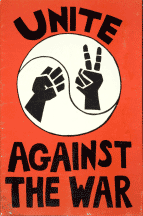
unite-against-the-warReports are emerging from July’s National Assembly, the vital effort to unite antiwar forces into a common movement. Delegates from the major peace organizations hammered out a strategy to address Iraq, Afghanistan, Pakistan and Palestine. Missing from the consensus? Nonviolence, and good riddance. It goes without saying that humanitarian activists are peaceful. To legislate a dogma of non-confrontation plays right into the hands of the authoritarians. Here’s the official report:

AN ASSESSMENT OF THE FIRST YEAR OF THE NATIONAL ASSEMBLY TO END THE IRAQ AND AFGHANISTAN WARS AND OCCUPATIONS

Address given by Marilyn Levin, member, National Assembly Administrative Body, and Planning Committee, Greater Boston United for Justice with Peace Coalition, to the National Antiwar Conference held July 10-12, 2009 in Pittsburgh, Pennsylvania

July 10-12, 2009, 255 people representing diverse organizations and constituencies from all over the country came together in Pittsburgh:

1) To look at where we are today,

2) To articulate our long range goals to rejuvenate the antiwar movement towards building a massive movement capable of forcing an end to their wars and occupations, to take our money back from the war machine to meet pressing social needs, and to save our planet for our children, and

3) To develop and vote for action plans as steps to realize these objectives.

All of our major objectives were accomplished and we leave today with a comprehensive action agenda to carry us through to next spring. Everyone had a chance to speak and differences were aired without rancor or splits to achieve unity in action.

Friday night’s speakers, along with many conference participants, grappled with how to unify and broaden the movement. Saturday afternoon and Sunday morning, we presented a great roster of workshops covering the major issues we face today. Saturday night’s rally was dynamic and inspiring.

There were two highlights of the conference for me. First was the international component where activist comrades joined us from Canada and courageous labor leaders of powerful mass movements in Haiti and Guadaloupe reminded us that imperialism and the struggle against it are global. There was a statement by members of the Viva Palestina aid convoy detained in Egypt. We passed motions in solidarity with the struggles of the people of Haiti, Honduras, and Palestine.

The second highlight was the discussion on Iran, where, in spite of strong passions stirred up by the rapidly evolving events there, we were able to illuminate the issues and debate our differences. Finally, we were able to agree on a unity position that all could embrace, as well as meeting the foremost call of the Iranians – US Hands off! No Sanctions! No interventions! Self-determination for the Iranian people! A wonderful example of a united front –- as inclusive as possible and taking principled positions that most will accept and act on.

So what is the National Assembly? What you saw this weekend explains who we are and how we function.

Democracy. All were invited and all perspectives welcomed. There was acceptance of the will of the conference even when it diverged from the proposals put forward by the leadership body. We were especially gratified that representatives from all the major antiwar coalitions came and addressed our conference.

Our willingness to struggle for unity and compromise when needed in order to move forward, as evidenced by a leadership that did not impose personal political views on others in service to unity.

An organization that admits to and learns from its mistakes and accepts its limitations when the unity we seek can’t yet be achieved.

An organization that has built a growing cadre of leaders that has developed trust, a structure that works, and a strong working relationship.

And finally, confidence, vision, and optimism. Confidence that we can provide leadership in rebooting our movement. A vision regarding how to accomplish that and an understanding of the necessity for these kinds of conferences leading to action. Optimism that masses of people will move in opposition to these horrendous policies that bring death and destruction and that they will have the power to change the world.

I’ve been asked to give an assessment of the first year since our initiation as an ongoing network with a mission, from our first conference in June, 2008 until today. Last year, we weren’t sure anyone would come and lo and behold 400 people came together in Cleveland to inaugurate a year of activities and set up a structure to maintain our work. A lot has transpired in that year and the National Assembly is well on its way as an established organization recognized throughout the movement as providing leadership and promoting a direction towards growth.

I need to start a little earlier and go back to why the National Assembly was called into existence in the first place.

What we saw, in the spring of 2008, was a movement at a low ebb – one that was shrinking rather than growing in spite of the war dragging on — this while the antiwar sentiment couldn’t be higher, and the disapproval rating for the Bush Administration couldn’t have been lower. From the high point of the largest action against the Iraq War in September, 2005 which drew 700,000 people, there was a pulling away from mass action by significant sections of the movement which supported electoral politics as the central strategy, in spite of a recurring pattern of disappointment when Democratic “antiwar” candidates voted again and again for war and war funding, and a split between the two major national coalitions, UFPJ and ANSWER, one that continues to this day. For the first time in five years, there was not enough unity or mass action perspective for any national demonstrations to take place marking the 5th year of the occupation of Iraq. Fundamentally, there was a vacuum of leadership.

Some far-sighted people like Jerry Gordon and Jeff Mackler, with experience gained from leadership in the last powerful antiwar movement that ended the Vietnam War, felt impelled to act. They began to organize a base of diverse but like-minded activists committed to building and expanding an effective antiwar movement in this country. The vehicle to accomplish this was the first national assembly, a national conference to pull activists together, to analyze the present state of the movement, to discuss where we needed to go and the actions that were needed to get us there.

We developed a unity statement with five basic principles that we hold today as the basis for where we stand:

1) Unity – all sections of the movement working together for common goals and actions;

2) Political Independence – no affiliations or support to any political party;

3) Democracy – decision-making at conferences with one person, one vote;

4) Mass Action – as the central strategy for organizing while embracing other forms of
outreach and protest; and

5) Out Now – the central demand to withdraw all military forces, contractors, and bases
from the countries where the U.S. was waging war on the people.

It seems simple but no one else saw it that way. Our conference was unique in the history of the present movement.

The organizers didn’t know what the mood and composition or strength of the conference would be, so we were cautious and minimal in the program we posed to the conference. We focused on Out Now from Iraq and modest action proposals, not being strong enough to initiate national actions on our own. The conference participants were ahead of us and ready to tackle the larger issues. Proposals were passed to add “Out Now from Afghanistan”, “End U.S. Support for the Occupation of Palestine”, and “Hands off Iran” to our set of demands, and given what has transpired in these areas, we were well prepared to take on a major role.

October 10th actions held in 20 cities were endorsed as well as a call for December actions building towards what we hoped would be unified, nationally coordinated bicoastal mass actions in the spring of 2009, the 6th year of the Iraq occupation. When Gaza was brutally assaulted, we joined with ANSWER and others to march in Washington and to demonstrate in the streets all over the country, and we’re still working under Palestinian leadership to bring justice and relief to a beleaguered population.

We made a concerted effort to find a common date for spring bi-coastal mobilizations. As you know, ANSWER chose March 21st as a day of united protests which we endorsed, while UFPJ called for a national march on Wall St. on April 4th. A number of National Assembly supporters who were also delegates to the UFPJ conference in December formed a mass action unity caucus and went to the conference with a resolution to allow delegates to vote for one or both actions but this was rejected. We’ll keep trying for 2010. The National Assembly endorsed and built both actions and marched behind our signs with our demands. The demonstrations were small (but spirited) and still of major importance.

For us, it’s quality, not quantity, as we position ourselves to be in the forefront as the pendulum swings in our direction once again.

Some take the position that mass demonstrations are not effective, unless we can pull 100,000 protestors into the streets. This is short-sighted and does not address how we get from small to large. Any successful movement for change doesn’t start with 100,000 people, and there has never been significant social change without mass actions. I remember my first anti-Vietnam war demonstration was in 1963 in Detroit and we had 15 people. In 1965, SDS called the first national march against the war in Washington. 25,000 people turned out and we thought it was huge!

Everyone talks about reaching out to the thousands of young people who mobilized to elect Obama. We agree, but we say the way to do this is by offering education and action. Action beyond calling, and emailing, and faxing the politicians they placed in office.

Why are mass demonstrations so important to building a powerful movement? It is because they accomplish so much in the process of building them. They provide:

Continuity. You can’t build anything by starting anew each time. Each action should lead to the next action or open national conference, with success building upon success. We need a continuity of leadership that builds trust and a reputation for integrity, and that learns lessons to improve. We need a continuity of organization and structure that can implement the tasks before us.

Visibility. Actions in the street give heart to the people the U.S. is attacking and occupying, letting them know that they are not alone. Mass actions create solidarity, offering support to anti-war soldiers, vets and their families, and a counter-force to the economic draft facing our youth, and they strengthen and deepen the antiwar sentiment of the people.

Inspiration. New people are brought into the movement, especially the youth, through activism. Have you ever talked to young people coming to a mass demonstration for the first time? They are inspired and thrilled to hear powerful speakers who are leaders of social justice movements and soldiers resisting the wars. They see they are not alone and get a taste of the power of large numbers of people marching together. They are energized to go home and join with others to continue to organize opposition to brutal U.S. wars and occupations. This is the way to reach out to the Obama supporters.

Explanation. An analysis of what is going on is offered along with tying together what seem at first to be disparate elements, i.e., war is tied to the economy, the war budget, bail-outs of the rich, the lack of basic needs being met, justice denied, and the impoverishment of the people.

Pressure on Government. People in this country are taught to be quiet. We’re told that our job is to elect officials whom we agree with periodically and then go home and wait while they fix things. This conveniently maintains the status quo but it sure doesn’t put pressure on them, or scare them, or force social change. Mass actions provide the most effective way to make significant change happen.

Let’s look at the present period. Obama’s election was based in large part on the hopes and aspirations of Americans for peace and a better life based on the promises and assumed promises that were made of peace, justice, and prosperity, which have not and will not be met.

Contrary to expectations, the previous administration’s policies are continued with a more handsome and articulate face. We all know that rather than winding down, wars and interventions are escalating and the rapacious greed of this immoral system knows no bounds.

Simultaneously, the economic crisis is causing terrible hardship for working people and for people who are no longer able to find work and their families. They are using this self-created financial disaster to further cut the standard of living and eliminate a secure future for older people and the young.

It was very moving and yet appalling to see this visually demonstrated when Robin Alexander of the United Electrical Workers Union asked people in the audience to stand who were unemployed, personally knew of soldier casualties, lived in communities where services were being cut, or who were otherwise negatively impacted by the wars and the failing economy. Nearly the entire room, a microcosm of the wider society, was standing by the end of that exercise.

It is inevitable that the present period of quiescence and hanging on to the hope that Obama and the new Congress will save us will come to a crashing end. People will not sit idly by forever while the world around them collapses. We are already seeing the beginnings of stirring. There is a greater willingness to go out in the streets to protest. There is more organizing taking place on campuses, more young people joining the movement. The many proposals for October actions are an indication that there is a widespread awareness of the need for actions this fall and the conviction that the movement must find common dates.

Brian Becker, National Coordinator of ANSWER, urged that we all work together to mount nationally coordinated actions next spring. Michael McPhearson, Co-Chair of UFPJ and Executive Director of Veterans for Peace, announced his support for October 17 and his willingness to do what he could to spur unified actions in the spring of 2010. We must have the faith and confidence that the people have the power to end the atrocities resulting from U.S. wars and occupations, and that they will recognize and utilize this power. As this happens, we must build a stronger antiwar movement that is able to provide leadership and the optimism to forge ahead no matter what the opposition throws at us.

The National Assembly to End the Iraq and Afghanistan Wars and Occupations is helping to provide that leadership and the vision that is needed. Although young and small, in one short year, we are now a force to be taken seriously and negotiated with, and by our persistent call for unity and mass action, our demonstrated ability to organize, and our coordinated strategy for revitalizing the movement, we are having an impact larger than our forces would indicate. In some ways, we too are a product of (and some say an antidote to) the 2008 election. To counter the malaise of the movement, we have quietly been building a solid core of activists and leaders around the country that understand the importance of a united front organized around principled demands and mass actions, not just calling Washington politicians when bills come up and crises happen.

At this conference, we have laid out an ambitious program of action that will take us through the spring of 2010. We are proud that we could provide the kick off for national organizing to bring a massive turnout to Pittsburgh for the G-20 protests September 25. Homeland Security is already making preparations to keep protesters hidden and stifle our right to speak out, but we won’t be silenced.

Following that, are a series of October building actions, culminating in large local and regional demonstrations on October 17 marking dates of significance related to the Iraq and Afghanistan wars and occupations and remembering the legacy of the anti-Vietnam war movement. Throughout the year, we will organize educational programs, support various forms of protest and organize around the inevitable emergencies caused by our government’s unholy interventions and threats to other nations.

We have initiated a Free Palestine Working Committee to ensure this work, which includes the growing boycott, divestment, and sanctions campaigns and the efforts to break the siege of Gaza, continues to be in the forefront and fully integrated in our work until justice and self-determination and return is in the hands of the Palestinians.

And lastly, we will continue to advocate for unity of the movement and once again bring thousands to Washington and the West Coast in the spring, to let our government and the world know that the U.S. movement against wars and occupations is alive and will not be quiet.

We will march and continue to march until all U.S. forces come home, bases are dismantled, and the sovereign people of the world have the right to control their own resources and determine their own futures, and the war budget becomes the peace budget.

Don’t sit on the sidelines and watch history being made. We urge all organizations to join the National Assembly and to play your part in building and shaping the powerful movement that is coming.

All out for the September 25 G-20 march in Pittsburgh! All out for the actions in early October! All out October 17!

King Sooper UFCW members hang tough

King Sooper grocery workers
COLORADO SPRINGS- King Sooper UFCW Local 7 members vote this week. Local activists are ready to join their brethren at the picket line. If the supermarket giants persist in their efforts to deny workers benefits and living wages, they might be surprised to see how far customers will be willing to go to support their friends in the business.

Managers Lie, Benefits DieThis letter just in from the United Food and Commercial Workers:

Dear Friend,

You might be surprised to learn that despite the economic downturn, the national grocery chains in Colorado continue to rake in large profits as more and more people choose not to dine out.

What’s really shocking (or…frankly…not so shocking) is that the profitable national grocery chains are pushing cuts on our friends and neighbors who are working harder than ever at these stores. When profitable grocery chains ask their 17,000 workers in Colorado to make financial sacrifices, it doesn’t just hurt those workers, it hurts all of us, and hamstrings Colorado’s economic recovery.

So what can you do about it?

Your neighborhood grocery workers are in the midst of negotiations that could very well lead to a strike or a lockout. It’s not something anyone wants to happen. There are a lot of tough kitchen table conversations going on right now about what might happen if a family member has to give up a paycheck to take a stand for a fair deal.

Grocery Worker Without Benefits, Please HelpThese workers need to know that they have friends –that there are people out there who will respect a picket line.

Take the pledge today to support workers, and respect the picket line should a strike or lockout happen.

Please join us in support of Colorado’s grocery workers as they negotiate to get a fair deal and pledge to not cross the picket line if a strike becomes their only option.

Please sign the petition and share your comments.

We might add, let them know you will JOIN THE WORKERS ON THE PICKET LINE! The grocery worker’s resources may be thin, but yours and mine are not. WE will not stand for businesses who seek to impoverish our friends and neighbors.

High Country Earth First Denver Meeting

Earth First roadshowHigh Country Earth First is hosting the EF! ROADSHOW, in DENVER, May 25-26: Monday 2pm in Cheesman Park, and Tuesday 6pm at the Gypsy House.
 
Four ongoing EF! projects in Colorado: DENVER: Stop I-70 Expansion through North Denver; SAN LUIS VALLEY: Halt gas drilling in Baca National Wildlife Refuge: and WESTERN SLOPE: Red Cliff mine campaign and Feral Futures (May 24 – June 7).

From “Rockslide,” High Country Earth First!

The need for resistance in solidarity with the wild has never been louder or clearer than it is today; the EF! roadshow is a great tool for growing that resistance. There are countless examples to draw from in the story of radical movements before us: militant labor organizing tours, anti-fascist resistance recruitment and international speaking tours to build cross-border solidarity. The origin of Earth First! itself is credited to a few roadshows that kicked it all off in the early 1980s. We are building on this tradition; akin to a fellowship crossing Middle Earth to amass insurgents to face Mordor head-on.

List-serves and websites aren’t enough
This Roadshow’s primary intention is to strengthen our radical grassroots ecological network. For almost 30 years, we have been an organized voice bridging conservation biology with grassroots community organizing, road blockading and eco-sabotage. In the past 5 years we have seen numbers and experience-level in the EF! movement decline drastically. Yet, our place has never been more urgent. New groups are popping up across the country, but they are detached from many of the groups, history, and skills that came before them. We can’t afford to stumble and make the same mistakes over again.

We are at the tail end of a decade where corporate globalization rooted itself in the US and spread across the planet like a plague. And now that the reality of climate change is finally sinking into the mainstream consciousness, the same superpowers that pushed so-called ‘free trade’ policies to exploit wild nature more efficiently are promoting carbon trading in attempt to make a profitable industry out of the disasters they’ve created. The spineless Big Green environmental NGOs are scrambling for crumbs and cutting deals with the industry for shallow public relations victories. Earth First! must rise and recognize that it’s presence is a strong component of making the broader environmental movement truly effective. We are its spine, or as an EF! co-founder, Howie Wolke, has put it, we are the lions of a movement ‘ecosystem’. Our niche is critical, and its presence (or absence) is felt deeply by our surroundings.

We need to reconnect the multi-generational aspect of Earth First! that has fallen by the wayside in recent years. We need to broaden our network’s base—from radical rural grandparents to revolutionary urban youth. We need re-establish lost relationships with scholars and scientists who resonate with us. We need to re-inspire musicians and artists to contribute their passion to our battles.

When it comes down to it, solid movements are based on strong personal relationships; and real relationships don’t go very far over the internet. We need face-to-face interaction to build trust with—and support for—each other.

From EF! Here is a glimpse of ongoing local and national campaigns and projects related to EF!. They could all use your support in a variety of ways—from fundraising to showing up in person. Please contact the organizing groups directly to find out what they need most:

Northern California Redwood Defense
Since the fall of Maxxam/Pacific Lumber, forest defenders in the Redwoods have been directing attention on another logging empire: Green Diamond Resource Company (formerly Simpson). In the last 10 years they have clear-cut 52,000 acres of Northern California forests. They are killing off endangered Spotted Owls and have aspirations to sell off thousands of acres in Humboldt County for Salmon killing suburban development. We have set up multiple treesit villages to oppose the destruction, and we need your help TODAY.
www.efhumboldt.org

Appalachian Anti-Mountain Top Removal
The presence of coal plants are threats to the lives within both the human community and the mountain ecosystem. One of the most biologically flourishing areas of the world is being environmentally and socially impoverished by companies practicing mountain top removal. Mountain top removal clogs streams, destroys forests, threatens biodiversity and forces coalfield residents into the unjust choice between income and well-being.
www.blueridgeef.com

Stop I-69 in Indiana
I-69 is a NAFTA superhighway, already constructed from Canada to Indianapolis and projected to extend down into Mexico. This highway is intended for the mass transportation of goods and resources, to further exploit workers and the land, and to lessen companies’ accountability in terms of human and environmental rights. In 2008, they began construction of this road through southwestern Indiana, which will evict hundreds of rural families, destroy hundreds of acres of land, and devastate the habitats of countless species of animals, including the endangered Indiana Bat. www.stopi69.wordpress.com

Fight Development in the North Woods of Maine
The largest piece of undeveloped land east of the Mississippi is under attack. Plum Creek, the nation’s largest corporate landowner, is in the process of rezoning 20,000 acres of the Moosehead Lake region in Maine for luxury house and resorts, while trying to balance it off with a fraudulent conservation easement plan. This plan would still allow timber harvesting, commercial water extraction and the building of new infrastructure, among many other ecologically devastating practices. www.maineearthfirst.wordpress.com

Defend the Last Free-Roaming Wild Buffalo in Montana
The Buffalo Field Campaign (BFC) is the only group working in the field, everyday, to stop the slaughter and harassment of Yellowstone’s wild buffalo. Volunteers from around the world defend buffalo on their traditional winter habitat and advocate for their protection. Our daily patrols stand with the buffalo on the ground they choose to be on, and document every move made against them. Tactics range from video documentation to nonviolent civil disobedience. www.buffalofieldcampaign.org

Fight new Copper Mines and Roads in the Deserts of Arizona
Chuk’shon Earth First! is fighting the proposed Rosemont Copper Mine in the Santa Rita Mountains, which is greenwashing itself by claiming a need for increased copper extraction for the solar panel industry. The group is also opposing the expansion of I-10, part of the Department of Transportation’s “Corridors of the Future” program to increase capacity of global industrial commerce. The proposed I-10 Bypass would bisect wild/rural lands and facilitate more sprawl between Tucson and Phoenix. www.chukshonef.wordpress.com

Blue Mountain Biodiversity Project in eastern Oregon
Blue Mountains Biodiversity Project (BMBP) formed in 1991 to increase regional and national awareness of the Blue Mountains ecosystems, to ensure the protection for and reintroduction of diverse native wildlife species, to promote ecologically sound restoration and address the root causes of ecological and community instability. They have trained countless EF!ers is forest monitoring. They are one of the country’s premier grassroots ‘paper-wrenchers’, filing legal challenges that help make our blockades successful. They can be reached at 541-385-9167

Stop Florida Power & Light from trashing the Everglades
Everglades Earth First! (EEF!) have been battling FPL’s plans to build the country’s largest fossil fuel power plant in the Loxahatchee Basin; a headwaters to the remaining Everglades ecosystem. EEF! Is also challenging over 500 miles of new gas pipelines and 2 new Liquified Natural Gas (LNG) facilities. Get more details: www.evergladesearthfirst.org

Stop Gas Drilling in Western New York
There is a proposal on the table to begin one of the largest fossil fuel exploration projects in the country. This project would result hundreds of millions of tons of CO2 emissions, along with the impacts of pipelines, power plants, and new LNG storage facilities. Get in touch with Shale Shock: www.shaleshock.org

Bank of America, Stop Funding Coal!
A national campaign is well underway to stop Bank of America (BoA), who is the largest investor to Mountain Top Removal coal mining. The company recently offered lip-service to address their support for the coal industry, but have made no real steps towards cutting ties with King Coal. With BoA locations in cities across the U.S., this campaign can easily be supported in a decentralized fashion. Give ‘em hell! For more info: www.ran.org

No 2010 Olympics
The Native Youth Movement and other First Nations groups in occupied Canada have called for full-scale resistance to the Winter Olympics proposed in British Colombia. The Olympics proposal includes a mess of development, ski-resorts and infrastructure on indigenous land. Learn more at: www.no2010.com

Root Force
This project is a research database and strategic think tank for direct action intended to target corporate/colonial infrastructure, such as: roads, dams, power plants, and mines. Their website offers background information on transnational companies, government agencies and their local affiliations across the United States. www.rootforce.org

Those poor banks! Those poor grocery store chains!

The banks have ‘failed their stress tests’ and now need at least $75 BILLION dollars from taxpayers! See Ten US banks fail ‘stress tests’ …Doesn’t your heart just bleed for them? And not to be outdone the grocery store chains, led by Kroger (KING STUPID), Safeway, and Albertsons are out there trying to convince the general public that they are being beat up bad by union workers, most of who make less than $15 per hour. They just can’t take it anymore! So their solution?

It looks like it might be to lock out the workers and use the government’s police to try to force these people into unemployment lines! Destroy their pension plans. Work them to death and then discard them! This all is on hold for now, but the companies may begin this assault within days?

DON’T SCAB if they do lock out the grocery workers. Support union labor and they will support you! Workers have Rights, but only if you solidly back them up with Your Solidarity instead of giving in to these crappy food grocery chains by vacantly walking past union picket lines if they are forced to go up.

Eat right! Do right! Don’t cross picket lines. Write Management a note and tell them how you feel! And tell the workers you support them, too.

Darfur, the Israeli lobby & US Democrats

hillary-clinton-meets-israelWhat does it mean for Africa when right wing end-of-the- world-is-near evangelical Christians join forces with the Robert F. Kennedy Center For Human Rights? What does it mean for African Americans when Bush, Obama, and nearly all last year’s presidential candidates from both parties encourage the continuation of an African civil war rather than a political settlement between the parties? What does it mean when 21st century PR firms employ FaceBook, slick viral marketing and millions of dollars to create a simple, satisfying, feel-good excuse for military intervention on the African continent? –from Is There a Save Darfur Industrial Complex?

But Save Darfur has gotten into hot water with aid groups helping the refugees of the conflict.

In February it began a high-profile advertising campaign that included full-page newspaper ads, television spots and billboards calling for more aggressive action in Darfur, including the imposition of a no-flight zone over the region.

Aid groups and even some activists say banning flights could do more harm than good, because it could stop aid flights. Many aid groups fly white airplanes and helicopters that may look similar to those used by the Sudanese government, putting their workers at risk in a no-flight zone.

Sam Worthington, the president and chief executive of InterAction, a coalition of aid groups, complained to Mr. Rubenstein by e-mail that Save Darfur’s advertising was confusing the public and damaging the relief effort.

“I am deeply concerned by the inability of Save Darfur to be informed by the realities on the ground and to understand the consequences of your proposed actions,” Mr. Worthington wrote.

He noted that contrary to assertions in its initial ads, Save Darfur did not represent any of the organizations working in Darfur, and he accused it of “misstating facts.” He said its endorsement of plans that included a no-flight zone and the use of multilateral forces “could easily result in the deaths of hundreds of thousands of individuals.”

Another aid group, Action Against Hunger, said in a statement last week that a forced intervention by United Nations troops without the approval of the Sudanese government “could have disastrous consequences that risk triggering a further escalation of violence while jeopardizing the provision of vital humanitarian assistance to millions of people.”

Aid groups also complain that Save Darfur, whose budget last year was $15 million, does not spend that money on aid for the long-suffering citizens of the region.

from the New York Times June 2, 2007 Darfur Advocacy Group Undergoes a Shake-Up

‘The “Save Darfur (Coalition) was created in 2005 by two groups concerned about genocide in the African country – the American Jewish World Service and the U.S. Holocaust Memorial Museum…

‘The coalition has a staff of 30 with expertise in policy and public relations. Its budget was about $15 million in the most recent fiscal year…

from The Washington Post at http://www.overbrook.org/newsletter/06_07/pdfs/AJWS_Washington_Post.pdf

Hillary Clinton on Darfur as she calls for more Pentagon intervention and wars abroad. This is a woman that has no problem with genocide when committed by the US and/ or Israel.

Biden calls for military force in Darfur speaks for itself as he directly calls for a US military assault on Sudan See Joe Biden: Darfur as he calls for US troops to attack Sudan

Pioneering human shields since 9-11-01

WTC 911 terrorist attackWard Churchill called them Little Eichmanns, but if that’s giving the World Trade Center workers too much credit, at minimum they were human shields, masking the Command & Control Center of America’s economic war machine.

The US military is quick to blame its foes for using human shields, to explain the collateral damage we always inflict –Iraq, the Taliban, Hamas, Hezbollah– but who more deliberately than the USA? The huge weapons industry makes all fifty states legitimate military targets, and now because armed drones are piloted from US soil, the homeland war zone extends into our homeland, for which the American public is the human shield.

Support UFCW Local 7, shop elsewhere

UFCW signUCFW Local 7 workers, the people who look after you at Albertsons, Safeway and King Soopers, may have to go on strike on Saturday in a bid to save their retirement, benefits and hours. As it is they’ve already conceded to wages and work schedules much worse than yours. Do you support them in this fight? Well, you’ll have to figure out where to get your groceries for the next little bit. The more we deny the supermarket chains our business, the shorter the strike will inconvenience us.

Meanwhile however, the search for alternate sources of provisions just might expand your horizons. After you’ve found natural food, fresher produce, or more variety, the big three will have to offer us more of that to lure us back. There are plenty of more traditional grocery stores in town, specialty, natural and discount, where we could be shopping for our food. Check them out.

SPECIAL NOTE: DO NOT go to Walmart, Sam’s Club or Costco, because that’s who’s driving the wages down and giving the supermarket chains the idea that they can treat their workers as terribly.

As a rule too, do not use the auto-checkout machines because they are taking jobs from everyone.

Alright here’s an incomplete list:

GROCERS
Asian Pacific Market, 615 Wooten Rd, at Powers and Platte
India Bazaar, 3659 Austin Bluffs Parkway #35
La Cusquenita, 2031 E. Bijou
Rancho Liborio Market, 1660 S. Circle
Little Market, 749 E. Willamette
Mountain Mama Natural Foods, 1625 W. Uintah
New Han Yang Oriental Supermarket, 3835 E. Pikes Peak
Sammy’s Organic Natural Food Store, 830 Arcturus Dr
Seoul Oriental Grocery Mart, 2499 S. Academy
Thai Orchid Market, 2485 S. Academy
Vitamin Cottage Natural Grocers, (2 locations) 1780 E. Woodman
+ 1825 S. Nevada Ave, Southgate
Whole Foods Market, 7635 N. Academy, Briargate
Whole Foods Market, 3180 New Center Point

SALVAGED GROCERIES
Extreme Bargains, (3 locations) 3112 E. Platte
+ 3190 N. Stone + 2727 Palmer Park
Westside Bargain Mart, 3135 W. Colorado Ave
Community Market, 56 Park Ave, Manitou

SPECIALITY
Ceres’ Kitchen, 9475 Briar Village Point, Briargate
Staff of Life, 65 Second St, Monument
Carniceria Leonela, 3736 E. Pikes Peak Ave
Carnizeria Y Taqueria La Eca, 216 E. St. Elmo Ave
Arirang Supermarket, 3830 E. Pikes Peak
Back to the Basics Natural Foods, 2312 Vickers
Briar Mart, 1843 Briargate Blvd
Carniceria La Trigena, 217 N. Academy
Euro-Mart & Deli, 4839 Barnes
Wimberger’s Old World Bakery & Deli, 2321 Bott
Mollica’s Italian Market & Deli, 985 W. Garden of the Gods Rd

FARMERS MARKETS
Nana Longo’s Italian Market, 1725 Briargate Blvd
Spencers, 1430 S. Tejon St

MEAT MARKETS
All Natural Meat and Fish Market, 1645 Briargate Parkway, Briargate
Ranch Foods Direct, 2901 N. El Paso, Fillmore/El Paso
Andy’s Meat Market, 2915 E. Platte, Platte & Circle
Rocky Mountain Natural Foods, 2117 W. Colorado

DAIRY
Farm Crest Milk Stores, (7 locations) 4095 Austin Bluffs Parkway
+ 5050 Boardwalk Dr + 2105 W. Colorado Ave + 5510 S. Hwy 85/87
+ 3945 Palmer Park Boulevard + 2129 Templeton Gap Rd
Robinson Dairy, (delivery) 120 S. Chestnut, 719.475.2238
Royal Crest, (delivery) 1385 Ford St, 719.596.1986

BAKERIES
Great Harvest, (2 locations) 101 N. Tejon St + 6942 N. Academy
La Baguette, (4 locations) 2417 W. Colorado + 117 E. Pikes Peak
+ 4440 N. Chestnut + 1420 Kelly Johnson
Boonzaaijers Dutch Bakery, 4935 Centennial
Entenmann’s/Oroweat Bakery Outlet, 4715 Flintridge
Wonder Hostess Thrift Shop, 847 E. Platte

Safeway, King Soopers want you to scab

Posted at westside SafewayCOLO. SPRINGS-
The notice on the supermarket door reads “Due to a possible labor dispute Safeway is now accepting applications for temporary employment.”
UFCW Local 7 is predicted to go on strike this weekend. Instead of working toward a settlement, the supermarkets are planning to hire SCABS, which shouldn’t be hard in this economy. In the few minutes I was watching, two eager dumbersomethings strode into the store with applications. Hopefully an ugly picket line will raise Colorado Springs’ class struggle literacy.

“King Soopers will be hiring temporary replacement workers as a precautionary measure due to a potential labor dispute with the
U.F.C.W. – Local 7 which may occur on or after May 9th, 2009.”

King Soopers wants scabs

Don’t be a strikebreaker!

The major grocery store chains here in Colorado are planning to attack their workers next week by forcing a strike. At issue is that they want to destroy the pensions of these workers so don’t break their strike by crossing the picket lines and into the stores to shop. All workers deserve a decent retirement!
United food and commercial workers

You can even help out on the picket line for a bit and show some solidarity with these people in their efforts to stop company cutbacks forced against them. You can also go do your own shopping for groceries at some of the ethnic grocery companies in Colorado and help save some of your own money in the meantime. Give yourself and union workers a break!

Here is what this strike will be about…

By Laura Chapin – UFCW Local 7 – For Immediate Release – 5/2/2009

The federal government has extended the deadline for the green – or fully funded – status for the major grocers’ pension fund from April 30 to June 30, giving the companies a second chance to do the right thing by their workers. The union has already agreed to the extension, so it’s up to the companies to meet the workers halfway.

Under the Worker Retiree and Employer Relief Act of 2008, trustees of a pension plans – both the union and the companies – have the option of extending their green status, or adequately funded status, for one year. If the company trustees fail to agree to extend the green status by the new deadline of June 30, the pension fund will go into a red status, meaning there will be insufficient funding to maintain the workers’ pension plan.

The union pension trustees have agreed to the one-year extension, but the company trustees have refused and instead proposed dramatic cuts to worker’s pension benefits. The benefits to be cut include eliminating the Golden Rule of 80, which raise the retirement eligibility from age 50 to age 62, eliminating the disability pension, and eliminating a $200 a month supplement between ages 60 and 62 years of age.

“We agreed to the extension because we want to give the economy time to recover,” said UFCW Associate Counsel Crisanta Duran. “Instead of meeting the workers halfway on the agreement, which would not have cost them a penny, the companies are choosing to use the under funded status as a bargaining chip and ask for almost 50% in cuts. This is not fair to the workers who are counting on the retirement they have earned.”

According to Safeway worker Arlys Carlson, “All we’re asking is that the companies take care of us the same way we’ve taken care customers all these years.”

UFCW Local #7 represents approximately 17,000 Colorado grocery workers at Safeway, King Soopers/City Market, and Albertsons. Negotiations began April 9 and will continue daily through the current contracts’ expiration on May 9.

For More Information:
Laura K. Chapin, (303) 425-0897 ext 302 ofc
(303) 885 – 1402 cell

The major companies simply want to destroy the unions with a strike. They have begun putting help wanted ads in the papers looking for scab workers to replace union workers. Sadly enough there are many who will try to grab these jobs and to Hell With Those Guys will be their attitude, since this is America, Land of the Screw the Others. Many are actually proud of themselves for being ‘smart’ when they do so. Wrong.

Colorado Springs Calendar MAY 2009

MAY 2009
1- May Day: International Workers Day
4- Tobias Wolff, Reading at CC, Armstrong Theatre, 7pm
9- UFCW Local 7 contract expires with Safeway workers
15- NAKBA commemoration
17- CFP Protest of PRO-ISRAEL RALLY, City Auditorium, 3pm-6pm
18- Senator Michael Bennet, CC commencement, Quad, 8am
18- Governor Bill Ritter, City Hall, Fountain, 6pm
23- Uncle Wilbur Fountain, annual opening, Acacia Park, 11am-1pm
25- High Country Earth First! EF! ROADSHOW, Cheesman Park 2pm
26- High Country Earth First! EF! ROADSHOW, Gypsy House 7pm
27- Colorado Springs ACLU annual meeting, G&L Foundation
27-6/3 Feral Futures, to be disclosed shortly
30- UFCW solidarity action, TBA

Saipan abuses impervious to outrage?

A 2006 article in MS Magazine exposed labor abuse in the US territories of the Northern Mariana Islands (CNMI). Have conditions changed since protectors Tom Delay and Jack Abramoff were dislodged? Consider that US Senator Daniel Kahikina delivered this condemnation of human exploitation in the Saipan in 1998.

The Commonwealth shares our American flag, but it does not share the American system of immigration.

There is something fundamentally wrong with a CNMI immigration system that issues permits to recruiters, who in turn promise well-paying American jobs to foreigners in exchange for a $6,000 recruitment fee. When the workers arrive in Saipan, they find their recruiter has vanished and there are no jobs in sight. Hundreds of these destitute workers roam the streets of Saipan with little or no chance of employment and no hope of returning to their homeland.

The State Department has confirmed that the government of China is an active participant in the CNMI immigration system. There is something fundamentally wrong with an immigration system that allows the government of China to prohibit Chinese workers from exercising political or religious freedom while employed in United States.

Something is fundamentally wrong with a CNMI immigration system that issues entry permits for 12- and 13-year-old girls from the Philippines and other Asian nations, and allows their employers to use them for live sex shows and prostitution.

Finally, something is fundamentally wrong when a Chinese construction worker asks if he can sell one of his kidneys for enough money to return to China and escape the deplorable working conditions in the Commonwealth and the immigration system that brought him there.

There are voices in the CNMI telling us that the cases of worker abuse we keep hearing about are isolated examples, that the system is improving, and that worker abuse is a thing of the past. These are the same voices that reap the economic benefits of a system of indentured labor that enslaves thousands of foreign workers — a system described in a bi-partisan study as “an unsustainable economic, social and political system that is antithetical to most American values.”

There is overwhelming evidence that abuse in the CNMI occurs on a grand scale and the problems are far from isolated.

Mother Jones: You Don’t Need a Vote

Mary Harris Jones portrait from her 1925 autobiographyAfter the 1914 Ludlow Massacre and the later capitulation of the UMWA union, Mother Jones, by now 85 years old, toured the US to spread the word about what happened. She wrote in her autobiography, about a meeting in Kansas City: “I told the great audience that packed the hall that when their coal glowed red in their fires, it was the blood of the workers, of men who went down into black holes to dig it, of women who suffered and endured, of little children who had but a brief childhood. ‘You are being warmed and made comfortable with human blood’ I said. … ‘The miners lost,’ I told them, because they had only the constitution. The other side had bayonets. In the end, bayonets always win.'”

From The Autobiography of Mother Jones, Chapter 22:
YOU DON’T NEED A VOTE TO RAISE HELL.

Five hundred women got up a dinner and asked me to speak. Most of the women were crazy about women suffrage. They thought that Kingdom-come would follow the enfranchisement of women.

“You must stand for free speech in the streets,” I told them.

“How can we,” piped a woman, “when we haven’t a vote?”

“I have never had a vote,” said I, “and I have raised hell all over this country! You don’t need a vote to raise hell! You need convictions and a voice!”

Some one meowed, “You’re an anti!”

“I am not an anti to anything which will bring freedom to my class,” said I. “But I am going to be honest with you sincere women who are working for votes for women. The women of Colorado have had the vote for two generations and the working men and women are in slavery. The state is in slavery, vassal to the Colorado Iron and Fuel Company and its subsidiary interests. A man who was present at a meeting of mine owners told me that when the trouble started in the mines, one operator proposed that women be disfranchised because here and there some woman had raised her voice in behalf of the miners. Another operator jumped to his feet and shouted, ‘For God’s sake! What are you talking about! If it had not been for the women’s vote the miners would have beaten us long ago!'”

Some of the women gasped with horror. One or two left the room. I told the women I did not believe in women’s rights nor in men’s rights but in human rights. “No matter what your fight,” I said, “don’t be ladylike! God Almighty made women and the Rockefeller gang of thieves made the ladies. I have just fought through sixteen months of bitter warfare in Colorado. I have been up against armed mercenaries but this old woman, without a vote, and with nothing but a hatpin has scared them.

“Organized labor should organize its women along industrial lines. Politics is only the servant of industry. The plutocrats have organized their women. They keep them busy with suffrage and prohibition and charity.”

Capitalism is Organized Crime

Capitalism is organized crimeFrom A.N.S.W.E.R.:
–Capitalism is a form of organized crime. The U.S. government is greasing the system’s wheels to ensure that banks and big corporations get trillions in bailout funds. Meanwhile, millions of workers are losing their jobs and homes. Deep cuts are gutting public education, making health care even less accessible and decimating much-needed social programs. Police brutality and racial profiling are rampant. Working-class people are being hit from all sides.

The conference will link the struggles against war and militarism with the fight for economic justice. This conference will be an important opportunity for political activists to meet, analyze, discuss and propose solutions. The conference organizers believe that a radical reorganization of society is necessary to meet the needs of the people rather than to maximize the profits of bankers and corporate executives who have driven society onto the path of endless war and economic suffering.

Featured speakers at the April 19th Conference will include: Marcos García, Mara Verheyden-Hilliard, Brian Becker, Hodari Abdul-Ali, Eugene Puryear, Prof. Zachary Wolfe, Maurice Carney, Muna Coobtee, Frances Villar, James Circello, and Crystal Kim.

Barack Obama: Next Year in Jerusalem

President Obama and family marked the start of the Jewish Passover by hosting a traditional Seder ceremony at the White House, apparently in fulfillment of a campaign promise. Last year Obama participated in a similar dinner with Jewish campaign workers, and when reciting the Haggadah which ends with the wish “Next Year in Jerusalem,” Obama tacked on “Next Year in the White House.” If we assume he didn’t need to add that wish this time, did the White House prayer end: Next Year in Jerusalem?
Jewish Seder hosted at the White House

I find the official photograph released by the White House disturbing all in itself. The higher resolution image reveals that the Obamas and friends are reading from Haggadah pamphlets published by Maxwell House Coffee, a free hand-out at supermarkets. Wouldn’t you imagine the White House has its own printing wing for such occasions? Aren’t most presidential guests expecting to come away with something more than a promotional brochure for a White House dinner keepsake?

And there’s something a-kilter with the dining furniture. The observation has been confirmed in the blogosphere that everyone’s sitting on plastic catering chairs. The chairs are uncomfortable obviously, because everyone’s using cushions behind their backs. These plastic chairs are presumably what you’d use when you have to set extra places. In this case, an entire extra table. Nothing odd about an extra table, but not where you’d expect to have to bump the First Family. Which family is seated at the main table?

Was it deemed imprudent to depict the first Presidential Seder at the formal table, with all the dignified trappings of a White House occasion?

Assuming there’s an art director behind every detail, including the mixed-bag assortment of pillows used to cushion the chairs, the Obamas appear to be cast into a less-than-affluent kitchen table scene, perhaps out of sensitivity for our nation’s recent hard times. It’s a look that might mimic a Depression Era dinnertime, but I cannot conjure when austerity ever reflected a modern White House. Was even down-home Jimmy Carter ever directed to pretend he was more Good Times and less like the Huxtables?

Springs Utilities and “Right to Work” law

Which is really the “right to fire you if you get injured on the job or if you seek fair compensation for your labor or if you form (or join an existing) an organization which represents the workers to ensure the Equal Protection Under the Law and right to petition the Government for redress of grievances” law.

Since both Springs Utilities and the Corporate Welfare Council are married to the Coal corporations, and they both apparently sponsored the “White” wash of the Ludlow Massacre“incident”
I felt it politic to post this again.

When I was in the hospital after my ankle fusion surgery two years ago there was this young dude in the next bed, who had been in an accident while working for Springs Utilities.

He had been working “under the crane” which is a strict no-no in Union work, because the hooks and or the cable and or the chains attached to the crane have a distressing tendency to snap and to send the load which they were bearing straight down.

Which is what happened in this case, the crane dropped a 2 1/2 ton steel fitting onto his foot.

His mom was visiting him, and a gentleman I think was his brother

His doctor came in, one of the surgeons from Front Range Orthopædics. Who is considered to be one of the Premier surgeons in the country.

He had spent the past three days trying to save the kid’s foot.

But the foot had to be amputated, and he was breaking the news to him and his family that they wouldn’t be able to save it.

After he left, his brother and his mom were telling him he needed to hire an attorney, he told them “No, (one of his friends from work) was talking about it with me and he said to just trust the company, they’ll take care of me”.

I almost bit my tongue in two keeping from interjecting on that score.

Then the Corporate Whore company representative came in, she was telling him what the settlement was the company was offering, his mom said ‘should we hire an attorney to review it?” and the Corporate Whore told her “no need, we’ll take care of him TRUST US

Then proceeded to tell the kid that they were going to assign a doctor to him, one “approved by the Corporation” his mom interjected with the fact that he had one of the best surgeons in America already as his doctor and the Corporate Whore said “yes, we know, he’s an excellent doctor but He Doesn’t Keep Up With The Paperwork”

Which is bullsh ee It of such a high order it deserves a third syllable.

The doctors at Front Range don’t do the paperwork, they have a very competent staff who do that.

Efficient enough that all the major insurers including CHAMPVA, TriCare, Medicare, Medicaid, Just a start on the Government insurers, accept their billing and procedures without question.

She was slick-dicking this kid who was in severe pain, on a morphine drip, and cowing him into obedience to The Company Line.

Politely browbeating him but doing it in a way that Establishes The Dominance of Her Corporate Masters, “Thou Shalt Not Question Our Orders”.

Then she said something truly stunning… she said the company would “generously” allow him two years of disability pay, until he
GETS BACK ON HIS FEET and they realized there would be “cosmetic damage” but it shouldn’t affect his ability to Perform his “duties”.

The bitch hadn’t even consulted with his doctor.

But according to the Right Wing Anti-Union “right to work” Fascists,

It’s supposedly the UNIONS who are victimizing us poor stupid workers.

The kid was still opposed to getting his own attorney.

I hope he wised up and realized that the Company was going to screw him repeatedly and often, as long as he allows them to do it.

If he wants to, he can still change his mind, and I’ll testify for him.

The “settlement” was offered to him while he was under extreme duress, in extreme pain and on enough morphine to keep an elephant high.

Illegal as all Hell, but… without Union representation, the Corporate BigPigs can get away with it often enough to make their obscene profit margins.

People who are invested in that corporation, you gotta realize where your money is coming from.

Ludlow Massacre or unhappy incident?

Ludlow Tent Colony 1914
COLORADO COLLEGE- CC is holding a symposium on the 1914 Ludlow Massacre. Actually, it’s only called the Ludlow Symposium. True to Colorado Springs form, several among the audience want to call it an “incidence,” instead of a “massacre.” One of the participants, author Scott Martelle, is willing to oblige, explaining that if the militia hadn’t known that women and children were taking shelter beneath the tents which they were putting to the torch, then the soldiers were guilty only of criminally negligent homicide.

(*Note 4/12/09: this article has been revised in light of helpful comments offered by symposium participants. Also: Differences of opinion aside, I am remiss if I do not praise the scholars who were very generous with their time and encyclopedic memories to enrich this symposium.
1. CC’s own Professor David Mason authored an evocative narrative of lives caught up in the 1914 events, written in verse, entitled Ludlow.
2. Journalist Scott Thomas researched the most recent definitive account to date, the 2007 Blood Passion: the Ludlow Massacre and Class War in the American West.
3. Thomas Andrews, Associate Professor at CU Denver, enlarged the context in 2008 with his award winning Killing For Coal: America’s Deadliest Labor War.
4. Zeese Papanikolas represented his authorative Buried Unsung: Louis Tikas and the Ludlow Massacre, written in 1984.)

Does it matter what it’s called, or with what certainty? The symposium is filled with public school system educators looking for an angle with which to approach Ludlow with their kids. One of them expresses her doubt about teaching about Mother Jones, having just heard from the panelists a probably too-nuanced assessment of the labor hero’s tactics. The political climate of our age can’t find any purchase with moral nuance.

I’m stuck thinking that in recording social history, scholars cannot avoid writing the victor’s narrative. In particular as regards the history of labor, because neither academics nor even middle class hobbyists in the symposium’s audience can look at the events from the perspective of the working class.

Even the scholar’s objectivity is middle class. The opinion was expressed by the panel that the Ludlow aftermath was one of the few occasions when the story was spun to the benefit of labor interests. But this does not account for why authors and educators find themselves having to resurrect the tale of Ludlow these many years later. When it occurred, Americans may have swallowed the hyperbole, but since that time they’ve internalized its internment, effaced by a corporate culture so as to have disappeared from even our school textbooks.

I think this may have been something of the question posed by symposium organizer Jaime Stevensen to the panel, when she asked how the authors insulated themselves from the fictions woven into their own perspectives of history. She didn’t get any takers.

The very concept that history adds up to only so much trivial pursuit, is inherently a view from the ivory tower. BLOOD PASSION by Scott Martelle Do the Ludlow scholars not recognize that common people today face the same foes as did the miners of Ludlow? With the added impediment of a corporate PR system erasing its malevolent deeds. Have not American unions been maligned to the point of extinction? Yet at the same time, capitalists have thoroughly reprised their Machiavellian ways. History can be a tool, not only for statecraft, but for the common American to protect his hard-fought democratic gains.

The United Mine Workers of America having successfully spun the deaths of the striking miner families as a “massacre” may have made an unmerited impact on the public’s sympathies, but likewise, deciding to call Ludlow “not a massacre” will be falsely charged as well. Is there a valuable lesson in unlearning that unbridled corporate greed can be unthinkably inhumane?

OUT OF THE DEPTHS by Barron BeshoarHistorians can fancy themselves objective to ambivalence, but is that a luxury their readers and in particular the schoolchildren can afford? As we witness today the gloves coming off of the globalisation taskmasters?

How I prefer the emotional truth of earlier chroniclers like Barron Beshoar, author of OUT OF THE DEPTHS, a 1942 account of Ludlow, whose preface included this gem:

“If the mine guards and detectives, the mercenaries who served as the Gestapo and the coal districts appear to be scoundrels who sold themselves and their fellowmen for a few corporation dollars, the author will consider them adequately presented.”

KILLING FOR COAL by Thomas AndrewsAt Colorado College the consensus of contemporary historical synthesis, embodied by CU Denver’s Thomas Andrews‘ excellent book KILLING FOR COAL, seems to conclude about Ludlow, “we may never know exactly what happened.” This may reflect the Factual Truth, but it does so at the expense of unrecorded oral accounts, by depreciating their traditional path to us through of folklore.
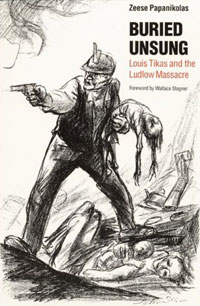
Buried UnsungAnother author made pains to debunk the lyrics “Sixteen tons, and what do you get, another day older and deeper in debt,” a cultural indictment of the “company store,” which was one of the grievances of the Ludlow strikers. He postulated that modern readers could be prone to let folklore color a predisposition against the company store. Perhaps a company store was in fact a convenience, derided because it was an arbitrary restriction against which human nature bucked. Trying to be helpful, another panelist suggested: “Imagine if the company store was 7-11, and you were told you could only shop there.” I believe both of these gentlemen are overlooking the much grosser complaint which the miners were protesting, that of insurmountable debt, systematically forced on them by their employers. That’s a phenomena on the rise today, if maybe not among college professors. Around the world, indentured servitude has never abated.

In our ivory tower we can debate which side, the union or the militia, fired the first shots on April 20. Who was at fault, seemed to be what that question would decide. At least panelist Anne Hyde had the presence of mind to lay some of the responsibility on the mine owners, who weren’t there of course, but whose stubborn greed played a not unsubstantial part in what the other panelists were attributing to “macho intransigence.”

That expression was in vogue to describe Cowboy presidencies. What an effete put down of militant activism. Are we to blame the striking miners for holding firm to their demands?

Thank goodness someone in the audience brought up recent efforts to deny the Sand Creek Massacre, which two panelists quickly weighed in to say “that was a real massacre,” discrediting Ludlow, obviously, and failing to grasp her point that indeed some Colorado Springs locals are rewriting Sand Creek as a battle, and not a massacre.

Another isolationist luxury has become to judge every action as it compares to a nonviolent ideal. It was noted that UMWA union leader John Lawson always recused himself from violent tactics. During the symposium’s opening reception, someone performed a song dedicated to the Ludlow martyr Louis Tikas, which lauded him for choosing to fight with words not guns, as if guns would discredit him.

I’ll play devil’s advocate and suggest that the miners fired the first shots. They saw Louis Tikas bludgeoned in the back of the head and then executed as he lay on the ground unconscious, they saw the National Guard move a machine gun into position above their tent city, and they probably began to fire at the soldiers lest a rain of bullets descend on miners’ wives and children before they had a chance to flee the camp.

The miners were asking that their union be recognized, that the Colorado eight hour work day be enforced, that the scales which determined their pay be verified, that their full hours be compensated, etc. The mine owners clung to their profits, and ordered the miners’ tent city, their only shelter and all their worldly possessions burned to the ground. Women and children were hiding in underground pits dug to escape the sniper fire which the mine guards sporadically aimed at the tents. The guards drove an armored car around the perimeter of the union camp, at all hours, for that purpose.

Ultimately this climate erupted into the violent clash on April 20, 1914, in which the miners battled with the far better equipped soldiers. The casualties were 25 to 1. I call that a massacre.

ADDENDUM: Photographs from visit to the Ludlow Memorial.
Site of Ludlow Massacre, photographed 2009
LUDLOW MEMORIAL, COLORADO- Day three of the Colorado College Ludlow Symposium featured a bus ride to the site of the 1914 Ludlow Massacre, then on to Trinidad to the grave of Union leader Louis Tikas. A reporter for Colorado Public Radio interviewed the symposium panelists at the U.M.W.A. memorial grounds.

April 2009 Visit to Ludlow site
David Mason is interviewed by a freelance reporter for Colorado Public Radio.

April 2009 Visit to Ludlow site
Scott Martelle and Thomas Andrews are interviewed above the fatal cellar.

April 2009 Visit to Ludlow site

April 2009 Visit to Ludlow site

TRINIDAD, COLORADO- Masonic Cemetary.
April 2009 Visit to Louis Tikas grave site

April 2009 Visit to Louis Tikas grave site
Zeese Papanikolas spoke about his protagonist’s gravestone and its reference to Tikas as a “Patriot.”

April 2009 Visit to Louis Tikas grave site

April 2009 Visit to Louis Tikas grave site

Protesting unfair labor at GE Johnson

Colorado Springs union action
COLORADO SPRINGS- For nine months now Carpenters Union Local 515 has been protesting GE Johnson’s use of Spacecon subcontractors who misclassify workers to substantially evade labor costs. Everyday, union members like Jose Cano man this banner at Cascade Avenue, between Bijou and Kiowa, with no end in sight.

Informal Denver bloggers convention

Incognito bloggers at Churchill Trial

Academic Press stringerDENVER- Blog wonks filled the courtroom today to witness the closing arguments of Freedom of Speech on trial. The twin Rocky Mountain News fiends were on hand, as were plenty of their blogosphere stringers. Can you help us put names to some of these faces? Confidential emails to editor@notmytribe will serve just fine. We have a most benevolent motive to shed light on nocturnal anti-socials.
Isn’t it awkward, that those in support of Ward Churchill, to draw the battle lines in terms of this trial, have no qualms being represented publically, but those opposed, even as they think themselves to represent the mainstream, are fiercely protective of their anonymity? How weirdly weak of them.

PART DEUX
Alright, it didn’t begin innocently. During the first courtroom break today, I was aiming my camera at the video media grotto, because my earlier photo had been taken with a cellphone, but also so that I might have a pretense to shoot wide and grab an image or two of some heretofore faceless note-takers, when a woman in the vicinity strode over to ask that I not take her picture.

I noted that I was sure her back had been turned, if even she was in the frame, but it mattered not, and she insisted that I show her the picture and then delete it in her presence. I acquiesced reluctantly, only because I had better things to do than argue with a “lawyer” about what right she had to ask me to do anything. But it didn’t end there. When I moved to intercept a friend with whom I urgently needed to speak before the break was over, the woman followed me, insisting that I prove that I hadn’t other exposures in which she was featured. She wouldn’t stop interrupting until I had found others, and deleted them, after which she walked away, her head turned back, facing me with a mock smile and wave, as if to verify that I wasn’t trying to take another picture of her back.

I thought the strange episode was over, until I reentered the courtroom to see the woman point me out to a companion, both of them seated in the front row reserved for the press, from which they alternated giving me cold stares and taking snapshots with a cellphone. WTF? At the finish of that session, the woman approached me again, wanting to apologize for the rude tact she’s taken. I accepted, but it seemed she also wanted to explain.

I had pressing contacts to pursue, but she followed me again, and grew vocally agitated anew, this time that I would not stop to hear her story. By the time we exited the courtroom, her harangue had grown embarrassing. I no longer had her image on my camera, she knew that, what claim did she have to detain me a moment further and impede what little courtroom social time remained?

When I finally turned, I had my camera in hand and began to take flash pictures as I asked her to please leave me alone. Instead she and her friend closed in, trying to block my lens, yelling until you could call it a melee and others were taking our picture, and Ward Churchill was emerging from the courtroom on the sidelines.

Ward Churchill trial

Now I had plenty of head shots, and shouted explanations –coordinated between the two friends– that the original objection was due to her sensitivity about her fat butt, and a fresh request that I show sympathy for her awful complexion. In the light of the crowd’s scrutiny I was able to walk away, but next they sought out the courtroom officer to request that I surrender my photographs. He wasn’t unprincipled enough to assert that I was obligated to do that, and he was satisfied that I wield my camera with more discretion lest I accidentally record an image of a juror, giving cause for a retrial. I accepted his advice, but the two shrews kept up their complaining to him until we left the courthouse for lunch.

her aggressive friendAfter lunch the strange woman kept to the media circles. I’d noticed a lanyard about her neck, but whatever ID hung upon it she’d stuffed into a front pocket, perhaps to conceal an identity, perhaps to pretend it was a press pass. Later in the courtroom I noticed her again, this time beyond the audience area, across the banister, chatting with two courtroom workers.

I’ve no idea her story. Does it strike you odd? Why would anyone presume their photograph was going to end up online. Now, with ample cause, in response to harassment.

“English First” Jingoistic Racism, Corporate Imperialism and Kuala Lampur…

So the “Manifest Destiny” freakshow has been exported, once more, and once more defended as The White Man’s Burden to countries like, say… Malaysia.

Which the Corporate Big-Pigs say they don’t OFFICIALLY Own, yet they’ve forced the ruling party of Malaysia to adopt the English Only education in their public and private schools.

That’s right, PRIVATE schools have to administer all Math and Sciences examinations In The Imperial Tongue.

So much for the “Free” Market capitalist propaganda.

This so the new “Ruling” Class, corporate Puppet Dictators, can better perform their task of funneling more Malaysian workers into Corporate Slavery.

Colorado Springs own cloud maker

capitol climate action
Last week’s POWER SHIFT 09, where 12,000 student environmentalists converged on Washington, culminated with a protest of a DC power plant which still produced 40% of its electricity from coal. A threatened largest act of mass civil disobedience pushed Washington legislators to order the plant converted completely to natural gas. What a contrast to the awareness level in our own Colorado Springs, where the city wraps around a single coal power plant which consumes two coal train loads a day, its billowing stacks, local moms describe to their kids, give it the name “cloud maker.”

From a Capitol Climate Action PDF:

Ten Problems with Coal

1. Coal Fuels Global Warming
Coal is the largest single source of global warming pollution in the United States. The Intergovernmental Panel on Climate Change (IPCC) has reported that global warming threatens human populations and the world’s ecosystems with intensifying heat waves, floods, drought, extreme weather, and by spreading infectious diseases. Furthermore, it is conservatively estimated that the climate crisis will place a $271 billion annual drag on the U.S. economy alone by 2025. According to the IPCC, the United States and other industrialized countries need to reduce global warming pollution by 25–40 percent by 2025 to avoid the most severe impacts of the climate crisis.

climate justice2. Coal Kills People and Causes Disease
According to the American Lung Association, pollution from coal-fired power plants causes 23,600 premature deaths, 21,850 hospital admissions, 554,000 asthma attacks, and 38,200 heart attacks every year. The Center for Disease Control (CDC) estimates that 12,000 coal miners died from black lung disease between 1992 and 2002.

3. Coal Kills Jobs
The coal industry is one of the least job-intensive industries in America. Every dollar we invest in coal is a dollar we can’t spend creating jobs in the clean energy economy. In fact, the country’s wind sector now employs more workers than the coal industry. Investing in wind and solar power would create 2.8 times as many jobs as the same investment in coal; mass transit and conservation would create 3.8 times as many jobs as coal.

4. Coal Costs Billions in Taxpayer Subsidies
The U.S. government continues to subsidize coal-related projects despite its impact on health, climate and the economy.

5. Coal Destroys Mountains
Many coal companies now use mountaintop removal to extract coal. The process involves clear-cutting forests, using dynamite to blast away as much as 800–1000 feet of mountaintop and dumping the waste into nearby valleys and streams. Mountain-top removal has leveled more than 450 mountains across Appalachia. Mountain-top removal destroys ecosystems, stripping away topsoil, trees, and understory habitats, filling streams and valleys with rubble, poisoning water supplies, and generating massive impoundments that can cause catastrophic floods.

6. Burning Coal Emits Mercury
Coal-fired power plants are the largest source of man-made mercury pollution. Mercury can interfere with the development of babies’ brains and neurological systems. Elevated levels of mercury in Americans’ blood puts one in six babies born in the United States at elevated risk of learning disabilities, developmental delays, and problems with fine motor coordination. Already 49 U.S. states have issued fish consumption advisories due to high mercury concentrations in freshwater bodies throughout the country, largely due to coal emissions.

7. There’s No Such Thing as “Clean Coal”
Carbon capture and sequestration (CCS), or what the coal industry is marketing as “clean coal,” is a hypothetical technology that may one day capture carbon dioxide from power plants and store it underground. However, the scheme has never been successfully demonstrated at a commercial scale, is wildly expensive, and can’t deliver in time to help with the climate crisis. Nationwide, approximately $5.2 billion in taxpayer and ratepayer money has been invested in the technology, but a recent government report found that of 13 projects examined, eight had serious delays or financial problems, six were years behind schedule, and two were bankrupt. Even if engineers are able to overcome the chemical and geological challenges of separating and safely storing massive quantities of CO2, a study published recently shows that CCS requires so much energy that it would increase emissions by up to 40 percent of smog, soot, and other dangerous pollution.

8. Coal Kills Rivers
Last December, a billion gallons of toxic coal sludge broke through a dike at the Kingston Fossil Plant in Tennessee and flooded the Emory and Clinch Rivers, tributaries of the massive Tennessee River system. Within hours, ash laden with mercury, lead, arsenic, benzene, and other toxic chemicals had contaminated the river and fish were washing up dead on the shore. The spill, which was followed days later by another coal ash spill at a TVA facility in Alabama, soon became a national symbol of the reality of “clean coal” and led to hearings in Congress; legislation is pending to regulate coal ash as a hazardous waste. The TVA recently estimated the clean-up costs from this one spill to be up to $825 million, with higher costs possible as a result of a variety of pending civil suits against the TVA.

9. Coal Plants Are Expensive
Communities considering construction of new coal-fired power plants are seeing these impacts first-hand. During a recent debate over building a new coal-fired power plant in southwest Virginia, state officials estimated that building a new plant (which would employ just 75 people permanently), would cost 1,474 jobs as businesses laid people off to pay the higher electricity costs from a new coal plant. With the United States running a huge deficit, we’ve got to make sure that whatever investments we do make pack the biggest job-creation bang for the buck.

10. Acid Rain
Acid rain, a byproduct of burning coal, destroys ecosystems, including streams and lakes, by changing their delicate pH balance. It can destroy forests, devastate plant and animal life, and eat away at man-made monuments and buildings.