Billy Ayers and the weathergirl

Bill AyersIt may have suited the corporate media to paint 60s radical Bill Ayers as an aging, bespectacled hippie, but in his day, student movement leader turned anti-imperialist bomber Billy Ayers had the magnetism of James Dean. And the street cred of John Dillinger.

A less off-base criminal analogy might be Bonny and Clyde, because Bill Ayers had partners in the Weather Underground, and more specifically one he married, and with whom he still lives. She’s the unsung participant in the Barack Obama terrorist connection, and I think it’s a telling omission.

Bernardine Dohrn was the ringleader of the breakaway SDS. It was Dohrn who led the putsch at the divisive 1969 Chicago meeting, and it was she who delivered the press conferences. After the Bring the War Home cataclysm, it was Dorhn’s name on the Weathermen manifestos and publications. And when they went underground, it was Dohrn’s voice on the recorded communiques when a bomb was set to go off.

Bernardine DohrnAfter ten years underground Dohrn and Ayers gave themselves up. The early eighties movie Running On Empty gave a fictional account of their ordeal. It made an interesting assertion through Christine Lahti’s role, at who might have been the moral center of the revolutionary duo.

Today Ayers and Dohrn are respected professors and political activists. They live in Chicago, have raised two sons, and fostered another, whose parents, also of the Weather Underground, remained incarcerated. Father David Gilbert is still in prison.

When Barack Obama kicked off his congressional campaign with the now infamous fund raiser at the Chicago home of Professor Ayers, it was also the home of Law Professor Dohrn. That’s a bit like saying you were at Guy Richie’s house, without mentioning Madonna.

SDS buttonsNot to take any credit away from Bill Ayers, but perhaps Bernardine Dohrn made too attractive a “domestic terrorist.” No doubt an intelligent, decisive woman does not fit the evildoer stereotype.

I think a spotlight on Bernardine Dohrn’s idealogical leadership of the Weathermen might have given the American public pause to consider the arguments behind stopping the Vietnam war “by any means necessary.”

What do you do when the electoral process does not offer a moral recourse? What do you do when your elected representatives refuse to respond the outcry of the people? How do you stop the ongoing indiscriminate murder of millions of southeast Asians, when your government demonstrates an interminable patience for deliberating “staying the course?”

Whether the path they chose was wise or unwise, the students of the 60s were up against a monstrous military industrial complex which looms even larger today. Bernardine Dohrn’s war against our homicidal empire might have humanized the struggle and brought it home.

John Brown Obama vs Barack Lincoln

John BrownIn their quest to muddy Barack Obama by his association with Weatherman Bill Ayers, some right wing bloggers dug up a copy of the old SDS/ Weathermen zine OSAWATOMIE which Ayers and company published and distributed while on the lam. What could the title mean, the blimp-necks wondered…

Googling “Osawatomie” revealed it was a town in Missouri associated with the abolitionist terrorist John Brown, who ultimately led the ill-fated armed insurrection against slavery at Harper’s Ferry, which sparked the Civil War and finally decided the matter. The reich-wing bloggers were certain this was the meaningful link, “there is no other Osawatomie listed on the map, anywhere,” one blogger assured readers.

If they had looked inside the first issue, on the inside cover, they’d have found the explanation for why Students for a Democratic Society, frustrated with the false promise of non-violent resistance, had chosen to honor John Brown:

Inset: In 1856, at the Battle of Osawatomie, Kansas, John Brown and 30 other abolitionists, using guerrilla tactics, beat back an armed attack by 250 slavery supporters, who were trying to make Kansas a slave state. This was a turning point in the fight against slavery. For this, John Brown was given the name “Osawatomie” by his comrades.

While some today are excited to paint Barack Obama’s face over the portrait of Abraham Lincoln, I wish it had been John Brown whose example might have inspired Obama. Abraham Lincoln bent to the eventual will of the American people to emancipate the slaves, but it was Brown who led the way.

Opportunity to address new Colorado US Senator Michael Bennet on Saturday

Gaza posterColorado Governor Bill Ritter and his pick to replace Senator Ken Salazar, Denver School Superintendent Michael Bennet, will be visiting Colorado Springs on Saturday, Jan 10. You’re invited to meet the two at the Penrose Public Library at 12noon. COME AT 11AM, make them heed their constituents and stop the US wars in Iraq, Afghanistan and GAZA.

Let’s show them that Colorado isn’t just about soldiers and weapons contractors earning their livelihood from the expenditure of ordnance.

From A.N.S.W.E.R.:

The Red Cross has condemned Israel for violating international law by blocking ambulance and rescue efforts for wounded civilians. There are thousands of wounded people. The Red Cross rescue team had reported of one of many instances: [we] “found four small children next to their dead mothers in one of the houses. They were too weak to stand up on their own. One man was also found alive, too weak to stand up,” the statement said. “In all, there were at least 12 corpses lying on mattresses” in one of the houses, it added.

The Red Cross declared that Israel had violated international law in its failure to allow for care and treatment of wounded people. The Red Cross had asked Israeli forces to allow them to access these children for four days and the IOF, which remained within 80 meters from the houses, refused to allow the Red Cross through while also refusing to help the dying families.

The Washington Post reports: “The United Nations on Thursday said it was indefinitely suspending all humanitarian aid deliveries in the Gaza Strip, citing a series of Israeli attacks on U.N. facilities and personnel during the 13-day Israeli offensive.

“The suspension appeared likely to deepen a sense of crisis in Gaza, where more than half the territory’s 1.5 million people live on food aid from the United Nations and where water, power and cooking gas are all in short supply.”

The people of Gaza are enduring immense hardship. The must know that they are not alone. The world stands with them. The only thing that will end this criminal invasion and war is the massive outpouring of the people in Washington, D.C., and in countries around the world. It is the people who are making the difference. That is what January 10th is all about.

From Students for Justice in Palestine:

SJP condemns this Israeli escalation of violence against Gazans in the harshest of manners and highlights that it was forewarned by Israel’s deputy defense minister Matan Vilnai as a “greater Shoah” the Hebrew word for the Nazi holocaust.

Under International law and standing UN conventions, destroying a people in part or in full is considered ethnic cleansing.

The full siege of Gaza is leading to deaths due to lack of access to medical essentials, sickness, lack of sanitation and lack of access to basic resources that are there and protected as basic human rights. The Palestinians dying in Gaza were pushed out by Israel, forcefully and illegally in an effort to ethnically cleanse Palestine. Now Israel is killing them inside the refugee camps.

Peace can only be achieved when Israeli apartheid is ended and Palestinians are granted their national, political and civil rights, as well as the right to return as guaranteed under international law.

UNDO THE COUP begins at home

COLORADO SPRINGS- Rita wants to remind local Democrats about which way to push Barack Obama, come January 20 after the inauguration, and before then, at the local Democratic Party precinct meetings. Whether we have expectations of Obama or not, if he doesn’t know what we want, how’s he supposed to deliver?

Here’s the full text of her latest communique:

CHANGE AND MORE CHANGE
by Rita Walpole Ague

With the Obama inauguration about to happen, may we all come to rest and live in peace and justice and true democracy. Recent comments made by Obama coordinator Bob Nemanich re. the anti-democratic stance certain of his old friends, do not surprise me in the least. Failures of our democracy to function as a democracy are not new, and have been around for awhile – some say since 1947. I recall when the FBI was doing warrantless wiretapping of the Kennedys and MLK, plus countless of their supporters and followers. Such blatant anti-democracy tactics have now reached new levels of power lust and greed under the oh so fascist, manipulative Neocons.

Consider Neocon “spook” surveillance and infiltration into so many organizations and efforts, certainly including numerous peace, and justice, and political and governmental organizations and operations The first such governmental operation that comes to my mind is the democratic and fundamental act of voting and having that vote count. No big secret – vote fraud’s gone broad based and high tech.

Here’s reality, as painful as it may be to face – we’ve lost democracy. And the “change” our almost president Obama has promised to render must first and foremost address this loss of democracy, and all the constitutional violations that go and have gone unchallenged and all too often hide and have been hidden under the guise of “security against terrorism.” In the words of the head of Grandmothers for Peace International, we must become our own media, a job Bob Nemanich did so well following the Democratic assembly when he, acting in his co-ordinator position with the Obama campaign, sent out an email far and wide with a request for info. on the intimidation and disenfranchisement that occurred at the Democratic county assembly in February, 2007.

Bob wanted identified who it was who had stood at the door and turned away countless elected delegates and alternates, many of whom had dangerously been kept standing outside in the bitter cold for hours. How tragic it is that question even had to be asked by Bob and the party vice chair Jay Ferguson, since the Democratic party chair, John Morris, was most certainly aware who this person at the door was – former NSA operative and then current chair of the local A.C.L.U., and now chair of the Pikes Peak Justice and Peace Commission, William Durland. Certainly Morris knew who Durland was and what he’d been assigned to do, just as Morris knew and knows who Durland is and what he does when Morris recently authorized that complaints re. voting “irregularities” be sent to Durland.

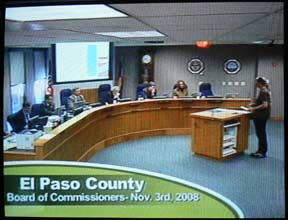
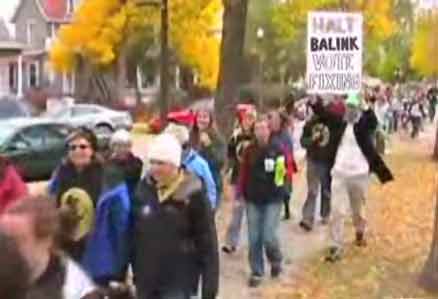
And how tragic it was and is that Morris, supposedly a staunch Democrat and chair of the local party, praises people such as El Paso County Clerk and Recorder Bob Balink, the same official who ousted me from his office in Oct. of 2006 as I attempted to cast an early vote and refused to take off my small “Grandmothers for Peace” button. Very recently and far more outrageously, Balink attempted to disenfranchise Colorado College students and keep them from voting, attempting to intimidate their parents with a threat of IRS involvement. Disenfranchisement and intimidation. Isn’t there a pattern?

And what role has and does Colorado Springs being a major “fusion center” play in these and all the other totally undemocratic and unconscionable incidents we’ve experienced here in Colorado Springs – for example, the tear gassing of peaceful demonstrators as they gathered prior to our entry into the Iraq war? Similar tear gassing occurred at that time only in one other city on earth – Athens, Greece. Then there was the brutalizing of the peace demonstrators during the 2007 St. Patrick’s Day Parade – their offense was wearing a uniform of sorts, green shirts with peace signs. They peacefully marched and rode under permit in the parade, and suddenly were brutalized beyond belief. Guess what? No national press coverage, even though one of the top stories of the year happened that day – the dragging in the street by a cop of Elizabeth Fineron, a physically disabled former nun, until she was raw and bleeding on her thigh and stomach, an act of torture still available for view on the internet and in photos which appeared in the Independent. Talk about terror!

Cursed until the day of her death with post traumatic stress disorder following her being so brutalized, Elizabeth died a year and a month later, the victim of a fully “infused” Colorado Springs Police Department. Next came the arrest, handcuffing and removal of two peace demonstrators at the 2008 Democratic State Convention, along with the destruction by police of the support poles for the banner. Their true offense was standing outside police lines, holding up a banner that asked: “Dems, please stop funding the war in Iraq.” Waiting to enter the arena to take part in the convention, elected delegates and alternates cheered the demonstrators, as simultaneously, unidentified persons, standing on a nearby hotel roof with a hyperbolic dish, surveilled and recorded the entire arrest incident. The official offense the police initially charged the peace demonstrators with was “obstruction,” but that charge was almost immediately abandoned and replaced with the charge of “trespass.” Guess who would be the party to bring and pursue such a complaint of trespass? You guessed it – the leaseholder of the convention site, the Colorado state Democratic party!

And then came the request by the head of the Pikes Peak Justice and Peace Commission, at that time but no longer located behind the Independent in a building which the Indy owns, for police to appear and question and possible place under arrest four individuals, myself included, who sat in folding chairs in a streetside parkway outside the J&P office for an hour one spring evening and discussed the upcoming Democratic National Convention in Denver. We considered what “infusion” style police tactics might be (and unfortunately were) used on peace demonstrators. Once again, it’s difficult to miss the pattern of disenfranchisement and intimidation.

Rather than standing watch on the constitution and democracy and asking the hard but vital questions that are the basis of all good critical thinking, the U.S. has allowed itself to be spun by the greed and power mongers and their corporate controlled mass media into a state of “La La Land.” Not only was Elizabeth Fineron a victim of a fully “infused” Colorado Springs Police Department, but the peaceful older disabled woman, an Obama supporter, a teacher who dedicated herself to peace and justice for all, was a victim also of a naive, consumption preoccupied, unquestioning and not sufficiently concerned U.S. populace.

It’s increasingly apparent that what all this spells: COUP! Certainly we all, under the leadership of our man Obama, need to address the Neocon-insurged “IT’S THE ECONOMY, STUPID” peril we find ourselves in. But until we place as our number one priority the return of true vs. token democracy, and do what it takes to “UNDO THE COUP,” we’ll continue to be at the mercy of the military/industrial/corporate power and greed mongers who, like Bob’s old school friends, think we Americans are stupid, should not be able to vote, and believe democracy is a quaint, antiquated, naive institution. Our democracy, which has been tortured, waterboarded, and all but done away with over the years, will be beyond resuscitation if we don’t clearly concentrate on the root of the problems underlying the economic and total undemocratic mess we’re in today.

Let’s keep the faith, and Obama-style hope. Let’s honor of all our U.S. brothers and sisters who, along with Elizabeth Fineron, have donned a uniform and fought and died for their country – for democracy and the constitution, for lasting peace and fundamental justice. Let’s rejoice in the not so minor miracle that’s happened – the election of Barak Obama. Let’s celebrate his inauguration. Let’s push hard and fight peacefully but firmly for the change we so desperately need. And let’s never stop reminding our soon to be President Obama that we’re counting on him to bring about the change he’s promised – the change we so need and long for.

President Obama, congratulations, and never forget – we want to help you and your appointees to UNDO THE COUP!

Rita Ague

Edward Abbey quotes Louisa May Alcott

According to his FOIA files which Edward Abbey requested from the FBI, and which the Moab Canyon County Zephyr is releasing serially, Abbey first came to the agency’s attention as editor of the University of New Mexico’s campus literary magazine The Thunderbird, when fellow students could not dissuade him from printing on its March 1951 cover:
 
        “Man Will Never Be Free Until the Last King Is Strangled
        With the Entrails of the Last Priest.     –LOUISA MAY ALCOTT”

Wrote friend and colleague Jack Loeffler in Adventures with ED: “The campus went wild. Ed wouldn’t rescind the issue or apologize, and his tenure as editor was terminated.” According to an unnamed informant at UNM, Abbey showed “less sense than his fellow students.”

Actually, Abbey’s FBI file opens with his 1947 public letter calling for students to burn their draft cards. Most of the rest of his fed investigation attempts to separate fact from his fictional MONKEYWRENCH GANG, which inspired Earth First! When Edward Abbey died in 1989, there followed a rapid disintegration of Earth First, and the attempted car-bomb assassination and frame-up of organizer Judi Bari.

Cheyenne Mtn white-flight or white lie?

cheyenne mountain footballThere is an aspect about the Cheyenne Mountain High School drug bust story that most interests me. An insider aught to be able to confirm it: Did the student who narc’d on his druggie friends really have to move –siblings, household and all– straight out of town? That weekend, the rumor goes, so terrified was his/her family of the wrath of the “¡MEXICAN NATIONALS!”

No need to reveal the student’s name, and I’m certainly not going suggest the Xanax-stowaway did anything wrong to break the silence, of apparent consent, on the Cheyenne Black Tar Breakfast Club.

But someone who knew the student’s name, could look up his/her address –in the school directory if the address in unlisted, then go straight to the spot, or talk to the neighbors, or of course consult friends you might have in common, to confirm or debunk the hysteria.

Did Family Xanax pull up and go, moving van and all, to parts unknown, protected by the same White Mountain keep-our-troubles-to-ourselves White Witness Protection Program which kept a lid on its untroubled heroin trendies?

I’d like to know, who is it the family thinks is after them, the so-called “Mexican National” devils? Weren’t the two suppliers arrested? Is there a Mexican drug cartel that must avenge what happened? That must keep rich kid students cow-towed in fear, lest the next frightened Xanax-abuser, think little enough to squeal on the next Mexican foot soldiers to take on the rich-kid-malaise HS gold mine?

Why do I doubt it?

Could it be instead, the other white rich parents of whom the Xanax-parental-gardians are more afraid?

It occurs to me now, thinking of a past acquaintance with another local high school, two in fact: Manitou and Coronado, to name them, that their chief drug supplier, a few years ago, lived in the Cheyenne Mountain school district! I visited his house, actually. It was quite spacious, and his father was in on the action, also ran a chop-shop, as I recall.

Now that’s someone the neighbors would know to fear. Is that guy still around? Probably there’s some kind of expiration date for how long a recent HS grad can hang around school without becoming conspicuous.

Am I the only one who thinks there’s a story here? Violence between dealers is commonplace; are customers also kept terrorized? If User X and family did have to skip out of town, who did they flee? Brown-skinned outsiders? Or white skinned bad boys still here?

It’s one thing for affluent Cheyenne Mountain families to keep mum and take their substance-abuse challenge lumps. It’s another to acquiess to drug use like it’s their child’s rite-of-passage, spelled “right.” I’m not sure they don’t think it’s spelled the same. For some privileged folk, it seems a person’s ability to afford something is the only determinant of whether it’s right. Laws do not apply to freedoms they will not be denied.

And of course, the chief benefit derived from propagating the urban-mythic Family Hightails It Out-of-Town story, is that it reinforces a code of silence. We don’t betray our own.

And it slams shut the barn door. There’s nothing further to talk about, they’re gone. Don’t re-ignite the issue lest you invite the attention of the bogiemen out for revenge.

Bearing False Witness
Worse, to me, might be to let the storytellers lay the whole mess at the feet of the White Mountain non-whites. Cheyenne Mountain households are the same conservatives crying for blood at our southern border. They support harsher measures to stem illegal immigration, yet they rely on the undocumented workforce for their domestics. Those who are rich developers, builders and car dealers hire an enormous share of the local illegals. This disparate attitude is not contradictory. Unforgiving immigration policies keep wages low.

And then the opportunist-hypocrites want to blame their children’s drug problems on the same victims.

Let’s find out the truth to that white-flight story. What good is served –to amplify the potentially false stigma– by remaining un-skeptical about such a salacious rumor?

Colorado Springs District 11 School District corruption in plain view

school debt
Something called a ‘School Accountability Report’ came to my house in the mail last week. Let’s take a look at it, shall we?
 
How is Colorado Springs District 11 Administration doing with that $409,468,689 they spent on less than 30,000 students last year? That’s almost a half a billion dollars! That’s a lot of money!

First off, they spent 15% of that money ($63,437,095) on ‘servicing debt’ as they called it. Wow! Double WOW! These are the people in charge of teaching math to kids, too… and it is no wonder that so many of District 11 miseducated kids cannot hardly count, let alone add and subtract, multiply and divide. $63 million per year! What did it buy? Well, it bought nothing. It was spent on ‘debt service’!

Why in the world would this School District borrow money? After all, when school levies can raise hundreds of millions of dollars at a time, why not wait before spending our tax monies? Is that really so hard for these people to do? The answer is NO. So why did they go and put parents into hock like this with taxpayers’ money?

The answer is CORRUPTION. You see, the $63 million PLUS money paid out in interest annually is something that big financial corporations lobby to get. No need to go after the bottom dwellers (you and I) to get us to add on a credit card or two, when this sort of interest ‘servicing’ can be had by getting the School Board in bed with them.

Nobody questions necessary debt, but a taxing agency such as government can obtain money without borrowing it beforehand. That is something that should be called unnecessary debt when they borrow first. It’s unnecessary for us, but necessary for banks to get corrupt fools (the D-11 School Board Administrators) to line them up with them to get that $63 million annually. Yes, those School Board Administrators are corrupt, corrupted, and shameless, and back to the ‘School Accountability Report’ once again…

Those corrupt administrators pull off an average salary of over $40/ hour. That’s right. That’s an average. The corrupted administrators that passed these deals to have the D-11 public now paying off $63 PLUS million per year in ‘debt service’ made more than that average. Perhaps $50-$70 per hour? Perhaps the sky? Your guess as to that?

Many of these students at District 11 have parents making less than $10 an hour apiece. They support these corrupt School Administrators through their taxes, who then sign these sweetheart deals with financial institutions that then helps torpedo these parents’ kids from getting much of an education for that $11,289 operating revenue per kid spent by the district.

What’s the overall grade for this District 11 corruption? ‘Overall Academic Performance on State Assessments’ = AVERAGE. That’s what their own ‘accountability’ paper read. And ‘average’ for American education as a whole = BELOW WORLD AVERAGE. The math of it is so very sad.

Math score for District 11? F. The school district public’s $63 million PLUS per year paid out in ‘debt service’? Shame on them! These administrators are scamming us! And they’re scamming our kids, too! F———- that’s F minus. This country is sinking under this type of corruption!

Black tar heroin bust spoils Cheyenne Mountain High School White Christmas

I’ll admit I was pretty floored when I read that students at Cheyenne Mountain High School — my kids’ school — were busted for using and dealing heroin. Apparently, a hired drug-sniffing dog led police to a locker containing Xanax, an anti-anxiety medication, that hadn’t been prescribed for the locker’s owner. The word is that this kid ratted out his fellow drug-using students. Whether this was an attempt to minimize his crime, or to strike a plea bargain of some kind, I don’t know. I called my college girl with breaking news of the drug busts. “Yeah,” she said, nearly yawning, or so it seemed, “it’s not 25 kids, it’s only 15. I heard the two dealers are facing 7 to 12 and the rest of the kids are being sent to rehab.” With Facebook, news disseminates in real time so my scoop was already old news to her.
Cheyenne-Mountain-High-School-banner

Undeterred, I dropped in on a fellow mother to deliver my bombshell. “Oh, yeah, there’ve been rumors of heroin use at Cheyenne for at least a couple years.” She proceeded to give me the lowdown on two of the alleged dealers.

Okay, everyone knew but me. But let me at least wager a guess about the future: since no drugs were found to be in possession of any student, there’s nothing the school can do to any of the alleged users. Not even a suspension, which is as it should be if due process is honored. I wouldn’t expect much more than hand-wringing from the parents who didn’t notice their children were strung out on heroin. The kids who’ve admitted smoking the stuff will likely be sent to $10,000/week rehab facilities where they can meet Mary Kate Olson or Lindsay Lohan and come back to mini-celebrity status.

The rest of us will distance ourselves from distasteful realities, likely with the full cooperation of teachers, shrinks, and media. One local headline read “D12 students were sold black tar heroin,” not “D12 students bought black tar heroin.” The subtle difference provides us a tiny emotional cushion.

Rather than dealing with the very real problems that plague our community, we’ll continue to emphasize the role of the drug-smuggling “Mexican nationals” in the corruption of our teenagers. Though the media has demonized them repeatedly, no one I’ve talked to knows anything about them, or exactly what a Mexican national is. But, then again, Cheyenne Mountain doesn’t know much about Mexicans in general, or blacks, or Indians that aren’t the school mascot. Come to think of it, we’d also never heard of BLACK TAR heroin. We thought heroin was supposed to be pure and white, like us. In any case, we take only prescription drugs, which is why we hurt for whichever mother had her Xanax jacked, the not-so-shocking incident that started this whole dark chapter.

Staging Homer for Generation Simpson

Odyssey by Derek WalcottTHE ODYSSEY,
A STAGE VERSION-
Greek myth would be no more complicated than JK Rowling, JRR Tolkien, or GRG Lucas, but I suspect that to impress Homer unto modern audiences might have the disagreeable consequence of educating them.

This weekend Colorado College students staged Derek Walcott’s 1992 The Odyssey in the South Theater of the Cornerstone Arts Building. And performed it brilliantly. Every role, every effect, executed with vitality and aplomb.

Except for the Jamaican nursemaid and Aussie shepherd, the CC actors dropped Walcott’s New World islander accents, but their production honored his post imperialism critique.

My favorite sequence depicted Cyclops as an all-seeing 1984 distillation of mortal man’s inclination toward totalitarianism. The Circe episode is nagging me for further reflection, if I’m to imagine that Walcott would not succumb to the traditional Siren/Mermaid/Nymph misogyny.

If you can’t shake the admonition that rational man’s chief torment is woman, you need look for no literary antecedent before Homer.

Obviously, not all that is Greek is instructional, but wouldn’t it serve our education nicely if, instead of the insipid nuances of fictional worlds imagined by scribes steeped in the decay of Western Civilization, our children could commit to their memories the literary plots –no less compelling– which form the building blocks to a greater appreciation of all art?

We told the kids that the Odyssey was Western Civilization’s first sequel. Of course, the Iliad was a lot to have to recap. Not surprisingly, their experience was “the most random ever.” But while I lamented my missed advance opportunity to have brought them up to speed on the gods and heroes of antiquity, our eleven year old noted, of the lines spoken by the mysterious personages: “Everything they said was always about something else!”

Poetry!

OF FURTHER INTEREST:
Creolizing Homer for the stage: Walcott’s The Odyssey, by Robert D. Hamner, Twentieth Century Literature, Fall, 2001

Playing With Europe: Derek Walcott’s Retelling of Homer’s Odyssey, by Irene Martyniuk, Callaloo 28.1, 2005

Does NPR have a hiring impediment?

Louisa Lim National Public RadioNATIONAL PUBLIC RADIO- I can laugh at speech impediments with the best of them. But I’m less comfortable if there’s no laugh track. Specifically, when it’s a speech-challenged news reporter, I utterly object to being made to decipher from mispronunciation. On the radio, poor diction is as unacceptable as inaudible recording, and disabled- enunciation is as appropriate as a paraplegic delivering your piano. Take NPR’s Louisa Lim.

Give someone a job they can handle, but don’t celebrate equal opportunity without consideration for the task required.

Louisa Lim can’t pronounce her Rs. Might not someone have thought to counsel Lim fwom puhsuing a caweeuh on the wadio? Dropped Rs represent an alphabet 1/26th deficient. More, if you adjust inversely by Scrabble point value.

Monte Python’s Pontius Pilate of Life of Brian was mocked by the chorus for not being able to say his R’s. And yes, his Roman audience found the hilarity unending. It’s why he was urged to release Bawabas and not Jesus. Gilda Radner similarly mocked Barbara Walters. Mispwonouncing her Rs didn’t keep Bahbwa Wahwah from a lengthy career, but that’s the point I’m coming to.

If speech impediments were congenital, it would still be no reason to exhibit them center-stage like cultural accents.

Aren’t most speaking disorders remedied in the primary grades, given extra attention from speech therapists? Why do the exceptions seem to become Communications Majors? It’s as if students who have reason to work on their locution, end up becoming the professionals.

But choirs don’t tolerate tone-deafness, why would broadcasters burden themselves with mis-speakers?

Louisa Lim can’t say R, but she’s only one of a majority of female voices on NPR hobbled by flawed presentation. Don’t you find that strange? Considering that Amy Goodman’s delivery is criticized for being shrill. It’s as if NPR thinks strong feminine voices would come across as too authoritative, unless a physical weakness is empirically discernible. Would this explain why most the female voices on NPR are nasal, or supported by the weakest lung capacity? Their tiny voices sound like they could extinguish themselves without the next breath. Audiences like it too obviously.

Accents too, foreign and domestic, work to temper the projection of authority. Male presenters traditionally have sported commanding voices. Today, those who don’t moderate for sporting events most often have voices in the higher registers, or modulate their voices with rises in pitch which communicates timidity.

TWILIGHT vampires resemble predators of the less mystical sexual variety

stephanie meyer dreams of Babe the PigTWILIGHT- For those parents who have unwittingly encouraged their daughters to delve into Twilight, where our episodic fascination with Dracula lore is adapted for the young adult romance genre, be forewarned that author Stephenie Meyer may have fogged her rose-colored glasses with romantic nostalgia from her Mormon upbringing: old older men, arranged marriages, and, if you’ll pardon the dropped pretense, date rape.

DESPOILER ALERT.
Better you than your child?

Old fashioned matchmaking
First, Meyer’s teenage vampires are generations-old men, stuck reliving their teens, repeating high school to prey on each successive year of students. Matthew McConnaughey played it, minus fangs, in Dazed and Confused: “That’s what I love about these high school girls, man. I get older, they stay the same age.”

Off campus, some of the undead “imprint” on newborns. Want that explained? Meyer’s succubus babies are born fully-conscious, if that’s any excuse, but elders are able to perceive them as soul-partners, and claim dibs to pair with them later. When they are of consumable age, I presume.

Perhaps you find these details to be inconsequential “vampire” technicalities protected by Meyer’s un-poetic license. There’s a zinger in the fourth book which you may find less palatable.

Vampire sex
Because your tween-ager should know to make the distinction?

In book four, Bella marries the 117-year-old high school hold-back Edward Cullen, and finally he consents to consummate their marriage. He’s been withholding his afflictions for fear that vampire sex would kill her. By the way, that’s the romantic dynamic of the first three books, in case you wonder what’s titillating your acts-beyond-her-age young reader.

Typical of respectable novels, and the romance genre too perhaps, the sex scene is glossed over. Bella disrobes and joins Edward for a midnight swim, where he “leads her to deeper waters.” The narrative returns as the sun rises the next morning.

Classy enough for this lowbrow storytelling, except that Meyer earns no credit for obscuring the steamy bits, because the exact details are lost on her post-coital heroine as well. A fog of amnesia covers Bella as she spends the morning trying to reconstruct what exactly happened to her. With only her bruises for clues.

Meyer describes Bella waking feeling as if her skeletal-structure has been crushed like a wishbone, “but in a good way.” Bella discovers that she’s covered in bruises which grow still darker in severity, obscured by a dusting of feathers. Nevermind the injuries apparently, why the feathers? Her ravisher reveals he had to bite “one or two pillows” to keep himself from eviscerating her. For this act of consideration, Bella, and the readers, find Edward all the more endearing. Since vampires kill humans, how sweet that Edward merely vampire-man-handled her.

Bella survived the Twilight climax, and although she doesn’t remember the act, she’s feeling sexually satisfied. I’m open to the possibility that a gender gap might be confusing me. About what is Bella all aglow, if she doesn’t recollect what happened? Conquest? Having hosted a smashing party? I’ll tell you what I think has quenched Bella’s desire, if the Mormon motif is any indication. She’s fulfilled her biological drive. Not to possess Edward, but to become pregnant. In Meyer’s grandiose predestined sense, Bella is triumphant in having attained motherhood.

Do these themes fly over the heads of her impressionable readers? Why put them there.

The scene reads to me like waking from a date-rape drug, although the experience might more likely describe a young Mormon girl coming out of the state of shock induced by the violence of her older experienced polygamist husband rapist. At the least, how she might cope with having endured the brutality of a sexual drive unmatched by her own, and beyond her comprehension.

Men are not to blame, they are but slaves to their monstrous sexual urges. Obviously this is where Meyer looks for humanity in her vampires. Your daughter’s assignment? Assure her presumptive taker that she’s up for the worst he can unleash. She can favor the monster who feigns leniency.

Four books versus two
You may not have to worry about your child reaching the S&M sex, pregnancy, and monstrous-birth scene of Book Four. There’s a good hope that your young sophisticate will tire of Meyer’s underwhelming literary skill before the end of the first tome. There’s an even more likely chance that books three and four will bore her into maturity. Even Meyer’s fans hate the vacuity of those stretches.

Apparently the fourth volume was written as the original sequel, but was rewritten later to make room for the two filler episodes. They upped the Twilight movie take by fifty percent. Every fan is saying you appreciate the movie the most if you’ve read all the material.

What a great publishing scheme! The movie tickets are eight dollars, but the requisite quartet box set, sets you back $100. Ravaging the innocence of America’s tweens? Priceless.
Edward Cullen Robert Pattinson
Twilight the Movie
The biggest anxiety I heard expressed about the movie, was not if it could do the books justice, but whether the character of Edward could possibly live up to his physical perfection in the novel. Judging from audience reviews, film Edward was an exact match, which means Meyer left no room for a reader’s imagination. Is that what young-adult fiction is about?

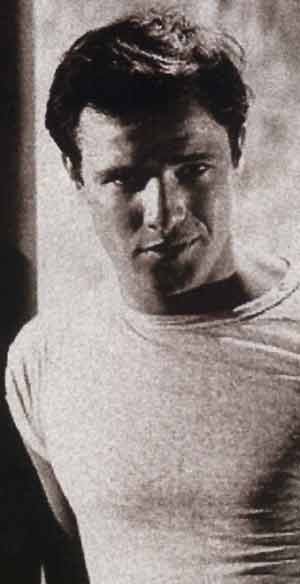
Stephenie Meyer’s dream crush, as cast in Twilight the Movie, resembles the fittingly abusive Stanley of A Streetcar Named Desire, literally Marlon Brando’s brooding stage turn as the violent husband, wearing an Elvis wig, on lithium, as viewed through a camera lens smeared with Vaseline, probably also a polygamist staple.

How about just a bite?
You might be thinking, what’s wrong with just the first book? Can’t a girl luxuriate in the hyper-romantic swoon over the opening story?

I don’t know. I’ve often been perplexed about the teen Goth living death fixation, nihilism and teen suicide. I suspect they get fuel from mall rat romantics like Stephenie Meyer.

You be the judge. I was able to wrestle a few minutes with our household copy, to see that Meyer opens with this quote:

But of the tree of the knowledge of good and evil, thou shalt not eat of it: for in the day that thou eatest thereof thou shalt surely die.
Genesis 2:17

Does that equate vampirism with the forbidden fruit of knowledge? Meyer followed Dan Brown’s example to find a biblical passage to provide coded authority. More proof that insipid writing multiplies with inbred fiction authors.

In the spirit of taking guidance from a quotation, I entreat you to sample the preface of Twilight, because the Amazon Look Inside sample astutely skips it. If you’ve already read Twilight, please slap yourself on the cheek and try to extricate yourself enough to look at these paragraphs one by one.

Here it is, adulteration entirely courtesy of Meyer. Even if she was twelve when she wrote this, I hope your daughter can show more acuity than she.

PREFACE

I’d never given much thought to how I would die — though I’d had reason enough in the last few months — but even if I had, I would not have imagined it like this.

I stared without breathing across the long room, into the dark eyes of the hunter, and he looked pleasantly back at me.

Surely it was a good way to die, in the place of someone else, someone I loved. Noble, even. That ought to count for something.

I knew that if I’d never gone to Forks, I wouldn’t be facing death now. But, terrified as I was, I couldn’t bring myself to regret the decision. When life offers you a dream so far beyond any of your expectations, it’s not reasonable to grieve when it comes to an end.

The hunter smiled in a friendly way as he sauntered forward to kill me.

I bet Stephenie Meyer cannot even gag herself with a spoon.

Weathermen for a Democratic Society

Bernadine Dohrn addresses S.D.S. in ChicagoIn 1969, the Radical Youth Movement (RYM) within Students for a Democratic Society (SDS) expelled the passive participants to reconfigure the SDS to Bring the War Home. At left, Bernardine Dohrn uninvites the Progressive Labor Party (PL) and the Worker Student Alliance (WSA) from the Chicago conference. Below is the founding document after which the RYM was renamed.

You Don’t Need A Weatherman
To Know Which Way The Wind Blows

June 18, 1969

Submitted by Karin Asbley, Bill Ayers, Bernardine Dohrn, John Jacobs, Jeff Jones, Gerry Long, Home Machtinger, Jim Mellen, Terry Robbins, Mark Rudd and Steve Tappis.

I. International Revolution

The contradiction between the revolutionary peoples of Asia, Africa and Latin America and the imperialists headed by the United States is the principal contradiction in the contemporary world. The development of this contradiction is promoting the struggle of the people of the whole world against US imperialism and its lackeys.

Lin Piao, Long Live the Victory of People’s War!

People ask, what is the nature of the revolution that we talk about- Who will it be made by, and for, and what are its goals and strategy-

The overriding consideration in answering these questions is that the main struggle going on in the world today is between US imperialism and the national liberation struggles against it. This is essential in defining political matters in the whole world: because it is by far the most powerful, every other empire and petty dictator is in the long run dependent on US imperialism, which has unified, allied with, and defended all of the reactionary forces of the whole world. Thus, in considering every other force or phenomenon, from Soviet imperialism or Israeli imperialism to “workers struggle” in France or Czechoslovakia, we determine who are our friends and who are our enemies according to whether they help US imperialism or fight to defeat it.

So the very first question people in this country must ask in considering the question of revolution is where they stand in relation to the United States as an oppressor nation, and where they stand in relation to the masses of people throughout the world whom US imperialism is oppressing.

The primary task of revolutionary struggle is to solve this principal contradiction on the side of the people of the world. It is the oppressed peoples of the world who have created the wealth of this empire and it is to them that it belongs; the goal of the revolutionary struggle must be the control and use of this wealth in the interests of the oppressed peoples of the world.

It is in this context that we must examine the revolutionary struggles in the United States. We are within the heartland of a worldwide monster, a country so rich from its worldwide plunder that even the crumbs doled out to the enslaved masses within its borders provide for material existence very much above the conditions of the masses of people of the world. The US empire, as a worldwide system, channels wealth, based upon the labor and resources of the rest of the world, into the United States. The relative affluence existing in the United States is directly dependent upon the labor and natural resources of the Vietnamese, the Angolans, the Bolivians and the rest of the peoples of the Third World. All of the United Airlines Astrojets, all of the Holiday Inns, all of Hertz’s automobiles, your television set, car and wardrobe already belong, to a large degree to the people of the rest of the world.

Therefore, any conception of “socialist revolution” simply in terms of the working people of the United States, failing to recognize the full scope of interests of the most oppressed peoples of the world, is a conception of a fight for a particular privileged interest, and is a very dangerous ideology. While the control and use of the wealth of the Empire for the people of the whole world is also in the interests of the vast majority of the people in this country, if the goal is not clear from the start we will further the preservation of class society, oppression, war, genocide, and the complete emiseration of everyone, including the people of the US.

The goal is the destruction of US imperialism and the achievement of a classless world: world communism. Winning state power in the US will occur as a result of the military forces of the US overextending themselves around the world and being defeated piecemeal; struggle within the US will be a vital part of this process, but when the revolution triumphs in the US it will have been made by the people of the whole world. For socialism to be defined in national terms within so extreme and historical an oppressor nation as this is only imperialist national chauvinism on the part of the “movement.”

II. What Is The Black Colony-

Not every colony of people oppressed by imperialism lies outside the boundaries of the US. Black people within North America, brought here 400 years ago as slaves and whose labor, as slaves, built this country, are an internal colony within the confines of the oppressor nation. What this means is that black people are oppressed as a whole people, in the institutions and social relations of the country, apart from simply the consideration of their class position, income, skill, etc., as individuals- What does this colony look like- What is the basis for its common oppression and why is it important-

One historically important position has been that the black colony only consists of the black belt nation in the South, whose fight for national liberation is based on a common land, culture, history and economic life. The corollary of this position is that black people in the rest of the country are a national minority but not actually part of the colony themselves; so the struggle for national liberation is for the black belt, and not all blacks; black people in the north, not actually part of the colony, are part of the working class of the white oppressor nation. In this formulation northern black workers have a “dual role”—one an interest in supporting the struggle in the South, and opposing racism, as members of the national minority; and as northern “white nation” workers whose class interest is in integrated socialism in the north. The consistent version of this line actually calls for integrated organizing of black and white workers in the north along what it calls “class” lines.

This position is wrong; in reality, the black colony does not exist simply as the “black belt nation,” but exists in the country as a whole. The common oppression of black people and the common culture growing out of that history are not based historically or currently on their relation to the territory of the black belt, even though that has been a place of population concentration and has some very different characteristics than the north, particularly around the land question.

Rather, the common features of oppression, history and culture which unify black people as a colony (although originating historically in a common territory apart from the colonizers, i.e., Africa, not the South) have been based historically on their common position as slaves, which since the nominal abolition of slavery has taken the form of caste oppression, and oppression of black people as a people everywhere that they exist. A new black nation, different from the nations of Africa from which it came, has been forged by the common historical experience of importation and slavery and caste oppression; to claim that to be a nation it must of necessity now be based on a common national territory apart from the colonizing nation is a mechanical application of criteria which were and are applicable to different situations.

What is specifically meant by the term caste is that all black people, on the basis of their common slave history, common culture and skin color are systematically denied access to particular job categories (or positions within job categories), social position, etc., regardless of individual skills, talents, money or education. Within the working class, they are the most oppressed section; in the petit bourgeoisie, they are even more strictly confined to the lowest levels. Token exceptions aside, the specific content of this caste oppression is to maintain black people in the most exploitative and oppressive jobs and conditions. Therefore, since the lowest class is the working class, the black caste is almost entirely a caste of the working class, or [holds] positions as oppressed as the lower working-class positions (poor black petit bourgeoisie and farmers); it is a colonial labor caste,, a colony whose common national character itself is defined by their common class position.

Thus, northern blacks do not have a “dual interest”—as blacks on the one hand and “US-nation workers” on the other. They have a single class interest, along with all other black people in the US, as members of the Black Proletarian Colony.

III. The Struggle For Socialist Self-Determination

The struggle of black people—as a colony—is for self-determination, freedom, and liberation from US imperialism. Because blacks have been oppressed and held in an inferior social position as a people, they have a right to decide, organize and act on their common destiny as a people apart from white interference. Black self-determination does not simply apply to determination of their collective political destiny at some future time. It is directly tied to the fact that because all blacks experience oppression in a form that no whites do, no whites are in a position to fully understand and test from their own practice the real situation black people face and the necessary response to it. This is why it is necessary for black people to organize separately and determine their actions separately at each stage of the struggle.

It is important to understand the implications of this. It is not legitimate for whites to organizationally intervene in differences among revolutionary black nationalists. It would be arrogant for us to attack any black organization that defends black people and opposes imperialism in practice. But it is necessary to develop a correct understanding of the Black Liberation struggle within our own organization, where an incorrect one will further racist practice in our relations with the black movement.

In the history of some external colonies, such as China and Vietnam, the struggle for self-determination has had two stages: (1) a united front against imperialism and for New Democracy (which is a joint dictatorship of anti-colonial classes led by the proletariat, the content of which is a compromise between the interests of the proletariat and nationalist peasants, petit bourgeoisie and national bourgeoisie); and (2) developing out of the new democratic stage, socialism.

However, the black liberation struggle in this country will have only one “stage”; the struggle for self-determination will embody within it the struggle for socialism.

As Huey P. Newton has said, “In order to be a revolutionary nationalist, you would of necessity have to be a socialist.” This is because—given the caste quality of oppression-as-a-people-through-a-common-degree-of-exploitation—self-determination requires being free from white capitalist exploitation in the form of inferior (lower caste) jobs, housing, schools, hospitals, prices. In addition, only what was or became in practice a socialist program for self-determination—one which addressed itself to reversing this exploitation—could win the necessary active mass support in the “proletarian colony.”

The program of a united front for new democracy, on the other hand, would not be as thorough, and so would not win as active and determined support from the black masses. The only reason for having such a front would be where the independent petit bourgeois forces which it would bring in would add enough strength to balance the weakening of proletarian backing. This is not the case: first, because much of the black petit bourgeoisie is actually a “comprador” petit bourgeoisie (like so-called black capitalists who are promoted by the power structure to seem independent but are really agents of white monopoly capital), who would never fight as a class for any real self-determination; and secondly, because many black petit bourgeoisie, perhaps most, while not having a class interest in socialist self-determination, are close enough to the black masses in the oppression and limitations on their conditions that they will support many kinds of self-determination issues, and, especially when the movement is winning, can be won to support full (socialist) self-determination. For the black movement to work to maximize this support from the petit bourgeoisie is correct; but it is in no way a united front where it is clear that the Black Liberation Movement should not and does not modify the revolutionary socialist content of its stand to win that support.

From /New Left Notes/, June 18, 1969

IV. Black Liberation Means Revolution

What is the relationship of the struggle for black self-determination to the whole worldwide revolution to defeat US imperialism and internationalize its resources toward the goal of creating a classless world-

No black self-determination could be won which would not result in a victory for the international revolution as a whole. The black proletarian colony, being dispersed as such a large and exploited section of the work force, is essential to the survival of imperialism. Thus, even if the black liberation movement chose to try to attain self-determination in the form of a separate country (a legitimate part of the right to self-determination), existing side by side with the US, imperialism could not survive if they won it—and so would never give up without being defeated. Thus, a revolutionary nationalist movement could not win without destroying the state power of the imperialists; and it is for this reason that the black liberation movement, as a revolutionary nationalist movement for self-determination, is automatically in and of itself an inseparable part of the whole revolutionary struggle against US imperialism and for international socialism.

However, the fact that black liberation depends on winning the whole revolution does not mean that it depends on waiting for and joining with a mass white movement to do it. The genocidal oppression of black people must be ended, and does not allow any leisure time to wait; if necessary, black people could win self-determination, abolishing the whole imperialist system and seizing state power to do it, without this white movement, although the cost among whites and blacks both would be high.

Blacks could do it alone if necessary because of their centralness to the system, economically and geo-militarily, and because of the level of unity, commitment, and initiative which will be developed in waging a people’s war for survival and national liberation. However, we do not expect that they will have to do it alone, not only because of the international situation, but also because the real interests of masses of oppressed whites in this country lie with the Black Liberation struggle, and the conditions for understanding and fighting for these interests grow with the deepening of the crises. Already, the black liberation movement has carried with it an upsurge of revolutionary consciousness among white youth; and while there are no guarantees, we can expect that this will extend and deepen among all oppressed whites.

To put aside the possibility of blacks winning alone leads to the racist position that blacks should wait for whites and are dependent on whites acting for them to win. Yet the possibility of blacks winning alone cannot in the least be a justification for whites failing to shoulder the burden of developing a revolutionary movement among whites. If the first error is racism by holding back black liberation, this would be equally racist by leaving blacks isolated to take on the whole fight—and the whole cost—for everyone.

It is necessary to defeat both racist tendencies: (1) that blacks shouldn’t go ahead with making the revolution, and (2) that blacks should go ahead alone with making it. The only third path is to build a white movement which will support the blacks in moving as fast as they have to and are able to, and still itself keep up with that black movement enough so that white revolutionaries share the cost and the blacks don’t have to do the whole thing alone. Any white who does not follow this third path is objectively following one of the other two (or both) and is objectively racist.

V. Anti-Imperialist Revolution And The United Front

Since the strategy for defeating imperialism in semi-feudal colonies has two stages, the new democratic stage of a united front to throw out imperialism and then the socialist stage, some people suggest two stages for the US too—one to stop imperialism, the anti-imperialist stage, and another to achieve the dictatorship of the proletariat, the socialist stage. It is no accident that even the proponents of this idea can’t tell you what it means. In reality, imperialism is a predatory international stage of capitalism. Defeating imperialism within the US couldn’t possibly have the content, which it could in a semi-feudal country, of replacing imperialism with capitalism or new democracy; when imperialism is defeated in the US, it will be replaced by socialism—nothing else. One revolution, one replacement process, one seizure of state power—the anti-imperialist revolution and the socialist revolution, one and the same stage. To talk of this as two separate stages, the struggle to overthrow imperialism and the struggle for socialist revolution, is as crazy as if Marx had talked about the proletarian socialist revolution as a revolution of two stages, one the overthrow of capitalist state power, and second the establishment of socialist state power.

Along with no two stages, there is no united front with the petit bourgeoisie, because its interests as a class aren’t for replacing imperialism with socialism. As far as people within this country are concerned, the international war against imperialism is the same task as the socialist revolution, for one overthrow of power here. There is no “united front” for socialism here.

One reason people have considered the “united front” idea is the fear that if we were talking about a one-stage socialist revolution we would fail to organize maximum possible support among people, like some petit bourgeoisie, who would fight imperialism on a particular issue, but weren’t for revolution. When the petit bourgeoisie’s interest is for fighting imperialism on a particular issue, but not for overthrowing it and replacing it with socialism, it is still contributing to revolution to that extent—not to some intermediate thing which is not imperialism and not socialism. Someone not for revolution is not for actually defeating imperialism either, but we still can and should unite with them on particular issues. But this is not a united front (and we should not put forth some joint “united front” line with them to the exclusion of our own politics), because their class position isn’t against imperialism as a system. In China, or Vietnam, the petit bourgeoisie’s class interests could be for actually winning against imperialism; this was because their task was driving it out, not overthrowing its whole existence. For us here, “throwing it out” means not from one colony, but all of them, throwing it out of the world, the same thing as overthrowing it.

VI. International Strategy

What is the strategy of this international revolutionary movement- What are the strategic weaknesses of the imperialists which make it possible for us to win- Revolutionaries around the world are in general agreement on the answer, which Lin Piao describes in the following way:

US imperialism is stronger, but also more vulnerable, than any imperialism of the past. It sets itself against the people of the whole world, including the people of the United States. Its human, military, material and financial resources are far from sufficient for the realization of its ambition of domination over the whole world. US imperialism has further weakened itself by occupying so many places in the world, overreaching itself, stretching its fingers out wide and dispersing its strength, with its rear so far away and its supply lines so long.

—/Long Live the Victory of People’s War/

The strategy which flows from this is what Ché called “creating two, three, many Vietnams”—to mobilize the struggle so sharply in so many places that the imperialists cannot possibly deal with it all. Since it is essential to their interests, they will try to deal with it all, and will be defeated and destroyed in the process.

In defining and implementing this strategy, it is clear that the vanguard (that is, the section of the people who are in the forefront of the struggle and whose class interests and needs define the terms and tasks of the revolution) of the “American Revolution” is the workers and oppressed peoples of the colonies of Asia, Africa and Latin America. Because of the level of special oppression of black people as a colony, they reflect the interests of the oppressed people of the world from within the borders of the United States; they are part of the Third World and part of the international revolutionary vanguard.

The vanguard role of the Vietnamese and other Third World countries in defeating US imperialism has been clear to our movement for some time. What has not been so clear is the vanguard role black people have played, and continue to play, in the development of revolutionary consciousness and struggle within the United States. Criticisms of the black liberation struggle as being “reactionary” or of black organizations on campus as being conservative or “racist” very often express this lack of understanding. These ideas are incorrect and must be defeated if a revolutionary movement is going to be built among whites.

The black colony, due to its particular nature as a slave colony, never adopted a chauvinist identification with America as an imperialist power, either politically or culturally. Moreover, the history of black people in America has consistently been one of the greatest overall repudiations of and struggle against the state. From the slave ships from Africa to the slave revolts, the Civil War, etc., black people have been waging a struggle for survival and liberation. In the history of our own movement this has also been the case: the civil rights struggles, initiated and led by blacks in the South; the rebellions beginning with Harlem in 1964 and Watts in 1965 through Detroit and Newark in 1967; the campus struggles at all-black schools in the South and struggles led by blacks on campuses all across the country. As it is the blacks—along with the Vietnamese and other Third World people—who are most oppressed by US imperialism, their class interests are most solidly and resolutely committed to waging revolutionary struggle through to its completion. Therefore it is no surprise that time and again, in both political content and level of consciousness and militancy, it has been the black liberation movement which has upped the ante and defined the terms of the struggle.

What is the relationship of this “black vanguard” to the “many Vietnams” around the world- Obviously this is an example of our strategy that different fronts reinforce each other. The fact that the Vietnamese are winning weakens the enemy, advancing the possibilities for the black struggle, etc. But it is important for us to understand that the interrelationship is more than this. Black people do not simply “choose” to intensify their struggle because they want to help the Vietnamese, or because they see that Vietnam heightens the possibilities for struggle here. The existence of any one Vietnam, especially a winning one, spurs on others not only through consciousness and choice, but through need, because it is a political and economic, as well as military, weakening of capitalism, and this means that to compensate, the imperialists are forced to intensify their oppression of other people.

Thus the loss of China and Cuba and the loss now of Vietnam not only encourages other oppressed peoples (such as the blacks) by showing what the alternative is and that it can be won, but also costs the imperialists billions of dollars which they then have to take out of the oppression of these other peoples. Within this country increased oppression falls heavier on the most oppressed sections of the population, so that the condition of all workers is worsened through rising taxes, inflation and the fall of real wages, and speedup. But this increased oppression falls heaviest on the most oppressed, such as poor white workers and, especially, the blacks, for example through the collapse of state services like schools, hospitals and welfare, which naturally hits the hardest at those most dependent on them.

This deterioration pushes people to fight harder to even try to maintain their present level. The more the ruling class is hurt in Vietnam, the harder people will be pushed to rebel and to fight for reforms. Because there exist successful models of revolution in Cuba, Vietnam, etc., these reform struggles will provide a continually larger and stronger base for revolutionary ideas. Because it needs to maximize profits by denying the reforms, and is aware that these conditions and reform struggles will therefore lead to revolutionary consciousness, the ruling class will see it more and more necessary to come down on any motion at all, even where it is not yet highly organized or conscious. It will come down faster on black people, because their oppression is increasing fastest, and this makes their rebellion most thorough and most dangerous, and fastest growing. It is because of this that the vanguard character and role of the black liberation struggle will be increased and intensified, rather than being increasingly equal to and merged into the situation and rebellion of oppressed white working people and youth. The crises of imperialism (the existence of Vietnam and especially that it’s winning) will therefore create a “Black Vietnam” within the US.

Given that black self-determination would mean fully crushing the power of the imperialists, this “Vietnam” has certain different characteristics than the external colonial wars. The imperialists will never “get out of the US” until their total strength and every resource they can bring to bear has been smashed; so the Black Vietnam cannot win without bringing the whole thing down and winning for everyone. This means that this war of liberation will be the most protracted and hardest fought of all.

It is in this context that the question of the South must be dealt with again, not as a question of whether or not the black nation, black colony, exists there, as opposed to in the North as well, but rather as a practical question of strategy and tactics: Can the black liberation struggle—the struggle of all blacks in the country—gain advantage in the actual war of liberation by concentrating on building base areas in the South in territory with a concentration of black population-

This is very clearly a different question than that of “where the colony is,” and to this question the “yes” answer is an important possibility. If the best potential for struggle in the South were realized, it is fully conceivable and legitimate that the struggle there could take on the character of a fight for separation; and any victories won in that direction would be important gains for the national liberation of the colony as a whole. However, because the colony is dispersed over the whole country, and not just located in the black belt, winning still means the power and liberation of blacks in the whole country.

Thus, even the winning of separate independence in the South would still be one step toward self-determination, and not equivalent to winning it; which, because of the economic position of the colony as a whole, would still require overthrowing the state power of the imperialists, taking over production and the whole economy and power, etc.

VII. The Revolutionary Youth Movement: Class Analysis

The revolutionary youth movement program was hailed as a transition strategy, which explained a lot of our past work and pointed to new directions for our movement. But as a transition to what- What was our overall strategy- Was the youth movement strategy just an organizational strategy because SDS is an organization of youth and we can move best with other young people-

We have pointed to the vanguard nature of the black struggle in this country as part of the international struggle against American imperialism, and the impossibility of anything but an international strategy for winning. Any attempt to put forth a strategy which, despite internationalist rhetoric, assumes a purely internal development to the class struggle in this country, is incorrect. The Vietnamese (and the Uruguayans and the Rhodesians) and the blacks and Third World peoples in this country will continue to set the terms for class struggle in America.

In this context, why an emphasis on youth- Why should young people be willing to fight on the side of Third World peoples- Before dealing with this question about youth, however, there follows a brief sketch of the main class categories in the white mother country which we think are important, and [which] indicate our present estimation of their respective class interests (bearing in mind that the potential for various sections to understand and fight for the revolution will vary according to more than just their real class interests).

Most of the population is of the working class, by which we mean not simply industrial or production workers, nor those who are actually working, but the whole section of the population which doesn’t own productive property and so lives off of the sale of its labor power. This is not a metaphysical category either in terms of its interests, the role it plays, or even who is in it, which very often is difficult to determine.

As a whole, the long-range interests of the non-colonial sections of the working class lie with overthrowing imperialism, with supporting self-determination for the oppressed nations (including the black colony), with supporting and fighting for international socialism. However, virtually all of the white working class also has short-range privileges from imperialism, which are not false privileges but very real ones which give them an edge of vested interest and tie them to a certain extent to the imperialists, especially when the latter are in a relatively prosperous phase. When the imperialists are losing their empire, on the other hand, these short-range privileged interests are seen to be temporary (even though the privileges may be relatively greater over the faster-increasing emiseration of the oppressed peoples). The long-range interests of workers in siding with the oppressed peoples are seen more clearly in the light of imperialism’s impending defeat. Within the whole working class, the balance of anti-imperialist class interests with white mother country short-term privilege varies greatly.

First, the most oppressed sections of the mother country working class have interests most clearly and strongly anti-imperialist. Who are the most oppressed sections of the working class- Millions of whites who have as oppressive material conditions as the blacks, or almost so: especially poor southern white workers; the unemployed or semi-employed, or those employed at very low wages for long hours and bad conditions, who are non-unionized or have weak unions; and extending up to include much of unionized labor which has it a little better off but still is heavily oppressed and exploited. This category covers a wide range and includes the most oppressed sections not only of production and service workers but also some secretaries, clerks, etc. Much of this category gets some relative privileges (i.e. benefits) from imperialism, which constitute some material basis for being racist or pro-imperialist; but overall it is itself directly and heavily oppressed, so that in addition to its long-range class interest on the side of the people of the world, its immediate situation also constitutes a strong basis for sharpening the struggle against the state and fighting through to revolution.

Secondly, there is the upper strata of the working class. This is also an extremely broad category, including the upper strata of unionized skilled workers and also most of the “new working class” of proletarianized or semi-proletarianized “intellect workers.” There is no clearly marked dividing line between the previous section and this one; our conclusions in dealing with “questionable” strata will in any event have to come from more thorough analysis of particular situations. The long-range class interests of this strata, like the previous section of more oppressed workers, are for the revolution and against imperialism. However, it is characterized by a higher level of privilege relative to the oppressed colonies, including the blacks, and relative to more oppressed workers in the mother country; so that there is a strong material basis for racism and loyalty to the system. In a revolutionary situation, where the people’s forces were on the offensive and the ruling class was clearly losing, most of this upper strata of the working class will be winnable to the revolution, while at least some sections of it will probably identify their interests with imperialism till the end and oppose the revolution (which parts do which will have to do with more variables than just the particular level of privilege). The further development of the situation will clarify where this section will go, although it is clear that either way we do not put any emphasis on reaching older employed workers from this strata at this time. The exception is where they are important to the black liberation struggle, the Third World, or the youth movement in particular situations, such as with teachers, hospital technicians, etc., in which cases we must fight particularly hard to organize them around a revolutionary line of full support for black liberation and the international revolution against US imperialism. This is crucial because the privilege of this section of the working class has provided and will provide a strong material basis for national chauvinist and social democratic ideology within the movement, such as anti-internationalist concepts of “student power” and “workers control.” Another consideration in understanding the interests of this segment is that, because of the way it developed and how its skills and its privileges were “earned over time,” the differential between the position of youth and older workers is in many ways greater for this section than any other in the population. We should continue to see it as important to build the revolutionary youth movement among the youth of this strata.

Thirdly, there are “middle strata” who are not petit bourgeoisie, who may even technically be upper working class, but who are so privileged and tightly tied to imperialism through their job roles that they are agents of imperialism. This section includes management personnel, corporate lawyers, higher civil servants, and other government agents, army officers, etc. Because their job categories require and promote a close identification with the interests of the ruling class, these strata are enemies of the revolution.

Fourthly, and last among the categories we’re going to deal with, is the petit bourgeoisie. This class is different from the middle level described above in that it has the independent class interest which is opposed to both monopoly power and to socialism. The petit bourgeoisie consists of small capital—both business and farms—and self-employed tradesmen and professionals (many professionals work for monopoly capital, and are either the upper level of the working class or in the dent class interests-anti-monopoly capital, but for capitalism rather than socialism—gives it a political character of some opposition to “big government,” like its increased spending and taxes and its totalitarian extension of its control into every aspect of life, and to “big labor,” which is at this time itself part of the monopoly capitalist power structure. The direction which this opposition takes can be reactionary or reformist. At this time the reformist side of it is very much mitigated by the extent to which the independence of the petit bourgeoisie is being undermined. Increasingly, small businesses are becoming extensions of big ones, while professionals and self-employed tradesmen less and less sell their skills on their own terms and become regular employees of big firms. This tendency does not mean that the reformist aspect is not still present; it is, and there are various issues, like withdrawing from a losing imperialist war, where we could get support from them. On the question of imperialism as a system, however, their class interests are generally more for it than for overthrowing it, and it will be the deserters from their class who stay with us.

VIII. Why A Revolutionary Youth Movement-

In terms of the above analysis, most young people in the US are part of the working class. Although not yet employed, young people whose parents sell their labor power for wages, and more important who themselves expect to do the same in the future—or go into the army or be unemployed—are undeniably members of the working class. Most kids are well aware of what class they are in, even though they may not be very scientific about it. So our analysis assumes from the beginning that youth struggles are, by and large, working-class struggles. But why the focus now on the struggles of working-class youth rather than on the working class as a whole-

The potential for revolutionary consciousness does not always correspond to ultimate class interest, particularly when imperialism is relatively prosperous and the movement is in an early stage. At this stage, we see working-class youth as those most open to a revolutionary movement which sides with the struggles of Third World people; the following is an attempt to explain a strategic focus on youth for SDS.

In general, young people have less stake in a society (no family, fewer debts, etc.), are more open to new ideas (they have not been brainwashed for so long or so well), and are therefore more able and willing to move in a revolutionary direction. Specifically in America, young people have grown up experiencing the crises in imperialism. They have grown up along with a developing black liberation movement, with the liberation of Cuba, the fights for independence in Africa and the war in Vietnam. Older people grew up during the fight against fascism, during the Cold War, the smashing of the trade unions, McCarthy, and a period during which real wages consistently rose—since 1965 disposable real income has decreased slightly, particularly in urban areas where inflation and increased taxation have bitten heavily into wages. This crisis in imperialism affects all parts of the society. America has had to militarize to protect and expand its empire; hence the high draft calls and the creation of a standing army of three and a half million, an army which still has been unable to win in Vietnam. Further, the huge defense expenditures—required for the defense of the empire and at the same time a way of making increasing profits for the defense industries—have gone hand in hand with the urban crisis around welfare, the hospitals, the schools, housing, air and water pollution. The State cannot provide the services it has been forced to assume responsibility for, and needs to increase taxes and to pay its growing debts while it cuts services and uses the pigs to repress protest. The private sector of the economy can’t provide jobs, particularly unskilled jobs. The expansion of the defense and education industries by the State since World War II is in part an attempt to pick up the slack, though the inability to provide decent wages and working conditions for “public” jobs is more and more a problem.

As imperialism struggles to hold together this decaying social fabric, it inevitably resorts to brute force and authoritarian ideology. People, especially young people, more and more find themselves in the iron grip of authoritarian institutions. Reaction against the pigs or teachers in the schools, welfare pigs or the army, is generalizable and extends beyond the particular repressive institution to the society and the State as a whole. The legitimacy of the State is called into question for the first time in at least 30 years, and the anti-authoritarianism which characterizes the youth rebellion turns into rejection of the State, a refusal to be socialized into American society. Kids used to try to beat the system from inside the army or from inside the schools; now they desert from the army and burn down the schools.

The crisis in imperialism has brought about a breakdown in bourgeois social forms, culture and ideology. The family falls apart, kids leave home, women begin to break out of traditional “female” and “mother” roles. There develops a “generation gap” and a “youth problem.” Our heroes are no longer struggling businessmen, and we also begin to reject the ideal career of the professional and look to Mao, Chef, the Panthers, the Third World, for our models, for motion. We reject the elitist, technocratic bullshit that tells us only experts can rule, and look instead to leadership from the people’s war of the Vietnamese. Chuck Berry, Elvis, the Temptations brought us closer to the “people’s culture” of Black America. The racist response to the civil rights movement revealed the depth of racism in America, as well as the impossibility of real change through American institutions. And the war against Vietnam is not “the heroic war against the Nazis”; it’s the big lie, with napalm burning through everything we had heard this country stood for. Kids begin to ask questions: Where is the Free World- And who do the pigs protect at home-

The breakdown in bourgeois culture and concomitant anti-authoritarianism is fed by the crisis in imperialism, but also in turn feeds that crisis, exacerbates it so that people no longer merely want the plastic ’50s restored, but glimpse an alternative (like inside the Columbia buildings) and begin to fight for it. We don’t want teachers to be more kindly cops; we want to smash cops, and build a new life.

The contradictions of decaying imperialism fall hardest on youth in four distinct areas—the schools, jobs, the draft and the army, and the pigs and the courts. (A) In jail-like schools, kids are fed a mish-mash of racist, male chauvinist, anti-working class, anti-communist lies while being channeled into job and career paths set up according to the priorities of monopoly capital. At the same time, the State is becoming increasingly incapable of providing enough money to keep the schools going at all. (B) Youth unemployment is three times average unemployment. As more jobs are threatened by automation or the collapse of specific industries, unions act to secure jobs for those already employed. New people in the labor market can’t find jobs, job stability is undermined (also because of increasing speed-up and more intolerable safety conditions) and people are less and less going to work in the same shop for 40 years. And, of course, when they do find jobs, young people get the worst ones and have the least seniority. (C) There are now two and a half million soldiers under thirty who are forced to police the world, kill and be killed in wars of imperialist domination. And (D) as a “youth problem” develops out of all this, the pigs and courts enforce curfews, set up pot busts, keep people off the streets, and repress any youth motion whatsoever.

In all of this, it is not that life in America is toughest for youth or that they are the most oppressed. Rather, it is that young people are hurt directly—and severely—by imperialism. And, in being less tightly tied to the system, they are more “pushed” to join the black liberation struggle against US imperialism. Among young people there is less of a material base for racism—they have no seniority, have not spent 20 years securing a skilled job (the white monopoly of which is increasingly challenged by the black liberation movement), and aren’t just about to pay off a 25-year mortgage on a house which is valuable because it’s located in a white neighborhood.

While these contradictions of imperialism fall hard on all youth, they fall hardest on the youth of the most oppressed (least privileged) sections of the working class. Clearly these youth have the greatest material base for struggle. They are the ones who most often get drafted, who get the worst jobs if they get any, who are most abused by the various institutions of social control, from the army to decaying schools, to the pigs and the courts. And their day-to-day existence indicates a potential for militancy and toughness. They are the people whom we can reach who at this stage are most ready to engage in militant revolutionary struggle.

The point of the revolutionary youth movement strategy is to move from a predominant student elite base to more oppressed (less privileged) working-class youth as a way of deepening and expanding the revolutionary youth movement—not of giving up what we have gained, not giving up our old car for a new Dodge. This is part of a strategy to reach the entire working class to engage in struggle against imperialism; moving from more privileged sections of white working-class youth to more oppressed sections to the entire working class as a whole, including importantly what has classically been called the industrial proletariat. But this should not be taken to mean that there is a magic moment, after we reach a certain percentage of the working class, when all of a sudden we become a working-class movement. We are already that if we put forward internationalist proletarian politics. We also don’t have to wait to become a revolutionary force. We must be a self-conscious revolutionary force from the beginning, not be a movement which takes issues to some mystical group—”THE PEOPLE”—who will make the revolution. We must be a revolutionary movement of people understanding the necessity to reach more people, all working people, as we make the revolution.

The above arguments make it clear that it is both important and possible to reach young people wherever they are—not only in the shops, but also in the schools, in the army and in the streets—so as to recruit them to fight on the side of the oppressed peoples of the world. Young people will be part of the International Liberation Army. The necessity to build this International Liberation Army in America leads to certain priorities in practice for the revolutionary youth movement which we should begin to apply this summer. …

IX. Imperialism Is The Issue

The Communists are distinguished from the other working-class parties by this only: 1. In the national struggles of the proletariat of different countries, they point out and bring to the front the common interests of the entire proletariat, independently of all nationality. 2. In the various stages of development which the struggle of the working-class against the bourgeoisie has to pass through, they always and everywhere represent the interests of the movement as a whole.”

—Communist Manifesto

How do we reach youth; what kinds of struggles do we build; how do we make a revolution- What we have tried to lay out so far is the political content of the consciousness which we want to extend and develop as a mass consciousness: the necessity to build our power as part of the whole international revolution to smash the state power of the imperialists and build socialism. Besides consciousness of this task, we must involve masses of people in accomplishing it. Yet we are faced with a situation in which almost all of the people whose interests are served by these goals, and who should be, or even are, sympathetic to revolution, neither understand the specific tasks involved in making a revolution nor participate in accomplishing them. On the whole, people don’t join revolutions just because revolutionaries tell them to. The oppression of the system affects people in particular ways, and the development of political consciousness and participation begins with particular problems, which turn into issues and struggles. We must transform people’s everyday problems, and the issues and struggles growing out of them, into revolutionary consciousness, active and conscious opposition to racism and imperialism.

This is directly counterposed to assuming that struggles around immediate issues will lead naturally over time to struggle against imperialism. It has been argued that since people’s oppression is due to imperialism and racism, then any struggle against immediate oppression is “objectively anti-imperialist,” and the development of the fight against imperialism is a succession of fights for reforms. This error is classical economism.

A variant of this argument admits that this position is often wrong, but suggests that since imperialism is collapsing at this time, fights for reforms become “objectively anti-imperialist.” At this stage of imperialism there obviously will be more and more struggles for the improvement of material conditions, but that is no guarantee of increasing internationalist proletarian consciousness.

On the one hand, if we, as revolutionaries, are capable of understanding the necessity to smash imperialism and build socialism, then the masses of people who we want to fight along with us are capable of that understanding. On the other hand, people are brainwashed and at present don’t understand it; if revolution is not raised at every opportunity, then how can we expect people to see it in their interests, or to undertake the burdens of revolution- We need to make it clear from the very beginning that we are about revolution. But if we are so careful to avoid the dangers of reformism, how do we relate to particular reform struggles- We have to develop some sense of how to relate each particular issue to the revolution.

In every case, our aim is to raise anti-imperialist and anti-racist consciousness and tie the struggles of working-class youth (and all working people) to the struggles of Third World people, rather than merely joining fights to improve material conditions, even though these fights are certainly justified. This is not to say that we don’t take immediate fights seriously, or fight hard in them, but that we are always up front with our politics, knowing that people in the course of struggle are open to a class line, ready to move beyond narrow self-interest.

It is in this sense that we point out that the particular issue is not the issue, is important insofar as it points to imperialism as an enemy that has to be destroyed. Imperialism is always the issue. Obviously, the issue cannot be a good illustration, or a powerful symbol, if it is not real to people, if it doesn’t relate to the concrete oppression that imperialism causes. People have to be (and are being) hurt in some material way to understand the evils of imperialism, but what we must stress is the systematic nature of oppression and the way in which a single manifestation of imperialism makes clear its fundamental nature. At Columbia it was not the gym, in particular, which was important in the struggle, but the way in which the gym represented, to the people of Harlem and Columbia, Columbia’s imperialist invasion of the black colony. Or at Berkeley, though people no doubt needed a park (as much, however, as many other things-), what made the struggle so important was that people, at all levels of militancy, consciously saw themselves attacking private property and the power of the State. And the Richmond Oil Strike was exciting because the militant fight for improvement of material conditions was part and parcel of an attack on international monopoly capital. The numbers and militancy of people mobilized for these struggles has consistently surprised the left, and pointed to the potential power of a class-conscious mass movement.

The masses will fight for socialism when they understand that reform fights, fights for improvement of material conditions, cannot be won under imperialism. With this understanding, revolutionaries should never put forth a line which fosters the illusion that imperialism will grant significant reforms. We must engage in struggles forthrightly as revolutionaries, so that it will be clear to anyone we help to win gains that the revolution rather than imperialism is responsible for them. This is one of the strengths of the Black Panther Party Breakfast for Children Program. It is “socialism in practice” by revolutionaries with the “practice” of armed self-defense and a “line” which stresses the necessity of overthrowing imperialism and seizing state power. Probably the American Friends Service Committee serves more children breakfast, but it is the symbolic value of the program in demonstrating what socialism will do for people which makes the Black Panther Program worthwhile.

What does it mean to organize around racism and imperialism in specific struggles- In the high schools (and colleges) at this time, it means putting forth a mass line to close down the schools, rather than to reform them, so that they can serve the people. The reason for this line is not that under capitalism the schools cannot serve the people, and therefore it is silly or illusory to demand that. Rather, it is that kids are ready for the full scope of militant struggle, and already demonstrate a consciousness of imperialism, such that struggles for a people-serving school would not raise the level of their struggle to its highest possible point. Thus, to tell a kid in New York that imperialism tracks him and thereby oppresses him is often small potatoes compared to his consciousness that imperialism oppresses him by jailing him, pigs and all, and the only thing to do is break out and tear up the jail. And even where high school kids are not yet engaged in such sharp struggle, it is crucial not to build consciousness only around specific issues such as tracking or ROTC or racist teachers, but to use these issues to build toward the general consciousness that the schools should be shut down. It may be important to present a conception of what schools should or could be like (this would include the abolition of the distinction between mental and physical work), but not offer this total conception as really possible to fight for in any way but through revolution.

A mass line to close down the schools or colleges does not contradict demands for open admissions to college or any other good reform demand. Agitational demands for impossible, but reasonable, reforms are a good way to make a revolutionary point. The demand for open admissions by asserting the alternative to the present (school) system exposes its fundamental nature—that it is racist, class-based, and closed—pointing to the only possible solution to the present situation: “Shut it down!” The impossibility of real open admissions—all black and brown people admitted, no flunk-out, full scholarship, under present conditions—is the best reason (that the schools show no possibility for real reform) to shut the schools down. We should not throw away the pieces of victories we gain from these struggles, for any kind of more open admissions means that the school is closer to closing down (it costs the schools more, there are more militant blacks and browns making more and more fundamental demands on the schools, and so on). Thus our line in the schools, in terms of pushing any good reforms, should be, Open them up and shut them down!”

The spread of black caucuses in the shops and other workplaces throughout the country is an extension of the black liberation struggle. These groups have raised and will continue to raise anti-racist issues to white workers in a sharper fashion than any whites ever have or could raise them. Blacks leading struggles against racism made the issue unavoidable, as the black student movement leadership did for white students. At the same time these black groups have led fights which traditional trade-union leaders have consistently refused to lead—fights against speed-up and for safety (issues which have become considerably more serious in the last few years), forcing white workers, particularly the more oppressed, to choose in another way between allegiance to the white mother country and black leadership. As white mother country radicals we should try to be in shops, hospitals, and companies where there are black caucuses, perhaps organizing solidarity groups, but at any rate pushing the importance of the black liberation struggle to whites, handing out Free Huey literature, bringing guys out to Panther rallies, and so on. Just one white guy could play a crucial role in countering UAW counter-insurgency.

We also need to relate to workplaces where there is no black motion but where there are still many young white workers. In the shops the crisis in imperialism has come down around speed-up, safety, and wage squeeze—due to higher taxes and increased inflation, with the possibility of wage-price controls being instituted.

We must relate this exploitation back to imperialism. The best way to do this is probably not caucuses in the shops, but to take guys to citywide demonstrations, Newsreels, even the latest administration building, to make the Movement concrete to them and involve them in it. Further, we can effect consciousness and pick up people through agitational work at plants, train stops, etc., selling Movements, handing out leaflets about the war, the Panthers, the companies’ holdings overseas or relations to defense industry, etc.

After the Richmond strike, people leafleted about demonstrations in support of the Curaçao Oil workers, Free Huey May Day, and People’s Park.

SDS has not dealt in any adequate way with the women question; the resolution passed at Ann Arbor did not lead to much practice, nor has the need to fight male supremacy been given any programmatic direction within the RYM. As a result, we have a very limited understanding of the tie-up between imperialism and the women question, although we know that since World War II the differential between men’s and women’s wages has increased, and guess that the breakdown of the family is crucial to the woman question. How do we organize women against racism and imperialism without submerging the principled revolutionary question of women’s liberation- We have no real answer, but we recognize the real reactionary danger of women’s groups that are not self-consciously revolutionary and anti-imperialist.

To become more relevant to the growing women’s movement, SDS women should begin to see as a primary responsibility the self-conscious organizing of women. We will not be able to organize women unless we speak directly to their own oppression. This will become more and more critical as we work with more oppressed women. Women who are working and women who have families face male supremacy continuously in their day-to-day lives; that will have to be the starting point in their politicization. Women will never be able to undertake a full revolutionary role unless they break out of their woman’s role. So a crucial task for revolutionaries is the creation of forms of organization in which women will be able to take on new and independent roles. Women’s self-defense groups will be a step toward these organizational forms, as an effort to overcome women’s isolation and build revolutionary self-reliance.

The cultural revolt of women against their “role” in imperialism (which is just beginning to happen in a mass way) should have the same sort of revolutionary potential that the RYM claimed for “youth culture.” The role of the “wife-mother” is reactionary in most modern societies, and the disintegration of that role under imperialism should make women more sympathetic to revolution.

In all of our work we should try to formulate demands that not only reach out to more oppressed women, but ones which tie us to other ongoing struggles, in the way that a daycare center at U of C [University of Chicago] enabled us to tie the women’s liberation struggle to the Black Liberation struggle.

There must be a strong revolutionary women’s movement, for without one it will be impossible for women’s liberation to be an important part of the revolution. Revolutionaries must be made to understand the full scope of women’s oppression, and the necessity to smash male supremacy.

X. Neighborhood-Based Citywide Youth Movement

One way to make clear the nature of the system and our tasks working off of separate struggles is to tie them together with each other: to show that we’re one “multi-issue” movement, not an alliance of high school and college students, or students and GIs, or youth and workers, or students and the black community. The way to do this is to build organic regional or sub-regional and citywide movements, by regularly bringing people in one institution or area to fights going on on other fronts.

This works on two levels. Within a neighborhood, by bringing kids to different fights and relating these fights to each other—high school stuff, colleges, housing, welfare, shops—we begin to build one neighborhood-based multi-issue movement off of them. Besides actions and demonstrations, we also pull different people together in day-to-day film showings, rallies, for speakers and study groups, etc. On a second level, we combine neighborhood “bases” into a citywide or region-wide movement by doing the same kind of thing; concentrating our forces at whatever important struggles are going on and building more ongoing interrelationships off of that.

The importance of specifically neighborhood-based organizing is illustrated by our greatest failing in RYM practice so far—high school organizing. In most cities we don’t know the kids who have been tearing up and burning down the schools. Our approach has been elitist, relating to often baseless citywide groups by bringing them our line, or picking up kids with a false understanding of “politics” rather than those whose practice demonstrates their concrete anti-imperialist consciousness that schools are prisons. We’ve been unwilling to work continuously with high school kids as we did in building up college chapters. We will only reach the high school kids who are in motion by being in the schoolyards, hangouts and on the streets on an everyday basis. From a neighborhood base, high school kids could be effectively tied in to struggles around other institutions and issues, and to the anti-imperialist movement as a whole.

We will try to involve neighborhood kids who aren’t in high schools too; take them to anti-war or anti-racism fights, stuff in the schools, etc.; and at the same time reach out more broadly through newspapers, films, storefronts. Activists and cadres who are recruited in this work will help expand and deepen the Movement in new neighborhoods and high schools. Mostly we will still be tied in to the college-based movement in the same area, be influencing its direction away from campus-oriented provincialism, be recruiting high school kids into it where it is real enough and be recruiting organizers out of it. In its most developed form, this neighborhood-based movement would be a kind of sub-region. In places where the Movement wasn’t so strong, this would be an important form for being close to kids in a day-to-day way and yet be relating heavily to a lot of issues and political fronts which the same kids are involved with.

The second level is combining these neighborhoods into citywide and regional movements. This would mean doing the same thing—bringing people to other fights going on—only on a larger scale, relating to various blow-ups and regional mobilizations. An example is how a lot of people from different places went to San Francisco State, the Richmond Oil Strike, and now Berkeley. The existence of this kind of cross-motion makes ongoing organizing in other places go faster and stronger, first by creating a pervasive politicization, and second by relating everything to the most militant and advanced struggles going on so that they influence and set the pace for a lot more people. Further, cities are a basic unit of organization of the whole society in a way that neighborhoods aren’t. For example, one front where we should be doing stuff is the courts; they are mostly organized citywide, not by smaller areas. The same for the city government itself. Schools where kids go are in different neighborhoods from where they live, especially colleges; the same for hospitals people go to, and where they work. As a practical question of staying with people we pick up, the need for a citywide or area-wide kind of orientation is already felt in our movement.

Another failure of this year was making clear what the RYM meant for chapter members and students who weren’t organizers about to leave their campus for a community college, high school, GI organizing, shops or neighborhoods. One thing it means for them is relating heavily to off-campus activities and struggles, as part of the citywide motion. Not leaving the campus movement like people did for ERAP [Education Research Action Project] stuff; rather, people still organized on the campus in off-campus struggles, the way they have in the past for national actions. Like the national actions, the citywide ones will build the on-campus movement, not compete with it.

Because the Movement will be defining itself in relation to many issues and groups, not just schools (and the war and racism as they hit at the schools), it will create a political context that non-students can relate to better, and be more useful to organizing among high school students, neighborhood kids, the mass of people. In the process, it will change the consciousness of the students too; if the issues are right and the Movement fights them, people will develop a commitment to the struggle as a whole, and an understanding of the need to be revolutionaries rather than a “student movement.” Building a revolutionary youth movement will depend on organizing in a lot of places where we haven’t been, and just tying the student movement to other issues and struggles isn’t a substitute for that. But given our limited resources we must also lead the on-campus motion into a RYM direction, and we can make great gains toward citywide youth movements by doing it.

Three principles underlie this multi-issue, “cross-institutional” movement, on the neighborhood and citywide levels, as to why it creates greater revolutionary consciousness and active participation in the revolution:

(1) Mixing different issues, struggles and groups demonstrates our analysis to people in a material way. We claim there is one system and so all these different problems have the same solution, revolution. If they are the same struggle in the end, we should make that clear from the beginning. On this basis we must aggressively smash the notion that there can be outside agitators on a question pertaining to the imperialists.

(2) “Relating to Motion”: the struggle activity, the action, of the Movement demonstrates our existence and strength to people in a material way. Seeing it happen, people give it more weight in their thinking. For the participants, involvement in struggle is the best education about the Movement, the enemy and the class struggle. In a neighborhood or whole city the existence of some struggle is a catalyst for other struggles—it pushes people to see the Movement as more important and urgent, and as an example and precedent makes it easier for them to follow. If the participants in a struggle are based in different institutions or parts of the city, these effects are multiplied. Varied participation helps the Movement be seen as political (wholly subversive) rather than as separate grievance fights. As people in one section of the Movement fight beside and identify closer with other sections, the mutual catalytic effect of their struggles will be greater.

(3) We must build a Movement oriented toward power. Revolution is a power struggle, and we must develop that understanding among people from the beginning. Pooling our resources area-wide and citywide really does increase our power in particular fights, as-well as push a mutual-aid-in-struggle consciousness.

XI. The RYM And The Pigs

A major focus in our neighborhood and citywide work is the pigs, because they tie together the various struggles around the State as the enemy, and thus point to the need for a Movement oriented toward power to defeat it.

The pigs are the capitalist state, and as such define the limits of all political struggles; to the extent that a revolutionary struggle shows signs of success, they come in and mark the point it can’t go beyond. In the early stages of struggle, the ruling class lets parents come down on high school kids, or jocks attack college chapters. When the struggle escalates the pigs come in; at Columbia, the left was afraid its struggle would be co-opted to anti-police brutality, cops off campus, and said pigs weren’t the issue. But pigs really are the issue and people will understand this, one way or another. They can have a liberal understanding that pigs are sweaty working-class barbarians who over-react and commit “police brutality” and so shouldn’t be on campus. Or they can understand pigs as the repressive imperialist State doing its job. Our job is not to avoid the issue of the pigs as “diverting” from anti-imperialist struggle, but to emphasize that they are our real enemy if we fight that struggle to win.

Even when there is no organized political struggle, the pigs come down on people in everyday life in enforcing capitalist property relations, bourgeois laws and bourgeois morality; they guard stores and factories and the rich and enforce credit and rent against the poor. The overwhelming majority of arrests in America are for crimes against property. The pigs will be coming down on the kids we’re working with in the schools, on the streets, around dope; we should focus on them, point them out all the time, like the Panthers do. We should relate the daily oppression by the pig to their role in political repression, and develop a class understanding of political power and armed force among the kids we’re with.

As we develop a base these two aspects of the pig role increasingly come together. In the schools, pig is part of daily oppression—keeping order in halls and lunch rooms, controlling smoking—while at the same time pigs prevent kids from handing out leaflets, and bust “outside agitators.” The presence of youth, or youth with long hair, becomes defined as organized political struggle and the pigs react to it as such. More and more everyday activity is politically threatening, so pigs are suddenly more in evidence; this in turn generates political organization and opposition, and so on. Our task will be to catalyze this development, pushing out the conflict with the pig so as to define every struggle—schools (pigs out, pig institutes out), welfare (invading pig-protected office), the streets (curfew and turf fights)—as a struggle against the needs of capitalism and the force of the State.

Pigs don’t represent State power as an abstract principle; they are a power that we will have to overcome in the course of struggle or become irrelevant, revisionist, or dead. We must prepare concretely to meet their power because our job is to defeat the pigs and the army, and organize on that basis. Our beginnings should stress self-defense—building defense groups around karate classes, learning how to move on the street and around the neighborhood, medical training, popularizing and moving toward (according to necessity) armed self-defense, all the time honoring and putting forth the principle that “political power comes out of the barrel of a gun.” These self-defense groups would initiate pig surveillance patrols, visits to the pig station and courts when someone is busted, etc.

Obviously the issues around the pig will not come down by neighborhood alone; it will take at least citywide groups able to coordinate activities against a unified enemy—in the early stages, for legal and bail resources and turning people out for demonstrations, adding the power of the citywide movement to what may be initially only a tenuous base in a neighborhood. Struggles in one part of the city will not only provide lessons for but [will] materially aid similar motion in the rest of it.

Thus the pigs are ultimately the glue—the necessity—that holds the neighborhood-based and citywide movement together; all of our concrete needs lead to pushing the pigs to the fore as a political focus:

(1) making institutionally oriented reform struggles deal with State power, by pushing our struggle till either winning or getting pigged;

(2) using the citywide inter-relation of fights to raise the level of struggle and further large-scale anti-pig movement-power consciousness;

(3) developing spontaneous anti-pig consciousness in our neighborhoods to an understanding of imperialism, class struggle and the State;

(4) and using the citywide movement as a platform for reinforcing and extending this politicization work, like by talking about getting together a citywide neighborhood-based mutual aid anti-pig self-defense network.

All of this can be done through citywide agitation and propaganda and picking certain issues—to have as the central regional focus for the whole Movement.

XII. Repression And Revolution

As institutional fights and anti-pig self-defense off of them intensify, so will the ruling class’s repression. Their escalation of repression will inevitably continue according to how threatening the Movement is to their power. Our task is not to avoid or end repression; that can always be done by pulling back, so we’re not dangerous enough to require crushing. Sometimes it is correct to do that as a tactical retreat, to survive to fight again.

To defeat repression, however, is not to stop it but to go on building the Movement to be more dangerous to them; in which case, defeated at one level, repression will escalate even more. To succeed in defending the Movement, and not just ourselves at its expense, we will have to successively meet and overcome these greater and greater levels of repression.

To be winning will thus necessarily, as imperialism’s lesser efforts fail, bring about a phase of all-out military repression. To survive and grow in the face of that will require more than a larger base of supporters; it will require the invincible strength of a mass base at a high level of active participation and consciousness, and can only come from mobilizing the self-conscious creativity, will and determination of the people.

Each new escalation of the struggle in response to new levels of repression, each protracted struggle around self-defense which becomes a material fighting force, is part of the international strategy of solidarity with Vietnam and the blacks, through opening up other fronts. They are anti-war, anti-imperialist and pro-black liberation. If they involve fighting the enemy, then these struggles are part of the revolution.

Therefore, clearly the organization and active, conscious, participating mass base needed to survive repression are also the same needed for winning the revolution. The Revolutionary Youth Movement speaks to the need for this kind of active mass-based Movement by tying citywide motion back to community youth bases, because this brings us close enough to kids in their day-to-day lives to organize their “maximum active participation” around enough different kinds of fights to push the “highest level of consciousness” about imperialism, the black vanguard, the State and the need for armed struggle.

III. The Need For A Revolutionary Party

The RYM must also lead to the effective organization needed to survive and to create another battlefield of the revolution. A revolution is a war; when the Movement in this country can defend itself militarily against total repression it will be part of the revolutionary war.

This will require a cadre organization, effective secrecy, self-reliance among the cadres, and an integrated relationship with the active mass-based Movement. To win a war with an enemy as highly organized and centralized as the imperialists will require a (clandestine) organization of revolutionaries, having also a unified “general staff”; that is, combined at some point with discipline under one centralized leadership. Because war is political, political tasks—the international communist revolution—must guide it. Therefore the centralized organization of revolutionaries must be a political organization as well as military, what is generally called a “Marxist-Leninist” party.

How will we accomplish the building of this kind of organization- It is clear that we couldn’t somehow form such a party at this time, because the conditions for it do not exist in this country outside the Black nation. What are these conditions-

One is that to have a unified centralized organization it is necessary to have a common revolutionary theory which explains, at least generally, the nature of our revolutionary tasks and how to accomplish them. It must be a set of ideas which have been tested and developed in the practice of resolving the important contradictions in our work.

A second condition is the existence of revolutionary leadership tested in practice. To have a centralized party under illegal and repressive conditions requires a centralized leadership, specific individuals with the understanding and the ability to unify and guide the Movement in the face of new problems and be right most of the time.

Thirdly, and most important, there must be the same revolutionary mass base mentioned earlier, or (better) revolutionary mass movement. It is clear that without this there can’t be the practical experience to know whether or not a theory, or a leader, is any good at all. Without practical revolutionary activity on a mass scale the party could not test and develop new ideas and draw conclusions with enough surety behind them to consistently base its survival on them. Especially, no revolutionary party could possibly survive Without relying on the active support and participation of masses of people.

These conditions for the development of a revolutionary party in this country are the main “conditions” for winning. There are two kinds of tasks for us.

One is the organization of revolutionary collectives within the Movement. Our theory must come from practice, but it can’t be developed in isolation. Only a collective pooling of our experiences can develop a thorough understanding of the complex conditions in this country. In the same way, only our collective efforts toward a common plan can adequately test the ideas we develop. The development of revolutionary Marxist-Leninist-Maoist collective formations which undertake this concrete evaluation and application of the lessons of our work is not just the task of specialists or leaders, but the responsibility of every revolutionary. Just as a collective is necessary to sum up experiences and apply them locally, equally the collective interrelationship of groups all over the country is necessary to get an accurate view of the whole movement and to apply that in the whole country. Over time, those collectives which prove themselves in practice to have the correct understanding (by the results they get) will contribute toward the creation of a unified revolutionary party.

The most important task for us toward making the revolution, and the work our collectives should engage in, is the creation of a mass revolutionary movement, without which a clandestine revolutionary party will be impossible. A revolutionary mass movement is different from the traditional revisionist mass base of “sympathizers.” Rather it is akin to the Red Guard in China, based on the full participation and involvement of masses of people in the practice of making revolution; a movement with a full willingness to participate in the violent and illegal struggle. It is a movement diametrically opposed to the elitist idea that only leaders are smart enough or interested enough to accept full revolutionary conclusions. It is a movement built on the basis of faith in the masses of people.

The task of collectives is to create this kind of movement. (The party is not a substitute for it. and in fact is totally dependent on it.) This will be done at this stage principally among youth, through implementing the Revolutionary Youth Movement strategy discussed in this paper. It is practice at this, and not political “teachings” in the abstract, which will determine the relevance of the political collectives which are formed.

The strategy of the RYM for developing an active mass base, tying the citywide fights to community and citywide anti-pig movement, and for building a party eventually out of this motion, fits with the world strategy for winning the revolution, builds a movement oriented toward power, and will become one division of the International Liberation Army, while its battlefields are added to the many Vietnams which will dismember and dispose of US imperialism. Long Live the Victory of People’s War!

WUO terrorized government property

weather undergroundTo clarify, the terrorist acts for which Bill Ayers and the Weather Underground are being demonized targeted only property damage and resulted in no casualties. Here is a list of 25 bombings attributed to the WUO, with notes from the FBI files, and the original communiques.

BOMBINGS BY WEATHERMEN / WEATHER UNDERGROUND

October 7, 1969
Haymarket Police Statue in Chicago. The Weathermen later claim credit for the bombing in their book, Prairie Fire.

December 6, 1969
Chicago Police cars parked in a precinct parking lot at 3600 North Halsted Street, Chicago. The WUO claims responsibility in Prairie Fire, stating it is a protest of the fatal police shooting of Illinois Black Panther Party leaders Fred Hampton and Mark Clark on December 4, 1969.

May 10, 1970
National Guard Association building in Washington, D.C. is bombed.

June 6, 1970
San Francisco Hall of Justice. (WUO claims credit for bombing although no explosion occurred. Months later, workmen locate an unexploded bomb).

June 9, 1970
New York City Police headquarters. The Weathermen state this is in response to “police repression.”

July 27, 1970
United States Army base at The Presidio in San Francisco, on the 11th anniversary of the Cuban Revolution.

September 12, 1970
California Men’s Colony prison break for Timothy Leary.

October 8, 1970
Marin County courthouse. WUO states this is in retaliation for the killings of Jonathan Jackson, William Christmas, and James McClain.

October 10, 1970
Queens traffic-court building. WUO claims this is to express support for the New York prison riots.

October 14, 1970
Harvard Center for International Affairs. WUO claims this is to protest the war in Vietnam.

March 1, 1971
United States Capitol. WUO states this is to protest the invasion of Laos.

August 29, 1971
Office of California Prisons, allegedly in retaliation for the killing of George Jackson.

September 17, 1971
New York Department of Corrections in Albany, New York. In protest of the killing of 29 inmates at Attica State Penitentiary.

October 15, 1971
MIT research center, William Bundy’s office.

May 19, 1972
Pentagon. “in retaliation for the U.S. bombing raid in Hanoi.”

May 18, 1973
103rd Police Precinct in New York. WUO states this is in response to the killing of 10-year-old black youth Clifford Glover by police.

September 28, 1973
ITT headquarters in New York and Rome, Italy. WUO states this is in response to ITT’s alleged role in the Chilean coup earlier that month.

March 6, 1974
Dept. of Health, Education and Welfare offices in San Francisco. WUO states this is to protest alleged sterilization of poor women. In the accompanying communiqué, the Women’s Brigade argues for “the need for women to take control of daycare, healthcare, birth control and other aspects of women’s daily lives.”

May 31, 1974
California Attorney General office. WUO states this is in response to the killing of six members of the Symbionese Liberation Army.

June 17, 1974
Gulf Oil Pittsburgh headquarters. WUO states this is to protest the company’s actions in Angola, Vietnam, and elsewhere.

September 11, 1974
Anaconda Corporation. WUO states this is in retribution for Anaconda/Rockefeller’s alleged involvement in the Chilean coup the previous year.

January 29, 1975
State Department. WUO states this is in response to escalation in Vietnam.

June 16, 1975
Banco de Ponce, NYC. WUO states this is in solidarity with striking Puerto Rican cement workers.

September, 1975
Kennecott Corporation. WUO states this is in retribution for Kennecott’s alleged involvement in the Chilean coup two years prior.

WUO COMMUNIQUES:

Communiqué #1, May 21, 1970

Hello. This is Bernardine Dohrn.

I’m going to read A DECLARATION OF A STATE OF WAR.

This is the first communication from the Weatherman underground.

All over the world, people fighting Amerikan imperialism look to Amerika’s youth to use our strategic position behind enemy lines to join forces in the destruction of the empire.

Black people have been fighting almost alone for years. We’ve known that our job is to lead white kids into armed revolution. We never intended to spend the next five or twenty-five years of our lives in jail. Ever since SDS became revolutionary, we’ve been trying to show how it is possible to overcome the frustration and impotence that comes from trying to reform this system. Kids know the lines are drawn revolution is touching all of our lives. Tens of thousands have learned that protest and marches don’t do it. Revolutionary violence is the only way.

Now we are adapting the classic guerrilla strategy of the Viet Cong and the urban guerrilla strategy of the Tupamaros to our own situation here in the most technically advanced country in the world.

Ché taught us that “revolutionaries move like fish in the sea.” The alienation and contempt that young people have for this country has created the ocean for this revolution.

The hundreds and thousands of young people who demonstrated in the Sixties against the war and for civil rights grew to hundreds of thousands in the past few weeks actively fighting Nixon’s invasion of Cambodia and the attempted genocide against black people. The insanity of Amerikan “justice” has added to its list of atrocities six blacks killed in Augusta, two in Jackson and four white Kent State students, making thousands more into revolutionaries.

The parents of “privileged” kids have been saying for years that the revolution was a game for us. But the war and the racism of this society show that it is too fucked-up. We will never live peaceably under this system.

This was totally true of those who died in the New York townhouse explosion. The third person who was killed there was Terry Robbins, who led the first rebellion at Kent State less than two years ago.

The twelve Weathermen who were indicted for leading last October’s riots in Chicago have never left the country. Terry is dead, Linda was captured by a pig informer, but the rest of us move freely in and out of every city and youth scene in this country. We’re not hiding out but we’re invisible.

There are several hundred members of the Weatherman underground and some of us face more years in jail than the fifty thousand deserters and draft dodgers now in Canada. Already many of them are coming back to join us in the underground or to return to the Man’s army and tear it up from inside along with those who never left.

We fight in many ways. Dope is one of our weapons. The laws against marijuana mean that millions of us are outlaws long before we actually split. Guns and grass are united in the youth underground.

Freaks are revolutionaries and revolutionaries are freaks. If you want to find us, this is where we are. In every tribe, commune, dormitory, farmhouse, barracks and townhouse where kids are making love, smoking dope and loading guns—fugitives from Amerikan justice are free to go.

For Diana Oughton, Ted Gold and Terry Robbins, and for all the revolutionaries who are still on the move here, there has been no question for a long time now—we will never go back.

Within the next fourteen days we will attack a symbol or institution of Amerikan injustice. This is the way we celebrate the example of Eldridge Cleaver and H. Rap Brown and all black revolutionaries who first inspired us by their fight behind enemy lines for the liberation of their people.

Never again will they fight alone.

/May 21, 1970/

Communique #2, June 9, 1970

SLIP NR 12 / 1909 / JUNE9-70 / POLICE HDQTRS / 77 BOMB EXPLOSION-240 CENTRE ST-POLICE HDQTRS-UNK

DAMAGE AND INJURIES AT THIS TIME — DETAILS LATER

Tonight, at 7 P.M., we blew up the N.Y.C. police headquarters. We called in a warning before the explosion.

The pigs in this country are our enemies. They have murdered Fred Hampton and tortured Joan Bird. They are responsible for 6 black deaths in Augusta, 4 murders in Kent State, the imprisonment of Los Siete de la Raza in San Francisco and the continual brutality against Latin and white youth on the Lower East Side.

Some are named Mitchell and Agnew. Others call themselves Leary and Hogan. The names are different but the crimes are the same.

The pigs try to look invulnerable, but we keep finding their weaknesses. Thousands of kids, from Berkeley to the UN Plaza, keep tearing up ROTC buildings.

Nixon invades Cambodia and hundreds of schools are shut down by strikes. Every time the pigs think they’ve stopped us, we come back a little stronger and a lot smarter. They guard their buildings and we walk right past their guards. They look for us—we get to them first.

They build the Bank of America, kids burn it down. They outlaw grass, we build a culture of life and music.

The time is now. Political power grows out of a gun, a Molotov, a riot, a commune … and from the soul of the people.

WEATHERMAN

Communiqué #3, July 31, 1970

From the /Berkeley Tribe/, July 31, 1970. The Red Mountain Tribe.

July 26, 1970
The Motor City

This is the third communication from the Weatherman underground.

With other revolutionaries all over the planet, Weatherman is celebrating the 11th anniversary of the Cuban revolution. Today we attack with rocks, riots and bombs the greatest killer-pig ever known to man—Amerikan imperialism.

Everywhere we see the growth of revolutionary culture and the ways in which every move of the monster-state tightens the noose around its own neck.

A year ago people thought it can’t happen here. Look at where we’ve come.

Nixon invades Cambodia; the Cong and all of Indochina spread the already rebelling US troops thin. Ahmed is a prisoner; Rap is free and fighting. Fred Hampton is murdered;

the brothers at Soledad avenge—”2 down and one to go.” Pun and several Weatherman are ripped; we run free. Mitchell indicts 8 or 10 or 13; hundreds of thousands of freaks plot to build a new world on the ruins of honky Amerika.

And to General Mitchell we say: Don’t look for us, Dog; We’ll find you first.

For the Central Committee, Weatherman Underground

Communiqué #4, September 18, 1970

From /San Francisco Good Times/, September 18, 1970. /San Francisco Good Times/.

September 15, 1970. This is the fourth communication from the Weatherman Underground.

The Weatherman Underground has had the honor and pleasure of helping Dr. Timothy Leary escape from the POW camp at San Luis Obispo, California.

Dr. Leary was being held against his will and against the will of millions of kids in this country. He was a political prisoner, captured for the work he did in helping all of us begin the task of creating a new culture on the barren wasteland that has been imposed on this country by Democrats, Republicans, Capitalists and creeps.

LSD and grass, like the herbs and cactus and mushrooms of the American Indians and countless civilizations that have existed on this planet, will help us make a future world where it will be possible to live in peace.

Now we are at war.

With the NLF and the North Vietnamese, with the Democratic Front for the Liberation of Palestine and Al Fatah, with Rap Brown and Angela Davis, with all black and brown revolutionaries, the Soledad brothers and all prisoners of war in Amerikan concentration camps we know that peace is only possible with the destruction of U.S. imperialism.

Our organization commits itself to the task of freeing these prisoners of war.

We are outlaws, we are free!

(signed) Bernardine Dohrn

Who did not play Faust for George Bush

I’d like to compile a collection of letters from famous personages in which they decline to dance with the Bush Administration. Were there many?

Shouldn’t any artist/musician/author or intellectual/humanitarian of note have publicly refused to collaborate with the immoral tyrant and his saccharine-smile patronizing librarian wife?

I have some favorites:
Mr. Feiffer Regrets -by Jules Feiffer, 2002
Poets Against War -Sam Hamill, 2003
Statement of Conscience -by Jennifer Warn, 2003
Open Letter to Laura Bush -by Sharon Olds, 2005

Archived copies are below:

Mr. Feiffer Regrets

October 12, 2002

Mrs. George W. Bush
The White House
Washington, DC

Dear Mrs. Bush,

I wish that I could come to your National Book Festival breakfast at the White House on Saturday, but after giving it much thought, I can’t attend.

I was thrilled to be invited, along with other writers and illustrators, to help celebrate your campaign to inspire young people in the pleasures of reading.

But I find it unbearably ironic that, while the uses of language are celebrated by you and your renowned guests, elsewhere in the White House language is being traduced and transformed to nudge us into war.

There are honest arguments on both sides of the Iraq debate (such as it is), but it seems necessary on the occasion of a celebration of reading to press the point that words, at their finest, don’t set out to confuse or obscure. Their aim is to clarify.

But clarity is not what we’re getting from your husband’s White House. It seems that clarity would deny him a war.

I am a father and a grandfather. As every parent knows, most children can intuit whether the stories their parents tell them are true or if they’re making them up.

The American people are able to tell too.

I am delighted to participate in National Book Festival events scheduled for the Library of Congress and the Capitol grounds. But as for your breakfast, may I convey my regrets and best wishes to you and your guests.

Sincerely,
/s/Jules Feiffer

Sam Hamill

Dear Friends and Fellow Poets:

“When I picked up my mail and saw the letter marked “The White House,” I felt no joy. Rather I was overcome by a kind of nausea as I read the card enclosed:

Laura Bush requests the pleasure of your company at a reception and White House Symposium on “Poetry and the American Voice” on Wednesday, February 12, 2003 at one o’clock

Only the day before I had read a lengthy report on George Bush’s proposed “Shock and Awe” attack on Iraq, calling for saturation bombing that would be like the firebombing of Dresden or Tokyo, killing countless innocent civilians.

I believe the only legitimate response to such a morally bankrupt and unconscionable idea is to reconstitute a Poets Against the War movement like the one organized to speak out against the war in Vietnam.

I am asking every poet to speak up for the conscience of our country and lend his or her name to our petition against this war, and to make February 12 a day of Poetry Against the War. We will compile an anthology of protest to be presented to the White House on that afternoon…

Statement of Conscience -Jennifer Warn

February 12, 2003

Mrs. Laura Bush
1600 Pennsylvania Avenue
Washington, D.C.

Dear Laura Bush,

Thank you for inviting me to the White House symposium on Poetry and the American Voice. Your call to better understand and celebrate the poetry of Walt Whitman, Emily Dickinson and Langston Hughes led me and many thousands of American poets to find their voices of dissent.

Since January 30th poets in many countries have joined in an upsurge of conscience and compassion, submitting over [15,000] poems to the Poets Against the War web site (www.poetsagainstthewar.org), organizing hundreds of anti-war poetry readings around the world, and joining with millions of others in vigils, processions, prayers and intercessions, lobbying and rallying for peace.

You have inadvertently presented a gift to the American people and to the world by providing poets an opportunity to express their most passionately held beliefs about their vision for the world’s future. Your gesture has revealed the very relationship it was meant to deny: the connection between poetry and politics, between literature and reality. Another great American poet, Wallace Stevens, presented this relationship succinctly:

“In life what is most important is the truth as it is, while in arts and letters what is most important is the truth as we see it.”

This wisdom is excerpted from “Imagination as Value,” an essay in the long tradition of poets puzzling over the power of poetry and asserting its place in a world primarily shaped by the machinations of politics and money.

What is poetry’s power? Why should you, vested with the power of the White House as First Lady, pay attention to such a rush of words at this late hour?

Poetry’s power lies in its perceptive ability to describe both inner and outer realities. In reading a poem we experience the paradoxical delight and anguish of human life. Poetry holds a mirror to the reality that our political systems and values create and in doing so reveals both the limitations of our current state and life’s endless possibilities. In its refracted light we see our intangible connections, the irrefutable unity of all people and beings on the planet.

We invite you to read this selection of poems which represents some of the most powerful in the Poetry Against the War Anthology. These poems were written by Pulitzer Prize winners, former U.S. poets laureate, and poets who work as professors, business people, homemakers and veterans. Those who have submitted poems or personal statements to register their opposition to ill-considered military action, including a pre-emptive strike on Iraq, honor a long and rich tradition of thoughtful and moral opposition by poets and other artists to senseless and murderous policies, including those of our own government.

We believe that the world is poised on the knife-edge of a decision between war and peace. It is our hope and conviction that peaceful American voices, conveyed in part and without historical precedent by the poets of this country, may help to avert a disaster of tragic proportions.

We call upon the Bush administration to halt the headlong rush toward war, to heed the voices of the people of the world, and to seek peaceful means of resolving conflicts in company with the world community.

Never before in history have so many poets gathered to speak in a single voice.

Sincerely,

Emily Warn
Poets Against the War

Open letter to Laura Bush -Sharon Olds

September 19, 2005

Laura Bush
First Lady
The White House

Dear Mrs. Bush,

I am writing to let you know why I am not able to accept your kind invitation to give a presentation at the National Book Festival on September 24, or to attend your dinner at the Library of Congress or the breakfast at the White House.

In one way, it’s a very appealing invitation. The idea of speaking at a festival attended by 85,000 people is inspiring! The possibility of finding new readers is exciting for a poet in personal terms, and in terms of the desire that poetry serve its constituents–all of us who need the pleasure, and the inner and outer news, it delivers.

And the concept of a community of readers and writers has long been dear to my heart. As a professor of creative writing in the graduate school of a major university, I have had the chance to be a part of some magnificent outreach writing workshops in which our students have become teachers. Over the years, they have taught in a variety of settings: a women’s prison, several New York City public high schools, an oncology ward for children. Our initial program, at a 900-bed state hospital for the severely physically challenged, has been running now for twenty years, creating along the way lasting friendships between young MFA candidates and their students–long-term residents at the hospital who, in their humor, courage and wisdom, become our teachers.

When you have witnessed someone nonspeaking and almost nonmoving spell out, with a toe, on a big plastic alphabet chart, letter by letter, his new poem, you have experienced, close up, the passion and essentialness of writing. When you have held up a small cardboard alphabet card for a writer who is completely nonspeaking and nonmoving (except for the eyes), and pointed first to the A, then the B, then C, then D, until you get to the first letter of the first word of the first line of the poem she has been composing in her head all week, and she lifts her eyes when that letter is touched to say yes, you feel with a fresh immediacy the human drive for creation, self-expression, accuracy, honesty and wit–and the importance of writing, which celebrates the value of each person’s unique story and song.

So the prospect of a festival of books seemed wonderful to me. I thought of the opportunity to talk about how to start up an outreach program. I thought of the chance to sell some books, sign some books and meet some of the citizens of Washington, DC. I thought that I could try to find a way, even as your guest, with respect, to speak about my deep feeling that we should not have invaded Iraq, and to declare my belief that the wish to invade another culture and another country–with the resultant loss of life and limb for our brave soldiers, and for the noncombatants in their home terrain–did not come out of our democracy but was instead a decision made “at the top” and forced on the people by distorted language, and by untruths. I hoped to express the fear that we have begun to live in the shadows of tyranny and religious chauvinism–the opposites of the liberty, tolerance and diversity our nation aspires to.

I tried to see my way clear to attend the festival in order to bear witness–as an American who loves her country and its principles and its writing–against this undeclared and devastating war.

But I could not face the idea of breaking bread with you. I knew that if I sat down to eat with you, it would feel to me as if I were condoning what I see to be the wild, highhanded actions of the Bush Administration.

What kept coming to the fore of my mind was that I would be taking food from the hand of the First Lady who represents the Administration that unleashed this war and that wills its continuation, even to the extent of permitting “extraordinary rendition”: flying people to other countries where they will be tortured for us.

So many Americans who had felt pride in our country now feel anguish and shame, for the current regime of blood, wounds and fire. I thought of the clean linens at your table, the shining knives and the flames of the candles, and I could not stomach it.

Sincerely,
SHARON OLDS

Life as a ten year old boy at the podium

COLORADO SPRINGS- The voice of Bart Simpson spoke at Colorado College last night. What began as a the memoir My Life as a Ten Year Old Boy, and debuted at the Edinburgh Fringe Festival four years ago as a “one woman play” reached CC’s Armstrong Hall looking like 52 card pickup with that too many index cards. There might once have been a day when Simpsons fans raved like Trekkies, but the show’s longevity has lapped this generation. It didn’t help that Nancy Cartwright dissed South Park and Family Guy as uninteresting.

I don’t think The Simpsons has lost any of its vitality, but its audience has certainly evolved an appetite for alternately focused irreverence. I’d think too, a tip celebrities shouldn’t ignore from their publicists is to refrain from telling their fans that the stars themselves don’t watch television. We know you are too busy, all of us ought to have better things to do. Would Fox pay you $80,000/hour if more viewers wised up to whose resources and energy are really being consumed by the half-hour financial exchange?

My best question for “Bart” Cartwright might have been how Fox, network of illest repute, manages Matt Groening’s subversive message.

Cartwright’s only questions came from middle school children because the college students had begun pulling out, pretty embarrassed for voice-of-Bart’s unselfconscious star tripping. The lecturer was prepared to detail the minutia of Simpsons lore, and to say she enjoyed the plots which carried a social message, but was unprepared to explain any, and even lacked for a favorite episode.

No one was unsurprised or unimpressed with the breadth of Cartwright’s animation voice experience. She’d worked from My Little Pony to Pound Puppies to Kim Possible, and had been the uncredited gurgle of Maggie Simpson, among others. But those in the audience who left early, whom I came so close to envying, missed the absolute highlight of the evening, when practically as an afterthought, Cartwright revealed that her most challenging character was Chuckie Finster of the Rugrats. A hushed swoon enveloped the crowd at the mere mention. There was Cartwright’s real impact in the waning Simpsons era. Today’s Simpsons viewers only recognize Ralph Wiggum’s voice as they bump him off in the Simpsons video game.

Defining ourselves by what others fear

weather-underground-organisationIt could be confused for being contrarian or reactionary, but how else do you build upon what you learn? Instead of letting life buffet you while you strap yourself to a mast to drift to a predestined shore, why not sail a bit? You’ve got a rudder and centerboard to limit your drift. Let those who live back in the age of the square sail think that weather can only lead downwind.
In public protest, as in arguments, I can tell I’m on the right tack when authorities object to what I’m saying. I’ve learned this much, if they don’t like where you’re standing, you’re closing in on the sweet spot.

The 2008 presidential campaign offered some great insight on political positioning. I’d like to consider the attempts to slander Barack Obama as a point of reference. A good place to start for what most scares authority.

Middle name Hussein?
Sounds like a fine middle name to me. Adopted by any of us, “Hussein” commemorates cultural tolerance, specifically, irreverence for ethnocentric bigotry and false fear-mongering.

Paling around with Bill Ayers?
We should all be so lucky to know a real 60s Weatherman. Where were you on the Vietnam War? Any less radical ideology would probably be indefensible now. Maybe “Bill Ayers” makes an even better middle name to adopt, if you want to pay tribute to youthful idealism and audacity.

(BTW- The Weather Underground Organization (WUO), was a militant antiwar group known originally as The Weathermen, named from a Dylan lyric referencing Kerouac. Splintered from the Revolutionary Youth Movement (RYM), a subgroup of the Students for a Democratic Society (SDS), the Weatherman formed a “white fighting force” in solidarity with the Black Liberation Movement after the murder of Blank Panther leader Fred Hampton.

BTW2- Neither Bill Ayers nor the WUO were terrorists. The bombs they planted were not to terrorize people but to symbolize the need to destroy the mechanisms of US imperialism. Warnings were always issued beforehand to prevent casualties.)

Agree with Reverend Jeremiah Wright?
Wow. Who could but hope to have the moral courage of Reverend Wright? Especially his temerity, eloquence and perseverance. “God Damn America?” If any Nationalist Hypocracy ever deserved a wrathful kick in the ass, we do. God Damn America most certainly. Americans joke about Hell in a Handbasket, but where are those who dare leap out and try to lead their companions to deserving a more honorable fate? The road to hell is paved with good intentions. The Stars and Stripes fly over monumental crimes for which Americans have never atoned. We worship false Gods if they do not damn our immoral economic enslavement of everyone in our grasp.

As a politician, Barack Obama would not have had the latitude to express agreement with Reverend Wright. Or admiration for Bill Ayers. It’s nothing to do with conviction and everything to do with the compromises of an elected office in the face of a slanderous press. But while Obama makes his pragmatic choices to get neared the seat of power, we needn’t delude ourselves about right and wrong, wisdom and ignorance. We don’t need to win popularity contests, so why not be our true, moral selves?

Socialist?
That old anti-capitalism Red Scare bugaboo? Too bad for the would-be critics, “socialist” doesn’t mean totalitarian commie, or puritanical dictator. Socialism means putting social concerns first. Socialized medicine. Socialized education. Socialized economy. Protecting ourselves and fellow beings from the baser human natures of predation and greed. I find a person who is opposed to socialism is, and it’s an instructive pun, anti-social.

Colo. Springs celebrates underage vets

vet-parade
COLORADO SPRINGS- The average age of a uniformed participant in this year’s Veteran’s Day Parade was underage! The high school Junior ROTCs, the Young Marines, the Devil Pups, and the scouts, pulled the age downward against the ever diminishing number of retired combat vets. I think the Hussar-clad HS marching bands brought the mean down too.

While officially the youthful paraders were there to cheer the old vets, it’s hard to imagine the cries of “thank you” were not intended for the ears of those in attendance who were still part of the military. Actually a large number of those involved in the Veteran’s Day Parade are active duty, when not on deployment.

vet-parade
Belonging to a pro-militant fan club such as the Colorado Springs Young Marines does not make you a soldier, nor I should hope a soldier-to-be. But their recruits are already veterans of US militarism and the warrior indoctrination process.

vet-parade
The Young Marines are sponsored by the Marine Corps, a rather audacious recruiting beachhead considering Colorado Springs is an Army and Air Force town. Note: the Marines have no JROTC program here, and the fewest nationwide. What does that say about the age they target?

vet-parade
Not to be outdone by the Young Marines, the Colorado Springs Youth Marine Club goes by the name DEVIL PUPS, although it offers its conscripts the chance to “learn code of conduct from Godly Veterans.”

vet-parade
Note the better fitting uniform and helmet, sized for infants. The Devil Pups are affiliated with a Camp Pendleton Devil Pups Inc. Though They claim to be neither a mini-boot-camp, nor a para-military outfit, the Devil Pups require that children “must pass a Physical Fitness Test, cannot be on any type of medication for any reason, [and] cannot have asthma (no exceptions).”

vets-parade-scouting.jpg
Do you doubt the Boy Scouts are a para-military organization? These scoutmasters don’t. STILL SERVING THROUGH SCOUTING read one banner. Another read RETURNING TO THE VALUES SCOUTING NEVER LEFT. Were those the values of Kit Carson to which you’re alluding?

vets-parade
Here are elementary school students riding on a float sponsored by the Globe Charter School. They hold posters celebrating the four branches of the military, plus the National Guard and the Coast Guard.

rampart high school band
Rampart High School’s marching band, the “Rampart Regiment” costumed in deaths-head Hessian uniforms.

vets-parade
Our land-locked state also has a JROTC for students interested in the Navy. Three out of the four Colorado high schools enrolled in the Navy program are in Colorado Springs. They are Mesa Ridge, Wasson and Widefield. Oddly, none of Colorado’s 21 Army JROTC high school programs are in COS. The Air Force has five of seven participating high schools: Harrison, William Mitchell, Air Academy, Falcon and Sand Creek.

vet-parade
The parade of vintage cars provides a suitable reminder that all modern wars, post WWI, like these models, have been fought over the resource needed to fuel them.

vets-parade
Unafraid to make that point directly, the Military Vehicle Collectors Club solicits donations to KEEP ‘EM ROLLING.

vets-parade
This 40s staff car ferried former Waves who served the Navy in WWII. Resembling what most of us expect from a parade for honored veterans.

El Paso County resists blue trend how?

Two articles caught my eye in this morning’s Gazette, and I’d like to thank the editors for putting them side by side. The first lauded El Paso County’s strong Republican push-back to the Obama landslide, the other illuminated Clerk and Recorder Bob Balink’s dubiously legal measures at the EPC polling stations. Do the Gazette editors think, as I, that one of these stories could have a bearing on the other?

The first article was written with the partisanship we’re used to from the Gazette. In face of this election’s “blue tsunami,” El Paso County remained high and dry. Can we read this any other way than meaning “safe” and Republican (red), in the face of the Obama danger? The article detailed how El Paso County voted against the prevailing tide. Even the Democratic candidates who won elsewhere were “stomped” here. Stomped –like cockroaches?

The adjacent article was about the Clerk and Recorder. It reported that on election day, the media had been banned from the local polling places. This measure was in defiance of common practice and, the question was raised, even election law. Apparently, lawsuits may follow.

Mention was also made of Balink’s attempt to intimidate Colorado College students.

Did the media ban mask inappropriate election worker activity? Had the CC letter deterred student voters?

The article did not mention a yet-to-be investigated story, the mysterious fire alarm at Centennial Hall, a half hour after voting closed. Everyone had to leave the building. By the way, the fire alarm tactic is a recurring theme if you’ve watched video reports of past election irregularities, in this new age of the self-deputized citizen poll watcher.

Centennial Hall was not only the main poll station downtown, and the chief early voting location, it was the central office into which all the El Paso County precincts reported their election results. Might there be a story here?

The article also didn’t address why in El Paso County, paper ballots were not permitted for early voters. Only Diebold touch-screen machines were available for the early birds, who one might guess would have been the most activated of the new wave.

El Paso County Board fine with long lines

el-paso-countyEL PASO COUNTY, COLO.- I visited the Board of County Commissioners today to seek their intervention with problems developing with the upcoming election. They’d already voiced their support for Clerk and Recorder Bob Balink’s voter intimidation of Colorado College students. In light of national criticism of vote suppression tactics such as the fewer early-voter stations, longer wait times, and the possibility of running out of paper ballots, I wanted to give the commissioners a chance to reassure voters of El Paso County. Long lines? They’re all for them. In their own words:

While disadvantaged citizens are particularly burdened by the prospect of long lines at the polling stations, this was not a concern shared by the commissioners. They saw long lines as a sign of greater voter participation. In particular, for that reason, Commissioner Sallie Clark said “I hope there are long lines.”

Two other commissioners also up for reelection on Tuesday held the same view. Commissioner Amy Lathen said “Long lines mean people are getting out and voting … I don’t think that’s a problem.” Commissioner Dennis Hisey added “Waiting to vote is an American tradition.”

County Treasurer Sandra Damron felt compelled to stand up and add that she thought “casting aspersions” was unwarranted. Damron reminded me of a typical small town administrator bucking at the oversight of Federal supervisors whose job it is to know better.

“I’m really angry that outside organizations, feel that they can come into our community, and try to cast aspersions, when there are none that are deserved. … Last time I looked, there is no constitutional right to avoiding long lines. They just happen.

Commissioner Jim Bensberg put the blame for long lines on voters who come to the polls “without having done their homework” in view of the lengthy ballot initiatives. Commissioner Wayne Williams thought that those who criticized our local election were “ignorant” and of “questionable judgment.”

Commissioner Hisey answered the criticism of no early polling location for the South East part of town, where there are more African American, Hispanic, and military families. He explained that the Citadel Mall early-vote facility was targeted for them. “We put a polling place in the heart of where the minorities live, shop and work.”

News reports reflect the turnout at the Citadel Mall has been primarily white.

Every commissioner wanted to admonish any complainants with the reminder that they had their opportunity to mail in their ballots. No one addressed the reports of many who’ve yet to receive such ballots, nor those who await confirmation that they are registered.

The County Attorney answered a concern about Absentee ballots sent in without photocopies of personal IDs. Even he was unsure if sufficient warning was given that such photocopies were required, but he consulted with a colleague before admitting that all such ballots would be considered provisional, and then duly discarded as insufficient.

By the way, every board member took the occasion to make an opening statement at today’s meeting. Each was a Republican partisan reminder to vote for the candidates who promise smaller government, etc, etc. Commissioner Bensberg ended with this anecdote.

“One of my constituents called me yesterday with a suggestion. He was concerned that there might be a long line at the polling place, and he came up with an idea that I think is worth pursuing. I’d like to pass this along to our Clerk and Recorder, and that is, that all Republicans should vote on Tuesday, and all Democrats should vote on Wednesday.

To which Commission Hisey said “I’ll leave that one alone.” I’d say Commissioner Bensberg was trying to be humorous, but if you wonder why that disinformation tactic reemerges every election, and has been reported recently in numerous precincts around the country. We can certainly question whether elected officials should be joking about it, without a preface, or explanation. In light too of the many serious violations that the El Paso County Board of Commissioners appears to be adamant to overlook.

You can observe the complete statements on Comcast Channel 17 tonight at 7PM or later at 10PM. Otherwise the audio file becomes available at this link on the El Paso County website.

Jim Bensberg also suggested that complaints about voting irregularities always came from the “other side,” suggesting questionable motives on their part. I paraphrase: Perhaps accusations of partisanship could be dropped only when complaints come from both sides.

Well, I do not wish for either. But maybe Bensberg should let us know the minute a phony “November 5” notice emerges which instructs REPUBLICANS to vote the day after. An example I doubt we’ll ever see. Number one, because believers in democracy don’t want to disenfranchise anyone, but two, Republicans don’t dare make a fake flier to discredit the Dems, because it would mean risking their own voters falling for the ruse. An entirely likely outcome.

A fake notice distributed in Virginia:
virginia-elections-fake-flier.jpg

Colorization of the Grapes of Wrath

migrant-motherI think it’s time to colorize The Grapes of Wrath. And I don’t mean the Turner Classics process exactly. It may help to dumb down the artistic contrast of the black & white for a contemporary audience palate of splashy Disneycolor, but how about trying to make Steinbeck’s theme more accessible to today’s spoon-fed viewers? Let’s colorize the skin of the poor migrant workers to reflect the inhumanly-treated populations of today’s displaced im-migrants of color.

I can’t remember where I come down on colorizing the old movies. No one’s insisted on infusing CMYK into Ansel Adams or Picasso’s sketchbook, why are masterpieces filmed in black and white supposed to be pigment deficient? We don’t presume to dub dialog over the silent movies made before the age of the talkies. As yet. Of course, Ted Turner was concerned for reviving interest in old intellectual properties, many of which were already in-artful. And perhaps his salesmanship maneuver has been proven effective. When my family sat down to watch Grapes of Wrath, the grey image tuned a number of youthful eyes away.

Like Dorothea Lange’s famous photographs, John Ford’s film depicted disadvantaged Okies with whom the American audience could identify. We may not know what it feels like to be forced off our homes, but how the families cope with the hardship, we all can recognize. I’m curious how the film was received by Californians in 1940, coming less than ten years after the original plague of destitute Oklahoma refugees. How would the characters have faired with our sympathies if they had been played as coarse hillbilly Crackers with guns and a poor person’s chip-on-the-shoulder desperation?

The poor protagonists of The Grapes of Wrath were weakened skinny po-folk, who staked their relief on the strength of a single hopeful job listing flyer, who protested their oppression without resorting to violence, and who accepted hardship as their lot. Seeing into their daily lives, viewers were shown a dignified, earnest people who treated others with respect and compassion. Antagonist characters in the film were less charitable, taking advantage of the hard-luck migrants with guile, violence and authority. People into which the Oklahoma refugees traveled, New Mexico, Arizona and California, treated the migrants like vermin. Even as onlookers might express admiration for the Okies’ determination to cross Death Valley, the better fed Californians held them in disdain for not knowing enough to be in such a predicament. The Okies were blamed for their own poverty. They threatened to burden everyone’s already depleting resources. Only the viewers understood the unfair actions which had landed the otherwise self-sufficient sharecroppers to have to leave their livelihoods.

The circumstances of the Dust Bowl cum great depression era forced removal of the small Oklahoma farmers is eerily familiar to today’s economy and its foreclosures. Homesteaders find themselves made homeless, as a consequence of business decisions between corporations, banks and regulators. The Oklahoma farmers wanted to point their shotguns to warn the financial disruptors from their land, but found the conduits of the dirty work were their own neighbors and relatives. Everyone was merely following orders from someone higher up. That the system could be at fault, left the victims with no clear recourse.

Here’s the classic eviction exchange.

THE MAN
I can’t help that. All I know is I got my orders.
They told me to tell you you got to get off,
and that’s what I’m telling you.

MULEY
You mean get off my own land?

THE MAN
Now don’t go blaming me. It ain’t *my* fault.

SON
Whose fault is it?

THE MAN
You know who owns the land–the Shawnee Land and Cattle Company.

MULEY
Who’s the Shawnee Land and Cattle Comp’ny?

THE MAN
It ain’t nobody. It’s a company.

SON
They got a pres’dent, ain’t they?
They got somebody that knows what a shotgun’s for, ain’t they?

THE MAN
But it ain’t *his* fault, because the *bank* tells him what to do.

SON
All right. Where’s the bank?

THE MAN
Tulsa. But what’s the use of picking on him?
He ain’t anything but the manager, and half crazy hisself,
trying to keep up with his orders from the east!

MULEY
Then who *do* we shoot?

THE MAN
Brother, I don’t know. If I did I’d tell you.
But I just don’t know *who’s* to blame!

There was a lot more in The Grapes of Wrath which could inform a modern world view. The dreaded “Cats” for example. These were the Caterpillar tractors which were shown ravaging the land like locusts, arriving to demolish the houses of the reluctant dispossessed. Bulldozers are still used for that function today. In fact, Caterpillar manufactures armored versions to deploy in war zones for the destruction of houses. Palestinians have shown to be less reluctant than the poor Okies about trying to shoot the bulldozer drivers who are taking aim at their homes. Israel is expanding its settlements in Palestine with the aid of Caterpillar tractors which clear the land of its recalcitrant invadees.

Likewise, the union busting strategies portrayed in Grapes of Wrath are the same used today. Police officers are called in when work supervisors encounter workers who show too much skepticism for the employer’s scam. Troublemakers are arrested lest the workforce succeed in organizing itself. Instigators are paid to infiltrate a social event and start a fight, to give law enforcement the excuse to break in and make its calculated arrests. Casual viewers may think the famous 1939 film depicts a bygone age. Not at all.

Director John Ford made sure that the Okie migrants were deathly skinny, while everyone else, from gas station attendants to deputized union-busters, was immaculately dressed and well fed. But the audience could identify with both sides, because both were white. Imagine if the displaced peoples were not the same color.

Today’s migrant workers are hispanic. They are illegal immigrants, just like Okies passing through the Arizona checkpoint in Steinbeck’s novel.

GUARD
Where you going?

TOM
California.

GUARD
How long you plan to be in Arizona?

TOM
No longer’n we can get acrost her.

GUARD
Got any plants?

TOM
No plants.

GUARD
Okay. Go ahead, but you better keep movin’.

Could a modern audience appreciate the travails of a Mexican family in an exact same predicament? Mexican farmers have been forced from their land in an even less polite manner today. They have similar claim to their homesteads, some of them even have indigenous claims. But American and Mexican corporate interests have been forcing the Mexicans to flee. The migration north is not about seeking fortune; picking lettuce it most certainly is not. The work our illegal immigrants are willing to do is out of desperation and subsistence. Corporate America reserves our agricultural work for migrants because it’s cheaper. Otherwise American citizens have devised unions to ensure that workers are paid an honorable wage. Exploitation of the illegal immigrant is simply a bypass of decent labor practices meant to protect everyone.

In selfish, protectionist terms, hiring illegal immigrants undermines the strength of unionized labor. Ultimately the exploitation of others dehumanizes us all.

I wish Americans could see The Grapes of Wrath as a projection of the ongoing injustices suffered by all exploited migrants. As well-fed American citizens leading prosperous lives, wouldn’t it be our responsibility to help the victims of our system? Instead, we are those cold-hearted leather-jacketed Californians herding them into lives of slow death by hard labor and starvation.

The Grapes of Wrath offered a strong Socialist message, disguised in a protagonist who did not yet have all the answers. Before setting out to light the way, Henry Fonda’s character says this to his mom:

TOM
…maybe I can do sump’n. Maybe I can jus’ fin’ out sump’n.
Jus’ scrounge aroun’ an’ try to fin’ out what it is that’s wrong,
an then see if they ain’t sump’n could be done about it.
But I ain’t thought it out clear, Ma. I can’t.
I don’t know enough.

MA
How’m I gonna know ’bout you?
They might kill you an’ I wouldn’t know.
They might hurt you. How’m I gonna know?

TOM
Well, maybe it’s like Casy says, a fella ain’t got a soul
of his own, but on’y a piece of a big soul–the one big soul
that belongs to ever’body–an’ then…
Then it don’t matter. Then I’ll be all aroun’ in the dark.
I’ll be ever’where–wherever you look. Wherever there’s
a fight so hungry people can eat, I’ll be there.
Wherever there’s a cop beatin’ up a guy, I’ll be there.
I’ll be in the way guys yell when they’re mad
–an’ I’ll be in the way kids laugh when they’re
hungry an’ they know supper’s ready.
An’ when our people eat the stuff they raise,
an’ live in the houses they build, why, I’ll be there too.

I had to see The Grapes of Wrath in high school. It was required. Are schools today trying to infuse students with social wisdom? How about a Grapes Redux starring people of color? Imagine this closing line, spoken by a dark skinned mother, about the hardship that is her people’s fate:

MA
…Maybe that makes us tough. Rich fellas come up an’ they die, an’ their kids ain’t no good, an’ they die out. But we keep a-comin’. We’re the people that live. Can’t nobody wipe us out. Can’t nobody lick us. We’ll go on forever, Pa. We’re the people.

Early voting march merely a Dem rally

CC early voting march
COLORADO COLLEGE- Energized students held a successful march on Monday from the CC campus to a downtown early voting location. Though billed as a non-partisan EARLY VOTING MARCH, the event was purely a pro-Obama rally, and as such, was rigidly controlled.

For example, unannounced speakers included pro-war US Senator Ken Salazar and other local Dems. The marchers were dispatched ahead of schedule, to thwart other participants and sent along Cascade Avenue instead of the highly more visible Tejon Avenue a block away.

It was great to see college students activated and excited, but really they were just wound up and herded like cattle to the polls. As if the local Dems didn’t trust the students to listen their speeches and remember to go vote. The organizers provided further encouragement by bringing a grill and promising a cookout for after the students emerged. Bluegrass accompaniment too. After all, the students had missed lunch to attend the rally. I’ve heard it explained once before by student organizers. If you want participation, serve food.

The upside I suppose was that the students didi take to the street. They felt the excitement of ringing chants. Of projecting a political purpose in public.

Once when a heckler pulled alongside, to boo and display a NOBAMA sticker, the students answered back with boos, until curtailed by their handlers. The same handlers collected the various Obama signs when the group neared the polling place. Will these activist types be lending their skills when things don’t go as planned on November 4th? Will they be rallying the student to take action when elections don’t offer remedy?

Latest vote suppression from El Paso County Bob Balink should land him in jail

colorado-absentee-ballots
COLORADO SPRINGS- The Colorado Independent has reported a new salvo in El Paso County’s Clerk & Recorder Bob Balink’s usual anti-election measures. Balink is IN CHARGE of all local polling outlets, he’s partisan as GOP SHIT, he’s faced accusations before, and this latest move seems to betray what he thinks he can get away with. Though Balink’s election-year tradition of intimidating Colorado College students was this time rebuked, his comeback should land him in jail.

Every election year, Colorado College are warned by El Paso County administrators that if they try to register in the county, they might be breaking the law. When the same strategy was tried this year, the students struck back with a newspaper article dispelling the untruthful scare tactic. Bob Balink’s staff had to backpedal in public, but the CC journalists have received another salvo.

This letter was sent to CC on behalf of El Paso County, drafted by a Denver attorney. It explained that registering in El Paso County:
“can have cascading effects”
“could affect the students and their parents financially.”
have “ramifications that go far beyond where they cast their ballot.”
“could result in criminal penalties.”
“can jeopardize their parents’ ability to claim the student as a dependent”
“could end up costing the parents the $3,500 tax deduction.”
“could impact … health insurance plan or auto insurance policy.”
“could have a rough awakening”

Here is the full text of the letter:

The September 24th article [in the Colorado Springs Gazette], “Balink under fire for error on CC voter registration”, gives significant attention to whether Colorado College students are able to register to vote, yet little attention is given to the consequences of doing so.

Advocates, such as Senator John Morse, Martha Tierney, and Pat Waak, are correct in stating that there are no prohibitions on Colorado College students registering to vote. Nevertheless, out-of-state students should do so with their eyes wide open. Registering to vote in Colorado can have cascading effects that could affect the students and their parents financially.

When an individual registers to vote in Colorado, they make an affirmation that they are a resident of Colorado. The statement of residency exceeds merely being present in the state. The affirmation also includes abandoning prior residency in other states. Additionally, it makes departure from the student’s home permanent rather than temporary.

This distinction of a student living here temporarily or establishing a domicile has ramifications that go far beyond where they cast their ballot. Colorado law allows students who are here temporarily to maintain vehicle registration and drivers licenses in their home state. Once an out-of-state student registers to vote and declares Colorado as their state of residency, all the additional obligations of residency attach. These obligations include both vehicle registration and obtaining a Colorado drivers license. Failure to do either of these acts could result in criminal penalties. Are the students who are the targets of voter registration drives informed of these consequences? Are they aware of the big picture impact of signing the voter registration form?

Beyond the student’s new obligations related to Colorado state residency, there are other potential consequences to establishing residency as a student. Out-of-state students who are claimed as dependents by their parents can jeopardize their parents’ ability to claim the student as a dependent on their taxes. Establishing a new domicile outside of the parents’ home state could end up costing the parents the $3,500 tax deduction. The establishment of a new domicile could impact the student’s dependency status that is required for eligibility under the parents’ health insurance plan or auto insurance policy. Students who intend to return to a state school in their home state for graduate school could have a rough awakening when they find out that they have to pay out-of-state tuition because they have lost their previous in-state status. These are complex issues that must be addressed.

It is worth noting that an out-of-state student can still participate in the election by requesting an absentee ballot from their home state, if that is where they are registered. The voter registration drives that are targeting Colorado College students have a moral obligation to inform them of the impacts of their voter registration and to suggest that they consult with their parents prior to registering.

While groups that work to increase involvement in the electoral process should be applauded, blindly pushing students to register in Colorado, even when doing so could be to their detriment, is wrong. Registering out-of-state students in Colorado without fully disclosing the potential impacts of such registration borders on exploitation.

For further information contact:
Zakhem-Atherton LLC
303-228-1200
Mr. Erik Groves
Denver, CO

Holy Land claimants want DNA pedigree

OMG-d. In their continuing effort to rationalize Israel’s right to exist as a European Jewish colonial authority over the lesser Palestinian Semites, Zionists are reconstituting a DNA claim check to redeem their lost Judea. Researchers are hoping to link today’s Israelis via DNA to the forefathers to whom their G-d, so the scripture says, promised the land. Though the scientific sampling is still small, the “proof” thus far is already showing an incredible racist temerity.

Anti-Negroid, anti-Semite, and anti-Goyim.

The following excerpts are from a 1999 study published in the Proceedings of the National Academy of Sciences of the USA revealing the intent to differentiate Jewish DNA.

Several lines of evidence support the hypothesis that Diaspora Jews from Europe, Northwest Africa, and the Near East resemble each other more closely than they resemble their non-Jewish neighbors. … The only exception was the Ethiopian Jews, who were affiliated more closely with non-Jewish Ethiopians and other North Africans.

dna-ashkenazi-jewAnti-Negroid
Does this suggest to you that Zionists may be more interested in granting a right-of-return El-Al ticket to white Jews over black? Forget Affirmative Action. They didn’t report the detail that only a handful of Ethiopian “Beta Israel” had yet been surveyed.

Emphasizing that the Beta Israel of Ethiopia were largely only converts to Judaism, fends off another contentious population, the Khazars of Ukraine/Turkey/Kasakhstan who converted during the Middle Ages. Why? It’s disputed that the European, less-Semitic looking Ashkenazi Jews may have originated from Khazaria.

–The graph above positions DNA types in relation to each other. Jewish groups (ASHkenazi, ROMan, North AFrican, KURdish, Near EAstern, YEMenite, and Ethiopian EtJ) are marked with triangles. Note the proximity of the non-Jewish PALestinian and SYRian. Likewise the Turk. (Algebra students will note the locations are plotted according to two coordinates, out of 18 possible lines.)

Let’s revisit the aim of the 1999 study. To bolster the claim of modern Jews to the ancient lands of Judea, required this hypothesis:

…a major portion of NRY biallelic diversity present in most of the contemporary Jewish communities surveyed here traces to a common Middle Eastern source population several thousand years ago.

This places the Jewish Peoples at the scene of the original land grant. But hark, the 1999 study came to an additional conclusion, less welcome, but significant enough to become the study’s vexing title:

Jewish and Middle Eastern non-Jewish populations share a common pool of Y-chromosome biallelic haplotypes

The possibility has been oft suggested by “Anti-Semites” of course, that the pre-1948 inhabitants of Palestine could be more closely related to the original Chosen People, than the prodigal European Jews. In lieu of a “Diaspora,” many of the original Israelites might more pragmatically have abandoned Judaism in order to assimilate with their conquerors. In other words, the Palestinians and Syrians of today might have a genetic claim to match their hereditary claim to ownership of the farms and orchards inhabited over a continuum of millennia.

Anti-Semitic
Semantics, like DNA, accord the inhabitants of the Middle East a common heritage. “Semites” refer to the Semitic people, not just the Hebrew.

The 1999 study was quick to put qualifiers on the direction in which the findings appeared to be leading:

The extremely close affinity of Jewish and non-Jewish Middle Eastern populations observed here supports the hypothesis of a common Middle Eastern origin. Of the Middle Eastern populations included in this study, only the Syrian and Palestinian samples mapped within the central cluster of Jewish populations. Continued studies of variation in larger samples, additional populations, and at other loci are needed to confirm our inferences as well as to clarify the affinities of Jewish and Middle Eastern Arab populations.

Imagine a South African Boer using such evidence to lay claim to the Transvaal, without of course wanting to suggest a common heritage with native Africans. Note too, here the researchers will point out that additional data is needed, whereas no such footnote accompanied their dismissal of the Ethiopian Jews.

Regardless, finding affinities between the Semitic peoples does not serve a Jewish state, created from land seized from Palestinians, and growing by the acquisition of more. What to do about this troublesome suggestion? Discredit the work of the past:

A number of earlier studies found evidence for Middle Eastern affinities of Jewish genes; however, results have depended to a great extent on which loci were being compared, possibly because of the confounding effects of selection. Although the NRY tends to behave as a single genetic locus, the DNA results presented here are less likely to be biased by selective effects.

Obfuscate with genetic drift, gene flow, admixture and ancestry.

At the most basic level, the genetic distances observed among Jewish and non-Jewish populations can be interpreted as reflecting common ancestry, genetic drift, and gene flow. The latter two processes will tend to increase genetic distances among Jewish populations, whereas admixture will also have the effect of decreasing genetic distances between Jewish and non-Jewish populations. Our results suggest that common ancestry is the major determinant of the genetic distances observed among Jewish communities, with admixture playing a secondary role.

And emphasize the insufficient breadth of this survey:

Although some mtDNA studies suggest close affinities of Jewish and Middle Eastern populations, comprehensive comparisons of mtDNA variation in Jewish and neighboring non-Jewish populations are not yet available.

But don’t let that hinder your overreaching premise:

The results support the hypothesis that the paternal gene pools of Jewish communities from Europe, North Africa, and the Middle East descended from a common Middle Eastern ancestral population,

And try a dose of straight-speak about your assumptions, lest scientists notice you pretend to have proven your assertion. In particular that you are overriding the DNA processes of drift, flow and admixture with assumptions of “ancestry.”

A Middle Eastern origin of the Jewish gene pool is generally assumed because of the detailed documentation of Jewish history and religion. There are not many genetic studies that have attempted to infer the genetic relationships among Diaspora Jews and non-Jewish Middle Eastern populations.

Anti-Goyim
Finally, note the problem of tracing DNA through paternal lines. Although in Judaism the priesthood is traced through men, membership is matrilineal. Drawing some conclusions requires the need for approximation, in particular for the Ashkenazi Jews of Europe.

To address the degree to which paternal gene flow may have affected the Jewish gene pool, we estimated approximate admixture levels in our Jewish samples from Europe. This question remains unresolved in particular for the Ashkenazi community. Our results indicated a relatively minor contribution of European Y chromosomes to the Ashkenazim.

Ashkenazi Jews are the progenitors of the Jewish populations who came to America, coming from Europe and before that Central Europe. In contrast to the Sephardic Jews of Southern Europe and the Mizrahi Jews of the Middle East, the Ashkenazi were the primary community behind Zionism, who lobbied the United Nations to legitimize the creation of a Jewish nation of Israel. DNA researchers are as motivated to link the Ashkenazi to Middle Eastern origin as they are to break their connections to Eastern Europe and the Caucasus.

Some genetic studies suggest that Jewish populations show substantial non-Jewish admixture and the occurrence of mass conversion of non-Jews to Judaism. In contrast, other research points to considerably greater genetic similarity among Jewish communities with only slight gene flow from their respective host populations. Furthermore, it has been demonstrated that the degree of genetic similarity among Jewish communities and between Jewish and non-Jewish populations depends on the particular locus that is being investigated. This observation raises the possibility that variation associated with a given locus has been influenced by natural selection.

Subsequent genetic studies are chipping away at the original construct. Here’s a 2003 study: Multiple origins of Ashkenazi Levites: Y chromosome evidence for both Near Eastern and European ancestries.

Comparisons with other Jewish and non-Jewish groups suggest that a founding event, probably involving one or very few European men occurring at a time close to the initial formation and settlement of the Ashkenazi community, is the most likely explanation for the presence of this distinctive haplogroup found today in >50% of Ashkenazi Levites.

A 2004 study published in the European Journal of Human Genetics further explores the founder effect, opening the door to the influence of the Khazars: Y chromosome evidence for a founder effect in Ashkenazi Jews.

Recent genetic studies, based on Y chromosome polymorphic markers, showed that Ashkenazi Jews are more closely related to other Jewish and Middle Eastern groups than to their host populations in Europe. However, Ashkenazim have an elevated frequency of R-M17, the dominant Y chromosome haplogroup in Eastern Europeans, suggesting possible gene flow. In the present study of 495 Y chromosomes of Ashkenazim, 57 (11.5%) were found to belong to R-M17. Detailed analyses of haplotype structure, diversity and geographic distribution suggest a founder effect for this haplogroup, introduced at an early stage into the evolving Ashkenazi community in Europe. R-M17 chromosomes in Ashkenazim may represent vestiges of the mysterious Khazars.

And a 2006 study: The matrilineal ancestry of Ashkenazi Jewry: portrait of a recent founder event.

Both the extent and location of the maternal ancestral deme from which the Ashkenazi Jewry arose remain obscure. Here, using complete sequences of the maternally inherited mitochondrial DNA (mtDNA), we show that close to one-half of Ashkenazi Jews, estimated at 8,000,000 people, can be traced back to only 4 women carrying distinct mtDNAs that are virtually absent in other populations, with the important exception of low frequencies among non-Ashkenazi Jews. We conclude that four founding mtDNAs, likely of Near Eastern ancestry, underwent major expansion(s) in Europe within the past millennium.

A 2008 study: Counting the founders: the matrilineal genetic ancestry of the Jewish Diaspora.

Unlike the previously reported pattern observed among Ashkenazi Jews, the numerically major portion of the non-Ashkenazi Jews, currently estimated at 5 million people and comprised of the Moroccan, Iraqi, Iranian and Iberian Exile Jewish communities showed no evidence for a narrow founder effect,

Come march in favor of elections for all

ON MONDAY OCTOBER 20th, at 12:30pm, Colorado College students will hold a PUBLIC MARCH to mark the first day of EARLY VOTING in the 2008 presidential election. Students will assemble at Worner Center, and march straight downtown to the El Paso County Registrar. This action will call attention to the need to go early to the polls, in case voters encounter challenges to their registrations. I’m more encouraged simply that students are taking to the streets because I believe, like Emma Goldman, “If voting could change anything, it would be illegal.” Would Goldman be so revered a social reformer if people didn’t recognize, deep down, the wisdom of her words?

Students at Colorado College have in years past faced regular disenfranchisement at the voting booth because local election administrators chose to muddy the qualifications for whether out-of-state students could vote in El Paso County. This year, plans to enforce a similar policy were leaked, and the county was forced to deny its intentions. As yet, student organizers do not know what to expect on November 4.

In the past, El Paso County has been such a God-forsaken Republican bastion that election rigging was probably unnecessary. It’s conjectured that this year, facing a growing Democratic electorate, local officials will be so eager for the region to hold to its conservative-idiot tradition that they will justify any means to do it.

I’ve seen the Republican partisanship on display at even ordinary county meetings. The Clerk and Recorder, Bob Balink for example, wears his Republican allegiance like a soccer fan. It would be no exaggeration I’m sure to speculate that Bob Balink will bite off your left foot sooner than let progressive ideas contaminate his hillbilly heaven. He travels to the Denver legislature on a regular basis to report back about what the crazy Democrats are trying to do. Every county commission meeting begins with his scouting tips about what progressive threats his Republican colleagues face over the horizon.

Conservatism in Colorado Springs stands for cronies, imbecilic cretins and the clan. In the 1930s the Pikes Peak region was the Colorado stronghold of the Klan. I’ve no doubt a lot of these guys still have their clan robes. In fact most recently the Minutemen, the post-9/11 incarnation of the KKK, held its recruitment meetings in a Colorado Springs Police Substation community room. It included, I kid you not, a recruiting inducement lifted verbatim and without irony, from the KKK.

Maybe a daylight demonstration of public unwillingness to be represented by bigots –who continue to parade about as if their support is unanimous– will push their politics back into the stagnant backwater of their fenced no-immigrants-welcome backyards where it belongs.

The Law of the Jungle

THE LAW OF THE JUNGLE

Trade, within a society and between countries, is the exchange of goods and services produced by human beings. The owners of the means of production appropriate the profits. As a class, they are the leaders of the capitalist state and they boast of fostering development and social wellbeing through market. This they worship as an infallible God.

In every country there is competition between the strongest and the weakest; the ones with more physical energy and better fed, those who learned how to read and write, who attended school and have more experience accumulated; the ones with more extensive social relations and more resources, and those within society who fail to have these advantages.

Now, as far as the countries is concerned, there are differences between those with a better climate and more arable land, more water and more natural resources in the area where they are located, when there are no more territories to conquer; the ones mastering technology, having greater development and handling unlimited media resources and those who, on the contrary, do not enjoy any of these prerogatives. These are the sometimes enormous differences between the rich and the poor nations.

It’s the law of the jungle.

There are no differences between ethnic groups, however, when it comes to the mental faculties of the human being. This has been thoroughly proven by science. The present society is not the natural way in which human life evolved, but rather a creation of the mentally developed man without which his life would be inconceivable. Therefore, what is at stake is whether the human being will be able to survive the privilege of having a creative mind.

The developed capitalist system, epitomized by the country with a privileged nature where the European white man brought his ideas, dreams and ambitions, is today in a crisis. But, it is not the usual crisis happening once in a number of years; not even the traumatic crisis of the 1930s but the worst of all crises since the world started to pursue this growth and development model.

The current crisis of the developed capitalist system is taking place when the empire is about to change leadership in the elections to be held in twenty-five days; it was all that was left to see.

The candidate of the two main parties that will say the last word in these elections are trying to persuade the bewildered voters –many of whom have never cared to cast a vote— that as candidates to the presidency they can secure the wellbeing and consumerism of what they describe as a people of middle class only, even though they are not planning to introduce any real changes to what they consider the most perfect economic system the world has ever known. The same world that, in their respective minds, is less important than the happiness of over three hundred million people who account for less than five percent of the world population. The fate of the remaining ninety-five percent of human beings, peace and war, the fit or unfit-for-breathing air, will highly depend on the decisions of the administrative leader of the empire, whether or not that constitutional position has any power at a time of nuclear weapons and space shields moved by computers in circumstances where every second counts and when ethical principles keep loosing their value. Still, the more or less nefarious role of the President of that country cannot be overlooked.

Racism is deeply-rooted in the United States where the mind of millions of people can hardly reconcile with the notion that a black man, with his wife and children could live in the White House, which is precisely called White.

It’s a miracle that the Democratic candidate has not met the same destiny as Martin Luther King, Malcolm X and others who only a few decades ago dreamed of justice and equality. He is in the habit of looking at his adversary with serenity and of smiling at the dialectic predicament of an opponent gazing into space.

The Republican candidate, on the other hand, who likes to enhance his reputation as a belligerent man, was one of the worst students in his class at West Point. He has confessed that he did not know any Mathematics; it can thus be assumed that he knew less of the complicated economic science.

The truth is his adversary surpasses him in cleverness and composure.

Something McCain has aplenty is age, and his health condition is not safe.

I am bringing up these data to indicate that eventually –if anything went wrong with the candidate’s health, in case he is elected— the lady of the riffle, the inexperienced former governor of Alaska could become President of the United States. It can be noticed that she does not know a thing.

Meditating on the current US public debt –$10,266 trillions— that President Bush is laying on the shoulders of the new generations in that country, I took to calculating how long it would take a man to count the debt that he has doubled in eight years.

A man working eight hours a day, without missing a second, and counting one hundred one-dollar bills per minute, during 300 days in the year, would need 710 billion years to count that amount of money.

I could not find a more graphic way to describe the volume of money that is practically mentioned every day now.

In order to avoid a general state of panic, the US administration has declared that it will secure deposits that do not exceed 250 thousand dollars. It will be managing banks and such funds as Lenin would never have thought of counting with an abacus.

We might be wondering about the contribution of Bush’s administration to Socialism. But, let’s not entertain any illusions. Once the banking operations go back to normal, the imperialists will return the banks to the private business as some other countries in this hemisphere have already done. The peoples always foot the bill.

Capitalism tends to reproduce itself under any social system because it is based on selfishness and on man’s instincts.

The only choice left to human society is to overcome this contradiction; otherwise it would not be able to survive.

At this time, the ocean of money being poured into the world finances by the central banks of the developed capitalist countries is dealing a hard blow to the Stock Exchanges of the countries which resort to these institutions in an effort to beat their economic underdevelopment. Cuba has no Stock Exchange. We shall certainly find more rational and more socialist ways of financing our development.

The current crisis and the brutal measures of the US administration to save itself will bring more inflation, more devaluation of the national currencies, more painful losses in the markets, lower prices for basic export commodities and more unequal exchange. But, they will also bring to the peoples a better understanding of the truth, a greater conscience, more rebelliousness and more revolutions.

We shall see how the crisis develops and what happens in the United States in twenty-five days.

Fidel Castro Ruz
October 11, 2008 6:15 p.m.