You Don’t Need A Weatherman
To Know Which Way The Wind Blows
June 18, 1969
Submitted by Karin Asbley, Bill Ayers, Bernardine Dohrn, John Jacobs, Jeff Jones, Gerry Long, Home Machtinger, Jim Mellen, Terry Robbins, Mark Rudd and Steve Tappis.
I. International Revolution
The contradiction between the revolutionary peoples of Asia, Africa and Latin America and the imperialists headed by the United States is the principal contradiction in the contemporary world. The development of this contradiction is promoting the struggle of the people of the whole world against US imperialism and its lackeys.
Lin Piao, Long Live the Victory of People’s War!
People ask, what is the nature of the revolution that we talk about- Who will it be made by, and for, and what are its goals and strategy-
The overriding consideration in answering these questions is that the main struggle going on in the world today is between US imperialism and the national liberation struggles against it. This is essential in defining political matters in the whole world: because it is by far the most powerful, every other empire and petty dictator is in the long run dependent on US imperialism, which has unified, allied with, and defended all of the reactionary forces of the whole world. Thus, in considering every other force or phenomenon, from Soviet imperialism or Israeli imperialism to “workers struggle” in France or Czechoslovakia, we determine who are our friends and who are our enemies according to whether they help US imperialism or fight to defeat it.
So the very first question people in this country must ask in considering the question of revolution is where they stand in relation to the United States as an oppressor nation, and where they stand in relation to the masses of people throughout the world whom US imperialism is oppressing.
The primary task of revolutionary struggle is to solve this principal contradiction on the side of the people of the world. It is the oppressed peoples of the world who have created the wealth of this empire and it is to them that it belongs; the goal of the revolutionary struggle must be the control and use of this wealth in the interests of the oppressed peoples of the world.
It is in this context that we must examine the revolutionary struggles in the United States. We are within the heartland of a worldwide monster, a country so rich from its worldwide plunder that even the crumbs doled out to the enslaved masses within its borders provide for material existence very much above the conditions of the masses of people of the world. The US empire, as a worldwide system, channels wealth, based upon the labor and resources of the rest of the world, into the United States. The relative affluence existing in the United States is directly dependent upon the labor and natural resources of the Vietnamese, the Angolans, the Bolivians and the rest of the peoples of the Third World. All of the United Airlines Astrojets, all of the Holiday Inns, all of Hertz’s automobiles, your television set, car and wardrobe already belong, to a large degree to the people of the rest of the world.
Therefore, any conception of “socialist revolution” simply in terms of the working people of the United States, failing to recognize the full scope of interests of the most oppressed peoples of the world, is a conception of a fight for a particular privileged interest, and is a very dangerous ideology. While the control and use of the wealth of the Empire for the people of the whole world is also in the interests of the vast majority of the people in this country, if the goal is not clear from the start we will further the preservation of class society, oppression, war, genocide, and the complete emiseration of everyone, including the people of the US.
The goal is the destruction of US imperialism and the achievement of a classless world: world communism. Winning state power in the US will occur as a result of the military forces of the US overextending themselves around the world and being defeated piecemeal; struggle within the US will be a vital part of this process, but when the revolution triumphs in the US it will have been made by the people of the whole world. For socialism to be defined in national terms within so extreme and historical an oppressor nation as this is only imperialist national chauvinism on the part of the “movement.”
II. What Is The Black Colony-
Not every colony of people oppressed by imperialism lies outside the boundaries of the US. Black people within North America, brought here 400 years ago as slaves and whose labor, as slaves, built this country, are an internal colony within the confines of the oppressor nation. What this means is that black people are oppressed as a whole people, in the institutions and social relations of the country, apart from simply the consideration of their class position, income, skill, etc., as individuals- What does this colony look like- What is the basis for its common oppression and why is it important-
One historically important position has been that the black colony only consists of the black belt nation in the South, whose fight for national liberation is based on a common land, culture, history and economic life. The corollary of this position is that black people in the rest of the country are a national minority but not actually part of the colony themselves; so the struggle for national liberation is for the black belt, and not all blacks; black people in the north, not actually part of the colony, are part of the working class of the white oppressor nation. In this formulation northern black workers have a “dual role”—one an interest in supporting the struggle in the South, and opposing racism, as members of the national minority; and as northern “white nation” workers whose class interest is in integrated socialism in the north. The consistent version of this line actually calls for integrated organizing of black and white workers in the north along what it calls “class” lines.
This position is wrong; in reality, the black colony does not exist simply as the “black belt nation,” but exists in the country as a whole. The common oppression of black people and the common culture growing out of that history are not based historically or currently on their relation to the territory of the black belt, even though that has been a place of population concentration and has some very different characteristics than the north, particularly around the land question.
Rather, the common features of oppression, history and culture which unify black people as a colony (although originating historically in a common territory apart from the colonizers, i.e., Africa, not the South) have been based historically on their common position as slaves, which since the nominal abolition of slavery has taken the form of caste oppression, and oppression of black people as a people everywhere that they exist. A new black nation, different from the nations of Africa from which it came, has been forged by the common historical experience of importation and slavery and caste oppression; to claim that to be a nation it must of necessity now be based on a common national territory apart from the colonizing nation is a mechanical application of criteria which were and are applicable to different situations.
What is specifically meant by the term caste is that all black people, on the basis of their common slave history, common culture and skin color are systematically denied access to particular job categories (or positions within job categories), social position, etc., regardless of individual skills, talents, money or education. Within the working class, they are the most oppressed section; in the petit bourgeoisie, they are even more strictly confined to the lowest levels. Token exceptions aside, the specific content of this caste oppression is to maintain black people in the most exploitative and oppressive jobs and conditions. Therefore, since the lowest class is the working class, the black caste is almost entirely a caste of the working class, or [holds] positions as oppressed as the lower working-class positions (poor black petit bourgeoisie and farmers); it is a colonial labor caste,, a colony whose common national character itself is defined by their common class position.
Thus, northern blacks do not have a “dual interest”—as blacks on the one hand and “US-nation workers” on the other. They have a single class interest, along with all other black people in the US, as members of the Black Proletarian Colony.
III. The Struggle For Socialist Self-Determination
The struggle of black people—as a colony—is for self-determination, freedom, and liberation from US imperialism. Because blacks have been oppressed and held in an inferior social position as a people, they have a right to decide, organize and act on their common destiny as a people apart from white interference. Black self-determination does not simply apply to determination of their collective political destiny at some future time. It is directly tied to the fact that because all blacks experience oppression in a form that no whites do, no whites are in a position to fully understand and test from their own practice the real situation black people face and the necessary response to it. This is why it is necessary for black people to organize separately and determine their actions separately at each stage of the struggle.
It is important to understand the implications of this. It is not legitimate for whites to organizationally intervene in differences among revolutionary black nationalists. It would be arrogant for us to attack any black organization that defends black people and opposes imperialism in practice. But it is necessary to develop a correct understanding of the Black Liberation struggle within our own organization, where an incorrect one will further racist practice in our relations with the black movement.
In the history of some external colonies, such as China and Vietnam, the struggle for self-determination has had two stages: (1) a united front against imperialism and for New Democracy (which is a joint dictatorship of anti-colonial classes led by the proletariat, the content of which is a compromise between the interests of the proletariat and nationalist peasants, petit bourgeoisie and national bourgeoisie); and (2) developing out of the new democratic stage, socialism.
However, the black liberation struggle in this country will have only one “stage”; the struggle for self-determination will embody within it the struggle for socialism.
As Huey P. Newton has said, “In order to be a revolutionary nationalist, you would of necessity have to be a socialist.” This is because—given the caste quality of oppression-as-a-people-through-a-common-degree-of-exploitation—self-determination requires being free from white capitalist exploitation in the form of inferior (lower caste) jobs, housing, schools, hospitals, prices. In addition, only what was or became in practice a socialist program for self-determination—one which addressed itself to reversing this exploitation—could win the necessary active mass support in the “proletarian colony.”
The program of a united front for new democracy, on the other hand, would not be as thorough, and so would not win as active and determined support from the black masses. The only reason for having such a front would be where the independent petit bourgeois forces which it would bring in would add enough strength to balance the weakening of proletarian backing. This is not the case: first, because much of the black petit bourgeoisie is actually a “comprador” petit bourgeoisie (like so-called black capitalists who are promoted by the power structure to seem independent but are really agents of white monopoly capital), who would never fight as a class for any real self-determination; and secondly, because many black petit bourgeoisie, perhaps most, while not having a class interest in socialist self-determination, are close enough to the black masses in the oppression and limitations on their conditions that they will support many kinds of self-determination issues, and, especially when the movement is winning, can be won to support full (socialist) self-determination. For the black movement to work to maximize this support from the petit bourgeoisie is correct; but it is in no way a united front where it is clear that the Black Liberation Movement should not and does not modify the revolutionary socialist content of its stand to win that support.
From /New Left Notes/, June 18, 1969
IV. Black Liberation Means Revolution
What is the relationship of the struggle for black self-determination to the whole worldwide revolution to defeat US imperialism and internationalize its resources toward the goal of creating a classless world-
No black self-determination could be won which would not result in a victory for the international revolution as a whole. The black proletarian colony, being dispersed as such a large and exploited section of the work force, is essential to the survival of imperialism. Thus, even if the black liberation movement chose to try to attain self-determination in the form of a separate country (a legitimate part of the right to self-determination), existing side by side with the US, imperialism could not survive if they won it—and so would never give up without being defeated. Thus, a revolutionary nationalist movement could not win without destroying the state power of the imperialists; and it is for this reason that the black liberation movement, as a revolutionary nationalist movement for self-determination, is automatically in and of itself an inseparable part of the whole revolutionary struggle against US imperialism and for international socialism.
However, the fact that black liberation depends on winning the whole revolution does not mean that it depends on waiting for and joining with a mass white movement to do it. The genocidal oppression of black people must be ended, and does not allow any leisure time to wait; if necessary, black people could win self-determination, abolishing the whole imperialist system and seizing state power to do it, without this white movement, although the cost among whites and blacks both would be high.
Blacks could do it alone if necessary because of their centralness to the system, economically and geo-militarily, and because of the level of unity, commitment, and initiative which will be developed in waging a people’s war for survival and national liberation. However, we do not expect that they will have to do it alone, not only because of the international situation, but also because the real interests of masses of oppressed whites in this country lie with the Black Liberation struggle, and the conditions for understanding and fighting for these interests grow with the deepening of the crises. Already, the black liberation movement has carried with it an upsurge of revolutionary consciousness among white youth; and while there are no guarantees, we can expect that this will extend and deepen among all oppressed whites.
To put aside the possibility of blacks winning alone leads to the racist position that blacks should wait for whites and are dependent on whites acting for them to win. Yet the possibility of blacks winning alone cannot in the least be a justification for whites failing to shoulder the burden of developing a revolutionary movement among whites. If the first error is racism by holding back black liberation, this would be equally racist by leaving blacks isolated to take on the whole fight—and the whole cost—for everyone.
It is necessary to defeat both racist tendencies: (1) that blacks shouldn’t go ahead with making the revolution, and (2) that blacks should go ahead alone with making it. The only third path is to build a white movement which will support the blacks in moving as fast as they have to and are able to, and still itself keep up with that black movement enough so that white revolutionaries share the cost and the blacks don’t have to do the whole thing alone. Any white who does not follow this third path is objectively following one of the other two (or both) and is objectively racist.
V. Anti-Imperialist Revolution And The United Front
Since the strategy for defeating imperialism in semi-feudal colonies has two stages, the new democratic stage of a united front to throw out imperialism and then the socialist stage, some people suggest two stages for the US too—one to stop imperialism, the anti-imperialist stage, and another to achieve the dictatorship of the proletariat, the socialist stage. It is no accident that even the proponents of this idea can’t tell you what it means. In reality, imperialism is a predatory international stage of capitalism. Defeating imperialism within the US couldn’t possibly have the content, which it could in a semi-feudal country, of replacing imperialism with capitalism or new democracy; when imperialism is defeated in the US, it will be replaced by socialism—nothing else. One revolution, one replacement process, one seizure of state power—the anti-imperialist revolution and the socialist revolution, one and the same stage. To talk of this as two separate stages, the struggle to overthrow imperialism and the struggle for socialist revolution, is as crazy as if Marx had talked about the proletarian socialist revolution as a revolution of two stages, one the overthrow of capitalist state power, and second the establishment of socialist state power.
Along with no two stages, there is no united front with the petit bourgeoisie, because its interests as a class aren’t for replacing imperialism with socialism. As far as people within this country are concerned, the international war against imperialism is the same task as the socialist revolution, for one overthrow of power here. There is no “united front” for socialism here.
One reason people have considered the “united front” idea is the fear that if we were talking about a one-stage socialist revolution we would fail to organize maximum possible support among people, like some petit bourgeoisie, who would fight imperialism on a particular issue, but weren’t for revolution. When the petit bourgeoisie’s interest is for fighting imperialism on a particular issue, but not for overthrowing it and replacing it with socialism, it is still contributing to revolution to that extent—not to some intermediate thing which is not imperialism and not socialism. Someone not for revolution is not for actually defeating imperialism either, but we still can and should unite with them on particular issues. But this is not a united front (and we should not put forth some joint “united front” line with them to the exclusion of our own politics), because their class position isn’t against imperialism as a system. In China, or Vietnam, the petit bourgeoisie’s class interests could be for actually winning against imperialism; this was because their task was driving it out, not overthrowing its whole existence. For us here, “throwing it out” means not from one colony, but all of them, throwing it out of the world, the same thing as overthrowing it.
VI. International Strategy
What is the strategy of this international revolutionary movement- What are the strategic weaknesses of the imperialists which make it possible for us to win- Revolutionaries around the world are in general agreement on the answer, which Lin Piao describes in the following way:
US imperialism is stronger, but also more vulnerable, than any imperialism of the past. It sets itself against the people of the whole world, including the people of the United States. Its human, military, material and financial resources are far from sufficient for the realization of its ambition of domination over the whole world. US imperialism has further weakened itself by occupying so many places in the world, overreaching itself, stretching its fingers out wide and dispersing its strength, with its rear so far away and its supply lines so long.
—/Long Live the Victory of People’s War/
The strategy which flows from this is what Ché called “creating two, three, many Vietnams”—to mobilize the struggle so sharply in so many places that the imperialists cannot possibly deal with it all. Since it is essential to their interests, they will try to deal with it all, and will be defeated and destroyed in the process.
In defining and implementing this strategy, it is clear that the vanguard (that is, the section of the people who are in the forefront of the struggle and whose class interests and needs define the terms and tasks of the revolution) of the “American Revolution” is the workers and oppressed peoples of the colonies of Asia, Africa and Latin America. Because of the level of special oppression of black people as a colony, they reflect the interests of the oppressed people of the world from within the borders of the United States; they are part of the Third World and part of the international revolutionary vanguard.
The vanguard role of the Vietnamese and other Third World countries in defeating US imperialism has been clear to our movement for some time. What has not been so clear is the vanguard role black people have played, and continue to play, in the development of revolutionary consciousness and struggle within the United States. Criticisms of the black liberation struggle as being “reactionary” or of black organizations on campus as being conservative or “racist” very often express this lack of understanding. These ideas are incorrect and must be defeated if a revolutionary movement is going to be built among whites.
The black colony, due to its particular nature as a slave colony, never adopted a chauvinist identification with America as an imperialist power, either politically or culturally. Moreover, the history of black people in America has consistently been one of the greatest overall repudiations of and struggle against the state. From the slave ships from Africa to the slave revolts, the Civil War, etc., black people have been waging a struggle for survival and liberation. In the history of our own movement this has also been the case: the civil rights struggles, initiated and led by blacks in the South; the rebellions beginning with Harlem in 1964 and Watts in 1965 through Detroit and Newark in 1967; the campus struggles at all-black schools in the South and struggles led by blacks on campuses all across the country. As it is the blacks—along with the Vietnamese and other Third World people—who are most oppressed by US imperialism, their class interests are most solidly and resolutely committed to waging revolutionary struggle through to its completion. Therefore it is no surprise that time and again, in both political content and level of consciousness and militancy, it has been the black liberation movement which has upped the ante and defined the terms of the struggle.
What is the relationship of this “black vanguard” to the “many Vietnams” around the world- Obviously this is an example of our strategy that different fronts reinforce each other. The fact that the Vietnamese are winning weakens the enemy, advancing the possibilities for the black struggle, etc. But it is important for us to understand that the interrelationship is more than this. Black people do not simply “choose” to intensify their struggle because they want to help the Vietnamese, or because they see that Vietnam heightens the possibilities for struggle here. The existence of any one Vietnam, especially a winning one, spurs on others not only through consciousness and choice, but through need, because it is a political and economic, as well as military, weakening of capitalism, and this means that to compensate, the imperialists are forced to intensify their oppression of other people.
Thus the loss of China and Cuba and the loss now of Vietnam not only encourages other oppressed peoples (such as the blacks) by showing what the alternative is and that it can be won, but also costs the imperialists billions of dollars which they then have to take out of the oppression of these other peoples. Within this country increased oppression falls heavier on the most oppressed sections of the population, so that the condition of all workers is worsened through rising taxes, inflation and the fall of real wages, and speedup. But this increased oppression falls heaviest on the most oppressed, such as poor white workers and, especially, the blacks, for example through the collapse of state services like schools, hospitals and welfare, which naturally hits the hardest at those most dependent on them.
This deterioration pushes people to fight harder to even try to maintain their present level. The more the ruling class is hurt in Vietnam, the harder people will be pushed to rebel and to fight for reforms. Because there exist successful models of revolution in Cuba, Vietnam, etc., these reform struggles will provide a continually larger and stronger base for revolutionary ideas. Because it needs to maximize profits by denying the reforms, and is aware that these conditions and reform struggles will therefore lead to revolutionary consciousness, the ruling class will see it more and more necessary to come down on any motion at all, even where it is not yet highly organized or conscious. It will come down faster on black people, because their oppression is increasing fastest, and this makes their rebellion most thorough and most dangerous, and fastest growing. It is because of this that the vanguard character and role of the black liberation struggle will be increased and intensified, rather than being increasingly equal to and merged into the situation and rebellion of oppressed white working people and youth. The crises of imperialism (the existence of Vietnam and especially that it’s winning) will therefore create a “Black Vietnam” within the US.
Given that black self-determination would mean fully crushing the power of the imperialists, this “Vietnam” has certain different characteristics than the external colonial wars. The imperialists will never “get out of the US” until their total strength and every resource they can bring to bear has been smashed; so the Black Vietnam cannot win without bringing the whole thing down and winning for everyone. This means that this war of liberation will be the most protracted and hardest fought of all.
It is in this context that the question of the South must be dealt with again, not as a question of whether or not the black nation, black colony, exists there, as opposed to in the North as well, but rather as a practical question of strategy and tactics: Can the black liberation struggle—the struggle of all blacks in the country—gain advantage in the actual war of liberation by concentrating on building base areas in the South in territory with a concentration of black population-
This is very clearly a different question than that of “where the colony is,” and to this question the “yes” answer is an important possibility. If the best potential for struggle in the South were realized, it is fully conceivable and legitimate that the struggle there could take on the character of a fight for separation; and any victories won in that direction would be important gains for the national liberation of the colony as a whole. However, because the colony is dispersed over the whole country, and not just located in the black belt, winning still means the power and liberation of blacks in the whole country.
Thus, even the winning of separate independence in the South would still be one step toward self-determination, and not equivalent to winning it; which, because of the economic position of the colony as a whole, would still require overthrowing the state power of the imperialists, taking over production and the whole economy and power, etc.
VII. The Revolutionary Youth Movement: Class Analysis
The revolutionary youth movement program was hailed as a transition strategy, which explained a lot of our past work and pointed to new directions for our movement. But as a transition to what- What was our overall strategy- Was the youth movement strategy just an organizational strategy because SDS is an organization of youth and we can move best with other young people-
We have pointed to the vanguard nature of the black struggle in this country as part of the international struggle against American imperialism, and the impossibility of anything but an international strategy for winning. Any attempt to put forth a strategy which, despite internationalist rhetoric, assumes a purely internal development to the class struggle in this country, is incorrect. The Vietnamese (and the Uruguayans and the Rhodesians) and the blacks and Third World peoples in this country will continue to set the terms for class struggle in America.
In this context, why an emphasis on youth- Why should young people be willing to fight on the side of Third World peoples- Before dealing with this question about youth, however, there follows a brief sketch of the main class categories in the white mother country which we think are important, and [which] indicate our present estimation of their respective class interests (bearing in mind that the potential for various sections to understand and fight for the revolution will vary according to more than just their real class interests).
Most of the population is of the working class, by which we mean not simply industrial or production workers, nor those who are actually working, but the whole section of the population which doesn’t own productive property and so lives off of the sale of its labor power. This is not a metaphysical category either in terms of its interests, the role it plays, or even who is in it, which very often is difficult to determine.
As a whole, the long-range interests of the non-colonial sections of the working class lie with overthrowing imperialism, with supporting self-determination for the oppressed nations (including the black colony), with supporting and fighting for international socialism. However, virtually all of the white working class also has short-range privileges from imperialism, which are not false privileges but very real ones which give them an edge of vested interest and tie them to a certain extent to the imperialists, especially when the latter are in a relatively prosperous phase. When the imperialists are losing their empire, on the other hand, these short-range privileged interests are seen to be temporary (even though the privileges may be relatively greater over the faster-increasing emiseration of the oppressed peoples). The long-range interests of workers in siding with the oppressed peoples are seen more clearly in the light of imperialism’s impending defeat. Within the whole working class, the balance of anti-imperialist class interests with white mother country short-term privilege varies greatly.
First, the most oppressed sections of the mother country working class have interests most clearly and strongly anti-imperialist. Who are the most oppressed sections of the working class- Millions of whites who have as oppressive material conditions as the blacks, or almost so: especially poor southern white workers; the unemployed or semi-employed, or those employed at very low wages for long hours and bad conditions, who are non-unionized or have weak unions; and extending up to include much of unionized labor which has it a little better off but still is heavily oppressed and exploited. This category covers a wide range and includes the most oppressed sections not only of production and service workers but also some secretaries, clerks, etc. Much of this category gets some relative privileges (i.e. benefits) from imperialism, which constitute some material basis for being racist or pro-imperialist; but overall it is itself directly and heavily oppressed, so that in addition to its long-range class interest on the side of the people of the world, its immediate situation also constitutes a strong basis for sharpening the struggle against the state and fighting through to revolution.
Secondly, there is the upper strata of the working class. This is also an extremely broad category, including the upper strata of unionized skilled workers and also most of the “new working class” of proletarianized or semi-proletarianized “intellect workers.” There is no clearly marked dividing line between the previous section and this one; our conclusions in dealing with “questionable” strata will in any event have to come from more thorough analysis of particular situations. The long-range class interests of this strata, like the previous section of more oppressed workers, are for the revolution and against imperialism. However, it is characterized by a higher level of privilege relative to the oppressed colonies, including the blacks, and relative to more oppressed workers in the mother country; so that there is a strong material basis for racism and loyalty to the system. In a revolutionary situation, where the people’s forces were on the offensive and the ruling class was clearly losing, most of this upper strata of the working class will be winnable to the revolution, while at least some sections of it will probably identify their interests with imperialism till the end and oppose the revolution (which parts do which will have to do with more variables than just the particular level of privilege). The further development of the situation will clarify where this section will go, although it is clear that either way we do not put any emphasis on reaching older employed workers from this strata at this time. The exception is where they are important to the black liberation struggle, the Third World, or the youth movement in particular situations, such as with teachers, hospital technicians, etc., in which cases we must fight particularly hard to organize them around a revolutionary line of full support for black liberation and the international revolution against US imperialism. This is crucial because the privilege of this section of the working class has provided and will provide a strong material basis for national chauvinist and social democratic ideology within the movement, such as anti-internationalist concepts of “student power” and “workers control.” Another consideration in understanding the interests of this segment is that, because of the way it developed and how its skills and its privileges were “earned over time,” the differential between the position of youth and older workers is in many ways greater for this section than any other in the population. We should continue to see it as important to build the revolutionary youth movement among the youth of this strata.
Thirdly, there are “middle strata” who are not petit bourgeoisie, who may even technically be upper working class, but who are so privileged and tightly tied to imperialism through their job roles that they are agents of imperialism. This section includes management personnel, corporate lawyers, higher civil servants, and other government agents, army officers, etc. Because their job categories require and promote a close identification with the interests of the ruling class, these strata are enemies of the revolution.
Fourthly, and last among the categories we’re going to deal with, is the petit bourgeoisie. This class is different from the middle level described above in that it has the independent class interest which is opposed to both monopoly power and to socialism. The petit bourgeoisie consists of small capital—both business and farms—and self-employed tradesmen and professionals (many professionals work for monopoly capital, and are either the upper level of the working class or in the dent class interests-anti-monopoly capital, but for capitalism rather than socialism—gives it a political character of some opposition to “big government,” like its increased spending and taxes and its totalitarian extension of its control into every aspect of life, and to “big labor,” which is at this time itself part of the monopoly capitalist power structure. The direction which this opposition takes can be reactionary or reformist. At this time the reformist side of it is very much mitigated by the extent to which the independence of the petit bourgeoisie is being undermined. Increasingly, small businesses are becoming extensions of big ones, while professionals and self-employed tradesmen less and less sell their skills on their own terms and become regular employees of big firms. This tendency does not mean that the reformist aspect is not still present; it is, and there are various issues, like withdrawing from a losing imperialist war, where we could get support from them. On the question of imperialism as a system, however, their class interests are generally more for it than for overthrowing it, and it will be the deserters from their class who stay with us.
VIII. Why A Revolutionary Youth Movement-
In terms of the above analysis, most young people in the US are part of the working class. Although not yet employed, young people whose parents sell their labor power for wages, and more important who themselves expect to do the same in the future—or go into the army or be unemployed—are undeniably members of the working class. Most kids are well aware of what class they are in, even though they may not be very scientific about it. So our analysis assumes from the beginning that youth struggles are, by and large, working-class struggles. But why the focus now on the struggles of working-class youth rather than on the working class as a whole-
The potential for revolutionary consciousness does not always correspond to ultimate class interest, particularly when imperialism is relatively prosperous and the movement is in an early stage. At this stage, we see working-class youth as those most open to a revolutionary movement which sides with the struggles of Third World people; the following is an attempt to explain a strategic focus on youth for SDS.
In general, young people have less stake in a society (no family, fewer debts, etc.), are more open to new ideas (they have not been brainwashed for so long or so well), and are therefore more able and willing to move in a revolutionary direction. Specifically in America, young people have grown up experiencing the crises in imperialism. They have grown up along with a developing black liberation movement, with the liberation of Cuba, the fights for independence in Africa and the war in Vietnam. Older people grew up during the fight against fascism, during the Cold War, the smashing of the trade unions, McCarthy, and a period during which real wages consistently rose—since 1965 disposable real income has decreased slightly, particularly in urban areas where inflation and increased taxation have bitten heavily into wages. This crisis in imperialism affects all parts of the society. America has had to militarize to protect and expand its empire; hence the high draft calls and the creation of a standing army of three and a half million, an army which still has been unable to win in Vietnam. Further, the huge defense expenditures—required for the defense of the empire and at the same time a way of making increasing profits for the defense industries—have gone hand in hand with the urban crisis around welfare, the hospitals, the schools, housing, air and water pollution. The State cannot provide the services it has been forced to assume responsibility for, and needs to increase taxes and to pay its growing debts while it cuts services and uses the pigs to repress protest. The private sector of the economy can’t provide jobs, particularly unskilled jobs. The expansion of the defense and education industries by the State since World War II is in part an attempt to pick up the slack, though the inability to provide decent wages and working conditions for “public” jobs is more and more a problem.
As imperialism struggles to hold together this decaying social fabric, it inevitably resorts to brute force and authoritarian ideology. People, especially young people, more and more find themselves in the iron grip of authoritarian institutions. Reaction against the pigs or teachers in the schools, welfare pigs or the army, is generalizable and extends beyond the particular repressive institution to the society and the State as a whole. The legitimacy of the State is called into question for the first time in at least 30 years, and the anti-authoritarianism which characterizes the youth rebellion turns into rejection of the State, a refusal to be socialized into American society. Kids used to try to beat the system from inside the army or from inside the schools; now they desert from the army and burn down the schools.
The crisis in imperialism has brought about a breakdown in bourgeois social forms, culture and ideology. The family falls apart, kids leave home, women begin to break out of traditional “female” and “mother” roles. There develops a “generation gap” and a “youth problem.” Our heroes are no longer struggling businessmen, and we also begin to reject the ideal career of the professional and look to Mao, Chef, the Panthers, the Third World, for our models, for motion. We reject the elitist, technocratic bullshit that tells us only experts can rule, and look instead to leadership from the people’s war of the Vietnamese. Chuck Berry, Elvis, the Temptations brought us closer to the “people’s culture” of Black America. The racist response to the civil rights movement revealed the depth of racism in America, as well as the impossibility of real change through American institutions. And the war against Vietnam is not “the heroic war against the Nazis”; it’s the big lie, with napalm burning through everything we had heard this country stood for. Kids begin to ask questions: Where is the Free World- And who do the pigs protect at home-
The breakdown in bourgeois culture and concomitant anti-authoritarianism is fed by the crisis in imperialism, but also in turn feeds that crisis, exacerbates it so that people no longer merely want the plastic ’50s restored, but glimpse an alternative (like inside the Columbia buildings) and begin to fight for it. We don’t want teachers to be more kindly cops; we want to smash cops, and build a new life.
The contradictions of decaying imperialism fall hardest on youth in four distinct areas—the schools, jobs, the draft and the army, and the pigs and the courts. (A) In jail-like schools, kids are fed a mish-mash of racist, male chauvinist, anti-working class, anti-communist lies while being channeled into job and career paths set up according to the priorities of monopoly capital. At the same time, the State is becoming increasingly incapable of providing enough money to keep the schools going at all. (B) Youth unemployment is three times average unemployment. As more jobs are threatened by automation or the collapse of specific industries, unions act to secure jobs for those already employed. New people in the labor market can’t find jobs, job stability is undermined (also because of increasing speed-up and more intolerable safety conditions) and people are less and less going to work in the same shop for 40 years. And, of course, when they do find jobs, young people get the worst ones and have the least seniority. (C) There are now two and a half million soldiers under thirty who are forced to police the world, kill and be killed in wars of imperialist domination. And (D) as a “youth problem” develops out of all this, the pigs and courts enforce curfews, set up pot busts, keep people off the streets, and repress any youth motion whatsoever.
In all of this, it is not that life in America is toughest for youth or that they are the most oppressed. Rather, it is that young people are hurt directly—and severely—by imperialism. And, in being less tightly tied to the system, they are more “pushed” to join the black liberation struggle against US imperialism. Among young people there is less of a material base for racism—they have no seniority, have not spent 20 years securing a skilled job (the white monopoly of which is increasingly challenged by the black liberation movement), and aren’t just about to pay off a 25-year mortgage on a house which is valuable because it’s located in a white neighborhood.
While these contradictions of imperialism fall hard on all youth, they fall hardest on the youth of the most oppressed (least privileged) sections of the working class. Clearly these youth have the greatest material base for struggle. They are the ones who most often get drafted, who get the worst jobs if they get any, who are most abused by the various institutions of social control, from the army to decaying schools, to the pigs and the courts. And their day-to-day existence indicates a potential for militancy and toughness. They are the people whom we can reach who at this stage are most ready to engage in militant revolutionary struggle.
The point of the revolutionary youth movement strategy is to move from a predominant student elite base to more oppressed (less privileged) working-class youth as a way of deepening and expanding the revolutionary youth movement—not of giving up what we have gained, not giving up our old car for a new Dodge. This is part of a strategy to reach the entire working class to engage in struggle against imperialism; moving from more privileged sections of white working-class youth to more oppressed sections to the entire working class as a whole, including importantly what has classically been called the industrial proletariat. But this should not be taken to mean that there is a magic moment, after we reach a certain percentage of the working class, when all of a sudden we become a working-class movement. We are already that if we put forward internationalist proletarian politics. We also don’t have to wait to become a revolutionary force. We must be a self-conscious revolutionary force from the beginning, not be a movement which takes issues to some mystical group—”THE PEOPLE”—who will make the revolution. We must be a revolutionary movement of people understanding the necessity to reach more people, all working people, as we make the revolution.
The above arguments make it clear that it is both important and possible to reach young people wherever they are—not only in the shops, but also in the schools, in the army and in the streets—so as to recruit them to fight on the side of the oppressed peoples of the world. Young people will be part of the International Liberation Army. The necessity to build this International Liberation Army in America leads to certain priorities in practice for the revolutionary youth movement which we should begin to apply this summer. …
IX. Imperialism Is The Issue
The Communists are distinguished from the other working-class parties by this only: 1. In the national struggles of the proletariat of different countries, they point out and bring to the front the common interests of the entire proletariat, independently of all nationality. 2. In the various stages of development which the struggle of the working-class against the bourgeoisie has to pass through, they always and everywhere represent the interests of the movement as a whole.”
—Communist Manifesto
How do we reach youth; what kinds of struggles do we build; how do we make a revolution- What we have tried to lay out so far is the political content of the consciousness which we want to extend and develop as a mass consciousness: the necessity to build our power as part of the whole international revolution to smash the state power of the imperialists and build socialism. Besides consciousness of this task, we must involve masses of people in accomplishing it. Yet we are faced with a situation in which almost all of the people whose interests are served by these goals, and who should be, or even are, sympathetic to revolution, neither understand the specific tasks involved in making a revolution nor participate in accomplishing them. On the whole, people don’t join revolutions just because revolutionaries tell them to. The oppression of the system affects people in particular ways, and the development of political consciousness and participation begins with particular problems, which turn into issues and struggles. We must transform people’s everyday problems, and the issues and struggles growing out of them, into revolutionary consciousness, active and conscious opposition to racism and imperialism.
This is directly counterposed to assuming that struggles around immediate issues will lead naturally over time to struggle against imperialism. It has been argued that since people’s oppression is due to imperialism and racism, then any struggle against immediate oppression is “objectively anti-imperialist,” and the development of the fight against imperialism is a succession of fights for reforms. This error is classical economism.
A variant of this argument admits that this position is often wrong, but suggests that since imperialism is collapsing at this time, fights for reforms become “objectively anti-imperialist.” At this stage of imperialism there obviously will be more and more struggles for the improvement of material conditions, but that is no guarantee of increasing internationalist proletarian consciousness.
On the one hand, if we, as revolutionaries, are capable of understanding the necessity to smash imperialism and build socialism, then the masses of people who we want to fight along with us are capable of that understanding. On the other hand, people are brainwashed and at present don’t understand it; if revolution is not raised at every opportunity, then how can we expect people to see it in their interests, or to undertake the burdens of revolution- We need to make it clear from the very beginning that we are about revolution. But if we are so careful to avoid the dangers of reformism, how do we relate to particular reform struggles- We have to develop some sense of how to relate each particular issue to the revolution.
In every case, our aim is to raise anti-imperialist and anti-racist consciousness and tie the struggles of working-class youth (and all working people) to the struggles of Third World people, rather than merely joining fights to improve material conditions, even though these fights are certainly justified. This is not to say that we don’t take immediate fights seriously, or fight hard in them, but that we are always up front with our politics, knowing that people in the course of struggle are open to a class line, ready to move beyond narrow self-interest.
It is in this sense that we point out that the particular issue is not the issue, is important insofar as it points to imperialism as an enemy that has to be destroyed. Imperialism is always the issue. Obviously, the issue cannot be a good illustration, or a powerful symbol, if it is not real to people, if it doesn’t relate to the concrete oppression that imperialism causes. People have to be (and are being) hurt in some material way to understand the evils of imperialism, but what we must stress is the systematic nature of oppression and the way in which a single manifestation of imperialism makes clear its fundamental nature. At Columbia it was not the gym, in particular, which was important in the struggle, but the way in which the gym represented, to the people of Harlem and Columbia, Columbia’s imperialist invasion of the black colony. Or at Berkeley, though people no doubt needed a park (as much, however, as many other things-), what made the struggle so important was that people, at all levels of militancy, consciously saw themselves attacking private property and the power of the State. And the Richmond Oil Strike was exciting because the militant fight for improvement of material conditions was part and parcel of an attack on international monopoly capital. The numbers and militancy of people mobilized for these struggles has consistently surprised the left, and pointed to the potential power of a class-conscious mass movement.
The masses will fight for socialism when they understand that reform fights, fights for improvement of material conditions, cannot be won under imperialism. With this understanding, revolutionaries should never put forth a line which fosters the illusion that imperialism will grant significant reforms. We must engage in struggles forthrightly as revolutionaries, so that it will be clear to anyone we help to win gains that the revolution rather than imperialism is responsible for them. This is one of the strengths of the Black Panther Party Breakfast for Children Program. It is “socialism in practice” by revolutionaries with the “practice” of armed self-defense and a “line” which stresses the necessity of overthrowing imperialism and seizing state power. Probably the American Friends Service Committee serves more children breakfast, but it is the symbolic value of the program in demonstrating what socialism will do for people which makes the Black Panther Program worthwhile.
What does it mean to organize around racism and imperialism in specific struggles- In the high schools (and colleges) at this time, it means putting forth a mass line to close down the schools, rather than to reform them, so that they can serve the people. The reason for this line is not that under capitalism the schools cannot serve the people, and therefore it is silly or illusory to demand that. Rather, it is that kids are ready for the full scope of militant struggle, and already demonstrate a consciousness of imperialism, such that struggles for a people-serving school would not raise the level of their struggle to its highest possible point. Thus, to tell a kid in New York that imperialism tracks him and thereby oppresses him is often small potatoes compared to his consciousness that imperialism oppresses him by jailing him, pigs and all, and the only thing to do is break out and tear up the jail. And even where high school kids are not yet engaged in such sharp struggle, it is crucial not to build consciousness only around specific issues such as tracking or ROTC or racist teachers, but to use these issues to build toward the general consciousness that the schools should be shut down. It may be important to present a conception of what schools should or could be like (this would include the abolition of the distinction between mental and physical work), but not offer this total conception as really possible to fight for in any way but through revolution.
A mass line to close down the schools or colleges does not contradict demands for open admissions to college or any other good reform demand. Agitational demands for impossible, but reasonable, reforms are a good way to make a revolutionary point. The demand for open admissions by asserting the alternative to the present (school) system exposes its fundamental nature—that it is racist, class-based, and closed—pointing to the only possible solution to the present situation: “Shut it down!” The impossibility of real open admissions—all black and brown people admitted, no flunk-out, full scholarship, under present conditions—is the best reason (that the schools show no possibility for real reform) to shut the schools down. We should not throw away the pieces of victories we gain from these struggles, for any kind of more open admissions means that the school is closer to closing down (it costs the schools more, there are more militant blacks and browns making more and more fundamental demands on the schools, and so on). Thus our line in the schools, in terms of pushing any good reforms, should be, Open them up and shut them down!”
The spread of black caucuses in the shops and other workplaces throughout the country is an extension of the black liberation struggle. These groups have raised and will continue to raise anti-racist issues to white workers in a sharper fashion than any whites ever have or could raise them. Blacks leading struggles against racism made the issue unavoidable, as the black student movement leadership did for white students. At the same time these black groups have led fights which traditional trade-union leaders have consistently refused to lead—fights against speed-up and for safety (issues which have become considerably more serious in the last few years), forcing white workers, particularly the more oppressed, to choose in another way between allegiance to the white mother country and black leadership. As white mother country radicals we should try to be in shops, hospitals, and companies where there are black caucuses, perhaps organizing solidarity groups, but at any rate pushing the importance of the black liberation struggle to whites, handing out Free Huey literature, bringing guys out to Panther rallies, and so on. Just one white guy could play a crucial role in countering UAW counter-insurgency.
We also need to relate to workplaces where there is no black motion but where there are still many young white workers. In the shops the crisis in imperialism has come down around speed-up, safety, and wage squeeze—due to higher taxes and increased inflation, with the possibility of wage-price controls being instituted.
We must relate this exploitation back to imperialism. The best way to do this is probably not caucuses in the shops, but to take guys to citywide demonstrations, Newsreels, even the latest administration building, to make the Movement concrete to them and involve them in it. Further, we can effect consciousness and pick up people through agitational work at plants, train stops, etc., selling Movements, handing out leaflets about the war, the Panthers, the companies’ holdings overseas or relations to defense industry, etc.
After the Richmond strike, people leafleted about demonstrations in support of the Curaçao Oil workers, Free Huey May Day, and People’s Park.
SDS has not dealt in any adequate way with the women question; the resolution passed at Ann Arbor did not lead to much practice, nor has the need to fight male supremacy been given any programmatic direction within the RYM. As a result, we have a very limited understanding of the tie-up between imperialism and the women question, although we know that since World War II the differential between men’s and women’s wages has increased, and guess that the breakdown of the family is crucial to the woman question. How do we organize women against racism and imperialism without submerging the principled revolutionary question of women’s liberation- We have no real answer, but we recognize the real reactionary danger of women’s groups that are not self-consciously revolutionary and anti-imperialist.
To become more relevant to the growing women’s movement, SDS women should begin to see as a primary responsibility the self-conscious organizing of women. We will not be able to organize women unless we speak directly to their own oppression. This will become more and more critical as we work with more oppressed women. Women who are working and women who have families face male supremacy continuously in their day-to-day lives; that will have to be the starting point in their politicization. Women will never be able to undertake a full revolutionary role unless they break out of their woman’s role. So a crucial task for revolutionaries is the creation of forms of organization in which women will be able to take on new and independent roles. Women’s self-defense groups will be a step toward these organizational forms, as an effort to overcome women’s isolation and build revolutionary self-reliance.
The cultural revolt of women against their “role” in imperialism (which is just beginning to happen in a mass way) should have the same sort of revolutionary potential that the RYM claimed for “youth culture.” The role of the “wife-mother” is reactionary in most modern societies, and the disintegration of that role under imperialism should make women more sympathetic to revolution.
In all of our work we should try to formulate demands that not only reach out to more oppressed women, but ones which tie us to other ongoing struggles, in the way that a daycare center at U of C [University of Chicago] enabled us to tie the women’s liberation struggle to the Black Liberation struggle.
There must be a strong revolutionary women’s movement, for without one it will be impossible for women’s liberation to be an important part of the revolution. Revolutionaries must be made to understand the full scope of women’s oppression, and the necessity to smash male supremacy.
X. Neighborhood-Based Citywide Youth Movement
One way to make clear the nature of the system and our tasks working off of separate struggles is to tie them together with each other: to show that we’re one “multi-issue” movement, not an alliance of high school and college students, or students and GIs, or youth and workers, or students and the black community. The way to do this is to build organic regional or sub-regional and citywide movements, by regularly bringing people in one institution or area to fights going on on other fronts.
This works on two levels. Within a neighborhood, by bringing kids to different fights and relating these fights to each other—high school stuff, colleges, housing, welfare, shops—we begin to build one neighborhood-based multi-issue movement off of them. Besides actions and demonstrations, we also pull different people together in day-to-day film showings, rallies, for speakers and study groups, etc. On a second level, we combine neighborhood “bases” into a citywide or region-wide movement by doing the same kind of thing; concentrating our forces at whatever important struggles are going on and building more ongoing interrelationships off of that.
The importance of specifically neighborhood-based organizing is illustrated by our greatest failing in RYM practice so far—high school organizing. In most cities we don’t know the kids who have been tearing up and burning down the schools. Our approach has been elitist, relating to often baseless citywide groups by bringing them our line, or picking up kids with a false understanding of “politics” rather than those whose practice demonstrates their concrete anti-imperialist consciousness that schools are prisons. We’ve been unwilling to work continuously with high school kids as we did in building up college chapters. We will only reach the high school kids who are in motion by being in the schoolyards, hangouts and on the streets on an everyday basis. From a neighborhood base, high school kids could be effectively tied in to struggles around other institutions and issues, and to the anti-imperialist movement as a whole.
We will try to involve neighborhood kids who aren’t in high schools too; take them to anti-war or anti-racism fights, stuff in the schools, etc.; and at the same time reach out more broadly through newspapers, films, storefronts. Activists and cadres who are recruited in this work will help expand and deepen the Movement in new neighborhoods and high schools. Mostly we will still be tied in to the college-based movement in the same area, be influencing its direction away from campus-oriented provincialism, be recruiting high school kids into it where it is real enough and be recruiting organizers out of it. In its most developed form, this neighborhood-based movement would be a kind of sub-region. In places where the Movement wasn’t so strong, this would be an important form for being close to kids in a day-to-day way and yet be relating heavily to a lot of issues and political fronts which the same kids are involved with.
The second level is combining these neighborhoods into citywide and regional movements. This would mean doing the same thing—bringing people to other fights going on—only on a larger scale, relating to various blow-ups and regional mobilizations. An example is how a lot of people from different places went to San Francisco State, the Richmond Oil Strike, and now Berkeley. The existence of this kind of cross-motion makes ongoing organizing in other places go faster and stronger, first by creating a pervasive politicization, and second by relating everything to the most militant and advanced struggles going on so that they influence and set the pace for a lot more people. Further, cities are a basic unit of organization of the whole society in a way that neighborhoods aren’t. For example, one front where we should be doing stuff is the courts; they are mostly organized citywide, not by smaller areas. The same for the city government itself. Schools where kids go are in different neighborhoods from where they live, especially colleges; the same for hospitals people go to, and where they work. As a practical question of staying with people we pick up, the need for a citywide or area-wide kind of orientation is already felt in our movement.
Another failure of this year was making clear what the RYM meant for chapter members and students who weren’t organizers about to leave their campus for a community college, high school, GI organizing, shops or neighborhoods. One thing it means for them is relating heavily to off-campus activities and struggles, as part of the citywide motion. Not leaving the campus movement like people did for ERAP [Education Research Action Project] stuff; rather, people still organized on the campus in off-campus struggles, the way they have in the past for national actions. Like the national actions, the citywide ones will build the on-campus movement, not compete with it.
Because the Movement will be defining itself in relation to many issues and groups, not just schools (and the war and racism as they hit at the schools), it will create a political context that non-students can relate to better, and be more useful to organizing among high school students, neighborhood kids, the mass of people. In the process, it will change the consciousness of the students too; if the issues are right and the Movement fights them, people will develop a commitment to the struggle as a whole, and an understanding of the need to be revolutionaries rather than a “student movement.” Building a revolutionary youth movement will depend on organizing in a lot of places where we haven’t been, and just tying the student movement to other issues and struggles isn’t a substitute for that. But given our limited resources we must also lead the on-campus motion into a RYM direction, and we can make great gains toward citywide youth movements by doing it.
Three principles underlie this multi-issue, “cross-institutional” movement, on the neighborhood and citywide levels, as to why it creates greater revolutionary consciousness and active participation in the revolution:
(1) Mixing different issues, struggles and groups demonstrates our analysis to people in a material way. We claim there is one system and so all these different problems have the same solution, revolution. If they are the same struggle in the end, we should make that clear from the beginning. On this basis we must aggressively smash the notion that there can be outside agitators on a question pertaining to the imperialists.
(2) “Relating to Motion”: the struggle activity, the action, of the Movement demonstrates our existence and strength to people in a material way. Seeing it happen, people give it more weight in their thinking. For the participants, involvement in struggle is the best education about the Movement, the enemy and the class struggle. In a neighborhood or whole city the existence of some struggle is a catalyst for other struggles—it pushes people to see the Movement as more important and urgent, and as an example and precedent makes it easier for them to follow. If the participants in a struggle are based in different institutions or parts of the city, these effects are multiplied. Varied participation helps the Movement be seen as political (wholly subversive) rather than as separate grievance fights. As people in one section of the Movement fight beside and identify closer with other sections, the mutual catalytic effect of their struggles will be greater.
(3) We must build a Movement oriented toward power. Revolution is a power struggle, and we must develop that understanding among people from the beginning. Pooling our resources area-wide and citywide really does increase our power in particular fights, as-well as push a mutual-aid-in-struggle consciousness.
XI. The RYM And The Pigs
A major focus in our neighborhood and citywide work is the pigs, because they tie together the various struggles around the State as the enemy, and thus point to the need for a Movement oriented toward power to defeat it.
The pigs are the capitalist state, and as such define the limits of all political struggles; to the extent that a revolutionary struggle shows signs of success, they come in and mark the point it can’t go beyond. In the early stages of struggle, the ruling class lets parents come down on high school kids, or jocks attack college chapters. When the struggle escalates the pigs come in; at Columbia, the left was afraid its struggle would be co-opted to anti-police brutality, cops off campus, and said pigs weren’t the issue. But pigs really are the issue and people will understand this, one way or another. They can have a liberal understanding that pigs are sweaty working-class barbarians who over-react and commit “police brutality” and so shouldn’t be on campus. Or they can understand pigs as the repressive imperialist State doing its job. Our job is not to avoid the issue of the pigs as “diverting” from anti-imperialist struggle, but to emphasize that they are our real enemy if we fight that struggle to win.
Even when there is no organized political struggle, the pigs come down on people in everyday life in enforcing capitalist property relations, bourgeois laws and bourgeois morality; they guard stores and factories and the rich and enforce credit and rent against the poor. The overwhelming majority of arrests in America are for crimes against property. The pigs will be coming down on the kids we’re working with in the schools, on the streets, around dope; we should focus on them, point them out all the time, like the Panthers do. We should relate the daily oppression by the pig to their role in political repression, and develop a class understanding of political power and armed force among the kids we’re with.
As we develop a base these two aspects of the pig role increasingly come together. In the schools, pig is part of daily oppression—keeping order in halls and lunch rooms, controlling smoking—while at the same time pigs prevent kids from handing out leaflets, and bust “outside agitators.” The presence of youth, or youth with long hair, becomes defined as organized political struggle and the pigs react to it as such. More and more everyday activity is politically threatening, so pigs are suddenly more in evidence; this in turn generates political organization and opposition, and so on. Our task will be to catalyze this development, pushing out the conflict with the pig so as to define every struggle—schools (pigs out, pig institutes out), welfare (invading pig-protected office), the streets (curfew and turf fights)—as a struggle against the needs of capitalism and the force of the State.
Pigs don’t represent State power as an abstract principle; they are a power that we will have to overcome in the course of struggle or become irrelevant, revisionist, or dead. We must prepare concretely to meet their power because our job is to defeat the pigs and the army, and organize on that basis. Our beginnings should stress self-defense—building defense groups around karate classes, learning how to move on the street and around the neighborhood, medical training, popularizing and moving toward (according to necessity) armed self-defense, all the time honoring and putting forth the principle that “political power comes out of the barrel of a gun.” These self-defense groups would initiate pig surveillance patrols, visits to the pig station and courts when someone is busted, etc.
Obviously the issues around the pig will not come down by neighborhood alone; it will take at least citywide groups able to coordinate activities against a unified enemy—in the early stages, for legal and bail resources and turning people out for demonstrations, adding the power of the citywide movement to what may be initially only a tenuous base in a neighborhood. Struggles in one part of the city will not only provide lessons for but [will] materially aid similar motion in the rest of it.
Thus the pigs are ultimately the glue—the necessity—that holds the neighborhood-based and citywide movement together; all of our concrete needs lead to pushing the pigs to the fore as a political focus:
(1) making institutionally oriented reform struggles deal with State power, by pushing our struggle till either winning or getting pigged;
(2) using the citywide inter-relation of fights to raise the level of struggle and further large-scale anti-pig movement-power consciousness;
(3) developing spontaneous anti-pig consciousness in our neighborhoods to an understanding of imperialism, class struggle and the State;
(4) and using the citywide movement as a platform for reinforcing and extending this politicization work, like by talking about getting together a citywide neighborhood-based mutual aid anti-pig self-defense network.
All of this can be done through citywide agitation and propaganda and picking certain issues—to have as the central regional focus for the whole Movement.
XII. Repression And Revolution
As institutional fights and anti-pig self-defense off of them intensify, so will the ruling class’s repression. Their escalation of repression will inevitably continue according to how threatening the Movement is to their power. Our task is not to avoid or end repression; that can always be done by pulling back, so we’re not dangerous enough to require crushing. Sometimes it is correct to do that as a tactical retreat, to survive to fight again.
To defeat repression, however, is not to stop it but to go on building the Movement to be more dangerous to them; in which case, defeated at one level, repression will escalate even more. To succeed in defending the Movement, and not just ourselves at its expense, we will have to successively meet and overcome these greater and greater levels of repression.
To be winning will thus necessarily, as imperialism’s lesser efforts fail, bring about a phase of all-out military repression. To survive and grow in the face of that will require more than a larger base of supporters; it will require the invincible strength of a mass base at a high level of active participation and consciousness, and can only come from mobilizing the self-conscious creativity, will and determination of the people.
Each new escalation of the struggle in response to new levels of repression, each protracted struggle around self-defense which becomes a material fighting force, is part of the international strategy of solidarity with Vietnam and the blacks, through opening up other fronts. They are anti-war, anti-imperialist and pro-black liberation. If they involve fighting the enemy, then these struggles are part of the revolution.
Therefore, clearly the organization and active, conscious, participating mass base needed to survive repression are also the same needed for winning the revolution. The Revolutionary Youth Movement speaks to the need for this kind of active mass-based Movement by tying citywide motion back to community youth bases, because this brings us close enough to kids in their day-to-day lives to organize their “maximum active participation” around enough different kinds of fights to push the “highest level of consciousness” about imperialism, the black vanguard, the State and the need for armed struggle.
III. The Need For A Revolutionary Party
The RYM must also lead to the effective organization needed to survive and to create another battlefield of the revolution. A revolution is a war; when the Movement in this country can defend itself militarily against total repression it will be part of the revolutionary war.
This will require a cadre organization, effective secrecy, self-reliance among the cadres, and an integrated relationship with the active mass-based Movement. To win a war with an enemy as highly organized and centralized as the imperialists will require a (clandestine) organization of revolutionaries, having also a unified “general staff”; that is, combined at some point with discipline under one centralized leadership. Because war is political, political tasks—the international communist revolution—must guide it. Therefore the centralized organization of revolutionaries must be a political organization as well as military, what is generally called a “Marxist-Leninist” party.
How will we accomplish the building of this kind of organization- It is clear that we couldn’t somehow form such a party at this time, because the conditions for it do not exist in this country outside the Black nation. What are these conditions-
One is that to have a unified centralized organization it is necessary to have a common revolutionary theory which explains, at least generally, the nature of our revolutionary tasks and how to accomplish them. It must be a set of ideas which have been tested and developed in the practice of resolving the important contradictions in our work.
A second condition is the existence of revolutionary leadership tested in practice. To have a centralized party under illegal and repressive conditions requires a centralized leadership, specific individuals with the understanding and the ability to unify and guide the Movement in the face of new problems and be right most of the time.
Thirdly, and most important, there must be the same revolutionary mass base mentioned earlier, or (better) revolutionary mass movement. It is clear that without this there can’t be the practical experience to know whether or not a theory, or a leader, is any good at all. Without practical revolutionary activity on a mass scale the party could not test and develop new ideas and draw conclusions with enough surety behind them to consistently base its survival on them. Especially, no revolutionary party could possibly survive Without relying on the active support and participation of masses of people.
These conditions for the development of a revolutionary party in this country are the main “conditions” for winning. There are two kinds of tasks for us.
One is the organization of revolutionary collectives within the Movement. Our theory must come from practice, but it can’t be developed in isolation. Only a collective pooling of our experiences can develop a thorough understanding of the complex conditions in this country. In the same way, only our collective efforts toward a common plan can adequately test the ideas we develop. The development of revolutionary Marxist-Leninist-Maoist collective formations which undertake this concrete evaluation and application of the lessons of our work is not just the task of specialists or leaders, but the responsibility of every revolutionary. Just as a collective is necessary to sum up experiences and apply them locally, equally the collective interrelationship of groups all over the country is necessary to get an accurate view of the whole movement and to apply that in the whole country. Over time, those collectives which prove themselves in practice to have the correct understanding (by the results they get) will contribute toward the creation of a unified revolutionary party.
The most important task for us toward making the revolution, and the work our collectives should engage in, is the creation of a mass revolutionary movement, without which a clandestine revolutionary party will be impossible. A revolutionary mass movement is different from the traditional revisionist mass base of “sympathizers.” Rather it is akin to the Red Guard in China, based on the full participation and involvement of masses of people in the practice of making revolution; a movement with a full willingness to participate in the violent and illegal struggle. It is a movement diametrically opposed to the elitist idea that only leaders are smart enough or interested enough to accept full revolutionary conclusions. It is a movement built on the basis of faith in the masses of people.
The task of collectives is to create this kind of movement. (The party is not a substitute for it. and in fact is totally dependent on it.) This will be done at this stage principally among youth, through implementing the Revolutionary Youth Movement strategy discussed in this paper. It is practice at this, and not political “teachings” in the abstract, which will determine the relevance of the political collectives which are formed.
The strategy of the RYM for developing an active mass base, tying the citywide fights to community and citywide anti-pig movement, and for building a party eventually out of this motion, fits with the world strategy for winning the revolution, builds a movement oriented toward power, and will become one division of the International Liberation Army, while its battlefields are added to the many Vietnams which will dismember and dispose of US imperialism. Long Live the Victory of People’s War!


 In 1969, the Radical Youth Movement (RYM) within Students for a Democratic Society (SDS) expelled the passive participants to reconfigure the SDS to Bring the War Home. At left, Bernardine Dohrn uninvites the Progressive Labor Party (PL) and the Worker Student Alliance (WSA) from the Chicago conference. Below is the founding document after which the RYM was renamed.
 It could be confused for being contrarian or reactionary, but how else do you build upon what you learn? Instead of letting life buffet you while you strap yourself to a mast to drift to a predestined shore, why not sail a bit? You’ve got a rudder and centerboard to limit your drift. Let those who live back in the age of the square sail think that weather can only lead downwind.

 Eventually, one campaign official and then another approached us politely to inform us that we had to leave their sidewalk. Naturally we declined since we were not obstructing the public right of way. The second more animated worker went to confer with CSPD officers, who must have advised her to let us be.




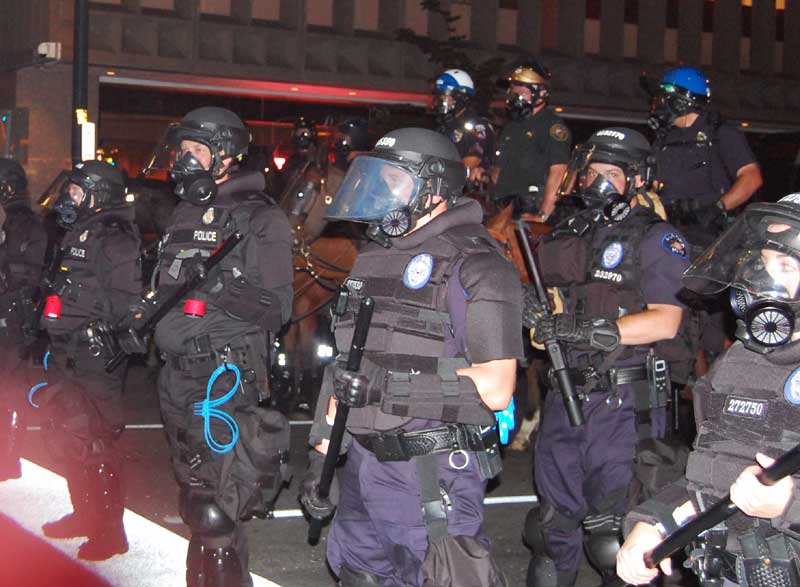
 Jill Greenberg
 COLORADO SPRINGS- Extradited desertion/political refugee Robin Long, spent several weeks jailed in Fort Carson after being refused political asylum in Canada. An army court let Long plead guilty to the charge of desertion based on a plea bargain agreement. The local PPJPC held vigils to publicize Long’s plight, and it turns out, did a little bit more.
 In a risky move, Pvt. Robin Long is going for a reduced sentence by essentially agreeing to a plea bargain from the US military Establishment.
  The US is decrying Russian aggression in South Ossetia, a breakaway province of Georgia, itself a breakaway of the ex-Soviet states. Georgia is a US proxy and a NATO beachhead aimed toward Russia and the Middle East. South Ossetia is a critical part. Here’s analysis from
 The vote is in, we send George Hutton packing. But not without a good eulogy.
