Colorado Springs is belly of space beast

X-37B unmanned spacecraft drone mini-space shuttleWhat’s that up in the sky? It’s a mini-me space shuttle with no windows, a former NASA project now entirely USAF. Amateur space object trackers have located the X-37B, the US military’s super secret unmanned space shuttle. What’s so secret about an unarmed, ostensibly inoffensive piece of space hardware? Good question. It depends on what military role you consider to be noncombatant.

Although I’d hope we could all agree by now that Predator Drone pilots wagging remote joysticks at stateside air force bases are plenty lethal if even illegal warfaring combatants. So what harm then, the little mini-me shuttle quietly going about its orbit?

During WWI, observers used to float above the trenches in balloons to direct artillery fire. The (unarmed!) bastards were despised more than the gunners themselves. The early airplane pilots earned the deference they’re shown to this day by the grunts on the ground because they would send the artillery spotters scrambling.

It’s thought that the X-37B is performing such reconnaissance tasks, perhaps with more flexibility and advanced technology than our standard satellites. But that wouldn’t entirely explain why this former NASA project is being kept out of the public eye.

Here’s obfuscating verbiage from a local war-in-space contractor, the Secure World Foundation based in Superior, Colorado.

“The program supports technology risk reduction, experimentation and operational concept development.”

The Air Force Rapid Capabilities Office is more forthright about its function:

“development and fielding of select Defense Department combat support and weapons systems.”

“Mission Control” by the way is located at the Air Force Space Command’s Third Space Experimentation Squadron, based at Schriever Air Force Base, right here.

A worrisome aspect about the X-37B is the secrecy, in light of the fact that its path can be charted by amateurs, if obviously also adversaries. The trajectory of the rocket which launched the vehicle into orbit, its spent hull directed now into an orbit around the sun, is also considered top-secret.

When Peace in Space activists are protesting the Space Symposium at the Broadmoor every year, this is what we are angry about: doublespeak pretending to be about space exploration. What will putting arms in space mean but more arms in space, quickly, adversaries rushing to grab a beachhead before the US is in the position to prevent it?

The X-37B is nothing but an near-space preditor drone, armed not with guns but the means to deploy space mines equipped with guns. If serving as the eyes and ears for targeting weapons isn’t immoral enough.

Al-Qaeda insurgent training inevident in NYC Times Square fireworks bomber

With a spectacular three digit death toll today, the Iraqi insurgence acquitted itself of all suspicion of having trained and/or coordinated last week’s would-be Times Square fireworks bomber. Explaining the deadliest series of bombings so far in 2010, US military propagandists scramble to blame so-called “al-Qaeda in Iraq” even as they try to tie the NYC firecracker-wrapped Jerry cans to the same resistance experts who improvise shaped-charges for their domestic explosive devices.

The media calls Faisal Shahzad a bomber, but some might question whether the attribution was earned. A failed bomb is still a bomb, but was the Rube Goldberg SUV even all that? It was a lit fuse going nowhere. An Olympian for example, has to have competed at the Olympics. A suicide bomber needn’t have effected a suicide, nor detonated a bomb, but probably has to have been found in possession. Likewise, a sniper, his rifle, a serial killer, his kills. Shahzad left a parked vehicle with something resembling the caricature of the makings of maheh, he’s a pyrotechnician, but obviously we know he’s not even that.

Simon Wiesenthal Center makes best case against Israel colonial legitimacy

Give Israel credit for answering their critics head on, but that is the Zionist hubris. Simon Wiesenthal is propagating the latest Hasbara crib sheet to counter the ten most threatening lies about Israel. We couldn’t have summarized the arguments better ourselves. One man’s “lies” are his victim’s desperate appeals to confound systemic myopic denial. Here it is in their own nutshell:
 
Israel was created by European guilt over the Nazi Holocaust. Why should Palestinians pay the price? … Had Israel withdrawn to its June 1967 borders, peace would have come long ago. … Israel is the main stumbling block to achieving a two-state solution. … Nuclear Israel, not Iran, is the greatest threat to peace and stability. … Israel is an apartheid state deserving of international boycott, divestment and sanctions campaigns. … Plans to build 1,600 more homes in East Jerusalem prove Israel is “Judaizing” the Holy City. … Israeli policies endanger U.S. troops in Afghanistan and Iraq. … Israeli policies are the cause of worldwide anti-Semitism. … Israel, not Hamas, is responsible for the “humanitarian catastrophe” in Gaza. … Goldstone was right when he charged that Israel was guilty of war crimes against civilians. … The only hope for peace is a single, binational state eliminating the Jewish State of Israel.

Even dissembled, the case weighs hard against Zionist mendacity.

OK, a tad capricious
To Wiesenthal’s credit, the arguments are loaded with a laudable reserve of disingenuity:

5,500 MORE HOMES have been zoned for East Jerusalem, not 1,600, (and yes, Jerusalem’s mayor has set quotas, a Jewish to non-Jewish target ratio to counter a higher Arab birthrate).

Israeli policies are the cause of [PROLIFERATION] of worldwide anti-Semitism,

The Gaza “humanitarian catastrophe” soft-pedals the critics’ real accusation: MASSACRE. Imagine referring to the Holocaust as befalling its victims with the ambivalence of a tsunami.

JUDGE Goldstone isn’t the only accuser who’s documented the criminality the world witnessed WITH ITS OWN EYES.

Apartheid legitimizers blink
Further demonstrating the disintegrating global support for a Jewish haven-state, the Simon Wiesenthal Center has all but dropped its cover as Holocaust-remembrance-sledgehammer to directly shore up the supposed public grant of legitimacy to Zionist colonialism.

Trying to turn the argument on Israel’s “de-ligitimizers” couldn’t be more out of touch.

While the US fights in expanding but downward spirals against the entropy of Pax Americana, Western public support for empire-building erodes for even the pretext of “globalization.” White Man’s Burden has smartened to Carbon Debt, missionary zeal evolved to indigenous and environmental protectionism. Religious crusades haven’t held water for centuries, but what an Auld Testament to Zionism’s xenophobic tenacity to posit the Jewish People as “chosen” to revive God-manifested destiny.

What part of “Apartheid is for Neanderthals” do Palestine’s neo- Afrikaners fail to understand? Even an 18th Century South African settler categorization gives the mid-twentieth century European transplants in Zion too much credit for pretended genealogical roots in the Middle East.

Only State Solution
Not very well concealed in Wiesenthal’s framing of the “Top Ten Lies” is a specious conceit formed by straw arguments three and ten, which presume the desirability of a “two-state solution” and/or a misguided hope for an inevitable “binational state.” Only in Wiesenthal’s rebuttal is there utterance of Israel’s true taboo –unmentionable because it will be self-fulfilling. The single state solution is dismissed with cavalier aplomb as “a non-starter.”

They desperately wish. On what basis do Zionists imbue themselves authority to trump international consensus? Hopefully it is not their nuclear arsenal. No other religious ideology, armed with nukes or without, asserts any permutation of divine refugee-status provenance to an autonomous “homeland.” Not even Tibet.

I expect sooner than the Zionists like –but then the self-defeatist arrogance may bely my presumption– the Simon Wiesenthal Center will be scrambling to bolster rationalizations against the only peaceful solution already on everyone’s mind and taxing our humanitarian patience: the single-state multi-theist modern egalitarian democracy.

Hasbara desperation
We reprint a near-complete representation of the SWC brochure below for our readers, if also to facilitate the identification of pro-Israel internet trolls by the tracts they are presently copy-and-pasting all over blog discussions. Who would have suspected that the resurgent wave of Zionist troll tripe was so transparently linked to official AIPAC and Wiesenthal Center press releases. We give the IDF Hasbara budget too much credit.

A recent IDF-merc commenter goaded us to “envy Israeli intellectual superiority.” I will admit it, I am in awe. Eagerly too. I know where it got Icarus.

Israel goes Titanic. Gotta love a good spectacle.

Appendix
Here then, courtesy of the Simon Wiesenthal Center, the 2010 Top Ten Anti-Israel Lies, enjoy!

2010 TOP TEN
ANTI-ISRAEL LIES

Israel is under assault!
Here’s what you need to know.
Act now…

Lie No. 1: Israel was created by European guilt over the Nazi Holocaust. Why should Palestinians pay the price?

Three thousand years before the Holocaust, before there was a Roman Empire, Israel’s kings and prophets walked the streets of Jerusalem. The whole world knows that Isaiah did not speak his prophesies from Portugal, nor Jeremiah his lamentations from France. Revered by its people, Jerusalem is mentioned in the Hebrew Scriptures 600 times, but not once in the Koran. Throughout the 2,000-year exile of the Jews, there was a continuous Jewish presence in the Holy Land.

Lie No. 2: Had Israel withdrawn to its June 1967 borders, peace would have come long ago.

Since 1967, Israel repeatedly has conceded “land for peace.” Following Egyptian President Sadat’s historic 1977 visit to Jerusalem, Israel withdrew from the vast Sinai Peninsula and has been at peace with Egypt ever since. But the Palestinian Authority has never fulfilled its promise to end propaganda attacks nor drop the Palestinian National Charter’s call for Israel’s destruction. In 2000, Prime Minister Barak offered Yasser Arafat full sovereignty more than 97 percent of the West Bank, a corridor to Gaza, and a capital in the Arab section of Jerusalem. Arafat said no.

Lie No. 3: Israel is the main stumbling block to achieving a two-state solution.

The Palestinians themselves are the only stumbling block to achieving a two-state solution. With whom should Israel negotiate? With President Abbas, who for four years has been barred by Hamas from visiting 1.5 million constituents in Gaza? With his Palestinian Authority, which continues to glorify terrorists and preaches hate in its educational system and the media? With Hamas, whose Iranian-backed leaders deny the Holocaust and use fanatical Jihadist rhetoric to call for Israel’s destruction?

Lie No. 4: Nuclear Israel, not Iran, is the greatest threat to peace and stability.

The United States and Europe can afford to wait to see what the Iranian regime does with its nuclear ambitions, but Israel cannot. Israel is on the front lines and remembers every day the price the Jewish people paid for not taking Hitler at his word. Israel is not prepared to sacrifice another 6 million Jews on the altar of the world’s indifference.

Lie No. 5: Israel is an apartheid state deserving of international boycott, divestment and sanctions campaigns.

In fact, Israel is a democratic state. Its 20 percent Arab minority enjoys all the political, economic and religious rights and freedoms of citizenship, including electing members of their choice to the Knesset (Parliament).

Lie No. 6: Plans to build 1,600 more homes in East Jerusalem prove Israel is “Judaizing” the Holy City.

Ramat Shlomo was not about Arab neighborhoods in East Jerusalem but about a long established, heavily populated Jewish neighborhood in northern Jerusalem, where 250,000 Jews live (about the size of Newark, N.J.) — an area that will never be relinquished by Israel.

Lie No. 7: Israeli policies endanger U.S. troops in Afghanistan and Iraq.

A resolution of the Palestinian-Israeli conflict would benefit everyone, including the United States. But an imposed return to what Abba Eban called “1967 Auschwitz borders” would endanger Israel’s survival and ultimately be disastrous for American interests and credibility in the world.

Lie No. 8: Israeli policies are the cause of worldwide anti-Semitism.

From the Inquisition to the pogroms, to the 6 million Jews murdered by the Nazis, history proves that Jew hatred existed on a global scale before the creation of the State of Israel. It would still exist in 2010 even if Israel had never been created. For example, one poll indicates that 40 percent of Europeans blame the recent global economic crisis on “Jews having too much economic power” — a canard that has nothing to do with Israel.

Lie No. 9: Israel, not Hamas, is responsible for the “humanitarian catastrophe” in Gaza. Goldstone was right when he charged that Israel was guilty of war crimes against civilians.

The United Nations Human Rights Council is obsessed with false anti-Israel resolutions. It refuses to address grievous human rights abuses in Iran, North Korea, Sudan, Saudi Arabia, Cuba and beyond. Faced with similar attacks, every U.N. member-state, including the United States and Canada, surely would have acted more aggressively than the Israel Defense Forces did in Gaza.

Lie No. 10: The only hope for peace is a single, binational state eliminating the Jewish State of Israel.

The one-state solution is a non-starter because it would eliminate the Jewish homeland. However, the current pressures on Israel are equally dangerous. In effect, the world is demanding that Israel, the size of New Jersey, shrink further by accepting a three-state solution: a P.A. state on the West Bank and a Hamas terrorist one in Gaza. All this as Hezbollah, Iran’s proxy in Lebanon, stockpiles 50,000 rockets, threatening northern and central Israel’s main population centers. Current polls show that while most Israelis favor a two-state solution, most Palestinians continue to oppose it.

Gaza Freedom Flotilla building steam


The Free Gaza Movement’s FREEDOM FLOTILLA III is assembling itself ship by ship at European ports. Departure is set for later this month. You can already track the passenger ship MS Mavi Marmara and cargo ships Gazze, Sofia and MV Rachel Corrie on Google Earth. Will the humanitarian relief convoy succumb to Israel’s blockade?
UPDATED: photo-profiles of the IN v. FGM maritime contenders:

The blockade runners:

M/S Mavi Marmara, Turkey, IMO: 7083956, MMSI: 271002151
Currently in Sarayburnu, Istanbul, heading to Tuzla shipyard.


Gazze, Turkey, IMO: 7806192, MMSI: 271002042
Currently in Haydarpasa, Istanbul.


VM Rachel Corrie, Ireland, IMO: 6715281, MMSI: 515886000
(Formally: Linda) Currently at Brown’s Quay, Dundalk, Ireland.

Ship to Gaza sponsored by Sweden
Sofia, Sweden / Greece, IMO: 6713752, MMSI: 239219000
Currently docked in Piraeus Roads, Athens.
Itinerary: Tromsö – Göthenburg – Great Yarmouth – Bilbao – Lisbon – Barcelona – Marseilles – Genoa – Athens – Istanbul – Gaza City.

UPDATE 5/23

Defne Y, Kiribata, IMO: 7725518, MMSI: 529239000.
Currently loading in Istanbul.

VERSUS…

The Israeli blockade

Free Gaza has launched eight relief flotillas to Gaza since 2006, but according to Intifata Palestine:

The last three voyages were illegally stopped by the Israeli navy when, in December, 2008, they rammed the DIGNITY in international water, turned back the SPIRIT OF HUMANITY by threatening to shoot all on board, then hijacking the SPIRT on July 1, 2009, kidnapping the passengers and throwing them into prison for a week.


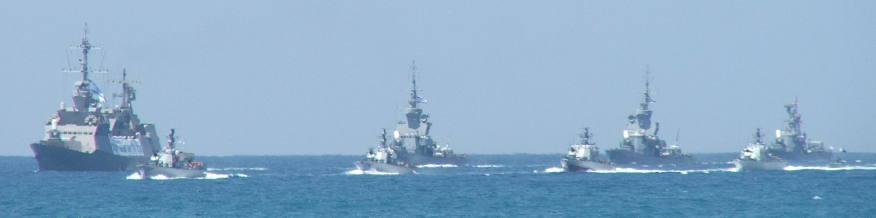
Israeli Super Dvora Mk III gunship intercepts Freedom Flotilla cargo ship The Brotherhood Ship in 2009, forcing it to return to Lebanon.


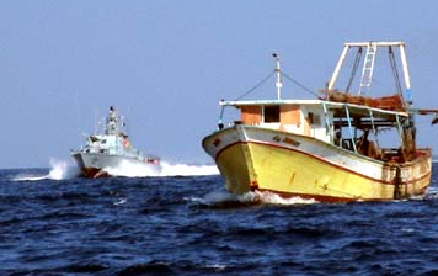
Israeli coastal patrol accosts Palestinian fishing vessels which stray beyond an Israel-imposed six mile fishing limit.


Israeli Dabur class Coastal Patrol Craft sets water hose on Palestinian fishing vessel before making arrests.

It was a Dabur in 2008 which rammed the Free Gaza relief ship Dignity.

Gulf oil spill is SO Obama’s Katrina

Which parallel is not analogous? Off New Orleans, massive devastation to environment and human health, predictable failure of flawed technology, inadequate official response which broadens tragedy. Leaving BP to shoulder cleanup is like tasking arsonists to extinguish their fire. BP is responsible, but needn’t be put in charge. Put every government resource into addressing this calamity, make oil industry write the checks. By any standards of a failed rescue, Obama’s watch is proving as laggard as Bush’s.

We can all express our awe at the scale of the spill, but who can believe the professionals couldn’t foresee it? The media ramped its estimates incrementally, but department first responders were theorizing 100,000 barrels a day right from the start.

I’m amused that conservative critics use “Katrina” in the pejorative, where they didn’t hold it against Bush. Katrina has come to mean colossal fail, but what did it mean for Bush? It wasn’t his Waterloo, it didn’t even stub his toe. Those who pretend Katrina was Dubya’s downfall are the same pundits who describe Iraq as a blunder. Lies. To tar President Obama with a tragedy of like magnitude of a predecessor is to remind the electorate how bad Bush was.

I’m pleased by the comparison because it pollutes your perception that voting matters. The choice of lesser of two evils means relative degrees of industrial strength toxicity.

Why aren’t Obama hopefuls confident enough to let their leader take this “Katrina” on? Let him own it and beat Bush’s legacy of indifferent passivity.

Are you provoked because “Katrina” presumes a callous failure, as yet in your opinion unmerited by Team Obama? I’d rather say it means disaster in the sense of a test which proved this nation’s horribly misplaced priorities. Has Obama’s administration brought better preparedness in the face of unforeseen peril coming in with the tide? In such a manner alone this oil spill will rival Katrina. If you are measuring only loss of human lives, look to the health impact which the crude infusion will bring.

Now if you’re asking if the oil spill is a “Katrina” land grab of coastal real estate, and excuse to gentrify New Orleans and remake gambling regulations to suit the casinos, perhaps not. But count the same relief contractors to make themselves spillionaires. Once again the residents will bear the burden of the labor and disruption, ultimately to lose their livelihoods and homes. This time instead of praising “Brownie” the president will praise BP for doing their best, as the media will assure us it was. The spill’s magnitude could never have been predicted, they’ll say, a mitigation of the damage beyond anyone’s capability.

Was “Katrina” a repudiation of our reliance on old levees? Not really. Will this Katrina mean a rekindled moratorium against new offshore drilling capers? I doubt it. Americans inland will probably write off the oceans. No longer pristine, what with mercury, hypoxia and now oil, why not Drill Baby Drill with what is there left to lose aplomb?

US inhumanity maxed at Azimuth Limit

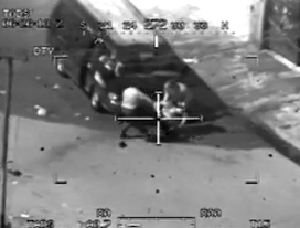
WikiLeaks video combat footage of 2007 collateral murder in Iraq“Light ’em all up. Come on, fire!” Watching the leaked combat footage of the helicopter gunships killing unarmed Iraqi civilians in 2007, I’m troubled by my own desensitized response. When I saw earlier leaked videos of an AH-64 vaporizing Iraqi farmers and a C-130 wreaking mayhem in Afghanistan, I remember my real shock at seeing a human life extinguished. This time not even flinch. “Just fuckin’, once you get on ’em just open ’em up.” Not at the brutality, nor the callousness of the play by play –even as the pilots targeted rescuers trying to help the wounded. I fault the Rules of Engagement that allowed the massacre, not the soldiers’ laughing swagger –as I hope they will not begrudge my unguarded satisfaction when eventually spectators will be treated to leaked footage of American soldiers taking some fire.

If you watched the video, perhaps you too were wishing that July 12, 2007 had recorded a massive setback for US troops in Iraq, at the height of the “surge” where a whole shitload of “dismounts” had been ambushed by IED explosions in a Baghdad square in the aftermath of a civilian massacre. Those who watched the 39-minute extended version I know were hoping to see a resolution like that, instead of an additional war crime of disproportional force and the targeting of civilians, a Hellfire missile attack on a building into which armed and unarmed men had entered, surrounded by passing innocents and rescuers scrambling to help.

There it goes! Look at that bitch go!
Patoosh!
Ah, sweet!
Need a little more room.
Nice missile.
Does it look good?
Sweet!

The Army has declared that no further inquiry will be made into the 2007 killing of the two Reuters journalists. Its FOIA requests long thwarted, even Reuters is not expressing outrage at this footage. Civilians and journalists about to be lit up The corporate media is hoping to let this story fade on the fringe. Does this mean that more pilots and gunners might become emboldened to leak other trophy reels? It doesn’t take Nelson Ratings for news outlets to see that viewers are already clamoring for more combat snuff films.

We could grant amnesty in exchange for those who turn in the most degenerate sequences.

And pretend they’ll remain anonymous. Ultimately friends and relatives will be able to place identities with the radio voices. Speaking on one of the clearest channels is the young voiced HOTEL-26, who reported taking fire from the photographers and ID’d the “RPG” with started the whole engagement. Likewise the gunner on CRAZY HORSE-18 who responded “Alright, hahaha, I hit ’em….” is addressed “God damn it, Kyle.”

And then there’s the poor 30mm gunner in CRAZY HORSE-19 who assessed his work thus:

Oh yeah, look at that. Right through the windshield! Ha ha!

While chomping at the bit to fire upon the improvised ambulance, he was momentarily thwarted by a puzzling “Azimuth Limit” which prevented his shooting.

Bloggers are now abuzz to decode the Azimuth Limit which slowed the turkey shoot when none of the gunners were showing restraint. Azimuth is the angular measurement of an object’s distance clockwise from True North. On rifles it expresses the adjustment of a gunsight to its boresight. On aircraft it apparently has something to do with the angle of relation to the axis of the fuselage. Whatever it is, maybe we can ratchet military Azimuth Limits down flat, if that’s what it will take to stop our soldiers from blowing away civilians, journalists, children and their rescuers alike. The shooters can cuss and salivate all they want so long as their trigger mechanisms respect human life or at least balk at excessive carnage.

What doesn’t come across the audio is what the US soldiers on the ground are saying to themselves as they survey “that big pile of [unarmed] bodies,” in their palaver, the “dead bastards.”

UPDATE — the testimonials begin:

From Iraq war veteran Michael Prysner, co-founder of March Forward!

The harrowing Apache footage released by WikiLeaks gives us a stomach-turning glimpse of war. Seventeen minutes of cold-blooded massacre in a war of more than seven years. A brief clip of one Apache video; a quick look at one part of one mission. Hundreds of those missions take place every day.

The video came to light thanks to military whistleblowers who provided it to WikiLeaks together with supporting documents.  Imagine if we had access to all such videos, the things we would see. Imagine all the Iraqis killed who have no one to uncover the truth about their deaths. Had the death of two Reuters news staffers not generated interest in this video, then the destruction of three families by hellfire missiles fired into an apartment building with no provocation, in a separate engagement also featured in the video, would have never been made public.

This massacre is a drop in a sea of blood. Many other such “incidents” will never be known.

Officers claimed there was “no question” that the pilots were responding to enemy fire; the video shows there is no question that they were not responding to enemy fire. They said that they had “no idea” how the journalists were killed; the video shows that they know very well how those journalists were killed. They were gunned down standing in a crowd of unarmed people.
After the slaughter of that group, the pilots beg for permission to kill the innocent passers-by who had come to the aid of one of the wounded, like any of us would have done if we saw our neighbor dying on the ground as we drove down the street. They kill everyone trying to help the dying journalist, and critically wound two children seen sitting in the front seat.

We see a group of unarmed men mowed down by a machine gun designed to destroy armored vehicles. We see a vanload of good Samaritans obliterated for trying to help a dying victim. We see all this with the soundtrack of the pilots mocking the dead, congratulating each other and laughing about the massacre.

No wonder the U.S. military goes to such great lengths to keep such videos from us. They want us to see Iraq and Afghanistan through their lens, through their embedded reporters, filtered by censorship and restrictions. They know that, once the people of this country see the extreme racism and brutality behind these occupations, they will be repulsed by what their tax dollars are paying for.

The military brass and the White House politicians have tried to justify this senseless atrocity. “Cut the pilots some slack. This was in Baghdad. This was a battle zone”—that’s been their line. The pilots had been indoctrinated with the same colonial mentality. “That’s what they get for bringing their kids into battle,” one pilot says.

The father driving that van was not “bringing his kids into battle.” He was bringing them to school, driving down the street where they live. But the U.S. occupation has made all of Iraq a battle zone. To those pilots, to their commanders over the radio and to the generals in the Pentagon, every single person in Baghdad and in Iraq is “fair game.”

The pilots joked about the people they killed, laughed about U.S. military vehicles running over dead bodies, knowing that their commanders were listening and that they were being recorded. They were not acting out of character. This is the culture of the occupation. This is how these wars are being conducted.

Having seen this, one cannot honestly believe that these atrocities are committed day in and day out for the liberation of the Iraqi people.

The Pentagon’s talking heads and media lackeys are hard at work putting their spin on this story. It’s time to tell the truth. For more than seven years, the U.S. has unleashed criminal, unprovoked aggression against the people of Iraq, and they have been doing the same thing in Afghanistan for more than eight years.

The U.S. military presence in Iraq is a colonial occupation force. The only way forward is a complete, immediate and unconditional withdrawal of all U.S. forces from Iraq and Afghanistan. This government will not do that unless all of us who are outraged by these criminal acts stand up and demand it.

Iraq war veteran Josh Stieber, US Army Specialist, 1st ID, Bravo Company 2-16 in Baghdad (Rustamiyah) 2007-2008. Although he was not present at the scene of the video, he knows those who were involved and is familiar with the environment.

A lot of my friends are in that video. After watching the video, I would definitely say that that is, nine times out of ten, the way things ended up. Killing was following military protocol. It was going along with the rules as they are.

If these videos shock and revolt you, they show the reality of what war is like. If you don’t like what you see in them, it means we should be working harder towards alternatives to war.

?

Homeless stalkers in white motorcades


COLORADO SPRINGS- Cleanup operations continued this morning under the Highway 24 interstate overpass. The “Green Team” crews are distinguished by their white pickups and vans which transport Community Service parolees to bag homeless possessions under the supervision of the CSPD H.O.T. officers in unmarked white cruisers.

Not to begrudge the poor their fancy motorcade, but you might think a cash-strapped city needn’t expend so much automotive bling in its poverty flushing efforts. Colorado Springs takes great pride obviously in its street cleaning.

The procession of pickups and vans are marked by magnetic signs denoting them as the Colorado Springs “Green Team.” What are we to make of the police cars being unmarked? They are not undercover vehicles, merely police cruisers without the decals, standing out like detectives in trenchcoats, as I imagine the intimidating police apparatus of authoritarian states. These officers are projecting all the authority without the flashing lights, projecting unfortunately all the menace which law enforcement inherently presents to the poor, without the trappings of official function of “to protect and serve.”

As friendly as their campside manner might be, these officers are enforcing regulations which have criminalized joblessness and dispossession into defacto “vagrancy.” What are the poor to do, invent jobs? Conjure houses and property? Move along folks, we don’t want to see your personal problems in public places. Nothing personal.

My WHERE’S WALDO album of DC


Yes, that’s me on the right, in the yellow sweatshirt and red cap, shouldering the Coloradans For Peace standard.

These are all photographs tweeted, flickr’d and picassa’d by others, for which my red cap and green shirt served in the background.


Watching as cameras prepare for A.N.S.W.E.R. rally in Lafayette Park


Assembling with other Coloradans for STOP THE WAR march


We’re behind the coffin with the Stars and Stripes


Reaching the White House


Police enforce perimeter around arrestees


At SDS rally in Farragut Square


Camp Out Now main canopy


Making posters in the shade.


Saturating the camp with Eric Font.

Forget first write-ups, when homeless go for soup, dispose of their belongings


This is how it starts. Orange notices went up this weekend at the convergence of Monument and Fountain Creeks, declaring area a cleanup site. Items found unattended will be hauled away. Tonight is another meeting of COME OUT OF THE COLD, the local feel-good effort facilitating Colorado Springs cleansing itself of homeless tents. Instead of enabling the cleanup crews, volunteers could watch over the tents tomorrow while their disadvantaged occupants go for daily meals and social services.

If Camp OUT NOW won’t end the US military corporate empire, will you?

POTA - Peace Of The Action
In 2005 Cindy Sheehan staked her tent in Crawford TX until President Bush would deign to meet with her; she didn’t pack it up until she had launched an antiwar movement. From there Sheehan met with world leaders, challenged Nancy Pelosi at the polls, and made herself ubiquitous wherever antiwar was raged. This time Sheehan is laying siege to the White House and she’s not going to let up until Obama calls off his dogs of war. Will it work? It should.

George Bush could have halted the grieving mother’s momentum if he’d heard her out. This time no beer summit is going to pass for Obama’s promised change. Sheehan has already been arrested in front of the White House, the new president has already snubbed her on Martha’s Vineyard. Didn’t hear about it? The media can pretend none of this is happening unless Camp OUT NOW reaches critical mass. You should join in. Sheehan’s promising no less than the crumbling of the US military corporate empire. Can it happen? It won’t happen without you.

Cool Runnings vs selling out the whales

Forget putting together a Winter Olympic delegation to tap into your nationality’s PR budget, the real money is in the International Whaling Commission. Right now Japan is showering aid to nations willing to enroll in the IWC, to help Japan overturn the whaling moratorium. The IWC convenes a special session tomorrow in Florida and Greenpeace reports the whales have just lost the majority.

Of great concern is that the US and New Zealand appear to want to switch sides, despite Candidate Obama’s pledge to support the whaling moratorium.

The traditional pro-whaling nations of Japan, Norway, Iceland, Peru and Russia have allied with land-locked entities to vote to resume whaling. Mali and Mongolia are among recent recruits. Other aid recipients include Antigua, Barbuda, Belize, Dominica, Grenada, Guinea-Bissau, Morocco, Panama, St. Lucia, St. Vincent, St Kitts, and the Solomon Islands.

Anti-whaling leader Australia is joined by Austria, the Czech Republic, Hungary, Luxembourg, Slovakia, Switzerland and San Marino.

Other members include Argentina, Belgium, Belize, Benin, Brazil, Cambodia, Cameroon, Chile, People’s Republic of China, Republic of the Congo, Costa Rica, Côte d’Ivoire, Croatia, Cyprus, Denmark, Ecuador, Eritrea, Estonia, Finland, France, Gabon, The Gambia, Germany, Greece, Guatemala, Republic of Guinea, India, Ireland, Israel, Italy, Kenya, Republic of Korea, Kiribati, Laos, Lithuania, Luxembourg, Republic of the Marshall Islands, Mauritania, Mexico, Monaco, Nauru, Netherlands, Nicaragua, Norway, Oman, Palau, Portugal, Romania, Russian Federation, Senegal, Slovak Republic, South Africa, Spain, Suriname, Sweden, Tanzania, Togo, Tuvalu, United Kingdom and Uruguay.

If your nation isn’t on the list, contact your state department. Forget assembling a tropical bobsled team, you’ll be able to pay your own way to Sochi, because the big money is in killing whales.

Gay, married, or in the military: pick 2

top of wedding cakeI admit to feeling less supportive than I ought to for gays pushing for their right to wed — in the midst of every American’s crumbling civil rights — while our country decimates foreign human rights and lives. Couldn’t gay marriage activists at least share the spotlight with peace, out of consideration for the suffering of others, proportionately? How about: Make Love (Marital), Not War. Now gay rights are being made a wedge issue with the dubious right to aspire to be a soldier. Is now the time for us to urge the military to leave no gay behind?

I object as always to the presumption of a professional soldier’s moral validity.

To be fair, it may be that the gays-in-the-military meme is being pressed upon the gay activists. These days, military enlistment has lost a great deal of its appeal. Who can the Army pretend wants to join but can’t? Who else but a demographic that’s been historically denied? I can’t say for certain that gay rights activists haven’t been rallying at recruiting offices, but reporters always seem to find someone to complain they’re being discriminated against. No doubt the war-monger message-shapers can always track down one lone homosexual or two who want to play soldier.

With today’s economy, I’m sure there are not a few gay men and women who will decry the unfairness of being denied the military career path. Being gay doesn’t mean you’re a born hairdresser or a saint. Belonging to a victimized minority doesn’t automatically imbue you with empathy or a higher social conscience to preclude wanting to be a soldier. Gays can hate and kill with the best of grunts I’m sure.

The purpose of circulating this meme, that gays want the right to serve their country in uniform, doesn’t mean the Department of Defense intends to consider granting the right. This is not about enhancing gaydom. This is about putting some spin on the department’s recruiting problems. Who says no one wants to enlist? Gays do! This pseudo-rights campaign is meant to push straight boys into military service while they think it’s their exclusive right. Not only that, the campaign theme serves to reinforce that the military will be your sanctuary from gays. And if any lurk in the barrack, at least they are prohibited from showing it. In everyday civilian life, gays were much more bearable before they held parades to shove it in your face.

American media has come to delight in gayness writ Big Gay Al. But South Park is the only showcase for gay characters who aren’t the stereotypical decorator or fashion nerd. The gay home makeover does not cease to be a novelty, but I’d say the focus group is still out on construction contractor bears, gay bar trolls, and United Court female impersonators.

Without saying gays not welcome, the move to reexamine Don’t Ask Don’t Tell is really just spiffing up the old brand. Army of One, still gay-free.

What was the announcement today? That after years of criticism for the Don’t Ask Don’t Tell policy, the military has decided to put the question to further study. That is to say, to begin a year-long inquiry into the matter. The Army is still gay-free, in all certainty will remain so, now with a year’s warranty.

I have this message for my gay compatriots in activism. If this issue is being forced on you, and you abhor as I, the loaded nature of the media soundbite, the implication that people want to be in the military, it seems to me you have have a unique opportunity to make this message your own. Do you want to be in the business of soldiering? Tell them why.

Tell them why you want to go to war. Borrow a page from the testosterone-heavy war lovers. War crime, playing god, abuse of authority, yours for the taking.

Decry the stereotypes of gays as effete fops. Gays can kill, gays can have blood lust. Gays can shoot at women and children, maybe even with greater enthusiasm. I’ll bet gays could absolutely massacre women. And girls. With relish. If the Army is going to peddle stereotypes, answer in kind.

No telling what gays can do to boys. They can give boys equal time, the menace today’s soldiers reserve for girls. No one’s children will be safe. A gay-straight platoon will wreak havoc on all enemy’s progeny.

Imagine an inter-squad rivalry between the straights and the gays, who can out-debauch whom. Clearly an enhancement on America’s war of terror.

What was Amtrak Terrorist Ojore Lutalo reading that got him arrested?

Journal Turning the TideWas this among the Anarchist literature which provoked the arrest of Amtrak Terrorist Ojore Lutalo in La Junta last week? Until we get the detailed affidavit, NMT is soliciting input from the exhibitors of the LA Anarchist Book Fair of JAN 24, as to which of their publications Ojore might have picked up that so excited his accusers. Who among them for example, is recruiting terrorists or propagandizing against America?

We are inviting every participant of the book fair from which Ojore was returning to submit their best candidate for subversive message for which law officers of Southern Colorado, advised by the local FBI, determined to be propaganda for wrong side of their “War on Terror.” Contact us or append your suggestions below.

Former BLA POW Lutalo is being charged with endangering his fellow passengers with a cell phone conversation purportedly overheard and interpreted to forewarn of a terrorist act, but once that misunderstanding was cleared, the unarmed prison-rights activist could have been left to go on his way. Instead Ojore was detained because of suspicions aroused by reading material he was carrying. I’m not sure even the bomb-making instructions of the Anarchist Cookbook would be grounds to get anyone arrested. Clearly the subject matter of Ojore’s literature will be a critical factor in unmasking the police state which celebrates its service in protecting the American public from terror.

By coincidence, I’m familiar with the train station in La Junta, and with that Amtrack stop. Several years back I once intercepted my sister as she crossed the country my rail. It was her birthday and I had the time to walk hastily through more than half of the cars, find where she was sitting, deliver a cake, light some candles, have a conversation, take some pictures, hug at the door, and descend to the platform when the train had to get on its way. I’m not convinced that police officers didn’t have enough time to size up the 64-year-old Lutalo, diffused the misunderstanding, and let him go on his way, for being the non-threatening passenger he was, if of course his skin was admittedly darker than made his fellow passengers comfortable. At the MOST, officers could have ridden with him the twenty minutes to the next stop at Lamar, while they sorted things out with whoever was so spooked by what they overheard.

That Lutalo was taken from the train and arrested, owes quite a bit to what the police reported to have found on him. Not weapons, nor explosives, but literature. Recruiting material for terrorists, and troubling images of President Obama.

If the press won’t report what books Ojore was carrying, the better to characterize them as propaganda; attributing them only to “Afrikan Liberation Army” or “New Afrikan Anarchist” neither of which are actual organizations that might profit by receiving national focus, here is YOUR opportunity to receive media scrutiny.

Perhaps YOUR literature was what piqued the interest of the police. Perhaps it was a how-to on organic farming that La Junta police knew was aimed at subverting Big Agra’s domination of the heartland. Perhaps by their judgment any criticism of America’s political system can be considered too radical and seditious.

Even if your publications didn’t feature “images of Obama,” certainly you could step up and issue a press release to apologize in advance if your “Anarchist” title, for example about running community soup kitchens, was construed to be a recruiting tool for terrorism.

This is an ideal opportunity for YOU, as a purveyor of potentially dangerous literature, to announce what titles you feature that are so informative as to be considered so subversive of our system that Americans must be protected from them. If you are inclined, please write about your catalog and its potential to alarm law enforcement and send us the link!

Beyond MLK worship: Beyond Vietnam

MLK“A time comes when silence is betrayal. That time has come for us in relation to Vietnam.”
Martin Luther King Beyond Vietnam: Time to Break the Silence
Full text of 1967 speech below.

Riverside Church, New York City, 4 April 1967

I come to this magnificent house of worship tonight because my conscience leaves me no other choice. I join with you in this meeting because I am in deepest agreement with the aims and work of the organization which has brought us together: Clergy and Laymen Concerned about Vietnam. The recent statement of your executive committee are the sentiments of my own heart and I found myself in full accord when I read its opening lines:

“A time comes when silence is betrayal.”

That time has come for us in relation to Vietnam.

The truth of these words is beyond doubt but the mission to which they call us is a most difficult one. Even when pressed by the demands of inner truth, men do not easily assume the task of opposing their government’s policy, especially in time of war. Nor does the human spirit move without great difficulty against all the apathy of conformist thought within one’s own bosom and in the surrounding world. Moreover when the issues at hand seem as perplexed as they often do in the case of this dreadful conflict we are always on the verge of being mesmerized by uncertainty; but we must move on.

Some of us who have already begun to break the silence of the night have found that the calling to speak is often a vocation of agony, but we must speak. We must speak with all the humility that is appropriate to our limited vision, but we must speak. And we must rejoice as well, for surely this is the first time in our nation’s history that a significant number of its religious leaders have chosen to move beyond the prophesying of smooth patriotism to the high grounds of a firm dissent based upon the mandates of conscience and the reading of history. Perhaps a new spirit is rising among us. If it is, let us trace its movement well and pray that our own inner being may be sensitive to its guidance, for we are deeply in need of a new way beyond the darkness that seems so close around us.

Over the past two years, as I have moved to break the betrayal of my own silences and to speak from the burnings of my own heart, as I have called for radical departures from the destruction of Vietnam, many persons have questioned me about the wisdom of my path. At the heart of their concerns this query has often loomed large and loud: Why are you speaking about war, Dr. King? Why are you joining the voices of dissent? Peace and civil rights don’t mix, they say. Aren’t you hurting the cause of your people, they ask? And when I hear them, though I often understand the source of their concern, I am nevertheless greatly saddened, for such questions mean that the inquirers have not really known me, my commitment or my calling. Indeed, their questions suggest that they do not know the world in which they live.

“I wish not to speak with Hanoi and the National Liberation Front, but rather to my fellow Americans who, with me, bear the greatest responsibility in ending a conflict that has exacted a heavy price on both continents.”

In the light of such tragic misunderstandings, I deem it of signal importance to try to state clearly, and I trust concisely, why I believe that the path from Dexter Avenue Baptist Church — the church in Montgomery, Alabama, where I began my pastorate — leads clearly to this sanctuary tonight.

I come to this platform tonight to make a passionate plea to my beloved nation. This speech is not addressed to Hanoi or to the National Liberation Front. It is not addressed to China or to Russia.

Nor is it an attempt to overlook the ambiguity of the total situation and the need for a collective solution to the tragedy of Vietnam. Neither is it an attempt to make North Vietnam or the National Liberation Front paragons of virtue, nor to overlook the role they can play in a successful resolution of the problem. While they both may have justifiable reason to be suspicious of the good faith of the United States, life and history give eloquent testimony to the fact that conflicts are never resolved without trustful give and take on both sides.

Tonight, however, I wish not to speak with Hanoi and the NLF, but rather to my fellow Americans, who, with me, bear the greatest responsibility in ending a conflict that has exacted a heavy price on both continents.

The Importance of Vietnam

Since I am a preacher by trade, I suppose it is not surprising that I have seven major reasons for bringing Vietnam into the field of my moral vision. There is at the outset a very obvious and almost facile connection between the war in Vietnam and the struggle I, and others, have been waging in America. A few years ago there was a shining moment in that struggle. It seemed as if there was a real promise of hope for the poor — both black and white — through the poverty program. There were experiments, hopes, new beginnings. Then came the buildup in Vietnam and I watched the program broken and eviscerated as if it were some idle political plaything of a society gone mad on war, and I knew that America would never invest the necessary funds or energies in rehabilitation of its poor so long as adventures like Vietnam continued to draw men and skills and money like some demonic destructive suction tube. So I was increasingly compelled to see the war as an enemy of the poor and to attack it as such.

“For the sake of those boys,
for the sake of this governent,
for the sake of hundreds of thousands
trembling under our violence,
I cannot be silent.”

Perhaps the more tragic recognition of reality took place when it became clear to me that the war was doing far more than devastating the hopes of the poor at home. It was sending their sons and their brothers and their husbands to fight and to die in extraordinarily high proportions relative to the rest of the population. We were taking the black young men who had been crippled by our society and sending them eight thousand miles away to guarantee liberties in Southeast Asia which they had not found in southwest Georgia and East Harlem. So we have been repeatedly faced with the cruel irony of watching Negro and white boys on TV screens as they kill and die together for a nation that has been unable to seat them together in the same schools. So we watch them in brutal solidarity burning the huts of a poor village, but we realize that they would never live on the same block in Detroit. I could not be silent in the face of such cruel manipulation of the poor.

My third reason moves to an even deeper level of awareness, for it grows out of my experience in the ghettoes of the North over the last three years — especially the last three summers. As I have walked among the desperate, rejected and angry young men I have told them that Molotov cocktails and rifles would not solve their problems. I have tried to offer them my deepest compassion while maintaining my conviction that social change comes most meaningfully through nonviolent action. But they asked — and rightly so — what about Vietnam? They asked if our own nation wasn’t using massive doses of violence to solve its problems, to bring about the changes it wanted. Their questions hit home, and I knew that I could never again raise my voice against the violence of the oppressed in the ghettos without having first spoken clearly to the greatest purveyor of violence in the world today — my own government. For the sake of those boys, for the sake of this government, for the sake of hundreds of thousands trembling under our violence, I cannot be silent.

For those who ask the question, “Aren’t you a civil rights leader?” and thereby mean to exclude me from the movement for peace, I have this further answer. In 1957 when a group of us formed the Southern Christian Leadership Conference, we chose as our motto: “To save the soul of America.” We were convinced that we could not limit our vision to certain rights for black people, but instead affirmed the conviction that America would never be free or saved from itself unless the descendants of its slaves were loosed completely from the shackles they still wear. In a way we were agreeing with Langston Hughes, that black bard of Harlem, who had written earlier:

O, yes,
I say it plain,
America never was America to me,
And yet I swear this oath —
America will be!

Now, it should be incandescently clear that no one who has any concern for the integrity and life of America today can ignore the present war. If America’s soul becomes totally poisoned, part of the autopsy must read Vietnam. It can never be saved so long as it destroys the deepest hopes of men the world over. So it is that those of us who are yet determined that America will be are led down the path of protest and dissent, working for the health of our land.

“Surely we must see
that the men we supported
pressed them to their violence.”

As if the weight of such a commitment to the life and health of America were not enough, another burden of responsibility was placed upon me in 1964; and I cannot forget that the Nobel Prize for Peace was also a commission — a commission to work harder than I had ever worked before for “the brotherhood of man.” This is a calling that takes me beyond national allegiances, but even if it were not present I would yet have to live with the meaning of my commitment to the ministry of Jesus Christ. To me the relationship of this ministry to the making of peace is so obvious that I sometimes marvel at those who ask me why I am speaking against the war. Could it be that they do not know that the good news was meant for all men — for Communist and capitalist, for their children and ours, for black and for white, for revolutionary and conservative? Have they forgotten that my ministry is in obedience to the one who loved his enemies so fully that he died for them? What then can I say to the “Vietcong” or to Castro or to Mao as a faithful minister of this one? Can I threaten them with death or must I not share with them my life?

Finally, as I try to delineate for you and for myself the road that leads from Montgomery to this place I would have offered all that was most valid if I simply said that I must be true to my conviction that I share with all men the calling to be a son of the living God. Beyond the calling of race or nation or creed is this vocation of sonship and brotherhood, and because I believe that the Father is deeply concerned especially for his suffering and helpless and outcast children, I come tonight to speak for them.

This I believe to be the privilege and the burden of all of us who deem ourselves bound by allegiances and loyalties which are broader and deeper than nationalism and which go beyond our nation’s self-defined goals and positions. We are called to speak for the weak, for the voiceless, for victims of our nation and for those it calls enemy, for no document from human hands can make these humans any less our brothers.

Strange Liberators

And as I ponder the madness of Vietnam and search within myself for ways to understand and respond to compassion my mind goes constantly to the people of that peninsula. I speak now not of the soldiers of each side, not of the junta in Saigon, but simply of the people who have been living under the curse of war for almost three continuous decades now. I think of them too because it is clear to me that there will be no meaningful solution there until some attempt is made to know them and hear their broken cries.

“Before long they must know
that their government has sent them
into a struggle among Vietnamese,
and the more sophisticated surely realize
that we are on the side of the wealthy
and the secure
while we create hell for the poor.”

They must see Americans as strange liberators. The Vietnamese people proclaimed their own independence in 1945 after a combined French and Japanese occupation, and before the Communist revolution in China. They were led by Ho Chi Minh. Even though they quoted the American Declaration of Independence in their own document of freedom, we refused to recognize them. Instead, we decided to support France in its re-conquest of her former colony.

Our government felt then that the Vietnamese people were not “ready” for independence, and we again fell victim to the deadly Western arrogance that has poisoned the international atmosphere for so long. With that tragic decision we rejected a revolutionary government seeking self-determination, and a government that had been established not by China (for whom the Vietnamese have no great love) but by clearly indigenous forces that included some Communists. For the peasants this new government meant real land reform, one of the most important needs in their lives.

For nine years following 1945 we denied the people of Vietnam the right of independence. For nine years we vigorously supported the French in their abortive effort to re-colonize Vietnam.

Before the end of the war we were meeting eighty percent of the French war costs. Even before the French were defeated at Dien Bien Phu, they began to despair of the reckless action, but we did not. We encouraged them with our huge financial and military supplies to continue the war even after they had lost the will. Soon we would be paying almost the full costs of this tragic attempt at re-colonization.

After the French were defeated it looked as if independence and land reform would come again through the Geneva agreements. But instead there came the United States, determined that Ho should not unify the temporarily divided nation, and the peasants watched again as we supported one of the most vicious modern dictators — our chosen man, Premier Diem. The peasants watched and cringed as Diem ruthlessly routed out all opposition, supported their extortionist landlords and refused even to discuss reunification with the north. The peasants watched as all this was presided over by U.S. influence and then by increasing numbers of U.S. troops who came to help quell the insurgency that Diem’s methods had aroused. When Diem was overthrown they may have been happy, but the long line of military dictatorships seemed to offer no real change — especially in terms of their need for land and peace.

The only change came from America as we increased our troop commitments in support of governments which were singularly corrupt, inept and without popular support. All the while the people read our leaflets and received regular promises of peace and democracy — and land reform. Now they languish under our bombs and consider us – not their fellow Vietnamese — the real enemy. They move sadly and apathetically as we herd them off the land of their fathers into concentration camps where minimal social needs are rarely met. They know they must move or be destroyed by our bombs. So they go — primarily women and children and the aged.

“Somehow this madness must cease.”

They watch as we poison their water, as we kill a million acres of their crops. They must weep as the bulldozers roar through their areas preparing to destroy the precious trees. They wander into the hospitals, with at least twenty casualties from American firepower for one “Vietcong-inflicted” injury. So far we may have killed a million of them — mostly children. They wander into the towns and see thousands of the children, homeless, without clothes, running in packs on the streets like animals. They see the children, degraded by our soldiers as they beg for food. They see the children selling their sisters to our soldiers, soliciting for their mothers.

What do the peasants think as we ally ourselves with the landlords and as we refuse to put any action into our many words concerning land reform? What do they think as we test our latest weapons on them, just as the Germans tested out new medicine and new tortures in the concentration camps of Europe? Where are the roots of the independent Vietnam we claim to be building? Is it among these voiceless ones?

We have destroyed their two most cherished institutions: the family and the village. We have destroyed their land and their crops. We have cooperated in the crushing of the nation’s only non-Communist revolutionary political force — the Unified Buddhist church. We have supported the enemies of the peasants of Saigon. We have corrupted their women and children and killed their men. What liberators?

Now there is little left to build on — save bitterness. Soon the only solid physical foundations remaining will be found at our military bases and in the concrete of the concentration camps we call fortified hamlets. The peasants may well wonder if we plan to build our new Vietnam on such grounds as these? Could we blame them for such thoughts? We must speak for them and raise the questions they cannot raise. These too are our brothers.

Perhaps the more difficult but no less necessary task is to speak for those who have been designated as our enemies. What of the National Liberation Front — that strangely anonymous group we call VC or Communists? What must they think of us in America when they realize that we permitted the repression and cruelty of Diem which helped to bring them into being as a resistance group in the south? What do they think of our condoning the violence which led to their own taking up of arms? How can they believe in our integrity when now we speak of “aggression from the north” as if there were nothing more essential to the war? How can they trust us when now we charge them with violence after the murderous reign of Diem and charge them with violence while we pour every new weapon of death into their land? Surely we must understand their feelings even if we do not condone their actions. Surely we must see that the men we supported pressed them to their violence. Surely we must see that our own computerized plans of destruction simply dwarf their greatest acts.

“We must continue to raise our voices if our nation persists in its perverse ways in Vietnam.”

How do they judge us when our officials know that their membership is less than twenty-five percent Communist and yet insist on giving them the blanket name? What must they be thinking when they know that we are aware of their control of major sections of Vietnam and yet we appear ready to allow national elections in which this highly organized political parallel government will have no part? They ask how we can speak of free elections when the Saigon press is censored and controlled by the military junta. And they are surely right to wonder what kind of new government we plan to help form without them — the only party in real touch with the peasants. They question our political goals and they deny the reality of a peace settlement from which they will be excluded. Their questions are frighteningly relevant. Is our nation planning to build on political myth again and then shore it up with the power of new violence?

Here is the true meaning and value of compassion and nonviolence when it helps us to see the enemy’s point of view, to hear his questions, to know his assessment of ourselves. For from his view we may indeed see the basic weaknesses of our own condition, and if we are mature, we may learn and grow and profit from the wisdom of the brothers who are called the opposition.

So, too, with Hanoi. In the north, where our bombs now pummel the land, and our mines endanger the waterways, we are met by a deep but understandable mistrust. To speak for them is to explain this lack of confidence in Western words, and especially their distrust of American intentions now. In Hanoi are the men who led the nation to independence against the Japanese and the French, the men who sought membership in the French commonwealth and were betrayed by the weakness of Paris and the willfulness of the colonial armies. It was they who led a second struggle against French domination at tremendous costs, and then were persuaded to give up the land they controlled between the thirteenth and seventeenth parallel as a temporary measure at Geneva. After 1954 they watched us conspire with Diem to prevent elections which would have surely brought Ho Chi Minh to power over a united Vietnam, and they realized they had been betrayed again.

When we ask why they do not leap to negotiate, these things must be remembered. Also it must be clear that the leaders of Hanoi considered the presence of American troops in support of the Diem regime to have been the initial military breach of the Geneva agreements concerning foreign troops, and they remind us that they did not begin to send in any large number of supplies or men until American forces had moved into the tens of thousands.

“When machines and computers,
profit motives and property rights
are considered more important than people,
the giant triplets of
racism,
materialism
and militarism
are incapable of being conquered.”

Hanoi remembers how our leaders refused to tell us the truth about the earlier North Vietnamese overtures for peace, how the president claimed that none existed when they had clearly been made. Ho Chi Minh has watched as America has spoken of peace and built up its forces, and now he has surely heard of the increasing international rumors of American plans for an invasion of the north. He knows the bombing and shelling and mining we are doing are part of traditional pre-invasion strategy. Perhaps only his sense of humor and of irony can save him when he hears the most powerful nation of the world speaking of aggression as it drops thousands of bombs on a poor weak nation more than eight thousand miles away from its shores.

At this point I should make it clear that while I have tried in these last few minutes to give a voice to the voiceless on Vietnam and to understand the arguments of those who are called enemy, I am as deeply concerned about our troops there as anything else. For it occurs to me that what we are submitting them to in Vietnam is not simply the brutalizing process that goes on in any war where armies face each other and seek to destroy. We are adding cynicism to the process of death, for they must know after a short period there that none of the things we claim to be fighting for are really involved. Before long they must know that their government has sent them into a struggle among Vietnamese, and the more sophisticated surely realize that we are on the side of the wealthy and the secure while we create hell for the poor.

This Madness Must Cease

Somehow this madness must cease. We must stop now. I speak as a child of God and brother to the suffering poor of Vietnam. I speak for those whose land is being laid waste, whose homes are being destroyed, whose culture is being subverted. I speak for the poor of America who are paying the double price of smashed hopes at home and death and corruption in Vietnam. I speak as a citizen of the world, for the world as it stands aghast at the path we have taken. I speak as an American to the leaders of my own nation. The great initiative in this war is ours. The initiative to stop it must be ours.

This is the message of the great Buddhist leaders of Vietnam. Recently one of them wrote these words:

“Each day the war goes on the hatred increases in the heart of the Vietnamese and in the hearts of those of humanitarian instinct. The Americans are forcing even their friends into becoming their enemies. It is curious that the Americans, who calculate so carefully on the possibilities of military victory, do not realize that in the process they are incurring deep psychological and political defeat. The image of America will never again be the image of revolution, freedom and democracy, but the image of violence and militarism.”

“A nation that continues
year after year
to spend more money on military defense
than on programs of social uplift
is approaching spiritual death.”

If we continue, there will be no doubt in my mind and in the mind of the world that we have no honorable intentions in Vietnam. It will become clear that our minimal expectation is to occupy it as an American colony and men will not refrain from thinking that our maximum hope is to goad China into a war so that we may bomb her nuclear installations. If we do not stop our war against the people of Vietnam immediately the world will be left with no other alternative than to see this as some horribly clumsy and deadly game we have decided to play.

The world now demands a maturity of America that we may not be able to achieve. It demands that we admit that we have been wrong from the beginning of our adventure in Vietnam, that we have been detrimental to the life of the Vietnamese people. The situation is one in which we must be ready to turn sharply from our present ways.

In order to atone for our sins and errors in Vietnam, we should take the initiative in bringing a halt to this tragic war. I would like to suggest five concrete things that our government should do immediately to begin the long and difficult process of extricating ourselves from this nightmarish conflict:

• End all bombing in North and South Vietnam

• Declare a unilateral cease-fire in the hope that such action will create the atmosphere for negotiation.

• Take immediate steps to prevent other battlegrounds in Southeast Asia by curtailing our military buildup in Thailand and our interference in Laos.

• Realistically accept the fact that the National Liberation Front has substantial support in South Vietnam and must thereby play a role in any meaningful negotiations and in any future Vietnam government.

• Set a date that we will remove all foreign troops from Vietnam in accordance with the 1954 Geneva agreement.

Part of our ongoing commitment might well express itself in an offer to grant asylum to any Vietnamese who fears for his life under a new regime which included the Liberation Front. Then we must make what reparations we can for the damage we have done. We most provide the medical aid that is badly needed, making it available in this country if necessary.

Protesting The War

Meanwhile we in the churches and synagogues have a continuing task while we urge our government to disengage itself from a disgraceful commitment. We must continue to raise our voices if our nation persists in its perverse ways in Vietnam. We must be prepared to match actions with words by seeking out every creative means of protest possible.

As we counsel young men concerning military service we must clarify for them our nation’s role in Vietnam and challenge them with the alternative of conscientious objection. I am pleased to say that this is the path now being chosen by more than seventy students at my own alma mater, Morehouse College, and I recommend it to all who find the American course in Vietnam a dishonorable and unjust one. Moreover I would encourage all ministers of draft age to give up their ministerial exemptions and seek status as conscientious objectors. These are the times for real choices and not false ones. We are at the moment when our lives must be placed on the line if our nation is to survive its own folly. Every man of humane convictions must decide on the protest that best suits his convictions, but we must all protest.

“If we do not act
we shall surely be dragged down
the long and shameful corridors of time
reserved for those who possess
power without compassion,
might without morality,
and strength without sight.”

There is something seductively tempting about stopping there and sending us all off on what in some circles has become a popular crusade against the war in Vietnam. I say we must enter the struggle, but I wish to go on now to say something even more disturbing. The war in Vietnam is but a symptom of a far deeper malady within the American spirit, and if we ignore this sobering reality we will find ourselves organizing clergy-and laymen-concerned committees for the next generation. They will be concerned about Guatemala and Peru. They will be concerned about Thailand and Cambodia. They will be concerned about Mozambique and South Africa. We will be marching for these and a dozen other names and attending rallies without end unless there is a significant and profound change in American life and policy. Such thoughts take us beyond Vietnam, but not beyond our calling as sons of the living God.

In 1957 a sensitive American official overseas said that it seemed to him that our nation was on the wrong side of a world revolution. During the past ten years we have seen emerge a pattern of suppression which now has justified the presence of U.S. military “advisors” in Venezuela. This need to maintain social stability for our investments accounts for the counter-revolutionary action of American forces in Guatemala. It tells why American helicopters are being used against guerrillas in Colombia and why American napalm and green beret forces have already been active against rebels in Peru. It is with such activity in mind that the words of the late John F. Kennedy come back to haunt us. Five years ago he said,

“Those who make peaceful revolution impossible will make violent revolution inevitable.”

Increasingly, by choice or by accident, this is the role our nation has taken — the role of those who make peaceful revolution impossible by refusing to give up the privileges and the pleasures that come from the immense profits of overseas investment.

I am convinced that if we are to get on the right side of the world revolution, we as a nation must undergo a radical revolution of values. We must rapidly begin the shift from a “thing-oriented” society to a “person-oriented” society. When machines and computers, profit motives and property rights are considered more important than people, the giant triplets of racism, materialism, and militarism are incapable of being conquered.

A true revolution of values will soon cause us to question the fairness and justice of many of our past and present policies. On the one hand we are called to play the good Samaritan on life’s roadside; but that will be only an initial act. One day we must come to see that the whole Jericho road must be transformed so that men and women will not be constantly beaten and robbed as they make their journey on life’s highway.

True compassion is more than flinging a coin to a beggar; it is not haphazard and superficial. It comes to see that an edifice which produces beggars needs restructuring. A true revolution of values will soon look uneasily on the glaring contrast of poverty and wealth. With righteous indignation, it will look across the seas and see individual capitalists of the West investing huge sums of money in Asia, Africa and South America, only to take the profits out with no concern for the social betterment of the countries, and say: “This is not just.”

It will look at our alliance with the landed gentry of Latin America and say: “This is not just.”

The Western arrogance of feeling that it has everything to teach others and nothing to learn from them is not just.

A true revolution of values will lay hands on the world order and say of war: “This way of settling differences is not just.”

This business of burning human beings with napalm, of filling our nation’s homes with orphans and widows, of injecting poisonous drugs of hate into veins of people normally humane, of sending men home from dark and bloody battlefields physically handicapped and psychologically deranged, cannot be reconciled with wisdom, justice and love. A nation that continues year after year to spend more money on military defense than on programs of social uplift is approaching spiritual death.

America, the richest and most powerful nation in the world, can well lead the way in this revolution of values. There is nothing, except a tragic death wish, to prevent us from reordering our priorities, so that the pursuit of peace will take precedence over the pursuit of war. There is nothing to keep us from molding a recalcitrant status quo with bruised hands until we have fashioned it into a brotherhood.

This kind of positive revolution of values is our best defense against communism. War is not the answer. Communism will never be defeated by the use of atomic bombs or nuclear weapons. Let us not join those who shout war and through their misguided passions urge the United States to relinquish its participation in the United Nations. These are days which demand wise restraint and calm reasonableness. We must not call everyone a Communist or an appeaser who advocates the seating of Red China in the United Nations and who recognizes that hate and hysteria are not the final answers to the problem of these turbulent days. We must not engage in a negative anti-communism, but rather in a positive thrust for democracy, realizing that our greatest defense against communism is to take offensive action in behalf of justice. We must with positive action seek to remove those conditions of poverty, insecurity and injustice which are the fertile soil in which the seed of communism grows and develops.

The People Are Important

These are revolutionary times. All over the globe men are revolting against old systems of exploitation and oppression and out of the wombs of a frail world new systems of justice and equality are being born. The shirtless and barefoot people of the land are rising up as never before. “The people who sat in darkness have seen a great light.” We in the West must support these revolutions. It is a sad fact that, because of comfort, complacency, a morbid fear of communism, and our proneness to adjust to injustice, the Western nations that initiated so much of the revolutionary spirit of the modern world have now become the arch anti-revolutionaries. This has driven many to feel that only Marxism has the revolutionary spirit. Therefore, communism is a judgment against our failure to make democracy real and follow through on the revolutions we initiated. Our only hope today lies in our ability to recapture the revolutionary spirit and go out into a sometimes hostile world declaring eternal hostility to poverty, racism, and militarism. With this powerful commitment we shall boldly challenge the status quo and unjust mores and thereby speed the day when “every valley shall be exalted, and every mountain and hill shall be made low, and the crooked shall be made straight and the rough places plain.”

A genuine revolution of values means in the final analysis that our loyalties must become ecumenical rather than sectional. Every nation must now develop an overriding loyalty to mankind as a whole in order to preserve the best in their individual societies.

This call for a world-wide fellowship that lifts neighborly concern beyond one’s tribe, race, class and nation is in reality a call for an all-embracing and unconditional love for all men. This oft misunderstood and misinterpreted concept – so readily dismissed by the Nietzsches of the world as a weak and cowardly force – has now become an absolute necessity for the survival of man. When I speak of love I am not speaking of some sentimental and weak response. I am speaking of that force which all of the great religions have seen as the supreme unifying principle of life. Love is somehow the key that unlocks the door which leads to ultimate reality. This Hindu-Moslem-Christian-Jewish-Buddhist belief about ultimate reality is beautifully summed up in the first epistle of Saint John:

Let us love one another; for love is God and everyone that loveth is born of God and knoweth God. He that loveth not knoweth not God; for God is love. If we love one another God dwelleth in us, and his love is perfected in us.

Let us hope that this spirit will become the order of the day. We can no longer afford to worship the god of hate or bow before the altar of retaliation. The oceans of history are made turbulent by the ever-rising tides of hate. History is cluttered with the wreckage of nations and individuals that pursued this self-defeating path of hate. As Arnold Toynbee says :

“Love is the ultimate force that makes for the saving choice of life and good against the damning choice of death and evil. Therefore the first hope in our inventory must be the hope that love is going to have the last word.”

We are now faced with the fact that tomorrow is today. We are confronted with the fierce urgency of now. In this unfolding conundrum of life and history there is such a thing as being too late. Procrastination is still the thief of time. Life often leaves us standing bare, naked and dejected with a lost opportunity. The “tide in the affairs of men” does not remain at the flood; it ebbs. We may cry out desperately for time to pause in her passage, but time is deaf to every plea and rushes on. Over the bleached bones and jumbled residue of numerous civilizations are written the pathetic words: “Too late.”

There is an invisible book of life that faithfully records our vigilance or our neglect. “The moving finger writes, and having writ moves on…” We still have a choice today; nonviolent coexistence or violent co-annihilation.

We must move past indecision to action. We must find new ways to speak for peace in Vietnam and justice throughout the developing world – a world that borders on our doors. If we do not act we shall surely be dragged down the long dark and shameful corridors of time reserved for those who possess power without compassion, might without morality, and strength without sight.

Now let us begin. Now let us rededicate ourselves to the long and bitter – but beautiful – struggle for a new world. This is the calling of the sons of God, and our brothers wait eagerly for our response. Shall we say the odds are too great? Shall we tell them the struggle is too hard? Will our message be that the forces of American life militate against their arrival as full men, and we send our deepest regrets? Or will there be another message, of longing, of hope, of solidarity with their yearnings, of commitment to their cause, whatever the cost? The choice is ours, and though we might prefer it otherwise we must choose in this crucial moment of human history.

As that noble bard of yesterday, James Russell Lowell, eloquently stated:

Once to every man and nation
Comes the moment to decide,
In the strife of truth and falsehood,
For the good or evil side;
Some great cause, God’s new Messiah,
Off’ring each the bloom or blight,
And the choice goes by forever
Twixt that darkness and that light.
Though the cause of evil prosper,
Yet ’tis truth alone is strong;
Though her portion be the scaffold,
And upon the throne be wrong:
Yet that scaffold sways the future,
And behind the dim unknown,
Standeth God within the shadow
Keeping watch above his own.

Vaneigem on energy as commodity

NMT’s in-house Situationist has been conceptualizing a way forward well expressed in this May 2009 interview of Raoul Vaneigem:
Situationist“We are being “offered” biofuels on the condition we agree to transgenic rapeseed farming. Eco-tourism will accelerate the plundering of our biosphere. Windmill farms are being built without any advantage to the consumers. Those are the areas where intervention is possible. Natural resources belong to us, they are free, they must be made to serve the freedom of life. It will be up to the communities to secure their own energy and food independence so as to free themselves from the control of the multinationals and their state vassals everywhere. Claiming natural power for our use means reclaiming our own existence first. Only creativity will rid us of work. …

Freeness is the only absolute weapon capable of shattering the mighty self-destruction machine set in motion by consumer society, whose implosion is still releasing, like a deadly gas, bottom-line mentality, cupidity, financial gain, profit, and predation. Museums and culture should be free, for sure, but so should public services, currently prey to the scamming multinationals and states. Free trains, buses, subways, free healthcare, free schools, free water, air, electricity, free power, all through alternative networks to be set up. As freeness spreads, new solidarity networks will eradicate the stranglehold of the commodity. This is because life is a free gift, a continuous creation that the market’s vile profiteering alone deprives us of.”
–Raoul Vaneigem, 2009

Interviewed by Hans Ulrich Obrist, for e-flux, Journal #6. See original article or the copy mirrored below:

In Conversation with Raoul Vaneigem

Hans Ulrich Obrist: I just visited Edouard Glissant and Patrick Chamoiseau, who have written an appeal to Barack Obama. What would your appeal and/or advice be to Obama?

Raoul Vaneigem: I refuse to cultivate any relationship whatsoever with people of power. I agree with the Zapatistas from Chiapas who want nothing to do with either the state or its masters, the multinational mafias. I call for civil disobedience so that local communities can form, coordinate, and begin self-producing natural power, a more natural form of farming, and public services that are finally liberated from the scams of government by the Left or the Right. On the other hand, I welcome the appeal by Chamoiseau, Glissant, and their friends for the creation of an existence in which the poetry of a life rediscovered will put an end to the deadly stranglehold of the commodity.

HUO: Could we talk about your beginnings? How did your participation in situationism begin, and what was your fundamental contribution? At the outset of your relationship with the SI, there was the figure of Henri Lefebvre. What did he mean to you at the time? Why did you decide to send him poetic essays?

RV: I would first like to clarify that situationism is an ideology that the situationists were unanimous in rejecting. The term “situationist” was ever only a token of identification. Its particularity kept us from being mistaken for the throngs of ideologues. I have nothing in common with the spectacular recuperation of a project that, in my case, has remained revolutionary throughout. My participation in a group that has now disappeared was an important moment in my personal evolution, an evolution I have personally pressed on with in the spirit of the situationist project at its most revolutionary. My own radicality absolves me from any label. I grew up in an environment in which our fighting spirit was fueled by working class consciousness and a rather festive conception of existence. I found Lefebvre’s Critique of Everyday Life captivating. When La Somme et le reste [The Sum and the Remainder] was published, I sent him an essay of sorts on “poetry and revolution” that was an attempt to unify radical concepts, Lettrist language, music, and film imagery by crediting them all with the common virtue of making the people’s blood boil. Lefebvre kindly responded by putting me in touch with Guy Debord who immediately invited me to Paris. The two of us had very different temperaments, but we would agree over a period of nearly ten years on the need to bring consumer society to an end and to found a new society on the principle of self-management, where life supersedes survival and the existential angst that it generates.

HUO: Which situationist projects remain unrealized?

RV: Psychogeography, the construction of situations, the superseding of predatory behavior. The radicality, which, notwithstanding some lapses, never ceased to motivate us, remains a source of inspiration to this day. Its effects are just beginning to manifest themselves in the autonomous groups that are now coming to grips with the collapse of financial capitalism.

HUO: The Situationist International defined the situationist as someone who commits her- or himself to the construction of situations. What were those situations for you, concretely? How would you define the situationist project in 2009?

RV: By its very style of living and thinking, our group was already sketching out a situation, like a beachhead active within enemy territory. The military metaphor is questionable, but it does convey our will to liberate daily life from the control and stranglehold of an economy based on the profitable exploitation of man. We formed a “group-at-risk” that was conscious of the hostility of the dominant world, of the need for radical rupture, and of the danger of giving in to the paranoia typical of minds under siege. By showing its limits and its weaknesses, the situationist experience can also be seen as a critical meditation on the new type of society sketched out by the Paris Commune, by the Makhnovist movement and the Republic of Councils wiped out by Lenin and Trotsky, by the libertarian communities in Spain later smashed by the Communist Party. The situationist project is not about what happens once consumer society is rejected and a genuinely human society has emerged. Rather, it illuminates now how lifestyle can supersede survival, predatory behavior, power, trade and the death-reflex.

HUO: You and Guy Debord are the main protagonists of the situationist movement. How do you see Debord’s role and your role?

RV: Not as roles. That is precisely what situationism in its most ridiculous version aims at: reducing us to cardboard cut-outs that it can then set up against one another according to the spectacle’s standard operating procedure. I am simply the spokesman, among others, of a radical consciousness. I just do what I can to see that resistance to market exploitation is transformed into an offensive of life, and that an art of living sweeps away the ruins of oppression.

HUO: What were your reasons for resigning from the group?

RV: Following the occupation movements of May 1968, we knew that some recuperation was afoot. We were familiar with the mechanisms of alienation that would falsify our ideas and fit them neatly into the cultural puzzle. It became clear to us, during the last conference in Venice, that we had failed to shatter those mechanisms, that in fact they were shattering us from the inside. The group was crumbling, the Venice conference was demonstrating its increasing uselessness, and the only answers put forward were commensurate with the self-parody we had fallen into. Dissension intensified to the point of paranoid denunciation: of betrayals of radicality, of breaches of revolutionary spirit, of dereliction of conscience. Those times of catharsis and anathema are now long past, and it might be useful to examine how it is that we sowed the seeds of failure for which the group ended up paying such a heavy price. The shipwreck, however, did not indiscriminately sweep away to the shores of oblivion all of us who participated in the adventure. The group vanished in such a way as to allow the individuals to either consolidate their radicality, disown it, or lapse into the imposture of radicalism. I have attempted to analyze our experimental adventure in Entre le deuil du monde et la joie de vivre [Between Mourning the World and Exuberant Life].

HUO: You have written a lot on life, not survival. What is the difference?

RV: Survival is budgeted life. The system of exploitation of nature and man, starting in the Middle Neolithic with intensive farming, caused an involution in which creativity—a quality specific to humans—was supplanted by work, by the production of a covetous power. Creative life, as had begun to unfold during the Paleolithic, declined and gave way to a brutish struggle for subsistence. From then on, predation, which defines animal behavior, became the generator of all economic mechanisms.

HUO: Today, more than forty years after May ‘68, how do you feel life and society have evolved?

RV: We are witnessing the collapse of financial capitalism. This was easily predictable. Even among economists, where one finds even more idiots than in the political sphere, a number had been sounding the alarm for a decade or so. Our situation is paradoxical: never in Europe have the forces of repression been so weakened, yet never have the exploited masses been so passive. Still, insurrectional consciousness always sleeps with one eye open. The arrogance, incompetence, and powerlessness of the governing classes will eventually rouse it from its slumber, as will the progression in hearts and minds of what was most radical about May 1968.

HUO: Your new book takes us on a trip “between mourning the world and exuberant life.” You revisit May ‘68. What is left of May ‘68? Has it all been appropriated?

RV: Even if we are today seeing recycled ideologies and old religious infirmities being patched up in a hurry and tossed out to feed a general despair, which our ruling wheelers and dealers cash in on, they cannot conceal for long the shift in civilization revealed by May 1968. The break with patriarchal values is final. We are moving toward the end of the exploitation of nature, of work, of trade, of predation, of separation from the self, of sacrifice, of guilt, of the forsaking of happiness, of the fetishizing of money, of power, of hierarchy, of contempt for and fear of women, of the misleading of children, of intellectual dominion, of military and police despotism, of religions, of ideologies, of repression and the deadly resolutions of psychic tensions. This is not a fact I am describing, but an ongoing process that simply requires from us increased vigilance, awareness, and solidarity with life. We have to reground ourselves in order to rebuild—on human foundations—a world that has been ruined by the inhumanity of the cult of the commodity.

HUO: What do you think of the current moment, in 2009? Jean-Pierre Page has just published Penser l’après crise [Thinking the After-Crisis]. For him, everything must be reinvented. He says that a new world is emerging now in which the attempt to establish a US-led globalization has been aborted.

RV: The agrarian economy of the Ancien Régime was a fossilized form that was shattered by the emerging free-trade economy, from the 1789 revolution on. Similarly, the stock-dabbling speculative capitalism whose debacle we now witness is about to give way to a capitalism reenergized by the production of non-polluting natural power, the return to use value, organic farming, a hastily patched-up public sector, and a hypocritical moralization of trade. The future belongs to self-managed communities that produce indispensable goods and services for all (natural power, biodiversity, education, health centers, transport, metal and textile production . . .). The idea is to produce for us, for our own use—that is to say, no longer in order to sell them—goods that we are currently forced to buy at market prices even though they were conceived and manufactured by workers. It is time to break with the laws of a political racketeering that is designing, together with its own bankruptcy, that of our existence.

HUO: Is this a war of a new kind, as Page claims? An economic Third World War?

RV: We are at war, yes, but this is not an economic war. It is a world war against the economy. Against the economy that for thousands of years has been based on the exploitation of nature and man. And against a patched-up capitalism that will try to save its skin by investing in natural power and making us pay the high price for that which—once the new means of production are created—will be free as the wind, the sun, and the energy of plants and soil. If we do not exit economic reality and create a human reality in its place, we will once again allow market barbarism to live on.

HUO: In his book Making Globalization Work, Joseph Stiglitz argues for a reorganization of globalization along the lines of greater justice, in order to shrink global imbalances. What do you think of globalization? How does one get rid of profit as motive and pursue well-being instead? How does one escape from the growth imperative?

RV: The moralization of profit is an illusion and a fraud. There must be a decisive break with an economic system that has consistently spread ruin and destruction while pretending, amidst constant destitution, to deliver a most hypothetical well-being. Human relations must supersede and cancel out commercial relations. Civil disobedience means disregarding the decisions of a government that embezzles from its citizens to support the embezzlements of financial capitalism. Why pay taxes to the bankster-state, taxes vainly used to try to plug the sinkhole of corruption, when we could allocate them instead to the self-management of free power networks in every local community? The direct democracy of self-managed councils has every right to ignore the decrees of corrupt parliamentary democracy. Civil disobedience towards a state that is plundering us is a right. It is up to us to capitalize on this epochal shift to create communities where desire for life overwhelms the tyranny of money and power. We need concern ourselves neither with government debt, which covers up a massive defrauding of the public interest, nor with that contrivance of profit they call “growth.” From now on, the aim of local communities should be to produce for themselves and by themselves all goods of social value, meeting the needs of all—authentic needs, that is, not needs prefabricated by consumerist propaganda.

HUO: Edouard Glissant distinguishes between globality and globalization. Globalization eradicates differences and homogenizes, while globality is a global dialogue that produces differences. What do you think of his notion of globality?

RV: For me, it should mean acting locally and globally through a federation of communities in which our pork-barreling, corrupt parliamentary democracy is made obsolete by direct democracy. Local councils will be set up to take measures in favor of the environment and the daily lives of everyone. The situationists have called this “creating situations that rule out any backtracking.”

HUO: Might the current miscarriages of globalization have the same dangerous effects as the miscarriages of the previous globalization from the ‘30s? You have written that what was already intolerable in ‘68 when the economy was booming is even more intolerable today. Do you think the current economic despair might push the new generations to rebel?

RV: The crisis of the ‘30s was an economic crisis. What we are facing today is an implosion of the economy as a management system. It is the collapse of market civilization and the emergence of human civilization. The current turmoil signals a deep shift: the reference points of the old patriarchal world are vanishing. Percolating instead, still just barely and confusedly, are the early markers of a lifestyle that is genuinely human, an alliance with nature that puts an end to its exploitation, rape, and plundering. The worst would be the unawareness of life, the absence of sentient intelligence, violence without conscience. Nothing is more profitable to the racketeering mafias than chaos, despair, suicidal rebellion, and the nihilism that is spread by mercenary greed, in which money, even devalued in a panic, remains the only value.

HUO: In his book Utopistics, Immanuel Wallerstein claims that our world system is undergoing a structural crisis. He predicts it will take another twenty to fifty years for a more democratic and egalitarian system to replace it. He believes that the future belongs to “demarketized,” free-of-charge institutions (on the model, say, of public libraries). So we must oppose the marketization of water and air.1 What is your view?

RV: I do not know how long the current transformation will take (hopefully not too long, as I would like to witness it). But I have no doubt that this new alliance with the forces of life and nature will disseminate equality and freeness. We must go beyond our natural indignation at profit’s appropriation of our water, air, soil, environment, plants, animals. We must establish collectives that are capable of managing natural resources for the benefit of human interests, not market interests. This process of reappropriation that I foresee has a name: self-management, an experience attempted many times in hostile historical contexts. At this point, given the implosion of consumer society, it appears to be the only solution from both an individual and social point of view.

HUO: In your writing you have described the work imperative as an inhuman, almost animal condition. Do you consider market society to be a regression?

RV: As I mentioned above, evolution in the Paleolithic age meant the development of creativity—the distinctive trait of the human species as it breaks free from its original animality. But during the Neolithic, the osmotic relationship to nature loosened progressively, as intensive agriculture became based on looting and the exploitation of natural resources. It was also then that religion surfaced as an institution, society stratified, the reign of patriarchy began, of contempt for women, and of priests and kings with their stream of wars, destitution, and violence. Creation gave way to work, life to survival, jouissance to the animal predation that the appropriation economy confiscates, transcends, and spiritualizes. In this sense market civilization is indeed a regression in which technical progress supersedes human progress.

HUO: For you, what is a life in progress?

RV: Advancing from survival, the struggle for subsistence and predation to a new art of living, by recreating the world for the benefit of all.

HUO: My interviews often focus on the connections between art and architecture/urbanism, or literature and architecture/urbanism. Could you tell me about the Bureau of Unitary Urbanism?

RV: That was an idea more than a project. It was about the urgency of rebuilding our social fabric, so damaged by the stranglehold of the market. Such a rebuilding effort goes hand in hand with the rebuilding by individuals of their own daily existence. That is what psychogeography is really about: a passionate and critical deciphering of what in our environment needs to be destroyed, subjected to détournement, rebuilt.

HUO: In your view there is no such thing as urbanism?

RV: Urbanism is the ideological gridding and control of individuals and society by an economic system that exploits man and Earth and transforms life into a commodity. The danger in the self-built housing movement that is growing today would be to pay more attention to saving money than to the poetry of a new style of life.

HUO: How do you see cities in the year 2009? What kind of unitary urbanism for the third millennium? How do you envision the future of cities? What is your favorite city? You call Oarystis the city of desire. Oarystis takes its inspiration from the world of childhood and femininity. Nothing is static in Oarystis. John Cage once said that, like nature, “one never reaches a point of shapedness or finishedness. The situation is in constant unpredictable change.”2 Do you agree with Cage?

RV: I love wandering through Venice and Prague. I appreciate Mantua, Rome, Bologna, Barcelona, and certain districts of Paris. I care less about architecture than about how much human warmth its beauty has been capable of sustaining. Even Brussels, so devastated by real estate developers and disgraceful architects (remember that in the dialect of Brussels, “architect” is an insult), has held on to some wonderful bistros. Strolling from one to the next gives Brussels a charm that urbanism has deprived it of altogether. The Oarystis I describe is not an ideal city or a model space (all models are totalitarian). It is a clumsy and naïve rough draft for an experiment I still hope might one day be undertaken—so I agree with John Cage. This is not a diagram, but an experimental proposition that the creation of an environment is one and the same as the creation by individuals of their own future.

HUO: Is Oarystis based on natural power, like the Metabolist cities? Rem Koolhaas and I are working on a book on the Japanese Metabolists. When I read your wonderful text on Oarystis, I was reminded of that movement from the 1960s, especially the floating cities, Kikutake’s water cities. Is Oarystis a Metabolist city?

RV: When Oarystis was published, the architect Philippe Rothier and Diane Hennebert, who ran Brussels’ Architecture Museum at the time, rightly criticized me for ignoring the imaginative projects of a new generation of builders. Now that the old world is collapsing, the fusion of free natural power, self-built housing techniques, and the reinvention of sensual form is going to be decisive. So it is useful to remember that technical inventiveness must stem from the reinvention of individual and collective life. That is to say, what allows for genuine rupture and ecstatic inventiveness is self-management: the management by individuals and councils of their own lives and environment through direct democracy. Let us entrust the boundless freedoms of the imaginary to childhood and the child within us.

HUO: Several years ago I interviewed Constant on New Babylon. What were your dialogues with Constant and how do you see New Babylon today?

RV: I never met Constant, who if I am not mistaken had been expelled before my own association with the SI. New Babylon’s flaw is that it privileges technology over the formation of an individual and collective way of life—the necessary basis of any architectural concept. An architectural project only interests me if it is about the construction of daily life.

HUO: How can the city of the future contribute to biodiversity?

RV: By drawing inspiration from Alphonse Allais, by encouraging the countryside to infiltrate the city. By creating zones of organic farming, gardens, vegetable plots, and farms inside urban space. After all, there are so many bureaucratic and parasitical buildings that can’t wait to give way to fertile, pleasant land that is useful to all. Architects and squatters, build us some hanging gardens where we can go for walks, eat, and live!

HUO: Oarystis is in the form of a maze, but it is also influenced by Venice and its public piazzas. Could you tell us about the form of Oarystis?

RV: Our internal space-time is maze-like. In it, each of us is at once Theseus, Ariadne, and Minotaur. Our dérives would gain in awareness, alertness, harmony, and happiness if only external space-time could offer meanders that could conjure up the possible courses of our futures, as an analogy or echo of sorts—one that favors games of life, and prevents their inversion into games of death.

HUO: Will museums be abolished? Could you discuss the amphitheater of memory? A protestation against oblivion?

RV: The museum suffers from being a closed space in which works waste away. Painting, sculpture, music belong to the street, like the façades that contemplate us and come back to life when we greet them. Like life and love, learning is a continuous flow that enjoys the privilege of irrigating and fertilizing our sentient intelligence. Nothing is more contagious than creation. But the past also carries with it all the dross of our inhumanity. What should we do with it? A museum of horrors, of the barbarism of the past? I attempted to answer the question of the “duty of memory” in Ni pardon, ni talion [Neither Forgiveness Nor Retribution]:

Most of the great men we were brought up to worship were nothing more than cynical or sly murderers. History as taught in schools and peddled by an overflowing and hagiographic literature is a model of falsehood; to borrow a fashionable term, it is negationist. It might not deny the reality of gas chambers, it might no longer erect monuments to the glory of Stalin, Mao or Hitler, but it persists in celebrating the brutish conqueror: Alexander, called the Great—whose mentor was Aristotle, it is proudly intoned—Julius Caesar, Genghis Khan, Tamerlane, Napoleon, the throngs of generals, slaughterers of peoples, petty tyrants of the city or the state, torturer–judges, Javerts of every ilk, conniving diplomats, rapists and killers contracted by religions and ideologies; so much high renown carved from baseness, wickedness, and abjection. I am not suggesting we should unpave the avenues of official history and pave the side alleys instead. We are not in need of a purged history, but of a knowledge that scoops out into broad daylight facts that have been obscured, generation after generation, by the unceasing stratification of prejudice. I am not calling for a tribunal of the mind to begin condemning a bunch of undesirables who have been bizarrely put up on pedestals and celebrated in the motley pantheons of official memory. I just want to see the list of their crimes, the mention of their victims, the recollection of those who confronted them added to the inventory of their unsavory eulogies. I am not suggesting that the name of Francisco Ferrer wipe out that of his murderer, Alfonso XIII, but that at the very least everything be known of both. How dare textbooks still cultivate any respect for Bonaparte, responsible for the death of millions, for Louis XIV, slaughterer of peasants and persecutor of Protestants and freethinkers? For Calvin, murderer of Jacques Gruet and Michel Servet and dictator of Geneva, whose citizens, in tribute to Sébastien Castellion, would one day resolve to destroy the emblems and signs of such an unworthy worship? While Spain has now toppled the effigies of Francoism and rescinded the street names imposed by fascism, we somehow tolerate, towering in the sky of Paris, that Sacré-Coeur whose execrable architecture glorifies the crushing of the Commune. In Belgium there are still avenues and monuments honoring King Leopold II, one of the most cynical criminals of the nineteenth century, whose “red rubber” policy—denounced by Mark Twain, by Roger Casement (who paid for this with his life), by Edward Dene Morel, and more recently by Adam Hochschild—has so far bothered nary a conscience. This is a not a call to blow up his statues or to chisel away the inscriptions that celebrate him. This is a call to Belgian and Congolese citizens to cleanse and disinfect public places of this stain, the stain of one of the worst sponsors of colonial savagery. Paradoxically, I do tend to believe that forgetting can be productive, when it comes to the perpetrators of inhumanity. A forgetting that does not eradicate remembering, that does not blue-pencil memory, that is not an enforceable judgment, but that proceeds rather from a spontaneous feeling of revulsion, like a last-minute pivot to avoid dog droppings on the sidewalk. Once they have been exposed for their inhumanity, I wish for the instigators of past brutalities to be buried in the shroud of their wrongs. Let the memory of the crime obliterate the memory of the criminal.
3

HUO: Learning is deserting schools and going to the streets. Are streets becoming Thinkbelts? Cedric Price’s Potteries Thinkbelt used abandoned railroads for pop-up schools. What and where is learning today?

RV: Learning is permanent for all of us regardless of age. Curiosity feeds the desire to know. The call to teach stems from the pleasure of transmitting life: neither an imposition nor a power relation, it is pure gift, like life, from which it flows. Economic totalitarianism has ripped learning away from life, whose creative conscience it ought to be. We want to disseminate everywhere this poetry of knowledge that gives itself. Against school as a closed-off space (a barrack in the past, a slave market nowadays), we must invent nomadic learning.

HUO: How do you foresee the twenty-first-century university?

RV: The demise of the university: it will be liquidated by the quest for and daily practice of a universal learning of which it has always been but a pale travesty.

HUO: Could you tell me about the freeness principle (I am extremely interested in this; as a curator I have always believed museums should be free—Art for All, as Gilbert and George put it).

RV: Freeness is the only absolute weapon capable of shattering the mighty self-destruction machine set in motion by consumer society, whose implosion is still releasing, like a deadly gas, bottom-line mentality, cupidity, financial gain, profit, and predation. Museums and culture should be free, for sure, but so should public services, currently prey to the scamming multinationals and states. Free trains, buses, subways, free healthcare, free schools, free water, air, electricity, free power, all through alternative networks to be set up. As freeness spreads, new solidarity networks will eradicate the stranglehold of the commodity. This is because life is a free gift, a continuous creation that the market’s vile profiteering alone deprives us of.

HUO: Where is love in Oarystis?

RV: Everywhere. The love affair, as complex as it is simple, will serve as the building block for the new solidarity relations that sooner or later will supersede selfish calculation, competition, competitiveness, and predation, causes of our societies’ dehumanization.

HUO: Where is the city of the dead? In a forest rather than a cemetery?

RV: Yes, a forest, an auditorium in which the voices of the dead will speak amidst the lushness of nature, where life continuously creates itself anew.

HUO: Have you dreamt up other utopian cities apart from Oarystis? Or a concrete utopia in relation to the city?

RV: No, but I have not given up hope that such projects might mushroom and be realized one day, as we begin reconstructing a world devastated by the racketeering mafias.

HUO: In 1991 I founded a Robert Walser museum, a strollological museum, in Switzerland. I have always been fascinated by your notion of the stroll. Could you say something about your urban strolls with and without Debord? What about Walser’s? Have other strollologists inspired you?

RV: I hold Robert Walser in high regard, as many do. His lucidity and sense of dérive enchanted Kafka. I have always been fascinated by the long journey Hölderlin undertook following his break-up with Diotima. I admire Chatwin’s Songlines, in which he somehow manages to turn the most innocuous of walks into an intonation of the paths of fate, as though we were in the heart of the Australian bush. And I appreciate the strolls of Léon-Paul Fargue and the learning of Héron de Villefosse. My psychogeographic dérives with Guy Debord in Paris, Barcelona, Brussels, Beersel, and Antwerp were exceptional moments, combining theoretical speculation, sentient intelligence, the critical analysis of beings and places, and the pleasure of cheerful drinking. Our homeports were pleasant bistros with a warm atmosphere, havens where one was oneself because one felt in the air something of the authentic life, however fragile and short-lived. It was an identical mood that guided our wanderings through the streets, the lanes and the alleys, through the meanderings of a pleasure that our every step helped us gauge in terms of what it might take to expand and refine it just a little further. I have a feeling that the neighborhoods destroyed by the likes of Haussmann, Pompidou, and the real estate barbarians will one day be rebuilt by their inhabitants in the spirit of the joy and the life they once harbored.

HUO: What possibilities do you see for disalienation and détournement in 2009?

RV: This is a time of unprecedented chaos in material and moral conditions. Human values are going to have to compensate for the effects of the only value that has prevailed so far: money. But the implosion of financial totalitarianism means that this currency, which has so tripped us up, is now doomed to devaluation and a loss of all meaning. The absurdity of money is becoming concrete. It will gradually give way to new forms of exchange that will hasten its disappearance and lead to a gift economy.

HUO: What are the conditions for dialogue in 2009? Is there a way out of this system of isolation?

RV: Dialogue with power is neither possible nor desirable. Power has always acted unilaterally, by organizing chaos, by spreading fear, by forcing individuals and communities into selfish and blind withdrawal. As a matter of course, we will invent new solidarity networks and new intervention councils for the well-being of all of us and each of us, overriding the fiats of the state and its mafioso-political hierarchies. The voice of lived poetry will sweep away the last remaining echoes of a discourse in which words are in profit’s pay.

HUO: In your recent books you discuss your existence and temporality. The homogenizing forces of globalization homogenize time, and vice versa. How does one break with this? Could you discuss the temporality of happiness, as a notion?

RV: The productivity- and profit-based economy has implanted into lived human reality a separate reality structured by its ruling mechanisms: predation, competition and competitiveness, acquisitiveness and the struggle for power and subsistence. For thousands of years such denatured human behaviors have been deemed natural. The temporality of draining, erosion, tiredness, and decay is determined by labor, an activity that dominates and corrupts all others. The temporality of desire, love, and creation has a density that fractures the temporality of survival cadenced by work. Replacing the temporality of money will be a temporality of desire, a beyond-the-mirror, an opening to uncharted territories.

HUO: Is life ageless?

RV: I don’t claim that life is ageless. But since survival is nothing but permanent agony relieved by premature death, a renatured life that cultivates its full potential for passion and creation would surely achieve enough vitality to delay its endpoint considerably.

HUO: The Revolution of Everyday Life was a trigger for May ’68, and you have stated in other interviews that it is your key book that you are continually rewriting. Was the book an epiphany? How did it change the course of your work? What had you been doing previously?

RV: The book was prompted by an urgent need I was feeling at the time for a new perspective on the world and on myself, to pull me out of my state of survival, by means other than through suicide. This critical take on a consumer society that was corrupting and destroying life so relentlessly made me aware and conscious of my own life drive. And it became clear to me very quickly that this wasn’t a purely solipsistic project, that many readers were finding their own major concerns echoed there.

HUO: The Revolution of Everyday Life ends on an optimistic note: “We have a world of pleasures to win, and nothing to lose but boredom.”4 Are you still an optimist today?

RV: “Pessimists, what is it you were hoping for?,” Scutenaire wrote. I am neither a pessimist nor an optimist. I try to remain faithful to a principle: desire everything, expect nothing.

HUO: What is the most recent version of the book?

RV: Entre le deuil du monde et la joie de vivre [Between Mourning the World and Exuberant Life].

HUO: What book are you working on at the moment?

RV: I would love to have the resources to complete a Dictionary of Heresies, so as to clarify and correct the historical elements included in The Movement of the Free Spirit and Resistance to Christianity.

HUO: The question of temporality also brings us to Proust and his questionnaire (see inset). What might your definition of happiness be in 2009?

RV: Living ever more intensely and passionately in an ever more intense world. To those who sneer at my ecstatic candor, I reply with a phrase that brings me great comfort: “The desire for an other life is that life already.”5

HUO: Do you have unrealized projects? Unrealized books, unrealized projects in fields other than writing, unrealized architectural projects?

RV: My priority is to live better and better in a world that is more and more human. I would love to build the “urban countryside” of Oarystis, but I’m not just waiting patiently, like Fourier at the Palais Royal, for some billionaire to decide to finance the project only to lose everything to the financial crash a minute later.

HUO: What about your collaborations with other artists, painters, sculptors, designers, filmmakers?

RV: I don’t collaborate with anyone. At times I have offered a few texts to artist friends, not as a commentary on their work but as a counterpoint to it. Art moves me when, in it, I can sense its own overcoming, something that goes beyond it; when it nurtures a trace of life that blossoms as a true aspiration, the intuition of a new art of living.

HUO: Could you tell me about Brussels? What does Brussels mean to you? Where do you write?

RV: I live in the country, facing a garden and woods where the rhythm of the seasons has retained its beauty. Brussels as a city has been destroyed by urbanists and architects who are paid by real estate developers. There are still a few districts suitable for nice walks. I am fond of a good dozen wonderful cafés where one can enjoy excellent artisanal beers.

HUO: Do you agree with Geremek’s view that Europe is the big concern of the twenty-first century?

RV: I am not interested in this Europe ruled by racketeering bureaucracies and corrupt democracies. And regions only interest me once they are stripped of their regionalist ideology and are experiencing self-management and direct democracy. I feel neither Belgian nor European. The only homeland is a humanity that is at long last sovereign.

HUO: You have used a lot of pseudonyms. Je est un autre [I is an other]? How do you find or choose pseudonyms? How many pseudonyms have you used? Is there a complete list?

RV: I don’t keep any kind of score. I leave it up to the inspiration of the moment. There is nothing secret about using a pseudonym. Rather, it is about creating a distance, most often in commissioned work. This allows me to have some fun while alleviating my enduring financial difficulties, which I have always refused to resolve by compromising with the world of the spectacle.

HUO: A book that has been used by many artists and architects has been your Dictionnaire de citations pour servir au divertissement et a l’intelligence du temps [Dictionary of Quotations for the Entertainment and Intelligence of Our Time]. Where did that idea come from?

RV: It was a suggestion from my friend Pierre Drachline, who works for the Cherche Midi publishing house.

HUO: You have often criticized environmental movements who try to replace existing capitalism with capitalism of a different type. What do you think of Joseph Beuys? What non-capitalist project or movement do you support?

RV: We are being “offered” biofuels on the condition we agree to transgenic rapeseed farming. Eco-tourism will accelerate the plundering of our biosphere. Windmill farms are being built without any advantage to the consumers. Those are the areas where intervention is possible. Natural resources belong to us, they are free, they must be made to serve the freedom of life. It will be up to the communities to secure their own energy and food independence so as to free themselves from the control of the multinationals and their state vassals everywhere. Claiming natural power for our use means reclaiming our own existence first. Only creativity will rid us of work.

HUO: Last but not least, Rilke wrote that wonderful little book of advice to a young poet. What would your advice be to a young philosopher-writer in 2009?

RV: To apply to his own life the creativity he displays in his work. To follow the path of the heart, of what is most alive in him.

Translated from the French by Eric Anglès

Such boobs

Pink Beast Cancer Awareness Yogi Ball
All that pink was not only for cancer awareness, advocates insisted, it was for breast cancer research. But when research finally yielded a result, which was to recommend fewer mammograms, the whole pink bandwagon wailed in defense of its major sponsor!

That would not you madam, standing there dressed to the hilt all pink, but the mammogram/awareness purveyors.

What exactly can they pretend to want by way of research results? Ending cancer is going to mean eventually someone will no longer profit from it.

Spokesmen are scrambling to distance themselves from the new recommendations. Breast cancer survivors are making appearances to decry that they wouldn’t have survived except for the early detection via mammogram. Still none question why they contracted the cancer in the first place. That’s a chief problem I have with the committee’s announcement. Without alluding to the possibility that mammograms may induce breast cancer, the recommendations only suggest that the regular checkups are unnecessary. This leaves plenty of space for the medical industry –should we call it the breast cancer treatment industry?– to caution falsely against a lost stamina for prevention.

Everybody’s problem, it’s broadcast, is that insurers may decide to cut back on their coverage of mammograms. People who may want them, and especially people whose living is made giving them, are worried. So the Surgeon General has spoken out against the recent findings, assuring all that nothing’s changed and mammograms should proceed apace. The committee was only a committee and its recommendations are not binding.

News to me is that regardless of the official line, it’s still up to the health insurance companies to decide what they want to cover. Thus the Surgeon General’s comforting reassurances were only ceremonial edicts as well.

If the recommendations have done their damage, the insurance adjuster can’t be put back in the bag, then why not turn the bag inside out for the silver lining? The good news is that all these years of pink meditation on the problem of breast cancer has for once yielded a result! Stop the unnecessary mammograms. No one is at liberty to say they cause breast cancer because that would be a malpractice genie that no one can afford. Read it between the lines. Reduce the incidence of breast cancer by following the new recommendations.

Technology, is it science or alchemy?

Symbols for X and YWoman and man? The X and Y for creating life? Actually, symbols for copper and iron, designated by the alchemists; curiously, X/Y to the Bronze Age overtaken by Iron, the supremacy of technology.

Our sixth-graders are learning that alchemy was a science that is no longer practiced. I must be oversimplifying the lesson, because it occurs to me that modern science, on the contrary, has become exclusively alchemist.

Not in its eastern spiritual form seeking enlightenment, nor the pre-Chemistry Islamic alchemy of Geber, but its indecorous European operation in pursuit of wealth-conjuring.

We call it applied science, it’s the academic denomination which gets the funding, whose patrons justify their investment in exchange for technological leaps, intent to deliver mankind from the laws of nature, by spinning straw into gold.

It feels no less heretical to say it. Because we know something of alchemy’s prospects.

As distinguished from the spiritual seekers, the European alchemists were charged by their monarchs to make gold. They had very little to go on, except that lead was a substance closely resembling gold, it had the heft and malleability, it needed only luster. Those kings inclined to invest in laboratories jumped into the technology race. The more their scientists came to understand the material properties, the closer it seemed they got. Eventually of course we can all see on the Periodic Table that the alchemists had only to nudge Pb just a couple of frames over. But now we understand elements are as intractable as prime numbers.

In their early grasping at straws, the alchemists figured the seven heavenly bodies which moved across the stars, might have an influence over the metals they hoped to manipulate. Maybe not so strangely, they were never closer to the truth.

No, and not even.

A Wiki-tangent: the seven celestial objects visible to the ancients already held influence over the days of the week. They were, in order of proximity to the Earth from farthest to nearest: Saturn, Jupiter, Mars, the sun, Venus, Mercury, and the moon. The Romans believed that these beings kept watch over the Earth in hourly turns, repeating in cycles of seven. Thus the English days of the week are named for which god/planet took the first hour that day, starting with Saturn’s day, Sunday, Moon, Mars, Mercury, Jupiter, and Venus (we substituted their Norse god counterparts: Tiw, Wodan, Thor and Frigg).

Alchemy symbols for the metal

The celestial bodies were associated by many cultures with the classic elements, earth, fire, water, air. When the alchemists correlated the planets to the known metallic elements, the sun became gold; the moon, silver; Mercury, itself; Venus, copper; Mars, iron; Jupiter, tin; and Saturn, lead. Interesting alignment isn’t it? Lead and tin seemed the choicest starting blocks from which to morph a precious metal, but astronomically, they were the furthest away.

The answer was literally in the stars, and could have saved a lot of trouble.

Eventually man learned that he couldn’t change the elements. Since then, the gold-from-lead alchemist has gone the way of the druid. But what of today’s wealth-from-ether scientists? How is man’s presumption to master Gaia any less foolish than the gibberish of the alchemists?

I wonder where modern man should be looking for his best clues to scientific advances. For all we enhance our measure of the known world, progress seems to lead us further from a holistic understanding. Mankind’s earliest wisdom might lack for technological remedies, but may already have the answers to what will be sustainable.

Israel sends deputy consul general to CC

End the occupationThe Israel Today event changed the speakers on us, instead of the Israeli Consul General to Los Angeles, it’s the Deputy Consul Gil Artzyeli. But the act’s still on. Get to Gaylord hall sometime before noon, it’s the conference room at the Southeast corner of the Worner Center building. We’ll stand outside with our repudiation of Mr. Artzyeli’s message, then go inside to assure the discussion steers toward being honest. I found this quote by Artzyeli, addressing the Denver Jewish community earlier this year about the Gaza incursion:

“This is not a war for territory … The first war is to protect the citizens of Israel, the second war is against Iran and the third war is against lies and disinformation.”

Any takers? My first question, if I’m given the chance: Mr. Artzyeli, are you here only to speak, or will you listen?

Cyndy Kulp put together a handout for the occasion:

Human Rights Issues in “Israel Today”

Israel is a pariah nation condemned by the UN and much of the international community for its multiple violations of international human rights law, including:

• Continuing the occupation of the Palestinian people

• Building housing settlements on confiscated land

• Seizing additional land and property from Palestinians to build “The Wall”, highways for the exclusive use of Israelis, and military areas, etc.

• Using extremely disproportionate and indiscriminate force in the invasion of the Gaza Strip during “Operation Cast Lead” in Dec. 2008

• Inflicting heavy casualties on Palestinians, many civilians and children with no way to escape the bombing

• Refusing to compensate the 5.8 million Palestinian refugees and their descendants who were displaced from their homes and properties during 1948

Israeli Diplomats, like our speaker today, should not be given a public platform from which to promote their views as long as they refuse to recognize and cooperate with international laws.

HERE ARE FURTHER DETAILS:

? In June 1967, the Israeli military invaded the West Bank, Gaza and East Jerusalem. These areas of historic Palestine under military control are the “Occupied Territories,” comprising some 3.5 million Palestinians, and they are systematically being incorporated into the state of Israel in violation of international law.

? Life under occupation is very harsh. The Palestinians have virtually no human or civil rights. Unemployment is rampant. In order to go about their daily lives, the people in the Occupied Territories must line up and go through multiple checkpoints manned by the Israeli army. Proper paperwork, including Palestinian ID’s, and permits are required to pass through, and many people are denied entry, even into East Jerusalem which is Palestinian territory and home to many hospitals, schools, and employers.

? Israel has built 200+ settlements in the West Bank, and over 400,000 Israelis have moved onto Palestinian land. Many of the settlers are armed and aggressive extremists, and their actions are regularly protected by Israeli Defense Forces.

? Israel has seized a majority of the West Bank land as military bases, settlements, security areas, “land reserves,” by-pass roads linking settlements with Israel, and other areas forbidden to Palestinians. Palestinians are confined to small fragmented areas resembling Bantustans in an Israeli version of Apartheid.

?? Israel’s sovereignty in Jerusalem is questioned by the international community, and contrary to what the Israelis would like you to believe, Jerusalem does not belong to Israel. This is why other nations have their embassies in Tel Aviv instead.

? East Jerusalem was declared as an occupied territory in UN Security Council Resolution 242 which specifically emphasized the “inadmissibility of the acquisition of territory by war.” Yet Israel continues to seize homes and land and allow Israeli settlers to move into East Jerusalem.

? Over 10,000 Palestinian homes have been destroyed, leaving 30,000 people homeless. Housing demolitions and displacement are common for Palestinian families, and they are powerless to protect their properties or get legal permission to build homes.

? The Gaza strip remains under siege today. Despite the withdrawal of Israeli settlers in 2005, Israel still controls entry into Gaza. People cannot leave and cannot get the goods and services they need. They are literally locked into a ghetto.

? In Dec. 2008, Israel invaded the Gaza strip, causing massive destruction and Palestinian causalities. The vast majority of the Palestinians killed in Israel’s operation were innocent civilians rather than combatants, according to a new report by B’Tselem, an Israeli human rights organization. Of the 1,387 deaths, 773 were non combatants. 320 of these were under the age of 18, and 109 were women.

? Nine Israelis were killed during the Gaza war — four by rocket fire on southern Israel, including three civilians and one soldier, while the other five were soldiers killed in combat, primarily from “friendly fire” incidents.

? The Goldstone Report which investigated the Gaza Invasion for the UN concluded that both Israel and the Palestinians had committed violations of International Law, but that Israel because of it’s huge army and sophisticated weaponry was more culpable and guilty of Crimes Against Humanity in it’s 2008/09 Gaza onslaught.

? U.S. aid has made Israel’s army one of the most powerful military forces in the world. Israel is using U.S. F-16 fighters and Apache helicopters in attacks against Palestinian civilians. This violates the U.S. Foreign Arms Export Act. Over $3 billion in US foreign aid is given to Israel, and most of it is used for military operations.

There Will Be No Security For ISRAEL Until There Is Justice For PALESTINE.

Resources For more information:
Israeli Committee Against House Demolitions
B’tselem: The Israeli Information Center for Human Rights in the Occupied Territories
Bethlehem University
Mazin Qumsiyeh
Machsom Watch
Breaking the Silence
Women in Black
Sabeel

Stop the Wall Campaign

US Campaign to End the Occupation

–END THE OCCUPATION
–COMPLY WITH INTERNATIONAL LAWS
–FREEZE SETTLEMENTS
–NEGOTIATE AN EQUITABLE SOLUTION ON LAND AND WATER

The US claims to be an “honest broker” –fair to both sides– in the so-called peace process. At the same time, the U.S. proclaimed itself the unswerving ally of Israel. These roles are contradictory. Massive U.S. aid funds the occupation. Since 1949, the U.S. has given Israel well over $100 billion in grants, loans and other assistance. This amounts to over $15,000 per Israeli citizen. ?
A genuine peace with a minimum of justice requires an independent and viable Palestinian state on the territories occupied by Israel in 1967 (West Bank, Gaza, East Jerusalem). Jerusalem should be shared as the capital of both Israel and Palestine. Palestine should be an equal neighbor alongside Israel with peace and security for both peoples. ?

Michael Moore CAPITALISM postscript

From Michael Moore: “15 Things Every American Can Do Right Now:”
> Friends, It’s the #1 question I’m constantly asked after people see my movie: “OK — so NOW what can I DO?!” You want something to do? Well, you’ve come to the right place! ‘Cause I got 15 things you and I can do right now to fight back and try to fix this very broken system. Here they are:

FIVE THINGS WE DEMAND THE PRESIDENT AND CONGRESS DO IMMEDIATELY:

1. Declare a moratorium on all home evictions. Not one more family should be thrown out of their home. The banks must adjust their monthly mortgage payments to be in line with what people’s homes are now truly worth — and what they can afford. Also, it must be stated by law: If you lose your job, you cannot be tossed out of your home.

2. Congress must join the civilized world and expand Medicare For All Americans. A single, nonprofit source must run a universal health care system that covers everyone. Medical bills are now the #1 cause of bankruptcies and evictions in this country. Medicare For All will end this misery. The bill to make this happen is called H.R. 3200. You must call AND write your members of Congress and demand its passage, no compromises allowed.

3. Demand publicly-funded elections and a prohibition on elected officials leaving office and becoming lobbyists. Yes, those very members of Congress who solicit and receive millions of dollars from wealthy interests must vote to remove ALL money from our electoral and legislative process. Tell your members of Congress they must support campaign finance bill H.R.1826.

4. Each of the 50 states must create a state-owned public bank like they have in North Dakota. Then congress MUST reinstate all the strict pre-Reagan regulations on all commercial banks, investment firms, insurance companies — and all the other industries that have been savaged by deregulation: Airlines, the food industry, pharmaceutical companies — you name it. If a company’s primary motive to exist is to make a profit, then it needs a set of stringent rules to live by — and the first rule is “Do no harm.” The second rule: The question must always be asked — “Is this for the common good?” (Click here for some info about the state-owned Bank of North Dakota.)

5. Save this fragile planet and declare that all the energy resources above and beneath the ground are owned collectively by all of us. Just like they do it in Sarah Palin’s socialist Alaska. We only have a few decades of oil left. The public must be the owners and landlords of the natural resources and energy that exists within our borders or we will descend further into corporate anarchy. And when it comes to burning fossil fuels to transport ourselves, we must cease using the internal combustion engine and instruct our auto/transportation companies to rehire our skilled workforce and build mass transit (clean buses, light rail, subways, bullet trains, etc.) and new cars that don’t contribute to climate change. (For more on this, here’s a proposal I wrote in December.) Demand that General Motors’ de facto chairman, Barack Obama, issue a JFK man-on-the-moon-style challenge to turn our country into a nation of trains and buses and subways. For Pete’s sake, people, we were the ones who invented (or perfected) these damn things in the first place!!

FIVE THINGS WE CAN DO TO MAKE CONGRESS AND THE PRESIDENT LISTEN TO US:

1. Each of us must get into the daily habit of taking 5 minutes to make four brief calls: One to the President (202-456-1414), one to your Congressperson (202-224-3121) and one to each of your two Senators (202-224-3121). To find out who represents you, click here. Take just one minute on each of these calls to let them know how you expect them to vote on a particular issue. Let them know you will have no hesitation voting for a primary opponent — or even a candidate from another party — if they don’t do our bidding. Trust me, they will listen. If you have another five minutes, click here to send them each an email. And if you really want to drop an anvil on them, send them a snail mail letter!

2. Take over your local Democratic Party. Remember how much fun you had with all those friends and neighbors working together to get Barack Obama elected? YOU DID THE IMPOSSIBLE. It’s time to re-up! Get everyone back together and go to the monthly meeting of your town or county Democratic Party — and become the majority that runs it! There will not be many in attendance and they will either be happy or in shock that you and the Obama Revolution have entered the room looking like you mean business. President Obama’s agenda will never happen without mass grass roots action — and he won’t feel encouraged to do the right thing if no one has his back, whether it’s to stand with him, or push him in the right direction. When you all become the local Democratic Party, send me a photo of the group and I’ll post it on my website.

3. Recruit someone to run for office who can win in your local elections next year — or, better yet, consider running for office yourself! You don’t have to settle for the incumbent who always expects to win. You can be our next representative! Don’t believe it can happen? Check out these examples of regular citizens who got elected: State Senator Deb Simpson, California State Assemblyman Isadore Hall, Tempe, Arizona City Councilman Corey Woods, Wisconsin State Assemblyman Chris Danou, and Washington State Representative Larry Seaquist. The list goes on and on — and you should be on it!

4. Show up. Picket the local branch of a big bank that took the bailout money. Hold vigils and marches. Consider civil disobedience. Those town hall meetings are open to you, too (and there’s more of us than there are of them!). Make some noise, have some fun, get on the local news. Place “Capitalism Did This” signs on empty foreclosed homes, closed down businesses, crumbling schools and infrastructure. (You can download them from my website.)

5. Start your own media. You. Just you (or you and a couple friends). The mainstream media is owned by corporate America and, with few exceptions, it will never tell the whole truth — so you have to do it! Start a blog! Start a website of real local news (here’s an example: The Michigan Messenger). Tweet your friends and use Facebook to let them know what they need to do politically. The daily papers are dying. If you don’t fill that void, who will?

FIVE THINGS WE SHOULD DO TO PROTECT OURSELVES AND OUR LOVED ONES UNTIL WE GET THROUGH THIS MESS:

1. Take your money out of your bank if it took bailout money and place it in a locally-owned bank or, preferably, a credit union.

2. Get rid of all your credit cards but one — the kind where you have to pay up at the end of the month or you lose your card.

3. Do not invest in the stock market. If you have any extra cash, put it away in a savings account or, if you can, pay down on your mortgage so you can own your home as soon as possible. You can also buy very safe government savings bonds or T-bills. Or just buy your mother some flowers.

4. Unionize your workplace so that you and your coworkers have a say in how your business is run. Here’s how to do it (more info here). Nothing is more American than democracy, and democracy shouldn’t be checked at the door when you enter your workplace. Another way to Americanize your workplace is to turn your business into a worker-owned cooperative. You are not a wage slave. You are a free person, and you giving up eight hours of your life every day to someone else is to be properly compensated and respected.

5. Take care of yourself and your family. Sorry to go all Oprah on you, but she’s right: Find a place of peace in your life and make the choice to be around people who are not full of negativity and cynicism. Look for those who nurture and love. Turn off the TV and the Blackberry and go for a 30-minute walk every day. Eat fruits and vegetables and cut down on anything that has sugar, high fructose corn syrup, white flour or too much sodium (salt) in it (and, as Michael Pollan says, “Eat (real) food, not too much, mostly plants”). Get seven hours of sleep each night and take the time to read a book a month. I know this sounds like I’ve turned into your grandma, but, dammit, take a good hard look at Granny — she’s fit, she’s rested and she knows the names of both of her U.S. Senators without having to Google them. We might do well to listen to her. If we don’t put our own “oxygen mask” on first (as they say on the airplane), we will be of no use to the rest of the nation in enacting any of this action plan!

I’m sure there are many other ideas you can come up with on how we can build this movement. Get creative. Think outside the politics-as-usual box. BE SUBVERSIVE! Think of that local action no one else has tried. Behave as if your life depended on it. Be bold! Try doing something with reckless abandon. It may just liberate you and your community and your nation.

On whose border will Israel attack Iran

With all of Israel’s gesticulation about Iran, you might think the axis of evil bordered on Israel. Especially given reports that Israel plans to launch ground assaults on Iran after December. Oddly it does not.
US encirclement of Iran
At minimum, Israeli forces would have to cross Jordan or Syria, then Iraq or Turkey, to reach Iran. French newspaper Le Canard Enchainé reports that the IDF has ordered combat rations and is assembling elite commando units. On whose sovereign land will Israel mobilize?

Why hippies call them pigs

g20 police riot officer tear gas canisterHere are a few troubling images of the G-20 protests in Pittsburgh, where police brutality insulated the globalist ministers from the anti-capitalist demonstrations.

Look at this smile. Next time they’re eulogizing a policeman killed on the job, or the city proposes changing a street name to commemorate a fallen officer, think about this image. A Pittsburgh cop does not conceal a fiendish grin as he throws tear gas canisters at the G-20 protesters.

Video footage captured three policemen disguised as black bloc anarchists, walking menacingly among the much younger, more educated looking demonstrators.

g20-provocateurs-protest-riot-cops

Whether the undercover cops were intended to be provocateurs or thinly veiled intimidation is debatable. In any case, bystanders reported that these three broke cameras and can be overheard making sarcastic comments. The protesters kept them surrounded and confronted.

G20-protest-pittsburgh-abduction-uniforms-paramilitaryThis widely circulated video purported to show uniformed paramilitary thugs in the act of abducting a black-clad protester. The unmarked sedan pulled up, made the grab, and rolled away. Inconsistencies with the perp attire, mode of undress, and odd accessorizing, point to doubt as to whose street theater this was. God Bless ’em.
Do we have a soft spot for mercenaries

Norwegian Tjostolv Moland sentenced to death in Kisangani, DRCIt’s damning photograph. I sought it out after hearing the story of the two Norwegian mercenaries condemned to death in the Congo for the murder of their Congolese driver. Was their black companion killed in an attempt to rob the white adventurers, as they tell it? US news outlets asked Tjostolv Moland’s mothers about the picture of her son, which showed him smiling as he wiped blood from the driver’s seat of their pickup. The mother dismissed it as bad timing, she though her son was probably caught off guard, laughing at a joke unrelated to his morbid task. Boy can Americans relate.

Other US newspapers speculated about a fabled Norwegian propensity to laugh at adversity. They also described Norwegian diplomats scrambling to save the two boys from the gallows. It’s true that Norway doesn’t have a death sentence, and therefore does not condone it elsewhere. Otherwise US and BBC portrayal of Norwegian concern for the two mercenaries seemed at odds with Norway’s usual determined pacifism, so I was eager to hear from my relatives there.

The scoop? Contrary to US and UK sentiments and their projection of Norwegian concerns, there is no domestic sympathy for the two wayward boys. None.

The Norwegian public has become well aware that Moland and partner Joshua French have been traveling the Congo as mercenaries, and have been involved in other killings as well. The fact that Congolese courts are trying to extort a large fine from the Norwegian government, based on the accusation of the two travelers being agents of Norway, is due to documents which the two forged to pretend they had active duty contact with the Norwegian military.

In Norway, military service is compulsory. Every Norwegian male has a record of military service. It helps that Norway rarely involves itself with acts of aggression, sanctioned by a fraternity of nations or not. And when soldiers of fortune like Moland and French set about rampaging in Africa, it behooves Norwegian authorities to ensure that their military is not implicated by association.

How fitting that US and UK listeners should presume a reflexive maternal instinct to protect the two white boys, set upon by angry African opportunists. The boys might be mercenaries, but America and Britain have lots of those overseas. Hired guns, paid assassins, professional killers, why quibble with words?

The laws of war grant little grace for mercenaries, but that’s not what English-speaking supporters of imperial expansion want to believe. Mercenaries in the Neocon vernacular are called private contractors. They’re just ordinary soldiers who’ve escaped the poor pay of military service, to the entrepreneurial ranks of war-making free enterprise.

Swine Flu in Colorado Springs

COLORADO SPRINGS- When the swine flu hits the fan, contrary to all earlier scaremongering, H1N1 is no scatological disaster. I have an example: Without even looking, we know of two confirmed cases of swine flu in Colorado Springs School District 12. You wouldn’t know it to talk to the school, the city, the newspapers, or County Health. Is that odd?

No one in affluent neighborhoods wants TV cameras at their door, to interview surgical-masked family members in a living room covered in plastic.

In households with a doctor in the family, the afflicted is served Tamilflu and no one is the wiser. In others it’s enough to visit the doctor’s office to hear it’s just the flu for God’s sake. Leave the child in bed to recuperate. No need to keep siblings from going to school. Except from the rumors that will spread, there’s no cause for alarm.

We confirmed the stories from D-12 with phone calls, and so can you. Check with who should or should not be alerting you. Do it. Good grief, think of how many other unreported cases must be out there. Our two cases had to come from somewhere!

Hopefully when the Swine Flu vaccine ramps up, you’ll have seen what H1N1 really looks like up close.

We wanted Odysseus, we got Othello

America needs an Odysseus, obviously, to outwit the Cyclops and put out his eye. Against the all-seeing American health insurance lobby, our politicians are virtually powerless. To overcome this omniscient villainy without an Odysseus, the only hope is to rush the monster all at once — and all at once, put it to the sword. Senators and congressmen may say the industry is too powerful to defy, I do not doubt it. But if all act in unison, the beast’s threats will be its last, and come to naught.

But isn’t that courageous scenario as plausible as hoping Obama could be our Odysseus? Greed is so much more persuasive than cooperation. Pitted against each other, the Senators collect huge bounties from their lobbyists. If they slay the great Insurance dragon, to the jubilant acclaim of their constituents, they gain nothing. A big, collective nothing for their pains.

But it’s a lovely fantasy. Eradicate the damn thing entirely. Exterminate it from root to tentacle. Decapitate the leaders, parade the profiteers before their angry victims, strip their families of their riches, make examples of them all. Put every last of their agents on the unemployment line. Or better, hold truth and reconciliation hearings to let the Little Eichmans face the aggrieved survivors of insurance casualties.

I’d like to see the insurance company employees squirm, in particular those attending the health care town halls, pretending to speak for common citizens, in reality trying to protect their miserable jobs. What if instead they feared for their lives? If we cannot reach their consciences, let us tickle their throats.

If the health care reform debate is going to raise mobs, it should rouse lynch mobs. Call for the blood of the 3rd party criminals, who feather their planes and yachts and mansions with the last breaths of millions.

The media are quibbling about the 46 million uninsured, belittling the number because it’s really only “everyone’s best guess.” What about the rest of us, the uninsured insured, and the under-insured insured. The health insurers take our money, but offer, when a claim must be made, only mediocre coverage, if any at all. Of course only the sick learn they have inadequate coverage.

If you worry the sick do not number enough to sway the American public, be assured the number will only grow bigger. But even if you count only the sick as victims of the insurance crisis, you must consider that the sense of security of the healthy is lost as well.

Until such time that angry Americans can storm the insurance monoliths, because their representatives in DC won’t do it, we hold out hope for a passing Odysseus. Unfortunately what we got was an Othello, against an Iago far too cunning.