Lynne Stewart visits Churchill Trial

Human rights activist Lynn Steward marches with husband Ralph PointerDENVER- For local media wonks who may have lost sight of the national significance of the Churchill v CU trial, the Denver courtroom was visited last week by radical luminary Lynne Stewart, who traveled from New York in a show of solidarity with Churchill’s fight against a systemic quashing of dissent now reaching into US academia.

Lynne and her husband Ralph Poynter scheduled their Denver visit to coincide with Professor Churchill’s testimony and the anticipated end of the 3-week trial. But arriving Wednesday and leaving Friday, they missed both. We met the couple on Thursday, the day’s session which was cut short by the closings due to severe weather.

As the lawyer to accused terrorist Sheikh Omar Abdel-Rahman, Stewart was convicted in 2005 of conspiracy and giving material aid to a terrorist. She was sentenced to 28 months in prison, but is free on bail while awaiting the outcome of an appeal.

Denver reporters missed Stewart’s visit in their seemingly predisposition to ignore the trial’s greater ramifications, except for the lip service they pay to the Right Winged media’s national obsession with Ward Churchill and their idea of blasphemy.

No matter how inflammatory Professor Churchill’s essay, the actions taken by CU to appease Colorado politicians, represent nothing less than the gagging of dissent. And in a university, where you’d hope all the voices would be dissenting. What good are fascist professors outside of PE and Machine shop? Is school any place for a humanities faculty member who is bigoted or conservative?

Personally, I resent idiocy over the airwaves, but in the schools it is just unforgivable.

The case has generated headlines across the country and spurred fiery debates about academic freedom versus academic integrity.

This is how the Boulder Daily Camera summarizes the Churchill case. While they admit to the trial’s notoriety, they frame the argument just as Churchill’s censors would approve. A false choice between freedom and integrity.

It’s not freedom versus integrity. It’s freedom and integrity versus the subjugation of both. While Professor Churchill and allies stand for freedom of speech, and integrity of character, the college is being shown, in league with the media, to represent neither.

Service Connected Organic Brain Syndrome

This email was sent to NMT, from a Rafael Diaz, recording an experience at the Lake City VA Medical Center. It’s an unusual chain email that doesn’t appear to ask anything from its recipient. We present it to our readers, unless directed to do something otherwise.

Rafael A. Díaz Nieves
Live Oak, Fl

SWORN STATEMENT
Friday, March 13, 2009

Wrongdoer:
Dr. James Kim, Psychiatrist
North Florida/South Georgia
Veterans Health System

Facility:
Lake City VA Medical Center

Dr James Kim has violated my HIPPA LAW rights and has endangered my life. While under his care in numerous occasions I have reminded him that I was his patient not my wife Edna Irizarry, I expressly said to him that I don’t want him talking anything about my treatment with her and anyone else. My privacy is my paramount, especially regarding my Mental Health care because of the stigma society gives to this matters. On the month of August 2005 I was prescribe Quetiapine Fumarte (generic name) of Seroquel. I tried this medication and informed Dr. Kim that I will not take this medication anymore because of the reaction I got from it. As soon I took it I went short of breath and felt like I was dying I was turning blue because I start breathing and had to force myself to breath. Thank god I just tried with a little peace like 1/8 of the pill and this reaction lasted about 2 hours. I remember this because in my entire life I have never reacted so violent to a medication. This turned out to be an allergic reaction to this medication.

In several occasions I communicated Dr. Kim that for some reasons the sleeping aid medication was not coming in to my home via mail and that I was buying over the counter sleeping aids. When I came to be under his care I was taking Dilanting to prevent the headaches that causes seizures on me and Fioricet without codeine because codeine gave me more headaches and Ambiance as needed to help me go to sleep when the pain is too hard. My compensation is for Service Connected Organic Brain Syndrome as secondary to Service Connected Posttraumatic Headaches.

I have told this to him in various occasions and in one time he answered me that after talking to my wife she explained him that my compensation was for bipolar disorders among other things. Immediately I told him that I was the patient and not she, and that I don’t want to have to prove myself to him. And we never talk about the subject again.

1- Dr. James Kim Violation of the HIPPA Law has been rampant, in my case. He had no right to discuss anything of my treatment with no one specially Mrs. Irizarry

2- Regarding the medication, once I said NO, he should have stopped prescribing it and using the US Postal Service to send that medication to my home. After requesting a copy of my treatment with him I discovered that as soon I informed Dr. Kim that the medication gave such violent reaction He appointed Mrs. Irizarry in charge of my medicate me without my knowledge and he had no right to do so. (Thank God Mrs. Irizarry have not decide to kill me at that time. I have found bottles full of this medication hiding all over the home.)

3- The fact that I was medicated against my will or knowledge cannot be denied. Do to the way Mrs. Irizarry used against me so many starts and withdrawals with this medication that had harmed my body. Now I have Diabetes Type 2 with Peripheral Neuropathy, Tardive Dyskenesia that makes me look like I have Parkinson’s disease. All of them well known side effects of Seroquel. Not even the state have the right to medicate a person without His/hers will without “Do Process”. But for some reason Dr. Kim and Mrs. Irizarry did.

4- After Mrs. Irizarry abandoned the home I have discovered various bottles of Quetiapine Fumarte or Seroquel, hidden in different parts of my house. My condition is that I have Traumatic Brain Syndrome or TBI that causes Migraine headaches, seizures and a Congestive problem that causes me to loose or forget things while in stress and that is the reason of my compensation. This medication kills people with TBI. One of the side effects of this medication is Neuroleptic Malignant Syndrome and that is a fact. (Please find document with definitions and causes attached) especially people with TBI. It has come to light that Mrs. Irizarry has been trying to kill me in various occasions among other things. For this there are witnesses and one of the weapons Mrs. Irizarry has used is this medication. Because she knows the side effects and how dangerous are for me because her mother is a Pharmacist and the first time I took this medication she was one the persons I contacted and advise me and her daughter of the side effects and how dangerous it was specially for people with brain damage. Also at that time Mrs. Irizarry was going to College in order to become a nurse.

After reading my medical record I discover that Dr. Kim was adjusting the milligrams of this medication, without my knowledge. I don’t know with whom he was discussing this treatment. What I do know it was not with me because from the beginning I reject this treatment or medication. I have had episodes of MNS that are documented. This I discovered after requesting a copy of my medical records from Shands of Live Oak. One of the many occasions that I passed out since September 2007 an ambulance was called to my home and Mrs. Irizarry informed the paramedics that I was taking Quetiapine and that we were having problems and I did not know how to deal with them. (Nothing further from the truth for that you can ask Mr. William Nieves Social Worker at the Lake City VA medical Center) at the Hospital the ER DR ask me what medications I was taking and because in years I have not see any coming in via the US Mail in to my home, I said none. If I don’t know I am taking it.. How can I deny treatment?

5- On December 2008 I learn that Dr Kim was supposedly worried that I was delusional because one occasion he ask me about my family in Puerto Rico. And after I told him about them, things like my Uncle was the Comptroller of Puerto Rico that my Sister was a lawyer. He told me that my wife told him that that was the sort of thing I was inventing in my head. After I learn that I requested some family members I including my Uncle Manuel Diaz Saldaña Comptroller of the Commonwealth of Puerto Rico. (Please find copy of the letters attached as support of this complaint)

6- I have knowledge that recently Suwannee County Deputy Sheriff Robinson (386-362-2222) called Dr. Kim and that Dr Kim told him that I was schizophrenic and I was inventing all this. This was told to me by Robinson on the afternoon of March 12, 2009 at my residence. Now that Dr. Kim knows that he was deceived by Mrs. Irizarry he is trying to cover His crimes with this label. And that make him an accessory of Mrs. Irizarry crimes against me.

7- The first bottle of medication can be considered malpractice at best, but after the second bottle on and especially in conjunction with Mrs. Irizarry to give me the medication without my knowledge is irresponsible and criminal act of him and could had coasted me my life. I have found various bottles that should not have been sent to my address using the US POSTAL SERVICE specially knowing that Mrs. Irizarry will intercept them. These have been found by family and friends after Mrs. Irizarry abandon the home.

8- There is a matter of a letter that Mrs. Irizarry used in court to take custody of my children that appears to be a diagnostic and is sign by Dr. Kim. Mrs. Irizarry said that it was given to her by Dr. Kim but there is no record of such letter been requested by me that am his patient. I was granted custody of the children last year and with that letter that basically say that I am crazy they were taken from me. (Please find document attached)

9- I am alive by the Grace of God. But for the rest of my life I will have to deal with the Diabetes, Neuropathy and the Dyskinesia and that is not right. I don’t deserve this. Dr. James Kim has violated my privacy, HIPPA Law Rights, My trust and above of all put my life in grave danger of getting kill by Mrs. Irizarry using the medication that he provided her.

10- Without knowledge of the circumstances that are happening in my home. The domestic violence that I have endure, since September 2007, at the hands of Mrs. Irizarry. And the violence that my children were exposed at the hands of Mrs. Irizarry. He has stated that the children are in danger with me and talk to DCF about me. There are witness of the battery and abuse the children and me have endured trying to deal with her. First he should have not volunteer medical information without my knowledge and second he had no right to interfere in my personal life. I am the one that was taking care of the children since they were born and especially after Mrs. Irizarry start disappearing for days and weeks and not let anyone know where she were.

11- I am been force by this situation to abandon the house and lose everything I have including the home. Because he, validated the crimes of Mrs. Irizarry against me. I am been treated less than human and I have to endure the humiliation of been stigmatized by Mrs. Irizarry with the help of Dr. Kim. I am been deny entrance to public buildings and now because of the information he volunteer been humiliated by the law enforcement community in more than one occasion. (Please find sworn statement about one of those incidents)

On February 13 2009 at about 1:30 P.M. I, Rafael Angel Diaz Nieves of 9677 105 Dr Live Oak, Fl. 32060 went to the FDLE office located on 815 North Ohio Avenue Live Oak, FL 32064, as instructed by a Suwannee County Deputy Sherriff. The FDLE office has an intercom at the entrance. I proceeded to press the button and announce my name as instructed by the sign posted. The office has a glass door. The receptionist waved at me and walk to the door to grant me entrance to the building when all of the sudden she stopped about 2 feet from the door and then she turned around and rapidly disappear behind a wall behind the reception desk. Then I saw another woman (second person) that also waved at me and walked towards the door and she also turned around and hid in the same area. When I saw what happened got closer to the glass door. Then I saw an Special Agent Robert M. Shotwell whose office is in the front area of the building and with whom I have met before, trying to hide behind a diagonal wall. As he was trying to hide, I saw him making gestures to the other two women to not let me in.. It was very sunny and I stood there for more than ten minutes and pressed the button a few times more because I knew there were people inside the building and close to the reception. No one opened the door to let me in. No one came to explain why they would not open the door to me.

I stood underneath the hot Florida sun for more than 10 minutes and they would not open the door to me. I had to leave without being attended. My entrance was denied. I had no choice but to leave. As I was driving away I saw a white person enter the building trough the same entrance and to the same offices I was denied access. I am the only the only Puerto Rican who’s also a 100% disable US Veteran in Live Oak. These are facts known by the Special Agent I have talked to before and was making denigrating gestures about me. This is the first time in my life I have been denied access to a public building. That day I was humiliated, discriminated and abused by Special Agent Robert M. Shotwell and the employees of the FDLE. I have been mortified since that day; I still feel the humiliation and cannot believe what happened, but it did happened. The whole event made me feel less than human.

Westword dumb-alecks are rooting for the separation of Churchill and state

Westword Print edition contents pageDENVER- This week’s cover of WESTWORD portends the upcoming Ward Churchill trial. The cover features Churchill and colleagues as unsavory caricatures of what looks like a circus of creeps. It points not to a cover story, but to a cartoon gatefold of equally squalid details, viewable online.

What you can’t see online is the editorial slant stuck into the contents page pointer. Two clever puns perhaps, betraying Westword’s miserable intent to disinform. Ward without end: academic freedom is a long bore. Separation of Churchill and state: apropos to nothing, maybe closer to the opposite, actually. The separation of education from the people.

The Westword jokes ride on a single unquestioned assumption, that Churchill is guilty of plagiarism. I think that’s an odd argument to pretend has already been proved. The University’s case is trumped up, and many academics have jumped to Churchill’s aid. Now that the charge faces a Denver courtroom, and not a stacked board of trustees, the baldfaced accusation will easily be refuted.

My bigger question is, from whom could Churchill have borrowed?!

Ward Churchill’s critics are wildly opposed to the findings of his scholarship. They’re angry that he points to genocide perpetrated against Native Americans, angry that he rails against the racism which undergirds American imperialism, and terrified that he completely exposed the government’s programs aimed at silencing dissent, COINTELPRO’s workings still lying unsprung on college campuses.

Ward’s opponents deny every of his conclusions, but they want to pretend he’s not alone? This is going to be like the naked emperor, accusing the little brave truth-teller of simply having mimicked his friends. Even true, the emperor is still naked.

Here’s another example of Westword’s humor. While every detail about Churchill seems framed to be a put-down, it looks like they also mean that to include the ethnicity of his wife.
Westword comic

I haven’t been paying attention to Denver’s alternative weekly. When did Westword become such douchebags?

College Republicans not brightest bulbs

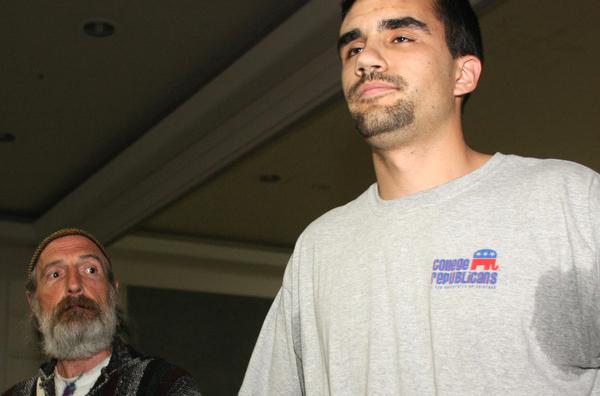
CU Boulder student Andrew CrownBOULDER- A favorite photo from Thursday night’s event. This is the president of the CU College Republicans, who got up to object to student funds being spent on terrorists and frauds. Even after Ayers and Churchill spoke about how neither education nor students should be treated like commodities, sweaty dope Andrew Crown asked why a university could not do like any well-run corporation, and fire whomever it wished.

The crowd booed, but the panel of guests calmly encouraged us to let everyone have their say. It’s a reserve and graciousness of which I am in short supply. These guys shout down activists, attack progressives, remember the RNC Kicker, and the Protest Warriors? They have the ear of the mainstream corporate press. Why would we need to tolerate a single of their blimp-necked peeps at a discussion for intelligent people?

If you think I am assessing someone’s intelligence level based on whether he agrees with me, I am. On academic matters, it most certainly is appropriate. In classes, assessments of the retention and comprehension of man’s accumulated understanding of the subjects are called tests.

Does the University of Colorado have no admissions standards?

Mr. Crown’s questions was answered well beyond his ability to understand, and he returned to his seat shaking his head like the whole lot of us were incorrigible. I hope so.

Coloradans For Peace join ANSWER in DC

answer coloradans for peaceUPDATE MARCH 21 MARCH ON PENTAGON: Students & Communities Mobilize to March on the Pentagon and the Corporate War Profiteers

Students and community organizations from across the country are mobilizing to be in Washington, D.C., on Saturday, March 21 to make their voices heard in the March on the Pentagon and the Corporate War Profiteers.

The PentagonMarch.org website now lists 64 departure locations in 20 states, many of them leaving from college campuses, including: University of Iowa, Georgia State University, University of Massachusetts-Amherst, Central Connecticut State University-New Britain, University of Connecticut-Storrs, Berkshire Community College, and more!

Visit the PentagonMarch Transportation Page to find the departure location nearest you, or to sign-up to list your campus’s or city’s travel plans!

Read more about the exciting plans for March 21st:

The March on the Pentagon on Saturday, March 21 is shaping up to be a dramatic and highly significant demonstration. Many thousands of people are coming to Washington, D.C. to make their voices heard.

March 21 will culminate in a dramatic direct action where hundreds of coffins—representing the multinational victims of militarism, Empire and corporate greed—will be carried and delivered to the headquarters of the Corporate War Profiteers and Merchants of Death.

From the Pentagon, we will march to the nearby giant corporate offices of Boeing Company, Lockheed Martin Corporation, General Dynamics and KBR (the former subsidiary of Halliburton).

The march will start close to the State Department in Washington, D.C. (assemble at 12 noon at 23rd St. and Constitution Ave. NW).

Please make an urgently needed donation today by clicking this link to donate online through our secure server, where you can also find information on how to donate by check.

All out for March 21! Jobs Not War! Schools Not War! Occupation is a Crime!

Bill Ayers and Derrick Jensen to speak on Forbidden Education in Boulder

forbidden-jensen-ayers
FORBIDDEN EDUCATION: Bill Ayers and Derrick Jensen will speak in Boulder on Thursday March 5, in solidarity with Ward Churchill’s legal challenge against his dismissal by CU. MEANWHILE, THIS JUST IN…

This press release just came in from DC conservative Christian PR group GRIFFNEWS, also of USAsurvival.org…

Wednesday, March 04, 2009
Attorney General Urged to Investigate Bill Ayers and Bernardine Dohrn by Campaign for Justice for Victims of Weather Underground Terrorism

WASHINGTON, D.C.- Pressure is mounting for an expanded probe of former Weathermen Bill Ayers and his wife, Bernardine Dohrn , and their alleged roles in the 1970 bombing murder of a San Francisco policeman.

Larry Grathwohl, former FBI informant in the Weather Underground and author of Bringing Down America: An FBI Informer with the Weathermen, will repeat his sworn testimony that points to the involvement of the Weather Underground in the bombing murder of Sgt. Brian V. McDonnell at a News Conference on Thursday, March 12, at 12:30 p.m. at the National Press Club, 529 14th St., NW, 13th floor (First Amendment Lounge), Washington, D.C. Grathwohl says that he was at a meeting where Ayers said that his wife Dohrn had planted the bomb.

The News Conference is being sponsored by the Campaign for Justice for Victims of Weather Underground Terrorism, a project of investigative journalist Cliff Kincaid’s America’s Survival, Inc.

The cold case of Sgt. Brian V. McDonnell, killed in 1970 when a bomb exploded at the San Francisco Park Police Station, has been quietly reopened by law enforcement authorities in the hope of finding the person or persons responsible for the crime. But Grathwohl and other speakers say that more cooperation at the federal level in the investigation is needed. That is why they are demanding that Attorney General Eric Holder authorize more resources for the probe.

Grathwohl will be joined by four other speakers who will discuss the McDonnell case, the violent history of the Weather Underground, and the reemergence of its members in political and campus organizing activities:

– Cliff Kincaid, veteran journalist and President of America’s Survival, together with internationally-renowned blogger Trevor Loudon, will release a new report on how members of the SDS and Weather Underground have revived a radical student movement on college campuses. The report will examine the international connections that people like Ayers currently have with anti-American regimes and movements.

–Jim Pera, a retired San Francisco police sergeant who was one of the first on the scene after the February 16, 1970 bombing, will have photographs of the heavy metal staples from the bomb used to kill Sergeant McDonnell.

– Herbert Romerstein, a former Congressional investigator, will release a new report that examines the violent history of the Weather Underground and its links to other terrorist and communist groups.

The Campaign for Justice for Victims of Weather Underground is a project of America’s Survival, http://www.USAsurvival.org, an independent foreign affairs watchdog organization.

Mark 6TH YEAR of Iraq Occupation with profiteers Boeing, Lockheed, GD and KBR

answer-march-on-pentagon
A.N.S.W.E.R.’s March 21 MARCH ON THE PENTAGON to mark the sixth year of the War in Iraq will be directed not only at the US Department of Defense, but at the war profiteers for whom 2007 was a record year, among them Boeing, Lockheed Martin, General Dynamics and KBR. In Colorado Springs the merchants of death can be visited on one corner.

answer

On March 21, 2009,
March on the Pentagon and the Corporate War Profiteers

Department of the Defense HeadquartersThe March on the Pentagon on Saturday, March 21 is shaping up to be a dramatic and highly significant demonstration. Many thousands of people are coming to Washington, D.C. to make their voices heard.

March 21 will culminate in a dramatic direct action where hundreds of coffins—representing the multinational victims of militarism, Empire and corporate greed—will be carried and delivered to the headquarters of the Corporate War Profiteers and Merchants of Death.

From the Pentagon, we will march to the nearby giant corporate offices of Boeing Company, Lockheed Martin Corporation, General Dynamics and KBR (the former subsidiary of Halliburton).

The march will start close to the State Department in Washington, D.C. (assemble at 12 noon at 23rd St. and Constitution Ave. NW).

Please make an urgently needed donation today by clicking this link to donate online through our secure server, where you can also find information on how to donate by check.

These are the Corporate War Profiteers and Merchants of Death. They are the vultures who profit off the death and suffering of the people of Iraq, Afghanistan and Palestine, and off of the thousands of U.S. soldiers and marines who have died or been wounded in these wars of aggression. They are anti-worker and anti-union.

The march will be led by a large contingent of veterans and family members of veterans from the Iraq and Afghanistan wars, and from earlier conflicts.

Militarism and Corporate Capitalism
We will march on their slick-and-shiny corporate offices that are located less than a mile from the Pentagon. Their location in the very shadow of the Pentagon speaks volumes about the intimate connection between militarism and corporate capitalism.

When the Pentagon brass retire, they rotate out of their Pentagon offices and directly into the Corporate boardrooms and office suites of the Death Merchants. It is a very cozy and very profitable relationship for the elites—in and out of uniform. They make the profits, others do the bleeding.

Last year was a great year for the Corporate War Profiteers and Merchants of Death. Profits soared even as the rest of the economy neared collapse. The CEOs of the four corporations that we will be visiting on March 21 received more than $319 million in compensation in 2007 alone (and remember, that’s just for four individuals). “We the People” paid the bill for the high tech weapons that were used against occupied people in Iraq, Afghanistan and Palestine. The Corporate Executives laughed all the way to the bank while grieving parents and children buried their loved ones from Baghdad to Kabul to Gaza to Detroit.

A quick examination shows that the CEOs of the Military-Industrial Complex contributed to both the Democratic and Republican Party candidates in almost equal amounts. They favor a system that ensures that politicians will come and go every four years but the military machine—that fusion of industry, banks and the Pentagon brass—will remain as is.

We Need Jobs & Schools – Not War!
The same banks that are being bailed out to the tune of trillions of dollars even while they foreclose families who can’t pay their mortgage debts are double-dipping from the national treasury by making huge profits in their investments in Boeing, Lockheed Martin, General Dynamics and KBR.

War is just good business for these corporate executives. Every F-16 bomber, attack helicopter, cruise missile and Drone bomber is a source of profit. If the wars stopped they would be out of business.

The people of this country are fed up with the status quo. They want decent-paying jobs, and affordable health care and housing for all. Students want to study rather than be driven out by soaring tuition rates. People want a complete—not partial—withdrawal of ALL troops from Iraq. They want the war in Afghanistan to end rather than escalate. They are increasingly opposed to sending $2.6 billion each year to Israel.

People are coming to Washington, D.C. on March 21 from college campuses, high schools, and cities and towns throughout the United States.

It is time for real change. Unless the movement for change stays in the streets, the powerful corporate and banking interests will certainly dominate the politics of this country. That is unacceptable. That is a path toward endless war and occupation abroad, and a massive transfer of wealth to the already rich at home.

All out for March 21! Jobs Not War! Schools Not War! Occupation is a Crime!

From pentagonmarch.org:

Meet the Corporate War Profiteers and Merchants of Death

James Mcnerney Jr BoeingW. James McNerney Jr.
CEO of Boeing.

2007 Total Compensation: $19 million. Value of Boeing Stock Owned: $25.7 million

Facts about Boeing:
Boeing currently produces numerous jets and bombers, including the B-2 Spirit Stealth Bomber and the F/A-22 Raptor, as well as multiple surface-to-air missiles and various bombs. Boeing also produces the bolt-on JDAM (Joint Direct Attack Munition) that turns gravity bombs into “smart” munitions.

Boeing supplies Israel with various weapon systems, including the F-15 Eagle fighter jet and A-64 Apache attack helicopter, as well as numerous types of bombs and missiles. It was these weapons that helped to kill 1,017 Palestinians killed in the Israeli invasion of Gaza in December 2008 and January 2009.

In 2008, Boeing made $2,225,947 in campaign contributions. 58 percent of these contributions were to Democrats, and 42 percent were to Republicans. In 2008, they spent $16,610,000 on lobbying.

Despite massive profits, Boeing opposed raises for plant employees, and attempted to outsource union jobs so that the company could be “more flexible.”

Robert Stevens Lockheed MartinRobert J. Stevens
CEO of Lockheed Martin

2007 Total Compensation: $37 million. Value of Lockheed Martin Stock Owned: $33.8 million

Facts about Lockheed Martin:
Lockheed Martin currently produces the F-117 Stealth Fighter that was used in the brutal “Shock and Awe” bombings of Iraq, as well as the F/A-22 Raptor fighter jet. They also produces various missile systems, including the Hellfire and Javelin, and various nuclear weapon designs. Lockheed supplies fighter jets and other weapon systems to Israel.

Lockheed’s 2008 first-quarter revenue was $9.98 billion–an increase of $700 million from the year prior. By 2015, the F-35 program alone could represent more than $16 billion in annual revenue for the company.

Lockheed’s former vice-president, Bruce Jackson, headed the Committee for the Liberation of Iraq.

In 2005, Lockheed received $65 million every single day of the year from the U.S. government. That year, Lockheed garnered $228 in federal tax money from every household in the United States.

In 2008, Lockheed made $2.6 million in political contributions—49 percent to the Democrats and 51 percent to the Republicans.

In 2004, Lockheed spent nearly $10 million on more than 100 lobbyists. From 2001-2005, only Philip Morris and GE spent more money lobbying Congress. By 2008, that number was $15.8 million.

Nicholas Chabraja General DynamicsNicholas D. Chabraja
CEO of General Dynamics

2007 Total Compensation: $60 million. Value of GD Stock Owned: $154.2 million

Facts about General Dynamics:
General Dynamics currently produces dozens of weapon systems, which include the Stryker Armored Combat Vehicle and the M-1 Abrams Main Battle Tank series, as well as other highly devastating artillery systems and the Trident Nuclear Submarine.

General Dynamics has supplied Israel with various weapon systems, including the F-16 Falcon fighter jet.

In 2008, General Dynamics made $1,682,595 in campaign contributions—58 percent to the Democrats and 42 percent to the Republicans.

Also in 2008, General Dynamics spent $8,562,439 lobbying for government contracts.

Fueled by sales of business jets and military-combat equipment, General Dynamics reported a 32 percent jump in first-quarter profits for 2008, to $573 million. The backlog of work not completed far outpaced revenues, growing by 14 percent to nearly $50 billion.

Analysts think General Dynamics and Mr. Chabraja will do even better next year, noting the “upside potential” of the combat-systems group, which is benefiting from the U.S. Army’s restocking of equipment lost, damaged or worn by operations in Iraq and Afghanistan, in addition to a $12 billion backlog of orders for corporate jets.

William Utt KBRWilliam P. Utt
CEO of Kellogg Brown & Root.

2007 Total Compensation: $3.29 million. Value of KBR Stock Owned: $6.5 million

Facts about KBR:
There are roughly 14,000 KBR employees inside of Iraq that provide logistical support to the U.S. military. KBR has made billions off of “reconstruction” contracts within Iraq.

KBR is the largest non-union construction company in the United States. It has won many contracts with the U.S. government, including $100 million to build a U.S. embassy in Afghanistan, as well as $216 million for the construction of several base camps and training foreign troops from the Republic of Georgia.

Despite at least a dozen former employees alleging they had been raped by co-workers in Iraq and other employees saying co-workers regularly stole gold, artwork, and weapons, KBR remains in the Pentagon’s good graces. In mid-April, it received a 10-year, $150 billion contract to support the military overseas.

CEO William Utt called 2008 an “outstanding year,” saying KBR posted record profitability.

Despite many scandals and controversies, KBR reported that its first quarter net profits for 2008 more than tripled, from $28 million the previous year to $98 million.

answer

ANSWER Coalition Responds to President Obama’s Iraq Speech of Friday, February 27

With his speech today, President Obama has essentially agreed to continue the criminal occupation of Iraq indefinitely. He announced that there will be an occupation force of 50,000 U.S. troops in Iraq for at least three more years. President Obama used carefully chosen words to avoid a firm commitment to remove the 50,000 occupation troops, even after 2011.

The war in Iraq was illegal. It was aggression. It was based on lies and false rationales. President Obama’s speech today made Bush’s invasion sound like a liberating act and congratulated the troops for “getting the job done.” More than a million Iraqis died and a cruel civil war was set into motion because of the foreign invasion. President Obama did not once criticize the invasion itself.

He has also requested an increase in war spending for Iraq and Afghanistan, and plans to double the number of U.S. troops sent to fight in Afghanistan.

President Obama has asked Congress to provide more than $200 billion for the Iraq and Afghanistan wars over the next two years, in addition to increasing the Pentagon budget by four percent.

Based on President Obama’s new budget, the Pentagon would rank as the world’s 17th largest economy—if it were a country. This new budget increases war spending. Total spending in 2010 would roughly equate to an average of $21,000 a second.

This is not the end of the occupation of Iraq, but rather the continuation of the occupation.

There is only one reason that tens of thousands of troops will remain in Iraq: It is because this is a colonial-type occupation of a strategically important and oil-rich country located in the Middle East where two-thirds of the world’s oil reserve can be found.

Obama’s speech was a major disappointment for anyone who was hoping that Obama would renounce the illegal occupation of Iraq. Today, the U.S. government spends $480 million per day to fund the occupation of Iraq. Even if 100,000 troops are drawn out by August 2010, that means the indefinite occupation of Iraq will cost more than $100 million each day. The continued occupation of Iraq for two years or three years or more makes a complete mockery out of the idea that the Iraqi people control their own destiny. It is a violation of Iraq’s sovereignty and independence.

It is no wonder that John McCain came out to support President Obama’s announced plan on Iraq. McCain was an supporter of former President Bush’s and Vice President Cheney’s war and occupation in Iraq.

Bush, Cheney and Rumsfeld—the architects of regime change in Iraq—never had the goal of indefinitely keeping 150,000 U.S. troops in Iraq. They wanted to subdue the Iraqi people and exercise control with a smaller force. The Iraqi armed resistance prolonged the stationing of 150,000 U.S. troops.

Bush’s goal was domination over Iraq and its oil supplies, and domination over the region. This continues to be the goal of the U.S. political and economic establishment, including that of the new administration.

President Obama decided not to challenge the fundamental strategic orientation. That explains why he kept the Bush team—Secretary of Defense Robert Gates, and Generals Petraeus and Odierno—on the job to oversee and manage the Iraq occupation. They will also manage the widening U.S. war in Afghanistan and the aerial assaults on Pakistan. There have been over 30 U.S. bombing attacks in Pakistan in the last two months.

We are marching on Saturday, March 21 because the people of this country are fed up with the status quo. They want decent-paying jobs, and affordable health care and housing for all. Students want to study rather than be driven out by soaring tuition rates. The majority of people want a complete—not partial—withdrawal of ALL troops from Iraq. They want the war in Afghanistan to end rather than escalate. They are increasingly opposed to sending $2.6 billion each year to Israel and want an end to the colonial occupation of Palestine.

IT demands proof…

Of anything WE write. Perhaps It should take the challenge…

  • Show US proof that YOU actually exist other than a Yahoo ID, Hotmail or gmail ID created yesterday.
    Many Commercial sites don’t even respond to such IDs because they’re effectively ANONYMOUS
    And are used many times for Spam and E-Mail Scam operations.
    And E-Bay doesn’t accept them as your actual Email identity.
    and the commercial sites that don’t accept your Bull-poo-poo Yahoo ID also turn it over automatically to SpamCop and other
    Anti-Spam World Wide Web databases.
  • What say, Eric, Tony, Marie?

    Should NMT subscribe to one of those databases?

    1) Did Someone Say Credibility?

    As in somebody who doesn’t even use a Real Name To Describe ITself, and keeps telling us that everything WE say must be outright Lies because IT has Imperial Military Sources which say that Invasions, Occupations and Mass Slaughter are actually manifestations of Freedom…

    And that IT considers and believes that anything which Gainsays the word of Professional Killers just could not possibly be true or worthy of consideration.

    It has also said in all of ITs many many “personalities” that we’re so stupid and crazy and Left Wing that we’re really not worth IT writing anything to us blah blah blah blah blah

    Kind of like Charlie Browns Teacher… wa woo wah wah wuh….

    But has “wasted ITs time” posting hundreds of links to Military Sources and their Propaganda Outlets like the New York Post and really Any Outlet Related To DumFox Noose NutWerx.

    All done, so it seems, from the Kindness of ITs heart.

    Of Course.

    2) In case IT didn’t catch the hint…

    IT has been not only CALLED a Liar IT has proven the point repeatedly that IT is a Liar or perhaps a loosely organized co-op of Liars working together.

    Funny how the only actual ISRAELIS who have had the courage to link to their writings are Peace Activists which IT has also spammed in ITs many “independent” personalities.

    I invite the Casual Reader or even the Serious Student of the issues to glance over to the left hand side of the screen and view ITs name repeated over and over, until you scroll through the pages to find where ITs “persona” has been seriously challenged and ITs name, National Identity, Faith, even ITs gender mysteriously changes… and so forth through it’s many incarnations.

    On the Right Hand Side of the screen you’ll notice a HUGE number of posts listed, 106,73,52 etc etc etc but THIS link you’re reading now is the most important of them all

    IT cyber-screams and cyber-wails that we’re not being “fair” to IT and that calling IT a liar is somehow censorship.

    IT has also not provided ANY proof or even Evidence that IT has done or written ANYTHING on the World Wide Web or in Newspapers, Broadcast Media or even College Publications other than what IT has written here.

    That last is Important because several of ITs “identities” claim to have gone to various Universities and to be officers in Various Military Services.

    Which would mean they I mean IT, if it were an officer in ANY Military Branch would have had to go to college.

    IT has not produced one single link to say, a Baccalaureate Thesis or even higher Graduate Student writings of any kind authored by IT.

    You will recognize IT by ITs hysteria in condemning us for exposing IT for what it and ITs enormous collection of plagiarized from other sources “Proof” that we’re all a bunch of Racist Anti-Semitic Hate-Speech Disseminators who

    aren’t worth ITs time and effort to reply to our ravings, (except IT has, hundreds and hundreds of times)

    3) Tell us, O Spammer-one… Do you have a Real Job?

    Because you’ve apparently been spending all your spare time HERE, telling us and, of course, our Readers who you claim we don’t have, that you’re a College Graduate, a Military Officer, Another Military Officer, Whatever the Latest Count of your Fake User Identities is…

    Surely somebody of such Education, Experience and Importance in the Community would actually have a REAL job somewhere, or like me be a disabled individual, who would STILL have to take time off for Physical Therapy, Doctors visits, trips to the Grocery Store, picking up the kids from school… You know, the type of Real Life activities most people engage in at least some of the time.

    Somebody with your Vast Experience in Middle East affairs, as you claim, SHOULD be shuttling between Washington, Tel Aviv, Amman, Rihyad, Cairo, Baghdad, Kabul….

    Brokering Peace talks, doing SOMETHING real about the Peace Process or, as we like to call it “The Washington Continuous War Because It’s Good For Our Corporate Profits” process.

    Which you’re apparently not actively involved in the War either, or at least not on a Personal Basis.

    Tony, Eric, Marie, myself, a few of the others who routinely post, well, ALL of the Others who routinely post, are actually REAL People.

    We’ve for the most part met each other, know each other…

    Even the Military Policeman who posted about somehow Redeeming His Soul by giving candy and cigarettes to a prisoner he was escorting to the Death-Camp at Bagram AFB is a Real Person.

    With a REAL Job.

    Even though neither he nor his job are very savory or honorable.

    So, Wazzup, Dawg?

    From Iraq to Afghanistan to Palestine, Occupation is a Crime!

    Occupation is a crime
    A.N.S.W.E.R. has 7 Reasons to March on DC. We can borrow them!
    – The war in Afghanistan is expanding and widening.
    – 350,000 U.S. troops and US-paid contractors still occupy Iraq.
    – Israel’s Siege of Gaza remains in place, with backing of Washington.
    – Obama’s Justice Department is continuing the policy of renditions.
    – Air strikes on Pakistan are killing an increasingly number of civilians.
    – The real Pentagon war budget is over $1.3 trillion annually.
    – More than 20 million people are now unemployed and under-employed.

    7 Reasons You Should March on the Pentagon on March 21, 2009

    1
    The war in Afghanistan is expanding and widening. President Obama announced last week that another 17,000 troops are on their way to Afghanistan. Only 18 percent of Afghanis support this escalation and only 34 percent of the people of the United States approve of the added troops despite the president’s popularity, according to the Washington Post/ABC poll announced on February 17, 2009. This is a colonial war. The president of Afghanistan, Hamid Karzai, was not involved in the decision to add more occupying troops into his country. Rather, he was “informed of the deployments in a telephone call with Obama” on February 17, according to the Washington Post (February 18, 2009).

    2
    About 350,000 U.S. troops and U.S.-paid private contractors (mercenaries) still occupy Iraq. The Iraqi people want the occupation to end. Gen. Ray Odierno, the top U.S. commander in Iraq, is insisting that only two of the 14 combat brigades in Iraq exit in 2009. The war and occupation of Iraq costs $430 million each day. If the U.S. government were to end the military occupation, any and all future Iraqi governments would return to a position of political independence from the economic and political dictates of the United States. Iraq’s anti-colonial legacy has created a political reality that prohibits the country from becoming like Kuwait or Saudi Arabia–an out-and-out dependency on U.S. imperialism. That is the real reason that the U.S. government fears a complete disengagement from Iraq and an end to its military occupation.

    3
    Israel’s Siege of Gaza remains in place, with the full backing of Washington. The U.S. government has continued to fund Israel’s war and blockade against the people of Gaza. The Pentagon provided the funding, and technical and logistical support for the establishment of the Israeli war machine, including its massive cluster and white phosphorous bomb arsenal, and the country’s large cache of nuclear bombs.

    4
    The new Justice Department has announced that it will continue the policy of renditions, meaning the CIA and Pentagon will capture and kidnap individuals anywhere in the world and transfer them to other countries. “The Obama administration appears to have determined that the rendition program was one component of the Bush administration’s war on terrorism that it could not afford to discard.” (LA Times, Feb. 1, 2009)

    5
    The new administration has stepped up the air strikes that are killing an increasingly large number of Pakistani civilians. Unmanned drone bombing attacks violate Pakistani sovereignty and are creating an ocean of resentment and anger inside of Pakistan. The U.S. government has no right to carry out these drone bombing strikes in Pakistan, Somalia and Yemen. The people of the United States would not accept the legitimacy of other governments ordering air attacks in the United States. We must openly and loudly reject such tactics by the government that speaks in our name and spends our tax dollars for such aggression.

    6
    The real Pentagon war budget is over $1.3 trillion annually. This is greater than the combined total of most of the other countries in the world, including all the NATO countries, and Russia and China. Some label this “waste spending” because it spends precious resources to build exotic and high cost weapons, a new generation of nuclear weapons, and space-based war fighting capabilities, while filling the coffers of the big investors (i.e., the biggest banks) in the war corporations. Pentagon contracting is often based on guaranteed “cost-plus” contracts that reward price gouging since corporate profit is based on a fixed percentage above their expenses. Another label for this process is “extreme corruption” and theft from the public treasury.

    7
    More than 20 million people are now unemployed and under-employed. Nine million families are either in foreclosure or are at risk of foreclosure this year, according to the statistics just released by the government. Forty-seven million people are without health care. College tuition hikes are soaring and millions of students are at risk of being forced out of school. The people want change. They don’t want a simple tweaking of Bush’s criminal foreign policies. They want to put people’s needs before corporate greed. They want an end to wars of aggression that are wreaking havoc, death and destruction abroad, and diverting urgently needed resources in the service of semi-colonialism and Empire.

    Zionists fire another Left American university professor, Joel Kovel

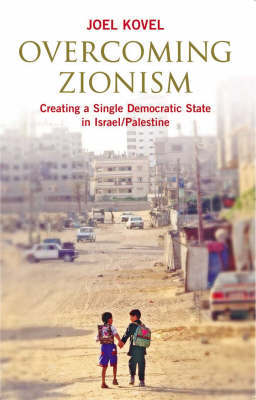
    Joel Kovel - Overcoming ZionismNobody in the United States is safe when they speak out the Israeli killing machine. The Israeli Zionist Machine has just succeeded in firing yet another US Left professor, Joel Kovel, from his university position, this time at Bard College. The following is taken from the STATEMENT OF JOEL KOVEL REGARDING HIS TERMINATION BY BARD COLLEGE

    Irregularities in the Evaluation Process

    The evaluation committee included Professor Bruce Chilton, along with Professors Mark Lambert and Kyle Gann. Professor Chilton is a member of the Social Studies division, a distinguished theologian, and the campus’ Protestant chaplain. He is also active in Zionist circles, as chair of the Episcopal–Jewish Relations Committee in the Episcopal Diocese of New York, and a member of the Executive Committee of Christians for Fair Witness on the Middle East. In this capacity he campaigns vigorously against Protestant efforts to promote divestment and sanctions against the State of Israel.

    Professor Chilton is particularly antagonistic to the Palestinian liberation theology movement, Sabeel, and its leader, Rev. Naim Ateek, also an Episcopal. This places him on the other side of the divide from myself, who attended a Sabeel Conference in Birmingham, MI, in October, 2008, as an invited speaker, where I met Rev. Ateek, and expressed admiration for his position. It should also be observed that Professor Chilton was active this past January in supporting Israeli aggression in Gaza. He may be heard on a national radio program on WABC, “Religion on the Line,” (January 11, 2009) arguing from the Doctrine of Just War and claiming that it is anti-Semitic to criticize Israel for human rights violations—this despite the fact that large numbers of Jews have been in the forefront of protesting Israeli crimes in Gaza.

    Of course, Professor Chilton has the right to his opinion as an academic and a citizen. Nonetheless, the presence of such a voice on the committee whose conclusion was instrumental in the decision to remove me from the Bard faculty is highly dubious. Most definitely, Professor Chilton should have recused himself from this position. His failure to do so, combined with the fact that the decision as a whole was made in context of adversity between myself and the Bard administration, renders the process of my termination invalid as an instance of what the College’s Faculty Handbook calls a procedure “designed to evaluate each faculty member fairly and in good faith.”

    Help Overcome Zionism and its negative influence in American politics. Support Joel Kovel and buy his book, Overcoming Zionism. Bard College should be ashamed of its anti-intellectual behavior and its policies of censorship.

    Activism heroics and roadkill

    Bush and Muntadhar al-ZaidiThis is by no means a complete list of contemporary populist heros, but I’d like to start with comedian Stephen Colbert, who roasted President Bush at a Washington Correspondents Association Dinner, like a court jester gone rabid. With celebrated White House correspondent Helen Thomas’s help, Colbert belittled the decider-in-chief to his face right in front of his friends.

    Don’t Taser Me Bro
    There was University of Florida student Andrew Meyer, who held his ground asking critical questions of Senator John Kerry. Meyer was tackled and tasered for his impertinence, while Kerry kept mumbling, to divert attention from “Don’t taser me Bro.”

    Bidder 70
    Then Utah environmentalist Tim DeChristopher disrupted a government land auction, driving up prices and buying several leases raising paddle number 70, until federal agents took him away. Extraction industry spokesperson Kathleen Sgamma may have miscalculated the degree of DeChristopher’s popular support. She earned no one’s sympathy when she complained: “There’s a democratic process in place if you don’t like what’s happening. If we all just decided we wanted to change the laws unilaterally, that would run counter to our democracy.”

    The Shoes
    And Iraqi Journalist Muntadhar al-Zaidi is in jail for throwing his shoes at that dog Bush, when our president was making a farewell visit to Baghdad. (His trial date is fast approaching actually.) The shoes missed, but Bush was made to duck, which is the closest anyone’s come to getting reality to register with the cretinous bitch.

    Barack’s first press conference
    Let’s also mention Helen Thomas again, at Barack Obama’s first press conference a week ago. When Obama ceremoniously called on Thomas to lob the last question, Thomas asked the president to name who in the Middle East had nuclear weapons. It was something of a leading question, because the answer is known, but bears reminding when the argument is repeated that Iran acquiring nukes would lead to proliferation. Thomas put Obama in the position of having to utter recognition of Israel’s never-mentioned nuclear program, or very conspicuously avoid the subject. Which is what he did.

    Israel Divestment Movement
    Now the Hampshire Students for Justice in Palestine have succeeded in getting their school to divest in Israel, just as Hampshire College led the way in the nationwide divestitures which contributed to the fall of Apartheid in South Africa. Board of trustees chairman Sigmund Roos tried to explain that the school’s actions were in no way a repudiation of Israel, and accused the students of falsely claiming otherwise. Of the 800-signature petition, Roos explained: “We never took it up. Students know that.”

    Really? A petition signed by 800 of your students and faculty, and the Hampshire College board of trustees wouldn’t even read it? Roos doesn’t know what hit him.

    Divest from Israeli Occupation!

    Hampshire CollegeHampshire College becomes first college in U.S. to divest from Israeli Occupation! Spread the word that there is a Movement to Boycott Israel economically worldwide. Support is varied and comes from many different people. See Support Palestinian Call for Boycott, Divestment and Sanctions against Israel and in Colorado US Campaign to End the Israeli Occupation

    Bishop Williamson and Auschwitz 1.0

    Arbeit Macht Frei
    I am curious as to why a Roman Catholic bishop would risk a second excommunication over the historic particulars of the Holocaust. Bishop Richard Williamson is being labeled a “Holocaust Denier” because he questions the extent, and mechanism, of the official version of the Holocaust. Because Williamson is also criticized for his skepticism about the official 9/11 narrative, and for his praise for the Unabomber’s manifesto, I want to take a closer look, and wonder what is he reading?

    Bishop Richard WilliamsonHere’s what the outspoken Williamson told Swedish SVT in a November 2008 interview, as transcribed by the BBC:

    “I believe that the historical evidence is strongly against, is hugely against, six million Jews having been deliberately gassed in gas chambers as a deliberate policy of Adolf Hitler… I believe there were no gas chambers [during World War II]”

    First, I’m compelled to pose a naive question: If we can all agree that Jews died in huge numbers by incomparable horrors at the hands of the Nazis, would it matter what the exact death toll was, or which killing method predominated? Why? What is the need for laws to restrict historians who are trying to reconstruct the record from emerging facts? Must preemptive “anti-defamation” laws mandate that historians stick to the official “untold” number and “indescribable” evil?

    Even if we postulate, albeit cynically, that Holocaust reverence is critical to upholding American public support for Israel‘s “right to exist” in the Middle East, how could a revision of the casualties, in any case a horrific magnitude, make an difference?

    Millions of Jews fell victim to the Third Reich. No one is denying it, and historical revision is not trying to bring the Holocaust victims back to life. Holocaust Remembrance of the Jewish victims has remained a political priority around the world, advocating commemoration in education, literature, civic life, and pop culture. Why then, an aversion to scrutiny?

    Last week a fellow Society of St. Pius X member, Rev. Floriano Abrahamowicz was ejected from SSPX for coming to Williamson’s and the Pope’s defense.

    While the usual politicians and Jewish community leaders are voicing their indignation, can we ask, are the Bishop’s beliefs really at odds with accepted orthodoxy? The media will reiterate that the Six Million figure has always been beyond dispute. All the while, official scholarship has been recording otherwise. In Germany, revisionist historians are jailed for Holocaust Denial. Yet bit by bit, mainstream historians have been able to publish divergent theses which withstand legal refutation.

    For the sake of argument, let’s dismiss all the “deniers” as kooks, and look only at the traditionally vetted voices.

    On the subject of Auschwitz, where four million of the total six million Jews were believed to have perished, Der Spiegel managing editor Fritjof Meyer a continued critic of revisionism, summarized in Osteuropa 52, 5/2002, p. 631:

    “In 1945, the Soviet Investigatory Commission numbered four million victims in the National Socialist work and extermination camp of Auschwitz-Birkenau, a product of war propaganda. Under coercion, camp Commandant Höß named three million and recanted. Up until now, how many people actually fell victim to this singular mass murder could only be estimated. The first Holocaust historian, Gerald Reitlinger, assumed one million, while the latest state of research estimated it to be several hundred thousand fewer.”

    Naturally even Meyer touched off a firestorm by integrating the sum of official scholarship into the big picture. The difficulties which historians face in reaching variant findings are explained by another mainstream scholar, noted Hitler historian Dr. Werner Maser, Professor for History and International Law, Munich University, Falsification, Legend, and Truth about Hitler and Stalin, Olzog, Munich 2004, on p.332

    “To be sure, […] the extermination of the Jews is considered to be one of the best researched aspects of contemporary history […], but that is not the case. […] Indeed, whole regions remain as much terra incognita as ever, […] German historians exhibit timidity about taking on the horrible issue and possibly bringing to light details that do not agree with the accounts which have multiplied for a very long time.”

    And about the deterrence of the Holocaust Denial laws:

    “The sword of Damocles hovers over historians (not only in Germany) who portray the controversial phases of history as they ‘actually were’ – and identify the frequently even officially codified ideological specifications as falsifications of history.”

    The question of the gas chambers is raised by the absence of evidence. According to major Holocaust authority Dr. Arno J. Mayer, Professor of Modern Jewish History at Princeton University, in Why Did the Heavens Not Darken? The “Final Solution” in History, Pantheon, New York 1990, p. 362:

    “Sources for the study of the gas chambers are at once rare and unreliable. Even though Hitler and the Nazis made no secret of their war on the Jews, the SS operatives dutifully eliminated all traces of their murderous activities and instruments. No written orders for gassing have turned up thus far. The SS not only destroyed most camp records, which were in any case incomplete, but also razed nearly all killing and crematory installations well before the arrival of Soviet troops. Likewise, care was taken to dispose of the bones and ashes of the victims.”

    Justifiably, scholars are skeptical that the complete absence of evidence should be taken as proof of its existence and total suppression. Some camps were overrun before the Germans could destroy any part of them. Mayer continues, p. 163:

    “In the meantime, there is no denying the many contradictions, ambiguities, and errors in the existing sources. […] Much the same is true of for the conflicting estimates and extrapolations of the number of victims, since there are no reliable statistics to work with. […] Both radical skepticism and rigid dogmatism about the exact processes of extermination and the exact number of victims are the bane of sound historical interpretation”

    In light of the before-sited Wannsee Conference documents now being considered post-war forgeries, Mayer explains, p 163:

    “To date there is no certainty about who gave the order, and when, to install the gas chambers used for the murder of Jews at Auschwitz. As no written command has been located, there is a strong presumption that the order was issued and received orally”

    With no written record of a “Final Solution,” and the implausibility of a completely vaporized paper trail, mainstream scholars have had to improvise an explanation for how an extermination directive was disseminated. University of Vermont Professor Raul Hilberg, member of US Holocaust Memorial Council, author of The Destruction of the European Jews, (Holmes & Meyer, New York 1985), was quoted in Newsday, Feb. 23, 1983:

    “But what began in 1941 was a process of destruction [of the Jews] not planned in advance, not organized centrally by any agency. There was no blueprint and there was no budget for destructive measures. They [these measures] were taken step by step, one step at a time. Thus came about not so much a plan being carried out, but an incredible meeting of minds, a consensus mind reading by a far-flung [German] bureaucracy.”

    Hilberg himself ran into trouble with the authorized version, because he refused to corroborate tales of Jewish rebellion against their Nazi jailers. His group-think theory extended to the Jews themselves, putting emphasis on their acceptance of being exploited as war industry slave labor.

    “I had to examine the Jewish tradition of trusting God, princes, laws and contracts […] Ultimately I had to ponder the Jewish calculation that the persecutor would not destroy what he could economically exploit. It was precisely this Jewish strategy that dictated accommodation and precluded resistance.”

    That’s where the extermination camp thesis becomes less probable than the work camp. Perhaps the Jews didn’t resist because they were being worked, not gassed. Worked to death, of course, but dying as more a consequence of wartime Germany’s depleting resources, than from a deliberate eradication effort. Evidence is plentiful of the work camps and dead bodies.

    And isn’t that the answer to my innocent question? To doubt whether the murder weapon was a pistol or a knife, means calling into question the crime entirely. That’s why revisionists are decried for being “deniers.” While we presume the distinction makes little difference, because clearly a murder was committed regardless, the prosecutor constructing the accusations wants to prove his motive and not another.

    There are many details about which historians have begun to disagree. Many of the witness accounts have been proven to be unreliable. Even Elie Wiesel was compelled to reclassified his memoir as a novel. The Holocaust as later generations have come to know it was not as the WWII generation saw it. Even those soldiers who encountered the atrocities themselves.

    Professor Hilberg recounts studying at Brooklyn College under Hans Rosenberg, a fellow Jew. Even in the wake of the haunting newsreels of the concentration camps, Hilberg records that Rosenberg remarked in a 1948 lecture:

    “The most wicked atrocities perpetrated on a civilian population in modern times occurred during the Napoleonic occupation of Spain.”

    I don’t really subscribe to the idea that the Holocaust is diminished by learning that the WWII concentration camp victims died from systemic and despotic abuse, starvation and exhaustion. But those holding the secrets believe that the concept of the Holocaust being the greatest evil perpetrated upon mankind falls apart if cracks are allowed to form in the accepted narrative.

    Perhaps the German population, and for that matter, the Catholic Church, did not intercede more vigorously because there was no premeditated extermination program. We can say now that German reinforcements being sent to the Russian Front knew they were being sent to their deaths, but this is only with hindsight.

    Is this Bishop Williamson’s interest in revisiting the Holocaust, to rehabilitate the church’s role? I doubt it. The Catholic church cannot escape culpability for its instrumental role in support of the Nazis, guilty of ware crimes and crimes against humanity, initiating a war of aggression being the chief charge at the Nuremberg Trials for example, before even taking into account the concentration camps.

    Perhaps the American industrialists and bankers who knew about the camps did not interfere because they understood the camps were for the supply of slave labor. Isn’t this a key enigma of the Holocaust, as we grapple with it? How could we have not known? How could this have been allowed to happen?

    Perhaps the signs above the camp gates which read ARBEIT MACHT FREI, work earns freedom, meant what they said. They might have been inescapable ironies, but not the cruel mockery of which we accuse the Germans.

    Why would factories like IG Farben and Krupp want to liquidate their valuable cheap workforce? Why would camps meant to exterminate have infirmaries? Why would the wardens treat inmates for illness while simultaneously sending incoming transports to directly to ovens?

    Today the popular conscience has been saturated with the ghostly images of the concentration camp victims. How to explain the emaciated inmates discovered by the liberating troops, many of whom could not be saved from dying, even under the administration of the liberators? Dr. Arno J. Mayer concedes this explanation, p. 365

    “[…] the whole of Auschwitz was intermittently in the grip of a devastating typhus epidemic. The result was an unspeakable death rate. […] There is a distinction between dying from ‘natural’ or ‘normal’ causes and being killed by shooting, hanging, phenol injection, or gassing. […] from 1942 to 1945, certainly at Auschwitz, but probably overall, more Jews were killed by so-called ‘natural’ causes than by ‘unnatural’ ones.”

    This is not to diminish the crime of the Holocaust one iota. The German people, the industrialists, the church, the anti-Semites, are far more guilty because the crime against the Jews was banal and common. It was not devised by agents of unspeakable evil.

    Other aspiring genocidal nations and peoples cannot excuse their acts because their methods fall demonstrably below the mythic proportions of the Holocaust.

    ig-farben-auschwitz

    Ted Haggard is less shifty than New Life Church

    COLORADO SPRINGS- Ted Haggard’s inconvenient sex life surfaces again! And this time the scandal is all New Life’s. Ted Haggard’s PR talk show onslaught to remake his image has prompted an altar boy to go public. But it seems this violates an agreement the young man made with New Life in the aftermath of the Haggard prostitute meth-habit scandal.

    According to the Colorado Springs Gazette, New Life Church leader Brady “Boyd said the church reached a legal settlement to pay the man for counseling and college tuition, with one condition being that none of the parties involved discuss the matter publicly.”

    First let’s clarify what New Life has failed to make clear. The young man was in his “early twenties” when he approached the church about the relations between he and Haggard. According to Boyd, the “inappropriate, consensual sexual relationship” had gone on for “a long period of time.” The church denies that the young man might have been a minor when it began.

    Second, according to a letter sent to its congregation members as a result of the new revelations, New Life Church admits now that it has “received reports of a number of incidents of inappropriate behavior.”

    In light of Ted Haggard trying to repaint himself as a victim in an HBO documetary, and on Oprah Winfrey, and an upcoming Larry King Live, the New Life ex-volunteer now wants to go public with his story.

    While the church told the public, and its congregation, that Haggard’s impropriety did not extend beyond the Denver prostitute, it looks like New Life Church deliberately kept this story under wraps, despite an “overwhelming pool of evidence” to indicate otherwise. In the face of the hush-up coming to light, their official response is even more duplicitous.

    “It wasn’t at all a settlement to make him be quiet or not tell his story,” Boyd said. “Our desire was to help him. Here was a young man who wanted to get on with his life. We considered it more compassionate assistance – certainly not hush money. I know that’s what everyone will want to say because that’s the most salacious thing to say, but that’s not at all what it was.”

    An agreement to keep quiet appears to have been what New Life Church thought “it was.” Asked whether the church will pursue legal procedures against the young man, Boyd replied:

    “We have legal standing to do that, but not the desire to.”

    UNDO THE COUP begins at home

    COLORADO SPRINGS- Rita wants to remind local Democrats about which way to push Barack Obama, come January 20 after the inauguration, and before then, at the local Democratic Party precinct meetings. Whether we have expectations of Obama or not, if he doesn’t know what we want, how’s he supposed to deliver?

    Here’s the full text of her latest communique:

    CHANGE AND MORE CHANGE
    by Rita Walpole Ague

    With the Obama inauguration about to happen, may we all come to rest and live in peace and justice and true democracy. Recent comments made by Obama coordinator Bob Nemanich re. the anti-democratic stance certain of his old friends, do not surprise me in the least. Failures of our democracy to function as a democracy are not new, and have been around for awhile – some say since 1947. I recall when the FBI was doing warrantless wiretapping of the Kennedys and MLK, plus countless of their supporters and followers. Such blatant anti-democracy tactics have now reached new levels of power lust and greed under the oh so fascist, manipulative Neocons.

    Consider Neocon “spook” surveillance and infiltration into so many organizations and efforts, certainly including numerous peace, and justice, and political and governmental organizations and operations The first such governmental operation that comes to my mind is the democratic and fundamental act of voting and having that vote count. No big secret – vote fraud’s gone broad based and high tech.

    Here’s reality, as painful as it may be to face – we’ve lost democracy. And the “change” our almost president Obama has promised to render must first and foremost address this loss of democracy, and all the constitutional violations that go and have gone unchallenged and all too often hide and have been hidden under the guise of “security against terrorism.” In the words of the head of Grandmothers for Peace International, we must become our own media, a job Bob Nemanich did so well following the Democratic assembly when he, acting in his co-ordinator position with the Obama campaign, sent out an email far and wide with a request for info. on the intimidation and disenfranchisement that occurred at the Democratic county assembly in February, 2007.

    Bob wanted identified who it was who had stood at the door and turned away countless elected delegates and alternates, many of whom had dangerously been kept standing outside in the bitter cold for hours. How tragic it is that question even had to be asked by Bob and the party vice chair Jay Ferguson, since the Democratic party chair, John Morris, was most certainly aware who this person at the door was – former NSA operative and then current chair of the local A.C.L.U., and now chair of the Pikes Peak Justice and Peace Commission, William Durland. Certainly Morris knew who Durland was and what he’d been assigned to do, just as Morris knew and knows who Durland is and what he does when Morris recently authorized that complaints re. voting “irregularities” be sent to Durland.

    And how tragic it was and is that Morris, supposedly a staunch Democrat and chair of the local party, praises people such as El Paso County Clerk and Recorder Bob Balink, the same official who ousted me from his office in Oct. of 2006 as I attempted to cast an early vote and refused to take off my small “Grandmothers for Peace” button. Very recently and far more outrageously, Balink attempted to disenfranchise Colorado College students and keep them from voting, attempting to intimidate their parents with a threat of IRS involvement. Disenfranchisement and intimidation. Isn’t there a pattern?

    And what role has and does Colorado Springs being a major “fusion center” play in these and all the other totally undemocratic and unconscionable incidents we’ve experienced here in Colorado Springs – for example, the tear gassing of peaceful demonstrators as they gathered prior to our entry into the Iraq war? Similar tear gassing occurred at that time only in one other city on earth – Athens, Greece. Then there was the brutalizing of the peace demonstrators during the 2007 St. Patrick’s Day Parade – their offense was wearing a uniform of sorts, green shirts with peace signs. They peacefully marched and rode under permit in the parade, and suddenly were brutalized beyond belief. Guess what? No national press coverage, even though one of the top stories of the year happened that day – the dragging in the street by a cop of Elizabeth Fineron, a physically disabled former nun, until she was raw and bleeding on her thigh and stomach, an act of torture still available for view on the internet and in photos which appeared in the Independent. Talk about terror!

    Cursed until the day of her death with post traumatic stress disorder following her being so brutalized, Elizabeth died a year and a month later, the victim of a fully “infused” Colorado Springs Police Department. Next came the arrest, handcuffing and removal of two peace demonstrators at the 2008 Democratic State Convention, along with the destruction by police of the support poles for the banner. Their true offense was standing outside police lines, holding up a banner that asked: “Dems, please stop funding the war in Iraq.” Waiting to enter the arena to take part in the convention, elected delegates and alternates cheered the demonstrators, as simultaneously, unidentified persons, standing on a nearby hotel roof with a hyperbolic dish, surveilled and recorded the entire arrest incident. The official offense the police initially charged the peace demonstrators with was “obstruction,” but that charge was almost immediately abandoned and replaced with the charge of “trespass.” Guess who would be the party to bring and pursue such a complaint of trespass? You guessed it – the leaseholder of the convention site, the Colorado state Democratic party!

    And then came the request by the head of the Pikes Peak Justice and Peace Commission, at that time but no longer located behind the Independent in a building which the Indy owns, for police to appear and question and possible place under arrest four individuals, myself included, who sat in folding chairs in a streetside parkway outside the J&P office for an hour one spring evening and discussed the upcoming Democratic National Convention in Denver. We considered what “infusion” style police tactics might be (and unfortunately were) used on peace demonstrators. Once again, it’s difficult to miss the pattern of disenfranchisement and intimidation.

    Rather than standing watch on the constitution and democracy and asking the hard but vital questions that are the basis of all good critical thinking, the U.S. has allowed itself to be spun by the greed and power mongers and their corporate controlled mass media into a state of “La La Land.” Not only was Elizabeth Fineron a victim of a fully “infused” Colorado Springs Police Department, but the peaceful older disabled woman, an Obama supporter, a teacher who dedicated herself to peace and justice for all, was a victim also of a naive, consumption preoccupied, unquestioning and not sufficiently concerned U.S. populace.

    It’s increasingly apparent that what all this spells: COUP! Certainly we all, under the leadership of our man Obama, need to address the Neocon-insurged “IT’S THE ECONOMY, STUPID” peril we find ourselves in. But until we place as our number one priority the return of true vs. token democracy, and do what it takes to “UNDO THE COUP,” we’ll continue to be at the mercy of the military/industrial/corporate power and greed mongers who, like Bob’s old school friends, think we Americans are stupid, should not be able to vote, and believe democracy is a quaint, antiquated, naive institution. Our democracy, which has been tortured, waterboarded, and all but done away with over the years, will be beyond resuscitation if we don’t clearly concentrate on the root of the problems underlying the economic and total undemocratic mess we’re in today.

    Let’s keep the faith, and Obama-style hope. Let’s honor of all our U.S. brothers and sisters who, along with Elizabeth Fineron, have donned a uniform and fought and died for their country – for democracy and the constitution, for lasting peace and fundamental justice. Let’s rejoice in the not so minor miracle that’s happened – the election of Barak Obama. Let’s celebrate his inauguration. Let’s push hard and fight peacefully but firmly for the change we so desperately need. And let’s never stop reminding our soon to be President Obama that we’re counting on him to bring about the change he’s promised – the change we so need and long for.

    President Obama, congratulations, and never forget – we want to help you and your appointees to UNDO THE COUP!

    Rita Ague

    Doomed to repeat internment camps

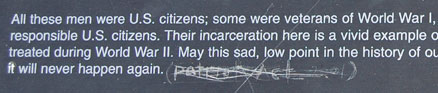
    Several miles north of Moab, Utah, on Highway 191, there’s an Historical Interest marker to commemorate the Civilian Conservation Corps work camp at Dalton Wells. According to the plaque on the site, Camp DG-32 was used for public works through the Great Depression, and converted in 1943 into a concentration camp for Japanese Americans accused of being troublemakers at the civilian internment camps. The plaque offered an apology for the “total violation their civil rights,” and this admonition:
    Civilian Conservation Corps DG-32 Dalton Wells
    After which someone added in parentheses: “(Patriot Act, 2001)” and then as if to make the point, a next somebody scratched it out.

    Full text of the marker:

    Civilian Conservation Corps Camp DG-32 (Co. 234)
    1935-1942

    During the Great Depression of the 1930’s, CCC Camps were scattered all over the USA. They provided gainful employment to youth of the nation with work on public service projects. Between 1933 and 1942, four camps were located near Moab. Each camp worked on various natural resource project for the Soil Conservation Service, the National Park Service, and the forerunner of the Bureau of Land Management.

    DG-32 was a long-lasting camp and typical of most with wooden, tar-paper covered barracks and buildings housing some 200 young men between the ages of 18 and 25. Enrollees came from the eastern states, and leadership was provided by the Army, Grazing Service, and local men experienced in construction and stock grazing needs.

    Under spartan conditions, clothing, food, and housing were provided in the primitive camp. Pay was $30 per month with $25 sent home.

    DG-32 projects included many range improvements: stock trails down the precipitous sandstone cliffs, spring developments, wells and stock ponds, eradication of rodents that competed with stock for feed, fences for corrals and pastures, reservoir dams, roads and bridges. These projects provided on the job training for the enrollees, besides the benefits they brought to the local economy. Many of these works are still in use today. The value of the camp and its works to Grand County is beyond estimation. It was a significant milestone that greatly influenced the economic history of the county.

    All that remains of the camp today are the cottonwood trees planted by the enrollees that you see fronting this site, concrete slabs for buildings, graveled roads and rock-outlined walkways, the remains of an old windmill and a rock masonry water storage tank. These remnants signify the moving history of a time when America valiantly struggled to restore its economic stability and provide its young people with meaningful employment.

    Japanese-American World War II Concentration Camp
    1943

    On January 11, 1943, a train pulled into Thompson Station north of here with armed Military Police guarding sixteen male American citizens of Japanese ancestry. While the locals of the town waited to cross the tracks, the entourage was loaded and transferred to the old abandoned “CCC” camp located here at Dalton Wells.

    Their crime? They were classified as “troublemakers” in the Manzanar, California Relocation Center where they and their families had been forcibly located at the start of World War II. Removed from their homes and lands in California under a Presidential Executive Order, they were subject to the whim and mercy of poorly-trained bureaucrats and military personnel in the center. This Executive Presidential Order was the result of wartime hysteria, racial bigotry, and greed.

    The original sixteen men were removed from Manzanar and brought here without the benefit of council. They did not have a formal hearing or proper arrest proceedings, and the action was in total violation of their civil rights. It was a process more compatible with fascism than democracy.

    The inmates troubles worsened when and informer and confidant of the administration was beaten. An organizer of the mess hall workers was thrown into jail as a suspect. A meeting was held in the camp to protest the jailing and a riot resulted. Two inmates were killed by trigger-happy soldiers.

    Other Japanese-American men were soon brought to the camp. Thirteen came from Gila River, Arizona, having been charged as being members of an organization which was fully sanctioned by camp officials. Ten more came from Manzanar as “suspected troublemakers.” Fifteen came from the Tule Lake, California, charged with refusing to register their availability for the draft and their loyalty to the U.S. under a set of confusing, denigrating requirements.

    All these men were U.S. citizens; some were veterans of Work War I, others were family men, college graduates, and responsible U.S. citizens. Their incarceration here is a vivid example of how our Japanese-American citizens were treated during World War II. May this sad, low point in the history of our democracy never be forgotten, in the hope that it will never happen again.

    The group was transferred by truck to an abandoned Indian school at Leupp, Arizona, on April 27, 1943. As those involved began to realize the inequality of the situation, the inmates were released back to relocation centers later that year. Thus, a black mark in the history of liberty and justice in the United States was ended.

    Wal-mart drives its chariot of predatory commerce over bones of Civil War dead

    Union Soldiers fight on Brock Road 1864
    WAL-MART wants to build a Virginia super-center on the edge of the memorial site of one of the most consequential battles of the Civil War. The Wilderness marked the first engagement between Generals Lee and Grant, ignited a forest fire which the soldiers fought through, and left 24,000 dead and wounded. Now 253 historians have joined in asking Wal-mart to reconsider.

    Mr. Lee Scott, President and CEO
    Walmart Stores, Inc.
    702 SW 8th Street
    Bentonville, Arkansas 72716-8611

    Dear Mr. Scott:

    I urge you in the strongest possible terms to pursue alternate building locations for the Walmart Supercenter proposed in Orange County, Virginia. The site currently under consideration lies within the historic boundary of the Wilderness Battlefield and only one quarter mile from the current boundary of the Wilderness Battlefield unit of Fredericksburg and Spotsylvania National Military Park.

    The Battle of the Wilderness was among the most significant engagements of the Civil War. It marked the first time legendary generals Robert E. Lee and Ulysses S. Grant faced off against one another on the field of battle. During two days of desperate conflict in a harsh, unforgiving landscape tangled with underbrush, 4,000 Americans lost their lives and nearly 20,000 were wounded.

    The proposed location will greatly increase traffic through the area and encourage further development to encroach upon and spoil the battlefield. This, in turn, will seriously degrade the experience for the many tens of thousands of heritage tourists who visit this National Park every year. The Wilderness Battlefield is easily the biggest tourist attraction in Orange County, with visitors coming from around the world to experience its serenity and contemplate its history and significance.

    As a historian, I feel strongly that the Wilderness Battlefield is a unique historic and cultural treasure deserving careful stewardship. Currently only approximately 20 percent of the battlefield is protected by the National Park Service. If built, this Walmart would seriously undermine ongoing efforts to see more of this historic land preserved and deny future generations the opportunity to wander a landscape that has, until now, remained largely unchanged since 1864.

    The Wilderness is an indelible part of our history, its very ground hallowed by the American blood spilled there, and it cannot be moved. Surely Walmart can identify a site that would meet its needs without changing the very character of the battlefield.

    There are many places in central Virginia to build a commercial development, but there is only one Wilderness Battlefield. Please respect our great nation’s history and move your store farther away from this historic site and National Park.

    Signed,

    * Terrie Aamodt, Walla Walla University
    * Edward D. Abrahams, Silver Spring, Md.
    * Sean P. Adams, University of Florida
    * Garry Adelman, History Associates, Inc.
    * Nicholas Aieta, the Marlborough School, West Springfield, Mass.
    * A.J. Aiseirithe, Washington, D.C.
    * James Anderson, Ashburn, Va.
    * Adam Arenson, University of Texas
    * Jonathan M. Atkins, Berry College
    * Arthur H. Auten, University of Hartford
    * David Bard, Concord College
    * Alwyn Barr, Texas Tech University
    * Craig A. Bauer, Metairie, La.
    * Erik Bauer, West Hollywood, Calif.
    * Dale Baum, Texas A&M University
    * Edwin C. Bearss, Historian emeritus, National Park Service
    * Caryn Cosse Bell, University of Massachusetts at Lowell
    * Jeffrey R. Bennett, Waterford, N.Y.
    * Shannon Bennett, Ellettsville, Ind.
    * Melvyn S. Berger, Newton, Mass.
    * Arthur W. Bergeron, Shippensburg, Pa.
    * Edward H. Bergerstrom, Port Richey, Fla.
    * Eugene H. Berwanger, Colorado State University
    * Fred W. Beuttler, Deputy Historian, U.S. House of Representatives
    * Darrel Bigham, University of Southern Indiana
    * John Bloom, Las Cruces, N.M.
    * Frederick J. Blue, Youngstown State University
    * Christopher Bobal, Lees Summit, Mo.
    * Thomas Bockhorn, Huntsville, Ala.
    * Keith Bohannon, University of West Georgia
    * Phillip S. Bolger, San Diego, Calif.
    * Patrick Boyd, the Pomfret School, Pomfret, Conn.
    * Vernon S. Braswell, Corpus Christi, Tex.
    * Roger D. Bridges, Bloomington, Ill.
    * Ronald S. Brockway, Regis University
    * Col. George M. Brooke, III, USMC (Ret.), Lexington, Va.
    * Bruce A. Brown, Cypress, Calif.
    * Norman D. Brown, University of Texas, Austen, Tex.
    * David Brush, the Pomfret School, Pomfret, Conn.
    * Jim Burgess, Manassas National Battlefield, Va.
    * Ken Burns, Walpole, N.H.
    * Brian Burton, Ferndale, Wash.
    * Victoria Bynum, Texas State University-San Marcos
    * Peter S. Carmichael, West Virginia University
    * Marius M. Carriere, Christian Brothers University
    * Katherine Cassioppi, National-Louis University
    * Gary Casteel, Lexington, Va.
    * Jane Turner Censer, George Mason University
    * William Cheek, San Diego State University
    * John Cimprich, Thomas More College
    * Thomas G. Clemens, Hagerstown Community College
    * Leon F. Cohn, Plantation, Fla.
    * Thomas B. Colbert, Marshalltown Community College
    * James R. Connor, Chancellor emeritus University of Wisconsin-Whitewater
    * William J. Cooper, Jr., Louisiana State University
    * Janet L. Coryell, Western Michigan University
    * Charles E. Coulter, Yankton, S.D.
    * Robert E. Curran, Richmond, Ky.
    * Thomas F. Curran, Saint Louis, Mo.
    * Gordon E. Dammann, National Museum of Civil War Medicine
    * Guy Stephen Davis, Atlanta, Ga.
    * William C. “Jack” Davis
    * Joseph G. Dawson, III, Texas A&M University
    * Mary DeCredico, United States Naval Academy
    * James Lyle DeMarce, Arlington, Va.
    * Charles B. Dew, Williams College
    * Steven Deyle, University of Houston
    * Richard DiNardo, Marine Corps Command and Staff College
    * Luis-Alejandro Dinnella-Borrego, Warwick, N.Y.
    * Richard R. Duncan, Alexandria, Va.
    * Kenneth Durr, History Associates, Inc.
    * David Dykstra, Poolesville, Md.
    * Mark Elliott, University of North Carolina at Greensboro
    * Robert F. Engs, University of Pennsylvania
    * C. Wyatt Evans, Drew University
    * Daniel Feller, University of Tennessee
    * Rex H. Felton, Tiffin, Ohio
    * Paul Finkelman, Albany Law School
    * Jeff Fioravanti, Lynn, Mass.
    * Joseph C. Fitzharris, University of Saint Thomas
    * J.K. Folmarm California, Minn.
    * George B. Forgie, University of Texas Austin
    * Lee W. Formwalt, Organization of American Historians
    * Janet B. Frazer, Narberth, Pa.
    * Gary W. Gallagher, University of Virginia, Charlottesville, Va.
    * Jonathan Gantt, Columbia College
    * Jason Gart, History Associates, Inc.
    * Louis S. Gerteis, University of Missouri, St. Louis
    * Kate C. Gillin, the Pomfret School, Pomfret, Conn.
    * Mary Giunta, Edinburg, Va.
    * Martin K. Gordon, Columbia, Md.
    * Cathy Gorn, University of Maryland
    * Thomas M. Grace, Amherst, N.Y.
    * Susan W. Gray, Severna Park, Md.
    * A. Wilson Greene, Pamplin Historical Park and National Museum of the Civil War Soldier
    * Debra F. Greene, Jefferson City, Mo.
    * Jim Griffin, Frisco, Tex.
    * Linda J. Guy, Clearville, Pa.
    * Edward J. Hagerty, American Military University
    * Alfred W. Hahn, Midlothian, Va.
    * Judith Lee Hallock, South Setauket, N.Y.
    * Jerry Harlow, President, Trevilian Station Battlefield Foundation
    * D. Scott Hartwig, Gettysburg National Military Park, Pa.
    * David S. Heidler, Colorado State University
    * Jeannie Heidler, United States Air Force Academy
    * John S. Heiser, Gettysburg National Military Park, Pa.
    * Earl J. Hess, Lincoln Memorial University
    * Libra Hilde, San Jose State University
    * T. John Hillmer, Jr., Wilson’s Creek National Battlefield, Mo.
    * David Hochfelder, State University of New York – Albany
    * Sylvia Hoffert, Texas A&M University
    * Patrick Hotard, Philadelphia, Pa.
    * Richard Houston, Harwich, Mass.
    * Randal L. Hoyer, Madonna University
    * Richard L. Hutchison, Fort Worth, Tex.
    * Brian M. Ingrassia, Georgia State University
    * Perry D. Jamieson, Crofton, Md.
    * Jim Jobe, Fort Donelson National Battlefield, Tenn.
    * Willie Ray Johnson, Kennesaw Mountain National Battlefield Park, Ga.
    * Vivian Lee Joyner, New Hill, N.C.
    * Whitmel M. Joyner, New Hill, N.C.
    * Walter D. Kamphoefner, Texas A&M University
    * Amalie M. Kass, Harvard Medical School
    * Philip M. Katz, Washington, D.C.
    * Brad Keefer, Kent State University
    * Brian J. Kenny, Denver, Co.
    * Victoria A. Kin, San Antonio, Tex.
    * George W. Knepper, University of Akron
    * Christopher Kolakowski, National Museum of the U.S. Army Reserve
    * Carl E. Kramer, Indiana University Southeast
    * Arnold Krammer, Texas A&M University
    * Robert K. Krick, Fredericksburg, Va.
    * Michael E. Krivdo, Texas A&M University
    * Benjamin Labaree, Saint Alban’s School, Washington, D.C.
    * Dan Laney, Austin, Tex.
    * Connie Langum, Wilson’s Creek National Battlefield, Mo.
    * William P. Leeman, Coventry, R.I.
    * Kevin Levin, Charlottesville, Va.
    * Richard G. Lowe, University of North Texas
    * Robert W. Lowery, Jr., Newport News, Va.
    * M. Philip Lucas, Cornell College
    * R. Wayne Mahood, Geneseo, N.Y.
    * Daniel Martin, Lancaster, Pa.
    * William Marvel, South Conway, N.H.
    * Matthew Mason, Brigham Young University
    * Dinah M. Mayo-Bobee, University of Massachusetts, Amherst
    * George T. Mazuzan, Springfield, Va.
    * Nathan McAlister, Hoyt, Kan.
    * David McCullough
    * Dennis K. McDaniel, Washington, D.C.
    * James M. McPherson, Princeton University
    * Kathleen G. McKesson, Eighty Four, Pa.
    * James G. Mendez, Chicago, Ill.
    * Brian Craig Miller, Emporia State University
    * Roger E. Miller, Eagle River, Alaska.
    * Wilbur R. Miller, State University of New York – Stony Brook
    * Eric J. Mink, Fredericksburg, Va.
    * Robert E. Mitchell, Brookline, Mass.
    * John Moody, Orange Park, Fla.
    * Richard Moore, Woodbridge, Va.
    * Richard Morey, Kent Place School, Summit, N.J.
    * Geoffrey Morrison, Saint Louis, Mo.
    * Brenda Murray, North Pole, Alaska.
    * Richard J. Myers, Doylestown, Pa.
    * Eric Nedergaard, Mesa, Ariz.
    * Robert D. Neuleib, Normal, Ill.
    * Kenneth Noe, Auburn University
    * Justin Oakley, Martinsville, Ind.
    * Kristen Oertel, Millsaps College
    * Marvin Olson, La Crescenta, Ca.
    * Beverly Palmer, Claremont, Ca.
    * John T. Payne, Lone Star College
    * Graham Peck, Saint Xavier University
    * William D. Pederson, Louisiana State University, Shreveport
    * William E. Pellerin, Santa Barbara, Ca.
    * Don Pfanz, Fredericksburg and Spotsylvania National Military Park, Va.
    * Michael Pierson, University of Massachusetts, Lowell
    * Kermit J. Pike, Western Reserve Historical Society, Mentor, Ohio
    * Ann Poe, Alexandria, Va.
    * Kieth Ploakoff, Rossmoor, Ca.
    * Lawrence N. Powell, Tulane University
    * Adam J. Pratt. Baton Rouge, La.
    * Gerald Prokopowicz, East Carolina University
    * John Quist, Shippensburg University
    * Steven J. Rauch, Evans, Ga.
    * S. Waite Rawls, III, Museum of the Confederacy
    * Carol Reardon, Pennsylvania State University
    * Douglas Reasner, Durant, Iowa
    * Michael Reis, History Associates, Inc.
    * Robert V. Remini, Office of the Historian, U.S. House of Representatives
    * James Renberg, Southern Pines, N.C.
    * Gordon Rhea, Mount Pleasant, S.C.
    * Jean Richardson, Buffalo State College
    * Jeffrey Richman, Brooklyn, N.Y.
    * Harris D. Riley, Jr., M.D., Nashville, Tenn.
    * James I. Robertson, Jr., Virginia Tech
    * Stephen I. Rockenbach, Virginia State University
    * Sylvia Rodrigue, Baton Rouge, La.
    * Rodney A. Ross, Center for Legislative Archives, Washington, D.C.
    * Jennifer Ross-Nazzal, Johnson Space Center
    * Jeffrey J. Safford, Montana State University
    * Frank Scaturro, New Hyde Park, N.Y.
    * Mark S. Schantz, Hendrix College
    * Laurence D. Schiller, Deerfield, Ill.
    * Christopher A. Schnell, Springfield, Ill.
    * Glenna R. Schroeder-Lein, Springfield, Ill.
    * Frederick Schult, Jr., New York University
    * Donald L. Schupp, Warrenton, Va.
    * Richard D. Schwartz, Morristown, N.J.
    * Cynthia Seacord, Schenectady, N.Y.
    * Tomas Seaver, Woonsocket, R.I.
    * Diane Shalda, Chicago Military Academy
    * Peter D. Sheridan, Torrance, Ca.
    * Mark Snyder, Akron, Ohio
    * John Sotak, O.S.A., New Lenox, Ill.
    * Clay W. Stuckey, DDS, Bedford, Ind.
    * Carlyn Swaim, History Associates, Inc.
    * Andrew Talkov, Virginia Historical Society
    * Robert A. Taylor, Florida Institute of Technology
    * Paul H. Tedesco, Northeastern University
    * James Thayer, Milford, Mass.
    * Emory M. Thomas, University of Georgia
    * JoAnne Thomas, Peoria, Ill.
    * Joseph Trent, Worcester, Mass.
    * Tony R. Trimble, Plainfield, Ind.
    * I. Bruce Turner, University of Louisiana at Lafayette
    * Edwin C. Ulmer, Jr., Feasterville, Pa.
    * Charles W. Van Adder, Forked River, N.J.
    * Charles Vincent, Baker, La.
    * Joseph F. von Deck, Ashburnham, Ma.
    * Brent Vosburg, Elizabethtown, N.J.
    * Robert Voss, Lincoln, Neb.
    * George N. Vourlojianis, Lorain County Community College
    * Christopher R. Waldrep, San Francisco State University
    * John Weaver, Tipp City, Ohio
    * Robert Welch, Ames, Iowa
    * Lowell E. Wenger, Cincinnati, Ohio
    * Jeffrey Wert, Centre Hall, Pa.
    * Bruce E. Wilburn, Glen Allen, Va.
    * Diana I. Williams, Wellesley College
    * Mary Williams, Fort Davis National Historic Site, Tex.
    * Terry Winschel, Vicksburg National Military Park, Miss.
    * Roger Winthrop, Lansing, Mich.
    * Eric J. Wittenberg, Columbus, Ohio
    * Ralph A. Wooster, Lamar University
    * Donald Yacovone, Harvard University
    * Shirley J. Yee, University of Washington
    * Mitchell Yockelson, National Archives and Records Administration
    * William D. Young, Maple Woods Community College
    * Mary E. Younger, Dayton, Ohio
    * Jack Zevin, Queens College, City University of New York

    Obama’s slam Duncan of public education

    arne duncanIt seems that the ‘Change’ President and basketball player, Barack Obama, has picked another Basketball jock like himself to head up National Education policy? In choosing Arne Duncan for the post, Barack Obama slam Dunkan-ed the Chicago community organizing group, Parents United for Responsible Education, with an Aspen Institute prodigy who specializes in closing down public schools and then reopening them as privatized ‘charter schools’.

    No wonder Pastor Rick Warren will be at the Inaugural Ceremony performing for BO, because this is the favored program of the Religious Right that would have religion put back in schools forcefully, using public tax monies to get it done. Barack is on board this program, and so is Harvard Basketball jock Arne.

    Who is this Arne really? He is a guy who has never been a teacher, and get this! … he has a degree in Sociology! That would get me and you a job at about $13/hr, but Arne got his Sociology Degree at Harvard. Add some extra points, because he paid some extra dollars for that degree. PLUS, he’s added on some honorary credentials from other elite outfits, too, including a ‘Doctor of Laws’ degree from Lake Forest College. Wkipedia tells us that Most (if not all) U.S. universities that award the degree of Doctor of Laws (LL.D.), award it only as an honorary degree. Read…. big shots are given it for free, this degree.

    But that would not be enough alone to have gotten Barack Obama to pick the guy for Education Boss. The fact is, that Arne Duncan was one of Harvard’s greatest basketball Stars! Oh the alumni! Oh, and there’s more! Arne plays BB games with Barrack in Chicago! Never has cronyism been so narrowed!

    The impact of Obama’s slam dunk of public education with this sorry choice of exHarvard BB Star Duncan, is more than just an indication of how Barack Obama wants to do yet more with the ‘No Child Left Behind’ sort of privatization mish mash of the Dubya years, but is also an indicator of how little real public heath care we shall see in the cards in the years ahead. After all, if you think that privatizing public education is a good thing, then it is not going to mean that this ‘Change’ BB Dude will be ready to change the already privatized American Health Care System for the better either. No way! He’ll just put a basketball jock, this time from Yale, perhaps?, in charge of Medicine. First the Boss would have to be vetted by the Aspen Institute or some other elite ruling class money laundering outfit like them though. Then slam dunk Health Care. It looks deadly.

    Yes, it’s going to be corruption as usual in the Education Department and one doesn’t need a Sociology Degree to figure that one out from this choice. Good luck, Kids! 2+2=4 and Barack Obama is bouncing people around in court. It’ll be a real public education for all of us very soon, and could it get much worse? Social Security on the chopping block anybody?

    Black tar heroin bust spoils Cheyenne Mountain High School White Christmas

    I’ll admit I was pretty floored when I read that students at Cheyenne Mountain High School — my kids’ school — were busted for using and dealing heroin. Apparently, a hired drug-sniffing dog led police to a locker containing Xanax, an anti-anxiety medication, that hadn’t been prescribed for the locker’s owner. The word is that this kid ratted out his fellow drug-using students. Whether this was an attempt to minimize his crime, or to strike a plea bargain of some kind, I don’t know. I called my college girl with breaking news of the drug busts. “Yeah,” she said, nearly yawning, or so it seemed, “it’s not 25 kids, it’s only 15. I heard the two dealers are facing 7 to 12 and the rest of the kids are being sent to rehab.” With Facebook, news disseminates in real time so my scoop was already old news to her.
    Cheyenne-Mountain-High-School-banner

    Undeterred, I dropped in on a fellow mother to deliver my bombshell. “Oh, yeah, there’ve been rumors of heroin use at Cheyenne for at least a couple years.” She proceeded to give me the lowdown on two of the alleged dealers.

    Okay, everyone knew but me. But let me at least wager a guess about the future: since no drugs were found to be in possession of any student, there’s nothing the school can do to any of the alleged users. Not even a suspension, which is as it should be if due process is honored. I wouldn’t expect much more than hand-wringing from the parents who didn’t notice their children were strung out on heroin. The kids who’ve admitted smoking the stuff will likely be sent to $10,000/week rehab facilities where they can meet Mary Kate Olson or Lindsay Lohan and come back to mini-celebrity status.

    The rest of us will distance ourselves from distasteful realities, likely with the full cooperation of teachers, shrinks, and media. One local headline read “D12 students were sold black tar heroin,” not “D12 students bought black tar heroin.” The subtle difference provides us a tiny emotional cushion.

    Rather than dealing with the very real problems that plague our community, we’ll continue to emphasize the role of the drug-smuggling “Mexican nationals” in the corruption of our teenagers. Though the media has demonized them repeatedly, no one I’ve talked to knows anything about them, or exactly what a Mexican national is. But, then again, Cheyenne Mountain doesn’t know much about Mexicans in general, or blacks, or Indians that aren’t the school mascot. Come to think of it, we’d also never heard of BLACK TAR heroin. We thought heroin was supposed to be pure and white, like us. In any case, we take only prescription drugs, which is why we hurt for whichever mother had her Xanax jacked, the not-so-shocking incident that started this whole dark chapter.

    Meanwhile, back at the lab…

    A BBC news story about why and how Ordinary People can be induced to torture another Human Being just because an “Authority Figure” ordered them to do it….

    This is for all the … oh, I’ll not called them Cowards (this time), I’ll be more P.C. (temporarily) “Morality Challenged and Courage Deficient” bootlicker who yes sir yes sir three bags full sir!! Always Follow Orders bullshit artists who think they have to be Obedient.

    They know who they are.

    BBC NEWS
    People ‘still willing to torture’

    Decades after a notorious experiment, scientists have found test subjects are still willing to inflict pain on others – if told to by an authority figure.

    US researchers repeated the famous “Milgram test”, with volunteers told to deliver electrical shocks to another volunteer – played by an actor.

    Even after faked screams of pain, 70% were prepared to increase the voltage, the American Psychology study found.

    Both may help explain why apparently ordinary people can commit atrocities.

    Yale University professor Stanley Milgram’s work, published in 1963, recruited volunteers to help carry out a medical experiment, with none aware that they were actually the subject of the test.

    A “scientist” instructed them to deliver a shock every time the actor answered a question wrongly.

    When the pretend 150-volt shock was delivered, the actor could be heard screaming in pain, and yet, when asked to, more than eight out of ten volunteers were prepared to give further shocks, even when the “voltage” was gradually increased threefold.

    Some volunteers even carried on giving 450-volt shocks even when there was no further response from the actor, suggesting he was either unconscious or dead.

    Similar format

    Dr Jerry Burger, of Santa Clara University, used a similar format, although he did not allow the volunteers to carry on beyond 150 volts after they had shown their willingness to do so, suggesting that the distress caused to the original volunteers had been too great.

    Again, however, the vast majority of the 29 men and 41 women taking part were willing to push the button knowing it would cause pain to another human.

    Even when another actor entered the room and questioned what was happening, most were still prepared to continue.

    He told Reuters: “What we found is validation of the same argument – if you put people in certain situations, they will act in surprising and maybe often even disturbing ways.”

    He said that it was not that there was “something wrong” with the volunteers, but that when placed under pressure, people will often do “unsettling” things.

    Even though it was difficult to translate laboratory work to the real world, he said, it might partly explain why, in times of conflict, people could take part in genocide.

    Complex task

    Dr Abigail San, a chartered clinical psychologist, has recently replicated the experiment for a soon-to-be-aired BBC documentary – all the way up to the 450-volt mark, again finding a similar outcome to Professor Milgram.

    “It’s not that these people are simply not good people any more – there is a massive social influence going on.”

    She said that the volunteers were being asked to carry out a complex task in aid of scientific research, and became entirely focused on it, with “little room” left for considering the plight of the person receiving the shock.

    “They tend to identify massively with the ‘experimenter’, and become very engaged and distracted by the research.

    “There’s no opportunity for them to say ‘What’s my moral stand on this?'”
    Story from BBC NEWS:
    http://news.bbc.co.uk/go/pr/fr/-/2/hi/health/7791278.stm

    Published: 2008/12/19 10:41:36 GMT

    © BBC MMVIII

    Print Sponsor

    Of course, Military Torturers have plenty of time to become acclimated to the “Routine”, are themselves trained in resisting torture and trained in how to complain to any who will listen, long and loud, when they themselves are Tortured…

    And PLENTY of time to consider the Immorality of what THEY do.

    Unlike college student volunteers who do it once for a 3 hour session.

    Staging Homer for Generation Simpson

    Odyssey by Derek WalcottTHE ODYSSEY,
    A STAGE VERSION-
    Greek myth would be no more complicated than JK Rowling, JRR Tolkien, or GRG Lucas, but I suspect that to impress Homer unto modern audiences might have the disagreeable consequence of educating them.

    This weekend Colorado College students staged Derek Walcott’s 1992 The Odyssey in the South Theater of the Cornerstone Arts Building. And performed it brilliantly. Every role, every effect, executed with vitality and aplomb.

    Except for the Jamaican nursemaid and Aussie shepherd, the CC actors dropped Walcott’s New World islander accents, but their production honored his post imperialism critique.

    My favorite sequence depicted Cyclops as an all-seeing 1984 distillation of mortal man’s inclination toward totalitarianism. The Circe episode is nagging me for further reflection, if I’m to imagine that Walcott would not succumb to the traditional Siren/Mermaid/Nymph misogyny.

    If you can’t shake the admonition that rational man’s chief torment is woman, you need look for no literary antecedent before Homer.

    Obviously, not all that is Greek is instructional, but wouldn’t it serve our education nicely if, instead of the insipid nuances of fictional worlds imagined by scribes steeped in the decay of Western Civilization, our children could commit to their memories the literary plots –no less compelling– which form the building blocks to a greater appreciation of all art?

    We told the kids that the Odyssey was Western Civilization’s first sequel. Of course, the Iliad was a lot to have to recap. Not surprisingly, their experience was “the most random ever.” But while I lamented my missed advance opportunity to have brought them up to speed on the gods and heroes of antiquity, our eleven year old noted, of the lines spoken by the mysterious personages: “Everything they said was always about something else!”

    Poetry!

    OF FURTHER INTEREST:
    Creolizing Homer for the stage: Walcott’s The Odyssey, by Robert D. Hamner, Twentieth Century Literature, Fall, 2001

    Playing With Europe: Derek Walcott’s Retelling of Homer’s Odyssey, by Irene Martyniuk, Callaloo 28.1, 2005

    Country rodeo clown to retire to big city

    bushThe news is in that America’s favorite country rodeo clown will be soon retiring from his rural ranch to the big city, so that his lovely little wife can find work at the college liberry of Southern Methodist University. The area of the town will have a country name though…. Preston Hollow… which is an area where skunks have long been known to live and play.

    It’s not like it’s a real, really real big city though. It’s just Dallas, Texas and not New Yarrkkk City. This is indeed sad news for Waco that will soon lose its wacko, but the house is already being bought. The retirement plan is a done deed. Anybody plan to buy the ranch yet? I hope it’s not some dirty Arabbb???? Brother, Dave! Watch out for them black helicopters which may soon be flying overhead!

    Psychedelic Air Force Academy Show and KRCC, Pentagon Kool Aid Stand

    Ken BabbsI told myself I just wasn’t going to comment anymore about the local Colorado Springs private radio station, KRCC. Yeah, I know they bill themselves as being ‘public radio’, but have you ever heard so many commercials in your life? I haven’t and this station could give PBS, the Petroleum Broadcasting System, a run for its money in the competition for ‘public’ that just isn’t.

    But there they were yesterday broadcasting with a program that tried so hard to remake the Air Force Academy image into that of a hip, psychedelic, sort of Acid Kool Aid institute of Beatnik being! I kid you not! Oh, KRCC! You are just so hip! NOT….

    Yes, according to their program that highlighted Ken Babbs and his hip, psychedelic LSD influenced vision of the Air Force Academy, KRCC was trying to get its public to swallow some sort of Pentagon image building promotion Kool Aid. This radio station just puts me into a daze most of the time and this program was no exception. It might have been ‘Jeff’ and his program, and the program did not have that NPR style of holding the nose while whistling off the what-ever? Like most of the time at KRCC, I turned the thing off after a sec or two, and still do not know exactly what the Hell I was actually listening to? Some sort of Orwellian nightmare, perhaps? Score par for KRCC. But I think it was some sort of report about Ken Babbs visiting the Air Force Academy? How did it go? …sort of thing???

    Anyway, leave it to Colorado College, owners of KRCC, and the Air Force Academy to come up with using Ken Kesey to make themselves out to be ever so hip! Them a hip set of Cadets out there to invite a speaker onto campus to talk Ken Kesey up! Psychedelic, Man! Now let’s go drop some bombs on civilians, why don’t we? Got a joint?

    Apparently this is Psychedelic Ken Babb’s most often used quote line…

    ‘Most people don’t realize how many of the “hippies” actually served in the military. Ken states his position as, ” (I was in the) NROTC in college, took the marine option and was commissioned a second lieutenant”. He was a helicopter pilot when his squadron got orders to go to Vietnam.

    When asked his opinion of the Vietnam war, Mr. Babbs states” I had no perceptions of right or wrong before I went to Vietnam, but (it) took about six weeks to realize we were wasting our time there”.’

    WOW! Profound! They were wasting time… Magic mushrooms anybody? What a prankster! If I was still young, I’d be ready to get into that hip, Psychedelic Air Force Academy! A real trip! KRCC helped blow our minds with this local ‘news’. KRCC is hip and beat.

    Weathermen for a Democratic Society

    Bernadine Dohrn addresses S.D.S. in ChicagoIn 1969, the Radical Youth Movement (RYM) within Students for a Democratic Society (SDS) expelled the passive participants to reconfigure the SDS to Bring the War Home. At left, Bernardine Dohrn uninvites the Progressive Labor Party (PL) and the Worker Student Alliance (WSA) from the Chicago conference. Below is the founding document after which the RYM was renamed.

    You Don’t Need A Weatherman
    To Know Which Way The Wind Blows

    June 18, 1969

    Submitted by Karin Asbley, Bill Ayers, Bernardine Dohrn, John Jacobs, Jeff Jones, Gerry Long, Home Machtinger, Jim Mellen, Terry Robbins, Mark Rudd and Steve Tappis.

    I. International Revolution

    The contradiction between the revolutionary peoples of Asia, Africa and Latin America and the imperialists headed by the United States is the principal contradiction in the contemporary world. The development of this contradiction is promoting the struggle of the people of the whole world against US imperialism and its lackeys.

    Lin Piao, Long Live the Victory of People’s War!

    People ask, what is the nature of the revolution that we talk about- Who will it be made by, and for, and what are its goals and strategy-

    The overriding consideration in answering these questions is that the main struggle going on in the world today is between US imperialism and the national liberation struggles against it. This is essential in defining political matters in the whole world: because it is by far the most powerful, every other empire and petty dictator is in the long run dependent on US imperialism, which has unified, allied with, and defended all of the reactionary forces of the whole world. Thus, in considering every other force or phenomenon, from Soviet imperialism or Israeli imperialism to “workers struggle” in France or Czechoslovakia, we determine who are our friends and who are our enemies according to whether they help US imperialism or fight to defeat it.

    So the very first question people in this country must ask in considering the question of revolution is where they stand in relation to the United States as an oppressor nation, and where they stand in relation to the masses of people throughout the world whom US imperialism is oppressing.

    The primary task of revolutionary struggle is to solve this principal contradiction on the side of the people of the world. It is the oppressed peoples of the world who have created the wealth of this empire and it is to them that it belongs; the goal of the revolutionary struggle must be the control and use of this wealth in the interests of the oppressed peoples of the world.

    It is in this context that we must examine the revolutionary struggles in the United States. We are within the heartland of a worldwide monster, a country so rich from its worldwide plunder that even the crumbs doled out to the enslaved masses within its borders provide for material existence very much above the conditions of the masses of people of the world. The US empire, as a worldwide system, channels wealth, based upon the labor and resources of the rest of the world, into the United States. The relative affluence existing in the United States is directly dependent upon the labor and natural resources of the Vietnamese, the Angolans, the Bolivians and the rest of the peoples of the Third World. All of the United Airlines Astrojets, all of the Holiday Inns, all of Hertz’s automobiles, your television set, car and wardrobe already belong, to a large degree to the people of the rest of the world.

    Therefore, any conception of “socialist revolution” simply in terms of the working people of the United States, failing to recognize the full scope of interests of the most oppressed peoples of the world, is a conception of a fight for a particular privileged interest, and is a very dangerous ideology. While the control and use of the wealth of the Empire for the people of the whole world is also in the interests of the vast majority of the people in this country, if the goal is not clear from the start we will further the preservation of class society, oppression, war, genocide, and the complete emiseration of everyone, including the people of the US.

    The goal is the destruction of US imperialism and the achievement of a classless world: world communism. Winning state power in the US will occur as a result of the military forces of the US overextending themselves around the world and being defeated piecemeal; struggle within the US will be a vital part of this process, but when the revolution triumphs in the US it will have been made by the people of the whole world. For socialism to be defined in national terms within so extreme and historical an oppressor nation as this is only imperialist national chauvinism on the part of the “movement.”

    II. What Is The Black Colony-

    Not every colony of people oppressed by imperialism lies outside the boundaries of the US. Black people within North America, brought here 400 years ago as slaves and whose labor, as slaves, built this country, are an internal colony within the confines of the oppressor nation. What this means is that black people are oppressed as a whole people, in the institutions and social relations of the country, apart from simply the consideration of their class position, income, skill, etc., as individuals- What does this colony look like- What is the basis for its common oppression and why is it important-

    One historically important position has been that the black colony only consists of the black belt nation in the South, whose fight for national liberation is based on a common land, culture, history and economic life. The corollary of this position is that black people in the rest of the country are a national minority but not actually part of the colony themselves; so the struggle for national liberation is for the black belt, and not all blacks; black people in the north, not actually part of the colony, are part of the working class of the white oppressor nation. In this formulation northern black workers have a “dual role”—one an interest in supporting the struggle in the South, and opposing racism, as members of the national minority; and as northern “white nation” workers whose class interest is in integrated socialism in the north. The consistent version of this line actually calls for integrated organizing of black and white workers in the north along what it calls “class” lines.

    This position is wrong; in reality, the black colony does not exist simply as the “black belt nation,” but exists in the country as a whole. The common oppression of black people and the common culture growing out of that history are not based historically or currently on their relation to the territory of the black belt, even though that has been a place of population concentration and has some very different characteristics than the north, particularly around the land question.

    Rather, the common features of oppression, history and culture which unify black people as a colony (although originating historically in a common territory apart from the colonizers, i.e., Africa, not the South) have been based historically on their common position as slaves, which since the nominal abolition of slavery has taken the form of caste oppression, and oppression of black people as a people everywhere that they exist. A new black nation, different from the nations of Africa from which it came, has been forged by the common historical experience of importation and slavery and caste oppression; to claim that to be a nation it must of necessity now be based on a common national territory apart from the colonizing nation is a mechanical application of criteria which were and are applicable to different situations.

    What is specifically meant by the term caste is that all black people, on the basis of their common slave history, common culture and skin color are systematically denied access to particular job categories (or positions within job categories), social position, etc., regardless of individual skills, talents, money or education. Within the working class, they are the most oppressed section; in the petit bourgeoisie, they are even more strictly confined to the lowest levels. Token exceptions aside, the specific content of this caste oppression is to maintain black people in the most exploitative and oppressive jobs and conditions. Therefore, since the lowest class is the working class, the black caste is almost entirely a caste of the working class, or [holds] positions as oppressed as the lower working-class positions (poor black petit bourgeoisie and farmers); it is a colonial labor caste,, a colony whose common national character itself is defined by their common class position.

    Thus, northern blacks do not have a “dual interest”—as blacks on the one hand and “US-nation workers” on the other. They have a single class interest, along with all other black people in the US, as members of the Black Proletarian Colony.

    III. The Struggle For Socialist Self-Determination

    The struggle of black people—as a colony—is for self-determination, freedom, and liberation from US imperialism. Because blacks have been oppressed and held in an inferior social position as a people, they have a right to decide, organize and act on their common destiny as a people apart from white interference. Black self-determination does not simply apply to determination of their collective political destiny at some future time. It is directly tied to the fact that because all blacks experience oppression in a form that no whites do, no whites are in a position to fully understand and test from their own practice the real situation black people face and the necessary response to it. This is why it is necessary for black people to organize separately and determine their actions separately at each stage of the struggle.

    It is important to understand the implications of this. It is not legitimate for whites to organizationally intervene in differences among revolutionary black nationalists. It would be arrogant for us to attack any black organization that defends black people and opposes imperialism in practice. But it is necessary to develop a correct understanding of the Black Liberation struggle within our own organization, where an incorrect one will further racist practice in our relations with the black movement.

    In the history of some external colonies, such as China and Vietnam, the struggle for self-determination has had two stages: (1) a united front against imperialism and for New Democracy (which is a joint dictatorship of anti-colonial classes led by the proletariat, the content of which is a compromise between the interests of the proletariat and nationalist peasants, petit bourgeoisie and national bourgeoisie); and (2) developing out of the new democratic stage, socialism.

    However, the black liberation struggle in this country will have only one “stage”; the struggle for self-determination will embody within it the struggle for socialism.

    As Huey P. Newton has said, “In order to be a revolutionary nationalist, you would of necessity have to be a socialist.” This is because—given the caste quality of oppression-as-a-people-through-a-common-degree-of-exploitation—self-determination requires being free from white capitalist exploitation in the form of inferior (lower caste) jobs, housing, schools, hospitals, prices. In addition, only what was or became in practice a socialist program for self-determination—one which addressed itself to reversing this exploitation—could win the necessary active mass support in the “proletarian colony.”

    The program of a united front for new democracy, on the other hand, would not be as thorough, and so would not win as active and determined support from the black masses. The only reason for having such a front would be where the independent petit bourgeois forces which it would bring in would add enough strength to balance the weakening of proletarian backing. This is not the case: first, because much of the black petit bourgeoisie is actually a “comprador” petit bourgeoisie (like so-called black capitalists who are promoted by the power structure to seem independent but are really agents of white monopoly capital), who would never fight as a class for any real self-determination; and secondly, because many black petit bourgeoisie, perhaps most, while not having a class interest in socialist self-determination, are close enough to the black masses in the oppression and limitations on their conditions that they will support many kinds of self-determination issues, and, especially when the movement is winning, can be won to support full (socialist) self-determination. For the black movement to work to maximize this support from the petit bourgeoisie is correct; but it is in no way a united front where it is clear that the Black Liberation Movement should not and does not modify the revolutionary socialist content of its stand to win that support.

    From /New Left Notes/, June 18, 1969

    IV. Black Liberation Means Revolution

    What is the relationship of the struggle for black self-determination to the whole worldwide revolution to defeat US imperialism and internationalize its resources toward the goal of creating a classless world-

    No black self-determination could be won which would not result in a victory for the international revolution as a whole. The black proletarian colony, being dispersed as such a large and exploited section of the work force, is essential to the survival of imperialism. Thus, even if the black liberation movement chose to try to attain self-determination in the form of a separate country (a legitimate part of the right to self-determination), existing side by side with the US, imperialism could not survive if they won it—and so would never give up without being defeated. Thus, a revolutionary nationalist movement could not win without destroying the state power of the imperialists; and it is for this reason that the black liberation movement, as a revolutionary nationalist movement for self-determination, is automatically in and of itself an inseparable part of the whole revolutionary struggle against US imperialism and for international socialism.

    However, the fact that black liberation depends on winning the whole revolution does not mean that it depends on waiting for and joining with a mass white movement to do it. The genocidal oppression of black people must be ended, and does not allow any leisure time to wait; if necessary, black people could win self-determination, abolishing the whole imperialist system and seizing state power to do it, without this white movement, although the cost among whites and blacks both would be high.

    Blacks could do it alone if necessary because of their centralness to the system, economically and geo-militarily, and because of the level of unity, commitment, and initiative which will be developed in waging a people’s war for survival and national liberation. However, we do not expect that they will have to do it alone, not only because of the international situation, but also because the real interests of masses of oppressed whites in this country lie with the Black Liberation struggle, and the conditions for understanding and fighting for these interests grow with the deepening of the crises. Already, the black liberation movement has carried with it an upsurge of revolutionary consciousness among white youth; and while there are no guarantees, we can expect that this will extend and deepen among all oppressed whites.

    To put aside the possibility of blacks winning alone leads to the racist position that blacks should wait for whites and are dependent on whites acting for them to win. Yet the possibility of blacks winning alone cannot in the least be a justification for whites failing to shoulder the burden of developing a revolutionary movement among whites. If the first error is racism by holding back black liberation, this would be equally racist by leaving blacks isolated to take on the whole fight—and the whole cost—for everyone.

    It is necessary to defeat both racist tendencies: (1) that blacks shouldn’t go ahead with making the revolution, and (2) that blacks should go ahead alone with making it. The only third path is to build a white movement which will support the blacks in moving as fast as they have to and are able to, and still itself keep up with that black movement enough so that white revolutionaries share the cost and the blacks don’t have to do the whole thing alone. Any white who does not follow this third path is objectively following one of the other two (or both) and is objectively racist.

    V. Anti-Imperialist Revolution And The United Front

    Since the strategy for defeating imperialism in semi-feudal colonies has two stages, the new democratic stage of a united front to throw out imperialism and then the socialist stage, some people suggest two stages for the US too—one to stop imperialism, the anti-imperialist stage, and another to achieve the dictatorship of the proletariat, the socialist stage. It is no accident that even the proponents of this idea can’t tell you what it means. In reality, imperialism is a predatory international stage of capitalism. Defeating imperialism within the US couldn’t possibly have the content, which it could in a semi-feudal country, of replacing imperialism with capitalism or new democracy; when imperialism is defeated in the US, it will be replaced by socialism—nothing else. One revolution, one replacement process, one seizure of state power—the anti-imperialist revolution and the socialist revolution, one and the same stage. To talk of this as two separate stages, the struggle to overthrow imperialism and the struggle for socialist revolution, is as crazy as if Marx had talked about the proletarian socialist revolution as a revolution of two stages, one the overthrow of capitalist state power, and second the establishment of socialist state power.

    Along with no two stages, there is no united front with the petit bourgeoisie, because its interests as a class aren’t for replacing imperialism with socialism. As far as people within this country are concerned, the international war against imperialism is the same task as the socialist revolution, for one overthrow of power here. There is no “united front” for socialism here.

    One reason people have considered the “united front” idea is the fear that if we were talking about a one-stage socialist revolution we would fail to organize maximum possible support among people, like some petit bourgeoisie, who would fight imperialism on a particular issue, but weren’t for revolution. When the petit bourgeoisie’s interest is for fighting imperialism on a particular issue, but not for overthrowing it and replacing it with socialism, it is still contributing to revolution to that extent—not to some intermediate thing which is not imperialism and not socialism. Someone not for revolution is not for actually defeating imperialism either, but we still can and should unite with them on particular issues. But this is not a united front (and we should not put forth some joint “united front” line with them to the exclusion of our own politics), because their class position isn’t against imperialism as a system. In China, or Vietnam, the petit bourgeoisie’s class interests could be for actually winning against imperialism; this was because their task was driving it out, not overthrowing its whole existence. For us here, “throwing it out” means not from one colony, but all of them, throwing it out of the world, the same thing as overthrowing it.

    VI. International Strategy

    What is the strategy of this international revolutionary movement- What are the strategic weaknesses of the imperialists which make it possible for us to win- Revolutionaries around the world are in general agreement on the answer, which Lin Piao describes in the following way:

    US imperialism is stronger, but also more vulnerable, than any imperialism of the past. It sets itself against the people of the whole world, including the people of the United States. Its human, military, material and financial resources are far from sufficient for the realization of its ambition of domination over the whole world. US imperialism has further weakened itself by occupying so many places in the world, overreaching itself, stretching its fingers out wide and dispersing its strength, with its rear so far away and its supply lines so long.

    —/Long Live the Victory of People’s War/

    The strategy which flows from this is what Ché called “creating two, three, many Vietnams”—to mobilize the struggle so sharply in so many places that the imperialists cannot possibly deal with it all. Since it is essential to their interests, they will try to deal with it all, and will be defeated and destroyed in the process.

    In defining and implementing this strategy, it is clear that the vanguard (that is, the section of the people who are in the forefront of the struggle and whose class interests and needs define the terms and tasks of the revolution) of the “American Revolution” is the workers and oppressed peoples of the colonies of Asia, Africa and Latin America. Because of the level of special oppression of black people as a colony, they reflect the interests of the oppressed people of the world from within the borders of the United States; they are part of the Third World and part of the international revolutionary vanguard.

    The vanguard role of the Vietnamese and other Third World countries in defeating US imperialism has been clear to our movement for some time. What has not been so clear is the vanguard role black people have played, and continue to play, in the development of revolutionary consciousness and struggle within the United States. Criticisms of the black liberation struggle as being “reactionary” or of black organizations on campus as being conservative or “racist” very often express this lack of understanding. These ideas are incorrect and must be defeated if a revolutionary movement is going to be built among whites.

    The black colony, due to its particular nature as a slave colony, never adopted a chauvinist identification with America as an imperialist power, either politically or culturally. Moreover, the history of black people in America has consistently been one of the greatest overall repudiations of and struggle against the state. From the slave ships from Africa to the slave revolts, the Civil War, etc., black people have been waging a struggle for survival and liberation. In the history of our own movement this has also been the case: the civil rights struggles, initiated and led by blacks in the South; the rebellions beginning with Harlem in 1964 and Watts in 1965 through Detroit and Newark in 1967; the campus struggles at all-black schools in the South and struggles led by blacks on campuses all across the country. As it is the blacks—along with the Vietnamese and other Third World people—who are most oppressed by US imperialism, their class interests are most solidly and resolutely committed to waging revolutionary struggle through to its completion. Therefore it is no surprise that time and again, in both political content and level of consciousness and militancy, it has been the black liberation movement which has upped the ante and defined the terms of the struggle.

    What is the relationship of this “black vanguard” to the “many Vietnams” around the world- Obviously this is an example of our strategy that different fronts reinforce each other. The fact that the Vietnamese are winning weakens the enemy, advancing the possibilities for the black struggle, etc. But it is important for us to understand that the interrelationship is more than this. Black people do not simply “choose” to intensify their struggle because they want to help the Vietnamese, or because they see that Vietnam heightens the possibilities for struggle here. The existence of any one Vietnam, especially a winning one, spurs on others not only through consciousness and choice, but through need, because it is a political and economic, as well as military, weakening of capitalism, and this means that to compensate, the imperialists are forced to intensify their oppression of other people.

    Thus the loss of China and Cuba and the loss now of Vietnam not only encourages other oppressed peoples (such as the blacks) by showing what the alternative is and that it can be won, but also costs the imperialists billions of dollars which they then have to take out of the oppression of these other peoples. Within this country increased oppression falls heavier on the most oppressed sections of the population, so that the condition of all workers is worsened through rising taxes, inflation and the fall of real wages, and speedup. But this increased oppression falls heaviest on the most oppressed, such as poor white workers and, especially, the blacks, for example through the collapse of state services like schools, hospitals and welfare, which naturally hits the hardest at those most dependent on them.

    This deterioration pushes people to fight harder to even try to maintain their present level. The more the ruling class is hurt in Vietnam, the harder people will be pushed to rebel and to fight for reforms. Because there exist successful models of revolution in Cuba, Vietnam, etc., these reform struggles will provide a continually larger and stronger base for revolutionary ideas. Because it needs to maximize profits by denying the reforms, and is aware that these conditions and reform struggles will therefore lead to revolutionary consciousness, the ruling class will see it more and more necessary to come down on any motion at all, even where it is not yet highly organized or conscious. It will come down faster on black people, because their oppression is increasing fastest, and this makes their rebellion most thorough and most dangerous, and fastest growing. It is because of this that the vanguard character and role of the black liberation struggle will be increased and intensified, rather than being increasingly equal to and merged into the situation and rebellion of oppressed white working people and youth. The crises of imperialism (the existence of Vietnam and especially that it’s winning) will therefore create a “Black Vietnam” within the US.

    Given that black self-determination would mean fully crushing the power of the imperialists, this “Vietnam” has certain different characteristics than the external colonial wars. The imperialists will never “get out of the US” until their total strength and every resource they can bring to bear has been smashed; so the Black Vietnam cannot win without bringing the whole thing down and winning for everyone. This means that this war of liberation will be the most protracted and hardest fought of all.

    It is in this context that the question of the South must be dealt with again, not as a question of whether or not the black nation, black colony, exists there, as opposed to in the North as well, but rather as a practical question of strategy and tactics: Can the black liberation struggle—the struggle of all blacks in the country—gain advantage in the actual war of liberation by concentrating on building base areas in the South in territory with a concentration of black population-

    This is very clearly a different question than that of “where the colony is,” and to this question the “yes” answer is an important possibility. If the best potential for struggle in the South were realized, it is fully conceivable and legitimate that the struggle there could take on the character of a fight for separation; and any victories won in that direction would be important gains for the national liberation of the colony as a whole. However, because the colony is dispersed over the whole country, and not just located in the black belt, winning still means the power and liberation of blacks in the whole country.

    Thus, even the winning of separate independence in the South would still be one step toward self-determination, and not equivalent to winning it; which, because of the economic position of the colony as a whole, would still require overthrowing the state power of the imperialists, taking over production and the whole economy and power, etc.

    VII. The Revolutionary Youth Movement: Class Analysis

    The revolutionary youth movement program was hailed as a transition strategy, which explained a lot of our past work and pointed to new directions for our movement. But as a transition to what- What was our overall strategy- Was the youth movement strategy just an organizational strategy because SDS is an organization of youth and we can move best with other young people-

    We have pointed to the vanguard nature of the black struggle in this country as part of the international struggle against American imperialism, and the impossibility of anything but an international strategy for winning. Any attempt to put forth a strategy which, despite internationalist rhetoric, assumes a purely internal development to the class struggle in this country, is incorrect. The Vietnamese (and the Uruguayans and the Rhodesians) and the blacks and Third World peoples in this country will continue to set the terms for class struggle in America.

    In this context, why an emphasis on youth- Why should young people be willing to fight on the side of Third World peoples- Before dealing with this question about youth, however, there follows a brief sketch of the main class categories in the white mother country which we think are important, and [which] indicate our present estimation of their respective class interests (bearing in mind that the potential for various sections to understand and fight for the revolution will vary according to more than just their real class interests).

    Most of the population is of the working class, by which we mean not simply industrial or production workers, nor those who are actually working, but the whole section of the population which doesn’t own productive property and so lives off of the sale of its labor power. This is not a metaphysical category either in terms of its interests, the role it plays, or even who is in it, which very often is difficult to determine.

    As a whole, the long-range interests of the non-colonial sections of the working class lie with overthrowing imperialism, with supporting self-determination for the oppressed nations (including the black colony), with supporting and fighting for international socialism. However, virtually all of the white working class also has short-range privileges from imperialism, which are not false privileges but very real ones which give them an edge of vested interest and tie them to a certain extent to the imperialists, especially when the latter are in a relatively prosperous phase. When the imperialists are losing their empire, on the other hand, these short-range privileged interests are seen to be temporary (even though the privileges may be relatively greater over the faster-increasing emiseration of the oppressed peoples). The long-range interests of workers in siding with the oppressed peoples are seen more clearly in the light of imperialism’s impending defeat. Within the whole working class, the balance of anti-imperialist class interests with white mother country short-term privilege varies greatly.

    First, the most oppressed sections of the mother country working class have interests most clearly and strongly anti-imperialist. Who are the most oppressed sections of the working class- Millions of whites who have as oppressive material conditions as the blacks, or almost so: especially poor southern white workers; the unemployed or semi-employed, or those employed at very low wages for long hours and bad conditions, who are non-unionized or have weak unions; and extending up to include much of unionized labor which has it a little better off but still is heavily oppressed and exploited. This category covers a wide range and includes the most oppressed sections not only of production and service workers but also some secretaries, clerks, etc. Much of this category gets some relative privileges (i.e. benefits) from imperialism, which constitute some material basis for being racist or pro-imperialist; but overall it is itself directly and heavily oppressed, so that in addition to its long-range class interest on the side of the people of the world, its immediate situation also constitutes a strong basis for sharpening the struggle against the state and fighting through to revolution.

    Secondly, there is the upper strata of the working class. This is also an extremely broad category, including the upper strata of unionized skilled workers and also most of the “new working class” of proletarianized or semi-proletarianized “intellect workers.” There is no clearly marked dividing line between the previous section and this one; our conclusions in dealing with “questionable” strata will in any event have to come from more thorough analysis of particular situations. The long-range class interests of this strata, like the previous section of more oppressed workers, are for the revolution and against imperialism. However, it is characterized by a higher level of privilege relative to the oppressed colonies, including the blacks, and relative to more oppressed workers in the mother country; so that there is a strong material basis for racism and loyalty to the system. In a revolutionary situation, where the people’s forces were on the offensive and the ruling class was clearly losing, most of this upper strata of the working class will be winnable to the revolution, while at least some sections of it will probably identify their interests with imperialism till the end and oppose the revolution (which parts do which will have to do with more variables than just the particular level of privilege). The further development of the situation will clarify where this section will go, although it is clear that either way we do not put any emphasis on reaching older employed workers from this strata at this time. The exception is where they are important to the black liberation struggle, the Third World, or the youth movement in particular situations, such as with teachers, hospital technicians, etc., in which cases we must fight particularly hard to organize them around a revolutionary line of full support for black liberation and the international revolution against US imperialism. This is crucial because the privilege of this section of the working class has provided and will provide a strong material basis for national chauvinist and social democratic ideology within the movement, such as anti-internationalist concepts of “student power” and “workers control.” Another consideration in understanding the interests of this segment is that, because of the way it developed and how its skills and its privileges were “earned over time,” the differential between the position of youth and older workers is in many ways greater for this section than any other in the population. We should continue to see it as important to build the revolutionary youth movement among the youth of this strata.

    Thirdly, there are “middle strata” who are not petit bourgeoisie, who may even technically be upper working class, but who are so privileged and tightly tied to imperialism through their job roles that they are agents of imperialism. This section includes management personnel, corporate lawyers, higher civil servants, and other government agents, army officers, etc. Because their job categories require and promote a close identification with the interests of the ruling class, these strata are enemies of the revolution.

    Fourthly, and last among the categories we’re going to deal with, is the petit bourgeoisie. This class is different from the middle level described above in that it has the independent class interest which is opposed to both monopoly power and to socialism. The petit bourgeoisie consists of small capital—both business and farms—and self-employed tradesmen and professionals (many professionals work for monopoly capital, and are either the upper level of the working class or in the dent class interests-anti-monopoly capital, but for capitalism rather than socialism—gives it a political character of some opposition to “big government,” like its increased spending and taxes and its totalitarian extension of its control into every aspect of life, and to “big labor,” which is at this time itself part of the monopoly capitalist power structure. The direction which this opposition takes can be reactionary or reformist. At this time the reformist side of it is very much mitigated by the extent to which the independence of the petit bourgeoisie is being undermined. Increasingly, small businesses are becoming extensions of big ones, while professionals and self-employed tradesmen less and less sell their skills on their own terms and become regular employees of big firms. This tendency does not mean that the reformist aspect is not still present; it is, and there are various issues, like withdrawing from a losing imperialist war, where we could get support from them. On the question of imperialism as a system, however, their class interests are generally more for it than for overthrowing it, and it will be the deserters from their class who stay with us.

    VIII. Why A Revolutionary Youth Movement-

    In terms of the above analysis, most young people in the US are part of the working class. Although not yet employed, young people whose parents sell their labor power for wages, and more important who themselves expect to do the same in the future—or go into the army or be unemployed—are undeniably members of the working class. Most kids are well aware of what class they are in, even though they may not be very scientific about it. So our analysis assumes from the beginning that youth struggles are, by and large, working-class struggles. But why the focus now on the struggles of working-class youth rather than on the working class as a whole-

    The potential for revolutionary consciousness does not always correspond to ultimate class interest, particularly when imperialism is relatively prosperous and the movement is in an early stage. At this stage, we see working-class youth as those most open to a revolutionary movement which sides with the struggles of Third World people; the following is an attempt to explain a strategic focus on youth for SDS.

    In general, young people have less stake in a society (no family, fewer debts, etc.), are more open to new ideas (they have not been brainwashed for so long or so well), and are therefore more able and willing to move in a revolutionary direction. Specifically in America, young people have grown up experiencing the crises in imperialism. They have grown up along with a developing black liberation movement, with the liberation of Cuba, the fights for independence in Africa and the war in Vietnam. Older people grew up during the fight against fascism, during the Cold War, the smashing of the trade unions, McCarthy, and a period during which real wages consistently rose—since 1965 disposable real income has decreased slightly, particularly in urban areas where inflation and increased taxation have bitten heavily into wages. This crisis in imperialism affects all parts of the society. America has had to militarize to protect and expand its empire; hence the high draft calls and the creation of a standing army of three and a half million, an army which still has been unable to win in Vietnam. Further, the huge defense expenditures—required for the defense of the empire and at the same time a way of making increasing profits for the defense industries—have gone hand in hand with the urban crisis around welfare, the hospitals, the schools, housing, air and water pollution. The State cannot provide the services it has been forced to assume responsibility for, and needs to increase taxes and to pay its growing debts while it cuts services and uses the pigs to repress protest. The private sector of the economy can’t provide jobs, particularly unskilled jobs. The expansion of the defense and education industries by the State since World War II is in part an attempt to pick up the slack, though the inability to provide decent wages and working conditions for “public” jobs is more and more a problem.

    As imperialism struggles to hold together this decaying social fabric, it inevitably resorts to brute force and authoritarian ideology. People, especially young people, more and more find themselves in the iron grip of authoritarian institutions. Reaction against the pigs or teachers in the schools, welfare pigs or the army, is generalizable and extends beyond the particular repressive institution to the society and the State as a whole. The legitimacy of the State is called into question for the first time in at least 30 years, and the anti-authoritarianism which characterizes the youth rebellion turns into rejection of the State, a refusal to be socialized into American society. Kids used to try to beat the system from inside the army or from inside the schools; now they desert from the army and burn down the schools.

    The crisis in imperialism has brought about a breakdown in bourgeois social forms, culture and ideology. The family falls apart, kids leave home, women begin to break out of traditional “female” and “mother” roles. There develops a “generation gap” and a “youth problem.” Our heroes are no longer struggling businessmen, and we also begin to reject the ideal career of the professional and look to Mao, Chef, the Panthers, the Third World, for our models, for motion. We reject the elitist, technocratic bullshit that tells us only experts can rule, and look instead to leadership from the people’s war of the Vietnamese. Chuck Berry, Elvis, the Temptations brought us closer to the “people’s culture” of Black America. The racist response to the civil rights movement revealed the depth of racism in America, as well as the impossibility of real change through American institutions. And the war against Vietnam is not “the heroic war against the Nazis”; it’s the big lie, with napalm burning through everything we had heard this country stood for. Kids begin to ask questions: Where is the Free World- And who do the pigs protect at home-

    The breakdown in bourgeois culture and concomitant anti-authoritarianism is fed by the crisis in imperialism, but also in turn feeds that crisis, exacerbates it so that people no longer merely want the plastic ’50s restored, but glimpse an alternative (like inside the Columbia buildings) and begin to fight for it. We don’t want teachers to be more kindly cops; we want to smash cops, and build a new life.

    The contradictions of decaying imperialism fall hardest on youth in four distinct areas—the schools, jobs, the draft and the army, and the pigs and the courts. (A) In jail-like schools, kids are fed a mish-mash of racist, male chauvinist, anti-working class, anti-communist lies while being channeled into job and career paths set up according to the priorities of monopoly capital. At the same time, the State is becoming increasingly incapable of providing enough money to keep the schools going at all. (B) Youth unemployment is three times average unemployment. As more jobs are threatened by automation or the collapse of specific industries, unions act to secure jobs for those already employed. New people in the labor market can’t find jobs, job stability is undermined (also because of increasing speed-up and more intolerable safety conditions) and people are less and less going to work in the same shop for 40 years. And, of course, when they do find jobs, young people get the worst ones and have the least seniority. (C) There are now two and a half million soldiers under thirty who are forced to police the world, kill and be killed in wars of imperialist domination. And (D) as a “youth problem” develops out of all this, the pigs and courts enforce curfews, set up pot busts, keep people off the streets, and repress any youth motion whatsoever.

    In all of this, it is not that life in America is toughest for youth or that they are the most oppressed. Rather, it is that young people are hurt directly—and severely—by imperialism. And, in being less tightly tied to the system, they are more “pushed” to join the black liberation struggle against US imperialism. Among young people there is less of a material base for racism—they have no seniority, have not spent 20 years securing a skilled job (the white monopoly of which is increasingly challenged by the black liberation movement), and aren’t just about to pay off a 25-year mortgage on a house which is valuable because it’s located in a white neighborhood.

    While these contradictions of imperialism fall hard on all youth, they fall hardest on the youth of the most oppressed (least privileged) sections of the working class. Clearly these youth have the greatest material base for struggle. They are the ones who most often get drafted, who get the worst jobs if they get any, who are most abused by the various institutions of social control, from the army to decaying schools, to the pigs and the courts. And their day-to-day existence indicates a potential for militancy and toughness. They are the people whom we can reach who at this stage are most ready to engage in militant revolutionary struggle.

    The point of the revolutionary youth movement strategy is to move from a predominant student elite base to more oppressed (less privileged) working-class youth as a way of deepening and expanding the revolutionary youth movement—not of giving up what we have gained, not giving up our old car for a new Dodge. This is part of a strategy to reach the entire working class to engage in struggle against imperialism; moving from more privileged sections of white working-class youth to more oppressed sections to the entire working class as a whole, including importantly what has classically been called the industrial proletariat. But this should not be taken to mean that there is a magic moment, after we reach a certain percentage of the working class, when all of a sudden we become a working-class movement. We are already that if we put forward internationalist proletarian politics. We also don’t have to wait to become a revolutionary force. We must be a self-conscious revolutionary force from the beginning, not be a movement which takes issues to some mystical group—”THE PEOPLE”—who will make the revolution. We must be a revolutionary movement of people understanding the necessity to reach more people, all working people, as we make the revolution.

    The above arguments make it clear that it is both important and possible to reach young people wherever they are—not only in the shops, but also in the schools, in the army and in the streets—so as to recruit them to fight on the side of the oppressed peoples of the world. Young people will be part of the International Liberation Army. The necessity to build this International Liberation Army in America leads to certain priorities in practice for the revolutionary youth movement which we should begin to apply this summer. …

    IX. Imperialism Is The Issue

    The Communists are distinguished from the other working-class parties by this only: 1. In the national struggles of the proletariat of different countries, they point out and bring to the front the common interests of the entire proletariat, independently of all nationality. 2. In the various stages of development which the struggle of the working-class against the bourgeoisie has to pass through, they always and everywhere represent the interests of the movement as a whole.”

    —Communist Manifesto

    How do we reach youth; what kinds of struggles do we build; how do we make a revolution- What we have tried to lay out so far is the political content of the consciousness which we want to extend and develop as a mass consciousness: the necessity to build our power as part of the whole international revolution to smash the state power of the imperialists and build socialism. Besides consciousness of this task, we must involve masses of people in accomplishing it. Yet we are faced with a situation in which almost all of the people whose interests are served by these goals, and who should be, or even are, sympathetic to revolution, neither understand the specific tasks involved in making a revolution nor participate in accomplishing them. On the whole, people don’t join revolutions just because revolutionaries tell them to. The oppression of the system affects people in particular ways, and the development of political consciousness and participation begins with particular problems, which turn into issues and struggles. We must transform people’s everyday problems, and the issues and struggles growing out of them, into revolutionary consciousness, active and conscious opposition to racism and imperialism.

    This is directly counterposed to assuming that struggles around immediate issues will lead naturally over time to struggle against imperialism. It has been argued that since people’s oppression is due to imperialism and racism, then any struggle against immediate oppression is “objectively anti-imperialist,” and the development of the fight against imperialism is a succession of fights for reforms. This error is classical economism.

    A variant of this argument admits that this position is often wrong, but suggests that since imperialism is collapsing at this time, fights for reforms become “objectively anti-imperialist.” At this stage of imperialism there obviously will be more and more struggles for the improvement of material conditions, but that is no guarantee of increasing internationalist proletarian consciousness.

    On the one hand, if we, as revolutionaries, are capable of understanding the necessity to smash imperialism and build socialism, then the masses of people who we want to fight along with us are capable of that understanding. On the other hand, people are brainwashed and at present don’t understand it; if revolution is not raised at every opportunity, then how can we expect people to see it in their interests, or to undertake the burdens of revolution- We need to make it clear from the very beginning that we are about revolution. But if we are so careful to avoid the dangers of reformism, how do we relate to particular reform struggles- We have to develop some sense of how to relate each particular issue to the revolution.

    In every case, our aim is to raise anti-imperialist and anti-racist consciousness and tie the struggles of working-class youth (and all working people) to the struggles of Third World people, rather than merely joining fights to improve material conditions, even though these fights are certainly justified. This is not to say that we don’t take immediate fights seriously, or fight hard in them, but that we are always up front with our politics, knowing that people in the course of struggle are open to a class line, ready to move beyond narrow self-interest.

    It is in this sense that we point out that the particular issue is not the issue, is important insofar as it points to imperialism as an enemy that has to be destroyed. Imperialism is always the issue. Obviously, the issue cannot be a good illustration, or a powerful symbol, if it is not real to people, if it doesn’t relate to the concrete oppression that imperialism causes. People have to be (and are being) hurt in some material way to understand the evils of imperialism, but what we must stress is the systematic nature of oppression and the way in which a single manifestation of imperialism makes clear its fundamental nature. At Columbia it was not the gym, in particular, which was important in the struggle, but the way in which the gym represented, to the people of Harlem and Columbia, Columbia’s imperialist invasion of the black colony. Or at Berkeley, though people no doubt needed a park (as much, however, as many other things-), what made the struggle so important was that people, at all levels of militancy, consciously saw themselves attacking private property and the power of the State. And the Richmond Oil Strike was exciting because the militant fight for improvement of material conditions was part and parcel of an attack on international monopoly capital. The numbers and militancy of people mobilized for these struggles has consistently surprised the left, and pointed to the potential power of a class-conscious mass movement.

    The masses will fight for socialism when they understand that reform fights, fights for improvement of material conditions, cannot be won under imperialism. With this understanding, revolutionaries should never put forth a line which fosters the illusion that imperialism will grant significant reforms. We must engage in struggles forthrightly as revolutionaries, so that it will be clear to anyone we help to win gains that the revolution rather than imperialism is responsible for them. This is one of the strengths of the Black Panther Party Breakfast for Children Program. It is “socialism in practice” by revolutionaries with the “practice” of armed self-defense and a “line” which stresses the necessity of overthrowing imperialism and seizing state power. Probably the American Friends Service Committee serves more children breakfast, but it is the symbolic value of the program in demonstrating what socialism will do for people which makes the Black Panther Program worthwhile.

    What does it mean to organize around racism and imperialism in specific struggles- In the high schools (and colleges) at this time, it means putting forth a mass line to close down the schools, rather than to reform them, so that they can serve the people. The reason for this line is not that under capitalism the schools cannot serve the people, and therefore it is silly or illusory to demand that. Rather, it is that kids are ready for the full scope of militant struggle, and already demonstrate a consciousness of imperialism, such that struggles for a people-serving school would not raise the level of their struggle to its highest possible point. Thus, to tell a kid in New York that imperialism tracks him and thereby oppresses him is often small potatoes compared to his consciousness that imperialism oppresses him by jailing him, pigs and all, and the only thing to do is break out and tear up the jail. And even where high school kids are not yet engaged in such sharp struggle, it is crucial not to build consciousness only around specific issues such as tracking or ROTC or racist teachers, but to use these issues to build toward the general consciousness that the schools should be shut down. It may be important to present a conception of what schools should or could be like (this would include the abolition of the distinction between mental and physical work), but not offer this total conception as really possible to fight for in any way but through revolution.

    A mass line to close down the schools or colleges does not contradict demands for open admissions to college or any other good reform demand. Agitational demands for impossible, but reasonable, reforms are a good way to make a revolutionary point. The demand for open admissions by asserting the alternative to the present (school) system exposes its fundamental nature—that it is racist, class-based, and closed—pointing to the only possible solution to the present situation: “Shut it down!” The impossibility of real open admissions—all black and brown people admitted, no flunk-out, full scholarship, under present conditions—is the best reason (that the schools show no possibility for real reform) to shut the schools down. We should not throw away the pieces of victories we gain from these struggles, for any kind of more open admissions means that the school is closer to closing down (it costs the schools more, there are more militant blacks and browns making more and more fundamental demands on the schools, and so on). Thus our line in the schools, in terms of pushing any good reforms, should be, Open them up and shut them down!”

    The spread of black caucuses in the shops and other workplaces throughout the country is an extension of the black liberation struggle. These groups have raised and will continue to raise anti-racist issues to white workers in a sharper fashion than any whites ever have or could raise them. Blacks leading struggles against racism made the issue unavoidable, as the black student movement leadership did for white students. At the same time these black groups have led fights which traditional trade-union leaders have consistently refused to lead—fights against speed-up and for safety (issues which have become considerably more serious in the last few years), forcing white workers, particularly the more oppressed, to choose in another way between allegiance to the white mother country and black leadership. As white mother country radicals we should try to be in shops, hospitals, and companies where there are black caucuses, perhaps organizing solidarity groups, but at any rate pushing the importance of the black liberation struggle to whites, handing out Free Huey literature, bringing guys out to Panther rallies, and so on. Just one white guy could play a crucial role in countering UAW counter-insurgency.

    We also need to relate to workplaces where there is no black motion but where there are still many young white workers. In the shops the crisis in imperialism has come down around speed-up, safety, and wage squeeze—due to higher taxes and increased inflation, with the possibility of wage-price controls being instituted.

    We must relate this exploitation back to imperialism. The best way to do this is probably not caucuses in the shops, but to take guys to citywide demonstrations, Newsreels, even the latest administration building, to make the Movement concrete to them and involve them in it. Further, we can effect consciousness and pick up people through agitational work at plants, train stops, etc., selling Movements, handing out leaflets about the war, the Panthers, the companies’ holdings overseas or relations to defense industry, etc.

    After the Richmond strike, people leafleted about demonstrations in support of the Curaçao Oil workers, Free Huey May Day, and People’s Park.

    SDS has not dealt in any adequate way with the women question; the resolution passed at Ann Arbor did not lead to much practice, nor has the need to fight male supremacy been given any programmatic direction within the RYM. As a result, we have a very limited understanding of the tie-up between imperialism and the women question, although we know that since World War II the differential between men’s and women’s wages has increased, and guess that the breakdown of the family is crucial to the woman question. How do we organize women against racism and imperialism without submerging the principled revolutionary question of women’s liberation- We have no real answer, but we recognize the real reactionary danger of women’s groups that are not self-consciously revolutionary and anti-imperialist.

    To become more relevant to the growing women’s movement, SDS women should begin to see as a primary responsibility the self-conscious organizing of women. We will not be able to organize women unless we speak directly to their own oppression. This will become more and more critical as we work with more oppressed women. Women who are working and women who have families face male supremacy continuously in their day-to-day lives; that will have to be the starting point in their politicization. Women will never be able to undertake a full revolutionary role unless they break out of their woman’s role. So a crucial task for revolutionaries is the creation of forms of organization in which women will be able to take on new and independent roles. Women’s self-defense groups will be a step toward these organizational forms, as an effort to overcome women’s isolation and build revolutionary self-reliance.

    The cultural revolt of women against their “role” in imperialism (which is just beginning to happen in a mass way) should have the same sort of revolutionary potential that the RYM claimed for “youth culture.” The role of the “wife-mother” is reactionary in most modern societies, and the disintegration of that role under imperialism should make women more sympathetic to revolution.

    In all of our work we should try to formulate demands that not only reach out to more oppressed women, but ones which tie us to other ongoing struggles, in the way that a daycare center at U of C [University of Chicago] enabled us to tie the women’s liberation struggle to the Black Liberation struggle.

    There must be a strong revolutionary women’s movement, for without one it will be impossible for women’s liberation to be an important part of the revolution. Revolutionaries must be made to understand the full scope of women’s oppression, and the necessity to smash male supremacy.

    X. Neighborhood-Based Citywide Youth Movement

    One way to make clear the nature of the system and our tasks working off of separate struggles is to tie them together with each other: to show that we’re one “multi-issue” movement, not an alliance of high school and college students, or students and GIs, or youth and workers, or students and the black community. The way to do this is to build organic regional or sub-regional and citywide movements, by regularly bringing people in one institution or area to fights going on on other fronts.

    This works on two levels. Within a neighborhood, by bringing kids to different fights and relating these fights to each other—high school stuff, colleges, housing, welfare, shops—we begin to build one neighborhood-based multi-issue movement off of them. Besides actions and demonstrations, we also pull different people together in day-to-day film showings, rallies, for speakers and study groups, etc. On a second level, we combine neighborhood “bases” into a citywide or region-wide movement by doing the same kind of thing; concentrating our forces at whatever important struggles are going on and building more ongoing interrelationships off of that.

    The importance of specifically neighborhood-based organizing is illustrated by our greatest failing in RYM practice so far—high school organizing. In most cities we don’t know the kids who have been tearing up and burning down the schools. Our approach has been elitist, relating to often baseless citywide groups by bringing them our line, or picking up kids with a false understanding of “politics” rather than those whose practice demonstrates their concrete anti-imperialist consciousness that schools are prisons. We’ve been unwilling to work continuously with high school kids as we did in building up college chapters. We will only reach the high school kids who are in motion by being in the schoolyards, hangouts and on the streets on an everyday basis. From a neighborhood base, high school kids could be effectively tied in to struggles around other institutions and issues, and to the anti-imperialist movement as a whole.

    We will try to involve neighborhood kids who aren’t in high schools too; take them to anti-war or anti-racism fights, stuff in the schools, etc.; and at the same time reach out more broadly through newspapers, films, storefronts. Activists and cadres who are recruited in this work will help expand and deepen the Movement in new neighborhoods and high schools. Mostly we will still be tied in to the college-based movement in the same area, be influencing its direction away from campus-oriented provincialism, be recruiting high school kids into it where it is real enough and be recruiting organizers out of it. In its most developed form, this neighborhood-based movement would be a kind of sub-region. In places where the Movement wasn’t so strong, this would be an important form for being close to kids in a day-to-day way and yet be relating heavily to a lot of issues and political fronts which the same kids are involved with.

    The second level is combining these neighborhoods into citywide and regional movements. This would mean doing the same thing—bringing people to other fights going on—only on a larger scale, relating to various blow-ups and regional mobilizations. An example is how a lot of people from different places went to San Francisco State, the Richmond Oil Strike, and now Berkeley. The existence of this kind of cross-motion makes ongoing organizing in other places go faster and stronger, first by creating a pervasive politicization, and second by relating everything to the most militant and advanced struggles going on so that they influence and set the pace for a lot more people. Further, cities are a basic unit of organization of the whole society in a way that neighborhoods aren’t. For example, one front where we should be doing stuff is the courts; they are mostly organized citywide, not by smaller areas. The same for the city government itself. Schools where kids go are in different neighborhoods from where they live, especially colleges; the same for hospitals people go to, and where they work. As a practical question of staying with people we pick up, the need for a citywide or area-wide kind of orientation is already felt in our movement.

    Another failure of this year was making clear what the RYM meant for chapter members and students who weren’t organizers about to leave their campus for a community college, high school, GI organizing, shops or neighborhoods. One thing it means for them is relating heavily to off-campus activities and struggles, as part of the citywide motion. Not leaving the campus movement like people did for ERAP [Education Research Action Project] stuff; rather, people still organized on the campus in off-campus struggles, the way they have in the past for national actions. Like the national actions, the citywide ones will build the on-campus movement, not compete with it.

    Because the Movement will be defining itself in relation to many issues and groups, not just schools (and the war and racism as they hit at the schools), it will create a political context that non-students can relate to better, and be more useful to organizing among high school students, neighborhood kids, the mass of people. In the process, it will change the consciousness of the students too; if the issues are right and the Movement fights them, people will develop a commitment to the struggle as a whole, and an understanding of the need to be revolutionaries rather than a “student movement.” Building a revolutionary youth movement will depend on organizing in a lot of places where we haven’t been, and just tying the student movement to other issues and struggles isn’t a substitute for that. But given our limited resources we must also lead the on-campus motion into a RYM direction, and we can make great gains toward citywide youth movements by doing it.

    Three principles underlie this multi-issue, “cross-institutional” movement, on the neighborhood and citywide levels, as to why it creates greater revolutionary consciousness and active participation in the revolution:

    (1) Mixing different issues, struggles and groups demonstrates our analysis to people in a material way. We claim there is one system and so all these different problems have the same solution, revolution. If they are the same struggle in the end, we should make that clear from the beginning. On this basis we must aggressively smash the notion that there can be outside agitators on a question pertaining to the imperialists.

    (2) “Relating to Motion”: the struggle activity, the action, of the Movement demonstrates our existence and strength to people in a material way. Seeing it happen, people give it more weight in their thinking. For the participants, involvement in struggle is the best education about the Movement, the enemy and the class struggle. In a neighborhood or whole city the existence of some struggle is a catalyst for other struggles—it pushes people to see the Movement as more important and urgent, and as an example and precedent makes it easier for them to follow. If the participants in a struggle are based in different institutions or parts of the city, these effects are multiplied. Varied participation helps the Movement be seen as political (wholly subversive) rather than as separate grievance fights. As people in one section of the Movement fight beside and identify closer with other sections, the mutual catalytic effect of their struggles will be greater.

    (3) We must build a Movement oriented toward power. Revolution is a power struggle, and we must develop that understanding among people from the beginning. Pooling our resources area-wide and citywide really does increase our power in particular fights, as-well as push a mutual-aid-in-struggle consciousness.

    XI. The RYM And The Pigs

    A major focus in our neighborhood and citywide work is the pigs, because they tie together the various struggles around the State as the enemy, and thus point to the need for a Movement oriented toward power to defeat it.

    The pigs are the capitalist state, and as such define the limits of all political struggles; to the extent that a revolutionary struggle shows signs of success, they come in and mark the point it can’t go beyond. In the early stages of struggle, the ruling class lets parents come down on high school kids, or jocks attack college chapters. When the struggle escalates the pigs come in; at Columbia, the left was afraid its struggle would be co-opted to anti-police brutality, cops off campus, and said pigs weren’t the issue. But pigs really are the issue and people will understand this, one way or another. They can have a liberal understanding that pigs are sweaty working-class barbarians who over-react and commit “police brutality” and so shouldn’t be on campus. Or they can understand pigs as the repressive imperialist State doing its job. Our job is not to avoid the issue of the pigs as “diverting” from anti-imperialist struggle, but to emphasize that they are our real enemy if we fight that struggle to win.

    Even when there is no organized political struggle, the pigs come down on people in everyday life in enforcing capitalist property relations, bourgeois laws and bourgeois morality; they guard stores and factories and the rich and enforce credit and rent against the poor. The overwhelming majority of arrests in America are for crimes against property. The pigs will be coming down on the kids we’re working with in the schools, on the streets, around dope; we should focus on them, point them out all the time, like the Panthers do. We should relate the daily oppression by the pig to their role in political repression, and develop a class understanding of political power and armed force among the kids we’re with.

    As we develop a base these two aspects of the pig role increasingly come together. In the schools, pig is part of daily oppression—keeping order in halls and lunch rooms, controlling smoking—while at the same time pigs prevent kids from handing out leaflets, and bust “outside agitators.” The presence of youth, or youth with long hair, becomes defined as organized political struggle and the pigs react to it as such. More and more everyday activity is politically threatening, so pigs are suddenly more in evidence; this in turn generates political organization and opposition, and so on. Our task will be to catalyze this development, pushing out the conflict with the pig so as to define every struggle—schools (pigs out, pig institutes out), welfare (invading pig-protected office), the streets (curfew and turf fights)—as a struggle against the needs of capitalism and the force of the State.

    Pigs don’t represent State power as an abstract principle; they are a power that we will have to overcome in the course of struggle or become irrelevant, revisionist, or dead. We must prepare concretely to meet their power because our job is to defeat the pigs and the army, and organize on that basis. Our beginnings should stress self-defense—building defense groups around karate classes, learning how to move on the street and around the neighborhood, medical training, popularizing and moving toward (according to necessity) armed self-defense, all the time honoring and putting forth the principle that “political power comes out of the barrel of a gun.” These self-defense groups would initiate pig surveillance patrols, visits to the pig station and courts when someone is busted, etc.

    Obviously the issues around the pig will not come down by neighborhood alone; it will take at least citywide groups able to coordinate activities against a unified enemy—in the early stages, for legal and bail resources and turning people out for demonstrations, adding the power of the citywide movement to what may be initially only a tenuous base in a neighborhood. Struggles in one part of the city will not only provide lessons for but [will] materially aid similar motion in the rest of it.

    Thus the pigs are ultimately the glue—the necessity—that holds the neighborhood-based and citywide movement together; all of our concrete needs lead to pushing the pigs to the fore as a political focus:

    (1) making institutionally oriented reform struggles deal with State power, by pushing our struggle till either winning or getting pigged;

    (2) using the citywide inter-relation of fights to raise the level of struggle and further large-scale anti-pig movement-power consciousness;

    (3) developing spontaneous anti-pig consciousness in our neighborhoods to an understanding of imperialism, class struggle and the State;

    (4) and using the citywide movement as a platform for reinforcing and extending this politicization work, like by talking about getting together a citywide neighborhood-based mutual aid anti-pig self-defense network.

    All of this can be done through citywide agitation and propaganda and picking certain issues—to have as the central regional focus for the whole Movement.

    XII. Repression And Revolution

    As institutional fights and anti-pig self-defense off of them intensify, so will the ruling class’s repression. Their escalation of repression will inevitably continue according to how threatening the Movement is to their power. Our task is not to avoid or end repression; that can always be done by pulling back, so we’re not dangerous enough to require crushing. Sometimes it is correct to do that as a tactical retreat, to survive to fight again.

    To defeat repression, however, is not to stop it but to go on building the Movement to be more dangerous to them; in which case, defeated at one level, repression will escalate even more. To succeed in defending the Movement, and not just ourselves at its expense, we will have to successively meet and overcome these greater and greater levels of repression.

    To be winning will thus necessarily, as imperialism’s lesser efforts fail, bring about a phase of all-out military repression. To survive and grow in the face of that will require more than a larger base of supporters; it will require the invincible strength of a mass base at a high level of active participation and consciousness, and can only come from mobilizing the self-conscious creativity, will and determination of the people.

    Each new escalation of the struggle in response to new levels of repression, each protracted struggle around self-defense which becomes a material fighting force, is part of the international strategy of solidarity with Vietnam and the blacks, through opening up other fronts. They are anti-war, anti-imperialist and pro-black liberation. If they involve fighting the enemy, then these struggles are part of the revolution.

    Therefore, clearly the organization and active, conscious, participating mass base needed to survive repression are also the same needed for winning the revolution. The Revolutionary Youth Movement speaks to the need for this kind of active mass-based Movement by tying citywide motion back to community youth bases, because this brings us close enough to kids in their day-to-day lives to organize their “maximum active participation” around enough different kinds of fights to push the “highest level of consciousness” about imperialism, the black vanguard, the State and the need for armed struggle.

    III. The Need For A Revolutionary Party

    The RYM must also lead to the effective organization needed to survive and to create another battlefield of the revolution. A revolution is a war; when the Movement in this country can defend itself militarily against total repression it will be part of the revolutionary war.

    This will require a cadre organization, effective secrecy, self-reliance among the cadres, and an integrated relationship with the active mass-based Movement. To win a war with an enemy as highly organized and centralized as the imperialists will require a (clandestine) organization of revolutionaries, having also a unified “general staff”; that is, combined at some point with discipline under one centralized leadership. Because war is political, political tasks—the international communist revolution—must guide it. Therefore the centralized organization of revolutionaries must be a political organization as well as military, what is generally called a “Marxist-Leninist” party.

    How will we accomplish the building of this kind of organization- It is clear that we couldn’t somehow form such a party at this time, because the conditions for it do not exist in this country outside the Black nation. What are these conditions-

    One is that to have a unified centralized organization it is necessary to have a common revolutionary theory which explains, at least generally, the nature of our revolutionary tasks and how to accomplish them. It must be a set of ideas which have been tested and developed in the practice of resolving the important contradictions in our work.

    A second condition is the existence of revolutionary leadership tested in practice. To have a centralized party under illegal and repressive conditions requires a centralized leadership, specific individuals with the understanding and the ability to unify and guide the Movement in the face of new problems and be right most of the time.

    Thirdly, and most important, there must be the same revolutionary mass base mentioned earlier, or (better) revolutionary mass movement. It is clear that without this there can’t be the practical experience to know whether or not a theory, or a leader, is any good at all. Without practical revolutionary activity on a mass scale the party could not test and develop new ideas and draw conclusions with enough surety behind them to consistently base its survival on them. Especially, no revolutionary party could possibly survive Without relying on the active support and participation of masses of people.

    These conditions for the development of a revolutionary party in this country are the main “conditions” for winning. There are two kinds of tasks for us.

    One is the organization of revolutionary collectives within the Movement. Our theory must come from practice, but it can’t be developed in isolation. Only a collective pooling of our experiences can develop a thorough understanding of the complex conditions in this country. In the same way, only our collective efforts toward a common plan can adequately test the ideas we develop. The development of revolutionary Marxist-Leninist-Maoist collective formations which undertake this concrete evaluation and application of the lessons of our work is not just the task of specialists or leaders, but the responsibility of every revolutionary. Just as a collective is necessary to sum up experiences and apply them locally, equally the collective interrelationship of groups all over the country is necessary to get an accurate view of the whole movement and to apply that in the whole country. Over time, those collectives which prove themselves in practice to have the correct understanding (by the results they get) will contribute toward the creation of a unified revolutionary party.

    The most important task for us toward making the revolution, and the work our collectives should engage in, is the creation of a mass revolutionary movement, without which a clandestine revolutionary party will be impossible. A revolutionary mass movement is different from the traditional revisionist mass base of “sympathizers.” Rather it is akin to the Red Guard in China, based on the full participation and involvement of masses of people in the practice of making revolution; a movement with a full willingness to participate in the violent and illegal struggle. It is a movement diametrically opposed to the elitist idea that only leaders are smart enough or interested enough to accept full revolutionary conclusions. It is a movement built on the basis of faith in the masses of people.

    The task of collectives is to create this kind of movement. (The party is not a substitute for it. and in fact is totally dependent on it.) This will be done at this stage principally among youth, through implementing the Revolutionary Youth Movement strategy discussed in this paper. It is practice at this, and not political “teachings” in the abstract, which will determine the relevance of the political collectives which are formed.

    The strategy of the RYM for developing an active mass base, tying the citywide fights to community and citywide anti-pig movement, and for building a party eventually out of this motion, fits with the world strategy for winning the revolution, builds a movement oriented toward power, and will become one division of the International Liberation Army, while its battlefields are added to the many Vietnams which will dismember and dispose of US imperialism. Long Live the Victory of People’s War!


    Ship of Fools and other Liberals

    theodore kaczynskiSUNY Binghamton student Tim LaPietra coaxed Ted Kaczynski to write a parable for the Autumn 1999 issue of the campus publication OFF! Predictably, the peer review of SHIP OF FOOLS was snarky, e.g. Watership Dim and Rime of the Ancient Unibomber, but no match for Kaczynski’s send up.

    Ship of Fools

    Once upon a time, the captain and the mates of a ship grew so vain of their seamanship, so full of hubris and so impressed with themselves, that they went mad. They turned the ship north and sailed until they met with icebergs and dangerous floes, and they kept sailing north into more and more perilous waters, solely in order to give themselves opportunities to perform ever-more-brilliant feats of seamanship.

    As the ship reached higher and higher latitudes, the passengers and crew became increasingly uncomfortable. They began quarreling among themselves and complaining of the conditions under which they lived.

    “Shiver me timbers,” said an able seaman, “if this ain’t the worst voyage I’ve ever been on. The deck is slick with ice; when I’m on lookout the wind cuts through me jacket like a knife; every time I reef the foresail I blamed-near freeze me fingers; and all I get for it is a miserable five shillings a month!”

    “You think you have it bad!” said a lady passenger. “I can’t sleep at night for the cold. Ladies on this ship don’t get as many blankets as the men. It isn’t fair!”

    A Mexican sailor chimed in: “¡Chingado! I’m only getting half the wages of the Anglo seamen. We need plenty of food to keep us warm in this climate, and I’m not getting my share; the Anglos get more. And the worst of it is that the mates always give me orders in English instead of Spanish.”

    “I have more reason to complain than anybody,” said an American Indian sailor. “If the palefaces hadn’t robbed me of my ancestral lands, I wouldn’t even be on this ship, here among the icebergs and arctic winds. I would just be paddling a canoe on a nice, placid lake. I deserve compensation. At the very least, the captain should let me run a crap game so that I can make some money.”

    The bosun spoke up: “Yesterday the first mate called me a ‘fruit’ just because I suck cocks. I have a right to suck cocks without being called names for it!”

    It’s not only humans who are mistreated on this ship,” interjected an animal-lover among the passengers, her voice quivering with indignation. “Why, last week I saw the second mate kick the ship’s dog twice!”

    One of the passengers was a college professor. Wringing his hands he exclaimed, “All this is just awful! It’s immoral! It’s racism, sexism, speciesism, homophobia, and exploitation of the working class! It’s discrimination! We must have social justice: Equal wages for the Mexican sailor, higher wages for all sailors, compensation for the Indian, equal blankets for the ladies, a guaranteed right to suck cocks, and no more kicking the dog!”

    “Yes, yes!” shouted the passengers. “Aye-aye!” shouted the crew. “It’s discrimination! We have to demand our rights!” The cabin boy cleared his throat.

    “Ahem. You all have good reasons to complain. But it seems to me that what we really have to do is get this ship turned around and headed back south, because if we keep going north we’re sure to be wrecked sooner or later, and then your wages, your blankets, and your right to suck cocks won’t do you any good, because we’ll all drown.”

    But no one paid any attention to him, because he was only the cabin boy.

    The captain and the mates, from their station on the poop deck, had been watching and listening.

    Now they smiled and winked at one another, and at a gesture from the captain the third mate came down from the poop deck, sauntered over to where the passengers and crew were gathered, and shouldered his way in amongst them. He put a very serious expression on his face and spoke thusly:

    “We officers have to admit that some really inexcusable things have been happening on this ship. We hadn’t realized how bad the situation was until we heard your complaints. We are men of good will and want to do right by you. But – well – the captain is rather conservative and set in his ways, and may have to be prodded a bit before he’ll make any substantial changes. My personal opinion is that if you protest vigorously – but always peacefully and without violating any of the ship’s rules – you would shake the captain out of his inertia and force him to address the problems of which you so justly complain.”

    Having said this, the third mate headed back toward the poop deck. As he went, the passengers and crew called after him, “Moderate! Reformer! Goody-liberal! Captain’s stooge!” But they nevertheless did as he said. They gathered in a body before the poop deck, shouted insults at the officers, and demanded their rights: “I want higher wages and better working conditions,” cried the able seaman.

    “Equal blankets for women,” cried the lady passenger. “I want to receive my orders in Spanish,” cried the Mexican sailor. “I want the right to run a crap game,” cried the Indian sailor. “I don’t want to be called a fruit,” cried the bosun. “No more kicking the dog,” cried the animal lover. “Revolution now,” cried the professor.

    The captain and the mates huddled together and conferred for several minutes, winking, nodding and smiling at one another all the while. Then the captain stepped to the front of the poop deck and, with a great show of benevolence, announced that the able seaman’s wages would be raised to six shillings a month; the Mexican sailor’s wages would be raised to two-thirds the wages of an Anglo seaman, and the order to reef the foresail would be given in Spanish; lady passengers would receive one more blanket; the Indian sailor would be allowed to run a crap game on Saturday nights; the bosun wouldn’t be called a fruit as long as he kept his cocksucking strictly private; and the dog wouldn’t be kicked unless he did something really naughty, such as stealing food from the galley.

    The passengers and crew celebrated these concessions as a great victory, but the next morning, they were again feeling dissatisfied.

    “Six shillings a month is a pittance, and I still freeze me fingers when I reef the foresail,” grumbled the able seaman. “I’m still not getting the same wages as the Anglos, or enough food for this climate,” said the Mexican sailor. “We women still don’t have enough blankets to keep us warm,” said the lady passenger. The other crewmen and passengers voiced similar complaints, and the professor egged them on.

    When they were done, the cabin boy spoke up – louder this time so that the others could not easily ignore him: “It’s really terrible that the dog gets kicked for stealing a bit of bread from the galley, and that women don’t have equal blankets, and that the able seaman gets his fingers frozen; and I don’t see why the bosun shouldn’t suck cocks if he wants to. But look how thick the icebergs are now, and how the wind blows harder and harder! We’ve got to turn this ship back toward the south, because if we keep going north we’ll be wrecked and drowned.”

    “Oh yes,” said the bosun, “It’s just so awful that we keep heading north. But why should I have to keep cocksucking in the closet? Why should I be called a fruit? Ain’t I as good as everyone else?”

    “Sailing north is terrible,” said the lady passenger. “But don’t you see? That’s exactly why women need more blankets to keep them warm. I demand equal blankets for women now!”

    “It’s quite true,” said the professor, “that sailing to the north imposes great hardships on all of us. But changing course toward the south would be unrealistic. You can’t turn back the clock. We must find a mature way of dealing with the situation.”

    “Look,” said the cabin boy, “If we let those four madmen up on the poop deck have their way, we’ll all be drowned. If we ever get the ship out of danger, then we can worry about working conditions, blankets for women, and the right to suck cocks. But first we’ve got to get this vessel turned around. If a few of us get together, make a plan, and show some courage, we can save ourselves. It wouldn’t take many of us – six or eight would do. We could charge the poop, chuck those lunatics overboard, and turn the ship to the south.”

    The professor elevated his nose and said sternly, “I don’t believe in violence. It’s immoral.”

    “It’s unethical ever to use violence,” said the bosun.

    “I’m terrified of violence,” said the lady passenger.

    The captain and the mates had been watching and listening all the while. At a signal from the captain, the third mate stepped down to the main deck. He went about among the passengers and crew, telling them that there were still many problems on the ship.

    “We have made much progress,” he said, “But much remains to be done. Working conditions for the able seaman are still hard, the Mexican still isn’t getting the same wages as the Anglos, the women still don’t have quite as many blankets as the men, the Indian’s Saturday-night crap game is a paltry compensation for his lost lands, it’s unfair to the bosun that he has to keep his cocksucking in the closet, and the dog still gets kicked at times.

    “I think the captain needs to be prodded again. It would help if you all would put on another protest – as long as it remains nonviolent.”

    As the third mate walked back toward the stern, the passengers and the crew shouted insults after him, but they nevertheless did what he said and gathered in front of the poop deck for another protest. They ranted and raved and brandished their fists, and they even threw a rotten egg at the captain (which he skillfully dodged).

    After hearing their complaints, the captain and the mates huddled for a conference, during which they winked and grinned broadly at one another. Then the captain stepped to the front of the poop deck and announced that the able seaman would be given gloves to keep his fingers warm, the Mexican sailor would receive wages equal to three-fourths the wages of an Anglo seaman, the women would receive yet another blanket, the Indian sailor could run a crap game on Saturday and Sunday nights, the bosun would be allowed to suck cocks publicly after dark, and no one could kick the dog without special permission from the captain.

    The passengers and crew were ecstatic over this great revolutionary victory, but by the next morning they were again feeling dissatisfied and began grumbling about the same old hardships.

    The cabin boy this time was getting angry.

    “You damn fools!” he shouted. “Don’t you see what the captain and the mates are doing? They’re keeping you occupied with your trivial grievances about blankets and wages and the dog being kicked so that you won’t think about what is really wrong with this ship —- that it’s getting farther and farther to the north and we’re all going to be drowned. If just a few of you would come to your senses, get together, and charge the poop deck, we could turn this ship around and save ourselves.

    But all you do is whine about petty little issues like working conditions and crap games and the right to suck cocks.”

    The passengers and the crew were incensed.

    “Petty!!” cried the Mexican, “Do you think it’s reasonable that I get only three-fourths the wages of an Anglo sailor? Is that petty?

    “How can you call my grievance trivial? shouted the bosun. “Don’t you know how humiliating it is to be called a fruit?”

    “Kicking the dog is not a ‘petty little issue!’” screamed the animal-lover.

    “It’s heartless, cruel, and brutal!”

    “Alright then,” answered the cabin boy. “These issues are not petty and trivial. Kicking the dog is cruel and brutal and it is humiliating to be called a fruit. But in comparison to our real problem – in comparison to the fact that the ship is still heading north – your grievances are petty and trivial, because if we don’t get this ship turned around soon, we’re all going to drown.”

    “Fascist!” said the professor.

    “Counterrevolutionary!” said the lady passenger. And all of the passengers and crew chimed in one after another, calling the cabin boy a fascist and a counterrevolutionary.

    They pushed him away and went back to grumbling about wages, and about blankets for women, and about the right to suck cocks, and about how the dog was treated. The ship kept sailing north, and after a while it was crushed between two icebergs and everyone drowned.