To the Fine Folks at the PPCC Philosophy Club

I feel like a point is at hand where any of you who have observed or participated in the conversation between David Arnold and me, including David, deserve a pause for breath. The two of us have come to dominate the message board, it seems to me, and this has never been my intention. So I’ve given the thing a little thought and here’s how it comes out, extemporaneously for you all to consider.

I love Philosophy. I think it’s fundamental and unavoidable–an existential imperative–that is, intrinsic to the condition of existing as a live, conscious human being. No matter how we live, or what we do or do not do, it depends directly from how we think. I also believe that we have little, if any control over what we believe, that being further dependent from what we think. I find the whole business of such dramatic import that I obsess over it all the time, and seek out forae like this one from which to further explore the mutiple, if not infinite facets of the jewel.

Having said that…this board is a tool for the furtherance of education for students enrolled at PPCC. Neither David nor I are any more than interlopers, guests in your house. I am grateful to the club for the experience as it has already unfolded, and I truly hope to continue. I believe I have a couple assets to offer and I hope you’ll all receive me with the humor with which I intend myself. Please–argue. I will not fight.

David, whom I address here personally, though I will continue in the second person for the group’s sake, has suggested that I am guilty of unspecified errors in reasoning. I would love to treat those errors specifically here, hoping the rest of the club will engage as well. In fact, given the best of all possible outcomes, I’d like to be allowed to invite David and the entire Stanford University Philosopy Department to debate the question of Materialism v Theism as the conversation has been tentatively labeled in our previous chatting, and to have the thing judged by an unbiased panel, right here on the PPCC club’s site.

I WILL NOT be an imposition here. I insist on explicit permission from the club, its officers, and Bruce if he considers himself in a position to arbitrate. This is about your education far more than it’s about mine. I’ve seen to my own learnin’ for some while now. It’s working out plenty fine for me. I’ll go away quietly at the simplest word from one with a legitimate say.

You’ll notice I carry on about what I “think,” and my “opinion,” quite a lot, and that’s part of what David finds elusive in me, I think. I don’t “know” very much at all, and I think you all will discover soon enough that nailing knowledge down is a very slippery business indeed. I do think I have something of interest to the average PPCC philosophy student, though, if not the average Stanford variety. Though the halls of Stanford may be filled with a rarified air too thin for my blood to endure, I ain’t ascairt.

Spread the word David. Even if they’re not game here at PPCC, Stanford’s been called out publically by an insousciant housepainter with a full 8th grade education. It’ll be FUN!

(Reprinted from Hipgnosis)

Holmes Sweet Holmes

For NMania1: Thanks for the Voice
And for Bob Holmes: I love you Bob, I swear. But you deserve this.
Don’t feel too sad–I deserve much worse.

Way back in May of this year, I promised this to a guy who “sold” me a free newspaper in Denver for a $1 suggested donation. He said he was a writer for the same paper, which addresses issues surrounding homelessness in the same city. He was interested in the state of those affairs in Colorado Springs, where I live, and, given that I’ve been in the free food biz for 26 years, and that I have, in fact been homeless myself, I had to think I was in a unique position to afford some perspective. I also posted an, (untitled ), bit on the same topic clear back on 12 April of 2010, wherein I promised a follow-up. Things have worked around to a moment where changes have taken place in both the homeless community of our town and in my schedule that render ripe the moment. A year and a half ago, I described a little of the circus-like scene in our town surrounding the homeless campers. Here’ a bit more flesh, spiced with perhaps a bit more vinegar. Don’t get all touchy, now.

Colorado Springs has always been pretty friendly to street-runners, at least since 1984 when I got here. I got to know my way around when I hit town as a 20 year old apprentice electician and found work for the–ahem–generous wage of $6.00 an hour. Within a year, I had fallen in with some folks at Calvary Chapel downtown in the same building occupied by our town’s token “liberal” free paper now. We gave away sandwiches and such, among some other, more ideologically driven activities. I’ve been in on this little pastime of mine in one capacity or another ever since, from various angles, and with variable motivation. (Spiritual vagaries aside, nothing is ever about just one thing). What I mean to point out is that I have been around long enough to have a little feel for the pulse of the thing, nothing more.

When I’d written about all this earlier in the orphaned posting noted above I mentioned some stuff I’ll not mention again, since you can go to that one to see, easily enough: http://hipgnosis21.blogspot.com/2010/04/so-colorado-springs-is-unusual-place-it.html . This follow up addresses the biggie. That’s right IT HASN’T WORKED.

I’m no prophet. God has yet to send me any memos. All I did earlier was interpret the writing on the wall that was there for anyone to see, in big scrawling, blocky letters. I think anyone looking could read them clearly enough, including Bob Holmes, if he hadn’t been in his customary, red-faced, squinty-eyed, self-imposed insensate condition. That doesn’t count for an honest mistake, Bob!

Now, here’s a little secret–sshhh! The camps are back. I can’t speak for the general level of brain power amongst drunken, whacked out homeless guys, but even the blankest screen among my favorite crowd has developed an ingrained self-preservatory wiliness. So you won’t see them sprawled along the highway like a middle class Somali neighborhood, like before. And I’m not gonna tell you where they are. The cops simply must know already, and my friends don’t need another three-ring fiasco. But, truckloads of enabling aside–I freakin’ told you, Bob!

I have an absolutely gigantic boatload of my own, patented bool-shyte to sling about all this, (imagine that), but here’s a little teaser before I have to go actually do something this morning. At this moment of extreme sensitivity to initial conditions, (watch Wall street, now, y’all), we really ought to notice the shit we’ve been up to all these, say 10,000 years, isn’t working. Let’s switch to a genuinely loving thing.

Buon compleanno ad una nuova Rivoluzione. Viva l’Esercito dell’Amore!

Dear President Tar Baby…

I visited Colorado Springs, but all I got was this lousy t-shirt: BIGOTDoes anyone know if Rep. Lamborn really sent an apology to President Obama for calling him a Tar Baby?
Has anyone seen it? Lamborn’s office issued a press release saying “the congressman is confident that the President will accept his heartfelt apology.” News headlines regurgitated the story sight unseen. The Denver Post quoted Lamborn: “I am sure that he will not take offense and he’ll be happy to accept my apology because he is a man of character.”
 
How do we know an apology was sent? Because Lamborn says so? That dork told us Obama was a Tar Baby, luckily someone showed skepticism about that. This reminds me of the old gag about the man who returns to his parked car to find a note on the windshield: “Sorry I dented your car. I’m writing you this note so people will think I’m leaving my contact info, but I’m not.”

Until Representative Lamborn issues a public apology, or until President Obama acknowledges Lamborn’s contrition for such a preposterous racist remark, how is this insult to everyone’s intelligence and sense of humanity supposed to be lessened?

To judge by the lack of sensitivity shown in Lamborn’s press release, composed for the public, there couldn’t have been much by way of empathy in a private letter to Obama. Alleged. Try to find it online. Every news article about the purported apology links back to Lamborn’s press release. On his Facebook page, Lamborn has a link called “my apology to President Obama” but it leads to the same PR blurb below. (emphasis mine)

Lamborn Issues President an Apology

Congressman Doug Lamborn (CO-05) today sent a personal letter to President Barack Obama apologizing for using a term some find insensitive. Lamborn was attempting to tell a radio audience last week that the President’s policies have created an economic quagmire for the nation and are responsible for the dismal economic conditions our country faces. He regrets that he chose the phrase “tar baby,” rather than the word “quagmire.” The Congressman is confident that the President will accept his heartfelt apology.

Saying “I told him I was sorry” never passed muster in primary school, especially a pronouncement that was 3/4 filled with more insult. A child who’d offended another was made to apologize to his face, out loud. Why is Colorado’s asinine little congressman being given a pass on a transgression that reflects so unbecomingly on his community?

In response to the local fallout, Lamborn’s office has acquiesced to holding a public forum on Friday August 19. It’s outside of town, go figure, in a church pre-filled with dumb bigots, to ensure Lamborn’s supporters can find him. What’s he going to say there? “My statement wasn’t racist.” “Amen!” “It’s not Obama’s being black that makes him untouchable.” “Amen!”

A BIGOT may represent Colorado Springs, but an IDIOT is unqualified.I don’t want to go — what is there to say to him? I don’t even want to meet Lamborn’s unrepentant eyes, much less sit in an audience and give the stupid creep the impression what he has to say deserves a listen.

Slavoj Zizek Not Gaga for Pop

Slovenian philosopher Slovaj Zizek has a cult following like Lady Gaga, but denied this weekend any romantic connection. I write this with tongue in cheek, Slavoj’s, because of his comic protestations. Zizek was cajoled by Amy Goodman at Saturday’s London Fronline Club event: did he categorically denied the rumor? Zizek said “Absolute denial on everything.” But he wasn’t dissing Gaga or the notoriety of the mischievous meme, even as he protested: “I didn’t even listen to not one of her songs!” The audience ate it up; how total a rejection. Except Zizek continued playfully: “My God, I listen to Schubert and Schumann songs. Sorry, I’m a conservative.” And there you have the reigning academic of pop cultural references, who cannot make a point without recalling a movie scene, rejecting not Lady Gaga, but Pop. Obviously Zizek’s pop culture isn’t yours.

It may escape the notice of average film goers that when themes evoke cinematic moments to Zizek’s memory, they’re not from There’s Something About Mary. Saturday’s discussion brought up Marx Brothers, yes, in the company of Lubitsch and Truffaut, moments of cinema verité, touches of social comment with Zizek’s nuance already scripted. Yes he’s famously evoked Tom & Jerry, and more recently tried to project Hosni Mubarak’s attention to Wiley Coyote’s fatal overrun of the cliff, but I think it’s clear, like Schubert and Schumann, we’re talking about classics. Academia may like to paint Zizek a populist, but his material is not plebeian.

For the curious, from the Marx Brothers: “My client may look like an idiot, and act like an idiot. That shouldn’t distract you, he is an idiot.” (About Rumsfeld being a liar.)

From Night And Day: A young lover finally yields unceremoniously to her suitor’s whining entreaties, to which he puts on the brakes like a reluctant prude. (About the West’s rejection of what it’s always pretended to want, a secular revolution in Egypt.)

From Ninotchka: Customer “May I have a coffee with cream?” Waiter: “We don’t have cream, we have milk. May I offer you a coffee without milk?” (About speaking the unspoken pretense.)

Where Zizek hits low perhaps are his wildly off-color jokes, gleaned from friends over drinks –I like to imagine– as opposed to circulated in morning emails. Zizek was full of sexism-loaded analogies on Saturday, and one joke in particular looks to have fallen between the edits which Democracy Now is re-airing, and even off the published transcript of the full event.

So I’ll retell it, and you tell me if Zizek could have made his point without getting so obscene. He’s addressing human nature’s desire for favorable news, even as by definition it masks atrocity.

A man’s wife is treated in the hospital for a potentially fatal condition. The doctor comes out and tells the husband, there’s good news and bad news. The good news is, we saved your wife, she will live. The bad news is, well, due to circumstances we couldn’t avoid, her rectal muscles no longer function, so she’ll be shitting uncontrollably the rest of her life, and her vagina will be secreting a substance, very unpleasant, and so on, her mouth, her nose, disgusting, and so on. Noticing the husband’s discomfort increasing to an unbearable pitch, the doctor tells him: Relax, I’m kidding, don’t worry, your wife died.

Zizek was illustrating the new Wikileaks state of affairs, our corporate government and its press rejecting the truths which emerged from the leaks, preferring the more palatable, no matter the horrors it perpetuates. Between reality and Zizek’s joke, which was the more obscene?

I also love Zizek’s propensity to drop “and so on” between statements, like verbal checkmarks on the points he’s hit. It’s post-graduate lecture shorthand for “you know the rest.” Chomsky does it too, by fading into mumbles, and it is frustrating to those of us who haven’t covered the assigned reading. But it’s a reminder too, of how much out there we cannot hope to master. That shouldn’t stand in our way of trying to grasp the bigger picture.

Am I right, Slavoj Zizek big picture speaks to us using the vocabulary of the big picture show? It’s the silver screen to be precise, and as yet he’s limited himself to visuals, not lyrics. I think Zizek’s candid revelation about his musical preferences leaves a hint for us that the bigger picture isn’t to be found in today’s compression sculpted pop sound, no matter how politically clever or Gaga the music.

IMF pick Christine Lagarde-Obamette updates beau mot Cherchez La Femme

One of the boys, literally
IMF DSK replacement Christine Lagarde assumes leadership of the International Monetary Fund today, the world’s most powerful woman. Will she be the spoonful of sweetness to make austerity cuts go down? How’s your blood-sugar crashing on Obama? My guess is this fairy grandmother gambit will go down in Europe like an Obama Smurfette. To further my sexist analogy, imagine Lagarde the stereotypical bank loan officer, absolutely immovable. But Lagarde is personable, kindly, and maternal, and she’s willing to extend your loan, on the condition that you forfeit your house and all your possessions, and rent them from her. In the end you have nothing, but you don’t starve. By the way, the sheriff outside work for her. The IMF and the paramilitary riot police -that’s whose army. It’s a contract re-up you can’t refuse. That’s “austerity,” larceny with the improbably-legitimated veneer of usury, and it’s her last best offer.

Cherchez la femme or “get the woman”, used to be an investigative phrase meaning, find the extra-marital affair behind the political intrigue. The effect of this strategy was so absolute that it came to mean looking for the obvious. And so, isn’t the appointment of the silver-coiffed woman to front the severely PR-challenged, greed-saturated IMF, the obvious choice for a facelift?

Look at the IMF, an old boys network rivaled perhaps only by the World Bank. The solitary Lagarde is the next best thing to the superior exotic, one black man. They didn’t have one, and that novelty might be playing itself out already across the pond.

Augustin Carstens Fat BastardSpeaking of the New World, with Lagarde, the IMF avoided the challenger touted as the champion of emerging nations, Bank of Mexico nomineee and corpulence personified, Augustin Carstens. You might remember Carstens as the obesity-suited Fat Bastard from Austin Powers, who kept begging to be given Mini-Me for a snack.

What an unfortunately apt personification of the banking system Augusten Carstens would have been. Try to find a single photograph that wouldn’t have made the IMF aims plain: the bankers are licking their chops not only for your last penny, they want your ribs.

Mexicans have to brave illegal status in the United States to flee the economic policies enforced by their Fat Bastard.

Bradley Manning’s heroism magnified

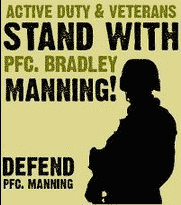
PFC Bradley Manning’s last approved visitor David House was denied access to visit the Adrian-Lamo-named Wikileaks source, in this eighth month of solitary confinement without charges. Last week Manning’s lawyer described the conditions endured by his client: For 23 hours per day, he will sit in his cell. The guards will check on him every five minutes by asking him if he is okay. PFC Manning will be required to respond in some affirmative manner. At night, if the guards cannot see him clearly, because he has a blanket over his head or is curled up towards the wall, they will wake him in order to ensure that he is okay. He will receive each of his meals in his cell. He will not be allowed to have a pillow or sheets. He will not be allowed to have any personal items in his cell. … He will be prevented from exercising in his cell. If he attempts to do push-ups, sit-ups, or any other form of exercise he will be forced to stop. He will receive one hour of exercise outside of his cell daily. The guards will take him to an empty room and allow him to walk. He will usually just walk in figure eights around the room until his hour is complete. When he goes to sleep, he will be required to strip down to his underwear and surrender his clothing to the guards.

Gaza’s Youth Manifesto For Change!

From anonymous young voices in Gaza, reprinted from Facebook group:Gaza Youth Breaks Out (GYBO), file under Jailhouse Literature.
 
Fuck Hamas. Fuck Israel. Fuck Fatah. Fuck UN. Fuck UNWRA. Fuck USA! We, the youth in Gaza, are so fed up with Israel, Hamas, the occupation, the violations of human rights and the indifference of the international community…

(Via THE GUARDIAN UK, which chose an incendiary if wildly inappropriate photo to represent the Gaza cyber rebels.)

GAZA’S YOUTH MANIFESTO FOR CHANGE

Fuck Hamas. Fuck Israel. Fuck Fatah. Fuck UN. Fuck UNWRA. Fuck USA! We, the youth in Gaza, are so fed up with Israel, Hamas, the occupation, the violations of human rights and the indifference of the international community! We want to scream and break this wall of silence, injustice and indifference like the Israeli F16’s breaking the wall of sound; scream with all the power in our souls in order to release this immense frustration that consumes us because of this fucking situation we live in; we are like lice between two nails living a nightmare inside a nightmare, no room for hope, no space for freedom. We are sick of being caught in this political struggle; sick of coal dark nights with airplanes circling above our homes; sick of innocent farmers getting shot in the buffer zone because they are taking care of their lands; sick of bearded guys walking around with their guns abusing their power, beating up or incarcerating young people demonstrating for what they believe in; sick of the wall of shame that separates us from the rest of our country and keeps us imprisoned in a stamp-sized piece of land; sick of being portrayed as terrorists, homemade fanatics with explosives in our pockets and evil in our eyes; sick of the indifference we meet from the international community, the so-called experts in expressing concerns and drafting resolutions but cowards in enforcing anything they agree on; we are sick and tired of living a shitty life, being kept in jail by Israel, beaten up by Hamas and completely ignored by the rest of the world.
 
There is a revolution growing inside of us, an immense dissatisfaction and frustration that will destroy us unless we find a way of canalizing this energy into something that can challenge the status quo and give us some kind of hope. The final drop that made our hearts tremble with frustration and hopelessness happened 30th November, when Hamas’ officers came to Sharek Youth Forum, a leading youth organization (www.sharek.ps) with their guns, lies and aggressiveness, throwing everybody outside, incarcerating some and prohibiting Sharek from working. A few days later, demonstrators in front of Sharek were beaten and some incarcerated. We are really living a nightmare inside a nightmare. It is difficult to find words for the pressure we are under. We barely survived the Operation Cast Lead, where Israel very effectively bombed the shit out of us, destroying thousands of homes and even more lives and dreams. They did not get rid of Hamas, as they intended, but they sure scared us forever and distributed post traumatic stress syndrome to everybody, as there was nowhere to run.
 
We are youth with heavy hearts. We carry in ourselves a heaviness so immense that it makes it difficult to us to enjoy the sunset. How to enjoy it when dark clouds paint the horizon and bleak memories run past our eyes every time we close them? We smile in order to hide the pain. We laugh in order to forget the war. We hope in order not to commit suicide here and now. During the war we got the unmistakable feeling that Israel wanted to erase us from the face of the earth. During the last years Hamas has been doing all they can to control our thoughts, behaviour and aspirations. We are a generation of young people used to face missiles, carrying what seems to be a impossible mission of living a normal and healthy life, and only barely tolerated by a massive organization that has spread in our society as a malicious cancer disease, causing mayhem and effectively killing all living cells, thoughts and dreams on its way as well as paralyzing people with its terror regime. Not to mention the prison we live in, a prison sustained by a so-called democratic country.
 
History is repeating itself in its most cruel way and nobody seems to care. We are scared. Here in Gaza we are scared of being incarcerated, interrogated, hit, tortured, bombed, killed. We are afraid of living, because every single step we take has to be considered and well-thought, there are limitations everywhere, we cannot move as we want, say what we want, do what we want, sometimes we even cant think what we want because the occupation has occupied our brains and hearts so terrible that it hurts and it makes us want to shed endless tears of frustration and rage!
 
We do not want to hate, we do not want to feel all of this feelings, we do not want to be victims anymore. ENOUGH! Enough pain, enough tears, enough suffering, enough control, limitations, unjust justifications, terror, torture, excuses, bombings, sleepless nights, dead civilians, black memories, bleak future, heart aching present, disturbed politics, fanatic politicians, religious bullshit, enough incarceration! WE SAY STOP! This is not the future we want!
 
We want three things. We want to be free. We want to be able to live a normal life. We want peace. Is that too much to ask? We are a peace movement consistent of young people in Gaza and supporters elsewhere that will not rest until the truth about Gaza is known by everybody in this whole world and in such a degree that no more silent consent or loud indifference will be accepted.
 
This is the Gazan youth’s manifesto for change!
 
We will start by destroying the occupation that surrounds ourselves, we will break free from this mental incarceration and regain our dignity and self respect.  We will carry our heads high even though we will face resistance. We will work day and night in order to change these miserable conditions we are living under. We will build dreams where we meet walls. 
 
We only hope that you – yes, you reading this statement right now! – can support us. In order to find out how, please write on our wall or contact us directly: freegazayouth@hotmail.com
 
We want to be free, we want to live, we want peace.
 
FREE GAZA YOUTH!

Marlon Brando’s lost Oscar speech

In 1973 Marlon Brando declined a best actor award for the Godfather in solidarity with the American Indian. Yada yada yada, only that much we remember. Something to do with Wounded Knee, but the average American might be excused for confusing the massacre of 300 Lakota in 1890, the contemporary deadly FBI-AIM confrontation, and Dee Brown’s bestseller. A new documentary Reel Injun, about Hollywood’s skewed portrayal of Native Americans, unearths Apache Sasheen Littlefeather’s incredibly poised delivery of Brando’s Oscar message.

Littlefeather was confined by time limits to present only this abbreviation, interrupted by audience booing and then simultaneous applause. Youtube has the clip, for which the transcript is below.

“Marlon Brando … has asked me to tell you, in a very long speech which I cannot share with you presently —because of time— but I will be glad to share with the press afterward, that he must… very regretfully cannot accept this very generous award.

And the reason for this being… are the treatment of American Indians today by the film industry… excuse me… and on television in movie re-runs, and also the recent happenings at Wounded Knee.

I beg at this time that I have not intruded upon this evening and that we will, in the future…our hearts and our understanding will meet with love and generosity. Thank you on behalf of Marlon Brando.”

Brando’s formal statement was released to reporters after the ceremonies.

For 200 years we have said to the Indian people who are fighting for their land, their life, their families and their right to be free: ”Lay down your arms, my friends, and then we will remain together. Only if you lay down your arms, my friends, can we then talk of peace and come to an agreement which will be good for you.”?

     When they laid down their arms, we murdered them. We lied to them. We cheated them out of their lands. We starved them into signing fraudulent agreements that we called treaties which we never kept. We turned them into beggars on a continent that gave life for as long as life can remember. And by any interpretation of history, however twisted, we did not do right. We were not lawful nor were we just in what we did. For them, we do not have to restore these people, we do not have to live up to some agreements, because it is given to us by virtue of our power to attack the rights of others, to take their property, to take their lives when they are trying to defend their land and liberty, and to make their virtues a crime and our own vices virtues.?

?     But there is one thing which is beyond the reach of this perversity and that is the tremendous verdict of history. And history will surely judge us. But do we care? What kind of moral schizophrenia is it that allows us to shout at the top of our national voice for all the world to hear that we live up to our commitment when every page of history and when all the thirsty, starving, humiliating days and nights of the last 100 years in the lives of the American Indian contradict that voice??

?     It would seem that the respect for principle and the love of one’s neighbor have become dysfunctional in this country of ours, and that all we have done, all that we have succeeded in accomplishing with our power is simply annihilating the hopes of the newborn countries in this world, as well as friends and enemies alike, that we’re not humane, and that we do not live up to our agreements.?

?     Perhaps at this moment you are saying to yourself what the hell has all this got to do with the Academy Awards? Why is this woman standing up here, ruining our evening, invading our lives with things that don’t concern us, and that we don’t care about? Wasting our time and money and intruding in our homes.?

?     I think the answer to those unspoken questions is that the motion picture community has been as responsible as any for degrading the Indian and making a mockery of his character, describing his as savage, hostile and evil. It’s hard enough for children to grow up in this world. When Indian children watch television, and they watch films, and when they see their race depicted as they are in films, their minds become injured in ways we can never know.?

?     Recently there have been a few faltering steps to correct this situation, but too faltering and too few, so I, as a member in this profession, do not feel that I can as a citizen of the United States accept an award here tonight. I think awards in this country at this time are inappropriate to be received or given until the condition of the American Indian is drastically altered. If we are not our brother’s keeper, at least let us not be his executioner.?

?     I would have been here tonight to speak to you directly, but I felt that perhaps I could be of better use if I went to Wounded Knee to help forestall in whatever way I can the establishment of a peace which would be dishonorable as long as the rivers shall run and the grass shall grow.?

?     I would hope that those who are listening would not look upon this as a rude intrusion, but as an earnest effort to focus attention on an issue that might very well determine whether or not this country has the right to say from this point forward we believe in the inalienable rights of all people to remain free and independent on lands that have supported their life beyond living memory.?

?     Thank you for your kindness and your courtesy to Miss Littlefeather. Thank you and good night.

Are FBI raids on activists focused on UNAC strategies?

The UNAC is claiming that recent FBI raids on the offices of various antiwar organizations are linked to those which attended its July conference, an attempt to coordinate national antiwar activities.

Even the title of the conference was never pinned down. Here are the 28 action points decided for the upcoming year, which reads like a clearinghouse of ideas.

Action Program Adopted by the National Conference to Bring the Troops Home Now!

Albany, New York, July 25, 2010

1.
The Rainbow PUSH Coalition and the United Auto Workers (UAW) have invited peace organizations to endorse and participate in a campaign for Jobs, Justice, and Peace. We endorse this campaign and plan to be a part of it. On August 28, 2010, in Detroit, we will march on the anniversary of that day in 1963 when Walter Reuther, president of the UAW, Martin Luther King, Jr., and other civil rights leaders joined with hundreds of thousands of Americans for the March on Washington. In Detroit, prior to the March on Washington, 125,000 marchers participated in the Freedom Walk led by Dr. King. At the march, King delivered his “I Have a Dream” speech for the first time before sharing it with the world in Washington. This year, a massive march has been called for October 2 in Washington. We will begin to build momentum again in Detroit on August 28th. We also endorse the August 28, 2010 Reclaim the Dream Rally and March called by Rev. Al Sharpton and the National Action Network to begin at 11 a.m. at Dunbar High School, 1301 New Jersey Avenue Northwest, Washington D.C. .

2.
Endorse, promote and mobilize for the Saturday, October 2nd “One Nation” march on Washington, DC initiated by 1199SEIU and the NAACP, now being promoted by a growing coalition, which includes the AFL-CIO and U.S. Labor Against the War, and civil rights, peace and other social justice forces in support of the demand for jobs, redirection of national resources from militarism and war to meeting human needs, fully funding vital social programs, and addressing the fiscal crisis of state and local governments. Organize and build an antiwar contingent to participate in the march. Launch a full-scale campaign to get endorsements for the October 2 march on Washington commencing with the final plenary session of this conference.

3.
Endorse the call issued by a range of student groups for Thursday, October 7, as a national day of action to defend education from the horrendous budget cuts that are laying off teachers, closing schools, raising tuition and limiting access to education, especially for working and low income people. Demand “Money for Education, not U.S. Occupations” and otherwise link the cuts in spending for education to the astronomical costs of U.S. wars and occupations.

4.
Devote October 7-16 to organizing local and regional protests to commemorate the ninth anniversary of the invasion and occupation of Afghanistan through demonstrations, marches, rallies, vigils, teach-ins, cultural events and other actions to demand an immediate end to the wars and occupations in both Iraq and Afghanistan and complete withdrawal of all military forces and private security contractors and other mercenaries. The nature and scheduling of these events will reflect the needs of local sponsors and should be designed to attract broad co-sponsorship and diverse participation of antiwar forces with other social justice organizations and progressive constituencies.

5.
The U.S. military is the largest polluter in the world. Therefore, we endorse the “climate chaos” demonstration in Washington D.C. on October 11, coordinated by the National Campaign for Nonviolent Resistance.

6.
Support and build Remember Fallujah Week November 15-19.

7.
Join the new and existing broad-based campaigns to fund human needs and cut the military budget. Join with organizations representing the fight against cutbacks (especially labor and community groups) to build coalitions at the city/town, state and national level. Draft resolutions for city councils, town and village meetings and voter referendum ballot questions linking astronomical war spending to denial of essential public services at home. (Model resolutions and ballot questions will be circulated for consideration of local groups.) Obtain endorsements of elected officials, town and city councils, state parties and legislatures, and labor bodies. Work the legislative process to make military spending an issue. Oppose specific military funding programs and bills, and couple them with human needs funding issues. Use lobbying and other forms of protest, including civil disobedience campaigns, to focus attention on the issue.

8.
Mid-March, 2011 nationally coordinated local teach-ins and protests to mark the eighth year of the Iraq War and to prepare for bi-coastal spring demonstrations the following month.

9.
Bi-Coastal mass spring mobilizations in New York City, San Francisco and Los Angeles on April 9, 2011. These will be accompanied by distinct and separate non-violent direct actions on the same day. A prime component of these mobilizations will be major efforts to include broad new forces from youth to veterans to trade unionists to civil and human rights groups to the Arab, Muslim and other oppressed communities, to environmental organizations, social justice and faith-based groups. Veterans and military families will be key to these mobilizations with special efforts to organize this community to be the lead contingent. Launch a full-scale campaign to get endorsements for these actions commencing with the final plenary session of this conference.

10.
Select a week prior to or after the April actions for local lobbying of elected officials at a time when Congress is not in session. Lobbying to take multiple forms from meeting with local officials to protests at their offices and homes. We will attend the town hall meetings of our Congresspersons and confront them vigorously on their support for the wars and occupations of Iraq and Afghanistan and sanctions on Iran. We also will press them on the unconstitutional diminution of the civil liberties of all Americans and targeted populations.

11.
Consistent with the call to include broad popular sectors of society in our efforts and to contend with the challenges of opposing U.S. wars and occupations while also rejecting attacks at home, National Peace Conference participants will join May Day actions on May 1, 2011, so as to unite all those standing against war and for rights. U.S. military and trade wars force millions of refugees and migrants to the U.S., where they face growing repression, including mass detentions and deportations. Many immigrants, including youth, are forced into the military, through the economic draft as well as under threat of deportation and using false promises of citizenship. By standing together as one on May Day, the antiwar and immigrant rights movements make clear their united stand against U.S. wars and for the rights of all at home and abroad.

12.
National tours: Organize, over a series of months, nationally-coordinated tours of prominent speakers and local activists that link the demands for immediate withdrawal to the demands for funding social programs, as outlined above. Encourage alternatives to military/lethal intervention, relying on research and experience of local and international peace team efforts.

13.
Pressure on Iran from the U.S., Israel and other quarters continues to rise and the threat of a catastrophic military attack on Iran, as well as the ratcheting up of punitive sanctions that primarily impact the people of that country, are of grave concern. In the event of an imminent U.S. government attack on Iran, or such an attack, or a U.S.-backed Israeli attack against Iran, or any other major international crisis triggered by U.S. military action, a continuations committee approved by the conference will mount rapid, broad and nationally coordinated protests by antiwar and social justice activists.

14.
In the event of U.S.-backed military action by Israel against Palestinians, aid activists attempting to end the blockade of Gaza, or attacks on other countries such as Lebanon, Syria, or Iran, a continuations committee approved by the conference will condemn such attacks and support widespread protest actions.

15.
In solidarity with the antiwar movements of Japan and Korea, each calling for U.S. Troops to Get Out Now, and given the great increase in U.S. military preparations against the Democratic People’s Republic of Korea, National Peace Conference participants will organize immediate protests following any attack by the U.S. on Korea. U.S. war preparations include stockpiling hundreds of bunker-busters and conducting major war games near the territorial waters of China and Korea. In keeping with our stand for the right of self-determination and our demand of Out Now, the National Peace Conference calls for Bringing All U.S. Troops Home Now!

16.
Support actions to end the Israeli occupation and repression of Palestinians and the blockade of Gaza.

17.
Support actions aimed at dismantling the Cold War nuclear, biological, radiological and chemical weapons and delivery systems. Support actions aimed at stopping the nuclear renaissance of this Administration, which has proposed to spend $80 billion over the next 10 years to build three new nuclear bomb making facilities and “well over” $100 billion over the same period to modernize nuclear weapons delivery systems. We must support actions aimed at dismantling nuclear, biological, radiological and chemical weapons and delivery systems. We must oppose the re-opening of the uranium mining industry, new nuclear power plants, and extraction of other fossil fuels that the military consumes.

18.
Work in solidarity with GIs, veterans, and military families to support their campaigns and calls for action. Demand support for the troops when they return home and support efforts to counter military recruitment.

19.
Take actions against war profiteers, including oil and energy companies, weapons manufacturers, and engineering firms, whose contractors are working to insure U.S. economic control of Iraq’s and Afghanistan’s resources.

20.
Support actions, educational efforts and lobbying campaigns to promote a transition to a sustainable peace economy.

21.
Develop and implement a multi-pronged national media campaign which includes the following: the honing of a message which will capture our message: “End the Wars and Occupations, Bring the Dollars Home;” a fundraising campaign which would enable the creation and national placement and broadcast of professionally developed print ads as public service radio and television spots which communicate this imperative to the public as a whole (which would involve coordinated outreach to some major funders); outreach to sympathetic media artists to enable the creation of these pieces; an intentional, aggressive, coordinated campaign to garner interviews on as many targeted national news venues as possible which would feature movement voices speaking our nationally coordinated message to the honed; a plan to place on message op-ed pieces in papers around the country on a nationally coordinated schedule.

22.
We demand the immediate and total withdrawal of U.S. military forces, mercenaries and contractors from Afghanistan and Iraq, and an end to drone attacks on Pakistan, Afghanistan and other countries and call for self-determination for the people of all countries. In this demand is the necessity for full truth and transparency regarding all U.S./NATO actions and an expanded development of independent news sources for broad public knowledge of the state of the wars and occupations. We demand an end to censorship of news topics and full democratic access to freedom of information within the U.S. NATO Military Industrial Media Empire.

23.
We call for the equal participation of women in all aspects of the antiwar movement. We propose nonviolent direct actions either in Congressional offices or other appropriate and strategic locations, possibly defense contractors, Federal Buildings, or military bases in the U.S. These actions would be local and coordinated nationally, i.e., the same day for everyone (times may vary). The actions would probably result in arrests for sitting in after offices close. Entering certain facilities could also result in arrests. Participants would be prepared for that possible outcome before joining the action. Nonviolence training would be offered locally, with lists of trainers being made available. The message/demand would be a vote, a congressional action to end the wars: Iraq, Afghanistan, Pakistan. Close U.S. bases. Costs of war and financial issues related to social needs neglected because of war spending would need to be studied and statements regarding same be prepared before the actions. Press release would encourage coverage because of the actions being local and nationally coordinated.

24.
We will convene one or more committees or conferences for the purpose of identifying and arranging boycotts, sit-ins, and other actions that directly interfere with the immoral aspects of the violence and wars that we protest.

25.
We call for the immediate release from Israeli prisons of Mordechai Vanunu and for ending restrictions on his right to speak. We also call upon the Israeli government to let him travel freely and to leave Israel permanently if he so desires.

26.
We oppose the prosecution for Bradley Manning for being the source of the Wikileaks leaks. Manning has done what all GIs should do when they see war crimes: expose them! Bradley Manning’s prosecution sends a message that if you expose illegal activity in the military, you will be prosecuted. We call for the unconditional release of Bradley Manning and an end to all war crimes.

27.
We call for building and expanding the movement for peace by consciously and continually linking it with the urgent necessity to create jobs and fund social needs. We call for support from the antiwar movement to tie the wars and the funding for the wars to the urgent domestic issues through leaflets, signs, banners and active participation in the growing number of mass actions demanding jobs, health care, housing, education and immigrant rights such as:

July 25 – March in Albany in Support of Muslims Targeted by Preemptive Prosecution called by the Muslim Solidarity Committee and Project SALAM.

July 29 & 30 – Boycott Arizona Actions across the country as racist Arizona law SB 1070 goes into effect, including the mass march July 30 in NYC as the Arizona Diamondbacks play the Mets.

All the other mass actions listed above leading up to the bi-coastal actions on April 9, 2011.

28.
The continuations committee elected at this conference shall reach out to other peace and social justice groups holding protests in the fall of 2010 and the spring of 2011, where such groups’ demands and tactics are not inconsistent with those adopted at the UNAC conference, on behalf of exploring ways to maximize unity within the peace and social justice movements this fall and next spring.

PPLFF says no BDS of Israeli Apartheid

Crap. The Anti-Apartheid BDS campaign targeted Cannes because of it, Hollywood luminaries boycotted the Toronto Film Festival over the same principles in 2009, you’d think the Springs gay community might have paid heed. Instead the 2010 Pikes Peak Lavender Film Festival opted to screen the Israeli melodrama Eyes Wide Open, Zionists’ illegal appropriation of Jerusalem be damned. When Canadian gays made international news for allowing Queers Against Israeli Apartheid to march in their pride parade, in spite of Jewish philanthropists pressuring the City of Toronto to withdraw funding, I hoped that COS pride festivities might opt to climb aboard. Instead this weekend Colorado Springs gets a full-on endorsement of Israel’s ongoing illegal invasion of Palestine.

It was a false hope. The Pikes Peak area gay community has found itself so embattled since Amendment Two’s 1992 measure to legalize discrimination on the basis of sexual orientation, that common social causes are easily crowded out by Gay Marriage, DADT and brand recognition for LGBT. So much so that social justice activists can only participate in the pride parade on the condition that it be about solidarity, not antiwar. With gay issues being so politicized, should gays and lesbians get a pass on staying apolitical about war or racism? Whatever excuses we make, it’s a perfectly flamboyant example of silence equals consent. I count apolitical queens every bit as complicit with US military criminality as the above-it-all new-agers and NASCAR jackasses.

Set in an Orthodox neighborhood of Jerusalem, Eyes Wide Open doesn’t address the Israeli-Palestinian troubles, it ignores them, effectively normalizing an ethnically-cleansed Palestine. The film tells the story of an extramarital gay affair between Jewish scholars, blablabla, minus the evictions of Palestinians in the path of encroachment by Israeli settlers, and the hijacking of Muslim holy sites . “Beverly Hills 90210” was fine without scenes of the LAPD repression of Watts or East LA, but 90210 wasn’t pretending to be taped on non-Jewish land.

Eyes Wide Open was the title of the 2005 American Friends Service Committee antiwar boot-counting exercise to open American eyes to the enormity of casualties of the Iraq War — before the Eyes Wide Open slogan was adopted by a 2008 Israeli PR project to encourage American Jews to pay more attention to their birthright offer of Israeli citizenship. The death count of US soldiers in Iraq and Afghanistan (now that the AFSC has been cleared to consider both wars illegal) has long since outgrown the AFSC budget for buying boots or lugging them around in rented trucks, and now EWO (Einaym Pkuhot) is a miserable tale about infidelity and sin.

Frankly, Trembling Before G-d was an incredible documentary about gay Orthodox men struggling with the DADT policy of Orthodox Judaism. I remember seeing it at the 2003 PPLFF, or so. I remember Rabbinical experts expounded on both sides of the argument with authority and humor. But that was before the BDS movement to curb Israel’s racist apartheid system. You either support the picket or you scab.

Objective reviews of EWO are scarce in the Zionist-dominated press, and increasing numbers are honoring the cultural and academic boycott of Israeli Apartheid. Refusing to see EWO is by no means concluding it is bad. For all I know the film may be using the ostracism of homosexuals within the Orthodox community to represent the growing alienation Israelis are feeling in the face of the open revulsion expressing itself by the rest of the world. Maybe it’s brilliant.

But I’m not deliberating about whether to see it. BDS means no to Israel, to its statesmen, artists, scholars and products. And the American companies which support Israel’s policy of Apartheid, several dozen, and now that includes our own PPLFF.

Emma Goldman on Direct Action

Yes it was Emma Goldman who said “If voting changed anything, they’d make it illegal.”
It was no mere quip. The turn of the last century activist was a fierce advocate of every social reform and was ultimately exiled to Europe for challenging forced conscription. Do you wonder what else Goldman had to say, about political violence, prisons, patriotism, puritanism, the traffic of women, suffrage, poverty, birth control, and the struggle of minorities? Far from being a cynic, Goldman offered an alternative to the false hope of the ballot box.

What does the history of parliamentarism show? Nothing but failure and defeat, not even a single reform to ameliorate the economic and social stress of the people. Laws have been passed and enactments made for the improvement and protection of labor. Thus it was proven only last year that Illinois, with the most rigid laws for mine protection, had the greatest mine disasters. In States where child labor laws prevail, child exploitation is at its highest, and though with us the workers enjoy full political opportunities, capitalism has reached the most brazen zenith.

It may be claimed that men of integrity would not become corrupt in the political grinding mill. Perhaps not; but such men would be absolutely helpless to exert the slightest influence in behalf of labor, as indeed has been shown in numerous instances. The State is the economic master of its servants. Good men, if such there be, would either remain true to their political faith and lose their economic support, or they would cling to their economic master and be utterly unable to do the slightest good. The political arena leaves one no alternative, one must either be a dunce or a rogue.

The political superstition is still holding sway over the hearts and minds of the masses, but the true lovers of liberty will have no more to do with it. Instead, they believe with Stirner that man has as much liberty as he is willing to take.

Universal suffrage itself owes its existence to direct action. If not for the spirit of rebellion, of the defiance on the part of the American revolutionary fathers, their posterity would still wear the King’s coat. If not for the direct action of a John Brown and his comrades, America would still trade in the flesh of the black man. True, the trade in white flesh is still going on; but that, too, will have to be abolished by direct action. Trade-unionism, the economic arena of the modern gladiator, owes its existence to direct action. It is but recently that law and government have attempted to crush the trade-union movement, and condemned the exponents of man’s right to organize to prison as conspirators. Had they sought to assert their cause through begging, pleading, and compromise, trade-unionism would today be a negligible quantity. In France, in Spain, in Italy, in Russia, nay even in England (witness the growing rebellion of English labor unions), direct, revolutionary, economic action has become so strong a force in the battle for industrial liberty as to make the world realize the tremendous importance of labor’s power. The General Strike, the supreme expression of the economic consciousness of the workers, was ridiculed in America but a short time ago. Today every great strike, in order to win, must realize the importance of the solidaric general protest.

Direct action, having proven effective along economic lines, is equally potent in the environment of the individual. There a hundred forces encroach upon his being, and only persistent resistance to them will finally set him free. Direct action against the authority in the shop, direct action against the authority of the law, direct action against the invasive, meddlesome authority of our moral code, is the logical, consistent method of Anarchism.

Will it not lead to a revolution? Indeed, it will. No real social change has ever come about without a revolution. People are either not familiar with their history, or they have not yet learned that revolution is but thought carried into action.

Here’s the full essay from which the above was excerpted, where Goldman cites Emerson, Wilde, Burroughs, Thoreau and GBS to laud the promise of anarchism and direct action.

ANARCHISM: WHAT IT REALLY STANDS FOR

ANARCHY.??

Ever reviled, accursed, ne’er understood,?
Thou art the grisly terror of our age.?
“Wreck of all order,” cry the multitude,?
“Art thou, and war and murder’s endless rage.
“?O, let them cry. To them that ne’er have striven?
The truth that lies behind a word to find,?
To them the word’s right meaning was not given.?
They shall continue blind among the blind.?
But thou, O word, so clear, so strong, so pure,
?Thou sayest all which I for goal have taken.?
I give thee to the future! Thine secure
?When each at least unto himself shall waken.?
Comes it in sunshine? In the tempest’s thrill??
I cannot tell–but it the earth shall see!
?I am an Anarchist! Wherefore I will
?Not rule, and also ruled I will not be!?
?
JOHN HENRY MACKAY.

THE history of human growth and development is at the same time the history of the terrible struggle of every new idea heralding the approach of a brighter dawn. In its tenacious hold on tradition, the Old has never hesitated to make use of the foulest and cruelest means to stay the advent of the New, in whatever form or period the latter may have asserted itself. Nor need we retrace our steps into the distant past to realize the enormity of opposition, difficulties, and hardships placed in the path of every progressive idea. The rack, the thumbscrew, and the knout are still with us; so are the convict’s garb and the social wrath, all conspiring against the spirit that is serenely marching on.

Anarchism could not hope to escape the fate of all other ideas of innovation. Indeed, as the most revolutionary and uncompromising innovator, Anarchism must needs meet with the combined ignorance and venom of the world it aims to reconstruct.

To deal even remotely with all that is being said and done against Anarchism would necessitate the writing of a whole volume. I shall therefore meet only two of the principal objections. In so doing, I shall attempt to elucidate what Anarchism really stands for.

The strange phenomenon of the opposition to Anarchism is that it brings to light the relation between so-called intelligence and ignorance. And yet this is not so very strange when we consider the relativity of all things. The ignorant mass has in its favor that it makes no pretense of knowledge or tolerance. Acting, as it always does, by mere impulse, its reasons are like those of a child. “Why?” “Because.” Yet the opposition of the uneducated to Anarchism deserves the same consideration as that of the intelligent man.

What, then, are the objections? First, Anarchism is impractical, though a beautiful ideal. Second, Anarchism stands for violence and destruction, hence it must be repudiated as vile and dangerous. Both the intelligent man and the ignorant mass judge not from a thorough knowledge of the subject, but either from hearsay or false interpretation.

A practical scheme, says Oscar Wilde, is either one already in existence, or a scheme that could be carried out under the existing conditions; but it is exactly the existing conditions that one objects to, and any scheme that could accept these conditions is wrong and foolish. The true criterion of the practical, therefore, is not whether the latter can keep intact the wrong or foolish; rather is it whether the scheme has vitality enough to leave the stagnant waters of the old, and build, as well as sustain, new life. In the light of this conception, Anarchism is indeed practical. More than any other idea, it is helping to do away with the wrong and foolish; more than any other idea, it is building and sustaining new life.

The emotions of the ignorant man are continuously kept at a pitch by the most blood-curdling stories about Anarchism. Not a thing too outrageous to be employed against this philosophy and its exponents. Therefore Anarchism represents to the unthinking what the proverbial bad man does to the child,–a black monster bent on swallowing everything; in short, destruction and violence.

Destruction and violence! How is the ordinary man to know that the most violent element in society is ignorance; that its power of destruction is the very thing Anarchism is combating? Nor is he aware that Anarchism, whose roots, as it were, are part of nature’s forces, destroys, not healthful tissue, but parasitic growths that feed on the life’s essence of society. It is merely clearing the soil from weeds and sagebrush, that it may eventually bear healthy fruit.

Someone has said that it requires less mental effort to condemn than to think. The widespread mental indolence, so prevalent in society, proves this to be only too true. Rather than to go to the bottom of any given idea, to examine into its origin and meaning, most people will either condemn it altogether, or rely on some superficial or prejudicial definition of non-essentials.

Anarchism urges man to think, to investigate, to analyze every proposition; but that the brain capacity of the average reader be not taxed too much, I also shall begin with a definition, and then elaborate on the latter.

ANARCHISM: –The philosophy of a new social order based on liberty unrestricted by man-made law; the theory that all forms of government rest on violence, and are therefore wrong and harmful, as well as unnecessary.

The new social order rests, of course, on the materialistic basis of life; but while all Anarchists agree that the main evil today is an economic one, they maintain that the solution of that evil can be brought about only through the consideration of every phase of life,–individual, as well as the collective; the internal, as well as the external phases.

A thorough perusal of the history of human development will disclose two elements in bitter conflict with each other; elements that are only now beginning to be understood, not as foreign to each other, but as closely related and truly harmonious, if only placed in proper environment: the individual and social instincts. The individual and society have waged a relentless and bloody battle for ages, each striving for supremacy, because each was blind to the value and importance of the other. The individual and social instincts,–the one a most potent factor for individual endeavor, for growth, aspiration, self-realization; the other an equally potent factor for mutual helpfulness and social well-being.

The explanation of the storm raging within the individual, and between him and his surroundings, is not far to seek. The primitive man, unable to understand his being, much less the unity of all life, felt himself absolutely dependent on blind, hidden forces ever ready to mock and taunt him. Out of that attitude grew the religious concepts of man as a mere speck of dust dependent on superior powers on high, who can only be appeased by complete surrender. All the early sagas rest on that idea, which continues to be the Leitmotiv of the biblical tales dealing with the relation of man to God, to the State, to society. Again and again the same motif, man is nothing, the powers are everything. Thus Jehovah would only endure man on condition of complete surrender. Man can have all the glories of the earth, but he must not become conscious of himself. The State, society, and moral laws all sing the same refrain: Man can have all the glories of the earth, but he must not become conscious of himself.

Anarchism is the only philosophy which brings to man the consciousness of himself; which maintains that God, the State, and society are non-existent, that their promises are null and void, since they can be fulfilled only through man’s subordination. Anarchism is therefore the teacher of the unity of life; not merely in nature, but in man. There is no conflict between the individual and the social instincts, any more than there is between the heart and the lungs: the one the receptacle of a precious life essence, the other the repository of the element that keeps the essence pure and strong. The individual is the heart of society, conserving the essence of social life; society is the lungs which are distributing the element to keep the life essence–that is, the individual–pure and strong.

“The one thing of value in the world,” says Emerson, “is the active soul; this every man contains within him. The soul active sees absolute truth and utters truth and creates.” In other words, the individual instinct is the thing of value in the world. It is the true soul that sees and creates the truth alive, out of which is to come a still greater truth, the re-born social soul.

Anarchism is the great liberator of man from the phantoms that have held him captive; it is the arbiter and pacifier of the two forces for individual and social harmony. To accomplish that unity, Anarchism has declared war on the pernicious influences which have so far prevented the harmonious blending of individual and social instincts, the individual and society.

Religion, the dominion of the human mind; Property, the dominion of human needs; and Government, the dominion of human conduct, represent the stronghold of man’s enslavement and all the horrors it entails. Religion! How it dominates man’s mind, how it humiliates and degrades his soul. God is everything, man is nothing, says religion. But out of that nothing God has created a kingdom so despotic, so tyrannical, so cruel, so terribly exacting that naught but gloom and tears and blood have ruled the world since gods began. Anarchism rouses man to rebellion against this black monster. Break your mental fetters, says Anarchism to man, for not until you think and judge for yourself will you get rid of the dominion of darkness, the greatest obstacle to all progress.

Property, the dominion of man’s needs, the denial of the right to satisfy his needs. Time was when property claimed a divine right, when it came to man with the same refrain, even as religion, “Sacrifice! Abnegate! Submit!” The spirit of Anarchism has lifted man from his prostrate position. He now stands erect, with his face toward the light. He has learned to see the insatiable, devouring, devastating nature of property, and he is preparing to strike the monster dead.

“Property is robbery,” said the great French Anarchist Proudhon. Yes, but without risk and danger to the robber. Monopolizing the accumulated efforts of man, property has robbed him of his birthright, and has turned him loose a pauper and an outcast. Property has not even the time-worn excuse that man does not create enough to satisfy all needs. The A B C student of economics knows that the productivity of labor within the last few decades far exceeds normal demand. But what are normal demands to an abnormal institution? The only demand that property recognizes is its own gluttonous appetite for greater wealth, because wealth means power; the power to subdue, to crush, to exploit, the power to enslave, to outrage, to degrade. America is particularly boastful of her great power, her enormous national wealth. Poor America, of what avail is all her wealth, if the individuals comprising the nation are wretchedly poor? If they live in squalor, in filth, in crime, with hope and joy gone, a homeless, soilless army of human prey.

It is generally conceded that unless the returns of any business venture exceed the cost, bankruptcy is inevitable. But those engaged in the business of producing wealth have not yet learned even this simple lesson. Every year the cost of production in human life is growing larger (50,000 killed, 100,000 wounded in America last year); the returns to the masses, who help to create wealth, are ever getting smaller. Yet America continues to be blind to the inevitable bankruptcy of our business of production. Nor is this the only crime of the latter. Still more fatal is the crime of turning the producer into a mere particle of a machine, with less will and decision than his master of steel and iron. Man is being robbed not merely of the products of his labor, but of the power of free initiative, of originality, and the interest in, or desire for, the things he is making.

Real wealth consists in things of utility and beauty, in things that help to create strong, beautiful bodies and surroundings inspiring to live in. But if man is doomed to wind cotton around a spool, or dig coal, or build roads for thirty years of his life, there can be no talk of wealth. What he gives to the world is only gray and hideous things, reflecting a dull and hideous existence,–too weak to live, too cowardly to die. Strange to say, there are people who extol this deadening method of centralized production as the proudest achievement of our age. They fail utterly to realize that if we are to continue in machine subserviency, our slavery is more complete than was our bondage to the King. They do not want to know that centralization is not only the death-knell of liberty, but also of health and beauty, of art and science, all these being impossible in a clock-like, mechanical atmosphere.

Anarchism cannot but repudiate such a method of production: its goal is the freest possible expression of all the latent powers of the individual. Oscar Wilde defines a perfect personality as “one who develops under perfect conditions, who is not wounded, maimed, or in danger.” A perfect personality, then, is only possible in a state of society where man is free to choose the mode of work, the conditions of work, and the freedom to work. One to whom the making of a table, the building of a house, or the tilling of the soil, is what the painting is to the artist and the discovery to the scientist,–the result of inspiration, of intense longing, and deep interest in work as a creative force. That being the ideal of Anarchism, its economic arrangements must consist of voluntary productive and distributive associations, gradually developing into free communism, as the best means of producing with the least waste of human energy. Anarchism, however, also recognizes the right of the individual, or numbers of individuals, to arrange at all times for other forms of work, in harmony with their tastes and desires.

Such free display of human energy being possible only under complete individual and social freedom, Anarchism directs its forces against the third and greatest foe of all social equality; namely, the State, organized authority, or statutory law,–the dominion of human conduct.

Just as religion has fettered the human mind, and as property, or the monopoly of things, has subdued and stifled man’s needs, so has the State enslaved his spirit, dictating every phase of conduct. “All government in essence,” says Emerson, “is tyranny.” It matters not whether it is government by divine right or majority rule. In every instance its aim is the absolute subordination of the individual.

Referring to the American government, the greatest American Anarchist, David Thoreau, said:

“Government, what is it but a tradition, though a recent one, endeavoring to transmit itself unimpaired to posterity, but each instance losing its integrity; it has not the vitality and force of a single living man. Law never made man a whit more just; and by means of their respect for it, even the well disposed are daily made agents of injustice.”

Indeed, the keynote of government is injustice. With the arrogance and self-sufficiency of the King who could do no wrong, governments ordain, judge, condemn, and punish the most insignificant offenses, while maintaining themselves by the greatest of all offenses, the annihilation of individual liberty. Thus Ouida is right when she maintains that

“the State only aims at instilling those qualities in its public by which its demands are obeyed, and its exchequer is filled. Its highest attainment is the reduction of mankind to clockwork. In its atmosphere all those finer and more delicate liberties, which require treatment and spacious expansion, inevitably dry up and perish. The State requires a taxpaying machine in which there is no hitch, an exchequer in which there is never a deficit, and a public, monotonous, obedient, colorless, spiritless, moving humbly like a flock of sheep along a straight high road between two walls.”

Yet even a flock of sheep would resist the chicanery of the State, if it were not for the corruptive, tyrannical, and oppressive methods it employs to serve its purposes. Therefore Bakunin repudiates the State as synonymous with the surrender of the liberty of the individual or small minorities,–the destruction of social relationship, the curtailment, or complete denial even, of life itself, for its own aggrandizement. The State is the altar of political freedom and, like the religious altar, it is maintained for the purpose of human sacrifice.

In fact, there is hardly a modern thinker who does not agree that government, organized authority, or the State, is necessary only to maintain or protect property and monopoly. It has proven efficient in that function only.

Even George Bernard Shaw, who hopes for the miraculous from the State under Fabianism, nevertheless admits that “it is at present a huge machine for robbing and slave-driving of the poor by brute force.” This being the case, it is hard to see why the clever prefacer wishes to uphold the State after poverty shall have ceased to exist.

Unfortunately, there are still a number of people who continue in the fatal belief that government rests on natural laws, that it maintains social order and harmony, that it diminishes crime, and that it prevents the lazy man from fleecing his fellows. I shall therefore examine these contentions.

A natural law is that factor in man which asserts itself freely and spontaneously without any external force, in harmony with the requirements of nature. For instance, the demand for nutrition, for sex gratification, for light, air, and exercise, is a natural law. But its expression needs not the machinery of government, needs not the club, the gun, the handcuff, or the prison. To obey such laws, if we may call it obedience, requires only spontaneity and free opportunity. That governments do not maintain themselves through such harmonious factors is proven by the terrible array of violence, force, and coercion all governments use in order to live. Thus Blackstone is right when he says, “Human laws are invalid, because they are contrary to the laws of nature.”

Unless it be the order of Warsaw after the slaughter of thousands of people, it is difficult to ascribe to governments any capacity for order or social harmony. Order derived through submission and maintained by terror is not much of a safe guaranty; yet that is the only “order” that governments have ever maintained. True social harmony grows naturally out of solidarity of interests. In a society where those who always work never have anything, while those who never work enjoy everything, solidarity of interests is non-existent; hence social harmony is but a myth. The only way organized authority meets this grave situation is by extending still greater privileges to those who have already monopolized the earth, and by still further enslaving the disinherited masses. Thus the entire arsenal of government–laws, police, soldiers, the courts, legislatures, prisons,–is strenuously engaged in “harmonizing” the most antagonistic elements in society.

The most absurd apology for authority and law is that they serve to diminish crime. Aside from the fact that the State is itself the greatest criminal, breaking every written and natural law, stealing in the form of taxes, killing in the form of war and capital punishment, it has come to an absolute standstill in coping with crime. It has failed utterly to destroy or even minimize the horrible scourge of its own creation.

Crime is naught but misdirected energy. So long as every institution of today, economic, political, social, and moral, conspires to misdirect human energy into wrong channels; so long as most people are out of place doing the things they hate to do, living a life they loathe to live, crime will be inevitable, and all the laws on the statutes can only increase, but never do away with, crime. What does society, as it exists today, know of the process of despair, the poverty, the horrors, the fearful struggle the human soul must pass on its way to crime and degradation. Who that knows this terrible process can fail to see the truth in these words of Peter Kropotkin:

“Those who will hold the balance between the benefits thus attributed to law and punishment and the degrading effect of the latter on humanity; those who will estimate the torrent of depravity poured abroad in human society by the informer, favored by the Judge even, and paid for in clinking cash by governments, under the pretext of aiding to unmask crime; those who will go within prison walls and there see what human beings become when deprived of liberty, when subjected to the care of brutal keepers, to coarse, cruel words, to a thousand stinging, piercing humiliations, will agree with us that the entire apparatus of prison and punishment is an abomination which ought to be brought to an end.”

The deterrent influence of law on the lazy man is too absurd to merit consideration. If society were only relieved of the waste and expense of keeping a lazy class, and the equally great expense of the paraphernalia of protection this lazy class requires, the social tables would contain an abundance for all, including even the occasional lazy individual. Besides, it is well to consider that laziness results either from special privileges, or physical and mental abnormalities. Our present insane system of production fosters both, and the most astounding phenomenon is that people should want to work at all now. Anarchism aims to strip labor of its deadening, dulling aspect, of its gloom and compulsion. It aims to make work an instrument of joy, of strength, of color, of real harmony, so that the poorest sort of a man should find in work both recreation and hope.

To achieve such an arrangement of life, government, with its unjust, arbitrary, repressive measures, must be done away with. At best it has but imposed one single mode of life upon all, without regard to individual and social variations and needs. In destroying government and statutory laws, Anarchism proposes to rescue the self-respect and independence of the individual from all restraint and invasion by authority. Only in freedom can man grow to his full stature. Only in freedom will he learn to think and move, and give the very best in him. Only in freedom will he realize the true force of the social bonds which knit men together, and which are the true foundation of a normal social life.

But what about human nature? Can it be changed? And if not, will it endure under Anarchism?

Poor human nature, what horrible crimes have been committed in thy name! Every fool, from king to policeman, from the flatheaded parson to the visionless dabbler in science, presumes to speak authoritatively of human nature. The greater the mental charlatan, the more definite his insistence on the wickedness and weaknesses of human nature. Yet, how can any one speak of it today, with every soul in a prison, with every heart fettered, wounded, and maimed?

John Burroughs has stated that experimental study of animals in captivity is absolutely useless. Their character, their habits, their appetites undergo a complete transformation when torn from their soil in field and forest. With human nature caged in a narrow space, whipped daily into submission, how can we speak of its potentialities?

Freedom, expansion, opportunity, and, above all, peace and repose, alone can teach us the real dominant factors of human nature and all its wonderful possibilities.

Anarchism, then, really stands for the liberation of the human mind from the dominion of religion; the liberation of the human body from the dominion of property; liberation from the shackles and restraint of government. Anarchism stands for a social order based on the free grouping of individuals for the purpose of producing real social wealth; an order that will guarantee to every human being free access to the earth and full enjoyment of the necessities of life, according to individual desires, tastes, and inclinations.

This is not a wild fancy or an aberration of the mind. It is the conclusion arrived at by hosts of intellectual men and women the world over; a conclusion resulting from the close and studious observation of the tendencies of modern society: individual liberty and economic equality, the twin forces for the birth of what is fine and true in man.

As to methods. Anarchism is not, as some may suppose, a theory of the future to be realized through divine inspiration. It is a living force in the affairs of our life, constantly creating new conditions. The methods of Anarchism therefore do not comprise an iron-clad program to be carried out under all circumstances. Methods must grow out of the economic needs of each place and clime, and of the intellectual and temperamental requirements of the individual. The serene, calm character of a Tolstoy will wish different methods for social reconstruction than the intense, overflowing personality of a Michael Bakunin or a Peter Kropotkin. Equally so it must be apparent that the economic and political needs of Russia will dictate more drastic measures than would England or America. Anarchism does not stand for military drill and uniformity; it does, however, stand for the spirit of revolt, in whatever form, against everything that hinders human growth. All Anarchists agree in that, as they also agree in their opposition to the political machinery as a means of bringing about the great social change.

“All voting,” says Thoreau, “is a sort of gaming, like checkers, or backgammon, a playing with right and wrong; its obligation never exceeds that of expediency. Even voting for the right thing is doing nothing for it. A wise man will not leave the right to the mercy of chance, nor wish it to prevail through the power of the majority.” A close examination of the machinery of politics and its achievements will bear out the logic of Thoreau.

What does the history of parliamentarism show? Nothing but failure and defeat, not even a single reform to ameliorate the economic and social stress of the people. Laws have been passed and enactments made for the improvement and protection of labor. Thus it was proven only last year that Illinois, with the most rigid laws for mine protection, had the greatest mine disasters. In States where child labor laws prevail, child exploitation is at its highest, and though with us the workers enjoy full political opportunities, capitalism has reached the most brazen zenith.

Even were the workers able to have their own representatives, for which our good Socialist politicians are clamoring, what chances are there for their honesty and good faith? One has but to bear in mind the process of politics to realize that its path of good intentions is full of pitfalls: wire-pulling, intriguing, flattering, lying, cheating; in fact, chicanery of every description, whereby the political aspirant can achieve success. Added to that is a complete demoralization of character and conviction, until nothing is left that would make one hope for anything from such a human derelict. Time and time again the people were foolish enough to trust, believe, and support with their last farthing aspiring politicians, only to find themselves betrayed and cheated.

It may be claimed that men of integrity would not become corrupt in the political grinding mill. Perhaps not; but such men would be absolutely helpless to exert the slightest influence in behalf of labor, as indeed has been shown in numerous instances. The State is the economic master of its servants. Good men, if such there be, would either remain true to their political faith and lose their economic support, or they would cling to their economic master and be utterly unable to do the slightest good. The political arena leaves one no alternative, one must either be a dunce or a rogue.

The political superstition is still holding sway over the hearts and minds of the masses, but the true lovers of liberty will have no more to do with it. Instead, they believe with Stirner that man has as much liberty as he is willing to take. Anarchism therefore stands for direct action, the open defiance of, and resistance to, all laws and restrictions, economic, social, and moral. But defiance and resistance are illegal. Therein lies the salvation of man. Everything illegal necessitates integrity, self-reliance, and courage. In short, it calls for free, independent spirits, for “men who are men, and who have a bone in their backs which you cannot pass your hand through.”

Universal suffrage itself owes its existence to direct action. If not for the spirit of rebellion, of the defiance on the part of the American revolutionary fathers, their posterity would still wear the King’s coat. If not for the direct action of a John Brown and his comrades, America would still trade in the flesh of the black man. True, the trade in white flesh is still going on; but that, too, will have to be abolished by direct action. Trade-unionism, the economic arena of the modern gladiator, owes its existence to direct action. It is but recently that law and government have attempted to crush the trade-union movement, and condemned the exponents of man’s right to organize to prison as conspirators. Had they sought to assert their cause through begging, pleading, and compromise, trade-unionism would today be a negligible quantity. In France, in Spain, in Italy, in Russia, nay even in England (witness the growing rebellion of English labor unions), direct, revolutionary, economic action has become so strong a force in the battle for industrial liberty as to make the world realize the tremendous importance of labor’s power. The General Strike, the supreme expression of the economic consciousness of the workers, was ridiculed in America but a short time ago. Today every great strike, in order to win, must realize the importance of the solidaric general protest.

Direct action, having proven effective along economic lines, is equally potent in the environment of the individual. There a hundred forces encroach upon his being, and only persistent resistance to them will finally set him free. Direct action against the authority in the shop, direct action against the authority of the law, direct action against the invasive, meddlesome authority of our moral code, is the logical, consistent method of Anarchism.

Will it not lead to a revolution? Indeed, it will. No real social change has ever come about without a revolution. People are either not familiar with their history, or they have not yet learned that revolution is but thought carried into action.

Anarchism, the great leaven of thought, is today permeating every phase of human endeavor. Science, art, literature, the drama, the effort for economic betterment, in fact every individual and social opposition to the existing disorder of things, is illumined by the spiritual light of Anarchism. It is the philosophy of the sovereignty of the individual. It is the theory of social harmony. It is the great, surging, living truth that is reconstructing the world, and that will usher in the Dawn.

Wednesday

My sister lost a cat today. She wrote this online:

“Wednesday came home in pretty bad shape this morning. I got to hold him and tell him how cool I thought he was. And we all got to say goodbye. He came to us on a Wednesday and left us 17-years later on a Wednesday – Maybe I should have named him Forever.”

As Wednesday had been mine for a time, and had been an intensely social neighbor, we thought about how many people might appreciate knowing why he would no longer be visiting. Some told their children he was theirs. I remember once crossing paths with Wednesday on Halloween, he didn’t give us a second glance, he was trick-or-treating with another party.

I found this note I had written some years ago:

I wrote to tell my sister that Wednesday was okay. The other day I had driven past a cat’s body on the side of the street and thought it was Wednesday. I’d made the wrong turn and wouldn’t otherwise have seen it.

I was running late so I didn’t stop, plus I didn’t want the body to have been his.

I’ve searched over dead cats on the road before, it’s heartbreaking. Even if you found the cat wasn’t yours. And you had to scrutinize the poor thing closely quite unsure because you’d never seen your cat dead or decomposed before.

Haunted by having encountered the accident by accident, I returned to the spot later that night determined to check. The body was gone. There had been a squirrel on the other side, its body was still there. But the big black cat with a bushy tail extended straight up in the wind was nowhere to be found. Someone had picked it up I suppose. I was five blocks from my house. Too far to have been Wednesday.

I didn’t go back home that night. I didn’t want to not find Wednesday there.

He and I had been seeing very little of each other. I leave the window open and he comes and goes as he pleases. I get home late, go to bed, and somewhere in my sleep he comes in meowing, meows past me to his food, then meows as he leaves. I wake remembering something of that. For a time he was bringing birds home. I’d take notice in my sleep when he passed without a sound, figuring out later his mouth was probably full. I came to dread that dream because I would then wake to find the hall strewn with feathers and I’d find a little beak lying in the midst.

I got Wednesday from my sister. She was going to have a second baby, and was moving, and wasn’t crazy about having a cat around. When I visited I remember twice Wednesday leapt unto my sleeping face in pursuit of his playmates.

Wednesday is named after the day on which he arrived at my sister’s farm. My little niece decided the logic. From the condition of his fur, the vet determined he’d been in the wild for at least two months. It was incredible that he’d survived the coyotes, rattlers and hawks. One night Karin remembers Wednesday was outside under the porch while coyotes hunted for him above it.

At my place he’s made a similar legendary impression. I live on the second floor. He climbs the cedar wall to my balcony without apparent effort. When he wants to descend he just jumps straight unto the lawn. My neighbors beneath are no longer startled to see him fly by.

I’m quite proud of him. Another neighbor cautioned me about a fox she’d seen on the property. Worry about Wednesday? Oh no.

Everyone has befriended him. I know by how well brushed he is. A neighbor who had moved away, and to whom I had never spoken, came by during a holiday visit and left a note with treats for Wednesday. Another neighbor had him shaved when it was obvious I was neglecting his fur.

The other night I called him and I could hear his faint reply from far off. I imagined him wounded, calling to me meekly. When he got to me, in the dark I couldn’t see if he was wounded. He brushed through my legs and i avoided looking at him that night. He was alive.

In the morning I could see that he was his safe, alive self. My fears had been entirely imagined.

I reassured my sister that Wednesday was back, safe, the body I had seen on the street had not been Wednesday. She told me “Well, you’ll never know, it might have been. You know he’s immortal.”

Something like that.

US to send 46 Navy ships to Costa Rica

That’s right, it was not Puerto Rico, but Costa Rica, whose congress approved the mobilization of 46 US Navy vessels in its harbors, including the billeting of 7,000 uniformed US Marines to conduct humanitarian and drug-war operations. Did permission come with conditions? It did, but ours, not theirs. Before the US is to visit Costa Rica with 200 helicopters and combat planes, we stipulated that “US personnel in Costa Rica shall enjoy freedom of movement and the right to engage in activities they may consider necessary to fulfill their mission.”

Opposition parties in Costa Rica complain that such a huge military fleet in their waters will be disproportionate to the requirements of fighting the drug trade, and appears to have its sights further ashore.

Meanwhile the US armada off the coast of Iran is being joined by Israeli warships. Fidel Castro wonders at the likelihood they’ll move any direction but escalation sooner than retreat with tail between their legs if Iran complies with the latest UN demands.

Helicopter crashes in foothills of Pikes Peak, local Gazette calls it hard landing

COLORADO SPRINGS- The complicit media accepts the Army’s characterization of the 1:30AM crash as a “hard landing” and neither the condition of the Apache Longbow aircraft nor its occupants is being revealed; even though emergency vehicles reached the downed Apache via Gold Camp Road and the crew were rushed to Memorial Hospital, civilian jurisdiction. The citizens of Colorado Springs are being kept on a need to know basis, as Fort Carson increases its flight training for choppers being deployed to Afghanistan, even as the training battleground becomes the skies about our neighborhoods.

AIPAC student DC junkets paying off


This year’s AIPAC conference targeted university student body officers in an effort to fend off BDS campaigns at campuses nationwide. Did the controversial strategy just pay off at UC Berkeley? When the student council voted 16 to 4 to divest, student body president Will Smelko vetoed the measure. Intense pressure from Israeli lobby groups were able to prevent overturning the veto.

AIPAC said they were going to do it, and they did it. Here’s what AIPAC’s Leadership Development Director Jonathan Kessler told DC conference attendees:

How are we going to beat back the anti-Israel divestment resolution at Berkeley? We’re going to make certain that pro-Israel students take over the student government and reverse the vote. That is how AIPAC operates in our nation’s capitol. This is how AIPAC must operate on our nation’s campuses.

Though the Berkeley bill SB118 proposed divestment from General Electric and United Technologies only, two military industries which profit from Israel’s subjugation of the Palestinians, it’s true perhaps that the measure opened the door to further BDS inroads to fight Israel Apartheid.

The divestment proposal had the backing of Archbishop Desmond Tutu among many activists. Against was the Israeli lobby. Students were warned that prospective Jewish students would avoid enrolling, etc. Can we imagine the suggestion was made that the current students would be denied jobs? There probably is a corporate future for “made” students who’ve shown their fealty to AIPAC.

Worth reprinting is the statement read by UCB Professor Judth Butler trying to warn the students against AIPAC’s disreputable coercion:

Let us begin with the assumption that it is very hard to hear the debate under consideration here. One hears someone saying something, and one fears that they are saying another thing. It is hard to trust words, or indeed to know what words actually mean. So that is a sign that there is a certain fear in the room, and also, a certain suspicion about the intentions that speakers have and a fear about the implications of both words and deeds. Of course, tonight you do not need a lecture on rhetoric from me, but perhaps, if you have a moment, it might be possible to pause and to consider reflectively what is actually at stake in this vote, and what is not. Let me introduce myself first as a Jewish faculty member here at Berkeley, on the advisory board of Jewish Voice for Peace, on the US executive committee of Faculty for Israeli-Palestinian Peace, a global organization, a member of the Russell Tribunal on Human Rights in Palestine, and a board member of the Freedom Theatre in Jenin. I am at work on a book which considers Jewish criticisms of state violence, Jewish views of co-habitation, and the importance of ‘remembrance’ in both Jewish and Palestinian philosophic and poetic traditions.

The first thing I want to say is that there is hardly a Jewish dinner table left in this country–or indeed in Europe and much of Israel–in which there is not enormous disagreement about the status of the occupation, Israeli military aggression and the future of Zionism, binationalism and citizenship in the lands called Israel and Palestine. There is no one Jewish voice, and in recent years, there are increasing differences among us, as is evident by the multiplication of Jewish groups that oppose the occupation and which actively criticize and oppose Israeli military policy and aggression. In the US and Israel alone these groups include: Jewish Voice for Peace, American Jews for a Just Peace, Jews Against the Occupation, Boycott from Within, New Profile, Anarchists Against the Wall, Women in Black, Who Profits?, Btselem, Zochrot, Black Laundry, Jews for a Free Palestine (Bay Area), No Time to Celebrate and more. The emergence of J Street was an important effort to establish an alternative voice to AIPAC, and though J street has opposed the bill you have before you, the younger generation of that very organization has actively contested the politics of its leadership. So even there you have splits, division and disagreement.

So if someone says that it offends “the Jews” to oppose the occupation, then you have to consider how many Jews are already against the occupation, and whether you want to be with them or against them. If someone says that “Jews” have one voice on this matter, you might consider whether there is something wrong with imagining Jews as a single force, with one view, undivided. It is not true. The sponsors of Monday evening’s round table at Hillel made sure not to include voices with which they disagree. And even now, as demonstrations in Israel increase in number and volume against the illegal seizure of Palestinian lands, we see a burgeoning coalition of those who seek to oppose unjust military rule, the illegal confiscation of lands, and who hold to the norms of international law even when nations refuse to honor those norms.

What I learned as a Jewish kid in my synagogue–which was no bastion of radicalism–was that it was imperative to speak out against social injustice. I was told to have the courage to speak out, and to speak strongly, even when people accuse you of breaking with the common understanding, even when they threaten to censor you or punish you. The worst injustice, I learned, was to remain silent in the face of criminal injustice. And this tradition of Jewish social ethics was crucial to the fights against Nazism, fascism and every form of discrimination, and it became especially important in the fight to establish the rights of refugees after the Second World War. Of course, there are no strict analogies between the Second World War and the contemporary situation, and there are no strict analogies between South Africa and Israel, but there are general frameworks for thinking about co-habitation, the right to live free of external military aggression, the rights of refugees, and these form the basis of many international laws that Jews and non-Jews have sought to embrace in order to live in a more just world, one that is more just not just for one nation or for another, but for all populations, regardless of nationality and citizenship. If some of us hope that Israel will comply with international law, it is precisely so that one people can live among other peoples in peace and in freedom. It does not de-legitimate Israel to ask for its compliance with international law. Indeed, compliance with international law is the best way to gain legitimacy, respect and an enduring place among the peoples of the world.

Of course, we could argue on what political forms Israel and Palestine must take in order for international law to be honored. But that is not the question that is before you this evening. We have lots of time to consider that question, and I invite you to join me to do that in a clear-minded way in the future. But consider this closely: the bill you have before you does not ask that you take a view on Israel. I know that it certainly seems like it does, since the discussion has been all about that. But it actually makes two points that are crucial to consider. The first is simply this: there are two companies that not only are invested in the Israeli occupation of Palestinian lands and peoples, but who profit from that occupation, and which are sustained in part by funds invested by the University of California. They are General Electric and United Technologies. They produce aircraft designed to bomb and kill, and they have bombed and killed civilians, as has been amply demonstrated by Amnesty International and Human Rights Watch. You are being asked to divest funds from these two companies. You are NOT being asked to divest funds from every company that does business with Israel. And you are not being asked to resolve to divest funds from Israeli business or citizens on the basis of their citizenship or national belonging. You are being asked only to call for a divestment from specific companies that make military weapons that kill civilians. That is the bottom line.

If the newspapers or others seek to make inflammatory remarks and to say that this is an attack on Israel, or an attack on Jews, or an upsurge of anti-Semitism, or an act that displays insensitivity toward the feelings of some of our students, then there is really only one answer that you can provide, as I see it. Do we let ourselves be intimidated into not standing up for what is right? It is simply unethical for UC to invest in such companies when they profit from the killing of civilians under conditions of a sustained military occupation that is manifestly illegal according to international law. The killing of civilians is a war crime. By voting yes, you say that you do not want the funds of this university to be invested in war crimes, and that you hold to this principle regardless of who commits the war crime or against whom it is committed.

Of course, you should clearly ask whether you would apply the same standards to any other occupation or destructive military situation where war crimes occur. And I note that the bill before you is committed to developing a policy that would divest from all companies engaged in war crimes. In this way, it contains within it both a universal claim and a universalizing trajectory. It recommends explicitly “additional divestment policies to keep university investments out of companies aiding war crimes throughout the world, such as those taking place in Morocco, the Congo, and other places as determined by the resolutions of the United Nations and other leading human rights organizations.” Israel is not singled out. It is, if anything, the occupation that is singled out, and there are many Israelis who would tell you that Israel must be separated from its illegal occupation. This is clearly why the divestment call is selective: it does not call for divestment from any and every Israeli company; on the contrary, it calls for divestment from two corporations where the links to war crimes are well-documented.

Let this then be a precedent for a more robust policy of ethical investment that would be applied to any company in which UC invests. This is the beginning of a sequence, one that both sides to this dispute clearly want. Israel is not to be singled out as a nation to be boycotted–and let us note that Israel itself is not boycotted by this resolution. But neither is Israel’s occupation to be held exempt from international standards. If you want to say that the historical understanding of Israel’s genesis gives it an exceptional standing in the world, then you disagree with those early Zionist thinkers, Martin Buber and Judah Magnes among them, who thought that Israel must not only live in equality with other nations, but must also exemplify principles of equality and social justice in its actions and policies. There is nothing about the history of Israel or of the Jewish people that sanctions war crimes or asks us to suspend our judgment about war crimes in this instance. We can argue about the occupation at length, but I am not sure we can ever find a justification on the basis of international law for the deprivation of millions of people of their right to self-determination and their lack of protection against police and military harassment and destructiveness. But again, we can have that discussion, and we do not have to conclude it here in order to understand the specific choice that we face. You don’t have to give a final view on the occupation in order to agree that investing in companies that commit war crimes is absolutely wrong, and that in saying this, you join Jews, Muslims, Hindus, Christians and so many other peoples from diverse religious and secular traditions who believe that international governance, justice and peace demand compliance with international law and human rights and the opposition to war crimes. You say that you do not want our money going into bombs and helicopters and military materiel that destroys civilian life. You do not want it in this context, and you do not want it in any context.

Part of me wants to joke–where would international human rights be without the Jews! We helped to make those rights, at Nuremberg and again in Jerusalem, so what does it mean that there are those who tell you that it is insensitive to Jewishness to come out in favor of international law and human rights? It is a lie–and what a monstrous view of what it means to be Jewish. It disgraces the profound traditions of social justice that have emerged from the struggle against fascism and the struggles against racism; it effaces the tradition of ta-ayush, living together, the ethical relation to the non-Jew which is the substance of Jewish ethics, and it effaces the value that is given to life no matter the religion or race of those who live. You do not need to establish that the struggle against this occupation is the same as the historical struggle against apartheid to know that each struggle has its dignity and its absolute value, and that oppression in its myriad forms do not have to be absolutely identical to be equally wrong. For the record, the occupation and apartheid constitute two different versions of settler colonialism, but we do not need a full understanding of this convergence and divergence to settle the question before us today. Nothing in the bill before you depends on the seamless character of that analogy. In voting for this resolution, you stand with progressive Jews everywhere and with broad principles of social justice, which means, that you stand with those who wish to stand not just with their own kind but with all of humanity, and who do this, in part, both because of the religious and non-religious values they follow.

Lastly, let me say this. You may feel fear in voting for this resolution. I was frightened coming here this evening. You may fear that you will seem anti-Semitic, that you cannot handle the appearance of being insensitive to Israel’s needs for self-defense, insensitive to the history of Jewish suffering. Perhaps it is best to remember the words of Primo Levi who survived a brutal internment at Auschwitz when he had the courage to oppose the Israeli bombings of southern Lebanon in the early 1980s. He openly criticized Menachem Begin, who directed the bombing of civilian centers, and he received letters asking him whether he cared at all about the spilling of Jewish blood. He wrote:

I reply that the blood spilled pains me just as much as the blood spilled by all other human beings. But there are still harrowing letters. And I am tormented by them, because I know that Israel was founded by people like me, only less fortunate than me. Men with a number from Auschwitz tattooed on their arms, with no home nor homeland, escaping from the horrors of the Second World War who found in Israel a home and a homeland. I know all this. But I also know that this is Begin’s favourite defence. And I deny any validity to this defence.

As the Israeli historian Idith Zertal makes clear, do not use this most atrocious historical suffering to legitimate military destructiveness–it is a cruel and twisted use of the history of suffering to defend the affliction of suffering on others.

To struggle against fear in the name of social justice is part of a long and venerable Jewish tradition; it is non-nationalist, that is true, and it is committed not just to my freedom, but to all of our freedoms. So let us remember that there is no one Jew, not even one Israel, and that those who say that there are seek to intimidate or contain your powers of criticism. By voting for this resolution, you are entering a debate that is already underway, that is crucial for the materialization of justice, one which involves having the courage to speak out against injustice, something I learned as a young person, but something we each have to learn time and again. I understand that it is not easy to speak out in this way. But if you struggle against voicelessness to speak out for what is right, then you are in the middle of that struggle against oppression and for freedom, a struggle that knows that there is no freedom for one until there is freedom for all. There are those who will surely accuse you of hatred, but perhaps those accusations are the enactment of hatred. The point is not to enter that cycle of threat and fear and hatred–that is the hellish cycle of war itself. The point is to leave the discourse of war and to affirm what is right. You will not be alone. You will be speaking in unison with others, and you will, actually, be making a step toward the realization of peace–the principles of non-violence and co-habitation that alone can serve as the foundation of peace. You will have the support of a growing and dynamic movement, inter-generational and global, by speaking against the military destruction of innocent lives and against the corporate profit that depends on that destruction. You will stand with us, and we will most surely stand with you.

MV Rachel Corrie to run Gaza blockade

Newly rechristened MV Rachel Corrie at Brown's Quay, Dundalk, IrelandFinal preparations are underway at Brown’s Quay in Dundalk, Ireland, to launch the Free Gaza Movement‘s next run against Israel’s blockade of Gaza. FGM were able to acquire the 1,800 ton MV Linda impounded by the ITF for failure to pay its Latvian crew. Anyone who wishes to embark on the freighter’s urgent relief mission to Palestine is enjoined to submit an application. Supporters with deeper pockets could consider adding tonnage to the flotilla. Riga’s bankrupt Forestry Shipping abandoned two similar ships in Holland, the MV Defender and MV Fairland, available for the cost of the back-wages due their sailors.
There are of course an already unending list of activists, journalists, victims and martyrs of the Palestinian struggle for whom additional ships could be named, but I like the Sea Shepherd Conservation Society model of christening ships after benefactors, Steve Irwin, Bob Barker and Ady Gil. But the best example to follow is the Whale Warriors’ TV contract. If any edge could tip the balance in the maritime face-off with the Israeli destroyers, it will be the prospect of an attack being televised. At least that’s what we used to think would deter the IDF.

This next attempt to break the siege follows eight previous efforts, five of which were successful. I am curious how so little footage reaches the independent media, even after the fact. Boats have been rammed, forced back, or impounded, even with luminaries like Cynthia McKinney aboard, with very little incriminating video, and certainly without raising real time internet alarm.

The warnings which FGM provides about conditions for participation are fairly direct as to the risks posed by Israel’s armed responses, here is the background information required to apply:

Background Information

Please list your experience working in Palestine, and with Palestinian organizations or campaigns in your local community

What is your profession?

What are your areas of expertise? (please be specific)

Please list all the languages you speak

Please list all your affiliations (political, professional, or activist-based)

Please provide us with a one paragraph biography of you that we can post on our website in the event you travel with us to Gaza

Do you have a preference for which dates you would like to travel to Gaza on?

Are you applying as part of a delegation? (preference will be given to delegations, such as doctors, lawyers, students, teachers, musicians, labor activists, et al, who are traveling to Gaza for a specific purpose, such as do an assessment, consult with colleagues in Gaza, or build on solidarity campaigns)

If yes, who is the primary contact person for your delegation?

Are you planning on staying in Gaza long-term?

If you are planning to remain in Gaza, then you MUST have already made contact with organizations working in Gaza and have a clear plan for what you will be doing there. Please describe the contacts and plans you have already made.

Do you have health insurance that will cover you during your trip to Gaza?

Please provide us with your insurance information, in case of a medical emergency (policy name, number, and insurance contact information)

Please list any physical disabilities you may have (artificial knee or hip, for example)

Please list all medications you are currently taking

Can you swim?

Please also provide us with two, written recommendations from people who have been involved in working with Palestinians and Palestinian organizations. We require their names, telephone numbers and email addresses.

Al-Qaeda combat-tourism deluxe pkg?

Combat-tourism has never been more accessible, by simply enlisting with state forces you have a license to hunt in a war zone. Today’s ROE pretty much mean open season. If you can’t make the military commitment, negotiate a contract with a private mercenary firm where the conditions are riskier but the limit on civilians is irrelevant. How long before real adventurers can hire safaris to bag the most coveted trophy according to world-sentiment, a US soldier? Al-Qaeda al-Shmaeda –no need to join a West-hating jihad– I’m talking about embedding with a military contractor who shoots both ways.

Who knows that this doesn’t happen already? Assuming US military affiliated contractors have scruples about which direction their paid bullets fly, those suffering agency oversight can subcontract their authorized black-ops missions, dropping paying-customer Rambos into the field as insurgent terrorists.

Assuming no scruples addresses why hired-guns are reviled in the first place. Neither defending their home, their honor, or a nationalist construct like “Freedom,” mercenaries go to war for the money. If a privateer contracts himself to Big Oil, or corporate whomever, what qualms should he have to serve Joe Blow Adventure-seeker who simply wants to bag some arrogant American Armies of One?

Actually, US casualties serve the war machine more effectively than US victories when you consider the bigger picture.

The scenario is a win-win-win. US corporate partners can charge the Pentagon $1K/day for the manpower, the DoD can expense it in their “surge” development budget, and a combat-tourism subcontractor can charge you for the thrill of pulling the trigger. I can already see the posting on Craigslist or Ebay, a fortnight’s trek with Xe Xtreme LLC, all the GIs you can shoot, we supply the AK47s and RPGs, what am I bid?

For the homicidal veteran dishonorably discharged –we can only wish– longing to get back to the action, for the Dubai bachelor who has everything, for the Great White Hunter who faces too many warrants for poaching endangered predators. These already comprise the mercenary contractor corps. The elite combat enthusiast with something to prove wants to put Kevlar in his cross-hairs. The more invincible the US forces pretend, the higher the allure.

Good news that image is fading.

US inhumanity maxed at Azimuth Limit

WikiLeaks video combat footage of 2007 collateral murder in Iraq“Light ’em all up. Come on, fire!” Watching the leaked combat footage of the helicopter gunships killing unarmed Iraqi civilians in 2007, I’m troubled by my own desensitized response. When I saw earlier leaked videos of an AH-64 vaporizing Iraqi farmers and a C-130 wreaking mayhem in Afghanistan, I remember my real shock at seeing a human life extinguished. This time not even flinch. “Just fuckin’, once you get on ’em just open ’em up.” Not at the brutality, nor the callousness of the play by play –even as the pilots targeted rescuers trying to help the wounded. I fault the Rules of Engagement that allowed the massacre, not the soldiers’ laughing swagger –as I hope they will not begrudge my unguarded satisfaction when eventually spectators will be treated to leaked footage of American soldiers taking some fire.

If you watched the video, perhaps you too were wishing that July 12, 2007 had recorded a massive setback for US troops in Iraq, at the height of the “surge” where a whole shitload of “dismounts” had been ambushed by IED explosions in a Baghdad square in the aftermath of a civilian massacre. Those who watched the 39-minute extended version I know were hoping to see a resolution like that, instead of an additional war crime of disproportional force and the targeting of civilians, a Hellfire missile attack on a building into which armed and unarmed men had entered, surrounded by passing innocents and rescuers scrambling to help.

There it goes! Look at that bitch go!
Patoosh!
Ah, sweet!
Need a little more room.
Nice missile.
Does it look good?
Sweet!

The Army has declared that no further inquiry will be made into the 2007 killing of the two Reuters journalists. Its FOIA requests long thwarted, even Reuters is not expressing outrage at this footage. Civilians and journalists about to be lit up The corporate media is hoping to let this story fade on the fringe. Does this mean that more pilots and gunners might become emboldened to leak other trophy reels? It doesn’t take Nelson Ratings for news outlets to see that viewers are already clamoring for more combat snuff films.

We could grant amnesty in exchange for those who turn in the most degenerate sequences.

And pretend they’ll remain anonymous. Ultimately friends and relatives will be able to place identities with the radio voices. Speaking on one of the clearest channels is the young voiced HOTEL-26, who reported taking fire from the photographers and ID’d the “RPG” with started the whole engagement. Likewise the gunner on CRAZY HORSE-18 who responded “Alright, hahaha, I hit ’em….” is addressed “God damn it, Kyle.”

And then there’s the poor 30mm gunner in CRAZY HORSE-19 who assessed his work thus:

Oh yeah, look at that. Right through the windshield! Ha ha!

While chomping at the bit to fire upon the improvised ambulance, he was momentarily thwarted by a puzzling “Azimuth Limit” which prevented his shooting.

Bloggers are now abuzz to decode the Azimuth Limit which slowed the turkey shoot when none of the gunners were showing restraint. Azimuth is the angular measurement of an object’s distance clockwise from True North. On rifles it expresses the adjustment of a gunsight to its boresight. On aircraft it apparently has something to do with the angle of relation to the axis of the fuselage. Whatever it is, maybe we can ratchet military Azimuth Limits down flat, if that’s what it will take to stop our soldiers from blowing away civilians, journalists, children and their rescuers alike. The shooters can cuss and salivate all they want so long as their trigger mechanisms respect human life or at least balk at excessive carnage.

What doesn’t come across the audio is what the US soldiers on the ground are saying to themselves as they survey “that big pile of [unarmed] bodies,” in their palaver, the “dead bastards.”

UPDATE — the testimonials begin:

From Iraq war veteran Michael Prysner, co-founder of March Forward!

The harrowing Apache footage released by WikiLeaks gives us a stomach-turning glimpse of war. Seventeen minutes of cold-blooded massacre in a war of more than seven years. A brief clip of one Apache video; a quick look at one part of one mission. Hundreds of those missions take place every day.

The video came to light thanks to military whistleblowers who provided it to WikiLeaks together with supporting documents.  Imagine if we had access to all such videos, the things we would see. Imagine all the Iraqis killed who have no one to uncover the truth about their deaths. Had the death of two Reuters news staffers not generated interest in this video, then the destruction of three families by hellfire missiles fired into an apartment building with no provocation, in a separate engagement also featured in the video, would have never been made public.

This massacre is a drop in a sea of blood. Many other such “incidents” will never be known.

Officers claimed there was “no question” that the pilots were responding to enemy fire; the video shows there is no question that they were not responding to enemy fire. They said that they had “no idea” how the journalists were killed; the video shows that they know very well how those journalists were killed. They were gunned down standing in a crowd of unarmed people.
After the slaughter of that group, the pilots beg for permission to kill the innocent passers-by who had come to the aid of one of the wounded, like any of us would have done if we saw our neighbor dying on the ground as we drove down the street. They kill everyone trying to help the dying journalist, and critically wound two children seen sitting in the front seat.

We see a group of unarmed men mowed down by a machine gun designed to destroy armored vehicles. We see a vanload of good Samaritans obliterated for trying to help a dying victim. We see all this with the soundtrack of the pilots mocking the dead, congratulating each other and laughing about the massacre.

No wonder the U.S. military goes to such great lengths to keep such videos from us. They want us to see Iraq and Afghanistan through their lens, through their embedded reporters, filtered by censorship and restrictions. They know that, once the people of this country see the extreme racism and brutality behind these occupations, they will be repulsed by what their tax dollars are paying for.

The military brass and the White House politicians have tried to justify this senseless atrocity. “Cut the pilots some slack. This was in Baghdad. This was a battle zone”—that’s been their line. The pilots had been indoctrinated with the same colonial mentality. “That’s what they get for bringing their kids into battle,” one pilot says.

The father driving that van was not “bringing his kids into battle.” He was bringing them to school, driving down the street where they live. But the U.S. occupation has made all of Iraq a battle zone. To those pilots, to their commanders over the radio and to the generals in the Pentagon, every single person in Baghdad and in Iraq is “fair game.”

The pilots joked about the people they killed, laughed about U.S. military vehicles running over dead bodies, knowing that their commanders were listening and that they were being recorded. They were not acting out of character. This is the culture of the occupation. This is how these wars are being conducted.

Having seen this, one cannot honestly believe that these atrocities are committed day in and day out for the liberation of the Iraqi people.

The Pentagon’s talking heads and media lackeys are hard at work putting their spin on this story. It’s time to tell the truth. For more than seven years, the U.S. has unleashed criminal, unprovoked aggression against the people of Iraq, and they have been doing the same thing in Afghanistan for more than eight years.

The U.S. military presence in Iraq is a colonial occupation force. The only way forward is a complete, immediate and unconditional withdrawal of all U.S. forces from Iraq and Afghanistan. This government will not do that unless all of us who are outraged by these criminal acts stand up and demand it.

Iraq war veteran Josh Stieber, US Army Specialist, 1st ID, Bravo Company 2-16 in Baghdad (Rustamiyah) 2007-2008. Although he was not present at the scene of the video, he knows those who were involved and is familiar with the environment.

A lot of my friends are in that video. After watching the video, I would definitely say that that is, nine times out of ten, the way things ended up. Killing was following military protocol. It was going along with the rules as they are.

If these videos shock and revolt you, they show the reality of what war is like. If you don’t like what you see in them, it means we should be working harder towards alternatives to war.

?

Ojore Nuru Lutalo, aka Leroy Bunting arrested with Anarchist literature

Anarchist Ojore Nuru LutaloFormer political prisoner Ojore Nuru Lutalo, ne Leroy Bunting, was pulled off an Amtrak train in La Junta, Colorado, for scaring fellow passengers with his cell phone conversation. The FBI’s Colorado Springs Joint Terrorism Task Force was alerted about the 64 year-old armed with anarchist literature from the “Afrikan Liberation Army” (sic) which he had obtained while speaking at the LA Anarchist Book Fair for the Anarchist Black Cross, a prison rights organization. Just yesterday I listened to a local law enforcement type defend the 2nd Amendment, the right to bear arms, by suggesting that if we substituted “books” for guns, no one would think to regulate them. His compatriots seem to have confused the argument by charging the former Black Liberation Army member for “endangering public transportation” with what they called terrorist recruiting propaganda.

Journal Turning the TideAccording to the Pueblo Chieftain, police found “a large amount of propaganda recruiting materials from the Afrikan Liberation Army, including photos of President Barack Obama and other items that raised suspicions.”

Break the Chains reports that Ojore was released Yesterday, and will return to the Otero District Court for an appearance February 5th, the charge now “Interfering with Public Transportation.”

How absolutely disingenuous to misquote the source of the so-called Anarchist literature, seeing as reportedly there was so much of it. This is the usual media disinfo to prevent giving the causes visibility. The Pueblo Chieftain has obtained the affidavit of the arrest, which should list the items found on Ojore. Until that’s made available, we can search online for what he was likely carrying. Our bet, they don’t want to call attention to the New Afrikan Liberation Front (NALF).

Here’s a list of the exhibitors at the 2nd Anarchist Book Fair:

Anarchist type brochuresSemiotext(e)
www.semiotexte.com
Earth First Journal
www.earthfirstjournal.org
Taala Hooghan: Infoshop & Youth Media Arts Center
www.taalahooghan.org
Modesto Anarcho
www.modestoanarcho.org
South Central Farmers
www.southcentralfarmers.com
Skylight Books
www.skylightbooks.com
Institute for Anarchist Studies
www.anarchist-studies.org
Critical Resistance
www.criticalresistance.org
Las Vegas Alliance of the Libertarian Left sonv.libertarianleft.org
Catholic Worker
www.lacatholicworker.org
Anti-Racist Action/Turning the Tide
www.antiracistaction.us
Anarchist Black Cross Federation L.A. www.abcf.net/la
PM press
www.pmpress.org
Microcosom Publishing
www.microcosmpublishing.com
AK press
www.akpress.org
Little black cart
www.littleblackcart.com
Make/Shift magazine
www.makeshiftmag.com
Journal of aesthetics and protest
www.journalofaestheticsandprotest.org
R.A.C. : Revolutionary Autonomous Communities
www.revolutionaryautonomouscommunities.blogspot.com
I.W.W
www.iww.org

Then there is also the Southside ABCF zine collection, the Crossroad Newletter, and the publications of the Spear and Shield. Here’s the New Afrikan Declaration of Independence, as printed on Prairie Fire:

“New Afrikan Declaration of Independence”

WE, New Afrikan People in America, in consequence of arriving at a knowledge of ourselves as a people with dignity, long deprived of that knowledge; as a consequence of revolting with every decimal of our collective and individual beings against the oppression that for three hundred years has destroyed and broken and warped the bodies and minds and spirits of our people in America, in consequence of our raging desire to be free of this oppression, to destroy this oppression wherever it assaults humankind in the world, and in consequence of inextinguishable determination to go a different way, to build a new and better world, do hereby declare ourselves forever free and independent of the jurisdiction of the United State of America and the obligations which that country¹s unilateral decision to make our ancestors and ourselves paper-citizens placed on us.

We claim no rights from the United States of America other than those rights belonging to human beings anywhere in the world, and these include the right to damages, reparations, due us from the grievous injuries sustained by our ancestors and ourselves by reason of United States lawlessness.

Ours is a revolution against oppression–our own oppression and that of all people in the world. And it is a revolution for a better life, a better station for all, a surer harmony with the forces of life in the universe. We therefore see these aims as the aims of our revolution:

    • To free black people in America from oppression;
  • To support and wage the world revolution until all people everywhere are so free;
  • To build a new Society that is better than what We now know and as perfect as We can make it;
  • To assure all people in the New Society maximum opportunity and equal access to that maximum;
  • To promote industriousness, responsibility, scholarship, and service;
  • To create conditions in which freedom of religion abounds and the pursuit of God and/or destiny, place and purpose of humankind in the Universe will be without hindrance;
  • To build a Black independent nation where no sect or religious creed subverts or impedes the building of the New Society, the New State Government, or achievement of the Aims of the Revolution as set forth in this Declaration;
  • To end exploitation of human beings by each other or the environment;
  • To assure equality of rights for the sexes;
  • To end color and class discrimination, while not abolishing salubrious diversity, and to promote self-respect and mutual understanding among all people in the society;
  • To protect and promote the personal dignity and integrity of the individual, and his or her natural rights;
  • To place the major means of production and trade in the trust of the state to assure the benefits of this earth and our genius and labor to society and all its members, and
  • To encourage and reward the individual for hard work and initiative and insight and devotion to the Revolution.

In mutual trust and great expectation, We the undersigned, for ourselves and for those who look to us but are unable personally to affix their signatures hereto, do join in this solemn Declaration of Independence, and to support this Declaration and to assure the success of the Revolution, We pledge without reservation ourselves, our talents, and all our worldly goods.

Or the creed:

“New Afrikan Creed”

1. i believe in the spirituality, humanity and genius of Black people, and in our new pursuit of these values.

2. i believe in the family and the community, and in the community as a family, and i will work to make this concept live.

3. i believe in the community as more important than the individual.

4. i believe in constant struggle for freedom, to end oppression and build a better world. i believe in collective struggle; in fashioning victory in concert with my brothers and sisters.

5. i believe that the fundamental reason our oppression continues is that We, as a people, lack the power to control our lives.

6. i believe that fundamental way to gain that power, and end oppression, is to build a sovereign Black nation.

7. i believe that all the land in America, upon which We have lived for a long time, which We have worked and built upon, and which We have fought to stay on, is land that belongs to us as a people.

8. i believe in the Malcolm X Doctrine: that We must organize upon this land, and hold a plebiscite, to tell the world by a vote that We are free and our land independent, and that, after the vote, We must stand ready to defend ourselves, establishing the nation beyond contradiction.

9. Therefore, i pledge to struggle without cease, until We have won sovereignty. i pledge to struggle without fail until We have built a better condition than the world has yet known.

10. i will give my life, if that is necessary; i will give my time, my mind, my strength, and my wealth because this IS necessary.

11. i will follow my chosen leaders and help them.

12. i will love my brothers and sisters as myself.

13. i will steal nothing from a brother or sister, cheat no brother or sister, misuse no brother or sister, inform on no brother or sister, and spread no gossip.

14. i will keep myself clean in body, dress and speech, knowing that i am a light set on a hill, a true representative of what We are building.

15. i will be patient and uplifting with the deaf, dumb and blind, and i will seek by word and deed to heal the Black family, to bring into the Movement and into the Community mothers and fathers, brothers and sisters left by the wayside.

Now, freely and of my own will, i pledge this Creed, for the sake of freedom for my people and a better world, on pain of disgrace and banishment if i prove false. For, i am no longer deaf, dumb or blind. i am, by inspiration of the ancestors and grace of the Creator — a New Afrikan.

Beyond MLK worship: Beyond Vietnam

MLK“A time comes when silence is betrayal. That time has come for us in relation to Vietnam.”
Martin Luther King Beyond Vietnam: Time to Break the Silence
Full text of 1967 speech below.

Riverside Church, New York City, 4 April 1967

I come to this magnificent house of worship tonight because my conscience leaves me no other choice. I join with you in this meeting because I am in deepest agreement with the aims and work of the organization which has brought us together: Clergy and Laymen Concerned about Vietnam. The recent statement of your executive committee are the sentiments of my own heart and I found myself in full accord when I read its opening lines:

“A time comes when silence is betrayal.”

That time has come for us in relation to Vietnam.

The truth of these words is beyond doubt but the mission to which they call us is a most difficult one. Even when pressed by the demands of inner truth, men do not easily assume the task of opposing their government’s policy, especially in time of war. Nor does the human spirit move without great difficulty against all the apathy of conformist thought within one’s own bosom and in the surrounding world. Moreover when the issues at hand seem as perplexed as they often do in the case of this dreadful conflict we are always on the verge of being mesmerized by uncertainty; but we must move on.

Some of us who have already begun to break the silence of the night have found that the calling to speak is often a vocation of agony, but we must speak. We must speak with all the humility that is appropriate to our limited vision, but we must speak. And we must rejoice as well, for surely this is the first time in our nation’s history that a significant number of its religious leaders have chosen to move beyond the prophesying of smooth patriotism to the high grounds of a firm dissent based upon the mandates of conscience and the reading of history. Perhaps a new spirit is rising among us. If it is, let us trace its movement well and pray that our own inner being may be sensitive to its guidance, for we are deeply in need of a new way beyond the darkness that seems so close around us.

Over the past two years, as I have moved to break the betrayal of my own silences and to speak from the burnings of my own heart, as I have called for radical departures from the destruction of Vietnam, many persons have questioned me about the wisdom of my path. At the heart of their concerns this query has often loomed large and loud: Why are you speaking about war, Dr. King? Why are you joining the voices of dissent? Peace and civil rights don’t mix, they say. Aren’t you hurting the cause of your people, they ask? And when I hear them, though I often understand the source of their concern, I am nevertheless greatly saddened, for such questions mean that the inquirers have not really known me, my commitment or my calling. Indeed, their questions suggest that they do not know the world in which they live.

“I wish not to speak with Hanoi and the National Liberation Front, but rather to my fellow Americans who, with me, bear the greatest responsibility in ending a conflict that has exacted a heavy price on both continents.”

In the light of such tragic misunderstandings, I deem it of signal importance to try to state clearly, and I trust concisely, why I believe that the path from Dexter Avenue Baptist Church — the church in Montgomery, Alabama, where I began my pastorate — leads clearly to this sanctuary tonight.

I come to this platform tonight to make a passionate plea to my beloved nation. This speech is not addressed to Hanoi or to the National Liberation Front. It is not addressed to China or to Russia.

Nor is it an attempt to overlook the ambiguity of the total situation and the need for a collective solution to the tragedy of Vietnam. Neither is it an attempt to make North Vietnam or the National Liberation Front paragons of virtue, nor to overlook the role they can play in a successful resolution of the problem. While they both may have justifiable reason to be suspicious of the good faith of the United States, life and history give eloquent testimony to the fact that conflicts are never resolved without trustful give and take on both sides.

Tonight, however, I wish not to speak with Hanoi and the NLF, but rather to my fellow Americans, who, with me, bear the greatest responsibility in ending a conflict that has exacted a heavy price on both continents.

The Importance of Vietnam

Since I am a preacher by trade, I suppose it is not surprising that I have seven major reasons for bringing Vietnam into the field of my moral vision. There is at the outset a very obvious and almost facile connection between the war in Vietnam and the struggle I, and others, have been waging in America. A few years ago there was a shining moment in that struggle. It seemed as if there was a real promise of hope for the poor — both black and white — through the poverty program. There were experiments, hopes, new beginnings. Then came the buildup in Vietnam and I watched the program broken and eviscerated as if it were some idle political plaything of a society gone mad on war, and I knew that America would never invest the necessary funds or energies in rehabilitation of its poor so long as adventures like Vietnam continued to draw men and skills and money like some demonic destructive suction tube. So I was increasingly compelled to see the war as an enemy of the poor and to attack it as such.

“For the sake of those boys,
for the sake of this governent,
for the sake of hundreds of thousands
trembling under our violence,
I cannot be silent.”

Perhaps the more tragic recognition of reality took place when it became clear to me that the war was doing far more than devastating the hopes of the poor at home. It was sending their sons and their brothers and their husbands to fight and to die in extraordinarily high proportions relative to the rest of the population. We were taking the black young men who had been crippled by our society and sending them eight thousand miles away to guarantee liberties in Southeast Asia which they had not found in southwest Georgia and East Harlem. So we have been repeatedly faced with the cruel irony of watching Negro and white boys on TV screens as they kill and die together for a nation that has been unable to seat them together in the same schools. So we watch them in brutal solidarity burning the huts of a poor village, but we realize that they would never live on the same block in Detroit. I could not be silent in the face of such cruel manipulation of the poor.

My third reason moves to an even deeper level of awareness, for it grows out of my experience in the ghettoes of the North over the last three years — especially the last three summers. As I have walked among the desperate, rejected and angry young men I have told them that Molotov cocktails and rifles would not solve their problems. I have tried to offer them my deepest compassion while maintaining my conviction that social change comes most meaningfully through nonviolent action. But they asked — and rightly so — what about Vietnam? They asked if our own nation wasn’t using massive doses of violence to solve its problems, to bring about the changes it wanted. Their questions hit home, and I knew that I could never again raise my voice against the violence of the oppressed in the ghettos without having first spoken clearly to the greatest purveyor of violence in the world today — my own government. For the sake of those boys, for the sake of this government, for the sake of hundreds of thousands trembling under our violence, I cannot be silent.

For those who ask the question, “Aren’t you a civil rights leader?” and thereby mean to exclude me from the movement for peace, I have this further answer. In 1957 when a group of us formed the Southern Christian Leadership Conference, we chose as our motto: “To save the soul of America.” We were convinced that we could not limit our vision to certain rights for black people, but instead affirmed the conviction that America would never be free or saved from itself unless the descendants of its slaves were loosed completely from the shackles they still wear. In a way we were agreeing with Langston Hughes, that black bard of Harlem, who had written earlier:

O, yes,
I say it plain,
America never was America to me,
And yet I swear this oath —
America will be!

Now, it should be incandescently clear that no one who has any concern for the integrity and life of America today can ignore the present war. If America’s soul becomes totally poisoned, part of the autopsy must read Vietnam. It can never be saved so long as it destroys the deepest hopes of men the world over. So it is that those of us who are yet determined that America will be are led down the path of protest and dissent, working for the health of our land.

“Surely we must see
that the men we supported
pressed them to their violence.”

As if the weight of such a commitment to the life and health of America were not enough, another burden of responsibility was placed upon me in 1964; and I cannot forget that the Nobel Prize for Peace was also a commission — a commission to work harder than I had ever worked before for “the brotherhood of man.” This is a calling that takes me beyond national allegiances, but even if it were not present I would yet have to live with the meaning of my commitment to the ministry of Jesus Christ. To me the relationship of this ministry to the making of peace is so obvious that I sometimes marvel at those who ask me why I am speaking against the war. Could it be that they do not know that the good news was meant for all men — for Communist and capitalist, for their children and ours, for black and for white, for revolutionary and conservative? Have they forgotten that my ministry is in obedience to the one who loved his enemies so fully that he died for them? What then can I say to the “Vietcong” or to Castro or to Mao as a faithful minister of this one? Can I threaten them with death or must I not share with them my life?

Finally, as I try to delineate for you and for myself the road that leads from Montgomery to this place I would have offered all that was most valid if I simply said that I must be true to my conviction that I share with all men the calling to be a son of the living God. Beyond the calling of race or nation or creed is this vocation of sonship and brotherhood, and because I believe that the Father is deeply concerned especially for his suffering and helpless and outcast children, I come tonight to speak for them.

This I believe to be the privilege and the burden of all of us who deem ourselves bound by allegiances and loyalties which are broader and deeper than nationalism and which go beyond our nation’s self-defined goals and positions. We are called to speak for the weak, for the voiceless, for victims of our nation and for those it calls enemy, for no document from human hands can make these humans any less our brothers.

Strange Liberators

And as I ponder the madness of Vietnam and search within myself for ways to understand and respond to compassion my mind goes constantly to the people of that peninsula. I speak now not of the soldiers of each side, not of the junta in Saigon, but simply of the people who have been living under the curse of war for almost three continuous decades now. I think of them too because it is clear to me that there will be no meaningful solution there until some attempt is made to know them and hear their broken cries.

“Before long they must know
that their government has sent them
into a struggle among Vietnamese,
and the more sophisticated surely realize
that we are on the side of the wealthy
and the secure
while we create hell for the poor.”

They must see Americans as strange liberators. The Vietnamese people proclaimed their own independence in 1945 after a combined French and Japanese occupation, and before the Communist revolution in China. They were led by Ho Chi Minh. Even though they quoted the American Declaration of Independence in their own document of freedom, we refused to recognize them. Instead, we decided to support France in its re-conquest of her former colony.

Our government felt then that the Vietnamese people were not “ready” for independence, and we again fell victim to the deadly Western arrogance that has poisoned the international atmosphere for so long. With that tragic decision we rejected a revolutionary government seeking self-determination, and a government that had been established not by China (for whom the Vietnamese have no great love) but by clearly indigenous forces that included some Communists. For the peasants this new government meant real land reform, one of the most important needs in their lives.

For nine years following 1945 we denied the people of Vietnam the right of independence. For nine years we vigorously supported the French in their abortive effort to re-colonize Vietnam.

Before the end of the war we were meeting eighty percent of the French war costs. Even before the French were defeated at Dien Bien Phu, they began to despair of the reckless action, but we did not. We encouraged them with our huge financial and military supplies to continue the war even after they had lost the will. Soon we would be paying almost the full costs of this tragic attempt at re-colonization.

After the French were defeated it looked as if independence and land reform would come again through the Geneva agreements. But instead there came the United States, determined that Ho should not unify the temporarily divided nation, and the peasants watched again as we supported one of the most vicious modern dictators — our chosen man, Premier Diem. The peasants watched and cringed as Diem ruthlessly routed out all opposition, supported their extortionist landlords and refused even to discuss reunification with the north. The peasants watched as all this was presided over by U.S. influence and then by increasing numbers of U.S. troops who came to help quell the insurgency that Diem’s methods had aroused. When Diem was overthrown they may have been happy, but the long line of military dictatorships seemed to offer no real change — especially in terms of their need for land and peace.

The only change came from America as we increased our troop commitments in support of governments which were singularly corrupt, inept and without popular support. All the while the people read our leaflets and received regular promises of peace and democracy — and land reform. Now they languish under our bombs and consider us – not their fellow Vietnamese — the real enemy. They move sadly and apathetically as we herd them off the land of their fathers into concentration camps where minimal social needs are rarely met. They know they must move or be destroyed by our bombs. So they go — primarily women and children and the aged.

“Somehow this madness must cease.”

They watch as we poison their water, as we kill a million acres of their crops. They must weep as the bulldozers roar through their areas preparing to destroy the precious trees. They wander into the hospitals, with at least twenty casualties from American firepower for one “Vietcong-inflicted” injury. So far we may have killed a million of them — mostly children. They wander into the towns and see thousands of the children, homeless, without clothes, running in packs on the streets like animals. They see the children, degraded by our soldiers as they beg for food. They see the children selling their sisters to our soldiers, soliciting for their mothers.

What do the peasants think as we ally ourselves with the landlords and as we refuse to put any action into our many words concerning land reform? What do they think as we test our latest weapons on them, just as the Germans tested out new medicine and new tortures in the concentration camps of Europe? Where are the roots of the independent Vietnam we claim to be building? Is it among these voiceless ones?

We have destroyed their two most cherished institutions: the family and the village. We have destroyed their land and their crops. We have cooperated in the crushing of the nation’s only non-Communist revolutionary political force — the Unified Buddhist church. We have supported the enemies of the peasants of Saigon. We have corrupted their women and children and killed their men. What liberators?

Now there is little left to build on — save bitterness. Soon the only solid physical foundations remaining will be found at our military bases and in the concrete of the concentration camps we call fortified hamlets. The peasants may well wonder if we plan to build our new Vietnam on such grounds as these? Could we blame them for such thoughts? We must speak for them and raise the questions they cannot raise. These too are our brothers.

Perhaps the more difficult but no less necessary task is to speak for those who have been designated as our enemies. What of the National Liberation Front — that strangely anonymous group we call VC or Communists? What must they think of us in America when they realize that we permitted the repression and cruelty of Diem which helped to bring them into being as a resistance group in the south? What do they think of our condoning the violence which led to their own taking up of arms? How can they believe in our integrity when now we speak of “aggression from the north” as if there were nothing more essential to the war? How can they trust us when now we charge them with violence after the murderous reign of Diem and charge them with violence while we pour every new weapon of death into their land? Surely we must understand their feelings even if we do not condone their actions. Surely we must see that the men we supported pressed them to their violence. Surely we must see that our own computerized plans of destruction simply dwarf their greatest acts.

“We must continue to raise our voices if our nation persists in its perverse ways in Vietnam.”

How do they judge us when our officials know that their membership is less than twenty-five percent Communist and yet insist on giving them the blanket name? What must they be thinking when they know that we are aware of their control of major sections of Vietnam and yet we appear ready to allow national elections in which this highly organized political parallel government will have no part? They ask how we can speak of free elections when the Saigon press is censored and controlled by the military junta. And they are surely right to wonder what kind of new government we plan to help form without them — the only party in real touch with the peasants. They question our political goals and they deny the reality of a peace settlement from which they will be excluded. Their questions are frighteningly relevant. Is our nation planning to build on political myth again and then shore it up with the power of new violence?

Here is the true meaning and value of compassion and nonviolence when it helps us to see the enemy’s point of view, to hear his questions, to know his assessment of ourselves. For from his view we may indeed see the basic weaknesses of our own condition, and if we are mature, we may learn and grow and profit from the wisdom of the brothers who are called the opposition.

So, too, with Hanoi. In the north, where our bombs now pummel the land, and our mines endanger the waterways, we are met by a deep but understandable mistrust. To speak for them is to explain this lack of confidence in Western words, and especially their distrust of American intentions now. In Hanoi are the men who led the nation to independence against the Japanese and the French, the men who sought membership in the French commonwealth and were betrayed by the weakness of Paris and the willfulness of the colonial armies. It was they who led a second struggle against French domination at tremendous costs, and then were persuaded to give up the land they controlled between the thirteenth and seventeenth parallel as a temporary measure at Geneva. After 1954 they watched us conspire with Diem to prevent elections which would have surely brought Ho Chi Minh to power over a united Vietnam, and they realized they had been betrayed again.

When we ask why they do not leap to negotiate, these things must be remembered. Also it must be clear that the leaders of Hanoi considered the presence of American troops in support of the Diem regime to have been the initial military breach of the Geneva agreements concerning foreign troops, and they remind us that they did not begin to send in any large number of supplies or men until American forces had moved into the tens of thousands.

“When machines and computers,
profit motives and property rights
are considered more important than people,
the giant triplets of
racism,
materialism
and militarism
are incapable of being conquered.”

Hanoi remembers how our leaders refused to tell us the truth about the earlier North Vietnamese overtures for peace, how the president claimed that none existed when they had clearly been made. Ho Chi Minh has watched as America has spoken of peace and built up its forces, and now he has surely heard of the increasing international rumors of American plans for an invasion of the north. He knows the bombing and shelling and mining we are doing are part of traditional pre-invasion strategy. Perhaps only his sense of humor and of irony can save him when he hears the most powerful nation of the world speaking of aggression as it drops thousands of bombs on a poor weak nation more than eight thousand miles away from its shores.

At this point I should make it clear that while I have tried in these last few minutes to give a voice to the voiceless on Vietnam and to understand the arguments of those who are called enemy, I am as deeply concerned about our troops there as anything else. For it occurs to me that what we are submitting them to in Vietnam is not simply the brutalizing process that goes on in any war where armies face each other and seek to destroy. We are adding cynicism to the process of death, for they must know after a short period there that none of the things we claim to be fighting for are really involved. Before long they must know that their government has sent them into a struggle among Vietnamese, and the more sophisticated surely realize that we are on the side of the wealthy and the secure while we create hell for the poor.

This Madness Must Cease

Somehow this madness must cease. We must stop now. I speak as a child of God and brother to the suffering poor of Vietnam. I speak for those whose land is being laid waste, whose homes are being destroyed, whose culture is being subverted. I speak for the poor of America who are paying the double price of smashed hopes at home and death and corruption in Vietnam. I speak as a citizen of the world, for the world as it stands aghast at the path we have taken. I speak as an American to the leaders of my own nation. The great initiative in this war is ours. The initiative to stop it must be ours.

This is the message of the great Buddhist leaders of Vietnam. Recently one of them wrote these words:

“Each day the war goes on the hatred increases in the heart of the Vietnamese and in the hearts of those of humanitarian instinct. The Americans are forcing even their friends into becoming their enemies. It is curious that the Americans, who calculate so carefully on the possibilities of military victory, do not realize that in the process they are incurring deep psychological and political defeat. The image of America will never again be the image of revolution, freedom and democracy, but the image of violence and militarism.”

“A nation that continues
year after year
to spend more money on military defense
than on programs of social uplift
is approaching spiritual death.”

If we continue, there will be no doubt in my mind and in the mind of the world that we have no honorable intentions in Vietnam. It will become clear that our minimal expectation is to occupy it as an American colony and men will not refrain from thinking that our maximum hope is to goad China into a war so that we may bomb her nuclear installations. If we do not stop our war against the people of Vietnam immediately the world will be left with no other alternative than to see this as some horribly clumsy and deadly game we have decided to play.

The world now demands a maturity of America that we may not be able to achieve. It demands that we admit that we have been wrong from the beginning of our adventure in Vietnam, that we have been detrimental to the life of the Vietnamese people. The situation is one in which we must be ready to turn sharply from our present ways.

In order to atone for our sins and errors in Vietnam, we should take the initiative in bringing a halt to this tragic war. I would like to suggest five concrete things that our government should do immediately to begin the long and difficult process of extricating ourselves from this nightmarish conflict:

• End all bombing in North and South Vietnam

• Declare a unilateral cease-fire in the hope that such action will create the atmosphere for negotiation.

• Take immediate steps to prevent other battlegrounds in Southeast Asia by curtailing our military buildup in Thailand and our interference in Laos.

• Realistically accept the fact that the National Liberation Front has substantial support in South Vietnam and must thereby play a role in any meaningful negotiations and in any future Vietnam government.

• Set a date that we will remove all foreign troops from Vietnam in accordance with the 1954 Geneva agreement.

Part of our ongoing commitment might well express itself in an offer to grant asylum to any Vietnamese who fears for his life under a new regime which included the Liberation Front. Then we must make what reparations we can for the damage we have done. We most provide the medical aid that is badly needed, making it available in this country if necessary.

Protesting The War

Meanwhile we in the churches and synagogues have a continuing task while we urge our government to disengage itself from a disgraceful commitment. We must continue to raise our voices if our nation persists in its perverse ways in Vietnam. We must be prepared to match actions with words by seeking out every creative means of protest possible.

As we counsel young men concerning military service we must clarify for them our nation’s role in Vietnam and challenge them with the alternative of conscientious objection. I am pleased to say that this is the path now being chosen by more than seventy students at my own alma mater, Morehouse College, and I recommend it to all who find the American course in Vietnam a dishonorable and unjust one. Moreover I would encourage all ministers of draft age to give up their ministerial exemptions and seek status as conscientious objectors. These are the times for real choices and not false ones. We are at the moment when our lives must be placed on the line if our nation is to survive its own folly. Every man of humane convictions must decide on the protest that best suits his convictions, but we must all protest.

“If we do not act
we shall surely be dragged down
the long and shameful corridors of time
reserved for those who possess
power without compassion,
might without morality,
and strength without sight.”

There is something seductively tempting about stopping there and sending us all off on what in some circles has become a popular crusade against the war in Vietnam. I say we must enter the struggle, but I wish to go on now to say something even more disturbing. The war in Vietnam is but a symptom of a far deeper malady within the American spirit, and if we ignore this sobering reality we will find ourselves organizing clergy-and laymen-concerned committees for the next generation. They will be concerned about Guatemala and Peru. They will be concerned about Thailand and Cambodia. They will be concerned about Mozambique and South Africa. We will be marching for these and a dozen other names and attending rallies without end unless there is a significant and profound change in American life and policy. Such thoughts take us beyond Vietnam, but not beyond our calling as sons of the living God.

In 1957 a sensitive American official overseas said that it seemed to him that our nation was on the wrong side of a world revolution. During the past ten years we have seen emerge a pattern of suppression which now has justified the presence of U.S. military “advisors” in Venezuela. This need to maintain social stability for our investments accounts for the counter-revolutionary action of American forces in Guatemala. It tells why American helicopters are being used against guerrillas in Colombia and why American napalm and green beret forces have already been active against rebels in Peru. It is with such activity in mind that the words of the late John F. Kennedy come back to haunt us. Five years ago he said,

“Those who make peaceful revolution impossible will make violent revolution inevitable.”

Increasingly, by choice or by accident, this is the role our nation has taken — the role of those who make peaceful revolution impossible by refusing to give up the privileges and the pleasures that come from the immense profits of overseas investment.

I am convinced that if we are to get on the right side of the world revolution, we as a nation must undergo a radical revolution of values. We must rapidly begin the shift from a “thing-oriented” society to a “person-oriented” society. When machines and computers, profit motives and property rights are considered more important than people, the giant triplets of racism, materialism, and militarism are incapable of being conquered.

A true revolution of values will soon cause us to question the fairness and justice of many of our past and present policies. On the one hand we are called to play the good Samaritan on life’s roadside; but that will be only an initial act. One day we must come to see that the whole Jericho road must be transformed so that men and women will not be constantly beaten and robbed as they make their journey on life’s highway.

True compassion is more than flinging a coin to a beggar; it is not haphazard and superficial. It comes to see that an edifice which produces beggars needs restructuring. A true revolution of values will soon look uneasily on the glaring contrast of poverty and wealth. With righteous indignation, it will look across the seas and see individual capitalists of the West investing huge sums of money in Asia, Africa and South America, only to take the profits out with no concern for the social betterment of the countries, and say: “This is not just.”

It will look at our alliance with the landed gentry of Latin America and say: “This is not just.”

The Western arrogance of feeling that it has everything to teach others and nothing to learn from them is not just.

A true revolution of values will lay hands on the world order and say of war: “This way of settling differences is not just.”

This business of burning human beings with napalm, of filling our nation’s homes with orphans and widows, of injecting poisonous drugs of hate into veins of people normally humane, of sending men home from dark and bloody battlefields physically handicapped and psychologically deranged, cannot be reconciled with wisdom, justice and love. A nation that continues year after year to spend more money on military defense than on programs of social uplift is approaching spiritual death.

America, the richest and most powerful nation in the world, can well lead the way in this revolution of values. There is nothing, except a tragic death wish, to prevent us from reordering our priorities, so that the pursuit of peace will take precedence over the pursuit of war. There is nothing to keep us from molding a recalcitrant status quo with bruised hands until we have fashioned it into a brotherhood.

This kind of positive revolution of values is our best defense against communism. War is not the answer. Communism will never be defeated by the use of atomic bombs or nuclear weapons. Let us not join those who shout war and through their misguided passions urge the United States to relinquish its participation in the United Nations. These are days which demand wise restraint and calm reasonableness. We must not call everyone a Communist or an appeaser who advocates the seating of Red China in the United Nations and who recognizes that hate and hysteria are not the final answers to the problem of these turbulent days. We must not engage in a negative anti-communism, but rather in a positive thrust for democracy, realizing that our greatest defense against communism is to take offensive action in behalf of justice. We must with positive action seek to remove those conditions of poverty, insecurity and injustice which are the fertile soil in which the seed of communism grows and develops.

The People Are Important

These are revolutionary times. All over the globe men are revolting against old systems of exploitation and oppression and out of the wombs of a frail world new systems of justice and equality are being born. The shirtless and barefoot people of the land are rising up as never before. “The people who sat in darkness have seen a great light.” We in the West must support these revolutions. It is a sad fact that, because of comfort, complacency, a morbid fear of communism, and our proneness to adjust to injustice, the Western nations that initiated so much of the revolutionary spirit of the modern world have now become the arch anti-revolutionaries. This has driven many to feel that only Marxism has the revolutionary spirit. Therefore, communism is a judgment against our failure to make democracy real and follow through on the revolutions we initiated. Our only hope today lies in our ability to recapture the revolutionary spirit and go out into a sometimes hostile world declaring eternal hostility to poverty, racism, and militarism. With this powerful commitment we shall boldly challenge the status quo and unjust mores and thereby speed the day when “every valley shall be exalted, and every mountain and hill shall be made low, and the crooked shall be made straight and the rough places plain.”

A genuine revolution of values means in the final analysis that our loyalties must become ecumenical rather than sectional. Every nation must now develop an overriding loyalty to mankind as a whole in order to preserve the best in their individual societies.

This call for a world-wide fellowship that lifts neighborly concern beyond one’s tribe, race, class and nation is in reality a call for an all-embracing and unconditional love for all men. This oft misunderstood and misinterpreted concept – so readily dismissed by the Nietzsches of the world as a weak and cowardly force – has now become an absolute necessity for the survival of man. When I speak of love I am not speaking of some sentimental and weak response. I am speaking of that force which all of the great religions have seen as the supreme unifying principle of life. Love is somehow the key that unlocks the door which leads to ultimate reality. This Hindu-Moslem-Christian-Jewish-Buddhist belief about ultimate reality is beautifully summed up in the first epistle of Saint John:

Let us love one another; for love is God and everyone that loveth is born of God and knoweth God. He that loveth not knoweth not God; for God is love. If we love one another God dwelleth in us, and his love is perfected in us.

Let us hope that this spirit will become the order of the day. We can no longer afford to worship the god of hate or bow before the altar of retaliation. The oceans of history are made turbulent by the ever-rising tides of hate. History is cluttered with the wreckage of nations and individuals that pursued this self-defeating path of hate. As Arnold Toynbee says :

“Love is the ultimate force that makes for the saving choice of life and good against the damning choice of death and evil. Therefore the first hope in our inventory must be the hope that love is going to have the last word.”

We are now faced with the fact that tomorrow is today. We are confronted with the fierce urgency of now. In this unfolding conundrum of life and history there is such a thing as being too late. Procrastination is still the thief of time. Life often leaves us standing bare, naked and dejected with a lost opportunity. The “tide in the affairs of men” does not remain at the flood; it ebbs. We may cry out desperately for time to pause in her passage, but time is deaf to every plea and rushes on. Over the bleached bones and jumbled residue of numerous civilizations are written the pathetic words: “Too late.”

There is an invisible book of life that faithfully records our vigilance or our neglect. “The moving finger writes, and having writ moves on…” We still have a choice today; nonviolent coexistence or violent co-annihilation.

We must move past indecision to action. We must find new ways to speak for peace in Vietnam and justice throughout the developing world – a world that borders on our doors. If we do not act we shall surely be dragged down the long dark and shameful corridors of time reserved for those who possess power without compassion, might without morality, and strength without sight.

Now let us begin. Now let us rededicate ourselves to the long and bitter – but beautiful – struggle for a new world. This is the calling of the sons of God, and our brothers wait eagerly for our response. Shall we say the odds are too great? Shall we tell them the struggle is too hard? Will our message be that the forces of American life militate against their arrival as full men, and we send our deepest regrets? Or will there be another message, of longing, of hope, of solidarity with their yearnings, of commitment to their cause, whatever the cost? The choice is ours, and though we might prefer it otherwise we must choose in this crucial moment of human history.

As that noble bard of yesterday, James Russell Lowell, eloquently stated:

Once to every man and nation
Comes the moment to decide,
In the strife of truth and falsehood,
For the good or evil side;
Some great cause, God’s new Messiah,
Off’ring each the bloom or blight,
And the choice goes by forever
Twixt that darkness and that light.
Though the cause of evil prosper,
Yet ’tis truth alone is strong;
Though her portion be the scaffold,
And upon the throne be wrong:
Yet that scaffold sways the future,
And behind the dim unknown,
Standeth God within the shadow
Keeping watch above his own.

Simple American breakfast no longer

pancake syrop corn syrup hfcs maple KaroMy ideal breakfast is served at a diner: coffee, eggs, hash browns and toast. But can you feel healthy about it –as your conscience (n) –> vegan? You could pack in sugar in the raw, sea salt, and organic peppercorns in the requisite grinders; likewise from a cooler you could pull jars of rBGH-free half and half, real butter, and organic ketchup if you’re inclined. But what about what’s served on the plate?

A disclaimer: let’s define eating to mean the consumption of nutrition and avoidance of toxin. That precludes genetically modified organisms, irradiated produce, chemical pesticides, trans-fats, corn-syrup, HFCS, etc. The expression “natural” has been co-opted by Big Agra, but no longer can detractors say that “organic” doesn’t mean anything.

I’m omitting the optional meats: ham, bacon and sausage links for the obvious reasons; free-range, grass-fed, single-animal slaughtered efforts notwithstanding. Enough said.

Empty calories like juice are out as well, unless it’s freshly squeezed for your glass.

And let’s presume too, we’ll be asking the cook to stir some onions and peppers into the hash browns, for at least a little green.

Before we leave the subject of condiments, there a three non-perishable items it might be worth bringing with you to the diner. restaurant jelly single serving corn syrup hfcs For your toast: corn-less fruit preserves, unheated honey, and if you’re planning to add pancakes, grade-B maple syrup. The diner variety syrup, and any portion-size pre-packaged confection are apt to be entirely corn syrup and HFCS.

If the price of your breakfast starts at $3.80, it’s unlikely your local diner can afford the healthy food supplies you are able to ferret from your grocer. It’s become enough of a feat to stock them at home. Let’s see: eggs from vegetarian-fed cage-less chickens, organic potatoes, whole-grain bread. All these hyphens concatenate into a value meal priced more like a dinner entree. And there’s probably no chance a typical diner can spring for fair-trade organic coffee beans.

Economists point to America’s relatively level cost of living. Progressive analysts address the subsidies which keep commodity prices artificially low. Others decry the need for society to address the real costs which cripple our unhealthy system. From the consumer’s point of view, the cost of real nutrition has suffered a hyperinflation to put it beyond our reach, eating out or in.

NOTES:
1. Here’s that recipe for organic catsup:

3 cups canned organic tomato paste
¼ cup whey (liquid from plain yogurt)
1 Tbls sea salt
½ cup maple syrup
¼ tsp cayenne pepper
3 cloves peeled & mashed garlic
½ cup fish sauce fish sauce

Mix together in a wide-mouth glass jar, leave at least an inch below the top and leave it at room temperature for 2-3 days before putting into the refrigerator. Recipe makes a whole quart.

2. An optimum juice concoction:

1. Beetroot
2. Celery
3. Carrot
4. Apple
5. Ginger

3. Three lists:

Foods to buy organic:
Meat, Milk, Coffee, Peaches, Apples, Sweet Bell Peppers, Celery, Nectarines, Strawberries, Cherries, Kale, Leafy Greens, Grapes, Carrots, Potatoes, Tomatoes

Foods that don’t need to be organic:
Onions, Avocado, Sweet Corn, Pineapple, Mango, Asparagus, Sweet Peas, Kiwi Fruit, Cabbage, Eggplant, Papaya, Watermelon, Broccoli, Sweet Potatoes

GMO crops:
Soybeans, Corn starch, Canola oil, Sugar beet, Rice. Watch list:
Wheat, Potatoes.

Did you know John Yoo is not in jail?

john-woo-daily-showThis is the kind of civility that I just can’t stomach. Berkeley Law Professor John Yoo, author of the Torture Memos which Bushco’s blimpnecks took for their greenlight to water-board, was a guest yesterday on the Daily Show. Short of Jon Stewart orchestrating a citizen’s arrest, or reality television setting Gitmo alumni upon Woo like bears on honey, I don’t want to see the John Yoo walking free.

I could see that Stewart had planned some zingers which Yoo was able to dodge, and afterward Stewart behaved like Hannibal Lecter had just passed through, but on the whole I think hosting criminals like Yoo is ill advised. For one, you have to shake his hand. Then of course the nature of television entertainment –unless you are Mike Wallace who’s just strode into the mark’s office– has you trying to make light of the interview, the whole of which has been choreographed for laughs. Worst of all I believe, are the too-many times a host finds himself asking the audience to give it up for the guest.

When Stewart first announced the night’s guest was to be John Yoo, the audience appropriately enough did not cheer. Of course when it came time for the cretin’s entrance, the applause was obligatory. And so it followed, each subsequent punctuation. How else are the audience members supposed to show their enthusiasm? It’s true, their energy is critical to the stage energy.

Stephen Colbert solves the applaud-the-bad-guy paradox by taking a victory lap himself when the audience applauds the introduction of the guest. But usually Colbert’s show specializes in leftist guests with whom the audience is sympathetic, so the maneuver is more for bringing the studio audience unto Colbert’s role-playing for the Right. Integral to his act is an audience that mimics O’Reilly-Limbaugh ditto-heads. A veritable right wing audience could never be brought to even show civility to a guest they’re told is hostile.

And I guess I long for a little more of that genuine sentiment. It began for me when I saw Sarah Palin treated with effusive cordiality on Saturday Night Live. Again the audience was expected to applaud Palin, if in fact they were really just excited to see her roasted.

John Yoo and ilk, the whole Bush troops, must be prosecuted and jailed. That they walk about at large, free to second guess President Obama’s terrorism strategies are nothing to laugh at. I’ll cop to being humorless on this point.

NOTES:
Excerpt, March 13, 2002 Memorandum

“… neither the GPW (Third Geneva Convention) nor the Torture Convention restrict the President’s legal authority to transfer prisoners captured in the Afghanistan conflict to third countries. Although the GPW places conditions on the transfer of POWs, neither al-Qaeda nor Taliban prisoners are legally entitled to POW status, and hence there are no GPW conditions placed on their transfer. While the Torture Convention arguably might govern transfer of these prisoners, it does not apply extraterritorially.”

Excerpt, August 1, 2002 Memo

“Under international law, therefore, the United States thus is bound only by the text of the Torture Conventions as modified by the first Bush administration’s understanding.”

US health industry tells Vic to snuff it

vic chestnutVic Chesnutt took his own life on Christmas Day. By coincidence, he’d just given an upbeat interview to NPR’s Fresh Air in spite of an ongoing battle with his health care providers. The segment seemed to pierce the celebrity veil we imagine insulates our talent castes from the worries of everyman. When he died, I reflected on the interview. I was reluctant to mar a eulogy with the villainy of the US medical system — but then NPR re-aired the piece, en memoriam, minus the damning testimony. They added in its place a remembrance by three colleagues who concluded: “To say poor health care killed Vic Chesnutt would be very reductive.”

Reductive? These corporate musicians, at the behest of NPR, have to throw an artisan spin on Vic Chesnutt’s legacy because his art should transcend his mortality?! Vic’s art, real art, is about mortality. Vic’s death was real and the anxiety he expressed in his interview was real. He hadn’t chosen to keep his troubles to himself for the sake of the listeners’ seamless pleasurable enjoyment. Who are these commercial artists to mute Vic’s story? It made me sick.

Others wonder aloud why Vic’s rich musician friends couldn’t have offered to pay for the medical procedures he needed. Perhaps they did, who knows. And perhaps their concern not to be “reductive” was extracted from a much longer session where Vic Chesnutt’s struggles were discussed at length.

Vic’s talent may not have been lost on these would-be eulogists, but we can’t fault them for not being artist spirits enough themselves to know how to shepherd an honest narrative about Vic.

I point my finger at NPR for the rewrite, and I’ll take issue with one of the musicians. At a wake, there’s always someone who uses the opportunity for self-promotion, and at this one it was REM’s Michael Stipe. He discovered Vic Chesnutt, let’s get that out of the way. Michael’s remembrance of Vic was an anecdote about a lyric he thought he’d stolen from Vic. It was so good, he must have stolen it. Stipe was so honest, he called Vic to confess. Vic’s response was gracious, no it’s yours. Stipe insisted, and so did Vic. Such was Vic’s grace, and so elevated was Stipe’s regard for Vic, and evidently so great is Stipe’s humility and –in the end it turns out by Vic’s own lips– his genius. He transcended his master. Much of the draw of coattail opportunism at funerals is that dead men tell no tales.

NPR’s problem, and shall we imagine, the problem of its underwriters, the major health insurers, was that Vic Chesnutt killed himself right after telling an NPR audience he could succumb any day for lack of proper medical care. Chesnutt died from an overdose of pain killers, which raised the disquieting suggestion to listeners that he lived in a lot of pain. Sure Chesnutt had attempted suicide before. He’d written a love song to suicide. The trouble was, he declared in his interview that “Flirted with You All My Life” was a break-up song with death. “I don’t want to die” Chesnutt exclaimed most earnestly.

While our nation’s health insurers have been content to let the common sick extinguish themselves by attrition, their PR crews come to the rescue of high profile victims, usually the focus of mass protests, even if they come late. Vic Chesnutt had given them no time, between the airing of his interview, and his Christmas day demise.

To listeners who heard the first airing, especially ones who might never have heard of Vic, the tragedy of this internationally renown artists being unable to get health care was a climax. It was a moment when entertainment rang dissonant.

For the rewrite, Terry Gross removed the critical segment, leaving the focus on Chesnutt’s earlier suicide attempts. Gross sounded like an insurance interrogator the way she made Chesnutt clarify that his first attempted suicide was actually before his debilitating accident, before health issues would have been a motivation. I would like to see Gross dissect her guests’ responses with such scrutiny, I wonder why she began with Vic.

Thus the rewritten interview became an indictment of Vic Chesnutt’s propensity to self-destruct. Forget narrowing Vic to health care failure, Terry reduced him to habitual suicide. The character assassination continued by next highlighting his song “I’m a Coward.”

In place of the dramatic, redemptive climax, Gross interviewed Michael Stipe, Guy Picciotto and Jem Cohen. Just before wrapping up, Gross raised the issue of Vic’s health care. All agreed the system failed him, but their pre-discussion consensus was not to be “reductive.”

As if the songwriter’s legacy wasn’t going to speak for his whole. Here his colleagues were concerned that their characterization of his death would define him. If Vic had died mid-song, would there have been a need to say his life wasn’t just about that song?

Little did they suspect that NPR would “reduce” Chesnutt however they wanted. Once again where Vic Chesnutt’s sentiment connected with his audience, the industry hovered to intercept.

If you didn’t catch Chesnutt’s original interview on NPR’s Fresh Air, here’s how it ended:

GROSS: I read that you’re in debt like $50,000 because of health insurance issues.

Mr. CHESNUTT: That’s right.

GROSS: So – and this is because you had a series of surgeries and although you pay a lot for your health insurance, it didn’t cover all of it. Is that – do I have that right?

Mr. CHESNUTT: That’s exactly true, yeah.

GROSS: Uh-huh. So, what are your thoughts now as you watch the health care legislation controversy play out?

Mr. CHESNUTT: Well, I have been amazed and confused by the health care debate. We need health care reform. There is no doubt about it, we really need health care reform in this country. Because it’s absurd that somebody like me has to pay so much, it’s just too expensive in this country. It’s just ridiculously expensive. That they can take my house away for kidney stone operation is -that’s absurd.

GROSS: Is that what you’re facing the possibility of now?

Mr. CHESNUTT: Yeah. I mean, it could – I’m not sure exactly. I mean, I don’t have cash money to pay these people. I tried to pay them. I tried to make payments and then they finally ended up saying, no, you have to pay us in full now. And so, you know, I’m not sure what exactly my options are. I just – I really – you know, my feeling is that I think they’ve been paid, they’ve already been paid $100,000 from my insurance company. That seems like plenty. I mean, this would pay for like five or six of these operations in any other country in the world. You know, it affects – I mean, right now I need another surgery and I’ve putting it off for a year because I can’t afford it. And that’s absurd, I think.

I mean, I could actually lose a kidney. And, I mean, I could die only because I cannot afford to go in there again. I don’t want to die, especially just because of I don’t have enough money to go in the hospital. But that’s the reality of it. You know, I have a preexisting condition, my quadriplegia, and I can’t get health insurance.

GROSS: Is it true you can’t get good health insurance?

Mr. CHESNUTT: I can’t get – I’m uninsurable. The only reason I have any insurance now is because I was on Capitol Records for a while. And I had excellent health insurance there. And then when I got dropped from Capitol, I Cobra’d my insurance for as long as it was legally possible. And then – and which was insanely expensive to cobra this very nice insurance. And then, when that ran out, the insurance company said they could offer me one last thing and that is hospitalization. It only covers hospital bills. That’s all it covers. And it’s still $500 a month. So, it doesn’t pay for my drugs, my doctors or anything like that. All it pays for is hospitalization. And yet, I still owe all this money on top of that.

GROSS: Wow. Well, I wish you the best with your health and your music. And I really want to thank you–

Mr. CHESNUTT: Thank you.

GROSS: –a lot for talking with us.

Mr. CHESNUTT: Oh, I’m honored, honored beyond belief.

Where is humanitarian airlift for Gaza?

The Berlin airlift siege C-47
When the Soviet Union laid siege to West Berlin in 1947, the Western powers mounted a famous airlift to supply the city’s inhabitants for ten months until the siege was broken. At its height, the Berlin Airlift hauled almost 9,000 tons per day. By contrast, the Palestinians of the Gaza Strip remain besieged for two and a half years now, where is the humanitarian effort to save them?

The West’s official abandonment of the Gazans is shameful.

Gaza today has a similar population in number and density, also living in post-war squalor. A chief difference is that instead of a conqueror trying to impose a common currency to force assimilation, Palestine’s occupier wants to purge the people of the lands it want to absorb. The siege of Gaza represents living conditions made so dire that its victims want only to leave.

The recent Viva Palestina aid convoy to Gaza was the third successful effort to supply the people of Gaza. Counting also the attempts to bring supplies by boat, how do these methods compare to the help mobilized for Berlin?

At the close of the latest effort, leader George Galloway was ceremoniously banned from returning to Egypt. Some of the convoy’s participants still await flights out of Cairo, all of them declared persona non grata. Although Venezuelan upstart Hugo Chavez will reportedly be supporting the next Viva Palestina convoy this summer, Egypt has now declared that no aid effort will be allowed through its border crossing to Gaza.

Why will no foreign government support an airlift to Gaza –even if it means parachuting supplies? Or why not a naval convoy to breach the barricade? Israel repeats that Gaza is not occupied. A challenge to Gaza’s maritime sovereignty could settle that matter.

Upon arrival in Gaza, a participant in the aid convoy summarized his motivation to bring relief supplies to the people of Gaza: “because they deserve it.”

Viva Palestina convoy to arrive in Rafah NPR fails to name it, or mention the Gaza Freedom March

viva palestina route el arishAfter endless impediment, not the least of which was a sudden Israeli naval exercise to block its path, the Viva Palestina aid convoy appears finally about to reach Gaza. Permission to enter has been granted, although last week Egypt reneged on the okay it had given to the 1,400 strong Gaza Freedom March. NPR had a reporter at the Rafah border crossing, but didn’t mention the aid convoy until 1/3 into the report, and then not by name, and never mentioned the New Year’s Eve march at all. As well, NPR referred to the besieged prison state as an “enclave” whose borders were forcibly closed, “understandably,” when Hamas “took over.”

Here’s the opening of this morning’s report. My favorite part? Two. First the interminable sportscast-lke intro, a beautiful day in Fenway Park, etc. Then, hesitation as the reporter explains that the border is opened to let Palestinians out, and um, sometimes back in.

Steve Inskeep: “This is a rare day in a Palestinian enclave known as the Gaza Strip. A border crossing opened today, which is rare because Gaza is surrounded by Israel and Egypt and both have kept the crossings closed for weeks at a time over the last couple years. Today people and supplies have been allowed to move and NPR’s Peter Kenyon is at the border crossing of Rafah on the Egyptian side, Hi Peter.”

Peter Kenyon: “Hi Steve, how are you?”

SI: “Okay thanks. What have you seen?”

PK: “Well it’s a beautiful sunny day here, a little bit windy but a bright blue sky, and I’m at the actual crossing point. The black iron gates are slowly swinging open and closed from time to time, letting Palestinians out into Egypt or uh, sometimes back in, people who need to get home. Now this is a very limited opening, not any kind of a max exodus.”

SI: “Is this an opportunity to move supplies in addition to people?”

PK: “It is. In fact there is an aid convoy that has endured quite a few setbacks that has now finally arrived in the port of El-Arish. That’s about twenty-five miles away and that is expected to come as early as today, possibly tonight, there’s some last minute logistical difficulties. It’s a British convoy led by the outspoken member of parliament George Galloway. And they have finally arrived and they do hope to get in.”

And that’s the extent of the coverage of the aid convoy that has been winding its way toward Gaza for the last month. No mention of “Viva Palestina” or organizations behind the effort, or even what their difficulties have been. The final “logistical difficulties” to which the reporter alludes concern Egypt’s sudden stipulation that aid consist only of medical supplies. Check with York to Gaza, the Reading Palestinian Solidarity Campaign, the Sitch, among others, for the final updates.

Meanwhile the BBC has pictures of conditions in Gaza.

While the Gaza Freedom March was kept contained in Cairo, Egypt was simultaneously stopping the Viva Palestina aid convoy from entering through Aqaba. Ultimately the convoy was forced to circle Israel and return to Syria, where it had to ferry its vehicles on the Ulusoy-6 from Lattakia to the Egyptian Port of El-Arish to reach the Rafah border crossing into Gaza.