The shipping news

container shipThe whining and hang-wringing about the “credit crunch” is getting on my nerves. It was this supposed crisis that led to the $700 billion bailout and we’re told every day that it must be solved quickly, no matter the cost, or we’re toast. But why? How many of us are actively seeking credit right now? Surely the developers and retailers want us to have lots and lots of it so we can keep hyper-consuming their goods; the bankers want us to have it so they can collect their interest and fees but, seriously, is free-flowing credit what the American public needs right now? Living beyond our means is what caused the credit meltdown in the first place!
Here’s a meaty statistic: the Baltic Dry Index, which measures the demand for global shipping capacity, dropped from 11,793 last May to, get this, an inconceivable zero. The complexity of the BDI is beyond the scope of this post but, suffice it to say, there are lots of cargo ships sitting at anchor today. The collapse of the BDI augurs a rapidly evaporating demand for foreign goods. Combine this with the massive deterioration in domestic consumption during the fourth quarter of 2008, and wager a guess as to the meaning of it all. We’re not buying anything and the world is following suit! So tell me, Wall Street wizards, why the continued hyperbole about a credit crunch?

How could our purchasing habits change so dramatically overnight? Currently, Americans own an estimated 250 million personal computers and 175 million iPods. There are 9 million mobile homes within our borders, approximately 102-130 million single-family homes, and countless million apartments. One could safely assert that there’s a home, an mp3 player and a personal computer for every man, woman and child in the United States. I’ll go on. Everyone has a television, a cell phone. Nearly everyone owns a car. Most have closets full of clothes they never wear, and we all have too many shoes. So when Barack Obama, Ben Bernanke or anyone else talks about freeing up the flow of credit, we should ask ourselves why.

Recently, through the dense economic fog came a thin ray of revelation: I may actually have enough stuff. Perhaps, just maybe, I can stop buying new stuff for awhile. I can keep my slightly dented iPod for yet another year. My Toyota with 90,000 miles is probably good for another road trip or two. I won’t move to a bigger house just yet, or buy the 52″ flatscreen Santa forgot to leave under the tree. I may have to forego the spring sales and make do with last summer’s tank tops, wrong color though they may be.

I don’t mean to minimize the hardship of doing without, but we are a nation of excess inventory. Somewhere in our stuffed dressers and overfull garages, there is room to accommodate a changed perspective.

Wall Street is telling us that all will soon be well. If we just give them hundreds of billions, they’ll take their cut and loan the rest to us so we can get back to “business as usual”. But what if we don’t cooperate with their economic “recovery” plan? What if we collectively turn our backs on Wall Street and Madison Avenue and live simply, buying what we need and paying as we go, stopping to share with others along the way?

Remember, our banks and investment companies built themselves toward inevitable failure during the economic boom. Don’t expect them to act nobly in the coming recession because they won’t. You can bank on that. So stop worrying about their silly market indices and their credit machinations. Let the Federal government give them another trillion pieces of worthless paper. Help them plaster their walls with negotiable instruments. Make them eat derivatives for breakfast, sell them short against the box and leverage them to outerspace. Leave them with their excess shipping capacity and their phantom dollar bills.

It’s time for the rest of us to disembark this sinking stinking ship for good.

US ruling class tries to put new lipstick on its pig

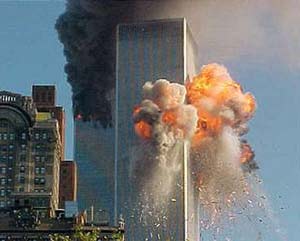
airplane crash wtcBanks crashed on the day of CHANGE that isn’t change, and the ruling class tried to put new lipstick on its pig. No major bank was spared the carnage as Bank of America’s shares plunged 29 percent; Citigroup’s 20 percent, and State Street Corp., which reported sharply lower earnings, saw its shares plummet 59 percent.

“The financial stocks got murdered,” said Jack A. Ablin, chief investment officer at Harris Private Bank in Chicago. “They were basically cut in half.” See the AP… Banks sink deeper into crisis on Obama’s first day Obama is now the newest lipstick to this pig, the same old US military-industrial-governmental complex.

Obama doesn’t have either a plan nor a clue. What he does have is the backing of the US ruling class elite and that is why he is in office today, and none of that has to do with a ‘new movement’ yet arising. All his (their) empty rhetoric is now about to come totally stripped off his Hawaiian toned body, and his groupies may now cheer but the final result will be quite grim for all soon to see. All that this Barack Brand Lipstick really has to offer is yet more and more attempted cosmetic sales for a decaying, disintegrating global economic system of war and poverty, racism and genocide.

There is no agenda for change in the making in the US of today. The population remains passively accepting of any sort of new cruelty offered up by its own ruling class to all others in the world, as somehow they still think that that will continue to salvage some sort of world for themselves by doing so? All we can do for the moment is wait and see if some new awakening will begin to come forth, though it appears that first total disintegrating disaster must gain the reign supreme.

Americans still just don’t want to change nor have CHANGE come about. And until they might, we will continue to plummet all into the abyss. Sorry, but one just cannot prettify much this new lipstick on the same old pig. It simply really is the same old stuff as before, and while we expect lots of prettifying of it in the press, some minor efforts to do away with some of the worst, and lots of talk, the reality of capitalist worldwide depression will soon hit. Then the real suffering will actually begin. We are in a complete economic down spin now and Pilot Barack will not be laying us down lightly into the Hudson River on this one.

Barack gives Bank of America ‘overdraft protection’ as he bankrupts the US public

Barack LincolnThe Republicans gave the banks hundreds upon hundreds of billions of dollars, but that was not enough. Barack, instead of spending money to help house the homeless, institute universal medical coverage, or better Social Security for the elderly and incapacitated, thinks Bank of America’s corporate owners need yet more of your tax monies! What a wild CHANGE in thinking here! He brings us visions of Barack Lincoln, freeing the corporate class from all responsibilities! Poor slaves.
I got ‘overdraft protection’ from Bank of America, and I went over about $2 on a Safeway debit card purchase with them. They charged me over $100 before I even knew about it. I had told them I didn’t want their ‘protection’, but they had given me it anyway. So I closed out with them, Bank of America not even having any local banks in the area. Now they call me twice a day with a recorded message and have screwed with my credit rating. That’s my overdraft protection’ plan from them…. phone harassment.

If somebody came and knocked repeatedly twice a day unsolicited on my front door, the police would go get them for this abuse. But Bank of America can bombard me with computerized phone calls 14 times a week, and nobody calls that a crime, except for me. The bastards. Why doesn’t Barack Obama give me ‘overdraft protection’ from the Bank of America criminals?

Bank of America though has been given much better and real overdraft protection by their cronies, Barack and Dubya, the DP and RP. Little accounting error? Then Dubya and Barack are stumbling all over themselves to rush multiple tens of billions to Bank of America to fix their small little banking ‘error’!

They could actually nationalize the damn Bank of America and that would be fine by me. Hey, why doesn’t our government do just exactly that? Nationalizing is what they do with many small folk who go to jail if they do not pay off money they steal from others through their ‘bad investments’. Heck, the cops never even give small crooks the option to return that money, it’s simply you have been ‘nationalized’ and now you spend the next 20 years with us! Where’s the respect for small time crooks who are merely emulating the Bank Of America Big Boys with their financial thefts? The ‘law’ is rather strange in America… Rob little and you are a Bad Boy. Rob BIG, and the government starts throwing other people’s money at you!

Bank of America bail-out agreed I didn’t agree, did you agree? You did if you voted for Barack Obama, Mr. and Mrs. DP ‘Liberal’. You’re always being led around on upper class leash by hooks in your noses, it rather does seem… Dupes.

Who is the economy calling stupid?

Okay, I’ve had enough of our readiness to believe, about the economy, that nobody knows what’s going on. Nobody will tell you what’s going on, is what’s going on.

Even my deepest thinking friend tells me, “Eric, they really don’t know” (The game theorists, the would-be global axis shifters, don’t know.) He may be right, but that’s not who we’re talking about. Between those guys, and you and I, who have no clue about where the economy is going, is a hand-basket courier. That composite abstraction at the handlebars knows the destination, he’s being paid cost-plus for the delivery, and he knows enough to collect his fee in advance.

We thought “it’s the economy, stupid” was directed at George Bush the Senior. Who is/was stupid? I’m finding the syncronicity of Alanis Morissette’s Jagged Little Pill song “Isn’t it ironic?” superlatively ironic. The era when a mass audience un-learned the meaning of irony, was when the joke was really on us.

Today the accepted theme to describe the economy is: nobody knows. I recently heard the governor of Colorado speak to the need for budget cuts in these hard times. He introduced the subject of the economic downturn by explaining, almost as a throwaway foregone conclusion, “Nobody saw this coming.”

I thought, really? This is what Americans are satisfied to expect for leadership? Elected authority figures return our system to us, broken, with not a mea culpa, but mea confuso. And we buy it.

For me, this no-comprendo motif doesn’t play well in Adagio. Today DC’s new lawmakers want to know what’s become of the first half of the TARP bailout money, and the good-enough-for-primetime answer is “nobody knows.” Don’t you just want to stand up and beg your fellow audience members for a collective show of incredulity? “NOBODY KNOWS?!”

Whoever pocketed the 350 Billion, KNOWS.

From explanations of the graft in Iraq, we the television public KNOW that just one million dollars in t-bills weighs more than you can get past surveillance cameras.

From nighttime video of the economic collapse in Argentina, documentary footage viewers know it takes a continuous train of armored trucks to do a run on the banks before the public gets there.

By the way, I’m certain Billion is always capitalized, out of respect for its size.

“Nobody knows” where went the 350 Billion? No. Nobody who knows, intends to tell us.

Either way, we don’t get to know, but the distinction makes a difference, don’t you think? The excuse we’re given for not dwelling on this incongruity, nudge nudge wink wink, is that all misdirection is for the sake of consumer confidence.

To look behind the green curtain is to become dis-illusioned. If you explain the slight of hand, instead of building confidence, you throw fuel on consumer doubt.

The better economists opposed the bailout. Hundreds of them signed a petition to tell us what’s going on is a heist. Under George Bush, bankers have been making off with the US treasury. What they couldn’t spend pay themselves to foist a war, or give themselves in tax cuts, they are having to abscond with under cover of an eleventh hour “bailout.”

The best of the honest economists, Paul Krugman, was given a Nobel Prize. At the same time, our president-to-the-rescue is saying he’d consider the advice of “even Paul Krugman,” like Krugman is a fringe opinion.

Do we empower the American public beast with a truer education about what’s happening to their finances, or do we narrow their peripheral foresight like the gangway to the abbatoire?

P.T. Barnum said no one ever went broke underestimating the American public. Barnum saw opportunity and he took it. I’ll bet he wasn’t satisfied to invest his winnings on the advice of the public’s broker.

The economy is tanking because the Bush investment banker free-for-all is over.

The cash heart of the consumer confidence fattened-calf is already in the bloody hands of the high priests. The American consumer is what’s being thrown off the wall. And the communal wealth of America’s middle class can’t be put together again because the pieces which formed Humpty Dumpty’s actual pre-confidence-ballooned size are going to come up missing.

Not missing, exactly. Look at the corporate jets, private skyboxes, enormous estates, private island kingdoms and advance ticket sales of quarter-million-dollar fares into space.

With much recent ballyhoo, George Bush set aside for protection some nature preserves in the Pacific. Unlike Yellowstone, or Yosemite, these parks of azure coral reefs are inaccessible. To you.

Barack Obama’s spread-the-wealth-around campaign lingo had nothing to do with the mad scramble to divvy the pot. Obama represents our non-insider’s reflexive grab for the fewer spoons. If Obama represents a wisening up at all.

Beyond buy low, sell high, here’s an example of how the scam worked: If a $100K house can be made seem worth $500K, a broker gets five times the commission, say $60K instead of $12K, and collects that money in cash. When the cows come home, you’ve got just a house, and let’s admit that value is arbitrary. But the broker is free and clear, his gleaning of a cash value done.

And actually, your house is not even worth the cost to build it. As the democratic capitalist apparatus downgrades, and the wealthy lose empathy for the lower classes, your house is worth just the value of the shelter it provides. Look at the concern they show for your health care. Your well-being, food and shelter wise, is worth only as much as the value you add to your landlord’s pleasure.

Dennis Kucinich: Wake Up America!

“Wake up America. We have trillions for a war machine and the banks while our government stands by and sniffs at the slaughter of innocents in Gaza, where Israel is blocking aid for wounded Palestinians. Here’s today’s Washington Post. It says,

‘The International Committee of the Red Cross said Thursday that it found at least 15 bodies and several children emaciated but alive in a row of shattered houses in the Gaza Strip and accused the Israeli military of preventing ambulances from reaching the site for 4 days. 12 corpses lying on mattresses in one home, along with 4 young children lying next to their dead mothers.’

That’s a quote. Today, US tax dollars, US jets, and US helicopters provided to Israel are enabling the slaughter in Gaza. The administration enables Israel to press forward with the attack against defenseless civilians, blocks efforts at promoting a cease-fire at the UN, and refuses to make Israel compliant with conditions that arms shipments will not be used for aggression. Israel is going to receive $30 billion in a ten year period for military assistance, without having to abide by any humanitarian principles, international laws, or standards of basic human decency. Wake up America.”

            —Dennis Kucinich (D-OH)

Colorado Springs District 11 School District corruption in plain view

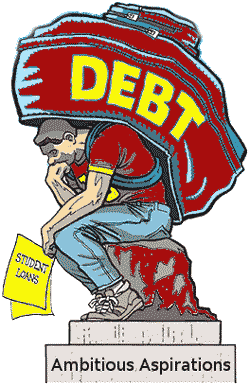
school debt
Something called a ‘School Accountability Report’ came to my house in the mail last week. Let’s take a look at it, shall we?
 
How is Colorado Springs District 11 Administration doing with that $409,468,689 they spent on less than 30,000 students last year? That’s almost a half a billion dollars! That’s a lot of money!

First off, they spent 15% of that money ($63,437,095) on ‘servicing debt’ as they called it. Wow! Double WOW! These are the people in charge of teaching math to kids, too… and it is no wonder that so many of District 11 miseducated kids cannot hardly count, let alone add and subtract, multiply and divide. $63 million per year! What did it buy? Well, it bought nothing. It was spent on ‘debt service’!

Why in the world would this School District borrow money? After all, when school levies can raise hundreds of millions of dollars at a time, why not wait before spending our tax monies? Is that really so hard for these people to do? The answer is NO. So why did they go and put parents into hock like this with taxpayers’ money?

The answer is CORRUPTION. You see, the $63 million PLUS money paid out in interest annually is something that big financial corporations lobby to get. No need to go after the bottom dwellers (you and I) to get us to add on a credit card or two, when this sort of interest ‘servicing’ can be had by getting the School Board in bed with them.

Nobody questions necessary debt, but a taxing agency such as government can obtain money without borrowing it beforehand. That is something that should be called unnecessary debt when they borrow first. It’s unnecessary for us, but necessary for banks to get corrupt fools (the D-11 School Board Administrators) to line them up with them to get that $63 million annually. Yes, those School Board Administrators are corrupt, corrupted, and shameless, and back to the ‘School Accountability Report’ once again…

Those corrupt administrators pull off an average salary of over $40/ hour. That’s right. That’s an average. The corrupted administrators that passed these deals to have the D-11 public now paying off $63 PLUS million per year in ‘debt service’ made more than that average. Perhaps $50-$70 per hour? Perhaps the sky? Your guess as to that?

Many of these students at District 11 have parents making less than $10 an hour apiece. They support these corrupt School Administrators through their taxes, who then sign these sweetheart deals with financial institutions that then helps torpedo these parents’ kids from getting much of an education for that $11,289 operating revenue per kid spent by the district.

What’s the overall grade for this District 11 corruption? ‘Overall Academic Performance on State Assessments’ = AVERAGE. That’s what their own ‘accountability’ paper read. And ‘average’ for American education as a whole = BELOW WORLD AVERAGE. The math of it is so very sad.

Math score for District 11? F. The school district public’s $63 million PLUS per year paid out in ‘debt service’? Shame on them! These administrators are scamming us! And they’re scamming our kids, too! F———- that’s F minus. This country is sinking under this type of corruption!

The American dyslexia for economics

The interest rate for banks is down to zero. B of A and Citibank are still charging 39%. What again does economic news have to do with me?
 
The biggest news on the economy was BREAKING NEWS a week ago: the US economy is in a recession, and has been for over a year. Can news a year old still be news? What news exactly are we getting from the experts, economists and other mesmerists paraded on the television every evening?

We consult them on a minute by minute basis, actually, on 24/7 cable news stations, for every hint of a whiff of where the weather vane might indicate the US economy is blowing. If the stock market doesn’t hang on their every diagnosis, it reacts to what unelected, self-made officials say. Now we’re led to understand all that spinning can flip-flop for a year-old contradictory study.

And who’s going to let America know when we’ve hit a full-on depression? Will we be told it before the decade is enshrined post-facto in a Time-Life retrospective? Are those in charge so cynical that they count on the public knowing the truth in spite of their lies, because it’s we who endure the effects in real time anyway? The media can lie about unemployment figures too –what could it possibly matter to the unemployed?

It’s not only ADD. Americans understand why too-sobering statistics are kept from us, lest a post-mortem induce pre. We are the great engine of consumerism, running on pure flattery. I think it’s the same self-defeating fatalism which fuels the life insurance scam. We bet against ourselves. We buy self-help books. We are eternally sick.

But does the economy really work so? Would an autopsy be self-fulfilling? Can an economy go sour due to one bad-apple-attitude, or would it be because of the lost jobs?

I’m guessing this is where the University of Chicago meets Euripides, or if it prefers, palmistry. There’s a global comeuppance in your future, you small fraction of Earth’s population who have expended the lion’s share of its resources. That’s what will introduce the American quality of life to harsh earthbound reality.

Keeping American consumers in debt is less a magician’s act of driving the economy, than it is a swindler’s function of distracting the poor dupe until he’s lost his shirt.

But this swindler is not planning to catch the next bus out of town.

This banking scam isn’t over until the shirtless victim is thrown out the saloon door and into the street, where’s he’s got no redress but to face line after line of well armed riot police.

Forget Joe the Plumber, the only person McCain represents is Jack the Lobbyist

"I believe banking institutions are more dangerous to our liberties than standing armies. If the American people ever allow private banks to control the issue of their currency, first by inflation, then by deflation, the banks and corporations that will grow up around the banks will deprive the people of all property until their children wake up homeless on the continent their fathers conquered."
– President Thomas Jefferson, 1802

Bigots for McCain!

RepubliKKKans caught hanging Obama in effigy on University of Kentucky campus.

Palin must be so proud. Two arrested in Republican plot to assassinate Obama.

Al Qaeda Endorses McCain!

I’m starting to feel a little sorry for the McCain campaign. He’s senile, and now she’s gone completely off the reservation.

EXPOSED: SARAH PALIN ADMITS SHE’S IS A COMMUNIST!

Sarah Palin: ready to become Dick Cheney on day 1. She rigged bidding on $40B pipeline so it would go to her cronies.

Poll: Obama has highest approval ratings of any candidate in 28 years. Palin has the lowest, ever.

Senior Republican figures predict historic landslide for Obama.

Former Bush speechwriter says McCain is taking the entire GOP down with him.

Break out the bubbly! Vile heterofascist Marilyn Musgrave’s campaign is tanking.

Bush appointed Fed Chair endorses Obama.

Unhinged Republicans now claiming Obama is a Devil worshiper!

Call me paranoid if you want, but I have a hard time believing that Cheney has any intention of leaving office on January 20th, exposing himself to criminal prosecution for war crimes, crimes against humanity, and treason against the US Constitution. And McCain is just waaayyy too confident, considering the polls. November 4 is when things start to get a little dicey in our “democracy.”

US blackmails Iraq, will shut down entire country if they won’t sign agreement letting us continue genocidal occupation for 3 more years.

wealthy cry socialist

(Excerpts from Oct 31 notes of Thomas MC.)

Colorization of the Grapes of Wrath

migrant-motherI think it’s time to colorize The Grapes of Wrath. And I don’t mean the Turner Classics process exactly. It may help to dumb down the artistic contrast of the black & white for a contemporary audience palate of splashy Disneycolor, but how about trying to make Steinbeck’s theme more accessible to today’s spoon-fed viewers? Let’s colorize the skin of the poor migrant workers to reflect the inhumanly-treated populations of today’s displaced im-migrants of color.

I can’t remember where I come down on colorizing the old movies. No one’s insisted on infusing CMYK into Ansel Adams or Picasso’s sketchbook, why are masterpieces filmed in black and white supposed to be pigment deficient? We don’t presume to dub dialog over the silent movies made before the age of the talkies. As yet. Of course, Ted Turner was concerned for reviving interest in old intellectual properties, many of which were already in-artful. And perhaps his salesmanship maneuver has been proven effective. When my family sat down to watch Grapes of Wrath, the grey image tuned a number of youthful eyes away.

Like Dorothea Lange’s famous photographs, John Ford’s film depicted disadvantaged Okies with whom the American audience could identify. We may not know what it feels like to be forced off our homes, but how the families cope with the hardship, we all can recognize. I’m curious how the film was received by Californians in 1940, coming less than ten years after the original plague of destitute Oklahoma refugees. How would the characters have faired with our sympathies if they had been played as coarse hillbilly Crackers with guns and a poor person’s chip-on-the-shoulder desperation?

The poor protagonists of The Grapes of Wrath were weakened skinny po-folk, who staked their relief on the strength of a single hopeful job listing flyer, who protested their oppression without resorting to violence, and who accepted hardship as their lot. Seeing into their daily lives, viewers were shown a dignified, earnest people who treated others with respect and compassion. Antagonist characters in the film were less charitable, taking advantage of the hard-luck migrants with guile, violence and authority. People into which the Oklahoma refugees traveled, New Mexico, Arizona and California, treated the migrants like vermin. Even as onlookers might express admiration for the Okies’ determination to cross Death Valley, the better fed Californians held them in disdain for not knowing enough to be in such a predicament. The Okies were blamed for their own poverty. They threatened to burden everyone’s already depleting resources. Only the viewers understood the unfair actions which had landed the otherwise self-sufficient sharecroppers to have to leave their livelihoods.

The circumstances of the Dust Bowl cum great depression era forced removal of the small Oklahoma farmers is eerily familiar to today’s economy and its foreclosures. Homesteaders find themselves made homeless, as a consequence of business decisions between corporations, banks and regulators. The Oklahoma farmers wanted to point their shotguns to warn the financial disruptors from their land, but found the conduits of the dirty work were their own neighbors and relatives. Everyone was merely following orders from someone higher up. That the system could be at fault, left the victims with no clear recourse.

Here’s the classic eviction exchange.

THE MAN
I can’t help that. All I know is I got my orders.
They told me to tell you you got to get off,
and that’s what I’m telling you.

MULEY
You mean get off my own land?

THE MAN
Now don’t go blaming me. It ain’t *my* fault.

SON
Whose fault is it?

THE MAN
You know who owns the land–the Shawnee Land and Cattle Company.

MULEY
Who’s the Shawnee Land and Cattle Comp’ny?

THE MAN
It ain’t nobody. It’s a company.

SON
They got a pres’dent, ain’t they?
They got somebody that knows what a shotgun’s for, ain’t they?

THE MAN
But it ain’t *his* fault, because the *bank* tells him what to do.

SON
All right. Where’s the bank?

THE MAN
Tulsa. But what’s the use of picking on him?
He ain’t anything but the manager, and half crazy hisself,
trying to keep up with his orders from the east!

MULEY
Then who *do* we shoot?

THE MAN
Brother, I don’t know. If I did I’d tell you.
But I just don’t know *who’s* to blame!

There was a lot more in The Grapes of Wrath which could inform a modern world view. The dreaded “Cats” for example. These were the Caterpillar tractors which were shown ravaging the land like locusts, arriving to demolish the houses of the reluctant dispossessed. Bulldozers are still used for that function today. In fact, Caterpillar manufactures armored versions to deploy in war zones for the destruction of houses. Palestinians have shown to be less reluctant than the poor Okies about trying to shoot the bulldozer drivers who are taking aim at their homes. Israel is expanding its settlements in Palestine with the aid of Caterpillar tractors which clear the land of its recalcitrant invadees.

Likewise, the union busting strategies portrayed in Grapes of Wrath are the same used today. Police officers are called in when work supervisors encounter workers who show too much skepticism for the employer’s scam. Troublemakers are arrested lest the workforce succeed in organizing itself. Instigators are paid to infiltrate a social event and start a fight, to give law enforcement the excuse to break in and make its calculated arrests. Casual viewers may think the famous 1939 film depicts a bygone age. Not at all.

Director John Ford made sure that the Okie migrants were deathly skinny, while everyone else, from gas station attendants to deputized union-busters, was immaculately dressed and well fed. But the audience could identify with both sides, because both were white. Imagine if the displaced peoples were not the same color.

Today’s migrant workers are hispanic. They are illegal immigrants, just like Okies passing through the Arizona checkpoint in Steinbeck’s novel.

GUARD
Where you going?

TOM
California.

GUARD
How long you plan to be in Arizona?

TOM
No longer’n we can get acrost her.

GUARD
Got any plants?

TOM
No plants.

GUARD
Okay. Go ahead, but you better keep movin’.

Could a modern audience appreciate the travails of a Mexican family in an exact same predicament? Mexican farmers have been forced from their land in an even less polite manner today. They have similar claim to their homesteads, some of them even have indigenous claims. But American and Mexican corporate interests have been forcing the Mexicans to flee. The migration north is not about seeking fortune; picking lettuce it most certainly is not. The work our illegal immigrants are willing to do is out of desperation and subsistence. Corporate America reserves our agricultural work for migrants because it’s cheaper. Otherwise American citizens have devised unions to ensure that workers are paid an honorable wage. Exploitation of the illegal immigrant is simply a bypass of decent labor practices meant to protect everyone.

In selfish, protectionist terms, hiring illegal immigrants undermines the strength of unionized labor. Ultimately the exploitation of others dehumanizes us all.

I wish Americans could see The Grapes of Wrath as a projection of the ongoing injustices suffered by all exploited migrants. As well-fed American citizens leading prosperous lives, wouldn’t it be our responsibility to help the victims of our system? Instead, we are those cold-hearted leather-jacketed Californians herding them into lives of slow death by hard labor and starvation.

The Grapes of Wrath offered a strong Socialist message, disguised in a protagonist who did not yet have all the answers. Before setting out to light the way, Henry Fonda’s character says this to his mom:

TOM
…maybe I can do sump’n. Maybe I can jus’ fin’ out sump’n.
Jus’ scrounge aroun’ an’ try to fin’ out what it is that’s wrong,
an then see if they ain’t sump’n could be done about it.
But I ain’t thought it out clear, Ma. I can’t.
I don’t know enough.

MA
How’m I gonna know ’bout you?
They might kill you an’ I wouldn’t know.
They might hurt you. How’m I gonna know?

TOM
Well, maybe it’s like Casy says, a fella ain’t got a soul
of his own, but on’y a piece of a big soul–the one big soul
that belongs to ever’body–an’ then…
Then it don’t matter. Then I’ll be all aroun’ in the dark.
I’ll be ever’where–wherever you look. Wherever there’s
a fight so hungry people can eat, I’ll be there.
Wherever there’s a cop beatin’ up a guy, I’ll be there.
I’ll be in the way guys yell when they’re mad
–an’ I’ll be in the way kids laugh when they’re
hungry an’ they know supper’s ready.
An’ when our people eat the stuff they raise,
an’ live in the houses they build, why, I’ll be there too.

I had to see The Grapes of Wrath in high school. It was required. Are schools today trying to infuse students with social wisdom? How about a Grapes Redux starring people of color? Imagine this closing line, spoken by a dark skinned mother, about the hardship that is her people’s fate:

MA
…Maybe that makes us tough. Rich fellas come up an’ they die, an’ their kids ain’t no good, an’ they die out. But we keep a-comin’. We’re the people that live. Can’t nobody wipe us out. Can’t nobody lick us. We’ll go on forever, Pa. We’re the people.

McCain THE BOLD NEW ECONOMIC PLAN: no taxes for the filthy-rich.

Halloween
Breaking news: McCAIN LINKED TO SADDAM HUSSEIN!

Must see: The bizarro NeoFascist mindset of Sarah Palin supporters. [video]

Ethics investigation of Sarah Palin expands. Will Republicans actually vote for a candidate who comes with her own built-in impeachable scandals? You betcha!

GOP strategist says McCain “put country at risk” by picking Palin.

It’s panic time for the GOP.

Comrade Bush to nationalize major banks. Who knew the Republicans were such closet Communists?

If you think Bush’s economy stinks, wait ’till you smell McCain’s!

Thou shalt not oppose the GOP. Student activist being tried as a terrorist for protesting at RNC.

Canada to shut down internet on election day.

The “success” of McCain’s surge: Iraqis who dare to return home are being killed.

Excerpts from Thomas McCullock’s Oct 14 notes, thomasmc.com.

The Law of the Jungle

THE LAW OF THE JUNGLE

Trade, within a society and between countries, is the exchange of goods and services produced by human beings. The owners of the means of production appropriate the profits. As a class, they are the leaders of the capitalist state and they boast of fostering development and social wellbeing through market. This they worship as an infallible God.

In every country there is competition between the strongest and the weakest; the ones with more physical energy and better fed, those who learned how to read and write, who attended school and have more experience accumulated; the ones with more extensive social relations and more resources, and those within society who fail to have these advantages.

Now, as far as the countries is concerned, there are differences between those with a better climate and more arable land, more water and more natural resources in the area where they are located, when there are no more territories to conquer; the ones mastering technology, having greater development and handling unlimited media resources and those who, on the contrary, do not enjoy any of these prerogatives. These are the sometimes enormous differences between the rich and the poor nations.

It’s the law of the jungle.

There are no differences between ethnic groups, however, when it comes to the mental faculties of the human being. This has been thoroughly proven by science. The present society is not the natural way in which human life evolved, but rather a creation of the mentally developed man without which his life would be inconceivable. Therefore, what is at stake is whether the human being will be able to survive the privilege of having a creative mind.

The developed capitalist system, epitomized by the country with a privileged nature where the European white man brought his ideas, dreams and ambitions, is today in a crisis. But, it is not the usual crisis happening once in a number of years; not even the traumatic crisis of the 1930s but the worst of all crises since the world started to pursue this growth and development model.

The current crisis of the developed capitalist system is taking place when the empire is about to change leadership in the elections to be held in twenty-five days; it was all that was left to see.

The candidate of the two main parties that will say the last word in these elections are trying to persuade the bewildered voters –many of whom have never cared to cast a vote— that as candidates to the presidency they can secure the wellbeing and consumerism of what they describe as a people of middle class only, even though they are not planning to introduce any real changes to what they consider the most perfect economic system the world has ever known. The same world that, in their respective minds, is less important than the happiness of over three hundred million people who account for less than five percent of the world population. The fate of the remaining ninety-five percent of human beings, peace and war, the fit or unfit-for-breathing air, will highly depend on the decisions of the administrative leader of the empire, whether or not that constitutional position has any power at a time of nuclear weapons and space shields moved by computers in circumstances where every second counts and when ethical principles keep loosing their value. Still, the more or less nefarious role of the President of that country cannot be overlooked.

Racism is deeply-rooted in the United States where the mind of millions of people can hardly reconcile with the notion that a black man, with his wife and children could live in the White House, which is precisely called White.

It’s a miracle that the Democratic candidate has not met the same destiny as Martin Luther King, Malcolm X and others who only a few decades ago dreamed of justice and equality. He is in the habit of looking at his adversary with serenity and of smiling at the dialectic predicament of an opponent gazing into space.

The Republican candidate, on the other hand, who likes to enhance his reputation as a belligerent man, was one of the worst students in his class at West Point. He has confessed that he did not know any Mathematics; it can thus be assumed that he knew less of the complicated economic science.

The truth is his adversary surpasses him in cleverness and composure.

Something McCain has aplenty is age, and his health condition is not safe.

I am bringing up these data to indicate that eventually –if anything went wrong with the candidate’s health, in case he is elected— the lady of the riffle, the inexperienced former governor of Alaska could become President of the United States. It can be noticed that she does not know a thing.

Meditating on the current US public debt –$10,266 trillions— that President Bush is laying on the shoulders of the new generations in that country, I took to calculating how long it would take a man to count the debt that he has doubled in eight years.

A man working eight hours a day, without missing a second, and counting one hundred one-dollar bills per minute, during 300 days in the year, would need 710 billion years to count that amount of money.

I could not find a more graphic way to describe the volume of money that is practically mentioned every day now.

In order to avoid a general state of panic, the US administration has declared that it will secure deposits that do not exceed 250 thousand dollars. It will be managing banks and such funds as Lenin would never have thought of counting with an abacus.

We might be wondering about the contribution of Bush’s administration to Socialism. But, let’s not entertain any illusions. Once the banking operations go back to normal, the imperialists will return the banks to the private business as some other countries in this hemisphere have already done. The peoples always foot the bill.

Capitalism tends to reproduce itself under any social system because it is based on selfishness and on man’s instincts.

The only choice left to human society is to overcome this contradiction; otherwise it would not be able to survive.

At this time, the ocean of money being poured into the world finances by the central banks of the developed capitalist countries is dealing a hard blow to the Stock Exchanges of the countries which resort to these institutions in an effort to beat their economic underdevelopment. Cuba has no Stock Exchange. We shall certainly find more rational and more socialist ways of financing our development.

The current crisis and the brutal measures of the US administration to save itself will bring more inflation, more devaluation of the national currencies, more painful losses in the markets, lower prices for basic export commodities and more unequal exchange. But, they will also bring to the peoples a better understanding of the truth, a greater conscience, more rebelliousness and more revolutions.

We shall see how the crisis develops and what happens in the United States in twenty-five days.

Fidel Castro Ruz
October 11, 2008 6:15 p.m.

The crash continues as American people go into shock

dangerousLast week we saw most of America go into shock as the stark reality of the US not having a real opposition party became evident. The Democratic Party actually led the rush to pass Bush’s $700 billion giveaway to the rich Bill into law, and it was actually the Republican party that posed the minor stumbling block to getting it done. The American people were almost completely left on the sidelines as a result of simply never having constructed a major opposition party to the Two Party Big Business dictatorship that US is run under.

This week, the show has already begun again, as stocks begin the week by crumbling throughout Asia, Europe, and North America. Nobody is fooled internationally by the $700 billion dollar American give away legislation. Germany had to even copy the US government with their own give away bill, too, to the banks. Germany moves to shore up bank confidence And the Euro appears to be in as bad a shape as the dollar is in world currency marts, sliding in relation to the dollar!

Everywhere they talk of a stampede as stock values and currencies crumble. They talk of panic and they talk of crisis. The US stock market continued down this AM and everywhere there is a sense of impending doom. Hard times are now being made by the financial sectors for all of us, as unemployment rolls rise, production drops. The crash continues as the American people go into shock.

Bank steals roof from over the head of a 90 yr old woman who lived in her house for 38 years!

How many years do you need to pay a mortgage off in the US to make it go away? When this woman in Ohio first started making payments on her mortgage she was 52 years old, and yet at 90 the banks were stealing her property from her! Outrageous! The story turns even more tragic as the woman now has tried to commit suicide with a gun. Ohio woman, 90, attempts suicide after foreclosure

One wonders just how it might have been, too, if the gun loving nuts had worried more about mortgages and banks instead of their stupid guns? We might have control over the banks and control over gun proliferation both and it would be a better world altogether!

The man in Nebraska who abandoned his 9 kids at the hospital this week was worried about losing his home, too. Kin of 9 abandoned kids say they would’ve helped

What a country we live in today! These types of stories are going to be popping up soon all over the place. No bailout for the people down below at all. Look, too, at the Gulf Coast. The rich have no compassion for the Common People! They seem to think of us as cattle?

Singin’ the Bail-out blues…

..except nothing that ugly could possibly be put to music..

There’s a massive effort from the Far Right to blame the Liberals, blame the Working poor (whispered rumors are that it’s those MINORITIES) when the evidence has been staring us right in the face for all this time.

Infomercials on how to Get Rich Without Trying filled the late-night, early morning TeeVee…

The loans that were defaulted, turns out that not only most but the Vast Majority of them were to people who were speculating.

Not people who were buying homes to actually, you know, LIVE in them.

The “Flip that house” show is still on HGTV…

Buy a house at a flexible rate, wait while the real estate value goes up, then sell it at a profit.

The Infomercials promised that you could do this with “little or even NO money down! How could you possibly lose?”

Buy a house with no money, sell it a week later, pay off the balance of your mortgage and use the rest as paper collateral, “Cash Instrument” on another loan, preferably two, and do the same thing over again.

“How could you possibly lose?”

ummm… maybe by following the instructions, yeah, that’s a fast way to lose.

NOW, How Much Would You Pay? BUT WAIT! THERE’S MORE!

these “Cash Instruments” essentially a post-dated check backed by an extremely ætherial government guarantee of payment…

then get used as collateral for secondary and tertiary levels of loans.

Now, the Republican-controlled Congress, (until January 07), top heavy with Harvard MBAs and even Doctorates in Economics, and of course the Investment Banks and the Brokerage Houses, for some reason now they’re saying they’re the victims, that none of them had the experience or the intellect to spot a Pyramid Scam in the works.

Especially not when given a 15 year head start on spotting it.

They say they were forced to give loans to Poor Risk (meaning: underpaid Minorities) customers, but neglect to mention that most of those owner-occupant houses didn’t default.

They also weren’t “required by Federal Law” to push the bank guarantees off onto the Speculators, in fact, they seem to be complicit in those crimes.

And all these Financial Experts, especially those in Congress, like McCain, have had their Corporate Sponsors spend Large Money telling us how vigilant they were over our economy…

WELL, DUH!!

So the most they can claim is Not Guilty By Reason of Massive Incompetence.

But they come, not hat in hand, not humbly, but Arrogantly, demanding that we pay their bills, with no questions and no oversight.

Because, so they say, they’re the only ones who have the competence and experience to do it.

my yass.

We’ve just experienced the full measure of their “Competence”

Then there’s the little matter of that Federal Insurance on the mortgages.

It wasn’t there. Why was that insurance not there?

Two Words: Eye Rack.

Seems Mr Bush, whose Grandpoppy, Poppy and brothers are all Bankers, has had a little Fancy Finance Finagling going on to “pay” the bills on that mess.

It makes the Treasonous Actions of Reagan, North, Poindexter Bush Sr Secord and Casey look like a trial run.

Which essentially it was.

This time instead of funding the Cuba Libre, the Contras, the Medellin Cartel, the Taliban, Hizbollah and al Qa’eda, it goes directly into the American Taliban in other words BlackWater, Halliburton and other more highly organized Terrorist Groups.

But they’re going to blame the entire collapse on a relative handful of low-budget homeowners.

Eat the Rich.

Stop the Senate of would-be thieves!

wallstreet-bailoutCall your Band of Thieving Senators now to tell them you don’t want to give $700 Billion –more honestly likely to be $5 Trillion– to the robber bankers of Wall Street! Telephone Colorado Senators Ken Salazar at 202.224.5852 and Wayne Allard at 202.224.5941 NOW. Why not call OBAMA too! (phone: 202-224-2854) Tell them you want them to consult with at least ONE economist of repute! At least one analyst not on the corporate payroll. As he promised yesterday, Michael Moore suggests a 10 PART PLAN, only IF pressure can be brought to bear right now to stop the Senate bill.

Friends,

The richest 400 Americans — that’s right, just four hundred people — own MORE than the bottom 150 million Americans combined. 400 rich Americans have got more stashed away than half the entire country! Their combined net worth is $1.6 trillion. During the eight years of the Bush Administration, their wealth has increased by nearly $700 billion — the same amount that they are now demanding we give to them for the “bailout.” Why don’t they just spend the money they made under Bush to bail themselves out? They’d still have nearly a trillion dollars left over to spread amongst themselves!

Of course, they are not going to do that — at least not voluntarily. George W. Bush was handed a $127 billion surplus when Bill Clinton left office. Because that money was OUR money and not his, he did what the rich prefer to do — spend it and never look back. Now we have a $9.5 trillion debt. Why on earth would we even think of giving these robber barons any more of our money?

I would like to propose my own bailout plan. My suggestions, listed below, are predicated on the singular and simple belief that the rich must pull themselves up by their own platinum bootstraps. Sorry, fellows, but you drilled it into our heads one too many times: There… is… no… free… lunch. And thank you for encouraging us to hate people on welfare! So, there will be no handouts from us to you. The Senate, tonight, is going to try to rush their version of a “bailout” bill to a vote. They must be stopped. We did it on Monday with the House, and we can do it again today with the Senate.

It is clear, though, that we cannot simply keep protesting without proposing exactly what it is we think Congress should do. So, after consulting with a number of people smarter than Phil Gramm, here is my proposal, now known as “Mike’s Rescue Plan.” It has 10 simple, straightforward points. They are:

1. APPOINT A SPECIAL PROSECUTOR TO CRIMINALLY INDICT ANYONE ON WALL STREET WHO KNOWINGLY CONTRIBUTED TO THIS COLLAPSE. Before any new money is expended, Congress must commit, by resolution, to criminally prosecute anyone who had anything to do with the attempted sacking of our economy. This means that anyone who committed insider trading, securities fraud or any action that helped bring about this collapse must go to jail. This Congress must call for a Special Prosecutor who will vigorously go after everyone who created the mess, and anyone else who attempts to scam the public in the future.

2. THE RICH MUST PAY FOR THEIR OWN BAILOUT. They may have to live in 5 houses instead of 7. They may have to drive 9 cars instead of 13. The chef for their mini-terriers may have to be reassigned. But there is no way in hell, after forcing family incomes to go down more than $2,000 dollars during the Bush years, that working people and the middle class are going to fork over one dime to underwrite the next yacht purchase.

If they truly need the $700 billion they say they need, well, here is an easy way they can raise it:

a) Every couple who makes over a million dollars a year and every single taxpayer who makes over $500,000 a year will pay a 10% surcharge tax for five years. (It’s the Senator Sanders plan. He’s like Colonel Sanders, only he’s out to fry the right chickens.) That means the rich will still be paying less income tax than when Carter was president. This will raise a total of $300 billion.

b) Like nearly every other democracy, charge a 0.25% tax on every stock transaction. This will raise more than $200 billion in a year.

c) Because every stockholder is a patriotic American, stockholders will forgo receiving a dividend check for one quarter and instead this money will go the treasury to help pay for the bailout.

d) 25% of major U.S. corporations currently pay NO federal income tax. Federal corporate tax revenues currently amount to 1.7% of the GDP compared to 5% in the 1950s. If we raise the corporate income tax back to the level of the 1950s, that gives us an extra $500 billion.

All of this combined should be enough to end the calamity. The rich will get to keep their mansions and their servants, and our United States government (“COUNTRY FIRST!”) will have a little leftover to repair some roads, bridges and schools.

3. BAIL OUT THE PEOPLE LOSING THEIR HOMES, NOT THE PEOPLE WHO WILL BUILD AN EIGHTH HOME. There are 1.3 million homes in foreclosure right now. That is what is at the heart of this problem. So instead of giving the money to the banks as a gift, pay down each of these mortgages by $100,000. Force the banks to renegotiate the mortgage so the homeowner can pay on its current value. To insure that this help does no go to speculators and those who have tried to make money by flipping houses, this bailout is only for people’s primary residence. And in return for the $100K paydown on the existing mortgage, the government gets to share in the holding of the mortgage so that it can get some of its money back. Thus, the total initial cost of fixing the mortgage crisis at its roots (instead of with the greedy lenders) is $150 billion, not $700 billion.

And let’s set the record straight. People who have defaulted on their mortgages are not “bad risks.” They are our fellow Americans, and all they wanted was what we all want and most of us still get: a home to call their own. But during the Bush years, millions of them lost the decent paying jobs they had. Six million fell into poverty. Seven million lost their health insurance. And every one of them saw their real wages go down by $2,000. Those who dare to look down on these Americans who got hit with one bad break after another should be ashamed. We are a better, stronger, safer and happier society when all of our citizens can afford to live in a home that they own.

4. IF YOUR BANK OR COMPANY GETS ANY OF OUR MONEY IN A “BAILOUT,” THEN WE OWN YOU. Sorry, that’s how it’s done. If the bank gives me money so I can buy a house, the bank “owns” that house until I pay it all back — with interest. Same deal for Wall Street. Whatever money you need to stay afloat, if our government considers you a safe risk — and necessary for the good of the country — then you can get a loan, but we will own you. If you default, we will sell you. This is how the Swedish government did it and it worked.

5. ALL REGULATIONS MUST BE RESTORED. THE REAGAN REVOLUTION IS DEAD. This catastrophe happened because we let the fox have the keys to the henhouse. In 1999, Phil Gramm authored a bill to remove all the regulations that governed Wall Street and our banking system. The bill passed and Clinton signed it. Here’s what Sen. Phil Gramm, McCain’s chief economic advisor, said at the bill signing:

“In the 1930s … it was believed that government was the answer. It was believed that stability and growth came from government overriding the functioning of free markets.

“We are here today to repeal [that] because we have learned that government is not the answer. We have learned that freedom and competition are the answers. We have learned that we promote economic growth and we promote stability by having competition and freedom.

“I am proud to be here because this is an important bill; it is a deregulatory bill. I believe that that is the wave of the future, and I am awfully proud to have been a part of making it a reality.”

This bill must be repealed. Bill Clinton can help by leading the effort for the repeal of the Gramm bill and the reinstating of even tougher regulations regarding our financial institutions. And when they’re done with that, they can restore the regulations for the airlines, the inspection of our food, the oil industry, OSHA, and every other entity that affects our daily lives. All oversight provisions for any “bailout” must have enforcement monies attached to them and criminal penalties for all offenders.

6. IF IT’S TOO BIG TO FAIL, THEN THAT MEANS IT’S TOO BIG TO EXIST. Allowing the creation of these mega-mergers and not enforcing the monopoly and anti-trust laws has allowed a number of financial institutions and corporations to become so large, the very thought of their collapse means an even bigger collapse across the entire economy. No one or two companies should have this kind of power. The so-called “economic Pearl Harbor” can’t happen when you have hundreds — thousands — of institutions where people have their money. When you have a dozen auto companies, if one goes belly-up, we don’t face a national disaster. If you have three separately-owned daily newspapers in your town, then one media company can’t call all the shots (I know… What am I thinking?! Who reads a paper anymore? Sure glad all those mergers and buyouts left us with a strong and free press!). Laws must be enacted to prevent companies from being so large and dominant that with one slingshot to the eye, the giant falls and dies. And no institution should be allowed to set up money schemes that no one can understand. If you can’t explain it in two sentences, you shouldn’t be taking anyone’s money.

7. NO EXECUTIVE SHOULD BE PAID MORE THAN 40 TIMES THEIR AVERAGE EMPLOYEE, AND NO EXECUTIVE SHOULD RECEIVE ANY KIND OF “PARACHUTE” OTHER THAN THE VERY GENEROUS SALARY HE OR SHE MADE WHILE WORKING FOR THE COMPANY. In 1980, the average American CEO made 45 times what their employees made. By 2003, they were making 254 times what their workers made. After 8 years of Bush, they now make over 400 times what their average employee makes. How this can happen at publicly held companies is beyond reason. In Britain, the average CEO makes 28 times what their average employee makes. In Japan, it’s only 17 times! The last I heard, the CEO of Toyota was living the high life in Tokyo. How does he do it on so little money? Seriously, this is an outrage. We have created the mess we’re in by letting the people at the top become bloated beyond belief with millions of dollars. This has to stop. Not only should no executive who receives help out of this mess profit from it, but any executive who was in charge of running his company into the ground should be fired before the company receives any help.

8. STRENGTHEN THE FDIC AND MAKE IT A MODEL FOR PROTECTING NOT ONLY PEOPLE’S SAVINGS, BUT ALSO THEIR PENSIONS AND THEIR HOMES. Obama was correct yesterday to propose expanding FDIC protection of people’s savings in their banks to $250,000. But this same sort of government insurance must be given to our nation’s pension funds. People should never have to worry about whether or not the money they’ve put away for their old age will be there. This will mean strict government oversight of companies who manage their employees’ funds — or perhaps it means that the companies will have to turn over those funds and their management to the government. People’s private retirement funds must also be protected, but perhaps it’s time to consider not having one’s retirement invested in the casino known as the stock market. Our government should have a solemn duty to guarantee that no one who grows old in this country has to worry about ending up destitute.

9. EVERYBODY NEEDS TO TAKE A DEEP BREATH, CALM DOWN, AND NOT LET FEAR RULE THE DAY. Turn off the TV! We are not in the Second Great Depression. The sky is not falling. Pundits and politicians are lying to us so fast and furious it’s hard not to be affected by all the fear mongering. Even I, yesterday, wrote to you and repeated what I heard on the news, that the Dow had the biggest one day drop in its history. Well, that’s true in terms of points, but its 7% drop came nowhere close to Black Monday in 1987 when the stock market in one day lost 23% of its value. In the ’80s, 3,000 banks closed, but America didn’t go out of business. These institutions have always had their ups and downs and eventually it works out. It has to, because the rich do not like their wealth being disrupted! They have a vested interest in calming things down and getting back into the Jacuzzi.

As crazy as things are right now, tens of thousands of people got a car loan this week. Thousands went to the bank and got a mortgage to buy a home. Students just back to college found banks more than happy to put them into hock for the next 15 years with a student loan. Life has gone on. Not a single person has lost any of their money if it’s in a bank or a treasury note or a CD. And the most amazing thing is that the American public hasn’t bought the scare campaign. The citizens didn’t blink, and instead told Congress to take that bailout and shove it. THAT was impressive. Why didn’t the population succumb to the fright-filled warnings from their president and his cronies? Well, you can only say ‘Saddam has da bomb’ so many times before the people realize you’re a lying sack of shite. After eight long years, the nation is worn out and simply can’t take it any longer.

10. CREATE A NATIONAL BANK, A “PEOPLE’S BANK.” If we really are itching to print up a trillion dollars, instead of giving it to a few rich people, why don’t we give it to ourselves? Now that we own Freddie and Fannie, why not set up a people’s bank? One that can provide low-interest loans for all sorts of people who want to own a home, start a small business, go to school, come up with the cure for cancer or create the next great invention. And now that we own AIG, the country’s largest insurance company, let’s take the next step and provide health insurance for everyone. Medicare for all. It will save us so much money in the long run. And we won’t be 12th on the life expectancy list. We’ll be able to have a longer life, enjoying our government-protected pension, and living to see the day when the corporate criminals who caused so much misery are let out of prison so that we can help reaclimate them to civilian life — a life with one nice home and a gas-free car that was invented with help from the People’s Bank.

Yours,
Michael Moore

P.S. Call your Senators now. Here’s a backup link in case we crash that site again. They are going to attempt their own version of the Looting of America tonight. And let your reps know if you agree with my 10-point plan.

Who not to blame for failed bailout

wall-street-bailout protest
COLORADO SPRINGS- We held posters that read SEIZE THE FED, JAIL NOT BAIL-OUT, FORECLOSE ON WALLSTREET, NO REWARD FOR HIGH RISK, and of course NO BUSH BAILOUT. When we got rebuttals, it went like this: “Why do you bring Bush into this? Bush doesn’t have anything to do with the bailout.” We needed to complain to Barack, apparently.

Bush supporters come in either the biggest pickup trucks or the rustiest. There’s probably no socio-economic divide between the voters who wanted Bush for a drinking buddy.

A Vectra Bank representative came outside to ask us if we could move from under their sign, so as not to give the false impression we were protesting their bank, particularly at a time when depositors might easily be spooked into a run on the bank. We moved nearer the Wachovia Bank, perhaps a better juxtaposition anyway.

We were prepared for the inevitable, can you suggest something better? From Karl Denninger at Market Ticker, who credits Janet Tavakoli:

1–Force all off-balance sheet “assets” back onto the balance sheet, and force the valuation models and identification of individual assets out of Level 3 and into 10Qs and 10Ks. Do it now. : (In other words, no more Enron-type accounting mumbo-jumbo and no more allowing the banks assign their own “values” to dodgy assets)

2–Force all OTC derivatives onto a regulated exchange similar to that used by listed options in the equity markets. This permanently defuses the derivatives time bomb. Give market participants 90 days; any that are not listed in 90 days are declared void; let the participants sue each other if they can’t prove capital adequacy. (If trading derivatives contracts can damage the “regulated” system, than that trading must take place under strict government regulations)

3–Force leverage by all institutions to no more than 12:1. The SEC intentionally dropped broker/dealer leverage limits in 2004; prior to that date 12:1 was the limit. Every firm that has failed had double or more the leverage of that former 12:1 limit. Enact this with a six month time limit and require 1/6th of the excess taken down monthly. (Ed: The collapse in the “structured finance” model is mainly due to too much leverage. For example, Fannie Mae and Freddie Mac had $80 of debt for every $1 dollar of capital reserves when they were taken into government conservatorship.)

Not Sons of Bitches, Dems are bitches

When the Democrats were the minority they seemed so weak. Now in the Majority they’re positively wimps. Pundits tell us it’s a lack of leadership. Why would the corporate media overlook who’s at the whip? It would seem clear that the corporations writing the legislation, funding the campaigns, and paying for the free lunch, are driving the agenda. The GOP is paid to play the white hats, and when a bill is unpopular, the Dems are pushed forward to play the creeps.

On the proposed bailout ripoff, the Dems were not the sons of bitches, they’re just the bitches. I heard a Dem scare-mongeree explain that in spite of loathing the idea of a solution which benefited the wrong people, the bailout was our only option. “All economists agree we have to do this” he said, ignoring quite a few who have urged the opposite. The interviewer interrupted to announce, this just in, the vote had failed and as a result the DOW had plunged by 700 points. She wanted his response: “Oh. My. God.”

As Bush and his GOP team stand in the shadows, the Democrats are thrust forward to “lead” the support for this criminal legislation. Whether the bill won or lost, either way the Democrats would come out looking like shits.

I’m reminded about how an invading army flushes out defenders still hiding. Send your captives into the buildings to spring the booby-traps. Make them open the doors to draw the fire. Among thugs in prison the dirty work is done by the bitches.

Except for Democracy Now, the media won’t report the authentic Democratic efforts to lead. Here’s Dennis Kucinich on the floor of Congress speaking against the bailout and asking: why, why why:

“The $700 billion bailout for Wall Street, is driven by fear not fact. This is too much money in too a short a time going to too few people while too many questions remain unanswered.

Why aren’t we having hearings on the plan we have just received? Why aren’t we questioning the underlying premise of the need for a bailout with taxpayers’ money?

Why have we not considered any alternatives other than to give $700 billion to Wall Street? Why aren’t we asking Wall Street to clean up its own mess?

Why aren’t we passing new laws to stop the speculation, which triggered this? Why aren’t we putting up new regulatory structures to protect investors? How do we even value the $700 billion in toxic assets?

“Why aren’t we helping homeowners directly with their debt burden? Why aren’t we helping American families faced with bankruptcy. Why aren’t we reducing debt for Main Street instead of Wall Street?

Isn’t it time for fundamental change in our debt based monetary system, so we can free ourselves from the manipulation of the Federal Reserve and the banks?

Is this the United States Congress or the board of directors of Goldman Sachs? Wall Street is a place of bears and bulls. It is not smart to force taxpayers to dance with bears or to follow closely behind the bulls.”

Michael Moore is more charitable about the Democrats’ actions yesterday. Here’s his update:

Friends,

Everyone said the bill would pass. The masters of the universe were already making celebratory dinner reservations at Manhattan’s finest restaurants. Personal shoppers in Dallas and Atlanta were dispatched to do the early Christmas gifting. Mad Men of Chicago and Miami were popping corks and toasting each other long before the morning latte run.

But what they didn’t know was that hundreds of thousands of Americans woke up yesterday morning and decided it was time for revolt. The politicians never saw it coming. Millions of phone calls and emails hit Congress so hard it was as if Marshall Dillon, Elliot Ness and Dog the Bounty Hunter had descended on D.C. to stop the looting and arrest the thieves.

The Corporate Crime of the Century was halted by a vote of 228 to 205. It was rare and historic; no one could remember a time when a bill supported by the president and the leadership of both parties went down in defeat. That just never happens.

A lot of people are wondering why the right wing of the Republican Party joined with the left wing of the Democratic Party in voting down the thievery. Forty percent of Democrats and two-thirds of Republicans voted against the bill.

Here’s what happened:

The presidential race may still be close in the polls, but the Congressional races are pointing toward a landslide for the Democrats. Few dispute the prediction that the Republicans are in for a whoopin’ on November 4th. Up to 30 Republican House seats could be lost in what would be a stunning repudiation of their agenda.

The Republican reps are so scared of losing their seats, when this “financial crisis” reared its head two weeks ago, they realized they had just been handed their one and only chance to separate themselves from Bush before the election, while doing something that would make them look like they were on the side of “the people.”

Watching C-Span yesterday morning was one of the best comedy shows I’d seen in ages. There they were, one Republican after another who had backed the war and sunk the country into record debt, who had voted to kill every regulation that would have kept Wall Street in check — there they were, now crying foul and standing up for the little guy! One after another, they stood at the microphone on the House floor and threw Bush under the bus, under the train (even though they had voted to kill off our nation’s trains, too), heck, they would’ve thrown him under the rising waters of the Lower Ninth Ward if they could’ve conjured up another hurricane. You know how your dog acts when sprayed by a skunk? He howls and runs around trying to shake it off, rubbing and rolling himself on every piece of your carpet, trying to get rid of the stench. That’s what it looked like on the Republican side of the aisle yesterday, and it was a sight to behold.

The 95 brave Dems who broke with Barney Frank and Chris Dodd were the real heroes, just like those few who stood up and voted against the war in October of 2002. Watch the remarks from yesterday of Reps. Marcy Kaptur, Sheila Jackson Lee, and Dennis Kucinich. They spoke the truth.

The Dems who voted for the giveaway did so mostly because they were scared by the threats of Wall Street, that if the rich didn’t get their handout, the market would go nuts and then it’s bye-bye stock-based pension and retirement funds.

And guess what? That’s exactly what Wall Street did! The largest, single-day drop in the Dow in the history of the New York Stock exchange. The news anchors last night screamed it out: Americans just lost 1.2 trillion dollars in the stock market!! It’s a financial Pearl Harbor! The sky is falling! Bird flu! Killer Bees!

Of course, sane people know that nobody “lost” anything yesterday, that stocks go up and down and this too shall pass because the rich will now buy low, hold, then sell off, then buy low again.

But for now, Wall Street and its propaganda arm (the networks and media it owns) will continue to try and scare the bejesus out of you. It will be harder to get a loan. Some people will lose their jobs. A weak nation of wimps won’t last long under this torture. Or will we? Is this our line in the sand?

Here’s my guess: The Democratic leadership in the House secretly hoped all along that this lousy bill would go down. With Bush’s proposals shredded, the Dems knew they could then write their own bill that favors the average American, not the upper 10% who were hoping for another kegger of gold.

So the ball is in the Democrats’ hands. The gun from Wall Street remains at their head. Before they make their next move, let me tell you what the media kept silent about while this bill was being debated:

1. The bailout bill had NO enforcement provisions for the so-called oversight group that was going to monitor Wall Street’s spending of the $700 billion;

2. It had NO penalties, fines or imprisonment for any executive who might steal any of the people’s money;

3. It did NOTHING to force banks and lenders to rewrite people’s mortgages to avoid foreclosures — this bill would not have stopped ONE foreclosure!;

4. It had NO teeth anywhere in the entire piece of legislation, using words like “suggested” when referring to the government being paid back for the bailout;

5. Over 200 economists wrote to Congress and said this bill might actually WORSEN the “financial crisis” and cause even MORE of a meltdown.

Put a fork in this slab of pork. It’s over. Now it is time for our side to state very clearly the laws WE want passed. I will send you my proposals later today. We’ve bought ourselves less than 72 hours.

Yours,
Michael Moore

JUST SAY NO to the WS Bailout Bandits

Plaza of the Rockies brokersMEET -AFTER WORK- TUESDAY at the corner of SMITH BARNEY and MORGAN STANLEY, where DAIN RAUSCHER meets BOOZ ALLEN HAMILTON at the Plaza of the Rockies Building. That’s where Colorado Springs needs to voice its objections to a bailout for the Wall Street extortionists. Don’t hand over America’s wealth to the money traders! Scribble your sentiments on the back of whatever poster-board is lying around your office and meet at TEJON & COLORADO from 4:30-5:30PM. Bring determination to tell them NO! (You can RSVP with TrueMajority.)

Some poster suggestions from ML:

Eat the Rich
Eat the Oligarchs
Eat the Plutocracy
No Corporate Welfare
Socialism for the Rich
Bailout is a Sellout
Fight them on Wall Street so we don’t have to fight them on Main Street
Scrape the GOP off the Treasury
No welfare surge for the rich
Are you better off than you were 4 years ago?
Let the Banks Burn
Jail (arrest) Paulson
FEDup USA
Give bankers bail-not Bailout
Rescue Main Street not Wall Street
Back-STABilization
Private Debt=Private Liability
$1 Trillion Bailout = 20% Inflation
No cash for crooks!
Don’t blame me- I voted for Kucinich
Leverage This
Bailout: The Audacity of DOPES
No Cash for Trash
You Broke it- You Bought It

Seven hundred times N,OOO,OOO,OOO!

Is the strategy to pay this ransom, then have the robbers intercepted as they make their escape? What other excuse will Democrats Pelosi and Reid offer for coming home with a bag full of 140,000,000,000 wooden nickels? That money’s gone if we don’t STOP THEM! STOP THEM NOW!

We hear pundits say the bailout sum is beyond comprehension. Nonsense. It’s our prosperity, our health, the pursuit of happiness we offer our children and take for granted. Gone. Unless there is still time to shout down the miscreants in Washington. As we see the politicians of every stripe complicit in this heist, and insufficient outcry in the streets, isn’t it hard not to conclude Americans are getting what they deserve? If you have any gut feeling that you DO NOT WANT TO STAND IDLY BY, listen to Michael Moore: (although the DC email/phone connection appears to have been pulled.)

Friends,

Let me cut to the chase. The biggest robbery in the history of this country is taking place as you read this. Though no guns are being used, 300 million hostages are being taken. Make no mistake about it: After stealing a half trillion dollars to line the pockets of their war-profiteering backers for the past five years, after lining the pockets of their fellow oilmen to the tune of over a hundred billion dollars in just the last two years, Bush and his cronies — who must soon vacate the White House — are looting the U.S. Treasury of every dollar they can grab. They are swiping as much of the silverware as they can on their way out the door.

No matter what they say, no matter how many scare words they use, they are up to their old tricks of creating fear and confusion in order to make and keep themselves and the upper one percent filthy rich. Just read the first four paragraphs of the lead story in last Monday’s New York Times and you can see what the real deal is:

“Even as policy makers worked on details of a $700 billion bailout of the financial industry, Wall Street began looking for ways to profit from it.

“Financial firms were lobbying to have all manner of troubled investments covered, not just those related to mortgages.

“At the same time, investment firms were jockeying to oversee all the assets that Treasury plans to take off the books of financial institutions, a role that could earn them hundreds of millions of dollars a year in fees.

“Nobody wants to be left out of Treasury’s proposal to buy up bad assets of financial institutions.”

Unbelievable. Wall Street and its backers created this mess and now they are going to clean up like bandits. Even Rudy Giuliani is lobbying for his firm to be hired (and paid) to “consult” in the bailout.

The problem is, nobody truly knows what this “collapse” is all about. Even Treasury Secretary Paulson admitted he doesn’t know the exact amount that is needed (he just picked the $700 billion number out of his head!). The head of the congressional budget office said he can’t figure it out nor can he explain it to anyone.

And yet, they are screeching about how the end is near! Panic! Recession! The Great Depression! Y2K! Bird flu! Killer bees! We must pass the bailout bill today!! The sky is falling! The sky is falling!

Falling for whom? NOTHING in this “bailout” package will lower the price of the gas you have to put in your car to get to work. NOTHING in this bill will protect you from losing your home. NOTHING in this bill will give you health insurance.

Health insurance? Mike, why are you bringing this up? What’s this got to do with the Wall Street collapse?

It has everything to do with it. This so-called “collapse” was triggered by the massive defaulting and foreclosures going on with people’s home mortgages. Do you know why so many Americans are losing their homes? To hear the Republicans describe it, it’s because too many working class idiots were given mortgages that they really couldn’t afford. Here’s the truth: The number one cause of people declaring bankruptcy is because of medical bills. Let me state this simply: If we had had universal health coverage, this mortgage “crisis” may never have happened.

This bailout’s mission is to protect the obscene amount of wealth that has been accumulated in the last eight years. It’s to protect the top shareholders who own and control corporate America. It’s to make sure their yachts and mansions and “way of life” go uninterrupted while the rest of America suffers and struggles to pay the bills. Let the rich suffer for once. Let them pay for the bailout. We are spending 400 million dollars a day on the war in Iraq. Let them end the war immediately and save us all another half-trillion dollars!

I have to stop writing this and you have to stop reading it. They are staging a financial coup this morning in our country. They are hoping Congress will act fast before they stop to think, before we have a chance to stop them ourselves. So stop reading this and do something — NOW! Here’s what you can do immediately:

1. Call or e-mail Senator Obama. Tell him he does not need to be sitting there trying to help prop up Bush and Cheney and the mess they’ve made. Tell him we know he has the smarts to slow this thing down and figure out what’s the best route to take. Tell him the rich have to pay for whatever help is offered. Use the leverage we have now to insist on a moratorium on home foreclosures, to insist on a move to universal health coverage, and tell him that we the people need to be in charge of the economic decisions that affect our lives, not the barons of Wall Street.

2. Take to the streets. Participate in one of the hundreds of quickly-called demonstrations that are taking place all over the country (especially those near Wall Street and DC).

3. Call your Representative in Congress and your Senators. (click here to find their phone numbers). Tell them what you told Senator Obama.

When you screw up in life, there is hell to pay. Each and every one of you reading this knows that basic lesson and has paid the consequences of your actions at some point. In this great democracy, we cannot let there be one set of rules for the vast majority of hard-working citizens, and another set of rules for the elite, who, when they screw up, are handed one more gift on a silver platter. No more! Not again!

Yours,
Michael Moore
MMFlint@aol.com
MichaelMoore.com

P.S. Having read further the details of this bailout bill, you need to know you are being lied to. They talk about how they will prevent golden parachutes. It says NOTHING about what these executives and fat cats will make in SALARY. According to Rep. Brad Sherman of California, these top managers will continue to receive million-dollar-a-month paychecks under this new bill. There is no direct ownership given to the American people for the money being handed over. Foreign banks and investors will be allowed to receive billion-dollar handouts. A large chunk of this $700 billion is going to be given directly to Chinese and Middle Eastern banks. There is NO guarantee of ever seeing that money again.

P.P.S. From talking to people I know in DC, they say the reason so many Dems are behind this is because Wall Street this weekend put a gun to their heads and said either turn over the $700 billion or the first thing we’ll start blowing up are the pension funds and 401(k)s of your middle class constituents. The Dems are scared they may make good on their threat. But this is not the time to back down or act like the typical Democrat we have witnessed for the last eight years. The Dems handed a stolen election over to Bush. The Dems gave Bush the votes he needed to invade a sovereign country. Once they took over Congress in 2007, they refused to pull the plug on the war. And now they have been cowered into being accomplices in the crime of the century. You have to call them now and say “NO!” If we let them do this, just imagine how hard it will be to get anything good done when President Obama is in the White House. THESE DEMOCRATS ARE ONLY AS STRONG AS THE BACKBONE WE GIVE THEM. CALL CONGRESS NOW.

No blank-check bailout for Wall Street

COLORADO SPRINGS, CO – Organizations in Southern Colorado will participate in a National Day of Action in opposition to the no-strings attached, $700 billion corporate bailout plan advanced by President Bush and Treasury Secretary Paulson. A press conference will take place 2PM on Thursday, Sept. 25 in front of the Department of Human Services Sand Creek Office at 1635 South Murray Blvd., Colorado Springs.

From the LOCAL PRESS RELEASE:

“We believe the bailout is wrong headed – it’s low-wage working families struggling to make ends meet, who will most suffer the consequences of this kind of bad economic policy,” said Dennis Apuan, community leader and Democratic candidate for Statehouse, District 17. “We must press on our elected officials to ensure that families do not have to make impossible choices between feeding their children, heating their homes and filling their prescriptions. We need leaders who know how to respond to the growing need in our communities – lost jobs, threatened homes, and surging food and energy prices,” Apuan added.

The National Day of Action will feature more than 75 press conferences, demonstrations and other public events throughout the United States. Some of the events are being held by local and national organizations; others will be citizen-organized, involving taxpayers angered by the proposed corporate bailout, as introduced in Congress. The local event will include a voter registration drive and sign-up opportunities to volunteer in community civic engagement.

“With so many of the citizens and residents of House District 17 suffering from the downturn in the economy, it is important that they have a voice in these ill-advised corporate bailouts,” said Rosemary Harris, President of the Colorado Springs Branch NAACP. “This is a diverse community, with people from all racial, social and economic backgrounds. Our lives matter. Our voices matter. And our vote is our true voice. Registering voters who will determine the future policies and future leaders of this House District, this state, and this country is perhaps the best way to respond to the actions of those in Washington,” Harris added.

Among the leaders of the national organizing effort are TrueMajority.org, US Action Education Fund, ACORN, Campaign For America’s Future, Coalition on Human Needs, Military Spouses For Change, National Priorities Project and many others.

From the INDYPENDENT’s Arun Gupta, the ORIGINAL EMAIL CALL-OUT:

NO BAILOUT FOR WALL STREET
Protest on Wall Street this Thursday at 4pm!

Call to Self-Organize

This week the White House is going to try to push through the biggest robbery in world history with nary a stitch of debate to bail out the Wall Street bastards who created this economic apocalypse in the first place.

This is the financial equivalent of September 11. They think, just like with the Patriot Act, they can use the shock to force through the “therapy,” and we’ll just roll over!

Think about it: They said providing healthcare for 9 million children, perhaps costing $6 billion a year, was too expensive, but there’s evidently no sum of money large enough that will sate the Wall Street pigs. If this passes, forget about any money for environmental protection, to counter global warming, for education, for national healthcare, to rebuild our decaying infrastructure, for alternative energy.

This is a historic moment. We need to act now while we can influence the debate. Let’s demonstrate this Thursday at 4pm in Wall Street (see below).

We know the congressional Democrats will peep meekly before caving in like they have on everything else, from FISA to the Iraq War.

With Bear Stearns, Fannie and Freddie, AIG, the money markets and now this omnibus bailout, well in excess of $1 trillion will be distributed from the poor, workers and middle class to the scum floating on top.

This whole mess gives lie to the free market. The Feds are propping up stock prices, directing buyouts, subsidizing crooks and swindlers who already made a killing off the mortgage bubble.

Worst of all, even before any details have been hashed out, The New York Times admits that “Wall Street began looking for ways to profit from it,” and its chief financial correspondent writes that the Bush administration wants “Congress to give them a blank check to do whatever they want, whatever the cost, with no one able to watch them closely.”

It’s socialism for the rich and dog-eat-dog capitalism for the rest of us.

Let’s take it to the heart of the financial district! Gather at 4pm, this Thursday, Sept. 25 in the plaza at the southern end of Bowling Green Park, which is the small triangular park that has the Wall Street bull at the northern tip.

By having it later in the day we can show these thieves, as they leave work, we’re not their suckers. Plus, anyone who can’t get off work can still join us downtown as soon as they are able.

There is no agenda, no leaders, no organizing group, nothing to endorse other than we’re not going to pay! Let the bondholders pay, let the banks pay, let those who brought the “toxic” mortgage-backed securities pay!

On this list are many key organizers and activists. We have a huge amount of connections – we all know many other organizations, activists and community groups. We know P.R. folk who can quickly write up and distribute press releases, those who can contact legal observers, media activists who can spread the word, the videographers who can film the event, etc.

Do whatever you can – make and distribute your own flyers, contact all your groups and friends. This crime is without precedence and we can’t be silent! What’s the point of waiting for someone else to organize a protest two months from now, long after the crime has been perpetrated?

We have everything we need to create a large, peaceful, loud demonstration. Millions of others must feel the same way; they just don’t know what to do. Let’s take the lead and make this the start!

AGAIN:
When: 4pm – ? Thursday, September 25.
Where: Southern end of Bowling Green Park, in the plaza area
What to bring: Banners, noisemakers, signs, leaflets, etc.
Why: To say we won’t pay for the Wall Street bailout
Who: Everyone!

PETITION LETTER from 200 ECONOMISTS:

To the Speaker of the House of Representatives and the President pro tempore of the Senate:

As economists, we want to express to Congress our great concern for the plan proposed by Treasury Secretary Paulson to deal with the financial crisis. We are well aware of the difficulty of the current financial situation and we agree with the need for bold action to ensure that the financial system continues to function. We see three fatal pitfalls in the currently proposed plan:

1) Its fairness. The plan is a subsidy to investors at taxpayers’ expense. Investors who took risks to earn profits must also bear the losses. Not every business failure carries systemic risk. The government can ensure a well-functioning financial industry, able to make new loans to creditworthy borrowers, without bailing out particular investors and institutions whose choices proved unwise.

2) Its ambiguity. Neither the mission of the new agency nor its oversight are clear. If taxpayers are to buy illiquid and opaque assets from troubled sellers, the terms, occasions, and methods of such purchases must be crystal clear ahead of time and carefully monitored afterwards.

3) Its long-term effects. If the plan is enacted, its effects will be with us for a generation. For all their recent troubles, America’s dynamic and innovative private capital markets have brought the nation unparalleled prosperity. Fundamentally weakening those markets in order to calm short-run disruptions is desperately short-sighted.

For these reasons we ask Congress not to rush, to hold appropriate hearings, and to carefully consider the right course of action, and to wisely determine the future of the financial industry and the U.S. economy for years to come.

Signed (updated at 9/25/2008 8:30AM CT)

Acemoglu Daron (Massachussets Institute of Technology)
Adler Michael (Columbia University)
Admati Anat R. (Stanford University)
Alexis Marcus (Northwestern University)
Alvarez Fernando (University of Chicago)
Andersen Torben (Northwestern University)
Baliga Sandeep (Northwestern University)
Banerjee Abhijit V. (Massachussets Institute of Technology)
Barankay Iwan (University of Pennsylvania)
Barry Brian (University of Chicago)
Bartkus James R. (Xavier University of Louisiana)
Becker Charles M. (Duke University)
Becker Robert A. (Indiana University)
Beim David (Columbia University)
Berk Jonathan (Stanford University)
Bisin Alberto (New York University)
Bittlingmayer George (University of Kansas)
Boldrin Michele (Washington University)
Brooks Taggert J. (University of Wisconsin)
Brynjolfsson Erik (Massachusetts Institute of Technology)
Buera Francisco J. (UCLA)
Camp Mary Elizabeth (Indiana University)
Carmel Jonathan (University of Michigan)
Carroll Christopher (Johns Hopkins University)
Cassar Gavin (University of Pennsylvania)
Chaney Thomas (University of Chicago)
Chari Varadarajan V. (University of Minnesota)
Chauvin Keith W. (University of Kansas)
Chintagunta Pradeep K. (University of Chicago)
Christiano Lawrence J. (Northwestern University)
Cochrane John (University of Chicago)
Coleman John (Duke University)
Constantinides George M. (University of Chicago)
Crain Robert (UC Berkeley)
Culp Christopher (University of Chicago)
Da Zhi (University of Notre Dame)
Davis Morris (University of Wisconsin)
De Marzo Peter (Stanford University)
Dubé Jean-Pierre H. (University of Chicago)
Edlin Aaron (UC Berkeley)
Eichenbaum Martin (Northwestern University)
Ely Jeffrey (Northwestern University)
Eraslan Hülya K. K.(Johns Hopkins University)
Faulhaber Gerald (University of Pennsylvania)
Feldmann Sven (University of Melbourne)
Fernandez-Villaverde Jesus (University of Pennsylvania)
Fohlin Caroline (Johns Hopkins University)
Fox Jeremy T. (University of Chicago)
Frank Murray Z.(University of Minnesota)
Frenzen Jonathan (University of Chicago)
Fuchs William (University of Chicago)
Fudenberg Drew (Harvard University)
Gabaix Xavier (New York University)
Gao Paul (Notre Dame University)
Garicano Luis (University of Chicago)
Gerakos Joseph J. (University of Chicago)
Gibbs Michael (University of Chicago)
Glomm Gerhard (Indiana University)
Goettler Ron (University of Chicago)
Goldin Claudia (Harvard University)
Gordon Robert J. (Northwestern University)
Greenstone Michael (Massachusetts Institute of Technology)
Guadalupe Maria (Columbia University)
Guerrieri Veronica (University of Chicago)
Hagerty Kathleen (Northwestern University)
Hamada Robert S. (University of Chicago)
Hansen Lars (University of Chicago)
Harris Milton (University of Chicago)
Hart Oliver (Harvard University)
Hazlett Thomas W. (George Mason University)
Heaton John (University of Chicago)
Heckman James (University of Chicago – Nobel Laureate)
Henderson David R. (Hoover Institution)
Henisz, Witold (University of Pennsylvania)
Hertzberg Andrew (Columbia University)
Hite Gailen (Columbia University)
Hitsch Günter J. (University of Chicago)
Hodrick Robert J. (Columbia University)
Hopenhayn Hugo (UCLA)
Hurst Erik (University of Chicago)
Imrohoroglu Ayse (University of Southern California)
Isakson Hans (University of Northern Iowa)
Israel Ronen (London Business School)
Jaffee Dwight M. (UC Berkeley)
Jagannathan Ravi (Northwestern University)
Jenter Dirk (Stanford University)
Jones Charles M. (Columbia Business School)
Kaboski Joseph P. (Ohio State University)
Kahn Matthew (UCLA)
Kaplan Ethan (Stockholm University)
Karolyi, Andrew (Ohio State University)
Kashyap Anil (University of Chicago)
Keim Donald B (University of Pennsylvania)
Ketkar Suhas L (Vanderbilt University)
Kiesling Lynne (Northwestern University)
Klenow Pete (Stanford University)
Koch Paul (University of Kansas)
Kocherlakota Narayana (University of Minnesota)
Koijen Ralph S.J. (University of Chicago)
Kondo Jiro (Northwestern University)
Korteweg Arthur (Stanford University)
Kortum Samuel (University of Chicago)
Krueger Dirk (University of Pennsylvania)
Ledesma Patricia (Northwestern University)
Lee Lung-fei (Ohio State University)
Leeper Eric M. (Indiana University)
Leuz Christian (University of Chicago)
Levine David I.(UC Berkeley)
Levine David K.(Washington University)
Levy David M. (George Mason University)
Linnainmaa Juhani (University of Chicago)
Lott John R. Jr. (University of Maryland)
Lucas Robert (University of Chicago – Nobel Laureate)
Luttmer Erzo G.J. (University of Minnesota)
Manski Charles F. (Northwestern University)
Martin Ian (Stanford University)
Mayer Christopher (Columbia University)
Mazzeo Michael (Northwestern University)
McDonald Robert (Northwestern University)
Meadow Scott F. (University of Chicago)
Mehra Rajnish (UC Santa Barbara)
Mian Atif (University of Chicago)
Middlebrook Art (University of Chicago)
Miguel Edward (UC Berkeley)
Miravete Eugenio J. (University of Texas at Austin)
Miron Jeffrey (Harvard University)
Moretti Enrico (UC Berkeley)
Moriguchi Chiaki (Northwestern University)
Moro Andrea (Vanderbilt University)
Morse Adair (University of Chicago)
Mortensen Dale T. (Northwestern University)
Mortimer Julie Holland (Harvard University)
Muralidharan Karthik (UC San Diego)
Nanda Dhananjay (University of Miami)
Nevo Aviv (Northwestern University)
Ohanian Lee (UCLA)
Pagliari Joseph (University of Chicago)
Papanikolaou Dimitris (Northwestern University)
Parker Jonathan (Northwestern University)
Paul Evans (Ohio State University)
Pejovich Svetozar (Steve) (Texas A&M University)
Peltzman Sam (University of Chicago)
Perri Fabrizio (University of Minnesota)
Phelan Christopher (University of Minnesota)
Piazzesi Monika (Stanford University)
Piskorski Tomasz (Columbia University)
Rampini Adriano (Duke University)
Reagan Patricia (Ohio State University)
Reich Michael (UC Berkeley)
Reuben Ernesto (Northwestern University)
Roberts Michael (University of Pennsylvania)
Robinson David (Duke University)
Rogers Michele (Northwestern University)
Rotella Elyce (Indiana University)
Ruud Paul (Vassar College)
Safford Sean (University of Chicago)
Sandbu Martin E. (University of Pennsylvania)
Sapienza Paola (Northwestern University)
Savor Pavel (University of Pennsylvania)
Scharfstein David (Harvard University)
Seim Katja (University of Pennsylvania)
Seru Amit (University of Chicago)
Shang-Jin Wei (Columbia University)
Shimer Robert (University of Chicago)
Shore Stephen H. (Johns Hopkins University)
Siegel Ron (Northwestern University)
Smith David C. (University of Virginia)
Smith Vernon L.(Chapman University- Nobel Laureate)
Sorensen Morten (Columbia University)
Spiegel Matthew (Yale University)
Stevenson Betsey (University of Pennsylvania)
Stokey Nancy (University of Chicago)
Strahan Philip (Boston College)
Strebulaev Ilya (Stanford University)
Sufi Amir (University of Chicago)
Tabarrok Alex (George Mason University)
Taylor Alan M. (UC Davis)
Thompson Tim (Northwestern University)
Tschoegl Adrian E. (University of Pennsylvania)
Uhlig Harald (University of Chicago)
Ulrich, Maxim (Columbia University)
Van Buskirk Andrew (University of Chicago)
Veronesi Pietro (University of Chicago)
Vissing-Jorgensen Annette (Northwestern University)
Wacziarg Romain (UCLA)
Weill Pierre-Olivier (UCLA)
Williamson Samuel H. (Miami University)
Witte Mark (Northwestern University)
Wolfers Justin (University of Pennsylvania)
Woutersen Tiemen (Johns Hopkins University)
Zingales Luigi (University of Chicago)
Zitzewitz Eric (Dartmouth College)

Let the greedy bastards eat cake

Class struggle posterThe tax break for the rich wasn’t enough, the GWOT siphon on the US treasury isn’t flowing fast enough, CEO bonuses aren’t enough, usury is not unregulated enough, bankruptcy laws to ruin small borrowers aren’t predatory enough, the disparity between rich and poor is not obscene enough.
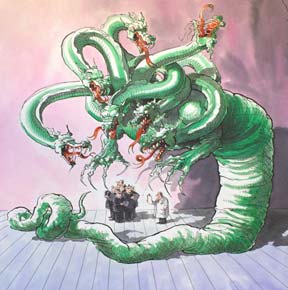
It’s not enough that the parasitic rich contribute only smoke and mirrors to the economy. Now the [investment] bank robbers are dropping even that pretext to demand that US taxpayers simply fork over the money. And don’t anyone try to follow them out.

Michael Hudson on paying for the bailout AND the fallout:

It is bad enough for the government to buy $700 billion of bad bank investments at prices that no private-sector investor has been willing to approach. This itself is an undeserved giveaway to the financial institutions that caused the problem by living recklessly in the short run. But making them – and indeed, helping them – pay back this gift with the aid of favorable tax and deregulatory policies will simply shift the cost off their shoulders onto those of bank depositors, credit-card users, mortgage borrowers and hapless pension-fund contributors to the money managers who have taken most of the current income in the form of commissions, salaries and bonuses to themselves. This will sharply add to the price of doing business in the United States, and specifically to the economy’s debt overhead by the banks making even more predatory loans.

It gets worse. In order for the existing junk mortgages to be “made good,” real estate prices must be raised further above the ability to pay for this year’s five million homeowners in arrears and facing default. Is this a good thing? Is it good to raise access prices for housing even more, forcing new homebuyers to go further into debt than ever before to gain access to housing? Mr. Paulson has directed the Federal Reserve, Fannie Mae, Freddie Mac and the FHA (Federal Housing Authority) to re-inflate the real estate market. They are to pump nearly a trillion dollars into the mortgage market.

Fiscal policy is also to be brought to bear to turn the real estate market around by pressuring cities and states to “help homeowners pay their mortgage debts” by cutting property taxes. The idea is to leave more revenue available for property owners to pay mortgage bankers. Unfortunately, this will oblige cities to make up these cuts by taxing labor and sales, running deeper into debt than they already are, or cutting back their spending on basic infrastructure, education and public services and continue shortchanging their pension funds. This is the price to be exacted to “protect the taxpayer’s interest” by bailing out irresponsible banks. The solution is to let them make even more money by acting in a yet more predatory way.

And:

The most egregious pretense is that the problem is only temporary, not structural. We are merely “freeing up” the market for new loans. This is precisely the opposite of what the classical economists meant by “free markets.” What America has is a bad debt problem, not a “liquidity” problem. There is no “illiquidity” when people refuse to buy a junk mortgage on a property worth only a fraction of the mortgage’s face value. Many of these bad mortgage loans are fraudulent. The Treasury bailout seeks to make $700 billion of fictitious financial claims “real” – that is, way overvalued as compared to their actual worth(lessness).

A letter from an American Soldier

I received a well written letter yesterday from an American Soldier. It was addressed to me, but I thought I’d post his arguments for general comment.

Mr. Verlo,

I stumbled upon your website by a pure stroke of accidental misfortune while searching for current news on the Fort Carson Installation.. My wife, my son and I are from Colorado, and I am an American Soldier. I am college educated and studied Middle-Eastern history, and I am well versed as it pertains to Mesopotamia, global-terror and global insurgencies.

I have deployed to Iraq twice and Afghanistan once. In 2003-2004 I served in Al-Fallujah and Ar-Ramadi in the Al-Anbar province, and in 2005-2006 in Tal’afar in the western Ninewah province with the 3d Armored Cavalry from Fort Carson (maybe you heard about the letter that Najim Abdullah wrote to George Bush about my unit?).

I spent seven months in Afghanistan training Afghani Security Forces, and would go back again to either country to serve for one reason only: to support my Soldiers. Although I am career-military, I do not now, nor did I ever support the Bush Administration or the pretenses under which we invaded Iraq. But, unfortunately, our elected officials thrust us into this mess, and we (Americans and American Military alike) are essentially left to deal with it. I am writing to you to comment on a few articles that you have authored, and provide my own opinions and citations.

First, in your article titled: “It’s in the Percentages”, you note that “apparently” 30% of Soldiers don’t have a high school education, 30% are returning with PTSD and 25% percent of their children are considered “special needs”. These are very interesting statistics, yet, you provided no citations. You go on to state that (and I quote): “I find it an absolute nightmare to imagine soldiers in positions of authority, making life and death decisions over others, who don’t know right from wrong, history from high stakes poker, or intelligence from drunken stupor. How do you reason with someone whose only motivation is their next beer?” and “It’s a war crime to subject civilian populations to rule by incompetents”. Again, very interesting. Here are some solid statistics for you, as well as citations. I chose to contrast military service members to college students in this case, but the same could be applied to any demographic (i.e., individuals who were recently laid off nation-wide, or illegal immigrants).

– 40% of college students who come from middle to upper class families engage in binge drinking on a regular (weekly) basis, as opposed to 26% of military personnel who have recently returned from combat tours overseas, where they suffered some sort of physical and/or emotional trauma (ABC news poll, 2007/2008). In addition, over 22,000 service members have called suicide hotlines in an attempt to get help (VA poll, 2008).

– 20% of college students engage in heavy drug use, as opposed to less than 5% of military personnel (ABC News Poll, 2007).

Here’s my favorite one:

3% of all college women report sexual assault at some point in their college career. In 2007, there were 2,212 reported cases of sexual assault on military installations by service members. In a military that exceeds roughly 2,000,000 people, that’s less than 1%.

Second, in your article titled: “Turning out to support fewer Troops”, you allude to Soldiers “riding in on a black cloud”. Hmmm, I’m not quite sure I understand that one. Is this a reference to the environmental damage we do with our vehicles, or the perceived “evil” that we bring with us because we are all, in fact, rapists, murderers and psychopaths?

Third, in your article titled: “Colorado Springs Military Community”, you state that (and I quote) “FIVE MAJOR MILITARY INSTALLATIONS ALREADY AND THE CITY AND COUNTY ARE BROKE”. El Paso County is broke? Since when? I would love to see a citation in reference to this one, because I have “Googled” it to no end and have found nothing that would lead me to believe anything but the contrary. The Colorado Springs Economic Development Corporation reports that: “Colorado Springs has a 3.1 million labor force within an hour radius, a Fast track permitting and planning program (30-60 days), 27 Fortune 500 Companies and a quality of life which is 70% the cost of coastal communities” (CSEDC 2008).

Sir, I have read your opinions on the media (many of which I share with you, by the way), so I would presume that you think this is a fabrication. Here’s the bottom line; the military presence in Colorado (the big, scary war-machine that we are) boosts the economy of the area due to its service members buying cars, houses (and paying taxes on their properties), shopping at local businesses, applying for and receiving loans from local banks, etc. There is no doubt in my mind that if the military left Colorado Springs, the city would continue to thrive, but the economy would noticeably decline anywhere that 30,000 people leave, military or not.

Fourth and final, in your article titled: “On Jan 14 let us not expand Fort Carson”, you state that more military in the area would make (and I quote) “Colorado Springs even more dependent on poor paying jobs, predatory businesses, and skyrocketing social problems. Only developers, car-dealers, pawn shops, strip clubs, liquor stores, social workers, jails and mortuaries benefit from a higher soldier population”. Wow, seriously? These are only issues tied to the influx of more military in the area? So, if 3,000 recently released convicted felons chose Colorado Springs as their new home, it would have less of an impact? Or how about 3,000 illegal immigrants, or 3,000 pregnant teenagers?

Well, let’s go ahead and analyze this a bit further. Developers and car-dealers will benefit from ANY new arrivals to the area, not just military. In reference to pawn shops and strip clubs, the owners of these businesses know exactly what they are doing by placing them outside of military installations. Service members are targeted by these establishments. That’s why they are placed where they are in the community. The same can be said for pay-day loan houses and used car dealerships on Powers and Academy blvd. But if you placed strip clubs next to colleges, would it still be the military that held the higher attendance record? It’s all about business strategy my friend, not the assumption that all military service members are sex-crazed, alcoholic lunatics.

Social workers, jails and mortuaries benefit wherever there are people with problems, criminals and people who have died. I suppose that again, it’s only military who fall into these categories. Ah yes, and our children are even more screwed up than we are. The fact that you said (and I quote): “The rest of us suffer increased crime and their children’s behavioral problems in our schools” vividly displays your utter incompetence and lack of any compassionate notion. You realize that less than 30% of military children who have been separated from a parent experience behavioral issues (USA Today poll, 2008)? The percentage of non-military children who experience behavioral issues as a result of a parent’s incarceration, or divorce, or even domestic abuse is almost twice as high.

Sir, I will be the first to admit that military service members are not perfect. But we are human beings, who are susceptible to the same things that civilians are. We are an easy target, because so many of us are returning home from Iraq and Afghanistan with severe problems, after having served in a war that has lost most of it’s public support (and rightly so).

What I have a hard time understanding is why people such as you exercise your freedoms of speech, protest, religion, etc, and then malign the very people who provide, protect and preserve those liberties? I am as anti-Bush as the average American left-wing protestor, but to blame service members for the actions of their elected leadership is immoral. You are essentially grouping us with Nazi’s, which is absolutely ridiculous. The Nazis’ goal was global domination, and they had no clearly defined rule of engagement. They knew that what they were doing was wrong, and did it anyway.

Does the US Military have people who behave in this manner? Absolutely, and they are dealt with within the justice system for their actions. We are in fact “just following orders” with our presence in the Middle-East. As I realize that this was also the defense of Nazi war criminals at Nurnberg, allow me to elaborate. The US military has clearly defined Rules of Engagement, and our greater mission is to stabilize an unstable region, not global control as conspiracy theorists would have everyone believe. Unless you have a solid understanding of counter-terror and counterinsurgency doctrine, you are in no position to presume anything about the US Military in the Middle-East (unless YOU have been there) other than the fact that we invaded Iraq under false pretenses. I’ll give you that one, and take it for myself as well.

Sir, have you ever held a young Iraqi child in your arms, returning him to his parents as they kiss you and your Soldiers’ cheeks, after he had been treated at a US facility because terrorists sodomized him and cut out his tongue? Have you ever looked straight into the eyes of a terrorist, who swore allegiance to Zarqawi and proclaimed himself a “holy warrior”, and seen pure evil? And while your medical personnel treated him for burns (which were sustained when he poured kerosene on a child and his father and attempted to set them on fire publicly, only succeeding to set himself on fire) he spoke perfect English and vowed to remember your name and kill your family? I presume you would view this as our fault, correct?

But here’s the difference between the American Soldier and everyone else: when it is our fault, we acknowledge it, and DO something about it. We help people, good and bad, bottom line. Do bad things happen? Of course. Are all Soldiers and Marines upright citizens? Of course not.. That’s why one Marine out of 30,000 threw a puppy off of a cliff, and four Soldiers out of 121,000 raped a 14-year old girl and killed her family. These actions were inexcusable and tragic, and the individuals in question were/are being dealt with. To generalize every American service member based on these isolated incidents vividly shows your lack of any rational thought.

So in closing, allow me to say that whether you care to acknowledge it or not, it is the MILITARY who grant and preserve liberties and who TRULY make a difference, not politicians, protestors, or half-minded anti-war bloggers. And understand (or don’t) why we are involved in the Global War on Terror, it is because it doesn’t matter whether or not you are white, black, Canadian, American, gay, straight, blind, deaf, or how many anti-Bush websites you manage or protests you attend, there are fundamentalist extremists who want to murder you and your family because you represent western culture.

I want this war to be over so badly that it consumes me at times. I do not want my son to have to see what I have seen as a result of a failed administration. Sir, we are human beings also, and I gladly serve to protect the liberty and freedom of individuals like you who don’t support me at all. So at your next rally, or the next article you write which slanders US service members, take a moment to reflect on your freedoms, and understand who it is that truly grants them. I wish you all continued health and happiness.

Sincerely,

[D.]

Your vote just doesn’t count in the two party dictatorship

Hydra …Dictatorships have gotten wise. It is easier to run a dictatorship when you present the public with two parties instead of one. Dictatorial Power no longer resides in just one single individual in today’s dictatorship, but within one power bloc instead. The public face of today’s dictatorship is a bureaucratic assemble of hacks, not just the face of one Supremo.
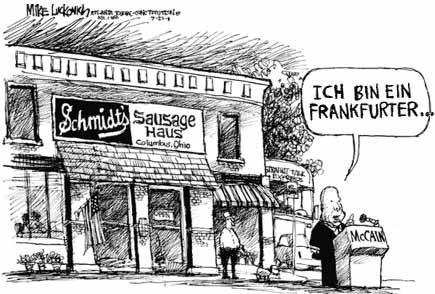
Take the current American dictatorship for an example (though Mexico’s current dictatorship is run exactly the same way, and if the American public was more familiar with Mexico would be just as illustrative as the American dictatorship itself is), where dictatorial power resides in a bureaucratic assemble of a bloc of bipartisan DP-RP hacks. We shall look at the present US government drive towards war with Russia as our example.

The public face of the American dictatorship comes in condensed form through the faces of about 6 individuals; Obama, Biden, Cheney, Bush, McCain, Lieberman (very possibly the VP selection by McCain). All have been appointed more than truly elected, and all are united in the need for the US to attack Russia. Russia confronts not El Supremo but rather a six headed hydra of global business domination centered in the US.

A modern day American dictatorship is the viper we can all see publicly, but it is multi-faced, and not that of just one Gran Prepotente (Big Shot). Unfortunately, the public has a hard time truly understanding that the face of America’ modern dictatorship is truly not much different from dictatorship’s of the past, where Mr. Power Hog ruled over all.

In the past, the dictator put on a show election, but that is still how it is done today with the multi-headed Dictator Bloc, too. The show currently is in the pageantry at Denver and St. Paul. In both cases, your vote really need not be bothered to be counted, since the selection was already made for you by raw economic power, which you have none of.

Dictatorship has always resided in ownership, and today’s multi-headed hydra dictatorship for all its apparent differences with the past is no different. The dictatorship owns all; press, soldiers, police, banks, oil, money supply, jobs, the water and air your life depends on. Rebel, and they’ll take off the shirt on your back and the pants you wear, and give you those of their own which they will now own.

Well what about our example of the American dictatorship confronting Russia? It is obvious to see for all that should look and think, that the 6 headed hydra of Obama, Biden, Cheney, Bush, McCain, Lieberman all have obtained ‘consensus’ to rule just like a one headed El Supremo style dictatorship would. They are all for using the Pentagon and NATO to attack Russia. Your vote doesn’t count in the 2 party dictatorship! It’s because the America you live in is a dictatorship. Vote if it makes you feel good but don’t be under any delusions about it.

HYDRA

George W. McCain: Because facing reality is just too scary.

McCain makes stateside Berliner speech
The McCain transmogrification into a ZombieCon has accelerated, he now supports a bill to end affirmative action, a bill he previously opposed.

It all depends on McCain’s definition of “success.” Today 75 people were killed, and 300 wounded, in suicide attacks in Iraq. The only thing the S[pl]urge has succeeded at is pumping another hundred billion of your future tax dollars into the accounts of the war profiteers.

You say Silverado, I say Silverstate. McCain’s son, Andrew, has suddenly resigned from the boards of two failing banks. Maybe his middle name is “Neil?”

Disabled American Veterans cancels Cheney invite, after he all but demands waterboarding of guests.

Senator Jack Reed (D-RI) says America can’t afford to keep giving Bush blank checks for the war. Wow, he must really think we are stupid, since Democrats are the ones who keep giving an endless supply of blank checks to Bush.

Murder in Jesus name. NeoChristian terrorist kills 2, wounds 7, in church shooting.

Excerpts from Thomas McCullock’s notes July 28, thomasmc.com.

Global economic rapists are at it again

G8 protest
Why protest the G8 Summit July 7-9? Those hoodlums always look so determined. Here’s the rationale by the Emergency Exit Collective:

The 2008 G8 on Hokkaido, a Strategic Assessment
Emergency Exit Collective
Bristol, Mayday, 2008

The authors of this document are a collection of activists, scholars, and writers currently based in the United States and Western Europe who have gotten to know and work with each other in the movement against capitalist globalization. We’re writing this at the request of some members of No! G8 Action Japan, who asked us for a broad strategic analysis of the state of struggle as we see it, and particularly, of the role of the G8, what it represents, the dangers and opportunities that may lie hidden in the moment. It is in no sense programmatic. Mainly, it is an attempt to develop tools that we hope will be helpful for organizers, or for anyone engaged in the struggle against global capital.

I
It is our condition as human beings that we produce our lives in common.

II
Let us then try to see the world from the perspective of the planet’s commoners, taking the word in that sense: those whose most essential tradition is cooperation in the making and maintenance of human social life, yet who have had to do so under conditions of suffering and separation; deprived, ignored, devalued, divided into hierarchies, pitted against each other for our very physical survival. In one sense we are all commoners. But it’s equally true that just about everyone, at least in some ways, at some points, plays the role of the rulers—of those who expropriate, devalue and divide—or at the very least benefits from such divisions.

Obviously some do more than others. It is at the peak of this pyramid that we encounter groups like the G8.

III
The G8’s perspective is that of the aristocrats, the rulers: those who command and maintain that global machinery of violence that defends existing borders and lines of separation: whether national borders with their detention camps for migrants, or property regimes, with their prisons for the poor. They live by constantly claiming title to the products of others collective creativity and labour, and in thus doing they create the poor; they create scarcity in the midst of plenty, and divide us on a daily basis; they create financial districts that loot resources from across the world, and in thus doing they turn the spirit of human creativity into a spiritual desert; close or privatize parks, public water taps and libraries, hospitals, youth centers, universities, schools, public swimming pools, and instead endlessly build shopping malls that channels convivial life into a means of commodity circulation; work toward turning global ecological catastrophe into business opportunities.

These are the people who presume to speak in the name of the “international community” even as they hide in their gated communities or meet protected by phalanxes of riot cops. It is critical to bear in mind that the ultimate aim of their policies is never to create community but to introduce and maintain divisions that set common people at each other’s throats. The neoliberal project, which has been their main instrument for doing so for the last three decades, is premised on a constant effort either to uproot or destroy any communal or democratic system whereby ordinary people govern their own affairs or maintain common resources for the common good, or, to reorganize each tiny remaining commons as an isolated node in a market system in which livelihood is never guaranteed, where the gain of one community must necessarily be at the expense of others. Insofar as they are willing to appeal to high-minded principles of common humanity, and encourage global cooperation, only and exactly to the extent that is required to maintain this system of universal competition.

IV
At the present time, the G8—the annual summit of the leaders of “industrial democracies”—is the key coordinative institution charged with the task of maintaining this neoliberal project, or of reforming it, revising it, adapting it to the changing condition of planetary class relations. The role of the G8 has always been to define the broad strategic horizons through which the next wave of planetary capital accumulation can occur. This means that its main task is to answer the question of how 3?4 in the present conditions of multiple crises and struggles 3?4 to subordinate social relations among the producing commoners of the planet to capital’s supreme value: profit.

V
Originally founded as the G7 in 1975 as a means of coordinating financial strategies for dealing with the ‘70s energy crisis, then expanded after the end of the Cold War to include Russia, its currently face a moment of profound impasse in the governance of planetary class relations: the greatest since the ‘70s energy crisis itself.

VI
The ‘70s energy crisis represented the final death-pangs of what might be termed the Cold War settlement, shattered by a quarter century of popular struggle. It’s worth returning briefly to this history.

The geopolitical arrangements put in place after World War II were above all designed to forestall the threat of revolution. In the immediate wake of the war, not only did much of the world lie in ruins, most of world’s population had abandoned any assumption about the inevitability of existing social arrangements. The advent of the Cold War had the effect of boxing movements for social change into a bipolar straightjacket. On the one hand, the former Allied and Axis powers that were later to unite in the G7 (the US, Canada, UK, France, Italy, Germany, Japan)—the “industrialized democracies”, as they like to call themselves—engaged in a massive project of co-optation. Their governments continued the process, begun in the ‘30s, of taking over social welfare institutions that had originally been created by popular movements (from insurance schemes to public libraries), even to expand them, on condition that they now be managed by state-appointed bureaucracies rather than by those who used them, buying off unions and the working classes more generally with policies meant to guarantee high wages, job security and the promise of educational advance—all in exchange for political loyalty, productivity increases and wage divisions within national and planetary working class itself. The Sino-Soviet bloc—which effectively became a kind of junior partner within the overall power structure, and its allies remained to trap revolutionary energies into the task of reproducing similar bureaucracies elsewhere. Both the US and USSR secured their dominance after the war by refusing to demobilize, instead locking the planet in a permanent threat of nuclear annihilation, a terrible vision of absolute cosmic power.

VII
Almost immediately, though, this arrangement was challenged by a series of revolts from those whose work was required to maintain the system, but who were, effectively, left outside the deal: first, peasants and the urban poor in the colonies and former colonies of the Global South, next, disenfranchised minorities in the home countries (in the US, the Civil Rights movement, then Black Power), and finally and most significantly, by the explosion of the women’s movement of the late ‘60s and early ‘70s—the revolt of that majority of humanity whose largely unremunerated labor made the very existence “the economy” possible. This appears to have been the tipping point.

VIII
The problem was that the Cold War settlement was never meant to include everyone. It by definition couldn’t. Once matters reached tipping point, then, the rulers scotched the settlement. All deals were off. The oil shock was first edge of the counter-offensive, breaking the back of existing working class organizations, driving home the message that there was nothing guaranteed about prosperity. Under the aegis of the newly hatched G7, this counter-offensive involved a series of interwoven strategies that were later to give rise to what is known as neoliberalism.

IX
These strategies resulted in what came to be known as “Structural Adjustment” both in the North and in the South, accompanied by trade and financial liberalization. This, in turn, made possible crucial structural changes in our planetary production in common extending the role of the market to discipline our lives and divide us into more and more polarized wage hierarchy. This involved:

· In the immediate wake of ‘70s oil shock, petrodollars were recycled from OPEC into Northern banks that then lent them, at extortionate rates of interest, to developing countries of the Global South. This was the origin of the famous “Third World Debt Crisis.” The existence of this debt allowed institutions like the IMF to impose its monetarist orthodoxy on most of the planet for roughly twenty years, in the process, stripping away most of even those modest social protections that had been won by the world’s poor—large numbers of whom were plunged into a situation of absolute desperation.

· It also opened a period of new enclosures through the capitalist imposition of structural adjustment policies, manipulation of environmental and social catastrophes like war, or for that matter through the authoritarian dictates of “socialist” regimes. Through such means, large sections of the world’s population have over the past thirty years been dispossessed from resources previously held in common, either by dint of long traditions, or as the fruits of past struggles and past settlements.

· Through financial deregulation and trade liberalization, neoliberal capital, which emerged from the G7 strategies to deal with the 1970s crisis aimed thus at turning the “class war” in communities, factories, offices, streets and fields against the engine of competition, into a planetary “civil war”, pitting each community of commoners against every other community of commoners.

· Neoliberal capital has done this by imposing an ethos of “efficiency” and rhetoric of “lowering the costs of production” applied so broadly that mechanisms of competition have come to pervade every sphere of life. In fact these terms are euphemisms, for a more fundamental demand: that capital be exempt from taking any reduction in profit to finance the costs of reproduction of human bodies and their social and natural environments (which it does not count as costs) and which are, effectively, “exernalized” onto communities and nature.

· The enclosure of resources and entitlements won in previous generations of struggles both in the North and the South, in turn, created the conditions for increasing the wage hierarchies (both global and local), by which commoners work for capital—wage hierarchies reproduced economically through pervasive competition, but culturally, through male dominance, xenophobia and racism. These wage gaps, in turn, made it possible to reduce the value of Northern workers’ labour power, by introducing commodities that enter in their wage basket at a fraction of what their cost might otherwise have been. The planetary expansion of sweatshops means that American workers (for example) can buy cargo pants or lawn-mowers made in Cambodia at Walmart, or buy tomatoes grown by undocumented Mexican workers in California, or even, in many cases, hire Jamaican or Filipina nurses to take care of children and aged grandparents at such low prices, that their employers have been able to lower real wages without pushing most of them into penury. In the South, meanwhile, this situation has made it possible to discipline new masses of workers into factories and assembly lines, fields and offices, thus extending enormously capital’s reach in defining the terms—the what, the how, the how much—of social production.

· These different forms of enclosures, both North and South, mean that commoners have become increasingly dependent on the market to reproduce their livelihoods, with less power to resist the violence and arrogance of those whose priorities is only to seek profit, less power to set a limit to the market discipline running their lives, more prone to turn against one another in wars with other commoners who share the same pressures of having to run the same competitive race, but not the same rights and the same access to the wage. All this has meant a generalized state of precarity, where nothing can be taken for granted.

X
In turn, this manipulation of currency and commodity flows constituting neoliberal globalization became the basis for the creation of the planet’s first genuine global bureaucracy.

· This was multi-tiered, with finance capital at the peak, then the ever-expanding trade bureaucracies (IMF, WTO, EU, World Bank, etc), then transnational corporations, and finally, the endless varieties of NGOs that proliferated throughout the period—almost all of which shared the same neoliberal orthodoxy, even as they substituted themselves for social welfare functions once reserved for states.

· The existence of this overarching apparatus, in turn, allowed poorer countries previously under the control of authoritarian regimes beholden to one or another side in the Cold War to adopt “democratic” forms of government. This did allow a restoration of formal civil liberties, but very little that could really merit the name of democracy (the rule of the “demos”, i.e., of the commoners). They were in fact constitutional republics, and the overwhelming trend during the period was to strip legislatures, that branch of government most open to popular pressure, of most of their powers, which were increasingly shifted to the executive and judicial branches, even as these latter, in turn, largely ended up enacting policies developed overseas, by global bureaucrats.

· This entire bureaucratic arrangement was justified, paradoxically enough, by an ideology of extreme individualism. On the level of ideas, neoliberalism relied on a systematic cooptation of the themes of popular struggle of the ‘60s: autonomy, pleasure, personal liberation, the rejection of all forms of bureaucratic control and authority. All these were repackaged as the very essence of capitalism, and the market reframed as a revolutionary force of liberation.

· The entire arrangement, in turn, was made possible by a preemptive attitude towards popular struggle. The breaking of unions and retreat of mass social movements from the late ‘70s onwards was only made possible by a massive shift of state resources into the machinery of violence: armies, prisons and police (secret and otherwise) and an endless variety of private “security services”, all with their attendant propaganda machines, which tended to increase even as other forms of social spending were cut back, among other things absorbing increasing portions of the former proletariat, making the security apparatus an increasingly large proportion of total social spending. This approach has been very successful in holding back mass opposition to capital in much of the world (especially West Europe and North America), and above all, in making it possible to argue there are no viable alternatives. But in doing so, has created strains on the system so profound it threatens to undermine it entirely.

XI
The latter point deserves elaboration. The element of force is, on any number of levels, the weak point of the system. This is not only on the constitutional level, where the question of how to integrate the emerging global bureaucratic apparatus, and existing military arrangements, has never been resolved. It is above all an economic problem. It is quite clear that the maintenance of elaborate security machinery is an absolute imperative of neoliberalism. One need only observe what happened with the collapse of the Soviet bloc in Eastern Europe: where one might have expected the Cold War victors to demand the dismantling of the army, secret police and secret prisons, and to maintain and develop the existing industrial base, in fact, what they did was absolutely the opposite: in fact, the only part of the industrial base that has managed fully to maintain itself has been the parts required to maintained the security apparatus itself! Critical too is the element of preemption: the governing classes in North America, for example, are willing to go to almost unimaginable lengths to ensure social movements never feel they are accomplishing anything. The current Gulf War is an excellent example: US military operations appear to be organized first and foremost to be protest-proof, to ensure that what happened in Vietnam (mass mobilization at home, widespread revolt within the army overseas) could never be repeated. This means above all that US casualties must always be kept to a minimum. The result are rules of engagement, and practices like the use of air power within cities ostensibly already controlled by occupation forces, so obviously guaranteed to maximize the killing of innocents and galvanizing hatred against the occupiers that they ensure the war itself cannot be won. Yet this approach can be taken as the very paradigm for neoliberal security regimes. Consider security arrangements around trade summits, where police are so determined prevent protestors from achieving tactical victories that they are often willing to effectively shut down the summits themselves. So too in overall strategy. In North America, such enormous resources are poured into the apparatus of repression, militarization, and propaganda that class struggle, labor action, mass movements seem to disappear entirely. It is thus possible to claim we have entered a new age where old conflicts are irrelevant. This is tremendously demoralizing of course for opponents of the system; but those running the system seem to find that demoralization so essential they don’t seem to care that the resultant apparatus (police, prisons, military, etc) is, effectively, sinking the entire US economy under its dead weight.

XII
The current crisis is not primarily geopolitical in nature. It is a crisis of neoliberalism itself. But it takes place against the backdrop of profound geopolitical realignments. The decline of North American power, both economic and geopolitical has been accompanied by the rise of Northeast Asia (and to a increasing extent, South Asia as well). While the Northeast Asian region is still divided by painful Cold War cleavages—the fortified lines across the Taiwan straits and at the 38th parallel in Korea…—the sheer realities of economic entanglement can be expected to lead to a gradual easing of tensions and a rise to global hegemony, as the region becomes the new center of gravity of the global economy, of the creation of new science and technology, ultimately, of political and military power. This may, quite likely, be a gradual and lengthy process. But in the meantime, very old patterns are rapidly reemerging: China reestablishing relations with ancient tributary states from Korea to Vietnam, radical Islamists attempting to reestablish their ancient role as the guardians of finance and piety at the in the Central Asian caravan routes and across Indian Ocean, every sort of Medieval trade diaspora reemerging… In the process, old political models remerge as well: the Chinese principle of the state transcending law, the Islamic principle of a legal order transcending any state. Everywhere, we see the revival too of ancient forms of exploitation—feudalism, slavery, debt peonage—often entangled in the newest forms of technology, but still echoing all the worst abuses of the Middle Ages. A scramble for resources has begun, with US occupation of Iraq and saber-rattling throughout the surrounding region clearly meant (at least in part) to place a potential stranglehold the energy supply of China; Chinese attempts to outflank with its own scramble for Africa, with increasing forays into South America and even Eastern Europe. The Chinese invasion into Africa (not as of yet at least a military invasion, but already involving the movement of hundreds of thousands of people), is changing the world in ways that will probably be felt for centuries. Meanwhile, the nations of South America, the first victims of the “Washington consensus” have managed to largely wriggle free from the US colonial orbit, while the US, its forces tied down in the Middle East, has for the moment at least abandoned it, is desperately struggling to keep its grip Mexico, Central America and the Caribbean—its own “near abroad”.

XIII
In another age all this might have led to war—that is, not just colonial occupations, police actions, or proxy wars (which are obviously already taking place), but direct military confrontations between the armies of major powers. It still could; accidents happen; but there is reason to believe that, when it comes to moments of critical decision, the loyalties of the global elites are increasingly to each other, and not to the national entities for whom they claim to speak. There is some compelling evidence for this.

Take for example when the US elites panicked at the prospect of the massive budget surpluses of the late 1990s. As Alan Greenspan, head of the Federal Reserve at the time warned, if these were allowed to stand they would have flooded government coffers with so many trillions of dollars that it could only have lead to some form of creeping socialism, even, he predicted, to the government acquiring “equity stakes” in key US corporations. The more excitable of capitalism’s managers actually began contemplating scenarios where the capitalist system itself would be imperiled. The only possible solution was massive tax cuts; these were duly enacted, and did indeed manage to turn surpluses into enormous deficits, financed by the sale of treasury bonds to Japan and China. Conditions have thus now reached a point where it is beginning to look as if the most likely long term outcome for the US (its technological and industrial base decaying, sinking under the burden of its enormous security spending) will be to end up serve as junior partner and military enforcer for East Asia capital. Its rulers, or at least a significant proportion of them, would prefer to hand global hegemony to the rulers of China (provided the latter abandon Communism) than to return to any sort of New Deal compromise with their “own” working classes.

A second example lies in the origins of what has been called the current “Bretton Woods II” system of currency arrangements, which underline a close working together of some “surplus” and “deficit” countries within global circuits. The macroeconomic manifestation of the planetary restructuring outlined in XIX underlines both the huge US trade deficit that so much seem to worry many commentators, and the possibility to continually generate new debt instruments like the one that has recently resulted in the sub-prime crisis. The ongoing recycling of accumulated surplus of countries exporting to the USA such as China and oil producing countries is what has allowed financiers to create new credit instruments in the USA. Hence, the “deal” offered by the masters in the United States to its commoners has been this: ‘you, give us a relative social peace and accept capitalist markets as the main means through which you reproduce your own livelihoods, and we will give you access to cheaper consumption goods, access to credit for buying cars and homes, and access to education, health, pensions and social security through the speculative means of stock markets and housing prices.’ Similar compromises were reached in all the G8 countries.

Meanwhile, there is the problem of maintaining any sort of social peace with the hundreds of millions of unemployed, underemployed, dispossessed commoners currently swelling the shanty-towns of Asia, Africa, and Latin America as a result of ongoing enclosures (which have speeded up within China and India in particular, even as “structural adjustment policies” in Africa and Latin America have been derailed). Any prospect of maintaining peace in these circumstances would ordinarily require either extremely high rates of economic growth—which globally have not been forthcoming, since outside of China, growth rates in the developing world have been much lower than they were in the ‘50s, ‘60s, or even ‘70s—or extremely high levels of repression, lest matters descend into rebellion or generalized civil war. The latter has of course occurred in many parts of the world currently neglected by capital, but in favored regions, such as the coastal provinces of China, or “free trade” zones of India, Egypt, or Mexico, commoners are being offered a different sort of deal: industrial employment at wages that, while very low by international standards, are still substantially higher than anything currently obtainable in the impoverished countryside; and above all the promise, through the intervention of Western markets and (privatized) knowledge, of gradually improving conditions of living. While over the least few years wages in many such areas seem to be growing, thanks to the intensification of popular struggles, such gains are inherently vulnerable: the effect of recent food inflation has been to cut real wages back dramatically—and threaten millions with starvation.

What we really want to stress here, though, is that the long-term promise being offered to the South is just as untenable as the idea that US or European consumers can indefinitely expand their conditions of life through the use of mortgages and credit cards.

What’s being offered the new dispossessed is a transposition of the American dream. The idea is that the lifestyle and consumption patterns of existing Chinese, Indian, or Brazilian or Zambian urban middle classes (already modeled on Northern ones) will eventually become available to the children of today’s miners, maquila or plantation laborers, until, ultimately, everyone on earth is brought up to roughly the same level of consumption. Put in these terms, the argument is absurd. The idea that all six billion of us can become “middle class” is obviously impossible. First of all there is a simple problem of resources. It doesn’t matter how many bottles we recycle or how energy efficient are the light bulbs we use, there’s just no way the earth’s ecosystem can accommodate six billion people driving in private cars to work in air-conditioned cubicles before periodically flying off to vacation in Acapulco or Tahiti. To maintain the style of living and producing in common we now identify with “middle classness” on a planetary scale would require several additional planets.

This much has been pointed out repeatedly. But the second point is no less important. What this vision of betterment ultimately proposes is that it would be possible to build universal prosperity and human dignity on a system of wage labor. This is fantasy. Historically, wages are always the contractual face for system of command and degradation, and a means of disguising exploitation: expressing value for work only on condition of stealing value without work— and there is no reason to believe they could ever be anything else. This is why, as history has also shown, human beings will always avoid working for wages if they have any other viable option. For a system based on wage labor to come into being, such options must therefore be made unavailable. This in turn means that such systems are always premised on structures of exclusion: on the prior existence of borders and property regimes maintained by violence. Finally, historically, it has always proved impossible to maintain any sizeable class of wage-earners in relative prosperity without basing that prosperity, directly or indirectly, on the unwaged labor of others—on slave-labor, women’s domestic labor, the forced labor of colonial subjects, the work of women and men in peasant communities halfway around the world—by people who are even more systematically exploited, degraded, and immiserated. For that reason, such systems have always depended not only on setting wage-earners against each other by inciting bigotry, prejudice, hostility, resentment, violence, but also by inciting the same between men and women, between the people of different continents (“race”), between the generations.

From the perspective of the whole, then, the dream of universal middle class “betterment” must necessarily be an illusion constructed in between the Scylla of ecological disaster, and the Charybdis of poverty, detritus, and hatred: precisely, the two pillars of today’s strategic impasse faced by the G8.

XIV
How then do we describe the current impasse of capitalist governance?

To a large degree, it is the effect of a sudden and extremely effective upswing of popular resistance—one all the more extraordinary considering the huge resources that had been invested in preventing such movements from breaking out.

On the one hand, the turn of the millennium saw a vast and sudden flowering of new anti-capitalist movements, a veritable planetary uprising against neoliberalism by commoners in Latin America, India, Africa, Asia, across the North Atlantic world’s former colonies and ultimately, within the cities of the former colonial powers themselves. As a result, the neoliberal project lies shattered. What came to be called the “anti-globalization” movement took aim at the trade bureaucracies—the obvious weak link in the emerging institutions of global administration—but it was merely the most visible aspect of this uprising. It was however an extraordinarily successful one. Not only was the WTO halted in its tracks, but all major trade initiatives (MAI, FTAA…) scuttled. The World Bank was hobbled and the power of the IMF over most of the world’s population, effectively, destroyed. The latter, once the terror of the Global South, is now a shattered remnant of its former self, reduced to selling off its gold reserves and desperately searching for a new global mission.

In many ways though spectacular street actions were merely the most visible aspects of much broader changes: the resurgence of labor unions, in certain parts of the world, the flowering of economic and social alternatives on the grassroots levels in every part of the world, from new forms of direct democracy of indigenous communities like El Alto in Bolivia or self-managed factories in Paraguay, to township movements in South Africa, farming cooperatives in India, squatters’ movements in Korea, experiments in permaculture in Europe or “Islamic economics” among the urban poor in the Middle East. We have seen the development of thousands of forms of mutual aid association, most of which have not even made it onto the radar of the global media, often have almost no ideological unity and which may not even be aware of each other’s existence, but nonetheless share a common desire to mark a practical break with capitalism, and which, most importantly, hold out the prospect of creating new forms of planetary commons that can—and in some cases are—beginning to knit together to provide the outlines of genuine alternative vision of what a non-capitalist future might look like.

The reaction of the world’s rulers was predictable. The planetary uprising had occurred during a time when the global security apparatus was beginning to look like it lacked a purpose, when the world threatened to return to a state of peace. The response—aided of course, by the intervention of some of the US’ former Cold War allies, reorganized now under the name of Al Qaeda—was a return to global warfare. But this too failed. The “war on terror”—as an attempt to impose US military power as the ultimate enforcer of the neoliberal model—has collapsed as well in the face of almost universal popular resistance. This is the nature of their “impasse”.

At the same time, the top-heavy, inefficient US model of military capitalism—a model created in large part to prevent the dangers of social movements, but which the US has also sought to export to some degree simply because of its profligacy and inefficiency, to prevent the rest of the world from too rapidly overtaking them—has proved so wasteful of resources that it threatens to plunge the entire planet into ecological and social crisis. Drought, disaster, famines, combine with endless campaigns of enclosure, foreclosure, to cast the very means of survival—food, water, shelter—into question for the bulk of the world’s population.

XV
In the rulers’ language the crisis understood, first and foremost, as a problem of regulating cash flows, of reestablishing, as they like to put it, a new “financial architecture”. Obviously they are aware of the broader problems. Their promotional literature has always been full of it. From the earliest days of the G7, through to the days after the Cold War, when Russia was added as a reward for embracing capitalism, they have always claimed that their chief concerns include

· the reduction of global poverty

· sustainable environmental policies

· sustainable global energy policies

· stable financial institutions governing global trade and currency transactions

If one were to take such claims seriously, it’s hard to see their overall performance as anything but a catastrophic failure. At the present moment, all of these are in crisis mode: there are food riots, global warming, peak oil, and the threat of financial meltdown, bursting of credit bubbles, currency crises, a global credit crunch. [**Failure on this scale however, opens opportunities for the G8 themselves, as summit of the global bureaucracy, to reconfigure the strategic horizon. Therefore, it’s always with the last of these that they are especially concerned. ]The real problem, from the perspective of the G8, is one of reinvestment: particularly, of the profits of the energy sector, but also, now, of emerging industrial powers outside the circle of the G8 itself. The neoliberal solution in the ‘70s had been to recycle OPEC’s petrodollars into banks that would use it much of the world into debt bondage, imposing regimes of fiscal austerity that, for the most part, stopped development (and hence, the emergence potential rivals) in its tracks. By the ‘90s, however, much East Asia in particular had broken free of this regime. Attempts to reimpose IMF-style discipline during the Asian financial crisis of 1997 largely backfired. So a new compromise was found, the so-called Bretton Woods II: to recycle the profits from the rapidly expanding industrial economies of East Asia into US treasury debt, artificially supporting the value of the dollar and allowing a continual stream of cheap exports that, aided by the US housing bubble, kept North Atlantic economies afloat and buy off workers there with cheap oil and even cheaper consumer goods even as real wages shrank. This solution however soon proved a temporary expedient. Bush regime’s attempt to lock it in by the invasion of Iraq, which was meant to lead to the forced privatization of Iraqi oil fields, and, ultimately, of the global oil industry as a whole, collapsed in the face of massive popular resistance (just as Saddam Hussein’s attempt to introduce neoliberal reforms in Iraq had failed when he was still acting as American deputy in the ‘90s). Instead, the simultaneous demand for petroleum for both Chinese manufacturers and American consumers caused a dramatic spike in the price of oil. What’s more, rents from oil and gas production are now being used to pay off the old debts from the ‘80s (especially in Asia and Latin America, which have by now paid back their IMF debts entirely), and—increasingly—to create state-managed Sovereign Wealth Funds that have largely replaced institutions like the IMF as the institutions capable of making long-term strategic investments. The IMF, purposeless, tottering on the brink of insolvency, has been reduced to trying to come up with “best practices” guidelines for fund managers working for governments in Singapore, Seoul, and Abu Dhabi.

There can be no question this time around of freezing out countries like China, India, or even Brazil. The question for capital’s planners, rather, is how to channel these new concentrations of capital in such a way that they reinforce the logic of the system instead of undermining it.

XVI
How can this be done? This is where appeals to universal human values, to common membership in an “international community” come in to play. “We all must pull together for the good of the planet,” we will be told. The money must be reinvested “to save the earth.”

To some degree this was always the G8 line: this is a group has been making an issue of climate change since 1983. Doing so was in one sense a response to the environmental movements of the ‘70s and ‘80s. The resultant emphasis on biofuels and “green energy” was from their point of view, the perfect strategy, seizing on an issue that seemed to transcend class, appropriating ideas and issues that emerged from social movements (and hence coopting and undermining especially their radical wings), and finally, ensuring such initiatives are pursued not through any form of democratic self-organization but “market mechanisms”—to effective make the sense of public interest productive for capitalism.

What we can expect now is a two-pronged attack. On the one hand, they will use the crisis to attempt to reverse the gains of past social movements: to put nuclear energy back on the table to deal with the energy crisis and global warming, or genetically modified foods to deal with the food crisis. Prime Minister Fukuda, the host of the current summit, for example, is already proposing the nuclear power is the “solution” to the global warming crisis, even as the German delegation resists. On the other, and even more insidiously, they will try once again to co-opt the ideas and solutions that have emerged from our struggles as a way of ultimately undermining them. Appropriating such ideas is simply what rulers do: the bosses brain is always under the workers’ hat. But the ultimate aim is to answer the intensification of class struggle, of the danger of new forms of democracy, with another wave of enclosures, to restore a situation where commoners’ attempts to create broader regimes of cooperation are stymied, and people are plunged back into mutual competition.

We can already see the outlines of how this might be done. There are already suggestions that Sovereign Wealth Funds put aside a certain (miniscule) proportion of their money for food aid, but only as tied to a larger project of global financial restructuring. The World Bank, largely bereft of its earlier role organizing dams and pipe-lines across the world, has been funding development in China’s poorer provinces, freeing the Chinese government to carry out similar projects in Southeast Asia, Africa, and even Latin America (where, of course, they cannot effectively be held to any sort of labor or environmental standards). There is the possibility of a new class deal in China itself, whose workers can be allowed higher standards of living if new low wage zones are created elsewhere—for instance, Africa (the continent where struggles over maintaining the commons have been most intense in current decades)—with the help of Chinese infrastructural projects. Above of all, money will be channeled into addressing climate change, into the development of alternative energy, which will require enormous investments, in such a way as to ensure that whatever energy resources do become important in this millennium, they can never be democratized—that the emerging notion of a petroleum commons, that energy resources are to some degree a common patrimony meant primarily to serve the community as a whole, that is beginning to develop in parts of the Middle East and South America—not be reproduced in whatever comes next.

Since this will ultimately have to be backed up by the threat of violence, the G8 will inevitably have to struggle with how to (yet again) rethink enforcement mechanisms. The latest move , now that the US “war on terror” paradigm has obviously failed, would appear to be a return to NATO, part of a reinvention of the “European security architecture” being proposed at the upcoming G8 meetings in Italy in 2009 on the 60th anniversary of NATO’s foundation—but part of a much broader movement of the militarization of social conflict, projecting potential resource wars, demographic upheavals resulting from climate change, and radical social movements as potential military problems to be resolved by military means. Opposition to this new project is already shaping up as the major new European mobilization for the year following the current G-8.

XVII
While the G-8 sit at the pinnacle of a system of violence, their preferred idiom is monetary. Their impulse whenever possible is to translate all problems into money, financial structures, currency flows—a substance whose movements they carefully monitor and control.

Money, on might say, is their poetry—a poetry whose letters are written in our blood. It is their highest and most abstract form of expression, their way of making statements about the ultimate truth of the world, even if it operates in large part by making things disappear. How else could it be possible to argue—no, to assume as a matter of common sense—that the love, care, and concern of a person who tends to the needs of children, teaching, minding, helping them to become decent , thoughtful, human beings, or who grows and prepares food, is worth ten thousand times less than someone who spends the same time designing a brand logo, moving abstract blips across a globe, or denying others health care.

The role of money however has changed profoundly since 1971 when the dollar was delinked from gold. This has created a profound realignment of temporal horizons. Once money could be said to be primarily congealed results of past profit and exploitation. As capital, it was dead labor. Millions of indigenous Americans and Africans had their lives pillaged and destroyed in the gold mines in order to be rendered into value. The logic of finance capital, of credit structures, certainly always existed as well (it is at least as old as industrial capital; possibly older), but in recent decades these logic of financial capital has come to echo and re-echo on every level of our lives. In the UK 97% of money in circulation is debt, in the US, 98%. Governments run on deficit financing, wealthy economies on consumer debt, the poor are enticed with microcredit schemes, debts are packaged and repackaged in complex financial derivatives and traded back and forth. Debt however is simply a promise, the expectation of future profit; capital thus increasingly brings the future into the present—a future that, it insists, must always be the same in nature, even if must also be greater in magnitude, since of course the entire system is premised on continual growth. Where once financiers calculated and traded in the precise measure of our degradation, having taken everything from us and turned it into money, now money has flipped, to become the measure of our future degradation—at the same time as it binds us to endlessly working in the present.

The result is a strange moral paradox. Love, loyalty, honor, commitment—to our families, for example, which means to our shared homes, which means to the payment of monthly mortgage debts—becomes a matter of maintaining loyalty to a system which ultimately tells us that such commitments are not a value in themselves. This organization of imaginative horizons, which ultimately come down to a colonization of the very principle of hope, has come to supplement the traditional evocation of fear (of penury, homelessness, joblessness, disease and death). This colonization paralyzes any thought of opposition to a system that almost everyone ultimately knows is not only an insult to everything they really cherish, but a travesty of genuine hope, since, because no system can really expand forever on a finite planet, everyone is aware on some level that in the final analysis they are dealing with a kind of global pyramid scheme, what we are ultimately buying and selling is the real promise of global social and environmental apocalypse.

XVIII
Finally then we come to the really difficult, strategic questions. Where are the vulnerabilities? Where is hope? Obviously we have no certain answers here. No one could. But perhaps the proceeding analysis opens up some possibilities that anti-capitalist organizers might find useful to explore.

One thing that might be helpful is to rethink our initial terms. Consider communism. We are used to thinking of it as a total system that perhaps existed long ago, and to the desire to bring about an analogous system at some point in the future—usually, at whatever cost. It seems to us that dreams of communist futures were never purely fantasies; they were simply projections of existing forms of cooperation, of commoning, by which we already make the world in the present. Communism in this sense is already the basis of almost everything, what brings people and societies into being, what maintains them, the elemental ground of all human thought and action. There is absolutely nothing utopian here. What is utopian, really, is the notion that any form of social organization, especially capitalism, could ever exist that was not entirely premised on the prior existence of communism. If this is true, the most pressing question is simply how to make that power visible, to burst forth, to become the basis for strategic visions, in the face of a tremendous and antagonistic power committed to destroying it—but at the same time, ensuring that despite the challenge they face, they never again become entangled with forms of violence of their own that make them the basis for yet another tawdry elite. After all, the solidarity we extend to one another, is it not itself a form of communism? And is it not so above because it is not coerced?

Another thing that might be helpful is to rethink our notion of crisis. There was a time when simply describing the fact that capitalism was in a state of crisis, driven by irreconcilable contradictions, was taken to suggest that it was heading for a cliff. By now, it seems abundantly clear that this is not the case. Capitalism is always in a crisis. The crisis never goes away. Financial markets are always producing bubbles of one sort or another; those bubbles always burst, sometimes catastrophically; often entire national economies collapse, sometimes the global markets system itself begins to come apart. But every time the structure is reassembled. Slowly, painfully, dutifully, the pieces always end up being put back together once again.

Perhaps we should be asking: why?

In searching for an answer, it seems to us, we might also do well to put aside another familiar habit of radical thought: the tendency to sort the world into separate levels—material realities, the domain of ideas or “consciousness”, the level of technologies and organizations of violence—treating these as if these were separate domains that each work according to separate logics, and then arguing which “determines” which. In fact they cannot be disentangled. A factory may be a physical thing, but the ownership of a factory is a social relation, a legal fantasy that is based partly on the belief that law exists, and partly on the existence of armies and police. Armies and police on the other hand exist partly because of factories providing them with guns, vehicles, and equipment, but also, because those carrying the guns and riding in the vehicles believe they are working for an abstract entity they call “the government”, which they love, fear, and ultimately, whose existence they take for granted by a kind of faith, since historically, those armed organizations tend to melt away immediately the moment they lose faith that the government actually exists. Obviously exactly the same can be said of money. It’s value is constantly being produced by eminently material practices involving time clocks, bank machines, mints, and transatlantic computer cables, not to mention love, greed, and fear, but at the same time, all this too rests on a kind of faith that all these things will continue to interact in more or less the same way. It is all very material, but it also reflects a certain assumption of eternity: the reason that the machine can always be placed back together is, simply, because everyone assumes it must. This is because they cannot realistically imagine plausible alternatives; they cannot imagine plausible alternatives because of the extraordinarily sophisticated machinery of preemptive violence that ensure any such alternatives are uprooted or contained (even if that violence is itself organized around a fear that itself rests on a similar form of faith.) One cannot even say it’s circular. It’s more a kind of endless, unstable spiral. To subvert the system is then, to intervene in such a way that the whole apparatus begins to spin apart.

XIX
It appears to us that one key element here—one often neglected in revolutionary strategy—is the role of the global middle classes. This is a class that, much though it varies from country (in places like the US and Japan, overwhelming majorities consider themselves middle class; in, say, Cambodia or Zambia, only very small percentages), almost everywhere provides the key constituency of the G8 outside of the ruling elite themselves. It has become a truism, an article of faith in itself in global policy circles, that national middle class is everywhere the necessary basis for democracy. In fact, middle classes are rarely much interested in democracy in any meaningful sense of that word (that is, of the self-organization or self-governance of communities). They tend to be quite suspicious of it. Historically, middle classes have tended to encourage the establishment of constitutional republics with only limited democratic elements (sometimes, none at all). This is because their real passion is for a “betterment”, for the prosperity and advance of conditions of life for their children—and this betterment, since it is as noted above entirely premised on structures of exclusion, requires “security”. Actually the middle classes depend on security on every level: personal security, social security (various forms of government support, which even when it is withdrawn from the poor tends to be maintained for the middle classes), security against any sudden or dramatic changes in the nature of existing institutions. Thus, politically, the middle classes are attached not to democracy (which, especially in its radical forms, might disrupt all this), but to the rule of law. In the political sense, then, being “middle class” means existing outside the notorious “state of exception” to which the majority of the world’s people are relegated. It means being able to see a policeman and feel safer, not even more insecure. This would help explain why within the richest countries, the overwhelming majority of the population will claim to be “middle class” when speaking in the abstract, even if most will also instantly switch back to calling themselves “working class” when talking about their relation to their boss.

That rule of law, in turn, allows them to live in that temporal horizon where the market and other existing institutions (schools, governments, law firms, real estate brokerages…) can be imagined as lasting forever in more or less the same form. The middle classes can thus be defined as those who live in the eternity of capitalism. (The elites don’t; they live in history, they don’t assume things will always be the same. The disenfranchized don’t; they don’t have the luxury; they live in a state of precarity where little or nothing can safely be assumed.) Their entire lives are based on assuming that the institutional forms they are accustomed to will always be the same, for themselves and their grandchildren, and their “betterment” will be proportional to the increase in the level of monetary wealth and consumption. This is why every time global capital enters one of its periodic crises, every time banks collapse, factories close, and markets prove unworkable, or even, when the world collapses in war, the managers and dentists will tend to support any program that guarantees the fragments will be dutifully pieced back together in roughly the same form—even if all are, at the same time, burdened by at least a vague sense that the whole system is unfair and probably heading for catastrophe.

XIX
The strategic question then is, how to shatter this sense of inevitability? History provides one obvious suggestion. The last time the system really neared self-destruction was in the 1930s, when what might have otherwise been an ordinary turn of the boom-bust cycle turned into a depression so profound that it took a world war to pull out of it. What was different? The existence of an alternative: a Soviet economy that, whatever its obvious brutalities, was expanding at breakneck pace at the very moment market systems were undergoing collapse. Alternatives shatter the sense of inevitability, that the system must, necessarily, be patched together in the same form; this is why it becomes an absolute imperative of global governance that even small viable experiments in other ways of organizing communities be wiped out, or, if that is not possible, that no one knows about them.

If nothing else, this explains the extraordinary importance attached to the security services and preemption of popular struggle. Commoning, where it already exists, must be made invisible. Alternatives— Zapatistas in Chiapas, APPO in Oaxaca, worker-managed factories in Argentina or Paraguay, community-run water systems in South Africa or Bolivia, living alternatives of farming or fishing communities in India or Indonesia, or a thousand other examples—must be made to disappear, if not squelched or destroyed, then marginalized to the point they seem irrelevant, ridiculous. If the managers of the global system are so determined to do this they are willing to invest such enormous resources into security apparatus that it threatens to sink the system entirely, it is because they are aware that they are working with a house of cards. That the principle of hope and expectation on which capitalism rests would evaporate instantly if almost any other principle of hope or expectation seemed viable.

The knowledge of alternatives, then, is itself a material force.

Without them, of course, the shattering of any sense of certainty has exactly the opposite effect. It becomes pure precarity, an insecurity so profound that it becomes impossible to project oneself in history in any form, so that the one-time certainties of middle class life itself becomes a kind of utopian horizon, a desperate dream, the only possible principle of hope beyond which one cannot really imagine anything. At the moment, this seems the favorite weapon of neoliberalism: whether promulgated through economic violence, or the more direct, traditional kind.

One form of resistance that might prove quite useful here – and is already being discussed in some quarters – are campaigns against debt itself. Not demands for debt forgiveness, but campaigns of debt resistance.

XX
In this sense the great slogan of the global justice movement, “another world is possible”, represents the ultimate threat to existing power structures. But in another sense we can even say we have already begun to move beyond that. Another world is not merely possible. It is inevitable. On the one hand, as we have pointed out, such a world is already in existence in the innumerable circuits of social cooperation and production in common based on different values than those of profit and accumulation through which we already create our lives, and without which capitalism itself would be impossible. On the other, a different world is inevitable because capitalism—a system based on infinite material expansion—simply cannot continue forever on a finite world. At some point, if humanity is to survive at all, we will be living in a system that is not based on infinite material expansion. That is, something other than capitalism.

The problem is there is no absolute guarantee that ‘something’ will be any better. It’s pretty easy to imagine “other worlds” that would be even worse. We really don’t have any idea what might happen. To what extent will the new world still organized around commoditization of life, profit, and pervasive competition? Or a reemergence of even older forms of hierarchy and degradation? How, if we do overcome capitalism directly, by the building and interweaving of new forms of global commons, do we protect ourselves against the reemergence of new forms of hierarchy and division that we might not now even be able to imagine?

It seems to us that the decisive battles that will decide the contours of this new world will necessarily be battles around values. First and foremost are values of solidarity among commoners. Since after all, every rape of a woman by a man or the racist murder of an African immigrant by a European worker is worth a division in capital’s army.

Similarly, imagining our struggles as value struggles might allow us to see current struggles over global energy policies and over the role of money and finance today as just an opening salvo of an even larger social conflict to come. For instance, there’s no need to demonize petroleum, for example, as a thing in itself. Energy products have always tended to play the role of a “basic good”, in the sense that their production and distribution becomes the physical basis for all other forms of human cooperation, at the same time as its control tends to organize social and even international relations. Forests and wood played such a role from the time of the Magna Carta to the American Revolution, sugar did so during the rise of European colonial empires in the 17th and 18th centuries, fossil fuels do so today. There is nothing intrinsically good or bad about fossil fuel. Oil is simply solar radiation, once processed by living beings, now stored in fossil form. The question is of control and distribution. This is the real flaw in the rhetoric over “peak oil”: the entire argument is premised on the assumption that, for the next century at least, global markets will be the only means of distribution. Otherwise the use of oil would depend on needs, which would be impossible to predict precisely because they depend on the form of production in common we adopt. The question thus should be: how does the anti-capitalist movement peak the oil? How does it become the crisis for a system of unlimited expansion?

It is the view of the authors of this text that the most radical planetary movements that have emerged to challenge the G8 are those that direct us towards exactly these kind of questions. Those which go beyond merely asking how to explode the role money plays in framing our horizons, or even challenging the assumption of the endless expansion of “the economy”, to ask why we assume something called “the economy” even exists, and what other ways we can begin imagining our material relations with one another. The planetary women’s movement, in its many manifestations, has and continues to play perhaps the most important role of all here, in calling for us to reimagine our most basic assumptions about work, to remember that the basic business of human life is not actually the production of communities but the production, the mutual shaping of human beings. The most inspiring of these movements are those that call for us to move beyond a mere challenge to the role of money to reimagine value: to ask ourselves how can we best create a situation where everyone is secure enough in their basic needs to be able to pursue those forms of value they decide are ultimately important to them. To move beyond a mere challenge to the tyranny of debt to ask ourselves what we ultimately owe to one another and to our environment. That recognize that none this needs to invented from whole cloth. It’s all already there, immanent in the way everyone, as commoners, create the world together on a daily basis. And that asking these questions is never, and can never be, an abstract exercise, but is necessarily part of a process by which we are already beginning to knit these forms of commons together into new forms of global commons that will allow entirely new conceptions of our place in history.

It is to those already engaged in such a project that we offer these initial thoughts on our current strategic situation.
