Animal Liberation Lone Wolf betrayed by ATF informant, literature and tattoo

Animal Rights Activist and VeganPardon the delay, but when an activist is arrested for the literature he’s carrying, I’ve got to find that material. 34-year-old Walter Edmund Bond was arraigned today for setting the Denver Sheepskin Factory fire in May. ATF agents report that in his knapsack was a tract entitled Declaration of War: Killing People to Save the animals and the Environment The ATF alleges his copy was subtitled: Strike a Match, Light a Fuse, We Only Have the Earth to Lose. Bond was arrested after an informant taped him confessing to being the “Lone Wolf” who took credit on an Animal Liberation Front website. In the meantime, media outlets have linked Bond to a 1977 conviction for arson, failing to note he would have served the time as a toddler. (Turns out “1977” was a typo.)

This story makes me sad, because as much as direct action now requires a culture of secrecy, and as renegade as “Lone Wolf” may have been, if it was Bond, what happened reminds us that wolves are in fact a social animal like we, and every ideologically driven person needs to seek out like-minded comrades.

While it was probably a foregone conclusion that the Sheepskin Factory fire was set to make a statement about animal rights, today’s media requires that someone take the credit. Lone Wolf’s online post performed that protocol, and that should have been that. Doubtless it’s hard to recruit allies for future projects without wanting to claim a resume of past deeds. And what’s to stop everyone from pretending to have been there?

The certainty with which the ATF ties Walter Bond to the fire is built on his bragging to a friend. His choice of reading material, or tattoos, corroborates the subject of his interest, equally likely what he would brag about, and not his actual culpability.

The Smoking Gun has obtained the full affidavit submitted by ATF Special Agents Rennie Mora, which details a call received by fellow agent Christopher Forkner. Someone who hadn’t talked to Walter Bond since the suspect was 22, called the ATF to relate a phone call he/she received from Bond in late June. Asked what he’d been up to lately, Bond referred “Informant CI-01” to the website voice of the voiceless and directed her/him to scroll down to the “Denver Sheepskin fire.” There “ALF Lone Wolf” had posted an explanation for why he’d targeted the business. Concluded the informant: “that’s what he had been up to.”

The informant then called the authorities, the ATF claims, because of fears firefighters might be endangered by future fires the suspect might light.

The affidavit also mentions that the informant passed on photographs of Bond to the ATF.

At the direction of the ATF, Informant CI-01 contacted Bond in Utah. Though Bond had called initially from “a phone at a Salt Lake City public library,” the affidavit offers no details about how the informant reached Bond. The informant suggested Bond travel to Denver and meet at a Ramada Inn on East Colfax, where their conversation was then recorded.

Had the ATF been tracking Bond since his arson conviction in 1997, or at activist gatherings since? There are no ready explanations for what motivated or enabled Informant CI-01 to ensnare her friend of twelve years before. It should be interesting to learn from Bond how he recounts the past weeks’ events and whether if was indeed a friend he last spoke with during his first stint in prison. The informant could have been a prison relation worried about violating parole, or a full-fledged undercover agent.

It appears Bond was short on friends. He was apprehended in the yard of friend Billie Jo Riley who described Bond as an “unlikable drifter.” She made a point to ridicule Bond for accepting two hamburgers in spite of the tattoo on his throat which reads “vegan.” The reporter from Denver’s 9News prodded her incredulously. “Did he know they were real hamburgers?” 9NEWS asked, as if anyone doesn’t recognize meat fat by just its smell. “Yeah” Riley complied, adding again “He ate two of them, two of them.”

The evidence which the ATF asserts corroborates Bond’s taped admission is his “VEGAN” tattoo and the aforementioned “propaganda.”

Which it very well may be. The 1991 screed is attributed to one “Screaming Wolf” and its publishers claim it came by floppy-disk, by mail, its postmark undecipherable. The text is available at Animal Liberation Front, archived under Philosophy/Legal. I’ll reformat it here for legibility, and of course, for curiosity only.

A DECLARATION OF WAR

?Killing People To Save Animals And The Environment ?

This book is dedicated to the animals who have been killed by human greed, selfishness, and bloodlust. In their names, and in the names of current and future generations of innocent beings who will suffer and die as a result of human brutality, the liberators are striking back. Our fellow creatures who have been mutilated, slaughtered, burned, poisoned, strangled, gassed, shot, electrocuted, microwaved, run over, skinned, eaten, enslaved, and domesticated are now being defended. Humans, beware!

?– Screaming Wolf –

Table Of Contents

A MESSAGE FROM THE UNDERGROUND

MAJOR DISCLAIMER BY SCREAMING WOLF

CHAPTER 1: THE LIBERATORS

CHAPTER 2: THIS WORLD IS MEANT FOR ALL BEINGS

CHAPTER 3: HOMO DESTRUCTUS

CHAPTER 4: THE EVERYDAY HOLOCAUST

CHAPTER 5: THE MYTH OF NON-VIOLENCE

CHAPTER 6: A TIME FOR WAR

CHAPTER 7: FINDING PEACE IN TIMES OF WAR
?

A MESSAGE FROM THE UNDERGROUND
(Preface from the original editors)

My husband and I are animal rights activists. For the past ten years we have been in trenches fighting for the animals. But we have always fought legally. We have used the system to its fullest, coordinating various educational, legislative, and litigious campaigns.

If you would have asked us how we felt about our work, we would have told you that our struggle for animal rights and a more humane world was finally becoming mainstream and acceptable. We really believed that our message was beginning to be heard.

However, on the morning of January 18, 1991, our lives were turned upside down.

Included in our mail was a small package with no return address. Inside was a computer disk. There was no explanation of what this disk was for, or who had sent it to us. We looked at the postmark on the envelope, but it was faint and illegible. With no clues as to its contents, we decided to put it in our computer and see what was on it.

The  disk  had  one  file on  it  called, A Declaration  of  War. We opened the file, and the following message appeared.

    “This manuscript explains the philosophy of a group of individuals throughout the world who call themselves, ‘Liberators’. They believe in a revolution to liberate animals and, if necessary, to kill their oppressors. They say such extreme action is needed to stop the horrible human caused suffering of animals and the destruction of the world. They believe that nothing short of a total overthrow of this system will free our brothers and sisters. Please see that this ‘Declaration of War’ is published for the world to read and understand.

Signed – Screaming Wolf”

?

Our curiosity kept us glued to the computer for the next four hours, as we read this bold manuscript. When we finished, we were extremely disturbed. What kind of person could be responsible for this, we wondered. At first, we couldn’t understand why we were chosen as the recipients of this ‘Declaration of War’. After thinking it through, we assumed it was because of some similarities in our personal philosophies. We, too, see humans as the destructive force in the world. We feel that this planet was not put here for humans to exploit, and that nature and other animals, not humans, are at the center of our moral thinking. ?

But what was this talk of killing oppressors? We never promoted or defended violence. Why did Screaming Wolf decide to contact us? The answer to that question is still a mystery, But the reason for our selection is a moot point. We have been selected and must now deal with this terrifying manuscript. ?

Screaming Wolf explains the reason why ‘Liberators’ feel that they must declare war on society. We expect that many activists in the animal rights and environmental movements agree with much of what the ‘Liberators’ have to say, but would seldom admit these deep and frightening thoughts, even to themselves. Feelings of frustration, feelings of alienation, feelings of love and hate and anger and fear, all of these, and more, are common to all of us working within the system for change. ?

However, the ‘Liberators’ go beyond these feelings, and describe real or proposed actions: actions which the public will immediately decry as terrorism, actions which the ‘Liberators’ defend as heroism. According to Screaming Wolf, who apparently is a spokesperson for these ‘Liberators’, these terrorists are a branch of the A.L.F. (Animal Liberation Front). This group has claimed responsibility for breaking into laboratories and factory farms, rescuing animals and damaging equipment. However, the A.L.F. has maintained a commitment of nonviolence towards all living beings, including humans. Liberators, according to Screaming Wolf, have decided to end their commitment of non-violence towards human life. These people actually feel that violence against humans is the only way to make a real difference for the animals. ?

After reading this manuscript, our anxiety and fear almost prompted us to toss it in trash. We were looking for any excuse to forget what we had just read. However, we concluded that Screaming Wolf’s message is too important to simply dismiss. People must know what ‘Liberator’ believe, and can come to their own conclusions about what it means, how they feel about it, and what they want to do about it. ?

We know that publishing a book like this is risky, despite the alleged First Amendment rights of freedom of press. People in this country are allowed to purchase and bear arms, but not to announce a call to arms. We expect some people to construe our publication of this book as an endorsement of violence, despite our disclaimers to the contrary. We looked into the laws regarding publication of literature concerning terrorism and realized at once that the risk in publishing this book is real. We expect to be slapped with dozens of lawsuits, and probably death threats as well. As one lawyer put it, our publishing this book may be totally legally defensible, but we will most likely have to repeatedly prove that fact over the next decade, costing us a fortune in legal fees, and draining our energy and time as we deal with the legal system. ?

The situation, as we see it, is that we have been the recipients of a manuscript that describes a terrorist group of people declaring war on humans to save animals and the environment. If we ignore the manuscript, the public will not know of this threat to its safety. People need to know that ‘Liberators’ exist. We also feel that everyone who believes in working within the system needs to engage in open and honest dialogue about all ways of seeing a problem and its possible solutions, including the solution offered by the ‘Liberators’. This applies to activists and those invested in the status quo. The message of ‘Liberators’ affects all of these people. ?

We concluded, therefore, that we must accept the responsibility of publishing this manuscript. In the name of truth and honesty, people must hear this message of the ‘Liberators’. ?

In an attempt to protect ourselves from criminal prosecution, we, the publishers, would like to make the following direct disclaimer. We do not endorse or support any of the illegal, terrorist activities described by Screaming Wolf or the ‘Liberators’. We present this book for informational purposes only. ?

The entire manuscript of Screaming Wolf could have been printed with quotation marks from the first word to the last, since all that follows this preface are the words of that individual and his or her presentation of the ‘Liberator’ position. We have excluded such quotation marks for the purpose of clarity. ?

This is a glimpse into the world of animal liberation terrorism. We suspect that the life and message of a ‘Liberator’ will be a difficult one for most people to understand. But we feel that the public has a right to have this information. After all, if the ‘Liberators’ continue to carry out their tactics, it may be a matter of life and death.

The Publishers ?
February, 1991.   ?

Read the entire manuscript in our archives: A Declaration of War.

Which was more awesome: power of nonviolence, or right of self-defense?

IDF raid on Mavi Marmara, Freedom Flotilla
Give praise to Allah where praise is due

As the Freedom Flotilla made its slow approach last week, a popular Huffpo article pronounced the convoy a testament to the awesome power of nonviolence. That sentiment went about as viral as activist-geeks can get. But the blockade running denouement proved something of the opposite, didn’t it? I hope the sanctimonious pacifist will be brave enough to admit it. The Muslim Brotherhood bravely charging the Israeli navy was surely the definition of martyr, if anyone has ever earned it. Without pushing the IDF to bare its authoritarian fangs, there would have been no story, no outrage, the end. An entirely compliant convoy would have been led by the nose to Ashdod and diplomatic compromise. Neither Gandhi nor King nor Mandela gained without a massacre they didn’t provoke. It’s a slander to their legacy that nonviolent movements have been co-opted by religious purists who subordinate social justice to self-fulfilment, generally in the guise of your post-earthly reward. Labor organizers used to curse the industrialists’ first line of union busters, the churches which practiced appeasement and promised “pie in the sky when you die, by and by.”

We may view and review the IDF night vision tapes which recorded the hardly nonviolent reception given Israel’s would-be swashbuckling commandos. Those convoy defenders delivering the first blows may appear to be having way too much fun for our sense of propriety. But it’s hard to begrudge men who’ve suffered under the Israeli boot, perhaps even Israeli torture, who’ve never gotten closer to their oppressors than an Israeli sniper’s range would allow. Perhaps they have loved ones to avenge, or ideals higher than secular humanists can credit. Whatever hatred or anger, the bravery it took to lift metal pipes against modern firepower is undeniable. And just like the stone-throwers of their youth, this is the indomitable spirit that buoys their survival. Without this fight, their numbers would entropy to servitude and attrition, lifeless bodies suspended on their invader’s web, to feed the occupier’s young until they are gone.

From our church pews and academic perches we can supplicate they heed the road most honorably traveled. What do Westerners know of pragmatics? At best our reality is theoretical. Really, who are we, we are always wrong. We can neither elect presidents who matter, nor pass legislation that does not agree with our corporate landlords. And we presume to advise on struggles that mean life and death.

Am I saying that there is no efficacy to nonviolent action? Not at all. But I do say, give human nature and righteous anger its due. Nonviolent passivity is for sheep. It will lead us all to an unceremonious death. Wolves count on sheep that don’t bite back. If humans can be divided between wolves and sheep, be upfront with the sheep and perhaps you’ll rouse in some of them a wolf’s courage. That is what will lift your collective humanity.

At this moment a second wave of the Freedom Flotilla is poised to make a second go at Gaza. The MV Rachel Corrie waits in mid Mediterranean for reinforcements to join it, whereupon it too will push Israel’s buttons. Rumors are already circulating that a diplomatic compromise may already have been reached to divert the aid supplies through Egypt. Of course that rumor was spread about the recent flotilla. From the horses mouth however, the Rachel Corrie crew are expressing the desire to avoid a similar disaster, they vow to sit peaceably with arms raised lest IDF interlopers mistake resistance.

This may be the false pacifist bluster that led Israel to underestimate the fighting spirit of the Mavi Marmara’s above deck. Or it may be genuine. Which Israeli game theorists will be eager to plug and play. The MV Rachel Corrie wheelhouse will be handed to the IDF just as a harbor pilot boards to guide a ship into port, IDF gunboats serving as tugboats, aid supplies unloaded at Ashdod, then transferred through an approved border crossing with as much fanfare as collaboration with occupiers will garner. Humanitarian relief delivered but no blockade breached. A Pyrrhic victory that means private interests will forever subsidize the bill which Israel owes.

I have more faith than that in the Free Gaza Movement, they’ve played their cards superbly, if of course lacking the visual aids which it would seem would greatly enliven media coverage. But I’m second guessing there too. Perhaps an imagined picture is better than the reality mundane. The public knows enough about what happened on the Mavi Marmara with just a sliver of video coverage. Even with IDF fine-tuned selective snippets, the public imagination can run with the truth. And organizers are not at liberty to praise the Marmara martyrs. So I will.

I was dismayed when heard on the Marmara’s last video stream, someone pleading with the “brotherhood” to cease their resistance because the activists were facing live ammunition. The admonition was in English, meaning most of the brotherhood would not understand it anyway. If you watched the continuous broadcast, it was almost exclusively in Turkish, suited to its main audience in Turkey. When participants wanted to testify in another language, many onscreen slunk their shoulders until the Turkish was back. Bilingual announcers who asked the hosts which language they should speak were always advised against English. So when the final plea was made to the “brotherhood,” the language seemed deliberately aimed at the Western viewer, a telltale conceit that would bolster Israel’s version of events.

For the most part, what Israel says happened is what happened, to the most significant degree. A lot of damning gunfire may have been omitted from the IDF tapes volunteered to skew public perception, but what pretext more did the brotherhood need to defend the ship against the surprise nocturnal invaders? None.

Just as Israel insists on its right to defend itself, it can hardly deny the convoy the same right.

What is utterly clear is that the Muslim brotherhood didn’t raise its arms chanting Kumbaya, neither did they lock arms to be trampled afoot. As the Israeli special-ops came down from the helicopters, the brotherhood gave them their best wallops. They had no guns, nor swords nor explosives nor booby-traps. They showed amazing restraint for the anger they carried. Yet in the face of overwhelming firepower they ran straight forward, some of them armed only with a plastic chair. I had practically to sympathize with the soldiers coming one at a time down the ropes. That brave first one certainly caught the brunt of a violent ride. Only an inhumanly ardent partisan could not feel pain for that solitary first Israeli battered like a rag doll. We are certainly never treated to videos which have shown that IDF soldiers might feel the pangs in the face of what the violence they are committing.

Vulcanic and biomass eco-terrorism?

EarthWhat of suspicions that the BP Macondo Well blowout was an act of ECO TERRORISM? What curious timing that Iceland is dealt full weight of world banking crime and retaliates with a natural resources blowout! Well, where Eyjafjallajokull blew its top could be coincidental, but these calamities of escalating proportion may not be Acts of God. Perhaps this is veritable wanton destruction wrought by an environmental zealot speaking with the gravity of an enraged planet. Doom and gloomers can foretell of oceans polluted beyond recognition and skies rendered opaque and impassible; I’m with BP defender who say this denoument was inevitable; Earth daring us to stare into our eleventh hour, Mother of all Jihadists.

Mondovino: globalization and terroir, Robert Parker versus your good taste

American wine cowboy conquest with tankFor those with a curiosity for how wine terroir is holding up against the onslaught of wine factory farming, the 10-hour miniseries version of MONDOVINO is finally available on DVD. For viewers curious about viniculture globalization under Californian colonial domination, the original feature length documentary delivers, with a long finish. Any time critics accuse a film of being one sided, you know it’s about class war.

I had my first lesson in vineyard terroir when my college-aged aunt visited my family in Alsace and spent a season picking grapes. She informed us to our horreur that everything gets stomped in that barrel, bugs and all. I didn’t drink wine then, so what did I care, but it was easy to decide that such was the artistry that probably made French wines great.

But as I said, Mondovino was about much more than wine, and now I’ll get to the point. We may lament the new commercialization of wine, but historically the occupation has always had its strictly-business types. Vintners were rarely agriculturalists who subsisted, they were wine lovers subsidized. We can wince at the Napa Valley nouveau gauche, but even Bordeaux’s great chateaus, and especially all the Premiers Crus, are owned and have been owned by businessmen money lenders, going back centuries.

The modernization and standardization which is destroying contemporary wines is simply the evolution of production control. At last, technology and the ascent of a gilded age have brought vintners to believe they’ve bested nature. It’s true if you don’t care about wine, if you’re content to bottle a soft drink as opposed to allowing wine the breathing space to develop personality. Basically this documentary demonstrates that these gentlemen hobbyists, now plaintively bourgeois about profit, welcome the new global fascism.

Old World Fascists
Of course it is no stretch to imagine that the Mondovino filmmakers are going to ask, how did your father or grandfather like Fascism under the Nazis? They point the question at an Italian family who date their wealth back 900 years as bankers.

Any European documentary delving into family histories will always ask particularly about the war years. In America it’s what did you do during the war Daddy? In Europe it’s about weathering the occupation. Most working class French want to tell you what they did in the Resistance. Rich people you don’t ask because of course they were collaborateurs.

Mondovino’s subjects are the perpetually wealthy, who don’t even register the affront. Of course their families thrived under Fascism, quelle betise to imagine it would be otherwise. How curious it is we are surprised they embrace it so again.

Such moments are the highlights of Mondovino, rich folk posing in elaborate foyers, plaintively matter of fact about Fascism.

One opulent reception room in Florence is packed with ancient paintings, among them a painting of the very room full of paintings, you imagine if you peered closely enough you would see the infinity of mirrors scheme, a Baroque era black velvet number. The Grande Dame mentions that Prince Charles inquired about that painting at breakfast.

Let me add, critics have held Jonathan Nossiter’s camera work to be unstable. Actually he was very easily distracted by momentously relevant tchotchkes and biographical details few commoners are granted audience to encounter.

Fascists in the New World
Mondovino allowed the Napa Valley entrepreneurs to hang themselves. Open mouth, insert vacuous blather, often racist. These nouveau riches landscaped new vineyard for themselves, praising the terrain like it was classic architecture, their aesthetic tributes could only reference the National Mall. That classic.

Over at Mondavi, talk fixated of expansion and conquest. The film’s main plot addressed the Mondavi’s ongoing acquisition of the world’s most treasured appelations. For the worse of course, because what do they know about wine but that it should all taste the same? Son Mondavi dreams of someday having a vineyard on the moon, for no other reason than he thought of it. Wouldn’t it be exciting, he asks, to be able to say: “hey, let’s open a bottle from the moon,” my paraphrase.

The issue of terroir, English readers, has entirely to do with terre which is French for “earth.” Terre with a capital T is “Earth.” Of course the earthbound distinction was lost on this Californian.

Yes, Mondavi is surely alone in pondering what earth, sun and elements would have feed his moon vines.

Most vile of all the New World vintners was a family outfit in Argentina. They sit on a spacious veranda and explain how every boy in the family is named for founding father, the original title holder. Their wealth goes back to the early Spanish settlers and they express the perennial colonizer’s lament, that Los Indios of the regions have no work ethic. Centuries ago the Spaniard had to devise cruel torments to drive their slave laborers to produce. It was an inefficient system to impose on the indigenous and transplanted tribes, unaccustomed to a hierarchical workforce supporting do-nothings at the top.

Globalization
Key to Mondavi’s quest for wine world domination, is a market that has standardized the consumer’s taste. No longer are customers hopping in their car for a Sunday drive, to stop by a neighboring chateau to sample a vintage take a case home. Today the global consumption of wine has meant having to market it without being able to taste it. For that consumers have come to follow the ratings of critics. It was inevitable of course, but Mondovino reveals how hilariously flawed and phony the system is.

Mondovino focuses on two celebrity tasters who make or break wines. Robert Parker and James Suckling. Let’s dispatch the latter quickly.

James Suckling
James Suckling made a niche for himself nurturing Italian wines and coined the term “Super Tuscan.” I didn’t know that, but Mondovino records Suckling attributing the phenomena to the ether before being made to admit that the meme was his own.

More hilarious was a hypothetical question posed to the critic after confessing in an unguarded moment that he might have been too generous with the rating he gave a friend’s wine. The friend, a wealthy vintner, was letting Suckling a villa, which meant he was also his landlord. Naturally Mondovino asked if a discount on the rent would move Suckling to consider a more favorable rating. Suckling took the bait, laughingly nodding, of course, his friend under his breath suggested in such case he could have the villa for free.

It’s not corruption, merely a gentleman’s game. Can we even assert that the ordinary consumer suffers? Taste is subjective. Suckling’s ultimate rating is of negligible consequence to wine drinkers, except to commerce.

Robert Parker
I’m sorry to be getting around to Parker’s scheme so late in this article, because he plays such a profound part in the homogenizing of world wine production. The mechanism is beyond the pale, but it’s simple. Parker is influential and has a distinctive appetite, he has a best friend who consults with vintners about how to make their wine to Parker’s taste. The result has been devastating. Vines that have for ages had their own distinctive gouts have now been McParkered. The consultant charges a large fee to monitor an increasing stable of wines, for the camera his preoccupation was “micro-oxygenate,” and after it’s bottled parker comes around and bestows the high marks. The more they pay, the higher the score.

Mondovino underscores this plot by filming a Burger King billboard as Parker drives past it, while he sings the praises of uniform quality. The filmmakers notice an FBI cap on Parker’s desk and make sure to keep it in the frame. Parker is quite candid and friendly in Mondovino, probably because he had no inkling they did not share his eagerness to see viniculture’s eccentricities ironed to a uniform flat.

When the film was released and Robert Parker emerged as enterprising accomplice to Mondavi’s villain, Parker was enraged. He wrote rant after rant against the film and its makers. I’m not sure he’s over it yet. I wanted to be sure to document what I thought was Mondovino’s most brilliant assault on the witless benefit the Parker-Mondavi venture think they’re bequeathing with their anschluss of world wine. It’s about the subjectivity of taste. Robert Parker’s.

A recurring motif of Mondovino’s interviews was a fascination with dogs. It’s cute, and often we give ourselves leave to believe we have learned something about the owner by just looking at their dog.

In one memorable scene, we’ve met a quite unassuming South American vintner who has only one hectar, but is none the less generous with his wine, his time and friendship. He has a black dog, and when the filmmaker asks his name, the vintner laughs such that the revelation is self-effacing. “Luther King” is his name, because, he tells us in Spanish, he’s “negro.” Mondovino’s dark hats are so distasteful, it’s important that the heroic characters aren’t too pearly clean.

All the asides with the dogs were entertaining in their own right, but could have served entirely to set up Robert Parker’s scene. We’re invited to Parkers home and immediately discover he has something for bulldogs.

Do you like bulldogs? Taste is of course subjective. Robert Parker and his wife love their bulldogs, two, and their home is festooned with Bulldogephemera, statuettes, paintings, the camera frame’s worth. Imagine a wall covered with watercolors and oil portraits of bulldogs as you consider the subjectivity of taste.

Then just as Parker is prompted to discuss that his nose is ensured for a million dollars, we discover that one of the dogs has become incontinent, and there’s the near unbearable dog flatulence from which not even conversation can escape. Imagine Robert Parker’s nose not ensured against that. The interview concludes with Parker rambling about something as a bulldog sits sneering on the carpet forcing the filmmaker to keep a safe distance, and so he focuses in close capturing the ugly, perhaps infirm, definitely defensive, unlikable mug.

The next time you chose a wine because it has a high Parker score, ask yourself how it integrates an atmosphere of dog.

We live among gods and demigods

I know a someone who’s studying Greek mythology. He isn’t very impressed and told me so, probably baiting me. He fixed me in the eye and said “Put it this way, I’m not going to care about it in college.” It was all I could muster to reply “Maybe.” I feigned not being sure myself, which was puzzling, telling him that he would find that Greek Gods had an odd habit of popping up in almost every academic discipline, especially Western literature, as if that would have mattered to him. Then I made a bet that the names of gods had come up in his favorite reads, Calvin and Hobbes and the Far Side. Nope he said. He wouldn’t have noticed, his mother chimed in, if he didn’t know them.

If he wasn’t going to do it, I thought I’d write his paper.

I thought about how content I felt having coaxed he and his siblings through attending a staged Odyssey, aided by a large and embarrassingly aromatic bag of m&ms. Surely Odysseus in the flesh was a head start I didn’t have. And I thought about how to have explained the gods further. They were more than themed superheroes, they were Gods. Do you capitalize gods in the plural? We spell it He, but not Them. Do we have their like in the Virgin of Guadalupe or St. Francis of Assisi? The Saints I guess, were not long ago role models: St. Bernadette, St. Joan, St. Barts (just kidding), St. Nick.

Of what import gods? As goes God, so too The Gods?

How do you explain the meaning of the classic gods, their relevance to Greek and Roman lives, in this age of monotheism? We’re not even that, we believe in a plurality of single gods. The best of us tolerate all, but believe that in their multitude of identities we’re only talking about one. A singular omniscient deity would have been strange to the Greeks, just as a committee of squabbling immortals would seem horribly inutilitarian to us.

My quandary extended some because in actuality monotheism was a framework I was imposing. In a single boomer generation, most of us now inhabit a secular universe, where religion is mostly lipservice to tradition. We may or may not talk to our consciences, God resides in us yada yada, but for the practical purpose of talking about God or gods, it’s academic.

So what’s the difference, one god or three, I’m thinking of the holy trinity, or a last supper full, or a whole class of 300 BC, many of whom are no longer on speaking terms? Then it occurred to me that today’s secular ungodly society probably resembles that of the Romans or Greeks more than I thought. We’re an empire, as they, decaying into unholy fetishes. We’re post-sacrilegious decadence. And we’ve gone this way before: I’m thinking of the gladiators and slavery, indifference to inhumanity and carnality, form over function and spectacle.

Our consumer culture is the golden calf and very likely Apollo’s temple is a brick and mortar edifice –alright marble and stone– and it’s consulted for oracles. And specialist gods live side by side with us, they on the red carpet. Who are our role models, the vocational enthusiasts to whom we whisper private prayers, but our celebrities? Not gods of archery maybe, but gods of tennis and cycling, go without saying. Their mortality is inconsequential, because their trademarks are immortal. How tangible the Roman gods and demi-gods, their dalliances and bastard progeny, do seem now.

We may have jettisoned Nietzsche’s dead God, but lost none of our weak nature. We do still worship godly personages, except they rise from among us, from our perceived meritocracy. I’ve no doubt genetics is about to confirm that only a few humans are ordained to greatness, affirming our tribal yearning to celebrate blood ties and royal lineage. Soon enough we’ll designate our betters as a superior genus, ourselves only lowly servants content to bask in their spirit-enriching glow.

We do it already, we attend concerts, keep up on the tabloids, wait eagerly for their anointed tweets. We fashion our own ambitions after the super stars of our particular interests. Could that have been the extent of the Roman adulation for their mythic ancestors?

Might Roman society have grown to such decay that the living celebrities walked in the shadow of their unblemished cousins immortal? I’m thinking of the difference between Elvis and Tom Cruise, or between Marilyn and Madonna. The big gods died young. The larger-than-life who were unexpired were the living gods who saw the flame of their lifetime extinguished with entropy.

Of course, how to explain the protracted legacy of gods like that? Did there follow such a dearth of unexceptional humanity, judging through the filter of the Dark Ages and prism of the Enlightenment, that every cultural reference can only point back before the Greeks?

How would you explain today why James Dean or Salvador Dali should be remembered into perpetuity? Won’t future generations have their own Formerly-know-as-Princes and Marx Brothers Stooges for masses to hold in reverence?

The truth is no. Anomalies like Einstein and Mozart aside in the mortal hierarchies, the archetypal heroes of Western mankind’s understanding of his social self, established themselves during civilization’s formative years. Just as Jesus and Co emerged from proximate centuries, so did introspective man have a stone age during which the character range of his character was cast in stone. In theory.

Therefore, yes, the classical gods are for us to study, as we would metallurgy or farming. Lest we inhabit only the now, with Parises of Ashton Kutcher and Dianas of Sarah Jessica Parker.

Don Blankenship Massey Energy thug


Think these coal goons care about trashing the earth, killing miners, or intimidating jurors? Here’s a mob boss doing his own strong-arming: threatens, assaults cameraman. Don Blankenship, he’s not just the president, he’s a front line thug: “If you’re going to start taking pictures of me you’re liable to get shot.”

Originally it was Antiwar Mother’s Day

Antiwar songFor how many war years longer will a MOTHER’S DAY tradition be to remind the vast Hallmark-washed that Mom’s postbellum holiday originated as a grassroots resistance by mothers opposed to enlisting their sons in war? Quoth abolitionist/pacifist/feminist/poet Julia Ward Howe in the Mother’s Day Proclamation: “We, the women of one country, will be too tender of those of another country to allow our sons to be trained to injure theirs.” Take heed war-loving patriots, Howe also penned the lyrics to Battle Hymn of the Republic.

Up against the wall, antiwar mother.

During WWI the plea expressed itself in a popular song: “I didn’t raise my boy to be a soldier.” Of course the song provoked many jingoist responses such as “I didn’t raise my boy to be a coward,” and “I tried to raise my boy to be a hero.” Blood lusty teabaggers were up to their same knee jerk patriotism back then, egged on no doubt by the same industrial military interests. From across the Atlantic, Punch magazine reflected the British eagerness to see the US join their war and lampooned with “I didn’t raise my girl to be a voter.”

Mother’s Day Proclamation, 1870

Arise, then, women of this day!
Arise, all women who have hearts,
Whether our baptism be of water or of tears!

Say firmly:
“We will not have great questions
decided by irrelevant agencies,
Our husbands will not come to us,
reeking with carnage, for caresses and applause.

Our sons shall not be taken from us to unlearn
All that we have been able to teach them
of charity, mercy and patience.

We, the women of one country,
will be too tender of those of another country
To allow our sons to be trained to injure theirs.”

From the bosom of the devastated Earth
a voice goes up with our own.

It says:
“Disarm! Disarm!
The sword of murder is not the balance of justice.”

Blood does not wipe out dishonor,
nor violence indicate possession.

As men have often forsaken the plough
and the anvil at the summons of war,
Let women now leave all that may be left of home
for a great and earnest day of counsel.

Let them meet first, as women,
to bewail and commemorate the dead.

Let them solemnly take counsel
with each other as to the means
Whereby the great human family can live in peace,?

Each bearing after his own time
the sacred impress, not of Caesar,?
But of God.

In the name of womanhood and humanity,
I earnestly ask?

That a general congress of women without limit of nationality?
May be appointed and held at someplace deemed most convenient?
And at the earliest period consistent with its objects,?
To promote the alliance of the different nationalities,?
The amicable settlement of international questions,?
The great and general interests of peace.

Gaza Freedom Flotilla building steam


The Free Gaza Movement’s FREEDOM FLOTILLA III is assembling itself ship by ship at European ports. Departure is set for later this month. You can already track the passenger ship MS Mavi Marmara and cargo ships Gazze, Sofia and MV Rachel Corrie on Google Earth. Will the humanitarian relief convoy succumb to Israel’s blockade?
UPDATED: photo-profiles of the IN v. FGM maritime contenders:

The blockade runners:

M/S Mavi Marmara, Turkey, IMO: 7083956, MMSI: 271002151
Currently in Sarayburnu, Istanbul, heading to Tuzla shipyard.


Gazze, Turkey, IMO: 7806192, MMSI: 271002042
Currently in Haydarpasa, Istanbul.


VM Rachel Corrie, Ireland, IMO: 6715281, MMSI: 515886000
(Formally: Linda) Currently at Brown’s Quay, Dundalk, Ireland.

Ship to Gaza sponsored by Sweden
Sofia, Sweden / Greece, IMO: 6713752, MMSI: 239219000
Currently docked in Piraeus Roads, Athens.
Itinerary: Tromsö – Göthenburg – Great Yarmouth – Bilbao – Lisbon – Barcelona – Marseilles – Genoa – Athens – Istanbul – Gaza City.

UPDATE 5/23

Defne Y, Kiribata, IMO: 7725518, MMSI: 529239000.
Currently loading in Istanbul.

VERSUS…

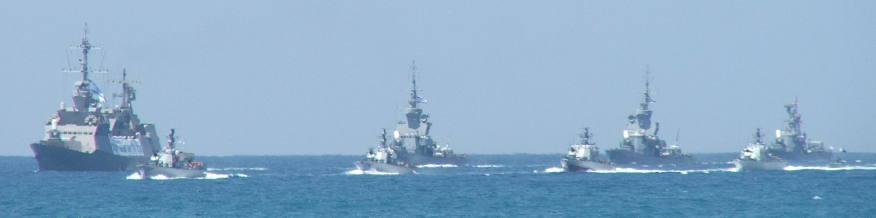
The Israeli blockade

Free Gaza has launched eight relief flotillas to Gaza since 2006, but according to Intifata Palestine:

The last three voyages were illegally stopped by the Israeli navy when, in December, 2008, they rammed the DIGNITY in international water, turned back the SPIRIT OF HUMANITY by threatening to shoot all on board, then hijacking the SPIRT on July 1, 2009, kidnapping the passengers and throwing them into prison for a week.


Israeli Super Dvora Mk III gunship intercepts Freedom Flotilla cargo ship The Brotherhood Ship in 2009, forcing it to return to Lebanon.


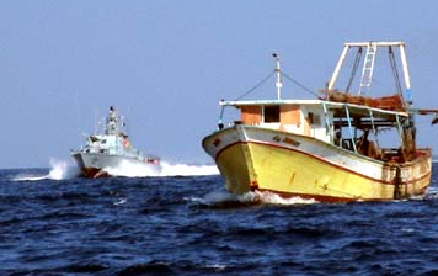
Israeli coastal patrol accosts Palestinian fishing vessels which stray beyond an Israel-imposed six mile fishing limit.


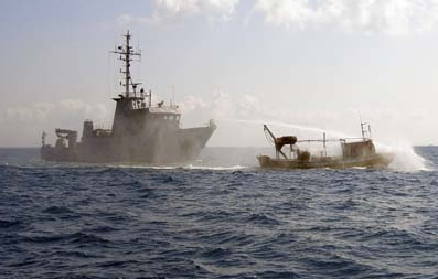
Israeli Dabur class Coastal Patrol Craft sets water hose on Palestinian fishing vessel before making arrests.

It was a Dabur in 2008 which rammed the Free Gaza relief ship Dignity.

And if Boobquake caused a tremor?

The same uptick of seismic activity which prompted Iranian cleric Hojatoleslam Kazem Sedighi to condemn Western immodesty might be the best reason not to shake your breasts at Mother Earth in defiance of another earthquake. BOOBQUAKE organizers want to show Iran’s fundamentalists that American women can titillate with disdain for religious superstitions, although the mullah’s Rube Goldberg ipso facto seems appealingly pagan to me. Of course the refutation to be made with #BoobQuake (or #PantsQuake depending on the lure you’re shaking) counts on plate tectonics not batting an eye. How arrogantly Western to presume Mother Nature does not respond to us.

Tesoro Anacortes fire not offshore spill

Fire at Tesoro Refinery in Anacortes WashingtonPfw- Oil industry spokesmen report that the deadly Tesoro refinery fire at Anacortes, Washington has been contained and no damage spilled outside their property, counting sky, earth and shoreline as their property. Does the same environmental indemnity apply to offshore oil rigs?

Rufus, Caccini, Kosma, French Chanson

Rufus Wainright’s GOING TO A TOWN (-THAT’S ALREADY BEEN BURNED DOWN in which he famously sings “I’m so tired of America”) replicates, it’s true, the jazz progression of AUTUMN LEAVES, and websmart-asses have pointed out the piano part is actually identical to the accompaniment of AVE MARIA by Baroque composer Giulio Caccini. At best reflecting Wainright’s unconscious classical pedigree. Fail.

I write at this late date because I looked it up once, and spent the equivalent effort retracing my steps when my curiosity outpaced my memory. This time I’m posting what I found for my own future reference. Just as the internet now substitutes for knowing, it serves as my backup for memory. Technicians no longer have to learn how, they have to know where to look it up online. You no longer have to remember it either, so long as the answers remain there.

Anyone who agrees with Earl Okin that French popular music has followed an endless downward spiral with the minor key fugues of Michel Legrand, has perhaps film composer Joseph Kosma to blame. The Hungarian born Kosma wrote the scores to the greatest French classics, among them RULES OF THE GAME, THE GRAND ILLUSION and CHILDREN OF PARADISE. It was from a 1946 Marcel Carne film that LES FEUILLES MORTE emerged, whose jazz chords perhaps doomed the melodic melancholy of the French to mordant sentimentality.

When Giulio Caccini’s “Ave Maria” was unearthed in 1970, anyone with an musical ear might have wondered how the exhausting blue chord progression found itself in the hands of a Baroque composer. The musical malaise was so distinctly contemporary to the 70s, coincidentally when the piece was supposedly rediscovered. Of course it turns out it hadn’t.

The Ave Maria appropriated by Rufus Wainright was written by Russian composer Vladimir Vavilov in 1970 attributed to “Anonymous” I’ll wager because he didn’t want to take credit for it either. Somebody else decided it would have more luster if thought to have come from a more pious age. Now it’s called “Ave Maria by Giulio Caccini” by Vavilov, although the association is absurd. This composition was a thoroughly natural denouement to Kosma’s French Blues. Ave Maria loses none of its divine beauty, though its provenance was a hoax. The joke is on the many prominent recording artists who thought they were channeling holy canon.

Thinking outside the bomb, in the box

THINK OUTSIDE THE BOMB is a clever antiwar appropriation of Taco Bell’s inventive twist, but since when does imitation break from a box? And does “the bomb” mean what it used to? By the look of their logo, the TOTB activists are not talking about the A-bomb, nor bunker-busters, nor smart-bombs, nor predator drones. Intentionally or not, TOTB they’re invoking the proverbial cartoon explosive, wielded by anarchists or other insurgents, the only means by which social uprisings have ever transcended the box.

“The bomb” was the feared Armageddon of the early nuclear age. More recently, “Food Not Bombs” conflates bombs with militarism because modern war-making, aka peace-keeping, is dominated by aerial bombing. Returning to “bomb” in the singular insinuates nukes, or the mutually-assured destructiveness of endlessly reciprocated violence. So let’s see the bomb depicted more as a nuclear warhead or an artillery shell.

Intrinsic to the plea for nonviolence is the determination to subdue the military instinct with transcendence. And when have proponents of nonviolence exerted jurisdiction over anyone but themselves? Lead by example they cry. We will defeat the barbarians by not becoming barbarians ourselves. Turn the other cheek, the meek shall inherit the earth. I rather suspect, quoth Camelot: “It’s not the earth the meek inherit, it’s the dirt.”

To warmongers I say: think. In of itself, thinking is outside the box enough for you. To peaceniks: exchanging the challenges of human reality for a spiritual realm, is a religious balm that dates to antiquity, about as inside the box as it gets.

CS Indy turns to cruel IFES deceiver to voice cautionary best hope for Haiti

IFESWhen it came to coverage of the Haiti earthquake disaster, the CS Indy left it to their Your Turn column, and by “your” they meant YOUR MASSAH. What caught my eye was the headline “Time for a new Haiti” accompanied by the excerpt blurb “Aristide’s return would be a disaster,” written by a pasty diplomat who had a personal hand in Haiti’s ongoing misery. Here is our allegedly progressive newsweekly giving the podium to IFES criminal Richard Soudriette instead of bundling him off to Port Au Prince for a well deserved drubbing.

Mr. Soudriette presided over the International Foundation for Electoral Systems (IFES) from 1988 to 2007, the period which saw two US coups in Haiti, where twice the democratically elected Bertrand Aristide was removed from office by our hands. Who better to have blown the whistle on the US interference than someone observing, even advising and conducting, the elections? That’s ignoring of course that the IFES is actually a private agency which does the CIA’s work, created in the 80s when Congress moved to limit the CIA’s official role destabilizing democracies. Through the IFES, through the National Endowment for Democracy, the CIA continues its intelligence wars subverting foreign governments who threaten America’s corporate rule.

If you want to believe that enterprises like IFES might be serving some good, consider this: if democratic ideals were really being advanced, the US State Department would be proud to do the work. These aren’t subcontracted jobs that wouldn’t benefit from official diplomatic networks. The IFES and ilk are as disreputable cretins as ever wore stuffed shirts, designed to separate people from legitimate representation.

And don’t think all the pitchfork bearing victims of its election racketeering are overseas. The IFES has been an adversary of the American people as Americans have tried to rescue their elections from Diebold and the stolen votes of 2000, 2002, 2004 and 2006.

When will traitorous, undemocratic Neocons like Richard Soudriette meet the wrath they have so richly courted? The Haitians are suffering, there are countless stories of Americans helping in the effort, instead the Indy gives people of Haiti more of the same malignant spin. How did Soudriette explain his expertise on Aristide? He didn’t:

“Unfortunately Aristide is hinting at a comeback despite his two failed terms. Aristide’s return to Haitian politics would be a disaster for the country. His many political allies in the U.S. and abroad would best serve Haiti’s interests by encouraging Aristide to permanently step aside from politics.”

Rather, Soudriette says, we need to back efforts to amend Haiti’s constitution to allow America’s man Preval serve additional terms. Oh, and give more responsibility to USAID, another CIA arm. Why is Soudriette spinning this message to Colorado Springs I wonder?

It’s not enough that Soudriette lent his villainy to Haiti’s disastrous last decades, now two years removed from the job, on the occasion of its most recent natural calamity, Soudriette resurfaces to damn the Haitian people with the same lies, lest they ever catch a break. That’s what makes this brand of conservative bureaucrat so damnable.

And why is the Indy propagating this venomous neo-liberal drivel? It could be highlighting the truly hopeful opportunities which locals have been taking to help the earthquake victims. Tired of watching the US military bureaucracy monopolize and bungle the aid efforts, a Springs surgical team enlisted a local businessman’s private turboprop to spend a week in Port Au Prince effecting miracles. Let’s hear about that story.

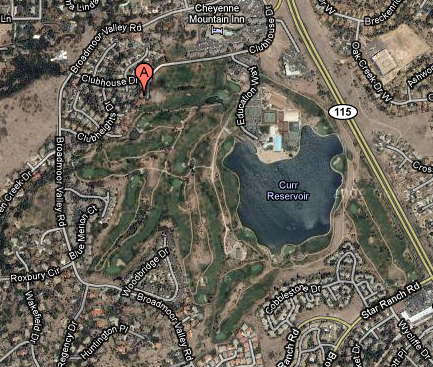
To pick up where we left off with scoundrel Soudriette, he of the many Haitian crony friends in DC, the careerist democracy-thief has moved to Colorado Springs, to lecture for El Pomar, and head the Center for Diplomacy and Democracy, which may be just another shell to which the CIA funnels funding. While stationed in DC for the IFES, Soudriette was also billing from an M Street address for the Conservation International Foundation. The good news is that apart from a CFDD franchise opened in Northern Iraq, no doubt to milk from Iraq reconstruction funds, the headquarters here appears to be merely a residence with a walkout on the golf course of the Country Club of Colorado.

Non profit front on the Country Club of Colorado golf course

Is Haiti America’s Gaza?

OSPAAAL posterAs the US military descends to throttle Gaza’s -excuse me- Haiti’s points of entry, as it prepares detention facilities at Guantanamo to intercept and repatriate the expected rush of Haitian refugees, as the US protects its business interests in the Dominican Republic and Haiti which profit from the kept-poor labor market of captive Haiti, there are fewer differences than parallels. One difference, Israeli medics are willing to come help the injured of Haiti.

How did they get in, when every other charity has been forced to queue for the opportunity? Other national and private efforts had to wait behind US military convoys bringing soldiers before food, reinforced borders before help. By the time most medical care was allowed to reach the earthquake victims, surgeons were left with only the option of amputation. I’m curious how a captive labor population of amputees is supposed to benefit their Western overseers.

It minimizes the acute circumstances in Gaza to paint Haiti as a concentration camp with settlers waiting outside the fence for the inmates to exterminate themselves. I’m not aware that our white religious zealots are after anything but Haitian children, their souls or supplicant bodies. But the same prison population control strategies apply. When the Haitians elect populist leaders, we fund goon squads to assassinate them, or we kidnap them into exile. Where is that different? There is a Haitian diaspora as there is for the Palestinians. There is our exploitation of their resources and their labor. How fitting that America’s closest cohort sent medics in for the photo op, and quickly aborted their work before the same darker-skinned unchosen got wise.

Ojore Nuru Lutalo, aka Leroy Bunting arrested with Anarchist literature

Anarchist Ojore Nuru LutaloFormer political prisoner Ojore Nuru Lutalo, ne Leroy Bunting, was pulled off an Amtrak train in La Junta, Colorado, for scaring fellow passengers with his cell phone conversation. The FBI’s Colorado Springs Joint Terrorism Task Force was alerted about the 64 year-old armed with anarchist literature from the “Afrikan Liberation Army” (sic) which he had obtained while speaking at the LA Anarchist Book Fair for the Anarchist Black Cross, a prison rights organization. Just yesterday I listened to a local law enforcement type defend the 2nd Amendment, the right to bear arms, by suggesting that if we substituted “books” for guns, no one would think to regulate them. His compatriots seem to have confused the argument by charging the former Black Liberation Army member for “endangering public transportation” with what they called terrorist recruiting propaganda.

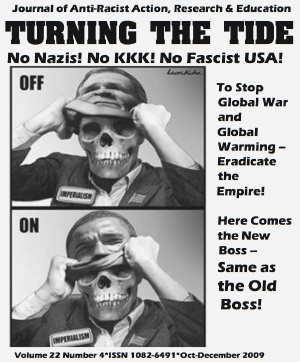
Journal Turning the TideAccording to the Pueblo Chieftain, police found “a large amount of propaganda recruiting materials from the Afrikan Liberation Army, including photos of President Barack Obama and other items that raised suspicions.”

Break the Chains reports that Ojore was released Yesterday, and will return to the Otero District Court for an appearance February 5th, the charge now “Interfering with Public Transportation.”

How absolutely disingenuous to misquote the source of the so-called Anarchist literature, seeing as reportedly there was so much of it. This is the usual media disinfo to prevent giving the causes visibility. The Pueblo Chieftain has obtained the affidavit of the arrest, which should list the items found on Ojore. Until that’s made available, we can search online for what he was likely carrying. Our bet, they don’t want to call attention to the New Afrikan Liberation Front (NALF).

Here’s a list of the exhibitors at the 2nd Anarchist Book Fair:

Anarchist type brochuresSemiotext(e)
www.semiotexte.com
Earth First Journal
www.earthfirstjournal.org
Taala Hooghan: Infoshop & Youth Media Arts Center
www.taalahooghan.org
Modesto Anarcho
www.modestoanarcho.org
South Central Farmers
www.southcentralfarmers.com
Skylight Books
www.skylightbooks.com
Institute for Anarchist Studies
www.anarchist-studies.org
Critical Resistance
www.criticalresistance.org
Las Vegas Alliance of the Libertarian Left sonv.libertarianleft.org
Catholic Worker
www.lacatholicworker.org
Anti-Racist Action/Turning the Tide
www.antiracistaction.us
Anarchist Black Cross Federation L.A. www.abcf.net/la
PM press
www.pmpress.org
Microcosom Publishing
www.microcosmpublishing.com
AK press
www.akpress.org
Little black cart
www.littleblackcart.com
Make/Shift magazine
www.makeshiftmag.com
Journal of aesthetics and protest
www.journalofaestheticsandprotest.org
R.A.C. : Revolutionary Autonomous Communities
www.revolutionaryautonomouscommunities.blogspot.com
I.W.W
www.iww.org

Then there is also the Southside ABCF zine collection, the Crossroad Newletter, and the publications of the Spear and Shield. Here’s the New Afrikan Declaration of Independence, as printed on Prairie Fire:

“New Afrikan Declaration of Independence”

WE, New Afrikan People in America, in consequence of arriving at a knowledge of ourselves as a people with dignity, long deprived of that knowledge; as a consequence of revolting with every decimal of our collective and individual beings against the oppression that for three hundred years has destroyed and broken and warped the bodies and minds and spirits of our people in America, in consequence of our raging desire to be free of this oppression, to destroy this oppression wherever it assaults humankind in the world, and in consequence of inextinguishable determination to go a different way, to build a new and better world, do hereby declare ourselves forever free and independent of the jurisdiction of the United State of America and the obligations which that country¹s unilateral decision to make our ancestors and ourselves paper-citizens placed on us.

We claim no rights from the United States of America other than those rights belonging to human beings anywhere in the world, and these include the right to damages, reparations, due us from the grievous injuries sustained by our ancestors and ourselves by reason of United States lawlessness.

Ours is a revolution against oppression–our own oppression and that of all people in the world. And it is a revolution for a better life, a better station for all, a surer harmony with the forces of life in the universe. We therefore see these aims as the aims of our revolution:

    • To free black people in America from oppression;
  • To support and wage the world revolution until all people everywhere are so free;
  • To build a new Society that is better than what We now know and as perfect as We can make it;
  • To assure all people in the New Society maximum opportunity and equal access to that maximum;
  • To promote industriousness, responsibility, scholarship, and service;
  • To create conditions in which freedom of religion abounds and the pursuit of God and/or destiny, place and purpose of humankind in the Universe will be without hindrance;
  • To build a Black independent nation where no sect or religious creed subverts or impedes the building of the New Society, the New State Government, or achievement of the Aims of the Revolution as set forth in this Declaration;
  • To end exploitation of human beings by each other or the environment;
  • To assure equality of rights for the sexes;
  • To end color and class discrimination, while not abolishing salubrious diversity, and to promote self-respect and mutual understanding among all people in the society;
  • To protect and promote the personal dignity and integrity of the individual, and his or her natural rights;
  • To place the major means of production and trade in the trust of the state to assure the benefits of this earth and our genius and labor to society and all its members, and
  • To encourage and reward the individual for hard work and initiative and insight and devotion to the Revolution.

In mutual trust and great expectation, We the undersigned, for ourselves and for those who look to us but are unable personally to affix their signatures hereto, do join in this solemn Declaration of Independence, and to support this Declaration and to assure the success of the Revolution, We pledge without reservation ourselves, our talents, and all our worldly goods.

Or the creed:

“New Afrikan Creed”

1. i believe in the spirituality, humanity and genius of Black people, and in our new pursuit of these values.

2. i believe in the family and the community, and in the community as a family, and i will work to make this concept live.

3. i believe in the community as more important than the individual.

4. i believe in constant struggle for freedom, to end oppression and build a better world. i believe in collective struggle; in fashioning victory in concert with my brothers and sisters.

5. i believe that the fundamental reason our oppression continues is that We, as a people, lack the power to control our lives.

6. i believe that fundamental way to gain that power, and end oppression, is to build a sovereign Black nation.

7. i believe that all the land in America, upon which We have lived for a long time, which We have worked and built upon, and which We have fought to stay on, is land that belongs to us as a people.

8. i believe in the Malcolm X Doctrine: that We must organize upon this land, and hold a plebiscite, to tell the world by a vote that We are free and our land independent, and that, after the vote, We must stand ready to defend ourselves, establishing the nation beyond contradiction.

9. Therefore, i pledge to struggle without cease, until We have won sovereignty. i pledge to struggle without fail until We have built a better condition than the world has yet known.

10. i will give my life, if that is necessary; i will give my time, my mind, my strength, and my wealth because this IS necessary.

11. i will follow my chosen leaders and help them.

12. i will love my brothers and sisters as myself.

13. i will steal nothing from a brother or sister, cheat no brother or sister, misuse no brother or sister, inform on no brother or sister, and spread no gossip.

14. i will keep myself clean in body, dress and speech, knowing that i am a light set on a hill, a true representative of what We are building.

15. i will be patient and uplifting with the deaf, dumb and blind, and i will seek by word and deed to heal the Black family, to bring into the Movement and into the Community mothers and fathers, brothers and sisters left by the wayside.

Now, freely and of my own will, i pledge this Creed, for the sake of freedom for my people and a better world, on pain of disgrace and banishment if i prove false. For, i am no longer deaf, dumb or blind. i am, by inspiration of the ancestors and grace of the Creator — a New Afrikan.

Closing Gitmo not opening it wide

Not only is the infamous Guantanamo prison camp NOT CLOSING, its criminal record grows, and now the illegal facility is being expanded to lasso Haitian migrants escaping the devastation of Haiti’s earthquake. Will they be tortured as well? The way Obama is moving on civil rights, we may never know.

We have learned that three of the prison’s suicides, the mysterious coordinated attack of suicide-suiciders for which US military spokesmen accused the detainees of asymmetric warfare, were actually deaths at the hands of torturers. Though officials claimed to have discovered the bodies in their cells, camp guards have revealed that the prisoners were actually taken from the interrogation rooms, having suffocated from water-boarding. Coroners trying to establish the causes of death were hampered by the fact that Gitmo physicians had surgically removed key telltale body parts in the interest of national security.

Diverting attention from the murder story are preparations to expand Guantanamo to greet an anticipated wave of Haitian migrant refugees escaping the earthquake devastation. Just part of the militarization of aid giving.

A processing center is being readied at Guantanamo where Haitians can be returned to Haiti nearly as soon as they are intercepted at sea. Ever gracious, the US reveals that some Haitians will be considered for entry to the US. Temporary work permits will be granted to some Haitians, but only those who can show that they were in the US at the time of the January 12 earthquake.

Labadee: Royal Caribbean’s Neo Haiti

Labadee oasis seas boi caimanFormer President Bill Clinton is heading to Haiti, again. As UN special envoy to Haiti, he paid a visit last year as a guest of the Royal Caribbean cruise ship line to promote their tourist facility at La’Badie. Said CEO Adam Goldstein: “Labadee is just a great example of the way that things can work in a very positive way in this country.” Are those new ways or old? The secured compound, laying under the protection of the old French colonial capitol, greets 7,000 cruise passengers a week, even this week, many of whom don’t know they’re in “Haiti,” on an old slave plantation, or what may have been the crucible of real Islamic rebel voodoo!

I didn’t know about the private resort of Labadee, but my attention was drawn in December to the announcement of the launch of The Oasis of the Seas, the largest cruise ship ever devised. It was leaving the shipyards of Finland, having to pass under a Danish suspension bridge at low tide, so titanic was she. I took note because the headline announced her maiden destination to be Haiti, an odd place I thought, to be ostentatious.

The spotlight which the recent earthquake has brought on the poverty in Haiti had me wondering if all seventeen decks of the Oasis of the Seas were gawking at the suffering masses awaiting aid in Port-au-Prince. Not a chance. The Oasis, and Royal Caribbean’s fleet of floating carbon boots harbor at a secluded oasis which the cruise line rents from Haiti. Its income represents the largest portion of Haiti’s tourism revenue. If you thought President Obama’s offer of $100 Million was stingy, you can calculate Royal Caribbean’s avarice on one hand.

The tragic earthquake hasn’t interrupted the cruises. It this tragedy has an upside, it’s that some vacationers are expressing less facility stuffing down a burger knowing most Haitians await relief.

Haiti receives $6 for each tourist who disembarks to zip-line, buy trinkets from licensed vendors, and sun on Christoper Columbus Beach. They’re told it was his old stomping ground –which actually can be said of Hispaniola’s entire northern coastline. Likewise the same is true about the slave plantations which, from the port of Cap Francois, provided 40% of Europe’s sugar and 60% of its coffee. Today Haiti is renowned as the poorest land in the Western Hemisphere. The verdant lands of La Partie Du Nord –of Les Grand Blancs— are separated from the Haitian population by a mountainous Massif, and in the case of Labadee, with barbed wire.

habitation-slave-plantationsRoyal Caribbean boasts that its operations are critical to the Haitian economy. It employs hundreds, but contrast that with what the coast could provide if it wasn’t privatized. The resort draws from a cheap labor pool of an unlimited mass of Haitians who are kept with no other options but to hope they can replace the couple hundred employees confined to the cruise line compound.

And yes, the cruise itineraries avoid mention of Haiti, attributing Labadee as a “private island” of Hispaniola. The private island concept is not new, cruise ship operators began several decades back to seek to give their customers refuge from the growing throngs of third world poor who paddle out to the ship hoping for first world largess. Another motive was that cruise lines could also monopolize where their passengers could spend their money while ashore. What began as exclusive contracts with port destinations, very notoriously the Alaskan inland passage, became ventures where cruise line operators bought entire tracks of properties retired from oil or military use, whether half islands, or merely beaches, recast as private beaches, populated by private workforces.

Disney Cruise Line: Castaway Cay, Bahamas
Princess Cruises: Princess Cays, Eleuthera, Bahamas
Norwegian Cruise Line: Great Stirrup Cay, Bahamas
Holland/Carnival: Half Moon Bay, Little San Salvador Island, Bahamas
Royal Caribbean/Celebrity: Coco Cay, Bahamas; Labadee, Hispaniola

According to the Royal Caribbean promotional material, the spelling Labadee is anglicized for English-speakers. It’s named after the Marquis de La’Badie, a “Frenchman who first settled the area in the 1600s.”

At one time the French plantation owners were comforted by their remote location, buffered they thought from the potential of slave rebellions from the south. In fact, Haiti’s famed uprising began in the north, not far at all from La’Badie. Off the Royal Caribbean itinerary, but only a stone’s throw away, that is to say, within distance of incoming stones, are landmarks important to the celebrated revolution: Haiti’s first copper mine, site of a lone concentration of Islamic slaves, and the Bois Caiman of lore.

The area of Cape Haitien, as it’s called today, holds two of Haiti’s geography secrets. One, the conclusive location of La Villa de Navidad, where Christopher Columbus built his first European settlement in the New World, a fort made of the timbers of the wrecked flagship Santa Maria; Columbus returned the next year to find his men murdered and the houses burned to the ground. Archeologists are still looking to find definitive traces in Caracol or Bord de Mer de Limonade.

Second, the site of the Bwa Kayiman, the ceremony which launched Haiti’s famed slave rebellion led by Toussaint Louverture. Some scholars have begun to question whether it happened at all. They base their skepticism on the absence of written testaments. Although it’s popularly understood that the gathering of conspirators was confessed under torture by rebels captured by the French authorities. The cynics suggest the story was a fabrication to demonize the black slaves and that:

the manuscript minutes of these interrogations have survived in the French National Archives and make no mention of this or any other vodun ceremony.

That’s something to wrap your mind around, that transcripts remain of torture sessions conducted so many years ago.

Naturally the secret gathering had to escape the suspicions of the French slaveholders, but the infamy of the declaration of the Bois Caiman has inspired every Bolivarian insurrection since, from Bolivar, to Marti, Sandino, Castro, Moralles and Chavez. Revisionists seeking to tamp the populist spirit question why its location remains a mystery. Oral tradition holds that the rebels gathered in an open space in the forests of Morne Rouge.

Morne Rouge, the place where BC ceremony hypotheses converge, is also the only place in Haiti to retain an important Islamic cult. This is because the first wave of slaves were from the Senegambian region and had already undergone heavy Islamic influence. Up to date, Mori Barthelemy and followers of the region maintain this tradition, with honor to the sun, specific funeral rites and so on. If one returns to sources of the 16th century, one finds that there is where the first copper mines were established by the Spaniards, when they started giving up on the gold.

You can find Labadee, 19° 47? 11? N, 72° 14? 44? W on any modern map. Pondering The Cape it occupies, and the deep water harbor it is able to afford a behemoth like the Oasis of the Seas, I was led to research the mysteries of Haiti’s NORD, and survey the progression of place names on European maps which span the years.

haiti
This is Cristóbal Colón‘s own recollection of the northern coast of what he called La Isla Española, marking his first landing at San Nicolas Môle, the island of Tortuga, Fort Navidad, and the landmark Monte Cristi whose height guided Columbus and led him to name Hispaniola after Spain.

haiti charlevoix
A later map made by the French attempts to show the divisions of the indigenous tribes. The site marked “Premier Etablissment” marks Navidad, built near the Taíno cultural center of Hayti-Bohío-Quisqueya.

haiti Vinckeboons
A 1639 Dutch map shows Cap François. On the south shore of Isla Tortuga lies the beach Playa Cyan, across the water from the river Rio dos Caymanis. Also note the hills to the east called Mançanilla, these divided the peaceful Taíno from the warring Caciq. The location name derives from the Manchineel Trees whose poison berries they used to poison the tips of their arrows.

haiti monte christo
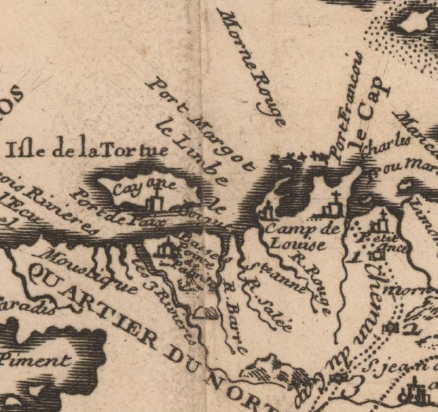
French map circa 1723 marks Cayne opposite the Iron Coast of L’Ile de la Tortue. There’s also a typical sailor’s landmark: Pointe des Palmiers (trans. Point of the Palms). The promontory of Cap François has here become Le Cap (The Cape). It shelters Port St. François, east of the heights of Morne Rouge and Mines de Cuivre (trans. copper mines).

haiti labat
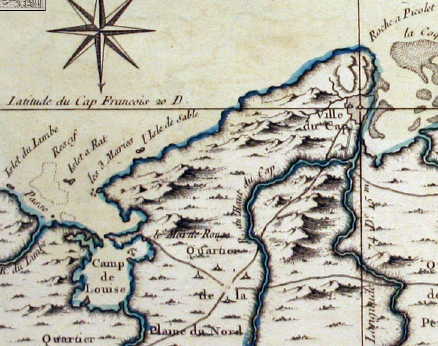
French map of Cape Francois dated 1722 adds Le Limbe, the first area which the rebel slaves put to the torch; and Le Chemin du Cap, the main road to the valleys of the south.

haiti Ponce
This 1796 French map features another sailor’s aid, Pointe Tête de Chein (trans. Dog’s Head Point). The fortification battery on the Cape was built upon Roche à Picolet. This map was drawn after the rebellion of 1791. The Morne Rouge (trans. Red Heights) is now designated as Ravine du Morne au Diable and the Acul à Sabal. The Devil’s Ravine is the present location of Royal Caribbean’s Labadee.

The poor of Haiti are still taking heat for the Bwa Kayiman having been a pact with the devil.

haiti bellin
I add this 1764 map for personal interest. Few maps even today mark L’Islet à Rat (trans. Rat Island), which Columbus called La Amiga, was an aid to navigation out of his anchorage at Bay of Acul which he called Cabo de Caribata.

This map also details how colonial French St Domingue was divided into districts, here the Ville du Cap, the Quartier de Plaine du Nord and Camp de Louise.

haiti moreau
This 1770 map of Cap François and Environs distinguishes the larger slavery plantations.

haiti labadi

On the subject of Columbus, isn’t it surprising to reconcile the current verdict on his genocidal behavior, with the histories which have glorified his stature? After all, the primary accounts have never changed. How did earlier biographers overlook the damning and salacious details? One very polite telling of Columbus’ adventures, written by Filson Young published in 1906 provides a prim example. Here Young addresses the kidnap and rape of the indians whom Columbus encountered:

…his taking of the women raises a question which must be in the mind of any one who studies this extraordinary voyage—the question of the treatment of native women by the Spaniards. Columbus is entirely silent on the subject; but taking into account the nature of the Spanish rabble that formed his company, and his own views as to the right which he had to possess the persons and goods of the native inhabitants, I am afraid that there can be very little doubt that in this matter there is a good reason, for his silence. So far as Columbus himself was concerned, it is probable that he was innocent enough; he was not a sensualist by nature, and he was far too much interested and absorbed in the principal objects of his expedition, and had too great a sense of his own personal dignity, to have indulged in excesses that would, thus sanctioned by him, have produced a very disastrous effect on the somewhat rickety discipline of his crew. He was too wise a master, however, to forbid anything that it was not in his power to prevent; and it is probable that he shut his eyes to much that, if he did not tolerate it, he at any rate regarded as a matter of no very great importance. His crew had by this time learned to know their commander well enough not to commit under his eyes offences for which he would have been sure to punish them.

[Giving a list of instructions to the men Columbus planned to leave behind at La Navidad, among them: ]

…and especially to be on their guard to avoid injury or violence to the women, “by which they would cause scandal and set a bad example to the Indians and show the infamy of the Christians.”

no kolumbus day christopher columbusAnd here’s the rub. In this passage the author shows if we do not absolve Columbus, we indict ourselves.

The ruffianly crew had in their minds only the immediate possession of what they could get from the Indians; the Admiral had in his mind the whole possession of the islands and the bodies and souls of its inhabitants. If you take a piece of gold without giving a glass bead in exchange for it, it is called stealing; if you take a country and its inhabitants, and steal their peace from them, and give them blood and servitude in exchange for it, it is called colonisation and Empire-building. Every one understands the distinction; but so few people see the difference that Columbus of all men may be excused for his unconsciousness of it.

Rush is right. Make him pay for Haiti.

Reading 538’s excellent qualified defense of Pat Robertson‘s accusation that Haiti really had made a pact with the devil, I am prompted to weigh in behind Rush Limbaugh’s hypocritical rant that the American public has already paid enough for Haiti’s relief, “it’s called the US Income Tax.” Well it’s true. It is the role of government to see after the suffering among us. Of course you’d think conservatives like Limbaugh wouldn’t highlight that role while images of disaster haunt us, because they’re the ones behind depleting the aid coffers. Bush’s tax cuts for the rich alone could have relieved Haiti, Katrina and every Tsunami in between without costing tearful American TV viewers one extra dime of credit card debt.

The Haitian rebels made this prayer to their god in 1791. European slave owners might conclude an insurgent god would be their devil. This prayer was recited by rebellion priestess Boukman at the Bois Caiman (Bwa Kayiman). French speakers can read it in Creole.

The god who created the earth; who created the sun that gives us light. The god who holds up the ocean; who makes the thunder roar. Our God who has ears to hear. You who are hidden in the clouds; who watch us from where you are. You see all that the white has made us suffer. The white man’s god asks him to commit crimes. But the god within us wants to do good. Our god, who is so good, so just, He orders us to revenge our wrongs. It’s He who will direct our arms and bring us the victory. It’s He who will assist us. We all should throw away the image of the white men’s god who is so pitiless. Listen to the voice for liberty that speaks in all our hearts.

The Toussaint Louverture Project is an online documentation of our western hemisphere’s only successful slave uprising.

Just as the USA still refuses to let Cuba free its people from our tyranny after 40 years, so did the Western powers fight to keep Haiti from success, lest their free slaves inspire ours.

Good news for Haiti

Haiti presidential palace succumbs to earthquake
On the bright side of Haiti’s catastrophic earthquake, American puppet René Préval has been cut down a few notches, a whole couple stories actually. Here’s the presidential palace before January 12 and after. The pretender Preval has been Our Man in Port-au-Prince subsequent to the US-arranged a coup in 2004 to depose the democratically elected Jean-Bertrand Aristide (for the second time). The popular Aristide was a threat to exploitation interests.

While Americans rally to provide relief to the Haitians, let’s not be too incredulous about the state of their poverty. Here’s A.N.S.W.E.R.’s recent statement to highlight this teaching moment:

All of us are joining in the outpouring of solidarity from people all over the hemisphere and world who are sending humanitarian aid and assistance to the people of Haiti.

At such a moment, it is also important to put this catastrophe into a political and social context. Without this context, it is impossible to understand both the monumental problems facing Haiti and, most importantly, the solutions that can allow Haiti to survive and thrive. Hillary Clinton said today, “It is biblical, the tragedy that continues to daunt Haiti and the Haitian people.” This hypocritical statement that blames Haiti’s suffering exclusively on an “act of God” masks the role of U.S. and French imperialism in the region.

In this email message, we have included some background information about Haiti that helps establish the real context:

Haitian Prime Minister Jean-Max Bellerive stated today that as many as 100,000 Haitians may be dead. International media is reporting bodies being piled along streets surrounded by the rubble from thousands of collapsed buildings. Estimates of the economic damage are in the hundreds of millions of dollars. Haiti’s large shantytown population was particularly hard hit by the tragedy.

As CNN, ABC and every other major corporate media outlet will be quick to point out, Haiti is the poorest country in the entire Western hemisphere. But not a single word is uttered as to why Haiti is poor. Poverty, unlike earthquakes, is no natural disaster.

The answer lies in more than two centuries of U.S. hostility to the island nation, whose hard-won independence from the French was only the beginning of its struggle for liberation.

In 1804, what had begun as a slave uprising more than a decade earlier culminated in freedom from the grips of French colonialism, making Haiti the first Latin American colony to win its independence and the world’s first Black republic. Prior to the victory of the Haitian people, George Washington and then-Secretary of State Thomas Jefferson had supported France out of fear that Haiti would inspire uprisings among the U.S. slave population. The U.S. slave-owning aristocracy was horrified at Haiti’s newly earned freedom.

U.S. interference became an integral part of Haitian history, culminating in a direct military occupation from 1915 to 1934. Through economic and military intervention, Haiti was subjugated as U.S. capital developed a railroad and acquired plantations. In a gesture of colonial arrogance, Franklin D. Roosevelt, who was the assistant secretary of the Navy at the time, drafted a constitution for Haiti which, among other things, allowed foreigners to own land. U.S. officials would later find an accommodation with the dictator François “Papa Doc” Duvalier, and then his son Jean-Claude “Baby Doc” Duvalier, as Haiti suffered under their brutal repressive policies.

In the 1980s and 1990s, U.S. policy toward Haiti sought the reorganization of the Haitian economy to better serve the interests of foreign capital. The U.S. Agency for International Development (USAID) was instrumental in shifting Haitian agriculture away from grain production, paving the way for dependence on food imports. Ruined Haitian farmers flocked to the cities in search of a livelihood, resulting in the swelling of the precarious shantytowns found in Port-au-Prince and other urban centers.

Who has benefited from these policies? U.S. food producers profited from increased exports to Haitian markets. Foreign corporations that had set up shop in Haitian cities benefitted from the super-exploitation of cheap labor flowing from the countryside. But for the people of Haiti, there was only greater misery and destitution.

Washington orchestrated the overthrow of the democratically elected Haitian President Jean-Bertrand Aristide—not once, but twice, in 1991 and 2004. Haiti has been under a U.S.-backed U.N. occupation for nearly six years. Aristide did not earn the animosity of U.S. leaders for his moderate reforms; he earned it when he garnered support among Haiti’s poor, which crystallized into a mass popular movement. Two hundred years on, U.S. officials are still horrified by the prospect of a truly independent Haiti.

The unstable, makeshift dwellings imposed upon Haitians by Washington’s neoliberal policies have now, for many, been turned into graves. Those same policies are to blame for the lack of hospitals, ambulances, fire trucks, rescue equipment, food and medicine. The blow dealt by such a natural disaster to an economy made so fragile from decades of plundering will greatly magnify the suffering of the Haitian people.

Natural disasters are inevitable, but resource allocation and planning can play a decisive role in mitigating their impact and dealing with the aftermath. Haiti and neighboring Cuba, who are no strangers to violent tropical storms, were both hit hard in 2008 by a series of hurricanes—which, unlike earthquakes, are predictable. While more than 800 lives were lost in Haiti, less than 10 people died in Cuba. Unlike Haiti, Cuba had a coordinated evacuation plan and post-hurricane rescue efforts that were centrally planned by the Cuban government. This was only possible because Cuban society is not organized according to the needs of foreign capital, but rather according to the needs of the Cuban people.

In a televised speech earlier today, President Obama has announced that USAID and the Departments of State and Defense will be working to support the rescue and relief efforts in Haiti in the coming days. Ironically, these are the same government entities responsible for the implementation of the economic and military policies that reduced Haiti to ruins even before the earthquake hit.

Japan owes somebody A NEW BOAT!

sea shepherd collision ram bow
The Japanese whaling fleet, whose inhumane hunts pretend to serve the Institute for Cetacean Research, have deliberately rammed the high-tech trimaran Ady Gil, formerly the Earthrace, operated by their arch nemesis the Sea Shepherd Conservation Society. Pseudo-science spokesman Glenn Innwood was quick to declare the footage showed otherwise, saying the accusation “is just not vindicated by the video.” Obviously the Japanese need a cover who speaks better English. It’s a Freudian slip to seek to be not vindicated.

Au contraire for Kiwi Innwood-sen, the videos from both ships show the Ady Gil floating idle to the Shonan Maru’s starboard side before the whaler turns straight for it. The whalers are perhaps counting on not enough people seeing the video. That might have worked before YouTube.

If the Japanese believe “The obstructionist activities of the Sea Shepherd threaten the lives and property of those involved in our research, are very dangerous and cannot be forgiven” then aiming to ram the smaller vessel must constitute attempted murder, however unpremeditated the crime of passion may be.

Whether or not the action is ruled a crime, it’s without any doubt a violation of maritime code. The Ady Gil had right of way both by its position, and by being stationary.

Here’s the collision from the perspective of the whaler Shonan Maru 2, a highly maneuverable harpoon chase ship, as broadcast on Al Jazeera:

And here is the footage released by Paul Watson’s Sea Shepherd Conservation Society:

UPDATE: I’d say this footage clinches it, from the Animal Planet Whale Wars cameraman aboard the Ady Gil. Read a detailed description from NZ.

Convoy given hero’s welcome in Gaza

viva-palestina-george-galloway-rafahVIVA PALESTINA made it to Gaza! See the crush of media awaiting their arrival? None of them from the US or UK.

Though it took all night, the 200 vehicle convoy made the last leg from Al-Arish to Rafah safely. A compromise was reached with Egypt to redirect 59 vehicles to serve refugees in Lebanon, sooner than concede them to Israel. This is the third convoy of what organizers promise will be more until the illegal siege of Gaza is lifted.

Reflecting on the delays and difficulties posed by the Egyptians, George Galloway expressed his regret that attention was diverted from the anniversary of Israel’s criminal acts which began December 27, 2008. Instead Egypt drew the focus on its own complicity in the continued deprivation of the people of Palestine. Asked why the convoy didn’t ask to be let through Israel, if it wanted to confront what’s thought to be the principle villain behind the siege of Gaza. Galloway responded:

We will never set foot in Israel. We will never ask permission from Israel for anything. We will never recognize Israel as long as there is no Palestine. As long as the Palestinian people are scattered to the four corners of the earth as refugees; as long as Jerusalem is being monstrously, ethnically cleansed with settlements surrounding it, choking the very life and greatness out of it; as long as Gaza is under siege, as long a Palestinians are being assassinated and bombed from the air, as they have been over the last week or so –by the way from both of the main political factions within Palestine, so it’s not just Hamas people who are being murdered in front of their wives and children. We will never recognize Israel as long as such a situation exists for the Palestinians.

See the interview on this clip from Al Jazeera:

Galloway added his usual fighting words:

The Palestinians here will never be starved into surrender. Anyone who’s counting on that, whether Israel or anybody else, and I mean anybody else, who’s counting on that, is making a big mistake. They don’t know these people if they think they can starve them into surrender.

The clip below features brief interviews of several convoyers as they arrive. The briefest was a passenger on a Derry to Gaza ambulance. The Press TV correspondent greeted him with: “Hello. Welcome to Gaza. How do you feel?” To which he replied, as the vehicle kept moving:

Great. Great to be in Gaza.

But another from that crew, whom Irish4Palestine identifies as JJ, doubled back on foot to deliver a wonderfully cheerful message:

Just like to say hello to all the people of Derry.

Um, we’ve travelled 5,000 miles from Derry in Irelanda. And it’s great to finally be here and meet the people.

And we’ve come this far for a reason. Because they deserve it. And more people should do this definitely, because we have to break the siege.

And I’d like to thank all the people of Derry. Alright thanks. Good man.

All this and more on this clip from Press TV:

A 1930 Spirit of Christmas Past

Black Agenda Report revisited this Christmas poem by Langston Hughes:

“Merry Christmas”: Published in New Masses (Dec. 1930), p. 4.

Merry Christmas, China,
From the gun-boats in the river,
Ten-inch shells for Christmas gifts,
And peace on earth forever.

Merry Christmas, India,
To Gandhi in his cell,
From righteous Christian England,
Ring out, bright Christmas bell!

Ring Merry Christmas, Africa,
From Cairo to the Cape!
Ring Hallehuiah! Praise the Lord!
(For murder and for rape.)

Ring Merry Christmas, Haiti!
(And drown the voodoo drums—
We’ll rob you to the Christian hymns
Until the next Christ comes

Ring Merry Christmas, Cuba!
(While Yankee domination
Keeps a nice fat president
In a little half-starved nation.)

And to you down-and-outers,
(“Due to economic laws”)
Oh, eat, drink, and be merry
With a bread-line Santa Claus—

While all the world hails Christmas,
While all the church bells sway!
While, better still, the Christian guns
Proclaim this joyous day!

While holy steel that makes us strong
Spits forth a mighty Yuletide song:
SHOOT Merry Christmas everywhere!
Let Merry Christmas GAS the air!

Space time capsule December 21, 1968

Earth seen by ApolloWhat does it mean that the stars we see in the sky represent light coming at us from millions of years before? The images we have of Earth, of ourselves from space, reflect a distant past too actually. Although we’re accustomed now to visualizing our planet from above, as a quilt of satellite photos wrapped around a globe, viewable from any distance on Google Earth, the actual vision they mimic is a single thoroughly ubiquitous NASA photo called “The Blue Marble.”

We have only a handful of actual pictures of our planet, taken during the lunar expeditions Apollo 8-17, between 1968 and 1972. Together they allow our minds to conjure our blue globe selves floating against the continuum of space, but they’re also snapshots of the past, of home forty or so years ago.

That’s not just our planet set against the dark universe, that’s you, spinning along. Were you looking up toward the astronauts on their mission as these pictures were taken? You might have watched the launch at Cape Canaveral and hours later thought about the first men to leave Earth’s orbit.

The above photo isn’t the “Blue Marble.” The image above differs from the photo taken by Apollo 17 on Pear Harbor Day, December 7, 1972. That photograph was the first to capture the Earth in full sunlight, but it showed only the Southern Hemisphere. I wanted to chose one where you’re in the picture.

The above image is the first photograph of Earth taken from space, snapped by Apollo 8 as it left for the moon, Saturday, December 21st, 1968. If you were in North America at the time, you’re at the lower right.

If you don’t remember where you were around noon on the winter solstice in 1968, here’s a subsequent photograph they took on their eighth orbit around the moon. It’s the first “Earthrise” seen by man. That was December 24, 1968, a date for which you probably have additional family snapshots.

NASA Apollo 8 orbits the moon

The Caracas Commitment Si Se Puede

You might imagine the multinational corporate media would blackout the talk of a 5th Socialist International. They are most determined to censor the issues which the world’s leftist parties are resolved to address. Where Obama 2008 and Copenhagen 2009 project a vacuum of ideological momentum, check out the Caracas Commitment.

The Caracas Commitment
November 25, 2009?
By Declaration from World Meeting of Left Parties?
November 19-21 Caracas, Venezuela

Political parties and organizations from Latin America, the Caribbean, Europe, Africa, Asia, and Oceania commemorate and celebrate the unity and solidarity that brought us together in Caracas, Bolivarian Republic of Venezuela, and from this libertarian city we would like to express our revolutionary rebelliousness. We are glad of and committed to the proud presence of the forces of change in a special moment of history. Likewise, we are proud to reaffirm our conviction to definitively sow, grow and win Socialism of the 21st century.

In this regard, we want to sign the Commitment of Caracas as a revolutionary guide for the challenges ahead of us. We have gathered with the aim of unifying criteria and giving concrete answers that allow us to defend our sovereignty, our social victories, and the freedom of our peoples in the face of the generalized crisis of the world capitalist system and the new threats spreading over our region and the whole world with the establishment and strengthening of military bases in the sister republics of Colombia, Panama, Aruba, Curacao, the Dutch Antilles, as well as the aggression against Ecuadorian territory, and the invasions of Iraq and Afghanistan.

We consider that the world capitalist system is going through one of its most severe crises, which has shaken its very foundations and brought with it consequences that jeopardize the survival of humanity. Likewise, capitalism and the logic of capital, destroys the environment and biodiversity, bringing with it consequences of climate change, global warming and the destruction of life.

One of the epicentres of the capitalist crisis is in the economic domain; this highlights the limitations of unbridled free markets ruled by private monopolies. In this situation, some governments have been asked to intervene to prevent the collapse of vital economic sectors, for instance, through the implementation of bailouts to bank institutions that amount to hundreds of billions of dollars. Said governments have been asked to stimulate their economies by increasing public expenditure in order to mitigate the recession and the private sector decline, which evidences the end of the supposedly irrefutable “truth” of neo-liberalism that of non-intervention of the State in economic affairs.

In this regard, it is very timely to promote an in-depth discussion on the economic crisis, the role of the State and the construction of a new financial architecture.

In summary, the capitalist crisis cannot be reduced simply to a financial crisis; it is a structural crisis of capital which combines the economic crisis, with an ecological crisis, a food crisis, and an energy crisis, which together represents a mortal threat to humanity and mother earth. Faced with this crisis, left-wing movements and parties see the defence of nature and the construction of an ecologically sustainable society as a fundamental axis of our struggle for a better world.

In recent years, progressive and left-wing movements of the Latin American region have accumulated forces, and stimulated transformations, throwing up leaders that today hold important government spaces. This has represented an important blow to the empire because the peoples have rebelled against the domination that has been imposed on them, and have left behind their fear to express their values and principles, showing the empire that we will not allow any more interference in our internal affairs, and that we are willing to defend our sovereignty.

This meeting is held at a historic time, characterized by a new imperialistic offensive against the peoples and governments of the region and of the world, a pretension supported by the oligarchies and ultraconservative right-wing, with the objective of recovering spaces lost as a consequence of the advancement of revolutionary process of liberation developing in Latin America. These are expressed through the creation of regional organizations such as ALBA, UNASUR, PETROCARIBE, Banco del Sur, the Sao Paulo Forum, COPPPAL, among others; where the main principles inspiring these processes are those of solidarity, complementarity, social priority over economic advantage, respect for self-determination of the peoples in open opposition to the policies of imperial domination. For these reasons, the right-wing forces in partnership with the empire have launched an offensive to combat the advance and development of the peoples’ struggles, especially those against the overexploitation of human beings, racist discrimination, cultural oppression, in defence of natural resources, of the land and territory from the perspective of the left and progressive movements and of world transformation.

We reflect on the fact that these events have led the U.S administration to set strategies to undermine, torpedo and destabilize the advancement of these processes of change and recuperation of sovereignty. To this end, the US has implemented policies expressed through an ideological and media offensive that aim to discredit the revolutionary and progressive governments of the region, labelling them as totalitarian governments, violators of human rights, with links to drug-trafficking operations, and terrorism; and also questioning the legitimacy of their origin. This is the reason for the relentless fury with which all the empire’s means of propaganda and its agents inside our own countries continuously attack the experiences in Venezuela, Ecuador, Nicaragua, Bolivia, and Paraguay, as with its maintenance of the blockade against revolutionary and independent Cuba.

Part of the strategy activated by the U.S. Empire is evidenced by the coup in Honduras, as well as in other destabilizing initiatives in Central America, attempting to impose the oligarchic interests that have already left hundreds of victims, while a disgusting wave of cynicism tries to cover up the dictatorship imposed by the U.S. administration with a false veil of democracy. Along with this, it is developing a military offensive with the idea of maintaining political and military hegemony in the region, for which it is promoting new geopolitical allies, generating destabilization and disturbing peace in the region and globally through military intimidation, with the help of its allies in the internal oligarchies, who are shown to be complicit in the actions taken by the empire, giving away their sovereignty, and opening spaces for the empire’s actions.

We consider that this new offensive is specifically expressed through two important events that took place this year in the continent: The coup in Honduras, and the installation of military bases in Colombia and Panama, as well as the strengthening of the already existing ones in our region. The coup in Honduras is nothing but a display of hypocrisy by the empire, a way to intimidate the rest of the governments in the region. It is a test-laboratory that aims to set a precedent that can be applied as a new coup model and a way to encourage the right to plot against the transformational and independent processes.

We denounce the military agreement between the Colombian government and the United States administration strengthens the U.S.’s military strategy, whose contents are expressed in the so-called “White Book.” This confirms that the development of the agreement will guarantee a projection of continental and intercontinental military power, the strengthening of transportation capability and air mobility to guarantee the improvement of its action capability, in order to provide the right conditions to have access to energy sources. It also consolidates its political partnership with the regional oligarchy for the control of Colombian territory and its projection in the Andes and in the rest of South America. All this scaffolding and consolidation of military architecture entails a serious threat for peace in the region and the world.

The installation of military bases in the region and their interrelation with the different bases spread throughout the world is not only confined to the military sphere, but rather forms part of the establishment of a general policy of domination and expansion directed by the U.S. These bases constitute strategic points to dominate all the countries in Central and Latin America and the rest of the world.

The treaty for the installation of military bases in Colombia is preceded by Plan Colombia, which was already an example of U.S. interference in the affairs of Colombia and the region using the fight against drug trafficking and terrorism as an excuse. However, it has been shown that drug trafficking levels have increased in Colombia; therefore, the plan is no longer justified given that no favourable results have been obtained since its implementation, that would justify a new treaty with the U.S.

Today, the global strategy headed by the U.S. concerning drug trafficking is a complete failure. Its results are summarised by a rapid processes of accumulation of illegal capital, increased consumption of drugs and exacerbation of criminality, whose victims are the peoples of Latin America, especially the Colombian people. This strategy should be revisited and modified, and should be oriented towards a different logic that focuses on drug consumption as a public health issue. In Colombia, drug trafficking has assumed the form of paramilitarism, and turned into a political project the scope of which and persons responsible should be investigated so that the truth is known, so that justice prevails and the terror of the civilian population ceases.

We, the peoples of the world, declare that we will not give up the spaces we have managed to conquer after years of struggle and resistance; and we commit ourselves to regain those which have been taken from us. Therefore, we need to defend the processes of change and the unfolding revolutions since they are based on sovereign decisions made by the peoples.

Agreements

1. Mobilization and Condemnation of U.S. Military Bases

1.1.
To organize global protests against the U.S. military bases from December 12th to 17th, 2009. Various leftwing parties and social movements will promote forums, concerts, protest marches and any other creative activity within the context of this event.

1.2.
To establish a global mobilization front for the political denouncement of the U.S. military bases. This group will be made up by social leaders, left-wing parties, lawmakers, artists, among others, who will visit different countries with the aim of raising awareness in forums, press conferences and news and above all in gatherings with each country’s peoples.

1.3.
To organize students, young people, workers and women in order to establish a common agenda of vigilance and to denounce against the military bases throughout the world.

1.4.
To organize a global legal forum to challenge the installation of the U.S. military bases. This forum is conceived as a space for the condemnation of illegalities committed against the sovereignty and self-determination of the peoples and the imposition of a hegemonic imperialist model.

1.5.
To organise a global trial against paramilitarism in Colombia bringing testimonies and evidence to international bodies of justice.

1.6.
To promote a global trial against George Bush for crimes against humanity, as the person principally responsible for the genocide against the peoples of Iraq and Afghanistan.

1.7.
To promote a campaign for the creation of constitutional and legal provisions in all of our countries against the installation of military bases and deployment of nuclear weapons of mass destruction.

1.8.
To promote, from the different social organizations and movements of the countries present in this meeting, a political solution for the Colombian conflict.

1.9.
To organise solidarity with the Colombian people against the imperial aggression that the military bases entail in Colombian territory.

2. Installation and Development of a Platform of Joint Action by Left-Wing Parties of the World

2.1.
To establish a space of articulation of progressive and left-wing organizations and parties that allows for coordinating policies against the aggression towards the peoples, the condemnation of the aggressions against governments elected democratically, the installation of military bases, the violation of sovereignty and against xenophobia, the defence of immigrants’ rights, peace, and the environment, and peasant, labour, indigenous and afro-descendent movements.

2.2.
To set up a Temporary Executive Secretariat (TES) that allows for the coordination of a common working agenda, policy making, and follow-up on the agreements reached within the framework of this international encounter. Said Secretariat undertakes to inform about relevant events in the world, and to define specific action plans: statements, declarations, condemnations, mobilizations, observations and other issues that may be decided.

2.3.
To set up an agenda of permanent ideological debate on the fundamental aspects of the process of construction of socialism.

2.4.
To prepare common working agendas with participation from Latin America, Europe, Africa, Asia and Oceania.

2.5.
To organize solidarity of the people’s of the world with the Bolivarian revolution and President Hugo Chávez, in response to the constant imperial attacks.

2.6.
To commemorate the centenary of Clara Zetkin’s proposal to celebrate March 8th as the International Day of Women. The parties undertake to celebrate this day insofar as possible.

2.7.
To summon a meeting to be held in Caracas in April 2010 in commemoration of the bicentenary of our Latin American and Caribbean independences.

3. Organization of a World Movement of Militants for a Culture of Peace

3.1.
To promote the establishment of peace bases, by peace supporters, who will coordinate actions and denouncements against interventionism and war sponsored by imperialism through activities such as: forums, cultural events, and debates to promote the ethical behaviour of anti-violence, full participation in social life, respect for human rights and fundamental freedoms, acknowledgement of the cultural identities of our peoples and strengthening the framework of integration. This space seeks to raise awareness among all citizens in rejection of all forms of domination, internal or external intervention, and to reinforce the culture of peace. To struggle relentlessly for a world with no nuclear weapons, no weapons of mass destruction, no military bases, no foreign interference, and no economic blockades, as our peoples need peace and are absolutely entitled to attain development. Promote the American continent as a territory of peace, home to the construction of a free and sovereign world.

3.2.
To organize a Peace Parliament as a political space to exchange common endeavours among the world’s progressive and left-wing parliamentarians, and to know the historical, economic, legal, political and environmental aspects key for the defence of peace. Hereby we recommend holding the first meeting in February 2010.

4. Artillery Of International Communication to Emancipate Revolutionary Consciousness

4.1.
To discuss a public communication policy at an inter-regional level that aims to improve the media battle, and to convey the values of socialism among the peoples.

4.2.
To promote the creation and consolidation of alternative and community communication media to break the media siege, promote an International Alternative Left-wing Media Coordination Office that creates links to provide for improved information exchange among our countries, in which Telesur and Radiosur can be spearheads for this action.

4.3.
To create a website of all of the progressive and left-wing parties and movements in the world as a means to ensure permanent exchange and the development of an emancipating and alternative communication.

4.4.
To promote a movement of artists, writers and filmmakers to promote and develop festivals of small, short and full-length films that reflects the advancement and the struggle of peoples in revolution.

4.5.
To hold a meeting or international forum of alternative left-wing media.

5. Mobilize All Popular Organizations in Unrestricted Support for the People of Honduras

5.1.
To promote an international trial against the coup plotters in Honduras before the International Criminal Court for the abuses and crimes committed.

5.2.
Refuse to recognize the illegal electoral process they aim to carry out in Honduras.

5.3.
To carry out a world vigil on Election Day in Honduras in order to protest against the intention to legitimize the coup, coordinated by the permanent committee that emerges from this encounter.

5.4.
To coordinate the actions of left-wing parties worldwide to curb the imperialist pretensions of using the coup in Honduras as a strategy against the Latin American and Caribbean progressive processes and governments.

5.5.
To unite with the people of Honduras through a global solidarity movement for people’s resistance and for the pursuit of democratic and participatory paths that allow for the establishment of progressive governments committed to common welfare and social justice.

5.6.
To undertake actions geared towards denouncing before multilateral bodies, and within the framework of international law, the abduction of José Manuel Zelaya, legitimate President of Honduras, that facilitated the rupture of constitutional order in Honduras. It is necessary to determine responsibility among those who participated directly in this crime, and even among those who allowed his aircraft to go in and out Costa Rica without trying to detain the kidnappers of the Honduran president.

6. Solidarity with the Peoples of the World

6.1.
The Left-wing Parties of the International Meeting of Caracas agree to demand the immediate liberation of the five Cuban heroes unfairly imprisoned in American jails. They are authentic anti-terrorist fighters that caused no harm to U.S. national security, whose work was oriented towards preventing the terrorist attacks prepared by the terrorist counterrevolution against Cuba. The Five Heroes were subject to a biased judicial process, condemned by broad sectors of humanity, and stigmatized by a conspiracy of silence by the mainstream media. Given the impossibility of winning justice via judicial means, we call upon all political left-wing parties of the world to increase actions for their immediate liberation. We call on President Obama to utilize his executive power and set these Five Heroes of Humanity free.

6.2.
The International Meeting of Left-wing Parties resolutely demands the immediate and unconditional cessation of the criminal U.S. blockade that harmed the Cuban people so badly over the last fifty years. The blockade should come to an end right now in order to fulfil the will of the 187 countries that recently declared themselves against this act of genocide during the UN General Assembly.

6.3.
To unite with the people of Haiti in the struggle for the return of President Jean Bertrand Aristide to his country.

6.4.
We propose to study the possibility to grant a residence in Venezuela to Jean Bertrand Aristide, who was kidnapped and overthrown as Haiti’s president by U.S. imperialism.

6.5.
We express the need to declare a permanent alert aimed at preventing any type of breach of the constitutional order that may hinder the process of democratic change underway in Paraguay.

6.6.
We denounce the neoliberal privatizing advance in Mexico expressly in the case of the Electric Energy state-owned company, a heritage of the people, which aims through the massive firing of 45,000 workers to intimidate the union force, “Luz y Fuerza”, which constitutes another offensive of the Empire in Central and North America.

6.7.
To declare our solidarity with the peoples of the world that have suffered and are still suffering imperial aggressions, especially, the 50 year-long genocidal blockade against Cuba; the threat against the people of Paraguay; the slaughter of the Palestinian people; the illegal occupation of part of the territory of the Republic of Western Sahara and the invasion of Iraq and Afghanistan which today is expanding into Pakistan; the illegal sanctions imposed against Zimbabwe and the constant threat against Iran, among others.

Caracas, November 21st, 2009

Declaration of Solidarity with the People of Cuba

The Left-wing Parties of the International Meeting of Caracas agree to demand the immediate liberation of the five Cuban heroes unfairly imprisoned in U.S. prisons. They are authentic anti-terrorist fighters that caused no harm to US national security, whose work was oriented towards preventing the terrorist attacks prepared by the terrorist counterrevolution against Cuba. The Five Heroes were subject to a biased judicial process, condemned by broad sectors of humanity, and stigmatized by a conspiracy of silence by the mainstream media.

Given the impossibility of winning justice via judicial means, we call upon all political left-wing parties of the world to increase actions for their immediate liberation. We call on President Obama to utilize his executive power and set these Five Heroes of Humanity free.

The International Meeting of Left-wing Parties resolutely demands the immediate and unconditional cessation of the criminal U.S. blockade that harmed the Cuban people so badly over the last fifty years. The blockade should come to an end right now in order to fulfill the will of the 187 countries that recently declared themselves against this act of genocide during the UN General Assembly.

Caracas, November 21, 2009

Special Declaration on the Coup D’état in Honduras

We, left-wing parties of Latin America, Africa, Europe, Asia and Oceania, present in the international encounter of left-wing parties, reject the coup d’état against the constitutional government of citizen’s power of the President of Honduras Manuel Zelaya Rosales.

Cognizant of the situation of repression, persecution and murder against the Honduran people and the permanent military harassment against president Manuel Zelaya Rosales, which represents a breach of the rule of law in the sister nation of Honduras:

We support the actions of the national resistance front in its struggle to restore democracy.

We demand and support the sovereign right of the Honduran people to call for a national constituent assembly to establish direct democracy and to ensure the broadest political participation of the people in public affairs.

We denounce the United States intervention and its national and international reactionary right-wing allies and their connection with the coup, which hinders the construction of democracy in Honduras and in the world.

We condemn and repudiate the permanent violation of political and social human rights as well as the violation freedom of speech, promoted and perpetrated by the de facto powers, the Supreme Court of Justice, the National Congress of the Republic, the Ministry of Defence and Security since June 28, 2009.

We reiterate our demand to international governments and bodies, not to recognize the results of the general elections to be held on November 29, 2009 in Honduras, due to the lack of constitutional guarantees and the legal conditions necessary for a fair, transparent and reliable electoral process, the lack of reliable observers that can vouch for the results of this electoral process, which has already been rejected by most international governments, bodies and international public opinion.

To propose and promote an international trial against coup plotters and their accomplices in Honduras before the International Criminal Court, for the illegal actions, abuses and crimes they committed, while developing actions aimed at denouncing to the relevant bodies and in the framework of the international law, the violation of the rights and the kidnapping of the legitimate president of Honduras Manuel Zelaya Rosales, because it is necessary to establish the responsibility of those who participated directly and internally in the perpetration of this crime.

We urge national and international human rights organizations to support these measures, to carry on the campaign of denunciation and vigilance with permanent observers in face of the renewed human rights violations, particularly the persecution and sanction through the loss of jobs for political reasons against the members and supporters of the resistance and president Manuel Zelaya.

We repudiate and condemn the attacks against the diplomatic corps of the embassies of the Federative Republic of Brazil and the Republic of Argentina, and the embassies of the member countries of the Bolivarian Alliance for the Peoples of our America (ALBA); and express our solidarity with the heroic work of the staff of these diplomatic missions, who have been victims of harassment and hostility by the coup plotters.

We agree to establish coordination among left-wing parties of the world to exert pressure to oust the de facto government and for the restoration of the constitutional president and the right of the Honduran people to install a national constituent assembly that allows for deepening direct democracy.

We urge governments, international bodies and companies to maintain and intensify economic and commercial sanctions to business accomplices and supporters of the coup in Honduras, and to maintain an attitude of vigilance, to break all relations that recognize the coup plotters and the de facto government officers, as well as to take migration control measures that hinder the movement of people who have the purpose of voting in another country where elections are held with the aim of changing the results through the transfer of votes from one country to the other.

We agree not to recognize the international and national observers of the electoral process who are aligned and conspire to attempt to give legitimacy to an electoral process devoid of legality and legitimacy. We demand that rather than observing an illegal and illegitimate process, the return of the state of democratic law and the constitutional government of citizen power Honduras President Manuel Zelaya Rosales is guaranteed.

Caracas, November 21, 2009

Special Decision

The international encounter of Left-wing Political parties held in Caracas on November 19, 20 and 21, 2009, received the proposal made by Commander Hugo Chavez Frias to convoke the V Socialist International as a space for socialist-oriented parties, movements and currents in which we can harmonize a common strategy for the struggle against imperialism, the overthrow of capitalism by socialism and solidarity based economic integration of a new type. We assessed that proposition in terms of its historical dimension which calls for a new spirit of internationalism and agreed, for the purpose of achieving it in the short term, to create a WORKING GROUP comprised of those socialist parties, currents and social movements who endorse the initiative, to prepare an agenda which defines the objectives, contents and mechanisms of this global revolutionary body. We call for an initial constitutive event for April 2010 in the City of Caracas. Furthermore, those parties, socialist currents and social movements who have not expressed themselves on this matter can subject this proposal to the examination of their legitimate directive bodies.

Caracas, November 21, 2009

Vaneigem on energy as commodity

NMT’s in-house Situationist has been conceptualizing a way forward well expressed in this May 2009 interview of Raoul Vaneigem:
Situationist“We are being “offered” biofuels on the condition we agree to transgenic rapeseed farming. Eco-tourism will accelerate the plundering of our biosphere. Windmill farms are being built without any advantage to the consumers. Those are the areas where intervention is possible. Natural resources belong to us, they are free, they must be made to serve the freedom of life. It will be up to the communities to secure their own energy and food independence so as to free themselves from the control of the multinationals and their state vassals everywhere. Claiming natural power for our use means reclaiming our own existence first. Only creativity will rid us of work. …

Freeness is the only absolute weapon capable of shattering the mighty self-destruction machine set in motion by consumer society, whose implosion is still releasing, like a deadly gas, bottom-line mentality, cupidity, financial gain, profit, and predation. Museums and culture should be free, for sure, but so should public services, currently prey to the scamming multinationals and states. Free trains, buses, subways, free healthcare, free schools, free water, air, electricity, free power, all through alternative networks to be set up. As freeness spreads, new solidarity networks will eradicate the stranglehold of the commodity. This is because life is a free gift, a continuous creation that the market’s vile profiteering alone deprives us of.”
–Raoul Vaneigem, 2009

Interviewed by Hans Ulrich Obrist, for e-flux, Journal #6. See original article or the copy mirrored below:

In Conversation with Raoul Vaneigem

Hans Ulrich Obrist: I just visited Edouard Glissant and Patrick Chamoiseau, who have written an appeal to Barack Obama. What would your appeal and/or advice be to Obama?

Raoul Vaneigem: I refuse to cultivate any relationship whatsoever with people of power. I agree with the Zapatistas from Chiapas who want nothing to do with either the state or its masters, the multinational mafias. I call for civil disobedience so that local communities can form, coordinate, and begin self-producing natural power, a more natural form of farming, and public services that are finally liberated from the scams of government by the Left or the Right. On the other hand, I welcome the appeal by Chamoiseau, Glissant, and their friends for the creation of an existence in which the poetry of a life rediscovered will put an end to the deadly stranglehold of the commodity.

HUO: Could we talk about your beginnings? How did your participation in situationism begin, and what was your fundamental contribution? At the outset of your relationship with the SI, there was the figure of Henri Lefebvre. What did he mean to you at the time? Why did you decide to send him poetic essays?

RV: I would first like to clarify that situationism is an ideology that the situationists were unanimous in rejecting. The term “situationist” was ever only a token of identification. Its particularity kept us from being mistaken for the throngs of ideologues. I have nothing in common with the spectacular recuperation of a project that, in my case, has remained revolutionary throughout. My participation in a group that has now disappeared was an important moment in my personal evolution, an evolution I have personally pressed on with in the spirit of the situationist project at its most revolutionary. My own radicality absolves me from any label. I grew up in an environment in which our fighting spirit was fueled by working class consciousness and a rather festive conception of existence. I found Lefebvre’s Critique of Everyday Life captivating. When La Somme et le reste [The Sum and the Remainder] was published, I sent him an essay of sorts on “poetry and revolution” that was an attempt to unify radical concepts, Lettrist language, music, and film imagery by crediting them all with the common virtue of making the people’s blood boil. Lefebvre kindly responded by putting me in touch with Guy Debord who immediately invited me to Paris. The two of us had very different temperaments, but we would agree over a period of nearly ten years on the need to bring consumer society to an end and to found a new society on the principle of self-management, where life supersedes survival and the existential angst that it generates.

HUO: Which situationist projects remain unrealized?

RV: Psychogeography, the construction of situations, the superseding of predatory behavior. The radicality, which, notwithstanding some lapses, never ceased to motivate us, remains a source of inspiration to this day. Its effects are just beginning to manifest themselves in the autonomous groups that are now coming to grips with the collapse of financial capitalism.

HUO: The Situationist International defined the situationist as someone who commits her- or himself to the construction of situations. What were those situations for you, concretely? How would you define the situationist project in 2009?

RV: By its very style of living and thinking, our group was already sketching out a situation, like a beachhead active within enemy territory. The military metaphor is questionable, but it does convey our will to liberate daily life from the control and stranglehold of an economy based on the profitable exploitation of man. We formed a “group-at-risk” that was conscious of the hostility of the dominant world, of the need for radical rupture, and of the danger of giving in to the paranoia typical of minds under siege. By showing its limits and its weaknesses, the situationist experience can also be seen as a critical meditation on the new type of society sketched out by the Paris Commune, by the Makhnovist movement and the Republic of Councils wiped out by Lenin and Trotsky, by the libertarian communities in Spain later smashed by the Communist Party. The situationist project is not about what happens once consumer society is rejected and a genuinely human society has emerged. Rather, it illuminates now how lifestyle can supersede survival, predatory behavior, power, trade and the death-reflex.

HUO: You and Guy Debord are the main protagonists of the situationist movement. How do you see Debord’s role and your role?

RV: Not as roles. That is precisely what situationism in its most ridiculous version aims at: reducing us to cardboard cut-outs that it can then set up against one another according to the spectacle’s standard operating procedure. I am simply the spokesman, among others, of a radical consciousness. I just do what I can to see that resistance to market exploitation is transformed into an offensive of life, and that an art of living sweeps away the ruins of oppression.

HUO: What were your reasons for resigning from the group?

RV: Following the occupation movements of May 1968, we knew that some recuperation was afoot. We were familiar with the mechanisms of alienation that would falsify our ideas and fit them neatly into the cultural puzzle. It became clear to us, during the last conference in Venice, that we had failed to shatter those mechanisms, that in fact they were shattering us from the inside. The group was crumbling, the Venice conference was demonstrating its increasing uselessness, and the only answers put forward were commensurate with the self-parody we had fallen into. Dissension intensified to the point of paranoid denunciation: of betrayals of radicality, of breaches of revolutionary spirit, of dereliction of conscience. Those times of catharsis and anathema are now long past, and it might be useful to examine how it is that we sowed the seeds of failure for which the group ended up paying such a heavy price. The shipwreck, however, did not indiscriminately sweep away to the shores of oblivion all of us who participated in the adventure. The group vanished in such a way as to allow the individuals to either consolidate their radicality, disown it, or lapse into the imposture of radicalism. I have attempted to analyze our experimental adventure in Entre le deuil du monde et la joie de vivre [Between Mourning the World and Exuberant Life].

HUO: You have written a lot on life, not survival. What is the difference?

RV: Survival is budgeted life. The system of exploitation of nature and man, starting in the Middle Neolithic with intensive farming, caused an involution in which creativity—a quality specific to humans—was supplanted by work, by the production of a covetous power. Creative life, as had begun to unfold during the Paleolithic, declined and gave way to a brutish struggle for subsistence. From then on, predation, which defines animal behavior, became the generator of all economic mechanisms.

HUO: Today, more than forty years after May ‘68, how do you feel life and society have evolved?

RV: We are witnessing the collapse of financial capitalism. This was easily predictable. Even among economists, where one finds even more idiots than in the political sphere, a number had been sounding the alarm for a decade or so. Our situation is paradoxical: never in Europe have the forces of repression been so weakened, yet never have the exploited masses been so passive. Still, insurrectional consciousness always sleeps with one eye open. The arrogance, incompetence, and powerlessness of the governing classes will eventually rouse it from its slumber, as will the progression in hearts and minds of what was most radical about May 1968.

HUO: Your new book takes us on a trip “between mourning the world and exuberant life.” You revisit May ‘68. What is left of May ‘68? Has it all been appropriated?

RV: Even if we are today seeing recycled ideologies and old religious infirmities being patched up in a hurry and tossed out to feed a general despair, which our ruling wheelers and dealers cash in on, they cannot conceal for long the shift in civilization revealed by May 1968. The break with patriarchal values is final. We are moving toward the end of the exploitation of nature, of work, of trade, of predation, of separation from the self, of sacrifice, of guilt, of the forsaking of happiness, of the fetishizing of money, of power, of hierarchy, of contempt for and fear of women, of the misleading of children, of intellectual dominion, of military and police despotism, of religions, of ideologies, of repression and the deadly resolutions of psychic tensions. This is not a fact I am describing, but an ongoing process that simply requires from us increased vigilance, awareness, and solidarity with life. We have to reground ourselves in order to rebuild—on human foundations—a world that has been ruined by the inhumanity of the cult of the commodity.

HUO: What do you think of the current moment, in 2009? Jean-Pierre Page has just published Penser l’après crise [Thinking the After-Crisis]. For him, everything must be reinvented. He says that a new world is emerging now in which the attempt to establish a US-led globalization has been aborted.

RV: The agrarian economy of the Ancien Régime was a fossilized form that was shattered by the emerging free-trade economy, from the 1789 revolution on. Similarly, the stock-dabbling speculative capitalism whose debacle we now witness is about to give way to a capitalism reenergized by the production of non-polluting natural power, the return to use value, organic farming, a hastily patched-up public sector, and a hypocritical moralization of trade. The future belongs to self-managed communities that produce indispensable goods and services for all (natural power, biodiversity, education, health centers, transport, metal and textile production . . .). The idea is to produce for us, for our own use—that is to say, no longer in order to sell them—goods that we are currently forced to buy at market prices even though they were conceived and manufactured by workers. It is time to break with the laws of a political racketeering that is designing, together with its own bankruptcy, that of our existence.

HUO: Is this a war of a new kind, as Page claims? An economic Third World War?

RV: We are at war, yes, but this is not an economic war. It is a world war against the economy. Against the economy that for thousands of years has been based on the exploitation of nature and man. And against a patched-up capitalism that will try to save its skin by investing in natural power and making us pay the high price for that which—once the new means of production are created—will be free as the wind, the sun, and the energy of plants and soil. If we do not exit economic reality and create a human reality in its place, we will once again allow market barbarism to live on.

HUO: In his book Making Globalization Work, Joseph Stiglitz argues for a reorganization of globalization along the lines of greater justice, in order to shrink global imbalances. What do you think of globalization? How does one get rid of profit as motive and pursue well-being instead? How does one escape from the growth imperative?

RV: The moralization of profit is an illusion and a fraud. There must be a decisive break with an economic system that has consistently spread ruin and destruction while pretending, amidst constant destitution, to deliver a most hypothetical well-being. Human relations must supersede and cancel out commercial relations. Civil disobedience means disregarding the decisions of a government that embezzles from its citizens to support the embezzlements of financial capitalism. Why pay taxes to the bankster-state, taxes vainly used to try to plug the sinkhole of corruption, when we could allocate them instead to the self-management of free power networks in every local community? The direct democracy of self-managed councils has every right to ignore the decrees of corrupt parliamentary democracy. Civil disobedience towards a state that is plundering us is a right. It is up to us to capitalize on this epochal shift to create communities where desire for life overwhelms the tyranny of money and power. We need concern ourselves neither with government debt, which covers up a massive defrauding of the public interest, nor with that contrivance of profit they call “growth.” From now on, the aim of local communities should be to produce for themselves and by themselves all goods of social value, meeting the needs of all—authentic needs, that is, not needs prefabricated by consumerist propaganda.

HUO: Edouard Glissant distinguishes between globality and globalization. Globalization eradicates differences and homogenizes, while globality is a global dialogue that produces differences. What do you think of his notion of globality?

RV: For me, it should mean acting locally and globally through a federation of communities in which our pork-barreling, corrupt parliamentary democracy is made obsolete by direct democracy. Local councils will be set up to take measures in favor of the environment and the daily lives of everyone. The situationists have called this “creating situations that rule out any backtracking.”

HUO: Might the current miscarriages of globalization have the same dangerous effects as the miscarriages of the previous globalization from the ‘30s? You have written that what was already intolerable in ‘68 when the economy was booming is even more intolerable today. Do you think the current economic despair might push the new generations to rebel?

RV: The crisis of the ‘30s was an economic crisis. What we are facing today is an implosion of the economy as a management system. It is the collapse of market civilization and the emergence of human civilization. The current turmoil signals a deep shift: the reference points of the old patriarchal world are vanishing. Percolating instead, still just barely and confusedly, are the early markers of a lifestyle that is genuinely human, an alliance with nature that puts an end to its exploitation, rape, and plundering. The worst would be the unawareness of life, the absence of sentient intelligence, violence without conscience. Nothing is more profitable to the racketeering mafias than chaos, despair, suicidal rebellion, and the nihilism that is spread by mercenary greed, in which money, even devalued in a panic, remains the only value.

HUO: In his book Utopistics, Immanuel Wallerstein claims that our world system is undergoing a structural crisis. He predicts it will take another twenty to fifty years for a more democratic and egalitarian system to replace it. He believes that the future belongs to “demarketized,” free-of-charge institutions (on the model, say, of public libraries). So we must oppose the marketization of water and air.1 What is your view?

RV: I do not know how long the current transformation will take (hopefully not too long, as I would like to witness it). But I have no doubt that this new alliance with the forces of life and nature will disseminate equality and freeness. We must go beyond our natural indignation at profit’s appropriation of our water, air, soil, environment, plants, animals. We must establish collectives that are capable of managing natural resources for the benefit of human interests, not market interests. This process of reappropriation that I foresee has a name: self-management, an experience attempted many times in hostile historical contexts. At this point, given the implosion of consumer society, it appears to be the only solution from both an individual and social point of view.

HUO: In your writing you have described the work imperative as an inhuman, almost animal condition. Do you consider market society to be a regression?

RV: As I mentioned above, evolution in the Paleolithic age meant the development of creativity—the distinctive trait of the human species as it breaks free from its original animality. But during the Neolithic, the osmotic relationship to nature loosened progressively, as intensive agriculture became based on looting and the exploitation of natural resources. It was also then that religion surfaced as an institution, society stratified, the reign of patriarchy began, of contempt for women, and of priests and kings with their stream of wars, destitution, and violence. Creation gave way to work, life to survival, jouissance to the animal predation that the appropriation economy confiscates, transcends, and spiritualizes. In this sense market civilization is indeed a regression in which technical progress supersedes human progress.

HUO: For you, what is a life in progress?

RV: Advancing from survival, the struggle for subsistence and predation to a new art of living, by recreating the world for the benefit of all.

HUO: My interviews often focus on the connections between art and architecture/urbanism, or literature and architecture/urbanism. Could you tell me about the Bureau of Unitary Urbanism?

RV: That was an idea more than a project. It was about the urgency of rebuilding our social fabric, so damaged by the stranglehold of the market. Such a rebuilding effort goes hand in hand with the rebuilding by individuals of their own daily existence. That is what psychogeography is really about: a passionate and critical deciphering of what in our environment needs to be destroyed, subjected to détournement, rebuilt.

HUO: In your view there is no such thing as urbanism?

RV: Urbanism is the ideological gridding and control of individuals and society by an economic system that exploits man and Earth and transforms life into a commodity. The danger in the self-built housing movement that is growing today would be to pay more attention to saving money than to the poetry of a new style of life.

HUO: How do you see cities in the year 2009? What kind of unitary urbanism for the third millennium? How do you envision the future of cities? What is your favorite city? You call Oarystis the city of desire. Oarystis takes its inspiration from the world of childhood and femininity. Nothing is static in Oarystis. John Cage once said that, like nature, “one never reaches a point of shapedness or finishedness. The situation is in constant unpredictable change.”2 Do you agree with Cage?

RV: I love wandering through Venice and Prague. I appreciate Mantua, Rome, Bologna, Barcelona, and certain districts of Paris. I care less about architecture than about how much human warmth its beauty has been capable of sustaining. Even Brussels, so devastated by real estate developers and disgraceful architects (remember that in the dialect of Brussels, “architect” is an insult), has held on to some wonderful bistros. Strolling from one to the next gives Brussels a charm that urbanism has deprived it of altogether. The Oarystis I describe is not an ideal city or a model space (all models are totalitarian). It is a clumsy and naïve rough draft for an experiment I still hope might one day be undertaken—so I agree with John Cage. This is not a diagram, but an experimental proposition that the creation of an environment is one and the same as the creation by individuals of their own future.

HUO: Is Oarystis based on natural power, like the Metabolist cities? Rem Koolhaas and I are working on a book on the Japanese Metabolists. When I read your wonderful text on Oarystis, I was reminded of that movement from the 1960s, especially the floating cities, Kikutake’s water cities. Is Oarystis a Metabolist city?

RV: When Oarystis was published, the architect Philippe Rothier and Diane Hennebert, who ran Brussels’ Architecture Museum at the time, rightly criticized me for ignoring the imaginative projects of a new generation of builders. Now that the old world is collapsing, the fusion of free natural power, self-built housing techniques, and the reinvention of sensual form is going to be decisive. So it is useful to remember that technical inventiveness must stem from the reinvention of individual and collective life. That is to say, what allows for genuine rupture and ecstatic inventiveness is self-management: the management by individuals and councils of their own lives and environment through direct democracy. Let us entrust the boundless freedoms of the imaginary to childhood and the child within us.

HUO: Several years ago I interviewed Constant on New Babylon. What were your dialogues with Constant and how do you see New Babylon today?

RV: I never met Constant, who if I am not mistaken had been expelled before my own association with the SI. New Babylon’s flaw is that it privileges technology over the formation of an individual and collective way of life—the necessary basis of any architectural concept. An architectural project only interests me if it is about the construction of daily life.

HUO: How can the city of the future contribute to biodiversity?

RV: By drawing inspiration from Alphonse Allais, by encouraging the countryside to infiltrate the city. By creating zones of organic farming, gardens, vegetable plots, and farms inside urban space. After all, there are so many bureaucratic and parasitical buildings that can’t wait to give way to fertile, pleasant land that is useful to all. Architects and squatters, build us some hanging gardens where we can go for walks, eat, and live!

HUO: Oarystis is in the form of a maze, but it is also influenced by Venice and its public piazzas. Could you tell us about the form of Oarystis?

RV: Our internal space-time is maze-like. In it, each of us is at once Theseus, Ariadne, and Minotaur. Our dérives would gain in awareness, alertness, harmony, and happiness if only external space-time could offer meanders that could conjure up the possible courses of our futures, as an analogy or echo of sorts—one that favors games of life, and prevents their inversion into games of death.

HUO: Will museums be abolished? Could you discuss the amphitheater of memory? A protestation against oblivion?

RV: The museum suffers from being a closed space in which works waste away. Painting, sculpture, music belong to the street, like the façades that contemplate us and come back to life when we greet them. Like life and love, learning is a continuous flow that enjoys the privilege of irrigating and fertilizing our sentient intelligence. Nothing is more contagious than creation. But the past also carries with it all the dross of our inhumanity. What should we do with it? A museum of horrors, of the barbarism of the past? I attempted to answer the question of the “duty of memory” in Ni pardon, ni talion [Neither Forgiveness Nor Retribution]:

Most of the great men we were brought up to worship were nothing more than cynical or sly murderers. History as taught in schools and peddled by an overflowing and hagiographic literature is a model of falsehood; to borrow a fashionable term, it is negationist. It might not deny the reality of gas chambers, it might no longer erect monuments to the glory of Stalin, Mao or Hitler, but it persists in celebrating the brutish conqueror: Alexander, called the Great—whose mentor was Aristotle, it is proudly intoned—Julius Caesar, Genghis Khan, Tamerlane, Napoleon, the throngs of generals, slaughterers of peoples, petty tyrants of the city or the state, torturer–judges, Javerts of every ilk, conniving diplomats, rapists and killers contracted by religions and ideologies; so much high renown carved from baseness, wickedness, and abjection. I am not suggesting we should unpave the avenues of official history and pave the side alleys instead. We are not in need of a purged history, but of a knowledge that scoops out into broad daylight facts that have been obscured, generation after generation, by the unceasing stratification of prejudice. I am not calling for a tribunal of the mind to begin condemning a bunch of undesirables who have been bizarrely put up on pedestals and celebrated in the motley pantheons of official memory. I just want to see the list of their crimes, the mention of their victims, the recollection of those who confronted them added to the inventory of their unsavory eulogies. I am not suggesting that the name of Francisco Ferrer wipe out that of his murderer, Alfonso XIII, but that at the very least everything be known of both. How dare textbooks still cultivate any respect for Bonaparte, responsible for the death of millions, for Louis XIV, slaughterer of peasants and persecutor of Protestants and freethinkers? For Calvin, murderer of Jacques Gruet and Michel Servet and dictator of Geneva, whose citizens, in tribute to Sébastien Castellion, would one day resolve to destroy the emblems and signs of such an unworthy worship? While Spain has now toppled the effigies of Francoism and rescinded the street names imposed by fascism, we somehow tolerate, towering in the sky of Paris, that Sacré-Coeur whose execrable architecture glorifies the crushing of the Commune. In Belgium there are still avenues and monuments honoring King Leopold II, one of the most cynical criminals of the nineteenth century, whose “red rubber” policy—denounced by Mark Twain, by Roger Casement (who paid for this with his life), by Edward Dene Morel, and more recently by Adam Hochschild—has so far bothered nary a conscience. This is a not a call to blow up his statues or to chisel away the inscriptions that celebrate him. This is a call to Belgian and Congolese citizens to cleanse and disinfect public places of this stain, the stain of one of the worst sponsors of colonial savagery. Paradoxically, I do tend to believe that forgetting can be productive, when it comes to the perpetrators of inhumanity. A forgetting that does not eradicate remembering, that does not blue-pencil memory, that is not an enforceable judgment, but that proceeds rather from a spontaneous feeling of revulsion, like a last-minute pivot to avoid dog droppings on the sidewalk. Once they have been exposed for their inhumanity, I wish for the instigators of past brutalities to be buried in the shroud of their wrongs. Let the memory of the crime obliterate the memory of the criminal.
3

HUO: Learning is deserting schools and going to the streets. Are streets becoming Thinkbelts? Cedric Price’s Potteries Thinkbelt used abandoned railroads for pop-up schools. What and where is learning today?

RV: Learning is permanent for all of us regardless of age. Curiosity feeds the desire to know. The call to teach stems from the pleasure of transmitting life: neither an imposition nor a power relation, it is pure gift, like life, from which it flows. Economic totalitarianism has ripped learning away from life, whose creative conscience it ought to be. We want to disseminate everywhere this poetry of knowledge that gives itself. Against school as a closed-off space (a barrack in the past, a slave market nowadays), we must invent nomadic learning.

HUO: How do you foresee the twenty-first-century university?

RV: The demise of the university: it will be liquidated by the quest for and daily practice of a universal learning of which it has always been but a pale travesty.

HUO: Could you tell me about the freeness principle (I am extremely interested in this; as a curator I have always believed museums should be free—Art for All, as Gilbert and George put it).

RV: Freeness is the only absolute weapon capable of shattering the mighty self-destruction machine set in motion by consumer society, whose implosion is still releasing, like a deadly gas, bottom-line mentality, cupidity, financial gain, profit, and predation. Museums and culture should be free, for sure, but so should public services, currently prey to the scamming multinationals and states. Free trains, buses, subways, free healthcare, free schools, free water, air, electricity, free power, all through alternative networks to be set up. As freeness spreads, new solidarity networks will eradicate the stranglehold of the commodity. This is because life is a free gift, a continuous creation that the market’s vile profiteering alone deprives us of.

HUO: Where is love in Oarystis?

RV: Everywhere. The love affair, as complex as it is simple, will serve as the building block for the new solidarity relations that sooner or later will supersede selfish calculation, competition, competitiveness, and predation, causes of our societies’ dehumanization.

HUO: Where is the city of the dead? In a forest rather than a cemetery?

RV: Yes, a forest, an auditorium in which the voices of the dead will speak amidst the lushness of nature, where life continuously creates itself anew.

HUO: Have you dreamt up other utopian cities apart from Oarystis? Or a concrete utopia in relation to the city?

RV: No, but I have not given up hope that such projects might mushroom and be realized one day, as we begin reconstructing a world devastated by the racketeering mafias.

HUO: In 1991 I founded a Robert Walser museum, a strollological museum, in Switzerland. I have always been fascinated by your notion of the stroll. Could you say something about your urban strolls with and without Debord? What about Walser’s? Have other strollologists inspired you?

RV: I hold Robert Walser in high regard, as many do. His lucidity and sense of dérive enchanted Kafka. I have always been fascinated by the long journey Hölderlin undertook following his break-up with Diotima. I admire Chatwin’s Songlines, in which he somehow manages to turn the most innocuous of walks into an intonation of the paths of fate, as though we were in the heart of the Australian bush. And I appreciate the strolls of Léon-Paul Fargue and the learning of Héron de Villefosse. My psychogeographic dérives with Guy Debord in Paris, Barcelona, Brussels, Beersel, and Antwerp were exceptional moments, combining theoretical speculation, sentient intelligence, the critical analysis of beings and places, and the pleasure of cheerful drinking. Our homeports were pleasant bistros with a warm atmosphere, havens where one was oneself because one felt in the air something of the authentic life, however fragile and short-lived. It was an identical mood that guided our wanderings through the streets, the lanes and the alleys, through the meanderings of a pleasure that our every step helped us gauge in terms of what it might take to expand and refine it just a little further. I have a feeling that the neighborhoods destroyed by the likes of Haussmann, Pompidou, and the real estate barbarians will one day be rebuilt by their inhabitants in the spirit of the joy and the life they once harbored.

HUO: What possibilities do you see for disalienation and détournement in 2009?

RV: This is a time of unprecedented chaos in material and moral conditions. Human values are going to have to compensate for the effects of the only value that has prevailed so far: money. But the implosion of financial totalitarianism means that this currency, which has so tripped us up, is now doomed to devaluation and a loss of all meaning. The absurdity of money is becoming concrete. It will gradually give way to new forms of exchange that will hasten its disappearance and lead to a gift economy.

HUO: What are the conditions for dialogue in 2009? Is there a way out of this system of isolation?

RV: Dialogue with power is neither possible nor desirable. Power has always acted unilaterally, by organizing chaos, by spreading fear, by forcing individuals and communities into selfish and blind withdrawal. As a matter of course, we will invent new solidarity networks and new intervention councils for the well-being of all of us and each of us, overriding the fiats of the state and its mafioso-political hierarchies. The voice of lived poetry will sweep away the last remaining echoes of a discourse in which words are in profit’s pay.

HUO: In your recent books you discuss your existence and temporality. The homogenizing forces of globalization homogenize time, and vice versa. How does one break with this? Could you discuss the temporality of happiness, as a notion?

RV: The productivity- and profit-based economy has implanted into lived human reality a separate reality structured by its ruling mechanisms: predation, competition and competitiveness, acquisitiveness and the struggle for power and subsistence. For thousands of years such denatured human behaviors have been deemed natural. The temporality of draining, erosion, tiredness, and decay is determined by labor, an activity that dominates and corrupts all others. The temporality of desire, love, and creation has a density that fractures the temporality of survival cadenced by work. Replacing the temporality of money will be a temporality of desire, a beyond-the-mirror, an opening to uncharted territories.

HUO: Is life ageless?

RV: I don’t claim that life is ageless. But since survival is nothing but permanent agony relieved by premature death, a renatured life that cultivates its full potential for passion and creation would surely achieve enough vitality to delay its endpoint considerably.

HUO: The Revolution of Everyday Life was a trigger for May ’68, and you have stated in other interviews that it is your key book that you are continually rewriting. Was the book an epiphany? How did it change the course of your work? What had you been doing previously?

RV: The book was prompted by an urgent need I was feeling at the time for a new perspective on the world and on myself, to pull me out of my state of survival, by means other than through suicide. This critical take on a consumer society that was corrupting and destroying life so relentlessly made me aware and conscious of my own life drive. And it became clear to me very quickly that this wasn’t a purely solipsistic project, that many readers were finding their own major concerns echoed there.

HUO: The Revolution of Everyday Life ends on an optimistic note: “We have a world of pleasures to win, and nothing to lose but boredom.”4 Are you still an optimist today?

RV: “Pessimists, what is it you were hoping for?,” Scutenaire wrote. I am neither a pessimist nor an optimist. I try to remain faithful to a principle: desire everything, expect nothing.

HUO: What is the most recent version of the book?

RV: Entre le deuil du monde et la joie de vivre [Between Mourning the World and Exuberant Life].

HUO: What book are you working on at the moment?

RV: I would love to have the resources to complete a Dictionary of Heresies, so as to clarify and correct the historical elements included in The Movement of the Free Spirit and Resistance to Christianity.

HUO: The question of temporality also brings us to Proust and his questionnaire (see inset). What might your definition of happiness be in 2009?

RV: Living ever more intensely and passionately in an ever more intense world. To those who sneer at my ecstatic candor, I reply with a phrase that brings me great comfort: “The desire for an other life is that life already.”5

HUO: Do you have unrealized projects? Unrealized books, unrealized projects in fields other than writing, unrealized architectural projects?

RV: My priority is to live better and better in a world that is more and more human. I would love to build the “urban countryside” of Oarystis, but I’m not just waiting patiently, like Fourier at the Palais Royal, for some billionaire to decide to finance the project only to lose everything to the financial crash a minute later.

HUO: What about your collaborations with other artists, painters, sculptors, designers, filmmakers?

RV: I don’t collaborate with anyone. At times I have offered a few texts to artist friends, not as a commentary on their work but as a counterpoint to it. Art moves me when, in it, I can sense its own overcoming, something that goes beyond it; when it nurtures a trace of life that blossoms as a true aspiration, the intuition of a new art of living.

HUO: Could you tell me about Brussels? What does Brussels mean to you? Where do you write?

RV: I live in the country, facing a garden and woods where the rhythm of the seasons has retained its beauty. Brussels as a city has been destroyed by urbanists and architects who are paid by real estate developers. There are still a few districts suitable for nice walks. I am fond of a good dozen wonderful cafés where one can enjoy excellent artisanal beers.

HUO: Do you agree with Geremek’s view that Europe is the big concern of the twenty-first century?

RV: I am not interested in this Europe ruled by racketeering bureaucracies and corrupt democracies. And regions only interest me once they are stripped of their regionalist ideology and are experiencing self-management and direct democracy. I feel neither Belgian nor European. The only homeland is a humanity that is at long last sovereign.

HUO: You have used a lot of pseudonyms. Je est un autre [I is an other]? How do you find or choose pseudonyms? How many pseudonyms have you used? Is there a complete list?

RV: I don’t keep any kind of score. I leave it up to the inspiration of the moment. There is nothing secret about using a pseudonym. Rather, it is about creating a distance, most often in commissioned work. This allows me to have some fun while alleviating my enduring financial difficulties, which I have always refused to resolve by compromising with the world of the spectacle.

HUO: A book that has been used by many artists and architects has been your Dictionnaire de citations pour servir au divertissement et a l’intelligence du temps [Dictionary of Quotations for the Entertainment and Intelligence of Our Time]. Where did that idea come from?

RV: It was a suggestion from my friend Pierre Drachline, who works for the Cherche Midi publishing house.

HUO: You have often criticized environmental movements who try to replace existing capitalism with capitalism of a different type. What do you think of Joseph Beuys? What non-capitalist project or movement do you support?

RV: We are being “offered” biofuels on the condition we agree to transgenic rapeseed farming. Eco-tourism will accelerate the plundering of our biosphere. Windmill farms are being built without any advantage to the consumers. Those are the areas where intervention is possible. Natural resources belong to us, they are free, they must be made to serve the freedom of life. It will be up to the communities to secure their own energy and food independence so as to free themselves from the control of the multinationals and their state vassals everywhere. Claiming natural power for our use means reclaiming our own existence first. Only creativity will rid us of work.

HUO: Last but not least, Rilke wrote that wonderful little book of advice to a young poet. What would your advice be to a young philosopher-writer in 2009?

RV: To apply to his own life the creativity he displays in his work. To follow the path of the heart, of what is most alive in him.

Translated from the French by Eric Anglès