Sept 11 – America Reaps What It Sows!

A post-911 perspective by Black Liberation Army prisoner of war Jalil Muntaqim.

U.S. International Warfare Initiates World War III Human Rights During Wartime
By Jalil A. Muntaqim

In the aftermath of the September 11, 2001, attack on the World Trade Center and Pentagon, Americans have displayed their true colors of jingoism, a militaristic spirit of nationalism. Similarly, it was witnessed how the people of Iraq rallied in support of their President, Saddam Hussein, after the U.S. bombed to death 250,000 Iraqis, and continued devastation of that country with collateral damage of 1 million dead women and children. Hence, people rallying in support of their government and representatives is a common phenomenon when a country is attacked by an outsider. The U.S. has been foremost in the world extending foreign policy of free-market economy, to the extent of undermining other countries cultures and ideologies expressed as their way of life. Such conflicts inevitably positions the U.S. as the centerpiece, the bulls-eye for international political dissent, as indicated by demonstrations against the U.S. controlled IMF, WTO and World Bank conferences. The attack on the World Trade Center and Pentagon did not occur in a vacuum. The people that carried out the attacks were not blind followers or robots with an irrational hatred of the U.S. peoples. Rather, this attack was part of an overall blowback to U.S. imperialist policy in support of zionist Israel and opposition to fundamentalist Islam.

There are essentially three primary world ideologies or world views: the capitalist free-market economy/democracy; the socialist production economy; and Islamic theocratic government, of which has been in competition for many decades. However, in the last 20 years the socialist economies has been severely subverted and co-opted by free-market economies, the ideals of American style democracy. This isolated, for the most part, Islamic theocratic ideology and system of government as the principle target of the U.S. in its quest for world hegemony. This reality of competing world views and economies is further complicated due to religious underpinning of beliefs that motivates actions, especially as they are expressed by U.S. and Western European christianity and Israel zionist judaism in opposition to Islam. From the struggles of the Crusades to the present confrontation, the struggle for ideological supremacy reigns, as the faithful continue to proselytize in the name of the Supreme Being.

When geopolitics are combined with religious fervor in the character of nationalist identity and patriotism, rational and logical thinking is shoved aside as matters of the moment takes historical precedents. It has often been said that “Truth Crush to the Earth Will Rise Again”. Since truth is relative to ones belief, can it be safely said that America has reaped what it has sowed? The American truth of capitalist christian democracy and its imperialist hegemonic aspirations has crushed both socialist and Islamic world views. It has extended its avaricious tentacles as the world police and economic harbinger of all that is beneficent, in stark denial of its history as a purveyor of genocides, slavery and colonial violence.

The U.S. was the first to use biological-germ warfare on people when it distributed blankets infected with smallpox to Native Americans; it has refused to apologize for Afrikan slavery acknowledging it engaged in a crime against humanity requiring reparations; it is the first and only country to use the atomic bomb on the people of Hiroshima and Nagasaki and intern thousands of Japanese and Italians in this country; it used carpet bombing and defoliates against the peoples of Vietnam; it has initiated embargoes, coup d’etats and assassinations against those it opposes, while propping-up right-wing military dictators; as well as continued military bombing of Vieques. In essence, the U.S. governments hegemonic goals has created the ire of millions of people throughout the world. While domestically, racial profiling, police killing and mass incarceration of Black and Brown people has eroded patriotic sentiments in opposition to white supremacy.

As America weeps and laments its loss, the public find itself joining the torn ranks of those whose heartaches beat opposing U.S. greed and international profiteering. The American public acquiesce to U.S. international folly has cause them to feel the economic pains of those who live daily in poverty. Indeed, Americans should brace for years of economic uncertainty, where the American ideal of freedom and liberty will resemble plight of those who live under the right-wing dictatorships the U.S. has supported. The tyranny suffered by others in the world as a result of U.S. imperialism, has come full circle to visit this country with the wrath of the U.S. own mechanization. Since the U.S. taught and trained right-wing military dictators in the School of the Americas, including the CIA training of Osama bin Laden in the Afghanistan proxy war against the Russians, it will be this same kind of terrorist activist that will be unleashed on American soil, as El-Hajj Malik Shabazz stated after the assassination of John Kennedy, a matter of the chicken coming home to roost. Therefore, American civil liberties and human rights are being garrotted by the yoke of the right-wing in the name of national security. The legalization of U.S. fascism was initiated with the war against political dissent (Cointelpro); the war against organized crime (RICO laws); the war against illegal drugs (plethora of drug laws) and now culminating in the war against terrorism with the American Joint Anti-Terrorist Taskforce and Office of Home Security, further extending police, FBI and CIA powers to undermine domestic civil liberties and human rights.

The U.S. Secretary of Defense, Donald Rumsfeld, recently stated that the U.S. need to create a new language in defining how to combat terrorism. This Orwellian propaganda in the media espouses the U.S. is venturing in a new type of warfare to defend the American way of life. However, what this double-speak propagates as a long-term and sustained initiative against terrorism is essentially a way of embellishing and enlarging U.S. counter-insurgency activity it has been engaged in since the advent of the Green Berets, Rangers, Delta Force and Navy Seals. The U.S. has been involved in counter-insurgency activity in Afrika, Latin America and Asia for decades. But due to the September 11, 2001, attack on U.S. soil, the government has seized the opportunity to offensively pursue left-wing revolutionaries and Muslim insurgents throughout the world. This U.S. military action extends and substantiates its position as the international police.

Since the establishment of the Trilateral Commission that initiated the process for the development of one world government, the U.S. has broaden its capacity to impose and enforce its will on oppressed peoples globally. The FBI and CIA has been operating in Europe, Afrika, Asia and Latin America establishing the long arm of U.S. law and order. Its bases of operations have conducted surveillance, investigations to arrest, prosecute or neutralize left-wing revolutionaries or Muslim insurgents. As the U.S. consolidates its political and economic influence throughout the world, it will seek to protect its overall hegemonic imperialist goals. After the Gulf War, and the air (bombing) campaign in Yugoslavia, the U.S. has employed its military might to ensure its foreign policy are achieved.

Because NATO has evolved into a European military entity that Russia is seeking to join, today, the U.S. has positioned itself beyond the mission of NATO. The U.S. now concentrates its military might in opposing Islamic countries (Iran, Iraq, Libya, Sudan, Afghanistan, Philippines, etc.) and those the U.S. deem as rogue nations (North Korea, Vietnam, Cuba, etc.). The new military initiatives will be directed to towards Southeast Asia as the secondary target, as it continues to direct the Middle East conflict to preserve its oil investments and zionist interest. As the U.S. expand its imperialist military mission, as seen with committing military troops in Uzbekistan to also protect oil interest in the Caspian Sea, it has sought to redefine itself by targeting what it identify as the terrorist thereat wherever in the world it might exist. Hence, with the employment of conventional warfare combined with counter-insurgency tactical activities, the U.S. has pronounced itself as the military guardian of the world.

Although, the U.S. states its actions are in its self-interest, in terms of what is euphemistically defined as defending the free world, the truth of the matter is this action is a prelude to evolving one world government with the U.S. as its governing authority. Once the Peoples Republic of China becomes a full member of the WTO, and North Korea and Vietnam has been compromised, with Russia becoming an ally of NATO, the U.S. political-military influence in the world will be consolidated. The U.S. geopolitical strategy is not confined to the present crisis in the aftermath of the September 11, 2001, attack and targeting Osama bin Laden as the world’s nemesis. Rather, the U.S. strategy is to preserve its capacity to establish one world government as originally envisioned by the Trilateral Commission.

Nonetheless, there are some serious obstacles to this hegemonic goal, of which the world of fundamentalist Islam has become the principle target. Here, it should be noted that Islam condemns suicide or the mass killings of women, children and non-combatant males. Yet, the U.S., Israel, western Europe, Russia, India and China all view Islam as the enemy. Although, there are over 1.2 billion Muslims in the world, the current alliance of economic interest headed by the U.S., are united to vanquish what they consider the growing menace of fundamentalist Islam. It is with this understanding of U.S. geopolitics one is able to comprehend why the U.S. has redefine its military mission, as opposition to globalization and U.S. imperialism metamorph into a political struggle without borders or territorial imperatives.

The ideological struggle between capitalist free-market economy and Islamic theocratic determinates has exploded into an international conflagration of insurgency with the potential of initiating World War III. The Islamic fundamentalist movements throughout the world has the potential to test the U.S. military, political and economic resolve as the world’s leader and authority of an one world government. With over 1.2 billion adherents, Islam has become a formidable foe to contend with for ideological supremacy in the world’s geopolitics. Even without discussing the religious (moral and ethics) aspects that motivates the geopolitics of Islam in opposition to U.S. imperialist hegemony, the call for Jihad/Holy War against the U.S. presents a serious threat that could precipitate WW-III. Therefore, the U.S. find it necessary to redefine its military mission, develop new language to codify warfare and legitimize its international political and economic purpose. Yet, many of the world’s oppressed peoples’ have already experienced U.S. military counter-insurgency tactics (Ethiopia, Somalia, Nicaragua, Guatemala, Chile, Congo, etc.), including parts of the Islamic world. No matter how or why the U.S. attempts to persuade Americans that it is entering a new type of warfare, in reality it is more of the same, only extending the military arena to further protect its authority to establish one world government.

However, the U.S. is not the homogeneous country that people are deluded into believing exist. Rather, the U.S. has been held together due its ability to exploit the world’s resources and distribute (unequally) the profits amongst its citizens with its culture of conspicuous consumption. But, the recent attack on the U.S., and its aftermath may very well lead to the untangling and unraveling of the U.S. fabric as has been witnessed with the USSR and Yugoslavia. In understanding this true history of U.S. imperialism, outside and within its borders, essentially tells a story of why U.S. imperialism has been and will continue to be attacked.

Ultimately, the U.S. will eventually find itself at war with itself, as the ideology of a free democratic society will be found to be a big lie. This is especially disconcerting as greater restrictions on civil and human rights are made into law eroding the First and Fourth Amendment of the U.S. Constitution. As during the Vietnam conflict, internal contradictions of racism, poverty and inequality will be exacerbated as a result of the U.S. military campaign and domestic undermining of civil and human rights. It is expected that strife in America will eventually become violent dissolving any semblance of the illusion of America the Beautiful. In anticipation of U.S. progressive activist opposing this claimed war against terrorism, the federal government will pass new laws to severely restrict protest, demonstrations and dissent. In the ’60s, U.S. progressive activists evolved the slogan “Bring the War Home!” – the question is what will be the slogan this time, now that the war has been brought home?

Free the Land!!

Rock Creek Free Press available in COS

The Rock Creek Free Press is available online, but if you want it in print, the DC monthly is available in Colorado Springs at the Bookman, 3163 W. Colorado. The September issue features a speech given by legendary Australian journalist John Pilger on July 4th in San Francisco.

Here’s the RCFP transcript:

Two years ago I spoke at “Socialism in Chicago” about an invisible government which is a term used by Edward Bernays, one the founders of modern propaganda. It was Bernays, who in the 1920s invented public relations as a euphemism for propaganda. And it was Bernays, deploying the ideas of his uncle Sigmund Freud, who campaigned on behalf of the tobacco industry for women to take up smoking as an act of feminist liberation calling cigarettes “tortures of freedom”. At the same time he was involved in the disinformation which was critical in overthrowing the Arbenz government in Guatemala. So you have the association of cigarettes and regime change. The invisible government that Bernays had in mind brought together all media: PR, the press, broadcasting, advertising and their power of branding and image making. In other words, disinformation.

And I suppose I would like to talk today about this invisible government’s most recent achievement, the rise of Barrack Obama and the silencing of much of the left. But all of this has a history, of course and I’d like to go back, take you back some forty years to a sultry and, for me, very memorable day in Viet Nam.

I was a young war correspondent who had just arrived in a village in the Central Highlands called Tuylon. My assignment was to write about a unit of US Marines who had been sent to the village to win hearts and minds. “My orders,” said the Marine Sergeant, “are to sell the American way of liberty, as stated in the Pacification Handbook, this is designed to win the hearts and minds of folks as stated on page 86.” Now, page 86 was headed in capital letters: WHAM (winning hearts and minds). The Marine Unit was a combined action company which explained the Sergeant, meant, “We attack these folks on Mondays and we win their hearts and minds on Tuesdays.” He was joking, of course, but not quite.

The Sergeant, who didn’t speak Vietnamese, had arrived in the village, stood up on a Jeep and said through a bullhorn: “Come on out everybody we’ve got rice and candies and toothbrushes to give you.” This was greeted by silence. “Now listen, either you gooks come on out or we’re going to come right in there and get you!” Now the people of Tuylon finally came out and they stood in line to receive packets of Uncle Ben’s Miracle Rice, Hershey Bars, party balloons, and several thousand toothbrushes. Three portable, battery operated, yellow, flush lavatories were held back for the arrival of the colonel.

And when the colonel arrived that evening, the district chief was summoned and the yellow, flush lavatories unveiled. The colonel cleared his throat and took out a handwritten speech,

“Mr. District Chief and all you nice people,” said the colonel, “what these gifts represent is more than the sum of their parts, they carry the spirit of America. Ladies and gentlemen there’s no place on Earth like America, it’s the land where miracles happen, it’s a guiding light for me and for you. In America, you see, we count ourselves as real lucky as having the greatest democracy the world has ever known and we want you nice people to share in our good fortune.”

Thomas Jefferson, George Washington, even John Winthrope sitting upon a hill got a mention. All that was missing was the Star Bangled Banner playing softly in the background. Of course the villagers had no idea what the colonel was talking about, but when the Marines clapped, they clapped. And when the colonel waved, the children waved. And when he departed the colonel shook the Sergeant’s hand and said: “We’ve got plenty of hearts and minds here, carry on Sergeant.” “Yes Sir.” In Viet Nam I witnessed many scenes like that.

I’d grown up in faraway Australia on a cinematic diet of John Wayne, Randolph Scott, Walt Disney, and Ronald Reagan. The American way of liberty they portrayed might well have been lifted from the WHAM handbook. I’d learned that the United States had won World War II on its own and now led the free world as the chosen society. It was only later when I read Walter Lippmann’s book, Public Opinion, a manual of the invisible government, that I began to understand the power of emotions attached to false ideas and bad histories on a grand scale.

Now, historians call this exceptionalism, the notion that the United States has a divine right to bring what it calls “liberty” to the rest of humanity. Of course this is a very old refrain. The French and British created and celebrated their own civilizing missions while imposing colonial regimes that denied basic civil liberties. However, the power of the American message was, and remains, different. Whereas the Europeans were proud imperialists, Americans are trained to deny their imperialism. As Mexico was conquered and the Marines sent to Nicaragua, American textbooks referred to an Age of Innocence. American motives were always well meaning, moral, exceptional, as the colonel said, “There was no ideology” and that’s still the case.

Americanism is an ideology that is unique because its main feature is its denial that it is an ideology. It’s both conservative and it’s liberal. And it’s right and it’s left. And Barack Obama is its embodiment. Since Obama was elected leading liberals have talked about America returning to its true status as, “a nation of moral ideals”. Those are the words of Paul Krugman, the liberal columnist of The New York Times. In the San Francisco Chronicle, columnist Mark Morford wrote,

“Spiritually advanced people regard the new president as a light worker who can help usher in a new way of being on the planet.”

Tell that to an Afghan child whose family has been blown away by Obama’s bombs. Or a Pakistani child whose house has been visited by one of Obama’s drones. Or a Palestinian child surveying the carnage in Gaza caused by American “smart” weapons, which, disclosed Seymour Hersh, were re-supplied to Israel for use in the slaughter, and I quote; “Only after the Obama team let if be known, it would not object.” The man who stayed silent on Gaza is the man who now condemns Iran.

In a sense, Obama is the myth that is America’s last taboo. His most consistent theme was never “change”, it was power. “The United States,” he said, “leads the world in battling immediate evils and promoting the ultimate good. We must lead by building a 21st century military to ensure the security of our people and advance the security of all people.” And there is this remarkable statement, “At moments of great peril in the past century our leaders ensured that America, by deed and by example, led and lifted the world; that we stood and fought for the freedoms sought by billions of people beyond our borders.” Words like these remind me of the colonel in the village in Viet Nam, as he spun much the same nonsense.

Since 1945, by deed and by example, to use Obama’s words, America has overthrown 50 governments, including democracies, and crushed some 30 liberation movements and bombed countless men, women, and children to death. I’m grateful to Bill Blum for his cataloging of that. And yet, here is the 45th (sic) president of the United States having stacked his government with war mongers and corporate fraudsters and polluters from the Bush and Clinton eras, promising, not only more of the same, but a whole new war in Pakistan. Justified by the murderous clichés of Hilary Clinton, clichés like, “high value targets”. Within three days of his inauguration, Obama was ordering the death of people in faraway countries: Pakistan and Afghanistan. And yet, the peace movement, it seems, is prepared to look the other way and believe that the cool Obama will restore, as Krugman wrote, “the nation of moral ideals.”

Not long ago, I visited the American Museum of History in the celebrated Smithsonian Institute in Washington. One of the most popular exhibitions was called “The Price of Freedom: Americans at War”. It was holiday time and lines of happy people, including many children, shuffled through a Santa’s grotto of war and conquest. When messages about their nation’s great mission were lit up; these included tributes to the; “…exceptional Americans who saved a million lives…” in Viet Nam; where they were, “…determined to stop Communist expansion.” In Iraq other brave Americans, “employed air-strikes of unprecedented precision.” What was shocking was not so much the revisionism of two of the epic crimes of modern times, but the shear scale of omission.

Like all US presidents, Bush and Obama have very much in common. The wars of both presidents and the wars of Clinton and Reagan, Carter and Ford, Nixon and Kennedy are justified by the enduring myth of exceptional America. A myth the late Harold Pinter described as, “a brilliant, witty, highly successful act of hypnosis.”

The clever young man who recently made it to the White House is a very fine hypnotist; partly because it is indeed extraordinary to see an African American at the pinnacle of power in the land of slavery. However, this is the 21st century and race together with gender, and even class, can be very seductive tools of propaganda. For what is so often overlooked and what matters, I believe above all, is the class one serves. George Bush’s inner circle from the State Department to the Supreme Court was perhaps the most multi-racial in presidential history. It was PC par excellence. Think Condoleezza Rice, Colin Powell. It was also the most reactionary. Obama’s very presence in the White House appears to reaffirm the moral nation. He’s a marketing dream. But like Calvin Klein or Benetton, he’s a brand that promises something special, something exciting, almost risqué. As if he might be radical. As if he might enact change. He makes people feel good; he’s a post-modern man with no political baggage. And all that’s fake.

In his book, Dreams From My Father, Obama refers to the job he took after he graduated from Columbia in 1983; he describes his employer as, “…a consulting house to multi-national corporations.” For some reason he doesn’t say who his employer was or what he did there. The employer was Business International Corporation; which has a long history of providing cover for the CIA with covert action and infiltrating unions from the left. I know this because it was especially active in my own country, Australia. Obama doesn’t say what he did at Business International and they may be absolutely nothing sinister. But it seems worthy of inquiry, and debate, as a clue to, perhaps, who the man is.

During his brief period in the senate, Obama voted to continue the wars in Iraq and Afghanistan. He voted for the Patriot Act. He refused to support a bill for single payer health care. He supported the death penalty. As a presidential candidate he received more corporate backing than John McCain. He promised to close Guantanamo as a priority, but instead he has excused torture, reinstated military commissions, kept the Bush gulag intact, and opposed habeas corpus.

Daniel Ellsberg, the great whistleblower, was right, I believe, when he said, that under Bush a military coup had taken place in the United States giving the Pentagon unprecedented powers. These powers have been reinforced by the presence of Robert Gates – a Bush family crony and George W. Bush’s powerful Secretary of Defense. And by all the Bush Pentagon officials and generals who have kept their jobs under Obama.

In the middle of a recession, with millions of Americans losing their jobs and homes, Obama has increased the military budget. In Colombia he is planning to spend 46 million dollars on a new military base that will support a regime backed by death squads and further the tragic history of Washington’s intervention in that region.

In a pseudo-event in Prague, Obama promised a world without nuclear weapons to a global audience, mostly unaware that America is building new tactical nuclear weapons designed to blur the distinction between nuclear and conventional war. Like George Bush, he used the absurdity of Europe threatened by Iran to justify building a missile system aimed at Russia and China. In another pseudo-event, at the Annapolis Naval Academy, decked with flags and uniforms, Obama lied that America had gone to Iraq to bring freedom to that country. He announced that the troops were coming home. This was another deception. The head of the army, General George Casey says, with some authority, that America will be in Iraq for up to a decade. Other generals say fifteen years.

Chris Hedges, the very fine author of Empire of Illusion, puts it very well; “President Obama,” he wrote, “does one thing and brand Obama gets you to believe another.” This is the essence of successful advertising. You buy or do what the advertiser wants because of how they make you feel. And so you are kept in a perpetual state of childishness. He calls this “junk politics”.

But I think the real tragedy is that Obama, the brand, appears to have crippled or absorbed much of the anti-war movement – the peace movement. Out of 256 Democrats in Congress; 30, just 30, are willing to stand up against Obama’s and Nancy Pelosi’s war party. On June the 16th they voted for 106 billion dollars for more war.

The “Out of Iraq” caucus is out of action. Its member can’t even come up with a form of words of why they are silent. On March the 21st, a demonstration at the Pentagon by the once mighty United for Peace and Justice drew only a few thousand. The out-going president of UFPJ, Lesley Kagen, says her people aren’t turning up because, “It’s enough for many of them that Obama has a plan to end the war and that things are moving in the right direction.” And where is the mighty Move On, these days? Where is its campaign against the wars in Iraq and Afghanistan? And what, exactly, was said when Move On’s executive director, Jason Ruben, met Barack Obama at the White House in February?

Yes, a lot of good people mobilized for Obama. But what did they demand of him? Working to elect the Democratic presidential candidate may seem like activism, but it isn’t. Activism doesn’t give up. Activism doesn’t fall silent. Activism doesn’t rely on the opiate of hope. Woody Allen once said, “I felt a lot better when I gave up hope.” Real activism has little time for identity politics which like exceptionalism, can be fake. These are distractions that confuse and sucker good people. And not only in the United States, I can assure you.

I write for the Italian socialist newspaper, Il Manifesto, or rather I used to write for it. In February I sent the editor an article which raised questions about Obama as a progressive force. The article was rejected. Why, I asked? “For the moment,” wrote the editor, “we prefer to maintain a more positive approach to the novelty presented by Obama. We will take on specific issues, but we would not like to say that he will make no difference.” In other words, an American president drafted to promote the most rapacious system in history, is ordained and depoliticized by important sections of the left. It’s a remarkable situation. Remarkable, because those on the, so called, Radical Left have never been more aware, more conscious of the inequities of power. The Green Movement, for example, has raised the consciousness of millions, so that almost every child knows something about global warming. And yet, there seems to be a resistance, within the Green Movement, to the notion of power as a military force, a military project. And perhaps similar observations can also be made about sections of the Feminist Movement and the Gay Movement and certainly the Union Movement.

One of my favorite quotations is from Milan Kundera,

“The struggle of people against power is [the] struggle of memory against forgetting.”

We should never forget that the primary goal of great power is to distract and limit our natural desire for social justice and equity and real democracy.

Long ago Edward Bernays’ invisible government of propaganda elevated big business from its unpopular status as a kind of mafia to that of a patriotic driving force. The “American way of life” began as an advertising slogan. The modern image of Santa Claus was an invention of Coca Cola.

Today we are presented with an extraordinary opportunity. Thanks to the crash of Wall Street and the revelation, for many ordinary people, that the free market has nothing to do with freedom. The opportunity, within our grasp, is to recognize that something is stirring in America that is unfamiliar, perhaps, to many of us on the left, but is related to a great popular movement that’s growing all over the world. Look down at Latin America, less than twenty years ago there was the usual despair, the usual divisions of poverty and freedom, the usual thugs in uniforms running unspeakable regimes. Today for the first time perhaps in 500 years there’s a people’s movement based on the revival of indigenous cultures and language, a genuine populism. The recent amazing achievements in Bolivia, Ecuador, Venezuela, El Salvador, Argentina, Brazil, and Paraguay represent a struggle for community and political rights that is truly historic, with implications for all of us. The successes in Latin America are expressed perversely in the recent overthrow of the government of Honduras, because the smaller the country, the greater is the threat of a good example that the disease of emancipation will spread.

Indeed, right across the world social movements and grass roots organization have emerged to fight free market dogma. They’ve educated governments in the south that food for export is a problem, rather than a solution to global poverty. They’ve politicized ordinary people to stand up for their rights, as in the Philippines and South Africa. Look at the remarkable boycott, disinvestment and sanctions campaign, BDS, for short, aimed at Israel that’s sweeping the world. Israeli ships have been turned away from South Africa and Western Australia. A French company has been forced to abandon plans to build a railway connecting Jerusalem with illegal Israeli settlements. Israeli sporting bodies find themselves isolated. Universities in the United Kingdom have begun to sever ties with Israel. This is how apartheid South Africa was defeated. And this is how the great wind of the 1960s began to blow. And this is how every gain has been won: the end of slavery, universal suffrage, workers rights, civil rights, environmental protection, the list goes on and on.

And that brings us back, here, to the United States, because I believe something is stirring in this country. Are we aware, that in the last eight months millions of angry e-mails, sent by ordinary Americans, have flooded Washington. And I mean millions. People are outright outraged that their lives are attacked; they bear no resemblance to the passive mass presented by the media. Look at the polls; more than 2/3 of Americans say the government should care for those who cannot care for themselves, sixty-four percent would pay higher taxes to guarantee health care for everyone, sixty percent are favorable towards Unions, seventy percent want nuclear disarmament, seventy-two percent want the US completely out of Iraq and so on and so on. But where is much of the left? Where is the social justice movement? Where is the peace movement? Where is the civil rights movement? Ordinary Americans, for too long, have been misrepresented by stereotypes that are contemptuous. James Madison referred to his compatriots in the public as ignorant and meddlesome outsiders. And this contempt is probably as strong today, among the elite, as it was back then. That’s why the progressive attitudes of the public are seldom reported in the media, because they’re not ignorant, they’re subversive, they’re informed and they’re even anti-American. I once asked a friend, the great American war correspondent and humanitarian, Martha Gellhorn, to explain the term “anti-American” to me. “I’ll tell you what anti-American is,” she said in her forceful way, “its what governments and their vested interests call those who honor America by objecting to war and the theft of resources and believing in all of humanity. There are millions of these anti-Americans in the United States, they are ordinary people who belong to no elite and who judge their government in moral terms though they would call it common decency. They are not vain; they are the people with a waitful conscience, the best of America’s citizens. Sure, they disappear from view now and then, but they are like seeds beneath the snow. I would say they are truly exceptional.” Truly exceptional, I like that.

My own guess is that a populism is growing, once again in America evoking a powerful force beneath the surface which has a proud history. From such authentic grass roots Americanism came women suffrage, the eight hour day, graduated income tax, public ownership of railways and communications, the breaking of the power of corporate lobbyists and much more. In other words, real democracy. The American populists were far from perfect, but they often spoke for ordinary people and they were betrayed by leaders who urged them to compromise and merge with the Democratic Party. That was long ago, but how familiar it sounds. My guess is that something is coming again. The signs are there. Noam Chomsky is right when he says that, “Mere sparks can ignite a popular movement that may seem dormant.” No one predicted 1968, no one predicted the fall of apartheid, or the Berlin Wall, or the civil rights movement, or the great Latino rising of a few years ago.

I suggest that we take Woody Allen’s advice and give up on hope and listen, instead, to voices from below. What Obama and the bankers and the generals and the IMF and the CIA and CNN and BBC fear, is ordinary people coming together and acting together. It’s a fear as old as democracy, a fear that suddenly people convert their anger to action as they’ve done so often throughout history.

“At a time of universal deceit,” wrote George Orwell, “telling the truth is a revolutionary act.”

Thank you.

September calendar

7- Labor Day HEALTH CARE RALLY, Printers Home, 110 S. Union
12- Day of Solidarity with the People of Zimbabwe
16- Save the News, Colorado History Museum, Denver, 6:30pm
18- Jim Hightower “No Agitation, No Change” IBEW Hall, 6pm, $35
21- UN International Day of Peace, sponsors PTP, UF & CPI
23- Day of Solidarity with the People of Puerto Rico
24- Zionists rallying for war against Iran, BOYCOTT ISRAEL, Denver
24-25 –MARCH ON G-20 SUMMIT, Pittsburgh PA
25- Day of Solidarity with the People of Mozambique
30-10/6 – Week of Solidarity with the Peoples of Asia

Coloradans4Peace condemn COS parade

FOR IMMEDIATE RELEASE: COLORADANS-FOR-PEACE CONDEMNS COLORADO SPRINGS PRO-WAR PARADE.
 
–And why not? The rationales for the Iran and Afghanistan wars have been repudiated by the Obama administration. What place has this city to celebrate them? The wars have been declared illegal by international magistrates. How then can Americans presume to cheer their soldiers’ actions? Regardless the jingoism of the Colorado Springs community, to idealize militarism, while thousands of innocent civilians suffer under its boot every day, is unconscionable. A bigoted majority of Lamborn voters want to lynch a certain black man, should we give them a permit?

Americans want clemency only for their own

How gracious of us! The US is beneficiary of a succession of clemencies shown to American citizens. Iran releases an American propagandist, North Korea forgives two more, Myanmar allows us to extricate a oddly errant citizen. All of them Americans, for which we are thankful, but still indignant and unrepentant. When Scotland elects to release a Libyan prisoner on compassionate grounds, the US president cannot object enough.

Do I compare a terrorist against journalists; someone who’s been incarcerated since 1990, versus 2009; someone extradited based on dubious testimony versus Americans caught red-handed?

When Abdel Basset al-Megrahi returned to a hero’s welcome in Libya, American family members of Lockerbie victims are incensed. The man spent nearly two decades in prison, maintaining his innocence throughout. Al-Megrahi only dropped his appeal when the Scottish court indicated it might grant him clemency. Nevertheless, the usual parade of American terrorism-decriers still want his blood. The families of victims received compensation strong-armed from Libya. They have to believe in al-Megrahi’s guilt or else question their entitlement to the payments.

Do Americans know the evidence upon which Abdel Basset al-Megrahi was convicted? Forensic experts found fragments of a shirt thought to have been wrapped around the bomb aboard Pan Am Flight 103. The garment was traced to a small slothing store in Malta, where the clerk identified al-Megrahi months later, from a photograph shown him by US investigators, as the customer who purchased the item.

Al-Megrahi made this statement upon his release:

“I always believed I would come back if justice prevailed … I say in the clearest possible terms, which I hope every person in every land will hear – all of this I have had to endure for something that I did not do,”

Who put the bomb into the suitcase, and who got the suitcase on the plane? How did the suitcase bomb escape detection by airport security? Was the package sneaked past inspectors through a security breach created by US law enforcement, to smuggle heroin across the Atlantic in a sting operation targeting a drug ring?

Al-Megrahi wanted such questions answered, to bring to light his innocence. The great travesty of al-Megrahi’s release is that there will be no further scrutiny. All the international participants, it’s being reported rather candidly, are relieved. The US is bellowing not about the miscarriage of justice, but about letting a non-American off the hook.

Mission not Impossible for John Yettaw

Your mission: neutralize Aung San Suu Kyi’s eligibility for Myanmar’s upcoming elections, to assure the uninterrupted political instability critical to western oil and mining industries, your sponsors.

Swim to the compound of Aung San Suu Kyi, impose yourself and force the populist icon to violate the terms of her 20-year house arrest, thus giving her jailers cause to extend her imprisonment. The US government will disavow your employment, but if you act the sufficient fool, your extraction will be effected by fellow veteran, now senator, Jim Webb, whose visit with the Burma junta will initiate a formalization of relations with their criminal regime. It may sound confusing to Freedom and Democracy fans.

Where peoples and their governments behave autonomously in defiance of global pillage, the US promotes “reform.” Where professional militaries undo elections under the pretext of “corruption,” the US stands by. For example, Iran’s rebuke of US hegemony: needs reform; Honduras slipping to the Left: undo reform. Will Senator Webb next be stopping by Honduras to legitimize their recent military coup as well?

The mouse & the lion, but whose thorn?

Poster by istvan oroszMickey Mouse vs. the Persian Lion. This is the best graphic I’ve yet encountered, lampooning the US presumption to scold Iran.

Brilliant! Iran as an ancient engraving affronted by a corny shadow.

How fortuitous the two figures are Aesop’s mouse and lion. Americans see themselves hoping to help Iran rid itself of thorny Ahmadinejad, but whose thorn is he?

From whence shines that Bat Signal?

iran bat signalIt’s a droll cartoon, calling Twitter to the rescue. But I believe MARSDEN got the metropolis wrong. It’s Paris, London or Amsterdam, and French and English diplomats are in an Iranian court today because Tehran suspects the Green Revolutionists are being stirred up from points international.

The telecommunications companies could clear this up, if they weren’t themselves eager to reform Iran’s economy to favor capitalism unfettered by Islamic morality.

The US antiwar community in particular is split on whether to play along with the charade. Secular freedoms are good, but are there real verifiable indications that Iran’s populace wants them? On the one side, the Campaign for Peace and Democracy is cracking the whip to keep the usual pacifists in line. They’ve issued talking points to refute criticisms that the CPD effort in Pax Americana disguised.

Here are their straw questions:

1. Was the June 12, 2009 election fair?

2. Isn’t it true that the Guardian Council is indirectly elected by the Iranian people?

3. Was there fraud, and was it on a scale to alter the outcome?

4. Didn’t a poll conducted by U.S.-based organizations conclude that Ahmadinejad won the election?

5. Didn’t Ahmadinejad get lots of votes from conservative religious Iranians among the rural population and the urban poor? Might not these votes have been enough to overwhelm his opponents?

6. Hasn’t the U.S. (and Israel) been interfering in Iran and promoting regime change, including by means of supporting all sorts of “pro-democracy” groups?

7. Has the Western media been biased against the Iranian government?

8. Is Mousavi a leftist? A neoliberal? What is the relation between Mousavi and the demonstrators in the streets?

9. Is Ahmadinejad good for world anti-imperialism?

10. Is Ahmadinejad more progressive than his opponents in terms of social and economic policy? Is he a champion of the Iranian poor?

11. What do we want the U.S. government to do about the current situation in Iran?

12. What should we do about the current situation in Iran?

13. Is it right to advocate a different form of government in Iran?

The response to question one is amusing:

1. Was the June 12, 2009 election fair?

Even if every vote was counted fairly, this was not a fair election. 475 people wished to run for president, but the un-elected Guardian Council, which vets all candidates for supposed conformity to Islamic principles, rejected all but 4.

Free elections also require free press, free expression, and freedom to organize, all of which have been severely curtailed.”

Now, can they say the exact same thing about US elections? But they haven’t, nor have the CPD addressed Peace and Democracy issues anywhere but Iran.

Taking the admittedly lonely side is the Monthly Review, where academic Edward Herman can easily parry the CPD’s rationalizations.

Didn’t it used to be illegal to spend government monies to propagandize the American public? Someone wants a war with Iran, and their using do-gooder grass-roots to sell it.

US journalists! Visit scenic Kurdistan!

Sulaimania Sulaimaniya Kurdistan Iraq Irak
US media correspondents, reporters, tv anchors and news directors, get yourselves to scenic Kurdistan asap, visit the mountains of Sulaimania, the waterfalls of Ahmed Awa are apparently recommended. Embeds, lead the way! It may be the only way all you war propagandists will reap what you so justly deserve.

I can’t imagine there’s a single corporate media journalist who wouldn’t be hard pressed to defend the pro-war filter he or she puts on the news for US domestic consumption. Corporate tools? They’re military industrial pitchmen. Advocating death and dismemberment without restraint. Let them plead ignorance. Bullshit. I’d love to see Bill Clinton make a case for all of them.

Antiwar voices are split on whether to charge MSM collaborators for war crimes, for selling the Anglo world on patently illegal wars. But how else are we to be rid of them? America remains locked in a Vulcan mind meld with these impudent, immoral careerists. Perhaps apprehension by the Iranians, and a trial by revolutionary council, is the only justice they might ever meet. Dispatch them to Kurdistan: Assignment Iran! Let the Persians teach Americans the only way to deal with poisonous snakes.

The media song now, to spin the recent errant three in the best light, is that Kurdistan was not an unthinkable destination for tourists such as they, and perfectly safe too. Unless you venture toward the Iran border, where US commandos have been raiding Iranian infrastructure, while the US Navy taunts the Iranian coast in full force. Alas, Kurdistan, quite happy with its undeclared sovereignty from Iraq, has proven to be a safe haven for Anglos.

I remember a most heartbreaking scene from the first month of the war, recorded by an independent American photographer as he worked his way through Kurdistan. Perhaps you recall it.

Do I mean the friendly fire, or accidental, I’m not sure which to put in quotes, bombing which killed coalition troops, but also took out a Kurd ally who may have turned out to rival a more favored ally? No, not that one.

Our photographer was making his second entry into Iraq as I recall, and documented a personal incident thus. He was traveling with a Kurd escort, when an Iraqi combatant broke through with a grenade, determined to blow himself up next to the American.

And I should clarify, I was not rooting against the photographer, but– here’s what happened.

The Iraqi was being held off by a Kurd fighter, but he had pulled the pin on the grenade, and leaned against his opponent, dooming both of them if the Kurd dared to shoot him. The scene unfolded in the progression of stills the photographer snapped as he hastened away. The Iraqi was chest to chest with the Kurd, pleading to be let to get the American. I interpreted his entreaties to say: Brother let me pass, I must reach the American, I have no quarrel with you, let me die with the infidel. The Kurd seemed for a moment to consider the words of his Iraqi brother. American deaths counts many hundred fold, we are brothers fighting the American aggressors, I have committed to die for this act, help me, please let me just reach him.

I could be wrong, he may have been cursing the filthy Kurd for blocking his way. But his locked eyes and sweated brow reflected an earnest human being.

I cannot be sure how long this went on, but the Kurd kept the desperate man at bay, and as soon as the Kurd had wrestled control of the grenade, he shot the would-be assassin point black. The Iraqi fell unceremoniously into the tall weeds. The last image showed his body collapsed in the ditch beside the road. The photographer and his Kurd entourage moved on.

There were honest, unembedded journalists in the early stages of the war. A record number were killed by the US military until none report independently anymore. Journalists working for foreign news agencies are detained in secret US prisons, under the same pretext that we protest of Iran or North Korea.

If we do not have the resolve to string up these blood-thirsty yellow journalists, promulgating lies to justify the continued slaughter of countless innocents, let the Iranians have at them.

Can Clinton charm Obama into freeing civilians falsely accused in Guantanamo?

You’d think the international community could have thought to do it. Ambassadorship 101: send convivial fat man to make entreaties. The US has enjoyed outrageous success springing its non-combatant innocent- trespasser media-propagandists from Iran and North Korea. The so-called axes of evil have granted special pardons to accommodate air-brained Americans, lest our public opinion start crying for blood. Evil has more grace than the US has shown for its innocent detainees in Guantanamo, which it force-feeds through hunger-strikes as they protest indefinite and wrongful internment. But when our enemies release their captives, we call it saving face.

Now of course Iran is faced with the capture of three more itinerants, hikers Shane Bauer, Sarah Shourd and Joshua Fattal. And lo, Bauer is now revealed to be a journalist for New American Media. Easily confused with Laura Ling and Euna Lee’s “Current Media LLC?”

[UPDATE 1: NOW TWO of the hikers are known to be journalists, having reported about Genocide in Darfur and the Golan Heights, among other US State Dept approved stories.
UPDATE 2: NOW media mouthpieces are expressing fears that delicate information carried by Laura Ling and Euna Lee about North Korea escape routes was uncovered by their NK captors. Meaning… uh, Ling and Lee were actually working against NK interests after all?]

The three –how improbable– Berkeley grads were apprehended where the US military has long admitted to be operating special forces. Are we to expect that all US commandos do not have a media-ready cover? What are the Delta Forces but American recreation nuts, crazy for outdoor hardship and manly games with knives and balaclavas?

Only Burma stand obstinate, determined that Mormon-playing-idiot John Yettaw, is more a bumbling Hasenfus than an Aung San Suu Kyi groupie. The bumbling, epileptic ideologue archetype serves America well when its intelligence agents are apprehended. Was Yettaw trying to spring Suu Kyi, or was he there to trip the wires and send the iconic freedom worker to prison?

National Assembly is antiwar exclusively

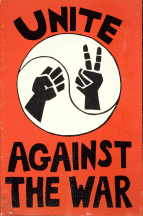
unite-against-the-warReports are emerging from July’s National Assembly, the vital effort to unite antiwar forces into a common movement. Delegates from the major peace organizations hammered out a strategy to address Iraq, Afghanistan, Pakistan and Palestine. Missing from the consensus? Nonviolence, and good riddance. It goes without saying that humanitarian activists are peaceful. To legislate a dogma of non-confrontation plays right into the hands of the authoritarians. Here’s the official report:

AN ASSESSMENT OF THE FIRST YEAR OF THE NATIONAL ASSEMBLY TO END THE IRAQ AND AFGHANISTAN WARS AND OCCUPATIONS

Address given by Marilyn Levin, member, National Assembly Administrative Body, and Planning Committee, Greater Boston United for Justice with Peace Coalition, to the National Antiwar Conference held July 10-12, 2009 in Pittsburgh, Pennsylvania

July 10-12, 2009, 255 people representing diverse organizations and constituencies from all over the country came together in Pittsburgh:

1) To look at where we are today,

2) To articulate our long range goals to rejuvenate the antiwar movement towards building a massive movement capable of forcing an end to their wars and occupations, to take our money back from the war machine to meet pressing social needs, and to save our planet for our children, and

3) To develop and vote for action plans as steps to realize these objectives.

All of our major objectives were accomplished and we leave today with a comprehensive action agenda to carry us through to next spring. Everyone had a chance to speak and differences were aired without rancor or splits to achieve unity in action.

Friday night’s speakers, along with many conference participants, grappled with how to unify and broaden the movement. Saturday afternoon and Sunday morning, we presented a great roster of workshops covering the major issues we face today. Saturday night’s rally was dynamic and inspiring.

There were two highlights of the conference for me. First was the international component where activist comrades joined us from Canada and courageous labor leaders of powerful mass movements in Haiti and Guadaloupe reminded us that imperialism and the struggle against it are global. There was a statement by members of the Viva Palestina aid convoy detained in Egypt. We passed motions in solidarity with the struggles of the people of Haiti, Honduras, and Palestine.

The second highlight was the discussion on Iran, where, in spite of strong passions stirred up by the rapidly evolving events there, we were able to illuminate the issues and debate our differences. Finally, we were able to agree on a unity position that all could embrace, as well as meeting the foremost call of the Iranians – US Hands off! No Sanctions! No interventions! Self-determination for the Iranian people! A wonderful example of a united front –- as inclusive as possible and taking principled positions that most will accept and act on.

So what is the National Assembly? What you saw this weekend explains who we are and how we function.

Democracy. All were invited and all perspectives welcomed. There was acceptance of the will of the conference even when it diverged from the proposals put forward by the leadership body. We were especially gratified that representatives from all the major antiwar coalitions came and addressed our conference.

Our willingness to struggle for unity and compromise when needed in order to move forward, as evidenced by a leadership that did not impose personal political views on others in service to unity.

An organization that admits to and learns from its mistakes and accepts its limitations when the unity we seek can’t yet be achieved.

An organization that has built a growing cadre of leaders that has developed trust, a structure that works, and a strong working relationship.

And finally, confidence, vision, and optimism. Confidence that we can provide leadership in rebooting our movement. A vision regarding how to accomplish that and an understanding of the necessity for these kinds of conferences leading to action. Optimism that masses of people will move in opposition to these horrendous policies that bring death and destruction and that they will have the power to change the world.

I’ve been asked to give an assessment of the first year since our initiation as an ongoing network with a mission, from our first conference in June, 2008 until today. Last year, we weren’t sure anyone would come and lo and behold 400 people came together in Cleveland to inaugurate a year of activities and set up a structure to maintain our work. A lot has transpired in that year and the National Assembly is well on its way as an established organization recognized throughout the movement as providing leadership and promoting a direction towards growth.

I need to start a little earlier and go back to why the National Assembly was called into existence in the first place.

What we saw, in the spring of 2008, was a movement at a low ebb – one that was shrinking rather than growing in spite of the war dragging on — this while the antiwar sentiment couldn’t be higher, and the disapproval rating for the Bush Administration couldn’t have been lower. From the high point of the largest action against the Iraq War in September, 2005 which drew 700,000 people, there was a pulling away from mass action by significant sections of the movement which supported electoral politics as the central strategy, in spite of a recurring pattern of disappointment when Democratic “antiwar” candidates voted again and again for war and war funding, and a split between the two major national coalitions, UFPJ and ANSWER, one that continues to this day. For the first time in five years, there was not enough unity or mass action perspective for any national demonstrations to take place marking the 5th year of the occupation of Iraq. Fundamentally, there was a vacuum of leadership.

Some far-sighted people like Jerry Gordon and Jeff Mackler, with experience gained from leadership in the last powerful antiwar movement that ended the Vietnam War, felt impelled to act. They began to organize a base of diverse but like-minded activists committed to building and expanding an effective antiwar movement in this country. The vehicle to accomplish this was the first national assembly, a national conference to pull activists together, to analyze the present state of the movement, to discuss where we needed to go and the actions that were needed to get us there.

We developed a unity statement with five basic principles that we hold today as the basis for where we stand:

1) Unity – all sections of the movement working together for common goals and actions;

2) Political Independence – no affiliations or support to any political party;

3) Democracy – decision-making at conferences with one person, one vote;

4) Mass Action – as the central strategy for organizing while embracing other forms of
outreach and protest; and

5) Out Now – the central demand to withdraw all military forces, contractors, and bases
from the countries where the U.S. was waging war on the people.

It seems simple but no one else saw it that way. Our conference was unique in the history of the present movement.

The organizers didn’t know what the mood and composition or strength of the conference would be, so we were cautious and minimal in the program we posed to the conference. We focused on Out Now from Iraq and modest action proposals, not being strong enough to initiate national actions on our own. The conference participants were ahead of us and ready to tackle the larger issues. Proposals were passed to add “Out Now from Afghanistan”, “End U.S. Support for the Occupation of Palestine”, and “Hands off Iran” to our set of demands, and given what has transpired in these areas, we were well prepared to take on a major role.

October 10th actions held in 20 cities were endorsed as well as a call for December actions building towards what we hoped would be unified, nationally coordinated bicoastal mass actions in the spring of 2009, the 6th year of the Iraq occupation. When Gaza was brutally assaulted, we joined with ANSWER and others to march in Washington and to demonstrate in the streets all over the country, and we’re still working under Palestinian leadership to bring justice and relief to a beleaguered population.

We made a concerted effort to find a common date for spring bi-coastal mobilizations. As you know, ANSWER chose March 21st as a day of united protests which we endorsed, while UFPJ called for a national march on Wall St. on April 4th. A number of National Assembly supporters who were also delegates to the UFPJ conference in December formed a mass action unity caucus and went to the conference with a resolution to allow delegates to vote for one or both actions but this was rejected. We’ll keep trying for 2010. The National Assembly endorsed and built both actions and marched behind our signs with our demands. The demonstrations were small (but spirited) and still of major importance.

For us, it’s quality, not quantity, as we position ourselves to be in the forefront as the pendulum swings in our direction once again.

Some take the position that mass demonstrations are not effective, unless we can pull 100,000 protestors into the streets. This is short-sighted and does not address how we get from small to large. Any successful movement for change doesn’t start with 100,000 people, and there has never been significant social change without mass actions. I remember my first anti-Vietnam war demonstration was in 1963 in Detroit and we had 15 people. In 1965, SDS called the first national march against the war in Washington. 25,000 people turned out and we thought it was huge!

Everyone talks about reaching out to the thousands of young people who mobilized to elect Obama. We agree, but we say the way to do this is by offering education and action. Action beyond calling, and emailing, and faxing the politicians they placed in office.

Why are mass demonstrations so important to building a powerful movement? It is because they accomplish so much in the process of building them. They provide:

Continuity. You can’t build anything by starting anew each time. Each action should lead to the next action or open national conference, with success building upon success. We need a continuity of leadership that builds trust and a reputation for integrity, and that learns lessons to improve. We need a continuity of organization and structure that can implement the tasks before us.

Visibility. Actions in the street give heart to the people the U.S. is attacking and occupying, letting them know that they are not alone. Mass actions create solidarity, offering support to anti-war soldiers, vets and their families, and a counter-force to the economic draft facing our youth, and they strengthen and deepen the antiwar sentiment of the people.

Inspiration. New people are brought into the movement, especially the youth, through activism. Have you ever talked to young people coming to a mass demonstration for the first time? They are inspired and thrilled to hear powerful speakers who are leaders of social justice movements and soldiers resisting the wars. They see they are not alone and get a taste of the power of large numbers of people marching together. They are energized to go home and join with others to continue to organize opposition to brutal U.S. wars and occupations. This is the way to reach out to the Obama supporters.

Explanation. An analysis of what is going on is offered along with tying together what seem at first to be disparate elements, i.e., war is tied to the economy, the war budget, bail-outs of the rich, the lack of basic needs being met, justice denied, and the impoverishment of the people.

Pressure on Government. People in this country are taught to be quiet. We’re told that our job is to elect officials whom we agree with periodically and then go home and wait while they fix things. This conveniently maintains the status quo but it sure doesn’t put pressure on them, or scare them, or force social change. Mass actions provide the most effective way to make significant change happen.

Let’s look at the present period. Obama’s election was based in large part on the hopes and aspirations of Americans for peace and a better life based on the promises and assumed promises that were made of peace, justice, and prosperity, which have not and will not be met.

Contrary to expectations, the previous administration’s policies are continued with a more handsome and articulate face. We all know that rather than winding down, wars and interventions are escalating and the rapacious greed of this immoral system knows no bounds.

Simultaneously, the economic crisis is causing terrible hardship for working people and for people who are no longer able to find work and their families. They are using this self-created financial disaster to further cut the standard of living and eliminate a secure future for older people and the young.

It was very moving and yet appalling to see this visually demonstrated when Robin Alexander of the United Electrical Workers Union asked people in the audience to stand who were unemployed, personally knew of soldier casualties, lived in communities where services were being cut, or who were otherwise negatively impacted by the wars and the failing economy. Nearly the entire room, a microcosm of the wider society, was standing by the end of that exercise.

It is inevitable that the present period of quiescence and hanging on to the hope that Obama and the new Congress will save us will come to a crashing end. People will not sit idly by forever while the world around them collapses. We are already seeing the beginnings of stirring. There is a greater willingness to go out in the streets to protest. There is more organizing taking place on campuses, more young people joining the movement. The many proposals for October actions are an indication that there is a widespread awareness of the need for actions this fall and the conviction that the movement must find common dates.

Brian Becker, National Coordinator of ANSWER, urged that we all work together to mount nationally coordinated actions next spring. Michael McPhearson, Co-Chair of UFPJ and Executive Director of Veterans for Peace, announced his support for October 17 and his willingness to do what he could to spur unified actions in the spring of 2010. We must have the faith and confidence that the people have the power to end the atrocities resulting from U.S. wars and occupations, and that they will recognize and utilize this power. As this happens, we must build a stronger antiwar movement that is able to provide leadership and the optimism to forge ahead no matter what the opposition throws at us.

The National Assembly to End the Iraq and Afghanistan Wars and Occupations is helping to provide that leadership and the vision that is needed. Although young and small, in one short year, we are now a force to be taken seriously and negotiated with, and by our persistent call for unity and mass action, our demonstrated ability to organize, and our coordinated strategy for revitalizing the movement, we are having an impact larger than our forces would indicate. In some ways, we too are a product of (and some say an antidote to) the 2008 election. To counter the malaise of the movement, we have quietly been building a solid core of activists and leaders around the country that understand the importance of a united front organized around principled demands and mass actions, not just calling Washington politicians when bills come up and crises happen.

At this conference, we have laid out an ambitious program of action that will take us through the spring of 2010. We are proud that we could provide the kick off for national organizing to bring a massive turnout to Pittsburgh for the G-20 protests September 25. Homeland Security is already making preparations to keep protesters hidden and stifle our right to speak out, but we won’t be silenced.

Following that, are a series of October building actions, culminating in large local and regional demonstrations on October 17 marking dates of significance related to the Iraq and Afghanistan wars and occupations and remembering the legacy of the anti-Vietnam war movement. Throughout the year, we will organize educational programs, support various forms of protest and organize around the inevitable emergencies caused by our government’s unholy interventions and threats to other nations.

We have initiated a Free Palestine Working Committee to ensure this work, which includes the growing boycott, divestment, and sanctions campaigns and the efforts to break the siege of Gaza, continues to be in the forefront and fully integrated in our work until justice and self-determination and return is in the hands of the Palestinians.

And lastly, we will continue to advocate for unity of the movement and once again bring thousands to Washington and the West Coast in the spring, to let our government and the world know that the U.S. movement against wars and occupations is alive and will not be quiet.

We will march and continue to march until all U.S. forces come home, bases are dismantled, and the sovereign people of the world have the right to control their own resources and determine their own futures, and the war budget becomes the peace budget.

Don’t sit on the sidelines and watch history being made. We urge all organizations to join the National Assembly and to play your part in building and shaping the powerful movement that is coming.

All out for the September 25 G-20 march in Pittsburgh! All out for the actions in early October! All out October 17!

The Port Huron Statement

Port Huron Statement of the Students for a Democratic Society, 1962

Port-Huron-Statement-SDSIntroductory Note: This document represents the results of several months of writing and discussion among the membership, a draft paper, and revision by the Students for a Democratic Society national convention meeting in Port Huron, Michigan, June 11-15, 1962. It is represented as a document with which SDS officially identifies, but also as a living document open to change with our times and experiences. It is a beginning: in our own debate and education, in our dialogue with society.

published and distributed by Students for a Democratic Society 112 East 19 Street New York 3, New York GRamercy 3-2181

INTRODUCTION: AGENDA FOR A GENERATION

We are people of this generation, bred in at least modest comfort, housed now in universities, looking uncomfortably to the world we inherit.

When we were kids the United States was the wealthiest and strongest country in the world: the only one with the atom bomb, the least scarred by modern war, an initiator of the United Nations that we thought would distribute Western influence throughout the world. Freedom and equality for each individual, government of, by, and for the people — these American values we found good, principles by which we could live as men. Many of us began maturing in complacency.

As we grew, however, our comfort was penetrated by events too troubling to dismiss. First, the permeating and victimizing fact of human degradation, symbolized by the Southern struggle against racial bigotry, compelled most of us from silence to activism. Second, the enclosing fact of the Cold War, symbolized by the presence of the Bomb, brought awareness that we ourselves, and our friends, and millions of abstract “others” we knew more directly because of our common peril, might die at any time. We might deliberately ignore, or avoid, or fail to feel all other human problems, but not these two, for these were too immediate and crushing in their impact, too challenging in the demand that we as individuals take the responsibility for encounter and resolution.

While these and other problems either directly oppressed us or rankled our consciences and became our own subjective concerns, we began to see complicated and disturbing paradoxes in our surrounding America. The declaration “all men are created equal . . . rang hollow before the facts of Negro life in the South and the big cities of the North. The proclaimed peaceful intentions of the United States contradicted its economic and military investments in the Cold War status quo.

We witnessed, and continue to witness, other paradoxes. With nuclear energy whole cities can easily be powered, yet the dominant nation states seem more likely to unleash destruction greater than that incurred in all wars of human history. Although our own technology is destroying old and creating new forms of social organization, men still tolerate meaningless work and idleness. While two-thirds of mankind suffers undernourishment, our own upper classes revel amidst superfluous abundance. Although world population is expected to double in forty years, the nations still tolerate anarchy as a major principle of international conduct and uncontrolled exploitation governs the sapping of the earth’s physical resources. Although mankind desperately needs revolutionary leadership, America rests in national stalemate, its goals ambiguous and tradition-bound instead of informed and clear, its democratic system apathetic and manipulated rather than “of, by, and for the people.”

Not only did tarnish appear on our image of American virtue, not only did disillusion occur when the hypocrisy of American ideals was discovered, but we began to sense that what we had originally seen as the American Golden Age was actually the decline of an era. The worldwide outbreak of revolution against colonialism and imperialism, the entrenchment of totalitarian states, the menace of war, overpopulation, international disorder, supertechnology — these trends were testing the tenacity of our own commitment to democracy and freedom and our abilities to visualize their application to a world in upheaval.

Our work is guided by the sense that we may be the last generation in the experiment with living. But we are a minority — the vast majority of our people regard the temporary equilibriums of our society and world as eternally-functional parts. In this is perhaps the outstanding paradox: we ourselves are imbued with urgency, yet the message of our society is that there is no viable alternative to the present. Beneath the reassuring tones of the politicians, beneath the common opinion that America will “muddle through”, beneath the stagnation of those who have closed their minds to the future, is the pervading feeling that there simply are no alternatives, that our times have witnessed the exhaustion not only of Utopias, but of any new departures as well. Feeling the press of complexity upon the emptiness of life, people are fearful of the thought that at any moment things might thrust out of control. They fear change itself, since change might smash whatever invisible framework seems to hold back chaos for them now. For most Americans, all crusades are suspect, threatening. The fact that each individual sees apathy in his fellows perpetuates the common reluctance to organize for change. The dominant institutions are complex enough to blunt the minds of their potential critics, and entrenched enough to swiftly dissipate or entirely repel the energies of protest and reform, thus limiting human expectancies. Then, too, we are a materially improved society, and by our own improvements we seem to have weakened the case for further change.

Some would have us believe that Americans feel contentment amidst prosperity — but might it not better be called a glaze above deeply felt anxieties about their role in the new world? And if these anxieties produce a developed indifference to human affairs, do they not as well produce a yearning to believe there is an alternative to the present, that something can be done to change circumstances in the school, the workplaces, the bureaucracies, the government? It is to this latter yearning, at once the spark and engine of change, that we direct our present appeal. The search for truly democratic alternatives to the present, and a commitment to social experimentation with them, is a worthy and fulfilling human enterprise, one which moves us and, we hope, others today. On such a basis do we offer this document of our convictions and analysis: as an effort in understanding and changing the conditions of humanity in the late twentieth century, an effort rooted in the ancient, still unfulfilled conception of man attaining determining influence over his circumstances of life.

Values

Making values explicit — an initial task in establishing alternatives –

* is an activity that has been devalued and corrupted. The conventional moral terms of the age, the politician moralities — “free world”, “people’s democracies” — reflect realities poorly, if at all, and seem to function more as ruling myths than as descriptive principles. But neither has our experience in the universities brought as moral enlightenment. Our professors and administrators sacrifice controversy to public relations; their curriculums change more slowly than the living events of the world; their skills and silence are purchased by investors in the arms race; passion is called unscholastic. The questions we might want raised — what is really important? can we live in a different and better way? if we wanted to change society, how would we do it? — are not thought to be questions of a “fruitful, empirical nature”, and thus are brushed aside.

Unlike youth in other countries we are used to moral leadership being exercised and moral dimensions being clarified by our elders. But today, for us, not even the liberal and socialist preachments of the past seem adequate to the forms of the present. Consider the old slogans; Capitalism Cannot Reform Itself, United Front Against Fascism, General Strike, All Out on May Day. Or, more recently, No Cooperation with Commies and Fellow Travellers, Ideologies Are Exhausted, Bipartisanship, No Utopias. These are incomplete, and there are few new prophets. It has been said that our liberal and socialist predecessors were plagued by vision without program, while our own generation is plagued by program without vision. All around us there is astute grasp of method, technique — the committee, the ad hoc group, the lobbyist, that hard and soft sell, the make, the projected image — but, if pressed critically, such expertise is incompetent to explain its implicit ideals. It is highly fashionable to identify oneself by old categories, or by naming a respected political figure, or by explaining “how we would vote” on various issues.

Theoretic chaos has replaced the idealistic thinking of old — and, unable to reconstitute theoretic order, men have condemned idealism itself. Doubt has replaced hopefulness — and men act out a defeatism that is labeled realistic. The decline of utopia and hope is in fact one of the defining features of social life today. The reasons are various: the dreams of the older left were perverted by Stalinism and never recreated; the congressional stalemate makes men narrow their view of the possible; the specialization of human activity leaves little room for sweeping thought; the horrors of the twentieth century, symbolized in the gas-ovens and concentration camps and atom bombs, have blasted hopefulness. To be idealistic is to be considered apocalyptic, deluded. To have no serious aspirations, on the contrary, is to be “tough-minded”.

In suggesting social goals and values, therefore, we are aware of entering a sphere of some disrepute. Perhaps matured by the past, we have no sure formulas, no closed theories — but that does not mean values are beyond discussion and tentative determination. A first task of any social movement is to convenience people that the search for orienting theories and the creation of human values is complex but worthwhile. We are aware that to avoid platitudes we must analyze the concrete conditions of social order. But to direct such an analysis we must use the guideposts of basic principles. Our own social values involve conceptions of human beings, human relationships, and social systems.

We regard men as infinitely precious and possessed of unfulfilled capacities for reason, freedom, and love. In affirming these principles we are aware of countering perhaps the dominant conceptions of man in the twentieth century: that he is a thing to be manipulated, and that he is inherently incapable of directing his own affairs. We oppose the depersonalization that reduces human beings to the status of things — if anything, the brutalities of the twentieth century teach that means and ends are intimately related, that vague appeals to “posterity” cannot justify the mutilations of the present. We oppose, too, the doctrine of human incompetence because it rests essentially on the modern fact that men have been “competently” manipulated into incompetence — we see little reason why men cannot meet with increasing skill the complexities and responsibilities of their situation, if society is organized not for minority, but for majority, participation in decision-making.

Men have unrealized potential for self-cultivation, self-direction, self-understanding, and creativity. It is this potential that we regard as crucial and to which we appeal, not to the human potentiality for violence, unreason, and submission to authority. The goal of man and society should be human independence: a concern not with image of popularity but with finding a meaning in life that is personally authentic: a quality of mind not compulsively driven by a sense of powerlessness, nor one which unthinkingly adopts status values, nor one which represses all threats to its habits, but one which has full, spontaneous access to present and past experiences, one which easily unites the fragmented parts of personal history, one which openly faces problems which are troubling and unresolved: one with an intuitive awareness of possibilities, an active sense of curiosity, an ability and willingness to learn.

This kind of independence does not mean egoistic individualism — the object is not to have one’s way so much as it is to have a way that is one’s own. Nor do we deify man — we merely have faith in his potential.

Human relationships should involve fraternity and honesty. Human interdependence is contemporary fact; human brotherhood must be willed however, as a condition of future survival and as the most appropriate form of social relations. Personal links between man and man are needed, especially to go beyond the partial and fragmentary bonds of function that bind men only as worker to worker, employer to employee, teacher to student, American to Russian.

Loneliness, estrangement, isolation describe the vast distance between man and man today. These dominant tendencies cannot be overcome by better personnel management, nor by improved gadgets, but only when a love of man overcomes the idolatrous worship of things by man.

As the individualism we affirm is not egoism, the selflessness we affirm is not self-elimination. On the contrary, we believe in generosity of a kind that imprints one’s unique individual qualities in the relation to other men, and to all human activity. Further, to dislike isolation is not to favor the abolition of privacy; the latter differs from isolation in that it occurs or is abolished according to individual will. Finally, we would replace power and personal uniqueness rooted in possession, privilege, or circumstance by power and uniqueness rooted in love, reflectiveness, reason, and creativity.

As a social system we seek the establishment of a democracy of individual participation, governed by two central aims: that the individual share in those social decisions determining the quality and direction of his life; that society be organized to encourage independence in men and provide the media for their common participation.

In a participatory democracy, the political life would be based in several root principles:

* that decision-making of basic social consequence be carried on by public groupings;

* that politics be seen positively, as the art of collectively creating an acceptable pattern of social relations;

* that politics has the function of bringing people out of isolation and into community, thus being a necessary, though not sufficient, means of finding meaning in personal life;

* that the political order should serve to clarify problems in a way instrumental to their solution; it should provide outlets for the expression of personal grievance and aspiration; opposing views should be organized so as to illuminate choices and facilities the attainment of goals; channels should be commonly available to related men to knowledge and to power so that private problems — from bad recreation facilities to personal alienation — are formulated as general issues.

The economic sphere would have as its basis the principles:

* that work should involve incentives worthier than money or survival. It should be educative, not stultifying; creative, not mechanical; selfdirect, not manipulated, encouraging independence; a respect for others, a sense of dignity and a willingness to accept social responsibility, since it is this experience that has crucial influence on habits, perceptions and individual ethics;

* that the economic experience is so personally decisive that the individual must share in its full determination;

* that the economy itself is of such social importance that its major resources and means of production should be open to democratic participation and subject to democratic social regulation.

Like the political and economic ones, major social institutions — cultural, education, rehabilitative, and others — should be generally organized with the well-being and dignity of man as the essential measure of success.

In social change or interchange, we find violence to be abhorrent because it requires generally the transformation of the target, be it a human being or a community of people, into a depersonalized object of hate. It is imperative that the means of violence be abolished and the institutions — local, national, international — that encourage nonviolence as a condition of conflict be developed.

These are our central values, in skeletal form. It remains vital to understand their denial or attainment in the context of the modern world.

The Students

In the last few years, thousands of American students demonstrated that they at least felt the urgency of the times. They moved actively and directly against racial injustices, the threat of war, violations of individual rights of conscience and, less frequently, against economic manipulation. They succeeded in restoring a small measure of controversy to the campuses after the stillness of the McCarthy period. They succeeded, too, in gaining some concessions from the people and institutions they opposed, especially in the fight against racial bigotry.

The significance of these scattered movements lies not in their success or failure in gaining objectives — at least not yet. Nor does the significance lie in the intellectual “competence” or “maturity” of the students involved — as some pedantic elders allege. The significance is in the fact the students are breaking the crust of apathy and overcoming the inner alienation that remain the defining characteristics of American college life.

If student movements for change are rarities still on the campus scene, what is commonplace there? The real campus, the familiar campus, is a place of private people, engaged in their notorious “inner emigration.” It is a place of commitment to business-as-usual, getting ahead, playing it cool. It is a place of mass affirmation of the Twist, but mass reluctance toward the controversial public stance. Rules are accepted as “inevitable”, bureaucracy as “just circumstances”, irrelevance as “scholarship”, selflessness as “martyrdom”, politics as “just another way to make people, and an unprofitable one, too.”

Almost no students value activity as a citizen. Passive in public, they are hardly more idealistic in arranging their private lives: Gallup concludes they will settle for “low success, and won’t risk high failure.” There is not much willingness to take risks (not even in business), no setting of dangerous goals, no real conception of personal identity except one manufactured in the image of others, no real urge for personal fulfillment except to be almost as successful as the very successful people. Attention is being paid to social status (the quality of shirt collars, meeting people, getting wives or husbands, making solid contacts for later on); much too, is paid to academic status (grades, honors, the med school rat-race). But neglected generally is real intellectual status, the personal cultivation of the mind.

“Students don’t even give a damn about the apathy,” one has said. Apathy toward apathy begets a privately-constructed universe, a place of systematic study schedules, two nights each week for beer, a girl or two, and early marriage; a framework infused with personality, warmth, and under control, no matter how unsatisfying otherwise.

Under these conditions university life loses all relevance to some. Four hundred thousand of our classmates leave college every year.

But apathy is not simply an attitude; it is a product of social institutions, and of the structure and organization of higher education itself. The extracurricular life is ordered according to in loco parentis theory, which ratifies the Administration as the moral guardian of the young. The accompanying “let’s pretend” theory of student extracurricular affairs validates student government as a training center for those who want to spend their lives in political pretense, and discourages initiative from more articulate, honest, and sensitive students. The bounds and style of controversy are delimited before controversy begins. The university “prepares” the student for “citizenship” through perpetual rehearsals and, usually, through emasculation of what creative spirit there is in the individual.

The academic life contains reinforcing counterparts to the way in which extracurricular life is organized. The academic world is founded in a teacher-student relation analogous to the parent-child relation which characterizes in loco parentis. Further, academia includes a radical separation of student from the material of study. That which is studied, the social reality, is “objectified” to sterility, dividing the student from life — just as he is restrained in active involvement by the deans controlling student government. The specialization of function and knowledge, admittedly necessary to our complex technological and social structure, has produced and exaggerated compartmentalization of study and understanding. This has contributed to: an overly parochial view, by faculty, of the role of its research and scholarship; a discontinuous and truncated understanding, by students, of the surrounding social order; a loss of personal attachment, by nearly all, to the worth of study as a humanistic enterprise.

There is, finally, the cumbersome academic bureaucracy extending throughout the academic as well as extracurricular structures, contributing to the sense of outer complexity and inner powerlessness that transforms so many students from honest searching to ratification of convention and, worse, to a numbness of present and future catastrophes. The size and financing systems of the university enhance the permanent trusteeship of the administrative bureaucracy, their power leading to a shift to the value standards of business and administrative mentality within the university. Huge foundations and other private financial interests shape under-financed colleges and universities, not only making them more commercial, but less disposed to diagnose society critically, less open to dissent. Many social and physical scientists, neglecting the liberating heritage of higher learning, develop “human relations” or morale-producing” techniques for the corporate economy, while others exercise their intellectual skills to accelerate the arms race.

Tragically, the university could serve as a significant source of social criticism and an initiator of new modes and molders of attitudes. But the actual intellectual effect of the college experience is hardly distinguishable from that of any other communications channel — say, a television set — passing on the stock truths of the day. Students leave college somewhat more “tolerant” than when they arrived, but basically unchallenged in their values and political orientations. With administrators ordering the institutions, and faculty the curriculum, the student learns by his isolation to accept elite rule within the university, which prepares him to accept later forms of minority control. The real function of the educational system — as opposed to its more rhetorical function of “searching for truth” — is to impart the key information and styles that will help the student get by, modestly but comfortably, in the big society beyond.

The Society Beyond

Look beyond the campus, to America itself. That student life is more intellectual, and perhaps more comfortable, does not obscure the fact that the fundamental qualities of life on the campus reflect the habits of society at large. The fraternity president is seen at the junior manager levels; the sorority queen has gone to Grosse Pointe: the serious poet burns for a place, any place, or work; the once-serious and never serious poets work at the advertising agencies. The desperation of people threatened by forces about which they know little and of which they can say less; the cheerful emptiness of people “giving up” all hope of changing things; the faceless ones polled by Gallup who listed “international affairs” fourteenth on their list of “problems” but who also expected thermonuclear war in the next few years: in these and other forms, Americans are in withdrawal from public life, from any collective effort at directing their own affairs.

Some regard this national doldrums as a sign of healthy approval of the established order — but is it approval by consent or manipulated acquiescence? Others declare that the people are withdrawn because compelling issues are fast disappearing — perhaps there are fewer breadlines in America, but is Jim Crow gone, is there enough work and work more fulfilling, is world war a diminishing threat, and what of the revolutionary new peoples? Still others think the national quietude is a necessary consequence of the need for elites to resolve complex and specialized problems of modern industrial society — but, then, why should business elites help decide foreign policy, and who controls the elites anyway, and are they solving mankind’s problems? Others, finally, shrug knowingly and announce that full democracy never worked anywhere in the past — but why lump qualitatively different civilizations together, and how can a social order work well if its best thinkers are skeptics, and is man really doomed forever to the domination of today?

There are no convincing apologies for the contemporary malaise. While the world tumbles toward the final war, while men in other nations are trying desperately to alter events, while the very future qua future is uncertain — America is without community, impulse, without the inner momentum necessary for an age when societies cannot successfully perpetuate themselves by their military weapons, when democracy must be viable because of its quality of life, not its quantity of rockets.

The apathy here is, first subjective — the felt powerlessness of ordinary people, the resignation before the enormity of events. But subjective apathy is encouraged by the objective American situation — the actual structural separation of people from power, from relevant knowledge, from pinnacles of decision-making. Just as the university influences the student way of life, so do major social institutions create the circumstances in which the isolated citizen will try hopelessly to understand his world and himself.

The very isolation of the individual — from power and community and ability to aspire — means the rise of a democracy without publics. With the great mass of people structurally remote and psychologically hesitant with respect to democratic institutions, those institutions themselves attenuate and become, in the fashion of the vicious circle, progressively less accessible to those few who aspire to serious participation in social affairs. The vital democratic connection between community and leadership, between the mass and the several elites, has been so wrenched and perverted that disastrous policies go unchallenged time and again.

Politics without Publics

The American political system is not the democratic model of which its glorifiers speak. In actuality it frustrates democracy by confusing the individual citizen, paralyzing policy discussion, and consolidating the irresponsible power of military and business interests.

A crucial feature of the political apparatus in America is that greater differences are harbored within each major party than the differences existing between them. Instead of two parties presenting distinctive and significant differences of approach, what dominates the system if a natural interlocking of Democrats from Southern states with the more conservative elements of the Republican party. This arrangement of forces is blessed by the seniority system of Congress which guarantees congressional committee domination by conservatives — ten of 17 committees in the Senate and 13 of 21 in House of Representatives are chaired currently by Dixiecrats.

The party overlap, however, is not the only structural antagonist of democracy in politics. First, the localized nature of the party system does not encourage discussion of national and international issues: thus problems are not raised by and for people, and political representatives usually are unfettered from any responsibilities to the general public except those regarding parochial matters. Second, whole constituencies are divested of the full political power they might have: many Negroes in the South are prevented from voting, migrant workers are disenfranchised by various residence requirements, some urban and suburban dwellers are victimized by gerrymandering, and poor people are too often without the power to obtain political representation. Third, the focus of political attention is significantly distorted by the enormous lobby force, composed predominantly of business interests, spending hundreds of millions each year in an attempt to conform facts about productivity, agriculture, defense, and social services, to the wants of private economic groupings.

What emerges from the party contradictions and insulation of privatelyheld power is the organized political stalemate: calcification dominates flexibility as the principle of parliamentary organization, frustration is the expectancy of legislators intending liberal reform, and Congress becomes less and less central to national decision-making, especially in the area of foreign policy. In this context, confusion and blurring is built into the formulation of issues, long-range priorities are not discussed in the rational manner needed for policymaking, the politics of personality and “image” become a more important mechanism than the construction of issues in a way that affords each voter a challenging and real option. The American voter is buffeted from all directions by pseudo-problems, by the structurally-initiated sense that nothing political is subject to human mastery. Worried by his mundane problems which never get solved, but constrained by the common belief that politics is an agonizingly slow accommodation of views, he quits all pretense of bothering.

A most alarming fact is that few, if any, politicians are calling for changes in these conditions. Only a handful even are calling on the President to “live up to” platform pledges; no one is demanding structural changes, such as the shuttling of Southern Democrats out of the Democratic Party. Rather than protesting the state of politics, most politicians are reinforcing and aggravating that state. While in practice they rig public opinion to suit their own interests, in word and ritual they enshrine “the sovereign public” and call for more and more letters. Their speeches and campaign actions are banal, based on a degrading conception of what people want to hear. They respond not to dialogue, but to pressure: and knowing this, the ordinary citizen sees even greater inclination to shun the political sphere. The politicians is usually a trumpeter to “citizenship” and “service to the nation”, but since he is unwilling to seriously rearrange power relationships, his trumpetings only increase apathy by creating no outlets. Much of the time the call to “service” is justified not in idealistic terms, but in the crasser terms of “defending the free world from communism” — thus making future idealistic impulses harder to justify in anything but Cold War terms.

In such a setting of status quo politics, where most if not all government activity is rationalized in Cold War anti-communist terms, it is somewhat natural that discontented, super-patriotic groups would emerge through political channels and explain their ultra-conservatism as the best means of Victory over Communism. They have become a politically influential force within the Republican Party, at a national level through Senator Goldwater, and at a local level through their important social and economic roles. Their political views are defined generally as the opposite of the supposed views of communists: complete individual freedom in the economic sphere, non-participation by the government in the machinery of production. But actually “anticommunism” becomes an umbrella by which to protest liberalism, internationalism, welfarism, the active civil rights and labor movements. It is to the disgrace of the United States that such a movement should become a prominent kind of public participation in the modern world — but, ironically, it is somewhat to the interests of the United States that such a movement should be a public constituency pointed toward realignment of the political parties, demanding a conservative Republican Party in the South and an exclusion of the “leftist” elements of the national GOP.

The Economy

American capitalism today advertises itself as the Welfare State. Many of us comfortably expect pensions, medical care, unemployment compensation, and other social services in our lifetimes. Even with one-fourth of our productive capacity unused, the majority of Americans are living in relative comfort — although their nagging incentive to “keep up” makes them continually dissatisfied with their possessions. In many places, unrestrained bosses, uncontrolled machines, and sweatshop conditions have been reformed or abolished and suffering tremendously relieved. But in spite of the benign yet obscuring effects of the New Deal reforms and the reassuring phrases of government economists and politicians, the paradoxes and myths of the economy are sufficient to irritate our complacency and reveal to us some essential causes of the American malaise.

We live amidst a national celebration of economic prosperity while poverty and deprivation remain an unbreakable way of life for millions in the “affluent society”, including many of our own generation. We hear glib reference to the “welfare state”, “free enterprise”, and “shareholder’s democracy” while military defense is the main item of “public” spending and obvious oligopoly and other forms of minority rule defy real individual initiative or popular control. Work, too, is often unfulfilling and victimizing, accepted as a channel to status or plenty, if not a way to pay the bills, rarely as a means of understanding and controlling self and events. In work and leisure the individual is regulated as part of the system, a consuming unit, bombarded by hardsell soft-sell, lies and semi-true appeals and his basest drives. He is always told what he is supposed to enjoy while being told, too, that he is a “free” man because of “free enterprise.”

The Remote Control Economy. We are subject to a remote control economy, which excludes the mass of individual “units” — the people — from basic decisions affecting the nature and organization of work, rewards, and opportunities. The modern concentration of wealth is fantastic. The wealthiest one percent of Americans own more than 80 percent of all personal shares of stock. From World War II until the mid-Fifties, the 50 biggest corporations increased their manufacturing production from 17 to 23 percent of the national total, and the share of the largest 200 companies rose from 30 to 37 percent. To regard the various decisions of these elites as purely economic is short-sighted: their decisions affect in a momentous way the entire fabric of social life in America. Foreign investments influence political policies in under-developed areas — and our efforts to build a “profitable” capitalist world blind our foreign policy to mankind’s needs and destiny. The drive for sales spurs phenomenal advertising efforts; the ethical drug industry, for instance, spent more than $750 million on promotions in 1960, nearly for times the amount available to all American medical schools for their educational programs. The arts, too, are organized substantially according to their commercial appeal aesthetic values are subordinated to exchange values, and writers swiftly learn to consider the commercial market as much as the humanistic marketplace of ideas. The tendency to over-production, to gluts of surplus commodities, encourages “market research” techniques to deliberately create pseudo-needs in consumers — we learn to buy “smart” things, regardless of their utility — and introduces wasteful “planned obsolescence” as a permanent feature of business strategy. While real social needs accumulate as rapidly as profits, it becomes evident that Money, instead of dignity of character, remains a pivotal American value and Profitability, instead of social use, a pivotal standard in determining priorities of resource allocation.

Within existing arrangements, the American business community cannot be said to encourage a democratic process nationally. Economic minorities not responsible to a public in any democratic fashion make decisions of a more profound importance than even those made by Congress. Such a claim is usually dismissed by respectful and knowing citations of the ways in which government asserts itself as keeper of the public interest at times of business irresponsibility. But the real, as opposed to the mythical, range of government “control” of the economy includes only:

1. some limited “regulatory” powers — which usually just ratify industry policies or serve as palliatives at the margins of significant business activity;

2. a fiscal policy build upon defense expenditures as pump-priming “public works” — without a significant emphasis on “peaceful public works” to meet social priorities and alleviate personal hardships;

3. limited fiscal and monetary weapons which are rigid and have only minor effects, and are greatly limited by corporate veto: tax cuts and reforms; interest rate control (used generally to tug on investment by hurting the little investor most); tariffs which protect noncompetitive industries with political power and which keep less-favored nations out of the large trade mainstream, as the removal of barriers reciprocally with the Common Market may do disastrously to emerging countries outside of Europe; wage arbitration, the use of government coercion in the name of “public interest” to hide the tensions between workers and business production controllers; price controls, which further maintains the status quo of big ownership and flushes out little investors for the sake of “stability”;

4. very limited “poverty-solving” which is designed for the organized working class but not the shut-out, poverty-stricken migrants, farm workers, the indigent unaware of medical care or the lower-middle class person riddled with medical bills, the “unhireables” of minority groups or workers over 45 years of age, etc.

5. regional development programs — such as the Area Redevelopment Act

* which have been only “trickle down” welfare programs without broad authority for regional planning and development and public works spending. The federal highway program has been more significant than the “depressed areas” program in meeting the needs of people, but is generally too remote and does not reach the vicious circle of poverty itself.

In short, the theory of government “countervailing” business neglects the extent to which government influence is marginal to the basic production decisions, the basic decision-making environment of society, the basic structure or distribution and allocation which is still determined by major corporations with power and wealth concentrated among the few. A conscious conspiracy — as in the case of pricerigging in the electrical industry — is by no means generally or continuously operative but power undeniably does rest in comparative insulation from the public and its political representatives.

The Military-Industrial Complex. The most spectacular and important creation of the authoritarian and oligopolistic structure of economic decision-making in America is the institution called “the militaryindustrial complex” by former President Eisenhower, the powerful congruence of interest and structure among military and business elites which affects so much of our development and destiny. Not only is ours the first generation to live with the possibility of world-wide cataclysm — it is the first to experience the actual social preparation for cataclysm, the general militarization of American society. In 1948 Congress established Universal Military Training, the first peacetime conscription. The military became a permanent institution. Four years earlier, General Motor’s Charles E. Wilson had heralded the creation of what he called the “permanent war economy,” the continuous use of military spending as a solution to economic problems unsolved before the post-war boom, most notably the problem of the seventeen million jobless after eight years of the New Deal. This has left a “hidden crisis” in the allocation of resources by the American economy.

Since our childhood these two trends — the rise of the military and the installation of a defense-based economy — have grown fantastically. The Department of Defense, ironically the world’s largest single organization, is worth $160 billion, owns 32 million acres of America and employs half the 7.5 million persons directly dependent on the military for subsistence, has an $11 billion payroll which is larger than the net annual income of all American corporations. Defense spending in the Eisenhower era totaled $350 billions and President Kennedy entered office pledged to go even beyond the present defense allocation of sixty cents from every public dollar spent. Except for a war-induced boom immediately after “our side” bombed Hiroshima, American economic prosperity has coincided with a growing dependence on military outlay — from 1941 to 1959 America’s Gross National Product of $5.25 trillion included $700 billion in goods and services purchased for the defense effort, about one-seventh of the accumulated GNP. This pattern has included the steady concentration of military spending among a few corporations. In 1961, 86 percent of Defense Department contracts were awarded without competition. The ordnance industry of 100,000 people is completely engaged in military work; in the aircraft industry, 94 percent of 750,000 workers are linked to the war economy; shipbuilding, radio and communications equipment industries commit forty percent of their work to defense; iron and steel, petroleum, metal-stamping and machine shop products, motors and generators, tools and hardware, copper, aluminum and machine tools industries all devote at least 10 percent of their work to the same cause.

The intermingling of Big Military and Big Industry is evidenced in the 1,400 former officers working for the 100 corporations who received nearly all the $21 billion spent in procurement by the Defense Department in 1961. The overlap is most poignantly clear in the case of General Dynamics, the company which received the best 1961 contracts, employed the most retired officers (187), and is directed by a former Secretary of the Army. A Fortune magazine profile of General Dynamics said: “The unique group of men who run Dynamics are only incidentally in rivalry with other U.S. manufacturers, with many of whom they actually act in concert. Their chief competitor is the USSR. The core of General Dynamics corporate philosophy is the conviction that national defense is a more or less permanent business.” Little has changed since Wilson’s proud declaration of the Permanent War Economy back in the 1944 days when the top 200 corporations possessed 80 percent of all active prime war-supply contracts.

Military Industrial Politics. The military and its supporting business foundation have found numerous forms of political expression, and we have heard their din endlessly. There has not been a major Congressional split on the issue of continued defense spending spirals in our lifetime. The triangular relation of the business, military and political arenas cannot be better expressed than in Dixiecrat Carl Vinson’s remarks as his House Armed Services Committee reported out a military construction bill of $808 million throughout the 50 states, for 1960-61: “There is something in this bill for everyone,” he announced. President Kennedy had earlier acknowledged the valuable anti-recession features of the bill.

Imagine, on the other hand, $808 million suggested as an anti-recession measure, but being poured into programs of social welfare: the impossibility of receiving support for such a measure identifies a crucial feature of defense spending: it is beneficial to private enterprise, while welfare spending is not. Defense spending does not “compete” with the private sector; it contains a natural obsolescence; its “confidential” nature permits easier boondoggling; the tax burdens to which it leads can be shunted from corporation to consumer as a “cost of production.” Welfare spending, however, involves the government in competition with private corporations and contractors; it conflicts with immediate interests of private pressure groups; it leads to taxes on business. Think of the opposition of private power companies to current proposals for river and valley development, or the hostility of the real estate lobby to urban renewal; or the attitude of the American Medical Association to a paltry medical care bill; or of all business lobbyists to foreign aid; these are the pressures leading to the schizophrenic public-military, private-civilian economy of our epoch. The politicians, of course, take the line of least resistance and thickest support: warfare, instead of welfare, is easiest to stand up for: after all, the Free World is at stake (and our constituency’s investments, too).

Automation, Abundance, and Challenge. But while the economy remains relatively static in its setting of priorities and allocation of resources, new conditions are emerging with enormous implications: the revolution of automation, and the replacement of scarcity by the potential of material abundance.

Automation, the process of machines replacing men in performing sensory, motoric and complex logical tasks, is transforming society in ways that are scarcely comprehensible. By 1959, industrial production regained its 1957 “pre-recession” level — but with 750,000 fewer workers required. In the Fifties as a whole, national production enlarged by 43 percent but the number of factory employees remained stationary, seventenths of one percent higher than in 1947. Automation is destroying whole categories of work — impersonal thinkers have efficiently labeled this “structural unemployment” — in blue-collar, service, and even middle management occupations. In addition it is eliminating employment opportunities for a youth force that numbers one million more than it did in 1950, and rendering work far more difficult both to find and do for people in the forties and up. The consequences of this economic drama, strengthened by the force of post-war recessions, are momentous: five million becomes an acceptable unemployment tabulation, and misery, uprootedness and anxiety become the lot of increasing numbers of Americans.

But while automation is creating social dislocation of a stunning kind, it paradoxically is imparting the opportunity for men the world around to rise in dignity from their knees. The dominant optimistic economic fact of this epoch is that fewer hands are needed now in actual production, although more goods and services are a real potentiality. The world could be fed, poverty abolished, the great public needs could be met, the brutish world of Darwinian scarcity could be brushed away, all men could have more time to pursue their leisure, drudgery in work could be cut to a minimum, education could become more of a continuing process for all people, both public and personal needs could be met rationally. But only in a system with selfish production motives and elitist control, a system which is less welfare than war-based, undemocratic rather than “stockholder participative” as “sold to us”, does the potentiality for abundance become a curse and a cruel irony:

1. Automation brings unemployment instead of mere leisure for all and greater achievement of needs for all people in the world — a crisis instead of economic utopia. Instead of being introduced into a social system in a planned and equitable way, automation is initiated according to its profitability. American Telephone and Telegraph holds back modern telephone equipment, invented with public research funds, until present equipment is financially unprofitable. Colleges develop teaching machines, mass-class techniques, and TV education to replace teachers: not to proliferate knowledge or to assist the qualified professors now, but to “cut costs in education and make the academic community more efficient and less wasteful.” Technology, which could be a blessing to society, becomes more and more a sinister threat to humanistic and rational enterprise.

2. Hard-core poverty exists just beyond the neon lights of affluence, and the “have-nots” may be driven still further from opportunity as the high-technology society demands better education to get into the production mainstream and more capital investment to get into “business”. Poverty is shameful in that it herds people by race, region, and previous condition of infortune into “uneconomic classes” in the so-called free society — the marginal worker is made more insecure by automation and high education requirements, heavier competition for jobs, maintaining low wages or a high level of unemployment. People in the rut of poverty are strikingly unable to overcome the collection of forces working against them: poor health, bad neighborhoods, miserable schools, inadequate “welfare” services, unemployment and underemployment, weak politician and union organization.

3. Surplus and potential plenty are waste domestically and producers suffer impoverishment because the real needs of the world and of our society are not reflected in the market. Our huge bins of decomposing grain are classic American examples, as is the steel industry which, in the summer of 1962, is producing at 53 percent of capacity.

The Stance of Labor. Amidst all this, what of organized labor, the historic institutional representative of the exploited, the presumed “countervailing power” against the excesses of Big Business? The contemporary social assault on the labor movement is of crisis proportions. To the average American, “big labor” is a growing cancer equal in impact to Big Business — nothing could be more distorted, even granting a sizable union bureaucracy. But in addition to public exaggerations, the labor crisis can be measured in several ways. First, the high expectations of the newborn AFL-CIO of 30 million members by 1965 are suffering a reverse unimaginable five years ago. The demise of the dream of “organizing the unorganized” is dramatically reflected in the AFL-CIO decision, just two years after its creation, to slash its organizing staff in half. From 15 million members when the AFL and the CIO merged, the total has slipped to 13.5 million. During the post-war generation, union membership nationally has increased by four million — but the total number of workers has jumped by 13 million. Today only 40 percent of all non-agricultural workers are protected by any form or organization. Second, organizing conditions are going to worsen. Where labor now is strongest — in industries — automation is leading to an attrition of available work. As the number of jobs dwindles, so does labor’s power of bargaining, since management can handle a strike in an automated plant more easily than the older mass-operated ones.

More important perhaps, the American economy has changed radically in the last decade, as suddenly the number of workers producing goods became fewer than the number in “nonproductive” areas — government, trade, finance, services, utilities, transportation. Since World War II “white collar” and “service” jobs have grown twice as fast as have, “blue collar” production jobs. Labor has almost no organization in the expanding occupational areas of the new economy, but almost all of its entrenched strength in contracting areas. As big government hires more, as business seeks more office workers and skilled technicians, and as growing commercial America demands new hotels, service stations and the like, the conditions will become graver still. Further, there is continuing hostility to labor by the Southern states and their industrial interests — meaning ” runaway plants, cheap labor threatening the organized trade union movement, and opposition from Dixiecrats to favorable labor legislation in Congress. Finally, there is indication that Big Business, for the sake of public relations if nothing more, has acknowledged labor’s “right” to exist, but has deliberately tried to contain labor at its present strength, preventing strong unions from helping weaker ones or from spreading or unorganized sectors of the economy. Business is aided in its efforts by proliferation of “right-to-work” laws at state levels (especially in areas where labor is without organizing strength to begin with), and anti-labor legislation in Congress.

In the midst of these besetting crises, labor itself faces its own problems of vision and program. Historically, there can be no doubt as to its worth in American politics — what progress there has been in meeting human needs in this century rests greatly with the labor movement. And to a considerable extent the social democracy for which labor has fought externally is reflected in its own essentially democratic character: representing millions of people, no millions of dollars; demanding their welfare, not eternal profit. Today labor remains the most liberal “mainstream” institution — but often its liberalism represents vestigial commitments self-interestedness, unradicalism. In some measure labor has succumbed to institutionalization, its social idealism waning under the tendencies of bureaucracy, materialism, business ethics. The successes of the last generation perhaps have braked, rather than accelerated labor’s zeal for change. Even the House of Labor has bay windows: not only is this true of the labor elites, but as well of some of the rank-and-file. Many of the latter are indifferent unionists, uninterested in meetings, alienated from the complexities of the labor-management negotiating apparatus, lulled to comfort by the accessibility of luxury and the opportunity of long-term contracts. “Union democracy” is not simply inhibited by labor leader elitism, but by the unrelated problem of rankand -file apathy to the tradition of unionism. The crisis of labor is reflected in the coexistence within the unions of militant Negro discontents and discriminatory locals, sweeping critics of the obscuring “public interest” marginal tinkering of government and willing handmaidens of conservative political leadership, austere sacrificers and business-like operators, visionaries and anachronisms — tensions between extremes that keep alive the possibilities for a more militant unionism. Too, there are seeds of rebirth in the “organizational crisis” itself: the technologically unemployed, the unorganized white collar men and women, the migrants and farm workers, the unprotected Negroes, the poor, all of whom are isolated now from the power structure of the economy, but who are the potential base for a broader and more forceful unionism.

Horizon. In summary: a more reformed, more human capitalism, functioning at three-fourths capacity while one-third of America and two-thirds of the world goes needy, domination of politics and the economy by fantastically rich elites, accommodation and limited effectiveness by the labor movement, hard-core poverty and unemployment, automation confirming the dark ascension of machine over man instead of shared abundance, technological change being introduced into the economy by the criteria of profitability — this has been our inheritance. However inadequate, it has instilled quiescence in liberal hearts — partly reflecting the extent to which misery has been over-come but also the eclipse of social ideals. Though many of us are “affluent”, poverty, waste, elitism, manipulation are too manifest to go unnoticed, too clearly unnecessary to go accepted. To change the Cold War status quo and other social evils, concern with the challenges to the American economic machine must expand. Now, as a truly better social state becomes visible, a new poverty impends: a poverty of vision, and a poverty of political action to make that vision reality. Without new vision, the failure to achieve our potentialities will spell the inability of our society to endure in a world of obvious, crying needs and rapid change.

THE INDIVIDUAL IN THE WARFARE STATE

Business and politics, when significantly militarized, affect the whole living condition of each American citizen. Worker and family depend on the Cold War for life. Half of all research and development is concentrated on military ends. The press mimics conventional cold war opinion in its editorials. In less than a full generation, most Americans accept the military-industrial structure as “the way things are.” War is still pictured as one more kind of diplomacy, perhaps a gloriously satisfying kind. Our saturation and atomic bombings of Germany and Japan are little more than memories of past “policy necessities” that preceded the wonderful economic boom of 1946. The facts that our once-revolutionary 20,000 ton Hiroshima Bomb is now paled by 50 megaton weapons, that our lifetime has included the creation of intercontinental ballistic missiles, that “greater” weapons are to follow, that weapons refinement is more rapid than the development of weapons of defense, that soon a dozen or more nations will have the Bomb, that one simple miscalculation could incinerate mankind: these orienting facts are but remotely felt. A shell of moral callous separates the citizen from sensitivity of the common peril: this is the result of a lifetime saturation with horror. After all, some ask, where could we begin, even if we wanted to? After all, others declare, we can only assume things are in the best of hands. A coed at the University of Kentucky says, “we regard peace and war as fairy tales.” And a child has asked in helplessness, perhaps for us all, “Daddy, why is there a cold war?”

Past senselessness permits present brutality; present brutality is prelude to future deeds of still greater inhumanity; that is the moral history of the twentieth century, from the First World War to the present. A half-century of accelerating destruction has flattened out the individual’s ability to make moral distinction, it has made people understandably give up, it has forced private worry and public silence.

To a decisive extent, the means of defense, the military technology itself, determines the political and social character of the state being defended — that is, defense mechanism themselves in the nuclear age alter the character of the system that creates them for protection. So it has been with American, as her democratic institutions and habits have shriveled in almost direct proportion to the growth of her armaments. Decisions about military strategy, including the monstrous decision to go to war, are more and more the property of the military and the industrial arms race machine, with the politicians assuming a ratifying role instead of a determining one. This is increasingly a fact not just because of the installation of the permanent military, but because of constant revolutions in military technology. The new technologies allegedly require military expertise, scientific comprehension, and the mantle of secrecy. As Congress relies more and more on the Joint Chiefs of Staff, the existing chasm between people and decision-makers becomes irreconcilably wide, and more alienating in its effects.

A necessary part of the military effort is propaganda: to “sell” the need for congressional appropriations, to conceal various business scandals, and to convince the American people that the arms race is important enough to sacrifice civil liberties and social welfare. So confusion prevails about the national needs, while the three major services and the industrial allies jockey for power — the Air Force tending to support bombers and missilery, the Navy, Polaris and carriers, the Army, conventional ground forces and invulnerable nuclear arsenals, and all three feigning unity and support of the policy of weapons and agglomeration called the “mix”. Strategies are advocated on the basis of power and profit, usually more so than on the basis of national military needs. In the meantime, Congressional investigating committees — most notably the House Un-American Activities Committee and the Senate Judiciary Committee — attempt to curb the little dissent that finds its way into off-beat magazines. A huge militant anticommunist brigade throws in its support, patriotically willing to do anything to achieve “total victory” in the Cold War; the government advocates peaceful confrontation with international Communism, then utterly pillories and outlaws the tiny American Communist Party. University professors withdraw prudently from public issues; the very style of social science writing becomes more qualified. Needs in housing, education, minority rights, health care, land redevelopment, hourly wages, all are subordinated — though a political tear is shed gratuitously — to the primary objective of the “military and economic strength of the Free World.”

What are the governing policies which supposedly justify all this human sacrifice and waste? With few exceptions they have reflected the quandaries and confusion, stagnation and anxiety, of a stalemated nation in a turbulent world. They have shown a slowness, sometimes a sheer inability to react to a sequence of new problems.

Of these problems, two of the newest are foremost: the existence of poised nuclear weapons and the revolutions against the former colonial powers. In the both areas, the Soviet Union and the various national communist movements have aggravated internation relations in inhuman and undesirable ways, but hardly so much as to blame only communism for the present menacing situation.

Deterrence Policy

The accumulation of nuclear arsenals, the threat of accidental war, the possibility of limited war becoming illimitable holocaust, the impossibility of achieving final arms superiority or invulnerability, the approaching nativity of a cluster of infant atomic powers; all of these events are tending to undermine traditional concepts of power relations among nations. War can no longer be considered as an effective instrument of foreign policy, a means of strengthening alliances, adjusting the balance of power, maintaining national sovereignty, or preserving human values. War is no longer simply a forceful extension of foreign policy; it can obtain no constructive ends in the modern world. Soviet or American “megatonnage” is sufficient to destroy all existing social structures as well as value systems. Missiles have (figuratively) thumbed their nosecones at national boundaries. But America, like other countries, still operates by means of national defense and deterrence systems. These are seen to be useful so long as they are never fully used: unless we as a national entity can convince Russia that we are willing to commit the most heinous action in human history, we will be forced to commit it.

Deterrence advocates, all of them prepared at least to threaten mass extermination, advance arguments of several kinds. At one pole are the minority of open partisans of preventive war — who falsely assume the inevitability of violent conflict and assert the lunatic efficacy of striking the first blow, assuming that it will be easier to “recover” after thermonuclear war than to recover now from the grip of the Cold War. Somewhat more reluctant to advocate initiating a war, but perhaps more disturbing for their numbers within the Kennedy Administration, are the many advocates of the “counterforce” theory of aiming strategic nuclear weapons at military installations — though this might “save” more lives than a preventive war, it would require drastic, provocative and perhaps impossible social change to separate many cities from weapons sites, it would be impossible to ensure the immunity of cities after one or two counterforce nuclear “exchanges”, it would generate a perpetual arms race for less vulnerability and greater weapons power and mobility, it would make outer space a region subject to militarization, and accelerate the suspicions and arms build-ups which are incentives to precipitate nuclear action. Others would support fighting “limited wars” which use conventional (all but atomic) weapons, backed by deterrents so mighty that both sides would fear to use them — although underestimating the implications of numerous new atomic powers on the world stage, the extreme difficulty of anchoring international order with weapons of only transient invulnerability, the potential tendency for a “losing side” to push limited protracted fighting on the soil of underdeveloped countries. Still other deterrence artists propose limited, clearly defensive and retaliatory, nuclear capacity, always potent enough to deter an opponent’s aggressive designs — the best of deterrence stratagems, but inadequate when it rests on the equation of an arms “stalemate” with international stability.

All the deterrence theories suffer in several common ways. They allow insufficient attention to preserving, extending, and enriching democratic values, such matters being subordinate rather than governing in the process of conducting foreign policy. Second, they inadequately realize the inherent instabilities of the continuing arms race and balance of fear. Third, they operationally tend to eclipse interest and action towards disarmament by solidifying economic, political and even moral investments in continuation of tensions. Fourth, they offer a disinterested and even patriotic rationale for the boondoggling, belligerence, and privilege of military and economic elites. Finally, deterrence stratagems invariably understate or dismiss the relatedness of various dangers; they inevitably lend tolerability to the idea of war by neglecting the dynamic interaction of problems — such as the menace of accidental war, the probable future tensions surrounding the emergence of ex-colonial nations, the imminence of several new nations joining the “Nuclear Club,” the destabilizing potential of technological breakthrough by either arms race contestant, the threat of Chinese atomic might, the fact that “recovery” after World War III would involve not only human survivors but, as well, a huge and fragile social structure and culture which would be decimated perhaps irreparably by total war.

Such a harsh critique of what we are doing as a nation by no means implies that sole blame for the Cold War rests on the United States. Both sides have behaved irresponsibly — the Russians by an exaggerated lack of trust, and by much dependence on aggressive military strategists rather than on proponents of nonviolent conflict and coexistence. But we do contend, as Americans concerned with the conduct of our representative institutions, that our government has blamed the Cold War stalemate on nearly everything but its own hesitations, its own anachronistic dependence on weapons. To be sure, there is more to disarmament than wishing for it. There are inadequacies in international rule-making institutions — which could be corrected. There are faulty inspection mechanisms — which could be perfected by disinterested scientists. There is Russian intransigency and evasiveness — which do not erase the fact that the Soviet Union, because of a strained economy, an expectant population, fears of Chinese potential, and interest in the colonial revolution, is increasingly disposed to real disarmament with real controls. But there is, too, our own reluctance to face the uncertain world beyond the Cold War, our own shocking assumption that the risks of the present are fewer than the risks of a policy re-orientation to disarmament, our own unwillingness to face the implementation of our rhetorical commitments to peace and freedom.

Today the world alternatively drifts and plunges towards a terrible war

* when vision and change are required, our government pursues a policy of macabre dead-end dimensions — conditioned, but not justified, by actions of the Soviet bloc. Ironically, the war which seems to close will not be fought between the United States and Russia, not externally between two national entities, but as an international civil war throughout the unrespected and unprotected human civitas which spans the world.

The Colonial Revolution

While weapons have accelerated man’s opportunity for self-destruction, the counter-impulse to life and creation are superbly manifest in the revolutionary feelings of many Asian, African and Latin American peoples. Against the individual initiative and aspiration, and social sense of organicism characteristic of these upsurges, the American apathy and stalemate stand in embarrassing contrast.

It is difficult today to give human meaning to the welter of facts that surrounds us. That is why it is especially hard to understand the facts of “underdevelopment”: in India, man and beast together produced 65 percent of the nation’s economic energy in a recent year, and of the remaining 35 percent of inanimately produced power almost three-fourths was obtained by burning dung. But in the United States, human and animal power together account for only one percent of the national economic energy — that is what stands humanly behind the vague term “industrialization”. Even to maintain the misery of Asia today at a constant level will require a rate of growth tripling the national income and the aggregate production in Asian countries by the end of the century. For Asians to have the (unacceptable) 1950 standard of Europeans, less than $2,000 per year for a family, national production must increase 21-fold by the end the century, and that monstrous feat only to reach a level that Europeans find intolerable.

What has America done? During the years 1955-57 our total expenditures in economic aid were equal to one-tenth of one percent of our total Gross National Product. Prior to that time it was less; since then it has been a fraction higher. Immediate social and economic development is needed — we have helped little, seeming to prefer to create a growing gap between “have” and “have not” rather than to usher in social revolutions which would threaten our investors and out military alliances. The new nations want to avoid power entanglements that will open their countries to foreign domination — and we have often demanded loyalty oaths. They do not see the relevence of uncontrolled free enterprise in societies without accumulated capital and a significant middle class — and we have looked calumniously on those who would not try “our way”. They seek empathy — and we have sided with the old colonialists, who now are trying to take credit for “giving” all the freedom that has been wrested from them, or we “empathize” when pressure absolutely demands it.

With rare variation, American foreign policy in the Fifties was guided by a concern for foreign investment and a negative anti-communist political stance linked to a series of military alliances, both undergirded by military threat. We participated unilaterally — usually through the Central Intelligence Agency — in revolutions against governments in Laos, Guatemala, Cuba, Egypt, Iran. We permitted economic investment to decisively affect our foreign policy: fruit in Cuba, oil in the Middle East, diamonds and gold in South Africa (with whom we trade more than with any African nation). More exactly: America’s “foreign market” in the late Fifties, including exports of goods and services plus overseas sales by American firms, averaged about $60 billion annually. This represented twice the investment of 1950, and it is predicted that the same rates of increase will continue. The reason is obvious: Fortune said in 1958, “foreign earnings will be more than double in four years, more than twice the probable gain in domestic profits”. These investments are concentrated primarily in the Middle East and Latin America, neither region being an impressive candidate for the long-run stability, political caution, and lower-class tolerance that American investors typically demand.

Our pugnacious anti-communism and protection of interests has led us to an alliance inappropriately called the “Free World”. It included four major parliamentary democracies: ourselves, Canada, Great Britain, and India. It also has included through the years Batista, Franco, Verwoerd, Salazar, De Gaulle, Boun Oum, Ngo Diem, Chiang Kai Shek, Trujillo, the Somozas, Saud, Ydigoras — all of these non-democrats separating us deeply from the colonial revolutions.

Since the Kennedy administration began, the American government seems to have initiated policy changes in the colonial and underdeveloped areas. It accepted “neutralism” as a tolerable principle; it sided more than once with the Angolans in the United Nations; it invited Souvanna Phouma to return to Laos after having overthrown his neutralist government there; it implemented the Alliance for Progress that President Eisenhower proposed when Latin America appeared on the verge of socialist revolutions; it made derogatory statements about the Trujillos; it cautiously suggested that a democratic socialist government in British Guiana might be necessary to support; in inaugural oratory, it suggested that a moral imperative was involved in sharing the world’s resources with those who have been previously dominated. These were hardly sufficient to heal the scars of past activity and present associations, but nevertheless they were motions away from the Fifties. But quite unexpectedly, the President ordered the Cuban invations, and while the American press railed about how we had been “shamed” and defied by that “monster Castro,” the colonial peoples of the world wondered whether our foreign policy had really changed from its old imperialist ways (we had never supported Castro, even on the eve of his taking power, and had announced early that “the conduct of the Castro government toward foreign private enterprise in Cuba” would be a main State Department concern). Any heralded changes in our foreign policy are now further suspect in the wake of the Punta Del Este foreign minister’s conference where the five countries representing most of Latin America refused to cooperate in our plans to further “isolate” the Castro government.

Ever since the colonial revolution began, American policy makers have reacted to new problems with old “gunboat” remedies, often thinly disguised. The feeble but desirable efforts of the Kennedy administration to be more flexible are coming perhaps too late, and are of too little significance to really change the historical thrust of our policies. The hunger problem is increasing rapidly mostly as a result of the worldwide population explosion that cancels out the meager triumphs gained so far over starvation. The threat of population to economic growth is simply documented: in 1960-70 population in Africa south of the Sahara will increase 14 percent; in South Asia and the Far East by 22 percent; in North Africa 26 percent; in the Middle East by 27 percent; in Latin America 29 percent. Population explosion, no matter how devastating, is neutral. But how long will it take to create a relation of thrust between America and the newly-developing societies? How long to change our policies? And what length of time do we have?

The world is in transformation. But America is not. It can race to industrialize the world, tolerating occasional authoritarianisms, socialisms, neutralisms along the way — or it can slow the pace of the inevitable and default to the eager and self-interested Soviets and, much more importantly, to mankind itself. Only mystics would guess we have opted thoroughly for the first. Consider what our people think of this, the most urgent issue on the human agenda. Fed by a bellicose press, manipulated by economic and political opponents of change, drifting in their own history, they grumble about “the foreign aid waste”, or about “that beatnik down in Cuba”, or how “things will get us by” . . . thinking confidently, albeit in the usual bewilderment, that Americans can go right on like always, five percent of mankind producing forty percent of its goods.

Anti-Communism

An unreasoning anti-communism has become a major social problem for those who want to construct a more democratic America. McCarthyism and other forms of exaggerated and conservative anti-communism seriously weaken democratic institutions and spawn movements contrary to the interests of basic freedoms and peace. In such an atmosphere even the most intelligent of Americans fear to join political organizations, sign petitions, speak out on serious issues. Militaristic policies are easily “sold” to a public fearful of a democratic enemy. Political debate is restricted, thought is standardized, action is inhibited by the demands of “unity” and “oneness” in the face of the declared danger. Even many liberals and socialists share static and repititious participation in the anti-communist crusade and often discourage tentative, inquiring discussion about “the Russian question” within their ranks — often by employing “stalinist”, “stalinoid”, trotskyite” and other epithets in an oversimplifying way to discredit opposition.

Thus much of the American anti-communism takes on the characteristics of paranoia. Not only does it lead to the perversion of democracy and to the political stagnation of a warfare society, but it also has the unintended consequence of preventing an honest and effective approach to the issues. Such an approach would require public analysis and debate of world politics. But almost nowhere in politics is such a rational analysis possible to make.

It would seem reasonable to expect that in America the basic issues of the Cold War should be rationally and fully debated, between persons of every opinion — on television, on platforms and through other media. It would seem, too, that there should be a way for the person or an organization to oppose communism without contributing to the common fear of associations and public actions. But these things do not happen; instead, there is finger-pointing and comical debate about the most serious of issues. This trend of events on the domestic scene, towards greater irrationality on major questions, moves us to greater concern than does the “internal threat” of domestic communism. Democracy, we are convinced, requires every effort to set in peaceful opposition the basic viewpoints of the day; only by conscious, determined, though difficult, efforts in this direction will the issue of communism be met appropriately.

Communism and Foreign Policy

As democrats we are in basic opposition to the communist system. The Soviet Union, as a system, rests on the total suppression of organized opposition, as well as on a vision of the future in the name of which much human life has been sacrificed, and numerous small and large denials of human dignity rationalized. The Communist Party has equated falsely the “triumph of true socialism” with centralized bureaucracy. The Soviet state lacks independent labor organizations and other liberties we consider basic. And despite certain reforms, the system remains almost totally divorced from the image officially promulgated by the Party. Communist parties throughout the rest of the world are generally undemocratic in internal structure and mode of action. Moreover, in most cases they subordinate radical programs to requirements of Soviet foreign policy. The communist movement has failed, in every sense, to achieve its stated intentions of leading a worldwide movement for human emancipation.

But present trends in American anti-communism are not sufficient for the creation of appropriate policies with which to relate to and counter communist movements in the world. In no instance is this better illustrated than in our basic national policy-making assumption that the Soviet Union is inherently expansionist and aggressive, prepared to dominate the rest of the world by military means. On this assumption rests the monstrous American structure of military “preparedness”; because of it we sacrifice values and social programs to the alleged needs of military power.

But the assumption itself is certainly open to question and debate. To be sure, the Soviet state has used force and the threat of force to promote or defend its perceived national interests. But the typical American response has been to equate the use of force — which in many cases might be dispassionately interpreted as a conservative, albeit brutal, action — with the initiation of a worldwide military onslaught. In addition, the Russian-Chinese conflicts and the emergency !! throughout the communist movement call for a re-evaluation of any monolithic interpretations. And the apparent Soviet disinterest in building a first-strike arsenal of weapons challenges the weight given to protection against surprise attack in formulations of American policy toward the Soviets.

Almost without regard to one’s conception of the dynamics of Soviet society and foreign policy, it is evident that the American military response has been more effective in deterring the growth of democracy than communism. Moreover, our prevailing policies make difficult the encouragement of skepticism, anti-war or pro-democratic attitudes in the communist systems. America has done a great deal to foment the easier, opposite tendency in Russia: suspicion, suppression, and stiff military resistance. We have established a system of military alliances which of even dubious deterrence value. It is reasonable of suggest the “Berlin” and “Laos” have been earth-shaking situations partly because rival systems of deterrence make impossible the withdrawal of threats. The “status quo” is not cemented by mutual threat but by mutual fear of receeding from pugnacity — since the latter course would undermine the “credibility” of our deterring system. Simultaneously, while billions in military aid were propping up right-wing Laotian, Formosan, Iranian and other regimes, American leadership never developed a purely political policy for offering concrete alternatives to either communism or the status quo for colonial revolutions. The results have been: fulfillment of the communist belief that capitalism is stagnant, its only defense being dangerous military adventurism; destabilizing incidents in numerous developing countries; an image of America allied with corrupt oligarchies counterposed to the Russian-Chinese image of rapid, though brutal, economic development. Again and again, America mistakes the static area of defense, rather than the dynamic area of development, as the master need of two-thirds of mankind.

Our paranoia about the Soviet Union has made us incapable of achieving agreements absolutely necessary for disarmament and the preservation of peace. We are hardly able to see the possibility that the Soviet Union, though not “peace loving”, may be seriously interested in disarmament.

Infinite possibilities for both tragedy and progress lie before us. On the one hand, we can continue to be afraid, and out of fear commit suicide. On the other hand, we can develop a fresh and creative approach to world problems which will help to create democracy at home and establish conditions for its growth elsewhere in the world.

Discrimination

Our America is still white.

Consider the plight, statistically, of its greatest nonconformists, the “nonwhites” (a Census Bureau designation).

1. Literacy: One of every four “nonwhites” is functionally illiterate; half do not complete elementary school; one in five finishes high school or better. But one in twenty whites is functionally illiterate; four of five finish elementary school; half go through high school or better.

2. Salary: In 1959 a “nonwhite” worker could expect to average $2,844 annually; a “nonwhite” family, including a college-educated father, could expect to make $5,654 collectively. But a white worker could expect to make $4,487 if he worked alone; with a college degree and a family of helpers he could expect $7,373. The approximate Negro-white wage ratio has remained nearly level for generations, with the exception of the World War II employment “boom” which opened many better jobs to exploited groups.

3. Work: More than half of all “nonwhites” work at laboring or service jobs, including one-fourth of those with college degrees; one in 20 works in a professional or managerial capacity. Fewer than one in five of all whites are laboring or service workers, including one in every 100 of the college-educated; one in four is in professional or managerial work.

4. Unemployment: Within the 1960 labor force of approximately 72 million, one of every 10 “nonwhites” was unemployed. Only one of every 20 whites suffered that condition.

5. Housing: The census classifies 57 percent of all “nonwhite” houses substandard, but only 27 percent of white-owned units so exist.

6. Education: More than fifty percent of America’s “nonwhite” high school students never graduate. The vocational and professional spread of curriculum categories offered “nonwhites” is 16 as opposed to the 41 occupations offered to the white student. Furthermore, in spite of the 1954 Supreme Court decision, 80 percent of all “nonwhites” educated actually, or virtually, are educated under segregated conditions. And only one of 20 “nonwhite” students goes to college as opposed to the 1:10 ratio for white students.

7. Voting: While the white community is registered above two-thirds of its potential, the “nonwhite” population is registered below one-third of its capacity (with even greater distortion in areas of the Deep South).

Even against this background, some will say progress is being made. The facts bely it, however, unless it is assumed that America has another century to deal with its racial inequalities. Others, more pompous, will blame the situation on “those people’s inability to pick themselves up”, not understanding the automatic way in which such a system can frustrate reform efforts and diminish the aspirations of the oppressed. The one-party system in the South, attached to the Dixiecrat-Republican complex nationally, cuts off the Negro’s independent powers as a citizen. Discrimination in employment, along with labor’s accomodation to the “lily-white” hiring practises, guarantees the lowest slot in the economic order to the “nonwhite.” North or South, these oppressed are conditioned by their inheritance and their surroundings to expect more of the same: in housing, schools, recreation, travel, all their potential is circumscribed, thwarted and often extinguished. Automation grinds up job opportunities, and ineffective or non-existent retraining programs make the already-handicapped “nonwhite” even less equipped to participate in “technological progress.”

Horatio Alger Americans typically believe that the “nonwhites” are being “accepted” and “rising” gradually. They see more Negroes on television and so assume that Negroes are “better off”. They hear the President talking about Negroes and so assume they are politically represented. They are aware of black peoples in the United Nations and so assume that the world is generally moving toward integration. They don’t drive through the South, or through the slum areas of the big cities, so they assume that squalor and naked exploitation are disappearing. They express generalities about “time and gradualism” to hide the fact that they don’t know what is happening.

The advancement of the Negro and other “nonwhites” in America has not been altogether by means of the crusades of liberalism, but rather through unavoidable changes in social structure. The economic pressures of World War II opened new jobs, new mobility, new insights to Southern Negroes, who then began great migrations from the South to the bigger urban areas of the North where their absolute wage was greater, though unchanged in relation to the white man of the same stratum. More important than the World War II openings was the colonial revolution. The world-wide upsurge of dark peoples against white colonial domination stirred the separation and created an urgancy among American Negroes, while simultaneously it threatened the power structure of the United States enough to produce concessions to the Negro. Produced by outer pressure from the newly-moving peoples rather than by the internal conscience of the Federal government, the gains were keyed to improving the American “image” more than to reconstructing the society that prospered on top of its minorities. Thus the historic Supreme Court decision of 1954, theoretically desegregating Southern schools, was more a proclamation than a harbinger of social change — and is reflected as such in the fraction of Southern school districts which have desegregated, with Federal officials doing little to spur the process.

It has been said that the Kennedy administration did more in two years than the Eisenhower administration did in eight. Of this there can be no doubt. But it is analogous to comparing whispers to silence when positively stentorian tones are demanded. President Kennedy lept ahead of the Eisenhower record when he made his second reference to the racial problem; Eisenhower did not utter a meaningful public statement until his last month in office when he mentioned the “blemish” of bigotry.

To avoid conflict with the Dixiecrat-Republican alliance, President Kennedy has developed a civil rights philosophy of “enforcement, not enactment”, implying that existing statuatory tools are sufficient to change the lot of the Negro. So far he has employed executive power usefully to appoint Negroes to various offices, and seems interested in seeing the Southern Negro registered to vote. On the other hand, he has appointed at least four segregationist judges in areas where voter registration is a desperate need. Only two civil rights bills, one to abolish the poll tax in five states and another to prevent unfair use of literacy tests in registration, have been proposed — the President giving active support to neither. But even this legislation, lethargically supported, then defeated, was intended to extend only to Federal elections. More important, the Kennedy interest in voter registration has not been supplemented with interest in giving the Southern Negro the economic protection that only trade unions can provide. It seems evident that the President is attempting to win the Negro permanently to the Democratic Party without basically disturbing the reactionary one-party oligarchy in the South. Moreover, the administration is decidedly “cool” (a phrase of Robert Kennedy’s) toward mass nonviolent movements in the South, though by the support of racist Dixiecrats the Administration makes impossible gradual action through conventional channels. The Federal Bureau of Investigation in the South is composed of Southerners and their intervention in situations of racial tension is always after the incident, not before. Kennedy has refused to “enforce” the legal prerogative to keep Federal marshals active in Southern areas before, during and after any “situations” (this would invite Negroes to exercise their rights and it would infuriate the Southerners in Congress because of its “insulting” features).

While corrupt politicians, together with business interests happy with the absence of organized labor in Southern states and with the $50 billion in profits that results from paying the Negro half a “white wage”, stymie and slow fundamental progress, it remains to be appreciated that the ultimate wages of discrimination are paid by individuals and not by the state. Indeed the other sides of the economic, political and sociological coins of racism represent their more profound implications in the private lives, liberties and pursuits of happiness of the citizen. While hungry nonwhites the world around assume rightful dominance, the majority of Americans fight to keep integrated housing out of the suburbs. While a fully interracial world becomes a biological probability, most Americans persist in opposing marriage between the races. While cultures generally interpenetrate, white America is ignorant still of nonwhite America — and perhaps glad of it. The white lives almost completely within his immediate, close-up world where things are tolerable, there are no Negroes except on the bus corner going to and from work, and where it is important that daughter marry right. White, like might, makes right in America today. Not knowing the “nonwhite”, however, the white knows something less than himself. Not comfortable around “different people”, he reclines in whiteness instead of preparing for diversity. Refusing to yield objective social freedoms to the “nonwhite”, the white loses his personal subjective freedom by turning away “from all these damn causes.”

White American ethnocentrism at home and abroad reflect most sharply the self-deprivation suffered by the majority of our country which effectively makes it an isolated minority in the world community of culture and fellowship. The awe inspired by the pervasiveness of racism in American life is only matched by the marvel of its historical span in American traditions. The national heritage of racial discrimination via slavery has been a part of America since Christopher Columbus’ advent on the new continent. As such, racism not only antedates the Republic and the thirteen Colonies, but even the use of the English language in this hemisphere. And it is well that we keep this as a background when trying to understand why racism stands as such a steadfast pillar in the culture and custom of the country. Racial-xenophobia is reflected in the admission of various racial stocks to the country. From the nineteenth century Oriental Exclusion Acts to the most recent up-dating of the Walter-McCarren Immigration Acts the nation has shown a continuous contemptuous regard for “nonwhites.” More recently, the tragedies of Hiroshima and Korematsu, and our cooperation with Western Europe in the United Nations add treatment to the thoroughness of racist overtones in national life.

But the right to refuse service to anyone is no longer reserved to the Americans. The minority groups, internationally, are changing place.

WHAT IS NEEDED?

How to end the Cold War? How to increase democracy in America? These are the decisive issues confronting liberal and socialist forces today. To us, the issues are intimately related, the struggle for one invariably being a struggle for the other. What policy and structural alternatives are needed to obtain these ends?

1. Universal controlled disarmament must replace deterrence and arms control as the national defense goal. The strategy of mutual threat can only temporarily prevent thermonuclear war, and it cannot but erode democratic institutions here while consolidating oppressive institutions in the Soviet Union. Yet American leadership, while giving rhetorical due to the ideal of disarmament, persists in accepting mixed deterrence as its policy formula: under Kennedy we have seen first-strike and second-strike weapons, counter-military and counter-population inventions, tactical atomic weapons and guerilla warriors, etc. The convenient rationalization that our weapons potpourri will confuse the enemy into fear of misbehaving is absurd and threatening. Our own intentions, once clearly retaliatory, are now ambiguous since the President has indicated we might in certain circumstances be the first to use nuclear weapons. We can expect that Russia will become more anxious herself, and perhaps even prepare to “preempt” us, and we (expecting the worst from the Russians) will nervously consider “preemption” ourselves. The symmetry of threat and counter-threat lead not to stability but to the edge of hell.

It is necessary that America make disarmament, not nuclear deterrence, “credible” to the Soviets and to the world. That is, disarmament should be continually avowed as a national goal; concrete plans should be presented at conference tables; real machinery for a disarming and disarmed world — national and international — should be created while the disarming process itself goes on. The long-standing idea of unilateral initiative should be implemented as a basic feature of American disarmament strategy: initiatives that are graduated in their ~~~ potential, accompanied by invitations to reciprocate when done regardless of reciprocation, openly ~~~ significant period of future time. Their ~~~ should not be to strip America of weapon, ~~~ produce a climate in which disarmament can be ~~~ with less mutual hostility and threat. They might include: a unilateral nuclear test moratorium, withdrawal of several bases near the Soviet Union, proposals to experiment in disarmament by stabilization of zone of controversy; cessation of all apparent first-strike preparations, such as the development of 41 Polaris by 1963 while naval theorists state that about 45 constitutes a provocative force; inviting a special United Nations agency to observe and inspect the launchings of all American flights into outer space; and numerous others.

There is no simple formula for the content of an actual disarmament treaty. It should be phased: perhaps on a region-by-region basis, the conventional weapons first. It should be conclusive, not open-ended, in its projection. It should be controlled: national inspection systems are adequate at first, but should be soon replaced by international devices and teams. It should be more than denuding: world or at least regional enforcement agencies, an international civil service and inspection service, and other supranational groups must come into reality under the United Nations.

2. Disarmament should be see as a political issue, not a technical problem. Should this year’s Geneva negotiations have resulted (by magic) in a disarmament agreement, the United States Senate would have refused to ratify it, a domestic depression would have begun instantly, and every fiber of American life would be wrenched drastically: these are indications not only of our unpreparedness for disarmament, but also that disarmament is not “just another policy shift.” Disarmament means a deliberate shift in most of our domestic and foreign policy.

1. It will involve major changes in economic direction. Government intervention in new areas, government regulation of certain industrial price and investment practices to prevent inflation, full use of national productive capacities, and employment for every person in a dramatically expanding economy all are to be expected as the “price” of peace.

2. It will involve the simultaneous creation of international rulemaking and enforcement machinery beginning under the United Nations, and the gradual transfer of sovereignties — such as national armies and national determination of “international” law — to such machinery.

3. It will involve the initiation of an explicitly political — as opposed to military — foreign policy on the part of the two major superstates. Neither has formulated the political terms in which they would conduct their behavior in a disarming or disarmed world. Neither dares to disarm until such an understanding is reached.

4. A crucial feature of this political understanding must be the acceptance of status quo possessions. According to the universality principle all present national entities — including the Vietnams, the Koreans, the Chinas, and the Germanys — should be members of the United Nations as sovereign, no matter how desirable, states.

Russia cannot be expected to negotiate disarmament treaties for the Chinese. We should not feed Chinese fanaticism with our encirclement but Chinese stomachs with the aim of making war contrary to Chinese policy interests. Every day that we support anti-communist tyrants but refuse to even allow the Chinese Communists representation in the United Nations marks a greater separation of our ideals and our actions, and it makes more likely bitter future relations with the Chinese.

Second, we should recognize that an authoritarian Germany’s insistence on reunification, while knowing the impossibility of achieving it with peaceful means, could only generate increasing frustrations among the population and nationalist sentiments which frighten its Eastern neighbors who have historical reasons to suspect Germanic intentions. President Kennedy himself told the editor of Izvestia that he fears an independent Germany with nuclear arms, but American policies have not demonstrated cognisance of the fact that Chancellor Adenauer too, is interested in continued East-West tensions over the Germany and Berlin problems and nuclear arms precisely because this is the rationale for extending his domestic power and his influence upon the NATO-Common Market alliance.

A world war over Berlin would be absurd. Anyone concurring with such a proposition should demand that the West cease its contradictory advocacy of “reunification of Germany through free elections” and “a rearmed Germany in NATO”. It is a dangerous illusion to assume that Russia will hand over East Germany to a rearmed re-united Germany which will enter the Western camp, although this Germany might have a Social Democratic majority which could prevent a reassertion of German nationalism. We have to recognize that the cold war and the incorporation of Germany into the two power blocs was a decision of both Moscow and Washington, of both Adenauer and Ulbricht. The immediate responsibility for the Berlin wall is Ulbricht’s. But it had to be expected that a regime which was bad enough to make people flee is also bad enough to prevent them from fleeing. The inhumanity of the Berlin wall is an ironic symbol of the irrationality of the cold war, which keeps Adenauer and Ulbricht in power. A reduction of the tension over Berlin, if by internationalization or by recognition of the status quo and reducing provocations, is a necessary but equally temporary measure which could not ultimately reduce the basic cold war tension to which Berlin owes its precarious situation. The Berlin problem cannot be solved without reducing tensions in Europe, possibly by a bilateral military disengagement and creating a neutralized buffer zone. Even if Washington and Moscow were in favor disengagement, both Adenauer and Ulbricht would never agree to it because cold war keeps their parties in power.

Until their regimes’ departure from the scene of history, the Berlin status quo will have to be maintained while minimizing the tensions necessarily arising from it. Russia cannot expect the United States to tolerate its capture by the Ulbricht regime, but neither can America expect to be in a position to indefinitely use Berlin as a fortress within the communist world. As a fair and bilateral disengagement in Central Europe seems to be impossible for the time being, a mutual recognition of the Berlin status quo, that is, of West Berlin’s and East Germany’s security, is needed. And it seems to be possible, although the totalitarian regime of East Germany and the authoritarian leadership of West Germany until now succeeded in frustrating all attempts to minimize the dangerous tensions of cold war.

The strategy of securing the status quo of the two power blocs until it is possible to depolarize the world by creating neutralist regions in all trouble zones seems to be the only way to guarantee peace at this time.

4. Experiments in disengagement and demilitarization must be conducted as part of the total disarming process. These “disarmament experiments” can be of several kinds, so long as they are consistent with the principles of containing the arms race and isolating specific sectors of the world from the Cold War power-play. First, it is imperative that no more nations be supplied with, or locally produce, nuclear weapons. A 1959 report of the National Academy of Arts and Sciences predicted that 19 nations would be so armed in the near future. Should this prediction be fulfilled, the prospects of war would be unimaginably expanded. For this reason the United States, Great Britain and the Soviet Union should band against France (which wants its own independent deterrent) and seek, through United Nations or other machinery, the effective prevention of the spread of atomic weapons. This would involve not only declarations of “denuclearization” in whole areas of Latin America, Africa, Asia and Europe, but would attempt to create inspection machinery to guarantee the peaceful use of atomic energy.

Second, the United States should reconsider its increasingly outmoded European defense framework, the North Atlantic Treaty Organization. Since its creation in 1949, NATO has assumed increased strength in overall determination of Western military policy, but has become less and less relevant to its original purpose, which was the defense of Central Europe. To be sure, after the Czech coup of 1948, it might have appeared that the Soviet Union was on the verge of a full-scale assault on Europe. But that onslaught has not materialized, not so much because of NATO’s existence but because of the general unimportance of much of Central Europe to the Soviets. Today, when even American-based ICBMs could smash Russia minutes after an invasion of Europe, when the Soviets have no reason to embark on such an invasion, and when “thaw sectors” are desperately needed to brake the arms race, one of at least threatening but most promising courses for American would be toward the gradual diminishment of the NATO forces, coupled with the negotiated “disengagement” of parts of Central Europe.

It is especially crucial that this be done while America is entering into favorable trade relations with the European Economic Community: such a gesture, combining economic ambition with less dependence on the military, would demonstrate the kind of competitive “co-existence” America intends to conduct with the communist-bloc nations. If the disengaged states were the two Germanies, Poland and Czechoslovakia, several other benefits would accrue. First, the United States would be breaking with the lip-service commitment to “liberation” of Eastern Europe which has contributed so much to Russian fears and intransigence, while doing too little about actual liberation. But the end of “liberation” as a proposed policy would not signal the end of American concern for the oppressed in East Europe. On the contrary, disengagement would be a real, rather than a rhetorical, effort to ease military tensions, thus undermining the Russian argument for tighter controls in East Europe based on the “menace of capitalist encirclement”. This policy, geared to the needs of democratic elements in the satellites, would develop a real bridge between East and West across the two most pro-Western Russian satellites. The Russians in the past have indicated some interest in such a plan, including the demilitarization of the Warsaw pact countries. Their interest should be publicly tested. If disengagement could be achieved, a major zone could be removed from the Cold War, the German problem would be materially diminished, and the need for NATO would diminish, and attitudes favorable to disarming would be generated.

Needless to say, those proposals are much different than what is currently being practised and praised. American military strategists are slowly acceeding to the NATO demand for an independent deterrent, based on the fear that America might not defend Europe from military attack. These tendencies strike just the opposite chords in Russia than those which would be struck by disengagement themes: the chords of military alertness, based on the fact that NATO (bulwarked by the German Wehrmacht) is preparing to attack Eastern Europe or the Soviet Union. Thus the alarm which underlies the NATO proposal for an independent deterrent is likely itself to bring into existence the very Russian posture that was the original cause of fear. Armaments spiral and belligerence will carry the day, not disengagement and negotiation.

The Industrialization of the World

Many Americans are prone to think of the industrialization of the newlydeveloped countries as a modern form of American noblesse, undertaken sacrificially for the benefit of others. On the contrary, the task of world industrialization, of eliminating the disparity between have and have-not nations, is as important as any issue facing America. The colonial revolution signals the end of an era for the old Western powers and a time of new beginnings for most of the people of the earth. In the course of these upheavals, many problems will emerge: American policies must be revised or accelerated in several ways.

1. The United States’ principal goal should be creating a world where hunger, poverty, disease, ignorance, violence, and exploitation are replaced as central features by abundance, reason, love, and international cooperation. To many this will seem the product of juvenile hallucination: but we insist it is a more realistic goal than is a world of nuclear stalemate. Some will say this is a hope beyond all bounds: but is far better to us to have positive vision than a “hard headed” resignation. Some will sympathize, but claim it is impossible: if so, then, we, not Fate, are the responsible ones, for we have the means at our disposal. We should not give up the attempt for fear of failure.

2. We should undertake here and now a fifty-year effort to prepare for all nations the conditions of industrialization. Even with far more capital and skill than we now import to emerging areas, serious prophets expect that two generations will pass before accelerating industrialism is a worldwide act. The needs are numerous: every nation must build an adequate intrastructure (transportation, communication, land resources, waterways) for future industrial growth; there must be industries suited to the rapid development of differing raw materials and other resources; education must begin on a continuing basis for everyone in the society, especially including engineering and technical training; technical assistance from outside sources must be adequate to meet present and long-term needs; atomic power plants must spring up to make electrical energy available. With America’s idle productive capacity, it is possible to begin this process immediately without changing our military allocations. This might catalyze a “peace race” since it would demand a response of such magnitude from the Soviet Union that arms spending and “coexistence” spending would become strenuous, perhaps impossible, for the Soviets to carry on simultaneously.

3. We should not depend significantly on private enterprise to do the job. Many important projects will not be profitable enough to entice the investment of private capital. The total amount required is far beyond the resources of corporate and philanthropic concerns. The new nations are suspicious, legitimately, of foreign enterprises dominating their national life. World industrialization is too huge an undertaking to be formulated or carried out by private interests. Foreign economic assistance is a national problem, requiring long range planning, integration with other domestic and foreign policies, and considerable public debate and analysis. Therefore the Federal government should have primary responsibility in this area.

4. We should not lock the development process into the Cold War: we should view it as a way of ending that conflict. When President Kennedy declared that we must aid those who need aid because it is right, he was unimpeachably correct — now principle must become practice. We should reverse the trend of aiding corrupt anti-communist regimes. To support dictators like Diem while trying to destroy ones like Castro will only enforce international cynicism about American “principle”, and is bound to lead to even more authoritarian revolutions, especially in Latin America where we did not even consider foreign aid until Castro had challenged the status quo. We should end the distinction between communist hunger and anti-communist hunger. To feed only anticommunists is to directly fatten men like Boun Oum, to incur the wrath of real democrats, and to distort our own sense of human values. We must cease seeing development in terms of communism and capitalism. To fight communism by capitalism in the newly-developing areas is to fundamentally misunderstand the international hatred of imperialism and colonialism and to confuse and needs of 19th century industrial America with those of contemporary nations.

Quite fortunately, we are edging away from the Dullesian “either-or” foreign policy ultimatum towards an uneasy acceptance of neutralism and nonalignment. If we really desire the end of the Cold War, we should now welcome nonalignment — that is, the creation of whole blocs of nations concerned with growth and with independently trying to break out of the Cold War apparatus.

Finally, while seeking disarmament as the genuine deterrent, we should shift from financial support of military regimes to support of national development. Real security cannot be gained by propping up military defenses, but only through the hastening of political stability, economic growth, greater social welfare, improved education. Military aid is temporary in nature, a “shoring up” measure that only postpones crisis. In addition, it tends to divert the allocations of the nation being defended to supplementary military spending (Pakistan’s budget is 70% oriented to defense measures). Sometimes it actually creates crisis situations, as in Latin America where we have contributed to the growth of national armies which are opposed generally to sweeping democratization. Finally, if we are really generous, it is harder for corrupt governments to exploit unfairly economic aid — especially if it is to plentiful that rulers cannot blame the absence of real reforms on anything but their own power lusts.

5. America should show its commitment to democratic institutions not by withdrawing support from undemocratic regimes, but by making domestic democracy exemplary. Worldwide amusement, cynicism and hatred toward the United States as a democracy is not simply a communist propaganda trick, but an objectively justifiable phenomenon. If respect for democracy is to be international, then the significance of democracy must emanate from America shores, not from the “soft sell” of the United States Information Agency.

6. America should agree that public utilities, railroads, mines, and plantations, and other basic economic institutions should be in the control of national, not foreign, agencies. The destiny of any country should be determined by its nationals, not by outsiders with economic interests within. We should encourage our investors to turn over their foreign holdings (or at least 50% of the stock) to the national governments of the countries involved.

7. Foreign aid should be given through international agencies, primarily the United Nations. The need is to eliminate political overtones, to the extent possible, from economic development. The use of international agencies, with interests transcending those of American or Russian self-interest, is the feasible means of working on sound development. Second, internationalization will allow more long-range planning, integrate development plans adjacent countries and regions may have, and eliminate the duplication built into national systems of foreign aid. Third, it would justify more strictness of supervision than is now the case with American foreign aid efforts, but with far less chance of suspicion on the part of the developing countries. Fourth, the humiliating “hand-out” effect would be replaced by the joint participation of all nations in the general development of the earth’s resources and industrial capacities. Fifth, it would eliminate national tensions, e.g. between Japan and some Southeast Asian areas, which now impair aid programs by “disguising” nationalities in the common pooling of funds. Sixth, it would make easier the task of stabilizing the world market prices of basic commodities, alleviating the enormous threat that decline in prices of commodity exports might cancel out the gains from foreign aid in the new nations. Seventh, it would improve the possibilities of non-exploitative development, especially in creating “soft-credit” rotating-fund agencies which would not require immediate progress or financial return. Finally, it would enhance the importance of the United Nations itself, as the disarming process would enhance the UN as a rule-enforcement agency.

8. Democratic theory must confront the problems inherent in social revolutions. For Americans concerned with the development of democratic societies, the anti-colonial movements and revolutions in the emerging nations pose serious problems. We need to face these problems with humility: after 180 years of constitutional government we are still striving for democracy in our own society. We must acknowledge that democracy and freedom do not magically occur, but have roots in historical experience; they cannot always be demanded for any society at any time, but must be nurtured and facilitated. We must avoid the arbitrary projection of Anglo-Saxon democratic forms onto different cultures. Instead of democratic capitalism we should anticipate more or less authoritarian variants of socialism and collectivism in many emergent societies.

But we do not abandon our critical faculties. Insofar as these regimes represent a genuine realization of national independence, and are engaged in constructing social systems which allow for personal meaning and purpose where exploitation once was, economic systems which work for the people where once they oppressed them, and political systems which allow for the organization and expression of minority opinion and dissent, we recognize their revolutionary and positive character. Americans can contribute to the growth of democracy in such societies not by moralizing, nor by indiscriminate prejudgment, but by retaining a critical identification with these nations, and by helping them to avoid external threats to their independence. Together with students and radicals in these nations we need to develop a reasonable theory of democracy which is concretely applicable to the cultures and conditions of hungry people.

TOWARDS AMERICAN DEMOCRACY

Every effort to end the Cold War and expand the process of world industrialization is an effort hostile to people and institutions whose interests lie in perpetuation of the East-West military threat and the postponement of change in the “have not” nations of the world. Every such effort, too, is bound to establish greater democracy in America. The major goals of a domestic effort would be:

1. America must abolish its political party stalemate. Two genuine parties, centered around issues and essential values, demanding allegiance to party principles shall supplant the current system of organized stalemate which is seriously inadequate to a world in flux. It has long been argued that the very overlapping of American parties guarantees that issues will be considered responsibly, that progress will be gradual instead of intemperate, and that therefore America will remain stable instead of torn by class strife. On the contrary: the enormous party overlap itself confuses issues and makes responsible presentation of choice to the electorate impossible, that guarantees Congressional listlessness and the drift of power to military and economic bureaucracies, that directs attention away from the more fundamental causes of social stability, such as a huge middle class, Keynesian economic techniques and Madison Avenue advertising. The ideals of political democracy, then, the imperative need for flexible decision-making apparatus makes a real two-party system an immediate social necessity. What is desirable is sufficient party disagreement to dramatize major issues, yet sufficient party overlap to guarantee stable transitions from administration to administration.

Every time the President criticizes a recalcitrant Congress, we must ask that he no longer tolerate the Southern conservatives in the Democratic Party. Every time in liberal representative complains that “we can’t expect everything at once” we must ask if we received much of anything from Congress in the last generation. Every time he refers to “circumstances beyond control” we must ask why he fraternizes with racist scoundrels. Every time he speaks of the “unpleasantness of personal and party fighting” we should insist that pleasantry with Dixiecrats is inexcusable when the dark peoples of the world call for American support.

2. Mechanisms of voluntary association must be created through which political information can be imparted and political participation encouraged. Political parties, even if realigned, would not provide adequate outlets for popular involvement. Institutions should be created that engage people with issues and express political preference, not as now with huge business lobbies which exercise undemocratic power, but which carry political influence (appropriate to private, rather than public, groupings) in national decision-making enterprise. Private in nature, these should be organized around single issues (medical care, transportation systems reform, etc.), concrete interest (labor and minority group organizations), multiple issues or general issues. These do not exist in America in quantity today. If they did exist, they would be a significant politicizing and educative force bringing people into touch with public life and affording them means of expression and action. Today, giant lobby representatives of business interests are dominant, but not educative. The Federal government itself should counter the latter forces whose intent is often public deceit for private gain, by subsidizing the preparation and decentralized distribution of objective materials on all public issues facing government.

3. Institutions and practices which stifle dissent should be abolished, and the promotion of peaceful dissent should be actively promoted. The first Amendment freedoms of speech, assembly, thought, religion and press should be seen as guarantees, not threats, to national security. While society has the right to prevent active subversion of its laws and institutions, it has the duty as well to promote open discussion of all issues — otherwise it will be in fact promoting real subversion as the only means to implementing ideas. To eliminate the fears and apathy from national life it is necessary that the institutions bred by fear and apathy be rooted out: the House Un-American Activities Committee, the Senate Internal Security Committee, the loyalty oaths on Federal loans, the Attorney General’s list of subversive organizations, the Smith and McCarren Acts. The process of eliminating these blighting institutions is the process of restoring democratic participation. Their existence is a sign of the decomposition and atrophy of the participation.

4. Corporations must be made publicly responsible. It is not possible to believe that true democracy can exist where a minority utterly controls enormous wealth and power. The influence of corporate elites on foreign policy is neither reliable nor democratic; a way must be found to be subordinate private American foreign investment to a democratically-constructed foreign policy. The influence of the same giants on domestic life is intolerable as well; a way must be found to direct our economic resources to genuine human needs, not the private needs of corporations nor the rigged needs of maneuvered citizenry.

We can no longer rely on competition of the many to insure that business enterprise is responsive to social needs. The many have become the few. Nor can we trust the corporate bureaucracy to be socially responsible or to develop a “corporate conscience” that is democratic. The community of interest of corporations, the anarchic actions of industrial leaders, should become structurally responsible to the people — and truly to the people rather than to an ill-defined and questionable “national interest”. Labor and government as presently constituted are not sufficient to “regulate” corporations. A new re-ordering, a new calling of responsibility is necessary: more than changing “work rules” we must consider changes in the rules of society by challenging the unchallenged politics of American corporations. Before the government can really begin to control business in a “public interest”, the public must gain more substantial control of government: this demands a movement for political as well as economic realignments. We are aware that simple government “regulation”, if achieved, would be inadequate without increased worker participation in management decision-making, strengthened and independent regulatory power, balances of partial and/or complete public ownership, various means of humanizing the conditions and types of work itself, sweeping welfare programs and regional public government authorities. These are examples of measures to re-balance the economy toward public — and individual — control.

5. The allocation of resources must be based on social needs. A truly “public sector” must be established, and its nature debated and planned. At present the majority of America’s “public sector”, the largest part of our public spending, is for the military. When great social needs are so pressing, our concept of “government spending” is wrapped up in the “permanent war economy”.

In fact, if war is to be avoided, the “permanent war economy” must be seen as an “interim war economy”. At some point, America must return to other mechanisms of economic growth besides public military spending. We must plan economically in peace. The most likely, and least desirable, return would be in the form of private enterprise. The undesirability lies in the fact of inherent capitalist instability, noticeable even with bolstering effects of government intervention. In the most recent post-war recessions, for example, private expenditures for plant and equipment dropped from $16 billion to $11.5 billion, while unemployment surged to nearly six million. By good fortune, investments in construction industries remained level, else an economic depression would have occurred. This will recur, and our growth in national per capita living standards will remain unsensational while the economy stagnates. The main private forces of economic expansion cannot guarantee a steady rate of growth, nor acceptable recovery from recession — especially in a demilitarizing world. Government participation in the economy is essential. Such participation will inevitably expand enormously, because the stable growth of the economy demands increasing “public” investments yearly. Our present outpour of more than $500 billion might double in a generation, irreversibly involving government solutions. And in future recessions, the compensatory fiscal action by the government will be the only means of avoiding the twin disasters of greater unemployment and a slackening rate of growth. Furthermore, a close relationship with the European Common Market will involve competition with numerous planned economies and may aggravate American unemployment unless the economy here is expanding swiftly enough to create new jobs.

All these tendencies suggest that not only solutions to our present social needs but our future expansion rests upon our willingness to enlarge the “public sector” greatly. Unless we choose war as an economic solvent, future public spending will be of a non-military nature — a major intervention into civilian production by the government. The issues posed by this development are enormous:

1. How should public vs. private domain be determined? We suggest these criteria: 1) when a resource has been discovered or developed with public tax revenues, such as a space communications system, it should remain a public source, not be given away to private enterprise;

2. when monopolization seems inevitable, the public should maintain control of an industry; 3) when national objectives contradict seriously with business objectives as to the use of the resource, the public need should prevail.

3. How should technological advances be introduced into a society? By a public process, based on publicly-determined needs. Technological innovations should not be postponed from social use by private corporations in order to protect investment in older equipment.

4. How shall the “public sector” be made public, and not the arena of a ruling bureaucracy of “public servants”? By steadfast opposition to bureaucratic coagulation, and to definitions of human needs according to problems easiest for computers to solve. Second, the bureaucratic pileups must be at least minimized by local, regional, and national economic planning — responding to the interconnection of public problems by comprehensive programs of solution. Third, and most important, by experiments in decentralization, based on the vision of man as master of his machines and his society. The personal capacity to cope with life has been reduced everywhere by the introduction of technology that only minorities of men (barely) understand. How the process can be reversed

* and we believe it can be — is one of the greatest sociological and economic tasks before human people today. Polytechnical schooling, with the individual adjusting to several work and life experiences, is one method. The transfer of certain mechanized tasks back into manual forms, allowing men to make whole, not partial, products, is not unimaginable. Our monster cities, based historically on the need for mass labor, might now be humanized, broken into smaller communities, powered by nuclear energy, arranged according to community decision. These are but a fraction of the opportunities of the new era: serious study and deliberate experimentation, rooted in a desire for human fraternity, may now result in blueprints of civic paradise.

5. America should concentrate on its genuine social priorities: abolish squalor, terminate neglect, and establish an environment for people to live in with dignity and creativeness.

6. A program against poverty must be just as sweeping as the nature of poverty itself. It must not be just palliative, but directed to the abolition of the structural circumstances of poverty. At a bare minimum it should include a housing act far larger than the one supported by the Kennedy Administration, but one that is geared more to low-and middleincome needs than to the windfall aspirations of small and large private entrepreneurs, one that is more sympathetic to the quality of communal life than to the efficiency of city-split highways. Second, medical care must become recognized as a lifetime human right just as vital as food, shelter and clothing — the Federal government should guarantee health insurance as a basic social service turning medical treatment into a social habit, not just an occasion of crisis, fighting sickness among the aged, not just by making medical care financially feasible but by reducing sickness among children and younger people. Third, existing institutions should be expanded so the Welfare State cares for everyone’s welfare according to read. Social security payments should be extended to everyone and should be proportionately greater for the poorest. A minimum wage of at least $1.50 should be extended to all workers (including the 16 million currently not covered at all). Equal educational opportunity is an important part of the battle against poverty.

7. A full-scale public initiative for civil rights should be undertaken despite the clamor among conservatives (and liberals) about gradualism, property rights, and law and order. The executive and legislative branches of the Federal government should work by enforcement and enactment against any form of exploitation of minority groups. No Federal cooperation with racism is tolerable — from financing of schools, to the development of Federally-supported industry, to the social gatherings of the President. Laws bastcuing school desegregation, voting rights, and economic protection for Negroes are needed right now. The moral force of the Executive Office should be exerted against the Dixiecrats specifically, and the national complacency about the race question generally. Especially in the North, where one-half of the country’s Negro people now live, civil rights is not a problem to be solved in isolation from other problems. The fight against poverty, against slums, against the stalemated Congress, against McCarthyism, are all fights against the discrimination that is nearly endemic to all areas of American life.

8. The promise and problems of long-range Federal economic development should be studied more constructively. It is an embarrassing paradox that the Tennessee Valley Authority is a wonder to foreign visitors but a “radical” and barely influential project to most Americans. The Kennedy decision to permit private facilities to transmit power from the $1 billion Colorado River Storage Project is a disastrous one, interposing privately-owned transmitters between public-owned power generators and their publicly (and cooperatively) owned distributors. The contracy trend, to public ownership of power, should be generated in an experimental way.

The Area Redevelopment Act of 1961 is a first step in recognizing the underdeveloped areas of the United States, but is only a drop in the bucket financially and is not keyed to public planning and public works on a broad scale, but only to a few loan programs to lure industries and some grants to improve public facilities to “lure industries.” The current public works bill in Congress is needed and a more sweeping, higher priced program of regional development with a proliferation of “TVAs” in such areas as the Appalachian region are needed desperately. It has been rejected by Mississippi already however, because of the improvement it bodes for the unskilled Negro worker. This program should be enlarged, given teeth, and pursued rigorously by Federal authorities.

d. We must meet the growing complex of “city” problems; over 90% of Americans will live in urban areas in the next two decades. Juvenile delinquency, untended mental illness, crime increase, slums, urban tenantry and uncontrolled housing, the isolation of the individual in the city — all are problems of the city and are major symptoms of the present system of economic priorities and lack of public planning. Private property control (the real estate lobby and a few selfish landowners and businesses) is as devastating in the cities as corporations are on the national level. But there is no comprehensive way to deal with these problems now midst competing units of government, dwindling tax resources, suburban escapism (saprophitic to the sick central cities), high infrastructure costs and on one to pay them. The only solutions are national and regional. “Federalism” has thus far failed here because states are rural-dominated; the Federal government has had to operate by bootlegging and trickle-down measures dominated by private interests, and the cities themselves have not been able to catch up with their appendages through annexation or federation. A new external challenge is needed, not just a Department of Urban Affairs but a thorough national program to help the cities. The model city must be projected — more community decision-making and participation, true integration of classes, races, vocations — provision for beauty, access to nature and the benefits of the central city as well, privacy without privatism, decentralized “units” spread horizontally with central, regional, democratic control — provision for the basic facility-needs, for everyone, with units of planned regions and thus public, democratic control over the growth of the civic community and the allocation of resources.

e. Mental health institutions are in dire need; there were fewer mental hospital beds in relation to the numbers of mentally-ill in 1959 than there were in 1948. Public hospitals, too, are seriously wanting; existing structures alone need an estimated $1 billion for rehabilitation. Tremendous staff and faculty needs exist as well, and there are not enough medical students enrolled today to meet the anticipated needs of the future.

f. Our prisons are too often the enforcers of misery. They must be either re-oriented to rehabilitative work through public supervision or be abolished for their dehumanizing social effects. Funds are needed, too, to make possible a decent prison environment.

g. Education is too vital a public problem to be completely entrusted to the province of the various states and local units. In fact, there is no good reason why America should not progress now toward internationalizing rather than localizing, its educational system — children and young adults studying everywhere in the world, through a United Nations program, would go far to create mutual understanding. In the meantime, the need for teachers and classrooms in America is fantastic. This is an area where “minimal” requirements hardly should be considered as a goal — there always are improvements to be made in the educational system, e.g., smaller classes and many more teachers for them, programs to subsidize the education of the poor but bright, etc.

h. America should eliminate agricultural policies based on scarcity and pent-up surplus. In America and foreign countries there exist tremendous needs for more food and balanced diets. The Federal government should finance small farmers’ cooperatives, strengthen programs of rural electrification, and expand policies for the distribution of agricultural surpluses throughout the world (by Foodfor -Peace and related UN programming). Marginal farmers must be helped to either become productive enough to survive “industrialized agriculture” or given help in making the transition out of agriculture –

* the current Rural Area Development program must be better coordinated with a massive national “area redevelopment” program. i. Science should be employed to constructively transform the conditions of life throughout the United States and the world. Yet at the present time the Department of Health, Education, and Welfare and the National Science Foundation together spend only $300 million annually for scientific purposes in contrast to the $6 billion spent by the Defense Department and the Atomic Energy Commission. One-half of all research and development in America is directly devoted to military purposes. Two imbalances must be corrected — that of military over non-military investigation, and that of biological-natural-physical science over the sciences of human behavior. Our political system must then include planning for the human use of science: by anticipating the political consequences of scientific innovation, by directing the discovery and exploration of space, by adapting science to improved production of food, to international communications systems, to technical problems of disarmament, and so on. For the newly-developing nations, American science should focus on the study of cheap sources of power, housing and building materials, mass educational techniques, etc. Further, science and scholarship should be seen less as an apparatus of conflicting power blocs, but as a bridge toward supranational community: the International Geophysical Year is a model for continuous further cooperation between the science communities of all nations.

Alternatives to Helplessness

The goals we have set are not realizable next month, or even next election — but that fact justifies neither giving up altogether nor a determination to work only on immediate, direct, tangible problems. Both responses are a sign of helplessness, fearfulness of visions, refusal to hope, and tend to bring on the very conditions to be avoided. Fearing vision, we justify rhetoric or myopia. Fearing hope, we reinforce despair.

The first effort, then, should be to state a vision: what is the perimeter of human possibility in this epoch? This we have tried to do. The second effort, if we are to be politically responsible, is to evaluate the prospects for obtaining at least a substantial part of that vision in our epoch: what are the social forces that exist, or that must exist, if we are to be at all successful? And what role have we ourselves to play as a social force?

1. In exploring the existing social forces, note must be taken of the Southern civil rights movement as the most heartening because of the justice it insists upon, exemplary because it indicates that there can be a passage out of apathy.

This movement, pushed into a brilliant new phase by the Montgomery bus boycott and the subsequent nonviolent action of the sit-ins and Freedom Rides has had three major results: first, a sense of self-determination has been instilled in millions of oppressed Negroes; second, the movement has challenged a few thousand liberals to new social idealism; third, a series of important concessions have been obtained, such as token school desegregation, increased Administration help, new laws, desegregation of some public facilities.

But fundamental social change — that would break the props from under Jim Crown — has not come. Negro employment opportunity, wage levels, housing conditions, educational privileges — these remain deplorable and relatively constant, each deprivation reinforcing the impact of the others. The Southern states, in the meantime, are strengthening the fortresses of the status quo, and are beginning to camouflage the fortresses by guile where open bigotry announced its defiance before. The white-controlled one-party system remains intact; and even where the Republicans are beginning under the pressures of industrialization in the towns and suburbs, to show initiative in fostering a two-party system, all Southern state Republican Committees (save Georgia) have adopted militant segregationist platforms to attract Dixiecrats.

Rural dominance remains a fact in nearly all the Southern states, although the reapportionment decision of the Supreme Court portends future power shifts to the cities. Southern politicians maintain a continuing aversion to the welfare legislation that would aid their people. The reins of the Southern economy are held by conservative businessmen who view human rights as secondary to property rights. A violent anti-communism is rooting itself in the South, and threatening even moderate voices. Add the militaristic tradition of the South, and its irrational regional mystique and one must conclude that authoritarian and reactionary tendencies are a rising obstacle to the small, voiceless, poor, and isolated democratic movements.

The civil rights struggle thus has come to an impasse. To this impasse, the movement responded this year by entering the sphere of politics, insisting on citizenship rights, specifically the right to vote. The new voter registration stage of protest represents perhaps the first major attempt to exercise the conventional instruments of political democracy in the struggle for racial justice. The vote, if used strategically by the great mass of now-unregistered Negroes theoretically eligible to vote, will be decisive factor in changing the quality of Southern leadership from low demagoguery to decent statesmanship.

More important, the new emphasis on the vote heralds the use of political means to solve the problems of equality in America, and it signals the decline of the short-sighted view that “discrimination” can be isolated from related social problems. Since the moral clarity of the civil rights movement has not always been accompanied by precise political vision, and sometimes not every by a real political consciousness, the new phase is revolutionary in its implication. The intermediate goal of the program is to secure and insure a healthy respect and realization of Constitutional liberties. This is important not only to terminate the civil and private abuses which currently characterize the region, but also to prevent the pendulum of oppression from simply swinging to an alternate extreme with a new unsophisticated electorate, after the unhappy example of the last Reconstruction. It is the ultimate objectives of the strategy which promise profound change in the politics of the nation. An increased Negro voting race in and of itself is not going to dislodge racist controls of the Southern power structure; but an accelerating movement through the courts, the ballot boxes, and especially the jails is the most likely means of shattering the crust of political intransigency and creating a semblence of democratic order, on local and state levels.

Linked with pressure from Northern liberals to expunge the Dixiecrats from the ranks of the Democratic Party, massive Negro voting in the South could destroy the vice-like grip reactionary Southerners have on the Congressional legislative process.

2. The broadest movement for peace in several years emerged in 1961-62. In its political orientation and goals it is much less identifiable than the movement for civil rights: it includes socialists, pacifists, liberals, scholars, militant activists, middle-class women, some professionals, many students, a few unionists. Some have been emotionally single-issue: Ban the Bomb. Some have been academically obscurantist. Some have rejected the System (sometimes both systems). Some have attempted, too, to “work within” the System. Amidst these conflicting streams of emphasis, however, certain basic qualities appear. The most important is that the “peace movement” has operated almost exclusively through peripheral institutions — almost never through mainstream institutions. Similarly, individuals interested in peace have nonpolitical social roles that cannot be turned to the support of peace activity. Concretely, liberal religious societies, anti-war groups, voluntary associations, ad hoc committees have been the political unit of the peace movement, and its human movers have been students, teacher, housewives, secretaries, lawyers, doctors, clergy. The units have not been located in spots of major social influence, the people have not been able to turn their resources fully to the issues that concern them. The results are political ineffectiveness and personal alienation.

The organizing ability of the peace movement thus is limited to the ability to state and polarize issues. It does not have an institution or the forum in which the conflicting interests can be debated. The debate goes on in corners; it has little connection with the continuing process of determining allocations of resources. This process is not necessarily centralized, however much the peace movement is estranged from it. National policy, though dominated to a large degree by the “power elites” of the corporations and military, is still partially founded in consensus. It can be altered when there actually begins a shift in the allocation of resources and the listing of priorities by the people in the institutions which have social influence, e.g., the labor unions and the schools. As long as the debates of the peace movement form only a protest, rather than an opposition viewpoint within the centers of serious decision- making, then it is neither a movement of democratic relevance, nor is it likely to have any effectiveness except in educating more outsiders to the issue. It is vital, to be sure, that this educating go on (a heartening sign is the recent proliferation of books and journals dealing with peace and war from newly-developing countries); the possibilities for making politicians responsible to “peace constituencies” becomes greater.

But in the long interim before the national political climate is more open to deliberate, goal-directed debate about peace issues, the dedicated peace “movement” might well prepare a local base, especially by establishing civic committees on the techniques of converting from military to peacetime production. To make war and peace relevant to the problems of everyday life, by relating it to the backyard (shelters), the baby (fall-out), the job (military contracts) — and making a turn toward peace seem desirable on these same terms — is a task the peace movement is just beginning, and can profitably continue.

3. Central to any analysis of the potential for change must be an appraisal of organized labor. It would be a-historical to disregard the immense influence of labor in making modern America a decent place in which to live. It would be confused to fail to note labor’s presence today as the most liberal of mainstream institutions. But it would be irresponsible not to criticize labor for losing much of the idealism that once made it a driving movement. Those who expected a labor upsurge after the 1955 AFL-CIO merger can only be dismayed that one year later, in the Stevenson-Eisenhower campaign, the AFL-CIO Committee on Political Education was able to obtain solicited $1.00 contributions from only one of every 24 unionists, and prompt only 40% of the rankand -file to vote.

As a political force, labor generally has been unsuccessful in the postwar period of prosperity. It has seen the passage of the Taft-Hartley and Landrum-Griffin laws, and while beginning to receiving slightly favorable National Labor Relations Board rulings, it has made little progress against right-to-work laws. Furthermore, it has seen less than adequate action on domestic problems, especially unemployment.

This labor “recession” has been only partly due to anti-labor politicians and corporations. Blame should be laid, too, to labor itself for not mounting an adequate movement. Labor has too often seen itself as elitist, rather than mass-oriented, and as a pressure group rather than as an 18-million member body making political demands for all America. In the first instance, the labor bureaucracy tends to be cynical toward, or afraid of, rank-and-file involvement in the work of the Union. Resolutions passed at conventions are implemented only by high-level machinations, not by mass mobilization of the unionists. Without a significant base, labor’s pressure function is materially reduced since it becomes difficult to hold political figures accountable to a movement that cannot muster a vote from a majority of its members.

There are some indications, however, that labor might regain its missing idealism. First, there are signs within the movement: of worker discontent with the economic progress, of collective bargaining, of occasional splits among union leaders on questions such as nuclear testing or other Cold War issues. Second, and more important, are the social forces which prompt these feelings of unrest. Foremost is the permanence of unemployment, and the threat of automation, but important, too, is the growth of unorganized ranks in white-collar fields with steady depletion in the already-organized fields. Third, there is the tremendous challenge of the Negro movement for support from organized labor: the alienation from and disgust with labor hypocrisy among Negroes ranging from the NAACP to the Black Muslims (crystallized in the formation of the Negro American Labor Council) indicates that labor must move more seriously in its attempts to organize on an interracial basis in the South and in large urban centers. When this task was broached several years ago, “jurisdictional” disputes prevented action. Today, many of these disputes have been settled — and the question of a massive organizing campaign is on the labor agenda again.

These threats and opportunities point to a profound crisis: either labor continues to decline as a social force, or it must constitute itself as a mass political force demanding not only that society recognize its rights to organize but also a program going beyond desired labor legislation and welfare improvements. Necessarily this latter role will require rank-and-file involvement. It might include greater autonomy and power for political coalitions of the various trade unions in local areas, rather than the more stultifying dominance of the international unions now. It might include reductions in leaders’ salaries, or rotation from executive office to shop obligations, as a means of breaking down the hierarchical tendencies which have detached elite from base and made the highest echelons of labor more like businessmen than workers. It would certainly mean an announced independence of the center and Dixiecrat wings of the Democratic Party, and a massive organizing drive, especially in the South to complement the growing Negro political drive there.

A new politics must include a revitalized labor movement; a movement which sees itself, and is regarded by others, as a major leader of the breakthrough to a politics of hope and vision. Labor’s role is no less unique or important in the needs of the future than it was in the past, its numbers and potential political strength, its natural interest in the abolition of exploitation, its reach to the grass roots of American society, combine to make it the best candidate for the synthesis of the civil rights, peace, and economic reform movements.

The creation of bridges is made more difficult by the problems left over from the generation of “silence”. Middle class students, still the main actors in the embryonic upsurge, have yet to overcome their ignorance, and even vague hostility, for what they see as “middle class labor” bureaucrats. Students must open the campus to labor through publications, action programs, curricula, while labor opens its house to students through internships, requests for aid (on the picket-line, with handbills, in the public dialogue), and politics. And the organization of the campus can be a beginning — teachers’ unions can be argued as both socially progressive, and educationally beneficial university employees can be organized — and thereby an important element in the education of the student radical.

But the new politics is still contained; it struggles below the surface of apathy, awaiting liberation. Few anticipate the breakthrough and fewer still exhort labor to begin. Labor continues to be the most liberal — and most frustrated — institution in mainstream America.

4. Since the Democratic Party sweep in 1958, there have been exaggerated but real efforts to establish a liberal force in Congress, not to balance but to at least voice criticism of the conservative mood. The most notable of these efforts was the Liberal Project begun early in 1959 by Representative Kastenmeier of Wisconsin. The Project was neither disciplined nor very influential but it was concerned at least with confronting basic domestic and foreign problems, in concert with sever liberal intellectuals.

In 1960 five members of the Project were defeated at the polls (for reasons other than their membership in the Project). Then followed a “post mortem” publication of the Liberal Papers, materials discussed by the Project when it was in existence. Republican leaders called the book “further our than Communism”. The New Frontier Administration repudiated any connection with the statements. Some former members of the Project even disclaimed their past roles.

A hopeful beginning came to a shameful end. But during the demise of the Project, a new spirit of Democratic Party reform was occurring: in New York City, Ithaca, Massachusetts, Connecticut, Texas, California, and even in Mississippi and Alabama where Negro candidates for Congress challenged racist political power. Some were for peace, some for the liberal side of the New Frontier, some for realignment of the parties — and in most cases they were supported by students.

Here and there were stirrings of organized discontent with the political stalemate. Americans for Democratic Action and the New Republic, pillars of the liberal community, took stands against the President on nuclear testing. A split, extremely slight thus far, developed in organized labor on the same issue. The Rev. Martin Luther King, Jr. preached against the Dixiecrat-Republican coalition across the nation.

5. From 1960 to 1962, the campuses experienced a revival of idealism among an active few. Triggered by the impact of the sit-ins, students began to struggle for integration, civil liberties, student rights, peace, and against the fast-rising right wing “revolt” as well. The liberal students, too, have felt their urgency thwarted by conventional channels: from student governments to Congressional committees. Out of this alienation from existing channels has come the creation of new ones; the most characteristic forms of liberal-radical student organizations are the dozens of campus political parties, political journals, and peace marches and demonstrations. In only a few cases have students built bridges to power: an occasional election campaign, the sit-ins, Freedom Rides, and voter registration activities; in some relatively large Northern demonstrations for peace and civil rights, and infrequently, through the United States National Student Association whose notable work has not been focused on political change.

These contemporary social movements — for peace, civil rights, civil liberties labor — have in common certain values and goals. The fight for peace is one for a stable and racially integrated world; for an end to the inherently volatile exploitation of most of mankind by irresponsible elites; and for freedom of economic, political and cultural organization. The fight for civil rights is also one for social welfare for all Americans; for free speech and the right to protest; for the shield of economic independence and bargaining power; for a reduction of the arms race which takes national attention and resources away from the problems of domestic injustice. Labor’s fight for jobs and wages is also one labor; for the right to petition and strike; for world industrialization; for the stability of a peacetime economy instead of the insecurity of the war economy; for expansion of the Welfare State. The fight for a liberal Congress is a fight for a platform from which these concerns can issue. And the fight for students, for internal democracy in the university, is a fight to gain a forum for the issues.

But these scattered movements have more in common: a need for their concerns to be expressed by a political party responsible to their interests. That they have no political expression, no political channels, can be traced in large measure to the existence of a Democratic Party which tolerates the perverse unity of liberalism and racism, prevents the social change wanted by Negroes, peace protesters, labor unions, students, reform Democrats, and other liberals. Worse, the party stalemate prevents even the raising of controversy — a full Congressional assault on racial discrimination, disengagement in Central Europe, sweeping urban reform, disarmament and inspection, public regulation of major industries; these and other issues are never heard in the body that is supposed to represent the best thoughts and interests of all Americans.

An imperative task for these publicly disinherited groups, then, is to demand a Democratic Party responsible to their interests. They must support Southern voter registration and Negro political candidates and demand that Democratic Party liberals do the same (in the last Congress, Dixiecrats split with Northern Democrats on 119 of 300 roll-calls, mostly on civil rights, area redevelopment and foreign aid bills; and breach was much larger than in the previous several sessions). Labor should begin a major drive in the South. In the North, reform clubs (either independent or Democratic) should be formed to run against big city regimes on such issues as peace, civil rights, and urban needs. Demonstrations should be held at every Congressional or convention seating of Dixiecrats. A massive research and publicity campaign should be initiated, showing to every housewife, doctor, professor, and worker the damage done to their interests every day a racist occupies a place in the Democratic Party. Where possible, the peace movement should challenge the “peace credentials” of the otherwise-liberals by threatening or actually running candidates against them.

The University and Social Change. There is perhaps little reason to be optimistic about the above analysis. True, the Dixiecrat-GOP coalition is the weakest point in the dominating complex of corporate, military and political power. But the civil rights and peace and student movements are too poor and socially slighted, and the labor movement too quiescent, to be counted with enthusiasm. From where else can power and vision be summoned? We believe that the universities are an overlooked seat of influence.

First, the university is located in a permanent position of social influence. Its educational function makes it indispensable and automatically makes it a crucial institution in the formation of social attitudes. Second, in an unbelievably complicated world, it is the central institution for organizing, evaluating, and transmitting knowledge. Third, the extent to which academic resources presently is used to buttress immoral social practice is revealed first, by the extent to which defense contracts make the universities engineers of the arms race. Too, the use of modern social science as a manipulative tool reveals itself in the “human relations” consultants to the modern corporation, who introduce trivial sops to give laborers feelings of “participation” or “belonging”, while actually deluding them in order to further exploit their labor. And, of course, the use of motivational research is already infamous as a manipulative aspect of American politics. But these social uses of the universities’ resources also demonstrate the unchangeable reliance by men of power on the men and storehouses of knowledge: this makes the university functionally tied to society in new ways, revealing new potentialities, new levers for change. Fourth, the university is the only mainstream institution that is open to participation by individuals of nearly any viewpoint.

These, at least, are facts, no matter how dull the teaching, how paternalistic the rules, how irrelevant the research that goes on. Social relevance, the accessibility to knowledge, and internal openness

* these together make the university a potential base and agency in a movement of social change.

1. Any new left in America must be, in large measure, a left with real intellectual skills, committed to deliberativeness, honesty, reflection as working tools. The university permits the political life to be an adjunct to the academic one, and action to be informed by reason.

2. A new left must be distributed in significant social roles throughout the country. The universities are distributed in such a manner.

3. A new left must consist of younger people who matured in the postwar world, and partially be directed to the recruitment of younger people. The university is an obvious beginning point.

4. A new left must include liberals and socialists, the former for their relevance, the latter for their sense of thoroughgoing reforms in the system. The university is a more sensible place than a political party for these two traditions to begin to discuss their differences and look for political synthesis.

5. A new left must start controversy across the land, if national policies and national apathy are to be reversed. The ideal university is a community of controversy, within itself and in its effects on communities beyond.

6. A new left must transform modern complexity into issues that can be understood and felt close-up by every human being. It must give form to the feelings of helplessness and indifference, so that people may see the political, social and economic sources of their private troubles and organize to change society. In a time of supposed prosperity, moral complacency and political manipulation, a new left cannot rely on only aching stomachs to be the engine force of social reform. The case for change, for alternatives that will involve uncomfortable personal efforts, must be argued as never before. The university is a relevant place for all of these activities.

But we need not indulge in allusions: the university system cannot complete a movement of ordinary people making demands for a better life. From its schools and colleges across the nation, a militant left might awaken its allies, and by beginning the process towards peace, civil rights, and labor struggles, reinsert theory and idealism where too often reign confusion and political barter. The power of students and faculty united is not only potential; it has shown its actuality in the South, and in the reform movements of the North.

The bridge to political power, though, will be built through genuine cooperation, locally, nationally, and internationally, between a new left of young people, and an awakening community of allies. In each community we must look within the university and act with confidence that we can be powerful, but we must look outwards to the less exotic but more lasting struggles for justice.

To turn these possibilities into realities will involve national efforts at university reform by an alliance of students and faculty. They must wrest control of the educational process from the administrative bureaucracy. They must make fraternal and functional contact with allies in labor, civil rights, and other liberal forces outside the campus. They must import major public issues into the curriculum — research and teaching on problems of war and peace is an outstanding example. They must make debate and controversy, not dull pedantic cant, the common style for educational life. They must consciously build a base for their assault upon the loci of power.

As students, for a democratic society, we are committed to stimulating this kind of social movement, this kind of vision and program is campus and community across the country. If we appear to seek the unattainable, it has been said, then let it be known that we do so to avoid the unimaginable.

Why do the Right Wing Lunatic Fringe hate a Fair Election?

You know, like in Afghanistan and Iraq, having “free” elections where the people are handed a list of people who they’re forbidden to elect as their government representatives.

So we wind up with al Maliki and Hamid “I am NOT a Puppet Dictator” Hamid Karzhai of Iraq and Afghanistan respectively.

So now, the Summer Offensive in Afghanistan is just prior to the next Rigged Election… Surprise Surprise Surprise.

Let’s make that clear for the War Mongers, since they’re kind of simple and slow in their so-called “thought” processes…

If you tell the people who they AREN’T allowed to elect, it’s exactly the same as telling them who they MUST elect.

And you wind up with Terrorist Dictators (but not “puppets” oh no, just because they’re put in place by the American Corporate Military and kept in place by the American Corporate Military, that doesn’t mean they actually have to do what the American Corporate Military tells tho do, does it?) like al-Maliki and Karzhai.

Skipping the bullshit, Karzhai is every bit as much a Meat-Puppet as the Shah of Iran was from the time the CIA engineered a coup against a democratically elected “dictator” in 1953 up till his sorry bitch ass died in exile in 1980.

And for the same reason.

Afghanistan itself doesn’t have Oil.

India does. Iran does. Uzbekistan and Turkmenistan do.Afghanistan just happens to be strategically located, perfect place for a Rapid Strike air base or several, for when those “Sovereign” nations act in their own national interests instead of the Oil Corporation Overlords, the Corporate Military have to put them back in their subservient place.

Mustn’t let those Dark Skinned Types think that Freedom and Sovereignty apply to them, no sir!

Reality check, the ACTUAL mission of the Green Berets isn’t “Freedom for those oppressed” it’s “Keep them thar towel-head Sand-niggers from gittin’ too uppity”.

Nice how the Corporatocracy managed to turn what’s supposedly “OUR” military into a more highly organized version of the Ku Klux Klan.

La Historia Me Absolvera

History Will Absolve Me
By Fidel Castro
October 16, 1953

HONORABLE JUDGES:

Never has a lawyer had to practice his profession under such difficult conditions; never has such a number of overwhelming irregularities been committed against an accused man. In this case, counsel and defendant are one and the same. As attorney he has not even been able to take a look at the indictment. As accused, for the past seventy-six days he has been locked away in solitary confinement, held totally and absolutely incommunicado, in violation of every human and legal right.

He who speaks to you hates vanity with all his being, nor are his temperament or frame of mind inclined towards courtroom poses or sensationalism of any kind. If I have had to assume my own defense before this Court it is for two reasons. First: because I have been denied legal aid almost entirely, and second: only one who has been so deeply wounded, who has seen his country so forsaken and its justice trampled so, can speak at a moment like this with words that spring from the blood of his heart and the truth of his very gut.

There was no lack of generous comrades who wished to defend me, and the Havana Bar Association appointed a courageous and competent jurist, Dr. Jorge Pagliery, Dean of the Bar in this city, to represent me in this case. However, he was not permitted to carry out his task. As often as he tried to see me, the prison gates were closed before him. Only after a month and a half, and through the intervention of the Court, was he finally granted a ten minute interview with me in the presence of a sergeant from the Military Intelligence Agency (SIM). One supposes that a lawyer has a right to speak with his defendant in private, and this right is respected throughout the world, except in the case of a Cuban prisoner of war in the hands of an implacable tyranny that abides by no code of law, be it legal or humane. Neither Dr. Pagliery nor I were willing to tolerate such dirty spying upon our means of defense for the oral trial. Did they want to know, perhaps, beforehand, the methods we would use in order to reduce to dust the incredible fabric of lies they had woven around the Moncada Barracks events? How were we going to expose the terrible truth they would go to such great lengths to conceal? It was then that we decided that, taking advantage of my professional rights as a lawyer, I would assume my own defense.

This decision, overheard by the sergeant and reported by him to his superior, provoked a real panic. It looked like some mocking little imp was telling them that I was going to ruin all their plans. You know very well, Honorable Judges, how much pressure has been brought to bear on me in order to strip me as well of this right that is ratified by long Cuban tradition. The Court could not give in to such machination, for that would have left the accused in a state of total indefensiveness. The accused, who is now exercising this right to plead his own case, will under no circumstances refrain from saying what he must say. I consider it essential that I explain, at the onset, the reason for the terrible isolation in which I have been kept; what was the purpose of keeping me silent; what was behind the plots to kill me, plots which the Court is familiar with; what grave events are being hidden from the people; and the truth behind all the strange things which have taken place during this trial. I propose to do all this with utmost clarity.

You have publicly called this case the most significant in the history of the Republic. If you sincerely believed this, you should not have allowed your authority to be stained and degraded. The first court session was September 21st. Among one hundred machine guns and bayonets, scandalously invading the hall of justice, more than a hundred people were seated in the prisoner’s dock. The great majority had nothing to do with what had happened. They had been under preventive arrest for many days, suffering all kinds of insults and abuses in the chambers of the repressive units. But the rest of the accused, the minority, were brave and determined, ready to proudly confirm their part in the battle for freedom, ready to offer an example of unprecedented self-sacrifice and to wrench from the jail’s claws those who in deliberate bad faith had been included in the trial. Those who had met in combat confronted one another again. Once again, with the cause of justice on our side, we would wage the terrible battle of truth against infamy! Surely the regime was not prepared for the moral catastrophe in store for it!

How to maintain all its false accusations? How to keep secret what had really happened, when so many young men were willing to risk everything – prison, torture and death, if necessary – in order that the truth be told before this Court?

I was called as a witness at that first session. For two hours I was questioned by the Prosecutor as well as by twenty defense attorneys. I was able to prove with exact facts and figures the sums of money that had been spent, the way this money was collected and the arms we had been able to round up. I had nothing to hide, for the truth was: all this was accomplished through sacrifices without precedent in the history of our Republic. I spoke of the goals that inspired us in our struggle and of the humane and generous treatment that we had at all times accorded our adversaries. If I accomplished my purpose of demonstrating that those who were falsely implicated in this trial were neither directly nor indirectly involved, I owe it to the complete support and backing of my heroic comrades. For, as I said, the consequences they might be forced to suffer at no time caused them to repent of their condition as revolutionaries and patriots, I was never once allowed to speak with these comrades of mine during the time we were in prison, and yet we planned to do exactly the same. The fact is, when men carry the same ideals in their hearts, nothing can isolate them – neither prison walls nor the sod of cemeteries. For a single memory, a single spirit, a single idea, a single conscience, a single dignity will sustain them all.

From that moment on, the structure of lies the regime had erected about the events at Moncada Barracks began to collapse like a house of cards. As a result, the Prosecutor realized that keeping all those persons named as instigators in prison was completely absurd, and he requested their provisional release.

At the close of my testimony in that first session, I asked the Court to allow me to leave the dock and sit among the counsel for the defense. This permission was granted. At that point what I consider my most important mission in this trial began: to totally discredit the cowardly, miserable and treacherous lies which the regime had hurled against our fighters; to reveal with irrefutable evidence the horrible, repulsive crimes they had practiced on the prisoners; and to show the nation and the world the infinite misfortune of the Cuban people who are suffering the cruelest, the most inhuman oppression of their history.

The second session convened on Tuesday, September 22nd. By that time only ten witnesses had testified, and they had already cleared up the murders in the Manzanillo area, specifically establishing and placing on record the direct responsibility of the captain commanding that post. There were three hundred more witnesses to testify. What would happen if, with a staggering mass of facts and evidence, I should proceed to cross-examine the very Army men who were directly responsible for those crimes? Could the regime permit me to go ahead before the large audience attending the trial? Before journalists and jurists from all over the island? And before the party leaders of the opposition, who they had stupidly seated right in the prisoner’s dock where they could hear so well all that might be brought out here? They would rather have blown up the court house, with all its judges, than allow that!

And so they devised a plan by which they could eliminate me from the trial and they proceeded to do just that, manu militari. On Friday night, September 25th, on the eve of the third session of the trial, two prison doctors visited me in my cell. They were visibly embarrassed. ‘We have come to examine you,’ they said. I asked them, ‘Who is so worried about my health?’ Actually, from the moment I saw them I realized what they had come for. They could not have treated me with greater respect, and they explained their predicament to me. That afternoon Colonel Chaviano had appeared at the prison and told them I ‘was doing the Government terrible damage with this trial.’ He had told them they must sign a certificate declaring that I was ill and was, therefore, unable to appear in court. The doctors told me that for their part they were prepared to resign from their posts and risk persecution. They put the matter in my hands, for me to decide. I found it hard to ask those men to unhesitatingly destroy themselves. But neither could I, under any circumstances, consent that those orders be carried out. Leaving the matter to their own consciences, I told them only: ‘You must know your duty; I certainly know mine.’

After leaving the cell they signed the certificate. I know they did so believing in good faith that this was the only way they could save my life, which they considered to be in grave danger. I was not obliged to keep our conversation secret, for I am bound only by the truth. Telling the truth in this instance may jeopardize those good doctors in their material interests, but I am removing all doubt about their honor, which is worth much more. That same night, I wrote the Court a letter denouncing the plot; requesting that two Court physicians be sent to certify my excellent state of health, and to inform you that if to save my life I must take part in such deception, I would a thousand times prefer to lose it. To show my determination to fight alone against this whole degenerate frame-up, I added to my own words one of the Master’s lines: ‘A just cause even from the depths of a cave can do more than an army.’ As the Court knows, this was the letter Dr. Melba Hernández submitted at the third session of the trial on September 26th. I managed to get it to her in spite of the heavy guard I was under. That letter, of course, provoked immediate reprisals. Dr. Hernández was subjected to solitary confinement, and I – since I was already incommunicado – was sent to the most inaccessible reaches of the prison. From that moment on, all the accused were thoroughly searched from head to foot before they were brought into the courtroom.

Two Court physicians certified on September 27th that I was, in fact, in perfect health. Yet, in spite of the repeated orders from the Court, I was never again brought to the hearings. What’s more, anonymous persons daily circulated hundreds of apocryphal pamphlets which announced my rescue from jail. This stupid alibi was invented so they could physically eliminate me and pretend I had tried to escape. Since the scheme failed as a result of timely exposure by ever alert friends, and after the first affidavit was shown to be false, the regime could only keep me away from the trial by open and shameless contempt of Court.

This was an incredible situation, Honorable Judges: Here was a regime literally afraid to bring an accused man to Court; a regime of blood and terror that shrank in fear of the moral conviction of a defenseless man – unarmed, slandered and isolated. And so, after depriving me of everything else, they finally deprived me even of the trial in which I was the main accused. Remember that this was during a period in which individual rights were suspended and the Public Order Act as well as censorship of radio and press were in full force. What unbelievable crimes this regime must have committed to so fear the voice of one accused man!

I must dwell upon the insolence and disrespect which the Army leaders have at all times shown towards you. As often as this Court has ordered an end to the inhuman isolation in which I was held; as often as it has ordered my most elementary rights to be respected; as often as it has demanded that I be brought before it, this Court has never been obeyed! Worse yet: in the very presence of the Court, during the first and second hearings, a praetorian guard was stationed beside me to totally prevent me from speaking to anyone, even among the brief recesses. In other words, not only in prison, but also in the courtroom and in your presence, they ignored your decrees. I had intended to mention this matter in the following session, as a question of elementary respect for the Court, but – I was never brought back. And if, in exchange for so much disrespect, they bring us before you to be jailed in the name of a legality which they and they alone have been violating since March 10th, sad indeed is the role they would force on you. The Latin maxim Cedant arma togae has certainly not been fulfilled on a single occasion during this trial. I beg you to keep that circumstance well in mind.

What is more, these devices were in any case quite useless; my brave comrades, with unprecedented patriotism, did their duty to the utmost.

‘Yes, we set out to fight for Cuba’s freedom and we are not ashamed of having done so,’ they declared, one by one, on the witness stand. Then, addressing the Court with impressive courage, they denounced the hideous crimes committed upon the bodies of our brothers. Although absent from Court, I was able, in my prison cell, to follow the trial in all its details. And I have the convicts at Boniato Prison to thank for this. In spite of all threats, these men found ingenious means of getting newspaper clippings and all kinds of information to me. In this way they avenged the abuses and immoralities perpetrated against them both by Taboada, the warden, and the supervisor, Lieutenant Rozabal, who drove them from sun up to sun down building private mansions and starved them by embezzling the prison food budget.

As the trial went on, the roles were reversed: those who came to accuse found themselves accused, and the accused became the accusers! It was not the revolutionaries who were judged there; judged once and forever was a man named Batista – monstruum horrendum! – and it matters little that these valiant and worthy young men have been condemned, if tomorrow the people will condemn the Dictator and his henchmen! Our men were consigned to the Isle of Pines Prison, in whose circular galleries Castells’ ghost still lingers and where the cries of countless victims still echo; there our young men have been sent to expiate their love of liberty, in bitter confinement, banished from society, torn from their homes and exiled from their country. Is it not clear to you, as I have said before, that in such circumstances it is difficult and disagreeable for this lawyer to fulfill his duty?

As a result of so many turbid and illegal machinations, due to the will of those who govern and the weakness of those who judge, I find myself here in this little room at the Civilian Hospital, where I have been brought to be tried in secret, so that I may not be heard and my voice may be stifled, and so that no one may learn of the things I am going to say. Why, then, do we need that imposing Palace of Justice which the Honorable Judges would without doubt find much more comfortable? I must warn you: it is unwise to administer justice from a hospital room, surrounded by sentinels with fixed bayonets; the citizens might suppose that our justice is sick – and that it is captive.

Let me remind you, your laws of procedure provide that trials shall be ‘public hearings;’ however, the people have been barred altogether from this session of Court. The only civilians admitted here have been two attorneys and six reporters, in whose newspapers the censorship of the press will prevent printing a word I say. I see, as my sole audience in this chamber and in the corridors, nearly a hundred soldiers and officers. I am grateful for the polite and serious attention they give me. I only wish I could have the whole Army before me! I know, one day, this Army will seethe with rage to wash away the terrible, the shameful bloodstains splattered across the military uniform by the present ruthless clique in its lust for power. On that day, oh what a fall awaits those mounted in arrogance on their noble steeds! – provided that the people have not dismounted them long before that!

Finally, I should like to add that no treatise on penal law was allowed me in my cell. I have at my disposal only this tiny code of law lent to me by my learned counsel, Dr. Baudillo Castellanos, the courageous defender of my comrades. In the same way they prevented me from receiving the books of Martí; it seems the prison censorship considered them too subversive. Or is it because I said Martí was the inspirer of the 26th of July? Reference books on any other subject were also denied me during this trial. But it makes no difference! I carry the teachings of the Master in my heart, and in my mind the noble ideas of all men who have defended people’s freedom everywhere!

I am going to make only one request of this court; I trust it will be granted as a compensation for the many abuses and outrages the accused has had to tolerate without protection of the law. I ask that my right to express myself be respected without restraint. Otherwise, even the merest semblance of justice cannot be maintained, and the final episode of this trial would be, more than all the others, one of ignominy and cowardice.

I must admit that I am somewhat disappointed. I had expected that the Honorable Prosecutor would come forward with a grave accusation. I thought he would be ready to justify to the limit his contention, and his reasons why I should be condemned in the name of Law and Justice – what law and what justice? – to 26 years in prison. But no. He has limited himself to reading Article 148 of the Social Defense Code. On the basis of this, plus aggravating circumstances, he requests that I be imprisoned for the lengthy term of 26 years! Two minutes seems a very short time in which to demand and justify that a man be put behind bars for more than a quarter of a century. Can it be that the Honorable Prosecutor is, perhaps, annoyed with the Court? Because as I see it, his laconic attitude in this case clashes with the solemnity with which the Honorable Judges declared, rather proudly, that this was a trial of the greatest importance! I have heard prosecutors speak ten times longer in a simple narcotics case asking for a sentence of just six months. The Honorable Prosecutor has supplied not a word in support of his petition. I am a just man. I realize that for a prosecuting attorney under oath of loyalty to the Constitution of the Republic, it is difficult to come here in the name of an unconstitutional, statutory, de facto government, lacking any legal much less moral basis, to ask that a young Cuban, a lawyer like himself – perhaps as honorable as he, be sent to jail for 26 years. But the Honorable Prosecutor is a gifted man and I have seen much less talented persons write lengthy diatribes in defense of this regime. How then can I suppose that he lacks reason with which to defend it, at least for fifteen minutes, however contemptible that might be to any decent person? It is clear that there is a great conspiracy behind all this.

Honorable Judges: Why such interest in silencing me? Why is every type of argument foregone in order to avoid presenting any target whatsoever against which I might direct my own brief? Is it that they lack any legal, moral or political basis on which to put forth a serious formulation of the question? Are they that afraid of the truth? Do they hope that I, too, will speak for only two minutes and that I will not touch upon the points which have caused certain people sleepless nights since July 26th? Since the prosecutor’s petition was restricted to the mere reading of five lines of an article of the Social Defense Code, might they suppose that I too would limit myself to those same lines and circle round them like some slave turning a millstone? I shall by no means accept such a gag, for in this trial there is much more than the freedom of a single individual at stake. Fundamental matters of principle are being debated here, the right of men to be free is on trial, the very foundations of our existence as a civilized and democratic nation are in the balance. When this trial is over, I do not want to have to reproach myself for any principle left undefended, for any truth left unsaid, for any crime not denounced.

The Honorable Prosecutor’s famous little article hardly deserves a minute of my time. I shall limit myself for the moment to a brief legal skirmish against it, because I want to clear the field for an assault against all the endless lies and deceits, the hypocrisy, conventionalism and moral cowardice that have set the stage for the crude comedy which since the 10th of March – and even before then – has been called Justice in Cuba.

It is a fundamental principle of criminal law that an imputed offense must correspond exactly to the type of crime described by law. If no law applies exactly to the point in question, then there is no offense.

The article in question reads textually: ‘A penalty of imprisonment of from three to ten years shall be imposed upon the perpetrator of any act aimed at bringing about an armed uprising against the Constitutional Powers of the State. The penalty shall be imprisonment for from five to twenty years, in the event that insurrection actually be carried into effect.’

In what country is the Honorable Prosecutor living? Who has told him that we have sought to bring about an uprising against the Constitutional Powers of the State? Two things are self-evident. First of all, the dictatorship that oppresses the nation is not a constitutional power, but an unconstitutional one: it was established against the Constitution, over the head of the Constitution, violating the legitimate Constitution of the Republic. The legitimate Constitution is that which emanates directly from a sovereign people. I shall demonstrate this point fully later on, notwithstanding all the subterfuges contrived by cowards and traitors to justify the unjustifiable. Secondly, the article refers to Powers, in the plural, as in the case of a republic governed by a Legislative Power, an Executive Power, and a Judicial Power which balance and counterbalance one another. We have fomented a rebellion against one single power, an illegal one, which has usurped and merged into a single whole both the Legislative and Executive Powers of the nation, and so has destroyed the entire system that was specifically safeguarded by the Code now under our analysis. As to the independence of the Judiciary after the 10th of March, I shall not allude to that for I am in no mood for joking … No matter how Article 148 may be stretched, shrunk or amended, not a single comma applies to the events of July 26th. Let us leave this statute alone and await the opportunity to apply it to those who really did foment an uprising against the Constitutional Powers of the State. Later I shall come back to the Code to refresh the Honorable Prosecutor’s memory about certain circumstances he has unfortunately overlooked.

I warn you, I am just beginning! If there is in your hearts a vestige of love for your country, love for humanity, love for justice, listen carefully. I know that I will be silenced for many years; I know that the regime will try to suppress the truth by all possible means; I know that there will be a conspiracy to bury me in oblivion. But my voice will not be stifled – it will rise from my breast even when I feel most alone, and my heart will give it all the fire that callous cowards deny it.

From a shack in the mountains on Monday, July 27th, I listened to the dictator’s voice on the air while there were still 18 of our men in arms against the government. Those who have never experienced similar moments will never know that kind of bitterness and indignation. While the long-cherished hopes of freeing our people lay in ruins about us we heard those crushed hopes gloated over by a tyrant more vicious, more arrogant than ever. The endless stream of lies and slanders, poured forth in his crude, odious, repulsive language, may only be compared to the endless stream of clean young blood which had flowed since the previous night – with his knowledge, consent, complicity and approval – being spilled by the most inhuman gang of assassins it is possible to imagine. To have believed him for a single moment would have sufficed to fill a man of conscience with remorse and shame for the rest of his life. At that time I could not even hope to brand his miserable forehead with the mark of truth which condemns him for the rest of his days and for all time to come. Already a circle of more than a thousand men, armed with weapons more powerful than ours and with peremptory orders to bring in our bodies, was closing in around us. Now that the truth is coming out, now that speaking before you I am carrying out the mission I set for myself, I may die peacefully and content. So I shall not mince my words about those savage murderers.

I must pause to consider the facts for a moment. The government itself said the attack showed such precision and perfection that it must have been planned by military strategists. Nothing could have been farther from the truth! The plan was drawn up by a group of young men, none of whom had any military experience at all. I will reveal their names, omitting two who are neither dead nor in prison: Abel Santamaría, José Luis Tasende, Renato Guitart Rosell, Pedro Miret, Jesús Montané and myself. Half of them are dead, and in tribute to their memory I can say that although they were not military experts they had enough patriotism to have given, had we not been at such a great disadvantage, a good beating to that entire lot of generals together, those generals of the 10th of March who are neither soldiers nor patriots. Much more difficult than the planning of the attack was our organizing, training, mobilizing and arming men under this repressive regime with its millions of dollars spent on espionage, bribery and information services. Nevertheless, all this was carried out by those men and many others like them with incredible seriousness, discretion and discipline. Still more praiseworthy is the fact that they gave this task everything they had; ultimately, their very lives.

The final mobilization of men who came to this province from the most remote towns of the entire island was accomplished with admirable precision and in absolute secrecy. It is equally true that the attack was carried out with magnificent coordination. It began simultaneously at 5:15 a.m. in both Bayamo and Santiago de Cuba; and one by one, with an exactitude of minutes and seconds prepared in advance, the buildings surrounding the barracks fell to our forces. Nevertheless, in the interest of truth and even though it may detract from our merit, I am also going to reveal for the first time a fact that was fatal: due to a most unfortunate error, half of our forces, and the better armed half at that, went astray at the entrance to the city and were not on hand to help us at the decisive moment. Abel Santamaría, with 21 men, had occupied the Civilian Hospital; with him went a doctor and two of our women comrades to attend to the wounded. Raúl Castro, with ten men, occupied the Palace of Justice, and it was my responsibility to attack the barracks with the rest, 95 men. Preceded by an advance group of eight who had forced Gate Three, I arrived with the first group of 45 men. It was precisely here that the battle began, when my car ran into an outside patrol armed with machine guns. The reserve group which had almost all the heavy weapons (the light arms were with the advance group), turned up the wrong street and lost its way in an unfamiliar city. I must clarify the fact that I do not for a moment doubt the courage of those men; they experienced great anguish and desperation when they realized they were lost. Because of the type of action it was and because the contending forces were wearing identically colored uniforms, it was not easy for these men to re-establish contact with us. Many of them, captured later on, met death with true heroism.

Everyone had instructions, first of all, to be humane in the struggle. Never was a group of armed men more generous to the adversary. From the beginning we took numerous prisoners – nearly twenty – and there was one moment when three of our men – Ramiro Valdés, José Suárez and Jesús Montané – managed to enter a barrack and hold nearly fifty soldiers prisoners for a short time. Those soldiers testified before the Court, and without exception they all acknowledged that we treated them with absolute respect, that we didn’t even subject them to one scoffing remark. In line with this, I want to give my heartfelt thanks to the Prosecutor for one thing in the trial of my comrades: when he made his report he was fair enough to acknowledge as an incontestable fact that we maintained a high spirit of chivalry throughout the struggle.

Discipline among the soldiers was very poor. They finally defeated us because of their superior numbers – fifteen to one – and because of the protection afforded them by the defenses of the fortress. Our men were much better marksmen, as our enemies themselves conceded. There was a high degree of courage on both sides.

In analyzing the reasons for our tactical failure, apart from the regrettable error already mentioned, I believe we made a mistake by dividing the commando unit we had so carefully trained. Of our best trained men and boldest leaders, there were 27 in Bayamo, 21 at the Civilian Hospital and 10 at the Palace of Justice. If our forces had been distributed differently the outcome of the battle might have been different. The clash with the patrol (purely accidental, since the unit might have been at that point twenty seconds earlier or twenty seconds later) alerted the camp, and gave it time to mobilize. Otherwise it would have fallen into our hands without a shot fired, since we already controlled the guard post. On the other hand, except for the .22 caliber rifles, for which there were plenty of bullets, our side was very short of ammunition. Had we had hand grenades, the Army would not have been able to resist us for fifteen minutes.

When I became convinced that all efforts to take the barracks were now useless, I began to withdraw our men in groups of eight and ten. Our retreat was covered by six expert marksmen under the command of Pedro Miret and Fidel Labrador; heroically they held off the Army’s advance. Our losses in the battle had been insignificant; 95% of our casualties came from the Army’s inhumanity after the struggle. The group at the Civilian Hospital only had one casualty; the rest of that group was trapped when the troops blocked the only exit; but our youths did not lay down their arms until their very last bullet was gone. With them was Abel Santamaría, the most generous, beloved and intrepid of our young men, whose glorious resistance immortalizes him in Cuban history. We shall see the fate they met and how Batista sought to punish the heroism of our youth.

We planned to continue the struggle in the mountains in case the attack on the regiment failed. In Siboney I was able to gather a third of our forces; but many of these men were now discouraged. About twenty of them decided to surrender; later we shall see what became of them. The rest, 18 men, with what arms and ammunition were left, followed me into the mountains. The terrain was completely unknown to us. For a week we held the heights of the Gran Piedra range and the Army occupied the foothills. We could not come down; they didn’t risk coming up. It was not force of arms, but hunger and thirst that ultimately overcame our resistance. I had to divide the men into smaller groups. Some of them managed to slip through the Army lines; others were surrendered by Monsignor Pérez Serantes. Finally only two comrades remained with me – José Suárez and Oscar Alcalde. While the three of us were totally exhausted, a force led by Lieutenant Sarría surprised us in our sleep at dawn. This was Saturday, August 1st. By that time the slaughter of prisoners had ceased as a result of the people’s protest. This officer, a man of honor, saved us from being murdered on the spot with our hands tied behind us.

I need not deny here the stupid statements by Ugalde Carrillo and company, who tried to stain my name in an effort to mask their own cowardice, incompetence, and criminality. The facts are clear enough.

My purpose is not to bore the court with epic narratives. All that I have said is essential for a more precise understanding of what is yet to come.

Let me mention two important facts that facilitate an objective judgement of our attitude. First: we could have taken over the regiment simply by seizing all the high ranking officers in their homes. This possibility was rejected for the very humane reason that we wished to avoid scenes of tragedy and struggle in the presence of their families. Second: we decided not to take any radio station over until the Army camp was in our power. This attitude, unusually magnanimous and considerate, spared the citizens a great deal of bloodshed. With only ten men I could have seized a radio station and called the people to revolt. There is no questioning the people’s will to fight. I had a recording of Eduardo Chibás’ last message over the CMQ radio network, and patriotic poems and battle hymns capable of moving the least sensitive, especially with the sounds of live battle in their ears. But I did not want to use them although our situation was desperate.

The regime has emphatically repeated that our Movement did not have popular support. I have never heard an assertion so naive, and at the same time so full of bad faith. The regime seeks to show submission and cowardice on the part of the people. They all but claim that the people support the dictatorship; they do not know how offensive this is to the brave Orientales. Santiago thought our attack was only a local disturbance between two factions of soldiers; not until many hours later did they realize what had really happened. Who can doubt the valor, civic pride and limitless courage of the rebel and patriotic people of Santiago de Cuba? If Moncada had fallen into our hands, even the women of Santiago de Cuba would have risen in arms. Many were the rifles loaded for our fighters by the nurses at the Civilian Hospital. They fought alongside us. That is something we will never forget.

It was never our intention to engage the soldiers of the regiment in combat. We wanted to seize control of them and their weapons in a surprise attack, arouse the people and call the soldiers to abandon the odious flag of the tyranny and to embrace the banner of freedom; to defend the supreme interests of the nation and not the petty interests of a small clique; to turn their guns around and fire on the people’s enemies and not on the people, among whom are their own sons and fathers; to unite with the people as the brothers that they are instead of opposing the people as the enemies the government tries to make of them; to march behind the only beautiful ideal worthy of sacrificing one’s life – the greatness and happiness of one’s country. To those who doubt that many soldiers would have followed us, I ask: What Cuban does not cherish glory? What heart is not set aflame by the promise of freedom?

The Navy did not fight against us, and it would undoubtedly have come over to our side later on. It is well known that that branch of the Armed Forces is the least dominated by the Dictatorship and that there is a very intense civic conscience among its members. But, as to the rest of the national armed forces, would they have fought against a people in revolt? I declare that they would not! A soldier is made of flesh and blood; he thinks, observes, feels. He is susceptible to the opinions, beliefs, sympathies and antipathies of the people. If you ask his opinion, he may tell you he cannot express it; but that does not mean he has no opinion. He is affected by exactly the same problems that affect other citizens – subsistence, rent, the education of his children, their future, etc. Everything of this kind is an inevitable point of contact between him and the people and everything of this kind relates him to the present and future situation of the society in which he lives. It is foolish to imagine that the salary a soldier receives from the State – a modest enough salary at that – should resolve the vital problems imposed on him by his needs, duties and feelings as a member of his community.

This brief explanation has been necessary because it is basic to a consideration to which few people, until now, have paid any attention – soldiers have a deep respect for the feelings of the majority of the people! During the Machado regime, in the same proportion as popular antipathy increased, the loyalty of the Army visibly decreased. This was so true that a group of women almost succeeded in subverting Camp Columbia. But this is proven even more clearly by a recent development. While Grau San Martín’s regime was able to preserve its maximum popularity among the people, unscrupulous ex-officers and power-hungry civilians attempted innumerable conspiracies in the Army, although none of them found a following in the rank and file.

The March 10th coup took place at the moment when the civil government’s prestige had dwindled to its lowest ebb, a circumstance of which Batista and his clique took advantage. Why did they not strike their blow after the first of June? Simply because, had they waited for the majority of the nation to express its will at the polls, the troops would not have responded to the conspiracy!

Consequently, a second assertion can be made: the Army has never revolted against a regime with a popular majority behind it. These are historic truths, and if Batista insists on remaining in power at all costs against the will of the majority of Cubans, his end will be more tragic than that of Gerardo Machado.

I have a right to express an opinion about the Armed Forces because I defended them when everyone else was silent. And I did this neither as a conspirator, nor from any kind of personal interest – for we then enjoyed full constitutional prerogatives. I was prompted only by humane instincts and civic duty. In those days, the newspaper Alerta was one of the most widely read because of its position on national political matters. In its pages I campaigned against the forced labor to which the soldiers were subjected on the private estates of high civil personages and military officers. On March 3rd, 1952 I supplied the Courts with data, photographs, films and other proof denouncing this state of affairs. I also pointed out in those articles that it was elementary decency to increase army salaries. I should like to know who else raised his voice on that occasion to protest against all this injustice done to the soldiers. Certainly not Batista and company, living well-protected on their luxurious estates, surrounded by all kinds of security measures, while I ran a thousand risks with neither bodyguards nor arms.

Just as I defended the soldiers then, now – when all others are once more silent – I tell them that they allowed themselves to be miserably deceived; and to the deception and shame of March 10th they have added the disgrace, the thousand times greater disgrace, of the fearful and unjustifiable crimes of Santiago de Cuba. From that time since, the uniform of the Army is splattered with blood. And as last year I told the people and cried out before the Courts that soldiers were working as slaves on private estates, today I make the bitter charge that there are soldiers stained from head to toe with the blood of the Cuban youths they have tortured and slain. And I say as well that if the Army serves the Republic, defends the nation, respects the people and protects the citizenry then it is only fair that the soldier should earn at least a hundred pesos a month. But if the soldiers slay and oppress the people, betray the nation and defend only the interests of one small group, then the Army deserves not a cent of the Republic’s money and Camp Columbia should be converted into a school with ten thousand orphans living there instead of soldiers.

I want to be just above all else, so I can’t blame all the soldiers for the shameful crimes that stain a few evil and treacherous Army men. But every honorable and upstanding soldier who loves his career and his uniform is dutybound to demand and to fight for the cleansing of this guilt, to avenge this betrayal and to see the guilty punished. Otherwise the soldier’s uniform will forever be a mark of infamy instead of a source of pride.

Of course the March 10th regime had no choice but to remove the soldiers from the private estates. But it did so only to put them to work as doormen, chauffeurs, servants and bodyguards for the whole rabble of petty politicians who make up the party of the Dictatorship. Every fourth or fifth rank official considers himself entitled to the services of a soldier to drive his car and to watch over him as if he were constantly afraid of receiving the kick in the pants he so justly deserves.

If they had been at all interested in promoting real reforms, why did the regime not confiscate the estates and the millions of men like Genovevo Pérez Dámera, who acquired their fortunes by exploiting soldiers, driving them like slaves and misappropriating the funds of the Armed Forces? But no: Genovevo Pérez and others like him no doubt still have soldiers protecting them on their estates because the March 10th generals, deep in their hearts, aspire to the same future and can’t allow that kind of precedent to be set.

The 10th of March was a miserable deception, yes … After Batista and his band of corrupt and disreputable politicians had failed in their electoral plan, they took advantage of the Army’s discontent and used it to climb to power on the backs of the soldiers. And I know there are many Army men who are disgusted because they have been disappointed. At first their pay was raised, but later, through deductions and reductions of every kind, it was lowered again. Many of the old elements, who had drifted away from the Armed Forces, returned to the ranks and blocked the way of young, capable and valuable men who might otherwise have advanced. Good soldiers have been neglected while the most scandalous nepotism prevails. Many decent military men are now asking themselves what need that Armed Forces had to assume the tremendous historical responsibility of destroying our Constitution merely to put a group of immoral men in power, men of bad reputation, corrupt, politically degenerate beyond redemption, who could never again have occupied a political post had it not been at bayonet-point; and they weren’t even the ones with the bayonets in their hands …

On the other hand, the soldiers endure a worse tyranny than the civilians. They are under constant surveillance and not one of them enjoys the slightest security in his job. Any unjustified suspicion, any gossip, any intrigue, or denunciation, is sufficient to bring transfer, dishonorable discharge or imprisonment. Did not Tabernilla, in a memorandum, forbid them to talk with anyone opposed to the government, that is to say, with ninety-nine percent of the people? … What a lack of confidence! … Not even the vestal virgins of Rome had to abide by such a rule! As for the much publicized little houses for enlisted men, there aren’t 300 on the whole Island; yet with what has been spent on tanks, guns and other weaponry every soldier might have a place to live. Batista isn’t concerned with taking care of the Army, but that the Army take care of him! He increases the Army’s power of oppression and killing but does not improve living conditions for the soldiers. Triple guard duty, constant confinement to barracks, continuous anxiety, the enmity of the people, uncertainty about the future – this is what has been given to the soldier. In other words: ‘Die for the regime, soldier, give it your sweat and blood. We shall dedicate a speech to you and award you a posthumous promotion (when it no longer matters) and afterwards … we shall go on living luxuriously, making ourselves rich. Kill, abuse, oppress the people. When the people get tired and all this comes to an end, you can pay for our crimes while we go abroad and live like kings. And if one day we return, don’t you or your children knock on the doors of our mansions, for we shall be millionaires and millionaires do not mingle with the poor. Kill, soldier, oppress the people, die for the regime, give your sweat and blood …’

But if blind to this sad truth, a minority of soldiers had decided to fight the people, the people who were going to liberate them from tyranny, victory still would have gone to the people. The Honorable Prosecutor was very interested in knowing our chances for success. These chances were based on considerations of technical, military and social order. They have tried to establish the myth that modern arms render the people helpless in overthrowing tyrants. Military parades and the pompous display of machines of war are used to perpetuate this myth and to create a complex of absolute impotence in the people. But no weaponry, no violence can vanquish the people once they are determined to win back their rights. Both past and present are full of examples. The most recent is the revolt in Bolivia, where miners with dynamite sticks smashed and defeated regular army regiments.

Fortunately, we Cubans need not look for examples abroad. No example is as inspiring as that of our own land. During the war of 1895 there were nearly half a million armed Spanish soldiers in Cuba, many more than the Dictator counts upon today to hold back a population five times greater. The arms of the Spaniards were, incomparably, both more up to date and more powerful than those of our mambises. Often the Spaniards were equipped with field artillery and the infantry used breechloaders similar to those still in use by the infantry of today. The Cubans were usually armed with no more than their machetes, for their cartridge belts were almost always empty. There is an unforgettable passage in the history of our War of Independence, narrated by General Miró Argenter, Chief of Antonio Maceo’s General Staff. I managed to bring it copied on this scrap of paper so I wouldn’t have to depend upon my memory:

‘Untrained men under the command of Pedro Delgado, most of them equipped only with machetes, were virtually annihilated as they threw themselves on the solid rank of Spaniards. It is not an exaggeration to assert that of every fifty men, 25 were killed. Some even attacked the Spaniards with their bare fists, without machetes, without even knives. Searching through the reeds by the Hondo River, we found fifteen more dead from the Cuban party, and it was not immediately clear what group they belonged to, They did not appear to have shouldered arms, their clothes were intact and only tin drinking cups hung from their waists; a few steps further on lay the dead horse, all its equipment in order. We reconstructed the climax of the tragedy. These men, following their daring chief, Lieutenant Colonel Pedro Delgado, had earned heroes’ laurels: they had thrown themselves against bayonets with bare hands, the clash of metal which was heard around them was the sound of their drinking cups banging against the saddlehorn. Maceo was deeply moved. This man so used to seeing death in all its forms murmured this praise: “I had never seen anything like this, untrained and unarmed men attacking the Spaniards with only drinking cups for weapons. And I called it impedimenta!”‘

This is how peoples fight when they want to win their freedom; they throw stones at airplanes and overturn tanks!

As soon as Santiago de Cuba was in our hands we would immediately have readied the people of Oriente for war. Bayamo was attacked precisely to locate our advance forces along the Cauto River. Never forget that this province, which has a million and a half inhabitants today, is the most rebellious and patriotic in Cuba. It was this province that sparked the fight for independence for thirty years and paid the highest price in blood, sacrifice and heroism. In Oriente you can still breathe the air of that glorious epic. At dawn, when the cocks crow as if they were bugles calling soldiers to reveille, and when the sun rises radiant over the rugged mountains, it seems that once again we will live the days of Yara or Baire!

I stated that the second consideration on which we based our chances for success was one of social order. Why were we sure of the people’s support? When we speak of the people we are not talking about those who live in comfort, the conservative elements of the nation, who welcome any repressive regime, any dictatorship, any despotism, prostrating themselves before the masters of the moment until they grind their foreheads into the ground. When we speak of struggle and we mention the people we mean the vast unredeemed masses, those to whom everyone makes promises and who are deceived by all; we mean the people who yearn for a better, more dignified and more just nation; who are moved by ancestral aspirations to justice, for they have suffered injustice and mockery generation after generation; those who long for great and wise changes in all aspects of their life; people who, to attain those changes, are ready to give even the very last breath they have when they believe in something or in someone, especially when they believe in themselves. The first condition of sincerity and good faith in any endeavor is to do precisely what nobody else ever does, that is, to speak with absolute clarity, without fear. The demagogues and professional politicians who manage to perform the miracle of being right about everything and of pleasing everyone are, necessarily, deceiving everyone about everything. The revolutionaries must proclaim their ideas courageously, define their principles and express their intentions so that no one is deceived, neither friend nor foe.

In terms of struggle, when we talk about people we’re talking about the six hundred thousand Cubans without work, who want to earn their daily bread honestly without having to emigrate from their homeland in search of a livelihood; the five hundred thousand farm laborers who live in miserable shacks, who work four months of the year and starve the rest, sharing their misery with their children, who don’t have an inch of land to till and whose existence would move any heart not made of stone; the four hundred thousand industrial workers and laborers whose retirement funds have been embezzled, whose benefits are being taken away, whose homes are wretched quarters, whose salaries pass from the hands of the boss to those of the moneylender, whose future is a pay reduction and dismissal, whose life is endless work and whose only rest is the tomb; the one hundred thousand small farmers who live and die working land that is not theirs, looking at it with the sadness of Moses gazing at the promised land, to die without ever owning it, who like feudal serfs have to pay for the use of their parcel of land by giving up a portion of its produce, who cannot love it, improve it, beautify it nor plant a cedar or an orange tree on it because they never know when a sheriff will come with the rural guard to evict them from it; the thirty thousand teachers and professors who are so devoted, dedicated and so necessary to the better destiny of future generations and who are so badly treated and paid; the twenty thousand small business men weighed down by debts, ruined by the crisis and harangued by a plague of grafting and venal officials; the ten thousand young professional people: doctors, engineers, lawyers, veterinarians, school teachers, dentists, pharmacists, newspapermen, painters, sculptors, etc., who finish school with their degrees anxious to work and full of hope, only to find themselves at a dead end, all doors closed to them, and where no ears hear their clamor or supplication. These are the people, the ones who know misfortune and, therefore, are capable of fighting with limitless courage! To these people whose desperate roads through life have been paved with the bricks of betrayal and false promises, we were not going to say: ‘We will give you …’ but rather: ‘Here it is, now fight for it with everything you have, so that liberty and happiness may be yours!’

The five revolutionary laws that would have been proclaimed immediately after the capture of the Moncada Barracks and would have been broadcast to the nation by radio must be included in the indictment. It is possible that Colonel Chaviano may deliberately have destroyed these documents, but even if he has I remember them.

The first revolutionary law would have returned power to the people and proclaimed the 1940 Constitution the Supreme Law of the State until such time as the people should decide to modify or change it. And in order to effect its implementation and punish those who violated it – there being no electoral organization to carry this out – the revolutionary movement, as the circumstantial incarnation of this sovereignty, the only source of legitimate power, would have assumed all the faculties inherent therein, except that of modifying the Constitution itself: in other words, it would have assumed the legislative, executive and judicial powers.

This attitude could not be clearer nor more free of vacillation and sterile charlatanry. A government acclaimed by the mass of rebel people would be vested with every power, everything necessary in order to proceed with the effective implementation of popular will and real justice. From that moment, the Judicial Power – which since March 10th had placed itself against and outside the Constitution – would cease to exist and we would proceed to its immediate and total reform before it would once again assume the power granted it by the Supreme Law of the Republic. Without these previous measures, a return to legality by putting its custody back into the hands that have crippled the system so dishonorably would constitute a fraud, a deceit, one more betrayal.

The second revolutionary law would give non-mortgageable and non-transferable ownership of the land to all tenant and subtenant farmers, lessees, share croppers and squatters who hold parcels of five caballerías of land or less, and the State would indemnify the former owners on the basis of the rental which they would have received for these parcels over a period of ten years.

The third revolutionary law would have granted workers and employees the right to share 30% of the profits of all the large industrial, mercantile and mining enterprises, including the sugar mills. The strictly agricultural enterprises would be exempt in consideration of other agrarian laws which would be put into effect.

The fourth revolutionary law would have granted all sugar planters the right to share 55% of sugar production and a minimum quota of forty thousand arrobas for all small tenant farmers who have been established for three years or more.

The fifth revolutionary law would have ordered the confiscation of all holdings and ill-gotten gains of those who had committed frauds during previous regimes, as well as the holdings and ill-gotten gains of all their legates and heirs. To implement this, special courts with full powers would gain access to all records of all corporations registered or operating in this country, in order to investigate concealed funds of illegal origin, and to request that foreign governments extradite persons and attach holdings rightfully belonging to the Cuban people. Half of the property recovered would be used to subsidize retirement funds for workers and the other half would be used for hospitals, asylums and charitable organizations.

Furthermore, it was declared that the Cuban policy in the Americas would be one of close solidarity with the democratic peoples of this continent, and that all those politically persecuted by bloody tyrannies oppressing our sister nations would find generous asylum, brotherhood and bread in the land of Martí; not the persecution, hunger and treason they find today. Cuba should be the bulwark of liberty and not a shameful link in the chain of despotism.

These laws would have been proclaimed immediately. As soon as the upheaval ended and prior to a detailed and far reaching study, they would have been followed by another series of laws and fundamental measures, such as the Agrarian Reform, the Integral Educational Reform, nationalization of the electric power trust and the telephone trust, refund to the people of the illegal and repressive rates these companies have charged, and payment to the treasury of all taxes brazenly evaded in the past.

All these laws and others would be based on the exact compliance of two essential articles of our Constitution: one of them orders the outlawing of large estates, indicating the maximum area of land any one person or entity may own for each type of agricultural enterprise, by adopting measures which would tend to revert the land to the Cubans. The other categorically orders the State to use all means at its disposal to provide employment to all those who lack it and to ensure a decent livelihood to each manual or intellectual laborer. None of these laws can be called unconstitutional. The first popularly elected government would have to respect them, not only because of moral obligations to the nation, but because when people achieve something they have yearned for throughout generations, no force in the world is capable of taking it away again.

The problem of the land, the problem of industrialization, the problem of housing, the problem of unemployment, the problem of education and the problem of the people’s health: these are the six problems we would take immediate steps to solve, along with restoration of civil liberties and political democracy.

This exposition may seem cold and theoretical if one does not know the shocking and tragic conditions of the country with regard to these six problems, along with the most humiliating political oppression.

Eighty-five per cent of the small farmers in Cuba pay rent and live under constant threat of being evicted from the land they till. More than half of our most productive land is in the hands of foreigners. In Oriente, the largest province, the lands of the United Fruit Company and the West Indian Company link the northern and southern coasts. There are two hundred thousand peasant families who do not have a single acre of land to till to provide food for their starving children. On the other hand, nearly three hundred thousand caballerías of cultivable land owned by powerful interests remain uncultivated. If Cuba is above all an agricultural State, if its population is largely rural, if the city depends on these rural areas, if the people from our countryside won our war of independence, if our nation’s greatness and prosperity depend on a healthy and vigorous rural population that loves the land and knows how to work it, if this population depends on a State that protects and guides it, then how can the present state of affairs be allowed to continue?

Except for a few food, lumber and textile industries, Cuba continues to be primarily a producer of raw materials. We export sugar to import candy, we export hides to import shoes, we export iron to import plows … Everyone agrees with the urgent need to industrialize the nation, that we need steel industries, paper and chemical industries, that we must improve our cattle and grain production, the technology and processing in our food industry in order to defend ourselves against the ruinous competition from Europe in cheese products, condensed milk, liquors and edible oils, and the United States in canned goods; that we need cargo ships; that tourism should be an enormous source of revenue. But the capitalists insist that the workers remain under the yoke. The State sits back with its arms crossed and industrialization can wait forever.

Just as serious or even worse is the housing problem. There are two hundred thousand huts and hovels in Cuba; four hundred thousand families in the countryside and in the cities live cramped in huts and tenements without even the minimum sanitary requirements; two million two hundred thousand of our urban population pay rents which absorb between one fifth and one third of their incomes; and two million eight hundred thousand of our rural and suburban population lack electricity. We have the same situation here: if the State proposes the lowering of rents, landlords threaten to freeze all construction; if the State does not interfere, construction goes on so long as landlords get high rents; otherwise they would not lay a single brick even though the rest of the population had to live totally exposed to the elements. The utilities monopoly is no better; they extend lines as far as it is profitable and beyond that point they don’t care if people have to live in darkness for the rest of their lives. The State sits back with its arms crossed and the people have neither homes nor electricity.

Our educational system is perfectly compatible with everything I’ve just mentioned. Where the peasant doesn’t own the land, what need is there for agricultural schools? Where there is no industry, what need is there for technical or vocational schools? Everything follows the same absurd logic; if we don’t have one thing we can’t have the other. In any small European country there are more than 200 technological and vocational schools; in Cuba only six such schools exist, and their graduates have no jobs for their skills. The little rural schoolhouses are attended by a mere half of the school age children – barefooted, half-naked and undernourished – and frequently the teacher must buy necessary school materials from his own salary. Is this the way to make a nation great?

Only death can liberate one from so much misery. In this respect, however, the State is most helpful – in providing early death for the people. Ninety per cent of the children in the countryside are consumed by parasites which filter through their bare feet from the ground they walk on. Society is moved to compassion when it hears of the kidnapping or murder of one child, but it is indifferent to the mass murder of so many thousands of children who die every year from lack of facilities, agonizing with pain. Their innocent eyes, death already shining in them, seem to look into some vague infinity as if entreating forgiveness for human selfishness, as if asking God to stay His wrath. And when the head of a family works only four months a year, with what can he purchase clothing and medicine for his children? They will grow up with rickets, with not a single good tooth in their mouths by the time they reach thirty; they will have heard ten million speeches and will finally die of misery and deception. Public hospitals, which are always full, accept only patients recommended by some powerful politician who, in return, demands the votes of the unfortunate one and his family so that Cuba may continue forever in the same or worse condition.

With this background, is it not understandable that from May to December over a million persons are jobless and that Cuba, with a population of five and a half million, has a greater number of unemployed than France or Italy with a population of forty million each?

When you try a defendant for robbery, Honorable Judges, do you ask him how long he has been unemployed? Do you ask him how many children he has, which days of the week he ate and which he didn’t, do you investigate his social context at all? You just send him to jail without further thought. But those who burn warehouses and stores to collect insurance do not go to jail, even though a few human beings may have gone up in flames. The insured have money to hire lawyers and bribe judges. You imprison the poor wretch who steals because he is hungry; but none of the hundreds who steal millions from the Government has ever spent a night in jail. You dine with them at the end of the year in some elegant club and they enjoy your respect. In Cuba, when a government official becomes a millionaire overnight and enters the fraternity of the rich, he could very well be greeted with the words of that opulent character out of Balzac – Taillefer – who in his toast to the young heir to an enormous fortune, said: ‘Gentlemen, let us drink to the power of gold! Mr. Valentine, a millionaire six times over, has just ascended the throne. He is king, can do everything, is above everyone, as all the rich are. Henceforth, equality before the law, established by the Constitution, will be a myth for him; for he will not be subject to laws: the laws will be subject to him. There are no courts nor are there sentences for millionaires.’

The nation’s future, the solutions to its problems, cannot continue to depend on the selfish interests of a dozen big businessmen nor on the cold calculations of profits that ten or twelve magnates draw up in their air-conditioned offices. The country cannot continue begging on its knees for miracles from a few golden calves, like the Biblical one destroyed by the prophet’s fury. Golden calves cannot perform miracles of any kind. The problems of the Republic can be solved only if we dedicate ourselves to fight for it with the same energy, honesty and patriotism our liberators had when they founded it. Statesmen like Carlos Saladrigas, whose statesmanship consists of preserving the statu quo and mouthing phrases like ‘absolute freedom of enterprise,’ ‘guarantees to investment capital’ and ‘law of supply and demand,’ will not solve these problems. Those ministers can chat away in a Fifth Avenue mansion until not even the dust of the bones of those whose problems require immediate solution remains. In this present-day world, social problems are not solved by spontaneous generation.

A revolutionary government backed by the people and with the respect of the nation, after cleansing the different institutions of all venal and corrupt officials, would proceed immediately to the country’s industrialization, mobilizing all inactive capital, currently estimated at about 1.5 billion pesos, through the National Bank and the Agricultural and Industrial Development Bank, and submitting this mammoth task to experts and men of absolute competence totally removed from all political machines for study, direction, planning and realization.

After settling the one hundred thousand small farmers as owners on the land which they previously rented, a revolutionary government would immediately proceed to settle the land problem. First, as set forth in the Constitution, it would establish the maximum amount of land to be held by each type of agricultural enterprise and would acquire the excess acreage by expropriation, recovery of swampland, planting of large nurseries, and reserving of zones for reforestation. Secondly, it would distribute the remaining land among peasant families with priority given to the larger ones, and would promote agricultural cooperatives for communal use of expensive equipment, freezing plants and unified professional technical management of farming and cattle raising. Finally, it would provide resources, equipment, protection and useful guidance to the peasants.

A revolutionary government would solve the housing problem by cutting all rents in half, by providing tax exemptions on homes inhabited by the owners; by tripling taxes on rented homes; by tearing down hovels and replacing them with modern apartment buildings; and by financing housing all over the island on a scale heretofore unheard of, with the criterion that, just as each rural family should possess its own tract of land, each city family should own its own house or apartment. There is plenty of building material and more than enough manpower to make a decent home for every Cuban. But if we continue to wait for the golden calf, a thousand years will have gone by and the problem will remain the same. On the other hand, today possibilities of taking electricity to the most isolated areas on the island are greater than ever. The use of nuclear energy in this field is now a reality and will greatly reduce the cost of producing electricity.

With these three projects and reforms, the problem of unemployment would automatically disappear and the task of improving public health and fighting against disease would become much less difficult.

Finally, a revolutionary government would undertake the integral reform of the educational system, bringing it into line with the projects just mentioned with the idea of educating those generations which will have the privilege of living in a happier land. Do not forget the words of the Apostle: ‘A grave mistake is being made in Latin America: in countries that live almost completely from the produce of the land, men are being educated exclusively for urban life and are not trained for farm life.’ ‘The happiest country is the one which has best educated its sons, both in the instruction of thought and the direction of their feelings.’ ‘An educated country will always be strong and free.’

The soul of education, however, is the teacher, and in Cuba the teaching profession is miserably underpaid. Despite this, no one is more dedicated than the Cuban teacher. Who among us has not learned his three Rs in the little public schoolhouse? It is time we stopped paying pittances to these young men and women who are entrusted with the sacred task of teaching our youth. No teacher should earn less than 200 pesos, no secondary teacher should make less than 350 pesos, if they are to devote themselves exclusively to their high calling without suffering want. What is more, all rural teachers should have free use of the various systems of transportation; and, at least once every five years, all teachers should enjoy a sabbatical leave of six months with pay so they may attend special refresher courses at home or abroad to keep abreast of the latest developments in their field. In this way, the curriculum and the teaching system can be easily improved. Where will the money be found for all this? When there is an end to the embezzlement of government funds, when public officials stop taking graft from the large companies that owe taxes to the State, when the enormous resources of the country are brought into full use, when we no longer buy tanks, bombers and guns for this country (which has no frontiers to defend and where these instruments of war, now being purchased, are used against the people), when there is more interest in educating the people than in killing them there will be more than enough money.

Cuba could easily provide for a population three times as great as it has now, so there is no excuse for the abject poverty of a single one of its present inhabitants. The markets should be overflowing with produce, pantries should be full, all hands should be working. This is not an inconceivable thought. What is inconceivable is that anyone should go to bed hungry while there is a single inch of unproductive land; that children should die for lack of medical attention; what is inconceivable is that 30% of our farm people cannot write their names and that 99% of them know nothing of Cuba’s history. What is inconceivable is that the majority of our rural people are now living in worse circumstances than the Indians Columbus discovered in the fairest land that human eyes had ever seen.

To those who would call me a dreamer, I quote the words of Martí: ‘A true man does not seek the path where advantage lies, but rather the path where duty lies, and this is the only practical man, whose dream of today will be the law of tomorrow, because he who has looked back on the essential course of history and has seen flaming and bleeding peoples seethe in the cauldron of the ages knows that, without a single exception, the future lies on the side of duty.’

Only when we understand that such a high ideal inspired them can we conceive of the heroism of the young men who fell in Santiago. The meager material means at our disposal was all that prevented sure success. When the soldiers were told that Prío had given us a million pesos, they were told this in the regime’s attempt to distort the most important fact: the fact that our Movement had no link with past politicians: that this Movement is a new Cuban generation with its own ideas, rising up against tyranny; that this Movement is made up of young people who were barely seven years old when Batista perpetrated the first of his crimes in 1934. The lie about the million pesos could not have been more absurd. If, with less than 20,000 pesos, we armed 165 men and attacked a regiment and a squadron, then with a million pesos we could have armed 8,000 men, to attack 50 regiments and 50 squadrons – and Ugalde Carrillo still would not have found out until Sunday, July 26th, at 5:15 a.m. I assure you that for every man who fought, twenty well trained men were unable to fight for lack of weapons. When these young men marched along the streets of Havana in the student demonstration of the Martí Centennial, they solidly packed six blocks. If even 200 more men had been able to fight, or we had possessed 20 more hand grenades, perhaps this Honorable Court would have been spared all this inconvenience.

The politicians spend millions buying off consciences, whereas a handful of Cubans who wanted to save their country’s honor had to face death barehanded for lack of funds. This shows how the country, to this very day, has been governed not by generous and dedicated men, but by political racketeers, the scum of our public life.

With the greatest pride I tell you that in accordance with our principles we have never asked a politician, past or present, for a penny. Our means were assembled with incomparable sacrifice. For example, Elpidio Sosa, who sold his job and came to me one day with 300 pesos ‘for the cause;’ Fernando Chenard, who sold the photographic equipment with which he earned his living; Pedro Marrero, who contributed several months’ salary and who had to be stopped from actually selling the very furniture in his house; Oscar Alcalde, who sold his pharmaceutical laboratory; Jesús Montané, who gave his five years’ savings, and so on with many others, each giving the little he had.

One must have great faith in one’s country to do such a thing. The memory of these acts of idealism bring me straight to the most bitter chapter of this defense – the price the tyranny made them pay for wanting to free Cuba from oppression and injustice.

Beloved corpses, you that once
Were the hope of my Homeland,
Cast upon my forehead
The dust of your decaying bones!
Touch my heart with your cold hands!
Groan at my ears!
Each of my moans will
Turn into the tears of one more tyrant!
Gather around me! Roam about,
That my soul may receive your spirits
And give me the horror of the tombs
For tears are not enough
When one lives in infamous bondage!

Multiply the crimes of November 27th, 1871 by ten and you will have the monstrous and repulsive crimes of July 26th, 27th, 28th and 29th, 1953, in the province of Oriente. These are still fresh in our memory, but someday when years have passed, when the skies of the nation have cleared once more, when tempers have calmed and fear no longer torments our spirits, then we will begin to see the magnitude of this massacre in all its shocking dimension, and future generations will be struck with horror when they look back on these acts of barbarity unprecedented in our history. But I do not want to become enraged. I need clearness of mind and peace in my heavy heart in order to relate the facts as simply as possible, in no sense dramatizing them, but just as they took place. As a Cuban I am ashamed that heartless men should have perpetrated such unthinkable crimes, dishonoring our nation before the rest of the world.

The tyrant Batista was never a man of scruples. He has never hesitated to tell his people the most outrageous lies. To justify his treacherous coup of March 10th, he concocted stories about a fictitious uprising in the Army, supposedly scheduled to take place in April, and which he ‘wanted to avert so that the Republic might not be drenched in blood.’ A ridiculous little tale nobody ever believed! And when he himself did want to drench the Republic in blood, when he wanted to smother in terror and torture the just rebellion of Cuba’s youth, who were not willing to be his slaves, then he contrived still more fantastic lies. How little respect one must have for a people when one tries to deceive them so miserably! On the very day of my arrest I publicly assumed the responsibility for our armed movement of July 26th. If there had been an iota of truth in even one of the many statements the Dictator made against our fighters in his speech of July 27th, it would have been enough to undermine the moral impact of my case. Why, then, was I not brought to trial? Why were medical certificates forged? Why did they violate all procedural laws and ignore so scandalously the rulings of the Court? Why were so many things done, things never before seen in a Court of Law, in order to prevent my appearance at all costs? In contrast, I could not begin to tell you all I went through in order to appear. I asked the Court to bring me to trial in accordance with all established principles, and I denounced the underhanded schemes that were afoot to prevent it. I wanted to argue with them face to face. But they did not wish to face me. Who was afraid of the truth, and who was not?

The statements made by the Dictator at Camp Columbia might be considered amusing if they were not so drenched in blood. He claimed we were a group of hirelings and that there were many foreigners among us. He said that the central part of our plan was an attempt to kill him – him, always him. As if the men who attacked the Moncada Barracks could not have killed him and twenty like him if they had approved of such methods. He stated that our attack had been planned by ex-President Prío, and that it had been financed with Prío’s money. It has been irrefutably proven that no link whatsoever existed between our Movement and the last regime. He claimed that we had machine guns and hand-grenades. Yet the military technicians have stated right here in this Court that we only had one machine gun and not a single hand-grenade. He said that we had beheaded the sentries. Yet death certificates and medical reports of all the Army’s casualties show not one death caused by the blade. But above all and most important, he said that we stabbed patients at the Military Hospital. Yet the doctors from that hospital – Army doctors – have testified that we never even occupied the building, that no patient was either wounded or killed by us, and that the hospital lost only one employee, a janitor, who imprudently stuck his head out of an open window.

Whenever a Chief of State, or anyone pretending to be one, makes declarations to the nation, he speaks not just to hear the sound of his own voice. He always has some specific purpose and expects some specific reaction, or has a given intention. Since our military defeat had already taken place, insofar as we no longer represented any actual threat to the dictatorship, why did they slander us like that? If it is still not clear that this was a blood-drenched speech, that it was simply an attempt to justify the crimes that they had been perpetrating since the night before and that they were going to continue to perpetrate, then, let figures speak for me: On July 27th, in his speech from the military headquarters, Batista said that the assailants suffered 32 dead. By the end of the week the number of dead had risen to more than 80 men. In what battles, where, in what clashes, did these young men die? Before Batista spoke, more than 25 prisoners had been murdered. After Batista spoke fifty more were massacred.

What a great sense of honor those modest Army technicians and professionals had, who did not distort the facts before the Court, but gave their reports adhering to the strictest truth! These surely are soldiers who honor their uniform; these, surely, are men! Neither a real soldier nor a true man can degrade his code of honor with lies and crime. I know that many of the soldiers are indignant at the barbaric assassinations perpetrated. I know that they feel repugnance and shame at the smell of homicidal blood that impregnates every stone of Moncada Barracks.

Now that he has been contradicted by men of honor within his own Army, I defy the dictator to repeat his vile slander against us. I defy him to try to justify before the Cuban people his July 27th speech. Let him not remain silent. Let him speak. Let him say who the assassins are, who the ruthless, the inhumane. Let him tell us if the medals of honor, which he went to pin on the breasts of his heroes of that massacre, were rewards for the hideous crimes they had committed. Let him, from this very moment, assume his responsibility before history. Let him not pretend, at a later date, that the soldiers were acting without direct orders from him! Let him offer the nation an explanation for those 70 murders. The bloodshed was great. The nation needs an explanation. The nation seeks it. The nation demands it.

It is common knowledge that in 1933, at the end of the battle at the National Hotel, some officers were murdered after they surrendered. Bohemia Magazine protested energetically. It is also known that after the surrender of Fort Atarés the besiegers’ machine guns cut down a row of prisoners. And that one soldier, after asking who Blas Hernández was, blasted him with a bullet directly in the face, and for this cowardly act was promoted to the rank of officer. It is well-known in Cuban history that assassination of prisoners was fatally linked with Batista’s name. How naive we were not to foresee this! However, unjustifiable as those killings of 1933 were, they took place in a matter of minutes, in no more time than it took for a round of machine gun fire. What is more, they took place while tempers were still on edge.

This was not the case in Santiago de Cuba. Here all forms of ferocious outrages and cruelty were deliberately overdone. Our men were killed not in the course of a minute, an hour or a day. Throughout an entire week the blows and tortures continued, men were thrown from rooftops and shot. All methods of extermination were incessantly practiced by well-skilled artisans of crime. Moncada Barracks were turned into a workshop of torture and death. Some shameful individuals turned their uniforms into butcher’s aprons. The walls were splattered with blood. The bullets imbedded in the walls were encrusted with singed bits of skin, brains and human hair, the grisly reminders of rifle shots fired full in the face. The grass around the barracks was dark and sticky with human blood. The criminal hands that are guiding the destiny of Cuba had written for the prisoners at the entrance to that den of death the very inscription of Hell: ‘Forsake all hope.’

They did not even attempt to cover appearances. They did not bother in the least to conceal what they were doing. They thought they had deceived the people with their lies and they ended up deceiving themselves. They felt themselves lords and masters of the universe, with power over life and death. So the fear they had experienced upon our attack at daybreak was dissipated in a feast of corpses, in a drunken orgy of blood.

Chronicles of our history, down through four and a half centuries, tell us of many acts of cruelty: the slaughter of defenseless Indians by the Spaniards; the plundering and atrocities of pirates along the coast; the barbarities of the Spanish soldiers during our War of Independence; the shooting of prisoners of the Cuban Army by the forces of Weyler; the horrors of the Machado regime, and so on through the bloody crimes of March, 1935. But never has such a sad and bloody page been written in numbers of victims and in the viciousness of the victimizers, as in Santiago de Cuba. Only one man in all these centuries has stained with blood two separate periods of our history and has dug his claws into the flesh of two generations of Cubans. To release this river of blood, he waited for the Centennial of the Apostle, just after the fiftieth anniversary of the Republic, whose people fought for freedom, human rights and happiness at the cost of so many lives. Even greater is his crime and even more condemnable because the man who perpetrated it had already, for eleven long years, lorded over his people – this people who, by such deep-rooted sentiment and tradition, loves freedom and repudiates evil. This man has furthermore never been sincere, loyal, honest or chivalrous for a single minute of his public life.

He was not content with the treachery of January, 1934, the crimes of March, 1935 and the forty million dollar fortune that crowned his first regime. He had to add the treason of March, 1952, the crimes of July, 1953, and all the millions that only time will reveal. Dante divided his Inferno into nine circles. He put criminals in the seventh, thieves in the eighth and traitors in the ninth. Difficult dilemma the devils will be faced with, when they try to find an adequate spot for this man’s soul – if this man has a soul. The man who instigated the atrocious acts in Santiago de Cuba doesn’t even have a heart.

I know many details of the way in which these crimes were carried out, from the lips of some of the soldiers who, filled with shame, told me of the scenes they had witnessed.

When the fighting was over, the soldiers descended like savage beasts on Santiago de Cuba and they took the first fury of their frustrations out against the defenseless population. In the middle of a street, and far from the site of the fighting, they shot through the chest an innocent child who was playing by his doorstep. When the father approached to pick him up, they shot him through his head. Without a word they shot ‘Niño’ Cala, who was on his way home with a loaf of bread in his hands. It would be an endless task to relate all the crimes and outrages perpetrated against the civilian population. And if the Army dealt thus with those who had had no part at all in the action, you can imagine the terrible fate of the prisoners who had taken part or who were believed to have taken part. Just as, in this trial, they accused many people not at all involved in our attack, they also killed many prisoners who had no involvement whatsoever. The latter are not included in the statistics of victims released by the regime; those statistics refer exclusively to our men. Some day the total number of victims will be known.

The first prisoner killed has our doctor, Mario Muñoz, who bore no arms, wore no uniform, and was dressed in the white smock of a physician. He was a generous and competent man who would have given the same devoted care to the wounded adversary as to a friend. On the road from the Civilian Hospital to the barracks they shot him in the back and left him lying there, face down in a pool of blood. But the mass murder of prisoners did not begin until after three o’clock in the afternoon. Until this hour they awaited orders. Then General Martín Díaz Tamayo arrived from Havana and brought specific instructions from a meeting he had attended with Batista, along with the head of the Army, the head of the Military Intelligence, and others. He said: ‘It is humiliating and dishonorable for the Army to have lost three times as many men in combat as the insurgents did. Ten prisoners must be killed for each dead soldier.’ This was the order!

In every society there are men of base instincts. The sadists, brutes, conveyors of all the ancestral atavisms go about in the guise of human beings, but they are monsters, only more or less restrained by discipline and social habit. If they are offered a drink from a river of blood, they will not be satisfied until they drink the river dry. All these men needed was the order. At their hands the best and noblest Cubans perished: the most valiant, the most honest, the most idealistic. The tyrant called them mercenaries. There they were dying as heroes at the hands of men who collect a salary from the Republic and who, with the arms the Republic gave them to defend her, serve the interests of a clique and murder her best citizens.

Throughout their torturing of our comrades, the Army offered them the chance to save their lives by betraying their ideology and falsely declaring that Prío had given them money. When they indignantly rejected that proposition, the Army continued with its horrible tortures. They crushed their testicles and they tore out their eyes. But no one yielded. No complaint was heard nor a favor asked. Even when they had been deprived of their vital organs, our men were still a thousand times more men than all their tormentors together. Photographs, which do not lie, show the bodies torn to pieces, Other methods were used. Frustrated by the valor of the men, they tried to break the spirit of our women. With a bleeding eye in their hands, a sergeant and several other men went to the cell where our comrades Melba Hernández and Haydée Santamaría were held. Addressing the latter, and showing her the eye, they said: ‘This eye belonged to your brother. If you will not tell us what he refused to say, we will tear out the other.’ She, who loved her valiant brother above all things, replied full of dignity: ‘If you tore out an eye and he did not speak, much less will I.’ Later they came back and burned their arms with lit cigarettes until at last, filled with spite, they told the young Haydée Santamaría: ‘You no longer have a fiancé because we have killed him too.’ But still imperturbable, she answered: ‘He is not dead, because to die for one’s country is to live forever.’ Never had the heroism and the dignity of Cuban womanhood reached such heights.

There wasn’t even any respect for the combat wounded in the various city hospitals. There they were hunted down as prey pursued by vultures. In the Centro Gallego they broke into the operating room at the very moment when two of our critically wounded were receiving blood transfusions. They pulled them off the tables and, as the wounded could no longer stand, they were dragged down to the first floor where they arrived as corpses.

They could not do the same in the Spanish Clinic, where Gustavo Arcos and José Ponce were patients, because they were prevented by Dr. Posada who bravely told them they could enter only over his dead body.

Air and camphor were injected into the veins of Pedro Miret, Abelardo Crespo and Fidel Labrador, in an attempt to kill them at the Military Hospital. They owe their lives to Captain Tamayo, an Army doctor and true soldier of honor who, pistol in hand, wrenched them out of the hands of their merciless captors and transferred them to the Civilian Hospital. These five young men were the only ones of our wounded who survived.

In the early morning hours, groups of our men were removed from the barracks and taken in automobiles to Siboney, La Maya, Songo, and elsewhere. Then they were led out – tied, gagged, already disfigured by the torture – and were murdered in isolated spots. They are recorded as having died in combat against the Army. This went on for several days, and few of the captured prisoners survived. Many were compelled to dig their own graves. One of our men, while he was digging, wheeled around and slashed the face of one of his assassins with his pick. Others were even buried alive, their hands tied behind their backs. Many solitary spots became the graveyards of the brave. On the Army target range alone, five of our men lie buried. Some day these men will be disinterred. Then they will be carried on the shoulders of the people to a place beside the tomb of Martí, and their liberated land will surely erect a monument to honor the memory of the Martyrs of the Centennial.

The last youth they murdered in the surroundings of Santiago de Cuba was Marcos Martí. He was captured with our comrade Ciro Redondo in a cave at Siboney on the morning of Thursday the 30th. These two men were led down the road, with their arms raised, and the soldiers shot Marcos Martí in the back. After he had fallen to the ground, they riddled him with bullets. Redondo was taken to the camp. When Major Pérez Chaumont saw him he exclaimed: ‘And this one? Why have you brought him to me?’ The Court heard this incident from Redondo himself, the young man who survived thanks to what Pérez Chaumont called ‘the soldiers’ stupidity.’

It was the same throughout the province. Ten days after July 26th, a newspaper in this city printed the news that two young men had been found hanged on the road from Manzanillo to Bayamo. Later the bodies were identified as those of Hugo Camejo and Pedro Vélez. Another extraordinary incident took place there: There were three victims – they had been dragged from Manzanillo Barracks at two that morning. At a certain spot on the highway they were taken out, beaten unconscious, and strangled with a rope. But after they had been left for dead, one of them, Andrés García, regained consciousness and hid in a farmer’s house. Thanks to this the Court learned the details of this crime too. Of all our men taken prisoner in the Bayamo area, this is the only survivor.

Near the Cauto River, in a spot known as Barrancas, at the bottom of a pit, lie the bodies of Raúl de Aguiar, Armando del Valle and Andrés Valdés. They were murdered at midnight on the road between Alto Cedro and Palma Soriano by Sergeant Montes de Oca – in charge of the military post at Miranda Barracks – Corporal Maceo, and the Lieutenant in charge of Alta Cedro where the murdered men were captured. In the annals of crime, Sergeant Eulalio Gonzáles – better known as the ‘Tiger’ of Moncada Barracks – deserves a special place. Later this man didn’t have the slightest qualms in bragging about his unspeakable deeds. It was he who with his own hands murdered our comrade Abel Santamaría. But that didn’t satisfy him. One day as he was coming back from the Puerto Boniato Prison, where he raises pedigree fighting cocks in the back courtyard, he got on a bus on which Abel’s mother was also traveling. When this monster realized who she was he began to brag about his grisly deeds, and – in a loud voice so that the woman dressed in mourning could hear him – he said: ‘Yes, I have gouged many eyes out and I expect to continue gouging them out.’ The unprecedented moral degradation our nation is suffering is expressed beyond the power of words in that mother’s sobs of grief before the cowardly insolence of the very man who murdered her son. When these mothers went to Moncada Barracks to ask about their sons, it was with incredible cynicism and sadism that they were told: ‘Surely madam, you may see him at the Santa Ifigenia Hotel where we have put him up for you.’ Either Cuba is not Cuba, or the men responsible for these acts will have to face their reckoning one day. Heartless men, they threw crude insults at the people who bared their heads in reverence as the corpses of the revolutionaries were carried by.

There were so many victims that the government still has not dared make public the complete list. They know their figures are false. They have all the victims’ names, because prior to every murder they recorded all the vital statistics. The whole long process of identification through the National Identification Bureau was a huge farce, and there are families still waiting for word of their sons’ fate. Why has this not been cleared up, after three months?

I wish to state for the record here that all the victims’ pockets were picked to the very last penny and that all their personal effects, rings and watches, were stripped from their bodies and are brazenly being worn today by their assassins.

Honorable Judges, a great deal of what I have just related you already know, from the testimony of many of my comrades. But please note that many key witnesses have been barred from this trial, although they were permitted to attend the sessions of the previous trial. For example, I want to point out that the nurses of the Civilian Hospital are absent, even though they work in the same place where this hearing is being held. They were kept from this Court so that, under my questioning, they would not be able to testify that – besides Dr. Mario Muñoz – twenty more of our men were captured alive. The regime fears that from the questioning of these witnesses some extremely dangerous testimony could find its way into the official transcript.

But Major Pérez Chaumont did appear here and he could not elude my questioning. What we learned from this man, a ‘hero’ who fought only against unarmed and handcuffed men, gives us an idea of what could have been learned at the Courthouse if I had not been isolated from the proceedings. I asked him how many of our men had died in his celebrated skirmishes at Siboney. He hesitated. I insisted and he finally said twenty-one. Since I knew such skirmishes had never taken place, I asked him how many of our men had been wounded. He answered: ‘None. All of them were killed.’ It was then that I asked him, in astonishment, if the soldiers were using nuclear weapons. Of course, where men are shot point blank, there are no wounded. Then I asked him how many casualties the Army had sustained. He replied that two of his men had been wounded. Finally I asked him if either of these men had died, and he said no. I waited. Later, all of the wounded Army soldiers filed by and it was discovered that none of them had been wounded at Siboney. This same Major Pérez Chaumont who hardly flinched at having assassinated twenty-one defenseless young men has built a palatial home in Ciudamar Beach. It’s worth more than 100,000 pesos – his savings after only a few months under Batista’s new rule. And if this is the savings of a Major, imagine how much generals have saved!

Honorable Judges: Where are our men who were captured July 26th, 27th, 28th and 29th? It is known that more than sixty men were captured in the area of Santiago de Cuba. Only three of them and the two women have been brought before the Court. The rest of the accused were seized later. Where are our wounded? Only five of them are alive; the rest were murdered. These figures are irrefutable. On the other hand, twenty of the soldiers who we held prisoner have been presented here and they themselves have declared that they received not even one offensive word from us. Thirty soldiers who were wounded, many in the street fighting, also appeared before you. Not one was killed by us. If the Army suffered losses of nineteen dead and thirty wounded, how is it possible that we should have had eighty dead and only five wounded? Who ever witnessed a battle with 21 dead and no wounded, like these famous battles described by Pérez Chaumont?

We have here the casualty lists from the bitter fighting sustained by the invasion troops in the war of 1895, both in battles where the Cuban army was defeated and where it was victorious. The battle of Los Indios in Las Villas: 12 wounded, none dead. The battle of Mal Tiempo: 4 dead, 23 wounded. Calimete: 16 dead, 64 wounded. La Palma: 39 dead, 88 wounded. Cacarajícara: 5 dead, 13 wounded. Descanso: 4 dead, 45 wounded. San Gabriel de Lombillo: 2 dead, 18 wounded … In all these battles the number of wounded is twice, three times and up to ten times the number of dead, although in those days there were no modern medical techniques by which the percentage of deaths could be reduced. How then, now, can we explain the enormous proportion of sixteen deaths per wounded man, if not by the government’s slaughter of the wounded in the very hospitals, and by the assassination of the other helpless prisoners they had taken? The figures are irrefutable.

‘It is shameful and a dishonor to the Army to have lost three times as many men in combat as those lost by the insurgents; we must kill ten prisoners for each dead soldier.’ This is the concept of honor held by the petty corporals who became generals on March 10th. This is the code of honor they wish to impose on the national Army. A false honor, a feigned honor, an apparent honor based on lies, hypocrisy and crime; a mask of honor molded by those assassins with blood. Who told them that to die fighting is dishonorable? Who told them the honor of an army consists of murdering the wounded and prisoners of war?

In war time, armies that murder prisoners have always earned the contempt and abomination of the entire world. Such cowardice has no justification, even in a case where national territory is invaded by foreign troops. In the words of a South American liberator: ‘Not even the strictest military obedience may turn a soldier’s sword into that of an executioner.’ The honorable soldier does not kill the helpless prisoner after the fight, but rather, respects him. He does not finish off a wounded man, but rather, helps him. He stands in the way of crime and if he cannot prevent it, he acts as did that Spanish captain who, upon hearing the shots of the firing squad that murdered Cuban students, indignantly broke his sword in two and refused to continue serving in that Army.

The soldiers who murdered their prisoners were not worthy of the soldiers who died. I saw many soldiers fight with courage – for example, those in the patrols that fired their machine guns against us in almost hand-to-hand combat, or that sergeant who, defying death, rang the alarm to mobilize the barracks. Some of them live. I am glad. Others are dead. They believed they were doing their duty and in my eyes this makes them worthy of admiration and respect. I deplore only the fact that valiant men should fall for an evil cause. When Cuba is freed, we should respect, shelter and aid the wives and children of those courageous soldiers who perished fighting against us. They are not to blame for Cuba’s miseries. They too are victims of this nefarious situation.

But what honor was earned by the soldiers who died in battle was lost by the generals who ordered prisoners to be killed after they surrendered. Men who became generals overnight, without ever having fired a shot; men who bought their stars with high treason against their country; men who ordered the execution of prisoners taken in battles in which they didn’t even participate: these are the generals of the 10th of March – generals who would not even have been fit to drive the mules that carried the equipment in Antonio Maceo’s army.

The Army suffered three times as many casualties as we did. That was because our men were expertly trained, as the Army men themselves have admitted; and also because we had prepared adequate tactical measures, another fact recognized by the Army. The Army did not perform brilliantly; despite the millions spent on espionage by the Military Intelligence Agency, they were totally taken by surprise, and their hand grenades failed to explode because they were obsolete. And the Army owes all this to generals like Martín Díaz Tamayo and colonels like Ugalde Carrillo and Albert del Río Chaviano. We were not 17 traitors infiltrated into the ranks of the Army, as was the case on March 10th. Instead, we were 165 men who had traveled the length and breadth of Cuba to look death boldly in the face. If the Army leaders had a notion of real military honor they would have resigned their commands rather than trying to wash away their shame and incompetence in the blood of their prisoners.

To kill helpless prisoners and then declare that they died in battle: that is the military capacity of the generals of March 10th. That was the way the worst butchers of Valeriano Weyler behaved in the cruelest years of our War of Independence. The Chronicles of War include the following story: ‘On February 23rd, officer Baldomero Acosta entered Punta Brava with some cavalry when, from the opposite road, a squad of the Pizarro regiment approached, led by a sergeant known in those parts as Barriguilla (Pot Belly). The insurgents exchanged a few shots with Pizarro’s men, then withdrew by the trail that leads from Punta Brava to the village of Guatao. Followed by another battalion of volunteers from Marianao, and a company of troops from the Public Order Corps, who were led by Captain Calvo, Pizarro’s squad of 50 men marched on Guatao … As soon as their first forces entered the village they commenced their massacre – killing twelve of the peaceful inhabitants … The troops led by Captain Calvo speedily rounded up all the civilians that were running about the village, tied them up and took them as prisoners of war to Havana … Not yet satisfied with their outrages, on the outskirts of Guatao they carried out another barbaric action, killing one of the prisoners and horribly wounding the rest. The Marquis of Cervera, a cowardly and palatine soldier, informed Weyler of the pyrrhic victory of the Spanish soldiers; but Major Zugasti, a man of principles, denounced the incident to the government and officially called the murders perpetrated by the criminal Captain Calvo and Sergeant Barriguilla an assassination of peaceful citizens.

‘Weyler’s intervention in this horrible incident and his delight upon learning the details of the massacre may be palpably deduced from the official dispatch that he sent to the Ministry of War concerning these cruelties. “Small column organized by commander Marianao with forces from garrison, volunteers and firemen led by Captain Calvo, fought and destroyed bands of Villanueva and Baldomero Acosta near Punta Brava, killing twenty of theirs, who were handed over to Mayor of Guatao for burial, and taking fifteen prisoners, one of them wounded, we assume there are many wounded among them. One of ours suffered critical wounds, some suffered light bruises and wounds. Weyler.”‘

What is the difference between Weyler’s dispatch and that of Colonel Chaviano detailing the victories of Major Pérez Chaumont? Only that Weyler mentions one wounded soldier in his ranks. Chaviano mentions two. Weyler speaks of one wounded man and fifteen prisoners in the enemy’s ranks. Chaviano records neither wounded men nor prisoners.

Just as I admire the courage of the soldiers who died bravely, I also admire the officers who bore themselves with dignity and did not drench their hands in this blood. Many of the survivors owe their lives to the commendable conduct of officers like Lieutenant Sarría, Lieutenant Campa, Captain Tamayo and others, who were true gentlemen in their treatment of the prisoners. If men like these had not partially saved the name of the Armed Forces, it would be more honorable today to wear a dishrag than to wear an Army uniform.

For my dead comrades, I claim no vengeance. Since their lives were priceless, the murderers could not pay for them even with their own lives. It is not by blood that we may redeem the lives of those who died for their country. The happiness of their people is the only tribute worthy of them.

What is more, my comrades are neither dead nor forgotten; they live today, more than ever, and their murderers will view with dismay the victorious spirit of their ideas rise from their corpses. Let the Apostle speak for me: ‘There is a limit to the tears we can shed at the graveside of the dead. Such limit is the infinite love for the homeland and its glory, a love that never falters, loses hope nor grows dim. For the graves of the martyrs are the highest altars of our reverence.’

… When one dies
In the arms of a grateful country
Agony ends, prison chains break – and
At last, with death, life begins!

Up to this point I have confined myself almost exclusively to relating events. Since I am well aware that I am before a Court convened to judge me, I will now demonstrate that all legal right was on our side alone, and that the verdict imposed on my comrades – the verdict now being sought against me – has no justification in reason, in social morality or in terms of true justice.

I wish to be duly respectful to the Honorable Judges, and I am grateful that you find in the frankness of my plea no animosity towards you. My argument is meant simply to demonstrate what a false and erroneous position the Judicial Power has adopted in the present situation. To a certain extent, each Court is nothing more than a cog in the wheel of the system, and therefore must move along the course determined by the vehicle, although this by no means justifies any individual acting against his principles. I know very well that the oligarchy bears most of the blame. The oligarchy, without dignified protest, abjectly yielded to the dictates of the usurper and betrayed their country by renouncing the autonomy of the Judicial Power. Men who constitute noble exceptions have attempted to mend the system’s mangled honor with their individual decisions. But the gestures of this minority have been of little consequence, drowned as they were by the obsequious and fawning majority. This fatalism, however, will not stop me from speaking the truth that supports my cause. My appearance before this Court may be a pure farce in order to give a semblance of legality to arbitrary decisions, but I am determined to wrench apart with a firm hand the infamous veil that hides so much shamelessness. It is curious: the very men who have brought me here to be judged and condemned have never heeded a single decision of this Court.

Since this trial may, as you said, be the most important trial since we achieved our national sovereignty, what I say here will perhaps be lost in the silence which the dictatorship has tried to impose on me, but posterity will often turn its eyes to what you do here. Remember that today you are judging an accused man, but that you yourselves will be judged not once, but many times, as often as these days are submitted to scrutiny in the future. What I say here will be then repeated many times, not because it comes from my lips, but because the problem of justice is eternal and the people have a deep sense of justice above and beyond the hairsplitting of jurisprudence. The people wield simple but implacable logic, in conflict with all that is absurd and contradictory. Furthermore, if there is in this world a people that utterly abhors favoritism and inequality, it is the Cuban people. To them, justice is symbolized by a maiden with a scale and a sword in her hands. Should she cower before one group and furiously wield that sword against another group, then to the people of Cuba the maiden of justice will seem nothing more than a prostitute brandishing a dagger. My logic is the simple logic of the people.

Let me tell you a story: Once upon a time there was a Republic. It had its Constitution, its laws, its freedoms, a President, a Congress and Courts of Law. Everyone could assemble, associate, speak and write with complete freedom. The people were not satisfied with the government officials at that time, but they had the power to elect new officials and only a few days remained before they would do so. Public opinion was respected and heeded and all problems of common interest were freely discussed. There were political parties, radio and television debates and forums and public meetings. The whole nation pulsated with enthusiasm. This people had suffered greatly and although it was unhappy, it longed to be happy and had a right to be happy. It had been deceived many times and it looked upon the past with real horror. This country innocently believed that such a past could not return; the people were proud of their love of freedom and they carried their heads high in the conviction that liberty would be respected as a sacred right. They felt confident that no one would dare commit the crime of violating their democratic institutions. They wanted a change for the better, aspired to progress; and they saw all this at hand. All their hope was in the future.

Poor country! One morning the citizens woke up dismayed; under the cover of night, while the people slept, the ghosts of the past had conspired and has seized the citizenry by its hands, its feet, and its neck. That grip, those claws were familiar: those jaws, those death-dealing scythes, those boots. No; it was no nightmare; it was a sad and terrible reality: a man named Fulgencio Batista had just perpetrated the appalling crime that no one had expected.

Then a humble citizen of that people, a citizen who wished to believe in the laws of the Republic, in the integrity of its judges, whom he had seen vent their fury against the underprivileged, searched through a Social Defense Code to see what punishment society prescribed for the author of such a coup, and he discovered the following:

‘Whosoever shall perpetrate any deed destined through violent means directly to change in whole or in part the Constitution of the State or the form of the established government shall incur a sentence of six to ten years imprisonment.

‘A sentence of three to ten years imprisonment will be imposed on the author of an act directed to promote an armed uprising against the Constitutional Powers of the State. The sentence increases from five to twenty years if the insurrection is carried out.

‘Whosoever shall perpetrate an act with the specific purpose of preventing, in whole or in part, even temporarily, the Senate, the House of Representatives, the President, or the Supreme Court from exercising their constitutional functions will incur a sentence of from six to ten years imprisonment.

‘Whosoever shall attempt to impede or tamper with the normal course of general elections, will incur a sentence of from four to eight years imprisonment.

‘Whosoever shall introduce, publish, propagate or try to enforce in Cuba instructions, orders or decrees that tend … to promote the unobservance of laws in force, will incur a sentence of from two to six years imprisonment.

‘Whosoever shall assume command of troops, posts, fortresses, military camps, towns, warships, or military aircraft, without the authority to do so, or without express government orders, will incur a sentence of from five to ten years imprisonment.

‘A similar sentence will be passed upon anyone who usurps the exercise of a function held by the Constitution as properly belonging to the powers of State.’

Without telling anyone, Code in one hand and a deposition in the other, that citizen went to the old city building, that old building which housed the Court competent and under obligation to bring cause against and punish those responsible for this deed. He presented a writ denouncing the crimes and asking that Fulgencio Batista and his seventeen accomplices be sentenced to 108 years in prison as decreed by the Social Defense Code; considering also aggravating circumstances of secondary offense treachery, and acting under cover of night.

Days and months passed. What a disappointment! The accused remained unmolested: he strode up and down the country like a great lord and was called Honorable Sir and General: he removed and replaced judges at will. The very day the Courts opened, the criminal occupied the seat of honor in the midst of our august and venerable patriarchs of justice.

Once more the days and the months rolled by, the people wearied of mockery and abuses. There is a limit to tolerance! The struggle began against this man who was disregarding the law, who had usurped power by the use of violence against the will of the people, who was guilty of aggression against the established order, had tortured, murdered, imprisoned and prosecuted those who had taken up the struggle to defend the law and to restore freedom to the people.

Honorable Judges: I am that humble citizen who one day demanded in vain that the Courts punish the power-hungry men who had violated the law and torn our institutions to shreds. Now that it is I who am accused for attempting to overthrow this illegal regime and to restore the legitimate Constitution of the Republic, I am held incommunicado for 76 days and denied the right to speak to anyone, even to my son; between two heavy machine guns I am led through the city. I am transferred to this hospital to be tried secretly with the greatest severity; and the Prosecutor with the Code in his hand solemnly demands that I be sentenced to 26 years in prison.

You will answer that on the former occasion the Courts failed to act because force prevented them from doing so. Well then, confess, this time force will compel you to condemn me. The first time you were unable to punish the guilty; now you will be compelled to punish the innocent. The maiden of justice twice raped.

And so much talk to justify the unjustifiable, to explain the inexplicable and to reconcile the irreconcilable! The regime has reached the point of asserting that ‘Might makes right’ is the supreme law of the land. In other words, that using tanks and soldiers to take over the presidential palace, the national treasury, and the other government offices, and aiming guns at the heart of the people, entitles them to govern the people! The same argument the Nazis used when they occupied the countries of Europe and installed their puppet governments.

I heartily believe revolution to be the source of legal right; but the nocturnal armed assault of March 10th could never be considered a revolution. In everyday language, as José Ingenieros said, it is common to give the name of revolution to small disorders promoted by a group of dissatisfied persons in order to grab, from those in power, both the political sinecures and the economic advantages. The usual result is no more than a change of hands, the dividing up of jobs and benefits. This is not the criterion of a philosopher, as it cannot be that of a cultured man.

Leaving aside the problem of integral changes in the social system, not even on the surface of the public quagmire were we able to discern the slightest motion that could lessen the rampant putrefaction. The previous regime was guilty of petty politics, theft, pillage, and disrespect for human life; but the present regime has increased political skullduggery five-fold, pillage ten-fold, and a hundred-fold the lack of respect for human life.

It was known that Barriguilla had plundered and murdered, that he was a millionaire, that he owned in Havana a good many apartment houses, countless stock in foreign companies, fabulous accounts in American banks, that he agreed to divorce settlements to the tune of eighteen million pesos, that he was a frequent guest in the most lavishly expensive hotels for Yankee tycoons. But no one would ever think of Barriguilla as a revolutionary. Barriguilla is that sergeant of Weyler’s who assassinated twelve Cubans in Guatao. Batista’s men murdered seventy in Santiago de Cuba. De te fabula narratur.

Four political parties governed the country before the 10th of March: the Auténtico, Liberal, Democratic and Republican parties. Two days after the coup, the Republican party gave its support to the new rulers. A year had not yet passed before the Liberal and Democratic parties were again in power: Batista did not restore the Constitution, did not restore civil liberties, did not restore Congress, did not restore universal suffrage, did not restore in the last analysis any of the uprooted democratic institutions. But he did restore Verdeja, Guas Inclán, Salvito García Ramos, Anaya Murillo and the top hierarchy of the traditional government parties, the most corrupt, rapacious, reactionary and antediluvian elements in Cuban politics. So went the ‘revolution’ of Barriguilla!.

Lacking even the most elementary revolutionary content, Batista’s regime represents in every respect a 20 year regression for Cuba. Batista’s regime has exacted a high price from all of us, but primarily from the humble classes which are suffering hunger and misery. Meanwhile the dictatorship has laid waste the nation with commotion, ineptitude and anguish, and now engages in the most loathsome forms of ruthless politics, concocting formula after formula to perpetuate itself in power, even if over a stack of corpses and a sea of blood.

Batista’s regime has not set in motion a single nationwide program of betterment for the people. Batista delivered himself into the hands of the great financial interests. Little else could be expected from a man of his mentality – utterly devoid as he is of ideals and of principles, and utterly lacking the faith, confidence and support of the masses. His regime merely brought with it a change of hands and a redistribution of the loot among a new group of friends, relatives, accomplices and parasitic hangers-on that constitute the political retinue of the Dictator. What great shame the people have been forced to endure so that a small group of egoists, altogether indifferent to the needs of their homeland, may find in public life an easy and comfortable modus vivendi.

How right Eduardo Chibás was in his last radio speech, when he said that Batista was encouraging the return of the colonels, castor oil and the law of the fugitive! Immediately after March 10th, Cubans again began to witness acts of veritable vandalism which they had thought banished forever from their nation. There was an unprecedented attack on a cultural institution: a radio station was stormed by the thugs of the SIM, together with the young hoodlums of the PAU, while broadcasting the ‘University of the Air’ program. And there was the case of the journalist Mario Kuchilán, dragged from his home in the middle of the night and bestially tortured until he was nearly unconscious. There was the murder of the student Rubén Batista and the criminal volleys fired at a peaceful student demonstration next to the wall where Spanish volunteers shot the medical students in 1871. And many cases such as that of Dr. García Bárcena, where right in the courtrooms men have coughed up blood because of the barbaric tortures practiced upon them by the repressive security forces. I will not enumerate the hundreds of cases where groups of citizens have been brutally clubbed – men, women, children and the aged. All of this was being done even before July 26th. Since then, as everyone knows, even Cardinal Arteaga himself was not spared such treatment. Everybody knows he was a victim of repressive agents. According to the official story, he fell prey to a ‘band of thieves’. For once the regime told the truth. For what else is this regime? …

People have just contemplated with horror the case of the journalist who was kidnapped and subjected to torture by fire for twenty days. Each new case brings forth evidence of unheard-of effrontery, of immense hypocrisy: the cowardice of those who shirk responsibility and invariably blame the enemies of the regime. Governmental tactics enviable only by the worst gangster mobs. Even the Nazi criminals were never so cowardly. Hitler assumed responsibility for the massacres of June 30, 1934, stating that for 24 hours he himself had been the German Supreme Court; the henchmen of this dictatorship which defies all comparison because of its baseness, maliciousness and cowardice, kidnap, torture, murder and then loathsomely put the blame on the adversaries of the regime. Typical tactics of Sergeant Barriguilla!

Not once in all the cases I have mentioned, Honorable Judges, have the agents responsible for these crimes been brought to Court to be tried for them. How is this? Was this not to be the regime of public order, peace and respect for human life?

I have related all this in order to ask you now: Can this state of affairs be called a revolution, capable of formulating law and establishing rights? Is it or is it not legitimate to struggle against this regime? And must there not be a high degree of corruption in the courts of law when these courts imprison citizens who try to rid the country of so much infamy?

Cuba is suffering from a cruel and base despotism. You are well aware that resistance to despots is legitimate. This is a universally recognized principle and our 1940 Constitution expressly makes it a sacred right, in the second paragraph of Article 40: ‘It is legitimate to use adequate resistance to protect previously granted individual rights.’ And even if this prerogative had not been provided by the Supreme Law of the Land, it is a consideration without which one cannot conceive of the existence of a democratic collectivity. Professor Infiesta, in his book on Constitutional Law, differentiates between the political and legal constitutions, and states: ‘Sometimes the Legal Constitution includes constitutional principles which, even without being so classified, would be equally binding solely on the basis of the people’s consent, for example, the principle of majority rule or representation in our democracies.’ The right of insurrection in the face of tyranny is one such principle, and whether or not it be included in the Legal Constitution, it is always binding within a democratic society. The presentation of such a case to a high court is one of the most interesting problems of general law. Duguit has said in his Treatise on Constitutional Law: ‘If an insurrection fails, no court will dare to rule that this unsuccessful insurrection was technically no conspiracy, no transgression against the security of the State, inasmuch as, the government being tyrannical, the intention to overthrow it was legitimate.’ But please take note: Duguit does not state, ‘the court ought not to rule.’ He says, ‘no court will dare to rule.’ More explicitly, he means that no court will dare, that no court will have enough courage to do so, under a tyranny. If the court is courageous and does its duty, then yes, it will dare.

Recently there has been a loud controversy concerning the 1940 Constitution. The Court of Social and Constitutional Rights ruled against it in favor of the so-called Statutes. Nevertheless, Honorable Judges, I maintain that the 1940 Constitution is still in force. My statement may seem absurd and extemporaneous to you. But do not be surprised. It is I who am astonished that a court of law should have attempted to deal a death blow to the legitimate Constitution of the Republic. Adhering strictly to facts, truth and reason – as I have done all along – I will prove what I have just stated. The Court of Social and Constitutional Rights was instituted according to Article 172 of the 1940 Constitution, and the supplementary Act of May 31, 1949. These laws, in virtue of which the Court was created, granted it, insofar as problems of unconstitutionality are concerned, a specific and clearly defined area of legal competence: to rule in all matters of appeals claiming the unconstitutionality of laws, legal decrees, resolutions, or acts that deny, diminish, restrain or adulterate the constitutional rights and privileges or that jeopardize the operations of State agencies. Article 194 established very clearly the following: ‘All judges and courts are under the obligation to find solutions to conflicts between the Constitution and the existing laws in accordance with the principle that the former shall always prevail over the latter.’ Therefore, according to the laws that created it, the Court of Social and Constitutional Rights should always rule in favor of the Constitution. When this Court caused the Statutes to prevail above the Constitution of the Republic, it completely overstepped its boundaries and its established field of competence, thereby rendering a decision which is legally null and void. Furthermore, the decision itself is absurd, and absurdities have no validity in law nor in fact, not even from a metaphysical point of view. No matter how venerable a court may be, it cannot assert that circles are square or, what amounts to the same thing, that the grotesque offspring of the April 4th Statutes should be considered the official Constitution of a State.

The Constitution is understood to be the basic and supreme law of the nation, to define the country’s political structure, regulate the functioning of its government agencies, and determine the limits of their activities. It must be stable, enduring and, to a certain extent, inflexible. The Statutes fulfill none of these qualifications. To begin with, they harbor a monstrous, shameless, and brazen contradiction in regard to the most vital aspect of all: the integration of the Republican structure and the principle of national sovereignty. Article 1 reads: ‘Cuba is a sovereign and independent State constituted as a democratic Republic.’ Article 2 reads: ‘Sovereignty resides in the will of the people, and all powers derive from this source.’ But then comes Article 118, which reads: ‘The President will be nominated by the Cabinet.’ So it is not the people who choose the President, but rather the Cabinet. And who chooses the Cabinet? Article 120, section 13: ‘The President will be authorized to nominate and reappoint the members of the Cabinet and to replace them when occasion arises.’ So, after all, who nominates whom? Is this not the classical old problem of the chicken and the egg that no one has ever been able to solve?

One day eighteen hoodlums got together. Their plan was to assault the Republic and loot its 350 million pesos annual budget. Behind peoples’ backs and with great treachery, they succeeded in their purpose. ‘Now what do we do next?’ they wondered. One of them said to the rest: ‘You name me Prime Minister, and I’ll make you generals.’ When this was done, he rounded up a group of 20 men and told them: ‘I will make you my Cabinet if you make me President.’ In this way they named each other generals, ministers and president, and then took over the treasury and the Republic.

What is more, it was not simply a matter of usurping sovereignty at a given moment in order to name a Cabinet, Generals and a President. This man ascribed to himself, through these Statutes, not only absolute control of the nation, but also the power of life and death over every citizen – control, in fact, over the very existence of the nation. Because of this, I maintain that the position of the Court of Social and Constitutional Rights is not only treacherous, vile, cowardly and repugnant, but also absurd.

The Statutes contain an article which has not received much attention, but which gives us the key to this situation and is the one from which we shall derive decisive conclusions. I refer specifically to the modifying clause included in Article 257, which reads: ‘This constitutional law is open to reform by the Cabinet with a two-thirds quorum vote.’ This is where mockery reaches its climax. Not only did they exercise sovereignty in order to impose a Constitution upon a people without that people’s consent, and to install a regime which concentrates all power in their own hands, but also, through Article 257, they assume the most essential attribute of sovereignty: the power to change the Basic and Supreme Law of the Land. And they have already changed it several times since March 10th. Yet, with the greatest gall, they assert in Article 2 that sovereignty resides in the will of the people and that the people are the source of all power. Since these changes may be brought about by a vote of two-thirds of the Cabinet and the Cabinet is named by the President, then the right to make and break Cuba is in the hands of one man, a man who is, furthermore, the most unworthy of all the creatures ever to be born in this land. Was this then accepted by the Court of Social and Constitutional Rights? And is all that derives from it valid and legal? Very well, you shall see what was accepted: ‘This constitutional law is open to reform by the Cabinet with a two-thirds quorum vote.’ Such a power recognizes no limits. Under its aegis, any article, any chapter, any section, even the whole law may be modified. For example, Article 1, which I have just mentioned, says that Cuba is a sovereign and independent State constituted as a democratic Republic, ‘although today it is in fact a bloody dictatorship.’ Article 3 reads: ‘The national boundaries include the island of Cuba, the Isle of Pines, and the neighboring keys …’ and so on. Batista and his Cabinet under the provisions of Article 257 can modify all these other articles. They can say that Cuba is no longer a Republic but a hereditary monarchy and he, Batista, can anoint himself king. He can dismember the national territory and sell a province to a foreign country as Napoleon did with Louisiana. He may suspend the right to life itself, and like Herod, order the decapitation of newborn children. All these measures would be legal and you would have to incarcerate all those who opposed them, just as you now intend to do with me. I have put forth extreme examples to show how sad and humiliating our present situation is. To think that all these absolute powers are in the hands of men truly capable of selling our country along with all its citizens!

As the Court of Social and Constitutional Rights has accepted this state of affairs, what more are they waiting for? They may as well hang up their judicial robes. It is a fundamental principle of general law that there can be no constitutional status where the constitutional and legislative powers reside in the same body. When the Cabinet makes the laws, the decrees and the rules – and at the same time has the power to change the Constitution in a moment of time – then I ask you: why do we need a Court of Social and Constitutional Rights? The ruling in favor of this Statute is irrational, inconceivable, illogical and totally contrary to the Republican laws that you, Honorable Judges, swore to uphold. When the Court of Social and Constitutional Rights supported Batista’s Statutes against the Constitution, the Supreme Law of the Land was not abolished but rather the Court of Social and Constitutional Rights placed itself outside the Constitution, renounced its autonomy and committed legal suicide. May it rest in peace!

The right to rebel, established in Article 40 of the Constitution, is still valid. Was it established to function while the Republic was enjoying normal conditions? No. This provision is to the Constitution what a lifeboat is to a ship at sea. The lifeboat is only launched when the ship has been torpedoed by enemies laying wait along its course. With our Constitution betrayed and the people deprived of all their prerogatives, there was only one way open: one right which no power may abolish. The right to resist oppression and injustice. If any doubt remains, there is an article of the Social Defense Code which the Honorable Prosecutor would have done well not to forget. It reads, and I quote: ‘The appointed or elected government authorities that fail to resist sedition with all available means will be liable to a sentence of interdiction of from six to eight years.’ The judges of our nation were under the obligation to resist Batista’s treacherous military coup of the 10th of March. It is understandable that when no one has observed the law and when nobody else has done his duty, those who have observed the law and have done their duty should be sent to prison.

You will not be able to deny that the regime forced upon the nation is unworthy of Cuba’s history. In his book, The Spirit of Laws, which is the foundation of the modern division of governmental power, Montesquieu makes a distinction between three types of government according to their basic nature:

‘The Republican form wherein the whole people or a portion thereof has sovereign power; the Monarchical form where only one man governs, but in accordance with fixed and well-defined laws; and the Despotic form where one man without regard for laws nor rules acts as he pleases, regarding only his own will or whim.’ And then he adds: ‘A man whose five senses constantly tell him that he is everything and that the rest of humanity is nothing is bound to be lazy, ignorant and sensuous.’ ‘As virtue is necessary to democracy, and honor to a monarchy, fear is of the essence to a despotic regime, where virtue is not needed and honor would be dangerous.’

The right of rebellion against tyranny, Honorable Judges, has been recognized from the most ancient times to the present day by men of all creeds, ideas and doctrines.

It was so in the theocratic monarchies of remote antiquity. In China it was almost a constitutional principle that when a king governed rudely and despotically he should be deposed and replaced by a virtuous prince.

The philosophers of ancient India upheld the principle of active resistance to arbitrary authority. They justified revolution and very often put their theories into practice. One of their spiritual leaders used to say that ‘an opinion held by the majority is stronger than the king himself. A rope woven of many strands is strong enough to hold a lion.’

The city states of Greece and republican Rome not only admitted, but defended the meting-out of violent death to tyrants.

In the Middle Ages, John Salisbury in his Book of the Statesman says that when a prince does not govern according to law and degenerates into a tyrant, violent overthrow is legitimate and justifiable. He recommends for tyrants the dagger rather than poison.

Saint Thomas Aquinas, in the Summa Theologica, rejects the doctrine of tyrannicide, and yet upholds the thesis that tyrants should be overthrown by the people.

Martin Luther proclaimed that when a government degenerates into a tyranny that violates the laws, its subjects are released from their obligations to obey. His disciple, Philippe Melanchton, upholds the right of resistance when governments become despotic. Calvin, the outstanding thinker of the Reformation with regard to political ideas, postulates that people are entitled to take up arms to oppose any usurpation.

No less a man that Juan Mariana, a Spanish Jesuit during the reign of Philip II, asserts in his book, De Rege et Regis Institutione, that when a governor usurps power, or even if he were elected, when he governs in a tyrannical manner it is licit for a private citizen to exercise tyrannicide, either directly or through subterfuge with the least possible disturbance.

The French writer, François Hotman, maintained that between the government and its subjects there is a bond or contract, and that the people may rise in rebellion against the tyranny of government when the latter violates that pact.

About the same time, a booklet – which came to be widely read – appeared under the title Vindiciae Contra Tyrannos, and it was signed with the pseudonym Stephanus Junius Brutus. It openly declared that resistance to governments is legitimate when rulers oppress the people and that it is the duty of Honorable Judges to lead the struggle.

The Scottish reformers John Knox and John Poynet upheld the same points of view. And, in the most important book of that movement, George Buchanan stated that if a government achieved power without taking into account the consent of the people, or if a government rules their destiny in an unjust or arbitrary fashion, then that government becomes a tyranny and can be divested of power or, in a final recourse, its leaders can be put to death.

John Althus, a German jurist of the early 17th century, stated in his Treatise on Politics that sovereignty as the supreme authority of the State is born from the voluntary concourse of all its members; that governmental authority stems from the people and that its unjust, illegal or tyrannical function exempts them from the duty of obedience and justifies resistance or rebellion.

Thus far, Honorable Judges, I have mentioned examples from antiquity, from the Middle Ages, and from the beginnings of our times. I selected these examples from writers of all creeds. What is more, you can see that the right to rebellion is at the very root of Cuba’s existence as a nation. By virtue of it you are today able to appear in the robes of Cuban Judges. Would it be that those garments really served the cause of justice!

It is well known that in England during the 17th century two kings, Charles I and James II, were dethroned for despotism. These actions coincided with the birth of liberal political philosophy and provided the ideological base for a new social class, which was then struggling to break the bonds of feudalism. Against divine right autocracies, this new philosophy upheld the principle of the social contract and of the consent of the governed, and constituted the foundation of the English Revolution of 1688, the American Revolution of 1775 and the French Revolution of 1789. These great revolutionary events ushered in the liberation of the Spanish colonies in the New World – the final link in that chain being broken by Cuba. The new philosophy nurtured our own political ideas and helped us to evolve our Constitutions, from the Constitution of Guáimaro up to the Constitution of 1940. The latter was influenced by the socialist currents of our time; the principle of the social function of property and of man’s inalienable right to a decent living were built into it, although large vested interests have prevented fully enforcing those rights.

The right of insurrection against tyranny then underwent its final consecration and became a fundamental tenet of political liberty.

As far back as 1649, John Milton wrote that political power lies with the people, who can enthrone and dethrone kings and have the duty of overthrowing tyrants.

John Locke, in his essay on government, maintained that when the natural rights of man are violated, the people have the right and the duty to alter or abolish the government. ‘The only remedy against unauthorized force is opposition to it by force.’

Jean-Jacques Rousseau said with great eloquence in his Social Contract:

‘While a people sees itself forced to obey and obeys, it does well; but as soon as it can shake off the yoke and shakes it off, it does better, recovering its liberty through the use of the very right that has been taken away from it.’ ‘The strongest man is never strong enough to be master forever, unless he converts force into right and obedience into duty. Force is a physical power; I do not see what morality one may derive from its use. To yield to force is an act of necessity, not of will; at the very least, it is an act of prudence. In what sense should this be called a duty?’ ‘To renounce freedom is to renounce one’s status as a man, to renounce one’s human rights, including one’s duties. There is no possible compensation for renouncing everything. Total renunciation is incompatible with the nature of man and to take away all free will is to take away all morality of conduct. In short, it is vain and contradictory to stipulate on the one hand an absolute authority and on the other an unlimited obedience …’

Thomas Paine said that ‘one just man deserves more respect than a rogue with a crown.’

The people’s right to rebel has been opposed only by reactionaries like that clergyman of Virginia, Jonathan Boucher, who said: ‘The right to rebel is a censurable doctrine derived from Lucifer, the father of rebellions.’

The Declaration of Independence of the Congress of Philadelphia, on July 4th, 1776, consecrated this right in a beautiful paragraph which reads:

‘We hold these truths to be self-evident, that all men are created equal, that they are endowed by their Creator with certain inalienable rights, that among these are Life, Liberty and the Pursuit of Happiness; That to secure these Rights, Governments are instituted among Men, deriving their just powers from the consent of the governed; That whenever any Form of Government becomes destructive of these ends, it is the Right of the People to alter or abolish it and to institute a new Government, laying its foundation on such principles and organizing its powers in such form as to them shall seem most likely to effect their Safety and Happiness.’

The famous French Declaration of the Rights of Man willed this principle to the coming generations:

‘When the government violates the rights of the people, insurrection is for them the most sacred of rights and the most imperative of duties.’ ‘When a person seizes sovereignty, he should be condemned to death by free men.’

I believe I have sufficiently justified my point of view. I have called forth more reasons than the Honorable Prosecutor called forth to ask that I be condemned to 26 years in prison. All these reasons support men who struggle for the freedom and happiness of the people. None support those who oppress the people, revile them, and rob them heartlessly. Therefore I have been able to call forth many reasons and he could not adduce even one. How can Batista’s presence in power be justified when he gained it against the will of the people and by violating the laws of the Republic through the use of treachery and force? How could anyone call legitimate a regime of blood, oppression and ignominy? How could anyone call revolutionary a regime which has gathered the most backward men, methods and ideas of public life around it? How can anyone consider legally valid the high treason of a Court whose duty was to defend the Constitution? With what right do the Courts send to prison citizens who have tried to redeem their country by giving their own blood, their own lives? All this is monstrous to the eyes of the nation and to the principles of true justice!

Still there is one argument more powerful than all the others. We are Cubans and to be Cuban implies a duty; not to fulfill that duty is a crime, is treason. We are proud of the history of our country; we learned it in school and have grown up hearing of freedom, justice and human rights. We were taught to venerate the glorious example of our heroes and martyrs. Céspedes, Agramonte, Maceo, Gómez and Martí were the first names engraved in our minds. We were taught that the Titan once said that liberty is not begged for but won with the blade of a machete. We were taught that for the guidance of Cuba’s free citizens, the Apostle wrote in his book The Golden Age: ‘The man who abides by unjust laws and permits any man to trample and mistreat the country in which he was born is not an honorable man … In the world there must be a certain degree of honor just as there must be a certain amount of light. When there are many men without honor, there are always others who bear in themselves the honor of many men. These are the men who rebel with great force against those who steal the people’s freedom, that is to say, against those who steal honor itself. In those men thousands more are contained, an entire people is contained, human dignity is contained …’ We were taught that the 10th of October and the 24th of February are glorious anniversaries of national rejoicing because they mark days on which Cubans rebelled against the yoke of infamous tyranny. We were taught to cherish and defend the beloved flag of the lone star, and to sing every afternoon the verses of our National Anthem: ‘To live in chains is to live in disgrace and in opprobrium,’ and ‘to die for one’s homeland is to live forever!’ All this we learned and will never forget, even though today in our land there is murder and prison for the men who practice the ideas taught to them since the cradle. We were born in a free country that our parents bequeathed to us, and the Island will first sink into the sea before we consent to be the slaves of anyone.

It seemed that the Apostle would die during his Centennial. It seemed that his memory would be extinguished forever. So great was the affront! But he is alive; he has not died. His people are rebellious. His people are worthy. His people are faithful to his memory. There are Cubans who have fallen defending his doctrines. There are young men who in magnificent selflessness came to die beside his tomb, giving their blood and their lives so that he could keep on living in the heart of his nation. Cuba, what would have become of you had you let your Apostle die?

I come to the close of my defense plea but I will not end it as lawyers usually do, asking that the accused be freed. I cannot ask freedom for myself while my comrades are already suffering in the ignominious prison of the Isle of Pines. Send me there to join them and to share their fate. It is understandable that honest men should be dead or in prison in a Republic where the President is a criminal and a thief.

To you, Honorable Judges, my sincere gratitude for having allowed me to express myself free from contemptible restrictions. I hold no bitterness towards you, I recognize that in certain aspects you have been humane, and I know that the Chief Judge of this Court, a man of impeccable private life, cannot disguise his repugnance at the current state of affairs that compels him to dictate unjust decisions. Still, a more serious problem remains for the Court of Appeals: the indictments arising from the murders of seventy men, that is to say, the greatest massacre we have ever known. The guilty continue at liberty and with weapons in their hands – weapons which continually threaten the lives of all citizens. If all the weight of the law does not fall upon the guilty because of cowardice or because of domination of the courts, and if then all the judges do not resign, I pity your honor. And I regret the unprecedented shame that will fall upon the Judicial Power.

I know that imprisonment will be harder for me than it has ever been for anyone, filled with cowardly threats and hideous cruelty. But I do not fear prison, as I do not fear the fury of the miserable tyrant who took the lives of 70 of my comrades. Condemn me. It does not matter. History will absolve me.

Who killed Neda Agha-Soltan?

neda soltaniThe video footage is shocking. An attractive young woman watching the demonstrations in Tehran is struck by a sniper’s bullet and dies before several video cameras. The tragedy is projected unto Facebook and Youtube, with advocates hoping it will galvanize (American) public support for the brave reform movement in Iran. News accounts blame “Basij snipers” on the rooftops. Other protesters have been killed in confrontations with Iranian riot police, without the benefit of video witnesses, much like two million Iraqis, Afghans, Pakistanis et al. Poor 27-year-old bystander Neda Soltani stood at the quite improbable convergence of bullet and camera –correction– cameras. I don’t have to suggest the scene was staged; whether or not the triggerman was an American is immaterial.

Think about just the improbability of your seeing this video. When was the last time the mainstream press has circulated a snuff film? The average person is embarrassed to watch a person die. It’s exploitive. Even when America was fixated on beheaded hostages, our television gatekeepers refused to broadcast the footage. Many horrific war killing moments have found their way unto Youtube, which antiwar activists could only hope would find wider distribution, if only to bring home the inhumanity of our soldiers’ deeds. It never happens.

The western press is running with this story because it demonizes the apparently naked inhumanity of Islam. Muslims stone women, hang gays, look: the bastards shoot their own people arbitrarily. Curiously our media doesn’t make hay with the hapless victims of US snipers.

neda salehi agha soltanThe Neda Soltani snuff footage hit internet shores prepackaged with a smiling mug, and a name that translated means “the voice.” Could a casting director have picked a better title character to represent Iran’s repressed? The western press is even poised to outdo the Muslims in indignant piety, already lauding Neda as a martyr, whom we are informed should launch a thousand Shiite funeral processions. Western pundits compare Neda to the first Shiite martyr, the grandson of Mohammed himself.

Of course, also showing excessive Islamic sensitivity, western reporters readily dismiss the vanishing of Neda’s body, to the Muslim tradition of hasty burials. For the record, in case you missed it, Neda dies onscreen from an apparent gunshot. We do not see the bullet strike, nor now can anyone habeas corpus.

If the scenario was acted entirely, given the success with which the girl’s face is being made into an icon, young Neda’s life is probably as utterly expendable now as already depicted. You think you’re mourning Neda now, imagine her fate if this is a hoax.

OR the gunman could just as well have been a US black-op hit-man who had his eye on the videographers approaching innocent Neda. The US military has long admitted that special forces are already operating in Iran. If the Iranian forces are shooting civilian protesters, what’s the harm of helping them out where there’s a camera ready?

When we’re not meant to see it, the soldiers shoot the cameramen too.

It could be the work of Moussavi henchmen, who are our henchmen.

The Green Revolution, or TwitterTM Revolution, rebranded a “Social Media Revolution,” is a fabrication of the US pro-democracy agents working to destabilize Iran. They are hard at work in Cuba, in Venezuela, in Bolivia, and everywhere regimes threaten US globalization by enslavement. Remember the Orange Revolution? Any movement that is color-coded is the work of organizers reading US how-to manuals or attending OTPOR training seminars.

Where are the international voices decrying election fraud in Iran? No one other than the US and its stooges is asserting that populist leader Ahmadinejad did not win by a landslide. Only Iran’s urban middle class has taken to the streets of Tehran. And to protest what? Their minority standing in Iran?

The reformists in Iran are protesting democracy, not the failure of democracy. They are protesting Mahmoud Ahmadinejad’s hard line against irreligious western economic and colonial policies which traditionally benefit the secular urban elite. “Pro-Democracy” is neoliberal for pro-capitalist plunder.

See: Shah’s Son Backs Iranian Protesters.

Like the “dissidents” of Cuba, the Green greenback-seekers are marching on the CIA’s dime, and being meted the fate of foreign provocateurs. I have no doubt the majority are idealists and are well-intended, but like the Kurds who rose against Saddam Hussein, the US has set them up for slaughter, the sooner to motivate western support for military aggression against their evil regime.

Our media pundits point out that the protest banners are written in English, a sign that the Iranians are desperate to appeal to American viewers. They dismiss Iranian accusations of the demonstrations being US-backed as pure paranoia, and ignore the most simple explanation behind the English slogans, and the websites and networks amplifying the message to English speakers: these materials are being crafted by USAID advisers. This is a propaganda campaign aimed at Western ears, to call for regime change in Iran.

Neda’s Theme is tried and true: Jessica Lynch, Roxana Saberi, Euna Lee and Laura Ling, Neda Salehi Agha Soltan. Onward Christian Soldiers.

Neda Agha Soltan iranian martyr victim of US sniperThe American public won’t believe another fiction about Kuwaiti babies dumped from incubators, or of Belgian children impaled on the bayonets of the evil Hun. So Madison Avenue has upped the amperage. Today’s television armchair adjudicators have to see innocent young women snuffed on film before our eyes. Provided to us by a press too otherwise prurient to show us the mass of death we deal everyday.

The Iranians in the streets, and poor pretty Neda, are being sacrificed by heartless US strategists. I doubt even an errant Iranian bullet can match the American military for cruelty.

“Sovereignty”— But only for Amerika…

As reported in Talking Points Memo:

Congressional Sovereignty Caucus Launching Next Week
By Eric Kleefeld – June 19, 2009, 5:40PM

A new group is set to launch in the House of Representatives, made up of conservatives set on defending American POWER and interests against encroachment from international institutions: The Congressional Sovereignty Caucus.

Their kickoff meeting will be this coming Wednesday, featuring co-founders Reps. Doug Lamborn (R-CO) and Thaddeus McCotter (R-MI), plus Rep. Ileana Ros-Lehtinen (R-FL) — and special guests Oliver North, Frank Gaffney and Doug Feith.
Rep. Lamborn declined to comment, but his office did point us to an opinion column he wrote last week, mainly targeted at the nomination of Harold Koh to be the legal counsel to the State Department, in which he explained the importance of American sovereignty.

“Sovereignty is vital for America because we are an exceptional nation,” wrote Lamborn, “one uniquely blessed with a vibrant Judeo-Christian heritage, as demonstrated both through its founding documents and by the witness of history. For any nation, and I believe especially for America, to give up any degree of control of its destiny to transnational bodies is irresponsible and wrong.”

Their first meeting sure will have an interesting line-up. North, for example, covertly sold weapons to the Khomeini regime in Iran and then wore his Marine uniform at a Congressional hearing in order to justify himself. And Gaffney has written opinion columns in which he’s raised suspicions that President Obama might not be a natural-born citizen, or could be a secret Muslim.

Seems some members of the RepubliKlan party can’t be bothered to learn the difference between “Nationalism” which by default would grant EVERY nation equal rights, and “Cold-blooded Imperialism”, such as practiced by North, Gaffney and Feith.

Also the “Founding Documents” which they insist gives Amerika exclusively to Christians.. oops “Judeo-Christians”.

My advice to Jewish Americans, who were deliberately excluded in the “Founding Documents” they mention: Stay clear of these freaks.

The only reason they include Judeo is the same reason as George Bush trying to say how much he really loves Mexican American Culture, and showing off how much Spanish he really doesn’t speak. Political Schmoozing, in other words.

For those unfamiliar with Yiddish, Schmooz is “con job” as practiced by a “Schmiel” (thief) in order to defraud a “Schmozl” who is somebody dumb enough to be Schmoozed.

Those documents also referred to Native Americans as “Savages” and to Black AMERICANS as only being worth 2/3 of a “real” person apiece.
(but of course they weren’t Racists, no sir!)
Ollie North and friends say that Amerika is also destined to rule the world.

Fat chance on that Ollie, and on behalf of the Marines you had MURDERED for political gain during the Beirut Peacekeeping mission, the ones whose killers received cash and weapons from you and your Coward Treasonous Comrades, before and after the murders took place, yeah, THOSE Marines, Ollie… I’ll once again say those same three words, Ollie “Semper Fi… BITCH!”

That goes for local supporters of the Imperialist Terror Regime Ollie and his comrades represent too.

If others can kill, Israel wants permit too

Israeli idf propaganda newspaper adJune 6th is the 42nd anniversary of Israel’s seizure of Gaza. At right is a UK newspaper ad placed by the Anti-Defamation League, one of Israel’s myriad damage control engines, when UK students were calling to boycott Israel over its attacks in Gaza. 400,000 killed in Sudan, so Israel should get a pass on its 1,300 victims in Gaza? It sounds like the IDF expects allowances to be made for its periodic ethnic cleansing, permits maybe, like polluters trade carbon credits. The US Humane Society euthanizes 5.4 million dogs every year, no doubt it’s just a double standard to demonize Israel for bagging their 1,300 in Gaza.

Where there are fingers pointing at Sudan, there are Zionists diverting attention from their final Palestinian solution. No one’s crying GENOCIDE in Darfur, calling for military intervention against the Muslim regime but Israel, the US and George Clooney.

I just read an eyewitness recollection of the Tiananmen Square Massacre, published on this 20th anniversary, by a reporter who went on to fault China less for its human rights transgressions than for Chinese investments in Sudan and Iran. Sudan? IRAN? What was an evocative historical account began to smell of Zionist agitation… Of course the WSJ columnist turned out to be a “conservative” who also labels those who stand up for Palestinian rights as anti-Semites.

Handling police

When dealing with the police or other law enforcement officers, keep your hands in view and don’t make sudden movements. Avoid walking behind the police. Never touch them or their equipment (vehicles, flashlights, animals, etc.).
(Reprinted from the National Lawyers Guild.)

POLICE ENCOUNTERS
The police may approach you during a demonstration with the intent to gather information. There are three basic types of encounters with the police: Conversation, Detention, and Arrest.

1. Conversation
When the police are trying to get information, but do not have enough evidence to detain or arrest you, they’ll try to get information from you. They may call this a “casual encounter” or a “friendly conversation.” If you talk to them, you may give them the information they need to arrest you or your friends. In most situations, it is safer to refuse to talk to police. There may be plain clothes police officers at the demonstrations site; be careful about making inculpatory statements to people you do not know.

2. Detention
Police can detain you only if they have reasonable suspicion that you are involved in a crime (“reasonable suspicion” occurs when an officer can point to specific facts that provide some objective manifestation that the person detained may be involved in criminal activity). Detention means that even though you aren’t arrested you can’t leave. Detention is supposed to last a short time and the police are not supposed to move you. During detention, the police can pat you down and may be able to look into your bag to make sure you don’t have any weapons. They aren’t supposed to go into your pockets unless they first feel a weapon through your clothing.

If the police are asking questions, ask if you are being detained. If you are not, leave and say nothing else to them. If you are being detained, you may want to ask why. Then you should say: “I am going to remain silent. I want to see a lawyer,” and nothing else. There is nothing you can say that will help you. A detention can easily turn into arrest. If the police are detaining you and they get information that you are involved in a crime, they will arrest you, even if it has nothing to do with your detention. The purpose of many detentions is to try to obtain enough information to arrest you.

3. Arrest
Often arrests at demonstrations are made without questioning or any other contact with the police; they will be based purely upon observation. Police can arrest you only if they have probable cause that you are involved in a crime (“probable cause” exists when the police are aware of facts that would lead an ordinary person to suspect that the person arrested has committed a crime). When you are arrested, the cops can search you and go through any belongings.

THE MIRANDA WARNINGS
Most demonstrators are never read their Miranda rights (also known as the Miranda warnings). Even those arrested may never be asked questions by the police (other than background personal information) and may therefore never receive a Miranda warning.

The police do not necessarily have to read you your rights. Miranda applies only when there is (1) an interrogation (2) by a police officer or someone being directed by the police, and (3) while the suspect is in police custody. (Please note that you do not have to be formally arrested to be “in custody.”) Even when all these conditions are met, the police intentionally violate Miranda. And though your rights have been violated, what you say can be used against you. For this reason, it is better not to wait for the cops to read you a Miranda warning. You know what your rights are, so you can invoke them by saying “I am going to remain silent. I want to see a lawyer.”

If you have been arrested and realize that you have started answering questions, don’t panic. Just re-invoke your rights by saying “I am going to remain silent. I want to see a lawyer.” Do not let the police trick you into thinking that because you answered some of their questions, you have to answer all of them.

QUESTIONING
Do not communicate with the police anything other than your right to remain silent. If you are arrested, you may want to give identifying information, such as name, address, and driver’s license number, which will help secure your release by citation or which might be necessary to be released on bail.

It is a serious crime to make a false statement to a police officer. By talking, you could get in trouble because of two inconsistent statements spoken out of fear or forgetfulness. It is very dangerous to try and outsmart the police. They are trained how to extract information and trip people up who are lying to them or even telling the truth. They have learned how to get people to talk by making them feel scared, guilty or impolite. Stay strong and stay silent!

Interrogation isn’t always bright lights and rubber hoses – usually it’s just a conversation. Whenever the police are asking you questions, it’s legally safest to say these words: “I am going to remain silent. I want to see a lawyer.” If this seems awkward, anything that gets across the message that you will not talk to the police without a lawyer present will suffice, such as: “I am not going to talk to you. I want a lawyer.”

This invokes the rights which protect your interrogation. When you say this, the police are legally required to stop asking you questions if you have been detained or placed under arrest. They probably will not stop, so just keep on invoking your right to remain silent until they catch on. One of the jobs of the police is to secure information from people, and they often don’t have any scruples about how they go about doing so. Police are legally allowed to lie during an investigation, and they are trained to be manipulative.

Anything you say to the authorities can and will be used against you and your friends in court. There is no way to predict how or what information the police might try to use. Plus, the police often misquote or misrepresent altogether what was said.

Jail is a very isolating and intimidating place. It is really easy to believe what the cops tell you. Insist on speaking with a lawyer before you answer any questions or sign anything.

SEARCHES
Never consent to a search!* If the police try to search your house, car, backpack, pockets, or other private property, say “I do not consent to this search.” This may not stop them from forcing their way in and searching anyway, but if they search you illegally, they probably won’t be able to use the evidence against you in court. You have nothing to lose from refusing to consent to a search and much to gain. Do not physically resist police when they are trying to search because you could be hurt and charged with resisting arrest or other serious crimes. If the police have a search warrant, you should still not consent to the search because the warrant may be incorrect or invalid in some way.

(In a secret service security zone the police do have a right to search you at the entrance.)

TAKING NOTES
Whenever you interact with or observe the police, write down what is said and who said it. Write down the names and badge numbers of the police and the names and contact information of any witnesses, but try to do so inconspicuously to avoid provoking the police. Be careful – police don’t like people taking notes, especially if they are planning on doing something illegal. If at all possible, take notes outside the view of police officers. Observing them and documenting their actions may have very different results; for example, it may cause them to respond aggressively, or it may prevent them from abusing you or your friends. There may be legal observers from the National Lawyers Guild at the demonstration or available to observe.

Zionism’s unholy alliance

Christian plus Zionists equals unholy allianceTonight is Colorado Springs’ first annual A Night to Honor Israel, an event put on by the local chapter of Christians United for Israel. On the face of it — at least on the flyer for it — the gathering appears to be an outreach of the Christian community to our Biblical compatriots in their “hour of need”, whatever that means. Ostensibly a lovely gesture, but below the surface it’s murkier.

Does anyone remember Jerry Falwell? In 1979, Falwell founded the political lobby known as the Moral Majority on the following four principles:

1. opposition to abortion
2. support of the traditional family
3. strong American military
4. unconditional support for Israel

Abortion, family, even military I understand. But unconditional support for Israel? Why would right-wing Christians be unabashedly pro-Israel? Jerry Falwell saw Israel’s fate as a crucial international issue for Christians because of the role it plays in Biblical eschatological schemes.

To Christian Zionists, the land of Israel is covenant land — land that belongs not to Jews or Arabs but to God himself. It is on God’s land that the Second Coming of Christ will occur. It is on God’s land where the Chosen, the Jewish people, will perish by the millions in the battle of Armageddon, excepting those few Jews who accept Christ’s final offer of salvation. To Christians, Israel is a key player in the Biblical apocalypse and little more. Christian Zionism is, at its core, supremely self-centered and anti-semitic.

Not surprisingly, Christian Zionists are a major obstacle to a just peace between Palestine and Israel, pressuring both the U.S. and secular Israeli governments to refuse to cede a single inch of the Promised Land, indeed to take the entire West Bank, the Gaza Strip, and all of Jerusalem — a message that American Jews are more than happy to embrace.

Since 9/11 a growing contingent of the Christian Right has been aligned with Israel in another important respect. Both see militant Islam as the greatest threat to Judeo-Christian culture, a common enemy that must be defeated. Pastor John Hagee, who founded Christians United for Israel with the active assistance of none other than Jerry Falwell, has called for Israel to launch a pre-emptive strike against Iran, not to ensure the safety of the Jewish homeland, but to hasten Christ’s return to earth and the certain annihilation of the Jewish people. I guess it is acceptable to be anti-semitic as long as you’re pro-Israel.

Although called to be peacemakers, Christian Zionists are happy to warmonger in the Middle East and will keep continued pressure on the U.S. government to support Israel’s right to exist and be safe in the midst of the Islamic world — at least until the Second Coming provides the Final Solution.

Stand united against Christian Endtimers who cheerlead colonial war for Zionism

Christians United For Israel
SUNDAY 5/17- Colorado Springs Christians United For Israel has scheduled A Night to Honor Israel to instruct one and all “WHY it is necessary to stand united for Israel: “Biblically, Morally, Geo-politically” on Sunday May 17, from 3pm-7pm at the City Auditorium. Can you guess there will be something to say about this outside?

COLORADANS FOR PEACE will be providing counterbalance to the racist war-mongering outside the City Auditorium, from before 3pm Sunday, until this message is heard: JUSTICE FOR PALESTINE, NO WAR WITH IRAN.

night-to-honor-israelWith the consent and aid of the US, Israel most recently committed horrible atrocities in Gaza and Lebanon, and they continue to seize Palestinian land and oppress the Palestinian people. Inciting America’s Christian community to rally for Zionist racism is exactly what will not serve the cause of peace in the Middle East.

The CUFI invite reads: “Join us for Colorado Springs’ first ever Night to Honor Israel as Christian and Jewish communities gather in a show of support for Israel. The event boasts traditional Israeli song and dance, a beautiful banner presentation of the Tribes of Israel, and dynamic speakers that will convey the importance of standing with Israel and encourage us to action. There will be an Israeli Marketplace, and the event will close with a light reception.”

Which sounds reasonable enough, until of course the mention of “encourage us to action.” By action, the CUFI guest speakers mean war with Iran.

yes-will-stand-with-israelThe Colorado Springs event is one of scores scheduled across the country this weekend, intended as “a gift to Israel on the anniversary of her creation,” an expression of unconditional support “in Israel’s hour of need.” Israel has in the last hour cast Lebanon and Gaza into death throes, as it grades the remainder of Palestine for Jewish settlements. By hour of need, do they mean, the threat posed by Iran acquiring nuclear weapons? Iran has never threatened the “destruction of Israel” other than the expressed hope that her Zionist system of apartheid borders be dissolved and the inhabitants of the region be permitted a democratic regime of their choosing.

Here are some sample banner slogans:
CHRISTIAN RIGHT + ZIONISM = UNHOLY ALLIANCE
WHAT FRIEND OF ISRAEL CONDEMNS JEWS TO HELL?
ISRAEL IS NOT YOUR ESCHATOLOGICAL PAWN
CHRISTIAN ZIONISTS ARE ANTI-SEMITES

Here’s the COLORADANS FOR PEACE invite, please pass it around!

Fellow peace activists,
If you haven’t heard already, we will be protesting “A NIGHT TO HONOR ISRAEL” to be held at the Colorado Springs City Auditorium this Sunday. The event is sponsored by Christians United For Israel, which teaches unconditional support of Israel, and is currently advocating for a US attack on Iran.

This event is touted as the “First Annual” for Colorado Springs, and is among 60 happening on the same day all over the country as “a gift to Israel.” The same featured speakers have been traveling the US over the last several months urging unilateral support for Israel “in her hour of great need.”

COLORADANS FOR PEACE is determined to show that the City of Colorado Springs must not be considered an accomplice to Israel’s racist motives and criminal actions. We believe that peace in the Middle East will not be reached by escalated militarism and preemptive violence.

Please contact whomever you think would be interested. We will assemble on the sidewalk across the street from the City Auditorium at 221 E. Kiowa Street, between Nevada Ave and Weber Street. We’ll be there from 3pm to 6pm or so, serving as peaceful witness against war and racism. We will have Palestinian flags and banners which read OCCUPATION IS A CRIME and STAND WITH GAZA, among others. More information, and updates can be found at http://coloradansforpeace.org

WHAT: Witness for peace at COS Pro-Israel rally
WHERE: Across from City Auditorium at 221 E. Kiowa St.
WHEN: Sunday May 17, from 3 PM to 6 PM,
WHO: Coloradans For Peace with other organizations working toward promoting peace in the Middle East

Feel free to call me if you have any questions. I can be reached at 719.460.2836. Whatever assistance you can provide will be greatly appreciated.

Yours,

Eric Verlo
Coloradans For Peace

With release of convicted Roxana Saberi, Iranian justice proves more fair than US

American TV reporter Roxana Saberi overstayed her welcome in Iran, despite the revocation of her press credentials, continuing to tape segments for pro-US-military propaganda outlets such as NPR and Fox News. She was detained, charged, convicted and sentenced earlier this year, which is more than the US has done for any of the detainees it has held for eight years, most of whom have turned out to be guilty of no crime, and all of whom the US also tortured. After much indignant hue and cry from the US, Iran has released Saberi to what may resemble the hero’s welcome given Jessica Lynch, another white girl rescued from uncivilized Islam. Will the US media bat an eyelash at the irony?

Support UFCW Local 7, shop elsewhere

UFCW signUCFW Local 7 workers, the people who look after you at Albertsons, Safeway and King Soopers, may have to go on strike on Saturday in a bid to save their retirement, benefits and hours. As it is they’ve already conceded to wages and work schedules much worse than yours. Do you support them in this fight? Well, you’ll have to figure out where to get your groceries for the next little bit. The more we deny the supermarket chains our business, the shorter the strike will inconvenience us.

Meanwhile however, the search for alternate sources of provisions just might expand your horizons. After you’ve found natural food, fresher produce, or more variety, the big three will have to offer us more of that to lure us back. There are plenty of more traditional grocery stores in town, specialty, natural and discount, where we could be shopping for our food. Check them out.

SPECIAL NOTE: DO NOT go to Walmart, Sam’s Club or Costco, because that’s who’s driving the wages down and giving the supermarket chains the idea that they can treat their workers as terribly.

As a rule too, do not use the auto-checkout machines because they are taking jobs from everyone.

Alright here’s an incomplete list:

GROCERS
Asian Pacific Market, 615 Wooten Rd, at Powers and Platte
India Bazaar, 3659 Austin Bluffs Parkway #35
La Cusquenita, 2031 E. Bijou
Rancho Liborio Market, 1660 S. Circle
Little Market, 749 E. Willamette
Mountain Mama Natural Foods, 1625 W. Uintah
New Han Yang Oriental Supermarket, 3835 E. Pikes Peak
Sammy’s Organic Natural Food Store, 830 Arcturus Dr
Seoul Oriental Grocery Mart, 2499 S. Academy
Thai Orchid Market, 2485 S. Academy
Vitamin Cottage Natural Grocers, (2 locations) 1780 E. Woodman
+ 1825 S. Nevada Ave, Southgate
Whole Foods Market, 7635 N. Academy, Briargate
Whole Foods Market, 3180 New Center Point

SALVAGED GROCERIES
Extreme Bargains, (3 locations) 3112 E. Platte
+ 3190 N. Stone + 2727 Palmer Park
Westside Bargain Mart, 3135 W. Colorado Ave
Community Market, 56 Park Ave, Manitou

SPECIALITY
Ceres’ Kitchen, 9475 Briar Village Point, Briargate
Staff of Life, 65 Second St, Monument
Carniceria Leonela, 3736 E. Pikes Peak Ave
Carnizeria Y Taqueria La Eca, 216 E. St. Elmo Ave
Arirang Supermarket, 3830 E. Pikes Peak
Back to the Basics Natural Foods, 2312 Vickers
Briar Mart, 1843 Briargate Blvd
Carniceria La Trigena, 217 N. Academy
Euro-Mart & Deli, 4839 Barnes
Wimberger’s Old World Bakery & Deli, 2321 Bott
Mollica’s Italian Market & Deli, 985 W. Garden of the Gods Rd

FARMERS MARKETS
Nana Longo’s Italian Market, 1725 Briargate Blvd
Spencers, 1430 S. Tejon St

MEAT MARKETS
All Natural Meat and Fish Market, 1645 Briargate Parkway, Briargate
Ranch Foods Direct, 2901 N. El Paso, Fillmore/El Paso
Andy’s Meat Market, 2915 E. Platte, Platte & Circle
Rocky Mountain Natural Foods, 2117 W. Colorado

DAIRY
Farm Crest Milk Stores, (7 locations) 4095 Austin Bluffs Parkway
+ 5050 Boardwalk Dr + 2105 W. Colorado Ave + 5510 S. Hwy 85/87
+ 3945 Palmer Park Boulevard + 2129 Templeton Gap Rd
Robinson Dairy, (delivery) 120 S. Chestnut, 719.475.2238
Royal Crest, (delivery) 1385 Ford St, 719.596.1986

BAKERIES
Great Harvest, (2 locations) 101 N. Tejon St + 6942 N. Academy
La Baguette, (4 locations) 2417 W. Colorado + 117 E. Pikes Peak
+ 4440 N. Chestnut + 1420 Kelly Johnson
Boonzaaijers Dutch Bakery, 4935 Centennial
Entenmann’s/Oroweat Bakery Outlet, 4715 Flintridge
Wonder Hostess Thrift Shop, 847 E. Platte

Anti-Zionism 4D: Defining Demonization Double Standards and Delegitimization

The word “nutritious” defines a food quality that provides sustenance. I’ve no doubt as skepticism grows about the likely poisonous aspects of refined sugar and High Fructose Corn Syrup, the corporate sugar-water purveyors will append “satiates your subliminal impulses” to the meaning of nutritious. Who safeguards our dictionaries from authoritarians who profit from reweaving the fabric of knowledge we consider inviolate?

We expect facts to change, but it is unsettling to be robbed of the words which we count on to measure the change.

Did you think “anti-Semitic” meant prejudice against the Jews? It does, except the Zionists behind sustaining Israel want it to indemnify their unpopular endeavor too. Anti-Semitism now means opposing Israel, although the stigma implied is of course still “Jew Hater.” But the appropriation is unseemly. Crusading Evangelicals could tell you, if you oppose their bloody incursions into the lands of Islam, then you must be anti-Christian. But are you?

It would seem only fair that the victims of anti-Semitism should be entitled to define what oppresses them, but that’s not who’s wrapping themselves in its protection. Zionists (both Jewish and Christian) claim that an overwhelming percentage of World Jewry supports sustaining the US-Israel occupation of Palestine. Is it true? I wager that the far greater proportion of both Jews and non-Jews repudiate military aggression, occupation, ethnic cleansing and religious oppression. But if it were true, claims of suffering historical persecution are not grounds to be given license to persecute others.

Anti-Semitism describes real, tradition-rooted anti-Jewish sentiment. To expand its meaning disrespects the very tangible prejudice which Jews still face. Opposition to sustaining Israel is actually Anti-Zionism, which is neither for nor against Judaism. Anti-Zionism denounces another long-held prejudice: White European Man’s assertion that the Holy Land belongs to him.

Anti-Zionism is the opposition to sustaining an illegally invaded, illegally occupied, racist administration of Palestine in the name of “Zionism.” Anti-Zionism calls for “the destruction of Israel,” meaning the dissolution of the Western colonial theocracy imposed on the indigenous population of the Middle East. To oppose the sustaining of Israel is a call to exterminate Israeli apartheid. Anti-Zionism is no resurrection of the Final Solution. It means leave people be. White settlers should not assume to usurp the lands and water rights of the native Palestinians.

Zionism defender Nathan Sharansky has constructed a definition of anti-Semitism with an expanded breadth, he calls them the three Ds: Demonization, Double Standards and Delegitimization. It’s this 3D definition with which Zionists are branding UCSB professor William Robinson, himself a Jew, as an anti-Semite. Professor Robinson circulated an email among his sociology students, comparing Israel’s actions in Gaza to methods used by the Nazis, now US-Israeli lobby groups are calling for UCSB to censure him.

Sharansky’s three Ds are easily refuted because he offers no more than circular argument. Ipso Facto my eye. I reprint Sharansky’s explanation below, but first an abridgment:

Demonization: “…having [the Jewish state’s] actions blown out of all sensible proportion … can only be considered anti-Semitic.”

Double Standards: “It is anti-Semitism … when Israel is singled out by the United Nations for human rights abuses while tried and true abusers … are ignored.”

Delegitimization: “…the denial of Israel’s right to exist is always anti-Semitic.”

Thus, if Israel considers the criticisms leveled against it to be insensible, then the criticisms are anti-Semitic; also, so long as abusive regimes persist, Israel reserves its prerogative to abuse; and, the legitimacy of Israel’s biblically ordained Manifest Destiny is never to be questioned. These are self-rationalizations which beg ridicule, but doing so would appear anti-Semitic.

Sharansky finishes: “If other peoples have a right to live securely in their homelands, then the Jewish people have a right to live securely in their homeland.” To suggest that the right of the Palestinians to live in their homeland, have been usurped by the Jewish people, most of whom knew other homelands, is apparently anti-Semitic.

Here is Nathan Sharansky’s statement to support the 3-D formula for decrying “ANTI-SEMITISM!”

I propose the following test for differentiating legitimate criticism of Israel from anti-Semitism. The 3D test, as I call it, is not a new one. It merely applies to the new anti-Semitism the same criteria that for centuries identified the different dimensions of classical anti-Semitism.

DEMONIZATION
The first D is the test of demonization.

Whether it came in the theological form of a collective accusation of deicide or in the literary depiction of Shakespeare’s Shylock, Jews were demonized for centuries as the embodiment of evil. Therefore, today we must be wary of whether the Jewish state is being demonized by having its actions blown out of all sensible proportion.

For example, the comparisons of Israelis to Nazis and of the Palestinian refugee camps to Auschwitz — comparisons heard practically every day within the “enlightened” quarters of Europe — can only be considered anti-Semitic.

Those who draw such analogies either do not know anything about Nazi Germany or, more plausibly, are deliberately trying to paint modern-day Israel as the embodiment of evil.

DOUBLE STANDARDS
The second D is the test of double standards. For thousands of years a clear sign of anti-Semitism was treating Jews differently than other peoples, from the discriminatory laws many nations enacted against them to the tendency to judge their behavior by a different yardstick.

Similarly, today we must ask whether criticism of Israel is being applied selectively. In other words, do similar policies by other governments engender the same criticism, or is there a double standard at work?

It is anti-Semitism, for instance, when Israel is singled out by the United Nations for human rights abuses while tried and true abusers like China, Iran, Cuba, and Syria are ignored.

Likewise, it is anti-Semitism when Israel’s Magen David Adom, alone among the world’s ambulance services, is denied admission to the International Red Cross.

DELIGITIMIZATION
The third D is the test of deligitimization. In the past, anti-Semites tried to deny the legitimacy of the Jewish religion, the Jewish people, or both. Today, they are trying to deny the legitimacy of the Jewish state, presenting it, among other things, as the last vestige of colonialism.

While criticism of an Israeli policy may not be anti-Semitic, the denial of Israel’s right to exist is always anti-Semitic. If other peoples have a right to live securely in their homelands, then the Jewish people have a right to live securely in their homeland.

Immigrant Jewish State Foreign Minister rejects ‘Right of Return’

Two LiebermansThe Far Right Jewish State Foreign Minister, Avigdor Lieberman, is on a charm patrol in Europe right now, where his job is to try to convince Europeans that he is not Israel’s equivalent of Dick Cheney. It is doubtful that Avigdor can pull the wool over the eyes of even these enablers though. Lieberman: This government will reach peace with Palestinians

Yeah, right! (What dopes he plays us for!) Though here is the new immigrant to the Jewish State rejecting an Arab plan for Peace because he doesn’t believe in the ‘Right of Return’ for people who have lived in the area for hundreds of years! Lieberman: Right of return makes Arab plan unacceptable Wrong religion.

Lieberman talks of peace, has no plans for it, and represents that 2/3 of the Jewish population in Israel that currently lusts for war with Iran per what the polls state. The Israeli government feels that Obama should expand war from the countries of Iraq and Afghanistan, where he is continuing Bush’s wars and occupations, and start yet more conflicts with Sudan, Syria, Lebanon, and Iran. This is Lieberman’s idea of ‘Peace’. Lost in it all is any desire to drop the racism of the Jewish State regime.

Domination, Domination, Domination… but they need Charm, Charm, Charm. That’s where Barack Obama comes in. What a team they can be since Dubya just simply lacked that charm. So does Joe Lieberman in the photo. But Barack? Go figure??? Some find him to be absolutely charming! Why I just can’t figure out?