NY trial no threat for Guantanamo 5

BUSH REGIME ENGINEERED 9-11Whatsa matter Mayor Giuliani? Are you afraid if the 9/11 suspects come to trial in NYC, that these 9/11 TRUTH fellows might turn up? It was your Ground Zero hero’s launchpad, this time it may be theirs.

You and the media paint the Guantanamo 5 as guilty, without a trial. Sarah Palin would like to see them executed before a trial, allegedly. We can grant her the benefit of the doubt to not have said something so callous, but there’s no charity left for ragheads. Maybe a drone outfit could target Guantanamo, and we’d be spared having to incarcerate its inmates elsewhere. The detainees have already served eight years of inhumane detention and torture. I’m very enthused to see them get a day in court. They’re what, innocent until proven guilty, so that makes them suspects, at best alleged terrorists. You call them terrorists, but at worst they are terror conspirators. Neither are, after all, the nineteen hijackers.

Speaking of which, if you could get your hands on the hijackers who were mistakenly identified to have been on the plane, who are taunting you from their homes in the Middle East, if you could extradite them, what charges would you bring? Conspiracy to impersonate phantom bogeymen?

Normally high profile defendants plead to be tried away from the population center of their victims. For NINE ELEVEN there may be a case to make either way. The “9/11 terrorists” may face a tough crowd sourced from NY’s bitterly racist civil servants. On the other hand, the aftermath of Ground Zero has ruined a whole lot more people than were killed in the twin towers and were bought off handsomely to ask no questions.

Speaking of the 9/11 victim families, when are we going to quit asking the families about this, that, and how to proceed in Afghanistan?! We’re ALL OF US VICTIMS OF 9/11 NOW! None more than the Iraqis and Afghans, and poor people everywhere the US is prosecuting its War On Terror. They’re offered a pittance for their loses, Americans are losing sons and daughters, husbands and wives, and sometimes the survivors get a favorable insurance payout, but the rest of us get zilch, that much credit, and a broken economy. The 9/11 family survivors were compensated for the lost expected income of their darling WTC financiers, plus a little extra to stay away from the 9/11 Widows, the true patriots. Of course the war industry and its corporate media look to the 9/11 families when the public needs a booster shot of embittered venom, but why are the rest of us not laughing in derision? Come on, you fathers and mothers of bitches. You took your silver, now beat it to Cancun. No more innocents need to die because you can’t come to terms with the fact that your Little Eichmanns got their due.

The GOP culpables are wondering aloud if NYC trials for the terror suspects would in reality put America on trial. You betcha!

Usually when the posses returns with the wanted men, the deputes have to protect them from the angry mob trying to break into the jail to have a lynching. Rudy Giuliani and his GOP can see the mob already converging for the trials, and they know it’s not the Guantanamo Five they’re after.

Senators Cornyn, Smith, Lieberman, Webb, McCain, not common criminals

They want war crimes trials, then book ’em. Senators John Cornyn, Lamar Smith, Joe Lieberman, Jim Webb and John McCain have mouthed off against bringing accused 9/11 mastermind Khalid Sheikh Mohammed to trial in US civilian courts. They want Mohammed and his fellow detainees tried by military tribunals, which have already been condemned as violations of international law. So has voting to support the attack on Iraq, Afghanistan, Guantanamo, secret prisons, etc.

Forget the presumption of innocence. Said Cornyn:

“These terrorists planned and executed the mass murder of thousands of innocent Americans. Treating them like common criminals is unconscionable.”

Added Lieberman, they–

“are war criminals, not common criminals … not American citizens entitled to all the constitutional rights American citizens have in our federal courts.”

Nope, sorry it doesn’t work that way. Our constitution protects the rights of everyone under US jurisdiction. Not to mention the detainees are “alleged” criminals as well.

The senators are perhaps influenced by Khalid Sheikh Mohammed’s media monicker: the self proclaimed mastermind of the 9/11 attacks. That’s a rather inflated attribution based on a confession extracted after an apparently record setting series of water boarding torture sessions.

Unless Attorney General Eric Holder plans to conduct the 9/11 trials under wraps, with the sound off like the kangaroo court lynching of Saddam Hussein, this news could be the most significant development the 9/11 Truth Movement will ever get.

Next step, join the ACLU in urging Holder to try all War on Terror detainees in US civilian courts. This isn’t about keeping American citizens safe. As the Senators rightly miserly point out, this is about according the detainees sufficient rights that they might win an inconveniently fair trial.

Boycott Israeli propaganda lecture at CC

Israel consul general Dayan JacobSince the damning UN Goldstone Report about Gaza, Israel has intensified its US PR speaking engagements, but social justice activists have risen to the challenge: in London, the Israeli Ambassador had to flee a citizens arrest, the ambassador to Turkey was pelted with eggs, while another minister met similar trouble at a university in Holland. No wonder last week’s appearances by Uzi Landau at CU-Denver and Nir Barkat at DU were conducted behind rows of policemen. This week Colorado Springs gets a chance to confront an Israeli lecture circuit propagandist. On Thursday November 12 at noon, Israel Consul General Jacob Dayan visits Colorado College Gaylord Hall, to speak on “Israel Today.”

I do not know enough about Jacob Dayan to accuse him of war crimes, although before his current appointment he served as Chief of Staff for Tzipi Livni, who does stand accused of crimes against humanity. By his own words, Dayan is a genocide denier and an advocate of illegal acts.

Being Consul General to Los Angeles is no small assignment; the city’s population represents the largest Jewish community outside of Tel Aviv. Jacob Dayan is responsible for shoring up vital US support for Israel’s unpopular actions. While the subject of Thursday’s presentation sounds bucolic –you might think CC schedules periodic “(Countryname) Today” updates for all its homesick students– a survey of Mr Dayan’s current campus addresses points to an agenda much less agreeable.

First of all, Jacob Dayan’s appearance is sponsored by the same organizations which hosted Landau and Barkat in Denver, both of whom are actively engaged in violations of international law. The underwriters are the Institute for the Study of Israel in the Middle East, the Josef Korbel School of International Studies, the University of Denver, and Hillel.

(Last week, DU’s Hillel members serenaded Pro-Palestinian demonstrators with an endless stream of songs in Hebrew, while holding signs which read REMEMBER 9/11 and AMERICANS AGAINST TERRORISM.)

According to Jacob Dayan’s bio, his main themes stress the significance of the Israel Christian friendship. He most recently collected American rabbis from all extremes of the Jewish community, to send them as a delegation to Israel, so

that they will stand in the front lines of their communities and will strongly tell the true story of the state of Israel and of a democracy that is defending itself … And by standing on the front lines in the fight against extremism, they are defending the entire enlightened world and showing what a strong ally the state of Israel has with the U.S.”

Dayan’s current talking points are more focused: Iran is greatest threat to Western Civilization, All terrorists believe in fundamentalist Islam, and, paraphrased at UCLA:

The recent conflict in Gaza wasn’t a war between Israelis and Palestinians, nor between Israelis and Arabs, but a clash of civilizations pitting Israel against Iran and extremist groups supported by the Islamic state.

COME THURSDAY, AT NOON OR BEFORE, to give this Jacob Dayan a war propagandist reception. Colorado Springs needn’t always be counted on for stupidly following the call for war. We’re jingoists, most of us, and Christian Zionists many, but that shouldn’t translate to occupier oppressor. We’re American racists in our own right, we can leave semitic racism to the Israeli Zionists.

Let’s echo the international calls to Boycott Israel. Follow university campuses across the world to call for Boycott, Sanctions and Divestiture of Israel, until the Palestinian people are returned their human rights. Until Israel ceases its blockaid of Gaza, ceases its illegal collective punishment, its extrajudicial executions, its torture, and disproportionate use of military force.

Zionists accuse their critics of anti-Semitism because America and Britain commit these crimes too. So of course activists must not ignore that we have blood on their own hands. But that doesn’t grant Israel carte rouge.

As long as Israel sends envoys to urge American support for an attack on Iran, antiwar activists must protest. COLORADANS FOR PEACE URGES YOU: Send Jacob Dayan packing. We can protest his arrival outside, and lambaste him with ridicule inside. If his lecture-circuit colleagues are any indication, Dayan’s message is a sitting duck for critical thought.

Obama ate a fish who knew Lincoln

bottom feederFishermen have always called it the Slimehead fish. It’s sorta-scientific name is Darwin’s Slimehead. But when bottom-of-the-barrel scraping began for the ocean’s remaining fisheries, fishmongers created a market for the never-thought-palatable deep bottom feeder by renaming it the Orange Roughy.

That much you’ve probably heard before.

Really, what’s in a name? A fish by any other name will smell too. Is there a fish story without hyperbole, that does not smell fishy? The idiom comes from the experience-honed doubt that the fishmonger’s catch is not fresh. People know steak is dead cow, so does it matter that Orange Roughy is Slimehead, Monkfish is Goosefish, Rock Salmon is Spiny Dogfish, or Tilapia is Mouthbrooder?

Actually Israeli exporters wanted to give Tilapia a biblical makeover, asserting the Tilapia from the Sea of Galilee, should be called St. Peter’s Fish, but US regulators intervened. In the Gospel of Matthew 17:27, apostle Peter tells tax collectors where they can go. In more than that many words he tells them to go fish, and from the mouth of the “first fish they catch,” they will find the four drachmas he owes them. The FDA didn’t buy it either. By the way, if you doubt Wikipedia has Zionist preoccupations, sniff the first paragraph of their entry for Tilapia. Maybe we are about to see whether Wiki momentum can surfeit the vernacular.

The US government also intervened when fish wholesalers wanted to rename the Patagonian Toothfish as Chilean Sea Bass. It’s not a Bass. And the poor Teethfish, like the Slimehead, are now endangered.

Because man’s traditional food fishes have become depleted, we’re having now to make meals of the dregs. And the populations of these deep sea dwellers have less resiliency than the coastal stocks. In the case of the Toothfish and the Slimehead, it’s because they grow very slowly. The Slimehead can grow to be 150 years old. They don’t become sexually reproductive until they are 33, and that’s not in dogfish years. Fishing operations which harvest entire sea mounts decimate every generation at once, leaving none who can spawn.

Would it give you an unsettled feeling to consume something so ancient? If we’re talking a pre-Phylloxera wine, it could be a great thing. But a fish that old has been absorbing mercury from the height of the industrial revolution onwards. So there might be a health benefit for showing deference to your fish elders.

It recently upset me to learn that with modern agriculture we eat cattle before they’re two, when they’re barely adolescent. Now I wonder what’s too old. We revere elephants and tortoises for their longevity, such ancient beings we don’t eat.

I’m old enough to remember learning about the old carp in the fountains of Paris, who also lived quite long. French schoolchildren could marvel that some carp still lived who might have glimpsed Napoleon.

A Slimehead Orange Roughy caught today could have lived in the time of Lincoln. Certainly those fish drag-netted in the 1970s, when the Orange Roughy exotic star was contrived to rise, were contemporaries of John Wilkes Booth. Though swimming many thousand feet below sea level, Roughy might have encountered a fresh shipwreck of Lincoln’s era, carrying gold sent from the west coast to finance the Civil War.

Today finds Americans awaiting their and their fellow man’s emancipation from war, torture, illegal detention, economic enslavement, usury, exploitation, impoverishment, enfeeblement and poisoning. Since just the new millennium Americans learned quick to participate again in their political system. They elected what many thought impossible, an African American president. The voters placed all their hope in Barack Obama, and their faith in party politics foretold that Obama’s majority would deliver the mandate he was given. Obama’s first days were anticipated to rival FDRs. Obama’s legacy could already be measured for laurels because it meant simply reversing the calamity of his predecessor. By such a deliverance alone, it was visualized, Obama would stand beside Abraham Lincoln, America’s greatest president.

Abraham Obama may be an unjustly loft comparison, as wanting to believe Obama deserves the Nobel Peace Prize. But what else was an expectant public to do? They put him in office, they believed his promises. He spoke of change, they wanted change. What swiftly Bush had done, they wanted undone. And Obama assured all that he heard them.

And has it worked out that way? Obama’s speeches begin where the last one ends. They’re long, they’re reasoned, but where at first Americans reveled at a suddenly well-spoken president, now they wish he’d stop talking and start doing. Apparently “yes we can” meant “you can wait” –more likely “hi Mom” or “cheese.” Now the hand which Obama raises so famously to give assurance, is looking more like just the hand.

It may be dawning on many that this junior senator from Illinois didn’t have to debate Frederick Douglas, build a log cabin, read Aristotle by candlelight, or climb a long leadership ladder to get to Washington DC. It may be occurring to them that Obama’s speech at the 2004 Democratic National Convention, was the only accomplishment they’d seen of this unknown senator from the land of Lincoln.

An Orange Roughy served on fine porcelain may turn out to be the only thing our President Obama shares with Abraham Lincoln.

And very likely, you ate one too. So if stone-carvers are already bidding on the project to add someone’s face to Mount Rushmore, your likeness may be as appropriate as any.

Major Abu Nidal Hasan to meet Jack Ruby

So who was the Fort Hood shooter, do we know? The media’s got the back story all lined up for it to be Nidal Malik Hasan, he has three names like all assassins (and sound bites), and now the Army is trotting out witnesses to point their fingers at the Muslim Major. Addressing reports of multiple gunmen, the Army says “there was only one shooter.” Although five of the victims may have fallen to friendly fire. So there was a “friendly shooter?” Which one was Hasan?

I’m thinking the multiple shooter stories came out of the Army deciding the shooter was Hasan, but witnesses insisting it was another soldier. Sooner than contradict what they’d seen with their own eyes, Investigators and victims agree to disagree, until a uniform narrative can be worked out.

With a mess of dead soldiers, all dead by PTSD, who the hell cares which killed which? But poor Major Hasan’s name had the right evildoer pedigree, with an Abu Nidal ring to it, which could bring Americans to a boil.

What’s going on right now, by the way, big picture wise? Is the American public vacillating about sending more troops to Afghanistan? It took a 9/11 surge of Muslim-hating to send our invaders off in the first place.

The Army must have shit bricks when it turned out that Hasan was still alive. The fall guy they’d chosen wasn’t dead. It’s hard to pin the tale on someone who can still tell. But who am I kidding? Either we’re going to see a Jack Ruby pay a visit to Hasan in the hospital, the end, or the military’s going to control Mr. Hasan with its usual heavy hand. And that’s the New World Order MO. I can already see Jose Padilla being shuttled between tortures and deprivations, losing his mind as the government confounds him with accusations.

Hasan is already as cooked as Padilla. No matter what happened, we’ll see confusion and confession and absolutely no access to civilian lawyers or the press. Hasan is this year’s American Taliban, the caricature John Walker Lind painted as America-hating wuss.

The Army’s having nobody think this is PTSD. Did you see the JAG lawyer on CNN, ruling out PTSD because Hasan was an officer?

Antiwarriors can laud the shooting as “fragging” but it’s not. Fragging means to kill your superior officer. At Fort Hood, the only dead were grunts.

Antifada antiwarriors can hope this was Islam striking back, hitting Americans with their own MO. But where was the collateral damage? Where were the wives and children, the innocents among the dead soldiers? Nope, none of those. The evidence indeed points to a principled Mujahadeen who wanted to kill only the US killers, or the soon to be deployed killers.

The Fort Hood shooter might have been sparing the readying soldiers the horrors of Afghanistan, and the DU poison they’d bring back to their families.

The real story is that this is what PTSD looks like, and it may have played out as Russian Roulette, it wouldn’t matter who pulled the trigger. But of course the big worry for the Pentagon is that this sort of thing could be infectious. The expression “going postal” doesn’t have to morph very far to become going PTSD.

In Vietnam, the GIs started fragging their lieutenants. In Afghanistan and Iraq, in the age of the suicide bombers, the American rebel is killing himself.

CH2M pushes UAE Masdar as model PRT

In writing about the recent PPSBN Sustainability conference, I failed miserably to highlight the keynote speaker Nancy Tuor, who represented CH2M Hill as a model green corporate citizen. Ms Tuor, the “Group President and Executive Sponsor for Sustainability” at CH2M Hill, had headliner status at the conference because she is Program Manager on the MASDAR ‘Green’ City development in the United Arab Emirates, a smoke and mirrors project if ever there was, and it’s smoke from burning oil.

According to the program for this week’s conference in Colorado Springs:

CH2M HILL is the delivery partner for the first phase of the MASDAR development, a carbon-neutral and zero-waste sustainable city nestled in the heart of Abu Dhabi—the first major hydrocarbon producing nation.

First, a sustainable city built on income generated by fossil fuel is an oxymoron. Second, UAE’s efforts appear to be centered on securing the technological rights to new sources and practices before their monopoly on oil expires.

MASDAR is a comprehensive Abu Dhabi government program to address the issues of sustainable energy sources and environmental practices. The program is focused on developing and commercializing advanced and innovative technologies in renewable, alternative, and sustainable energies.

In other words, their definition of sustainable is much like the military’s, they want to sustain their profits.

Minneapolis Confidential‘s Ken Avidor contacted NMT about another outlandish aspect of CH2M’s green charade in Masdar. It relates to an announcement which Nancy Tuor made at the conference:

MIST delays impact PRT schedule. At a sustainability conference in Colorado Springs on November 3, 2009, Nancy Tuor, CH2M Hill’s program manager for the MASDAR ‘Green City’ in the United Arab Emirates, announced that the personal rapid transit (PRT) system will open to public use in about six months.

It seems a central showpiece of the Masdar development is a Personal Rapid Transit system which always fails to materialize. As Avidor writes:

You may have seen blog posts and news stories about a “sustainable” city in the United Arab Emirates called Masdar. One of the supposed “green” features of the Masdar project is a “Personal Rapid Transit” (PRT) system. It turns out the PRT system is a joke… but what do expect from a country where a prominent royal family member tortures people and has it all documented on video.

One of Avidor’s astute readers makes the point that the US tortures people, and documents it on video as well. So much for that dig at UAE, but Avidor’s central criticism stands. PRT projects worldwide are being lauded with out merit, but of critical relevance, PRTs are being used as stalking horses to thwart the finite budgets which metropolitan regions have for mass transit.

Interestingly, Avidor’s blog posts are being dogged by two detractors who can’t sing praises enough for PRTs. Maybe they’re new technology freaks who want to see Jetsons fantasies in their lifetimes. Maybe they believe the argument against mass transit, that contemporary man doesn’t want a community experience when he commutes. If they aren’t PRT industry shills, they should at least concede that no number of personal pods will accommodate the masses. They’re luxury hogs who don’t want to share the ride.

As cars sank the trolleys, so could PRT smoke and mirrors sink trains and subways. But the rich man has no need for mass transit. Why not get the taxpayers to fund something that will be available to only he: personal transit. Where there’s no room for the masses. It’s the same strategy the rich use to fund their charter schools at the expense of public schools.

Where the rich are fleecing the needy, you can always count on Colorado Springs to sign on.

Top 10 secret armies of the CIA

Found this on the web, will try to retrace provenance, worth a read: The United States have a well known history of providing military support to countries in need. But from time to time, the US Government has provided secret forces. While many are successful, there have also been a number of failures. This is a list of the ten top secret armies of the CIA.

1. Ukrainian Partisans
From 1945 to 1952 the CIA trained and aerially supplied Ukranian partisan units which had originally been organised by he Germans to fight the Soviets during WWII. For seven years, the partisans, operating in the Carpathian Mountains, made sporadic attacks. Finally in 1952, a massive Soviet military force wiped them out.

2. Chinese Brigade in Burma
After the Communist victory in China, Nationalist Chinese soldiers fled into northern Burma. During the early 1950s, the CIA used these soldiers to create a 12,000 man brigade which made raids into Red China. However, the Nationalist soldiers found it more profitable to monopolise the local opium trade.

3. Guatemalan Rebel Army
After Guatemalan president Jacobo Arbenz legalised that country’s communist party and expropriated 400,000 acres of United Fruit banana plantations, the CIA decided to overthrow his government. Guatemalan rebels were trained in Honduras and backed up with a CIA air contingent of bombers and fighter planes. This army invaded Guatemala in 1954, promptly toppling Arbenz’s regine.

4. Sumatran Rebels
In an attempt to overthrow Indonesian president Sukarno in 1958, the CIA sent paramilitary experts and radio operators to the island of Sumatra to organise a revolt. With CIA air support, the rebel army attacked but was quickly defeated. The American government denied involvement even after a CIA b-26 was shot down and its CIA pilot, Allen Pope, was captured.

5. Khamba Horsemen
After the 1950 Chinese invasion of Tibet, the CIA began recruiting Khamba horsemen – fierce warriors who supported Tibet’s religious leader, the Dalai Lama – as they escaped into India in 1959. These Khambas were trained in modern warfare at Camp Hale, high in the rocky mountains near Leadville, Colorado. Transported back to Tibet by the CIA operated Air American, the Khambas organised an army number at its peak some 14,000. By the mid-1960s the Khambas had been abandoned by the CIA but they fought on alone until 1970.

6. Bay of Pigs Invasion Force
In 1960, CIA operatives recruited 1,500 Cuban refugees living in Miami and staged a surprise attack on Fidel Castro’s Cuba. Trained at a base in Guatemala, this small army – complete with an air force consisting of B-26 bombers – landed at the Bay of Pigs on April 19, 1961. The ill-conceived, poorly planned operation ended in disaster, since all but 150 men of the force were either killed or captured within three days.

7. L’armee Clandestine
In 1962, CIA agents recruited Meo tribesmen living in the mountains of Laos to fight as guerrillas against Communist Pathet Lao forces. Called l’armee Clandestine, this unit – paid, trained, and supplied by the CIA – grew into a 30,000 man force. By 1975 the Meos – who had numbers a quarter million in 1962 – had been reduced to 10,000 refugees fleeing into Thailand.

8. Nung Mercenaries
A Chinese hill people living in Vietname, the Nungs were hired and organised by the CIA as a mercenary force, during the Vietnam war. Fearsome and brutal fighters, the Nungs were employed throughout Vietnam and along the Ho Chi Minh Trail. The Nungs proved costly since they refused to fight unless constantly supplied with beer and prostitutes.

9. Peruvian Regiment
Unable to quell guerrilla forces in its eastern Amazonian provinces, Peru called on the US for help in the mid-1960s. The CIA responded by establishing a fortified camp in the area and hiring local Peruvians who were trained by Green Beret personnel on loan from the US army. After crushing the guerrillas, the elite unit was disbanded because of fears it might stage a coup against the government.

10. Congo Mercenary Force
In 1964, during the Congolese Civil War, the CIA established an army in the Congo to back pro-Western leaders Cyril Adoula and Joseph Mobutu. The CIA imported European mercenaries and Cuban pilots – exiles from Cuba – to pilot the CIA air force, composed of transports and B-26 Bombers.

11. The Cambodian Coup
For over 15 years, the CIA had tried various unsuccessful means of deposing Cambodia’s left-leaning Prince Norodom Sihanouk, including assassination attempts. However, in March, 1970, a CIA-backed coup finally did the job. Funded by US tax dollars, armed with US weapons, and trained by American Green Berets, anti-Sihanouk forces called Kampuchea Khmer Krom (KKK) overran the capital of Phnom Penh and took control of the government. With the blessing of the CIA and the Nixon administration, control of Cambodia was placed in the hands of Lon Nol, who would later distinguish himself by dispatching soldiers to butcher tens of thousands of civilians.

12. Kurd Rebels
During the early 1970s the CIA moved into eastern Iraq to organize and supply the Kurds of that area, who were rebelling against the pro-Soviet Iraqi government. The real purpose behind this action was to help the shah of Iran settle a border dispute with Iraq favourably. After an Iranian-Iraq settlement was reached, the CIA withdrew its support from the Kurds, who were then crushed by the Iraqi Army.

13. Angola Mercenary Force
In 1975, after years of bloody fighting and civil unrest in Angola, Portugal resolved to relinquish its hold on the last of its African colonies. The transition was to take place on November 11, with control of the country going to whichever political faction controlled the capital city of Luanda on that date. In the months preceding the change, three groups vied for power: the Popular Movement for the Liberation of Angola (MPLA), the National Front for the Liberation of Angola (FNLA) and the National Union for the Total Independence of Angola (UNITA). By July 1975, the Marxist MPLA had ousted the moderate FNLA and UNITA from Luanda, so the CIA decided to intervene covertly. Over $30 million was spent on the Angolan operation, the bulk of the money going to buy arms and pay French and South African mercenaries, who aided the FNLA and UNITA in their fight. Despite overwhelming evidence to the contrary, US officials categorically denied any involvement in the Angolan conflict. In the end, it was a fruitless military adventure, for the MPLA assumed power and controls Angola to this day.

14. Afghan Mujaheedin
Covert support for the groups fighting against the Soviet invasion of Afghanistan began under President Jimmy Carter in 1979, and was stepped up during the administration of Ronald Reagan. The operation succeeded in its initial goal, as the Soviets were forced to begin withdrawing their forces in 1987. Unfortunately, once the Soviets left, the US essentially ignored Afghanistan as it collapsed into a five-year civil war followed by the rise of the ultra-fundamentalist Taliban. The Taliban provided a haven for Osama bin Laden and al-Qaeda, the perpetrators of the 9/11 terrorist attacks in 2001.

15. Salvadoran Death Squads
As far back as 1964, the CIA helped form ORDEN and ANSESAL, two paramilitary intelligence networks that developed into the Salvadoran death squads. The CIA trained ORDEN leaders in the use of automatic weapons and surveillance techniques, and placed several leaders on the CIA payroll. The CIA also provided detailed intelligence on Salvadoran individuals later murdered by the death squads. During the civil war in El Salvador from 1980 to 1992, the death squads were responsible for 40,000 killings. Even after a public outcry forced President Reagan to denounce the death squads in 1984, CIA support continued.

16. Nicaraguan Contras
On November 23, 1981, President Ronald Reagan signed a top secret National Security Directive authorising the CIA to spend $19 million to recruit and support the Contras, opponents of Nicaragua’s Sandinista government. In supporting the Contras, the CIA carried out several acts of sabotage without the Congressional intelligence committees giving consent – or even being informed beforehand. In response, Congress passed the Boland Amendment, prohibiting the CIA from providing aid to the Contras. Attempts to find alternate sources of funds led to the Iran-Contra scandal. It may also have led the CIA and the Contras to become actively involved in drug smuggling. In 1988, the Senate Subcommittee on Narcotics, Terrorism, and International Operations concluded that individuals in the Contra movement engaged in drug trafficking; that known drug traffickers provided assistance to the Contras; and that ‘there are some serious questions as to whether or not US officials involved in Central America failed to address the drug issue for fear of jeopardizing the war effort against Nicaragua’.

17. Haitian Coup
In 1988, the CIA attempted to intervene in Haiti’s elections with a ‘covert action program’ to undermine the campaign of the eventual winner, Jean-Bertrand Aristide. Three years later, Aristide was overthrown in a bloody coup that killed more than 4,000 civilians. Many of the leaders of the coup had been on the CIA payroll since the mid-1980s. For example, Emmanuel ‘Toto’ Constant, the head of FRAPH, a brutal gang of thugs known for murder, torture, and beatings, admitted to being a paid agent of the CIA. Similarly, the CIA-created Haitian National Intelligence Service (NIS), supposedly created to combat drugs, functioned during the coup as a ‘political intimidation and assassination squad.’ In 1994, an American force of 20,000 was sent to Haiti to allow Aristide to return. Ironically, even after this, the CIA continued working with FRAPH and the NIS. In 2004, Aristide was overthrown once again, with Aristide claiming that US forces had kidnapped him.

18. Venezuelan Coup Attempt
On April 11, 2002, Venezuelan military leaders attempted to overthrow the country’s democratically-elected left-wing president, Hugo Chavez. The coup collapsed after two days as hundreds of thousands of people took to the streets and as units of the military joined with the protestors. The administration of George W. Bush was the only democracy in the Western Hemisphere not to condemn the coup attempt. According to intelligence analyst Wayne Madsen, the CIA had actively organised the coup: ‘The CIA provided Special Operations Group personnel, headed by a lieutenant colonel on loan from the US Special Operations Command at Fort Bragg, North Carolina, to help organise the coup against Chavez.

I want Obama to win a JUSTICE prize

Bush-to-Hague-international-criminal-courtThen our Nobel Laureate can restore Habeas Corpus, stop rendition and torture, repeal the Patriot Act, confess to illegal wars, war crimes and crimes against humanity, end all occupations, smash the weapons trade, pursue antitrust action against banks and multinational monopolies, abolish the Fed, IMF, World Bank and WTO, renounce globalism and free trade neoliberalism, own up to climate change and third world plunder, initiate restitution for US misrule, and #prosecutebushnowgoddamnit!

Obama is no over-hyped Messiah

barack-obama-action-darth
Critics on both sides of Barack Obama’s premature Nobel Prize peddle the same cynical caricature of our new president, as messiah figure likely overburdened by our expectations. It’s a self-defeating setup that didn’t fool the Nobel panel. Obama is not Jesus, he’s Caesar.

I don’t mean to belittle the Son of God, but Obama’s throne has a far greater vantage point to deliver this world from the yoke of the evil empire. This year’s Nobel Peace Prize is a sort of Pay It Forward award to the man who holds the fate of so many in his hands.

You don’t have to believe Obama is the Second Coming, nor even that he’s a good man. So far he’s played Dubya’s apprentice to a tee. But what can you do? Obama’s vainglourious Basterds have everyone by the throat. The Afghans, the Iraqis, the Pakistanis, live but by the grace of his drones, or the whim of his rendition interrogator-torturers. American activists abut his militarized police, American sick expire while on hold with his third party death panels.

The Nobel Prize could be another medal to pretend this American Emperor heralds a break from injustice as the US redoubles wreaking havoc. Or, it could be mankind’s last best only hope to appeal, if not to Obama’s sense of humanity, to his vanity. Is the 2009 Nobel Laureate going to escalate killings and predations on the poor? The choice is Obama’s.

The growing criticism of Barack Obama’s record of inaction furthers the misconception that Obama is a mere figurehead, an affirmative action spokesman to give the US a kinder, gentler image. In fact, Obama sits in the little dictator’s seat. It’s lost no power since the days of Bush.

You might argue that Bush was mere Howdy Doody to powerful oligarchs behind the scenes. Obama may be pulled by the same strings. But unless the puppet masters choose to reveal themselves, a puppet can pretend they don’t exist. And a real flesh and blood man puppet can utterly efface them. I believe the Nobel committee is hoping to appeal to just that man.

Obama doesn’t need Congress, majority or no, nor the American People, nor the corporate media, to decide what he wants to do. He’s not stuck to overturning the tables of the money-changers, or leading by example by dying for us on a cross. Obama doesn’t have to render unto Caesar, he is Caesar. The most powerful there ever was, although I can’t think now if there ever was a good one. The Norse were in no position then to bait one with a peace prize. Here’s hoping.

ADDENDUM:
Barack and Michelle Obama sent out this response to the surprise honor, trying a little false flattery of their own. Here’s the last paragraph:

This award — and the call to action that comes with it — does not belong simply to me or my administration; it belongs to all people around the world who have fought for justice and for peace. And most of all, it belongs to you, the men and women of America, who have dared to hope and have worked so hard to make our world a little better.

Most of all, the men and women of America? Oh My Gosh Honey, Obama is talking about you and me.

Picture of Israeli worth 20 Palestinians

Galid Shalit kidnapped by Hamas in 2006At first glance the trade betrayed a racist inequity. This week Israel agreed to release twenty Palestinian women in exchange for one Israeli held captive by Hamas. Not for the release of IDF soldier Gilad Shalit, just for proof that he was still alive.

What is the worth of one Israeli? At first his captors demanded the release of all Palestinian women and girls. Later they asked for the release of 1,000 detainees. But the relative values are reversed. Shalit is the lone POW held by Palestine. Israel incarcerates an estimated 11,000, most detained for obstructing the construction of the Apartheid Wall. Exchanging Shalit would represent a trade of 100% for 9%. Don’t worry, Israel’s occupation forces can always capture more.

Gilad Shalit is the first IDF soldier captured by the Palestinians since 1994. Israel on the other hand, with the collaboration of Fatah, can arrest civilians whenever they choose.

Shalit’s capture is an interesting story. Israel claims to have received warning of the eminent kidnap attempt. The day before, IDF soldiers raided a house belonging to a suspected Hamas militant. They arrested his two sons, a doctor and a lawyer. Their torture allegedly extracted details of a cross-border raid. As a result, technically I suppose you could say, their intelligence officers “received warning.” However Israel was unable to thwart the tank operator’s capture.

Shalit has served as the pretext for many ensuing incursions into Gaza, at a great cost to Palestinian lives. Draw your own conclusions.

Israel propagates this story to assert that Gilad Shalit was “kidnapped,” invoking a litany of international laws which Israel wields against Hamas. With shameless hypocrisy, Israelis protest the inhumanities suffered by Shalit, ignoring the documentation of thousands of imprisoned Palestinian subjected to worse. The irony of Israel’s complaints becomes tedious: lack of International Red Cross access, parental visitation, regular correspondence, information of his exact whereabouts, etc. This in light of Israel’s refusal to permit oversight of its Palestinian detainees, or to denounce its tortures. What gall to decry the fate of one soldier, taken prisoner while on duty, with Israel’s demonstrated eagerness to expend ordnance and harass Palestinian civilians at whim.

Shalit has prompted Israel to launch aerial bombardments, and restrict border checkpoints in the effort to extort his release, or to pit Palestinian sentiments against Hamas, who refuse to release Shalit in spite of the collective punishment meted to its people.

The Israelis had reason to doubt that Gilad Shalit, captured by Hamas in 2006, was not dead. After all, the IDF was confident that their January incursion into Gaza had destroyed all known Hamas hiding places.

Yes we can, host the 2016 Olympics

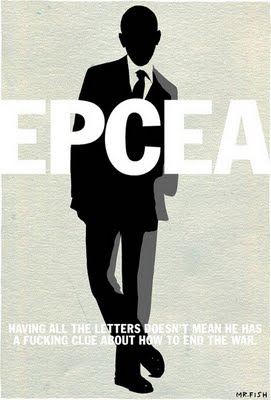
Obama Epcea Now Mr-FishPresident Obama came into office with quite a checklist:
Stop war-making,
Close Guantanamo,
End renditions/torture,
Rescind the Patriot Act,
Restore the rule of law,
Address global warming,
Reform US health care,
Re-regulate bankers,
Talk to Iran, and doubtless many other items, including
Secure the 2016 Olympics for Chicago.

Are his handlers staking the measure of his success on the last one?

One man dared

Muntadhar al zaidi was tortured
I’d like to revisit photographs of George Bush. On everyone pictured standing next to him, I’ll stamp “NOT AL-ZAIDI,” meaning, NOT A HERO. The tag would apply to all of us of course, but in particular, to those who had a chance -but didn’t- to confront the naked emperor. The single bravest man in the world, Muntadhar al Zaidi, was released from prison this week, to recount the torture he endured for his act. Is your courage bolstered or tempered by his example? We are inspired by the unbroken Al Zaidi, but his keepers, our governments, know how to repress our audacity. We’re let to celebrate Al Zaidi as a hero, but he has also been made an example, for rule by state terrorism.

Said al Zaidi: “What provoked me to a confrontation was the injustice that has befallen my people, and the way in which the occupation wanted to humiliate my country by placing it and its people—the elderly, women, children and men—under its boot. At the time the Iraqi prime minister appeared on satellite channels saying he would not sleep until he was assured of Bush’s safety, I found ample bedding and cover. As the prime minister was speaking, I was being tortured in the most cruel manner, being electrocuted, beaten with cables, beaten with metal rods.”

Who says there is no good news?

1. Celebrity activists have joined to condemn the Toronto Film Festival’s celebration of the movie industry of Tel Aviv, inappropriate while an Israeli regime ruthlessly exterminates its Palestinian Problem by seizing their lands, driving them into exile, and interning those who refuse to leave in the ghettos of Gaza and the West Bank, then making warm fuzzy movies about it.
2. Iraqi Bush Shoe-Thrower Muntadhar al-Zaidi has been freed! He says he was tortured for his act, but he didn’t regret it. “I got my chance and I didn’t miss it,” he said, now missing a few teeth. The US media is equating Joe Wilson’s affront to earnest debate to al-Zaidi’s internationally-hailed angry repudiation of a lying mass-murderer. Good luck with that.
3. Activists have been arrested for protesting war recruiting in a Philadelphia mall where children were being offered an “Army Experience Center”. Alright, arrests are not good news, in particular when they include the OpEdNews reporter covering the action, but it’s always encouraging to see Americans stand between Army recruiters and their prey.

Note on #1: Signers of the complaint to the TIFF, who include Naomi Klein and Howard Zinn, explain that they are protesting the festival’s framing of the Israeli films, they are not “black listing” the films as the defenders of Israel charge. To me, equating a protest of the festival to blacklisting smacks of decrying “anti-Semitism.”

The chief celebrities rushing to counter the TIFF complainants are, according to the Toronto Star: Jerry Seinfeld, Natalie Portman, Sacha Baron Cohen , Lisa Kudrow, David Cronenberg, Minnie Driver, Simon Wiesenthal Center founder and filmmaker Marvin Hier, Cineplex Canada CEO Ellis Jacob, Norman Jewison, Lenny Kravitz, Sherry Lansing (former head of Paramount Studios), producer Robert Lantos, the UJA Federation of Greater Toronto and the Jewish Federation of Greater Los Angeles. Interesting pattern?

In the interim, a UN probe determines war crimes were committed in Gaza incursion, and US envoy seeks to reach compromise with Israel over illegal settlements.

Rock Creek Free Press available in COS

The Rock Creek Free Press is available online, but if you want it in print, the DC monthly is available in Colorado Springs at the Bookman, 3163 W. Colorado. The September issue features a speech given by legendary Australian journalist John Pilger on July 4th in San Francisco.

Here’s the RCFP transcript:

Two years ago I spoke at “Socialism in Chicago” about an invisible government which is a term used by Edward Bernays, one the founders of modern propaganda. It was Bernays, who in the 1920s invented public relations as a euphemism for propaganda. And it was Bernays, deploying the ideas of his uncle Sigmund Freud, who campaigned on behalf of the tobacco industry for women to take up smoking as an act of feminist liberation calling cigarettes “tortures of freedom”. At the same time he was involved in the disinformation which was critical in overthrowing the Arbenz government in Guatemala. So you have the association of cigarettes and regime change. The invisible government that Bernays had in mind brought together all media: PR, the press, broadcasting, advertising and their power of branding and image making. In other words, disinformation.

And I suppose I would like to talk today about this invisible government’s most recent achievement, the rise of Barrack Obama and the silencing of much of the left. But all of this has a history, of course and I’d like to go back, take you back some forty years to a sultry and, for me, very memorable day in Viet Nam.

I was a young war correspondent who had just arrived in a village in the Central Highlands called Tuylon. My assignment was to write about a unit of US Marines who had been sent to the village to win hearts and minds. “My orders,” said the Marine Sergeant, “are to sell the American way of liberty, as stated in the Pacification Handbook, this is designed to win the hearts and minds of folks as stated on page 86.” Now, page 86 was headed in capital letters: WHAM (winning hearts and minds). The Marine Unit was a combined action company which explained the Sergeant, meant, “We attack these folks on Mondays and we win their hearts and minds on Tuesdays.” He was joking, of course, but not quite.

The Sergeant, who didn’t speak Vietnamese, had arrived in the village, stood up on a Jeep and said through a bullhorn: “Come on out everybody we’ve got rice and candies and toothbrushes to give you.” This was greeted by silence. “Now listen, either you gooks come on out or we’re going to come right in there and get you!” Now the people of Tuylon finally came out and they stood in line to receive packets of Uncle Ben’s Miracle Rice, Hershey Bars, party balloons, and several thousand toothbrushes. Three portable, battery operated, yellow, flush lavatories were held back for the arrival of the colonel.

And when the colonel arrived that evening, the district chief was summoned and the yellow, flush lavatories unveiled. The colonel cleared his throat and took out a handwritten speech,

“Mr. District Chief and all you nice people,” said the colonel, “what these gifts represent is more than the sum of their parts, they carry the spirit of America. Ladies and gentlemen there’s no place on Earth like America, it’s the land where miracles happen, it’s a guiding light for me and for you. In America, you see, we count ourselves as real lucky as having the greatest democracy the world has ever known and we want you nice people to share in our good fortune.”

Thomas Jefferson, George Washington, even John Winthrope sitting upon a hill got a mention. All that was missing was the Star Bangled Banner playing softly in the background. Of course the villagers had no idea what the colonel was talking about, but when the Marines clapped, they clapped. And when the colonel waved, the children waved. And when he departed the colonel shook the Sergeant’s hand and said: “We’ve got plenty of hearts and minds here, carry on Sergeant.” “Yes Sir.” In Viet Nam I witnessed many scenes like that.

I’d grown up in faraway Australia on a cinematic diet of John Wayne, Randolph Scott, Walt Disney, and Ronald Reagan. The American way of liberty they portrayed might well have been lifted from the WHAM handbook. I’d learned that the United States had won World War II on its own and now led the free world as the chosen society. It was only later when I read Walter Lippmann’s book, Public Opinion, a manual of the invisible government, that I began to understand the power of emotions attached to false ideas and bad histories on a grand scale.

Now, historians call this exceptionalism, the notion that the United States has a divine right to bring what it calls “liberty” to the rest of humanity. Of course this is a very old refrain. The French and British created and celebrated their own civilizing missions while imposing colonial regimes that denied basic civil liberties. However, the power of the American message was, and remains, different. Whereas the Europeans were proud imperialists, Americans are trained to deny their imperialism. As Mexico was conquered and the Marines sent to Nicaragua, American textbooks referred to an Age of Innocence. American motives were always well meaning, moral, exceptional, as the colonel said, “There was no ideology” and that’s still the case.

Americanism is an ideology that is unique because its main feature is its denial that it is an ideology. It’s both conservative and it’s liberal. And it’s right and it’s left. And Barack Obama is its embodiment. Since Obama was elected leading liberals have talked about America returning to its true status as, “a nation of moral ideals”. Those are the words of Paul Krugman, the liberal columnist of The New York Times. In the San Francisco Chronicle, columnist Mark Morford wrote,

“Spiritually advanced people regard the new president as a light worker who can help usher in a new way of being on the planet.”

Tell that to an Afghan child whose family has been blown away by Obama’s bombs. Or a Pakistani child whose house has been visited by one of Obama’s drones. Or a Palestinian child surveying the carnage in Gaza caused by American “smart” weapons, which, disclosed Seymour Hersh, were re-supplied to Israel for use in the slaughter, and I quote; “Only after the Obama team let if be known, it would not object.” The man who stayed silent on Gaza is the man who now condemns Iran.

In a sense, Obama is the myth that is America’s last taboo. His most consistent theme was never “change”, it was power. “The United States,” he said, “leads the world in battling immediate evils and promoting the ultimate good. We must lead by building a 21st century military to ensure the security of our people and advance the security of all people.” And there is this remarkable statement, “At moments of great peril in the past century our leaders ensured that America, by deed and by example, led and lifted the world; that we stood and fought for the freedoms sought by billions of people beyond our borders.” Words like these remind me of the colonel in the village in Viet Nam, as he spun much the same nonsense.

Since 1945, by deed and by example, to use Obama’s words, America has overthrown 50 governments, including democracies, and crushed some 30 liberation movements and bombed countless men, women, and children to death. I’m grateful to Bill Blum for his cataloging of that. And yet, here is the 45th (sic) president of the United States having stacked his government with war mongers and corporate fraudsters and polluters from the Bush and Clinton eras, promising, not only more of the same, but a whole new war in Pakistan. Justified by the murderous clichés of Hilary Clinton, clichés like, “high value targets”. Within three days of his inauguration, Obama was ordering the death of people in faraway countries: Pakistan and Afghanistan. And yet, the peace movement, it seems, is prepared to look the other way and believe that the cool Obama will restore, as Krugman wrote, “the nation of moral ideals.”

Not long ago, I visited the American Museum of History in the celebrated Smithsonian Institute in Washington. One of the most popular exhibitions was called “The Price of Freedom: Americans at War”. It was holiday time and lines of happy people, including many children, shuffled through a Santa’s grotto of war and conquest. When messages about their nation’s great mission were lit up; these included tributes to the; “…exceptional Americans who saved a million lives…” in Viet Nam; where they were, “…determined to stop Communist expansion.” In Iraq other brave Americans, “employed air-strikes of unprecedented precision.” What was shocking was not so much the revisionism of two of the epic crimes of modern times, but the shear scale of omission.

Like all US presidents, Bush and Obama have very much in common. The wars of both presidents and the wars of Clinton and Reagan, Carter and Ford, Nixon and Kennedy are justified by the enduring myth of exceptional America. A myth the late Harold Pinter described as, “a brilliant, witty, highly successful act of hypnosis.”

The clever young man who recently made it to the White House is a very fine hypnotist; partly because it is indeed extraordinary to see an African American at the pinnacle of power in the land of slavery. However, this is the 21st century and race together with gender, and even class, can be very seductive tools of propaganda. For what is so often overlooked and what matters, I believe above all, is the class one serves. George Bush’s inner circle from the State Department to the Supreme Court was perhaps the most multi-racial in presidential history. It was PC par excellence. Think Condoleezza Rice, Colin Powell. It was also the most reactionary. Obama’s very presence in the White House appears to reaffirm the moral nation. He’s a marketing dream. But like Calvin Klein or Benetton, he’s a brand that promises something special, something exciting, almost risqué. As if he might be radical. As if he might enact change. He makes people feel good; he’s a post-modern man with no political baggage. And all that’s fake.

In his book, Dreams From My Father, Obama refers to the job he took after he graduated from Columbia in 1983; he describes his employer as, “…a consulting house to multi-national corporations.” For some reason he doesn’t say who his employer was or what he did there. The employer was Business International Corporation; which has a long history of providing cover for the CIA with covert action and infiltrating unions from the left. I know this because it was especially active in my own country, Australia. Obama doesn’t say what he did at Business International and they may be absolutely nothing sinister. But it seems worthy of inquiry, and debate, as a clue to, perhaps, who the man is.

During his brief period in the senate, Obama voted to continue the wars in Iraq and Afghanistan. He voted for the Patriot Act. He refused to support a bill for single payer health care. He supported the death penalty. As a presidential candidate he received more corporate backing than John McCain. He promised to close Guantanamo as a priority, but instead he has excused torture, reinstated military commissions, kept the Bush gulag intact, and opposed habeas corpus.

Daniel Ellsberg, the great whistleblower, was right, I believe, when he said, that under Bush a military coup had taken place in the United States giving the Pentagon unprecedented powers. These powers have been reinforced by the presence of Robert Gates – a Bush family crony and George W. Bush’s powerful Secretary of Defense. And by all the Bush Pentagon officials and generals who have kept their jobs under Obama.

In the middle of a recession, with millions of Americans losing their jobs and homes, Obama has increased the military budget. In Colombia he is planning to spend 46 million dollars on a new military base that will support a regime backed by death squads and further the tragic history of Washington’s intervention in that region.

In a pseudo-event in Prague, Obama promised a world without nuclear weapons to a global audience, mostly unaware that America is building new tactical nuclear weapons designed to blur the distinction between nuclear and conventional war. Like George Bush, he used the absurdity of Europe threatened by Iran to justify building a missile system aimed at Russia and China. In another pseudo-event, at the Annapolis Naval Academy, decked with flags and uniforms, Obama lied that America had gone to Iraq to bring freedom to that country. He announced that the troops were coming home. This was another deception. The head of the army, General George Casey says, with some authority, that America will be in Iraq for up to a decade. Other generals say fifteen years.

Chris Hedges, the very fine author of Empire of Illusion, puts it very well; “President Obama,” he wrote, “does one thing and brand Obama gets you to believe another.” This is the essence of successful advertising. You buy or do what the advertiser wants because of how they make you feel. And so you are kept in a perpetual state of childishness. He calls this “junk politics”.

But I think the real tragedy is that Obama, the brand, appears to have crippled or absorbed much of the anti-war movement – the peace movement. Out of 256 Democrats in Congress; 30, just 30, are willing to stand up against Obama’s and Nancy Pelosi’s war party. On June the 16th they voted for 106 billion dollars for more war.

The “Out of Iraq” caucus is out of action. Its member can’t even come up with a form of words of why they are silent. On March the 21st, a demonstration at the Pentagon by the once mighty United for Peace and Justice drew only a few thousand. The out-going president of UFPJ, Lesley Kagen, says her people aren’t turning up because, “It’s enough for many of them that Obama has a plan to end the war and that things are moving in the right direction.” And where is the mighty Move On, these days? Where is its campaign against the wars in Iraq and Afghanistan? And what, exactly, was said when Move On’s executive director, Jason Ruben, met Barack Obama at the White House in February?

Yes, a lot of good people mobilized for Obama. But what did they demand of him? Working to elect the Democratic presidential candidate may seem like activism, but it isn’t. Activism doesn’t give up. Activism doesn’t fall silent. Activism doesn’t rely on the opiate of hope. Woody Allen once said, “I felt a lot better when I gave up hope.” Real activism has little time for identity politics which like exceptionalism, can be fake. These are distractions that confuse and sucker good people. And not only in the United States, I can assure you.

I write for the Italian socialist newspaper, Il Manifesto, or rather I used to write for it. In February I sent the editor an article which raised questions about Obama as a progressive force. The article was rejected. Why, I asked? “For the moment,” wrote the editor, “we prefer to maintain a more positive approach to the novelty presented by Obama. We will take on specific issues, but we would not like to say that he will make no difference.” In other words, an American president drafted to promote the most rapacious system in history, is ordained and depoliticized by important sections of the left. It’s a remarkable situation. Remarkable, because those on the, so called, Radical Left have never been more aware, more conscious of the inequities of power. The Green Movement, for example, has raised the consciousness of millions, so that almost every child knows something about global warming. And yet, there seems to be a resistance, within the Green Movement, to the notion of power as a military force, a military project. And perhaps similar observations can also be made about sections of the Feminist Movement and the Gay Movement and certainly the Union Movement.

One of my favorite quotations is from Milan Kundera,

“The struggle of people against power is [the] struggle of memory against forgetting.”

We should never forget that the primary goal of great power is to distract and limit our natural desire for social justice and equity and real democracy.

Long ago Edward Bernays’ invisible government of propaganda elevated big business from its unpopular status as a kind of mafia to that of a patriotic driving force. The “American way of life” began as an advertising slogan. The modern image of Santa Claus was an invention of Coca Cola.

Today we are presented with an extraordinary opportunity. Thanks to the crash of Wall Street and the revelation, for many ordinary people, that the free market has nothing to do with freedom. The opportunity, within our grasp, is to recognize that something is stirring in America that is unfamiliar, perhaps, to many of us on the left, but is related to a great popular movement that’s growing all over the world. Look down at Latin America, less than twenty years ago there was the usual despair, the usual divisions of poverty and freedom, the usual thugs in uniforms running unspeakable regimes. Today for the first time perhaps in 500 years there’s a people’s movement based on the revival of indigenous cultures and language, a genuine populism. The recent amazing achievements in Bolivia, Ecuador, Venezuela, El Salvador, Argentina, Brazil, and Paraguay represent a struggle for community and political rights that is truly historic, with implications for all of us. The successes in Latin America are expressed perversely in the recent overthrow of the government of Honduras, because the smaller the country, the greater is the threat of a good example that the disease of emancipation will spread.

Indeed, right across the world social movements and grass roots organization have emerged to fight free market dogma. They’ve educated governments in the south that food for export is a problem, rather than a solution to global poverty. They’ve politicized ordinary people to stand up for their rights, as in the Philippines and South Africa. Look at the remarkable boycott, disinvestment and sanctions campaign, BDS, for short, aimed at Israel that’s sweeping the world. Israeli ships have been turned away from South Africa and Western Australia. A French company has been forced to abandon plans to build a railway connecting Jerusalem with illegal Israeli settlements. Israeli sporting bodies find themselves isolated. Universities in the United Kingdom have begun to sever ties with Israel. This is how apartheid South Africa was defeated. And this is how the great wind of the 1960s began to blow. And this is how every gain has been won: the end of slavery, universal suffrage, workers rights, civil rights, environmental protection, the list goes on and on.

And that brings us back, here, to the United States, because I believe something is stirring in this country. Are we aware, that in the last eight months millions of angry e-mails, sent by ordinary Americans, have flooded Washington. And I mean millions. People are outright outraged that their lives are attacked; they bear no resemblance to the passive mass presented by the media. Look at the polls; more than 2/3 of Americans say the government should care for those who cannot care for themselves, sixty-four percent would pay higher taxes to guarantee health care for everyone, sixty percent are favorable towards Unions, seventy percent want nuclear disarmament, seventy-two percent want the US completely out of Iraq and so on and so on. But where is much of the left? Where is the social justice movement? Where is the peace movement? Where is the civil rights movement? Ordinary Americans, for too long, have been misrepresented by stereotypes that are contemptuous. James Madison referred to his compatriots in the public as ignorant and meddlesome outsiders. And this contempt is probably as strong today, among the elite, as it was back then. That’s why the progressive attitudes of the public are seldom reported in the media, because they’re not ignorant, they’re subversive, they’re informed and they’re even anti-American. I once asked a friend, the great American war correspondent and humanitarian, Martha Gellhorn, to explain the term “anti-American” to me. “I’ll tell you what anti-American is,” she said in her forceful way, “its what governments and their vested interests call those who honor America by objecting to war and the theft of resources and believing in all of humanity. There are millions of these anti-Americans in the United States, they are ordinary people who belong to no elite and who judge their government in moral terms though they would call it common decency. They are not vain; they are the people with a waitful conscience, the best of America’s citizens. Sure, they disappear from view now and then, but they are like seeds beneath the snow. I would say they are truly exceptional.” Truly exceptional, I like that.

My own guess is that a populism is growing, once again in America evoking a powerful force beneath the surface which has a proud history. From such authentic grass roots Americanism came women suffrage, the eight hour day, graduated income tax, public ownership of railways and communications, the breaking of the power of corporate lobbyists and much more. In other words, real democracy. The American populists were far from perfect, but they often spoke for ordinary people and they were betrayed by leaders who urged them to compromise and merge with the Democratic Party. That was long ago, but how familiar it sounds. My guess is that something is coming again. The signs are there. Noam Chomsky is right when he says that, “Mere sparks can ignite a popular movement that may seem dormant.” No one predicted 1968, no one predicted the fall of apartheid, or the Berlin Wall, or the civil rights movement, or the great Latino rising of a few years ago.

I suggest that we take Woody Allen’s advice and give up on hope and listen, instead, to voices from below. What Obama and the bankers and the generals and the IMF and the CIA and CNN and BBC fear, is ordinary people coming together and acting together. It’s a fear as old as democracy, a fear that suddenly people convert their anger to action as they’ve done so often throughout history.

“At a time of universal deceit,” wrote George Orwell, “telling the truth is a revolutionary act.”

Thank you.

Could Bush have bettered Obama?

Barack W. ObamaDavid Swanson describes for Tomdispatch what a GW Bush third term would have looked like. He paints a horror story continuation of all the policies which drove voters in 2008 to elect anybody but Bush. But did we? ABB Obama is proving to be quite the reliable steward of Bush’s policies of war, torture, rendition, and mercenaries, minus the public outcry. It’s change we can’t quite put our finger on.

There is no License to Kill

“Licensed to Kill” was an Ian Fleming invention. His friend Richard Meinertzhagen dropped Fleming’s phrase for guests to infer he was a secret agent. RM’s routine of arriving at diner parties with a smoking gun reinforced whispers that he had been the inspiration for James Bond. Meinertzhagen turned out to be a flake, but the authority to play god is still coveted by espionage idolators. Federal statutes prohibit identifying covert CIA operatives, regardless what they’ve done. Is that the same thing? A mythical supra legem indemnity? Sorry Virginia, nemo est.

Okay, some today are above the law, notable examples being Bush, Cheney, Rumsfeld, Woo, et al. The jury is still out on who will atone for the Bush Co crimes. But should the Neocon exemption cover assassination squads and torturers too?

The US Department of Justice is up in arms -Fox News probably more than anybody- having learned that defense lawyers for terrorist suspects in US custody, have shown their clients photographs of CIA and private contractor interrogators, to learn which of them might have engaged in harsh techniques defined by the rest of the world as torture.

The John Adams Project, run jointly by the ACLU and the National Association of Criminal Defense Lawyers, is an effort to document the US torture in Guantanamo and our secret prisons around the globe. The ACLU assures all indignant patriots that asking the detainees to identify their torturers is completely legal.

Researchers for the project have been snapping pictures outside the homes of retired and active, CIA and intelligence industry interrogators. No names have been released except Deuce Martinez, who’d already been outed by the NYT. Martinez was the agent responsible for interrogating Khalid Sheikh Mohammed, although accounts soft-pedal his participation in the harsher techniques.

That’s the pattern of exposes about torture, those named always claim to have left the room. A remarkably similar motif accompanied the account of CIA interrogator John Kiriakou.

Two well-known names were doctors who attended to the tortured, later opening a consulting firm to train CIA interrogators.
Dr. Jim Mitchell and Dr. Bruce Jessen specialized in maximizing harsh interrogation, and making sure the victim didn’t die.

The defense lawyers have circulated the photographs of 60 suspected perpetrators, but have named only Martinez so far. How are torturers and murderers to be brought to justice, if they are not unmasked?

The Coming Insurrection

by The Invisible Committee

Translated from the French, 2007

From whatever angle you approach it, the present offers no way out. This is not the least of its virtues. From those who seek hope above all, it tears away every firm ground. Those who claim to have solutions are contradicted almost immediately. Everyone agrees that things can only get worse. “The future has no future” is the wisdom of an age that, for all its appearance of perfect normalcy, has reached the level of consciousness of the first punks.

The sphere of political representation has come to a close. From left to right, it’s the same nothingness striking the pose of an emperor or a savior, the same sales assistants adjusting their discourse according to the findings of the latest surveys. Those who still vote seem to have no other intention than to desecrate the ballot box by voting as a pure act of protest. We’re beginning to suspect that it’s only against voting itself that people continue to vote. Nothing we’re being shown is adequate to the situation, not by far. In its very silence, the populace seems infinitely more mature than all these puppets bickering amongst themselves about how to govern it. The ramblings of any Belleville chibani contain more wisdom than all the declarations of our so-called leaders. The lid on the social kettle is shut triple-tight, and the pressure inside continues to build. From out of Argentina, the specter of Que Se Vayan Todos is beginning to seriously haunt the ruling class.

The flames of November 2005 still flicker in everyone’s minds. Those first joyous fires were the baptism of a decade full of promise. The media fable of “banlieue vs. the Republic” may work, but what it gains in effectiveness it loses in truth. Fires were lit in the city centers, but this news was methodically suppressed. Whole streets in Barcelona burned in solidarity, but no one knew about it apart from the people living there. And it’s not even true that the country has stopped burning. Many different profiles can be found among the arrested, with little that unites them besides a hatred for existing society – not class, race, or even neighborhood. What was new wasn’t the “banlieue revolt,” since that was already going on in the 80s, but the break with its established forms. These assailants no longer listen to anybody, neither to their Big Brothers and Big Sisters, nor to the community organizations charged with overseeing the return to normal. No “SOS Racism” could sink its cancerous roots into this event, whose apparent conclusion can be credited only to fatigue, falsification and the media omertà. This whole series of nocturnal vandalisms and anonymous attacks, this wordless destruction, has widened the breach between politics and the political. No one can honestly deny the obvious: this was an assault that made no demands, a threat without a message, and it had nothing to do with “politics.” One would have to be oblivious to the autonomous youth movements of the last 30 years not to see the purely political character of this resolute negation of politics. Like lost children we trashed the prized trinkets of a society that deserves no more respect than the monuments of Paris at the end of the Bloody Week- and knows it.

There will be no social solution to the present situation. First, because the vague aggregate of social milieus, institutions, and individualized bubbles that is called, with a touch of antiphrasis, “society,” has no consistency. Second, because there’s no longer any language for common experience. And we cannot share wealth if we do not share a language. It took half a century of struggle around the Enlightenment to make the French Revolution possible, and a century of struggle around work to give birth to the fearsome “welfare state.” Struggles create the language in which a new order expresses itself. But there is nothing like that today. Europe is now a continent gone broke that shops secretly at discount stores and has to fly budget airlines if it wants to travel at all. No “problems” framed in social terms admit of a solution. The questions of “pensions,” of “job security,” of “young people” and their “violence” can only be held in suspense while the situation these words serve to cover up is continually policed for signs of further unrest. Nothing can make it an attractive prospect to wipe the asses of pensioners for minimum wage. Those who have found less humiliation and more advantage in a life of crime than in sweeping floors will not turn in their weapons, and prison won’t teach them to love society. Cuts to their monthly pensions will undermine the desperate pleasure-seeking of hordes of retirees, making them stew and splutter about the refusal to work among an ever larger section of youth. And finally, no guaranteed income granted the day after a quasi-uprising will be able to lay the foundation of a new New Deal, a new pact, a new peace. The social feeling has already evaporated too much for that.

As an attempted solution, the pressure to ensure that nothing happens, together with police surveillance of the territory, will only intensify. The unmanned drone that flew over Seine-Saint-Denis last July 14th – as the police later confirmed – presents a much more vivid image of the future than all the fuzzy humanistic projections. That they were careful to assure us that the drone was unarmed gives us a clear indication of the road we’re headed down. The territory will be partitioned into ever more restricted zones. Highways built around the borders of “problem neighborhoods” already form invisible walls closing off those areas off from the middle-class subdivisions. Whatever defenders of the Republic may think, the control of neighborhoods “by the community” is manifestly the most effective means available. The purely metropolitan sections of the country, the main city centers, will go about their opulent lives in an ever more crafty, ever more sophisticated, ever more shimmering deconstruction. They will illuminate the whole planet with their glaring neon lights, as the patrols of the BAC and private security companies (i.e. paramilitary units) proliferate under the umbrella of an increasingly shameless judicial protection.

The impasse of the present, everywhere in evidence, is everywhere denied. There will be no end of psychologists, sociologists, and literary hacks applying themselves to the case, each with a specialized jargon from which the conclusions are especially absent. It’s enough to listen to the songs of the times – the asinine “alt-folk” where the petty bourgeoisie dissects the state of its soul, next to declarations of war from Mafia K’1 Fry – to know that a certain coexistence will end soon, that a decision is near.

This book is signed in the name of an imaginary collective. Its editors are not its authors. They were content merely to introduce a little order into the common-places of our time, collecting some of the murmurings around barroom tables and behind closed bedroom doors. They’ve done nothing more than lay down a few necessary truths, whose universal repression fills psychiatric hospitals with patients, and eyes with pain. They’ve made themselves scribes of the situation. It’s the privileged feature of radical circumstances that a rigorous application of logic leads to revolution. It’s enough just to say what is before our eyes and not to shrink from the conclusions.

First Circle

“I AM WHAT I AM”

“I AM WHAT I AM.” This is marketing’s latest offering to the world, the final stage in the development of advertising, far beyond all the exhortations to be different, to be oneself and drink Pepsi. Decades of concepts in order to get where we are, to arrive at pure tautology. I = I. He’s running on a treadmill in front of the mirror in his gym. She’s coming back from work, behind the wheel of her Smart car. Will they meet?

“I AM WHAT I AM.” My body belongs to me. I am me, you are you, and something’s wrong. Mass personalization. Individualization of all conditions – life, work and misery. Diffuse schizophrenia. Rampant depression. Atomization into fine paranoiac particles. Hysterization of contact. The more I want to be me, the more I feel an emptiness. The more I express myself, the more I am drained. The more I run after myself, the more tired I get. We cling to our self like a coveted job title. We’ve become our own representatives in a strange commerce, guarantors of a personalization that feels, in the end, a lot more like an amputation. We insure our selves to the point of bankruptcy, with a more or less disguised clumsiness.

Meanwhile, I manage. The quest for a self, my blog, my apartment, the latest fashionable crap, relationship dramas, who’s fucking who… whatever prosthesis it takes to hold onto an “I”! If “society” hadn’t become such a definitive abstraction, then it would denote all the existential crutches that allow me to keep dragging on, the ensemble of dependencies I’ve contracted as the price of my identity. The handicapped person is the model citizen of tomorrow. It’s not without foresight that the associations exploiting them today demand that they be granted a “subsistence income.”

The injunction, everywhere, to “be someone” maintains the pathological state that makes this society necessary. The injunction to be strong produces the very weakness by which it maintains itself, so that everything seems to take on a therapeutic character, even working, even love. All those “how’s it goings?” that we exchange give the impression of a society composed of patients taking each other’s temperatures. Sociability is now made up of a thousand little niches, a thousand little refuges where you can take shelter. Where it’s always better than the bitter cold outside. Where everything’s false, since it’s all just a pretext for getting warmed up. Where nothing can happen since we’re all too busy shivering silently together. Soon this society will only be held together by the mere tension of all the social atoms straining towards an illusory cure. It’s a power plant that runs its turbines on a gigantic reservoir of unwept tears, always on the verge of spilling over.

“I AM WHAT I AM.” Never has domination found such an innocent-sounding slogan. The maintenance of the self in a permanent state of deterioration, in a chronic state of near-collapse, is the best-kept secret of the present order of things. The weak, depressed, self-critical, virtual self is essentially that endlessly adaptable subject required by the ceaseless innovation of production, the accelerated obsolescence of technologies, the constant overturning of social norms, and generalized flexibility. It is at the same time the most voracious consumer and, paradoxically, the most productive self, the one that will most eagerly and energetically throw itself into the slightest project, only to return later to its original larval state.

“WHAT AM I,” then? Since childhood, I’ve passed through a flow of milk, smells, stories, sounds, emotions, nursery rhymes, substances, gestures, ideas, impressions, gazes, songs, and foods. What am I? Tied in every way to places, sufferings, ancestors, friends, loves, events, languages, memories, to all kinds of things that obviously are not me. Everything that attaches me to the world, all the links that constitute me, all the forces that compose me don’t form an identity, a thing displayable on cue, but a singular, shared, living existence, from which emerges – at certain times and places – that being which says “I.” Our feeling of inconsistency is simply the consequence of this foolish belief in the permanence of the self and of the little care we give to what makes us what we are.

It’s dizzying to see Reebok’s “I AM WHAT I AM” enthroned atop a Shanghai skyscraper. The West everywhere rolls out its favorite Trojan horse: the exasperating antimony between the self and the world, the individual and the group, between attachment and freedom. Freedom isn’t the act of shedding our attachments, but the practical capacity to work on them, to move around in their space, to form or dissolve them. The family only exists as a family, that is, as a hell, for those who’ve quit trying to alter its debilitating mechanisms, or don’t know how to. The freedom to uproot oneself has always been a phantasmic freedom. We can’t rid ourselves of what binds us without at the same time losing the very thing to which our forces would be applied.

“I AM WHAT I AM,” then, is not simply a lie, a simple advertising campaign, but a military campaign, a war cry directed against everything that exists between beings, against everything that circulates indistinctly, everything that invisibly links them, everything that prevents complete desolation, against everything that makes us exist, and ensures that the whole world doesn’t everywhere have the look and feel of a highway, an amusement park or a new town: pure boredom, passionless but well-ordered, empty, frozen space, where nothing moves apart from registered bodies, molecular automobiles, and ideal commodities.

France wouldn’t be the land of anxiety pills that it’s become, the paradise of anti-depressants, the Mecca of neurosis, if it weren’t also the European champion of hourly productivity. Sickness, fatigue, depression, can be seen as the individual symptoms of what needs to be cured. They contribute to the maintenance of the existing order, to my docile adjustment to idiotic norms, and to the modernization of my crutches. They specify the selection of my opportune, compliant, and productive tendencies, as well as those that must be gently discarded. “It’s never too late to change, you know.” But taken as facts, my failings can also lead to the dismantling of the hypothesis of the self. They then become acts of resistance in the current war. They become a rebellion and a force against everything that conspires to normalize us, to amputate us. The self is not some thing within us that is in a state of crisis; it is the form they mean to stamp upon us. They want to make our self something sharply defined, separate, assessable in terms of qualities, controllable, when in fact we are creatures among creatures, singularities among similars, living flesh weaving the flesh of the world. Contrary to what has been repeated to us since childhood, intelligence doesn’t mean knowing how to adapt – or if that is a kind of intelligence, it’s the intelligence of slaves. Our inadaptability, our fatigue, are only problems from the standpoint of what aims to subjugate us. They indicate rather a departure point, a meeting point, for new complicities. They reveal a landscape more damaged, but infinitely more sharable than all the fantasy lands this society maintains for its purposes.

We are not depressed; we’re on strike. For those who refuse to manage themselves, “depression” is not a state but a passage, a bowing out, a sidestep towards a political disaffiliation. From then on medication and the police are the only possible forms of conciliation. This is why the present society doesn’t hesitate to impose Ritalin on its over-active children, or to strap people into life-long dependence on pharmaceuticals, and why it claims to be able to detect “behavioral disorders” at age three. Because everywhere the hypothesis of the self is beginning to crack.

Second Circle

“Entertainment is a vital need”

A government that declares a state of emergency against fifteen-year-old kids. A country that takes refuge in the arms of a football team. A cop in a hospital bed, complaining about being the victim of “violence.” A city councilwoman issuing a decree against the building of tree houses. Two ten year olds, in Chelles, charged with burning down a video game arcade. This era excels in a certain situation of the grotesque that seems to escape it every time. The truth is that the plaintive, indignant tones of the news media are unable to stifle the burst of laughter that welcomes these headlines.

A burst of laughter is the only appropriate response to all the serious “questions” posed by news analysts. To take the most banal: there is no “immigration question.” Who still grows up where they were born? Who lives where they grew up? Who works where they live? Who lives where their ancestors did? And to whom do the children of this era belong, to television or their parents? The truth is that we have been completely torn from any belonging, we are no longer from anywhere, and the result, in addition to a new disposition to tourism, is an undeniable suffering. Our history is one of colonizations, of migrations, of wars, of exiles, of the destruction of all roots. It’s the story of everything that has made us foreigners in this world, guests in our own family. We have been expropriated from our own language by education, from our songs by reality TV contests, from our flesh by mass pornography, from our city by the police, and from our friends by wage-labor. To this we should add, in France, the ferocious and secular work of individualization by the power of the state, that classifies, compares, disciplines and separates its subjects starting from a very young age, that instinctively grinds down any solidarities that escape it until nothing remains except citizenship – a pure, phantasmic sense of belonging to the Republic. The Frenchman, more than anyone else, is the embodiment of the dispossessed, the destitute. His hatred of foreigners is based on his hatred of himself as a foreigner. The mixture of jealousy and fear he feels toward the “cités“ expresses nothing but his resentment for all he has lost. He can’t help envying these so-called “problem” neighborhoods where there still persists a bit of communal life, a few links between beings, some solidarities not controlled by the state, an informal economy, an organization that is not yet detached from those who organize. We have arrived at a point of privation where the only way to feel French is to curse the immigrants and those who are more visibly foreign. In this country, the immigrants assume a curious position of sovereignty: if they weren’t here, the French might stop existing.

France is a product of its schools, and not the inverse. We live in an excessively scholastic country, where one remembers passing an exam as a sort of life passage. Where retired people still tell you about their failure, forty years earlier, in such and such an exam, and how it screwed up their whole career, their whole life. For a century and a half, the national school system has been producing a type of state subjectivity that stands out amongst all others. People who accept competition on the condition that the playing field is level. Who expect in life that each person be rewarded as in a contest, according to their merit. Who always ask permission before taking. Who silently respect culture, the rules, and those with the best grades. Even their attachment to their great, critical intellectuals and their rejection of capitalism are branded by this love of school. It’s this construction of subjectivities by the state that is breaking down, every day a little more, with the decline of the scholarly institutions. The reappearance, over the past twenty years, of a school and a culture of the street, in competition with the school of the republic and its cardboard culture, is the most profound trauma that French universalism is presently undergoing. On this point, the extreme right is already reconciled with the most virulent left. However, the name Jules Ferry – Minister of Thiers during the crushing of the Commune and theoretician of colonization – should itself be enough to render this institution suspect.

When we see teachers from some “citizens’ vigilance committee” come on the evening news to whine about someone burning down their school, we remember how many times, as children, we dreamed of doing exactly this. When we hear a leftist intellectual blabbering about the barbarism of groups of kids harassing passersby in the street, shoplifting, burning cars, and playing cat and mouse with riot police, we remember what they said about the greasers in the 50s or, better, the apaches in the “Belle Époque”: “The generic name apaches,” writes a judge at the Seine tribunal in 1907, “has for the past few years been a way of designating all dangerous individuals, enemies of society, without nation or family, deserters of all duties, ready for the most audacious confrontations, and for any sort of attack on persons and properties.” These gangs who flee work, who adopt the names of their neighborhoods, and confront the police are the nightmare of the good, individualized French citizen: they embody everything he has renounced, all the possible joy he will never experience. There is something impertinent about existing in a country where a child singing as she pleases is inevitably silenced with a “stop, you’re going to stir things up,” where scholastic castration unleashes floods of policed employees. The aura that persists around Mesrine has less to do with his uprightness and his audacity than with the fact that he took it upon himself to enact vengeance on what we should all avenge. Or rather, of what we should avenge directly, when instead we continue to hesitate and defer endlessly. Because there is no doubt that in a thousand imperceptible and undercover ways, in all sorts of slanderous remarks, in every spiteful little expression and venomous politeness, the Frenchman continues to avenge, permanently and against everyone, the fact that he’s resigned himself to being trampled over. It was about time that fuck the police! replaced yes sir, officer! In this sense, the un-nuanced hostility of certain gangs only expresses, in a slightly less muffled way, the poisonous atmosphere, the rotten spirit, the desire for a salvational destruction in which the country is completely consumed.

To call this population of strangers in the midst of which we live “society” is such an usurpation that even sociologists dream of renouncing a concept that was, for a century, their bread and butter. Now they prefer the metaphor of a network to describe the connection of cybernetic solitudes, the intermeshing of weak interactions under names like “colleague,” “contact,” “buddy,” “acquaintance,” or “date.” Such networks sometimes condense into a milieu, where nothing is shared but codes, and where nothing is played out except the incessant recomposition of identity.

It would be a waste of time to detail all that which is agonizing in existing social relations. They say the family is coming back, that the couple is coming back. But the family that’s coming back is not the same one that went away. Its return is nothing but a deepening of the reigning separation that it serves to mask, becoming what it is through this masquerade. Everyone can testify to the rations of sadness condensed from year to year in family gatherings, the forced smiles, the awkwardness of seeing everyone pretending in vain, the feeling that a corpse is lying there on the table, and everyone acting as though it were nothing. From flirtation to divorce, from cohabitation to stepfamilies, everyone feels the inanity of the sad family nucleus, but most seem to believe that it would be sadder still to renounce it. The family is no longer so much the suffocation of maternal control or the patriarchy of beatings as it is this infantile abandon to a fuzzy dependency, where everything is familiar, this carefree moment in the face of a world that nobody can deny is breaking down, a world where “becoming self-sufficient” is a euphemism for “having found a boss.” They want to use the “familiarity” of the biological family as an excuse to eat away at anything that burns passionately within us and, under the pretext that they raised us, make us renounce the possibility of growing up, as well as everything that is serious in childhood. It is necessary to preserve oneself from such corrosion.

The couple is like the final stage of the great social debacle. It’s the oasis in the middle of the human desert. Under the auspices of “intimacy,” we come to it looking for everything that has so obviously deserted contemporary social relations: warmth, simplicity, truth, a life without theater or spectator. But once the romantic high has passed, “intimacy” strips itself bare: it is itself a social invention, it speaks the language of glamour magazines and psychology; like everything else, it is bolstered with so many strategies to the point of nausea. There is no more truth here than elsewhere; here too lies and the laws of estrangement dominate. And when, by good fortune, one discovers this truth, it demands a sharing that belies the very form of the couple. What allows beings to love each other is also what makes them lovable, and ruins the utopia of autism-for-two.

In reality, the decomposition of all social forms is a blessing. It is for us the ideal condition for a wild, massive experimentation with new arrangements, new fidelities. The famous “parental resignation” has imposed on us a confrontation with the world that demands a precocious lucidity, and foreshadows lovely revolts to come. In the death of the couple, we see the birth of troubling forms of collective affectivity, now that sex is all used up and masculinity and femininity parade around in such moth-eaten clothes, now that three decades of non-stop pornographic innovation have exhausted all the allure of transgression and liberation. We count on making that which is unconditional in relationships the armor of a political solidarity as impenetrable to state interference as a gypsy camp. There is no reason that the interminable subsidies that numerous relatives are compelled to offload onto their proletarianized progeny can’t become a form of patronage in favor of social subversion. “Becoming autonomous,” could just as easily mean learning to fight in the street, to occupy empty houses, to cease working, to love each other madly, and to shoplift.

Third Circle

“Life, health and love are precarious – why should work be an exception?”

No question is more confused, in France, than the question of work. No relation is more disfigured than the one between the French and work. Go to Andalusia, to Algeria, to Naples. They despise work, profoundly. Go to Germany, to the United States, to Japan. They revere work. Things are changing, it’s true. There are plenty of otaku in Japan, frohe Arbeitslose in Germany and workaholics in Andalusia. But for the time being these are only curiosities. In France, we get down on all fours to climb the ladders of hierarchy, but privately flatter ourselves that we don’t really give a shit. We stay at work until ten o’clock in the evening when we’re swamped, but we’ve never had any scruples about stealing office supplies here and there, or carting off the inventory in order to resell it later. We hate bosses, but we want to be employed at any cost. To have a job is an honor, yet working is a sign of servility. In short: the perfect clinical illustration of hysteria. We love while hating, we hate while loving. And we all know the stupor and confusion that strike the hysteric when he loses his victim – his master. Most of the time he never recovers.

This neurosis is the foundation upon which successive governments could declare war on joblessness, pretending to wage a “battle on unemployment” while ex-managers camped with their cell phones in Red Cross shelters along the banks of the Seine. While the Department of Labor was massively manipulating its statistics in order to bring unemployment numbers below two million. While welfare checks and drug dealing were the only guarantees, as the French state has recognized, against the possibility of social unrest at each and every moment. It’s the psychic economy of the French as much as the political stability of the country that is at stake in the maintenance of the workerist fiction.

Excuse us if we don’t give a fuck.

We belong to a generation that lives very well in this fiction. That has never counted on either a pension or the right to work, let alone rights at work. That isn’t even “precarious,” as the most advanced factions of the militant left like to theorize, because to be precarious is still to define oneself in relation to the sphere of work, that is, to its decomposition. We accept the necessity of finding money, by whatever means, because it is currently impossible to do without it, but we reject the necessity of working. Besides, we don’t work anymore: we do our time. Business is not a place where we exist, it’s a place we pass through. We aren’t cynical, we are just reluctant to be deceived. All these discourses on motivation, quality and personal investment pass us by, to the great dismay of human resources managers. They say we are disappointed by business, that it failed to honor our parents’ loyalty, that it let them go too quickly. They are lying. To be disappointed, one must have hoped for something. And we have never hoped for anything from business: we see it for what it is and for what it has always been, a fool’s game of varying degrees of comfort. On behalf of our parents, our only regret is that they fell into the trap, at least the ones who believed.

The sentimental confusion that surrounds the question of work can be explained thus: the notion of work has always included two contradictory dimensions: a dimension of exploitation and a dimension of participation. Exploitation of individual and collective labor power through the private or social appropriation of surplus value; participation in a common effort through the relations linking those who cooperate at the heart of the universe of production. These two dimensions are perversely confused in the notion of work, which explains workers’ indifference, at the end of the day, to both Marxist rhetoric – which denies the dimension of participation – and managerial rhetoric – which denies the dimension of exploitation. Hence the ambivalence of the relation of work, which is shameful insofar as it makes us strangers to what we are doing, and – at the same time – adored, insofar as a part of ourselves is brought into play. The disaster has already occurred: it resides in everything that had to be destroyed, in all those who had to be uprooted, in order for work to end up as the only way of existing. The horror of work is less in the work itself than in the methodical ravaging, for centuries, of all that isn’t work: the familiarities of one’s neighborhood and trade, of one’s village, of struggle, of kinship, our attachment to places, to beings, to the seasons, to ways of doing and speaking.

Here lies the present paradox: work has totally triumphed over all other ways of existing, at the very moment when workers have become superfluous. Gains in productivity, outsourcing, mechanization, automated and digital production have so progressed that they have almost reduced to zero the quantity of living labor necessary in the manufacture of any product. We are living the paradox of a society of workers without work, where entertainment, consumption and leisure only underscore the lack from which they are supposed to distract us. The mine in Carmaux, famous for a century of violent strikes, has now been reconverted into Cape Discovery. It’s an entertainment “multiplex” for skateboarding and biking, distinguished by a “Mining Museum” in which methane blasts are simulated for vacationers.

In corporations, work is divided in an increasingly visible way into highly skilled positions of research, conception, control, coordination and communication which deploy all the knowledge necessary for the new, cybernetic production process, and unskilled positions for the maintenance and surveillance of this process. The first are few in number, very well paid and thus so coveted that the minority who occupy these positions will do anything to avoid losing them. They and their work are effectively bound in one anguished embrace. Managers, scientists, lobbyists, researchers, programmers, developers, consultants and engineers, literally never stop working. Even their sex lives serve to augment productivity. A Human Resources philosopher writes,

“[t]he most creative businesses are the ones with the greatest number of intimate relations.” “Business associates,” a Daimler-Benz Human Resources Manager confirms, “are an important part of the business’s capital […] Their motivation, their know-how, their capacity to innovate and their attention to clients’ desires constitute the raw material of innovative services […] Their behavior, their social and emotional competence, are a growing factor in the evaluation of their work […] This will no longer be evaluated in terms of number of hours on the job, but on the basis of objectives attained and quality of results. They are entrepreneurs.”

The series of tasks that can’t be delegated to automation form a nebulous cluster of jobs that, because they cannot be occupied by machines, are occupied by any old human – warehousemen, stock people, assembly line workers, seasonal workers, etc. This flexible, undifferentiated workforce that moves from one task to the next and never stays long in a business can no longer even consolidate itself as a force, being outside the center of the production process and employed to plug the holes of what has not yet been mechanized, as if pulverized in a multitude of interstices. The temp is the figure of the worker who is no longer a worker, who no longer has a trade – but only abilities that he sells where he can – and whose very availability is also a kind of work.

On the margins of this workforce that is effective and necessary for the functioning of the machine, is a growing majority that has become superfluous, that is certainly useful to the flow of production but not much else, which introduces the risk that, in its idleness, it will set about sabotaging the machine. The menace of a general demobilization is the specter that haunts the present system of production. Not everybody responds to the question “why work?” in the same way as this ex-welfare recipient: “for my well-being. I have to keep myself busy.” There is a serious risk that we will end up finding a job in our very idleness. This floating population must somehow be kept occupied. But to this day they have not found a better disciplinary method than wages. It’s therefore necessary to pursue the dismantling of “social gains” so that the most restless ones, those who will only surrender when faced with the alternative between dying of hunger or stagnating in jail, are lured back to the bosom of wage-labor. The burgeoning slave trade in “personal services” must continue: cleaning, catering, massage, domestic nursing, prostitution, tutoring, therapy, psychological aid, etc. This is accompanied by a continual raising of the standards of security, hygiene, control, and culture, and by an accelerated recycling of fashions, all of which establish the need for such services. In Rouen, we now have “human parking meters:” someone who waits around on the street and delivers you your parking slip, and, if it’s raining, will even rent you an umbrella.

The order of work was the order of a world. The evidence of its ruin is paralyzing to those who dread what will come after. Today work is tied less to the economic necessity of producing goods than to the political necessity of producing producers and consumers, and of preserving by any means necessary the order of work. Producing oneself is becoming the dominant occupation of a society where production no longer has an object: like a carpenter who’s been evicted from his shop and in desperation sets about hammering and sawing himself. All these young people smiling for their job interviews, who have their teeth whitened to give them an edge, who go to nightclubs to boost the company spirit, who learn English to advance their careers, who get divorced or married to move up the ladder, who take courses in leadership or practice “self-improvement” in order to better “manage conflicts” – “the most intimate ’self-improvement’”, says one guru, “will lead to increased emotional stability, to smoother and more open relationships, to sharper intellectual focus, and therefore to a better economic performance.” This swarming little crowd that waits impatiently to be hired while doing whatever it can to seem natural is the result of an attempt to rescue the order of work through an ethos of mobility. To be mobilized is to relate to work not as an activity but as a possibility. If the unemployed person removes his piercings, goes to the barber and keeps himself busy with “projects,” if he really works on his “employability,” as they say, it’s because this is how he demonstrates his mobility. Mobility is this slight detachment from the self, this minimal disconnection from what constitutes us, this condition of strangeness whereby the self can now be taken up as an object of work, and it now becomes possible to sell oneself rather than one’s labor power, to be remunerated not for what one does but for what one is, for our exquisite mastery of social codes, for our relational talents, for our smile and our way of presenting ourselves. This is the new standard of socialization. Mobility brings about a fusion of the two contradictory poles of work: here we participate in our own exploitation, and all participation is exploited. Ideally, you are yourself a little business, your own boss, your own product. Whether one is working or not, it’s a question of generating contacts, abilities, networking, in short: “human capital.” The planetary injunction to mobilize at the slightest pretext – cancer, “terrorism,” an earthquake, the homeless – sums up the reigning powers’ determination to maintain the reign of work beyond its physical disappearance.

The present production apparatus is therefore, on the one hand, a gigantic machine for psychic and physical mobilization, for sucking the energy of humans that have become superfluous, and, on the other hand, it is a sorting machine that allocates survival to conformed subjectivities and rejects all “problem individuals,” all those who embody another use of life and, in this way, resist it. On the one hand, ghosts are brought to life, and on the other, the living are left to die. This is the properly political function of the contemporary production apparatus.

To organize beyond and against work, to collectively desert the regime of mobility, to demonstrate the existence of a vitality and a discipline precisely in demobilization, is a crime for which a civilization on its knees is not about to forgive us. In fact, it’s the only way to survive it.

Fourth Circle

“More simple, more fun, more mobile, more secure!”

We’ve heard enough about the “city” and the “country,” and particularly about the supposed ancient opposition between the two. From up close or from afar, what surrounds us looks nothing like that: it is one single urban cloth, without form or order, a bleak zone, endless and undefined, a global continuum of museum-like city centers and natural parks, of enormous suburban housing developments and massive agricultural projects, industrial zones and subdivisions, country inns and trendy bars: the metropolis. Certainly the ancient city existed, as did the cities of medieval and modern times. But there is no such thing as a metropolitan city. All territory is synthesized within the metropolis. Everything occupies the same space, if not geographically then through the intermeshing of its networks.

It’s because the city has finally disappeared that it has now become fetishized, as history. The factory buildings of Lille become concert halls. The rebuilt concrete core of Le Havre is now a UNESCO World Heritage sire. In Beijing, the hutongs surrounding the Forbidden City were demolished, replaced by fake versions, placed a little farther out, on display for sightseers. In Troyes they paste half-timber facades onto cinderblock buildings, a type of pastiche that resembles the Victorian shops at Disneyland Paris more than anything else. The old historic centers, once hotbeds of revolutionary sedition, are now wisely integrated into the organizational diagram of the metropolis. They’ve been given over to tourism and conspicuous consumption. They are the fairy-tale commodity islands, propped up by their expos and decorations, and by force if necessary. The oppressive sentimentality of every “Christmas Village” is offset by ever more security guards and city patrols. Control has a wonderful way of integrating itself into the commodity landscape, showing its authoritarian face to anyone who wants to see it. It’s an age of fusions, of muzak, telescoping police batons and cotton candy. Equal parts police surveillance and enchantement!

This taste for the “authentic,” and for the control that goes with it, is carried by the petty bourgeoisie through their colonizing drives into working class neighborhoods. Pushed out of the city centers, they find on the frontiers the kind of “neighborhood feeling” they missed in the prefab houses of suburbia. In chasing out the poor people, the cars, and the immigrants, in making it tidy, in getting rid of all the germs, the petty bourgeoisie pulverizes the very thing it came looking for. A police officer and a garbage man shake hands in a picture on a town billboard, and the slogan reads: “Montauban – Clean City.”

The same sense of decency that obliges urbanists to stop speaking of the “city” (which they destroyed) and instead to talk of the “urban,” should compel them also to drop “country” (since it no longer exists). The uprooted and stressed-out masses are instead shown a countryside, a vision of the past that’s easy to stage now that the country folk have been so depleted. It is a marketing campaign deployed on a “territory” in which everything must be valorized or reconstituted as national heritage. Everywhere it’s the same chilling void, reaching into even the most remote and rustic corners.

The metropolis is this simultaneous death of city and country. It is the crossroads where all the petty bourgeois come together, in the middle of this middle class that stretches out indefinitely, as much a result of rural flight as of urban sprawl. To cover the planet with glass would fit perfectly the cynicism of contemporary architecture. A school, a hospital, or a media center are all variations on the same theme: transparency, neutrality, uniformity. These massive, fluid buildings are conceived without any need to know what they will house. They could be here as much as anywhere else. What to do with all the office towers at La Défense in Paris, the apartment blocks of Lyon’s La Part Dieu, or the shopping complexes of EuraLille? The expression “flambant neuf” perfectly captures their destiny. A Scottish traveler testifies to the unique attraction of the power of fire, speaking after rebels had burned the Hôtel de Ville in Paris in May, 1871:

“Never could I have imagined anything so beautiful. It’s superb. I won’t deny that the people of the Commune are frightful rogues. But what artists! And they were not even aware of their own masterpiece! […] I have seen the ruins of Amalfi bathed in the azure swells of the Mediterranean, and the ruins of the Tung-hoor temples in Punjab. I’ve seen Rome and many other things. But nothing can compare to what I have seen here tonight before my very eyes.”

There still remain some fragments of the city and some traces of the country caught up in the metropolitan mesh. But vitality has taken up quarters in the so-called “problem” neighborhoods. It’s a paradox that the places thought to be the most uninhabitable turn out to be the only ones still in some way inhabited. An old squatted shack still feels more lived in than the so-called luxury apartments where it is only possible to set down the furniture and get the décor just right while waiting for the next move. Within many of today’s megalopolises, the shantytowns are the last living and livable areas, and also, of course, the most deadly. They are the flip-side of the electronic décor of the global metropolis. The dormitory towers in the suburbs north of Paris, abandoned by a petty bourgeoisie that went off hunting for swimming pools, have been brought back to life by mass unemployment and now radiate more energy than the Latin Quarter. In words as much as fire.

The conflagration of November 2005 was not a result of extreme dispossession, as it is often portrayed. It was, on the contrary, a complete possession of a territory. People can burn cars because they are pissed off, but to keep the riots going for a month, while keeping the police in check – to do that you have to know how to organize, you have to establish complicities, you have to know the terrain perfectly, and share a common language and a common enemy. Mile after mile and week after week, the fire spread. New blazes responded to the original ones, appearing where they were least expected. Rumors can’t be wiretapped.

The metropolis is a terrain of constant low-intensity conflict, in which the taking of Basra, Mogadishu, or Nablus mark points of culmination. For a long time, the city was a place for the military to avoid, or if anything, to besiege; but the metropolis is perfectly compatible with war. Armed conflict is only a moment in its constant reconfiguration. The battles led by the great powers resemble a kind of never-ending police work in the black holes of the metropolis, “whether in Burkina Faso, in the South Bronx, in Kamagasaki, in Chiapas, or in La Courneuve.” No longer undertaken in view of victory or peace, or even the re-establishment of order, such “interventions” continue a security operation that is always already at work. War is no longer a distinct event in time, but instead diffracts into a series of micro-operations, by both military and police, to ensure security.

The police and the army are evolving in parallel and in lock-step. A criminologist requests that the national riot police reorganize itself into small, professionalized, mobile units. The military academy, cradle of disciplinary methods, is rethinking its own hierarchical organization. For his infantry battalion a NATO officer employs a

“participatory method that involves everyone in the analysis, preparation, execution, and evaluation of an action. The plan is considered and reconsidered for days, right through the training phase and according to the latest intelligence […] There is nothing like group planning for building team cohesion and morale.”

The armed forces don’t simply adapt themselves to the metropolis, they produce it. Thus, since the battle of Nablus, Israeli soldiers have become interior designers. Forced by Palestinian guerrillas to abandon the streets, which had become too dangerous, they learned to advance vertically and horizontally into the heart of the urban architecture, poking holes in walls and ceilings in order to move through them. An officer in the Israel Defense Forces, and a graduate in philosophy, explains: “the enemy interprets space in a traditional, classical manner, and I do not want to obey this interpretation and fall into his traps. […] I want to surprise him! This is the essence of war. I need to win […] This is why that we opted for the methodology of moving through walls […] Like a worm that eats its way forward.” Urban space is more than just the theater of confrontation, it is also the means. This echoes the advice of Blanqui who recommended (in this case for the party of insurrection) that the future insurgents of Paris take over the houses on the barricaded streets to protect their positions, that they should bore holes in the walls to allow passage between houses, break down the ground floor stairwells and poke holes in the ceilings to defend themselves against potential attackers, rip out the doors and use them to barricade the windows, and turn each floor into a gun turret.

The metropolis is not just this urban pile-up, this final collision between city and country. It is also a flow of beings and things, a current that runs through fiber-optic networks, through high-speed train lines, satellites, and video surveillance cameras, making sure that this world never stops running straight to its ruin. It is a current that would like to drag everything along in its hopeless mobility, to mobilize each and every one of us. Where information pummels us like some kind of hostile force. Where the only thing left to do is run. Where it becomes hard to wait, even for the umpteenth subway train.

With the proliferation of means of movement and communication, and with the lure of always being elsewhere, we are continuously torn from the here and now. Hop on an intercity or commuter train, pick up a telephone – in order to be already gone. Such mobility only ever means uprootedness, isolation, exile. It would be insufferable if it weren’t always the mobility of a private space, of a portable interior. The private bubble doesn’t burst, it floats around. The process of cocooning is not going away, it is merely being put into motion. From a train station, to an office park, to a commercial bank, from one hotel to another, there is everywhere a foreignness, a feeling so banal and so habitual it becomes the last form of familiarity. Metropolitan excess is this capricious mixing of definite moods, indefinitely recombined. The city centers of the metropolis are not clones of themselves, but offer instead their own auras; we glide from one to the next, selecting this one and rejecting that one, to the tune of a kind of existential shopping trip among different styles of bars, people, designs, or playlists. “With my mp3 player, I’m the master of my world.” To cope with the uniformity that surrounds us, our only option is to constantly renovate our own interior world, like a child who constructs the same little house over and over again, or like Robinson Crusoe reproducing his shopkeeper’s universe on a desert island – yet our desert island is civilization itself, and there are billions of us continually washing up on it.

It is precisely due to this architecture of flows that the metropolis is one of the most vulnerable human arrangements that has ever existed. Supple, subtle, but vulnerable. A brutal shutting down of borders to fend off a raging epidemic, a sudden interruption of supply lines, organized blockades of the axes of communication – and the whole facade crumbles, a facade that can no longer mask the scenes of carnage haunting it from morning to night. The world would not be moving so fast if it didn’t have to constantly outrun its own collapse.

The metropolis aims to shelter itself from inevitable malfunction via its network structure, via its entire technological infrastructure of nodes and connections, its decentralized architecture. The internet is supposed to survive a nuclear attack. Permanent control of the flow of information, people and products makes the mobility of the metropolis secure, while its’ tracking systems ensure that no shipping containers get lost, that not a single dollar is stolen in any transaction, and that no terrorist ends up on an airplane. All thanks to an RFID chip, a biometric passport, a DNA profile.

But the metropolis also produces the means of its own destruction. An American security expert explains the defeat in Iraq as a result of the guerrillas’ ability to take advantage of new ways of communicating. The US invasion didn’t so much import democracy to Iraq as it did cybernetic networks. They brought with them one of the weapons of their own defeat. The proliferation of mobile phones and internet access points gave the guerrillas newfound ways to self-organize, and allowed them to become such elusive targets.

Every network has its weak points, the nodes that must be undone in order to interrupt circulation, to unwind the web. The last great European electrical blackout proved it: a single incident with a high-tension wire and a decent part of the continent was plunged into darkness. In order for something to rise up in the midst of the metropolis and open up other possibilities, the first act must be to interrupt its perpetuum mobile. That is what the Thai rebels understood when they knocked out electrical stations. That is what the French anti-CPE protestors understood in 2006 when they shut down the universities with a view toward shutting down the entire economy. That is what the American longshoremen understood when they struck in October, 2002 in support of three hundred jobs, blocking the main ports on the West Coast for ten days. The American economy is so dependent on goods coming from Asia that the cost of the blockade was over a billion dollars per day. With ten thousand people, the largest economic power in the world can be brought to its knees. According to certain “experts,” if the action had lasted another month, it would have produced “a recession in the United States and an economic nightmare in Southeast Asia.”

Fifth Circle

“Less possessions, more connections!”

Thirty years of “crisis,” mass unemployment and flagging growth, and they still want us to believe in the economy. Thirty years punctuated, it is true, by delusionary interludes: the interlude of 1981-83, when we were deluded into thinking a government of the left might make people better off; the “easy money” interlude of 1986-89, when we were all supposed to be playing the market and getting rich; the internet interlude of 1998-2001, when everyone was going to get a virtual career through being well-connected, when a diverse but united France, cultured and multicultural, would bring home every World Cup. But here we are, we’ve drained our supply of delusions, we’ve hit rock bottom and are totally broke, or buried in debt.

We have to see that the economy is not “in” crisis, the economy is itself the crisis. It’s not that there’s not enough work, it’s that there is too much of it. All things considered, it’s not the crisis that depresses us, it’s growth. We must admit that the litany of stock market prices moves us about as much as a Latin mass. Luckily for us, there are quite a few of us who have come to this conclusion. We’re not talking about those who live off various scams, who deal in this or that, or who have been on welfare for the last ten years. Or of all those who no longer find their identity in their jobs and live for their time off. Nor are we talking about those who’ve been swept under the rug, the hidden ones who make do with the least, and yet outnumber the rest. All those struck by this strange mass detachment, adding to the ranks of retirees and the cynically overexploited flexible labor force. We’re not talking about them, although they too should, in one way or another, arrive at a similar conclusion.

We are talking about all of the countries, indeed entire continents, that have lost faith in the economy, either because they’ve seen the IMF come and go amid crashes and enormous losses, or because they’ve gotten a taste of the World Bank. The soft crisis of vocation that the West is now experiencing is completely absent in these places. What is happening in Guinea, Russia, Argentina and Bolivia is a violent and long-lasting debunking of this religion and its clergy. “What do you call a thousand IMF economists lying at the bottom of the sea?” went the joke at the World Bank, – “a good start.” A Russian joke: “Two economists meet. One asks the other: ‘You understand what’s happening?’ The other responds: ‘Wait, I’ll explain it to you.’ ‘No, no,’ says the first, ‘explaining is no problem, I’m an economist, too. What I’m asking is: do you understand?” Entire sections of this clergy pretend to be dissidents and to critique this religion’s dogma. The latest attempt to revive the so-called “science of the economy” – a current that straight-facedly refers to itself as “post autistic economics” – makes a living from dismantling the usurpations, sleights of hand and cooked books of a science whose only tangible function is to rattle the monstrance during the vociferations of the chiefs, giving their demands for submission a bit of ceremony, and ultimately doing what religions have always done: providing explanations. For total misery becomes intolerable the moment it is shown for what it is, without cause or reason.

Nobody respects money anymore, neither those who have it nor those who don’t. When asked what they want to be some day, twenty percent of young Germans answer “artist.” Work is no longer endured as a given of the human condition. The accounting departments of corporations confess that they have no idea where value comes from. The market’s bad reputation would have done it in a decade ago if not for the bluster and fury, not to mention the deep pockets, of its apologists. It is common sense now to see progress as synonymous with disaster. In the world of the economic, everything is in flight, just like in the USSR under Andropov. Anyone who has spent a little time analyzing the final years of the USSR knows very well that the pleas for goodwill coming from our rulers, all of their fantasies about some future that has disappeared without a trace, all of their professions of faith in “reforming” this and that, are just the first fissures in the structure of the wall. The collapse of the socialist bloc was in no way victory of capitalism; it was merely the bankrupting of one of the forms capitalism takes. Besides, the demise of the USSR did not come about because a people revolted, but because the nomenclature was undergoing a process of reconversion. When it proclaimed the end of socialism, a small fraction of the ruling class emancipated itself from the anachronistic duties that still bound it to the people. It took private control of what it already controlled in the name of “everyone.” In the factories, the joke went: “we pretend to work, they pretend to pay us.” The oligarchy replied, “there’s no point, let’s stop pretending!” They ended up with the raw materials, industrial infrastructures, the military-industrial complex, the banks and the nightclubs. Everyone else got poverty or emigration. Just as no one in Andropov’s time believed in the USSR, no one in the meeting halls, workshops and offices believes in France today. “There’s no point,” respond the bosses and political leaders, who no longer even bother to file the edges off the “iron laws of the economy.” They strip factories in the middle of the night and announce the shutdown early next morning. They no longer hesitate to send in anti-terrorism units to shut down a strike, like with the ferries and the occupied recycling center in Rennes. The brutal activity of power today consists both in administering this ruin while, at the same time, establishing the framework for a “new economy.”

And yet there is no doubt that we are cut out for the economy. For generations we were disciplined, pacified and made into subjects, productive by nature and content to consume. And suddenly everything that we were compelled to forget is revealed: that the economy is political. And that this politics is, today, a politics of discrimination within a humanity that has, as a whole, become superfluous. From Colbert to de Gaulle, by way of Napoleon III, the state has always treated the economic as political, as have the bourgeoisie (who profit from it) and the proletariat (who confront it). All that’s left is this strange, middling part of the population, the curious and powerless aggregate of those who take no sides: the petty bourgeoisie. They have always pretended to believe that the economy is a reality-because their neutrality is safe there. Small business owners, small bosses, minor bureaucrats, managers, professors, journalists, middlemen of every sort make up this non-class in France, this social gelatin composed of the mass of all those who just want to live their little private lives at a distance from history and its tumults. This swamp is predisposed to be the champion of false consciousness, half-asleep and always ready to close its eyes on the war that rages all around it. Each clarification of a front in this war is thus accompanied in France by the invention of some new fad. For the past ten years, it was ATTAC and its improbable Tobin tax -a tax whose implementation would require nothing less than a global government-with its sympathy for the “real economy” as opposed to the financial markets, not to mention its touching nostalgia for the state. The comedy lasts only so long before turning into a sham. And then another fad replaces it. So now we have “degrowth“. Whereas ATTAC tried to save economics as a science with its popular education courses, degrowth preserves the economic as a morality. There is only one alternative to the coming apocalypse: reduce growth. Consume and produce less. Become joyously frugal. Eat organic, ride your bike, stop smoking, and pay close attention to the products you buy. Be content with what’s strictly necessary. Voluntary simplicity. “Rediscover true wealth in the blossoming of convivial social relations in a healthy world.” “Don’t use up our natural capital.” Work toward a “healthy economy.” “No regulation through chaos.” “Avoid a social crisis that would threaten democracy and humanism.” Simply put: become economical. Go back to daddy’s economy, to the golden age of the petty bourgeoisie: the 1950s. “When an individual is frugal, property serves its function perfectly, which is to allow the individual to enjoy his or her own life sheltered from public existence, in the private sanctuary of his or her life.”

A graphic designer wearing a handmade sweater is drinking a fruity cocktail with some friends on the terrace of an “ethnic” café. They’re chatty and cordial, they joke around a bit, they make sure not to be too loud or too quiet, they smile at each other, a little blissfully: we are so civilized. Afterwards, some of them will go work in the neighborhood community garden, while others will dabble in pottery, some Zen Buddhism, or in the making of an animated film. They find communion in the smug feeling that they constitute a new humanity, wiser and more refined than the previous one. And they are right. There is a curious agreement between Apple and the degrowth movement about the civilization of the future. Some people’s idea of returning to the economy of yesteryear offers others the convenient screen behind which a great technological leap forward can be launched. For in history there is no going back. Any exhortation to return to the past is only the expression of one form of consciousness of the present, and rarely the least modern. It is not by chance that degrowth is the banner of the dissident advertisers of the magazine Casseurs de Pub. The inventors of zero growth-the Club of Rome in 1972-were themselves a group of industrialists and bureaucrats who relied on a research paper written by cyberneticians at MIT.

This convergence is hardly a coincidence. It is part of the forced march towards a modernized economy. Capitalism got as much as it could from undoing all the old social ties, and it is now in the process of remaking itself by rebuilding these same ties on its own terms. Contemporary metropolitan social life is its incubator. In the same way, it ravaged the natural world and is driven by the fantasy that it can now be reconstituted as so many controlled environments, furnished with all the necessary sensors. This new humanity requires a new economy that would no longer be a separate sphere of existence but, on the contrary, its very tissue, the raw material of human relations; it requires a new definition of work as work on oneself, a new definition of capital as human capital, a new idea of production as the production of relations, and consumption as the consumption of situations; and above all a new idea of value that would encompass all of the qualities of beings. This burgeoning “bioeconomy” conceives the planet as a closed system to be managed and claims to establish the foundations for a science that would integrate all the parameters of life. Such a science threatens to make us miss the good old days when unreliable indices like GDP growth were supposed to measure the well-being of a people-for at least no one believed in them.

“Revalorize the non-economic aspects of life” is the slogan shared by the degrowth movement and by capital’s reform program. Eco-villages, video-surveillance cameras, spirituality, biotechnologies and sociability all belong to the same “civilizational paradigm” now taking shape, that of a total economy rebuilt from the ground up. Its intellectual matrix is none other than cybernetics, the science of systems-that is, the science of their control. In the 17th century it was necessary, in order to completely impose the force of economy and its ethos of work and greed, to confine and eliminate the whole seamy mass of layabouts, liars, witches, madmen, scoundrels and all the other vagrant poor, a whole humanity whose very existence gave the lie to the order of interest and continence. The new economy cannot be established without a similar screening of subjects and zones singled out for transformation. The chaos that we constantly hear about will either provide the opportunity for this screening, or for our victory over this odious project.

Sixth Circle

“The environment is an industrial challenge.”

Ecology is the discovery of the decade. For the last thirty years we’ve left it up to the environmentalists, joking about it on Sunday so that we can act concerned again on Monday. And now it’s caught up to us, invading the airwaves like a hit song in summertime, because it’s 68 degrees in December.

One quarter of the fish species have disappeared from the ocean. The rest won’t last much longer.

Bird flu alert: we are given assurances that hundreds of thousands of migrating birds will be shot from the sky.

Mercury levels in human breast milk are ten times higher than the legal level for cows. And these lips which swell up after I bite the apple – but it came from the farmer’s market. The simplest gestures have become toxic. One dies at the age of 35 from “a prolonged illness” that’s to be managed just like one manages everything else. We should’ve seen it coming before we got to this place, to pavilion B of the palliative care center.

You have to admit: this whole “catastrophe,” which they so noisily inform us about, it doesn’t really touch us. At least not until we are hit by one of its foreseeable consequences. It may concern us, but it doesn’t touch us. And that is the real catastrophe.

There is no “environmental catastrophe.” The catastrophe is the environment itself. The environment is what’s left to man after he’s lost everything. Those who live in a neighborhood, a street, a valley, a war zone, a workshop – they don’t have an “environment;” they move through a world peopled by presences, dangers, friends, enemies, moments of life and death, all kinds of beings. Such a world has its own consistency, which varies according to the intensity and quality of the ties attaching us to all of these beings, to all of these places. It’s only us, the children of the final dispossession, exiles of the final hour – the ones who come into the world in concrete cubes, pick our fruits at the supermarket, and watch for an echo of the world on television – only we get to have an environment. And there’s no one but us to witness our own annihilation, as if it were just a simple change of scenery, to get indignant about the latest progress of the disaster, to patiently compile its encyclopedia.

What has congealed as an environment is a relationship to the world based on management, which is to say, on estrangement. A relationship to the world wherein we’re not made up just as much of the rustling trees, the smell of frying oil in the building, running water, the hubbub of schoolrooms, the mugginess of summer evenings. A relationship to the world where there is me and then my environment, surrounding me but never really constituting me. We have become neighbors in a planetary co-op owners’ board meeting. It’s difficult to imagine a more complete hell.

No material habitat has ever deserved the name “environment,” except perhaps the metropolis of today. The digitized voices making announcements, tramways with such a 21st century whistle, bluish streetlamps shaped like giant matchsticks, pedestrians done up like failed fashion models, the silent rotation of a video surveillance camera, the lucid clicking of the subway turnstyles supermarket checkouts, office time-clocks, the electronic ambiance of the cyber café, the profusion of plasma screens, express lanes and latex. Never has a setting been so able to do without the souls traversing it. Never has a surrounding been more automatic. Never has a context been so indifferent, and demanded in return – as the price of survival – such equal indifference from us. Ultimately the environment is nothing more than the relationship to the world that is proper to the metropolis, and that projects itself onto everything that would escape it.

It goes like this: they hired our parents to destroy this world, now they’d like to put us to work rebuilding it, and – to top it all off – at a profit. The morbid excitement that animates journalists and advertisers these days as they report each new proof of global warming reveals the steely smile of the new green capitalism, in the making since the 70s, which we waited for at the turn of the century but which never came. Well, here it is! It’s sustainability! Alternative solutions, that’s it too! The health of the planet demands it! No doubt about it anymore, it’s a green scene; the environment will be the crux of the political economy of the 21st century. A new volley of “industrial solutions” comes with each new catastrophic possibility.

The inventor of the H-bomb, Edward Teller, proposes shooting millions of tons of metallic dust into the stratosphere to stop global warming. NASA, frustrated at having to shelve its idea of an anti-missile shield in the museum of cold war horrors, suggests installing a gigantic mirror beyond the moon’s orbit to protect us from the sun’s now-fatal rays. Another vision of the future: a motorized humanity, driving on bio-ethanol from Sao Paulo to Stockholm; the dream of cereal growers the world over, for it only means converting all of the planet’s arable lands into soy and sugar beet fields. Eco-friendly cars, clean energy, and environmental consulting coexist painlessly with the latest Chanel ad in the pages of glossy magazines.

We are told that the environment has the incomparable merit of being the first truly global problem presented to humanity. A global problem, which is to say a problem that only those who are organized on a global level will be able to solve. And we know who they are. These are the very same groups that for close to a century have been the vanguard of disaster, and certainly intend to remain as such, for the small price of a change of logo. That EDF had the impudence to bring back its nuclear program as the new solution to the global energy crisis says plenty about how much the new solutions resemble the old problems.

From Secretaries of State to the back rooms of alternative cafés, concerns are always expressed in the same words, the same as they’ve always been. We have to get mobilized. This time it’s not to rebuild the country like in the post-war era, not for the Ethiopians like in the 1980s, not for employment like in the 1990s. No, this time it’s for the environment. It will thank you for it. Al Gore and degrowth movement stand side by side with the eternal great souls of the Republic to do their part in resuscitating the little people of the Left and the well-known idealism of youth. Voluntary austerity writ large on their banner, they work benevolently to make us compliant with the “coming ecological state of emergency.” The round and sticky mass of their guilt lands on our tired shoulders, coddling us to cultivate our garden, sort out our trash, and eco-compost the leftovers of this macabre feast.

Managing the phasing out of nuclear power, excess CO2 in the atmosphere, melting glaciers, hurricanes, epidemics, global over-population, erosion of the soil, mass extinction of living species… this will be our burden. They tell us, “everyone must do their part,” if we want to save our beautiful model of civilization. We have to consume a little less in order to be able to keep consuming. We have to produce organically in order to keep producing. We have to control ourselves in order to go on controlling. This is the logic of a world straining to maintain itself whilst giving itself an air of historical rupture. This is how they would like to convince us to participate in the great industrial challenges of this century. And in our bewilderment we’re ready to leap into the arms of the very same ones who presided over the devastation, in the hope that they will get us out of it.

Ecology isn’t simply the logic of a total economy; it’s the new morality of capital. The system’s internal state of crisis and the rigorous screening that’s underway demand a new criterion in the name of which this screening and selection will be carried out. From one era to the next, the idea of virtue has never been anything but an invention of vice. Without ecology, how could we justify the existence of two different food regimes, one “healthy and organic” for the rich and their children, and the other notoriously toxic for the plebes, whose offspring are damned to obesity. The planetary hyper-bourgeoisie wouldn’t be able to make their normal lifestyle seem respectable if its latest caprices weren’t so scrupulously “respectful of the environment.” Without ecology, nothing would have enough authority to gag any and all objections to the exorbitant progress of control.

Tracking, transparency, certification, eco-taxes, environmental excellence, and the policing of water, all give us an idea of the coming state of ecological emergency. Everything is permitted to a power structure that bases its authority in Nature, in health and in well-being.

“Once the new economic and behavioral culture has become common practice, coercive measures will doubtless fall into disuse of their own accord.” You’d have to have all the ridiculous aplomb of a TV crusader to maintain such a frozen perspective and in the same breath incite us to feel sufficiently “sorry for the planet” to get mobilized, whilst remaining anesthetized enough to watch the whole thing with restraint and civility. The new green-asceticism is precisely the self-control that is required of us all in order to negotiate a rescue operation where the system has taken itself hostage. From now on, it’s in the name of environmentalism that we must all tighten our belts, just as we did yesterday in the name of the economy. The roads could certainly be transformed into bicycle paths, we ourselves could perhaps, to a certain degree, be grateful one day for a guaranteed income, but only at the price of an entirely therapeutic existence. Those who claim that generalized self-control will spare us from an environmental dictatorship are lying: the one will prepare the way for the other, and we’ll end up with both.

As long as there is Man and Environment, the police will be there between them.

Everything about the environmentalist’s discourse must be turned upside-down. Where they talk of “catastrophes” to label the present system’s mismanagement of beings and things, we only see the catastrophe of its all too perfect operation. The greatest wave of famine ever known in the tropics (1876-1879) coincided with a global drought, but more significantly, it also coincided with the apogee of colonization. The destruction of the peasant’s world and of local alimentary practices meant the disappearance of the means for dealing with scarcity. More than the lack of water, it was the effect of the rapidly expanding colonial economy that littered the Tropics with millions of emaciated corpses. What presents itself everywhere as an ecological catastrophe has never stopped being, above all, the manifestation of a disastrous relationship to the world. Inhabiting a nowhere makes us vulnerable to the slightest jolt in the system, to the slightest climactic risk. As the latest tsunami approached and the tourists continued to frolic in the waves, the islands’ hunter-gatherers hastened to flee the coast, following the birds. Environmentalism’s present paradox is that under the pretext of saving the planet from desolation it merely saves the causes of its desolation.

The normal functioning of the world usually serves to hide our state of truly catastrophic dispossession. What is called “catastrophe” is no more than the forced suspension of this state, one of those rare moments when we regain some sort of presence in the world. Let the petroleum reserves run out earlier than expected; let the international flows that regulate the tempo of the metropolis be interrupted, let us suffer some great social disruption and some great “return to savagery of the population,” a “planetary threat,” the “end of civilization!” Either way, any loss of control would be preferable to all the crisis management scenarios they envision. When this comes, the specialists in sustainable development won’t be the ones with the best advice. It’s within the malfunction and short-circuits of the system that we find the elements of a response whose logic would be to abolish the problems themselves. Among the signatory nations to the Kyoto Protocol, the only countries that have fulfilled their commitments, in spite of themselves, are the Ukraine and Romania. Guess why. The most advanced experimentation with “organic” agriculture on a global level has taken place since 1989 on the island of Cuba. Guess why. And it’s along the African highways, and nowhere else, that auto mechanics has been elevated to a form of popular art. Guess how.

What makes the crisis desirable is that in the crisis the environment ceases to be the environment. We are forced to reestablish contact, albeit a potentially fatal one, with what’s there, to rediscover the rhythms of reality. What surrounds us is no longer a landscape, a panorama, a theater, but something to inhabit, something we need to come to terms with, something we can learn from. We won’t let ourselves be led astray by the one’s who’ve brought about the contents of the “catastrophe.” Where the managers platonically discuss among themselves how they might decrease emissions “without breaking the bank,” the only realistic option we can see is to “break the bank” as soon as possible and, in the meantime, take advantage of every collapse in the system to increase our own strength.

New Orleans, a few days after Hurricane Katrina. In this apocalyptic atmosphere, here and there, life is reorganizing itself. In the face of the inaction of the public authorities, who were too busy cleaning up the tourist areas of the French Quarter and protecting shops to help the poorer city dwellers, forgotten forms are reborn. In spite of occasionally strong-armed attempts to evacuate the area, in spite of white supremacist lynch mobs, a lot of people refused to leave the terrain. For the latter, who refused to be deported like “environmental refugees” all over the country, and for those who came from all around to join them in solidarity, responding to a call from a former Black Panther, self-organization came back to the fore. In a few weeks time, the Common Ground Clinic was set up. From the very first days, this veritable “country hospital” provided free and effective treatment to those who needed it, thanks to the constant influx of volunteers. For more than a year now, the clinic is still the base of a daily resistance to the clean-sweep operation of government bulldozers, which are trying to turn that part of the city into a pasture for property developers. Popular kitchens, supplies, street medicine, illegal takeovers, the construction of emergency housing, all this practical knowledge accumulated here and there in the course of a life, has now found a space where it can be deployed. Far from the uniforms and sirens.

Whoever knew the penniless joy of these New Orleans neighborhoods before the catastrophe, their defiance towards the state and the widespread practice of making do with what’s available wouldn’t be at all surprised by what became possible there. On the other hand, anyone trapped in the anemic and atomized everyday routine of our residential deserts might doubt that such determination could be found anywhere anymore. Reconnecting with such gestures, buried under years of normalized life, is the only practicable means of not sinking down with the world. The time will come when we take these up once more.

Seventh Circle

“We are building a civilized space here”

The first global slaughter, which from 1914 to 1918 did away with a large portion of the urban and rural proletariat, was waged in the name of freedom, democracy, and civilization. For the past five years, the so-called “war on terror” with its special operations and targeted assassinations has been pursued in the name of these same values. Yet the resemblance stops there: at the level of appearances. The value of civilization is no longer so obvious that it can brought to the natives without further ado. Freedom is no longer a name scrawled on walls, for today it is always followed, as if by its shadow, with the word “security.” And it is well known that democracy can be dissolved in pure and simple “emergency” edicts – for example, in the official reinstitution of torture in the US, or in France’s Perben II law.

In a single century, freedom, democracy and civilization have reverted to the state of hypotheses. Our leaders’ work from here on out will consist in shaping the material and moral as well as symbolic and social conditions in which these hypotheses can be more or less validated, in configuring spaces where they can seem to function. All means to these ends are acceptable, even the least democratic, the least civilized, the most repressive. This is a century in which democracy regularly presided over the birth of fascist regimes, civilization constantly rhymed – to the tune of Wagner or Iron Maiden – with extermination, and in which, one day in 1929, freedom- showed its two faces: a banker throwing himself from a window and a family of workers dying of hunger. Since then – let’s say, since 1945 – it’s taken for granted that manipulating the masses, secret service operations, the restriction of public liberties, and the complete sovereignty of a wide array of police forces were appropriate ways to ensure democracy, freedom and civilization. At the final stage of this evolution, we see the first socialist mayor of Paris putting the finishing touches on urban pacification with a new police protocol for a poor neighborhood, announced with the following carefully chosen words: “We’re building a civilized space here.” There’s nothing more to say, everything has to be destroyed.

Though it seems general in nature, the question of civilization is not at all a philosophical one. A civilization is not an abstraction hovering over life. It is what rules, takes possession of, colonizes the most banal, personal, daily existence. It’s what holds together that which is most intimate and most general. In France, civilization is inseparable from the state. The older and more powerful the state, the less it is a superstructure or exoskeleton of a society and the more it constitutes the subjectivities that people it. The French state is the very texture of French subjectivities, the form assumed by the centuries-old castration of its subjects. Thus it should come as no surprise that in their deliriums psychiatric patients are always confusing themselves with political figures, that we agree that our leaders are the root of all our ills, that we like to grumble so much about them and that this grumbling is the consecration that crowns them as our masters. Here, politics is not considered something outside of us but as part of ourselves. The life we invest in these figures is the same life that’s taken from us.

If there is a French exception, this is why. Everything, even the global influence of French literature, is a result of this amputation. In France, literature is the prescribed space for the amusement of the castrated. It is the formal freedom conceded to those who cannot accommodate themselves to the nothingness of their real freedom. That’s what gives rise to all the obscene winks exchanged, for centuries now, between the statesmen and men of letters in this country, as each gladly dons the other’s costume. That’s also why intellectuals here tend to talk so loud when they’re so meek, and why they always fail at the decisive moment, the only moment that would’ve given meaning to their existence, but that also would’ve had them banished from their profession.

There exists a credible thesis that modern literature was born with Baudelaire, Heine, and Flaubert as a repercussion of the state massacre of June 1848. It’s in the blood of the Parisian insurgents, against the silence surrounding the slaughter, that modern literary forms were born – spleen, ambivalence, fetishism of form, and morbid detachment. The neurotic affection that the French pledge to their Republic – in the name of which every smudge of ink assumes an air of dignity, and any pathetic hack is honored – underwrites the perpetual repression of its originary sacrifices. The June days of 1848 – 1,500 dead in combat, thousands of summary executions of prisoners, and the Assembly welcoming the surrender of the last barricade with cries of “Long Live the Republic!” – and the Bloody Week of 1871 are birthmarks no surgery can hide.

In 1945, Kojeve wrote:

“The “official” political ideal of France and of the French is today still that of the nation-State, of the ‘one and indivisible Republic.’ On the other hand, in the depths of its soul, the country understands the inadequacy of this ideal, of the political anachronism of the strictly “national” idea. This feeling has admittedly not yet reached the level of a clear and distinct idea: The country cannot, and still does not want to, express it openly. Moreover, for the very reason of the unparalleled brilliance of its national past, it is particularly difficult for France to recognize clearly and to accept frankly the fact of the end of the ‘national’ period of History and to understand all of its consequences. It is hard for a country which created, out of nothing, the ideological framework of nationalism and which exported it to the whole world to recognize that all that remains of it now is a document to be filed in the historical archives.”

This question of the nation-state and its mourning is at the heart of what for the past half-century can only be called the French malaise. We politely give the name of “alternation” to this twitchy indecision, this pendulum-like oscillation from left to right, then right to left; like a manic phase after a depressive one that is then followed by another, or like the way a completely rhetorical critique of individualism uneasily co-exists with the most ferocious cynicism, or the most grandiose generosity with an aversion to crowds. Since 1945, this malaise, which seems to have dissipated only during the insurrectionary fervor of May 68, has continually worsened. The era of states, nations and republics is coming to an end; this country that sacrificed all its life to these forms is still dumbfounded. The firestorm caused by Jospin’s simple sentence “the state can’t do everything” allowed us to glimpse the one that will ignite when it becomes clear that the state can no longer do anything at all. The feeling that we’ve been tricked is like a wound that is becoming increasingly infected. It’s the source of the latent rage that just about anything will set off these days. The fact that in this country the obituary of the age of nations has yet to be written is the key to the French anachronism, and to the revolutionary possibilities France still has in store.

Whatever their outcome may be, the role of the next presidential elections will be to signal the end of French illusions and the bursting of the historical bubble in which we are living – and which makes possible events like the anti-CPE movement, which was puzzled over by other countries as if it were some bad dream that escaped the 1970s. That’s why, deep down, no one wants these elections. France is indeed the red lantern of the western zone.

Today the West is the GI who dashes into Fallujah on an M1 Abrams tank, listening to heavy metal at top volume. It’s the tourist lost on the Mongolian plains, mocked by all, who clutches his credit card as his only lifeline. It’s the CEO who swears by the game Go. It’s the young girlchchases who chases happiness in clothes, guys, and moisturizing creams. It’s the Swiss human rights activist who travels to the four corners of the earth to show solidarity with all the world’s rebels – provided they’ve been defeated. It’s the Spaniard who couldn’t care less about political freedom once he’s been granted sexual freedom. It’s the art lover who wants us to be awestruck before the “modern genius” of a century of artists, from surrealism to Viennese actionism, all competing to see who could best spit in the face of civilization. It’s the cyberneticist who’s found a realistic theory of consciousness in Buddhism and the quantum physicist who’s hoping that dabbling in Hindu metaphysics will inspire new scientific discoveries.

The West is a civilization that has survived all the prophecies of its collapse with a singular stratagem. Just as the bourgeoisie had to deny itself as a class in order to permit the bourgeoisification of society as a whole, from the worker to the baron; just as capital had to sacrifice itself as a wage relation in order to impose itself as a social relation – becoming cultural capital and health capital in addition to finance capital; just as Christianity had to sacrifice itself as a religion in order to survive as an affective structure – as a vague injunction to humility, compassion, and weakness; so the West has sacrificed itself as a particular civilization in order to impose itself as a universal culture. The operation can be summarized like this: an entity in its death throws sacrifices itself as a content in order to survive as a form.

The fragmented individual survives as a form thanks to the “spiritual” technologies of counseling. Patriarchy survives by attributing to women all the worst attributes of men: willfulness, self-control, insensitivity. A disintegrated society survives by propagating an epidemic of sociability and entertainment. So it goes with all the great, outmoded fictions of the West maintaining themselves through artifices that contradict these fictions point by point.

There is no “clash of civilizations.” There is a clinically dead civilization kept alive by all sorts of life-support machines that spread a peculiar plague into the planet’s atmosphere. At this point it can no longer believe in a single one of its own “values”, and any affirmation of them is considered an impudent act, a provocation that should and must be taken apart, deconstructed, and returned to a state of doubt. Today Western imperialism is the imperialism of relativism, of the “it all depends on your point of view”; it’s the eye-rolling or the wounded indignation at anyone who’s stupid, primitive, or presumptuous enough to still believe in something, to affirm anything at all. You can see the dogmatism of constant questioning give its complicit wink of the eye everywhere in the universities and among the literary intelligentsias. No critique is too radical among postmodernist thinkers, as long as it maintains this total absence of certitude. A century ago, scandal was identified with any particularly unruly and raucous negation, while today it’s found in any affirmation that fails to tremble.

No social order can securely found itself on the principle that nothing is true. Yet it must be made secure. Applying the concept of “security” to everything these days is the expression of a project to securely fasten onto places, behaviors, and even people themselves, an ideal order to which they are no longer ready to submit. Saying “nothing is true” says nothing about the world but everything about the Western concept of truth. For the West, truth is not an attribute of beings or things, but of their representation. A representation that conforms to experience is held to be true. Science is, in the last analysis, this empire of universal verification. Since all human behavior, from the most ordinary to the most learned, is based on a foundation of unevenly formulated presuppositions, and since all practices start from a point where things and their representations can no longer be distinguished, a dose of truth that the Western concept knows nothing about enters into every life. We talk in the West about “real people,” but only in order to mock these simpletons. This is why Westerners have always been thought of as liars and hypocrites by the people they’ve colonized. This is why they’re envied for what they have, for their technological development, but never for what they are, for which they are rightly held in contempt. Sade, Nietzsche and Artaud wouldn’t be taught in schools if the kind of truth mentioned above was not discredited in advance. Containing all affirmations and deactivating all certainties as they irresistibly come to light-such is the long labor of the Western intellect. The police and philosophy are two convergent, if formally distinct, means to this end.

Of course, this imperialism of the relative finds a suitable enemy in every empty dogmatism, in whatever form of Marxist-Leninism, Salifism, or Neo-Nazism: anyone who, like Westerners, mistakes provocation for affirmation.

At this juncture, any strictly social contestation that refuses to see that what we’re faced with is not the crisis of a society but the extinction of a civilization becomes an accomplice in its perpetuation. It’s even become a contemporary strategy to critique this society in the vain hope of saving this civilization.

So we have a corpse on our backs, but we won’t be able to rid ourselves of it just like that. Nothing is to be expected from the end of civilization, from its clinical death. In and of itself, it can only be of interest to historians. It’s a fact, and it must be translated into a decision. Facts can be conjured away, but decision is political. To decide on the death of civilization, then to work out how it will happen: only decision will rid us of the corpse.

GET GOING!

We can no longer even see how an insurrection might begin. Sixty years of pacification and containment of historical upheavals, sixty years of democratic anesthesia and the management of events, have dulled our perception of the real, our sense of the war in progress. We need to start by recovering this perception.

It’s useless to get indignant about openly unconstitutional laws such as Perben II. It’s futile to legally protest the complete implosion of the legal framework. We have to get organized.

It’s useless to get involved in this or that citizens’ group, in this or that dead-end of the far left, or in the latest “community effort.” Every organization that claims to contest the present order mimics the form, mores and language of miniature states. Thus far, every impulse to “do politics differently” has only contributed to the indefinite spread of the state’s tentacles.

It’s useless to react to the news of the day; instead we should understand each report as a maneuver in a hostile field of strategies to be decoded, operations designed to provoke a specific reaction. It’s these operations themselves that should be taken as the real information contained in these pieces of news.

It’s useless to wait-for a breakthrough, for the revolution, the nuclear apocalypse or a social movement. To go on waiting is madness. The catastrophe is not coming, it is here. We are already situated within the collapse of a civilization. It is within this reality that we must choose sides.

To no longer wait is, in one way or another, to enter into the logic of insurrection. It is to once again hear the slight but always present trembling of terror in the voices of our leaders. Because governing has never been anything other than postponing by a thousand subterfuges the moment when the crowd will string you up, and every act of government is nothing but a way of not losing control of the population.

We’re setting out from a point of extreme isolation, of extreme weakness. An insurrectional process must be built from the ground up. Nothing appears less likely than an insurrection, but nothing is more necessary.

FIND EACH OTHER

Attach yourself to what you feel to be true.

Begin there.

An encounter, a discovery, a vast wave of strikes, an earthquake: every event produces truth by changing our way of being in the world. Conversely, any observation that leaves us indifferent, doesn’t affect us, doesn’t commit us to anything, no longer deserves the name truth. There’s a truth beneath every gesture, every practice, every relationship, and every situation. We usually just avoid it, manage it, which produces the madness of so many in our era. In reality, everything involves everything else. The feeling that one is living a lie is still a truth. It is a matter of not letting it go, of starting from there. A truth isn’t a view on the world but what binds us to it in an irreducible way. A truth isn’t something we hold but something that carries us. It makes and unmakes me, constitutes and undoes me as an individual; it distances me from many and brings me closer to those who also experience it. An isolated being who holds fast to a truth will inevitably meet others like her. In fact, every insurrectional process starts from a truth that we refuse to give up. During the 1980s in Hamburg, a few inhabitants of a squatted house decided that from then on they would only be evicted over their dead bodies. A neighborhood was besieged by tanks and helicopters, with days of street battles, huge demonstrations – and a mayor who, finally, capitulated. In 1940, Georges Guingouin, the “first French resistance fighter,” started with nothing other than the certainty of his refusal of the Nazi occupation. At that time, to the Communist Party, he was nothing but a “madman living in the woods,” until there were 20,000 madmen living in the woods, and Limoges was liberated.

Don’t back away from what is political in friendship

We’ve been given a neutral idea of friendship, understood as a pure affection with no consequences. But all affinity is affinity within a common truth. Every encounter is an encounter within a common affirmation, even the affirmation of destruction. No bonds are innocent in an age when holding onto something and refusing to let go usually leads to unemployment, where you have to lie to work, and you have to keep on working in order to continue lying. People who swear by quantum physics and pursue its consequences in all domains are no less bound politically than comrades fighting against a multinational agribusiness. They will all be led, sooner or later, to defection and to combat.

The pioneers of the workers’ movement were able to find each other in the workshop, then in the factory. They had the strike to show their numbers and unmask the scabs. They had the wage relation, pitting the party of capital against the party of labor, on which they could draw the lines of solidarity and of battle on a global scale. We have the whole of social space in which to find each other. We have everyday insubordination for showing our numbers and unmasking cowards. We have our hostility to this civilization for drawing lines of solidarity and of battle on a global scale.

Expect nothing from organizations.

Beware of all existing social milieus,

and above all, don’t become one.

It’s not uncommon, in the course of a significant breaking of the social bond, to cross paths with organizations – political, labor, humanitarian, community associations, etc. Among their members, one may even find individuals who are sincere – if a little desperate – who are enthusiastic – if a little conniving. Organizations are attractive due to their apparent consistency – they have a history, a head office, a name, resources, a leader, a strategy and a discourse. They are nonetheless empty structures, which, in spite of their grand origins, can never be filled. In all their affairs, at every level, these organizations are concerned above all with their own survival as organizations, and little else. Their repeated betrayals have often alienated the commitment of their own rank and file. And this is why you can, on occasion, run into worthy beings within them. But the promise of the encounter can only be realized outside the organization and, unavoidably, at odds with it.

Far more dreadful are social milieus, with their supple texture, their gossip, and their informal hierarchies. Flee all milieus. Each and every milieu is orientated towards the neutralization of some truth. Literary circles exist to smother the clarity of writing. Anarchist milieus to blunt the directness of direct action. Scientific milieus to withhold the implications of their research from the majority of people today. Sport milieus to contain in their gyms the various forms of life they should create. Particularly to be avoided are the cultural and activist circles. They are the old people’s homes where all revolutionary desires traditionally go to die. The task of cultural circles is to spot nascent intensities and to explain away the sense of whatever it is you’re doing, while the task of activist circles is to sap your energy for doing it. Activist milieus spread their diffuse web throughout the French territory, and are encountered on the path of every revolutionary development. They offer nothing but the story of their many defeats and the bitterness these have produced. Their exhaustion has made them incapable of seizing the possibilities of the present. Besides, to nurture their wretched passivity they talk far too much and this makes them unreliable when it comes to the police. Just as it’s useless to expect anything from them, it’s stupid to be disappointed by their sclerosis. It’s best to just abandon this dead weight.

All milieus are counter-revolutionary because they are only concerned with the preservation of their sad comfort.

Form communes

Communes come into being when people find each other, get on with each other, and decide on a common path. The commune is perhaps what gets decided at the very moment when we would normally part ways. It’s the joy of an encounter that survives its expected end. It’s what makes us say “we,” and makes that an event. What’s strange isn’t that people who are attuned to each other form communes, but that they remain separated. Why shouldn’t communes proliferate everywhere? In every factory, every street, every village, every school. At long last, the reign of the base committees! Communes that accept being what they are, where they are. And if possible, a multiplicity of communes that will displace the institutions of society: family, school, union, sports club, etc. Communes that aren’t afraid, beyond their specifically political activities, to organize themselves for the material and moral survival of each of their members and of all those around them who remain adrift. Communes that would not define themselves – as collectives tend to do – by what’s inside and what’s outside them, but by the density of the ties at their core. Not by their membership, but by the spirit that animates them.

A commune forms every time a few people, freed of their individual straitjackets, decide to rely only on themselves and measure their strength against reality. Every wildcat strike is a commune; every building occupied collectively and on a clear basis is a commune, the action committees of 1968 were communes, as were the slave maroons in the United States, or Radio Alice in Bologna in 1977. Every commune seeks to be its own base. It seeks to dissolve the question of needs. It seeks to break all economic dependency and all political subjugation; it degenerates into a milieu the moment it loses contact with the truths on which it is founded. There are all kinds of communes that wait neither for the numbers nor the means to get organized, and even less for the “right moment” – which never arrives.

GET ORGANIZED

Get organized in order to no longer have to work

We know that individuals are possessed of so little life that they have to earn a living, to sell their time in exchange for a modicum of social existence. Personal time for social existence: such is work, such is the market. From the outset, the time of the commune eludes work, it doesn’t function according to that scheme – it prefers others. Groups of Argentine piqueteros collectively extort a sort of local welfare conditioned by a few hours of work; they don’t clock their hours, they put their benefits in common and acquire clothing workshops, a bakery, putting in place the gardens that they need.

The commune needs money, but not because we need to earn a living. All communes have their black markets. There are plenty of hustles. Aside from welfare, there are various benefits, disability money, accumulated student aid, subsidies drawn off fictitious childbirths, all kinds of trafficking, and so many other means that arise with every mutation of control. It’s not for us to defend them, or to install ourselves in these temporary shelters or to preserve them as a privilege for those in the know. The important thing is to cultivate and spread this necessary disposition towards fraud, and to share its innovations. For communes, the question of work is only posed in relation to other already existing incomes. And we shouldn’t forget all the useful knowledge that can be acquired through certain trades, professions and well-positioned jobs.

The exigency of the commune is to free up the most time for the most people. And we’re not just talking about the number of hours free of any wage-labor exploitation. Liberated time doesn’t mean a vacation. Vacant time, dead time, the time of emptiness and the fear of emptiness – this is the time of work. There will be no more time to fill, but a liberation of energy that no “time” contains; lines that take shape, that accentuate each other, that we can follow at our leisure, to their ends, until we see them cross with others.

Plunder, cultivate, fabricate

Some former MetalEurop employees become bank robbers rather prison guards. Some EDF employees show friends and family how to rig the electricity meters. Commodities that “fell off the back of a truck” are sold left and right. A world that so openly proclaims its cynicism can’t expect much loyalty from proletarians.

On the one hand, a commune can’t bank on the “welfare state” being around forever, and on the other, it can’t count on living for long off shoplifting, nighttime dumpster diving at supermarkets or in the warehouses of the industrial zones, misdirecting government subsidies, ripping off insurance companies and other frauds, in a word: plunder. So it has to consider how to continually increase the level and scope of its self-organization. Nothing would be more logical than using the lathes, milling machines, and photocopiers sold at a discount after a factory closure to support a conspiracy against commodity society.

The feeling of imminent collapse is everywhere so strong these days that it would be hard to enumerate all of the current experiments in matters of construction, energy, materials, illegality or agriculture. There’s a whole set of skills and techniques just waiting to be plundered and ripped from their humanistic, street-culture, or eco-friendly trappings. Yet this group of experiments is but one part of all of the intuitions, the know-how, and the ingenuity found in slums that will have to be deployed if we intend to repopulate the metropolitan desert and ensure the viability of an insurrection beyond its first stages.

How will we communicate and move about during a total interruption of the flows? How will we restore food production in rural areas to the point where they can once again support the population density that they had sixty years ago? How will we transform concrete spaces into urban vegetable gardens, as Cuba has done in order to withstand both the American embargo and the liquidation of the USSR?

Training and learning

What are we left with, having used up most of the leisure authorized by market democracy? What was it that made us go jogging on a Sunday morning? What keeps all these karate fanatics, these DIY, fishing, or mycology freaks going? What, if not the need to fill up some totally idle time, to reconstitute their labor power or “health capital”? Most recreational activities could easily be stripped of their absurdity and become something else. Boxing has not always been limited to the staging of spectacular matches. At the beginning of the 20th century, as China was carved up by hordes of colonists and starved by long droughts, hundreds of thousands of its poor peasants organized themselves into countless open-air boxing clubs, in order to take back what the colonists and the rich had taken from them. This was the Boxer Rebellion. It’s never too early to learn and practice what less pacified, less predictable times might require of us. Our dependence on the metropolis – on its medicine, its agriculture, its police – is so great at present that we can’t attack it without putting ourselves in danger. An unspoken awareness of this vulnerability accounts for the spontaneous self-limitation of today’s social movements, and explains our fear of crises and our desire for “security.” It’s for this reason that strikes have usually traded the prospect of revolution for a return to normalcy. Escaping this fate calls for a long and consistent process of apprenticeship, and for multiple, massive experiments. It’s a question of knowing how to fight, to pick locks, to set broken bones and treat sicknesses; how to build a pirate radio transmitter; how to set up street kitchens; how to aim straight; how to gather together scattered knowledge and set up wartime agronomics; understand plankton biology; soil composition; study the way plants interact; get to know possible uses for and connections with our immediate environment as well as the limits we can’t go beyond without exhausting it. We must start today, in preparation for the days when we’ll need more than just a symbolic portion of our nourishment and care.

Create territories. Multiply zones of opacity

More and more reformists today agree that with “the approach of peak oil,” and in order to “reduce greenhouse gas emissions,” we will need to “relocalize the economy,” encourage regional supply lines, small distribution circuits, renounce easy access to imports from faraway, etc. What they forget is that what characterizes everything that’s done in a local economy is that it’s done under the table, in an “informal” way; that this simple ecological measure of relocalizing the economy implies nothing less than total freedom from state control. Or else total submission to it.

Today’s territory is the product of many centuries of police operations. People have been pushed out of their fields, then their streets, then their neighborhoods, and finally from the hallways of their buildings, in the demented hope of containing all life between the four sweating walls of privacy. The territorial question isn’t the same for us as it is for the state. For us it’s not about possessing territory. Rather, it’s a matter of increasing the density of the communes, of circulation, and of solidarities to the point that the territory becomes unreadable, opaque to all authority. We don’t want to occupy the territory, we want to be the territory.

Every practice brings a territory into existence – a dealing territory, or a hunting territory; a territory of child’s play, of lovers, of a riot; a territory of farmers, ornithologists, or flaneurs. The rule is simple: the more territories there are superimposed on a given zone, the more circulation there is between them, the harder it will be for power to get a handle on them. Bistros, print shops, sports facilities, wastelands, second-hand book stalls, building rooftops, improvised street markets, kebab shops and garages can all easily be used for purposes other than their official ones if enough complicities come together in them. Local self-organization superimposes its own geography over the state cartography, scrambling and blurring it: it produces its own secession.

Travel. Open our own lines of communication.

The principle of communes is not to counter the metropolis and its mobility with local slowness and rootedness. The expansive movement of commune formation should surreptitiously overtake the movement of the metropolis. We don’t have to reject the possibilities of travel and communication that the commercial infrastructure offers; we just have to know their limits. We just have to be prudent, innocuous. Visits in person are more secure, leave no trace, and forge much more consistent connections than any list of contacts on the internet. The privilege many of us enjoy of being able to “circulate freely” from one end of the continent to the other, and even across the world without too much trouble, is not a negligible asset when it comes to communication between pockets of conspiracy. One of the charms of the metropolis is that it allows Americans, Greeks, Mexicans, and Germans to meet furtively in Paris for the time it takes to discuss strategy.

Constant movement between friendly communes is one of the things that keeps them from drying up and from the inevitability of abandonment. Welcoming comrades, keeping abreast of their initiatives, reflecting on their experiences and making use of new techniques they’ve developed does more good for a commune than sterile self-examinations behind closed doors. It would be a mistake to underestimate how much can be decisively worked out over the course of evenings spent comparing views on the war in progress.

Remove all obstacles, one by one

It’s well known that the streets teem with incivilities. Between what they are and what they should be stands the centripetal force of the police, doing their best to restore order to them; and on the other side there’s us, the opposite centrifugal movement. We can’t help but delight in the fits of anger and disorder wherever they erupt. It’s not surprising that these national festivals that aren’t really celebrating anything anymore are now systematically going bad. Whether sparkling or dilapidated, the urban fixtures – but where do they begin? where do they end? – embody our common dispossession. Persevering in their nothingness, they ask for nothing more than to return to that state for good. Take a look at what surrounds us: all this will have its final hour. The metropolis suddenly takes on an air of nostalgia, like a field of ruins.

All the incivilities of the streets should become methodical and systematic, converging in a diffuse, effective guerrilla war that restores us to our ungovernability, our primordial unruliness. It’s disconcerting to some that this same lack of discipline figures so prominently among the recognized military virtues of resistance fighters. In fact though, rage and politics should never have been separated. Without the first, the second is lost in discourse; without the second the first exhausts itself in howls. When words like “enragés” and “exaltés” resurface in politics they’re always greeted with warning shots.

As for methods, let’s adopt the following principle from sabotage: a minimum of risk in taking the action, a minimum of time, and maximum damage. As for strategy, we will remember that an obstacle that has been cleared away, leaving a liberated but uninhabited space, is easily replaced by another obstacle, one that offers more resistance and is harder to attack.

No need to dwell too long on the three types of workers’ sabotage: reducing the speed of work, from “easy does it” pacing to the “work-to-rule” strike; breaking the machines, or hindering their function; and divulging company secrets. Broadened to the dimensions of the whole social factory, the principles of sabotage can be applied to both production and circulation. The technical infrastructure of the metropolis is vulnerable. Its flows amount to more than the transportation of people and commodities. Information and energy circulates via wire networks, fibers and channels, and these can be attacked. Nowadays sabotaging the social machine with any real effect involves reappropriating and reinventing the ways of interrupting its networks. How can a TGV line or an electrical network be rendered useless? How does one find the weak points in computer networks, or scramble radio waves and fill screens with white noise?

As for serious obstacles, it’s wrong to imagine them invulnerable to all destruction. The promethean element in all of this boils down to a certain use of fire, all blind voluntarism aside. In 356 BC, Erostratus burned down the temple of Artemis, one of the seven wonders of the world. In our time of utter decadence, the only thing imposing about temples is the dismal truth that they are already ruins.

Annihilating this nothingness is hardly a sad task. It gives action a fresh demeanor. Everything suddenly coalesces and makes sense – space, time, friendship. We must use all means at our disposal and rethink their uses – we ourselves being means. Perhaps, in the misery of the present, “fucking it all up” will serve – not without reason – as the last collective seduction.

Flee visibility. Turn anonymity into an offensive position

In a demonstration, a union member tears the mask off of an anonymous person who has just broken a window. “Take responsibility for what you’re doing instead of hiding yourself.” To be visible is to be exposed, that is to say above all, vulnerable. When leftists everywhere continually make their cause more “visible” – whether that of the homeless, of women, or of undocumented immigrants – in hopes that it will get dealt with, they’re doing exactly the contrary of what must be done. Not making ourselves visible, but instead turning the anonymity to which we’ve been relegated to our advantage, and through conspiracy, nocturnal or faceless actions, creating an invulnerable position of attack. The fires of November 2005 offer a model for this. No leader, no demands, no organization, but words, gestures, complicities. To be socially nothing is not a humiliating condition, the source of some tragic lack of recognition – from whom do we seek recognition? – but is on the contrary the condition for maximum freedom of action. Not claiming your illegal actions, only attaching to them some fictional acronym – we still remember the ephemeral BAFT (Brigade Anti-Flic des Tarterêts)- is a way to preserve that freedom. Quite obviously, one of the regime’s first defensive maneuvers was the creation of a “banlieue” subject to treat as the author of the “riots of November 2005.” Just looking at the faces on some of this society’s somebodies illustrates why there’s such joy in being nobody.

Visibility must be avoided. But a force that gathers in the shadows can’t avoid it forever. Our appearance as a force must be pushed back until the opportune moment. The longer we avoid visibility, the stronger we’ll be when it catches up with us. And once we become visible our days will be numbered. Either we will be in a position to pulverize its reign in short order, or we’ll be crushed in no time.

Organize Self-Defense

We live under an occupation, under police occupation. Undocumented immigrants are rounded up in the middle of the street, unmarked police cars patrol the boulevards, metropolitan districts are pacified with techniques forged in the colonies, the Minister of the Interior makes declarations of war on “gangs” that remind us of the Algerian war – we are reminded of it every day. These are reasons enough to no longer let ourselves be beaten down, reasons enough to organize our self-defense.

To the extent that it grows and radiates, a commune begins to see the operations of power target that which constitutes it. These counterattacks take the form of seduction, of recuperation, and as a last resort, brute force. For a commune, self-defense must be a collective fact, as much practical as theoretical. Preventing an arrest, gathering quickly and in large numbers against eviction attempts and sheltering one of our own, will not be superfluous reflexes in coming times. We cannot ceaselessly reconstruct our bases from scratch. Let’s stop denouncing repression and instead prepare to meet it.

It’s not a simple affair, for we expect a surge in police work being done by the population itself – everything from snitching to occasional participation in citizens’ militias. The police forces blend in with the crowd. The ubiquitous model of police intervention, even in riot situations, is now the cop in civilian clothes. The effectiveness of the police during the last anti-CPE demonstrations was a result of plainclothes officers mixing among us and waiting for an incident before revealing who they are: gas, nightsticks, tazers, detainment; all in strict coordination with demonstration stewards. The mere possibility of their presence was enough to create suspicion amongst the demonstrators – who’s who? – and to paralyze action. If we agree that a demonstration is not merely a way to stand and be counted but a means of action, we have to equip ourselves better with resources to unmask plainclothes officers, chase them off, and if need be snatch back those they’re trying to arrest.

The police are not invincible in the streets, they simply have the means to organize, train, and continually test new weapons. Our weapons, on the other hand, are always rudimentary, cobbled-together, and often improvised on the spot. They certainly don’t have a hope of rivaling theirs in firepower, but can be used to hold them at a distance, redirect attention, exercise psychological pressure or force passage and gain ground by surprise. None of the innovations in urban guerilla warfare currently deployed in the French police academies are sufficient to respond rapidly to a moving multiplicity that can strike a number of places at once and that tries to always keep the initiative.

Communes are obviously vulnerable to surveillance and police investigations, to policing technologies and intelligence gathering. The waves of arrests of anarchists in Italy and of eco-warriors in the US were made possible by wiretapping. Everyone detained by the police now has his or her DNA taken to be entered into an ever more complete profile. A squatter from Barcelona was caught because he left fingerprints on fliers he was distributing. Tracking methods are becoming better and better, mostly through biometric techniques. And if the distribution of electronic identity cards is instituted, our task will just be that much more difficult. The Paris Commune found a partial solution to the keeping of records: they burned down City Hall, destroying all the public records and vital statistics. We still need to find the means to permanently destroy computerized databases.

INSURRECTION

The commune is the basic unit of partisan reality. An insurrectional surge may be nothing more than a multiplication of communes, their coming into contact and forming of ties. As events unfold, communes will either merge into larger entities or fragment. The difference between a band of brothers and sisters bound “for life” and the gathering of many groups, committees and gangs for organizing the supply and self-defense of a neighborhood or even a region in revolt, is only a difference of scale, they are all communes.

A commune tends by its nature towards self-sufficiency and considers money, internally, as something foolish and ultimately out of place. The power of money is to connect those who are unconnected, to link strangers as strangers and thus, by making everything equivalent, to put everything into circulation.

The cost of money’s capacity to connect everything is the superficiality of the connection, where deception is the rule. Distrust is the basis of the credit relation. The reign of money is, therefore, always the reign of control. The practical abolition of money will happen only with the extension of communes. Communes must be extended while making sure they do not exceed a certain size, beyond which they lose touch with themselves and give rise, almost without fail, to a dominant caste. It would be preferable for the commune to split up and to spread in that way, avoiding such an unfortunate outcome.

The uprising of Algerian youth that erupted across all of Kabylia in the spring of 2001 managed to take over almost the entire territory, attacking police stations, courthouses and every representation of the state, generalizing the revolt to the point of compelling the unilateral retreat of the forces of order and physically preventing the elections. The movement’s strength was in the diffuse complementarity of its components-only partially represented by the interminable and hopelessly male-dominated village assemblies and other popular committees. The “communes” of this still-simmering insurrection had many faces: the young hotheads in helmets lobbing gas canisters at the riot police from the rooftop of a building in Tizi Ouzou; the wry smile of an old resistance fighter draped in his burnous; the spirit of the women in the mountain villages, stubbornly carrying on with the traditional farming, without which the blockades of the region’s economy would never have been as constant and systematic as they were.

Make the most of every crisis

“So it must be said, too, that we won’t be able to treat the entire French population. Choices will have to be made.” This is how a virology expert sums up, in a September 7, 2005 article in Le Monde, what would happen in the event of a bird flu pandemic. “Terrorist threats,” “natural disasters,” “virus warnings,” “social movements” and “urban violence” are, for society’s managers, so many moments of instability where they reinforce their power, by the selection of those who please them and the elimination of those who make things difficult. Clearly these are, in turn, opportunities for other forces to consolidate or strengthen one another as they take the other side.

The interruption of the flow of commodities, the suspension of normality (it’s sufficient to see how social life returns in a building suddenly deprived of electricity to imagine what life could become in a city deprived of everything) and police control liberate potentialities for self-organization unthinkable in other circumstances. People are not blind to this. The revolutionary workers’ movement understood it well, and took advantage of the crises of the bourgeois economy to gather strength. Today, Islamic parties are strongest when they’ve been able to intelligently compensate for the weakness of the state – as when they provided aid after the earthquake in Boumerdes, Algeria, or in the daily assistance offered the population of southern Lebanon after it was ravaged by the Israeli army.

As we mentioned above, the devastation of New Orleans by hurricane Katrina gave a certain fringe of the North American anarchist movement the opportunity to achieve an unfamiliar cohesion by rallying all those who refused to be forcefully evacuated. Street kitchens require building up provisions beforehand; emergency medical aid requires the acquisition of necessary knowledge and materials, as does the setting up of pirate radios. The political richness of such experiences is assured by the joy they contain, the way they transcend individual stoicism, and their manifestation of a tangible reality that escapes the daily ambience of order and work.

In a country like France, where radioactive clouds stop at the border and where we aren’t afraid to build a cancer research center on the former site of a nitrogen fertilizer factory that has been condemned by the EU’s industrial safety agency, we should count less on “natural” crises than on social ones. It is usually up to the social movements to interrupt the normal course of the disaster. Of course, in recent years the various strikes were primarily opportunities for the government and corporate management to test their ability to maintain a larger and larger “minimum service,” to the point of reducing the work stoppage to a purely symbolic dimension, causing little more damage than a snowstorm or a suicide on the railroad tracks. By going against established activist practices through the systematic occupation of institutions and obstinate blockading, the high-school students’ struggle of 2005 and the struggle against the CPE-law reminded us of the ability of large movements to cause trouble and carry out diffuse offensives. In all the affinity groups they spawned and left in their wake, we glimpsed the conditions that allow social movements to become a locus for the emergence of new communes.

Sabotage every representative authority. Spread the palaver. Abolish general assemblies.

The first obstacle every social movement faces, long before the police proper, are the unions and the entire micro-bureaucracy whose job it is to control the struggle. Communes, collectives and gangs are naturally distrustful of these structures. That’s why the parabureaucrats have for the past twenty years been inventing coordination committees and spokes councils that seem more innocent because they lack an established label, but are in fact the ideal terrain for their maneuvers. When a stray collective makes an attempt at autonomy, they won’t be satisfied until they’ve drained the attempt of all content by preventing any real question from being addressed. They get fierce and worked up not out of passion for debate but out of a passion for shutting it down. And when their dogged defense of apathy finally does the collective in, they explain its failure by citing a lack of political consciousness. It must be noted that in France the militant youth are well versed in the art of political manipulation, thanks largely to the frenzied activity of various trotskyist factions. They could not be expected to learn the lesson of the conflagration of November 2005: that coordinations are unnecessary where coordination exists, organizations aren’t needed when people organize themselves.

Another reflex is to call a general assembly at the slightest sign of movement, and vote. This is a mistake. The business of voting and deciding a winner, is enough to turn the assembly into a nightmare, into a theater where all the various little pretenders to power confront each other. Here we suffer from the bad example of bourgeois parliaments. An assembly is not a place for decisions but for palaver, for free speech exercised without a goal.

The need to assemble is as constant among humans as the necessity of making decisions is rare. Assembling corresponds to the joy of feeling a common power. Decisions are vital only in emergency situations, where the exercise of democracy is already compromised. The rest of the time, “the democratic character of decision making” is only a problem for the fanatics of process. It’s not a matter of critiquing assemblies or abandoning them, but of liberating the speech, gestures, and interplay of beings that take place within them. We just have to see that each person comes to an assembly not only with a point of view or a motion, but with desires, attachments, capacities, forces, sadnesses and a certain disposition toward others, an openness. If we manage to set aside the fantasy of the General Assembly and replace it with an assembly of presences, if we manage to foil the constantly renewed temptation of hegemony, if we stop making the decision our final aim, then there is a chance for a kind of massification, one of those moments of collective crystallization where a decision suddenly takes hold of beings, completely or only in part.

The same goes for deciding on actions. By starting from the principle that “the action in question should govern the assembly’s agenda” we make both vigorous debate and effective action impossible. A large assembly made up of people who don’t know each other is obliged to call on action specialists, that is, to abandon action for the sake of its control. On the one hand, people with mandates are by definition hindered in their actions, on the other hand, nothing hinders them from deceiving everyone.

There’s no ideal form of action. What’s essential is that action assume a certain form, that it give rise to a form instead of having one imposed on it. This presupposes a shared political and geographical position – like the sections of the Paris Commune during the French Revolution – as well as the circulation of a shared knowledge. As for deciding on actions, the principle could be as follows: each person should do their own reconnaissance, the information would then be put together, and the decision will occur to us rather than being made by us. The circulation of knowledge cancels hierarchy; it equalizes by raising up. Proliferating horizontal communication is also the best form of coordination among different communes, the best way to put an end to hegemony.

Block the economy, but measure our blocking power by our level of self-organization

At the end of June 2006 in the State of Oaxaca, the occupations of city halls multiply, and insurgents occupy public buildings. In certain communes, mayors are kicked out, official vehicles are requisitioned. A month later, access is cut off to certain hotels and tourist compounds. Mexico’s Minister of Tourism speaks of a disaster “comparable to hurricane Wilma.” A few years earlier, blockades had become the main form of action of the revolt in Argentina, with different local groups helping each other by blocking this or that major road, and continually threatening, through their joint action, to paralyze the entire country if their demands were not met. For years such threats have been a powerful lever for railway workers, truck drivers, and electrical and gas supply workers. The movement against the CPE in France did not hesitate to block train stations, ring roads, factories, highways, supermarkets and even airports. In Rennes, only three hundred people were needed to shut down the main access road to the town for hours and cause a 40-kilometer long traffic jam.

Jam everything-this will be the first reflex of all those who rebel against the present order. In a delocalized economy where companies function according to “just-in-time” production, where value derives from connectedness to the network, where the highways are links in the chain of dematerialized production which moves from subcontractor to subcontractor and from there to another factory for assembly, to block circulation is to block production as well.

But a blockade is only as effective as the insurgents’ capacity to supply themselves and to communicate, as effective as the self-organization of the different communes. How will we feed ourselves once everything is paralyzed? Looting stores, as in Argentina, has its limits; as large as the temples of consumption are, they are not bottomless pantries. Acquiring the skills to provide, over time, for one’s own basic subsistence implies appropriating the necessary means of its production. And in this regard, it seems pointless to wait any longer. Letting two percent of the population produce the food of all the others – the situation today – is both a historical and a strategic anomaly.

Liberate territory from police occupation. If possible, avoid direct confrontation.

“This business shows that we are not dealing with young people making social demands, but with individuals who are declaring war on the Republic,” noted a lucid cop about recent clashes. The push to liberate territory from police occupation is already underway, and can count on the endless reserves of resentment that the forces of order have marshaled against it. Even the “social movements” are gradually being seduced by the riots, just like the festive crowds in Rennes who fought the cops every Thursday night in 2005, or those in Barcelona who destroyed a shopping district during a botellion. The movement against the CPE witnessed the recurrent return of the Molotov cocktail. But on this front certain banlieues remain unsurpassed. Specifically, when it comes to the technique they’ve been perfecting for some time now: the surprise attack. Like the one on October 13, 2006 in Epinay. A private-security team headed out after getting a report of something stolen from a car. When they arrived, one of the security guards “found himself blocked by two vehicles parked diagonally across the street and by more than thirty people carrying metal bars and pistols who threw stones at the vehicle and used tear gas against the police officers.” On a smaller scale, think of all the local police stations attacked in the night: broken windows, burnt-out cop cars.

One of the results of these recent movements is the understanding that henceforth a real demonstration has to be “wild,” not declared in advance to the police. Having the choice of terrain, we can, like the Black Bloc of Genoa in 2001, bypass the red zones and avoid direct confrontation. By choosing our own trajectory, we can lead the cops, including unionist and pacifist ones, rather than being herded by them. In Genoa we saw a thousand determined people push back entire buses full of carabinieri, then set their vehicles on fire. The important thing is not to be better armed but to take the initiative. Courage is nothing, confidence in your own courage is everything. Having the initiative helps.

Everything points, nonetheless, toward a conception of direct confrontations as that which pins down opposing forces, buying us time and allowing us to attack elsewhere – even nearby. The fact that we cannot prevent a confrontation from occurring doesn’t prevent us from making it into a simple diversion. Even more than to actions, we must commit ourselves to their coordination. Harassing the police means that by forcing them to be everywhere they can no longer be effective anywhere.

Every act of harassment revives this truth, spoken in 1842: “The life of the police agent is painful; his position in society is as humiliating and despised as crime itself… Shame and infamy encircle him from all sides, society expels him, isolates him as a pariah, society spits out its disdain for the police agent along with his pay, without remorse, without regrets, without pity… The police badge that he carries in his pocket documents his shame.” On November 21, 2006, firemen demonstrating in Paris attacked the riot police with hammers and injured fifteen of them. This by way of a reminder that wanting to “protect and serve” can never be an excuse for joining the police.

Take up arms. Do everything possible to make their use unnecessary. Against the army, the only victory is political.

There is no such thing as a peaceful insurrection. Weapons are necessary: it’s a question of doing everything possible to make using them unnecessary. An insurrection is more about taking up arms and maintaining an “armed presence” than it is about armed struggle. We need to distinguish clearly between being armed and the use of arms. Weapons are a constant in revolutionary situations, but their use is infrequent and rarely decisive at key turning points: August 10th 1792, March 18th 1871, October 1917. When power is in the gutter, it’s enough to walk over it.

Because of the distance that separates us from them, weapons have taken on a kind of double character of fascination and disgust that can be overcome only by handling them. An authentic pacifism cannot mean refusing weapons, but only refusing to use them. Pacifism without being able to fire a shot is nothing but the theoretical formulation of impotence. Such a priori pacifism is a kind of preventive disarmament, a pure police operation. In reality, the question of pacifism is serious only for those who have the ability to open fire. In this case, pacifism becomes a sign of power, since it’s only in an extreme position of strength that we are freed from the need to fire.

From a strategic point of view, indirect, asymmetrical action seems the most effective kind, the one best suited to our time: you don’t attack an occupying army frontally. That said, the prospect of Iraq-style urban guerilla warfare, dragging on with no possibility of taking the offensive, is more to be feared than to be desired. The militarization of civil war is the defeat of insurrection. The Reds had their victory in 1921, but the Russian Revolution was already lost.

We must consider two kinds of state reaction. One openly hostile, one more sly and democratic. The first calls for our out and out destruction, the second, a subtle but implacable hostility, seeks only to recruit us. We can be defeated both by dictatorship and by being reduced to opposing only dictatorship. Defeat consists as much in losing the war as in losing the choice of which war to wage. Both are possible, as was proven by Spain in 1936: the revolutionaries there were defeated twice-over, by fascism and by the republic.

When things get serious, the army occupies the terrain. Whether or not it engages in combat is less certain. That would require that the state be committed to a bloodbath, which for now is no more than a threat, a bit like the threat of using nuclear weapons for the last fifty years. Though it has been wounded for a long while, the beast of the state is still dangerous. A massive crowd would be needed to challenge the army, invading its ranks and fraternizing with the soldiers. We need a March 18th 1871. When the army is in the street, we have an insurrectionary situation. Once the army engages, the outcome is precipitated. Everyone finds herself forced to take sides, to choose between anarchy and the fear of anarchy. An insurrection triumphs as a political force. It is not impossible to defeat an army politically.

Depose authorities at a local level

The goal of any insurrection is to become irreversible. It becomes irreversible when you’ve defeated both authority and the need for authority, property and the taste for appropriation, hegemony and the desire for hegemony. That is why the insurrectionary process carries within itself the form of its victory, or that of its defeat. Destruction has never been enough to make things irreversible. What matters is how it’s done. There are ways of destroying that unfailingly provoke the return of what has been crushed. Whoever wastes their energy on the corpse of an order can be sure that this will arouse the desire for vengeance. Thus, wherever the economy is blocked and the police are neutralized, it is important to invest as little pathos as possible in overthrowing the authorities. They must be deposed with the most scrupulous indifference and derision.

In times like these, the end of centralized revolutions reflects the decentralization of power. Winter Palaces still exist but they have been relegated to assaults by tourists rather than revolutionary hordes. Today it is possible to take over Paris, Rome, or Buenos Aires without it being a decisive victory. Taking over Rungis would certainly be more effective than taking over the Elysée Palace. Power is no longer concentrated in one point in the world; it is the world itself, its flows and its avenues, its people and its norms, its codes and its technologies. Power is the organization of the metropolis itself. It is the impeccable totality of the world of the commodity at each of its points. Anyone who defeats it locally sends a planetary shock wave through its networks. The riots that began in Clichy-sous-Bois filled more than one American household with joy, while the insurgents of Oaxaca found accomplices right in the heart of Paris. For France, the loss of centralized power signifies the end of Paris as the center of revolutionary activity. Every new movement since the strikes of 1995 has confirmed this. It’s no longer in Paris that the most daring and consistent actions are carried out. To put it bluntly, Paris now stands out only as a target for raids, as a pure terrain to be pillaged and ravaged. Brief and brutal incursions from the outside strike at the metropolitan flows at their point of maximum density. Rage streaks across this desert of fake abundance, then vanishes. A day will come when this capital and its horrible concretion of power will lie in majestic ruins, but it will be at the end of a process that will be far more advanced everywhere else.

All power to the communes!

In the subway, there’s no longer any trace of the screen of embarrassment that normally impedes the gestures of the passengers. Strangers make conversation without making passes. A band of comrades conferring on a street corner. Much larger assemblies on the boulevards, absorbed in discussions. Surprise attacks mounted in city after city, day after day. A new military barracks has been sacked and burned to the ground. The evicted residents of a building have stopped negotiating with the mayor’s office; they settle in. A company manager is inspired to blow away a handful of his colleagues in the middle of a meeting. There’s been a leak of files containing the personal addresses of all the cops, together with those of prison officials, causing an unprecedented wave of sudden relocations. We carry our surplus goods into the old village bar and grocery store, and take what we lack. Some of us stay long enough to discuss the general situation and figure out the hardware we need for the machine shop. The radio keeps the insurgents informed of the retreat of the government forces. A rocket has just breached a wall of the Clairvaux prison. Impossible to say if it has been months or years since the “events” began. And the prime minister seems very alone in his appeals for calm.

Common Dreams Quid Pro Toe

How delighted I was to receive an email from Common Dreams, showing signs of skepticism finally at President Obama’s growing betrayal of American progressives. After censoring CD participants who criticize the Democratic Party for its capitulation to corporate centrism, even banning the persistent voices from its online discussions, the blogosphere giant now purports to have examined it stats and rediscovered its radical base. I’m thrilled that CD has met its enemy, and it is not us, but I wish their epiphany wasn’t about who’s left to tap for money.

How can we but surmise that Common Dreams enjoyed financial support from Obama’s Dems, for toeing the party line? They paid the bills, the dream was blue.

Now that Obama is in office, and his progressive supporters don’t have the charm of his new globalist friends, Common Dreams has to go back to stickball with the rest of us with no access. I’d be a lot more inclined toward sympathy for Common Dreams if it showed some remorse for having cast aside so many while it co-opted the common dream to make it about Barack Obama.

Here’s the fund raising letter from Common Dreams, saying all the right things, just like President False Hope himself.

July 24, 2009

Dear Friend of CommonDreams.org,

When Americans voted overwhelmingly for ‘Change’ last November 4th, I, like so many of you, was hopeful.

Hopeful that we’d bring our troops home. Hopeful for a major commitment to safe, renewable energy.

Hopeful that Wall Street and corporate lobbyists would no longer be able to treat our elected representatives like puppets on a string.

Hopeful that Guantánamo would be closed and the torturers would be prosecuted. That the post-9/11 trampling of our civil liberties would be reversed.

Hopeful that President Obama would rally the people around a bold, progressive overhaul of our sickly healthcare ‘system.’

Hopeful that the neglected investments in our people, our future, would begin again.

But frankly, seven months into the new administration, my hope is fading.

I have days when I think we’ll never overcome this system.

But I never have a day when I think about giving up.

Four times a year we ask you to support our work. Will you help today by making a secure online donation today to our Summer Appeal?

Two of the most popular articles on CommonDreams.org these past months were writings by longtime activists, Paul Hawken and Derrick Jensen.

Two tireless fighters against the system.

It was clear from the stats on our site that the words of these two progressive thinkers resonated with you, and with all of our readers.

Paul Hawken has been warning against the accelerating decline of Planet Earth for decades. As he said in his May 3 speech to graduates of the University of Portland, Oregon, “If you look at the science about what’s happening on earth and aren’t pessimistic, you don’t understand the data.”

But he also spoke of hope: “. . . if you meet the people who are working to restore this earth and the lives of the poor, and you aren’t optimistic, you haven’t got a pulse.”

Last I checked, I still had a pulse.

Jensen’s prognosis for civilisation is even more sober. Still, even he urges us to resist – by voting, running for office, boycotting, organizing, lobbying, protesting. And, he says, “when a government becomes destructive of life, liberty, and the pursuit of happiness, we have the right to alter or abolish it.”

Altering or abolishing a government is not for the faint of heart.

But sitting idly, silently by while our planet, our government, and our society self-destruct is not for people like you and me.

Common Dreamers were so inspired by the words of these two writers, they forwarded them to thousands of others to read.

Thousands of people like you, who will use the information to help fuel the fight for truth.

The fight for what’s right.

The fight for what the majority of Americans say, in poll after poll, they want – and yet are being denied by a government that is bought and paid for by corporations and a tiny percentage of people who hold the vast majority of wealth in this country.

Jensen ends his article with a call to action: “We can follow the example of those who remembered that the role of an activist is not to navigate systems of oppressive power with as much integrity as possible, but rather to confront and take down those systems.”

The time to get confrontational is now.

Because tomorrow might be too late.

Please help us continue to inform and inspire and ignite change by making a secure donation today. Or, you can use our print and mail form, which includes our mailing address, to send a check

Thank you so much.

Gratefully,

Craig Brown
Executive Director
for the whole CommonDreams.org team

P.S. Please consider signing up to make a monthly donation. And don’t forget to ask your employer about a matching gifts program. Please pitch in today!

Attention All Military Personnel

By the Berkeley Vietnam Day Committee
Anti-recruitment leaflet distributed in October, 1965.

You may soon be sent to Vietnam. You have heard about the war in the news; your officers will give you pep talks about it. But you probably feel as confused and uncertain as most Americans do. Many people will tell you to just follow orders and leave the thinking to others. But you have the right to know as much about this war as anyone. After all, it’s you-not your congressman-who might get killed.

We are supposed to be fighting to protect democracy in Vietnam, and yet our own government admits that South Vietnam is run by a dictatorship. General Ky, the latest military dictator, is as bad as they come. In a recent interview he said: “People ask me who my heroes are. I have only one-Hitler. I admire Hitler because he pulled his country together when it was in a terrible state.” (London Sunday Mirror, July 4, 1965).

General Ky doesn’t mean much to us; we’re not even sure how to pronounce his name, but the South Vietnamese have lived under men like him for years. As far as the Vietnamese are concerned, we are fighting on the side of Hitlerism; and they hope we lose.

U.S. military spokesmen have often said that their greatest problem is finding the enemy. The enemy, they say, is everywhere. The old woman feeding her chicken may have a stock of hand grenades in her hut. The little boy who trails after the American soldiers during the day slips out to give information to the guerrillas at night. The washerwoman at the American air base brings a bomb to work one day. It is impossible, say the military, to tell which are the Viet Cong and which are the civilians.

And so, because the whole Vietnamese people seem to be the enemy, the military is taking no chances. They use tear gas-a weapon designed for use against civilians. They order American troops to fire at women and children-because women and children, after all, are firing at American troops. American fighter planes destroy civilian villages with napalm; American B-52’s are flattening whole regions. That is why the war in Vietnam is so often called a “dirty war.”

When the South Vietnamese people see you in your foreign uniform, they will think of you as their enemy. You are the ones bombing their towns. They don’t know whether you’re a draftee or a volunteer, whether you’re for the war or against it; but they’re not taking any chances either.

The Vietnamese would like to vote the foreigners out of their country, but they have been denied the chance. According to the Geneva Agreement of 1954, there were supposed to be elections throughout Vietnam in 1956. But the U.S. government was certain that our man in Vietnam, Premier Diem, would lose. So we decided not to allow any election until we were sure we could win. Diem set up a political police force and put all political opposition-Communist and anti-Communist-in jail. By 1959, it was clear there weren’t going to be any elections, and the guerrillas known as the Viet Cong began to fight back. By 1963 our government was fed up with Diem, but still wasn’t willing to risk elections. Our CIA helped a group of Vietnamese generals to overthrow Diem and kill him. Since then there have been a series of “better” military dictators. General Ky-the man who admires Hitler-is the latest one.

Your job as a soldier is supposed to be “to win the people of South Vietnam.” Win them to what-democracy? No, we keep military dictators in power. What then? The American way of life? But why should they care any more about our way of life than we care about theirs? We can’t speak their language or even pronounce their names. We don’t know anything about their religion or even what it is. We never even heard of Vietnam until Washington decided to run it.

We are supposed to be fighting “to save the Vietnamese people from Communism.” Certainly Communist influence is very strong in the National Liberation Front, the rebel government. Yet most of the people support the NLF. Why? Many of the same people who now lead the NLP led the Vietnamese independence movement against the Japanese during World War II, and then went on to fight against French colonial rule. Most Vietnamese think of the NLF leaders as their country’s outstanding patriots. In fact, many anti-Communists have joined the guerrilla forces in the belief that the most important thing is to get rid of foreign domination and military dictators. On the other hand, very few Vietnamese support the official government of General Ky. His army has low morale and a high desertion rate.

The newspapers and television have told us again and again what a tough fighter the Vietnamese guerrilla is. Short of ammunition and without any air cover, he can beat forces that outnumber him five or ten to one. Why do they have such high morale? They are not draftees; no draftees ever fight like that. They are not high-paid, professional soldiers. Most of them are peasants who work their fields; they can’t even spare the ammunition for target practice. Their secret is that they know why they are fighting. They didn’t hear about Vietnam in the newspapers; they’ve lived there all their lives. While we were in high school, they were living under the Diem regime and hating it. Now American planes are bombing their towns and strafing their fields; American troops have occupied their country; and if they complain out loud, an American-supported dictator sentences them to jail or the firing squad. Is it any wonder that they fight so fiercely? The war in Vietnam is not being fought according to the rules. Prisoners are tortured. Our planes drop incendiary bombs on civilian villages. Our soldiers shoot at women and children. Your officers will tell you that it is all necessary, that we couldn’t win the war any other way. And they are right. Americans are not more cruel than any other people; American soldiers don’t enjoy this kind of war. But if you are going to wage war against an entire people, you have to become cruel.

The ordinary German soldier in occupied Europe wasn’t especially cruel, either. But as the resistance movements grew, he became cruel. He shot at women and children because they were shooting at him; he never asked himself why they were shooting at him. When a certain town became a center of resistance activity, he followed his orders and destroyed the whole town. He knew that SS men were torturing captured resistance fighters, but it wasn’t his business to interfere.

As a soldier you have been trained to obey orders, but as a human being you must take responsibility for your own acts. International and American law recognize that an individual soldier, even if acting under orders, must bear final legal and moral responsibility for what he does. This principle became a part of law after World War II, when the Allied nations, meeting in London, decided that German war criminals must be punished even if they committed war crimes under orders. This principle was the basis of the Nuremburg trials. We believe that the entire war in Vietnam is criminal and immoral. We believe that the atrocities which are necessary to wage this war against the people of Vietnam are inexcusable.

We hope that you too find yourself, as a human being, unable to tolerate this nightmare war, and we hope that you will oppose it. We don’t know what kind of risks we are taking in giving you this leaflet; you won’t know what risk you will be taking in opposing the war. A growing number of GIs have already refused to fight in Vietnam and have been court-martialed. They have shown great courage. We believe that they, together with other courageous men who will join them, will have influence far out of proportion to their numbers.

There may be many other things you can do; since you are in the service, you know better than civilians what sorts of opposition are possible. But whatever you do, keep your eyes open. Draw your own conclusions from the things you see, read and hear. At orientation sessions, don’t be afraid to ask questions, and if you’re not satisfied with the answers, keep asking. Take every chance you get to talk to your fellow soldiers about the war.

You may feel the war is wrong, and still decide not to face a court-martial. You may then find yourself in Vietnam under orders. You might be forced to do some fighting-but don’t do any more than you have to. Good luck.

Declaration of Independence

“Declaration of Independence from the War in Vietnam”
By the Reverend Martin Luther King, Jr.
Reprinted in Ramparts (May 1967), pp. 33-37.

OVER THE PAST TWO YEARS, as I have moved to break the betrayal of my own silences and to speak from the burnings of my own heart, as I have called for radical departures from the destruction of Vietnam, many persons have questioned me about the wisdom of my path. At the heart of their concerns this query has often loomed large and loud: Why are you speaking about the war, Dr. King? Why are you joining the voices of dissent? Peace and civil rights don’t mix, they say. Aren’t you hurting the cause of your people, they ask. And when I hear them, though I often understand the source of their concern, I am nevertheless greatly saddened, for such questions mean that the inquirers have not really known me, my commitment or my calling. Indeed, their questions suggest that they do not know the world in which they live.

In the light of such tragic misunderstanding, I deem it of signal importance to try to state clearly why I believe that the path from Dexter Avenue Baptist Church–the church in Montgomery, Alabama, where I began my pastorage–leads clearly to this sanctuary tonight.

I come to this platform to make a passionate plea to my beloved nation. This speech is not addressed to Hanoi or to the National Liberation Front. It is not addressed to China or to Russia.

Nor is it an attempt to overlook the ambiguity of the total situation and the need for a collective solution to the tragedy of Vietnam. Neither is it an attempt to make North Vietnam or the National Liberation Front paragons of virtue, nor to overlook the role they can play in a successful resolution of the problem. While they both may have justifiable reasons to be suspicious of the good faith of the United States, life and history give eloquent testimony to the fact that conflicts are never resolved without trustful give and take on both sides.

Tonight, however, I wish not to speak with Hanoi and the NLF, but rather to my fellow Americans who, with me, bear the greatest responsibility in ending a conflict that has exacted a heavy price on both continents.

Since I am a preacher by trade, I suppose it is not surprising that I have seven major reasons for bringing Vietnam into the field of my moral vision. There is at the outset a very obvious and almost facile connection between the war in Vietnam and the struggle I, and others, have been waging in America. A few years ago there was a shining moment in that struggle. It seemed as if there was a real promise of hope for the poor–both black and white–through the Poverty Program. Then came the build-up in Vietnam, and I watched the program broken and eviscerated as if it were some idle political plaything of a society gone mad on war, and I knew that America would never invest the necessary funds or energies in rehabilitation of its poor so long as Vietnam con tinued to draw men and skills and money like some demonic, destructive suction tube. So I was increasingly compelled to see the war as an enemy of the poor and to attack it as such.

Perhaps the more tragic recognition of reality took place when it became clear to me that the war was doing far more than devastating the hopes of the poor at home. It was sending their sons and their brothers and their husbands to fight and to die in extraordinarily high proportions relative to the rest of the population. We were taking the young black men who had been crippled by our society and sending them 8000 miles away to guarantee liberties in Southeast Asia which they had not found in Southwest G eorgia and East Harlem. So we have been repeatedly faced with the cruel irony of watching Negro and white boys on TV screens as they kill and die together for a nation that has been unable to seat them together in the same schools. So we watch them in brutal solidarity burning the huts of a poor village, but we realize that they would never live on the same block in Detroit. I could not be silent in the face of such cruel manipulation of the poor.

My third reason grows out of my experience in the ghettos of the North over the last three years–especially the last three summers. As I have walked among the desperate, rejected and angry young men, I have told them that Molotov cocktails and rifles would not solve their problems. I have tried to offer them my deepest compassion while maintaining my conviction that social change comes most meaningfully through non-violent action. But, they asked, what about Vietnam? They asked if our own nation wasn’t us ing massive doses of violence to solve its problems, to bring about the changes it wanted. Their questions hit home, and I knew that I could never again raise my voice against the violence of the oppressed in the ghettos without having first spoken clearl y to the greatest purveyor of violence in the world today–my own government.

For those who ask the question, “Aren’t you a Civil Rights leader?” and thereby mean to exclude me from the movement for peace, I have this further answer. In 1957 when a group of us formed the Southern Christian Leadership Conference, we chose as our motto: “To save the soul of America.” We were convinced that we could not limit our vision to certain rights for black people, but instead affirmed the conviction that America would never be free or saved from itself unless the descendants of its slaves were loosed from the shackles they still wear.

Now, it should be incandescently clear that no one who has any concern for the integrity and life of America today can ignore the present war. If America’s soul becomes totally poisoned, part of the autopsy must read “Vietnam.” It can never be saved so long as it destroys the deepest hopes of men the world over.

As if the weight of such a commitment to the life and health of America were not enough, another burden of responsibility was placed upon me in 1964; and I cannot forget that the Nobel Prize for Peace was also a commission–a commission to work harder than I had ever worked before for the “brotherhood of man.” This is a calling that takes me beyond national allegiances, but even if it were not present I would yet have to live with the meaning of my commitment to the ministry of Jesus Christ. To me the relationship of this ministry to the making of peace is so obvious that I sometimes marvel at those who ask me why I am speaking against the war. Could it be that they do not know that the good news was meant or all men–for communist and capitalist, for their children and ours, for black and white, for revolutionary and conservative? Have they forgotten that my minstry is in obedience to the One who loved His enemies so fully that He died for them? What then can I say to the Viet Cong or to Castro or to Mao as a faithful minister of this One? Can I threaten them with death, or must I not share with hem my life?

And as I ponder the madness of Vietnam, my mind goes constantly to the people of that peninsula. I speak now not of the soldiers of each side, not of the junta in Saigon, but simply of the people who have been living under the curse of war for almost three continuous decades. I think of them, too, because it is clear to me that there will be no meaningful solution there until some attempt is made to know them and their broken cries.

They must see Americans as strange liberators. The Vietnamese proclaimed their own independence in 1945 after a combined French and Japanese occupation and before the communist revolution in China. Even though they quoted the American Declaration of Inde pendence in their own document of freedom, we refused to recognize them. Instead, we decided to support France in its re-conquest of her former colony.

Our government felt then that the Vietnamese people were not “ready” for independence, and we again fell victim to the deadly Western arrogance that has poisoned the international atmosphere for so long. With that tragic decision, we rejected a revolutionary government seeking self-determination, and a government that had been established not by China (for whom the Vietnamese have no great love) but by clearly indigenous forces that included some communists. For the peasants, this new government meant real land reform, one of the most important needs in their lives.

For nine years following 1945 we denied the people of Vietnam the right of independence. For nine years we vigorously supported the French in their abortive effort to re-colonize Vietnam.

Before the end of the war we were meeting 80 per cent of the French war costs. Even before the French were defeated at Dien Bien Phu, they began to despair of their reckless action, but we did not. We encouraged them with our huge financial and military supplies to continue the war even after they had lost the will to do so.

After the French were defeated it looked as if independence and land reform would come again through the Geneva agreements. But instead there came the United States, determined that Ho should not unify the temporarily divided nation, and the peasants watc hed again as we supported one of the most vicious modern dictators–our chosen man, Premier Diem. The peasants watched and cringed as Diem ruthlessly routed out all opposition, supported their extortionist landlords and refused even to discuss reunificatio n with the North. The peasants watched as all this was presided over by U.S. influence and then by increasing numbers of U.S. troops who came to help quell the insurgency that Diem’s methods had aroused. When Diem was overthrown they may have been happy, but the long line of military dictatorships seemed to offer no real change–especially in terms of their need for land and peace.

The only change came from America as we increased our troop commitments in support of governments which were singularly corrupt, inept and without popular support. All the while, the people read our leaflets and received regular promises of peace and democracy–and land reform. Now they languish under our bombs and consider us–not their fellow Vietnamese–the real enemy. They move sadly and apathetically as we herd them off the land of their fathers into concentration camps where minimal social needs are ra rely met. They know they must move or be destroyed by our bombs. So they go.

They watch as we poison their water, as we kill a million acres of their crops. They must weep as the bulldozers destroy their precious trees. They wander into the hospitals, with at least 20 casualties from American firepower for each Viet Cong-inflicted injury. So far we may have killed a million of them–mostly children.

What do the peasants think as we ally ourselves with the landlords and as we refuse to put any action into our many words concerning land reform? What do they think as we test out our latest weapons on them, just as the Germans tested out new medic ine and new tortures in the concentration camps of Europe? Where are the roots of the independent Vietnam we claim to be building?

Now there is little left to build on–save bitterness. Soon the only solid physical foundations remaining will be found at our military bases and in the concrete of the concentration camps we call “fortified hamlets.” The peasants may well wonder if we plan to build our new Vietnam on such grounds as these. Could we blame them for such thoughts’? We must speak for them and raise the questions they cannot raise. These too are our brothers.

Perhaps the more difficult but no less necessary task is to speak for those who have been designated as our enemies. What of the NLF–that strangely anonymous group we call VC or communists? What must they think of us in America when they realize th at we permitted the repression and cruelty of Diem which helped to bring them into being as a resistance group in the South? How can they believe in our integrity when now we speak of “aggression from the North” as if there were nothing more ess ential to the war? How can they trust us when now we charge them with violence after the murderous reign of Diem, and charge them with violence while we pour new weapons of death into their land?

How do they judge us when our officials know that their membership is less than 25 per cent communist and yet insist on giving them the blanket name? What must they be thinking when they know that we are aware of their control of major sections of Vietnam and yet we appear ready to allow national elections in which this highly organized political parallel government will have no part? They ask how we can speak of free elections when the Saigon press is censored and controlled by the m ilitary junta. And they are surely right to wonder what kind of new government we plan to help form without them_the only party in real touch with the peasants. They question our political goals and they deny the reality of a peace settlement from which they will be excluded. Their questions are frighteningly relevant.

Here is the true meaning and value of compassion and non-violence–when it helps us to see the enemy’s point of view, to hear his questions, to know of his assessment of ourselves. For from his view we may indeed see the basic weaknesses of our own condition, and if we are mature, we may learn and grow and profit from the wisdom of the brothers who are called the opposition.

So, too, with Hanoi. In the North, where our bombs now pummel the land, and our mines endanger the waterways, we are met by a deep but understandable mistrust. In Hanoi are the men who led the nation to independence against the Japanese and the French, the men who sought membership in the French commonwealth and were betrayed by the weakness of Paris and the willfulness of the colonial armies. It was they who led a second struggle against French domination at tremendous costs, a nd then were persuaded at Geneva to give up, as a temporary measure, the land they controlled between the 13th and 17th parallels. After 1954 they watched us conspire with Diem to prevent elections which would have surely brought Ho Chi Minh to power over a united Vietnam, and they realized they had been betrayed again.

When we ask why they do not leap to negotiate, these things must be remembered. Also, it must be clear that the leaders of Hanoi considered the presence of American troops in support of the Diem regime to have been the initial military breach of the Genev a Agreements concerning foreign troops, and they remind us that they did not begin to send in any large number of supplies or men until American forces had moved into the tens of thousands.

Hanoi remembers how our leaders refused to tell us the truth about the earlier North Vietnamese overtures for peace, how the President claimed that none existed when they had clearly been made. Ho Chi Minh has watched as America has spoken of peace and bu ilt up its forces, and now he has surely heard the increasing international rumors of American plans for an invasion of the North. Perhaps only his sense of humor and irony can save him when he hears the most powerful nation of the world speaking of aggre ssion as it drops thousands of bombs on a poor, weak nation more than 8000 miles from its shores.

At this point, I should make it clear that while I have tried here to give a voice to the voiceless of Vietnam and to understand the arguments of those who are called enemy, I am as deeply concerned about our own troops there as anything else. For it occurs to me that what we are submitting them to in Vietnam is not simply the brutalizing process that goes on in any war where armies face each other and seek to destroy. We are adding cynicism to the process of death, for our troops must know after a short period there that none of the things we claim to be fighting for are really involved. Before long they must know that their government has sent them into a struggle among Vietnamese, and the more sophisticated surely realize that we are on the side of the wealthy and the secure while we create a hell for the poor.

Somehow this madness must cease. I speak as a child of God and brother to the suffering poor of Vietnam and the poor of America who are paying the double price of smashed hopes at home and death and corruption in Vietnam. I speak as a citizen of the world , for the world as it stands aghast at the path we have taken. I speak as an American to the leaders of my own nation. The great initiative in this war is ours. The initiative to stop must be ours.

This is the message of the great Buddhist leaders of Vietnam. Recently, one of them wrote these words: “Each day the war goes on the hatred increases in the hearts of the Vietnamese and in the hearts of those of humanitarian instinct. The Americans a re forcing even their friends into becoming their enemies. It is curious that the Americans, who calculate so carefully on the possibilities of military victory do not realize that in the process they are incurring deep psychological and political defeat. The image of America will never again be the image of revolution, freedom and democracy, but the image of violence and militarism.”

If we continue, there will be no doubt in my mind and in the mind of the world that we have no honorable intentions in Vietnam. It will become clear that our minimal expectation is to occupy it as an American colony, and men will not refrain from thinkin g that our maximum hope is to goad China into a war so that we may bomb her nuclear installations.

The world now demands a maturity of America that we may not be able to achieve. It demands that we admit that we have been wrong from the beginning of our adventure in Vietnam, that we have been detrimental to the life of her people.

In order to atone for our sins and errors in Vietnam, we should take the initiative in bringing the war to a halt. I would like to suggest five concrete things that our government should do immediately to begin the long and difficult process of extricatin g ourselves from this nightmare:

1. End all bombing in North and South Vietnam.

2. Declare a unilateral cease-fire in the hope that such action will create the atmosphere for negotiation.

3. Take immediate steps to prevent other battlegrounds in Southeast Asia by curtailing our military build-up in Thailand and our interference in Laos.

4. Realistically accept the fact that the National Liberation Front has substantial support in South Vietnam and must thereby play a role in any meaningful negotiations and in any future Vietnam government.

5. Set a date on which we will remove all foreign troops from Vietnam in accordance with the 1954 Geneva Agreement.

Part of our ongoing commitment might well express itself in an offer to grant asylum to any Vietnamese who fears for his life under a new regime which included the NLF. Then we must make what reparations we can for the damage we have done. We must provide the medical aid that is badly needed, in this country if necessary.

Meanwhile, we in the churches and synagogues have a continuing task while we urge our government to disengage itself from a disgraceful commitment. We must be prepared to match actions with words by seeking out every creative means of protest possible.

As we counsel young men concerning military service we must clarify for them our nation’s role in Vietnam and challenge them with the alternative of conscientious objection. I am pleased to say that this is the path now being chosen by more than 70 students at my own Alma Mater, Morehouse College, and I recommend it to all who find the American course in Vietnam a dishonorable and unjust one. Moreover, I would encourage all ministers of draft age to give up their ministerial exemptions and seek status as conscientious objectors. Every man of humane convictions must decide on the protest that best suits his convictions, but we must all protest.

There is something seductively tempting about stopping there and sending us all off on what in some circles has become a popular crusade against the war in Vietnam. I say we must enter that struggle, but I wish to go on now to say something even more disturbing. The war in Vietnam is but a symptom of a far deeper malady within th e American spirit, and if we ignore this sobering reality we will find ourselves organizing clergy–and laymen–concerned committees for the next generation. We will be marching and attending rallies without end unless there is a significant and profound c hange in American life and policy.

In 1957 a sensitive American official overseas said that it seemed to him that our nation was on the wrong side of a world revolution. During the past ten years we have seen emerge a pattern of suppression which now has justified the presence of U.S. military “advisors” in Venezuela. The need to maintain social stability for our investments accounts for the counterrevolutionary action of American forces in Guatemala. It tells why American helicopters are being used against guerrillas in Colombia and why American napalm and green beret forces have already been active against rebels in Peru. With such activity in mind, the words of John F. Kennedy come back to haunt us. Five years ago he said, “Those who make peaceful revolution impossible will make violent revolution inevitable.” Increasingly, by choice or by accident, this is the role our nation has taken–by refusing to give up the privileges and the pleasures that come from the immense profits of overseas investment.

I am convinced that if we are to get on the right side of the world revolution, we as a nation must undergo a radical revolution of values. When machines and computers, profit and property rights are considered more important than people, the giant triple ts of racism, materialism, and militarism are incapable of being conquered.

A true revolution of values will soon cause us to question the fairness and justice of many of our past and present policies. True compassion is more than flinging a coin to a beggar; it is not haphazard and superficial. It comes to see that an edifice which produces beggars needs re-structuring. A true revolution of values will soon look easily on the glaring contrast of poverty and wealth. With righteous indignation, it will look across the seas and see individual capitalists of the West investing huge sums of money in Asia, Africa and South America, only to take the profits out with no concern for the social betterment of the countries, and say: This is not just.” It will look at our alliance with the landed gentry of Latin America and say: ” This is not just.” The Western arrogance of feeling that it has everything to teach others and nothing to learn from them is not just. A true revolution of values will lay hands on the world order and say of war: “This way of settling difference s is not just.” This business of burning human beings with napalm, of filling our nation’s homes with orphans and widows, of injecting poisonous drugs of hate into the veins of peoples normally humane, of sending men home from dark and bloody battlef ields physically handicapped and psychologically deranged, cannot be reconciled with wisdom, justice, and love. A nation that continues year after year to spend more money on military defense than on programs of social uplift is approaching spiritual death.

America, the richest and most powerful nation in the world, can well lead the way in this revolution of values. There is nothing, except a tragic death wish, to prevent us from re-ordering our priorities, so that the pursuit of peace will take precedence over the pursuit of war. There is nothing to keep us from molding a recalcitrant status quo until we have fashioned it into a brotherhood.

This kind of positive revolution of values is our best defense against communism. War is not the answer. Communism will never be defeated by the use of atomic bombs or nuclear weapons. Let us not join those who shout war and through their misguided passions urge the United States to relinquish its participation in the United Nations. These are the days which demand wise restraint and calm reasonableness. We must not call everyone a communist or an appeaser who advocates the seating of Red China in the United Nations and who recognizes that hate and hysteria are not the final answers to the problem of these turbulent days. We must not engage in a negative anti-communism, but rather in a positive thrust for democracy, realizing that our greatest defense aga inst communism is to take: offensive action in behalf of justice. We must with positive action seek to remove those conditions of poverty, insecurity and injustice which are the fertile soil in which the seed of communism grows and develops.

These are revolutionary times. All over the globe men are revolting against old systems of exploitation and oppression, and out of the wombs of a frail world, new systems of justice and equality are being born. The shirtless and barefoot people of the lan d are rising up as never before. “The people who sat in darkness have seen a great light.” We in the West must support these revolutions. It is a sad fact that, because of comfort, complacency, a morbid fear of communism, and our proneness to ad just to injustice, the Western nations that initiated so much of the revolutionary spirit of the modern world have now become the arch anti-revolutionaries. This has driven many to feel that only Marxism has the revolutionary spirit. Therefore, communism is a judgment against our failure to make democracy real and follow through on the revolutions that we initiated. Our only hope today lies in our ability to recapture the revolutionary spirit and go out into a sometimes hostile world declaring eternal hos tility to poverty, racism, and militarism.

We must move past indecision to action. We must find new ways to speak for peace in Vietnam and justice throughout the developing world–a world that borders on our doors. If we do not act we shall surely be dragged down the long, dark and shameful corridors of time reserved for those who possess power without compassion, might without morality, and strength without sight.

Now let us begin. Now let us re-dedicate ourselves to the long and bitter–but beautiful–struggle for a new world. This is the calling of the sons of God, and our brothers wait eagerly for our response. Shall we say the odds are too great? Shall we tell th em the struggle is too hard? Will our message be that the forces of American life militate against their arrival as full men, and we send our deepest regrets? Or will there be another message, of longing, of hope, of solidarity with their yearnings, of commitment to their cause, whatever the cost? The choice is ours, and though we might prefer it otherwise we must choose in this crucial moment of human history.

Problem solving by U.S. assassination

Word is out, confirming Seymore Hersh’s alarming report of last year, about the Cheney/Bush special forces tasked with assassinating terrorism suspects. Where others do it, such paramilitary raids are called “death squads.” While their existence is being admitted, Congress is upset they weren’t told sooner about the extra-judicial homicide plans. But didn’t President Bush put us all on notice in his 2006 State of the Union Address? What did you think he was snickering about when he said:
 
“All told, more than 3,000 suspected terrorists have been arrested in many countries. And many others have met a different fate. Let’s put it this way: They are no longer a problem to the United States and our friends and allies.”

George Bush received an ovation from both sides of the aisle with that punch line. From the same politicians who are insisting they didn’t know the US was killing whoever they couldn’t imprison. The same Democrats and Republicans who are eager to report that the nefarious Bushco devices –being pinned on Dick Cheney– thankfully never went operational.

And we don’t have secret prisons. And we don’t torture.

President Obama is closing Guantanamo Prison. As soon as we figure out where to incarcerate its every last detainee.

La Historia Me Absolvera

History Will Absolve Me
By Fidel Castro
October 16, 1953

HONORABLE JUDGES:

Never has a lawyer had to practice his profession under such difficult conditions; never has such a number of overwhelming irregularities been committed against an accused man. In this case, counsel and defendant are one and the same. As attorney he has not even been able to take a look at the indictment. As accused, for the past seventy-six days he has been locked away in solitary confinement, held totally and absolutely incommunicado, in violation of every human and legal right.

He who speaks to you hates vanity with all his being, nor are his temperament or frame of mind inclined towards courtroom poses or sensationalism of any kind. If I have had to assume my own defense before this Court it is for two reasons. First: because I have been denied legal aid almost entirely, and second: only one who has been so deeply wounded, who has seen his country so forsaken and its justice trampled so, can speak at a moment like this with words that spring from the blood of his heart and the truth of his very gut.

There was no lack of generous comrades who wished to defend me, and the Havana Bar Association appointed a courageous and competent jurist, Dr. Jorge Pagliery, Dean of the Bar in this city, to represent me in this case. However, he was not permitted to carry out his task. As often as he tried to see me, the prison gates were closed before him. Only after a month and a half, and through the intervention of the Court, was he finally granted a ten minute interview with me in the presence of a sergeant from the Military Intelligence Agency (SIM). One supposes that a lawyer has a right to speak with his defendant in private, and this right is respected throughout the world, except in the case of a Cuban prisoner of war in the hands of an implacable tyranny that abides by no code of law, be it legal or humane. Neither Dr. Pagliery nor I were willing to tolerate such dirty spying upon our means of defense for the oral trial. Did they want to know, perhaps, beforehand, the methods we would use in order to reduce to dust the incredible fabric of lies they had woven around the Moncada Barracks events? How were we going to expose the terrible truth they would go to such great lengths to conceal? It was then that we decided that, taking advantage of my professional rights as a lawyer, I would assume my own defense.

This decision, overheard by the sergeant and reported by him to his superior, provoked a real panic. It looked like some mocking little imp was telling them that I was going to ruin all their plans. You know very well, Honorable Judges, how much pressure has been brought to bear on me in order to strip me as well of this right that is ratified by long Cuban tradition. The Court could not give in to such machination, for that would have left the accused in a state of total indefensiveness. The accused, who is now exercising this right to plead his own case, will under no circumstances refrain from saying what he must say. I consider it essential that I explain, at the onset, the reason for the terrible isolation in which I have been kept; what was the purpose of keeping me silent; what was behind the plots to kill me, plots which the Court is familiar with; what grave events are being hidden from the people; and the truth behind all the strange things which have taken place during this trial. I propose to do all this with utmost clarity.

You have publicly called this case the most significant in the history of the Republic. If you sincerely believed this, you should not have allowed your authority to be stained and degraded. The first court session was September 21st. Among one hundred machine guns and bayonets, scandalously invading the hall of justice, more than a hundred people were seated in the prisoner’s dock. The great majority had nothing to do with what had happened. They had been under preventive arrest for many days, suffering all kinds of insults and abuses in the chambers of the repressive units. But the rest of the accused, the minority, were brave and determined, ready to proudly confirm their part in the battle for freedom, ready to offer an example of unprecedented self-sacrifice and to wrench from the jail’s claws those who in deliberate bad faith had been included in the trial. Those who had met in combat confronted one another again. Once again, with the cause of justice on our side, we would wage the terrible battle of truth against infamy! Surely the regime was not prepared for the moral catastrophe in store for it!

How to maintain all its false accusations? How to keep secret what had really happened, when so many young men were willing to risk everything – prison, torture and death, if necessary – in order that the truth be told before this Court?

I was called as a witness at that first session. For two hours I was questioned by the Prosecutor as well as by twenty defense attorneys. I was able to prove with exact facts and figures the sums of money that had been spent, the way this money was collected and the arms we had been able to round up. I had nothing to hide, for the truth was: all this was accomplished through sacrifices without precedent in the history of our Republic. I spoke of the goals that inspired us in our struggle and of the humane and generous treatment that we had at all times accorded our adversaries. If I accomplished my purpose of demonstrating that those who were falsely implicated in this trial were neither directly nor indirectly involved, I owe it to the complete support and backing of my heroic comrades. For, as I said, the consequences they might be forced to suffer at no time caused them to repent of their condition as revolutionaries and patriots, I was never once allowed to speak with these comrades of mine during the time we were in prison, and yet we planned to do exactly the same. The fact is, when men carry the same ideals in their hearts, nothing can isolate them – neither prison walls nor the sod of cemeteries. For a single memory, a single spirit, a single idea, a single conscience, a single dignity will sustain them all.

From that moment on, the structure of lies the regime had erected about the events at Moncada Barracks began to collapse like a house of cards. As a result, the Prosecutor realized that keeping all those persons named as instigators in prison was completely absurd, and he requested their provisional release.

At the close of my testimony in that first session, I asked the Court to allow me to leave the dock and sit among the counsel for the defense. This permission was granted. At that point what I consider my most important mission in this trial began: to totally discredit the cowardly, miserable and treacherous lies which the regime had hurled against our fighters; to reveal with irrefutable evidence the horrible, repulsive crimes they had practiced on the prisoners; and to show the nation and the world the infinite misfortune of the Cuban people who are suffering the cruelest, the most inhuman oppression of their history.

The second session convened on Tuesday, September 22nd. By that time only ten witnesses had testified, and they had already cleared up the murders in the Manzanillo area, specifically establishing and placing on record the direct responsibility of the captain commanding that post. There were three hundred more witnesses to testify. What would happen if, with a staggering mass of facts and evidence, I should proceed to cross-examine the very Army men who were directly responsible for those crimes? Could the regime permit me to go ahead before the large audience attending the trial? Before journalists and jurists from all over the island? And before the party leaders of the opposition, who they had stupidly seated right in the prisoner’s dock where they could hear so well all that might be brought out here? They would rather have blown up the court house, with all its judges, than allow that!

And so they devised a plan by which they could eliminate me from the trial and they proceeded to do just that, manu militari. On Friday night, September 25th, on the eve of the third session of the trial, two prison doctors visited me in my cell. They were visibly embarrassed. ‘We have come to examine you,’ they said. I asked them, ‘Who is so worried about my health?’ Actually, from the moment I saw them I realized what they had come for. They could not have treated me with greater respect, and they explained their predicament to me. That afternoon Colonel Chaviano had appeared at the prison and told them I ‘was doing the Government terrible damage with this trial.’ He had told them they must sign a certificate declaring that I was ill and was, therefore, unable to appear in court. The doctors told me that for their part they were prepared to resign from their posts and risk persecution. They put the matter in my hands, for me to decide. I found it hard to ask those men to unhesitatingly destroy themselves. But neither could I, under any circumstances, consent that those orders be carried out. Leaving the matter to their own consciences, I told them only: ‘You must know your duty; I certainly know mine.’

After leaving the cell they signed the certificate. I know they did so believing in good faith that this was the only way they could save my life, which they considered to be in grave danger. I was not obliged to keep our conversation secret, for I am bound only by the truth. Telling the truth in this instance may jeopardize those good doctors in their material interests, but I am removing all doubt about their honor, which is worth much more. That same night, I wrote the Court a letter denouncing the plot; requesting that two Court physicians be sent to certify my excellent state of health, and to inform you that if to save my life I must take part in such deception, I would a thousand times prefer to lose it. To show my determination to fight alone against this whole degenerate frame-up, I added to my own words one of the Master’s lines: ‘A just cause even from the depths of a cave can do more than an army.’ As the Court knows, this was the letter Dr. Melba Hernández submitted at the third session of the trial on September 26th. I managed to get it to her in spite of the heavy guard I was under. That letter, of course, provoked immediate reprisals. Dr. Hernández was subjected to solitary confinement, and I – since I was already incommunicado – was sent to the most inaccessible reaches of the prison. From that moment on, all the accused were thoroughly searched from head to foot before they were brought into the courtroom.

Two Court physicians certified on September 27th that I was, in fact, in perfect health. Yet, in spite of the repeated orders from the Court, I was never again brought to the hearings. What’s more, anonymous persons daily circulated hundreds of apocryphal pamphlets which announced my rescue from jail. This stupid alibi was invented so they could physically eliminate me and pretend I had tried to escape. Since the scheme failed as a result of timely exposure by ever alert friends, and after the first affidavit was shown to be false, the regime could only keep me away from the trial by open and shameless contempt of Court.

This was an incredible situation, Honorable Judges: Here was a regime literally afraid to bring an accused man to Court; a regime of blood and terror that shrank in fear of the moral conviction of a defenseless man – unarmed, slandered and isolated. And so, after depriving me of everything else, they finally deprived me even of the trial in which I was the main accused. Remember that this was during a period in which individual rights were suspended and the Public Order Act as well as censorship of radio and press were in full force. What unbelievable crimes this regime must have committed to so fear the voice of one accused man!

I must dwell upon the insolence and disrespect which the Army leaders have at all times shown towards you. As often as this Court has ordered an end to the inhuman isolation in which I was held; as often as it has ordered my most elementary rights to be respected; as often as it has demanded that I be brought before it, this Court has never been obeyed! Worse yet: in the very presence of the Court, during the first and second hearings, a praetorian guard was stationed beside me to totally prevent me from speaking to anyone, even among the brief recesses. In other words, not only in prison, but also in the courtroom and in your presence, they ignored your decrees. I had intended to mention this matter in the following session, as a question of elementary respect for the Court, but – I was never brought back. And if, in exchange for so much disrespect, they bring us before you to be jailed in the name of a legality which they and they alone have been violating since March 10th, sad indeed is the role they would force on you. The Latin maxim Cedant arma togae has certainly not been fulfilled on a single occasion during this trial. I beg you to keep that circumstance well in mind.

What is more, these devices were in any case quite useless; my brave comrades, with unprecedented patriotism, did their duty to the utmost.

‘Yes, we set out to fight for Cuba’s freedom and we are not ashamed of having done so,’ they declared, one by one, on the witness stand. Then, addressing the Court with impressive courage, they denounced the hideous crimes committed upon the bodies of our brothers. Although absent from Court, I was able, in my prison cell, to follow the trial in all its details. And I have the convicts at Boniato Prison to thank for this. In spite of all threats, these men found ingenious means of getting newspaper clippings and all kinds of information to me. In this way they avenged the abuses and immoralities perpetrated against them both by Taboada, the warden, and the supervisor, Lieutenant Rozabal, who drove them from sun up to sun down building private mansions and starved them by embezzling the prison food budget.

As the trial went on, the roles were reversed: those who came to accuse found themselves accused, and the accused became the accusers! It was not the revolutionaries who were judged there; judged once and forever was a man named Batista – monstruum horrendum! – and it matters little that these valiant and worthy young men have been condemned, if tomorrow the people will condemn the Dictator and his henchmen! Our men were consigned to the Isle of Pines Prison, in whose circular galleries Castells’ ghost still lingers and where the cries of countless victims still echo; there our young men have been sent to expiate their love of liberty, in bitter confinement, banished from society, torn from their homes and exiled from their country. Is it not clear to you, as I have said before, that in such circumstances it is difficult and disagreeable for this lawyer to fulfill his duty?

As a result of so many turbid and illegal machinations, due to the will of those who govern and the weakness of those who judge, I find myself here in this little room at the Civilian Hospital, where I have been brought to be tried in secret, so that I may not be heard and my voice may be stifled, and so that no one may learn of the things I am going to say. Why, then, do we need that imposing Palace of Justice which the Honorable Judges would without doubt find much more comfortable? I must warn you: it is unwise to administer justice from a hospital room, surrounded by sentinels with fixed bayonets; the citizens might suppose that our justice is sick – and that it is captive.

Let me remind you, your laws of procedure provide that trials shall be ‘public hearings;’ however, the people have been barred altogether from this session of Court. The only civilians admitted here have been two attorneys and six reporters, in whose newspapers the censorship of the press will prevent printing a word I say. I see, as my sole audience in this chamber and in the corridors, nearly a hundred soldiers and officers. I am grateful for the polite and serious attention they give me. I only wish I could have the whole Army before me! I know, one day, this Army will seethe with rage to wash away the terrible, the shameful bloodstains splattered across the military uniform by the present ruthless clique in its lust for power. On that day, oh what a fall awaits those mounted in arrogance on their noble steeds! – provided that the people have not dismounted them long before that!

Finally, I should like to add that no treatise on penal law was allowed me in my cell. I have at my disposal only this tiny code of law lent to me by my learned counsel, Dr. Baudillo Castellanos, the courageous defender of my comrades. In the same way they prevented me from receiving the books of Martí; it seems the prison censorship considered them too subversive. Or is it because I said Martí was the inspirer of the 26th of July? Reference books on any other subject were also denied me during this trial. But it makes no difference! I carry the teachings of the Master in my heart, and in my mind the noble ideas of all men who have defended people’s freedom everywhere!

I am going to make only one request of this court; I trust it will be granted as a compensation for the many abuses and outrages the accused has had to tolerate without protection of the law. I ask that my right to express myself be respected without restraint. Otherwise, even the merest semblance of justice cannot be maintained, and the final episode of this trial would be, more than all the others, one of ignominy and cowardice.

I must admit that I am somewhat disappointed. I had expected that the Honorable Prosecutor would come forward with a grave accusation. I thought he would be ready to justify to the limit his contention, and his reasons why I should be condemned in the name of Law and Justice – what law and what justice? – to 26 years in prison. But no. He has limited himself to reading Article 148 of the Social Defense Code. On the basis of this, plus aggravating circumstances, he requests that I be imprisoned for the lengthy term of 26 years! Two minutes seems a very short time in which to demand and justify that a man be put behind bars for more than a quarter of a century. Can it be that the Honorable Prosecutor is, perhaps, annoyed with the Court? Because as I see it, his laconic attitude in this case clashes with the solemnity with which the Honorable Judges declared, rather proudly, that this was a trial of the greatest importance! I have heard prosecutors speak ten times longer in a simple narcotics case asking for a sentence of just six months. The Honorable Prosecutor has supplied not a word in support of his petition. I am a just man. I realize that for a prosecuting attorney under oath of loyalty to the Constitution of the Republic, it is difficult to come here in the name of an unconstitutional, statutory, de facto government, lacking any legal much less moral basis, to ask that a young Cuban, a lawyer like himself – perhaps as honorable as he, be sent to jail for 26 years. But the Honorable Prosecutor is a gifted man and I have seen much less talented persons write lengthy diatribes in defense of this regime. How then can I suppose that he lacks reason with which to defend it, at least for fifteen minutes, however contemptible that might be to any decent person? It is clear that there is a great conspiracy behind all this.

Honorable Judges: Why such interest in silencing me? Why is every type of argument foregone in order to avoid presenting any target whatsoever against which I might direct my own brief? Is it that they lack any legal, moral or political basis on which to put forth a serious formulation of the question? Are they that afraid of the truth? Do they hope that I, too, will speak for only two minutes and that I will not touch upon the points which have caused certain people sleepless nights since July 26th? Since the prosecutor’s petition was restricted to the mere reading of five lines of an article of the Social Defense Code, might they suppose that I too would limit myself to those same lines and circle round them like some slave turning a millstone? I shall by no means accept such a gag, for in this trial there is much more than the freedom of a single individual at stake. Fundamental matters of principle are being debated here, the right of men to be free is on trial, the very foundations of our existence as a civilized and democratic nation are in the balance. When this trial is over, I do not want to have to reproach myself for any principle left undefended, for any truth left unsaid, for any crime not denounced.

The Honorable Prosecutor’s famous little article hardly deserves a minute of my time. I shall limit myself for the moment to a brief legal skirmish against it, because I want to clear the field for an assault against all the endless lies and deceits, the hypocrisy, conventionalism and moral cowardice that have set the stage for the crude comedy which since the 10th of March – and even before then – has been called Justice in Cuba.

It is a fundamental principle of criminal law that an imputed offense must correspond exactly to the type of crime described by law. If no law applies exactly to the point in question, then there is no offense.

The article in question reads textually: ‘A penalty of imprisonment of from three to ten years shall be imposed upon the perpetrator of any act aimed at bringing about an armed uprising against the Constitutional Powers of the State. The penalty shall be imprisonment for from five to twenty years, in the event that insurrection actually be carried into effect.’

In what country is the Honorable Prosecutor living? Who has told him that we have sought to bring about an uprising against the Constitutional Powers of the State? Two things are self-evident. First of all, the dictatorship that oppresses the nation is not a constitutional power, but an unconstitutional one: it was established against the Constitution, over the head of the Constitution, violating the legitimate Constitution of the Republic. The legitimate Constitution is that which emanates directly from a sovereign people. I shall demonstrate this point fully later on, notwithstanding all the subterfuges contrived by cowards and traitors to justify the unjustifiable. Secondly, the article refers to Powers, in the plural, as in the case of a republic governed by a Legislative Power, an Executive Power, and a Judicial Power which balance and counterbalance one another. We have fomented a rebellion against one single power, an illegal one, which has usurped and merged into a single whole both the Legislative and Executive Powers of the nation, and so has destroyed the entire system that was specifically safeguarded by the Code now under our analysis. As to the independence of the Judiciary after the 10th of March, I shall not allude to that for I am in no mood for joking … No matter how Article 148 may be stretched, shrunk or amended, not a single comma applies to the events of July 26th. Let us leave this statute alone and await the opportunity to apply it to those who really did foment an uprising against the Constitutional Powers of the State. Later I shall come back to the Code to refresh the Honorable Prosecutor’s memory about certain circumstances he has unfortunately overlooked.

I warn you, I am just beginning! If there is in your hearts a vestige of love for your country, love for humanity, love for justice, listen carefully. I know that I will be silenced for many years; I know that the regime will try to suppress the truth by all possible means; I know that there will be a conspiracy to bury me in oblivion. But my voice will not be stifled – it will rise from my breast even when I feel most alone, and my heart will give it all the fire that callous cowards deny it.

From a shack in the mountains on Monday, July 27th, I listened to the dictator’s voice on the air while there were still 18 of our men in arms against the government. Those who have never experienced similar moments will never know that kind of bitterness and indignation. While the long-cherished hopes of freeing our people lay in ruins about us we heard those crushed hopes gloated over by a tyrant more vicious, more arrogant than ever. The endless stream of lies and slanders, poured forth in his crude, odious, repulsive language, may only be compared to the endless stream of clean young blood which had flowed since the previous night – with his knowledge, consent, complicity and approval – being spilled by the most inhuman gang of assassins it is possible to imagine. To have believed him for a single moment would have sufficed to fill a man of conscience with remorse and shame for the rest of his life. At that time I could not even hope to brand his miserable forehead with the mark of truth which condemns him for the rest of his days and for all time to come. Already a circle of more than a thousand men, armed with weapons more powerful than ours and with peremptory orders to bring in our bodies, was closing in around us. Now that the truth is coming out, now that speaking before you I am carrying out the mission I set for myself, I may die peacefully and content. So I shall not mince my words about those savage murderers.

I must pause to consider the facts for a moment. The government itself said the attack showed such precision and perfection that it must have been planned by military strategists. Nothing could have been farther from the truth! The plan was drawn up by a group of young men, none of whom had any military experience at all. I will reveal their names, omitting two who are neither dead nor in prison: Abel Santamaría, José Luis Tasende, Renato Guitart Rosell, Pedro Miret, Jesús Montané and myself. Half of them are dead, and in tribute to their memory I can say that although they were not military experts they had enough patriotism to have given, had we not been at such a great disadvantage, a good beating to that entire lot of generals together, those generals of the 10th of March who are neither soldiers nor patriots. Much more difficult than the planning of the attack was our organizing, training, mobilizing and arming men under this repressive regime with its millions of dollars spent on espionage, bribery and information services. Nevertheless, all this was carried out by those men and many others like them with incredible seriousness, discretion and discipline. Still more praiseworthy is the fact that they gave this task everything they had; ultimately, their very lives.

The final mobilization of men who came to this province from the most remote towns of the entire island was accomplished with admirable precision and in absolute secrecy. It is equally true that the attack was carried out with magnificent coordination. It began simultaneously at 5:15 a.m. in both Bayamo and Santiago de Cuba; and one by one, with an exactitude of minutes and seconds prepared in advance, the buildings surrounding the barracks fell to our forces. Nevertheless, in the interest of truth and even though it may detract from our merit, I am also going to reveal for the first time a fact that was fatal: due to a most unfortunate error, half of our forces, and the better armed half at that, went astray at the entrance to the city and were not on hand to help us at the decisive moment. Abel Santamaría, with 21 men, had occupied the Civilian Hospital; with him went a doctor and two of our women comrades to attend to the wounded. Raúl Castro, with ten men, occupied the Palace of Justice, and it was my responsibility to attack the barracks with the rest, 95 men. Preceded by an advance group of eight who had forced Gate Three, I arrived with the first group of 45 men. It was precisely here that the battle began, when my car ran into an outside patrol armed with machine guns. The reserve group which had almost all the heavy weapons (the light arms were with the advance group), turned up the wrong street and lost its way in an unfamiliar city. I must clarify the fact that I do not for a moment doubt the courage of those men; they experienced great anguish and desperation when they realized they were lost. Because of the type of action it was and because the contending forces were wearing identically colored uniforms, it was not easy for these men to re-establish contact with us. Many of them, captured later on, met death with true heroism.

Everyone had instructions, first of all, to be humane in the struggle. Never was a group of armed men more generous to the adversary. From the beginning we took numerous prisoners – nearly twenty – and there was one moment when three of our men – Ramiro Valdés, José Suárez and Jesús Montané – managed to enter a barrack and hold nearly fifty soldiers prisoners for a short time. Those soldiers testified before the Court, and without exception they all acknowledged that we treated them with absolute respect, that we didn’t even subject them to one scoffing remark. In line with this, I want to give my heartfelt thanks to the Prosecutor for one thing in the trial of my comrades: when he made his report he was fair enough to acknowledge as an incontestable fact that we maintained a high spirit of chivalry throughout the struggle.

Discipline among the soldiers was very poor. They finally defeated us because of their superior numbers – fifteen to one – and because of the protection afforded them by the defenses of the fortress. Our men were much better marksmen, as our enemies themselves conceded. There was a high degree of courage on both sides.

In analyzing the reasons for our tactical failure, apart from the regrettable error already mentioned, I believe we made a mistake by dividing the commando unit we had so carefully trained. Of our best trained men and boldest leaders, there were 27 in Bayamo, 21 at the Civilian Hospital and 10 at the Palace of Justice. If our forces had been distributed differently the outcome of the battle might have been different. The clash with the patrol (purely accidental, since the unit might have been at that point twenty seconds earlier or twenty seconds later) alerted the camp, and gave it time to mobilize. Otherwise it would have fallen into our hands without a shot fired, since we already controlled the guard post. On the other hand, except for the .22 caliber rifles, for which there were plenty of bullets, our side was very short of ammunition. Had we had hand grenades, the Army would not have been able to resist us for fifteen minutes.

When I became convinced that all efforts to take the barracks were now useless, I began to withdraw our men in groups of eight and ten. Our retreat was covered by six expert marksmen under the command of Pedro Miret and Fidel Labrador; heroically they held off the Army’s advance. Our losses in the battle had been insignificant; 95% of our casualties came from the Army’s inhumanity after the struggle. The group at the Civilian Hospital only had one casualty; the rest of that group was trapped when the troops blocked the only exit; but our youths did not lay down their arms until their very last bullet was gone. With them was Abel Santamaría, the most generous, beloved and intrepid of our young men, whose glorious resistance immortalizes him in Cuban history. We shall see the fate they met and how Batista sought to punish the heroism of our youth.

We planned to continue the struggle in the mountains in case the attack on the regiment failed. In Siboney I was able to gather a third of our forces; but many of these men were now discouraged. About twenty of them decided to surrender; later we shall see what became of them. The rest, 18 men, with what arms and ammunition were left, followed me into the mountains. The terrain was completely unknown to us. For a week we held the heights of the Gran Piedra range and the Army occupied the foothills. We could not come down; they didn’t risk coming up. It was not force of arms, but hunger and thirst that ultimately overcame our resistance. I had to divide the men into smaller groups. Some of them managed to slip through the Army lines; others were surrendered by Monsignor Pérez Serantes. Finally only two comrades remained with me – José Suárez and Oscar Alcalde. While the three of us were totally exhausted, a force led by Lieutenant Sarría surprised us in our sleep at dawn. This was Saturday, August 1st. By that time the slaughter of prisoners had ceased as a result of the people’s protest. This officer, a man of honor, saved us from being murdered on the spot with our hands tied behind us.

I need not deny here the stupid statements by Ugalde Carrillo and company, who tried to stain my name in an effort to mask their own cowardice, incompetence, and criminality. The facts are clear enough.

My purpose is not to bore the court with epic narratives. All that I have said is essential for a more precise understanding of what is yet to come.

Let me mention two important facts that facilitate an objective judgement of our attitude. First: we could have taken over the regiment simply by seizing all the high ranking officers in their homes. This possibility was rejected for the very humane reason that we wished to avoid scenes of tragedy and struggle in the presence of their families. Second: we decided not to take any radio station over until the Army camp was in our power. This attitude, unusually magnanimous and considerate, spared the citizens a great deal of bloodshed. With only ten men I could have seized a radio station and called the people to revolt. There is no questioning the people’s will to fight. I had a recording of Eduardo Chibás’ last message over the CMQ radio network, and patriotic poems and battle hymns capable of moving the least sensitive, especially with the sounds of live battle in their ears. But I did not want to use them although our situation was desperate.

The regime has emphatically repeated that our Movement did not have popular support. I have never heard an assertion so naive, and at the same time so full of bad faith. The regime seeks to show submission and cowardice on the part of the people. They all but claim that the people support the dictatorship; they do not know how offensive this is to the brave Orientales. Santiago thought our attack was only a local disturbance between two factions of soldiers; not until many hours later did they realize what had really happened. Who can doubt the valor, civic pride and limitless courage of the rebel and patriotic people of Santiago de Cuba? If Moncada had fallen into our hands, even the women of Santiago de Cuba would have risen in arms. Many were the rifles loaded for our fighters by the nurses at the Civilian Hospital. They fought alongside us. That is something we will never forget.

It was never our intention to engage the soldiers of the regiment in combat. We wanted to seize control of them and their weapons in a surprise attack, arouse the people and call the soldiers to abandon the odious flag of the tyranny and to embrace the banner of freedom; to defend the supreme interests of the nation and not the petty interests of a small clique; to turn their guns around and fire on the people’s enemies and not on the people, among whom are their own sons and fathers; to unite with the people as the brothers that they are instead of opposing the people as the enemies the government tries to make of them; to march behind the only beautiful ideal worthy of sacrificing one’s life – the greatness and happiness of one’s country. To those who doubt that many soldiers would have followed us, I ask: What Cuban does not cherish glory? What heart is not set aflame by the promise of freedom?

The Navy did not fight against us, and it would undoubtedly have come over to our side later on. It is well known that that branch of the Armed Forces is the least dominated by the Dictatorship and that there is a very intense civic conscience among its members. But, as to the rest of the national armed forces, would they have fought against a people in revolt? I declare that they would not! A soldier is made of flesh and blood; he thinks, observes, feels. He is susceptible to the opinions, beliefs, sympathies and antipathies of the people. If you ask his opinion, he may tell you he cannot express it; but that does not mean he has no opinion. He is affected by exactly the same problems that affect other citizens – subsistence, rent, the education of his children, their future, etc. Everything of this kind is an inevitable point of contact between him and the people and everything of this kind relates him to the present and future situation of the society in which he lives. It is foolish to imagine that the salary a soldier receives from the State – a modest enough salary at that – should resolve the vital problems imposed on him by his needs, duties and feelings as a member of his community.

This brief explanation has been necessary because it is basic to a consideration to which few people, until now, have paid any attention – soldiers have a deep respect for the feelings of the majority of the people! During the Machado regime, in the same proportion as popular antipathy increased, the loyalty of the Army visibly decreased. This was so true that a group of women almost succeeded in subverting Camp Columbia. But this is proven even more clearly by a recent development. While Grau San Martín’s regime was able to preserve its maximum popularity among the people, unscrupulous ex-officers and power-hungry civilians attempted innumerable conspiracies in the Army, although none of them found a following in the rank and file.

The March 10th coup took place at the moment when the civil government’s prestige had dwindled to its lowest ebb, a circumstance of which Batista and his clique took advantage. Why did they not strike their blow after the first of June? Simply because, had they waited for the majority of the nation to express its will at the polls, the troops would not have responded to the conspiracy!

Consequently, a second assertion can be made: the Army has never revolted against a regime with a popular majority behind it. These are historic truths, and if Batista insists on remaining in power at all costs against the will of the majority of Cubans, his end will be more tragic than that of Gerardo Machado.

I have a right to express an opinion about the Armed Forces because I defended them when everyone else was silent. And I did this neither as a conspirator, nor from any kind of personal interest – for we then enjoyed full constitutional prerogatives. I was prompted only by humane instincts and civic duty. In those days, the newspaper Alerta was one of the most widely read because of its position on national political matters. In its pages I campaigned against the forced labor to which the soldiers were subjected on the private estates of high civil personages and military officers. On March 3rd, 1952 I supplied the Courts with data, photographs, films and other proof denouncing this state of affairs. I also pointed out in those articles that it was elementary decency to increase army salaries. I should like to know who else raised his voice on that occasion to protest against all this injustice done to the soldiers. Certainly not Batista and company, living well-protected on their luxurious estates, surrounded by all kinds of security measures, while I ran a thousand risks with neither bodyguards nor arms.

Just as I defended the soldiers then, now – when all others are once more silent – I tell them that they allowed themselves to be miserably deceived; and to the deception and shame of March 10th they have added the disgrace, the thousand times greater disgrace, of the fearful and unjustifiable crimes of Santiago de Cuba. From that time since, the uniform of the Army is splattered with blood. And as last year I told the people and cried out before the Courts that soldiers were working as slaves on private estates, today I make the bitter charge that there are soldiers stained from head to toe with the blood of the Cuban youths they have tortured and slain. And I say as well that if the Army serves the Republic, defends the nation, respects the people and protects the citizenry then it is only fair that the soldier should earn at least a hundred pesos a month. But if the soldiers slay and oppress the people, betray the nation and defend only the interests of one small group, then the Army deserves not a cent of the Republic’s money and Camp Columbia should be converted into a school with ten thousand orphans living there instead of soldiers.

I want to be just above all else, so I can’t blame all the soldiers for the shameful crimes that stain a few evil and treacherous Army men. But every honorable and upstanding soldier who loves his career and his uniform is dutybound to demand and to fight for the cleansing of this guilt, to avenge this betrayal and to see the guilty punished. Otherwise the soldier’s uniform will forever be a mark of infamy instead of a source of pride.

Of course the March 10th regime had no choice but to remove the soldiers from the private estates. But it did so only to put them to work as doormen, chauffeurs, servants and bodyguards for the whole rabble of petty politicians who make up the party of the Dictatorship. Every fourth or fifth rank official considers himself entitled to the services of a soldier to drive his car and to watch over him as if he were constantly afraid of receiving the kick in the pants he so justly deserves.

If they had been at all interested in promoting real reforms, why did the regime not confiscate the estates and the millions of men like Genovevo Pérez Dámera, who acquired their fortunes by exploiting soldiers, driving them like slaves and misappropriating the funds of the Armed Forces? But no: Genovevo Pérez and others like him no doubt still have soldiers protecting them on their estates because the March 10th generals, deep in their hearts, aspire to the same future and can’t allow that kind of precedent to be set.

The 10th of March was a miserable deception, yes … After Batista and his band of corrupt and disreputable politicians had failed in their electoral plan, they took advantage of the Army’s discontent and used it to climb to power on the backs of the soldiers. And I know there are many Army men who are disgusted because they have been disappointed. At first their pay was raised, but later, through deductions and reductions of every kind, it was lowered again. Many of the old elements, who had drifted away from the Armed Forces, returned to the ranks and blocked the way of young, capable and valuable men who might otherwise have advanced. Good soldiers have been neglected while the most scandalous nepotism prevails. Many decent military men are now asking themselves what need that Armed Forces had to assume the tremendous historical responsibility of destroying our Constitution merely to put a group of immoral men in power, men of bad reputation, corrupt, politically degenerate beyond redemption, who could never again have occupied a political post had it not been at bayonet-point; and they weren’t even the ones with the bayonets in their hands …

On the other hand, the soldiers endure a worse tyranny than the civilians. They are under constant surveillance and not one of them enjoys the slightest security in his job. Any unjustified suspicion, any gossip, any intrigue, or denunciation, is sufficient to bring transfer, dishonorable discharge or imprisonment. Did not Tabernilla, in a memorandum, forbid them to talk with anyone opposed to the government, that is to say, with ninety-nine percent of the people? … What a lack of confidence! … Not even the vestal virgins of Rome had to abide by such a rule! As for the much publicized little houses for enlisted men, there aren’t 300 on the whole Island; yet with what has been spent on tanks, guns and other weaponry every soldier might have a place to live. Batista isn’t concerned with taking care of the Army, but that the Army take care of him! He increases the Army’s power of oppression and killing but does not improve living conditions for the soldiers. Triple guard duty, constant confinement to barracks, continuous anxiety, the enmity of the people, uncertainty about the future – this is what has been given to the soldier. In other words: ‘Die for the regime, soldier, give it your sweat and blood. We shall dedicate a speech to you and award you a posthumous promotion (when it no longer matters) and afterwards … we shall go on living luxuriously, making ourselves rich. Kill, abuse, oppress the people. When the people get tired and all this comes to an end, you can pay for our crimes while we go abroad and live like kings. And if one day we return, don’t you or your children knock on the doors of our mansions, for we shall be millionaires and millionaires do not mingle with the poor. Kill, soldier, oppress the people, die for the regime, give your sweat and blood …’

But if blind to this sad truth, a minority of soldiers had decided to fight the people, the people who were going to liberate them from tyranny, victory still would have gone to the people. The Honorable Prosecutor was very interested in knowing our chances for success. These chances were based on considerations of technical, military and social order. They have tried to establish the myth that modern arms render the people helpless in overthrowing tyrants. Military parades and the pompous display of machines of war are used to perpetuate this myth and to create a complex of absolute impotence in the people. But no weaponry, no violence can vanquish the people once they are determined to win back their rights. Both past and present are full of examples. The most recent is the revolt in Bolivia, where miners with dynamite sticks smashed and defeated regular army regiments.

Fortunately, we Cubans need not look for examples abroad. No example is as inspiring as that of our own land. During the war of 1895 there were nearly half a million armed Spanish soldiers in Cuba, many more than the Dictator counts upon today to hold back a population five times greater. The arms of the Spaniards were, incomparably, both more up to date and more powerful than those of our mambises. Often the Spaniards were equipped with field artillery and the infantry used breechloaders similar to those still in use by the infantry of today. The Cubans were usually armed with no more than their machetes, for their cartridge belts were almost always empty. There is an unforgettable passage in the history of our War of Independence, narrated by General Miró Argenter, Chief of Antonio Maceo’s General Staff. I managed to bring it copied on this scrap of paper so I wouldn’t have to depend upon my memory:

‘Untrained men under the command of Pedro Delgado, most of them equipped only with machetes, were virtually annihilated as they threw themselves on the solid rank of Spaniards. It is not an exaggeration to assert that of every fifty men, 25 were killed. Some even attacked the Spaniards with their bare fists, without machetes, without even knives. Searching through the reeds by the Hondo River, we found fifteen more dead from the Cuban party, and it was not immediately clear what group they belonged to, They did not appear to have shouldered arms, their clothes were intact and only tin drinking cups hung from their waists; a few steps further on lay the dead horse, all its equipment in order. We reconstructed the climax of the tragedy. These men, following their daring chief, Lieutenant Colonel Pedro Delgado, had earned heroes’ laurels: they had thrown themselves against bayonets with bare hands, the clash of metal which was heard around them was the sound of their drinking cups banging against the saddlehorn. Maceo was deeply moved. This man so used to seeing death in all its forms murmured this praise: “I had never seen anything like this, untrained and unarmed men attacking the Spaniards with only drinking cups for weapons. And I called it impedimenta!”‘

This is how peoples fight when they want to win their freedom; they throw stones at airplanes and overturn tanks!

As soon as Santiago de Cuba was in our hands we would immediately have readied the people of Oriente for war. Bayamo was attacked precisely to locate our advance forces along the Cauto River. Never forget that this province, which has a million and a half inhabitants today, is the most rebellious and patriotic in Cuba. It was this province that sparked the fight for independence for thirty years and paid the highest price in blood, sacrifice and heroism. In Oriente you can still breathe the air of that glorious epic. At dawn, when the cocks crow as if they were bugles calling soldiers to reveille, and when the sun rises radiant over the rugged mountains, it seems that once again we will live the days of Yara or Baire!

I stated that the second consideration on which we based our chances for success was one of social order. Why were we sure of the people’s support? When we speak of the people we are not talking about those who live in comfort, the conservative elements of the nation, who welcome any repressive regime, any dictatorship, any despotism, prostrating themselves before the masters of the moment until they grind their foreheads into the ground. When we speak of struggle and we mention the people we mean the vast unredeemed masses, those to whom everyone makes promises and who are deceived by all; we mean the people who yearn for a better, more dignified and more just nation; who are moved by ancestral aspirations to justice, for they have suffered injustice and mockery generation after generation; those who long for great and wise changes in all aspects of their life; people who, to attain those changes, are ready to give even the very last breath they have when they believe in something or in someone, especially when they believe in themselves. The first condition of sincerity and good faith in any endeavor is to do precisely what nobody else ever does, that is, to speak with absolute clarity, without fear. The demagogues and professional politicians who manage to perform the miracle of being right about everything and of pleasing everyone are, necessarily, deceiving everyone about everything. The revolutionaries must proclaim their ideas courageously, define their principles and express their intentions so that no one is deceived, neither friend nor foe.

In terms of struggle, when we talk about people we’re talking about the six hundred thousand Cubans without work, who want to earn their daily bread honestly without having to emigrate from their homeland in search of a livelihood; the five hundred thousand farm laborers who live in miserable shacks, who work four months of the year and starve the rest, sharing their misery with their children, who don’t have an inch of land to till and whose existence would move any heart not made of stone; the four hundred thousand industrial workers and laborers whose retirement funds have been embezzled, whose benefits are being taken away, whose homes are wretched quarters, whose salaries pass from the hands of the boss to those of the moneylender, whose future is a pay reduction and dismissal, whose life is endless work and whose only rest is the tomb; the one hundred thousand small farmers who live and die working land that is not theirs, looking at it with the sadness of Moses gazing at the promised land, to die without ever owning it, who like feudal serfs have to pay for the use of their parcel of land by giving up a portion of its produce, who cannot love it, improve it, beautify it nor plant a cedar or an orange tree on it because they never know when a sheriff will come with the rural guard to evict them from it; the thirty thousand teachers and professors who are so devoted, dedicated and so necessary to the better destiny of future generations and who are so badly treated and paid; the twenty thousand small business men weighed down by debts, ruined by the crisis and harangued by a plague of grafting and venal officials; the ten thousand young professional people: doctors, engineers, lawyers, veterinarians, school teachers, dentists, pharmacists, newspapermen, painters, sculptors, etc., who finish school with their degrees anxious to work and full of hope, only to find themselves at a dead end, all doors closed to them, and where no ears hear their clamor or supplication. These are the people, the ones who know misfortune and, therefore, are capable of fighting with limitless courage! To these people whose desperate roads through life have been paved with the bricks of betrayal and false promises, we were not going to say: ‘We will give you …’ but rather: ‘Here it is, now fight for it with everything you have, so that liberty and happiness may be yours!’

The five revolutionary laws that would have been proclaimed immediately after the capture of the Moncada Barracks and would have been broadcast to the nation by radio must be included in the indictment. It is possible that Colonel Chaviano may deliberately have destroyed these documents, but even if he has I remember them.

The first revolutionary law would have returned power to the people and proclaimed the 1940 Constitution the Supreme Law of the State until such time as the people should decide to modify or change it. And in order to effect its implementation and punish those who violated it – there being no electoral organization to carry this out – the revolutionary movement, as the circumstantial incarnation of this sovereignty, the only source of legitimate power, would have assumed all the faculties inherent therein, except that of modifying the Constitution itself: in other words, it would have assumed the legislative, executive and judicial powers.

This attitude could not be clearer nor more free of vacillation and sterile charlatanry. A government acclaimed by the mass of rebel people would be vested with every power, everything necessary in order to proceed with the effective implementation of popular will and real justice. From that moment, the Judicial Power – which since March 10th had placed itself against and outside the Constitution – would cease to exist and we would proceed to its immediate and total reform before it would once again assume the power granted it by the Supreme Law of the Republic. Without these previous measures, a return to legality by putting its custody back into the hands that have crippled the system so dishonorably would constitute a fraud, a deceit, one more betrayal.

The second revolutionary law would give non-mortgageable and non-transferable ownership of the land to all tenant and subtenant farmers, lessees, share croppers and squatters who hold parcels of five caballerías of land or less, and the State would indemnify the former owners on the basis of the rental which they would have received for these parcels over a period of ten years.

The third revolutionary law would have granted workers and employees the right to share 30% of the profits of all the large industrial, mercantile and mining enterprises, including the sugar mills. The strictly agricultural enterprises would be exempt in consideration of other agrarian laws which would be put into effect.

The fourth revolutionary law would have granted all sugar planters the right to share 55% of sugar production and a minimum quota of forty thousand arrobas for all small tenant farmers who have been established for three years or more.

The fifth revolutionary law would have ordered the confiscation of all holdings and ill-gotten gains of those who had committed frauds during previous regimes, as well as the holdings and ill-gotten gains of all their legates and heirs. To implement this, special courts with full powers would gain access to all records of all corporations registered or operating in this country, in order to investigate concealed funds of illegal origin, and to request that foreign governments extradite persons and attach holdings rightfully belonging to the Cuban people. Half of the property recovered would be used to subsidize retirement funds for workers and the other half would be used for hospitals, asylums and charitable organizations.

Furthermore, it was declared that the Cuban policy in the Americas would be one of close solidarity with the democratic peoples of this continent, and that all those politically persecuted by bloody tyrannies oppressing our sister nations would find generous asylum, brotherhood and bread in the land of Martí; not the persecution, hunger and treason they find today. Cuba should be the bulwark of liberty and not a shameful link in the chain of despotism.

These laws would have been proclaimed immediately. As soon as the upheaval ended and prior to a detailed and far reaching study, they would have been followed by another series of laws and fundamental measures, such as the Agrarian Reform, the Integral Educational Reform, nationalization of the electric power trust and the telephone trust, refund to the people of the illegal and repressive rates these companies have charged, and payment to the treasury of all taxes brazenly evaded in the past.

All these laws and others would be based on the exact compliance of two essential articles of our Constitution: one of them orders the outlawing of large estates, indicating the maximum area of land any one person or entity may own for each type of agricultural enterprise, by adopting measures which would tend to revert the land to the Cubans. The other categorically orders the State to use all means at its disposal to provide employment to all those who lack it and to ensure a decent livelihood to each manual or intellectual laborer. None of these laws can be called unconstitutional. The first popularly elected government would have to respect them, not only because of moral obligations to the nation, but because when people achieve something they have yearned for throughout generations, no force in the world is capable of taking it away again.

The problem of the land, the problem of industrialization, the problem of housing, the problem of unemployment, the problem of education and the problem of the people’s health: these are the six problems we would take immediate steps to solve, along with restoration of civil liberties and political democracy.

This exposition may seem cold and theoretical if one does not know the shocking and tragic conditions of the country with regard to these six problems, along with the most humiliating political oppression.

Eighty-five per cent of the small farmers in Cuba pay rent and live under constant threat of being evicted from the land they till. More than half of our most productive land is in the hands of foreigners. In Oriente, the largest province, the lands of the United Fruit Company and the West Indian Company link the northern and southern coasts. There are two hundred thousand peasant families who do not have a single acre of land to till to provide food for their starving children. On the other hand, nearly three hundred thousand caballerías of cultivable land owned by powerful interests remain uncultivated. If Cuba is above all an agricultural State, if its population is largely rural, if the city depends on these rural areas, if the people from our countryside won our war of independence, if our nation’s greatness and prosperity depend on a healthy and vigorous rural population that loves the land and knows how to work it, if this population depends on a State that protects and guides it, then how can the present state of affairs be allowed to continue?

Except for a few food, lumber and textile industries, Cuba continues to be primarily a producer of raw materials. We export sugar to import candy, we export hides to import shoes, we export iron to import plows … Everyone agrees with the urgent need to industrialize the nation, that we need steel industries, paper and chemical industries, that we must improve our cattle and grain production, the technology and processing in our food industry in order to defend ourselves against the ruinous competition from Europe in cheese products, condensed milk, liquors and edible oils, and the United States in canned goods; that we need cargo ships; that tourism should be an enormous source of revenue. But the capitalists insist that the workers remain under the yoke. The State sits back with its arms crossed and industrialization can wait forever.

Just as serious or even worse is the housing problem. There are two hundred thousand huts and hovels in Cuba; four hundred thousand families in the countryside and in the cities live cramped in huts and tenements without even the minimum sanitary requirements; two million two hundred thousand of our urban population pay rents which absorb between one fifth and one third of their incomes; and two million eight hundred thousand of our rural and suburban population lack electricity. We have the same situation here: if the State proposes the lowering of rents, landlords threaten to freeze all construction; if the State does not interfere, construction goes on so long as landlords get high rents; otherwise they would not lay a single brick even though the rest of the population had to live totally exposed to the elements. The utilities monopoly is no better; they extend lines as far as it is profitable and beyond that point they don’t care if people have to live in darkness for the rest of their lives. The State sits back with its arms crossed and the people have neither homes nor electricity.

Our educational system is perfectly compatible with everything I’ve just mentioned. Where the peasant doesn’t own the land, what need is there for agricultural schools? Where there is no industry, what need is there for technical or vocational schools? Everything follows the same absurd logic; if we don’t have one thing we can’t have the other. In any small European country there are more than 200 technological and vocational schools; in Cuba only six such schools exist, and their graduates have no jobs for their skills. The little rural schoolhouses are attended by a mere half of the school age children – barefooted, half-naked and undernourished – and frequently the teacher must buy necessary school materials from his own salary. Is this the way to make a nation great?

Only death can liberate one from so much misery. In this respect, however, the State is most helpful – in providing early death for the people. Ninety per cent of the children in the countryside are consumed by parasites which filter through their bare feet from the ground they walk on. Society is moved to compassion when it hears of the kidnapping or murder of one child, but it is indifferent to the mass murder of so many thousands of children who die every year from lack of facilities, agonizing with pain. Their innocent eyes, death already shining in them, seem to look into some vague infinity as if entreating forgiveness for human selfishness, as if asking God to stay His wrath. And when the head of a family works only four months a year, with what can he purchase clothing and medicine for his children? They will grow up with rickets, with not a single good tooth in their mouths by the time they reach thirty; they will have heard ten million speeches and will finally die of misery and deception. Public hospitals, which are always full, accept only patients recommended by some powerful politician who, in return, demands the votes of the unfortunate one and his family so that Cuba may continue forever in the same or worse condition.

With this background, is it not understandable that from May to December over a million persons are jobless and that Cuba, with a population of five and a half million, has a greater number of unemployed than France or Italy with a population of forty million each?

When you try a defendant for robbery, Honorable Judges, do you ask him how long he has been unemployed? Do you ask him how many children he has, which days of the week he ate and which he didn’t, do you investigate his social context at all? You just send him to jail without further thought. But those who burn warehouses and stores to collect insurance do not go to jail, even though a few human beings may have gone up in flames. The insured have money to hire lawyers and bribe judges. You imprison the poor wretch who steals because he is hungry; but none of the hundreds who steal millions from the Government has ever spent a night in jail. You dine with them at the end of the year in some elegant club and they enjoy your respect. In Cuba, when a government official becomes a millionaire overnight and enters the fraternity of the rich, he could very well be greeted with the words of that opulent character out of Balzac – Taillefer – who in his toast to the young heir to an enormous fortune, said: ‘Gentlemen, let us drink to the power of gold! Mr. Valentine, a millionaire six times over, has just ascended the throne. He is king, can do everything, is above everyone, as all the rich are. Henceforth, equality before the law, established by the Constitution, will be a myth for him; for he will not be subject to laws: the laws will be subject to him. There are no courts nor are there sentences for millionaires.’

The nation’s future, the solutions to its problems, cannot continue to depend on the selfish interests of a dozen big businessmen nor on the cold calculations of profits that ten or twelve magnates draw up in their air-conditioned offices. The country cannot continue begging on its knees for miracles from a few golden calves, like the Biblical one destroyed by the prophet’s fury. Golden calves cannot perform miracles of any kind. The problems of the Republic can be solved only if we dedicate ourselves to fight for it with the same energy, honesty and patriotism our liberators had when they founded it. Statesmen like Carlos Saladrigas, whose statesmanship consists of preserving the statu quo and mouthing phrases like ‘absolute freedom of enterprise,’ ‘guarantees to investment capital’ and ‘law of supply and demand,’ will not solve these problems. Those ministers can chat away in a Fifth Avenue mansion until not even the dust of the bones of those whose problems require immediate solution remains. In this present-day world, social problems are not solved by spontaneous generation.

A revolutionary government backed by the people and with the respect of the nation, after cleansing the different institutions of all venal and corrupt officials, would proceed immediately to the country’s industrialization, mobilizing all inactive capital, currently estimated at about 1.5 billion pesos, through the National Bank and the Agricultural and Industrial Development Bank, and submitting this mammoth task to experts and men of absolute competence totally removed from all political machines for study, direction, planning and realization.

After settling the one hundred thousand small farmers as owners on the land which they previously rented, a revolutionary government would immediately proceed to settle the land problem. First, as set forth in the Constitution, it would establish the maximum amount of land to be held by each type of agricultural enterprise and would acquire the excess acreage by expropriation, recovery of swampland, planting of large nurseries, and reserving of zones for reforestation. Secondly, it would distribute the remaining land among peasant families with priority given to the larger ones, and would promote agricultural cooperatives for communal use of expensive equipment, freezing plants and unified professional technical management of farming and cattle raising. Finally, it would provide resources, equipment, protection and useful guidance to the peasants.

A revolutionary government would solve the housing problem by cutting all rents in half, by providing tax exemptions on homes inhabited by the owners; by tripling taxes on rented homes; by tearing down hovels and replacing them with modern apartment buildings; and by financing housing all over the island on a scale heretofore unheard of, with the criterion that, just as each rural family should possess its own tract of land, each city family should own its own house or apartment. There is plenty of building material and more than enough manpower to make a decent home for every Cuban. But if we continue to wait for the golden calf, a thousand years will have gone by and the problem will remain the same. On the other hand, today possibilities of taking electricity to the most isolated areas on the island are greater than ever. The use of nuclear energy in this field is now a reality and will greatly reduce the cost of producing electricity.

With these three projects and reforms, the problem of unemployment would automatically disappear and the task of improving public health and fighting against disease would become much less difficult.

Finally, a revolutionary government would undertake the integral reform of the educational system, bringing it into line with the projects just mentioned with the idea of educating those generations which will have the privilege of living in a happier land. Do not forget the words of the Apostle: ‘A grave mistake is being made in Latin America: in countries that live almost completely from the produce of the land, men are being educated exclusively for urban life and are not trained for farm life.’ ‘The happiest country is the one which has best educated its sons, both in the instruction of thought and the direction of their feelings.’ ‘An educated country will always be strong and free.’

The soul of education, however, is the teacher, and in Cuba the teaching profession is miserably underpaid. Despite this, no one is more dedicated than the Cuban teacher. Who among us has not learned his three Rs in the little public schoolhouse? It is time we stopped paying pittances to these young men and women who are entrusted with the sacred task of teaching our youth. No teacher should earn less than 200 pesos, no secondary teacher should make less than 350 pesos, if they are to devote themselves exclusively to their high calling without suffering want. What is more, all rural teachers should have free use of the various systems of transportation; and, at least once every five years, all teachers should enjoy a sabbatical leave of six months with pay so they may attend special refresher courses at home or abroad to keep abreast of the latest developments in their field. In this way, the curriculum and the teaching system can be easily improved. Where will the money be found for all this? When there is an end to the embezzlement of government funds, when public officials stop taking graft from the large companies that owe taxes to the State, when the enormous resources of the country are brought into full use, when we no longer buy tanks, bombers and guns for this country (which has no frontiers to defend and where these instruments of war, now being purchased, are used against the people), when there is more interest in educating the people than in killing them there will be more than enough money.

Cuba could easily provide for a population three times as great as it has now, so there is no excuse for the abject poverty of a single one of its present inhabitants. The markets should be overflowing with produce, pantries should be full, all hands should be working. This is not an inconceivable thought. What is inconceivable is that anyone should go to bed hungry while there is a single inch of unproductive land; that children should die for lack of medical attention; what is inconceivable is that 30% of our farm people cannot write their names and that 99% of them know nothing of Cuba’s history. What is inconceivable is that the majority of our rural people are now living in worse circumstances than the Indians Columbus discovered in the fairest land that human eyes had ever seen.

To those who would call me a dreamer, I quote the words of Martí: ‘A true man does not seek the path where advantage lies, but rather the path where duty lies, and this is the only practical man, whose dream of today will be the law of tomorrow, because he who has looked back on the essential course of history and has seen flaming and bleeding peoples seethe in the cauldron of the ages knows that, without a single exception, the future lies on the side of duty.’

Only when we understand that such a high ideal inspired them can we conceive of the heroism of the young men who fell in Santiago. The meager material means at our disposal was all that prevented sure success. When the soldiers were told that Prío had given us a million pesos, they were told this in the regime’s attempt to distort the most important fact: the fact that our Movement had no link with past politicians: that this Movement is a new Cuban generation with its own ideas, rising up against tyranny; that this Movement is made up of young people who were barely seven years old when Batista perpetrated the first of his crimes in 1934. The lie about the million pesos could not have been more absurd. If, with less than 20,000 pesos, we armed 165 men and attacked a regiment and a squadron, then with a million pesos we could have armed 8,000 men, to attack 50 regiments and 50 squadrons – and Ugalde Carrillo still would not have found out until Sunday, July 26th, at 5:15 a.m. I assure you that for every man who fought, twenty well trained men were unable to fight for lack of weapons. When these young men marched along the streets of Havana in the student demonstration of the Martí Centennial, they solidly packed six blocks. If even 200 more men had been able to fight, or we had possessed 20 more hand grenades, perhaps this Honorable Court would have been spared all this inconvenience.

The politicians spend millions buying off consciences, whereas a handful of Cubans who wanted to save their country’s honor had to face death barehanded for lack of funds. This shows how the country, to this very day, has been governed not by generous and dedicated men, but by political racketeers, the scum of our public life.

With the greatest pride I tell you that in accordance with our principles we have never asked a politician, past or present, for a penny. Our means were assembled with incomparable sacrifice. For example, Elpidio Sosa, who sold his job and came to me one day with 300 pesos ‘for the cause;’ Fernando Chenard, who sold the photographic equipment with which he earned his living; Pedro Marrero, who contributed several months’ salary and who had to be stopped from actually selling the very furniture in his house; Oscar Alcalde, who sold his pharmaceutical laboratory; Jesús Montané, who gave his five years’ savings, and so on with many others, each giving the little he had.

One must have great faith in one’s country to do such a thing. The memory of these acts of idealism bring me straight to the most bitter chapter of this defense – the price the tyranny made them pay for wanting to free Cuba from oppression and injustice.

Beloved corpses, you that once
Were the hope of my Homeland,
Cast upon my forehead
The dust of your decaying bones!
Touch my heart with your cold hands!
Groan at my ears!
Each of my moans will
Turn into the tears of one more tyrant!
Gather around me! Roam about,
That my soul may receive your spirits
And give me the horror of the tombs
For tears are not enough
When one lives in infamous bondage!

Multiply the crimes of November 27th, 1871 by ten and you will have the monstrous and repulsive crimes of July 26th, 27th, 28th and 29th, 1953, in the province of Oriente. These are still fresh in our memory, but someday when years have passed, when the skies of the nation have cleared once more, when tempers have calmed and fear no longer torments our spirits, then we will begin to see the magnitude of this massacre in all its shocking dimension, and future generations will be struck with horror when they look back on these acts of barbarity unprecedented in our history. But I do not want to become enraged. I need clearness of mind and peace in my heavy heart in order to relate the facts as simply as possible, in no sense dramatizing them, but just as they took place. As a Cuban I am ashamed that heartless men should have perpetrated such unthinkable crimes, dishonoring our nation before the rest of the world.

The tyrant Batista was never a man of scruples. He has never hesitated to tell his people the most outrageous lies. To justify his treacherous coup of March 10th, he concocted stories about a fictitious uprising in the Army, supposedly scheduled to take place in April, and which he ‘wanted to avert so that the Republic might not be drenched in blood.’ A ridiculous little tale nobody ever believed! And when he himself did want to drench the Republic in blood, when he wanted to smother in terror and torture the just rebellion of Cuba’s youth, who were not willing to be his slaves, then he contrived still more fantastic lies. How little respect one must have for a people when one tries to deceive them so miserably! On the very day of my arrest I publicly assumed the responsibility for our armed movement of July 26th. If there had been an iota of truth in even one of the many statements the Dictator made against our fighters in his speech of July 27th, it would have been enough to undermine the moral impact of my case. Why, then, was I not brought to trial? Why were medical certificates forged? Why did they violate all procedural laws and ignore so scandalously the rulings of the Court? Why were so many things done, things never before seen in a Court of Law, in order to prevent my appearance at all costs? In contrast, I could not begin to tell you all I went through in order to appear. I asked the Court to bring me to trial in accordance with all established principles, and I denounced the underhanded schemes that were afoot to prevent it. I wanted to argue with them face to face. But they did not wish to face me. Who was afraid of the truth, and who was not?

The statements made by the Dictator at Camp Columbia might be considered amusing if they were not so drenched in blood. He claimed we were a group of hirelings and that there were many foreigners among us. He said that the central part of our plan was an attempt to kill him – him, always him. As if the men who attacked the Moncada Barracks could not have killed him and twenty like him if they had approved of such methods. He stated that our attack had been planned by ex-President Prío, and that it had been financed with Prío’s money. It has been irrefutably proven that no link whatsoever existed between our Movement and the last regime. He claimed that we had machine guns and hand-grenades. Yet the military technicians have stated right here in this Court that we only had one machine gun and not a single hand-grenade. He said that we had beheaded the sentries. Yet death certificates and medical reports of all the Army’s casualties show not one death caused by the blade. But above all and most important, he said that we stabbed patients at the Military Hospital. Yet the doctors from that hospital – Army doctors – have testified that we never even occupied the building, that no patient was either wounded or killed by us, and that the hospital lost only one employee, a janitor, who imprudently stuck his head out of an open window.

Whenever a Chief of State, or anyone pretending to be one, makes declarations to the nation, he speaks not just to hear the sound of his own voice. He always has some specific purpose and expects some specific reaction, or has a given intention. Since our military defeat had already taken place, insofar as we no longer represented any actual threat to the dictatorship, why did they slander us like that? If it is still not clear that this was a blood-drenched speech, that it was simply an attempt to justify the crimes that they had been perpetrating since the night before and that they were going to continue to perpetrate, then, let figures speak for me: On July 27th, in his speech from the military headquarters, Batista said that the assailants suffered 32 dead. By the end of the week the number of dead had risen to more than 80 men. In what battles, where, in what clashes, did these young men die? Before Batista spoke, more than 25 prisoners had been murdered. After Batista spoke fifty more were massacred.

What a great sense of honor those modest Army technicians and professionals had, who did not distort the facts before the Court, but gave their reports adhering to the strictest truth! These surely are soldiers who honor their uniform; these, surely, are men! Neither a real soldier nor a true man can degrade his code of honor with lies and crime. I know that many of the soldiers are indignant at the barbaric assassinations perpetrated. I know that they feel repugnance and shame at the smell of homicidal blood that impregnates every stone of Moncada Barracks.

Now that he has been contradicted by men of honor within his own Army, I defy the dictator to repeat his vile slander against us. I defy him to try to justify before the Cuban people his July 27th speech. Let him not remain silent. Let him speak. Let him say who the assassins are, who the ruthless, the inhumane. Let him tell us if the medals of honor, which he went to pin on the breasts of his heroes of that massacre, were rewards for the hideous crimes they had committed. Let him, from this very moment, assume his responsibility before history. Let him not pretend, at a later date, that the soldiers were acting without direct orders from him! Let him offer the nation an explanation for those 70 murders. The bloodshed was great. The nation needs an explanation. The nation seeks it. The nation demands it.

It is common knowledge that in 1933, at the end of the battle at the National Hotel, some officers were murdered after they surrendered. Bohemia Magazine protested energetically. It is also known that after the surrender of Fort Atarés the besiegers’ machine guns cut down a row of prisoners. And that one soldier, after asking who Blas Hernández was, blasted him with a bullet directly in the face, and for this cowardly act was promoted to the rank of officer. It is well-known in Cuban history that assassination of prisoners was fatally linked with Batista’s name. How naive we were not to foresee this! However, unjustifiable as those killings of 1933 were, they took place in a matter of minutes, in no more time than it took for a round of machine gun fire. What is more, they took place while tempers were still on edge.

This was not the case in Santiago de Cuba. Here all forms of ferocious outrages and cruelty were deliberately overdone. Our men were killed not in the course of a minute, an hour or a day. Throughout an entire week the blows and tortures continued, men were thrown from rooftops and shot. All methods of extermination were incessantly practiced by well-skilled artisans of crime. Moncada Barracks were turned into a workshop of torture and death. Some shameful individuals turned their uniforms into butcher’s aprons. The walls were splattered with blood. The bullets imbedded in the walls were encrusted with singed bits of skin, brains and human hair, the grisly reminders of rifle shots fired full in the face. The grass around the barracks was dark and sticky with human blood. The criminal hands that are guiding the destiny of Cuba had written for the prisoners at the entrance to that den of death the very inscription of Hell: ‘Forsake all hope.’

They did not even attempt to cover appearances. They did not bother in the least to conceal what they were doing. They thought they had deceived the people with their lies and they ended up deceiving themselves. They felt themselves lords and masters of the universe, with power over life and death. So the fear they had experienced upon our attack at daybreak was dissipated in a feast of corpses, in a drunken orgy of blood.

Chronicles of our history, down through four and a half centuries, tell us of many acts of cruelty: the slaughter of defenseless Indians by the Spaniards; the plundering and atrocities of pirates along the coast; the barbarities of the Spanish soldiers during our War of Independence; the shooting of prisoners of the Cuban Army by the forces of Weyler; the horrors of the Machado regime, and so on through the bloody crimes of March, 1935. But never has such a sad and bloody page been written in numbers of victims and in the viciousness of the victimizers, as in Santiago de Cuba. Only one man in all these centuries has stained with blood two separate periods of our history and has dug his claws into the flesh of two generations of Cubans. To release this river of blood, he waited for the Centennial of the Apostle, just after the fiftieth anniversary of the Republic, whose people fought for freedom, human rights and happiness at the cost of so many lives. Even greater is his crime and even more condemnable because the man who perpetrated it had already, for eleven long years, lorded over his people – this people who, by such deep-rooted sentiment and tradition, loves freedom and repudiates evil. This man has furthermore never been sincere, loyal, honest or chivalrous for a single minute of his public life.

He was not content with the treachery of January, 1934, the crimes of March, 1935 and the forty million dollar fortune that crowned his first regime. He had to add the treason of March, 1952, the crimes of July, 1953, and all the millions that only time will reveal. Dante divided his Inferno into nine circles. He put criminals in the seventh, thieves in the eighth and traitors in the ninth. Difficult dilemma the devils will be faced with, when they try to find an adequate spot for this man’s soul – if this man has a soul. The man who instigated the atrocious acts in Santiago de Cuba doesn’t even have a heart.

I know many details of the way in which these crimes were carried out, from the lips of some of the soldiers who, filled with shame, told me of the scenes they had witnessed.

When the fighting was over, the soldiers descended like savage beasts on Santiago de Cuba and they took the first fury of their frustrations out against the defenseless population. In the middle of a street, and far from the site of the fighting, they shot through the chest an innocent child who was playing by his doorstep. When the father approached to pick him up, they shot him through his head. Without a word they shot ‘Niño’ Cala, who was on his way home with a loaf of bread in his hands. It would be an endless task to relate all the crimes and outrages perpetrated against the civilian population. And if the Army dealt thus with those who had had no part at all in the action, you can imagine the terrible fate of the prisoners who had taken part or who were believed to have taken part. Just as, in this trial, they accused many people not at all involved in our attack, they also killed many prisoners who had no involvement whatsoever. The latter are not included in the statistics of victims released by the regime; those statistics refer exclusively to our men. Some day the total number of victims will be known.

The first prisoner killed has our doctor, Mario Muñoz, who bore no arms, wore no uniform, and was dressed in the white smock of a physician. He was a generous and competent man who would have given the same devoted care to the wounded adversary as to a friend. On the road from the Civilian Hospital to the barracks they shot him in the back and left him lying there, face down in a pool of blood. But the mass murder of prisoners did not begin until after three o’clock in the afternoon. Until this hour they awaited orders. Then General Martín Díaz Tamayo arrived from Havana and brought specific instructions from a meeting he had attended with Batista, along with the head of the Army, the head of the Military Intelligence, and others. He said: ‘It is humiliating and dishonorable for the Army to have lost three times as many men in combat as the insurgents did. Ten prisoners must be killed for each dead soldier.’ This was the order!

In every society there are men of base instincts. The sadists, brutes, conveyors of all the ancestral atavisms go about in the guise of human beings, but they are monsters, only more or less restrained by discipline and social habit. If they are offered a drink from a river of blood, they will not be satisfied until they drink the river dry. All these men needed was the order. At their hands the best and noblest Cubans perished: the most valiant, the most honest, the most idealistic. The tyrant called them mercenaries. There they were dying as heroes at the hands of men who collect a salary from the Republic and who, with the arms the Republic gave them to defend her, serve the interests of a clique and murder her best citizens.

Throughout their torturing of our comrades, the Army offered them the chance to save their lives by betraying their ideology and falsely declaring that Prío had given them money. When they indignantly rejected that proposition, the Army continued with its horrible tortures. They crushed their testicles and they tore out their eyes. But no one yielded. No complaint was heard nor a favor asked. Even when they had been deprived of their vital organs, our men were still a thousand times more men than all their tormentors together. Photographs, which do not lie, show the bodies torn to pieces, Other methods were used. Frustrated by the valor of the men, they tried to break the spirit of our women. With a bleeding eye in their hands, a sergeant and several other men went to the cell where our comrades Melba Hernández and Haydée Santamaría were held. Addressing the latter, and showing her the eye, they said: ‘This eye belonged to your brother. If you will not tell us what he refused to say, we will tear out the other.’ She, who loved her valiant brother above all things, replied full of dignity: ‘If you tore out an eye and he did not speak, much less will I.’ Later they came back and burned their arms with lit cigarettes until at last, filled with spite, they told the young Haydée Santamaría: ‘You no longer have a fiancé because we have killed him too.’ But still imperturbable, she answered: ‘He is not dead, because to die for one’s country is to live forever.’ Never had the heroism and the dignity of Cuban womanhood reached such heights.

There wasn’t even any respect for the combat wounded in the various city hospitals. There they were hunted down as prey pursued by vultures. In the Centro Gallego they broke into the operating room at the very moment when two of our critically wounded were receiving blood transfusions. They pulled them off the tables and, as the wounded could no longer stand, they were dragged down to the first floor where they arrived as corpses.

They could not do the same in the Spanish Clinic, where Gustavo Arcos and José Ponce were patients, because they were prevented by Dr. Posada who bravely told them they could enter only over his dead body.

Air and camphor were injected into the veins of Pedro Miret, Abelardo Crespo and Fidel Labrador, in an attempt to kill them at the Military Hospital. They owe their lives to Captain Tamayo, an Army doctor and true soldier of honor who, pistol in hand, wrenched them out of the hands of their merciless captors and transferred them to the Civilian Hospital. These five young men were the only ones of our wounded who survived.

In the early morning hours, groups of our men were removed from the barracks and taken in automobiles to Siboney, La Maya, Songo, and elsewhere. Then they were led out – tied, gagged, already disfigured by the torture – and were murdered in isolated spots. They are recorded as having died in combat against the Army. This went on for several days, and few of the captured prisoners survived. Many were compelled to dig their own graves. One of our men, while he was digging, wheeled around and slashed the face of one of his assassins with his pick. Others were even buried alive, their hands tied behind their backs. Many solitary spots became the graveyards of the brave. On the Army target range alone, five of our men lie buried. Some day these men will be disinterred. Then they will be carried on the shoulders of the people to a place beside the tomb of Martí, and their liberated land will surely erect a monument to honor the memory of the Martyrs of the Centennial.

The last youth they murdered in the surroundings of Santiago de Cuba was Marcos Martí. He was captured with our comrade Ciro Redondo in a cave at Siboney on the morning of Thursday the 30th. These two men were led down the road, with their arms raised, and the soldiers shot Marcos Martí in the back. After he had fallen to the ground, they riddled him with bullets. Redondo was taken to the camp. When Major Pérez Chaumont saw him he exclaimed: ‘And this one? Why have you brought him to me?’ The Court heard this incident from Redondo himself, the young man who survived thanks to what Pérez Chaumont called ‘the soldiers’ stupidity.’

It was the same throughout the province. Ten days after July 26th, a newspaper in this city printed the news that two young men had been found hanged on the road from Manzanillo to Bayamo. Later the bodies were identified as those of Hugo Camejo and Pedro Vélez. Another extraordinary incident took place there: There were three victims – they had been dragged from Manzanillo Barracks at two that morning. At a certain spot on the highway they were taken out, beaten unconscious, and strangled with a rope. But after they had been left for dead, one of them, Andrés García, regained consciousness and hid in a farmer’s house. Thanks to this the Court learned the details of this crime too. Of all our men taken prisoner in the Bayamo area, this is the only survivor.

Near the Cauto River, in a spot known as Barrancas, at the bottom of a pit, lie the bodies of Raúl de Aguiar, Armando del Valle and Andrés Valdés. They were murdered at midnight on the road between Alto Cedro and Palma Soriano by Sergeant Montes de Oca – in charge of the military post at Miranda Barracks – Corporal Maceo, and the Lieutenant in charge of Alta Cedro where the murdered men were captured. In the annals of crime, Sergeant Eulalio Gonzáles – better known as the ‘Tiger’ of Moncada Barracks – deserves a special place. Later this man didn’t have the slightest qualms in bragging about his unspeakable deeds. It was he who with his own hands murdered our comrade Abel Santamaría. But that didn’t satisfy him. One day as he was coming back from the Puerto Boniato Prison, where he raises pedigree fighting cocks in the back courtyard, he got on a bus on which Abel’s mother was also traveling. When this monster realized who she was he began to brag about his grisly deeds, and – in a loud voice so that the woman dressed in mourning could hear him – he said: ‘Yes, I have gouged many eyes out and I expect to continue gouging them out.’ The unprecedented moral degradation our nation is suffering is expressed beyond the power of words in that mother’s sobs of grief before the cowardly insolence of the very man who murdered her son. When these mothers went to Moncada Barracks to ask about their sons, it was with incredible cynicism and sadism that they were told: ‘Surely madam, you may see him at the Santa Ifigenia Hotel where we have put him up for you.’ Either Cuba is not Cuba, or the men responsible for these acts will have to face their reckoning one day. Heartless men, they threw crude insults at the people who bared their heads in reverence as the corpses of the revolutionaries were carried by.

There were so many victims that the government still has not dared make public the complete list. They know their figures are false. They have all the victims’ names, because prior to every murder they recorded all the vital statistics. The whole long process of identification through the National Identification Bureau was a huge farce, and there are families still waiting for word of their sons’ fate. Why has this not been cleared up, after three months?

I wish to state for the record here that all the victims’ pockets were picked to the very last penny and that all their personal effects, rings and watches, were stripped from their bodies and are brazenly being worn today by their assassins.

Honorable Judges, a great deal of what I have just related you already know, from the testimony of many of my comrades. But please note that many key witnesses have been barred from this trial, although they were permitted to attend the sessions of the previous trial. For example, I want to point out that the nurses of the Civilian Hospital are absent, even though they work in the same place where this hearing is being held. They were kept from this Court so that, under my questioning, they would not be able to testify that – besides Dr. Mario Muñoz – twenty more of our men were captured alive. The regime fears that from the questioning of these witnesses some extremely dangerous testimony could find its way into the official transcript.

But Major Pérez Chaumont did appear here and he could not elude my questioning. What we learned from this man, a ‘hero’ who fought only against unarmed and handcuffed men, gives us an idea of what could have been learned at the Courthouse if I had not been isolated from the proceedings. I asked him how many of our men had died in his celebrated skirmishes at Siboney. He hesitated. I insisted and he finally said twenty-one. Since I knew such skirmishes had never taken place, I asked him how many of our men had been wounded. He answered: ‘None. All of them were killed.’ It was then that I asked him, in astonishment, if the soldiers were using nuclear weapons. Of course, where men are shot point blank, there are no wounded. Then I asked him how many casualties the Army had sustained. He replied that two of his men had been wounded. Finally I asked him if either of these men had died, and he said no. I waited. Later, all of the wounded Army soldiers filed by and it was discovered that none of them had been wounded at Siboney. This same Major Pérez Chaumont who hardly flinched at having assassinated twenty-one defenseless young men has built a palatial home in Ciudamar Beach. It’s worth more than 100,000 pesos – his savings after only a few months under Batista’s new rule. And if this is the savings of a Major, imagine how much generals have saved!

Honorable Judges: Where are our men who were captured July 26th, 27th, 28th and 29th? It is known that more than sixty men were captured in the area of Santiago de Cuba. Only three of them and the two women have been brought before the Court. The rest of the accused were seized later. Where are our wounded? Only five of them are alive; the rest were murdered. These figures are irrefutable. On the other hand, twenty of the soldiers who we held prisoner have been presented here and they themselves have declared that they received not even one offensive word from us. Thirty soldiers who were wounded, many in the street fighting, also appeared before you. Not one was killed by us. If the Army suffered losses of nineteen dead and thirty wounded, how is it possible that we should have had eighty dead and only five wounded? Who ever witnessed a battle with 21 dead and no wounded, like these famous battles described by Pérez Chaumont?

We have here the casualty lists from the bitter fighting sustained by the invasion troops in the war of 1895, both in battles where the Cuban army was defeated and where it was victorious. The battle of Los Indios in Las Villas: 12 wounded, none dead. The battle of Mal Tiempo: 4 dead, 23 wounded. Calimete: 16 dead, 64 wounded. La Palma: 39 dead, 88 wounded. Cacarajícara: 5 dead, 13 wounded. Descanso: 4 dead, 45 wounded. San Gabriel de Lombillo: 2 dead, 18 wounded … In all these battles the number of wounded is twice, three times and up to ten times the number of dead, although in those days there were no modern medical techniques by which the percentage of deaths could be reduced. How then, now, can we explain the enormous proportion of sixteen deaths per wounded man, if not by the government’s slaughter of the wounded in the very hospitals, and by the assassination of the other helpless prisoners they had taken? The figures are irrefutable.

‘It is shameful and a dishonor to the Army to have lost three times as many men in combat as those lost by the insurgents; we must kill ten prisoners for each dead soldier.’ This is the concept of honor held by the petty corporals who became generals on March 10th. This is the code of honor they wish to impose on the national Army. A false honor, a feigned honor, an apparent honor based on lies, hypocrisy and crime; a mask of honor molded by those assassins with blood. Who told them that to die fighting is dishonorable? Who told them the honor of an army consists of murdering the wounded and prisoners of war?

In war time, armies that murder prisoners have always earned the contempt and abomination of the entire world. Such cowardice has no justification, even in a case where national territory is invaded by foreign troops. In the words of a South American liberator: ‘Not even the strictest military obedience may turn a soldier’s sword into that of an executioner.’ The honorable soldier does not kill the helpless prisoner after the fight, but rather, respects him. He does not finish off a wounded man, but rather, helps him. He stands in the way of crime and if he cannot prevent it, he acts as did that Spanish captain who, upon hearing the shots of the firing squad that murdered Cuban students, indignantly broke his sword in two and refused to continue serving in that Army.

The soldiers who murdered their prisoners were not worthy of the soldiers who died. I saw many soldiers fight with courage – for example, those in the patrols that fired their machine guns against us in almost hand-to-hand combat, or that sergeant who, defying death, rang the alarm to mobilize the barracks. Some of them live. I am glad. Others are dead. They believed they were doing their duty and in my eyes this makes them worthy of admiration and respect. I deplore only the fact that valiant men should fall for an evil cause. When Cuba is freed, we should respect, shelter and aid the wives and children of those courageous soldiers who perished fighting against us. They are not to blame for Cuba’s miseries. They too are victims of this nefarious situation.

But what honor was earned by the soldiers who died in battle was lost by the generals who ordered prisoners to be killed after they surrendered. Men who became generals overnight, without ever having fired a shot; men who bought their stars with high treason against their country; men who ordered the execution of prisoners taken in battles in which they didn’t even participate: these are the generals of the 10th of March – generals who would not even have been fit to drive the mules that carried the equipment in Antonio Maceo’s army.

The Army suffered three times as many casualties as we did. That was because our men were expertly trained, as the Army men themselves have admitted; and also because we had prepared adequate tactical measures, another fact recognized by the Army. The Army did not perform brilliantly; despite the millions spent on espionage by the Military Intelligence Agency, they were totally taken by surprise, and their hand grenades failed to explode because they were obsolete. And the Army owes all this to generals like Martín Díaz Tamayo and colonels like Ugalde Carrillo and Albert del Río Chaviano. We were not 17 traitors infiltrated into the ranks of the Army, as was the case on March 10th. Instead, we were 165 men who had traveled the length and breadth of Cuba to look death boldly in the face. If the Army leaders had a notion of real military honor they would have resigned their commands rather than trying to wash away their shame and incompetence in the blood of their prisoners.

To kill helpless prisoners and then declare that they died in battle: that is the military capacity of the generals of March 10th. That was the way the worst butchers of Valeriano Weyler behaved in the cruelest years of our War of Independence. The Chronicles of War include the following story: ‘On February 23rd, officer Baldomero Acosta entered Punta Brava with some cavalry when, from the opposite road, a squad of the Pizarro regiment approached, led by a sergeant known in those parts as Barriguilla (Pot Belly). The insurgents exchanged a few shots with Pizarro’s men, then withdrew by the trail that leads from Punta Brava to the village of Guatao. Followed by another battalion of volunteers from Marianao, and a company of troops from the Public Order Corps, who were led by Captain Calvo, Pizarro’s squad of 50 men marched on Guatao … As soon as their first forces entered the village they commenced their massacre – killing twelve of the peaceful inhabitants … The troops led by Captain Calvo speedily rounded up all the civilians that were running about the village, tied them up and took them as prisoners of war to Havana … Not yet satisfied with their outrages, on the outskirts of Guatao they carried out another barbaric action, killing one of the prisoners and horribly wounding the rest. The Marquis of Cervera, a cowardly and palatine soldier, informed Weyler of the pyrrhic victory of the Spanish soldiers; but Major Zugasti, a man of principles, denounced the incident to the government and officially called the murders perpetrated by the criminal Captain Calvo and Sergeant Barriguilla an assassination of peaceful citizens.

‘Weyler’s intervention in this horrible incident and his delight upon learning the details of the massacre may be palpably deduced from the official dispatch that he sent to the Ministry of War concerning these cruelties. “Small column organized by commander Marianao with forces from garrison, volunteers and firemen led by Captain Calvo, fought and destroyed bands of Villanueva and Baldomero Acosta near Punta Brava, killing twenty of theirs, who were handed over to Mayor of Guatao for burial, and taking fifteen prisoners, one of them wounded, we assume there are many wounded among them. One of ours suffered critical wounds, some suffered light bruises and wounds. Weyler.”‘

What is the difference between Weyler’s dispatch and that of Colonel Chaviano detailing the victories of Major Pérez Chaumont? Only that Weyler mentions one wounded soldier in his ranks. Chaviano mentions two. Weyler speaks of one wounded man and fifteen prisoners in the enemy’s ranks. Chaviano records neither wounded men nor prisoners.

Just as I admire the courage of the soldiers who died bravely, I also admire the officers who bore themselves with dignity and did not drench their hands in this blood. Many of the survivors owe their lives to the commendable conduct of officers like Lieutenant Sarría, Lieutenant Campa, Captain Tamayo and others, who were true gentlemen in their treatment of the prisoners. If men like these had not partially saved the name of the Armed Forces, it would be more honorable today to wear a dishrag than to wear an Army uniform.

For my dead comrades, I claim no vengeance. Since their lives were priceless, the murderers could not pay for them even with their own lives. It is not by blood that we may redeem the lives of those who died for their country. The happiness of their people is the only tribute worthy of them.

What is more, my comrades are neither dead nor forgotten; they live today, more than ever, and their murderers will view with dismay the victorious spirit of their ideas rise from their corpses. Let the Apostle speak for me: ‘There is a limit to the tears we can shed at the graveside of the dead. Such limit is the infinite love for the homeland and its glory, a love that never falters, loses hope nor grows dim. For the graves of the martyrs are the highest altars of our reverence.’

… When one dies
In the arms of a grateful country
Agony ends, prison chains break – and
At last, with death, life begins!

Up to this point I have confined myself almost exclusively to relating events. Since I am well aware that I am before a Court convened to judge me, I will now demonstrate that all legal right was on our side alone, and that the verdict imposed on my comrades – the verdict now being sought against me – has no justification in reason, in social morality or in terms of true justice.

I wish to be duly respectful to the Honorable Judges, and I am grateful that you find in the frankness of my plea no animosity towards you. My argument is meant simply to demonstrate what a false and erroneous position the Judicial Power has adopted in the present situation. To a certain extent, each Court is nothing more than a cog in the wheel of the system, and therefore must move along the course determined by the vehicle, although this by no means justifies any individual acting against his principles. I know very well that the oligarchy bears most of the blame. The oligarchy, without dignified protest, abjectly yielded to the dictates of the usurper and betrayed their country by renouncing the autonomy of the Judicial Power. Men who constitute noble exceptions have attempted to mend the system’s mangled honor with their individual decisions. But the gestures of this minority have been of little consequence, drowned as they were by the obsequious and fawning majority. This fatalism, however, will not stop me from speaking the truth that supports my cause. My appearance before this Court may be a pure farce in order to give a semblance of legality to arbitrary decisions, but I am determined to wrench apart with a firm hand the infamous veil that hides so much shamelessness. It is curious: the very men who have brought me here to be judged and condemned have never heeded a single decision of this Court.

Since this trial may, as you said, be the most important trial since we achieved our national sovereignty, what I say here will perhaps be lost in the silence which the dictatorship has tried to impose on me, but posterity will often turn its eyes to what you do here. Remember that today you are judging an accused man, but that you yourselves will be judged not once, but many times, as often as these days are submitted to scrutiny in the future. What I say here will be then repeated many times, not because it comes from my lips, but because the problem of justice is eternal and the people have a deep sense of justice above and beyond the hairsplitting of jurisprudence. The people wield simple but implacable logic, in conflict with all that is absurd and contradictory. Furthermore, if there is in this world a people that utterly abhors favoritism and inequality, it is the Cuban people. To them, justice is symbolized by a maiden with a scale and a sword in her hands. Should she cower before one group and furiously wield that sword against another group, then to the people of Cuba the maiden of justice will seem nothing more than a prostitute brandishing a dagger. My logic is the simple logic of the people.

Let me tell you a story: Once upon a time there was a Republic. It had its Constitution, its laws, its freedoms, a President, a Congress and Courts of Law. Everyone could assemble, associate, speak and write with complete freedom. The people were not satisfied with the government officials at that time, but they had the power to elect new officials and only a few days remained before they would do so. Public opinion was respected and heeded and all problems of common interest were freely discussed. There were political parties, radio and television debates and forums and public meetings. The whole nation pulsated with enthusiasm. This people had suffered greatly and although it was unhappy, it longed to be happy and had a right to be happy. It had been deceived many times and it looked upon the past with real horror. This country innocently believed that such a past could not return; the people were proud of their love of freedom and they carried their heads high in the conviction that liberty would be respected as a sacred right. They felt confident that no one would dare commit the crime of violating their democratic institutions. They wanted a change for the better, aspired to progress; and they saw all this at hand. All their hope was in the future.

Poor country! One morning the citizens woke up dismayed; under the cover of night, while the people slept, the ghosts of the past had conspired and has seized the citizenry by its hands, its feet, and its neck. That grip, those claws were familiar: those jaws, those death-dealing scythes, those boots. No; it was no nightmare; it was a sad and terrible reality: a man named Fulgencio Batista had just perpetrated the appalling crime that no one had expected.

Then a humble citizen of that people, a citizen who wished to believe in the laws of the Republic, in the integrity of its judges, whom he had seen vent their fury against the underprivileged, searched through a Social Defense Code to see what punishment society prescribed for the author of such a coup, and he discovered the following:

‘Whosoever shall perpetrate any deed destined through violent means directly to change in whole or in part the Constitution of the State or the form of the established government shall incur a sentence of six to ten years imprisonment.

‘A sentence of three to ten years imprisonment will be imposed on the author of an act directed to promote an armed uprising against the Constitutional Powers of the State. The sentence increases from five to twenty years if the insurrection is carried out.

‘Whosoever shall perpetrate an act with the specific purpose of preventing, in whole or in part, even temporarily, the Senate, the House of Representatives, the President, or the Supreme Court from exercising their constitutional functions will incur a sentence of from six to ten years imprisonment.

‘Whosoever shall attempt to impede or tamper with the normal course of general elections, will incur a sentence of from four to eight years imprisonment.

‘Whosoever shall introduce, publish, propagate or try to enforce in Cuba instructions, orders or decrees that tend … to promote the unobservance of laws in force, will incur a sentence of from two to six years imprisonment.

‘Whosoever shall assume command of troops, posts, fortresses, military camps, towns, warships, or military aircraft, without the authority to do so, or without express government orders, will incur a sentence of from five to ten years imprisonment.

‘A similar sentence will be passed upon anyone who usurps the exercise of a function held by the Constitution as properly belonging to the powers of State.’

Without telling anyone, Code in one hand and a deposition in the other, that citizen went to the old city building, that old building which housed the Court competent and under obligation to bring cause against and punish those responsible for this deed. He presented a writ denouncing the crimes and asking that Fulgencio Batista and his seventeen accomplices be sentenced to 108 years in prison as decreed by the Social Defense Code; considering also aggravating circumstances of secondary offense treachery, and acting under cover of night.

Days and months passed. What a disappointment! The accused remained unmolested: he strode up and down the country like a great lord and was called Honorable Sir and General: he removed and replaced judges at will. The very day the Courts opened, the criminal occupied the seat of honor in the midst of our august and venerable patriarchs of justice.

Once more the days and the months rolled by, the people wearied of mockery and abuses. There is a limit to tolerance! The struggle began against this man who was disregarding the law, who had usurped power by the use of violence against the will of the people, who was guilty of aggression against the established order, had tortured, murdered, imprisoned and prosecuted those who had taken up the struggle to defend the law and to restore freedom to the people.

Honorable Judges: I am that humble citizen who one day demanded in vain that the Courts punish the power-hungry men who had violated the law and torn our institutions to shreds. Now that it is I who am accused for attempting to overthrow this illegal regime and to restore the legitimate Constitution of the Republic, I am held incommunicado for 76 days and denied the right to speak to anyone, even to my son; between two heavy machine guns I am led through the city. I am transferred to this hospital to be tried secretly with the greatest severity; and the Prosecutor with the Code in his hand solemnly demands that I be sentenced to 26 years in prison.

You will answer that on the former occasion the Courts failed to act because force prevented them from doing so. Well then, confess, this time force will compel you to condemn me. The first time you were unable to punish the guilty; now you will be compelled to punish the innocent. The maiden of justice twice raped.

And so much talk to justify the unjustifiable, to explain the inexplicable and to reconcile the irreconcilable! The regime has reached the point of asserting that ‘Might makes right’ is the supreme law of the land. In other words, that using tanks and soldiers to take over the presidential palace, the national treasury, and the other government offices, and aiming guns at the heart of the people, entitles them to govern the people! The same argument the Nazis used when they occupied the countries of Europe and installed their puppet governments.

I heartily believe revolution to be the source of legal right; but the nocturnal armed assault of March 10th could never be considered a revolution. In everyday language, as José Ingenieros said, it is common to give the name of revolution to small disorders promoted by a group of dissatisfied persons in order to grab, from those in power, both the political sinecures and the economic advantages. The usual result is no more than a change of hands, the dividing up of jobs and benefits. This is not the criterion of a philosopher, as it cannot be that of a cultured man.

Leaving aside the problem of integral changes in the social system, not even on the surface of the public quagmire were we able to discern the slightest motion that could lessen the rampant putrefaction. The previous regime was guilty of petty politics, theft, pillage, and disrespect for human life; but the present regime has increased political skullduggery five-fold, pillage ten-fold, and a hundred-fold the lack of respect for human life.

It was known that Barriguilla had plundered and murdered, that he was a millionaire, that he owned in Havana a good many apartment houses, countless stock in foreign companies, fabulous accounts in American banks, that he agreed to divorce settlements to the tune of eighteen million pesos, that he was a frequent guest in the most lavishly expensive hotels for Yankee tycoons. But no one would ever think of Barriguilla as a revolutionary. Barriguilla is that sergeant of Weyler’s who assassinated twelve Cubans in Guatao. Batista’s men murdered seventy in Santiago de Cuba. De te fabula narratur.

Four political parties governed the country before the 10th of March: the Auténtico, Liberal, Democratic and Republican parties. Two days after the coup, the Republican party gave its support to the new rulers. A year had not yet passed before the Liberal and Democratic parties were again in power: Batista did not restore the Constitution, did not restore civil liberties, did not restore Congress, did not restore universal suffrage, did not restore in the last analysis any of the uprooted democratic institutions. But he did restore Verdeja, Guas Inclán, Salvito García Ramos, Anaya Murillo and the top hierarchy of the traditional government parties, the most corrupt, rapacious, reactionary and antediluvian elements in Cuban politics. So went the ‘revolution’ of Barriguilla!.

Lacking even the most elementary revolutionary content, Batista’s regime represents in every respect a 20 year regression for Cuba. Batista’s regime has exacted a high price from all of us, but primarily from the humble classes which are suffering hunger and misery. Meanwhile the dictatorship has laid waste the nation with commotion, ineptitude and anguish, and now engages in the most loathsome forms of ruthless politics, concocting formula after formula to perpetuate itself in power, even if over a stack of corpses and a sea of blood.

Batista’s regime has not set in motion a single nationwide program of betterment for the people. Batista delivered himself into the hands of the great financial interests. Little else could be expected from a man of his mentality – utterly devoid as he is of ideals and of principles, and utterly lacking the faith, confidence and support of the masses. His regime merely brought with it a change of hands and a redistribution of the loot among a new group of friends, relatives, accomplices and parasitic hangers-on that constitute the political retinue of the Dictator. What great shame the people have been forced to endure so that a small group of egoists, altogether indifferent to the needs of their homeland, may find in public life an easy and comfortable modus vivendi.

How right Eduardo Chibás was in his last radio speech, when he said that Batista was encouraging the return of the colonels, castor oil and the law of the fugitive! Immediately after March 10th, Cubans again began to witness acts of veritable vandalism which they had thought banished forever from their nation. There was an unprecedented attack on a cultural institution: a radio station was stormed by the thugs of the SIM, together with the young hoodlums of the PAU, while broadcasting the ‘University of the Air’ program. And there was the case of the journalist Mario Kuchilán, dragged from his home in the middle of the night and bestially tortured until he was nearly unconscious. There was the murder of the student Rubén Batista and the criminal volleys fired at a peaceful student demonstration next to the wall where Spanish volunteers shot the medical students in 1871. And many cases such as that of Dr. García Bárcena, where right in the courtrooms men have coughed up blood because of the barbaric tortures practiced upon them by the repressive security forces. I will not enumerate the hundreds of cases where groups of citizens have been brutally clubbed – men, women, children and the aged. All of this was being done even before July 26th. Since then, as everyone knows, even Cardinal Arteaga himself was not spared such treatment. Everybody knows he was a victim of repressive agents. According to the official story, he fell prey to a ‘band of thieves’. For once the regime told the truth. For what else is this regime? …

People have just contemplated with horror the case of the journalist who was kidnapped and subjected to torture by fire for twenty days. Each new case brings forth evidence of unheard-of effrontery, of immense hypocrisy: the cowardice of those who shirk responsibility and invariably blame the enemies of the regime. Governmental tactics enviable only by the worst gangster mobs. Even the Nazi criminals were never so cowardly. Hitler assumed responsibility for the massacres of June 30, 1934, stating that for 24 hours he himself had been the German Supreme Court; the henchmen of this dictatorship which defies all comparison because of its baseness, maliciousness and cowardice, kidnap, torture, murder and then loathsomely put the blame on the adversaries of the regime. Typical tactics of Sergeant Barriguilla!

Not once in all the cases I have mentioned, Honorable Judges, have the agents responsible for these crimes been brought to Court to be tried for them. How is this? Was this not to be the regime of public order, peace and respect for human life?

I have related all this in order to ask you now: Can this state of affairs be called a revolution, capable of formulating law and establishing rights? Is it or is it not legitimate to struggle against this regime? And must there not be a high degree of corruption in the courts of law when these courts imprison citizens who try to rid the country of so much infamy?

Cuba is suffering from a cruel and base despotism. You are well aware that resistance to despots is legitimate. This is a universally recognized principle and our 1940 Constitution expressly makes it a sacred right, in the second paragraph of Article 40: ‘It is legitimate to use adequate resistance to protect previously granted individual rights.’ And even if this prerogative had not been provided by the Supreme Law of the Land, it is a consideration without which one cannot conceive of the existence of a democratic collectivity. Professor Infiesta, in his book on Constitutional Law, differentiates between the political and legal constitutions, and states: ‘Sometimes the Legal Constitution includes constitutional principles which, even without being so classified, would be equally binding solely on the basis of the people’s consent, for example, the principle of majority rule or representation in our democracies.’ The right of insurrection in the face of tyranny is one such principle, and whether or not it be included in the Legal Constitution, it is always binding within a democratic society. The presentation of such a case to a high court is one of the most interesting problems of general law. Duguit has said in his Treatise on Constitutional Law: ‘If an insurrection fails, no court will dare to rule that this unsuccessful insurrection was technically no conspiracy, no transgression against the security of the State, inasmuch as, the government being tyrannical, the intention to overthrow it was legitimate.’ But please take note: Duguit does not state, ‘the court ought not to rule.’ He says, ‘no court will dare to rule.’ More explicitly, he means that no court will dare, that no court will have enough courage to do so, under a tyranny. If the court is courageous and does its duty, then yes, it will dare.

Recently there has been a loud controversy concerning the 1940 Constitution. The Court of Social and Constitutional Rights ruled against it in favor of the so-called Statutes. Nevertheless, Honorable Judges, I maintain that the 1940 Constitution is still in force. My statement may seem absurd and extemporaneous to you. But do not be surprised. It is I who am astonished that a court of law should have attempted to deal a death blow to the legitimate Constitution of the Republic. Adhering strictly to facts, truth and reason – as I have done all along – I will prove what I have just stated. The Court of Social and Constitutional Rights was instituted according to Article 172 of the 1940 Constitution, and the supplementary Act of May 31, 1949. These laws, in virtue of which the Court was created, granted it, insofar as problems of unconstitutionality are concerned, a specific and clearly defined area of legal competence: to rule in all matters of appeals claiming the unconstitutionality of laws, legal decrees, resolutions, or acts that deny, diminish, restrain or adulterate the constitutional rights and privileges or that jeopardize the operations of State agencies. Article 194 established very clearly the following: ‘All judges and courts are under the obligation to find solutions to conflicts between the Constitution and the existing laws in accordance with the principle that the former shall always prevail over the latter.’ Therefore, according to the laws that created it, the Court of Social and Constitutional Rights should always rule in favor of the Constitution. When this Court caused the Statutes to prevail above the Constitution of the Republic, it completely overstepped its boundaries and its established field of competence, thereby rendering a decision which is legally null and void. Furthermore, the decision itself is absurd, and absurdities have no validity in law nor in fact, not even from a metaphysical point of view. No matter how venerable a court may be, it cannot assert that circles are square or, what amounts to the same thing, that the grotesque offspring of the April 4th Statutes should be considered the official Constitution of a State.

The Constitution is understood to be the basic and supreme law of the nation, to define the country’s political structure, regulate the functioning of its government agencies, and determine the limits of their activities. It must be stable, enduring and, to a certain extent, inflexible. The Statutes fulfill none of these qualifications. To begin with, they harbor a monstrous, shameless, and brazen contradiction in regard to the most vital aspect of all: the integration of the Republican structure and the principle of national sovereignty. Article 1 reads: ‘Cuba is a sovereign and independent State constituted as a democratic Republic.’ Article 2 reads: ‘Sovereignty resides in the will of the people, and all powers derive from this source.’ But then comes Article 118, which reads: ‘The President will be nominated by the Cabinet.’ So it is not the people who choose the President, but rather the Cabinet. And who chooses the Cabinet? Article 120, section 13: ‘The President will be authorized to nominate and reappoint the members of the Cabinet and to replace them when occasion arises.’ So, after all, who nominates whom? Is this not the classical old problem of the chicken and the egg that no one has ever been able to solve?

One day eighteen hoodlums got together. Their plan was to assault the Republic and loot its 350 million pesos annual budget. Behind peoples’ backs and with great treachery, they succeeded in their purpose. ‘Now what do we do next?’ they wondered. One of them said to the rest: ‘You name me Prime Minister, and I’ll make you generals.’ When this was done, he rounded up a group of 20 men and told them: ‘I will make you my Cabinet if you make me President.’ In this way they named each other generals, ministers and president, and then took over the treasury and the Republic.

What is more, it was not simply a matter of usurping sovereignty at a given moment in order to name a Cabinet, Generals and a President. This man ascribed to himself, through these Statutes, not only absolute control of the nation, but also the power of life and death over every citizen – control, in fact, over the very existence of the nation. Because of this, I maintain that the position of the Court of Social and Constitutional Rights is not only treacherous, vile, cowardly and repugnant, but also absurd.

The Statutes contain an article which has not received much attention, but which gives us the key to this situation and is the one from which we shall derive decisive conclusions. I refer specifically to the modifying clause included in Article 257, which reads: ‘This constitutional law is open to reform by the Cabinet with a two-thirds quorum vote.’ This is where mockery reaches its climax. Not only did they exercise sovereignty in order to impose a Constitution upon a people without that people’s consent, and to install a regime which concentrates all power in their own hands, but also, through Article 257, they assume the most essential attribute of sovereignty: the power to change the Basic and Supreme Law of the Land. And they have already changed it several times since March 10th. Yet, with the greatest gall, they assert in Article 2 that sovereignty resides in the will of the people and that the people are the source of all power. Since these changes may be brought about by a vote of two-thirds of the Cabinet and the Cabinet is named by the President, then the right to make and break Cuba is in the hands of one man, a man who is, furthermore, the most unworthy of all the creatures ever to be born in this land. Was this then accepted by the Court of Social and Constitutional Rights? And is all that derives from it valid and legal? Very well, you shall see what was accepted: ‘This constitutional law is open to reform by the Cabinet with a two-thirds quorum vote.’ Such a power recognizes no limits. Under its aegis, any article, any chapter, any section, even the whole law may be modified. For example, Article 1, which I have just mentioned, says that Cuba is a sovereign and independent State constituted as a democratic Republic, ‘although today it is in fact a bloody dictatorship.’ Article 3 reads: ‘The national boundaries include the island of Cuba, the Isle of Pines, and the neighboring keys …’ and so on. Batista and his Cabinet under the provisions of Article 257 can modify all these other articles. They can say that Cuba is no longer a Republic but a hereditary monarchy and he, Batista, can anoint himself king. He can dismember the national territory and sell a province to a foreign country as Napoleon did with Louisiana. He may suspend the right to life itself, and like Herod, order the decapitation of newborn children. All these measures would be legal and you would have to incarcerate all those who opposed them, just as you now intend to do with me. I have put forth extreme examples to show how sad and humiliating our present situation is. To think that all these absolute powers are in the hands of men truly capable of selling our country along with all its citizens!

As the Court of Social and Constitutional Rights has accepted this state of affairs, what more are they waiting for? They may as well hang up their judicial robes. It is a fundamental principle of general law that there can be no constitutional status where the constitutional and legislative powers reside in the same body. When the Cabinet makes the laws, the decrees and the rules – and at the same time has the power to change the Constitution in a moment of time – then I ask you: why do we need a Court of Social and Constitutional Rights? The ruling in favor of this Statute is irrational, inconceivable, illogical and totally contrary to the Republican laws that you, Honorable Judges, swore to uphold. When the Court of Social and Constitutional Rights supported Batista’s Statutes against the Constitution, the Supreme Law of the Land was not abolished but rather the Court of Social and Constitutional Rights placed itself outside the Constitution, renounced its autonomy and committed legal suicide. May it rest in peace!

The right to rebel, established in Article 40 of the Constitution, is still valid. Was it established to function while the Republic was enjoying normal conditions? No. This provision is to the Constitution what a lifeboat is to a ship at sea. The lifeboat is only launched when the ship has been torpedoed by enemies laying wait along its course. With our Constitution betrayed and the people deprived of all their prerogatives, there was only one way open: one right which no power may abolish. The right to resist oppression and injustice. If any doubt remains, there is an article of the Social Defense Code which the Honorable Prosecutor would have done well not to forget. It reads, and I quote: ‘The appointed or elected government authorities that fail to resist sedition with all available means will be liable to a sentence of interdiction of from six to eight years.’ The judges of our nation were under the obligation to resist Batista’s treacherous military coup of the 10th of March. It is understandable that when no one has observed the law and when nobody else has done his duty, those who have observed the law and have done their duty should be sent to prison.

You will not be able to deny that the regime forced upon the nation is unworthy of Cuba’s history. In his book, The Spirit of Laws, which is the foundation of the modern division of governmental power, Montesquieu makes a distinction between three types of government according to their basic nature:

‘The Republican form wherein the whole people or a portion thereof has sovereign power; the Monarchical form where only one man governs, but in accordance with fixed and well-defined laws; and the Despotic form where one man without regard for laws nor rules acts as he pleases, regarding only his own will or whim.’ And then he adds: ‘A man whose five senses constantly tell him that he is everything and that the rest of humanity is nothing is bound to be lazy, ignorant and sensuous.’ ‘As virtue is necessary to democracy, and honor to a monarchy, fear is of the essence to a despotic regime, where virtue is not needed and honor would be dangerous.’

The right of rebellion against tyranny, Honorable Judges, has been recognized from the most ancient times to the present day by men of all creeds, ideas and doctrines.

It was so in the theocratic monarchies of remote antiquity. In China it was almost a constitutional principle that when a king governed rudely and despotically he should be deposed and replaced by a virtuous prince.

The philosophers of ancient India upheld the principle of active resistance to arbitrary authority. They justified revolution and very often put their theories into practice. One of their spiritual leaders used to say that ‘an opinion held by the majority is stronger than the king himself. A rope woven of many strands is strong enough to hold a lion.’

The city states of Greece and republican Rome not only admitted, but defended the meting-out of violent death to tyrants.

In the Middle Ages, John Salisbury in his Book of the Statesman says that when a prince does not govern according to law and degenerates into a tyrant, violent overthrow is legitimate and justifiable. He recommends for tyrants the dagger rather than poison.

Saint Thomas Aquinas, in the Summa Theologica, rejects the doctrine of tyrannicide, and yet upholds the thesis that tyrants should be overthrown by the people.

Martin Luther proclaimed that when a government degenerates into a tyranny that violates the laws, its subjects are released from their obligations to obey. His disciple, Philippe Melanchton, upholds the right of resistance when governments become despotic. Calvin, the outstanding thinker of the Reformation with regard to political ideas, postulates that people are entitled to take up arms to oppose any usurpation.

No less a man that Juan Mariana, a Spanish Jesuit during the reign of Philip II, asserts in his book, De Rege et Regis Institutione, that when a governor usurps power, or even if he were elected, when he governs in a tyrannical manner it is licit for a private citizen to exercise tyrannicide, either directly or through subterfuge with the least possible disturbance.

The French writer, François Hotman, maintained that between the government and its subjects there is a bond or contract, and that the people may rise in rebellion against the tyranny of government when the latter violates that pact.

About the same time, a booklet – which came to be widely read – appeared under the title Vindiciae Contra Tyrannos, and it was signed with the pseudonym Stephanus Junius Brutus. It openly declared that resistance to governments is legitimate when rulers oppress the people and that it is the duty of Honorable Judges to lead the struggle.

The Scottish reformers John Knox and John Poynet upheld the same points of view. And, in the most important book of that movement, George Buchanan stated that if a government achieved power without taking into account the consent of the people, or if a government rules their destiny in an unjust or arbitrary fashion, then that government becomes a tyranny and can be divested of power or, in a final recourse, its leaders can be put to death.

John Althus, a German jurist of the early 17th century, stated in his Treatise on Politics that sovereignty as the supreme authority of the State is born from the voluntary concourse of all its members; that governmental authority stems from the people and that its unjust, illegal or tyrannical function exempts them from the duty of obedience and justifies resistance or rebellion.

Thus far, Honorable Judges, I have mentioned examples from antiquity, from the Middle Ages, and from the beginnings of our times. I selected these examples from writers of all creeds. What is more, you can see that the right to rebellion is at the very root of Cuba’s existence as a nation. By virtue of it you are today able to appear in the robes of Cuban Judges. Would it be that those garments really served the cause of justice!

It is well known that in England during the 17th century two kings, Charles I and James II, were dethroned for despotism. These actions coincided with the birth of liberal political philosophy and provided the ideological base for a new social class, which was then struggling to break the bonds of feudalism. Against divine right autocracies, this new philosophy upheld the principle of the social contract and of the consent of the governed, and constituted the foundation of the English Revolution of 1688, the American Revolution of 1775 and the French Revolution of 1789. These great revolutionary events ushered in the liberation of the Spanish colonies in the New World – the final link in that chain being broken by Cuba. The new philosophy nurtured our own political ideas and helped us to evolve our Constitutions, from the Constitution of Guáimaro up to the Constitution of 1940. The latter was influenced by the socialist currents of our time; the principle of the social function of property and of man’s inalienable right to a decent living were built into it, although large vested interests have prevented fully enforcing those rights.

The right of insurrection against tyranny then underwent its final consecration and became a fundamental tenet of political liberty.

As far back as 1649, John Milton wrote that political power lies with the people, who can enthrone and dethrone kings and have the duty of overthrowing tyrants.

John Locke, in his essay on government, maintained that when the natural rights of man are violated, the people have the right and the duty to alter or abolish the government. ‘The only remedy against unauthorized force is opposition to it by force.’

Jean-Jacques Rousseau said with great eloquence in his Social Contract:

‘While a people sees itself forced to obey and obeys, it does well; but as soon as it can shake off the yoke and shakes it off, it does better, recovering its liberty through the use of the very right that has been taken away from it.’ ‘The strongest man is never strong enough to be master forever, unless he converts force into right and obedience into duty. Force is a physical power; I do not see what morality one may derive from its use. To yield to force is an act of necessity, not of will; at the very least, it is an act of prudence. In what sense should this be called a duty?’ ‘To renounce freedom is to renounce one’s status as a man, to renounce one’s human rights, including one’s duties. There is no possible compensation for renouncing everything. Total renunciation is incompatible with the nature of man and to take away all free will is to take away all morality of conduct. In short, it is vain and contradictory to stipulate on the one hand an absolute authority and on the other an unlimited obedience …’

Thomas Paine said that ‘one just man deserves more respect than a rogue with a crown.’

The people’s right to rebel has been opposed only by reactionaries like that clergyman of Virginia, Jonathan Boucher, who said: ‘The right to rebel is a censurable doctrine derived from Lucifer, the father of rebellions.’

The Declaration of Independence of the Congress of Philadelphia, on July 4th, 1776, consecrated this right in a beautiful paragraph which reads:

‘We hold these truths to be self-evident, that all men are created equal, that they are endowed by their Creator with certain inalienable rights, that among these are Life, Liberty and the Pursuit of Happiness; That to secure these Rights, Governments are instituted among Men, deriving their just powers from the consent of the governed; That whenever any Form of Government becomes destructive of these ends, it is the Right of the People to alter or abolish it and to institute a new Government, laying its foundation on such principles and organizing its powers in such form as to them shall seem most likely to effect their Safety and Happiness.’

The famous French Declaration of the Rights of Man willed this principle to the coming generations:

‘When the government violates the rights of the people, insurrection is for them the most sacred of rights and the most imperative of duties.’ ‘When a person seizes sovereignty, he should be condemned to death by free men.’

I believe I have sufficiently justified my point of view. I have called forth more reasons than the Honorable Prosecutor called forth to ask that I be condemned to 26 years in prison. All these reasons support men who struggle for the freedom and happiness of the people. None support those who oppress the people, revile them, and rob them heartlessly. Therefore I have been able to call forth many reasons and he could not adduce even one. How can Batista’s presence in power be justified when he gained it against the will of the people and by violating the laws of the Republic through the use of treachery and force? How could anyone call legitimate a regime of blood, oppression and ignominy? How could anyone call revolutionary a regime which has gathered the most backward men, methods and ideas of public life around it? How can anyone consider legally valid the high treason of a Court whose duty was to defend the Constitution? With what right do the Courts send to prison citizens who have tried to redeem their country by giving their own blood, their own lives? All this is monstrous to the eyes of the nation and to the principles of true justice!

Still there is one argument more powerful than all the others. We are Cubans and to be Cuban implies a duty; not to fulfill that duty is a crime, is treason. We are proud of the history of our country; we learned it in school and have grown up hearing of freedom, justice and human rights. We were taught to venerate the glorious example of our heroes and martyrs. Céspedes, Agramonte, Maceo, Gómez and Martí were the first names engraved in our minds. We were taught that the Titan once said that liberty is not begged for but won with the blade of a machete. We were taught that for the guidance of Cuba’s free citizens, the Apostle wrote in his book The Golden Age: ‘The man who abides by unjust laws and permits any man to trample and mistreat the country in which he was born is not an honorable man … In the world there must be a certain degree of honor just as there must be a certain amount of light. When there are many men without honor, there are always others who bear in themselves the honor of many men. These are the men who rebel with great force against those who steal the people’s freedom, that is to say, against those who steal honor itself. In those men thousands more are contained, an entire people is contained, human dignity is contained …’ We were taught that the 10th of October and the 24th of February are glorious anniversaries of national rejoicing because they mark days on which Cubans rebelled against the yoke of infamous tyranny. We were taught to cherish and defend the beloved flag of the lone star, and to sing every afternoon the verses of our National Anthem: ‘To live in chains is to live in disgrace and in opprobrium,’ and ‘to die for one’s homeland is to live forever!’ All this we learned and will never forget, even though today in our land there is murder and prison for the men who practice the ideas taught to them since the cradle. We were born in a free country that our parents bequeathed to us, and the Island will first sink into the sea before we consent to be the slaves of anyone.

It seemed that the Apostle would die during his Centennial. It seemed that his memory would be extinguished forever. So great was the affront! But he is alive; he has not died. His people are rebellious. His people are worthy. His people are faithful to his memory. There are Cubans who have fallen defending his doctrines. There are young men who in magnificent selflessness came to die beside his tomb, giving their blood and their lives so that he could keep on living in the heart of his nation. Cuba, what would have become of you had you let your Apostle die?

I come to the close of my defense plea but I will not end it as lawyers usually do, asking that the accused be freed. I cannot ask freedom for myself while my comrades are already suffering in the ignominious prison of the Isle of Pines. Send me there to join them and to share their fate. It is understandable that honest men should be dead or in prison in a Republic where the President is a criminal and a thief.

To you, Honorable Judges, my sincere gratitude for having allowed me to express myself free from contemptible restrictions. I hold no bitterness towards you, I recognize that in certain aspects you have been humane, and I know that the Chief Judge of this Court, a man of impeccable private life, cannot disguise his repugnance at the current state of affairs that compels him to dictate unjust decisions. Still, a more serious problem remains for the Court of Appeals: the indictments arising from the murders of seventy men, that is to say, the greatest massacre we have ever known. The guilty continue at liberty and with weapons in their hands – weapons which continually threaten the lives of all citizens. If all the weight of the law does not fall upon the guilty because of cowardice or because of domination of the courts, and if then all the judges do not resign, I pity your honor. And I regret the unprecedented shame that will fall upon the Judicial Power.

I know that imprisonment will be harder for me than it has ever been for anyone, filled with cowardly threats and hideous cruelty. But I do not fear prison, as I do not fear the fury of the miserable tyrant who took the lives of 70 of my comrades. Condemn me. It does not matter. History will absolve me.

Our Constitutional Rights

By Clayton van Lydegraf
(From a statement read before the San Francisco grand jury, January 1973.)

Members of the grand jury have legal and constitutional responsibility for the decisions that they make.

People don’t have to be helpless before the experts because of the mystery and trickiness of the law, especially with fundamental and constitutional law. If you just assume that the Constitution of the United States and its Bill of Rights ought to mean what they say in plain English, you can hold your own.

I have no special legal training either, but right now, just like you, I have to decide to oppose or support the various ways the present authorities are using the law to oppress people.

When these things happen, ordinary people have to make extra efforts to understand what is going on. Not to become amateur lawyers, but so as to know and feel the strength of how people have resisted oppressive law for centuries. It’s interesting that one way people did that was to take a feudal document like England’s Magna Carta of the year 1215 and turned it into a weapon to struggle for their own rights. They strained and stretched its words to fit their own needs. And they made the King’s courts accept that many times.

FIRST PRINCIPLES
Legal authorities are fond of saying that a frequent return to fundamentals (first principles) is essential. If they would actually do that, we wouldn’t have so many of these troubles. In any case, the statement is made in most early state constitutions, and it is in the constitution of the State of Washington, where I lived much of the time since going to school in Oregon. The constitution of the State of California states, “The provisions of this constitution are mandatory and prohibitive.” So what is involved are first principles. I am asking that you uphold them.

The Bill of Rights of the U.S. was not handed down from above. It came from centuries of struggle against oppressive governments and church authorities. The starting point is in English and Colonial common law.

ENGLAND
The practices of the Grand Inquisition and its compulsory testimony and its compulsory Oath ex-officio were brought to England in the year 1236. 1 They were brought by Cardinal Otho, a Papal legate who was made welcome by King Henry III. Compulsory oaths and testimony were previously unknown.

Over the next 550 years, hundreds of men and women resisted. These were people charged with religious and political heresy and sedition. They refused to take the oath or testify. What these people wanted were things like being able to read the Bible in English instead of having it served to them in Latin. Or not to have the Queen as the head of their church. Or not to be thrown in jail at the will of the King without indictment of knowing the charges or having a trial by jury. 2

Hundreds, thousands, were imprisoned, tortured, be-headed, banned, burned, crushed to death during those centuries. 3

It took all that and two revolutions to put the Bill of Rights in the U.S. Constitution.

The Cromwellian revolution of the Puritans in England resulted in the Long Parliament outlawing the Oath Ex-Officio in 1641. It also abolished the Star Chamber – the King’s own prerogative court – and the High Commission of the church courts. Both of these courts used the oath and compelled testimony and denied legal rights to defendants and witnesses. 4

UNITED STATES
The same process took place in the American Colonies of Great Britain where at first the main resistance was to the colonial oppression by the King and Parliament of England. Hence the American Revolution of 1776. Hence the struggle over the nature of the new government in the former colonies.

Having experience with oppression, people feared a strong central government and insisted on curbing the powers of both the Congress and the executive by adding onto the constitution a Bill of Rights. For example, during that time the people of New Hampshire four times voted down proposed state constitutions that did not have strong enough Bills of Rights. 5

In that situation, Thomas Jefferson and James Madison were actually moderates. That is, they were for a functional federal union, but for one with powers limited by a Bill of Rights and by the common law and by powers reserved to the states. 6

Facts like this must be kept in mind to properly consider all the constitutional objections to what the government is trying to do here.

A MODERN INQUISITION
The government has called myself and other people here and it is now demanding compulsory testimony under a compulsory oath to force us to confess and to become informers. The only difference in this inquisition and that of the colonial times is that there are twenty or so people here instead of one or two bishops or a King’s Privy Council, and the courts use imprisonment instead of heaving kinds of bodily torture. Otherwise the procedures are precisely those that people fought for half a thousand years to abolish.

Some of us know that we have to resist like John Latimer, and John Lilburn and Elizabeth Crane and like the 19 witches executed in Salem, Mass. in 1692.7 We are brought here as witches of the 20th century.

This is exactly what the 5th and the 1st and the 6th and the 9th and 10th Amendments are all about. Nowhere in the entire U.S. Constitution is anyone or anybody given power to compel unwilling testimony by torture of coercion (now politely called civil contempt), by jailing people for up to 18 months. To the contrary, these things are forbidden. And nowhere is any compulsory oath authorized other than for office holders and those who want to accuse somebody.

OATH EX-OFFICIO
The Oath Ex-Officio is directly unconstitutional. It is forbidden by the opening statement of the 5th Amendment: “No person shall be held to answer for a capital or otherwise infamous crime, unless on a presentment or indictment of a grand jury… nor shall be compelled, in any criminal case to be a witness against himself, nor be deprived of life, liberty, or property without due process of law;…”

An attempt is being made here to hold me to answer, to force me to give compulsory testimony against my will, to deprive me of life, liberty, and property without due process. There is here no presentment nor indictment of a grand jury, no charges, no counsel except myself, no right of jury trial or cross-examination, or confrontation, no witnesses on my own behalf, no public trial and no writ of habeas corpus.

In making these attempts, the government’s paid men are violating their own voluntary oaths to uphold the constitution.

I do not, therefore, stand upon the narrow ground of any so-called “privilege against self-incrimination;” that is a prosecutor’s arbitrary limit. I stand upon the unadulterated right as stated in the Constitution, as amended in 1792. This includes its protection against being defamed and degraded and due process and all the common law protection of the 9th and the 10th and other Amendments.

THE RIGHT NOT TO BE HELD TO ANSWER
If it does have to be said in a nutshell, it is the right not to be held to answer. And that includes the right to silence, which is vital, although less broad. This brings in all the rights of the 1st Amendment. There can be no right of free speech or association, or of the press, without the right to silence, as reporters are now discovering.

The 5th fortifies and is itself fortified by the rights of the people to be secure in their persons, houses, papers and effects… as provided by the 4th Amendment. Government wants to ransack my brain and my private and public life without any warrant, or cause, or limit.

This government is also in violation of Article III, sec. 2 of the main body of the Constitution and Art. VI of the Bill of Rights, trial by jury and due process, and it threatens to proceed to violate Art. VII and VIII at the very next succeeding steps via prosecution for “Civil Contempt” which is itself another unconstitutional legal trick.

The government is also in violation of Article IX, the common law rights of people and of Article X that reserves powers not delegated to the Federals, to the states or to the people. Those who created the Bill of Rights often said: whatever is against natural law or common law or against the Constitution is null and void. 8

IMMUNITY
As to so-called immunity. The immunity statutes, both of the “transactional” and of the “use” variety are unconstitutional on the face of it. Both substitute and nullify in various ways the Constitution of the U.S. and the Bill of Rights. For immunity purports to reduce the 5th to a bare privilege against “self-incrimination” and then wipes out even that narrow mis-definition.

After 150 years of at least partial enforcement of the rights of the 5th and other Amendments, the courts have now upheld immunity laws. It is appropriate to comment that while courts also sent people to burn and hang as heretics and witches from 1250 to 1692, that didn’t make it right or even lawful. Nor did it prevent either English or American Revolutions. On the contrary, such practices made up apart of the causes that motivated revolt and rebellion.

Beyond the content, immunity is in flagrant violation of Article VI, sec. 2, making the Constitution the supreme law of the land in that the Congress has drastically amended, reversed, revised, substituted and nullified the 5th Amendment and the Bill of Rights without following Article V, amendment procedures. This violates due process on a grand scale.

WAIVER
Another mutilation of the 5th Amendment is the doctrine of waiver. By this modern invention, if you momentarily yield to threats and promises to answer just one question, you have to answer all related questions. If you waver, you have “waived” your rights.

NATIONAL INTEREST
An even greater breach of constitutionality is using talk about some vague “national interest” to justify wiping out people’s rights.

Under all possible theories of the Constitution by those who swear to uphold it, the basic interest and rights of the people are, or ought to be, ruling. That is: until overthrown or amended by the people, the Constitution is the ultimate, final, and holy of holies. That is the idea.

Therefore, neither Congress nor the President nor the courts are supposed to disregard the plain meaning and intent of the Constitution, which is held to be the highest legal authority on the national interest.

But suddenly I sit in court and watch some little pip-squeak of an appointed office holder, not even elected, ruling on national interest: to remove my and your Constitutional rights. He cannot be challenged, or “checked and balanced” by anyone or anything.

That is amending and nullifying the Constitution by magic incantation. Nobody has that right – Congress cannot delegate power that it doesn’t possess itself and is forbidden to touch. Nor can the President, nor the Supreme Court. That is the very best constitutional theory. It gets violated every day – no one seems to notice. But those who do these things will have no ground for complaint when we do notice and sweep them away.

PERSONAL VIOLATIONS
There are also several violations the government has committed against my own rights in a very personal way.

There has been long standing surveillance and interference by the FBI and other departments of the government into my personal life and private affairs. I and my family have been subject to illegal wire-taps, to observation of our house and the comings and goings of friends and visitors. There were even attempts to lure my then six year old daughter into the car of government agents during my absence from home.

In Seattle, Washington, on December 13, 1956, I was publicly charged with a “capital or otherwise infamous crime” by an officially designated (but illegally acting) representative of the United States Government. This charge was and remains totally false and in violation of all the above rights. Nevertheless, it remains on the record, never having been withdrawn or apologized for, or tried or compensated. It is a crime without a statute of limitations. Therefore, the present subpoena is tainted, unlawful and the present grand jury can have no jurisdiction over me in any way as I am being unlawfully accused and held to answer by the Congress of the United States in guise of its investigative powers. I am asserting that I cannot be held to answer, not that I am guilty of any crime. 9

All these things are being done to me and to others although we have not done injury to anyone. On the contrary, we are suspected of political heresy because we opposed the crimes and colonizing wars of an oppressive government. That is why they ordered us to appear here.

CHANGE AND REVOLUTION
Changes and revolutions have been going on for thousands of years. Many people have come to believe that it is time to create a social system that is not based on rights and privileges for some at the expense of others. That means to reject and eliminate all discrimination, oppression and exploitation of race, nationality, sex, age, and economic classes.

General motion toward that objective is the great merit of the movements of our time and of the young people, third world people, and women who want to move right on. This government hates us all. It calls us witches. What it sees is its worst nightmares are millions of Sojourner Truths and John Browns.

Considering the dignity and self-respect that should belong to a human being and the obligation due those who died and suffered so that we could have some meager share of human rights, and to my contemporaries and to women and men now growing up, I have to refuse any part in any kind of grand inquisition, no matter how slicked-up.

The government has investigated me for years. It knows all these things. It has called me here in bad faith to punish me and to try to use me to put down all that I believe in. It wants to make me inform on people, old and close friends or casual new acquaintances alike. 10

I suggest that grand jurors uphold the Bill of Rights.

I shall not take any inquisitional OATH-EX-OFFICIO.

I shall not dishonor my people by testifying about WITCHES.

Notes:
1. Rogge, O. John, The First and the Fifth, New York, 1960, p. 146.

2. Levy, Leonard W., Origins of the 5th Amendment, New York, 1968, p. 54, and Rogge, pp. 156-61, 151-54.

3. Levy, p. 69. 51 persons burned for heresy from 1534 – 1547, p. 75, about 273 from 1555 – 1558.

4. Levy, pp. 266-300.

5. Rutland, Robert, The Birth of the Bill of Rights, Chapel Hill, 1955, pp. 74-78.

6. Rutland, pp. 106-218.

7. Levy, pp. 3, 163, 266-332, 362-64. McWilliams, Carey, Witch Hunt, Boston, 1950, pp. 246-59.

8. Rutland, pp. 3-77.

9. House of Un-American Activities Committee Report, Communist Political Subversion, Part I, December 13, 1956.

10. Countryman, Verne, Un-American Activities in the State of Washington, Ithaca, 1951, pp. 28, 165, 207.

More Class War, and as usual, the guns are pointed away from the upper class

The Colorado Springs Gestapo Department released an Internal Affairs investigation results Friday, and once again, the PIGS came up “innocent”. Surprise Surprise Surprise. Seems the only property rights (or any other rights) they enforce or give a shit about are those of people who have a couple million in the bank and own real estate. All others need not apply.

Are YOU really surprised that a group of cops who are given immunity from prosecution unless their fellow PIGS find them guilty first, got away with their Hate Crimes once again? No, really, is anybody actually surprised that the Internal Affairs did what they alway do and let their fellow PIGS off the hook once more?

I wonder how Mayor Rivera would feel if armed THUGS burst into his home and kicked him out the door, threw away all his belongings (unless something he has is worth stealing) and if he resists being dispossessed, they throw him into the El Paso County Torture Dungeon and taser him for “being uncooperative”.

All because the Rich Bitches who run this little corner of Outer Redneckistan don’t want their piglets to see that poor people actually exist, (Like Prince Siddharta’s parents) and ask ugly questions about the Family Fortune that keeps them clothed and overfed and overprivileged being made on the backs of the Dispossessed. They want their little bastard get to believe that Nobody is harmed in any way by their family accumulations of wealth.

Here’s a theory: you remember the fire on the incline a couple of years ago, started in a homeless camp? The Pig-Os never did find out who started it, but AssMunches like Heimlicher and Rivera were quick to blame the Homeless…

Instead of the Rich Kids who habitually raid the camps of the homeless PEOPLE (but only when the PEOPLE aren’t in the camps) raiding that particular camp and perhaps setting it on fire?

Heimlicher and Rivera and Sheriff Ima Pigg Maketa don’t care about that, encourage that sort of behavior with their constant Dehumanizing of their Victims… and if the “just kids having a little fun” gets out of hand and starts a fire, that can subsequently be blamed on the homeless PEOPLE, all the better for them.

Teach your little Piglets to despise anybody who, unlike them, wasn’t born to Wealth and Privilege.

Electoral failure

Reprinted from Beyond Electoral Politics: The Problem is the System!, from Root Force: Demolishing Colonialism at its Foundation.

You don’t have to look far to see that the world we live in is deeply wounded. Hundreds of thousands of civilians a year are killed in wars for oil and water; millions of nonhuman animals are tortured in laboratories and factory farms; indigenous communities are destroyed and small farmers dispossessed; workers are enslaved in fields and factories; and every living thing is being poisoned with chemicals and radiation. We are losing cultural and biological diversity at rates unheard of in the history of our species — and despite all our efforts, these rates are only accelerating.

From global warming to genocide, the crises that confront us are not accidental — as if politicians and business leaders were somehow independently deciding to murder union organizers, pollute the seas or strip the land. Rather, these atrocities flow from a global economic system that requires them in order to maintain its functioning.

What Is the System?
The way this system functions can be seen clearly in the effects of the North American Free Trade Agreement (NAFTA). By rewriting the Mexican Constitution to allow the dumping of cheap, subsidized US corn on the Mexican market, NAFTA has destroyed the livelihoods of thousands of indigenous and peasant (campesino and campesina) farmers. Forced to abandon their lands to the hands of agribusiness, logging or mining companies, these economic refugees have flooded into Mexican cities, driving down wages and exacerbating the whole nation’s unemployment problem. This has led directly to a surge in northward migration.

Anticipating this effect, the US government began militarizing its border in 1994, the same year that NAFTA went into effect. This militarization continues to force migrants into dangerous border crossing areas, leading to thousands of death, and has decimated the fragile desert ecologies of that region.

Meanwhile, NAFTA’s effect of forcing down Mexican wages has encouraged job flight from the high-wage US — corporations would rather situate their factories in places with low wages and relaxed labor standards than in a country that protects workers.

All these were deliberate, and are anticipated in internal government and industry documents. Even the migrant deaths are part of an explicit US Border Patrol Strategy.

It’s worked great. The wealthy elites in Canada, Mexico and the US have gotten a lot richer, while the plight of everyone else has worsened. According to Public Citizen, “Under NAFTA, the US trade deficit is up, manufacturing jobs are down, wages are stagnant, Mexican immigration is up, Mexican growth is down, and policy space has been seriously limited.” Similar negative effects have been seen in Canada.

This is how the system functions — corporations and governments work together to create the perfect climate for business. If that means murdering union organizers the way Coca-Cola has in Colombia, collaborating in genocide the way IBM did when it made computer systems for the Nazi death camps, or driving 50 species per day extinct, well, it’s all just the price of doing business.

Why Politicians Will Never Fix It

“The purpose of governments is to create the environment necessary for business to prosper.”
—US Commerce Secretary Carlos Gutierrez, June 15, 2006

In any society where money corresponds to power, the rich will always be the most powerful. If money regulates access to food, for example, those without money are at the mercy of the rich for survival. This works with all resources — down to the fact that those with more money are in the best position to buy off politicians, or to pay people to enforce their wishes with violence. That’s why no politician will ever antagonize the rich enough to pose a serious challenge to the system. No matter what the laws might say, the wealthy are the ones who hold the power (that’s why most politicians come from the ranks of the wealthy; it keeps things simpler).

Will politicians ever actually allow us to vote on such basic premises as capitalism or industrial production? Of course not — they will never let us vote to take away their power! Even if we had such a vote, they could simply refuse to recognize it by employing their power over the police and military.

If you listen to what politicians say, you’ll be hard pressed to find one who is willing to admit the severity of the crisis that confronts life on this planet. You’ll hear lots of key phrases like “growth with environmental conservation.” You’ll almost never hear one admit that a certain industry is simply incompatible with continued life on Earth. And if they do, it’s inevitably to say that we must simply accept species extinction, air pollution, birth defects, cancers and a host of other ills if we are to “maintain our way of life.”

But this way of life comes at too high a cost — that’s why the system has got to go.

Taking Down the System
If we ever intend to do more than win a few scattered victories while our world dies around us, we must take the offensive against the system and bring it down.

No struggle — whether war or fistfight, physical or social — can be won by someone who is always on the defensive. Consider: Even if we save all of the world’s remaining wilderness, the chemical industry will still ultimately poison everything that lives. Communities around the world can throw back corporate invasion after corporate invasion, but another one will always be just around the corner.

Whatever we call this system — “neoliberalism,” “capitalism,” “the state” or even “civilization” — it must be destroyed. As residents of the First World, we have an important advantage in this task: the same privilege that shields us from the brunt of the system’s violence also provides us with access to its inner workings. That’s the purpose of the Root Force campaign — to seek out and exploit strategic weak points in the system, thus hastening its collapse.

Make no mistake — this is not about reform. This is not about making the system kinder and gentler; it’s about burying it forever.