The Lakota saw six grandfathers where Mt Rushmore fests expansionist four

A recurring discussion at the base of Mount Rushmore is whose face next belongs alongside America’s fantastic four. There’s room for more obviously, as the mountain’s Lakota name was the Six Grandfathers. They saw resemblance enough in the rocks without the Denver Mint faces. Visitors can be excused not recognizing Theodore Roosevelt, the only cameo without a coin –he lacks a DC monument too, but Teddy most certainly belongs here. To determine who else might qualify, we have to wonder at what exactly Mt Rushmore means to memorialize.

Mount Rushmore immortalizes above all a New York lawyer who persevered for half a century to assure the not inobscure landmark was named after him. The government approved carve-up was intended to draw visitors to South Dakota. Concurrent tourist spot projects included the cement dinosaurs of Rapid City and Wall Drug. The icon-fashioned mountain became its own icon, casting a Cliff Notes summary of American History into stone. Whatever posterity would have to say about their legacy, these presidents would remain an unscalable height above reproach.

George Washington was father of our country, if not what today we hold as our ideals. Washington wanted to liberate colonial profits from the tiers owed its royal investors. He fought only for the independence of the American propertied class, and faced revolt from the common soldiery who bore the brunt of fighting off the British.

Thomas Jefferson pushed us west and invented the facade of democracy based on an illusory “all men created equal” utopian agrarian society. Jefferson would have known that no farms can operate without farmhands, and that peasant revolts have never sparked revolution. Above all, who was Jefferson to pretend that you can keep everyone down on the farm once they’d seen Paree? A farmer can imbibe education and culture only if he’s got slaves doing the work.

Abraham Lincoln freed the slaves and held the union together. An America divided would have been vulnerable to resorption by the European powers. More important, the engine of our export economy was the South. Cotton and tobacco dwarfed fur.

Theodore Roosevelt championed conservation, like the national parks, but he’s on the mountain because he took America’s Manifest Destiny international. Roosevelt oversaw industry extend its empire-building offshore in search of cheap labor, resources and markets.

When conversation turns to whose face should adorn the pantheon of American expansionists, we are not lacking for capitalist do-gooders. I overheard “Obama”, “Henry Ford” or “Bill Gates,” perfectly in keeping with the theme.

In chronological order after the Rough Rider, to my mind, JP Morgan could be the beginning and the end, as father of the malevolent banking monopoly which has fated the world to Potterville.

Improving Rushmore would naturally be to efface it. How much longer really are the sculpted heads going to look like a “feat of engineering” and not simply a defilement of nature? Already what’s praised as a “work of art” looks more like a bad tattoo. Native American voices oppose the nearby Affirmative Action Crazy Horse Monument because no Indian they say would want his image superimposed on landscape.

If we can’t take it down, I have a suggestion for an additional face that neither perpetuates the enshrinement of our patronizing leadership, nor pretends to reflect a rehabilitated self-awareness. I propose we conduct an essay contest among American school children. From the dead-last, dumbest entry we select a child’s face to represent our nation’s failed intellectual promise, product of poor schooling, propaganda and poisoned spirit. That would be the face to commemorate America’s hard-headed, dumb as a brick, jackboot future.

Scriptmatix “penny auctions” such as Quibids are less scams than pure fraud

Shell games tempt only the gullible, don’t they? So long as YOU don’t fall for them, what’s a little income redistribution among wretches? That’s an attitude shared only by the uninitiated. So-called internet “penny auctions” exploit human vulnerability like trust and avarice, leaving victims to blame their own stupidity or greed. You may shrug off getting burned as a lesson learned, but all confidence tricks count on that. Websites like Quibids and Scriptmatix’s PennyAuction are neither novel discount methods, adventure shopping, gambling scenarios or lotteries. They are con games that lead you to believe you are getting something for your money, until you don’t.

Just because YOU can figure it out -from an objective distance- doesn’t mean Quibids is not patently dishonest. US laws governing fraud are enforced by local statutes, but common law is enough to define this internet scam as representation of falsehood with the intent to profit. Whether or not the auctions use shill bidders, or fail to honor unprofitable outcomes, as have been accused by disgruntled victims, the websites are misrepresentations. The former are obvious illegal practices. The latter is fraud. Or are we so cynical that we accept this kind of scam as merely “predatory capitalism?”

Wikipedia defines fraud in layman’s terms:

1. a representation of an existing fact;
2. its materiality;
3. its falsity;
4. the speaker’s knowledge of its falsity;
5. the speaker’s intent that it shall be acted upon by the plaintiff;
6. plaintiff’s ignorance of its falsity;
7. plaintiff’s reliance on the truth of the representation;
8. plaintiff’s right to rely upon it; and
9. consequent damages suffered by plaintiff.

In particular this scam begin with what’s known as the advance-fee fraud except this buy-in is ongoing and lasts until a mark is tapped-out.

Quibids and ilk call themselves “penny auctions” as if there is such a thing. Onlooker suspicions are assuaged by the inherent implication that if a business scam has a name, it must not be a crime.

Are penny auctions a veritable thing, besides the self-defined new crook on the block? Well, yes, but. The “penny auctions” of yesteryear had nothing to do with these pay-to-play auction schemes where bidders buy vouchers for the privilege to ante into a bidding pool. Penny auction refers to the Depression era strategy of sabotaging farm liquidation auctions by forcing the auctioneer to accept bids in increments of one penny. Aided by cooperative neighbors, bankruptcy victims were able to grind their creditor’s actions to a halt, for a time, because collusion was itself unlawful. Obviously this is a far cry from the neo penny auctions which require customers to buy “bids” with which to place dibs on a desired item, increasing its auction price by a penny each time and prolonging the bidding for another fixed period.

On Quibids, price and time increments can vary between auction items to confuse watchers trying to do the math. As an average, a bidder might pay 60 cents each time he wants to put his name on the desired item, raise its price a penny, and extend the auction expiration by another ten seconds. The last person to cease paying money to keep the auction up in the air gets the item for the final price. But the final cost includes of course what he paid to play.

Imagine musical chairs except you pay 60 cents for every successive measure, an unlimited number of party-goers circling a solitary chair. So long as somebody pays the piper, everyone gets to stay in. Except they’re not “in” are they? Only the last person who put money in gets to take the chair.

The music stops when the next to last person refuses to ante up.

On the internet, the victory or loss is experienced alone. Your embarrassment is “shared,” but anonymous. Now imagine a convention hall, full of sidelined bidders who dropped out as they realized the insanity of paying into a potentially endless kitty whose real value to them represented a diminishing return. Imagine dozens or scores of former adversaries looking on as the last man standing gets the chair, everyone else leaves empty handed and empty pocketed, while the house rakes in the pot worth many times the value of the chair. Think that scam would fly in a non-virtual world?

In the real world, marks who’ve fallen victim quickly learn that there’s a racket of onlookers quick to step in and silence any complaints. Try to warn off the next bystander who looks like they’re about to fall prey and you’ll see exactly what criminal muscle lurks behind the charm of the charlatan.

Oh, it’s a silly, silly hook this penny bidding scheme, and online it’s hard to tell how many dupes are actually taken in. We have only the Quibids customer relations departments to assure us that none of the other bidders are phantom bots or paid shills. It would be so easy of course for the javascript to be otherwise. The same voices explain that Quibids can afford to offer its auction items at these unbelievable discounts due to the income derived from its inventive bid-selling process.

Simple math suggests they could award a winning lot several times over and still keep a tidy profit. Yet their FAQ explain that 50% of their transaction result in an operational loss. If indeed this is true, that percentage is factoring the auctions they offer for packages of “bids,” where customers place bids to win more bids. One can only hope that buyers are given the upper hand on these transactions. Otherwise the 50% percentage tabulates the auctions by number and not their dollar value. Quibids’ losses are phantom, worthless bids sold at a fraction of their worthless value, versus their profitable ones, where $200 consumer goods net $1000 or more.

That kind of scheme resembles a lottery where more tickets are purchased for a fixed-sum reward. Quibids deflects categorization as a gambling scheme by explaining that auction losers have the option to apply their losses toward the retail price of the item, if they elect to purchase it as consolation. How many players take them up on such an offer, only they know.

Upon losing the Christmas raffle, would having the option to buy the turkey at above retail price be reassurance enough for you to prove the affair wasn’t in reality an unregulated raffle?

First of all, the sites use very clever software, and a money-changing scheme to defy the average grasp of math. But the trap mechanism well oiled, the more duplicitous energy goes into the promotion. Quibids is using social networking and email to expand the reach of the news outlets they ensnare. Our attention was drawn when this week the Colorado Springs Gazette directed its readers to this exciting new discount website.

A scan of the various “penny auction” websites would seem to indicate they are using identical software. That opens a whole other can of worms, doesn’t it? This could be an installation one can license, just as one would WordPress or Zen Cart. In fact there is a PHP setup marketed by Scriptmatix who charge $1,250 plus for an installation. First they nail people greedy enough to want Nikon D90s for next to nothing, then they turn their dupes into willing con artists themselves.

Here’s a screen grab from the Scriptmatix brochure, where they explain what kind of return eager entrepreneurs can expect on their $1,249 investment.

It might look like a safer legal recourse to franchise the “penny auction” scheme and let client operators do the defrauding and ultimately face the authorities. Maybe selling the blueprint to a confidence trick does not constitute a crime. Unless of course you are pretending to peddle a fully legitimate business model that you know is actually against the law. We’re back to fraud.

Of course the key to convincing users that your site is not a ripoff lies with successful PR. It’s very likely that many of these multiple installations are Quibids figuring out how to outrun Google searches of Quibids+Scam. Aptly-named rival Swipe-bids for example looks more to me like a designated heavy, meant to make Quibids appear to be honest by comparison. Who knows how many websites this operation has used to elude tar and feathers.

Here’s the SWIPE-BIDS website whose main page stream a promotional video, actually for a competitor, as if it was its own. On watchdog sites, Quibids cries foul, but it’s hard to tell what argument is authentic.

Does “swipe” seem a term well chosen to inspire trust? It’s as obvious as a black hat in a wrestling match. Of course “Quibids” is the most poetic choice for truth-in-tradenames. “Qui” is French for who and doesn’t that account for the mysterious identity of who is bidding against you?

And the watchdog websites sprouting up to monitor the penny auction eruption are themselves shadow operations. Any “penny auction watch” that prefaces their posts with the concession that some auction sites are good and some are bad, is obviously shilling for someone. They may be a village idiot with no concept of the scamming afoot, or they’re innocent at all. But this is speculation.

By all appearances, these sites are reaping Keystone times six, and simply drop-shipping the goods.

A legal indictment of Quibids can precede a formal investigation based simply on their of self-promotion. Theirs may look like expertly crafted PR, and these days of diminished expectations about the objectivity of our media, it may suit many to congratulate the charlatans on their savvy, but Quibids’ self-promotion documents their intent to defraud.

Layers of press releases and paid editorial columns appear to shore up a single real news item which the Quibids outfit eked from an Oklahoma news team earlier this year.

At right are stills from KWES NEWS9 reporting about Quibids, as far as they were told, a home-grown auction website.

Quibids hasn’t chintzed on PR, but they do appear to lack for real faces to front their operation…

According to their own site, Quibids was the brainchild of Oklahoma City entrepreneur Matt Beckham, joined by Shaun Tilford, Jeff Geurts, Josh Duty, Bart Consedine, and spokeswoman Jill Farrand. The 27-year-old Beckham’s identity is confirmed by the Quibids.com domain registration.

Have a look at who NEWS9 is interviewing for the so-called customer testimonial. The kyron reads “Zach Stevens” who purports to be thrilled with the deal he’s gotten on Quibids.

Do we know whether this interview footage was pre-packaged for the NEWS9 team? The distinction is unimportant, but we might note that the cuffed sleeve does not belong to the female reporter.

This TV segment streams on the upper right corner of the auction sites, serving as a de facto suggestion of the site’s legitimacy. The footage streams in a very small window.

But enlarged in these captures, a closeup of “Zach’s” laptop and username reveals this “customer” is none other than Quibids’ owner Matt Beckham, smiling like he has no idea the perp walk that awaits him.

Condemnation of Israeli state piracy

New Israeli flagCOLO. SPRINGS- Join IMPROMPTU PROTEST OF US-ISRAEL MILITARIZED REPRESSION. Protest Israel’s deadly raid on the Gaza Freedom Flotilla. Called by Coloradans For Peace, Colorado Springs, Acacia Park, NOON. Pro-Palestinian, Free-Gaza, and all anti-imperial voices welcome. This Memorial Day, remember the USS Liberty!

Unusual mechanical failures delay, but fail to scuttle, Gaza Freedom Flotilla

First the MV Rachel Corrie suffered a breakdown shortly after leaving port. Then the Challenger I lost its steering mechanism and another Greek ship has to return to port. Though derided by Israeli critics as “tin buckets,” the ships had been certified sea-worthy before the convoy set sail. Suspicions about system failures can wait until proper investigations. Cyprus denied the Challenger permission to harbor for repairs, so its passengers were transshipped to the Mavi Marmara, and the convoy delayed its rendezvous. The revised timing will deny the Israeli navy a chance to attack during the night. The relief ships will not be approaching the contested waters off Gaza until after daybreak.

As it did during earlier relief convoy efforts, Cyprus responded to pressure from Israel and refused to allow convoy ships to assemble at its ports. This time the Greek Authority of Cyprus enforced a ban against the Freedom Flotilla vessels from entering its waters. WitnessForGaza has a video of a Cypriot helicopter keeping the Challenger I at bay, even though it was becoming increasingly disabled and need to reach a safe harbor.

What can you do to protect the convoy?

Subject: Call For Action As The Flotilla Faces Serious Threats From Israel

“People are very aware that the Israeli authorities and indeed others are playing all sorts of mind games, with threats alternating with so called offers, which would include surrendering the aid into Israeli hands, something which the participants of the flotilla find entirely unacceptable”

Speaking from the Turkish ship Mavi Marmara, Kevin Ovenden from Viva Palestina outlined some of the concerns and realities currently been faced by over 750 people on board the 9 ships sailing towards Gaza.

The last of the ships departed from Turkey at midnight last night, and they are all currently in International waters in the Mediterranean Sea. Their journey is faced with incredible danger, given the threats that have been issued by the Israeli Government. They have stated that they will stop this Flotilla at all costs, even by force if necessary. Their safety is in grave danger, and the time has come for the international community to stand up for their safety and well being.

Tomorrow, Saturday, the flotilla should be sailing into Gaza, however, given the threats issued, the likely hood of this happening is looking uncertain at this stage. We are calling on everyone to contact various political leaders to ask them to do everything in their power to ensure the safety of these brave people, and to stand up and add their voice in support of this humanitarian flotilla.

Now the US Coast Guard will know you know how oil cleanup is f-cking done

Diagram from Fucking Proper Fucking Booming videoAs icky sneaky toxic crude permeates Louisiana marches, now experts tell us the eco-stain won’t ever come out. No really. The oil assault has been mounting steadily, BP poised dutifully with “booms” and it isn’t working. Exasperated oil spill cleanup professionals are not a bit surprised, one has even released a video throwing down expletives as much for humor as heartbreak. Accusations go beyond BP, calling the US Coast Guard head a “shameless piece of shit, and so’s President Obama if he can’t see that.” –But brightly, it’s all in the delivery.

About the looming oil invasion.

We can’t see the oil, but we can see the bright orange boom ringing our coastlines in apparent preparedness against the oil. When you watch the video you’ll learn that the boom is colored bright orange for you to see it, for the media cameras to allay our concerns that the prophylactic is in place. But from this video you’ll see that the boom is being deployed like a movie set facade, with little hope of effectiveness.

The key is in the “catch bassins.” Boom isn’t just Maxi-pad we stick into the water like a quicker-picker-upper. It’s meant to corral the oil into catch bassins. Absent those receptacles the oil is left for waves to push it up and over like trench warriors going over the top, wave after wave, to hit the beach, “all of it.”

You’ll note the major concern about oil spills is landfall, and it should be. Oil floats and thus isn’t as much a disaster on the surface until it hits populous surfaces. Of course, BP’s use of chemical dispersants breaks up the oil while it’s in the water, rendering the underwater a deadly war zone too.

The dispersant of choice has long been banned in the UK for its toxicity. COREXIT is named not after a chemical compound but as a phonetic abbreviation for what it does, Corexit “corrects-it” haha. It’s a cuncoxen applied to cover up the visible horror of a spill. HIDEZIT is apparently its nickname, acknowledging the darker humor.

Watch this video and you’ll know how boom technology works and you’ll understand what we need to ask of BP and government oversight.

The schoolroom-like lecture is delivered by an anonymous professional with straightforward simplicity and humor, but with palpable emotion. You hear the break in her voice especially as the oil industry is taken to task for its utter disregard for what’s happened.

There’s not enough boom, rope or anchor on this planet to properly boom the north coast of the Gulf of Mexico. There should be. It’s not that much of an expense. Really it’s not.

They said they were ready. Having enough materials to perform fucking proper fucking booming is part of being ready. They’re not ready, are they?”

This message could be subversive reassurance that oil spills can be contained, and thus, offshore drilling needn’t be restrained, but let’s burn that PR slick when we come to it.

I’m also a little wary when the preface mentions the misrepresentation of the magnitude of the blowout but pegs the flow at “up to 50,000 barrels.” Experts who’ve all along predicted it was 100,000 quantify that with “at minimum.”

OR, the video is a self-serving appeal from a booming-trainer for more funding to teach more boomers. Well that would be money better spent.

Here’s your chance to be trained in how to deploy oil spill booms without being sworn to silence by BP. If you’re anywhere near the coast, get out there.

This very funny piece is labeled Booming School 101. A better title might be “Fucking proper fucking booming” or subtitled, oil spill cleanup done fucking right.

Rand Paul is a straw man, a scary one. Chicken Littles are tilting at scarecrow

Progressive voices are a-twitter about keeping tea party buffoon Rand Paul in ascendance. The joke I suppose is that he makes the Democrats look good. Obviously you need to look to further rightist extremes to keep that up. Laughs at Sarah Palin’s expense only enhanced her shadow. It got Obama elected, holding voters at “change we can believe in” as opposed to the change we needed. Boogie-persons Palin and Paul are not only straw man opponents, they’re scarecrows.

Americans upset by viral Single Ladies video don’t know their ass from TandA

Screengrab from Yak Films World of Dance videoYou thought ours was an oversexed culture obsessed with youth, but the recent furor over a viral video shows Americans don’t know their ass from their T & A.

Obviously everyone is aghast about too-young dancers gyrating to Beyonce’s SINGLE LADIES, but I think it says something hilarious about our ineptitude with sexuality. Like the mess of clueless philistines weighing in, I too am inexpert at what titillates about 7-year-olds, and it’s not going to stop me either.

Can we agree the Beyonce hit is lewd? I’m guessing her video was unremarkable, I recall the SNL spoof was camp, but what are Beyonce’s lyrics except deliberately crass? You expect a performance of “Single Ladies” to transcend its theme? You’re going to be offended regardless who is lip-syncing it.

Putting aside whether your daughter belongs onstage participating, where have you been? This is dance. Call it Vulgar Nouveaux or Burlesque Outré, it dates to Madonna’s mother’s virginity. This is dance, all you Kansans, onstage and on screen. Flashdance had nothing on Broadway, American Gigolo hid the sex behind clothes. Beside the point. Young dancers aspiring to tomorrow’s auditions want to learn what their role models are teaching. Children today love Spongebob, but they’re watching South Park and Family Guy too. The only uncomfortable party in the room is you.

I recently attended an elementary school talent show that included some dance-schooled troopers. Some of their precocious moves were admittedly out of place and some even off-putting, but it didn’t stop parents from appreciating the talent and obvious dedicated effort. Our little tarts didn’t come close, by the way, to the spirited Single Ladies performance, clearly well choreographed, taught, and executed.

Was outraged America also so unsophisticated to notice that the now infamous video was a multiple camera production? This wasn’t a family recording leaked by an indignant relative. It was a World of Dance competition where no one watching showed any shock at the performance. While I confess I’m still offended by the Jon-Benet pageant aesthetic, these costumes and the next Britney backup dancers did not surprise.

What entertained me most were the comments threading from the now multiple postings of the video. The original post accumulated over two million views and had to be removed for reasons that are self-explanatory apparently. On account of poorly-spelled death threats, I imagine. Eventually you’ll find observations defending the performance, but for the overwhelming part, everyone wants to weigh their indignation against the next, accuse the dancers’ parents of child abuse and round up a posse to chase the pedophiles they’re sure are lurking.

What I find endearing about their best Sunday earnestness is that these commenters wouldn’t know a stripper’s pole from where they get their haircut. Even as internet porn is so pervasive, and we worry it has saturated our psyche, it turns out the prurient pretenders– as hypocritical we know, as Republican congressmen– know as much about erotica as a prudes.

Even more entertaining is a certain tenor to their comments, part of a trend I’m horrified to recognize has been overtaking blogdom. It began I suppose when the personal computer extended the internet outside the lab. Emails used to abide a scientist’s protocol, then with the world-wide-web came spam. Blogs began with people who had something to say, and when comments deregulated to chat rooms, in came the freaks.

There’s a common tone to compulsive opinion-givers, I recognize it too often as I offer my own. It pervades the blogosphere now almost to have rendered discussion threads unreadable. It’s a tone of tone-deafness, in vocabulary, grammar and attitude. Related to a person not knowing what they’re talking about, the tell-tale ingredient is that they don’t care about the subject either. It’s a characteristic recognized in forced conversations and poor sales pitches, not always obvious when we’re regurgitating differences of opinion or ideology.

If I didn’t always before recognize the ignorance in the insincerity, this Tea Party tinctured pile-on has given me the scent.

The too-cursory indignation Middle America is showing about these 7-year-old dancers strikes a feeble, unfunny note. It’s the puritanical call for women of all ages to reduce themselves behind burqas, coming from voices self-loathing and unworldly.

Originally it was Antiwar Mother’s Day

Antiwar songFor how many war years longer will a MOTHER’S DAY tradition be to remind the vast Hallmark-washed that Mom’s postbellum holiday originated as a grassroots resistance by mothers opposed to enlisting their sons in war? Quoth abolitionist/pacifist/feminist/poet Julia Ward Howe in the Mother’s Day Proclamation: “We, the women of one country, will be too tender of those of another country to allow our sons to be trained to injure theirs.” Take heed war-loving patriots, Howe also penned the lyrics to Battle Hymn of the Republic.

Up against the wall, antiwar mother.

During WWI the plea expressed itself in a popular song: “I didn’t raise my boy to be a soldier.” Of course the song provoked many jingoist responses such as “I didn’t raise my boy to be a coward,” and “I tried to raise my boy to be a hero.” Blood lusty teabaggers were up to their same knee jerk patriotism back then, egged on no doubt by the same industrial military interests. From across the Atlantic, Punch magazine reflected the British eagerness to see the US join their war and lampooned with “I didn’t raise my girl to be a voter.”

Mother’s Day Proclamation, 1870

Arise, then, women of this day!
Arise, all women who have hearts,
Whether our baptism be of water or of tears!

Say firmly:
“We will not have great questions
decided by irrelevant agencies,
Our husbands will not come to us,
reeking with carnage, for caresses and applause.

Our sons shall not be taken from us to unlearn
All that we have been able to teach them
of charity, mercy and patience.

We, the women of one country,
will be too tender of those of another country
To allow our sons to be trained to injure theirs.”

From the bosom of the devastated Earth
a voice goes up with our own.

It says:
“Disarm! Disarm!
The sword of murder is not the balance of justice.”

Blood does not wipe out dishonor,
nor violence indicate possession.

As men have often forsaken the plough
and the anvil at the summons of war,
Let women now leave all that may be left of home
for a great and earnest day of counsel.

Let them meet first, as women,
to bewail and commemorate the dead.

Let them solemnly take counsel
with each other as to the means
Whereby the great human family can live in peace,?

Each bearing after his own time
the sacred impress, not of Caesar,?
But of God.

In the name of womanhood and humanity,
I earnestly ask?

That a general congress of women without limit of nationality?
May be appointed and held at someplace deemed most convenient?
And at the earliest period consistent with its objects,?
To promote the alliance of the different nationalities,?
The amicable settlement of international questions,?
The great and general interests of peace.

UCSD divestment hearing tweeted

Park bench, but not publicThe University of California San Diego student council decided to postpone its resolution to address the suffering of Palestine, but let public comments play out. UCSD Divest For Peace tweeted the proceeding @ucsddivest, which we retweet below so future student discussions don’t have to rehash the boilerplate AIPAC prevarications.

@ 2nd Divestment Resolution proceeding…

before walking into the ASUCSD meeting, we were notified that it was tabled indefinitely…

public input occurring to revive resolution (or shut it out by opposition)

opposition is trying to make this a joke while we bring them truth about oppression

opposition argument: it’s not our place to do this because there are a lot of places that we have not put our hand in

It is our place. Change starts with us. Stand with those who are oppressed and always constantly silenced.

This movement has been constantly silenced but we will not give up! Truth will emerge!!!

A student is disgusted that people are too cowardly and afraid to give people their right to live.

“What Israel is doing is the dictionary definition of terrorism”

So much obvious truth is being said for this resolution … I can’t keep up…

a student explains how this is not anti-semitic/anti-Jewish which is the opposition’s argument

a student from the committee created last Wednesday to “work together” explained the failed process due to the opposition

Question: Why don’t we invest in Palestine instead of divest from Israel?

Answer: Council, educate yourself on last year’s invasion on Gaza “Operation Cast Lead” and then answer their question

A.S. should honor the majority here at UCSD. One group against so many groups who have come together for this resolution due to PEACE!

How can we invest in Palestine while Israel imposes a blockade upon the Gaza strip and denies it direly needed relief?

Opposition is taking pictures of all our speakers … scare tactic against those for peace, justice and equality?

“You can’t censor my voice!” … against this resolution = alienating and segregating against a side!

Desmond Tutu thanked UCSD for change … let’s do it again.

“Council, you are privileged! … t is the duty of a human being to speak for the voiceless.”

“Standing up for human rights is not a political statement!”

“I will use the rest of my time to remain silent because you won’t listen to my voice anyway.”

This resolution is not against Israel but against companies that the U.S. deals with. Get it straight.

We were just told Israel tolerates everyone … democratic? What’s his definition of democracy?

please educate yourself on Israel and its laws and if you can, go there and see the truth for yourself …

“Council, you do matter and this decision really does matter.”

If this is not the time then when is the time? When will we talk about this? NOW!

We are already divided so let’s make an effort to talk about this b/c people are suffering every day.

Last person to speak

WE JUST WALKED OUT INTO A RALLY!

Peace until later… check in later for results!

Short rally was held leading into amazing speeches with opposition in the back who looked like they were in awe of our unity

This movement will remain strong until justice prevails “Time is on the side of the oppressed.” Malcolm X

Justice in Palestine Week 2010: End the Apartheid is NEXT WEEK! Are you ready UCSD?!? Here we come! http://theapartheid.com/

AIPAC student DC junkets paying off


This year’s AIPAC conference targeted university student body officers in an effort to fend off BDS campaigns at campuses nationwide. Did the controversial strategy just pay off at UC Berkeley? When the student council voted 16 to 4 to divest, student body president Will Smelko vetoed the measure. Intense pressure from Israeli lobby groups were able to prevent overturning the veto.

AIPAC said they were going to do it, and they did it. Here’s what AIPAC’s Leadership Development Director Jonathan Kessler told DC conference attendees:

How are we going to beat back the anti-Israel divestment resolution at Berkeley? We’re going to make certain that pro-Israel students take over the student government and reverse the vote. That is how AIPAC operates in our nation’s capitol. This is how AIPAC must operate on our nation’s campuses.

Though the Berkeley bill SB118 proposed divestment from General Electric and United Technologies only, two military industries which profit from Israel’s subjugation of the Palestinians, it’s true perhaps that the measure opened the door to further BDS inroads to fight Israel Apartheid.

The divestment proposal had the backing of Archbishop Desmond Tutu among many activists. Against was the Israeli lobby. Students were warned that prospective Jewish students would avoid enrolling, etc. Can we imagine the suggestion was made that the current students would be denied jobs? There probably is a corporate future for “made” students who’ve shown their fealty to AIPAC.

Worth reprinting is the statement read by UCB Professor Judth Butler trying to warn the students against AIPAC’s disreputable coercion:

Let us begin with the assumption that it is very hard to hear the debate under consideration here. One hears someone saying something, and one fears that they are saying another thing. It is hard to trust words, or indeed to know what words actually mean. So that is a sign that there is a certain fear in the room, and also, a certain suspicion about the intentions that speakers have and a fear about the implications of both words and deeds. Of course, tonight you do not need a lecture on rhetoric from me, but perhaps, if you have a moment, it might be possible to pause and to consider reflectively what is actually at stake in this vote, and what is not. Let me introduce myself first as a Jewish faculty member here at Berkeley, on the advisory board of Jewish Voice for Peace, on the US executive committee of Faculty for Israeli-Palestinian Peace, a global organization, a member of the Russell Tribunal on Human Rights in Palestine, and a board member of the Freedom Theatre in Jenin. I am at work on a book which considers Jewish criticisms of state violence, Jewish views of co-habitation, and the importance of ‘remembrance’ in both Jewish and Palestinian philosophic and poetic traditions.

The first thing I want to say is that there is hardly a Jewish dinner table left in this country–or indeed in Europe and much of Israel–in which there is not enormous disagreement about the status of the occupation, Israeli military aggression and the future of Zionism, binationalism and citizenship in the lands called Israel and Palestine. There is no one Jewish voice, and in recent years, there are increasing differences among us, as is evident by the multiplication of Jewish groups that oppose the occupation and which actively criticize and oppose Israeli military policy and aggression. In the US and Israel alone these groups include: Jewish Voice for Peace, American Jews for a Just Peace, Jews Against the Occupation, Boycott from Within, New Profile, Anarchists Against the Wall, Women in Black, Who Profits?, Btselem, Zochrot, Black Laundry, Jews for a Free Palestine (Bay Area), No Time to Celebrate and more. The emergence of J Street was an important effort to establish an alternative voice to AIPAC, and though J street has opposed the bill you have before you, the younger generation of that very organization has actively contested the politics of its leadership. So even there you have splits, division and disagreement.

So if someone says that it offends “the Jews” to oppose the occupation, then you have to consider how many Jews are already against the occupation, and whether you want to be with them or against them. If someone says that “Jews” have one voice on this matter, you might consider whether there is something wrong with imagining Jews as a single force, with one view, undivided. It is not true. The sponsors of Monday evening’s round table at Hillel made sure not to include voices with which they disagree. And even now, as demonstrations in Israel increase in number and volume against the illegal seizure of Palestinian lands, we see a burgeoning coalition of those who seek to oppose unjust military rule, the illegal confiscation of lands, and who hold to the norms of international law even when nations refuse to honor those norms.

What I learned as a Jewish kid in my synagogue–which was no bastion of radicalism–was that it was imperative to speak out against social injustice. I was told to have the courage to speak out, and to speak strongly, even when people accuse you of breaking with the common understanding, even when they threaten to censor you or punish you. The worst injustice, I learned, was to remain silent in the face of criminal injustice. And this tradition of Jewish social ethics was crucial to the fights against Nazism, fascism and every form of discrimination, and it became especially important in the fight to establish the rights of refugees after the Second World War. Of course, there are no strict analogies between the Second World War and the contemporary situation, and there are no strict analogies between South Africa and Israel, but there are general frameworks for thinking about co-habitation, the right to live free of external military aggression, the rights of refugees, and these form the basis of many international laws that Jews and non-Jews have sought to embrace in order to live in a more just world, one that is more just not just for one nation or for another, but for all populations, regardless of nationality and citizenship. If some of us hope that Israel will comply with international law, it is precisely so that one people can live among other peoples in peace and in freedom. It does not de-legitimate Israel to ask for its compliance with international law. Indeed, compliance with international law is the best way to gain legitimacy, respect and an enduring place among the peoples of the world.

Of course, we could argue on what political forms Israel and Palestine must take in order for international law to be honored. But that is not the question that is before you this evening. We have lots of time to consider that question, and I invite you to join me to do that in a clear-minded way in the future. But consider this closely: the bill you have before you does not ask that you take a view on Israel. I know that it certainly seems like it does, since the discussion has been all about that. But it actually makes two points that are crucial to consider. The first is simply this: there are two companies that not only are invested in the Israeli occupation of Palestinian lands and peoples, but who profit from that occupation, and which are sustained in part by funds invested by the University of California. They are General Electric and United Technologies. They produce aircraft designed to bomb and kill, and they have bombed and killed civilians, as has been amply demonstrated by Amnesty International and Human Rights Watch. You are being asked to divest funds from these two companies. You are NOT being asked to divest funds from every company that does business with Israel. And you are not being asked to resolve to divest funds from Israeli business or citizens on the basis of their citizenship or national belonging. You are being asked only to call for a divestment from specific companies that make military weapons that kill civilians. That is the bottom line.

If the newspapers or others seek to make inflammatory remarks and to say that this is an attack on Israel, or an attack on Jews, or an upsurge of anti-Semitism, or an act that displays insensitivity toward the feelings of some of our students, then there is really only one answer that you can provide, as I see it. Do we let ourselves be intimidated into not standing up for what is right? It is simply unethical for UC to invest in such companies when they profit from the killing of civilians under conditions of a sustained military occupation that is manifestly illegal according to international law. The killing of civilians is a war crime. By voting yes, you say that you do not want the funds of this university to be invested in war crimes, and that you hold to this principle regardless of who commits the war crime or against whom it is committed.

Of course, you should clearly ask whether you would apply the same standards to any other occupation or destructive military situation where war crimes occur. And I note that the bill before you is committed to developing a policy that would divest from all companies engaged in war crimes. In this way, it contains within it both a universal claim and a universalizing trajectory. It recommends explicitly “additional divestment policies to keep university investments out of companies aiding war crimes throughout the world, such as those taking place in Morocco, the Congo, and other places as determined by the resolutions of the United Nations and other leading human rights organizations.” Israel is not singled out. It is, if anything, the occupation that is singled out, and there are many Israelis who would tell you that Israel must be separated from its illegal occupation. This is clearly why the divestment call is selective: it does not call for divestment from any and every Israeli company; on the contrary, it calls for divestment from two corporations where the links to war crimes are well-documented.

Let this then be a precedent for a more robust policy of ethical investment that would be applied to any company in which UC invests. This is the beginning of a sequence, one that both sides to this dispute clearly want. Israel is not to be singled out as a nation to be boycotted–and let us note that Israel itself is not boycotted by this resolution. But neither is Israel’s occupation to be held exempt from international standards. If you want to say that the historical understanding of Israel’s genesis gives it an exceptional standing in the world, then you disagree with those early Zionist thinkers, Martin Buber and Judah Magnes among them, who thought that Israel must not only live in equality with other nations, but must also exemplify principles of equality and social justice in its actions and policies. There is nothing about the history of Israel or of the Jewish people that sanctions war crimes or asks us to suspend our judgment about war crimes in this instance. We can argue about the occupation at length, but I am not sure we can ever find a justification on the basis of international law for the deprivation of millions of people of their right to self-determination and their lack of protection against police and military harassment and destructiveness. But again, we can have that discussion, and we do not have to conclude it here in order to understand the specific choice that we face. You don’t have to give a final view on the occupation in order to agree that investing in companies that commit war crimes is absolutely wrong, and that in saying this, you join Jews, Muslims, Hindus, Christians and so many other peoples from diverse religious and secular traditions who believe that international governance, justice and peace demand compliance with international law and human rights and the opposition to war crimes. You say that you do not want our money going into bombs and helicopters and military materiel that destroys civilian life. You do not want it in this context, and you do not want it in any context.

Part of me wants to joke–where would international human rights be without the Jews! We helped to make those rights, at Nuremberg and again in Jerusalem, so what does it mean that there are those who tell you that it is insensitive to Jewishness to come out in favor of international law and human rights? It is a lie–and what a monstrous view of what it means to be Jewish. It disgraces the profound traditions of social justice that have emerged from the struggle against fascism and the struggles against racism; it effaces the tradition of ta-ayush, living together, the ethical relation to the non-Jew which is the substance of Jewish ethics, and it effaces the value that is given to life no matter the religion or race of those who live. You do not need to establish that the struggle against this occupation is the same as the historical struggle against apartheid to know that each struggle has its dignity and its absolute value, and that oppression in its myriad forms do not have to be absolutely identical to be equally wrong. For the record, the occupation and apartheid constitute two different versions of settler colonialism, but we do not need a full understanding of this convergence and divergence to settle the question before us today. Nothing in the bill before you depends on the seamless character of that analogy. In voting for this resolution, you stand with progressive Jews everywhere and with broad principles of social justice, which means, that you stand with those who wish to stand not just with their own kind but with all of humanity, and who do this, in part, both because of the religious and non-religious values they follow.

Lastly, let me say this. You may feel fear in voting for this resolution. I was frightened coming here this evening. You may fear that you will seem anti-Semitic, that you cannot handle the appearance of being insensitive to Israel’s needs for self-defense, insensitive to the history of Jewish suffering. Perhaps it is best to remember the words of Primo Levi who survived a brutal internment at Auschwitz when he had the courage to oppose the Israeli bombings of southern Lebanon in the early 1980s. He openly criticized Menachem Begin, who directed the bombing of civilian centers, and he received letters asking him whether he cared at all about the spilling of Jewish blood. He wrote:

I reply that the blood spilled pains me just as much as the blood spilled by all other human beings. But there are still harrowing letters. And I am tormented by them, because I know that Israel was founded by people like me, only less fortunate than me. Men with a number from Auschwitz tattooed on their arms, with no home nor homeland, escaping from the horrors of the Second World War who found in Israel a home and a homeland. I know all this. But I also know that this is Begin’s favourite defence. And I deny any validity to this defence.

As the Israeli historian Idith Zertal makes clear, do not use this most atrocious historical suffering to legitimate military destructiveness–it is a cruel and twisted use of the history of suffering to defend the affliction of suffering on others.

To struggle against fear in the name of social justice is part of a long and venerable Jewish tradition; it is non-nationalist, that is true, and it is committed not just to my freedom, but to all of our freedoms. So let us remember that there is no one Jew, not even one Israel, and that those who say that there are seek to intimidate or contain your powers of criticism. By voting for this resolution, you are entering a debate that is already underway, that is crucial for the materialization of justice, one which involves having the courage to speak out against injustice, something I learned as a young person, but something we each have to learn time and again. I understand that it is not easy to speak out in this way. But if you struggle against voicelessness to speak out for what is right, then you are in the middle of that struggle against oppression and for freedom, a struggle that knows that there is no freedom for one until there is freedom for all. There are those who will surely accuse you of hatred, but perhaps those accusations are the enactment of hatred. The point is not to enter that cycle of threat and fear and hatred–that is the hellish cycle of war itself. The point is to leave the discourse of war and to affirm what is right. You will not be alone. You will be speaking in unison with others, and you will, actually, be making a step toward the realization of peace–the principles of non-violence and co-habitation that alone can serve as the foundation of peace. You will have the support of a growing and dynamic movement, inter-generational and global, by speaking against the military destruction of innocent lives and against the corporate profit that depends on that destruction. You will stand with us, and we will most surely stand with you.

ACLU defends Freedom of Speech: that of yours, mine, Nazis or corporations

COLORADO SPRINGS- The local Springs ACLU chapter is challenging the national office’s position on the recent Citizens United victory and I’m torn. I am as anti-corporate as the next rabid class-war insurgent, but the longstanding corporate personhood abomination is a separate abuse than the oppression of civil liberties. It’s clear that one impacts the other, but until we clarify who’s a “who,” the ACLU is determined to exclude no one from First Amendment protection. Make sense?

When and if the immortality advantages of corporate trusts can reigned in, the political power of the individual will be more secure. But an opposite Citizens United verdict would have left American individuals with limits on their speech. You don’t pass respiratory restrictions in Pigville just because the Big Bad Wolf is in town. You charge him with threatening illegal acts, etc, before you abridge the rights of all citizens in the name of security.

In social justice type affinity groups, I certainly believe there are times when the grassroots have to wag their dog gone somnolent. More often however, dissension generates from a malignant insurrection against the founding principles with which the provincial members have lost sight. My experience has been that local ACLU groups, Denver included, are exaggeratedly vigilant about asking “is this a civil liberties issue?” for fear of being seen to address a problem that has become politicized.

Defenders of the last administration for example were desperate to prevent activists from getting the support and sponsorship of established advocacy groups like the ACLU.

Lamentably, believe it or not, some ACLU self-obstructionists differentiate human rights abuses from civil liberties. They see the issue as “partisan.” Because critics of the Patriot Act are often Democrats, Republicans find themselves tasked with defending it. Likewise, illegal war, war crimes, rendition, illegal detention, etc, are also too partisan to address, even as they constitute affronts to the civil liberties of all.

It’s become very clear to me that both Denver and Colorado Springs chapters are dominated by conservative voices who restrict local ACLU activities to conducting public discussion groups, as opposed to speaking out about federal and local abuses which are usual targets of the national office.

The upcoming forum on Corporate Personhood, this Thursday night at Shove Chapel at Colorado College, is clearly outside the purview of civil liberties, but may have escaped our local ACLU’s conservative corporatists explicitly because it goes against the ACLU leadership.

To my mind however, the event will serve two goods. One, we take on corporations, and two our action alerts ACLU Washington about the rotten apples in our midst. Obstructionists are perhaps ever present, but headquarters might generate some guidelines about how to further root them out. A simple essay test about “what are civil liberties” would suffice for me. The next member who points to an ACLU talking point and avers “I don’t see how this is a civil liberties issue” gets the boot.

The most pathetic recurring argument is that the ACLU should only concern itself with the Civil Liberties of “Americans.” The National ACLU has of course argued for the rights of foreign nationals, even those living overseas who have been targets of extradition, as well as peoples of foreign lands under the jurisdiction of American authority; leased properties such as oversees bases for example, and entire nations we’ve invaded. Where should borders demarc free-of-liberties-zones?

The same critics of course show no qualms about US military forces subjugating other peoples in the name of “Freedom” without thought that our liberation of capitalist forces should come with some protections. Pax Americana minus the Americana Bill of Rights.

Challenged about its public support of the Citizens United case, the ACLU offered this unapologetic explanation:

“The ACLU has consistently taken the position that section 203 is facially unconstitutional under the First Amendment because it permits the suppression of core political speech, and our amicus brief takes that position again.”

The fallout has been heated, but I’ve enjoyed the parallels drawn to the infamous occasion when the ACLU protected the right of Nazis to march in the predominantly Jewish Chicago suburb of Skokie Illinois. Yes the ACLU will fight for NAMBLA, Nazis and corporations, and no one bats an eye at the affinity of the three.

The 2009 Amicus Brief which the ACLU filed in support of Citizens United is viewable online (PDF), here are the preface sections:

AMICUS CURIAEBRIEF OF THE AMERICAN CIVIL

LIBERTIES UNION IN SUPPORT OF APPELLANT

ON SUPPLEMENTAL QUESTION

INTEREST OF AMICUS

The American Civil Liberties Union (ACLU) is a nationwide, nonprofit, nonpartisan organization with more than 500,000 members dedicated to the principles of liberty and equality embodied in the Constitution and our nation’s civil rights laws.

For the past three decades, the ACLU has been deeply engaged in the effort to reconcile campaign finance legislation and First Amendment principles, from Buckley v. Valeo, 424 U.S. 1 (1976), where we represented our New York affiliate, to McConnell v. FEC, 540 U.S. 93 (2003), where the ACLU was both co-counsel and plaintiff, to Randall v. Sorrell, 548 U.S. 230 (2006), where we were lead counsel. In addition, the ACLU has appeared as amicus curiae in many of this Court’s campaign finance cases, including FEC v. Wisconsin Right to Life, Inc. (“WRTL”), 551 U.S. 449 (2007).

As framed by the Court’s reargument order, 2009 WL 1841614 (2009), this case presents fundamental questions concerning the constitutionally permissible scope of campaign finance regulation that this Court first confronted in Buckley and subsequently revisited in McConnell and WRTL. The proper resolution of that delicate balance remains an issue of substantial importance to the ACLU and its members.

SUMMARY OF ARGUMENT

The broad prohibition on “electioneering communications” set forth in § 203 of the Bipartisan Campaign Reform Act of 2002 (BCRA), 2 U.S.C. § 441b(b)(2), violates the First Amendment, and the limiting construction adopted by this Court in WRTL is insufficient to save it. Accordingly, the Court should strike down § 203 as facially unconstitutional and overrule that portion of McConnell that holds otherwise.

This brief addresses only that question. It does not address the additional question raised by this Court’s reargument order: namely, whether Austin v. Michigan Chamber of Commerce, 494 U.S. 652 (1990), should be overruled. However, if Austin is overruled and the ban on express advocacy by corporations and unions is struck down, then the ban on “electioneering communications” in § 203 would necessarily fall as a consequence.

Even if Austin is not overruled, § 203 is unconstitutional precisely because it extends beyond the express advocacy at issue in Austin. The history of the McConnell litigation, as well as campaign finance litigation before and after McConnell, demonstrates that there is no precise or predictable way to determine whether or not political speech is the “functional equivalent” of express advocacy.

The decision in WRTL correctly recognized that the BCRA’s prophylactic ban on “electioneering communications” threatened speech that lies at the heart of the First Amendment, including genuine issue ads by nonpartisan organizations like the ACLU. But the reformulated ban crafted by this Court in WRTL continues to threaten core First Amendment speech. Its reliance on the hypothetical response of a reasonable listener still leaves speakers guessing about what speech is lawful and what speech is not. That uncertainty invites arbitrary and discriminatory enforcement. It will also lead many speakers to self-censor rather than risk sanctions or undertake the expense of suing the FEC prior to speaking, especially since most suits will not be resolved until long after the speech is timely and relevant.

In short, § 203 was a poorly conceived effort to restrict political speech and should be struck down.

US inhumanity maxed at Azimuth Limit

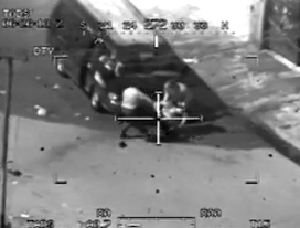
WikiLeaks video combat footage of 2007 collateral murder in Iraq“Light ’em all up. Come on, fire!” Watching the leaked combat footage of the helicopter gunships killing unarmed Iraqi civilians in 2007, I’m troubled by my own desensitized response. When I saw earlier leaked videos of an AH-64 vaporizing Iraqi farmers and a C-130 wreaking mayhem in Afghanistan, I remember my real shock at seeing a human life extinguished. This time not even flinch. “Just fuckin’, once you get on ’em just open ’em up.” Not at the brutality, nor the callousness of the play by play –even as the pilots targeted rescuers trying to help the wounded. I fault the Rules of Engagement that allowed the massacre, not the soldiers’ laughing swagger –as I hope they will not begrudge my unguarded satisfaction when eventually spectators will be treated to leaked footage of American soldiers taking some fire.

If you watched the video, perhaps you too were wishing that July 12, 2007 had recorded a massive setback for US troops in Iraq, at the height of the “surge” where a whole shitload of “dismounts” had been ambushed by IED explosions in a Baghdad square in the aftermath of a civilian massacre. Those who watched the 39-minute extended version I know were hoping to see a resolution like that, instead of an additional war crime of disproportional force and the targeting of civilians, a Hellfire missile attack on a building into which armed and unarmed men had entered, surrounded by passing innocents and rescuers scrambling to help.

There it goes! Look at that bitch go!
Patoosh!
Ah, sweet!
Need a little more room.
Nice missile.
Does it look good?
Sweet!

The Army has declared that no further inquiry will be made into the 2007 killing of the two Reuters journalists. Its FOIA requests long thwarted, even Reuters is not expressing outrage at this footage. Civilians and journalists about to be lit up The corporate media is hoping to let this story fade on the fringe. Does this mean that more pilots and gunners might become emboldened to leak other trophy reels? It doesn’t take Nelson Ratings for news outlets to see that viewers are already clamoring for more combat snuff films.

We could grant amnesty in exchange for those who turn in the most degenerate sequences.

And pretend they’ll remain anonymous. Ultimately friends and relatives will be able to place identities with the radio voices. Speaking on one of the clearest channels is the young voiced HOTEL-26, who reported taking fire from the photographers and ID’d the “RPG” with started the whole engagement. Likewise the gunner on CRAZY HORSE-18 who responded “Alright, hahaha, I hit ’em….” is addressed “God damn it, Kyle.”

And then there’s the poor 30mm gunner in CRAZY HORSE-19 who assessed his work thus:

Oh yeah, look at that. Right through the windshield! Ha ha!

While chomping at the bit to fire upon the improvised ambulance, he was momentarily thwarted by a puzzling “Azimuth Limit” which prevented his shooting.

Bloggers are now abuzz to decode the Azimuth Limit which slowed the turkey shoot when none of the gunners were showing restraint. Azimuth is the angular measurement of an object’s distance clockwise from True North. On rifles it expresses the adjustment of a gunsight to its boresight. On aircraft it apparently has something to do with the angle of relation to the axis of the fuselage. Whatever it is, maybe we can ratchet military Azimuth Limits down flat, if that’s what it will take to stop our soldiers from blowing away civilians, journalists, children and their rescuers alike. The shooters can cuss and salivate all they want so long as their trigger mechanisms respect human life or at least balk at excessive carnage.

What doesn’t come across the audio is what the US soldiers on the ground are saying to themselves as they survey “that big pile of [unarmed] bodies,” in their palaver, the “dead bastards.”

UPDATE — the testimonials begin:

From Iraq war veteran Michael Prysner, co-founder of March Forward!

The harrowing Apache footage released by WikiLeaks gives us a stomach-turning glimpse of war. Seventeen minutes of cold-blooded massacre in a war of more than seven years. A brief clip of one Apache video; a quick look at one part of one mission. Hundreds of those missions take place every day.

The video came to light thanks to military whistleblowers who provided it to WikiLeaks together with supporting documents.  Imagine if we had access to all such videos, the things we would see. Imagine all the Iraqis killed who have no one to uncover the truth about their deaths. Had the death of two Reuters news staffers not generated interest in this video, then the destruction of three families by hellfire missiles fired into an apartment building with no provocation, in a separate engagement also featured in the video, would have never been made public.

This massacre is a drop in a sea of blood. Many other such “incidents” will never be known.

Officers claimed there was “no question” that the pilots were responding to enemy fire; the video shows there is no question that they were not responding to enemy fire. They said that they had “no idea” how the journalists were killed; the video shows that they know very well how those journalists were killed. They were gunned down standing in a crowd of unarmed people.
After the slaughter of that group, the pilots beg for permission to kill the innocent passers-by who had come to the aid of one of the wounded, like any of us would have done if we saw our neighbor dying on the ground as we drove down the street. They kill everyone trying to help the dying journalist, and critically wound two children seen sitting in the front seat.

We see a group of unarmed men mowed down by a machine gun designed to destroy armored vehicles. We see a vanload of good Samaritans obliterated for trying to help a dying victim. We see all this with the soundtrack of the pilots mocking the dead, congratulating each other and laughing about the massacre.

No wonder the U.S. military goes to such great lengths to keep such videos from us. They want us to see Iraq and Afghanistan through their lens, through their embedded reporters, filtered by censorship and restrictions. They know that, once the people of this country see the extreme racism and brutality behind these occupations, they will be repulsed by what their tax dollars are paying for.

The military brass and the White House politicians have tried to justify this senseless atrocity. “Cut the pilots some slack. This was in Baghdad. This was a battle zone”—that’s been their line. The pilots had been indoctrinated with the same colonial mentality. “That’s what they get for bringing their kids into battle,” one pilot says.

The father driving that van was not “bringing his kids into battle.” He was bringing them to school, driving down the street where they live. But the U.S. occupation has made all of Iraq a battle zone. To those pilots, to their commanders over the radio and to the generals in the Pentagon, every single person in Baghdad and in Iraq is “fair game.”

The pilots joked about the people they killed, laughed about U.S. military vehicles running over dead bodies, knowing that their commanders were listening and that they were being recorded. They were not acting out of character. This is the culture of the occupation. This is how these wars are being conducted.

Having seen this, one cannot honestly believe that these atrocities are committed day in and day out for the liberation of the Iraqi people.

The Pentagon’s talking heads and media lackeys are hard at work putting their spin on this story. It’s time to tell the truth. For more than seven years, the U.S. has unleashed criminal, unprovoked aggression against the people of Iraq, and they have been doing the same thing in Afghanistan for more than eight years.

The U.S. military presence in Iraq is a colonial occupation force. The only way forward is a complete, immediate and unconditional withdrawal of all U.S. forces from Iraq and Afghanistan. This government will not do that unless all of us who are outraged by these criminal acts stand up and demand it.

Iraq war veteran Josh Stieber, US Army Specialist, 1st ID, Bravo Company 2-16 in Baghdad (Rustamiyah) 2007-2008. Although he was not present at the scene of the video, he knows those who were involved and is familiar with the environment.

A lot of my friends are in that video. After watching the video, I would definitely say that that is, nine times out of ten, the way things ended up. Killing was following military protocol. It was going along with the rules as they are.

If these videos shock and revolt you, they show the reality of what war is like. If you don’t like what you see in them, it means we should be working harder towards alternatives to war.

?

Healthcare reformist TR Reid visits COS to say universal coverage not possible

The Healing of America: a Global quest for better, cheaper, and fairer health care.COLORADO SPRINGS– [UPDATED]
My question to TR Reid, who speaks tonight at CC’s Palmer Hall, is how can voices for health care rights get past the corporate media editors?
As Washington Post Denver bureau chief and NPR reporter, Reid’s answer will reveal his earnestness, because most clearly his editors have kept the upper hand. The Independent, which is sponsoring tonight’s event, has invited two respondents to offer rebuttals, but both represent the health care status quo, there is no one advocating for socialized medicine, automatically framing Reid’s centrism as the people’s best hope.

I remember a TR Reid interview on NPR, which left me with the distinct impression of a hobbled argument. Look at the subtitle of his Frontline documentary: Sick Around the World: Can the U.S. learn anything from the rest of the world about how to run a health care system? They don’t say “what can the US learn” but can it. That’s the same false question the corporate media use to approach Global Warming. Though the answer is a multiplicity of affirmatives, the headline posed as a question leaves the viewer with the impression the conclusion is his to decide. The moon: is it there?

A follow-up Sick Around America was famously, in alternative media circles at least, altered to endorse insurance mandates. Reid broke away from the final product when PBS refused to mention his conclusion that health insurance should not be for profit. Reid chalked it up to a disagreement, not specifically a motive.

The book Mr. Reid will be signing is titled The Healing of America: a global quest for better, cheaper, and fairer health care. His own disjointed title reflects why he returned empty-handed. Can you imagine if it had read simply: a global quest for health care?

Better, cheaper and fairer are redundant qualifiers and load the theme with false perspective. “Better” assumes American care can be ranked on a scale, this book is obviously only for those getting care. “Cheaper” assumes health care must have a price — Universal health care is free. “Fairer” again assumes that our current equilibrium is in some measurable aspect fair, besides which, the concept is a fallacy. There’s unfair and fair. Moving from one toward the other, fairness is unfair until it is fair. Besides which, every schoolchild knows “fairer” is expressed as “more fair.” If Reid had been honest, he would have phrased it “less unfair.”

TR Reid applauds the health care available in other developed countries, but notes the other systems are not without their flaws. Is this some sort of psychological inducement to feed the American ego, that US reform can aim higher than the health care as a right provided elsewhere? I think it’s a loophole with which to scuttle his proposal.

It seems TR Reid is ignoring the chief obstacle to health care. It’s not reason, it’s not taxes. The chief obstacle is capitalist greed, it’s class warfare, and the social systems of our like nations are under attack as well. The shortcomings which TR Reid sees in Europe are the result of legislative meddling with systems enacted by the people.

Americans aren’t going to get health care by waiting on their legislators, or the benevolence of the corporations. The audience tonight may be impressed by TR Reid’s findings, but he’s offering nothing but placebo. Talking about health care, visualizing it, salivating at its proximity, is as much taste as TR Reid, the Washington Post and its corporate health industry advertisers will have us get.

UPDATE: TR Reid spoke to a standing room only crowd and received a standing ovation. As per usual for journalists, he provided his own disclaimer for venturing from objectivity when he posited that providing health care for all could be a moral obligation. But on the matter of The Politics of Health Care Reform, the topic of his speech, he had nothing to say.

Really, he threw the question back at the audience. Why won’t the USA provide universal coverage to its people. I’ve thought about it a lot, he told us, and I don’t have the answer.

When it came why some countries pay for Viagra, while others do not, TR Reid was humorously inquisitive. His rundown of the various medical systems throughout the world was decidedly comprehensive. But on the question of the hour, Reid was the customary incurious newspaperman which might explain his success in major media.

Not once, even at someone’s prompting, did Reid mention the for-profit worm in America’s medical system’s rotten apple. We’re told that Reid walked away from the second Frontline documentary for its whitewash of his criticism of the for-profit incentive which prevents payment systems from serving the public good. He’s excised the subject from his own presentation too. Instead, Reid focused on the millions of uninsured Americans, without a mention of the bigger population of victims, those insured who are denied care nonetheless.

Reid was pessimistic about the chances for near-term reform, based on anecdotal evidence of comments he’s received on the Frontline website. A year ago his documentary got mostly supportive comments. This year they are predominantly critical. Thus, Reid concludes, Americans do not want health care reform.

His audience tonight applauded every punchline about health care as a human right, yet Reid held that we did not want it badly enough. I hate it when the best of our spokesmen blame the audience.

Think Iran is coming down too hard on inciters of protest? Remember Neda!

Angel of Freedom of Green RevolutionYou might not have expected me to invoke the name of Neda Agha Soltan(i), the Green Revolution bystander “whose name in Farsi means ‘voice'” and whose angelic face adorned every subsequent Iranian reform movement ephemera. Remember the video where pretty Neda was shot by an unseen gunman, left to die on camera, the footage used to rally indignation against Mahmoud Ahmadinejad’s evident barbarity? Curiously our media chose to break from its usual sensibilities about snuff films. Remember your own blood lust? What fate were you wishing then for poor Neda’s killers? No doubt Iran would like to see justice for Neda too. They’ve conducted inquiries about who killed the unsuspecting martyr. Have you?

The Iranian government blames US operatives for instigating the reformist uprising, prompting Tehran’s secular class to take their grievances to the streets. They point to Iranian student groups organized by nonprofits funded by the West. They hold capitalist rabble-rousers accountable for inciting impressionable consumer wannabes to push against the riot police. They know the US is spending beaucoup black budget bucks to destabilize Iranian society. “Promoting Democracy” in Farsi means subverting leadership, and where there’s been a revolutionary movement against the established order, the USA habitually sets about to breed counter-revolutionaries. But that doesn’t explain Neda.

Political movements have infinitely more potential when there’s a martyr, and it’s a strategy no US adviser leaves to nuance. Movements have succeeded without them, but no psych-ops crafted scenario has done without. You wonder who volunteers for the role? We’ve seen recent examples, I can think of an incident in Honduras, were protesters pretended one of their number had been felled. But such is the weakness of the good guys, they’re not about to kill someone as a means to an end. Can we say the same about the good guys of the CIA?

When the saintly Neda was killed onscreen, the Iranian government immediately suspected a plot. Was it one of their soldiers who killed her, standing at an isolated corner, part of no confrontation? By whose orders would he have fired?

Who said the reelection of Ahmadinejad was rigged? None but the Americans. Who egged on the crowds to overturn a democratically elected government? America. Who branded the reform movement, and levitated it via social media?

Who else but America color-codes its exported “revolutions?”

“Remember Neda” has become the rallying cry of Iranian expats and Shah loyalists in exile. They’ll change their tune when authorities in Iran finger her murderers.

When Iran executes those responsible for the covert machinations meant to provoke an uprising to satisfy the US call for regime change, it’s not for crying out “freedom” but for yelling “fire” in a crowded theater, pointing at Neda.

CS Indy turns to cruel IFES deceiver to voice cautionary best hope for Haiti

IFESWhen it came to coverage of the Haiti earthquake disaster, the CS Indy left it to their Your Turn column, and by “your” they meant YOUR MASSAH. What caught my eye was the headline “Time for a new Haiti” accompanied by the excerpt blurb “Aristide’s return would be a disaster,” written by a pasty diplomat who had a personal hand in Haiti’s ongoing misery. Here is our allegedly progressive newsweekly giving the podium to IFES criminal Richard Soudriette instead of bundling him off to Port Au Prince for a well deserved drubbing.

Mr. Soudriette presided over the International Foundation for Electoral Systems (IFES) from 1988 to 2007, the period which saw two US coups in Haiti, where twice the democratically elected Bertrand Aristide was removed from office by our hands. Who better to have blown the whistle on the US interference than someone observing, even advising and conducting, the elections? That’s ignoring of course that the IFES is actually a private agency which does the CIA’s work, created in the 80s when Congress moved to limit the CIA’s official role destabilizing democracies. Through the IFES, through the National Endowment for Democracy, the CIA continues its intelligence wars subverting foreign governments who threaten America’s corporate rule.

If you want to believe that enterprises like IFES might be serving some good, consider this: if democratic ideals were really being advanced, the US State Department would be proud to do the work. These aren’t subcontracted jobs that wouldn’t benefit from official diplomatic networks. The IFES and ilk are as disreputable cretins as ever wore stuffed shirts, designed to separate people from legitimate representation.

And don’t think all the pitchfork bearing victims of its election racketeering are overseas. The IFES has been an adversary of the American people as Americans have tried to rescue their elections from Diebold and the stolen votes of 2000, 2002, 2004 and 2006.

When will traitorous, undemocratic Neocons like Richard Soudriette meet the wrath they have so richly courted? The Haitians are suffering, there are countless stories of Americans helping in the effort, instead the Indy gives people of Haiti more of the same malignant spin. How did Soudriette explain his expertise on Aristide? He didn’t:

“Unfortunately Aristide is hinting at a comeback despite his two failed terms. Aristide’s return to Haitian politics would be a disaster for the country. His many political allies in the U.S. and abroad would best serve Haiti’s interests by encouraging Aristide to permanently step aside from politics.”

Rather, Soudriette says, we need to back efforts to amend Haiti’s constitution to allow America’s man Preval serve additional terms. Oh, and give more responsibility to USAID, another CIA arm. Why is Soudriette spinning this message to Colorado Springs I wonder?

It’s not enough that Soudriette lent his villainy to Haiti’s disastrous last decades, now two years removed from the job, on the occasion of its most recent natural calamity, Soudriette resurfaces to damn the Haitian people with the same lies, lest they ever catch a break. That’s what makes this brand of conservative bureaucrat so damnable.

And why is the Indy propagating this venomous neo-liberal drivel? It could be highlighting the truly hopeful opportunities which locals have been taking to help the earthquake victims. Tired of watching the US military bureaucracy monopolize and bungle the aid efforts, a Springs surgical team enlisted a local businessman’s private turboprop to spend a week in Port Au Prince effecting miracles. Let’s hear about that story.

To pick up where we left off with scoundrel Soudriette, he of the many Haitian crony friends in DC, the careerist democracy-thief has moved to Colorado Springs, to lecture for El Pomar, and head the Center for Diplomacy and Democracy, which may be just another shell to which the CIA funnels funding. While stationed in DC for the IFES, Soudriette was also billing from an M Street address for the Conservation International Foundation. The good news is that apart from a CFDD franchise opened in Northern Iraq, no doubt to milk from Iraq reconstruction funds, the headquarters here appears to be merely a residence with a walkout on the golf course of the Country Club of Colorado.

Non profit front on the Country Club of Colorado golf course

Rush is right. Make him pay for Haiti.

Reading 538’s excellent qualified defense of Pat Robertson‘s accusation that Haiti really had made a pact with the devil, I am prompted to weigh in behind Rush Limbaugh’s hypocritical rant that the American public has already paid enough for Haiti’s relief, “it’s called the US Income Tax.” Well it’s true. It is the role of government to see after the suffering among us. Of course you’d think conservatives like Limbaugh wouldn’t highlight that role while images of disaster haunt us, because they’re the ones behind depleting the aid coffers. Bush’s tax cuts for the rich alone could have relieved Haiti, Katrina and every Tsunami in between without costing tearful American TV viewers one extra dime of credit card debt.

The Haitian rebels made this prayer to their god in 1791. European slave owners might conclude an insurgent god would be their devil. This prayer was recited by rebellion priestess Boukman at the Bois Caiman (Bwa Kayiman). French speakers can read it in Creole.

The god who created the earth; who created the sun that gives us light. The god who holds up the ocean; who makes the thunder roar. Our God who has ears to hear. You who are hidden in the clouds; who watch us from where you are. You see all that the white has made us suffer. The white man’s god asks him to commit crimes. But the god within us wants to do good. Our god, who is so good, so just, He orders us to revenge our wrongs. It’s He who will direct our arms and bring us the victory. It’s He who will assist us. We all should throw away the image of the white men’s god who is so pitiless. Listen to the voice for liberty that speaks in all our hearts.

The Toussaint Louverture Project is an online documentation of our western hemisphere’s only successful slave uprising.

Just as the USA still refuses to let Cuba free its people from our tyranny after 40 years, so did the Western powers fight to keep Haiti from success, lest their free slaves inspire ours.

Beyond MLK worship: Beyond Vietnam

MLK“A time comes when silence is betrayal. That time has come for us in relation to Vietnam.”
Martin Luther King Beyond Vietnam: Time to Break the Silence
Full text of 1967 speech below.

Riverside Church, New York City, 4 April 1967

I come to this magnificent house of worship tonight because my conscience leaves me no other choice. I join with you in this meeting because I am in deepest agreement with the aims and work of the organization which has brought us together: Clergy and Laymen Concerned about Vietnam. The recent statement of your executive committee are the sentiments of my own heart and I found myself in full accord when I read its opening lines:

“A time comes when silence is betrayal.”

That time has come for us in relation to Vietnam.

The truth of these words is beyond doubt but the mission to which they call us is a most difficult one. Even when pressed by the demands of inner truth, men do not easily assume the task of opposing their government’s policy, especially in time of war. Nor does the human spirit move without great difficulty against all the apathy of conformist thought within one’s own bosom and in the surrounding world. Moreover when the issues at hand seem as perplexed as they often do in the case of this dreadful conflict we are always on the verge of being mesmerized by uncertainty; but we must move on.

Some of us who have already begun to break the silence of the night have found that the calling to speak is often a vocation of agony, but we must speak. We must speak with all the humility that is appropriate to our limited vision, but we must speak. And we must rejoice as well, for surely this is the first time in our nation’s history that a significant number of its religious leaders have chosen to move beyond the prophesying of smooth patriotism to the high grounds of a firm dissent based upon the mandates of conscience and the reading of history. Perhaps a new spirit is rising among us. If it is, let us trace its movement well and pray that our own inner being may be sensitive to its guidance, for we are deeply in need of a new way beyond the darkness that seems so close around us.

Over the past two years, as I have moved to break the betrayal of my own silences and to speak from the burnings of my own heart, as I have called for radical departures from the destruction of Vietnam, many persons have questioned me about the wisdom of my path. At the heart of their concerns this query has often loomed large and loud: Why are you speaking about war, Dr. King? Why are you joining the voices of dissent? Peace and civil rights don’t mix, they say. Aren’t you hurting the cause of your people, they ask? And when I hear them, though I often understand the source of their concern, I am nevertheless greatly saddened, for such questions mean that the inquirers have not really known me, my commitment or my calling. Indeed, their questions suggest that they do not know the world in which they live.

“I wish not to speak with Hanoi and the National Liberation Front, but rather to my fellow Americans who, with me, bear the greatest responsibility in ending a conflict that has exacted a heavy price on both continents.”

In the light of such tragic misunderstandings, I deem it of signal importance to try to state clearly, and I trust concisely, why I believe that the path from Dexter Avenue Baptist Church — the church in Montgomery, Alabama, where I began my pastorate — leads clearly to this sanctuary tonight.

I come to this platform tonight to make a passionate plea to my beloved nation. This speech is not addressed to Hanoi or to the National Liberation Front. It is not addressed to China or to Russia.

Nor is it an attempt to overlook the ambiguity of the total situation and the need for a collective solution to the tragedy of Vietnam. Neither is it an attempt to make North Vietnam or the National Liberation Front paragons of virtue, nor to overlook the role they can play in a successful resolution of the problem. While they both may have justifiable reason to be suspicious of the good faith of the United States, life and history give eloquent testimony to the fact that conflicts are never resolved without trustful give and take on both sides.

Tonight, however, I wish not to speak with Hanoi and the NLF, but rather to my fellow Americans, who, with me, bear the greatest responsibility in ending a conflict that has exacted a heavy price on both continents.

The Importance of Vietnam

Since I am a preacher by trade, I suppose it is not surprising that I have seven major reasons for bringing Vietnam into the field of my moral vision. There is at the outset a very obvious and almost facile connection between the war in Vietnam and the struggle I, and others, have been waging in America. A few years ago there was a shining moment in that struggle. It seemed as if there was a real promise of hope for the poor — both black and white — through the poverty program. There were experiments, hopes, new beginnings. Then came the buildup in Vietnam and I watched the program broken and eviscerated as if it were some idle political plaything of a society gone mad on war, and I knew that America would never invest the necessary funds or energies in rehabilitation of its poor so long as adventures like Vietnam continued to draw men and skills and money like some demonic destructive suction tube. So I was increasingly compelled to see the war as an enemy of the poor and to attack it as such.

“For the sake of those boys,
for the sake of this governent,
for the sake of hundreds of thousands
trembling under our violence,
I cannot be silent.”

Perhaps the more tragic recognition of reality took place when it became clear to me that the war was doing far more than devastating the hopes of the poor at home. It was sending their sons and their brothers and their husbands to fight and to die in extraordinarily high proportions relative to the rest of the population. We were taking the black young men who had been crippled by our society and sending them eight thousand miles away to guarantee liberties in Southeast Asia which they had not found in southwest Georgia and East Harlem. So we have been repeatedly faced with the cruel irony of watching Negro and white boys on TV screens as they kill and die together for a nation that has been unable to seat them together in the same schools. So we watch them in brutal solidarity burning the huts of a poor village, but we realize that they would never live on the same block in Detroit. I could not be silent in the face of such cruel manipulation of the poor.

My third reason moves to an even deeper level of awareness, for it grows out of my experience in the ghettoes of the North over the last three years — especially the last three summers. As I have walked among the desperate, rejected and angry young men I have told them that Molotov cocktails and rifles would not solve their problems. I have tried to offer them my deepest compassion while maintaining my conviction that social change comes most meaningfully through nonviolent action. But they asked — and rightly so — what about Vietnam? They asked if our own nation wasn’t using massive doses of violence to solve its problems, to bring about the changes it wanted. Their questions hit home, and I knew that I could never again raise my voice against the violence of the oppressed in the ghettos without having first spoken clearly to the greatest purveyor of violence in the world today — my own government. For the sake of those boys, for the sake of this government, for the sake of hundreds of thousands trembling under our violence, I cannot be silent.

For those who ask the question, “Aren’t you a civil rights leader?” and thereby mean to exclude me from the movement for peace, I have this further answer. In 1957 when a group of us formed the Southern Christian Leadership Conference, we chose as our motto: “To save the soul of America.” We were convinced that we could not limit our vision to certain rights for black people, but instead affirmed the conviction that America would never be free or saved from itself unless the descendants of its slaves were loosed completely from the shackles they still wear. In a way we were agreeing with Langston Hughes, that black bard of Harlem, who had written earlier:

O, yes,
I say it plain,
America never was America to me,
And yet I swear this oath —
America will be!

Now, it should be incandescently clear that no one who has any concern for the integrity and life of America today can ignore the present war. If America’s soul becomes totally poisoned, part of the autopsy must read Vietnam. It can never be saved so long as it destroys the deepest hopes of men the world over. So it is that those of us who are yet determined that America will be are led down the path of protest and dissent, working for the health of our land.

“Surely we must see
that the men we supported
pressed them to their violence.”

As if the weight of such a commitment to the life and health of America were not enough, another burden of responsibility was placed upon me in 1964; and I cannot forget that the Nobel Prize for Peace was also a commission — a commission to work harder than I had ever worked before for “the brotherhood of man.” This is a calling that takes me beyond national allegiances, but even if it were not present I would yet have to live with the meaning of my commitment to the ministry of Jesus Christ. To me the relationship of this ministry to the making of peace is so obvious that I sometimes marvel at those who ask me why I am speaking against the war. Could it be that they do not know that the good news was meant for all men — for Communist and capitalist, for their children and ours, for black and for white, for revolutionary and conservative? Have they forgotten that my ministry is in obedience to the one who loved his enemies so fully that he died for them? What then can I say to the “Vietcong” or to Castro or to Mao as a faithful minister of this one? Can I threaten them with death or must I not share with them my life?

Finally, as I try to delineate for you and for myself the road that leads from Montgomery to this place I would have offered all that was most valid if I simply said that I must be true to my conviction that I share with all men the calling to be a son of the living God. Beyond the calling of race or nation or creed is this vocation of sonship and brotherhood, and because I believe that the Father is deeply concerned especially for his suffering and helpless and outcast children, I come tonight to speak for them.

This I believe to be the privilege and the burden of all of us who deem ourselves bound by allegiances and loyalties which are broader and deeper than nationalism and which go beyond our nation’s self-defined goals and positions. We are called to speak for the weak, for the voiceless, for victims of our nation and for those it calls enemy, for no document from human hands can make these humans any less our brothers.

Strange Liberators

And as I ponder the madness of Vietnam and search within myself for ways to understand and respond to compassion my mind goes constantly to the people of that peninsula. I speak now not of the soldiers of each side, not of the junta in Saigon, but simply of the people who have been living under the curse of war for almost three continuous decades now. I think of them too because it is clear to me that there will be no meaningful solution there until some attempt is made to know them and hear their broken cries.

“Before long they must know
that their government has sent them
into a struggle among Vietnamese,
and the more sophisticated surely realize
that we are on the side of the wealthy
and the secure
while we create hell for the poor.”

They must see Americans as strange liberators. The Vietnamese people proclaimed their own independence in 1945 after a combined French and Japanese occupation, and before the Communist revolution in China. They were led by Ho Chi Minh. Even though they quoted the American Declaration of Independence in their own document of freedom, we refused to recognize them. Instead, we decided to support France in its re-conquest of her former colony.

Our government felt then that the Vietnamese people were not “ready” for independence, and we again fell victim to the deadly Western arrogance that has poisoned the international atmosphere for so long. With that tragic decision we rejected a revolutionary government seeking self-determination, and a government that had been established not by China (for whom the Vietnamese have no great love) but by clearly indigenous forces that included some Communists. For the peasants this new government meant real land reform, one of the most important needs in their lives.

For nine years following 1945 we denied the people of Vietnam the right of independence. For nine years we vigorously supported the French in their abortive effort to re-colonize Vietnam.

Before the end of the war we were meeting eighty percent of the French war costs. Even before the French were defeated at Dien Bien Phu, they began to despair of the reckless action, but we did not. We encouraged them with our huge financial and military supplies to continue the war even after they had lost the will. Soon we would be paying almost the full costs of this tragic attempt at re-colonization.

After the French were defeated it looked as if independence and land reform would come again through the Geneva agreements. But instead there came the United States, determined that Ho should not unify the temporarily divided nation, and the peasants watched again as we supported one of the most vicious modern dictators — our chosen man, Premier Diem. The peasants watched and cringed as Diem ruthlessly routed out all opposition, supported their extortionist landlords and refused even to discuss reunification with the north. The peasants watched as all this was presided over by U.S. influence and then by increasing numbers of U.S. troops who came to help quell the insurgency that Diem’s methods had aroused. When Diem was overthrown they may have been happy, but the long line of military dictatorships seemed to offer no real change — especially in terms of their need for land and peace.

The only change came from America as we increased our troop commitments in support of governments which were singularly corrupt, inept and without popular support. All the while the people read our leaflets and received regular promises of peace and democracy — and land reform. Now they languish under our bombs and consider us – not their fellow Vietnamese — the real enemy. They move sadly and apathetically as we herd them off the land of their fathers into concentration camps where minimal social needs are rarely met. They know they must move or be destroyed by our bombs. So they go — primarily women and children and the aged.

“Somehow this madness must cease.”

They watch as we poison their water, as we kill a million acres of their crops. They must weep as the bulldozers roar through their areas preparing to destroy the precious trees. They wander into the hospitals, with at least twenty casualties from American firepower for one “Vietcong-inflicted” injury. So far we may have killed a million of them — mostly children. They wander into the towns and see thousands of the children, homeless, without clothes, running in packs on the streets like animals. They see the children, degraded by our soldiers as they beg for food. They see the children selling their sisters to our soldiers, soliciting for their mothers.

What do the peasants think as we ally ourselves with the landlords and as we refuse to put any action into our many words concerning land reform? What do they think as we test our latest weapons on them, just as the Germans tested out new medicine and new tortures in the concentration camps of Europe? Where are the roots of the independent Vietnam we claim to be building? Is it among these voiceless ones?

We have destroyed their two most cherished institutions: the family and the village. We have destroyed their land and their crops. We have cooperated in the crushing of the nation’s only non-Communist revolutionary political force — the Unified Buddhist church. We have supported the enemies of the peasants of Saigon. We have corrupted their women and children and killed their men. What liberators?

Now there is little left to build on — save bitterness. Soon the only solid physical foundations remaining will be found at our military bases and in the concrete of the concentration camps we call fortified hamlets. The peasants may well wonder if we plan to build our new Vietnam on such grounds as these? Could we blame them for such thoughts? We must speak for them and raise the questions they cannot raise. These too are our brothers.

Perhaps the more difficult but no less necessary task is to speak for those who have been designated as our enemies. What of the National Liberation Front — that strangely anonymous group we call VC or Communists? What must they think of us in America when they realize that we permitted the repression and cruelty of Diem which helped to bring them into being as a resistance group in the south? What do they think of our condoning the violence which led to their own taking up of arms? How can they believe in our integrity when now we speak of “aggression from the north” as if there were nothing more essential to the war? How can they trust us when now we charge them with violence after the murderous reign of Diem and charge them with violence while we pour every new weapon of death into their land? Surely we must understand their feelings even if we do not condone their actions. Surely we must see that the men we supported pressed them to their violence. Surely we must see that our own computerized plans of destruction simply dwarf their greatest acts.

“We must continue to raise our voices if our nation persists in its perverse ways in Vietnam.”

How do they judge us when our officials know that their membership is less than twenty-five percent Communist and yet insist on giving them the blanket name? What must they be thinking when they know that we are aware of their control of major sections of Vietnam and yet we appear ready to allow national elections in which this highly organized political parallel government will have no part? They ask how we can speak of free elections when the Saigon press is censored and controlled by the military junta. And they are surely right to wonder what kind of new government we plan to help form without them — the only party in real touch with the peasants. They question our political goals and they deny the reality of a peace settlement from which they will be excluded. Their questions are frighteningly relevant. Is our nation planning to build on political myth again and then shore it up with the power of new violence?

Here is the true meaning and value of compassion and nonviolence when it helps us to see the enemy’s point of view, to hear his questions, to know his assessment of ourselves. For from his view we may indeed see the basic weaknesses of our own condition, and if we are mature, we may learn and grow and profit from the wisdom of the brothers who are called the opposition.

So, too, with Hanoi. In the north, where our bombs now pummel the land, and our mines endanger the waterways, we are met by a deep but understandable mistrust. To speak for them is to explain this lack of confidence in Western words, and especially their distrust of American intentions now. In Hanoi are the men who led the nation to independence against the Japanese and the French, the men who sought membership in the French commonwealth and were betrayed by the weakness of Paris and the willfulness of the colonial armies. It was they who led a second struggle against French domination at tremendous costs, and then were persuaded to give up the land they controlled between the thirteenth and seventeenth parallel as a temporary measure at Geneva. After 1954 they watched us conspire with Diem to prevent elections which would have surely brought Ho Chi Minh to power over a united Vietnam, and they realized they had been betrayed again.

When we ask why they do not leap to negotiate, these things must be remembered. Also it must be clear that the leaders of Hanoi considered the presence of American troops in support of the Diem regime to have been the initial military breach of the Geneva agreements concerning foreign troops, and they remind us that they did not begin to send in any large number of supplies or men until American forces had moved into the tens of thousands.

“When machines and computers,
profit motives and property rights
are considered more important than people,
the giant triplets of
racism,
materialism
and militarism
are incapable of being conquered.”

Hanoi remembers how our leaders refused to tell us the truth about the earlier North Vietnamese overtures for peace, how the president claimed that none existed when they had clearly been made. Ho Chi Minh has watched as America has spoken of peace and built up its forces, and now he has surely heard of the increasing international rumors of American plans for an invasion of the north. He knows the bombing and shelling and mining we are doing are part of traditional pre-invasion strategy. Perhaps only his sense of humor and of irony can save him when he hears the most powerful nation of the world speaking of aggression as it drops thousands of bombs on a poor weak nation more than eight thousand miles away from its shores.

At this point I should make it clear that while I have tried in these last few minutes to give a voice to the voiceless on Vietnam and to understand the arguments of those who are called enemy, I am as deeply concerned about our troops there as anything else. For it occurs to me that what we are submitting them to in Vietnam is not simply the brutalizing process that goes on in any war where armies face each other and seek to destroy. We are adding cynicism to the process of death, for they must know after a short period there that none of the things we claim to be fighting for are really involved. Before long they must know that their government has sent them into a struggle among Vietnamese, and the more sophisticated surely realize that we are on the side of the wealthy and the secure while we create hell for the poor.

This Madness Must Cease

Somehow this madness must cease. We must stop now. I speak as a child of God and brother to the suffering poor of Vietnam. I speak for those whose land is being laid waste, whose homes are being destroyed, whose culture is being subverted. I speak for the poor of America who are paying the double price of smashed hopes at home and death and corruption in Vietnam. I speak as a citizen of the world, for the world as it stands aghast at the path we have taken. I speak as an American to the leaders of my own nation. The great initiative in this war is ours. The initiative to stop it must be ours.

This is the message of the great Buddhist leaders of Vietnam. Recently one of them wrote these words:

“Each day the war goes on the hatred increases in the heart of the Vietnamese and in the hearts of those of humanitarian instinct. The Americans are forcing even their friends into becoming their enemies. It is curious that the Americans, who calculate so carefully on the possibilities of military victory, do not realize that in the process they are incurring deep psychological and political defeat. The image of America will never again be the image of revolution, freedom and democracy, but the image of violence and militarism.”

“A nation that continues
year after year
to spend more money on military defense
than on programs of social uplift
is approaching spiritual death.”

If we continue, there will be no doubt in my mind and in the mind of the world that we have no honorable intentions in Vietnam. It will become clear that our minimal expectation is to occupy it as an American colony and men will not refrain from thinking that our maximum hope is to goad China into a war so that we may bomb her nuclear installations. If we do not stop our war against the people of Vietnam immediately the world will be left with no other alternative than to see this as some horribly clumsy and deadly game we have decided to play.

The world now demands a maturity of America that we may not be able to achieve. It demands that we admit that we have been wrong from the beginning of our adventure in Vietnam, that we have been detrimental to the life of the Vietnamese people. The situation is one in which we must be ready to turn sharply from our present ways.

In order to atone for our sins and errors in Vietnam, we should take the initiative in bringing a halt to this tragic war. I would like to suggest five concrete things that our government should do immediately to begin the long and difficult process of extricating ourselves from this nightmarish conflict:

• End all bombing in North and South Vietnam

• Declare a unilateral cease-fire in the hope that such action will create the atmosphere for negotiation.

• Take immediate steps to prevent other battlegrounds in Southeast Asia by curtailing our military buildup in Thailand and our interference in Laos.

• Realistically accept the fact that the National Liberation Front has substantial support in South Vietnam and must thereby play a role in any meaningful negotiations and in any future Vietnam government.

• Set a date that we will remove all foreign troops from Vietnam in accordance with the 1954 Geneva agreement.

Part of our ongoing commitment might well express itself in an offer to grant asylum to any Vietnamese who fears for his life under a new regime which included the Liberation Front. Then we must make what reparations we can for the damage we have done. We most provide the medical aid that is badly needed, making it available in this country if necessary.

Protesting The War

Meanwhile we in the churches and synagogues have a continuing task while we urge our government to disengage itself from a disgraceful commitment. We must continue to raise our voices if our nation persists in its perverse ways in Vietnam. We must be prepared to match actions with words by seeking out every creative means of protest possible.

As we counsel young men concerning military service we must clarify for them our nation’s role in Vietnam and challenge them with the alternative of conscientious objection. I am pleased to say that this is the path now being chosen by more than seventy students at my own alma mater, Morehouse College, and I recommend it to all who find the American course in Vietnam a dishonorable and unjust one. Moreover I would encourage all ministers of draft age to give up their ministerial exemptions and seek status as conscientious objectors. These are the times for real choices and not false ones. We are at the moment when our lives must be placed on the line if our nation is to survive its own folly. Every man of humane convictions must decide on the protest that best suits his convictions, but we must all protest.

“If we do not act
we shall surely be dragged down
the long and shameful corridors of time
reserved for those who possess
power without compassion,
might without morality,
and strength without sight.”

There is something seductively tempting about stopping there and sending us all off on what in some circles has become a popular crusade against the war in Vietnam. I say we must enter the struggle, but I wish to go on now to say something even more disturbing. The war in Vietnam is but a symptom of a far deeper malady within the American spirit, and if we ignore this sobering reality we will find ourselves organizing clergy-and laymen-concerned committees for the next generation. They will be concerned about Guatemala and Peru. They will be concerned about Thailand and Cambodia. They will be concerned about Mozambique and South Africa. We will be marching for these and a dozen other names and attending rallies without end unless there is a significant and profound change in American life and policy. Such thoughts take us beyond Vietnam, but not beyond our calling as sons of the living God.

In 1957 a sensitive American official overseas said that it seemed to him that our nation was on the wrong side of a world revolution. During the past ten years we have seen emerge a pattern of suppression which now has justified the presence of U.S. military “advisors” in Venezuela. This need to maintain social stability for our investments accounts for the counter-revolutionary action of American forces in Guatemala. It tells why American helicopters are being used against guerrillas in Colombia and why American napalm and green beret forces have already been active against rebels in Peru. It is with such activity in mind that the words of the late John F. Kennedy come back to haunt us. Five years ago he said,

“Those who make peaceful revolution impossible will make violent revolution inevitable.”

Increasingly, by choice or by accident, this is the role our nation has taken — the role of those who make peaceful revolution impossible by refusing to give up the privileges and the pleasures that come from the immense profits of overseas investment.

I am convinced that if we are to get on the right side of the world revolution, we as a nation must undergo a radical revolution of values. We must rapidly begin the shift from a “thing-oriented” society to a “person-oriented” society. When machines and computers, profit motives and property rights are considered more important than people, the giant triplets of racism, materialism, and militarism are incapable of being conquered.

A true revolution of values will soon cause us to question the fairness and justice of many of our past and present policies. On the one hand we are called to play the good Samaritan on life’s roadside; but that will be only an initial act. One day we must come to see that the whole Jericho road must be transformed so that men and women will not be constantly beaten and robbed as they make their journey on life’s highway.

True compassion is more than flinging a coin to a beggar; it is not haphazard and superficial. It comes to see that an edifice which produces beggars needs restructuring. A true revolution of values will soon look uneasily on the glaring contrast of poverty and wealth. With righteous indignation, it will look across the seas and see individual capitalists of the West investing huge sums of money in Asia, Africa and South America, only to take the profits out with no concern for the social betterment of the countries, and say: “This is not just.”

It will look at our alliance with the landed gentry of Latin America and say: “This is not just.”

The Western arrogance of feeling that it has everything to teach others and nothing to learn from them is not just.

A true revolution of values will lay hands on the world order and say of war: “This way of settling differences is not just.”

This business of burning human beings with napalm, of filling our nation’s homes with orphans and widows, of injecting poisonous drugs of hate into veins of people normally humane, of sending men home from dark and bloody battlefields physically handicapped and psychologically deranged, cannot be reconciled with wisdom, justice and love. A nation that continues year after year to spend more money on military defense than on programs of social uplift is approaching spiritual death.

America, the richest and most powerful nation in the world, can well lead the way in this revolution of values. There is nothing, except a tragic death wish, to prevent us from reordering our priorities, so that the pursuit of peace will take precedence over the pursuit of war. There is nothing to keep us from molding a recalcitrant status quo with bruised hands until we have fashioned it into a brotherhood.

This kind of positive revolution of values is our best defense against communism. War is not the answer. Communism will never be defeated by the use of atomic bombs or nuclear weapons. Let us not join those who shout war and through their misguided passions urge the United States to relinquish its participation in the United Nations. These are days which demand wise restraint and calm reasonableness. We must not call everyone a Communist or an appeaser who advocates the seating of Red China in the United Nations and who recognizes that hate and hysteria are not the final answers to the problem of these turbulent days. We must not engage in a negative anti-communism, but rather in a positive thrust for democracy, realizing that our greatest defense against communism is to take offensive action in behalf of justice. We must with positive action seek to remove those conditions of poverty, insecurity and injustice which are the fertile soil in which the seed of communism grows and develops.

The People Are Important

These are revolutionary times. All over the globe men are revolting against old systems of exploitation and oppression and out of the wombs of a frail world new systems of justice and equality are being born. The shirtless and barefoot people of the land are rising up as never before. “The people who sat in darkness have seen a great light.” We in the West must support these revolutions. It is a sad fact that, because of comfort, complacency, a morbid fear of communism, and our proneness to adjust to injustice, the Western nations that initiated so much of the revolutionary spirit of the modern world have now become the arch anti-revolutionaries. This has driven many to feel that only Marxism has the revolutionary spirit. Therefore, communism is a judgment against our failure to make democracy real and follow through on the revolutions we initiated. Our only hope today lies in our ability to recapture the revolutionary spirit and go out into a sometimes hostile world declaring eternal hostility to poverty, racism, and militarism. With this powerful commitment we shall boldly challenge the status quo and unjust mores and thereby speed the day when “every valley shall be exalted, and every mountain and hill shall be made low, and the crooked shall be made straight and the rough places plain.”

A genuine revolution of values means in the final analysis that our loyalties must become ecumenical rather than sectional. Every nation must now develop an overriding loyalty to mankind as a whole in order to preserve the best in their individual societies.

This call for a world-wide fellowship that lifts neighborly concern beyond one’s tribe, race, class and nation is in reality a call for an all-embracing and unconditional love for all men. This oft misunderstood and misinterpreted concept – so readily dismissed by the Nietzsches of the world as a weak and cowardly force – has now become an absolute necessity for the survival of man. When I speak of love I am not speaking of some sentimental and weak response. I am speaking of that force which all of the great religions have seen as the supreme unifying principle of life. Love is somehow the key that unlocks the door which leads to ultimate reality. This Hindu-Moslem-Christian-Jewish-Buddhist belief about ultimate reality is beautifully summed up in the first epistle of Saint John:

Let us love one another; for love is God and everyone that loveth is born of God and knoweth God. He that loveth not knoweth not God; for God is love. If we love one another God dwelleth in us, and his love is perfected in us.

Let us hope that this spirit will become the order of the day. We can no longer afford to worship the god of hate or bow before the altar of retaliation. The oceans of history are made turbulent by the ever-rising tides of hate. History is cluttered with the wreckage of nations and individuals that pursued this self-defeating path of hate. As Arnold Toynbee says :

“Love is the ultimate force that makes for the saving choice of life and good against the damning choice of death and evil. Therefore the first hope in our inventory must be the hope that love is going to have the last word.”

We are now faced with the fact that tomorrow is today. We are confronted with the fierce urgency of now. In this unfolding conundrum of life and history there is such a thing as being too late. Procrastination is still the thief of time. Life often leaves us standing bare, naked and dejected with a lost opportunity. The “tide in the affairs of men” does not remain at the flood; it ebbs. We may cry out desperately for time to pause in her passage, but time is deaf to every plea and rushes on. Over the bleached bones and jumbled residue of numerous civilizations are written the pathetic words: “Too late.”

There is an invisible book of life that faithfully records our vigilance or our neglect. “The moving finger writes, and having writ moves on…” We still have a choice today; nonviolent coexistence or violent co-annihilation.

We must move past indecision to action. We must find new ways to speak for peace in Vietnam and justice throughout the developing world – a world that borders on our doors. If we do not act we shall surely be dragged down the long dark and shameful corridors of time reserved for those who possess power without compassion, might without morality, and strength without sight.

Now let us begin. Now let us rededicate ourselves to the long and bitter – but beautiful – struggle for a new world. This is the calling of the sons of God, and our brothers wait eagerly for our response. Shall we say the odds are too great? Shall we tell them the struggle is too hard? Will our message be that the forces of American life militate against their arrival as full men, and we send our deepest regrets? Or will there be another message, of longing, of hope, of solidarity with their yearnings, of commitment to their cause, whatever the cost? The choice is ours, and though we might prefer it otherwise we must choose in this crucial moment of human history.

As that noble bard of yesterday, James Russell Lowell, eloquently stated:

Once to every man and nation
Comes the moment to decide,
In the strife of truth and falsehood,
For the good or evil side;
Some great cause, God’s new Messiah,
Off’ring each the bloom or blight,
And the choice goes by forever
Twixt that darkness and that light.
Though the cause of evil prosper,
Yet ’tis truth alone is strong;
Though her portion be the scaffold,
And upon the throne be wrong:
Yet that scaffold sways the future,
And behind the dim unknown,
Standeth God within the shadow
Keeping watch above his own.

Violent attack on Viva Palestina convoy

Viva Palestina hurt in riotVideo footage has reached Turkish TV of last night’s attack on Viva Palestina as the convoyers waited to proceed in El-Arish. Videos show activists with head injuries, some having to be carried off. There were reported windows broken on the convoy vehicles. What a travesty if the aid to be delivered to Gaza will arrive in shambles, courtesy of the Egyptians. We won’t know until sunup. Finally the BBC has reported the story, but not what really happened.

The BBC reports, like ABC Australia, that water canon were turned on Viva Palestina because they refused to comply with Egyptian demands. But witnesses tell of a different progression.

(UPDATE: The UK Press Association lists one story, Gaza aid Brits ‘beaten by police’, where the headline infers an unverified accusation, and still no mention made of “Viva Palestina” in entire text.)

The Irish 4 Palestine blog is maintained based on regular phone and text updates from “their boys” in the convoy. In the thick of the ugliness last night, communications ceased. Then strange voices answered the phones, which had been found dropped on the ground. Finally one phone was answered by an English-speaking woman named Pat who described the attack:

“…the whole thing happened when convoy members were still locked inside this gated compound, then suddenly a very large group of plain clothes “people” arrived at the compound with sticks and stones, they were then allowed into the compound by the Egyptians and began attacking the convoy members trapped inside with nowhere to go. The Egyptians then joined in the attack when the plain clothes vigilantes arrived and went inside to attack.”

Her account was corroborated by ensuing witnesses. What may have motivated the vigilantes is open to conjecture, because we’re led to believe the aid convoy usually met a warm welcome throughout the region.

Malaysian activist Juana Jaafar was providing live play by play and occasional pics throughout the night. Her observations early on may offer one angle:

The gates have been blocked by authorities’ cars and hundreds of riot police waiting outside! Members are getting anxious

Riot cops! And a water cannon truck just arrived. Dejavu ke? Okay damn, a water tank size of 16 wheel petroleum carrier just arrived.

Members sitting at gates … I don’t understand Arabic but I know stuff being said bout “Yahudi” and am feeling uncomfortable. There are Jews in and supporting our mission …

Shit la the jangguts nak tunjuk hero pulak. Bangang ah!

Anti-Semitism is a subject no one wants to mention in polite company, perhaps because it the accusation is so frequently invoked by Israel. In accounts of peace activism in the Middle East, frequently however we read reports of Arab bystanders showing solidarity with peace actions, but declining to join in if there happen to be Jewish activists among the organizers, regardless the cause, even the anti-Zionist ones.

In this case, were the Egyptian police trying to play up the presence of Jewish activists in order to motive the plain-cloths agitators among them to throw stones?

The longer (abridged) sequence of Tweets from Juana Jaafar recounts the night’s adventure.

8PM
Yay! All members are together now as last batch rolls in! We going by the minute now. Autho may impose all sorts on new rules on us like drive in the mid of night so public can’t see us; no fanfare. Some say they may not let all vehicles out so looks like convoy is small.

But rumor has it there’s pizza in the Welsh caravan so am gonna head there :]

The gates have been blocked by autho cars and hundreds of riot police waiting outside! Members are getting anxious

Riot cops! And a water cannon truck just arrived. Dejavu ke?

Okay damn, a water tank size of 16 wheel petroleum carrier just arrived.

9PM
Members sitting at gates. Someone leading a doa. Doa man crying while doa. I don’t understand Arabic but I know stuff being said bout “Yahudi” and am feeling uncomfortable. There are Jews in and supporting our mission …

Shit la the jangguts nak tunjuk hero pulak. Bangang ah!

Standoff with autho in El-Arish port

We have been told there are protests going on right now in Istanbul, London, Chicago and at Egyptian ambassies elsewhere

11PM  
All hell has broken lose at the port. Shit flying around and police spraying and gassing. We’re in the gates

12PM  
Instigators started moving in from within the police lines and moved on the inside of the police side of the barricades. Convoy members were sitting on the ground when shouts from police lines started and then wham, hell. Just helped bandage a friend’s head

Some people are missing including a Malaysian student who came on his own from the UK. We are trying to find him. He may be arrested

Wisma, a Malaysian student has been detained by Egypt police in El-Arish. Please help.

Calm now. Galloway speaking to us, explicitly named Egyptian regime as instigator of violence. Said now the world can see who is responsible for Gaza siege. We have bend over backwards to come to El-Arish cause Egypt said we’d be welcomed here, instead welcomed with violence.

Galloway says Viva has video taken from meeting room to show special police starting violence. Police then threw stones at meeting room

1AM
Arrested are from Great Britain, USA, Malaysia and Kuwaiti.

One person just got rolled out on a stretcher.

2AM
Things are quiet now. Injured are reluctant to be taken to hospital unless Galloway guarantees Egyptian authorities gives safe passage.

4AM
It’s 415am here. We been camping in our vehicles. Some took refuge in the mosque. Riot police still outside gate + 3 water cannon trucks

Calm now but the mood is shit. Some members also not happy how few others reacted to Egyptian provocation saying we have driven this far in peace.

We’re okay, safe. But freezing. Hope things look better in morn

5AM
For the record: Malaysian boy detained only taking pix at the gates, not involved any other way. Our group mate from Great Britain detained was also just filming

The Cairo Declaration

gaza-freedom-march-cairo-egypt
Ambitions for a greater Gaza Freedom March have been set aside for another decade, but the hopeful delegates thwarted in Cairo issued the following declaration:

End Israeli Apartheid?
Cairo Declaration
?January 1, 2010

We, international delegates meeting in Cairo during the Gaza Freedom March 2009 in collective response to an initiative from the South African delegation, state:

In view of:

* Israel’s ongoing collective punishment of Palestinians through the illegal occupation and siege of Gaza;?

* the illegal occupation of the West Bank, including East Jerusalem, and the continued construction of the illegal Apartheid Wall and settlements;?

* the new Wall under construction by Egypt and the US which will tighten even further the siege of Gaza;?

* the contempt for Palestinian democracy shown by Israel, the US, Canada, the EU and others after the Palestinian elections of 2006;?

* the war crimes committed by Israel during the invasion of Gaza one year ago;?

* the continuing discrimination and repression faced by Palestinians within Israel;?

* and the continuing exile of millions of Palestinian refugees;?

* all of which oppressive acts are based ultimately on the Zionist ideology which underpins Israel;?

* in the knowledge that our own governments have given Israel direct economic, financial, military and diplomatic support and allowed it to behave with impunity;?

* and mindful of the United Nations Declaration on the Rights of Indigenous People (2007)

We reaffirm our commitment to:

Palestinian Self-Determination?Ending the Occupation?Equal Rights for All within historic Palestine?The full Right of Return for Palestinian refugees.

We therefore reaffirm our commitment to the United Palestinian call of July 2005 for Boycott, Divestment and Sanctions (BDS) to compel Israel to comply with international law.

To that end, we call for and wish to help initiate a global mass, democratic anti-apartheid movement to work in full consultation with Palestinian civil society to implement the Palestinian call for BDS.

Mindful of the many strong similarities between apartheid Israel and the former apartheid regime in South Africa, we propose:

1) An international speaking tour in the first 6 months of 2010 by Palestinian and South African trade unionists and civil society activists, to be joined by trade unionists and activists committed to this programme within the countries toured, to take mass education on BDS directly to the trade union membership and wider public internationally;

2) Participation in the Israeli Apartheid Week in March 2010;

3) A systematic unified approach to the boycott of Israeli products, involving consumers, workers and their unions in the retail, warehousing, and transportation sectors;

4) Developing the Academic, Cultural and Sports boycott;

5) Campaigns to encourage divestment of trade union and other pension funds from companies directly implicated in the Occupation and/or the Israeli military industries;

6) Legal actions targeting the external recruitment of soldiers to serve in the Israeli military, and the prosecution of Israeli government war criminals; coordination of Citizen’s Arrest Bureaux to identify, campaign and seek to prosecute Israeli war criminals; support for the Goldstone Report and the implementation of its recommendations;

7) Campaigns against charitable status of the Jewish National Fund (JNF).

We appeal to organisations and individuals committed to this declaration to sign it and work with us to make it a reality.

Signed by:

(* Affiliation for identification purposes only.)

1. Hedy Epstein, Holocaust Survivor/ Women in Black*, USA?
2. Nomthandazo Sikiti, Nehawu, Congress of South African Trade Unions (COSATU), Affiliate International Officer*, South Africa?
3. Zico Tamela, Satawu, Congress of South African Trade Unions (COSATU) Affiliate International Officer*, South Africa?
4. Hlokoza Motau, Numsa, Congress of South African Trade Unions (COSATU) Affiliate International Officer*, South Africa?
5. George Mahlangu, Congress of South African Trade Unions (COSATU) Campaigns Coordinator*, South Africa?
6. Crystal Dicks, Congress of South African Trade Unions (COSATU) Education Secretary*, South Africa?
7. Savera Kalideen, SA Palestinian Solidarity Committee*, South Africa?
8. Suzanne Hotz, SA Palestinian Solidarity Group*, South Africa?
9. Shehnaaz Wadee, SA Palestinian Solidarity Alliance*, South Africa?
10. Haroon Wadee, SA Palestinian Solidarity Alliance*, South Africa?
11. Sayeed Dhansey, South Africa?
12. Faiza Desai, SA Palestinian Solidarity Alliance*, South Africa?
13. Ali Abunimah, Electronic Intifada*, USA?
14. Hilary Minch, Ireland Palestine Solidarity Committee*, Ireland?
15. Anthony Loewenstein, Australia?
16. Sam Perlo-Freeman, United Kingdom?
17. Julie Moentk, Pax Christi*, USA?
18. Ulf Fogelström, Sweden?
19. Ann Polivka, Chico Peace and Justice Center*, USA?
20. Mark Johnson, Fellowship of Reconciliation*, USA?
21. Elfi Padovan, Munich Peace Committee*/Die Linke*, Germany?
22. Elizabeth Barger, Peace Roots Alliance*/Plenty I*, USA?
23. Sarah Roche-Mahdi, CodePink*, USA?
24. Svetlana Gesheva-Anar, Bulgaria?
25. Cristina Ruiz Cortina, Al Quds-Malaga*, Spain?
26. Rachel Wyon, Boston Gaza Freedom March*, USA?
27. Mary Hughes-Thompson, Women in Black*, USA?
28. David Letwin, International Jewish Anti-Zionist Network (IJAN)*, USA?
29. Jean Athey, Peace Action Montgomery*, USA?
30. Gael Murphy, Gaza Freedom March*/CodePink*, USA?
31. Thomas McAfee, Journalist/PC*, USA?
32. Jean Louis Faure, International Jewish Anti-Zionist Network (IJAN)*, France?
33. Timothy A King, Christians for Peace and Justice in the Middle East*, USA?
34. Gail Chalbi, Palestine/Israel Justice Project of the Minnesota United Methodist Church*, USA?
35. Ouahib Chalbi, Palestine/Israel Justice Project of the Minnesota United Methodist Church*, USA?
36. Greg Dropkin, Liverpool Friends of Palestine*, England?
37. Felice Gelman, Wespac Peace and Justice New York*/Gaza Freedom March*, USA?
38. Ron Witton, Australian Academic Union*, Australia?
39. Hayley Wallace, Palestine Solidarity Committee*, USA?
40. Norma Turner, Manchester Palestine Solidarity Campaign*, England?
41. Paula Abrams-Hourani, Women in Black (Vienna)*/ Jewish Voice for Just Peace in the Middle East*, Austria?
42. Mateo Bernal, Industrial Workers of the World*, USA?
43. Mary Mattieu, Collectif Urgence Palestine*, Switzerland?
44. Agneta Zuppinger, Collectif Urgence Palestine*, Switzerland?
45. Ashley Annis, People for Peace*, Canada?
46. Peige Desgarlois, People for Peace*, Canada?
47. Hannah Carter, Canadian Friends of Sabeel*, Canada?
48. Laura Ashfield, Canadian Friends of Sabeel*, Canada?
49. Iman Ghazal, People for Peace*, Canada?
50. Filsam Farah, People for Peace*, Canada?
51. Awa Allin, People for Peace*, Canada?
52. Cleopatra McGovern, USA?
53. Miranda Collet, Spain?
54. Alison Phillips, Scotland?
55. Nicholas Abramson, Middle East Crisis Response Network*/Jews Say No*, USA?
56. Tarak Kauff, Middle East Crisis Response Network*/Veterans for Peace*, USA?
57. Jesse Meisler-Abramson, USA?
58. Hope Mariposa, USA?
59. Ivesa Lübben. Bremer Netzwerk fur Gerechten Frieden in Nahost*, Germany?
60. Sheila Finan, Mid-Hudson Council MERC*, USA?
61. Joanne Lingle, Christians for Peace and Justice in the Middle East (CPJME)*, USA?
62. Barbara Lubin, Middle East Children’s Alliance*, USA?
63. Josie Shields-Stromsness, Middle East Children’s Alliance*, USA?
64. Anna Keuchen, Germany?
65. Judith Mahoney Pasternak, WRL* and Indypendent*, USA?
66. Ellen Davidson, New York City Indymedia*, WRL*, Indypendent*, USA?
67. Ina Kelleher, USA?
68. Lee Gargagliano, International Jewish Anti-Zionist Network (Chicago)*, USA?
69. Brad Taylor, OUT-FM*, USA?
70. Helga Mankovitz, SPHR (Queen’s University)*, Canada?
71. Mick Napier, Scottish Palestine Solidarity Campaign*, Scotland?
72. Agnes Kueng, Paso Basel*, Switzerland?
73. Anne Paxton, Voices of Palestine*, USA?
74. Leila El Abtah, The Netherlands?
75. Richard, Van der Wouden, The Netherlands?
76. Rafiq A. Firis, P.K.R.*/Isra*, The Netherlands?
77. Sandra Tamari, USA?
78. Alice Azzouzi, Way to Jerusalem*, USA?
79. J’Ann Schoonmaker Allen, USA?
80. Ruth F. Hooke, Episcopalian Peace Fellowship*, USA?
81. Jean E. Lee, Holy Land Awareness Action Task Group of United Church of Canada*, Canada?
82. Delphine de Boutray, Association Thèâtre Cine*, France?
83. Sylvia Schwarz, USA?
84. Alexandra Safi, Germany?
85. Abdullah Anar, Green Party – Turkey*, Turkey?
86. Ted Auerbach, USA?
87. Martha Hennessy, Catholic Worker*, USA?
88. Father Louis Vitale, Interfaile Pace e Bene*, USA?
89. Leila Zand, Fellowship of Reconciliation*, USA?
90. Emma Grigore, CodePink*, USA?
91. Sammer Abdelela, New York Community of Muslim Progressives*, USA?
92. Sharat G. Lin, San Jose Peace and Justice Center*, USA?
93. Katherine E. Sheetz, Free Gaza*, USA?
94. Steve Greaves, Free Gaza*, USA?
95. Trevor Baumgartner, Free Gaza*, USA?
96. Hanan Tabbara, USA?
97. Marina Barakatt, CodePink*, USA?
98. Keren Bariyov, USA?
99. Ursula Sagmeister, Women in Black – Vienna*, Austria?
100. Ann Cunningham, Australia?
101. Bill Perry, Delaware Valley Veterans for Peace*, USA?
102. Terry Perry, Delaware Valley Veterans for Peace*, USA?
103. Athena Viscusi, USA?
104. Marco Viscusi, USA?
105. Paki Wieland, Northampton Committee*, USA?
106. Manijeh Saba, New York / New Jersey, USA?
107. Ellen Graves, USA?
108. Zoë Lawlor, Ireland – Palestine Solidarity Campaign*, Ireland?
109. Miguel García Grassot, Al Quds – Málaga*, Spain?
110. Ana Mamora Romero, ASPA-Asociacion Andaluza Solidaridad y Paz*, Spain?
111. Ehab Lotayef, CJPP Canada*, Canada?
112. David Heap, London Anti-War*, Canada?
113. Adie Mormech, Free Gaza* / Action Palestine*, England?
114. Aimee Shalan, UK?
115. Liliane Cordova, International Jewish Anti-Zionist Network (IJAN)*, Spain?
116. Priscilla Lynch, USA?
117. Jenna Bitar, USA?
118. Deborah Mardon, USA?
119. Becky Thompson, USA?
120. Diane Hereford, USA?
121. David Heap, People for Peace London*, Canada?
122. Donah Abdulla, Solidarity for Palestinian Human Rights*, Canada?
123. Wendy Goldsmith, People for Peace London*, Canada?
124. Abdu Mihirig, Solidarity for Palestinian Human Rights-UBC*, Canada?
125. Saldibastami, Solidarity for Palestinian Human Rights-UBC*, Canada?
126. Abdenahmane Bouaffad, CMF*, France?
127. Feroze Mithiborwala, Awami Bharat*, India?
128. John Dear, Pax Christi*, USA?
129. Ziyaad Lunat, Portugal?
130. Michael Letwin, New York City Labor Against the War (NYCLAW)?
131. Labor For Palestine

Code Pink and the Obama Left

GFM video update from Sam HusseiniAs Code Pink capitulates in Cairo, taking consolation for eking a 1/14 size march as a compromise with Egypt, where originally they promised to march regardless the permissions granted, I’m reminded of Code Pink’s role in 2008, protesting war while cheerleading for Obama. Code Pink was one of the strongest organizing forces at the Denver DNC demonstrations, but inside their clubhouse at the Mercury Cafe, decorations revealed their crush on the Man From Change. The antiwar movement needs players like Code Pink, and the indefatigable Medea Benjamin, but as the denouement of 2009 felled the last Obamapologists, I think they’ve lost dibs on decision making.

Groups like Code Pink can assist with action planning, but if they insist on a voice pretending to represent the goals of real activism, no. How can Code Pink et al be considered longer reliable partners at the grass roots? In Cairo yesterday, over a thousand activists wanted to hold strong, but 87 Judases had Code Pink’s approval, to board Egypt’s counter-activism ploy.

The predicament reminds be of the pharmaceutical commercials where a middle-aged man explains the grief to which he’s come, on account of neglecting his health. Now he’s found a pill to stay healthy and he wants to share his advice with others. What, pray tell, entitles him to give any health advice at all? He’s actually disqualified himself. Lipitor, I think is the latest pitch. Yes, he was an idiot, but he got a second chance with Lipitor, now he recommends it. We trust him — why?

Is it really illegal to boycott Israel?

boycott-israeli-goods-end-apartheidIt is not illegal for US consumers to boycott anyone’s products. But the business decisions of companies affiliated with Israel do enjoy some curious protective constraints…

It’s ironic that as the US enforces rigid sanctions against international companies which violate its embargo against Cuba, the US has enacted laws simultaneously which prohibit its companies from complying with trade restrictions called by others.

As a further embarrassment, the antiboycotting measure specifies just one boycott, literally: the League of Arab Nations boycott of Israel.

So while American consumers are free to make the buying decisions they wish, it is illegal for an American business to adjust its business practices to boycott Israel.

In other words, as much as social justice activists might like to ask a department store not to carry Ahava beauty products taken from Occupied Territory shores, the store would be prohibited by US law to do so as an act of compliance. ahava-stolen-beauty-occupation For another example, fashion labels such as DKNY and cK could decide to discontinue carrying undergarments manufactured by Delta Galil from settler farms in Palestine, but they couldn’t do it because of someone’s boycott.

(Delta Galil supplies clothing to the Gap, Banana Republic, Structure, J-Crew, JC Penny, Pryca, Lindex, DIM, Donna Karan, Ralph Lauren, Playtex, Calvin Klein, and Hugo Boss.)

This law makes a commercial boycott impossible to resolve between customer and business, but ultimately results in more pressure being applied to the source cause, which are the policies of Israel.

According to the US Department of Commerce, Bureau of Industry and Security, Office of Antiboycott Compliance, in the 1970s two laws were enacted “to counteract the participation of U.S. citizens in other nation’s economic boycotts or embargoes. These ‘antiboycott’ laws are the 1977 amendments to the Export Administration Act (EAA) and the Ribicoff Amendment to the 1976 Tax Reform Act (TRA). While these laws share a common purpose, there are distinctions in their administration.”

Antiboycott Compliance

The Bureau is charged with administering and enforcing the Antiboycott Laws under the Export Administration Act. Those laws discourage, and in some circumstances, prohibit U.S. companies from furthering or supporting the boycott of Israel sponsored by the Arab League, and certain Moslem countries, including complying with certain requests for information designed to verify compliance with the boycott. Compliance with such requests may be prohibited by the Export Administration Regulations (EAR) and may be reportable to the Bureau.

The law specifies boycotts called by foreign nations, leaving the possibility that US citizens can declare themselves the originators of a boycott. However other language makes clear that no boycott is to contravene the US government’s declared trade policy with Israel. To elaborate on the EAR:

Objectives:
The antiboycott laws were adopted to encourage, and in specified cases, require U.S. firms to refuse to participate in foreign boycotts that the United States does not sanction. They have the effect of preventing U.S. firms from being used to implement foreign policies of other nations which run counter to U.S. policy.

Primary Impact:
The Arab League boycott of Israel is the principal foreign economic boycott that U.S. companies must be concerned with today. The antiboycott laws, however, apply to all boycotts imposed by foreign countries that are unsanctioned by the United States.

Who Is Covered by the Laws?
The antiboycott provisions of the Export Administration Regulations (EAR) apply to the activities of U.S. persons in the interstate or foreign commerce of the United States. The term “U.S. person” includes all individuals, corporations and unincorporated associations resident in the United States, including the permanent domestic affiliates of foreign concerns. U.S. persons also include U.S. citizens abroad (except when they reside abroad and are employed by non-U.S. persons) and the controlled in fact affiliates of domestic concerns. The test for “controlled in fact” is the ability to establish the general policies or to control the day to day operations of the foreign affiliate.

The scope of the EAR, as defined by Section 8 of the EAA, is limited to actions taken with intent to comply with, further, or support an unsanctioned foreign boycott.

These amendments are examples of Israel’s stranglehold on US legislation. Anti-Israel voices like to paint the picture that as a result, American citizens have been denied the freedom to vote with their pocketbooks where it comes to opposing the policies of Israel. Likewise, pro-Israel groups are content to leave the issue ambiguous. But clearly US individuals are free to make consumer choices and encourage others as they wish.

The function of the TRA further explains its business-limited scope:

What do the Laws Prohibit?

Conduct that may be penalized under the TRA and/or prohibited under the EAR includes:

• Agreements to refuse or actual refusal to do business with or in Israel or with blacklisted companies.

• Agreements to discriminate or actual discrimination against other persons based on race, religion, sex, national origin or nationality.

• Agreements to furnish or actual furnishing of information about business relationships with or in Israel or with blacklisted companies.

• Agreements to furnish or actual furnishing of information about the race, religion, sex, or national origin of another person.

Implementing letters of credit containing prohibited boycott terms or conditions.

The TRA does not “prohibit” conduct, but denies tax benefits (“penalizes”) for certain types of boycott-related agreements.

Jokenhagen, the COP15 that wasn’t

You heard about the Yes Men successfully pulling off another stunt in Copenhagen? The delegates were fooled, even the media, and so unsurprisingly, the substance of their theatrics is being glossed over. While the reporters track the footprints to sort truth from facade, they are wiping all traces behind them. Url-shortening conduit bit.ly warns for example that clicking through might endanger your browser. The Yes Men prank Canada is as far as most news stories go. Why Canada — is the more to the story.
climate debt agents good cop15

First the substance: Canada is a wealthy-nation holdout on the climate talks. Its conservative government is offering to curb carbon emissions by a mere 3% etc. So the Yes Men thought they’d lead by example, role-playing Canada stepping up as all industrialized powers must. Their special announcement was called AGENDA 2020, wherein Canada pledged a 40% cut in emissions by 2020, to reach a 80% cut by 2050. Plus they vowed a “climate debt mechanism” comprising 1% of Canada’s GDP, climbing to 5% by 2030, to go toward emissions reduction and clean energy projects in Africa.

Drastic cuts, and huge payments of “climate debt” are what scientists project will be necessary to reach the environmental 350ppm line in the sand. A COP15 without such figures will be a failure. It’s small wonder the media is describing this “prank” without mentioning what was said.

Some Canadian outlets are providing reasonable detail of the commotion which was provoked. Check out the Globe and Mail, then the Toronto Star for good overviews.

The operation as it unfurled: preparations and execution were a collaboration between YM and the red-jacketed Climate Debt Agents (CDA).

0. YM begin tweeting as Canadian envoy PM Jim Prentice
(example: “My staff have notified me of a fake account pretending to represent me. It is @JimPrentice hope we can get it removed shortly. 5:31 AM Dec 14th from web” )

1. YM botch amusing anti-CocaCola prank

2. YM as Prentice tweets special announcement of a bold step forward.

3. YM (enviro-canada.com) offers Environment Canada press release

4. CDA fakes press conference outlining AGENDA 2020

5. Another CDA press conference features the envoy from Uganda, applauding Canada

6. Phony YM Wall Street Journal European Edition picks up story

7. YM (as ec-gc.ca) Environment Canadia press release pretending to denounce fraudulent prank

8. And the obligatory CDA press conference.

9. The real Canadian delegates provide the hijinks from there.

Championing minor pranks here and there as they toured for the release of their new movie The Yes Men Save the World, a reputation no doubt preceded them to the Climate Conference. The Yes Men anti-CocaCola prank earlier this week was stopped after just 20 seconds, but may have been a ruse to resolve expectations that they were obviously in Copenhagen to do something.

The CBC covers the moves of the Canadian and US delegates to get a handle on their PR. Interesting too were the frantic efforts to unmask the deception. While web sleuths followed the internet clues, a CBC reader comments that so far we’ve heard nothing yet of detective work in pursuit of whoever “hacked” the Climategate emails.

The press conferences are available on Youtube COP15DK, although their credibility is enhanced by the websites constructed around them.

AGENDA 2020

UGANDA RESPONDS

CANADA RETRACTS

CLIMATE DEBT AGENTS TAKE RESPONSIBILITY

Of course the Yes Men released their own article to tell the story:

Copenhagen spoof shames Canada; Climate Debt No Joke

by The Yes Men

African, Danish and Canadian youth join the Yes Men to demand climate justice and skewer Canadian climate policy.

COPENHAGEN, Denmark – “Canada is ‘red-faced’!” (Globe and Mail) “Copenhagen spoof shames Canada!” (Guardian) “Hoax slices through Canadian spin on warming!” (The Toronto Star) “A childish prank!” (Stephen Harper, Prime Minister of Canada)

What at first looked like the flip-flop of the century has been revealed as a sophisticated ruse by a coalition of African, North American, and European activists. The purpose: to highlight the most powerful nations’ obstruction of meaningful progress in Copenhagen, to push for just climate debt reparations, and to call out Canada in particular for its terrible climate policy.

The elaborate intercontinental operation was spearheaded by a group of concerned Canadian citizens, the “Climate Debt Agents” from ActionAid, and The Yes Men. It involved the creation of a best-case scenario in which Canadian government representatives unleashed a bold new initiative to curb emissions and spearhead a “Climate Debt Mechanism” for the developing world.

The ruse started at 2:00 PM Monday, when journalists around the world were surprised to receive a press release from “Environment Canada” (enviro-canada.com, a copy of ec.gc.ca) that claimed Canada was reversing its position on climate change.

In the release, Canada’s Environment Minister, Jim Prentice, waxed lyrical. “Canada is taking the long view on the world economy,” said Prentice. “Nobody benefits from a world in peril. Contributing to the development of other nations and taking full responsibilities for our emissions is simple Canadian good sense.”

Thirty minutes later, the same “Environment Canada” sent out another press release, congratulating itself on Uganda’s excited response to the earlier fake announcement. A video featuring an impassioned response by “Margaret Matembe,” supposedly a COP15 delegate from Uganda, was embedded in a fake COP15 website. “Canada, until now you have blocked climate negotiations and refused to reduce emissions,” said “Matembe.” “Of course, you do sit on the world’s second-largest oil reserve. But for us it isn’t a mere economic issue – it’s about drought, famine, and disease.”

(The video was shot in a replica of the Bella Center’s briefing room, at Frederiksholms Kanal 4, in the center of Copenhagen. Matembe was actually Kodili Chandia, a “Climate Debt Agent” from ActionAid, a collective of activists that push for rich countries to help those most affected by climate change for adaptation and mitigation projects. The “Climate Debt Agents,” with their signature bright red suits, have been a ubiquitous presence in Copenhagen during the climate summit.)

Then it was time for Canada to react. One hour later, another “Environment Canada” (this one at ec-gc.ca) released a bombastic response to the original release. This one quot ed Jim Prentice, Canada’s Minister for the Environment, decrying the original announcement: “It is the height of cruelty, hypocrisy, and immorality to infuse with false hopes the spirit of people who are already, and will additionally, bear the brunt of climate change’s terrible human effects. Canada deplores this moral misfire.”

Because almost none of the resulting news coverage even mentioned Uganda or “Matembe’s” response, a fourth release was sent from the second website (ec-gc.ca).

Meanwhile, in the real world

The real Canadian government’s reactions were almost as strange as the fake ones in the release. Dimitri Soudas, a spokesperson for the Canadian Prime Minister, emailed reporters and blamed Steven Guilbeault, cofounder of Quebec-based Equiterre. “More time should be dedicated to playing a constructive role instead of childish pranks,” said Soudas in a first email, while misspelling Guilbeault’s name.

Guilbeault demanded an apology. “A better way to use his time would probably be to advise the Canadian government to change its deeply flawed position on climate,” said Guilbeault.

Soudas and Guilbeault were seen exchanging angry words in the hallway outside of Canada’s 3:30pm press conference, which did not start until 4:30pm, and at which the Canadians refused to answer any questions about the flurry of false releases.

More raised voices were heard when Stephen Chu, the US Secretary of Energy, refused to pose for a photo with his Canadian counterpart, Jim Prentice. After Steve Kelly, Prentice’s chief of staff, begged for 10 minutes, the US guy finally asked why a photo was so important. Kelly replied that “we were carpetbagged this morning by [environmental non-governmental organizations] with a false press release. I gotta change the story.”

Why Blame Canada?

The only country in the world to have abandoned the Kyoto Protocol’s emissions and climate debt targets, Canada also has the most energy-intensive, destructive and polluting oil reserves in the world. The Alberta tar sands, according to The Economist, are in fact the world’s biggest single industrial source of carbon emissions.

“By not agreeing to emissions reductions, Canada is holding a loaded gun to our heads, and seems ready to pull the trigger on millions of us around the globe, ” said Margaret Matembe aka Kodili Chandia of the “Climate Debt Agents.” “They leave us no choice but to see them as criminal.”

At last year’s climate summit in Poznan, Poland, over 400 civil society organizations voted Canada worst of all nations in blocking progress towards a binding climate treaty. Will Canada take the dubious prize again this year in Copenhagen?

“The Canadian government is not listening to its citizens,” says Sarah Ramsey, a resident of Alberta who has seen the destruction of the tar sands firsthand. Ramsey traveled to Copenhagen to give voice to a generation of young Canadians. “We are discouraged and demoralized by our government’s position on climate change. We decided to lend our government a hand, and show them what good leadership looks like.”

In solidarity with the delegates from the G77 Bloc of nations, today’s intervention was also meant to highlight an issue at the heart of the ongoing talks-the issue of climate justice, and the climate debt that the developed world owes the developing world. Seventy-five percent of the historical emissions that created the climate crisis came from 20% of the world’s population in developed countries, according to the UN, yet up to 80% of the impacts of the climate crisis are experienced in the developing world, according to the World Bank.

“I meant every word I said,” says Kodili Chandia, a spokesperson for the Climate Debt Agents, who spoke out as a member of the Ugandan delegation. “This debate isn’t just about facts and figures and abstract concepts of fairness-the drought we are seeing right now in East Africa is directly threatening the lives of millions of people, including farmers in my own family. We have not created this problem but we are living with the consequences. That’s why I still say: It’s time for rich countries to pay their climate debt.”

– 30 –

There will be a press conference today at the “good” Bella Center used to shoot the fake announcement videos: 1pm, Frederiksholms Kanal 4, Copenhgaen.

More dream announcements coming soon! Come make your own or stay tuned at good-cop15.org.

FOR IMMEDIATE RELEASE
Tuesday, December 15, 2009

Tiger Woods leaves a voicemail

Tiger Woods and wife Elin Nordegren“Hey, it’s, uh, it’s Tiger. I need you to do me a huge favor. Um, can you please, uh, take your name off your phone. My wife went through my phone. And, uh, may be calling you. If you can, please take your name off that and, um, and what do you call it just have it as a number on the voice mail, just have it as your telephone number. That’s it, OK. You gotta do this for me. Huge. Quickly. All right. Bye”

Does your elected representative need to hear from you?

Change that worksThe emails are flowing in furiously. Senator So & So needs to hear from you; we need your donation to run this ad; our voices must be louder than the interests arrayed against reform. I ask you. On the issue of health reform, climate change, or ending the US wars, does your elected representative still need to hear from you? What sort of amnesia is there in DC, that the party given a mandate in 2008 suddenly lacks for moraL conviction?

Change That Works has organized an AMBULANCE TOUR for Colorado Springs, Canon City and Pueblo on December 8 to keep alive the issue of Health Care Reform, although of course it’s still framed unfortunately to specifications dictated by the insurance lobby as “Health Insurance Reform.”

It may not happen tomorrow at 10am, give or take a sign or two calling HEALTH CARE REFORM A SHAM, but the callous bastards will ultimately get what’s coming to them, being cut out of the middle entirely. Health is a universal human right which the insurance giants will not be able to deny Americans for much longer. Universal health care is a human right There is no moral basis for earning profits by standing between people and the care they need. Universal health care for all. Profiteers to the gallows.

Vaneigem on energy as commodity

NMT’s in-house Situationist has been conceptualizing a way forward well expressed in this May 2009 interview of Raoul Vaneigem:
Situationist“We are being “offered” biofuels on the condition we agree to transgenic rapeseed farming. Eco-tourism will accelerate the plundering of our biosphere. Windmill farms are being built without any advantage to the consumers. Those are the areas where intervention is possible. Natural resources belong to us, they are free, they must be made to serve the freedom of life. It will be up to the communities to secure their own energy and food independence so as to free themselves from the control of the multinationals and their state vassals everywhere. Claiming natural power for our use means reclaiming our own existence first. Only creativity will rid us of work. …

Freeness is the only absolute weapon capable of shattering the mighty self-destruction machine set in motion by consumer society, whose implosion is still releasing, like a deadly gas, bottom-line mentality, cupidity, financial gain, profit, and predation. Museums and culture should be free, for sure, but so should public services, currently prey to the scamming multinationals and states. Free trains, buses, subways, free healthcare, free schools, free water, air, electricity, free power, all through alternative networks to be set up. As freeness spreads, new solidarity networks will eradicate the stranglehold of the commodity. This is because life is a free gift, a continuous creation that the market’s vile profiteering alone deprives us of.”
–Raoul Vaneigem, 2009

Interviewed by Hans Ulrich Obrist, for e-flux, Journal #6. See original article or the copy mirrored below:

In Conversation with Raoul Vaneigem

Hans Ulrich Obrist: I just visited Edouard Glissant and Patrick Chamoiseau, who have written an appeal to Barack Obama. What would your appeal and/or advice be to Obama?

Raoul Vaneigem: I refuse to cultivate any relationship whatsoever with people of power. I agree with the Zapatistas from Chiapas who want nothing to do with either the state or its masters, the multinational mafias. I call for civil disobedience so that local communities can form, coordinate, and begin self-producing natural power, a more natural form of farming, and public services that are finally liberated from the scams of government by the Left or the Right. On the other hand, I welcome the appeal by Chamoiseau, Glissant, and their friends for the creation of an existence in which the poetry of a life rediscovered will put an end to the deadly stranglehold of the commodity.

HUO: Could we talk about your beginnings? How did your participation in situationism begin, and what was your fundamental contribution? At the outset of your relationship with the SI, there was the figure of Henri Lefebvre. What did he mean to you at the time? Why did you decide to send him poetic essays?

RV: I would first like to clarify that situationism is an ideology that the situationists were unanimous in rejecting. The term “situationist” was ever only a token of identification. Its particularity kept us from being mistaken for the throngs of ideologues. I have nothing in common with the spectacular recuperation of a project that, in my case, has remained revolutionary throughout. My participation in a group that has now disappeared was an important moment in my personal evolution, an evolution I have personally pressed on with in the spirit of the situationist project at its most revolutionary. My own radicality absolves me from any label. I grew up in an environment in which our fighting spirit was fueled by working class consciousness and a rather festive conception of existence. I found Lefebvre’s Critique of Everyday Life captivating. When La Somme et le reste [The Sum and the Remainder] was published, I sent him an essay of sorts on “poetry and revolution” that was an attempt to unify radical concepts, Lettrist language, music, and film imagery by crediting them all with the common virtue of making the people’s blood boil. Lefebvre kindly responded by putting me in touch with Guy Debord who immediately invited me to Paris. The two of us had very different temperaments, but we would agree over a period of nearly ten years on the need to bring consumer society to an end and to found a new society on the principle of self-management, where life supersedes survival and the existential angst that it generates.

HUO: Which situationist projects remain unrealized?

RV: Psychogeography, the construction of situations, the superseding of predatory behavior. The radicality, which, notwithstanding some lapses, never ceased to motivate us, remains a source of inspiration to this day. Its effects are just beginning to manifest themselves in the autonomous groups that are now coming to grips with the collapse of financial capitalism.

HUO: The Situationist International defined the situationist as someone who commits her- or himself to the construction of situations. What were those situations for you, concretely? How would you define the situationist project in 2009?

RV: By its very style of living and thinking, our group was already sketching out a situation, like a beachhead active within enemy territory. The military metaphor is questionable, but it does convey our will to liberate daily life from the control and stranglehold of an economy based on the profitable exploitation of man. We formed a “group-at-risk” that was conscious of the hostility of the dominant world, of the need for radical rupture, and of the danger of giving in to the paranoia typical of minds under siege. By showing its limits and its weaknesses, the situationist experience can also be seen as a critical meditation on the new type of society sketched out by the Paris Commune, by the Makhnovist movement and the Republic of Councils wiped out by Lenin and Trotsky, by the libertarian communities in Spain later smashed by the Communist Party. The situationist project is not about what happens once consumer society is rejected and a genuinely human society has emerged. Rather, it illuminates now how lifestyle can supersede survival, predatory behavior, power, trade and the death-reflex.

HUO: You and Guy Debord are the main protagonists of the situationist movement. How do you see Debord’s role and your role?

RV: Not as roles. That is precisely what situationism in its most ridiculous version aims at: reducing us to cardboard cut-outs that it can then set up against one another according to the spectacle’s standard operating procedure. I am simply the spokesman, among others, of a radical consciousness. I just do what I can to see that resistance to market exploitation is transformed into an offensive of life, and that an art of living sweeps away the ruins of oppression.

HUO: What were your reasons for resigning from the group?

RV: Following the occupation movements of May 1968, we knew that some recuperation was afoot. We were familiar with the mechanisms of alienation that would falsify our ideas and fit them neatly into the cultural puzzle. It became clear to us, during the last conference in Venice, that we had failed to shatter those mechanisms, that in fact they were shattering us from the inside. The group was crumbling, the Venice conference was demonstrating its increasing uselessness, and the only answers put forward were commensurate with the self-parody we had fallen into. Dissension intensified to the point of paranoid denunciation: of betrayals of radicality, of breaches of revolutionary spirit, of dereliction of conscience. Those times of catharsis and anathema are now long past, and it might be useful to examine how it is that we sowed the seeds of failure for which the group ended up paying such a heavy price. The shipwreck, however, did not indiscriminately sweep away to the shores of oblivion all of us who participated in the adventure. The group vanished in such a way as to allow the individuals to either consolidate their radicality, disown it, or lapse into the imposture of radicalism. I have attempted to analyze our experimental adventure in Entre le deuil du monde et la joie de vivre [Between Mourning the World and Exuberant Life].

HUO: You have written a lot on life, not survival. What is the difference?

RV: Survival is budgeted life. The system of exploitation of nature and man, starting in the Middle Neolithic with intensive farming, caused an involution in which creativity—a quality specific to humans—was supplanted by work, by the production of a covetous power. Creative life, as had begun to unfold during the Paleolithic, declined and gave way to a brutish struggle for subsistence. From then on, predation, which defines animal behavior, became the generator of all economic mechanisms.

HUO: Today, more than forty years after May ‘68, how do you feel life and society have evolved?

RV: We are witnessing the collapse of financial capitalism. This was easily predictable. Even among economists, where one finds even more idiots than in the political sphere, a number had been sounding the alarm for a decade or so. Our situation is paradoxical: never in Europe have the forces of repression been so weakened, yet never have the exploited masses been so passive. Still, insurrectional consciousness always sleeps with one eye open. The arrogance, incompetence, and powerlessness of the governing classes will eventually rouse it from its slumber, as will the progression in hearts and minds of what was most radical about May 1968.

HUO: Your new book takes us on a trip “between mourning the world and exuberant life.” You revisit May ‘68. What is left of May ‘68? Has it all been appropriated?

RV: Even if we are today seeing recycled ideologies and old religious infirmities being patched up in a hurry and tossed out to feed a general despair, which our ruling wheelers and dealers cash in on, they cannot conceal for long the shift in civilization revealed by May 1968. The break with patriarchal values is final. We are moving toward the end of the exploitation of nature, of work, of trade, of predation, of separation from the self, of sacrifice, of guilt, of the forsaking of happiness, of the fetishizing of money, of power, of hierarchy, of contempt for and fear of women, of the misleading of children, of intellectual dominion, of military and police despotism, of religions, of ideologies, of repression and the deadly resolutions of psychic tensions. This is not a fact I am describing, but an ongoing process that simply requires from us increased vigilance, awareness, and solidarity with life. We have to reground ourselves in order to rebuild—on human foundations—a world that has been ruined by the inhumanity of the cult of the commodity.

HUO: What do you think of the current moment, in 2009? Jean-Pierre Page has just published Penser l’après crise [Thinking the After-Crisis]. For him, everything must be reinvented. He says that a new world is emerging now in which the attempt to establish a US-led globalization has been aborted.

RV: The agrarian economy of the Ancien Régime was a fossilized form that was shattered by the emerging free-trade economy, from the 1789 revolution on. Similarly, the stock-dabbling speculative capitalism whose debacle we now witness is about to give way to a capitalism reenergized by the production of non-polluting natural power, the return to use value, organic farming, a hastily patched-up public sector, and a hypocritical moralization of trade. The future belongs to self-managed communities that produce indispensable goods and services for all (natural power, biodiversity, education, health centers, transport, metal and textile production . . .). The idea is to produce for us, for our own use—that is to say, no longer in order to sell them—goods that we are currently forced to buy at market prices even though they were conceived and manufactured by workers. It is time to break with the laws of a political racketeering that is designing, together with its own bankruptcy, that of our existence.

HUO: Is this a war of a new kind, as Page claims? An economic Third World War?

RV: We are at war, yes, but this is not an economic war. It is a world war against the economy. Against the economy that for thousands of years has been based on the exploitation of nature and man. And against a patched-up capitalism that will try to save its skin by investing in natural power and making us pay the high price for that which—once the new means of production are created—will be free as the wind, the sun, and the energy of plants and soil. If we do not exit economic reality and create a human reality in its place, we will once again allow market barbarism to live on.

HUO: In his book Making Globalization Work, Joseph Stiglitz argues for a reorganization of globalization along the lines of greater justice, in order to shrink global imbalances. What do you think of globalization? How does one get rid of profit as motive and pursue well-being instead? How does one escape from the growth imperative?

RV: The moralization of profit is an illusion and a fraud. There must be a decisive break with an economic system that has consistently spread ruin and destruction while pretending, amidst constant destitution, to deliver a most hypothetical well-being. Human relations must supersede and cancel out commercial relations. Civil disobedience means disregarding the decisions of a government that embezzles from its citizens to support the embezzlements of financial capitalism. Why pay taxes to the bankster-state, taxes vainly used to try to plug the sinkhole of corruption, when we could allocate them instead to the self-management of free power networks in every local community? The direct democracy of self-managed councils has every right to ignore the decrees of corrupt parliamentary democracy. Civil disobedience towards a state that is plundering us is a right. It is up to us to capitalize on this epochal shift to create communities where desire for life overwhelms the tyranny of money and power. We need concern ourselves neither with government debt, which covers up a massive defrauding of the public interest, nor with that contrivance of profit they call “growth.” From now on, the aim of local communities should be to produce for themselves and by themselves all goods of social value, meeting the needs of all—authentic needs, that is, not needs prefabricated by consumerist propaganda.

HUO: Edouard Glissant distinguishes between globality and globalization. Globalization eradicates differences and homogenizes, while globality is a global dialogue that produces differences. What do you think of his notion of globality?

RV: For me, it should mean acting locally and globally through a federation of communities in which our pork-barreling, corrupt parliamentary democracy is made obsolete by direct democracy. Local councils will be set up to take measures in favor of the environment and the daily lives of everyone. The situationists have called this “creating situations that rule out any backtracking.”

HUO: Might the current miscarriages of globalization have the same dangerous effects as the miscarriages of the previous globalization from the ‘30s? You have written that what was already intolerable in ‘68 when the economy was booming is even more intolerable today. Do you think the current economic despair might push the new generations to rebel?

RV: The crisis of the ‘30s was an economic crisis. What we are facing today is an implosion of the economy as a management system. It is the collapse of market civilization and the emergence of human civilization. The current turmoil signals a deep shift: the reference points of the old patriarchal world are vanishing. Percolating instead, still just barely and confusedly, are the early markers of a lifestyle that is genuinely human, an alliance with nature that puts an end to its exploitation, rape, and plundering. The worst would be the unawareness of life, the absence of sentient intelligence, violence without conscience. Nothing is more profitable to the racketeering mafias than chaos, despair, suicidal rebellion, and the nihilism that is spread by mercenary greed, in which money, even devalued in a panic, remains the only value.

HUO: In his book Utopistics, Immanuel Wallerstein claims that our world system is undergoing a structural crisis. He predicts it will take another twenty to fifty years for a more democratic and egalitarian system to replace it. He believes that the future belongs to “demarketized,” free-of-charge institutions (on the model, say, of public libraries). So we must oppose the marketization of water and air.1 What is your view?

RV: I do not know how long the current transformation will take (hopefully not too long, as I would like to witness it). But I have no doubt that this new alliance with the forces of life and nature will disseminate equality and freeness. We must go beyond our natural indignation at profit’s appropriation of our water, air, soil, environment, plants, animals. We must establish collectives that are capable of managing natural resources for the benefit of human interests, not market interests. This process of reappropriation that I foresee has a name: self-management, an experience attempted many times in hostile historical contexts. At this point, given the implosion of consumer society, it appears to be the only solution from both an individual and social point of view.

HUO: In your writing you have described the work imperative as an inhuman, almost animal condition. Do you consider market society to be a regression?

RV: As I mentioned above, evolution in the Paleolithic age meant the development of creativity—the distinctive trait of the human species as it breaks free from its original animality. But during the Neolithic, the osmotic relationship to nature loosened progressively, as intensive agriculture became based on looting and the exploitation of natural resources. It was also then that religion surfaced as an institution, society stratified, the reign of patriarchy began, of contempt for women, and of priests and kings with their stream of wars, destitution, and violence. Creation gave way to work, life to survival, jouissance to the animal predation that the appropriation economy confiscates, transcends, and spiritualizes. In this sense market civilization is indeed a regression in which technical progress supersedes human progress.

HUO: For you, what is a life in progress?

RV: Advancing from survival, the struggle for subsistence and predation to a new art of living, by recreating the world for the benefit of all.

HUO: My interviews often focus on the connections between art and architecture/urbanism, or literature and architecture/urbanism. Could you tell me about the Bureau of Unitary Urbanism?

RV: That was an idea more than a project. It was about the urgency of rebuilding our social fabric, so damaged by the stranglehold of the market. Such a rebuilding effort goes hand in hand with the rebuilding by individuals of their own daily existence. That is what psychogeography is really about: a passionate and critical deciphering of what in our environment needs to be destroyed, subjected to détournement, rebuilt.

HUO: In your view there is no such thing as urbanism?

RV: Urbanism is the ideological gridding and control of individuals and society by an economic system that exploits man and Earth and transforms life into a commodity. The danger in the self-built housing movement that is growing today would be to pay more attention to saving money than to the poetry of a new style of life.

HUO: How do you see cities in the year 2009? What kind of unitary urbanism for the third millennium? How do you envision the future of cities? What is your favorite city? You call Oarystis the city of desire. Oarystis takes its inspiration from the world of childhood and femininity. Nothing is static in Oarystis. John Cage once said that, like nature, “one never reaches a point of shapedness or finishedness. The situation is in constant unpredictable change.”2 Do you agree with Cage?

RV: I love wandering through Venice and Prague. I appreciate Mantua, Rome, Bologna, Barcelona, and certain districts of Paris. I care less about architecture than about how much human warmth its beauty has been capable of sustaining. Even Brussels, so devastated by real estate developers and disgraceful architects (remember that in the dialect of Brussels, “architect” is an insult), has held on to some wonderful bistros. Strolling from one to the next gives Brussels a charm that urbanism has deprived it of altogether. The Oarystis I describe is not an ideal city or a model space (all models are totalitarian). It is a clumsy and naïve rough draft for an experiment I still hope might one day be undertaken—so I agree with John Cage. This is not a diagram, but an experimental proposition that the creation of an environment is one and the same as the creation by individuals of their own future.

HUO: Is Oarystis based on natural power, like the Metabolist cities? Rem Koolhaas and I are working on a book on the Japanese Metabolists. When I read your wonderful text on Oarystis, I was reminded of that movement from the 1960s, especially the floating cities, Kikutake’s water cities. Is Oarystis a Metabolist city?

RV: When Oarystis was published, the architect Philippe Rothier and Diane Hennebert, who ran Brussels’ Architecture Museum at the time, rightly criticized me for ignoring the imaginative projects of a new generation of builders. Now that the old world is collapsing, the fusion of free natural power, self-built housing techniques, and the reinvention of sensual form is going to be decisive. So it is useful to remember that technical inventiveness must stem from the reinvention of individual and collective life. That is to say, what allows for genuine rupture and ecstatic inventiveness is self-management: the management by individuals and councils of their own lives and environment through direct democracy. Let us entrust the boundless freedoms of the imaginary to childhood and the child within us.

HUO: Several years ago I interviewed Constant on New Babylon. What were your dialogues with Constant and how do you see New Babylon today?

RV: I never met Constant, who if I am not mistaken had been expelled before my own association with the SI. New Babylon’s flaw is that it privileges technology over the formation of an individual and collective way of life—the necessary basis of any architectural concept. An architectural project only interests me if it is about the construction of daily life.

HUO: How can the city of the future contribute to biodiversity?

RV: By drawing inspiration from Alphonse Allais, by encouraging the countryside to infiltrate the city. By creating zones of organic farming, gardens, vegetable plots, and farms inside urban space. After all, there are so many bureaucratic and parasitical buildings that can’t wait to give way to fertile, pleasant land that is useful to all. Architects and squatters, build us some hanging gardens where we can go for walks, eat, and live!

HUO: Oarystis is in the form of a maze, but it is also influenced by Venice and its public piazzas. Could you tell us about the form of Oarystis?

RV: Our internal space-time is maze-like. In it, each of us is at once Theseus, Ariadne, and Minotaur. Our dérives would gain in awareness, alertness, harmony, and happiness if only external space-time could offer meanders that could conjure up the possible courses of our futures, as an analogy or echo of sorts—one that favors games of life, and prevents their inversion into games of death.

HUO: Will museums be abolished? Could you discuss the amphitheater of memory? A protestation against oblivion?

RV: The museum suffers from being a closed space in which works waste away. Painting, sculpture, music belong to the street, like the façades that contemplate us and come back to life when we greet them. Like life and love, learning is a continuous flow that enjoys the privilege of irrigating and fertilizing our sentient intelligence. Nothing is more contagious than creation. But the past also carries with it all the dross of our inhumanity. What should we do with it? A museum of horrors, of the barbarism of the past? I attempted to answer the question of the “duty of memory” in Ni pardon, ni talion [Neither Forgiveness Nor Retribution]:

Most of the great men we were brought up to worship were nothing more than cynical or sly murderers. History as taught in schools and peddled by an overflowing and hagiographic literature is a model of falsehood; to borrow a fashionable term, it is negationist. It might not deny the reality of gas chambers, it might no longer erect monuments to the glory of Stalin, Mao or Hitler, but it persists in celebrating the brutish conqueror: Alexander, called the Great—whose mentor was Aristotle, it is proudly intoned—Julius Caesar, Genghis Khan, Tamerlane, Napoleon, the throngs of generals, slaughterers of peoples, petty tyrants of the city or the state, torturer–judges, Javerts of every ilk, conniving diplomats, rapists and killers contracted by religions and ideologies; so much high renown carved from baseness, wickedness, and abjection. I am not suggesting we should unpave the avenues of official history and pave the side alleys instead. We are not in need of a purged history, but of a knowledge that scoops out into broad daylight facts that have been obscured, generation after generation, by the unceasing stratification of prejudice. I am not calling for a tribunal of the mind to begin condemning a bunch of undesirables who have been bizarrely put up on pedestals and celebrated in the motley pantheons of official memory. I just want to see the list of their crimes, the mention of their victims, the recollection of those who confronted them added to the inventory of their unsavory eulogies. I am not suggesting that the name of Francisco Ferrer wipe out that of his murderer, Alfonso XIII, but that at the very least everything be known of both. How dare textbooks still cultivate any respect for Bonaparte, responsible for the death of millions, for Louis XIV, slaughterer of peasants and persecutor of Protestants and freethinkers? For Calvin, murderer of Jacques Gruet and Michel Servet and dictator of Geneva, whose citizens, in tribute to Sébastien Castellion, would one day resolve to destroy the emblems and signs of such an unworthy worship? While Spain has now toppled the effigies of Francoism and rescinded the street names imposed by fascism, we somehow tolerate, towering in the sky of Paris, that Sacré-Coeur whose execrable architecture glorifies the crushing of the Commune. In Belgium there are still avenues and monuments honoring King Leopold II, one of the most cynical criminals of the nineteenth century, whose “red rubber” policy—denounced by Mark Twain, by Roger Casement (who paid for this with his life), by Edward Dene Morel, and more recently by Adam Hochschild—has so far bothered nary a conscience. This is a not a call to blow up his statues or to chisel away the inscriptions that celebrate him. This is a call to Belgian and Congolese citizens to cleanse and disinfect public places of this stain, the stain of one of the worst sponsors of colonial savagery. Paradoxically, I do tend to believe that forgetting can be productive, when it comes to the perpetrators of inhumanity. A forgetting that does not eradicate remembering, that does not blue-pencil memory, that is not an enforceable judgment, but that proceeds rather from a spontaneous feeling of revulsion, like a last-minute pivot to avoid dog droppings on the sidewalk. Once they have been exposed for their inhumanity, I wish for the instigators of past brutalities to be buried in the shroud of their wrongs. Let the memory of the crime obliterate the memory of the criminal.
3

HUO: Learning is deserting schools and going to the streets. Are streets becoming Thinkbelts? Cedric Price’s Potteries Thinkbelt used abandoned railroads for pop-up schools. What and where is learning today?

RV: Learning is permanent for all of us regardless of age. Curiosity feeds the desire to know. The call to teach stems from the pleasure of transmitting life: neither an imposition nor a power relation, it is pure gift, like life, from which it flows. Economic totalitarianism has ripped learning away from life, whose creative conscience it ought to be. We want to disseminate everywhere this poetry of knowledge that gives itself. Against school as a closed-off space (a barrack in the past, a slave market nowadays), we must invent nomadic learning.

HUO: How do you foresee the twenty-first-century university?

RV: The demise of the university: it will be liquidated by the quest for and daily practice of a universal learning of which it has always been but a pale travesty.

HUO: Could you tell me about the freeness principle (I am extremely interested in this; as a curator I have always believed museums should be free—Art for All, as Gilbert and George put it).

RV: Freeness is the only absolute weapon capable of shattering the mighty self-destruction machine set in motion by consumer society, whose implosion is still releasing, like a deadly gas, bottom-line mentality, cupidity, financial gain, profit, and predation. Museums and culture should be free, for sure, but so should public services, currently prey to the scamming multinationals and states. Free trains, buses, subways, free healthcare, free schools, free water, air, electricity, free power, all through alternative networks to be set up. As freeness spreads, new solidarity networks will eradicate the stranglehold of the commodity. This is because life is a free gift, a continuous creation that the market’s vile profiteering alone deprives us of.

HUO: Where is love in Oarystis?

RV: Everywhere. The love affair, as complex as it is simple, will serve as the building block for the new solidarity relations that sooner or later will supersede selfish calculation, competition, competitiveness, and predation, causes of our societies’ dehumanization.

HUO: Where is the city of the dead? In a forest rather than a cemetery?

RV: Yes, a forest, an auditorium in which the voices of the dead will speak amidst the lushness of nature, where life continuously creates itself anew.

HUO: Have you dreamt up other utopian cities apart from Oarystis? Or a concrete utopia in relation to the city?

RV: No, but I have not given up hope that such projects might mushroom and be realized one day, as we begin reconstructing a world devastated by the racketeering mafias.

HUO: In 1991 I founded a Robert Walser museum, a strollological museum, in Switzerland. I have always been fascinated by your notion of the stroll. Could you say something about your urban strolls with and without Debord? What about Walser’s? Have other strollologists inspired you?

RV: I hold Robert Walser in high regard, as many do. His lucidity and sense of dérive enchanted Kafka. I have always been fascinated by the long journey Hölderlin undertook following his break-up with Diotima. I admire Chatwin’s Songlines, in which he somehow manages to turn the most innocuous of walks into an intonation of the paths of fate, as though we were in the heart of the Australian bush. And I appreciate the strolls of Léon-Paul Fargue and the learning of Héron de Villefosse. My psychogeographic dérives with Guy Debord in Paris, Barcelona, Brussels, Beersel, and Antwerp were exceptional moments, combining theoretical speculation, sentient intelligence, the critical analysis of beings and places, and the pleasure of cheerful drinking. Our homeports were pleasant bistros with a warm atmosphere, havens where one was oneself because one felt in the air something of the authentic life, however fragile and short-lived. It was an identical mood that guided our wanderings through the streets, the lanes and the alleys, through the meanderings of a pleasure that our every step helped us gauge in terms of what it might take to expand and refine it just a little further. I have a feeling that the neighborhoods destroyed by the likes of Haussmann, Pompidou, and the real estate barbarians will one day be rebuilt by their inhabitants in the spirit of the joy and the life they once harbored.

HUO: What possibilities do you see for disalienation and détournement in 2009?

RV: This is a time of unprecedented chaos in material and moral conditions. Human values are going to have to compensate for the effects of the only value that has prevailed so far: money. But the implosion of financial totalitarianism means that this currency, which has so tripped us up, is now doomed to devaluation and a loss of all meaning. The absurdity of money is becoming concrete. It will gradually give way to new forms of exchange that will hasten its disappearance and lead to a gift economy.

HUO: What are the conditions for dialogue in 2009? Is there a way out of this system of isolation?

RV: Dialogue with power is neither possible nor desirable. Power has always acted unilaterally, by organizing chaos, by spreading fear, by forcing individuals and communities into selfish and blind withdrawal. As a matter of course, we will invent new solidarity networks and new intervention councils for the well-being of all of us and each of us, overriding the fiats of the state and its mafioso-political hierarchies. The voice of lived poetry will sweep away the last remaining echoes of a discourse in which words are in profit’s pay.

HUO: In your recent books you discuss your existence and temporality. The homogenizing forces of globalization homogenize time, and vice versa. How does one break with this? Could you discuss the temporality of happiness, as a notion?

RV: The productivity- and profit-based economy has implanted into lived human reality a separate reality structured by its ruling mechanisms: predation, competition and competitiveness, acquisitiveness and the struggle for power and subsistence. For thousands of years such denatured human behaviors have been deemed natural. The temporality of draining, erosion, tiredness, and decay is determined by labor, an activity that dominates and corrupts all others. The temporality of desire, love, and creation has a density that fractures the temporality of survival cadenced by work. Replacing the temporality of money will be a temporality of desire, a beyond-the-mirror, an opening to uncharted territories.

HUO: Is life ageless?

RV: I don’t claim that life is ageless. But since survival is nothing but permanent agony relieved by premature death, a renatured life that cultivates its full potential for passion and creation would surely achieve enough vitality to delay its endpoint considerably.

HUO: The Revolution of Everyday Life was a trigger for May ’68, and you have stated in other interviews that it is your key book that you are continually rewriting. Was the book an epiphany? How did it change the course of your work? What had you been doing previously?

RV: The book was prompted by an urgent need I was feeling at the time for a new perspective on the world and on myself, to pull me out of my state of survival, by means other than through suicide. This critical take on a consumer society that was corrupting and destroying life so relentlessly made me aware and conscious of my own life drive. And it became clear to me very quickly that this wasn’t a purely solipsistic project, that many readers were finding their own major concerns echoed there.

HUO: The Revolution of Everyday Life ends on an optimistic note: “We have a world of pleasures to win, and nothing to lose but boredom.”4 Are you still an optimist today?

RV: “Pessimists, what is it you were hoping for?,” Scutenaire wrote. I am neither a pessimist nor an optimist. I try to remain faithful to a principle: desire everything, expect nothing.

HUO: What is the most recent version of the book?

RV: Entre le deuil du monde et la joie de vivre [Between Mourning the World and Exuberant Life].

HUO: What book are you working on at the moment?

RV: I would love to have the resources to complete a Dictionary of Heresies, so as to clarify and correct the historical elements included in The Movement of the Free Spirit and Resistance to Christianity.

HUO: The question of temporality also brings us to Proust and his questionnaire (see inset). What might your definition of happiness be in 2009?

RV: Living ever more intensely and passionately in an ever more intense world. To those who sneer at my ecstatic candor, I reply with a phrase that brings me great comfort: “The desire for an other life is that life already.”5

HUO: Do you have unrealized projects? Unrealized books, unrealized projects in fields other than writing, unrealized architectural projects?

RV: My priority is to live better and better in a world that is more and more human. I would love to build the “urban countryside” of Oarystis, but I’m not just waiting patiently, like Fourier at the Palais Royal, for some billionaire to decide to finance the project only to lose everything to the financial crash a minute later.

HUO: What about your collaborations with other artists, painters, sculptors, designers, filmmakers?

RV: I don’t collaborate with anyone. At times I have offered a few texts to artist friends, not as a commentary on their work but as a counterpoint to it. Art moves me when, in it, I can sense its own overcoming, something that goes beyond it; when it nurtures a trace of life that blossoms as a true aspiration, the intuition of a new art of living.

HUO: Could you tell me about Brussels? What does Brussels mean to you? Where do you write?

RV: I live in the country, facing a garden and woods where the rhythm of the seasons has retained its beauty. Brussels as a city has been destroyed by urbanists and architects who are paid by real estate developers. There are still a few districts suitable for nice walks. I am fond of a good dozen wonderful cafés where one can enjoy excellent artisanal beers.

HUO: Do you agree with Geremek’s view that Europe is the big concern of the twenty-first century?

RV: I am not interested in this Europe ruled by racketeering bureaucracies and corrupt democracies. And regions only interest me once they are stripped of their regionalist ideology and are experiencing self-management and direct democracy. I feel neither Belgian nor European. The only homeland is a humanity that is at long last sovereign.

HUO: You have used a lot of pseudonyms. Je est un autre [I is an other]? How do you find or choose pseudonyms? How many pseudonyms have you used? Is there a complete list?

RV: I don’t keep any kind of score. I leave it up to the inspiration of the moment. There is nothing secret about using a pseudonym. Rather, it is about creating a distance, most often in commissioned work. This allows me to have some fun while alleviating my enduring financial difficulties, which I have always refused to resolve by compromising with the world of the spectacle.

HUO: A book that has been used by many artists and architects has been your Dictionnaire de citations pour servir au divertissement et a l’intelligence du temps [Dictionary of Quotations for the Entertainment and Intelligence of Our Time]. Where did that idea come from?

RV: It was a suggestion from my friend Pierre Drachline, who works for the Cherche Midi publishing house.

HUO: You have often criticized environmental movements who try to replace existing capitalism with capitalism of a different type. What do you think of Joseph Beuys? What non-capitalist project or movement do you support?

RV: We are being “offered” biofuels on the condition we agree to transgenic rapeseed farming. Eco-tourism will accelerate the plundering of our biosphere. Windmill farms are being built without any advantage to the consumers. Those are the areas where intervention is possible. Natural resources belong to us, they are free, they must be made to serve the freedom of life. It will be up to the communities to secure their own energy and food independence so as to free themselves from the control of the multinationals and their state vassals everywhere. Claiming natural power for our use means reclaiming our own existence first. Only creativity will rid us of work.

HUO: Last but not least, Rilke wrote that wonderful little book of advice to a young poet. What would your advice be to a young philosopher-writer in 2009?

RV: To apply to his own life the creativity he displays in his work. To follow the path of the heart, of what is most alive in him.

Translated from the French by Eric Anglès