Subcomandante Marcos on LA OTRA

EZLN Zapatistas Subcomandante MarcosReading more about the Tohono O’odham, I came across this speech by the EZLN’s masked leader Subcomandante Marcos, delivered at a 2006 tribal gathering of SW Native American insurgents. It’s about the other Mexico, in solidarity with the other Americas: “La Otra.”

Compared his words to President Obama today telling the tribal summit in DC: “You will not be forgotten.” Sounds like a eulogy.

Doesn’t it? Or simply another white man’s empty promise. It appears to me that Obama is playing the forked tongue white man to Americans of every color, giving them assurances that they are now in good hands, yet turning his back on them all when the speeches are through. It’s Obama the great equalizer, making sure that all Americans, Red, White, Brown and Black, get treated like they’re black.

EZLN: A Meeting with the O’odham
By Subcomandante Insurgente Marcos

O'odham meetingLa Otra – The Other Mexico
October 26, 2006

Bueno, Compañeras and Compañeros:

First we just want to thank the Monroy family, who is receiving the Sixth Commission and the Karavana’s compañeros, who are giving us lodging here, in… Rancho el Peñasco is it called? Thank you Compañeros and Compañeras. And thank you to all of you who have endured the six hours that we have been here, and I hope you have a little patience for what I am going to say.

We especially want to thank the traditional O’odham authorities. Don José, Doña Ofelia – I don’t see her anymore – Is Doña Ofelia still here? No? Brenda, Doña Brenda? They’re not here either, what a pity. Doña Alicia? Well, that’s what happened to us. The traditional authorities went away and we came to listen to them. No? But Don José is here, as I want to bring a message from the indigenous Zapatista communities to the Tohono O’odham people, and also for the Navajo and Cherokee people.

What the compañero, the Purépecha chief Salvador said, from the National Indigenous Congress, also represents our thinking. The traditional O’odham chief, Doña Ofelia, pointed out something that we already see in the papers. That thing that a few people are promoting here, the National Indigenous Convention, is a lie. It is really directed by someone who was an official under President Vicente Fox, and later was unemployed and is now involved with the National Indigenous Convention, which is really a movement to support López Obrador. The Indian peoples don’t interest them. The documents, which they are presenting, which those people are distributing, make no mention of the San Andrés Accords, which have cost blood and death not just to Zapatistas, but to more than 40 Indian peoples, tribes and nations of Mexico, who are in agreement with that struggle. We are in agreement with what was expressed by Doña Ofelia, the O’odham traditional authority.

“We are Zapatistas. We live in the last corner of this country. We are of Mayan roots. We are people of Tzeltal, Tzotzil, Tojolabal, Chol, Zoque and Mam roots.” And it is our custom at times to speak, when we speak with other Indian peoples, to use a symbolic language with tales and legends – ”sometimes we speak about our history, our goals, with tales, legends and symbolic language, and in this time that we have this message for the O’odham and Navajos and Cherokees, we take this root.” To pass on this message that the Compañeros sent me to tell you, we will use that resource. Our elders, our chiefs, say that the gods made the world, that they made the men and women of corn first. And they specifically put the heart of corn in them. But the corn ran out and some men and women didn’t get a heart. The color of the earth ran out, and they began to look for other colors. Then, the heart of corn touched people who are white, red or yellow. So there are people here who don’t have the dark color of indigenous people, but they have the heart of corn, so they are here with us. Our oldest ones say, our chiefs, that the people who didn’t get a heart, took care of it later, they occupied the empty space with money, and that it doesn’t matter what color those people have, they have a heart that is the green color of money. And our old ones also say that, every once in a while, the land seeks to protect its O’odham Representative Doña Ofeliaand Subcomandante Marcos children, the men and women of corn. And that a time comes – which is when the night is the most difficult – when the land gets tired and needs those men and women to help it live.

They were killing our people with diseases, we were going to disappear, just like the Kiliwa people are disappearing, a few hundred kilometers from here where we are, where there are only 54 families left. And of them, only four speak the Kiliwa language here in Mexico, on this side.

We want to say to the O’odham nation, to the Navajo – I don’t know if Michelle is still here? No, not her either, well, we don’t have any messenger, I hope that someone tapes it… pardon me, Michelle. What happened is that in our land, our chiefs – I am a Subcomandante, because I am not the chief – my chiefs are men and women like Doña Ofelia, like Don José, 100 percent indigenous. And it fell on me – together with other compañeros – to do other work.

We were already dead and we were called upon to become warriors, according to our legend. And as we were dead, we became what we are: shadows. And in a strict sense we are that: “shadow’s warriors or warriors of the shadows.” And January 1, 1994, on the wall of a bank in San Cristóbal de las Casas, appeared a sign that we painted which said: here we are the forever dead, dying again, but now to live. And that was the message that we were giving to the rest of the world: that in this country and on this planet, one had to fight and be willing to die to be able to survive.

In the story that we are telling – or what they ordered us to tell you – the land protected us after the Spanish invasion, and it made us survive and resist the North American invasion, and it made us live. And after the invasion of money or big capital, the land that made us survive is at the point of dying, precisely because of those above. If you think that they are going to conform themselves to seeing us as poor people, without schools, without medicine, you are wrong: they want us to disappear completely.

For entire decades we have been living with diseases, without education, scratching the earth to be able to take some produce from it. Now they also want that land. The Escalera Nautica will mean the total disappearance of the Yoreme, the Mayo, Cucapá and Yaqui peoples from the whole coast of Sinaloa, Sonora, Baja California and Baja Sur, for hotel and tourist businesses. There’s not going to be anything more than deceit from the government, for the Yoreme, the Yaqui, the O’odham, the Cucupá and the Kiliwa.

The governments and those who lead them want that land to convert it into a commodity. If we permit that, this land is going to be destroyed. And that which protected us, that made us survive, is also going to die. And if that land and that world die, there will be no reason to fight, or to live, or to study.

What we are proposing here is that we have to unite as Indian peoples. Land dies the same way in O’odham, Navajo, Cherokee, Tzeltal, Tzotzil, Purépecha and Náhuatl territory, and we must unite, but not only in Mexico, but on the whole continent.

They, those who are up above, have already shown for hundreds of years, for centuries, that the only thing that they have done has been to destroy the earth. No more – “no more that’s enough” – it’s sufficient. Now we have to take the land’s destiny and its defense into our hands. Don’t leave it one minute more in the hands of the rich. We, those who have the color of the earth and hearts of corn, without regard to our skin color – we have to do it, because if we don’t, the whole world is going to disappear.

To the one who has money, what’s happening is not important. O’odham and Navajo territory is now a territory of death. Your fields, where your culture flourishes, is where poor Mexicans are killed, families who try to cross to the other side. The O’odham and Navajo people cannot permit that. You know that they are converting our lands, besides, into their garbage can: we are their garbage dumps. Toxic wastes, nuclear wastes, are not going to the residential zones, not in New York or Washington: they are going to Indian lands. And land is like the human body; one cannot inject poison into one part without affecting the rest. They think that they will only poison O’odham and Navajo land. They are going to poison everything and they are going to destroy it.

As the National Indigenous Congress compañero said: “we came to invite you, not to ask the government, but to get rid of it.” Not to be praying that the North American and Mexican governments respect O’odham territory, which is divided by the borderline. And we know that the borderline crosses through your people’s ceremonial center. We want that border to disappear, so that once again the O’odham, Navajo and Cherokee nations exist, as well as our peoples, because they already demonstrated that they cannot conduct this world and take it to a good end. We have to do it, not just for our Indian peoples, but for all humanity. Therefore, we say that our struggle is for humanity and against neoliberalism.

We wanted to invite you to join this movement, which is called the Other Campaign, so that as Indian peoples, the history of each 100 years is not repeated again. It is going to be repeated, but one part is going to change.

In 1810, we struggled for independence against Spanish power; in 1910, against the landowner’s power. In 2010 – and even before – we will struggle against the power of money. But, differently than the 200 and 100 years before, now the Indian peoples will have to be respected. The same thing will not occur again: that another comes to power and the Indian peoples disappear again, or suffer the same poverty and scorn. Therefore, as Indian peoples, we form separately inside of the Other Campaign, and separately we talk to each other and separately we make agreements.

Those who are up there above, compañeros and compañeras of Sonora – Yaquis, Yoremes, Cucapás, O’odham – are only going to deceive you. They are going to buy off one or two of you, they are going to take them on a trip – like traveling around with those who distributed the paper just now – around the world, but their people are going to disappear. And if you are the leaders, it is certain, they are going to take you to hotels, or to the conventions those that the politicians have, but your people are going to disappear. And photos of your leaders are going to come out in the newspapers, but the garbage dump is going to poison your land.

And there will be many gatherings and declarations, but our poor Mexican men and women are going to continue dying on Navajo land, or on the land of the O’odham. Those things are not going to change if we continue believing in those above.

And that’s what the Sonoran government is going to do, after this meeting you are going to see it. It is going to declare that it will resolve the indigenous problem, it is going to seek you out and it is going to invite you to the big hotels; it’s going to give you good food, and it is going to put papers in front of you to sign. It is going to give you some aid and some credit. But nothing, absolutely nothing, is going to change in your territories.

The San Andrés Accords, which are the ones that represent the agreement of more than 40 peoples, tribes, nations and neighborhoods of the Indian peoples of Mexico, they say one thing that everyone forgets they say: that indigenous territory is indigenous. No one can do anything in indigenous territory if the community doesn’t accept it. Not putting a garbage dump, or a hotel, not even crossing through your territory without permission from the authorities – which is certainly what the compañera Ofelia was complaining about, and about which we also complain.

That is what we are saying wherever we go. And in this case, we were thinking that we were only going to talk with the O’odham people, or with Indian peoples, but how good it is that you arrived from many places. And especially, the people who are struggling on the other side in the United States, also with Indian peoples, and also with this injustice, this war of annihilation there is against the undocumented.

A little while ago when we were coming here, we crossed the border, there in Sonoyta, we crossed over on the other side and later we returned because we had to come here. But the big extension of the desert was seen and I was thinking – I imagined what all the compañeros from the Karavana – what it was going to mean crossing that desert, without food. If the heat or the cold doesn’t kill you, the Minutemen kill you, or the ranchers, or the motorcyclists, or La Migra. And no one was going to take count, not even the university studies. If we, as Indian people, do not unite… We are proposing a continental gathering of all the original peoples of these lands, in October of the coming year, when 515 years of the “discovery” are completed. Now it was good! 500 years are enough to show that they couldn’t.

And if the governments of the United States or Mexico didn’t see us when we were few, we will see if the world doesn’t see us when all the Indian peoples of this continent – from Tierra del Fuego to Alaska – unite and begin to tell of all the injustices and struggles. And that gathering is going to be in Northwest Mexico, near the border – which does not exist for us – in other words near the Oodham, Navajo, Cherokee, Cucapá, Kiliwa, Yoreme, Yaqui land, where we have been all these days. In a few days, we are making agreements with each other and taking votes, perhaps next month this call that we are proposing will come out.

That is more or less what we want to tell you. I hope you can pass the message to the traditional chiefs: Ofelia, Brenda, Alicia – Don José is here – Michelle: I ask a favor that you pass it to the Navajo people, the compañera with the Cherokee people.

We only ask you that, we are going to talk directly among ourselves and make an agreement. The next time that we come my chiefs will come, I will not come, they sent me first to see how it was. I report to them and then they will come, those that command me, because that is our way.

That is what we want to say, compañeros and compañeras. Many thanks, Good Night.

Ward Churchill to speak for O’odham

O'odham rightsAccording to Censored News, Activist and scholar Ward Churchill will speak at the Unitarian Universalist Church of Tucson, 4831 W. 22nd St., on November 13, 2009 at 7:00 p.m. to benefit O’odham VOICE Against the Wall, which since 2003 has organized and advocated for the traditional O’odham leaders and elders of the Tohono O’odham communities in the southern territory of the United States and northern territory of Mexico. Professor Churchill’s talk is part of the “Apartheid in America: Surviving Occupation in O’odham Lands”

O’odham activist Ofelia Rivas will also participate. The event is sponsored by the Dry River Radical Resource Center, the Earth First! Journal, and Voices against the Wall.

Here’s some background on the O’odham struggle:

pamphlet cover illustrationBy J. D. Hendricks, 2004
TIAMAT PUBLICATIONS #5

The People Who Emerged From the Earth

Over two thousand years ago the descendents of the O’odham moved into the southwestern region of the area now claimed by the U.S. as the state of Arizona. 1 The O’odham have had one of the longest histories of contact with the forces of European colonization compared with the rest of the native North American peoples. The O’odham’s first contact with Spanish invaders took place in the mid 16th century; nearly one hundred years before the colonization of the North Atlantic coast and Great Lakes regions were begun by the French and English colonists. As such, the history of the O’odham provides a good context for an investigation of the colonization of Native North America, and more specifically, an investigation of the interplay between, and results of, the varied responses to colonization – that of collaboration, accommodation, and resistance.

Many histories of the O’odham refer to these desert people as the Papago. The term Papago was a name given to the O’odham by the Spanish colonizers, and is likely the result of a Spanish corruption of the O’odham word “papabi” which was the O’odham name for one of their principal bean varieties. Thus, the Spanish colonizers term for the O’odham (Papago) came to mean “the bean eaters.” 2 For the purposes of this study I will refrain from the use of the term Papago and will refer to “the people” 3 by their traditional pre-colonial name. 4

As is often the case, with the name Papago being a good example, European constructs are often imposed upon indigenous peoples by the historians that seek to portray their past. This result can occur when historians seek to glorify European norms and traditions at the expense of indigenous ones, and can also be the result of the subconscious indoctrination of the historian by the dominant culture – in this case that of western style industrial civilization. In other cases it can be the result of a simple uncritical usage of language.

One of the most dominant and reoccurring “civilized” constructs imposed upon indigenous peoples history is the commonly understood notion that the O’odham, or any other indigenous North American culture for that matter, existed as a totality or uniformed mass. This study will seek to use the history of the interaction between the O’odham peoples and the United States, both its government and its peoples, to deconstruct this myth of the totality and provide a history of the O’odham’s varied responses to colonization from an anti-colonial and anti-industrial perspective. By investigating various important case studies in O’odham history, and looking not only at resistance but also accommodation and collaboration, it is hoped that this work will help to provide a more realistic historical picture of the effects of colonization, and the intentions and reactions of both the colonizer and the colonized. Within the previously stated context and theoretical framework, this study will argue that while the O’odham responded to the U.S. invasion of their lands in various ways, the choices to resist, accommodate, or collaborate with the forces of colonization did not affect the overall U.S. policy concerning the O’odham – that policy being the eventual total assimilation of the O’odham into the dominant “civilized” industrial system. 5

This investigation will include a strong focus on O’odham resistance to colonization, as any anti-colonial history should, however it will not discount or ignore the many historical occurrences of accommodation, and in some cases outright collaboration, with the colonizers. It is important to always keep in mind that none of the actions and reactions in any of the case studies looked at are attributable to the O’odham as a “totality,” but rather are attributable only to the various groupings of O’odham, be they incarnated in the form of the individual, the clan, the village, an economic or spiritual grouping, or an established political organization.

A God of Civilization and Coercion Comes to the O’odham

The O’odham’s first encounter with Spanish invaders took place in the mid sixteenth century when a group of conquistadors led by Alvaro Nunez Cabeza de Vaca entered O’odham territory in search of gold. These men did not find the riches they were looking for and left the desert region to return to the Spanish colony. However, soon after word spread of the O’odham villages on the northern periphery of the Spanish colony, missionaries began to travel north to bring God and “civilization” to the native people residing there. By 1686, Catholic missionaries had formed a few small missions in O’odham territory using what they believed to be the influence of their soft power 6 techniques to lure the O’odham into their missions where they were then subjected to a rigorous schedule of cultural indoctrination. Most O’odham historians, including Winston Erickson, 7 and to a lesser extent, Bernard Fontana 8 have, during this time period, focused on the O’odham who chose to reside nearby and within these early missions, thus painting a picture of the O’odham as accepting of Spanish influence and cultural indoctrination.

However a closer look at this time period reveals that mission O’odham were only a small percentage of the total population of O’odham residing in the Sonoran desert 9 and that the ones who were there may not have been so for the reasons that the colonizers believed. San Xavier del Bac, the largest mission in O’odham lands, as well as many other missions, took advantage of the fact that the desert O’odham migrated in the dry winter months to the Northern Piman settlements along the rivers to work the small farm plots for sustenance. 10 The Catholic missions inserted themselves into this traditional pattern. Those O’odham who worked and lived near the missions were, for the most part, seasonal residents, which shows that the missions were viewed merely as being of utilitarian value. Thus, the O’odham as a totality were not necessarily accommodating to or interested in anything the missionaries had to offer per se, and when the missionaries began to employ “hard power” techniques and abuse or overstep the grounds for their welcome it did not go without consequence. 11

Accommodating and ignoring the missionaries was not the only response to colonization practiced by the O’odham during the seventeenth and eighteenth centuries. Although historians such as Erickson feel that “the missions did serve the O’odham well….,” 12 that assertion is contradicted by the fact that there were many large scale rebellions waged against the missions from outside and from within. In 1695, 1751, 1756, and 1776, large scale rebellions occurred in which missionaries were killed and their missions burned to the ground. 13 In some cases these rebellions were the doing of joint O’odham/Apache alliances, which is significant considering that many histories of the O’odham and Apache portray them as immemorial enemies. This may be the result of the fact that by the early nineteenth century the Spanish government initiated a campaign of divide and conquer that was continued later by the Mexican and U.S. governments to turn the O’odham and Apache against one another, thus easing the project of their subjugation.

A Change in the Occupation Government: Washington Enters O’odham Lands

In 1821, Mexican Independence from Spain was achieved and interest in the O’odham dropped away nearly entirely. By 1828, the new and secular Mexican government began the process of shutting down the missions in O’odham territory and by 1842, the last of the missions were closed. Soon after, in 1846, the United Stated initiated a war for territorial expansion against Mexico. This war was not of immediate consequence to the O’odham peoples. Isolated in desert regions, the fighting between the two occupation powers affected them little in the short run. However, the signing of the Treaty of Guadalupe Hidalgo in 1848, which ended the war, would lay the foundations for a series of disastrous events which would affect the O’odham in very negative ways.

Of greatest consequence to the O’odham was the fact that the boundary between the United States and Mexico was not finalized by the treaty of Guadalupe Hidalgo. The boundary was designated by Article Five of the Treaty as being an arbitrary line roughly following the 32nd parallel, an area which runs through the southern part of modern Arizona. To the east, the border was provided by the Rio Grande. The exact boundary line along the 32nd parallel was to be decided at a later date. It is also important to note here that the Treaty also provided that all Mexican citizens absorbed by the United States were to be granted U.S. citizenship, which included all indigenous peoples in the annexed territory since under Mexican law they were considered citizens. In the treaty the United States also assumed the responsibility for preventing cross border raiding into Mexico by the southwestern tribes, specifically the Apache. 14

In the aftermath of the signing of the treaty of Guadalupe Hidalgo, it became quickly apparent that an acceptable border between Mexico and the United States along the 32nd parallel would not be achieved. An official survey expedition was assembled by the United States and Mexico in 1849 to trace out the boundary between the two countries with little success. Various borderlines were agreed to and then abandoned and re-made by the United States, sometimes in a unilateral decision that dismissed the positions of the Mexican government altogether. 15

The principal concern for the United States was to secure title to an area of land in northern Sonora, Mexico that was ideally suited for the construction of a portion of the southern continental railroad whose building was being discussed in the U.S. Congress at the time. One of the main advocates for this southern railroad route was a South Carolina man by the name of Colonel James Gadsden. Gadsden’s history of connections to powerful business, military, and political leaders is very interesting and his appointment by the United States to be Minister to Mexico in 1853 serves as a very informative source to gauge the United States’ intentions towards Native Americans and the O’odham in particular.

James Gadsden was born into an influential southern family and graduated from Yale University. After enlisting and serving in the war of 1812, Gadsden was sent to the Florida territory with Andrew Jackson to aid in the campaign of removal and extermination being waged against the Seminole Indians, which took place from 1816-1818. After this war against the Seminole, Gadsden was appointed by President Monroe as commissioner to oversee the removal of the Seminole Indians to Indian Territory. Like the more famous removal of the Cherokee, the removal of the Seminole, and the high death rate suffered as a result, unarguably constituted genocide. 16 As a reward for a job well done, Gadsden was appointed by Monroe to a seat on the legislative council of the territory of Florida, thus beginning Gadsden’s political career. In 1840, Gadsden was elected President of the Louisville, Charleston, and Cincinnati Railroad. In 1853, the Secretary of War, an ardent white supremacist and slavery defender by the name of Jefferson Davis, appointed Gadsden to be Minister to Mexico. 17 As Minister to Mexico, one of Gadsden’s primary missions was to negotiate a final demarcation of the boundary between the U.S. and Mexico. Although Gadsden was a zealous believer in Manifest Destiny, his ideas concerning racial Anglo-Saxonism 18 caused him to be an opponent of the total annexation of Mexico. Gadsden, like many racist U.S. politicians of that time, felt that the total absorption of Mexico and its non-Anglo population into the United States would pollute the Anglo bloodline too much and thus he sought only to gain enough territory for the United States to build the southern pacific route. 19 Thus, a man who had presided over a war of genocide against the Seminole Indians, was a devout racist, and who had obvious conflicts of interest due to his connections to the railroads, was put into a position to determine the territorial boundary between the United States and Mexico and in the process also determine the boundaries of the O’odham’s land. With its appointment of Gadsden, the intent of the U.S. government could not be clearer. Business interests and territorial expansion were to run roughshod, by any means necessary, over any native peoples who stood in the way.

It is no surprise that when James Gadsden finally successfully negotiated a treaty with Santa Anna to secure what is now the southern portion of Arizona, the O’odham were not consulted. In fact, the Gadsden Treaty, signed into law in 1853, did not contain any mention of the O’odham at all. Considering that the new boundary line put in place by the Gadsden Treaty literally split the traditional O’odham lands in two, it is obvious that the intentions of the United States were in no way benevolent. Here it is also important to point out that the terms of the Gadsden Treaty specifically included the same citizenship provisions which were spelled out in the earlier Treaty of Guadalupe Hidalgo. 20 Although the Gadsden treaty was of great significance for the O’odham, their isolation and the outbreak of the Civil War enabled them to live another decade in relative isolation from Anglo encroachment.

Assimilation, Cultural Destruction, Double Speak and Ordained Genocide

The causes which the Almighty originates, when in their appointed time he wills that one race of men – as in races of lower animals – shall disappear off the face of the earth and give place to another race, and so on, in the great cycle traced out by Himself, which may be seen, but has reasons too deep to be fathomed by us. The races of the mammoths and mastodons, and the great sloths, came and passed away: The red man of America is passing away!
–United States Congress Committee on Indian Affairs report, 1865. 21

No doubt with similar justifications in mind as those of the Committee on Indian Affairs, Anglo settlers began their invasion of O’odham lands less than a year after the conclusion of the Civil War. The Homestead Act had opened up the lands of Southern Arizona to Anglo squatters and in 1866, one of the first of many bills was passed by Congress granting mineral rights to any citizen who claimed them. 22 Every one of these homesteads opened and every resource extraction operation initiated without the express consent of the O’odham represented an illegal action under the Gadsden Treaty. The citizenship provisions of the Gadsden Treaty had granted citizenship to all former Mexican citizens and the O’odham were, by legal definition, included in this formulation. The United States, however, refused to consider “uncivilized” peoples as being worthy of the protections granted to citizens by the fourth amendment of the U.S. Constitution, which prohibits the expropriation of property. This refusal of the United States government to follow its own laws pertaining to Native Americans when those laws happen to stand in the way of U.S. interests has been a common occurrence in United States Indian policy. This land grab was only the first of many illegalities committed against the O’odham people by the United States and its citizens. In this respect the O’odham are in a special position when compared with many other tribes. While the theft of native lands by the United States Government was usually legally justified by treaty stipulations signed between a tribe and the U.S. government, this justification could not and cannot be used in the case of the O’odham since no treaty was ever signed with the O’odham by the United States Government. 23

For the most part, the O’odham did not resist this initial incursion of Anglo settlement, rather the O’odham practiced accommodation and moved farther out into the desert to shield themselves from the new settlers invading their lands. Traditional ways were maintained with the exception of the introduction of cattle ranching. The O’odham territory was well suited for the raising of cattle and a good number of O’odham became cattle ranchers, both for purposes of subsistence as well as for sale to Anglos residing in and around Tucson. In the 1880s, as increasing numbers of Anglo cattle ranchers began to invade and take over their pasture, some O’odham began to resist.

The O’odham resisted by stealing the Anglo cattle herds which were rounded up and driven south to be sold on the Mexican market. The expropriation of Anglo cattle herds was not isolated, and it became a major concern for the settlers and the government. In at least one case, a large cattle outfit was driven out of business. 24 The concern over this outbreak of O’odham theft of Anglo cattle was large enough that newspapers as far away as Los Angeles ran stories about the phenomenon. For the most part these stories seem to have been deliberately used to justify the enclosure of the O’odham into reservations as the government and Anglo cattle ranchers seized the opportunity to gain even more O’odham land by arguing that it was an unfair burden for the Anglo cattle ranchers to have to “support” the O’odham. 25 Here, in previous case study, we have another common attribute of U.S. Indian policy in general, and one which occurs again and again in the history of O’odham contact with the U.S. government and Anglo settlers – blaming the victim.

Another official position of United States Indian policy during this time period was that everything done to the Indians was, in the words of Indian Commissioner J. Q. Smith, in their own “best interests.” 26 Whether this obvious sham was based on a subconscious guilt and delusion or was a cynical example of “double-speak,” it is obvious that Native American’s best interest’s were the last thing on the government’s mind. Nevertheless, with this reasoning as justification, the first official reservation for the O’odham was created by executive order of President Grant on July 1, 1874. This small reservation surrounded the Old Catholic mission at San Xavier del Bac. It is estimated that only about ten percent 27 of the desert O’odham took up residence within this reservation – these were labeled as “civilized” O’odham by U.S. census takers. The vast majority of O’odham were labeled as “wild” and continued to live in the vast desert regions west of San Xavier del Bac. While it is obvious that the desert O’odham were resisting cultural assimilation by avoidance, even the mission O’odham maintained a resistance to European culture as the next example will illustrate.

While visiting the old mission at San Xavier a newspaper columnist from the Los Angeles Times wrote that upon her visit in 1882, she could see “not a single civilized human habitation within miles.” This writer goes on to state that the O’odham’s dwellings were in the form of “conical mud huts.” In the casual racism and Social Darwinist rhetoric of the period she also adds that,

“The Papagos are but little in advance of gophers and prairie dogs in their habitations.” 28

The point is that after more than 200 years of European influence, even the mission O’odham continued to build their traditional shelters. 29

Progressivism and Cultural Genocide: The Dawes Act

In 1887, the General Allotment Act, also known as the Dawes Act, was signed into law. The Dawes Act was the staging point for the forced assimilation of those remnants of Native American groupings which had not been totally decimated by the preceding period of “Indian Wars” and forced relocations. The essential function of the Dawes Act was to disrupt traditional tribal land holding patterns and thus force Native Americans into the Anglo system of private property. The O’odham, like most other Native American cultures, did not have a concept of private property – land was held in common for the benefit of the village group. Communally held land was an essential pre-requisite for their Anarchistic political system and extremely de-centralized tribal structure. 30

The first section of the Dawes Act provides for equal “sections” of land to be parceled out to each “head of family.” This head of family was always understood to be the father of each family when land was allotted. Thus, this first section of the act not only attempted to destroy the communal land system of Native Americans, it also instituted Patriarchy as the basis for social functioning in Native America. 31 In addition, Section Five of the Act also provides that any un-allotted lands be subject to purchase by the United States government. Section Six and Seven provide that all monies paid by the U.S. for un-allotted Native lands be held for each tribe by the U.S. Treasury and “subject to appropriation” by the U.S. government to repay itself for the implementation of allotment as well as to provide for the “civilization” of Native Americans. 32 In less veiled words, these sections are basically stating that Native Americans will be forced to pay for their own cultural annihilation.

This interpretation of the intent of the Dawes Act becomes clearer when one looks at the arguments and debates that took place in Congress and within self described progressive “Indian rights” groups such as the Indian Rights Association. Critics of the Dawes Act in Congress such as Rep. Russell Errett understood that

“the main purpose of this bill is not to help the Indian troubles so much as it is to provide a method for getting at the valuable Indian lands and opening them up for settlement.” 33

And Senator Dawes, the namesake of the final bill, speaking of the land and resources of Native Americans stated that

“civilization has got after these possessions with a greed never before equaled but it is idle to expect to stay it….” 34

As for the progressive Indian Rights Association, they argued that

“the organization of the Indians into tribes is, and has been, one of the most serious hindrances to the advancement of civilization, and that every effort should be made to secure disintegration of all tribal organizations….” 35

And one of their leaders, Reverend L. Abbott, provided justification with the statement:

“Barbarism has no rights which civilization is bound to respect.” 36

So here we have a self-proclaimed progressive Indian Rights organization arguing for cultural genocide and against the notion that Native Americans have any rights that civilized people are bound to respect! This conclusion provides a perfect example of the essence of “progressive” or “civilized” thought.

The Dawes Act had a much less devastating effect for the O’odham than it did for many other Native American tribes. At the time of its passage, the only official reservation for the O’odham was the San Xavier reservation which, as was stated earlier, was only a small 71,090 acre reservation around the old mission San Xavier del Bac. When the allotment agent came to San Xavier in 1890, he allotted out 41,600 acres of land to the 363 O’odham whom he counted in his census as being resident at the time. 37 The vast majority of the O’odham still continued to live west of San Xavier in the expansive desert regions and were little affected by the allotment schemes. Even those O’odham who lived in San Xavier and were allotted land paid little attention to the artificial boundaries drawn on paper which supposedly privatized their land – they continued to farm and graze the land communally. 38 This refusal to abide by the provisions of the Dawes Act is also a form of resistance to cultural assimilation and adds one more example to show that for those O’odham who resisted, the most often employed method of resistance was non-compliance and avoidance. This specific response to colonization was made possible by the isolation and expansiveness of their desert home, which many Anglo’s continued to view as a “hopeless desert.” 39

The Domestication of the “Wild Papago”

The vast majority of the O’odham continued to resist assimilation and maintained a fairly traditional lifestyle – minus the introduction of cattle herding and horse rearing. In the twenty years following the passage of the Dawes Act, a growing effort was made to enclose the “Wild Papago” 40 and forcibly strip them of their traditional culture and instill them with the “civilized” values of the industrial Anglo. As was mentioned previously in the paper, ranchers and the government used O’odham cattle theft from Anglo ranchers as one tool to justify the enclosure of the O’odham within a reservation. During this period, Anglo Cattle ranchers continued to encroach deeper and deeper into O’odham territory and scuffles began to break out.

In another classic example of the “blame the victim” tactic, a pro-enclosure story was printed in the Los Angeles Times, no doubt to build public pressure for the domestication of the “Wild Papago.” The story concerns a group of O’odham who had resisted an Anglo cattleman’s attempts to enclose one of their water sources. When these O’odham continually tore down the fence that this cattleman had built, the rancher filed a report with the local Indian Agency sheriff to have the men arrested. When the sheriff arrived to arrest the O’odham responsible for defending their water source, he was taken hostage. The sheriff was later released unharmed; however, the incident was used to make the argument that such troubles can only be expected to increase if the O’odham were not enclosed on a reservation where they could be more easily controlled and monitored. 41

The tactic of occupying and diverting natural water sources was one of the tools used by the Anglo settlers and government to destroy the self sufficiency of the O’odham and force them into reservations where they would be dependent on the government for their water and would thus be easier to control and monitor. Some of the O’odham clearly understood what was happening, which is evidenced by instances of resistance both to the enclosure of natural water sources as well as resistance to the drilling of wells. One example of the U.S. government using water as a tool of forced cultural assimilation can be found by looking at an event recorded by an O’odham calendar stick 42 keeper. In 1912, the O’odham residing in the village of Santa Rosa, an isolated and traditional village in the western desert region of O’odham territory, were paid a visit by an Anglo Indian Commissioner who wished to drill a well for them. The Chief of the village objected to the drilling of the well on the grounds that it would disturb their culture, their autonomy and their self-sufficiency. The government agent proceeded to have the well drilled anyway. Upon completion of the well, the Chief of the village, according to the calendar stick keeper, stated that

“the well must be left alone and, in order that the Papagos might continue their old life, water must still be carried from the spring in the foothills.” 43

However, the prohibition by the Chief could not be upheld due to the overwhelming convenience of the new well and after a period of abstaining from its usage, the village of Santa Rosa (including the Chief) gave in and thus was assimilated into the industrial system by being made dependent on the Government well. 44 During this same time period, encroaching Anglo farmers engaged in the diversion of O’odham water sources to irrigate their farms. This practice served as another method of forcing the self sufficient O’odham into a relationship of dependence upon the government. In many areas so much water was diverted that the O’odham could no longer grow their traditional summer crops. 45

In 1919, the first incarnation of an O’odham reservation to enclose the nearly two million acres of desert that the “Wild Papago” were residing in was established. The formation of the desert O’odham reservation in 1919 ushered in a period of exponentially increased government interference in O’odham matters, and of course, the various forms of coercive assimilation were multiplied. By 1933, thirty-two unwanted wells were drilled all over the new reservation. 46 The well drilling was often opposed by those who were trying to maintain the O’odham Him’dag – the traditional ways of the desert people.

Resistance and Collaboration: O’odham Responses to Forced Modernization

In contrast to the traditional O’odham who had maintained resistance to cultural assimilation for the past 300 years, there was also a small number of O’odham based in the new reservation that welcomed collaboration with the forces of Anglo modernization and advocated for cultural accommodation and in some instances for total cultural assimilation. These men would later form an organization called the Papago Good Government League, which would serve as the propaganda arm of the Bureau of Indian Affairs and government policy in general. The leadership of this new faction had been taken from their families as youths and placed in Protestant boarding schools to be culturally indoctrinated. The Tucson Presbyterian Training School was one of the indoctrination centers where many future members of the Good Government League had been sent. 47

Religious indoctrination, whether Catholic or Protestant, has always been one of the most powerful tools of colonization and its justification used by European invaders against the indigenous peoples of the Americas. The necessary counterpart to the forced indoctrination of Christian principals and morals has always been the repression of indigenous spiritual practices. The United States government understood the profound power that traditional spiritual practices had in maintaining group solidarity and cohesion and it is for this reason that such spiritual practices were made illegal and repressed historically. In 1883, a Court of Indian Offenses was established by congress at the request of Secretary of Interior Henry M. Teller to eliminate traditional spiritual practices. In a report to the commissioner of Indian Affairs, Teller laid out his goals and his rationale stating that,

“If it is the purpose of the Government to civilize the Indians, they must be compelled to desist from the savage and barbarous practices that are calculated to continue them in savagery….”

Teller went on to associate those who resisted the repression of their spirituality with the “non-progressive” faction of Indians and labeled traditional spiritualism as “debauchery,” “diabolism,” and “savagery.” The overarching argument of his letter is that in order to civilize the Indians and bring them into the industrial system, their traditional spiritualism must be destroyed. As an initial step towards this end, Teller advised that Medicine Men be “compelled” to desist from their practice of “deception.” 48

Although the Court of Indian Offenses advocated that coercion be used to repress and destroy indigenous spiritualism, it failed to succeed in this project even when it used force to try to stop traditional spiritual rituals. According to Historian Edward Spicer, the only thing the Court succeeded in doing was driving traditional spiritual practices underground. In the case of many resistant O’odham, traditional spiritual practices were continued without regard to regulations or prohibitions against them, and in many cases, federal authorities resorted to repression and arrest to try to stop these practices. One traditional spiritual practice of the O’odham which was particularly hated by the Protestant Missionaries and Indian Agents was the Vi-kita ceremony.

The Vi-kita ceremony of the O’odham has been written about and studied by many Anglo historians and anthropologists, the most prominent being Columbia Anthropologist Ruth Underhill. 49 Before going into a short description of the Vi-kita it is important to understand that this ceremony varied depending on who was conducting it and where it was being conducted. Peter Blaine, an influential O’odham man sympathetic to the traditional ways, wrote in his autobiography about Underhill’s methods. Blaine explained the traditional way for the O’odham to tell about their past was to do it

“in a group so that everybody had a chance to talk and tell it their way. Underhill was talking to just one man…Dr. Underhill was wrong all the way in how she got her information.” 50

As scholars from the dominant culture often do, Underhill had applied her own notions of hierarchy, authority and individualism to her work with the O’odham and totally disregarded their traditional methods of conveying information in a communal fashion.

The Vi-kita itself was a yearly rain and fertility festival preformed to initiate and give thanks for the yearly summer rains. The ceremony itself consisted of the communal singing of rain songs, dancing, intimate encounters, and the consumption of Navait (Saguaro wine), an alcoholic drink made by the fermentation of Saguaro Cactus buds. The consumption of this wine was meant to symbolize the connection between the sky and the earth. The intake of the Navait was representative of the earth’s intake of rain. Participants drank Navait until vomiting occurred as this act embodied the clouds issuing forth rain unto the earth. It was a powerful ceremony that bonded the O’odham with the elements of nature.

When Protestant missionaries, and a small number of Protestant O’odham in the Good Government League, backed by U.S. Indian Agents, began their attempts to usurp power on the newly formed western O’odham (Sells) 51 reservation in the early 20th century, one of the first things they attacked was the practice of the Vi-kita ceremony. In the early 1930s, Peter Blaine explained that the traditional O’odham from the San Xavier reservation would travel to the western reservation for the Vi-kita. He states that,

“In the late 1920s the government tried to stop this wine drinking ceremony on the Sells reservation. But no Papago or Agency police could ever stop it.”

In one instance Blaine tells the story of how he helped defend three traditional O’odham Vi-kita ceremony leaders when they were arrested by agents from the Indian Bureau and jailed in Tucson. During the trial, a group of Protestant O’odham men from the Good Government League 52 argued for the repression of the ceremony – one of these men, Richard Hendrix, would continue to plague the traditional O’odham in future encounters. To respond to the collaborationist Good Government League, the resistant traditional O’odham formed the League of Papago Chiefs to counter the attempts of the Protestant Good Government League to usurp control on the reservation. 53

The Indian Reorganization Act and O’odham land rights

On June 18th, 1934, President Roosevelt signed into law the Indian Reorganization Act which finally stopped the forced allotment process initiated by the Dawes Act in 1887. The Indian Reorganization Act was viewed by its proponents as being in the best interests of the Indians. One of the reasons for this view was the fact that the Dawes Act and its forced allotment provisions had resulted in the loss of 90,000,000 acres of tribal lands and it was hoped by some, including then Indian Commissioner John Collier, that the Indian Reorganization Act could be used to regain some of this lost land.

The public was also encouraged to view the Indian Reorganization Act as being beneficial for Native Americans. A large article in the Los Angles Times entitled “The Bill to Return Indian Rights” stated that:

“After a century of graft, plunder and injustice, this bill has the objective of handing their own souls back to the Indians.” 54

However, such optimism and notions of cultural relativism were not held by all. As a precursor to the Indian Reorganization Act, a report was prepared for the Secretary of the Interior in 1928 to lay out the need for a change in Federal Indian Policy. The report stated that the “great majority of Indians are ultimately to merge into the general population” and that it was the government’s responsibility to assimilate Native Americans into “white civilization” because “the hands of the clock cannot be turned backwards.” Sympathetic attempts to help Native Americans retain their culture were stigmatized as attempts to “preserve them as museum specimens.” 55 Indian Commissioner John Collier was one of those who believed that Native Americans should retain their culture and that “the awakening of the racial spirit must be sustained….” 56 However, although the finalized Indian Reorganization Act did contain elements that were meant to “help” Native Americans, many of its articles were still designed to impose “civilized” systems on Native Americans.

It can be argued that the intent of the finalized Indian Reorganization Act was to initiate a new chapter in the push for the total cultural assimilation of the Native American tribes. The argument that there was no qualitative change between the Dawes Act and the Reorganization Act is legitimate. The Indian Reorganization Act provides the examples for the argument. The main tool of assimilation in the Indian Reorganization Act was the provision in Section 17 which allowed for Native American tribes to form their own tribal governments, constitutions and laws which, although it is not specifically stated, were intended to be Anglo in structure and functioning. In the case that these native governments were not sufficiently acceptable to the U.S. government, section 17 also provided that all Tribal Government formations must be “approved by the Secretary of the Interior.” 57 This clearly shows that the intent of the Act was not to allow Native Americans to become fully autonomous, either culturally or politically. For a tribe such as the O’odham, which had a long history of decentralization and consensus decision making, the imposition of western style liberal democracy, with its attendant centralization and majority rule system, was an obvious method of forced cultural indoctrination. Peter Blaine, who was mentioned earlier, was an O’odham man who had sympathy for the traditional, decentralized and communal way of O’odham societal organization. When the collaborationist Papago Good Government League began to maneuver themselves into the position of representing all of the O’odham, Blaine took it upon himself to lead the charge to discredit their assertions to business interests and the Federal Government that they represented the O’odham. Blaine wrote that:

“This so-called council represented only their own church people, but they took it upon themselves to become a council for all Papagos. They had meetings. Nobody attended them but these four guys because most people didn’t recognize them as leaders.” 58

In 1934 Blaine, along with another O’odham from the Gila Bend reservation named Leon Pancho became the first O’odham to travel to Washington D.C. These two men were sent as representatives of the traditional chiefs of the O’odham villages to argue against a recent court order that closed the Sells reservation to outside, Anglo owned, mining. The court order was a result of a lawsuit brought by the members of the Good Government League, including Richard Hendrix, who had teamed up with outside lawyers. These lawyers were to receive as payment a ten percent share of all land reclaimed from the mining companies, or a monetary equivalent. As this entire procedure was done behind the backs of the majority of the O’odham, when it was revealed, there was great resentment towards the Good Government League by many of the O’odham.

While in Washington D.C., Blaine was informed of the pending Indian Reorganization Act, and he became a supporter of the Act due to its provision allowing for the self government of Native Americans, as well as a provision in section Six that allowed the Secretary of Interior to manage mineral, mining, and livestock on the reservation. 59 In the case of the O’odham this meant that the reservation would be re-opened to mining and they would regain an important means of economic sustenance. According to Blaine, the mines were an important economic resource for the O’odham as they provided jobs and a market where beef and other O’odham products could be sold. 60 This is yet another unfortunate example of how the incursion of Anglo industrial technology served to destroy the self-sufficiency of the O’odham by making them dependent on it for survival.

Whether or not the mines were truly in the best interest of the O’odham is a complex topic which cannot be dealt with here. However it should be stated that Blaine and his companions’ trip to Washington D.C. was financed by the Tucson Chamber of Commerce, an organization that functioned in support of the mining interests, not the O’odham. This Tucson Chamber of Commerce was the same organization that had aggressively petitioned President Wilson to rescind his 1916 act forming the Sells reservation because it prevented Anglo agricultural interests from exploiting the area’s “best agricultural and grazing lands.” 61

Resistance to and Collaboration with the “White Man’s War”

Not long after the passage of the Indian Reorganization Act and the formation of the first O’odham Tribal Government, the United States declared war on Japan, thus entering World War II. The participation of Native Americans in World War II has been well publicized, especially the role the Dineh (Navajo) played as code talkers in the South Pacific. The United States government and the mainstream media portrayed Native Americans as being eager to fight for their homeland, and eager to assimilate into “white civilization” once they returned from the war. Nearly 25,000 62 Native Americans served in the United States military during World War II, many of whom were no doubt under the impression that their service would be rewarded with increased “rights” after the war’s end. Instead, as a “reward” for Native Americans participation in World War II the United States government established the Indian Claims commission in 1946 to legalize the U.S. occupation of Native American Lands never granted to the U.S. by treaty, passed House Concurrent Resolution 108 to terminate tribal recognition as separate entities from the Federal Government, and then instituted a plan in 1954 to relocate Native Americans off the reservation and into “Indian Ghettos” in the nation’s large cities. 63 These were the “rewards” for participation in World War II.

Like many other Native American Tribes, some of the O’odham Nations members participated in World War II. Ruth Underhill claims that the O’odham enlisted to serve in World War II “in droves” 64 and it is documented that the O’odham tribal government bought $10,000 in war bonds. 65 However, the extent of this involvement was distorted by the media, academia, and even some of the O’odham leaders in the tribal government. Richard Hendrix, a former member of the collaborationist Good Government League, had risen to prominence in the new O’odham tribal government by this time and was interviewed by the Arizona Archaeological and Historical Society on November 16, 1942. In this interview Hendrix exposed the extent to which he had allowed his mind to be colonized and assimilated into that of the dominant white culture. Speaking of colonization in general and World War II in particular, Hendrix stated that the O’odham had:

Learned to love the American government and they learned to love the Stars and Stripes. And when the war came and the time came for our boys to be registered, there was no exception. They registered just the same as white boys did. And now they are out fighting alongside the white boys, the American boys. They are just as anxious as the white boys to kill as many Japs, to kill as many Germans, and they are very anxious to win this great war so that the Papago people in this desert land may continue to enjoy the freedom of their homes. 66

Hendrix’s internalization of white supremacist racial notions is a heart breaking and shocking example of the extent to which he had accepted the ideology of “white civilization.” In addition, his assertion that every O’odham boy registered for the war with “no exception” is glaringly false.

Aside from the fact that there are always exceptions to everything, there was also a large scale organized resistance to World War II led by an old Chief and medicine man, Pia Machita, and his band of traditional O’odham who resided in an isolated village in the north western area of the Sells Reservation known as the Hickwan district. According to Peter Blaine, the O’odham residing in some of the most isolated villages in the Hickwan district had not seen a white man until the 1930s, and continued to practice the traditional O’odham Him’dag. 67 When Pia Machita was informed of the compulsory registration of young O’odham boys for induction into World War II, he instructed the youth of his village to refuse to sign the registration forms when they were visited by the local Indian Agent. Pia Machita was a very traditional leader who refused cultural assimilation and would not accept the authority of the Bureau of Indian Affairs or the O’odham tribal government. Finally, after all efforts to persuade Pia Machita’s village to register had failed, the tribal chief of police and a gang of Federal Marshals led by U.S. Marshall Ben McKinney invaded the village at two in the morning on October 16th, 1941, with tear gas bombs and guns drawn – when the Marshals attempted to take Pia Machita into custody some of the young men from the village used force to liberate him and severely beat one of the federal marshals. In the face of this resistance, the government agents and their local collaborators retreated to Tucson. When the Attorney General’s Office heard of the resistance on the O’odham reservation, they immediately got involved in the effort to repress this draft resistance movement as quickly as possible to prevent its possible spread to other reservations. By May 17th, 1941, after a period of about six months of trying to track down Pia Machita and his small band of men, Marshall McKinney and O’odham collaborators including Jose Ignacio from the tribal government, surrounded Pia Machita in the village of Stoa Pitk and took him into custody without incident. 68

Peter Blaine was the O’odham tribal chairman during the time that Pia Machita was leading the draft resistance movement. Although he did not believe that Pia Machita and his men were threats in any way, he was annoyed by what he perceived to be their stubbornness and attributed their draft resistance to his belief that they “didn’t really understand what they were doing.” 69 In reality, it was Blaine who did not understand the reasons behind Pia Machita and his men’s resistance to enlistment. Pia Machita and his men understood very well what they were doing – they were resisting giving aid to a government that they understood was their enemy. Given this understanding, and given the dictionary definition of the word “collaboration,” it becomes necessary to label those O’odham who participated in the arrest of Pia Machita as such – collaborators. The understanding that the U.S. government was the enemy of the traditional O’odham of the Hickwan district was based upon a long history of attempts by the U.S. government to force the Traditional O’odham of that area to abandon the Him’dag and embrace elements of Anglo “progress” such as dams, railroads, wells, and the protestant religion. Despite Peter Blaine’s inability to understand why the O’odham in the Hickwan district rejected Anglo-civilization in its totality, he still maintained sympathy for the people there. When Pia Machita and two co-defendants were finally sentenced to serve 18 months in prison at Terminal Island Federal Prison for their roles in leading the resistance movement, Peter Blaine eventually came to their aid and used his connections as tribal chairman to persuade the sentencing Judge to release Pia Machita early and allow him to return to the reservation and his family. 70

Conclusion

The history of the O’odham’s contact with the United States government has been one marked by a persistent current of resistance to cultural assimilation into “white civilization.” This resistance has included a variety of tactics and actions. The favored tactic of resistance to assimilation for many of the O’odham groupings seems to have been that of avoidance and feigned accommodation to Anglo culture when expedient. However, as was evidenced by the O’odham’s early history of contact with the Spanish, they did not refrain from waging armed resistance to colonization when they were pushed into a situation where other tactics might have been ineffectual.

In addition to resistance and accommodation, it has also been shown that some of the O’odham choose to engage in direct collaboration with the Anglo colonization of their lands and minds. As this paper has shown, the levels of collaborative activity amongst the O’odham varied, and so did the effects of such collaboration. When investigating instances of collaboration it is always important to understand the context which produced them and to remember that the ultimate blame for a situation of oppression should always be placed upon the group committing the acts of repression – in this case the United States government and allied business interests. It is important to show such examples of collaboration and to understand that all human cultures who have been the victim of colonization have invariably contained individuals who chose to collaborate for a variety of reasons. The O’odham are no exception to this rule. Making apologies for collaboration or failing to mention the instances where such collaboration did occur creates a historical distortion and does nothing to aid present struggles for liberation.

The O’odham responses to colonization never represented a totality, but a strong current of resistance is evident throughout their history. In regards to the United States government, it can be said, given the primary sources looked at, and the final drafts of laws signed and policies followed, that the intent of the United States government toward all Native American tribes, when it was not outright genocidal, has been the cultural destruction and absorption of remaining Native Americans into the dominant industrial culture of “white civilization.” Regardless of the varying tactics used, and the various lip service about “best interests” and “justice,” it has been shown that there has never been a qualitative change in United States policy toward the O’odham people and Native Americans in general. The O’odham have maintained aspects of their traditional culture despite the best efforts of the government to force assimilation, not as a result of such efforts. A continuing current of struggle between the forces of colonization and resistance has persisted for centuries, in all its various forms, within the minds and bodies of many O’odham and will continue until liberation.

NOTES:

1
This date is based on archeological evidence gathered by E.W. Haury in Ventana Cave. Haury, E.W. The Stratigraphy and Archeology of Ventana Cave Arizona. Tuscon: University of Arizona Press, 1950. Cited from Williams, Thomas R. “The Structure of the Socialization Process in Papago Indian Society.” Social Forces, Vol.36, No.3. p.253.

2
Fontana, Bernard L. Of Earth and Little Rain: The Papago Indians. Tuscon: University of Arizona Press, 1989. pp.37-39.

3
The name “O’odham” is roughly translated as “the people” in the Piman dialect spoken by the various O’odham groupings.

4
In 1986 the tribal government of the Papago reservation officially changed its name to the Tohono O’odham Nation.

5
The term “civilized” is a problematic historical term, and its definition tends to be very subjective. The meaning of the term and its use as a label is heavily influenced by how the author and the reader understand its meaning. For the purposes of this paper, the term “civilized” refers to the totality of the “western” cultural, political, and economic system – and most importantly the belief that technological/industrial progress is inherently beneficial and liberatory. For most, being labeled “civilized” is viewed as a positive and the label of “un-civilized” or “savage” is viewed in the reverse. However, for the purposes of this study it is imperative to understand that this author views “civilization” itself as an inherently oppressive and destructive entity, and this must be kept in mind to correctly understand the arguments and analyses in the paper.

6
The term “soft power” refers to the concept of gaining influence and control over another group by means of the attraction of the dominating group’s cultural attributes and the use of commodification rather than using military might and coercion (“hard power”) to gain that influence. See Joseph S. Nye, Jr. Soft Power: The means to success in world politics. New York: Perseus Books, 2004.

7
Erickson, Winston T. Sharing the Desert: The Tohono O’odham in History. Tucson: University of Arizona Press, 2003.

8
Fontana, Bernard L. Of Earth and Little Rain: The Papago Indians. Tucson: University of Arizona Press, 1989.

9
According to Catholic missionary records, the numbers of mission O’odham during this time period were somewhere around 2,000. However, according to population estimates there were at least 10,000 O’odham peoples living in this area. See Fontana, Bernard L. Of Earth and Little Rain . pp.11,46.

10
Fontana, Bernard L., p.40.

11
It is well documented that many of the Missions resorted to physical abuse, forced confinement and occasional murder to coerce the O’odham into compliance. San Xavier del Bac, the largest and most famous of Catholic missions in O’odham lands was built with forced labor. See Daniel McCool; “Federal Indian Policy and the Sacred Mountains of the Papago Indians.” Journal of Ethnic Studies 9.3 (1981).p59.

12
Erickson, Winston P., p.66.

13
Fontana, Bernard L., pp.61-64.

14
Treaty of Guadalupe Hidalgo, Feb 2nd, 1848. United States Statutes At Large, pp. 922-943

15
For a detailed treatment of this series of events see; Garber, Paul N. The Gadsden Treaty. Glouchester: Peter Smith, 1959.

16
For more information on the removal of the Seminole; Stannard, David E. American Holocaust: The Conquest of the New World. New York: Oxford University Press, 1992. P.124. For additional information about the Seminole Wars see; Churchill, Ward. “A Little Matter Of Genocide: Holocaust and Denial in the Americas 1492 to the Present.” San Francisco: City Lights Books, 1997.

17
All dates for the political appointments of James Gadsden are cited from Paul Garber’s “The Gadsden Treaty.” Pages 74-81.

18
Racial Anglo-Saxonism was a belief popular in the later 19th century which held that Europeans of Anglo-Saxon descent were at the forefront of evolution and were responsible to bring civilization to the world. This ideology was used as a convenient justification for the extermination and removal of Native Americans. For a detailed study of this ideology see: Horsman, Reginald. Race And Manifest Destiny: The Origins of American Racial Anglo-Saxonism. Cambridge: Harvard University Press, 1981.

19
For a detailed investigation of the role that the railroads played in the Gadsden purchase see; Schmidt, Louis B. “Manifest Opportunity and the Gadsden Purchase.” Arizona and the West, vol.3 (autumn 1961).

20
Forbes, Jack D. The Papago-Apache Treaty of 1853: Property Rights and Religious Liberties of the O’odham, Maricopa and Other Native Peoples. Davis: Native American Studies Tecumseh Center, U.C. Davis, 1979. p.1.

21
United States Congress. Joint Special Committee. Condition of The Indian Tribes. Report of the joint special committee, appointed under joint resolution of March 3, 1865. With an appendix. Washington, D.C.: United States Government Printing Office, 1865.

22
Erickson, p.77

23
During this time period many treaties were negotiated with native tribes in the regions west of the Mississippi to gain legal justification for the United States’ theft of their lands. For a detailed list of treaties signed between the United States and Native American tribes, see the compendium edited by Charles J. Kappler. Indian Affairs: Laws and Treaties. 7 volumes. Washington, D.C.: Unites States Government Printing Office, 1903-4.

24
Spicer, Edward H. Cycles of Conquest: The Impact of Spain, Mexico, and the United States on the Indians of the Southwest, 1533-1960. Tucson: The University of Arizona Press, 1962. p.138.

25
“Arizona News; Papago Cattle-thieves Brought to Justice.” Los Angeles Times. Feb 1, 1894. Also see: “Arizona News; Report Showing the Depredations Committed by Papago Indians on Stockmen’s Herds.” Los Angeles Times. June 8, 1895, In addition see; “Arizona News: Papagoes Destroying Cattle in Large Numbers.” Los Angeles Times. Mar 23, 1894.

26
Kehoe, Lawrence. “Our New Indian Policy and Religious Liberty.” Catholic World, vol. 26 (Oct. 1887). P.96.

27
Erickson p.78.

28
“Tucson And Fort Lowell; Notes of a Visitor – The Church of San Xavier.” Los Angeles Times. Nov 18, 1882.

29
The Spanish had brought the adobe style of construction to the O’odham but, although the resources for adobe construction were readily available to the O’odham at San Xavier, they continued to build their traditional grass huts.

30
For a detailed study of traditional O’odham tribal structure and life style see; Underhill, Ruth M. Social Organization of the Papago Indians. Columbia: Columbia University Press, 1939. ________. Papago Woman. New York: Holt, Rinehart and Winston, 1979.

31
For the most part, traditional Native American societies exhibited gender parallelism and were rarely if ever patriarchal by definition. For a detailed study of gender in Native America see: Allen, Paula G. The Sacred Hoop: Recovering the Feminine in American Indian Traditions. Boston: Beacon Press, 1986.

32
All direct quotations from Dawes Act. General Allotment Act (Dawes Act). February 8, 1887. Printed in its totality in: Prucha, Francis, P. ed. Documents of United States Indian Policy. 3rd ed. Lincoln: University of Nebraska Press, 2000.

33
U.S. Congress, House Committee on Indian Affairs, Lands in Severalty to Indians: Report to Accompany H.R. 5038, 46th Cong., 2nd sess., May 28, 1880, H. Rept. 1576, pp.7-10. Reproduced in: Washburn, Wilcomb E. The Assault on Indian Tribalism: The General Allotment Law (Dawes Act) of 1887. Philadelphia: J.B. Lippincott Co., 1975.

34
Letter from Henry L. Dawes to Henry M. Teller (Commissioner of Indian Affairs), September 19, 1882. Dawes Papers, Library of Congress, Washington, D.C. Reproduced in: Washburn, Wilcomb E. The Assault on Indian Tribalism: The General Allotment Law (Dawes Act) of 1887. Philadelphia: J.B. Lippincott Co., 1975.

35
Washburn, Wilcomb E. The Assault on Indian Tribalism: The General Allotment Law (Dawes Act) of 1887. P.12.

36
Washburn, p.16.

37
Fontana, pp. 77-79.

38
Erickson, p. 92.

39
“Baboquivari Peak.” Los Angeles Times. Nov 4, 1894.

40
The term “Wild Papago” was a term used by the government and media to marginalize those O’odham who continued to resist “civilization.”

41
“The Indian War Cloud.” Los Angeles Times. May 22, 1885.

42
The Calendar Stick was a device used by the O’odham as a tool to aid in the remembering of their history. The Calendar Stick itself was a cactus stick on which notches were carved at various intervals which aided the history keeper in the remembrance of events.

43
Fontana, p.54.

44
This example is meant to show the insidious nature of industrial technology and is not intended to place any blame on this specific group of O’odham for their ultimate choice to begin using the well. This example is given to show how industrial technology always comes with strings attached. In this case, once the village becomes dependent on the well they in turn become dependent on the Anglo civilization which is needed to maintain the functioning of such a well, and thus become less able to resist other Anglo incursions. In addition it must be pointed out here that the traditional water gathering procedure talked about was preformed by O’odham women. Due to this fact, some may feel that by resisting the building of the well, the male O’odham are in fact seeking to perpetuate patriarchy. It is true that the O’odham did have a system of gendered roles, but the overall system made room for exceptions and is best characterized as one of gender parallelism, not patriarchy. It is the Anglo industrial system that brought patriarchy to the O’odham. For more information see: Underhill, Ruth. Papago Woman. New York: Holt, Rinehart and Winston, 1979. Also see: Allen, Paula G. The Sacred Hoop: Recovering the Feminine in American Indian Traditions. Boston: Beacon Press, 1986.

45
Forbes, Jack D. The Papago-Apache Treaty of 1853: Property Rights and Religious Liberties of the O’odham, Maricopa and Other Native Peoples. Davis: Native American Studies Tecumseh Center, U.C. Davis, 1979. pp..5-8.

46
Spicer, p. 140.

47
Spicer, p.141.

48
All quotes taken directly from: House Executive Document no.1, 48th Cong., 1st sess., serial 2190, pp.x-xii. Reproduced in; Prucha, Francis, P. ed. Documents of United States Indian Policy. 3rd ed. Lincoln: University of Nebraska Press, 2000.

49
For a detailed account of the Vi-kita see: Davis, Edward H. The Papago Ceremony of Vikita. New York: Museum of The American Indian, 1920. Also see: Underhill, Ruth. Papago Woman. New York: Holt, Rinehart and Winston, 1979.

50
Blaine, Peter. Papagos and Politics. Tucson: The Arizona Historical Society, 1981. p.42.

51
The expansive western O’odham reservation was officially called the Sells reservation. It was named after the first Indian agent in the region, John Sells.

52
The Good Government League was formed by a small group of Protestant O’odham who used the organization to advocate for the assimilation of the O’odham into Anglo civilization as well as to promote general U.S. Indian policy.

53
Blaine, pp.40-50.

54
“Bill To Return Indian Rights ” Los Angeles Times. June 8, 1934.

55
Lewis Meriam et al., The Problem of Indian Administration. Baltimore: Johns Hopkins Press, 1928. Selection printed in: Prucha, Francis, P. ed. Documents of United States Indian Policy. 3rd ed. Lincoln: University of Nebraska Press, 2000.

56
Annual Report of the Secretary of Interior, 1934, pp.78-83. Reprinted in; Prucha, Francis, P. ed. Documents of United States Indian Policy. 3rd ed. Lincoln: University of Nebraska Press, 2000.

57
Wheeler-Howard Act (Indian Reorganization Act) June 18, 1934. U.S. Statutes at Large, 48:984-88. Re-printed in: Prucha, Francis, P. ed. Documents of United States Indian Policy. 3rd ed. Lincoln: University of Nebraska Press, 2000.

58
Blaine, p.50.

59
Wheeler-Howard Act (Indian Reorganization Act) June 18, 1934. U.S. Statutes at Large, 48:984-88. Re-printed in: Prucha, Francis, P. ed. Documents of United States Indian Policy. 3rd ed. Lincoln: University of Nebraska Press, 2000.

60
Blaine, pp.50-53.

61
McCool, Daniel. “Federal Indian Policy and the Sacred Mountains of the Papago Indians.” Journal of Ethnic Studies 9.3 (1981). p.62.

62
Holm, Tom. “Fighting A White Mans War: The Extent and Legacy of American Indian Participation in World War II.” The Journal of Ethnic Studies. 9.2. p.70.

63
For more on this aspect of the Indian Claims Commission, and a discussion about the termination act see: Forbes, Jack D. The Papago-Apache Treaty of 1853: Property Rights and Religious Liberties of the O’odham, Maricopa and Other Native Peoples. Davis: Native American Studies Tecumseh Center, U.C. Davis, 1979.

64
Underhill, Ruth. Papago Woman. New York: Holt, Rinehart and Winston, 1979. P.94.

65
Blaine, p.115.

66
Hendrix, Richard. Talk by Richard Hendricks, Prominent Papago Indian, Given at the Arizona Archaeological and Historical Society, November 16, 1942. The Kiva, vol. 8 (Nov. 1942).

67
Blaine, p.92.

68
Flaccus, Elmer. “Arizona’s Last Great Indian War: The Saga of Pia Machita.” The Journal of Arizona History, vol. 22 (1981).

69
Blaine, p.101.

70
Blain, pp.103-4.

© 2004, REPRODUCTION FOR NON-PROFIT INFORMATIONAL PURPOSES IS ALLOWED

Columbus fall from grace not predicted by Mayan Long Count Calendar

1977 Playboy cartoonFor centuries, we’ve had only engravings to depict the Christopher Columbus discovery of the New World. With the moving pictures of today (a growing number in color according to IMdB), you’d think by now one or two would have caught the real Admiral Cristóbal Colón in blood-red technicolor, terrorizing his new minions with cruel Spanish steel.
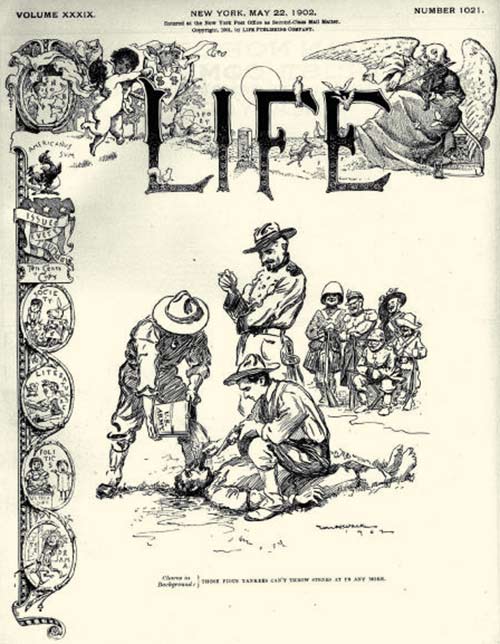
Today is still celebrated by the US as Columbus Day. Elsewhere, October 10 is designated International Indigenous Peoples Day.

Accounts in Mexico say the Maya predicted the European invasion which was to plunge the Americas into eternal darkness. They foretold when, 1492 and how, bearded white men delivering uncompromising savagery. Based on the accuracy of this prediction, supposedly, many now have begun to scrutinize another pre-Columbian calculation, the end of the world in the year 2012. It’s odd we accept an unflattering characterization of our scourge, without embracing our inheritance and ongoing role. The villains were our ancestors. We are our fathers.

It’s not just the Italian Americans who cling to the heroic myth of Christopher Columbus. Every white immigrant, and let’s be fair, the hispanic are white too, has an interest in soft-pedalling over the Columbus genocides. The European program of enslavement and pillage continues on these continents today, even as the North American colony serves as platform for the exploitation of all the developing worlds. Every Anglo-Iberian is complicit in extorting indigenous peoples of their well-being and heritage. It would probably be no exaggeration to say that the modern equivalent is not far removed from forcing native populations to slave for gold on pain of dismemberment. Columbus’s men grilled the Indians slowly over spits, or cut off both hands so victims couldn’t staunch their own bleeding. Today’s conquistadors on Capitalism’s wild frontiers use much the same methods.

To re-frame Spain’s discovery with a genocidal agenda is to understand how the competing French and English enterprises redoubled the brutality. Western expansion was invasion. Manifest Destiny was promised land rationalization. Settlements were occupation, and are occupation. To see Columbus in his true horror is to see today’s Indian reservations for what they are, concentration camps for the last embers of the American insurgency. We Anglos and Iberians are inheritors of stolen destinies. Lives stolen 500 years ago and futures we are stealing still.

Meanwhile, Westerners distract their consciences with THE END IS NIGH prophesies. Has there been a lifetime since creation when mankind didn’t fear the end of the world? In recent decades it wasn’t the Rapture, it wasn’t Y2K, so now it’s the end of the Mayan Calendar, whose schedule of events ends in 2012. New Age astrologists have pinpointed a specific date, December 21, 2012. Really. To me that date bears a suspicious resemblance to the symmetric time events which thrill digital watch wearers. December 21 is of course the Day After the end of time, the unknowable vacuum which follows the end: 12-20-2012. On a metric calendar, that’s 20.12.2012. Spooky.

US soldiers in Cuba before Guantanamo

Life magazine cover showing US marines waterboardingWould you believe this is an issue of Life Magazine dated May 22, 1902? That’s water boarding! How is it that US military spokesmen now pretend our forces learned waterboarding from Korean prisons?

The cartoon on its cover depicts US marines waterboarding a captive in their effort to pacify the Cubans they’d just “liberated” from the Spanish. Watching in the background are the traditional western colonizers, often criticized by us for the brutality with which they repressed their foreign territories.

Between them, the Prussian tells the Brit:

“THOSE PIOUS YANKEES CAN’T THROW STONES AT US ANY MORE.”

Cartoons of US soldiers waterboarding a Cuban rebelThere it is in closeup. The arms bound at the elbows, the hands pinned, pressure applied to the stomach, a gun held to the poor Cuban’s head, a funnel put into his mouth, and water poured from a bucket marked “U.S. ARMY.”
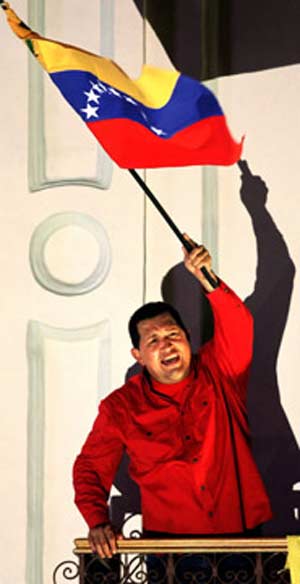
“Sovereignty”— But only for Amerika…

As reported in Talking Points Memo:

Congressional Sovereignty Caucus Launching Next Week
By Eric Kleefeld – June 19, 2009, 5:40PM

A new group is set to launch in the House of Representatives, made up of conservatives set on defending American POWER and interests against encroachment from international institutions: The Congressional Sovereignty Caucus.

Their kickoff meeting will be this coming Wednesday, featuring co-founders Reps. Doug Lamborn (R-CO) and Thaddeus McCotter (R-MI), plus Rep. Ileana Ros-Lehtinen (R-FL) — and special guests Oliver North, Frank Gaffney and Doug Feith.
Rep. Lamborn declined to comment, but his office did point us to an opinion column he wrote last week, mainly targeted at the nomination of Harold Koh to be the legal counsel to the State Department, in which he explained the importance of American sovereignty.

“Sovereignty is vital for America because we are an exceptional nation,” wrote Lamborn, “one uniquely blessed with a vibrant Judeo-Christian heritage, as demonstrated both through its founding documents and by the witness of history. For any nation, and I believe especially for America, to give up any degree of control of its destiny to transnational bodies is irresponsible and wrong.”

Their first meeting sure will have an interesting line-up. North, for example, covertly sold weapons to the Khomeini regime in Iran and then wore his Marine uniform at a Congressional hearing in order to justify himself. And Gaffney has written opinion columns in which he’s raised suspicions that President Obama might not be a natural-born citizen, or could be a secret Muslim.

Seems some members of the RepubliKlan party can’t be bothered to learn the difference between “Nationalism” which by default would grant EVERY nation equal rights, and “Cold-blooded Imperialism”, such as practiced by North, Gaffney and Feith.

Also the “Founding Documents” which they insist gives Amerika exclusively to Christians.. oops “Judeo-Christians”.

My advice to Jewish Americans, who were deliberately excluded in the “Founding Documents” they mention: Stay clear of these freaks.

The only reason they include Judeo is the same reason as George Bush trying to say how much he really loves Mexican American Culture, and showing off how much Spanish he really doesn’t speak. Political Schmoozing, in other words.

For those unfamiliar with Yiddish, Schmooz is “con job” as practiced by a “Schmiel” (thief) in order to defraud a “Schmozl” who is somebody dumb enough to be Schmoozed.

Those documents also referred to Native Americans as “Savages” and to Black AMERICANS as only being worth 2/3 of a “real” person apiece.
(but of course they weren’t Racists, no sir!)
Ollie North and friends say that Amerika is also destined to rule the world.

Fat chance on that Ollie, and on behalf of the Marines you had MURDERED for political gain during the Beirut Peacekeeping mission, the ones whose killers received cash and weapons from you and your Coward Treasonous Comrades, before and after the murders took place, yeah, THOSE Marines, Ollie… I’ll once again say those same three words, Ollie “Semper Fi… BITCH!”

That goes for local supporters of the Imperialist Terror Regime Ollie and his comrades represent too.

Cuba declines OAS offer of Trojan Horse

Over US objections, the Organization of American States (OAS, OEA) voted to invite Cuba back into the fold, from which it had been expelled in 1962 for hanging with Communists. Cuba’s reply? No thanks! Although Cuba’s acceptance by fellow nations was hailed a victory, Fidel Castro wrote: “It is naive to think that the good intentions of one president justifies the existence of a body that… supported… neoliberalism, drug trafficking, military bases and economic crises.”

In an essay published the day before Cuba’s official repudiation of the offer to recommit to the OAS, Fidel Castro recalled a lesson from the siege of Troy. Castro was reported widely as having called the OAS a “U.S. Trojan horse.” In reality, Castro blamed the OAS for having “opened the gates” to the Trojan horse of US post-colonial despotism.

The Trojan horse

RAFAEL Correa, president of Ecuador, currently visiting Honduras, stated the day before the OAS meeting: “I believe that the OAS has lost its raison d’être, maybe it never had a raison d’être.” The news, circulated by ANSA, adds that Correa, “prophesized ‘the demise’ of that organization given the many errors it has committed.”

He affirmed “that the countries of the American continent, given their geographic conditions, cannot all be put ‘in the same basket.’ And for that reason Ecuador proposed some months back the creation of the Organization of Latin American States.

“’It is not possible for the region’s problems to be discussed in Washington; let us construct something of our own, without countries alien to our culture, our values, and obviously including countries that were inexplicably separated from the inter-American system, and I am referring to the concrete case of Cuba… that was a tremendous shame and demonstrates the double standards that exist in international relations.’” On his arrival in Honduras, both President Zelaya and Correa stated that “The OAS must be reformed and reincorporate Cuba; if not, it will have to disappear.”

Another cable from the DPA news agency affirms:

“Cuba’s reintegration in the Organization of American States (OAS) has moved from being an issue per se of the organization’s General Assembly in Honduran San Pedro Sula, to once again being turned into an excuse for a struggle of interests that goes much further than the limits of the Caribbean island and could (once again) call hemispheric relations into question.

“The president of Venezuela, Hugo Chávez, made that very clear on describing the hemispheric meeting that begins this Tuesday in Honduras in quasi military terms.

“It will be,” he said, an ‘interesting battle’ in which if it is demonstrated that the OAS ‘continues being a ministry of the colonies’ that is not transformed in order ‘to subordinate itself to the will of the governments comprising it,’ it will be necessary to propose ‘leaving’ the organization and creating an alternative.”

“’Latin American countries are making Cuba the litmus test for the quality of the Obama administration’s approach to Latin America,” Julia E. Sweig, a Cuba scholar at the Council on Foreign Relations, told The Washington Post on the eve of the Honduran meeting.”

In resisting the aggressions of the most powerful empire ever to have existed, our people fought for the other sister peoples of this continent. The OAS was an accomplice of all the crimes committed against Cuba.

At one moment or another, the totality of the countries of Latin America were victims of interventions and political and economic aggression. There is not one single one that can deny that. It is naive to believe that the good intentions of a president of the United States can justify the existence of that institution that opened the gates to the Trojan horse that backed the Summits of the Americas, neoliberalism, drug trafficking, military bases and economic crises. Ignorance, underdevelopment, economic dependence, poverty, the forced return of those who emigrate in search of work, the brain drain, and even the sophisticated weapons of organized crime were the consequences of interventions and plundering proceeding from the North. Cuba, a little country, has demonstrated that it can resist the blockade and advance in many fields, and even cooperate with other countries.

Today’s speech by the president of Honduras, Manuel Zelaya, at the OAS General Assembly, contains principles that could go down in history. He said admirable things of his own country. I will confine myself to what he stated on Cuba.

“…In the Assembly of the Organization of American States that begins today in San Pedro Sula, Honduras, we must initiate the process of wise rectifications of old errors committed.

“We, the Latin Americans who were recently here, a couple of weeks or months ago, had a grand summit within the Rio Group in Salvador de Bahía, Brazil. There we made a commitment. The commitment, which was taken down in writing and unanimously by all of Latin America, is that in this San Pedro assembly, by majority vote or consensus, that old and worn error committed in 1962 of expelling the Cuban people from this organization would have to be amended.

“We must not go from this assembly, my dear dignitaries, without repealing the decree of that 8th meeting which sanctioned an entire people for having proclaimed socialist ideas and principles, principles now practiced in all parts of the world, including the United States and Europe (Applause). Today, principles of seeking different development alternatives are evident precisely in the change that there has been in the United States with the election of President Barack Obama…

“We cannot go from this assembly without making amends for that error and that infamy because, on the basis of this Organization of American States resolution, in existence for more than four decades, an unjust and useless blockade has been maintained against this sister people of Cuba, precisely because none of its aims have been achieved, but what it has demonstrated is that here, a few kilometers from our country, on a little island, there is a people prepared to resist and to make sacrifices for their independence and sovereignty.

“… not doing so would make us accomplices of a 1962 resolution to expel a state from the Organization of American States simple because it has other ideas, other thoughts, and proclaims principles of a different democracy. And we are not going to be accomplices of that.

“…We cannot go from this assembly without repealing what was enacted in that epoch.

“An exceptional Honduran, called in our country – and one of our national heroes – José Cecilio del Valle, the sage Valle, stated on April 17, 1826, in his famous article ‘Sovereignty and non-intervention’ – we had just proclaimed our independence from the Spanish kingdom – “’The nations of the world are independent and sovereign. Whatever its territorial extension or number of inhabitants might have been, a nation must treat others with the same treatment that it desires to receive from these. A nation does not have the right to intervene in the internal affairs of another nation.’”

With those words of Cecilio del Valle and the mention of Mahatma Gandhi, Jesus Christ, Martin Luther King, Abraham Lincoln, Morazán, Martí, Sandino and Bolívar, he concluded his speech.

A few minutes later, at the press conference after the opening of the Assembly, he responded to questions and reiterated principles. Then he gave the floor to Daniel Ortega, who was the author of one of the most profound and well-argued papers at the OAS Assembly. At Zelaya’s invitation, Fernando Lugo, president of Paraguay, and Rigoberto Menchú also spoke, expressing themselves in terms similar to Zelaya and Daniel.

The Assembly has been debating for hours. As I am concluding this Reflection, almost at nightfall, there is still no news of the decision. It is known that Zelaya’s speech was influential. Chávez is talking with [Venezuelan Foreign Minister] Maduro and urging him to firmly maintain that no resolution can be admitted that conditions the repeal of the unjust sanction against Cuba. Never has such rebellion been seen. Without any doubt, the battle is a hard one. Many countries are dependent on the index finger of one hand of the government of the United States pointing at the Monetary Fund, the World Bank, the InterAmerican Development Bank or in any other direction for punishing rebelliousness. Having waged it is already a feat in itself on the part of the most rebellious. June 2, 2009 will be recalled by future generations.

Cuba is not an enemy of peace, nor reluctant to interchange or cooperation among countries of distinct political systems, but has been and always will be intransigent in the defense of its principles.

Fidel Castro signature

Fidel Castro Ruz – June 2, 2009

Artist Stephen Morath eyes Second Base

Manitou artist Steve Morathe- Autumn by the Spanish Peaks, the Wahatoya of the Sangre de Cristo Mountains
The painting drew our eyes as we ate in the Eastside Del Taco. Among many gaily colored prints by the same artist was this pop-ish depiction of what could only be the Spanish Peaks. Southwest-scapes are ubiquitous enough to seem completely generic, and Pikes Peak belongs to America the Beautiful, but the Wahatoya are our private purple majesties. Did a stranger conjure these breast-peaks to pair with another iconic fixation, the red pickup truck, or was this uncharacteristic fast-food outlet choosing to showcase a local talent? Neither.

The prints were signed “S. Morath” and sure enough, that’s Steve Morath of Manitou Springs, regular regional Opera chorus member, church music director, and beyond-the-scene fine-artist. He doesn’t exhibit locally, but the mild-mannered Morath doubles as an artist of national distinction. He’s represented by the Leslie Levy Fine Art Gallery in Phoenix, Arizona, and every internet art poster purveyor. There are even online sources for digital downloads if you want to do the reproduction yourself.

If you did not know that the Spanish Peaks of the Sangre de Cristos are called by the Native Americans the Wahatoya, or “Breasts of the Earth,” then my post title may have seemed cryptic. Otherwise, obviously Stephen Morath’s little red truck is going much further. If the connection was obvious, touching a girl’s breasts is getting to “Second Base,” I would have titled this Morath Has Eyes on Home.

Only a classic car buff is looking at the ’48 Ford/Chevy, and your eyes don’t linger long on R. Crumb’s Madonna Nature’s pointy brassiere. The focal point of this composition is the little curve in the road, lying at the intersection of the male and female.

I’ll embarrass myself further to reassure you that I am not lost in the anatomy of this topography, as I was oversimplifying again. The most sensuous curve of a reclining nude is the navel. That’s the apex of this scene, of course. Morath’s little red figure is perched, bending forward with comic virility, deja on the mons veneris, to be perfectly clinical.

Whether the equally soft-curved shiny hard-body is parked, idling, or teetering serendipitously onward, I believe Morath has captured the charm of physical romance with the lights on. His is a loving tribute to the fertile feminine, and a whimsical suggestion of the masculine, as an itinerant, man-made, self-armored, commuter-adventurer feeling his way into the gentle valleys of the she.

It may not be exactly the reason Del Taco chose to hang the piece, but I think a number of Morath’s paintings are similarly sexualized. Or not. I say that because it doesn’t matter really. They’re beautiful and they tell social stories, whichever way you chose to take them, with bold electric color.

And while I’m on a subject about which I know demonstrably little, I’ll say a brief something about Del Taco: the cleanest, brightest fast food restaurant I would ever recommend. The key to their ne-plus-ultra fish tacos may be the lime, or it may be that the fish is lightly deep fried. I hope you try it despite the fact that I will confess the predominant delight is their crisp raw cabbage. Marie and I now plan our eastward treks contingent upon a lunch break at Del Taco. But let’s applaud their patronage of the arts. I don’t know if Del Taco fare is Tex-Mex, or Cali-Mex, but the decor of their eateries in these parts is Old-Mex.

Evidently I predict that as a poster, Autumn by the Spanish Peaks will only grow in popularity. It may turn out that Morath will have defined Las Cumbres Espanolas in the lexicography of American pop images. How many mountains do non-MST-zone dwellers know by name, even by sight? And now with sensual affection?

The Bolsheviks had the right idea…

As far as ending World War One.

Since the issue was raised that the United States intervention in 1917 was what ended the war.

Silly on the face of it and sillier still the further you delve into the idea.

Britain and the rest of the Triple Entente (although there were far more than three of them) had the propaganda going about “That Small nations might have the same rights as the Great Powers”.

Just not nations like Ireland, India, China, Kenya, VietNam (only “our” French allies were calling it “Cochin China”… Cochin is French for “pig”) the Congo, the Sudan, South Africa… you know, the Small Nations inhabited by those the European Royalists considered “inferior”.

So while the Band of Cousins, related by blood and by their arrogance, sent “their” subjects to do bayonet charges against poison gas and belt-fed water-cooled machine guns, eventually, the worst of the lot, Cousin Nicholas Romanoff, pissed off his Peasant Slaves errr Lawfully Appointed Subjects to the point that they got sick of it, and gave him and his Demon Spawn family exactly what they deserved..

If it had spread much further, and the American intervention was the only thing the “free” nations had to end it…(Free to Obey Your King as though he were anointed by God) (and the Royalists still believe that they ACTUALLY ARE anointed by God)

If there were no American intervention the general mutiny that was building in ALL the trenches, French, Belgian, English, Turkish, German, Austrian… the same way it had amongst the Russian Conscripts, would have reached it’s natural apex, and they would have gotten rid of THEIR parasite class the same way the Russian people had.

The war would have ended a lot sooner, and even the Spanish Influenza epidemic might have been averted.

And since it wouldn’t have ended on terms imposed by the “victors”… it would actually have been over.

Instead of, you know, our generation still fighting the same war, different battles.

Hugo Chavez will liberate the Americas

Hugo ChavezWhen I was in Venezuela, I remember President Hugo Chavez was derided for thinking himself heir to the aspirations of the great Simon Bolivar. I remember laughing myself. You don’t compare yourself to Washington, or Napoleon for that matter. Though no doubt the world laughed at their ambitions too. Affluent Venezuelans didn’t like Chavez, and as a result neither did the press. They depicted him as an uneducated monkey, a dark-skinned un-sophisticate, hoping his ego would eventually be humiliated by his inadequate aptitude for walking upright. Could the Spanish blue-blood snobs have been more wrong?

I was sweating this election, knowing that the US has been waging a full out subversive war to remove the outspoken anti-American. Chavez’s work is not done, but sitting on Venezuela’s incomparable oil reserves, he is not far from getting there. If American incumbents can hang on in the Senate until their 90s, certainly Chavez should be able to ride out his populist appeal to lengths like Fidel Castro or Mao or other bigger than life icons.

Venezuelan voters removing the term limits which would hinder a continued Chavez rule, is a victory not only for Venezuela, not only for Latin America, but for all non-aligned nations, and in the end, for all people. Finally a social-conscious reformer blessed with a big stick, big oil. Congratulations Mr. Chavez. You are indeed the Bolivarian liberator who rises against the oppressive New World Order.

Costa Rica a prototypical Western Democracy

PUERTO JIMINEZ, CR- Touring Costa Rica has been interesting. Considering the turmoil of Central America, it may be a shining example of a functional Capitalist Democracy. It´s got a healthy middle class and a relatively contented populace. Can it offer a lesson to its strife torn neighbors? Sure. Get rid of the Indios.

Citizens of the “Rich Coast” pride themselves on being light skinned, owing to a Spanish heritage of course. They´re the descendants of settlers, mixed some with labor imports from the Caribbean. But the indigenous people are gone. Which makes for scarce land redistribution demands.

When Columbus first came to Costa Rica, there were 400,000 inhabitants. When they saw that the Spaniards were enslaving whoever they conquered, the tribes hid in the mountains. As a result, Costa wasn´t properly subjugated like elsewhere. The Spanish didn´t want land that didn´t come with ready slave labor. But hiding didn´t save the indians. As the Spanish settled the land, the original population dwindled, to 10%, then 2% within 200 years. They are, as Randy Newman sang it: “Gone, real gone.”

There is an inspiring history to Costa Rica´s present relatively egalitarian government, and I´m going to write more about some of their laudable leaders. But I have to argue that CR smacks of US artifice. And lo, even as I cringe at the camo themed souvenir caps that remind me of the Contras, it turns out Oliver North operated his Contra army and drug smuggling operation out of an airfield in northern Costa Rica. There´s a surfing destination near there called Ollie´s Point, named after the would be filibuster himself. Those apolitical surfer fucks.

(It is hard to surpress disdain for the hard-recreating American asses despoiling CR toilet paper. I cannot bear their vibes of inutile indifference.)

So the Costa Ricans are less Central Americans than good old Americans. And that never meant Native American.

Falling onto the sky….

jewelry4
Hairy Christmas and a Hippie New Year.

jewelry

jewelry2

jewelry3

People popping off fireworks and the occasional firearm, making the poor stupid little dog next door bark insanely.

Ok, headphones on, music, relaxing ahhhh…

Anyhow, these are some of the jewelry pictures.

So, how they evolved, when I was recycling some computer parts, I had the magneto from a floppy drive and was trying to visualize how best to take it apart, strip the copper wire from it efficiently.

One of my nieces and her friend were there, the little girl said “Oh, that would make a really pretty necklace.”

And she was right.

So I started making them like that, there’s about a hundred dfferent kinds of these magnetoes in various disk drives. Plenty of creative room using circle patterns.

Me likey muchly.

And then, I moved up here.

People told me about the Medicine Wheel, which I had never seen.

So I looked it up.

There’s one up near Sturgis which has been a prayer site for centuries, best guess is just before the Spanish came up from Mexico, and the Anasazi had just faded into the desert pueblos.

The tradition is, when you go there, you’re in the center of the Heart of the Earth.

Meaning the Black Hills.

The Sioux and the other northern nations say that it’s alive, this heart.

And, when you look down on the Black Hills, from high enough up, and can see the whole thing, it DOES look a whole lot like a human heart.

Some of the prophets, like Black Elk, say and said that this land could be killed. Maybe they’re right.

The name Bad Lands only means that it’s not any good for farming, you can’t grow much there, it’s “bad land”.

The blood-soaking and general rape of this Heart of the World didn’t really start until the early 1800s.

First it was over the Fur Trade.

Indians took what furs they needed to survive, leave the rest.

The French and especially the English had a huge market for it back in Europe, so Money reared it’s ugly head.

Then gold was discovered there.

Standing Bear Butte, where the Great Medicine Wheel is, was suddenly the center of a raging war.

For centuries, 500 years at least, people had gone there to experience the strongest of Medicine.

Medicine is a catch all translation of a huge number of Indian words, spirit and magic and life and it’s all woven together, no part is separate from the rest, it’s the Great Circle.

One of the translated words is manitou.

Another is the garden of the Gods.

See, most of this I only learned once I came here.

The kokapelli, for instance, it’s a bizarre coincidence like the medicine wheels I put together….

But when I was crippled up, recovering from the first surgeries like 16 years ago, sitting in a wheelchair, at my sister’s apartment, feeling sorry for myself… and one of my nieces had gotten a bag of toys from her school… and one of the toys was a Recorder. Ein Zauber-Flut. La Flauta Inglesa.(the English Flute) La Flauta Dulce – sweet flute.

The kids were running around blowing it like a whistle, really annoying in a cute way, but I had a sudden idea, I said “Gimme that, I’ll learn how to play it right” and the next day I checked out a book from the library on How To Play The Recorder and started in.

Flash forward, and I come up here, to Manitou, and started learning the Indian ways.

Finding out that the Flute Player, Kokapelli, is kind of the local hero. And what the medicine wheel means.

A lot of medicine is what you feel, that’s how you “know” and “learn”it.

English doesn’t do it justice.

Meditation comes close. Intuition, which means you learn from within.

A line from one of the hymns based on Ode am die Freude, “Spirit, in our spirit speaking, makes us sons of God, indeed.”

I can get really mystical and misty eyed describing it.

A lot of the stuff you experience up here, how do you put it to where people would believe it? That you could be walking a path and have somebody, a stranger, join you, talking to you and walking along with you, a cloud-shadow passes over and you’re standing alone, no tracks beside yours…

A dream from long ago, perhaps.

In the Indian conscious state, and this varies from person to person how you experience it, live it… but the Dreamtime is just as real as something you can touch.

I saw a picture of the Great Medicine Wheel, taken from the air, and that’s the only way you can see the whole thing.

For centuries when somebody goes there to pray-make medicine-commune-learning spirit…

he puts a stone at the end of each spoke of the wheel.

The wheel is now about a mile across.

It takes hours to walk around the edge of it.

And, it looks just like the medicine wheels shown in the pictures, the ones a little child told me “that would make a pretty necklace”

It’s not something you grab intellectually, you just feel and see and hear and ARE the medicine.

The other side of these, they’re recycled. Something that would, if left in a landfill somewhere, the first thing they would do is run a bulldozer over it, breaking it up just enough to let the toxic parts ooze out…

To kill the mountains, and kill the waters.

We would follow, everything we know as Human would set its feet upon the rainbow, One way of putting it is “falling onto the sky”.

Following the sun every evening into the Dreamtime of the west, only, without the life of Earth or man, the Dreamtime, too, would die away.

One of Black Elk’s sayings is we would live long enough to know what we had done… and pass away in great sadness.

Semper Fi, Ollie- Again…

You know, this whole scene in Israel and Palestine right now has the marks of Bush double dealing again, playing all sides against the middle.

The cowboy-looking swarthy fellow who identified himself as a Jew AND a Marine. last night as he was cursing us…

…brought this back to mind.

I wonder, sometimes, how much guilt does the U.S. government share, in our name and with our tax dollars of course, and our kin on the ground… and under the ground.

Why, exactly, did the “smart money” give arms to Hizbollah?

Knowing of course that Hizbollah doesn’t like them and would do their level best to strike, but you notice, the so-called Patriots who struck the deal, they didn’t get killed.

Over 300 Marines, mostly the scions of the “lower” classes, got killed.

Likewise, when the deals were struck with the Medellin Cartel, same time, yeah? There was a “Massive Crackdown” on the southern borders, for those of us who smoked marijuana, it was a Famine in the Land.

Suddenly, though, “black tar” and smokeable cocaine were everywhere.

You might say, tongue firmly in cheek, there was a massive “smack” or a “crack”, down on the southern border.

When I was stopped by the Border Patrol and they were waving guns in my face, screaming in Spanish, there were actually death squads in El Paso at the same time.

And since they didn’t offer any badge or insignia type evidence to the contrary, at least primarily, yeah, I thought that was who it was.

The idea that these Drug Militia were financed at least partly by Yankee Government donations crossed my mind more than once.

Fortunately, a bullet hasn’t crossed my mind, not yet at least.

Then, Bush comes off with the strangest ever response to the 9/11 strikes… his operatives start saying that the Colombians in particular were funneling money to al Qa’eda…. and no explanation of why exactly they would know that.

The one that fits most perfectly is the connection between Saddam Hussein and Bush, Manuel Noriega and Bush… as in Bush the Elder and “Saint Ronnie the Incredibly Teflon Nice”…

USMC Lt. Colonel Oliver North.

I would say, and Mr North should listen, he’s been playing with some incredibly BAD boys.

North is now the biggest link left between Bush Junior and al Qa’eda.

He should look to what happened to the Other Major Links.

Probably with his assistance. Because he’s not averse in any way to lying, stealing, killing or betrayal…

Perhaps his “loyalty” to the Bu’ush Regime lies in his innate cowardice, he’s scared to testify.

How about it, Ollie? You’ve got friends“associates in town here who monitor this website and our activities, and our writings.

Somewhere under all that slime with which you coated yourself, maybe there’s a little bit, a spark, if you will, of actual Patriotism.

Truth, Ollie, truth… it’s the only path left for you,
I’ve looked down the barrels of your comrades guns before. The only way I survived was by standing my ground.

Semper Fi.

You know what it means. “faithful forever”.

You haven’t been faithful yet, not to the Marine Corps, nor to America nor to God Himself.

Nor to yourself. You’ve let yourself become the Lap-dog of the Empire.

Make that stand for the first time in your life.

Salvation Army lives off government funding and pushes crazy religion too

Salvation Army kettleThe Salvation Army has steadfastly promoted itself as being a rather saintly organization and is out there every Christmas asking for your donations. Did you know that you already donate to them? That’s right! The Salvation Army, a religious charity, has received millions upon millions of government dollars to help spread their Far Right Wing brand of Christianity far and wide, but most surely off onto the homeless and more dependent populations of our country.

The Salvation Army has gotten much government money obtained through your taxes from all levels of government; local, state, and federal. It has gotten quite a bit of money from the government in Canada, too. Plus, many private corporations give special privilege to the Salvation Army, allowing them into areas with public access that they normally close off to almost all others. Every time you donate free items to the Salvation Army, the government is helping out their religious program by making the donation tax free. So there is a lot of government and major corporate assistance to this Right Wing Christian charity.

The Salvation Army no longer appears to be overtly turning away those who refuse to participate in the religious services at their shelters, but….. The need for Homeless service is nationally very poorly met, so there is still much pressure if you are in need of assistance to appear to fit in with any religious proselytizing done, simply to get any personal favoritism being dished out. And the Salvation Army is an rabidly anti-Gay, anti-Spanish speaking, and pro religious discrimination in their hiring practices. How bad can these Right Wing Christians get with their prejudices? MSNBC reports Salvation Army leader to lose job over marriage
Rules (which) require officers to only marry a person within the organization
Pretty bad, it would seem.

Why are the various government bodies helping promote this sort of stuff with tax monies pulled in from people with multiple religious and nonreligious points of view? By not providing adequate services run by government agencies for The Needy, government is promoting a need to go to these Right Wing Christian run shelters, too. The Christian lobbyists are always out to try to erase any separation of Church and State, and as a result, the Salvation Army keeps on kicking, though most people totally disagree with their brand of aggressive Religious nuttiness. Time to take these outfits off the government dole! There are simply many, many other ways to help The Needy out, and government should be forced to do their job, rather than you just dropping a buck or two into the kettle and going on your merry way.

Ship of Fools and other Liberals

theodore kaczynskiSUNY Binghamton student Tim LaPietra coaxed Ted Kaczynski to write a parable for the Autumn 1999 issue of the campus publication OFF! Predictably, the peer review of SHIP OF FOOLS was snarky, e.g. Watership Dim and Rime of the Ancient Unibomber, but no match for Kaczynski’s send up.

Ship of Fools

Once upon a time, the captain and the mates of a ship grew so vain of their seamanship, so full of hubris and so impressed with themselves, that they went mad. They turned the ship north and sailed until they met with icebergs and dangerous floes, and they kept sailing north into more and more perilous waters, solely in order to give themselves opportunities to perform ever-more-brilliant feats of seamanship.

As the ship reached higher and higher latitudes, the passengers and crew became increasingly uncomfortable. They began quarreling among themselves and complaining of the conditions under which they lived.

“Shiver me timbers,” said an able seaman, “if this ain’t the worst voyage I’ve ever been on. The deck is slick with ice; when I’m on lookout the wind cuts through me jacket like a knife; every time I reef the foresail I blamed-near freeze me fingers; and all I get for it is a miserable five shillings a month!”

“You think you have it bad!” said a lady passenger. “I can’t sleep at night for the cold. Ladies on this ship don’t get as many blankets as the men. It isn’t fair!”

A Mexican sailor chimed in: “¡Chingado! I’m only getting half the wages of the Anglo seamen. We need plenty of food to keep us warm in this climate, and I’m not getting my share; the Anglos get more. And the worst of it is that the mates always give me orders in English instead of Spanish.”

“I have more reason to complain than anybody,” said an American Indian sailor. “If the palefaces hadn’t robbed me of my ancestral lands, I wouldn’t even be on this ship, here among the icebergs and arctic winds. I would just be paddling a canoe on a nice, placid lake. I deserve compensation. At the very least, the captain should let me run a crap game so that I can make some money.”

The bosun spoke up: “Yesterday the first mate called me a ‘fruit’ just because I suck cocks. I have a right to suck cocks without being called names for it!”

It’s not only humans who are mistreated on this ship,” interjected an animal-lover among the passengers, her voice quivering with indignation. “Why, last week I saw the second mate kick the ship’s dog twice!”

One of the passengers was a college professor. Wringing his hands he exclaimed, “All this is just awful! It’s immoral! It’s racism, sexism, speciesism, homophobia, and exploitation of the working class! It’s discrimination! We must have social justice: Equal wages for the Mexican sailor, higher wages for all sailors, compensation for the Indian, equal blankets for the ladies, a guaranteed right to suck cocks, and no more kicking the dog!”

“Yes, yes!” shouted the passengers. “Aye-aye!” shouted the crew. “It’s discrimination! We have to demand our rights!” The cabin boy cleared his throat.

“Ahem. You all have good reasons to complain. But it seems to me that what we really have to do is get this ship turned around and headed back south, because if we keep going north we’re sure to be wrecked sooner or later, and then your wages, your blankets, and your right to suck cocks won’t do you any good, because we’ll all drown.”

But no one paid any attention to him, because he was only the cabin boy.

The captain and the mates, from their station on the poop deck, had been watching and listening.

Now they smiled and winked at one another, and at a gesture from the captain the third mate came down from the poop deck, sauntered over to where the passengers and crew were gathered, and shouldered his way in amongst them. He put a very serious expression on his face and spoke thusly:

“We officers have to admit that some really inexcusable things have been happening on this ship. We hadn’t realized how bad the situation was until we heard your complaints. We are men of good will and want to do right by you. But – well – the captain is rather conservative and set in his ways, and may have to be prodded a bit before he’ll make any substantial changes. My personal opinion is that if you protest vigorously – but always peacefully and without violating any of the ship’s rules – you would shake the captain out of his inertia and force him to address the problems of which you so justly complain.”

Having said this, the third mate headed back toward the poop deck. As he went, the passengers and crew called after him, “Moderate! Reformer! Goody-liberal! Captain’s stooge!” But they nevertheless did as he said. They gathered in a body before the poop deck, shouted insults at the officers, and demanded their rights: “I want higher wages and better working conditions,” cried the able seaman.

“Equal blankets for women,” cried the lady passenger. “I want to receive my orders in Spanish,” cried the Mexican sailor. “I want the right to run a crap game,” cried the Indian sailor. “I don’t want to be called a fruit,” cried the bosun. “No more kicking the dog,” cried the animal lover. “Revolution now,” cried the professor.

The captain and the mates huddled together and conferred for several minutes, winking, nodding and smiling at one another all the while. Then the captain stepped to the front of the poop deck and, with a great show of benevolence, announced that the able seaman’s wages would be raised to six shillings a month; the Mexican sailor’s wages would be raised to two-thirds the wages of an Anglo seaman, and the order to reef the foresail would be given in Spanish; lady passengers would receive one more blanket; the Indian sailor would be allowed to run a crap game on Saturday nights; the bosun wouldn’t be called a fruit as long as he kept his cocksucking strictly private; and the dog wouldn’t be kicked unless he did something really naughty, such as stealing food from the galley.

The passengers and crew celebrated these concessions as a great victory, but the next morning, they were again feeling dissatisfied.

“Six shillings a month is a pittance, and I still freeze me fingers when I reef the foresail,” grumbled the able seaman. “I’m still not getting the same wages as the Anglos, or enough food for this climate,” said the Mexican sailor. “We women still don’t have enough blankets to keep us warm,” said the lady passenger. The other crewmen and passengers voiced similar complaints, and the professor egged them on.

When they were done, the cabin boy spoke up – louder this time so that the others could not easily ignore him: “It’s really terrible that the dog gets kicked for stealing a bit of bread from the galley, and that women don’t have equal blankets, and that the able seaman gets his fingers frozen; and I don’t see why the bosun shouldn’t suck cocks if he wants to. But look how thick the icebergs are now, and how the wind blows harder and harder! We’ve got to turn this ship back toward the south, because if we keep going north we’ll be wrecked and drowned.”

“Oh yes,” said the bosun, “It’s just so awful that we keep heading north. But why should I have to keep cocksucking in the closet? Why should I be called a fruit? Ain’t I as good as everyone else?”

“Sailing north is terrible,” said the lady passenger. “But don’t you see? That’s exactly why women need more blankets to keep them warm. I demand equal blankets for women now!”

“It’s quite true,” said the professor, “that sailing to the north imposes great hardships on all of us. But changing course toward the south would be unrealistic. You can’t turn back the clock. We must find a mature way of dealing with the situation.”

“Look,” said the cabin boy, “If we let those four madmen up on the poop deck have their way, we’ll all be drowned. If we ever get the ship out of danger, then we can worry about working conditions, blankets for women, and the right to suck cocks. But first we’ve got to get this vessel turned around. If a few of us get together, make a plan, and show some courage, we can save ourselves. It wouldn’t take many of us – six or eight would do. We could charge the poop, chuck those lunatics overboard, and turn the ship to the south.”

The professor elevated his nose and said sternly, “I don’t believe in violence. It’s immoral.”

“It’s unethical ever to use violence,” said the bosun.

“I’m terrified of violence,” said the lady passenger.

The captain and the mates had been watching and listening all the while. At a signal from the captain, the third mate stepped down to the main deck. He went about among the passengers and crew, telling them that there were still many problems on the ship.

“We have made much progress,” he said, “But much remains to be done. Working conditions for the able seaman are still hard, the Mexican still isn’t getting the same wages as the Anglos, the women still don’t have quite as many blankets as the men, the Indian’s Saturday-night crap game is a paltry compensation for his lost lands, it’s unfair to the bosun that he has to keep his cocksucking in the closet, and the dog still gets kicked at times.

“I think the captain needs to be prodded again. It would help if you all would put on another protest – as long as it remains nonviolent.”

As the third mate walked back toward the stern, the passengers and the crew shouted insults after him, but they nevertheless did what he said and gathered in front of the poop deck for another protest. They ranted and raved and brandished their fists, and they even threw a rotten egg at the captain (which he skillfully dodged).

After hearing their complaints, the captain and the mates huddled for a conference, during which they winked and grinned broadly at one another. Then the captain stepped to the front of the poop deck and announced that the able seaman would be given gloves to keep his fingers warm, the Mexican sailor would receive wages equal to three-fourths the wages of an Anglo seaman, the women would receive yet another blanket, the Indian sailor could run a crap game on Saturday and Sunday nights, the bosun would be allowed to suck cocks publicly after dark, and no one could kick the dog without special permission from the captain.

The passengers and crew were ecstatic over this great revolutionary victory, but by the next morning they were again feeling dissatisfied and began grumbling about the same old hardships.

The cabin boy this time was getting angry.

“You damn fools!” he shouted. “Don’t you see what the captain and the mates are doing? They’re keeping you occupied with your trivial grievances about blankets and wages and the dog being kicked so that you won’t think about what is really wrong with this ship —- that it’s getting farther and farther to the north and we’re all going to be drowned. If just a few of you would come to your senses, get together, and charge the poop deck, we could turn this ship around and save ourselves.

But all you do is whine about petty little issues like working conditions and crap games and the right to suck cocks.”

The passengers and the crew were incensed.

“Petty!!” cried the Mexican, “Do you think it’s reasonable that I get only three-fourths the wages of an Anglo sailor? Is that petty?

“How can you call my grievance trivial? shouted the bosun. “Don’t you know how humiliating it is to be called a fruit?”

“Kicking the dog is not a ‘petty little issue!’” screamed the animal-lover.

“It’s heartless, cruel, and brutal!”

“Alright then,” answered the cabin boy. “These issues are not petty and trivial. Kicking the dog is cruel and brutal and it is humiliating to be called a fruit. But in comparison to our real problem – in comparison to the fact that the ship is still heading north – your grievances are petty and trivial, because if we don’t get this ship turned around soon, we’re all going to drown.”

“Fascist!” said the professor.

“Counterrevolutionary!” said the lady passenger. And all of the passengers and crew chimed in one after another, calling the cabin boy a fascist and a counterrevolutionary.

They pushed him away and went back to grumbling about wages, and about blankets for women, and about the right to suck cocks, and about how the dog was treated. The ship kept sailing north, and after a while it was crushed between two icebergs and everyone drowned.

US Capitalism as seen from the South

APUNTES DEL TIO SAM – PANCASAN Listen to the music and watch the pictures… you don’t have to understand Spanish to understand this history. Arlen Siu was the young woman seen briefly in the film and sung at times with the group whose music was played with the clip. Arlen Siu, Martyr Fighter who died trying to free her country from the US.

American liberal intellectualism in crisis

The IntellectualsAmerican liberal intellectualism is in a state of crisis today. The intellectuals that guide liberalism keep shouting to the Democratic Party to stop collaborating with the Republican Party and to be a true opposition as today’s liberals have thought they always were.

The post World War II outlook of American liberal intellectuals is beginning to crumble and Barack Obama marks the line for a new transformation in American liberal politics. Obama simply is not going to do as the liberal intellectuals demand he act. Liberals can scream and wail and shout and it will all be for naught. The Democrats and Republicans are merely two branches of the same entity, which is that of being the American Corporate Party. And Barack Obama and thee Democratic Party leadership will continue to act as Republican collaborationists.

Barack Obama comes to the forefront precisely at the beginning of the great breakup in the appearance of American Empire. For the last six decades, the American Empire has posed itself as a benign world enforcer, a cop for the public good. Today, that image is all in shreds, and Barack will not be able to put it back together again. Certainly not with his plans to attack Iran, continue to oppress Afghanistan with a USA occupation, and continue to lie and fudge about US occupation and genocide in Iraq. And not with the coming global capitalist economic meltdown.

Yes, American liberalism is in crisis and it bears to take a look at how it has reacted to such crisis in the past.

‘…the record is plain that from the twenties to the forties the majority of anti-capitalist intellectuals passed through three phases which were marked out by the mighty national and world events of the time. From the stock market crash to Hitler’s victory and Roosevelt’s, assumption of office they were torn loose from their previous moorings and swung sharply to the left. From 1933 to the Spanish civil war and the Moscow trials they deepened their commitments and produced the initial differentiations. From 1937 through the crushing of the Spanish revolution, the Stalin-Hitler pact and the Second World War they began the flight from radicalism which was consummated in the wholesale recanting characteristic of the cold war.’

The author, George Novack, is talking about how American liberal intellectuals of his time went from being much like they are today, to becoming radicalized and anti-capitalist, and then beaten back and conservatized once again. The entire history as told by him can be read at Radical Intellectuals in the 1930s

What we get over a period of time, is that America’s liberal leaning intellectuals most resemble a giant bowl of Jello not quite congealed in the refrigerator. They are not the most steadfast citizens amongst the general population. They like to go with the flow more than anything else, so they will be torn asunder when the times change once again.

Look for many of the liberal intellectuals to walk around in circles acting stunned in the next coming years. They just don’t have too many intellectual (or societal) resources to do much anything of else. Despite being the foremost world authorities on everything, they don’t have the real power in their hands, and as such, like servants everywhere, most will do as the Patron dictates while griping about it in the shadows.

The DNC Alliance for Real Democracy is a counter-protest Fifth Column

Denver DNC 2008DENVER, COLO.- The Alliance for Real Democracy (ARD), formed to counter the scrappily-named Recreate 68 at the DNC, is in reality an unwitting fifth column, set up by Democratic Party allies to temper protest in Denver. The UFPJ and other sundry “non-violent” progressives are funneling their members into the less populist ARD actions to divert participation from the major DNC demonstrations. But the aforementioned underwriters aren’t providing any funding, surprise! Leaving the ARD to protest exactly what it’s supposed to: nothing.

Alliance for Real DemocracyI think it’s heartbreaking to watch earnest young activists, representing the organizations comprising the ARD coalition, trying to organize activities without any commitment from their national affiliations. And some of the more outspoken national leaders, keen to make appearances at the DNC rallies, are beginning to smell a rat. They’re making backup arrangements to coordinate with the boots on the ground, R-68.

A Fifth Column refers to a group of partisans, usually spontaneously organized, which forms behind enemy lines as a conquering army approaches. It is the additional “column” of civilian fighters which an attacker might count on to stab the defenders in the back. Franco boasted of his fifth column in the Spanish Civil War. The French Resistance represented a fifth column for the Normandy liberators.

America’s antiwar movement has had its steady divisions, between UFPJ and A.N.S.W.E.R. most notably, but the rift has become more critical with the advent of another hopeful Democratic election win. Four years ago it was Kerry, with groups like Moveon.org trying to tone down the antiwar rhetoric. This year it’s Obama, and the appeasers are out in battalions. As usual, it’s done in the name of “nonviolence,” where too vigorous protest is seen as insufficiently nonviolent for the Democrat’s fragile delusions.

When R-68 began the groundwork for DNC protests, they were vilified for evoking the Chicago 1968 police riots. R-68 repudiated the violence, but not surprisingly those statements have yet to be reported in print. Meanwhile the bad press gave UFPJ and other nonviolence apostles the opportunity to break away and form their holy alliance to give their members sanctuary from the ruffians, re unpredictable young people.

But will it really? The R-68 group includes Unconventional Denver and Disrupt 08, but neither have violent plans. Black Block script-kiddies will turn up no matter whose event. Police agent provocateurs will instigate violence no matter how pious your crowd.

Code Pink, IVAW, Veterans For Peace, and UFPJ are among the national endorsers of ARD. Tent State, SFPJ, and Students for a Democratic Society are examples of young activists getting caught in their elders’ tar baby.

Because it’s not enough to vote for Obama, you have to quash dissent for Obama. It’s the Alliance For Real Democracy For Obama.

Naturally Denver protest organizers, whether ARD or R68, have found themselves having to confer about time slots and permits, out of respect for the success of each other’s activities. As a result, the national head of UFPJ, Leslie Cagan, issued an email decreeing that no ARD organization member would participate in the major Aug 24 kickoff antiwar demonstration. This drew question marks from prominent activist leaders who want to be at the biggest rally.

Bi-monthly CONSULTA meetings were scheduled by ARD and R68 to coordinate efforts. But the morning before the second Consulta, Leslie Cagan flew in from NYC for an emergency meeting with ARD leadership to brief them on what not to negotiate. She followed this with a hastily scheduled press conference the next day on the subject of Iran, it appeared to preempt her rivals’ DON’T BOMB IRAN action planned for August 2nd.

Colorado Springs own PPJPC is an endorser of ARD. Their letter of support was read into the minutes of a recent meeting, and it read like the typical support they’re getting from everyone. I’ll paraphrase the PPJPC letter:

“We at the Pikes Peak Justice and Peace Commission are honored to endorse your efforts at the DNC … due to critical funding shortages, we cannot offer you any monetary support at this time … Likewise, I’m sorry that I will not be able to participate in any events that week , but will try to interest our members in attending…” We’ll be with you in spirit, etc.

Why form a fifth column if you’re not going to support it? Because the ARD‘s job is to do nothing. Doing nothing is exactly how you stab activism in the back.

Helen Keller: Oh blind vanity of slaves!

helen-keller-blind-soldier-socialist-isolationist-pacifist-sedition“It is in your power to refuse to carry the artillery … You do not need to make a great noise about it. With the silence and dignity of creators you can end wars and the system of selfishness and exploitation that causes wars. All you need to do to bring about this stupendous revolution is to straighten up and fold your arms.”

Strike Against War

To begin with, I have a word to say to my good friends, the editors, and others who are moved to pity me. Some people are grieved because they imagine I am in the hands of unscrupulous persons who lead me astray and persuade me to espouse unpopular causes and make me the mouthpiece of their propaganda. Now, let it be understood once and for all that I do not want their pity; I would not change places with one of them. I know what I am talking about. My sources of information are as good and reliable as anybody else’s. I have papers and magazines from England, France, Germany and Austria that I can read myself. Not all the editors I have met can do that. Quite a number of them have to take their French and German second hand. No, I will not disparage the editors. They are an overworked, misunderstood class. Let them remember, though, that if I cannot see the fire at the end of their cigarettes, neither can they thread a needle in the dark. All I ask, gentlemen, is a fair field and no favor. I have entered the fight against preparedness and against the economic system under which we live. It is to be a fight to the finish, and I ask no quarter.

The future of the world rests in the hands of America. The future of America rests on the backs of 80,000,000 working men and women and their children. We are facing a grave crisis in our national life. The few who profit from the labor of the masses want to organize the workers into an army which will protect the interests of the capitalists. You are urged to add to the heavy burdens you already bear, the burden of a larger army and many additional warships. It is in your power to refuse to carry the artillery and the dread-noughts and to shake off some of the burdens, too, such as limousines, steam yachts and country estates. You do not need to make a great noise about it. With the silence and dignity of creators you can end wars and the system of selfishness and exploitation that causes wars. All you need to do to bring about this stupendous revolution is to straighten up and fold your arms.

We are not preparing to defend our country. Even if we were as helpless as Congressman Gardner says we are, we have no enemies foolhardy enough to attempt to invade the United States. The talk about attack from Germany and Japan is absurd. Germany has its hands full and will be busy with its own affairs for some generations after the European war is over.

With full control of the Atlantic Ocean and the Mediterranean Sea, the allies failed to land enough men to defeat the Turks at Gallipoli; and then they failed again to land an army at Salonica in time to check the Bulgarian invasion of Serbia. The conquest of America by water is a nightmare confined exclusively to ignorant persons and members of the Navy League.

Yet, everywhere, we hear fear advanced as argument for armament. It reminds me of a fable I read. A certain man found a horseshoe. His neighbor began to weep and wail because, as he justly pointed out, the man who found the horseshoe might someday find a horse. Having found the shoe, he might shoe him. The neighbor’s child might some day go so near the horse’s heels as to be kicked, and die. Undoubtedly the two families would quarrel and fight, and several valuable lives would be lost through the finding of the horseshoe. You know the last war we had we quite accidentally picked up some islands in the Pacific Ocean which may some day be the cause of a quarrel between ourselves and Japan. I’d rather drop those islands right now and forget about them than go to war to keep them. Wouldn’t you?

Congress is not preparing to defend the people of the United States. It is planning to protect the capital of American speculators and investors in Mexico, South America, China, and the Philippine Islands. Incidentally this preparation will benefit the manufacturers of munitions and war machines.

Until recently there were uses in the United States for the money taken from the workers. But American labor is exploited almost to the limit now, and our national resources have all been appropriated. Still the profits keep piling up new capital. Our flourishing industry in implements of murder is filling the vaults of New York’s banks with gold. And a dollar that is not being used to make a slave of some human being is not fulfilling its purpose in the capitalistic scheme. That dollar must be invested in South America, Mexico, China, or the Philippines.

It was no accident that the Navy League came into prominence at the same time that the National City Bank of New York established a branch in Buenos Aires. It is not a mere coincidence that six business associates of J.P. Morgan are officials of defense leagues. And chance did not dictate that Mayor Mitchel should appoint to his Committee of Safety a thousand men that represent a fifth of the wealth of the United States. These men want their foreign investments protected.

Every modern war has had its root in exploitation. The Civil War was fought to decide whether the slaveholders of the South or the capitalists of the North should exploit the West. The Spanish-American War decided that the United States should exploit Cuba and the Philippines. The South African War decided that the British should exploit the diamond mines. The Russo-Japanese War decided that Japan should exploit Korea. The present war is to decide who shall exploit the Balkans, Turkey, Persia, Egypt, India, China, Africa. And we are whetting our sword to scare the victors into sharing the spoils with us. Now, the workers are not interested in the spoils; they will not get any of them anyway.

The preparedness propagandists have still another object, and a very important one. They want to give the people something to think about besides their own unhappy condition. They know the cost of living is high, wages are low, employment is uncertain and will be much more so when the European call for munitions stops. No matter how hard and incessantly the people work, they often cannot afford the comforts of life; many cannot obtain the necessities.

Every few days we are given a new war scare to lend realism to their propaganda. They have had us on the verge of war over the Lusitania, the Gulflight, the Ancona, and now they want the workingmen to become excited over the sinking of the Persia. The workingman has no interest in any of these ships. The Germans might sink every vessel on the Atlantic Ocean and the Mediterranean Sea, and kill Americans with every one–the American workingman would still have no reason to go to war.

All the machinery of the system has been set in motion. Above the complaint and din of the protest from the workers is heard the voice of authority.

“Friends,” it says, “fellow workmen, patriots; your country is in danger! There are foes on all sides of us. There is nothing between us and our enemies except the Pacific Ocean and the Atlantic Ocean. Look at what has happened to Belgium. Consider the fate of Serbia. Will you murmur about low wages when your country, your very liberties, are in jeopardy? What are the miseries you endure compared to the humiliation of having a victorious German army sail up the East River? Quit your whining, get busy and prepare to defend your firesides and your flag. Get an army, get a navy; be ready to meet the invaders like the loyal-hearted freemen you are.”

Will the workers walk into this trap? Will they be fooled again? I am afraid so. The people have always been amenable to oratory of this sort. The workers know they have no enemies except their masters. They know that their citizenship papers are no warrant for the safety of themselves or their wives and children. They know that honest sweat, persistent toil and years of struggle bring them nothing worth holding on to, worth fighting for. Yet, deep down in their foolish hearts they believe they have a country. Oh blind vanity of slaves!

The clever ones, up in the high places know how childish and silly the workers are. They know that if the government dresses them up in khaki and gives them a rifle and starts them off with a brass band and waving banners, they will go forth to fight valiantly for their own enemies. They are taught that brave men die for their country’s honor. What a price to pay for an abstraction–the lives of millions of young men; other millions crippled and blinded for life; existence made hideous for still more millions of human being; the achievement and inheritance of generations swept away in a moment–and nobody better off for all the misery! This terrible sacrifice would be comprehensible if the thing you die for and call country fed, clothed, housed and warmed you, educated and cherished your children. I thinkthe workers are the most unselfish of the children of men; they toil and live and die for other people’s country, other people’s sentiments, other people’s liberties and other people’s happiness! The workers have no liberties of their own; they are not free when they are compelled to work twelve or ten or eight hours a day. they are not free when they are ill paid for their exhausting toil. They are not free when their children must labor in mines, mills and factories or starve, and when their women may be driven by poverty to lives of shame. They are not free when they are clubbed and imprisoned because they go on strike for a raise of wages and for the elemental justice that is their right as human beings.

We are not free unless the men who frame and execute the laws represent the interests of the lives of the people and no other interest. The ballot does not make a free man out of a wage slave. there has never existed a truly free and democratic nation in the world. From time immemorial men have followed with blind loyalty the strong men who had the power of money and of armies. Even while battlefields were piled high with their own dead they have tilled the lands of the rulers and have been robbed of the fruits of their labor. They have built palaces and pyramids, temples and cathedrals that held no real shrine of liberty.

As civilization has grown more complex the workers have become more and more enslaved, until today they are little more than parts of the machines they operate. Daily they face the dangers of railroad, bridge, skyscraper, freight train, stokehold, stockyard, lumber raft and min. Panting and training at the docks, on the railroads and underground and on the seas, they move the traffic and pass from land to land the precious commodities that make it possible for us to live. And what is their reward? A scanty wage, often poverty, rents, taxes, tributes and war indemnities.

The kind of preparedness the workers want is reorganization and reconstruction of their whole life, such as has never been attempted by statesmen or governments. The Germans found out years ago that they could not raise good soldiers in the slums so they abolished the slums. They saw to it that all the people had at least a few of the essentials of civilization–decent lodging, clean streets, wholesome if scanty food, proper medical care and proper safeguards for the workers in their occupations. That is only a small part of what should be done, but what wonders that one step toward the right sort of preparedness has wrought for Germany! For eighteen months it has kept itself free from invasion while carrying on an extended war of conquest, and its armies are still pressing on with unabated vigor. It is your business to force these reforms on the Administration. Let there be no more talk about what a government can or cannot do. All these things have been done by all the belligerent nations in the hurly-burly of war. Every fundamental industry has been managed better by the governments than by private corporations.

It is your duty to insist upon still more radical measure. It is your business to see that no child is employed in an industrial establishment or mine or store, and that no worker in needlessly exposed to accident or disease. It is your business to make them give you clean cities, free from smoke, dirt and congestion. It is your business to make them pay you a living wage. It is your business to see that this kind of preparedness is carried into every department on the nation, until everyone has a chance to be well born, well nourished, rightly educated, intelligent and serviceable to the country at all times.

Strike against all ordinances and laws and institutions that continue the slaughter of peace and the butcheries of war. Srike against war, for without you no battles can be fought. Strike against manufacturing shrapnel and gas bombs and all other tools of murder. Strike against preparedness that means death and misery to millions of human being. Be not dumb, obedient slaves in an army of destruction. Be heroes in an army of construction.

-Helen Keller at Carnegie Hall, Strike Against War, New York City, January 5, 1916

The Nerve of Minerva

Nerves
Just as you thought it couldn’t get any worse, NORAD is running a Department of ‘Homeland Security Studies’ over at UCCS (The University of Colorado at Colorado Springs). The Pentagon has begun its Minerva Consortium, a program to help the Pentagon destroy and bomb to oblivion all university level Social Science Departments around the country!
 
The Pentagon is out to nuke American academia! Run to the bomb shelters NOW, Graduate Students!

Can you see it now? The Department of General Pinochet International Studies Center? The General Francisco Franco Spanish Studies Department? The General MacArthur Asian Studies Department? I’m really looking for a very liberal university environment in the days ahead! Students will be demonstrating to get the military off campus Directly inside the class room soon. Professor, your class really is a Five Star failure.

I hear that Professor General Petraeus’s courses are really easy to pass, but Professor General Colin Towel will give it to you right up the Rear Admiral! What courses are you going to take, Dwight? This will open up more Academic General Gates!

Another bit of Hysterical Revisionism…

This one from a purported former head of NORAD, allegedly had his finger on the Nuclear Trigger for 3 years therefore he knows all there is to know about radical Islam.

He spouted that Islam had been attacking the West since the 7th century, that it was and is and always will be about envy of Western achievements.

This doesn’t jibe well with the fact that in the 7th century, Europe was in the darkest part of the Dark Ages, Rome had just fallen forever, and none of the Kings of Europe including Charlemagne and his Daddy, Charles Martel, could even so much as write their own names. Some enlightened Western thought there, yes?

While and at the time what we now think of as the Muslim World were far far ahead of the West in every matter of art, literature and science. They invented Chess, Algebra, and chemistry. Amongst others.

But the Good Major General Some-name-or-other doesn’t let facts get in his way, no sir…

Next up is the assertion that the European powers decimated Islam to the point that they took centuries to crawl up to the level of whatever…

Again, REAL History rears its ugly head…

The European Powers managed to kill more Europeans than they did Arabs, and far more Europeans than the Arabs did. These would be European Jews and CHRISTIANS.

People who cite the Crusades as a shining example of Christian virtue, well, damn, what if they’re right and that actually IS the best Christianity has ever accomplished? I as a Christian am constantly defending my faith against the best efforts of these Bozoes to defile and destroy it. But never mind.

After getting kicked out of Jerusalem a scant 70 years after they had finally won it, they brought back to Europe the beginnings of the Renaissance, mainly in the form of Persian and Turkish and Arabic technology. They also opened up a corridor of Plague which not just figuratively Decimated Europe, it was like 3 and a half TIMES decimated…

Decimation means dropping your population by 10%.

So, according to the NutSack General, (God, PLEASE let the punk read this, PLEASE?) what happened was the diametric opposite of what actually did happen.

Another thing the Crusades brought to Europe, (and the Crusades aren’t officially over, mind you, nor is the Inquisition, just ask Pope Ratzinger) were more Christian-on-Christian and Christian-on-Jew crimes like the 30 years War, the Hundred Years War, war after war after war and all in the name of Religious Purity, and…

using the Crusades as their guideline.

World War One and the Spanish “Civil” War and of course WW2 were the almost culmination of it, but, wait, THERE’S MORE! Every stinkin’ single war of the 20th century can be traced to the massive defeat Europe took during the Crusades.

But hey, they put a Hate-Freak like THAT in charge of America’s Nukes?

…and he has the ear of the Bush Crime Family and their newly adopted son, John McCain.

so long, Mom…
I’m off
to drop
the Bomb…

McCain was dubbed the “POW Songbird”

An excerpt from prisoner of war John McCain’s November 9, 1967 interview for the North Vietnamese newspaper NHAN DAN:
McCain told vietcong about US attack procedures
Vietnam Veterans Against John McCain have released a fact sheet on the highly decorated hero’s service in Vietnam. If this is reminiscent of the Swiftboat shits against John Kerry, at least these vets have the official records and news reports. Apparently John McCain III crashed a total of five planes, received one and a half medals per hour of service, and while the admiral’s son was pampered in the Hanoi Hilton, his extensive singing earned him the name “POW Songbird.”

FACT SHEET: Military record of John Sidney McCain III

Both McCain III’s father and grandfather were Admirals in the United States Navy. His father Admiral John S. ”Junior” McCain was commander of U.S. forces in Europe – later commander of American forces in Vietnam while McCain III was being held prisoner of war. His grandfather John S. McCain, Sr. commanded naval aviation at the Battle of Okinawa in 1945.

McCain III, like his father and grandfather, also attended the United States Naval Academy. McCain III finished near the bottom of his graduating class in 1958.

McCain III lost five U.S. Navy aircraft

1 – Student pilot McCain III lost jet number one in 1958 when he plunged into Corpus Christi Bay while practicing landings.

2 – Pilot McCain III lost another plane two years later while he was deployed in the Mediterranean. ”Flying too low over the Iberian Peninsula, he took out some power lines which led to a spate of newspaper stories in which he was predictably identified as the son of an admiral.

3 – Pilot McCain III lost number three in 1965 when he was returning from flying a Navy trainer solo to Philadelphia for an Army-Navy football game. McCain III radioed, ”I’ve got a flameout” and ejected at one thousand feet. The plane crashed to the ground and McCain III floated to a deserted beach.

4 – Combat pilot McCain III lost his fourth on July 29, 1967, soon after he was assigned to the USS Forrestal as an A-4 Skyhawk combat pilot. While waiting his turn for takeoff, an accidently fired rocket slammed into McCain Jr’s. plane. He escaped from the burning aircraft, but the explosions that followed killed 134 sailors, destroyed at least 20 aircraft, and threatened to sink the ship.

5 – Combat pilot McCain III lost a fifth plane three months later (Oct. 26, 1967) during his 23rd mission over North Vietnam when he failed to avoid a surface-to-air missile. McCain III ejected from the plane breaking both arms and a leg in the process and subsequently parachuted into Truc Bach Lake near Hanoi. After being pulled from the lake by the North Vietnamese, McCain III was bayoneted in his left foot and shoulder and struck by a rifle butt. He was then transported to the Hoa Lo Prison, also known as the Hanoi Hilton.

1973 New York Daily News labeled POW McCain III a “PW Songbird”

On McCain III’s fourth day of being denied medical treatment, slapped, and threatened with death by the communist (they were demanding military information in exchange for medical treatment), McCain III broke and told his interrogator, ”O.K., I’ll give you military information if you will take me to the hospital.” U.S. News and World Report, May 14, 1973 article written by former POW John McCain.

It was then that the communist learned that McCain III’s father was Admiral John S. McCain, the soon-to-be commander of all U.S. Forces in the Pacific. The Vietnamese rushed McCain III to Gai Lam military hospital (U.S. government documents), a medical facility normally unavailable for U.S. POWs.

By Nov. 9, 1967 (U.S. government documents) Hanoi press was quoting McCain III describing his mission including the number of aircraft in his flight, information about rescue ships, and the order of which U.S. attacks would take place.

While still in North Vietnam’s military hospital, McCain III gave an interview to prominent French television reporter Francois Chalais for a series titled Life in Hanoi. Chalais’ interview with McCain III was aired in Europe.

Vietnamese doctors operated on McCain’s Leg in early December, 1967. Six weeks after he was shot down, McCain was taken from the hospital and delivered to a U.S. POW camp.

In May of 1968, McCain III allowed himself to be interviewed by two North Vietnamese generals at separate times.” May 14, 1973 article written by former POW John McCain In August 1968, other POWs learned for the first time that John McCain III had been taken prisoner.

On June 5, 1969, the New York Daily News reported in a article headlined REDS SAY PW SONGBIRD IS PILOT SON OF ADMIRAL,

“…Hanoi has aired a broadcast in which the pilot son of United States Commander in the Pacific, Adm. John McCain, purportedly admits to having bombed civilian targets in North Vietnam and praises medical treatment he has received since being taken prisoner…”

The Washington Post explained McCain III’s broadcast:

“The English-Language broadcast beamed at South Vietnam was one of a series using American prisoners. It was in response to a plea by Defense Secretary Melvin S. Laird, May 19, that North Vietnam treat prisoners according to the humanitarian standards set forth by the Geneva Convention.”

In 1970, McCain III agreed to an interview with Dr. Fernando Barral, a Spanish psychiatrist who was living in Cuba at the time.

The meeting between Barral and McCain III (which was photographed by the Vietnamese) took place away from the prison at the office of the Committee for Foreign Cultural Relations in Hanoi (declassified government document). During the meeting, POW McCain sipped coffee and ate oranges and cakes with the Cuban.

While talking with Barral, McCain III further seriously violated the military Code of Conduct by failing to evade answering questions ”to the utmost of his ability” when he, according government documents, helped Barral by answering questions in Spanish, a language McCain had learned in school. The interview was published in January 1970.

McCain III was released from North Vietnam March 15, 1973

In 1993, during one of his many trips back to Hanoi, McCain asked the Vietnamese not to make public any records they hold pertaining to returned U.S. POWs. McCain III claims, that while a POW, he tried to kill himself.

McCain III was awarded “medals for valor” equal to nearly a medal-and-a-half for each hour he spent in combat

For 23 combat missions (an estimated 20 hours over enemy territory), the U.S. Navy awarded McCain III, the son of famous admirals, a Silver Star, a Legion of Merit for Valor, a Distinguished Flying Cross, three Bronze Stars, two Commendation medals plus two Purple Hearts and a dozen service medals.

“McCain had roughly 20 hours in combat,” explains Bill Bell, a veteran of Vietnam and former chief of the U.S. Office for POW/MIA Affairs — the first official U.S. representative in Vietnam since the 1973 fall of Saigon.

“Since McCain got 28 medals,” Bell continued, “that equals to about a medal-and-a-half for each hour he spent in combat. There were infantry guys — grunts on the ground — who had more than 7,000 hours in combat and I can tell you that there were times and situations where I’m sure a prison cell would have looked pretty good to them by comparison. The question really is how many guys got that number of medals for not being shot down.”

No one is faulting John McCain for collaborating with his Vietnamese captors. He survived captivity, however arduous or not. It is enough to say he is a survivor. It would be too much though to call him a hero.

Zebulon Pike was an Illegal Alien (In the No Hater Zone)

posted this on Craigslist… Date: 2008-05-25, 1:31AM MDT

Just to remind people, since the Old Colorado City Territory Days celebration of colonialism and Imperialism is going on…

Young Lieutenant Pike, and his merry crew of saboteurs, spies and setup crew for the eventual Yanqui invasion, came to Colorado when it was SPANISH territory. Not that the Spanish had actually asked permission when they took over, but hey, according to the “Well, Illegal Immigration is against the Law, so the Immigrants are Felons” argument should apply equally, yes?

Pike and his crew encountered troops (the Spanish version of I.C.E., Da Fuzz, cops, whatever, but they had at least paper title to be here, and Pike didn’t) and did what any Honest, True, Red Blooded American Officer and Gentleman would do… he lied his ass off.

Said he was lost. Never mind the surveying equipments, wagonload of freshly drawn and annotated MAPS, and Native guides who knew damned well which invading force was occupying the Springs at the time. Heavens no, it’s not like a Mapping Expedition (into a foreign country no less) could possibly know where in Hell they’re located.

I wrote this just to remind all you sissy ass, titty baby fearful wannabe terrorists who have been crying and bitching and snivelling about somebody actually having a darker complexion or speaking with an accent, or in a different language, actually sharing YOUR personal universe, of which, no doubt, you racist Hate Freaks own every cubic inch…

To remind you that your own titty-baby whining arguments can be used against you as well.

If you want to live in America, learn the damn language… in this area the languages are Cheyenne, Blackfoot, Lakota, Uintah and Athapascan (Apache and Navajo), and those are just the largest language groups.

You freaks who want to impose “English ONLY” are also insisting that we of the Native Persuasion not be allowed to speak OUR languages, and even in our own homes.

Your leaders actually do say exactly that. Because (so they claim) speaking in a non-English “foreign” language like Cherokee would “hold the children back when they go to school and later when they join the Slave Labor Forces”

I should clarify that, Cherokee isn’t actually a language, it’s a dialect of Muskogeean.

Those of you who cry and snivel the longest and most fervently about “wetbacks” not speaking English well, (I’ve noticed) don’t bother to learn to actually read and write or even speak English FLUENTLY yourselves… and it’s the only language you ever learned.

I realize that you sissies will spend hours of your time debating a phantom issue, you’re very good at that game. I’m personally not going to even read your insignificant ignorant replies to this post. You’ll be screaming (figuratively speaking), Ranting, insulting, calling me a LiberalIntellectualCommiePinkoNiggerLovingFagJewBoy or whatever, and either challenging me to a fist fight (I would win) or threatening to kill me and my entire family.

I’m used to such childish threats and tantrums.

Get over it.

Location: In the No Hater Zone
it’s NOT ok to contact this poster with services or other commercial interests

PostingID: 694154329

Copyright © 2008 craigslist, inc. terms of use privacy policy feedback forum

Christ the Redeemer of the Andes

Border Argentina Chile Bermijo Pass
In the early part of the 20th century, Argentina and Chile were engaged in an ongoing border dispute. Inspired by Pope Leo XIII’s calls for worldwide peace and harmony, the Bishop of Cuyo commissioned a statue of Christ the Redeemer to remind believers of Christ’s message of peace. As the countries drew closer to armed conflict, plans were made to ship the statue from Buenos Aires to the Andes as a symbol of peace between the two nations.

The statue stands at the border of Argentina and Chile, at 12,572 feet, on the Bermijo Pass. This is the location where General José de San Martín and his army of 4,000 crossed the Andes in 1817 in their quest to liberate Chile from Spanish rule. Needless to say, it is sacred ground to the many South Americans who consider San Martín to be their Libertador.

In 1902, a peaceful resolution to the dispute was reached. Two years later, 3,000 Chileans and Argentinians climbed to the summit together to see the statue unveiled. One of the plaques beneath the statue reads:

Sooner shall these mountain crags crumble to dust than Chile and Argentina shall go to war again with each other.

The countries came to the brink of war in Beagle Conflict but, at Pope John Paul II’s urging, signed a Vatican-mediated compromise in 1984.

I guess Christ the Talisman is working!

Andes Argentina Chile borderChilean fort Bermijo Pass Andes
Christ the Redeemer Andes Argentina Chile

Homophobic violence in Mexico threatens a youth culture sub-group- The Emos

There is a wave of homophobic violence currently rolling across Mexico against a youth sub-culture group called ‘Emos’, short for ‘Emotionals’. A quick look at youtube.com shows video after video in Spanish threatening these young teenagers with violence, usually for being considered effiminate and weak. You tube should be ashamed to allow this hate material to clog up its network as it is currently allowing.

Several violent attacks have occurred against EMO teenagers across Mexico and the Mexican federal government has had to step in. One gets the idea though that it is more to protect their tourism industry than for any other reason. This government is not known for its promotion of tolerance and multi-culturalism, with the ruling party, the PAN itself, having a long history of homophobic rhetoric employed in its political campaigns.

One notable feature of this wave of homophobic violence in Mexico, was the encouragement by the semi official Mexican TV network, Televisa, in the initial attacks against Emos, but now the realization that this wave of Nazi like behavior might actually hurt Mexico’s international image has braked their zeal for abusing young teenagers. What a cowardly media Mexico has! It reminds one of Fox News right here in the US.

See Mexico’s Emo-Bashing Problem for some reportage in the US of this situation.

Fidel Castro’s US public relations problem

Fidel Castro led the Cuban revolutionary forces against Fulgencia Batista
Aww, it’s positively time to tune out the radio. Fidel Castro is stepping down and the Cuban malcontents, the would be scouts for capitalism, the agents of our banks and special interests, the progeny of corrupt Batistas run out in 1959, who cloak themselves as dissidents or oppressed civil rights activists, are jockeying to get in their last digs.

Fidel Castro’s PR problem is that the megaphone is in the hands of a corporate press intent on reclaiming the communist redistribution of wealth from its people.

Cuba Libre [of the US] may not ultimately survive Castro’s retirement and death, but our own people’s revolution would be better served to celebrate the accomplishment he represents. Fidel Castro liberated Cuba from the largest predatory power on Earth, and kept its claws at bay for going on 50 years. He didn’t do it like Gandhi, he wasn’t given the opportunity like Mandela. Castro repossessed the Cuban haciendas at gunpoint, with the same violent determination the Spaniards and Americans had shown in putting down every populist grievance since Christopher Columbus.

If the sinister quality of America’s imperialism is new to you, have a talk with any immigrant up from the south. Those Americans have been fighting the US for over a century. Indigenous populations of the Americas suffered for 400 years to throw off their Spanish occupiers, and no sooner were they succeeding when the USA stepped in to preserve the inequitable colonial power structure. US military (.mil) archives abound with accounts of US interventions throughout Central and South America to protect US business interests there, in the name of halting Communism. In Cuba, like nowhere else, Fidel Castro beat them.