Mondovino: globalization and terroir, Robert Parker versus your good taste

American wine cowboy conquest with tankFor those with a curiosity for how wine terroir is holding up against the onslaught of wine factory farming, the 10-hour miniseries version of MONDOVINO is finally available on DVD. For viewers curious about viniculture globalization under Californian colonial domination, the original feature length documentary delivers, with a long finish. Any time critics accuse a film of being one sided, you know it’s about class war.

I had my first lesson in vineyard terroir when my college-aged aunt visited my family in Alsace and spent a season picking grapes. She informed us to our horreur that everything gets stomped in that barrel, bugs and all. I didn’t drink wine then, so what did I care, but it was easy to decide that such was the artistry that probably made French wines great.

But as I said, Mondovino was about much more than wine, and now I’ll get to the point. We may lament the new commercialization of wine, but historically the occupation has always had its strictly-business types. Vintners were rarely agriculturalists who subsisted, they were wine lovers subsidized. We can wince at the Napa Valley nouveau gauche, but even Bordeaux’s great chateaus, and especially all the Premiers Crus, are owned and have been owned by businessmen money lenders, going back centuries.

The modernization and standardization which is destroying contemporary wines is simply the evolution of production control. At last, technology and the ascent of a gilded age have brought vintners to believe they’ve bested nature. It’s true if you don’t care about wine, if you’re content to bottle a soft drink as opposed to allowing wine the breathing space to develop personality. Basically this documentary demonstrates that these gentlemen hobbyists, now plaintively bourgeois about profit, welcome the new global fascism.

Old World Fascists
Of course it is no stretch to imagine that the Mondovino filmmakers are going to ask, how did your father or grandfather like Fascism under the Nazis? They point the question at an Italian family who date their wealth back 900 years as bankers.

Any European documentary delving into family histories will always ask particularly about the war years. In America it’s what did you do during the war Daddy? In Europe it’s about weathering the occupation. Most working class French want to tell you what they did in the Resistance. Rich people you don’t ask because of course they were collaborateurs.

Mondovino’s subjects are the perpetually wealthy, who don’t even register the affront. Of course their families thrived under Fascism, quelle betise to imagine it would be otherwise. How curious it is we are surprised they embrace it so again.

Such moments are the highlights of Mondovino, rich folk posing in elaborate foyers, plaintively matter of fact about Fascism.

One opulent reception room in Florence is packed with ancient paintings, among them a painting of the very room full of paintings, you imagine if you peered closely enough you would see the infinity of mirrors scheme, a Baroque era black velvet number. The Grande Dame mentions that Prince Charles inquired about that painting at breakfast.

Let me add, critics have held Jonathan Nossiter’s camera work to be unstable. Actually he was very easily distracted by momentously relevant tchotchkes and biographical details few commoners are granted audience to encounter.

Fascists in the New World
Mondovino allowed the Napa Valley entrepreneurs to hang themselves. Open mouth, insert vacuous blather, often racist. These nouveau riches landscaped new vineyard for themselves, praising the terrain like it was classic architecture, their aesthetic tributes could only reference the National Mall. That classic.

Over at Mondavi, talk fixated of expansion and conquest. The film’s main plot addressed the Mondavi’s ongoing acquisition of the world’s most treasured appelations. For the worse of course, because what do they know about wine but that it should all taste the same? Son Mondavi dreams of someday having a vineyard on the moon, for no other reason than he thought of it. Wouldn’t it be exciting, he asks, to be able to say: “hey, let’s open a bottle from the moon,” my paraphrase.

The issue of terroir, English readers, has entirely to do with terre which is French for “earth.” Terre with a capital T is “Earth.” Of course the earthbound distinction was lost on this Californian.

Yes, Mondavi is surely alone in pondering what earth, sun and elements would have feed his moon vines.

Most vile of all the New World vintners was a family outfit in Argentina. They sit on a spacious veranda and explain how every boy in the family is named for founding father, the original title holder. Their wealth goes back to the early Spanish settlers and they express the perennial colonizer’s lament, that Los Indios of the regions have no work ethic. Centuries ago the Spaniard had to devise cruel torments to drive their slave laborers to produce. It was an inefficient system to impose on the indigenous and transplanted tribes, unaccustomed to a hierarchical workforce supporting do-nothings at the top.

Globalization
Key to Mondavi’s quest for wine world domination, is a market that has standardized the consumer’s taste. No longer are customers hopping in their car for a Sunday drive, to stop by a neighboring chateau to sample a vintage take a case home. Today the global consumption of wine has meant having to market it without being able to taste it. For that consumers have come to follow the ratings of critics. It was inevitable of course, but Mondovino reveals how hilariously flawed and phony the system is.

Mondovino focuses on two celebrity tasters who make or break wines. Robert Parker and James Suckling. Let’s dispatch the latter quickly.

James Suckling
James Suckling made a niche for himself nurturing Italian wines and coined the term “Super Tuscan.” I didn’t know that, but Mondovino records Suckling attributing the phenomena to the ether before being made to admit that the meme was his own.

More hilarious was a hypothetical question posed to the critic after confessing in an unguarded moment that he might have been too generous with the rating he gave a friend’s wine. The friend, a wealthy vintner, was letting Suckling a villa, which meant he was also his landlord. Naturally Mondovino asked if a discount on the rent would move Suckling to consider a more favorable rating. Suckling took the bait, laughingly nodding, of course, his friend under his breath suggested in such case he could have the villa for free.

It’s not corruption, merely a gentleman’s game. Can we even assert that the ordinary consumer suffers? Taste is subjective. Suckling’s ultimate rating is of negligible consequence to wine drinkers, except to commerce.

Robert Parker
I’m sorry to be getting around to Parker’s scheme so late in this article, because he plays such a profound part in the homogenizing of world wine production. The mechanism is beyond the pale, but it’s simple. Parker is influential and has a distinctive appetite, he has a best friend who consults with vintners about how to make their wine to Parker’s taste. The result has been devastating. Vines that have for ages had their own distinctive gouts have now been McParkered. The consultant charges a large fee to monitor an increasing stable of wines, for the camera his preoccupation was “micro-oxygenate,” and after it’s bottled parker comes around and bestows the high marks. The more they pay, the higher the score.

Mondovino underscores this plot by filming a Burger King billboard as Parker drives past it, while he sings the praises of uniform quality. The filmmakers notice an FBI cap on Parker’s desk and make sure to keep it in the frame. Parker is quite candid and friendly in Mondovino, probably because he had no inkling they did not share his eagerness to see viniculture’s eccentricities ironed to a uniform flat.

When the film was released and Robert Parker emerged as enterprising accomplice to Mondavi’s villain, Parker was enraged. He wrote rant after rant against the film and its makers. I’m not sure he’s over it yet. I wanted to be sure to document what I thought was Mondovino’s most brilliant assault on the witless benefit the Parker-Mondavi venture think they’re bequeathing with their anschluss of world wine. It’s about the subjectivity of taste. Robert Parker’s.

A recurring motif of Mondovino’s interviews was a fascination with dogs. It’s cute, and often we give ourselves leave to believe we have learned something about the owner by just looking at their dog.

In one memorable scene, we’ve met a quite unassuming South American vintner who has only one hectar, but is none the less generous with his wine, his time and friendship. He has a black dog, and when the filmmaker asks his name, the vintner laughs such that the revelation is self-effacing. “Luther King” is his name, because, he tells us in Spanish, he’s “negro.” Mondovino’s dark hats are so distasteful, it’s important that the heroic characters aren’t too pearly clean.

All the asides with the dogs were entertaining in their own right, but could have served entirely to set up Robert Parker’s scene. We’re invited to Parkers home and immediately discover he has something for bulldogs.

Do you like bulldogs? Taste is of course subjective. Robert Parker and his wife love their bulldogs, two, and their home is festooned with Bulldogephemera, statuettes, paintings, the camera frame’s worth. Imagine a wall covered with watercolors and oil portraits of bulldogs as you consider the subjectivity of taste.

Then just as Parker is prompted to discuss that his nose is ensured for a million dollars, we discover that one of the dogs has become incontinent, and there’s the near unbearable dog flatulence from which not even conversation can escape. Imagine Robert Parker’s nose not ensured against that. The interview concludes with Parker rambling about something as a bulldog sits sneering on the carpet forcing the filmmaker to keep a safe distance, and so he focuses in close capturing the ugly, perhaps infirm, definitely defensive, unlikable mug.

The next time you chose a wine because it has a high Parker score, ask yourself how it integrates an atmosphere of dog.

Ignoble WWII bombing of Coventry commemorated with coined slur, ours

Here’s a bit of WWII distortion the History Channel is passing off as, um, history. Did you know that those dirty Krauts leveled the English city of Coventry so completely that they coined a word to celebrate it? Apparently that term was “Coventrated.” Oh, it’s a real verb alright — trouble is, it’s English. The British intelligence office seized upon the conjugated Coventriert to mean: subjected to heavy bombardment, and pretended the Huns were such bastards they commemorated the atrocity by mocking their victims in the Teutonic dictionary.

Also problematic, the barbaric Teutons failed to “coventrate” with equal efficacy anywhere else. But the Allies sure did. By night and by day, the UK and US bombers respectively “coventrated” the German and Hungarian homelands, with all the more ferocity because they were dishing the Nazis, haha, a taste of their own medicine.

The bombing of Coventry was tragedy enough, and might have been ameliorated had Churchill responded to the intelligence forewarning but risk betraying that the Brits were intercepting Germany’s secret ciphers. Allowing Coventry to fall victim was one of the high prices of keeping ULTRA a secret, but Hitler’s choice to bomb the historic city and its famed Cathedral was to provoke much enmity with the English public. Britain’s propaganda ministry was able to compound the resentment against the Germans for the devastation of Coventry by portraying the enemy as not just Philistine, but Bombast.

Of course more German cities suffered under the 24-hour US-UK tag-team bombing raids, many incurring orders of magnitude greater casualties than the 600 dead of Coventry. Notable among the Axis cities was the medieval capital of Dresden which possessed not one legitimate military target. No mention of those victims in the History Channel’s records of military misdeeds, meanwhile propagandist Newscorp property HarperCollins is weaving the coventriert detail for revisionist Dresden-deniers.

The stories of America’s firebombing of Japanese cities have already been suppressed. Apologists have long been at work justifying the use of atomic weapons against civilians in Hiroshima and Nagazaki. Where were the propagandists to conjugate Hiroshima?

America’s other unique bombing method would later be described minus geographical references, as simple carpet bombing.

The History Channel is part of the A&E network, co-owed by warmongers Disney, Hearst and NBC/GE. Their mention of “coventrate” came in a program about Lao Tsu’s Art of War, as his military edicts might have predicted, Nostradamus-like, the outcome of the Viet Nam War. Here’s an example of the program’s perspective:

The Vietcong lost the public support of many Vietnamese when they executed thousands of South Vietnamese under the employ of the US.

Meanwhile the American cause lost its public support when the US public caught sight of photographs of US war casualties.

Sound like a fair comparison? The Vietnamese weren’t demoralized by the millions killed in their midst, while the antiwar movement was not galvanized by the revelations of US atrocities? Right.

Healthcare reformist TR Reid visits COS to say universal coverage not possible

The Healing of America: a Global quest for better, cheaper, and fairer health care.COLORADO SPRINGS– [UPDATED]
My question to TR Reid, who speaks tonight at CC’s Palmer Hall, is how can voices for health care rights get past the corporate media editors?
As Washington Post Denver bureau chief and NPR reporter, Reid’s answer will reveal his earnestness, because most clearly his editors have kept the upper hand. The Independent, which is sponsoring tonight’s event, has invited two respondents to offer rebuttals, but both represent the health care status quo, there is no one advocating for socialized medicine, automatically framing Reid’s centrism as the people’s best hope.

I remember a TR Reid interview on NPR, which left me with the distinct impression of a hobbled argument. Look at the subtitle of his Frontline documentary: Sick Around the World: Can the U.S. learn anything from the rest of the world about how to run a health care system? They don’t say “what can the US learn” but can it. That’s the same false question the corporate media use to approach Global Warming. Though the answer is a multiplicity of affirmatives, the headline posed as a question leaves the viewer with the impression the conclusion is his to decide. The moon: is it there?

A follow-up Sick Around America was famously, in alternative media circles at least, altered to endorse insurance mandates. Reid broke away from the final product when PBS refused to mention his conclusion that health insurance should not be for profit. Reid chalked it up to a disagreement, not specifically a motive.

The book Mr. Reid will be signing is titled The Healing of America: a global quest for better, cheaper, and fairer health care. His own disjointed title reflects why he returned empty-handed. Can you imagine if it had read simply: a global quest for health care?

Better, cheaper and fairer are redundant qualifiers and load the theme with false perspective. “Better” assumes American care can be ranked on a scale, this book is obviously only for those getting care. “Cheaper” assumes health care must have a price — Universal health care is free. “Fairer” again assumes that our current equilibrium is in some measurable aspect fair, besides which, the concept is a fallacy. There’s unfair and fair. Moving from one toward the other, fairness is unfair until it is fair. Besides which, every schoolchild knows “fairer” is expressed as “more fair.” If Reid had been honest, he would have phrased it “less unfair.”

TR Reid applauds the health care available in other developed countries, but notes the other systems are not without their flaws. Is this some sort of psychological inducement to feed the American ego, that US reform can aim higher than the health care as a right provided elsewhere? I think it’s a loophole with which to scuttle his proposal.

It seems TR Reid is ignoring the chief obstacle to health care. It’s not reason, it’s not taxes. The chief obstacle is capitalist greed, it’s class warfare, and the social systems of our like nations are under attack as well. The shortcomings which TR Reid sees in Europe are the result of legislative meddling with systems enacted by the people.

Americans aren’t going to get health care by waiting on their legislators, or the benevolence of the corporations. The audience tonight may be impressed by TR Reid’s findings, but he’s offering nothing but placebo. Talking about health care, visualizing it, salivating at its proximity, is as much taste as TR Reid, the Washington Post and its corporate health industry advertisers will have us get.

UPDATE: TR Reid spoke to a standing room only crowd and received a standing ovation. As per usual for journalists, he provided his own disclaimer for venturing from objectivity when he posited that providing health care for all could be a moral obligation. But on the matter of The Politics of Health Care Reform, the topic of his speech, he had nothing to say.

Really, he threw the question back at the audience. Why won’t the USA provide universal coverage to its people. I’ve thought about it a lot, he told us, and I don’t have the answer.

When it came why some countries pay for Viagra, while others do not, TR Reid was humorously inquisitive. His rundown of the various medical systems throughout the world was decidedly comprehensive. But on the question of the hour, Reid was the customary incurious newspaperman which might explain his success in major media.

Not once, even at someone’s prompting, did Reid mention the for-profit worm in America’s medical system’s rotten apple. We’re told that Reid walked away from the second Frontline documentary for its whitewash of his criticism of the for-profit incentive which prevents payment systems from serving the public good. He’s excised the subject from his own presentation too. Instead, Reid focused on the millions of uninsured Americans, without a mention of the bigger population of victims, those insured who are denied care nonetheless.

Reid was pessimistic about the chances for near-term reform, based on anecdotal evidence of comments he’s received on the Frontline website. A year ago his documentary got mostly supportive comments. This year they are predominantly critical. Thus, Reid concludes, Americans do not want health care reform.

His audience tonight applauded every punchline about health care as a human right, yet Reid held that we did not want it badly enough. I hate it when the best of our spokesmen blame the audience.

Coke tries to sell Hopenhagen in bottle

Copenhagen and Coke the Bottle of Hope
For a few brief seconds, the Yes Men merry pranksters unmasked climate summit sponsor Coca-Cola for the environmental villain it is. Coca-Cola had been among the organizers to brand the Hopenhagen campaign, a custom fit for their slogan Bottle of Hope. Coke then saturated the conference with posters intent to distill the Hopenhagen spirit into their bottle.

Doesn’t the limited satisfaction of drinking a soda come from the advertising theme? The condensation on the bottle, the sound it makes as the pressure is released, plus the images of the latest ads, define the product’s refreshment factor. In Copenhagen, Coke was promoting the elation to come from fighting for the planet, which could then be evoked to make an irresistible elixir.

Incidentally, the slogan presumably refers to an honorable scheme to manufacture bottles from sustainable materials.

What marketer could have been better placed to capitalize on the ephemeral essence of Copenhagen’s aspirations? Less sophisticated admen would have insisted on Cokenhagen. Household products would have required the unsubtle “Soapenhagen” proposed by Clean Coal.

hopenhagen pastoralThis is a detail from one of Coca-Cola’s posters by artist Andrew Bannecker for Bernstein and Andriulli. It’s a idyllic agricultural scene emerging like smoke from a genie’s bottle, in this case a Bottle of Hope we recognize as Coke’s. All of this beneath a banner proclaiming it “Hopenhagen.”

I am particularly unamused by the brick farm silo in the familiar shape of a coke bottle. What do you suppose Coke sees as its role in such a dreamy, by the caterpillar’s presence, organic, pastoral scene?

I suppose there’s some consolation that as COP15 tanks, Coke’s Bottles of Hope will taste false. Disappointment will be a pause that doesn’t refresh at all. Perhaps a perception of bitterness will wean consumers from the phoniness of too sweet. Coke’s bottled Hopenhagen will come with a foreboding aftertaste.

Little East district of Colorado Springs

Bijou Street Asian district between Tejon and Cascade Avenue
I’m already months late in mentioning a new addition to downtown’s ethnic fare. It’s an Afghan restaurant called RUMI’S KABOB, in the location of the old Persian Grill. Rumi’s joins the Everest Nepal Restaurant, the Taste of Jerusalem Cafe, the Pita Pit, Everest Tibet Imports, and the Hookah King, to define Bijou Street’s LITTLE EAST.

Rumi’s lunch buffet offers your best introduction to Afghan cuisine. Here are the fundamentals: Challau, a boiled rice baked with cumin seeds; Daal, lentils; Sabzi, sauteed spinach; Banjan, pan-fried eggplant; Kadu, baked banana squash; and Sheer Birenj, rice pudding seasoned with cardamom. For a crack at deciphering an Afghan menu, two chief curries are Kourma and Lawang. Personal recommendations: for starters Aushak, the Mantu entree, and Jalabi for dessert.

These words would seem as strange to us as items on a Vietnamese menu, another land from which Americans returned without any real sense of the language.

Without probably even meaning to, the block of Bijou between Tejon and Cascade Ave is becoming the city’s vibrant center. Besides Starbucks, it boasts thoroughly functional stops like Gertrude’s House of Hair, now expanded to a spa, Bargain Comics and Bijou Tattoo, and downtown’s only convenience store, the Bijou Minimart. And what is any SW city street without Mexican food at 3 Hermanos? On floors above you can Jazzercise, or attend the region’s smokiest AA meetings. All this, and still a half dozen retail spaces are vacant, awaiting investment in Colorado Springs’ cultural mecca.

I nearly forgot to mention the alley between the Saks and Majestic buildings, off of which lie the Rubbish Gallery, the Modbo, and the eternal speakeasy, 15C.

As the exodus gateway to the Bijou Bridge and Interstate 25, the block offers weekday commuters a briefest taste of urban gridlock. What an additional metro thrill if the city erected an archway, like Chinatown’s famous gate, to distinguish the attraction. What a metropolis we would seem to become, if there was a distinct ethnic identity inside and apart from Colorado Springs that wasn’t Anglo.

Tapping into the nutrition of life energy

Chinese specialty, half-fried fishYes, it’s a live fish. The Youtube video upsetting PETA depicts Chinese diners poking at the still gasping mouth of what’s for dinner. The plate isn’t hot, but watch your fingers! The meat is blackened to a crisp, while from the neck up the fish is kept wet with towels to ensure it doesn’t expire before the last bite. My, what a playful presentation with the red sauce!

I do wonder about the Chinese obsession with keeping food alive as long as possible. In the video the diners are laughing at the fish’s sudden reactions, which leaves the impression they are as surprised as we about this live novelty. But I doubt it is so rare an event among those who can afford it. I remember at outdoor markets in China, watching customers buy slices of fish meat cut directly from the sides of live fish. Does live fish keep longer than dead? Certainly it does.

Westerners won’t eat a lobster or crab that’s killed before it’s cooked. No doubt some Chinese think we are fools for believing dead fish is an acceptable substitute for live. Americans are already ridiculed for pretending frozen orange juice is any match for fresh squeezed. Who are Americans to opine on taste? For years we’ve eaten chickens fed on fishmeal, without realizing what Europeans could tell us from a table’s length away, American chicken smells fishy!

Now ask an American farmer about sweet corn and he’ll brag that it’s best boiled while still on the stalk. So there is consensus on a preference for fresh.

What constitutes fresh when we’re talking meat? If you ask a reptile or spider, it means live. Mammal predators kept at the zoo have to accustom themselves to eating pieces of steak where their nature is to grab from what’s on the run. What looks like Steak Tartar to us is what they usually leave to scavengers.

Has the human predator diet been converted to scavenger for the sake of convenience and civility?

In our contemporary quest for reclaiming nutrition, I’ll be curious to know if there’s a forbidden energy gone missing from our scavenged meals.

I’ll let the clip speak for itself about the inhumanity of devouring a meal as it looks on. And I’m really glad that no worse videos have emerged from China. As yet there are no Youtube videos of diners eating monkey brains straight from the skull of a live monkey strapped to the table, nor of the infamous “three squeals” delicacy of live rat fetuses.

Owl City writes lyrics most foul, shitty

owl-city-adam-young-lyricsThat’s it, I’ve hit my generation gap with new music. Jonas Brothers I could abide, and Hannah, Britney, Hanson and the boy bands, because pop is fun. But holy mother of god Owl City’s lyrics are AWFUL.

Generations older than mine have taken issue with hair length, drugs, promiscuity, and noise. We’ve even hit insipid before, usually disguised by unintelligible enunciation and drowned in amplitude. But webroots Owl City takes stupid to a nails-on-chalkboard low, dubbing over loops of mechanical saccharine, with a prominent emo-sensitive vocal track.

OC’s Adam Young wines like James Blunt impersonated by a digital clone. The singer’s voice is not helped by being equalized to imitate the shrill tin of skype. But maybe he is. The vocal effects improve pitch, and perhaps producers know their tween audience these days hear their Romeos through the disembodied voices of computer chat. This is new territory. Imagine Leif Garrett trying to croon through a tracheostomy mike.

But the insanely awful lyrics are where Owl City really breaks ground. Neither David nor Shawn Cassidy’s songs were ever this embarrassing, and much of their sentimentalism was tongue in cheek. Adam Young’s Cave In, for example, could benefit with a laugh track.

Yeah, I’ll ride the range / and hide all my loose change
In my bedroom,
Cause riding a dirt bike / down a turn pike
Always takes its toll on me.

Fireflies suggests to me that someone’s developed a plugin for Garage Band which sorts random cliches according to rhyme. But the grammar’s still a rudimentary, this ’cause that.

It’s hard to say / that I’d rather stay
Awake when I’m asleep,
‘Cause everything / is never as it seems
Because my dreams / are bursting at the seams.

Vanilla Twilight throws metaphors into a mixer:

I’ll find repose in new ways / though I haven’t slept in two days,
‘Cause cold nostalgia chills me to the bone.
But drenched in Vanilla twilight, / I’ll sit on the front porch all night,
Waist deep in thought because
when I think of you I don’t feel so alone.

He had to have pulled “repose” out of the thesaurus. But “waist deep in thought” is too honest to be contrived. Obviously no thoughts here rise above the neck, except the stench of what we usually measure by increments of leg bones as we wade: ankle, knee…

My visceral gag reflex to these lyrics has everything to do with Owl City’s populist ascent through our idiot’s meritocracy. Our cultural figures, counting even our professional class of opinion shapers, are no dullards, but they will exploit any dim light for which there are moths. If pop music is candy, this treacle is pharmaceutical quality lithium. Young minds eager to stretch their realities on poetry, will have their spark of vitality mucked in industrial effluent.

To me, this dreck is worse horror than Kafka could devise. New world order, failed education, twilight of Democracy, now idiocracy for eternity. Vanilla’s Twilight streams past and future tenses in real time.

As many times as I blink / I’ll think / of you tonight.

When violet eyes get brighter, / and heavy wings grow lighter,
I’ll taste the sky / and feel alive, / again.
And I’ll forget the world that I knew, / but I swear I won’t forget you.
Oh if my voice could reach back through the past,
I’d whisper in your ear: / Oh darling I wish you were here.

Starbucks customers know their coffee

Starbucks X or Starbucks YOkay this is the obligatory coffee house post. Starbucks is betting its customers can’t tell fresh brewed from instant. Choose X or Y — the two are separated by gender apparently. Results could prove V, their space-age “VIA” instant product improves on Folgers, or W, their customers can’t tell good coffee from WORSE. I tried it.

Starbucks gave itself a break by putting its VIA instant, specially priced at $2.99 for three doses, against its ordinary brew, no Sidamo or Yirgacheffe for comparison. It’s probably the base they have stewing on the BUNN to caffeinate all their products. I couldn’t tell that from truck stop coffee. Good luck differentiating from that.

If Starbucks has set out to prove what Folgers never could, it’s proved what we already suspected. Starbucks has a lock on the best beans in the world, but its customers have been gorging themselves on the caramel whipped creme milkshakes and no longer know espresso from chocolate syrup. VIA will remind them of what coffee used to taste like at Duncan Doughnuts or the Waffle House. Bitter Americana.

What was with that thick catsup?

Heinz ketchupRemember the catsup commercials played to the tune of Carly Simon’s “Anticipation,” about the tomato- based condiment emerging from its bottle with the reluctance of molasses? Remember too the regulatory attemt to categorize catsup as a vegetable? Which was it? Why were we impressed that a brand name ketchup would bottleneck like glue instead of flow out with the juiciness of ripe tomatoes? That uniform viscosity bore another similarity to sweet and sticky: High Fructose Corn Syrup!

Remember too the test of a proper spaghetti sauce being its resistance to leaking through a filter? TV audiences were shown that inferior sauces dripped, while the thicker, richer brand clung. That was probably the sweeter brand too. Thanks to High Fructose Corn Syrup.

Now hold on a minute. What’s wrong with HFCS? After all, the corn refinery industry assures us that HFCS is like anything, perfectly fine, in moderation.

But how do you consume HFCS in moderation, when the muck is IN everything?

The old catsup commercial’s subversion of our concept of what constitutes good food, didn’t occur to me until I pondered the uniform syrupy essence of nearly all processed food products today. When you look upon today’s supermarket aisles, colored by their uniformly bright products, you can practically choke on your anticipation of corn syrup congealing at the back of your throat.

I swear the otherwise transparent corn syrup has become aesthetic too. HFCS is present in the visual design of the cardboard cases of soda. It’s in the same triple stroke typefaces of pop and candy bars.

HFCS became so popular because unlike many natural foods, it didn’t have an aftertaste. The sweetness lingered, because it sticks.

What were we thinking was taking so long up inside that bottle, for which we were salivating with such eager anticipation? I’d like to think the hesitation was the food industry’s unconscious reluctance to reveal its poisonous mendacity.

Top 10 Westerns, if you ask the French

rio bravo directed by Howard Hawks
 
Are you a fan of the American Western? How do you think your taste might match a survey of French film critics? Though we mock their high regard for Jerry Lewis, let’s allow that France has a film history that predates ours, and a legacy of critical journals beyond the reach of our Hollywood shills. Besides which, the golden age of the movie western lies well between the brothers Lumiére and the Nouvelle Vague. Perusing John Cawelti’s The Six-Gun Mystique published in 1976, I found a list of the TOP TEN GREATEST WESTERNS. Think any of your favorites made the list?

Your odds improve because ties were listed as individual ranks, so the entire top ten comprises almost 100 titles. The survey excludes works made after the early seventies obviously.

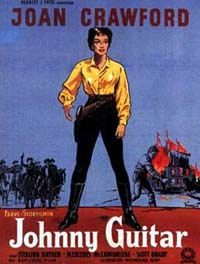
Joan Crawford stars in Johnny GuitarTOP TEN WESTERNS

1. Johnny Guitar — Nicholas Ray

2. Rio Bravo — Howard Hawks

3. The Big Sky — Howard Hawks, w. AB Guthrie

4. (tie)
The Naked Spur — Anthony Mann
Rancho Notorious — Fritz Lang
Man Without a Star — King Vidor

5. (tie)
My Darling Clementine — John Ford
The Left-Handed Gun — Arthur Penn, w. Gore Vidal
The Searchers –John Ford
Ride the High County — Sam Peckenpah

6. (tie)
Silver Lode — Allan Dwan
Red River — Howard Hawks
Duel in the Sun — King Vidor
The Hanging Tree — Delmer Daves
Run of the Arrow — Sam Fuller
Seven Men From Now — Budd Boetticher

7. (tie)
The Last Hunt — Richard Brooks
The Far Country — Anthony Mann
Colorado Territory — Raoul Walsh
Wagonmaster –John Ford
The Unforgiven — John Huston
Man of the West — Anthony Mann
Heller in Pink Tights — George Cukor, w. Louis L’Amour

8. (tie)
Man From Laramie — Anthony Mann
The Plainsman — Cecil B. DeMille
Western Union — Fritz Lang
Winchester 73 — Anthony Mann
Warlock — Edward Dmytryk
They Died with their Boots On — Raoul Walsh
The Last Frontier — Anthony Mann
The Last Wagon — Delmer Daves
River of No Return — Otto Preminger

9. (tie)
Stagecoach — John Ford, w. Ernest Haycock
The Outlaw — Howard Hughes, w. Ben Hecht
Billy the Kid — King Vidor
Comanche Station — Budd Boetticher
The Wonderful Country — Robert Parrish, w. Tom Lea
Wichita — Jacques Tourneur
3:10 to Yuma — Delmer Daves, w. Elmore Leonard
The Magnificent Seven — John Sturges, w. Akira Kurosawa
Gunfight at the OK Corral — John Sturges, w. Leon Uris
Tennessee’s Partner — Allan Dwan, w. Bret Harte

10. (Another 45 titles, including)
Shane — George Stevens
The Misfits — John Huston, w. Arthur Miller
Major Dundee — Sam Peckinpah
One Eyed Jacks — Marlon Brando
The Treasure of the Sierra Madre — John Huston, w. B. Traven
The Gold Rush — Charlie Chaplin
Go West — Buster Keaton
Fort Bravo — John Sturges

National Assembly is antiwar exclusively

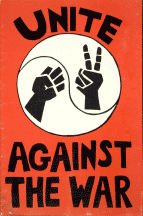
unite-against-the-warReports are emerging from July’s National Assembly, the vital effort to unite antiwar forces into a common movement. Delegates from the major peace organizations hammered out a strategy to address Iraq, Afghanistan, Pakistan and Palestine. Missing from the consensus? Nonviolence, and good riddance. It goes without saying that humanitarian activists are peaceful. To legislate a dogma of non-confrontation plays right into the hands of the authoritarians. Here’s the official report:

AN ASSESSMENT OF THE FIRST YEAR OF THE NATIONAL ASSEMBLY TO END THE IRAQ AND AFGHANISTAN WARS AND OCCUPATIONS

Address given by Marilyn Levin, member, National Assembly Administrative Body, and Planning Committee, Greater Boston United for Justice with Peace Coalition, to the National Antiwar Conference held July 10-12, 2009 in Pittsburgh, Pennsylvania

July 10-12, 2009, 255 people representing diverse organizations and constituencies from all over the country came together in Pittsburgh:

1) To look at where we are today,

2) To articulate our long range goals to rejuvenate the antiwar movement towards building a massive movement capable of forcing an end to their wars and occupations, to take our money back from the war machine to meet pressing social needs, and to save our planet for our children, and

3) To develop and vote for action plans as steps to realize these objectives.

All of our major objectives were accomplished and we leave today with a comprehensive action agenda to carry us through to next spring. Everyone had a chance to speak and differences were aired without rancor or splits to achieve unity in action.

Friday night’s speakers, along with many conference participants, grappled with how to unify and broaden the movement. Saturday afternoon and Sunday morning, we presented a great roster of workshops covering the major issues we face today. Saturday night’s rally was dynamic and inspiring.

There were two highlights of the conference for me. First was the international component where activist comrades joined us from Canada and courageous labor leaders of powerful mass movements in Haiti and Guadaloupe reminded us that imperialism and the struggle against it are global. There was a statement by members of the Viva Palestina aid convoy detained in Egypt. We passed motions in solidarity with the struggles of the people of Haiti, Honduras, and Palestine.

The second highlight was the discussion on Iran, where, in spite of strong passions stirred up by the rapidly evolving events there, we were able to illuminate the issues and debate our differences. Finally, we were able to agree on a unity position that all could embrace, as well as meeting the foremost call of the Iranians – US Hands off! No Sanctions! No interventions! Self-determination for the Iranian people! A wonderful example of a united front –- as inclusive as possible and taking principled positions that most will accept and act on.

So what is the National Assembly? What you saw this weekend explains who we are and how we function.

Democracy. All were invited and all perspectives welcomed. There was acceptance of the will of the conference even when it diverged from the proposals put forward by the leadership body. We were especially gratified that representatives from all the major antiwar coalitions came and addressed our conference.

Our willingness to struggle for unity and compromise when needed in order to move forward, as evidenced by a leadership that did not impose personal political views on others in service to unity.

An organization that admits to and learns from its mistakes and accepts its limitations when the unity we seek can’t yet be achieved.

An organization that has built a growing cadre of leaders that has developed trust, a structure that works, and a strong working relationship.

And finally, confidence, vision, and optimism. Confidence that we can provide leadership in rebooting our movement. A vision regarding how to accomplish that and an understanding of the necessity for these kinds of conferences leading to action. Optimism that masses of people will move in opposition to these horrendous policies that bring death and destruction and that they will have the power to change the world.

I’ve been asked to give an assessment of the first year since our initiation as an ongoing network with a mission, from our first conference in June, 2008 until today. Last year, we weren’t sure anyone would come and lo and behold 400 people came together in Cleveland to inaugurate a year of activities and set up a structure to maintain our work. A lot has transpired in that year and the National Assembly is well on its way as an established organization recognized throughout the movement as providing leadership and promoting a direction towards growth.

I need to start a little earlier and go back to why the National Assembly was called into existence in the first place.

What we saw, in the spring of 2008, was a movement at a low ebb – one that was shrinking rather than growing in spite of the war dragging on — this while the antiwar sentiment couldn’t be higher, and the disapproval rating for the Bush Administration couldn’t have been lower. From the high point of the largest action against the Iraq War in September, 2005 which drew 700,000 people, there was a pulling away from mass action by significant sections of the movement which supported electoral politics as the central strategy, in spite of a recurring pattern of disappointment when Democratic “antiwar” candidates voted again and again for war and war funding, and a split between the two major national coalitions, UFPJ and ANSWER, one that continues to this day. For the first time in five years, there was not enough unity or mass action perspective for any national demonstrations to take place marking the 5th year of the occupation of Iraq. Fundamentally, there was a vacuum of leadership.

Some far-sighted people like Jerry Gordon and Jeff Mackler, with experience gained from leadership in the last powerful antiwar movement that ended the Vietnam War, felt impelled to act. They began to organize a base of diverse but like-minded activists committed to building and expanding an effective antiwar movement in this country. The vehicle to accomplish this was the first national assembly, a national conference to pull activists together, to analyze the present state of the movement, to discuss where we needed to go and the actions that were needed to get us there.

We developed a unity statement with five basic principles that we hold today as the basis for where we stand:

1) Unity – all sections of the movement working together for common goals and actions;

2) Political Independence – no affiliations or support to any political party;

3) Democracy – decision-making at conferences with one person, one vote;

4) Mass Action – as the central strategy for organizing while embracing other forms of
outreach and protest; and

5) Out Now – the central demand to withdraw all military forces, contractors, and bases
from the countries where the U.S. was waging war on the people.

It seems simple but no one else saw it that way. Our conference was unique in the history of the present movement.

The organizers didn’t know what the mood and composition or strength of the conference would be, so we were cautious and minimal in the program we posed to the conference. We focused on Out Now from Iraq and modest action proposals, not being strong enough to initiate national actions on our own. The conference participants were ahead of us and ready to tackle the larger issues. Proposals were passed to add “Out Now from Afghanistan”, “End U.S. Support for the Occupation of Palestine”, and “Hands off Iran” to our set of demands, and given what has transpired in these areas, we were well prepared to take on a major role.

October 10th actions held in 20 cities were endorsed as well as a call for December actions building towards what we hoped would be unified, nationally coordinated bicoastal mass actions in the spring of 2009, the 6th year of the Iraq occupation. When Gaza was brutally assaulted, we joined with ANSWER and others to march in Washington and to demonstrate in the streets all over the country, and we’re still working under Palestinian leadership to bring justice and relief to a beleaguered population.

We made a concerted effort to find a common date for spring bi-coastal mobilizations. As you know, ANSWER chose March 21st as a day of united protests which we endorsed, while UFPJ called for a national march on Wall St. on April 4th. A number of National Assembly supporters who were also delegates to the UFPJ conference in December formed a mass action unity caucus and went to the conference with a resolution to allow delegates to vote for one or both actions but this was rejected. We’ll keep trying for 2010. The National Assembly endorsed and built both actions and marched behind our signs with our demands. The demonstrations were small (but spirited) and still of major importance.

For us, it’s quality, not quantity, as we position ourselves to be in the forefront as the pendulum swings in our direction once again.

Some take the position that mass demonstrations are not effective, unless we can pull 100,000 protestors into the streets. This is short-sighted and does not address how we get from small to large. Any successful movement for change doesn’t start with 100,000 people, and there has never been significant social change without mass actions. I remember my first anti-Vietnam war demonstration was in 1963 in Detroit and we had 15 people. In 1965, SDS called the first national march against the war in Washington. 25,000 people turned out and we thought it was huge!

Everyone talks about reaching out to the thousands of young people who mobilized to elect Obama. We agree, but we say the way to do this is by offering education and action. Action beyond calling, and emailing, and faxing the politicians they placed in office.

Why are mass demonstrations so important to building a powerful movement? It is because they accomplish so much in the process of building them. They provide:

Continuity. You can’t build anything by starting anew each time. Each action should lead to the next action or open national conference, with success building upon success. We need a continuity of leadership that builds trust and a reputation for integrity, and that learns lessons to improve. We need a continuity of organization and structure that can implement the tasks before us.

Visibility. Actions in the street give heart to the people the U.S. is attacking and occupying, letting them know that they are not alone. Mass actions create solidarity, offering support to anti-war soldiers, vets and their families, and a counter-force to the economic draft facing our youth, and they strengthen and deepen the antiwar sentiment of the people.

Inspiration. New people are brought into the movement, especially the youth, through activism. Have you ever talked to young people coming to a mass demonstration for the first time? They are inspired and thrilled to hear powerful speakers who are leaders of social justice movements and soldiers resisting the wars. They see they are not alone and get a taste of the power of large numbers of people marching together. They are energized to go home and join with others to continue to organize opposition to brutal U.S. wars and occupations. This is the way to reach out to the Obama supporters.

Explanation. An analysis of what is going on is offered along with tying together what seem at first to be disparate elements, i.e., war is tied to the economy, the war budget, bail-outs of the rich, the lack of basic needs being met, justice denied, and the impoverishment of the people.

Pressure on Government. People in this country are taught to be quiet. We’re told that our job is to elect officials whom we agree with periodically and then go home and wait while they fix things. This conveniently maintains the status quo but it sure doesn’t put pressure on them, or scare them, or force social change. Mass actions provide the most effective way to make significant change happen.

Let’s look at the present period. Obama’s election was based in large part on the hopes and aspirations of Americans for peace and a better life based on the promises and assumed promises that were made of peace, justice, and prosperity, which have not and will not be met.

Contrary to expectations, the previous administration’s policies are continued with a more handsome and articulate face. We all know that rather than winding down, wars and interventions are escalating and the rapacious greed of this immoral system knows no bounds.

Simultaneously, the economic crisis is causing terrible hardship for working people and for people who are no longer able to find work and their families. They are using this self-created financial disaster to further cut the standard of living and eliminate a secure future for older people and the young.

It was very moving and yet appalling to see this visually demonstrated when Robin Alexander of the United Electrical Workers Union asked people in the audience to stand who were unemployed, personally knew of soldier casualties, lived in communities where services were being cut, or who were otherwise negatively impacted by the wars and the failing economy. Nearly the entire room, a microcosm of the wider society, was standing by the end of that exercise.

It is inevitable that the present period of quiescence and hanging on to the hope that Obama and the new Congress will save us will come to a crashing end. People will not sit idly by forever while the world around them collapses. We are already seeing the beginnings of stirring. There is a greater willingness to go out in the streets to protest. There is more organizing taking place on campuses, more young people joining the movement. The many proposals for October actions are an indication that there is a widespread awareness of the need for actions this fall and the conviction that the movement must find common dates.

Brian Becker, National Coordinator of ANSWER, urged that we all work together to mount nationally coordinated actions next spring. Michael McPhearson, Co-Chair of UFPJ and Executive Director of Veterans for Peace, announced his support for October 17 and his willingness to do what he could to spur unified actions in the spring of 2010. We must have the faith and confidence that the people have the power to end the atrocities resulting from U.S. wars and occupations, and that they will recognize and utilize this power. As this happens, we must build a stronger antiwar movement that is able to provide leadership and the optimism to forge ahead no matter what the opposition throws at us.

The National Assembly to End the Iraq and Afghanistan Wars and Occupations is helping to provide that leadership and the vision that is needed. Although young and small, in one short year, we are now a force to be taken seriously and negotiated with, and by our persistent call for unity and mass action, our demonstrated ability to organize, and our coordinated strategy for revitalizing the movement, we are having an impact larger than our forces would indicate. In some ways, we too are a product of (and some say an antidote to) the 2008 election. To counter the malaise of the movement, we have quietly been building a solid core of activists and leaders around the country that understand the importance of a united front organized around principled demands and mass actions, not just calling Washington politicians when bills come up and crises happen.

At this conference, we have laid out an ambitious program of action that will take us through the spring of 2010. We are proud that we could provide the kick off for national organizing to bring a massive turnout to Pittsburgh for the G-20 protests September 25. Homeland Security is already making preparations to keep protesters hidden and stifle our right to speak out, but we won’t be silenced.

Following that, are a series of October building actions, culminating in large local and regional demonstrations on October 17 marking dates of significance related to the Iraq and Afghanistan wars and occupations and remembering the legacy of the anti-Vietnam war movement. Throughout the year, we will organize educational programs, support various forms of protest and organize around the inevitable emergencies caused by our government’s unholy interventions and threats to other nations.

We have initiated a Free Palestine Working Committee to ensure this work, which includes the growing boycott, divestment, and sanctions campaigns and the efforts to break the siege of Gaza, continues to be in the forefront and fully integrated in our work until justice and self-determination and return is in the hands of the Palestinians.

And lastly, we will continue to advocate for unity of the movement and once again bring thousands to Washington and the West Coast in the spring, to let our government and the world know that the U.S. movement against wars and occupations is alive and will not be quiet.

We will march and continue to march until all U.S. forces come home, bases are dismantled, and the sovereign people of the world have the right to control their own resources and determine their own futures, and the war budget becomes the peace budget.

Don’t sit on the sidelines and watch history being made. We urge all organizations to join the National Assembly and to play your part in building and shaping the powerful movement that is coming.

All out for the September 25 G-20 march in Pittsburgh! All out for the actions in early October! All out October 17!

Suddenly colored television

Today Show-network now African AmericanImmediately after the 2001 attack on the World Trade Center in 2001, the term “Nine Eleven” was already tripping off the tongues of TV talking heads as if it was more natural than saying “last Monday,” or “last week Monday,” before even we knew the attack was not going to last several days. The day after the election of Barack Obama, a suddenly large proportion of the TV talking heads were black, overnight, like it had become some sort of costume party theme.

Television has become colorized, and much more vigorously than Ted Turner might have ever intended.

Have you noticed? On post-Bush television, Black is the new focus of equal-time. When pundits are summoned, now there’s a black person among them. Nothing wrong with this development. Whatever years of seasoning these new African-American faces may lack, they make up for by being visibly brighter than the vacuous white-breads they replaced. There must be an entire class of Anglo-Saxon communication majors who are lamenting the great lost entitlement of 2009.

It’s a fine development, though certainly limited in its generosity. The proportion of African Americans to the total population, is vastly smaller than the new TV ratio. Conversely, over half the US public is progressive. But still almost zero percent of the corporate media personalities reflect that.

Where did all these colored faces come from? Had they been training in the wings, for just this contingency? It’s a wise move on the part of the networks. President Obama and his family would be looking pretty dark against the sea of white Washington DC. Someone could confuse him for security or kitchen staff, but for the media framing of black commentators to remind White America that there is no cause to panic, the new American lens is colorblind.

It should be, but is it? White man still looks upon dark-skinned people as requiring domination. American urban blacks are to incarcerate, African blacks are to rescue, and insurgent/Muslim/pirate blacks are to lynch. I’m not sure we don’t really long to lynch the bunch of them, if AIDS isn’t thinning their number fast enough for our taste.

Hitch your horse to this manservantObama meanwhile is the black man we invite to dinner. And these colored teevee folk too. They’re not poor blacks after all. They’re the Thomas Sowells, Uncle Toms, educated reformed black people. Rich black people are the new lawn jockeys.

Okay, so the corporate media wants to project an urbane sophistication about integrating racial harmony into its facade. We hope, I suppose, that by portraying it so, they can make it so. I think we have to wonder if that’s the real manipulation.

The day after September 11, the term “Nine Eleven” was coined before most of us knew what even happened. Flights were grounded anticipating more attacks. How curious that the experts were calling it “9/11” when it might still have turned out to be 9/11 – 17 or other. They’d gotten the memo about how to frame the “world-changing” development, complete with its catchy catchphrase.

Obama is just such another media campaign, to assuage the darker-skinned world that the Great White West comes in peace, see look, we love our Darkies. We respect them, we ask their advice, we put them up in the White House.

This year’s Clio Award, the advertising world’s Oscar, for best campaign, went to Barack Obama. What does that tell you about the collective effort involved, and the focused objective of the marketing?

Clansmen hold a rally in Washington DC

Murdoch puts Obama on public notice: white men licensed to kill bad monkeys

cartoon
The page in the New York Post before this cartoon featured a photograph of President Obama signing [writing] the Stimulus Bill. Putting aside the offensive connotation, does the cartoon work on any level? Is there a joke in linking the Chimpanzee gone native in Connecticut to the Stimulus Bill? What is it?

Is the cartoonist drawing on a third association, to the big laugh line from Die Hard, when an helicopter full of FBI guys, snotty agents who didn’t want the assistance of our hero, explodes, and an LAPD regular says: “I guess they’ll have to get some more FBI guys.”

What is it? The Stimulus Bill was written by a monkey? It was argued and reshaped by a dueling phalanx of legislators. It may have become disfigured, but was it by any stretch engineered by a monkey?

Certainly the moneyed class, which Murdoch represents, objects to giving any of the treasury to middle America. It can go to banks, or CEOs, or in the form of tax cuts to the multi-billionaires, but craft an economic solution that puts jobs or financial relief in the hands of ordinary people and the corporate press is not interested. So the bill author would be a bleeding-heart, or a sentimentalist, or Rainman for that matter. But where does the analogy work as a monkey?

A chimp-faced lampoon worked for Bush, because of the resemblance, and the mental acuity, and verbal skills. The Stimulus Bill can be plenty of wrong things, was it dumb?

II.
Here’s the apology the NYPost offered for their cartoon. What they said, or left unsaid, certainly didn’t match their bad taste to argue their cartoon wasn’t about Obama, but naming the piece THAT CARTOON.

Wednesday’s Page Six cartoon – caricaturing Monday’s police shooting of a chimpanzee in Connecticut – has created considerable controversy.

It shows two police officers standing over the chimp’s body: “They’ll have to find someone else to write the next stimulus bill,” one officer says.

It was meant to mock an ineptly written federal stimulus bill.

Period.

But it has been taken as something else – as a depiction of President Obama, as a thinly veiled expression of racism.

This most certainly was not its intent; to those who were offended by the image, we apologize.

However, there are some in the media and in public life who have had differences with The Post in the past – and they see the incident as an opportunity for payback.

To them, no apology is due.

Sometimes a cartoon is just a cartoon – even as the opportunists seek to make it something else.

III.
This note came in from Rita Ague:

What’s wrong with this picture?

Of course there’s racism out there, but be careful not to fall victom to spin. Rupert M. is one of the giants in the neo-con coup d’etat. The loss of a free press to military/industrial/corporate interests, and resulting news being turned into spin and hate mongering, is but one of many reasons I’ve put back on my old legal and journalist hats.

We are in such a hell of a mess, and we’re passing that mess onto and into the rest of the world. I’m not sure we can dig ourselves out. We may not see relief, and the kind of change we of good hearts and good minds so long for, come about in our lifetime.

Let’s pray constantly that some Karl Rove and Rupert Murdoch induced bigot, or a neo-con agent posing as same, does not shoot or do away with Obama. The cause of the killing will, of course, be blamed on racism. But the real reason will be the fear the neo-cons have that our new president is going to take away their power and control, and quash their currently-being-exposed incredible greed.

My fear is that Murdoch, by and through his New York Post newspaper, FOX spin and hate channel, and all the other mass media he and his Neocon cohorts own and/or control, is spinning us to believe that some forthcoming assassination, when it occurs, was inevitable and based on a rise on racism and hatred, when it was truly based on more evil, Karl Rove-like Machiavellian (the end justifies any means) manipulation.

God help and protect us all, particularly Barack Obama.

Rita followed it up with this plea to MoveOn.org:

I need your help, Marc, in getting out the warning through Move-On’s far reaching Internet connections:

BEWARE! THE GIANT (military/industrial/corporate) NEO-CON SPIN MACHINE (formerly known as the “liberal mass media”) IS CRANKING UP

OBAMA, BAR THE DOOR!!!

I’m scared, Marc. It wasn’t accidental that the Post ran the dead ape cartoon with it’s deadly caption. Nor is it an accident that we are suddenly hearing more and more about all the racism and all the ‘racist’ assassination attempts being planned and made on Obama.

My intuition/precognition will be supported if and when we hear more of this racism and hate against “The Man” jive. As the old advertising saying goes: ‘When you think they’re tired of hearing about it, that’s when they’re just beginning to catch onto what you’re trying to tell/sell.”

I could be wrong about this “IT WAS A RACIST THING THAT DID HIM IN” campaign, but just in case I’m right, shouldn’t we be safe rather than sorry, and get a Move-On Campaign and heavy duty word of mouth going through the net, that we’re onto what’s being spun in the mass media, and why it’s being spun.

For sometime now, my slogan has been UNDO THE (military/industrial/corporate) COUP! Now I think we’d better come up with a new slogan, and start spreading it, as far and as wide as we can. It could be something like:

KEEP OBAMA ALIVE AND WELL – TELL THE PRESS TO GO TO HELL!

Harold Pinter on drama and US banditry

“What has happened to our moral sensibility? Did we ever have any? What do these words mean? Do they refer to a term very rarely employed these days – conscience? A conscience to do not only with our own acts but to do with our shared responsibility in the acts of others? Is all this dead?”
-Harold Pinter (1930-2008)

I’m reminded of a friend of mine who asked “You know what PTSD is? It’s a bad conscience.”

An outspoken critic of the Iraq War, Harold Pinter died Christmas Eve. Here is the address he prerecorded for his acceptance of the Nobel Prize in 2005, when he had become too infirm to attend in person.

Nobel Lecture: Art, Truth & Politics

In 1958 I wrote the following:

‘There are no hard distinctions between what is real and what is unreal, nor between what is true and what is false. A thing is not necessarily either true or false; it can be both true and false.’

I believe that these assertions still make sense and do still apply to the exploration of reality through art. So as a writer I stand by them but as a citizen I cannot. As a citizen I must ask: What is true? What is false?

Truth in drama is forever elusive. You never quite find it but the search for it is compulsive. The search is clearly what drives the endeavour. The search is your task. More often than not you stumble upon the truth in the dark, colliding with it or just glimpsing an image or a shape which seems to correspond to the truth, often without realising that you have done so. But the real truth is that there never is any such thing as one truth to be found in dramatic art. There are many. These truths challenge each other, recoil from each other, reflect each other, ignore each other, tease each other, are blind to each other. Sometimes you feel you have the truth of a moment in your hand, then it slips through your fingers and is lost.

I have often been asked how my plays come about. I cannot say. Nor can I ever sum up my plays, except to say that this is what happened. That is what they said. That is what they did.

Most of the plays are engendered by a line, a word or an image. The given word is often shortly followed by the image. I shall give two examples of two lines which came right out of the blue into my head, followed by an image, followed by me.

The plays are The Homecoming and Old Times. The first line of The Homecoming is ‘What have you done with the scissors?’ The first line of Old Times is ‘Dark.’

In each case I had no further information.

In the first case someone was obviously looking for a pair of scissors and was demanding their whereabouts of someone else he suspected had probably stolen them. But I somehow knew that the person addressed didn’t give a damn about the scissors or about the questioner either, for that matter.

‘Dark’ I took to be a description of someone’s hair, the hair of a woman, and was the answer to a question. In each case I found myself compelled to pursue the matter. This happened visually, a very slow fade, through shadow into light.

I always start a play by calling the characters A, B and C.

In the play that became The Homecoming I saw a man enter a stark room and ask his question of a younger man sitting on an ugly sofa reading a racing paper. I somehow suspected that A was a father and that B was his son, but I had no proof. This was however confirmed a short time later when B (later to become Lenny) says to A (later to become Max), ‘Dad, do you mind if I change the subject? I want to ask you something. The dinner we had before, what was the name of it? What do you call it? Why don’t you buy a dog? You’re a dog cook. Honest. You think you’re cooking for a lot of dogs.’ So since B calls A ‘Dad’ it seemed to me reasonable to assume that they were father and son. A was also clearly the cook and his cooking did not seem to be held in high regard. Did this mean that there was no mother? I didn’t know. But, as I told myself at the time, our beginnings never know our ends.

‘Dark.’ A large window. Evening sky. A man, A (later to become Deeley), and a woman, B (later to become Kate), sitting with drinks. ‘Fat or thin?’ the man asks. Who are they talking about? But I then see, standing at the window, a woman, C (later to become Anna), in another condition of light, her back to them, her hair dark.

It’s a strange moment, the moment of creating characters who up to that moment have had no existence. What follows is fitful, uncertain, even hallucinatory, although sometimes it can be an unstoppable avalanche. The author’s position is an odd one. In a sense he is not welcomed by the characters. The characters resist him, they are not easy to live with, they are impossible to define. You certainly can’t dictate to them. To a certain extent you play a never-ending game with them, cat and mouse, blind man’s buff, hide and seek. But finally you find that you have people of flesh and blood on your hands, people with will and an individual sensibility of their own, made out of component parts you are unable to change, manipulate or distort.

So language in art remains a highly ambiguous transaction, a quicksand, a trampoline, a frozen pool which might give way under you, the author, at any time.

But as I have said, the search for the truth can never stop. It cannot be adjourned, it cannot be postponed. It has to be faced, right there, on the spot.

Political theatre presents an entirely different set of problems. Sermonising has to be avoided at all cost. Objectivity is essential. The characters must be allowed to breathe their own air. The author cannot confine and constrict them to satisfy his own taste or disposition or prejudice. He must be prepared to approach them from a variety of angles, from a full and uninhibited range of perspectives, take them by surprise, perhaps, occasionally, but nevertheless give them the freedom to go which way they will. This does not always work. And political satire, of course, adheres to none of these precepts, in fact does precisely the opposite, which is its proper function.

In my play The Birthday Party I think I allow a whole range of options to operate in a dense forest of possibility before finally focussing on an act of subjugation.

Mountain Language pretends to no such range of operation. It remains brutal, short and ugly. But the soldiers in the play do get some fun out of it. One sometimes forgets that torturers become easily bored. They need a bit of a laugh to keep their spirits up. This has been confirmed of course by the events at Abu Ghraib in Baghdad. Mountain Language lasts only 20 minutes, but it could go on for hour after hour, on and on and on, the same pattern repeated over and over again, on and on, hour after hour.

Ashes to Ashes, on the other hand, seems to me to be taking place under water. A drowning woman, her hand reaching up through the waves, dropping down out of sight, reaching for others, but finding nobody there, either above or under the water, finding only shadows, reflections, floating; the woman a lost figure in a drowning landscape, a woman unable to escape the doom that seemed to belong only to others.

But as they died, she must die too.

Political language, as used by politicians, does not venture into any of this territory since the majority of politicians, on the evidence available to us, are interested not in truth but in power and in the maintenance of that power. To maintain that power it is essential that people remain in ignorance, that they live in ignorance of the truth, even the truth of their own lives. What surrounds us therefore is a vast tapestry of lies, upon which we feed.

As every single person here knows, the justification for the invasion of Iraq was that Saddam Hussein possessed a highly dangerous body of weapons of mass destruction, some of which could be fired in 45 minutes, bringing about appalling devastation. We were assured that was true. It was not true. We were told that Iraq had a relationship with Al Quaeda and shared responsibility for the atrocity in New York of September 11th 2001. We were assured that this was true. It was not true. We were told that Iraq threatened the security of the world. We were assured it was true. It was not true.

The truth is something entirely different. The truth is to do with how the United States understands its role in the world and how it chooses to embody it.

But before I come back to the present I would like to look at the recent past, by which I mean United States foreign policy since the end of the Second World War. I believe it is obligatory upon us to subject this period to at least some kind of even limited scrutiny, which is all that time will allow here.

Everyone knows what happened in the Soviet Union and throughout Eastern Europe during the post-war period: the systematic brutality, the widespread atrocities, the ruthless suppression of independent thought. All this has been fully documented and verified.

But my contention here is that the US crimes in the same period have only been superficially recorded, let alone documented, let alone acknowledged, let alone recognised as crimes at all. I believe this must be addressed and that the truth has considerable bearing on where the world stands now. Although constrained, to a certain extent, by the existence of the Soviet Union, the United States’ actions throughout the world made it clear that it had concluded it had carte blanche to do what it liked.

Direct invasion of a sovereign state has never in fact been America’s favoured method. In the main, it has preferred what it has described as ‘low intensity conflict’. Low intensity conflict means that thousands of people die but slower than if you dropped a bomb on them in one fell swoop. It means that you infect the heart of the country, that you establish a malignant growth and watch the gangrene bloom. When the populace has been subdued – or beaten to death – the same thing – and your own friends, the military and the great corporations, sit comfortably in power, you go before the camera and say that democracy has prevailed. This was a commonplace in US foreign policy in the years to which I refer.

The tragedy of Nicaragua was a highly significant case. I choose to offer it here as a potent example of America’s view of its role in the world, both then and now.

I was present at a meeting at the US embassy in London in the late 1980s.

The United States Congress was about to decide whether to give more money to the Contras in their campaign against the state of Nicaragua. I was a member of a delegation speaking on behalf of Nicaragua but the most important member of this delegation was a Father John Metcalf. The leader of the US body was Raymond Seitz (then number two to the ambassador, later ambassador himself). Father Metcalf said: ‘Sir, I am in charge of a parish in the north of Nicaragua. My parishioners built a school, a health centre, a cultural centre. We have lived in peace. A few months ago a Contra force attacked the parish. They destroyed everything: the school, the health centre, the cultural centre. They raped nurses and teachers, slaughtered doctors, in the most brutal manner. They behaved like savages. Please demand that the US government withdraw its support from this shocking terrorist activity.’

Raymond Seitz had a very good reputation as a rational, responsible and highly sophisticated man. He was greatly respected in diplomatic circles. He listened, paused and then spoke with some gravity. ‘Father,’ he said, ‘let me tell you something. In war, innocent people always suffer.’ There was a frozen silence. We stared at him. He did not flinch.

Innocent people, indeed, always suffer.

Finally somebody said: ‘But in this case “innocent people” were the victims of a gruesome atrocity subsidised by your government, one among many. If Congress allows the Contras more money further atrocities of this kind will take place. Is this not the case? Is your government not therefore guilty of supporting acts of murder and destruction upon the citizens of a sovereign state?’

Seitz was imperturbable. ‘I don’t agree that the facts as presented support your assertions,’ he said.

As we were leaving the Embassy a US aide told me that he enjoyed my plays. I did not reply.

I should remind you that at the time President Reagan made the following statement: ‘The Contras are the moral equivalent of our Founding Fathers.’

The United States supported the brutal Somoza dictatorship in Nicaragua for over 40 years. The Nicaraguan people, led by the Sandinistas, overthrew this regime in 1979, a breathtaking popular revolution.

The Sandinistas weren’t perfect. They possessed their fair share of arrogance and their political philosophy contained a number of contradictory elements. But they were intelligent, rational and civilised. They set out to establish a stable, decent, pluralistic society. The death penalty was abolished. Hundreds of thousands of poverty-stricken peasants were brought back from the dead. Over 100,000 families were given title to land. Two thousand schools were built. A quite remarkable literacy campaign reduced illiteracy in the country to less than one seventh. Free education was established and a free health service. Infant mortality was reduced by a third. Polio was eradicated.

The United States denounced these achievements as Marxist/Leninist subversion. In the view of the US government, a dangerous example was being set. If Nicaragua was allowed to establish basic norms of social and economic justice, if it was allowed to raise the standards of health care and education and achieve social unity and national self respect, neighbouring countries would ask the same questions and do the same things. There was of course at the time fierce resistance to the status quo in El Salvador.

I spoke earlier about ‘a tapestry of lies’ which surrounds us. President Reagan commonly described Nicaragua as a ‘totalitarian dungeon’. This was taken generally by the media, and certainly by the British government, as accurate and fair comment. But there was in fact no record of death squads under the Sandinista government. There was no record of torture. There was no record of systematic or official military brutality. No priests were ever murdered in Nicaragua. There were in fact three priests in the government, two Jesuits and a Maryknoll missionary. The totalitarian dungeons were actually next door, in El Salvador and Guatemala. The United States had brought down the democratically elected government of Guatemala in 1954 and it is estimated that over 200,000 people had been victims of successive military dictatorships.

Six of the most distinguished Jesuits in the world were viciously murdered at the Central American University in San Salvador in 1989 by a battalion of the Alcatl regiment trained at Fort Benning, Georgia, USA. That extremely brave man Archbishop Romero was assassinated while saying mass. It is estimated that 75,000 people died. Why were they killed? They were killed because they believed a better life was possible and should be achieved. That belief immediately qualified them as communists. They died because they dared to question the status quo, the endless plateau of poverty, disease, degradation and oppression, which had been their birthright.

The United States finally brought down the Sandinista government. It took some years and considerable resistance but relentless economic persecution and 30,000 dead finally undermined the spirit of the Nicaraguan people. They were exhausted and poverty stricken once again. The casinos moved back into the country. Free health and free education were over. Big business returned with a vengeance. ‘Democracy’ had prevailed.

But this ‘policy’ was by no means restricted to Central America. It was conducted throughout the world. It was never-ending. And it is as if it never happened.

The United States supported and in many cases engendered every right wing military dictatorship in the world after the end of the Second World War. I refer to Indonesia, Greece, Uruguay, Brazil, Paraguay, Haiti, Turkey, the Philippines, Guatemala, El Salvador, and, of course, Chile. The horror the United States inflicted upon Chile in 1973 can never be purged and can never be forgiven.

Hundreds of thousands of deaths took place throughout these countries. Did they take place? And are they in all cases attributable to US foreign policy? The answer is yes they did take place and they are attributable to American foreign policy. But you wouldn’t know it.

It never happened. Nothing ever happened. Even while it was happening it wasn’t happening. It didn’t matter. It was of no interest. The crimes of the United States have been systematic, constant, vicious, remorseless, but very few people have actually talked about them. You have to hand it to America. It has exercised a quite clinical manipulation of power worldwide while masquerading as a force for universal good. It’s a brilliant, even witty, highly successful act of hypnosis.

I put to you that the United States is without doubt the greatest show on the road. Brutal, indifferent, scornful and ruthless it may be but it is also very clever. As a salesman it is out on its own and its most saleable commodity is self love. It’s a winner. Listen to all American presidents on television say the words, ‘the American people’, as in the sentence, ‘I say to the American people it is time to pray and to defend the rights of the American people and I ask the American people to trust their president in the action he is about to take on behalf of the American people.’

It’s a scintillating stratagem. Language is actually employed to keep thought at bay. The words ‘the American people’ provide a truly voluptuous cushion of reassurance. You don’t need to think. Just lie back on the cushion. The cushion may be suffocating your intelligence and your critical faculties but it’s very comfortable. This does not apply of course to the 40 million people living below the poverty line and the 2 million men and women imprisoned in the vast gulag of prisons, which extends across the US.

The United States no longer bothers about low intensity conflict. It no longer sees any point in being reticent or even devious. It puts its cards on the table without fear or favour. It quite simply doesn’t give a damn about the United Nations, international law or critical dissent, which it regards as impotent and irrelevant. It also has its own bleating little lamb tagging behind it on a lead, the pathetic and supine Great Britain.

What has happened to our moral sensibility? Did we ever have any? What do these words mean? Do they refer to a term very rarely employed these days – conscience? A conscience to do not only with our own acts but to do with our shared responsibility in the acts of others? Is all this dead? Look at Guantanamo Bay. Hundreds of people detained without charge for over three years, with no legal representation or due process, technically detained forever. This totally illegitimate structure is maintained in defiance of the Geneva Convention. It is not only tolerated but hardly thought about by what’s called the ‘international community’. This criminal outrage is being committed by a country, which declares itself to be ‘the leader of the free world’. Do we think about the inhabitants of Guantanamo Bay? What does the media say about them? They pop up occasionally – a small item on page six. They have been consigned to a no man’s land from which indeed they may never return. At present many are on hunger strike, being force-fed, including British residents. No niceties in these force-feeding procedures. No sedative or anaesthetic. Just a tube stuck up your nose and into your throat. You vomit blood. This is torture. What has the British Foreign Secretary said about this? Nothing. What has the British Prime Minister said about this? Nothing. Why not? Because the United States has said: to criticise our conduct in Guantanamo Bay constitutes an unfriendly act. You’re either with us or against us. So Blair shuts up.

The invasion of Iraq was a bandit act, an act of blatant state terrorism, demonstrating absolute contempt for the concept of international law. The invasion was an arbitrary military action inspired by a series of lies upon lies and gross manipulation of the media and therefore of the public; an act intended to consolidate American military and economic control of the Middle East masquerading – as a last resort – all other justifications having failed to justify themselves – as liberation. A formidable assertion of military force responsible for the death and mutilation of thousands and thousands of innocent people.

We have brought torture, cluster bombs, depleted uranium, innumerable acts of random murder, misery, degradation and death to the Iraqi people and call it ‘bringing freedom and democracy to the Middle East’.

How many people do you have to kill before you qualify to be described as a mass murderer and a war criminal? One hundred thousand? More than enough, I would have thought. Therefore it is just that Bush and Blair be arraigned before the International Criminal Court of Justice. But Bush has been clever. He has not ratified the International Criminal Court of Justice. Therefore if any American soldier or for that matter politician finds himself in the dock Bush has warned that he will send in the marines. But Tony Blair has ratified the Court and is therefore available for prosecution. We can let the Court have his address if they’re interested. It is Number 10, Downing Street, London.

Death in this context is irrelevant. Both Bush and Blair place death well away on the back burner. At least 100,000 Iraqis were killed by American bombs and missiles before the Iraq insurgency began. These people are of no moment. Their deaths don’t exist. They are blank. They are not even recorded as being dead. ‘We don’t do body counts,’ said the American general Tommy Franks.

Early in the invasion there was a photograph published on the front page of British newspapers of Tony Blair kissing the cheek of a little Iraqi boy. ‘A grateful child,’ said the caption. A few days later there was a story and photograph, on an inside page, of another four-year-old boy with no arms. His family had been blown up by a missile. He was the only survivor. ‘When do I get my arms back?’ he asked. The story was dropped. Well, Tony Blair wasn’t holding him in his arms, nor the body of any other mutilated child, nor the body of any bloody corpse. Blood is dirty. It dirties your shirt and tie when you’re making a sincere speech on television.

The 2,000 American dead are an embarrassment. They are transported to their graves in the dark. Funerals are unobtrusive, out of harm’s way. The mutilated rot in their beds, some for the rest of their lives. So the dead and the mutilated both rot, in different kinds of graves.

Here is an extract from a poem by Pablo Neruda, ‘I’m Explaining a Few Things’:

And one morning all that was burning,
one morning the bonfires
leapt out of the earth
devouring human beings
and from then on fire,
gunpowder from then on,
and from then on blood.
Bandits with planes and Moors,
bandits with finger-rings and duchesses,
bandits with black friars spattering blessings
came through the sky to kill children
and the blood of children ran through the streets
without fuss, like children’s blood.

Jackals that the jackals would despise
stones that the dry thistle would bite on and spit out,
vipers that the vipers would abominate.

Face to face with you I have seen the blood
of Spain tower like a tide
to drown you in one wave
of pride and knives.

Treacherous
generals:
see my dead house,
look at broken Spain:
from every house burning metal flows
instead of flowers
from every socket of Spain
Spain emerges
and from every dead child a rifle with eyes
and from every crime bullets are born
which will one day find
the bull’s eye of your hearts.

And you will ask: why doesn’t his poetry
speak of dreams and leaves
and the great volcanoes of his native land.

Come and see the blood in the streets.
Come and see
the blood in the streets.
Come and see the blood
in the streets!

Let me make it quite clear that in quoting from Neruda’s poem I am in no way comparing Republican Spain to Saddam Hussein’s Iraq. I quote Neruda because nowhere in contemporary poetry have I read such a powerful visceral description of the bombing of civilians.

I have said earlier that the United States is now totally frank about putting its cards on the table. That is the case. Its official declared policy is now defined as ‘full spectrum dominance’. That is not my term, it is theirs. ‘Full spectrum dominance’ means control of land, sea, air and space and all attendant resources.

The United States now occupies 702 military installations throughout the world in 132 countries, with the honourable exception of Sweden, of course. We don’t quite know how they got there but they are there all right.

The United States possesses 8,000 active and operational nuclear warheads. Two thousand are on hair trigger alert, ready to be launched with 15 minutes warning. It is developing new systems of nuclear force, known as bunker busters. The British, ever cooperative, are intending to replace their own nuclear missile, Trident. Who, I wonder, are they aiming at? Osama bin Laden? You? Me? Joe Dokes? China? Paris? Who knows? What we do know is that this infantile insanity – the possession and threatened use of nuclear weapons – is at the heart of present American political philosophy. We must remind ourselves that the United States is on a permanent military footing and shows no sign of relaxing it.

Many thousands, if not millions, of people in the United States itself are demonstrably sickened, shamed and angered by their government’s actions, but as things stand they are not a coherent political force – yet. But the anxiety, uncertainty and fear which we can see growing daily in the United States is unlikely to diminish.

I know that President Bush has many extremely competent speech writers but I would like to volunteer for the job myself. I propose the following short address which he can make on television to the nation. I see him grave, hair carefully combed, serious, winning, sincere, often beguiling, sometimes employing a wry smile, curiously attractive, a man’s man.

‘God is good. God is great. God is good. My God is good. Bin Laden’s God is bad. His is a bad God. Saddam’s God was bad, except he didn’t have one. He was a barbarian. We are not barbarians. We don’t chop people’s heads off. We believe in freedom. So does God. I am not a barbarian. I am the democratically elected leader of a freedom-loving democracy. We are a compassionate society. We give compassionate electrocution and compassionate lethal injection. We are a great nation. I am not a dictator. He is. I am not a barbarian. He is. And he is. They all are. I possess moral authority. You see this fist? This is my moral authority. And don’t you forget it.’

A writer’s life is a highly vulnerable, almost naked activity. We don’t have to weep about that. The writer makes his choice and is stuck with it. But it is true to say that you are open to all the winds, some of them icy indeed. You are out on your own, out on a limb. You find no shelter, no protection – unless you lie – in which case of course you have constructed your own protection and, it could be argued, become a politician.

I have referred to death quite a few times this evening. I shall now quote a poem of my own called ‘Death’.

Where was the dead body found?
Who found the dead body?
Was the dead body dead when found?
How was the dead body found?

Who was the dead body?

Who was the father or daughter or brother
Or uncle or sister or mother or son
Of the dead and abandoned body?

Was the body dead when abandoned?
Was the body abandoned?
By whom had it been abandoned?

Was the dead body naked or dressed for a journey?

What made you declare the dead body dead?
Did you declare the dead body dead?
How well did you know the dead body?
How did you know the dead body was dead?

Did you wash the dead body
Did you close both its eyes
Did you bury the body
Did you leave it abandoned
Did you kiss the dead body

When we look into a mirror we think the image that confronts us is accurate. But move a millimetre and the image changes. We are actually looking at a never-ending range of reflections. But sometimes a writer has to smash the mirror – for it is on the other side of that mirror that the truth stares at us.

I believe that despite the enormous odds which exist, unflinching, unswerving, fierce intellectual determination, as citizens, to define the real truth of our lives and our societies is a crucial obligation which devolves upon us all. It is in fact mandatory.

If such a determination is not embodied in our political vision we have no hope of restoring what is so nearly lost to us – the dignity of man.

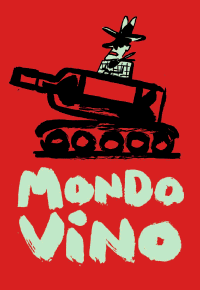
Who has the famous al-Zaidi Bush shoes

Everyone’s clamoring for the shoe heard around the world. The several
Muntadhar al-Zaidimanufacturers who claim to have cobbled the offending black oxfords are deluged in orders. A Saudi man has offered ten million dollars for Muntadhar al-Zaidi’s original pair. But the NYT reports: “Explosives tests by investigators destroyed the offending footwear.” Whaaaaaaaaaaaaat?!

I don’t believe that shit for a minute. If airport security can verify footwear inertness in a few seconds…

Not that a pair of worn leather shoes matters a whit. But there is more than shoe fetish at foot here. And I find something about the fate of this pair of shoes that’s awfully unlike a Skull and Bones man.

Idolatry
The Saudi who offered the king’s ransom for the “Medal of Freedom” shoes, may have been enraptured by idolatry, but he knows the magical allure which those shoes will always possess. How can any of us deny the mystical energy we attribute to baseballs marked by having been hit to home runs? All Americans take, or aspire to take, a pilgrimage to the Smithsonian to see the actual, for real, objects of their common heritage.

Museums of art and natural history, glean an idolatry all their own, but historical collections like the Smithsonian and the British Imperial War Museum, peddle in pure talisman mysticism.

The crown jewels come to mind, or any ordinary person’s diamond. Stones, crystals, runes, coins, fetishes, heirlooms, antiques, personal designer accessories, safety blankets. We swim in stuff which have meaning greater than their utility. Even poor Diogenes had his lantern.

Who are we kidding that mere objects don’t have enormous power over us? I myself keep everything. I frequently feel I’m drowning in remembrances and chanced-upon objects for which I aspire sentiment. Would that I could focus on strength-building empowering articles.

I’m reminded of last year’s sale of a copy of the Magna Carta, was it, to a modern Wall Street robber baron. I was not alone to surmise that he paid 21 million for the now-transgressed compact, probably to wipe his ass with it. As the great white hunters paid their safari guides in hope of being the last to personally vanquish whatever late species was next to be rendered extinct.

The al-Zaidi Shoes
This famous pair of shoes were thrown by Muntadhar al-Zaidi at President Bush, al-Zaidi being the first man to dare show defiance to the US Nero. Although, certain intellectuals do come to mind, for having voiced their discontent with his policies. I remember too, a certain brave Indonesian witch doctor who cast a magic curse on the universally despised Bush. Ki Gendeng Pamungkas placed a jinx to shorten Bush’s stay in Indonesia, it wasn’t a fatal voodoo spell, for that would have been just as illegal as making threats is in the US. I will always believe there must have been countless more who’ve cursed Bush to his face, if prudently under their breath.

But journalist al-Zaidi did the one act above all others. He showed open, physical defiance. At the bottom line, against an imperial oligarchy which dominates the world by military force, it’s the only defiance that really matters. And George Bush knows it.

Once subdued, was it necessary to bludgeon al-Zaidi? He had disarmed himself, and was now completely out of ammo. Was the rough apprehension in any manner appropriate? Everyone in the room had already been checked by security. What was the purpose of beating al-Zaidi in the next room? Or of the torture later?

Regicide
Would-be assassins of kings, in the times of kings, were drawn and quartered, made to suffer excruciating deaths, but their body parts desecrated as well. It wasn’t to insure their mortality.

From a historical perspective, I believe al-Zaidi’s projectile footwear represent an enormously momentous act, even more by being common objects. We all have shoes. And see, shoes have provide a ready aeronautic diversion from the path most taken. A significant number of common citizens can get close enough to our leader to lambast him with their shoes.

Do we approve of him or not? Does he listen to our protestations, or does he laugh them off as our America-given freedoms to disagree?

Is it a mere disagreement we have with Bush over his regime’s genocide, high crimes and theft from the American People?

I’m convinced that al-Zaidi’s shoes had to be drawn and quartered, lest they inspire further acts of bravery from the ranks of Bush’s subjects.

Is it time to throw our shoes? In this divide and conquer feudal age, by design an anti-social world which celebrates the individual lest a community spirit trounce the narcissism imperative to thwart organizing into collectives, a next shoe-thrower would be mocked for being a copy-cat. I can hope that we recognize the humility of extremely diminutive stature. We want to be voracious proponents of social justice, but have tragically impoverished resources, . The struggle against capitalist imperialism will require many foot soldiers. We can’t all be Che and al-Zaidi. We didn’t think to throw our shoes, we won’t be improvisers of the next gesture. For the better part of us, the most effective we can be is follow their lead.

Let’s imagine, for the populist courage they might ignite, that the al-Zaidi shoes were effaced from man’s heritage. Bush has done worse, he’s razed Iraq, cradle of civilization, the untold undiscovered archeological sites, the historic library, I can’t even go on, the losses were unthinkable.

Occult Talisman
Except, this is a man who like his father, and strangely like an odd many in his cabal, came out of the secret “Skull and Bones” club at Yale. The exclusive order was originated by a forefather, who amassed the Bush fortune with help from Hitler by the way, named for the club’s alleged possession of the remains of Sitting Bull. What, was Sitting Bull a famous Yalie? A forefather of modern empire building? Was he a banking/usury supremacist?

Sitting Bull was but one of the fiercest American indian leader to have defied the white man’s global conquest. Of course, it’s not uncommon for warring cannibals to feel that they gather strength from their opponents, even as they’ve defeated them.

The Bushes and their cadre of global elites are also members of Bohemian Grove. As occultist as blue-blood better-than-thous can get. I’ll not assert they celebrate witchcraft, but it’s more pagan than average churchgoers could comfortably countenance. Traditional religions hold it as false idolatry, academia dismisses it as mysticism.

Which brings me to the Lance of Longinus, allegedly the weapon which pierced Jesus’s side to deal the Coup de Grace. Though scholars have traced its existence to only 900 AD, the “Spear of Destiny” retains a tremendous occult allure, in particular the Nazi Third Reich. Other such talisman weapons have been sought by warrior leaders throughout history, as bestowing upon whoever possessed them, divine powers over challengers to their throne.

Let’s face it, since the success of the American industrial and banking driven democracy, in rising to dominate over all its WWII adversaries and allies, our elected leader has become absolute ruler of the known world. It wasn’t our intent, but it’s human nature.

Absolute Power Corrupts
We live again in a world of kings. Of moats, of food tasters, of royal jesters, of showing not just deference but fealty. We live in a world of a leisured class, where right to wealth and privilege is considered hereditary. A birthright to nobility is reinforced even by what we understand of genetics. Men are not created equal. Man at his highest is preordained. It’s no great leap to expect these men will search the firmament for signs to affirm that their supremacy is granted by divinity.

I expect earthly objects which defy a monarch’s impregnability have irresistible personal allure to kings for whom nothing remains but to divine their life’s purpose.

It’s not uncharted territory, there have been global empires before, except the world known to earlier supreme leaders had horizons closer in. Alexander ruled his whole known world. The Roman Emperors did, with the unconquered bits being just so much backwoods. Such leaders had no rivals in trade, power, or wealth. Charlemagne, Ghengis Khan, Shaka Zulu, ruled their entire known realms. While these leaders were empire builders, the related personages less lauded, were their progeny who succumbed to proving Lord Acton’s Dictum that “absolute power corrupts–” Each it seems resolved to challenge the last part “–absolutely.”

Now John Dalberg-Acton’s Essays on Freedom and Power is a scrap of paper I’d be surprised to find enshrined in a megalomaniac’s personal collection of power-emitting talisman keepsake chatchkes.

Black tar heroin bust spoils Cheyenne Mountain High School White Christmas

I’ll admit I was pretty floored when I read that students at Cheyenne Mountain High School — my kids’ school — were busted for using and dealing heroin. Apparently, a hired drug-sniffing dog led police to a locker containing Xanax, an anti-anxiety medication, that hadn’t been prescribed for the locker’s owner. The word is that this kid ratted out his fellow drug-using students. Whether this was an attempt to minimize his crime, or to strike a plea bargain of some kind, I don’t know. I called my college girl with breaking news of the drug busts. “Yeah,” she said, nearly yawning, or so it seemed, “it’s not 25 kids, it’s only 15. I heard the two dealers are facing 7 to 12 and the rest of the kids are being sent to rehab.” With Facebook, news disseminates in real time so my scoop was already old news to her.
Cheyenne-Mountain-High-School-banner

Undeterred, I dropped in on a fellow mother to deliver my bombshell. “Oh, yeah, there’ve been rumors of heroin use at Cheyenne for at least a couple years.” She proceeded to give me the lowdown on two of the alleged dealers.

Okay, everyone knew but me. But let me at least wager a guess about the future: since no drugs were found to be in possession of any student, there’s nothing the school can do to any of the alleged users. Not even a suspension, which is as it should be if due process is honored. I wouldn’t expect much more than hand-wringing from the parents who didn’t notice their children were strung out on heroin. The kids who’ve admitted smoking the stuff will likely be sent to $10,000/week rehab facilities where they can meet Mary Kate Olson or Lindsay Lohan and come back to mini-celebrity status.

The rest of us will distance ourselves from distasteful realities, likely with the full cooperation of teachers, shrinks, and media. One local headline read “D12 students were sold black tar heroin,” not “D12 students bought black tar heroin.” The subtle difference provides us a tiny emotional cushion.

Rather than dealing with the very real problems that plague our community, we’ll continue to emphasize the role of the drug-smuggling “Mexican nationals” in the corruption of our teenagers. Though the media has demonized them repeatedly, no one I’ve talked to knows anything about them, or exactly what a Mexican national is. But, then again, Cheyenne Mountain doesn’t know much about Mexicans in general, or blacks, or Indians that aren’t the school mascot. Come to think of it, we’d also never heard of BLACK TAR heroin. We thought heroin was supposed to be pure and white, like us. In any case, we take only prescription drugs, which is why we hurt for whichever mother had her Xanax jacked, the not-so-shocking incident that started this whole dark chapter.

Food alternatives to the Holy Wafer

chocolate_jesus“It is terrible that Jesus is being wrapped up in gold foil and sold along with chocolate bunnies, edible penguins and lollipops,” said Aegidius Engel, a spokesman for the archbishopric of nearby Paderborn. German churches find ‘chocolate Jesus’ tasteless

Hey! What is it with Jesus and chocolate? Just last year a Chocolate Jesus got kicked out of an art museum in Manhattan. My Sweet Lord soon did return though to life!

These chocolates seem less tasteless to me than the Holy Wafers traditionally served at Church. Maybe a Jesus pizza might be a good business venture since we certainly need more food alternatives to the Holy Wafer! Or for Americans, perhaps a Jesusburger with cheese?

What’s really tasteless about the German chocolate Jesus is that it is made of White chocolate. Yuck! And then there was the Jesus pancake cooked up in Ohio 2 years ago. Couple Claims Jesus Appeared On Pancake And now we enter the Christmas Season!

The new age will be gilded with Bling

bentley-wheel

While the American middle class eventually embraced repudiation of West Egg bad taste in favor of affecting a supposed blue-blood sensibility, the ostentatious nouveau riche carried on. The chasm between rich and poor kept expanding and the economic crisis which now engulfs the world is simultaneously heralding a new gilded age.

Romanticize its sophistication no longer, the new gild is bling.

I saw an uncharacteristically unique convertible the other day, and its shiny rims looked like after-market wheel covers that you might see spinning in place while stopped at the traffic light. It seemed highly improbable that the Gaudi style “B” at the center would have stood for Bentley. Americans rarely catch a glimpse of the plain-wrapper cousin of the Rolls Royce, much less remember it. But overhearing the driver answer an inquiring pedestrian, it turns out the sports car did belong to that otherwise conservative marque.

“Pedestrian” might also describe such a commoner’s question who has to ask “What kind of car is that?”

This particular car belonged to the driver’s wife, I heard him say, who I learned subsequently belonged to the Morley family, local land magnates.

So Bentley has discovered who’s buttering the upper crust these days.

Common America’s boom of prosperity brought vehicles covered in chrome. Even the eventual Ford Thunderbird and the Corvette Stingray were still pretty damn shiny. Meanwhile European sports cars eschewed unpainted metal. German and English models evolved a style which put forward utilitarian function as form. Their lines may have been loud, their paint a high gloss, but their knobs didn’t glitter. Even the most extreme Ferrari or Lamborghini still looks understated next to an urban ride pimped in chrome.

Do we imagine that the gilded age was art directed by Italian designers, or by self-styled age-of-excess capitalist pimps?

100 days until end of Bush Error

Imagine that. The Conservatives refused to provide health care for all, claiming the $50B price tag would bankrupt America. Yet, in the last month or so, the Treasury and the Fed have forked over more than $5T — over 100 times as much — to cover the gambling losses of the filthy-rich. It is clearly way past time for a Second American Revolution!
 
The entire planet has been scammed by the filthy rich. There is nothing on earth that can stop this slow motion economic trainwreck. The derivatives meltdown will cost more than 10 times the entire world’s output. On the up-side, I hear the filthy-rich taste just like chicken!

Paul Krugman wins Nobel Prize in Economic Sciences. This is the guy Obama should make Secretary of the Treasury.

16 newspapers endorsed Obama on Sunday, only 2 for McCain.

Stephanopoulos: No candidate has ever lost with Obama’s lead over McCain. (53-43)

Top GOP strategist Ed Rollins compares McCain’s spectacular campaign failure to Hillary’s.

McCain expected to “hit the panic button” today, since it now looks like he will have a hard time even carrying many of the “red states.”

GOP is just a pseudonym for LIE. “Curveball,” they guy the administration blames all their false Iraq intel on, says he never told them Saddam had WMDs, they made all that crap up themselves. In fact, he never even spoke to the CIA!

The red flag should have been his “faith and family values” campaign. Congressman Tim Mahoney (D-FL) paid his mistress $121,000 to keep her mouth shut about the affair.

There are cannibals in the land. Even ArchNeocon Bill Kristol admits McCain campaign is a joke, and then rabid McCain campaign turns on him. Didn’t someone once say something about “a house divided cannot stand?”

trick-or-treat

Excerpts from Thomas McCullock’s Oct 13 notes, thomasmc.com.

George Saunders on Sarah Palin

Excerpt from “My Gal” by George Saunders, one of my favorite funny but twisted authors.

“Explaining how she felt when John McCain offered her the Vice-Presidential spot, my Vice-Presidential candidate, Governor Sarah Palin, said something very profound: “I answered him ‘Yes’ because I have the confidence in that readiness and knowing that you can’t blink, you have to be wired in a way of being so committed to the mission, the mission that we’re on, reform of this country and victory in the war, you can’t blink. So I didn’t blink then even when asked to run as his running mate.”

Isn’t that so true? I know that many times, in my life, while living it, someone would come up and, because of I had good readiness, in terms of how I was wired, when they asked that—whatever they asked—I would just not blink, because, knowing that, if I did blink, or even wink, that is weakness, therefore you can’t, you just don’t. You could, but no—you aren’t.”

The article devolves into the usual George Saunders weirdness, but it’s worth a few minutes, if for no other reason than to get a taste of Saunders himself! Read the full article in The New Yorker online.

Tent State stole park from DNC demos

Civic Center Park Closed
DENVER- Wednesday was a day of major betrayal of DNC protesters. The Denver park from which demonstrations were being launched was today suddenly completely fenced off OVERNIGHT. Clever move on the part of city. Civic Center Park had been serving as the point of reference for activists who now did not know how to find each other after the convergence center at 38th and Brighton was raided by police. Here’s what happened to the park.

The organizers of “Tent State” had a permit to use Civic Center Park on Wednesday. Since Saturday, Recreate-68 and Unconventional Denver had used it as a rallying point. Two weeks ago Eric Jung of Tent State announced that they would not be using the Wednesday permit. At the last Consulta, R68 organizers asked Jung to relinquish the permit so that others could keep using the park. Jung said he would, but he didn’t. As a result, the city pounced on the chance to begin setting up canopies for the annual Taste of Colorado scheduled for Friday. Have you ever seen a park fair event that wasn’t assembled the same morning of the event? This was a thinly disguised move to leave DNC protesters without a communications hub. Courtesy of Tent State.

Hopefully this will be the last of the many DNC betrayals by Eric and his friend JoJo Pease. They told 5280 magazine that R68’s turnout would be in the double digits, while theirs would number thousands. But Tent State turned out to be more like a pueblo. A camp circle more accurately.

Jojo Pease pleased with delivery of Students For a Democratic Society (SDS)
After the IVAW cross city march I saw Pease bragging about how well their work had gone. The role the two played to destabilize and divide the 2008 DNC efforts should discredit Eric and JoJo from participating in a single important anything else. Damnable degenerates.

If it sounds too good to be true

Human Growth Hormone…it probably is.
 
Jamaica’s Usain Bolt won both the 100-meter and 200-meter sprints in world record time, something that hasn’t been done in 32 years. The Jamaican women, led by Shelly-Ann Fraser, swept the 100-meter race. Today another Jamaican woman, Veronica Campbell-Brown won the 200 meter sprint. A single country winning gold in all four sprints hasn’t happened since the USA did it in 1988.

All this metal begs the question, what the hell is going on with the Jamaican runners?

I’m much too sweet to have a taste for sour grapes, but it seems likely that the Jamaican sprinters are doping. Their current coach’s association with Trevor Graham — a Jamaican silver medalist in 1988 and coach of Beijing silver medalist Shawn Crawford — who recently received a lifetime ban from the sport for helping athletes obtain performance enhancing drugs, further fuels suspicion.

Of course, the Jamaican Track Federation vehemently denies the doping charges pointing out that the athletes have been tested and retested and, according to team doctor, Herb Elliott, remain “ready at any time at any hour to be tested.”

Sounds convincing…NOT. The dopers are always body lengths ahead of the U.S. Anti-Doping agency. It makes no difference how many times you test if you’re not looking for what they’re taking.

There is a Jamaican saying likkle likkle mek nuff nuff. Loosely translated it means “a whole lot of a little bit amounts to a whole lot.” Or, more simply, it all adds up.

Yep, to a whole lot of gold.

Is your hate of Hillary all your own?

Stuart RisdenIf you’re indulging yourself gloating about Hillary’s dashed presidential aspirations, you might consider who’s cheering with you. As the battle for the nomination dragged on, Ms. Clinton faced near universal scorn, whipped up gleefully by all of media-dom. When has the media reported anything that you’ve discovered was truthful? Anything?
 
(Man’s traditional response to threatening women, midwives or healers? They’re witches!)

Unless you have been keeping in touch with Hillary Clinton personally, I would hesitate to say you don’t know if she has been represented objectively. Unless you’ve seen her in person, can you really say if her head’s the size of a pumpkin? Have you seen, heard, felt pangs of intuition that weren’t spun by the waves of an electronic transmission fashioned over an editor’s desk?

I’ve become rather suspicious that Ms. Clinton may have posed the biggest threat to the powers that be, to the beltway and the corporate media, and that’s why she was painted with such dastard derision.

Maybe?

The unanimity and height of disrespect shown in the catty ridicule made of Hillary has an identical scent really of an earlier smear campaign, the ulterior motives now well documented, against the embarrassment “beyond words” of Hillary’s First Husband, Bill.

President Clinton was too centrist for my taste, but it turns out he made some inroads for the people even despite being mostly thwarted by the corporate multinationals and the bankers.

Was the combined Clinton battle experience going to be crucial facing the still predominantly neoconservative-crony Washington establishment? The DC heavyweights are criminals and profiteers to the last, do we expect them to invite a reformer into the White House?

As much as they hated the Clintons, and Hillary Clinton in her own right, the power brokers appear to be smitten by Barack Obama. What does that say to you?

Some think it’s a sign that everyone’s ready for change. Some think the Republicans are content to let a Democrat be left to pick up Bush’s pieces. A friend of mine quotes T. S. Eliot:

“An election is coming. Universal peace is declared and the foxes have a sincere interest in prolonging the lives of the poultry.”

I think the vociferous appetite the Neocons have shown in devouring America’s treasury at the expense of the middle class indicates they don’t intend to leave even a piece until it’s in their bank account. The bad guys are not through. In these days of irradiation, they do not need their poultry kept live.

The media favoritism of Barack over Hillary says to me, they’ll abide a black man on their porch because they have no intention of letting him inside. They can serenade him even, confident they can excuse their ultimate inhospitality on the Appalachian problem. If American voters prove more progressive than they want, Diebold’s blackboxes will smite our great last hope.

Republican McCain has been criticized by none of the press. With Hillary out of the way, the press has already started to unleash on Obama, and will now be now free to lavish the erstwhile witch with the affection they now display for her term-limited husband.

America’s masters needed one heck of a ringer to face the Bush blow-back. A presumptive presumptuous first black president will prove just the straw man they need. Even the most cynical voter will not be surprised that white America is not ready to elect a black president.

All that hoopla about Obama needing to distance himself from his pastor’s unpatriotic rants was very telling. Do you remember Reverend Wright’s chief focus? God Damn America, yes, but his chief refrain? America’s racism. White America doesn’t want to believe it is racist, but it doesn’t make it any less true.

Apparently racism is gone if we want it gone. To decry its persistence is to break the self-hypnotic spell and bring racism back. Blame the messenger apparently.

It is not racist to predict that Obama faces entrenched racism. It would be swell to think America is otherwise, and the media would love for us to believe it. But they and the lobbyists and their owners Big Pharma, Big Agra, Big Oil, the financiers and the war machine are banking on McCain.

Go Vegie!

Vegetarianism is not for everybody, but it would be a great thing if it was the in thing for most of us. Too bad that in America, the vegetables and fruits available to buy are most often pathetic things, costly, and even rotten at times. The factory farm model of production just is not very appetizing, and many turn to fat, artificial colors, and chemicals to try to get some ´taste´in what they eat. Instead, we get health problems that slowly waste many of us away. Here are the Top Ten Reasons to Go Vegetarian During World Vegetarian Week (May 19-25)

We should certainly try to stop killing ourselves and our families though buying and eating so much poor quality meat products. Complete vegetarianism (even partial vegetarianism) is a good target goal for us to strive for.