RECREATE 68 -No more politics as usual

Recreate-68 logoFrom RECREATE 68:
End the Occupations March and Rally — West Steps of the Colorado State Capitol, August 24, 9am
END THE OCCUPATIONS
No more free pass for the Democrats. Join R68 and others as we march to end all illegal imperialist occupations in Iraq, Palestine, Afghanistan, Puerto Rico, Haiti, Hawaii, North America, and others. The Dems have the power to put an end to the United States’ illegal colonizations and wars, but they will not without pressure from the people. Join us as we create that pressure.
NO MORE! NOT IN OUR NAME! BRING THE TROOPS HOME NOW!
The March will begin at the WEST STEPS OF THE CAPITOL and end on Speer Blvd in front of the Pepsi Center.

MORE OF R68’s SCHEDULE:
Freedom March — Civic Center Park, August 25, 10am

Join supporters of Leonard Peltier, Mumia Abu Jamal, The Cuban Five, and other political prisoners for the Freedom March and Rally! Leonard Peltier’s parole hearing will take place in 2008. Let us not forget that the Clintons left him in jail and did not pardon him. Free Mumia, the Cuban Five, the Guantanamo detainees, and others. The march will begin at Civic Center Park and end with a rally at the Federal Court House.

Shake Your Money Maker — Denver Mint, August 25, 5pm

It’s time to redistribute the wealth. Between security and corporate pay-offs, the DNC will cost over 100 million dollars for a party. We think the people deserve that money. Join us as we encircle the Denver MInt (where U.S. currency is produced) and use our collective power to raise the mint building in the air and shake the money out of it for the people. Don’t forget a sack to put all of your loot in.

Bring noise makers, energy, spells, magic, costumes, anything that gives you power. We’ll need it!

Days of Resistance — August 24-28

During the convention, there will be five major protests, one each day. Each protest will focus on a symptom of the disease of an imperialist, capitalist, racist system as seen in our communities. Some of the proposed themes are as follows:

Sunday – End All Occupations at Home and Abroad
Monday – Human Rights/Free All Political Prisoners
Tuesday – No Borders
Wednesday – No Warming
Thursday – No Racism/Imperialism

Festival of Democracy — Civic Center Park and Skyline Park, August 24-28

The Festival of Democracy will be a five day event running in conjunction with the DNC Convention. The Festival of Democracy will include free music and performing arts, free food, and free institution building and political training. The purpose will be to share some fun and to work towards the development of programs and networks that will address our community problems ourselves, without relying on the two party capitalist system. We will also be offering a 24 hour free medical clinic for all community members to receive free health care.

MONDAY, AUGUST 25 — Civic Center Park
TUESDAY, AUGUST 26 — Civic Center Park
WEDNESDAY, AUGUST 27 — Skyline Park
THURSDAY, AUGUST 28 — Skyline Park

Kids make an offer Denver must refuse

DNC Disruption 2008Recreate 68’s anarchist faction, the younger protest participants represented by Unconventional Denver, got their unviolent say in a RMN article today: Anarchists promise to sit out DNC. They offered to halt their DNC disruption efforts if the City of Denver would spend its 50 million dollar security grant on social problems instead. It’s an offer Denver cannot accept, but in making it, the anarchist activists were able to spell out why they object to the Democratic Party’s business as usual, and what social change they would like to see. Nothing extreme about it.

Here is the UNCONVENTIONAL DENVER Call to Action:

The Queen City is heating up as anarchists, witches, clowns, Iraq vets, artists, SDSers, radical queers, immigrants, Earth First!ers, rebel Democrats, parents, precarious workers and others are making it known that, come August, the Democrats’ attempt at co-opting our energies and power will fall short as we make it clear that change will come from below not above, in the streets and not in their stadiums.

Here’s the latest call to action from Unconventional Denver to help maximize our impact this August.

sunday the 24th { RECLAIM THE STREETS. RESIST MILITARIZATION}
Late Afternoon: After the 10:00am Recreate 68 anti-war march and the early afternoon Alliance for Real Democracy Funk the War celebration, a raging party in resistance to the militarized occupation of Denver and the world will reclaim public space and spread the festivities onto the streets. Be ready to take the rowdy celebration to the doorsteps of delegate hotels etc.

monday the 25th { NO BUSINESS AS USUAL}
Evening: Meet at the Civic Center at 6pm to join the anticapitalist march or participate in organized and decentralized actions that will actively disrupt the capitalist corruption and cronyism of the two party system by targeting specific fundraisers, delegate parties and corporations backing the DNC. come ready for quick decentralized actions spanning the downtown area at a variety of risk levels.

tuesday the 26th { CONFRONT THE SPECTACLE}
Afternoon: As delegates are arriving at the Pepsi Center, snake marches will converge on the entrances through the fence of the no-protest zone in order to create spaces for different levels of delegate movement disruption. Flying squads will assist the disruption and create distractions as we bring their party to a halt.

wednesday the 27th { ECO ACTIONS AND ALTERNATIVES}
All day: direct action against ecological destruction. We will create solutions to global warming without the politicians by shutting down sources of greenhouse gas emissions and corporations who destroy the earth (and fund the Democrats). we will also engage in creative resistance outlining solutions and alternatives; bike bloc! car free zones! guerrilla gardening!

thursday the 28th { NO BORDERS. NO ONE IS ILLEGAL}
Morning: Join this national mobilization for immigrants rights and help us draw connections between the struggles of immigrant communities and the struggle against global capitalism. Meet at Rude Park at 10:30am. This will be a low-risk event safe for all people regardless of immigration status. so play nice.
E X A C T T I M E S A N D L O C AT I O N S T B A .
S TAY T U N E D F O R M O R E I N F O

Global economic rapists are at it again

G8 protest
Why protest the G8 Summit July 7-9? Those hoodlums always look so determined. Here’s the rationale by the Emergency Exit Collective:

The 2008 G8 on Hokkaido, a Strategic Assessment
Emergency Exit Collective
Bristol, Mayday, 2008

The authors of this document are a collection of activists, scholars, and writers currently based in the United States and Western Europe who have gotten to know and work with each other in the movement against capitalist globalization. We’re writing this at the request of some members of No! G8 Action Japan, who asked us for a broad strategic analysis of the state of struggle as we see it, and particularly, of the role of the G8, what it represents, the dangers and opportunities that may lie hidden in the moment. It is in no sense programmatic. Mainly, it is an attempt to develop tools that we hope will be helpful for organizers, or for anyone engaged in the struggle against global capital.

I
It is our condition as human beings that we produce our lives in common.

II
Let us then try to see the world from the perspective of the planet’s commoners, taking the word in that sense: those whose most essential tradition is cooperation in the making and maintenance of human social life, yet who have had to do so under conditions of suffering and separation; deprived, ignored, devalued, divided into hierarchies, pitted against each other for our very physical survival. In one sense we are all commoners. But it’s equally true that just about everyone, at least in some ways, at some points, plays the role of the rulers—of those who expropriate, devalue and divide—or at the very least benefits from such divisions.

Obviously some do more than others. It is at the peak of this pyramid that we encounter groups like the G8.

III
The G8’s perspective is that of the aristocrats, the rulers: those who command and maintain that global machinery of violence that defends existing borders and lines of separation: whether national borders with their detention camps for migrants, or property regimes, with their prisons for the poor. They live by constantly claiming title to the products of others collective creativity and labour, and in thus doing they create the poor; they create scarcity in the midst of plenty, and divide us on a daily basis; they create financial districts that loot resources from across the world, and in thus doing they turn the spirit of human creativity into a spiritual desert; close or privatize parks, public water taps and libraries, hospitals, youth centers, universities, schools, public swimming pools, and instead endlessly build shopping malls that channels convivial life into a means of commodity circulation; work toward turning global ecological catastrophe into business opportunities.

These are the people who presume to speak in the name of the “international community” even as they hide in their gated communities or meet protected by phalanxes of riot cops. It is critical to bear in mind that the ultimate aim of their policies is never to create community but to introduce and maintain divisions that set common people at each other’s throats. The neoliberal project, which has been their main instrument for doing so for the last three decades, is premised on a constant effort either to uproot or destroy any communal or democratic system whereby ordinary people govern their own affairs or maintain common resources for the common good, or, to reorganize each tiny remaining commons as an isolated node in a market system in which livelihood is never guaranteed, where the gain of one community must necessarily be at the expense of others. Insofar as they are willing to appeal to high-minded principles of common humanity, and encourage global cooperation, only and exactly to the extent that is required to maintain this system of universal competition.

IV
At the present time, the G8—the annual summit of the leaders of “industrial democracies”—is the key coordinative institution charged with the task of maintaining this neoliberal project, or of reforming it, revising it, adapting it to the changing condition of planetary class relations. The role of the G8 has always been to define the broad strategic horizons through which the next wave of planetary capital accumulation can occur. This means that its main task is to answer the question of how 3?4 in the present conditions of multiple crises and struggles 3?4 to subordinate social relations among the producing commoners of the planet to capital’s supreme value: profit.

V
Originally founded as the G7 in 1975 as a means of coordinating financial strategies for dealing with the ‘70s energy crisis, then expanded after the end of the Cold War to include Russia, its currently face a moment of profound impasse in the governance of planetary class relations: the greatest since the ‘70s energy crisis itself.

VI
The ‘70s energy crisis represented the final death-pangs of what might be termed the Cold War settlement, shattered by a quarter century of popular struggle. It’s worth returning briefly to this history.

The geopolitical arrangements put in place after World War II were above all designed to forestall the threat of revolution. In the immediate wake of the war, not only did much of the world lie in ruins, most of world’s population had abandoned any assumption about the inevitability of existing social arrangements. The advent of the Cold War had the effect of boxing movements for social change into a bipolar straightjacket. On the one hand, the former Allied and Axis powers that were later to unite in the G7 (the US, Canada, UK, France, Italy, Germany, Japan)—the “industrialized democracies”, as they like to call themselves—engaged in a massive project of co-optation. Their governments continued the process, begun in the ‘30s, of taking over social welfare institutions that had originally been created by popular movements (from insurance schemes to public libraries), even to expand them, on condition that they now be managed by state-appointed bureaucracies rather than by those who used them, buying off unions and the working classes more generally with policies meant to guarantee high wages, job security and the promise of educational advance—all in exchange for political loyalty, productivity increases and wage divisions within national and planetary working class itself. The Sino-Soviet bloc—which effectively became a kind of junior partner within the overall power structure, and its allies remained to trap revolutionary energies into the task of reproducing similar bureaucracies elsewhere. Both the US and USSR secured their dominance after the war by refusing to demobilize, instead locking the planet in a permanent threat of nuclear annihilation, a terrible vision of absolute cosmic power.

VII
Almost immediately, though, this arrangement was challenged by a series of revolts from those whose work was required to maintain the system, but who were, effectively, left outside the deal: first, peasants and the urban poor in the colonies and former colonies of the Global South, next, disenfranchised minorities in the home countries (in the US, the Civil Rights movement, then Black Power), and finally and most significantly, by the explosion of the women’s movement of the late ‘60s and early ‘70s—the revolt of that majority of humanity whose largely unremunerated labor made the very existence “the economy” possible. This appears to have been the tipping point.

VIII
The problem was that the Cold War settlement was never meant to include everyone. It by definition couldn’t. Once matters reached tipping point, then, the rulers scotched the settlement. All deals were off. The oil shock was first edge of the counter-offensive, breaking the back of existing working class organizations, driving home the message that there was nothing guaranteed about prosperity. Under the aegis of the newly hatched G7, this counter-offensive involved a series of interwoven strategies that were later to give rise to what is known as neoliberalism.

IX
These strategies resulted in what came to be known as “Structural Adjustment” both in the North and in the South, accompanied by trade and financial liberalization. This, in turn, made possible crucial structural changes in our planetary production in common extending the role of the market to discipline our lives and divide us into more and more polarized wage hierarchy. This involved:

· In the immediate wake of ‘70s oil shock, petrodollars were recycled from OPEC into Northern banks that then lent them, at extortionate rates of interest, to developing countries of the Global South. This was the origin of the famous “Third World Debt Crisis.” The existence of this debt allowed institutions like the IMF to impose its monetarist orthodoxy on most of the planet for roughly twenty years, in the process, stripping away most of even those modest social protections that had been won by the world’s poor—large numbers of whom were plunged into a situation of absolute desperation.

· It also opened a period of new enclosures through the capitalist imposition of structural adjustment policies, manipulation of environmental and social catastrophes like war, or for that matter through the authoritarian dictates of “socialist” regimes. Through such means, large sections of the world’s population have over the past thirty years been dispossessed from resources previously held in common, either by dint of long traditions, or as the fruits of past struggles and past settlements.

· Through financial deregulation and trade liberalization, neoliberal capital, which emerged from the G7 strategies to deal with the 1970s crisis aimed thus at turning the “class war” in communities, factories, offices, streets and fields against the engine of competition, into a planetary “civil war”, pitting each community of commoners against every other community of commoners.

· Neoliberal capital has done this by imposing an ethos of “efficiency” and rhetoric of “lowering the costs of production” applied so broadly that mechanisms of competition have come to pervade every sphere of life. In fact these terms are euphemisms, for a more fundamental demand: that capital be exempt from taking any reduction in profit to finance the costs of reproduction of human bodies and their social and natural environments (which it does not count as costs) and which are, effectively, “exernalized” onto communities and nature.

· The enclosure of resources and entitlements won in previous generations of struggles both in the North and the South, in turn, created the conditions for increasing the wage hierarchies (both global and local), by which commoners work for capital—wage hierarchies reproduced economically through pervasive competition, but culturally, through male dominance, xenophobia and racism. These wage gaps, in turn, made it possible to reduce the value of Northern workers’ labour power, by introducing commodities that enter in their wage basket at a fraction of what their cost might otherwise have been. The planetary expansion of sweatshops means that American workers (for example) can buy cargo pants or lawn-mowers made in Cambodia at Walmart, or buy tomatoes grown by undocumented Mexican workers in California, or even, in many cases, hire Jamaican or Filipina nurses to take care of children and aged grandparents at such low prices, that their employers have been able to lower real wages without pushing most of them into penury. In the South, meanwhile, this situation has made it possible to discipline new masses of workers into factories and assembly lines, fields and offices, thus extending enormously capital’s reach in defining the terms—the what, the how, the how much—of social production.

· These different forms of enclosures, both North and South, mean that commoners have become increasingly dependent on the market to reproduce their livelihoods, with less power to resist the violence and arrogance of those whose priorities is only to seek profit, less power to set a limit to the market discipline running their lives, more prone to turn against one another in wars with other commoners who share the same pressures of having to run the same competitive race, but not the same rights and the same access to the wage. All this has meant a generalized state of precarity, where nothing can be taken for granted.

X
In turn, this manipulation of currency and commodity flows constituting neoliberal globalization became the basis for the creation of the planet’s first genuine global bureaucracy.

· This was multi-tiered, with finance capital at the peak, then the ever-expanding trade bureaucracies (IMF, WTO, EU, World Bank, etc), then transnational corporations, and finally, the endless varieties of NGOs that proliferated throughout the period—almost all of which shared the same neoliberal orthodoxy, even as they substituted themselves for social welfare functions once reserved for states.

· The existence of this overarching apparatus, in turn, allowed poorer countries previously under the control of authoritarian regimes beholden to one or another side in the Cold War to adopt “democratic” forms of government. This did allow a restoration of formal civil liberties, but very little that could really merit the name of democracy (the rule of the “demos”, i.e., of the commoners). They were in fact constitutional republics, and the overwhelming trend during the period was to strip legislatures, that branch of government most open to popular pressure, of most of their powers, which were increasingly shifted to the executive and judicial branches, even as these latter, in turn, largely ended up enacting policies developed overseas, by global bureaucrats.

· This entire bureaucratic arrangement was justified, paradoxically enough, by an ideology of extreme individualism. On the level of ideas, neoliberalism relied on a systematic cooptation of the themes of popular struggle of the ‘60s: autonomy, pleasure, personal liberation, the rejection of all forms of bureaucratic control and authority. All these were repackaged as the very essence of capitalism, and the market reframed as a revolutionary force of liberation.

· The entire arrangement, in turn, was made possible by a preemptive attitude towards popular struggle. The breaking of unions and retreat of mass social movements from the late ‘70s onwards was only made possible by a massive shift of state resources into the machinery of violence: armies, prisons and police (secret and otherwise) and an endless variety of private “security services”, all with their attendant propaganda machines, which tended to increase even as other forms of social spending were cut back, among other things absorbing increasing portions of the former proletariat, making the security apparatus an increasingly large proportion of total social spending. This approach has been very successful in holding back mass opposition to capital in much of the world (especially West Europe and North America), and above all, in making it possible to argue there are no viable alternatives. But in doing so, has created strains on the system so profound it threatens to undermine it entirely.

XI
The latter point deserves elaboration. The element of force is, on any number of levels, the weak point of the system. This is not only on the constitutional level, where the question of how to integrate the emerging global bureaucratic apparatus, and existing military arrangements, has never been resolved. It is above all an economic problem. It is quite clear that the maintenance of elaborate security machinery is an absolute imperative of neoliberalism. One need only observe what happened with the collapse of the Soviet bloc in Eastern Europe: where one might have expected the Cold War victors to demand the dismantling of the army, secret police and secret prisons, and to maintain and develop the existing industrial base, in fact, what they did was absolutely the opposite: in fact, the only part of the industrial base that has managed fully to maintain itself has been the parts required to maintained the security apparatus itself! Critical too is the element of preemption: the governing classes in North America, for example, are willing to go to almost unimaginable lengths to ensure social movements never feel they are accomplishing anything. The current Gulf War is an excellent example: US military operations appear to be organized first and foremost to be protest-proof, to ensure that what happened in Vietnam (mass mobilization at home, widespread revolt within the army overseas) could never be repeated. This means above all that US casualties must always be kept to a minimum. The result are rules of engagement, and practices like the use of air power within cities ostensibly already controlled by occupation forces, so obviously guaranteed to maximize the killing of innocents and galvanizing hatred against the occupiers that they ensure the war itself cannot be won. Yet this approach can be taken as the very paradigm for neoliberal security regimes. Consider security arrangements around trade summits, where police are so determined prevent protestors from achieving tactical victories that they are often willing to effectively shut down the summits themselves. So too in overall strategy. In North America, such enormous resources are poured into the apparatus of repression, militarization, and propaganda that class struggle, labor action, mass movements seem to disappear entirely. It is thus possible to claim we have entered a new age where old conflicts are irrelevant. This is tremendously demoralizing of course for opponents of the system; but those running the system seem to find that demoralization so essential they don’t seem to care that the resultant apparatus (police, prisons, military, etc) is, effectively, sinking the entire US economy under its dead weight.

XII
The current crisis is not primarily geopolitical in nature. It is a crisis of neoliberalism itself. But it takes place against the backdrop of profound geopolitical realignments. The decline of North American power, both economic and geopolitical has been accompanied by the rise of Northeast Asia (and to a increasing extent, South Asia as well). While the Northeast Asian region is still divided by painful Cold War cleavages—the fortified lines across the Taiwan straits and at the 38th parallel in Korea…—the sheer realities of economic entanglement can be expected to lead to a gradual easing of tensions and a rise to global hegemony, as the region becomes the new center of gravity of the global economy, of the creation of new science and technology, ultimately, of political and military power. This may, quite likely, be a gradual and lengthy process. But in the meantime, very old patterns are rapidly reemerging: China reestablishing relations with ancient tributary states from Korea to Vietnam, radical Islamists attempting to reestablish their ancient role as the guardians of finance and piety at the in the Central Asian caravan routes and across Indian Ocean, every sort of Medieval trade diaspora reemerging… In the process, old political models remerge as well: the Chinese principle of the state transcending law, the Islamic principle of a legal order transcending any state. Everywhere, we see the revival too of ancient forms of exploitation—feudalism, slavery, debt peonage—often entangled in the newest forms of technology, but still echoing all the worst abuses of the Middle Ages. A scramble for resources has begun, with US occupation of Iraq and saber-rattling throughout the surrounding region clearly meant (at least in part) to place a potential stranglehold the energy supply of China; Chinese attempts to outflank with its own scramble for Africa, with increasing forays into South America and even Eastern Europe. The Chinese invasion into Africa (not as of yet at least a military invasion, but already involving the movement of hundreds of thousands of people), is changing the world in ways that will probably be felt for centuries. Meanwhile, the nations of South America, the first victims of the “Washington consensus” have managed to largely wriggle free from the US colonial orbit, while the US, its forces tied down in the Middle East, has for the moment at least abandoned it, is desperately struggling to keep its grip Mexico, Central America and the Caribbean—its own “near abroad”.

XIII
In another age all this might have led to war—that is, not just colonial occupations, police actions, or proxy wars (which are obviously already taking place), but direct military confrontations between the armies of major powers. It still could; accidents happen; but there is reason to believe that, when it comes to moments of critical decision, the loyalties of the global elites are increasingly to each other, and not to the national entities for whom they claim to speak. There is some compelling evidence for this.

Take for example when the US elites panicked at the prospect of the massive budget surpluses of the late 1990s. As Alan Greenspan, head of the Federal Reserve at the time warned, if these were allowed to stand they would have flooded government coffers with so many trillions of dollars that it could only have lead to some form of creeping socialism, even, he predicted, to the government acquiring “equity stakes” in key US corporations. The more excitable of capitalism’s managers actually began contemplating scenarios where the capitalist system itself would be imperiled. The only possible solution was massive tax cuts; these were duly enacted, and did indeed manage to turn surpluses into enormous deficits, financed by the sale of treasury bonds to Japan and China. Conditions have thus now reached a point where it is beginning to look as if the most likely long term outcome for the US (its technological and industrial base decaying, sinking under the burden of its enormous security spending) will be to end up serve as junior partner and military enforcer for East Asia capital. Its rulers, or at least a significant proportion of them, would prefer to hand global hegemony to the rulers of China (provided the latter abandon Communism) than to return to any sort of New Deal compromise with their “own” working classes.

A second example lies in the origins of what has been called the current “Bretton Woods II” system of currency arrangements, which underline a close working together of some “surplus” and “deficit” countries within global circuits. The macroeconomic manifestation of the planetary restructuring outlined in XIX underlines both the huge US trade deficit that so much seem to worry many commentators, and the possibility to continually generate new debt instruments like the one that has recently resulted in the sub-prime crisis. The ongoing recycling of accumulated surplus of countries exporting to the USA such as China and oil producing countries is what has allowed financiers to create new credit instruments in the USA. Hence, the “deal” offered by the masters in the United States to its commoners has been this: ‘you, give us a relative social peace and accept capitalist markets as the main means through which you reproduce your own livelihoods, and we will give you access to cheaper consumption goods, access to credit for buying cars and homes, and access to education, health, pensions and social security through the speculative means of stock markets and housing prices.’ Similar compromises were reached in all the G8 countries.

Meanwhile, there is the problem of maintaining any sort of social peace with the hundreds of millions of unemployed, underemployed, dispossessed commoners currently swelling the shanty-towns of Asia, Africa, and Latin America as a result of ongoing enclosures (which have speeded up within China and India in particular, even as “structural adjustment policies” in Africa and Latin America have been derailed). Any prospect of maintaining peace in these circumstances would ordinarily require either extremely high rates of economic growth—which globally have not been forthcoming, since outside of China, growth rates in the developing world have been much lower than they were in the ‘50s, ‘60s, or even ‘70s—or extremely high levels of repression, lest matters descend into rebellion or generalized civil war. The latter has of course occurred in many parts of the world currently neglected by capital, but in favored regions, such as the coastal provinces of China, or “free trade” zones of India, Egypt, or Mexico, commoners are being offered a different sort of deal: industrial employment at wages that, while very low by international standards, are still substantially higher than anything currently obtainable in the impoverished countryside; and above all the promise, through the intervention of Western markets and (privatized) knowledge, of gradually improving conditions of living. While over the least few years wages in many such areas seem to be growing, thanks to the intensification of popular struggles, such gains are inherently vulnerable: the effect of recent food inflation has been to cut real wages back dramatically—and threaten millions with starvation.

What we really want to stress here, though, is that the long-term promise being offered to the South is just as untenable as the idea that US or European consumers can indefinitely expand their conditions of life through the use of mortgages and credit cards.

What’s being offered the new dispossessed is a transposition of the American dream. The idea is that the lifestyle and consumption patterns of existing Chinese, Indian, or Brazilian or Zambian urban middle classes (already modeled on Northern ones) will eventually become available to the children of today’s miners, maquila or plantation laborers, until, ultimately, everyone on earth is brought up to roughly the same level of consumption. Put in these terms, the argument is absurd. The idea that all six billion of us can become “middle class” is obviously impossible. First of all there is a simple problem of resources. It doesn’t matter how many bottles we recycle or how energy efficient are the light bulbs we use, there’s just no way the earth’s ecosystem can accommodate six billion people driving in private cars to work in air-conditioned cubicles before periodically flying off to vacation in Acapulco or Tahiti. To maintain the style of living and producing in common we now identify with “middle classness” on a planetary scale would require several additional planets.

This much has been pointed out repeatedly. But the second point is no less important. What this vision of betterment ultimately proposes is that it would be possible to build universal prosperity and human dignity on a system of wage labor. This is fantasy. Historically, wages are always the contractual face for system of command and degradation, and a means of disguising exploitation: expressing value for work only on condition of stealing value without work— and there is no reason to believe they could ever be anything else. This is why, as history has also shown, human beings will always avoid working for wages if they have any other viable option. For a system based on wage labor to come into being, such options must therefore be made unavailable. This in turn means that such systems are always premised on structures of exclusion: on the prior existence of borders and property regimes maintained by violence. Finally, historically, it has always proved impossible to maintain any sizeable class of wage-earners in relative prosperity without basing that prosperity, directly or indirectly, on the unwaged labor of others—on slave-labor, women’s domestic labor, the forced labor of colonial subjects, the work of women and men in peasant communities halfway around the world—by people who are even more systematically exploited, degraded, and immiserated. For that reason, such systems have always depended not only on setting wage-earners against each other by inciting bigotry, prejudice, hostility, resentment, violence, but also by inciting the same between men and women, between the people of different continents (“race”), between the generations.

From the perspective of the whole, then, the dream of universal middle class “betterment” must necessarily be an illusion constructed in between the Scylla of ecological disaster, and the Charybdis of poverty, detritus, and hatred: precisely, the two pillars of today’s strategic impasse faced by the G8.

XIV
How then do we describe the current impasse of capitalist governance?

To a large degree, it is the effect of a sudden and extremely effective upswing of popular resistance—one all the more extraordinary considering the huge resources that had been invested in preventing such movements from breaking out.

On the one hand, the turn of the millennium saw a vast and sudden flowering of new anti-capitalist movements, a veritable planetary uprising against neoliberalism by commoners in Latin America, India, Africa, Asia, across the North Atlantic world’s former colonies and ultimately, within the cities of the former colonial powers themselves. As a result, the neoliberal project lies shattered. What came to be called the “anti-globalization” movement took aim at the trade bureaucracies—the obvious weak link in the emerging institutions of global administration—but it was merely the most visible aspect of this uprising. It was however an extraordinarily successful one. Not only was the WTO halted in its tracks, but all major trade initiatives (MAI, FTAA…) scuttled. The World Bank was hobbled and the power of the IMF over most of the world’s population, effectively, destroyed. The latter, once the terror of the Global South, is now a shattered remnant of its former self, reduced to selling off its gold reserves and desperately searching for a new global mission.

In many ways though spectacular street actions were merely the most visible aspects of much broader changes: the resurgence of labor unions, in certain parts of the world, the flowering of economic and social alternatives on the grassroots levels in every part of the world, from new forms of direct democracy of indigenous communities like El Alto in Bolivia or self-managed factories in Paraguay, to township movements in South Africa, farming cooperatives in India, squatters’ movements in Korea, experiments in permaculture in Europe or “Islamic economics” among the urban poor in the Middle East. We have seen the development of thousands of forms of mutual aid association, most of which have not even made it onto the radar of the global media, often have almost no ideological unity and which may not even be aware of each other’s existence, but nonetheless share a common desire to mark a practical break with capitalism, and which, most importantly, hold out the prospect of creating new forms of planetary commons that can—and in some cases are—beginning to knit together to provide the outlines of genuine alternative vision of what a non-capitalist future might look like.

The reaction of the world’s rulers was predictable. The planetary uprising had occurred during a time when the global security apparatus was beginning to look like it lacked a purpose, when the world threatened to return to a state of peace. The response—aided of course, by the intervention of some of the US’ former Cold War allies, reorganized now under the name of Al Qaeda—was a return to global warfare. But this too failed. The “war on terror”—as an attempt to impose US military power as the ultimate enforcer of the neoliberal model—has collapsed as well in the face of almost universal popular resistance. This is the nature of their “impasse”.

At the same time, the top-heavy, inefficient US model of military capitalism—a model created in large part to prevent the dangers of social movements, but which the US has also sought to export to some degree simply because of its profligacy and inefficiency, to prevent the rest of the world from too rapidly overtaking them—has proved so wasteful of resources that it threatens to plunge the entire planet into ecological and social crisis. Drought, disaster, famines, combine with endless campaigns of enclosure, foreclosure, to cast the very means of survival—food, water, shelter—into question for the bulk of the world’s population.

XV
In the rulers’ language the crisis understood, first and foremost, as a problem of regulating cash flows, of reestablishing, as they like to put it, a new “financial architecture”. Obviously they are aware of the broader problems. Their promotional literature has always been full of it. From the earliest days of the G7, through to the days after the Cold War, when Russia was added as a reward for embracing capitalism, they have always claimed that their chief concerns include

· the reduction of global poverty

· sustainable environmental policies

· sustainable global energy policies

· stable financial institutions governing global trade and currency transactions

If one were to take such claims seriously, it’s hard to see their overall performance as anything but a catastrophic failure. At the present moment, all of these are in crisis mode: there are food riots, global warming, peak oil, and the threat of financial meltdown, bursting of credit bubbles, currency crises, a global credit crunch. [**Failure on this scale however, opens opportunities for the G8 themselves, as summit of the global bureaucracy, to reconfigure the strategic horizon. Therefore, it’s always with the last of these that they are especially concerned. ]The real problem, from the perspective of the G8, is one of reinvestment: particularly, of the profits of the energy sector, but also, now, of emerging industrial powers outside the circle of the G8 itself. The neoliberal solution in the ‘70s had been to recycle OPEC’s petrodollars into banks that would use it much of the world into debt bondage, imposing regimes of fiscal austerity that, for the most part, stopped development (and hence, the emergence potential rivals) in its tracks. By the ‘90s, however, much East Asia in particular had broken free of this regime. Attempts to reimpose IMF-style discipline during the Asian financial crisis of 1997 largely backfired. So a new compromise was found, the so-called Bretton Woods II: to recycle the profits from the rapidly expanding industrial economies of East Asia into US treasury debt, artificially supporting the value of the dollar and allowing a continual stream of cheap exports that, aided by the US housing bubble, kept North Atlantic economies afloat and buy off workers there with cheap oil and even cheaper consumer goods even as real wages shrank. This solution however soon proved a temporary expedient. Bush regime’s attempt to lock it in by the invasion of Iraq, which was meant to lead to the forced privatization of Iraqi oil fields, and, ultimately, of the global oil industry as a whole, collapsed in the face of massive popular resistance (just as Saddam Hussein’s attempt to introduce neoliberal reforms in Iraq had failed when he was still acting as American deputy in the ‘90s). Instead, the simultaneous demand for petroleum for both Chinese manufacturers and American consumers caused a dramatic spike in the price of oil. What’s more, rents from oil and gas production are now being used to pay off the old debts from the ‘80s (especially in Asia and Latin America, which have by now paid back their IMF debts entirely), and—increasingly—to create state-managed Sovereign Wealth Funds that have largely replaced institutions like the IMF as the institutions capable of making long-term strategic investments. The IMF, purposeless, tottering on the brink of insolvency, has been reduced to trying to come up with “best practices” guidelines for fund managers working for governments in Singapore, Seoul, and Abu Dhabi.

There can be no question this time around of freezing out countries like China, India, or even Brazil. The question for capital’s planners, rather, is how to channel these new concentrations of capital in such a way that they reinforce the logic of the system instead of undermining it.

XVI
How can this be done? This is where appeals to universal human values, to common membership in an “international community” come in to play. “We all must pull together for the good of the planet,” we will be told. The money must be reinvested “to save the earth.”

To some degree this was always the G8 line: this is a group has been making an issue of climate change since 1983. Doing so was in one sense a response to the environmental movements of the ‘70s and ‘80s. The resultant emphasis on biofuels and “green energy” was from their point of view, the perfect strategy, seizing on an issue that seemed to transcend class, appropriating ideas and issues that emerged from social movements (and hence coopting and undermining especially their radical wings), and finally, ensuring such initiatives are pursued not through any form of democratic self-organization but “market mechanisms”—to effective make the sense of public interest productive for capitalism.

What we can expect now is a two-pronged attack. On the one hand, they will use the crisis to attempt to reverse the gains of past social movements: to put nuclear energy back on the table to deal with the energy crisis and global warming, or genetically modified foods to deal with the food crisis. Prime Minister Fukuda, the host of the current summit, for example, is already proposing the nuclear power is the “solution” to the global warming crisis, even as the German delegation resists. On the other, and even more insidiously, they will try once again to co-opt the ideas and solutions that have emerged from our struggles as a way of ultimately undermining them. Appropriating such ideas is simply what rulers do: the bosses brain is always under the workers’ hat. But the ultimate aim is to answer the intensification of class struggle, of the danger of new forms of democracy, with another wave of enclosures, to restore a situation where commoners’ attempts to create broader regimes of cooperation are stymied, and people are plunged back into mutual competition.

We can already see the outlines of how this might be done. There are already suggestions that Sovereign Wealth Funds put aside a certain (miniscule) proportion of their money for food aid, but only as tied to a larger project of global financial restructuring. The World Bank, largely bereft of its earlier role organizing dams and pipe-lines across the world, has been funding development in China’s poorer provinces, freeing the Chinese government to carry out similar projects in Southeast Asia, Africa, and even Latin America (where, of course, they cannot effectively be held to any sort of labor or environmental standards). There is the possibility of a new class deal in China itself, whose workers can be allowed higher standards of living if new low wage zones are created elsewhere—for instance, Africa (the continent where struggles over maintaining the commons have been most intense in current decades)—with the help of Chinese infrastructural projects. Above of all, money will be channeled into addressing climate change, into the development of alternative energy, which will require enormous investments, in such a way as to ensure that whatever energy resources do become important in this millennium, they can never be democratized—that the emerging notion of a petroleum commons, that energy resources are to some degree a common patrimony meant primarily to serve the community as a whole, that is beginning to develop in parts of the Middle East and South America—not be reproduced in whatever comes next.

Since this will ultimately have to be backed up by the threat of violence, the G8 will inevitably have to struggle with how to (yet again) rethink enforcement mechanisms. The latest move , now that the US “war on terror” paradigm has obviously failed, would appear to be a return to NATO, part of a reinvention of the “European security architecture” being proposed at the upcoming G8 meetings in Italy in 2009 on the 60th anniversary of NATO’s foundation—but part of a much broader movement of the militarization of social conflict, projecting potential resource wars, demographic upheavals resulting from climate change, and radical social movements as potential military problems to be resolved by military means. Opposition to this new project is already shaping up as the major new European mobilization for the year following the current G-8.

XVII
While the G-8 sit at the pinnacle of a system of violence, their preferred idiom is monetary. Their impulse whenever possible is to translate all problems into money, financial structures, currency flows—a substance whose movements they carefully monitor and control.

Money, on might say, is their poetry—a poetry whose letters are written in our blood. It is their highest and most abstract form of expression, their way of making statements about the ultimate truth of the world, even if it operates in large part by making things disappear. How else could it be possible to argue—no, to assume as a matter of common sense—that the love, care, and concern of a person who tends to the needs of children, teaching, minding, helping them to become decent , thoughtful, human beings, or who grows and prepares food, is worth ten thousand times less than someone who spends the same time designing a brand logo, moving abstract blips across a globe, or denying others health care.

The role of money however has changed profoundly since 1971 when the dollar was delinked from gold. This has created a profound realignment of temporal horizons. Once money could be said to be primarily congealed results of past profit and exploitation. As capital, it was dead labor. Millions of indigenous Americans and Africans had their lives pillaged and destroyed in the gold mines in order to be rendered into value. The logic of finance capital, of credit structures, certainly always existed as well (it is at least as old as industrial capital; possibly older), but in recent decades these logic of financial capital has come to echo and re-echo on every level of our lives. In the UK 97% of money in circulation is debt, in the US, 98%. Governments run on deficit financing, wealthy economies on consumer debt, the poor are enticed with microcredit schemes, debts are packaged and repackaged in complex financial derivatives and traded back and forth. Debt however is simply a promise, the expectation of future profit; capital thus increasingly brings the future into the present—a future that, it insists, must always be the same in nature, even if must also be greater in magnitude, since of course the entire system is premised on continual growth. Where once financiers calculated and traded in the precise measure of our degradation, having taken everything from us and turned it into money, now money has flipped, to become the measure of our future degradation—at the same time as it binds us to endlessly working in the present.

The result is a strange moral paradox. Love, loyalty, honor, commitment—to our families, for example, which means to our shared homes, which means to the payment of monthly mortgage debts—becomes a matter of maintaining loyalty to a system which ultimately tells us that such commitments are not a value in themselves. This organization of imaginative horizons, which ultimately come down to a colonization of the very principle of hope, has come to supplement the traditional evocation of fear (of penury, homelessness, joblessness, disease and death). This colonization paralyzes any thought of opposition to a system that almost everyone ultimately knows is not only an insult to everything they really cherish, but a travesty of genuine hope, since, because no system can really expand forever on a finite planet, everyone is aware on some level that in the final analysis they are dealing with a kind of global pyramid scheme, what we are ultimately buying and selling is the real promise of global social and environmental apocalypse.

XVIII
Finally then we come to the really difficult, strategic questions. Where are the vulnerabilities? Where is hope? Obviously we have no certain answers here. No one could. But perhaps the proceeding analysis opens up some possibilities that anti-capitalist organizers might find useful to explore.

One thing that might be helpful is to rethink our initial terms. Consider communism. We are used to thinking of it as a total system that perhaps existed long ago, and to the desire to bring about an analogous system at some point in the future—usually, at whatever cost. It seems to us that dreams of communist futures were never purely fantasies; they were simply projections of existing forms of cooperation, of commoning, by which we already make the world in the present. Communism in this sense is already the basis of almost everything, what brings people and societies into being, what maintains them, the elemental ground of all human thought and action. There is absolutely nothing utopian here. What is utopian, really, is the notion that any form of social organization, especially capitalism, could ever exist that was not entirely premised on the prior existence of communism. If this is true, the most pressing question is simply how to make that power visible, to burst forth, to become the basis for strategic visions, in the face of a tremendous and antagonistic power committed to destroying it—but at the same time, ensuring that despite the challenge they face, they never again become entangled with forms of violence of their own that make them the basis for yet another tawdry elite. After all, the solidarity we extend to one another, is it not itself a form of communism? And is it not so above because it is not coerced?

Another thing that might be helpful is to rethink our notion of crisis. There was a time when simply describing the fact that capitalism was in a state of crisis, driven by irreconcilable contradictions, was taken to suggest that it was heading for a cliff. By now, it seems abundantly clear that this is not the case. Capitalism is always in a crisis. The crisis never goes away. Financial markets are always producing bubbles of one sort or another; those bubbles always burst, sometimes catastrophically; often entire national economies collapse, sometimes the global markets system itself begins to come apart. But every time the structure is reassembled. Slowly, painfully, dutifully, the pieces always end up being put back together once again.

Perhaps we should be asking: why?

In searching for an answer, it seems to us, we might also do well to put aside another familiar habit of radical thought: the tendency to sort the world into separate levels—material realities, the domain of ideas or “consciousness”, the level of technologies and organizations of violence—treating these as if these were separate domains that each work according to separate logics, and then arguing which “determines” which. In fact they cannot be disentangled. A factory may be a physical thing, but the ownership of a factory is a social relation, a legal fantasy that is based partly on the belief that law exists, and partly on the existence of armies and police. Armies and police on the other hand exist partly because of factories providing them with guns, vehicles, and equipment, but also, because those carrying the guns and riding in the vehicles believe they are working for an abstract entity they call “the government”, which they love, fear, and ultimately, whose existence they take for granted by a kind of faith, since historically, those armed organizations tend to melt away immediately the moment they lose faith that the government actually exists. Obviously exactly the same can be said of money. It’s value is constantly being produced by eminently material practices involving time clocks, bank machines, mints, and transatlantic computer cables, not to mention love, greed, and fear, but at the same time, all this too rests on a kind of faith that all these things will continue to interact in more or less the same way. It is all very material, but it also reflects a certain assumption of eternity: the reason that the machine can always be placed back together is, simply, because everyone assumes it must. This is because they cannot realistically imagine plausible alternatives; they cannot imagine plausible alternatives because of the extraordinarily sophisticated machinery of preemptive violence that ensure any such alternatives are uprooted or contained (even if that violence is itself organized around a fear that itself rests on a similar form of faith.) One cannot even say it’s circular. It’s more a kind of endless, unstable spiral. To subvert the system is then, to intervene in such a way that the whole apparatus begins to spin apart.

XIX
It appears to us that one key element here—one often neglected in revolutionary strategy—is the role of the global middle classes. This is a class that, much though it varies from country (in places like the US and Japan, overwhelming majorities consider themselves middle class; in, say, Cambodia or Zambia, only very small percentages), almost everywhere provides the key constituency of the G8 outside of the ruling elite themselves. It has become a truism, an article of faith in itself in global policy circles, that national middle class is everywhere the necessary basis for democracy. In fact, middle classes are rarely much interested in democracy in any meaningful sense of that word (that is, of the self-organization or self-governance of communities). They tend to be quite suspicious of it. Historically, middle classes have tended to encourage the establishment of constitutional republics with only limited democratic elements (sometimes, none at all). This is because their real passion is for a “betterment”, for the prosperity and advance of conditions of life for their children—and this betterment, since it is as noted above entirely premised on structures of exclusion, requires “security”. Actually the middle classes depend on security on every level: personal security, social security (various forms of government support, which even when it is withdrawn from the poor tends to be maintained for the middle classes), security against any sudden or dramatic changes in the nature of existing institutions. Thus, politically, the middle classes are attached not to democracy (which, especially in its radical forms, might disrupt all this), but to the rule of law. In the political sense, then, being “middle class” means existing outside the notorious “state of exception” to which the majority of the world’s people are relegated. It means being able to see a policeman and feel safer, not even more insecure. This would help explain why within the richest countries, the overwhelming majority of the population will claim to be “middle class” when speaking in the abstract, even if most will also instantly switch back to calling themselves “working class” when talking about their relation to their boss.

That rule of law, in turn, allows them to live in that temporal horizon where the market and other existing institutions (schools, governments, law firms, real estate brokerages…) can be imagined as lasting forever in more or less the same form. The middle classes can thus be defined as those who live in the eternity of capitalism. (The elites don’t; they live in history, they don’t assume things will always be the same. The disenfranchized don’t; they don’t have the luxury; they live in a state of precarity where little or nothing can safely be assumed.) Their entire lives are based on assuming that the institutional forms they are accustomed to will always be the same, for themselves and their grandchildren, and their “betterment” will be proportional to the increase in the level of monetary wealth and consumption. This is why every time global capital enters one of its periodic crises, every time banks collapse, factories close, and markets prove unworkable, or even, when the world collapses in war, the managers and dentists will tend to support any program that guarantees the fragments will be dutifully pieced back together in roughly the same form—even if all are, at the same time, burdened by at least a vague sense that the whole system is unfair and probably heading for catastrophe.

XIX
The strategic question then is, how to shatter this sense of inevitability? History provides one obvious suggestion. The last time the system really neared self-destruction was in the 1930s, when what might have otherwise been an ordinary turn of the boom-bust cycle turned into a depression so profound that it took a world war to pull out of it. What was different? The existence of an alternative: a Soviet economy that, whatever its obvious brutalities, was expanding at breakneck pace at the very moment market systems were undergoing collapse. Alternatives shatter the sense of inevitability, that the system must, necessarily, be patched together in the same form; this is why it becomes an absolute imperative of global governance that even small viable experiments in other ways of organizing communities be wiped out, or, if that is not possible, that no one knows about them.

If nothing else, this explains the extraordinary importance attached to the security services and preemption of popular struggle. Commoning, where it already exists, must be made invisible. Alternatives— Zapatistas in Chiapas, APPO in Oaxaca, worker-managed factories in Argentina or Paraguay, community-run water systems in South Africa or Bolivia, living alternatives of farming or fishing communities in India or Indonesia, or a thousand other examples—must be made to disappear, if not squelched or destroyed, then marginalized to the point they seem irrelevant, ridiculous. If the managers of the global system are so determined to do this they are willing to invest such enormous resources into security apparatus that it threatens to sink the system entirely, it is because they are aware that they are working with a house of cards. That the principle of hope and expectation on which capitalism rests would evaporate instantly if almost any other principle of hope or expectation seemed viable.

The knowledge of alternatives, then, is itself a material force.

Without them, of course, the shattering of any sense of certainty has exactly the opposite effect. It becomes pure precarity, an insecurity so profound that it becomes impossible to project oneself in history in any form, so that the one-time certainties of middle class life itself becomes a kind of utopian horizon, a desperate dream, the only possible principle of hope beyond which one cannot really imagine anything. At the moment, this seems the favorite weapon of neoliberalism: whether promulgated through economic violence, or the more direct, traditional kind.

One form of resistance that might prove quite useful here – and is already being discussed in some quarters – are campaigns against debt itself. Not demands for debt forgiveness, but campaigns of debt resistance.

XX
In this sense the great slogan of the global justice movement, “another world is possible”, represents the ultimate threat to existing power structures. But in another sense we can even say we have already begun to move beyond that. Another world is not merely possible. It is inevitable. On the one hand, as we have pointed out, such a world is already in existence in the innumerable circuits of social cooperation and production in common based on different values than those of profit and accumulation through which we already create our lives, and without which capitalism itself would be impossible. On the other, a different world is inevitable because capitalism—a system based on infinite material expansion—simply cannot continue forever on a finite world. At some point, if humanity is to survive at all, we will be living in a system that is not based on infinite material expansion. That is, something other than capitalism.

The problem is there is no absolute guarantee that ‘something’ will be any better. It’s pretty easy to imagine “other worlds” that would be even worse. We really don’t have any idea what might happen. To what extent will the new world still organized around commoditization of life, profit, and pervasive competition? Or a reemergence of even older forms of hierarchy and degradation? How, if we do overcome capitalism directly, by the building and interweaving of new forms of global commons, do we protect ourselves against the reemergence of new forms of hierarchy and division that we might not now even be able to imagine?

It seems to us that the decisive battles that will decide the contours of this new world will necessarily be battles around values. First and foremost are values of solidarity among commoners. Since after all, every rape of a woman by a man or the racist murder of an African immigrant by a European worker is worth a division in capital’s army.

Similarly, imagining our struggles as value struggles might allow us to see current struggles over global energy policies and over the role of money and finance today as just an opening salvo of an even larger social conflict to come. For instance, there’s no need to demonize petroleum, for example, as a thing in itself. Energy products have always tended to play the role of a “basic good”, in the sense that their production and distribution becomes the physical basis for all other forms of human cooperation, at the same time as its control tends to organize social and even international relations. Forests and wood played such a role from the time of the Magna Carta to the American Revolution, sugar did so during the rise of European colonial empires in the 17th and 18th centuries, fossil fuels do so today. There is nothing intrinsically good or bad about fossil fuel. Oil is simply solar radiation, once processed by living beings, now stored in fossil form. The question is of control and distribution. This is the real flaw in the rhetoric over “peak oil”: the entire argument is premised on the assumption that, for the next century at least, global markets will be the only means of distribution. Otherwise the use of oil would depend on needs, which would be impossible to predict precisely because they depend on the form of production in common we adopt. The question thus should be: how does the anti-capitalist movement peak the oil? How does it become the crisis for a system of unlimited expansion?

It is the view of the authors of this text that the most radical planetary movements that have emerged to challenge the G8 are those that direct us towards exactly these kind of questions. Those which go beyond merely asking how to explode the role money plays in framing our horizons, or even challenging the assumption of the endless expansion of “the economy”, to ask why we assume something called “the economy” even exists, and what other ways we can begin imagining our material relations with one another. The planetary women’s movement, in its many manifestations, has and continues to play perhaps the most important role of all here, in calling for us to reimagine our most basic assumptions about work, to remember that the basic business of human life is not actually the production of communities but the production, the mutual shaping of human beings. The most inspiring of these movements are those that call for us to move beyond a mere challenge to the role of money to reimagine value: to ask ourselves how can we best create a situation where everyone is secure enough in their basic needs to be able to pursue those forms of value they decide are ultimately important to them. To move beyond a mere challenge to the tyranny of debt to ask ourselves what we ultimately owe to one another and to our environment. That recognize that none this needs to invented from whole cloth. It’s all already there, immanent in the way everyone, as commoners, create the world together on a daily basis. And that asking these questions is never, and can never be, an abstract exercise, but is necessarily part of a process by which we are already beginning to knit these forms of commons together into new forms of global commons that will allow entirely new conceptions of our place in history.

It is to those already engaged in such a project that we offer these initial thoughts on our current strategic situation.

Community should learn to welcome immigrants

Imagine my surprise today, to open up The Gazette and see the Metro section of the paper with a column by opinion writer Barry Noreen titled “Community should learn to welcome immigrants.” I have read this paper for two years now and had not yet found any commentary by its opinion writers that I agreed with 100%. And here it was at last!

Noreen spotlighted the efforts of Megumi Nakamura and others in the community to befriend immigrants coming into the US, rather than to persecute them. Reminds me kind of the All- American holiday Thanksgiving even, where American immigrants made an annual meal to thank those that were kind and gave them assistance. For Megumi, everyday should be Thanksgiving American style, rather than persecution American style with ICE, which is the new name La Migra has given to itself.

One thing missing from the commentary though, was any thought that most immigrants are fleeing from countries that our own US government has Big Time helped mess up. Fact is, our own government is all over the world right now, messing up the lives of other peoples. It has been this way for decades now, too. So we should try to stop allowing government officials to do that so that maybe we would have less poor people entering our US Borders looking for a new life, for their families and their kids. And we should learn to welcome those that do enter meantime.

Barry Noreen, thank you for being brave and bucking the Far Right trend over at The Gazette. It was a brave thing to have written the column the way you did. Thanks.

The Radical Novel Reconsidered

When I go into bookstores these days it makes me kind of sick. The problem is not merely that WalMart sized chains like Borders and Barnes and Ignoble only distribute trash in their outlet. No, the problem is much greater than that and consists of the reality that nothing of much worth has been published in many, many decades now. It’s hard to find much worth reading even in the independent bookstores out there.

Instead, we have rows upon rows of things like Occult and New Age, ‘Christian Fiction’, ghost written crap by politicians and media talking heads, etc. fluff to be found. No good English language literature, no translations of current foreign writers, no informed histories or current events, no nothing just know nothing stuff.

It was not always this way, since America was not always as dumbed down as it has gotten these days. American writers once had something to say, and some of their works once got published. That is not the case nowadays.

Professor Alan Wald some years ago tried to rehab and republish some of these works in a project called The Radical Novel Reconsidered. There was so little interest and knowledge amongst the American public, that many of these works were sadly never funded for republishing. But some were!

Here’s the easy way to locate them. Just go to Amazon dot com and punch in ‘radical Novel Reconsidered’ and you will draw up about 12 of these old radical novels at that site. Most of them can be bought used for $7 or less now, so check them out!

How sad that these great works of literature are now lost in our history, while oodles and oodles of trash dominates. We need a new effort to republish America’s great literature of the past, and until we get such it will be a depressing experience walking into the bookstores of our country.

Alas, our own ignorance and inability to read or know what is worth reading, has teamed up with corporate bottlenecks to publishing the works of good current writers, and now there just is little out there that is even worth reading. It can only change if we as a people can change?
————————————————————————————-

From Amazon dot com…

1. The Great Midland (Radical Novel Reconsidered) by Alexander Saxton (Paperback – May 1, 1997)
Buy new: $22.00 Used & new from $7.15

2. To Make My Bread (Radical Novel Reconsidered) by Grace Lumpkin (Paperback – Jan 1, 1996)
Buy new: $24.00 Used & new from $2.98

3. The World Above (Radical Novel Reconsidered) by Abraham Polonsky (Paperback – Feb 1, 1999)
15 Used & new from $3.98

4. Burning Valley (Radical Novel Reconsidered) by Phillip Bonosky (Paperback – Dec 1, 1997)
Buy new: $19.00 Used & new from $5.00

5. The Big Boxcar (Radical Novel Reconsidered) by Alfred Maund (Paperback – Dec 1, 1998)
Buy new: $18.00 Used & new from $3.77

6. The People from Heaven (Radical Novel Reconsidered) by John Sanford (Paperback – Feb 1, 1996)
Buy new: $30.00 Used & new from $2.40

7. Moscow Yankee (Radical Novel Reconsidered) by Myra Page (Paperback – Feb 1, 1996)
Buy new: $18.00 Used & new from $5.98

8. Pity Is Not Enough (Radical Novel Reconsidered) by Josephine Herbst (Paperback – Jan 1, 1998)
16 Used & new from $2.99

9. Lamps at High Noon (Radical Novel Reconsidered) by Jack S. Balch (Paperback – Oct 19, 2000)
Buy new: $19.95 Used & new from $12.00

10. A World to Win (Radical Novel Reconsidered) by Jack Conroy (Paperback – Oct 19, 2000)
7 Used & new from $19.97

11. Tucker’s People (Radical Novel Reconsidered) by Ira Wolfert, Angus Cameron, and Alan Filreis (Paperback – Jul 1, 1997)
Buy new: $20.00 Used & new from $6.60

12. Salome of the Tenements (Radical Novel Reconsidered) by Anzia Yezierska (Paperback – Jan 1, 1996)
Buy new: $22.00 Used & new from $4.00

PCMS wildfire initiates Army PHASE 1B

Bridger Fire initiates US Army scorched earth policy
PINON CANYON MANEUVER SITE, Colo- The US Army refused assistance in fighting the PCMS Bridger Fire, and now it’s jumped the Pergatoire River and is leading the aquisition of PARCELS 1B and 2A, a year ahead of the Army’s until now thwarted expansion schedule.

Pictured above is an enhanced diagram of a leaked Army map, revealing the expansion planned to create the USA Joint Combat Training Center which will occupy the full Southeastern corner of Colorado. A legend is posted below.

PCMS (blue) Existing Pinon Canyon Maneuver Site
PHASE 1 (green) years 1&2, Wildlife Buffer
PHASE 1a (purple) year 3
PHASE 1b (maroon) year 3
PHASE 2a (yellow) year 4
PHASE 2b (lavender) years 5-10
PHASE 3a (dark grey) year 11
PHASE 3b (grey) year 12
PARCEL 2 (orange) years 13-16
PARCEL 5 (light grey) years 17-18
JCTC (rose) expansion to Oklahoma and Kansas borders

Nicaragua feedback

MANAGUA, NICARAGUA- My daughter and I have been in Nicaragua for a little less than three weeks now, and I am glad to have successfully gotten my surgery done and over with. In addition, I have visited with my friend, Rafael, and his family, and have gotten to see Nicaragua for the first time since my visit here in 1985. A lot has certainly changed, and I will write more about that when I get back inside The States. For right now, I am staying busy with “home schooling” my daughter by being her tour guide, of sorts, here. Next week we hit the beach!

We have already been to the mountains and been to a volcano, plus toured the rich island estates by motor boat that are just outside Granada in Lake Nicaragua, the 10th largest fresh water lake in the world. There is a lot to do and too little time to actually do it all in, not to mention too little money besides. Actually, my daughter would be happy if she was just to stay in the barrio and play all day with the neighborhood´s kids, but that is only part of her studies in “home school.”

We miss you all, and would have loved to be there alongside all of our friends and comrades to greet The Great Evil One who will bring his dark shadow to The Springs this week. Our trip to Nicaragua shows us why protesting this trash that ruins/ runs our country is so very important. Do must “protest” not for just for ourselves, but for the whole world. The world needs our activity and we have a responsibility to humanity to keep going against the current inside our own borders. Without “protesters” and our activities, nothing would be ever be changed for the better.

Burma refusing USAID military advisors

“Myanmar military seize aid shipment.” As opposed to …? Who’s supposed to seize it then? We distribute aid using soldiers. Can’t they?

Not that the western media shouldn’t want to stack the deck against the Burmese junta, but isn’t Burma’s forced labor, brutality and repressive military rule reason enough to foment our disapproval? I say the headlines have been looking more and more like US calls for Darfur intervention. Cyclone casualty figures went from 800 to thousands to 20,000 and now 100k. Without NGOs being able to get in and say exactly. The numbers escalate like a bidder eager to overcome the seller’s reluctance. What figure will launch an outcry suitable to relax Myanmar’s borders?

Does Myanmar want to retain its sovereign privacy so much as prevent western influence from arming potential rebels in the countryside?

Myanmar’s leaders are refusing to permit entrance to US aid workers, so we’re told. While that sounds synonymous to saying they don’t want Americans distributing the aid, it really means quite precisely they don’t want USAID personnel. For some odd reason, our media report “US aid” and USAID as synonymous, even though USAID stands for U.S. Agency for International Development, not “aid.” USAID is a branch of the US government, widely accused of being linked to the CIA. Venezuelan opposition groups were funded by USAID. The same has been going on in Cuba.

Where the Peace Corps was avowedly not affiliated with the US State Department, it was famously used by the CIA. The US government agency USAID, which deploys military crews, is the emergency philanthropic arm of the world trade lending system. It’s full of capitalist partisans, and hooked up, in intelligence parlance.

Battlefield without Borders a reading

Battlefield Without BordersAn excerpt from STANDING THERE, After the death of Abu Musab al-Zarqawi, June, 2006
 
Days before,
Rachael had told a story.
It seemed simple then.
“A bug flew into my eye
while I played soccer.
For a full minute,
I stumbled across the field,
half-blind, frantically blinking,
trying to free the bug,
holding my big, clumsy
fingers at my side.
It was hilarious.
Teammates told me ‘Just kill it,’
but I laughed and blinked
and the bug broke free.”

Poet David Ferri-Smith will be reciting from BATTLEFIELDS WITHOUT BORDERS on Sunday April 13, 7pm TONIGHT at the Gill Foundation.
    David’s Colorado tour raises money for Direct Aid Iraq:
Monday April 14, Pueblo 12noon CSU Aspen Room, 7pm UU Church
Tuesday April 15, Alamosa 12noon Nielson Library, 7pm Carson Aud.
Wednesday April 16, Montrose 7pm
Thursday April 17, Grand Junction, Grand Valley Peace & Justice
Friday April 18, Durango 7pm Fort Lewis College, 130 Noble Hall
Saturday April 19, Durango Bookstore
Monday April 21, Grand Junction 11am, Frisco 7pm Senior Center
Tuesday April 22, Fort Collins 7pm, Bean Cycle Matter Bookstore
Wednesday April 23, Boulder 7pm, Friends Meeting House

Resource Wars of the future and now

Why is it that none of the US and its power allies in Western Europe want to get out of their occupation of Iraq, Somalia, and Afghanistan, and even are planning to extend the fighting into more and more countries? Who are the true enemies as seen by the US rulers? Is it just Iraq and Afghanistan who are the principals involved from the point of view of the Rumsfields, Rices, Bushes, and Cheneys, not to mention the Obamas, Clintons, Gores, and Carters? What is the true reason for this fighting?

Many reasons have been offered up, including saving us from WOMD, bringing democracy to the Arab world, and liberating women, amongst others. Critics of the fighting, tend to say that the reason is to bring a police state to America, and to build up the companies of the military-industrial complex, who are always looking to max out their profits. I find none of the reasons just listed thoroughly convincing by themselves, though ordinary Americans have found all of these reasons to be in effect to some degree or other.

Most of the commentary about these wars centers on Iraq, and to a lesser degree Afghanistan. But there is a much wider field of combat that is mostly absolutely neglected by our intellectuals and press, since they cannot seem to bring themselves to see the war in other areas that is underway. Occasionally, some tidbit of news drops forth from the press in regard to Pakistan, Somalia, Gaze, and Lebanon, but these places are mere min or extensions of the Iraqi conflict in the minds of Americans. However, the elite think tanks and the Pentagon see much of this conflict quite differently than the Average Hometown Joe and Average Hometown Jane, and the talking heads that dish out the constant flood of misinformation about everything.

Believe it or not, but the ruling powers that run our European and assorted English speaking countries are worried about the ecology of Planet Earth. In short, they simply do not see enough to go around in the years ahead, and like the selfish thugs that the rich are, there is no plan to attack this problem with a shared vision that includes the lower classes, as well as themselves. Surprised?

When the rich look on a map, they see billions upon billions of lower class rabble that may get increasingly out of hand, as world resources begin to diminish. They see it better to grab 100% control now, than to wait until their response is purely defensive (from their point of view). Many of ‘the rabble’ actually habitat ares that have many of the scarce resources the rich of the planet hope to grab control over. They live in China, India, Russia, Indonesia, Nigeria, Brazil, and Pakistan to name just a few of the countries that are ‘loose’ from the point of view of the US government.

Two countries stand out amongst this group of countries with huge populations, for the nuclear weapons they still have from when they were ruled by Marxist-Leninist oriented leaderships. Those 2 countries are China and Russia, who now are impoverished (for the average citizen living inside their borders) capitalist societies. The US is the principle market population for world sales, and does not want to give up this position at all. But it is if current trends continue without any military conflict being forced on China and Russia by the US.

The conflicts in Iraq and Afghanistan are an opening battle in a world wide Resource War, that the Powers running it think will go on for a 100 years PLUS. They have a rational viewpoint of where they are from their point of view, and it is crazy to oppose them as they see it. It is for all of us to decide who is crazy and who is not?

Free wireless spots in Colorado Springs

WiFiWhere to plop your laptop if you can’t make it home to post a bid. Independents predominantly, by area, and hours. Please contact us if you’ve been omitted. Cheers!

DOWNTOWN
Antlers Hilton – lobby, restaurant
4 S. Cascade Avenue – 955.5600
Boulder Street Coffee Roasters
332 N. Tejon St – 577.4291
Coffee Warehouse
526 S. Tejon Street – 227.8639
Dog Tooth Coffee M-F 6:30am-6pm, S-Su 8am-6pm
505 E. Columbia St – 632.0125
El Tesoro Restaurant
10 N. Sierra Madre St – 471.0106
Joanie’s Cafe
2224 N. Wahsatch Ave – 578.9200
McCabe’s Tavern
520 S. Tejon St – 633.3300
Phantom Canyon
2 E. Pikes Peak Ave – 635.2800
Pike’s Perk
14 S. Tejon
Poor Richard’s Wine Bar / Rico’s
322 N. Tejon St – 630.7723

WESTSIDE
Agia Sophia Coffee Shop M-S 8am-10pm, Su 1-7pm
2902 W. Colorado Ave. – 632.3322
Black Cat Books -Manitou Th-Tu 10am-9pm
720 Manitou Avenue – 685.1589
Colorado City Creamery
2602 W. Colorado Ave
6628A Delmonico Dr – 265.6556
CUCURU m 8-4, w-th 8-4, f-s 8-10, su 9-3
2332 W. Colorado Ave – 520.9900
Java Buddha Coffeehouse
2631 W. Colorado Ave – 633-JAVA
McDonalds
3021 W. Colorado Ave
Meadow Muffins
2432 W. Colorado Ave

SOUTH
Blue Star Bar & Grill
1465 S. Tejon St – 632.1086
Canyon Coffee & Cafe
1791 S. 8th St.
Cookie Crumbs
1753 S. 8th St
Pikes Perk
1616 S. 8th St

EAST
Colorado Springs Airport – main concourse
7770 Drennan Road
Jazzed on Java M-F 7am-4pm
2201 Saint Paul Dr – 578.1731
Raven’s Nest Coffee
330 N. Institute St.

NORTH
Black Forest Coffee Haus
11425 Black Forest Rd – 495.4804
Good Company Restaurant
7625 N. Union Blvd – 528.8877
Jazzed on Java
5550 N. Union – 264.0232
Pike’s Perk
5965 N. Academy Blvd, #203
5547 Powers Center Point

Beside the corporate joints Panera, Einstein Bros, Bear Rock, Peaberry, It’s a Grind, Dazbog, Borders or Starbucks.

Colombia- the Pentagon’s South American mafia state

Colombia, quite simply, is the Pentagon’s South American mafia state. It’s government is headed up by a death squad kingpin with multiple connections to the cocaine trafficking trade that Washington, D.C. says it is supposedly fighting. And now, Colombia’s government has begun to act, with Pentagon OK, like Israel acts against Syria, Lebanon, and Gaza, and Turkey against Kurdish regions of Iraq.

In fact, more and more the Pentagon and Washington themselves are acting like international gangsters. Unfortunately, the military-industrial cartel offices in Northern Virginia are much better funded than any other gangsters the world has ever known.

The latest terrorism coming out of our nation’s military warehouse, was the Colombia excursion into Ecuador to shoot down, in their sleep, a political leader opposing the Colombian death squad gang headed by Uribe. This in the midst of negotiations to free prisoners held by the FARC. The Colombian government doesn’t want these prisoners to be released, but wants merely to continue their own death squad activities, sanctioned by the Democrats and Republicans alike, in DC.

Venezuela mobilizes forces to Colombia border (to counter joint Colombian-Pentagon threats)

The Colombian military attack inside Ecuador’s borders was Made in USA.

Dead Chetnik discovered in US embassy

Standard of the First Serbian Rebellion against the Ottoman EmpireAngry Serbs stormed the American embassy in Belgrade to protest the US support of Kosovo independence. In the aftermath a charred body was found. Strange detail, don’t you think? Standard news reports would say one killed, or that there had been one casualty. Instead the stories describe “a charred body was discovered in an unoccupied area” of one of the embassy buildings. State Department spokesmen made clear it wasn’t a US national, nor an embassy employee, suggesting this was a protester. Or was it a secret detainee? Was this an interrogation water-boarding victim, left to dry, then to burn to a crisp? Was this a Janet Reno set fire?

The trouble for George’s crew was that the discovery was not in the part of the embassy breached by the rioters. Nor was it where the US diplomats have their offices. For what uses are the “unoccupied” buildings behind the embassy walls?

Otherwise it’s damned convenient to suggest the charred body could be one of the rioters. As a rebellious anti-American Serb, his/her profile would likely coincide with that of a person of interest US agents might have been holding for extraordinary rendition, or working over for intelligence.

Why is the USA a backer of Kosovo independence? Kosovo has long been a province of Serbia, but suffered in WWII when the Germans massacred most of the families who lived there in retaliation for the deeds of the Chetnik partisans. As Albanian refugees moved into the empty houses, the population of Kosovo shifted until today the separatists outnumber the historic inhabitants. Otherwise, what cause has Kosovo to split from its countryside?

America fought a civil war to keep its southern states from seceding from the union. Yet today we cheer when minority regions want to break from their national borders, when those borders are those of our enemy. The soviet member states from the former union for example, or Chechnya from Russia, or Kosovo from Serbia. When it involves our allies, we show less enthusiasm: Kurdistan, Timor, Taiwan.

i have no tribe dot com slash lineage

iHaveNoTribe.com is a stateside effort for ex-pat Kenyans to renounce their tribal ties, or give it the old college try, to set an example for their friends and family (and tribe!) back home. The new refrain being: I am a Kenyan. Valiant, but what does it mean? At NMT we know something about tribe.

It sounds good, doesn’t it? To cast off old-fashioned family ties, vestiges of biology, the roots certainly of bigotry and xenophobia. But blood ties are the only bonds we can know without being taught them. Familial bonds are part of our inherent biological imperative, to procreate, to protect the prospects of our progeny, their interests being synonymous with ours. It goes without saying, doesn’t it? We look after our own.

As our bloodlines spread over greater numbers, we have to be reminded who to consider our own. Higher ideals, often religion, would have us see all of mankind as our own. Subsets of race feed our need to recognize ourselves in others. Further subsets collect nationalities. National feelings of fraternity become patriotism. But is that natural at all?

Where we are led to believe to think about others as ourselves, usually requiring sacrifice of the individual, is for the collective good. A collection of someone’s.

In the case of Kenya, the subjugation of tribes would benefit the larger group, the collected population of the state. It’s become civilized tradition, precursor to globalization, to put country before traditional division. But what is a country? In Africa in particular it’s a colonial apportionment of land based on what territories the western explorers were able to conquer and hold together. Or it can be the subsequent holdings of whoever was the last ambitious chieftain. In either case, they are combinations of majority peoples interwoven with minorities, tribes on the rise landlording over those on the wane.

The directive to ignore tribal differences would seem to serve mainly dominant bloodlines. Having reached beyond its own dominions, an expanding tribe needs to fold the minority neighbors into its ranks to populate and work the extended lands. The common good being as a matter of fact the leadership’s prosperity.

Tribes were the original sustainable paradigm for land stewardship before societies needed a system of ownership to support non-productive hierarchies. Tribal claim to land was determined by who could hold it, usually directly related to how much of its resources you needed. Native Americans tribes protected their territories based on their number. Civilizations brought the fat cats who drew more than their share. These included the priests, and thus the need to explain that the administrators of peoples were your extended tribe.

Scotland used to be divided into clans, large extended families which inhabited the moors and highlands. Land wasn’t owned, clans grew or shrank based on the aptitudes of their chiefs, and borders adjusted accordingly. When the English invaded, they divided the lands and introduced ownership. Clans were rendered obsolete when the English landlords discovered they didn’t need farming labor. They discovered that raising sheep netted a bigger profit than farming, with fewer workers to feed, prompting the exodus to the industrialized cities.

Tribes that might have stood up for their indigenous rights to land and heritage folded for the greater good of Scotland, owned by people who were not by any measure of their tribe.

How far should man relinquish his nature? I have no tribe is a repudiation of lineage and ancestry. Will I have no mother be next?

Why not divide Kenya into states based on tribal boundaries? Redraw Africa into tribal regions instead of the remnants of colonies. The difficulty comes from convincing the tribes at present accustomed to living off the fat, with few remaining ties to real land. Elsewhere these are like the Sunni of Iraq, and the Tutsi of Rwanda.

Greg Mortenson’s own cup of tea

In his own words, Greg Mortenson is quite a bit more revealing about his motives in Pakistan. Pax Americana is definitely a subtlety lost on him.
 
Central Asian regions where CAI has financed constructionThis map is from the Central Asia Institute‘s own brochure. It shows the parts of Pakistan and Afghanistan where Greg Mortenson’s CAI has helped finance community building projects. I thought the shaded area formed an interesting buffer zone along the border to… CHINA! Is that region of greater interest peacewise than the war-torn borders facing Afghanistan or India?!

The current Independent features a cover story on Mortensen, to promote his Jan 15 Colorado College appearance. It turns out he’s as inarticulate as his dictation of Three Cups of Tea suggests. Here’s how Mortenson regards his unwitting Islamic accomplices:

…we bring in mullahs who support girls’ education. We have two ex-Taliban who are now teaching in our girls’ schools and have become some of our biggest proponents. It’s somewhat similar to an ex-smoker or an alcoholic who has changed and becomes very against smoking or drinking.

Here Mortenson describes how his schools convince Muslim communities to enroll their girls:

We even use good old-fashioned Western capitalism. We go and tell a mullah: If I want to marry a girl in your village, how many goats do I owe you? He might say five goats. If she has a fifth-grade education, how many goats would I then have to pay you? And the answer would probably be 15 to 20 goats. A goat is usually $30 to $40 each.

And then we tell the mullah: If all the girls are educated, just think of how much more wealth you’d have. Then you can see his eyes get bigger.

At least Mortenson is up front about the Capitalist invasion for which he plays scout. Evidently the untapped region’s girls are for sale, and once educated they’ll have value-added for mercantilism.

American society tends to glorify education for its own sake. What “education” is CAI providing to the Muslims exactly? Do CAI’s texts teach that secular culture is intent on the eradication of spiritual culture? Is the CAI curriculum simply favoring western indoctrination over an Islamist counterpart? I’ll let Mortenson show his hand:

perhaps the most controversial, is our Islamic studies for about two or three hours every week. It’s very tempered, and we include in that learning the differences between Sunni and Shia. We’ve also added what you might call religion studies, or learning about different faiths or religion.

In a monotheistic society you need that like emperor penguins need tap dancing lessons. Imagine the uproar if we tried to teach New Life Church kids that the faith of their parents was only one extreme of many! A good idea no doubt, but unlikely to provoke a peaceful reaction.

POSTSCRIPT
Our junior high student came home yesterday with three promotional pieces about Three Cups of Tea in advance of Mortenson making an appearance at her school. Do you wonder how he’s getting such press? One of the pamphlets instructs the children about how they can “Help Three Cups of Tea (3CT) surge:” (My emphasis, their slip of the forked tongue)

1. Recommend 3CT to at least one person or place: family, friend, colleague, book club, professor and teacher, student, and places of worship. It also makes a great gift! (You’ve got to be kidding me! 3CT practically screams you’re illiterate.)

2. Visit 3CT website…

3. Recommend 3CT for ‘One Book – One Read’ at http://www.loc.gov/loc/cfbook/one-book.html (please don’t).

4. Recommend 3CT as a University or college-wide… read http://www.usnews.com/usnews/edu/articles/070607/7summer.htm (YGTBFKM)

5. Ask bookstores without 3CT to stock the book, especially airport bookstores. (?)

6. Send 3CT with a personal note to your Senators and/or Representatives (US legislators, why?)

7. Write a ‘letter editor’ [sic] to suggest 3CT and to support education and literacy… to promote peace, economic development and prosperity. (Emphasis mine. Co-opting Muslim girls for Capitalism promotes peace how?)

8. Ask magazines, newspapers, or radio station [sic] to review 3CT (they suggest sending a copy)

9. Learn about the power of girls’ education… in What Works in Girls Education (by Neocon think tank author Barbara Hertz)

10. Learn about grassroots book promotion…

11. Suggest 3CT to Oprah: http://www.oprah.com/email/reach/email_showideas.jhtml

12. Suggest 3CT to C-Span 202-737-0580.

13. Write a book review on Amazon.com, bn.com… (No need, it’s getting slammed! Too bad my Junior High principle isn’t getting a clue. Are our teachers illiterate too?)

14. Start Pennies For Peace in your school, library, or place of worship… http://www.penniesforpeace.org

Billions for war, but apparently we need only pennies for peace.

Hopefully 3CT’s proceeds are going toward peace. (Marie reports their financials say it’s “up to 7%,” so hey, they do mean single-cent figures!) Perhaps Mortenson can earmark some of the Coins for Cultural Sensitivity.

POST-POSTSCRIPT
The Amazon reviews are uproarious! But 3CT trolls are loading the funniest with bad marks where it asks Do you find this review helpful, so you’ll have to look fast. I’ll reprint a couple below.

By the way, Three Cups of Tea, One Man’s Mission to Promote Peace… was originally released as Three Cups of Tea, One Man’s Mission to Fight Terrorism and Build Nations. It wasn’t selling the mission?

I’ll work up my own slipcover for Mortenson’s speaking engagement, with help from the comments below. Hopefully he’ll be good-natured enough to sign it:
Three Cups of Tedium: One Man’s Mission to be a Dhimmi
-A Condescending Westerner who attempt to “educate” Muslims.

(This is part 2 of 3 pieces: a review of the 3CT book, the promotion around the book tour, and Mortenson’s public appearance.)

The Lakota last stand

Lakota Nation circa 1868 previous to treatiesLong live the newly independent Lakota Nation. They’re dead men.
 
What a time to declare yourself a sovereign nation. Yes it’s an eloquent action, especially now it’s brave and principled. Russell Means has been waiting for the UN resolution about indigenous rights. Now the stage is set, but look at what’s become of the peanut gallery!

Just when the US is showing itself to be the superest of powers trampling over whoever’s sovereignty. We’re helping Turkey to bomb the Kurds in Iraq, we’re insisting that the so-called Iraqi government not be able to demand the expulsion of Blackwater from Iraqi borders. So much for even maintaining a pretense of honoring their sovereignty. And from the start in Afghanistan and Iraq, sovereign nations not belonging to us, we decide they needed regime change and we invaded.

If the Lakota persist with their succession noise-making, Bush has only to send in the National Guard et fini. We’ll have Youtube videos of Native Americans braves getting run over like so much tasering footage, or not even. We teach the crushing of indigenous uprisings at the School of the Americas at Fort Benning. Our Central and South American puppeet clients have been following our instructions for years: send in death squads to eradicate entire villages. Indios gone.

And there’s the problem of WMDs. Bush’s favorite rallying cry will be applicable, unfortunately. The Lakota have an amazing number of nukes. The Defense Department has spread an enormous arsenal of Minuteman Intercontinental Ballistic Missiles across Native American lands, like so many illegal grub-stake squatters. Now Bush will have to go get them.

Otherwise the quiet war against the Lakota will continue undocumented. These are the same techniques Israel is employing with the Palestinians. Shrink their lands, make their lives miserable, offer no hope, until they fade into the dirt. It’s genocide.

Storming Palestine for the West 1917

Aussies and Anzacs reenact WWI battle of BeershebaOn October 31, the occasion of its 90th anniversary, Aussie descendants of the original Anzac forces reenacted the 1917 storming of Beersheba, a key battle in the WWI struggle against the Turks in Palestine. Of all the historic campaigns in recent or near-recent memory, why Beersheba?
 
And why not Beersheba 1948?

The newly created state of Israel overrode Beersheba in 1948, extending the borders apportioned to it by the UN. Beersheba appeared to be a strategic step toward the eventual absorption of Jerusalem and so Israel took it.

As historic reenactments go, why would the storming of Beersheba by the British be of particular interest to Israel? Why not any of the Turkish victories, or those of Egypt?

Liberals and Labour

The Labour Party of Britain has changed nothing at all from Tony Blair under PM Gordon Brown, just as the Democratic Party has changed nothing 7 years into the Bush presidency. Both still are corporate creations masquerading as popular parties of the common folk.

The latest political scandal in Britain shows that ‘The Labour Party’ should actually be called The Property Developer Party.

In the US we really no longer have even the semblance of a Labor Movement, after its stagnant and corrupted leadership has spent decades after long decades monetarily supporting The Property Developer Party aka as The Corporate Trial Lawyer’s Party, etc. Union dues promoting corporate views, in short.

There is nothing democratic at all about The Democratic Party so this strategy of top down nothing (voting DP candidates) has led all of us into the dead end alley of total corporate control over ALL. We now hardly have a hint of what alternative direction would be like.

Because of this labour misleader co-option, all real organizing of the US Labor Movement will now have to be essentially a totally illegal activity if it is to have any chance to succeed at all, and American (and British workers, too) have gotten way too soft for this sort of battle. It was always the industrial workers that were the backbone for tough fights anyway, and much of that base has been ‘outsourced’ to outside the national borders of ‘The Homelands’. So what we have today, is a Labor Movement where Starbucks’ and Borders’ clerks make up some of the more militant sectors of the Anglo-Saxon working class. Oops!!! I hope I didn’t scare anybody with that word?… working class…

Liberals are now not from Labour, but are from the middle class, and worry about their food intake (healthy or not?), bowel movements (regular or not?), and image (polite or not?) while ‘protesting’. They are non-violent, turn the other cheek types, and not picket sign carriers walking the line subject to the company’s goons coming their way. Liberals now come more from churches than they do from blue collar jobs, so they are not going to bruise it out ‘violently’ witht he companies, as actually ultimately this has to be done again for progress to be made on class issues.

US Labor is now isolated,tasered, jailed, and sick (due to worsening health care and job conditions, worsening diet, and worsening ‘entertainment’ options). The only help for this sad situation might just have to come from workers in foreign countries actually standing up to the corporate goon squads (US military) we now, in America, consider absolutely normal to have all around us?

OK, that’s all I got to be said about Liberals and Labour… I gotta go shopping now! I got some coupons I need to use. Workers United For Good Coupons!

Killing poorer immigrants the US way

Here’s how it works. The US pays the Mexican government to wall off Mexico’s southern borders to keep immigrants out. It helps militarize Mexico, too, and it can be called the ‘War on Drugs’.

But in reality it’s a war on immigrants even more. Let them die! That’s official US immigration policy. The latest poor folk murdered by US immigration policy

Neo-liberal translations of Arabic

Borat is a Jewish comedian in Muslim black faceDoes the Arabic at left mean anything to you? It could spell Tanzim Qaedat al-Jihad fi Balad al-Rafidin for all you know. Would that translate to “al-Qaeda in Iraq” if there was no such thing? AQI is a CIA coined term. Much as if the police searched your home, planted a stash, and labeled it “pot of your home.”
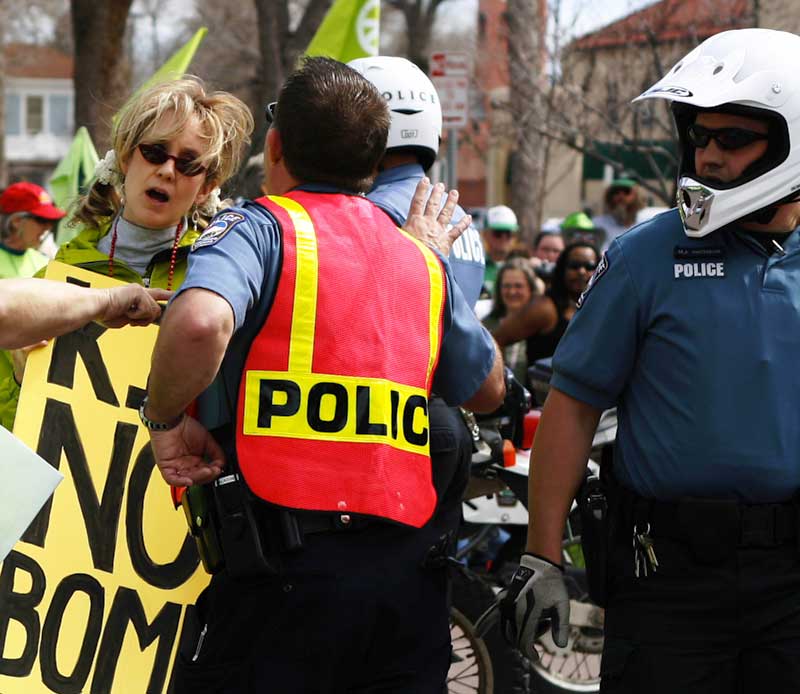
Al-Qaeda in Iraq is actually the dumbed down shorthand of al-Qaeda in Mesopotamia for Americans who wouldn’t know what Mesopotamia would have had to do with September 11. The lands of Mesopotamia would really suggest a Greater Iraq, inclusive of regions of Syria, Turkey and Iran. In which case, Jihadists advocating for the ancient territorial legacy of Iraq would not likely be fighting in Iraq at all. AND ACTUALLY, fi Balad al-Rafidin translates to “the country of the Two Rivers.”

Whether QJBR is a CIA invention, like the Jordanian who-never-was al-Zarqawi, will be for historians to decipher. Probably it’s a little of both. Regardless, AQI ends with “in Iraq” –only in America, land of few maps and sub-average education. We can’t even be told that Mexico is actually called Los Estados Unidos Mexicanos, lest US Americans get confused.

What liberties can our think tanks and intelligence manipulators take with Kufic script! The phrase above could just as well mean “I will wipe World Jewry off the face of the Earth!” as “Springtime for Hitler and Germany.” Or it could have meant “erase the illegitimate borders imposed on trans-Arabia by the Western powers bent on imposing an Israeli colony, by ruse of religion, in mock restitution for the Holocaust, the pogroms and the Spanish Inquisition, to give them a beachhead for Middle East oil.”

If I were to have a guess at the Arabic characters above, it would be “Sin Salida.”

I only wish I believed my own rhetoric

Marie argues with Officer Paladino
Freedom to express oneself, to think independently, was the lure that led the masses to our shores. Safety from abusive and intrusive government is the dream that continues to draw people to our borders. Our military men and women are in Iraq and elsewhere fighting for these same principles on behalf of those who cannot battle tyranny alone. Yet here in Colorado Springs, where so many are at great personal risk because of American ideology, we do not recognize the basic Constitutional freedoms of our own citizens.

It was a private parade, you say. The police were just following the orders of John O’Donnell, the parade organizer. Those people had no right to be there. What a load of garbage. The city was a partner in the St. Patrick’s Day parade. They blocked off public streets and used public resources. For the city and the CSPD to hide behind another organization’s insurance policy is not only cowardly, it is un-Constitutional. The ACLU won a recent case in Hawaii, wherein a “private” parade sought to exclude a particular group from marching. The conclusion: government entities can not shield themselves, nor take directives, from private citizens using public resources. The rest of the country seems to understand this.

In any case, the excessive force used by several of the policemen called to the scene is absolutely indefensible. Miscommunication, fear of public safety, parade crashing. None excuse what ensued. Not for a minute. Today it was peace activists; tomorrow it will be someone else. This type of unchecked abuse of power is a terrifying thing to witness. The lack of accountability by the CSPD illustrates that this thug behavior is tolerated, perhaps encouraged. If they are willing to behave that way in the presence of hundreds of spectators, can you imagine the treatment of those less visible? Are they taught to leave their humanity at the door when they don their uniforms and guns?

While I appreciate the attempts made by John Weiss to reconcile the community, his call to the activists to drop the threat of a civil suit is wrong. Where the people have no voice the court system is the next step. A hung jury in so simple a case shows that we are a town that is not as freedom-loving as our local daily newspaper professes. Perhaps, as in Hawaii, a higher court will possess greater wisdom. It is the next peaceful step in our cherished democratic process. The checks and balances built into the Constitution provide a measure of hope.

If there is no relief to be found by those who have sworn to defend the Constitution, then we will have to take to the streets. Systemic change is always resisted by those in power. If the populace had not banded together in the past to demand its rights, women would not vote, blacks and whites would be segregated, workers would toil in dangerous conditions, children would be chattel.

We should not live in fear of our local government, they should fear and respect us. They are public servants. We are a country of the people, by the people, for the people. We will not rest until our government, including those on Capitol Hill, abides by the Bill of Rights. Don’t mistake quiet acquiescence for peace. It is a reaction to oppression.

What the peace marchers need is not a call to lay down, but the rising up of their fellow citizens. They call for peace. Let the rest of us support them with a call for justice. As Thoreau said in Civil Disobedience, “Cast your whole vote, not a strip of paper merely, but your whole influence.” It is time for every concerned citizen to help stop the rampant abuse of power in our city and beyond. Without liberty and justice, there will never be peace. Here, there or anywhere.

From the Times….

Bichon FriseThis article in the NYT made me laugh. Just this morning, while driving my kids to tennis lessons, we saw a Bichon Frise. I said, “Hey kids, it’s a Bitchin’ Freeze.” Devon, age 9, said, “Mom, is our dog a bitch?” Lara replied, “You just said bitch.” Devon, “Yes, but not IN VAIN!” Ho, ho, ho.

August 7, 2007It’s a Female Dog, or Worse. Or Endearing. And Illegal?
By MICHAEL M. GRYNBAUM

The New York City Council, which drew national headlines when it passed a symbolic citywide ban earlier this year on the use of the so-called n-word, has turned its linguistic (and legislative) lance toward a different slur: bitch.

The term is hateful and deeply sexist, said Councilwoman Darlene Mealy of Brooklyn, who has introduced a measure against the word, saying it creates “a paradigm of shame and indignity” for all women.

But conversations over the last week indicate that the “b-word” (as it is referred to in the legislation) enjoys a surprisingly strong currency — and even some defenders — among many New Yorkers.

And Ms. Mealy admitted that the city’s political ruling class can be guilty of its use. As she circulated her proposal, she said, “even council members are saying that they use it to their wives.”

The measure, which 19 of the 51 council members have signed onto, was prompted in part by the frequent use of the word in hip-hop music. Ten rappers were cited in the legislation, along with an excerpt from an 1811 dictionary that defined the word as “A she dog, or doggess; the most offensive appellation that can be given to an English woman.”

While the bill also bans the slang word “ho,” the b-word appears to have acquired more shades of meaning among various groups, ranging from a term of camaraderie to, in a gerund form, an expression of emphatic approval. Ms. Mealy acknowledged that the measure was unenforceable, but she argued that it would carry symbolic power against the pejorative uses of the word. Even so, a number of New Yorkers said they were taken aback by the idea of prohibiting a term that they not only use, but do so with relish and affection.

“Half my conversation would be gone,” said Michael Musto, the Village Voice columnist, whom a reporter encountered on his bicycle on Sunday night on the corner of Seventh Avenue South and Christopher Street. Mr. Musto, widely known for his coverage of celebrity gossip, dismissed the idea as absurd.

“On the downtown club scene,” he said, munching on an apple, the two terms are often used as terms of endearment. “We divest any negative implication from the word and toss it around with love.”

Darris James, 31, an architect from Brooklyn who was outside the Duplex, a piano bar in the West Village, on Sunday night was similarly opposed. “Hell, if I can’t say bitch, I wouldn’t be able to call half my friends.”

They may not have been the kinds of reaction that Ms. Mealy, a Detroit-born former transit worker serving her first term, was expecting. “They buried the n-word, but what about the other words that really affect women, such as ‘b,’ and ‘ho’? That’s a vile attack on our womanhood,” Ms. Mealy said in a telephone interview. “In listening to my other colleagues, that they say that to their wives or their friends, we have gotten really complacent with it.”

The resolution, introduced on July 25, was first reported by The Daily News. It is being considered by the Council’s Civil Rights Committee and is expected to be discussed next month.

Many of those interviewed for this article acknowledged that the b-word could be quite vicious — but insisted that context was everything.

“I think it’s a description that is used insouciantly in the fashion industry,” said Hamish Bowles, the European editor at large of Vogue, as he ordered a sushi special at the Condé Nast cafeteria last week. “It would only be used in the fashion world with a sense of high irony and camp.”

Mr. Bowles, in salmon seersucker and a purple polo, appeared amused by the Council measure. “It’s very ‘Paris Is Burning,’ isn’t it?” he asked, referring to the film that captured the 1980s drag queen scene in New York.

The b-word has been used to refer to female dogs since around 1000 A.D., according to the Oxford English Dictionary, which traces the term’s derogatory application to women to the 15th century; the entry notes that the term is “not now in decent use.”

But there is much evidence that the word — for better or worse — is part of the accepted vernacular of the city. The cover of this week’s New York magazine features the word, and syndicated episodes of “Sex and the City,” the chronicle of high-heeled Manhattan singledom, include it, though some obscenities were bleeped for its run on family-friendly TBS. A feminist journal with the word as its title is widely available in bookstores here, displayed in the front rung at Borders at the Time Warner Center.

Robin Lakoff, a Brooklyn-born linguist who teaches at the University of California, Berkeley, said that she despised the word, but that enforcing linguistic change through authority “almost never works,” echoing comments from some New Yorkers who believed a ban would only serve to heighten the word’s power.

“If what the City Council wants to do is increase civility, it would have to be able to contextualize it,” said Ms. Lakoff, who studies language and gender. “You forbid the uses that drive people apart, but encourage the ones that drive people together. Which is not easy.”

Councilman Leroy G. Comrie Jr., the Queens Democrat who successfully sponsored a symbolic moratorium on the n-word that was adopted Feb. 28, said he supported Ms. Mealy’s measure, but acknowledged that the term had many uses.

“We want to make sure the context that it’s used is not a negative one,” Mr. Comrie said yesterday.

Back at the West Village piano bar on Sunday evening, Poppi Kramer had just finished up her cabaret set. She scoffed at the proposal. “I’m a stand-up comic. You may as well just say to me, don’t even use the word ‘the.’ ”

But at least one person with a legitimate reason to use the word saw some merit in cutting down on its use.

“We’d be grandfathered in, I would think,” said David Frei, who has been a host of the Westminster Kennel Club dog show in New York since 1990. The word is a formal canine label that appears on the competition’s official materials. But Mr. Frei said he worried about the word’s impact on some viewers, especially younger ones.

“I think we have to take responsibility for that word on the air. The reality is it’s in the realm of responsible conduct to not use that word anymore.

Farfour Mouse vs Mickey

It’s hard to believe how lost in LaLaLa Land are America’s proZionist conservatives. One big issue for some of them is the supposed ‘hostage taking’ of Mickey Mouse by Gaza Strip’s Farfour Mouse. I’m not making this stuff up either! See Farfour for yourself.

These lunatics of the American Right don’t get riled up about what Israel and the US have done to the million plus people of the Gaza Strip, way over 50% of them children. It matters not the least to them that Gaza has the lowest standard fo living in the world, and that most of the inhabitants living in this total misery are children. No. Instead they are worried about this mouse, Farfour! They’re worried that he’s a terrorist rat teaching the kids to hate! Can you imagine how lost in nonsense these nuts actually are? They’re our neighbors, too. Scary.

Here is another clip with some CNN commentary of Farfour in action, but go read the American posters’ comments and see who is really sick in the head. And nobody seems too concerned about Farfoura. But then again she’s not a mouse, is she? She’s more the butterfly… The Daffy Zionist Ducks can handle that. But don’t pick on Walt’s pre-WW2 made fascist rodent, or they get all upset.

And nobody seems to care about Walt Disney himself. He wa a rather loathsome character.
——————————————…………….
Below is the real situation in Gaza, where per capita GDP is now around $500-$600 per year and falling.
…………………………………………………………………

on the 40th anniversary of occupation my statement in the UN
SPECIAL MEETING TO MARK 40 YEARS OF OCCUPATION
BY ISRAEL OF THE PALESTINIAN TERRITORY,
INCLUDING EAST JERUSALEM

UNITED NATIONS HEADQUARTERS, NEW YORK
7 June 2007
STATEMENT BY

DR. MONA EL FARRA
PROJECTS DIRECTOR
MIDDLE EAST CHILDREN’S ALLIANCE

Red Crescent Society For Gaza Strip
GAZA

?Your Excellency Mr. Paul Badji, Chairman of the Committee,
Distinguished guests and Excellencies,

It is my honour to be amongst you today, despite the gravity of the occasion being commemorated, on this 40th anniversary of the Israeli occupation of the Gaza Strip, the West Bank and East Jerusalem.

First, let me say that 2007 is the 40th anniversary of 59 years of the brutal occupation of the Palestinian people.

As we called for an end to apartheid in South Africa and the right of all people to live together and have equal rights, we must now, before it is too late, call for true justice for the Palestinians.

Today, we heard about the economic plight of the Palestinian people. We heard about Palestinians in Israeli prisons which number close to 8,000 men and women, including approximately 350 children under the age of 14, most of whom have been tortured.

How many UN resolutions must be passed by the UN? How many years of calling for 2 States before there is an understanding that Israel continues its aggression on the ground against women, children and men, the demolition of thousands of homes and the continued building of the apartheid wall?

Let us not just speak of the Palestinians in the West Bank, Gaza. We must never forget those who live as second-class citizens inside Israel and most of all, those who were forced from their homes and lands in 1948.

Now is the time to call for a real peace, with justice for all the children in the region. This can only be accomplished by supporting the right of return of all Palestinians.

Now is the time to acknowledge that the two-State solution is not the answer.

From Gaza I came, where the children of my country have no safe homes, no safe streets, no proper and adequate health facilities, no proper food, clean water, or regular electrical power, no recreational activities and no good education. The list of deprivation of their basic needs is too long to count.

I lived this occupation as a child, and am still living it as an adult. I can see it in the eyes of my daughter when she is afraid, tired, restless and exhausted because of the unsafe and unpredictable quality of life in Gaza under occupation. I saw it as soon as we crossed the borders on our way to Egypt, where she sensed something new and different: freedom, safety and space. Gaza is like a big, unsafe prison. And it is a very small place for 1.4 million people, half of whom are children.

I face the occupation every day during my work when hundreds of Palestinian patients are denied permits and accessibility to proper medical treatment, outside Gaza. There are a few lucky patients who get a referral and permit for treatment outside Gaza. The majority, however, have to wait and wait. Many die while waiting.

What is more heart-breaking than children who do not have adequate food and a healthy atmosphere to grow up to be well rounded adults? According to the Health Work Committees Organization, 42 per cent of children in Gaza under the age of 5 suffer from iron deficiency anemia and 45 per cent suffer from some form of Post Traumatic Stress Disorder, due to the experiences that they are subjected to as a result of the non-stop military actions of the Israeli Occupation Forces, which almost always affect civilians in one way or another.

I will never forget the story of a woman in labor, who had to wait several hours at a checkpoint last November, during one of many Israeli military operations in the north of Gaza. Eventually she arrived at the Al Awda hospital in Jabalia refugee camp where she gave birth to her baby. When she left the hospital with the baby to go to home in the village of Beit Hanoun, there was no home; her home had been demolished by the Israeli occupying army. There are many cases and many stories, but I believe it is not the numbers that really matter, even one incident such as the above is one enough human rights violation.

I remember a 4-year old child in the same village who was forced to stay in one room with all members of his family for 48 hours while the Israeli Army commandeered their home. The child was thirsty and the soldier was there with his bottle of water, the occupied and the occupier in the same space. The soldier offered water to the thirsty child. The child said “no, no, no”. The child’s natural reaction was a combination of fear of what the soldier represents and the steadfastness in the face of the occupation. This is what characterizes the Palestinian people: steadfastness and resistance in the face of all adversity; even small children can express it with their natural reactions more than any words or speeches. The soldier on the other hand is a human being that has been forced by the Israeli occupation machine to lose his humanity.

Whenever I think of Palestinian children and their lives under occupation, I always think of the Israeli children. As adults, we have a commitment to both sets of children to provide a safe environment for them to live peacefully. It is not the occupation or the wall or the ongoing aggression against my people that will bring safety or security for Israeli children, only peace that is based on justice will do so. Justice means that the inalienable rights of the Palestinian people must be considered. Israel must recognize its moral responsibility towards the Palestinian refugees.

While Israel is physically outside Gaza, it still completely controls our lives, all aspects of our lives: health, education, economy and freedom of movement.

Life under occupation is degrading to human dignity. It has deprived us of our freedom, and only free people can make peace. It is most peculiar that we are forced to deal with the patterns of life under occupation as normal, well-established facts and when people lost hope and faith in the world or any future chances for change, and when the world turns its head away.

On the 40th anniversary of the Israeli occupation of the West Bank, Gaza and East Jerusalem, it is fitting to call once again on the international community to put pressure on Israel to fulfil its obligations by abiding by the UN resolutions related to Palestinian-Israeli conflict. Israeli occupation should be ended now and the right of return must not be forgotten.

Thank you.

Is Bush losing Pakistan?

Everywhere the US and its military goes, ethnic and religious unrest unfolds. Now that the US has torn apart Afghanistan like it has torn apart Iraq, Lebanon, and the Horn of Africa, it is turning its scopes on Syria and Iran, too. The Bush Administration seems addicted to its ethnic & religious divide and conquer policies.

However, this approach to foreign policy and military domination can easily spill out of control in ways not even thought about previously by the US government fat cats. Such seems to be the case with Pakistan, whose leader ‘Busharraf’ rules as military dictator, thoroughly compromised by how the US has turned him into a poodle puppet in its insanely termed ‘War on Terrorism’. In short, just as the US War Against Iraq threatens to spill over into a US attack on Syria and Iran, the failed US occupation of Afghanistan threatens to spill over into Pakistan, a country of 170,000,000 Muslims.

See Pakistan political unrest and this peek by the think tank Council on Foreign Relations entitled Pakistan’s Political Future

Fighting to rob Iraq of control of it’s own oil, the bipartisan Cheneycrats now risk continuing to destabilize a Muslim country with atomic weapons. Even now they are thinking of initiating a war with Iran supposedly designed to keep us safe from a nuclear attack! All this neighboring strife continues to destabilize Pakistan, a country already so destabilized it is hanging by a thread.. What a bunch of pathetic clowns we have leading the US today. Please, God, protect us all from these sad corporate promoted dummies as their corruption spreads itself around the planet disrupting everybody’s’ efforts to sanely govern themselves.

Destabilizing country after country along ethnic and religious lines is hardly any way to bring about any ‘national security’. If we don’t wake up soon and throw this Klan out in D.C. we might soon see much worse than 9/11 was inside our own borders. Destabilizing the Indian sub-continent following what our government has done in the Middle East is a clear recipe for nuclear disaster. And that’s exactly what seems to be happening in slow motion before our very own eyes.

We need to get out of Afghanistan as well as get out of Iraq. And we need to stop murdering, torturing, and allying ourselves in Pakistan with thugs like Musharraf and his dictator controlled Pakistani military. ‘Construction, Not Destruction’ needs to become our new National Security plan. Corporate leaders running our government are not the people that can implement this sort of new direction for the US. They are the people now ‘losing Pakistan’. And even losing America itself.

The New Colossus

I met an otherwise conservative old gentleman yesterday with a refreshing answer to the immigration question. Said he: “I’d welcome them!”

“This nation was built on immigration, we’re all immigrants -except the Native Americans- and I believe there’s room for plenty more. There’s obviously work so let them come.”

That’s the kind of empathy I think is necessary before we can address the real problem of immigration: what is driving refugees to cross our borders?

If Iowans suddenly started flooding into Kansas, only the most self-centered xenophobe would conclude it was for Kansas’ superior character. The rest would wonder, what is happening in Iowa to drive all those people from their homes? What industry is destroying the farms and businesses leaving Iowans no choice but to move off? More than likely it would be the same culprits that are at work in Mexico.

Big Agra and the usual multinationals, aided by the traditional ruling elite, have been raping Mexico and Central America for years, forcing the populations to move north, not for greener pastures, but any pasture at all. Mexicans are not coming to America because they want to be Americans. They do not embrace American culture, even our language. They are a displaced people. Let’s welcome them into our system and together we can address what powers are at work which have stolen their homelands. The forces are multinational, but the tools are American. They are the World Bank and friends. Our government.

It wasn’t always thus. I chanced to look up Emma Lazarus’ poem at the base of the Statue of Liberty where there are more words than form the fabled phrase we know by heart. To me they reflect a grand ideal that today serves only to inflate the American sense of self-importance. Time to go back to school lest The New Colossus (Mother of Exiles) become like the old.

Not like the brazen giant of Greek fame,
With conquering limbs astride from land to land;
Here at our sea-washed, sunset gates shall stand
A mighty woman with a torch, whose flame
Is the imprisoned lightning, and her name
Mother of Exiles. From her beacon-hand
Glows world-wide welcome; her mild eyes command
The air-bridged harbor that twin cities frame.

“Keep, ancient lands, your storied pomp!” cries she
With silent lips. “Give me your tired, your poor,
Your huddled masses yearning to breathe free,
The wretched refuse of your teeming shore.
Send these, the homeless, tempest-tossed to me,
I lift my lamp beside the golden door!”