Kashmir, Israel, India, LeT, and the Mumbai events

Many Indian government figures are beginning to point the blame towards an organization called LeT, or Lashkar-e-Taiba, as being behind the attacks on targets inside Mumbai, India. LeT is an organization of resistance to Indian control over a major portion of Kashmir, where the India government has terrorized the people there for decades now, in one of the longest, bloodiest and nastiest conflicts worldwide, if not the very worst of them.

Two of the targets picked out in Mumbai seem to be the targets that LeT might well have chosen if they were in fact the organization behind these attacks. See ‘US intelligence points to LeT for Mumbai attacks’ The head of Mumbai’s anti-terrorism police (he died) and the offices of a Far Right Wing Jewish center were involved as targets, and both are connected to the use of torture on Muslim POWs in Kashmir (and elsewhere inside India) and the involvement of Israel giving support to the Indian government in their occupation of the Kashmir Homeland. See Israel to train Indian soldiers in Kashmir Yet, LeT seems to be saying that they were not involved in this attack. See Jamat-ud-Dawa (LET Political Wing) on Mumbai Attacks: “Not a Legitimate Tactic” By Evan Kohlmann, so who knows?

There are certainly many inside the Indian Hindu Far Right that are desperately wanting to use these attacks as further reasons to motivate their own desire for more pogroms against India’s Muslim communities. So now we have Kashmir mixed up with US imperialism, the Indian government, torture, Israel, Pakistan, Afghanistan, and the so-called ‘Global War on Terrorism’. What a mess!

Ultra-Violent US Drug War creeping back North towards America

getting highThe US ‘Drug War’ is a spectacular international failure, whether it be Afghanistan, Colombia, Central America, or even the US-Mexico Border towns. In fact, the whole country of Mexico is being eaten alive by this so-called Drug War and the US population is hardly aware of what’s going on! How soon will it be before this newest bloodshed and carnage crosses to this side of the Border?

Fear keeps Americans out of Mexican sister city/ Nogales’ tourism-dependent economy paralyzed by gun, drug battles This is much worse than Prohibition ever was, and yet there is hardly a sign of a forthcoming intelligent decision to stop the carnage by stopping the ‘War’ now. Very sad. Will the US soon become a land of common beheadings and dumped bodies, too? Americans thought they had already seen Drug War violence, but what is headed our way soon will be much worse.

Retaining Gates slam dunks the deluded USA liberals

barack-obamaOh those poor deluded liberals! All that ‘hope’ for ‘change’ and look what it got them? Obama asks Gates to stay at Pentagon
 
No talk of getting out of Iraq now, and the Democratic Party ‘Peace’crats simply don’t have a Plan B beyond turning out the vote again and again for DP politicians who always give them the shaft once they are elected.

No talk of a rejection of the Bush Administration’s criminality and use of torture from Barack. He just rubber stamped it all OK with his choice of Robert Gates being allowed to continue in the position provided for him by Dubya. No change at all. You can shoot down rapproachement with the Russians, too, since it simply was no fluke when Georgia was prompted to attack the Ossetian allies of Russia. The Democrats were on-board all along with the Republican Administration initiated aggression. Hello, New Cold War.

What is left for the Democratic Party liberals to hang onto now? Sure, they can continue to play the fools (though they do not play the fool so much as they just simply are fools), and most will continue to look for some sort of sugar coating on the policies of the Democratic Party Administration, but there is none really. The chumps that told us to vote Democratic Party like it was some sort of religion of theirs will simply be inactive, inactive, inactive in the weeks and months ahead. They have nothing really much left to say.

This was all so easy to see ahead of time, but the ‘Peace’crats don’t want to stand out of the American crowd, and actually denounce US foreign policy in an effective manner. They wanted to just go out and vote even though the voting is rigged to keep power in power. The voting is rigged to just rotate back and forth between the Democrats and Republicans, both of which do mostly the exact same things.

The US Left needs to just say goodbye to the duplicitous intellectual leaders that now control the Antiwar Movement. It’s time to say goodbye to the United for Justice and Peace Democrats and build an effective Antiwar Movement that will build large and continual national mobilizations against The War that just keeps on going, and going, and going. I told you so. Hate me for that if you want? Voting when The System has rigged the vote before hand, is simply not really voting. It takes action to do that, and action that is outside of electorialist play acting.

Weathermen for a Democratic Society

Bernadine Dohrn addresses S.D.S. in ChicagoIn 1969, the Radical Youth Movement (RYM) within Students for a Democratic Society (SDS) expelled the passive participants to reconfigure the SDS to Bring the War Home. At left, Bernardine Dohrn uninvites the Progressive Labor Party (PL) and the Worker Student Alliance (WSA) from the Chicago conference. Below is the founding document after which the RYM was renamed.

You Don’t Need A Weatherman
To Know Which Way The Wind Blows

June 18, 1969

Submitted by Karin Asbley, Bill Ayers, Bernardine Dohrn, John Jacobs, Jeff Jones, Gerry Long, Home Machtinger, Jim Mellen, Terry Robbins, Mark Rudd and Steve Tappis.

I. International Revolution

The contradiction between the revolutionary peoples of Asia, Africa and Latin America and the imperialists headed by the United States is the principal contradiction in the contemporary world. The development of this contradiction is promoting the struggle of the people of the whole world against US imperialism and its lackeys.

Lin Piao, Long Live the Victory of People’s War!

People ask, what is the nature of the revolution that we talk about- Who will it be made by, and for, and what are its goals and strategy-

The overriding consideration in answering these questions is that the main struggle going on in the world today is between US imperialism and the national liberation struggles against it. This is essential in defining political matters in the whole world: because it is by far the most powerful, every other empire and petty dictator is in the long run dependent on US imperialism, which has unified, allied with, and defended all of the reactionary forces of the whole world. Thus, in considering every other force or phenomenon, from Soviet imperialism or Israeli imperialism to “workers struggle” in France or Czechoslovakia, we determine who are our friends and who are our enemies according to whether they help US imperialism or fight to defeat it.

So the very first question people in this country must ask in considering the question of revolution is where they stand in relation to the United States as an oppressor nation, and where they stand in relation to the masses of people throughout the world whom US imperialism is oppressing.

The primary task of revolutionary struggle is to solve this principal contradiction on the side of the people of the world. It is the oppressed peoples of the world who have created the wealth of this empire and it is to them that it belongs; the goal of the revolutionary struggle must be the control and use of this wealth in the interests of the oppressed peoples of the world.

It is in this context that we must examine the revolutionary struggles in the United States. We are within the heartland of a worldwide monster, a country so rich from its worldwide plunder that even the crumbs doled out to the enslaved masses within its borders provide for material existence very much above the conditions of the masses of people of the world. The US empire, as a worldwide system, channels wealth, based upon the labor and resources of the rest of the world, into the United States. The relative affluence existing in the United States is directly dependent upon the labor and natural resources of the Vietnamese, the Angolans, the Bolivians and the rest of the peoples of the Third World. All of the United Airlines Astrojets, all of the Holiday Inns, all of Hertz’s automobiles, your television set, car and wardrobe already belong, to a large degree to the people of the rest of the world.

Therefore, any conception of “socialist revolution” simply in terms of the working people of the United States, failing to recognize the full scope of interests of the most oppressed peoples of the world, is a conception of a fight for a particular privileged interest, and is a very dangerous ideology. While the control and use of the wealth of the Empire for the people of the whole world is also in the interests of the vast majority of the people in this country, if the goal is not clear from the start we will further the preservation of class society, oppression, war, genocide, and the complete emiseration of everyone, including the people of the US.

The goal is the destruction of US imperialism and the achievement of a classless world: world communism. Winning state power in the US will occur as a result of the military forces of the US overextending themselves around the world and being defeated piecemeal; struggle within the US will be a vital part of this process, but when the revolution triumphs in the US it will have been made by the people of the whole world. For socialism to be defined in national terms within so extreme and historical an oppressor nation as this is only imperialist national chauvinism on the part of the “movement.”

II. What Is The Black Colony-

Not every colony of people oppressed by imperialism lies outside the boundaries of the US. Black people within North America, brought here 400 years ago as slaves and whose labor, as slaves, built this country, are an internal colony within the confines of the oppressor nation. What this means is that black people are oppressed as a whole people, in the institutions and social relations of the country, apart from simply the consideration of their class position, income, skill, etc., as individuals- What does this colony look like- What is the basis for its common oppression and why is it important-

One historically important position has been that the black colony only consists of the black belt nation in the South, whose fight for national liberation is based on a common land, culture, history and economic life. The corollary of this position is that black people in the rest of the country are a national minority but not actually part of the colony themselves; so the struggle for national liberation is for the black belt, and not all blacks; black people in the north, not actually part of the colony, are part of the working class of the white oppressor nation. In this formulation northern black workers have a “dual role”—one an interest in supporting the struggle in the South, and opposing racism, as members of the national minority; and as northern “white nation” workers whose class interest is in integrated socialism in the north. The consistent version of this line actually calls for integrated organizing of black and white workers in the north along what it calls “class” lines.

This position is wrong; in reality, the black colony does not exist simply as the “black belt nation,” but exists in the country as a whole. The common oppression of black people and the common culture growing out of that history are not based historically or currently on their relation to the territory of the black belt, even though that has been a place of population concentration and has some very different characteristics than the north, particularly around the land question.

Rather, the common features of oppression, history and culture which unify black people as a colony (although originating historically in a common territory apart from the colonizers, i.e., Africa, not the South) have been based historically on their common position as slaves, which since the nominal abolition of slavery has taken the form of caste oppression, and oppression of black people as a people everywhere that they exist. A new black nation, different from the nations of Africa from which it came, has been forged by the common historical experience of importation and slavery and caste oppression; to claim that to be a nation it must of necessity now be based on a common national territory apart from the colonizing nation is a mechanical application of criteria which were and are applicable to different situations.

What is specifically meant by the term caste is that all black people, on the basis of their common slave history, common culture and skin color are systematically denied access to particular job categories (or positions within job categories), social position, etc., regardless of individual skills, talents, money or education. Within the working class, they are the most oppressed section; in the petit bourgeoisie, they are even more strictly confined to the lowest levels. Token exceptions aside, the specific content of this caste oppression is to maintain black people in the most exploitative and oppressive jobs and conditions. Therefore, since the lowest class is the working class, the black caste is almost entirely a caste of the working class, or [holds] positions as oppressed as the lower working-class positions (poor black petit bourgeoisie and farmers); it is a colonial labor caste,, a colony whose common national character itself is defined by their common class position.

Thus, northern blacks do not have a “dual interest”—as blacks on the one hand and “US-nation workers” on the other. They have a single class interest, along with all other black people in the US, as members of the Black Proletarian Colony.

III. The Struggle For Socialist Self-Determination

The struggle of black people—as a colony—is for self-determination, freedom, and liberation from US imperialism. Because blacks have been oppressed and held in an inferior social position as a people, they have a right to decide, organize and act on their common destiny as a people apart from white interference. Black self-determination does not simply apply to determination of their collective political destiny at some future time. It is directly tied to the fact that because all blacks experience oppression in a form that no whites do, no whites are in a position to fully understand and test from their own practice the real situation black people face and the necessary response to it. This is why it is necessary for black people to organize separately and determine their actions separately at each stage of the struggle.

It is important to understand the implications of this. It is not legitimate for whites to organizationally intervene in differences among revolutionary black nationalists. It would be arrogant for us to attack any black organization that defends black people and opposes imperialism in practice. But it is necessary to develop a correct understanding of the Black Liberation struggle within our own organization, where an incorrect one will further racist practice in our relations with the black movement.

In the history of some external colonies, such as China and Vietnam, the struggle for self-determination has had two stages: (1) a united front against imperialism and for New Democracy (which is a joint dictatorship of anti-colonial classes led by the proletariat, the content of which is a compromise between the interests of the proletariat and nationalist peasants, petit bourgeoisie and national bourgeoisie); and (2) developing out of the new democratic stage, socialism.

However, the black liberation struggle in this country will have only one “stage”; the struggle for self-determination will embody within it the struggle for socialism.

As Huey P. Newton has said, “In order to be a revolutionary nationalist, you would of necessity have to be a socialist.” This is because—given the caste quality of oppression-as-a-people-through-a-common-degree-of-exploitation—self-determination requires being free from white capitalist exploitation in the form of inferior (lower caste) jobs, housing, schools, hospitals, prices. In addition, only what was or became in practice a socialist program for self-determination—one which addressed itself to reversing this exploitation—could win the necessary active mass support in the “proletarian colony.”

The program of a united front for new democracy, on the other hand, would not be as thorough, and so would not win as active and determined support from the black masses. The only reason for having such a front would be where the independent petit bourgeois forces which it would bring in would add enough strength to balance the weakening of proletarian backing. This is not the case: first, because much of the black petit bourgeoisie is actually a “comprador” petit bourgeoisie (like so-called black capitalists who are promoted by the power structure to seem independent but are really agents of white monopoly capital), who would never fight as a class for any real self-determination; and secondly, because many black petit bourgeoisie, perhaps most, while not having a class interest in socialist self-determination, are close enough to the black masses in the oppression and limitations on their conditions that they will support many kinds of self-determination issues, and, especially when the movement is winning, can be won to support full (socialist) self-determination. For the black movement to work to maximize this support from the petit bourgeoisie is correct; but it is in no way a united front where it is clear that the Black Liberation Movement should not and does not modify the revolutionary socialist content of its stand to win that support.

From /New Left Notes/, June 18, 1969

IV. Black Liberation Means Revolution

What is the relationship of the struggle for black self-determination to the whole worldwide revolution to defeat US imperialism and internationalize its resources toward the goal of creating a classless world-

No black self-determination could be won which would not result in a victory for the international revolution as a whole. The black proletarian colony, being dispersed as such a large and exploited section of the work force, is essential to the survival of imperialism. Thus, even if the black liberation movement chose to try to attain self-determination in the form of a separate country (a legitimate part of the right to self-determination), existing side by side with the US, imperialism could not survive if they won it—and so would never give up without being defeated. Thus, a revolutionary nationalist movement could not win without destroying the state power of the imperialists; and it is for this reason that the black liberation movement, as a revolutionary nationalist movement for self-determination, is automatically in and of itself an inseparable part of the whole revolutionary struggle against US imperialism and for international socialism.

However, the fact that black liberation depends on winning the whole revolution does not mean that it depends on waiting for and joining with a mass white movement to do it. The genocidal oppression of black people must be ended, and does not allow any leisure time to wait; if necessary, black people could win self-determination, abolishing the whole imperialist system and seizing state power to do it, without this white movement, although the cost among whites and blacks both would be high.

Blacks could do it alone if necessary because of their centralness to the system, economically and geo-militarily, and because of the level of unity, commitment, and initiative which will be developed in waging a people’s war for survival and national liberation. However, we do not expect that they will have to do it alone, not only because of the international situation, but also because the real interests of masses of oppressed whites in this country lie with the Black Liberation struggle, and the conditions for understanding and fighting for these interests grow with the deepening of the crises. Already, the black liberation movement has carried with it an upsurge of revolutionary consciousness among white youth; and while there are no guarantees, we can expect that this will extend and deepen among all oppressed whites.

To put aside the possibility of blacks winning alone leads to the racist position that blacks should wait for whites and are dependent on whites acting for them to win. Yet the possibility of blacks winning alone cannot in the least be a justification for whites failing to shoulder the burden of developing a revolutionary movement among whites. If the first error is racism by holding back black liberation, this would be equally racist by leaving blacks isolated to take on the whole fight—and the whole cost—for everyone.

It is necessary to defeat both racist tendencies: (1) that blacks shouldn’t go ahead with making the revolution, and (2) that blacks should go ahead alone with making it. The only third path is to build a white movement which will support the blacks in moving as fast as they have to and are able to, and still itself keep up with that black movement enough so that white revolutionaries share the cost and the blacks don’t have to do the whole thing alone. Any white who does not follow this third path is objectively following one of the other two (or both) and is objectively racist.

V. Anti-Imperialist Revolution And The United Front

Since the strategy for defeating imperialism in semi-feudal colonies has two stages, the new democratic stage of a united front to throw out imperialism and then the socialist stage, some people suggest two stages for the US too—one to stop imperialism, the anti-imperialist stage, and another to achieve the dictatorship of the proletariat, the socialist stage. It is no accident that even the proponents of this idea can’t tell you what it means. In reality, imperialism is a predatory international stage of capitalism. Defeating imperialism within the US couldn’t possibly have the content, which it could in a semi-feudal country, of replacing imperialism with capitalism or new democracy; when imperialism is defeated in the US, it will be replaced by socialism—nothing else. One revolution, one replacement process, one seizure of state power—the anti-imperialist revolution and the socialist revolution, one and the same stage. To talk of this as two separate stages, the struggle to overthrow imperialism and the struggle for socialist revolution, is as crazy as if Marx had talked about the proletarian socialist revolution as a revolution of two stages, one the overthrow of capitalist state power, and second the establishment of socialist state power.

Along with no two stages, there is no united front with the petit bourgeoisie, because its interests as a class aren’t for replacing imperialism with socialism. As far as people within this country are concerned, the international war against imperialism is the same task as the socialist revolution, for one overthrow of power here. There is no “united front” for socialism here.

One reason people have considered the “united front” idea is the fear that if we were talking about a one-stage socialist revolution we would fail to organize maximum possible support among people, like some petit bourgeoisie, who would fight imperialism on a particular issue, but weren’t for revolution. When the petit bourgeoisie’s interest is for fighting imperialism on a particular issue, but not for overthrowing it and replacing it with socialism, it is still contributing to revolution to that extent—not to some intermediate thing which is not imperialism and not socialism. Someone not for revolution is not for actually defeating imperialism either, but we still can and should unite with them on particular issues. But this is not a united front (and we should not put forth some joint “united front” line with them to the exclusion of our own politics), because their class position isn’t against imperialism as a system. In China, or Vietnam, the petit bourgeoisie’s class interests could be for actually winning against imperialism; this was because their task was driving it out, not overthrowing its whole existence. For us here, “throwing it out” means not from one colony, but all of them, throwing it out of the world, the same thing as overthrowing it.

VI. International Strategy

What is the strategy of this international revolutionary movement- What are the strategic weaknesses of the imperialists which make it possible for us to win- Revolutionaries around the world are in general agreement on the answer, which Lin Piao describes in the following way:

US imperialism is stronger, but also more vulnerable, than any imperialism of the past. It sets itself against the people of the whole world, including the people of the United States. Its human, military, material and financial resources are far from sufficient for the realization of its ambition of domination over the whole world. US imperialism has further weakened itself by occupying so many places in the world, overreaching itself, stretching its fingers out wide and dispersing its strength, with its rear so far away and its supply lines so long.

—/Long Live the Victory of People’s War/

The strategy which flows from this is what Ché called “creating two, three, many Vietnams”—to mobilize the struggle so sharply in so many places that the imperialists cannot possibly deal with it all. Since it is essential to their interests, they will try to deal with it all, and will be defeated and destroyed in the process.

In defining and implementing this strategy, it is clear that the vanguard (that is, the section of the people who are in the forefront of the struggle and whose class interests and needs define the terms and tasks of the revolution) of the “American Revolution” is the workers and oppressed peoples of the colonies of Asia, Africa and Latin America. Because of the level of special oppression of black people as a colony, they reflect the interests of the oppressed people of the world from within the borders of the United States; they are part of the Third World and part of the international revolutionary vanguard.

The vanguard role of the Vietnamese and other Third World countries in defeating US imperialism has been clear to our movement for some time. What has not been so clear is the vanguard role black people have played, and continue to play, in the development of revolutionary consciousness and struggle within the United States. Criticisms of the black liberation struggle as being “reactionary” or of black organizations on campus as being conservative or “racist” very often express this lack of understanding. These ideas are incorrect and must be defeated if a revolutionary movement is going to be built among whites.

The black colony, due to its particular nature as a slave colony, never adopted a chauvinist identification with America as an imperialist power, either politically or culturally. Moreover, the history of black people in America has consistently been one of the greatest overall repudiations of and struggle against the state. From the slave ships from Africa to the slave revolts, the Civil War, etc., black people have been waging a struggle for survival and liberation. In the history of our own movement this has also been the case: the civil rights struggles, initiated and led by blacks in the South; the rebellions beginning with Harlem in 1964 and Watts in 1965 through Detroit and Newark in 1967; the campus struggles at all-black schools in the South and struggles led by blacks on campuses all across the country. As it is the blacks—along with the Vietnamese and other Third World people—who are most oppressed by US imperialism, their class interests are most solidly and resolutely committed to waging revolutionary struggle through to its completion. Therefore it is no surprise that time and again, in both political content and level of consciousness and militancy, it has been the black liberation movement which has upped the ante and defined the terms of the struggle.

What is the relationship of this “black vanguard” to the “many Vietnams” around the world- Obviously this is an example of our strategy that different fronts reinforce each other. The fact that the Vietnamese are winning weakens the enemy, advancing the possibilities for the black struggle, etc. But it is important for us to understand that the interrelationship is more than this. Black people do not simply “choose” to intensify their struggle because they want to help the Vietnamese, or because they see that Vietnam heightens the possibilities for struggle here. The existence of any one Vietnam, especially a winning one, spurs on others not only through consciousness and choice, but through need, because it is a political and economic, as well as military, weakening of capitalism, and this means that to compensate, the imperialists are forced to intensify their oppression of other people.

Thus the loss of China and Cuba and the loss now of Vietnam not only encourages other oppressed peoples (such as the blacks) by showing what the alternative is and that it can be won, but also costs the imperialists billions of dollars which they then have to take out of the oppression of these other peoples. Within this country increased oppression falls heavier on the most oppressed sections of the population, so that the condition of all workers is worsened through rising taxes, inflation and the fall of real wages, and speedup. But this increased oppression falls heaviest on the most oppressed, such as poor white workers and, especially, the blacks, for example through the collapse of state services like schools, hospitals and welfare, which naturally hits the hardest at those most dependent on them.

This deterioration pushes people to fight harder to even try to maintain their present level. The more the ruling class is hurt in Vietnam, the harder people will be pushed to rebel and to fight for reforms. Because there exist successful models of revolution in Cuba, Vietnam, etc., these reform struggles will provide a continually larger and stronger base for revolutionary ideas. Because it needs to maximize profits by denying the reforms, and is aware that these conditions and reform struggles will therefore lead to revolutionary consciousness, the ruling class will see it more and more necessary to come down on any motion at all, even where it is not yet highly organized or conscious. It will come down faster on black people, because their oppression is increasing fastest, and this makes their rebellion most thorough and most dangerous, and fastest growing. It is because of this that the vanguard character and role of the black liberation struggle will be increased and intensified, rather than being increasingly equal to and merged into the situation and rebellion of oppressed white working people and youth. The crises of imperialism (the existence of Vietnam and especially that it’s winning) will therefore create a “Black Vietnam” within the US.

Given that black self-determination would mean fully crushing the power of the imperialists, this “Vietnam” has certain different characteristics than the external colonial wars. The imperialists will never “get out of the US” until their total strength and every resource they can bring to bear has been smashed; so the Black Vietnam cannot win without bringing the whole thing down and winning for everyone. This means that this war of liberation will be the most protracted and hardest fought of all.

It is in this context that the question of the South must be dealt with again, not as a question of whether or not the black nation, black colony, exists there, as opposed to in the North as well, but rather as a practical question of strategy and tactics: Can the black liberation struggle—the struggle of all blacks in the country—gain advantage in the actual war of liberation by concentrating on building base areas in the South in territory with a concentration of black population-

This is very clearly a different question than that of “where the colony is,” and to this question the “yes” answer is an important possibility. If the best potential for struggle in the South were realized, it is fully conceivable and legitimate that the struggle there could take on the character of a fight for separation; and any victories won in that direction would be important gains for the national liberation of the colony as a whole. However, because the colony is dispersed over the whole country, and not just located in the black belt, winning still means the power and liberation of blacks in the whole country.

Thus, even the winning of separate independence in the South would still be one step toward self-determination, and not equivalent to winning it; which, because of the economic position of the colony as a whole, would still require overthrowing the state power of the imperialists, taking over production and the whole economy and power, etc.

VII. The Revolutionary Youth Movement: Class Analysis

The revolutionary youth movement program was hailed as a transition strategy, which explained a lot of our past work and pointed to new directions for our movement. But as a transition to what- What was our overall strategy- Was the youth movement strategy just an organizational strategy because SDS is an organization of youth and we can move best with other young people-

We have pointed to the vanguard nature of the black struggle in this country as part of the international struggle against American imperialism, and the impossibility of anything but an international strategy for winning. Any attempt to put forth a strategy which, despite internationalist rhetoric, assumes a purely internal development to the class struggle in this country, is incorrect. The Vietnamese (and the Uruguayans and the Rhodesians) and the blacks and Third World peoples in this country will continue to set the terms for class struggle in America.

In this context, why an emphasis on youth- Why should young people be willing to fight on the side of Third World peoples- Before dealing with this question about youth, however, there follows a brief sketch of the main class categories in the white mother country which we think are important, and [which] indicate our present estimation of their respective class interests (bearing in mind that the potential for various sections to understand and fight for the revolution will vary according to more than just their real class interests).

Most of the population is of the working class, by which we mean not simply industrial or production workers, nor those who are actually working, but the whole section of the population which doesn’t own productive property and so lives off of the sale of its labor power. This is not a metaphysical category either in terms of its interests, the role it plays, or even who is in it, which very often is difficult to determine.

As a whole, the long-range interests of the non-colonial sections of the working class lie with overthrowing imperialism, with supporting self-determination for the oppressed nations (including the black colony), with supporting and fighting for international socialism. However, virtually all of the white working class also has short-range privileges from imperialism, which are not false privileges but very real ones which give them an edge of vested interest and tie them to a certain extent to the imperialists, especially when the latter are in a relatively prosperous phase. When the imperialists are losing their empire, on the other hand, these short-range privileged interests are seen to be temporary (even though the privileges may be relatively greater over the faster-increasing emiseration of the oppressed peoples). The long-range interests of workers in siding with the oppressed peoples are seen more clearly in the light of imperialism’s impending defeat. Within the whole working class, the balance of anti-imperialist class interests with white mother country short-term privilege varies greatly.

First, the most oppressed sections of the mother country working class have interests most clearly and strongly anti-imperialist. Who are the most oppressed sections of the working class- Millions of whites who have as oppressive material conditions as the blacks, or almost so: especially poor southern white workers; the unemployed or semi-employed, or those employed at very low wages for long hours and bad conditions, who are non-unionized or have weak unions; and extending up to include much of unionized labor which has it a little better off but still is heavily oppressed and exploited. This category covers a wide range and includes the most oppressed sections not only of production and service workers but also some secretaries, clerks, etc. Much of this category gets some relative privileges (i.e. benefits) from imperialism, which constitute some material basis for being racist or pro-imperialist; but overall it is itself directly and heavily oppressed, so that in addition to its long-range class interest on the side of the people of the world, its immediate situation also constitutes a strong basis for sharpening the struggle against the state and fighting through to revolution.

Secondly, there is the upper strata of the working class. This is also an extremely broad category, including the upper strata of unionized skilled workers and also most of the “new working class” of proletarianized or semi-proletarianized “intellect workers.” There is no clearly marked dividing line between the previous section and this one; our conclusions in dealing with “questionable” strata will in any event have to come from more thorough analysis of particular situations. The long-range class interests of this strata, like the previous section of more oppressed workers, are for the revolution and against imperialism. However, it is characterized by a higher level of privilege relative to the oppressed colonies, including the blacks, and relative to more oppressed workers in the mother country; so that there is a strong material basis for racism and loyalty to the system. In a revolutionary situation, where the people’s forces were on the offensive and the ruling class was clearly losing, most of this upper strata of the working class will be winnable to the revolution, while at least some sections of it will probably identify their interests with imperialism till the end and oppose the revolution (which parts do which will have to do with more variables than just the particular level of privilege). The further development of the situation will clarify where this section will go, although it is clear that either way we do not put any emphasis on reaching older employed workers from this strata at this time. The exception is where they are important to the black liberation struggle, the Third World, or the youth movement in particular situations, such as with teachers, hospital technicians, etc., in which cases we must fight particularly hard to organize them around a revolutionary line of full support for black liberation and the international revolution against US imperialism. This is crucial because the privilege of this section of the working class has provided and will provide a strong material basis for national chauvinist and social democratic ideology within the movement, such as anti-internationalist concepts of “student power” and “workers control.” Another consideration in understanding the interests of this segment is that, because of the way it developed and how its skills and its privileges were “earned over time,” the differential between the position of youth and older workers is in many ways greater for this section than any other in the population. We should continue to see it as important to build the revolutionary youth movement among the youth of this strata.

Thirdly, there are “middle strata” who are not petit bourgeoisie, who may even technically be upper working class, but who are so privileged and tightly tied to imperialism through their job roles that they are agents of imperialism. This section includes management personnel, corporate lawyers, higher civil servants, and other government agents, army officers, etc. Because their job categories require and promote a close identification with the interests of the ruling class, these strata are enemies of the revolution.

Fourthly, and last among the categories we’re going to deal with, is the petit bourgeoisie. This class is different from the middle level described above in that it has the independent class interest which is opposed to both monopoly power and to socialism. The petit bourgeoisie consists of small capital—both business and farms—and self-employed tradesmen and professionals (many professionals work for monopoly capital, and are either the upper level of the working class or in the dent class interests-anti-monopoly capital, but for capitalism rather than socialism—gives it a political character of some opposition to “big government,” like its increased spending and taxes and its totalitarian extension of its control into every aspect of life, and to “big labor,” which is at this time itself part of the monopoly capitalist power structure. The direction which this opposition takes can be reactionary or reformist. At this time the reformist side of it is very much mitigated by the extent to which the independence of the petit bourgeoisie is being undermined. Increasingly, small businesses are becoming extensions of big ones, while professionals and self-employed tradesmen less and less sell their skills on their own terms and become regular employees of big firms. This tendency does not mean that the reformist aspect is not still present; it is, and there are various issues, like withdrawing from a losing imperialist war, where we could get support from them. On the question of imperialism as a system, however, their class interests are generally more for it than for overthrowing it, and it will be the deserters from their class who stay with us.

VIII. Why A Revolutionary Youth Movement-

In terms of the above analysis, most young people in the US are part of the working class. Although not yet employed, young people whose parents sell their labor power for wages, and more important who themselves expect to do the same in the future—or go into the army or be unemployed—are undeniably members of the working class. Most kids are well aware of what class they are in, even though they may not be very scientific about it. So our analysis assumes from the beginning that youth struggles are, by and large, working-class struggles. But why the focus now on the struggles of working-class youth rather than on the working class as a whole-

The potential for revolutionary consciousness does not always correspond to ultimate class interest, particularly when imperialism is relatively prosperous and the movement is in an early stage. At this stage, we see working-class youth as those most open to a revolutionary movement which sides with the struggles of Third World people; the following is an attempt to explain a strategic focus on youth for SDS.

In general, young people have less stake in a society (no family, fewer debts, etc.), are more open to new ideas (they have not been brainwashed for so long or so well), and are therefore more able and willing to move in a revolutionary direction. Specifically in America, young people have grown up experiencing the crises in imperialism. They have grown up along with a developing black liberation movement, with the liberation of Cuba, the fights for independence in Africa and the war in Vietnam. Older people grew up during the fight against fascism, during the Cold War, the smashing of the trade unions, McCarthy, and a period during which real wages consistently rose—since 1965 disposable real income has decreased slightly, particularly in urban areas where inflation and increased taxation have bitten heavily into wages. This crisis in imperialism affects all parts of the society. America has had to militarize to protect and expand its empire; hence the high draft calls and the creation of a standing army of three and a half million, an army which still has been unable to win in Vietnam. Further, the huge defense expenditures—required for the defense of the empire and at the same time a way of making increasing profits for the defense industries—have gone hand in hand with the urban crisis around welfare, the hospitals, the schools, housing, air and water pollution. The State cannot provide the services it has been forced to assume responsibility for, and needs to increase taxes and to pay its growing debts while it cuts services and uses the pigs to repress protest. The private sector of the economy can’t provide jobs, particularly unskilled jobs. The expansion of the defense and education industries by the State since World War II is in part an attempt to pick up the slack, though the inability to provide decent wages and working conditions for “public” jobs is more and more a problem.

As imperialism struggles to hold together this decaying social fabric, it inevitably resorts to brute force and authoritarian ideology. People, especially young people, more and more find themselves in the iron grip of authoritarian institutions. Reaction against the pigs or teachers in the schools, welfare pigs or the army, is generalizable and extends beyond the particular repressive institution to the society and the State as a whole. The legitimacy of the State is called into question for the first time in at least 30 years, and the anti-authoritarianism which characterizes the youth rebellion turns into rejection of the State, a refusal to be socialized into American society. Kids used to try to beat the system from inside the army or from inside the schools; now they desert from the army and burn down the schools.

The crisis in imperialism has brought about a breakdown in bourgeois social forms, culture and ideology. The family falls apart, kids leave home, women begin to break out of traditional “female” and “mother” roles. There develops a “generation gap” and a “youth problem.” Our heroes are no longer struggling businessmen, and we also begin to reject the ideal career of the professional and look to Mao, Chef, the Panthers, the Third World, for our models, for motion. We reject the elitist, technocratic bullshit that tells us only experts can rule, and look instead to leadership from the people’s war of the Vietnamese. Chuck Berry, Elvis, the Temptations brought us closer to the “people’s culture” of Black America. The racist response to the civil rights movement revealed the depth of racism in America, as well as the impossibility of real change through American institutions. And the war against Vietnam is not “the heroic war against the Nazis”; it’s the big lie, with napalm burning through everything we had heard this country stood for. Kids begin to ask questions: Where is the Free World- And who do the pigs protect at home-

The breakdown in bourgeois culture and concomitant anti-authoritarianism is fed by the crisis in imperialism, but also in turn feeds that crisis, exacerbates it so that people no longer merely want the plastic ’50s restored, but glimpse an alternative (like inside the Columbia buildings) and begin to fight for it. We don’t want teachers to be more kindly cops; we want to smash cops, and build a new life.

The contradictions of decaying imperialism fall hardest on youth in four distinct areas—the schools, jobs, the draft and the army, and the pigs and the courts. (A) In jail-like schools, kids are fed a mish-mash of racist, male chauvinist, anti-working class, anti-communist lies while being channeled into job and career paths set up according to the priorities of monopoly capital. At the same time, the State is becoming increasingly incapable of providing enough money to keep the schools going at all. (B) Youth unemployment is three times average unemployment. As more jobs are threatened by automation or the collapse of specific industries, unions act to secure jobs for those already employed. New people in the labor market can’t find jobs, job stability is undermined (also because of increasing speed-up and more intolerable safety conditions) and people are less and less going to work in the same shop for 40 years. And, of course, when they do find jobs, young people get the worst ones and have the least seniority. (C) There are now two and a half million soldiers under thirty who are forced to police the world, kill and be killed in wars of imperialist domination. And (D) as a “youth problem” develops out of all this, the pigs and courts enforce curfews, set up pot busts, keep people off the streets, and repress any youth motion whatsoever.

In all of this, it is not that life in America is toughest for youth or that they are the most oppressed. Rather, it is that young people are hurt directly—and severely—by imperialism. And, in being less tightly tied to the system, they are more “pushed” to join the black liberation struggle against US imperialism. Among young people there is less of a material base for racism—they have no seniority, have not spent 20 years securing a skilled job (the white monopoly of which is increasingly challenged by the black liberation movement), and aren’t just about to pay off a 25-year mortgage on a house which is valuable because it’s located in a white neighborhood.

While these contradictions of imperialism fall hard on all youth, they fall hardest on the youth of the most oppressed (least privileged) sections of the working class. Clearly these youth have the greatest material base for struggle. They are the ones who most often get drafted, who get the worst jobs if they get any, who are most abused by the various institutions of social control, from the army to decaying schools, to the pigs and the courts. And their day-to-day existence indicates a potential for militancy and toughness. They are the people whom we can reach who at this stage are most ready to engage in militant revolutionary struggle.

The point of the revolutionary youth movement strategy is to move from a predominant student elite base to more oppressed (less privileged) working-class youth as a way of deepening and expanding the revolutionary youth movement—not of giving up what we have gained, not giving up our old car for a new Dodge. This is part of a strategy to reach the entire working class to engage in struggle against imperialism; moving from more privileged sections of white working-class youth to more oppressed sections to the entire working class as a whole, including importantly what has classically been called the industrial proletariat. But this should not be taken to mean that there is a magic moment, after we reach a certain percentage of the working class, when all of a sudden we become a working-class movement. We are already that if we put forward internationalist proletarian politics. We also don’t have to wait to become a revolutionary force. We must be a self-conscious revolutionary force from the beginning, not be a movement which takes issues to some mystical group—”THE PEOPLE”—who will make the revolution. We must be a revolutionary movement of people understanding the necessity to reach more people, all working people, as we make the revolution.

The above arguments make it clear that it is both important and possible to reach young people wherever they are—not only in the shops, but also in the schools, in the army and in the streets—so as to recruit them to fight on the side of the oppressed peoples of the world. Young people will be part of the International Liberation Army. The necessity to build this International Liberation Army in America leads to certain priorities in practice for the revolutionary youth movement which we should begin to apply this summer. …

IX. Imperialism Is The Issue

The Communists are distinguished from the other working-class parties by this only: 1. In the national struggles of the proletariat of different countries, they point out and bring to the front the common interests of the entire proletariat, independently of all nationality. 2. In the various stages of development which the struggle of the working-class against the bourgeoisie has to pass through, they always and everywhere represent the interests of the movement as a whole.”

—Communist Manifesto

How do we reach youth; what kinds of struggles do we build; how do we make a revolution- What we have tried to lay out so far is the political content of the consciousness which we want to extend and develop as a mass consciousness: the necessity to build our power as part of the whole international revolution to smash the state power of the imperialists and build socialism. Besides consciousness of this task, we must involve masses of people in accomplishing it. Yet we are faced with a situation in which almost all of the people whose interests are served by these goals, and who should be, or even are, sympathetic to revolution, neither understand the specific tasks involved in making a revolution nor participate in accomplishing them. On the whole, people don’t join revolutions just because revolutionaries tell them to. The oppression of the system affects people in particular ways, and the development of political consciousness and participation begins with particular problems, which turn into issues and struggles. We must transform people’s everyday problems, and the issues and struggles growing out of them, into revolutionary consciousness, active and conscious opposition to racism and imperialism.

This is directly counterposed to assuming that struggles around immediate issues will lead naturally over time to struggle against imperialism. It has been argued that since people’s oppression is due to imperialism and racism, then any struggle against immediate oppression is “objectively anti-imperialist,” and the development of the fight against imperialism is a succession of fights for reforms. This error is classical economism.

A variant of this argument admits that this position is often wrong, but suggests that since imperialism is collapsing at this time, fights for reforms become “objectively anti-imperialist.” At this stage of imperialism there obviously will be more and more struggles for the improvement of material conditions, but that is no guarantee of increasing internationalist proletarian consciousness.

On the one hand, if we, as revolutionaries, are capable of understanding the necessity to smash imperialism and build socialism, then the masses of people who we want to fight along with us are capable of that understanding. On the other hand, people are brainwashed and at present don’t understand it; if revolution is not raised at every opportunity, then how can we expect people to see it in their interests, or to undertake the burdens of revolution- We need to make it clear from the very beginning that we are about revolution. But if we are so careful to avoid the dangers of reformism, how do we relate to particular reform struggles- We have to develop some sense of how to relate each particular issue to the revolution.

In every case, our aim is to raise anti-imperialist and anti-racist consciousness and tie the struggles of working-class youth (and all working people) to the struggles of Third World people, rather than merely joining fights to improve material conditions, even though these fights are certainly justified. This is not to say that we don’t take immediate fights seriously, or fight hard in them, but that we are always up front with our politics, knowing that people in the course of struggle are open to a class line, ready to move beyond narrow self-interest.

It is in this sense that we point out that the particular issue is not the issue, is important insofar as it points to imperialism as an enemy that has to be destroyed. Imperialism is always the issue. Obviously, the issue cannot be a good illustration, or a powerful symbol, if it is not real to people, if it doesn’t relate to the concrete oppression that imperialism causes. People have to be (and are being) hurt in some material way to understand the evils of imperialism, but what we must stress is the systematic nature of oppression and the way in which a single manifestation of imperialism makes clear its fundamental nature. At Columbia it was not the gym, in particular, which was important in the struggle, but the way in which the gym represented, to the people of Harlem and Columbia, Columbia’s imperialist invasion of the black colony. Or at Berkeley, though people no doubt needed a park (as much, however, as many other things-), what made the struggle so important was that people, at all levels of militancy, consciously saw themselves attacking private property and the power of the State. And the Richmond Oil Strike was exciting because the militant fight for improvement of material conditions was part and parcel of an attack on international monopoly capital. The numbers and militancy of people mobilized for these struggles has consistently surprised the left, and pointed to the potential power of a class-conscious mass movement.

The masses will fight for socialism when they understand that reform fights, fights for improvement of material conditions, cannot be won under imperialism. With this understanding, revolutionaries should never put forth a line which fosters the illusion that imperialism will grant significant reforms. We must engage in struggles forthrightly as revolutionaries, so that it will be clear to anyone we help to win gains that the revolution rather than imperialism is responsible for them. This is one of the strengths of the Black Panther Party Breakfast for Children Program. It is “socialism in practice” by revolutionaries with the “practice” of armed self-defense and a “line” which stresses the necessity of overthrowing imperialism and seizing state power. Probably the American Friends Service Committee serves more children breakfast, but it is the symbolic value of the program in demonstrating what socialism will do for people which makes the Black Panther Program worthwhile.

What does it mean to organize around racism and imperialism in specific struggles- In the high schools (and colleges) at this time, it means putting forth a mass line to close down the schools, rather than to reform them, so that they can serve the people. The reason for this line is not that under capitalism the schools cannot serve the people, and therefore it is silly or illusory to demand that. Rather, it is that kids are ready for the full scope of militant struggle, and already demonstrate a consciousness of imperialism, such that struggles for a people-serving school would not raise the level of their struggle to its highest possible point. Thus, to tell a kid in New York that imperialism tracks him and thereby oppresses him is often small potatoes compared to his consciousness that imperialism oppresses him by jailing him, pigs and all, and the only thing to do is break out and tear up the jail. And even where high school kids are not yet engaged in such sharp struggle, it is crucial not to build consciousness only around specific issues such as tracking or ROTC or racist teachers, but to use these issues to build toward the general consciousness that the schools should be shut down. It may be important to present a conception of what schools should or could be like (this would include the abolition of the distinction between mental and physical work), but not offer this total conception as really possible to fight for in any way but through revolution.

A mass line to close down the schools or colleges does not contradict demands for open admissions to college or any other good reform demand. Agitational demands for impossible, but reasonable, reforms are a good way to make a revolutionary point. The demand for open admissions by asserting the alternative to the present (school) system exposes its fundamental nature—that it is racist, class-based, and closed—pointing to the only possible solution to the present situation: “Shut it down!” The impossibility of real open admissions—all black and brown people admitted, no flunk-out, full scholarship, under present conditions—is the best reason (that the schools show no possibility for real reform) to shut the schools down. We should not throw away the pieces of victories we gain from these struggles, for any kind of more open admissions means that the school is closer to closing down (it costs the schools more, there are more militant blacks and browns making more and more fundamental demands on the schools, and so on). Thus our line in the schools, in terms of pushing any good reforms, should be, Open them up and shut them down!”

The spread of black caucuses in the shops and other workplaces throughout the country is an extension of the black liberation struggle. These groups have raised and will continue to raise anti-racist issues to white workers in a sharper fashion than any whites ever have or could raise them. Blacks leading struggles against racism made the issue unavoidable, as the black student movement leadership did for white students. At the same time these black groups have led fights which traditional trade-union leaders have consistently refused to lead—fights against speed-up and for safety (issues which have become considerably more serious in the last few years), forcing white workers, particularly the more oppressed, to choose in another way between allegiance to the white mother country and black leadership. As white mother country radicals we should try to be in shops, hospitals, and companies where there are black caucuses, perhaps organizing solidarity groups, but at any rate pushing the importance of the black liberation struggle to whites, handing out Free Huey literature, bringing guys out to Panther rallies, and so on. Just one white guy could play a crucial role in countering UAW counter-insurgency.

We also need to relate to workplaces where there is no black motion but where there are still many young white workers. In the shops the crisis in imperialism has come down around speed-up, safety, and wage squeeze—due to higher taxes and increased inflation, with the possibility of wage-price controls being instituted.

We must relate this exploitation back to imperialism. The best way to do this is probably not caucuses in the shops, but to take guys to citywide demonstrations, Newsreels, even the latest administration building, to make the Movement concrete to them and involve them in it. Further, we can effect consciousness and pick up people through agitational work at plants, train stops, etc., selling Movements, handing out leaflets about the war, the Panthers, the companies’ holdings overseas or relations to defense industry, etc.

After the Richmond strike, people leafleted about demonstrations in support of the Curaçao Oil workers, Free Huey May Day, and People’s Park.

SDS has not dealt in any adequate way with the women question; the resolution passed at Ann Arbor did not lead to much practice, nor has the need to fight male supremacy been given any programmatic direction within the RYM. As a result, we have a very limited understanding of the tie-up between imperialism and the women question, although we know that since World War II the differential between men’s and women’s wages has increased, and guess that the breakdown of the family is crucial to the woman question. How do we organize women against racism and imperialism without submerging the principled revolutionary question of women’s liberation- We have no real answer, but we recognize the real reactionary danger of women’s groups that are not self-consciously revolutionary and anti-imperialist.

To become more relevant to the growing women’s movement, SDS women should begin to see as a primary responsibility the self-conscious organizing of women. We will not be able to organize women unless we speak directly to their own oppression. This will become more and more critical as we work with more oppressed women. Women who are working and women who have families face male supremacy continuously in their day-to-day lives; that will have to be the starting point in their politicization. Women will never be able to undertake a full revolutionary role unless they break out of their woman’s role. So a crucial task for revolutionaries is the creation of forms of organization in which women will be able to take on new and independent roles. Women’s self-defense groups will be a step toward these organizational forms, as an effort to overcome women’s isolation and build revolutionary self-reliance.

The cultural revolt of women against their “role” in imperialism (which is just beginning to happen in a mass way) should have the same sort of revolutionary potential that the RYM claimed for “youth culture.” The role of the “wife-mother” is reactionary in most modern societies, and the disintegration of that role under imperialism should make women more sympathetic to revolution.

In all of our work we should try to formulate demands that not only reach out to more oppressed women, but ones which tie us to other ongoing struggles, in the way that a daycare center at U of C [University of Chicago] enabled us to tie the women’s liberation struggle to the Black Liberation struggle.

There must be a strong revolutionary women’s movement, for without one it will be impossible for women’s liberation to be an important part of the revolution. Revolutionaries must be made to understand the full scope of women’s oppression, and the necessity to smash male supremacy.

X. Neighborhood-Based Citywide Youth Movement

One way to make clear the nature of the system and our tasks working off of separate struggles is to tie them together with each other: to show that we’re one “multi-issue” movement, not an alliance of high school and college students, or students and GIs, or youth and workers, or students and the black community. The way to do this is to build organic regional or sub-regional and citywide movements, by regularly bringing people in one institution or area to fights going on on other fronts.

This works on two levels. Within a neighborhood, by bringing kids to different fights and relating these fights to each other—high school stuff, colleges, housing, welfare, shops—we begin to build one neighborhood-based multi-issue movement off of them. Besides actions and demonstrations, we also pull different people together in day-to-day film showings, rallies, for speakers and study groups, etc. On a second level, we combine neighborhood “bases” into a citywide or region-wide movement by doing the same kind of thing; concentrating our forces at whatever important struggles are going on and building more ongoing interrelationships off of that.

The importance of specifically neighborhood-based organizing is illustrated by our greatest failing in RYM practice so far—high school organizing. In most cities we don’t know the kids who have been tearing up and burning down the schools. Our approach has been elitist, relating to often baseless citywide groups by bringing them our line, or picking up kids with a false understanding of “politics” rather than those whose practice demonstrates their concrete anti-imperialist consciousness that schools are prisons. We’ve been unwilling to work continuously with high school kids as we did in building up college chapters. We will only reach the high school kids who are in motion by being in the schoolyards, hangouts and on the streets on an everyday basis. From a neighborhood base, high school kids could be effectively tied in to struggles around other institutions and issues, and to the anti-imperialist movement as a whole.

We will try to involve neighborhood kids who aren’t in high schools too; take them to anti-war or anti-racism fights, stuff in the schools, etc.; and at the same time reach out more broadly through newspapers, films, storefronts. Activists and cadres who are recruited in this work will help expand and deepen the Movement in new neighborhoods and high schools. Mostly we will still be tied in to the college-based movement in the same area, be influencing its direction away from campus-oriented provincialism, be recruiting high school kids into it where it is real enough and be recruiting organizers out of it. In its most developed form, this neighborhood-based movement would be a kind of sub-region. In places where the Movement wasn’t so strong, this would be an important form for being close to kids in a day-to-day way and yet be relating heavily to a lot of issues and political fronts which the same kids are involved with.

The second level is combining these neighborhoods into citywide and regional movements. This would mean doing the same thing—bringing people to other fights going on—only on a larger scale, relating to various blow-ups and regional mobilizations. An example is how a lot of people from different places went to San Francisco State, the Richmond Oil Strike, and now Berkeley. The existence of this kind of cross-motion makes ongoing organizing in other places go faster and stronger, first by creating a pervasive politicization, and second by relating everything to the most militant and advanced struggles going on so that they influence and set the pace for a lot more people. Further, cities are a basic unit of organization of the whole society in a way that neighborhoods aren’t. For example, one front where we should be doing stuff is the courts; they are mostly organized citywide, not by smaller areas. The same for the city government itself. Schools where kids go are in different neighborhoods from where they live, especially colleges; the same for hospitals people go to, and where they work. As a practical question of staying with people we pick up, the need for a citywide or area-wide kind of orientation is already felt in our movement.

Another failure of this year was making clear what the RYM meant for chapter members and students who weren’t organizers about to leave their campus for a community college, high school, GI organizing, shops or neighborhoods. One thing it means for them is relating heavily to off-campus activities and struggles, as part of the citywide motion. Not leaving the campus movement like people did for ERAP [Education Research Action Project] stuff; rather, people still organized on the campus in off-campus struggles, the way they have in the past for national actions. Like the national actions, the citywide ones will build the on-campus movement, not compete with it.

Because the Movement will be defining itself in relation to many issues and groups, not just schools (and the war and racism as they hit at the schools), it will create a political context that non-students can relate to better, and be more useful to organizing among high school students, neighborhood kids, the mass of people. In the process, it will change the consciousness of the students too; if the issues are right and the Movement fights them, people will develop a commitment to the struggle as a whole, and an understanding of the need to be revolutionaries rather than a “student movement.” Building a revolutionary youth movement will depend on organizing in a lot of places where we haven’t been, and just tying the student movement to other issues and struggles isn’t a substitute for that. But given our limited resources we must also lead the on-campus motion into a RYM direction, and we can make great gains toward citywide youth movements by doing it.

Three principles underlie this multi-issue, “cross-institutional” movement, on the neighborhood and citywide levels, as to why it creates greater revolutionary consciousness and active participation in the revolution:

(1) Mixing different issues, struggles and groups demonstrates our analysis to people in a material way. We claim there is one system and so all these different problems have the same solution, revolution. If they are the same struggle in the end, we should make that clear from the beginning. On this basis we must aggressively smash the notion that there can be outside agitators on a question pertaining to the imperialists.

(2) “Relating to Motion”: the struggle activity, the action, of the Movement demonstrates our existence and strength to people in a material way. Seeing it happen, people give it more weight in their thinking. For the participants, involvement in struggle is the best education about the Movement, the enemy and the class struggle. In a neighborhood or whole city the existence of some struggle is a catalyst for other struggles—it pushes people to see the Movement as more important and urgent, and as an example and precedent makes it easier for them to follow. If the participants in a struggle are based in different institutions or parts of the city, these effects are multiplied. Varied participation helps the Movement be seen as political (wholly subversive) rather than as separate grievance fights. As people in one section of the Movement fight beside and identify closer with other sections, the mutual catalytic effect of their struggles will be greater.

(3) We must build a Movement oriented toward power. Revolution is a power struggle, and we must develop that understanding among people from the beginning. Pooling our resources area-wide and citywide really does increase our power in particular fights, as-well as push a mutual-aid-in-struggle consciousness.

XI. The RYM And The Pigs

A major focus in our neighborhood and citywide work is the pigs, because they tie together the various struggles around the State as the enemy, and thus point to the need for a Movement oriented toward power to defeat it.

The pigs are the capitalist state, and as such define the limits of all political struggles; to the extent that a revolutionary struggle shows signs of success, they come in and mark the point it can’t go beyond. In the early stages of struggle, the ruling class lets parents come down on high school kids, or jocks attack college chapters. When the struggle escalates the pigs come in; at Columbia, the left was afraid its struggle would be co-opted to anti-police brutality, cops off campus, and said pigs weren’t the issue. But pigs really are the issue and people will understand this, one way or another. They can have a liberal understanding that pigs are sweaty working-class barbarians who over-react and commit “police brutality” and so shouldn’t be on campus. Or they can understand pigs as the repressive imperialist State doing its job. Our job is not to avoid the issue of the pigs as “diverting” from anti-imperialist struggle, but to emphasize that they are our real enemy if we fight that struggle to win.

Even when there is no organized political struggle, the pigs come down on people in everyday life in enforcing capitalist property relations, bourgeois laws and bourgeois morality; they guard stores and factories and the rich and enforce credit and rent against the poor. The overwhelming majority of arrests in America are for crimes against property. The pigs will be coming down on the kids we’re working with in the schools, on the streets, around dope; we should focus on them, point them out all the time, like the Panthers do. We should relate the daily oppression by the pig to their role in political repression, and develop a class understanding of political power and armed force among the kids we’re with.

As we develop a base these two aspects of the pig role increasingly come together. In the schools, pig is part of daily oppression—keeping order in halls and lunch rooms, controlling smoking—while at the same time pigs prevent kids from handing out leaflets, and bust “outside agitators.” The presence of youth, or youth with long hair, becomes defined as organized political struggle and the pigs react to it as such. More and more everyday activity is politically threatening, so pigs are suddenly more in evidence; this in turn generates political organization and opposition, and so on. Our task will be to catalyze this development, pushing out the conflict with the pig so as to define every struggle—schools (pigs out, pig institutes out), welfare (invading pig-protected office), the streets (curfew and turf fights)—as a struggle against the needs of capitalism and the force of the State.

Pigs don’t represent State power as an abstract principle; they are a power that we will have to overcome in the course of struggle or become irrelevant, revisionist, or dead. We must prepare concretely to meet their power because our job is to defeat the pigs and the army, and organize on that basis. Our beginnings should stress self-defense—building defense groups around karate classes, learning how to move on the street and around the neighborhood, medical training, popularizing and moving toward (according to necessity) armed self-defense, all the time honoring and putting forth the principle that “political power comes out of the barrel of a gun.” These self-defense groups would initiate pig surveillance patrols, visits to the pig station and courts when someone is busted, etc.

Obviously the issues around the pig will not come down by neighborhood alone; it will take at least citywide groups able to coordinate activities against a unified enemy—in the early stages, for legal and bail resources and turning people out for demonstrations, adding the power of the citywide movement to what may be initially only a tenuous base in a neighborhood. Struggles in one part of the city will not only provide lessons for but [will] materially aid similar motion in the rest of it.

Thus the pigs are ultimately the glue—the necessity—that holds the neighborhood-based and citywide movement together; all of our concrete needs lead to pushing the pigs to the fore as a political focus:

(1) making institutionally oriented reform struggles deal with State power, by pushing our struggle till either winning or getting pigged;

(2) using the citywide inter-relation of fights to raise the level of struggle and further large-scale anti-pig movement-power consciousness;

(3) developing spontaneous anti-pig consciousness in our neighborhoods to an understanding of imperialism, class struggle and the State;

(4) and using the citywide movement as a platform for reinforcing and extending this politicization work, like by talking about getting together a citywide neighborhood-based mutual aid anti-pig self-defense network.

All of this can be done through citywide agitation and propaganda and picking certain issues—to have as the central regional focus for the whole Movement.

XII. Repression And Revolution

As institutional fights and anti-pig self-defense off of them intensify, so will the ruling class’s repression. Their escalation of repression will inevitably continue according to how threatening the Movement is to their power. Our task is not to avoid or end repression; that can always be done by pulling back, so we’re not dangerous enough to require crushing. Sometimes it is correct to do that as a tactical retreat, to survive to fight again.

To defeat repression, however, is not to stop it but to go on building the Movement to be more dangerous to them; in which case, defeated at one level, repression will escalate even more. To succeed in defending the Movement, and not just ourselves at its expense, we will have to successively meet and overcome these greater and greater levels of repression.

To be winning will thus necessarily, as imperialism’s lesser efforts fail, bring about a phase of all-out military repression. To survive and grow in the face of that will require more than a larger base of supporters; it will require the invincible strength of a mass base at a high level of active participation and consciousness, and can only come from mobilizing the self-conscious creativity, will and determination of the people.

Each new escalation of the struggle in response to new levels of repression, each protracted struggle around self-defense which becomes a material fighting force, is part of the international strategy of solidarity with Vietnam and the blacks, through opening up other fronts. They are anti-war, anti-imperialist and pro-black liberation. If they involve fighting the enemy, then these struggles are part of the revolution.

Therefore, clearly the organization and active, conscious, participating mass base needed to survive repression are also the same needed for winning the revolution. The Revolutionary Youth Movement speaks to the need for this kind of active mass-based Movement by tying citywide motion back to community youth bases, because this brings us close enough to kids in their day-to-day lives to organize their “maximum active participation” around enough different kinds of fights to push the “highest level of consciousness” about imperialism, the black vanguard, the State and the need for armed struggle.

III. The Need For A Revolutionary Party

The RYM must also lead to the effective organization needed to survive and to create another battlefield of the revolution. A revolution is a war; when the Movement in this country can defend itself militarily against total repression it will be part of the revolutionary war.

This will require a cadre organization, effective secrecy, self-reliance among the cadres, and an integrated relationship with the active mass-based Movement. To win a war with an enemy as highly organized and centralized as the imperialists will require a (clandestine) organization of revolutionaries, having also a unified “general staff”; that is, combined at some point with discipline under one centralized leadership. Because war is political, political tasks—the international communist revolution—must guide it. Therefore the centralized organization of revolutionaries must be a political organization as well as military, what is generally called a “Marxist-Leninist” party.

How will we accomplish the building of this kind of organization- It is clear that we couldn’t somehow form such a party at this time, because the conditions for it do not exist in this country outside the Black nation. What are these conditions-

One is that to have a unified centralized organization it is necessary to have a common revolutionary theory which explains, at least generally, the nature of our revolutionary tasks and how to accomplish them. It must be a set of ideas which have been tested and developed in the practice of resolving the important contradictions in our work.

A second condition is the existence of revolutionary leadership tested in practice. To have a centralized party under illegal and repressive conditions requires a centralized leadership, specific individuals with the understanding and the ability to unify and guide the Movement in the face of new problems and be right most of the time.

Thirdly, and most important, there must be the same revolutionary mass base mentioned earlier, or (better) revolutionary mass movement. It is clear that without this there can’t be the practical experience to know whether or not a theory, or a leader, is any good at all. Without practical revolutionary activity on a mass scale the party could not test and develop new ideas and draw conclusions with enough surety behind them to consistently base its survival on them. Especially, no revolutionary party could possibly survive Without relying on the active support and participation of masses of people.

These conditions for the development of a revolutionary party in this country are the main “conditions” for winning. There are two kinds of tasks for us.

One is the organization of revolutionary collectives within the Movement. Our theory must come from practice, but it can’t be developed in isolation. Only a collective pooling of our experiences can develop a thorough understanding of the complex conditions in this country. In the same way, only our collective efforts toward a common plan can adequately test the ideas we develop. The development of revolutionary Marxist-Leninist-Maoist collective formations which undertake this concrete evaluation and application of the lessons of our work is not just the task of specialists or leaders, but the responsibility of every revolutionary. Just as a collective is necessary to sum up experiences and apply them locally, equally the collective interrelationship of groups all over the country is necessary to get an accurate view of the whole movement and to apply that in the whole country. Over time, those collectives which prove themselves in practice to have the correct understanding (by the results they get) will contribute toward the creation of a unified revolutionary party.

The most important task for us toward making the revolution, and the work our collectives should engage in, is the creation of a mass revolutionary movement, without which a clandestine revolutionary party will be impossible. A revolutionary mass movement is different from the traditional revisionist mass base of “sympathizers.” Rather it is akin to the Red Guard in China, based on the full participation and involvement of masses of people in the practice of making revolution; a movement with a full willingness to participate in the violent and illegal struggle. It is a movement diametrically opposed to the elitist idea that only leaders are smart enough or interested enough to accept full revolutionary conclusions. It is a movement built on the basis of faith in the masses of people.

The task of collectives is to create this kind of movement. (The party is not a substitute for it. and in fact is totally dependent on it.) This will be done at this stage principally among youth, through implementing the Revolutionary Youth Movement strategy discussed in this paper. It is practice at this, and not political “teachings” in the abstract, which will determine the relevance of the political collectives which are formed.

The strategy of the RYM for developing an active mass base, tying the citywide fights to community and citywide anti-pig movement, and for building a party eventually out of this motion, fits with the world strategy for winning the revolution, builds a movement oriented toward power, and will become one division of the International Liberation Army, while its battlefields are added to the many Vietnams which will dismember and dispose of US imperialism. Long Live the Victory of People’s War!

Who did not play Faust for George Bush

I’d like to compile a collection of letters from famous personages in which they decline to dance with the Bush Administration. Were there many?

Shouldn’t any artist/musician/author or intellectual/humanitarian of note have publicly refused to collaborate with the immoral tyrant and his saccharine-smile patronizing librarian wife?

I have some favorites:
Mr. Feiffer Regrets -by Jules Feiffer, 2002
Poets Against War -Sam Hamill, 2003
Statement of Conscience -by Jennifer Warn, 2003
Open Letter to Laura Bush -by Sharon Olds, 2005

Archived copies are below:

Mr. Feiffer Regrets

October 12, 2002

Mrs. George W. Bush
The White House
Washington, DC

Dear Mrs. Bush,

I wish that I could come to your National Book Festival breakfast at the White House on Saturday, but after giving it much thought, I can’t attend.

I was thrilled to be invited, along with other writers and illustrators, to help celebrate your campaign to inspire young people in the pleasures of reading.

But I find it unbearably ironic that, while the uses of language are celebrated by you and your renowned guests, elsewhere in the White House language is being traduced and transformed to nudge us into war.

There are honest arguments on both sides of the Iraq debate (such as it is), but it seems necessary on the occasion of a celebration of reading to press the point that words, at their finest, don’t set out to confuse or obscure. Their aim is to clarify.

But clarity is not what we’re getting from your husband’s White House. It seems that clarity would deny him a war.

I am a father and a grandfather. As every parent knows, most children can intuit whether the stories their parents tell them are true or if they’re making them up.

The American people are able to tell too.

I am delighted to participate in National Book Festival events scheduled for the Library of Congress and the Capitol grounds. But as for your breakfast, may I convey my regrets and best wishes to you and your guests.

Sincerely,
/s/Jules Feiffer

Sam Hamill

Dear Friends and Fellow Poets:

“When I picked up my mail and saw the letter marked “The White House,” I felt no joy. Rather I was overcome by a kind of nausea as I read the card enclosed:

Laura Bush requests the pleasure of your company at a reception and White House Symposium on “Poetry and the American Voice” on Wednesday, February 12, 2003 at one o’clock

Only the day before I had read a lengthy report on George Bush’s proposed “Shock and Awe” attack on Iraq, calling for saturation bombing that would be like the firebombing of Dresden or Tokyo, killing countless innocent civilians.

I believe the only legitimate response to such a morally bankrupt and unconscionable idea is to reconstitute a Poets Against the War movement like the one organized to speak out against the war in Vietnam.

I am asking every poet to speak up for the conscience of our country and lend his or her name to our petition against this war, and to make February 12 a day of Poetry Against the War. We will compile an anthology of protest to be presented to the White House on that afternoon…

Statement of Conscience -Jennifer Warn

February 12, 2003

Mrs. Laura Bush
1600 Pennsylvania Avenue
Washington, D.C.

Dear Laura Bush,

Thank you for inviting me to the White House symposium on Poetry and the American Voice. Your call to better understand and celebrate the poetry of Walt Whitman, Emily Dickinson and Langston Hughes led me and many thousands of American poets to find their voices of dissent.

Since January 30th poets in many countries have joined in an upsurge of conscience and compassion, submitting over [15,000] poems to the Poets Against the War web site (www.poetsagainstthewar.org), organizing hundreds of anti-war poetry readings around the world, and joining with millions of others in vigils, processions, prayers and intercessions, lobbying and rallying for peace.

You have inadvertently presented a gift to the American people and to the world by providing poets an opportunity to express their most passionately held beliefs about their vision for the world’s future. Your gesture has revealed the very relationship it was meant to deny: the connection between poetry and politics, between literature and reality. Another great American poet, Wallace Stevens, presented this relationship succinctly:

“In life what is most important is the truth as it is, while in arts and letters what is most important is the truth as we see it.”

This wisdom is excerpted from “Imagination as Value,” an essay in the long tradition of poets puzzling over the power of poetry and asserting its place in a world primarily shaped by the machinations of politics and money.

What is poetry’s power? Why should you, vested with the power of the White House as First Lady, pay attention to such a rush of words at this late hour?

Poetry’s power lies in its perceptive ability to describe both inner and outer realities. In reading a poem we experience the paradoxical delight and anguish of human life. Poetry holds a mirror to the reality that our political systems and values create and in doing so reveals both the limitations of our current state and life’s endless possibilities. In its refracted light we see our intangible connections, the irrefutable unity of all people and beings on the planet.

We invite you to read this selection of poems which represents some of the most powerful in the Poetry Against the War Anthology. These poems were written by Pulitzer Prize winners, former U.S. poets laureate, and poets who work as professors, business people, homemakers and veterans. Those who have submitted poems or personal statements to register their opposition to ill-considered military action, including a pre-emptive strike on Iraq, honor a long and rich tradition of thoughtful and moral opposition by poets and other artists to senseless and murderous policies, including those of our own government.

We believe that the world is poised on the knife-edge of a decision between war and peace. It is our hope and conviction that peaceful American voices, conveyed in part and without historical precedent by the poets of this country, may help to avert a disaster of tragic proportions.

We call upon the Bush administration to halt the headlong rush toward war, to heed the voices of the people of the world, and to seek peaceful means of resolving conflicts in company with the world community.

Never before in history have so many poets gathered to speak in a single voice.

Sincerely,

Emily Warn
Poets Against the War

Open letter to Laura Bush -Sharon Olds

September 19, 2005

Laura Bush
First Lady
The White House

Dear Mrs. Bush,

I am writing to let you know why I am not able to accept your kind invitation to give a presentation at the National Book Festival on September 24, or to attend your dinner at the Library of Congress or the breakfast at the White House.

In one way, it’s a very appealing invitation. The idea of speaking at a festival attended by 85,000 people is inspiring! The possibility of finding new readers is exciting for a poet in personal terms, and in terms of the desire that poetry serve its constituents–all of us who need the pleasure, and the inner and outer news, it delivers.

And the concept of a community of readers and writers has long been dear to my heart. As a professor of creative writing in the graduate school of a major university, I have had the chance to be a part of some magnificent outreach writing workshops in which our students have become teachers. Over the years, they have taught in a variety of settings: a women’s prison, several New York City public high schools, an oncology ward for children. Our initial program, at a 900-bed state hospital for the severely physically challenged, has been running now for twenty years, creating along the way lasting friendships between young MFA candidates and their students–long-term residents at the hospital who, in their humor, courage and wisdom, become our teachers.

When you have witnessed someone nonspeaking and almost nonmoving spell out, with a toe, on a big plastic alphabet chart, letter by letter, his new poem, you have experienced, close up, the passion and essentialness of writing. When you have held up a small cardboard alphabet card for a writer who is completely nonspeaking and nonmoving (except for the eyes), and pointed first to the A, then the B, then C, then D, until you get to the first letter of the first word of the first line of the poem she has been composing in her head all week, and she lifts her eyes when that letter is touched to say yes, you feel with a fresh immediacy the human drive for creation, self-expression, accuracy, honesty and wit–and the importance of writing, which celebrates the value of each person’s unique story and song.

So the prospect of a festival of books seemed wonderful to me. I thought of the opportunity to talk about how to start up an outreach program. I thought of the chance to sell some books, sign some books and meet some of the citizens of Washington, DC. I thought that I could try to find a way, even as your guest, with respect, to speak about my deep feeling that we should not have invaded Iraq, and to declare my belief that the wish to invade another culture and another country–with the resultant loss of life and limb for our brave soldiers, and for the noncombatants in their home terrain–did not come out of our democracy but was instead a decision made “at the top” and forced on the people by distorted language, and by untruths. I hoped to express the fear that we have begun to live in the shadows of tyranny and religious chauvinism–the opposites of the liberty, tolerance and diversity our nation aspires to.

I tried to see my way clear to attend the festival in order to bear witness–as an American who loves her country and its principles and its writing–against this undeclared and devastating war.

But I could not face the idea of breaking bread with you. I knew that if I sat down to eat with you, it would feel to me as if I were condoning what I see to be the wild, highhanded actions of the Bush Administration.

What kept coming to the fore of my mind was that I would be taking food from the hand of the First Lady who represents the Administration that unleashed this war and that wills its continuation, even to the extent of permitting “extraordinary rendition”: flying people to other countries where they will be tortured for us.

So many Americans who had felt pride in our country now feel anguish and shame, for the current regime of blood, wounds and fire. I thought of the clean linens at your table, the shining knives and the flames of the candles, and I could not stomach it.

Sincerely,
SHARON OLDS

Amy Goodman looks at Barack Obama

Amy GoodmanAmy Goodman gives Barack Obama a fair lookover during a discussion with investigative journalist John Pilger in Britain, Columbia University professor and Africa scholar Mahmood Mamdani, Laura Carlsen of the Center for International Policy in Mexico City, Iraqi analyst Raed Jarrar, Pakistani author Tariq Ali, and Palestinian American Ali Abunimah of Electronic Intifada.
President-Elect Obama and the Future of US Foreign Policy: A Roundtable Discussion The focus is on foreign policy and the conclusions are rather gloomy about what 4 years with Barack as the Great Helmsman in the White House will actually soon begin to look like.

What a breath of fresh air Amy Goodman gives America with this program. It is nice to see intelligent discussion of reality as opposed to adulatory and adolescent fantasies about the new president that border on worship services at a Pentecostal Church. It is clear that all of these people who participated in this round table discussion on Goodman’s program understand that Barack Obama is not alone at sail on The Seven Seas, but is clearly part of a leadership teem astride an American aircraft carrier armed to the teeth. None of them seem to be very positive about what the future will bring from this sad perspective.

Since the focus of this discussion with Amy is Obama’s future foreign policy, there is little mention of what his future domestic policies will probably be like. It would be great if she continues the dialog with yet another round table discussion that examines just that question! I rather think that the conclusions from an informed group of Leftists about the future Democratic Party’s agenda under Obama will be just as dreary if she does look at his plans on the domestic front as well. After all, we have already seen just what it will appear like with the bipartisan giveaway to the companies from the Federal Treasury that the Democrats and Republicans worked out together that is currently continuing to contribute to sinking the world economy, not to mention just ‘our’ own.

Without Amy Goodman’s Democracy Now, alternet, counterpunch, and antiwar.comm, we would only be left with a group of totally abject Democratic Party cheerleaders now. Each and everyone of these websites is worthy of any financial donation that you can make? We rely on all of them for informative reporting. Let’s hope that they keep up the good work and hope that other important sources of discussion and reporting can be developed, too.

The White American NOBAMA dumb face

Did Obama’s election mark a milestone against racism in America? In fact it’s elevated a new flavor of bigotry that I can really get behind.
Sarah Palin and Elizabeth Hasselbeck

I glared into a lot of faces arriving for Sarah Palin’s last engagement in Colorado Springs. My disdain was unbridled, it’s true, as I expressed my personal shame that they were the folk giving our town its wretched national reputation. Sarah Palin needed an audience of dumb-asses, so they sent her to dumb-ass central, Jesus Springs.

But looking across those faces confirmed an observation that has been disturbing me for some time. There’s a familiar similarity in their facial features. My “White American” title not-withstanding, this telltale feature transcends race, age, gender, and beauty. The trait is more than the unblinking glare of the born-again. I might have dismissed it to a haircut, or malnutrition, or fetal-alcohol syndrome, but clearly it’s more pervasive. And it certainly grates against the American ethic that we are all created equal.

It may be nothing new, that intelligence, or significant lack of it, is a perceptibly physical trait. But the occasion of an Obama sea change has let loose my sense that I’ve license to make fun of it. I feel confident to report to you that, compared to average, the Sarah Palin supporters stood out like, well, stupid people.

They didn’t need campaign buttons, it was written on their faces.

Now I see it in photographs of the campaign rallies. Next to the Chicago crowd, the Tuesday Arizona audience looked like pellagra victims.

It’s a purely visual cue. Hearing their voices on video only confirms the book covers adroitly judged. This game might be well and good in the privacy of my own TV viewing, but what of my new impulse to have at these irritating sods? Will there be social therapy for this bigotry? What of my angry resentment that for so long these bastards held a poster child aloft as the American president, screwing all of us with his malevolent, immoral idiocy?

If McBush and Obama were in collusion all along…

They sure were sloppy about it. Logic, people, logic.. why would an intelligent group of people condone and inflame a very large group of very heavily armed very stupid people, like the McPalin Supporters, who are somewhat to the right of Attila the Hun?

McPalin of course weren’t the brightest bubbles in the bath.

Aren’t. They’re still alive.

Nutjobs with guns don’t make much good for anything or anybody.

Even Hitler had to get rid of his version of Our Dear Friends here who, amongst other lovely tokens of peace, threw a rotten deer head at an Obama rally.

Palin’s BrownShirts might not be as easy to get rid of from the P.O.V. of either an Obama or McCain administration.

And many of these FruitBaskets simply and plainly stated intentions to Kill President Obama.

Assuming a small amount of rational thought processes and attributing them to a man, who, unlike our current President, actually went to Harvard on his own merit, rather than Legacy Points, or “Affirmative Action for Stupid Rich Kids”…

…and assuming that he had the intelligence AND the calm determination to see it through all the way to even being nominated, far less elected,…

These are the actions of a Rational, Intelligent, Educated man.

NOT somebody who would either take one gun and place it against his temple, and pull the trigger in a game of Russian Roulette, much less place thousands or even tens of thousands of Lunatics carrying fully loaded, round in the chamber, finger on the trigger guns against himself.

Somebody who would do that would be either an Idiot or a Lunatic or Both.

I could see, you know, Palin believing that she could control a herd of Armed Lunatics, but she IS an idiot.

McCain’s concession speech should be an eye opener.

These weren’t the usual Street Rabble who throw bottles at us from their moving cars when we stand vigil, you know, not the Shock Troops…

Hand-picked, more thoroughly vetted than Sarah Herself was, …

And they were ready to go for the throat.

The first round of cat-calls and boos, when he shut them down, then said a couple more sentences, they started booing and cat-calling again and chanting John McCain John McCain John McCain, then he shut them down again, and at the conclusion the boos were louder, and this time they verbally abandoned him, in response to his making the first really rational attempt to calm their blood-lust he made since before the convention… they started chanting USA USA USA USA USA

New standard of presidential excellence

presidential physical fitness awardHEYYY! How much did the President’s Award appreciate in value overnight?! It stands for EXCELLENCE again. After such an interim, from crook, to dolt, to hapless (portrayed so), to geezer, to wimp, to cad, to chimpanzee. Barack Obama’s landslide was not only a victory for African- Americans, it was a victory for upright man.

Really, could the presidential award have been more strange an honor, this last ugly two terms, when a child’s determination and diligence was praised by association to a certified underachiever, some world leaders would even say, a moron? The irony could not have been lost on our children, who could guess all along that Dubya stood for DUmB-Ass.

Barack Obama’s election win is not only a victory for African-Americans, it’s a victory for intelligence. The American public no longer want to be represented by a president who can neither cobble two words together nor sit for an interview without a ventriloquist. They want a statesman with bigger ideas, who speaks in terms of ideals and community. Isn’t it such a relief to think we no longer have to cringe out of embarrassment for our elected leader’s next misstep? Instead we hold our breath in awe of a capable man who will surprise us with his resourcefulness.

I must reserve judgment on the interests which Barack Obama has demonstrated to be his priorities. They are not mine, but then, I concede that my aims would not meet with approval by the power-makers. Barack Obama is past the DC gatekeepers, he has not alarmed the corporate dogs, and has been met with welcome by the great beast that is Joe the Public.

So long as a grace period doesn’t cost more Afghan lives, or Iraqi or Iranian or Somali etc, now I think we can give Obama the chance to show the bright, principled social activist which the countless who’ve known him have been telling the rest of us that he is. That’s the hope his victory has given us. If Obama’s promise turns out to be false, what have we lost? If transformation could ever come through an electoral process, it would look like this.

Colorization of the Grapes of Wrath

migrant-motherI think it’s time to colorize The Grapes of Wrath. And I don’t mean the Turner Classics process exactly. It may help to dumb down the artistic contrast of the black & white for a contemporary audience palate of splashy Disneycolor, but how about trying to make Steinbeck’s theme more accessible to today’s spoon-fed viewers? Let’s colorize the skin of the poor migrant workers to reflect the inhumanly-treated populations of today’s displaced im-migrants of color.

I can’t remember where I come down on colorizing the old movies. No one’s insisted on infusing CMYK into Ansel Adams or Picasso’s sketchbook, why are masterpieces filmed in black and white supposed to be pigment deficient? We don’t presume to dub dialog over the silent movies made before the age of the talkies. As yet. Of course, Ted Turner was concerned for reviving interest in old intellectual properties, many of which were already in-artful. And perhaps his salesmanship maneuver has been proven effective. When my family sat down to watch Grapes of Wrath, the grey image tuned a number of youthful eyes away.

Like Dorothea Lange’s famous photographs, John Ford’s film depicted disadvantaged Okies with whom the American audience could identify. We may not know what it feels like to be forced off our homes, but how the families cope with the hardship, we all can recognize. I’m curious how the film was received by Californians in 1940, coming less than ten years after the original plague of destitute Oklahoma refugees. How would the characters have faired with our sympathies if they had been played as coarse hillbilly Crackers with guns and a poor person’s chip-on-the-shoulder desperation?

The poor protagonists of The Grapes of Wrath were weakened skinny po-folk, who staked their relief on the strength of a single hopeful job listing flyer, who protested their oppression without resorting to violence, and who accepted hardship as their lot. Seeing into their daily lives, viewers were shown a dignified, earnest people who treated others with respect and compassion. Antagonist characters in the film were less charitable, taking advantage of the hard-luck migrants with guile, violence and authority. People into which the Oklahoma refugees traveled, New Mexico, Arizona and California, treated the migrants like vermin. Even as onlookers might express admiration for the Okies’ determination to cross Death Valley, the better fed Californians held them in disdain for not knowing enough to be in such a predicament. The Okies were blamed for their own poverty. They threatened to burden everyone’s already depleting resources. Only the viewers understood the unfair actions which had landed the otherwise self-sufficient sharecroppers to have to leave their livelihoods.

The circumstances of the Dust Bowl cum great depression era forced removal of the small Oklahoma farmers is eerily familiar to today’s economy and its foreclosures. Homesteaders find themselves made homeless, as a consequence of business decisions between corporations, banks and regulators. The Oklahoma farmers wanted to point their shotguns to warn the financial disruptors from their land, but found the conduits of the dirty work were their own neighbors and relatives. Everyone was merely following orders from someone higher up. That the system could be at fault, left the victims with no clear recourse.

Here’s the classic eviction exchange.

THE MAN
I can’t help that. All I know is I got my orders.
They told me to tell you you got to get off,
and that’s what I’m telling you.

MULEY
You mean get off my own land?

THE MAN
Now don’t go blaming me. It ain’t *my* fault.

SON
Whose fault is it?

THE MAN
You know who owns the land–the Shawnee Land and Cattle Company.

MULEY
Who’s the Shawnee Land and Cattle Comp’ny?

THE MAN
It ain’t nobody. It’s a company.

SON
They got a pres’dent, ain’t they?
They got somebody that knows what a shotgun’s for, ain’t they?

THE MAN
But it ain’t *his* fault, because the *bank* tells him what to do.

SON
All right. Where’s the bank?

THE MAN
Tulsa. But what’s the use of picking on him?
He ain’t anything but the manager, and half crazy hisself,
trying to keep up with his orders from the east!

MULEY
Then who *do* we shoot?

THE MAN
Brother, I don’t know. If I did I’d tell you.
But I just don’t know *who’s* to blame!

There was a lot more in The Grapes of Wrath which could inform a modern world view. The dreaded “Cats” for example. These were the Caterpillar tractors which were shown ravaging the land like locusts, arriving to demolish the houses of the reluctant dispossessed. Bulldozers are still used for that function today. In fact, Caterpillar manufactures armored versions to deploy in war zones for the destruction of houses. Palestinians have shown to be less reluctant than the poor Okies about trying to shoot the bulldozer drivers who are taking aim at their homes. Israel is expanding its settlements in Palestine with the aid of Caterpillar tractors which clear the land of its recalcitrant invadees.

Likewise, the union busting strategies portrayed in Grapes of Wrath are the same used today. Police officers are called in when work supervisors encounter workers who show too much skepticism for the employer’s scam. Troublemakers are arrested lest the workforce succeed in organizing itself. Instigators are paid to infiltrate a social event and start a fight, to give law enforcement the excuse to break in and make its calculated arrests. Casual viewers may think the famous 1939 film depicts a bygone age. Not at all.

Director John Ford made sure that the Okie migrants were deathly skinny, while everyone else, from gas station attendants to deputized union-busters, was immaculately dressed and well fed. But the audience could identify with both sides, because both were white. Imagine if the displaced peoples were not the same color.

Today’s migrant workers are hispanic. They are illegal immigrants, just like Okies passing through the Arizona checkpoint in Steinbeck’s novel.

GUARD
Where you going?

TOM
California.

GUARD
How long you plan to be in Arizona?

TOM
No longer’n we can get acrost her.

GUARD
Got any plants?

TOM
No plants.

GUARD
Okay. Go ahead, but you better keep movin’.

Could a modern audience appreciate the travails of a Mexican family in an exact same predicament? Mexican farmers have been forced from their land in an even less polite manner today. They have similar claim to their homesteads, some of them even have indigenous claims. But American and Mexican corporate interests have been forcing the Mexicans to flee. The migration north is not about seeking fortune; picking lettuce it most certainly is not. The work our illegal immigrants are willing to do is out of desperation and subsistence. Corporate America reserves our agricultural work for migrants because it’s cheaper. Otherwise American citizens have devised unions to ensure that workers are paid an honorable wage. Exploitation of the illegal immigrant is simply a bypass of decent labor practices meant to protect everyone.

In selfish, protectionist terms, hiring illegal immigrants undermines the strength of unionized labor. Ultimately the exploitation of others dehumanizes us all.

I wish Americans could see The Grapes of Wrath as a projection of the ongoing injustices suffered by all exploited migrants. As well-fed American citizens leading prosperous lives, wouldn’t it be our responsibility to help the victims of our system? Instead, we are those cold-hearted leather-jacketed Californians herding them into lives of slow death by hard labor and starvation.

The Grapes of Wrath offered a strong Socialist message, disguised in a protagonist who did not yet have all the answers. Before setting out to light the way, Henry Fonda’s character says this to his mom:

TOM
…maybe I can do sump’n. Maybe I can jus’ fin’ out sump’n.
Jus’ scrounge aroun’ an’ try to fin’ out what it is that’s wrong,
an then see if they ain’t sump’n could be done about it.
But I ain’t thought it out clear, Ma. I can’t.
I don’t know enough.

MA
How’m I gonna know ’bout you?
They might kill you an’ I wouldn’t know.
They might hurt you. How’m I gonna know?

TOM
Well, maybe it’s like Casy says, a fella ain’t got a soul
of his own, but on’y a piece of a big soul–the one big soul
that belongs to ever’body–an’ then…
Then it don’t matter. Then I’ll be all aroun’ in the dark.
I’ll be ever’where–wherever you look. Wherever there’s
a fight so hungry people can eat, I’ll be there.
Wherever there’s a cop beatin’ up a guy, I’ll be there.
I’ll be in the way guys yell when they’re mad
–an’ I’ll be in the way kids laugh when they’re
hungry an’ they know supper’s ready.
An’ when our people eat the stuff they raise,
an’ live in the houses they build, why, I’ll be there too.

I had to see The Grapes of Wrath in high school. It was required. Are schools today trying to infuse students with social wisdom? How about a Grapes Redux starring people of color? Imagine this closing line, spoken by a dark skinned mother, about the hardship that is her people’s fate:

MA
…Maybe that makes us tough. Rich fellas come up an’ they die, an’ their kids ain’t no good, an’ they die out. But we keep a-comin’. We’re the people that live. Can’t nobody wipe us out. Can’t nobody lick us. We’ll go on forever, Pa. We’re the people.

Obama endorsed by infamous UN liar

Anthrax vial“Less than a teaspoon of dry anthrax, a little bit about this amount — this is just about the amount of a teaspoon –“

Colin Powell perjured himself at the UN, playing the leading role in encouraging the invasion of Iraq which resulted in the deaths of over a million Iraqis. Now he’s lauded for endorsing Barack Obama? What hope is there that Obama will seek a just resolution to the war in Iraq?

Let’s continue this excerpt from Colin Powell’s presentation before the United Nations on February 6, 2003:

” …less than a teaspoon full of dry anthrax in an envelope shutdown the United States Senate in the fall of 2001. This forced several hundred people to undergo emergency medical treatment and killed two postal workers just from an amount just about this quantity that was inside of an envelope.

“Iraq declared 8,500 liters of anthrax, but UNSCOM estimates that Saddam Hussein could have produced 25,000 liters. If concentrated into this dry form, this amount would be enough to fill tens upon tens upon tens of thousands of teaspoons. And Saddam Hussein has not verifiably accounted for even one teaspoon-full of this deadly material.

“And that is my third point. And it is key. The Iraqis have never accounted for all of the biological weapons they admitted they had and we know they had. They have never accounted for all the organic material used to make them. And they have not accounted for many of the weapons filled with these agents such as there are 400 bombs. This is evidence, not conjecture. This is true. This is all well-documented.”

Transcript to Feb. 6, 2003 U. N. presentation by Colin Powell

Part 1: Introduction

Thank you, Mr. President.

Mr. President, Mr. Secretary General, distinguished colleagues, I would like to begin by expressing my thanks for the special effort that each of you made to be here today.

This is important day for us all as we review the situation with respect to Iraq and its disarmament obligations under U.N. Security Council Resolution 1441.

Last November 8, this council passed Resolution 1441 by a unanimous vote. The purpose of that resolution was to disarm Iraq of its weapons of mass destruction. Iraq had already been found guilty of material breach of its obligations, stretching back over 16 previous resolutions and 12 years.

Resolution 1441 was not dealing with an innocent party, but a regime this council has repeatedly convicted over the years. Resolution 1441 gave Iraq one last chance, one last chance to come into compliance or to face serious consequences. No council member present in voting on that day had any illusions about the nature and intent of the resolution or what serious consequences meant if Iraq did not comply.

And to assist in its disarmament, we called on Iraq to cooperate with returning inspectors from UNMOVIC and IAEA.

We laid down tough standards for Iraq to meet to allow the inspectors to do their job.

This council placed the burden on Iraq to comply and disarm and not on the inspectors to find that which Iraq has gone out of its way to conceal for so long. Inspectors are inspectors; they are not detectives.

I asked for this session today for two purposes: First, to support the core assessments made by Dr. Blix and Dr. ElBaradei. As Dr. Blix reported to this council on January 27th, “Iraq appears not to have come to a genuine acceptance, not even today, of the disarmament which was demanded of it.”

And as Dr. ElBaradei reported, Iraq’s declaration of December 7, “did not provide any new information relevant to certain questions that have been outstanding since 1998.”

My second purpose today is to provide you with additional information, to share with you what the United States knows about Iraq’s weapons of mass destruction as well as Iraq’s involvement in terrorism, which is also the subject of Resolution 1441 and other earlier resolutions.

I might add at this point that we are providing all relevant information we can to the inspection teams for them to do their work.

The material I will present to you comes from a variety of sources. Some are U.S. sources. And some are those of other countries. Some of the sources are technical, such as intercepted telephone conversations and photos taken by satellites. Other sources are people who have risked their lives to let the world know what Saddam Hussein is really up to.

I cannot tell you everything that we know. But what I can share with you, when combined with what all of us have learned over the years, is deeply troubling.

What you will see is an accumulation of facts and disturbing patterns of behavior. The facts on Iraq’s behavior demonstrate that Saddam Hussein and his regime have made no effort — no effort — to disarm as required by the international community.

Indeed, the facts and Iraq’s behavior show that Saddam Hussein and his regime are concealing their efforts to produce more weapons of mass destruction.

Part 2: Hiding prohibited equipment

Let me begin by playing a tape for you. What you’re about to hear is a conversation that my government monitored. It takes place on November 26 of last year, on the day before United Nations teams resumed inspections in Iraq.

The conversation involves two senior officers, a colonel and a brigadier general, from Iraq’s elite military unit, the Republican Guard.

[Following is a U.S. translation of that taped conversation.]

GEN: Yeah.

COL: About this committee that is coming…

GEN: Yeah, yeah.

COL: …with Mohamed ElBaradei [Director, International Atomic Energy Agency]

GEN: Yeah, yeah.

COL: Yeah.

GEN: Yeah?

COL: We have this modified vehicle.

GEN: Yeah.

COL: What do we say if one of them sees it?

GEN: You didn’t get a modified… You don’t have a modified…

COL: By God, I have one.

GEN: Which? From the workshop…?

COL: From the al-Kindi Company

GEN: What?

COL: From al-Kindi.

GEN: Yeah, yeah. I’ll come to you in the morning. I have some comments. I’m worried you all have something left.

COL: We evacuated everything. We don’t have anything left.

GEN: I will come to you tomorrow.

COL: Okay.

GEN: I have a conference at Headquarters, before I attend the conference I will come to you.

Let me pause and review some of the key elements of this conversation that you just heard between these two officers.

First, they acknowledge that our colleague, Mohamed ElBaradei, is coming, and they know what he’s coming for, and they know he’s coming the next day. He’s coming to look for things that are prohibited. He is expecting these gentlemen to cooperate with him and not hide things.

But they’re worried. “We have this modified vehicle. What do we say if one of them sees it?”

What is their concern? Their concern is that it’s something they should not have, something that should not be seen.

The general is incredulous: “You didn’t get a modified. You don’t have one of those, do you?”

“I have one.”

“Which, from where?”

“From the workshop, from the al-Kindi Company?”

“What?”

“From al-Kindi.”

“I’ll come to see you in the morning. I’m worried. You all have something left.”

“We evacuated everything. We don’t have anything left.”

Note what he says: “We evacuated everything.”

We didn’t destroy it. We didn’t line it up for inspection. We didn’t turn it into the inspectors. We evacuated it to make sure it was not around when the inspectors showed up.

“I will come to you tomorrow.”

The al-Kindi Company: This is a company that is well known to have been involved in prohibited weapons systems activity.

Let me play another tape for you. As you will recall, the inspectors found 12 empty chemical warheads on January 16. On January 20, four days later, Iraq promised the inspectors it would search for more. You will now hear an officer from Republican Guard headquarters issuing an instruction to an officer in the field. Their conversation took place just last week on January 30.

Let me pause again and review the elements of this message.

“They’re inspecting the ammunition you have, yes.”

“Yes.”

“For the possibility there are forbidden ammo.”

“For the possibility there is by chance forbidden ammo?”

“Yes.”

“And we sent you a message yesterday to clean out all of the areas, the scrap areas, the abandoned areas. Make sure there is nothing there.”

Remember the first message, evacuated.

This is all part of a system of hiding things and moving things out of the way and making sure they have left nothing behind.

If you go a little further into this message, and you see the specific instructions from headquarters: “After you have carried out what is contained in this message, destroy the message because I don’t want anyone to see this message.”

“OK, OK.”

Why? Why?

This message would have verified to the inspectors that they have been trying to turn over things. They were looking for things. But they don’t want that message seen, because they were trying to clean up the area to leave no evidence behind of the presence of weapons of mass destruction. And they can claim that nothing was there. And the inspectors can look all they want, and they will find nothing.

This effort to hide things from the inspectors is not one or two isolated events, quite the contrary. This is part and parcel of a policy of evasion and deception that goes back 12 years, a policy set at the highest levels of the Iraqi regime.

Part 3: Attempt to thwart inspection

We know that Saddam Hussein has what is called “a higher committee for monitoring the inspections teams.” Think about that. Iraq has a high-level committee to monitor the inspectors who were sent in to monitor Iraq’s disarmament.

Not to cooperate with them, not to assist them, but to spy on them and keep them from doing their jobs.

The committee reports directly to Saddam Hussein. It is headed by Iraq’s vice president, Taha Yassin Ramadan. Its members include Saddam Hussein’s son Qusay.

This committee also includes Lt. Gen. Amir al-Saadi, an adviser to Saddam. In case that name isn’t immediately familiar to you, Gen. Saadi has been the Iraqi regime’s primary point of contact for Dr. Blix and Dr. ElBaradei. It was Gen. Saadi who last fall publicly pledged that Iraq was prepared to cooperate unconditionally with inspectors. Quite the contrary, Saadi’s job is not to cooperate, it is to deceive; not to disarm, but to undermine the inspectors; not to support them, but to frustrate them and to make sure they learn nothing.

We have learned a lot about the work of this special committee. We learned that just prior to the return of inspectors last November the regime had decided to resume what we heard called, “the old game of cat and mouse.”

For example, let me focus on the now famous declaration that Iraq submitted to this council on December 7. Iraq never had any intention of complying with this council’s mandate.

Instead, Iraq planned to use the declaration, overwhelm us and to overwhelm the inspectors with useless information about Iraq’s permitted weapons so that we would not have time to pursue Iraq’s prohibited weapons. Iraq’s goal was to give us, in this room, to give those of us on this council the false impression that the inspection process was working.

You saw the result. Dr. Blix pronounced the 12,200-page declaration, rich in volume, but poor in information and practically devoid of new evidence.

Could any member of this council honestly rise in defense of this false declaration?

Everything we have seen and heard indicates that, instead of cooperating actively with the inspectors to ensure the success of their mission, Saddam Hussein and his regime are busy doing all they possibly can to ensure that inspectors succeed in finding absolutely nothing.

My colleagues, every statement I make today is backed up by sources, solid sources. These are not assertions. What we’re giving you are facts and conclusions based on solid intelligence. I will cite some examples, and these are from human sources.

Orders were issued to Iraq’s security organizations, as well as to Saddam Hussein’s own office, to hide all correspondence with the Organization of Military Industrialization.

This is the organization that oversees Iraq’s weapons of mass destruction activities. Make sure there are no documents left which could connect you to the OMI.

We know that Saddam’s son, Qusay, ordered the removal of all prohibited weapons from Saddam’s numerous palace complexes. We know that Iraqi government officials, members of the ruling Baath Party and scientists have hidden prohibited items in their homes. Other key files from military and scientific establishments have been placed in cars that are being driven around the countryside by Iraqi intelligence agents to avoid detection.

Thanks to intelligence they were provided, the inspectors recently found dramatic confirmation of these reports. When they searched the home of an Iraqi nuclear scientist, they uncovered roughly 2,000 pages of documents. You see them here being brought out of the home and placed in U.N. hands. Some of the material is

classified and related to Iraq’s nuclear program.

Tell me, answer me, are the inspectors to search the house of every government official, every Baath Party member and every scientist in the country to find the truth, to get the information they need, to satisfy the demands of our council?

Our sources tell us that, in some cases, the hard drives of computers at Iraqi weapons facilities were replaced. Who took the hard drives. Where did they go? What’s being hidden? Why? There’s only one answer to the why: to deceive, to hide, to keep from the inspectors.

Numerous human sources tell us that the Iraqis are moving, not just documents and hard drives, but weapons of mass destruction to keep them from being found by inspectors.

While we were here in this council chamber debating Resolution 1441 last fall, we know, we know from sources that a missile brigade outside Baghdad was disbursing rocket launchers and warheads containing biological warfare agents to various locations, distributing them to various locations in western Iraq. Most of the launchers and warheads have been hidden in large groves of palm trees and were to be moved every one to four weeks to escape detection.

We also have satellite photos that indicate that banned materials have recently been moved from a number of Iraqi weapons of mass destruction facilities.

Let me say a word about satellite images before I show a couple. The photos that I am about to show you are sometimes hard for the average person to interpret, hard for me. The painstaking work of photo analysis takes experts with years and years of experience, pouring for hours and hours over light tables. But as I show you these images, I will try to capture and explain what they mean, what they indicate to our imagery specialists.

Let’s look at one. This one is about a weapons munition facility, a facility that holds ammunition at a place called Taji (ph). This is one of about 65 such facilities in Iraq. We know that this one has housed chemical munitions. In fact, this is where the Iraqis recently came up with the additional four chemical weapon shells.

Here, you see 15 munitions bunkers in yellow and red outlines. The four that are in red squares represent active chemical munitions bunkers.

How do I know that? How can I say that? Let me give you a closer look. Look at the image on the left. On the left is a close-up of one of the four chemical bunkers. The two arrows indicate the presence of sure signs that the bunkers are storing chemical munitions. The arrow at the top that says security points to a facility that is the signature item for this kind of bunker. Inside that facility are special guards and special equipment to monitor any leakage that might come out of the bunker.

The truck you also see is a signature item. It’s a decontamination vehicle in case something goes wrong.

This is characteristic of those four bunkers. The special security facility and the decontamination vehicle will be in the area, if not at any one of them or one of the other, it is moving around those four, and it moves as it needed to move, as people are working in the different bunkers.

Now look at the picture on the right. You are now looking at two of those sanitized bunkers. The signature vehicles are gone, the tents are gone, it’s been cleaned up, and it was done on the 22nd of December, as the U.N. inspection team is arriving, and you can see the inspection vehicles arriving in the lower portion of the picture on the right.

The bunkers are clean when the inspectors get there. They found nothing.

This sequence of events raises the worrisome suspicion that Iraq had been tipped off to the forthcoming inspections at Taji (ph). As it did throughout the 1990s, we know that Iraq today is actively using its considerable intelligence capabilities to hide its illicit activities. From our sources, we know that inspectors are under constant surveillance by an army of Iraqi intelligence operatives.

Iraq is relentlessly attempting to tap all of their communications, both voice and electronics.

I would call my colleagues attention to the fine paper that United Kingdom distributed yesterday, which describes in exquisite detail Iraqi deception activities.

In this next example, you will see the type of concealment activity Iraq has undertaken in response to the resumption of inspections. Indeed, in November 2002, just when the inspections were about to resume this type of activity spiked. Here are three examples.

At this ballistic missile site, on November 10, we saw a cargo truck preparing to move ballistic missile components. At this biological weapons related facility, on November 25, just two days before inspections resumed, this truck caravan appeared, something we almost never see at this facility, and we monitor it carefully and regularly.

At this ballistic missile facility, again, two days before inspections began, five large cargo trucks appeared along with the truck-mounted crane to move missiles. We saw this kind of house cleaning at close to 30 sites.

Days after this activity, the vehicles and the equipment that I’ve just highlighted disappear and the site returns to patterns of normalcy. We don’t know precisely what Iraq was moving, but the inspectors already knew about these sites, so Iraq knew that they would be coming.

We must ask ourselves: Why would Iraq suddenly move equipment of this nature before inspections if they were anxious to demonstrate what they had or did not have?

Remember the first intercept in which two Iraqis talked about the need to hide a modified vehicle from the inspectors. Where did Iraq take all of this equipment? Why wasn’t it presented to the inspectors?

Iraq also has refused to permit any U-2 reconnaissance flights that would give the inspectors a better sense of what’s being moved before, during and after inspectors.

This refusal to allow this kind of reconnaissance is in direct, specific violation of operative paragraph seven of our Resolution 1441.

Saddam Hussein and his regime are not just trying to conceal weapons, they’re also trying to hide people. You know the basic facts. Iraq has not complied with its obligation to allow immediate, unimpeded, unrestricted and private access to all officials and other persons as required by Resolution 1441.

Part 4: Access to scientists

The regime only allows interviews with inspectors in the presence of an Iraqi official, a minder. The official Iraqi organization charged with facilitating inspections announced, announced publicly and announced ominously that, quote, “Nobody is ready to leave Iraq to be interviewed.”

Iraqi Vice President Ramadan accused the inspectors of conducting espionage, a veiled threat that anyone cooperating with U.N. inspectors was committing treason.

Iraq did not meet its obligations under 1441 to provide a comprehensive list of scientists associated with its weapons of mass destruction programs. Iraq’s list was out of date and contained only about 500 names, despite the fact that UNSCOM had earlier put together a list of about 3,500 names.

Let me just tell you what a number of human sources have told us.

Saddam Hussein has directly participated in the effort to prevent interviews. In early December, Saddam Hussein had all Iraqi scientists warned of the serious consequences that they and their families would face if they revealed any sensitive information to the inspectors. They were forced to sign documents acknowledging that divulging information is punishable by death.

Saddam Hussein also said that scientists should be told not to agree to leave Iraq; anyone who agreed to be interviewed outside Iraq would be treated as a spy. This violates 1441.

In mid-November, just before the inspectors returned, Iraqi experts were ordered to report to the headquarters of the special security organization to receive counterintelligence training. The training focused on evasion methods, interrogation resistance techniques, and how to mislead inspectors.

Ladies and gentlemen, these are not assertions. These are facts, corroborated by many sources, some of them sources of the intelligence services of other countries.

For example, in mid-December weapons experts at one facility were replaced by Iraqi intelligence agents who were to deceive inspectors about the work that was being done there.

On orders from Saddam Hussein, Iraqi officials issued a false death certificate for one scientist, and he was sent into hiding.

In the middle of January, experts at one facility that was related to weapons of mass destruction, those experts had been ordered to stay home from work to avoid the inspectors. Workers from other Iraqi military facilities not engaged in illicit weapons projects were to replace the workers who’d been sent home. A dozen experts have been placed under house arrest, not in their own houses, but as a group at one of Saddam Hussein’s guest houses. It goes on and on and on.

As the examples I have just presented show, the information and intelligence we have gathered point to an active and systematic effort on the part of the Iraqi regime to keep key materials and people from the inspectors in direct violation of Resolution 1441. The pattern is not just one of reluctant cooperation, nor is it merely a lack of cooperation. What we see is a deliberate campaign to prevent any meaningful inspection work.

My colleagues, operative paragraph four of U.N. Resolution 1441, which we lingered over so long last fall, clearly states that false statements and omissions in the declaration and a failure by Iraq at any time to comply with and cooperate fully in the implementation of this resolution shall constitute — the facts speak for themselves –shall constitute a further material breach of its obligation.

We wrote it this way to give Iraq an early test — to give Iraq an early test. Would they give an honest declaration and would they early on indicate a willingness to cooperate with the inspectors? It was designed to be an early test.

They failed that test. By this standard, the standard of this operative paragraph, I believe that Iraq is now in further material breach of its obligations. I believe this conclusion is irrefutable and undeniable.

Iraq has now placed itself in danger of the serious consequences called for in U.N. Resolution 1441. And this body places itself in danger of irrelevance if it allows Iraq to continue to defy its will without responding effectively and immediately.

The issue before us is not how much time we are willing to give the inspectors to be frustrated by Iraqi obstruction. But how much longer are we willing to put up with Iraq’s noncompliance before we, as a council, we, as the United Nations, say: “Enough. Enough.”

The gravity of this moment is matched by the gravity of the threat that Iraq’s weapons of mass destruction pose to the world. Let me now turn to those deadly weapons programs and describe why they are real and present dangers to the region and to the world.

Part 5: Biological weapons program

First, biological weapons. We have talked frequently here about biological weapons. By way of introduction and history, I think there are just three quick points I need to make.

First, you will recall that it took UNSCOM four long and frustrating years to pry — to pry — an admission out of Iraq that it had biological weapons.

Second, when Iraq finally admitted having these weapons in 1995, the quantities were vast. Less than a teaspoon of dry anthrax, a little bit about this amount — this is just about the amount of a teaspoon — less than a teaspoon full of dry anthrax in an envelope shutdown the United States Senate in the fall of 2001. This forced several hundred people to undergo emergency medical treatment and killed two postal workers just from an amount just about this quantity that was inside of an envelope.

Iraq declared 8,500 liters of anthrax, but UNSCOM estimates that Saddam Hussein could have produced 25,000 liters. If concentrated into this dry form, this amount would be enough to fill tens upon tens upon tens of thousands of teaspoons. And Saddam Hussein has not verifiably accounted for even one teaspoon-full of this deadly material.

And that is my third point. And it is key. The Iraqis have never accounted for all of the biological weapons they admitted they had and we know they had. They have never accounted for all the organic material used to make them. And they have not accounted for many of the weapons filled with these agents such as there are 400 bombs. This is evidence, not conjecture. This is true. This is all well-documented.

Dr. Blix told this council that Iraq has provided little evidence to verify anthrax production and no convincing evidence of its destruction. It should come as no shock then, that since Saddam Hussein forced out the last inspectors in 1998, we have amassed much intelligence indicating that Iraq is continuing to make these weapons.

One of the most worrisome things that emerges from the thick intelligence file we have on Iraq’s biological weapons is the existence of mobile production facilities used to make biological agents.

Let me take you inside that intelligence file and share with you what we know from eye witness accounts. We have firsthand descriptions of biological weapons factories on wheels and on rails.

The trucks and train cars are easily moved and are designed to evade detection by inspectors. In a matter of months, they can produce a quantity of biological poison equal to the entire amount that Iraq claimed to have produced in the years prior to the Gulf War.

Although Iraq’s mobile production program began in the mid-1990s, U.N. inspectors at the time only had vague hints of such programs. Confirmation came later, in the year 2000.

The source was an eye witness, an Iraqi chemical engineer who supervised one of these facilities. He actually was present during biological agent production runs. He was also at the site when an accident occurred in 1998. Twelve technicians died from exposure to biological agents.

He reported that when UNSCOM was in country and inspecting, the biological weapons agent production always began on Thursdays at midnight because Iraq thought UNSCOM would not inspect on the Muslim Holy Day, Thursday night through Friday. He added that this was important because the units could not be broken down in the middle of a production run, which had to be completed by Friday evening before the inspectors might arrive again.

This defector is currently hiding in another country with the certain knowledge that Saddam Hussein will kill him if he finds him. His eye-witness account of these mobile production facilities has been corroborated by other sources.

A second source, an Iraqi civil engineer in a position to know the details of the program, confirmed the existence of transportable facilities moving on trailers.

A third source, also in a position to know, reported in summer 2002 that Iraq had manufactured mobile production systems mounted on road trailer units and on rail cars.

Finally, a fourth source, an Iraqi major, who defected, confirmed that Iraq has mobile biological research laboratories, in addition to the production facilities I mentioned earlier.

We have diagrammed what our sources reported about these mobile facilities. Here you see both truck and rail car-mounted mobile factories. The description our sources gave us of the technical features required by such facilities are highly detailed and extremely accurate. As these drawings based on their description show, we know what the fermenters look like, we know what the tanks, pumps, compressors and other parts look like. We know how they fit together. We know how they work. And we know a great deal about the platforms on which they are mounted.

As shown in this diagram, these factories can be concealed easily, either by moving ordinary-looking trucks and rail cars along Iraq’s thousands of miles of highway or track, or by parking them in a garage or warehouse or somewhere in Iraq’s extensive system of underground tunnels and bunkers.

We know that Iraq has at lest seven of these mobile biological agent factories. The truck-mounted ones have at least two or three trucks each. That means that the mobile production facilities are very few, perhaps 18 trucks that we know of — there may be more — but perhaps 18 that we know of. Just imagine trying to find 18 trucks among the thousands and thousands of trucks that travel the roads of Iraq every single day.

It took the inspectors four years to find out that Iraq was making biological agents. How long do you think it will take the inspectors to find even one of these 18 trucks without Iraq coming forward, as they are supposed to, with the information about these kinds of capabilities?

Ladies and gentlemen, these are sophisticated facilities. For example, they can produce anthrax and botulism toxin. In fact, they can produce enough dry biological agent in a single month to kill thousands upon thousands of people. And dry agent of this type is the most lethal form for human beings.

By 1998, U.N. experts agreed that the Iraqis had perfected drying techniques for their biological weapons programs. Now, Iraq has incorporated this drying expertise into these mobile production facilities.

We know from Iraq’s past admissions that it has successfully weaponized not only anthrax, but also other biological agents, including botulism toxin, aflatoxin and ricin.

But Iraq’s research efforts did not stop there. Saddam Hussein has investigated dozens of biological agents causing diseases such as gas gangrene, plague, typhus, tetanus, cholera, camelpox and hemorrhagic fever, and he also has the wherewithal to develop smallpox.

The Iraqi regime has also developed ways to disburse lethal biological agents, widely and discriminately into the water supply, into the air. For example, Iraq had a program to modify aerial fuel tanks for Mirage jets. This video of an Iraqi test flight obtained by UNSCOM some years ago shows an Iraqi F-1 Mirage jet aircraft. Note the spray coming from beneath the Mirage; that is 2,000 liters of simulated anthrax that a jet is spraying.

In 1995, an Iraqi military officer, Mujahid Sali Abdul Latif (ph), told inspectors that Iraq intended the spray tanks to be mounted onto a MiG-21 that had been converted into an unmanned aerial vehicle, or a UAV. UAVs outfitted with spray tanks constitute an ideal method for launching a terrorist attack using biological weapons.

Iraq admitted to producing four spray tanks. But to this day, it has provided no credible evidence that they were destroyed, evidence that was required by the international community.

There can be no doubt that Saddam Hussein has biological weapons and the capability to rapidly produce more, many more. And he has the ability to dispense these lethal poisons and diseases in ways that can cause massive death and destruction. If biological weapons seem too terrible to contemplate, chemical weapons are equally chilling.

UNMOVIC already laid out much of this, and it is documented for all of us to read in UNSCOM’s 1999 report on the subject.

Let me set the stage with three key points that all of us need to keep in mind: First, Saddam Hussein has used these horrific weapons on another country and on his own people. In fact, in the history of chemical warfare, no country has had more battlefield experience with chemical weapons since World War I than Saddam Hussein’s Iraq.

Part 6: Chemical weapons

Second, as with biological weapons, Saddam Hussein has never accounted for vast amounts of chemical weaponry: 550 artillery shells with mustard, 30,000 empty munitions and enough precursors to increase his stockpile to as much as 500 tons of chemical agents. If we consider just one category of missing weaponry — 6,500 bombs from the Iran-Iraq war — UNMOVIC says the amount of chemical agent in them would be in the order of 1,000 tons. These quantities of chemical weapons are now unaccounted for.

Dr. Blix has quipped that, quote, “Mustard gas is not (inaudible) You are supposed to know what you did with it.”

We believe Saddam Hussein knows what he did with it, and he has not come clean with the international community. We have evidence these weapons existed. What we don’t have is evidence from Iraq that they have been destroyed or where they are. That is what we are still waiting for.

Third point, Iraq’s record on chemical weapons is replete with lies. It took years for Iraq to finally admit that it had produced four tons of the deadly nerve agent, VX. A single drop of VX on the skin will kill in minutes. Four tons.

The admission only came out after inspectors collected documentation as a result of the defection of Hussein Kamal, Saddam Hussein’s late son-in-law. UNSCOM also gained forensic evidence that Iraq had produced VX and put it into weapons for delivery. Yet, to this day, Iraq denies it had ever weaponized VX.

And on January 27, UNMOVIC told this council that it has information that conflicts with the Iraqi account of its VX program.

We know that Iraq has embedded key portions of its illicit chemical weapons infrastructure within its legitimate civilian industry. To all outward appearances, even to experts, the infrastructure looks like an ordinary civilian operation. Illicit and legitimate production can go on simultaneously; or, on a dime, this dual-use infrastructure can turn from clandestine to commercial and then back again.

These inspections would be unlikely, any inspections of such facilities would be unlikely to turn up anything prohibited, especially if there is any warning that the inspections are coming. Call it ingenuous or evil genius, but the Iraqis deliberately designed their chemical weapons programs to be inspected. It is infrastructure with a built-in ally.

Under the guise of dual-use infrastructure, Iraq has undertaken an effort to reconstitute facilities that were closely associated with its past program to develop and produce chemical weapons.

For example, Iraq has rebuilt key portions of the Tariq state establishment. Tariq includes facilities designed specifically for Iraq’s chemical weapons program and employs key figures from past programs.

That’s the production end of Saddam’s chemical weapons business.

What about the delivery end?

I’m going to show you a small part of a chemical complex called al-Moussaid (ph), a site that Iraq has used for at least three years to transship chemical weapons from production facilities out to the field.

In May 2002, our satellites photographed the unusual activity in this picture. Here we see cargo vehicles are again at this transshipment point, and we can see that they are accompanied by a decontamination vehicle associated with biological or chemical weapons activity.

What makes this picture significant is that we have a human source who has corroborated that movement of chemical weapons occurred at this site at that time. So it’s not just the photo, and it’s not an individual seeing the photo. It’s the photo and then the knowledge of an individual being brought together to make the case.

This photograph of the site taken two months later in July shows not only the previous site, which is the figure in the middle at the top with the bulldozer sign near it, it shows that this previous site, as well as all of the other sites around the site, have been fully bulldozed and graded. The topsoil has been removed. The Iraqis literally removed the crust of the earth from large portions of this site in order to conceal chemical weapons evidence that would be there from years of chemical weapons activity.

To support its deadly biological and chemical weapons programs, Iraq procures needed items from around the world using an extensive clandestine network. What we know comes largely from intercepted communications and human sources who are in a position to know the facts.

Iraq’s procurement efforts include equipment that can filter and separate micro-organisms and toxins involved in biological weapons, equipment that can be used to concentrate the agent, growth media that can be used to continue producing anthrax and botulism toxin, sterilization equipment for laboratories, glass-lined reactors and specialty pumps that can handle corrosive chemical weapons agents and recursors, large amounts of vinyl chloride, a precursor for nerve and blister agents, and other chemicals such as sodium sulfide, an important mustard agent precursor.

Now, of course, Iraq will argue that these items can also be used for legitimate purposes. But if that is true, why do we have to learn about them by intercepting communications and risking the lives of human agents? With Iraq’s well documented history on biological and chemical weapons, why should any of us give Iraq the benefit of the doubt? I don’t, and I don’t think you will either after you hear this next intercept.

Just a few weeks ago, we intercepted communications between two commanders in Iraq’s Second Republican Guard Corps. One commander is going to be giving an instruction to the other. You will hear as this unfolds that what he wants to communicate to the other guy, he wants to make sure the other guy hears clearly, to the point of repeating it so that it gets written down and completely understood. Listen.

(BEGIN AUDIO TAPE)

(Speaking in Foreign Language.)

(END AUDIO TAPE)

Let’s review a few selected items of this conversation.

Two officers talking to each other on the radio want to make sure that nothing is misunderstood:

“Remove. Remove.”

The expression, the expression, “I got it.”

“Nerve agents. Nerve agents. Wherever it comes up.”

“Got it.”

“Wherever it comes up.”

“In the wireless instructions, in the instructions.”

“Correction. No. In the wireless instructions.”

“Wireless. I got it.”

Why does he repeat it that way? Why is he so forceful in making sure this is understood? And why did he focus on wireless instructions? Because the senior officer is concerned that somebody might be listening.

Well, somebody was.

“Nerve agents. Stop talking about it. They are listening to us. Don’t give any evidence that we have these horrible agents.”

Well, we know that they do. And this kind of conversation confirms it.

Our conservative estimate is that Iraq today has a stockpile of between 100 and 500 tons of chemical weapons agent. That is enough agent to fill 16,000 battlefield rockets.

Even the low end of 100 tons of agent would enable Saddam Hussein to cause mass casualties across more than 100 square miles of territory, an area nearly five times the size of Manhattan.

Let me remind you that, of the 122 millimeter chemical warheads, that the U.N. inspectors found recently, this discovery could very well be, as has been noted, the tip of the submerged iceberg. The question before us, all my friends, is when will we see the rest of the submerged iceberg?

Saddam Hussein has chemical weapons. Saddam Hussein has used such weapons. And Saddam Hussein has no compunction about using them again, against his neighbors and against his own people.

And we have sources who tell us that he recently has authorized his field commanders to use them. He wouldn’t be passing out the orders if he didn’t have the weapons or the intent to use them.

We also have sources who tell us that, since the 1980s, Saddam’s regime has been experimenting on human beings to perfect its biological or chemical weapons.

A source said that 1,600 death row prisoners were transferred in 1995 to a special unit for such experiments. An eye witness saw prisoners tied down to beds, experiments conducted on them, blood oozing around the victim’s mouths and autopsies performed to confirm the effects on the prisoners. Saddam Hussein’s humanity — inhumanity has no limits.

Part 7: Nuclear weapons

Let me turn now to nuclear weapons. We have no indication that Saddam Hussein has ever abandoned his nuclear weapons program.

On the contrary, we have more than a decade of proof that he remains determined to acquire nuclear weapons.

To fully appreciate the challenge that we face today, remember that, in 1991, the inspectors searched Iraq’s primary nuclear weapons facilities for the first time. And they found nothing to conclude that Iraq had a nuclear weapons program.

But based on defector information in May of 1991, Saddam Hussein’s lie was exposed. In truth, Saddam Hussein had a massive clandestine nuclear weapons program that covered several different techniques to enrich uranium, including electromagnetic isotope separation, gas centrifuge, and gas diffusion. We estimate that this illicit program cost the Iraqis several billion dollars.

Nonetheless, Iraq continued to tell the IAEA that it had no nuclear weapons program. If Saddam had not been stopped, Iraq could have produced a nuclear bomb by 1993, years earlier than most worse-case assessments that had been made before the war.

In 1995, as a result of another defector, we find out that, after his invasion of Kuwait, Saddam Hussein had initiated a crash program to build a crude nuclear weapon in violation of Iraq’s U.N. obligations.

Saddam Hussein already possesses two out of the three key components needed to build a nuclear bomb. He has a cadre of nuclear scientists with the expertise, and he has a bomb design.

Since 1998, his efforts to reconstitute his nuclear program have been focused on acquiring the third and last component, sufficient fissile material to produce a nuclear explosion. To make the fissile material, he needs to develop an ability to enrich uranium.

Saddam Hussein is determined to get his hands on a nuclear bomb.

He is so determined that he has made repeated covert attempts to acquire high-specification aluminum tubes from 11 different countries, even after inspections resumed.

These tubes are controlled by the Nuclear Suppliers Group precisely because they can be used as centrifuges for enriching uranium. By now, just about everyone has heard of these tubes, and we all know that there are differences of opinion. There is controversy about what these tubes are for.

Most U.S. experts think they are intended to serve as rotors in centrifuges used to enrich uranium. Other experts, and the Iraqis themselves, argue that they are really to produce the rocket bodies for a conventional weapon, a multiple rocket launcher.

Let me tell you what is not controversial about these tubes.

First, all the experts who have analyzed the tubes in our possession agree that they can be adapted for centrifuge use. Second, Iraq had no business buying them for any purpose. They are banned for Iraq.

I am no expert on centrifuge tubes, but just as an old Army trooper, I can tell you a couple of things: First, it strikes me as quite odd that these tubes are manufactured to a tolerance that far exceeds U.S. requirements for comparable rockets.

Maybe Iraqis just manufacture their conventional weapons to a higher standard than we do, but I don’t think so.

Second, we actually have examined tubes from several different batches that were seized clandestinely before they reached Baghdad. What we notice in these different batches is a progression to higher and higher levels of specification, including, in the latest batch, an anodized coating on extremely smooth inner and outer surfaces. Why would they continue refining the specifications, go to all that trouble for something that, if it was a rocket, would soon be blown into shrapnel when it went off?

The high tolerance aluminum tubes are only part of the story. We also have intelligence from multiple sources that Iraq is attempting to acquire magnets and high-speed balancing machines; both items can be used in a gas centrifuge program to enrich uranium.

In 1999 and 2000, Iraqi officials negotiated with firms in Romania, India, Russia and Slovenia for the purchase of a magnet production plant. Iraq wanted the plant to produce magnets weighing 20 to 30 grams. That’s the same weight as the magnets used in Iraq’s gas centrifuge program before the Gulf War. This incident linked with the tubes is another indicator of Iraq’s attempt to reconstitute its nuclear weapons program.

Intercepted communications from mid-2000 through last summer show that Iraq front companies sought to buy machines that can be used to balance gas centrifuge rotors. One of these companies also had been involved in a failed effort in 2001 to smuggle aluminum tubes into Iraq.

People will continue to debate this issue, but there is no doubt in my mind, these illicit procurement efforts show that Saddam Hussein is very much focused on putting in place the key missing piece from his nuclear weapons program, the ability to produce fissile material.

He also has been busy trying to maintain the other key parts of his nuclear program, particularly his cadre of key nuclear scientists.

It is noteworthy that, over the last 18 months, Saddam Hussein has paid increasing personal attention to Iraqi’s top nuclear scientists, a group that the governmental-controlled press calls openly, his nuclear mujahedeen. He regularly exhorts them and praises their progress. Progress toward what end?

Long ago, the Security Council, this council, required Iraq to halt all nuclear activities of any kind.

Part 8: Prohibited arms systems

Let me talk now about the systems Iraq is developing to deliver weapons of mass destruction, in particular Iraq’s ballistic missiles and unmanned aerial vehicles, UAVs.

First, missiles. We all remember that before the Gulf War Saddam Hussein’s goal was missiles that flew not just hundreds, but thousands of kilometers. He wanted to strike not only his neighbors, but also nations far beyond his borders.

While inspectors destroyed most of the prohibited ballistic missiles, numerous intelligence reports over the past decade, from sources inside Iraq, indicate that Saddam Hussein retains a covert force of up to a few dozen Scud variant ballistic missiles. These are missiles with a range of 650 to 900 kilometers.

We know from intelligence and Iraq’s own admissions that Iraq’s alleged permitted ballistic missiles, the al-Samud II and the al-Fatah , violate the 150-kilometer limit established by this council in Resolution 687. These are prohibited systems.

UNMOVIC has also reported that Iraq has illegally important 380 SA-2 rocket engines. These are likely for use in the al-Samud II. Their import was illegal on three counts. Resolution 687 prohibited all military shipments into Iraq. UNSCOM specifically prohibited use of these engines in surface-to-surface missiles. And finally, as we have just noted, they are for a system that exceeds the150-kilometer range limit.

Worst of all, some of these engines were acquired as late as December — after this council passed Resolution 1441.

What I want you to know today is that Iraq has programs that are intended to produce ballistic missiles that fly over 1,000 kilometers.

One program is pursuing a liquid fuel missile that would be able to fly more than 1,200 kilometers. And you can see from this map, as well as I can, who will be in danger of these missiles.

As part of this effort, another little piece of evidence, Iraq has built an engine test stand that is larger than anything it has ever had. Notice the dramatic difference in size between the test stand on the left, the old one, and the new one on the right. Note the large exhaust vent. This is where the flame from the engine comes out. The exhaust on the right test stand is five times longer than the one on the left. The one on the left was used for short-range missile. The one on the right is clearly intended for long-range missiles that can fly 1,200 kilometers.

This photograph was taken in April of 2002. Since then, the test stand has been finished and a roof has been put over it so it will be harder for satellites to see what’s going on underneath the test stand.

Saddam Hussein’s intentions have never changed. He is not developing the missiles for self-defense. These are missiles that Iraq wants in order to project power, to threaten, and to deliver chemical, biological and, if we let him, nuclear warheads.

Now, unmanned aerial vehicles, UAVs.

Iraq has been working on a variety of UAVs for more than a decade. This is just illustrative of what a UAV would look like.

This effort has included attempts to modify for unmanned flight the MiG-21 and with greater success an aircraft called the L-29.

However, Iraq is now concentrating not on these airplanes, but on developing and testing smaller UAVs, such as this.

UAVs are well suited for dispensing chemical and biological weapons.

There is ample evidence that Iraq has dedicated much effort to developing and testing spray devices that could be adapted for UAVs. And of the little that Saddam Hussein told us about UAVs, he has not told the truth. One of these lies is graphically and indisputably demonstrated by intelligence we collected on June 27, last year.

According to Iraq’s December 7 declaration, its UAVs have a range of only 80 kilometers. But we detected one of Iraq’s newest UAVs in a test flight that went 500 kilometers nonstop on autopilot in the race track pattern depicted here.

Not only is this test well in excess of the 150 kilometers that the United Nations permits, the test was left out of Iraq’s December 7th declaration. The UAV was flown around and around and around in a circle. And so, that its 80 kilometer limit really was 500 kilometers unrefueled and on autopilot, violative of all of its obligations under 1441.

The linkages over the past 10 years between Iraq’s UAV program and biological and chemical warfare agents are of deep concern to us.

Iraq could use these small UAVs which have a wingspan of only a few meters to deliver biological agents to its neighbors or if transported, to other countries, including the United States.

My friends, the information I have presented to you about these terrible weapons and about Iraq’s continued flaunting of its obligations under Security Council Resolution 1441 links to a subject I now want to spend a little bit of time on. And that has to do with terrorism.

Part 9: Ties to al Qaeda

Our concern is not just about these illicit weapons. It’s the way that these illicit weapons can be connected to terrorists and terrorist organizations that have no compunction about using such devices against innocent people around the world.

Iraq and terrorism go back decades. Baghdad trains Palestine Liberation Front members in small arms and explosives. Saddam uses the Arab Liberation Front to funnel money to the families of Palestinian suicide bombers in order to prolong the intifada. And it’s no secret that Saddam’s own intelligence service was involved in dozens of attacks or attempted assassinations in the 1990s.

But what I want to bring to your attention today is the potentially much more sinister nexus between Iraq and the al Qaeda terrorist network, a nexus that combines classic terrorist organizations and modern methods of murder. Iraq today harbors a deadly terrorist network headed by Abu Musab Zarqawi, an associate and collaborator of Osama bin Laden and his al Qaeda lieutenants.

Zarqawi, a Palestinian born in Jordan, fought in the Afghan war more than a decade ago. Returning to Afghanistan in 2000, he oversaw a terrorist training camp. One of his specialities and one of the specialties of this camp is poisons. When our coalition ousted the Taliban, the Zarqawi network helped establish another poison and explosive training center camp. And this camp is located in northeastern Iraq.

You see a picture of this camp.

The network is teaching its operatives how to produce ricin and other poisons. Let me remind you how ricin works. Less than a pinch — image a pinch of salt — less than a pinch of ricin, eating just this amount in your food, would cause shock followed by circulatory failure. Death comes within 72 hours and there is no antidote, there is no cure. It is fatal.

Those helping to run this camp are Zarqawi lieutenants operating in northern Kurdish areas outside Saddam Hussein’s controlled Iraq.

But Baghdad has an agent in the most senior levels of the radical organization, Ansar al-Islam, that controls this corner of Iraq. In 2000 this agent offered al Qaeda safe haven in the region. After we swept al Qaeda from Afghanistan, some of its members accepted this safe haven. They remain their today.

Zarqawi’s activities are not confined to this small corner of northeast Iraq. He traveled to Baghdad in May 2002 for medical treatment, staying in the capital of Iraq for two months while he recuperated to fight another day.

During this stay, nearly two dozen extremists converged on Baghdad and established a base of operations there. These al Qaeda affiliates, based in Baghdad, now coordinate the movement of people, money and supplies into and throughout Iraq for his network, and they’ve now been operating freely in the capital for more than eight months.

Iraqi officials deny accusations of ties with al Qaeda. These denials are simply not credible. Last year an al Qaeda associate bragged that the situation in Iraq was, quote, “good,” that Baghdad could be transited quickly.

We know these affiliates are connected to Zarqawi because they remain even today in regular contact with his direct subordinates, including the poison cell plotters, and they are involved in moving more than money and materiel.

Last year, two suspected al Qaeda operatives were arrested crossing from Iraq into Saudi Arabia. They were linked to associates of the Baghdad cell, and one of them received training in Afghanistan on how to use cyanide. From his terrorist network in Iraq, Zarqawi can direct his network in the Middle East and beyond.

We, in the United States, all of us at the State Department, and the Agency for International Development — we all lost a dear friend with the cold-blooded murder of Mr. Lawrence Foley in Amman, Jordan, last October — a despicable act was committed that day. The assassination of an individual whose sole mission was to assist the people of Jordan. The captured assassin says his cell received money and weapons from Zarqawi for that murder.

After the attack, an associate of the assassin left Jordan to go to Iraq to obtain weapons and explosives for further operations. Iraqi officials protest that they are not aware of the whereabouts of Zarqawi or of any of his associates. Again, these protests are not credible. We know of Zarqawi’s activities in Baghdad. I described them earlier.

And now let me add one other fact. We asked a friendly security service to approach Baghdad about extraditing Zarqawi and providing information about him and his close associates. This service contacted Iraqi officials twice, and we passed details that should have made it easy to find Zarqawi. The network remains in Baghdad. Zarqawi still remains at large to come and go.

As my colleagues around this table and as the citizens they represent in Europe know, Zarqawi’s terrorism is not confined to the Middle East. Zarqawi and his network have plotted terrorist actions against countries, including France, Britain, Spain, Italy, Germany and Russia.

According to detainees, Abu Atia, who graduated from Zakawi’s terrorist camp in Afghanistan, tasked at least nine North African extremists in 2001 to travel to Europe to conduct poison and explosive attacks.

Since last year, members of this network have been apprehended in France, Britain, Spain and Italy. By our last count, 116 operatives connected to this global web have been arrested.

The chart you are seeing shows the network in Europe. We know about this European network, and we know about its links to Zarqawi, because the detainee who provided the information about the targets also provided the names of members of the network.

Three of those he identified by name were arrested in France last December. In the apartments of the terrorists, authorities found circuits for explosive devices and a list of ingredients to make toxins.

The detainee who helped piece this together says the plot also targeted Britain. Later evidence, again, proved him right. When the British unearthed a cell there just last month, one British police officer was murdered during the disruption of the cell.

We also know that Zarqawi’s colleagues have been active in the Pankisi Gorge, Georgia and in Chechnya, Russia. The plotting to which they are linked is not mere chatter. Members of Zarqawi’s network say their goal was to kill Russians with toxins.

We are not surprised that Iraq is harboring Zarqawi and his subordinates. This understanding builds on decades long experience with respect to ties between Iraq and al Qaeda.

Going back to the early and mid-1990s, when bin Laden was based in Sudan, an al Qaeda source tells us that Saddam and bin Laden reached an understanding that al Qaeda would no longer support activities against Baghdad. Early al Qaeda ties were forged by secret, high-level intelligence service contacts with al Qaeda, secret Iraqi intelligence high-level contacts with al Qaeda.

We know members of both organizations met repeatedly and have met at least eight times at very senior levels since the early 1990s. In1996, a foreign security service tells us, that bin Laden met with a senior Iraqi intelligence official in Khartoum, and later met the director of the Iraqi intelligence service.

Saddam became more interested as he saw al Qaeda’s appalling attacks. A detained al Qaeda member tells us that Saddam was more willing to assist al Qaeda after the 1998 bombings of our embassies in Kenya and Tanzania. Saddam was also impressed by al Qaeda’s attacks on the USS Cole in Yemen in October 2000.

Iraqis continued to visit bin Laden in his new home in Afghanistan. A senior defector, one of Saddam’s former intelligence chiefs in Europe, says Saddam sent his agents to Afghanistan sometime in the mid-1990s to provide training to al Qaeda members on document forgery.

From the late 1990s until 2001, the Iraqi embassy in Pakistan played the role of liaison to the al Qaeda organization.

Some believe, some claim these contacts do not amount to much.

They say Saddam Hussein’s secular tyranny and al Qaeda’s religious tyranny do not mix. I am not comforted by this thought. Ambition and hatred are enough to bring Iraq and al Qaeda together, enough so al Qaeda could learn how to build more sophisticated bombs and learn how to forge documents, and enough so that al Qaeda could turn to Iraq for help in acquiring expertise on weapons of mass destruction.

And the record of Saddam Hussein’s cooperation with other Islamist terrorist organizations is clear. Hamas, for example, opened an office in Baghdad in 1999, and Iraq has hosted conferences attended by Palestine Islamic Jihad. These groups are at the forefront of sponsoring suicide attacks against Israel.

Al Qaeda continues to have a deep interest in acquiring weapons of mass destruction. As with the story of Zarqawi and his network, I can trace the story of a senior terrorist operative telling how Iraq provided training in these weapons to al Qaeda.

Fortunately, this operative is now detained, and he has told his story. I will relate it to you now as he, himself, described it.

This senior al Qaeda terrorist was responsible for one of al Qaeda’s training camps in Afghanistan.

His information comes firsthand from his personal involvement at senior levels of al Qaeda. He says bin Laden and his top deputy in Afghanistan, deceased al Qaeda leader Mohammed Atef, did not believe that al Qaeda labs in Afghanistan were capable enough to manufacture these chemical or biological agents. They needed to go somewhere else. They had to look outside of Afghanistan for help. Where did they go? Where did they look? They went to Iraq.

The support that (inaudible) describes included Iraq offering chemical or biological weapons training for two al Qaeda associates beginning in December 2000. He says that a militant known as Abu Abdula Al-Iraqi (ph) had been sent to Iraq several times between 1997and 2000 for help in acquiring poisons and gases. Abdula Al-Iraqi (ph) characterized the relationship he forged with Iraqi officials as successful.

Part 10: Conclusion

As I said at the outset, none of this should come as a surprise to any of us. Terrorism has been a tool used by Saddam for decades. Saddam was a supporter of terrorism long before these terrorist networks had a name. And this support continues. The nexus of poisons and terror is new. The nexus of Iraq and terror is old. The combination is lethal.

With this track record, Iraqi denials of supporting terrorism take the place alongside the other Iraqi denials of weapons of mass destruction. It is all a web of lies.

When we confront a regime that harbors ambitions for regional domination, hides weapons of mass destruction and provides haven and active support for terrorists, we are not confronting the past, we are confronting the present. And unless we act, we are confronting an even more frightening future.

My friends, this has been a long and a detailed presentation.

And I thank you for your patience. But there is one more subject that I would like to touch on briefly. And it should be a subject of deep and continuing concern to this council, Saddam Hussein’s violations of human rights.

Underlying all that I have said, underlying all the facts and the patterns of behavior that I have identified as Saddam Hussein’s contempt for the will of this council, his contempt for the truth and most damning of all, his utter contempt for human life. Saddam Hussein’s use of mustard and nerve gas against the Kurds in 1988 was one of the 20th century’s most horrible atrocities; 5,000 men, women and children died.

His campaign against the Kurds from 1987 to ’89 included mass summary executions, disappearances, arbitrary jailing, ethnic cleansing and the destruction of some 2,000 villages. He has also conducted ethnic cleansing against the Shiite Iraqis and the Marsh Arabs whose culture has flourished for more than a millennium. Saddam Hussein’s police state ruthlessly eliminates anyone who dares to dissent. Iraq has more forced disappearance cases than any other country, tens of thousands of people reported missing in the past decade.

Nothing points more clearly to Saddam Hussein’s dangerous intentions and the threat he poses to all of us than his calculated cruelty to his own citizens and to his neighbors. Clearly, Saddam Hussein and his regime will stop at nothing until something stops him.

For more than 20 years, by word and by deed Saddam Hussein has pursued his ambition to dominate Iraq and the broader Middle East using the only means he knows, intimidation, coercion and annihilation of all those who might stand in his way. For Saddam Hussein, possession of the world’s most deadly weapons is the ultimate trump card, the one he most hold to fulfill his ambition.

We know that Saddam Hussein is determined to keep his weapons of mass destruction; he’s determined to make more. Given Saddam Hussein’s history of aggression, given what we know of his grandiose plans, given what we know of his terrorist associations and given his determination to exact revenge on those who oppose him, should we take the risk that he will not some day use these weapons at a time and the place and in the manner of his choosing at a time when the world is in a much weaker position to respond?

The United States will not and cannot run that risk to the American people. Leaving Saddam Hussein in possession of weapons of mass destruction for a few more months or years is not an option, not in a post-September 11th world.

My colleagues, over three months ago this council recognized that Iraq continued to pose a threat to international peace and security, and that Iraq had been and remained in material breach of its disarmament obligations. Today Iraq still poses a threat and Iraq still remains in material breach.

Indeed, by its failure to seize on its one last opportunity to come clean and disarm, Iraq has put itself in deeper material breach and closer to the day when it will face serious consequences for its continued defiance of this council.

My colleagues, we have an obligation to our citizens, we have an obligation to this body to see that our resolutions are complied with. We wrote 1441 not in order to go to war, we wrote 1441 to try to preserve the peace. We wrote 1441 to give Iraq one last chance. Iraq is not so far taking that one last chance.

We must not shrink from whatever is ahead of us. We must not fail in our duty and our responsibility to the citizens of the countries that are represented by this body.

Thank you, Mr. President.

100 days until end of Bush Error

Imagine that. The Conservatives refused to provide health care for all, claiming the $50B price tag would bankrupt America. Yet, in the last month or so, the Treasury and the Fed have forked over more than $5T — over 100 times as much — to cover the gambling losses of the filthy-rich. It is clearly way past time for a Second American Revolution!
 
The entire planet has been scammed by the filthy rich. There is nothing on earth that can stop this slow motion economic trainwreck. The derivatives meltdown will cost more than 10 times the entire world’s output. On the up-side, I hear the filthy-rich taste just like chicken!

Paul Krugman wins Nobel Prize in Economic Sciences. This is the guy Obama should make Secretary of the Treasury.

16 newspapers endorsed Obama on Sunday, only 2 for McCain.

Stephanopoulos: No candidate has ever lost with Obama’s lead over McCain. (53-43)

Top GOP strategist Ed Rollins compares McCain’s spectacular campaign failure to Hillary’s.

McCain expected to “hit the panic button” today, since it now looks like he will have a hard time even carrying many of the “red states.”

GOP is just a pseudonym for LIE. “Curveball,” they guy the administration blames all their false Iraq intel on, says he never told them Saddam had WMDs, they made all that crap up themselves. In fact, he never even spoke to the CIA!

The red flag should have been his “faith and family values” campaign. Congressman Tim Mahoney (D-FL) paid his mistress $121,000 to keep her mouth shut about the affair.

There are cannibals in the land. Even ArchNeocon Bill Kristol admits McCain campaign is a joke, and then rabid McCain campaign turns on him. Didn’t someone once say something about “a house divided cannot stand?”

trick-or-treat

Excerpts from Thomas McCullock’s Oct 13 notes, thomasmc.com.

NLG DU chapter hosts Ward Churchill

National Lawyers Guild
DENVER- Ward Churchill will speak Tues, Oct 7, 12-1pm at DU’s Sturm College of Law, Room 180, on THE MYTH OF ACADEMIC FREEDOM, sponsored by the National Lawyers Guild. Detractors are already raising a stir. They’re not scholars, what stake do they have in repudiating Churchill’s work?

If they are simply cheerleading the Eichmann-remark backlash which led to Churchill’s dismissal, the charges of plagiarism seem to have already been debunked. Churchill’s colleagues have weighed in with their testimony, and leading academics have likewise spoken against the actions taken against him.

Nevertheless, the National Lawyers Guild got some flak for sponsoring this lecture. Here’s a note circulated to its members:

Dear NLG:
I am dismayed that you are sponsoring a talk by Ward Churchill. I do not regard him as a fit spokesperson for the progressive movement. While his firing was undoubtedly motivated by the opprobrium engendered by his outrageous and ill-considered comparison of the people in the World Trade Center to Adolf Eichmann, the grounds cited by the University of Colorado for his firing are plagiarism, a serious breach of academic ethics. Churchill is a fourth-rate thinker, he should not have been granted a doctoral degree in the first place, and he should not now be able to peddle his mediocre cant on the lecture circuit — why are you enabling him to do so, and why do imagine that he is qualified to address the issue of academic freedom in general? It is clear that his comments were not made pursuant to his work as an academic, so whether his firing was justified or not, his case is hardly exemplary of the infringement of academic freedom. I do not plan to attend.

I’ll withhold the idiot’s name. But let’s look into what the email author did not, before opening his trap to parrot the usual disinfo talking points. From Tom Mayer, Department of Sociology, University of Colorado at Boulder:

The research misconduct charges against Ward Churchill are of two general kinds: charges of faulty research and charges of plagiarism. The faulty research accusations have been largely discredited through the efforts of professors Eric Cheyfitz, Michael Yellow Bird, David Stannard, Huanani-Kay Trask, James Craven, Ruth Hsu, and others. These independent scholars, all of whom are intimately familiar with Native American history and culture, have shown that the Report of the Investigative Committee (henceforth called Report) finding Churchill guilty of research misconduct contains numerous errors of omission and commission. The Report improperly converts legitimate scholarly controversies into indictments of the positions taken by Professor Churchill.

Procedural fairness in modern jurisprudence requires that accusation, formal charging, decisions about evidence, and imposition of penalties should be clearly separated. This has not happened in the case of Ward Churchill. The CU administration, usually in the person of Provost Philip DiStefano, has functioned as Churchill’s accuser, grand jury, tribunal selector, and sentencing judge. This concatenation of roles makes it easy for political motivations to penetrate the process of adjudication. While a charade of academic due process has been maintained, the treatment of Ward Churchill strongly resembles a political lynching. The plagiarism charges against Professor Churchill are superannuated, unproven, substantively inconsequential, and either wrongheaded or misdirected. His reputation as a scholar has suffered egregiously and unjustifiably as a consequence.

A number of academic luminaries published this May 2007 advert in the NYT Review of Books: An Open Letter Calling on the University of Colorado to Reverse its Recommendation to Dismiss Professor Ward Churchill. An excerpt:

The relentless pursuit of and punitive approach of the University of Colorado at Boulder to Professor Ward Churchill is a revealing instance of the ethos that is currently threatening academic freedom. The voice of the university and intellectual community needs to be heard strongly and unequivocally in defense of dissent and critical thinking. And one concrete expression of such a resolve is to oppose the recommended dismiss Ward Churchill from his position as a senior tenured faculty member.

Without nurturing critical thought, learning tends toward the sterile and fails to challenge inquiring minds. For this reason alone, it is crucial that we who belong to the academic community join together to protect those who are the targets of repressive tactics, whether or not we agree with the ideas or expressive metaphors relied upon by a particular individual.

Signed by:
Derrick Bell, Visiting Professor of Law, New York Univ. School of Law
Noam Chomsky, Massachusetts Institute of Technology
Juan Cole, University of Michigan
Drucilla Cornell, Rutgers University
Richard Delgado, University Distinguished Professor of Law, and Derrick Bell Fellow, University of Pittsburgh
Richard Falk, Milbank Professor of International Law Emeritus, Princeton University; Visiting Distinguished Professor (since 2002), Global Studies, University of California, Santa Barbara
Irene Gendzier, Boston University
Rashid Khalidi, Edward Said Professor of Arab Studies; Director – Middle East Institute, Columbia University
Mahmood Mamdani, Herbert Lehman Professor of Government and Anthropology, Columbia University
Immanuel Wallerstein, Senior Research Scholar, Department of Sociology, Yale University
Howard Zinn, professor emeritus, Boston University

Singin’ the Bail-out blues…

..except nothing that ugly could possibly be put to music..

There’s a massive effort from the Far Right to blame the Liberals, blame the Working poor (whispered rumors are that it’s those MINORITIES) when the evidence has been staring us right in the face for all this time.

Infomercials on how to Get Rich Without Trying filled the late-night, early morning TeeVee…

The loans that were defaulted, turns out that not only most but the Vast Majority of them were to people who were speculating.

Not people who were buying homes to actually, you know, LIVE in them.

The “Flip that house” show is still on HGTV…

Buy a house at a flexible rate, wait while the real estate value goes up, then sell it at a profit.

The Infomercials promised that you could do this with “little or even NO money down! How could you possibly lose?”

Buy a house with no money, sell it a week later, pay off the balance of your mortgage and use the rest as paper collateral, “Cash Instrument” on another loan, preferably two, and do the same thing over again.

“How could you possibly lose?”

ummm… maybe by following the instructions, yeah, that’s a fast way to lose.

NOW, How Much Would You Pay? BUT WAIT! THERE’S MORE!

these “Cash Instruments” essentially a post-dated check backed by an extremely ætherial government guarantee of payment…

then get used as collateral for secondary and tertiary levels of loans.

Now, the Republican-controlled Congress, (until January 07), top heavy with Harvard MBAs and even Doctorates in Economics, and of course the Investment Banks and the Brokerage Houses, for some reason now they’re saying they’re the victims, that none of them had the experience or the intellect to spot a Pyramid Scam in the works.

Especially not when given a 15 year head start on spotting it.

They say they were forced to give loans to Poor Risk (meaning: underpaid Minorities) customers, but neglect to mention that most of those owner-occupant houses didn’t default.

They also weren’t “required by Federal Law” to push the bank guarantees off onto the Speculators, in fact, they seem to be complicit in those crimes.

And all these Financial Experts, especially those in Congress, like McCain, have had their Corporate Sponsors spend Large Money telling us how vigilant they were over our economy…

WELL, DUH!!

So the most they can claim is Not Guilty By Reason of Massive Incompetence.

But they come, not hat in hand, not humbly, but Arrogantly, demanding that we pay their bills, with no questions and no oversight.

Because, so they say, they’re the only ones who have the competence and experience to do it.

my yass.

We’ve just experienced the full measure of their “Competence”

Then there’s the little matter of that Federal Insurance on the mortgages.

It wasn’t there. Why was that insurance not there?

Two Words: Eye Rack.

Seems Mr Bush, whose Grandpoppy, Poppy and brothers are all Bankers, has had a little Fancy Finance Finagling going on to “pay” the bills on that mess.

It makes the Treasonous Actions of Reagan, North, Poindexter Bush Sr Secord and Casey look like a trial run.

Which essentially it was.

This time instead of funding the Cuba Libre, the Contras, the Medellin Cartel, the Taliban, Hizbollah and al Qa’eda, it goes directly into the American Taliban in other words BlackWater, Halliburton and other more highly organized Terrorist Groups.

But they’re going to blame the entire collapse on a relative handful of low-budget homeowners.

Eat the Rich.

Sympathy for Sarah Palin’s self mockery

Even with the official CBS transcript cleaned up, the Couric-Palin interview remains a riveting embarrassment. Fortunately online videos have archived poor Sarah Palin in all her Bush-league ignobility, if you can bear it. Don’t the Republicans appear to be unfathomable mockeries of themselves? Yet they elicit sympathy as they are seen being mocked.

If a person says something so irresistibly stupid that a bystander cannot fail to laugh, even if it’s embarrassed laughter, and if a third party characterizes the laughter as mockery, who comes out the winner?

(I once watched someone walk out of the bathroom with a tail of toilet paper sticking from his pants. Wherever he turned people were stifling their laughter, especially as he looked into our faces for what we found so funny. Finally he discovered the toilet paper, and I still ache at the memory of anticipating his next eye contact. I have no question who emerged the loser.)

But let’s resume our previously scheduled laugh track:

1. The Interview

COURIC: You’ve cited Alaska’s proximity to Russia as part of your foreign policy experience. What did you mean by that?

PALIN: That Alaska has a very narrow maritime border between a foreign country, Russia, and on our other side, the land — boundary that we have with — Canada. […]

COURIC: Explain to me why that enhances your foreign policy credentials.

PALIN: Well, it certainly does because our — our next door neighbors are foreign countries. They’re in the state that I am the executive of. And there in Russia —

The entire world has got to be referencing Miss South Carolina’s famous “US Americans, SUCH AS” essay answer. But these days who can doubt Ms. Upton was plenty qualified to be Miss Teen USA. It seems so long ago now, what was it? Early 2008? Now she could stand in for GOP running mate.

I’ll address the […] in a moment.

So now even some media talking heads are piling on, as if they cannot bear NOT TO call Sarah Palin on her obvious lack of qualification beyond the wading pool. I think the moral outrage is refreshing, and I love watching Wolf Blitzer for example, cling to the party line in the face of a colleague’s truth talking.

But I have to wonder, where were the dissenters when George Dubya was performing his interview follies? Did these now-malcontents think George Dubya was doing just fine? Were his answers making them proud? Was Dumbya’s imbecility just opaque enough that these same pundits could reassure us in good conscience that they thought Bush was the right man for the job?

2. The Debate
For yet other TV news personalities, next week’s Vice-Presidential debate cannot come soon enough. I’m sure their eagerness matches overwhelming public anticipation for Palin’s moose-in-the-headlights face plant. Oh My God is that going to be some Reality Television! It’ll be the Special Olympics, in the Roman Coliseum, costarring the Honorable Senator from Delaware as the lion.

I do not envy Joe Biden as he tries his best to be a kindly Ray Bolger Lion enlisting Dorothy’s help to find his heart. (Do you doubt that’s a task tailored for him?) While everyone knows he’s expected to eat her.

No, I think Senator Biden is going to prove his worth as a politician if he can pull this off. It’s hard enough for a man to play a woman in tennis without being seen as ruthless cad, or worse, a ruthless patronizing cad. You have to lob your serves, declare long balls to be in, spoil your swings, take foolish risks, fall behind in the score, and still rally for the win. Or not. To win.

I’m intending here only to contrast stronger athlete versus weaker, against a duel of experienced versus fish-out-of-league. But certainly sexism is going to be an elephantine domestic hazard for a rich white male, if not likely an imposing statesman chauvinist.

But mostly I do not envy Sarah Palin. She may be stupid. She may be stupid as a pit bull, as her hockey boast turns out to be more than literal. In a dog, Palin’s quality describes tenacity, in a human it distills into temerity. To judge from her interview performances so far, Sarah Palin doesn’t know much. I think it’s also clear, to paraphrase Donald Rumsfeld, Sarah Palin knows what she doesn’t know.

Would you have the courage to ascend a stage knowing what Sarah Palin knows? I’d sooner go up against Mohammad Ali.

* […]
Here’s the unexpurgated snippet:

PALIN: That Alaska has a very narrow maritime border between a foreign country, Russia, and, on our other side, the land-boundary that we have with Canada. It’s funny that a comment like that was kinda made to caric– I don’t know, you know reporters…

COURIC: Mocked?

PALIN: Yeah, mocked, I guess that’s the word, yeah.

3. “Mocked”
It was the worst acting I’ve nearly ever witnessed. Sarah Palin didn’t want to be seen accusing reporters of mockery, because a proper victim doesn’t point the finger. Nor could she be seen choosing the precise word which she wanted Couric to interject. So Palin started the word “caricature” but interrupted herself and then waited for her interviewer to finish the sentence.

Now if Couric was genuinely trying to fill in Palin’s phrase, she would have had to suggest “mock” in the present tense. Not “Mocked.”

And if Palin had really intended to use the word “caricature,” she would have had to preface it with something like “paint a caricature” to make sense. Although, should I presume to straighten Palin’s English mis-usage? Maybe she was about to invent the word “caricaturize,” the way I’m self-satisfied with misusage.

I am confident enough, however, to conclude that Couric was holding the “mocked” term at the ready. And Couric was probably plenty embarrassed at the awkwardness Palin displayed in delivering her cue. And to further taint Couric with complicity, it was imperative that “Mocked?” be conjugated in the past tense because it is declarative of a deed done, not timidly alleged.

Mockery has been an Election 2008 keyword ever since the RNC, where Rudy Giuliani led the Republicans in unspoken ridicule of the Democrats. “Community Organizer.” Arms punctuating the term as if it was a question. Pause for laughter. That was mockery, and yet ever since their convention, the inherently accusatory “mock” has been attributed as a perpetration of the Democrats. When Barack Obama criticizes McCain, it’s mockery.

Of course, if Obama so much as debunks an accusation of McCain’s, it’s mockery. But isn’t that due to the simplistic dishonesty of the Republican lie? Someone accuses you of being a Martian, any refutation is going to be a mockery of their intelligence. It’s a brilliant trap.

Probably there are a wonderful variety of words to describe it, but the media is keeping it simple for the American public. One slander fits all: MOCK. Specifically, Dems Mock GOP. I’ve yet to see it the other way around.

4. “Pushback”
Here’s another term that the media has been happy enough to adopt en masse. What does it mean? You tell a lie, you are called on that lie, you PUSH BACK. Tada!

Refutation doesn’t cut it, because you don’t actually make a case to justify your initial lie.

Repudiate fits. So does reject. So does deny. But those words explain a little too much about what you’re doing. If the media reported that the Republicans were standing behind their lie, and rejected what’s on record as contradicting the lie. They wouldn’t get far in the court of public opinion.

And the news reporter’s current function of avoiding having to challenge untruths would become untenable.

PUSHBACK gives the illogical untruth longer legs. It turns the debate into a shoving match, where arguments are treated as having equal weight. Push and push back. Playground verbal exchanges of nonesense. I know you are but what am I?

Wikileaks can archive the Palin emails so she doesn’t have to, by law

palin_tongueWikileaks is off-line again. (But try 88.80.13.160) The whistle-blower safe box had just posted fragments of communications hacked from Sarah Palin’s Yahoo email account. GOP campaign reps denounced the act as “a shocking invasion of the governor’s privacy and a violation of the law” Come again? Eavesdropping is illegal?

Hackers working under the venerable pseudonym “Anonymous” posted email from the Alaska Governor which appeared to violate government safeguards about official communications. Emails regarding state business are supposed to go through government mail systems and be archived accordingly. Personal email accounts are not to be used to circumvent government oversight. The hackers invite the public to decide for themselves whether communications at the addresses sarah.palin@yahoo.com and gov.sarah@yahoo.com violated these restrictions.

Wikileaks is a repository of leaked information to which government or corporate whistle-blowers can post who want to bring evidence of wrong-doing to the public’s attention. Wired has an excellent profile of Wikileaks founder Julian Assange. The site has been targeted by the courts and corporate hackers to prevent the disclosure of sensitive information. For example, Wikileaks leaked instruction manuals from the DoD’s secret prison system.

Why Wikileaks has become inaccessible this time is hopefully due simply to too much traffic. You can check Wikileak for access updates, if lame commentary. When Wikileaks published offshore banking records showing how US corporations are evading federal taxes, the Swiss bank Julius Baer prevailed upon a US court to revoke the wikileaks.org domain name.

Apparently the Secret Service has vowed to investigate who hacked into Sarah Palin’s account. This should be a revealing test of Wikileaks’ stealth measures. Wikileaks contributors use a FIREFOX pluggin called TOR to spread their online tracks over a distribution of participating TOR users. In addition communications are encrypted with PGP -Pretty Good Privacy. Unavoidably however, a not insignificant number of machines on the network are recognized to be intelligence agents.

(Scrubbing Bubbles said “We work hard so you don’t have to.”)

Half of all Americans have below average intelligence

McCain puts lipstick on pigAbuse of power. More information arises about Palin’s persecution of her sister’s ex-husband.
 
Will Sarah Palin have Anne Kilkenney killed?

Sarah Palin (Armageddon Party) thinks we should invade Russia.

Sarah Palin (Delusion Party) says Iraq attacked us on 9/11.

Palin lied about her never saying global warming isn’t caused by human activity. She challenged Gibson to prove she had, so he did.

Religion is evil incarnate. Vatican issues fatwah against satirist who joked about the bigot Pope.

Religious Reich is spitting fire and brimstone because McCain and Palin didn’t obey their summons to appear.

The latest Christian videogame: commit genocide on Muslims, in Jesus name!

Oh, fuck.

Excerpts from Thomas McCullock’s Sept 12 notes, thomasmc.com.

Deference is for dictators

If you can’t stand the heat, get back in the kitchen. McCain campaign demands deferential treatment for Palin. Because, you know, you can’t ask her real questions, she’s a woman!

Religious Reich demands McCain convert to Palin’s religion.

Ford to make car that gets 65 mpg…but will only sell it in Europe.

How can one explain the existence of the GOP? Simple.
Half the American population has below average intelligence.

Excerpts from Thomas McCullock’s notes Sept 9, thomasmc.com.

George Will’s vocabulary outshines him

George Will Hitler bowtieCOLORADO SPRINGS- Some people look smaller in person than they do on TV. Many of us only know George Will from newsprint, but in person he’s an organ grinder’s monkey, amusingly agile, if a little threatening, but basically smallish and tethered to somebody asking for money.

Maybe it was my perspective from the steep audience seating in the South Theater of CC’s new Cornerstone Arts Center. Maybe it was looking down at George as he walked in circles between folksy baseball anecdotes, over-simplified economics and patronizing criticism of the American culture of entitlement.

I wanted to ask how a gentleman of his obvious acuity got any pleasure from addressing audiences like they were idiots. People who applauded him, by the way, and laughed at the slightest old joke. “Half of all students are of below average intelligence.” Hahahahaha. “I’m glad you got that one.” Hahahahaha.

I remember a professor I had in an advanced math class who used to berate us undergrads for the time he had to waste with us. Tonight’s audience was filled to overflow with Colorado Springs’ better-heeled hayseeds, but George Will seemed perfectly at home.

Will’s “reflections on the 2008 election” consisted of the usual horse race stats about which states have to be won by whom in order to satisfy the probabilities of precedent. “History is consistent after all,” he was attributing this adage to someone I think, “right up until the moment it isn’t.” Hahahaha. Numbers and groups of states, etc. The next president may again win the necessary electoral votes and loose the popular vote.

As a gesture to the college age portion of tonight’s audience, Will offered that all the statistical stars were lining up for a Democratic win in November, but to his contemporaries in the theater Will later confided that he didn’t consider Obama ready to lead. He also opined that Sarah Palin would provide a refreshing change to Washington DC.

Thankfully the Pulitzer Prize rewardee soon wrapped up his election year remarks and got back on the horse he undoubtedly had been commissioned to ride. Scold Americans for their entitlement mentality and convince them to privatize Social Security. There followed a Libertarian mocking of all social responsibility, and an incredible stretching of credulity seeing the absence of ready rebuttal.

Take for example, Big Pharma. George Will applauds Big Pharma and the obscene profits they reap. Those profits are only appropriate, he says, considering the tremendous costs the pharmaceuticals bear with R&D and the circumnavigation of regulations. Really George? Profit is the product of income minus expense. You want to count the expenses twice? One might compare profit against expense in the light of risk, but wouldn’t that be to beg the definition of “obscene” profits, considering none have reported obscene losses?

Will chastised the growth of the Agricultural Department citing the narrowing ratio of Ag employees to American Farmers, without referencing the precipitous rise of Big Agra and the eclipse of family farms.

Of course, entitlement programs were the chief evil, while no mention was made to corporate entitlements or bailouts or subsidized banking or the federal deficit, EXCEPT where Americans will obviously have to borrow from the next generations to finance Medicare and Social Security.

While George Will admonished Americans for wanting more from their government, he expressed not a single curiosity for how every other developed nation is able to care for their sick, their poor, and their elderly. In fact, Will compared West Germany to East Germany as an example of Capitalism’s proven superiority to Socialism, without observing that modern Germany’s social system is not the heartless one he advocates for here.

Will got lots of applause, and fielded no challenging questions. A last answer, defined for me, the nature of his limited mindset. Will was asked if a sales tax mightn’t be a more equitable substitute for the income tax. Never mind it being regressive, the suggestion certainly pleased the crowd. George Will explained that a sales tax would have to be in excess of 20% to provide the same monies. This would be unfeasible, Will pronounced. But he didn’t say it was because neither the poor, nor the working class, nor the middle class could afford a 20% rise in the cost of living. No, Will described how buying a $500,000 home would mean an additional $100,000 in tax. Unthinkable he said. And he accuses Obama of being elitist. Hahahahaha.

A letter from an American Soldier

I received a well written letter yesterday from an American Soldier. It was addressed to me, but I thought I’d post his arguments for general comment.

Mr. Verlo,

I stumbled upon your website by a pure stroke of accidental misfortune while searching for current news on the Fort Carson Installation.. My wife, my son and I are from Colorado, and I am an American Soldier. I am college educated and studied Middle-Eastern history, and I am well versed as it pertains to Mesopotamia, global-terror and global insurgencies.

I have deployed to Iraq twice and Afghanistan once. In 2003-2004 I served in Al-Fallujah and Ar-Ramadi in the Al-Anbar province, and in 2005-2006 in Tal’afar in the western Ninewah province with the 3d Armored Cavalry from Fort Carson (maybe you heard about the letter that Najim Abdullah wrote to George Bush about my unit?).

I spent seven months in Afghanistan training Afghani Security Forces, and would go back again to either country to serve for one reason only: to support my Soldiers. Although I am career-military, I do not now, nor did I ever support the Bush Administration or the pretenses under which we invaded Iraq. But, unfortunately, our elected officials thrust us into this mess, and we (Americans and American Military alike) are essentially left to deal with it. I am writing to you to comment on a few articles that you have authored, and provide my own opinions and citations.

First, in your article titled: “It’s in the Percentages”, you note that “apparently” 30% of Soldiers don’t have a high school education, 30% are returning with PTSD and 25% percent of their children are considered “special needs”. These are very interesting statistics, yet, you provided no citations. You go on to state that (and I quote): “I find it an absolute nightmare to imagine soldiers in positions of authority, making life and death decisions over others, who don’t know right from wrong, history from high stakes poker, or intelligence from drunken stupor. How do you reason with someone whose only motivation is their next beer?” and “It’s a war crime to subject civilian populations to rule by incompetents”. Again, very interesting. Here are some solid statistics for you, as well as citations. I chose to contrast military service members to college students in this case, but the same could be applied to any demographic (i.e., individuals who were recently laid off nation-wide, or illegal immigrants).

– 40% of college students who come from middle to upper class families engage in binge drinking on a regular (weekly) basis, as opposed to 26% of military personnel who have recently returned from combat tours overseas, where they suffered some sort of physical and/or emotional trauma (ABC news poll, 2007/2008). In addition, over 22,000 service members have called suicide hotlines in an attempt to get help (VA poll, 2008).

– 20% of college students engage in heavy drug use, as opposed to less than 5% of military personnel (ABC News Poll, 2007).

Here’s my favorite one:

3% of all college women report sexual assault at some point in their college career. In 2007, there were 2,212 reported cases of sexual assault on military installations by service members. In a military that exceeds roughly 2,000,000 people, that’s less than 1%.

Second, in your article titled: “Turning out to support fewer Troops”, you allude to Soldiers “riding in on a black cloud”. Hmmm, I’m not quite sure I understand that one. Is this a reference to the environmental damage we do with our vehicles, or the perceived “evil” that we bring with us because we are all, in fact, rapists, murderers and psychopaths?

Third, in your article titled: “Colorado Springs Military Community”, you state that (and I quote) “FIVE MAJOR MILITARY INSTALLATIONS ALREADY AND THE CITY AND COUNTY ARE BROKE”. El Paso County is broke? Since when? I would love to see a citation in reference to this one, because I have “Googled” it to no end and have found nothing that would lead me to believe anything but the contrary. The Colorado Springs Economic Development Corporation reports that: “Colorado Springs has a 3.1 million labor force within an hour radius, a Fast track permitting and planning program (30-60 days), 27 Fortune 500 Companies and a quality of life which is 70% the cost of coastal communities” (CSEDC 2008).

Sir, I have read your opinions on the media (many of which I share with you, by the way), so I would presume that you think this is a fabrication. Here’s the bottom line; the military presence in Colorado (the big, scary war-machine that we are) boosts the economy of the area due to its service members buying cars, houses (and paying taxes on their properties), shopping at local businesses, applying for and receiving loans from local banks, etc. There is no doubt in my mind that if the military left Colorado Springs, the city would continue to thrive, but the economy would noticeably decline anywhere that 30,000 people leave, military or not.

Fourth and final, in your article titled: “On Jan 14 let us not expand Fort Carson”, you state that more military in the area would make (and I quote) “Colorado Springs even more dependent on poor paying jobs, predatory businesses, and skyrocketing social problems. Only developers, car-dealers, pawn shops, strip clubs, liquor stores, social workers, jails and mortuaries benefit from a higher soldier population”. Wow, seriously? These are only issues tied to the influx of more military in the area? So, if 3,000 recently released convicted felons chose Colorado Springs as their new home, it would have less of an impact? Or how about 3,000 illegal immigrants, or 3,000 pregnant teenagers?

Well, let’s go ahead and analyze this a bit further. Developers and car-dealers will benefit from ANY new arrivals to the area, not just military. In reference to pawn shops and strip clubs, the owners of these businesses know exactly what they are doing by placing them outside of military installations. Service members are targeted by these establishments. That’s why they are placed where they are in the community. The same can be said for pay-day loan houses and used car dealerships on Powers and Academy blvd. But if you placed strip clubs next to colleges, would it still be the military that held the higher attendance record? It’s all about business strategy my friend, not the assumption that all military service members are sex-crazed, alcoholic lunatics.

Social workers, jails and mortuaries benefit wherever there are people with problems, criminals and people who have died. I suppose that again, it’s only military who fall into these categories. Ah yes, and our children are even more screwed up than we are. The fact that you said (and I quote): “The rest of us suffer increased crime and their children’s behavioral problems in our schools” vividly displays your utter incompetence and lack of any compassionate notion. You realize that less than 30% of military children who have been separated from a parent experience behavioral issues (USA Today poll, 2008)? The percentage of non-military children who experience behavioral issues as a result of a parent’s incarceration, or divorce, or even domestic abuse is almost twice as high.

Sir, I will be the first to admit that military service members are not perfect. But we are human beings, who are susceptible to the same things that civilians are. We are an easy target, because so many of us are returning home from Iraq and Afghanistan with severe problems, after having served in a war that has lost most of it’s public support (and rightly so).

What I have a hard time understanding is why people such as you exercise your freedoms of speech, protest, religion, etc, and then malign the very people who provide, protect and preserve those liberties? I am as anti-Bush as the average American left-wing protestor, but to blame service members for the actions of their elected leadership is immoral. You are essentially grouping us with Nazi’s, which is absolutely ridiculous. The Nazis’ goal was global domination, and they had no clearly defined rule of engagement. They knew that what they were doing was wrong, and did it anyway.

Does the US Military have people who behave in this manner? Absolutely, and they are dealt with within the justice system for their actions. We are in fact “just following orders” with our presence in the Middle-East. As I realize that this was also the defense of Nazi war criminals at Nurnberg, allow me to elaborate. The US military has clearly defined Rules of Engagement, and our greater mission is to stabilize an unstable region, not global control as conspiracy theorists would have everyone believe. Unless you have a solid understanding of counter-terror and counterinsurgency doctrine, you are in no position to presume anything about the US Military in the Middle-East (unless YOU have been there) other than the fact that we invaded Iraq under false pretenses. I’ll give you that one, and take it for myself as well.

Sir, have you ever held a young Iraqi child in your arms, returning him to his parents as they kiss you and your Soldiers’ cheeks, after he had been treated at a US facility because terrorists sodomized him and cut out his tongue? Have you ever looked straight into the eyes of a terrorist, who swore allegiance to Zarqawi and proclaimed himself a “holy warrior”, and seen pure evil? And while your medical personnel treated him for burns (which were sustained when he poured kerosene on a child and his father and attempted to set them on fire publicly, only succeeding to set himself on fire) he spoke perfect English and vowed to remember your name and kill your family? I presume you would view this as our fault, correct?

But here’s the difference between the American Soldier and everyone else: when it is our fault, we acknowledge it, and DO something about it. We help people, good and bad, bottom line. Do bad things happen? Of course. Are all Soldiers and Marines upright citizens? Of course not.. That’s why one Marine out of 30,000 threw a puppy off of a cliff, and four Soldiers out of 121,000 raped a 14-year old girl and killed her family. These actions were inexcusable and tragic, and the individuals in question were/are being dealt with. To generalize every American service member based on these isolated incidents vividly shows your lack of any rational thought.

So in closing, allow me to say that whether you care to acknowledge it or not, it is the MILITARY who grant and preserve liberties and who TRULY make a difference, not politicians, protestors, or half-minded anti-war bloggers. And understand (or don’t) why we are involved in the Global War on Terror, it is because it doesn’t matter whether or not you are white, black, Canadian, American, gay, straight, blind, deaf, or how many anti-Bush websites you manage or protests you attend, there are fundamentalist extremists who want to murder you and your family because you represent western culture.

I want this war to be over so badly that it consumes me at times. I do not want my son to have to see what I have seen as a result of a failed administration. Sir, we are human beings also, and I gladly serve to protect the liberty and freedom of individuals like you who don’t support me at all. So at your next rally, or the next article you write which slanders US service members, take a moment to reflect on your freedoms, and understand who it is that truly grants them. I wish you all continued health and happiness.

Sincerely,

[D.]

Colo. Springs unintelligentsia for McCain

Protesting McCain and Palin
COLORADO SPRINGS- Elsewhere, John McCain’s campaign hasn’t been able to draw audiences of more than 500 people, but Colorado Springs folk came in droves. Doors opened at 9am, but cars began queuing at 7. When the event began at eleven, the 10,000 seats were taken and thousands more faithful were still arriving. Plus us.

I held a couple signs, to remind attendees about the KEATING FIVE, HELLO? and about McCain’s dubious Hanoi Hilton mistreatment, P.O.W. FRAUD.

We got a lot of “America love it or leave it” sentiment. Otherwise the opportunity was ripe to confront some of this city’s most ardent war supporters with reminders of a different school of thought.

A half-dozen PETA activists came with compelling issues to put before the crowd. One was dressed as Sarah Palin with a beauty queen sash that read MISS GLOBAL WARMING, another was dressed as a polar bear. Two more were wolves holding signs asking to outlaw the sniping of wild animals from airplanes.

PETA

Propagandist George Will to speak at CC

COLORADO SPRINGS- War propagandist George Will is scheduled to speak next week at Colorado College. He visits the unabashedly neo- liberal arts campus on Monday, Sept 8, and takes to the Cornerstone pulpit at 7:30PM. Will’s syndicated cynical malignance offers consistent proof that “conservative intellectual” is an oxymoron like idiot savant.

Will’s CC lecture is entitled REFLECTIONS ON THE 2008 ELECTIONS. While “reflections” sounds airy-udite, it reflects to me someone who’s opining on an image already cast. NPR’s Mara Liasson came to CC in 2004 with an identical pretext.

I’ve learned not to suppose soulless assholes stumble dumbly by their malevolence. George Will may project a perfectly brilliant charm, as would have, Tokyo Rose. With the downward trajectory America has been taking toward Fascism, we may not see the highly decorated Will brought to justice in his lifetime. I’d like to attend to assure him that some of us have his number.

Monday, September 8, 2008
REFLECTIONS ON THE 2008 ELECTIONS
Pulitzer Prize winner George F. Will discusses the 2008 presidential election as part of the Sondermann Series: Elections 2008. Will is a prolific author on subjects ranging from politics to baseball, a widely read columnist and ever-popular lecturer. His fans span the political spectrum. Additional events include a panel discussion with CC graduate and political journalist Chuck Buxton, CC graduate and political analyst Eric Sondermann, and CC political science professors Tim Fuller and Bob Loevy on Oct. 10; and a lecture by New York Times columnist Frank Rich on Oct. 26. Sponsored by Marianne Lannon Lopat Lecture Endowment, W. Lewis and Helen R. Abbott Memorial Fund and the Colorado College political science department.
7:30 p.m., South Theatre, Edith Kinney Gaylord Cornerstone Arts Center, 825 N. Cascade Ave.

Tuesday night helicopters over Denver

den-mon-vertical.jpgDENVER- Night has just fallen and a helicopter searchlight has moved from North of the Capitol, to Civic Center Park, to the downtown center. Police in riot gear are rounding corners off to the North East. Police troops riding SUVs are coming from the southern parts. I’m riding on the 16th Street Mall shuttle. As I get out, I see the bus has been followed by two white vans full of policemen. Across my path toward where Marie is waiting are a dozen bicycle cops.
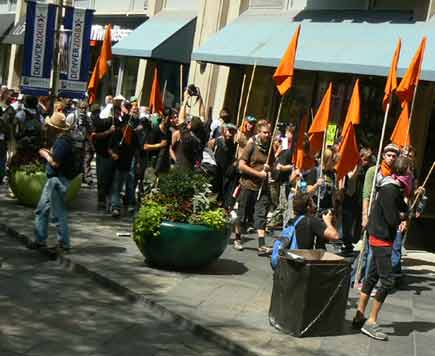
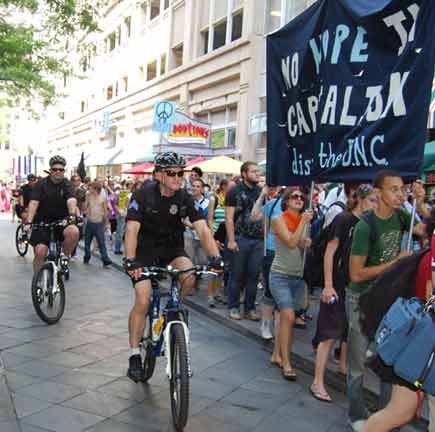
Of course here we are live-blogging about DPD troop movements. Suddenly the server seems to be acting buggy.

If you think I’m suffering delusions of grandeur when I imagine that every cop I pass seems to be reporting the event into his headpiece, consider the budget they’re spending on all of us.

Denver spent fifty million on DNC security, including a Super Fusion Center. They expected fifty thousand protesters. That makes for some easy math. $50M divided by 50k means a thousand dollars of equipment and manpower had been allocated for each protester. Since fewer than expected showed up, that’s a lot of intelligence firepower to spread over quite a bit fewer than 50 thousand protesters.

If we figure the demonstrations thus far have drawn five thousand persons of interest. Would that mean $10,000 is being spent on each? Probably the figure’s more like 1,000 people who could be considered to pose an imagined risk. That would mean $50,000 per. Over the course of five days, that’s $10,000 each person, each day. Figuring 90% of the security budget might have been spent on equipment, $1,000 per day would remain to pay, what, seven law enforcement personnel working overtime for each citizen suspect?

If you consider yourself unpredictably active enough to be among those thousand, tomorrow, when you are facing a line of armor clad riot cops, pick out seven and have them call you Sir.

It’d be a symbolic gesture. Probably the actual DPD staff allocated to you personally is comprised of three riot cops, one plain-clothed informer, and two surveillance analysts. Does that leave one unaccounted for? One full time person working on who knows what about you? Very likely.

It’s hard not to feel special.

Unconventional Action takes to street

DENVER- Let’s start with the second confrontation. DNC disruption-minded Unconventional Action held Broadway Ave beneath the Capitol building, prompting riot police to close in.
UA second confrontation

Unconventional Action to RECLAIM THE STREETS
3PM 16th Street Mall
Pole position on mall

No Hope in Capitalism

No Hope in Capitalism

Its the System Stupid

Departing from permitted route
“To locations downtown, particularly near delegates’ hotels, where coordinated direct action and protests may take place after the End the Occupations march.”
Bandanas

Queer message

Show of arms

Protecting the Sheritan

Marie watches

Through park

First Confrontation:
Unconventional Action moved up from Civic Center Park, unto Lincoln Ave and stayed. Mounted police were the first responders.
Mounted Police

Horses were used to advance against the crowd and split it.
Parting the protesters

Eventually Unconventional Action relinquished their position and moved over one block.
Pushing crowd back

Second Confrontation
Back to Broadway Avenue. After riot troops formed their line, UA marchers stepped up against them.
UA move toward cops

This lead to some tense moments. Police commanders could be heard instructing each other “if anyone (unintelligible), shot them.” Just as abruptly, Unconventional Action broke off and marched North, beckoning all to follow. “Off the sidewalks, into the streets!” Few takers.
UA moves North

Riot police jumped on SUVs and gave chase.
Cops take chase

To be continued…