MLK: Why I am Opposed to the War

Martin Luther King Jr“You’re too arrogant! And if you don’t change your ways, I will rise up and break the backbone of your power, and I’ll place it in the hands of a nation that doesn’t even know my name. Be still and know that I’m God.”
 
Sermon at the Ebenezer Baptist Church on April 30, 1967. Full text below.

The sermon which I am preaching this morning in a sense is not the usual kind of sermon, but it is a sermon and an important subject, nevertheless, because the issue that I will be discussing today is one of the most controversial issues confronting our nation. I’m using as a subject from which to preach,

“Why I Am Opposed to the War in Vietnam.”

Now, let me make it clear in the beginning, that I see this war as an unjust, evil, and futile war. I preach to you today on the war in Vietnam because my conscience leaves me with no other choice. The time has come for America to hear the truth about this tragic war. In international conflicts, the truth is hard to come by because most nations are deceived about themselves. Rationalizations and the incessant search for scapegoats are the psychological cataracts that blind us to our sins. But the day has passed for superficial patriotism. He who lives with untruth lives in spiritual slavery. Freedom is still the bonus we receive for knowing the truth. “Ye shall know the truth,” says Jesus, “and the truth shall set you free.” Now, I’ve chosen to preach about the war in Vietnam because I agree with Dante, that the hottest places in hell are reserved for those who in a period of moral crisis maintain their neutrality. There comes a time when silence becomes betrayal.

The truth of these words is beyond doubt, but the mission to which they call us is a most difficult one. Even when pressed by the demands of inner truth, men do not easily assume the task of opposing their government’s policy, especially in time of war. Nor does the human spirit move without great difficulty against all the apathy of conformist thought within one’s own bosom and in the surrounding world. Moreover, when the issues at hand seem as perplexing, as they often do in the case of this dreadful conflict, we’re always on the verge of being mesmerized by uncertainty. But we must move on. Some of us who have already begun to break the silence of the night have found that the calling to speak is often a vocation of agony. But we must speak. We must speak with all the humility that is appropriate to our limited vision, but we must speak. And we must rejoice as well, for in all our history there has never been such a monumental dissent during a war, by the American people.

Polls reveal that almost fifteen million Americans explicitly oppose the war in Vietnam. Additional millions cannot bring themselves around to support it. And even those millions who do support the war [are] half-hearted, confused, and doubt-ridden. This reveals that millions have chosen to move beyond the prophesying of smooth patriotism, to the high grounds of firm dissent, based upon the mandates of conscience and the reading of history. Now, of course, one of the difficulties in speaking out today grows the fact that there are those who are seeking to equate dissent with disloyalty. It’s a dark day in our nation when high-level authorities will seek to use every method to silence dissent. But something is happening, and people are not going to be silenced. The truth must be told, and I say that those who are seeking to make it appear that anyone who opposes the war in Vietnam is a fool or a traitor or an enemy of our soldiers is a person that has taken a stand against the best in our tradition.

Yes, we must stand, and we must speak. [tape skip]…have moved to break the betrayal of my own silences and to speak from the burnings of my own heart, as I have called for radical departures from the destruction of Vietnam. Many persons have questioned me about the wisdom of my path. At the heart of their concerns, this query has often loomed large and loud:

“Why are you speaking about the war, Dr. King? Why are you joining the voices of dissent?” Peace and civil rights don’t mix, they say.

And so this morning, I speak to you on this issue, because I am determined to take the Gospel seriously. And I come this morning to my pulpit to make a passionate plea to my beloved nation.

This sermon is not addressed to Hanoi, or to the National Liberation Front. It is not addressed to China or to Russia. Nor is it an attempt to overlook the ambiguity of the total situation and the need for a collective solution to the tragedy of Vietnam. Nor is it an attempt to make North Vietnam or the National Liberation Front paragons of virtue, nor to overlook the role they must play in a successful resolution of the problem. This morning, however, I wish not to speak with Hanoi and the National Liberation Front, but rather to my fellow Americans, who bear the greatest responsibility, and entered a conflict that has exacted a heavy price on both continents.

Now, since I am a preacher by calling, I suppose it is not surprising that I have seven major reasons for bringing Vietnam into the field of my moral vision. There is…a very obvious and almost facile connection between the war in Vietnam and the struggle I and others have been waging in America. A few years ago there was a shining moment in that struggle. It seemed that there was a real promise of hope for the poor, both black and white, through the Poverty Program. There were experiments, hopes, and new beginnings. Then came the build-up in Vietnam. And I watched the program broken as if it was some idle political plaything of a society gone mad on war. And I knew that America would never invest the necessary funds or energies in rehabilitation of its poor so long as adventures like Vietnam continued to draw men and skills and money, like some demonic, destructive suction tube. And you may not know it, my friends, but it is estimated that we spend $500,000 to kill each enemy soldier, while we spend only fifty-three dollars for each person classified as poor, and much of that fifty-three dollars goes for salaries to people that are not poor. So I was increasingly compelled to see the war as an enemy of the poor, and attack it as such.

Perhaps the more tragic recognition of reality took place when it became clear to me that the war was doing far more than devastating the hope of the poor at home. It was sending their sons, and their brothers, and their husbands to fight and die in extraordinarily high proportion relative to the rest of the population. We were taking the black young men who had been crippled by society and sending them eight thousand miles away to guarantee liberties in Southeast Asia which they had not found in Southwest Georgia and East Harlem. So we have been repeatedly faced with a cruel irony of watching Negro and white boys on TV screens as they kill and die together for a nation that has been unable to seat them together in the same school room. So we watch them in brutal solidarity, burning the huts of a poor village. But we realize that they would hardly live on the same block in Chicago or Atlanta. Now, I could not be silent in the face of such cruel manipulation of the poor.

My third reason moves to an even deeper level of awareness, for it grows out of my experience in the ghettos of the North over the last three years–especially the last three summers. As I have walked among the desperate, rejected, and angry young men, I have told them that Molotov cocktails and rifles would not solve their problems. I have tried to offer them my deepest compassion while maintaining my conviction that social change comes most meaningfully through non-violent action; for they ask and write me, “So what about Vietnam?” They ask if our nation wasn’t using massive doses of violence to solve its problems to bring about the changes it wanted.

Their questions hit home, and I knew that I could never again raise my voice against the violence of the oppressed in the ghettos without first having spoken clearly to the greatest purveyor of violence in the world today: my own government. For the sake of those boys, for the sake of this government, for the sake of the hundreds of thousands trembling under our violence I cannot be silent.

Been a lot of applauding over the last few years. They applauded our total movement; they’ve applauded me. America and most of its newspapers applauded me in Montgomery. And I stood before thousands of Negroes getting ready to riot when my home was bombed and said, we can’t do it this way. They applauded us in the sit-in movement–we non-violently decided to sit in at lunch counters. The applauded us on the Freedom Rides when we accepted blows without retaliation. They praised us in Albany and Birmingham and Selma, Alabama. Oh, the press was so noble in its applause, and so noble in its praise when I was saying, Be non-violent toward Bull Connor; when I was saying, Be non-violent toward [Selma, Alabama segregationist sheriff] Jim Clark.

There’s something strangely inconsistent about a nation and a press that will praise you when you say, Be non-violent toward Jim Clark, but will curse and damn you when you say, “Be non-violent toward little brown Vietnamese children. There’s something wrong with that press!

As if the weight of such a commitment to the life and health of America were not enough, another burden of responsibility was placed upon me in 1964. And I cannot forget that the Nobel Peace Prize was not just something taking place, but it was a commission–a commission to work harder than I had ever worked before for the brotherhood of Man. This is a calling that takes me beyond national allegiances.

But even if it were not present, I would yet have to live with the meaning of my commitment to the ministry of Jesus Christ. To me, the relationship of this ministry to the making of peace is so obvious that I sometimes marvel at those who ask me why I am speaking against the war. Could it be that they do not know that the Good News was meant for all men, for communists and capitalists, for their children and ours, for black and white, for revolutionary and conservative? Have they forgotten that my ministry is in obedience to the One who loved His enemies so fully that he died for them? What, then, can I say to the Vietcong, or to Castro, or to Mao, as a faithful minister to Jesus Christ? Can I threaten them with death, or must I not share with them my life?

Finally, I must be true to my conviction that I share with all men the calling to be the son of the Living God. Beyond the calling of race or nation or creed is this vocation of son-ship and brotherhood. And because I believe that the Father is deeply concerned, especially for His suffering and helpless and outcast children, I come today to speak for them.

And as I ponder the madness of Vietnam and search within myself for ways to understand and respond in compassion, my mind goes constantly to the people of that peninsula. I speak not now of the soldiers of each side, not of the military government of Saigon, but simply of the people who have been under the curse of war for almost three continuous decades now. I think of them, too, because it is clear to me that there will be no meaningful solution until some attempt is made to know these people and hear their broken cries.

Now, let me tell you the truth about it. They must see Americans as strange liberators.

Do you realize that the Vietnamese people proclaimed their own independence in 1945 after a combined French and Japanese occupation? And incidentally, this was before the Communist revolution in China. They were led by Ho Chi Minh. And this is a little-known fact, and these people declared themselves independent in 1945. They quoted our Declaration of Independence in their document of freedom, and yet our government refused to recognize them. President Truman said they were not ready for independence. So we fell victim as a nation at that time of the same deadly arrogance that has poisoned the international situation for all of these years. France then set out to reconquer its former colony. And they fought eight long, hard, brutal years trying to re-conquer Vietnam. You know who helped France? It was the United States of America. It came to the point that we were meeting more than eighty percent of the war costs. And even when France started despairing of its reckless action, we did not. And in 1954, a conference was called at Geneva, and an agreement was reached, because France had been defeated at Dien Bien Phu.

But even after that, and after the Geneva Accord, we did not stop. We must face the sad fact that our government sought, in a real sense, to sabotage the Geneva Accord. Well, after the French were defeated, it looked as if independence and land reform would come through the Geneva agreement. But instead the United States came and started supporting a man named Diem who turned out to be one of the most ruthless dictators in the history of the world. He set out to silence all opposition. People were brutally murdered because they raised their voices against the brutal policies of Diem. And the peasants watched and cringed as Diem ruthlessly rooted out all opposition. The peasants watched as all this was presided over by United States influence and by increasing numbers of United States troops who came to help quell the insurgency that Diem’s methods had aroused. When Diem was overthrown, they may have been happy, but the long line of military dictatorships seemed to offer no real change, especially in terms of their need for land and peace. And who are we supporting in Vietnam today? It’s a man by the name of general Ky [Air Vice Marshal Nguyen Cao Ky] who fought with the French against his own people, and who said on one occasion that the greatest hero of his life is Hitler. This is who we are supporting in Vietnam today. Oh, our government and the press generally won’t tell us these things, but God told me to tell you this morning. The truth must be told.

The only change came from America as we increased our troop commitments in support of governments which were singularly corrupt, inept, and without popular support and all the while the people read our leaflets and received regular promises of peace and democracy and land reform. Now they languish under our bombs and consider us, not their fellow Vietnamese, the real enemy. They move sadly and apathetically as we herd them off the land of their fathers into concentration camps, where minimal social needs are rarely met. They know they must move or be destroyed by our bombs. So they go, primarily women, and children and the aged. They watch as we poison their water, as we kill a million acres of their crops. They must weep as the bulldozers roar through their areas preparing to destroy the precious trees. They wander into the towns and see thousands of thousands of the children, homeless, without clothes, running in packs on the streets like animals. They see the children degraded by our soldiers as they beg for food. They see the children selling their sisters to our soldiers, soliciting for their mothers. We have destroyed their two most cherished institutions: the family and the village. We have destroyed their land and their crops. We have cooperated in the crushing of the nation’s only noncommunist revolutionary political force, the United Buddhist Church. This is a role our nation has taken, the role of those who make peaceful revolutions impossible but refusing to give up the privileges and the pleasures that comes from the immense profits of overseas investments. I’m convinced that if we are to get on the right side of the world revolution, we as a nation must undergo a radical revolution of values. We must rapidly begin the shift from a thing-oriented society to a person-oriented society. When machines and computers, profit motives and property rights are considered more important than people, the giant triplets of racism, militarism and economic exploitation are incapable of being conquered.

A true revolution of values will soon cause us to question the fairness and justice of many of our present policies. On the one hand, we are called to play the Good Samaritan on life’s roadside, but that will be only an initial act. One day we must come to see that the whole Jericho Road must be changed so that men and women will not be constantly beaten and robbed as they make their journey on life’s highway. True compassion is more than flinging a coin to a beggar. A true revolution of values will soon look uneasily on the glaring contrast of poverty and wealth with righteous indignation. It will look across the seas and see individual capitalists of the West investing huge sums of money in Asia, Africa, and South America, only to take the profits out with no concern for the social betterment of the countries, and say, “This is not just.” It will look at our alliance with the landed gentry of Latin America and say, “This is not just.” The Western arrogance of feeling that it has everything to teach others and nothing to learn from them is not just. A true revolution of values will lay hands on the world order and say of war, “This way of settling differences is not just.” This business of burning human beings with napalm, of filling our nation’s homes with orphans and widows, of injecting poisonous drugs of hate into the veins of peoples normally humane, of sending men home from dark and bloody battlefields physically handicapped and psychologically deranged, cannot be reconciled with wisdom, justice, and love. A nation that continues year after year to spend more money on military defense than on programs of social uplift is approaching spiritual death.

Oh, my friends, if there is any one thing that we must see today is that these are revolutionary times. All over the globe men are revolting against old systems of exploitation and oppression, and out of the wounds of a frail world, new systems of justice and equality are being born. The shirtless and barefoot people of the land are rising up as never before. The people who sat in darkness have seen a great light. They are saying, unconsciously, as we say in one of our freedom songs, “Ain’t gonna let nobody turn me around!” It is a sad fact that because of comfort, complacency, a morbid fear of communism, our proneness to adjust to injustice, the Western nations that initiated so much of the revolutionary spirit of the modern world have now become the arch anti-revolutionaries. This has driven many to feel that only Marxism has a revolutionary spirit. Therefore, communism is a judgment against our failure to make democracy real and follow through on the revolutions that we initiated. Our only hope today lies in our ability to recapture the revolutionary spirit and go out into a sometimes hostile world declaring eternal hostility to poverty, racism, and militarism. With this powerful commitment we shall boldly challenge the status quo, we shall boldly challenge unjust mores, and thereby speed up the day when

“every valley shall be exalted, and every mountain and hill shall be made low, and the rough places shall be made plain, and the crooked places straight. And the glory of the Lord shall be revealed, and all flesh shall see it together.”

A genuine revolution of values means in the final analysis that our loyalties must become ecumenical rather than sectional. Every nation must now develop an overriding loyalty to mankind as a whole in order to preserve the best in their individual societies. This call for a worldwide fellowship that lifts neighborly concern beyond one’s tribe, race, class, and nation is in reality a call for an all-embracing, unconditional love for all men. This oft misunderstood and misinterpreted concept, so readily dismissed by the Nietzsches of the world as a weak and cowardly force, has now become an absolute necessity for the survival of mankind. And when I speak of love I’m not speaking of some sentimental and weak response. I am speaking of that force which all of the great religions have seen as the supreme unifying principle of life. Love is somehow the key that unlocks the door which leads to ultimate reality. This Hindu-Muslim-Christian-Jewish-Buddhist belief about ultimate reality is beautifully summed up in the first epistle of John: “Let us love one another, for God is love. And every one that loveth is born of God and knoweth God. He that loveth not knoweth not God, for God is love. If we love one another, God dwelleth in us and his love is perfected in us.”

Let me say finally that I oppose the war in Vietnam because I love America. I speak out against this war, not in anger, but with anxiety and sorrow in my heart, and, above all, with a passionate desire to see our beloved country stand as the moral example of the world. I speak out against this war because I am disappointed with America. And there can be no great disappointment where there is not great love. I am disappointed with our failure to deal positively and forthrightly with the triple evils of racism, economic exploitation, and militarism. We are presently moving down a dead-end road that can lead to national disaster. America has strayed to the far country of racism and militarism. The home that all too many Americans left was solidly structured idealistically; its pillars were solidly grounded in the insights of our Judeo-Christian heritage. All men are made in the image of God. All men are bothers. All men are created equal. Every man is an heir to a legacy of dignity and worth. Every man has rights that are neither conferred by, nor derived from the State–they are God-given. Out of one blood, God made all men to dwell upon the face of the earth. What a marvelous foundation for any home! What a glorious and healthy place to inhabit. But America’s strayed away, and this unnatural excursion has brought only confusion and bewilderment. It has left hearts aching with guilt and minds distorted with irrationality.

It is time for all people of conscience to call upon America to come back home. Come home, America. Omar Khayyam is right: “The moving finger writes, and having writ moves on.”

I call on Washington today. I call on every man and woman of good will all over America today. I call on the young men of America who must make a choice today to take a stand on this issue.

Tomorrow may be too late. The book may close. And don’t let anybody make you think that God chose America as his divine, messianic force to be a sort of policeman of the whole world. God has a way of standing before the nations with judgment, and it seems that I can hear God saying to America,

“You’re too arrogant!

And if you don’t change your ways,

I will rise up and break the backbone of your power,

and I’ll place it in the hands of a nation that doesn’t even know my name.

Be still and know that I’m God.”

Now it isn’t easy to stand up for truth and for justice. Sometimes it means being frustrated. When you tell the truth and take a stand, sometimes it means that you will walk the streets with a burdened heart. Sometimes it means losing a job…means being abused and scorned. It may mean having a seven, eight year old child asking a daddy, “Why do you have to go to jail so much?” And I’ve long since learned that to be a follower to the Jesus Christ means taking up the cross. And my bible tells me that Good Friday comes before Easter. Before the crown we wear, there is the cross that we must bear. Let us bear it–bear it for truth, bear it for justice, and bear it for peace. Let us go out this morning with that determination. And I have not lost faith. I’m not in despair, because I know that there is a moral order. I haven’t lost faith, because the arc of the moral universe is long, but it bends toward justice. I can still sing “We Shall Overcome” because Carlyle was right: “No lie can live forever.” We shall overcome because William Cullen Bryant was right: “Truth pressed to earth will rise again.” We shall overcome because James Russell Lowell was right: “Truth forever on the scaffold, wrong forever on the throne.” Yet, that scaffold sways the future. We shall overcome because the bible is right: “You shall reap what you sow.”

With this faith we will be able to hew out of the mountain of despair a stone of hope.

With this faith we will be able to transform the jangling discords of our world into a beautiful symphony of brotherhood.

With this faith we will be able to speed up the day when justice will roll down like waters, and righteousness like a mighty stream.

With this faith we will be able to speed up the day when the lion and the lamb will lie down together, and every man will sit under his own vine and fig tree, and none shall be afraid because the words of the Lord have spoken it.

With this faith we will be able to speed up the day when all over the world we will be able to join hands and sing in the words of the old Negro spiritual, “Free at last! Free at last! Thank God Almighty, we’re free at last!”

With this faith, we’ll sing it as we’re getting ready to sing it now. Men will beat their swords into plowshares and their spears into pruning hooks. And nations will not rise up against nations, neither shall they study war anymore. And I don’t know about you, I ain’t gonna study war no more.

The liberal myth of Barack the Impotent

Barack the impotentBarack isn’t president yet, Barack is just one man, Israel is handing Barack a fait accompli, Barack can’t buck The Establishment, Oh Poor Barack the Impotent! What can the poor man do?

According to Rasmussen Americans (are) Closely Divided Over Israel’s Gaza Attacks. However, these are not just ‘Israel’s Gaza Attacks, now are they? They are America’s Gaza Attacks, America’s Attacks on Hamas, America’s Attacks on the Palestinians, and that damn Barack Obama is America’s Commander in Chief, now as much as in 2 weeks. So why all this myth making about Barack the Impotent?

It is simply that American liberals don’t want to admit that they voted this in. Tonight I sat at a talk and discussion about the Israeli destruction of Gaza with 14 others, all who voted for Barack the Impotent. They were talking about in 2 weeks the ‘regime change’ supposedly going to occur. What regime change I asked? There is no regime change taking place in 2 weeks. You are making it all up as you go, since this is the same ‘bipartisan’ group of gangsters as before. Let’s not talk about regime change when, in fact, there is none.

How long are American liberals going to play stupid like this? Your guess is as good as mine? The myth gets further defined as Barack the knowledgeable and Decent, Barack the Educated Man of the World. But when it comes to Barack the Man with a Penis; go figure? He don’t have one and is Barack the Impotent now, or all at least for 2 weeks more. Then The Penis of Barack will rise like Jesus Christ after Crucifixion, I guess? Your guess is as good as mine? Until then, Barack can’t do it!

What is it with Americans who want to individualize a Machine of Little … well you know what I mean… who want to indivualize a group of Ivy League-Chicago School Politician Hacksters like the Barack crowd is? Air Force Air Head Cadets! Locked in Lockheed Shits! Barack is the Liberal Impotent made into a Deity of Change here! Or can he? ….the myth goes on and on and on. Can he? Barack, the He Really Wants to Do-Right Guy, Barack the Community Organizer, Barack the Man of Rainbow Color, Barack the Gentle Giant surrounded by Treacherous Dwarfs! Barack the Noble, Barack the Man of One?

Good grief, the Liberal Community can give one the Heebe Jeebies. Meanwhile, the rest of the world has to put up with the suffering America’s moronic pseudo liberal communities help deliver to them. God Bless…. Well God Bless Anybody but US!

If there is a Hell, it will be full of moronic Americans discussing about how Impotent Barack the Impotent is, with Satan looking on in disbelief! Oh Barack! He just can’t do anything yet! He needs more Viagra than even John McCain! After all, John had Sarah but all Barack has is…. well he’s got Hillary! He’s Barack the Impotent Man! No wonder he’s planning to rape Afghanistan yet more. Can the liberals who voted for Barack the Impotent even find the country on a map?

Obama outed himself as a bigot when he crawled into bed with Rick Warren

Just like Clinton, Obama won’t hesitate to throw gays to the dogs if he thinks it will buy him a single vote from the rabid right. I told you he wasn’t to be trusted. And just as we saw with Prop 8, most of the black community only wants equal rights for themselves, not anybody else.
 
Say it out loud: Barack Obama is a coward.

Of course, Obama openly declared his bigotry against gays before the election, declaring they did not deserve equal rights in marriage. So this really shouldn’t surprise anyone that he would flip off the gay community like this. “Change we can believe in,” my ass.

During the campaign, I had so many arguments with his supporters, who insisted that he was the miracle that would make everything right with America. When confronted with the reality of his positions (as on gays) they would insist that was only to get elected, but, “just you watch,” once he was, then we would see the “real Obama.” Well, Ladies and Germs, the election is over, and there it is: the REAL Obama — flipping the bird to his supporters.

Only a moron would think his hiring every right winger he can find somehow doesn’t mean his is going to be a right wing administration.

What, am I the only one who realized what being a Chicago politician meant? It means he’s an asshole who can’t be trusted. But now I suspect a lot of his supporters are beginning to realize that. Though there will always be those who will defend him, no matter what — just like those Republicans who constantly made excuses for Dubya, or those born-again Christians who spend their entire lives dreaming up excuses for their “god.” People are pathetically stupid.

Disgraced: 66 nations in the UN have backed a resolution decriminalizing homosexuality.

Big hold outs: the USA, Russia, China, and the Vatican.

The nations that are more progressive than this dying backwater: Albania, Andorra, Argentina, Armenia, Australia, Austria, Belgium, Bolivia, Bosnia and Herzegovina, Brazil, Bulgaria, Canada, Cape Verde, Central African Republic, Chile, Colombia, Croatia, Cuba, Cyprus, Czech Republic, Denmark, Ecuador, Estonia, Finland, France, Gabon, Georgia, Germany, Greece, Guinea-Bissau, Hungary, Iceland, Ireland, Israel, Italy, Japan, Latvia, Liechtenstein, Lithuania, Luxembourg, Malta, Mauritius, Mexico, Montenegro, Nepal, Netherlands, New Zealand, Nicaragua, Norway, Paraguay, Poland, Portugal, Romania, San Marino, Sao Tome and Principe, Serbia, Slovakia, Slovenia, Spain, Sweden, Switzerland, the former Yugoslav Republic of Macedonia, Timor-Leste, United Kingdom, Uruguay, and Venezuela.

Excerpts from Thomas McCullock’s Dec 29 notes, thomasmc.com.

Wal-mart drives its chariot of predatory commerce over bones of Civil War dead

Union Soldiers fight on Brock Road 1864
WAL-MART wants to build a Virginia super-center on the edge of the memorial site of one of the most consequential battles of the Civil War. The Wilderness marked the first engagement between Generals Lee and Grant, ignited a forest fire which the soldiers fought through, and left 24,000 dead and wounded. Now 253 historians have joined in asking Wal-mart to reconsider.

Mr. Lee Scott, President and CEO
Walmart Stores, Inc.
702 SW 8th Street
Bentonville, Arkansas 72716-8611

Dear Mr. Scott:

I urge you in the strongest possible terms to pursue alternate building locations for the Walmart Supercenter proposed in Orange County, Virginia. The site currently under consideration lies within the historic boundary of the Wilderness Battlefield and only one quarter mile from the current boundary of the Wilderness Battlefield unit of Fredericksburg and Spotsylvania National Military Park.

The Battle of the Wilderness was among the most significant engagements of the Civil War. It marked the first time legendary generals Robert E. Lee and Ulysses S. Grant faced off against one another on the field of battle. During two days of desperate conflict in a harsh, unforgiving landscape tangled with underbrush, 4,000 Americans lost their lives and nearly 20,000 were wounded.

The proposed location will greatly increase traffic through the area and encourage further development to encroach upon and spoil the battlefield. This, in turn, will seriously degrade the experience for the many tens of thousands of heritage tourists who visit this National Park every year. The Wilderness Battlefield is easily the biggest tourist attraction in Orange County, with visitors coming from around the world to experience its serenity and contemplate its history and significance.

As a historian, I feel strongly that the Wilderness Battlefield is a unique historic and cultural treasure deserving careful stewardship. Currently only approximately 20 percent of the battlefield is protected by the National Park Service. If built, this Walmart would seriously undermine ongoing efforts to see more of this historic land preserved and deny future generations the opportunity to wander a landscape that has, until now, remained largely unchanged since 1864.

The Wilderness is an indelible part of our history, its very ground hallowed by the American blood spilled there, and it cannot be moved. Surely Walmart can identify a site that would meet its needs without changing the very character of the battlefield.

There are many places in central Virginia to build a commercial development, but there is only one Wilderness Battlefield. Please respect our great nation’s history and move your store farther away from this historic site and National Park.

Signed,

* Terrie Aamodt, Walla Walla University
* Edward D. Abrahams, Silver Spring, Md.
* Sean P. Adams, University of Florida
* Garry Adelman, History Associates, Inc.
* Nicholas Aieta, the Marlborough School, West Springfield, Mass.
* A.J. Aiseirithe, Washington, D.C.
* James Anderson, Ashburn, Va.
* Adam Arenson, University of Texas
* Jonathan M. Atkins, Berry College
* Arthur H. Auten, University of Hartford
* David Bard, Concord College
* Alwyn Barr, Texas Tech University
* Craig A. Bauer, Metairie, La.
* Erik Bauer, West Hollywood, Calif.
* Dale Baum, Texas A&M University
* Edwin C. Bearss, Historian emeritus, National Park Service
* Caryn Cosse Bell, University of Massachusetts at Lowell
* Jeffrey R. Bennett, Waterford, N.Y.
* Shannon Bennett, Ellettsville, Ind.
* Melvyn S. Berger, Newton, Mass.
* Arthur W. Bergeron, Shippensburg, Pa.
* Edward H. Bergerstrom, Port Richey, Fla.
* Eugene H. Berwanger, Colorado State University
* Fred W. Beuttler, Deputy Historian, U.S. House of Representatives
* Darrel Bigham, University of Southern Indiana
* John Bloom, Las Cruces, N.M.
* Frederick J. Blue, Youngstown State University
* Christopher Bobal, Lees Summit, Mo.
* Thomas Bockhorn, Huntsville, Ala.
* Keith Bohannon, University of West Georgia
* Phillip S. Bolger, San Diego, Calif.
* Patrick Boyd, the Pomfret School, Pomfret, Conn.
* Vernon S. Braswell, Corpus Christi, Tex.
* Roger D. Bridges, Bloomington, Ill.
* Ronald S. Brockway, Regis University
* Col. George M. Brooke, III, USMC (Ret.), Lexington, Va.
* Bruce A. Brown, Cypress, Calif.
* Norman D. Brown, University of Texas, Austen, Tex.
* David Brush, the Pomfret School, Pomfret, Conn.
* Jim Burgess, Manassas National Battlefield, Va.
* Ken Burns, Walpole, N.H.
* Brian Burton, Ferndale, Wash.
* Victoria Bynum, Texas State University-San Marcos
* Peter S. Carmichael, West Virginia University
* Marius M. Carriere, Christian Brothers University
* Katherine Cassioppi, National-Louis University
* Gary Casteel, Lexington, Va.
* Jane Turner Censer, George Mason University
* William Cheek, San Diego State University
* John Cimprich, Thomas More College
* Thomas G. Clemens, Hagerstown Community College
* Leon F. Cohn, Plantation, Fla.
* Thomas B. Colbert, Marshalltown Community College
* James R. Connor, Chancellor emeritus University of Wisconsin-Whitewater
* William J. Cooper, Jr., Louisiana State University
* Janet L. Coryell, Western Michigan University
* Charles E. Coulter, Yankton, S.D.
* Robert E. Curran, Richmond, Ky.
* Thomas F. Curran, Saint Louis, Mo.
* Gordon E. Dammann, National Museum of Civil War Medicine
* Guy Stephen Davis, Atlanta, Ga.
* William C. “Jack” Davis
* Joseph G. Dawson, III, Texas A&M University
* Mary DeCredico, United States Naval Academy
* James Lyle DeMarce, Arlington, Va.
* Charles B. Dew, Williams College
* Steven Deyle, University of Houston
* Richard DiNardo, Marine Corps Command and Staff College
* Luis-Alejandro Dinnella-Borrego, Warwick, N.Y.
* Richard R. Duncan, Alexandria, Va.
* Kenneth Durr, History Associates, Inc.
* David Dykstra, Poolesville, Md.
* Mark Elliott, University of North Carolina at Greensboro
* Robert F. Engs, University of Pennsylvania
* C. Wyatt Evans, Drew University
* Daniel Feller, University of Tennessee
* Rex H. Felton, Tiffin, Ohio
* Paul Finkelman, Albany Law School
* Jeff Fioravanti, Lynn, Mass.
* Joseph C. Fitzharris, University of Saint Thomas
* J.K. Folmarm California, Minn.
* George B. Forgie, University of Texas Austin
* Lee W. Formwalt, Organization of American Historians
* Janet B. Frazer, Narberth, Pa.
* Gary W. Gallagher, University of Virginia, Charlottesville, Va.
* Jonathan Gantt, Columbia College
* Jason Gart, History Associates, Inc.
* Louis S. Gerteis, University of Missouri, St. Louis
* Kate C. Gillin, the Pomfret School, Pomfret, Conn.
* Mary Giunta, Edinburg, Va.
* Martin K. Gordon, Columbia, Md.
* Cathy Gorn, University of Maryland
* Thomas M. Grace, Amherst, N.Y.
* Susan W. Gray, Severna Park, Md.
* A. Wilson Greene, Pamplin Historical Park and National Museum of the Civil War Soldier
* Debra F. Greene, Jefferson City, Mo.
* Jim Griffin, Frisco, Tex.
* Linda J. Guy, Clearville, Pa.
* Edward J. Hagerty, American Military University
* Alfred W. Hahn, Midlothian, Va.
* Judith Lee Hallock, South Setauket, N.Y.
* Jerry Harlow, President, Trevilian Station Battlefield Foundation
* D. Scott Hartwig, Gettysburg National Military Park, Pa.
* David S. Heidler, Colorado State University
* Jeannie Heidler, United States Air Force Academy
* John S. Heiser, Gettysburg National Military Park, Pa.
* Earl J. Hess, Lincoln Memorial University
* Libra Hilde, San Jose State University
* T. John Hillmer, Jr., Wilson’s Creek National Battlefield, Mo.
* David Hochfelder, State University of New York – Albany
* Sylvia Hoffert, Texas A&M University
* Patrick Hotard, Philadelphia, Pa.
* Richard Houston, Harwich, Mass.
* Randal L. Hoyer, Madonna University
* Richard L. Hutchison, Fort Worth, Tex.
* Brian M. Ingrassia, Georgia State University
* Perry D. Jamieson, Crofton, Md.
* Jim Jobe, Fort Donelson National Battlefield, Tenn.
* Willie Ray Johnson, Kennesaw Mountain National Battlefield Park, Ga.
* Vivian Lee Joyner, New Hill, N.C.
* Whitmel M. Joyner, New Hill, N.C.
* Walter D. Kamphoefner, Texas A&M University
* Amalie M. Kass, Harvard Medical School
* Philip M. Katz, Washington, D.C.
* Brad Keefer, Kent State University
* Brian J. Kenny, Denver, Co.
* Victoria A. Kin, San Antonio, Tex.
* George W. Knepper, University of Akron
* Christopher Kolakowski, National Museum of the U.S. Army Reserve
* Carl E. Kramer, Indiana University Southeast
* Arnold Krammer, Texas A&M University
* Robert K. Krick, Fredericksburg, Va.
* Michael E. Krivdo, Texas A&M University
* Benjamin Labaree, Saint Alban’s School, Washington, D.C.
* Dan Laney, Austin, Tex.
* Connie Langum, Wilson’s Creek National Battlefield, Mo.
* William P. Leeman, Coventry, R.I.
* Kevin Levin, Charlottesville, Va.
* Richard G. Lowe, University of North Texas
* Robert W. Lowery, Jr., Newport News, Va.
* M. Philip Lucas, Cornell College
* R. Wayne Mahood, Geneseo, N.Y.
* Daniel Martin, Lancaster, Pa.
* William Marvel, South Conway, N.H.
* Matthew Mason, Brigham Young University
* Dinah M. Mayo-Bobee, University of Massachusetts, Amherst
* George T. Mazuzan, Springfield, Va.
* Nathan McAlister, Hoyt, Kan.
* David McCullough
* Dennis K. McDaniel, Washington, D.C.
* James M. McPherson, Princeton University
* Kathleen G. McKesson, Eighty Four, Pa.
* James G. Mendez, Chicago, Ill.
* Brian Craig Miller, Emporia State University
* Roger E. Miller, Eagle River, Alaska.
* Wilbur R. Miller, State University of New York – Stony Brook
* Eric J. Mink, Fredericksburg, Va.
* Robert E. Mitchell, Brookline, Mass.
* John Moody, Orange Park, Fla.
* Richard Moore, Woodbridge, Va.
* Richard Morey, Kent Place School, Summit, N.J.
* Geoffrey Morrison, Saint Louis, Mo.
* Brenda Murray, North Pole, Alaska.
* Richard J. Myers, Doylestown, Pa.
* Eric Nedergaard, Mesa, Ariz.
* Robert D. Neuleib, Normal, Ill.
* Kenneth Noe, Auburn University
* Justin Oakley, Martinsville, Ind.
* Kristen Oertel, Millsaps College
* Marvin Olson, La Crescenta, Ca.
* Beverly Palmer, Claremont, Ca.
* John T. Payne, Lone Star College
* Graham Peck, Saint Xavier University
* William D. Pederson, Louisiana State University, Shreveport
* William E. Pellerin, Santa Barbara, Ca.
* Don Pfanz, Fredericksburg and Spotsylvania National Military Park, Va.
* Michael Pierson, University of Massachusetts, Lowell
* Kermit J. Pike, Western Reserve Historical Society, Mentor, Ohio
* Ann Poe, Alexandria, Va.
* Kieth Ploakoff, Rossmoor, Ca.
* Lawrence N. Powell, Tulane University
* Adam J. Pratt. Baton Rouge, La.
* Gerald Prokopowicz, East Carolina University
* John Quist, Shippensburg University
* Steven J. Rauch, Evans, Ga.
* S. Waite Rawls, III, Museum of the Confederacy
* Carol Reardon, Pennsylvania State University
* Douglas Reasner, Durant, Iowa
* Michael Reis, History Associates, Inc.
* Robert V. Remini, Office of the Historian, U.S. House of Representatives
* James Renberg, Southern Pines, N.C.
* Gordon Rhea, Mount Pleasant, S.C.
* Jean Richardson, Buffalo State College
* Jeffrey Richman, Brooklyn, N.Y.
* Harris D. Riley, Jr., M.D., Nashville, Tenn.
* James I. Robertson, Jr., Virginia Tech
* Stephen I. Rockenbach, Virginia State University
* Sylvia Rodrigue, Baton Rouge, La.
* Rodney A. Ross, Center for Legislative Archives, Washington, D.C.
* Jennifer Ross-Nazzal, Johnson Space Center
* Jeffrey J. Safford, Montana State University
* Frank Scaturro, New Hyde Park, N.Y.
* Mark S. Schantz, Hendrix College
* Laurence D. Schiller, Deerfield, Ill.
* Christopher A. Schnell, Springfield, Ill.
* Glenna R. Schroeder-Lein, Springfield, Ill.
* Frederick Schult, Jr., New York University
* Donald L. Schupp, Warrenton, Va.
* Richard D. Schwartz, Morristown, N.J.
* Cynthia Seacord, Schenectady, N.Y.
* Tomas Seaver, Woonsocket, R.I.
* Diane Shalda, Chicago Military Academy
* Peter D. Sheridan, Torrance, Ca.
* Mark Snyder, Akron, Ohio
* John Sotak, O.S.A., New Lenox, Ill.
* Clay W. Stuckey, DDS, Bedford, Ind.
* Carlyn Swaim, History Associates, Inc.
* Andrew Talkov, Virginia Historical Society
* Robert A. Taylor, Florida Institute of Technology
* Paul H. Tedesco, Northeastern University
* James Thayer, Milford, Mass.
* Emory M. Thomas, University of Georgia
* JoAnne Thomas, Peoria, Ill.
* Joseph Trent, Worcester, Mass.
* Tony R. Trimble, Plainfield, Ind.
* I. Bruce Turner, University of Louisiana at Lafayette
* Edwin C. Ulmer, Jr., Feasterville, Pa.
* Charles W. Van Adder, Forked River, N.J.
* Charles Vincent, Baker, La.
* Joseph F. von Deck, Ashburnham, Ma.
* Brent Vosburg, Elizabethtown, N.J.
* Robert Voss, Lincoln, Neb.
* George N. Vourlojianis, Lorain County Community College
* Christopher R. Waldrep, San Francisco State University
* John Weaver, Tipp City, Ohio
* Robert Welch, Ames, Iowa
* Lowell E. Wenger, Cincinnati, Ohio
* Jeffrey Wert, Centre Hall, Pa.
* Bruce E. Wilburn, Glen Allen, Va.
* Diana I. Williams, Wellesley College
* Mary Williams, Fort Davis National Historic Site, Tex.
* Terry Winschel, Vicksburg National Military Park, Miss.
* Roger Winthrop, Lansing, Mich.
* Eric J. Wittenberg, Columbus, Ohio
* Ralph A. Wooster, Lamar University
* Donald Yacovone, Harvard University
* Shirley J. Yee, University of Washington
* Mitchell Yockelson, National Archives and Records Administration
* William D. Young, Maple Woods Community College
* Mary E. Younger, Dayton, Ohio
* Jack Zevin, Queens College, City University of New York

Obama’s slam Duncan of public education

arne duncanIt seems that the ‘Change’ President and basketball player, Barack Obama, has picked another Basketball jock like himself to head up National Education policy? In choosing Arne Duncan for the post, Barack Obama slam Dunkan-ed the Chicago community organizing group, Parents United for Responsible Education, with an Aspen Institute prodigy who specializes in closing down public schools and then reopening them as privatized ‘charter schools’.

No wonder Pastor Rick Warren will be at the Inaugural Ceremony performing for BO, because this is the favored program of the Religious Right that would have religion put back in schools forcefully, using public tax monies to get it done. Barack is on board this program, and so is Harvard Basketball jock Arne.

Who is this Arne really? He is a guy who has never been a teacher, and get this! … he has a degree in Sociology! That would get me and you a job at about $13/hr, but Arne got his Sociology Degree at Harvard. Add some extra points, because he paid some extra dollars for that degree. PLUS, he’s added on some honorary credentials from other elite outfits, too, including a ‘Doctor of Laws’ degree from Lake Forest College. Wkipedia tells us that Most (if not all) U.S. universities that award the degree of Doctor of Laws (LL.D.), award it only as an honorary degree. Read…. big shots are given it for free, this degree.

But that would not be enough alone to have gotten Barack Obama to pick the guy for Education Boss. The fact is, that Arne Duncan was one of Harvard’s greatest basketball Stars! Oh the alumni! Oh, and there’s more! Arne plays BB games with Barrack in Chicago! Never has cronyism been so narrowed!

The impact of Obama’s slam dunk of public education with this sorry choice of exHarvard BB Star Duncan, is more than just an indication of how Barack Obama wants to do yet more with the ‘No Child Left Behind’ sort of privatization mish mash of the Dubya years, but is also an indicator of how little real public heath care we shall see in the cards in the years ahead. After all, if you think that privatizing public education is a good thing, then it is not going to mean that this ‘Change’ BB Dude will be ready to change the already privatized American Health Care System for the better either. No way! He’ll just put a basketball jock, this time from Yale, perhaps?, in charge of Medicine. First the Boss would have to be vetted by the Aspen Institute or some other elite ruling class money laundering outfit like them though. Then slam dunk Health Care. It looks deadly.

Yes, it’s going to be corruption as usual in the Education Department and one doesn’t need a Sociology Degree to figure that one out from this choice. Good luck, Kids! 2+2=4 and Barack Obama is bouncing people around in court. It’ll be a real public education for all of us very soon, and could it get much worse? Social Security on the chopping block anybody?

The American dyslexia for economics

The interest rate for banks is down to zero. B of A and Citibank are still charging 39%. What again does economic news have to do with me?
 
The biggest news on the economy was BREAKING NEWS a week ago: the US economy is in a recession, and has been for over a year. Can news a year old still be news? What news exactly are we getting from the experts, economists and other mesmerists paraded on the television every evening?

We consult them on a minute by minute basis, actually, on 24/7 cable news stations, for every hint of a whiff of where the weather vane might indicate the US economy is blowing. If the stock market doesn’t hang on their every diagnosis, it reacts to what unelected, self-made officials say. Now we’re led to understand all that spinning can flip-flop for a year-old contradictory study.

And who’s going to let America know when we’ve hit a full-on depression? Will we be told it before the decade is enshrined post-facto in a Time-Life retrospective? Are those in charge so cynical that they count on the public knowing the truth in spite of their lies, because it’s we who endure the effects in real time anyway? The media can lie about unemployment figures too –what could it possibly matter to the unemployed?

It’s not only ADD. Americans understand why too-sobering statistics are kept from us, lest a post-mortem induce pre. We are the great engine of consumerism, running on pure flattery. I think it’s the same self-defeating fatalism which fuels the life insurance scam. We bet against ourselves. We buy self-help books. We are eternally sick.

But does the economy really work so? Would an autopsy be self-fulfilling? Can an economy go sour due to one bad-apple-attitude, or would it be because of the lost jobs?

I’m guessing this is where the University of Chicago meets Euripides, or if it prefers, palmistry. There’s a global comeuppance in your future, you small fraction of Earth’s population who have expended the lion’s share of its resources. That’s what will introduce the American quality of life to harsh earthbound reality.

Keeping American consumers in debt is less a magician’s act of driving the economy, than it is a swindler’s function of distracting the poor dupe until he’s lost his shirt.

But this swindler is not planning to catch the next bus out of town.

This banking scam isn’t over until the shirtless victim is thrown out the saloon door and into the street, where’s he’s got no redress but to face line after line of well armed riot police.

‘Patriotic’ pacifists and ‘Peace’crats to hold UFPJ lobbyfest gathering in Chicago

Hillary and JesusUnited for Peace and Justice (UFPJ) will be holding a gathering in Chicago next week to start their plans for a 2009 Lobbyfest of Barack Obama. They still haven’t figured any of it out and most likely never will. Ostensibly the UFPJ has not decided on doing anything just yet and the gathering is for the group to supposedly decide just what should be done?

That’s all a big joke since the Democratic Party and liberal Christian group controlled leadership of the UFPJ has but just one strategy, and that is to try to make themselves ‘heard’ by the Powers that be (though they refuse to try to mobilize any power of their own). They are like beggars of a sort, who will be pleading with Barack, Hillary, and Gates for some bones of recognition. They promise not to talk too much about imperialism, Afghanistan, Somalia, and anything else of dispute, say like… torture use by the US military, the US threatening Russia with nuclear weapons, Iraq, or US military made pollution… and the list goes on of none issues to these people., or the issues they just plain out want people not to be talking about.

The UFPJ are the ‘patriotic’ Democratic Party liberal middle class voters and churchly pacifists, whose ‘eyes are wide open’ onto the boots of several thousand US soldiers, but not much on the damage these soldiers actually did to other peoples. They voted for ‘change’, but they’re not too pressured about when it comes, where it comes from, or even if it will ever come? A pretty word or two from their Democratic Party gurus will keep most of them totally satisfied for years.

YES, the UFPJ will want to go lobby this new year, and that’s what they will project doing though they will smokescreen it with some sort of ‘national week’ of blah, blah, blah, etc. These are the very same folk that always say that large demonstrations don’t work, so just go out and vote DP. Don’t expect a change of heart from them, or any insight.

How happy they are at the success of that profoundly absurd strategy they must be with the New Administration? The more abjectly they get thrown to the side by Power, the more committed they get to their own masochistic policy of turning out the vote…. to always vote for those who will ignore them, piss on them, and marginalize them as much as they can.

The UFPJ has even been offered a challenge by other antiwar activists to give up their sectarianism and come together with others to help build national and unified demonstrations against the war. That is anathema to the UFPJ leadership though, and we should expect absolutely nothing from them that would help bring that about. They’re sticking with the Democrats come rain or shine, and come the chaos and mayhem the Democratic Party will work alongside their Republican Party cohorts to bring us more of.

The ‘Patriotic’ pacifists and ‘Peace’crats are like small business owners in their outlook, and they have the DP franchise for ownership over the antiwar movement, just as long as the rest of us put up with it and stay demobilized ourselves? That is the big question? Just how long will the real activists in the national antiwar movement keep pumping money and time into this US national coalition, the UFPJ, who are out to simply not do much at all?

Passively accepting such a group of incompetent and chained down to the DP leaders as the UFJP is, is just more of a loser strategy that does nothing to help out a country currently experiencing a collapse of the US economy and the bankruptcy of the corporate class, fallen deathly ill from their own total corruption. The country needs a real antiwar coalition at work for the country, and not just a prayer group of multiple paid office hacks. The longer a real Movement is not actually built, the more damage the Pentagon will actually do to the country and the world, Lockheed and all the other corporate powers behind them feeding from the public trough. The UFJP is not even close to being the leadership for a real Antiwar Movement in this country, and can never be that as it is organized and structured to not be one, but rather to just be a pacifist coalition of a few nice people who pray and vote and not much else.

The UFPJ not only cannot be looked upon to provide leadership for us in the next years of Obama Nation, but will be an active barrier against all that do try to work to build dissent against US militarism. That is sad to say, but efforts to try to change the orientation of this group will be about as futile as trying to pull MoveOn away from their Democratic Party foundation. Better to spend your time, energy, and efforts to build other organizations as alternative to these obstructionists. The UFPJ is simply their church, and not much else.

News conferences at the Chicago Hilton

Chicago
CHICAGO- I tried to take the penultimate winter Shytown photograph: snow covered bicycles, pigeons on old bridge gatehouse, blowing snow, and the Sears Tower.

My visit was vexing enough knowing that the president elect was conducting daily news conferences in Chicago, without a picketer in sight. You’d think someone would protest the choice of Gates, Volker or Emanuel, considering for example that November 29 was awareness day for the plight of the Palestinians.

Eric

In Colorado, I had become accustomed to rallying for some street lobbying effort or other when Candidate Obama was visiting even a nearby city. Here, Chicago was playing host to all of Obama’s cabinet appointment announcements. But I couldn’t find any listing of corresponding activities other than weekly or monthly antiwar vigils.

It was difficult enough to ascertain where the regular cabinet announcements were being presented. Most news reports simply attribute the event to Chicago, as “In Chicago today, Obama…” I began to wonder if for security logistics, the events were being staged like the Capricorn One landing, in a sound stage of inconsequential locale.

Unless you subscribe to an antiwar detente-honeymoon for Obama, Chicago is an opportunity not to be missed. Soon enough Obama will be in Washington DC, out of reach of all our voices.

The incoming cabinet reprise their incumbent roles daily, just off Grant Park, at the President Elect news conferences held in the ballroom of the Chicago Hilton on Michigan Avenue.

STATEMENT BY NATIONAL ASSEMBLY TO END THE IRAQ AND AFGHANISTAN WARS AND OCCUPATIONS

STATEMENT BY NATIONAL ASSEMBLY TO END THE IRAQ AND AFGHANISTAN WARS AND OCCUPATIONS Issued 10/23/08 SUPPORT CALL FOR UNITED MASS MOBILIZATIONS IN MARCH, 2009 IN WASHINGTON , D.C. AND OTHER CITIES

The National Assembly to End the Iraq and Afghanistan Wars and Occupations welcomes the ANSWER Coalition’s call for UNITED mass mobilizations in Washington, D.C. and other cities, including Los Angeles, San Francisco, Chicago and Miami, on March 21, 2009, marking six years of war and occupation and demanding Bring All the Troops Home Now! We also welcome UFPJ’s call for a week of Washington , D.C. mobilizations during the same period to demand an end to the war in Iraq now.

These actions are necessary and need not be contradictory, as long as there is unity in supporting them. However, a divided movement is a weakened movement. At this time, more than ever, the movements for peace and social justice must work in concert to bring the full force of opposition to the government’s criminal and destructive policies into the streets. It would be a tragic setback if all organizations and constituencies do not come together to act in a unified show of strength and determination in March.

The National Assembly to End the Iraq and Afghanistan Wars and Occupations was formed to promote a united, democratic, independent and mass action antiwar movement to bring the troops home now. Our objective was to do all in our power to achieve this by the Spring of 2009. It now appears that this critical objective is within reach.

We strongly urge and will participate in the formation of an ad hoc national coalition to make the March 21 actions a true expression of the opposition of this country’s majority to U.S. wars and occupations. The National Assembly will make every effort to bring such a coalition into fruition and to urge all Assembly supporters to actively participate in the proce

See National Assembly to End the Iraq and Afghanistan Wars and Occupations for more info.

Weathermen for a Democratic Society

Bernadine Dohrn addresses S.D.S. in ChicagoIn 1969, the Radical Youth Movement (RYM) within Students for a Democratic Society (SDS) expelled the passive participants to reconfigure the SDS to Bring the War Home. At left, Bernardine Dohrn uninvites the Progressive Labor Party (PL) and the Worker Student Alliance (WSA) from the Chicago conference. Below is the founding document after which the RYM was renamed.

You Don’t Need A Weatherman
To Know Which Way The Wind Blows

June 18, 1969

Submitted by Karin Asbley, Bill Ayers, Bernardine Dohrn, John Jacobs, Jeff Jones, Gerry Long, Home Machtinger, Jim Mellen, Terry Robbins, Mark Rudd and Steve Tappis.

I. International Revolution

The contradiction between the revolutionary peoples of Asia, Africa and Latin America and the imperialists headed by the United States is the principal contradiction in the contemporary world. The development of this contradiction is promoting the struggle of the people of the whole world against US imperialism and its lackeys.

Lin Piao, Long Live the Victory of People’s War!

People ask, what is the nature of the revolution that we talk about- Who will it be made by, and for, and what are its goals and strategy-

The overriding consideration in answering these questions is that the main struggle going on in the world today is between US imperialism and the national liberation struggles against it. This is essential in defining political matters in the whole world: because it is by far the most powerful, every other empire and petty dictator is in the long run dependent on US imperialism, which has unified, allied with, and defended all of the reactionary forces of the whole world. Thus, in considering every other force or phenomenon, from Soviet imperialism or Israeli imperialism to “workers struggle” in France or Czechoslovakia, we determine who are our friends and who are our enemies according to whether they help US imperialism or fight to defeat it.

So the very first question people in this country must ask in considering the question of revolution is where they stand in relation to the United States as an oppressor nation, and where they stand in relation to the masses of people throughout the world whom US imperialism is oppressing.

The primary task of revolutionary struggle is to solve this principal contradiction on the side of the people of the world. It is the oppressed peoples of the world who have created the wealth of this empire and it is to them that it belongs; the goal of the revolutionary struggle must be the control and use of this wealth in the interests of the oppressed peoples of the world.

It is in this context that we must examine the revolutionary struggles in the United States. We are within the heartland of a worldwide monster, a country so rich from its worldwide plunder that even the crumbs doled out to the enslaved masses within its borders provide for material existence very much above the conditions of the masses of people of the world. The US empire, as a worldwide system, channels wealth, based upon the labor and resources of the rest of the world, into the United States. The relative affluence existing in the United States is directly dependent upon the labor and natural resources of the Vietnamese, the Angolans, the Bolivians and the rest of the peoples of the Third World. All of the United Airlines Astrojets, all of the Holiday Inns, all of Hertz’s automobiles, your television set, car and wardrobe already belong, to a large degree to the people of the rest of the world.

Therefore, any conception of “socialist revolution” simply in terms of the working people of the United States, failing to recognize the full scope of interests of the most oppressed peoples of the world, is a conception of a fight for a particular privileged interest, and is a very dangerous ideology. While the control and use of the wealth of the Empire for the people of the whole world is also in the interests of the vast majority of the people in this country, if the goal is not clear from the start we will further the preservation of class society, oppression, war, genocide, and the complete emiseration of everyone, including the people of the US.

The goal is the destruction of US imperialism and the achievement of a classless world: world communism. Winning state power in the US will occur as a result of the military forces of the US overextending themselves around the world and being defeated piecemeal; struggle within the US will be a vital part of this process, but when the revolution triumphs in the US it will have been made by the people of the whole world. For socialism to be defined in national terms within so extreme and historical an oppressor nation as this is only imperialist national chauvinism on the part of the “movement.”

II. What Is The Black Colony-

Not every colony of people oppressed by imperialism lies outside the boundaries of the US. Black people within North America, brought here 400 years ago as slaves and whose labor, as slaves, built this country, are an internal colony within the confines of the oppressor nation. What this means is that black people are oppressed as a whole people, in the institutions and social relations of the country, apart from simply the consideration of their class position, income, skill, etc., as individuals- What does this colony look like- What is the basis for its common oppression and why is it important-

One historically important position has been that the black colony only consists of the black belt nation in the South, whose fight for national liberation is based on a common land, culture, history and economic life. The corollary of this position is that black people in the rest of the country are a national minority but not actually part of the colony themselves; so the struggle for national liberation is for the black belt, and not all blacks; black people in the north, not actually part of the colony, are part of the working class of the white oppressor nation. In this formulation northern black workers have a “dual role”—one an interest in supporting the struggle in the South, and opposing racism, as members of the national minority; and as northern “white nation” workers whose class interest is in integrated socialism in the north. The consistent version of this line actually calls for integrated organizing of black and white workers in the north along what it calls “class” lines.

This position is wrong; in reality, the black colony does not exist simply as the “black belt nation,” but exists in the country as a whole. The common oppression of black people and the common culture growing out of that history are not based historically or currently on their relation to the territory of the black belt, even though that has been a place of population concentration and has some very different characteristics than the north, particularly around the land question.

Rather, the common features of oppression, history and culture which unify black people as a colony (although originating historically in a common territory apart from the colonizers, i.e., Africa, not the South) have been based historically on their common position as slaves, which since the nominal abolition of slavery has taken the form of caste oppression, and oppression of black people as a people everywhere that they exist. A new black nation, different from the nations of Africa from which it came, has been forged by the common historical experience of importation and slavery and caste oppression; to claim that to be a nation it must of necessity now be based on a common national territory apart from the colonizing nation is a mechanical application of criteria which were and are applicable to different situations.

What is specifically meant by the term caste is that all black people, on the basis of their common slave history, common culture and skin color are systematically denied access to particular job categories (or positions within job categories), social position, etc., regardless of individual skills, talents, money or education. Within the working class, they are the most oppressed section; in the petit bourgeoisie, they are even more strictly confined to the lowest levels. Token exceptions aside, the specific content of this caste oppression is to maintain black people in the most exploitative and oppressive jobs and conditions. Therefore, since the lowest class is the working class, the black caste is almost entirely a caste of the working class, or [holds] positions as oppressed as the lower working-class positions (poor black petit bourgeoisie and farmers); it is a colonial labor caste,, a colony whose common national character itself is defined by their common class position.

Thus, northern blacks do not have a “dual interest”—as blacks on the one hand and “US-nation workers” on the other. They have a single class interest, along with all other black people in the US, as members of the Black Proletarian Colony.

III. The Struggle For Socialist Self-Determination

The struggle of black people—as a colony—is for self-determination, freedom, and liberation from US imperialism. Because blacks have been oppressed and held in an inferior social position as a people, they have a right to decide, organize and act on their common destiny as a people apart from white interference. Black self-determination does not simply apply to determination of their collective political destiny at some future time. It is directly tied to the fact that because all blacks experience oppression in a form that no whites do, no whites are in a position to fully understand and test from their own practice the real situation black people face and the necessary response to it. This is why it is necessary for black people to organize separately and determine their actions separately at each stage of the struggle.

It is important to understand the implications of this. It is not legitimate for whites to organizationally intervene in differences among revolutionary black nationalists. It would be arrogant for us to attack any black organization that defends black people and opposes imperialism in practice. But it is necessary to develop a correct understanding of the Black Liberation struggle within our own organization, where an incorrect one will further racist practice in our relations with the black movement.

In the history of some external colonies, such as China and Vietnam, the struggle for self-determination has had two stages: (1) a united front against imperialism and for New Democracy (which is a joint dictatorship of anti-colonial classes led by the proletariat, the content of which is a compromise between the interests of the proletariat and nationalist peasants, petit bourgeoisie and national bourgeoisie); and (2) developing out of the new democratic stage, socialism.

However, the black liberation struggle in this country will have only one “stage”; the struggle for self-determination will embody within it the struggle for socialism.

As Huey P. Newton has said, “In order to be a revolutionary nationalist, you would of necessity have to be a socialist.” This is because—given the caste quality of oppression-as-a-people-through-a-common-degree-of-exploitation—self-determination requires being free from white capitalist exploitation in the form of inferior (lower caste) jobs, housing, schools, hospitals, prices. In addition, only what was or became in practice a socialist program for self-determination—one which addressed itself to reversing this exploitation—could win the necessary active mass support in the “proletarian colony.”

The program of a united front for new democracy, on the other hand, would not be as thorough, and so would not win as active and determined support from the black masses. The only reason for having such a front would be where the independent petit bourgeois forces which it would bring in would add enough strength to balance the weakening of proletarian backing. This is not the case: first, because much of the black petit bourgeoisie is actually a “comprador” petit bourgeoisie (like so-called black capitalists who are promoted by the power structure to seem independent but are really agents of white monopoly capital), who would never fight as a class for any real self-determination; and secondly, because many black petit bourgeoisie, perhaps most, while not having a class interest in socialist self-determination, are close enough to the black masses in the oppression and limitations on their conditions that they will support many kinds of self-determination issues, and, especially when the movement is winning, can be won to support full (socialist) self-determination. For the black movement to work to maximize this support from the petit bourgeoisie is correct; but it is in no way a united front where it is clear that the Black Liberation Movement should not and does not modify the revolutionary socialist content of its stand to win that support.

From /New Left Notes/, June 18, 1969

IV. Black Liberation Means Revolution

What is the relationship of the struggle for black self-determination to the whole worldwide revolution to defeat US imperialism and internationalize its resources toward the goal of creating a classless world-

No black self-determination could be won which would not result in a victory for the international revolution as a whole. The black proletarian colony, being dispersed as such a large and exploited section of the work force, is essential to the survival of imperialism. Thus, even if the black liberation movement chose to try to attain self-determination in the form of a separate country (a legitimate part of the right to self-determination), existing side by side with the US, imperialism could not survive if they won it—and so would never give up without being defeated. Thus, a revolutionary nationalist movement could not win without destroying the state power of the imperialists; and it is for this reason that the black liberation movement, as a revolutionary nationalist movement for self-determination, is automatically in and of itself an inseparable part of the whole revolutionary struggle against US imperialism and for international socialism.

However, the fact that black liberation depends on winning the whole revolution does not mean that it depends on waiting for and joining with a mass white movement to do it. The genocidal oppression of black people must be ended, and does not allow any leisure time to wait; if necessary, black people could win self-determination, abolishing the whole imperialist system and seizing state power to do it, without this white movement, although the cost among whites and blacks both would be high.

Blacks could do it alone if necessary because of their centralness to the system, economically and geo-militarily, and because of the level of unity, commitment, and initiative which will be developed in waging a people’s war for survival and national liberation. However, we do not expect that they will have to do it alone, not only because of the international situation, but also because the real interests of masses of oppressed whites in this country lie with the Black Liberation struggle, and the conditions for understanding and fighting for these interests grow with the deepening of the crises. Already, the black liberation movement has carried with it an upsurge of revolutionary consciousness among white youth; and while there are no guarantees, we can expect that this will extend and deepen among all oppressed whites.

To put aside the possibility of blacks winning alone leads to the racist position that blacks should wait for whites and are dependent on whites acting for them to win. Yet the possibility of blacks winning alone cannot in the least be a justification for whites failing to shoulder the burden of developing a revolutionary movement among whites. If the first error is racism by holding back black liberation, this would be equally racist by leaving blacks isolated to take on the whole fight—and the whole cost—for everyone.

It is necessary to defeat both racist tendencies: (1) that blacks shouldn’t go ahead with making the revolution, and (2) that blacks should go ahead alone with making it. The only third path is to build a white movement which will support the blacks in moving as fast as they have to and are able to, and still itself keep up with that black movement enough so that white revolutionaries share the cost and the blacks don’t have to do the whole thing alone. Any white who does not follow this third path is objectively following one of the other two (or both) and is objectively racist.

V. Anti-Imperialist Revolution And The United Front

Since the strategy for defeating imperialism in semi-feudal colonies has two stages, the new democratic stage of a united front to throw out imperialism and then the socialist stage, some people suggest two stages for the US too—one to stop imperialism, the anti-imperialist stage, and another to achieve the dictatorship of the proletariat, the socialist stage. It is no accident that even the proponents of this idea can’t tell you what it means. In reality, imperialism is a predatory international stage of capitalism. Defeating imperialism within the US couldn’t possibly have the content, which it could in a semi-feudal country, of replacing imperialism with capitalism or new democracy; when imperialism is defeated in the US, it will be replaced by socialism—nothing else. One revolution, one replacement process, one seizure of state power—the anti-imperialist revolution and the socialist revolution, one and the same stage. To talk of this as two separate stages, the struggle to overthrow imperialism and the struggle for socialist revolution, is as crazy as if Marx had talked about the proletarian socialist revolution as a revolution of two stages, one the overthrow of capitalist state power, and second the establishment of socialist state power.

Along with no two stages, there is no united front with the petit bourgeoisie, because its interests as a class aren’t for replacing imperialism with socialism. As far as people within this country are concerned, the international war against imperialism is the same task as the socialist revolution, for one overthrow of power here. There is no “united front” for socialism here.

One reason people have considered the “united front” idea is the fear that if we were talking about a one-stage socialist revolution we would fail to organize maximum possible support among people, like some petit bourgeoisie, who would fight imperialism on a particular issue, but weren’t for revolution. When the petit bourgeoisie’s interest is for fighting imperialism on a particular issue, but not for overthrowing it and replacing it with socialism, it is still contributing to revolution to that extent—not to some intermediate thing which is not imperialism and not socialism. Someone not for revolution is not for actually defeating imperialism either, but we still can and should unite with them on particular issues. But this is not a united front (and we should not put forth some joint “united front” line with them to the exclusion of our own politics), because their class position isn’t against imperialism as a system. In China, or Vietnam, the petit bourgeoisie’s class interests could be for actually winning against imperialism; this was because their task was driving it out, not overthrowing its whole existence. For us here, “throwing it out” means not from one colony, but all of them, throwing it out of the world, the same thing as overthrowing it.

VI. International Strategy

What is the strategy of this international revolutionary movement- What are the strategic weaknesses of the imperialists which make it possible for us to win- Revolutionaries around the world are in general agreement on the answer, which Lin Piao describes in the following way:

US imperialism is stronger, but also more vulnerable, than any imperialism of the past. It sets itself against the people of the whole world, including the people of the United States. Its human, military, material and financial resources are far from sufficient for the realization of its ambition of domination over the whole world. US imperialism has further weakened itself by occupying so many places in the world, overreaching itself, stretching its fingers out wide and dispersing its strength, with its rear so far away and its supply lines so long.

—/Long Live the Victory of People’s War/

The strategy which flows from this is what Ché called “creating two, three, many Vietnams”—to mobilize the struggle so sharply in so many places that the imperialists cannot possibly deal with it all. Since it is essential to their interests, they will try to deal with it all, and will be defeated and destroyed in the process.

In defining and implementing this strategy, it is clear that the vanguard (that is, the section of the people who are in the forefront of the struggle and whose class interests and needs define the terms and tasks of the revolution) of the “American Revolution” is the workers and oppressed peoples of the colonies of Asia, Africa and Latin America. Because of the level of special oppression of black people as a colony, they reflect the interests of the oppressed people of the world from within the borders of the United States; they are part of the Third World and part of the international revolutionary vanguard.

The vanguard role of the Vietnamese and other Third World countries in defeating US imperialism has been clear to our movement for some time. What has not been so clear is the vanguard role black people have played, and continue to play, in the development of revolutionary consciousness and struggle within the United States. Criticisms of the black liberation struggle as being “reactionary” or of black organizations on campus as being conservative or “racist” very often express this lack of understanding. These ideas are incorrect and must be defeated if a revolutionary movement is going to be built among whites.

The black colony, due to its particular nature as a slave colony, never adopted a chauvinist identification with America as an imperialist power, either politically or culturally. Moreover, the history of black people in America has consistently been one of the greatest overall repudiations of and struggle against the state. From the slave ships from Africa to the slave revolts, the Civil War, etc., black people have been waging a struggle for survival and liberation. In the history of our own movement this has also been the case: the civil rights struggles, initiated and led by blacks in the South; the rebellions beginning with Harlem in 1964 and Watts in 1965 through Detroit and Newark in 1967; the campus struggles at all-black schools in the South and struggles led by blacks on campuses all across the country. As it is the blacks—along with the Vietnamese and other Third World people—who are most oppressed by US imperialism, their class interests are most solidly and resolutely committed to waging revolutionary struggle through to its completion. Therefore it is no surprise that time and again, in both political content and level of consciousness and militancy, it has been the black liberation movement which has upped the ante and defined the terms of the struggle.

What is the relationship of this “black vanguard” to the “many Vietnams” around the world- Obviously this is an example of our strategy that different fronts reinforce each other. The fact that the Vietnamese are winning weakens the enemy, advancing the possibilities for the black struggle, etc. But it is important for us to understand that the interrelationship is more than this. Black people do not simply “choose” to intensify their struggle because they want to help the Vietnamese, or because they see that Vietnam heightens the possibilities for struggle here. The existence of any one Vietnam, especially a winning one, spurs on others not only through consciousness and choice, but through need, because it is a political and economic, as well as military, weakening of capitalism, and this means that to compensate, the imperialists are forced to intensify their oppression of other people.

Thus the loss of China and Cuba and the loss now of Vietnam not only encourages other oppressed peoples (such as the blacks) by showing what the alternative is and that it can be won, but also costs the imperialists billions of dollars which they then have to take out of the oppression of these other peoples. Within this country increased oppression falls heavier on the most oppressed sections of the population, so that the condition of all workers is worsened through rising taxes, inflation and the fall of real wages, and speedup. But this increased oppression falls heaviest on the most oppressed, such as poor white workers and, especially, the blacks, for example through the collapse of state services like schools, hospitals and welfare, which naturally hits the hardest at those most dependent on them.

This deterioration pushes people to fight harder to even try to maintain their present level. The more the ruling class is hurt in Vietnam, the harder people will be pushed to rebel and to fight for reforms. Because there exist successful models of revolution in Cuba, Vietnam, etc., these reform struggles will provide a continually larger and stronger base for revolutionary ideas. Because it needs to maximize profits by denying the reforms, and is aware that these conditions and reform struggles will therefore lead to revolutionary consciousness, the ruling class will see it more and more necessary to come down on any motion at all, even where it is not yet highly organized or conscious. It will come down faster on black people, because their oppression is increasing fastest, and this makes their rebellion most thorough and most dangerous, and fastest growing. It is because of this that the vanguard character and role of the black liberation struggle will be increased and intensified, rather than being increasingly equal to and merged into the situation and rebellion of oppressed white working people and youth. The crises of imperialism (the existence of Vietnam and especially that it’s winning) will therefore create a “Black Vietnam” within the US.

Given that black self-determination would mean fully crushing the power of the imperialists, this “Vietnam” has certain different characteristics than the external colonial wars. The imperialists will never “get out of the US” until their total strength and every resource they can bring to bear has been smashed; so the Black Vietnam cannot win without bringing the whole thing down and winning for everyone. This means that this war of liberation will be the most protracted and hardest fought of all.

It is in this context that the question of the South must be dealt with again, not as a question of whether or not the black nation, black colony, exists there, as opposed to in the North as well, but rather as a practical question of strategy and tactics: Can the black liberation struggle—the struggle of all blacks in the country—gain advantage in the actual war of liberation by concentrating on building base areas in the South in territory with a concentration of black population-

This is very clearly a different question than that of “where the colony is,” and to this question the “yes” answer is an important possibility. If the best potential for struggle in the South were realized, it is fully conceivable and legitimate that the struggle there could take on the character of a fight for separation; and any victories won in that direction would be important gains for the national liberation of the colony as a whole. However, because the colony is dispersed over the whole country, and not just located in the black belt, winning still means the power and liberation of blacks in the whole country.

Thus, even the winning of separate independence in the South would still be one step toward self-determination, and not equivalent to winning it; which, because of the economic position of the colony as a whole, would still require overthrowing the state power of the imperialists, taking over production and the whole economy and power, etc.

VII. The Revolutionary Youth Movement: Class Analysis

The revolutionary youth movement program was hailed as a transition strategy, which explained a lot of our past work and pointed to new directions for our movement. But as a transition to what- What was our overall strategy- Was the youth movement strategy just an organizational strategy because SDS is an organization of youth and we can move best with other young people-

We have pointed to the vanguard nature of the black struggle in this country as part of the international struggle against American imperialism, and the impossibility of anything but an international strategy for winning. Any attempt to put forth a strategy which, despite internationalist rhetoric, assumes a purely internal development to the class struggle in this country, is incorrect. The Vietnamese (and the Uruguayans and the Rhodesians) and the blacks and Third World peoples in this country will continue to set the terms for class struggle in America.

In this context, why an emphasis on youth- Why should young people be willing to fight on the side of Third World peoples- Before dealing with this question about youth, however, there follows a brief sketch of the main class categories in the white mother country which we think are important, and [which] indicate our present estimation of their respective class interests (bearing in mind that the potential for various sections to understand and fight for the revolution will vary according to more than just their real class interests).

Most of the population is of the working class, by which we mean not simply industrial or production workers, nor those who are actually working, but the whole section of the population which doesn’t own productive property and so lives off of the sale of its labor power. This is not a metaphysical category either in terms of its interests, the role it plays, or even who is in it, which very often is difficult to determine.

As a whole, the long-range interests of the non-colonial sections of the working class lie with overthrowing imperialism, with supporting self-determination for the oppressed nations (including the black colony), with supporting and fighting for international socialism. However, virtually all of the white working class also has short-range privileges from imperialism, which are not false privileges but very real ones which give them an edge of vested interest and tie them to a certain extent to the imperialists, especially when the latter are in a relatively prosperous phase. When the imperialists are losing their empire, on the other hand, these short-range privileged interests are seen to be temporary (even though the privileges may be relatively greater over the faster-increasing emiseration of the oppressed peoples). The long-range interests of workers in siding with the oppressed peoples are seen more clearly in the light of imperialism’s impending defeat. Within the whole working class, the balance of anti-imperialist class interests with white mother country short-term privilege varies greatly.

First, the most oppressed sections of the mother country working class have interests most clearly and strongly anti-imperialist. Who are the most oppressed sections of the working class- Millions of whites who have as oppressive material conditions as the blacks, or almost so: especially poor southern white workers; the unemployed or semi-employed, or those employed at very low wages for long hours and bad conditions, who are non-unionized or have weak unions; and extending up to include much of unionized labor which has it a little better off but still is heavily oppressed and exploited. This category covers a wide range and includes the most oppressed sections not only of production and service workers but also some secretaries, clerks, etc. Much of this category gets some relative privileges (i.e. benefits) from imperialism, which constitute some material basis for being racist or pro-imperialist; but overall it is itself directly and heavily oppressed, so that in addition to its long-range class interest on the side of the people of the world, its immediate situation also constitutes a strong basis for sharpening the struggle against the state and fighting through to revolution.

Secondly, there is the upper strata of the working class. This is also an extremely broad category, including the upper strata of unionized skilled workers and also most of the “new working class” of proletarianized or semi-proletarianized “intellect workers.” There is no clearly marked dividing line between the previous section and this one; our conclusions in dealing with “questionable” strata will in any event have to come from more thorough analysis of particular situations. The long-range class interests of this strata, like the previous section of more oppressed workers, are for the revolution and against imperialism. However, it is characterized by a higher level of privilege relative to the oppressed colonies, including the blacks, and relative to more oppressed workers in the mother country; so that there is a strong material basis for racism and loyalty to the system. In a revolutionary situation, where the people’s forces were on the offensive and the ruling class was clearly losing, most of this upper strata of the working class will be winnable to the revolution, while at least some sections of it will probably identify their interests with imperialism till the end and oppose the revolution (which parts do which will have to do with more variables than just the particular level of privilege). The further development of the situation will clarify where this section will go, although it is clear that either way we do not put any emphasis on reaching older employed workers from this strata at this time. The exception is where they are important to the black liberation struggle, the Third World, or the youth movement in particular situations, such as with teachers, hospital technicians, etc., in which cases we must fight particularly hard to organize them around a revolutionary line of full support for black liberation and the international revolution against US imperialism. This is crucial because the privilege of this section of the working class has provided and will provide a strong material basis for national chauvinist and social democratic ideology within the movement, such as anti-internationalist concepts of “student power” and “workers control.” Another consideration in understanding the interests of this segment is that, because of the way it developed and how its skills and its privileges were “earned over time,” the differential between the position of youth and older workers is in many ways greater for this section than any other in the population. We should continue to see it as important to build the revolutionary youth movement among the youth of this strata.

Thirdly, there are “middle strata” who are not petit bourgeoisie, who may even technically be upper working class, but who are so privileged and tightly tied to imperialism through their job roles that they are agents of imperialism. This section includes management personnel, corporate lawyers, higher civil servants, and other government agents, army officers, etc. Because their job categories require and promote a close identification with the interests of the ruling class, these strata are enemies of the revolution.

Fourthly, and last among the categories we’re going to deal with, is the petit bourgeoisie. This class is different from the middle level described above in that it has the independent class interest which is opposed to both monopoly power and to socialism. The petit bourgeoisie consists of small capital—both business and farms—and self-employed tradesmen and professionals (many professionals work for monopoly capital, and are either the upper level of the working class or in the dent class interests-anti-monopoly capital, but for capitalism rather than socialism—gives it a political character of some opposition to “big government,” like its increased spending and taxes and its totalitarian extension of its control into every aspect of life, and to “big labor,” which is at this time itself part of the monopoly capitalist power structure. The direction which this opposition takes can be reactionary or reformist. At this time the reformist side of it is very much mitigated by the extent to which the independence of the petit bourgeoisie is being undermined. Increasingly, small businesses are becoming extensions of big ones, while professionals and self-employed tradesmen less and less sell their skills on their own terms and become regular employees of big firms. This tendency does not mean that the reformist aspect is not still present; it is, and there are various issues, like withdrawing from a losing imperialist war, where we could get support from them. On the question of imperialism as a system, however, their class interests are generally more for it than for overthrowing it, and it will be the deserters from their class who stay with us.

VIII. Why A Revolutionary Youth Movement-

In terms of the above analysis, most young people in the US are part of the working class. Although not yet employed, young people whose parents sell their labor power for wages, and more important who themselves expect to do the same in the future—or go into the army or be unemployed—are undeniably members of the working class. Most kids are well aware of what class they are in, even though they may not be very scientific about it. So our analysis assumes from the beginning that youth struggles are, by and large, working-class struggles. But why the focus now on the struggles of working-class youth rather than on the working class as a whole-

The potential for revolutionary consciousness does not always correspond to ultimate class interest, particularly when imperialism is relatively prosperous and the movement is in an early stage. At this stage, we see working-class youth as those most open to a revolutionary movement which sides with the struggles of Third World people; the following is an attempt to explain a strategic focus on youth for SDS.

In general, young people have less stake in a society (no family, fewer debts, etc.), are more open to new ideas (they have not been brainwashed for so long or so well), and are therefore more able and willing to move in a revolutionary direction. Specifically in America, young people have grown up experiencing the crises in imperialism. They have grown up along with a developing black liberation movement, with the liberation of Cuba, the fights for independence in Africa and the war in Vietnam. Older people grew up during the fight against fascism, during the Cold War, the smashing of the trade unions, McCarthy, and a period during which real wages consistently rose—since 1965 disposable real income has decreased slightly, particularly in urban areas where inflation and increased taxation have bitten heavily into wages. This crisis in imperialism affects all parts of the society. America has had to militarize to protect and expand its empire; hence the high draft calls and the creation of a standing army of three and a half million, an army which still has been unable to win in Vietnam. Further, the huge defense expenditures—required for the defense of the empire and at the same time a way of making increasing profits for the defense industries—have gone hand in hand with the urban crisis around welfare, the hospitals, the schools, housing, air and water pollution. The State cannot provide the services it has been forced to assume responsibility for, and needs to increase taxes and to pay its growing debts while it cuts services and uses the pigs to repress protest. The private sector of the economy can’t provide jobs, particularly unskilled jobs. The expansion of the defense and education industries by the State since World War II is in part an attempt to pick up the slack, though the inability to provide decent wages and working conditions for “public” jobs is more and more a problem.

As imperialism struggles to hold together this decaying social fabric, it inevitably resorts to brute force and authoritarian ideology. People, especially young people, more and more find themselves in the iron grip of authoritarian institutions. Reaction against the pigs or teachers in the schools, welfare pigs or the army, is generalizable and extends beyond the particular repressive institution to the society and the State as a whole. The legitimacy of the State is called into question for the first time in at least 30 years, and the anti-authoritarianism which characterizes the youth rebellion turns into rejection of the State, a refusal to be socialized into American society. Kids used to try to beat the system from inside the army or from inside the schools; now they desert from the army and burn down the schools.

The crisis in imperialism has brought about a breakdown in bourgeois social forms, culture and ideology. The family falls apart, kids leave home, women begin to break out of traditional “female” and “mother” roles. There develops a “generation gap” and a “youth problem.” Our heroes are no longer struggling businessmen, and we also begin to reject the ideal career of the professional and look to Mao, Chef, the Panthers, the Third World, for our models, for motion. We reject the elitist, technocratic bullshit that tells us only experts can rule, and look instead to leadership from the people’s war of the Vietnamese. Chuck Berry, Elvis, the Temptations brought us closer to the “people’s culture” of Black America. The racist response to the civil rights movement revealed the depth of racism in America, as well as the impossibility of real change through American institutions. And the war against Vietnam is not “the heroic war against the Nazis”; it’s the big lie, with napalm burning through everything we had heard this country stood for. Kids begin to ask questions: Where is the Free World- And who do the pigs protect at home-

The breakdown in bourgeois culture and concomitant anti-authoritarianism is fed by the crisis in imperialism, but also in turn feeds that crisis, exacerbates it so that people no longer merely want the plastic ’50s restored, but glimpse an alternative (like inside the Columbia buildings) and begin to fight for it. We don’t want teachers to be more kindly cops; we want to smash cops, and build a new life.

The contradictions of decaying imperialism fall hardest on youth in four distinct areas—the schools, jobs, the draft and the army, and the pigs and the courts. (A) In jail-like schools, kids are fed a mish-mash of racist, male chauvinist, anti-working class, anti-communist lies while being channeled into job and career paths set up according to the priorities of monopoly capital. At the same time, the State is becoming increasingly incapable of providing enough money to keep the schools going at all. (B) Youth unemployment is three times average unemployment. As more jobs are threatened by automation or the collapse of specific industries, unions act to secure jobs for those already employed. New people in the labor market can’t find jobs, job stability is undermined (also because of increasing speed-up and more intolerable safety conditions) and people are less and less going to work in the same shop for 40 years. And, of course, when they do find jobs, young people get the worst ones and have the least seniority. (C) There are now two and a half million soldiers under thirty who are forced to police the world, kill and be killed in wars of imperialist domination. And (D) as a “youth problem” develops out of all this, the pigs and courts enforce curfews, set up pot busts, keep people off the streets, and repress any youth motion whatsoever.

In all of this, it is not that life in America is toughest for youth or that they are the most oppressed. Rather, it is that young people are hurt directly—and severely—by imperialism. And, in being less tightly tied to the system, they are more “pushed” to join the black liberation struggle against US imperialism. Among young people there is less of a material base for racism—they have no seniority, have not spent 20 years securing a skilled job (the white monopoly of which is increasingly challenged by the black liberation movement), and aren’t just about to pay off a 25-year mortgage on a house which is valuable because it’s located in a white neighborhood.

While these contradictions of imperialism fall hard on all youth, they fall hardest on the youth of the most oppressed (least privileged) sections of the working class. Clearly these youth have the greatest material base for struggle. They are the ones who most often get drafted, who get the worst jobs if they get any, who are most abused by the various institutions of social control, from the army to decaying schools, to the pigs and the courts. And their day-to-day existence indicates a potential for militancy and toughness. They are the people whom we can reach who at this stage are most ready to engage in militant revolutionary struggle.

The point of the revolutionary youth movement strategy is to move from a predominant student elite base to more oppressed (less privileged) working-class youth as a way of deepening and expanding the revolutionary youth movement—not of giving up what we have gained, not giving up our old car for a new Dodge. This is part of a strategy to reach the entire working class to engage in struggle against imperialism; moving from more privileged sections of white working-class youth to more oppressed sections to the entire working class as a whole, including importantly what has classically been called the industrial proletariat. But this should not be taken to mean that there is a magic moment, after we reach a certain percentage of the working class, when all of a sudden we become a working-class movement. We are already that if we put forward internationalist proletarian politics. We also don’t have to wait to become a revolutionary force. We must be a self-conscious revolutionary force from the beginning, not be a movement which takes issues to some mystical group—”THE PEOPLE”—who will make the revolution. We must be a revolutionary movement of people understanding the necessity to reach more people, all working people, as we make the revolution.

The above arguments make it clear that it is both important and possible to reach young people wherever they are—not only in the shops, but also in the schools, in the army and in the streets—so as to recruit them to fight on the side of the oppressed peoples of the world. Young people will be part of the International Liberation Army. The necessity to build this International Liberation Army in America leads to certain priorities in practice for the revolutionary youth movement which we should begin to apply this summer. …

IX. Imperialism Is The Issue

The Communists are distinguished from the other working-class parties by this only: 1. In the national struggles of the proletariat of different countries, they point out and bring to the front the common interests of the entire proletariat, independently of all nationality. 2. In the various stages of development which the struggle of the working-class against the bourgeoisie has to pass through, they always and everywhere represent the interests of the movement as a whole.”

—Communist Manifesto

How do we reach youth; what kinds of struggles do we build; how do we make a revolution- What we have tried to lay out so far is the political content of the consciousness which we want to extend and develop as a mass consciousness: the necessity to build our power as part of the whole international revolution to smash the state power of the imperialists and build socialism. Besides consciousness of this task, we must involve masses of people in accomplishing it. Yet we are faced with a situation in which almost all of the people whose interests are served by these goals, and who should be, or even are, sympathetic to revolution, neither understand the specific tasks involved in making a revolution nor participate in accomplishing them. On the whole, people don’t join revolutions just because revolutionaries tell them to. The oppression of the system affects people in particular ways, and the development of political consciousness and participation begins with particular problems, which turn into issues and struggles. We must transform people’s everyday problems, and the issues and struggles growing out of them, into revolutionary consciousness, active and conscious opposition to racism and imperialism.

This is directly counterposed to assuming that struggles around immediate issues will lead naturally over time to struggle against imperialism. It has been argued that since people’s oppression is due to imperialism and racism, then any struggle against immediate oppression is “objectively anti-imperialist,” and the development of the fight against imperialism is a succession of fights for reforms. This error is classical economism.

A variant of this argument admits that this position is often wrong, but suggests that since imperialism is collapsing at this time, fights for reforms become “objectively anti-imperialist.” At this stage of imperialism there obviously will be more and more struggles for the improvement of material conditions, but that is no guarantee of increasing internationalist proletarian consciousness.

On the one hand, if we, as revolutionaries, are capable of understanding the necessity to smash imperialism and build socialism, then the masses of people who we want to fight along with us are capable of that understanding. On the other hand, people are brainwashed and at present don’t understand it; if revolution is not raised at every opportunity, then how can we expect people to see it in their interests, or to undertake the burdens of revolution- We need to make it clear from the very beginning that we are about revolution. But if we are so careful to avoid the dangers of reformism, how do we relate to particular reform struggles- We have to develop some sense of how to relate each particular issue to the revolution.

In every case, our aim is to raise anti-imperialist and anti-racist consciousness and tie the struggles of working-class youth (and all working people) to the struggles of Third World people, rather than merely joining fights to improve material conditions, even though these fights are certainly justified. This is not to say that we don’t take immediate fights seriously, or fight hard in them, but that we are always up front with our politics, knowing that people in the course of struggle are open to a class line, ready to move beyond narrow self-interest.

It is in this sense that we point out that the particular issue is not the issue, is important insofar as it points to imperialism as an enemy that has to be destroyed. Imperialism is always the issue. Obviously, the issue cannot be a good illustration, or a powerful symbol, if it is not real to people, if it doesn’t relate to the concrete oppression that imperialism causes. People have to be (and are being) hurt in some material way to understand the evils of imperialism, but what we must stress is the systematic nature of oppression and the way in which a single manifestation of imperialism makes clear its fundamental nature. At Columbia it was not the gym, in particular, which was important in the struggle, but the way in which the gym represented, to the people of Harlem and Columbia, Columbia’s imperialist invasion of the black colony. Or at Berkeley, though people no doubt needed a park (as much, however, as many other things-), what made the struggle so important was that people, at all levels of militancy, consciously saw themselves attacking private property and the power of the State. And the Richmond Oil Strike was exciting because the militant fight for improvement of material conditions was part and parcel of an attack on international monopoly capital. The numbers and militancy of people mobilized for these struggles has consistently surprised the left, and pointed to the potential power of a class-conscious mass movement.

The masses will fight for socialism when they understand that reform fights, fights for improvement of material conditions, cannot be won under imperialism. With this understanding, revolutionaries should never put forth a line which fosters the illusion that imperialism will grant significant reforms. We must engage in struggles forthrightly as revolutionaries, so that it will be clear to anyone we help to win gains that the revolution rather than imperialism is responsible for them. This is one of the strengths of the Black Panther Party Breakfast for Children Program. It is “socialism in practice” by revolutionaries with the “practice” of armed self-defense and a “line” which stresses the necessity of overthrowing imperialism and seizing state power. Probably the American Friends Service Committee serves more children breakfast, but it is the symbolic value of the program in demonstrating what socialism will do for people which makes the Black Panther Program worthwhile.

What does it mean to organize around racism and imperialism in specific struggles- In the high schools (and colleges) at this time, it means putting forth a mass line to close down the schools, rather than to reform them, so that they can serve the people. The reason for this line is not that under capitalism the schools cannot serve the people, and therefore it is silly or illusory to demand that. Rather, it is that kids are ready for the full scope of militant struggle, and already demonstrate a consciousness of imperialism, such that struggles for a people-serving school would not raise the level of their struggle to its highest possible point. Thus, to tell a kid in New York that imperialism tracks him and thereby oppresses him is often small potatoes compared to his consciousness that imperialism oppresses him by jailing him, pigs and all, and the only thing to do is break out and tear up the jail. And even where high school kids are not yet engaged in such sharp struggle, it is crucial not to build consciousness only around specific issues such as tracking or ROTC or racist teachers, but to use these issues to build toward the general consciousness that the schools should be shut down. It may be important to present a conception of what schools should or could be like (this would include the abolition of the distinction between mental and physical work), but not offer this total conception as really possible to fight for in any way but through revolution.

A mass line to close down the schools or colleges does not contradict demands for open admissions to college or any other good reform demand. Agitational demands for impossible, but reasonable, reforms are a good way to make a revolutionary point. The demand for open admissions by asserting the alternative to the present (school) system exposes its fundamental nature—that it is racist, class-based, and closed—pointing to the only possible solution to the present situation: “Shut it down!” The impossibility of real open admissions—all black and brown people admitted, no flunk-out, full scholarship, under present conditions—is the best reason (that the schools show no possibility for real reform) to shut the schools down. We should not throw away the pieces of victories we gain from these struggles, for any kind of more open admissions means that the school is closer to closing down (it costs the schools more, there are more militant blacks and browns making more and more fundamental demands on the schools, and so on). Thus our line in the schools, in terms of pushing any good reforms, should be, Open them up and shut them down!”

The spread of black caucuses in the shops and other workplaces throughout the country is an extension of the black liberation struggle. These groups have raised and will continue to raise anti-racist issues to white workers in a sharper fashion than any whites ever have or could raise them. Blacks leading struggles against racism made the issue unavoidable, as the black student movement leadership did for white students. At the same time these black groups have led fights which traditional trade-union leaders have consistently refused to lead—fights against speed-up and for safety (issues which have become considerably more serious in the last few years), forcing white workers, particularly the more oppressed, to choose in another way between allegiance to the white mother country and black leadership. As white mother country radicals we should try to be in shops, hospitals, and companies where there are black caucuses, perhaps organizing solidarity groups, but at any rate pushing the importance of the black liberation struggle to whites, handing out Free Huey literature, bringing guys out to Panther rallies, and so on. Just one white guy could play a crucial role in countering UAW counter-insurgency.

We also need to relate to workplaces where there is no black motion but where there are still many young white workers. In the shops the crisis in imperialism has come down around speed-up, safety, and wage squeeze—due to higher taxes and increased inflation, with the possibility of wage-price controls being instituted.

We must relate this exploitation back to imperialism. The best way to do this is probably not caucuses in the shops, but to take guys to citywide demonstrations, Newsreels, even the latest administration building, to make the Movement concrete to them and involve them in it. Further, we can effect consciousness and pick up people through agitational work at plants, train stops, etc., selling Movements, handing out leaflets about the war, the Panthers, the companies’ holdings overseas or relations to defense industry, etc.

After the Richmond strike, people leafleted about demonstrations in support of the Curaçao Oil workers, Free Huey May Day, and People’s Park.

SDS has not dealt in any adequate way with the women question; the resolution passed at Ann Arbor did not lead to much practice, nor has the need to fight male supremacy been given any programmatic direction within the RYM. As a result, we have a very limited understanding of the tie-up between imperialism and the women question, although we know that since World War II the differential between men’s and women’s wages has increased, and guess that the breakdown of the family is crucial to the woman question. How do we organize women against racism and imperialism without submerging the principled revolutionary question of women’s liberation- We have no real answer, but we recognize the real reactionary danger of women’s groups that are not self-consciously revolutionary and anti-imperialist.

To become more relevant to the growing women’s movement, SDS women should begin to see as a primary responsibility the self-conscious organizing of women. We will not be able to organize women unless we speak directly to their own oppression. This will become more and more critical as we work with more oppressed women. Women who are working and women who have families face male supremacy continuously in their day-to-day lives; that will have to be the starting point in their politicization. Women will never be able to undertake a full revolutionary role unless they break out of their woman’s role. So a crucial task for revolutionaries is the creation of forms of organization in which women will be able to take on new and independent roles. Women’s self-defense groups will be a step toward these organizational forms, as an effort to overcome women’s isolation and build revolutionary self-reliance.

The cultural revolt of women against their “role” in imperialism (which is just beginning to happen in a mass way) should have the same sort of revolutionary potential that the RYM claimed for “youth culture.” The role of the “wife-mother” is reactionary in most modern societies, and the disintegration of that role under imperialism should make women more sympathetic to revolution.

In all of our work we should try to formulate demands that not only reach out to more oppressed women, but ones which tie us to other ongoing struggles, in the way that a daycare center at U of C [University of Chicago] enabled us to tie the women’s liberation struggle to the Black Liberation struggle.

There must be a strong revolutionary women’s movement, for without one it will be impossible for women’s liberation to be an important part of the revolution. Revolutionaries must be made to understand the full scope of women’s oppression, and the necessity to smash male supremacy.

X. Neighborhood-Based Citywide Youth Movement

One way to make clear the nature of the system and our tasks working off of separate struggles is to tie them together with each other: to show that we’re one “multi-issue” movement, not an alliance of high school and college students, or students and GIs, or youth and workers, or students and the black community. The way to do this is to build organic regional or sub-regional and citywide movements, by regularly bringing people in one institution or area to fights going on on other fronts.

This works on two levels. Within a neighborhood, by bringing kids to different fights and relating these fights to each other—high school stuff, colleges, housing, welfare, shops—we begin to build one neighborhood-based multi-issue movement off of them. Besides actions and demonstrations, we also pull different people together in day-to-day film showings, rallies, for speakers and study groups, etc. On a second level, we combine neighborhood “bases” into a citywide or region-wide movement by doing the same kind of thing; concentrating our forces at whatever important struggles are going on and building more ongoing interrelationships off of that.

The importance of specifically neighborhood-based organizing is illustrated by our greatest failing in RYM practice so far—high school organizing. In most cities we don’t know the kids who have been tearing up and burning down the schools. Our approach has been elitist, relating to often baseless citywide groups by bringing them our line, or picking up kids with a false understanding of “politics” rather than those whose practice demonstrates their concrete anti-imperialist consciousness that schools are prisons. We’ve been unwilling to work continuously with high school kids as we did in building up college chapters. We will only reach the high school kids who are in motion by being in the schoolyards, hangouts and on the streets on an everyday basis. From a neighborhood base, high school kids could be effectively tied in to struggles around other institutions and issues, and to the anti-imperialist movement as a whole.

We will try to involve neighborhood kids who aren’t in high schools too; take them to anti-war or anti-racism fights, stuff in the schools, etc.; and at the same time reach out more broadly through newspapers, films, storefronts. Activists and cadres who are recruited in this work will help expand and deepen the Movement in new neighborhoods and high schools. Mostly we will still be tied in to the college-based movement in the same area, be influencing its direction away from campus-oriented provincialism, be recruiting high school kids into it where it is real enough and be recruiting organizers out of it. In its most developed form, this neighborhood-based movement would be a kind of sub-region. In places where the Movement wasn’t so strong, this would be an important form for being close to kids in a day-to-day way and yet be relating heavily to a lot of issues and political fronts which the same kids are involved with.

The second level is combining these neighborhoods into citywide and regional movements. This would mean doing the same thing—bringing people to other fights going on—only on a larger scale, relating to various blow-ups and regional mobilizations. An example is how a lot of people from different places went to San Francisco State, the Richmond Oil Strike, and now Berkeley. The existence of this kind of cross-motion makes ongoing organizing in other places go faster and stronger, first by creating a pervasive politicization, and second by relating everything to the most militant and advanced struggles going on so that they influence and set the pace for a lot more people. Further, cities are a basic unit of organization of the whole society in a way that neighborhoods aren’t. For example, one front where we should be doing stuff is the courts; they are mostly organized citywide, not by smaller areas. The same for the city government itself. Schools where kids go are in different neighborhoods from where they live, especially colleges; the same for hospitals people go to, and where they work. As a practical question of staying with people we pick up, the need for a citywide or area-wide kind of orientation is already felt in our movement.

Another failure of this year was making clear what the RYM meant for chapter members and students who weren’t organizers about to leave their campus for a community college, high school, GI organizing, shops or neighborhoods. One thing it means for them is relating heavily to off-campus activities and struggles, as part of the citywide motion. Not leaving the campus movement like people did for ERAP [Education Research Action Project] stuff; rather, people still organized on the campus in off-campus struggles, the way they have in the past for national actions. Like the national actions, the citywide ones will build the on-campus movement, not compete with it.

Because the Movement will be defining itself in relation to many issues and groups, not just schools (and the war and racism as they hit at the schools), it will create a political context that non-students can relate to better, and be more useful to organizing among high school students, neighborhood kids, the mass of people. In the process, it will change the consciousness of the students too; if the issues are right and the Movement fights them, people will develop a commitment to the struggle as a whole, and an understanding of the need to be revolutionaries rather than a “student movement.” Building a revolutionary youth movement will depend on organizing in a lot of places where we haven’t been, and just tying the student movement to other issues and struggles isn’t a substitute for that. But given our limited resources we must also lead the on-campus motion into a RYM direction, and we can make great gains toward citywide youth movements by doing it.

Three principles underlie this multi-issue, “cross-institutional” movement, on the neighborhood and citywide levels, as to why it creates greater revolutionary consciousness and active participation in the revolution:

(1) Mixing different issues, struggles and groups demonstrates our analysis to people in a material way. We claim there is one system and so all these different problems have the same solution, revolution. If they are the same struggle in the end, we should make that clear from the beginning. On this basis we must aggressively smash the notion that there can be outside agitators on a question pertaining to the imperialists.

(2) “Relating to Motion”: the struggle activity, the action, of the Movement demonstrates our existence and strength to people in a material way. Seeing it happen, people give it more weight in their thinking. For the participants, involvement in struggle is the best education about the Movement, the enemy and the class struggle. In a neighborhood or whole city the existence of some struggle is a catalyst for other struggles—it pushes people to see the Movement as more important and urgent, and as an example and precedent makes it easier for them to follow. If the participants in a struggle are based in different institutions or parts of the city, these effects are multiplied. Varied participation helps the Movement be seen as political (wholly subversive) rather than as separate grievance fights. As people in one section of the Movement fight beside and identify closer with other sections, the mutual catalytic effect of their struggles will be greater.

(3) We must build a Movement oriented toward power. Revolution is a power struggle, and we must develop that understanding among people from the beginning. Pooling our resources area-wide and citywide really does increase our power in particular fights, as-well as push a mutual-aid-in-struggle consciousness.

XI. The RYM And The Pigs

A major focus in our neighborhood and citywide work is the pigs, because they tie together the various struggles around the State as the enemy, and thus point to the need for a Movement oriented toward power to defeat it.

The pigs are the capitalist state, and as such define the limits of all political struggles; to the extent that a revolutionary struggle shows signs of success, they come in and mark the point it can’t go beyond. In the early stages of struggle, the ruling class lets parents come down on high school kids, or jocks attack college chapters. When the struggle escalates the pigs come in; at Columbia, the left was afraid its struggle would be co-opted to anti-police brutality, cops off campus, and said pigs weren’t the issue. But pigs really are the issue and people will understand this, one way or another. They can have a liberal understanding that pigs are sweaty working-class barbarians who over-react and commit “police brutality” and so shouldn’t be on campus. Or they can understand pigs as the repressive imperialist State doing its job. Our job is not to avoid the issue of the pigs as “diverting” from anti-imperialist struggle, but to emphasize that they are our real enemy if we fight that struggle to win.

Even when there is no organized political struggle, the pigs come down on people in everyday life in enforcing capitalist property relations, bourgeois laws and bourgeois morality; they guard stores and factories and the rich and enforce credit and rent against the poor. The overwhelming majority of arrests in America are for crimes against property. The pigs will be coming down on the kids we’re working with in the schools, on the streets, around dope; we should focus on them, point them out all the time, like the Panthers do. We should relate the daily oppression by the pig to their role in political repression, and develop a class understanding of political power and armed force among the kids we’re with.

As we develop a base these two aspects of the pig role increasingly come together. In the schools, pig is part of daily oppression—keeping order in halls and lunch rooms, controlling smoking—while at the same time pigs prevent kids from handing out leaflets, and bust “outside agitators.” The presence of youth, or youth with long hair, becomes defined as organized political struggle and the pigs react to it as such. More and more everyday activity is politically threatening, so pigs are suddenly more in evidence; this in turn generates political organization and opposition, and so on. Our task will be to catalyze this development, pushing out the conflict with the pig so as to define every struggle—schools (pigs out, pig institutes out), welfare (invading pig-protected office), the streets (curfew and turf fights)—as a struggle against the needs of capitalism and the force of the State.

Pigs don’t represent State power as an abstract principle; they are a power that we will have to overcome in the course of struggle or become irrelevant, revisionist, or dead. We must prepare concretely to meet their power because our job is to defeat the pigs and the army, and organize on that basis. Our beginnings should stress self-defense—building defense groups around karate classes, learning how to move on the street and around the neighborhood, medical training, popularizing and moving toward (according to necessity) armed self-defense, all the time honoring and putting forth the principle that “political power comes out of the barrel of a gun.” These self-defense groups would initiate pig surveillance patrols, visits to the pig station and courts when someone is busted, etc.

Obviously the issues around the pig will not come down by neighborhood alone; it will take at least citywide groups able to coordinate activities against a unified enemy—in the early stages, for legal and bail resources and turning people out for demonstrations, adding the power of the citywide movement to what may be initially only a tenuous base in a neighborhood. Struggles in one part of the city will not only provide lessons for but [will] materially aid similar motion in the rest of it.

Thus the pigs are ultimately the glue—the necessity—that holds the neighborhood-based and citywide movement together; all of our concrete needs lead to pushing the pigs to the fore as a political focus:

(1) making institutionally oriented reform struggles deal with State power, by pushing our struggle till either winning or getting pigged;

(2) using the citywide inter-relation of fights to raise the level of struggle and further large-scale anti-pig movement-power consciousness;

(3) developing spontaneous anti-pig consciousness in our neighborhoods to an understanding of imperialism, class struggle and the State;

(4) and using the citywide movement as a platform for reinforcing and extending this politicization work, like by talking about getting together a citywide neighborhood-based mutual aid anti-pig self-defense network.

All of this can be done through citywide agitation and propaganda and picking certain issues—to have as the central regional focus for the whole Movement.

XII. Repression And Revolution

As institutional fights and anti-pig self-defense off of them intensify, so will the ruling class’s repression. Their escalation of repression will inevitably continue according to how threatening the Movement is to their power. Our task is not to avoid or end repression; that can always be done by pulling back, so we’re not dangerous enough to require crushing. Sometimes it is correct to do that as a tactical retreat, to survive to fight again.

To defeat repression, however, is not to stop it but to go on building the Movement to be more dangerous to them; in which case, defeated at one level, repression will escalate even more. To succeed in defending the Movement, and not just ourselves at its expense, we will have to successively meet and overcome these greater and greater levels of repression.

To be winning will thus necessarily, as imperialism’s lesser efforts fail, bring about a phase of all-out military repression. To survive and grow in the face of that will require more than a larger base of supporters; it will require the invincible strength of a mass base at a high level of active participation and consciousness, and can only come from mobilizing the self-conscious creativity, will and determination of the people.

Each new escalation of the struggle in response to new levels of repression, each protracted struggle around self-defense which becomes a material fighting force, is part of the international strategy of solidarity with Vietnam and the blacks, through opening up other fronts. They are anti-war, anti-imperialist and pro-black liberation. If they involve fighting the enemy, then these struggles are part of the revolution.

Therefore, clearly the organization and active, conscious, participating mass base needed to survive repression are also the same needed for winning the revolution. The Revolutionary Youth Movement speaks to the need for this kind of active mass-based Movement by tying citywide motion back to community youth bases, because this brings us close enough to kids in their day-to-day lives to organize their “maximum active participation” around enough different kinds of fights to push the “highest level of consciousness” about imperialism, the black vanguard, the State and the need for armed struggle.

III. The Need For A Revolutionary Party

The RYM must also lead to the effective organization needed to survive and to create another battlefield of the revolution. A revolution is a war; when the Movement in this country can defend itself militarily against total repression it will be part of the revolutionary war.

This will require a cadre organization, effective secrecy, self-reliance among the cadres, and an integrated relationship with the active mass-based Movement. To win a war with an enemy as highly organized and centralized as the imperialists will require a (clandestine) organization of revolutionaries, having also a unified “general staff”; that is, combined at some point with discipline under one centralized leadership. Because war is political, political tasks—the international communist revolution—must guide it. Therefore the centralized organization of revolutionaries must be a political organization as well as military, what is generally called a “Marxist-Leninist” party.

How will we accomplish the building of this kind of organization- It is clear that we couldn’t somehow form such a party at this time, because the conditions for it do not exist in this country outside the Black nation. What are these conditions-

One is that to have a unified centralized organization it is necessary to have a common revolutionary theory which explains, at least generally, the nature of our revolutionary tasks and how to accomplish them. It must be a set of ideas which have been tested and developed in the practice of resolving the important contradictions in our work.

A second condition is the existence of revolutionary leadership tested in practice. To have a centralized party under illegal and repressive conditions requires a centralized leadership, specific individuals with the understanding and the ability to unify and guide the Movement in the face of new problems and be right most of the time.

Thirdly, and most important, there must be the same revolutionary mass base mentioned earlier, or (better) revolutionary mass movement. It is clear that without this there can’t be the practical experience to know whether or not a theory, or a leader, is any good at all. Without practical revolutionary activity on a mass scale the party could not test and develop new ideas and draw conclusions with enough surety behind them to consistently base its survival on them. Especially, no revolutionary party could possibly survive Without relying on the active support and participation of masses of people.

These conditions for the development of a revolutionary party in this country are the main “conditions” for winning. There are two kinds of tasks for us.

One is the organization of revolutionary collectives within the Movement. Our theory must come from practice, but it can’t be developed in isolation. Only a collective pooling of our experiences can develop a thorough understanding of the complex conditions in this country. In the same way, only our collective efforts toward a common plan can adequately test the ideas we develop. The development of revolutionary Marxist-Leninist-Maoist collective formations which undertake this concrete evaluation and application of the lessons of our work is not just the task of specialists or leaders, but the responsibility of every revolutionary. Just as a collective is necessary to sum up experiences and apply them locally, equally the collective interrelationship of groups all over the country is necessary to get an accurate view of the whole movement and to apply that in the whole country. Over time, those collectives which prove themselves in practice to have the correct understanding (by the results they get) will contribute toward the creation of a unified revolutionary party.

The most important task for us toward making the revolution, and the work our collectives should engage in, is the creation of a mass revolutionary movement, without which a clandestine revolutionary party will be impossible. A revolutionary mass movement is different from the traditional revisionist mass base of “sympathizers.” Rather it is akin to the Red Guard in China, based on the full participation and involvement of masses of people in the practice of making revolution; a movement with a full willingness to participate in the violent and illegal struggle. It is a movement diametrically opposed to the elitist idea that only leaders are smart enough or interested enough to accept full revolutionary conclusions. It is a movement built on the basis of faith in the masses of people.

The task of collectives is to create this kind of movement. (The party is not a substitute for it. and in fact is totally dependent on it.) This will be done at this stage principally among youth, through implementing the Revolutionary Youth Movement strategy discussed in this paper. It is practice at this, and not political “teachings” in the abstract, which will determine the relevance of the political collectives which are formed.

The strategy of the RYM for developing an active mass base, tying the citywide fights to community and citywide anti-pig movement, and for building a party eventually out of this motion, fits with the world strategy for winning the revolution, builds a movement oriented toward power, and will become one division of the International Liberation Army, while its battlefields are added to the many Vietnams which will dismember and dispose of US imperialism. Long Live the Victory of People’s War!

WUO terrorized government property

weather undergroundTo clarify, the terrorist acts for which Bill Ayers and the Weather Underground are being demonized targeted only property damage and resulted in no casualties. Here is a list of 25 bombings attributed to the WUO, with notes from the FBI files, and the original communiques.

BOMBINGS BY WEATHERMEN / WEATHER UNDERGROUND

October 7, 1969
Haymarket Police Statue in Chicago. The Weathermen later claim credit for the bombing in their book, Prairie Fire.

December 6, 1969
Chicago Police cars parked in a precinct parking lot at 3600 North Halsted Street, Chicago. The WUO claims responsibility in Prairie Fire, stating it is a protest of the fatal police shooting of Illinois Black Panther Party leaders Fred Hampton and Mark Clark on December 4, 1969.

May 10, 1970
National Guard Association building in Washington, D.C. is bombed.

June 6, 1970
San Francisco Hall of Justice. (WUO claims credit for bombing although no explosion occurred. Months later, workmen locate an unexploded bomb).

June 9, 1970
New York City Police headquarters. The Weathermen state this is in response to “police repression.”

July 27, 1970
United States Army base at The Presidio in San Francisco, on the 11th anniversary of the Cuban Revolution.

September 12, 1970
California Men’s Colony prison break for Timothy Leary.

October 8, 1970
Marin County courthouse. WUO states this is in retaliation for the killings of Jonathan Jackson, William Christmas, and James McClain.

October 10, 1970
Queens traffic-court building. WUO claims this is to express support for the New York prison riots.

October 14, 1970
Harvard Center for International Affairs. WUO claims this is to protest the war in Vietnam.

March 1, 1971
United States Capitol. WUO states this is to protest the invasion of Laos.

August 29, 1971
Office of California Prisons, allegedly in retaliation for the killing of George Jackson.

September 17, 1971
New York Department of Corrections in Albany, New York. In protest of the killing of 29 inmates at Attica State Penitentiary.

October 15, 1971
MIT research center, William Bundy’s office.

May 19, 1972
Pentagon. “in retaliation for the U.S. bombing raid in Hanoi.”

May 18, 1973
103rd Police Precinct in New York. WUO states this is in response to the killing of 10-year-old black youth Clifford Glover by police.

September 28, 1973
ITT headquarters in New York and Rome, Italy. WUO states this is in response to ITT’s alleged role in the Chilean coup earlier that month.

March 6, 1974
Dept. of Health, Education and Welfare offices in San Francisco. WUO states this is to protest alleged sterilization of poor women. In the accompanying communiqué, the Women’s Brigade argues for “the need for women to take control of daycare, healthcare, birth control and other aspects of women’s daily lives.”

May 31, 1974
California Attorney General office. WUO states this is in response to the killing of six members of the Symbionese Liberation Army.

June 17, 1974
Gulf Oil Pittsburgh headquarters. WUO states this is to protest the company’s actions in Angola, Vietnam, and elsewhere.

September 11, 1974
Anaconda Corporation. WUO states this is in retribution for Anaconda/Rockefeller’s alleged involvement in the Chilean coup the previous year.

January 29, 1975
State Department. WUO states this is in response to escalation in Vietnam.

June 16, 1975
Banco de Ponce, NYC. WUO states this is in solidarity with striking Puerto Rican cement workers.

September, 1975
Kennecott Corporation. WUO states this is in retribution for Kennecott’s alleged involvement in the Chilean coup two years prior.

WUO COMMUNIQUES:

Communiqué #1, May 21, 1970

Hello. This is Bernardine Dohrn.

I’m going to read A DECLARATION OF A STATE OF WAR.

This is the first communication from the Weatherman underground.

All over the world, people fighting Amerikan imperialism look to Amerika’s youth to use our strategic position behind enemy lines to join forces in the destruction of the empire.

Black people have been fighting almost alone for years. We’ve known that our job is to lead white kids into armed revolution. We never intended to spend the next five or twenty-five years of our lives in jail. Ever since SDS became revolutionary, we’ve been trying to show how it is possible to overcome the frustration and impotence that comes from trying to reform this system. Kids know the lines are drawn revolution is touching all of our lives. Tens of thousands have learned that protest and marches don’t do it. Revolutionary violence is the only way.

Now we are adapting the classic guerrilla strategy of the Viet Cong and the urban guerrilla strategy of the Tupamaros to our own situation here in the most technically advanced country in the world.

Ché taught us that “revolutionaries move like fish in the sea.” The alienation and contempt that young people have for this country has created the ocean for this revolution.

The hundreds and thousands of young people who demonstrated in the Sixties against the war and for civil rights grew to hundreds of thousands in the past few weeks actively fighting Nixon’s invasion of Cambodia and the attempted genocide against black people. The insanity of Amerikan “justice” has added to its list of atrocities six blacks killed in Augusta, two in Jackson and four white Kent State students, making thousands more into revolutionaries.

The parents of “privileged” kids have been saying for years that the revolution was a game for us. But the war and the racism of this society show that it is too fucked-up. We will never live peaceably under this system.

This was totally true of those who died in the New York townhouse explosion. The third person who was killed there was Terry Robbins, who led the first rebellion at Kent State less than two years ago.

The twelve Weathermen who were indicted for leading last October’s riots in Chicago have never left the country. Terry is dead, Linda was captured by a pig informer, but the rest of us move freely in and out of every city and youth scene in this country. We’re not hiding out but we’re invisible.

There are several hundred members of the Weatherman underground and some of us face more years in jail than the fifty thousand deserters and draft dodgers now in Canada. Already many of them are coming back to join us in the underground or to return to the Man’s army and tear it up from inside along with those who never left.

We fight in many ways. Dope is one of our weapons. The laws against marijuana mean that millions of us are outlaws long before we actually split. Guns and grass are united in the youth underground.

Freaks are revolutionaries and revolutionaries are freaks. If you want to find us, this is where we are. In every tribe, commune, dormitory, farmhouse, barracks and townhouse where kids are making love, smoking dope and loading guns—fugitives from Amerikan justice are free to go.

For Diana Oughton, Ted Gold and Terry Robbins, and for all the revolutionaries who are still on the move here, there has been no question for a long time now—we will never go back.

Within the next fourteen days we will attack a symbol or institution of Amerikan injustice. This is the way we celebrate the example of Eldridge Cleaver and H. Rap Brown and all black revolutionaries who first inspired us by their fight behind enemy lines for the liberation of their people.

Never again will they fight alone.

/May 21, 1970/

Communique #2, June 9, 1970

SLIP NR 12 / 1909 / JUNE9-70 / POLICE HDQTRS / 77 BOMB EXPLOSION-240 CENTRE ST-POLICE HDQTRS-UNK

DAMAGE AND INJURIES AT THIS TIME — DETAILS LATER

Tonight, at 7 P.M., we blew up the N.Y.C. police headquarters. We called in a warning before the explosion.

The pigs in this country are our enemies. They have murdered Fred Hampton and tortured Joan Bird. They are responsible for 6 black deaths in Augusta, 4 murders in Kent State, the imprisonment of Los Siete de la Raza in San Francisco and the continual brutality against Latin and white youth on the Lower East Side.

Some are named Mitchell and Agnew. Others call themselves Leary and Hogan. The names are different but the crimes are the same.

The pigs try to look invulnerable, but we keep finding their weaknesses. Thousands of kids, from Berkeley to the UN Plaza, keep tearing up ROTC buildings.

Nixon invades Cambodia and hundreds of schools are shut down by strikes. Every time the pigs think they’ve stopped us, we come back a little stronger and a lot smarter. They guard their buildings and we walk right past their guards. They look for us—we get to them first.

They build the Bank of America, kids burn it down. They outlaw grass, we build a culture of life and music.

The time is now. Political power grows out of a gun, a Molotov, a riot, a commune … and from the soul of the people.

WEATHERMAN

Communiqué #3, July 31, 1970

From the /Berkeley Tribe/, July 31, 1970. The Red Mountain Tribe.

July 26, 1970
The Motor City

This is the third communication from the Weatherman underground.

With other revolutionaries all over the planet, Weatherman is celebrating the 11th anniversary of the Cuban revolution. Today we attack with rocks, riots and bombs the greatest killer-pig ever known to man—Amerikan imperialism.

Everywhere we see the growth of revolutionary culture and the ways in which every move of the monster-state tightens the noose around its own neck.

A year ago people thought it can’t happen here. Look at where we’ve come.

Nixon invades Cambodia; the Cong and all of Indochina spread the already rebelling US troops thin. Ahmed is a prisoner; Rap is free and fighting. Fred Hampton is murdered;

the brothers at Soledad avenge—”2 down and one to go.” Pun and several Weatherman are ripped; we run free. Mitchell indicts 8 or 10 or 13; hundreds of thousands of freaks plot to build a new world on the ruins of honky Amerika.

And to General Mitchell we say: Don’t look for us, Dog; We’ll find you first.

For the Central Committee, Weatherman Underground

Communiqué #4, September 18, 1970

From /San Francisco Good Times/, September 18, 1970. /San Francisco Good Times/.

September 15, 1970. This is the fourth communication from the Weatherman Underground.

The Weatherman Underground has had the honor and pleasure of helping Dr. Timothy Leary escape from the POW camp at San Luis Obispo, California.

Dr. Leary was being held against his will and against the will of millions of kids in this country. He was a political prisoner, captured for the work he did in helping all of us begin the task of creating a new culture on the barren wasteland that has been imposed on this country by Democrats, Republicans, Capitalists and creeps.

LSD and grass, like the herbs and cactus and mushrooms of the American Indians and countless civilizations that have existed on this planet, will help us make a future world where it will be possible to live in peace.

Now we are at war.

With the NLF and the North Vietnamese, with the Democratic Front for the Liberation of Palestine and Al Fatah, with Rap Brown and Angela Davis, with all black and brown revolutionaries, the Soledad brothers and all prisoners of war in Amerikan concentration camps we know that peace is only possible with the destruction of U.S. imperialism.

Our organization commits itself to the task of freeing these prisoners of war.

We are outlaws, we are free!

(signed) Bernardine Dohrn

Grant Park speech aimed beneath you

The more they replay it, the more Barack Obama’s Grant Park speech comes off like bad theater. From Obama’s lips, I’m not sure the faithful have the skepticism to critique it. But his election night address may be the surest indication of what his centrism is going to look like, political communication for folks across the aisle: exposition and pandering.

“If there is anyone here … who still doubts the promise of our democracy, tonight is their answer.”

Wouldn’t that be more appropriate coming from a high school teacher, asking the class to explore the meaning of Obama’s win, sooner than have the candidate draw the conclusion for us? It’s exposition, telling the audience what you should let them figure out by your actions. When Ussain Bolt heralded his oncoming Olympic victory, it didn’t go over well either.

More than just leading us by the nose, by spelling out the election’s answer Obama made his theme dramatically smallish. Is that what his “change” meant? Regime change? Color change? MLK’s dream in the singular? Was that the mission accomplished? Renewing America’s faith in the two parties? (Forget a third?)

I still doubt. And in Obama’s centrist hyperbole I find few answers. In fact with the Grant Park speech machinations, he raises more.

If Obama underestimated the insightfulness of his audience, or did not trust where their own observations would lead them, he had their number with his last train of thought.

I’m reminded of a comedy skit in which a corporate news outlet was reviewing options for distracting their viewers from the information they were presenting. While naked, might have been one, and certainly farting while sitting in water was a hilarious alternative. Both made light of other real techniques, not the least of which, let’s be fair, is using pictures of puppies.

So Obama closed his address by painting that picture, a promise to his daughters. “You have earned the new puppy that’s coming with us to the White House.” I thought it was adorable too. Then I wondered if I’d taken my eyes off what either his right or left hand was doing.

In brief, not much. Obama was eloquent and optimistic, his points were from JFK’s inaugural, which fit the youthful, multiracial Camelot we celebrated to see gather onstage. Grant Park became a memorable pageant. There were Jesse Jackson’s tears, Oprah leaning on Joe the White Guy, Michelle’s belted Rothko dress, and a so very presidential President-Elect. What do you remember of the speech?

Democracy worked, see.
Ask not what your country can do for you.
Look folks, a puppy.

The White American NOBAMA dumb face

Did Obama’s election mark a milestone against racism in America? In fact it’s elevated a new flavor of bigotry that I can really get behind.
Sarah Palin and Elizabeth Hasselbeck

I glared into a lot of faces arriving for Sarah Palin’s last engagement in Colorado Springs. My disdain was unbridled, it’s true, as I expressed my personal shame that they were the folk giving our town its wretched national reputation. Sarah Palin needed an audience of dumb-asses, so they sent her to dumb-ass central, Jesus Springs.

But looking across those faces confirmed an observation that has been disturbing me for some time. There’s a familiar similarity in their facial features. My “White American” title not-withstanding, this telltale feature transcends race, age, gender, and beauty. The trait is more than the unblinking glare of the born-again. I might have dismissed it to a haircut, or malnutrition, or fetal-alcohol syndrome, but clearly it’s more pervasive. And it certainly grates against the American ethic that we are all created equal.

It may be nothing new, that intelligence, or significant lack of it, is a perceptibly physical trait. But the occasion of an Obama sea change has let loose my sense that I’ve license to make fun of it. I feel confident to report to you that, compared to average, the Sarah Palin supporters stood out like, well, stupid people.

They didn’t need campaign buttons, it was written on their faces.

Now I see it in photographs of the campaign rallies. Next to the Chicago crowd, the Tuesday Arizona audience looked like pellagra victims.

It’s a purely visual cue. Hearing their voices on video only confirms the book covers adroitly judged. This game might be well and good in the privacy of my own TV viewing, but what of my new impulse to have at these irritating sods? Will there be social therapy for this bigotry? What of my angry resentment that for so long these bastards held a poster child aloft as the American president, screwing all of us with his malevolent, immoral idiocy?

The Obama Mission Impossible caper

South Park this week lent its usual on-the-spot spot-on insight to the Obama victory. The South Park plot suggested Tuesday’s triumph was the result of McCain colluding with Obama to seize the White House, solely to access a presidential escape tunnel which runs under the Smithsonian, putting them within grasp of the HOPE Diamond (get it?). An Obama-McCain Oceans-08 Mission Impossible heist might be stretching it, particularly with Palin cast as the technical mastermind, but would it be entirely a fiction?

Did you hear McCain campaign director Steve Schmidt recently answering critics of his strategy? Schmidt described John McCain as “the only Republican who could have mounted a campaign that would come anywhere close.” Was that Schmidt’s directive? To come close? Was the nominee his to choose?

It’s been revealed that Schmidt himself chose Sarah Palin as the VP pick. A good choice? Not? It makes me wonder about the objective of the McCain bid. To put up a good show, or to be a contender? As unthinkable as Palin was as a potential national figure, her draw as center of attention was undeniable.

The McCain/Palin ticket sure looks to have been a setup. Was it but a straw-man against whom an African American couldn’t lose? Both McCain and Palin, in their own ways, seemed epically comic caricatures of awful. They played the bad-guy opponent for the majority of wrestling fans to cheer against. There are of course always legions of WWWF fans who back the bad ass. They follow the underdog’s career as the heavy, maybe hoping someday he’ll be picked for a stint of glory. Even if wrestling is fixed, you can hope to influence the fixing with your cheers.

Tuesday night also reminded me of watching the loser of the 2004 presidential election, dutifully giving his concession speech attended by his multi-millionaire wife. Remember the Heinz heiress who would be First Lady?

The Producers Zero Mostel and Gene Wilder knew where the money was made on Broadway, from widow pensioner investors with dreams of stage glory. Maybe political party apparatchiks know it too. You can defray a bunch of your expenses if you can draw the lonely heiresses into the ring. They’ve got the billions/millions, with the wardrobes to match. Where would they find comparable spotlights to highlight those baubles? Make them queen of the ball, with the chance to be First Lady Win or not, they’ll get their money’s worth of attention.

Does America have a two-party system, or a single corporate party? Well then, are the Republican and Democratic parties a single political machine or not? Ergo, wrestling match aside, do the match promoters care whether the democracy torch bearer is Red or Blue or black?

The much we already know must color the election result.

What did you make of the orchestration we saw in Grant Park? A celebration of historic proportion was laid out in Chicago. In Arizona, the GOP assembled their booing chorus of hangers on. En toto, Obama’s CHANGE movement was executed without a single hitch. The train came into the station like clockwork, like an MI08 final scene. Concession and acceptance speech delivered like a College Football game. No overtime please, climax within the prime time alloted.

Warnings about how “power never yields without demand” appeared to be so much crying wolf. So, did we witness a shift of power, or simply the inauguration of a more palatable figurehead? If there’s a Lion King remake to re-stage for Broadway, maybe Steve Schmidt should be tapped for the job.

Not Sons of Bitches, Dems are bitches

When the Democrats were the minority they seemed so weak. Now in the Majority they’re positively wimps. Pundits tell us it’s a lack of leadership. Why would the corporate media overlook who’s at the whip? It would seem clear that the corporations writing the legislation, funding the campaigns, and paying for the free lunch, are driving the agenda. The GOP is paid to play the white hats, and when a bill is unpopular, the Dems are pushed forward to play the creeps.

On the proposed bailout ripoff, the Dems were not the sons of bitches, they’re just the bitches. I heard a Dem scare-mongeree explain that in spite of loathing the idea of a solution which benefited the wrong people, the bailout was our only option. “All economists agree we have to do this” he said, ignoring quite a few who have urged the opposite. The interviewer interrupted to announce, this just in, the vote had failed and as a result the DOW had plunged by 700 points. She wanted his response: “Oh. My. God.”

As Bush and his GOP team stand in the shadows, the Democrats are thrust forward to “lead” the support for this criminal legislation. Whether the bill won or lost, either way the Democrats would come out looking like shits.

I’m reminded about how an invading army flushes out defenders still hiding. Send your captives into the buildings to spring the booby-traps. Make them open the doors to draw the fire. Among thugs in prison the dirty work is done by the bitches.

Except for Democracy Now, the media won’t report the authentic Democratic efforts to lead. Here’s Dennis Kucinich on the floor of Congress speaking against the bailout and asking: why, why why:

“The $700 billion bailout for Wall Street, is driven by fear not fact. This is too much money in too a short a time going to too few people while too many questions remain unanswered.

Why aren’t we having hearings on the plan we have just received? Why aren’t we questioning the underlying premise of the need for a bailout with taxpayers’ money?

Why have we not considered any alternatives other than to give $700 billion to Wall Street? Why aren’t we asking Wall Street to clean up its own mess?

Why aren’t we passing new laws to stop the speculation, which triggered this? Why aren’t we putting up new regulatory structures to protect investors? How do we even value the $700 billion in toxic assets?

“Why aren’t we helping homeowners directly with their debt burden? Why aren’t we helping American families faced with bankruptcy. Why aren’t we reducing debt for Main Street instead of Wall Street?

Isn’t it time for fundamental change in our debt based monetary system, so we can free ourselves from the manipulation of the Federal Reserve and the banks?

Is this the United States Congress or the board of directors of Goldman Sachs? Wall Street is a place of bears and bulls. It is not smart to force taxpayers to dance with bears or to follow closely behind the bulls.”

Michael Moore is more charitable about the Democrats’ actions yesterday. Here’s his update:

Friends,

Everyone said the bill would pass. The masters of the universe were already making celebratory dinner reservations at Manhattan’s finest restaurants. Personal shoppers in Dallas and Atlanta were dispatched to do the early Christmas gifting. Mad Men of Chicago and Miami were popping corks and toasting each other long before the morning latte run.

But what they didn’t know was that hundreds of thousands of Americans woke up yesterday morning and decided it was time for revolt. The politicians never saw it coming. Millions of phone calls and emails hit Congress so hard it was as if Marshall Dillon, Elliot Ness and Dog the Bounty Hunter had descended on D.C. to stop the looting and arrest the thieves.

The Corporate Crime of the Century was halted by a vote of 228 to 205. It was rare and historic; no one could remember a time when a bill supported by the president and the leadership of both parties went down in defeat. That just never happens.

A lot of people are wondering why the right wing of the Republican Party joined with the left wing of the Democratic Party in voting down the thievery. Forty percent of Democrats and two-thirds of Republicans voted against the bill.

Here’s what happened:

The presidential race may still be close in the polls, but the Congressional races are pointing toward a landslide for the Democrats. Few dispute the prediction that the Republicans are in for a whoopin’ on November 4th. Up to 30 Republican House seats could be lost in what would be a stunning repudiation of their agenda.

The Republican reps are so scared of losing their seats, when this “financial crisis” reared its head two weeks ago, they realized they had just been handed their one and only chance to separate themselves from Bush before the election, while doing something that would make them look like they were on the side of “the people.”

Watching C-Span yesterday morning was one of the best comedy shows I’d seen in ages. There they were, one Republican after another who had backed the war and sunk the country into record debt, who had voted to kill every regulation that would have kept Wall Street in check — there they were, now crying foul and standing up for the little guy! One after another, they stood at the microphone on the House floor and threw Bush under the bus, under the train (even though they had voted to kill off our nation’s trains, too), heck, they would’ve thrown him under the rising waters of the Lower Ninth Ward if they could’ve conjured up another hurricane. You know how your dog acts when sprayed by a skunk? He howls and runs around trying to shake it off, rubbing and rolling himself on every piece of your carpet, trying to get rid of the stench. That’s what it looked like on the Republican side of the aisle yesterday, and it was a sight to behold.

The 95 brave Dems who broke with Barney Frank and Chris Dodd were the real heroes, just like those few who stood up and voted against the war in October of 2002. Watch the remarks from yesterday of Reps. Marcy Kaptur, Sheila Jackson Lee, and Dennis Kucinich. They spoke the truth.

The Dems who voted for the giveaway did so mostly because they were scared by the threats of Wall Street, that if the rich didn’t get their handout, the market would go nuts and then it’s bye-bye stock-based pension and retirement funds.

And guess what? That’s exactly what Wall Street did! The largest, single-day drop in the Dow in the history of the New York Stock exchange. The news anchors last night screamed it out: Americans just lost 1.2 trillion dollars in the stock market!! It’s a financial Pearl Harbor! The sky is falling! Bird flu! Killer Bees!

Of course, sane people know that nobody “lost” anything yesterday, that stocks go up and down and this too shall pass because the rich will now buy low, hold, then sell off, then buy low again.

But for now, Wall Street and its propaganda arm (the networks and media it owns) will continue to try and scare the bejesus out of you. It will be harder to get a loan. Some people will lose their jobs. A weak nation of wimps won’t last long under this torture. Or will we? Is this our line in the sand?

Here’s my guess: The Democratic leadership in the House secretly hoped all along that this lousy bill would go down. With Bush’s proposals shredded, the Dems knew they could then write their own bill that favors the average American, not the upper 10% who were hoping for another kegger of gold.

So the ball is in the Democrats’ hands. The gun from Wall Street remains at their head. Before they make their next move, let me tell you what the media kept silent about while this bill was being debated:

1. The bailout bill had NO enforcement provisions for the so-called oversight group that was going to monitor Wall Street’s spending of the $700 billion;

2. It had NO penalties, fines or imprisonment for any executive who might steal any of the people’s money;

3. It did NOTHING to force banks and lenders to rewrite people’s mortgages to avoid foreclosures — this bill would not have stopped ONE foreclosure!;

4. It had NO teeth anywhere in the entire piece of legislation, using words like “suggested” when referring to the government being paid back for the bailout;

5. Over 200 economists wrote to Congress and said this bill might actually WORSEN the “financial crisis” and cause even MORE of a meltdown.

Put a fork in this slab of pork. It’s over. Now it is time for our side to state very clearly the laws WE want passed. I will send you my proposals later today. We’ve bought ourselves less than 72 hours.

Yours,
Michael Moore

This American Life -live it in fear

This American LifeDid New York City based NPR need to hype fears of an economic collapse to Main Street USA, who’s so far not spooked by the bogeyman in Wall Street’s closet? NYC called in help from partners in the Chicago, the radio program THIS AMERICAN LIFE. Together they fashioned a monster to scare the heartland.

TAL Reporter Alex Blumberg collaborated with NPR in creating a story defining “commercial paper,” the money market, and the cryptically un-ominous “Breaking the Buck” to an audience who might not otherwise be standing on their chairs. They interviewed a treasurer in Arizona who had been trembling in the privacy of his office at the prospect of a Wall Street meltdown. He was monitoring the signs as they crossed his computer screen in the form of zillions of numbers. We were made to imagine a Matrix-like cascade into which, if you peered closely, perhaps with eyes unfocused, you could hear Godzilla’s heartbeat outside your door.

They even referred to the looming danger as a monster. Was this a reflection of American life, or a projection?

No blank-check bailout for Wall Street

COLORADO SPRINGS, CO – Organizations in Southern Colorado will participate in a National Day of Action in opposition to the no-strings attached, $700 billion corporate bailout plan advanced by President Bush and Treasury Secretary Paulson. A press conference will take place 2PM on Thursday, Sept. 25 in front of the Department of Human Services Sand Creek Office at 1635 South Murray Blvd., Colorado Springs.

From the LOCAL PRESS RELEASE:

“We believe the bailout is wrong headed – it’s low-wage working families struggling to make ends meet, who will most suffer the consequences of this kind of bad economic policy,” said Dennis Apuan, community leader and Democratic candidate for Statehouse, District 17. “We must press on our elected officials to ensure that families do not have to make impossible choices between feeding their children, heating their homes and filling their prescriptions. We need leaders who know how to respond to the growing need in our communities – lost jobs, threatened homes, and surging food and energy prices,” Apuan added.

The National Day of Action will feature more than 75 press conferences, demonstrations and other public events throughout the United States. Some of the events are being held by local and national organizations; others will be citizen-organized, involving taxpayers angered by the proposed corporate bailout, as introduced in Congress. The local event will include a voter registration drive and sign-up opportunities to volunteer in community civic engagement.

“With so many of the citizens and residents of House District 17 suffering from the downturn in the economy, it is important that they have a voice in these ill-advised corporate bailouts,” said Rosemary Harris, President of the Colorado Springs Branch NAACP. “This is a diverse community, with people from all racial, social and economic backgrounds. Our lives matter. Our voices matter. And our vote is our true voice. Registering voters who will determine the future policies and future leaders of this House District, this state, and this country is perhaps the best way to respond to the actions of those in Washington,” Harris added.

Among the leaders of the national organizing effort are TrueMajority.org, US Action Education Fund, ACORN, Campaign For America’s Future, Coalition on Human Needs, Military Spouses For Change, National Priorities Project and many others.

From the INDYPENDENT’s Arun Gupta, the ORIGINAL EMAIL CALL-OUT:

NO BAILOUT FOR WALL STREET
Protest on Wall Street this Thursday at 4pm!

Call to Self-Organize

This week the White House is going to try to push through the biggest robbery in world history with nary a stitch of debate to bail out the Wall Street bastards who created this economic apocalypse in the first place.

This is the financial equivalent of September 11. They think, just like with the Patriot Act, they can use the shock to force through the “therapy,” and we’ll just roll over!

Think about it: They said providing healthcare for 9 million children, perhaps costing $6 billion a year, was too expensive, but there’s evidently no sum of money large enough that will sate the Wall Street pigs. If this passes, forget about any money for environmental protection, to counter global warming, for education, for national healthcare, to rebuild our decaying infrastructure, for alternative energy.

This is a historic moment. We need to act now while we can influence the debate. Let’s demonstrate this Thursday at 4pm in Wall Street (see below).

We know the congressional Democrats will peep meekly before caving in like they have on everything else, from FISA to the Iraq War.

With Bear Stearns, Fannie and Freddie, AIG, the money markets and now this omnibus bailout, well in excess of $1 trillion will be distributed from the poor, workers and middle class to the scum floating on top.

This whole mess gives lie to the free market. The Feds are propping up stock prices, directing buyouts, subsidizing crooks and swindlers who already made a killing off the mortgage bubble.

Worst of all, even before any details have been hashed out, The New York Times admits that “Wall Street began looking for ways to profit from it,” and its chief financial correspondent writes that the Bush administration wants “Congress to give them a blank check to do whatever they want, whatever the cost, with no one able to watch them closely.”

It’s socialism for the rich and dog-eat-dog capitalism for the rest of us.

Let’s take it to the heart of the financial district! Gather at 4pm, this Thursday, Sept. 25 in the plaza at the southern end of Bowling Green Park, which is the small triangular park that has the Wall Street bull at the northern tip.

By having it later in the day we can show these thieves, as they leave work, we’re not their suckers. Plus, anyone who can’t get off work can still join us downtown as soon as they are able.

There is no agenda, no leaders, no organizing group, nothing to endorse other than we’re not going to pay! Let the bondholders pay, let the banks pay, let those who brought the “toxic” mortgage-backed securities pay!

On this list are many key organizers and activists. We have a huge amount of connections – we all know many other organizations, activists and community groups. We know P.R. folk who can quickly write up and distribute press releases, those who can contact legal observers, media activists who can spread the word, the videographers who can film the event, etc.

Do whatever you can – make and distribute your own flyers, contact all your groups and friends. This crime is without precedence and we can’t be silent! What’s the point of waiting for someone else to organize a protest two months from now, long after the crime has been perpetrated?

We have everything we need to create a large, peaceful, loud demonstration. Millions of others must feel the same way; they just don’t know what to do. Let’s take the lead and make this the start!

AGAIN:
When: 4pm – ? Thursday, September 25.
Where: Southern end of Bowling Green Park, in the plaza area
What to bring: Banners, noisemakers, signs, leaflets, etc.
Why: To say we won’t pay for the Wall Street bailout
Who: Everyone!

PETITION LETTER from 200 ECONOMISTS:

To the Speaker of the House of Representatives and the President pro tempore of the Senate:

As economists, we want to express to Congress our great concern for the plan proposed by Treasury Secretary Paulson to deal with the financial crisis. We are well aware of the difficulty of the current financial situation and we agree with the need for bold action to ensure that the financial system continues to function. We see three fatal pitfalls in the currently proposed plan:

1) Its fairness. The plan is a subsidy to investors at taxpayers’ expense. Investors who took risks to earn profits must also bear the losses. Not every business failure carries systemic risk. The government can ensure a well-functioning financial industry, able to make new loans to creditworthy borrowers, without bailing out particular investors and institutions whose choices proved unwise.

2) Its ambiguity. Neither the mission of the new agency nor its oversight are clear. If taxpayers are to buy illiquid and opaque assets from troubled sellers, the terms, occasions, and methods of such purchases must be crystal clear ahead of time and carefully monitored afterwards.

3) Its long-term effects. If the plan is enacted, its effects will be with us for a generation. For all their recent troubles, America’s dynamic and innovative private capital markets have brought the nation unparalleled prosperity. Fundamentally weakening those markets in order to calm short-run disruptions is desperately short-sighted.

For these reasons we ask Congress not to rush, to hold appropriate hearings, and to carefully consider the right course of action, and to wisely determine the future of the financial industry and the U.S. economy for years to come.

Signed (updated at 9/25/2008 8:30AM CT)

Acemoglu Daron (Massachussets Institute of Technology)
Adler Michael (Columbia University)
Admati Anat R. (Stanford University)
Alexis Marcus (Northwestern University)
Alvarez Fernando (University of Chicago)
Andersen Torben (Northwestern University)
Baliga Sandeep (Northwestern University)
Banerjee Abhijit V. (Massachussets Institute of Technology)
Barankay Iwan (University of Pennsylvania)
Barry Brian (University of Chicago)
Bartkus James R. (Xavier University of Louisiana)
Becker Charles M. (Duke University)
Becker Robert A. (Indiana University)
Beim David (Columbia University)
Berk Jonathan (Stanford University)
Bisin Alberto (New York University)
Bittlingmayer George (University of Kansas)
Boldrin Michele (Washington University)
Brooks Taggert J. (University of Wisconsin)
Brynjolfsson Erik (Massachusetts Institute of Technology)
Buera Francisco J. (UCLA)
Camp Mary Elizabeth (Indiana University)
Carmel Jonathan (University of Michigan)
Carroll Christopher (Johns Hopkins University)
Cassar Gavin (University of Pennsylvania)
Chaney Thomas (University of Chicago)
Chari Varadarajan V. (University of Minnesota)
Chauvin Keith W. (University of Kansas)
Chintagunta Pradeep K. (University of Chicago)
Christiano Lawrence J. (Northwestern University)
Cochrane John (University of Chicago)
Coleman John (Duke University)
Constantinides George M. (University of Chicago)
Crain Robert (UC Berkeley)
Culp Christopher (University of Chicago)
Da Zhi (University of Notre Dame)
Davis Morris (University of Wisconsin)
De Marzo Peter (Stanford University)
Dubé Jean-Pierre H. (University of Chicago)
Edlin Aaron (UC Berkeley)
Eichenbaum Martin (Northwestern University)
Ely Jeffrey (Northwestern University)
Eraslan Hülya K. K.(Johns Hopkins University)
Faulhaber Gerald (University of Pennsylvania)
Feldmann Sven (University of Melbourne)
Fernandez-Villaverde Jesus (University of Pennsylvania)
Fohlin Caroline (Johns Hopkins University)
Fox Jeremy T. (University of Chicago)
Frank Murray Z.(University of Minnesota)
Frenzen Jonathan (University of Chicago)
Fuchs William (University of Chicago)
Fudenberg Drew (Harvard University)
Gabaix Xavier (New York University)
Gao Paul (Notre Dame University)
Garicano Luis (University of Chicago)
Gerakos Joseph J. (University of Chicago)
Gibbs Michael (University of Chicago)
Glomm Gerhard (Indiana University)
Goettler Ron (University of Chicago)
Goldin Claudia (Harvard University)
Gordon Robert J. (Northwestern University)
Greenstone Michael (Massachusetts Institute of Technology)
Guadalupe Maria (Columbia University)
Guerrieri Veronica (University of Chicago)
Hagerty Kathleen (Northwestern University)
Hamada Robert S. (University of Chicago)
Hansen Lars (University of Chicago)
Harris Milton (University of Chicago)
Hart Oliver (Harvard University)
Hazlett Thomas W. (George Mason University)
Heaton John (University of Chicago)
Heckman James (University of Chicago – Nobel Laureate)
Henderson David R. (Hoover Institution)
Henisz, Witold (University of Pennsylvania)
Hertzberg Andrew (Columbia University)
Hite Gailen (Columbia University)
Hitsch Günter J. (University of Chicago)
Hodrick Robert J. (Columbia University)
Hopenhayn Hugo (UCLA)
Hurst Erik (University of Chicago)
Imrohoroglu Ayse (University of Southern California)
Isakson Hans (University of Northern Iowa)
Israel Ronen (London Business School)
Jaffee Dwight M. (UC Berkeley)
Jagannathan Ravi (Northwestern University)
Jenter Dirk (Stanford University)
Jones Charles M. (Columbia Business School)
Kaboski Joseph P. (Ohio State University)
Kahn Matthew (UCLA)
Kaplan Ethan (Stockholm University)
Karolyi, Andrew (Ohio State University)
Kashyap Anil (University of Chicago)
Keim Donald B (University of Pennsylvania)
Ketkar Suhas L (Vanderbilt University)
Kiesling Lynne (Northwestern University)
Klenow Pete (Stanford University)
Koch Paul (University of Kansas)
Kocherlakota Narayana (University of Minnesota)
Koijen Ralph S.J. (University of Chicago)
Kondo Jiro (Northwestern University)
Korteweg Arthur (Stanford University)
Kortum Samuel (University of Chicago)
Krueger Dirk (University of Pennsylvania)
Ledesma Patricia (Northwestern University)
Lee Lung-fei (Ohio State University)
Leeper Eric M. (Indiana University)
Leuz Christian (University of Chicago)
Levine David I.(UC Berkeley)
Levine David K.(Washington University)
Levy David M. (George Mason University)
Linnainmaa Juhani (University of Chicago)
Lott John R. Jr. (University of Maryland)
Lucas Robert (University of Chicago – Nobel Laureate)
Luttmer Erzo G.J. (University of Minnesota)
Manski Charles F. (Northwestern University)
Martin Ian (Stanford University)
Mayer Christopher (Columbia University)
Mazzeo Michael (Northwestern University)
McDonald Robert (Northwestern University)
Meadow Scott F. (University of Chicago)
Mehra Rajnish (UC Santa Barbara)
Mian Atif (University of Chicago)
Middlebrook Art (University of Chicago)
Miguel Edward (UC Berkeley)
Miravete Eugenio J. (University of Texas at Austin)
Miron Jeffrey (Harvard University)
Moretti Enrico (UC Berkeley)
Moriguchi Chiaki (Northwestern University)
Moro Andrea (Vanderbilt University)
Morse Adair (University of Chicago)
Mortensen Dale T. (Northwestern University)
Mortimer Julie Holland (Harvard University)
Muralidharan Karthik (UC San Diego)
Nanda Dhananjay (University of Miami)
Nevo Aviv (Northwestern University)
Ohanian Lee (UCLA)
Pagliari Joseph (University of Chicago)
Papanikolaou Dimitris (Northwestern University)
Parker Jonathan (Northwestern University)
Paul Evans (Ohio State University)
Pejovich Svetozar (Steve) (Texas A&M University)
Peltzman Sam (University of Chicago)
Perri Fabrizio (University of Minnesota)
Phelan Christopher (University of Minnesota)
Piazzesi Monika (Stanford University)
Piskorski Tomasz (Columbia University)
Rampini Adriano (Duke University)
Reagan Patricia (Ohio State University)
Reich Michael (UC Berkeley)
Reuben Ernesto (Northwestern University)
Roberts Michael (University of Pennsylvania)
Robinson David (Duke University)
Rogers Michele (Northwestern University)
Rotella Elyce (Indiana University)
Ruud Paul (Vassar College)
Safford Sean (University of Chicago)
Sandbu Martin E. (University of Pennsylvania)
Sapienza Paola (Northwestern University)
Savor Pavel (University of Pennsylvania)
Scharfstein David (Harvard University)
Seim Katja (University of Pennsylvania)
Seru Amit (University of Chicago)
Shang-Jin Wei (Columbia University)
Shimer Robert (University of Chicago)
Shore Stephen H. (Johns Hopkins University)
Siegel Ron (Northwestern University)
Smith David C. (University of Virginia)
Smith Vernon L.(Chapman University- Nobel Laureate)
Sorensen Morten (Columbia University)
Spiegel Matthew (Yale University)
Stevenson Betsey (University of Pennsylvania)
Stokey Nancy (University of Chicago)
Strahan Philip (Boston College)
Strebulaev Ilya (Stanford University)
Sufi Amir (University of Chicago)
Tabarrok Alex (George Mason University)
Taylor Alan M. (UC Davis)
Thompson Tim (Northwestern University)
Tschoegl Adrian E. (University of Pennsylvania)
Uhlig Harald (University of Chicago)
Ulrich, Maxim (Columbia University)
Van Buskirk Andrew (University of Chicago)
Veronesi Pietro (University of Chicago)
Vissing-Jorgensen Annette (Northwestern University)
Wacziarg Romain (UCLA)
Weill Pierre-Olivier (UCLA)
Williamson Samuel H. (Miami University)
Witte Mark (Northwestern University)
Wolfers Justin (University of Pennsylvania)
Woutersen Tiemen (Johns Hopkins University)
Zingales Luigi (University of Chicago)
Zitzewitz Eric (Dartmouth College)

Teargassing the Poor People’s March

tear gasThe police rioters are really too much! Here is a photo spread of their tear gassing of the Poor People’s March yesterday at the RNC. You think that the US government would be ashamed of how they are looking before the entire World, but they have just completely lost it. All they seem to understand these days is how to use brute force, whether it be at home or abroad.

Riot Cops Gas Docile Crowd Outside the RNC Democratic Mayor Coleman of St. Paul has been doing his part to discredit US`democracy, too, by praising the police for doing a good job! I guess he thinks that at least it doesn’t look as bad as the Democratic Party ’68 Convention did in Chicago? Maybe not, but then again, people are getting a glimpse worldwide of how messed up the US truly is under the Two Party System of misgovernment.

R68 announces speakers to counter DNC

DENVER- The Recreate 68 Alliance has announced its lineup of speakers for the DNC rallies. Among them: Pamela Africa (MOVE), Kathleen Cleaver, Rosa Clemente, Ward Churchill, Jenny Esquiveo (spokesperson for Eric McDavid), Fred Hampton Jr., a recording from Mumia Abu Jamal, Cha Cha Jimenez, Ron Kovic, Cynthia McKinney, Ricardo Romero, Natsu Saito, and a spokesperson for the Cuban Five.

Sunday, August 24:
End the Occupations/End the War March & Rally 9am – 2pm
West Steps of the State Capitol Building to the Pepsi Center
This will be Denver’s largest anti-war, anti-illegal occupations march and rally.

Speakers (Alphabetical):
Ida Audeh – Palestinian Refugee
Kathleen Cleaver – Black Panthers
Ward Churchill – Long-time Author, Activist, and Scholar
Mark Cohen – Re-create 68 Alliance
Chairman Fred Hampton Jr. – Prisoners of Conscience Committee
Larry Hales – World Worker’s Party and Re-create 68 Alliance
Larry Holmes – Troops Out Now Coalition
Ron Kovic – anti-war activist, veteran and author of Born On The Fourth of July
Cynthia Mckinney – Green Party United States Presidential Candidate
Glenn Spagnuolo – Re-create 68 Alliance

Bands:
David Rovic – State Capitol Steps, kicking of the rally
M1 and Stic Man from Dead Prez – State Capitol Steps, prior to the march
Blue Scholars – Concert at State Capitol, after the march
Jim Page – State Capitol Steps, during the rally

Monday, August 25:
Freedom March and Rally for Human Rights and Political Prisoners,
10am – 2pm Civic Center Park to the Federal Court House

Speakers (Alphabetical):
Pamela Africa – MOVE Organization
American Indian Movement Spokes Person- Leonard Peltier Defense
Rosa Clemente – United States Vice Presidential Candidate for the Green Party
Kathleen Cleaver – The Panther Nine from San Francisco
King Downing – National Coordinator of the ACLU’s Campaign Against Racial Profiling
Jenny Esquiveo- Spokesperson for Eric McDavid (Political Prisoner)
Chairman Fred Hampton Jr. – Prisoners of Conscience Committee
Mumia Abu Jamal – Current Political Prisoner (Recorded from Death Row)
Cha Cha Jimenez- Founder of the Young Lords (Puerto Rican Resistance Prisoners)
Ricardo Romero – National Coordinator for the Mexican Liberation Organization
Natsu Saito – Author, Activist, and Human Rights Scholar (Guantanamo Inmates)
Spokesperson for the Cuban Five

Bands:
** Special Guest Band To Be Announced **

Monday, August 25:
Festival of Democracy, entertainment start time – 3pm
Civic Center Park (free concerts)

Bands:
Savage Family – From Illegally Occupied U.S.
Dinigunim – San Diego
DJ Cavem – Five Points, CO
Moetavation – Five Points, CO
DJ Asar Heru – Brooklyn
Karma – Barbados
Whiskey Blanket – Boulder
Midstate Music – Chicago
Dario Rosa – Boulder

Special Guest Speakers and Poets Between Acts

Tuesday, August 26:
Festival of Democracy, entertainment start time – 3pm
Civic Center Park (free concerts)

Bands:
Debajo Del Agua – Denver
DKO-Electric Horns – Denver
Melanie Susuras Band – Denver
Rebel Diaz – Bronx
The Night Kitchen – Boulder
From The Depths – North Carolina
Black Sheep Brigade – Boulder

Special Guest Speakers and Poets Between Acts

Poets for Monday and Tuesday:
Isis, Ladyspeech, Bianca, Lucifury, Allende, Bobby LeFebre (members from Nationally Ranked Slam Nuba Team 2008)

Additional Speakers Throughout the Week:
Deb Sweet – World Can’t Wait
Mason Tyert – SAFER
Timothy Tipton – Rocky Mountain Caregiver’s Cooperative
Ben Manski – Bring the Guard Home
CHOIR – ‘Acapella Choir with a conscience’ from Oakland/San Francisco
Ramona Africa – MOVE Organization

Tuesday, August 26:
Liberation Soirée at Dazzle, 930 Lincoln St. – 8pm Start Time
A benefit concert and party for the Festival of Democracy. A “No More Politics as Usual” Party.

Bands:
Rhythm Vision – Denver
Rebel Diaz – Bronx
DeeJay SD & K DJ Above

Tuesday, August 26:
Phoenician Kabob Restaurant on Colfax and Ivy, 7pm:

Larry Everest – Author of “Oil, Power and Empire”, speaking on “What’s Behind the US Threats on Iran, and How Can We Stop Them”

This is a list of bands and speakers. Protest activities will be going on every day, all week. For more information and scheduled activities go to www.recreate68.org.

R68 Festival of Democracy band line-up

The R68 Festival of Democracy Music Schowcase fliers have hit the street. The 2-evening lineups includes Boulder bands BLACK SHEEP BRIGADE, DARIO ROSA, NIGHT KITCHEN and WHISKEY BLANKET.

Festival of Democracy MUSIC SHOWCASE
August 25
3pm SAVAGE FAMILY Illegally Occupied US
4pm DINIGUNIM San Diego
5pm DJ CAVEM/MOETAVATION Five Points
      DJ ASAR HERU Brooklyn
      KARMA Barbados
7pm WHISKEY BLANKET Boulder
8pm MIDSTATES MUSIC Chicago
9pm DARIO ROSA Boulder

August 26
3pm DEBAJO DEL AGUA Denver
4pm DKO-ELECTRIC HORNS Denver
5pm MELANIE SUSURAS BAND Denver
6pm REBEL DIAZ Bronx
7pm THE NIGHT KITCHEN Boulder
8pm FROM THE DEPTHS North Carolina
9pm BLACK SHEEP BRIGADE Boulder

With speakers and poets between acts.

CIVIC CENTER PARK, DOWNTOWN DENVER
Broadway/Bannock & Colfax/14th FREE!

Where will Tent State be without tents?

Tent State UniversityA couple weeks ago, the students behind Tent State University were hoping to lobby Denver’s mayor for permission to camp overnight in a city park for the DNC. They had been given until August to show they could meet seven conditional requirements, but now the mayor has decided to tell them no. So where will Tent State be without tents? TSU was one of the ARD groups which splintered from Recreate-68, hoping to curry favorable treatment from the city. TSU leader Adam Jung even suggested the Denver City Park encampment would enable authorities to “retain control over the entire event.”
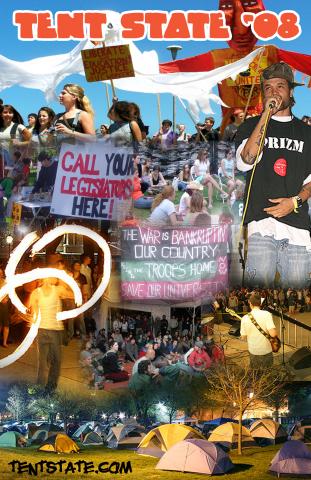
The Democratic convention protesters of 1968, who wound up on the truncheon end of the Chicago police riots, had been camped overnight by the simple result of their continuous protestation of having no representation at the DNC. Tent State University 2008No one asked permission. In 2008, by breaking off from the R-68 organizers and asking to be sanctioned by the city, TSU has allowed the Denver Police to preempt spontaneous demonstrations. Certainly in the eyes of the public and the residents of Denver. Now anyone who sticks around after curfew has been forewarned of the consequence.
Mexico tires of US paid Mexican military abuses

The US is funding a ‘drug war’ campaign by the Mexican military that has gotten increasingly every bit as abusive as the drug traffickers themselves, who often times are ex-Mexican military and police. As a result, the Mexican public is trading in their previous support for this campaign and is pushing for the Mexican military to get out of their towns and cities. The Associate Press reports Mexican military losing drug war support

Meanwhile, the US politicians and press continue their campaign against Mexican immigrant workers, who instead of trafficking drugs, just try to make a living off their own labor. The politicians and press do little talking about the violence that US drug laws and the US ‘drug war’ push of into other peoples’ lands though. That is a rather forbidden subject. Even more forbidden is to report on the US funding for these foreign military atrocities, whether it be in Colombia or Mexico, or points in between.

Instead of hearing about how Mexico is becoming militarized for the worse by US funds for such purpose, we, the American public, are fed disinformation that leads us to think that all is getting much better just South of our border. Actually, the scene so nearby makes Al Capone’s Chicago reign look like a tea party for old ladies.

We need to abolish this pseudo war against drugs just like we need to end all the other wars that are used to justify militarizing our own country even further than it already is. If not, more of this violence will eventually spill over to this side of The Border. We ened to stop our government from torturing Mexicans and from torturing Americans inside US prisons.

El Paso County Democrats fight against local party leadership to UNDO THE COUP

Undo the CoupRita’s form response to the MOVEON.ORG FORM LETTER “Thanks so much for going to a Platform Meeting to urge that Al Gore’s energy challenge be part of the Democratic Party’s issue platform!”

Hi Noah:
Please note a correction. I did not go to a “Platform Meeting”, rather I am having one on Tuesday night, July 29. At that meeting, we will allow attendees to list and prioritize issues, and we’ll send results to both the DNC and directly to Obama Headquarters in Chicago.

One of the main reasons for this approach is that a group of us (I was one of a group of eight or nine) was elected as a Platform Committee at the El Paso County Democratic Assembly. The entire assembly elected us, choosing from a number of nominees. Open nominations occurred.

Within days, the local party had unseated and disbanded us, refusing even to allow those of us publicly elected to even know the names and contact information of the others elected. That same day, elected delegates and alternates had stood in the cold for hours, waiting to be allowed into the assembly, only (as I witnessed and signed an affidavit regarding) to be intimidated and turned away at the door by a former NSA man and recent head of the ACLU in this fair, fascist city of ours.

Soooo… such is life in our no longer a democracy city, county, state and nation. Goggle “Colorado Springs St. Patrick’s Day Parade 2007 police brutality” for an eyeful.

I am in the process of documenting numerous instances of violations of civil rights by elected and appointed officials and so called supporters of the progressive movement here in the last couple of years, including the arrest of two peace demonstrators at the recent Colorado State Democratic Convention, and the attempted arrest eight days ago of four people of peace as we (yes, I was among them) were leaving from a brief meeting on a public easement in front of the building that houses Pikes Peak Justice and Peace, an organization with a new chair of the board who asked the police to cite us for trespass.

So yes, we will certainly be considering Al G ore’s excellent proposals. One planned attendee has already stated to me that he considers renewable energy sources vital, and wants to end reliance on coal and new strip and other types of coal mining.

But our emphasis may well turn first in priorities to ways and means of “Undoing the Coup” in what was once a democratic nation, i.e. supporting and cooperating in Rep. Dennis Kucinich’s proposed congressional investigation into the activities/surveillance/infiltration of police and others. We will also be considering various ways and means of insuring that the vote be legitimately counted and recorded, etc.

Hope MoveOn can and will continue its great work and support all the vital “UNDO THE COUP” efforts that are needed so desperately. Thanks many times over for all you do and have done.

-Rita Ague

The DNC Alliance for Real Democracy is a counter-protest Fifth Column

Denver DNC 2008DENVER, COLO.- The Alliance for Real Democracy (ARD), formed to counter the scrappily-named Recreate 68 at the DNC, is in reality an unwitting fifth column, set up by Democratic Party allies to temper protest in Denver. The UFPJ and other sundry “non-violent” progressives are funneling their members into the less populist ARD actions to divert participation from the major DNC demonstrations. But the aforementioned underwriters aren’t providing any funding, surprise! Leaving the ARD to protest exactly what it’s supposed to: nothing.

Alliance for Real DemocracyI think it’s heartbreaking to watch earnest young activists, representing the organizations comprising the ARD coalition, trying to organize activities without any commitment from their national affiliations. And some of the more outspoken national leaders, keen to make appearances at the DNC rallies, are beginning to smell a rat. They’re making backup arrangements to coordinate with the boots on the ground, R-68.

A Fifth Column refers to a group of partisans, usually spontaneously organized, which forms behind enemy lines as a conquering army approaches. It is the additional “column” of civilian fighters which an attacker might count on to stab the defenders in the back. Franco boasted of his fifth column in the Spanish Civil War. The French Resistance represented a fifth column for the Normandy liberators.

America’s antiwar movement has had its steady divisions, between UFPJ and A.N.S.W.E.R. most notably, but the rift has become more critical with the advent of another hopeful Democratic election win. Four years ago it was Kerry, with groups like Moveon.org trying to tone down the antiwar rhetoric. This year it’s Obama, and the appeasers are out in battalions. As usual, it’s done in the name of “nonviolence,” where too vigorous protest is seen as insufficiently nonviolent for the Democrat’s fragile delusions.

When R-68 began the groundwork for DNC protests, they were vilified for evoking the Chicago 1968 police riots. R-68 repudiated the violence, but not surprisingly those statements have yet to be reported in print. Meanwhile the bad press gave UFPJ and other nonviolence apostles the opportunity to break away and form their holy alliance to give their members sanctuary from the ruffians, re unpredictable young people.

But will it really? The R-68 group includes Unconventional Denver and Disrupt 08, but neither have violent plans. Black Block script-kiddies will turn up no matter whose event. Police agent provocateurs will instigate violence no matter how pious your crowd.

Code Pink, IVAW, Veterans For Peace, and UFPJ are among the national endorsers of ARD. Tent State, SFPJ, and Students for a Democratic Society are examples of young activists getting caught in their elders’ tar baby.

Because it’s not enough to vote for Obama, you have to quash dissent for Obama. It’s the Alliance For Real Democracy For Obama.

Naturally Denver protest organizers, whether ARD or R68, have found themselves having to confer about time slots and permits, out of respect for the success of each other’s activities. As a result, the national head of UFPJ, Leslie Cagan, issued an email decreeing that no ARD organization member would participate in the major Aug 24 kickoff antiwar demonstration. This drew question marks from prominent activist leaders who want to be at the biggest rally.

Bi-monthly CONSULTA meetings were scheduled by ARD and R68 to coordinate efforts. But the morning before the second Consulta, Leslie Cagan flew in from NYC for an emergency meeting with ARD leadership to brief them on what not to negotiate. She followed this with a hastily scheduled press conference the next day on the subject of Iran, it appeared to preempt her rivals’ DON’T BOMB IRAN action planned for August 2nd.

Colorado Springs own PPJPC is an endorser of ARD. Their letter of support was read into the minutes of a recent meeting, and it read like the typical support they’re getting from everyone. I’ll paraphrase the PPJPC letter:

“We at the Pikes Peak Justice and Peace Commission are honored to endorse your efforts at the DNC … due to critical funding shortages, we cannot offer you any monetary support at this time … Likewise, I’m sorry that I will not be able to participate in any events that week , but will try to interest our members in attending…” We’ll be with you in spirit, etc.

Why form a fifth column if you’re not going to support it? Because the ARD‘s job is to do nothing. Doing nothing is exactly how you stab activism in the back.