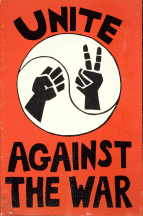
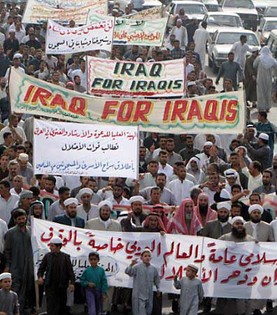
Latest update on Copenhagen demonstrations, from Greenpeace organizer Brinkley Hutchings: “Everyday at the negotiations we have flash mobs, clapping attention-grabbers, and youth crying out to be heard. But the delegates and decision-makers are wearing their earmuffs and blinders, doing everything they can to avoid hearing what we (the youth) have to say. *It has become really apparent that we must escalate.*”
Tag Archives: demonstrations
Did Obama hear you on election day?
Here’s a quarter-page size flier you can use to spread the word about tonight’s event. Obama’s announcement will be momentous, no matter which course of action he decides. It will be either the first sign of delivering on his promise of change, or a hopeful public betrayed.

And thousands more Afghan dead. Let’s not forget who suffers the most from America’s reckless decisions.
Come to Acacia Park tonight at 5pm. Let him hear your voice!
Below is the Coloradans For Peace December 1 press release:
FOR IMMEDIATE RELEASE:
Colorado Springs peace community urges President Obama to chose withdrawal from Afghanistan over escalation
COLORADO SPRINGS, COLORADO, 12/1/09 — Coloradans For Peace (CFP) will gather with area community activists on Tuesday, December 1, at 5pm, in Acacia Park downtown, to urge President Barack Obama: NO ESCALATION OF THE WAR IN AFGHANISTAN.
The nonviolent assembly in Acacia Park will be part of nationwide peace demonstrations in response to President Barack Obama’s forthcoming announcement about a new US strategy in Afghanistan. National organizers include CODE PINK, UNITED FOR PEACE & JUSTICE, WORLD CAN’T WAIT, ACT NOW TO STOP WAR AND END RACISM (ANSWER), and many others.
Speculation has been rising that our president intends to increase US troop levels in Afghanistan, but CFP remains hopeful that President Obama will make a decision in the spirit of his presidential campaign. We will assemble in Acacia Park in advance of the televised presidential address, in unison with other US cities, to remind the president of the electorate’s call for an end to our nation’s military conflicts.
The CFP believes the unprecedented turnout for the 2008 election was strongly motivated by the American public’s alarm over the ongoing foreign wars. We believe President Obama would be ignoring a profound mandate given him by his voters if he decided to expand the conflict in Afghanistan instead of bring it to a close.
In urging an end to America’s foreign occupations, citizens can show their true support for the troops. More than ever before, soldiers are contacting antiwar organizations to say that they support the peace efforts to bring them home.
# # #
Why hippies call them pigs
Here are a few troubling images of the G-20 protests in Pittsburgh, where police brutality insulated the globalist ministers from the anti-capitalist demonstrations.
Look at this smile. Next time they’re eulogizing a policeman killed on the job, or the city proposes changing a street name to commemorate a fallen officer, think about this image. A Pittsburgh cop does not conceal a fiendish grin as he throws tear gas canisters at the G-20 protesters.
Video footage captured three policemen disguised as black bloc anarchists, walking menacingly among the much younger, more educated looking demonstrators.

Whether the undercover cops were intended to be provocateurs or thinly veiled intimidation is debatable. In any case, bystanders reported that these three broke cameras and can be overheard making sarcastic comments. The protesters kept them surrounded and confronted.
This widely circulated video purported to show uniformed paramilitary thugs in the act of abducting a black-clad protester. The unmarked sedan pulled up, made the grab, and rolled away. Inconsistencies with the perp attire, mode of undress, and odd accessorizing, point to doubt as to whose street theater this was. God Bless ’em.
Sept 11 – America Reaps What It Sows!
A post-911 perspective by Black Liberation Army prisoner of war Jalil Muntaqim.
U.S. International Warfare Initiates World War III Human Rights During Wartime
By Jalil A. MuntaqimIn the aftermath of the September 11, 2001, attack on the World Trade Center and Pentagon, Americans have displayed their true colors of jingoism, a militaristic spirit of nationalism. Similarly, it was witnessed how the people of Iraq rallied in support of their President, Saddam Hussein, after the U.S. bombed to death 250,000 Iraqis, and continued devastation of that country with collateral damage of 1 million dead women and children. Hence, people rallying in support of their government and representatives is a common phenomenon when a country is attacked by an outsider. The U.S. has been foremost in the world extending foreign policy of free-market economy, to the extent of undermining other countries cultures and ideologies expressed as their way of life. Such conflicts inevitably positions the U.S. as the centerpiece, the bulls-eye for international political dissent, as indicated by demonstrations against the U.S. controlled IMF, WTO and World Bank conferences. The attack on the World Trade Center and Pentagon did not occur in a vacuum. The people that carried out the attacks were not blind followers or robots with an irrational hatred of the U.S. peoples. Rather, this attack was part of an overall blowback to U.S. imperialist policy in support of zionist Israel and opposition to fundamentalist Islam.
There are essentially three primary world ideologies or world views: the capitalist free-market economy/democracy; the socialist production economy; and Islamic theocratic government, of which has been in competition for many decades. However, in the last 20 years the socialist economies has been severely subverted and co-opted by free-market economies, the ideals of American style democracy. This isolated, for the most part, Islamic theocratic ideology and system of government as the principle target of the U.S. in its quest for world hegemony. This reality of competing world views and economies is further complicated due to religious underpinning of beliefs that motivates actions, especially as they are expressed by U.S. and Western European christianity and Israel zionist judaism in opposition to Islam. From the struggles of the Crusades to the present confrontation, the struggle for ideological supremacy reigns, as the faithful continue to proselytize in the name of the Supreme Being.
When geopolitics are combined with religious fervor in the character of nationalist identity and patriotism, rational and logical thinking is shoved aside as matters of the moment takes historical precedents. It has often been said that “Truth Crush to the Earth Will Rise Again”. Since truth is relative to ones belief, can it be safely said that America has reaped what it has sowed? The American truth of capitalist christian democracy and its imperialist hegemonic aspirations has crushed both socialist and Islamic world views. It has extended its avaricious tentacles as the world police and economic harbinger of all that is beneficent, in stark denial of its history as a purveyor of genocides, slavery and colonial violence.
The U.S. was the first to use biological-germ warfare on people when it distributed blankets infected with smallpox to Native Americans; it has refused to apologize for Afrikan slavery acknowledging it engaged in a crime against humanity requiring reparations; it is the first and only country to use the atomic bomb on the people of Hiroshima and Nagasaki and intern thousands of Japanese and Italians in this country; it used carpet bombing and defoliates against the peoples of Vietnam; it has initiated embargoes, coup d’etats and assassinations against those it opposes, while propping-up right-wing military dictators; as well as continued military bombing of Vieques. In essence, the U.S. governments hegemonic goals has created the ire of millions of people throughout the world. While domestically, racial profiling, police killing and mass incarceration of Black and Brown people has eroded patriotic sentiments in opposition to white supremacy.
As America weeps and laments its loss, the public find itself joining the torn ranks of those whose heartaches beat opposing U.S. greed and international profiteering. The American public acquiesce to U.S. international folly has cause them to feel the economic pains of those who live daily in poverty. Indeed, Americans should brace for years of economic uncertainty, where the American ideal of freedom and liberty will resemble plight of those who live under the right-wing dictatorships the U.S. has supported. The tyranny suffered by others in the world as a result of U.S. imperialism, has come full circle to visit this country with the wrath of the U.S. own mechanization. Since the U.S. taught and trained right-wing military dictators in the School of the Americas, including the CIA training of Osama bin Laden in the Afghanistan proxy war against the Russians, it will be this same kind of terrorist activist that will be unleashed on American soil, as El-Hajj Malik Shabazz stated after the assassination of John Kennedy, a matter of the chicken coming home to roost. Therefore, American civil liberties and human rights are being garrotted by the yoke of the right-wing in the name of national security. The legalization of U.S. fascism was initiated with the war against political dissent (Cointelpro); the war against organized crime (RICO laws); the war against illegal drugs (plethora of drug laws) and now culminating in the war against terrorism with the American Joint Anti-Terrorist Taskforce and Office of Home Security, further extending police, FBI and CIA powers to undermine domestic civil liberties and human rights.
The U.S. Secretary of Defense, Donald Rumsfeld, recently stated that the U.S. need to create a new language in defining how to combat terrorism. This Orwellian propaganda in the media espouses the U.S. is venturing in a new type of warfare to defend the American way of life. However, what this double-speak propagates as a long-term and sustained initiative against terrorism is essentially a way of embellishing and enlarging U.S. counter-insurgency activity it has been engaged in since the advent of the Green Berets, Rangers, Delta Force and Navy Seals. The U.S. has been involved in counter-insurgency activity in Afrika, Latin America and Asia for decades. But due to the September 11, 2001, attack on U.S. soil, the government has seized the opportunity to offensively pursue left-wing revolutionaries and Muslim insurgents throughout the world. This U.S. military action extends and substantiates its position as the international police.
Since the establishment of the Trilateral Commission that initiated the process for the development of one world government, the U.S. has broaden its capacity to impose and enforce its will on oppressed peoples globally. The FBI and CIA has been operating in Europe, Afrika, Asia and Latin America establishing the long arm of U.S. law and order. Its bases of operations have conducted surveillance, investigations to arrest, prosecute or neutralize left-wing revolutionaries or Muslim insurgents. As the U.S. consolidates its political and economic influence throughout the world, it will seek to protect its overall hegemonic imperialist goals. After the Gulf War, and the air (bombing) campaign in Yugoslavia, the U.S. has employed its military might to ensure its foreign policy are achieved.
Because NATO has evolved into a European military entity that Russia is seeking to join, today, the U.S. has positioned itself beyond the mission of NATO. The U.S. now concentrates its military might in opposing Islamic countries (Iran, Iraq, Libya, Sudan, Afghanistan, Philippines, etc.) and those the U.S. deem as rogue nations (North Korea, Vietnam, Cuba, etc.). The new military initiatives will be directed to towards Southeast Asia as the secondary target, as it continues to direct the Middle East conflict to preserve its oil investments and zionist interest. As the U.S. expand its imperialist military mission, as seen with committing military troops in Uzbekistan to also protect oil interest in the Caspian Sea, it has sought to redefine itself by targeting what it identify as the terrorist thereat wherever in the world it might exist. Hence, with the employment of conventional warfare combined with counter-insurgency tactical activities, the U.S. has pronounced itself as the military guardian of the world.
Although, the U.S. states its actions are in its self-interest, in terms of what is euphemistically defined as defending the free world, the truth of the matter is this action is a prelude to evolving one world government with the U.S. as its governing authority. Once the Peoples Republic of China becomes a full member of the WTO, and North Korea and Vietnam has been compromised, with Russia becoming an ally of NATO, the U.S. political-military influence in the world will be consolidated. The U.S. geopolitical strategy is not confined to the present crisis in the aftermath of the September 11, 2001, attack and targeting Osama bin Laden as the world’s nemesis. Rather, the U.S. strategy is to preserve its capacity to establish one world government as originally envisioned by the Trilateral Commission.
Nonetheless, there are some serious obstacles to this hegemonic goal, of which the world of fundamentalist Islam has become the principle target. Here, it should be noted that Islam condemns suicide or the mass killings of women, children and non-combatant males. Yet, the U.S., Israel, western Europe, Russia, India and China all view Islam as the enemy. Although, there are over 1.2 billion Muslims in the world, the current alliance of economic interest headed by the U.S., are united to vanquish what they consider the growing menace of fundamentalist Islam. It is with this understanding of U.S. geopolitics one is able to comprehend why the U.S. has redefine its military mission, as opposition to globalization and U.S. imperialism metamorph into a political struggle without borders or territorial imperatives.
The ideological struggle between capitalist free-market economy and Islamic theocratic determinates has exploded into an international conflagration of insurgency with the potential of initiating World War III. The Islamic fundamentalist movements throughout the world has the potential to test the U.S. military, political and economic resolve as the world’s leader and authority of an one world government. With over 1.2 billion adherents, Islam has become a formidable foe to contend with for ideological supremacy in the world’s geopolitics. Even without discussing the religious (moral and ethics) aspects that motivates the geopolitics of Islam in opposition to U.S. imperialist hegemony, the call for Jihad/Holy War against the U.S. presents a serious threat that could precipitate WW-III. Therefore, the U.S. find it necessary to redefine its military mission, develop new language to codify warfare and legitimize its international political and economic purpose. Yet, many of the world’s oppressed peoples’ have already experienced U.S. military counter-insurgency tactics (Ethiopia, Somalia, Nicaragua, Guatemala, Chile, Congo, etc.), including parts of the Islamic world. No matter how or why the U.S. attempts to persuade Americans that it is entering a new type of warfare, in reality it is more of the same, only extending the military arena to further protect its authority to establish one world government.
However, the U.S. is not the homogeneous country that people are deluded into believing exist. Rather, the U.S. has been held together due its ability to exploit the world’s resources and distribute (unequally) the profits amongst its citizens with its culture of conspicuous consumption. But, the recent attack on the U.S., and its aftermath may very well lead to the untangling and unraveling of the U.S. fabric as has been witnessed with the USSR and Yugoslavia. In understanding this true history of U.S. imperialism, outside and within its borders, essentially tells a story of why U.S. imperialism has been and will continue to be attacked.
Ultimately, the U.S. will eventually find itself at war with itself, as the ideology of a free democratic society will be found to be a big lie. This is especially disconcerting as greater restrictions on civil and human rights are made into law eroding the First and Fourth Amendment of the U.S. Constitution. As during the Vietnam conflict, internal contradictions of racism, poverty and inequality will be exacerbated as a result of the U.S. military campaign and domestic undermining of civil and human rights. It is expected that strife in America will eventually become violent dissolving any semblance of the illusion of America the Beautiful. In anticipation of U.S. progressive activist opposing this claimed war against terrorism, the federal government will pass new laws to severely restrict protest, demonstrations and dissent. In the ’60s, U.S. progressive activists evolved the slogan “Bring the War Home!” – the question is what will be the slogan this time, now that the war has been brought home?
Free the Land!!
The Spirit of Revolt
There are periods in the life of human society when revolution becomes an imperative necessity, when it proclaims itself as inevitable. New ideas germinate everywhere, seeking to force their way into the light, to find an application in life. These ideas are opposed by the inertia of those whose interest it is to maintain the old order; they suffocate in the stifling atmosphere of prejudice and traditions. The accepted ideas of the constitution of the state, of the laws of social equilibrium, of the political and economic interrelations of citizens, can hold out no longer against the implacable criticism which is daily undermining them?…?Political, economic and social institutions are crumbling. The social structure, having become uninhabitable, is hindering, even preventing, the development of seeds which are being propagated within its damaged walls and being brought forth around them.
The need for a new life becomes apparent. The code of established morality, that which governs the greater number of people in their daily life, no longer seems sufficient. What formerly seems just is now felt to be a crying injustice. The morality of yesterday is today recognized as revolting immorality. The conflict between new ideas and old traditions flames up in every class of society?…?the popular conscience rises up against the scandals which breed amidst the privileged and leisured, against the crimes committed in the name of “the law of the stronger,” or in order to maintain these privileges. Those who long for the triumph of justice, those who would put new ideas into practice, are soon forced to recognize that the realization of their generous, humanitarian and regenerating ideas cannot take place in a society thus constituted. They perceive the necessity of a revolutionary whirlwind which will sweep away all this rottenness, revive sluggish hearts with its breath and bring to mankind that spirit of devotion, self-denial and heroism, without which society sinks through degradation and vileness into complete disintegration.
In periods of frenzied haste toward wealth, of feverish speculation and of crisis, of the sudden downfall of great industries and the ephemeral expansion of other branches of production, of scandalous fortunes amassed in a few years and dissipated as quickly, it becomes evident that the economic institutions which control production and exchange are far from giving to society the prosperity which they are supposed to guarantee. They produce precisely the opposite result. Instead of order they bring forth chaos; instead of prosperity, poverty and insecurity; instead of reconciled interests, war – a perpetual war of the exploiter against the worker, of exploiters and of workers among themselves. Human society is seen to be splitting more and more into two hostile camps, and at the same time to be subdividing into thousands of small groups waging merciless war against each other. Weary of these wars, weary of the miseries which they cause, society rushes to seek a new organization. It clamors loudly for a complete remodeling of the system of property ownership, of production, of exchange all economic relations which spring from it.
The machinery of government, entrusted with the maintenance of the existing order, continues to function, but at every turn of its deteriorated gears, it slips and stops. Its working becomes more and more difficult, and the dissatisfaction caused by its defects grows continuously. Every day gives rise to a new demand. “Reform this,” “Reform that,” is heard from all sides. “War, finance, taxes, courts, police, everything would have to be remodeled, reorganized, established on a new basis,” say the reformers. And yet all know that it is impossible to make things over, to remodel anything at all because everything is interrelated; everything would have to be remade at once. And how can society be remodeled when it is divided into two openly hostile camps? To satisfy the discontented would be only to create new malcontents.
Incapable of undertaking reforms, since this would mean paving the way for revolution, and at the same time too impotent to be frankly reactionary, the governing bodies apply themselves to half-measures which can satisfy nobody, and only cause new dissatisfaction. The mediocrities who, in such transition periods, undertake to steer the ship of state, think of but one thing: to enrich themselves against the coming debacle. Attacked from all sides they defend themselves awkwardly, they evade, they commit blunder upon blunder and they soon succeed in cutting the last rope of salvation. They drown the prestige of the government in ridicule, caused by their own incapacity.
Such periods demand revolution. It becomes a social necessity; the situation itself is revolutionary.
When we study in the works of our greatest historians the genesis and development of vast revolutionary convulsions, we generally find under the heading “The Cause of the Revolution” a gripping picture of the situation on the eve of events. The misery of the people, the general insecurity, the vexatious measures of the government, the odious scandals laying bare the immense vices of society, the new ideas struggling to come to the surface and repulsed by the incapacity of the supporters of the former regime – nothing is omitted. Examining this picture, one arrives at the conviction that the revolution was indeed inevitable, and that there was no other way out than by the road of insurrection?…?But, between this pacific arguing and insurrection or revolt, there is a wide abyss – that abyss which, for the greatest part of humanity, lies between reasoning and action, thought and the will to act. How has this abyss been bridged??…?How was it that words, so often spoken and lost in the air like the empty chiming of bells, were changed in actions?
The answer is easy. Action. The continuous action, ceaselessly renewed, of minorities brings about this transformation. Courage, devotion, the spirit of sacrifice, are as contagious as cowardice, submission and panic.
What forms will this action take? All forms – indeed, the most varied forms, dictated by circumstances, temperament and the means at disposal. Sometimes tragic, sometimes humorous, but always daring; sometimes collective, sometimes purely individual, this policy of action will neglect none of the means at hand, no event of public life, in order to keep the spirit alive, to propagate and find expression for dissatisfaction, to excite hatred against exploiters, to ridicule the government and expose its weakness and above all and always, by actual example, to awaken courage and fan the spirit of revolt.
When a revolutionary situation arises in a country, before the spirit of revolt is sufficiently awakened in the masses to express itself in violent demonstrations in the streets or by rebellions and uprisings, it is through action that minorities succeed in awakening that feeling of independence and that spirit of audacity without which no revolution can come to a head.
Men of courage, not satisfied with words, but ever searching for the means to transform them into action – men of integrity for whom the act is one with the idea, for whom prison, exile and death are preferable to a life contrary to their principles, intrepid souls who know that it is necessary to dare in order to succeed – these are the lonely sentinels who enter the battle long before the masses are sufficiently roused to raise openly the banner of insurrection and to march, arms in hand, to the conquest of their rights?…?Whoever has a slight knowledge of history and a fairly clear head knows perfectly well from the beginning that theoretical propaganda for revolution will necessarily express itself in action long before the theoreticians have decided that the moment to act has come.
Nevertheless the cautious theoreticians are angry at these madmen, they excommunicate them, they anathematize them. But the madmen win sympathy, the mass of the people secretly applaud their courage and they find imitators?…?Acts of illegal protest, of revolt, of vengeance, multiply.
Indifference from this point on is impossible?…?By actions which compel general attention, the new idea seeps into people’s minds and wins converts?…?Above all, it awakens the spirit of the revolt: it breeds daring?…?The people observe that the monster is not so terrible as they thought; they begin dimly to perceive that a few energetic efforts will be sufficient to throw it down. Hope is born in their hearts, and let us remember that if exasperation often drives men to revolt, it is always hope – the hope of victory – which makes revolutions.
The government resists; it is savage in its repressions. But, though formerly persecution killed the energy of the oppressed, now, in periods of excitement, it produces the opposite result. It provokes new acts of revolt, individual and collective. It drives the rebels to heroism, and in rapid succession these acts spread, become general, develop. The revolutionary party is strengthened by elements, which up to this time were hostile or indifferent to it. The general disintegration penetrates into the government, the ruling classes, the privileged. Some of them advocate resistance to the limit; others are in favor of concessions; others, again, go so far as to declare themselves ready to renounce their privileges for the moment, in order to appease the spirit of revolt, hoping to dominate again later on. The unity of the government and the privileged class is broken.
The ruling class may also try to find safety in savage reaction. But it is now too late; the battle only becomes more bitter, more terrible, and the revolution which is looming will only be more bloody. On the other hand, the smallest concession of the governing classes, since it comes too late, since it has been snatched in struggle, only awakes the revolutionary spirit still more. The common people, who formerly would have been satisfied with the smallest concession, observe now that the enemy is wavering. They foresee victory, they feel their courage growing, and the same men who were formerly crushed by misery and were content to sigh in secret, now lift their heads and march proudly to the conquest of a better future.
Finally, the revolution breaks out, the more terrible as the preceding struggles were bitter.
The Spirit of Revolt, Pyotr Kropotkin, 1880.
National Assembly is antiwar exclusively
Reports are emerging from July’s National Assembly, the vital effort to unite antiwar forces into a common movement. Delegates from the major peace organizations hammered out a strategy to address Iraq, Afghanistan, Pakistan and Palestine. Missing from the consensus? Nonviolence, and good riddance. It goes without saying that humanitarian activists are peaceful. To legislate a dogma of non-confrontation plays right into the hands of the authoritarians. Here’s the official report:
AN ASSESSMENT OF THE FIRST YEAR OF THE NATIONAL ASSEMBLY TO END THE IRAQ AND AFGHANISTAN WARS AND OCCUPATIONS
Address given by Marilyn Levin, member, National Assembly Administrative Body, and Planning Committee, Greater Boston United for Justice with Peace Coalition, to the National Antiwar Conference held July 10-12, 2009 in Pittsburgh, Pennsylvania
July 10-12, 2009, 255 people representing diverse organizations and constituencies from all over the country came together in Pittsburgh:
1) To look at where we are today,
2) To articulate our long range goals to rejuvenate the antiwar movement towards building a massive movement capable of forcing an end to their wars and occupations, to take our money back from the war machine to meet pressing social needs, and to save our planet for our children, and
3) To develop and vote for action plans as steps to realize these objectives.
All of our major objectives were accomplished and we leave today with a comprehensive action agenda to carry us through to next spring. Everyone had a chance to speak and differences were aired without rancor or splits to achieve unity in action.
Friday night’s speakers, along with many conference participants, grappled with how to unify and broaden the movement. Saturday afternoon and Sunday morning, we presented a great roster of workshops covering the major issues we face today. Saturday night’s rally was dynamic and inspiring.
There were two highlights of the conference for me. First was the international component where activist comrades joined us from Canada and courageous labor leaders of powerful mass movements in Haiti and Guadaloupe reminded us that imperialism and the struggle against it are global. There was a statement by members of the Viva Palestina aid convoy detained in Egypt. We passed motions in solidarity with the struggles of the people of Haiti, Honduras, and Palestine.
The second highlight was the discussion on Iran, where, in spite of strong passions stirred up by the rapidly evolving events there, we were able to illuminate the issues and debate our differences. Finally, we were able to agree on a unity position that all could embrace, as well as meeting the foremost call of the Iranians – US Hands off! No Sanctions! No interventions! Self-determination for the Iranian people! A wonderful example of a united front –- as inclusive as possible and taking principled positions that most will accept and act on.
So what is the National Assembly? What you saw this weekend explains who we are and how we function.
Democracy. All were invited and all perspectives welcomed. There was acceptance of the will of the conference even when it diverged from the proposals put forward by the leadership body. We were especially gratified that representatives from all the major antiwar coalitions came and addressed our conference.
Our willingness to struggle for unity and compromise when needed in order to move forward, as evidenced by a leadership that did not impose personal political views on others in service to unity.
An organization that admits to and learns from its mistakes and accepts its limitations when the unity we seek can’t yet be achieved.
An organization that has built a growing cadre of leaders that has developed trust, a structure that works, and a strong working relationship.
And finally, confidence, vision, and optimism. Confidence that we can provide leadership in rebooting our movement. A vision regarding how to accomplish that and an understanding of the necessity for these kinds of conferences leading to action. Optimism that masses of people will move in opposition to these horrendous policies that bring death and destruction and that they will have the power to change the world.
I’ve been asked to give an assessment of the first year since our initiation as an ongoing network with a mission, from our first conference in June, 2008 until today. Last year, we weren’t sure anyone would come and lo and behold 400 people came together in Cleveland to inaugurate a year of activities and set up a structure to maintain our work. A lot has transpired in that year and the National Assembly is well on its way as an established organization recognized throughout the movement as providing leadership and promoting a direction towards growth.
I need to start a little earlier and go back to why the National Assembly was called into existence in the first place.
What we saw, in the spring of 2008, was a movement at a low ebb – one that was shrinking rather than growing in spite of the war dragging on — this while the antiwar sentiment couldn’t be higher, and the disapproval rating for the Bush Administration couldn’t have been lower. From the high point of the largest action against the Iraq War in September, 2005 which drew 700,000 people, there was a pulling away from mass action by significant sections of the movement which supported electoral politics as the central strategy, in spite of a recurring pattern of disappointment when Democratic “antiwar” candidates voted again and again for war and war funding, and a split between the two major national coalitions, UFPJ and ANSWER, one that continues to this day. For the first time in five years, there was not enough unity or mass action perspective for any national demonstrations to take place marking the 5th year of the occupation of Iraq. Fundamentally, there was a vacuum of leadership.
Some far-sighted people like Jerry Gordon and Jeff Mackler, with experience gained from leadership in the last powerful antiwar movement that ended the Vietnam War, felt impelled to act. They began to organize a base of diverse but like-minded activists committed to building and expanding an effective antiwar movement in this country. The vehicle to accomplish this was the first national assembly, a national conference to pull activists together, to analyze the present state of the movement, to discuss where we needed to go and the actions that were needed to get us there.
We developed a unity statement with five basic principles that we hold today as the basis for where we stand:
1) Unity – all sections of the movement working together for common goals and actions;
2) Political Independence – no affiliations or support to any political party;
3) Democracy – decision-making at conferences with one person, one vote;
4) Mass Action – as the central strategy for organizing while embracing other forms of
outreach and protest; and5) Out Now – the central demand to withdraw all military forces, contractors, and bases
from the countries where the U.S. was waging war on the people.It seems simple but no one else saw it that way. Our conference was unique in the history of the present movement.
The organizers didn’t know what the mood and composition or strength of the conference would be, so we were cautious and minimal in the program we posed to the conference. We focused on Out Now from Iraq and modest action proposals, not being strong enough to initiate national actions on our own. The conference participants were ahead of us and ready to tackle the larger issues. Proposals were passed to add “Out Now from Afghanistan”, “End U.S. Support for the Occupation of Palestine”, and “Hands off Iran” to our set of demands, and given what has transpired in these areas, we were well prepared to take on a major role.
October 10th actions held in 20 cities were endorsed as well as a call for December actions building towards what we hoped would be unified, nationally coordinated bicoastal mass actions in the spring of 2009, the 6th year of the Iraq occupation. When Gaza was brutally assaulted, we joined with ANSWER and others to march in Washington and to demonstrate in the streets all over the country, and we’re still working under Palestinian leadership to bring justice and relief to a beleaguered population.
We made a concerted effort to find a common date for spring bi-coastal mobilizations. As you know, ANSWER chose March 21st as a day of united protests which we endorsed, while UFPJ called for a national march on Wall St. on April 4th. A number of National Assembly supporters who were also delegates to the UFPJ conference in December formed a mass action unity caucus and went to the conference with a resolution to allow delegates to vote for one or both actions but this was rejected. We’ll keep trying for 2010. The National Assembly endorsed and built both actions and marched behind our signs with our demands. The demonstrations were small (but spirited) and still of major importance.
For us, it’s quality, not quantity, as we position ourselves to be in the forefront as the pendulum swings in our direction once again.
Some take the position that mass demonstrations are not effective, unless we can pull 100,000 protestors into the streets. This is short-sighted and does not address how we get from small to large. Any successful movement for change doesn’t start with 100,000 people, and there has never been significant social change without mass actions. I remember my first anti-Vietnam war demonstration was in 1963 in Detroit and we had 15 people. In 1965, SDS called the first national march against the war in Washington. 25,000 people turned out and we thought it was huge!
Everyone talks about reaching out to the thousands of young people who mobilized to elect Obama. We agree, but we say the way to do this is by offering education and action. Action beyond calling, and emailing, and faxing the politicians they placed in office.
Why are mass demonstrations so important to building a powerful movement? It is because they accomplish so much in the process of building them. They provide:
Continuity. You can’t build anything by starting anew each time. Each action should lead to the next action or open national conference, with success building upon success. We need a continuity of leadership that builds trust and a reputation for integrity, and that learns lessons to improve. We need a continuity of organization and structure that can implement the tasks before us.
Visibility. Actions in the street give heart to the people the U.S. is attacking and occupying, letting them know that they are not alone. Mass actions create solidarity, offering support to anti-war soldiers, vets and their families, and a counter-force to the economic draft facing our youth, and they strengthen and deepen the antiwar sentiment of the people.
Inspiration. New people are brought into the movement, especially the youth, through activism. Have you ever talked to young people coming to a mass demonstration for the first time? They are inspired and thrilled to hear powerful speakers who are leaders of social justice movements and soldiers resisting the wars. They see they are not alone and get a taste of the power of large numbers of people marching together. They are energized to go home and join with others to continue to organize opposition to brutal U.S. wars and occupations. This is the way to reach out to the Obama supporters.
Explanation. An analysis of what is going on is offered along with tying together what seem at first to be disparate elements, i.e., war is tied to the economy, the war budget, bail-outs of the rich, the lack of basic needs being met, justice denied, and the impoverishment of the people.
Pressure on Government. People in this country are taught to be quiet. We’re told that our job is to elect officials whom we agree with periodically and then go home and wait while they fix things. This conveniently maintains the status quo but it sure doesn’t put pressure on them, or scare them, or force social change. Mass actions provide the most effective way to make significant change happen.
Let’s look at the present period. Obama’s election was based in large part on the hopes and aspirations of Americans for peace and a better life based on the promises and assumed promises that were made of peace, justice, and prosperity, which have not and will not be met.
Contrary to expectations, the previous administration’s policies are continued with a more handsome and articulate face. We all know that rather than winding down, wars and interventions are escalating and the rapacious greed of this immoral system knows no bounds.
Simultaneously, the economic crisis is causing terrible hardship for working people and for people who are no longer able to find work and their families. They are using this self-created financial disaster to further cut the standard of living and eliminate a secure future for older people and the young.
It was very moving and yet appalling to see this visually demonstrated when Robin Alexander of the United Electrical Workers Union asked people in the audience to stand who were unemployed, personally knew of soldier casualties, lived in communities where services were being cut, or who were otherwise negatively impacted by the wars and the failing economy. Nearly the entire room, a microcosm of the wider society, was standing by the end of that exercise.
It is inevitable that the present period of quiescence and hanging on to the hope that Obama and the new Congress will save us will come to a crashing end. People will not sit idly by forever while the world around them collapses. We are already seeing the beginnings of stirring. There is a greater willingness to go out in the streets to protest. There is more organizing taking place on campuses, more young people joining the movement. The many proposals for October actions are an indication that there is a widespread awareness of the need for actions this fall and the conviction that the movement must find common dates.
Brian Becker, National Coordinator of ANSWER, urged that we all work together to mount nationally coordinated actions next spring. Michael McPhearson, Co-Chair of UFPJ and Executive Director of Veterans for Peace, announced his support for October 17 and his willingness to do what he could to spur unified actions in the spring of 2010. We must have the faith and confidence that the people have the power to end the atrocities resulting from U.S. wars and occupations, and that they will recognize and utilize this power. As this happens, we must build a stronger antiwar movement that is able to provide leadership and the optimism to forge ahead no matter what the opposition throws at us.
The National Assembly to End the Iraq and Afghanistan Wars and Occupations is helping to provide that leadership and the vision that is needed. Although young and small, in one short year, we are now a force to be taken seriously and negotiated with, and by our persistent call for unity and mass action, our demonstrated ability to organize, and our coordinated strategy for revitalizing the movement, we are having an impact larger than our forces would indicate. In some ways, we too are a product of (and some say an antidote to) the 2008 election. To counter the malaise of the movement, we have quietly been building a solid core of activists and leaders around the country that understand the importance of a united front organized around principled demands and mass actions, not just calling Washington politicians when bills come up and crises happen.
At this conference, we have laid out an ambitious program of action that will take us through the spring of 2010. We are proud that we could provide the kick off for national organizing to bring a massive turnout to Pittsburgh for the G-20 protests September 25. Homeland Security is already making preparations to keep protesters hidden and stifle our right to speak out, but we won’t be silenced.
Following that, are a series of October building actions, culminating in large local and regional demonstrations on October 17 marking dates of significance related to the Iraq and Afghanistan wars and occupations and remembering the legacy of the anti-Vietnam war movement. Throughout the year, we will organize educational programs, support various forms of protest and organize around the inevitable emergencies caused by our government’s unholy interventions and threats to other nations.
We have initiated a Free Palestine Working Committee to ensure this work, which includes the growing boycott, divestment, and sanctions campaigns and the efforts to break the siege of Gaza, continues to be in the forefront and fully integrated in our work until justice and self-determination and return is in the hands of the Palestinians.
And lastly, we will continue to advocate for unity of the movement and once again bring thousands to Washington and the West Coast in the spring, to let our government and the world know that the U.S. movement against wars and occupations is alive and will not be quiet.
We will march and continue to march until all U.S. forces come home, bases are dismantled, and the sovereign people of the world have the right to control their own resources and determine their own futures, and the war budget becomes the peace budget.
Don’t sit on the sidelines and watch history being made. We urge all organizations to join the National Assembly and to play your part in building and shaping the powerful movement that is coming.
All out for the September 25 G-20 march in Pittsburgh! All out for the actions in early October! All out October 17!
You had a good home but You Left (You’re Right!)
Your Recruiter LIED to you so you Left (You’re Right!) Classic Basic Training marching cadence chant.
You’re all supposed to be “in step” because if you have a single person planting his left foot forward while everybody else is planting the Right, a Column Left or a To the rear, March! command or any other won’t work out correctly.
If The Military is such a good career move, why would the Pikes Peak or Bust Rodeo and others have to donate the proceeds to “Military Charities”?
Go on Craigslist and in Barter and Free classifications, and Rants & Raves you find military families, especially right before payday, begging for FOOD. Food which is subsidized at the Commissary, the Post Exchange and the Base Exchange.
And, these families, they’re not kidding. They actually ARE hurting.
But the Recruiters still Lie through their teeth. Daily.
They even have special programs TARGET-ing poorer kids, Minorities…
In Hispanic and Black neighborhoods the recruiter drives around in a “tricked-out” Hummer with a sound system blaring Hip-hop, the recruiter himself is going to be Ethnically Matched to the neighborhood or barrio, and a younger guy, and even with that will be TRAINED in Street Talk as though it were a foreign dialect.
Are they foolin’ the 18 year olds (17 and dropped out of school if yo’ Momma signs you in)? Apparently not. They give out their pamphlets to pre-teens.
Recruiting Children for a Later Date With Death.
For the 17 and 18 year olds, they break out the Economic Opportunity and the closely related Educational Opportunity bullshit.
But then, the U.S.O., Red Cross, Pikes Peak or Bust Rodeo… they come right along and spoil the lie. Because those organizations have to scramble to raise funds, beg a little less obviously…
But the Recruiter Lies are spoiled only if the kids see or hear or read something like this.
All y’all young dudes who want to sign up, try this first… when you turn 16 and can legally do it, volunteer at the VA hospital.
Hang back a little, don’t crowd, let the Human Misery speak for itself. And the humans who are suffering that misery. Go around emptying the wastebaskets and dry-mopping the floor in the waiting rooms, listen to the guys and ladies talking to each other, listen to their stories about how the VA is screwing them.
Volunteer at the U.S.O. and there are others, fill out forms for the guys and Ladies.
See people and talk to them and try your best to help them when the VA screws them.
When a guy is dying from a service related cancer like you get with Agent Orange or from the Uranium Poisoning, that the VA officially denies even exists, try to help him get his basic medical needs tended to.
Volunteer to read or sing to the guys in a Persistent Vegetative Coma. Or the guys who can’t communicate, can’t see, but are conscious under the bandages.
Keep in mind when you’re doing it that some of these guys are laying there with half their body mass taken off by American fire.
Then when you see the Recruiter rolling through the ‘hood jamming some tunes…
See all the young kids flocking around eager to be part of the next Children’s Crusade…
Eager to be lied to, eager to be seduced into the Glorious War.
Listen to the commercials again, watch with fresh eyes as they Army/Navy/Air Force/Marines tell the parents of kids too young to legally join on their own to go ahead and sign the papers for their sons and daughters.
Telling young guys who are dropping out of High School that somehow the Army is going to pull off a magic trick that will get them into College and a highly paid profession.
Because you KNOW, don’t you, that if Yo Momma is signing you in, that means you’re not 18 and there’s very little chance that you completed High School.
And that those commercials are aimed at the guys who are having trouble in school and about to drop out anyway.
When the Recruiter rolls through the ‘hood blasting the jams, walk up to him and tell him, in front of his intended victims, that he’s a damned liar. Print this up and make your OWN pamphlets.
I’m not saying commit acts of violence against him, or vandalism.
That perpetuates the Hate cycle and nothing more.
Even though it would be entertaining to watch one get dragged out of his tricked out Liar-Mobile and having a case of Advanced Whoopage liberally applied, don’t do it.
Confront Hate with Hate and everybody loses. Confront the Hate and the Lies with truth.
It’s our only weapon, and it’s more effective than all their bombs, and guns, and Air-shows, and “see how many chinups you can do” demonstrations, all their pamphlets and commercials and their Tricked Out Humvee can ever be.
You know how I can tell? Because they’re having so much trouble trying to recruit people that they’re going after the young kids now.
The kids are getting smarter and asking more questions. The Army loses. Too bad, so sad. They shouldn’t be trying to convince Kids to go and kill for the “super-patriots” so the “super-patriots” can make money off their lives, and deaths, and the lives and deaths of those people whose countries are being stolen for their resources.
The “super-patriots” who like Bush and Cheney and Wolfowicz and Limbaugh and O’Reilly, aren’t going to enlist and when they had to do so, they had their parents buy their way out of the Draft.
They expect YOU to die for THEIR comfort and riches. And pay you so little for it that your families will literally have to Beg in order to survive.
Who killed Neda Agha-Soltan?
The video footage is shocking. An attractive young woman watching the demonstrations in Tehran is struck by a sniper’s bullet and dies before several video cameras. The tragedy is projected unto Facebook and Youtube, with advocates hoping it will galvanize (American) public support for the brave reform movement in Iran. News accounts blame “Basij snipers” on the rooftops. Other protesters have been killed in confrontations with Iranian riot police, without the benefit of video witnesses, much like two million Iraqis, Afghans, Pakistanis et al. Poor 27-year-old bystander Neda Soltani stood at the quite improbable convergence of bullet and camera –correction– cameras. I don’t have to suggest the scene was staged; whether or not the triggerman was an American is immaterial.
Think about just the improbability of your seeing this video. When was the last time the mainstream press has circulated a snuff film? The average person is embarrassed to watch a person die. It’s exploitive. Even when America was fixated on beheaded hostages, our television gatekeepers refused to broadcast the footage. Many horrific war killing moments have found their way unto Youtube, which antiwar activists could only hope would find wider distribution, if only to bring home the inhumanity of our soldiers’ deeds. It never happens.
The western press is running with this story because it demonizes the apparently naked inhumanity of Islam. Muslims stone women, hang gays, look: the bastards shoot their own people arbitrarily. Curiously our media doesn’t make hay with the hapless victims of US snipers.
The Neda Soltani snuff footage hit internet shores prepackaged with a smiling mug, and a name that translated means “the voice.” Could a casting director have picked a better title character to represent Iran’s repressed? The western press is even poised to outdo the Muslims in indignant piety, already lauding Neda as a martyr, whom we are informed should launch a thousand Shiite funeral processions. Western pundits compare Neda to the first Shiite martyr, the grandson of Mohammed himself.
Of course, also showing excessive Islamic sensitivity, western reporters readily dismiss the vanishing of Neda’s body, to the Muslim tradition of hasty burials. For the record, in case you missed it, Neda dies onscreen from an apparent gunshot. We do not see the bullet strike, nor now can anyone habeas corpus.
If the scenario was acted entirely, given the success with which the girl’s face is being made into an icon, young Neda’s life is probably as utterly expendable now as already depicted. You think you’re mourning Neda now, imagine her fate if this is a hoax.
OR the gunman could just as well have been a US black-op hit-man who had his eye on the videographers approaching innocent Neda. The US military has long admitted that special forces are already operating in Iran. If the Iranian forces are shooting civilian protesters, what’s the harm of helping them out where there’s a camera ready?
When we’re not meant to see it, the soldiers shoot the cameramen too.
It could be the work of Moussavi henchmen, who are our henchmen.
The Green Revolution, or TwitterTM Revolution, rebranded a “Social Media Revolution,” is a fabrication of the US pro-democracy agents working to destabilize Iran. They are hard at work in Cuba, in Venezuela, in Bolivia, and everywhere regimes threaten US globalization by enslavement. Remember the Orange Revolution? Any movement that is color-coded is the work of organizers reading US how-to manuals or attending OTPOR training seminars.
Where are the international voices decrying election fraud in Iran? No one other than the US and its stooges is asserting that populist leader Ahmadinejad did not win by a landslide. Only Iran’s urban middle class has taken to the streets of Tehran. And to protest what? Their minority standing in Iran?
The reformists in Iran are protesting democracy, not the failure of democracy. They are protesting Mahmoud Ahmadinejad’s hard line against irreligious western economic and colonial policies which traditionally benefit the secular urban elite. “Pro-Democracy” is neoliberal for pro-capitalist plunder.
See: Shah’s Son Backs Iranian Protesters.
Like the “dissidents” of Cuba, the Green greenback-seekers are marching on the CIA’s dime, and being meted the fate of foreign provocateurs. I have no doubt the majority are idealists and are well-intended, but like the Kurds who rose against Saddam Hussein, the US has set them up for slaughter, the sooner to motivate western support for military aggression against their evil regime.
Our media pundits point out that the protest banners are written in English, a sign that the Iranians are desperate to appeal to American viewers. They dismiss Iranian accusations of the demonstrations being US-backed as pure paranoia, and ignore the most simple explanation behind the English slogans, and the websites and networks amplifying the message to English speakers: these materials are being crafted by USAID advisers. This is a propaganda campaign aimed at Western ears, to call for regime change in Iran.
Neda’s Theme is tried and true: Jessica Lynch, Roxana Saberi, Euna Lee and Laura Ling, Neda Salehi Agha Soltan. Onward Christian Soldiers.
The American public won’t believe another fiction about Kuwaiti babies dumped from incubators, or of Belgian children impaled on the bayonets of the evil Hun. So Madison Avenue has upped the amperage. Today’s television armchair adjudicators have to see innocent young women snuffed on film before our eyes. Provided to us by a press too otherwise prurient to show us the mass of death we deal everyday.
The Iranians in the streets, and poor pretty Neda, are being sacrificed by heartless US strategists. I doubt even an errant Iranian bullet can match the American military for cruelty.
First Black President routs U.S. Antiwar Movement donkeys
Where is the US Antiwar Movement? What Antiwar Movement? Do you see an Antiwar Movement? Hell No (I won’t go into the Streets)! No! I don’t see any Antiwar Movement. See First Black President Defeats U.S. Antiwar Movement– A Black Agenda Radio commentary by Glen Ford. He did what Colin Powell and Condi Rice couldn’t do alone. Oh wait! Colin endorsed Barack, didn’t he?
Or more like it, the Democratic Party liberal voters just defeated themselves. They were simply looking for a way out that wasn’t out. They didn’t want to oppose majority sentiment too hard and… Ouch! Some folk might have called them unpatriotic if they had? It was much easier to just limit themselves too voting DP and calling Republicans ‘chickenhawks’ and ‘fascists’ on the internet instead.
Way too much trouble to actually go to any demonstrations! Why here in Colorado Springs the leaders of the local peace group on paid staff didn’t even show up to the majority of their own public activities! They might have been seen and gotten an impolite finger or two thrown their way! … lol… Safer to stay indoors and talk to Pentagon reps about ‘greening’ Fort Carson like they did. And they prayed some, too.
Think I’m being harsh? Then check out the US military planes over at the El Paso County Democrats’ site. I guess that they’re Air Force fans? Any truth to the rumor that the Falcons are changing their name to the Drones? It would be more appropriate if they did.
Black Bloc-headed Anarchism and the police team up to murder British man
The Black Bloc Anarchists have to be some of the most block-headed people around. It is simply impossible to differentiate between many of them and the police themselves, as both contrive to push innocent people into being victimized by police violence so as later to say that some demonstration or other was ‘radical’ and ‘violent’.
The Black Bloc dominated demonstration is always one of superficiality and most often times centered on petty vandalism and petty loser bouts against the police. Here on film is how the police and Block Bloc teamed up to murder one man, Ian Tomlinson. Ian Tomlinson death: Guardian video reveals police attack on man who died at G20 protest
Who Controls The Black Bloc Anarchists? The press would have us think that it is merely some bozo or other that does. The Evening Standard newspaper in their report ‘Black Bloc’ anarchists to hijack summit protests using shields and truncheons blamed the G20 London Black Bloc group on some individual lunatic named Alessio Lunghi, but the real control of these ‘ultra radical’ dumb-shits might just probably be with the police themselves?
It is important for us in the US to reject completely this type of confrontational idiocy being pushed by the Black Bloc Anarchists and the police. Those who tell us that it is ultra radical and effective as a protest method are just lunatics. What this mindset actually gets us, is smaller and smaller demonstrations, since normal people begin to fear to show up at events where they most likely will be tear gassed, arrested, or hurt in other ways.
JUST SAY NO to deliberate confrontational tactics with the police! It was the police themselves that hijacked the G20 protests, but the Black Bloc Anarchists gave them a helping hand. There is nothing radical about that at all.
Things to do in March
MAR 2009
2- Edward Prescott: Economic Integration of Sovereign States, Gaylord Hall, CC, 7:30pm
4- Russell Hittinger: the Modern State: Devolution or Subsidiary, Gaylord Hall, CC, 3:30pm
5- Bill Ayres, Derrick Jensen FORBIDDEN EDUCATION, Glenn Miller Ballroom, Boulder, 7pm
6- PARADE SFPJ/Backbone Campaign, CU Boulder, 3-4:30pm
8- (International Women’s Strike)
9- Ward Churchill vs CU, Denver State Court, Courtroom 6, 9:30am
13-19 –GENERAL STRIKE Stop bankers from plundering treasury
14- St Patricks Day Parade, Tejon Ave, 12noon
15- Day Against Police Brutality
20- UFPJ Iraq War Moratorium
21- A.N.S.W.E.R. antiwar demonstrations
26- Poet XJ Kennedy, Gates Common Room, CC, 7pm
30- PROTEST 25th Annual Space Symposium, Broadmoor Hotel (thru April 2)
31- Robin Bell: Antartica’s Hidden Mountains, Armstrong Theatre, CC, 7:30pm
Obama reneging on promises to pull US troops out of Iraq
Obama won the presidency based on the fact that most Americans found him to be credible on his promise to get US troops out of Iraq, whereas they didn’t think John McCain had any commitment to do so. They got tricked and it appears that Obama today will merely restate the Bush promise to the Iraqi puppet government to get US troops out of Iraq by January 1, 2012. Look for numerous press reports to misstate that Obama is actually going to do nothing new in a manner similar to this one… Obama to Announce U.S. Troop Withdrawal in Iraq …Read the details and you can see that it is basically the Bush plan gift re-wrapped for more liberal Democratic Party voters acceptance of it!
What can be seen by this continued glue to the Bush program in regards to Iraq, is that the Democrats have no confidence that Iraq will not fall into a fight for power the minute US troops leave. The puppet government is that unstable, and in fact there are real and credible fears that civil war might now break out even with US troops still inside the country. Simply put, Barack Obama is fearful of changing Bush’s game plans for Iraq, so he’s sticking to the basic Republican program and sugar coating for his unmotivated Democratic Party constituency.
Yes, the Democratic Party ‘Peace’crats have kept the lid on all protest coming from their groups nationwide. The national coalition of these votes, the UFPJ (United for Peace and Justice) are refusing to unite with ANSWER in calling for Spring demonstrations. They simply really don”t want them with Abraham Obama in office…. he’s going to free the White Middle Class liberals from their slavery under Rush Limbaugh and Fox News!
Not only is Obama sticking with the Bush program directly promising to keep US troops in Iraq until 2012, he continues to carry out the Bush-Cheney game plan by expanding occupation in Afghanistan, and aggressively threatening Iran and Syria with war. Add to that the Democratic Party in no way has changed from giving Israel green light to continue their ethnic cleansing program against the Palestinians in the Occupied Territories and elsewhere (inside Israel itself). Meanwhile the ‘Peace’crats stand around with their thumbs up their asses and mumbling CHANGE… SPARE CHANGE, PLEASE. It’s very sad to see people debase themselves in this manner.
One can only feel sorry for the Iraqi population, too. They have no guarantee that the US under Barack Obama as CIC will actually stick to the promises to get out by 2012. All sorts of excuses to justify the idea that that cannot be actually done when the time comes can be made up under the usual fire of events, and Barack Obama is just the man in the US Presidency to do just exactly that. Three years from now? Well the US under this plan most likely will still be inside Iraq like glue. The US government and military simply didn’t build all their forts and Embassy Closed Gates without a desire to stick around. Barack is their guy, and when stability begins to crumble with his limited pull out, you can pretty much guess that the ‘plans’ will get changed once again. It’s simply stupid to trust the Democratic Party with much of anything other than their own going plans to collaborate with the Republican Party in running the World on behalf of American corporate power.
Also see… Orwell in Babylon- Obama’s Non-Withdrawal Withdrawal Plan ….By CHRIS FLOYD at antiwar.com
Israel declined December cease-fire offer because it meant opening the Gaza border
A US media blackout is keeping the Gaza solidarity demonstrations out of the news, while repeating the mantra of Israel’s right to defend itself. Behind the media lies, the diplomatic records speak another story: Israel Rejected Hamas Cease-Fire Offer in December. Colorado Springs’ own Rabbi Donald Levy has been decrying in the local press how Israel is criticized “so deeply and so repeatedly…simply for defending its borders.” Speaking for the Jewish Community, Levy explained to KRDO how all Jews feel some connection to Israel, and that the community hopes recent events will lead to the destruction of Hamas.
The “destruction of Hamas?” Hamas members are the democratically elected representatives of Palestine! It’s one thing to call for “wiping Israel [an apartheid theocracy imposed upon Arabs] from the map.” Even Hamas is not cheerleading for a liquidation of all Israeli Likud Party members!
December 30, 2008 national anti- State Terrorism protests
Yesterday we only managed to get out about 25 of us here in Colorado Springs to protest US-Israeli State Terrorism, but around the country there were many more who demonstrated with us. Here next are a few videos of the action in San Francisco where somewhere between 5,000 to 10,000 spontaneously took to marching through downtown in that city, after early completing a rally in protest at the Israeli consulate.
Reports have it that Jewish protesters were more numerous against the Israeli government violence than for it, but the local San Francisco news didn’t give that information out. Many of the marchers were Jewish Americans and sick of what the bloodshed being spilled by the so-called ‘Jewish State’ of Israel and the active complicity of our own US government. Below are the links to some videos coverage of these marches…
SF Demonstration- video shot by participant
local SF TV coverage (CBS and ABC)
Philadelphia rally and march
Obama’s Afghanistan Surge and the ‘Peace’crat picnickers
What’s that silence out there? It’s the silence of all those supposed peacniks who turn out to be nothing but picnickers for the Democratic Party cons who are behind adding more US troops into occupying Afghanistan. You won’t see them out protesting this new ‘Surge’ for war, or even talking about it.
In fact, the ‘Peace’crats main group, the UnUnited for Peace and Justice (UFPJ) has decided at its recent small and semi-national December Christmas picnic to try to change the whole subject from one of war to American economy. They will not be uniting with antiwar groups for building united Spring antiwar demonstrations, but will go it alone talking about how bad the economy is instead, and blah, blah, blah…. Whirled PEAs….
Feel free to go to their YES, We Won’t site and read their usual babble about what they won’t be doing. And much better to get the real dope on this outfit of ‘Peace’crat misfits, check out this reportage about their national get together … Antiwar organizing in the Obama era by Ashley Smith and Eric Ruder reporting on the debates at the national convention of United for Peace and Justice.
US media takes shoe, makes lemonade
Muntadha al-Zaidi’s shoe may have missed George Bush, but it left a figurative black eye on the warrior emperor,
and, a literal shiner on White House spokes- gidget Dana Perino. She was hit by a microphone as secret service agents rushed to protect the president. Which could not have worked out better for the US media.
If the injured staffer had been a man, do you imagine the news photos of facial bruises would be so intimate? While the world media is focused on demonstrations to urge the release of al-Zaidi, the US media is zooming in close on Perino’s black eye. I’m thinking, you don’t have to be a wife-beater to admit to the provocative element in these pictures of a battered blond, about as tall as a child, female.
You need quite a distraction from the embarrassing imagery of world citizenry eager to kick Bush in the ass as he leaves office.
Perino was already familiar with USO Playboy Bunny cheesecake.

A quick look at the Pretend for Peace Donkeys- Barack, Jimmy, Al, and Dennis
The Republicans love war and that is all there is to it. But what about the Democratic Party crowd and their Pretend for Peace Donkeys? They got the US population snookered most of the time so what are they really doing to end the US government wars? Let’s go visit the Carter Center and other sites of these donkeys and see what they have to say about the War Against the Iraqi people, which has been going on now for YES, some 17 years or so! Kind of a relevant issue one might think?
Barack, perhaps the greatest Pretend for Peace donkey of them all, is setting up for continuing all the wars (and starting a few new ones, too), and all his Pretend for Peace donkey fans are temporarily tongue tied. ’nuff said. Let’s move on (pun intended) now.
Al Gore can’t work the Pretend for Peace angle too well, since he helped kill off hundreds of thousands of Iraqis as VP while Slick Willie was being sucked off on. Shame on you Tip! So he’s turned into Mr. Methane Gas Man instead. You won’t hear a bleep out of this ‘Man of Peace’ about Iraq. No Sir..eee Al Gore Action Center
That leaves us with the ‘Far Left’ of the donkey ‘Peace’rats, Jimmy and Dennis. Surely they got something to say now on their websites about how opposed they are to this US government war of 17+ and counting years aginst the Iraqi people? After all, the result has been millions killed, millions turned into refugees, and a country that is now squashed like a bug. I bet they’re calling for demonstrations to oppose this war?!!!!! After all, these folk are noted for their Peace activism! (sad joke it is, too)
So let’s head to the Carter Center that claims on its website that it is a place ‘Waging Peace’! I bet you’re getting excited now, after all this man has a rep of being so much a better donkey out of office than when he was in? What’s the Grand Dame of Pretend for Peace Donkeys have to say in his issues by country section there at the Carter Center? I bet he has really highlighted the US occupation of Iraq and the need to leave now? After all, Jimmy, haven’t ‘we’ (meaning you and your other donkey comrades) done enough yet? Carter Center Activities by Country United States
Wasn’t that impressive! Jimmy is really ‘Waging Peace’ here inside the country he is ex-President of! I mean isn’t he? You saw all that about Iraq, Afghanistan, and Somalia? He is just ever so deeply involved…NOT. So why does this prick always get such respect in ‘Peace’crat circles? Might it be that the ‘Peace’crat groups are not doing much anything to help get the US out of Iraq, Afghanistan, and Somalia, either?
They just Yap, Yap, Yap away about Peace in the abstract, yet have hardly done an action to mention of about Iraq or any of the other battered by the US countries out there. Afghanistan is off the radar screen almost entirely for them. They, the ‘Peace’crats, are a big sham, and the Born Again Jimmy is their American super idol! The ‘Peace’crats always grumble that demonstrations don’t accomplish anything so they don’t demonstrate. Go, Jimmy! You don’t demonstrate either.
OK? Well! we do have one last hope amongst the Pretend for Peace donkeys it seems? Hold the applause! I’m talking Dennis now. The guy is practically a Jesus even! What’s he doing? Walking on water for his Believers? Surely he is out there fighting to free Iraq, Afghanistan, and Somalia from the US government? Let’s check out The Dennis the Menace issues page You see it there? Iraq! Iraq? Afghanistan! Afghanistan? Dennis is a real fighter for ‘Peace’! He is one strong donkey almighty!
I hope that this roundup and quick look at the Pretend for Peace Donkeys has been educational? You do want an education, don’t you? These Pretend for Peace donkeys are something else! I mean aren’t they?
‘Patriotic’ pacifists and ‘Peace’crats to hold UFPJ lobbyfest gathering in Chicago
United for Peace and Justice (UFPJ) will be holding a gathering in Chicago next week to start their plans for a 2009 Lobbyfest of Barack Obama. They still haven’t figured any of it out and most likely never will. Ostensibly the UFPJ has not decided on doing anything just yet and the gathering is for the group to supposedly decide just what should be done?
That’s all a big joke since the Democratic Party and liberal Christian group controlled leadership of the UFPJ has but just one strategy, and that is to try to make themselves ‘heard’ by the Powers that be (though they refuse to try to mobilize any power of their own). They are like beggars of a sort, who will be pleading with Barack, Hillary, and Gates for some bones of recognition. They promise not to talk too much about imperialism, Afghanistan, Somalia, and anything else of dispute, say like… torture use by the US military, the US threatening Russia with nuclear weapons, Iraq, or US military made pollution… and the list goes on of none issues to these people., or the issues they just plain out want people not to be talking about.
The UFPJ are the ‘patriotic’ Democratic Party liberal middle class voters and churchly pacifists, whose ‘eyes are wide open’ onto the boots of several thousand US soldiers, but not much on the damage these soldiers actually did to other peoples. They voted for ‘change’, but they’re not too pressured about when it comes, where it comes from, or even if it will ever come? A pretty word or two from their Democratic Party gurus will keep most of them totally satisfied for years.
YES, the UFPJ will want to go lobby this new year, and that’s what they will project doing though they will smokescreen it with some sort of ‘national week’ of blah, blah, blah, etc. These are the very same folk that always say that large demonstrations don’t work, so just go out and vote DP. Don’t expect a change of heart from them, or any insight.
How happy they are at the success of that profoundly absurd strategy they must be with the New Administration? The more abjectly they get thrown to the side by Power, the more committed they get to their own masochistic policy of turning out the vote…. to always vote for those who will ignore them, piss on them, and marginalize them as much as they can.
The UFPJ has even been offered a challenge by other antiwar activists to give up their sectarianism and come together with others to help build national and unified demonstrations against the war. That is anathema to the UFPJ leadership though, and we should expect absolutely nothing from them that would help bring that about. They’re sticking with the Democrats come rain or shine, and come the chaos and mayhem the Democratic Party will work alongside their Republican Party cohorts to bring us more of.
The ‘Patriotic’ pacifists and ‘Peace’crats are like small business owners in their outlook, and they have the DP franchise for ownership over the antiwar movement, just as long as the rest of us put up with it and stay demobilized ourselves? That is the big question? Just how long will the real activists in the national antiwar movement keep pumping money and time into this US national coalition, the UFPJ, who are out to simply not do much at all?
Passively accepting such a group of incompetent and chained down to the DP leaders as the UFJP is, is just more of a loser strategy that does nothing to help out a country currently experiencing a collapse of the US economy and the bankruptcy of the corporate class, fallen deathly ill from their own total corruption. The country needs a real antiwar coalition at work for the country, and not just a prayer group of multiple paid office hacks. The longer a real Movement is not actually built, the more damage the Pentagon will actually do to the country and the world, Lockheed and all the other corporate powers behind them feeding from the public trough. The UFJP is not even close to being the leadership for a real Antiwar Movement in this country, and can never be that as it is organized and structured to not be one, but rather to just be a pacifist coalition of a few nice people who pray and vote and not much else.
The UFPJ not only cannot be looked upon to provide leadership for us in the next years of Obama Nation, but will be an active barrier against all that do try to work to build dissent against US militarism. That is sad to say, but efforts to try to change the orientation of this group will be about as futile as trying to pull MoveOn away from their Democratic Party foundation. Better to spend your time, energy, and efforts to build other organizations as alternative to these obstructionists. The UFPJ is simply their church, and not much else.
Weathermen for a Democratic Society
In 1969, the Radical Youth Movement (RYM) within Students for a Democratic Society (SDS) expelled the passive participants to reconfigure the SDS to Bring the War Home. At left, Bernardine Dohrn uninvites the Progressive Labor Party (PL) and the Worker Student Alliance (WSA) from the Chicago conference. Below is the founding document after which the RYM was renamed.
You Don’t Need A Weatherman
To Know Which Way The Wind Blows
June 18, 1969Submitted by Karin Asbley, Bill Ayers, Bernardine Dohrn, John Jacobs, Jeff Jones, Gerry Long, Home Machtinger, Jim Mellen, Terry Robbins, Mark Rudd and Steve Tappis.
I. International Revolution
The contradiction between the revolutionary peoples of Asia, Africa and Latin America and the imperialists headed by the United States is the principal contradiction in the contemporary world. The development of this contradiction is promoting the struggle of the people of the whole world against US imperialism and its lackeys.
Lin Piao, Long Live the Victory of People’s War!
People ask, what is the nature of the revolution that we talk about- Who will it be made by, and for, and what are its goals and strategy-
The overriding consideration in answering these questions is that the main struggle going on in the world today is between US imperialism and the national liberation struggles against it. This is essential in defining political matters in the whole world: because it is by far the most powerful, every other empire and petty dictator is in the long run dependent on US imperialism, which has unified, allied with, and defended all of the reactionary forces of the whole world. Thus, in considering every other force or phenomenon, from Soviet imperialism or Israeli imperialism to “workers struggle” in France or Czechoslovakia, we determine who are our friends and who are our enemies according to whether they help US imperialism or fight to defeat it.
So the very first question people in this country must ask in considering the question of revolution is where they stand in relation to the United States as an oppressor nation, and where they stand in relation to the masses of people throughout the world whom US imperialism is oppressing.
The primary task of revolutionary struggle is to solve this principal contradiction on the side of the people of the world. It is the oppressed peoples of the world who have created the wealth of this empire and it is to them that it belongs; the goal of the revolutionary struggle must be the control and use of this wealth in the interests of the oppressed peoples of the world.
It is in this context that we must examine the revolutionary struggles in the United States. We are within the heartland of a worldwide monster, a country so rich from its worldwide plunder that even the crumbs doled out to the enslaved masses within its borders provide for material existence very much above the conditions of the masses of people of the world. The US empire, as a worldwide system, channels wealth, based upon the labor and resources of the rest of the world, into the United States. The relative affluence existing in the United States is directly dependent upon the labor and natural resources of the Vietnamese, the Angolans, the Bolivians and the rest of the peoples of the Third World. All of the United Airlines Astrojets, all of the Holiday Inns, all of Hertz’s automobiles, your television set, car and wardrobe already belong, to a large degree to the people of the rest of the world.
Therefore, any conception of “socialist revolution” simply in terms of the working people of the United States, failing to recognize the full scope of interests of the most oppressed peoples of the world, is a conception of a fight for a particular privileged interest, and is a very dangerous ideology. While the control and use of the wealth of the Empire for the people of the whole world is also in the interests of the vast majority of the people in this country, if the goal is not clear from the start we will further the preservation of class society, oppression, war, genocide, and the complete emiseration of everyone, including the people of the US.
The goal is the destruction of US imperialism and the achievement of a classless world: world communism. Winning state power in the US will occur as a result of the military forces of the US overextending themselves around the world and being defeated piecemeal; struggle within the US will be a vital part of this process, but when the revolution triumphs in the US it will have been made by the people of the whole world. For socialism to be defined in national terms within so extreme and historical an oppressor nation as this is only imperialist national chauvinism on the part of the “movement.”
II. What Is The Black Colony-
Not every colony of people oppressed by imperialism lies outside the boundaries of the US. Black people within North America, brought here 400 years ago as slaves and whose labor, as slaves, built this country, are an internal colony within the confines of the oppressor nation. What this means is that black people are oppressed as a whole people, in the institutions and social relations of the country, apart from simply the consideration of their class position, income, skill, etc., as individuals- What does this colony look like- What is the basis for its common oppression and why is it important-
One historically important position has been that the black colony only consists of the black belt nation in the South, whose fight for national liberation is based on a common land, culture, history and economic life. The corollary of this position is that black people in the rest of the country are a national minority but not actually part of the colony themselves; so the struggle for national liberation is for the black belt, and not all blacks; black people in the north, not actually part of the colony, are part of the working class of the white oppressor nation. In this formulation northern black workers have a “dual role”—one an interest in supporting the struggle in the South, and opposing racism, as members of the national minority; and as northern “white nation” workers whose class interest is in integrated socialism in the north. The consistent version of this line actually calls for integrated organizing of black and white workers in the north along what it calls “class” lines.
This position is wrong; in reality, the black colony does not exist simply as the “black belt nation,” but exists in the country as a whole. The common oppression of black people and the common culture growing out of that history are not based historically or currently on their relation to the territory of the black belt, even though that has been a place of population concentration and has some very different characteristics than the north, particularly around the land question.
Rather, the common features of oppression, history and culture which unify black people as a colony (although originating historically in a common territory apart from the colonizers, i.e., Africa, not the South) have been based historically on their common position as slaves, which since the nominal abolition of slavery has taken the form of caste oppression, and oppression of black people as a people everywhere that they exist. A new black nation, different from the nations of Africa from which it came, has been forged by the common historical experience of importation and slavery and caste oppression; to claim that to be a nation it must of necessity now be based on a common national territory apart from the colonizing nation is a mechanical application of criteria which were and are applicable to different situations.
What is specifically meant by the term caste is that all black people, on the basis of their common slave history, common culture and skin color are systematically denied access to particular job categories (or positions within job categories), social position, etc., regardless of individual skills, talents, money or education. Within the working class, they are the most oppressed section; in the petit bourgeoisie, they are even more strictly confined to the lowest levels. Token exceptions aside, the specific content of this caste oppression is to maintain black people in the most exploitative and oppressive jobs and conditions. Therefore, since the lowest class is the working class, the black caste is almost entirely a caste of the working class, or [holds] positions as oppressed as the lower working-class positions (poor black petit bourgeoisie and farmers); it is a colonial labor caste,, a colony whose common national character itself is defined by their common class position.
Thus, northern blacks do not have a “dual interest”—as blacks on the one hand and “US-nation workers” on the other. They have a single class interest, along with all other black people in the US, as members of the Black Proletarian Colony.
III. The Struggle For Socialist Self-Determination
The struggle of black people—as a colony—is for self-determination, freedom, and liberation from US imperialism. Because blacks have been oppressed and held in an inferior social position as a people, they have a right to decide, organize and act on their common destiny as a people apart from white interference. Black self-determination does not simply apply to determination of their collective political destiny at some future time. It is directly tied to the fact that because all blacks experience oppression in a form that no whites do, no whites are in a position to fully understand and test from their own practice the real situation black people face and the necessary response to it. This is why it is necessary for black people to organize separately and determine their actions separately at each stage of the struggle.
It is important to understand the implications of this. It is not legitimate for whites to organizationally intervene in differences among revolutionary black nationalists. It would be arrogant for us to attack any black organization that defends black people and opposes imperialism in practice. But it is necessary to develop a correct understanding of the Black Liberation struggle within our own organization, where an incorrect one will further racist practice in our relations with the black movement.
In the history of some external colonies, such as China and Vietnam, the struggle for self-determination has had two stages: (1) a united front against imperialism and for New Democracy (which is a joint dictatorship of anti-colonial classes led by the proletariat, the content of which is a compromise between the interests of the proletariat and nationalist peasants, petit bourgeoisie and national bourgeoisie); and (2) developing out of the new democratic stage, socialism.
However, the black liberation struggle in this country will have only one “stage”; the struggle for self-determination will embody within it the struggle for socialism.
As Huey P. Newton has said, “In order to be a revolutionary nationalist, you would of necessity have to be a socialist.” This is because—given the caste quality of oppression-as-a-people-through-a-common-degree-of-exploitation—self-determination requires being free from white capitalist exploitation in the form of inferior (lower caste) jobs, housing, schools, hospitals, prices. In addition, only what was or became in practice a socialist program for self-determination—one which addressed itself to reversing this exploitation—could win the necessary active mass support in the “proletarian colony.”
The program of a united front for new democracy, on the other hand, would not be as thorough, and so would not win as active and determined support from the black masses. The only reason for having such a front would be where the independent petit bourgeois forces which it would bring in would add enough strength to balance the weakening of proletarian backing. This is not the case: first, because much of the black petit bourgeoisie is actually a “comprador” petit bourgeoisie (like so-called black capitalists who are promoted by the power structure to seem independent but are really agents of white monopoly capital), who would never fight as a class for any real self-determination; and secondly, because many black petit bourgeoisie, perhaps most, while not having a class interest in socialist self-determination, are close enough to the black masses in the oppression and limitations on their conditions that they will support many kinds of self-determination issues, and, especially when the movement is winning, can be won to support full (socialist) self-determination. For the black movement to work to maximize this support from the petit bourgeoisie is correct; but it is in no way a united front where it is clear that the Black Liberation Movement should not and does not modify the revolutionary socialist content of its stand to win that support.
From /New Left Notes/, June 18, 1969
IV. Black Liberation Means Revolution
What is the relationship of the struggle for black self-determination to the whole worldwide revolution to defeat US imperialism and internationalize its resources toward the goal of creating a classless world-
No black self-determination could be won which would not result in a victory for the international revolution as a whole. The black proletarian colony, being dispersed as such a large and exploited section of the work force, is essential to the survival of imperialism. Thus, even if the black liberation movement chose to try to attain self-determination in the form of a separate country (a legitimate part of the right to self-determination), existing side by side with the US, imperialism could not survive if they won it—and so would never give up without being defeated. Thus, a revolutionary nationalist movement could not win without destroying the state power of the imperialists; and it is for this reason that the black liberation movement, as a revolutionary nationalist movement for self-determination, is automatically in and of itself an inseparable part of the whole revolutionary struggle against US imperialism and for international socialism.
However, the fact that black liberation depends on winning the whole revolution does not mean that it depends on waiting for and joining with a mass white movement to do it. The genocidal oppression of black people must be ended, and does not allow any leisure time to wait; if necessary, black people could win self-determination, abolishing the whole imperialist system and seizing state power to do it, without this white movement, although the cost among whites and blacks both would be high.
Blacks could do it alone if necessary because of their centralness to the system, economically and geo-militarily, and because of the level of unity, commitment, and initiative which will be developed in waging a people’s war for survival and national liberation. However, we do not expect that they will have to do it alone, not only because of the international situation, but also because the real interests of masses of oppressed whites in this country lie with the Black Liberation struggle, and the conditions for understanding and fighting for these interests grow with the deepening of the crises. Already, the black liberation movement has carried with it an upsurge of revolutionary consciousness among white youth; and while there are no guarantees, we can expect that this will extend and deepen among all oppressed whites.
To put aside the possibility of blacks winning alone leads to the racist position that blacks should wait for whites and are dependent on whites acting for them to win. Yet the possibility of blacks winning alone cannot in the least be a justification for whites failing to shoulder the burden of developing a revolutionary movement among whites. If the first error is racism by holding back black liberation, this would be equally racist by leaving blacks isolated to take on the whole fight—and the whole cost—for everyone.
It is necessary to defeat both racist tendencies: (1) that blacks shouldn’t go ahead with making the revolution, and (2) that blacks should go ahead alone with making it. The only third path is to build a white movement which will support the blacks in moving as fast as they have to and are able to, and still itself keep up with that black movement enough so that white revolutionaries share the cost and the blacks don’t have to do the whole thing alone. Any white who does not follow this third path is objectively following one of the other two (or both) and is objectively racist.
V. Anti-Imperialist Revolution And The United Front
Since the strategy for defeating imperialism in semi-feudal colonies has two stages, the new democratic stage of a united front to throw out imperialism and then the socialist stage, some people suggest two stages for the US too—one to stop imperialism, the anti-imperialist stage, and another to achieve the dictatorship of the proletariat, the socialist stage. It is no accident that even the proponents of this idea can’t tell you what it means. In reality, imperialism is a predatory international stage of capitalism. Defeating imperialism within the US couldn’t possibly have the content, which it could in a semi-feudal country, of replacing imperialism with capitalism or new democracy; when imperialism is defeated in the US, it will be replaced by socialism—nothing else. One revolution, one replacement process, one seizure of state power—the anti-imperialist revolution and the socialist revolution, one and the same stage. To talk of this as two separate stages, the struggle to overthrow imperialism and the struggle for socialist revolution, is as crazy as if Marx had talked about the proletarian socialist revolution as a revolution of two stages, one the overthrow of capitalist state power, and second the establishment of socialist state power.
Along with no two stages, there is no united front with the petit bourgeoisie, because its interests as a class aren’t for replacing imperialism with socialism. As far as people within this country are concerned, the international war against imperialism is the same task as the socialist revolution, for one overthrow of power here. There is no “united front” for socialism here.
One reason people have considered the “united front” idea is the fear that if we were talking about a one-stage socialist revolution we would fail to organize maximum possible support among people, like some petit bourgeoisie, who would fight imperialism on a particular issue, but weren’t for revolution. When the petit bourgeoisie’s interest is for fighting imperialism on a particular issue, but not for overthrowing it and replacing it with socialism, it is still contributing to revolution to that extent—not to some intermediate thing which is not imperialism and not socialism. Someone not for revolution is not for actually defeating imperialism either, but we still can and should unite with them on particular issues. But this is not a united front (and we should not put forth some joint “united front” line with them to the exclusion of our own politics), because their class position isn’t against imperialism as a system. In China, or Vietnam, the petit bourgeoisie’s class interests could be for actually winning against imperialism; this was because their task was driving it out, not overthrowing its whole existence. For us here, “throwing it out” means not from one colony, but all of them, throwing it out of the world, the same thing as overthrowing it.
VI. International Strategy
What is the strategy of this international revolutionary movement- What are the strategic weaknesses of the imperialists which make it possible for us to win- Revolutionaries around the world are in general agreement on the answer, which Lin Piao describes in the following way:
US imperialism is stronger, but also more vulnerable, than any imperialism of the past. It sets itself against the people of the whole world, including the people of the United States. Its human, military, material and financial resources are far from sufficient for the realization of its ambition of domination over the whole world. US imperialism has further weakened itself by occupying so many places in the world, overreaching itself, stretching its fingers out wide and dispersing its strength, with its rear so far away and its supply lines so long.
—/Long Live the Victory of People’s War/
The strategy which flows from this is what Ché called “creating two, three, many Vietnams”—to mobilize the struggle so sharply in so many places that the imperialists cannot possibly deal with it all. Since it is essential to their interests, they will try to deal with it all, and will be defeated and destroyed in the process.
In defining and implementing this strategy, it is clear that the vanguard (that is, the section of the people who are in the forefront of the struggle and whose class interests and needs define the terms and tasks of the revolution) of the “American Revolution” is the workers and oppressed peoples of the colonies of Asia, Africa and Latin America. Because of the level of special oppression of black people as a colony, they reflect the interests of the oppressed people of the world from within the borders of the United States; they are part of the Third World and part of the international revolutionary vanguard.
The vanguard role of the Vietnamese and other Third World countries in defeating US imperialism has been clear to our movement for some time. What has not been so clear is the vanguard role black people have played, and continue to play, in the development of revolutionary consciousness and struggle within the United States. Criticisms of the black liberation struggle as being “reactionary” or of black organizations on campus as being conservative or “racist” very often express this lack of understanding. These ideas are incorrect and must be defeated if a revolutionary movement is going to be built among whites.
The black colony, due to its particular nature as a slave colony, never adopted a chauvinist identification with America as an imperialist power, either politically or culturally. Moreover, the history of black people in America has consistently been one of the greatest overall repudiations of and struggle against the state. From the slave ships from Africa to the slave revolts, the Civil War, etc., black people have been waging a struggle for survival and liberation. In the history of our own movement this has also been the case: the civil rights struggles, initiated and led by blacks in the South; the rebellions beginning with Harlem in 1964 and Watts in 1965 through Detroit and Newark in 1967; the campus struggles at all-black schools in the South and struggles led by blacks on campuses all across the country. As it is the blacks—along with the Vietnamese and other Third World people—who are most oppressed by US imperialism, their class interests are most solidly and resolutely committed to waging revolutionary struggle through to its completion. Therefore it is no surprise that time and again, in both political content and level of consciousness and militancy, it has been the black liberation movement which has upped the ante and defined the terms of the struggle.
What is the relationship of this “black vanguard” to the “many Vietnams” around the world- Obviously this is an example of our strategy that different fronts reinforce each other. The fact that the Vietnamese are winning weakens the enemy, advancing the possibilities for the black struggle, etc. But it is important for us to understand that the interrelationship is more than this. Black people do not simply “choose” to intensify their struggle because they want to help the Vietnamese, or because they see that Vietnam heightens the possibilities for struggle here. The existence of any one Vietnam, especially a winning one, spurs on others not only through consciousness and choice, but through need, because it is a political and economic, as well as military, weakening of capitalism, and this means that to compensate, the imperialists are forced to intensify their oppression of other people.
Thus the loss of China and Cuba and the loss now of Vietnam not only encourages other oppressed peoples (such as the blacks) by showing what the alternative is and that it can be won, but also costs the imperialists billions of dollars which they then have to take out of the oppression of these other peoples. Within this country increased oppression falls heavier on the most oppressed sections of the population, so that the condition of all workers is worsened through rising taxes, inflation and the fall of real wages, and speedup. But this increased oppression falls heaviest on the most oppressed, such as poor white workers and, especially, the blacks, for example through the collapse of state services like schools, hospitals and welfare, which naturally hits the hardest at those most dependent on them.
This deterioration pushes people to fight harder to even try to maintain their present level. The more the ruling class is hurt in Vietnam, the harder people will be pushed to rebel and to fight for reforms. Because there exist successful models of revolution in Cuba, Vietnam, etc., these reform struggles will provide a continually larger and stronger base for revolutionary ideas. Because it needs to maximize profits by denying the reforms, and is aware that these conditions and reform struggles will therefore lead to revolutionary consciousness, the ruling class will see it more and more necessary to come down on any motion at all, even where it is not yet highly organized or conscious. It will come down faster on black people, because their oppression is increasing fastest, and this makes their rebellion most thorough and most dangerous, and fastest growing. It is because of this that the vanguard character and role of the black liberation struggle will be increased and intensified, rather than being increasingly equal to and merged into the situation and rebellion of oppressed white working people and youth. The crises of imperialism (the existence of Vietnam and especially that it’s winning) will therefore create a “Black Vietnam” within the US.
Given that black self-determination would mean fully crushing the power of the imperialists, this “Vietnam” has certain different characteristics than the external colonial wars. The imperialists will never “get out of the US” until their total strength and every resource they can bring to bear has been smashed; so the Black Vietnam cannot win without bringing the whole thing down and winning for everyone. This means that this war of liberation will be the most protracted and hardest fought of all.
It is in this context that the question of the South must be dealt with again, not as a question of whether or not the black nation, black colony, exists there, as opposed to in the North as well, but rather as a practical question of strategy and tactics: Can the black liberation struggle—the struggle of all blacks in the country—gain advantage in the actual war of liberation by concentrating on building base areas in the South in territory with a concentration of black population-
This is very clearly a different question than that of “where the colony is,” and to this question the “yes” answer is an important possibility. If the best potential for struggle in the South were realized, it is fully conceivable and legitimate that the struggle there could take on the character of a fight for separation; and any victories won in that direction would be important gains for the national liberation of the colony as a whole. However, because the colony is dispersed over the whole country, and not just located in the black belt, winning still means the power and liberation of blacks in the whole country.
Thus, even the winning of separate independence in the South would still be one step toward self-determination, and not equivalent to winning it; which, because of the economic position of the colony as a whole, would still require overthrowing the state power of the imperialists, taking over production and the whole economy and power, etc.
VII. The Revolutionary Youth Movement: Class Analysis
The revolutionary youth movement program was hailed as a transition strategy, which explained a lot of our past work and pointed to new directions for our movement. But as a transition to what- What was our overall strategy- Was the youth movement strategy just an organizational strategy because SDS is an organization of youth and we can move best with other young people-
We have pointed to the vanguard nature of the black struggle in this country as part of the international struggle against American imperialism, and the impossibility of anything but an international strategy for winning. Any attempt to put forth a strategy which, despite internationalist rhetoric, assumes a purely internal development to the class struggle in this country, is incorrect. The Vietnamese (and the Uruguayans and the Rhodesians) and the blacks and Third World peoples in this country will continue to set the terms for class struggle in America.
In this context, why an emphasis on youth- Why should young people be willing to fight on the side of Third World peoples- Before dealing with this question about youth, however, there follows a brief sketch of the main class categories in the white mother country which we think are important, and [which] indicate our present estimation of their respective class interests (bearing in mind that the potential for various sections to understand and fight for the revolution will vary according to more than just their real class interests).
Most of the population is of the working class, by which we mean not simply industrial or production workers, nor those who are actually working, but the whole section of the population which doesn’t own productive property and so lives off of the sale of its labor power. This is not a metaphysical category either in terms of its interests, the role it plays, or even who is in it, which very often is difficult to determine.
As a whole, the long-range interests of the non-colonial sections of the working class lie with overthrowing imperialism, with supporting self-determination for the oppressed nations (including the black colony), with supporting and fighting for international socialism. However, virtually all of the white working class also has short-range privileges from imperialism, which are not false privileges but very real ones which give them an edge of vested interest and tie them to a certain extent to the imperialists, especially when the latter are in a relatively prosperous phase. When the imperialists are losing their empire, on the other hand, these short-range privileged interests are seen to be temporary (even though the privileges may be relatively greater over the faster-increasing emiseration of the oppressed peoples). The long-range interests of workers in siding with the oppressed peoples are seen more clearly in the light of imperialism’s impending defeat. Within the whole working class, the balance of anti-imperialist class interests with white mother country short-term privilege varies greatly.
First, the most oppressed sections of the mother country working class have interests most clearly and strongly anti-imperialist. Who are the most oppressed sections of the working class- Millions of whites who have as oppressive material conditions as the blacks, or almost so: especially poor southern white workers; the unemployed or semi-employed, or those employed at very low wages for long hours and bad conditions, who are non-unionized or have weak unions; and extending up to include much of unionized labor which has it a little better off but still is heavily oppressed and exploited. This category covers a wide range and includes the most oppressed sections not only of production and service workers but also some secretaries, clerks, etc. Much of this category gets some relative privileges (i.e. benefits) from imperialism, which constitute some material basis for being racist or pro-imperialist; but overall it is itself directly and heavily oppressed, so that in addition to its long-range class interest on the side of the people of the world, its immediate situation also constitutes a strong basis for sharpening the struggle against the state and fighting through to revolution.
Secondly, there is the upper strata of the working class. This is also an extremely broad category, including the upper strata of unionized skilled workers and also most of the “new working class” of proletarianized or semi-proletarianized “intellect workers.” There is no clearly marked dividing line between the previous section and this one; our conclusions in dealing with “questionable” strata will in any event have to come from more thorough analysis of particular situations. The long-range class interests of this strata, like the previous section of more oppressed workers, are for the revolution and against imperialism. However, it is characterized by a higher level of privilege relative to the oppressed colonies, including the blacks, and relative to more oppressed workers in the mother country; so that there is a strong material basis for racism and loyalty to the system. In a revolutionary situation, where the people’s forces were on the offensive and the ruling class was clearly losing, most of this upper strata of the working class will be winnable to the revolution, while at least some sections of it will probably identify their interests with imperialism till the end and oppose the revolution (which parts do which will have to do with more variables than just the particular level of privilege). The further development of the situation will clarify where this section will go, although it is clear that either way we do not put any emphasis on reaching older employed workers from this strata at this time. The exception is where they are important to the black liberation struggle, the Third World, or the youth movement in particular situations, such as with teachers, hospital technicians, etc., in which cases we must fight particularly hard to organize them around a revolutionary line of full support for black liberation and the international revolution against US imperialism. This is crucial because the privilege of this section of the working class has provided and will provide a strong material basis for national chauvinist and social democratic ideology within the movement, such as anti-internationalist concepts of “student power” and “workers control.” Another consideration in understanding the interests of this segment is that, because of the way it developed and how its skills and its privileges were “earned over time,” the differential between the position of youth and older workers is in many ways greater for this section than any other in the population. We should continue to see it as important to build the revolutionary youth movement among the youth of this strata.
Thirdly, there are “middle strata” who are not petit bourgeoisie, who may even technically be upper working class, but who are so privileged and tightly tied to imperialism through their job roles that they are agents of imperialism. This section includes management personnel, corporate lawyers, higher civil servants, and other government agents, army officers, etc. Because their job categories require and promote a close identification with the interests of the ruling class, these strata are enemies of the revolution.
Fourthly, and last among the categories we’re going to deal with, is the petit bourgeoisie. This class is different from the middle level described above in that it has the independent class interest which is opposed to both monopoly power and to socialism. The petit bourgeoisie consists of small capital—both business and farms—and self-employed tradesmen and professionals (many professionals work for monopoly capital, and are either the upper level of the working class or in the dent class interests-anti-monopoly capital, but for capitalism rather than socialism—gives it a political character of some opposition to “big government,” like its increased spending and taxes and its totalitarian extension of its control into every aspect of life, and to “big labor,” which is at this time itself part of the monopoly capitalist power structure. The direction which this opposition takes can be reactionary or reformist. At this time the reformist side of it is very much mitigated by the extent to which the independence of the petit bourgeoisie is being undermined. Increasingly, small businesses are becoming extensions of big ones, while professionals and self-employed tradesmen less and less sell their skills on their own terms and become regular employees of big firms. This tendency does not mean that the reformist aspect is not still present; it is, and there are various issues, like withdrawing from a losing imperialist war, where we could get support from them. On the question of imperialism as a system, however, their class interests are generally more for it than for overthrowing it, and it will be the deserters from their class who stay with us.
VIII. Why A Revolutionary Youth Movement-
In terms of the above analysis, most young people in the US are part of the working class. Although not yet employed, young people whose parents sell their labor power for wages, and more important who themselves expect to do the same in the future—or go into the army or be unemployed—are undeniably members of the working class. Most kids are well aware of what class they are in, even though they may not be very scientific about it. So our analysis assumes from the beginning that youth struggles are, by and large, working-class struggles. But why the focus now on the struggles of working-class youth rather than on the working class as a whole-
The potential for revolutionary consciousness does not always correspond to ultimate class interest, particularly when imperialism is relatively prosperous and the movement is in an early stage. At this stage, we see working-class youth as those most open to a revolutionary movement which sides with the struggles of Third World people; the following is an attempt to explain a strategic focus on youth for SDS.
In general, young people have less stake in a society (no family, fewer debts, etc.), are more open to new ideas (they have not been brainwashed for so long or so well), and are therefore more able and willing to move in a revolutionary direction. Specifically in America, young people have grown up experiencing the crises in imperialism. They have grown up along with a developing black liberation movement, with the liberation of Cuba, the fights for independence in Africa and the war in Vietnam. Older people grew up during the fight against fascism, during the Cold War, the smashing of the trade unions, McCarthy, and a period during which real wages consistently rose—since 1965 disposable real income has decreased slightly, particularly in urban areas where inflation and increased taxation have bitten heavily into wages. This crisis in imperialism affects all parts of the society. America has had to militarize to protect and expand its empire; hence the high draft calls and the creation of a standing army of three and a half million, an army which still has been unable to win in Vietnam. Further, the huge defense expenditures—required for the defense of the empire and at the same time a way of making increasing profits for the defense industries—have gone hand in hand with the urban crisis around welfare, the hospitals, the schools, housing, air and water pollution. The State cannot provide the services it has been forced to assume responsibility for, and needs to increase taxes and to pay its growing debts while it cuts services and uses the pigs to repress protest. The private sector of the economy can’t provide jobs, particularly unskilled jobs. The expansion of the defense and education industries by the State since World War II is in part an attempt to pick up the slack, though the inability to provide decent wages and working conditions for “public” jobs is more and more a problem.
As imperialism struggles to hold together this decaying social fabric, it inevitably resorts to brute force and authoritarian ideology. People, especially young people, more and more find themselves in the iron grip of authoritarian institutions. Reaction against the pigs or teachers in the schools, welfare pigs or the army, is generalizable and extends beyond the particular repressive institution to the society and the State as a whole. The legitimacy of the State is called into question for the first time in at least 30 years, and the anti-authoritarianism which characterizes the youth rebellion turns into rejection of the State, a refusal to be socialized into American society. Kids used to try to beat the system from inside the army or from inside the schools; now they desert from the army and burn down the schools.
The crisis in imperialism has brought about a breakdown in bourgeois social forms, culture and ideology. The family falls apart, kids leave home, women begin to break out of traditional “female” and “mother” roles. There develops a “generation gap” and a “youth problem.” Our heroes are no longer struggling businessmen, and we also begin to reject the ideal career of the professional and look to Mao, Chef, the Panthers, the Third World, for our models, for motion. We reject the elitist, technocratic bullshit that tells us only experts can rule, and look instead to leadership from the people’s war of the Vietnamese. Chuck Berry, Elvis, the Temptations brought us closer to the “people’s culture” of Black America. The racist response to the civil rights movement revealed the depth of racism in America, as well as the impossibility of real change through American institutions. And the war against Vietnam is not “the heroic war against the Nazis”; it’s the big lie, with napalm burning through everything we had heard this country stood for. Kids begin to ask questions: Where is the Free World- And who do the pigs protect at home-
The breakdown in bourgeois culture and concomitant anti-authoritarianism is fed by the crisis in imperialism, but also in turn feeds that crisis, exacerbates it so that people no longer merely want the plastic ’50s restored, but glimpse an alternative (like inside the Columbia buildings) and begin to fight for it. We don’t want teachers to be more kindly cops; we want to smash cops, and build a new life.
The contradictions of decaying imperialism fall hardest on youth in four distinct areas—the schools, jobs, the draft and the army, and the pigs and the courts. (A) In jail-like schools, kids are fed a mish-mash of racist, male chauvinist, anti-working class, anti-communist lies while being channeled into job and career paths set up according to the priorities of monopoly capital. At the same time, the State is becoming increasingly incapable of providing enough money to keep the schools going at all. (B) Youth unemployment is three times average unemployment. As more jobs are threatened by automation or the collapse of specific industries, unions act to secure jobs for those already employed. New people in the labor market can’t find jobs, job stability is undermined (also because of increasing speed-up and more intolerable safety conditions) and people are less and less going to work in the same shop for 40 years. And, of course, when they do find jobs, young people get the worst ones and have the least seniority. (C) There are now two and a half million soldiers under thirty who are forced to police the world, kill and be killed in wars of imperialist domination. And (D) as a “youth problem” develops out of all this, the pigs and courts enforce curfews, set up pot busts, keep people off the streets, and repress any youth motion whatsoever.
In all of this, it is not that life in America is toughest for youth or that they are the most oppressed. Rather, it is that young people are hurt directly—and severely—by imperialism. And, in being less tightly tied to the system, they are more “pushed” to join the black liberation struggle against US imperialism. Among young people there is less of a material base for racism—they have no seniority, have not spent 20 years securing a skilled job (the white monopoly of which is increasingly challenged by the black liberation movement), and aren’t just about to pay off a 25-year mortgage on a house which is valuable because it’s located in a white neighborhood.
While these contradictions of imperialism fall hard on all youth, they fall hardest on the youth of the most oppressed (least privileged) sections of the working class. Clearly these youth have the greatest material base for struggle. They are the ones who most often get drafted, who get the worst jobs if they get any, who are most abused by the various institutions of social control, from the army to decaying schools, to the pigs and the courts. And their day-to-day existence indicates a potential for militancy and toughness. They are the people whom we can reach who at this stage are most ready to engage in militant revolutionary struggle.
The point of the revolutionary youth movement strategy is to move from a predominant student elite base to more oppressed (less privileged) working-class youth as a way of deepening and expanding the revolutionary youth movement—not of giving up what we have gained, not giving up our old car for a new Dodge. This is part of a strategy to reach the entire working class to engage in struggle against imperialism; moving from more privileged sections of white working-class youth to more oppressed sections to the entire working class as a whole, including importantly what has classically been called the industrial proletariat. But this should not be taken to mean that there is a magic moment, after we reach a certain percentage of the working class, when all of a sudden we become a working-class movement. We are already that if we put forward internationalist proletarian politics. We also don’t have to wait to become a revolutionary force. We must be a self-conscious revolutionary force from the beginning, not be a movement which takes issues to some mystical group—”THE PEOPLE”—who will make the revolution. We must be a revolutionary movement of people understanding the necessity to reach more people, all working people, as we make the revolution.
The above arguments make it clear that it is both important and possible to reach young people wherever they are—not only in the shops, but also in the schools, in the army and in the streets—so as to recruit them to fight on the side of the oppressed peoples of the world. Young people will be part of the International Liberation Army. The necessity to build this International Liberation Army in America leads to certain priorities in practice for the revolutionary youth movement which we should begin to apply this summer. …
IX. Imperialism Is The Issue
The Communists are distinguished from the other working-class parties by this only: 1. In the national struggles of the proletariat of different countries, they point out and bring to the front the common interests of the entire proletariat, independently of all nationality. 2. In the various stages of development which the struggle of the working-class against the bourgeoisie has to pass through, they always and everywhere represent the interests of the movement as a whole.”
—Communist Manifesto
How do we reach youth; what kinds of struggles do we build; how do we make a revolution- What we have tried to lay out so far is the political content of the consciousness which we want to extend and develop as a mass consciousness: the necessity to build our power as part of the whole international revolution to smash the state power of the imperialists and build socialism. Besides consciousness of this task, we must involve masses of people in accomplishing it. Yet we are faced with a situation in which almost all of the people whose interests are served by these goals, and who should be, or even are, sympathetic to revolution, neither understand the specific tasks involved in making a revolution nor participate in accomplishing them. On the whole, people don’t join revolutions just because revolutionaries tell them to. The oppression of the system affects people in particular ways, and the development of political consciousness and participation begins with particular problems, which turn into issues and struggles. We must transform people’s everyday problems, and the issues and struggles growing out of them, into revolutionary consciousness, active and conscious opposition to racism and imperialism.
This is directly counterposed to assuming that struggles around immediate issues will lead naturally over time to struggle against imperialism. It has been argued that since people’s oppression is due to imperialism and racism, then any struggle against immediate oppression is “objectively anti-imperialist,” and the development of the fight against imperialism is a succession of fights for reforms. This error is classical economism.
A variant of this argument admits that this position is often wrong, but suggests that since imperialism is collapsing at this time, fights for reforms become “objectively anti-imperialist.” At this stage of imperialism there obviously will be more and more struggles for the improvement of material conditions, but that is no guarantee of increasing internationalist proletarian consciousness.
On the one hand, if we, as revolutionaries, are capable of understanding the necessity to smash imperialism and build socialism, then the masses of people who we want to fight along with us are capable of that understanding. On the other hand, people are brainwashed and at present don’t understand it; if revolution is not raised at every opportunity, then how can we expect people to see it in their interests, or to undertake the burdens of revolution- We need to make it clear from the very beginning that we are about revolution. But if we are so careful to avoid the dangers of reformism, how do we relate to particular reform struggles- We have to develop some sense of how to relate each particular issue to the revolution.
In every case, our aim is to raise anti-imperialist and anti-racist consciousness and tie the struggles of working-class youth (and all working people) to the struggles of Third World people, rather than merely joining fights to improve material conditions, even though these fights are certainly justified. This is not to say that we don’t take immediate fights seriously, or fight hard in them, but that we are always up front with our politics, knowing that people in the course of struggle are open to a class line, ready to move beyond narrow self-interest.
It is in this sense that we point out that the particular issue is not the issue, is important insofar as it points to imperialism as an enemy that has to be destroyed. Imperialism is always the issue. Obviously, the issue cannot be a good illustration, or a powerful symbol, if it is not real to people, if it doesn’t relate to the concrete oppression that imperialism causes. People have to be (and are being) hurt in some material way to understand the evils of imperialism, but what we must stress is the systematic nature of oppression and the way in which a single manifestation of imperialism makes clear its fundamental nature. At Columbia it was not the gym, in particular, which was important in the struggle, but the way in which the gym represented, to the people of Harlem and Columbia, Columbia’s imperialist invasion of the black colony. Or at Berkeley, though people no doubt needed a park (as much, however, as many other things-), what made the struggle so important was that people, at all levels of militancy, consciously saw themselves attacking private property and the power of the State. And the Richmond Oil Strike was exciting because the militant fight for improvement of material conditions was part and parcel of an attack on international monopoly capital. The numbers and militancy of people mobilized for these struggles has consistently surprised the left, and pointed to the potential power of a class-conscious mass movement.
The masses will fight for socialism when they understand that reform fights, fights for improvement of material conditions, cannot be won under imperialism. With this understanding, revolutionaries should never put forth a line which fosters the illusion that imperialism will grant significant reforms. We must engage in struggles forthrightly as revolutionaries, so that it will be clear to anyone we help to win gains that the revolution rather than imperialism is responsible for them. This is one of the strengths of the Black Panther Party Breakfast for Children Program. It is “socialism in practice” by revolutionaries with the “practice” of armed self-defense and a “line” which stresses the necessity of overthrowing imperialism and seizing state power. Probably the American Friends Service Committee serves more children breakfast, but it is the symbolic value of the program in demonstrating what socialism will do for people which makes the Black Panther Program worthwhile.
What does it mean to organize around racism and imperialism in specific struggles- In the high schools (and colleges) at this time, it means putting forth a mass line to close down the schools, rather than to reform them, so that they can serve the people. The reason for this line is not that under capitalism the schools cannot serve the people, and therefore it is silly or illusory to demand that. Rather, it is that kids are ready for the full scope of militant struggle, and already demonstrate a consciousness of imperialism, such that struggles for a people-serving school would not raise the level of their struggle to its highest possible point. Thus, to tell a kid in New York that imperialism tracks him and thereby oppresses him is often small potatoes compared to his consciousness that imperialism oppresses him by jailing him, pigs and all, and the only thing to do is break out and tear up the jail. And even where high school kids are not yet engaged in such sharp struggle, it is crucial not to build consciousness only around specific issues such as tracking or ROTC or racist teachers, but to use these issues to build toward the general consciousness that the schools should be shut down. It may be important to present a conception of what schools should or could be like (this would include the abolition of the distinction between mental and physical work), but not offer this total conception as really possible to fight for in any way but through revolution.
A mass line to close down the schools or colleges does not contradict demands for open admissions to college or any other good reform demand. Agitational demands for impossible, but reasonable, reforms are a good way to make a revolutionary point. The demand for open admissions by asserting the alternative to the present (school) system exposes its fundamental nature—that it is racist, class-based, and closed—pointing to the only possible solution to the present situation: “Shut it down!” The impossibility of real open admissions—all black and brown people admitted, no flunk-out, full scholarship, under present conditions—is the best reason (that the schools show no possibility for real reform) to shut the schools down. We should not throw away the pieces of victories we gain from these struggles, for any kind of more open admissions means that the school is closer to closing down (it costs the schools more, there are more militant blacks and browns making more and more fundamental demands on the schools, and so on). Thus our line in the schools, in terms of pushing any good reforms, should be, Open them up and shut them down!”
The spread of black caucuses in the shops and other workplaces throughout the country is an extension of the black liberation struggle. These groups have raised and will continue to raise anti-racist issues to white workers in a sharper fashion than any whites ever have or could raise them. Blacks leading struggles against racism made the issue unavoidable, as the black student movement leadership did for white students. At the same time these black groups have led fights which traditional trade-union leaders have consistently refused to lead—fights against speed-up and for safety (issues which have become considerably more serious in the last few years), forcing white workers, particularly the more oppressed, to choose in another way between allegiance to the white mother country and black leadership. As white mother country radicals we should try to be in shops, hospitals, and companies where there are black caucuses, perhaps organizing solidarity groups, but at any rate pushing the importance of the black liberation struggle to whites, handing out Free Huey literature, bringing guys out to Panther rallies, and so on. Just one white guy could play a crucial role in countering UAW counter-insurgency.
We also need to relate to workplaces where there is no black motion but where there are still many young white workers. In the shops the crisis in imperialism has come down around speed-up, safety, and wage squeeze—due to higher taxes and increased inflation, with the possibility of wage-price controls being instituted.
We must relate this exploitation back to imperialism. The best way to do this is probably not caucuses in the shops, but to take guys to citywide demonstrations, Newsreels, even the latest administration building, to make the Movement concrete to them and involve them in it. Further, we can effect consciousness and pick up people through agitational work at plants, train stops, etc., selling Movements, handing out leaflets about the war, the Panthers, the companies’ holdings overseas or relations to defense industry, etc.
After the Richmond strike, people leafleted about demonstrations in support of the Curaçao Oil workers, Free Huey May Day, and People’s Park.
SDS has not dealt in any adequate way with the women question; the resolution passed at Ann Arbor did not lead to much practice, nor has the need to fight male supremacy been given any programmatic direction within the RYM. As a result, we have a very limited understanding of the tie-up between imperialism and the women question, although we know that since World War II the differential between men’s and women’s wages has increased, and guess that the breakdown of the family is crucial to the woman question. How do we organize women against racism and imperialism without submerging the principled revolutionary question of women’s liberation- We have no real answer, but we recognize the real reactionary danger of women’s groups that are not self-consciously revolutionary and anti-imperialist.
To become more relevant to the growing women’s movement, SDS women should begin to see as a primary responsibility the self-conscious organizing of women. We will not be able to organize women unless we speak directly to their own oppression. This will become more and more critical as we work with more oppressed women. Women who are working and women who have families face male supremacy continuously in their day-to-day lives; that will have to be the starting point in their politicization. Women will never be able to undertake a full revolutionary role unless they break out of their woman’s role. So a crucial task for revolutionaries is the creation of forms of organization in which women will be able to take on new and independent roles. Women’s self-defense groups will be a step toward these organizational forms, as an effort to overcome women’s isolation and build revolutionary self-reliance.
The cultural revolt of women against their “role” in imperialism (which is just beginning to happen in a mass way) should have the same sort of revolutionary potential that the RYM claimed for “youth culture.” The role of the “wife-mother” is reactionary in most modern societies, and the disintegration of that role under imperialism should make women more sympathetic to revolution.
In all of our work we should try to formulate demands that not only reach out to more oppressed women, but ones which tie us to other ongoing struggles, in the way that a daycare center at U of C [University of Chicago] enabled us to tie the women’s liberation struggle to the Black Liberation struggle.
There must be a strong revolutionary women’s movement, for without one it will be impossible for women’s liberation to be an important part of the revolution. Revolutionaries must be made to understand the full scope of women’s oppression, and the necessity to smash male supremacy.
X. Neighborhood-Based Citywide Youth Movement
One way to make clear the nature of the system and our tasks working off of separate struggles is to tie them together with each other: to show that we’re one “multi-issue” movement, not an alliance of high school and college students, or students and GIs, or youth and workers, or students and the black community. The way to do this is to build organic regional or sub-regional and citywide movements, by regularly bringing people in one institution or area to fights going on on other fronts.
This works on two levels. Within a neighborhood, by bringing kids to different fights and relating these fights to each other—high school stuff, colleges, housing, welfare, shops—we begin to build one neighborhood-based multi-issue movement off of them. Besides actions and demonstrations, we also pull different people together in day-to-day film showings, rallies, for speakers and study groups, etc. On a second level, we combine neighborhood “bases” into a citywide or region-wide movement by doing the same kind of thing; concentrating our forces at whatever important struggles are going on and building more ongoing interrelationships off of that.
The importance of specifically neighborhood-based organizing is illustrated by our greatest failing in RYM practice so far—high school organizing. In most cities we don’t know the kids who have been tearing up and burning down the schools. Our approach has been elitist, relating to often baseless citywide groups by bringing them our line, or picking up kids with a false understanding of “politics” rather than those whose practice demonstrates their concrete anti-imperialist consciousness that schools are prisons. We’ve been unwilling to work continuously with high school kids as we did in building up college chapters. We will only reach the high school kids who are in motion by being in the schoolyards, hangouts and on the streets on an everyday basis. From a neighborhood base, high school kids could be effectively tied in to struggles around other institutions and issues, and to the anti-imperialist movement as a whole.
We will try to involve neighborhood kids who aren’t in high schools too; take them to anti-war or anti-racism fights, stuff in the schools, etc.; and at the same time reach out more broadly through newspapers, films, storefronts. Activists and cadres who are recruited in this work will help expand and deepen the Movement in new neighborhoods and high schools. Mostly we will still be tied in to the college-based movement in the same area, be influencing its direction away from campus-oriented provincialism, be recruiting high school kids into it where it is real enough and be recruiting organizers out of it. In its most developed form, this neighborhood-based movement would be a kind of sub-region. In places where the Movement wasn’t so strong, this would be an important form for being close to kids in a day-to-day way and yet be relating heavily to a lot of issues and political fronts which the same kids are involved with.
The second level is combining these neighborhoods into citywide and regional movements. This would mean doing the same thing—bringing people to other fights going on—only on a larger scale, relating to various blow-ups and regional mobilizations. An example is how a lot of people from different places went to San Francisco State, the Richmond Oil Strike, and now Berkeley. The existence of this kind of cross-motion makes ongoing organizing in other places go faster and stronger, first by creating a pervasive politicization, and second by relating everything to the most militant and advanced struggles going on so that they influence and set the pace for a lot more people. Further, cities are a basic unit of organization of the whole society in a way that neighborhoods aren’t. For example, one front where we should be doing stuff is the courts; they are mostly organized citywide, not by smaller areas. The same for the city government itself. Schools where kids go are in different neighborhoods from where they live, especially colleges; the same for hospitals people go to, and where they work. As a practical question of staying with people we pick up, the need for a citywide or area-wide kind of orientation is already felt in our movement.
Another failure of this year was making clear what the RYM meant for chapter members and students who weren’t organizers about to leave their campus for a community college, high school, GI organizing, shops or neighborhoods. One thing it means for them is relating heavily to off-campus activities and struggles, as part of the citywide motion. Not leaving the campus movement like people did for ERAP [Education Research Action Project] stuff; rather, people still organized on the campus in off-campus struggles, the way they have in the past for national actions. Like the national actions, the citywide ones will build the on-campus movement, not compete with it.
Because the Movement will be defining itself in relation to many issues and groups, not just schools (and the war and racism as they hit at the schools), it will create a political context that non-students can relate to better, and be more useful to organizing among high school students, neighborhood kids, the mass of people. In the process, it will change the consciousness of the students too; if the issues are right and the Movement fights them, people will develop a commitment to the struggle as a whole, and an understanding of the need to be revolutionaries rather than a “student movement.” Building a revolutionary youth movement will depend on organizing in a lot of places where we haven’t been, and just tying the student movement to other issues and struggles isn’t a substitute for that. But given our limited resources we must also lead the on-campus motion into a RYM direction, and we can make great gains toward citywide youth movements by doing it.
Three principles underlie this multi-issue, “cross-institutional” movement, on the neighborhood and citywide levels, as to why it creates greater revolutionary consciousness and active participation in the revolution:
(1) Mixing different issues, struggles and groups demonstrates our analysis to people in a material way. We claim there is one system and so all these different problems have the same solution, revolution. If they are the same struggle in the end, we should make that clear from the beginning. On this basis we must aggressively smash the notion that there can be outside agitators on a question pertaining to the imperialists.
(2) “Relating to Motion”: the struggle activity, the action, of the Movement demonstrates our existence and strength to people in a material way. Seeing it happen, people give it more weight in their thinking. For the participants, involvement in struggle is the best education about the Movement, the enemy and the class struggle. In a neighborhood or whole city the existence of some struggle is a catalyst for other struggles—it pushes people to see the Movement as more important and urgent, and as an example and precedent makes it easier for them to follow. If the participants in a struggle are based in different institutions or parts of the city, these effects are multiplied. Varied participation helps the Movement be seen as political (wholly subversive) rather than as separate grievance fights. As people in one section of the Movement fight beside and identify closer with other sections, the mutual catalytic effect of their struggles will be greater.
(3) We must build a Movement oriented toward power. Revolution is a power struggle, and we must develop that understanding among people from the beginning. Pooling our resources area-wide and citywide really does increase our power in particular fights, as-well as push a mutual-aid-in-struggle consciousness.
XI. The RYM And The Pigs
A major focus in our neighborhood and citywide work is the pigs, because they tie together the various struggles around the State as the enemy, and thus point to the need for a Movement oriented toward power to defeat it.
The pigs are the capitalist state, and as such define the limits of all political struggles; to the extent that a revolutionary struggle shows signs of success, they come in and mark the point it can’t go beyond. In the early stages of struggle, the ruling class lets parents come down on high school kids, or jocks attack college chapters. When the struggle escalates the pigs come in; at Columbia, the left was afraid its struggle would be co-opted to anti-police brutality, cops off campus, and said pigs weren’t the issue. But pigs really are the issue and people will understand this, one way or another. They can have a liberal understanding that pigs are sweaty working-class barbarians who over-react and commit “police brutality” and so shouldn’t be on campus. Or they can understand pigs as the repressive imperialist State doing its job. Our job is not to avoid the issue of the pigs as “diverting” from anti-imperialist struggle, but to emphasize that they are our real enemy if we fight that struggle to win.
Even when there is no organized political struggle, the pigs come down on people in everyday life in enforcing capitalist property relations, bourgeois laws and bourgeois morality; they guard stores and factories and the rich and enforce credit and rent against the poor. The overwhelming majority of arrests in America are for crimes against property. The pigs will be coming down on the kids we’re working with in the schools, on the streets, around dope; we should focus on them, point them out all the time, like the Panthers do. We should relate the daily oppression by the pig to their role in political repression, and develop a class understanding of political power and armed force among the kids we’re with.
As we develop a base these two aspects of the pig role increasingly come together. In the schools, pig is part of daily oppression—keeping order in halls and lunch rooms, controlling smoking—while at the same time pigs prevent kids from handing out leaflets, and bust “outside agitators.” The presence of youth, or youth with long hair, becomes defined as organized political struggle and the pigs react to it as such. More and more everyday activity is politically threatening, so pigs are suddenly more in evidence; this in turn generates political organization and opposition, and so on. Our task will be to catalyze this development, pushing out the conflict with the pig so as to define every struggle—schools (pigs out, pig institutes out), welfare (invading pig-protected office), the streets (curfew and turf fights)—as a struggle against the needs of capitalism and the force of the State.
Pigs don’t represent State power as an abstract principle; they are a power that we will have to overcome in the course of struggle or become irrelevant, revisionist, or dead. We must prepare concretely to meet their power because our job is to defeat the pigs and the army, and organize on that basis. Our beginnings should stress self-defense—building defense groups around karate classes, learning how to move on the street and around the neighborhood, medical training, popularizing and moving toward (according to necessity) armed self-defense, all the time honoring and putting forth the principle that “political power comes out of the barrel of a gun.” These self-defense groups would initiate pig surveillance patrols, visits to the pig station and courts when someone is busted, etc.
Obviously the issues around the pig will not come down by neighborhood alone; it will take at least citywide groups able to coordinate activities against a unified enemy—in the early stages, for legal and bail resources and turning people out for demonstrations, adding the power of the citywide movement to what may be initially only a tenuous base in a neighborhood. Struggles in one part of the city will not only provide lessons for but [will] materially aid similar motion in the rest of it.
Thus the pigs are ultimately the glue—the necessity—that holds the neighborhood-based and citywide movement together; all of our concrete needs lead to pushing the pigs to the fore as a political focus:
(1) making institutionally oriented reform struggles deal with State power, by pushing our struggle till either winning or getting pigged;
(2) using the citywide inter-relation of fights to raise the level of struggle and further large-scale anti-pig movement-power consciousness;
(3) developing spontaneous anti-pig consciousness in our neighborhoods to an understanding of imperialism, class struggle and the State;
(4) and using the citywide movement as a platform for reinforcing and extending this politicization work, like by talking about getting together a citywide neighborhood-based mutual aid anti-pig self-defense network.
All of this can be done through citywide agitation and propaganda and picking certain issues—to have as the central regional focus for the whole Movement.
XII. Repression And Revolution
As institutional fights and anti-pig self-defense off of them intensify, so will the ruling class’s repression. Their escalation of repression will inevitably continue according to how threatening the Movement is to their power. Our task is not to avoid or end repression; that can always be done by pulling back, so we’re not dangerous enough to require crushing. Sometimes it is correct to do that as a tactical retreat, to survive to fight again.
To defeat repression, however, is not to stop it but to go on building the Movement to be more dangerous to them; in which case, defeated at one level, repression will escalate even more. To succeed in defending the Movement, and not just ourselves at its expense, we will have to successively meet and overcome these greater and greater levels of repression.
To be winning will thus necessarily, as imperialism’s lesser efforts fail, bring about a phase of all-out military repression. To survive and grow in the face of that will require more than a larger base of supporters; it will require the invincible strength of a mass base at a high level of active participation and consciousness, and can only come from mobilizing the self-conscious creativity, will and determination of the people.
Each new escalation of the struggle in response to new levels of repression, each protracted struggle around self-defense which becomes a material fighting force, is part of the international strategy of solidarity with Vietnam and the blacks, through opening up other fronts. They are anti-war, anti-imperialist and pro-black liberation. If they involve fighting the enemy, then these struggles are part of the revolution.
Therefore, clearly the organization and active, conscious, participating mass base needed to survive repression are also the same needed for winning the revolution. The Revolutionary Youth Movement speaks to the need for this kind of active mass-based Movement by tying citywide motion back to community youth bases, because this brings us close enough to kids in their day-to-day lives to organize their “maximum active participation” around enough different kinds of fights to push the “highest level of consciousness” about imperialism, the black vanguard, the State and the need for armed struggle.
III. The Need For A Revolutionary Party
The RYM must also lead to the effective organization needed to survive and to create another battlefield of the revolution. A revolution is a war; when the Movement in this country can defend itself militarily against total repression it will be part of the revolutionary war.
This will require a cadre organization, effective secrecy, self-reliance among the cadres, and an integrated relationship with the active mass-based Movement. To win a war with an enemy as highly organized and centralized as the imperialists will require a (clandestine) organization of revolutionaries, having also a unified “general staff”; that is, combined at some point with discipline under one centralized leadership. Because war is political, political tasks—the international communist revolution—must guide it. Therefore the centralized organization of revolutionaries must be a political organization as well as military, what is generally called a “Marxist-Leninist” party.
How will we accomplish the building of this kind of organization- It is clear that we couldn’t somehow form such a party at this time, because the conditions for it do not exist in this country outside the Black nation. What are these conditions-
One is that to have a unified centralized organization it is necessary to have a common revolutionary theory which explains, at least generally, the nature of our revolutionary tasks and how to accomplish them. It must be a set of ideas which have been tested and developed in the practice of resolving the important contradictions in our work.
A second condition is the existence of revolutionary leadership tested in practice. To have a centralized party under illegal and repressive conditions requires a centralized leadership, specific individuals with the understanding and the ability to unify and guide the Movement in the face of new problems and be right most of the time.
Thirdly, and most important, there must be the same revolutionary mass base mentioned earlier, or (better) revolutionary mass movement. It is clear that without this there can’t be the practical experience to know whether or not a theory, or a leader, is any good at all. Without practical revolutionary activity on a mass scale the party could not test and develop new ideas and draw conclusions with enough surety behind them to consistently base its survival on them. Especially, no revolutionary party could possibly survive Without relying on the active support and participation of masses of people.
These conditions for the development of a revolutionary party in this country are the main “conditions” for winning. There are two kinds of tasks for us.
One is the organization of revolutionary collectives within the Movement. Our theory must come from practice, but it can’t be developed in isolation. Only a collective pooling of our experiences can develop a thorough understanding of the complex conditions in this country. In the same way, only our collective efforts toward a common plan can adequately test the ideas we develop. The development of revolutionary Marxist-Leninist-Maoist collective formations which undertake this concrete evaluation and application of the lessons of our work is not just the task of specialists or leaders, but the responsibility of every revolutionary. Just as a collective is necessary to sum up experiences and apply them locally, equally the collective interrelationship of groups all over the country is necessary to get an accurate view of the whole movement and to apply that in the whole country. Over time, those collectives which prove themselves in practice to have the correct understanding (by the results they get) will contribute toward the creation of a unified revolutionary party.
The most important task for us toward making the revolution, and the work our collectives should engage in, is the creation of a mass revolutionary movement, without which a clandestine revolutionary party will be impossible. A revolutionary mass movement is different from the traditional revisionist mass base of “sympathizers.” Rather it is akin to the Red Guard in China, based on the full participation and involvement of masses of people in the practice of making revolution; a movement with a full willingness to participate in the violent and illegal struggle. It is a movement diametrically opposed to the elitist idea that only leaders are smart enough or interested enough to accept full revolutionary conclusions. It is a movement built on the basis of faith in the masses of people.
The task of collectives is to create this kind of movement. (The party is not a substitute for it. and in fact is totally dependent on it.) This will be done at this stage principally among youth, through implementing the Revolutionary Youth Movement strategy discussed in this paper. It is practice at this, and not political “teachings” in the abstract, which will determine the relevance of the political collectives which are formed.
The strategy of the RYM for developing an active mass base, tying the citywide fights to community and citywide anti-pig movement, and for building a party eventually out of this motion, fits with the world strategy for winning the revolution, builds a movement oriented toward power, and will become one division of the International Liberation Army, while its battlefields are added to the many Vietnams which will dismember and dispose of US imperialism. Long Live the Victory of People’s War!
See Ann Wright in action or at the PPJPC
COLORADO SPRINGS- The PPJPC is collecting money to bring noted antiwar activist Ann Wright to Colorado Springs. They’re hoping to have her speak for a fundraiser. I’ve had a chance to meet the retired colonel/diplomat in person a number of times. You can too, with no fund-raising necessary. Go to an action.
The first time I met Wright was in Crawford Texas when a delegation from Colorado Springs joined Cindy Sheehan’s encampment outside George Bush’s ranch. Ann Wright and Medea Benjamin were the primary organizers behind Sheehan’s “Camp Casey” PR coup. When our group convened our own Camp Casey at Nevada Avenue and Dale Street, Wright was our liaison to the continued national effort.
Most recently we ran into Wright at the DNC in August. Ann Wright brought the white faceless masks to the Denver demonstrations. She spoke at the rallies and participated in several marches. Even now, whether the issue is closing Guantanamo or saying no to the Fed, you’ll see Wright’s squad with their masks, representing the faceless victims of America’s destructive imperialism.
While I look forward to Ann Wright’s upcoming visit, I think it is unfortunate that local energy for activism be dissipated with an in-house lecture. What would Wright rather see us doing? Hopefully she can illuminate the hole into which the PPJPC is burying its head. Perhaps a study of her successes can show that a nonviolent ethos need not limit one’s actions to the avoidance of confrontation.
Lazy thinking Americans want safe ‘change’ and they will only get Obama
Wow! 175,000 show up on one day in Missouri at Democratic Party rallies to help elect political hack, Barack Obama. They are looking for CHANGE, capital letters. Sadly to say they will only get Barack Obama into office, and that is no change anybody can really believe in at all. Except for lazy thinking Americans who want change that is actually more of the same thing… IMPERIALISM.
Think if these same lazy thinking Americans had gone out in the same force to antiwar demonstrations where we would be today? They are the same types of people that think that demonstrations accomplish nothing, so instead they only go out to vote for political hacks who they think of as being the lesser of two evils. Lazy thinking, know-nothing people are what bring nations into crisis. Ask the Germans about that. These people could just as easily have mobilized themselves for the cause of really changing America, but they didn’t.
Iraq speaks up: Get Out, Occupiers!
How many times have I heard the words from Democratic Party type liberal smurfs, saying that demonstrations supposedly accomplish nothing? Yet how to explain that the Iraqis seem to think otherwise and just held a huge demonstration in Baghdad under conditions that Americans cannot even begin to imagine having for themselves? Iraqis stage mass anti-US rally.

Unlike do-nothing Americans, Iraqis seem to see value in holding mass demonstrations to show the world how they feel about US troops continuing to promote slaughter in their country. And they are right to do so. These demonstrations, in their case, are part of supporting armed struggle to resist the imperialist invaders. Holding mass demonstrations in our country, too, would work toward the goal of regaining national sovereignty away from others.
Seven hundred times N,OOO,OOO,OOO!
Is the strategy to pay this ransom, then have the robbers intercepted as they make their escape? What other excuse will Democrats Pelosi and Reid offer for coming home with a bag full of 140,000,000,000 wooden nickels? That money’s gone if we don’t STOP THEM! STOP THEM NOW!
We hear pundits say the bailout sum is beyond comprehension. Nonsense. It’s our prosperity, our health, the pursuit of happiness we offer our children and take for granted. Gone. Unless there is still time to shout down the miscreants in Washington. As we see the politicians of every stripe complicit in this heist, and insufficient outcry in the streets, isn’t it hard not to conclude Americans are getting what they deserve? If you have any gut feeling that you DO NOT WANT TO STAND IDLY BY, listen to Michael Moore: (although the DC email/phone connection appears to have been pulled.)
Friends,
Let me cut to the chase. The biggest robbery in the history of this country is taking place as you read this. Though no guns are being used, 300 million hostages are being taken. Make no mistake about it: After stealing a half trillion dollars to line the pockets of their war-profiteering backers for the past five years, after lining the pockets of their fellow oilmen to the tune of over a hundred billion dollars in just the last two years, Bush and his cronies — who must soon vacate the White House — are looting the U.S. Treasury of every dollar they can grab. They are swiping as much of the silverware as they can on their way out the door.
No matter what they say, no matter how many scare words they use, they are up to their old tricks of creating fear and confusion in order to make and keep themselves and the upper one percent filthy rich. Just read the first four paragraphs of the lead story in last Monday’s New York Times and you can see what the real deal is:
“Even as policy makers worked on details of a $700 billion bailout of the financial industry, Wall Street began looking for ways to profit from it.
“Financial firms were lobbying to have all manner of troubled investments covered, not just those related to mortgages.
“At the same time, investment firms were jockeying to oversee all the assets that Treasury plans to take off the books of financial institutions, a role that could earn them hundreds of millions of dollars a year in fees.
“Nobody wants to be left out of Treasury’s proposal to buy up bad assets of financial institutions.”
Unbelievable. Wall Street and its backers created this mess and now they are going to clean up like bandits. Even Rudy Giuliani is lobbying for his firm to be hired (and paid) to “consult” in the bailout.
The problem is, nobody truly knows what this “collapse” is all about. Even Treasury Secretary Paulson admitted he doesn’t know the exact amount that is needed (he just picked the $700 billion number out of his head!). The head of the congressional budget office said he can’t figure it out nor can he explain it to anyone.
And yet, they are screeching about how the end is near! Panic! Recession! The Great Depression! Y2K! Bird flu! Killer bees! We must pass the bailout bill today!! The sky is falling! The sky is falling!
Falling for whom? NOTHING in this “bailout” package will lower the price of the gas you have to put in your car to get to work. NOTHING in this bill will protect you from losing your home. NOTHING in this bill will give you health insurance.
Health insurance? Mike, why are you bringing this up? What’s this got to do with the Wall Street collapse?
It has everything to do with it. This so-called “collapse” was triggered by the massive defaulting and foreclosures going on with people’s home mortgages. Do you know why so many Americans are losing their homes? To hear the Republicans describe it, it’s because too many working class idiots were given mortgages that they really couldn’t afford. Here’s the truth: The number one cause of people declaring bankruptcy is because of medical bills. Let me state this simply: If we had had universal health coverage, this mortgage “crisis” may never have happened.
This bailout’s mission is to protect the obscene amount of wealth that has been accumulated in the last eight years. It’s to protect the top shareholders who own and control corporate America. It’s to make sure their yachts and mansions and “way of life” go uninterrupted while the rest of America suffers and struggles to pay the bills. Let the rich suffer for once. Let them pay for the bailout. We are spending 400 million dollars a day on the war in Iraq. Let them end the war immediately and save us all another half-trillion dollars!
I have to stop writing this and you have to stop reading it. They are staging a financial coup this morning in our country. They are hoping Congress will act fast before they stop to think, before we have a chance to stop them ourselves. So stop reading this and do something — NOW! Here’s what you can do immediately:
1. Call or e-mail Senator Obama. Tell him he does not need to be sitting there trying to help prop up Bush and Cheney and the mess they’ve made. Tell him we know he has the smarts to slow this thing down and figure out what’s the best route to take. Tell him the rich have to pay for whatever help is offered. Use the leverage we have now to insist on a moratorium on home foreclosures, to insist on a move to universal health coverage, and tell him that we the people need to be in charge of the economic decisions that affect our lives, not the barons of Wall Street.
2. Take to the streets. Participate in one of the hundreds of quickly-called demonstrations that are taking place all over the country (especially those near Wall Street and DC).
3. Call your Representative in Congress and your Senators. (click here to find their phone numbers). Tell them what you told Senator Obama.
When you screw up in life, there is hell to pay. Each and every one of you reading this knows that basic lesson and has paid the consequences of your actions at some point. In this great democracy, we cannot let there be one set of rules for the vast majority of hard-working citizens, and another set of rules for the elite, who, when they screw up, are handed one more gift on a silver platter. No more! Not again!
Yours,
Michael Moore
MMFlint@aol.com
MichaelMoore.comP.S. Having read further the details of this bailout bill, you need to know you are being lied to. They talk about how they will prevent golden parachutes. It says NOTHING about what these executives and fat cats will make in SALARY. According to Rep. Brad Sherman of California, these top managers will continue to receive million-dollar-a-month paychecks under this new bill. There is no direct ownership given to the American people for the money being handed over. Foreign banks and investors will be allowed to receive billion-dollar handouts. A large chunk of this $700 billion is going to be given directly to Chinese and Middle Eastern banks. There is NO guarantee of ever seeing that money again.
P.P.S. From talking to people I know in DC, they say the reason so many Dems are behind this is because Wall Street this weekend put a gun to their heads and said either turn over the $700 billion or the first thing we’ll start blowing up are the pension funds and 401(k)s of your middle class constituents. The Dems are scared they may make good on their threat. But this is not the time to back down or act like the typical Democrat we have witnessed for the last eight years. The Dems handed a stolen election over to Bush. The Dems gave Bush the votes he needed to invade a sovereign country. Once they took over Congress in 2007, they refused to pull the plug on the war. And now they have been cowered into being accomplices in the crime of the century. You have to call them now and say “NO!” If we let them do this, just imagine how hard it will be to get anything good done when President Obama is in the White House. THESE DEMOCRATS ARE ONLY AS STRONG AS THE BACKBONE WE GIVE THEM. CALL CONGRESS NOW.
No blank-check bailout for Wall Street
COLORADO SPRINGS, CO – Organizations in Southern Colorado will participate in a National Day of Action in opposition to the no-strings attached, $700 billion corporate bailout plan advanced by President Bush and Treasury Secretary Paulson. A press conference will take place 2PM on Thursday, Sept. 25 in front of the Department of Human Services Sand Creek Office at 1635 South Murray Blvd., Colorado Springs.
From the LOCAL PRESS RELEASE:
“We believe the bailout is wrong headed – it’s low-wage working families struggling to make ends meet, who will most suffer the consequences of this kind of bad economic policy,” said Dennis Apuan, community leader and Democratic candidate for Statehouse, District 17. “We must press on our elected officials to ensure that families do not have to make impossible choices between feeding their children, heating their homes and filling their prescriptions. We need leaders who know how to respond to the growing need in our communities – lost jobs, threatened homes, and surging food and energy prices,” Apuan added.
The National Day of Action will feature more than 75 press conferences, demonstrations and other public events throughout the United States. Some of the events are being held by local and national organizations; others will be citizen-organized, involving taxpayers angered by the proposed corporate bailout, as introduced in Congress. The local event will include a voter registration drive and sign-up opportunities to volunteer in community civic engagement.
“With so many of the citizens and residents of House District 17 suffering from the downturn in the economy, it is important that they have a voice in these ill-advised corporate bailouts,” said Rosemary Harris, President of the Colorado Springs Branch NAACP. “This is a diverse community, with people from all racial, social and economic backgrounds. Our lives matter. Our voices matter. And our vote is our true voice. Registering voters who will determine the future policies and future leaders of this House District, this state, and this country is perhaps the best way to respond to the actions of those in Washington,” Harris added.
Among the leaders of the national organizing effort are TrueMajority.org, US Action Education Fund, ACORN, Campaign For America’s Future, Coalition on Human Needs, Military Spouses For Change, National Priorities Project and many others.
From the INDYPENDENT’s Arun Gupta, the ORIGINAL EMAIL CALL-OUT:
NO BAILOUT FOR WALL STREET
Protest on Wall Street this Thursday at 4pm!
Call to Self-OrganizeThis week the White House is going to try to push through the biggest robbery in world history with nary a stitch of debate to bail out the Wall Street bastards who created this economic apocalypse in the first place.
This is the financial equivalent of September 11. They think, just like with the Patriot Act, they can use the shock to force through the “therapy,” and we’ll just roll over!
Think about it: They said providing healthcare for 9 million children, perhaps costing $6 billion a year, was too expensive, but there’s evidently no sum of money large enough that will sate the Wall Street pigs. If this passes, forget about any money for environmental protection, to counter global warming, for education, for national healthcare, to rebuild our decaying infrastructure, for alternative energy.
This is a historic moment. We need to act now while we can influence the debate. Let’s demonstrate this Thursday at 4pm in Wall Street (see below).
We know the congressional Democrats will peep meekly before caving in like they have on everything else, from FISA to the Iraq War.
With Bear Stearns, Fannie and Freddie, AIG, the money markets and now this omnibus bailout, well in excess of $1 trillion will be distributed from the poor, workers and middle class to the scum floating on top.
This whole mess gives lie to the free market. The Feds are propping up stock prices, directing buyouts, subsidizing crooks and swindlers who already made a killing off the mortgage bubble.
Worst of all, even before any details have been hashed out, The New York Times admits that “Wall Street began looking for ways to profit from it,” and its chief financial correspondent writes that the Bush administration wants “Congress to give them a blank check to do whatever they want, whatever the cost, with no one able to watch them closely.”
It’s socialism for the rich and dog-eat-dog capitalism for the rest of us.
Let’s take it to the heart of the financial district! Gather at 4pm, this Thursday, Sept. 25 in the plaza at the southern end of Bowling Green Park, which is the small triangular park that has the Wall Street bull at the northern tip.
By having it later in the day we can show these thieves, as they leave work, we’re not their suckers. Plus, anyone who can’t get off work can still join us downtown as soon as they are able.
There is no agenda, no leaders, no organizing group, nothing to endorse other than we’re not going to pay! Let the bondholders pay, let the banks pay, let those who brought the “toxic” mortgage-backed securities pay!
On this list are many key organizers and activists. We have a huge amount of connections – we all know many other organizations, activists and community groups. We know P.R. folk who can quickly write up and distribute press releases, those who can contact legal observers, media activists who can spread the word, the videographers who can film the event, etc.
Do whatever you can – make and distribute your own flyers, contact all your groups and friends. This crime is without precedence and we can’t be silent! What’s the point of waiting for someone else to organize a protest two months from now, long after the crime has been perpetrated?
We have everything we need to create a large, peaceful, loud demonstration. Millions of others must feel the same way; they just don’t know what to do. Let’s take the lead and make this the start!
AGAIN:
When: 4pm – ? Thursday, September 25.
Where: Southern end of Bowling Green Park, in the plaza area
What to bring: Banners, noisemakers, signs, leaflets, etc.
Why: To say we won’t pay for the Wall Street bailout
Who: Everyone!
PETITION LETTER from 200 ECONOMISTS:
To the Speaker of the House of Representatives and the President pro tempore of the Senate:
As economists, we want to express to Congress our great concern for the plan proposed by Treasury Secretary Paulson to deal with the financial crisis. We are well aware of the difficulty of the current financial situation and we agree with the need for bold action to ensure that the financial system continues to function. We see three fatal pitfalls in the currently proposed plan:
1) Its fairness. The plan is a subsidy to investors at taxpayers’ expense. Investors who took risks to earn profits must also bear the losses. Not every business failure carries systemic risk. The government can ensure a well-functioning financial industry, able to make new loans to creditworthy borrowers, without bailing out particular investors and institutions whose choices proved unwise.
2) Its ambiguity. Neither the mission of the new agency nor its oversight are clear. If taxpayers are to buy illiquid and opaque assets from troubled sellers, the terms, occasions, and methods of such purchases must be crystal clear ahead of time and carefully monitored afterwards.
3) Its long-term effects. If the plan is enacted, its effects will be with us for a generation. For all their recent troubles, America’s dynamic and innovative private capital markets have brought the nation unparalleled prosperity. Fundamentally weakening those markets in order to calm short-run disruptions is desperately short-sighted.
For these reasons we ask Congress not to rush, to hold appropriate hearings, and to carefully consider the right course of action, and to wisely determine the future of the financial industry and the U.S. economy for years to come.
Signed (updated at 9/25/2008 8:30AM CT)
Acemoglu Daron (Massachussets Institute of Technology)
Adler Michael (Columbia University)
Admati Anat R. (Stanford University)
Alexis Marcus (Northwestern University)
Alvarez Fernando (University of Chicago)
Andersen Torben (Northwestern University)
Baliga Sandeep (Northwestern University)
Banerjee Abhijit V. (Massachussets Institute of Technology)
Barankay Iwan (University of Pennsylvania)
Barry Brian (University of Chicago)
Bartkus James R. (Xavier University of Louisiana)
Becker Charles M. (Duke University)
Becker Robert A. (Indiana University)
Beim David (Columbia University)
Berk Jonathan (Stanford University)
Bisin Alberto (New York University)
Bittlingmayer George (University of Kansas)
Boldrin Michele (Washington University)
Brooks Taggert J. (University of Wisconsin)
Brynjolfsson Erik (Massachusetts Institute of Technology)
Buera Francisco J. (UCLA)
Camp Mary Elizabeth (Indiana University)
Carmel Jonathan (University of Michigan)
Carroll Christopher (Johns Hopkins University)
Cassar Gavin (University of Pennsylvania)
Chaney Thomas (University of Chicago)
Chari Varadarajan V. (University of Minnesota)
Chauvin Keith W. (University of Kansas)
Chintagunta Pradeep K. (University of Chicago)
Christiano Lawrence J. (Northwestern University)
Cochrane John (University of Chicago)
Coleman John (Duke University)
Constantinides George M. (University of Chicago)
Crain Robert (UC Berkeley)
Culp Christopher (University of Chicago)
Da Zhi (University of Notre Dame)
Davis Morris (University of Wisconsin)
De Marzo Peter (Stanford University)
Dubé Jean-Pierre H. (University of Chicago)
Edlin Aaron (UC Berkeley)
Eichenbaum Martin (Northwestern University)
Ely Jeffrey (Northwestern University)
Eraslan Hülya K. K.(Johns Hopkins University)
Faulhaber Gerald (University of Pennsylvania)
Feldmann Sven (University of Melbourne)
Fernandez-Villaverde Jesus (University of Pennsylvania)
Fohlin Caroline (Johns Hopkins University)
Fox Jeremy T. (University of Chicago)
Frank Murray Z.(University of Minnesota)
Frenzen Jonathan (University of Chicago)
Fuchs William (University of Chicago)
Fudenberg Drew (Harvard University)
Gabaix Xavier (New York University)
Gao Paul (Notre Dame University)
Garicano Luis (University of Chicago)
Gerakos Joseph J. (University of Chicago)
Gibbs Michael (University of Chicago)
Glomm Gerhard (Indiana University)
Goettler Ron (University of Chicago)
Goldin Claudia (Harvard University)
Gordon Robert J. (Northwestern University)
Greenstone Michael (Massachusetts Institute of Technology)
Guadalupe Maria (Columbia University)
Guerrieri Veronica (University of Chicago)
Hagerty Kathleen (Northwestern University)
Hamada Robert S. (University of Chicago)
Hansen Lars (University of Chicago)
Harris Milton (University of Chicago)
Hart Oliver (Harvard University)
Hazlett Thomas W. (George Mason University)
Heaton John (University of Chicago)
Heckman James (University of Chicago – Nobel Laureate)
Henderson David R. (Hoover Institution)
Henisz, Witold (University of Pennsylvania)
Hertzberg Andrew (Columbia University)
Hite Gailen (Columbia University)
Hitsch Günter J. (University of Chicago)
Hodrick Robert J. (Columbia University)
Hopenhayn Hugo (UCLA)
Hurst Erik (University of Chicago)
Imrohoroglu Ayse (University of Southern California)
Isakson Hans (University of Northern Iowa)
Israel Ronen (London Business School)
Jaffee Dwight M. (UC Berkeley)
Jagannathan Ravi (Northwestern University)
Jenter Dirk (Stanford University)
Jones Charles M. (Columbia Business School)
Kaboski Joseph P. (Ohio State University)
Kahn Matthew (UCLA)
Kaplan Ethan (Stockholm University)
Karolyi, Andrew (Ohio State University)
Kashyap Anil (University of Chicago)
Keim Donald B (University of Pennsylvania)
Ketkar Suhas L (Vanderbilt University)
Kiesling Lynne (Northwestern University)
Klenow Pete (Stanford University)
Koch Paul (University of Kansas)
Kocherlakota Narayana (University of Minnesota)
Koijen Ralph S.J. (University of Chicago)
Kondo Jiro (Northwestern University)
Korteweg Arthur (Stanford University)
Kortum Samuel (University of Chicago)
Krueger Dirk (University of Pennsylvania)
Ledesma Patricia (Northwestern University)
Lee Lung-fei (Ohio State University)
Leeper Eric M. (Indiana University)
Leuz Christian (University of Chicago)
Levine David I.(UC Berkeley)
Levine David K.(Washington University)
Levy David M. (George Mason University)
Linnainmaa Juhani (University of Chicago)
Lott John R. Jr. (University of Maryland)
Lucas Robert (University of Chicago – Nobel Laureate)
Luttmer Erzo G.J. (University of Minnesota)
Manski Charles F. (Northwestern University)
Martin Ian (Stanford University)
Mayer Christopher (Columbia University)
Mazzeo Michael (Northwestern University)
McDonald Robert (Northwestern University)
Meadow Scott F. (University of Chicago)
Mehra Rajnish (UC Santa Barbara)
Mian Atif (University of Chicago)
Middlebrook Art (University of Chicago)
Miguel Edward (UC Berkeley)
Miravete Eugenio J. (University of Texas at Austin)
Miron Jeffrey (Harvard University)
Moretti Enrico (UC Berkeley)
Moriguchi Chiaki (Northwestern University)
Moro Andrea (Vanderbilt University)
Morse Adair (University of Chicago)
Mortensen Dale T. (Northwestern University)
Mortimer Julie Holland (Harvard University)
Muralidharan Karthik (UC San Diego)
Nanda Dhananjay (University of Miami)
Nevo Aviv (Northwestern University)
Ohanian Lee (UCLA)
Pagliari Joseph (University of Chicago)
Papanikolaou Dimitris (Northwestern University)
Parker Jonathan (Northwestern University)
Paul Evans (Ohio State University)
Pejovich Svetozar (Steve) (Texas A&M University)
Peltzman Sam (University of Chicago)
Perri Fabrizio (University of Minnesota)
Phelan Christopher (University of Minnesota)
Piazzesi Monika (Stanford University)
Piskorski Tomasz (Columbia University)
Rampini Adriano (Duke University)
Reagan Patricia (Ohio State University)
Reich Michael (UC Berkeley)
Reuben Ernesto (Northwestern University)
Roberts Michael (University of Pennsylvania)
Robinson David (Duke University)
Rogers Michele (Northwestern University)
Rotella Elyce (Indiana University)
Ruud Paul (Vassar College)
Safford Sean (University of Chicago)
Sandbu Martin E. (University of Pennsylvania)
Sapienza Paola (Northwestern University)
Savor Pavel (University of Pennsylvania)
Scharfstein David (Harvard University)
Seim Katja (University of Pennsylvania)
Seru Amit (University of Chicago)
Shang-Jin Wei (Columbia University)
Shimer Robert (University of Chicago)
Shore Stephen H. (Johns Hopkins University)
Siegel Ron (Northwestern University)
Smith David C. (University of Virginia)
Smith Vernon L.(Chapman University- Nobel Laureate)
Sorensen Morten (Columbia University)
Spiegel Matthew (Yale University)
Stevenson Betsey (University of Pennsylvania)
Stokey Nancy (University of Chicago)
Strahan Philip (Boston College)
Strebulaev Ilya (Stanford University)
Sufi Amir (University of Chicago)
Tabarrok Alex (George Mason University)
Taylor Alan M. (UC Davis)
Thompson Tim (Northwestern University)
Tschoegl Adrian E. (University of Pennsylvania)
Uhlig Harald (University of Chicago)
Ulrich, Maxim (Columbia University)
Van Buskirk Andrew (University of Chicago)
Veronesi Pietro (University of Chicago)
Vissing-Jorgensen Annette (Northwestern University)
Wacziarg Romain (UCLA)
Weill Pierre-Olivier (UCLA)
Williamson Samuel H. (Miami University)
Witte Mark (Northwestern University)
Wolfers Justin (University of Pennsylvania)
Woutersen Tiemen (Johns Hopkins University)
Zingales Luigi (University of Chicago)
Zitzewitz Eric (Dartmouth College)
Free Speech in the USA, USA, USA Zone
Exploring your free speech rights in America. Has it come to this? Mouth off all you want into the online ether or in the privacy of your local spheres of influence, but try to rise above the din where cameras might be forced to televise your message, and you’d better come equipped. Forget your pocket constitution, you need helmet, goggles and bandana.
Continue reading