Simon Wiesenthal Center makes best case against Israel colonial legitimacy

Give Israel credit for answering their critics head on, but that is the Zionist hubris. Simon Wiesenthal is propagating the latest Hasbara crib sheet to counter the ten most threatening lies about Israel. We couldn’t have summarized the arguments better ourselves. One man’s “lies” are his victim’s desperate appeals to confound systemic myopic denial. Here it is in their own nutshell:
 
Israel was created by European guilt over the Nazi Holocaust. Why should Palestinians pay the price? … Had Israel withdrawn to its June 1967 borders, peace would have come long ago. … Israel is the main stumbling block to achieving a two-state solution. … Nuclear Israel, not Iran, is the greatest threat to peace and stability. … Israel is an apartheid state deserving of international boycott, divestment and sanctions campaigns. … Plans to build 1,600 more homes in East Jerusalem prove Israel is “Judaizing” the Holy City. … Israeli policies endanger U.S. troops in Afghanistan and Iraq. … Israeli policies are the cause of worldwide anti-Semitism. … Israel, not Hamas, is responsible for the “humanitarian catastrophe” in Gaza. … Goldstone was right when he charged that Israel was guilty of war crimes against civilians. … The only hope for peace is a single, binational state eliminating the Jewish State of Israel.

Even dissembled, the case weighs hard against Zionist mendacity.

OK, a tad capricious
To Wiesenthal’s credit, the arguments are loaded with a laudable reserve of disingenuity:

5,500 MORE HOMES have been zoned for East Jerusalem, not 1,600, (and yes, Jerusalem’s mayor has set quotas, a Jewish to non-Jewish target ratio to counter a higher Arab birthrate).

Israeli policies are the cause of [PROLIFERATION] of worldwide anti-Semitism,

The Gaza “humanitarian catastrophe” soft-pedals the critics’ real accusation: MASSACRE. Imagine referring to the Holocaust as befalling its victims with the ambivalence of a tsunami.

JUDGE Goldstone isn’t the only accuser who’s documented the criminality the world witnessed WITH ITS OWN EYES.

Apartheid legitimizers blink
Further demonstrating the disintegrating global support for a Jewish haven-state, the Simon Wiesenthal Center has all but dropped its cover as Holocaust-remembrance-sledgehammer to directly shore up the supposed public grant of legitimacy to Zionist colonialism.

Trying to turn the argument on Israel’s “de-ligitimizers” couldn’t be more out of touch.

While the US fights in expanding but downward spirals against the entropy of Pax Americana, Western public support for empire-building erodes for even the pretext of “globalization.” White Man’s Burden has smartened to Carbon Debt, missionary zeal evolved to indigenous and environmental protectionism. Religious crusades haven’t held water for centuries, but what an Auld Testament to Zionism’s xenophobic tenacity to posit the Jewish People as “chosen” to revive God-manifested destiny.

What part of “Apartheid is for Neanderthals” do Palestine’s neo- Afrikaners fail to understand? Even an 18th Century South African settler categorization gives the mid-twentieth century European transplants in Zion too much credit for pretended genealogical roots in the Middle East.

Only State Solution
Not very well concealed in Wiesenthal’s framing of the “Top Ten Lies” is a specious conceit formed by straw arguments three and ten, which presume the desirability of a “two-state solution” and/or a misguided hope for an inevitable “binational state.” Only in Wiesenthal’s rebuttal is there utterance of Israel’s true taboo –unmentionable because it will be self-fulfilling. The single state solution is dismissed with cavalier aplomb as “a non-starter.”

They desperately wish. On what basis do Zionists imbue themselves authority to trump international consensus? Hopefully it is not their nuclear arsenal. No other religious ideology, armed with nukes or without, asserts any permutation of divine refugee-status provenance to an autonomous “homeland.” Not even Tibet.

I expect sooner than the Zionists like –but then the self-defeatist arrogance may bely my presumption– the Simon Wiesenthal Center will be scrambling to bolster rationalizations against the only peaceful solution already on everyone’s mind and taxing our humanitarian patience: the single-state multi-theist modern egalitarian democracy.

Hasbara desperation
We reprint a near-complete representation of the SWC brochure below for our readers, if also to facilitate the identification of pro-Israel internet trolls by the tracts they are presently copy-and-pasting all over blog discussions. Who would have suspected that the resurgent wave of Zionist troll tripe was so transparently linked to official AIPAC and Wiesenthal Center press releases. We give the IDF Hasbara budget too much credit.

A recent IDF-merc commenter goaded us to “envy Israeli intellectual superiority.” I will admit it, I am in awe. Eagerly too. I know where it got Icarus.

Israel goes Titanic. Gotta love a good spectacle.

Appendix
Here then, courtesy of the Simon Wiesenthal Center, the 2010 Top Ten Anti-Israel Lies, enjoy!

2010 TOP TEN
ANTI-ISRAEL LIES

Israel is under assault!
Here’s what you need to know.
Act now…

Lie No. 1: Israel was created by European guilt over the Nazi Holocaust. Why should Palestinians pay the price?

Three thousand years before the Holocaust, before there was a Roman Empire, Israel’s kings and prophets walked the streets of Jerusalem. The whole world knows that Isaiah did not speak his prophesies from Portugal, nor Jeremiah his lamentations from France. Revered by its people, Jerusalem is mentioned in the Hebrew Scriptures 600 times, but not once in the Koran. Throughout the 2,000-year exile of the Jews, there was a continuous Jewish presence in the Holy Land.

Lie No. 2: Had Israel withdrawn to its June 1967 borders, peace would have come long ago.

Since 1967, Israel repeatedly has conceded “land for peace.” Following Egyptian President Sadat’s historic 1977 visit to Jerusalem, Israel withdrew from the vast Sinai Peninsula and has been at peace with Egypt ever since. But the Palestinian Authority has never fulfilled its promise to end propaganda attacks nor drop the Palestinian National Charter’s call for Israel’s destruction. In 2000, Prime Minister Barak offered Yasser Arafat full sovereignty more than 97 percent of the West Bank, a corridor to Gaza, and a capital in the Arab section of Jerusalem. Arafat said no.

Lie No. 3: Israel is the main stumbling block to achieving a two-state solution.

The Palestinians themselves are the only stumbling block to achieving a two-state solution. With whom should Israel negotiate? With President Abbas, who for four years has been barred by Hamas from visiting 1.5 million constituents in Gaza? With his Palestinian Authority, which continues to glorify terrorists and preaches hate in its educational system and the media? With Hamas, whose Iranian-backed leaders deny the Holocaust and use fanatical Jihadist rhetoric to call for Israel’s destruction?

Lie No. 4: Nuclear Israel, not Iran, is the greatest threat to peace and stability.

The United States and Europe can afford to wait to see what the Iranian regime does with its nuclear ambitions, but Israel cannot. Israel is on the front lines and remembers every day the price the Jewish people paid for not taking Hitler at his word. Israel is not prepared to sacrifice another 6 million Jews on the altar of the world’s indifference.

Lie No. 5: Israel is an apartheid state deserving of international boycott, divestment and sanctions campaigns.

In fact, Israel is a democratic state. Its 20 percent Arab minority enjoys all the political, economic and religious rights and freedoms of citizenship, including electing members of their choice to the Knesset (Parliament).

Lie No. 6: Plans to build 1,600 more homes in East Jerusalem prove Israel is “Judaizing” the Holy City.

Ramat Shlomo was not about Arab neighborhoods in East Jerusalem but about a long established, heavily populated Jewish neighborhood in northern Jerusalem, where 250,000 Jews live (about the size of Newark, N.J.) — an area that will never be relinquished by Israel.

Lie No. 7: Israeli policies endanger U.S. troops in Afghanistan and Iraq.

A resolution of the Palestinian-Israeli conflict would benefit everyone, including the United States. But an imposed return to what Abba Eban called “1967 Auschwitz borders” would endanger Israel’s survival and ultimately be disastrous for American interests and credibility in the world.

Lie No. 8: Israeli policies are the cause of worldwide anti-Semitism.

From the Inquisition to the pogroms, to the 6 million Jews murdered by the Nazis, history proves that Jew hatred existed on a global scale before the creation of the State of Israel. It would still exist in 2010 even if Israel had never been created. For example, one poll indicates that 40 percent of Europeans blame the recent global economic crisis on “Jews having too much economic power” — a canard that has nothing to do with Israel.

Lie No. 9: Israel, not Hamas, is responsible for the “humanitarian catastrophe” in Gaza. Goldstone was right when he charged that Israel was guilty of war crimes against civilians.

The United Nations Human Rights Council is obsessed with false anti-Israel resolutions. It refuses to address grievous human rights abuses in Iran, North Korea, Sudan, Saudi Arabia, Cuba and beyond. Faced with similar attacks, every U.N. member-state, including the United States and Canada, surely would have acted more aggressively than the Israel Defense Forces did in Gaza.

Lie No. 10: The only hope for peace is a single, binational state eliminating the Jewish State of Israel.

The one-state solution is a non-starter because it would eliminate the Jewish homeland. However, the current pressures on Israel are equally dangerous. In effect, the world is demanding that Israel, the size of New Jersey, shrink further by accepting a three-state solution: a P.A. state on the West Bank and a Hamas terrorist one in Gaza. All this as Hezbollah, Iran’s proxy in Lebanon, stockpiles 50,000 rockets, threatening northern and central Israel’s main population centers. Current polls show that while most Israelis favor a two-state solution, most Palestinians continue to oppose it.

UCSD divestment hearing tweeted

Park bench, but not publicThe University of California San Diego student council decided to postpone its resolution to address the suffering of Palestine, but let public comments play out. UCSD Divest For Peace tweeted the proceeding @ucsddivest, which we retweet below so future student discussions don’t have to rehash the boilerplate AIPAC prevarications.

@ 2nd Divestment Resolution proceeding…

before walking into the ASUCSD meeting, we were notified that it was tabled indefinitely…

public input occurring to revive resolution (or shut it out by opposition)

opposition is trying to make this a joke while we bring them truth about oppression

opposition argument: it’s not our place to do this because there are a lot of places that we have not put our hand in

It is our place. Change starts with us. Stand with those who are oppressed and always constantly silenced.

This movement has been constantly silenced but we will not give up! Truth will emerge!!!

A student is disgusted that people are too cowardly and afraid to give people their right to live.

“What Israel is doing is the dictionary definition of terrorism”

So much obvious truth is being said for this resolution … I can’t keep up…

a student explains how this is not anti-semitic/anti-Jewish which is the opposition’s argument

a student from the committee created last Wednesday to “work together” explained the failed process due to the opposition

Question: Why don’t we invest in Palestine instead of divest from Israel?

Answer: Council, educate yourself on last year’s invasion on Gaza “Operation Cast Lead” and then answer their question

A.S. should honor the majority here at UCSD. One group against so many groups who have come together for this resolution due to PEACE!

How can we invest in Palestine while Israel imposes a blockade upon the Gaza strip and denies it direly needed relief?

Opposition is taking pictures of all our speakers … scare tactic against those for peace, justice and equality?

“You can’t censor my voice!” … against this resolution = alienating and segregating against a side!

Desmond Tutu thanked UCSD for change … let’s do it again.

“Council, you are privileged! … t is the duty of a human being to speak for the voiceless.”

“Standing up for human rights is not a political statement!”

“I will use the rest of my time to remain silent because you won’t listen to my voice anyway.”

This resolution is not against Israel but against companies that the U.S. deals with. Get it straight.

We were just told Israel tolerates everyone … democratic? What’s his definition of democracy?

please educate yourself on Israel and its laws and if you can, go there and see the truth for yourself …

“Council, you do matter and this decision really does matter.”

If this is not the time then when is the time? When will we talk about this? NOW!

We are already divided so let’s make an effort to talk about this b/c people are suffering every day.

Last person to speak

WE JUST WALKED OUT INTO A RALLY!

Peace until later… check in later for results!

Short rally was held leading into amazing speeches with opposition in the back who looked like they were in awe of our unity

This movement will remain strong until justice prevails “Time is on the side of the oppressed.” Malcolm X

Justice in Palestine Week 2010: End the Apartheid is NEXT WEEK! Are you ready UCSD?!? Here we come! http://theapartheid.com/

Apartheid haunts Israel Innovation Wk

BDS activists take heart. Anti-Apartheid Bostonites targeted their Museum of Science for hosting Israeli Innovation Weekend, a propaganda event to solicit investment in Zionist high tech industry. Protesters disrupted the speakers, provoking venomous outcry from the audience, all lovingly captured on video. Insults were so arrogant, I predict the pro-Israel ego will become the next too big to fail.

AIPAC student DC junkets paying off


This year’s AIPAC conference targeted university student body officers in an effort to fend off BDS campaigns at campuses nationwide. Did the controversial strategy just pay off at UC Berkeley? When the student council voted 16 to 4 to divest, student body president Will Smelko vetoed the measure. Intense pressure from Israeli lobby groups were able to prevent overturning the veto.

AIPAC said they were going to do it, and they did it. Here’s what AIPAC’s Leadership Development Director Jonathan Kessler told DC conference attendees:

How are we going to beat back the anti-Israel divestment resolution at Berkeley? We’re going to make certain that pro-Israel students take over the student government and reverse the vote. That is how AIPAC operates in our nation’s capitol. This is how AIPAC must operate on our nation’s campuses.

Though the Berkeley bill SB118 proposed divestment from General Electric and United Technologies only, two military industries which profit from Israel’s subjugation of the Palestinians, it’s true perhaps that the measure opened the door to further BDS inroads to fight Israel Apartheid.

The divestment proposal had the backing of Archbishop Desmond Tutu among many activists. Against was the Israeli lobby. Students were warned that prospective Jewish students would avoid enrolling, etc. Can we imagine the suggestion was made that the current students would be denied jobs? There probably is a corporate future for “made” students who’ve shown their fealty to AIPAC.

Worth reprinting is the statement read by UCB Professor Judth Butler trying to warn the students against AIPAC’s disreputable coercion:

Let us begin with the assumption that it is very hard to hear the debate under consideration here. One hears someone saying something, and one fears that they are saying another thing. It is hard to trust words, or indeed to know what words actually mean. So that is a sign that there is a certain fear in the room, and also, a certain suspicion about the intentions that speakers have and a fear about the implications of both words and deeds. Of course, tonight you do not need a lecture on rhetoric from me, but perhaps, if you have a moment, it might be possible to pause and to consider reflectively what is actually at stake in this vote, and what is not. Let me introduce myself first as a Jewish faculty member here at Berkeley, on the advisory board of Jewish Voice for Peace, on the US executive committee of Faculty for Israeli-Palestinian Peace, a global organization, a member of the Russell Tribunal on Human Rights in Palestine, and a board member of the Freedom Theatre in Jenin. I am at work on a book which considers Jewish criticisms of state violence, Jewish views of co-habitation, and the importance of ‘remembrance’ in both Jewish and Palestinian philosophic and poetic traditions.

The first thing I want to say is that there is hardly a Jewish dinner table left in this country–or indeed in Europe and much of Israel–in which there is not enormous disagreement about the status of the occupation, Israeli military aggression and the future of Zionism, binationalism and citizenship in the lands called Israel and Palestine. There is no one Jewish voice, and in recent years, there are increasing differences among us, as is evident by the multiplication of Jewish groups that oppose the occupation and which actively criticize and oppose Israeli military policy and aggression. In the US and Israel alone these groups include: Jewish Voice for Peace, American Jews for a Just Peace, Jews Against the Occupation, Boycott from Within, New Profile, Anarchists Against the Wall, Women in Black, Who Profits?, Btselem, Zochrot, Black Laundry, Jews for a Free Palestine (Bay Area), No Time to Celebrate and more. The emergence of J Street was an important effort to establish an alternative voice to AIPAC, and though J street has opposed the bill you have before you, the younger generation of that very organization has actively contested the politics of its leadership. So even there you have splits, division and disagreement.

So if someone says that it offends “the Jews” to oppose the occupation, then you have to consider how many Jews are already against the occupation, and whether you want to be with them or against them. If someone says that “Jews” have one voice on this matter, you might consider whether there is something wrong with imagining Jews as a single force, with one view, undivided. It is not true. The sponsors of Monday evening’s round table at Hillel made sure not to include voices with which they disagree. And even now, as demonstrations in Israel increase in number and volume against the illegal seizure of Palestinian lands, we see a burgeoning coalition of those who seek to oppose unjust military rule, the illegal confiscation of lands, and who hold to the norms of international law even when nations refuse to honor those norms.

What I learned as a Jewish kid in my synagogue–which was no bastion of radicalism–was that it was imperative to speak out against social injustice. I was told to have the courage to speak out, and to speak strongly, even when people accuse you of breaking with the common understanding, even when they threaten to censor you or punish you. The worst injustice, I learned, was to remain silent in the face of criminal injustice. And this tradition of Jewish social ethics was crucial to the fights against Nazism, fascism and every form of discrimination, and it became especially important in the fight to establish the rights of refugees after the Second World War. Of course, there are no strict analogies between the Second World War and the contemporary situation, and there are no strict analogies between South Africa and Israel, but there are general frameworks for thinking about co-habitation, the right to live free of external military aggression, the rights of refugees, and these form the basis of many international laws that Jews and non-Jews have sought to embrace in order to live in a more just world, one that is more just not just for one nation or for another, but for all populations, regardless of nationality and citizenship. If some of us hope that Israel will comply with international law, it is precisely so that one people can live among other peoples in peace and in freedom. It does not de-legitimate Israel to ask for its compliance with international law. Indeed, compliance with international law is the best way to gain legitimacy, respect and an enduring place among the peoples of the world.

Of course, we could argue on what political forms Israel and Palestine must take in order for international law to be honored. But that is not the question that is before you this evening. We have lots of time to consider that question, and I invite you to join me to do that in a clear-minded way in the future. But consider this closely: the bill you have before you does not ask that you take a view on Israel. I know that it certainly seems like it does, since the discussion has been all about that. But it actually makes two points that are crucial to consider. The first is simply this: there are two companies that not only are invested in the Israeli occupation of Palestinian lands and peoples, but who profit from that occupation, and which are sustained in part by funds invested by the University of California. They are General Electric and United Technologies. They produce aircraft designed to bomb and kill, and they have bombed and killed civilians, as has been amply demonstrated by Amnesty International and Human Rights Watch. You are being asked to divest funds from these two companies. You are NOT being asked to divest funds from every company that does business with Israel. And you are not being asked to resolve to divest funds from Israeli business or citizens on the basis of their citizenship or national belonging. You are being asked only to call for a divestment from specific companies that make military weapons that kill civilians. That is the bottom line.

If the newspapers or others seek to make inflammatory remarks and to say that this is an attack on Israel, or an attack on Jews, or an upsurge of anti-Semitism, or an act that displays insensitivity toward the feelings of some of our students, then there is really only one answer that you can provide, as I see it. Do we let ourselves be intimidated into not standing up for what is right? It is simply unethical for UC to invest in such companies when they profit from the killing of civilians under conditions of a sustained military occupation that is manifestly illegal according to international law. The killing of civilians is a war crime. By voting yes, you say that you do not want the funds of this university to be invested in war crimes, and that you hold to this principle regardless of who commits the war crime or against whom it is committed.

Of course, you should clearly ask whether you would apply the same standards to any other occupation or destructive military situation where war crimes occur. And I note that the bill before you is committed to developing a policy that would divest from all companies engaged in war crimes. In this way, it contains within it both a universal claim and a universalizing trajectory. It recommends explicitly “additional divestment policies to keep university investments out of companies aiding war crimes throughout the world, such as those taking place in Morocco, the Congo, and other places as determined by the resolutions of the United Nations and other leading human rights organizations.” Israel is not singled out. It is, if anything, the occupation that is singled out, and there are many Israelis who would tell you that Israel must be separated from its illegal occupation. This is clearly why the divestment call is selective: it does not call for divestment from any and every Israeli company; on the contrary, it calls for divestment from two corporations where the links to war crimes are well-documented.

Let this then be a precedent for a more robust policy of ethical investment that would be applied to any company in which UC invests. This is the beginning of a sequence, one that both sides to this dispute clearly want. Israel is not to be singled out as a nation to be boycotted–and let us note that Israel itself is not boycotted by this resolution. But neither is Israel’s occupation to be held exempt from international standards. If you want to say that the historical understanding of Israel’s genesis gives it an exceptional standing in the world, then you disagree with those early Zionist thinkers, Martin Buber and Judah Magnes among them, who thought that Israel must not only live in equality with other nations, but must also exemplify principles of equality and social justice in its actions and policies. There is nothing about the history of Israel or of the Jewish people that sanctions war crimes or asks us to suspend our judgment about war crimes in this instance. We can argue about the occupation at length, but I am not sure we can ever find a justification on the basis of international law for the deprivation of millions of people of their right to self-determination and their lack of protection against police and military harassment and destructiveness. But again, we can have that discussion, and we do not have to conclude it here in order to understand the specific choice that we face. You don’t have to give a final view on the occupation in order to agree that investing in companies that commit war crimes is absolutely wrong, and that in saying this, you join Jews, Muslims, Hindus, Christians and so many other peoples from diverse religious and secular traditions who believe that international governance, justice and peace demand compliance with international law and human rights and the opposition to war crimes. You say that you do not want our money going into bombs and helicopters and military materiel that destroys civilian life. You do not want it in this context, and you do not want it in any context.

Part of me wants to joke–where would international human rights be without the Jews! We helped to make those rights, at Nuremberg and again in Jerusalem, so what does it mean that there are those who tell you that it is insensitive to Jewishness to come out in favor of international law and human rights? It is a lie–and what a monstrous view of what it means to be Jewish. It disgraces the profound traditions of social justice that have emerged from the struggle against fascism and the struggles against racism; it effaces the tradition of ta-ayush, living together, the ethical relation to the non-Jew which is the substance of Jewish ethics, and it effaces the value that is given to life no matter the religion or race of those who live. You do not need to establish that the struggle against this occupation is the same as the historical struggle against apartheid to know that each struggle has its dignity and its absolute value, and that oppression in its myriad forms do not have to be absolutely identical to be equally wrong. For the record, the occupation and apartheid constitute two different versions of settler colonialism, but we do not need a full understanding of this convergence and divergence to settle the question before us today. Nothing in the bill before you depends on the seamless character of that analogy. In voting for this resolution, you stand with progressive Jews everywhere and with broad principles of social justice, which means, that you stand with those who wish to stand not just with their own kind but with all of humanity, and who do this, in part, both because of the religious and non-religious values they follow.

Lastly, let me say this. You may feel fear in voting for this resolution. I was frightened coming here this evening. You may fear that you will seem anti-Semitic, that you cannot handle the appearance of being insensitive to Israel’s needs for self-defense, insensitive to the history of Jewish suffering. Perhaps it is best to remember the words of Primo Levi who survived a brutal internment at Auschwitz when he had the courage to oppose the Israeli bombings of southern Lebanon in the early 1980s. He openly criticized Menachem Begin, who directed the bombing of civilian centers, and he received letters asking him whether he cared at all about the spilling of Jewish blood. He wrote:

I reply that the blood spilled pains me just as much as the blood spilled by all other human beings. But there are still harrowing letters. And I am tormented by them, because I know that Israel was founded by people like me, only less fortunate than me. Men with a number from Auschwitz tattooed on their arms, with no home nor homeland, escaping from the horrors of the Second World War who found in Israel a home and a homeland. I know all this. But I also know that this is Begin’s favourite defence. And I deny any validity to this defence.

As the Israeli historian Idith Zertal makes clear, do not use this most atrocious historical suffering to legitimate military destructiveness–it is a cruel and twisted use of the history of suffering to defend the affliction of suffering on others.

To struggle against fear in the name of social justice is part of a long and venerable Jewish tradition; it is non-nationalist, that is true, and it is committed not just to my freedom, but to all of our freedoms. So let us remember that there is no one Jew, not even one Israel, and that those who say that there are seek to intimidate or contain your powers of criticism. By voting for this resolution, you are entering a debate that is already underway, that is crucial for the materialization of justice, one which involves having the courage to speak out against injustice, something I learned as a young person, but something we each have to learn time and again. I understand that it is not easy to speak out in this way. But if you struggle against voicelessness to speak out for what is right, then you are in the middle of that struggle against oppression and for freedom, a struggle that knows that there is no freedom for one until there is freedom for all. There are those who will surely accuse you of hatred, but perhaps those accusations are the enactment of hatred. The point is not to enter that cycle of threat and fear and hatred–that is the hellish cycle of war itself. The point is to leave the discourse of war and to affirm what is right. You will not be alone. You will be speaking in unison with others, and you will, actually, be making a step toward the realization of peace–the principles of non-violence and co-habitation that alone can serve as the foundation of peace. You will have the support of a growing and dynamic movement, inter-generational and global, by speaking against the military destruction of innocent lives and against the corporate profit that depends on that destruction. You will stand with us, and we will most surely stand with you.

Israel racism legitimation day April 20

Of course in America now every day is Holocaust Remembrance Day, not just April 20; as more US metropolises erect their own Holocaust museums, and the preponderance of our primary schools fit Holocaust-themed books into every reading or social studies program for every grade, every year. Let’s dedicate this April 20 to remembering what was the process that led western nations to conclude that the victimization of the Jewish people alone, not the genocide of the Gypsies, nor the larger Nazi eradication of the Slavs, merited compensation in the form of somebody else’s homeland. By coincidence the guilt we commemorate is somebody else’s too. How much more appropriate when someday we atone for the ethnic cleansing of the Palestinians, in restitution awarding them of their own land, Israel, usurped for a imperial-tourism colony whose apartheid identity a civilized society can no longer condone.

Israeli Apartheid Week, March 1-13

Boycott Divestment and SanctionsUniversity campuses across N. America are marking the 6th annual Israeli Apartheid Week to raise awareness of the international BDS movement (Boycott, Divestment and Sanctions) against Israel’s treatment of the Palestinians. Thanks to western pressure, Jerusalem’s mayor Nir Barkat announced a delay in the demolition of “dozens” of homes —actually 88— Palestinian homes for the construction of an Israeli tourism park.

Pro-Israel groups have answered the BDS surge with a curious non sequitur, a double-entendre ad campaign which emphasizes that SIZE DOESN”T MATTER, suggesting that Israel’s preeminence is not related to its diminutive size –no mention that Israel is the largest recipient of US foreign aid. Basically the ad inadvertently makes the argument that Zionism is a phallic surrogate for small penises, and cooperation with Israel is a coerced blow job.

An economic, cultural and academic BDS program felled the racist divisions of South Africa. Israel Apartheid must go.

Boycott Divestment and Sanctions

Solidarity with Palestinian Human Rights

The Cairo Declaration

gaza-freedom-march-cairo-egypt
Ambitions for a greater Gaza Freedom March have been set aside for another decade, but the hopeful delegates thwarted in Cairo issued the following declaration:

End Israeli Apartheid?
Cairo Declaration
?January 1, 2010

We, international delegates meeting in Cairo during the Gaza Freedom March 2009 in collective response to an initiative from the South African delegation, state:

In view of:

* Israel’s ongoing collective punishment of Palestinians through the illegal occupation and siege of Gaza;?

* the illegal occupation of the West Bank, including East Jerusalem, and the continued construction of the illegal Apartheid Wall and settlements;?

* the new Wall under construction by Egypt and the US which will tighten even further the siege of Gaza;?

* the contempt for Palestinian democracy shown by Israel, the US, Canada, the EU and others after the Palestinian elections of 2006;?

* the war crimes committed by Israel during the invasion of Gaza one year ago;?

* the continuing discrimination and repression faced by Palestinians within Israel;?

* and the continuing exile of millions of Palestinian refugees;?

* all of which oppressive acts are based ultimately on the Zionist ideology which underpins Israel;?

* in the knowledge that our own governments have given Israel direct economic, financial, military and diplomatic support and allowed it to behave with impunity;?

* and mindful of the United Nations Declaration on the Rights of Indigenous People (2007)

We reaffirm our commitment to:

Palestinian Self-Determination?Ending the Occupation?Equal Rights for All within historic Palestine?The full Right of Return for Palestinian refugees.

We therefore reaffirm our commitment to the United Palestinian call of July 2005 for Boycott, Divestment and Sanctions (BDS) to compel Israel to comply with international law.

To that end, we call for and wish to help initiate a global mass, democratic anti-apartheid movement to work in full consultation with Palestinian civil society to implement the Palestinian call for BDS.

Mindful of the many strong similarities between apartheid Israel and the former apartheid regime in South Africa, we propose:

1) An international speaking tour in the first 6 months of 2010 by Palestinian and South African trade unionists and civil society activists, to be joined by trade unionists and activists committed to this programme within the countries toured, to take mass education on BDS directly to the trade union membership and wider public internationally;

2) Participation in the Israeli Apartheid Week in March 2010;

3) A systematic unified approach to the boycott of Israeli products, involving consumers, workers and their unions in the retail, warehousing, and transportation sectors;

4) Developing the Academic, Cultural and Sports boycott;

5) Campaigns to encourage divestment of trade union and other pension funds from companies directly implicated in the Occupation and/or the Israeli military industries;

6) Legal actions targeting the external recruitment of soldiers to serve in the Israeli military, and the prosecution of Israeli government war criminals; coordination of Citizen’s Arrest Bureaux to identify, campaign and seek to prosecute Israeli war criminals; support for the Goldstone Report and the implementation of its recommendations;

7) Campaigns against charitable status of the Jewish National Fund (JNF).

We appeal to organisations and individuals committed to this declaration to sign it and work with us to make it a reality.

Signed by:

(* Affiliation for identification purposes only.)

1. Hedy Epstein, Holocaust Survivor/ Women in Black*, USA?
2. Nomthandazo Sikiti, Nehawu, Congress of South African Trade Unions (COSATU), Affiliate International Officer*, South Africa?
3. Zico Tamela, Satawu, Congress of South African Trade Unions (COSATU) Affiliate International Officer*, South Africa?
4. Hlokoza Motau, Numsa, Congress of South African Trade Unions (COSATU) Affiliate International Officer*, South Africa?
5. George Mahlangu, Congress of South African Trade Unions (COSATU) Campaigns Coordinator*, South Africa?
6. Crystal Dicks, Congress of South African Trade Unions (COSATU) Education Secretary*, South Africa?
7. Savera Kalideen, SA Palestinian Solidarity Committee*, South Africa?
8. Suzanne Hotz, SA Palestinian Solidarity Group*, South Africa?
9. Shehnaaz Wadee, SA Palestinian Solidarity Alliance*, South Africa?
10. Haroon Wadee, SA Palestinian Solidarity Alliance*, South Africa?
11. Sayeed Dhansey, South Africa?
12. Faiza Desai, SA Palestinian Solidarity Alliance*, South Africa?
13. Ali Abunimah, Electronic Intifada*, USA?
14. Hilary Minch, Ireland Palestine Solidarity Committee*, Ireland?
15. Anthony Loewenstein, Australia?
16. Sam Perlo-Freeman, United Kingdom?
17. Julie Moentk, Pax Christi*, USA?
18. Ulf Fogelström, Sweden?
19. Ann Polivka, Chico Peace and Justice Center*, USA?
20. Mark Johnson, Fellowship of Reconciliation*, USA?
21. Elfi Padovan, Munich Peace Committee*/Die Linke*, Germany?
22. Elizabeth Barger, Peace Roots Alliance*/Plenty I*, USA?
23. Sarah Roche-Mahdi, CodePink*, USA?
24. Svetlana Gesheva-Anar, Bulgaria?
25. Cristina Ruiz Cortina, Al Quds-Malaga*, Spain?
26. Rachel Wyon, Boston Gaza Freedom March*, USA?
27. Mary Hughes-Thompson, Women in Black*, USA?
28. David Letwin, International Jewish Anti-Zionist Network (IJAN)*, USA?
29. Jean Athey, Peace Action Montgomery*, USA?
30. Gael Murphy, Gaza Freedom March*/CodePink*, USA?
31. Thomas McAfee, Journalist/PC*, USA?
32. Jean Louis Faure, International Jewish Anti-Zionist Network (IJAN)*, France?
33. Timothy A King, Christians for Peace and Justice in the Middle East*, USA?
34. Gail Chalbi, Palestine/Israel Justice Project of the Minnesota United Methodist Church*, USA?
35. Ouahib Chalbi, Palestine/Israel Justice Project of the Minnesota United Methodist Church*, USA?
36. Greg Dropkin, Liverpool Friends of Palestine*, England?
37. Felice Gelman, Wespac Peace and Justice New York*/Gaza Freedom March*, USA?
38. Ron Witton, Australian Academic Union*, Australia?
39. Hayley Wallace, Palestine Solidarity Committee*, USA?
40. Norma Turner, Manchester Palestine Solidarity Campaign*, England?
41. Paula Abrams-Hourani, Women in Black (Vienna)*/ Jewish Voice for Just Peace in the Middle East*, Austria?
42. Mateo Bernal, Industrial Workers of the World*, USA?
43. Mary Mattieu, Collectif Urgence Palestine*, Switzerland?
44. Agneta Zuppinger, Collectif Urgence Palestine*, Switzerland?
45. Ashley Annis, People for Peace*, Canada?
46. Peige Desgarlois, People for Peace*, Canada?
47. Hannah Carter, Canadian Friends of Sabeel*, Canada?
48. Laura Ashfield, Canadian Friends of Sabeel*, Canada?
49. Iman Ghazal, People for Peace*, Canada?
50. Filsam Farah, People for Peace*, Canada?
51. Awa Allin, People for Peace*, Canada?
52. Cleopatra McGovern, USA?
53. Miranda Collet, Spain?
54. Alison Phillips, Scotland?
55. Nicholas Abramson, Middle East Crisis Response Network*/Jews Say No*, USA?
56. Tarak Kauff, Middle East Crisis Response Network*/Veterans for Peace*, USA?
57. Jesse Meisler-Abramson, USA?
58. Hope Mariposa, USA?
59. Ivesa Lübben. Bremer Netzwerk fur Gerechten Frieden in Nahost*, Germany?
60. Sheila Finan, Mid-Hudson Council MERC*, USA?
61. Joanne Lingle, Christians for Peace and Justice in the Middle East (CPJME)*, USA?
62. Barbara Lubin, Middle East Children’s Alliance*, USA?
63. Josie Shields-Stromsness, Middle East Children’s Alliance*, USA?
64. Anna Keuchen, Germany?
65. Judith Mahoney Pasternak, WRL* and Indypendent*, USA?
66. Ellen Davidson, New York City Indymedia*, WRL*, Indypendent*, USA?
67. Ina Kelleher, USA?
68. Lee Gargagliano, International Jewish Anti-Zionist Network (Chicago)*, USA?
69. Brad Taylor, OUT-FM*, USA?
70. Helga Mankovitz, SPHR (Queen’s University)*, Canada?
71. Mick Napier, Scottish Palestine Solidarity Campaign*, Scotland?
72. Agnes Kueng, Paso Basel*, Switzerland?
73. Anne Paxton, Voices of Palestine*, USA?
74. Leila El Abtah, The Netherlands?
75. Richard, Van der Wouden, The Netherlands?
76. Rafiq A. Firis, P.K.R.*/Isra*, The Netherlands?
77. Sandra Tamari, USA?
78. Alice Azzouzi, Way to Jerusalem*, USA?
79. J’Ann Schoonmaker Allen, USA?
80. Ruth F. Hooke, Episcopalian Peace Fellowship*, USA?
81. Jean E. Lee, Holy Land Awareness Action Task Group of United Church of Canada*, Canada?
82. Delphine de Boutray, Association Thèâtre Cine*, France?
83. Sylvia Schwarz, USA?
84. Alexandra Safi, Germany?
85. Abdullah Anar, Green Party – Turkey*, Turkey?
86. Ted Auerbach, USA?
87. Martha Hennessy, Catholic Worker*, USA?
88. Father Louis Vitale, Interfaile Pace e Bene*, USA?
89. Leila Zand, Fellowship of Reconciliation*, USA?
90. Emma Grigore, CodePink*, USA?
91. Sammer Abdelela, New York Community of Muslim Progressives*, USA?
92. Sharat G. Lin, San Jose Peace and Justice Center*, USA?
93. Katherine E. Sheetz, Free Gaza*, USA?
94. Steve Greaves, Free Gaza*, USA?
95. Trevor Baumgartner, Free Gaza*, USA?
96. Hanan Tabbara, USA?
97. Marina Barakatt, CodePink*, USA?
98. Keren Bariyov, USA?
99. Ursula Sagmeister, Women in Black – Vienna*, Austria?
100. Ann Cunningham, Australia?
101. Bill Perry, Delaware Valley Veterans for Peace*, USA?
102. Terry Perry, Delaware Valley Veterans for Peace*, USA?
103. Athena Viscusi, USA?
104. Marco Viscusi, USA?
105. Paki Wieland, Northampton Committee*, USA?
106. Manijeh Saba, New York / New Jersey, USA?
107. Ellen Graves, USA?
108. Zoë Lawlor, Ireland – Palestine Solidarity Campaign*, Ireland?
109. Miguel García Grassot, Al Quds – Málaga*, Spain?
110. Ana Mamora Romero, ASPA-Asociacion Andaluza Solidaridad y Paz*, Spain?
111. Ehab Lotayef, CJPP Canada*, Canada?
112. David Heap, London Anti-War*, Canada?
113. Adie Mormech, Free Gaza* / Action Palestine*, England?
114. Aimee Shalan, UK?
115. Liliane Cordova, International Jewish Anti-Zionist Network (IJAN)*, Spain?
116. Priscilla Lynch, USA?
117. Jenna Bitar, USA?
118. Deborah Mardon, USA?
119. Becky Thompson, USA?
120. Diane Hereford, USA?
121. David Heap, People for Peace London*, Canada?
122. Donah Abdulla, Solidarity for Palestinian Human Rights*, Canada?
123. Wendy Goldsmith, People for Peace London*, Canada?
124. Abdu Mihirig, Solidarity for Palestinian Human Rights-UBC*, Canada?
125. Saldibastami, Solidarity for Palestinian Human Rights-UBC*, Canada?
126. Abdenahmane Bouaffad, CMF*, France?
127. Feroze Mithiborwala, Awami Bharat*, India?
128. John Dear, Pax Christi*, USA?
129. Ziyaad Lunat, Portugal?
130. Michael Letwin, New York City Labor Against the War (NYCLAW)?
131. Labor For Palestine

Boycott Israeli Apartheid COS Day 2

chapel-hills-mall-boycott-limited
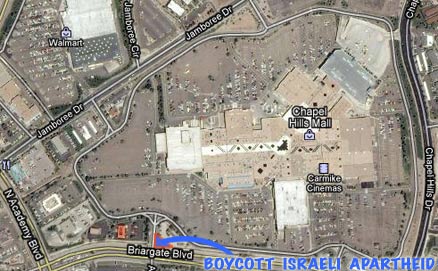
COLORADO SPRINGS- While Gaza Freedom Marchers remain confined in Cairo, stateside solidarity actions continue apace. Join Coloradans For Peace for DAY2 of the ISRAELI APARTHEID BOYCOTT at SW entrance of Chapel Hills Mall, intersection of Briargate and Agora Point. Noon Tuesday.

Boycott Coca-Cola for India’s water, Colombia’s unions and Israel Apartheid

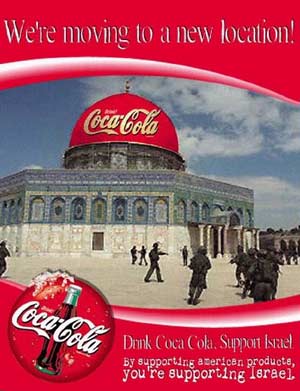
Subversive mock Coke adOK, it’s a famously discredited fake-ad to slander Coke. They have no plans to rebrand the Dome of the Rock. But Israel may — and Coca-Cola is a sponsor. That’s why Coloradans For Peace are calling to boycott Coke, to stop supporting Israeli Apartheid.

There are plenty of reasons to boycott the real thing spreading diabetes. At COP15 the Yes Men targeted Coke for their preposterous “Bottle of Hope” campaign which could only refer to Coke’s hope to green-wash their culpability for depleting water tables and poisoning India and contracting to kill labor organizers in Colombia. Coke is a bad habit.

Since overrunning East Jerusalem in 1967, Israel is trying to settle it in defiance of international sanctions. Israel promises as administrator not to alter the Muslim shrine, but radical Zionists have been making open preparations to restore it as a Jewish temple.

coca-cola kills logoCoke is a corporate underwriter of Israeli expansion into the Palestinian Territories. Their Kiryat Gat bottling plant is built on contested land, and Coke has now invested in the Tavor Winery on Palestinian land.

Boycotting Coke would send a message that the beverage multinational must redress the injustices it perpetuates. Wouldn’t it be an easy thing, really, to pass on all Coca-Cola products? What will you miss?

coca-cola steals world waterThe Yes Men Coke action at COP15 did produce a tongue-in-cheek press conference dubbed Rage Against the Coke Machine, where attendees recited this pledge:

“I, [name], with respect for crimes against people and the planet, from this day forward, for the rest of my living days will never, ever, drink Coca-Cola again until the Coca-Cola company ceases and entirely stops stealing the water from communities in India and stops union-busting in Colombia and ceases and desists entirely from relentless and absurd greenwashing like a ‘bottle of hope.’”

Absent sadly was mention of Coca-Cola’s support of Israeli Apartheid. Let’s put it back!

Boycott Israel Apartheid this Christmas

Boycott Divestment and Sanctions of Israel to end Palestinian OccupationIn solidarity with the ONE MILE MARCH to free Gaza, on the one year anniversary of Israel’s genocidal incursion into Gaza, let’s kick start a Colorado Springs effort to support the Global Boycott, Divestment and Sanctions (BDS) Movement against Israel, to end apartheid and free Palestine. There are many US/Israeli companies who promote or profit from the illegal occupation of Palestine. On December 28, let’s target those in the Chapel Hills Mall!
L’Oreal, Revlon, Estee Lauder, Ahava, Hanes, Timberland, Teva, Victoria’s Secret, and Bath & Body Works.

American citizens can feel a vague sense of disconnectedness with respect to US business ties with Israel, or we can trace the responsibility for the injustices suffered in Palestine directly to retailers in our neighborhoods. Let’s let these local outlets know we will not tolerate their companies’ agenda in Palestine.

These are just among the consumer products and retailers which actively support Israel’s illegal actions in Palestine. Others you can boycott in town include Home Depot, Starbucks, McDonalds, Coca-Cola, Sara Lee, Danon, Nestle, Johnson & Johnson, Kimberly Clarke, AOL Time Warner, [Fox] News Corp, IBM, Intel, Nokia, Motorola and Caterpillar.

The BDS movement against Israel is attempting to recreate the same pressures which ultimately brought down apartheid in South Africa. Academic, cultural and business boycotts are targeted against US and Israeli companies which participate in the settlement industry, the economic exploitation of Palestine and Palestinians, and control of the population.

December activism calendar

1- PROTEST Escalation of War in Afghanistan, Acacia Park, 5pm
3- STORY OF STUFF Annie Leonard, CC Packard Hall, 6pm
7-18 – COP15, UN Climate Change Conference, Kobenhavn DK
8- Sarah Palin book signing, Borders, Briargate Mall
9- Health Care Reform ambulance visit, S. Tejon, 10-11am
27-31 BOYCOTT ISRAELI APARTHEID, Chapel Hills Mall, for Free Gaza March
BOYCOTT ISRAELI APARTHEID, Chapel Hills Mall, noon

Ward Churchill speaks on which settler invasion wrote the book on Apartheid

Tucson Tohono O'odham
Ward Churchill spoke in Tucson on Friday and Brenda Norrell has posted the footage. Watching the ex-CU professor speak, I can’t help but think about the university students’ loss. They’re missing the lamentably rarefied perspectives he offers of course, but more important, the inspiration gained from such an engaging luminary.

Throughout his lectures, Churchill likes to put questions back at his audience. He understands, if I can presume to project his rationale, that a mentor’s role is to bounce ideas around, and be sure his students have minds open enough to let them resonate. It’s also a sign of someone fully confident with what they are teaching. Churchill gives you the impression he’s interested in the best argument you’ve got, and I believe him, but in reality he’s going to have few peers up to the task.

When it’s time for Q and A, Prof. Churchill calls it mud-wrestling, and welcomes all shots, “even spit wads.” He draws the line at brick bats, because he says, one might bounce off his head and hit somebody else. He warns, as if he’s had practice, “because someone might get hurt. I can assure you it won’t be me.”

I wished at that moment that Tucson was not so far from Churchill’s curiously vile detractors, who attended his trial in Denver, and who hold bitch fests online about every Churchinalia for reasons unspecified. I predict they’re remunerated; the love-to-hate pretext is wearing thin, these yahoos are pro-Israeli tea-baggers. So there’s no Drunkablog or Pirate Ballerina there tonight to take the “perfessor’s” challenge. Although wouldn’t such an exchange have been simply tedious? I recall this dismal attempt mounted against “Wart” by a couple CU college Republicans, it was just embarrassing. Have Churchill’s online critics ever confronted him in person I wonder? They can spout off in the safety of anonymity, and that’s about it.

Churchill’s speech to the predominantly Anglo and O’odham border activists was about the bigger issues behind the border wall. The theme of the gathering was Apartheid in America, and Churchill demonstrated how South African Apartheid came of the successful colonial methods practiced in the United States. These were the strategies employed by the Germans in taking and settling the Eastern Front during WWII, and of course the goals of Israel in Palestine.

Churchill described how settler invasions vary from colonial administration. In the latter case, the colonizers can go home, in the former, they stay. Another distinction is critical, the settlers aren’t moving to a land and becoming part of the social system, they remain citizens of the occupying force. They bring their identity and the foreign system with them, to apply against the people indigenous to the land. The process involves two steps: displace enough of the natives to make room for yourselves, but leave just enough to serve as a labor pool, for all the building that is required of empire building. You’ve need of only a portion of the original population, to do the manual labor required of developing the land, but eventually you need them to die off. The Nazi strategy in Poland was to eleminate a great deal via war, then another mass through starvation, ill health and exposure. Methods mirrored today in Gaza. As a USA example, Churchill sited the average life expectancy of a Native American on a reservation in 1975. The age was 44.6 years old. That’s 1/3 less that the G-Pop average, equivalent to thinning the population by a third.

To cut to the quick, Churchill asked his audience how they felt about social challenges like sexism, racism, ageism, classism. All were basically in accord as being against. What’s the problem, Churchill asked. If so many are against these things, why do they persist? Then he threw imperialism into the mix, which had not been mentioned. Churchill said we cannot adequately address the others until we have a clean conscience about the land taken from America’s First Peoples. This must be the priority. First Peoples, First Nations, First Priority.

Below is the video of Friday’s Tohono O’odham event in Tucson. Take note also of the excellent speeches which followed the keynote, by Ofelia Rivas and her brother in particular.

Click ON DEMAND, then select the “Live Show Fri Nov 13 2009 06:20:55 PM” or watch it at Livestream/earthcycles.

This Israel public relations jig is up

Colorado College lecture in Gaylord HallCOLORADO COLLEGE- The news from the ISRAEL TODAY lecture is all good. If you’d been there, you might wonder how my takeaway from such a bilious gathering could be upbeat. I’ll tell you. The Palestinian voice was well represented, Israel’s presentation was Old Testament, and the writing on the wall grows ever more clear. And I got a few nice pics.

The Audience
To begin, I would certainly have preferred everyone had acted with more decorum. That is, if there had been impressionable attendees there. As it was, the seats were only half occupied. Except for the young men with “JEW CREW” on their backs, or girls with Hebrew script across their pullovers, there were almost no CC students. The audience was one third voices for Palestine, and two thirds vitriolic Jew, amazingly indignant to disruption of their world view. No one was there to listen, except to cheer for what they already believed. But I’m certain it was an eye opener for all.

My friends and I were sure to supplement the speaker’s pauses with color to augment his heavily loaded statements. For example, when Gil Artzyeli described the objective and feat of Israel’s 2006 incursion into Lebanon “to silence them,” and did that not prove effective? Who could refrain from adding “you killed them.” The 2/3 supporters grew more and more angry. But the speaker had an inopportune manner of posing rhetorical questions, which we couldn’t resist answering.

It almost got us kicked out. I spent the duration with security guards poised right behind me, ready to escort me out of the room. I learned it would be more prudent to avoid the back row at opportunities like this, because you can be pulled out of your chair, or distracted into involuntary conversation with security personnel more readily than if you were well ensconced among the other attendees.

Those voicing support for Palestinians were made to wait until question and answer portion to voice their objections. Even then, the pro-Israel audience would cut them off. It became impossible to ask a complex question without interruptions of “What is your question? State your question!” They hounded everyone who wasn’t setting the speaker up for a softy. It was a ruthless crowd with the civility of Tea Partiers. When the pro-Israel attendees took their turn posing questions, no one interrupted. When it was a detractor, their time suddenly became too valuable to entrust to us. Even a CC student from Gaza, who hasn’t been permitted to visit his family in two years, was not given a hearing.

I’m positive that as these rude people think on how the event transpired, they will not be able to help feeling ashamed. Our interactions were spirited and engaging, addressed to a speaker with the hubris to take us on. We interrupted the speaker, but never tried to drown him out. Our adversaries on the other hand tried to flat out shut their fellow audience members up.

That crowd is immovable. I’ve no optimism for influencing their resolve. On the other hand, their rigidity was laughable. Their logic will not sway anyone new. They were positively shrill about their speaker being permitted to deliver his message as abridged. “Let him speak!” they shouted, as if their attention was rapt by information they’d never heard before, a preposterous notion. I’m neither Palestinian nor American Jew, but this was Israel Foundation Myth for Dummies. I can only think that this crowd sat tightly clenched, thrilled that the others among the audience were forced to listen to their dogma.

The Presentation
Old school. Palestinians offered their own statehood, but rejected it. Israel is pretext for Arab countries to oppress their peoples. No such thing as a Palestinian, Jewish presence in Judea has been continuous, Palestinians teach their children to hate, Israelis teach love, etc, etc. The old greenhouses of Gaza story was the example given to show that Palestinians don’t want to help themselves. Arab neighbor states are blamed for not resettling the Palestinians. Gaza is free, it is not occupied.

Would you believe Israel justifies the force it used in Lebanon and Gaza based on what NATO was permitted to do in Bosnia? Those were war crimes too! Israel accuses its critics of anti-Semitism because they don’t take other militaries to task for their crimes. But really Israel gives itself the latitude to commit crimes commensurate with the worst.

And here’s a wild gem! Israel owes its enormously successful economy (no mention of US foreign aid or direct sponsorship by Jewish American interests) to, among progressive business practices, the fact that all Israelis, both men and women, have to serve compulsory military service. It gives them the skills and discipline to excel in business and strengthen Israel. Mr. Artzyeli showed a video clip taken from CNBC, recommending that such a policy in American would certainly greatly improve its prospects for an economic recovery!

A word about the delivery of the presentation. Though impeccably dressed Gil Artzyeli affected the presence of someone wearing a Tony Soprano tracksuit. He sat back on his heels, his eyes directed to the ceiling as he dismissed his questioners. When a Palestinian girl raised a specific instance of an IDF strategy deployed in Lebanon, wondering how it was not a war crime. Artzyeli ignored it completely, making an aside to someone up front that the he wasn’t about to dignify that accusation with a response.

It’s kinda the problem Israel is having, isn’t it?

The Jig is Up
Over the last weeks I’ve had a chance to participate in three presentation by Israeli officials. The sum experience has fortified me with hope. With world opinion against them, and now the Goldstone Report, Israel is on the run.

The first lecture by Uzi Landau was on the offensive, directed toward Iran. It went over poorly. The Q&A revealed that Landau hadn’t connected the dots at all. The audience he had hoped to rally became only more concerned about Israeli nukes than Iran’s.

The second presentation delivered by Nir Barkat was an encouragement to the Denver Jewish community to support Jerusalem, with donations, travel, and by encouraging emigration. There the audience was equally smug and oblivious to the notion that increased settlements constituted violations of international law. But Israel’s continuous push for Jewish immigrants provides the clue to what Barkat inadvertently confirmed. Jews are leaving Jerusalem. The balance of the population is shifting toward the non-Jew.

This third event with the Deputy Consul General took the rhetoric down to basics, a demonstration of how far Israel is slipping. The dogma behind Zionism’s right to its own state, and their right to defend themselves, used to go without saying. Today Gil Artzyeli was forced to defend the most basic assumptions. The Jewish diaspora, their right to return, the expanding borders, the wall, the military retaliation. I was thrilled to see arguments slip back past the basics.

The Jewish American communities may still be a resolute, but their numbers are not large. It appears to me that the compatriots they’ve recruited, from the Christian right and the neoliberal conservatives are receding quickly.

The image of the much-oppressed Jew is becoming eclipsed by the militant arrogant Zionist, earning no one’s sympathy.

A few pictures from the event:
Deputy Consul General Gil Artzyeli lecture November 12, 2009
Castigated for raising his voice, Ed Nace insisted on standing for the duration of the lecture, to lend omniscience to his objection.

Deputy Consul General Gil Artzyeli lecture November 12, 2009
Colorado College Poli-Sci professor, and Middle East specialist Bob Lee rose several times to forbid the impromptu participation by the audience. Here he calls for security to remove Ed.

Deputy Consul General Gil Artzyeli lecture November 12, 2009
Security reconsidered asking Ed Nace to leave as he informed them in his booming voice that he was a Colorado College alum.

Deputy Consul General Gil Artzyeli lecture November 12, 2009
Would you believe Mr. Artzyeli trotted out the old Farfur the Mouse clip, depicting Muslim children being taught to admire suicide bombers. It’s a favorite example whose relevant context was long ago dismissed.

Footnote
One lamentable observation I had regarded a member of the chaplain’s office at CC, who is also a peace community activist. She was not at liberty to take sides on the Palestinian – Israel discussions for fear of alienating the Jewish students. I do not personally doubt her motives, nor her sympathies for the victims of injustice in Palestine.

However, when our 85 year-old Ed Nace raised his voice, or stood angrily, the chaplain’s assistant moved to calm him down. She may have thought he needed assistance, but in reality his stubborn act was working. His offense at the slanders against Palestinians, his incredulity that such a one-sided presentation was being allowed, and his indignation at the ferocity with which he was being silenced, expressed itself as a hard-of-hearing old man who was not about to be bullied. His performance, even inadvertent, worked to disrupt the lecture and temper the smug untruths being passed as academic fact. But Ed’s act was not made any easier by a colleague trying to calm him down. To his credit, Ed persevered and was able to put a human emotional context to Mr. Artzyeli’s slick propaganda.

The chaplain is no doubt schooled in nonviolent communication. She needs to bone up on effective nonviolent theater. Non-confrontational communication isn’t going to bring racist bullies like Artzyeli to heel. Zionist Apartheid is going to fall when it is condemned and pilloried.

Israel sends deputy consul general to CC

End the occupationThe Israel Today event changed the speakers on us, instead of the Israeli Consul General to Los Angeles, it’s the Deputy Consul Gil Artzyeli. But the act’s still on. Get to Gaylord hall sometime before noon, it’s the conference room at the Southeast corner of the Worner Center building. We’ll stand outside with our repudiation of Mr. Artzyeli’s message, then go inside to assure the discussion steers toward being honest. I found this quote by Artzyeli, addressing the Denver Jewish community earlier this year about the Gaza incursion:

“This is not a war for territory … The first war is to protect the citizens of Israel, the second war is against Iran and the third war is against lies and disinformation.”

Any takers? My first question, if I’m given the chance: Mr. Artzyeli, are you here only to speak, or will you listen?

Cyndy Kulp put together a handout for the occasion:

Human Rights Issues in “Israel Today”

Israel is a pariah nation condemned by the UN and much of the international community for its multiple violations of international human rights law, including:

• Continuing the occupation of the Palestinian people

• Building housing settlements on confiscated land

• Seizing additional land and property from Palestinians to build “The Wall”, highways for the exclusive use of Israelis, and military areas, etc.

• Using extremely disproportionate and indiscriminate force in the invasion of the Gaza Strip during “Operation Cast Lead” in Dec. 2008

• Inflicting heavy casualties on Palestinians, many civilians and children with no way to escape the bombing

• Refusing to compensate the 5.8 million Palestinian refugees and their descendants who were displaced from their homes and properties during 1948

Israeli Diplomats, like our speaker today, should not be given a public platform from which to promote their views as long as they refuse to recognize and cooperate with international laws.

HERE ARE FURTHER DETAILS:

? In June 1967, the Israeli military invaded the West Bank, Gaza and East Jerusalem. These areas of historic Palestine under military control are the “Occupied Territories,” comprising some 3.5 million Palestinians, and they are systematically being incorporated into the state of Israel in violation of international law.

? Life under occupation is very harsh. The Palestinians have virtually no human or civil rights. Unemployment is rampant. In order to go about their daily lives, the people in the Occupied Territories must line up and go through multiple checkpoints manned by the Israeli army. Proper paperwork, including Palestinian ID’s, and permits are required to pass through, and many people are denied entry, even into East Jerusalem which is Palestinian territory and home to many hospitals, schools, and employers.

? Israel has built 200+ settlements in the West Bank, and over 400,000 Israelis have moved onto Palestinian land. Many of the settlers are armed and aggressive extremists, and their actions are regularly protected by Israeli Defense Forces.

? Israel has seized a majority of the West Bank land as military bases, settlements, security areas, “land reserves,” by-pass roads linking settlements with Israel, and other areas forbidden to Palestinians. Palestinians are confined to small fragmented areas resembling Bantustans in an Israeli version of Apartheid.

?? Israel’s sovereignty in Jerusalem is questioned by the international community, and contrary to what the Israelis would like you to believe, Jerusalem does not belong to Israel. This is why other nations have their embassies in Tel Aviv instead.

? East Jerusalem was declared as an occupied territory in UN Security Council Resolution 242 which specifically emphasized the “inadmissibility of the acquisition of territory by war.” Yet Israel continues to seize homes and land and allow Israeli settlers to move into East Jerusalem.

? Over 10,000 Palestinian homes have been destroyed, leaving 30,000 people homeless. Housing demolitions and displacement are common for Palestinian families, and they are powerless to protect their properties or get legal permission to build homes.

? The Gaza strip remains under siege today. Despite the withdrawal of Israeli settlers in 2005, Israel still controls entry into Gaza. People cannot leave and cannot get the goods and services they need. They are literally locked into a ghetto.

? In Dec. 2008, Israel invaded the Gaza strip, causing massive destruction and Palestinian causalities. The vast majority of the Palestinians killed in Israel’s operation were innocent civilians rather than combatants, according to a new report by B’Tselem, an Israeli human rights organization. Of the 1,387 deaths, 773 were non combatants. 320 of these were under the age of 18, and 109 were women.

? Nine Israelis were killed during the Gaza war — four by rocket fire on southern Israel, including three civilians and one soldier, while the other five were soldiers killed in combat, primarily from “friendly fire” incidents.

? The Goldstone Report which investigated the Gaza Invasion for the UN concluded that both Israel and the Palestinians had committed violations of International Law, but that Israel because of it’s huge army and sophisticated weaponry was more culpable and guilty of Crimes Against Humanity in it’s 2008/09 Gaza onslaught.

? U.S. aid has made Israel’s army one of the most powerful military forces in the world. Israel is using U.S. F-16 fighters and Apache helicopters in attacks against Palestinian civilians. This violates the U.S. Foreign Arms Export Act. Over $3 billion in US foreign aid is given to Israel, and most of it is used for military operations.

There Will Be No Security For ISRAEL Until There Is Justice For PALESTINE.

Resources For more information:
Israeli Committee Against House Demolitions
B’tselem: The Israeli Information Center for Human Rights in the Occupied Territories
Bethlehem University
Mazin Qumsiyeh
Machsom Watch
Breaking the Silence
Women in Black
Sabeel

Stop the Wall Campaign

US Campaign to End the Occupation

–END THE OCCUPATION
–COMPLY WITH INTERNATIONAL LAWS
–FREEZE SETTLEMENTS
–NEGOTIATE AN EQUITABLE SOLUTION ON LAND AND WATER

The US claims to be an “honest broker” –fair to both sides– in the so-called peace process. At the same time, the U.S. proclaimed itself the unswerving ally of Israel. These roles are contradictory. Massive U.S. aid funds the occupation. Since 1949, the U.S. has given Israel well over $100 billion in grants, loans and other assistance. This amounts to over $15,000 per Israeli citizen. ?
A genuine peace with a minimum of justice requires an independent and viable Palestinian state on the territories occupied by Israel in 1967 (West Bank, Gaza, East Jerusalem). Jerusalem should be shared as the capital of both Israel and Palestine. Palestine should be an equal neighbor alongside Israel with peace and security for both peoples. ?

Ward Churchill to speak for O’odham

O'odham rightsAccording to Censored News, Activist and scholar Ward Churchill will speak at the Unitarian Universalist Church of Tucson, 4831 W. 22nd St., on November 13, 2009 at 7:00 p.m. to benefit O’odham VOICE Against the Wall, which since 2003 has organized and advocated for the traditional O’odham leaders and elders of the Tohono O’odham communities in the southern territory of the United States and northern territory of Mexico. Professor Churchill’s talk is part of the “Apartheid in America: Surviving Occupation in O’odham Lands”

O’odham activist Ofelia Rivas will also participate. The event is sponsored by the Dry River Radical Resource Center, the Earth First! Journal, and Voices against the Wall.

Here’s some background on the O’odham struggle:

pamphlet cover illustrationBy J. D. Hendricks, 2004
TIAMAT PUBLICATIONS #5

The People Who Emerged From the Earth

Over two thousand years ago the descendents of the O’odham moved into the southwestern region of the area now claimed by the U.S. as the state of Arizona. 1 The O’odham have had one of the longest histories of contact with the forces of European colonization compared with the rest of the native North American peoples. The O’odham’s first contact with Spanish invaders took place in the mid 16th century; nearly one hundred years before the colonization of the North Atlantic coast and Great Lakes regions were begun by the French and English colonists. As such, the history of the O’odham provides a good context for an investigation of the colonization of Native North America, and more specifically, an investigation of the interplay between, and results of, the varied responses to colonization – that of collaboration, accommodation, and resistance.

Many histories of the O’odham refer to these desert people as the Papago. The term Papago was a name given to the O’odham by the Spanish colonizers, and is likely the result of a Spanish corruption of the O’odham word “papabi” which was the O’odham name for one of their principal bean varieties. Thus, the Spanish colonizers term for the O’odham (Papago) came to mean “the bean eaters.” 2 For the purposes of this study I will refrain from the use of the term Papago and will refer to “the people” 3 by their traditional pre-colonial name. 4

As is often the case, with the name Papago being a good example, European constructs are often imposed upon indigenous peoples by the historians that seek to portray their past. This result can occur when historians seek to glorify European norms and traditions at the expense of indigenous ones, and can also be the result of the subconscious indoctrination of the historian by the dominant culture – in this case that of western style industrial civilization. In other cases it can be the result of a simple uncritical usage of language.

One of the most dominant and reoccurring “civilized” constructs imposed upon indigenous peoples history is the commonly understood notion that the O’odham, or any other indigenous North American culture for that matter, existed as a totality or uniformed mass. This study will seek to use the history of the interaction between the O’odham peoples and the United States, both its government and its peoples, to deconstruct this myth of the totality and provide a history of the O’odham’s varied responses to colonization from an anti-colonial and anti-industrial perspective. By investigating various important case studies in O’odham history, and looking not only at resistance but also accommodation and collaboration, it is hoped that this work will help to provide a more realistic historical picture of the effects of colonization, and the intentions and reactions of both the colonizer and the colonized. Within the previously stated context and theoretical framework, this study will argue that while the O’odham responded to the U.S. invasion of their lands in various ways, the choices to resist, accommodate, or collaborate with the forces of colonization did not affect the overall U.S. policy concerning the O’odham – that policy being the eventual total assimilation of the O’odham into the dominant “civilized” industrial system. 5

This investigation will include a strong focus on O’odham resistance to colonization, as any anti-colonial history should, however it will not discount or ignore the many historical occurrences of accommodation, and in some cases outright collaboration, with the colonizers. It is important to always keep in mind that none of the actions and reactions in any of the case studies looked at are attributable to the O’odham as a “totality,” but rather are attributable only to the various groupings of O’odham, be they incarnated in the form of the individual, the clan, the village, an economic or spiritual grouping, or an established political organization.

A God of Civilization and Coercion Comes to the O’odham

The O’odham’s first encounter with Spanish invaders took place in the mid sixteenth century when a group of conquistadors led by Alvaro Nunez Cabeza de Vaca entered O’odham territory in search of gold. These men did not find the riches they were looking for and left the desert region to return to the Spanish colony. However, soon after word spread of the O’odham villages on the northern periphery of the Spanish colony, missionaries began to travel north to bring God and “civilization” to the native people residing there. By 1686, Catholic missionaries had formed a few small missions in O’odham territory using what they believed to be the influence of their soft power 6 techniques to lure the O’odham into their missions where they were then subjected to a rigorous schedule of cultural indoctrination. Most O’odham historians, including Winston Erickson, 7 and to a lesser extent, Bernard Fontana 8 have, during this time period, focused on the O’odham who chose to reside nearby and within these early missions, thus painting a picture of the O’odham as accepting of Spanish influence and cultural indoctrination.

However a closer look at this time period reveals that mission O’odham were only a small percentage of the total population of O’odham residing in the Sonoran desert 9 and that the ones who were there may not have been so for the reasons that the colonizers believed. San Xavier del Bac, the largest mission in O’odham lands, as well as many other missions, took advantage of the fact that the desert O’odham migrated in the dry winter months to the Northern Piman settlements along the rivers to work the small farm plots for sustenance. 10 The Catholic missions inserted themselves into this traditional pattern. Those O’odham who worked and lived near the missions were, for the most part, seasonal residents, which shows that the missions were viewed merely as being of utilitarian value. Thus, the O’odham as a totality were not necessarily accommodating to or interested in anything the missionaries had to offer per se, and when the missionaries began to employ “hard power” techniques and abuse or overstep the grounds for their welcome it did not go without consequence. 11

Accommodating and ignoring the missionaries was not the only response to colonization practiced by the O’odham during the seventeenth and eighteenth centuries. Although historians such as Erickson feel that “the missions did serve the O’odham well….,” 12 that assertion is contradicted by the fact that there were many large scale rebellions waged against the missions from outside and from within. In 1695, 1751, 1756, and 1776, large scale rebellions occurred in which missionaries were killed and their missions burned to the ground. 13 In some cases these rebellions were the doing of joint O’odham/Apache alliances, which is significant considering that many histories of the O’odham and Apache portray them as immemorial enemies. This may be the result of the fact that by the early nineteenth century the Spanish government initiated a campaign of divide and conquer that was continued later by the Mexican and U.S. governments to turn the O’odham and Apache against one another, thus easing the project of their subjugation.

A Change in the Occupation Government: Washington Enters O’odham Lands

In 1821, Mexican Independence from Spain was achieved and interest in the O’odham dropped away nearly entirely. By 1828, the new and secular Mexican government began the process of shutting down the missions in O’odham territory and by 1842, the last of the missions were closed. Soon after, in 1846, the United Stated initiated a war for territorial expansion against Mexico. This war was not of immediate consequence to the O’odham peoples. Isolated in desert regions, the fighting between the two occupation powers affected them little in the short run. However, the signing of the Treaty of Guadalupe Hidalgo in 1848, which ended the war, would lay the foundations for a series of disastrous events which would affect the O’odham in very negative ways.

Of greatest consequence to the O’odham was the fact that the boundary between the United States and Mexico was not finalized by the treaty of Guadalupe Hidalgo. The boundary was designated by Article Five of the Treaty as being an arbitrary line roughly following the 32nd parallel, an area which runs through the southern part of modern Arizona. To the east, the border was provided by the Rio Grande. The exact boundary line along the 32nd parallel was to be decided at a later date. It is also important to note here that the Treaty also provided that all Mexican citizens absorbed by the United States were to be granted U.S. citizenship, which included all indigenous peoples in the annexed territory since under Mexican law they were considered citizens. In the treaty the United States also assumed the responsibility for preventing cross border raiding into Mexico by the southwestern tribes, specifically the Apache. 14

In the aftermath of the signing of the treaty of Guadalupe Hidalgo, it became quickly apparent that an acceptable border between Mexico and the United States along the 32nd parallel would not be achieved. An official survey expedition was assembled by the United States and Mexico in 1849 to trace out the boundary between the two countries with little success. Various borderlines were agreed to and then abandoned and re-made by the United States, sometimes in a unilateral decision that dismissed the positions of the Mexican government altogether. 15

The principal concern for the United States was to secure title to an area of land in northern Sonora, Mexico that was ideally suited for the construction of a portion of the southern continental railroad whose building was being discussed in the U.S. Congress at the time. One of the main advocates for this southern railroad route was a South Carolina man by the name of Colonel James Gadsden. Gadsden’s history of connections to powerful business, military, and political leaders is very interesting and his appointment by the United States to be Minister to Mexico in 1853 serves as a very informative source to gauge the United States’ intentions towards Native Americans and the O’odham in particular.

James Gadsden was born into an influential southern family and graduated from Yale University. After enlisting and serving in the war of 1812, Gadsden was sent to the Florida territory with Andrew Jackson to aid in the campaign of removal and extermination being waged against the Seminole Indians, which took place from 1816-1818. After this war against the Seminole, Gadsden was appointed by President Monroe as commissioner to oversee the removal of the Seminole Indians to Indian Territory. Like the more famous removal of the Cherokee, the removal of the Seminole, and the high death rate suffered as a result, unarguably constituted genocide. 16 As a reward for a job well done, Gadsden was appointed by Monroe to a seat on the legislative council of the territory of Florida, thus beginning Gadsden’s political career. In 1840, Gadsden was elected President of the Louisville, Charleston, and Cincinnati Railroad. In 1853, the Secretary of War, an ardent white supremacist and slavery defender by the name of Jefferson Davis, appointed Gadsden to be Minister to Mexico. 17 As Minister to Mexico, one of Gadsden’s primary missions was to negotiate a final demarcation of the boundary between the U.S. and Mexico. Although Gadsden was a zealous believer in Manifest Destiny, his ideas concerning racial Anglo-Saxonism 18 caused him to be an opponent of the total annexation of Mexico. Gadsden, like many racist U.S. politicians of that time, felt that the total absorption of Mexico and its non-Anglo population into the United States would pollute the Anglo bloodline too much and thus he sought only to gain enough territory for the United States to build the southern pacific route. 19 Thus, a man who had presided over a war of genocide against the Seminole Indians, was a devout racist, and who had obvious conflicts of interest due to his connections to the railroads, was put into a position to determine the territorial boundary between the United States and Mexico and in the process also determine the boundaries of the O’odham’s land. With its appointment of Gadsden, the intent of the U.S. government could not be clearer. Business interests and territorial expansion were to run roughshod, by any means necessary, over any native peoples who stood in the way.

It is no surprise that when James Gadsden finally successfully negotiated a treaty with Santa Anna to secure what is now the southern portion of Arizona, the O’odham were not consulted. In fact, the Gadsden Treaty, signed into law in 1853, did not contain any mention of the O’odham at all. Considering that the new boundary line put in place by the Gadsden Treaty literally split the traditional O’odham lands in two, it is obvious that the intentions of the United States were in no way benevolent. Here it is also important to point out that the terms of the Gadsden Treaty specifically included the same citizenship provisions which were spelled out in the earlier Treaty of Guadalupe Hidalgo. 20 Although the Gadsden treaty was of great significance for the O’odham, their isolation and the outbreak of the Civil War enabled them to live another decade in relative isolation from Anglo encroachment.

Assimilation, Cultural Destruction, Double Speak and Ordained Genocide

The causes which the Almighty originates, when in their appointed time he wills that one race of men – as in races of lower animals – shall disappear off the face of the earth and give place to another race, and so on, in the great cycle traced out by Himself, which may be seen, but has reasons too deep to be fathomed by us. The races of the mammoths and mastodons, and the great sloths, came and passed away: The red man of America is passing away!
–United States Congress Committee on Indian Affairs report, 1865. 21

No doubt with similar justifications in mind as those of the Committee on Indian Affairs, Anglo settlers began their invasion of O’odham lands less than a year after the conclusion of the Civil War. The Homestead Act had opened up the lands of Southern Arizona to Anglo squatters and in 1866, one of the first of many bills was passed by Congress granting mineral rights to any citizen who claimed them. 22 Every one of these homesteads opened and every resource extraction operation initiated without the express consent of the O’odham represented an illegal action under the Gadsden Treaty. The citizenship provisions of the Gadsden Treaty had granted citizenship to all former Mexican citizens and the O’odham were, by legal definition, included in this formulation. The United States, however, refused to consider “uncivilized” peoples as being worthy of the protections granted to citizens by the fourth amendment of the U.S. Constitution, which prohibits the expropriation of property. This refusal of the United States government to follow its own laws pertaining to Native Americans when those laws happen to stand in the way of U.S. interests has been a common occurrence in United States Indian policy. This land grab was only the first of many illegalities committed against the O’odham people by the United States and its citizens. In this respect the O’odham are in a special position when compared with many other tribes. While the theft of native lands by the United States Government was usually legally justified by treaty stipulations signed between a tribe and the U.S. government, this justification could not and cannot be used in the case of the O’odham since no treaty was ever signed with the O’odham by the United States Government. 23

For the most part, the O’odham did not resist this initial incursion of Anglo settlement, rather the O’odham practiced accommodation and moved farther out into the desert to shield themselves from the new settlers invading their lands. Traditional ways were maintained with the exception of the introduction of cattle ranching. The O’odham territory was well suited for the raising of cattle and a good number of O’odham became cattle ranchers, both for purposes of subsistence as well as for sale to Anglos residing in and around Tucson. In the 1880s, as increasing numbers of Anglo cattle ranchers began to invade and take over their pasture, some O’odham began to resist.

The O’odham resisted by stealing the Anglo cattle herds which were rounded up and driven south to be sold on the Mexican market. The expropriation of Anglo cattle herds was not isolated, and it became a major concern for the settlers and the government. In at least one case, a large cattle outfit was driven out of business. 24 The concern over this outbreak of O’odham theft of Anglo cattle was large enough that newspapers as far away as Los Angeles ran stories about the phenomenon. For the most part these stories seem to have been deliberately used to justify the enclosure of the O’odham into reservations as the government and Anglo cattle ranchers seized the opportunity to gain even more O’odham land by arguing that it was an unfair burden for the Anglo cattle ranchers to have to “support” the O’odham. 25 Here, in previous case study, we have another common attribute of U.S. Indian policy in general, and one which occurs again and again in the history of O’odham contact with the U.S. government and Anglo settlers – blaming the victim.

Another official position of United States Indian policy during this time period was that everything done to the Indians was, in the words of Indian Commissioner J. Q. Smith, in their own “best interests.” 26 Whether this obvious sham was based on a subconscious guilt and delusion or was a cynical example of “double-speak,” it is obvious that Native American’s best interest’s were the last thing on the government’s mind. Nevertheless, with this reasoning as justification, the first official reservation for the O’odham was created by executive order of President Grant on July 1, 1874. This small reservation surrounded the Old Catholic mission at San Xavier del Bac. It is estimated that only about ten percent 27 of the desert O’odham took up residence within this reservation – these were labeled as “civilized” O’odham by U.S. census takers. The vast majority of O’odham were labeled as “wild” and continued to live in the vast desert regions west of San Xavier del Bac. While it is obvious that the desert O’odham were resisting cultural assimilation by avoidance, even the mission O’odham maintained a resistance to European culture as the next example will illustrate.

While visiting the old mission at San Xavier a newspaper columnist from the Los Angeles Times wrote that upon her visit in 1882, she could see “not a single civilized human habitation within miles.” This writer goes on to state that the O’odham’s dwellings were in the form of “conical mud huts.” In the casual racism and Social Darwinist rhetoric of the period she also adds that,

“The Papagos are but little in advance of gophers and prairie dogs in their habitations.” 28

The point is that after more than 200 years of European influence, even the mission O’odham continued to build their traditional shelters. 29

Progressivism and Cultural Genocide: The Dawes Act

In 1887, the General Allotment Act, also known as the Dawes Act, was signed into law. The Dawes Act was the staging point for the forced assimilation of those remnants of Native American groupings which had not been totally decimated by the preceding period of “Indian Wars” and forced relocations. The essential function of the Dawes Act was to disrupt traditional tribal land holding patterns and thus force Native Americans into the Anglo system of private property. The O’odham, like most other Native American cultures, did not have a concept of private property – land was held in common for the benefit of the village group. Communally held land was an essential pre-requisite for their Anarchistic political system and extremely de-centralized tribal structure. 30

The first section of the Dawes Act provides for equal “sections” of land to be parceled out to each “head of family.” This head of family was always understood to be the father of each family when land was allotted. Thus, this first section of the act not only attempted to destroy the communal land system of Native Americans, it also instituted Patriarchy as the basis for social functioning in Native America. 31 In addition, Section Five of the Act also provides that any un-allotted lands be subject to purchase by the United States government. Section Six and Seven provide that all monies paid by the U.S. for un-allotted Native lands be held for each tribe by the U.S. Treasury and “subject to appropriation” by the U.S. government to repay itself for the implementation of allotment as well as to provide for the “civilization” of Native Americans. 32 In less veiled words, these sections are basically stating that Native Americans will be forced to pay for their own cultural annihilation.

This interpretation of the intent of the Dawes Act becomes clearer when one looks at the arguments and debates that took place in Congress and within self described progressive “Indian rights” groups such as the Indian Rights Association. Critics of the Dawes Act in Congress such as Rep. Russell Errett understood that

“the main purpose of this bill is not to help the Indian troubles so much as it is to provide a method for getting at the valuable Indian lands and opening them up for settlement.” 33

And Senator Dawes, the namesake of the final bill, speaking of the land and resources of Native Americans stated that

“civilization has got after these possessions with a greed never before equaled but it is idle to expect to stay it….” 34

As for the progressive Indian Rights Association, they argued that

“the organization of the Indians into tribes is, and has been, one of the most serious hindrances to the advancement of civilization, and that every effort should be made to secure disintegration of all tribal organizations….” 35

And one of their leaders, Reverend L. Abbott, provided justification with the statement:

“Barbarism has no rights which civilization is bound to respect.” 36

So here we have a self-proclaimed progressive Indian Rights organization arguing for cultural genocide and against the notion that Native Americans have any rights that civilized people are bound to respect! This conclusion provides a perfect example of the essence of “progressive” or “civilized” thought.

The Dawes Act had a much less devastating effect for the O’odham than it did for many other Native American tribes. At the time of its passage, the only official reservation for the O’odham was the San Xavier reservation which, as was stated earlier, was only a small 71,090 acre reservation around the old mission San Xavier del Bac. When the allotment agent came to San Xavier in 1890, he allotted out 41,600 acres of land to the 363 O’odham whom he counted in his census as being resident at the time. 37 The vast majority of the O’odham still continued to live west of San Xavier in the expansive desert regions and were little affected by the allotment schemes. Even those O’odham who lived in San Xavier and were allotted land paid little attention to the artificial boundaries drawn on paper which supposedly privatized their land – they continued to farm and graze the land communally. 38 This refusal to abide by the provisions of the Dawes Act is also a form of resistance to cultural assimilation and adds one more example to show that for those O’odham who resisted, the most often employed method of resistance was non-compliance and avoidance. This specific response to colonization was made possible by the isolation and expansiveness of their desert home, which many Anglo’s continued to view as a “hopeless desert.” 39

The Domestication of the “Wild Papago”

The vast majority of the O’odham continued to resist assimilation and maintained a fairly traditional lifestyle – minus the introduction of cattle herding and horse rearing. In the twenty years following the passage of the Dawes Act, a growing effort was made to enclose the “Wild Papago” 40 and forcibly strip them of their traditional culture and instill them with the “civilized” values of the industrial Anglo. As was mentioned previously in the paper, ranchers and the government used O’odham cattle theft from Anglo ranchers as one tool to justify the enclosure of the O’odham within a reservation. During this period, Anglo Cattle ranchers continued to encroach deeper and deeper into O’odham territory and scuffles began to break out.

In another classic example of the “blame the victim” tactic, a pro-enclosure story was printed in the Los Angeles Times, no doubt to build public pressure for the domestication of the “Wild Papago.” The story concerns a group of O’odham who had resisted an Anglo cattleman’s attempts to enclose one of their water sources. When these O’odham continually tore down the fence that this cattleman had built, the rancher filed a report with the local Indian Agency sheriff to have the men arrested. When the sheriff arrived to arrest the O’odham responsible for defending their water source, he was taken hostage. The sheriff was later released unharmed; however, the incident was used to make the argument that such troubles can only be expected to increase if the O’odham were not enclosed on a reservation where they could be more easily controlled and monitored. 41

The tactic of occupying and diverting natural water sources was one of the tools used by the Anglo settlers and government to destroy the self sufficiency of the O’odham and force them into reservations where they would be dependent on the government for their water and would thus be easier to control and monitor. Some of the O’odham clearly understood what was happening, which is evidenced by instances of resistance both to the enclosure of natural water sources as well as resistance to the drilling of wells. One example of the U.S. government using water as a tool of forced cultural assimilation can be found by looking at an event recorded by an O’odham calendar stick 42 keeper. In 1912, the O’odham residing in the village of Santa Rosa, an isolated and traditional village in the western desert region of O’odham territory, were paid a visit by an Anglo Indian Commissioner who wished to drill a well for them. The Chief of the village objected to the drilling of the well on the grounds that it would disturb their culture, their autonomy and their self-sufficiency. The government agent proceeded to have the well drilled anyway. Upon completion of the well, the Chief of the village, according to the calendar stick keeper, stated that

“the well must be left alone and, in order that the Papagos might continue their old life, water must still be carried from the spring in the foothills.” 43

However, the prohibition by the Chief could not be upheld due to the overwhelming convenience of the new well and after a period of abstaining from its usage, the village of Santa Rosa (including the Chief) gave in and thus was assimilated into the industrial system by being made dependent on the Government well. 44 During this same time period, encroaching Anglo farmers engaged in the diversion of O’odham water sources to irrigate their farms. This practice served as another method of forcing the self sufficient O’odham into a relationship of dependence upon the government. In many areas so much water was diverted that the O’odham could no longer grow their traditional summer crops. 45

In 1919, the first incarnation of an O’odham reservation to enclose the nearly two million acres of desert that the “Wild Papago” were residing in was established. The formation of the desert O’odham reservation in 1919 ushered in a period of exponentially increased government interference in O’odham matters, and of course, the various forms of coercive assimilation were multiplied. By 1933, thirty-two unwanted wells were drilled all over the new reservation. 46 The well drilling was often opposed by those who were trying to maintain the O’odham Him’dag – the traditional ways of the desert people.

Resistance and Collaboration: O’odham Responses to Forced Modernization

In contrast to the traditional O’odham who had maintained resistance to cultural assimilation for the past 300 years, there was also a small number of O’odham based in the new reservation that welcomed collaboration with the forces of Anglo modernization and advocated for cultural accommodation and in some instances for total cultural assimilation. These men would later form an organization called the Papago Good Government League, which would serve as the propaganda arm of the Bureau of Indian Affairs and government policy in general. The leadership of this new faction had been taken from their families as youths and placed in Protestant boarding schools to be culturally indoctrinated. The Tucson Presbyterian Training School was one of the indoctrination centers where many future members of the Good Government League had been sent. 47

Religious indoctrination, whether Catholic or Protestant, has always been one of the most powerful tools of colonization and its justification used by European invaders against the indigenous peoples of the Americas. The necessary counterpart to the forced indoctrination of Christian principals and morals has always been the repression of indigenous spiritual practices. The United States government understood the profound power that traditional spiritual practices had in maintaining group solidarity and cohesion and it is for this reason that such spiritual practices were made illegal and repressed historically. In 1883, a Court of Indian Offenses was established by congress at the request of Secretary of Interior Henry M. Teller to eliminate traditional spiritual practices. In a report to the commissioner of Indian Affairs, Teller laid out his goals and his rationale stating that,

“If it is the purpose of the Government to civilize the Indians, they must be compelled to desist from the savage and barbarous practices that are calculated to continue them in savagery….”

Teller went on to associate those who resisted the repression of their spirituality with the “non-progressive” faction of Indians and labeled traditional spiritualism as “debauchery,” “diabolism,” and “savagery.” The overarching argument of his letter is that in order to civilize the Indians and bring them into the industrial system, their traditional spiritualism must be destroyed. As an initial step towards this end, Teller advised that Medicine Men be “compelled” to desist from their practice of “deception.” 48

Although the Court of Indian Offenses advocated that coercion be used to repress and destroy indigenous spiritualism, it failed to succeed in this project even when it used force to try to stop traditional spiritual rituals. According to Historian Edward Spicer, the only thing the Court succeeded in doing was driving traditional spiritual practices underground. In the case of many resistant O’odham, traditional spiritual practices were continued without regard to regulations or prohibitions against them, and in many cases, federal authorities resorted to repression and arrest to try to stop these practices. One traditional spiritual practice of the O’odham which was particularly hated by the Protestant Missionaries and Indian Agents was the Vi-kita ceremony.

The Vi-kita ceremony of the O’odham has been written about and studied by many Anglo historians and anthropologists, the most prominent being Columbia Anthropologist Ruth Underhill. 49 Before going into a short description of the Vi-kita it is important to understand that this ceremony varied depending on who was conducting it and where it was being conducted. Peter Blaine, an influential O’odham man sympathetic to the traditional ways, wrote in his autobiography about Underhill’s methods. Blaine explained the traditional way for the O’odham to tell about their past was to do it

“in a group so that everybody had a chance to talk and tell it their way. Underhill was talking to just one man…Dr. Underhill was wrong all the way in how she got her information.” 50

As scholars from the dominant culture often do, Underhill had applied her own notions of hierarchy, authority and individualism to her work with the O’odham and totally disregarded their traditional methods of conveying information in a communal fashion.

The Vi-kita itself was a yearly rain and fertility festival preformed to initiate and give thanks for the yearly summer rains. The ceremony itself consisted of the communal singing of rain songs, dancing, intimate encounters, and the consumption of Navait (Saguaro wine), an alcoholic drink made by the fermentation of Saguaro Cactus buds. The consumption of this wine was meant to symbolize the connection between the sky and the earth. The intake of the Navait was representative of the earth’s intake of rain. Participants drank Navait until vomiting occurred as this act embodied the clouds issuing forth rain unto the earth. It was a powerful ceremony that bonded the O’odham with the elements of nature.

When Protestant missionaries, and a small number of Protestant O’odham in the Good Government League, backed by U.S. Indian Agents, began their attempts to usurp power on the newly formed western O’odham (Sells) 51 reservation in the early 20th century, one of the first things they attacked was the practice of the Vi-kita ceremony. In the early 1930s, Peter Blaine explained that the traditional O’odham from the San Xavier reservation would travel to the western reservation for the Vi-kita. He states that,

“In the late 1920s the government tried to stop this wine drinking ceremony on the Sells reservation. But no Papago or Agency police could ever stop it.”

In one instance Blaine tells the story of how he helped defend three traditional O’odham Vi-kita ceremony leaders when they were arrested by agents from the Indian Bureau and jailed in Tucson. During the trial, a group of Protestant O’odham men from the Good Government League 52 argued for the repression of the ceremony – one of these men, Richard Hendrix, would continue to plague the traditional O’odham in future encounters. To respond to the collaborationist Good Government League, the resistant traditional O’odham formed the League of Papago Chiefs to counter the attempts of the Protestant Good Government League to usurp control on the reservation. 53

The Indian Reorganization Act and O’odham land rights

On June 18th, 1934, President Roosevelt signed into law the Indian Reorganization Act which finally stopped the forced allotment process initiated by the Dawes Act in 1887. The Indian Reorganization Act was viewed by its proponents as being in the best interests of the Indians. One of the reasons for this view was the fact that the Dawes Act and its forced allotment provisions had resulted in the loss of 90,000,000 acres of tribal lands and it was hoped by some, including then Indian Commissioner John Collier, that the Indian Reorganization Act could be used to regain some of this lost land.

The public was also encouraged to view the Indian Reorganization Act as being beneficial for Native Americans. A large article in the Los Angles Times entitled “The Bill to Return Indian Rights” stated that:

“After a century of graft, plunder and injustice, this bill has the objective of handing their own souls back to the Indians.” 54

However, such optimism and notions of cultural relativism were not held by all. As a precursor to the Indian Reorganization Act, a report was prepared for the Secretary of the Interior in 1928 to lay out the need for a change in Federal Indian Policy. The report stated that the “great majority of Indians are ultimately to merge into the general population” and that it was the government’s responsibility to assimilate Native Americans into “white civilization” because “the hands of the clock cannot be turned backwards.” Sympathetic attempts to help Native Americans retain their culture were stigmatized as attempts to “preserve them as museum specimens.” 55 Indian Commissioner John Collier was one of those who believed that Native Americans should retain their culture and that “the awakening of the racial spirit must be sustained….” 56 However, although the finalized Indian Reorganization Act did contain elements that were meant to “help” Native Americans, many of its articles were still designed to impose “civilized” systems on Native Americans.

It can be argued that the intent of the finalized Indian Reorganization Act was to initiate a new chapter in the push for the total cultural assimilation of the Native American tribes. The argument that there was no qualitative change between the Dawes Act and the Reorganization Act is legitimate. The Indian Reorganization Act provides the examples for the argument. The main tool of assimilation in the Indian Reorganization Act was the provision in Section 17 which allowed for Native American tribes to form their own tribal governments, constitutions and laws which, although it is not specifically stated, were intended to be Anglo in structure and functioning. In the case that these native governments were not sufficiently acceptable to the U.S. government, section 17 also provided that all Tribal Government formations must be “approved by the Secretary of the Interior.” 57 This clearly shows that the intent of the Act was not to allow Native Americans to become fully autonomous, either culturally or politically. For a tribe such as the O’odham, which had a long history of decentralization and consensus decision making, the imposition of western style liberal democracy, with its attendant centralization and majority rule system, was an obvious method of forced cultural indoctrination. Peter Blaine, who was mentioned earlier, was an O’odham man who had sympathy for the traditional, decentralized and communal way of O’odham societal organization. When the collaborationist Papago Good Government League began to maneuver themselves into the position of representing all of the O’odham, Blaine took it upon himself to lead the charge to discredit their assertions to business interests and the Federal Government that they represented the O’odham. Blaine wrote that:

“This so-called council represented only their own church people, but they took it upon themselves to become a council for all Papagos. They had meetings. Nobody attended them but these four guys because most people didn’t recognize them as leaders.” 58

In 1934 Blaine, along with another O’odham from the Gila Bend reservation named Leon Pancho became the first O’odham to travel to Washington D.C. These two men were sent as representatives of the traditional chiefs of the O’odham villages to argue against a recent court order that closed the Sells reservation to outside, Anglo owned, mining. The court order was a result of a lawsuit brought by the members of the Good Government League, including Richard Hendrix, who had teamed up with outside lawyers. These lawyers were to receive as payment a ten percent share of all land reclaimed from the mining companies, or a monetary equivalent. As this entire procedure was done behind the backs of the majority of the O’odham, when it was revealed, there was great resentment towards the Good Government League by many of the O’odham.

While in Washington D.C., Blaine was informed of the pending Indian Reorganization Act, and he became a supporter of the Act due to its provision allowing for the self government of Native Americans, as well as a provision in section Six that allowed the Secretary of Interior to manage mineral, mining, and livestock on the reservation. 59 In the case of the O’odham this meant that the reservation would be re-opened to mining and they would regain an important means of economic sustenance. According to Blaine, the mines were an important economic resource for the O’odham as they provided jobs and a market where beef and other O’odham products could be sold. 60 This is yet another unfortunate example of how the incursion of Anglo industrial technology served to destroy the self-sufficiency of the O’odham by making them dependent on it for survival.

Whether or not the mines were truly in the best interest of the O’odham is a complex topic which cannot be dealt with here. However it should be stated that Blaine and his companions’ trip to Washington D.C. was financed by the Tucson Chamber of Commerce, an organization that functioned in support of the mining interests, not the O’odham. This Tucson Chamber of Commerce was the same organization that had aggressively petitioned President Wilson to rescind his 1916 act forming the Sells reservation because it prevented Anglo agricultural interests from exploiting the area’s “best agricultural and grazing lands.” 61

Resistance to and Collaboration with the “White Man’s War”

Not long after the passage of the Indian Reorganization Act and the formation of the first O’odham Tribal Government, the United States declared war on Japan, thus entering World War II. The participation of Native Americans in World War II has been well publicized, especially the role the Dineh (Navajo) played as code talkers in the South Pacific. The United States government and the mainstream media portrayed Native Americans as being eager to fight for their homeland, and eager to assimilate into “white civilization” once they returned from the war. Nearly 25,000 62 Native Americans served in the United States military during World War II, many of whom were no doubt under the impression that their service would be rewarded with increased “rights” after the war’s end. Instead, as a “reward” for Native Americans participation in World War II the United States government established the Indian Claims commission in 1946 to legalize the U.S. occupation of Native American Lands never granted to the U.S. by treaty, passed House Concurrent Resolution 108 to terminate tribal recognition as separate entities from the Federal Government, and then instituted a plan in 1954 to relocate Native Americans off the reservation and into “Indian Ghettos” in the nation’s large cities. 63 These were the “rewards” for participation in World War II.

Like many other Native American Tribes, some of the O’odham Nations members participated in World War II. Ruth Underhill claims that the O’odham enlisted to serve in World War II “in droves” 64 and it is documented that the O’odham tribal government bought $10,000 in war bonds. 65 However, the extent of this involvement was distorted by the media, academia, and even some of the O’odham leaders in the tribal government. Richard Hendrix, a former member of the collaborationist Good Government League, had risen to prominence in the new O’odham tribal government by this time and was interviewed by the Arizona Archaeological and Historical Society on November 16, 1942. In this interview Hendrix exposed the extent to which he had allowed his mind to be colonized and assimilated into that of the dominant white culture. Speaking of colonization in general and World War II in particular, Hendrix stated that the O’odham had:

Learned to love the American government and they learned to love the Stars and Stripes. And when the war came and the time came for our boys to be registered, there was no exception. They registered just the same as white boys did. And now they are out fighting alongside the white boys, the American boys. They are just as anxious as the white boys to kill as many Japs, to kill as many Germans, and they are very anxious to win this great war so that the Papago people in this desert land may continue to enjoy the freedom of their homes. 66

Hendrix’s internalization of white supremacist racial notions is a heart breaking and shocking example of the extent to which he had accepted the ideology of “white civilization.” In addition, his assertion that every O’odham boy registered for the war with “no exception” is glaringly false.

Aside from the fact that there are always exceptions to everything, there was also a large scale organized resistance to World War II led by an old Chief and medicine man, Pia Machita, and his band of traditional O’odham who resided in an isolated village in the north western area of the Sells Reservation known as the Hickwan district. According to Peter Blaine, the O’odham residing in some of the most isolated villages in the Hickwan district had not seen a white man until the 1930s, and continued to practice the traditional O’odham Him’dag. 67 When Pia Machita was informed of the compulsory registration of young O’odham boys for induction into World War II, he instructed the youth of his village to refuse to sign the registration forms when they were visited by the local Indian Agent. Pia Machita was a very traditional leader who refused cultural assimilation and would not accept the authority of the Bureau of Indian Affairs or the O’odham tribal government. Finally, after all efforts to persuade Pia Machita’s village to register had failed, the tribal chief of police and a gang of Federal Marshals led by U.S. Marshall Ben McKinney invaded the village at two in the morning on October 16th, 1941, with tear gas bombs and guns drawn – when the Marshals attempted to take Pia Machita into custody some of the young men from the village used force to liberate him and severely beat one of the federal marshals. In the face of this resistance, the government agents and their local collaborators retreated to Tucson. When the Attorney General’s Office heard of the resistance on the O’odham reservation, they immediately got involved in the effort to repress this draft resistance movement as quickly as possible to prevent its possible spread to other reservations. By May 17th, 1941, after a period of about six months of trying to track down Pia Machita and his small band of men, Marshall McKinney and O’odham collaborators including Jose Ignacio from the tribal government, surrounded Pia Machita in the village of Stoa Pitk and took him into custody without incident. 68

Peter Blaine was the O’odham tribal chairman during the time that Pia Machita was leading the draft resistance movement. Although he did not believe that Pia Machita and his men were threats in any way, he was annoyed by what he perceived to be their stubbornness and attributed their draft resistance to his belief that they “didn’t really understand what they were doing.” 69 In reality, it was Blaine who did not understand the reasons behind Pia Machita and his men’s resistance to enlistment. Pia Machita and his men understood very well what they were doing – they were resisting giving aid to a government that they understood was their enemy. Given this understanding, and given the dictionary definition of the word “collaboration,” it becomes necessary to label those O’odham who participated in the arrest of Pia Machita as such – collaborators. The understanding that the U.S. government was the enemy of the traditional O’odham of the Hickwan district was based upon a long history of attempts by the U.S. government to force the Traditional O’odham of that area to abandon the Him’dag and embrace elements of Anglo “progress” such as dams, railroads, wells, and the protestant religion. Despite Peter Blaine’s inability to understand why the O’odham in the Hickwan district rejected Anglo-civilization in its totality, he still maintained sympathy for the people there. When Pia Machita and two co-defendants were finally sentenced to serve 18 months in prison at Terminal Island Federal Prison for their roles in leading the resistance movement, Peter Blaine eventually came to their aid and used his connections as tribal chairman to persuade the sentencing Judge to release Pia Machita early and allow him to return to the reservation and his family. 70

Conclusion

The history of the O’odham’s contact with the United States government has been one marked by a persistent current of resistance to cultural assimilation into “white civilization.” This resistance has included a variety of tactics and actions. The favored tactic of resistance to assimilation for many of the O’odham groupings seems to have been that of avoidance and feigned accommodation to Anglo culture when expedient. However, as was evidenced by the O’odham’s early history of contact with the Spanish, they did not refrain from waging armed resistance to colonization when they were pushed into a situation where other tactics might have been ineffectual.

In addition to resistance and accommodation, it has also been shown that some of the O’odham choose to engage in direct collaboration with the Anglo colonization of their lands and minds. As this paper has shown, the levels of collaborative activity amongst the O’odham varied, and so did the effects of such collaboration. When investigating instances of collaboration it is always important to understand the context which produced them and to remember that the ultimate blame for a situation of oppression should always be placed upon the group committing the acts of repression – in this case the United States government and allied business interests. It is important to show such examples of collaboration and to understand that all human cultures who have been the victim of colonization have invariably contained individuals who chose to collaborate for a variety of reasons. The O’odham are no exception to this rule. Making apologies for collaboration or failing to mention the instances where such collaboration did occur creates a historical distortion and does nothing to aid present struggles for liberation.

The O’odham responses to colonization never represented a totality, but a strong current of resistance is evident throughout their history. In regards to the United States government, it can be said, given the primary sources looked at, and the final drafts of laws signed and policies followed, that the intent of the United States government toward all Native American tribes, when it was not outright genocidal, has been the cultural destruction and absorption of remaining Native Americans into the dominant industrial culture of “white civilization.” Regardless of the varying tactics used, and the various lip service about “best interests” and “justice,” it has been shown that there has never been a qualitative change in United States policy toward the O’odham people and Native Americans in general. The O’odham have maintained aspects of their traditional culture despite the best efforts of the government to force assimilation, not as a result of such efforts. A continuing current of struggle between the forces of colonization and resistance has persisted for centuries, in all its various forms, within the minds and bodies of many O’odham and will continue until liberation.

NOTES:

1
This date is based on archeological evidence gathered by E.W. Haury in Ventana Cave. Haury, E.W. The Stratigraphy and Archeology of Ventana Cave Arizona. Tuscon: University of Arizona Press, 1950. Cited from Williams, Thomas R. “The Structure of the Socialization Process in Papago Indian Society.” Social Forces, Vol.36, No.3. p.253.

2
Fontana, Bernard L. Of Earth and Little Rain: The Papago Indians. Tuscon: University of Arizona Press, 1989. pp.37-39.

3
The name “O’odham” is roughly translated as “the people” in the Piman dialect spoken by the various O’odham groupings.

4
In 1986 the tribal government of the Papago reservation officially changed its name to the Tohono O’odham Nation.

5
The term “civilized” is a problematic historical term, and its definition tends to be very subjective. The meaning of the term and its use as a label is heavily influenced by how the author and the reader understand its meaning. For the purposes of this paper, the term “civilized” refers to the totality of the “western” cultural, political, and economic system – and most importantly the belief that technological/industrial progress is inherently beneficial and liberatory. For most, being labeled “civilized” is viewed as a positive and the label of “un-civilized” or “savage” is viewed in the reverse. However, for the purposes of this study it is imperative to understand that this author views “civilization” itself as an inherently oppressive and destructive entity, and this must be kept in mind to correctly understand the arguments and analyses in the paper.

6
The term “soft power” refers to the concept of gaining influence and control over another group by means of the attraction of the dominating group’s cultural attributes and the use of commodification rather than using military might and coercion (“hard power”) to gain that influence. See Joseph S. Nye, Jr. Soft Power: The means to success in world politics. New York: Perseus Books, 2004.

7
Erickson, Winston T. Sharing the Desert: The Tohono O’odham in History. Tucson: University of Arizona Press, 2003.

8
Fontana, Bernard L. Of Earth and Little Rain: The Papago Indians. Tucson: University of Arizona Press, 1989.

9
According to Catholic missionary records, the numbers of mission O’odham during this time period were somewhere around 2,000. However, according to population estimates there were at least 10,000 O’odham peoples living in this area. See Fontana, Bernard L. Of Earth and Little Rain . pp.11,46.

10
Fontana, Bernard L., p.40.

11
It is well documented that many of the Missions resorted to physical abuse, forced confinement and occasional murder to coerce the O’odham into compliance. San Xavier del Bac, the largest and most famous of Catholic missions in O’odham lands was built with forced labor. See Daniel McCool; “Federal Indian Policy and the Sacred Mountains of the Papago Indians.” Journal of Ethnic Studies 9.3 (1981).p59.

12
Erickson, Winston P., p.66.

13
Fontana, Bernard L., pp.61-64.

14
Treaty of Guadalupe Hidalgo, Feb 2nd, 1848. United States Statutes At Large, pp. 922-943

15
For a detailed treatment of this series of events see; Garber, Paul N. The Gadsden Treaty. Glouchester: Peter Smith, 1959.

16
For more information on the removal of the Seminole; Stannard, David E. American Holocaust: The Conquest of the New World. New York: Oxford University Press, 1992. P.124. For additional information about the Seminole Wars see; Churchill, Ward. “A Little Matter Of Genocide: Holocaust and Denial in the Americas 1492 to the Present.” San Francisco: City Lights Books, 1997.

17
All dates for the political appointments of James Gadsden are cited from Paul Garber’s “The Gadsden Treaty.” Pages 74-81.

18
Racial Anglo-Saxonism was a belief popular in the later 19th century which held that Europeans of Anglo-Saxon descent were at the forefront of evolution and were responsible to bring civilization to the world. This ideology was used as a convenient justification for the extermination and removal of Native Americans. For a detailed study of this ideology see: Horsman, Reginald. Race And Manifest Destiny: The Origins of American Racial Anglo-Saxonism. Cambridge: Harvard University Press, 1981.

19
For a detailed investigation of the role that the railroads played in the Gadsden purchase see; Schmidt, Louis B. “Manifest Opportunity and the Gadsden Purchase.” Arizona and the West, vol.3 (autumn 1961).

20
Forbes, Jack D. The Papago-Apache Treaty of 1853: Property Rights and Religious Liberties of the O’odham, Maricopa and Other Native Peoples. Davis: Native American Studies Tecumseh Center, U.C. Davis, 1979. p.1.

21
United States Congress. Joint Special Committee. Condition of The Indian Tribes. Report of the joint special committee, appointed under joint resolution of March 3, 1865. With an appendix. Washington, D.C.: United States Government Printing Office, 1865.

22
Erickson, p.77

23
During this time period many treaties were negotiated with native tribes in the regions west of the Mississippi to gain legal justification for the United States’ theft of their lands. For a detailed list of treaties signed between the United States and Native American tribes, see the compendium edited by Charles J. Kappler. Indian Affairs: Laws and Treaties. 7 volumes. Washington, D.C.: Unites States Government Printing Office, 1903-4.

24
Spicer, Edward H. Cycles of Conquest: The Impact of Spain, Mexico, and the United States on the Indians of the Southwest, 1533-1960. Tucson: The University of Arizona Press, 1962. p.138.

25
“Arizona News; Papago Cattle-thieves Brought to Justice.” Los Angeles Times. Feb 1, 1894. Also see: “Arizona News; Report Showing the Depredations Committed by Papago Indians on Stockmen’s Herds.” Los Angeles Times. June 8, 1895, In addition see; “Arizona News: Papagoes Destroying Cattle in Large Numbers.” Los Angeles Times. Mar 23, 1894.

26
Kehoe, Lawrence. “Our New Indian Policy and Religious Liberty.” Catholic World, vol. 26 (Oct. 1887). P.96.

27
Erickson p.78.

28
“Tucson And Fort Lowell; Notes of a Visitor – The Church of San Xavier.” Los Angeles Times. Nov 18, 1882.

29
The Spanish had brought the adobe style of construction to the O’odham but, although the resources for adobe construction were readily available to the O’odham at San Xavier, they continued to build their traditional grass huts.

30
For a detailed study of traditional O’odham tribal structure and life style see; Underhill, Ruth M. Social Organization of the Papago Indians. Columbia: Columbia University Press, 1939. ________. Papago Woman. New York: Holt, Rinehart and Winston, 1979.

31
For the most part, traditional Native American societies exhibited gender parallelism and were rarely if ever patriarchal by definition. For a detailed study of gender in Native America see: Allen, Paula G. The Sacred Hoop: Recovering the Feminine in American Indian Traditions. Boston: Beacon Press, 1986.

32
All direct quotations from Dawes Act. General Allotment Act (Dawes Act). February 8, 1887. Printed in its totality in: Prucha, Francis, P. ed. Documents of United States Indian Policy. 3rd ed. Lincoln: University of Nebraska Press, 2000.

33
U.S. Congress, House Committee on Indian Affairs, Lands in Severalty to Indians: Report to Accompany H.R. 5038, 46th Cong., 2nd sess., May 28, 1880, H. Rept. 1576, pp.7-10. Reproduced in: Washburn, Wilcomb E. The Assault on Indian Tribalism: The General Allotment Law (Dawes Act) of 1887. Philadelphia: J.B. Lippincott Co., 1975.

34
Letter from Henry L. Dawes to Henry M. Teller (Commissioner of Indian Affairs), September 19, 1882. Dawes Papers, Library of Congress, Washington, D.C. Reproduced in: Washburn, Wilcomb E. The Assault on Indian Tribalism: The General Allotment Law (Dawes Act) of 1887. Philadelphia: J.B. Lippincott Co., 1975.

35
Washburn, Wilcomb E. The Assault on Indian Tribalism: The General Allotment Law (Dawes Act) of 1887. P.12.

36
Washburn, p.16.

37
Fontana, pp. 77-79.

38
Erickson, p. 92.

39
“Baboquivari Peak.” Los Angeles Times. Nov 4, 1894.

40
The term “Wild Papago” was a term used by the government and media to marginalize those O’odham who continued to resist “civilization.”

41
“The Indian War Cloud.” Los Angeles Times. May 22, 1885.

42
The Calendar Stick was a device used by the O’odham as a tool to aid in the remembering of their history. The Calendar Stick itself was a cactus stick on which notches were carved at various intervals which aided the history keeper in the remembrance of events.

43
Fontana, p.54.

44
This example is meant to show the insidious nature of industrial technology and is not intended to place any blame on this specific group of O’odham for their ultimate choice to begin using the well. This example is given to show how industrial technology always comes with strings attached. In this case, once the village becomes dependent on the well they in turn become dependent on the Anglo civilization which is needed to maintain the functioning of such a well, and thus become less able to resist other Anglo incursions. In addition it must be pointed out here that the traditional water gathering procedure talked about was preformed by O’odham women. Due to this fact, some may feel that by resisting the building of the well, the male O’odham are in fact seeking to perpetuate patriarchy. It is true that the O’odham did have a system of gendered roles, but the overall system made room for exceptions and is best characterized as one of gender parallelism, not patriarchy. It is the Anglo industrial system that brought patriarchy to the O’odham. For more information see: Underhill, Ruth. Papago Woman. New York: Holt, Rinehart and Winston, 1979. Also see: Allen, Paula G. The Sacred Hoop: Recovering the Feminine in American Indian Traditions. Boston: Beacon Press, 1986.

45
Forbes, Jack D. The Papago-Apache Treaty of 1853: Property Rights and Religious Liberties of the O’odham, Maricopa and Other Native Peoples. Davis: Native American Studies Tecumseh Center, U.C. Davis, 1979. pp..5-8.

46
Spicer, p. 140.

47
Spicer, p.141.

48
All quotes taken directly from: House Executive Document no.1, 48th Cong., 1st sess., serial 2190, pp.x-xii. Reproduced in; Prucha, Francis, P. ed. Documents of United States Indian Policy. 3rd ed. Lincoln: University of Nebraska Press, 2000.

49
For a detailed account of the Vi-kita see: Davis, Edward H. The Papago Ceremony of Vikita. New York: Museum of The American Indian, 1920. Also see: Underhill, Ruth. Papago Woman. New York: Holt, Rinehart and Winston, 1979.

50
Blaine, Peter. Papagos and Politics. Tucson: The Arizona Historical Society, 1981. p.42.

51
The expansive western O’odham reservation was officially called the Sells reservation. It was named after the first Indian agent in the region, John Sells.

52
The Good Government League was formed by a small group of Protestant O’odham who used the organization to advocate for the assimilation of the O’odham into Anglo civilization as well as to promote general U.S. Indian policy.

53
Blaine, pp.40-50.

54
“Bill To Return Indian Rights ” Los Angeles Times. June 8, 1934.

55
Lewis Meriam et al., The Problem of Indian Administration. Baltimore: Johns Hopkins Press, 1928. Selection printed in: Prucha, Francis, P. ed. Documents of United States Indian Policy. 3rd ed. Lincoln: University of Nebraska Press, 2000.

56
Annual Report of the Secretary of Interior, 1934, pp.78-83. Reprinted in; Prucha, Francis, P. ed. Documents of United States Indian Policy. 3rd ed. Lincoln: University of Nebraska Press, 2000.

57
Wheeler-Howard Act (Indian Reorganization Act) June 18, 1934. U.S. Statutes at Large, 48:984-88. Re-printed in: Prucha, Francis, P. ed. Documents of United States Indian Policy. 3rd ed. Lincoln: University of Nebraska Press, 2000.

58
Blaine, p.50.

59
Wheeler-Howard Act (Indian Reorganization Act) June 18, 1934. U.S. Statutes at Large, 48:984-88. Re-printed in: Prucha, Francis, P. ed. Documents of United States Indian Policy. 3rd ed. Lincoln: University of Nebraska Press, 2000.

60
Blaine, pp.50-53.

61
McCool, Daniel. “Federal Indian Policy and the Sacred Mountains of the Papago Indians.” Journal of Ethnic Studies 9.3 (1981). p.62.

62
Holm, Tom. “Fighting A White Mans War: The Extent and Legacy of American Indian Participation in World War II.” The Journal of Ethnic Studies. 9.2. p.70.

63
For more on this aspect of the Indian Claims Commission, and a discussion about the termination act see: Forbes, Jack D. The Papago-Apache Treaty of 1853: Property Rights and Religious Liberties of the O’odham, Maricopa and Other Native Peoples. Davis: Native American Studies Tecumseh Center, U.C. Davis, 1979.

64
Underhill, Ruth. Papago Woman. New York: Holt, Rinehart and Winston, 1979. P.94.

65
Blaine, p.115.

66
Hendrix, Richard. Talk by Richard Hendricks, Prominent Papago Indian, Given at the Arizona Archaeological and Historical Society, November 16, 1942. The Kiva, vol. 8 (Nov. 1942).

67
Blaine, p.92.

68
Flaccus, Elmer. “Arizona’s Last Great Indian War: The Saga of Pia Machita.” The Journal of Arizona History, vol. 22 (1981).

69
Blaine, p.101.

70
Blain, pp.103-4.

© 2004, REPRODUCTION FOR NON-PROFIT INFORMATIONAL PURPOSES IS ALLOWED

Picture of Israeli worth 20 Palestinians

Galid Shalit kidnapped by Hamas in 2006At first glance the trade betrayed a racist inequity. This week Israel agreed to release twenty Palestinian women in exchange for one Israeli held captive by Hamas. Not for the release of IDF soldier Gilad Shalit, just for proof that he was still alive.

What is the worth of one Israeli? At first his captors demanded the release of all Palestinian women and girls. Later they asked for the release of 1,000 detainees. But the relative values are reversed. Shalit is the lone POW held by Palestine. Israel incarcerates an estimated 11,000, most detained for obstructing the construction of the Apartheid Wall. Exchanging Shalit would represent a trade of 100% for 9%. Don’t worry, Israel’s occupation forces can always capture more.

Gilad Shalit is the first IDF soldier captured by the Palestinians since 1994. Israel on the other hand, with the collaboration of Fatah, can arrest civilians whenever they choose.

Shalit’s capture is an interesting story. Israel claims to have received warning of the eminent kidnap attempt. The day before, IDF soldiers raided a house belonging to a suspected Hamas militant. They arrested his two sons, a doctor and a lawyer. Their torture allegedly extracted details of a cross-border raid. As a result, technically I suppose you could say, their intelligence officers “received warning.” However Israel was unable to thwart the tank operator’s capture.

Shalit has served as the pretext for many ensuing incursions into Gaza, at a great cost to Palestinian lives. Draw your own conclusions.

Israel propagates this story to assert that Gilad Shalit was “kidnapped,” invoking a litany of international laws which Israel wields against Hamas. With shameless hypocrisy, Israelis protest the inhumanities suffered by Shalit, ignoring the documentation of thousands of imprisoned Palestinian subjected to worse. The irony of Israel’s complaints becomes tedious: lack of International Red Cross access, parental visitation, regular correspondence, information of his exact whereabouts, etc. This in light of Israel’s refusal to permit oversight of its Palestinian detainees, or to denounce its tortures. What gall to decry the fate of one soldier, taken prisoner while on duty, with Israel’s demonstrated eagerness to expend ordnance and harass Palestinian civilians at whim.

Shalit has prompted Israel to launch aerial bombardments, and restrict border checkpoints in the effort to extort his release, or to pit Palestinian sentiments against Hamas, who refuse to release Shalit in spite of the collective punishment meted to its people.

The Israelis had reason to doubt that Gilad Shalit, captured by Hamas in 2006, was not dead. After all, the IDF was confident that their January incursion into Gaza had destroyed all known Hamas hiding places.

Don’t buy Israeli Apartheid

Boycott, Divest, IsraelInteresting counterpoint in Ha’aretz this morning about the Goldstone Report on the recent war crimes committed in Gaza, where the UN commission found grounds to investigate both Hamas and Israel for violations.

Hamas rejects the charges based on population’s right to resist illegal occupation. The Israeli administration was indignant with a more complicated rationale. In the face of having inflicted 100 times more casualties, most of them civilian, Amira Hass wrote about The one thing worse than denying the Gaza report, which is to justify the crimes. Ari Shavit took a further tack, arguing that the UN must hold Obama to same standard as Israel. My favorite analysis of the moral predicament Israel finds itself rationalizing, is by Jihad el-Khazen.

Osama on Obama

The usual channels have yielded another video from Osama bin Laden, wherein a still photo of the al-Qaeda godfather accompanies an audio “statement to the American people,” purportedly recorded June 4. Here is the full English translation of the 10 minute tape. First, two questions.

ONE: I find it interesting that the message echoes what most anti-imperialists already believe. From a Chavez, or Ahmadinejad, this text would be timid. Throw in the unverified nature of this transmission, the mystery of whether Osama lives, or whose interest he really served, and this new tape subverts somebody’s message, but whose?

For example, in the new tape, Osama bin Laden recommends three books. The NYT is quick to tell us that any recommendation from bin Laden is certainly unwelcome by any author. The books? The Israel Lobby and US Foreign Policy, Jimmy Carter’s Palestine: Peace not Apartheid, and Confessions of an Economic Hit Man. The NYT just as quickly dismissed the titles as well.

TWO: Why does no one release the full translation of Osama’s message? Newspapers comment on his statements based on interpretations made by US intelligence contractors, who themselves do not release their translations to the public.

Are there no Arabic speakers who wish to translate bin Laden’s words for the international audience? Why is everyone content to hear what the US government says is Osama’s message?

Extracts the US media is reprinting of Osama’s message:

“Reasonable people know that Obama is a powerless man who will not be able to end the war as he promised, but rather, will continue it to the highest point possible.”

“The bitter truth is that the neoconservatives continue to cast their heavy shadows upon you.”

“Ask yourselves to determine your position: is your security, your blood, your children, your money, your jobs, your homes, your economy, and your reputation dearer to you than the security of the Israelis, their children and their economy?

“If you choose your security and cessation of war … this requires you to work to punish those on your side who play with our security.”

“The time has come for you to liberate yourselves from fear and the ideological terrorism of neo-conservatives and the Israeli lobby.”

“The reason for our dispute with you is your support for your ally Israel, occupying our land in Palestine.”

“If you think about your situation well, you will know that the White House is occupied by pressure groups.”

“Rather than fighting to liberate Iraq — as Bush claimed — it should have been liberated.”

“If you stop the war, then fine. Otherwise we will have no choice but to continue our war of attrition on every front… If you choose safety and stopping wars, as opinion polls show you do, then we are ready to respond to this.”

“You have only changed the faces in the White House.”

The full English translation, courtesy of the NEFA Foundation:

“All praise is due to Allah who created [the] creation for His servants and commanded them to justice, and who permitted those who have been unjustly treated to carry out similar vengeance against their oppressors…”

“O’ people of America, my speech to you is a reminder of the reasons behind [September] 11 and what took place in its aftermath in the form of wars, and claims, and the path to escape from its causes. Specifically, I draw attention to the families of those who were killed during these events, and those who have recently called for open investigations to determine the causes that led to them— this is your first step in the right direction amongst many steps that deliberately missed the path throughout eight years of little prosper that have passed you by. And it is correct that the American people should have sympathy for them, because the longer it takes you to recognize the real causes, the higher a price you will pay, needlessly. Thus, since the administration in the White House—one of the sides in this struggle— has appealed to you for years that war is necessary to ensure your security, then, to understand the truth, a wise man would want to heed and listen to both sides of the struggle, so lend me your ears.”

“First, I say: we have shown and declared many times over more than two and a half decades that our dispute with you [is based on] your support of your allies; the Israeli occupiers of our land in Palestine. It was this stance—along with other injustices—that moved us to carry out the events of September 11. If you realized the extent of our suffering caused by the injustices of the Jews backed by your administration, then you would understand that both of our nations are victims of the policies laid down by the White House, which in reality is nothing but a puppet in the hands of powerful interest groups, specifically big corporations and the Israel lobby.”

“And, the best voice who has tried to explain to you the reasons behind [September] 11 is one of your own citizens, the veteran former CIA agent whose conscience awoke in his eighth decade [of age] and he decided to tell the truth despite the pressure against him, and explained for you the message behind September 11. Thus, he carried out some actions for this purpose

specifically, from within that is his book titled, ‘Apology of a Mercenary.’ Similarly, with regards to the suffering of our people in Palestine, Obama recently confessed in his speech in Cairo to the suffering of our people there [in Palestine], under occupation and sanctions. And the matter becomes even clearer if you read what your former president Jimmy Carter has written about the Israeli discrimination against our people in Palestine, or had you listened to his statement some weeks ago, while visiting besieged and ravaged Gaza, when he said, ‘the people of Gaza are treated more like animals than human beings’…”

“And here we should pause for a moment, for anyone with an atom’s weight of mercy is compelled to sympathize with the suffering of the elderly, women, and children under the fatal siege, while above them the Zionists pour down burning American-made white-phosphorus bombs. Life there is miserable beyond any conception, such as the number of children who are dying in the hands of their fathers and doctors because of a lack of food, medicine, and basic electricity. It is truthfully a stain of shame on the forehands of all world politicians who facilitate this, and the people who ally with them with prior knowledge of their intentions—along with the influence from the Israeli lobby in America. The details regarding this have been clarified by two of your citizens, they are John Mearsheimer and Steven Walt in the book ‘The Israel Lobby in the United States.’ Upon reading these various suggested works, you will discover the truth and you will be terribly shocked by the scale of the deception that has been used against you. You will also discover that, even today, those who issue statements from inside the White House and claim that your wars against us are necessary for your security are the same ones who worked under the regime of Cheney and Bush, and marketed their former policies of fear to safeguard the interests of large corporations at the expense of your blood and economy. Truthfully, those are the ones responsible for forcing war upon you, not the mujahideen—as we are [merely] defending the right to liberate our land.”

“And should you consider your situation at some depth, then you will discover that the White House is actually occupied by interest groups, and that it [the White House] should have been liberated, instead of fighting to liberate Iraq as Bush claimed. The role of a White House leader in today’s atmosphere, regardless of his name, is like a train conductor who has no choice but to move forward on the rails laid down by interest groups—or else its path will be obstructed—and who lives in fear that his fate will be that of the former president [John F.] Kennedy and his brother.”

“The conclusion of my speech: it is time to liberate yourselves from the fear and mental terrorism that the neo-conservatives and the Israeli Lobby have used to manipulate you. Put the issue of your alliance with the Israelis up for debate and ask yourselves what your stance is: is your own security, blood, children, money, jobs, homes, economy, and reputation more important to you, or do you prefer the safety of the Israelis, their children, and economy? If you choose your own security and bring the war to a halt—and this is what the opinion polls have shown is most popular—then you must work and replace the hands of those from amongst you who have endangered our safety, and we are ready to respond to this decision in accordance with sound and just principles that have been previously mentioned. And here, there is an important point that requires attention regarding the war and stopping it: when Bush took power and appointed a secretary of defense who had assisted in killing two million suffering villagers in Vietnam, intelligent people predicted on that day that Bush was preparing for new massacres during his term in office, and this is what occurred in Iraq and Afghanistan. Then, Obama took charge and kept Cheney and Bush’s men—those from the senior leadership in the Pentagon—like Gates, Mullen, and Petraeus. Intelligent people understand that Obama is a weak man who cannot stop the war like he promised, but instead, he will postpone it to the greatest possible degree. If he was really in control, then he would have handed over leadership to the generals who have opposed this foolish war—like the former forces commander General Sanchez and the head of Central Command who was forced by Bush to resign shortly before leaving the White House because of his opposition to the war. Instead, he [Bush] appointed someone else who would press on after him.”

“Furthermore, Obama—under the pretext of his willingness to cooperate with the Republicans— has tricked you with a big fraud, as he kept the most important and most dangerous secretary— Cheney’s man—to continue the war. It will become clear to you over the coming days that you have changed nothing in the White House except faces—the bitter truth is that the neo-conservatives are still heavily shadowing you.”

“Returning back to the original point, if you stop the war, then so be it. But otherwise, it is inevitable that we will continue our war of extermination against you on all possible fronts, just as we annihilated the Soviet Union for a decade until it was dismantled, by the grace of Allah. So, go ahead and prolong this war as long as you want, but you are engaged in a miserable losing war for the interests of others that seems to have no end in sight. The Russian Generals—who were shaken by the battles in Afghanistan—warned you what the outcome of the war would be before it began, but you refuse to listen to those who advise you. This war is being financed through ghoulish interests, the morale of your soldiers is collapsing, and they are committing suicide on a daily basis to escape it. It is a failed war, Allah willing.”

“This is has all been prescribed for you by the doctors Cheney and Bush as medicine for the events of September 11, yet, the bitterness and loss this has caused is worse than that of the events themselves. The accumulated debt alone has almost led to the collapse of the entire American economy. It has been said, some illnesses are tolerated more than their medicine. And we, by the grace of Allah, continue to carry our weapons slung over our shoulders, fighting the evil powers in the east and west for thirty years, and in all that time, we have not recorded a single incident of suicide despite the global pursuit targeting us, praise be to Allah. This should tell you something about the righteousness of our doctrine and the justice of our cause. Allah-willing, we are moving forward on our path to liberate our land; patience is our weapon and we seek victory from Allah, and we will not abandon Al-Aqsa Mosque, as our grasp on Palestine is greater than our grasp onto our souls… Thus, you can lengthen the war as you desire, [but] by Allah, we will not compromise in the least over it.”

The original Arabic transcript:

????? ??? ???? ?????? ???????? ??????? ?????? ?????? ? ???? ??????? ?? ????? ?? ????? ??????.?????? ????? . .?????? ????? ???????? ? ????? ??? ????? ??????? ?????? ?????? ??? ??? ????? ?? ????? ???????? ??????? ?????? ?? ????? ? ?????? ?????? ??? ???????? ?? ??? ??????? ?????? ?????? ?????? ????? ????? ?????? ??????? ??? ?????? ?????? ?????? ?? ??????? ?????? ?? ??? ????? ????? ????? ?????? ?? ??? ???? ????? ???? ???? ??? ????? .????? ?????? ???????? ??? ?? ???? ????? ??? ??? ?????? ??????? ???? ??????? ????? ?????? ???? ???? ????? ? ??? ???? ????? ????? ?????? ??? ??? ???? ?????? ?? ????? ??? ???? ??? ?? ???? ??? ????? ?????? ????? ????? ? ??? ??? ???? ???? ??????? ?? ??????? ??? ???? ?????? ??????? ??????? ? ???????? ??????? .
????????? ???? : ???? ?? ?????? ?????? ?????? ????? ??? ???? ?? ????? ????? ?? ??? ?????? ???? ?? ????? ???????? ???????????? ???????? ?????? ?????? ? ??????? ??? ?? ??? ??????? ?????? ?? ???? ????? ?????? ?????? ?????? ??? ? ??? ????? ??? ???????? ?? ???? ?????? ??? ????? ?? ???????? ??? ?????? ?? ??? ?????????? ????? ?????? ????? ?????? ? ????? ?? ?? ??????? ????? ?? ???? ?????? ????? ??????? ??????? ?????? ??????? ?????????? .???? ?? ???? ?? ???? ??? ????? ?????? ??? ?? ??? ???????? ?????? ??????? ?????? ?? ???? ?? ??? ????? ?????? ????? ?? ???? ?????? ???? ?? ???? ??????? ??? ????????? ? ????? ??? ????? ?????? ??? ???? ???? ??????? ???? ????? ???? ???? ????? ??????? : ( ?????? ????? ??????? ) .????? ???? ??? ????? ?? ?????? ????? ?? ?????? ? ??? ???? ?????? ?????? ?? ????? ?? ??????? ??????? ????? ???? ???????? ??? ???????? ??????? ? ?????? ????? ?????? ??? ????? ?? ???? ?????? ?????? ????? ?? ?????? ???????????? ??? ????? ?? ?????? ????? ?? ??????? ??? ?????? ??? ?????? ?????? ?????? ???? ??????? ???????? ????? ??? ??? : ” ?? ???? ??? ???????? ???? ???????? ???? ?? ????? ????? ” ? ?????? ???? ???? ??????.????? ????? ?????? ?????? ? ??? ??? ???? ?? ??? ????? ????? ???? ?? ???? ? ?? ???? ??? ?? ?????? ?? ????? ?????????? ?? ?????? ??????? ???????? ???????? ??? ?????? ?????? ? ???? ??? ??? ????? ???????? ????? ??????? ?????? ??????? ????????? ????? , ??????? ???? ??????? ????? ?????? , ??? ???? ??? ??????? ?????? ??? ???? ?????? ???????? ???? ?????? ??????? ??????? ???????? ? ???? ??? ???? ??? ?? ???? ???? ?????? ??????? ???? ??? ?????? ?? ????? ? ??? ???? ????? ????? ? ??????? ?? ?????? ?????????? ?? ?????? , ????? ?????? ??? ????? ?? ???????? ??? ??? ???????? ?????? ???? ?? ???? ( ?????? ?????????? ?? ???????? ??????? ) ? ???? ??????? ????? ???????? ??????? ??? ??????? ???????? ?????? ????? ???? ??????? ???? ???? ????? ???????? ????? ?? ????? ?????? ????? ?? ???? ????? ?????? ??????? ?? ?????? ???? ?????? ?????? ???? ?? ?????? ??? ????? ????? ???? ??????? ??????? ??????? ??????? ??????? ?????? ??????? ?????? ??? ????? ??? ???? ?????? ????????? , ?????? ?? ?? ??????? ????? ?????? ????? ?????? ???? ????????? , ???? ???? ????? ?? ???? ?????? ????? .???? ?????? ?? ????? ????? ?????? ?? ????? ?????? ???? ?? ?????? ????? ???? ????? ????? ??? ?????? ????? ?? ?????? ?????? ?????? ??? ??? ??? ? ??????? ???? ????? ?????? ?? ??? ??????? ??? ????? ?? ???? ????? ???? ?? ???? ??? ?? ???? ??? ??????? ???? ?????? ?????? ????? ??? ???? ????? ????? ???? ?? ???? ????? ????? ?????? ?????? ???? ?????.??????? ????? : ?? ?????? ?? ??????? ?? ????? ???????? ?????? ???? ?????? ????? ????????? ????? ??????? ?????????? ? ?????? ??? ????? ?? ???????????? ??? ????? ?????? ???????? ?????? ??????? ?????? ?? ????? ??????? ???????? ???????? ???????? ??????? ????????? ??????? ??? ????? , ?? ??? ???????????? ???????? ????????? ? ??? ?????? ????? ?????? ?????? – ???? ?? ?????? ????????? ????? – ???? ????? ???? ????? ????? ??? ???? ???????? ?????? ?? ????? , ???? ??????? ??????? ?? ??? ?????? ??? ??? ????? ?????? ??? ????? .????? ???? ???? ????? ???????? ????? ????? ????? ???????? ??? ??? ????? ????? ??? ?????? ????? ?????? ?????? ???? ?? ???? ?? ??? ??????? ?? ???????? ?????????? ?? ?????? ? ????? ???? ??????? ?? ??? ???? ?????? ?????? ?? ???? ???? ?? ??? ?? ?????? ?????????? ? ?? ??? ????? ?????? ????? ??? ???? ????? ???? ?? ???????? ?????? ?? ????? ?????? ????? ????? ???????? ??? ??????? ?? ?????? ???? ?????? ?? ?????? ?? ???? ????? ??? ??? ?? ?????? ??? ???? ????? ????? ? ??? ??? ?? ?? ????? ??? ?????? ??????? ????????? ????????? ???? ????? ??????? ????? ?????? ?? ?????? ?????? ??????? ?????? ?????? ??????? ?????? ???? ????? ??? ??? ????????? ??? ??????? ????? ?????? ????? ????? ???? ??????? ????? ?????? ????? ??? ?? ?????? ?? ???? .????? ?? ?????? ??? ???? ???????? ??????? ?? ?????????? ? ??? ????? ????? ???? ??? ???? ??? ??? ????? ????? ?? ???? ????? ??????? ????? ? ??????? ??? ?? ?????? ???? ?? ?????? ?? ????? ?????? ??? ?????? ??? ?? ???????? ?????? ?? ?? ????????? ????? ?? ????? ????? ??????? ??????? ?????.
?? ?????? ??? ?? ??? ??? ?????? ????? ???? , ???? ?? ???? ?????? ???? ?????? ??? ?? ?????? ??? ????????? ??? ??? ???? ??????? ??????? ??? ???????? ??????? ????????? ???? ???? ??? ?? ???? ???? ???? ????? ????? ????? ??? ??? ? ??????? ?? ????? ?? ???? ????? ?????? ????? ?????? ?????? ????? ????? ?? ???? ??? ?????? ?? ????? .????? ????? ??????? ????? ????? ?????? ??????? ?? ????????? ?????? ????? ??? ?? ??????? ? ?????? ?? ????? ???????? , ????? ??????? ??? ???????? ?????? ??????? ????? ????? ? ??????? ??????? ??????? ??????? ?????? ?????? ???? ? ??? ???? ?????? ???? ???? ????? . ????? ????? ????? ??? ???????? ????? ???? ????? ?????? ?????? ??? ? ????? ??????? ???????? ???? ?? ????? ??????? ????? ? ??? ?? ?????? ??????? ????? ???? ??????? ?????? ??? ? ??? ??? : ????? ?? ??? ?????? ????? .????? ???? ???? ????? ???? ?????? ??? ??????? ? ????? ?????? ???? ?? ????? ?????? ??? ?????? ??? ? ??? ??????? ????? ???? ?????? ????? ??? ???????? ??????? ??? ???? ????? ??????? ? ???? ?????? ?? ????? ??????? ?????? ?????? ? ???? ???? ???? ????? ?? ?????? ?????? ????? , ?????? ????? ??? ???? ????? ????? ? ??? ?????? ?? ??????? ??????? ??????? ???? ?? ?????? ???????? .???????????? ??? ?????? ?? ??????? ? ?????? ??? ?????? ???????? ?????? ..???? ???? ????? ?????? ???????? ?????? ????? ?????????? ???? ?????????? ?????
???????? ??? ?? ???? ????? .

IDF targets al-Jazeera on West Bank

Al Jazeera reporter targeted by IDF in West Bank

Al Jazeera reporter Jackie Rowland is targeted by IDF in West BankDid you catch it on Democracy Now? Al-Jazeera reporter Jackie Rowland, broadcasting live from the West Bank covering the weekly Palestinian protests of the Israeli Apartheid Wall at Bil’in, was interrupted by the IDF. The protesters were accustomed to being shelled with tear gas, but this time the Israeli soldiers targeted the reporter.

Al Jazeera reporter targeted by IDF in West BankWhile she was on the air, the IDF soldiers repeatedly fired gas canisters, until she could no longer speak, and a cameraman had to come to her rescue with a spare gas mask.

Here’s the original footage:

Rock Creek Free Press available in COS

The Rock Creek Free Press is available online, but if you want it in print, the DC monthly is available in Colorado Springs at the Bookman, 3163 W. Colorado. The September issue features a speech given by legendary Australian journalist John Pilger on July 4th in San Francisco.

Here’s the RCFP transcript:

Two years ago I spoke at “Socialism in Chicago” about an invisible government which is a term used by Edward Bernays, one the founders of modern propaganda. It was Bernays, who in the 1920s invented public relations as a euphemism for propaganda. And it was Bernays, deploying the ideas of his uncle Sigmund Freud, who campaigned on behalf of the tobacco industry for women to take up smoking as an act of feminist liberation calling cigarettes “tortures of freedom”. At the same time he was involved in the disinformation which was critical in overthrowing the Arbenz government in Guatemala. So you have the association of cigarettes and regime change. The invisible government that Bernays had in mind brought together all media: PR, the press, broadcasting, advertising and their power of branding and image making. In other words, disinformation.

And I suppose I would like to talk today about this invisible government’s most recent achievement, the rise of Barrack Obama and the silencing of much of the left. But all of this has a history, of course and I’d like to go back, take you back some forty years to a sultry and, for me, very memorable day in Viet Nam.

I was a young war correspondent who had just arrived in a village in the Central Highlands called Tuylon. My assignment was to write about a unit of US Marines who had been sent to the village to win hearts and minds. “My orders,” said the Marine Sergeant, “are to sell the American way of liberty, as stated in the Pacification Handbook, this is designed to win the hearts and minds of folks as stated on page 86.” Now, page 86 was headed in capital letters: WHAM (winning hearts and minds). The Marine Unit was a combined action company which explained the Sergeant, meant, “We attack these folks on Mondays and we win their hearts and minds on Tuesdays.” He was joking, of course, but not quite.

The Sergeant, who didn’t speak Vietnamese, had arrived in the village, stood up on a Jeep and said through a bullhorn: “Come on out everybody we’ve got rice and candies and toothbrushes to give you.” This was greeted by silence. “Now listen, either you gooks come on out or we’re going to come right in there and get you!” Now the people of Tuylon finally came out and they stood in line to receive packets of Uncle Ben’s Miracle Rice, Hershey Bars, party balloons, and several thousand toothbrushes. Three portable, battery operated, yellow, flush lavatories were held back for the arrival of the colonel.

And when the colonel arrived that evening, the district chief was summoned and the yellow, flush lavatories unveiled. The colonel cleared his throat and took out a handwritten speech,

“Mr. District Chief and all you nice people,” said the colonel, “what these gifts represent is more than the sum of their parts, they carry the spirit of America. Ladies and gentlemen there’s no place on Earth like America, it’s the land where miracles happen, it’s a guiding light for me and for you. In America, you see, we count ourselves as real lucky as having the greatest democracy the world has ever known and we want you nice people to share in our good fortune.”

Thomas Jefferson, George Washington, even John Winthrope sitting upon a hill got a mention. All that was missing was the Star Bangled Banner playing softly in the background. Of course the villagers had no idea what the colonel was talking about, but when the Marines clapped, they clapped. And when the colonel waved, the children waved. And when he departed the colonel shook the Sergeant’s hand and said: “We’ve got plenty of hearts and minds here, carry on Sergeant.” “Yes Sir.” In Viet Nam I witnessed many scenes like that.

I’d grown up in faraway Australia on a cinematic diet of John Wayne, Randolph Scott, Walt Disney, and Ronald Reagan. The American way of liberty they portrayed might well have been lifted from the WHAM handbook. I’d learned that the United States had won World War II on its own and now led the free world as the chosen society. It was only later when I read Walter Lippmann’s book, Public Opinion, a manual of the invisible government, that I began to understand the power of emotions attached to false ideas and bad histories on a grand scale.

Now, historians call this exceptionalism, the notion that the United States has a divine right to bring what it calls “liberty” to the rest of humanity. Of course this is a very old refrain. The French and British created and celebrated their own civilizing missions while imposing colonial regimes that denied basic civil liberties. However, the power of the American message was, and remains, different. Whereas the Europeans were proud imperialists, Americans are trained to deny their imperialism. As Mexico was conquered and the Marines sent to Nicaragua, American textbooks referred to an Age of Innocence. American motives were always well meaning, moral, exceptional, as the colonel said, “There was no ideology” and that’s still the case.

Americanism is an ideology that is unique because its main feature is its denial that it is an ideology. It’s both conservative and it’s liberal. And it’s right and it’s left. And Barack Obama is its embodiment. Since Obama was elected leading liberals have talked about America returning to its true status as, “a nation of moral ideals”. Those are the words of Paul Krugman, the liberal columnist of The New York Times. In the San Francisco Chronicle, columnist Mark Morford wrote,

“Spiritually advanced people regard the new president as a light worker who can help usher in a new way of being on the planet.”

Tell that to an Afghan child whose family has been blown away by Obama’s bombs. Or a Pakistani child whose house has been visited by one of Obama’s drones. Or a Palestinian child surveying the carnage in Gaza caused by American “smart” weapons, which, disclosed Seymour Hersh, were re-supplied to Israel for use in the slaughter, and I quote; “Only after the Obama team let if be known, it would not object.” The man who stayed silent on Gaza is the man who now condemns Iran.

In a sense, Obama is the myth that is America’s last taboo. His most consistent theme was never “change”, it was power. “The United States,” he said, “leads the world in battling immediate evils and promoting the ultimate good. We must lead by building a 21st century military to ensure the security of our people and advance the security of all people.” And there is this remarkable statement, “At moments of great peril in the past century our leaders ensured that America, by deed and by example, led and lifted the world; that we stood and fought for the freedoms sought by billions of people beyond our borders.” Words like these remind me of the colonel in the village in Viet Nam, as he spun much the same nonsense.

Since 1945, by deed and by example, to use Obama’s words, America has overthrown 50 governments, including democracies, and crushed some 30 liberation movements and bombed countless men, women, and children to death. I’m grateful to Bill Blum for his cataloging of that. And yet, here is the 45th (sic) president of the United States having stacked his government with war mongers and corporate fraudsters and polluters from the Bush and Clinton eras, promising, not only more of the same, but a whole new war in Pakistan. Justified by the murderous clichés of Hilary Clinton, clichés like, “high value targets”. Within three days of his inauguration, Obama was ordering the death of people in faraway countries: Pakistan and Afghanistan. And yet, the peace movement, it seems, is prepared to look the other way and believe that the cool Obama will restore, as Krugman wrote, “the nation of moral ideals.”

Not long ago, I visited the American Museum of History in the celebrated Smithsonian Institute in Washington. One of the most popular exhibitions was called “The Price of Freedom: Americans at War”. It was holiday time and lines of happy people, including many children, shuffled through a Santa’s grotto of war and conquest. When messages about their nation’s great mission were lit up; these included tributes to the; “…exceptional Americans who saved a million lives…” in Viet Nam; where they were, “…determined to stop Communist expansion.” In Iraq other brave Americans, “employed air-strikes of unprecedented precision.” What was shocking was not so much the revisionism of two of the epic crimes of modern times, but the shear scale of omission.

Like all US presidents, Bush and Obama have very much in common. The wars of both presidents and the wars of Clinton and Reagan, Carter and Ford, Nixon and Kennedy are justified by the enduring myth of exceptional America. A myth the late Harold Pinter described as, “a brilliant, witty, highly successful act of hypnosis.”

The clever young man who recently made it to the White House is a very fine hypnotist; partly because it is indeed extraordinary to see an African American at the pinnacle of power in the land of slavery. However, this is the 21st century and race together with gender, and even class, can be very seductive tools of propaganda. For what is so often overlooked and what matters, I believe above all, is the class one serves. George Bush’s inner circle from the State Department to the Supreme Court was perhaps the most multi-racial in presidential history. It was PC par excellence. Think Condoleezza Rice, Colin Powell. It was also the most reactionary. Obama’s very presence in the White House appears to reaffirm the moral nation. He’s a marketing dream. But like Calvin Klein or Benetton, he’s a brand that promises something special, something exciting, almost risqué. As if he might be radical. As if he might enact change. He makes people feel good; he’s a post-modern man with no political baggage. And all that’s fake.

In his book, Dreams From My Father, Obama refers to the job he took after he graduated from Columbia in 1983; he describes his employer as, “…a consulting house to multi-national corporations.” For some reason he doesn’t say who his employer was or what he did there. The employer was Business International Corporation; which has a long history of providing cover for the CIA with covert action and infiltrating unions from the left. I know this because it was especially active in my own country, Australia. Obama doesn’t say what he did at Business International and they may be absolutely nothing sinister. But it seems worthy of inquiry, and debate, as a clue to, perhaps, who the man is.

During his brief period in the senate, Obama voted to continue the wars in Iraq and Afghanistan. He voted for the Patriot Act. He refused to support a bill for single payer health care. He supported the death penalty. As a presidential candidate he received more corporate backing than John McCain. He promised to close Guantanamo as a priority, but instead he has excused torture, reinstated military commissions, kept the Bush gulag intact, and opposed habeas corpus.

Daniel Ellsberg, the great whistleblower, was right, I believe, when he said, that under Bush a military coup had taken place in the United States giving the Pentagon unprecedented powers. These powers have been reinforced by the presence of Robert Gates – a Bush family crony and George W. Bush’s powerful Secretary of Defense. And by all the Bush Pentagon officials and generals who have kept their jobs under Obama.

In the middle of a recession, with millions of Americans losing their jobs and homes, Obama has increased the military budget. In Colombia he is planning to spend 46 million dollars on a new military base that will support a regime backed by death squads and further the tragic history of Washington’s intervention in that region.

In a pseudo-event in Prague, Obama promised a world without nuclear weapons to a global audience, mostly unaware that America is building new tactical nuclear weapons designed to blur the distinction between nuclear and conventional war. Like George Bush, he used the absurdity of Europe threatened by Iran to justify building a missile system aimed at Russia and China. In another pseudo-event, at the Annapolis Naval Academy, decked with flags and uniforms, Obama lied that America had gone to Iraq to bring freedom to that country. He announced that the troops were coming home. This was another deception. The head of the army, General George Casey says, with some authority, that America will be in Iraq for up to a decade. Other generals say fifteen years.

Chris Hedges, the very fine author of Empire of Illusion, puts it very well; “President Obama,” he wrote, “does one thing and brand Obama gets you to believe another.” This is the essence of successful advertising. You buy or do what the advertiser wants because of how they make you feel. And so you are kept in a perpetual state of childishness. He calls this “junk politics”.

But I think the real tragedy is that Obama, the brand, appears to have crippled or absorbed much of the anti-war movement – the peace movement. Out of 256 Democrats in Congress; 30, just 30, are willing to stand up against Obama’s and Nancy Pelosi’s war party. On June the 16th they voted for 106 billion dollars for more war.

The “Out of Iraq” caucus is out of action. Its member can’t even come up with a form of words of why they are silent. On March the 21st, a demonstration at the Pentagon by the once mighty United for Peace and Justice drew only a few thousand. The out-going president of UFPJ, Lesley Kagen, says her people aren’t turning up because, “It’s enough for many of them that Obama has a plan to end the war and that things are moving in the right direction.” And where is the mighty Move On, these days? Where is its campaign against the wars in Iraq and Afghanistan? And what, exactly, was said when Move On’s executive director, Jason Ruben, met Barack Obama at the White House in February?

Yes, a lot of good people mobilized for Obama. But what did they demand of him? Working to elect the Democratic presidential candidate may seem like activism, but it isn’t. Activism doesn’t give up. Activism doesn’t fall silent. Activism doesn’t rely on the opiate of hope. Woody Allen once said, “I felt a lot better when I gave up hope.” Real activism has little time for identity politics which like exceptionalism, can be fake. These are distractions that confuse and sucker good people. And not only in the United States, I can assure you.

I write for the Italian socialist newspaper, Il Manifesto, or rather I used to write for it. In February I sent the editor an article which raised questions about Obama as a progressive force. The article was rejected. Why, I asked? “For the moment,” wrote the editor, “we prefer to maintain a more positive approach to the novelty presented by Obama. We will take on specific issues, but we would not like to say that he will make no difference.” In other words, an American president drafted to promote the most rapacious system in history, is ordained and depoliticized by important sections of the left. It’s a remarkable situation. Remarkable, because those on the, so called, Radical Left have never been more aware, more conscious of the inequities of power. The Green Movement, for example, has raised the consciousness of millions, so that almost every child knows something about global warming. And yet, there seems to be a resistance, within the Green Movement, to the notion of power as a military force, a military project. And perhaps similar observations can also be made about sections of the Feminist Movement and the Gay Movement and certainly the Union Movement.

One of my favorite quotations is from Milan Kundera,

“The struggle of people against power is [the] struggle of memory against forgetting.”

We should never forget that the primary goal of great power is to distract and limit our natural desire for social justice and equity and real democracy.

Long ago Edward Bernays’ invisible government of propaganda elevated big business from its unpopular status as a kind of mafia to that of a patriotic driving force. The “American way of life” began as an advertising slogan. The modern image of Santa Claus was an invention of Coca Cola.

Today we are presented with an extraordinary opportunity. Thanks to the crash of Wall Street and the revelation, for many ordinary people, that the free market has nothing to do with freedom. The opportunity, within our grasp, is to recognize that something is stirring in America that is unfamiliar, perhaps, to many of us on the left, but is related to a great popular movement that’s growing all over the world. Look down at Latin America, less than twenty years ago there was the usual despair, the usual divisions of poverty and freedom, the usual thugs in uniforms running unspeakable regimes. Today for the first time perhaps in 500 years there’s a people’s movement based on the revival of indigenous cultures and language, a genuine populism. The recent amazing achievements in Bolivia, Ecuador, Venezuela, El Salvador, Argentina, Brazil, and Paraguay represent a struggle for community and political rights that is truly historic, with implications for all of us. The successes in Latin America are expressed perversely in the recent overthrow of the government of Honduras, because the smaller the country, the greater is the threat of a good example that the disease of emancipation will spread.

Indeed, right across the world social movements and grass roots organization have emerged to fight free market dogma. They’ve educated governments in the south that food for export is a problem, rather than a solution to global poverty. They’ve politicized ordinary people to stand up for their rights, as in the Philippines and South Africa. Look at the remarkable boycott, disinvestment and sanctions campaign, BDS, for short, aimed at Israel that’s sweeping the world. Israeli ships have been turned away from South Africa and Western Australia. A French company has been forced to abandon plans to build a railway connecting Jerusalem with illegal Israeli settlements. Israeli sporting bodies find themselves isolated. Universities in the United Kingdom have begun to sever ties with Israel. This is how apartheid South Africa was defeated. And this is how the great wind of the 1960s began to blow. And this is how every gain has been won: the end of slavery, universal suffrage, workers rights, civil rights, environmental protection, the list goes on and on.

And that brings us back, here, to the United States, because I believe something is stirring in this country. Are we aware, that in the last eight months millions of angry e-mails, sent by ordinary Americans, have flooded Washington. And I mean millions. People are outright outraged that their lives are attacked; they bear no resemblance to the passive mass presented by the media. Look at the polls; more than 2/3 of Americans say the government should care for those who cannot care for themselves, sixty-four percent would pay higher taxes to guarantee health care for everyone, sixty percent are favorable towards Unions, seventy percent want nuclear disarmament, seventy-two percent want the US completely out of Iraq and so on and so on. But where is much of the left? Where is the social justice movement? Where is the peace movement? Where is the civil rights movement? Ordinary Americans, for too long, have been misrepresented by stereotypes that are contemptuous. James Madison referred to his compatriots in the public as ignorant and meddlesome outsiders. And this contempt is probably as strong today, among the elite, as it was back then. That’s why the progressive attitudes of the public are seldom reported in the media, because they’re not ignorant, they’re subversive, they’re informed and they’re even anti-American. I once asked a friend, the great American war correspondent and humanitarian, Martha Gellhorn, to explain the term “anti-American” to me. “I’ll tell you what anti-American is,” she said in her forceful way, “its what governments and their vested interests call those who honor America by objecting to war and the theft of resources and believing in all of humanity. There are millions of these anti-Americans in the United States, they are ordinary people who belong to no elite and who judge their government in moral terms though they would call it common decency. They are not vain; they are the people with a waitful conscience, the best of America’s citizens. Sure, they disappear from view now and then, but they are like seeds beneath the snow. I would say they are truly exceptional.” Truly exceptional, I like that.

My own guess is that a populism is growing, once again in America evoking a powerful force beneath the surface which has a proud history. From such authentic grass roots Americanism came women suffrage, the eight hour day, graduated income tax, public ownership of railways and communications, the breaking of the power of corporate lobbyists and much more. In other words, real democracy. The American populists were far from perfect, but they often spoke for ordinary people and they were betrayed by leaders who urged them to compromise and merge with the Democratic Party. That was long ago, but how familiar it sounds. My guess is that something is coming again. The signs are there. Noam Chomsky is right when he says that, “Mere sparks can ignite a popular movement that may seem dormant.” No one predicted 1968, no one predicted the fall of apartheid, or the Berlin Wall, or the civil rights movement, or the great Latino rising of a few years ago.

I suggest that we take Woody Allen’s advice and give up on hope and listen, instead, to voices from below. What Obama and the bankers and the generals and the IMF and the CIA and CNN and BBC fear, is ordinary people coming together and acting together. It’s a fear as old as democracy, a fear that suddenly people convert their anger to action as they’ve done so often throughout history.

“At a time of universal deceit,” wrote George Orwell, “telling the truth is a revolutionary act.”

Thank you.

In Israeli Apartheid, you and I are black

Boycott Divestment and SanctionsSorta-leftist websites are touting use-to-be-leftist Uri Avnery’s weekend article in Ma’an called “Tutu’s Prayer.” Where, the founder of Israel’s Gush Shalom (touted as “fairly far left” as opposed to grandfather- clause’d phony) argues against the BDS boycott of Israel and against comparisons to South African apartheid. And where, Avnery shows himself blind to his own Judeo-centrism. Rejecting the term apartheid, Avnery writes: “It seems that the blacks in South Africa are very different from the Israelis–“

Whaaaaat? Israelis see themselves as not the colonists but the natives! Who is it in Israel that has to wear the sunscreen?

Avnery relates his conversation with Archbishop Desmond Tutu as reinforcing why a boycott will not work. Oh, Tutu testifies that the boycott worked against the South African regime. But Avnery points out the uniqueness of the Jews, who suffered the Holocaust. All Jews, he explains, believe the whole world is against them. An international boycott will only reinforce that belief. His conclusion: Israel will resist a boycott forever. Ergo, it won’t work.

Israelis as forever the victims; doesn’t that point to why Israelis cannot begin to see why their actions against their neighbors are likened to war crimes? They see themselves as the black of South Africa. They probably see themselves as the Palestinians in the struggle over Gaza.

You don’t have to explain to the rest of the world, who is oppressing whom in the Middle East. And that’s who has the fuller view of Israeli Apartheid.

Apartheid in Israel is much simpler than between Israeli Jews and the dispossessed Palestinians.

Under Israeli Apartheid, every Jew in the world has the preferential right to the land of the Palestinians. You, if you are a Jew, have a birthright to Israel, to the roads and lands designated for Jews only. You, if you are not a Jew, do not.

That is Israeli Apartheid. To Israel, everyone else, you , me, and the Palestinians are the black.

Revolutionary Ecology

Biocentrism & Deep Ecology
by Judi Bari

(This article first appeared in the Groundhog Day 1995 edition of Alarm, a journal of revolutionary ecology. The section on patriarchy was updated and given as a talk at the Willits Environmental Center in June, 1996 and published in the Mendocino Environmental Center Newsletter, September 1997.)

I was a social justice activist for many years before I ever heard of Earth First!. So it came as a surprise to me, when I joined Earth First! in the 1980s, to find that the radical environmental movement paid little attention to the social causes of ecological destruction. Similarly, the urban-based social justice movement seems to have a hard time admitting the importance of biological issues, often dismissing all but “environmental racism” as trivial. Yet in order to effectively respond to the crises of today, I believe we must merge these two issues.

Starting from the very reasonable, but unfortunately revolutionary concept that social practices which threaten the continuation of life on Earth must be changed, we need a theory of revolutionary ecology that will encompass social and biological issues, class struggle, and a recognition of the role of global corporate capitalism in the oppression of peoples and the destruction of nature.

I believe we already have such a theory. It’s called deep ecology, and it is the core belief of the radical environmental movement. The problem is that, in the early stages of this debate, deep ecology was falsely associated with such right wing notions as sealing the borders, applauding AIDS as a population control mechanism, and encouraging Ethiopians to starve. This sent the social ecologists justifiably scurrying to disassociate. And I believe it has muddied the waters of our movement’s attempt to define itself behind a common philosophy.

So in this article, I will try to explain, from my perspective as an unabashed leftist, why I think deep ecology is a revolutionary world view. I am not trying to proclaim that my ideas are Absolute Truth, or even that they represent a finished thought process in my own mind. These are just some ideas I have on the subject, and I hope that by airing them, it will spark more debate and advance the discussion.

Biocentrism

Deep ecology, or biocentrism, is the belief that nature does not exist to serve humans. Rather, humans are part of nature, one species among many. All species have a right to exist for their own sake, regardless of their usefulness to humans. And biodiversity is a value in itself, essential for the flourishing of both human and nonhuman life.

These principles, I believe, are not just another political theory. Biocentrism is a law of nature, that exists independently of whether humans recognize it or not. It doesn’t matter whether we view the world in a human centered way. Nature still operates in a biocentric way. And the failure of modern society to acknowledge this – as we attempt to subordinate all of nature to human use – has led us to the brink of collapse of the earth’s life support systems.

Biocentrism is not a new theory, and it wasn’t invented by Dave Foreman or Arnie Naas. It is ancient native wisdom, expressed in such sayings as “The earth does not belong to us. We belong to the earth.” But in the context of today’s industrial society, biocentrism is profoundly revolutionary, challenging the system to its core.

Biocentrism Contradicts Capitalism

The capitalist system is in direct conflict with the natural laws of biocentrism. Capitalism, first of all, is based on the principle of private property – of certain humans owning the earth for the purpose of exploiting it for profit. At an earlier stage, capitalists even believed they could own other humans. But just as slavery has been discredited in the mores of today’s dominant world view, so do the principles of biocentrism discredit the concept that humans can own the earth.

How can corporate raider Charles Hurwitz claim to “own” the 2,000-year-old redwoods of Headwaters Forest, just because he signed a few papers to trade them for a junk bond debt? This concept is absurd. Hurwitz is a mere blip in the life of these ancient trees. Although he may have the power to destroy them, he does not have the right.

One of the best weapons of U.S. environmentalists in our battle to save places like Headwaters Forest is the (now itself endangered) Endangered Species Act. This law and other laws that recognize public trust values such as clean air. clean water, and protection of threatened species, are essentially an admission that the laws of private property do not correspond to the laws of nature. You cannot do whatever you want on your own property without affecting surrounding areas, because the earth is interconnected, and nature does not recognize human boundaries.

Even beyond private property, though, capitalism conflicts with biocentrism around the very concept of profit. Profit consists of taking out more than you put in. This is certainly contrary to the fertility cycles of nature, which depend on a balance of give and take. But more important is the question of where this profit is taken from.

According to Marxist theory, profit is stolen from the workers when the capitalists pay them less than the value of what they produce. The portion of the value of the product that the capitalist keeps, rather than pays to the workers, is called surplus value. The amount of surplus value that the capitalist can keep varies with the level of organization of the workers, and with their level of privilege within the world labor pool. But the working class can never be paid the full value of their labor under capitalism, because the capitalist class exists by extracting surplus value from the products of their labor.

Although I basically agree with this analysis, I think there is one big thing missing. I believe that part of the value of a product comes not just from the labor put into it, but also from the natural resources used to make the product. And I believe that surplus value (i.e., profit) is not just stolen from the workers, but also from the earth itself. A clearcut is the perfect example of a part of the earth from which surplus value has been extracted. If human production and consumption is done within the natural limits of the earth’s fertility, then the supply is indeed endless. But this cannot happen under capitalism, because the capitalist class exists by extracting profit not only from the workers, but also from the earth.

(Author’s note: At this point, Marxist scholars always object, citing Critique of the Gotha Program to say that Marx did recognize nature, as well as labor, as a source of value. But Marx makes the distinction between use value, which he says comes from nature and labor, and exchange value, which he says comes from labor alone. It is this point with which I am disagreeing. It seems obvious to me that use value, supplied by nature, helps determine exchange value. For example, redwood and fir trees grow side by side in the same forest, and at a similar rate. Yet the same amount of labor applied to cutting and mining a 600-year-old, 6-foot diameter redwood tree will produce more exchange value than if it were applied to cutting a 600-year-old, 6-foot diameter fir tree. The reason redwood is worth more is that it has certain qualities the fir lacks i.e., it is so rot resistant that it can be used for exposed siding or as foundation wood in direct contact with the soil, while the fir cannot. This quality of rot resistance does not come from anything added by human labor. It is a quality supplied by nature. So when I say that value comes from both labor and nature, I am referring to exchange value, not just use value.)

Modern day corporations are the very worst manifestation of this sickness. A small business may survive on profits, but at least its basic purpose is to provide sustenance for the owners, who are human beings with a sense of place in their communities. But a corporation has no purpose for its existence, nor any moral guide to its behavior, other than to make profits. And today’s global corporations are beyond the control of any nation or government. In fact, the government is in the service of the corporations, its armies poised to defend their profits around the world and its secret police ready to infiltrate and disrupt any serious resistance at home.

In other words, this system cannot be reformed. It is based on the destruction of the earth and the exploitation of the people. There is no such thing as green capitalism, and marketing cutesy rainforest products will not bring back the ecosystems that capitalism must destroy to make its profits. This is why I believe that serious ecologists must be revolutionaries.

Biocentrism Contradicts Communism

As you can probably tell, my background in revolutionary theory comes from Marxism, which I consider to be a brilliant critique of capitalism. But as to what should be implemented in capitalism’s place, I don’t think Marxism has shown us the answer. One of the reasons for this, I believe, is that communism, socialism, and all other left ideologies that I know of speak only about redistributing the spoils of raping the earth more evenly among classes of humans. They do not even address the relationship of the society to the earth, Or rather, they assume that it will stay the same as it is under capitalism – that of a gluttonous consumer. And that the purpose of the revolution is to find a more efficient and egalitarian way to produce and distribute consumer goods.

This total disregard of nature as a life force, rather than just a source of raw materials, allowed Marxist states to rush to industrialize without even the most meager environmental safeguards. This has resulted in such noted disasters as the meltdown of the Chernobyl nuclear power plant, the oil spill in the Arctic Ocean, and the ongoing liquidation of the fragile forests of Siberia. It has left parts of Russia and Eastern Europe with such a toxic legacy that vast areas are now uninhabitable. Marx stated that the primary contradiction in industrial society is the contradiction between capital and labor. I believe these disasters show that there is an equally important contradiction between industrial society and the earth.

But even though socialism has so far failed to take ecology into account, I do not think it is beyond reform, as is capitalism. One of the principles of socialism is “production for use, not for profit.” Therefore, the imbalance is not as built in under socialism as it is under capitalism, and I could envision a form of socialism that would not destroy the earth. But it would be unlike Marx’s industrial model .

Ecological socialism, among other things, would have to deal with the issue of centralism. The Marxist idea of a huge body politic relating to some central planning authority presupposes (1) authoritarianism of some sort; and (2)) the use of mass production technologies that are inherently destructive to the earth and corrosive to the human spirit. Ecological socialism would mean organizing human societies in a manner that is compatible with the way that nature is organized. And I believe the natural order of the earth is bioregionalism, not statism.

Modern industrial society robs us of community with each other and community with the earth. This creates a great longing inside us, which we are taught to fill with consumer goods. But consumer goods, beyond those needed for basic comfort and survival, are not really what we crave. So our appetite is insatiable, and we turn to more and more efficient and dehumanizing methods of production to make more and more goods that do not satisfy us. If workers really had control of the factories (and I say this as a former factory worker), they would start by smashing the machines and finding a more humane way to decide what we need and how to produce it. So to the credo “production for use, not for profit,” ecological socialism would add, “production for need, not for greed.”

Biocentrism Contradicts Patriarchy

Patriarchy is the oldest and, I think, deepest form of oppression on Earth. In fact, it’s so old and it’s so deep that we’re discouraged from even naming it. If you’re a white person, you can talk about apartheid; you can say, “I’m against apartheid” without all the white people getting huffy and offended and thinking you’re talking about them. But if you even mention patriarchy, you are met with howls of ridicule and protest from otherwise progressive men who take it as a personal insult that you’re even mentioning the word. But I think that the issue of patriarchy needs to be addressed by any serious revolutionary movement. In fact, I think that the failure to address the patriarchy is one of the great short comings of Marxism. (One of my favorite examples is the book “The Women Question”, which was written by four Marxist men!) The other deficiency in Marxism, in my estimation, is the failure to address ecology. I think both of these are equally serious shortcomings.

So I would like to address eco-feminism, and its relevance to biocentrism or deep ecology. Eco-feminism is a holistic view of the earth that is totally consistent with the idea that humans are not separate from nature. I would describe eco-feminism in two separate terms. The first is that there is a parallel between the way this society treats women and the way that it treats the earth. And this is shown in expressions like “virgin redwoods” and “rape of the earth”, for example.

The second thing, which I think is even more important, is the reason for the destruction of nature by this society. Obviously part of the reason is capitalism. But beyond that, destruction of nature in this society stems from the suppression of the feminine.

Let me clarify that I believe men and women have both masculine and feminine traits. I’m not saying “all men are bad – all women are good.” I define “masculine traits” as conquering and dominance, and “feminine traits” as nurturing and life-giving. And I think that the masculine traits of conquering and dominance are valued no matter who exhibits them. As a macho woman, I can tell you, I’ve gotten all kinds of strokes in my lifetime because I can get out there head to head and be just as aggressive as any man. Conversely, the feminine traits of nurturing and life-giving are devalued and suppressed in this society, whether a man or a woman exhibits them. The devaluing and suppression of feminine traits is a major reason for the destruction of the earth. So that’s my personal view of eco-feminism. I know the academics have a lot more complicated definition and description, some of which I don’t even understand, but I’m going to use my personal, easy to understand definition.

The relationship between the suppression of feminine values, and the destruction of the earth is actually much clearer in third world nations than it is in this society. Where colonial powers take over, when nature is to be destroyed by imperialistic corporations coming into third world countries, one of the ways that the colonial powers take over is by forcibly removing the women from their traditional roles as the keepers of the forest and the farmlands. The women’s methods of interacting with the fertility cycles of the earth, is replaced by men and machines. Rather than nurturing the fertility of the earth, these machines rip off the fertility of the earth. For this reason, many of the third world environmental movements are actually women’s movements; the Chipko in India, and the tree-planters in Kenya, Brazil, to mention two. In each of these situations, the way that the feminine is suppressed is very parallel to the way that nature is suppressed.

It’s less obvious, I think, in this society, but it’s still here. Anyone who has ever dealt with the Forest Service, California Department of Forestry, the Endangered Species Act, or anything like that knows that science is used as the authority for the kind of relentless assault on nature in this society. And science is presented to us as neutral, as an objective path to knowledge, as something that’s value-free.

But science is not value-free. The scientific methods (there’s not just one method, despite what we were taught in science class) of western science are not value-free at all. In fact science was openly described by its founders as a masculine system that presupposes the separation of people from nature and presupposes our dominance over nature. I want to give you some quotes to let you know why this is so, going back to the origin of the scientific method in the 1600’s and the Renaissance period. First of all, the initiation of the scientific method, the elevation of this as absolute truth and the only path to truth, began in 1664. For example, there was something that was called the “Royal Society” and it was composed of scientific men who were developing these theories. They described their goal as, and this is a quote, “to raise a masculine philosophy, whereby the mind of men may be enabled with the knowledge of solid truths.” So the idea is that this masculine philosophy will provide us with truth, as opposed to the more “superstitious” feminine kind of knowledge.

I’ll give you another example. This is from the aptly-named Sir Francis Bacon. He was one of the worst and actually pretty shocking. He said that the scientific method is a method of aggression. And here is his quote: “The nature of things betrays itself more readily under vexation than in its natural freedom. Science is not merely a gentle guidance over nature’s course. We have the power to conquer and subdue her, to shake her to her foundations.” And that the purpose of doing this is, “to create a blessed race of heroes who would dominate both nature and society.”

So these are the roots of the scientific method upon which CDF justifies clearcuts.

Another of the really worst was Descartes’ “Cogito Ergo Sum,” “I think therefore I am.” He arrived at that by trying to prove that he existed without referring to anything around him. The very concept of that shows a separation between self and nature. But he did a pretty good job of it, and I thought it was pretty interesting. But he went beyond that. He also said, “Well I can doubt this room exists. I can doubt that you exist. I can doubt that I exist. The only thing I can’t doubt is that I am doubting. AHA! I think, therefore, I am!” So that was pretty smart, but it was still very narrow and very self-centered. I always said that only an oldest child could have come up with this kind of solipsistic view of the world. Descartes also named the scientific method that we learned in science class “scientific reductionism.” The idea is that in order to understand a complex problem, reduce it to its simpler form to know it, in order to “render ourselves the masters and possessors of nature.” So the very concept of “scientific reductionism” is really the problem with science and illustrative of why it’s not a neutral objective path to knowledge. This is the methodology that we’re going to look at a little piece at a time, in order to understand something complex.

One more example is a statement from Bacon to James I, who was involved in the inquisition at the time. The rise of the scientific method, of this masculine method of knowledge, emerged during the same time period as the very violent suppression of the women’s knowledge of the earth, herbal ways etc. So this wasn’t just, “Oh, we have a better way, you women stand aside.” It was “we’re going to burn you at the stake,” so it was certainly not neutral. It was a very aggressive and violent imposition of a masculine system of knowledge. In this context Bacon said to James I, “Neither ought a man to make scruple of entering and penetrating into those holes and corners when the inquisition of truth is his whole object – as your majesty has shown in your own example.” The only way they can perpetuate the myth that the scientific method is objective is to remove it from the context of the social conditions from which it arose. It’s not objective at all. It’s not the only method of knowledge. It’s not the only path to truth. And it’s not value-free. It’s openly masculine and it openly presupposes the separation of humans from the earth, and it presupposes that the purpose of science is to dominate nature.

What did the more feminine methods of knowledge that were being suppressed at the time involve? The “feminine” methods were based on observation and interaction with the earth in order to increase the fertility cycles in a way that’s beneficial to all. For example, we learn that if we bury a fish with the corn, the corn grows better – those kind of things. The women’s knowledge of the earth was passed down generation to generation – and was dismissed as mere superstition by the rising scientists with their reductionist methods.

However, reductionist science has indeed had a lot of success. It’s created nuclear bombs, plastic shrink-wrap, Twinkies, Highway 101, all kinds of wonders of the earth! But it has not led us to a true understanding of nature or the earth, because nature’s parts are not separate, they are interdependent. You can’t look at one part without looking at the rest, it is all inextricably interconnected. The way that reductionist science has looked at the world has brought us antibiotics that create super bacteria, and flood control methods that create huger floods than ever existed before and fertilizers that leave us with barren soil. These are all examples of the defects of a reductionist kind of science.

Contrary to this masculine system of separation and dominance, eco-feminism seeks a science of nature. And this science of nature is a holistic and interdependent one, where you look at the whole thing and the way that everything interacts, not just the way that it can be when you separate it. And also it presupposes that humans are part of nature, and that our fates are inseparable; that we have to live within the earth’s fertility cycles and we can enhance those fertility cycles by our informed interaction.

In India, where Chipko began, the women were the keepers of the forest and the keepers of agriculture, as well. So when the women brought the cows up to the trees (probably savannas rather than forests), the cows fertilized the trees, and nibbled at the limbs and branches, helping to trim them so they would produce more nuts or fruit. This kind of interaction enhanced the fertility cycle of nature. So rather than trying to conquer it, or subvert it, or disrupt it, the feminine method is based on interacting and enhancing the fertility cycle. And this is exactly what is supplanted when the colonial powers come in.

The holistic and interdependent eco-feminist view in which humans are inseparable from nature, is not any different than deep ecology or biocentrism. This is simply another way of saying the same thing. And so, to embrace biocentrism or deep ecology, is to challenge the masculine system of knowledge that underlies the destruction of the earth, and that underlies the justification for the way our society is structured.

Eco-feminism, however, does not seek to dominate men as women have been dominated under patriarchy. Instead, it seeks to find a balance. We need both the masculine and the feminine forces. It’s not that we need to get rid of the masculine force. Both of them exist in the world but must exist in balance. We need the conquering and the dominance as well as we need the nurturing. Eco-feminism seeks find that balance.

Because this society is hugely out of balance, we need a huge rise of the feminine. We need a rise of individual women, and also a rise of feminist ideology among both women and men. Fortunately, I have seen quite a few changes in that direction. I think I’m more impressed with the teenage boys than I am with the teenage girls. It’s really neat to see them being able to hug each other and want to grow gardens and things like that. That wouldn’t have happened in my generation.

Without this balance between the masculine and the feminine, I don’t believe we can make the changes that we need to come back into balance with the earth. For those reasons, I think that deep ecology/biocentrism contradicts patriarchy, and to embrace deep ecology/biocentrism is to challenge the core belief of this masculine, scientific system.

What This Means For The Movement

The fact that deep ecology is a revolutionary philosophy is one of the reasons Earth First! was targeted for disruption and annihilation by the FBI. The fact that we did not recognize it as revolutionary is one of the reasons we were so unprepared for the magnitude of the attack. If we are to continue, Earth First! and the entire ecology movement must adjust their tactics to the profound changes that are needed to bring society into balance with nature.

One way that we can do this is to broaden our focus. Of course, sacred places must be preserved, and it is entirely appropriate for an ecology movement to center on protecting irreplaceable wilderness areas But to define our movement as being concerned with “wilderness only,” as Earth First! did in the 1980s, is self defeating. You cannot seriously address the destruction of wilderness without addressing the society that is destroying it. It’s about time for the ecology movement (and I’m not just talking about Earth First! here) to stop considering itself as separate from the social justice movement. The same power that manifests itself as resource extraction in the countryside manifests itself as racism, classism, and human exploitation in the city. The ecology movement must recognize that we are just one front in a long, proud, history of resistance.

A revolutionary ecology movement must also organize among poor and working people. With the exception of the toxics movement and the native land rights movement most U.S. environmentalists are white and privileged. This group is too invested in the system to pose it much of a threat. A revolutionary ideology in the hands of privileged people can indeed bring about some disruption and change in the system. But a revolutionary ideology in the hands of working people can bring that system to a halt. For it is the working people who have their hands on the machinery. And only by stopping the machinery of destruction can we ever hope to stop this madness.

How can it be that we have neighborhood movements focused on the disposal of toxic wastes, for example, but we don’t have a worker’s movement to stop the production of toxics? It is only when the factory workers refuse to make the stuff, it is only when the loggers refuse to cut the ancient trees, that we can ever hope for real and lasting change. This system cannot be stopped by force. It is violent and ruthless beyond the capacity of any people’s resistance movement. The only way I can even imagine stopping it is through massive non-cooperation.

So let’s keep blocking those bulldozers and hugging those trees. And let’s focus our campaigns on the global corporations that are really at fault. But we have to begin placing our actions in a larger context – the context of revolutionary ecology.

Stand united against Christian Endtimers who cheerlead colonial war for Zionism

Christians United For Israel
SUNDAY 5/17- Colorado Springs Christians United For Israel has scheduled A Night to Honor Israel to instruct one and all “WHY it is necessary to stand united for Israel: “Biblically, Morally, Geo-politically” on Sunday May 17, from 3pm-7pm at the City Auditorium. Can you guess there will be something to say about this outside?

COLORADANS FOR PEACE will be providing counterbalance to the racist war-mongering outside the City Auditorium, from before 3pm Sunday, until this message is heard: JUSTICE FOR PALESTINE, NO WAR WITH IRAN.

night-to-honor-israelWith the consent and aid of the US, Israel most recently committed horrible atrocities in Gaza and Lebanon, and they continue to seize Palestinian land and oppress the Palestinian people. Inciting America’s Christian community to rally for Zionist racism is exactly what will not serve the cause of peace in the Middle East.

The CUFI invite reads: “Join us for Colorado Springs’ first ever Night to Honor Israel as Christian and Jewish communities gather in a show of support for Israel. The event boasts traditional Israeli song and dance, a beautiful banner presentation of the Tribes of Israel, and dynamic speakers that will convey the importance of standing with Israel and encourage us to action. There will be an Israeli Marketplace, and the event will close with a light reception.”

Which sounds reasonable enough, until of course the mention of “encourage us to action.” By action, the CUFI guest speakers mean war with Iran.

yes-will-stand-with-israelThe Colorado Springs event is one of scores scheduled across the country this weekend, intended as “a gift to Israel on the anniversary of her creation,” an expression of unconditional support “in Israel’s hour of need.” Israel has in the last hour cast Lebanon and Gaza into death throes, as it grades the remainder of Palestine for Jewish settlements. By hour of need, do they mean, the threat posed by Iran acquiring nuclear weapons? Iran has never threatened the “destruction of Israel” other than the expressed hope that her Zionist system of apartheid borders be dissolved and the inhabitants of the region be permitted a democratic regime of their choosing.

Here are some sample banner slogans:
CHRISTIAN RIGHT + ZIONISM = UNHOLY ALLIANCE
WHAT FRIEND OF ISRAEL CONDEMNS JEWS TO HELL?
ISRAEL IS NOT YOUR ESCHATOLOGICAL PAWN
CHRISTIAN ZIONISTS ARE ANTI-SEMITES

Here’s the COLORADANS FOR PEACE invite, please pass it around!

Fellow peace activists,
If you haven’t heard already, we will be protesting “A NIGHT TO HONOR ISRAEL” to be held at the Colorado Springs City Auditorium this Sunday. The event is sponsored by Christians United For Israel, which teaches unconditional support of Israel, and is currently advocating for a US attack on Iran.

This event is touted as the “First Annual” for Colorado Springs, and is among 60 happening on the same day all over the country as “a gift to Israel.” The same featured speakers have been traveling the US over the last several months urging unilateral support for Israel “in her hour of great need.”

COLORADANS FOR PEACE is determined to show that the City of Colorado Springs must not be considered an accomplice to Israel’s racist motives and criminal actions. We believe that peace in the Middle East will not be reached by escalated militarism and preemptive violence.

Please contact whomever you think would be interested. We will assemble on the sidewalk across the street from the City Auditorium at 221 E. Kiowa Street, between Nevada Ave and Weber Street. We’ll be there from 3pm to 6pm or so, serving as peaceful witness against war and racism. We will have Palestinian flags and banners which read OCCUPATION IS A CRIME and STAND WITH GAZA, among others. More information, and updates can be found at http://coloradansforpeace.org

WHAT: Witness for peace at COS Pro-Israel rally
WHERE: Across from City Auditorium at 221 E. Kiowa St.
WHEN: Sunday May 17, from 3 PM to 6 PM,
WHO: Coloradans For Peace with other organizations working toward promoting peace in the Middle East

Feel free to call me if you have any questions. I can be reached at 719.460.2836. Whatever assistance you can provide will be greatly appreciated.

Yours,

Eric Verlo
Coloradans For Peace