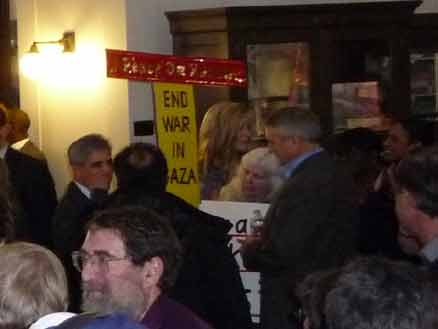
We’ve been calling them teabaggers, the impulsive naysayers to reform and a rededicated social conscience; so named because they decry “taxation without representation.” Having lost the election of 2008, their idiocy is no longer represented in Washington by someone they feel they can share a beer with. So they hold “tea parties,” minus the jettisoning of capitalist goods. They protest all government spending, question Barack Obama’s birth certificate, and rail against immigrants, socialism, and the decline of White America. We call them “Teabaggers,” but the term conjures an unmerited sexual act. We should call them “Teabags” instead. I’d like a dittohead wingnut nickname that sounds more like scumbag.
Tag Archives: Cialis
Pink goes to war
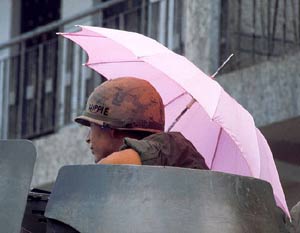
The color pink seems incongruous juxtaposed with war. Code Pink banks on the contrast being inherently diametric. But just as pink can be enlisted to oppose war, it can serve to humanize, even glamorize it.
Remember the Afghanistan theater photo snapped of a US soldier wearing pink boxers and flip-flops while he stood guard on a rampart? Disarming wasn’t it? Here’s its antecedent from the Vietnam conflict. We’re searching antiwar archives for tools to fight this war, our bastard adversaries are already there.
Army Specialist Zachary Boyd was worried when his picture made the front page of the New York Times. Boyd thought he’d be in trouble for being shown out of uniform.
“I can assure you that Specialist Boyd’s job is very safe indeed,” said Defense Secretary Robert Gates, who instead praised the soldier for making American bravery look so nonchalant. “What an incredible innovation in psychological warfare,” said Gates.
Sept 11 – America Reaps What It Sows!
A post-911 perspective by Black Liberation Army prisoner of war Jalil Muntaqim.
U.S. International Warfare Initiates World War III Human Rights During Wartime
By Jalil A. MuntaqimIn the aftermath of the September 11, 2001, attack on the World Trade Center and Pentagon, Americans have displayed their true colors of jingoism, a militaristic spirit of nationalism. Similarly, it was witnessed how the people of Iraq rallied in support of their President, Saddam Hussein, after the U.S. bombed to death 250,000 Iraqis, and continued devastation of that country with collateral damage of 1 million dead women and children. Hence, people rallying in support of their government and representatives is a common phenomenon when a country is attacked by an outsider. The U.S. has been foremost in the world extending foreign policy of free-market economy, to the extent of undermining other countries cultures and ideologies expressed as their way of life. Such conflicts inevitably positions the U.S. as the centerpiece, the bulls-eye for international political dissent, as indicated by demonstrations against the U.S. controlled IMF, WTO and World Bank conferences. The attack on the World Trade Center and Pentagon did not occur in a vacuum. The people that carried out the attacks were not blind followers or robots with an irrational hatred of the U.S. peoples. Rather, this attack was part of an overall blowback to U.S. imperialist policy in support of zionist Israel and opposition to fundamentalist Islam.
There are essentially three primary world ideologies or world views: the capitalist free-market economy/democracy; the socialist production economy; and Islamic theocratic government, of which has been in competition for many decades. However, in the last 20 years the socialist economies has been severely subverted and co-opted by free-market economies, the ideals of American style democracy. This isolated, for the most part, Islamic theocratic ideology and system of government as the principle target of the U.S. in its quest for world hegemony. This reality of competing world views and economies is further complicated due to religious underpinning of beliefs that motivates actions, especially as they are expressed by U.S. and Western European christianity and Israel zionist judaism in opposition to Islam. From the struggles of the Crusades to the present confrontation, the struggle for ideological supremacy reigns, as the faithful continue to proselytize in the name of the Supreme Being.
When geopolitics are combined with religious fervor in the character of nationalist identity and patriotism, rational and logical thinking is shoved aside as matters of the moment takes historical precedents. It has often been said that “Truth Crush to the Earth Will Rise Again”. Since truth is relative to ones belief, can it be safely said that America has reaped what it has sowed? The American truth of capitalist christian democracy and its imperialist hegemonic aspirations has crushed both socialist and Islamic world views. It has extended its avaricious tentacles as the world police and economic harbinger of all that is beneficent, in stark denial of its history as a purveyor of genocides, slavery and colonial violence.
The U.S. was the first to use biological-germ warfare on people when it distributed blankets infected with smallpox to Native Americans; it has refused to apologize for Afrikan slavery acknowledging it engaged in a crime against humanity requiring reparations; it is the first and only country to use the atomic bomb on the people of Hiroshima and Nagasaki and intern thousands of Japanese and Italians in this country; it used carpet bombing and defoliates against the peoples of Vietnam; it has initiated embargoes, coup d’etats and assassinations against those it opposes, while propping-up right-wing military dictators; as well as continued military bombing of Vieques. In essence, the U.S. governments hegemonic goals has created the ire of millions of people throughout the world. While domestically, racial profiling, police killing and mass incarceration of Black and Brown people has eroded patriotic sentiments in opposition to white supremacy.
As America weeps and laments its loss, the public find itself joining the torn ranks of those whose heartaches beat opposing U.S. greed and international profiteering. The American public acquiesce to U.S. international folly has cause them to feel the economic pains of those who live daily in poverty. Indeed, Americans should brace for years of economic uncertainty, where the American ideal of freedom and liberty will resemble plight of those who live under the right-wing dictatorships the U.S. has supported. The tyranny suffered by others in the world as a result of U.S. imperialism, has come full circle to visit this country with the wrath of the U.S. own mechanization. Since the U.S. taught and trained right-wing military dictators in the School of the Americas, including the CIA training of Osama bin Laden in the Afghanistan proxy war against the Russians, it will be this same kind of terrorist activist that will be unleashed on American soil, as El-Hajj Malik Shabazz stated after the assassination of John Kennedy, a matter of the chicken coming home to roost. Therefore, American civil liberties and human rights are being garrotted by the yoke of the right-wing in the name of national security. The legalization of U.S. fascism was initiated with the war against political dissent (Cointelpro); the war against organized crime (RICO laws); the war against illegal drugs (plethora of drug laws) and now culminating in the war against terrorism with the American Joint Anti-Terrorist Taskforce and Office of Home Security, further extending police, FBI and CIA powers to undermine domestic civil liberties and human rights.
The U.S. Secretary of Defense, Donald Rumsfeld, recently stated that the U.S. need to create a new language in defining how to combat terrorism. This Orwellian propaganda in the media espouses the U.S. is venturing in a new type of warfare to defend the American way of life. However, what this double-speak propagates as a long-term and sustained initiative against terrorism is essentially a way of embellishing and enlarging U.S. counter-insurgency activity it has been engaged in since the advent of the Green Berets, Rangers, Delta Force and Navy Seals. The U.S. has been involved in counter-insurgency activity in Afrika, Latin America and Asia for decades. But due to the September 11, 2001, attack on U.S. soil, the government has seized the opportunity to offensively pursue left-wing revolutionaries and Muslim insurgents throughout the world. This U.S. military action extends and substantiates its position as the international police.
Since the establishment of the Trilateral Commission that initiated the process for the development of one world government, the U.S. has broaden its capacity to impose and enforce its will on oppressed peoples globally. The FBI and CIA has been operating in Europe, Afrika, Asia and Latin America establishing the long arm of U.S. law and order. Its bases of operations have conducted surveillance, investigations to arrest, prosecute or neutralize left-wing revolutionaries or Muslim insurgents. As the U.S. consolidates its political and economic influence throughout the world, it will seek to protect its overall hegemonic imperialist goals. After the Gulf War, and the air (bombing) campaign in Yugoslavia, the U.S. has employed its military might to ensure its foreign policy are achieved.
Because NATO has evolved into a European military entity that Russia is seeking to join, today, the U.S. has positioned itself beyond the mission of NATO. The U.S. now concentrates its military might in opposing Islamic countries (Iran, Iraq, Libya, Sudan, Afghanistan, Philippines, etc.) and those the U.S. deem as rogue nations (North Korea, Vietnam, Cuba, etc.). The new military initiatives will be directed to towards Southeast Asia as the secondary target, as it continues to direct the Middle East conflict to preserve its oil investments and zionist interest. As the U.S. expand its imperialist military mission, as seen with committing military troops in Uzbekistan to also protect oil interest in the Caspian Sea, it has sought to redefine itself by targeting what it identify as the terrorist thereat wherever in the world it might exist. Hence, with the employment of conventional warfare combined with counter-insurgency tactical activities, the U.S. has pronounced itself as the military guardian of the world.
Although, the U.S. states its actions are in its self-interest, in terms of what is euphemistically defined as defending the free world, the truth of the matter is this action is a prelude to evolving one world government with the U.S. as its governing authority. Once the Peoples Republic of China becomes a full member of the WTO, and North Korea and Vietnam has been compromised, with Russia becoming an ally of NATO, the U.S. political-military influence in the world will be consolidated. The U.S. geopolitical strategy is not confined to the present crisis in the aftermath of the September 11, 2001, attack and targeting Osama bin Laden as the world’s nemesis. Rather, the U.S. strategy is to preserve its capacity to establish one world government as originally envisioned by the Trilateral Commission.
Nonetheless, there are some serious obstacles to this hegemonic goal, of which the world of fundamentalist Islam has become the principle target. Here, it should be noted that Islam condemns suicide or the mass killings of women, children and non-combatant males. Yet, the U.S., Israel, western Europe, Russia, India and China all view Islam as the enemy. Although, there are over 1.2 billion Muslims in the world, the current alliance of economic interest headed by the U.S., are united to vanquish what they consider the growing menace of fundamentalist Islam. It is with this understanding of U.S. geopolitics one is able to comprehend why the U.S. has redefine its military mission, as opposition to globalization and U.S. imperialism metamorph into a political struggle without borders or territorial imperatives.
The ideological struggle between capitalist free-market economy and Islamic theocratic determinates has exploded into an international conflagration of insurgency with the potential of initiating World War III. The Islamic fundamentalist movements throughout the world has the potential to test the U.S. military, political and economic resolve as the world’s leader and authority of an one world government. With over 1.2 billion adherents, Islam has become a formidable foe to contend with for ideological supremacy in the world’s geopolitics. Even without discussing the religious (moral and ethics) aspects that motivates the geopolitics of Islam in opposition to U.S. imperialist hegemony, the call for Jihad/Holy War against the U.S. presents a serious threat that could precipitate WW-III. Therefore, the U.S. find it necessary to redefine its military mission, develop new language to codify warfare and legitimize its international political and economic purpose. Yet, many of the world’s oppressed peoples’ have already experienced U.S. military counter-insurgency tactics (Ethiopia, Somalia, Nicaragua, Guatemala, Chile, Congo, etc.), including parts of the Islamic world. No matter how or why the U.S. attempts to persuade Americans that it is entering a new type of warfare, in reality it is more of the same, only extending the military arena to further protect its authority to establish one world government.
However, the U.S. is not the homogeneous country that people are deluded into believing exist. Rather, the U.S. has been held together due its ability to exploit the world’s resources and distribute (unequally) the profits amongst its citizens with its culture of conspicuous consumption. But, the recent attack on the U.S., and its aftermath may very well lead to the untangling and unraveling of the U.S. fabric as has been witnessed with the USSR and Yugoslavia. In understanding this true history of U.S. imperialism, outside and within its borders, essentially tells a story of why U.S. imperialism has been and will continue to be attacked.
Ultimately, the U.S. will eventually find itself at war with itself, as the ideology of a free democratic society will be found to be a big lie. This is especially disconcerting as greater restrictions on civil and human rights are made into law eroding the First and Fourth Amendment of the U.S. Constitution. As during the Vietnam conflict, internal contradictions of racism, poverty and inequality will be exacerbated as a result of the U.S. military campaign and domestic undermining of civil and human rights. It is expected that strife in America will eventually become violent dissolving any semblance of the illusion of America the Beautiful. In anticipation of U.S. progressive activist opposing this claimed war against terrorism, the federal government will pass new laws to severely restrict protest, demonstrations and dissent. In the ’60s, U.S. progressive activists evolved the slogan “Bring the War Home!” – the question is what will be the slogan this time, now that the war has been brought home?
Free the Land!!
Rock Creek Free Press available in COS
The Rock Creek Free Press is available online, but if you want it in print, the DC monthly is available in Colorado Springs at the Bookman, 3163 W. Colorado. The September issue features a speech given by legendary Australian journalist John Pilger on July 4th in San Francisco.
Here’s the RCFP transcript:
Two years ago I spoke at “Socialism in Chicago” about an invisible government which is a term used by Edward Bernays, one the founders of modern propaganda. It was Bernays, who in the 1920s invented public relations as a euphemism for propaganda. And it was Bernays, deploying the ideas of his uncle Sigmund Freud, who campaigned on behalf of the tobacco industry for women to take up smoking as an act of feminist liberation calling cigarettes “tortures of freedom”. At the same time he was involved in the disinformation which was critical in overthrowing the Arbenz government in Guatemala. So you have the association of cigarettes and regime change. The invisible government that Bernays had in mind brought together all media: PR, the press, broadcasting, advertising and their power of branding and image making. In other words, disinformation.
And I suppose I would like to talk today about this invisible government’s most recent achievement, the rise of Barrack Obama and the silencing of much of the left. But all of this has a history, of course and I’d like to go back, take you back some forty years to a sultry and, for me, very memorable day in Viet Nam.
I was a young war correspondent who had just arrived in a village in the Central Highlands called Tuylon. My assignment was to write about a unit of US Marines who had been sent to the village to win hearts and minds. “My orders,” said the Marine Sergeant, “are to sell the American way of liberty, as stated in the Pacification Handbook, this is designed to win the hearts and minds of folks as stated on page 86.” Now, page 86 was headed in capital letters: WHAM (winning hearts and minds). The Marine Unit was a combined action company which explained the Sergeant, meant, “We attack these folks on Mondays and we win their hearts and minds on Tuesdays.” He was joking, of course, but not quite.
The Sergeant, who didn’t speak Vietnamese, had arrived in the village, stood up on a Jeep and said through a bullhorn: “Come on out everybody we’ve got rice and candies and toothbrushes to give you.” This was greeted by silence. “Now listen, either you gooks come on out or we’re going to come right in there and get you!” Now the people of Tuylon finally came out and they stood in line to receive packets of Uncle Ben’s Miracle Rice, Hershey Bars, party balloons, and several thousand toothbrushes. Three portable, battery operated, yellow, flush lavatories were held back for the arrival of the colonel.
And when the colonel arrived that evening, the district chief was summoned and the yellow, flush lavatories unveiled. The colonel cleared his throat and took out a handwritten speech,
“Mr. District Chief and all you nice people,” said the colonel, “what these gifts represent is more than the sum of their parts, they carry the spirit of America. Ladies and gentlemen there’s no place on Earth like America, it’s the land where miracles happen, it’s a guiding light for me and for you. In America, you see, we count ourselves as real lucky as having the greatest democracy the world has ever known and we want you nice people to share in our good fortune.”
Thomas Jefferson, George Washington, even John Winthrope sitting upon a hill got a mention. All that was missing was the Star Bangled Banner playing softly in the background. Of course the villagers had no idea what the colonel was talking about, but when the Marines clapped, they clapped. And when the colonel waved, the children waved. And when he departed the colonel shook the Sergeant’s hand and said: “We’ve got plenty of hearts and minds here, carry on Sergeant.” “Yes Sir.” In Viet Nam I witnessed many scenes like that.
I’d grown up in faraway Australia on a cinematic diet of John Wayne, Randolph Scott, Walt Disney, and Ronald Reagan. The American way of liberty they portrayed might well have been lifted from the WHAM handbook. I’d learned that the United States had won World War II on its own and now led the free world as the chosen society. It was only later when I read Walter Lippmann’s book, Public Opinion, a manual of the invisible government, that I began to understand the power of emotions attached to false ideas and bad histories on a grand scale.
Now, historians call this exceptionalism, the notion that the United States has a divine right to bring what it calls “liberty” to the rest of humanity. Of course this is a very old refrain. The French and British created and celebrated their own civilizing missions while imposing colonial regimes that denied basic civil liberties. However, the power of the American message was, and remains, different. Whereas the Europeans were proud imperialists, Americans are trained to deny their imperialism. As Mexico was conquered and the Marines sent to Nicaragua, American textbooks referred to an Age of Innocence. American motives were always well meaning, moral, exceptional, as the colonel said, “There was no ideology” and that’s still the case.
Americanism is an ideology that is unique because its main feature is its denial that it is an ideology. It’s both conservative and it’s liberal. And it’s right and it’s left. And Barack Obama is its embodiment. Since Obama was elected leading liberals have talked about America returning to its true status as, “a nation of moral ideals”. Those are the words of Paul Krugman, the liberal columnist of The New York Times. In the San Francisco Chronicle, columnist Mark Morford wrote,
“Spiritually advanced people regard the new president as a light worker who can help usher in a new way of being on the planet.”
Tell that to an Afghan child whose family has been blown away by Obama’s bombs. Or a Pakistani child whose house has been visited by one of Obama’s drones. Or a Palestinian child surveying the carnage in Gaza caused by American “smart” weapons, which, disclosed Seymour Hersh, were re-supplied to Israel for use in the slaughter, and I quote; “Only after the Obama team let if be known, it would not object.” The man who stayed silent on Gaza is the man who now condemns Iran.
In a sense, Obama is the myth that is America’s last taboo. His most consistent theme was never “change”, it was power. “The United States,” he said, “leads the world in battling immediate evils and promoting the ultimate good. We must lead by building a 21st century military to ensure the security of our people and advance the security of all people.” And there is this remarkable statement, “At moments of great peril in the past century our leaders ensured that America, by deed and by example, led and lifted the world; that we stood and fought for the freedoms sought by billions of people beyond our borders.” Words like these remind me of the colonel in the village in Viet Nam, as he spun much the same nonsense.
Since 1945, by deed and by example, to use Obama’s words, America has overthrown 50 governments, including democracies, and crushed some 30 liberation movements and bombed countless men, women, and children to death. I’m grateful to Bill Blum for his cataloging of that. And yet, here is the 45th (sic) president of the United States having stacked his government with war mongers and corporate fraudsters and polluters from the Bush and Clinton eras, promising, not only more of the same, but a whole new war in Pakistan. Justified by the murderous clichés of Hilary Clinton, clichés like, “high value targets”. Within three days of his inauguration, Obama was ordering the death of people in faraway countries: Pakistan and Afghanistan. And yet, the peace movement, it seems, is prepared to look the other way and believe that the cool Obama will restore, as Krugman wrote, “the nation of moral ideals.”
Not long ago, I visited the American Museum of History in the celebrated Smithsonian Institute in Washington. One of the most popular exhibitions was called “The Price of Freedom: Americans at War”. It was holiday time and lines of happy people, including many children, shuffled through a Santa’s grotto of war and conquest. When messages about their nation’s great mission were lit up; these included tributes to the; “…exceptional Americans who saved a million lives…” in Viet Nam; where they were, “…determined to stop Communist expansion.” In Iraq other brave Americans, “employed air-strikes of unprecedented precision.” What was shocking was not so much the revisionism of two of the epic crimes of modern times, but the shear scale of omission.
Like all US presidents, Bush and Obama have very much in common. The wars of both presidents and the wars of Clinton and Reagan, Carter and Ford, Nixon and Kennedy are justified by the enduring myth of exceptional America. A myth the late Harold Pinter described as, “a brilliant, witty, highly successful act of hypnosis.”
The clever young man who recently made it to the White House is a very fine hypnotist; partly because it is indeed extraordinary to see an African American at the pinnacle of power in the land of slavery. However, this is the 21st century and race together with gender, and even class, can be very seductive tools of propaganda. For what is so often overlooked and what matters, I believe above all, is the class one serves. George Bush’s inner circle from the State Department to the Supreme Court was perhaps the most multi-racial in presidential history. It was PC par excellence. Think Condoleezza Rice, Colin Powell. It was also the most reactionary. Obama’s very presence in the White House appears to reaffirm the moral nation. He’s a marketing dream. But like Calvin Klein or Benetton, he’s a brand that promises something special, something exciting, almost risqué. As if he might be radical. As if he might enact change. He makes people feel good; he’s a post-modern man with no political baggage. And all that’s fake.
In his book, Dreams From My Father, Obama refers to the job he took after he graduated from Columbia in 1983; he describes his employer as, “…a consulting house to multi-national corporations.” For some reason he doesn’t say who his employer was or what he did there. The employer was Business International Corporation; which has a long history of providing cover for the CIA with covert action and infiltrating unions from the left. I know this because it was especially active in my own country, Australia. Obama doesn’t say what he did at Business International and they may be absolutely nothing sinister. But it seems worthy of inquiry, and debate, as a clue to, perhaps, who the man is.
During his brief period in the senate, Obama voted to continue the wars in Iraq and Afghanistan. He voted for the Patriot Act. He refused to support a bill for single payer health care. He supported the death penalty. As a presidential candidate he received more corporate backing than John McCain. He promised to close Guantanamo as a priority, but instead he has excused torture, reinstated military commissions, kept the Bush gulag intact, and opposed habeas corpus.
Daniel Ellsberg, the great whistleblower, was right, I believe, when he said, that under Bush a military coup had taken place in the United States giving the Pentagon unprecedented powers. These powers have been reinforced by the presence of Robert Gates – a Bush family crony and George W. Bush’s powerful Secretary of Defense. And by all the Bush Pentagon officials and generals who have kept their jobs under Obama.
In the middle of a recession, with millions of Americans losing their jobs and homes, Obama has increased the military budget. In Colombia he is planning to spend 46 million dollars on a new military base that will support a regime backed by death squads and further the tragic history of Washington’s intervention in that region.
In a pseudo-event in Prague, Obama promised a world without nuclear weapons to a global audience, mostly unaware that America is building new tactical nuclear weapons designed to blur the distinction between nuclear and conventional war. Like George Bush, he used the absurdity of Europe threatened by Iran to justify building a missile system aimed at Russia and China. In another pseudo-event, at the Annapolis Naval Academy, decked with flags and uniforms, Obama lied that America had gone to Iraq to bring freedom to that country. He announced that the troops were coming home. This was another deception. The head of the army, General George Casey says, with some authority, that America will be in Iraq for up to a decade. Other generals say fifteen years.
Chris Hedges, the very fine author of Empire of Illusion, puts it very well; “President Obama,” he wrote, “does one thing and brand Obama gets you to believe another.” This is the essence of successful advertising. You buy or do what the advertiser wants because of how they make you feel. And so you are kept in a perpetual state of childishness. He calls this “junk politics”.
But I think the real tragedy is that Obama, the brand, appears to have crippled or absorbed much of the anti-war movement – the peace movement. Out of 256 Democrats in Congress; 30, just 30, are willing to stand up against Obama’s and Nancy Pelosi’s war party. On June the 16th they voted for 106 billion dollars for more war.
The “Out of Iraq” caucus is out of action. Its member can’t even come up with a form of words of why they are silent. On March the 21st, a demonstration at the Pentagon by the once mighty United for Peace and Justice drew only a few thousand. The out-going president of UFPJ, Lesley Kagen, says her people aren’t turning up because, “It’s enough for many of them that Obama has a plan to end the war and that things are moving in the right direction.” And where is the mighty Move On, these days? Where is its campaign against the wars in Iraq and Afghanistan? And what, exactly, was said when Move On’s executive director, Jason Ruben, met Barack Obama at the White House in February?
Yes, a lot of good people mobilized for Obama. But what did they demand of him? Working to elect the Democratic presidential candidate may seem like activism, but it isn’t. Activism doesn’t give up. Activism doesn’t fall silent. Activism doesn’t rely on the opiate of hope. Woody Allen once said, “I felt a lot better when I gave up hope.” Real activism has little time for identity politics which like exceptionalism, can be fake. These are distractions that confuse and sucker good people. And not only in the United States, I can assure you.
I write for the Italian socialist newspaper, Il Manifesto, or rather I used to write for it. In February I sent the editor an article which raised questions about Obama as a progressive force. The article was rejected. Why, I asked? “For the moment,” wrote the editor, “we prefer to maintain a more positive approach to the novelty presented by Obama. We will take on specific issues, but we would not like to say that he will make no difference.” In other words, an American president drafted to promote the most rapacious system in history, is ordained and depoliticized by important sections of the left. It’s a remarkable situation. Remarkable, because those on the, so called, Radical Left have never been more aware, more conscious of the inequities of power. The Green Movement, for example, has raised the consciousness of millions, so that almost every child knows something about global warming. And yet, there seems to be a resistance, within the Green Movement, to the notion of power as a military force, a military project. And perhaps similar observations can also be made about sections of the Feminist Movement and the Gay Movement and certainly the Union Movement.
One of my favorite quotations is from Milan Kundera,
“The struggle of people against power is [the] struggle of memory against forgetting.”
We should never forget that the primary goal of great power is to distract and limit our natural desire for social justice and equity and real democracy.
Long ago Edward Bernays’ invisible government of propaganda elevated big business from its unpopular status as a kind of mafia to that of a patriotic driving force. The “American way of life” began as an advertising slogan. The modern image of Santa Claus was an invention of Coca Cola.
Today we are presented with an extraordinary opportunity. Thanks to the crash of Wall Street and the revelation, for many ordinary people, that the free market has nothing to do with freedom. The opportunity, within our grasp, is to recognize that something is stirring in America that is unfamiliar, perhaps, to many of us on the left, but is related to a great popular movement that’s growing all over the world. Look down at Latin America, less than twenty years ago there was the usual despair, the usual divisions of poverty and freedom, the usual thugs in uniforms running unspeakable regimes. Today for the first time perhaps in 500 years there’s a people’s movement based on the revival of indigenous cultures and language, a genuine populism. The recent amazing achievements in Bolivia, Ecuador, Venezuela, El Salvador, Argentina, Brazil, and Paraguay represent a struggle for community and political rights that is truly historic, with implications for all of us. The successes in Latin America are expressed perversely in the recent overthrow of the government of Honduras, because the smaller the country, the greater is the threat of a good example that the disease of emancipation will spread.
Indeed, right across the world social movements and grass roots organization have emerged to fight free market dogma. They’ve educated governments in the south that food for export is a problem, rather than a solution to global poverty. They’ve politicized ordinary people to stand up for their rights, as in the Philippines and South Africa. Look at the remarkable boycott, disinvestment and sanctions campaign, BDS, for short, aimed at Israel that’s sweeping the world. Israeli ships have been turned away from South Africa and Western Australia. A French company has been forced to abandon plans to build a railway connecting Jerusalem with illegal Israeli settlements. Israeli sporting bodies find themselves isolated. Universities in the United Kingdom have begun to sever ties with Israel. This is how apartheid South Africa was defeated. And this is how the great wind of the 1960s began to blow. And this is how every gain has been won: the end of slavery, universal suffrage, workers rights, civil rights, environmental protection, the list goes on and on.
And that brings us back, here, to the United States, because I believe something is stirring in this country. Are we aware, that in the last eight months millions of angry e-mails, sent by ordinary Americans, have flooded Washington. And I mean millions. People are outright outraged that their lives are attacked; they bear no resemblance to the passive mass presented by the media. Look at the polls; more than 2/3 of Americans say the government should care for those who cannot care for themselves, sixty-four percent would pay higher taxes to guarantee health care for everyone, sixty percent are favorable towards Unions, seventy percent want nuclear disarmament, seventy-two percent want the US completely out of Iraq and so on and so on. But where is much of the left? Where is the social justice movement? Where is the peace movement? Where is the civil rights movement? Ordinary Americans, for too long, have been misrepresented by stereotypes that are contemptuous. James Madison referred to his compatriots in the public as ignorant and meddlesome outsiders. And this contempt is probably as strong today, among the elite, as it was back then. That’s why the progressive attitudes of the public are seldom reported in the media, because they’re not ignorant, they’re subversive, they’re informed and they’re even anti-American. I once asked a friend, the great American war correspondent and humanitarian, Martha Gellhorn, to explain the term “anti-American” to me. “I’ll tell you what anti-American is,” she said in her forceful way, “its what governments and their vested interests call those who honor America by objecting to war and the theft of resources and believing in all of humanity. There are millions of these anti-Americans in the United States, they are ordinary people who belong to no elite and who judge their government in moral terms though they would call it common decency. They are not vain; they are the people with a waitful conscience, the best of America’s citizens. Sure, they disappear from view now and then, but they are like seeds beneath the snow. I would say they are truly exceptional.” Truly exceptional, I like that.
My own guess is that a populism is growing, once again in America evoking a powerful force beneath the surface which has a proud history. From such authentic grass roots Americanism came women suffrage, the eight hour day, graduated income tax, public ownership of railways and communications, the breaking of the power of corporate lobbyists and much more. In other words, real democracy. The American populists were far from perfect, but they often spoke for ordinary people and they were betrayed by leaders who urged them to compromise and merge with the Democratic Party. That was long ago, but how familiar it sounds. My guess is that something is coming again. The signs are there. Noam Chomsky is right when he says that, “Mere sparks can ignite a popular movement that may seem dormant.” No one predicted 1968, no one predicted the fall of apartheid, or the Berlin Wall, or the civil rights movement, or the great Latino rising of a few years ago.
I suggest that we take Woody Allen’s advice and give up on hope and listen, instead, to voices from below. What Obama and the bankers and the generals and the IMF and the CIA and CNN and BBC fear, is ordinary people coming together and acting together. It’s a fear as old as democracy, a fear that suddenly people convert their anger to action as they’ve done so often throughout history.
“At a time of universal deceit,” wrote George Orwell, “telling the truth is a revolutionary act.”
Thank you.
DMNS refutes allegations of data misuse
NOTMYTRIBE received this response from the Denver Museum of Nature and Science to our post: IS THE MUSEUM OF NATURE AND SCIENCE GATHERING PRIVATE DATA FOR HEALTH INSURERS? In the July 26 article I outlined concerns that medical data specialists could be harvesting checkup results conducted on visitors to the DMNS exhibit “Expedition Health.”
July 29, 2009
Dear Eric,
As the Curator of Human Health at the Denver Museum of Nature & Science, and a member of the team that created the Expedition Health exhibition, I can say unequivocally that visitor information recorded in the exhibition is NEVER shared with insurers, and the “signs of subterfuge” you detail in your blog have no basis in fact.
Privacy issues were a top consideration in the development of Expedition Health because the exhibition was deliberately designed to be highly personalized. Based on research and best practices in informal science education, we know that people learn human biology better when they’re learning about their own bodies, not the human body in general. The data that visitors provide when they sign-in to get their Peak Pass serves no other purpose but to customize Expedition Health for each person with the goal of creating a relevant, empowering, educational and memorable experience.
While visiting Expedition Health, visitors can choose to participate in activities that record their resting heart rate, their target heart rate, their height and arm span, their stride length, speed and energy score. These activities are designed to provide data that is accurate, but this information is not intended to be used for any clinical or diagnostic purpose. The true reason for this data collection: through these measurements, visitors see that their bodies are constantly changing in ways they can see, measure and optimize though healthy lifestyle choices.
Contrary to the claims made in your blog, we do not collect biometric data such as fingerprints,, voice patterns, retinal scan, etc., nor do we gather information about diet preferences, weight, body fat ratio, “stress test” results, vital statistics or present/past tobacco or sunscreen use. Visitors are challenged to build a healthy meal and see hypothetically what they might look like based on lifestyle choices such as wearing sub block.
Information provided by visitors in Expedition Health—information that personalizes the experience and therefore enhances the educational experience—is stored in a secure database. This database does not interface with the Museum’s ticketing systems. A very limited number of staff members in the Museum have access to the visitor information that is gathered at the exhibit components. The data is kept so that visitors can look at their information and extend their learning experience at home by logging on to their own unique and secure web site.
Visitors have two weeks to access their information online. Every two weeks, 98 percent of our visitors have their data purged from the database because they have not accessed it online after their visit to Expedition Health. The remaining two percent of visitors who elected to see their data online and extend their learning experience have their data saved in the database for six months should they wish to access their data again. The Museum never shares this data with any outside entities.
Finally, the Museum maintains as strict policy with donors when it comes to the development of exhibition content and the sharing of information gathered in the exhibition. Kaiser Permanente Colorado is the presenting sponsor of Expedition Health, and the lead donors include Boettcher Foundation, The Colorado Health Foundation, and Gates Family Foundation, a Colorado-based foundation that is not connected with the Bill and Melinda Gates Foundation. While these organizations did provide funding, they did not have any involvement in content development for Expedition Health, nor have they ever received any visitor information recorded on Peak Passes. This distinct separation between content and funding is critical to the Museum’s long-standing credibility.
As the region’s leading resource for informal science education, the Museum is committed to presenting objective scientific content, and retains control of and responsibility for all exhibits and programs. When the Museum developed Expedition Health, we worked to ensure that our new exhibit was firmly grounded in the most current biological science and was relevant to visitors. All content in Expedition Health was created or vetted by Museum staff members—scientists, educators and exhibition designers—with the help of a blue ribbon advisory board. Our overall aim with Expedition Health is to broaden visitors’ knowledge of human biology, disease, and wellness, and inspire the application of these discoveries to their lives.
I respectfully request you post this response online. If you would like to discuss this further, I invite you to contact me directly at the Museum.
Sincerely,
Bridget Coughlin, PhD
Thank you Dr. Coughlin, we are eager to take you up on your offer. Ultimately I would hope to see the museum provide its visitors a written assurance of what you’ve explained.
Ours is a surveillance society where military recruiters are granted access to high school records, where consumer profiles are traded among marketers, and health insurers are pushing to overcome national privacy safeguards by digitizing all medical records. You have explained that the “Expedition Health” exhibit is not collating its data with others. Because current technology makes clandestine data harvesting feasible, perhaps the museum could introduce firewalls to demonstrate how their visitors’ anonymity remains protected. This would offer more comfort than docents who assure patrons that the information is purged every night, or you, who explain it is purged after two weeks.
Why do the Right Wing Lunatic Fringe Hate Universal Health Care?
Simple. They wouldn’t be able to Steal nearly as much.
From Bill Moyers documenting the Right Wing Hate-mongers almost successful game plan to discredit the TRUTH exposed by the film “Sicko”… Just painting anybody who believed it as a “lefty loon” wouldn’t be enough… Although our Friendly Right Wing Spokespersons use that attack method.
Mainly because aside from sending out one-man Terrorist Hit Squads to shoot up churches and Museums they don’t have anything else.
But seriously, our Libertarian friends would have us believe that people with lots of money, gotten from a couple hundred years of blatant THEFT, wouldn’t spend any of that ill-gotten gain as a buffer to protect the rest of it.
And some of the blatant and boastful confession of Theft and Anti-American activity.
Yeah, doing things, either for ideology or for profit, that KILL Americans, like, for instance, promoting the massive denial of health care, that’s pretty much Anti-American.
9/11 only killed 3,000.
More Americans die from inadequate health care every week. So, Right Wing For-Profit Terrorists,
Yes, I DID just conflate you with Osama bin Laden.
Whatcha gonna do about it?
BILL MOYERS: So what did you think when you saw that film?
WENDELL POTTER: I thought that he hit the nail on the head with his movie. But the industry, from the moment that the industry learned that Michael Moore was taking on the health care industry, it was really concerned.
BILL MOYERS: What were they afraid of?
WENDELL POTTER: They were afraid that people would believe Michael Moore.
BILL MOYERS: We obtained a copy of the game plan that was adopted by the industry’s trade association, AHIP. And it spells out the industry strategies in gold letters. It says, “Highlight horror stories of government-run systems.” What was that about?
WENDELL POTTER: The industry has always tried to make Americans think that government-run systems are the worst thing that could possibly happen to them, that if you even consider that, you’re heading down on the slippery slope towards socialism. So they have used scare tactics for years and years and years, to keep that from happening. If there were a broader program like our Medicare program, it could potentially reduce the profits of these big companies. So that is their biggest concern.
BILL MOYERS: And there was a political strategy. “Position Sicko as a threat to Democrats’ larger agenda.” What does that mean?
WENDELL POTTER: That means that part of the effort to discredit this film was to use lobbyists and their own staff to go onto Capitol Hill and say, “Look, you don’t want to believe this movie. You don’t want to talk about it. You don’t want to endorse it. And if you do, we can make things tough for you.”
BILL MOYERS: How?
WENDELL POTTER: By running ads, commercials in your home district when you’re running for reelection, not contributing to your campaigns again, or contributing to your competitor.
BILL MOYERS: This is fascinating. You know, “Build awareness among centrist Democratic policy organizations–”
WENDELL POTTER: Right.
BILL MOYERS: “–including the Democratic Leadership Council.”
WENDELL POTTER: Absolutely.
BILL MOYERS: Then it says, “Message to Democratic insiders. Embracing Moore is one-way ticket back to minority party status.”
WENDELL POTTER: Yeah.
BILL MOYERS: Now, that’s exactly what they did, didn’t they? They–
WENDELL POTTER: Absolutely.
BILL MOYERS: –radicalized Moore, so that his message was discredited because the messenger was seen to be radical.
WENDELL POTTER: Absolutely. In memos that would go back within the industry — he was never, by the way, mentioned by name in any memos, because we didn’t want to inadvertently write something that would wind up in his hands. So the memos would usually– the subject line would be– the emails would be, “Hollywood.” And as we would do the media training, we would always have someone refer to him as Hollywood entertainer or Hollywood moviemaker Michael Moore.
BILL MOYERS: Why?
WENDELL POTTER: Well, just to– Hollywood, I think people think that’s entertainment, that’s movie-making. That’s not real documentary. They don’t want you to think that it was a documentary that had some truth. They would want you to see this as just some fantasy that a Hollywood filmmaker had come up with. That’s part of the strategy.
BILL MOYERS: So you would actually hear politicians mouth the talking points that had been circulated by the industry to discredit Michael Moore.
WENDELL POTTER: Absolutely.
BILL MOYERS: You’d hear ordinary people talking that. And politicians as well, right?
WENDELL POTTER: Absolutely.
BILL MOYERS: So your plan worked.
WENDELL POTTER: It worked beautifully.
BILL MOYERS: The film was blunted, right?
WENDELL POTTER: The film was blunted.
2p, 2p and Honduras… and Mexico… and Nicaragua… and…
I don’t know if I’ve published this here or not or how I packaged it. But for background, the “p” stands for “piastre” a South VietNamese coin that was worth a little less than a quarter of a U.S. penny. This was the “Great Free Market Opportunity” our government was sending people to fight and die to defend. The way I heard it on some occasions it’s used to condemn the VietNamese people.”How nasty and vile and filthy they are” for living in such poverty.
But it was the VietNamese version of a washroom attendant, a little old granny lady… “Wipe your ass for you, GI… 2p, 2p do extra good job 2p, 2p…”
Yes, we were there, so it seems, to give the people such a wonderful Free Market and the opportunity to wipe our asses for less than a half a cent per “use”.
And to despise them for being so desperately poor.
I wasn’t there, my sources were, so what if you say it’s false?
Talk to them, those who are still alive that is.
Now there’s a war going on in Honduras, backed exclusively by U.S. and Canadian corporations, to topple a “Dictator” who was going to nationalize the resources of Honduras and make the U.S. and Canadian corporations pay more than the 3-4 dollars a day for the labor of the People of Honduras.
The police and military have been battling in the streets for a week now, busting the heads of “elitists” who are trying to “enslave” everybody in Honduras. They did this in a Military coup ahead of an election that the “Dictator” probably would have won.
That there’s no CIVILIANS out busting the heads of these “elitists” and “Communist Radicals” tells a far different story than you might hear on, say, Fox News or in the Colorado Springs Gazette.
In Nicaragua the goon-squads were called “Contras” and backed by the same people who bring us Fox News and the Gazette. They bombed and shot up schools, orphanages, churches and hospitals, and “our” government called them Heroes and Freedom Fighters.
In Mexico, the PAN party has been running the show for a while now. They took over from the “socialist radicals” in the PRI party and for the same reason as Honduras, and Nicaragua, and South VietNamese, to give the people “Freedom” and the unfettered “Free Market” and all the benefits of Capitalism.
Doug Lamborn and Tancredo and Michelle Malkin tell us so, thus, it must be true.
They also tell us that the economy in Mexico after two and a half terms of a PAN controlled “Free” government, so filled with opportunity… is somehow oh.. how does one make this sound logical… fueling a massive wave of Illegal Immigration into the United States. By people seeking to feed their families.
Record Numbers in fact.
My my my my my… give them all the Benefits of a Reagan-inspired Libertarian Free Market and their country falls to shit and more of the people have to flee poverty and come here to find work.
Like the KTEL commercials used to say “Now how much would you pay? BUT WAIT! THERE’S MORE!”
They’re wanting to expand the same Corporate Free Market Rule all across the United States as well, promising us such wonderful Economic Freedom and Opportunity…
Wipe your ass GI, 2p, 2p…
Cuba declines OAS offer of Trojan Horse
Over US objections, the Organization of American States (OAS, OEA) voted to invite Cuba back into the fold, from which it had been expelled in 1962 for hanging with Communists. Cuba’s reply? No thanks! Although Cuba’s acceptance by fellow nations was hailed a victory, Fidel Castro wrote: “It is naive to think that the good intentions of one president justifies the existence of a body that… supported… neoliberalism, drug trafficking, military bases and economic crises.”
In an essay published the day before Cuba’s official repudiation of the offer to recommit to the OAS, Fidel Castro recalled a lesson from the siege of Troy. Castro was reported widely as having called the OAS a “U.S. Trojan horse.” In reality, Castro blamed the OAS for having “opened the gates” to the Trojan horse of US post-colonial despotism.
The Trojan horse
RAFAEL Correa, president of Ecuador, currently visiting Honduras, stated the day before the OAS meeting: “I believe that the OAS has lost its raison d’être, maybe it never had a raison d’être.” The news, circulated by ANSA, adds that Correa, “prophesized ‘the demise’ of that organization given the many errors it has committed.”
He affirmed “that the countries of the American continent, given their geographic conditions, cannot all be put ‘in the same basket.’ And for that reason Ecuador proposed some months back the creation of the Organization of Latin American States.
“’It is not possible for the region’s problems to be discussed in Washington; let us construct something of our own, without countries alien to our culture, our values, and obviously including countries that were inexplicably separated from the inter-American system, and I am referring to the concrete case of Cuba… that was a tremendous shame and demonstrates the double standards that exist in international relations.’” On his arrival in Honduras, both President Zelaya and Correa stated that “The OAS must be reformed and reincorporate Cuba; if not, it will have to disappear.”
Another cable from the DPA news agency affirms:
“Cuba’s reintegration in the Organization of American States (OAS) has moved from being an issue per se of the organization’s General Assembly in Honduran San Pedro Sula, to once again being turned into an excuse for a struggle of interests that goes much further than the limits of the Caribbean island and could (once again) call hemispheric relations into question.
“The president of Venezuela, Hugo Chávez, made that very clear on describing the hemispheric meeting that begins this Tuesday in Honduras in quasi military terms.
“It will be,” he said, an ‘interesting battle’ in which if it is demonstrated that the OAS ‘continues being a ministry of the colonies’ that is not transformed in order ‘to subordinate itself to the will of the governments comprising it,’ it will be necessary to propose ‘leaving’ the organization and creating an alternative.”
“’Latin American countries are making Cuba the litmus test for the quality of the Obama administration’s approach to Latin America,” Julia E. Sweig, a Cuba scholar at the Council on Foreign Relations, told The Washington Post on the eve of the Honduran meeting.”
In resisting the aggressions of the most powerful empire ever to have existed, our people fought for the other sister peoples of this continent. The OAS was an accomplice of all the crimes committed against Cuba.
At one moment or another, the totality of the countries of Latin America were victims of interventions and political and economic aggression. There is not one single one that can deny that. It is naive to believe that the good intentions of a president of the United States can justify the existence of that institution that opened the gates to the Trojan horse that backed the Summits of the Americas, neoliberalism, drug trafficking, military bases and economic crises. Ignorance, underdevelopment, economic dependence, poverty, the forced return of those who emigrate in search of work, the brain drain, and even the sophisticated weapons of organized crime were the consequences of interventions and plundering proceeding from the North. Cuba, a little country, has demonstrated that it can resist the blockade and advance in many fields, and even cooperate with other countries.
Today’s speech by the president of Honduras, Manuel Zelaya, at the OAS General Assembly, contains principles that could go down in history. He said admirable things of his own country. I will confine myself to what he stated on Cuba.
“…In the Assembly of the Organization of American States that begins today in San Pedro Sula, Honduras, we must initiate the process of wise rectifications of old errors committed.
“We, the Latin Americans who were recently here, a couple of weeks or months ago, had a grand summit within the Rio Group in Salvador de Bahía, Brazil. There we made a commitment. The commitment, which was taken down in writing and unanimously by all of Latin America, is that in this San Pedro assembly, by majority vote or consensus, that old and worn error committed in 1962 of expelling the Cuban people from this organization would have to be amended.
“We must not go from this assembly, my dear dignitaries, without repealing the decree of that 8th meeting which sanctioned an entire people for having proclaimed socialist ideas and principles, principles now practiced in all parts of the world, including the United States and Europe (Applause). Today, principles of seeking different development alternatives are evident precisely in the change that there has been in the United States with the election of President Barack Obama…
“We cannot go from this assembly without making amends for that error and that infamy because, on the basis of this Organization of American States resolution, in existence for more than four decades, an unjust and useless blockade has been maintained against this sister people of Cuba, precisely because none of its aims have been achieved, but what it has demonstrated is that here, a few kilometers from our country, on a little island, there is a people prepared to resist and to make sacrifices for their independence and sovereignty.
“… not doing so would make us accomplices of a 1962 resolution to expel a state from the Organization of American States simple because it has other ideas, other thoughts, and proclaims principles of a different democracy. And we are not going to be accomplices of that.
“…We cannot go from this assembly without repealing what was enacted in that epoch.
“An exceptional Honduran, called in our country – and one of our national heroes – José Cecilio del Valle, the sage Valle, stated on April 17, 1826, in his famous article ‘Sovereignty and non-intervention’ – we had just proclaimed our independence from the Spanish kingdom – “’The nations of the world are independent and sovereign. Whatever its territorial extension or number of inhabitants might have been, a nation must treat others with the same treatment that it desires to receive from these. A nation does not have the right to intervene in the internal affairs of another nation.’”
With those words of Cecilio del Valle and the mention of Mahatma Gandhi, Jesus Christ, Martin Luther King, Abraham Lincoln, Morazán, Martí, Sandino and Bolívar, he concluded his speech.
A few minutes later, at the press conference after the opening of the Assembly, he responded to questions and reiterated principles. Then he gave the floor to Daniel Ortega, who was the author of one of the most profound and well-argued papers at the OAS Assembly. At Zelaya’s invitation, Fernando Lugo, president of Paraguay, and Rigoberto Menchú also spoke, expressing themselves in terms similar to Zelaya and Daniel.
The Assembly has been debating for hours. As I am concluding this Reflection, almost at nightfall, there is still no news of the decision. It is known that Zelaya’s speech was influential. Chávez is talking with [Venezuelan Foreign Minister] Maduro and urging him to firmly maintain that no resolution can be admitted that conditions the repeal of the unjust sanction against Cuba. Never has such rebellion been seen. Without any doubt, the battle is a hard one. Many countries are dependent on the index finger of one hand of the government of the United States pointing at the Monetary Fund, the World Bank, the InterAmerican Development Bank or in any other direction for punishing rebelliousness. Having waged it is already a feat in itself on the part of the most rebellious. June 2, 2009 will be recalled by future generations.
Cuba is not an enemy of peace, nor reluctant to interchange or cooperation among countries of distinct political systems, but has been and always will be intransigent in the defense of its principles.
Fidel Castro Ruz – June 2, 2009
Ecuador has reelected President Rafael Correa- a Christian socialist
“Socialism will continue. The Ecuadorian people voted for that. We are going to emphasize this fight for social justice, for regional justice. We are going to continue the fight to eliminate all forms of workplace exploitation within our socialist conviction: the supremacy of human work over capital. Nobody is in any doubt that our preferential option is for the poorest people, we are here because of them. Hasta la victoria siempre!”
— Rafael Correa, April 30, 2000
See Ecuador’s Election Shows Why Left Continues Winning in Hard Times for an explanation of how and why Rafael Correa just won reelection? Here is genuine populist unlike the phoney one that just won election in the US. Here is a genuine Christian in the better sense of what that means, unlike the herds of hateful, nasty ones running loose all over the US.
What happened to American populism, where did it go? Unfortunately for us here in the US it flew South as the Right Wing hijacked the meaning and fire out of it, and then destroyed US brand populism altogether as they glued it to militarism, racism, and the flag. An effort to find it once again then got further hijacked by corporate pseudo liberalism under Brand Obama. It got even further hijacked by Right Wing evangelism!
That’s OK because it will waken once again, as people here in the US take the hit economically, too. Take the hit for allowing the corporations to dismantle their health care, social security, and human rights. Populism is meanwhile asleep right now in the US, but people like Rafael Correa of Ecuador keep the dream of revival of populism alive in the Americas as a whole. WWJD? Rafael Correa has an idea…
How Stupid do they have to be?
You remember, if you have been paying attention, that mini-controversy a couple of months ago where all the Corporate Sucks were calling us STUPID and/or CRAZY for daring to suggest that a commercial extolling WalMart and Halls Cough Drops being in collusion to force employees to work even while packing contagious diseases?
The same Corporate Sucks or their demented twins who derided any suggestion that the overcrowded overmedicated animals in the Meat Factories aka Concentrated Animal Feeding Enterprise system could possibly be a huge breeding pool for Viral diseases, such as for instance Influenza and resistant bacterial strains like the MRSA and Tuberculosis SuperBugs which are resistant to every antibiotic known.
Or that feeding them antibiotics, which kill bacteria but not Viral infections, leave the immune systems of the Future Hamburgers and Kentucky Fried weakened, thus more susceptible to, oh, let’s seeeeee…. Bird Flu and Swine Flu.
There was another series of commercials a couple of years ago, where a hideously deformed troll gets on a city bus, hacking and sneezing and wheezing, everybody recoiling in fear….
Then he takes an over the counter Flu remedy and gets “all better”…
Asymptomatic but, still contagious.
Same scenario in a crowded office building and in a crowded school…
But, hey, that’s all just Amusing and Entertaining commercials, right(wing)?
Then there’s the deregulation imposed on first US and now Mexico, forcing all those bad ol’ naughty wicked Socialist State programs like meat inspection, Environmental Protection, Occupational Safety and Health Administrations…
To quit meddling with businesses.
Let the marketplace regulate itself and no harm done…
Oh, yeah, that sounds like a workable plan.
See, this system is So Very Superior that we owe it to the rest of the world to place their economies and ecologies under the Benign Dictatorship of Unbridled Capitalism.
It’s for their own good, dontcha know.
Next thing you know, they’ll be trying to build an economy based on Adjustable Rate Mortgages and selling them off as though they were real cash…
Nationwide Tax Day Tea Party

REVOLUTION IS BREWING? We can only hope. While it is tempting to lampoon the self-interested prigs, with a “PHOOEY ON HEALTH CARE” or “I WANT A GOVERNMENT THAT DOES NOTHING” or “NO TAXATION OR REPRESENTATION,” there is the allure that otherwise flaccid citizens can still energize themselves in the streets. If they dress as Indians and loot the coffee from the Starbucks docks, I’m in. If these conservative anti-socialists remember the Boston Tea Party at all, they were the silent majority Monarchist Loyalists ratting out Nathan Hale to the Redcoats.
Space Symposium grand finale not a dud
COLORADO SPRINGS- According to local sources, this year’s grand finale of the Broadmoor Hotel’s fireworks display, marking the final evening of the National Space Symposium, was not a dud. It simply never came.
Observation was complicated by last year’s unusual 25 minute delay which preceded the final synchronized collision of explosives. Anticipating it was a precedent, we waited.
Twenty five minutes is time enough to speculate about a lot. What caused the different colors, for example, and whether other properties might be reflected in the different combustions, smell maybe, or debris? We speculated that maybe the grand finale was top secret, like the much of the space program, veiled behind the US Black Budget. Maybe what we couldn’t see was a subterranean explosion commemorating the participants’ nuclear testing. We didn’t feel anything. Maybe the big weapons specialists are unimpressed by mere fireworks anyway, like so many legal-sized firecrackers. What dessert celebrates a meal of watered soup?
Who can watch a fireworks display anymore without thinking of Shock and Awe over Baghdad, 2001, when America watched in great anticipation of that grandest of would be finales, our attempt at regime change via techno-regicide? [That was a dud.] I remember one of the networks had an Iraqi university professor on the phone in Baghdad. He was asked if he feared for his family’s lives. He was asked why they didn’t flee. In return he asked “WHY ARE YOU BOMBING US?” It was decided that wires had gotten crossed and this professor was an unintentional interviewee. The phone call was hastily dispatched with sincere wishes that the professor and his children would survive until morning.
Last night no finale came. I hope the average Space Symposium attendee was as disappointed as we. But we noted that tonight’s pyrotechnics, more than the usual, symbolized war of the unending kind. What the military industrial complex entrusts to Development.
Whether we’re talking artillery or naked Spartans, warfare amounts to the continued consumption of one inflammable projectile after the next. Expending one shell/bomb/human being means having to replace it with another. No industry wants a customer who doesn’t purchase its product for consumption, or no one would need return for more. How do you profit from weapons manufacture if there is not unending war?
Cuba emerges victor of Cold Cash War
The ban on US travel to Cuba may be lifted, but isn’t the timing so 1989? Old Havana has been affected by the European tourists which have been coming for decades, but opening the gates to the capitalist hordes of the American unwashed has been a dreadful prospect for the idyllic socialist retreat. It’s fitting that today, the US economy doesn’t pack the reckless punch it once did. Phase two of the Cold War is over and Capitalism has been felled. And it’s Castro, not Reagan, who’s lived to see it.
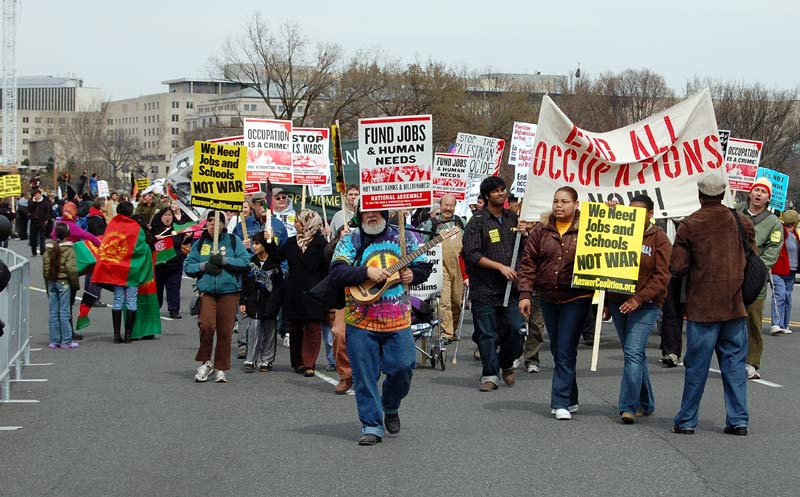
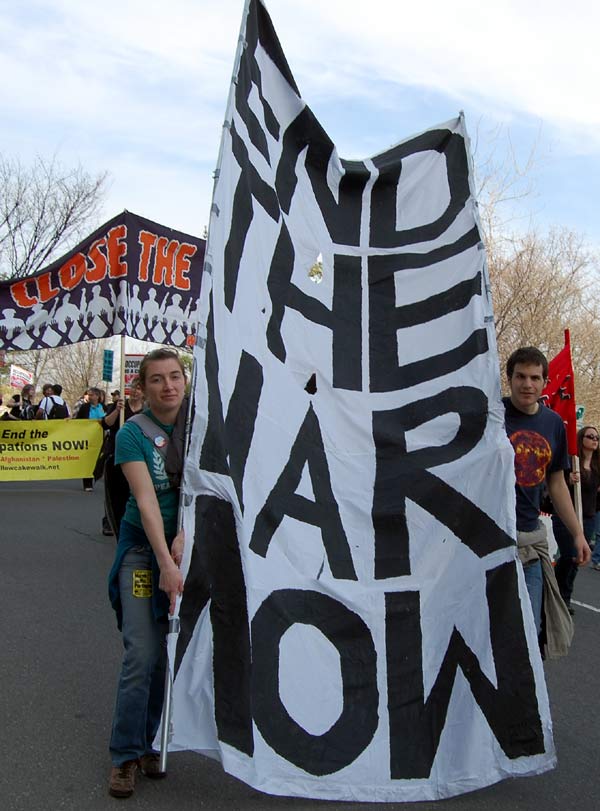
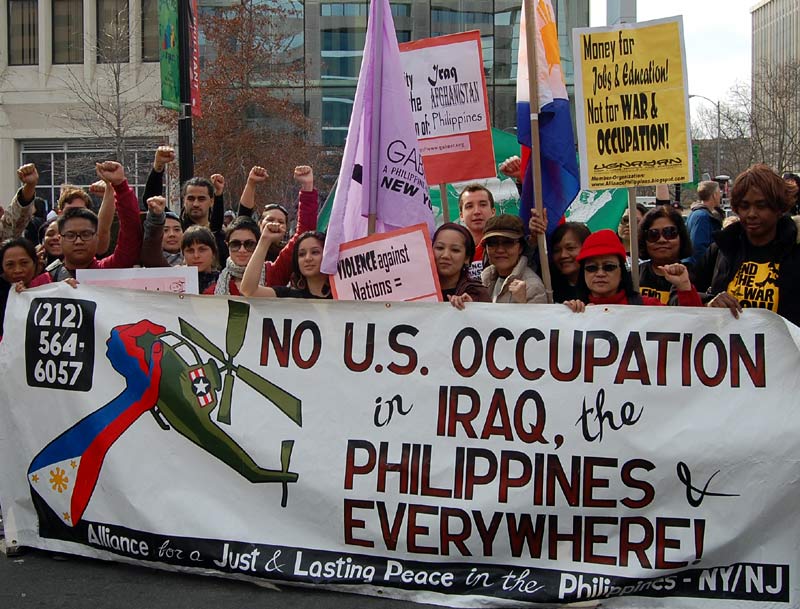
DC March on the Pentagon was fueled by a promising alternative energy: youth

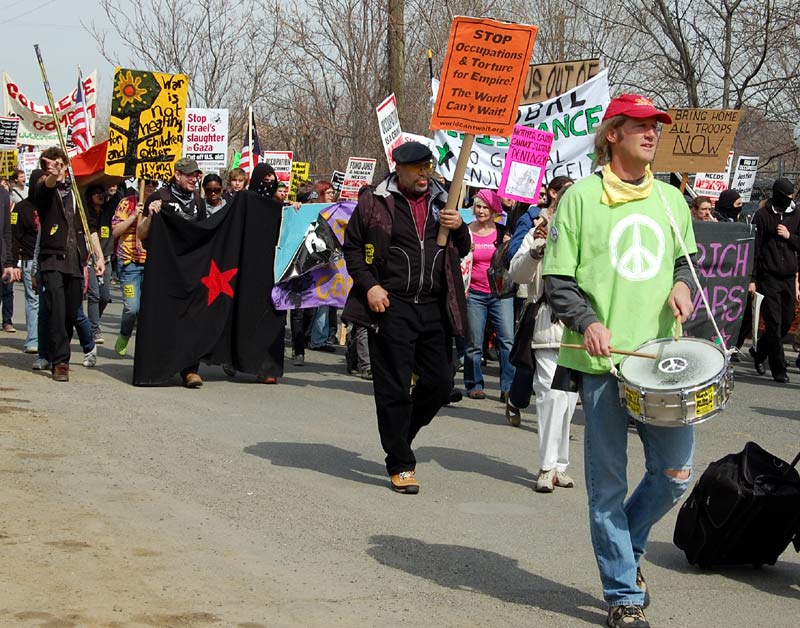
WASHINGTON DC- Speakers were still entertaining an impatient crowd, and coffin carriers were mobilizing for the March to the Pentagon, when from the west came the Black Bloc. Bicycle cops in royal blue lycra scrambled to shepherd the group’s healthy gallop as they appeared from over the hill to kick the parade to a sudden start. They virtually led the parade over the bridge, until organizers prevailed upon the interlopers to allow the veterans groups to resume the lead, as planned. But it would not be the last initiative from the Anarchists.
(Click on image for better quality, wider crop)
1. THE MARCH

Black Bloc gallops into lead position, abruptly starting parade.

International Socialist Organization pass Lincoln Memorial

Peace groups from Vermont to Georgia

Youth and Student A.N.S.W.E.R.

West from the Washington Monument

Hezbollah crosses Arlington Memorial Bridge

To military industrial complex in Crystal City
2. INTERRUPTION

At a narrowing of the route at the Boeing building, several students blocked the march with a plastic barrier.

Raising questions about the gentrified nature and self-policing demeanor of the event organizers and participants.

The Black Bloc honored the picket line, thus the Campus Antiwar Network and following groups were brought to a halt.

When the Black Bloc decided to move on to next actions, the march resumed.

At the first hint of misbehavior, stocky 40-something “videographers” in undercover protest garb were pointing their cameras into the noses of the black-clad participants.

Why explain? You won’t listen.
4. COUNTER PROTEST

On the Pentagon lawn, near signs pointing to the “Pentagon Memorial,” white folk waited with the usual anti-antiwar slogans.
5. CONFRONTATION

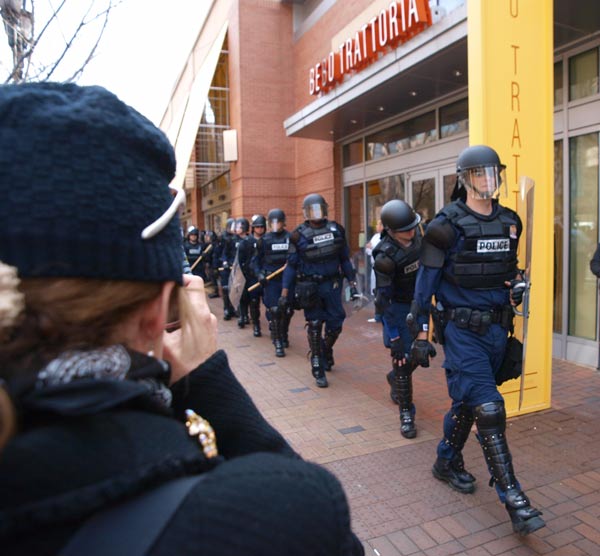
Police in riot gear await march destination at KBR.
6. COLORADANS FOR PEACE

(Still more photos to follow…)
Driving Miss McIntosh
DENVER- At first the testimony from a CU committee member who voted to dismiss Ward Churchill seemed utterly damning. Dr. Marjorie McIntosh, retired Distinguished Professor of history, gave her testimony by video because she would be lecturing in England at the time of the Churchill v CU trial. She came across like a wise elder, her scolding kind and maternal. She had me convinced that Ward should be sent to his room, but for an indelible pallor that began to infect her testimony as the retired professor grew tired under scrutiny. And like the history of 14th Century England which was her specialization, it became inescapably evident that Marjorie McIntosh was very, very white.
At face value, Dr. McIntosh’s quiet authoritative demeanor seemed beyond reproach, expressing as she did her support for Ward Churchill’s right to speak. McIntosh described how her father was a dean at U of M who reputedly stood up to Senator McCarthy. She explained her initial reluctance to be party to a Right Wing attempt to “get” Professor Churchill. At first Ms. McIntosh seemed as earnest as your own grandmother, if your grandmother was also a well spoken distinguished academic.
But the cracks in Ms. McIntosh’s maternal concern showed themselves even before the plaintiff’s cross-examination. When Professor McIntosh described herself as “fair and impartial,” it was in contrast, she offered, to Professor Churchill for example, who she understands may not be impartial or neutral.
Partiality
Under cross-examination McIntosh went further. To paraphrase: “Professor Curchill is not a trained historian, he has an MA, he is a scholar who writes on historical subjects. He presents himself as a specialist, but he does not have that training.”
By contrast we are meant to infer, McIntosh is a Distinguished Professor, rewarded for having had a “national impact” on scholarship, and having produced work which has “directed” consequential research.
Questioned about the significance of tenure, McIntosh described the rigorous qualifications which she met. But with a smile she would not vouch for a uniformity of high standards at CU, since, obviously… She held her tongue as if too polite to say it: Ward Churchill was a glaring example of the opposite.
A second indication of Dr. McIntosh’s personal bias might be suggested by how she characterized committee chairwoman Mimi Wesson’s perceived personal agenda: Did she detect any bias on the committee, in particular with Wesson? McIntosh saw no evidence of bias, and she thought Wesson treated Professor Churchill with great respect, both in his presence and after. McIntosh was impressed by Wesson’s professionalism.
Another of McIntosh’s responses hints at a further insincerity. She and her SCRUM colleagues were tasked with investigating one allegation each made against Churchill. McIntosh was “foot soldier” for the Madan Indian Ft Clark episode. Discrepancies in Churchill’s account had been brought to the university’s attention by Arizona professor Lavall, a rival of Churchill’s in the American Indian Movement. McIntosh was asked whether she knew that Lavall’s allegations had been raised six years before being addressed by her committee. Perhaps to dodge the accusation that the timing of their inquest was more related to Churchill’s 9/11 essay, McIntosh replied that she did not know. After of course, delivering the findings of what she presented as an exhaustive review of all available evidence.
Allegation A
Allegation A held that Churchill falsified an account of the 1837 small pox outbreak in North Dakota. McIntosh was charged with verifying Churchill’s claims (1) that small pox was deliberately spread by the US Army using blankets, (2) that said blankets were dispensed from a St Louis small pox infirmary, (3) that the infected Indians were ordered to scatter, (4) that a vaccination was deliberately kept from the indians, and (5) that the dead numbered upwards 400,000.
According to Lavall and the CU committee, Churchill was held to have been negligent in citing sources. While Churchill countered that his accounts came from oral tradition, much of it commonly known, McIntosh encountered none.
While McIntosh concedes that she does shares no heritage with Native Americans, to perhaps have grown up with oral accounts, but she argues that Churchill is similarly neither from the tribal lines from which he would have heard Mandan stories.
Did you give Professor Churchill the benefit of the doubt? Dr. McIntosh was asked?
“I would say we gave him a great big benefit of the doubt” McIntosh replied. Her research found no oral tradition of small pox evidence. “We could have stopped there and found him guilty of fabrication and falsification.” Instead the committee magnanimously contacted Churchill to ask for further evidence. They were surprised when he produced conflicting sources. Most surprising, McIntosh condescended, was not getting a straight-forward answer from Professor Churchill.
McIntosh summarized the generally accepted narrative of the 1837 epidemic: Every summer a fur trading company working along the Missouri River, sent a steamship north from St Louis, to the fortified trading posts lying along the river, at their furthest, 2000 miles north. Only once a year, the “Saint Peter” steamed upriver with trading goods to exchange for furs and hides, and with “annuities” which were gifts for Indian tribes who had signed a treaty with the government. A week into the 1837 voyage, one passenger was showing signs of an illness but the captain decided against forcing a disembarkation. By two weeks, everyone on the boat had contracted what was by then undeniably a small pox outbreak. As each of these travelers got off at the trading posts, small pox spread from every stop. The Mandan Indians lived 300 miles north of Ft Union, the furthest point of the steamboat. At least 90% of their number were killed. That much is undisputed.
About involvement of US soldiers, blankets, an infirmary, a vaccination withheld, and an order to scatter, Ms. McIntosh found absolutely no proof. She conceded that some accounts hint that the outbreak was intentional, a couple of accounts mention blankets. On this point the committee agreed the thesis could have been justified. But St Louis newspaper archives reveal no trace of an infirmary nor of a small pox outbreak. There were no medical records kept at the trading posts, nor even any medical staff. Etc.
And as to Churchill’s numbers… “Churchill cites 100,000, then 125,000, then 250,00 and now as many as 400,000.” Churchill attributes the figures to “as Professor Thornton suggests.” But according to McIntosh, Thornton never gave any numbers.
Disputing the numbers, the means, the details, reminds me of another pattern of denial.
Holocaust Denial
Is this not the very basis of Holocaust Denial? A perpetrator culture, commits a genocide, then quibbles with accusers by pointing to the paucity of evidence. It’s a mobster’s strategem. Leave no witnesses and there’s no one to tie you to a crime. A massacre thoroughly executed leaves no trace. History is written by the victors. The master narrative, in Western Heritage, has always had a white master.
Do I liken McIntosh to Jessica Tandy’s role in Driving Miss Daisy? If Tandy had quietly not transformed, but instead held tenaciously to her condescending racism. I would be loath to offend those courageous souls who labor to get to the truth about recorded history, but Holocaust Denial is about repudiating mankind’s evil deeds. Where evidence is sparse, because the perpetrators covered their tracks, others come along to cast doubt on the original crime. The details matter less than the crime. Here we have white man’s genocide against the Native Americans. All the details are in dispute. Held together, they deny the whole of what we can plainly see as the truth.
Asked if she was acquainted with Critical Race Theory, McIntosh replied she wasn’t. She professed uncertainty about even the tenure process for Ethnics Studies. She feels those kind of studies are emotional and partisan. Enlish history has debate too, but less resonance in people’s current lives.
Academic disciplines
Dr. McIntosh became combative when challenged about her proficiency with history from taken from oral tradition. In her later scholarship, Ms. McIntosh worked in contemporary Ugandan women’s studies. Oral sources build African history, but not in English history, where archival history preempts oral sources. We are left to question if McIntosh can reconcile how to incorporate oral accounts not from the present.
Was she coming at this subject with a bias? No, she’d never heard of the Mandan small pox epidemic.
Did anyone put pressure on her, to arrive at her findings? “In the first place, it didn’t occur to me that anyone would put pressure on me.” In discussing her apprehension about joining committee, Mcintosh “did not think the University would be critical of me.”
Bishop Williamson and Auschwitz 1.0

I am curious as to why a Roman Catholic bishop would risk a second excommunication over the historic particulars of the Holocaust. Bishop Richard Williamson is being labeled a “Holocaust Denier” because he questions the extent, and mechanism, of the official version of the Holocaust. Because Williamson is also criticized for his skepticism about the official 9/11 narrative, and for his praise for the Unabomber’s manifesto, I want to take a closer look, and wonder what is he reading?
Here’s what the outspoken Williamson told Swedish SVT in a November 2008 interview, as transcribed by the BBC:
“I believe that the historical evidence is strongly against, is hugely against, six million Jews having been deliberately gassed in gas chambers as a deliberate policy of Adolf Hitler… I believe there were no gas chambers [during World War II]”
First, I’m compelled to pose a naive question: If we can all agree that Jews died in huge numbers by incomparable horrors at the hands of the Nazis, would it matter what the exact death toll was, or which killing method predominated? Why? What is the need for laws to restrict historians who are trying to reconstruct the record from emerging facts? Must preemptive “anti-defamation” laws mandate that historians stick to the official “untold” number and “indescribable” evil?
Even if we postulate, albeit cynically, that Holocaust reverence is critical to upholding American public support for Israel‘s “right to exist” in the Middle East, how could a revision of the casualties, in any case a horrific magnitude, make an difference?
Millions of Jews fell victim to the Third Reich. No one is denying it, and historical revision is not trying to bring the Holocaust victims back to life. Holocaust Remembrance of the Jewish victims has remained a political priority around the world, advocating commemoration in education, literature, civic life, and pop culture. Why then, an aversion to scrutiny?
Last week a fellow Society of St. Pius X member, Rev. Floriano Abrahamowicz was ejected from SSPX for coming to Williamson’s and the Pope’s defense.
While the usual politicians and Jewish community leaders are voicing their indignation, can we ask, are the Bishop’s beliefs really at odds with accepted orthodoxy? The media will reiterate that the Six Million figure has always been beyond dispute. All the while, official scholarship has been recording otherwise. In Germany, revisionist historians are jailed for Holocaust Denial. Yet bit by bit, mainstream historians have been able to publish divergent theses which withstand legal refutation.
For the sake of argument, let’s dismiss all the “deniers” as kooks, and look only at the traditionally vetted voices.
On the subject of Auschwitz, where four million of the total six million Jews were believed to have perished, Der Spiegel managing editor Fritjof Meyer a continued critic of revisionism, summarized in Osteuropa 52, 5/2002, p. 631:
“In 1945, the Soviet Investigatory Commission numbered four million victims in the National Socialist work and extermination camp of Auschwitz-Birkenau, a product of war propaganda. Under coercion, camp Commandant Höß named three million and recanted. Up until now, how many people actually fell victim to this singular mass murder could only be estimated. The first Holocaust historian, Gerald Reitlinger, assumed one million, while the latest state of research estimated it to be several hundred thousand fewer.”
Naturally even Meyer touched off a firestorm by integrating the sum of official scholarship into the big picture. The difficulties which historians face in reaching variant findings are explained by another mainstream scholar, noted Hitler historian Dr. Werner Maser, Professor for History and International Law, Munich University, Falsification, Legend, and Truth about Hitler and Stalin, Olzog, Munich 2004, on p.332
“To be sure, […] the extermination of the Jews is considered to be one of the best researched aspects of contemporary history […], but that is not the case. […] Indeed, whole regions remain as much terra incognita as ever, […] German historians exhibit timidity about taking on the horrible issue and possibly bringing to light details that do not agree with the accounts which have multiplied for a very long time.”
And about the deterrence of the Holocaust Denial laws:
“The sword of Damocles hovers over historians (not only in Germany) who portray the controversial phases of history as they ‘actually were’ – and identify the frequently even officially codified ideological specifications as falsifications of history.”
The question of the gas chambers is raised by the absence of evidence. According to major Holocaust authority Dr. Arno J. Mayer, Professor of Modern Jewish History at Princeton University, in Why Did the Heavens Not Darken? The “Final Solution” in History, Pantheon, New York 1990, p. 362:
“Sources for the study of the gas chambers are at once rare and unreliable. Even though Hitler and the Nazis made no secret of their war on the Jews, the SS operatives dutifully eliminated all traces of their murderous activities and instruments. No written orders for gassing have turned up thus far. The SS not only destroyed most camp records, which were in any case incomplete, but also razed nearly all killing and crematory installations well before the arrival of Soviet troops. Likewise, care was taken to dispose of the bones and ashes of the victims.”
Justifiably, scholars are skeptical that the complete absence of evidence should be taken as proof of its existence and total suppression. Some camps were overrun before the Germans could destroy any part of them. Mayer continues, p. 163:
“In the meantime, there is no denying the many contradictions, ambiguities, and errors in the existing sources. […] Much the same is true of for the conflicting estimates and extrapolations of the number of victims, since there are no reliable statistics to work with. […] Both radical skepticism and rigid dogmatism about the exact processes of extermination and the exact number of victims are the bane of sound historical interpretation”
In light of the before-sited Wannsee Conference documents now being considered post-war forgeries, Mayer explains, p 163:
“To date there is no certainty about who gave the order, and when, to install the gas chambers used for the murder of Jews at Auschwitz. As no written command has been located, there is a strong presumption that the order was issued and received orally”
With no written record of a “Final Solution,” and the implausibility of a completely vaporized paper trail, mainstream scholars have had to improvise an explanation for how an extermination directive was disseminated. University of Vermont Professor Raul Hilberg, member of US Holocaust Memorial Council, author of The Destruction of the European Jews, (Holmes & Meyer, New York 1985), was quoted in Newsday, Feb. 23, 1983:
“But what began in 1941 was a process of destruction [of the Jews] not planned in advance, not organized centrally by any agency. There was no blueprint and there was no budget for destructive measures. They [these measures] were taken step by step, one step at a time. Thus came about not so much a plan being carried out, but an incredible meeting of minds, a consensus mind reading by a far-flung [German] bureaucracy.”
Hilberg himself ran into trouble with the authorized version, because he refused to corroborate tales of Jewish rebellion against their Nazi jailers. His group-think theory extended to the Jews themselves, putting emphasis on their acceptance of being exploited as war industry slave labor.
“I had to examine the Jewish tradition of trusting God, princes, laws and contracts […] Ultimately I had to ponder the Jewish calculation that the persecutor would not destroy what he could economically exploit. It was precisely this Jewish strategy that dictated accommodation and precluded resistance.”
That’s where the extermination camp thesis becomes less probable than the work camp. Perhaps the Jews didn’t resist because they were being worked, not gassed. Worked to death, of course, but dying as more a consequence of wartime Germany’s depleting resources, than from a deliberate eradication effort. Evidence is plentiful of the work camps and dead bodies.
And isn’t that the answer to my innocent question? To doubt whether the murder weapon was a pistol or a knife, means calling into question the crime entirely. That’s why revisionists are decried for being “deniers.” While we presume the distinction makes little difference, because clearly a murder was committed regardless, the prosecutor constructing the accusations wants to prove his motive and not another.
There are many details about which historians have begun to disagree. Many of the witness accounts have been proven to be unreliable. Even Elie Wiesel was compelled to reclassified his memoir as a novel. The Holocaust as later generations have come to know it was not as the WWII generation saw it. Even those soldiers who encountered the atrocities themselves.
Professor Hilberg recounts studying at Brooklyn College under Hans Rosenberg, a fellow Jew. Even in the wake of the haunting newsreels of the concentration camps, Hilberg records that Rosenberg remarked in a 1948 lecture:
“The most wicked atrocities perpetrated on a civilian population in modern times occurred during the Napoleonic occupation of Spain.”
I don’t really subscribe to the idea that the Holocaust is diminished by learning that the WWII concentration camp victims died from systemic and despotic abuse, starvation and exhaustion. But those holding the secrets believe that the concept of the Holocaust being the greatest evil perpetrated upon mankind falls apart if cracks are allowed to form in the accepted narrative.
Perhaps the German population, and for that matter, the Catholic Church, did not intercede more vigorously because there was no premeditated extermination program. We can say now that German reinforcements being sent to the Russian Front knew they were being sent to their deaths, but this is only with hindsight.
Is this Bishop Williamson’s interest in revisiting the Holocaust, to rehabilitate the church’s role? I doubt it. The Catholic church cannot escape culpability for its instrumental role in support of the Nazis, guilty of ware crimes and crimes against humanity, initiating a war of aggression being the chief charge at the Nuremberg Trials for example, before even taking into account the concentration camps.
Perhaps the American industrialists and bankers who knew about the camps did not interfere because they understood the camps were for the supply of slave labor. Isn’t this a key enigma of the Holocaust, as we grapple with it? How could we have not known? How could this have been allowed to happen?
Perhaps the signs above the camp gates which read ARBEIT MACHT FREI, work earns freedom, meant what they said. They might have been inescapable ironies, but not the cruel mockery of which we accuse the Germans.
Why would factories like IG Farben and Krupp want to liquidate their valuable cheap workforce? Why would camps meant to exterminate have infirmaries? Why would the wardens treat inmates for illness while simultaneously sending incoming transports to directly to ovens?
Today the popular conscience has been saturated with the ghostly images of the concentration camp victims. How to explain the emaciated inmates discovered by the liberating troops, many of whom could not be saved from dying, even under the administration of the liberators? Dr. Arno J. Mayer concedes this explanation, p. 365
“[…] the whole of Auschwitz was intermittently in the grip of a devastating typhus epidemic. The result was an unspeakable death rate. […] There is a distinction between dying from ‘natural’ or ‘normal’ causes and being killed by shooting, hanging, phenol injection, or gassing. […] from 1942 to 1945, certainly at Auschwitz, but probably overall, more Jews were killed by so-called ‘natural’ causes than by ‘unnatural’ ones.”
This is not to diminish the crime of the Holocaust one iota. The German people, the industrialists, the church, the anti-Semites, are far more guilty because the crime against the Jews was banal and common. It was not devised by agents of unspeakable evil.
Other aspiring genocidal nations and peoples cannot excuse their acts because their methods fall demonstrably below the mythic proportions of the Holocaust.

The future of socialism and LGBT rights in Cuba
The future of socialism and LGBT rights in Cuba, an interview with Mariela Castro. I thought this interview might be of some interest to Colorado’s LGBT community, as it shows not quite the monster leadership of Cuba as is usually portrayed by the Right Wing here in NORADlandia when they talk about Human Rights. Ted Haggard might even ought to ask for political asylum in Cuba? Take your whole family, Ted, and at least have a vacation there! Break the law! Psst… I hear you’re changing your views as a Christian… right?
Meeting Senator-to-be Michael Bennet

COLORADO SPRINGS- Governor Bill Ritter introduced his appointment to the US Senate, political novice Michael Bennet, to an audience of Springs Democrats today. Judging just by Bennet’s own words, this development is about as disappointing as it gets. Full report after this note:
Both men spoke predominantly about education, considering Michael Bennet current position as Superintendent of Denver Public Schools.
Before we contemplate Michael Bennet’s qualifications for the US Senate, let’s broaden the scope. Even though he lacks the experience of an elected office, his resumé reflects someone well connected in Washington DC and Denver. What appears to be a comforting pedigree could also cause skeptics to fear he’s a Beltway insider. Bennet’s previous work experience was as a lawyer, a mayor’s chief of staff, and a counsel to corporate investment raiders. It might be informative for us to wonder what qualifications did Bennet have in the first place, to be appointed to lead Denver Public Schools?
If that assignment smacked of a political payoff, for Bennet serving as aid to Denver Mayor Hinckenlooper during his ascendency, can we wonder if a similar incongruous motive was behind his startling promotion to the US Senate?

Okay, okay, so get this: Bennet described his legacy with the Anschutz Corp. thus: they were turn-around specialists! He explained that Anschutz took businesses which had been gutted or neglected by unscrupulous owners, and rehabbed them to provide jobs for thousands. Is that rather at odds with what asset strippers actually do? But this wasn’t a business savvy Republican crowd. This was an assembly of earnest Democrats who wanted to believe in honest politicians.

Despite having to cross the protesters outside, and having to face our placards at the meeting, neither speaker addressed the crisis in Gaza. The nearest either came was Bennet’s answer to a question about national security, in which he explained the need to draw troops down in Iraq and refocus our energies in Afghanistan.

Though we had hands raised hoping to be called upon, we otherwise kept silent and held our posters in full confidence that many among the assembled were in full agreement with our cause.

After their public addresses, Ritter and Bennet gave media interviews behind doors guarded by a short grey haired gentleman who kept his eyes on me. But this is an understatement. Throughout the public meeting, and afterward, this man maintained a steely confrontational gaze directly into my eyes, from across the room, or right beneath my nose. It’s a technique I recognized from Secret Service agents, except they don’t usually betray an angry scowl. This person was trying very hard to project an intimidating presence.
A few minutes after this photograph was taken, when the governor and his charge were about to emerge, this fellow walked straight up to me and began directing me to move out of the way. I assured him I was blocking no one’s path, but he simply repeated himself with amplified belligerence. I chided him about this being a PUBLIC library, and that I had no responsibility to him, and would certainly not be ordered around. Instead of negotiating, he reasserted his bossy authority. Ultimately, laughing him off turned out to be effective. Just as suddenly, he stepped back and let me be.

Jonathan was able to take these pictures of both Ritter and Bennet as they passed our signs: issues which they refused to address.

Here, Governor Ritter was accosted by Phyllis. I have no idea how he was eventually able to pull away.

Meanwhile, Tony had grown a spontaneous gathering outside, where we waived banners and posters to the appreciative honks of passing cars, and thank-yous from the Democrats leaving the meeting.
Our new friends, many of whom were homeless and victims of recurring incarceration, were thrilled to participate with us and beckon support from the passersby. A number of our allies were quite conversant on the issues and offered fantastic retorts to the occasional detractors. Not infrequently, to my continued surprise, we were accosted with pedestrians, inside the library and out, who would point to our signs and declare that every last vermin/scum/Palestinian needed to be eradicated before there would be peace in the Middle East.

Plans for a better turnout for this action suffered from the usual obstacle of being unable to reach the bulk of Colorado Springs’ peace activists. Many are still being kept deliberately out of the loop by the religious PPJPC passivists who’ve infected the local peace community.
Not surprisingly, the current PPJPC chairman did appear for the meeting, but not for the protest. He was attending as a Democratic Party member, and left when he couldn’t find a seat. Though publicly vocal about Palestinian issues, his support did not extend to putting the message before the US Senator about to represent us in DC.
Putin once again to the US and Europe- ‘Fuck you, you are not going to turn Russia into a Third World rape victim!’
Russia-Ukraine gas talks collapse –like when the US tried to pull off its little con game using Georgia to bomb South Ossetia. Vladimir Putin has responded to the US and its Klan of Western European allies, that Russia will not be dragged further into the Third World by capitalist imperialism. That’s what it’s all about, too, as both the former Chinese and Russian ‘socialist’ bureaucrats were promised full partnerships in the imperialist capitalist world if only they would tag along quietly behind the US and its world allies. Instead, the Pentagon has been trying to push both countries backwards and not forwards. The USA government has been having its own way for the last three decades doing it, too.
Colonialism 101 is something that the former ‘Marxist-Leninist buffoons running China and the Soviet Union back then never learned for themselves, let alone taught to others in their pantomime of playing ‘Great Helmsmen’ cartoon roles for the world public. Both Russia and China drifted away from internationalism and solidarity with the oppressed of the poorer and exploited Third World masses of destitute laborers, and instead began to ape assholes like Margaret Thatcher and Ronald Reagan in their politics. They wanted their places on the big table alongside their capitalist associates of Great Britain and the US, Germany, France, and Japan. The dummies were conned, and Putin is quite aware of that by now. Further, he understands Peak Oil is a reality, as well as Peak Gas.
In his words, ‘Cheap Energy’ is over for you guys, and now we’re not just going to sit by and let you pillage everything from our country, Russia. Sadly, our own US ‘leaders’, from Obama to Clinton to Bush to all of the schmucks up there are nothing but criminal robbers and murderers, and world war is soon in the cards if the common folk don’t begin to wise up in the US and Britain, Germany, France, and Japan quite soon. Not to mention the utter ecological destruction of our planet in the cards for all of us quite soon, too, if we continue to fail to act.
That picture is of the university in Gaza being bombed by the US… Oh, I meant Israel. Sorry….
Happy New Year.
Paging Lucy Shoup aka Lucy McDonald
Who was the Maryland State Trooper infiltrating Silver Springs area peace groups? Unmasked by an ACLU case which represented several dozen activists labeled by “Lucy” as terrorists, even the LA Times article would not reveal her true identity. But certainly there should remain photographs of the undercover officer participating in actions from 2005-2007…
The agent’s cover name “Lucy Shoup” was accidentally left un-redacted from records made public by the Maryland State Police. An activist at Red Emma’s bookstore suspected that an “Ann Shoup” on their email list might be the agent in question. Now 32 activist groups in the area have confirmed that “Lucy,” going by “Shoup” or “McDonald,” pretended to participate in their activities in order to keep tabs on their members.
She used the email addresses ann_378@hotmail.com and shoupy_shoup@yahoo.com. The ACLU of Maryland is asking other activist groups to check their records for traces of this agent, and urging all to file FOIA requests to disclose the breadth of this eavesdropping.
Among the major groups targeted: the ACLU, the American Friends Service Committee, Amnesty International, the Campaign to End the Death Penalty, the International Socialist Organization, the NAACP, and United Catholic Charities.
Among the 57 individuals labeled as “terrorists” by this agent are the Dominican sisters who perpetrated the Colorado nuclear missile silo Plowshare action, Ardeth Platte and Carol Gilbert.
Here is a sample of one of the infiltrator’s email:
July 28, 2005
Due to a change in marital status, my name and e-mail have changed and I will no longer be using or checking my old address.
Please send anything to me (pledge, Save Vernon Evans, etc) at shoupy_shoup@yahoo.com.
Whoops, forgot to tell you my name is Lucy Shoup, has a nice ring, doesn’t it?
Thanks, I will see you soon.
She used the same pretext to avoid giving a physical address:
August 2, 2005
That would be great to be on the list serve for progressive news, alerts, etc., as well as the Baltimore activists’ alert.
I’m in the process of moving, so I will give you my snail mail soon.
I may just get a p.o. box to make life easier.
See you soon, Lucy.
Chenega and Pentagon Tomahawk cruise missile penetration of the US Native American community
Most of us know about how the Pentagon has people like Generals Colin Powell and Ricardo Sanchez on board for its penetration into the Black and Hispanic populations. Nothing too new about trying to buy off and corrupt America’s minority communities by holding out the military’s ‘socialism’ for soldiers program here. Get some Blacks and Browns on board the racist US foreign policy of pummelling Black and Brown people abroad, while offering crumbs to the minority ethnic communities inside the US. Hold up a general or two high (even a president perhaps!) to try to convince these minority communities to participate eagerly into being co-opted by the military. But…
but were you aware that this Pentagon co-option extends into the Native American communities, too, and not just the Black and Hispanic ones?
Here is a link to Chenega Federal Systems, LLC, which has its roots supposedly in the Native American communities of Alaska, but offers plenty of jobs in the local Colorado Springs area for Pentagon-military-industrial complex positions. Their real lifeline is the Pentagon, and it is the type of military operation that produces ‘pissed off Republicans’ claiming to have roots in the Native American community, like the individual who has been posting Right Wing material recently onto this blog.
How did I hear about Chenega Federal Systems? Check out Global Security’s ‘Defense Jobs Career Center’ and see how I came across this outfit here in Colorado Springs? I wonder how many little Eichmanns are working for this Pentagon tomahawk cruise missile directed at the Native American community? I wonder what destruction to Native American lands has been done overall by the Pentagon? After all, just where did that depleted uranium dumped on Iraqis by US troops get mined at? And who were the miners?
Weathermen for a Democratic Society
In 1969, the Radical Youth Movement (RYM) within Students for a Democratic Society (SDS) expelled the passive participants to reconfigure the SDS to Bring the War Home. At left, Bernardine Dohrn uninvites the Progressive Labor Party (PL) and the Worker Student Alliance (WSA) from the Chicago conference. Below is the founding document after which the RYM was renamed.
You Don’t Need A Weatherman
To Know Which Way The Wind Blows
June 18, 1969Submitted by Karin Asbley, Bill Ayers, Bernardine Dohrn, John Jacobs, Jeff Jones, Gerry Long, Home Machtinger, Jim Mellen, Terry Robbins, Mark Rudd and Steve Tappis.
I. International Revolution
The contradiction between the revolutionary peoples of Asia, Africa and Latin America and the imperialists headed by the United States is the principal contradiction in the contemporary world. The development of this contradiction is promoting the struggle of the people of the whole world against US imperialism and its lackeys.
Lin Piao, Long Live the Victory of People’s War!
People ask, what is the nature of the revolution that we talk about- Who will it be made by, and for, and what are its goals and strategy-
The overriding consideration in answering these questions is that the main struggle going on in the world today is between US imperialism and the national liberation struggles against it. This is essential in defining political matters in the whole world: because it is by far the most powerful, every other empire and petty dictator is in the long run dependent on US imperialism, which has unified, allied with, and defended all of the reactionary forces of the whole world. Thus, in considering every other force or phenomenon, from Soviet imperialism or Israeli imperialism to “workers struggle” in France or Czechoslovakia, we determine who are our friends and who are our enemies according to whether they help US imperialism or fight to defeat it.
So the very first question people in this country must ask in considering the question of revolution is where they stand in relation to the United States as an oppressor nation, and where they stand in relation to the masses of people throughout the world whom US imperialism is oppressing.
The primary task of revolutionary struggle is to solve this principal contradiction on the side of the people of the world. It is the oppressed peoples of the world who have created the wealth of this empire and it is to them that it belongs; the goal of the revolutionary struggle must be the control and use of this wealth in the interests of the oppressed peoples of the world.
It is in this context that we must examine the revolutionary struggles in the United States. We are within the heartland of a worldwide monster, a country so rich from its worldwide plunder that even the crumbs doled out to the enslaved masses within its borders provide for material existence very much above the conditions of the masses of people of the world. The US empire, as a worldwide system, channels wealth, based upon the labor and resources of the rest of the world, into the United States. The relative affluence existing in the United States is directly dependent upon the labor and natural resources of the Vietnamese, the Angolans, the Bolivians and the rest of the peoples of the Third World. All of the United Airlines Astrojets, all of the Holiday Inns, all of Hertz’s automobiles, your television set, car and wardrobe already belong, to a large degree to the people of the rest of the world.
Therefore, any conception of “socialist revolution” simply in terms of the working people of the United States, failing to recognize the full scope of interests of the most oppressed peoples of the world, is a conception of a fight for a particular privileged interest, and is a very dangerous ideology. While the control and use of the wealth of the Empire for the people of the whole world is also in the interests of the vast majority of the people in this country, if the goal is not clear from the start we will further the preservation of class society, oppression, war, genocide, and the complete emiseration of everyone, including the people of the US.
The goal is the destruction of US imperialism and the achievement of a classless world: world communism. Winning state power in the US will occur as a result of the military forces of the US overextending themselves around the world and being defeated piecemeal; struggle within the US will be a vital part of this process, but when the revolution triumphs in the US it will have been made by the people of the whole world. For socialism to be defined in national terms within so extreme and historical an oppressor nation as this is only imperialist national chauvinism on the part of the “movement.”
II. What Is The Black Colony-
Not every colony of people oppressed by imperialism lies outside the boundaries of the US. Black people within North America, brought here 400 years ago as slaves and whose labor, as slaves, built this country, are an internal colony within the confines of the oppressor nation. What this means is that black people are oppressed as a whole people, in the institutions and social relations of the country, apart from simply the consideration of their class position, income, skill, etc., as individuals- What does this colony look like- What is the basis for its common oppression and why is it important-
One historically important position has been that the black colony only consists of the black belt nation in the South, whose fight for national liberation is based on a common land, culture, history and economic life. The corollary of this position is that black people in the rest of the country are a national minority but not actually part of the colony themselves; so the struggle for national liberation is for the black belt, and not all blacks; black people in the north, not actually part of the colony, are part of the working class of the white oppressor nation. In this formulation northern black workers have a “dual role”—one an interest in supporting the struggle in the South, and opposing racism, as members of the national minority; and as northern “white nation” workers whose class interest is in integrated socialism in the north. The consistent version of this line actually calls for integrated organizing of black and white workers in the north along what it calls “class” lines.
This position is wrong; in reality, the black colony does not exist simply as the “black belt nation,” but exists in the country as a whole. The common oppression of black people and the common culture growing out of that history are not based historically or currently on their relation to the territory of the black belt, even though that has been a place of population concentration and has some very different characteristics than the north, particularly around the land question.
Rather, the common features of oppression, history and culture which unify black people as a colony (although originating historically in a common territory apart from the colonizers, i.e., Africa, not the South) have been based historically on their common position as slaves, which since the nominal abolition of slavery has taken the form of caste oppression, and oppression of black people as a people everywhere that they exist. A new black nation, different from the nations of Africa from which it came, has been forged by the common historical experience of importation and slavery and caste oppression; to claim that to be a nation it must of necessity now be based on a common national territory apart from the colonizing nation is a mechanical application of criteria which were and are applicable to different situations.
What is specifically meant by the term caste is that all black people, on the basis of their common slave history, common culture and skin color are systematically denied access to particular job categories (or positions within job categories), social position, etc., regardless of individual skills, talents, money or education. Within the working class, they are the most oppressed section; in the petit bourgeoisie, they are even more strictly confined to the lowest levels. Token exceptions aside, the specific content of this caste oppression is to maintain black people in the most exploitative and oppressive jobs and conditions. Therefore, since the lowest class is the working class, the black caste is almost entirely a caste of the working class, or [holds] positions as oppressed as the lower working-class positions (poor black petit bourgeoisie and farmers); it is a colonial labor caste,, a colony whose common national character itself is defined by their common class position.
Thus, northern blacks do not have a “dual interest”—as blacks on the one hand and “US-nation workers” on the other. They have a single class interest, along with all other black people in the US, as members of the Black Proletarian Colony.
III. The Struggle For Socialist Self-Determination
The struggle of black people—as a colony—is for self-determination, freedom, and liberation from US imperialism. Because blacks have been oppressed and held in an inferior social position as a people, they have a right to decide, organize and act on their common destiny as a people apart from white interference. Black self-determination does not simply apply to determination of their collective political destiny at some future time. It is directly tied to the fact that because all blacks experience oppression in a form that no whites do, no whites are in a position to fully understand and test from their own practice the real situation black people face and the necessary response to it. This is why it is necessary for black people to organize separately and determine their actions separately at each stage of the struggle.
It is important to understand the implications of this. It is not legitimate for whites to organizationally intervene in differences among revolutionary black nationalists. It would be arrogant for us to attack any black organization that defends black people and opposes imperialism in practice. But it is necessary to develop a correct understanding of the Black Liberation struggle within our own organization, where an incorrect one will further racist practice in our relations with the black movement.
In the history of some external colonies, such as China and Vietnam, the struggle for self-determination has had two stages: (1) a united front against imperialism and for New Democracy (which is a joint dictatorship of anti-colonial classes led by the proletariat, the content of which is a compromise between the interests of the proletariat and nationalist peasants, petit bourgeoisie and national bourgeoisie); and (2) developing out of the new democratic stage, socialism.
However, the black liberation struggle in this country will have only one “stage”; the struggle for self-determination will embody within it the struggle for socialism.
As Huey P. Newton has said, “In order to be a revolutionary nationalist, you would of necessity have to be a socialist.” This is because—given the caste quality of oppression-as-a-people-through-a-common-degree-of-exploitation—self-determination requires being free from white capitalist exploitation in the form of inferior (lower caste) jobs, housing, schools, hospitals, prices. In addition, only what was or became in practice a socialist program for self-determination—one which addressed itself to reversing this exploitation—could win the necessary active mass support in the “proletarian colony.”
The program of a united front for new democracy, on the other hand, would not be as thorough, and so would not win as active and determined support from the black masses. The only reason for having such a front would be where the independent petit bourgeois forces which it would bring in would add enough strength to balance the weakening of proletarian backing. This is not the case: first, because much of the black petit bourgeoisie is actually a “comprador” petit bourgeoisie (like so-called black capitalists who are promoted by the power structure to seem independent but are really agents of white monopoly capital), who would never fight as a class for any real self-determination; and secondly, because many black petit bourgeoisie, perhaps most, while not having a class interest in socialist self-determination, are close enough to the black masses in the oppression and limitations on their conditions that they will support many kinds of self-determination issues, and, especially when the movement is winning, can be won to support full (socialist) self-determination. For the black movement to work to maximize this support from the petit bourgeoisie is correct; but it is in no way a united front where it is clear that the Black Liberation Movement should not and does not modify the revolutionary socialist content of its stand to win that support.
From /New Left Notes/, June 18, 1969
IV. Black Liberation Means Revolution
What is the relationship of the struggle for black self-determination to the whole worldwide revolution to defeat US imperialism and internationalize its resources toward the goal of creating a classless world-
No black self-determination could be won which would not result in a victory for the international revolution as a whole. The black proletarian colony, being dispersed as such a large and exploited section of the work force, is essential to the survival of imperialism. Thus, even if the black liberation movement chose to try to attain self-determination in the form of a separate country (a legitimate part of the right to self-determination), existing side by side with the US, imperialism could not survive if they won it—and so would never give up without being defeated. Thus, a revolutionary nationalist movement could not win without destroying the state power of the imperialists; and it is for this reason that the black liberation movement, as a revolutionary nationalist movement for self-determination, is automatically in and of itself an inseparable part of the whole revolutionary struggle against US imperialism and for international socialism.
However, the fact that black liberation depends on winning the whole revolution does not mean that it depends on waiting for and joining with a mass white movement to do it. The genocidal oppression of black people must be ended, and does not allow any leisure time to wait; if necessary, black people could win self-determination, abolishing the whole imperialist system and seizing state power to do it, without this white movement, although the cost among whites and blacks both would be high.
Blacks could do it alone if necessary because of their centralness to the system, economically and geo-militarily, and because of the level of unity, commitment, and initiative which will be developed in waging a people’s war for survival and national liberation. However, we do not expect that they will have to do it alone, not only because of the international situation, but also because the real interests of masses of oppressed whites in this country lie with the Black Liberation struggle, and the conditions for understanding and fighting for these interests grow with the deepening of the crises. Already, the black liberation movement has carried with it an upsurge of revolutionary consciousness among white youth; and while there are no guarantees, we can expect that this will extend and deepen among all oppressed whites.
To put aside the possibility of blacks winning alone leads to the racist position that blacks should wait for whites and are dependent on whites acting for them to win. Yet the possibility of blacks winning alone cannot in the least be a justification for whites failing to shoulder the burden of developing a revolutionary movement among whites. If the first error is racism by holding back black liberation, this would be equally racist by leaving blacks isolated to take on the whole fight—and the whole cost—for everyone.
It is necessary to defeat both racist tendencies: (1) that blacks shouldn’t go ahead with making the revolution, and (2) that blacks should go ahead alone with making it. The only third path is to build a white movement which will support the blacks in moving as fast as they have to and are able to, and still itself keep up with that black movement enough so that white revolutionaries share the cost and the blacks don’t have to do the whole thing alone. Any white who does not follow this third path is objectively following one of the other two (or both) and is objectively racist.
V. Anti-Imperialist Revolution And The United Front
Since the strategy for defeating imperialism in semi-feudal colonies has two stages, the new democratic stage of a united front to throw out imperialism and then the socialist stage, some people suggest two stages for the US too—one to stop imperialism, the anti-imperialist stage, and another to achieve the dictatorship of the proletariat, the socialist stage. It is no accident that even the proponents of this idea can’t tell you what it means. In reality, imperialism is a predatory international stage of capitalism. Defeating imperialism within the US couldn’t possibly have the content, which it could in a semi-feudal country, of replacing imperialism with capitalism or new democracy; when imperialism is defeated in the US, it will be replaced by socialism—nothing else. One revolution, one replacement process, one seizure of state power—the anti-imperialist revolution and the socialist revolution, one and the same stage. To talk of this as two separate stages, the struggle to overthrow imperialism and the struggle for socialist revolution, is as crazy as if Marx had talked about the proletarian socialist revolution as a revolution of two stages, one the overthrow of capitalist state power, and second the establishment of socialist state power.
Along with no two stages, there is no united front with the petit bourgeoisie, because its interests as a class aren’t for replacing imperialism with socialism. As far as people within this country are concerned, the international war against imperialism is the same task as the socialist revolution, for one overthrow of power here. There is no “united front” for socialism here.
One reason people have considered the “united front” idea is the fear that if we were talking about a one-stage socialist revolution we would fail to organize maximum possible support among people, like some petit bourgeoisie, who would fight imperialism on a particular issue, but weren’t for revolution. When the petit bourgeoisie’s interest is for fighting imperialism on a particular issue, but not for overthrowing it and replacing it with socialism, it is still contributing to revolution to that extent—not to some intermediate thing which is not imperialism and not socialism. Someone not for revolution is not for actually defeating imperialism either, but we still can and should unite with them on particular issues. But this is not a united front (and we should not put forth some joint “united front” line with them to the exclusion of our own politics), because their class position isn’t against imperialism as a system. In China, or Vietnam, the petit bourgeoisie’s class interests could be for actually winning against imperialism; this was because their task was driving it out, not overthrowing its whole existence. For us here, “throwing it out” means not from one colony, but all of them, throwing it out of the world, the same thing as overthrowing it.
VI. International Strategy
What is the strategy of this international revolutionary movement- What are the strategic weaknesses of the imperialists which make it possible for us to win- Revolutionaries around the world are in general agreement on the answer, which Lin Piao describes in the following way:
US imperialism is stronger, but also more vulnerable, than any imperialism of the past. It sets itself against the people of the whole world, including the people of the United States. Its human, military, material and financial resources are far from sufficient for the realization of its ambition of domination over the whole world. US imperialism has further weakened itself by occupying so many places in the world, overreaching itself, stretching its fingers out wide and dispersing its strength, with its rear so far away and its supply lines so long.
—/Long Live the Victory of People’s War/
The strategy which flows from this is what Ché called “creating two, three, many Vietnams”—to mobilize the struggle so sharply in so many places that the imperialists cannot possibly deal with it all. Since it is essential to their interests, they will try to deal with it all, and will be defeated and destroyed in the process.
In defining and implementing this strategy, it is clear that the vanguard (that is, the section of the people who are in the forefront of the struggle and whose class interests and needs define the terms and tasks of the revolution) of the “American Revolution” is the workers and oppressed peoples of the colonies of Asia, Africa and Latin America. Because of the level of special oppression of black people as a colony, they reflect the interests of the oppressed people of the world from within the borders of the United States; they are part of the Third World and part of the international revolutionary vanguard.
The vanguard role of the Vietnamese and other Third World countries in defeating US imperialism has been clear to our movement for some time. What has not been so clear is the vanguard role black people have played, and continue to play, in the development of revolutionary consciousness and struggle within the United States. Criticisms of the black liberation struggle as being “reactionary” or of black organizations on campus as being conservative or “racist” very often express this lack of understanding. These ideas are incorrect and must be defeated if a revolutionary movement is going to be built among whites.
The black colony, due to its particular nature as a slave colony, never adopted a chauvinist identification with America as an imperialist power, either politically or culturally. Moreover, the history of black people in America has consistently been one of the greatest overall repudiations of and struggle against the state. From the slave ships from Africa to the slave revolts, the Civil War, etc., black people have been waging a struggle for survival and liberation. In the history of our own movement this has also been the case: the civil rights struggles, initiated and led by blacks in the South; the rebellions beginning with Harlem in 1964 and Watts in 1965 through Detroit and Newark in 1967; the campus struggles at all-black schools in the South and struggles led by blacks on campuses all across the country. As it is the blacks—along with the Vietnamese and other Third World people—who are most oppressed by US imperialism, their class interests are most solidly and resolutely committed to waging revolutionary struggle through to its completion. Therefore it is no surprise that time and again, in both political content and level of consciousness and militancy, it has been the black liberation movement which has upped the ante and defined the terms of the struggle.
What is the relationship of this “black vanguard” to the “many Vietnams” around the world- Obviously this is an example of our strategy that different fronts reinforce each other. The fact that the Vietnamese are winning weakens the enemy, advancing the possibilities for the black struggle, etc. But it is important for us to understand that the interrelationship is more than this. Black people do not simply “choose” to intensify their struggle because they want to help the Vietnamese, or because they see that Vietnam heightens the possibilities for struggle here. The existence of any one Vietnam, especially a winning one, spurs on others not only through consciousness and choice, but through need, because it is a political and economic, as well as military, weakening of capitalism, and this means that to compensate, the imperialists are forced to intensify their oppression of other people.
Thus the loss of China and Cuba and the loss now of Vietnam not only encourages other oppressed peoples (such as the blacks) by showing what the alternative is and that it can be won, but also costs the imperialists billions of dollars which they then have to take out of the oppression of these other peoples. Within this country increased oppression falls heavier on the most oppressed sections of the population, so that the condition of all workers is worsened through rising taxes, inflation and the fall of real wages, and speedup. But this increased oppression falls heaviest on the most oppressed, such as poor white workers and, especially, the blacks, for example through the collapse of state services like schools, hospitals and welfare, which naturally hits the hardest at those most dependent on them.
This deterioration pushes people to fight harder to even try to maintain their present level. The more the ruling class is hurt in Vietnam, the harder people will be pushed to rebel and to fight for reforms. Because there exist successful models of revolution in Cuba, Vietnam, etc., these reform struggles will provide a continually larger and stronger base for revolutionary ideas. Because it needs to maximize profits by denying the reforms, and is aware that these conditions and reform struggles will therefore lead to revolutionary consciousness, the ruling class will see it more and more necessary to come down on any motion at all, even where it is not yet highly organized or conscious. It will come down faster on black people, because their oppression is increasing fastest, and this makes their rebellion most thorough and most dangerous, and fastest growing. It is because of this that the vanguard character and role of the black liberation struggle will be increased and intensified, rather than being increasingly equal to and merged into the situation and rebellion of oppressed white working people and youth. The crises of imperialism (the existence of Vietnam and especially that it’s winning) will therefore create a “Black Vietnam” within the US.
Given that black self-determination would mean fully crushing the power of the imperialists, this “Vietnam” has certain different characteristics than the external colonial wars. The imperialists will never “get out of the US” until their total strength and every resource they can bring to bear has been smashed; so the Black Vietnam cannot win without bringing the whole thing down and winning for everyone. This means that this war of liberation will be the most protracted and hardest fought of all.
It is in this context that the question of the South must be dealt with again, not as a question of whether or not the black nation, black colony, exists there, as opposed to in the North as well, but rather as a practical question of strategy and tactics: Can the black liberation struggle—the struggle of all blacks in the country—gain advantage in the actual war of liberation by concentrating on building base areas in the South in territory with a concentration of black population-
This is very clearly a different question than that of “where the colony is,” and to this question the “yes” answer is an important possibility. If the best potential for struggle in the South were realized, it is fully conceivable and legitimate that the struggle there could take on the character of a fight for separation; and any victories won in that direction would be important gains for the national liberation of the colony as a whole. However, because the colony is dispersed over the whole country, and not just located in the black belt, winning still means the power and liberation of blacks in the whole country.
Thus, even the winning of separate independence in the South would still be one step toward self-determination, and not equivalent to winning it; which, because of the economic position of the colony as a whole, would still require overthrowing the state power of the imperialists, taking over production and the whole economy and power, etc.
VII. The Revolutionary Youth Movement: Class Analysis
The revolutionary youth movement program was hailed as a transition strategy, which explained a lot of our past work and pointed to new directions for our movement. But as a transition to what- What was our overall strategy- Was the youth movement strategy just an organizational strategy because SDS is an organization of youth and we can move best with other young people-
We have pointed to the vanguard nature of the black struggle in this country as part of the international struggle against American imperialism, and the impossibility of anything but an international strategy for winning. Any attempt to put forth a strategy which, despite internationalist rhetoric, assumes a purely internal development to the class struggle in this country, is incorrect. The Vietnamese (and the Uruguayans and the Rhodesians) and the blacks and Third World peoples in this country will continue to set the terms for class struggle in America.
In this context, why an emphasis on youth- Why should young people be willing to fight on the side of Third World peoples- Before dealing with this question about youth, however, there follows a brief sketch of the main class categories in the white mother country which we think are important, and [which] indicate our present estimation of their respective class interests (bearing in mind that the potential for various sections to understand and fight for the revolution will vary according to more than just their real class interests).
Most of the population is of the working class, by which we mean not simply industrial or production workers, nor those who are actually working, but the whole section of the population which doesn’t own productive property and so lives off of the sale of its labor power. This is not a metaphysical category either in terms of its interests, the role it plays, or even who is in it, which very often is difficult to determine.
As a whole, the long-range interests of the non-colonial sections of the working class lie with overthrowing imperialism, with supporting self-determination for the oppressed nations (including the black colony), with supporting and fighting for international socialism. However, virtually all of the white working class also has short-range privileges from imperialism, which are not false privileges but very real ones which give them an edge of vested interest and tie them to a certain extent to the imperialists, especially when the latter are in a relatively prosperous phase. When the imperialists are losing their empire, on the other hand, these short-range privileged interests are seen to be temporary (even though the privileges may be relatively greater over the faster-increasing emiseration of the oppressed peoples). The long-range interests of workers in siding with the oppressed peoples are seen more clearly in the light of imperialism’s impending defeat. Within the whole working class, the balance of anti-imperialist class interests with white mother country short-term privilege varies greatly.
First, the most oppressed sections of the mother country working class have interests most clearly and strongly anti-imperialist. Who are the most oppressed sections of the working class- Millions of whites who have as oppressive material conditions as the blacks, or almost so: especially poor southern white workers; the unemployed or semi-employed, or those employed at very low wages for long hours and bad conditions, who are non-unionized or have weak unions; and extending up to include much of unionized labor which has it a little better off but still is heavily oppressed and exploited. This category covers a wide range and includes the most oppressed sections not only of production and service workers but also some secretaries, clerks, etc. Much of this category gets some relative privileges (i.e. benefits) from imperialism, which constitute some material basis for being racist or pro-imperialist; but overall it is itself directly and heavily oppressed, so that in addition to its long-range class interest on the side of the people of the world, its immediate situation also constitutes a strong basis for sharpening the struggle against the state and fighting through to revolution.
Secondly, there is the upper strata of the working class. This is also an extremely broad category, including the upper strata of unionized skilled workers and also most of the “new working class” of proletarianized or semi-proletarianized “intellect workers.” There is no clearly marked dividing line between the previous section and this one; our conclusions in dealing with “questionable” strata will in any event have to come from more thorough analysis of particular situations. The long-range class interests of this strata, like the previous section of more oppressed workers, are for the revolution and against imperialism. However, it is characterized by a higher level of privilege relative to the oppressed colonies, including the blacks, and relative to more oppressed workers in the mother country; so that there is a strong material basis for racism and loyalty to the system. In a revolutionary situation, where the people’s forces were on the offensive and the ruling class was clearly losing, most of this upper strata of the working class will be winnable to the revolution, while at least some sections of it will probably identify their interests with imperialism till the end and oppose the revolution (which parts do which will have to do with more variables than just the particular level of privilege). The further development of the situation will clarify where this section will go, although it is clear that either way we do not put any emphasis on reaching older employed workers from this strata at this time. The exception is where they are important to the black liberation struggle, the Third World, or the youth movement in particular situations, such as with teachers, hospital technicians, etc., in which cases we must fight particularly hard to organize them around a revolutionary line of full support for black liberation and the international revolution against US imperialism. This is crucial because the privilege of this section of the working class has provided and will provide a strong material basis for national chauvinist and social democratic ideology within the movement, such as anti-internationalist concepts of “student power” and “workers control.” Another consideration in understanding the interests of this segment is that, because of the way it developed and how its skills and its privileges were “earned over time,” the differential between the position of youth and older workers is in many ways greater for this section than any other in the population. We should continue to see it as important to build the revolutionary youth movement among the youth of this strata.
Thirdly, there are “middle strata” who are not petit bourgeoisie, who may even technically be upper working class, but who are so privileged and tightly tied to imperialism through their job roles that they are agents of imperialism. This section includes management personnel, corporate lawyers, higher civil servants, and other government agents, army officers, etc. Because their job categories require and promote a close identification with the interests of the ruling class, these strata are enemies of the revolution.
Fourthly, and last among the categories we’re going to deal with, is the petit bourgeoisie. This class is different from the middle level described above in that it has the independent class interest which is opposed to both monopoly power and to socialism. The petit bourgeoisie consists of small capital—both business and farms—and self-employed tradesmen and professionals (many professionals work for monopoly capital, and are either the upper level of the working class or in the dent class interests-anti-monopoly capital, but for capitalism rather than socialism—gives it a political character of some opposition to “big government,” like its increased spending and taxes and its totalitarian extension of its control into every aspect of life, and to “big labor,” which is at this time itself part of the monopoly capitalist power structure. The direction which this opposition takes can be reactionary or reformist. At this time the reformist side of it is very much mitigated by the extent to which the independence of the petit bourgeoisie is being undermined. Increasingly, small businesses are becoming extensions of big ones, while professionals and self-employed tradesmen less and less sell their skills on their own terms and become regular employees of big firms. This tendency does not mean that the reformist aspect is not still present; it is, and there are various issues, like withdrawing from a losing imperialist war, where we could get support from them. On the question of imperialism as a system, however, their class interests are generally more for it than for overthrowing it, and it will be the deserters from their class who stay with us.
VIII. Why A Revolutionary Youth Movement-
In terms of the above analysis, most young people in the US are part of the working class. Although not yet employed, young people whose parents sell their labor power for wages, and more important who themselves expect to do the same in the future—or go into the army or be unemployed—are undeniably members of the working class. Most kids are well aware of what class they are in, even though they may not be very scientific about it. So our analysis assumes from the beginning that youth struggles are, by and large, working-class struggles. But why the focus now on the struggles of working-class youth rather than on the working class as a whole-
The potential for revolutionary consciousness does not always correspond to ultimate class interest, particularly when imperialism is relatively prosperous and the movement is in an early stage. At this stage, we see working-class youth as those most open to a revolutionary movement which sides with the struggles of Third World people; the following is an attempt to explain a strategic focus on youth for SDS.
In general, young people have less stake in a society (no family, fewer debts, etc.), are more open to new ideas (they have not been brainwashed for so long or so well), and are therefore more able and willing to move in a revolutionary direction. Specifically in America, young people have grown up experiencing the crises in imperialism. They have grown up along with a developing black liberation movement, with the liberation of Cuba, the fights for independence in Africa and the war in Vietnam. Older people grew up during the fight against fascism, during the Cold War, the smashing of the trade unions, McCarthy, and a period during which real wages consistently rose—since 1965 disposable real income has decreased slightly, particularly in urban areas where inflation and increased taxation have bitten heavily into wages. This crisis in imperialism affects all parts of the society. America has had to militarize to protect and expand its empire; hence the high draft calls and the creation of a standing army of three and a half million, an army which still has been unable to win in Vietnam. Further, the huge defense expenditures—required for the defense of the empire and at the same time a way of making increasing profits for the defense industries—have gone hand in hand with the urban crisis around welfare, the hospitals, the schools, housing, air and water pollution. The State cannot provide the services it has been forced to assume responsibility for, and needs to increase taxes and to pay its growing debts while it cuts services and uses the pigs to repress protest. The private sector of the economy can’t provide jobs, particularly unskilled jobs. The expansion of the defense and education industries by the State since World War II is in part an attempt to pick up the slack, though the inability to provide decent wages and working conditions for “public” jobs is more and more a problem.
As imperialism struggles to hold together this decaying social fabric, it inevitably resorts to brute force and authoritarian ideology. People, especially young people, more and more find themselves in the iron grip of authoritarian institutions. Reaction against the pigs or teachers in the schools, welfare pigs or the army, is generalizable and extends beyond the particular repressive institution to the society and the State as a whole. The legitimacy of the State is called into question for the first time in at least 30 years, and the anti-authoritarianism which characterizes the youth rebellion turns into rejection of the State, a refusal to be socialized into American society. Kids used to try to beat the system from inside the army or from inside the schools; now they desert from the army and burn down the schools.
The crisis in imperialism has brought about a breakdown in bourgeois social forms, culture and ideology. The family falls apart, kids leave home, women begin to break out of traditional “female” and “mother” roles. There develops a “generation gap” and a “youth problem.” Our heroes are no longer struggling businessmen, and we also begin to reject the ideal career of the professional and look to Mao, Chef, the Panthers, the Third World, for our models, for motion. We reject the elitist, technocratic bullshit that tells us only experts can rule, and look instead to leadership from the people’s war of the Vietnamese. Chuck Berry, Elvis, the Temptations brought us closer to the “people’s culture” of Black America. The racist response to the civil rights movement revealed the depth of racism in America, as well as the impossibility of real change through American institutions. And the war against Vietnam is not “the heroic war against the Nazis”; it’s the big lie, with napalm burning through everything we had heard this country stood for. Kids begin to ask questions: Where is the Free World- And who do the pigs protect at home-
The breakdown in bourgeois culture and concomitant anti-authoritarianism is fed by the crisis in imperialism, but also in turn feeds that crisis, exacerbates it so that people no longer merely want the plastic ’50s restored, but glimpse an alternative (like inside the Columbia buildings) and begin to fight for it. We don’t want teachers to be more kindly cops; we want to smash cops, and build a new life.
The contradictions of decaying imperialism fall hardest on youth in four distinct areas—the schools, jobs, the draft and the army, and the pigs and the courts. (A) In jail-like schools, kids are fed a mish-mash of racist, male chauvinist, anti-working class, anti-communist lies while being channeled into job and career paths set up according to the priorities of monopoly capital. At the same time, the State is becoming increasingly incapable of providing enough money to keep the schools going at all. (B) Youth unemployment is three times average unemployment. As more jobs are threatened by automation or the collapse of specific industries, unions act to secure jobs for those already employed. New people in the labor market can’t find jobs, job stability is undermined (also because of increasing speed-up and more intolerable safety conditions) and people are less and less going to work in the same shop for 40 years. And, of course, when they do find jobs, young people get the worst ones and have the least seniority. (C) There are now two and a half million soldiers under thirty who are forced to police the world, kill and be killed in wars of imperialist domination. And (D) as a “youth problem” develops out of all this, the pigs and courts enforce curfews, set up pot busts, keep people off the streets, and repress any youth motion whatsoever.
In all of this, it is not that life in America is toughest for youth or that they are the most oppressed. Rather, it is that young people are hurt directly—and severely—by imperialism. And, in being less tightly tied to the system, they are more “pushed” to join the black liberation struggle against US imperialism. Among young people there is less of a material base for racism—they have no seniority, have not spent 20 years securing a skilled job (the white monopoly of which is increasingly challenged by the black liberation movement), and aren’t just about to pay off a 25-year mortgage on a house which is valuable because it’s located in a white neighborhood.
While these contradictions of imperialism fall hard on all youth, they fall hardest on the youth of the most oppressed (least privileged) sections of the working class. Clearly these youth have the greatest material base for struggle. They are the ones who most often get drafted, who get the worst jobs if they get any, who are most abused by the various institutions of social control, from the army to decaying schools, to the pigs and the courts. And their day-to-day existence indicates a potential for militancy and toughness. They are the people whom we can reach who at this stage are most ready to engage in militant revolutionary struggle.
The point of the revolutionary youth movement strategy is to move from a predominant student elite base to more oppressed (less privileged) working-class youth as a way of deepening and expanding the revolutionary youth movement—not of giving up what we have gained, not giving up our old car for a new Dodge. This is part of a strategy to reach the entire working class to engage in struggle against imperialism; moving from more privileged sections of white working-class youth to more oppressed sections to the entire working class as a whole, including importantly what has classically been called the industrial proletariat. But this should not be taken to mean that there is a magic moment, after we reach a certain percentage of the working class, when all of a sudden we become a working-class movement. We are already that if we put forward internationalist proletarian politics. We also don’t have to wait to become a revolutionary force. We must be a self-conscious revolutionary force from the beginning, not be a movement which takes issues to some mystical group—”THE PEOPLE”—who will make the revolution. We must be a revolutionary movement of people understanding the necessity to reach more people, all working people, as we make the revolution.
The above arguments make it clear that it is both important and possible to reach young people wherever they are—not only in the shops, but also in the schools, in the army and in the streets—so as to recruit them to fight on the side of the oppressed peoples of the world. Young people will be part of the International Liberation Army. The necessity to build this International Liberation Army in America leads to certain priorities in practice for the revolutionary youth movement which we should begin to apply this summer. …
IX. Imperialism Is The Issue
The Communists are distinguished from the other working-class parties by this only: 1. In the national struggles of the proletariat of different countries, they point out and bring to the front the common interests of the entire proletariat, independently of all nationality. 2. In the various stages of development which the struggle of the working-class against the bourgeoisie has to pass through, they always and everywhere represent the interests of the movement as a whole.”
—Communist Manifesto
How do we reach youth; what kinds of struggles do we build; how do we make a revolution- What we have tried to lay out so far is the political content of the consciousness which we want to extend and develop as a mass consciousness: the necessity to build our power as part of the whole international revolution to smash the state power of the imperialists and build socialism. Besides consciousness of this task, we must involve masses of people in accomplishing it. Yet we are faced with a situation in which almost all of the people whose interests are served by these goals, and who should be, or even are, sympathetic to revolution, neither understand the specific tasks involved in making a revolution nor participate in accomplishing them. On the whole, people don’t join revolutions just because revolutionaries tell them to. The oppression of the system affects people in particular ways, and the development of political consciousness and participation begins with particular problems, which turn into issues and struggles. We must transform people’s everyday problems, and the issues and struggles growing out of them, into revolutionary consciousness, active and conscious opposition to racism and imperialism.
This is directly counterposed to assuming that struggles around immediate issues will lead naturally over time to struggle against imperialism. It has been argued that since people’s oppression is due to imperialism and racism, then any struggle against immediate oppression is “objectively anti-imperialist,” and the development of the fight against imperialism is a succession of fights for reforms. This error is classical economism.
A variant of this argument admits that this position is often wrong, but suggests that since imperialism is collapsing at this time, fights for reforms become “objectively anti-imperialist.” At this stage of imperialism there obviously will be more and more struggles for the improvement of material conditions, but that is no guarantee of increasing internationalist proletarian consciousness.
On the one hand, if we, as revolutionaries, are capable of understanding the necessity to smash imperialism and build socialism, then the masses of people who we want to fight along with us are capable of that understanding. On the other hand, people are brainwashed and at present don’t understand it; if revolution is not raised at every opportunity, then how can we expect people to see it in their interests, or to undertake the burdens of revolution- We need to make it clear from the very beginning that we are about revolution. But if we are so careful to avoid the dangers of reformism, how do we relate to particular reform struggles- We have to develop some sense of how to relate each particular issue to the revolution.
In every case, our aim is to raise anti-imperialist and anti-racist consciousness and tie the struggles of working-class youth (and all working people) to the struggles of Third World people, rather than merely joining fights to improve material conditions, even though these fights are certainly justified. This is not to say that we don’t take immediate fights seriously, or fight hard in them, but that we are always up front with our politics, knowing that people in the course of struggle are open to a class line, ready to move beyond narrow self-interest.
It is in this sense that we point out that the particular issue is not the issue, is important insofar as it points to imperialism as an enemy that has to be destroyed. Imperialism is always the issue. Obviously, the issue cannot be a good illustration, or a powerful symbol, if it is not real to people, if it doesn’t relate to the concrete oppression that imperialism causes. People have to be (and are being) hurt in some material way to understand the evils of imperialism, but what we must stress is the systematic nature of oppression and the way in which a single manifestation of imperialism makes clear its fundamental nature. At Columbia it was not the gym, in particular, which was important in the struggle, but the way in which the gym represented, to the people of Harlem and Columbia, Columbia’s imperialist invasion of the black colony. Or at Berkeley, though people no doubt needed a park (as much, however, as many other things-), what made the struggle so important was that people, at all levels of militancy, consciously saw themselves attacking private property and the power of the State. And the Richmond Oil Strike was exciting because the militant fight for improvement of material conditions was part and parcel of an attack on international monopoly capital. The numbers and militancy of people mobilized for these struggles has consistently surprised the left, and pointed to the potential power of a class-conscious mass movement.
The masses will fight for socialism when they understand that reform fights, fights for improvement of material conditions, cannot be won under imperialism. With this understanding, revolutionaries should never put forth a line which fosters the illusion that imperialism will grant significant reforms. We must engage in struggles forthrightly as revolutionaries, so that it will be clear to anyone we help to win gains that the revolution rather than imperialism is responsible for them. This is one of the strengths of the Black Panther Party Breakfast for Children Program. It is “socialism in practice” by revolutionaries with the “practice” of armed self-defense and a “line” which stresses the necessity of overthrowing imperialism and seizing state power. Probably the American Friends Service Committee serves more children breakfast, but it is the symbolic value of the program in demonstrating what socialism will do for people which makes the Black Panther Program worthwhile.
What does it mean to organize around racism and imperialism in specific struggles- In the high schools (and colleges) at this time, it means putting forth a mass line to close down the schools, rather than to reform them, so that they can serve the people. The reason for this line is not that under capitalism the schools cannot serve the people, and therefore it is silly or illusory to demand that. Rather, it is that kids are ready for the full scope of militant struggle, and already demonstrate a consciousness of imperialism, such that struggles for a people-serving school would not raise the level of their struggle to its highest possible point. Thus, to tell a kid in New York that imperialism tracks him and thereby oppresses him is often small potatoes compared to his consciousness that imperialism oppresses him by jailing him, pigs and all, and the only thing to do is break out and tear up the jail. And even where high school kids are not yet engaged in such sharp struggle, it is crucial not to build consciousness only around specific issues such as tracking or ROTC or racist teachers, but to use these issues to build toward the general consciousness that the schools should be shut down. It may be important to present a conception of what schools should or could be like (this would include the abolition of the distinction between mental and physical work), but not offer this total conception as really possible to fight for in any way but through revolution.
A mass line to close down the schools or colleges does not contradict demands for open admissions to college or any other good reform demand. Agitational demands for impossible, but reasonable, reforms are a good way to make a revolutionary point. The demand for open admissions by asserting the alternative to the present (school) system exposes its fundamental nature—that it is racist, class-based, and closed—pointing to the only possible solution to the present situation: “Shut it down!” The impossibility of real open admissions—all black and brown people admitted, no flunk-out, full scholarship, under present conditions—is the best reason (that the schools show no possibility for real reform) to shut the schools down. We should not throw away the pieces of victories we gain from these struggles, for any kind of more open admissions means that the school is closer to closing down (it costs the schools more, there are more militant blacks and browns making more and more fundamental demands on the schools, and so on). Thus our line in the schools, in terms of pushing any good reforms, should be, Open them up and shut them down!”
The spread of black caucuses in the shops and other workplaces throughout the country is an extension of the black liberation struggle. These groups have raised and will continue to raise anti-racist issues to white workers in a sharper fashion than any whites ever have or could raise them. Blacks leading struggles against racism made the issue unavoidable, as the black student movement leadership did for white students. At the same time these black groups have led fights which traditional trade-union leaders have consistently refused to lead—fights against speed-up and for safety (issues which have become considerably more serious in the last few years), forcing white workers, particularly the more oppressed, to choose in another way between allegiance to the white mother country and black leadership. As white mother country radicals we should try to be in shops, hospitals, and companies where there are black caucuses, perhaps organizing solidarity groups, but at any rate pushing the importance of the black liberation struggle to whites, handing out Free Huey literature, bringing guys out to Panther rallies, and so on. Just one white guy could play a crucial role in countering UAW counter-insurgency.
We also need to relate to workplaces where there is no black motion but where there are still many young white workers. In the shops the crisis in imperialism has come down around speed-up, safety, and wage squeeze—due to higher taxes and increased inflation, with the possibility of wage-price controls being instituted.
We must relate this exploitation back to imperialism. The best way to do this is probably not caucuses in the shops, but to take guys to citywide demonstrations, Newsreels, even the latest administration building, to make the Movement concrete to them and involve them in it. Further, we can effect consciousness and pick up people through agitational work at plants, train stops, etc., selling Movements, handing out leaflets about the war, the Panthers, the companies’ holdings overseas or relations to defense industry, etc.
After the Richmond strike, people leafleted about demonstrations in support of the Curaçao Oil workers, Free Huey May Day, and People’s Park.
SDS has not dealt in any adequate way with the women question; the resolution passed at Ann Arbor did not lead to much practice, nor has the need to fight male supremacy been given any programmatic direction within the RYM. As a result, we have a very limited understanding of the tie-up between imperialism and the women question, although we know that since World War II the differential between men’s and women’s wages has increased, and guess that the breakdown of the family is crucial to the woman question. How do we organize women against racism and imperialism without submerging the principled revolutionary question of women’s liberation- We have no real answer, but we recognize the real reactionary danger of women’s groups that are not self-consciously revolutionary and anti-imperialist.
To become more relevant to the growing women’s movement, SDS women should begin to see as a primary responsibility the self-conscious organizing of women. We will not be able to organize women unless we speak directly to their own oppression. This will become more and more critical as we work with more oppressed women. Women who are working and women who have families face male supremacy continuously in their day-to-day lives; that will have to be the starting point in their politicization. Women will never be able to undertake a full revolutionary role unless they break out of their woman’s role. So a crucial task for revolutionaries is the creation of forms of organization in which women will be able to take on new and independent roles. Women’s self-defense groups will be a step toward these organizational forms, as an effort to overcome women’s isolation and build revolutionary self-reliance.
The cultural revolt of women against their “role” in imperialism (which is just beginning to happen in a mass way) should have the same sort of revolutionary potential that the RYM claimed for “youth culture.” The role of the “wife-mother” is reactionary in most modern societies, and the disintegration of that role under imperialism should make women more sympathetic to revolution.
In all of our work we should try to formulate demands that not only reach out to more oppressed women, but ones which tie us to other ongoing struggles, in the way that a daycare center at U of C [University of Chicago] enabled us to tie the women’s liberation struggle to the Black Liberation struggle.
There must be a strong revolutionary women’s movement, for without one it will be impossible for women’s liberation to be an important part of the revolution. Revolutionaries must be made to understand the full scope of women’s oppression, and the necessity to smash male supremacy.
X. Neighborhood-Based Citywide Youth Movement
One way to make clear the nature of the system and our tasks working off of separate struggles is to tie them together with each other: to show that we’re one “multi-issue” movement, not an alliance of high school and college students, or students and GIs, or youth and workers, or students and the black community. The way to do this is to build organic regional or sub-regional and citywide movements, by regularly bringing people in one institution or area to fights going on on other fronts.
This works on two levels. Within a neighborhood, by bringing kids to different fights and relating these fights to each other—high school stuff, colleges, housing, welfare, shops—we begin to build one neighborhood-based multi-issue movement off of them. Besides actions and demonstrations, we also pull different people together in day-to-day film showings, rallies, for speakers and study groups, etc. On a second level, we combine neighborhood “bases” into a citywide or region-wide movement by doing the same kind of thing; concentrating our forces at whatever important struggles are going on and building more ongoing interrelationships off of that.
The importance of specifically neighborhood-based organizing is illustrated by our greatest failing in RYM practice so far—high school organizing. In most cities we don’t know the kids who have been tearing up and burning down the schools. Our approach has been elitist, relating to often baseless citywide groups by bringing them our line, or picking up kids with a false understanding of “politics” rather than those whose practice demonstrates their concrete anti-imperialist consciousness that schools are prisons. We’ve been unwilling to work continuously with high school kids as we did in building up college chapters. We will only reach the high school kids who are in motion by being in the schoolyards, hangouts and on the streets on an everyday basis. From a neighborhood base, high school kids could be effectively tied in to struggles around other institutions and issues, and to the anti-imperialist movement as a whole.
We will try to involve neighborhood kids who aren’t in high schools too; take them to anti-war or anti-racism fights, stuff in the schools, etc.; and at the same time reach out more broadly through newspapers, films, storefronts. Activists and cadres who are recruited in this work will help expand and deepen the Movement in new neighborhoods and high schools. Mostly we will still be tied in to the college-based movement in the same area, be influencing its direction away from campus-oriented provincialism, be recruiting high school kids into it where it is real enough and be recruiting organizers out of it. In its most developed form, this neighborhood-based movement would be a kind of sub-region. In places where the Movement wasn’t so strong, this would be an important form for being close to kids in a day-to-day way and yet be relating heavily to a lot of issues and political fronts which the same kids are involved with.
The second level is combining these neighborhoods into citywide and regional movements. This would mean doing the same thing—bringing people to other fights going on—only on a larger scale, relating to various blow-ups and regional mobilizations. An example is how a lot of people from different places went to San Francisco State, the Richmond Oil Strike, and now Berkeley. The existence of this kind of cross-motion makes ongoing organizing in other places go faster and stronger, first by creating a pervasive politicization, and second by relating everything to the most militant and advanced struggles going on so that they influence and set the pace for a lot more people. Further, cities are a basic unit of organization of the whole society in a way that neighborhoods aren’t. For example, one front where we should be doing stuff is the courts; they are mostly organized citywide, not by smaller areas. The same for the city government itself. Schools where kids go are in different neighborhoods from where they live, especially colleges; the same for hospitals people go to, and where they work. As a practical question of staying with people we pick up, the need for a citywide or area-wide kind of orientation is already felt in our movement.
Another failure of this year was making clear what the RYM meant for chapter members and students who weren’t organizers about to leave their campus for a community college, high school, GI organizing, shops or neighborhoods. One thing it means for them is relating heavily to off-campus activities and struggles, as part of the citywide motion. Not leaving the campus movement like people did for ERAP [Education Research Action Project] stuff; rather, people still organized on the campus in off-campus struggles, the way they have in the past for national actions. Like the national actions, the citywide ones will build the on-campus movement, not compete with it.
Because the Movement will be defining itself in relation to many issues and groups, not just schools (and the war and racism as they hit at the schools), it will create a political context that non-students can relate to better, and be more useful to organizing among high school students, neighborhood kids, the mass of people. In the process, it will change the consciousness of the students too; if the issues are right and the Movement fights them, people will develop a commitment to the struggle as a whole, and an understanding of the need to be revolutionaries rather than a “student movement.” Building a revolutionary youth movement will depend on organizing in a lot of places where we haven’t been, and just tying the student movement to other issues and struggles isn’t a substitute for that. But given our limited resources we must also lead the on-campus motion into a RYM direction, and we can make great gains toward citywide youth movements by doing it.
Three principles underlie this multi-issue, “cross-institutional” movement, on the neighborhood and citywide levels, as to why it creates greater revolutionary consciousness and active participation in the revolution:
(1) Mixing different issues, struggles and groups demonstrates our analysis to people in a material way. We claim there is one system and so all these different problems have the same solution, revolution. If they are the same struggle in the end, we should make that clear from the beginning. On this basis we must aggressively smash the notion that there can be outside agitators on a question pertaining to the imperialists.
(2) “Relating to Motion”: the struggle activity, the action, of the Movement demonstrates our existence and strength to people in a material way. Seeing it happen, people give it more weight in their thinking. For the participants, involvement in struggle is the best education about the Movement, the enemy and the class struggle. In a neighborhood or whole city the existence of some struggle is a catalyst for other struggles—it pushes people to see the Movement as more important and urgent, and as an example and precedent makes it easier for them to follow. If the participants in a struggle are based in different institutions or parts of the city, these effects are multiplied. Varied participation helps the Movement be seen as political (wholly subversive) rather than as separate grievance fights. As people in one section of the Movement fight beside and identify closer with other sections, the mutual catalytic effect of their struggles will be greater.
(3) We must build a Movement oriented toward power. Revolution is a power struggle, and we must develop that understanding among people from the beginning. Pooling our resources area-wide and citywide really does increase our power in particular fights, as-well as push a mutual-aid-in-struggle consciousness.
XI. The RYM And The Pigs
A major focus in our neighborhood and citywide work is the pigs, because they tie together the various struggles around the State as the enemy, and thus point to the need for a Movement oriented toward power to defeat it.
The pigs are the capitalist state, and as such define the limits of all political struggles; to the extent that a revolutionary struggle shows signs of success, they come in and mark the point it can’t go beyond. In the early stages of struggle, the ruling class lets parents come down on high school kids, or jocks attack college chapters. When the struggle escalates the pigs come in; at Columbia, the left was afraid its struggle would be co-opted to anti-police brutality, cops off campus, and said pigs weren’t the issue. But pigs really are the issue and people will understand this, one way or another. They can have a liberal understanding that pigs are sweaty working-class barbarians who over-react and commit “police brutality” and so shouldn’t be on campus. Or they can understand pigs as the repressive imperialist State doing its job. Our job is not to avoid the issue of the pigs as “diverting” from anti-imperialist struggle, but to emphasize that they are our real enemy if we fight that struggle to win.
Even when there is no organized political struggle, the pigs come down on people in everyday life in enforcing capitalist property relations, bourgeois laws and bourgeois morality; they guard stores and factories and the rich and enforce credit and rent against the poor. The overwhelming majority of arrests in America are for crimes against property. The pigs will be coming down on the kids we’re working with in the schools, on the streets, around dope; we should focus on them, point them out all the time, like the Panthers do. We should relate the daily oppression by the pig to their role in political repression, and develop a class understanding of political power and armed force among the kids we’re with.
As we develop a base these two aspects of the pig role increasingly come together. In the schools, pig is part of daily oppression—keeping order in halls and lunch rooms, controlling smoking—while at the same time pigs prevent kids from handing out leaflets, and bust “outside agitators.” The presence of youth, or youth with long hair, becomes defined as organized political struggle and the pigs react to it as such. More and more everyday activity is politically threatening, so pigs are suddenly more in evidence; this in turn generates political organization and opposition, and so on. Our task will be to catalyze this development, pushing out the conflict with the pig so as to define every struggle—schools (pigs out, pig institutes out), welfare (invading pig-protected office), the streets (curfew and turf fights)—as a struggle against the needs of capitalism and the force of the State.
Pigs don’t represent State power as an abstract principle; they are a power that we will have to overcome in the course of struggle or become irrelevant, revisionist, or dead. We must prepare concretely to meet their power because our job is to defeat the pigs and the army, and organize on that basis. Our beginnings should stress self-defense—building defense groups around karate classes, learning how to move on the street and around the neighborhood, medical training, popularizing and moving toward (according to necessity) armed self-defense, all the time honoring and putting forth the principle that “political power comes out of the barrel of a gun.” These self-defense groups would initiate pig surveillance patrols, visits to the pig station and courts when someone is busted, etc.
Obviously the issues around the pig will not come down by neighborhood alone; it will take at least citywide groups able to coordinate activities against a unified enemy—in the early stages, for legal and bail resources and turning people out for demonstrations, adding the power of the citywide movement to what may be initially only a tenuous base in a neighborhood. Struggles in one part of the city will not only provide lessons for but [will] materially aid similar motion in the rest of it.
Thus the pigs are ultimately the glue—the necessity—that holds the neighborhood-based and citywide movement together; all of our concrete needs lead to pushing the pigs to the fore as a political focus:
(1) making institutionally oriented reform struggles deal with State power, by pushing our struggle till either winning or getting pigged;
(2) using the citywide inter-relation of fights to raise the level of struggle and further large-scale anti-pig movement-power consciousness;
(3) developing spontaneous anti-pig consciousness in our neighborhoods to an understanding of imperialism, class struggle and the State;
(4) and using the citywide movement as a platform for reinforcing and extending this politicization work, like by talking about getting together a citywide neighborhood-based mutual aid anti-pig self-defense network.
All of this can be done through citywide agitation and propaganda and picking certain issues—to have as the central regional focus for the whole Movement.
XII. Repression And Revolution
As institutional fights and anti-pig self-defense off of them intensify, so will the ruling class’s repression. Their escalation of repression will inevitably continue according to how threatening the Movement is to their power. Our task is not to avoid or end repression; that can always be done by pulling back, so we’re not dangerous enough to require crushing. Sometimes it is correct to do that as a tactical retreat, to survive to fight again.
To defeat repression, however, is not to stop it but to go on building the Movement to be more dangerous to them; in which case, defeated at one level, repression will escalate even more. To succeed in defending the Movement, and not just ourselves at its expense, we will have to successively meet and overcome these greater and greater levels of repression.
To be winning will thus necessarily, as imperialism’s lesser efforts fail, bring about a phase of all-out military repression. To survive and grow in the face of that will require more than a larger base of supporters; it will require the invincible strength of a mass base at a high level of active participation and consciousness, and can only come from mobilizing the self-conscious creativity, will and determination of the people.
Each new escalation of the struggle in response to new levels of repression, each protracted struggle around self-defense which becomes a material fighting force, is part of the international strategy of solidarity with Vietnam and the blacks, through opening up other fronts. They are anti-war, anti-imperialist and pro-black liberation. If they involve fighting the enemy, then these struggles are part of the revolution.
Therefore, clearly the organization and active, conscious, participating mass base needed to survive repression are also the same needed for winning the revolution. The Revolutionary Youth Movement speaks to the need for this kind of active mass-based Movement by tying citywide motion back to community youth bases, because this brings us close enough to kids in their day-to-day lives to organize their “maximum active participation” around enough different kinds of fights to push the “highest level of consciousness” about imperialism, the black vanguard, the State and the need for armed struggle.
III. The Need For A Revolutionary Party
The RYM must also lead to the effective organization needed to survive and to create another battlefield of the revolution. A revolution is a war; when the Movement in this country can defend itself militarily against total repression it will be part of the revolutionary war.
This will require a cadre organization, effective secrecy, self-reliance among the cadres, and an integrated relationship with the active mass-based Movement. To win a war with an enemy as highly organized and centralized as the imperialists will require a (clandestine) organization of revolutionaries, having also a unified “general staff”; that is, combined at some point with discipline under one centralized leadership. Because war is political, political tasks—the international communist revolution—must guide it. Therefore the centralized organization of revolutionaries must be a political organization as well as military, what is generally called a “Marxist-Leninist” party.
How will we accomplish the building of this kind of organization- It is clear that we couldn’t somehow form such a party at this time, because the conditions for it do not exist in this country outside the Black nation. What are these conditions-
One is that to have a unified centralized organization it is necessary to have a common revolutionary theory which explains, at least generally, the nature of our revolutionary tasks and how to accomplish them. It must be a set of ideas which have been tested and developed in the practice of resolving the important contradictions in our work.
A second condition is the existence of revolutionary leadership tested in practice. To have a centralized party under illegal and repressive conditions requires a centralized leadership, specific individuals with the understanding and the ability to unify and guide the Movement in the face of new problems and be right most of the time.
Thirdly, and most important, there must be the same revolutionary mass base mentioned earlier, or (better) revolutionary mass movement. It is clear that without this there can’t be the practical experience to know whether or not a theory, or a leader, is any good at all. Without practical revolutionary activity on a mass scale the party could not test and develop new ideas and draw conclusions with enough surety behind them to consistently base its survival on them. Especially, no revolutionary party could possibly survive Without relying on the active support and participation of masses of people.
These conditions for the development of a revolutionary party in this country are the main “conditions” for winning. There are two kinds of tasks for us.
One is the organization of revolutionary collectives within the Movement. Our theory must come from practice, but it can’t be developed in isolation. Only a collective pooling of our experiences can develop a thorough understanding of the complex conditions in this country. In the same way, only our collective efforts toward a common plan can adequately test the ideas we develop. The development of revolutionary Marxist-Leninist-Maoist collective formations which undertake this concrete evaluation and application of the lessons of our work is not just the task of specialists or leaders, but the responsibility of every revolutionary. Just as a collective is necessary to sum up experiences and apply them locally, equally the collective interrelationship of groups all over the country is necessary to get an accurate view of the whole movement and to apply that in the whole country. Over time, those collectives which prove themselves in practice to have the correct understanding (by the results they get) will contribute toward the creation of a unified revolutionary party.
The most important task for us toward making the revolution, and the work our collectives should engage in, is the creation of a mass revolutionary movement, without which a clandestine revolutionary party will be impossible. A revolutionary mass movement is different from the traditional revisionist mass base of “sympathizers.” Rather it is akin to the Red Guard in China, based on the full participation and involvement of masses of people in the practice of making revolution; a movement with a full willingness to participate in the violent and illegal struggle. It is a movement diametrically opposed to the elitist idea that only leaders are smart enough or interested enough to accept full revolutionary conclusions. It is a movement built on the basis of faith in the masses of people.
The task of collectives is to create this kind of movement. (The party is not a substitute for it. and in fact is totally dependent on it.) This will be done at this stage principally among youth, through implementing the Revolutionary Youth Movement strategy discussed in this paper. It is practice at this, and not political “teachings” in the abstract, which will determine the relevance of the political collectives which are formed.
The strategy of the RYM for developing an active mass base, tying the citywide fights to community and citywide anti-pig movement, and for building a party eventually out of this motion, fits with the world strategy for winning the revolution, builds a movement oriented toward power, and will become one division of the International Liberation Army, while its battlefields are added to the many Vietnams which will dismember and dispose of US imperialism. Long Live the Victory of People’s War!
The unmitigated gall of General Motors
You might have missed it, but General Motors yesterday took out a full page advertisement in the National newspaper, USA Today? Today, that same newspaper’s website has this info online Bipartisan group of legislators craft auto bailout compromise So what was in the advertisement that poor little Ol’ General Motors paid for? They asked for $25 billion dollars, that’s what!
Imagine if you or I went bankrupt with the aid of The Lawyer online at Not My Tribe? Would he have taken out out an ad for us in the local Gagzette, asking for the government to give us $25,000 dollars to keep from going bankrupt and perhaps not being able to provide for our family members, give the landlord rental money, and pay the loan agency their monthly piece of pie? Just like GM, we have a lot of people depending on us, and would he run that ad for us asking for the US government to take taxpayer money and bail us out to save THE ECONOMY?
Maybe those on welfare assistance need to learn from the high paid CEOs and bless their hearts, take out a full page national ad in USA Today? Give us $25 billion now! We need it for our welfare cadillacs! Oops, they don;t actually have any of those cars, but the CEOs probably do. Big Pink ones!
Barack, what you going to do, Buster? Oops, I think we already know the answer to that. We haven’t been sleeping. All these dompanies aren’t advocating for their own brand of socialism at all. They are merely doing like the military industrial complex done always, even in the very best of financial times for them. They are merely looking for more governmental paid welfare for the super rich. What unmitigated gall they have! And they look down on the poor unemployed for asking for some scraps from time to time!
Defining ourselves by what others fear
It could be confused for being contrarian or reactionary, but how else do you build upon what you learn? Instead of letting life buffet you while you strap yourself to a mast to drift to a predestined shore, why not sail a bit? You’ve got a rudder and centerboard to limit your drift. Let those who live back in the age of the square sail think that weather can only lead downwind.
In public protest, as in arguments, I can tell I’m on the right tack when authorities object to what I’m saying. I’ve learned this much, if they don’t like where you’re standing, you’re closing in on the sweet spot.
The 2008 presidential campaign offered some great insight on political positioning. I’d like to consider the attempts to slander Barack Obama as a point of reference. A good place to start for what most scares authority.
Middle name Hussein?
Sounds like a fine middle name to me. Adopted by any of us, “Hussein” commemorates cultural tolerance, specifically, irreverence for ethnocentric bigotry and false fear-mongering.
Paling around with Bill Ayers?
We should all be so lucky to know a real 60s Weatherman. Where were you on the Vietnam War? Any less radical ideology would probably be indefensible now. Maybe “Bill Ayers” makes an even better middle name to adopt, if you want to pay tribute to youthful idealism and audacity.
(BTW- The Weather Underground Organization (WUO), was a militant antiwar group known originally as The Weathermen, named from a Dylan lyric referencing Kerouac. Splintered from the Revolutionary Youth Movement (RYM), a subgroup of the Students for a Democratic Society (SDS), the Weatherman formed a “white fighting force” in solidarity with the Black Liberation Movement after the murder of Blank Panther leader Fred Hampton.
BTW2- Neither Bill Ayers nor the WUO were terrorists. The bombs they planted were not to terrorize people but to symbolize the need to destroy the mechanisms of US imperialism. Warnings were always issued beforehand to prevent casualties.)
Agree with Reverend Jeremiah Wright?
Wow. Who could but hope to have the moral courage of Reverend Wright? Especially his temerity, eloquence and perseverance. “God Damn America?” If any Nationalist Hypocracy ever deserved a wrathful kick in the ass, we do. God Damn America most certainly. Americans joke about Hell in a Handbasket, but where are those who dare leap out and try to lead their companions to deserving a more honorable fate? The road to hell is paved with good intentions. The Stars and Stripes fly over monumental crimes for which Americans have never atoned. We worship false Gods if they do not damn our immoral economic enslavement of everyone in our grasp.
As a politician, Barack Obama would not have had the latitude to express agreement with Reverend Wright. Or admiration for Bill Ayers. It’s nothing to do with conviction and everything to do with the compromises of an elected office in the face of a slanderous press. But while Obama makes his pragmatic choices to get neared the seat of power, we needn’t delude ourselves about right and wrong, wisdom and ignorance. We don’t need to win popularity contests, so why not be our true, moral selves?
Socialist?
That old anti-capitalism Red Scare bugaboo? Too bad for the would-be critics, “socialist” doesn’t mean totalitarian commie, or puritanical dictator. Socialism means putting social concerns first. Socialized medicine. Socialized education. Socialized economy. Protecting ourselves and fellow beings from the baser human natures of predation and greed. I find a person who is opposed to socialism is, and it’s an instructive pun, anti-social.
Working
One of America’s great socialist leaders, Studs Terkel died last week during the pre- election hoopla. What made Studs Terkel stand out from all the other Americans of lesser stature was his respect for the average working person as a human being. He proselytized on behalf of the common people, even as American society increasingly began to devalue those who actually do the work of society, as opposed to holding up high those that are profiting from the work of others.
Studs was best known for his book,WORKING, which was not a novel, but rather a book of interviews where working people told of their lives. In today’s America, the reading of this book would be a revelation for many, who grew up and learned only the warped values of the Reagan-Bush-Clinton-Cheney Era.
See Democracy Now for interviews and programs about Studs Terkel, a Great American leader of the First Class, the American working class.