Relief convoy to bring media Armada


What this Freedom Flotilla has over previous relief efforts like the Viva Palestina caravans is a momentum building in the international press. It’s the big ship effect that works for gunship diplomacy, brought to bear this time to enforce social justice, too big to ignore.
(Update 5/24: Australia’s Sidney Morning Herald has three articles: 1. the Turkish sendoff 2. Elvis Costello honoring the BDS cultural boycott, and 3. an in-depth story featuring the trademarked media logo BUSTING THE BLOCKADE!)

Admittedly America’s is a Zionist media. That’s where I suppose the social media campaign must wag the Zionist dog, to mix pun with metaphor. It’s going to help no doubt that the Israeli press is already awash with anticipation.

Where the last Viva Palestina humanitarian convoy crossed continents before the BBC begrudged it coverage, the 2010 Freedom Flotilla, including ShiptoGaza and the Free Gaza Movement have already hit BBC radar. The IHH efforts are being joined by a cargo ship which just left Algiers.

Here are the latest photos from Turkey, a Convoy to Gaza blog being updated by UK activist Lorbital, and Tox’s notes about DAY ONE of relief convoy, day 1075 of Gaza Siege.

With Israel vowing to stop them, and the Freedom Flotilla determined to push through, the showdown will have Western media outlets unable to maintain their news blackout. This will be no USS Liberty pummeled by sneak attack with no witnesses permitted to break the story. The Gaza relief convoy numbers nine ships, with more adventurers joining the escort no doubt, a measure of supporters’ anticipation of an inevitable catharsis for the siege.

The inertia looks good to me. Press releases are flying announcing who’s joining the convoy (now a USS Liberty survivor), and European diplomats are issuing statements that they expect Israel to give the convoy safe passage. Wait until the ships are making the final crossing from Cyprus for heavyweight supporters such as George Galloway or Hugo Chavez to weigh in.

Israeli welcome flotillaThe Israeli press is already running circles. A fleet of Israeli sailboats from the Herziliya Marina is preparing to greet the relief convoy with banners that say HAMAS SUCKS to counter whatever humanitarian message they worry the “peace activists” might score. There’s some speculation that Israel would fare better PR by letting the aid through.

A fortuitous coincidence places White House Chief of Staff Rahm Emanuel in Israel when the blockade-runners are due to arrive. By Israel, I actually mean the Occupied Territories. Emanuel was trying to book the Western Wall for his son’s barmitzvah. Plans were changed due either to threats from the ultra-right because of US criticisms of continuing settlement building, or because US officials are prohibited from conducting personal business outside of Israel’s Green Line.

Algerian relif convoy shipThe cargo ship which sailed from Algeria today is the al-Jazair. More info on this ship as we find it.

ShiptoGaza Sweden has uploaded more pictures of the loading of the charming Sofia in Athens.

Turkey’s third convoy vessel has been identified as the massive cargo ship Defne Y (IMO: 7725518), loading in Istanbul and due to join the Gazze and Mavi Marmara in Cyprus.

John Pilger: Gaza flotilla is one of most important direct actions of our lifetime

Free Gaza Freedom Flotilla flagship leaves Ireland for Gaza
Still waiting for aerial photos of MV Rachel Corrie leaving Ireland for the Mediterranean. Feel like you’re missing out? This quote from Journalist-superstar John Pilger won’t help: “The Freedom Flotilla is one of the most important direct actions of my lifetime. With its desperately-needed supplies and range of people from all over the world, representing sheer human decency, it sends a message of disgust to Gaza’s oppressor and, above all, reaches out unreservedly to the people of Gaza.” –John Pilger, 8 May 2010

Besides releasing the photo above, the latest update from the Rachel Corrie came at GMT 14:23 today, reported by @FreeGazaOrg:

Leaving the coast of Ireland on her way around the bottom of England. All is well, weather is excellent

The Israeli press is beating the war drum against the convoy’s arrival, lampooning the would-be Gaza rescuers as International Peace Schlamazels.

On the seas, the Ma’an News Agency echos reports of preparations Israel is undertaking to battle the relief convoy:

“About half of the Israeli naval forces will participate in an operation that was approved by the cabinet. [Israeli] Defense Minister Ehud Barak will supervise the operation,” an Israeli official told the Arabic-language satellite TV station Al-Hurra.

An Israeli security source told Ma’an that authorities will prevent the arrival of the boats “at any price.”

This lead Freedom Flotilla followers on Twitter to strategize that if the Free Gaza blockage runners could double their numbers, the Israeli navy would be forced to deploy ITS FULL FORCE to maintain the siege. A marginal increase in the convoy size would thus prove a bigger flotilla than Israel could repel!

Naval Siege of GazaMeanwhile Israeli border patrol gunships continue to strafe Palestinian fishing boats.

UPDATE: Noam Chomsky, just denied entry into the West Bank, sends best wishes to the Freedom Flotilla:

“I have been deeply impressed with the courageous and honorable efforts to break through the savage and criminal siege of Gaza, utterly lacking in credible pretext, designed to crush any hope of meaningful Palestinian independence. My best wishes for your success in this critically important undertaking, which I hope will also help to awaken the consciousness of the world.” — Noam Chomsky, 10 May 2010

Gaza Freedom Flotilla building steam


The Free Gaza Movement’s FREEDOM FLOTILLA III is assembling itself ship by ship at European ports. Departure is set for later this month. You can already track the passenger ship MS Mavi Marmara and cargo ships Gazze, Sofia and MV Rachel Corrie on Google Earth. Will the humanitarian relief convoy succumb to Israel’s blockade?
UPDATED: photo-profiles of the IN v. FGM maritime contenders:

The blockade runners:

M/S Mavi Marmara, Turkey, IMO: 7083956, MMSI: 271002151
Currently in Sarayburnu, Istanbul, heading to Tuzla shipyard.


Gazze, Turkey, IMO: 7806192, MMSI: 271002042
Currently in Haydarpasa, Istanbul.


VM Rachel Corrie, Ireland, IMO: 6715281, MMSI: 515886000
(Formally: Linda) Currently at Brown’s Quay, Dundalk, Ireland.

Ship to Gaza sponsored by Sweden
Sofia, Sweden / Greece, IMO: 6713752, MMSI: 239219000
Currently docked in Piraeus Roads, Athens.
Itinerary: Tromsö – Göthenburg – Great Yarmouth – Bilbao – Lisbon – Barcelona – Marseilles – Genoa – Athens – Istanbul – Gaza City.

UPDATE 5/23

Defne Y, Kiribata, IMO: 7725518, MMSI: 529239000.
Currently loading in Istanbul.

VERSUS…

The Israeli blockade

Free Gaza has launched eight relief flotillas to Gaza since 2006, but according to Intifata Palestine:

The last three voyages were illegally stopped by the Israeli navy when, in December, 2008, they rammed the DIGNITY in international water, turned back the SPIRIT OF HUMANITY by threatening to shoot all on board, then hijacking the SPIRT on July 1, 2009, kidnapping the passengers and throwing them into prison for a week.


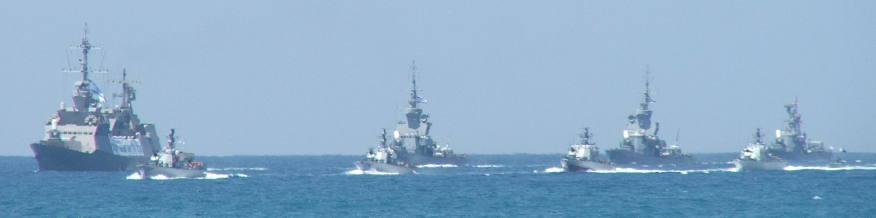
Israeli Super Dvora Mk III gunship intercepts Freedom Flotilla cargo ship The Brotherhood Ship in 2009, forcing it to return to Lebanon.


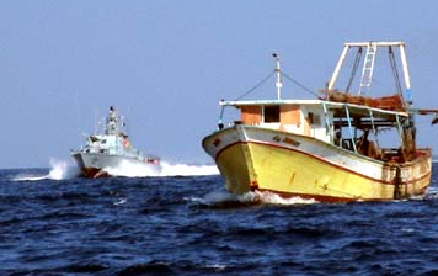
Israeli coastal patrol accosts Palestinian fishing vessels which stray beyond an Israel-imposed six mile fishing limit.


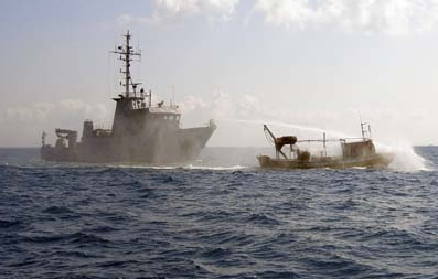
Israeli Dabur class Coastal Patrol Craft sets water hose on Palestinian fishing vessel before making arrests.

It was a Dabur in 2008 which rammed the Free Gaza relief ship Dignity.

Al-Qaeda combat-tourism deluxe pkg?

Combat-tourism has never been more accessible, by simply enlisting with state forces you have a license to hunt in a war zone. Today’s ROE pretty much mean open season. If you can’t make the military commitment, negotiate a contract with a private mercenary firm where the conditions are riskier but the limit on civilians is irrelevant. How long before real adventurers can hire safaris to bag the most coveted trophy according to world-sentiment, a US soldier? Al-Qaeda al-Shmaeda –no need to join a West-hating jihad– I’m talking about embedding with a military contractor who shoots both ways.

Who knows that this doesn’t happen already? Assuming US military affiliated contractors have scruples about which direction their paid bullets fly, those suffering agency oversight can subcontract their authorized black-ops missions, dropping paying-customer Rambos into the field as insurgent terrorists.

Assuming no scruples addresses why hired-guns are reviled in the first place. Neither defending their home, their honor, or a nationalist construct like “Freedom,” mercenaries go to war for the money. If a privateer contracts himself to Big Oil, or corporate whomever, what qualms should he have to serve Joe Blow Adventure-seeker who simply wants to bag some arrogant American Armies of One?

Actually, US casualties serve the war machine more effectively than US victories when you consider the bigger picture.

The scenario is a win-win-win. US corporate partners can charge the Pentagon $1K/day for the manpower, the DoD can expense it in their “surge” development budget, and a combat-tourism subcontractor can charge you for the thrill of pulling the trigger. I can already see the posting on Craigslist or Ebay, a fortnight’s trek with Xe Xtreme LLC, all the GIs you can shoot, we supply the AK47s and RPGs, what am I bid?

For the homicidal veteran dishonorably discharged –we can only wish– longing to get back to the action, for the Dubai bachelor who has everything, for the Great White Hunter who faces too many warrants for poaching endangered predators. These already comprise the mercenary contractor corps. The elite combat enthusiast with something to prove wants to put Kevlar in his cross-hairs. The more invincible the US forces pretend, the higher the allure.

Good news that image is fading.

US inhumanity maxed at Azimuth Limit

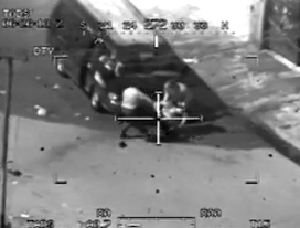
WikiLeaks video combat footage of 2007 collateral murder in Iraq“Light ’em all up. Come on, fire!” Watching the leaked combat footage of the helicopter gunships killing unarmed Iraqi civilians in 2007, I’m troubled by my own desensitized response. When I saw earlier leaked videos of an AH-64 vaporizing Iraqi farmers and a C-130 wreaking mayhem in Afghanistan, I remember my real shock at seeing a human life extinguished. This time not even flinch. “Just fuckin’, once you get on ’em just open ’em up.” Not at the brutality, nor the callousness of the play by play –even as the pilots targeted rescuers trying to help the wounded. I fault the Rules of Engagement that allowed the massacre, not the soldiers’ laughing swagger –as I hope they will not begrudge my unguarded satisfaction when eventually spectators will be treated to leaked footage of American soldiers taking some fire.

If you watched the video, perhaps you too were wishing that July 12, 2007 had recorded a massive setback for US troops in Iraq, at the height of the “surge” where a whole shitload of “dismounts” had been ambushed by IED explosions in a Baghdad square in the aftermath of a civilian massacre. Those who watched the 39-minute extended version I know were hoping to see a resolution like that, instead of an additional war crime of disproportional force and the targeting of civilians, a Hellfire missile attack on a building into which armed and unarmed men had entered, surrounded by passing innocents and rescuers scrambling to help.

There it goes! Look at that bitch go!
Patoosh!
Ah, sweet!
Need a little more room.
Nice missile.
Does it look good?
Sweet!

The Army has declared that no further inquiry will be made into the 2007 killing of the two Reuters journalists. Its FOIA requests long thwarted, even Reuters is not expressing outrage at this footage. Civilians and journalists about to be lit up The corporate media is hoping to let this story fade on the fringe. Does this mean that more pilots and gunners might become emboldened to leak other trophy reels? It doesn’t take Nelson Ratings for news outlets to see that viewers are already clamoring for more combat snuff films.

We could grant amnesty in exchange for those who turn in the most degenerate sequences.

And pretend they’ll remain anonymous. Ultimately friends and relatives will be able to place identities with the radio voices. Speaking on one of the clearest channels is the young voiced HOTEL-26, who reported taking fire from the photographers and ID’d the “RPG” with started the whole engagement. Likewise the gunner on CRAZY HORSE-18 who responded “Alright, hahaha, I hit ’em….” is addressed “God damn it, Kyle.”

And then there’s the poor 30mm gunner in CRAZY HORSE-19 who assessed his work thus:

Oh yeah, look at that. Right through the windshield! Ha ha!

While chomping at the bit to fire upon the improvised ambulance, he was momentarily thwarted by a puzzling “Azimuth Limit” which prevented his shooting.

Bloggers are now abuzz to decode the Azimuth Limit which slowed the turkey shoot when none of the gunners were showing restraint. Azimuth is the angular measurement of an object’s distance clockwise from True North. On rifles it expresses the adjustment of a gunsight to its boresight. On aircraft it apparently has something to do with the angle of relation to the axis of the fuselage. Whatever it is, maybe we can ratchet military Azimuth Limits down flat, if that’s what it will take to stop our soldiers from blowing away civilians, journalists, children and their rescuers alike. The shooters can cuss and salivate all they want so long as their trigger mechanisms respect human life or at least balk at excessive carnage.

What doesn’t come across the audio is what the US soldiers on the ground are saying to themselves as they survey “that big pile of [unarmed] bodies,” in their palaver, the “dead bastards.”

UPDATE — the testimonials begin:

From Iraq war veteran Michael Prysner, co-founder of March Forward!

The harrowing Apache footage released by WikiLeaks gives us a stomach-turning glimpse of war. Seventeen minutes of cold-blooded massacre in a war of more than seven years. A brief clip of one Apache video; a quick look at one part of one mission. Hundreds of those missions take place every day.

The video came to light thanks to military whistleblowers who provided it to WikiLeaks together with supporting documents.  Imagine if we had access to all such videos, the things we would see. Imagine all the Iraqis killed who have no one to uncover the truth about their deaths. Had the death of two Reuters news staffers not generated interest in this video, then the destruction of three families by hellfire missiles fired into an apartment building with no provocation, in a separate engagement also featured in the video, would have never been made public.

This massacre is a drop in a sea of blood. Many other such “incidents” will never be known.

Officers claimed there was “no question” that the pilots were responding to enemy fire; the video shows there is no question that they were not responding to enemy fire. They said that they had “no idea” how the journalists were killed; the video shows that they know very well how those journalists were killed. They were gunned down standing in a crowd of unarmed people.
After the slaughter of that group, the pilots beg for permission to kill the innocent passers-by who had come to the aid of one of the wounded, like any of us would have done if we saw our neighbor dying on the ground as we drove down the street. They kill everyone trying to help the dying journalist, and critically wound two children seen sitting in the front seat.

We see a group of unarmed men mowed down by a machine gun designed to destroy armored vehicles. We see a vanload of good Samaritans obliterated for trying to help a dying victim. We see all this with the soundtrack of the pilots mocking the dead, congratulating each other and laughing about the massacre.

No wonder the U.S. military goes to such great lengths to keep such videos from us. They want us to see Iraq and Afghanistan through their lens, through their embedded reporters, filtered by censorship and restrictions. They know that, once the people of this country see the extreme racism and brutality behind these occupations, they will be repulsed by what their tax dollars are paying for.

The military brass and the White House politicians have tried to justify this senseless atrocity. “Cut the pilots some slack. This was in Baghdad. This was a battle zone”—that’s been their line. The pilots had been indoctrinated with the same colonial mentality. “That’s what they get for bringing their kids into battle,” one pilot says.

The father driving that van was not “bringing his kids into battle.” He was bringing them to school, driving down the street where they live. But the U.S. occupation has made all of Iraq a battle zone. To those pilots, to their commanders over the radio and to the generals in the Pentagon, every single person in Baghdad and in Iraq is “fair game.”

The pilots joked about the people they killed, laughed about U.S. military vehicles running over dead bodies, knowing that their commanders were listening and that they were being recorded. They were not acting out of character. This is the culture of the occupation. This is how these wars are being conducted.

Having seen this, one cannot honestly believe that these atrocities are committed day in and day out for the liberation of the Iraqi people.

The Pentagon’s talking heads and media lackeys are hard at work putting their spin on this story. It’s time to tell the truth. For more than seven years, the U.S. has unleashed criminal, unprovoked aggression against the people of Iraq, and they have been doing the same thing in Afghanistan for more than eight years.

The U.S. military presence in Iraq is a colonial occupation force. The only way forward is a complete, immediate and unconditional withdrawal of all U.S. forces from Iraq and Afghanistan. This government will not do that unless all of us who are outraged by these criminal acts stand up and demand it.

Iraq war veteran Josh Stieber, US Army Specialist, 1st ID, Bravo Company 2-16 in Baghdad (Rustamiyah) 2007-2008. Although he was not present at the scene of the video, he knows those who were involved and is familiar with the environment.

A lot of my friends are in that video. After watching the video, I would definitely say that that is, nine times out of ten, the way things ended up. Killing was following military protocol. It was going along with the rules as they are.

If these videos shock and revolt you, they show the reality of what war is like. If you don’t like what you see in them, it means we should be working harder towards alternatives to war.

?

Yeah look at those dead bastards. Nice.


Here’s the Wikileaks decrypted Apache AH-64 combat footage of 2007 collateral murder of Iraqi civilians including two journalists, wounding two children.

Wikileaks is tweeting the ensuing developments. Democracy Now has interviews recorded the day after July 12, 2007 by Big Noise Films.

We have individuals going to the scene, looks like possibly uh picking up bodies and weapons.

Let me engage.

Roger, hey, we need to stop that.

Can I shoot?

Request permission to engage.

Picking up the wounded?

Yeah, we’re trying to get permission to engage.

Come on, let us shoot!

They’re taking him.

We have a Black SUV err, Bongo Truck picking up the bodies.

Fuck.

Request permission to engage.

Engage.

Transcript from the Full video:

00:03 Okay I got it.
00:05 Last conversation Hotel Two-Six.
00:09 Roger Hotel Two-Six [Apache helicopter 1], uh, [this is] Victor Charlie Alpha. Look, do you want your Hotel Two-Two two el-
00:14 I got a black vehicle under target. It’s arriving right to the north of the mosque.
00:17 Yeah, I would like that. Over.
00:21 Moving south by the mosque dome. Down that road.
00:27 Okay we got a target fifteen coming at you. It’s a guy with a weapon.
00:32 Roger [acknowledged].
00:39 There’s a…
00:42 There’s about, ah, four or five…
00:44 Bushmaster Six [ground control] copy [i hear you] One-Six.
00:48 …this location and there’s more that keep walking by and one of them has a weapon.
00:52 Roger received target fifteen.
00:55 K.
00:57 See all those people standing down there.
01:06 Stay firm. And open the courtyard.
01:09 Yeah roger. I just estimate there’s probably about twenty of them.
01:13 There’s one, yeah.
01:15 Oh yeah.
01:18 I don’t know if that’s a…
01:19 Hey Bushmaster element [ground forces control], copy on the one-six.
01:21 Thats a weapon.
01:22 Yeah.
01:23 Hotel Two-Six; Crazy Horse One-Eight [second Apache helicopter].
01:29 Copy on the one-six, Bushmaster Six-Romeo. Roger.
01:32 Fucking prick.
01:33 Hotel Two-Six this is Crazy Horse One-Eight [communication between chopper 1 and chopper 2]. Have individuals with weapons.
01:41 Yup. He’s got a weapon too.
01:43 Hotel Two-Six; Crazy Horse One-Eight. Have five to six individuals with AK47s [automatic rifles]. Request permission to engage [shoot].
01:51 Roger that. Uh, we have no personnel east of our position. So, uh, you are free to engage. Over.
02:00 All right, we’ll be engaging.
02:02 Roger, go ahead.
02:03 I’m gonna… I cant get ’em now because they’re behind that building.
02:09 Um, hey Bushmaster element…
02:10 Is that an RPG [Rocket Propelled Grenade]?
02:11 All right, we got a guy with an RPG.
02:13 I’m gonna fire.
02:14 Okay.
02:15 No hold on. Lets come around. Behind buildings right now from our point of view. … Okay, we’re gonna come around.
02:19 Hotel Two-Six; have eyes on individual with RPG. Getting ready to fire. We won’t…
02:23 Yeah, we had a guy shoot—and now he’s behind the building.
02:26 God damn it.
02:28 Uh, negative, he was, uh, right in front of the Brad [Bradley Fighting Vehicle; an tracked Armored Personal Carrier that looks like a tank]. Uh, ’bout, there, one o’clock. [direction/orientation]
02:34 Haven’t seen anything since then.
02:36 Just fuckin’, once you get on ’em just open ’em up.
02:38 All right.
02:40 I see your element, uh, got about four Humvees [Armored cars], uh, out along…
02:43 You’re clear.
02:44 All right, firing.
02:47 Let me know when you’ve got them.
02:49 Lets shoot.
02:50 Light ’em all up.
02:52 Come on, fire!
02:57 Keep shoot, keep shoot. [keep shooting]
02:59 keep shoot.
03:02 keep shoot.
03:05 Hotel.. Bushmaster Two-Six, Bushmaster Two-Six, we need to move, time now!
03:10 All right, we just engaged all eight individuals.
03:12 Yeah, we see two birds [helicopters] and we’re still fire [not firing].
03:14 Roger.
03:15 I got ’em.
03:16 Two-six, this is Two-Six, we’re mobile.
03:19 Oops, I’m sorry what was going on?
03:20 God damn it, Kyle.
03:23 All right, hahaha, I hit [shot] ’em…
03:28 Uh, you’re clear.
03:30 All right, I’m just trying to find targets again.
03:38 Bushmaster Six, this is Bushmaster Two-Six.
03:40 Got a bunch of bodies layin’ there.
03:42 All right, we got about, uh, eight individuals.
03:46 Yeah, we got one guy crawling around down there, but, uh, you know, we got, definitely got something.
03:51 We’re shooting some more.
03:52 Roger.
03:56 Hey, you shoot, I’ll talk.
03:57 Hotel Two-Six; Crazyhorse One-Eight.
04:01 Crazyhorse One-Eight; this is Hotel Two-Six. Over.
04:03 Roger. Currently engaging [fighting/shooting at] approximately eight individuals, uh KIA [Killed In Action], uh RPGs, and AK-47s.
04:12 Hotel Two-Six, you need to move to that location once Crazyhorse is done and get pictures. Over.
04:20 Six beacon gaia.
04:24 Sergeant Twenty is the location.
04:28 Hotel Two-Six; Crazyhorse One-Eight.
04:31 Oh, yeah, look at those dead bastards.
04:36 Nice.
04:37 Two-Six; Crazyhorse One-Eight.
04:44 Nice.
04:47 Good shoot.
04:48 Thank you.
04:53 Hotel Two-Six.
04:55 Hotel Two-Six; Crazyhorse One-Eight.
05:03 Crazyhorse One-Eight; Bushmaster Seven. Go ahead.
05:06 Bushmaster Seven; Crazyhorse One-Eight. Uh, location of bodies, Mike Bravo five-four-five-eight eight-six-one-seven [military map grid reference].
05:15 Hey, good on the uh…
05:17 Five-four-five-eight eight-six-one-seven [map grid reference]. Over.
05:21 This is Crazyhorse One-Eight, that’s a good copy. They’re on a street in front of an open, uh, courtyard with a bunch of blue uh trucks, bunch of vehicles in the courtyard.
05:30 There’s one guy moving down there but he’s uh, he’s wounded.
05:35 All right, we’ll let ’em know so they can hurry up and get over here.
05:40 One-Eight, we also have one individual, uh, appears to be wounded trying to crawl away.
05:49 Roger, we’re gonna move down there.
05:51 Roger, we’ll cease fire.
05:54 Yeah, we won’t shoot anymore.
06:01 He’s getting up.
06:02 Maybe he has a weapon down in his hand?
06:04 No, I haven’t seen one yet.
06:07 I see you guys got that guy crawling right now on that curb.
06:08 Yeah, I got him. I put two rounds [30mm cannon shells] near him, and you guys were shooting over there too, so uh we’ll see.
06:14 Yeah, roger that.
06:16 Bushmaster Thirty-Six Element; this is uh Hotel Two-Seven over.
06:21 Hotel Two-Seven; Bushmaster Seven go ahead.
06:24 Roger I’m just trying to make sure you guys have my turf [area], over.
06:31 Roger we got your turf.
06:33 Come on, buddy.
06:38 All you gotta do is pick up a weapon.
06:44 Crazyhorse this is Bushmaster Five, Bushmaster Four break. We are right below you right time now can you walk us onto that location over.
06:54 This is Two-Six roger. I’ll pop flares [drop flares]. We also have one individual moving. We’re looking for weapons. If we see a weapon, we’re gonna engage.
07:07 Yeah Bushmaster, we have a van that’s approaching and picking up the bodies.
07:14 Where’s that van at?
07:15 Right down there by the bodies.
07:16 Okay, yeah.
07:18 Bushmaster; Crazyhorse. We have individuals going to the scene, looks like possibly uh picking up bodies and weapons.
07:25 Let me engage.
07:28 Can I shoot?
07:31 Roger. Break. Uh Crazyhorse One-Eight request permission to uh engage.
07:36 Picking up the wounded?
07:38 Yeah, we’re trying to get permission to engage.
07:41 Come on, let us shoot!
07:44 Bushmaster; Crazyhorse One-Eight.
07:49 They’re taking him.
07:51 Bushmaster; Crazyhorse One-Eight.
07:56 This is Bushmaster Seven, go ahead.
07:59 Roger. We have a black SUV-uh Bongo truck [van] picking up the bodies. Request permission to engage.
08:02 Fuck.
08:06 This is Bushmaster Seven, roger. This is Bushmaster Seven, roger. Engage.
08:12 One-Eight, engage.
08:12 Clear.
08:13 Come on!
08:17 Clear.
08:20 Clear.
08:21 We’re engaging.
08:26 Coming around. Clear.
08:27 Roger. Trying to uh…
08:32 Clear.
08:35 I hear ’em co.. I lost ’em in the dust.
08:36 I got ’em.
08:41 I’m firing.
08:42 This is Bushmaster Forty got any BDA [Battle Damage Assessment] on that truck. Over.
08:44 You’re clear.
08:47 This is ah Crazyhorse. Stand by.
08:47 I can’t shoot for some reason.
08:49 Go ahead.
08:50 I think the van’s disabled.
08:53 Go ahead and shoot it.
08:54 I got an azimuth limit for some reason [gunner moved gunsight too far]
09:00 Go left.
09:03 Clear left.
09:15 All right, Bushmaster Crazyhorse One-Eight.
09:20 A vehicle appears to be disabled.
09:22 There were approximately four to five individuals in vehicle moving bodies.
09:28 Your lead Bradley should take the next right.
09:31 That’s cruising east down the road.
09:34 No more shooting.
09:38 Crazyhorse; this is Bushmaster Four. We’re moving a dismounted element [troops] straight south through the Bradleys [tanks].
09:44 I have your Elem- uh, Bradley element turning south down the road where the engagements were.
09:53 Last call on station’s uh Bradley element say again.
09:56 Roger this is Crazyhorse.
09:58 Your lead Bradley just turned south down the road where all the engagements [shooting] happened.
10:03 Should have a van in the middle of the road with about twelve to fifteen bodies.
10:11 Oh yeah, look at that. Right through the windshield!
10:14 Ha ha!
10:16 All right. There were uh approximately four to five individuals in that truck, so I’m counting about twelve to fifteen.
10:24 I would say that’s a fairly accurate assessment so far.
10:27 Roger that.
10:29 I want to just be advised Six, Bushmaster Six are getting mounted up right now.
10:35 Okay, roger. Hey, we can’t flex down that road towards that, uh, where Crazyhorse engaged.
10:43 So, uh, I don’t know if you want us to do so or stay put. Over.
10:46 Why can’t they go down there?
10:56 I think we whacked [killed] ’em all.
10:58 That’s right, good.
10:59 This is Hotel Two-Six.
11:03 Hey you got my dismounted element [troops] right there over to your left.
11:06 Roger, I see ’em.
11:11 Hey yeah, roger, be advised, there were some guys popping out with AKs behind that dirt pile break.
11:19 We also took some RPGs off, uh, earlier, so just uh make sure your men keep your eyes open.
11:26 Roger.
11:27 And, uh, Bushmaster ahead are, uh, Hotel Two-Six; Crazyhorse One-Eight.
11:33 Crazyhorse One-Eight; this is Hotel Two-Six.
11:35 Yeah Two-Six; Crazyhorse One-Eight.
11:37 Uh, location I have about twelve to fifteen dead bodies.
11:42 Uh, where else are we taking fire from?
11:48 Currently we’re not being engaged, ah, but just south of that location. Break.
11:55 You should see dismounted elements with Humvees [armored cars] moving to the east, over.
12:01 This is Crazyhorse One-Eight; we have elements in sight.
12:05 Bushmaster Three-Six.
12:07 I’m gonna get down a little lower.
12:09 All right.
12:10 I’m gonna come down a little lower and take a quick gander.
12:13 Roger that.
12:14 Six; this is four. We’re headed to the area where Crazyhorse engaged.
12:26 Bushmaster Six; this is Hotel Two-Six.
12:28 Request to go to the south to our original BP so if you flushed them to the south we will be there to uh intercept over.
12:39 Hey this is Bushmaster Seven; we’re coming up on B… on the ass end of the Brads [tanks].
12:54 Hey uh, Bushmaster Element; this is Copperhead One-Six break.
13:00 We’re moving in the vicinity of the engagement area and looks like we’ve got some slight movement from ah, the ah van that was engaged.
13:06 Looks like a kid. Over.
13:11 This is Bushmaster Seven, roger. Uh, we’re about a hundred meters behind you.
13:16 Got that big pile, to the right?
13:18 Roger, you gonna pull in here? Do you want me to push stuff so you can, uh, get clear of it?
13:21 Right on the corner?
13:22 What’s that?
13:23 Got that big pile of bodies to the right, on the corner?
13:24 Yeah, right here.
13:25 We got a dismounted infantry and vehicles, over.
13:30 Again, roger.
13:31 And clear.
13:48 There’s the Bradley right there.
13:51 Got ’em.
14:00 Hotel two-six; are you uh at this grid over?
14:05 Yeah I wanted to get you around so didn’t you just get that one dude to scare them all away. It worked out pretty good.
14:11 I didn’t want those fuckers to run away and scatter.
14:12 Yeah.
14:15 Bushmaster Six; Hotel Two-Six. Roger, we linked up with our two element they are all mounted up in our trucks break.
14:23 We moved south so that we could ah possibly intercept personnel being flushed south. So we are vicinity Fifth Street.
14:30 And ah please line Gadins. Over.
14:37 Bring the trucks in, cordon this area off.
14:39 Can we move the Bradley forward so we can bring trucks in and cordon off this area.
14:44 If the Bradleys could take the south cordon, that could help out a lot.
14:53 Bushmaster or element. Which Element called in Crazyhorse to engage the eight-elem- eight-men team on top of a roof.
15:02 Bushmaster Six; this is Hotel Two-Six. Uh, I believe that was me.
15:07 They uh had AK-47s and were to our east, so, where we were taking small arms fire. Over.
15:20 Hotel Crazyhorse One-Eight.
15:26 Crazyhorse One-Eight; this is Hotel Two-Six.
15:28 Yeah Two-Six. One-Eight I just also wanted to make sure you knew that we had a guy with an RPG cropping round the corner getting ready to fire on your location.
15:36 That’s why we ah, requested permission to engage.
15:40 Ok, roger that. Tango mike.
15:46 Hotel Two-Six; do you understand me, over?
15:51 I did not copy last, uh, you got stepped on. Say again please?
16:00 They cordoned off the building that the helicopters killed the personnel on.
16:04 Don’t go anywhere else we need to cordon off that building so we can get on top of the roof and SSC the building. Over.
16:13 Hotel Two-Six; Crazyhorse One-Eight.
16:16 This is Hotel Two-Six.
16:19 Hey, whoever was talking about rooftops, know that all the personnel we engaged were ground level. I say again ground level.
16:27 Roger I copy ground level. Over.
16:30 One-Eight roger.
16:33 Can I get a grid to that one more time please?
16:36 Target twenty.
16:36 Roger.
16:40 You want me to take over talking to them?
16:42 S’alright.
16:46 Seven-Six Romeo Over.
16:49 Roger, I’ve got uh eleven Iraqi KIAs [Killed In Action]. One small child wounded. Over.
16:57 Roger. Ah damn. Oh well.
17:04 Roger, we need, we need a uh to evac [evacuate] this child. Ah, she’s got a uh, she’s got a wound to the belly.
17:10 I can’t do anything here. She needs to get evaced. Over.
17:18 Bushmaster Seven, Bushmaster Seven; this is Bushmaster Six Romeo.
17:20 We need your location over.
17:25 Roger, we’re at the location where Crazyhorse engaged the RPG fire break.
17:37 Grid five-four-five-eight.
17:46 Well it’s their fault for bringing their kids into a battle.
17:48 That’s right.
17:56 Got uh, eleven.
18:01 Yeah uh, roger. We’re monitoring [observing].
18:02 Sorry.
18:04 No problem.
18:07 Correction eight-six-one-six.
18:16 Looking for more individuals-south.
18:18 Bushmaster Six-Bushmaster Seven.
18:29 I think they just drove over a body.
18:31 Hey hey!
18:32 Yeah!
18:37 Maybe it was just a visual illusion, but it looked like it.
18:41 Well, they’re dead, so.
18:44 Bushmaster Six; Hotel Two-Six over.
18:56 Six; this is Four. I got one individual looks like he’s got an RPG round laying underneath him. Break.
19:05 Probably like to get…
19:10 Look at that.
19:12 Bushmaster Six; Hotel Two-Six over.
19:29 Bushmaster Six; Romeo Hotel Two-Six over.
19:44 Bushmaster Six; Hotel Two-Six over.
19:56 Hotel Two-Six; Bushmaster Seven colocated with Six.
20:08 Hotel Two-Six; Bushmaster Seven.
20:10 Bushmaster Seven; Hotel Two-Six over.
20:14 Roger, we got a little girl who needs to be evaced. What’s your location over?
20:22 On route Gadins, I am all the way to the south. So I am Gadins and Fifth Street.
20:28 I say again Gadins and Fifth Street, over.
20:40 Bushmaster Seven; Hotel Two-Six. Do you want us to push to your location?
20:55 Hey, uh, I need to get the Brads to drop rads I got a wounded little girl we need to take her off the maya.
21:04 Bushmaster Seven; Hotel Two-Six. Do you want us to move to your location over?
21:30 Bushmaster Six; Hotel Two-Six over.
21:34 Hotel Two-Six; this is Bushmaster Seven. Roger, come to our location.
21:39 Okay, roger, we’re coming up north on Gadins and then we will push east to your location.
22:06 Bushmaster elements be advised we have friendlies coming from the south to your location. Over.
22:13 All right, got ’em moving up from the south.
22:35 Bushmaster elements be advised we are coming up from the east.
23:49 Hey One-Two; follow me over. I’m going to try and get out of here as quickly as possible.
24:10 You guys all right back there?
24:13 Yeah, we’re with you.
24:35 Lotta guys down there.
24:37 Oh yeah.
24:37 Came out of the woodwork.
24:38 This is Operation, ah, Operation Secure.
25:16 Yeah we have fifty rounds left.
25:17 Yep.
25:19 Two-Six; Six Romeo over.
25:21 Two-Six; Romeo over.
25:23 Hey roger, what’s your current location over?
25:47 Six; speak it’s Romeo.
25:50 Three-Six Romeo; Six Romeo over.
25:52 Roger, at the six once it’s back on this guy.
25:56 Lost him.
26:00 What’s he got for us?
26:01 Stand by.
26:06 Hotel Two-Six; Crazyhorse One-Eight.
26:21 Hey, did you got action on that target yet over?
26:25 Speak to Charlie roger.
26:32 Hotel Two-Six; Crazyhorse One-Eight.
26:55 Bushmaster Six; Crazyhorse One-Eight.
26:59 Roger, you have traffic over.
27:02 Roger. Uh, just wondering if you had anything else you wanted us to drive on?
27:08 Yeah roger keep on, ah, for the time being over.
27:11 Six calls Six Romeo. Can you tell battalion that two civilian children casualties are coming back to SMI in the Bradley over.
27:26 Six calls Six Romeo.
27:29 Bushmaster Six Copper White Six.
27:32 Copperhead White Six; this is Bushmaster Six Romeo over.
27:36 Roger, that’s a negative on the evac of the two, ah, civilian, ah, kids to, ah, rusty they’re going to have the IPs [Iraqi Police] link up. They can put us over here. Break. IPs will take them up to a local hospital over.
27:50 Copy over.
27:54 One six oh.
28:08 … they’re all going to.
28:10 Say again?
28:12 Where all those dismounts [infantry] are going to?
28:18 Going into this hous-. Sorry
29:29 Three Six, Three Six; Bushmaster Six Romeo over.
29:37 Six Romeo, Six Romeo.
29:39 Roger, Bushmaster Seven wants an up on all personnel in your battalion over.
29:44 Roger.
30:08 …friendlies [US troops] on the roof.
30:10 Crazyhorse One-Eight; this is Bushmaster Four over.
30:12 Bushmaster Four; this is Crazyhorse One-Eight.
30:15 Roger, I can ah hear small arms fire from your engagement area at two zero zero zero ah about three hundred meters from that objective over.
30:27 Crazyhorse; from what I understand small arms fire at two zero zero zero degrees about two hundred meters.
30:39 Just to the southwest.
30:41 Yup.
30:49 Right about where we engaged.
30:51 Yeah, One of them with that RPG or whatever.
30:55 He’s got a weapon. Got an RK–AK 47.
30:58 Hotel Two-Six; Crazyhorse One-Eight.
31:02 Gonna lose him.
31:03 Crazyhorse One-Eight this is Hotel Two-Six over.
31:08 Roger, have another individual with a weapon.
31:10 Dammit, they’re in the same building.
31:12 Hey roger that, just make sure that ah, you’re firing from west to east over.
31:16 Just went in the building.
31:18 Crazyhorse Three and Four will be on their way.
31:21 The individual walked into the building previously past grid [map reference]. So there’s at least six individuals in that building with weapons.
31:30 We can put a missile in it.
31:31 If you’d like, ah, Crazyhorse One-Eight could put a missile in that building.
31:46 It’s a triangle building. Appears to be ah, abandoned.
31:51 Yeah, looks like it’s under construction, abandoned.
31:52 Appears to be abandoned, under construction.
31:56 Uh, like I said, six individuals walked in there from our previous engagement.
32:01 Crazyhorse One-Eight; this is Bushmaster Six Romeo. If you’ve PIDed [Positively IDentified] the individuals in the building with weapons, go ahead and engage the building over.
32:08 Crazyhorse One-Eight; will be coming up north to south engaging with Hellfire [missiles].
32:13 All right, I’m going to do manual.
32:17 All right, we’ve been cleared to engage with…
32:18 This is Bushmaster Six Romeo. Crazyhorse One Eight is going to be engaging north to south with Hellfire missiles over.
32:24 This is Hotel Two-Six. Roger.
32:26 All right, you ready?
32:27 No, I’m trying to get over to the November [target]. Trying to find the fucking…
32:33 This is Bushmaster Six. Has that RPG round been extended already or is it still live, over.
32:38 Looks live to me.
32:40 Let me know when you’re going to fire.
32:44 All right, I’m fucking having a brain fart. Where’s the man [manual] advancement?
32:48 You got one on the clutch on the bottom left on your left door.
32:54 Roger let me stand by.
32:57 Got it?
32:59 No.
33:03 All right.
33:09 Let me just put a kilo [Hellfire missile] in there.
33:12 Ok.
33:15 Got it?
33:21 Put a kilo in?
33:22 All right, let me get back.
33:26 I’m gonna come around, get some more distance.
33:27 Roger that, you’re clear.
33:33 Got more individuals in there.
33:36 You wanna hit from north to south or you wanna go from west to east? I don’t wanna fire with the friendlies [US forces] right there, you know.
33:41 Yeah, go north to south.
33:53 Right, come around, right.
33:56 I’m just gonna put one or two in, if they want any more.
34:09 Right.
34:12 Found the missile.
34:15 Roger, I’ll get you in this straight.
34:16 You’re clear.
34:17 I’m firing.
34:26 Target hit.
34:28 It was a missile.
34:29 Left.
34:32 You’re clear. I’m above you.
34:36 Crazyhorse One-Eight; was that explosion you engaging over?
34:38 Crazyhorse One Eight, roger. Engaging building with one hellfire.
34:46 Let’s come around and we’ll clear the smoke. We’ll fire one more.
34:50 Hey uh, we’re going to wait for the smoke to clear.
34:52 Yes Crazyhorse One Eight now. We’re going to put one more missile into the building.
34:57 Yeah, did it ah, go in the building? I see the wall knocked out of the way.
34:59 Yeah, it went in.
35:01 Bushmaster Six Romeo; this is Hotel Two-Six. Yeah roger, that was Crazyhorse engaging with one Hellfire over.
35:10 Yeah roger, I got a November [target] if you want.
35:12 Fire away.
35:13 You want us to fire?
35:18 You ready?
35:19 Yep.
35:20 Bushmaster Six Romeo. They are going to engage ah, with one more Hellfire in that building.
35:24 Uh shit, why I do I have AP flashing on there? [warning on helicopter display]
35:47 We’re not even going to watch this fucking shit?
35:49 Till next one. It won’t come around, I need a little more distance.
35:53 Still want me to shoot?
35:57 You guys, following hot.
35:59 Roger.
36:13 You are clear.
36:14 Roger.
36:16 You going to bring up the missile?
36:18 Roger.
36:19 And firing.
36:20 Come down? There you go.
36:23 Fire.
36:24 All right.
36:28 I’ve got, ah BACKSCATTER [warning on helicopter display].
36:30 All right, come around.
36:32 Roger.
36:34 Coming around left, backscatter.
36:49 Firing.
36:53 There it goes! Look at that bitch go!
36:56 Patoosh!
37:03 Ah, sweet.
37:07 Need a little more room.
37:09 Nice missile.
37:11 Does it look good?
37:12 Sweet!
37:16 Uh, you ready?
37:18 Roger.
37:30 There’s a lot of dust.
37:36 Crazyhorse One-Eight; this is Hotel Two-Six. Was there a BDA [Battle Damage Assessment]?
37:40 This is Crazyhorse One-Eight. Stand by, engaging with another Hellfire.
37:43 All right.
37:45 You’re clear.
37:47 Lemme know when I’m clear.
37:50 Roger that.
37:59 He wasn’t.
38:02 Hotel Two-Six; Crazyhorse One-Eight.
38:07 Crazyhorse One-Eight.
38:09 Roger, building destroyed. Engaged with three hellfire missiles.

Ojore Nuru Lutalo, aka Leroy Bunting arrested with Anarchist literature

Anarchist Ojore Nuru LutaloFormer political prisoner Ojore Nuru Lutalo, ne Leroy Bunting, was pulled off an Amtrak train in La Junta, Colorado, for scaring fellow passengers with his cell phone conversation. The FBI’s Colorado Springs Joint Terrorism Task Force was alerted about the 64 year-old armed with anarchist literature from the “Afrikan Liberation Army” (sic) which he had obtained while speaking at the LA Anarchist Book Fair for the Anarchist Black Cross, a prison rights organization. Just yesterday I listened to a local law enforcement type defend the 2nd Amendment, the right to bear arms, by suggesting that if we substituted “books” for guns, no one would think to regulate them. His compatriots seem to have confused the argument by charging the former Black Liberation Army member for “endangering public transportation” with what they called terrorist recruiting propaganda.

Journal Turning the TideAccording to the Pueblo Chieftain, police found “a large amount of propaganda recruiting materials from the Afrikan Liberation Army, including photos of President Barack Obama and other items that raised suspicions.”

Break the Chains reports that Ojore was released Yesterday, and will return to the Otero District Court for an appearance February 5th, the charge now “Interfering with Public Transportation.”

How absolutely disingenuous to misquote the source of the so-called Anarchist literature, seeing as reportedly there was so much of it. This is the usual media disinfo to prevent giving the causes visibility. The Pueblo Chieftain has obtained the affidavit of the arrest, which should list the items found on Ojore. Until that’s made available, we can search online for what he was likely carrying. Our bet, they don’t want to call attention to the New Afrikan Liberation Front (NALF).

Here’s a list of the exhibitors at the 2nd Anarchist Book Fair:

Anarchist type brochuresSemiotext(e)
www.semiotexte.com
Earth First Journal
www.earthfirstjournal.org
Taala Hooghan: Infoshop & Youth Media Arts Center
www.taalahooghan.org
Modesto Anarcho
www.modestoanarcho.org
South Central Farmers
www.southcentralfarmers.com
Skylight Books
www.skylightbooks.com
Institute for Anarchist Studies
www.anarchist-studies.org
Critical Resistance
www.criticalresistance.org
Las Vegas Alliance of the Libertarian Left sonv.libertarianleft.org
Catholic Worker
www.lacatholicworker.org
Anti-Racist Action/Turning the Tide
www.antiracistaction.us
Anarchist Black Cross Federation L.A. www.abcf.net/la
PM press
www.pmpress.org
Microcosom Publishing
www.microcosmpublishing.com
AK press
www.akpress.org
Little black cart
www.littleblackcart.com
Make/Shift magazine
www.makeshiftmag.com
Journal of aesthetics and protest
www.journalofaestheticsandprotest.org
R.A.C. : Revolutionary Autonomous Communities
www.revolutionaryautonomouscommunities.blogspot.com
I.W.W
www.iww.org

Then there is also the Southside ABCF zine collection, the Crossroad Newletter, and the publications of the Spear and Shield. Here’s the New Afrikan Declaration of Independence, as printed on Prairie Fire:

“New Afrikan Declaration of Independence”

WE, New Afrikan People in America, in consequence of arriving at a knowledge of ourselves as a people with dignity, long deprived of that knowledge; as a consequence of revolting with every decimal of our collective and individual beings against the oppression that for three hundred years has destroyed and broken and warped the bodies and minds and spirits of our people in America, in consequence of our raging desire to be free of this oppression, to destroy this oppression wherever it assaults humankind in the world, and in consequence of inextinguishable determination to go a different way, to build a new and better world, do hereby declare ourselves forever free and independent of the jurisdiction of the United State of America and the obligations which that country¹s unilateral decision to make our ancestors and ourselves paper-citizens placed on us.

We claim no rights from the United States of America other than those rights belonging to human beings anywhere in the world, and these include the right to damages, reparations, due us from the grievous injuries sustained by our ancestors and ourselves by reason of United States lawlessness.

Ours is a revolution against oppression–our own oppression and that of all people in the world. And it is a revolution for a better life, a better station for all, a surer harmony with the forces of life in the universe. We therefore see these aims as the aims of our revolution:

    • To free black people in America from oppression;
  • To support and wage the world revolution until all people everywhere are so free;
  • To build a new Society that is better than what We now know and as perfect as We can make it;
  • To assure all people in the New Society maximum opportunity and equal access to that maximum;
  • To promote industriousness, responsibility, scholarship, and service;
  • To create conditions in which freedom of religion abounds and the pursuit of God and/or destiny, place and purpose of humankind in the Universe will be without hindrance;
  • To build a Black independent nation where no sect or religious creed subverts or impedes the building of the New Society, the New State Government, or achievement of the Aims of the Revolution as set forth in this Declaration;
  • To end exploitation of human beings by each other or the environment;
  • To assure equality of rights for the sexes;
  • To end color and class discrimination, while not abolishing salubrious diversity, and to promote self-respect and mutual understanding among all people in the society;
  • To protect and promote the personal dignity and integrity of the individual, and his or her natural rights;
  • To place the major means of production and trade in the trust of the state to assure the benefits of this earth and our genius and labor to society and all its members, and
  • To encourage and reward the individual for hard work and initiative and insight and devotion to the Revolution.

In mutual trust and great expectation, We the undersigned, for ourselves and for those who look to us but are unable personally to affix their signatures hereto, do join in this solemn Declaration of Independence, and to support this Declaration and to assure the success of the Revolution, We pledge without reservation ourselves, our talents, and all our worldly goods.

Or the creed:

“New Afrikan Creed”

1. i believe in the spirituality, humanity and genius of Black people, and in our new pursuit of these values.

2. i believe in the family and the community, and in the community as a family, and i will work to make this concept live.

3. i believe in the community as more important than the individual.

4. i believe in constant struggle for freedom, to end oppression and build a better world. i believe in collective struggle; in fashioning victory in concert with my brothers and sisters.

5. i believe that the fundamental reason our oppression continues is that We, as a people, lack the power to control our lives.

6. i believe that fundamental way to gain that power, and end oppression, is to build a sovereign Black nation.

7. i believe that all the land in America, upon which We have lived for a long time, which We have worked and built upon, and which We have fought to stay on, is land that belongs to us as a people.

8. i believe in the Malcolm X Doctrine: that We must organize upon this land, and hold a plebiscite, to tell the world by a vote that We are free and our land independent, and that, after the vote, We must stand ready to defend ourselves, establishing the nation beyond contradiction.

9. Therefore, i pledge to struggle without cease, until We have won sovereignty. i pledge to struggle without fail until We have built a better condition than the world has yet known.

10. i will give my life, if that is necessary; i will give my time, my mind, my strength, and my wealth because this IS necessary.

11. i will follow my chosen leaders and help them.

12. i will love my brothers and sisters as myself.

13. i will steal nothing from a brother or sister, cheat no brother or sister, misuse no brother or sister, inform on no brother or sister, and spread no gossip.

14. i will keep myself clean in body, dress and speech, knowing that i am a light set on a hill, a true representative of what We are building.

15. i will be patient and uplifting with the deaf, dumb and blind, and i will seek by word and deed to heal the Black family, to bring into the Movement and into the Community mothers and fathers, brothers and sisters left by the wayside.

Now, freely and of my own will, i pledge this Creed, for the sake of freedom for my people and a better world, on pain of disgrace and banishment if i prove false. For, i am no longer deaf, dumb or blind. i am, by inspiration of the ancestors and grace of the Creator — a New Afrikan.

PPJPC pair returns from GFM. NBD?

GFM
The Colorado Springs peace envoys to the 2009 Gaza Freedom March in Palestine flew back to town last week with absolutely no fanfare, no media reception, no press releases, no coordination by organizers to make an event of their attempted peace mission. They will report on their adventure to the PPJPC at the end of January, but that’s the extent of what those who contributed funds to the project will get for their money.

It’s a furious criticism I maintain against the local Justice and Peace group. They have a paid staff, yet that staff won’t handle press releases nor promote actions. The best they can do is answer when the TV reporters call, to explain the little they know, and throw confusion into the actions of others. It’s despicable, and the sooner the donors and members figure out their best efforts are being sabotaged from within, the sooner that organization can get back on the ball.

Here they had a delegation to Egypt, part of a well planned action to bring attention to Gaza, and the staff can’t even promote it here. Elsewhere travelers coming and going gave interviews as part of events. When they raised funds to do it, I’m sure the benefactors had in mind that the money would go to more than providing a vacation, or pilgrimage, for two to the holy land.

Of course, the Gaza march didn’t build to critical mass, despite the convergence of 1,400 activists on Cairo. The anticipated climactic march through Gaza didn’t gel and thus the media spotlight couldn’t be drawn the way organizers had hoped, irresistible in spite of the blackout imposed by Israeli interests. Even the Viva Palestina aid convoy didn’t get media attention, even with the riveting confrontations and ultimate riot. That procession of predominantly European activists did ultimately reach the Gazans, but still the coverage was throttled.

Who knows what success the march might have found, if it had been permitted to leave Cairo. But the action’s only hope was to pressure the Egyptian government with the strength of all the internationals demonstrating in the streets. The many activists who struck out on their own didn’t help that effort a lick. They justified their decisions based on seeking out compromises to accomplish good, to pursue their own individual aid projects, instead of sticking to the GFM and no guarantee of success. The the goal of bringing public pressure was not helped by the PPJPC ambassadors who opted against team-playing.

Who am I to judge? It’s easy to see where the do-good in small steps can lead. For example, I’m certain that the same ethos would justify rescuing an inmate from Gaza, one by one, if circumstances permitted. No doubt it would be counted a miracle of one by one, all the Gazans were granted asylum somewhere far from the reaches of the IDF guns. In total, however, that would accomplish Israel’s goal, wouldn’t it? Pacifism goes hand in iron glove with tyranny. The Gazans needed unity from the freedom marchers, not peace tourists sneaking around doing quiet good deeds like sponging Christ’s wounds.

A 1930 Spirit of Christmas Past

Black Agenda Report revisited this Christmas poem by Langston Hughes:

“Merry Christmas”: Published in New Masses (Dec. 1930), p. 4.

Merry Christmas, China,
From the gun-boats in the river,
Ten-inch shells for Christmas gifts,
And peace on earth forever.

Merry Christmas, India,
To Gandhi in his cell,
From righteous Christian England,
Ring out, bright Christmas bell!

Ring Merry Christmas, Africa,
From Cairo to the Cape!
Ring Hallehuiah! Praise the Lord!
(For murder and for rape.)

Ring Merry Christmas, Haiti!
(And drown the voodoo drums—
We’ll rob you to the Christian hymns
Until the next Christ comes

Ring Merry Christmas, Cuba!
(While Yankee domination
Keeps a nice fat president
In a little half-starved nation.)

And to you down-and-outers,
(“Due to economic laws”)
Oh, eat, drink, and be merry
With a bread-line Santa Claus—

While all the world hails Christmas,
While all the church bells sway!
While, better still, the Christian guns
Proclaim this joyous day!

While holy steel that makes us strong
Spits forth a mighty Yuletide song:
SHOOT Merry Christmas everywhere!
Let Merry Christmas GAS the air!

We Are United For a Peaceful Obama

Come to Acacia Park, TUESDAY, 5PM
ACACIA PARK, 5PM- COLORADANS FOR PEACE are not alone urging President Obama to escalate his attention to the antiwar mandate given him by the American voters. Michael Moore & Keith Olbermann have made eleventh hour pleas, and the nation’s prominent antiwar activists signed a collective letter to President Obama (see below). Here are the national organizations taking to the streets tomorrow:

United Against Afghan Escalation, Women Say No To War (Code Pink), No Escalation in Afghanistan (UFPJ), Veterans Oppose Troop Build-up (IVAW), US Labor Against War, A.N.S.W.E.R., Stop the Escalation (World Can’t Wait), American Friends Service Committee (AFSC), Just Foreign Policy, Pax Christi USA, Peace Action, Progressive Democrats of America, The Peace and Justice Resource Center and Voters for Peace.

The letter composed by the National Assembly:

President Barack Obama?
The White House?Washington, D.C.
November 30, 2009

Dear President Obama,
With millions of U.S. people feeling the fear and desperation of no longer having a home; with millions feeling the terror and loss of dignity that comes with unemployment; with millions of our children slipping further into poverty and hunger, your decision to deploy thousands more troops and throw hundreds of billions more dollars into prolonging the profoundly tragic war in Afghanistan strikes us as utter folly. We believe this decision represents a war against ordinary people, both here in the United States and in Afghanistan.  The war in Afghanistan, if continued, will result in the deaths of hundreds if not thousands of U.S. troops, and untold thousands of Afghans.

Polls indicate that a majority of those who labored with so much hope to elect you as president now fear that you will make a wrong decision — a tragic decision that will destroy their dreams for America. More tragic is the price of your decision. It will be paid with the blood, suffering and broken hearts of our young troops, their loved ones and an even greater number of Afghan men, women and children.

The U.S. military claims that this war must be fought to protect U.S. national security, but we believe it is being waged to expand U.S. empire in the interests of oil and pipeline companies.

Your decision to escalate U.S. troops and continue the occupation will cause other people in other lands to despise the U.S. as a menacing military power that violates international law. Keep in mind that to most of the peoples of the world, widening the war in Afghanistan will look exactly like what it is: the world’s richest nation making war on one of the world’s very poorest.

The war must be ended now. Humanitarian aid programs should address the deep poverty that has always been a part of the life of Afghan people.

We will keep opposing this war in every nonviolent way possible. We will urge elected representatives to cut all funding for war. Some of us will be led to withhold our taxes, practice civil resistance, and promote slowdowns and strikes at schools and workplaces.

In short, President Obama, we will do everything in our power, as nonviolent peace activists, to build the kind of massive movement –which today represents the sentiments of a majority of the American people–that will play a key role in ending U.S. war in Afghanistan.

Such would be the folly of a decision to escalate troop deployment and such is the depth of our opposition to the death and suffering it would cause.

Sincerely, (Signers names listed in alphabetical order)

Jack Amoureux, Executive Committee
Military Families Speak Out

Michael Baxter
Catholic Peace Fellowship

Medea Benjamin, Co-founder
Global Exchange

Frida Berrigan
Witness Against Torture

Elaine Brower
World Can’t Wait

Leslie Cagan, Co-Founder
United for Peace and Justice

Tom Cornell
Catholic Peace Fellowship

Matt Daloisio
War Resisters League

Marie Dennis, Director
Maryknoll Office for Global Concerns

Robby Diesu
Our Spring Break

Pat Elder, Co-coordinator
National Network Opposing Militarization of Youth

Mike Ferner, President
Veterans For Peace

Joy First, Convener
National Campaign for Nonviolent Resistance

Sara Flounders, Co-Director
International Action Center

Sunil Freeman
ANSWER Coalition, Washington, D.C.

Diana Gibson, Coordinator
Multifaith Voices for Peace and Justice

Jerry Gordon, Co-Coordinator
National Assembly To End Iraq and Afghanistan Wars and Occupation

Rabbi Lynn Gottlieb
Shomer Shalom Network for Jewish Nonviolence

David Hartsough
Peaceworkers San Francisco

Mike Hearington, Steering Committee
Georgia Peace and Justice Coalition, Atlanta

Larry Holmes, Coordinator
Troops Out Now Coalition

Mark C. Johnson, Ph.D., Executive Director
Fellowship of Reconciliation

Hany Khalil
War Times

Kathy Kelly, Co-Coordinator
Voices for Creative Nonviolence

Leslie Kielson , Co-Chair
United for Peace and Justice

Malachy Kilbride
National Campaign for Nonviolent Resistance

Adele Kubein, Executive Committee
Military Families Speak Out

Jeff Mackler, Co-Coordinator
National Assembly to End Iraq and Afghanistan Wars and Occupations

Imam Abdul Malik Mujahid, Chair-Elect
World Parliament of Religion

Michael T. McPhearson, Executive Director
Veterans For Peace

Gael Murphy, Co-founder
Code Pink

Michael Nagler, Founder
Metta Center for Nonviolence

Max Obuszewski, Director
Baltimore Nonviolence Center

Pete Perry
Peace of the Action

Dave Robinson, Executive
Director Pax Christi USA

Terry Rockefeller
September 11th Families For Peaceful Tomorrows

Samina Sundas, Founding Executive Director
American Muslim Voice

David Swanson
AfterDowningStreet.org

Carmen Trotta
Catholic Worker

Nancy Tsou, Coordinator
Rockland Coalition for Peace and Justice

Kevin Zeese
Voters for Peace

And Michael Moore’s letter:

An Open Letter to President Obama from Michael Moore

Monday, November 30th, 2009

Dear President Obama,

Do you really want to be the new “war president”? If you go to West Point tomorrow night (Tuesday, 8pm) and announce that you are increasing, rather than withdrawing, the troops in Afghanistan, you are the new war president. Pure and simple. And with that you will do the worst possible thing you could do — destroy the hopes and dreams so many millions have placed in you. With just one speech tomorrow night you will turn a multitude of young people who were the backbone of your campaign into disillusioned cynics. You will teach them what they’ve always heard is true — that all politicians are alike. I simply can’t believe you’re about to do what they say you are going to do. Please say it isn’t so.

It is not your job to do what the generals tell you to do. We are a civilian-run government. WE tell the Joint Chiefs what to do, not the other way around. That’s the way General Washington insisted it must be. That’s what President Truman told General MacArthur when MacArthur wanted to invade China. “You’re fired!,” said Truman, and that was that. And you should have fired Gen. McChrystal when he went to the press to preempt you, telling the press what YOU had to do. Let me be blunt: We love our kids in the armed services, but we f*#&in’ hate these generals, from Westmoreland in Vietnam to, yes, even Colin Powell for lying to the UN with his made-up drawings of WMD (he has since sought redemption).

So now you feel backed into a corner. 30 years ago this past Thursday (Thanksgiving) the Soviet generals had a cool idea — “Let’s invade Afghanistan!” Well, that turned out to be the final nail in the USSR coffin.

There’s a reason they don’t call Afghanistan the “Garden State” (though they probably should, seeing how the corrupt President Karzai, whom we back, has his brother in the heroin trade raising poppies). Afghanistan’s nickname is the “Graveyard of Empires.” If you don’t believe it, give the British a call. I’d have you call Genghis Khan but I lost his number. I do have Gorbachev’s number though. It’s + 41 22 789 1662. I’m sure he could give you an earful about the historic blunder you’re about to commit.

With our economic collapse still in full swing and our precious young men and women being sacrificed on the altar of arrogance and greed, the breakdown of this great civilization we call America will head, full throttle, into oblivion if you become the “war president.” Empires never think the end is near, until the end is here. Empires think that more evil will force the heathens to toe the line — and yet it never works. The heathens usually tear them to shreds.

Choose carefully, President Obama. You of all people know that it doesn’t have to be this way. You still have a few hours to listen to your heart, and your own clear thinking. You know that nothing good can come from sending more troops halfway around the world to a place neither you nor they understand, to achieve an objective that neither you nor they understand, in a country that does not want us there. You can feel it in your bones.

I know you know that there are LESS than a hundred al-Qaeda left in Afghanistan! A hundred thousand troops trying to crush a hundred guys living in caves? Are you serious? Have you drunk Bush’s Kool-Aid? I refuse to believe it.

Your potential decision to expand the war (while saying that you’re doing it so you can “end the war”) will do more to set your legacy in stone than any of the great things you’ve said and done in your first year. One more throwing a bone from you to the Republicans and the coalition of the hopeful and the hopeless may be gone — and this nation will be back in the hands of the haters quicker than you can shout “tea bag!”

Choose carefully, Mr. President. Your corporate backers are going to abandon you as soon as it is clear you are a one-term president and that the nation will be safely back in the hands of the usual idiots who do their bidding. That could be Wednesday morning.

We the people still love you. We the people still have a sliver of hope. But we the people can’t take it anymore. We can’t take your caving in, over and over, when we elected you by a big, wide margin of millions to get in there and get the job done. What part of “landslide victory” don’t you understand?

Don’t be deceived into thinking that sending a few more troops into Afghanistan will make a difference, or earn you the respect of the haters. They will not stop until this country is torn asunder and every last dollar is extracted from the poor and soon-to-be poor. You could send a million troops over there and the crazy Right still wouldn’t be happy. You would still be the victim of their incessant venom on hate radio and television because no matter what you do, you can’t change the one thing about yourself that sends them over the edge.

The haters were not the ones who elected you, and they can’t be won over by abandoning the rest of us.

President Obama, it’s time to come home. Ask your neighbors in Chicago and the parents of the young men and women doing the fighting and dying if they want more billions and more troops sent to Afghanistan. Do you think they will say, “No, we don’t need health care, we don’t need jobs, we don’t need homes. You go on ahead, Mr. President, and send our wealth and our sons and daughters overseas, ’cause we don’t need them, either.”

What would Martin Luther King, Jr. do? What would your grandmother do? Not send more poor people to kill other poor people who pose no threat to them, that’s what they’d do. Not spend billions and trillions to wage war while American children are sleeping on the streets and standing in bread lines.

All of us that voted and prayed for you and cried the night of your victory have endured an Orwellian hell of eight years of crimes committed in our name: torture, rendition, suspension of the bill of rights, invading nations who had not attacked us, blowing up neighborhoods that Saddam “might” be in (but never was), slaughtering wedding parties in Afghanistan. We watched as hundreds of thousands of Iraqi civilians were slaughtered and tens of thousands of our brave young men and women were killed, maimed, or endured mental anguish — the full terror of which we scarcely know.

When we elected you we didn’t expect miracles. We didn’t even expect much change. But we expected some. We thought you would stop the madness. Stop the killing. Stop the insane idea that men with guns can reorganize a nation that doesn’t even function as a nation and never, ever has.

Stop, stop, stop! For the sake of the lives of young Americans and Afghan civilians, stop. For the sake of your presidency, hope, and the future of our nation, stop. For God’s sake, stop.

Tonight we still have hope.

Tomorrow, we shall see. The ball is in your court. You DON’T have to do this. You can be a profile in courage. You can be your mother’s son.

We’re counting on you.

Yours,
Michael Moore

USS NY apt reincarnation of WTC steel

USS New York of World Trade Center steelFinally the USS New York, famously built from the steel of the fallen twin towers, sails into NY for a photo-op near the site of the WTC, looking every bit to me like a fortified extension of the official 9/11 cover up.

The wreckage of Ground Zero was carted off before forensic engineers could test the material and explain the mysterious collapse. Now the steel is back, albeit just two army trucks’ weight worth, in the bow of a floating fortress whose foreboding facade informs us, with a wicked armored smirk, that its secret will be remain off-limits to civilians forever. New Yorkers have to look across the water and be reminded the military laughs at the police and firemen, who bravely ascended buildings which should never have vaporized, who died on September 11, 2001 for reasons forever to remain unexplained.

The USS NY sailing up to NYC is gunboat diplomacy against America’s own people.

I’m no naval engineer, but the USS NY’s twin funnels are the most grotesque mimicry of the now iconic towers.

But how fitting a tribute, that the WTC remains –we might pretend even the dust of its victims, if military contractor shoddy standards follow precedent, are concealed in the steel– were used to build an amphibious transport ship, whose only military purpose is offensive. Unless you count America’s questionable dominion in the Pacific and Caribbean, to where would we need to ship troops in defense of our homeland. Lamentably, the USS New York is the perfect reincarnation of the World Trade Center, which engaged in relentless attacks on economies overseas, until cut brutally short by boxcutters and Third World anger. Of late, Americans may have glimpsed from the financial crisis that the WTC was also waging war on our own domestic economy. As these revelations dawn, so too will the USS N.Y. turn its guns against us.

Ward Churchill to speak for O’odham

O'odham rightsAccording to Censored News, Activist and scholar Ward Churchill will speak at the Unitarian Universalist Church of Tucson, 4831 W. 22nd St., on November 13, 2009 at 7:00 p.m. to benefit O’odham VOICE Against the Wall, which since 2003 has organized and advocated for the traditional O’odham leaders and elders of the Tohono O’odham communities in the southern territory of the United States and northern territory of Mexico. Professor Churchill’s talk is part of the “Apartheid in America: Surviving Occupation in O’odham Lands”

O’odham activist Ofelia Rivas will also participate. The event is sponsored by the Dry River Radical Resource Center, the Earth First! Journal, and Voices against the Wall.

Here’s some background on the O’odham struggle:

pamphlet cover illustrationBy J. D. Hendricks, 2004
TIAMAT PUBLICATIONS #5

The People Who Emerged From the Earth

Over two thousand years ago the descendents of the O’odham moved into the southwestern region of the area now claimed by the U.S. as the state of Arizona. 1 The O’odham have had one of the longest histories of contact with the forces of European colonization compared with the rest of the native North American peoples. The O’odham’s first contact with Spanish invaders took place in the mid 16th century; nearly one hundred years before the colonization of the North Atlantic coast and Great Lakes regions were begun by the French and English colonists. As such, the history of the O’odham provides a good context for an investigation of the colonization of Native North America, and more specifically, an investigation of the interplay between, and results of, the varied responses to colonization – that of collaboration, accommodation, and resistance.

Many histories of the O’odham refer to these desert people as the Papago. The term Papago was a name given to the O’odham by the Spanish colonizers, and is likely the result of a Spanish corruption of the O’odham word “papabi” which was the O’odham name for one of their principal bean varieties. Thus, the Spanish colonizers term for the O’odham (Papago) came to mean “the bean eaters.” 2 For the purposes of this study I will refrain from the use of the term Papago and will refer to “the people” 3 by their traditional pre-colonial name. 4

As is often the case, with the name Papago being a good example, European constructs are often imposed upon indigenous peoples by the historians that seek to portray their past. This result can occur when historians seek to glorify European norms and traditions at the expense of indigenous ones, and can also be the result of the subconscious indoctrination of the historian by the dominant culture – in this case that of western style industrial civilization. In other cases it can be the result of a simple uncritical usage of language.

One of the most dominant and reoccurring “civilized” constructs imposed upon indigenous peoples history is the commonly understood notion that the O’odham, or any other indigenous North American culture for that matter, existed as a totality or uniformed mass. This study will seek to use the history of the interaction between the O’odham peoples and the United States, both its government and its peoples, to deconstruct this myth of the totality and provide a history of the O’odham’s varied responses to colonization from an anti-colonial and anti-industrial perspective. By investigating various important case studies in O’odham history, and looking not only at resistance but also accommodation and collaboration, it is hoped that this work will help to provide a more realistic historical picture of the effects of colonization, and the intentions and reactions of both the colonizer and the colonized. Within the previously stated context and theoretical framework, this study will argue that while the O’odham responded to the U.S. invasion of their lands in various ways, the choices to resist, accommodate, or collaborate with the forces of colonization did not affect the overall U.S. policy concerning the O’odham – that policy being the eventual total assimilation of the O’odham into the dominant “civilized” industrial system. 5

This investigation will include a strong focus on O’odham resistance to colonization, as any anti-colonial history should, however it will not discount or ignore the many historical occurrences of accommodation, and in some cases outright collaboration, with the colonizers. It is important to always keep in mind that none of the actions and reactions in any of the case studies looked at are attributable to the O’odham as a “totality,” but rather are attributable only to the various groupings of O’odham, be they incarnated in the form of the individual, the clan, the village, an economic or spiritual grouping, or an established political organization.

A God of Civilization and Coercion Comes to the O’odham

The O’odham’s first encounter with Spanish invaders took place in the mid sixteenth century when a group of conquistadors led by Alvaro Nunez Cabeza de Vaca entered O’odham territory in search of gold. These men did not find the riches they were looking for and left the desert region to return to the Spanish colony. However, soon after word spread of the O’odham villages on the northern periphery of the Spanish colony, missionaries began to travel north to bring God and “civilization” to the native people residing there. By 1686, Catholic missionaries had formed a few small missions in O’odham territory using what they believed to be the influence of their soft power 6 techniques to lure the O’odham into their missions where they were then subjected to a rigorous schedule of cultural indoctrination. Most O’odham historians, including Winston Erickson, 7 and to a lesser extent, Bernard Fontana 8 have, during this time period, focused on the O’odham who chose to reside nearby and within these early missions, thus painting a picture of the O’odham as accepting of Spanish influence and cultural indoctrination.

However a closer look at this time period reveals that mission O’odham were only a small percentage of the total population of O’odham residing in the Sonoran desert 9 and that the ones who were there may not have been so for the reasons that the colonizers believed. San Xavier del Bac, the largest mission in O’odham lands, as well as many other missions, took advantage of the fact that the desert O’odham migrated in the dry winter months to the Northern Piman settlements along the rivers to work the small farm plots for sustenance. 10 The Catholic missions inserted themselves into this traditional pattern. Those O’odham who worked and lived near the missions were, for the most part, seasonal residents, which shows that the missions were viewed merely as being of utilitarian value. Thus, the O’odham as a totality were not necessarily accommodating to or interested in anything the missionaries had to offer per se, and when the missionaries began to employ “hard power” techniques and abuse or overstep the grounds for their welcome it did not go without consequence. 11

Accommodating and ignoring the missionaries was not the only response to colonization practiced by the O’odham during the seventeenth and eighteenth centuries. Although historians such as Erickson feel that “the missions did serve the O’odham well….,” 12 that assertion is contradicted by the fact that there were many large scale rebellions waged against the missions from outside and from within. In 1695, 1751, 1756, and 1776, large scale rebellions occurred in which missionaries were killed and their missions burned to the ground. 13 In some cases these rebellions were the doing of joint O’odham/Apache alliances, which is significant considering that many histories of the O’odham and Apache portray them as immemorial enemies. This may be the result of the fact that by the early nineteenth century the Spanish government initiated a campaign of divide and conquer that was continued later by the Mexican and U.S. governments to turn the O’odham and Apache against one another, thus easing the project of their subjugation.

A Change in the Occupation Government: Washington Enters O’odham Lands

In 1821, Mexican Independence from Spain was achieved and interest in the O’odham dropped away nearly entirely. By 1828, the new and secular Mexican government began the process of shutting down the missions in O’odham territory and by 1842, the last of the missions were closed. Soon after, in 1846, the United Stated initiated a war for territorial expansion against Mexico. This war was not of immediate consequence to the O’odham peoples. Isolated in desert regions, the fighting between the two occupation powers affected them little in the short run. However, the signing of the Treaty of Guadalupe Hidalgo in 1848, which ended the war, would lay the foundations for a series of disastrous events which would affect the O’odham in very negative ways.

Of greatest consequence to the O’odham was the fact that the boundary between the United States and Mexico was not finalized by the treaty of Guadalupe Hidalgo. The boundary was designated by Article Five of the Treaty as being an arbitrary line roughly following the 32nd parallel, an area which runs through the southern part of modern Arizona. To the east, the border was provided by the Rio Grande. The exact boundary line along the 32nd parallel was to be decided at a later date. It is also important to note here that the Treaty also provided that all Mexican citizens absorbed by the United States were to be granted U.S. citizenship, which included all indigenous peoples in the annexed territory since under Mexican law they were considered citizens. In the treaty the United States also assumed the responsibility for preventing cross border raiding into Mexico by the southwestern tribes, specifically the Apache. 14

In the aftermath of the signing of the treaty of Guadalupe Hidalgo, it became quickly apparent that an acceptable border between Mexico and the United States along the 32nd parallel would not be achieved. An official survey expedition was assembled by the United States and Mexico in 1849 to trace out the boundary between the two countries with little success. Various borderlines were agreed to and then abandoned and re-made by the United States, sometimes in a unilateral decision that dismissed the positions of the Mexican government altogether. 15

The principal concern for the United States was to secure title to an area of land in northern Sonora, Mexico that was ideally suited for the construction of a portion of the southern continental railroad whose building was being discussed in the U.S. Congress at the time. One of the main advocates for this southern railroad route was a South Carolina man by the name of Colonel James Gadsden. Gadsden’s history of connections to powerful business, military, and political leaders is very interesting and his appointment by the United States to be Minister to Mexico in 1853 serves as a very informative source to gauge the United States’ intentions towards Native Americans and the O’odham in particular.

James Gadsden was born into an influential southern family and graduated from Yale University. After enlisting and serving in the war of 1812, Gadsden was sent to the Florida territory with Andrew Jackson to aid in the campaign of removal and extermination being waged against the Seminole Indians, which took place from 1816-1818. After this war against the Seminole, Gadsden was appointed by President Monroe as commissioner to oversee the removal of the Seminole Indians to Indian Territory. Like the more famous removal of the Cherokee, the removal of the Seminole, and the high death rate suffered as a result, unarguably constituted genocide. 16 As a reward for a job well done, Gadsden was appointed by Monroe to a seat on the legislative council of the territory of Florida, thus beginning Gadsden’s political career. In 1840, Gadsden was elected President of the Louisville, Charleston, and Cincinnati Railroad. In 1853, the Secretary of War, an ardent white supremacist and slavery defender by the name of Jefferson Davis, appointed Gadsden to be Minister to Mexico. 17 As Minister to Mexico, one of Gadsden’s primary missions was to negotiate a final demarcation of the boundary between the U.S. and Mexico. Although Gadsden was a zealous believer in Manifest Destiny, his ideas concerning racial Anglo-Saxonism 18 caused him to be an opponent of the total annexation of Mexico. Gadsden, like many racist U.S. politicians of that time, felt that the total absorption of Mexico and its non-Anglo population into the United States would pollute the Anglo bloodline too much and thus he sought only to gain enough territory for the United States to build the southern pacific route. 19 Thus, a man who had presided over a war of genocide against the Seminole Indians, was a devout racist, and who had obvious conflicts of interest due to his connections to the railroads, was put into a position to determine the territorial boundary between the United States and Mexico and in the process also determine the boundaries of the O’odham’s land. With its appointment of Gadsden, the intent of the U.S. government could not be clearer. Business interests and territorial expansion were to run roughshod, by any means necessary, over any native peoples who stood in the way.

It is no surprise that when James Gadsden finally successfully negotiated a treaty with Santa Anna to secure what is now the southern portion of Arizona, the O’odham were not consulted. In fact, the Gadsden Treaty, signed into law in 1853, did not contain any mention of the O’odham at all. Considering that the new boundary line put in place by the Gadsden Treaty literally split the traditional O’odham lands in two, it is obvious that the intentions of the United States were in no way benevolent. Here it is also important to point out that the terms of the Gadsden Treaty specifically included the same citizenship provisions which were spelled out in the earlier Treaty of Guadalupe Hidalgo. 20 Although the Gadsden treaty was of great significance for the O’odham, their isolation and the outbreak of the Civil War enabled them to live another decade in relative isolation from Anglo encroachment.

Assimilation, Cultural Destruction, Double Speak and Ordained Genocide

The causes which the Almighty originates, when in their appointed time he wills that one race of men – as in races of lower animals – shall disappear off the face of the earth and give place to another race, and so on, in the great cycle traced out by Himself, which may be seen, but has reasons too deep to be fathomed by us. The races of the mammoths and mastodons, and the great sloths, came and passed away: The red man of America is passing away!
–United States Congress Committee on Indian Affairs report, 1865. 21

No doubt with similar justifications in mind as those of the Committee on Indian Affairs, Anglo settlers began their invasion of O’odham lands less than a year after the conclusion of the Civil War. The Homestead Act had opened up the lands of Southern Arizona to Anglo squatters and in 1866, one of the first of many bills was passed by Congress granting mineral rights to any citizen who claimed them. 22 Every one of these homesteads opened and every resource extraction operation initiated without the express consent of the O’odham represented an illegal action under the Gadsden Treaty. The citizenship provisions of the Gadsden Treaty had granted citizenship to all former Mexican citizens and the O’odham were, by legal definition, included in this formulation. The United States, however, refused to consider “uncivilized” peoples as being worthy of the protections granted to citizens by the fourth amendment of the U.S. Constitution, which prohibits the expropriation of property. This refusal of the United States government to follow its own laws pertaining to Native Americans when those laws happen to stand in the way of U.S. interests has been a common occurrence in United States Indian policy. This land grab was only the first of many illegalities committed against the O’odham people by the United States and its citizens. In this respect the O’odham are in a special position when compared with many other tribes. While the theft of native lands by the United States Government was usually legally justified by treaty stipulations signed between a tribe and the U.S. government, this justification could not and cannot be used in the case of the O’odham since no treaty was ever signed with the O’odham by the United States Government. 23

For the most part, the O’odham did not resist this initial incursion of Anglo settlement, rather the O’odham practiced accommodation and moved farther out into the desert to shield themselves from the new settlers invading their lands. Traditional ways were maintained with the exception of the introduction of cattle ranching. The O’odham territory was well suited for the raising of cattle and a good number of O’odham became cattle ranchers, both for purposes of subsistence as well as for sale to Anglos residing in and around Tucson. In the 1880s, as increasing numbers of Anglo cattle ranchers began to invade and take over their pasture, some O’odham began to resist.

The O’odham resisted by stealing the Anglo cattle herds which were rounded up and driven south to be sold on the Mexican market. The expropriation of Anglo cattle herds was not isolated, and it became a major concern for the settlers and the government. In at least one case, a large cattle outfit was driven out of business. 24 The concern over this outbreak of O’odham theft of Anglo cattle was large enough that newspapers as far away as Los Angeles ran stories about the phenomenon. For the most part these stories seem to have been deliberately used to justify the enclosure of the O’odham into reservations as the government and Anglo cattle ranchers seized the opportunity to gain even more O’odham land by arguing that it was an unfair burden for the Anglo cattle ranchers to have to “support” the O’odham. 25 Here, in previous case study, we have another common attribute of U.S. Indian policy in general, and one which occurs again and again in the history of O’odham contact with the U.S. government and Anglo settlers – blaming the victim.

Another official position of United States Indian policy during this time period was that everything done to the Indians was, in the words of Indian Commissioner J. Q. Smith, in their own “best interests.” 26 Whether this obvious sham was based on a subconscious guilt and delusion or was a cynical example of “double-speak,” it is obvious that Native American’s best interest’s were the last thing on the government’s mind. Nevertheless, with this reasoning as justification, the first official reservation for the O’odham was created by executive order of President Grant on July 1, 1874. This small reservation surrounded the Old Catholic mission at San Xavier del Bac. It is estimated that only about ten percent 27 of the desert O’odham took up residence within this reservation – these were labeled as “civilized” O’odham by U.S. census takers. The vast majority of O’odham were labeled as “wild” and continued to live in the vast desert regions west of San Xavier del Bac. While it is obvious that the desert O’odham were resisting cultural assimilation by avoidance, even the mission O’odham maintained a resistance to European culture as the next example will illustrate.

While visiting the old mission at San Xavier a newspaper columnist from the Los Angeles Times wrote that upon her visit in 1882, she could see “not a single civilized human habitation within miles.” This writer goes on to state that the O’odham’s dwellings were in the form of “conical mud huts.” In the casual racism and Social Darwinist rhetoric of the period she also adds that,

“The Papagos are but little in advance of gophers and prairie dogs in their habitations.” 28

The point is that after more than 200 years of European influence, even the mission O’odham continued to build their traditional shelters. 29

Progressivism and Cultural Genocide: The Dawes Act

In 1887, the General Allotment Act, also known as the Dawes Act, was signed into law. The Dawes Act was the staging point for the forced assimilation of those remnants of Native American groupings which had not been totally decimated by the preceding period of “Indian Wars” and forced relocations. The essential function of the Dawes Act was to disrupt traditional tribal land holding patterns and thus force Native Americans into the Anglo system of private property. The O’odham, like most other Native American cultures, did not have a concept of private property – land was held in common for the benefit of the village group. Communally held land was an essential pre-requisite for their Anarchistic political system and extremely de-centralized tribal structure. 30

The first section of the Dawes Act provides for equal “sections” of land to be parceled out to each “head of family.” This head of family was always understood to be the father of each family when land was allotted. Thus, this first section of the act not only attempted to destroy the communal land system of Native Americans, it also instituted Patriarchy as the basis for social functioning in Native America. 31 In addition, Section Five of the Act also provides that any un-allotted lands be subject to purchase by the United States government. Section Six and Seven provide that all monies paid by the U.S. for un-allotted Native lands be held for each tribe by the U.S. Treasury and “subject to appropriation” by the U.S. government to repay itself for the implementation of allotment as well as to provide for the “civilization” of Native Americans. 32 In less veiled words, these sections are basically stating that Native Americans will be forced to pay for their own cultural annihilation.

This interpretation of the intent of the Dawes Act becomes clearer when one looks at the arguments and debates that took place in Congress and within self described progressive “Indian rights” groups such as the Indian Rights Association. Critics of the Dawes Act in Congress such as Rep. Russell Errett understood that

“the main purpose of this bill is not to help the Indian troubles so much as it is to provide a method for getting at the valuable Indian lands and opening them up for settlement.” 33

And Senator Dawes, the namesake of the final bill, speaking of the land and resources of Native Americans stated that

“civilization has got after these possessions with a greed never before equaled but it is idle to expect to stay it….” 34

As for the progressive Indian Rights Association, they argued that

“the organization of the Indians into tribes is, and has been, one of the most serious hindrances to the advancement of civilization, and that every effort should be made to secure disintegration of all tribal organizations….” 35

And one of their leaders, Reverend L. Abbott, provided justification with the statement:

“Barbarism has no rights which civilization is bound to respect.” 36

So here we have a self-proclaimed progressive Indian Rights organization arguing for cultural genocide and against the notion that Native Americans have any rights that civilized people are bound to respect! This conclusion provides a perfect example of the essence of “progressive” or “civilized” thought.

The Dawes Act had a much less devastating effect for the O’odham than it did for many other Native American tribes. At the time of its passage, the only official reservation for the O’odham was the San Xavier reservation which, as was stated earlier, was only a small 71,090 acre reservation around the old mission San Xavier del Bac. When the allotment agent came to San Xavier in 1890, he allotted out 41,600 acres of land to the 363 O’odham whom he counted in his census as being resident at the time. 37 The vast majority of the O’odham still continued to live west of San Xavier in the expansive desert regions and were little affected by the allotment schemes. Even those O’odham who lived in San Xavier and were allotted land paid little attention to the artificial boundaries drawn on paper which supposedly privatized their land – they continued to farm and graze the land communally. 38 This refusal to abide by the provisions of the Dawes Act is also a form of resistance to cultural assimilation and adds one more example to show that for those O’odham who resisted, the most often employed method of resistance was non-compliance and avoidance. This specific response to colonization was made possible by the isolation and expansiveness of their desert home, which many Anglo’s continued to view as a “hopeless desert.” 39

The Domestication of the “Wild Papago”

The vast majority of the O’odham continued to resist assimilation and maintained a fairly traditional lifestyle – minus the introduction of cattle herding and horse rearing. In the twenty years following the passage of the Dawes Act, a growing effort was made to enclose the “Wild Papago” 40 and forcibly strip them of their traditional culture and instill them with the “civilized” values of the industrial Anglo. As was mentioned previously in the paper, ranchers and the government used O’odham cattle theft from Anglo ranchers as one tool to justify the enclosure of the O’odham within a reservation. During this period, Anglo Cattle ranchers continued to encroach deeper and deeper into O’odham territory and scuffles began to break out.

In another classic example of the “blame the victim” tactic, a pro-enclosure story was printed in the Los Angeles Times, no doubt to build public pressure for the domestication of the “Wild Papago.” The story concerns a group of O’odham who had resisted an Anglo cattleman’s attempts to enclose one of their water sources. When these O’odham continually tore down the fence that this cattleman had built, the rancher filed a report with the local Indian Agency sheriff to have the men arrested. When the sheriff arrived to arrest the O’odham responsible for defending their water source, he was taken hostage. The sheriff was later released unharmed; however, the incident was used to make the argument that such troubles can only be expected to increase if the O’odham were not enclosed on a reservation where they could be more easily controlled and monitored. 41

The tactic of occupying and diverting natural water sources was one of the tools used by the Anglo settlers and government to destroy the self sufficiency of the O’odham and force them into reservations where they would be dependent on the government for their water and would thus be easier to control and monitor. Some of the O’odham clearly understood what was happening, which is evidenced by instances of resistance both to the enclosure of natural water sources as well as resistance to the drilling of wells. One example of the U.S. government using water as a tool of forced cultural assimilation can be found by looking at an event recorded by an O’odham calendar stick 42 keeper. In 1912, the O’odham residing in the village of Santa Rosa, an isolated and traditional village in the western desert region of O’odham territory, were paid a visit by an Anglo Indian Commissioner who wished to drill a well for them. The Chief of the village objected to the drilling of the well on the grounds that it would disturb their culture, their autonomy and their self-sufficiency. The government agent proceeded to have the well drilled anyway. Upon completion of the well, the Chief of the village, according to the calendar stick keeper, stated that

“the well must be left alone and, in order that the Papagos might continue their old life, water must still be carried from the spring in the foothills.” 43

However, the prohibition by the Chief could not be upheld due to the overwhelming convenience of the new well and after a period of abstaining from its usage, the village of Santa Rosa (including the Chief) gave in and thus was assimilated into the industrial system by being made dependent on the Government well. 44 During this same time period, encroaching Anglo farmers engaged in the diversion of O’odham water sources to irrigate their farms. This practice served as another method of forcing the self sufficient O’odham into a relationship of dependence upon the government. In many areas so much water was diverted that the O’odham could no longer grow their traditional summer crops. 45

In 1919, the first incarnation of an O’odham reservation to enclose the nearly two million acres of desert that the “Wild Papago” were residing in was established. The formation of the desert O’odham reservation in 1919 ushered in a period of exponentially increased government interference in O’odham matters, and of course, the various forms of coercive assimilation were multiplied. By 1933, thirty-two unwanted wells were drilled all over the new reservation. 46 The well drilling was often opposed by those who were trying to maintain the O’odham Him’dag – the traditional ways of the desert people.

Resistance and Collaboration: O’odham Responses to Forced Modernization

In contrast to the traditional O’odham who had maintained resistance to cultural assimilation for the past 300 years, there was also a small number of O’odham based in the new reservation that welcomed collaboration with the forces of Anglo modernization and advocated for cultural accommodation and in some instances for total cultural assimilation. These men would later form an organization called the Papago Good Government League, which would serve as the propaganda arm of the Bureau of Indian Affairs and government policy in general. The leadership of this new faction had been taken from their families as youths and placed in Protestant boarding schools to be culturally indoctrinated. The Tucson Presbyterian Training School was one of the indoctrination centers where many future members of the Good Government League had been sent. 47

Religious indoctrination, whether Catholic or Protestant, has always been one of the most powerful tools of colonization and its justification used by European invaders against the indigenous peoples of the Americas. The necessary counterpart to the forced indoctrination of Christian principals and morals has always been the repression of indigenous spiritual practices. The United States government understood the profound power that traditional spiritual practices had in maintaining group solidarity and cohesion and it is for this reason that such spiritual practices were made illegal and repressed historically. In 1883, a Court of Indian Offenses was established by congress at the request of Secretary of Interior Henry M. Teller to eliminate traditional spiritual practices. In a report to the commissioner of Indian Affairs, Teller laid out his goals and his rationale stating that,

“If it is the purpose of the Government to civilize the Indians, they must be compelled to desist from the savage and barbarous practices that are calculated to continue them in savagery….”

Teller went on to associate those who resisted the repression of their spirituality with the “non-progressive” faction of Indians and labeled traditional spiritualism as “debauchery,” “diabolism,” and “savagery.” The overarching argument of his letter is that in order to civilize the Indians and bring them into the industrial system, their traditional spiritualism must be destroyed. As an initial step towards this end, Teller advised that Medicine Men be “compelled” to desist from their practice of “deception.” 48

Although the Court of Indian Offenses advocated that coercion be used to repress and destroy indigenous spiritualism, it failed to succeed in this project even when it used force to try to stop traditional spiritual rituals. According to Historian Edward Spicer, the only thing the Court succeeded in doing was driving traditional spiritual practices underground. In the case of many resistant O’odham, traditional spiritual practices were continued without regard to regulations or prohibitions against them, and in many cases, federal authorities resorted to repression and arrest to try to stop these practices. One traditional spiritual practice of the O’odham which was particularly hated by the Protestant Missionaries and Indian Agents was the Vi-kita ceremony.

The Vi-kita ceremony of the O’odham has been written about and studied by many Anglo historians and anthropologists, the most prominent being Columbia Anthropologist Ruth Underhill. 49 Before going into a short description of the Vi-kita it is important to understand that this ceremony varied depending on who was conducting it and where it was being conducted. Peter Blaine, an influential O’odham man sympathetic to the traditional ways, wrote in his autobiography about Underhill’s methods. Blaine explained the traditional way for the O’odham to tell about their past was to do it

“in a group so that everybody had a chance to talk and tell it their way. Underhill was talking to just one man…Dr. Underhill was wrong all the way in how she got her information.” 50

As scholars from the dominant culture often do, Underhill had applied her own notions of hierarchy, authority and individualism to her work with the O’odham and totally disregarded their traditional methods of conveying information in a communal fashion.

The Vi-kita itself was a yearly rain and fertility festival preformed to initiate and give thanks for the yearly summer rains. The ceremony itself consisted of the communal singing of rain songs, dancing, intimate encounters, and the consumption of Navait (Saguaro wine), an alcoholic drink made by the fermentation of Saguaro Cactus buds. The consumption of this wine was meant to symbolize the connection between the sky and the earth. The intake of the Navait was representative of the earth’s intake of rain. Participants drank Navait until vomiting occurred as this act embodied the clouds issuing forth rain unto the earth. It was a powerful ceremony that bonded the O’odham with the elements of nature.

When Protestant missionaries, and a small number of Protestant O’odham in the Good Government League, backed by U.S. Indian Agents, began their attempts to usurp power on the newly formed western O’odham (Sells) 51 reservation in the early 20th century, one of the first things they attacked was the practice of the Vi-kita ceremony. In the early 1930s, Peter Blaine explained that the traditional O’odham from the San Xavier reservation would travel to the western reservation for the Vi-kita. He states that,

“In the late 1920s the government tried to stop this wine drinking ceremony on the Sells reservation. But no Papago or Agency police could ever stop it.”

In one instance Blaine tells the story of how he helped defend three traditional O’odham Vi-kita ceremony leaders when they were arrested by agents from the Indian Bureau and jailed in Tucson. During the trial, a group of Protestant O’odham men from the Good Government League 52 argued for the repression of the ceremony – one of these men, Richard Hendrix, would continue to plague the traditional O’odham in future encounters. To respond to the collaborationist Good Government League, the resistant traditional O’odham formed the League of Papago Chiefs to counter the attempts of the Protestant Good Government League to usurp control on the reservation. 53

The Indian Reorganization Act and O’odham land rights

On June 18th, 1934, President Roosevelt signed into law the Indian Reorganization Act which finally stopped the forced allotment process initiated by the Dawes Act in 1887. The Indian Reorganization Act was viewed by its proponents as being in the best interests of the Indians. One of the reasons for this view was the fact that the Dawes Act and its forced allotment provisions had resulted in the loss of 90,000,000 acres of tribal lands and it was hoped by some, including then Indian Commissioner John Collier, that the Indian Reorganization Act could be used to regain some of this lost land.

The public was also encouraged to view the Indian Reorganization Act as being beneficial for Native Americans. A large article in the Los Angles Times entitled “The Bill to Return Indian Rights” stated that:

“After a century of graft, plunder and injustice, this bill has the objective of handing their own souls back to the Indians.” 54

However, such optimism and notions of cultural relativism were not held by all. As a precursor to the Indian Reorganization Act, a report was prepared for the Secretary of the Interior in 1928 to lay out the need for a change in Federal Indian Policy. The report stated that the “great majority of Indians are ultimately to merge into the general population” and that it was the government’s responsibility to assimilate Native Americans into “white civilization” because “the hands of the clock cannot be turned backwards.” Sympathetic attempts to help Native Americans retain their culture were stigmatized as attempts to “preserve them as museum specimens.” 55 Indian Commissioner John Collier was one of those who believed that Native Americans should retain their culture and that “the awakening of the racial spirit must be sustained….” 56 However, although the finalized Indian Reorganization Act did contain elements that were meant to “help” Native Americans, many of its articles were still designed to impose “civilized” systems on Native Americans.

It can be argued that the intent of the finalized Indian Reorganization Act was to initiate a new chapter in the push for the total cultural assimilation of the Native American tribes. The argument that there was no qualitative change between the Dawes Act and the Reorganization Act is legitimate. The Indian Reorganization Act provides the examples for the argument. The main tool of assimilation in the Indian Reorganization Act was the provision in Section 17 which allowed for Native American tribes to form their own tribal governments, constitutions and laws which, although it is not specifically stated, were intended to be Anglo in structure and functioning. In the case that these native governments were not sufficiently acceptable to the U.S. government, section 17 also provided that all Tribal Government formations must be “approved by the Secretary of the Interior.” 57 This clearly shows that the intent of the Act was not to allow Native Americans to become fully autonomous, either culturally or politically. For a tribe such as the O’odham, which had a long history of decentralization and consensus decision making, the imposition of western style liberal democracy, with its attendant centralization and majority rule system, was an obvious method of forced cultural indoctrination. Peter Blaine, who was mentioned earlier, was an O’odham man who had sympathy for the traditional, decentralized and communal way of O’odham societal organization. When the collaborationist Papago Good Government League began to maneuver themselves into the position of representing all of the O’odham, Blaine took it upon himself to lead the charge to discredit their assertions to business interests and the Federal Government that they represented the O’odham. Blaine wrote that:

“This so-called council represented only their own church people, but they took it upon themselves to become a council for all Papagos. They had meetings. Nobody attended them but these four guys because most people didn’t recognize them as leaders.” 58

In 1934 Blaine, along with another O’odham from the Gila Bend reservation named Leon Pancho became the first O’odham to travel to Washington D.C. These two men were sent as representatives of the traditional chiefs of the O’odham villages to argue against a recent court order that closed the Sells reservation to outside, Anglo owned, mining. The court order was a result of a lawsuit brought by the members of the Good Government League, including Richard Hendrix, who had teamed up with outside lawyers. These lawyers were to receive as payment a ten percent share of all land reclaimed from the mining companies, or a monetary equivalent. As this entire procedure was done behind the backs of the majority of the O’odham, when it was revealed, there was great resentment towards the Good Government League by many of the O’odham.

While in Washington D.C., Blaine was informed of the pending Indian Reorganization Act, and he became a supporter of the Act due to its provision allowing for the self government of Native Americans, as well as a provision in section Six that allowed the Secretary of Interior to manage mineral, mining, and livestock on the reservation. 59 In the case of the O’odham this meant that the reservation would be re-opened to mining and they would regain an important means of economic sustenance. According to Blaine, the mines were an important economic resource for the O’odham as they provided jobs and a market where beef and other O’odham products could be sold. 60 This is yet another unfortunate example of how the incursion of Anglo industrial technology served to destroy the self-sufficiency of the O’odham by making them dependent on it for survival.

Whether or not the mines were truly in the best interest of the O’odham is a complex topic which cannot be dealt with here. However it should be stated that Blaine and his companions’ trip to Washington D.C. was financed by the Tucson Chamber of Commerce, an organization that functioned in support of the mining interests, not the O’odham. This Tucson Chamber of Commerce was the same organization that had aggressively petitioned President Wilson to rescind his 1916 act forming the Sells reservation because it prevented Anglo agricultural interests from exploiting the area’s “best agricultural and grazing lands.” 61

Resistance to and Collaboration with the “White Man’s War”

Not long after the passage of the Indian Reorganization Act and the formation of the first O’odham Tribal Government, the United States declared war on Japan, thus entering World War II. The participation of Native Americans in World War II has been well publicized, especially the role the Dineh (Navajo) played as code talkers in the South Pacific. The United States government and the mainstream media portrayed Native Americans as being eager to fight for their homeland, and eager to assimilate into “white civilization” once they returned from the war. Nearly 25,000 62 Native Americans served in the United States military during World War II, many of whom were no doubt under the impression that their service would be rewarded with increased “rights” after the war’s end. Instead, as a “reward” for Native Americans participation in World War II the United States government established the Indian Claims commission in 1946 to legalize the U.S. occupation of Native American Lands never granted to the U.S. by treaty, passed House Concurrent Resolution 108 to terminate tribal recognition as separate entities from the Federal Government, and then instituted a plan in 1954 to relocate Native Americans off the reservation and into “Indian Ghettos” in the nation’s large cities. 63 These were the “rewards” for participation in World War II.

Like many other Native American Tribes, some of the O’odham Nations members participated in World War II. Ruth Underhill claims that the O’odham enlisted to serve in World War II “in droves” 64 and it is documented that the O’odham tribal government bought $10,000 in war bonds. 65 However, the extent of this involvement was distorted by the media, academia, and even some of the O’odham leaders in the tribal government. Richard Hendrix, a former member of the collaborationist Good Government League, had risen to prominence in the new O’odham tribal government by this time and was interviewed by the Arizona Archaeological and Historical Society on November 16, 1942. In this interview Hendrix exposed the extent to which he had allowed his mind to be colonized and assimilated into that of the dominant white culture. Speaking of colonization in general and World War II in particular, Hendrix stated that the O’odham had:

Learned to love the American government and they learned to love the Stars and Stripes. And when the war came and the time came for our boys to be registered, there was no exception. They registered just the same as white boys did. And now they are out fighting alongside the white boys, the American boys. They are just as anxious as the white boys to kill as many Japs, to kill as many Germans, and they are very anxious to win this great war so that the Papago people in this desert land may continue to enjoy the freedom of their homes. 66

Hendrix’s internalization of white supremacist racial notions is a heart breaking and shocking example of the extent to which he had accepted the ideology of “white civilization.” In addition, his assertion that every O’odham boy registered for the war with “no exception” is glaringly false.

Aside from the fact that there are always exceptions to everything, there was also a large scale organized resistance to World War II led by an old Chief and medicine man, Pia Machita, and his band of traditional O’odham who resided in an isolated village in the north western area of the Sells Reservation known as the Hickwan district. According to Peter Blaine, the O’odham residing in some of the most isolated villages in the Hickwan district had not seen a white man until the 1930s, and continued to practice the traditional O’odham Him’dag. 67 When Pia Machita was informed of the compulsory registration of young O’odham boys for induction into World War II, he instructed the youth of his village to refuse to sign the registration forms when they were visited by the local Indian Agent. Pia Machita was a very traditional leader who refused cultural assimilation and would not accept the authority of the Bureau of Indian Affairs or the O’odham tribal government. Finally, after all efforts to persuade Pia Machita’s village to register had failed, the tribal chief of police and a gang of Federal Marshals led by U.S. Marshall Ben McKinney invaded the village at two in the morning on October 16th, 1941, with tear gas bombs and guns drawn – when the Marshals attempted to take Pia Machita into custody some of the young men from the village used force to liberate him and severely beat one of the federal marshals. In the face of this resistance, the government agents and their local collaborators retreated to Tucson. When the Attorney General’s Office heard of the resistance on the O’odham reservation, they immediately got involved in the effort to repress this draft resistance movement as quickly as possible to prevent its possible spread to other reservations. By May 17th, 1941, after a period of about six months of trying to track down Pia Machita and his small band of men, Marshall McKinney and O’odham collaborators including Jose Ignacio from the tribal government, surrounded Pia Machita in the village of Stoa Pitk and took him into custody without incident. 68

Peter Blaine was the O’odham tribal chairman during the time that Pia Machita was leading the draft resistance movement. Although he did not believe that Pia Machita and his men were threats in any way, he was annoyed by what he perceived to be their stubbornness and attributed their draft resistance to his belief that they “didn’t really understand what they were doing.” 69 In reality, it was Blaine who did not understand the reasons behind Pia Machita and his men’s resistance to enlistment. Pia Machita and his men understood very well what they were doing – they were resisting giving aid to a government that they understood was their enemy. Given this understanding, and given the dictionary definition of the word “collaboration,” it becomes necessary to label those O’odham who participated in the arrest of Pia Machita as such – collaborators. The understanding that the U.S. government was the enemy of the traditional O’odham of the Hickwan district was based upon a long history of attempts by the U.S. government to force the Traditional O’odham of that area to abandon the Him’dag and embrace elements of Anglo “progress” such as dams, railroads, wells, and the protestant religion. Despite Peter Blaine’s inability to understand why the O’odham in the Hickwan district rejected Anglo-civilization in its totality, he still maintained sympathy for the people there. When Pia Machita and two co-defendants were finally sentenced to serve 18 months in prison at Terminal Island Federal Prison for their roles in leading the resistance movement, Peter Blaine eventually came to their aid and used his connections as tribal chairman to persuade the sentencing Judge to release Pia Machita early and allow him to return to the reservation and his family. 70

Conclusion

The history of the O’odham’s contact with the United States government has been one marked by a persistent current of resistance to cultural assimilation into “white civilization.” This resistance has included a variety of tactics and actions. The favored tactic of resistance to assimilation for many of the O’odham groupings seems to have been that of avoidance and feigned accommodation to Anglo culture when expedient. However, as was evidenced by the O’odham’s early history of contact with the Spanish, they did not refrain from waging armed resistance to colonization when they were pushed into a situation where other tactics might have been ineffectual.

In addition to resistance and accommodation, it has also been shown that some of the O’odham choose to engage in direct collaboration with the Anglo colonization of their lands and minds. As this paper has shown, the levels of collaborative activity amongst the O’odham varied, and so did the effects of such collaboration. When investigating instances of collaboration it is always important to understand the context which produced them and to remember that the ultimate blame for a situation of oppression should always be placed upon the group committing the acts of repression – in this case the United States government and allied business interests. It is important to show such examples of collaboration and to understand that all human cultures who have been the victim of colonization have invariably contained individuals who chose to collaborate for a variety of reasons. The O’odham are no exception to this rule. Making apologies for collaboration or failing to mention the instances where such collaboration did occur creates a historical distortion and does nothing to aid present struggles for liberation.

The O’odham responses to colonization never represented a totality, but a strong current of resistance is evident throughout their history. In regards to the United States government, it can be said, given the primary sources looked at, and the final drafts of laws signed and policies followed, that the intent of the United States government toward all Native American tribes, when it was not outright genocidal, has been the cultural destruction and absorption of remaining Native Americans into the dominant industrial culture of “white civilization.” Regardless of the varying tactics used, and the various lip service about “best interests” and “justice,” it has been shown that there has never been a qualitative change in United States policy toward the O’odham people and Native Americans in general. The O’odham have maintained aspects of their traditional culture despite the best efforts of the government to force assimilation, not as a result of such efforts. A continuing current of struggle between the forces of colonization and resistance has persisted for centuries, in all its various forms, within the minds and bodies of many O’odham and will continue until liberation.

NOTES:

1
This date is based on archeological evidence gathered by E.W. Haury in Ventana Cave. Haury, E.W. The Stratigraphy and Archeology of Ventana Cave Arizona. Tuscon: University of Arizona Press, 1950. Cited from Williams, Thomas R. “The Structure of the Socialization Process in Papago Indian Society.” Social Forces, Vol.36, No.3. p.253.

2
Fontana, Bernard L. Of Earth and Little Rain: The Papago Indians. Tuscon: University of Arizona Press, 1989. pp.37-39.

3
The name “O’odham” is roughly translated as “the people” in the Piman dialect spoken by the various O’odham groupings.

4
In 1986 the tribal government of the Papago reservation officially changed its name to the Tohono O’odham Nation.

5
The term “civilized” is a problematic historical term, and its definition tends to be very subjective. The meaning of the term and its use as a label is heavily influenced by how the author and the reader understand its meaning. For the purposes of this paper, the term “civilized” refers to the totality of the “western” cultural, political, and economic system – and most importantly the belief that technological/industrial progress is inherently beneficial and liberatory. For most, being labeled “civilized” is viewed as a positive and the label of “un-civilized” or “savage” is viewed in the reverse. However, for the purposes of this study it is imperative to understand that this author views “civilization” itself as an inherently oppressive and destructive entity, and this must be kept in mind to correctly understand the arguments and analyses in the paper.

6
The term “soft power” refers to the concept of gaining influence and control over another group by means of the attraction of the dominating group’s cultural attributes and the use of commodification rather than using military might and coercion (“hard power”) to gain that influence. See Joseph S. Nye, Jr. Soft Power: The means to success in world politics. New York: Perseus Books, 2004.

7
Erickson, Winston T. Sharing the Desert: The Tohono O’odham in History. Tucson: University of Arizona Press, 2003.

8
Fontana, Bernard L. Of Earth and Little Rain: The Papago Indians. Tucson: University of Arizona Press, 1989.

9
According to Catholic missionary records, the numbers of mission O’odham during this time period were somewhere around 2,000. However, according to population estimates there were at least 10,000 O’odham peoples living in this area. See Fontana, Bernard L. Of Earth and Little Rain . pp.11,46.

10
Fontana, Bernard L., p.40.

11
It is well documented that many of the Missions resorted to physical abuse, forced confinement and occasional murder to coerce the O’odham into compliance. San Xavier del Bac, the largest and most famous of Catholic missions in O’odham lands was built with forced labor. See Daniel McCool; “Federal Indian Policy and the Sacred Mountains of the Papago Indians.” Journal of Ethnic Studies 9.3 (1981).p59.

12
Erickson, Winston P., p.66.

13
Fontana, Bernard L., pp.61-64.

14
Treaty of Guadalupe Hidalgo, Feb 2nd, 1848. United States Statutes At Large, pp. 922-943

15
For a detailed treatment of this series of events see; Garber, Paul N. The Gadsden Treaty. Glouchester: Peter Smith, 1959.

16
For more information on the removal of the Seminole; Stannard, David E. American Holocaust: The Conquest of the New World. New York: Oxford University Press, 1992. P.124. For additional information about the Seminole Wars see; Churchill, Ward. “A Little Matter Of Genocide: Holocaust and Denial in the Americas 1492 to the Present.” San Francisco: City Lights Books, 1997.

17
All dates for the political appointments of James Gadsden are cited from Paul Garber’s “The Gadsden Treaty.” Pages 74-81.

18
Racial Anglo-Saxonism was a belief popular in the later 19th century which held that Europeans of Anglo-Saxon descent were at the forefront of evolution and were responsible to bring civilization to the world. This ideology was used as a convenient justification for the extermination and removal of Native Americans. For a detailed study of this ideology see: Horsman, Reginald. Race And Manifest Destiny: The Origins of American Racial Anglo-Saxonism. Cambridge: Harvard University Press, 1981.

19
For a detailed investigation of the role that the railroads played in the Gadsden purchase see; Schmidt, Louis B. “Manifest Opportunity and the Gadsden Purchase.” Arizona and the West, vol.3 (autumn 1961).

20
Forbes, Jack D. The Papago-Apache Treaty of 1853: Property Rights and Religious Liberties of the O’odham, Maricopa and Other Native Peoples. Davis: Native American Studies Tecumseh Center, U.C. Davis, 1979. p.1.

21
United States Congress. Joint Special Committee. Condition of The Indian Tribes. Report of the joint special committee, appointed under joint resolution of March 3, 1865. With an appendix. Washington, D.C.: United States Government Printing Office, 1865.

22
Erickson, p.77

23
During this time period many treaties were negotiated with native tribes in the regions west of the Mississippi to gain legal justification for the United States’ theft of their lands. For a detailed list of treaties signed between the United States and Native American tribes, see the compendium edited by Charles J. Kappler. Indian Affairs: Laws and Treaties. 7 volumes. Washington, D.C.: Unites States Government Printing Office, 1903-4.

24
Spicer, Edward H. Cycles of Conquest: The Impact of Spain, Mexico, and the United States on the Indians of the Southwest, 1533-1960. Tucson: The University of Arizona Press, 1962. p.138.

25
“Arizona News; Papago Cattle-thieves Brought to Justice.” Los Angeles Times. Feb 1, 1894. Also see: “Arizona News; Report Showing the Depredations Committed by Papago Indians on Stockmen’s Herds.” Los Angeles Times. June 8, 1895, In addition see; “Arizona News: Papagoes Destroying Cattle in Large Numbers.” Los Angeles Times. Mar 23, 1894.

26
Kehoe, Lawrence. “Our New Indian Policy and Religious Liberty.” Catholic World, vol. 26 (Oct. 1887). P.96.

27
Erickson p.78.

28
“Tucson And Fort Lowell; Notes of a Visitor – The Church of San Xavier.” Los Angeles Times. Nov 18, 1882.

29
The Spanish had brought the adobe style of construction to the O’odham but, although the resources for adobe construction were readily available to the O’odham at San Xavier, they continued to build their traditional grass huts.

30
For a detailed study of traditional O’odham tribal structure and life style see; Underhill, Ruth M. Social Organization of the Papago Indians. Columbia: Columbia University Press, 1939. ________. Papago Woman. New York: Holt, Rinehart and Winston, 1979.

31
For the most part, traditional Native American societies exhibited gender parallelism and were rarely if ever patriarchal by definition. For a detailed study of gender in Native America see: Allen, Paula G. The Sacred Hoop: Recovering the Feminine in American Indian Traditions. Boston: Beacon Press, 1986.

32
All direct quotations from Dawes Act. General Allotment Act (Dawes Act). February 8, 1887. Printed in its totality in: Prucha, Francis, P. ed. Documents of United States Indian Policy. 3rd ed. Lincoln: University of Nebraska Press, 2000.

33
U.S. Congress, House Committee on Indian Affairs, Lands in Severalty to Indians: Report to Accompany H.R. 5038, 46th Cong., 2nd sess., May 28, 1880, H. Rept. 1576, pp.7-10. Reproduced in: Washburn, Wilcomb E. The Assault on Indian Tribalism: The General Allotment Law (Dawes Act) of 1887. Philadelphia: J.B. Lippincott Co., 1975.

34
Letter from Henry L. Dawes to Henry M. Teller (Commissioner of Indian Affairs), September 19, 1882. Dawes Papers, Library of Congress, Washington, D.C. Reproduced in: Washburn, Wilcomb E. The Assault on Indian Tribalism: The General Allotment Law (Dawes Act) of 1887. Philadelphia: J.B. Lippincott Co., 1975.

35
Washburn, Wilcomb E. The Assault on Indian Tribalism: The General Allotment Law (Dawes Act) of 1887. P.12.

36
Washburn, p.16.

37
Fontana, pp. 77-79.

38
Erickson, p. 92.

39
“Baboquivari Peak.” Los Angeles Times. Nov 4, 1894.

40
The term “Wild Papago” was a term used by the government and media to marginalize those O’odham who continued to resist “civilization.”

41
“The Indian War Cloud.” Los Angeles Times. May 22, 1885.

42
The Calendar Stick was a device used by the O’odham as a tool to aid in the remembering of their history. The Calendar Stick itself was a cactus stick on which notches were carved at various intervals which aided the history keeper in the remembrance of events.

43
Fontana, p.54.

44
This example is meant to show the insidious nature of industrial technology and is not intended to place any blame on this specific group of O’odham for their ultimate choice to begin using the well. This example is given to show how industrial technology always comes with strings attached. In this case, once the village becomes dependent on the well they in turn become dependent on the Anglo civilization which is needed to maintain the functioning of such a well, and thus become less able to resist other Anglo incursions. In addition it must be pointed out here that the traditional water gathering procedure talked about was preformed by O’odham women. Due to this fact, some may feel that by resisting the building of the well, the male O’odham are in fact seeking to perpetuate patriarchy. It is true that the O’odham did have a system of gendered roles, but the overall system made room for exceptions and is best characterized as one of gender parallelism, not patriarchy. It is the Anglo industrial system that brought patriarchy to the O’odham. For more information see: Underhill, Ruth. Papago Woman. New York: Holt, Rinehart and Winston, 1979. Also see: Allen, Paula G. The Sacred Hoop: Recovering the Feminine in American Indian Traditions. Boston: Beacon Press, 1986.

45
Forbes, Jack D. The Papago-Apache Treaty of 1853: Property Rights and Religious Liberties of the O’odham, Maricopa and Other Native Peoples. Davis: Native American Studies Tecumseh Center, U.C. Davis, 1979. pp..5-8.

46
Spicer, p. 140.

47
Spicer, p.141.

48
All quotes taken directly from: House Executive Document no.1, 48th Cong., 1st sess., serial 2190, pp.x-xii. Reproduced in; Prucha, Francis, P. ed. Documents of United States Indian Policy. 3rd ed. Lincoln: University of Nebraska Press, 2000.

49
For a detailed account of the Vi-kita see: Davis, Edward H. The Papago Ceremony of Vikita. New York: Museum of The American Indian, 1920. Also see: Underhill, Ruth. Papago Woman. New York: Holt, Rinehart and Winston, 1979.

50
Blaine, Peter. Papagos and Politics. Tucson: The Arizona Historical Society, 1981. p.42.

51
The expansive western O’odham reservation was officially called the Sells reservation. It was named after the first Indian agent in the region, John Sells.

52
The Good Government League was formed by a small group of Protestant O’odham who used the organization to advocate for the assimilation of the O’odham into Anglo civilization as well as to promote general U.S. Indian policy.

53
Blaine, pp.40-50.

54
“Bill To Return Indian Rights ” Los Angeles Times. June 8, 1934.

55
Lewis Meriam et al., The Problem of Indian Administration. Baltimore: Johns Hopkins Press, 1928. Selection printed in: Prucha, Francis, P. ed. Documents of United States Indian Policy. 3rd ed. Lincoln: University of Nebraska Press, 2000.

56
Annual Report of the Secretary of Interior, 1934, pp.78-83. Reprinted in; Prucha, Francis, P. ed. Documents of United States Indian Policy. 3rd ed. Lincoln: University of Nebraska Press, 2000.

57
Wheeler-Howard Act (Indian Reorganization Act) June 18, 1934. U.S. Statutes at Large, 48:984-88. Re-printed in: Prucha, Francis, P. ed. Documents of United States Indian Policy. 3rd ed. Lincoln: University of Nebraska Press, 2000.

58
Blaine, p.50.

59
Wheeler-Howard Act (Indian Reorganization Act) June 18, 1934. U.S. Statutes at Large, 48:984-88. Re-printed in: Prucha, Francis, P. ed. Documents of United States Indian Policy. 3rd ed. Lincoln: University of Nebraska Press, 2000.

60
Blaine, pp.50-53.

61
McCool, Daniel. “Federal Indian Policy and the Sacred Mountains of the Papago Indians.” Journal of Ethnic Studies 9.3 (1981). p.62.

62
Holm, Tom. “Fighting A White Mans War: The Extent and Legacy of American Indian Participation in World War II.” The Journal of Ethnic Studies. 9.2. p.70.

63
For more on this aspect of the Indian Claims Commission, and a discussion about the termination act see: Forbes, Jack D. The Papago-Apache Treaty of 1853: Property Rights and Religious Liberties of the O’odham, Maricopa and Other Native Peoples. Davis: Native American Studies Tecumseh Center, U.C. Davis, 1979.

64
Underhill, Ruth. Papago Woman. New York: Holt, Rinehart and Winston, 1979. P.94.

65
Blaine, p.115.

66
Hendrix, Richard. Talk by Richard Hendricks, Prominent Papago Indian, Given at the Arizona Archaeological and Historical Society, November 16, 1942. The Kiva, vol. 8 (Nov. 1942).

67
Blaine, p.92.

68
Flaccus, Elmer. “Arizona’s Last Great Indian War: The Saga of Pia Machita.” The Journal of Arizona History, vol. 22 (1981).

69
Blaine, p.101.

70
Blain, pp.103-4.

© 2004, REPRODUCTION FOR NON-PROFIT INFORMATIONAL PURPOSES IS ALLOWED

Armed UAS drones need no defending

Predator Unmanned Attack VehicleI was curious about the etymology of the term “drone” applied to military (& DHS) Unmanned Aerial Surveillance aircraft, these days, mostly Armed. Obviously Armed UAS are not named after the stingless unproductive bees whose task it is to impregnate the queen, nor lazy idlers, nor clueless computer sales techies, nor thankless menial worker drones. Anyone who’s been around Radio Controlled model planes knows drones are named for the sound they make, a steady drone as they labor across the sky. While military aerial surveillance predates the Wright Brothers, and RC model airplanes have been around for half that time, it took the advent of asymmetric warfare to open the window to military drones. Their constant buzz offering the most intractable reason.
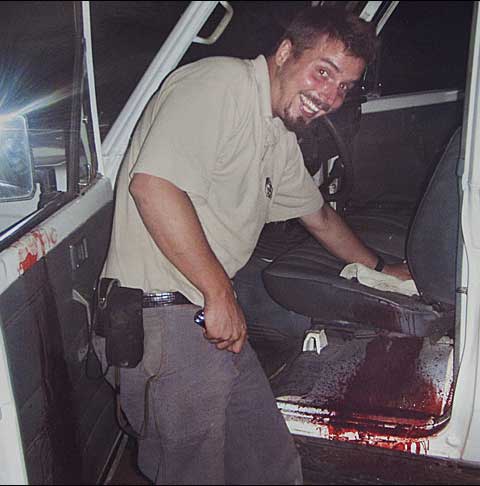
By “asymmetric” I do not mean the US intelligence code for off-textbook warfare, for counter-insurgency methods outside von Clausewitz etiquette. I mean the inherency they obscure, war between foes lopsided.

Look at a drone’s design. It’s more Gossamer Condor than military aircraft. Obviously an unmanned vehicle comprises fewer mechanical systems because it doesn’t need to propel, nor sustain, a crew of human beings. It might need less armature for the same reason, except of course, today’s drones are of high value in their own right. So why no armament?

Why too, no powerful jet engines or swept wings for aeronautic superiority? This drone looks about as robust as a paper glider. Laymen can distinguish bombers from jet fighters, as they can trucks from a race cars. I’d say the military drone resembles more a stick insect than its accidental namesake the bee. Do Armed UASs have no need for evasive maneuver capability?

I’ll ask another obvious question, why do drones carry no customary insignia designating to whose side it belongs? In particular this element would be of primary importance when encountered by other aircraft.

But a drone doesn’t encounter enemy aircraft, nor allied aircraft who might confuse it for belonging to an adversary, because drones operate where aerial supremacy is already absolute. The key to a drone’s military usefulness is that there is no opponent to shoot it down.

An Armed UAS can drone all it wants, taking its sweet time laying siege to defenseless objectives and other targets of opportunity. The US Predator or Reaper models can glide when they want to surveil in silence, although otherwise their motors project their presence with the deliberate imposition of a school hall monitor. It is more efficient to deter the placing of IEDs than to try to catch insurgents in the act.

Meanwhile all civilians are terrorized by the sound, associating it with sudden, unpredictable and often unjustified destruction and death.

The WWII German Stuka dive bomber had inverted gull wings which were thought to produce a horrifying wail as the notorious aircraft attacked city populations, Guernica among them. In fact the sound was produced by a siren the Nazis called Jericho’s Trumpet, mounted purposefully to spread fear on the ground. Like modern drones, the Stuka were not designed to fend off attackers from the sky.

Before the fighter planes of WWI, artillery spotters would rise in balloons to survey the enemy trenches. From these tethered balloons, artillery strikes could be directed with increasing accuracy. These remote eyes in the sky were the rudiments of aerial surveillance, the precursors to today’s Armed UAS. The balloons were manned obviously, and they weren’t armed, but the spotters they held aloft were despised much as drones are today. When WWI biplanes eventually came along to pick off the balloonists like sitting ducks, the soldiers in the trenches were jubilant.

When the Soviets invaded Afghanistan, the Taliban had been fortified by the US military. We’d helped the Taliban destabilize the region, to force Russia’s hand in rushing to restore order to its southern neighbor. We wanted to draw the Russian troops in before we assisted the Afghan insurgency with the real weapons it needed to combat their invaders’ superior fire power. When Bin Laden’s Mujihadeen and the Taliban got US Stinger Missiles, the Russians could no longer deploy their helicopter gunships with impunity and the end drew near.

Eventually whoever drew the US into its war on Islam, is going to start distributing the means to take the US out. It might be Stinger Missiles or a modern equivalent. Eventually someone will develop sympathy for the victimized Muslims of Pakistan, Afghanistan, Iraq and Gaza (add Somalia, Sudan, Yemen, etc) and help them flick the killer drones from the sky.

Would attacking the drones provide retribution enough, knowing that the real operators are safe in virtual cockpit command centers located safely within US homeland borders. Would it be sufficient to keep clearing the skies of drones, or will our victims have to weed US drones from the roots?

Will the drones prove as easily replaceable as GIs? The American Public keeps count of its lost soldiers, but in no way has this stanched the flow of fresh reinforcements. We do not count expended ordnance, or expensive equipment fallen casualty. Would such tallies discourage the war mongers or encourage weapons industry stockholders?

The American public has shown itself mostly contemptuous of the economic-draft soldiers who man today’s volunteer army, the deaths accumulate, but working poor are expendable. What about those who joined the military to clean up their act? We don’t want those back. After years of war, the public is already seeing too much PTSD, without contemplating bringing all of it home.

Perhaps instead Americans will react to a casualty list of aeronautic losses, maybe for reasons of pure economics. How many helicopters and jets we are losing adds to the federal deficit. But the losses of big equipment might offer the same decision making information we glean from the higher value chess pieces. Rooks and knights represent offensive capability. Hopes for victory or a draw hinge on which of those you have left. No one capitulates based on a count of their pawns. The cumulative tallies will reflect which way the tide is going. Military drones may be worth zero lives, but their destruction will signal an insurgence indomitable.

Do we have a soft spot for mercenaries

Norwegian Tjostolv Moland sentenced to death in Kisangani, DRCIt’s damning photograph. I sought it out after hearing the story of the two Norwegian mercenaries condemned to death in the Congo for the murder of their Congolese driver. Was their black companion killed in an attempt to rob the white adventurers, as they tell it? US news outlets asked Tjostolv Moland’s mothers about the picture of her son, which showed him smiling as he wiped blood from the driver’s seat of their pickup. The mother dismissed it as bad timing, she though her son was probably caught off guard, laughing at a joke unrelated to his morbid task. Boy can Americans relate.
Other US newspapers speculated about a fabled Norwegian propensity to laugh at adversity. They also described Norwegian diplomats scrambling to save the two boys from the gallows. It’s true that Norway doesn’t have a death sentence, and therefore does not condone it elsewhere. Otherwise US and BBC portrayal of Norwegian concern for the two mercenaries seemed at odds with Norway’s usual determined pacifism, so I was eager to hear from my relatives there.

The scoop? Contrary to US and UK sentiments and their projection of Norwegian concerns, there is no domestic sympathy for the two wayward boys. None.

The Norwegian public has become well aware that Moland and partner Joshua French have been traveling the Congo as mercenaries, and have been involved in other killings as well. The fact that Congolese courts are trying to extort a large fine from the Norwegian government, based on the accusation of the two travelers being agents of Norway, is due to documents which the two forged to pretend they had active duty contact with the Norwegian military.

In Norway, military service is compulsory. Every Norwegian male has a record of military service. It helps that Norway rarely involves itself with acts of aggression, sanctioned by a fraternity of nations or not. And when soldiers of fortune like Moland and French set about rampaging in Africa, it behooves Norwegian authorities to ensure that their military is not implicated by association.

How fitting that US and UK listeners should presume a reflexive maternal instinct to protect the two white boys, set upon by angry African opportunists. The boys might be mercenaries, but America and Britain have lots of those overseas. Hired guns, paid assassins, professional killers, why quibble with words?

The laws of war grant little grace for mercenaries, but that’s not what English-speaking supporters of imperial expansion want to believe. Mercenaries in the Neocon vernacular are called private contractors. They’re just ordinary soldiers who’ve escaped the poor pay of military service, to the entrepreneurial ranks of war-making free enterprise.

Attack Drones: Freedom is so fucked

Armchair freedom fighters like me count on there remaining some parity between the forces of oppression and man’s inexorable drive to be free. Masses can repel the few, nonviolence can shame the hesitant, terrorism can haunt the genteel, IEDs can pick off the occupiers, training can dispatch the sentries, but how to overcome automatons? We’ve confronted impregnable drones in scifi movies, and now such drones have become reality. They’re bits of nothing in the air really, but a literal boatload of firepower has got their back.

The Economist reports that drones can monitor the activity of shoeboxes from an altitude of near-space, beyond the range of an RPG fired from a hot air balloon. A drone’s vulnerability remains its communications channels, but even intercepting those is outside the realm of non-military technology.

While drones reduce the exposure of real soldiers to harm’s way, they increase a military force’s effectiveness. Drones are lauded as cheaper to operate as conventional jet fighters, but in reality their functionality draws on greater resources. The Economist writes of a drone the size of a corporate jet called a Global Hawk, which requires a staff of 20 to 30 to operate. Many more than would be necessary inside a C130 gunship, but of course, almost all of them manning new killing devices.

So long as the empire has an unlimited budget to spend, Freedom Fighters are fucked, and terrorists will be the only recourse. The only target available to the adversary of a drone, is the command center which controls it. Be it in America, or a distant military base, that’s where the enemy will have to strike.

Or the American public will have to renounce the budget which affords this technology.

You may not be bothered by the notion that remote-operated drones can monitor human activities and rain destruction upon them when appropriate. The old, “what have I to fear if I’m doing nothing wrong?” Wait until you are the wrong side of the oppressors. Coca Cola kills union organizers in Colombia. Walmart would probably like to kill you in their parking lot if you are leaving with a shopping cart filled insufficiently relative to you debit card balance. They already know it, but a drone in their hands will give them the ability to find you.

Who owns images of American dead?

vietnam-wounded-marineAP photographer Julie Jacobson was reticent to publish her picture of dying US Marine Lance Cpl. Joshua Bernard. Though his father was opposed, the Associated Press overruled. But this was no victory for the public’s right to see a true reflection of war. The D.o.D. is still indignant, but I suspect Jacobson’s report was ultimately vetted in their favor. Military propagandists need to represent America’s growing losses in Afghanistan. Jacobson’s image provides their limited hangout. Like the other photographs of casualties which have escaped through embeds, the image of Lance Corporal Bernard is desaturated of blood, and the surrounding events fit the military endorsed narrative.

Have you noticed that all combat images coming out of today’s wars are drab and lifeless. Obviously this motif is not being applied to the PR shots of jets and military hardware, but scenes of soldiering in Iraq and Afghanistan are dusty and grey, like scenes from a dark virtual world.

The colors in Jacobson’s controversial photo are similarly under saturated. Earlier casualty pics have even been rendered as black and white, and this is no exercise of artistic license. Colorless images telegraph little resemblance to our real world lived in color. An emotional distance is created, most obviously like the detachment we feel looking into the past. Everything before the late sixties happened in monocrome. Early color photographs always shock children with the prospect that lives in generations past might have been been lived in a world of contemporary vibrance.

The photographs from Vietnam were helped by that nation’s lush tropical greens. Images of the wounded were all the more gripping –and demoralizing from the military’s point of view– because unlike in Korea and WWII, the blood was red.

Most images taken in Vietnam came through the military staff photographers. The unapproved subjects, which subverted the official face of the war, emerged from the cameras of independent journalists.

dying US marineJulie Jacobson facilitated the release of this picture, by letting slip two details pertinent to the official US narrative in Afghanistan. Would you believe, just prior to this engagement, friendly Afghans came out of their houses to tell the US soldiers where they could find the Taliban? Probably to ensure Corporal Bernard’s squad pointed their guns away from their homes, but that’s not how the story was spun. Jacobson recounts that these Afghans were eager to inform on the Taliban.

The jocular Jacobson records another telltale crowd-pleaser in the aftermath of the Taliban “ambush,” when she found herself flanked by Afghan National Army troops. When the firing started, Jacobson sought immediately the ranks of US soldiers, because the freakin’ ANA Afghans “aren’t very good.”

Today’s media embeds are basically a privatized signal corps. Their photos should belong to the taxpayers. Insinuations that military families should dictate what images can be used, in the event of death, is a cruel irony. Are the families consulted about what Uncle Sam wants to do with their loved one when he’s still alive? Millions of federal tax dollars are spent on our soldiers, all the more when they die. I have little sympathy for the families who couldn’t stand up for their children and protect them from the capricious whims of our military. There is absolutely no reason to ask their permission about what happens when their little soldier meets his/her calculable fate.

Atomic’s one handed coders rebrand Fallujah game as Six Hours in My Lai

virtual rapeNMT has obtained screenshots from Atomic Games ‘Six Days in Fallujah,’ traded p2p and remarketed as Six Hours in My Lai. There was no budget to modify the OIF coalition uniforms to resemble the Vietnam GIs, but who’s looking at the clothing? Nostalgic vets will find the rape reenactments unremarkably familar. In reality the mayhem of My Lai and My Khe lasted 28 hours, not six, but industry research indicates that cyber ejaculators rarely have more than a six hour window before a landlady looks in on them.

Gaming studies remain inconclusive about whether virtual sex stimulation augments with cumulative scorekeeping. It will require a scientific leap before computer health levels can fortify a real-world refractory period. Otherwise virtual serial binges cannot build on themselves like the longer pyramid games of Civilization or World Of Warcraft.

okinawa schoolgirl rapeJapanese game publisher Konami, forced by civilian outcry to drop a distribution deal for Atomic’s Fallujah first person shooter, is pleased that the salient gangbang modules will find their way to end-user Marine Corps wannabes. Konami already has a bestselling Raper II title, an Okinawa schoolgirl adventure for American servicemen. Konami’s own one-handed programmers are set to adapt the Atomic code for the Japanese market. The human trafficking of Iraqi orphans into US contractor Army brothels becomes Korean Comfort Women; US combat depravity becomes The Rape of Nanking.
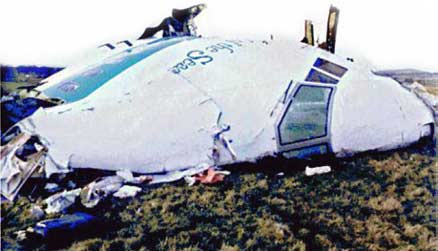
Deprived of being able to cash in on the Fallujah atrocity allure, Atomic Games is looking for sympathy from the Support the Troops crowd. Atomic laid off the soldiers on its staff, issuing this statement:

“We wish to assure the dozens of Marine veterans who have collectively invested hundreds of hours in this project that, while we have been badly wounded, we will fight on. The stories of your brothers’ courage and sacrifice in Fallujah must be shared with the world.”

By historical accounts, are they referring to the virtual sequences between the levels of action which act like silent movie inter-titles to link the running and jumping to a bigger story? Where the plot points are inviolate can be the only teaching moments in an otherwise chose-your-adventure killing spree. Where will there be opportunity for gamers to show courage and sacrifice with only a menu of rape and murder?

Let’s be clear. The Fallujah video game was not about soldiering. It did not mean to replicate the experience of 99.9% of the American soldiers who served in the battle for Fallujah. A first person shooter is not about following orders, falling in, or self-sacrifice. An FPS is about four wheeling a personal path of personal destruction. Atomic’s Six Days in Fallujah was a spring break for Grand Theft Auto sex tourists.

NMT is equally concerned about the lost Fallujah stories which may have been the narrative of the gameplay. The world should hear of the turning back all male refugees, of the White Phosphorous and sniper Free Fire Zones. The lost Fallujah action sequences no doubt exploited the armored vehicles crushing the Iraqi wounded, and the role of the helicopter gunships over the river, Red Bridge and the Fallujah hospital.

Lockerbie bomber(s) get away for good

Libyan Abdel Basset al-Megrahi has been imprisoned in the UK since 2000, for the 1988 bombing of PanAm Flight 103 over Lockerbie Scotland. Libya paid restitution for the act, but maintain their –and al-Megrahi’s– innocence. It was announced yesterday that Al-Megrahi is being freed on humanitarian grounds, because he’s been diagnosed with prostate cancer, and not in exchange for his dropping the appeal of his conviction. Thus ends further inquiry into who else was suspected of responsibility for the suitcase bomb.
Cockpit of Flight103

–which resulted in the deaths of 270 people.

Scottish MP Tam Dalyell has cause for suspicion, as documented in the 1995 The Maltese Doublecross. Prevented from being widely screened, its first venue fire-bombed, the documentary was successfully quashed by the US and UK governments. Lockerbie victim survivors opposed evidence that threatened the compensation they were seeking from Libya.

Maltese Doublecross director Allan Francovich survived attempts to run him off the road, for two years. In 1997 Francovich died while in the custody of US customs agents in Houston, age 56.

Let’s just say that Francovich’s findings bore the same elements and cast of characters as the investigations of award-winning also-dead journalist Gary Webb, found suicided in 2005, with two gunshots to the head.

SFSG special forces have no use for armor

Supacat Jackal MWMIK
Three British paratroopers died Friday when their Jackal High Mobility Truck exploded over an IED in Afghanistan.

Fortunately Supacat UK, manufacturer of the Jackal HMT400 4X4, supplies an exploded view for our safer perusal.

To complement the MWMIK, or Mobility Weapons Mounted Installation Kit, Supacat added a BALLISTIC PROTECTION KIT (brown), a MINE BLAST PROTECTION KIT (red), and MINE BLAST PROTECTED SEATS (orange).

None of which helped the soldiers of the Special Forces Support Group, who were all killed by the mine blast, before the Taliban fighers advanced with a coordinated attack of gunfire. So much, perhaps, for the mine blast protection. But in actuality, it doesn’t take a diagram to reveal that the Jackal offers very little cover for its occupants.

Let’s guess this open air design is for maximum range of fire, so that the three big guns of the MWMIK can most effectively be brought to bear upon the less special forces of the Afghans. Remember the high caliber machine gun on the little jeep in the British Rat Patrol? Multiply that times three, minus the hood or dash.

UK Jackal High Mobility Truck for SFSGDoesn’t the holey thing look like a dune buggied version of the robotic cargo loader in Aliens? Ripley’s unlikely, erotically vulnerable cage from which she slammed hydraulics into the Alien Queen.
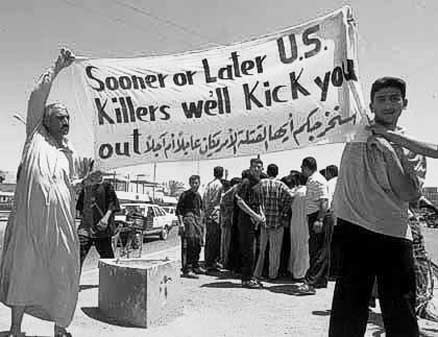
It probably isn’t all that difficult to convince macho SAS brits that the best defense is a high speed offense, and anyway, three fewer survived to get wise.

The US – Islam War nears halfway mark

I have to do more research, but I’m pretty sure October 7, 2009 should mark the HALFWAY POINT of the US-ISLAM WAR. I realize the Pentagon brass are calling for fifty years more of insurgency suppression in Afghanistan and Iraq, but if we grant them no more time than for America’s longest military intervention, we’ve got another eight years before beating our humiliating retreat.
iraq

Those who insist we could have won the Vietnam War, would have our murderous troops there still. No foreign occupation has succeeded in modern times, with the ongoing exception of Israel, which by its swallowing of Palestine has been skewing the definition of occupation to the Old Testament model of mass extermination. The treacherous method worked against the Native Americans, it may still doom the (Palestinian) Native Israelis.

Afghanistan and Iraq remain occupations, where Vichy puppet governments prosecute genocide against the native resistance. How long before Americans lose their stomach for continuous bloody repression? I cannot account for the Russians in Chechnya, but on the US-Islam front, we are halfway there.

In Afghanistan and Iraq, we may already have surpassed half the civilian death tolls in Vietnam, Cambodia and Laos. It’s hard to say, the US “doesn’t do body counts” now, and we didn’t then either. Our own military casualties grew exponentially in Vietnam. If such statistics bear comparison, today’s numbers cannot be but comparable.

It’s being whispered that American casualties are approaching a multiple of a thousand mark. Official soldier deaths in Afghanistan and Iraq are conjectured to be reaching a round number.

I’m not told how many US mercenaries are being killed. We have as many hired-guns contracted as government soldiers. Want to lay odds on how many body bags they’ve required?

Nor are we told how many US soldiers are being wounded, many of them with injuries which would not have sustained their lives in Vietnam. Surely there is a sad gray area of injury which we could round up as it approximates death.

You had a good home but You Left (You’re Right!)

Your Recruiter LIED to you so you Left (You’re Right!) Classic Basic Training marching cadence chant.
You’re all supposed to be “in step” because if you have a single person planting his left foot forward while everybody else is planting the Right, a Column Left or a To the rear, March! command or any other won’t work out correctly.
If The Military is such a good career move, why would the Pikes Peak or Bust Rodeo and others have to donate the proceeds to “Military Charities”?

Go on Craigslist and in Barter and Free classifications, and Rants & Raves you find military families, especially right before payday, begging for FOOD. Food which is subsidized at the Commissary, the Post Exchange and the Base Exchange.

And, these families, they’re not kidding. They actually ARE hurting.

But the Recruiters still Lie through their teeth. Daily.

They even have special programs TARGET-ing poorer kids, Minorities…

In Hispanic and Black neighborhoods the recruiter drives around in a “tricked-out” Hummer with a sound system blaring Hip-hop, the recruiter himself is going to be Ethnically Matched to the neighborhood or barrio, and a younger guy, and even with that will be TRAINED in Street Talk as though it were a foreign dialect.

Are they foolin’ the 18 year olds (17 and dropped out of school if yo’ Momma signs you in)? Apparently not. They give out their pamphlets to pre-teens.

Recruiting Children for a Later Date With Death.

For the 17 and 18 year olds, they break out the Economic Opportunity and the closely related Educational Opportunity bullshit.

But then, the U.S.O., Red Cross, Pikes Peak or Bust Rodeo… they come right along and spoil the lie. Because those organizations have to scramble to raise funds, beg a little less obviously…

But the Recruiter Lies are spoiled only if the kids see or hear or read something like this.

All y’all young dudes who want to sign up, try this first… when you turn 16 and can legally do it, volunteer at the VA hospital.

Hang back a little, don’t crowd, let the Human Misery speak for itself. And the humans who are suffering that misery. Go around emptying the wastebaskets and dry-mopping the floor in the waiting rooms, listen to the guys and ladies talking to each other, listen to their stories about how the VA is screwing them.

Volunteer at the U.S.O. and there are others, fill out forms for the guys and Ladies.

See people and talk to them and try your best to help them when the VA screws them.

When a guy is dying from a service related cancer like you get with Agent Orange or from the Uranium Poisoning, that the VA officially denies even exists, try to help him get his basic medical needs tended to.

Volunteer to read or sing to the guys in a Persistent Vegetative Coma. Or the guys who can’t communicate, can’t see, but are conscious under the bandages.

Keep in mind when you’re doing it that some of these guys are laying there with half their body mass taken off by American fire.

Then when you see the Recruiter rolling through the ‘hood jamming some tunes…

See all the young kids flocking around eager to be part of the next Children’s Crusade…

Eager to be lied to, eager to be seduced into the Glorious War.

Listen to the commercials again, watch with fresh eyes as they Army/Navy/Air Force/Marines tell the parents of kids too young to legally join on their own to go ahead and sign the papers for their sons and daughters.

Telling young guys who are dropping out of High School that somehow the Army is going to pull off a magic trick that will get them into College and a highly paid profession.

Because you KNOW, don’t you, that if Yo Momma is signing you in, that means you’re not 18 and there’s very little chance that you completed High School.

And that those commercials are aimed at the guys who are having trouble in school and about to drop out anyway.

When the Recruiter rolls through the ‘hood blasting the jams, walk up to him and tell him, in front of his intended victims, that he’s a damned liar. Print this up and make your OWN pamphlets.

I’m not saying commit acts of violence against him, or vandalism.

That perpetuates the Hate cycle and nothing more.

Even though it would be entertaining to watch one get dragged out of his tricked out Liar-Mobile and having a case of Advanced Whoopage liberally applied, don’t do it.

Confront Hate with Hate and everybody loses. Confront the Hate and the Lies with truth.

It’s our only weapon, and it’s more effective than all their bombs, and guns, and Air-shows, and “see how many chinups you can do” demonstrations, all their pamphlets and commercials and their Tricked Out Humvee can ever be.

You know how I can tell? Because they’re having so much trouble trying to recruit people that they’re going after the young kids now.

The kids are getting smarter and asking more questions. The Army loses. Too bad, so sad. They shouldn’t be trying to convince Kids to go and kill for the “super-patriots” so the “super-patriots” can make money off their lives, and deaths, and the lives and deaths of those people whose countries are being stolen for their resources.

The “super-patriots” who like Bush and Cheney and Wolfowicz and Limbaugh and O’Reilly, aren’t going to enlist and when they had to do so, they had their parents buy their way out of the Draft.

They expect YOU to die for THEIR comfort and riches. And pay you so little for it that your families will literally have to Beg in order to survive.

More Class War, and as usual, the guns are pointed away from the upper class

The Colorado Springs Gestapo Department released an Internal Affairs investigation results Friday, and once again, the PIGS came up “innocent”. Surprise Surprise Surprise. Seems the only property rights (or any other rights) they enforce or give a shit about are those of people who have a couple million in the bank and own real estate. All others need not apply.

Are YOU really surprised that a group of cops who are given immunity from prosecution unless their fellow PIGS find them guilty first, got away with their Hate Crimes once again? No, really, is anybody actually surprised that the Internal Affairs did what they alway do and let their fellow PIGS off the hook once more?

I wonder how Mayor Rivera would feel if armed THUGS burst into his home and kicked him out the door, threw away all his belongings (unless something he has is worth stealing) and if he resists being dispossessed, they throw him into the El Paso County Torture Dungeon and taser him for “being uncooperative”.

All because the Rich Bitches who run this little corner of Outer Redneckistan don’t want their piglets to see that poor people actually exist, (Like Prince Siddharta’s parents) and ask ugly questions about the Family Fortune that keeps them clothed and overfed and overprivileged being made on the backs of the Dispossessed. They want their little bastard get to believe that Nobody is harmed in any way by their family accumulations of wealth.

Here’s a theory: you remember the fire on the incline a couple of years ago, started in a homeless camp? The Pig-Os never did find out who started it, but AssMunches like Heimlicher and Rivera were quick to blame the Homeless…

Instead of the Rich Kids who habitually raid the camps of the homeless PEOPLE (but only when the PEOPLE aren’t in the camps) raiding that particular camp and perhaps setting it on fire?

Heimlicher and Rivera and Sheriff Ima Pigg Maketa don’t care about that, encourage that sort of behavior with their constant Dehumanizing of their Victims… and if the “just kids having a little fun” gets out of hand and starts a fire, that can subsequently be blamed on the homeless PEOPLE, all the better for them.

Teach your little Piglets to despise anybody who, unlike them, wasn’t born to Wealth and Privilege.

Who killed Neda Agha-Soltan?

neda soltaniThe video footage is shocking. An attractive young woman watching the demonstrations in Tehran is struck by a sniper’s bullet and dies before several video cameras. The tragedy is projected unto Facebook and Youtube, with advocates hoping it will galvanize (American) public support for the brave reform movement in Iran. News accounts blame “Basij snipers” on the rooftops. Other protesters have been killed in confrontations with Iranian riot police, without the benefit of video witnesses, much like two million Iraqis, Afghans, Pakistanis et al. Poor 27-year-old bystander Neda Soltani stood at the quite improbable convergence of bullet and camera –correction– cameras. I don’t have to suggest the scene was staged; whether or not the triggerman was an American is immaterial.

Think about just the improbability of your seeing this video. When was the last time the mainstream press has circulated a snuff film? The average person is embarrassed to watch a person die. It’s exploitive. Even when America was fixated on beheaded hostages, our television gatekeepers refused to broadcast the footage. Many horrific war killing moments have found their way unto Youtube, which antiwar activists could only hope would find wider distribution, if only to bring home the inhumanity of our soldiers’ deeds. It never happens.

The western press is running with this story because it demonizes the apparently naked inhumanity of Islam. Muslims stone women, hang gays, look: the bastards shoot their own people arbitrarily. Curiously our media doesn’t make hay with the hapless victims of US snipers.

neda salehi agha soltanThe Neda Soltani snuff footage hit internet shores prepackaged with a smiling mug, and a name that translated means “the voice.” Could a casting director have picked a better title character to represent Iran’s repressed? The western press is even poised to outdo the Muslims in indignant piety, already lauding Neda as a martyr, whom we are informed should launch a thousand Shiite funeral processions. Western pundits compare Neda to the first Shiite martyr, the grandson of Mohammed himself.

Of course, also showing excessive Islamic sensitivity, western reporters readily dismiss the vanishing of Neda’s body, to the Muslim tradition of hasty burials. For the record, in case you missed it, Neda dies onscreen from an apparent gunshot. We do not see the bullet strike, nor now can anyone habeas corpus.

If the scenario was acted entirely, given the success with which the girl’s face is being made into an icon, young Neda’s life is probably as utterly expendable now as already depicted. You think you’re mourning Neda now, imagine her fate if this is a hoax.

OR the gunman could just as well have been a US black-op hit-man who had his eye on the videographers approaching innocent Neda. The US military has long admitted that special forces are already operating in Iran. If the Iranian forces are shooting civilian protesters, what’s the harm of helping them out where there’s a camera ready?

When we’re not meant to see it, the soldiers shoot the cameramen too.

It could be the work of Moussavi henchmen, who are our henchmen.

The Green Revolution, or TwitterTM Revolution, rebranded a “Social Media Revolution,” is a fabrication of the US pro-democracy agents working to destabilize Iran. They are hard at work in Cuba, in Venezuela, in Bolivia, and everywhere regimes threaten US globalization by enslavement. Remember the Orange Revolution? Any movement that is color-coded is the work of organizers reading US how-to manuals or attending OTPOR training seminars.

Where are the international voices decrying election fraud in Iran? No one other than the US and its stooges is asserting that populist leader Ahmadinejad did not win by a landslide. Only Iran’s urban middle class has taken to the streets of Tehran. And to protest what? Their minority standing in Iran?

The reformists in Iran are protesting democracy, not the failure of democracy. They are protesting Mahmoud Ahmadinejad’s hard line against irreligious western economic and colonial policies which traditionally benefit the secular urban elite. “Pro-Democracy” is neoliberal for pro-capitalist plunder.

See: Shah’s Son Backs Iranian Protesters.

Like the “dissidents” of Cuba, the Green greenback-seekers are marching on the CIA’s dime, and being meted the fate of foreign provocateurs. I have no doubt the majority are idealists and are well-intended, but like the Kurds who rose against Saddam Hussein, the US has set them up for slaughter, the sooner to motivate western support for military aggression against their evil regime.

Our media pundits point out that the protest banners are written in English, a sign that the Iranians are desperate to appeal to American viewers. They dismiss Iranian accusations of the demonstrations being US-backed as pure paranoia, and ignore the most simple explanation behind the English slogans, and the websites and networks amplifying the message to English speakers: these materials are being crafted by USAID advisers. This is a propaganda campaign aimed at Western ears, to call for regime change in Iran.

Neda’s Theme is tried and true: Jessica Lynch, Roxana Saberi, Euna Lee and Laura Ling, Neda Salehi Agha Soltan. Onward Christian Soldiers.

Neda Agha Soltan iranian martyr victim of US sniperThe American public won’t believe another fiction about Kuwaiti babies dumped from incubators, or of Belgian children impaled on the bayonets of the evil Hun. So Madison Avenue has upped the amperage. Today’s television armchair adjudicators have to see innocent young women snuffed on film before our eyes. Provided to us by a press too otherwise prurient to show us the mass of death we deal everyday.
The Iranians in the streets, and poor pretty Neda, are being sacrificed by heartless US strategists. I doubt even an errant Iranian bullet can match the American military for cruelty.

Lacrosse fought & equipped by warriors

Warrior Sports
Need another tipoff that the sport of lacrosse is early combat training? The leading equipment purveyor is Warrior Sports.

This photo was taken at the 2009 Jamboree in Denver Colorado, where teams of little white boys converged to declare state champions. The sea of white was interrupted by a single black team, a girls team, I conjecture because women’s lacrosse is played more like field hockey, necessitating much less protective gear. From sticks to heads, to helmet, to Kevlar, every element of Lacrosse gear had a starting price of $120, going up.

Schools don’t have budgets to support both football and lacrosse armature. Lacrosse leagues are sort of the charter schools of youth sports: only those with disposable incomes need apply. If African American youth dominate you school sport programs, why not take you Anglo-Saxon tykes to fields where they can dominate each other without a challenger’s interruption? But I digress.

Lacrosse is for tots who already harbor an innate itch to thrust handguns forward, but have to be taught that, in every useful gunfight save those of James Bond, standard issue is an assault rifle, which necessitates both hands, and best represented in early boot camp as its earliest belligerent incarnation: the stick.

Kids like lacrosse because they get to swing their sticks at others with wild abandon. It’s especially fun, I’m told, when you really hate your opponents.

“Free” Elections in Iraq and Afghanistan

Like the one that installed Puppet Dictator al Maliki in Iraq and the one that installed Puppet Dictator Kharzai in Afghanistan…

Where the people were giving a list of who they were allowed to elect as “their” leaders and a much longer list of those who they were Forbidden to vote for.

Neither of these two countries have ever had Democracy and probably never will.

The whole notion of a rigged election enforced by grim looking Uniformed Thugs with Submachine Guns is now so deeply ingrained in their cultures…

That’s how they’ll see their “free” choices imposed by Washington.

The same way their “free” choices were imposed by Moscow.

Or Saddam.

They’re given a list of people they can or cannot vote for, there’s a bunch of goons with guns standing around, who don’t even speak their languages, telling them they have Freedom…

just like the Russians did.

They know the drill, it’s their whole experience with elections.

They were Hereditary Dictatorships aka Kingdoms before they were Dictatorships where they line up and vote for who the Goons with Guns tell them to elect.