Collapsing Mexico

villa and zapataCollapsing Mexico was not the intent of Lawrence Summers, Obama’s new US Secretary of Treasury, but he has pulled it off BIG! Mexico’s economy today is shedding hundreds of thousands of badly needed jobs and is providing negative economic growth to its continually growing population rather than any positive numbers. Lawrence Summers is the architect of that catastrophe, so let’s review his US-Mexican resume some for those who are unaware of it. And let’s see what might be in store for Mexico’s neighbor, the USA?

Lawrence Summers was Clinton’s offerer of the US government’s move to tie Mexico into the NAFTA con, and point man to convince the Mexican PRI dictatorship, led by Ernesto Zedillo, to totally tie their country’s economic and political cart to an elephant and a donkey from the North. The carrot was a ‘giant bailout’ loan offer of billions of US treasury dollars (>$55 billion to be more exact). Many of Mexico’s PRI tied business men jumped at the opportunity and headed towards behind the scenes funding of the actual setting up of an American style 2 party con game, instead of the holding tight to the one party regime they had been supporting for so many decades. The final result was an acceptance of the billions coming from the US and a turn to setting up the Vicente Fox-PAN into the Mexican White House (Los Pinos). National debt to the US was set as something to worry about in the future, meanwhile they planned to ride high on the hog short term, and they did.

But now the US sowed genetically altered corn is coming come to roost, as Mexico has become caught totally tied to the US economy as the international collapse of all the world markets is underway. Mexicans are returning from the US because they cannot find jobs in the collapsing US economy, and returning under-aware of Mexico’s collapsing economy. A dark storm is beginning to brew, and just last weekend several hundred thousand people demonstrated in the capital against their US government enforced upon them government. John Ross, America’s foremost commentator on Mexican politics, writes of the unfolding situation this week in his commentary When (Mexican) Millionaire Mummies Mourn
Davos vs. Belem; Swine vs. Pearls

Why should Americans care about any of this? Isn’t the US collapsing world economies (China, Japan, Russia, European, and so on),one on top of the other anyway? What’s so special about what the US con-omy is doing to Mexico? Well…….? It is simply the fact that Mexico and the US are so intimately tied to each other and have been for centuries now. Wither Mexico, wither Latin America as a whole, too? It’s a volatile brew that is being stirred. BANG!

Keep an eye on Mexico as the economic downturn continues. The US government is losing its authority to direct…. to direct the people of Mexico in their own internal affairs with the collusion of their corrupt death squad loving elites who follow the order of our US elites. Don’t believe for a second that this development will not impact our own political turmoil ahead. Mexico will always be the key ‘foregin’ society for Gringolandia, and its just South of our ‘Homeland Security’. We are in this mess our corrupt capitalists have created for the common folk all of us together, and it has become a brewing Cauldron, Presidente Calderon.

MLK: Why I am Opposed to the War

Martin Luther King Jr“You’re too arrogant! And if you don’t change your ways, I will rise up and break the backbone of your power, and I’ll place it in the hands of a nation that doesn’t even know my name. Be still and know that I’m God.”
 
Sermon at the Ebenezer Baptist Church on April 30, 1967. Full text below.

The sermon which I am preaching this morning in a sense is not the usual kind of sermon, but it is a sermon and an important subject, nevertheless, because the issue that I will be discussing today is one of the most controversial issues confronting our nation. I’m using as a subject from which to preach,

“Why I Am Opposed to the War in Vietnam.”

Now, let me make it clear in the beginning, that I see this war as an unjust, evil, and futile war. I preach to you today on the war in Vietnam because my conscience leaves me with no other choice. The time has come for America to hear the truth about this tragic war. In international conflicts, the truth is hard to come by because most nations are deceived about themselves. Rationalizations and the incessant search for scapegoats are the psychological cataracts that blind us to our sins. But the day has passed for superficial patriotism. He who lives with untruth lives in spiritual slavery. Freedom is still the bonus we receive for knowing the truth. “Ye shall know the truth,” says Jesus, “and the truth shall set you free.” Now, I’ve chosen to preach about the war in Vietnam because I agree with Dante, that the hottest places in hell are reserved for those who in a period of moral crisis maintain their neutrality. There comes a time when silence becomes betrayal.

The truth of these words is beyond doubt, but the mission to which they call us is a most difficult one. Even when pressed by the demands of inner truth, men do not easily assume the task of opposing their government’s policy, especially in time of war. Nor does the human spirit move without great difficulty against all the apathy of conformist thought within one’s own bosom and in the surrounding world. Moreover, when the issues at hand seem as perplexing, as they often do in the case of this dreadful conflict, we’re always on the verge of being mesmerized by uncertainty. But we must move on. Some of us who have already begun to break the silence of the night have found that the calling to speak is often a vocation of agony. But we must speak. We must speak with all the humility that is appropriate to our limited vision, but we must speak. And we must rejoice as well, for in all our history there has never been such a monumental dissent during a war, by the American people.

Polls reveal that almost fifteen million Americans explicitly oppose the war in Vietnam. Additional millions cannot bring themselves around to support it. And even those millions who do support the war [are] half-hearted, confused, and doubt-ridden. This reveals that millions have chosen to move beyond the prophesying of smooth patriotism, to the high grounds of firm dissent, based upon the mandates of conscience and the reading of history. Now, of course, one of the difficulties in speaking out today grows the fact that there are those who are seeking to equate dissent with disloyalty. It’s a dark day in our nation when high-level authorities will seek to use every method to silence dissent. But something is happening, and people are not going to be silenced. The truth must be told, and I say that those who are seeking to make it appear that anyone who opposes the war in Vietnam is a fool or a traitor or an enemy of our soldiers is a person that has taken a stand against the best in our tradition.

Yes, we must stand, and we must speak. [tape skip]…have moved to break the betrayal of my own silences and to speak from the burnings of my own heart, as I have called for radical departures from the destruction of Vietnam. Many persons have questioned me about the wisdom of my path. At the heart of their concerns, this query has often loomed large and loud:

“Why are you speaking about the war, Dr. King? Why are you joining the voices of dissent?” Peace and civil rights don’t mix, they say.

And so this morning, I speak to you on this issue, because I am determined to take the Gospel seriously. And I come this morning to my pulpit to make a passionate plea to my beloved nation.

This sermon is not addressed to Hanoi, or to the National Liberation Front. It is not addressed to China or to Russia. Nor is it an attempt to overlook the ambiguity of the total situation and the need for a collective solution to the tragedy of Vietnam. Nor is it an attempt to make North Vietnam or the National Liberation Front paragons of virtue, nor to overlook the role they must play in a successful resolution of the problem. This morning, however, I wish not to speak with Hanoi and the National Liberation Front, but rather to my fellow Americans, who bear the greatest responsibility, and entered a conflict that has exacted a heavy price on both continents.

Now, since I am a preacher by calling, I suppose it is not surprising that I have seven major reasons for bringing Vietnam into the field of my moral vision. There is…a very obvious and almost facile connection between the war in Vietnam and the struggle I and others have been waging in America. A few years ago there was a shining moment in that struggle. It seemed that there was a real promise of hope for the poor, both black and white, through the Poverty Program. There were experiments, hopes, and new beginnings. Then came the build-up in Vietnam. And I watched the program broken as if it was some idle political plaything of a society gone mad on war. And I knew that America would never invest the necessary funds or energies in rehabilitation of its poor so long as adventures like Vietnam continued to draw men and skills and money, like some demonic, destructive suction tube. And you may not know it, my friends, but it is estimated that we spend $500,000 to kill each enemy soldier, while we spend only fifty-three dollars for each person classified as poor, and much of that fifty-three dollars goes for salaries to people that are not poor. So I was increasingly compelled to see the war as an enemy of the poor, and attack it as such.

Perhaps the more tragic recognition of reality took place when it became clear to me that the war was doing far more than devastating the hope of the poor at home. It was sending their sons, and their brothers, and their husbands to fight and die in extraordinarily high proportion relative to the rest of the population. We were taking the black young men who had been crippled by society and sending them eight thousand miles away to guarantee liberties in Southeast Asia which they had not found in Southwest Georgia and East Harlem. So we have been repeatedly faced with a cruel irony of watching Negro and white boys on TV screens as they kill and die together for a nation that has been unable to seat them together in the same school room. So we watch them in brutal solidarity, burning the huts of a poor village. But we realize that they would hardly live on the same block in Chicago or Atlanta. Now, I could not be silent in the face of such cruel manipulation of the poor.

My third reason moves to an even deeper level of awareness, for it grows out of my experience in the ghettos of the North over the last three years–especially the last three summers. As I have walked among the desperate, rejected, and angry young men, I have told them that Molotov cocktails and rifles would not solve their problems. I have tried to offer them my deepest compassion while maintaining my conviction that social change comes most meaningfully through non-violent action; for they ask and write me, “So what about Vietnam?” They ask if our nation wasn’t using massive doses of violence to solve its problems to bring about the changes it wanted.

Their questions hit home, and I knew that I could never again raise my voice against the violence of the oppressed in the ghettos without first having spoken clearly to the greatest purveyor of violence in the world today: my own government. For the sake of those boys, for the sake of this government, for the sake of the hundreds of thousands trembling under our violence I cannot be silent.

Been a lot of applauding over the last few years. They applauded our total movement; they’ve applauded me. America and most of its newspapers applauded me in Montgomery. And I stood before thousands of Negroes getting ready to riot when my home was bombed and said, we can’t do it this way. They applauded us in the sit-in movement–we non-violently decided to sit in at lunch counters. The applauded us on the Freedom Rides when we accepted blows without retaliation. They praised us in Albany and Birmingham and Selma, Alabama. Oh, the press was so noble in its applause, and so noble in its praise when I was saying, Be non-violent toward Bull Connor; when I was saying, Be non-violent toward [Selma, Alabama segregationist sheriff] Jim Clark.

There’s something strangely inconsistent about a nation and a press that will praise you when you say, Be non-violent toward Jim Clark, but will curse and damn you when you say, “Be non-violent toward little brown Vietnamese children. There’s something wrong with that press!

As if the weight of such a commitment to the life and health of America were not enough, another burden of responsibility was placed upon me in 1964. And I cannot forget that the Nobel Peace Prize was not just something taking place, but it was a commission–a commission to work harder than I had ever worked before for the brotherhood of Man. This is a calling that takes me beyond national allegiances.

But even if it were not present, I would yet have to live with the meaning of my commitment to the ministry of Jesus Christ. To me, the relationship of this ministry to the making of peace is so obvious that I sometimes marvel at those who ask me why I am speaking against the war. Could it be that they do not know that the Good News was meant for all men, for communists and capitalists, for their children and ours, for black and white, for revolutionary and conservative? Have they forgotten that my ministry is in obedience to the One who loved His enemies so fully that he died for them? What, then, can I say to the Vietcong, or to Castro, or to Mao, as a faithful minister to Jesus Christ? Can I threaten them with death, or must I not share with them my life?

Finally, I must be true to my conviction that I share with all men the calling to be the son of the Living God. Beyond the calling of race or nation or creed is this vocation of son-ship and brotherhood. And because I believe that the Father is deeply concerned, especially for His suffering and helpless and outcast children, I come today to speak for them.

And as I ponder the madness of Vietnam and search within myself for ways to understand and respond in compassion, my mind goes constantly to the people of that peninsula. I speak not now of the soldiers of each side, not of the military government of Saigon, but simply of the people who have been under the curse of war for almost three continuous decades now. I think of them, too, because it is clear to me that there will be no meaningful solution until some attempt is made to know these people and hear their broken cries.

Now, let me tell you the truth about it. They must see Americans as strange liberators.

Do you realize that the Vietnamese people proclaimed their own independence in 1945 after a combined French and Japanese occupation? And incidentally, this was before the Communist revolution in China. They were led by Ho Chi Minh. And this is a little-known fact, and these people declared themselves independent in 1945. They quoted our Declaration of Independence in their document of freedom, and yet our government refused to recognize them. President Truman said they were not ready for independence. So we fell victim as a nation at that time of the same deadly arrogance that has poisoned the international situation for all of these years. France then set out to reconquer its former colony. And they fought eight long, hard, brutal years trying to re-conquer Vietnam. You know who helped France? It was the United States of America. It came to the point that we were meeting more than eighty percent of the war costs. And even when France started despairing of its reckless action, we did not. And in 1954, a conference was called at Geneva, and an agreement was reached, because France had been defeated at Dien Bien Phu.

But even after that, and after the Geneva Accord, we did not stop. We must face the sad fact that our government sought, in a real sense, to sabotage the Geneva Accord. Well, after the French were defeated, it looked as if independence and land reform would come through the Geneva agreement. But instead the United States came and started supporting a man named Diem who turned out to be one of the most ruthless dictators in the history of the world. He set out to silence all opposition. People were brutally murdered because they raised their voices against the brutal policies of Diem. And the peasants watched and cringed as Diem ruthlessly rooted out all opposition. The peasants watched as all this was presided over by United States influence and by increasing numbers of United States troops who came to help quell the insurgency that Diem’s methods had aroused. When Diem was overthrown, they may have been happy, but the long line of military dictatorships seemed to offer no real change, especially in terms of their need for land and peace. And who are we supporting in Vietnam today? It’s a man by the name of general Ky [Air Vice Marshal Nguyen Cao Ky] who fought with the French against his own people, and who said on one occasion that the greatest hero of his life is Hitler. This is who we are supporting in Vietnam today. Oh, our government and the press generally won’t tell us these things, but God told me to tell you this morning. The truth must be told.

The only change came from America as we increased our troop commitments in support of governments which were singularly corrupt, inept, and without popular support and all the while the people read our leaflets and received regular promises of peace and democracy and land reform. Now they languish under our bombs and consider us, not their fellow Vietnamese, the real enemy. They move sadly and apathetically as we herd them off the land of their fathers into concentration camps, where minimal social needs are rarely met. They know they must move or be destroyed by our bombs. So they go, primarily women, and children and the aged. They watch as we poison their water, as we kill a million acres of their crops. They must weep as the bulldozers roar through their areas preparing to destroy the precious trees. They wander into the towns and see thousands of thousands of the children, homeless, without clothes, running in packs on the streets like animals. They see the children degraded by our soldiers as they beg for food. They see the children selling their sisters to our soldiers, soliciting for their mothers. We have destroyed their two most cherished institutions: the family and the village. We have destroyed their land and their crops. We have cooperated in the crushing of the nation’s only noncommunist revolutionary political force, the United Buddhist Church. This is a role our nation has taken, the role of those who make peaceful revolutions impossible but refusing to give up the privileges and the pleasures that comes from the immense profits of overseas investments. I’m convinced that if we are to get on the right side of the world revolution, we as a nation must undergo a radical revolution of values. We must rapidly begin the shift from a thing-oriented society to a person-oriented society. When machines and computers, profit motives and property rights are considered more important than people, the giant triplets of racism, militarism and economic exploitation are incapable of being conquered.

A true revolution of values will soon cause us to question the fairness and justice of many of our present policies. On the one hand, we are called to play the Good Samaritan on life’s roadside, but that will be only an initial act. One day we must come to see that the whole Jericho Road must be changed so that men and women will not be constantly beaten and robbed as they make their journey on life’s highway. True compassion is more than flinging a coin to a beggar. A true revolution of values will soon look uneasily on the glaring contrast of poverty and wealth with righteous indignation. It will look across the seas and see individual capitalists of the West investing huge sums of money in Asia, Africa, and South America, only to take the profits out with no concern for the social betterment of the countries, and say, “This is not just.” It will look at our alliance with the landed gentry of Latin America and say, “This is not just.” The Western arrogance of feeling that it has everything to teach others and nothing to learn from them is not just. A true revolution of values will lay hands on the world order and say of war, “This way of settling differences is not just.” This business of burning human beings with napalm, of filling our nation’s homes with orphans and widows, of injecting poisonous drugs of hate into the veins of peoples normally humane, of sending men home from dark and bloody battlefields physically handicapped and psychologically deranged, cannot be reconciled with wisdom, justice, and love. A nation that continues year after year to spend more money on military defense than on programs of social uplift is approaching spiritual death.

Oh, my friends, if there is any one thing that we must see today is that these are revolutionary times. All over the globe men are revolting against old systems of exploitation and oppression, and out of the wounds of a frail world, new systems of justice and equality are being born. The shirtless and barefoot people of the land are rising up as never before. The people who sat in darkness have seen a great light. They are saying, unconsciously, as we say in one of our freedom songs, “Ain’t gonna let nobody turn me around!” It is a sad fact that because of comfort, complacency, a morbid fear of communism, our proneness to adjust to injustice, the Western nations that initiated so much of the revolutionary spirit of the modern world have now become the arch anti-revolutionaries. This has driven many to feel that only Marxism has a revolutionary spirit. Therefore, communism is a judgment against our failure to make democracy real and follow through on the revolutions that we initiated. Our only hope today lies in our ability to recapture the revolutionary spirit and go out into a sometimes hostile world declaring eternal hostility to poverty, racism, and militarism. With this powerful commitment we shall boldly challenge the status quo, we shall boldly challenge unjust mores, and thereby speed up the day when

“every valley shall be exalted, and every mountain and hill shall be made low, and the rough places shall be made plain, and the crooked places straight. And the glory of the Lord shall be revealed, and all flesh shall see it together.”

A genuine revolution of values means in the final analysis that our loyalties must become ecumenical rather than sectional. Every nation must now develop an overriding loyalty to mankind as a whole in order to preserve the best in their individual societies. This call for a worldwide fellowship that lifts neighborly concern beyond one’s tribe, race, class, and nation is in reality a call for an all-embracing, unconditional love for all men. This oft misunderstood and misinterpreted concept, so readily dismissed by the Nietzsches of the world as a weak and cowardly force, has now become an absolute necessity for the survival of mankind. And when I speak of love I’m not speaking of some sentimental and weak response. I am speaking of that force which all of the great religions have seen as the supreme unifying principle of life. Love is somehow the key that unlocks the door which leads to ultimate reality. This Hindu-Muslim-Christian-Jewish-Buddhist belief about ultimate reality is beautifully summed up in the first epistle of John: “Let us love one another, for God is love. And every one that loveth is born of God and knoweth God. He that loveth not knoweth not God, for God is love. If we love one another, God dwelleth in us and his love is perfected in us.”

Let me say finally that I oppose the war in Vietnam because I love America. I speak out against this war, not in anger, but with anxiety and sorrow in my heart, and, above all, with a passionate desire to see our beloved country stand as the moral example of the world. I speak out against this war because I am disappointed with America. And there can be no great disappointment where there is not great love. I am disappointed with our failure to deal positively and forthrightly with the triple evils of racism, economic exploitation, and militarism. We are presently moving down a dead-end road that can lead to national disaster. America has strayed to the far country of racism and militarism. The home that all too many Americans left was solidly structured idealistically; its pillars were solidly grounded in the insights of our Judeo-Christian heritage. All men are made in the image of God. All men are bothers. All men are created equal. Every man is an heir to a legacy of dignity and worth. Every man has rights that are neither conferred by, nor derived from the State–they are God-given. Out of one blood, God made all men to dwell upon the face of the earth. What a marvelous foundation for any home! What a glorious and healthy place to inhabit. But America’s strayed away, and this unnatural excursion has brought only confusion and bewilderment. It has left hearts aching with guilt and minds distorted with irrationality.

It is time for all people of conscience to call upon America to come back home. Come home, America. Omar Khayyam is right: “The moving finger writes, and having writ moves on.”

I call on Washington today. I call on every man and woman of good will all over America today. I call on the young men of America who must make a choice today to take a stand on this issue.

Tomorrow may be too late. The book may close. And don’t let anybody make you think that God chose America as his divine, messianic force to be a sort of policeman of the whole world. God has a way of standing before the nations with judgment, and it seems that I can hear God saying to America,

“You’re too arrogant!

And if you don’t change your ways,

I will rise up and break the backbone of your power,

and I’ll place it in the hands of a nation that doesn’t even know my name.

Be still and know that I’m God.”

Now it isn’t easy to stand up for truth and for justice. Sometimes it means being frustrated. When you tell the truth and take a stand, sometimes it means that you will walk the streets with a burdened heart. Sometimes it means losing a job…means being abused and scorned. It may mean having a seven, eight year old child asking a daddy, “Why do you have to go to jail so much?” And I’ve long since learned that to be a follower to the Jesus Christ means taking up the cross. And my bible tells me that Good Friday comes before Easter. Before the crown we wear, there is the cross that we must bear. Let us bear it–bear it for truth, bear it for justice, and bear it for peace. Let us go out this morning with that determination. And I have not lost faith. I’m not in despair, because I know that there is a moral order. I haven’t lost faith, because the arc of the moral universe is long, but it bends toward justice. I can still sing “We Shall Overcome” because Carlyle was right: “No lie can live forever.” We shall overcome because William Cullen Bryant was right: “Truth pressed to earth will rise again.” We shall overcome because James Russell Lowell was right: “Truth forever on the scaffold, wrong forever on the throne.” Yet, that scaffold sways the future. We shall overcome because the bible is right: “You shall reap what you sow.”

With this faith we will be able to hew out of the mountain of despair a stone of hope.

With this faith we will be able to transform the jangling discords of our world into a beautiful symphony of brotherhood.

With this faith we will be able to speed up the day when justice will roll down like waters, and righteousness like a mighty stream.

With this faith we will be able to speed up the day when the lion and the lamb will lie down together, and every man will sit under his own vine and fig tree, and none shall be afraid because the words of the Lord have spoken it.

With this faith we will be able to speed up the day when all over the world we will be able to join hands and sing in the words of the old Negro spiritual, “Free at last! Free at last! Thank God Almighty, we’re free at last!”

With this faith, we’ll sing it as we’re getting ready to sing it now. Men will beat their swords into plowshares and their spears into pruning hooks. And nations will not rise up against nations, neither shall they study war anymore. And I don’t know about you, I ain’t gonna study war no more.

Germany the victim, Japan the victim, America the victim, Israel the victim?

victimWhat happens when imperialist states put on airs of victim-hood? First an imperialist state defined is simply a country that holds property of other nations, cultures, or religions, or a country that desires to do so. Or both covets new property and holds old properties of others, as the case of the United State so amply demonstrates.

Imperialist states are rarely to never satisfied with their actual criminal take in profits. But what happens when countries that are imperialist, develop in their populations the notion that they are somehow also the victims and not the aggressors, as has happened to Germany, Japan, the US, and Israel, as just a few most prominent examples to mention?

As one might remember from History lessons at school, Germany and Japan had populations of elites that began to feel that they were victimized by the other imperialist nations, whom all already had colonies to exploit. Japan wanted China to make up for that, and Germany wanted to compete with Britain, France, Holland, and Belgium in the imperialism arena, too. The German people chafed at having been given bad conditions by these other Powers post World War One, and they began to think that they were victims of a conspiracy, a conspiracy that denied them their just status, a conspiracy that exploited them financially and had thrown the majority of Germans into poverty.

Shoot to the US, which after the Pearl Harbor attack by Japan was where the US began to rally its population around the idea that America was the Grand Victim of conspiracy. Later the Americans dropped the only atomic bombs ever used on people, and they dropped them onto civilian Japanese. Everything went over smoothly morality wise for the Americans because they had convinced themselves they were victims. In fact, the American government then became the preachiest government ever seen around anywhere, as it began to define war crimes as being always the actions of others, and never themselves.

Now with 9/11, it is as if another dose of victim-hood has become injected into the modern US population.

‘We’re victims!’, shouts the American crowd once again. We must be allowed to do anything without the slightest recriminations against us, because? ‘We’re victims! We are targets from a criminal conspiracy!’ They are talking about Muslims now. The word the more direct Victim-hood fanatic uses is ‘Islamofascsits’ as code for Muslims. Yes, well that was what the Germans were convinced by Hitler to believe, too. Except the criminal conspiracy supposedly was from the Jews.

In WW2 the Jewish European population actually were victims. Most did not escape alive either. Certainly the Jewish population were victims much more than the Americans, the Germans, or the Japanese ever have been. Further, they were not people of an imperialist nation at the time when that happened. Many Jews found that status of having no imperialist nation (Homeland) impossible to maintain and tolerate without changing the situation to try to obtain an imperialist state of their own. They succeeded.

‘We, the Jews, are victims!’

Well, the Jewish survivors of the European Holocaust obtained their imperialist state, obtained their weaponry, and eventually obtained their nuclear arms. How prideful they became, and started to imitate the Americans themselves. They began to think of themselves as the country of the Mighty Mouse. They began to think of themselves as the Mighty Mouse that not only had been victimized before, but would always be victimized by those angry at their thefts of other people’s property and land. This Jewish sense of always feeling that they were about to be victimized again began to grow side by side with the Americans’ sense of the very exact same. So here we are today… Another imperialist nation feeling themselves the eternal Victim.

There is much destruction on the horizon and the people who will cause it consider themselves to be the victims of others. That’s the way it always is with imperialist nations, too. It is the mass psychology of the self-righteous Mob at work. Aggressors that see themselves as Victims will lash out at those that see through the ruse. They will lynch, they will bomb, they will burn alive The Other. The victim imperialist country always see themselves as The Pure surrounded by vicious animals. But it is always themselves that become The Rabid.

STOP ISRAEL Sunday, January 18, 1PM

Sister City archWHAT IS IT GOING TO TAKE TO JOLT THE CONSCIENCE OF ISRAEL?!
IDF killings continue. Soldiers are being given “free-fire-zone” license!

Meet this weekend, SUN, Jan 18 at 1PM, Acacia Park, at the torii gate, a traditional site for antiwar protest.

The Shinto arch at Nevada Ave and Bijou Street commemorates our sister city of Fuji-yoshida, Japan. The plaque reads: “the purpose of the sister city relationship is to promote understanding between the people of our two countries and cities”

One big pimp for the Pentagon

Korean prostitute“Our government was one big pimp for the U.S. military,” one of the women, Kim Ae-ran, 58, said in a recent interview reports the NYT. Ex-Prostitutes Say South Korea and U.S. Enabled Sex Trade Near Bases.

This woman is talking about South Korea but just as well could have been talking about the South Vietnamese government, the Thai government, or the Philippine government. When one strips away all the rhetoric about fighting communism, fighting terrorism, and fighting to bring democracy to whoever? …what remains is the naked reality of ‘our boys’ screwing over other peoples on behalf of the US corporate elites’ profit making and power.

All those lies about why the US supposedly went and occupied South Korea to spread democracy we have heard through all these long years, are now crumbling away into the real facts becoming more known about mass atrocities, mass prostitution of Korean women, and the simple mass brainwashing of the American people back then that is coming out. Korea was no good war, but was rather merely the Japanese occupation of that country being turned into the US occupation of a portion of that Peninsula.

Many in the US military High Command wanted to drop nuclear weapons on China at that time as they used Korea as a base for their US government Asian aggression! That’s the moral caliber of the US Political and Military establishment and the forced sex trade was the same thing just passed downward as spoils to the grunts. Part of the ‘character building’ the US military is noted for. Join the Army and get a license to kill. Get a license to fuck an under aged prostitute with little to no risk from the law.

Congratulations, Israel!

The United Nations says that you killed about 60 members of one family all at one time, and that certainly challenges the US record for killing civilians all of one family done at one time done by the Pentagon in Korea, South Vietnam, and the atomic bombings of Japan. Israel supporters, you must certainly be proud of tying or breaking this previous record of slaughtering civilians of one family through State Terrorism that ‘The Jewish State’ has just achieved. So very proud…. Israel strike kills up to 60 members of one family Congratulations, Zionism! Nobody wanted those worthless Arabs around anyway. Barack will be handing out awards shortly.

Doomed to repeat internment camps

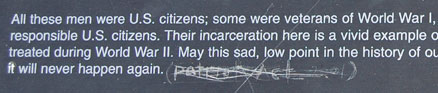
Several miles north of Moab, Utah, on Highway 191, there’s an Historical Interest marker to commemorate the Civilian Conservation Corps work camp at Dalton Wells. According to the plaque on the site, Camp DG-32 was used for public works through the Great Depression, and converted in 1943 into a concentration camp for Japanese Americans accused of being troublemakers at the civilian internment camps. The plaque offered an apology for the “total violation their civil rights,” and this admonition:
Civilian Conservation Corps DG-32 Dalton Wells
After which someone added in parentheses: “(Patriot Act, 2001)” and then as if to make the point, a next somebody scratched it out.

Full text of the marker:

Civilian Conservation Corps Camp DG-32 (Co. 234)
1935-1942

During the Great Depression of the 1930’s, CCC Camps were scattered all over the USA. They provided gainful employment to youth of the nation with work on public service projects. Between 1933 and 1942, four camps were located near Moab. Each camp worked on various natural resource project for the Soil Conservation Service, the National Park Service, and the forerunner of the Bureau of Land Management.

DG-32 was a long-lasting camp and typical of most with wooden, tar-paper covered barracks and buildings housing some 200 young men between the ages of 18 and 25. Enrollees came from the eastern states, and leadership was provided by the Army, Grazing Service, and local men experienced in construction and stock grazing needs.

Under spartan conditions, clothing, food, and housing were provided in the primitive camp. Pay was $30 per month with $25 sent home.

DG-32 projects included many range improvements: stock trails down the precipitous sandstone cliffs, spring developments, wells and stock ponds, eradication of rodents that competed with stock for feed, fences for corrals and pastures, reservoir dams, roads and bridges. These projects provided on the job training for the enrollees, besides the benefits they brought to the local economy. Many of these works are still in use today. The value of the camp and its works to Grand County is beyond estimation. It was a significant milestone that greatly influenced the economic history of the county.

All that remains of the camp today are the cottonwood trees planted by the enrollees that you see fronting this site, concrete slabs for buildings, graveled roads and rock-outlined walkways, the remains of an old windmill and a rock masonry water storage tank. These remnants signify the moving history of a time when America valiantly struggled to restore its economic stability and provide its young people with meaningful employment.

Japanese-American World War II Concentration Camp
1943

On January 11, 1943, a train pulled into Thompson Station north of here with armed Military Police guarding sixteen male American citizens of Japanese ancestry. While the locals of the town waited to cross the tracks, the entourage was loaded and transferred to the old abandoned “CCC” camp located here at Dalton Wells.

Their crime? They were classified as “troublemakers” in the Manzanar, California Relocation Center where they and their families had been forcibly located at the start of World War II. Removed from their homes and lands in California under a Presidential Executive Order, they were subject to the whim and mercy of poorly-trained bureaucrats and military personnel in the center. This Executive Presidential Order was the result of wartime hysteria, racial bigotry, and greed.

The original sixteen men were removed from Manzanar and brought here without the benefit of council. They did not have a formal hearing or proper arrest proceedings, and the action was in total violation of their civil rights. It was a process more compatible with fascism than democracy.

The inmates troubles worsened when and informer and confidant of the administration was beaten. An organizer of the mess hall workers was thrown into jail as a suspect. A meeting was held in the camp to protest the jailing and a riot resulted. Two inmates were killed by trigger-happy soldiers.

Other Japanese-American men were soon brought to the camp. Thirteen came from Gila River, Arizona, having been charged as being members of an organization which was fully sanctioned by camp officials. Ten more came from Manzanar as “suspected troublemakers.” Fifteen came from the Tule Lake, California, charged with refusing to register their availability for the draft and their loyalty to the U.S. under a set of confusing, denigrating requirements.

All these men were U.S. citizens; some were veterans of Work War I, others were family men, college graduates, and responsible U.S. citizens. Their incarceration here is a vivid example of how our Japanese-American citizens were treated during World War II. May this sad, low point in the history of our democracy never be forgotten, in the hope that it will never happen again.

The group was transferred by truck to an abandoned Indian school at Leupp, Arizona, on April 27, 1943. As those involved began to realize the inequality of the situation, the inmates were released back to relocation centers later that year. Thus, a black mark in the history of liberty and justice in the United States was ended.

Putin once again to the US and Europe- ‘Fuck you, you are not going to turn Russia into a Third World rape victim!’

university-being-bombed-in-gaza Russia-Ukraine gas talks collapse –like when the US tried to pull off its little con game using Georgia to bomb South Ossetia. Vladimir Putin has responded to the US and its Klan of Western European allies, that Russia will not be dragged further into the Third World by capitalist imperialism. That’s what it’s all about, too, as both the former Chinese and Russian ‘socialist’ bureaucrats were promised full partnerships in the imperialist capitalist world if only they would tag along quietly behind the US and its world allies. Instead, the Pentagon has been trying to push both countries backwards and not forwards. The USA government has been having its own way for the last three decades doing it, too.

Colonialism 101 is something that the former ‘Marxist-Leninist buffoons running China and the Soviet Union back then never learned for themselves, let alone taught to others in their pantomime of playing ‘Great Helmsmen’ cartoon roles for the world public. Both Russia and China drifted away from internationalism and solidarity with the oppressed of the poorer and exploited Third World masses of destitute laborers, and instead began to ape assholes like Margaret Thatcher and Ronald Reagan in their politics. They wanted their places on the big table alongside their capitalist associates of Great Britain and the US, Germany, France, and Japan. The dummies were conned, and Putin is quite aware of that by now. Further, he understands Peak Oil is a reality, as well as Peak Gas.

In his words, ‘Cheap Energy’ is over for you guys, and now we’re not just going to sit by and let you pillage everything from our country, Russia. Sadly, our own US ‘leaders’, from Obama to Clinton to Bush to all of the schmucks up there are nothing but criminal robbers and murderers, and world war is soon in the cards if the common folk don’t begin to wise up in the US and Britain, Germany, France, and Japan quite soon. Not to mention the utter ecological destruction of our planet in the cards for all of us quite soon, too, if we continue to fail to act.

That picture is of the university in Gaza being bombed by the US… Oh, I meant Israel. Sorry….

Happy New Year.

Obama outed himself as a bigot when he crawled into bed with Rick Warren

Just like Clinton, Obama won’t hesitate to throw gays to the dogs if he thinks it will buy him a single vote from the rabid right. I told you he wasn’t to be trusted. And just as we saw with Prop 8, most of the black community only wants equal rights for themselves, not anybody else.
 
Say it out loud: Barack Obama is a coward.

Of course, Obama openly declared his bigotry against gays before the election, declaring they did not deserve equal rights in marriage. So this really shouldn’t surprise anyone that he would flip off the gay community like this. “Change we can believe in,” my ass.

During the campaign, I had so many arguments with his supporters, who insisted that he was the miracle that would make everything right with America. When confronted with the reality of his positions (as on gays) they would insist that was only to get elected, but, “just you watch,” once he was, then we would see the “real Obama.” Well, Ladies and Germs, the election is over, and there it is: the REAL Obama — flipping the bird to his supporters.

Only a moron would think his hiring every right winger he can find somehow doesn’t mean his is going to be a right wing administration.

What, am I the only one who realized what being a Chicago politician meant? It means he’s an asshole who can’t be trusted. But now I suspect a lot of his supporters are beginning to realize that. Though there will always be those who will defend him, no matter what — just like those Republicans who constantly made excuses for Dubya, or those born-again Christians who spend their entire lives dreaming up excuses for their “god.” People are pathetically stupid.

Disgraced: 66 nations in the UN have backed a resolution decriminalizing homosexuality.

Big hold outs: the USA, Russia, China, and the Vatican.

The nations that are more progressive than this dying backwater: Albania, Andorra, Argentina, Armenia, Australia, Austria, Belgium, Bolivia, Bosnia and Herzegovina, Brazil, Bulgaria, Canada, Cape Verde, Central African Republic, Chile, Colombia, Croatia, Cuba, Cyprus, Czech Republic, Denmark, Ecuador, Estonia, Finland, France, Gabon, Georgia, Germany, Greece, Guinea-Bissau, Hungary, Iceland, Ireland, Israel, Italy, Japan, Latvia, Liechtenstein, Lithuania, Luxembourg, Malta, Mauritius, Mexico, Montenegro, Nepal, Netherlands, New Zealand, Nicaragua, Norway, Paraguay, Poland, Portugal, Romania, San Marino, Sao Tome and Principe, Serbia, Slovakia, Slovenia, Spain, Sweden, Switzerland, the former Yugoslav Republic of Macedonia, Timor-Leste, United Kingdom, Uruguay, and Venezuela.

Excerpts from Thomas McCullock’s Dec 29 notes, thomasmc.com.

Papieren Bitte? Just your shoes please

mens shoesMost people can easily conjure the cinematic image of Gestapo officers blocking train passengers, demanding “Your papers please.” That such a scene could ever develop in America, haunts citizens opposed to national identity cards or embedded microchips. But with modern surveillance methods as pervasive as cellphones, perhaps today’s state security services have less need to verify who we are. I’ll assert the US Department of Homeland Security is charged more with making Americans feel the heavy boot print of authoritarianism.

I think that in the wake of 9/11, this nation has indeed mobilized a “papers please” law enforcement policy.

The proof is there in black and white in the Patriot Act; you can see it in the Civil Liberties-free zone which immigration officers have been empowered to enforce to 100 miles inland from our borders; and you can see it at our airports. Last night’s 60-Minutes questioned the punitive aspects of the TSA measures to which today’s airline passengers are subjected. Less surprisingly, CBS also suggested their probable ineffectiveness.

Having just paid a holiday visit to DIA, I was inclined to see more. Yes, this is another holiday post.

Credit where credit is due? It’s no coincidence this is about shoes.

Papieren Bitte
First, I’d like to deconstruct the film mythology, which originated in wartime, from Hollywood Home Front propaganda meant to demonize the Hun. Certainly the trench-coated SS officer, or leather-jacketed Gestapo detective, asking for your documents, cut a villainous figure. But they were, in reality, as out of the ordinary as today’s FBI or CIA agents. Have you ever happened upon a one of those?

More often by far, during WWII, the job of asking for a traveler’s “Legitimacion” was assigned to the gendarmes of the occupied countries, or to the collaborators who’d been deputized. These were ordinary constables and men who otherwise were unfit to serve in combat. Old frumps, maligned and bitter. If you can picture the run-of-the-mill TSA troll, you see where I’m going.

Public Transportation
Where travelers a half-century ago were taking trains, today the public city-to-city lattice is airborne. Today we queue for planes, not trains. And instead of producing our “papers” –I should say, IN ADDITION to producing our papers– we are required to remove our shoes, all sorts of articles, submit to searches, and refrain from carrying certain items, in order to thread the needle that allows us access to public travel. I’m not sure if today’s security screening isn’t the equivalent of the depiction of the 40s silver-screen.

Before you argue that I’m being alarmist, please consider that most Germans during the war, indeed the overwhelming majority of citizens of occupied Europe, had little to fear by being asked for their documents. You or I are not insurgents on the lam, nor aspiring bomb-throwers. We do not fear being sent to Guantanamo.

Indeed, you might remember, the movie heroes who sweated the Nazi checkpoints were always resistance fighters, saboteurs, or escaped Allied prisoners. Today, ask yourself how an enemy of the USA would fare trying to use an airport. If you have become aware now that our US Homeland does not show reticence to torture, or disappear, persons of interest, would modern airport security be any less a terrifying prospect for people who may not be in lockstep with the ever rogue-ideology of the current global administrators?

And so, what was the main purpose of policemen monitoring the trains of occupied Europe? To prevent illegal travel, or to deter the thought of sedition? Both. But those were the days of imperfect intelligence.

Today, we know that even the 9/11 hijackers were tracked well in advance of their boarding at Boston Airport. Since then, we know that intelligence agency Fusion Centers also parse the surveillance data of persons of mere tangential interest. We know that the NSA records all phone calls. We know the telecoms are doing something for which they are very insistent about receiving preemptory immunity.

Potential terrorists/hijackers have everybody on their tail.

The TSA fat bastards are for the rest of us.

Airport Fear-mongering
Do you remember the days when you could linger as you dropped off your loved ones at the airport? You could wait with them, or you could meet them as they walked off the plane. Now you are greeted by concrete barriers at the curb, you can’t help anyone with their bags. America’s airports have become high security zones, unwelcoming to all.

Permit me to interject the observation that there has not been a single domestic airport attack to justify the draconian measures which have impacted American tranquility. We abide being yelled at, for absolutely no reason except the scare-phrase “Remember 9/11.” Remember the Maine? Remember Pearl Harbor? Japanese Internment Camps anyone?

If you are the traveler, you have to strip yourself of dignity before a thick-necked tin-pot. Now airports are even replacing the metal detectors with X-ray gateways. You are required to raise your arms for a virtual strip search, where digital images of your nakedness are reviewed by the airport security. Official TSA statements explain that these digital records go no further than their desks.

You can choose to believe that, or believe that all our faces are being blurred, or that our corresponding identities are not matched with the images.

(A digression on the subject of intelligence files:
Meanwhile, consider that the NSA is recording ALL satellite borne phone calls. International and domestic. They get around the “wire-tapping” restrictions by addressing it as “packet collecting.” To their devices, it’s an altogether new technology, thereby unencumbered by civil right legislation protection.

Our imaginations cannot fathom how spooks can listen to all the world’s satellite calls, but their imaginations know that someday the software will be developed to accomplish that task. Won’t they be kicking themselves later if they hadn’t stored as much as they could of our conversations BEFORE anyone suspected all telephones were eavesdropped upon?

-By the way, did you miss the memo that every cellphone is capable of being an eavesdropping device, even when it’s not engaged in a phone call? Would it be beyond the pale to imagine that if a near infinite number of calls are recorded, another near infinite amount of off-line talk is being aggregated in addition? If you can store more on your iPod than you can read in 100 lifetimes, supercomputer storage can probably lap your imagination by 100 to the 100th, I’m just thinking.)

Respect Authority
Well look at me, I’m only underlining where the DHS is happy to have us all place emphasis. FEAR. The security at today’s airports won’t keep box cutters off of airplanes, but it will keep a citizenry from daydreams of dissent.

So much ado,
And not enough DO? You already know what to do. Respect authority? Disrespect false authority! Take a lead from Comrade al-Zairi, you too can make it about the shoes.

We’ve all of us, you know it, mouthed to ourselves the defiant retort, rehearsed for if and when that imaginary Nazi hits us up for our papers: “Papers? I don’t need to show you no stinkin’ papers!”

From LA, I remember a variant which Hispanics directed at La Migra. They wished.

Anyone WITH papers can defy authority with the full confidence that comes from “I am an American” impunity. But can undocumented immigrants say it? Can Middle-Eastern-looking gentlemen say it? Not hardly.

YOU CAN.

My brave little fantasy insurgent, why not offer that rebel yell to the TSA? Tell them you don’t need to remove your stinkin’ shoes! (Double- entendre unintended.) They won’t let you on the plane, but that’s where beloved Capitalism provides your audience.

Put your courage where your mouth is
Let the airlines hear your rebel yell. “We don’t need your stinkin’ airplane!” If they don’t remove the Beirut decor concrete barriers, if they don’t send the TSA mini tyrants packing, if they don’t let you travel with toiletries of your damn choosing, you’re not going to take their stinkin’ flights.

If they’re not going to let you park up close to the terminal, where you used to be able to park but now those spaces are let out to valet parking outfits, you’re not going to visit their airport. Period.

Is there anywhere that you need to go in a hurry, besides out of the country for a long, long spell?

Drive, it’s still free
If you’re going to stick around, boycott the airlines. Use your car.

As has been demonstrated at Arizona checkpoints –as seen on YouTube– a car and a video camera can get you anywhere unmolested. If you are stopped at an DHS “immigration” checkpoint, you hold the upper hand. You can persist in being let to pass without answering a single question. If they detain you, you have a lawsuit. In your car, you can say with impunity still “I don’t need to show you no stinkin’ papers!”

How the US helped out in Indonesia’s forgotten genocide of 500,000 dead

indonesia-klan.jpg We get fed so much bullshit all the time about how supposedly the US has always been this great beacon of light in the ‘civilized world’. But did you know that the US under Lyndon Johnson helped create a genocide that murdered at least 500,000 people in the island country of Indonesia? Yes, this was a MADE IN THE US genocide, People, and the Associated Press revisits the scene in this brief report online today. AP Exclusive: Indonesians recount role in massacre

So the next time some anti-Communist fanatic starts off about how communists supposedly always kill people wholesale, remember capitalist Indonesia. Remember capitalist Nazi Germany and capitalist WW2 Japan, too. Millions of people were murdered in the fight of these capitalist dictators against Communism. And remember, too, the United States of America which also murdered millions of people in that same fight by the international Business community against their own workers all over the world. Capitalism is a murderous system of rule by the rich, over the many poor. Yes, the US has been involved in many, many genocides in fairly recent times, and not just in the distant past.

Time to use the word DEPRESSION again

One of the most ridiculous of the utterly false and phony positive thinking talking points used by the US’s Right Wing corporate daily press and the talking heads of their TV stations is their constant babble about whether we have entered into a ‘recession’ or not? The correct word to be used is depression, it ‘s an ECONOMIC DEPRESSION we have been entered into worldwide, and there is nothing left to debate about it either. It’s here. End of discussion. Go take a hike, Clowns@!

Today, stocks fell almost 7% and that now is a drop of about 25% from the DOW all time high just 2 years ago. That is a depression. Further, this Friday morning Japanese stocks have already fallen 11% of their value in just a few minutes of trading. That is an economic depression.

Let’s cut to the quick on this. Bush and his clown clones are through. They are out of here. This presidential election will turn out to be a rout of McCain/ Palin, because they are more of the same, and The Same just flushed itself down the toilet via a whole shitload of corruption finally coming home to roost. But there is yet more here than the rout of the neocon corruptionists that will occur. If we in America are fed up with this crew, the rest of the world is even more so.

Yes, the rest of the world is going down the drain with us and our stupid economy where thieves rule the rest of us. They are going to hate the US for the misery we have delivered them into. In fact, they already do. Afghanistan to Iraq to Somalia to Pakistan and flush, flush, flush. They can put it together, even if your dumb Republican neighbors can’t.

It’s time to use the word depression once again, because we alhough we all thought the thought that ‘communism’ self destructs, we had all but forgotten that capitalism does just that in an even much worse way. We have been entered into a worldwide economic depression by all those that fed us the total line of crap that it was all running so very smoothly. Pompous stupid, arrogant twits they were, and now the world has once again had its eyes opened to the dangers that capitalism constantly puts the human race into. The unemployment to come will soon see to that.

The rich everywhere will say that The Treasury has no money to stop it. You can bet your 401K retirement funds on it! And the whole world will correctly blame the US government, AND the stupid American people themselves, for what is being done to them. Get used to really being hated, My Friends. And we will be hated rightly so, for playing stupid so long.

Good luck, Democratic Party. Just because everybody holds the Republican Party to be hugely responsible for this mess, don’t think that they won’t also begin to see you as the Republican’s cohorts. Hell! That’s what you have always claimed to be actually, isn’t it? People played stupid though and didn’t take you people at your own word. You are now in a BIG, BIG, BIG… BIPARTISAN MESS. We got it. You earned it!

Yes, it’s time to once again use the word DEPRESSION once again. It will be hard on us all (save the Capitalist rich who always profit off human misery).

Capitalist medicine turns to robotics

cyborg nurse
Russian scientists design mechanical nurse and they are also working on designing a robotic surgeon, too! Not to be outdone by Russian mechanical robotic nurses and surgeons, the Japanese apparently are banking more on using cyborgs in the capitalist medical field. Americans are still most heavily into computerized systems, it seems, as the hospitals there are into the use of computers to program and flowchart flesh and blood nursing/ medical staff more and more?.

Maybe you are in need of the Robotic Physiotherapist’ on its way, whose ultrasound behavior you can surely count on? And the Pentagon has already developed the robotic EMT known as Vecna BEAR Robot For Battlefield Extraction And Retrieval. Capitalist medicine is a science and not an art, and a lab rat can get no better care than what is ahead for us.

Are your elderly parents in need of care? Then the u-BOT 5 Robot is there to help them out! Love a caregiver? Don’t get pincered in!

Stop the Senate of would-be thieves!

wallstreet-bailoutCall your Band of Thieving Senators now to tell them you don’t want to give $700 Billion –more honestly likely to be $5 Trillion– to the robber bankers of Wall Street! Telephone Colorado Senators Ken Salazar at 202.224.5852 and Wayne Allard at 202.224.5941 NOW. Why not call OBAMA too! (phone: 202-224-2854) Tell them you want them to consult with at least ONE economist of repute! At least one analyst not on the corporate payroll. As he promised yesterday, Michael Moore suggests a 10 PART PLAN, only IF pressure can be brought to bear right now to stop the Senate bill.

Friends,

The richest 400 Americans — that’s right, just four hundred people — own MORE than the bottom 150 million Americans combined. 400 rich Americans have got more stashed away than half the entire country! Their combined net worth is $1.6 trillion. During the eight years of the Bush Administration, their wealth has increased by nearly $700 billion — the same amount that they are now demanding we give to them for the “bailout.” Why don’t they just spend the money they made under Bush to bail themselves out? They’d still have nearly a trillion dollars left over to spread amongst themselves!

Of course, they are not going to do that — at least not voluntarily. George W. Bush was handed a $127 billion surplus when Bill Clinton left office. Because that money was OUR money and not his, he did what the rich prefer to do — spend it and never look back. Now we have a $9.5 trillion debt. Why on earth would we even think of giving these robber barons any more of our money?

I would like to propose my own bailout plan. My suggestions, listed below, are predicated on the singular and simple belief that the rich must pull themselves up by their own platinum bootstraps. Sorry, fellows, but you drilled it into our heads one too many times: There… is… no… free… lunch. And thank you for encouraging us to hate people on welfare! So, there will be no handouts from us to you. The Senate, tonight, is going to try to rush their version of a “bailout” bill to a vote. They must be stopped. We did it on Monday with the House, and we can do it again today with the Senate.

It is clear, though, that we cannot simply keep protesting without proposing exactly what it is we think Congress should do. So, after consulting with a number of people smarter than Phil Gramm, here is my proposal, now known as “Mike’s Rescue Plan.” It has 10 simple, straightforward points. They are:

1. APPOINT A SPECIAL PROSECUTOR TO CRIMINALLY INDICT ANYONE ON WALL STREET WHO KNOWINGLY CONTRIBUTED TO THIS COLLAPSE. Before any new money is expended, Congress must commit, by resolution, to criminally prosecute anyone who had anything to do with the attempted sacking of our economy. This means that anyone who committed insider trading, securities fraud or any action that helped bring about this collapse must go to jail. This Congress must call for a Special Prosecutor who will vigorously go after everyone who created the mess, and anyone else who attempts to scam the public in the future.

2. THE RICH MUST PAY FOR THEIR OWN BAILOUT. They may have to live in 5 houses instead of 7. They may have to drive 9 cars instead of 13. The chef for their mini-terriers may have to be reassigned. But there is no way in hell, after forcing family incomes to go down more than $2,000 dollars during the Bush years, that working people and the middle class are going to fork over one dime to underwrite the next yacht purchase.

If they truly need the $700 billion they say they need, well, here is an easy way they can raise it:

a) Every couple who makes over a million dollars a year and every single taxpayer who makes over $500,000 a year will pay a 10% surcharge tax for five years. (It’s the Senator Sanders plan. He’s like Colonel Sanders, only he’s out to fry the right chickens.) That means the rich will still be paying less income tax than when Carter was president. This will raise a total of $300 billion.

b) Like nearly every other democracy, charge a 0.25% tax on every stock transaction. This will raise more than $200 billion in a year.

c) Because every stockholder is a patriotic American, stockholders will forgo receiving a dividend check for one quarter and instead this money will go the treasury to help pay for the bailout.

d) 25% of major U.S. corporations currently pay NO federal income tax. Federal corporate tax revenues currently amount to 1.7% of the GDP compared to 5% in the 1950s. If we raise the corporate income tax back to the level of the 1950s, that gives us an extra $500 billion.

All of this combined should be enough to end the calamity. The rich will get to keep their mansions and their servants, and our United States government (“COUNTRY FIRST!”) will have a little leftover to repair some roads, bridges and schools.

3. BAIL OUT THE PEOPLE LOSING THEIR HOMES, NOT THE PEOPLE WHO WILL BUILD AN EIGHTH HOME. There are 1.3 million homes in foreclosure right now. That is what is at the heart of this problem. So instead of giving the money to the banks as a gift, pay down each of these mortgages by $100,000. Force the banks to renegotiate the mortgage so the homeowner can pay on its current value. To insure that this help does no go to speculators and those who have tried to make money by flipping houses, this bailout is only for people’s primary residence. And in return for the $100K paydown on the existing mortgage, the government gets to share in the holding of the mortgage so that it can get some of its money back. Thus, the total initial cost of fixing the mortgage crisis at its roots (instead of with the greedy lenders) is $150 billion, not $700 billion.

And let’s set the record straight. People who have defaulted on their mortgages are not “bad risks.” They are our fellow Americans, and all they wanted was what we all want and most of us still get: a home to call their own. But during the Bush years, millions of them lost the decent paying jobs they had. Six million fell into poverty. Seven million lost their health insurance. And every one of them saw their real wages go down by $2,000. Those who dare to look down on these Americans who got hit with one bad break after another should be ashamed. We are a better, stronger, safer and happier society when all of our citizens can afford to live in a home that they own.

4. IF YOUR BANK OR COMPANY GETS ANY OF OUR MONEY IN A “BAILOUT,” THEN WE OWN YOU. Sorry, that’s how it’s done. If the bank gives me money so I can buy a house, the bank “owns” that house until I pay it all back — with interest. Same deal for Wall Street. Whatever money you need to stay afloat, if our government considers you a safe risk — and necessary for the good of the country — then you can get a loan, but we will own you. If you default, we will sell you. This is how the Swedish government did it and it worked.

5. ALL REGULATIONS MUST BE RESTORED. THE REAGAN REVOLUTION IS DEAD. This catastrophe happened because we let the fox have the keys to the henhouse. In 1999, Phil Gramm authored a bill to remove all the regulations that governed Wall Street and our banking system. The bill passed and Clinton signed it. Here’s what Sen. Phil Gramm, McCain’s chief economic advisor, said at the bill signing:

“In the 1930s … it was believed that government was the answer. It was believed that stability and growth came from government overriding the functioning of free markets.

“We are here today to repeal [that] because we have learned that government is not the answer. We have learned that freedom and competition are the answers. We have learned that we promote economic growth and we promote stability by having competition and freedom.

“I am proud to be here because this is an important bill; it is a deregulatory bill. I believe that that is the wave of the future, and I am awfully proud to have been a part of making it a reality.”

This bill must be repealed. Bill Clinton can help by leading the effort for the repeal of the Gramm bill and the reinstating of even tougher regulations regarding our financial institutions. And when they’re done with that, they can restore the regulations for the airlines, the inspection of our food, the oil industry, OSHA, and every other entity that affects our daily lives. All oversight provisions for any “bailout” must have enforcement monies attached to them and criminal penalties for all offenders.

6. IF IT’S TOO BIG TO FAIL, THEN THAT MEANS IT’S TOO BIG TO EXIST. Allowing the creation of these mega-mergers and not enforcing the monopoly and anti-trust laws has allowed a number of financial institutions and corporations to become so large, the very thought of their collapse means an even bigger collapse across the entire economy. No one or two companies should have this kind of power. The so-called “economic Pearl Harbor” can’t happen when you have hundreds — thousands — of institutions where people have their money. When you have a dozen auto companies, if one goes belly-up, we don’t face a national disaster. If you have three separately-owned daily newspapers in your town, then one media company can’t call all the shots (I know… What am I thinking?! Who reads a paper anymore? Sure glad all those mergers and buyouts left us with a strong and free press!). Laws must be enacted to prevent companies from being so large and dominant that with one slingshot to the eye, the giant falls and dies. And no institution should be allowed to set up money schemes that no one can understand. If you can’t explain it in two sentences, you shouldn’t be taking anyone’s money.

7. NO EXECUTIVE SHOULD BE PAID MORE THAN 40 TIMES THEIR AVERAGE EMPLOYEE, AND NO EXECUTIVE SHOULD RECEIVE ANY KIND OF “PARACHUTE” OTHER THAN THE VERY GENEROUS SALARY HE OR SHE MADE WHILE WORKING FOR THE COMPANY. In 1980, the average American CEO made 45 times what their employees made. By 2003, they were making 254 times what their workers made. After 8 years of Bush, they now make over 400 times what their average employee makes. How this can happen at publicly held companies is beyond reason. In Britain, the average CEO makes 28 times what their average employee makes. In Japan, it’s only 17 times! The last I heard, the CEO of Toyota was living the high life in Tokyo. How does he do it on so little money? Seriously, this is an outrage. We have created the mess we’re in by letting the people at the top become bloated beyond belief with millions of dollars. This has to stop. Not only should no executive who receives help out of this mess profit from it, but any executive who was in charge of running his company into the ground should be fired before the company receives any help.

8. STRENGTHEN THE FDIC AND MAKE IT A MODEL FOR PROTECTING NOT ONLY PEOPLE’S SAVINGS, BUT ALSO THEIR PENSIONS AND THEIR HOMES. Obama was correct yesterday to propose expanding FDIC protection of people’s savings in their banks to $250,000. But this same sort of government insurance must be given to our nation’s pension funds. People should never have to worry about whether or not the money they’ve put away for their old age will be there. This will mean strict government oversight of companies who manage their employees’ funds — or perhaps it means that the companies will have to turn over those funds and their management to the government. People’s private retirement funds must also be protected, but perhaps it’s time to consider not having one’s retirement invested in the casino known as the stock market. Our government should have a solemn duty to guarantee that no one who grows old in this country has to worry about ending up destitute.

9. EVERYBODY NEEDS TO TAKE A DEEP BREATH, CALM DOWN, AND NOT LET FEAR RULE THE DAY. Turn off the TV! We are not in the Second Great Depression. The sky is not falling. Pundits and politicians are lying to us so fast and furious it’s hard not to be affected by all the fear mongering. Even I, yesterday, wrote to you and repeated what I heard on the news, that the Dow had the biggest one day drop in its history. Well, that’s true in terms of points, but its 7% drop came nowhere close to Black Monday in 1987 when the stock market in one day lost 23% of its value. In the ’80s, 3,000 banks closed, but America didn’t go out of business. These institutions have always had their ups and downs and eventually it works out. It has to, because the rich do not like their wealth being disrupted! They have a vested interest in calming things down and getting back into the Jacuzzi.

As crazy as things are right now, tens of thousands of people got a car loan this week. Thousands went to the bank and got a mortgage to buy a home. Students just back to college found banks more than happy to put them into hock for the next 15 years with a student loan. Life has gone on. Not a single person has lost any of their money if it’s in a bank or a treasury note or a CD. And the most amazing thing is that the American public hasn’t bought the scare campaign. The citizens didn’t blink, and instead told Congress to take that bailout and shove it. THAT was impressive. Why didn’t the population succumb to the fright-filled warnings from their president and his cronies? Well, you can only say ‘Saddam has da bomb’ so many times before the people realize you’re a lying sack of shite. After eight long years, the nation is worn out and simply can’t take it any longer.

10. CREATE A NATIONAL BANK, A “PEOPLE’S BANK.” If we really are itching to print up a trillion dollars, instead of giving it to a few rich people, why don’t we give it to ourselves? Now that we own Freddie and Fannie, why not set up a people’s bank? One that can provide low-interest loans for all sorts of people who want to own a home, start a small business, go to school, come up with the cure for cancer or create the next great invention. And now that we own AIG, the country’s largest insurance company, let’s take the next step and provide health insurance for everyone. Medicare for all. It will save us so much money in the long run. And we won’t be 12th on the life expectancy list. We’ll be able to have a longer life, enjoying our government-protected pension, and living to see the day when the corporate criminals who caused so much misery are let out of prison so that we can help reaclimate them to civilian life — a life with one nice home and a gas-free car that was invented with help from the People’s Bank.

Yours,
Michael Moore

P.S. Call your Senators now. Here’s a backup link in case we crash that site again. They are going to attempt their own version of the Looting of America tonight. And let your reps know if you agree with my 10-point plan.

The specter of world wide depression raises its head

specterWe are so self centered in the US! As our government’s military deficit spending collapses the American capitalist economy we seem to forget that the crisis is a global one now. The Democratic/ Republican team have dragged down the global economy and not just our national one.

Stock markets all across the globe have been crashing due to what is termed in the Big Business press as being a ‘credit crunch’. Look everywhere, whether it be China, Russia, Japan, Iceland, Germany, France, or wherever, and the Almighty Dollar is dragging them all down. Something much more than a ‘credit crunch’ is involved in this international meltdown of the global economy.

Actually, what we are seeing and experiencing is the normal global capitalist economic cycle in motion. The downsides are just not very much fun for most of us, and, in fact, neither are the ‘upturns’ either. There is no such thing as ‘regulated capitalism’ since the regulators always ultimately turn out to be the capitalists regulating themselves, and that is no real regulation at all. There has got to be a better way!

Insurgents, prairie dogs and Laser Tag

I remember discovering the difference between target shooting and Laser Tag. At a firing range you could look calmly down your gun sight and concentrate without distraction. Same with hunting. But Laser Tag, Paintball, or the doubtlessly misnomered Airsoft, let you experience what it’s like to be shot at. Who would believe aiming a gun is so different under fire?

In Laser Tag, you had to wear an infrared sensor to make yourself a target to your opponent’s fire. We used to wrap the sensor belt around our heads because it seemed the most fair vulnerability. Otherwise it was too easy to obscure your sensor between you and the ground or against whatever you were hiding behind. On your forehead, the sensor would become visible whenever you yourself attempted to poke up your head to take a shot.

I learned to cheat by crawling under cars to obscure my forehead in the undercarriage while my line of sight remained unimpeded. Of course I was a sitting duck when spotted. But from no matter what covered position, I found it much harder to take aim when adversaries were directing their fire at me.

If you’d succeeded in concealing your vantage point, you were free to concentrate on your aim. But now you were challenged with a further trembling sensation in your fingers. Now there was a heightened hesitation to pull the trigger, because the moment you did, your position would be revealed and you’d attract fire.

This is the predicament we discount when we think of military snipers. Though it seems quite plainly cowardly to shoot unsuspecting opponents from a concealed position, often snipers have to operate from hiding places deep in enemy territory. When they finally take their shot, snipers become prey themselves.

I think about this immediate blowback consequence when I think of Iraqis or Afghans who contemplate taking aim at the US military machine. Insurgents face technology and firepower to obliterate the very hill from which they might be shooting. It would seem that anyone who would dare to stand armed against US forces would be a suicide bomber. It’s near certain death to fire a Kalashnikov knowing that US electronics can very quickly extrapolate your location and bring ordinance against you like a fly-swatter against a fly.

In WWII against Japan, we held a sad esteem for the suicide pilots of the last desperate Japanese efforts. The Kamikazes would pilot explosive laden aircraft which had no landing gears in case they changed their minds. It seemed like lunacy, and often they were young, and barely trained.

I wondered if our soldiers accord the Iraqi or Afghan insurgents a similar awed respect. To merely raise your head from the rubble, without Kevlar armor, requires a bravery to defy the gods. What a cost to try to defend your homeland against America’s overwhelming might. I couldn’t do it. You draw almost certain overkill coming from unforeseen points, high in the sky, laser-guided by a team of technicians in climate controlled comfort on the other side of the planet, who are not themselves under fire. We’ve rendered all our adversaries into suicide bombers. How dare our behind-the-lines officers call them cowardly?

Artemev head shoulders and legs above

Sasha ArtemevDid you miss this spectacular moment in men’s gymnastics? It was the last round on the pommel horse. Team USA was going for silver, the Japanese were already looking dejected about being left the bronze.

The three Americans sent to cleanup were –ironically said the announcers– each of them alternate team members. And then the unthinkable happened.

Well it wasn’t unthinkable, I was thinking it. I was rooting against team USA with my blackest might, for being the ass-backward patriotic pawns the US athletes are. I was amused to see Raj trip up, and thrilled when the same thing happened to the Taiwanese-American. Yeeeee!

But next up was Sasha Artemev, whose erratic record, we were told, was what disqualified him from the original team. He failed 3/4 of the time. But the 1/4 performance ranked him as world champion on the pommel horse. So as the diminutive boy contemplated his mount, under all the pressure I’d wished upon team USA, it became impossible not to have a change of heart.

I’d barely ever watched gymnastics before, but Artemev’s performance went from dazzling to miraculous. As a teammate of his told reporters later, for a moment it looked like Artemev might have launched himself skyward from the horse, but he defied antigravity and hung on. Who has ever fought being earthbound except race cars? I doubt even Michael Jordan has to temper his air flight.

Never the less, Sasha Artemev whirled like a helicopter tugging against a leash and landed as solid as you hope every time that every gymnast could, beaming, and it was Seabiscuit, Rocky and the Little Engine That Could!

But the tension now mounted because Team USA’s score had slipped so badly that now the German team was in contention to reach the bronze. Would the Americans medal at all? Everything was up to the German pommel horse numbers.

As each German performed his routine, Artemev’s act looked all the more luminous. The German routines were executed well, but were completely earthbound by comparison. What could the poor Germans do to compete in such a fix, short of improvise Artemev’s leap to the heavens and court probably an infinitely greater than 3/4 chance of failure?

Here’s a video of an Artemev performance at an earlier gymnastic meet. In this minute and a half, you get to see what the coaches feared would happen in Beijing, then you’ll see a preview of what ultimately did.

Is Vietnam a communist country still?

Since most liberals quite haven’t really caught up with the now ancient news that China is today a capitalist country run by a leftover Stalinist dictatorship, I thought it instructive to point out that Vietnam is not a communist country today either, and for the same reasons. Its Communist Party recently has devolved the previous revolution back into a nationalist run, counterrevolutionary capitalist class economy under Vietnamese Communist Party control and direction.

Last year foreign capitalist investment or FDI hit $20 billion, with Ford, WalMart, and other multinational firms now operating much of the economic activity there. The FDI of Vietnam just 10 years ago was less than $5 billion.

One of the tools to evaluate whether ‘communism’ exists or not is to look at the FDI in a country. Communists are people who try to abolish the capitalist class’s control over the working class, not those who invite foreign capitalists into the country to run the economy. Just because the ruling party might still have ‘communist’ in its name does not automatically mean that they are communist leaders any more.

Counterrevolutions often occur inside previously more radical leadership groupings, like the Vietnamese Communist Party leadership that once fought to kick the Japanese, French, and US out of their country was. Vietnam is not now still a communist country even though it at least still remains independent politically from outsider imperialists. The imperialists do have a way of sneaking back in through their capitalist investment, and for that reason, Leon Trotsky and other revolutionary communist theorists of the past correctly observed that communism could not be permanently build in any one country alone. Capitalism was, and remains so, an international economic system.

Remembering decision to use A-bomb

Hiroshima pocketwatch stopped at 8:45
This pocket watch froze in time at 8:45 A.M. August 6, 1945, when Americans dropped the first of two atomic bombs on Japan. Sisters Witness Against War will hold their traditional annual remembrance of the bombing of Hiroshima and Nagasaki this Friday, August 8 at Bennet Hill, Colorado Springs. A silent vigil will follow at Peterson AFB.

Beijing extracurricular Olympic schedule

I have a last-minute, refocused interest in a safe and not-too-disrupted Beijing Olympics. It’s already been unofficially eventful. Here’s a time line of the counter-Olympics leading-up to the Opening Ceremonies. The Gazette is in Beijing. So are we!

OC -5: Marie arrives in Beijing!

OC -4: Sixteen Chinese policemen killed in Kashgar by Uighur separatists. Two Japanese journalists beaten by police for covering story.

OC -3: Earthquake hits Sichuan Province hours after Olympic torch passes.

OC -2: Four US-UK protesters unfurl TIBET banner as torch arrives at Beijing Bird’s Nest Stadium. / Four US cyclists cause furor by stepping off the plane wearing US-issued breathing masks. / Visa revoked for TEAM DARFUR Olympian alumni. Yay!
Tibet protester arrested in Tiananmen Square
OC -0: FREE TIBET demonstrations in Tiananmen Square. American Tourists stabbed. Assailant jumps to death. Official account. Chinese witnesses not at liberty to tell what they actually saw.

OC +1: Tibet activists ejected from Honk Kong equestrian arena. Protester sets himself on fire in Ankara.

America’s liberal ‘Peace Community’ remains apathetically pro-war

Peace peopleAmerica’s liberal ‘Peace Community’ remains apathetically pro-war, which explains why most are planning to vote for Pro-war candidate, Barack Obama. Far from being non-mainstream Americans ‘liberals’, are just as pro-war as their Republican counterparts are despite some occassional bleatings about ‘Peace’ in the abstract, and temper tantrums that the US has not won the invasion and occupation of Iraq just quite yet.

Doubt this analysis? Then ask yourself why hardly any of these liberals turned out the last 2 weeks for the many US regional demonstrations to demand a stop to threatening a war against Iran? These demonstrations were national in scope and called by 2 separate coalitions, but nobody showed up! In Colorado Springs, the local yokel misleaders didn’t even bother doing a local action, but that won’t stop them from responding that they are committed to non-violence and yada yada yada.

This week will find the ‘Peace Community’ going through the motions and holding candle light vigils in memory of the atomic bomb victims of Japan in 1945, but you won’t find them demanding that the US and NATO get out of Afghanistan. That’s because many of them plan to vote for a pro-war candidate that wants to fight that Afghan war forever if it takes that long to ‘win’ it? Or at least until some folk get mad about it… which most won’t because they don’t seem to care that much.

Locally, this Friday we will find the liberal ‘Peace Community ritually going out to Fort Peterson Air Base for their annual quick show ‘picnic’ there. What you will not see is any sign of a demand that the base actually be closed down. You will see many signs though with their abstract new age religious belief that war and violence are bad stuff! It is kind of a game they play… …and almost all of these ‘peacenics’ will vote for the pro-war candidate, Barack, almost all of them.

The thing liberals most fear is being considered somehow outside the mainstream American community which is still quite solidly pro-military and pro-war. Like the greater community at large, liberal ‘Peace Community’ folk mainly are angry because George W. Bush did not give the country a quick and easy victory in Iraq, so they are angry at him for it. Other than that, they are not that pissed off though. Afghanistan? What? Don’t bother us!

Why is the liberal ‘Peace Community’ so pro-war, even as they talk ‘Peace’? It’s because their conservatized neighbors are also very pro-war and they don’t want to appear too oppositional or unfriendly to these people. They don’t want to stand out and in fact never do (at least they never do in large vigils or protests against war and torture and inequality, etc. They often say it doesn’t’ work to participate in public actions!)

The liberal ‘Peace Community’ is committed to national patriotism and in America that means the military. But they are also committed to their idea of the Holy Ghost Jesus, Man of Peace. They try to fuse the 2 ideas together, but what remains is only to remain apathetically pro-war just like The Others they say they always oppose.

The liberal ‘Peace Community’ doesn’t want to really end war except in the abstract, but principally wants to agree that the US wars fought be juster wars with a kinder military than the world norm. Massage them and you have their vote. They really don’t care if their Democratic Party candidates are liars and manipulators. Just sound good.

The liberal ‘Peace Community’ doesn’t like being called antiwar, and in fact is not that at all. Antiwar to them sounds way too ‘anti-‘! Instead, they like to be seen as FOR the troops. They remain apathetically pro-war, and unfortunately so does the rest of the population.

Victory to the Afghan people! Victory to the Somali people! Victory to the Iraqi people! Victory to the Palestinians! And, Americans, get your heads out of your rear ends and screw them on straight.

Liberal Americans, that goes double! Stop being pro-war! You are, you know? Despite your constant chatter for ‘Peace’ which is mainly a cover for you to hide from yourself the fact that you’re as pro-war as your neighbors most of the time.

Racist Jewish Israel keeps killing kids

Israeli terrorism It is a sad state for the world Jewish community to now be about the leading group of racists in the world these days.

Quite simply, Jewish Israel refuses to give equal rights to its Arab population, continues an occupation of Arab Lands with the goal of annexing them, puts Arabs in the occupied territories into ghettos, and runs continual racist pogroms targeting for murder and injury the Arabs under Jewish domination. See Haaretz.com for the latest.. Palestinians: IDF troops wound 9 at boy’s funeral in West Bank They had already murdered the 11 year old boy, but that was not enough for the racist troops of Israel.

What is this Zionism then? The word is RACISM. Racist terrorism like that practiced by Israel and the US breeds a countering terrorism. The Japanese and Germans learned that the hard way in WW2 when the US and its allies responded to racist fascist terrorism by in turn terrorizing German and Japanese civilians.

G8 Summit presides over the world’s growing economic collapse

G8 Big Guy So what’s going on over in Japan at the G8 summit? What are the big shots doing over there? Few follow these mysterious proceedings in the press because it all seems so inscrutable. Besides, we are taught to believe, the rich and powerful kind fathers that they be know what they are doing and all will certainly be worked out for the rest of us for the best.

So let’s cut through some of this crap for a sec and think about it a little, why don’t we? It is not that hard to see what’s really going on, since all one has to do is occasionally look at the business sections of the press and there we see an increasing panic setting in. Will there be a CRASH is the big question? And the business press increasingly is aware that YES, there will be. Why is that?

The G8 has 3 major problems it is dealing with, and they haven’t a clue in how to successfully manage any of the 3 crises! Let’s list the BIG 3 problem areas then…

1) Declining world energy supplies in oil, with resulting rise in prices (including food items) due to this. Energy is needed for movement. 2) Impending world ecological collapse due to centuries of over exploitation of natural resources. Ecological stability is necessary for life. 3) Economic Bubble due to be burst soon. Markets do not have any relation now to economic activity actually necessary for human well being. Two big examples are the US ‘health system’ and the Pentagon managed military industrial welfare system for the big corporations. Two gigantic overgrown leeches on world economic activity.

So what will the G8 predictably do to deal with these 3 areas of crisis? Will they do anything different? The answer is simply NO, they will not, and that is precisely why the business sectors themselves are beginning to panic. They see it as simply that there is nothing that they can do, and they are right. Under their guidance, or lack of it, the world will simply begin to collapse big time. It is up to the little people (who the big people have total contempt for despite having no answers for anything themselves) to do something about it, or we will all perish.

Meanwhile, go shopping (while you still can) or watch some more TV. It beats being thrown in jail.

Global economic rapists are at it again

G8 protest
Why protest the G8 Summit July 7-9? Those hoodlums always look so determined. Here’s the rationale by the Emergency Exit Collective:

The 2008 G8 on Hokkaido, a Strategic Assessment
Emergency Exit Collective
Bristol, Mayday, 2008

The authors of this document are a collection of activists, scholars, and writers currently based in the United States and Western Europe who have gotten to know and work with each other in the movement against capitalist globalization. We’re writing this at the request of some members of No! G8 Action Japan, who asked us for a broad strategic analysis of the state of struggle as we see it, and particularly, of the role of the G8, what it represents, the dangers and opportunities that may lie hidden in the moment. It is in no sense programmatic. Mainly, it is an attempt to develop tools that we hope will be helpful for organizers, or for anyone engaged in the struggle against global capital.

I
It is our condition as human beings that we produce our lives in common.

II
Let us then try to see the world from the perspective of the planet’s commoners, taking the word in that sense: those whose most essential tradition is cooperation in the making and maintenance of human social life, yet who have had to do so under conditions of suffering and separation; deprived, ignored, devalued, divided into hierarchies, pitted against each other for our very physical survival. In one sense we are all commoners. But it’s equally true that just about everyone, at least in some ways, at some points, plays the role of the rulers—of those who expropriate, devalue and divide—or at the very least benefits from such divisions.

Obviously some do more than others. It is at the peak of this pyramid that we encounter groups like the G8.

III
The G8’s perspective is that of the aristocrats, the rulers: those who command and maintain that global machinery of violence that defends existing borders and lines of separation: whether national borders with their detention camps for migrants, or property regimes, with their prisons for the poor. They live by constantly claiming title to the products of others collective creativity and labour, and in thus doing they create the poor; they create scarcity in the midst of plenty, and divide us on a daily basis; they create financial districts that loot resources from across the world, and in thus doing they turn the spirit of human creativity into a spiritual desert; close or privatize parks, public water taps and libraries, hospitals, youth centers, universities, schools, public swimming pools, and instead endlessly build shopping malls that channels convivial life into a means of commodity circulation; work toward turning global ecological catastrophe into business opportunities.

These are the people who presume to speak in the name of the “international community” even as they hide in their gated communities or meet protected by phalanxes of riot cops. It is critical to bear in mind that the ultimate aim of their policies is never to create community but to introduce and maintain divisions that set common people at each other’s throats. The neoliberal project, which has been their main instrument for doing so for the last three decades, is premised on a constant effort either to uproot or destroy any communal or democratic system whereby ordinary people govern their own affairs or maintain common resources for the common good, or, to reorganize each tiny remaining commons as an isolated node in a market system in which livelihood is never guaranteed, where the gain of one community must necessarily be at the expense of others. Insofar as they are willing to appeal to high-minded principles of common humanity, and encourage global cooperation, only and exactly to the extent that is required to maintain this system of universal competition.

IV
At the present time, the G8—the annual summit of the leaders of “industrial democracies”—is the key coordinative institution charged with the task of maintaining this neoliberal project, or of reforming it, revising it, adapting it to the changing condition of planetary class relations. The role of the G8 has always been to define the broad strategic horizons through which the next wave of planetary capital accumulation can occur. This means that its main task is to answer the question of how 3?4 in the present conditions of multiple crises and struggles 3?4 to subordinate social relations among the producing commoners of the planet to capital’s supreme value: profit.

V
Originally founded as the G7 in 1975 as a means of coordinating financial strategies for dealing with the ‘70s energy crisis, then expanded after the end of the Cold War to include Russia, its currently face a moment of profound impasse in the governance of planetary class relations: the greatest since the ‘70s energy crisis itself.

VI
The ‘70s energy crisis represented the final death-pangs of what might be termed the Cold War settlement, shattered by a quarter century of popular struggle. It’s worth returning briefly to this history.

The geopolitical arrangements put in place after World War II were above all designed to forestall the threat of revolution. In the immediate wake of the war, not only did much of the world lie in ruins, most of world’s population had abandoned any assumption about the inevitability of existing social arrangements. The advent of the Cold War had the effect of boxing movements for social change into a bipolar straightjacket. On the one hand, the former Allied and Axis powers that were later to unite in the G7 (the US, Canada, UK, France, Italy, Germany, Japan)—the “industrialized democracies”, as they like to call themselves—engaged in a massive project of co-optation. Their governments continued the process, begun in the ‘30s, of taking over social welfare institutions that had originally been created by popular movements (from insurance schemes to public libraries), even to expand them, on condition that they now be managed by state-appointed bureaucracies rather than by those who used them, buying off unions and the working classes more generally with policies meant to guarantee high wages, job security and the promise of educational advance—all in exchange for political loyalty, productivity increases and wage divisions within national and planetary working class itself. The Sino-Soviet bloc—which effectively became a kind of junior partner within the overall power structure, and its allies remained to trap revolutionary energies into the task of reproducing similar bureaucracies elsewhere. Both the US and USSR secured their dominance after the war by refusing to demobilize, instead locking the planet in a permanent threat of nuclear annihilation, a terrible vision of absolute cosmic power.

VII
Almost immediately, though, this arrangement was challenged by a series of revolts from those whose work was required to maintain the system, but who were, effectively, left outside the deal: first, peasants and the urban poor in the colonies and former colonies of the Global South, next, disenfranchised minorities in the home countries (in the US, the Civil Rights movement, then Black Power), and finally and most significantly, by the explosion of the women’s movement of the late ‘60s and early ‘70s—the revolt of that majority of humanity whose largely unremunerated labor made the very existence “the economy” possible. This appears to have been the tipping point.

VIII
The problem was that the Cold War settlement was never meant to include everyone. It by definition couldn’t. Once matters reached tipping point, then, the rulers scotched the settlement. All deals were off. The oil shock was first edge of the counter-offensive, breaking the back of existing working class organizations, driving home the message that there was nothing guaranteed about prosperity. Under the aegis of the newly hatched G7, this counter-offensive involved a series of interwoven strategies that were later to give rise to what is known as neoliberalism.

IX
These strategies resulted in what came to be known as “Structural Adjustment” both in the North and in the South, accompanied by trade and financial liberalization. This, in turn, made possible crucial structural changes in our planetary production in common extending the role of the market to discipline our lives and divide us into more and more polarized wage hierarchy. This involved:

· In the immediate wake of ‘70s oil shock, petrodollars were recycled from OPEC into Northern banks that then lent them, at extortionate rates of interest, to developing countries of the Global South. This was the origin of the famous “Third World Debt Crisis.” The existence of this debt allowed institutions like the IMF to impose its monetarist orthodoxy on most of the planet for roughly twenty years, in the process, stripping away most of even those modest social protections that had been won by the world’s poor—large numbers of whom were plunged into a situation of absolute desperation.

· It also opened a period of new enclosures through the capitalist imposition of structural adjustment policies, manipulation of environmental and social catastrophes like war, or for that matter through the authoritarian dictates of “socialist” regimes. Through such means, large sections of the world’s population have over the past thirty years been dispossessed from resources previously held in common, either by dint of long traditions, or as the fruits of past struggles and past settlements.

· Through financial deregulation and trade liberalization, neoliberal capital, which emerged from the G7 strategies to deal with the 1970s crisis aimed thus at turning the “class war” in communities, factories, offices, streets and fields against the engine of competition, into a planetary “civil war”, pitting each community of commoners against every other community of commoners.

· Neoliberal capital has done this by imposing an ethos of “efficiency” and rhetoric of “lowering the costs of production” applied so broadly that mechanisms of competition have come to pervade every sphere of life. In fact these terms are euphemisms, for a more fundamental demand: that capital be exempt from taking any reduction in profit to finance the costs of reproduction of human bodies and their social and natural environments (which it does not count as costs) and which are, effectively, “exernalized” onto communities and nature.

· The enclosure of resources and entitlements won in previous generations of struggles both in the North and the South, in turn, created the conditions for increasing the wage hierarchies (both global and local), by which commoners work for capital—wage hierarchies reproduced economically through pervasive competition, but culturally, through male dominance, xenophobia and racism. These wage gaps, in turn, made it possible to reduce the value of Northern workers’ labour power, by introducing commodities that enter in their wage basket at a fraction of what their cost might otherwise have been. The planetary expansion of sweatshops means that American workers (for example) can buy cargo pants or lawn-mowers made in Cambodia at Walmart, or buy tomatoes grown by undocumented Mexican workers in California, or even, in many cases, hire Jamaican or Filipina nurses to take care of children and aged grandparents at such low prices, that their employers have been able to lower real wages without pushing most of them into penury. In the South, meanwhile, this situation has made it possible to discipline new masses of workers into factories and assembly lines, fields and offices, thus extending enormously capital’s reach in defining the terms—the what, the how, the how much—of social production.

· These different forms of enclosures, both North and South, mean that commoners have become increasingly dependent on the market to reproduce their livelihoods, with less power to resist the violence and arrogance of those whose priorities is only to seek profit, less power to set a limit to the market discipline running their lives, more prone to turn against one another in wars with other commoners who share the same pressures of having to run the same competitive race, but not the same rights and the same access to the wage. All this has meant a generalized state of precarity, where nothing can be taken for granted.

X
In turn, this manipulation of currency and commodity flows constituting neoliberal globalization became the basis for the creation of the planet’s first genuine global bureaucracy.

· This was multi-tiered, with finance capital at the peak, then the ever-expanding trade bureaucracies (IMF, WTO, EU, World Bank, etc), then transnational corporations, and finally, the endless varieties of NGOs that proliferated throughout the period—almost all of which shared the same neoliberal orthodoxy, even as they substituted themselves for social welfare functions once reserved for states.

· The existence of this overarching apparatus, in turn, allowed poorer countries previously under the control of authoritarian regimes beholden to one or another side in the Cold War to adopt “democratic” forms of government. This did allow a restoration of formal civil liberties, but very little that could really merit the name of democracy (the rule of the “demos”, i.e., of the commoners). They were in fact constitutional republics, and the overwhelming trend during the period was to strip legislatures, that branch of government most open to popular pressure, of most of their powers, which were increasingly shifted to the executive and judicial branches, even as these latter, in turn, largely ended up enacting policies developed overseas, by global bureaucrats.

· This entire bureaucratic arrangement was justified, paradoxically enough, by an ideology of extreme individualism. On the level of ideas, neoliberalism relied on a systematic cooptation of the themes of popular struggle of the ‘60s: autonomy, pleasure, personal liberation, the rejection of all forms of bureaucratic control and authority. All these were repackaged as the very essence of capitalism, and the market reframed as a revolutionary force of liberation.

· The entire arrangement, in turn, was made possible by a preemptive attitude towards popular struggle. The breaking of unions and retreat of mass social movements from the late ‘70s onwards was only made possible by a massive shift of state resources into the machinery of violence: armies, prisons and police (secret and otherwise) and an endless variety of private “security services”, all with their attendant propaganda machines, which tended to increase even as other forms of social spending were cut back, among other things absorbing increasing portions of the former proletariat, making the security apparatus an increasingly large proportion of total social spending. This approach has been very successful in holding back mass opposition to capital in much of the world (especially West Europe and North America), and above all, in making it possible to argue there are no viable alternatives. But in doing so, has created strains on the system so profound it threatens to undermine it entirely.

XI
The latter point deserves elaboration. The element of force is, on any number of levels, the weak point of the system. This is not only on the constitutional level, where the question of how to integrate the emerging global bureaucratic apparatus, and existing military arrangements, has never been resolved. It is above all an economic problem. It is quite clear that the maintenance of elaborate security machinery is an absolute imperative of neoliberalism. One need only observe what happened with the collapse of the Soviet bloc in Eastern Europe: where one might have expected the Cold War victors to demand the dismantling of the army, secret police and secret prisons, and to maintain and develop the existing industrial base, in fact, what they did was absolutely the opposite: in fact, the only part of the industrial base that has managed fully to maintain itself has been the parts required to maintained the security apparatus itself! Critical too is the element of preemption: the governing classes in North America, for example, are willing to go to almost unimaginable lengths to ensure social movements never feel they are accomplishing anything. The current Gulf War is an excellent example: US military operations appear to be organized first and foremost to be protest-proof, to ensure that what happened in Vietnam (mass mobilization at home, widespread revolt within the army overseas) could never be repeated. This means above all that US casualties must always be kept to a minimum. The result are rules of engagement, and practices like the use of air power within cities ostensibly already controlled by occupation forces, so obviously guaranteed to maximize the killing of innocents and galvanizing hatred against the occupiers that they ensure the war itself cannot be won. Yet this approach can be taken as the very paradigm for neoliberal security regimes. Consider security arrangements around trade summits, where police are so determined prevent protestors from achieving tactical victories that they are often willing to effectively shut down the summits themselves. So too in overall strategy. In North America, such enormous resources are poured into the apparatus of repression, militarization, and propaganda that class struggle, labor action, mass movements seem to disappear entirely. It is thus possible to claim we have entered a new age where old conflicts are irrelevant. This is tremendously demoralizing of course for opponents of the system; but those running the system seem to find that demoralization so essential they don’t seem to care that the resultant apparatus (police, prisons, military, etc) is, effectively, sinking the entire US economy under its dead weight.

XII
The current crisis is not primarily geopolitical in nature. It is a crisis of neoliberalism itself. But it takes place against the backdrop of profound geopolitical realignments. The decline of North American power, both economic and geopolitical has been accompanied by the rise of Northeast Asia (and to a increasing extent, South Asia as well). While the Northeast Asian region is still divided by painful Cold War cleavages—the fortified lines across the Taiwan straits and at the 38th parallel in Korea…—the sheer realities of economic entanglement can be expected to lead to a gradual easing of tensions and a rise to global hegemony, as the region becomes the new center of gravity of the global economy, of the creation of new science and technology, ultimately, of political and military power. This may, quite likely, be a gradual and lengthy process. But in the meantime, very old patterns are rapidly reemerging: China reestablishing relations with ancient tributary states from Korea to Vietnam, radical Islamists attempting to reestablish their ancient role as the guardians of finance and piety at the in the Central Asian caravan routes and across Indian Ocean, every sort of Medieval trade diaspora reemerging… In the process, old political models remerge as well: the Chinese principle of the state transcending law, the Islamic principle of a legal order transcending any state. Everywhere, we see the revival too of ancient forms of exploitation—feudalism, slavery, debt peonage—often entangled in the newest forms of technology, but still echoing all the worst abuses of the Middle Ages. A scramble for resources has begun, with US occupation of Iraq and saber-rattling throughout the surrounding region clearly meant (at least in part) to place a potential stranglehold the energy supply of China; Chinese attempts to outflank with its own scramble for Africa, with increasing forays into South America and even Eastern Europe. The Chinese invasion into Africa (not as of yet at least a military invasion, but already involving the movement of hundreds of thousands of people), is changing the world in ways that will probably be felt for centuries. Meanwhile, the nations of South America, the first victims of the “Washington consensus” have managed to largely wriggle free from the US colonial orbit, while the US, its forces tied down in the Middle East, has for the moment at least abandoned it, is desperately struggling to keep its grip Mexico, Central America and the Caribbean—its own “near abroad”.

XIII
In another age all this might have led to war—that is, not just colonial occupations, police actions, or proxy wars (which are obviously already taking place), but direct military confrontations between the armies of major powers. It still could; accidents happen; but there is reason to believe that, when it comes to moments of critical decision, the loyalties of the global elites are increasingly to each other, and not to the national entities for whom they claim to speak. There is some compelling evidence for this.

Take for example when the US elites panicked at the prospect of the massive budget surpluses of the late 1990s. As Alan Greenspan, head of the Federal Reserve at the time warned, if these were allowed to stand they would have flooded government coffers with so many trillions of dollars that it could only have lead to some form of creeping socialism, even, he predicted, to the government acquiring “equity stakes” in key US corporations. The more excitable of capitalism’s managers actually began contemplating scenarios where the capitalist system itself would be imperiled. The only possible solution was massive tax cuts; these were duly enacted, and did indeed manage to turn surpluses into enormous deficits, financed by the sale of treasury bonds to Japan and China. Conditions have thus now reached a point where it is beginning to look as if the most likely long term outcome for the US (its technological and industrial base decaying, sinking under the burden of its enormous security spending) will be to end up serve as junior partner and military enforcer for East Asia capital. Its rulers, or at least a significant proportion of them, would prefer to hand global hegemony to the rulers of China (provided the latter abandon Communism) than to return to any sort of New Deal compromise with their “own” working classes.

A second example lies in the origins of what has been called the current “Bretton Woods II” system of currency arrangements, which underline a close working together of some “surplus” and “deficit” countries within global circuits. The macroeconomic manifestation of the planetary restructuring outlined in XIX underlines both the huge US trade deficit that so much seem to worry many commentators, and the possibility to continually generate new debt instruments like the one that has recently resulted in the sub-prime crisis. The ongoing recycling of accumulated surplus of countries exporting to the USA such as China and oil producing countries is what has allowed financiers to create new credit instruments in the USA. Hence, the “deal” offered by the masters in the United States to its commoners has been this: ‘you, give us a relative social peace and accept capitalist markets as the main means through which you reproduce your own livelihoods, and we will give you access to cheaper consumption goods, access to credit for buying cars and homes, and access to education, health, pensions and social security through the speculative means of stock markets and housing prices.’ Similar compromises were reached in all the G8 countries.

Meanwhile, there is the problem of maintaining any sort of social peace with the hundreds of millions of unemployed, underemployed, dispossessed commoners currently swelling the shanty-towns of Asia, Africa, and Latin America as a result of ongoing enclosures (which have speeded up within China and India in particular, even as “structural adjustment policies” in Africa and Latin America have been derailed). Any prospect of maintaining peace in these circumstances would ordinarily require either extremely high rates of economic growth—which globally have not been forthcoming, since outside of China, growth rates in the developing world have been much lower than they were in the ‘50s, ‘60s, or even ‘70s—or extremely high levels of repression, lest matters descend into rebellion or generalized civil war. The latter has of course occurred in many parts of the world currently neglected by capital, but in favored regions, such as the coastal provinces of China, or “free trade” zones of India, Egypt, or Mexico, commoners are being offered a different sort of deal: industrial employment at wages that, while very low by international standards, are still substantially higher than anything currently obtainable in the impoverished countryside; and above all the promise, through the intervention of Western markets and (privatized) knowledge, of gradually improving conditions of living. While over the least few years wages in many such areas seem to be growing, thanks to the intensification of popular struggles, such gains are inherently vulnerable: the effect of recent food inflation has been to cut real wages back dramatically—and threaten millions with starvation.

What we really want to stress here, though, is that the long-term promise being offered to the South is just as untenable as the idea that US or European consumers can indefinitely expand their conditions of life through the use of mortgages and credit cards.

What’s being offered the new dispossessed is a transposition of the American dream. The idea is that the lifestyle and consumption patterns of existing Chinese, Indian, or Brazilian or Zambian urban middle classes (already modeled on Northern ones) will eventually become available to the children of today’s miners, maquila or plantation laborers, until, ultimately, everyone on earth is brought up to roughly the same level of consumption. Put in these terms, the argument is absurd. The idea that all six billion of us can become “middle class” is obviously impossible. First of all there is a simple problem of resources. It doesn’t matter how many bottles we recycle or how energy efficient are the light bulbs we use, there’s just no way the earth’s ecosystem can accommodate six billion people driving in private cars to work in air-conditioned cubicles before periodically flying off to vacation in Acapulco or Tahiti. To maintain the style of living and producing in common we now identify with “middle classness” on a planetary scale would require several additional planets.

This much has been pointed out repeatedly. But the second point is no less important. What this vision of betterment ultimately proposes is that it would be possible to build universal prosperity and human dignity on a system of wage labor. This is fantasy. Historically, wages are always the contractual face for system of command and degradation, and a means of disguising exploitation: expressing value for work only on condition of stealing value without work— and there is no reason to believe they could ever be anything else. This is why, as history has also shown, human beings will always avoid working for wages if they have any other viable option. For a system based on wage labor to come into being, such options must therefore be made unavailable. This in turn means that such systems are always premised on structures of exclusion: on the prior existence of borders and property regimes maintained by violence. Finally, historically, it has always proved impossible to maintain any sizeable class of wage-earners in relative prosperity without basing that prosperity, directly or indirectly, on the unwaged labor of others—on slave-labor, women’s domestic labor, the forced labor of colonial subjects, the work of women and men in peasant communities halfway around the world—by people who are even more systematically exploited, degraded, and immiserated. For that reason, such systems have always depended not only on setting wage-earners against each other by inciting bigotry, prejudice, hostility, resentment, violence, but also by inciting the same between men and women, between the people of different continents (“race”), between the generations.

From the perspective of the whole, then, the dream of universal middle class “betterment” must necessarily be an illusion constructed in between the Scylla of ecological disaster, and the Charybdis of poverty, detritus, and hatred: precisely, the two pillars of today’s strategic impasse faced by the G8.

XIV
How then do we describe the current impasse of capitalist governance?

To a large degree, it is the effect of a sudden and extremely effective upswing of popular resistance—one all the more extraordinary considering the huge resources that had been invested in preventing such movements from breaking out.

On the one hand, the turn of the millennium saw a vast and sudden flowering of new anti-capitalist movements, a veritable planetary uprising against neoliberalism by commoners in Latin America, India, Africa, Asia, across the North Atlantic world’s former colonies and ultimately, within the cities of the former colonial powers themselves. As a result, the neoliberal project lies shattered. What came to be called the “anti-globalization” movement took aim at the trade bureaucracies—the obvious weak link in the emerging institutions of global administration—but it was merely the most visible aspect of this uprising. It was however an extraordinarily successful one. Not only was the WTO halted in its tracks, but all major trade initiatives (MAI, FTAA…) scuttled. The World Bank was hobbled and the power of the IMF over most of the world’s population, effectively, destroyed. The latter, once the terror of the Global South, is now a shattered remnant of its former self, reduced to selling off its gold reserves and desperately searching for a new global mission.

In many ways though spectacular street actions were merely the most visible aspects of much broader changes: the resurgence of labor unions, in certain parts of the world, the flowering of economic and social alternatives on the grassroots levels in every part of the world, from new forms of direct democracy of indigenous communities like El Alto in Bolivia or self-managed factories in Paraguay, to township movements in South Africa, farming cooperatives in India, squatters’ movements in Korea, experiments in permaculture in Europe or “Islamic economics” among the urban poor in the Middle East. We have seen the development of thousands of forms of mutual aid association, most of which have not even made it onto the radar of the global media, often have almost no ideological unity and which may not even be aware of each other’s existence, but nonetheless share a common desire to mark a practical break with capitalism, and which, most importantly, hold out the prospect of creating new forms of planetary commons that can—and in some cases are—beginning to knit together to provide the outlines of genuine alternative vision of what a non-capitalist future might look like.

The reaction of the world’s rulers was predictable. The planetary uprising had occurred during a time when the global security apparatus was beginning to look like it lacked a purpose, when the world threatened to return to a state of peace. The response—aided of course, by the intervention of some of the US’ former Cold War allies, reorganized now under the name of Al Qaeda—was a return to global warfare. But this too failed. The “war on terror”—as an attempt to impose US military power as the ultimate enforcer of the neoliberal model—has collapsed as well in the face of almost universal popular resistance. This is the nature of their “impasse”.

At the same time, the top-heavy, inefficient US model of military capitalism—a model created in large part to prevent the dangers of social movements, but which the US has also sought to export to some degree simply because of its profligacy and inefficiency, to prevent the rest of the world from too rapidly overtaking them—has proved so wasteful of resources that it threatens to plunge the entire planet into ecological and social crisis. Drought, disaster, famines, combine with endless campaigns of enclosure, foreclosure, to cast the very means of survival—food, water, shelter—into question for the bulk of the world’s population.

XV
In the rulers’ language the crisis understood, first and foremost, as a problem of regulating cash flows, of reestablishing, as they like to put it, a new “financial architecture”. Obviously they are aware of the broader problems. Their promotional literature has always been full of it. From the earliest days of the G7, through to the days after the Cold War, when Russia was added as a reward for embracing capitalism, they have always claimed that their chief concerns include

· the reduction of global poverty

· sustainable environmental policies

· sustainable global energy policies

· stable financial institutions governing global trade and currency transactions

If one were to take such claims seriously, it’s hard to see their overall performance as anything but a catastrophic failure. At the present moment, all of these are in crisis mode: there are food riots, global warming, peak oil, and the threat of financial meltdown, bursting of credit bubbles, currency crises, a global credit crunch. [**Failure on this scale however, opens opportunities for the G8 themselves, as summit of the global bureaucracy, to reconfigure the strategic horizon. Therefore, it’s always with the last of these that they are especially concerned. ]The real problem, from the perspective of the G8, is one of reinvestment: particularly, of the profits of the energy sector, but also, now, of emerging industrial powers outside the circle of the G8 itself. The neoliberal solution in the ‘70s had been to recycle OPEC’s petrodollars into banks that would use it much of the world into debt bondage, imposing regimes of fiscal austerity that, for the most part, stopped development (and hence, the emergence potential rivals) in its tracks. By the ‘90s, however, much East Asia in particular had broken free of this regime. Attempts to reimpose IMF-style discipline during the Asian financial crisis of 1997 largely backfired. So a new compromise was found, the so-called Bretton Woods II: to recycle the profits from the rapidly expanding industrial economies of East Asia into US treasury debt, artificially supporting the value of the dollar and allowing a continual stream of cheap exports that, aided by the US housing bubble, kept North Atlantic economies afloat and buy off workers there with cheap oil and even cheaper consumer goods even as real wages shrank. This solution however soon proved a temporary expedient. Bush regime’s attempt to lock it in by the invasion of Iraq, which was meant to lead to the forced privatization of Iraqi oil fields, and, ultimately, of the global oil industry as a whole, collapsed in the face of massive popular resistance (just as Saddam Hussein’s attempt to introduce neoliberal reforms in Iraq had failed when he was still acting as American deputy in the ‘90s). Instead, the simultaneous demand for petroleum for both Chinese manufacturers and American consumers caused a dramatic spike in the price of oil. What’s more, rents from oil and gas production are now being used to pay off the old debts from the ‘80s (especially in Asia and Latin America, which have by now paid back their IMF debts entirely), and—increasingly—to create state-managed Sovereign Wealth Funds that have largely replaced institutions like the IMF as the institutions capable of making long-term strategic investments. The IMF, purposeless, tottering on the brink of insolvency, has been reduced to trying to come up with “best practices” guidelines for fund managers working for governments in Singapore, Seoul, and Abu Dhabi.

There can be no question this time around of freezing out countries like China, India, or even Brazil. The question for capital’s planners, rather, is how to channel these new concentrations of capital in such a way that they reinforce the logic of the system instead of undermining it.

XVI
How can this be done? This is where appeals to universal human values, to common membership in an “international community” come in to play. “We all must pull together for the good of the planet,” we will be told. The money must be reinvested “to save the earth.”

To some degree this was always the G8 line: this is a group has been making an issue of climate change since 1983. Doing so was in one sense a response to the environmental movements of the ‘70s and ‘80s. The resultant emphasis on biofuels and “green energy” was from their point of view, the perfect strategy, seizing on an issue that seemed to transcend class, appropriating ideas and issues that emerged from social movements (and hence coopting and undermining especially their radical wings), and finally, ensuring such initiatives are pursued not through any form of democratic self-organization but “market mechanisms”—to effective make the sense of public interest productive for capitalism.

What we can expect now is a two-pronged attack. On the one hand, they will use the crisis to attempt to reverse the gains of past social movements: to put nuclear energy back on the table to deal with the energy crisis and global warming, or genetically modified foods to deal with the food crisis. Prime Minister Fukuda, the host of the current summit, for example, is already proposing the nuclear power is the “solution” to the global warming crisis, even as the German delegation resists. On the other, and even more insidiously, they will try once again to co-opt the ideas and solutions that have emerged from our struggles as a way of ultimately undermining them. Appropriating such ideas is simply what rulers do: the bosses brain is always under the workers’ hat. But the ultimate aim is to answer the intensification of class struggle, of the danger of new forms of democracy, with another wave of enclosures, to restore a situation where commoners’ attempts to create broader regimes of cooperation are stymied, and people are plunged back into mutual competition.

We can already see the outlines of how this might be done. There are already suggestions that Sovereign Wealth Funds put aside a certain (miniscule) proportion of their money for food aid, but only as tied to a larger project of global financial restructuring. The World Bank, largely bereft of its earlier role organizing dams and pipe-lines across the world, has been funding development in China’s poorer provinces, freeing the Chinese government to carry out similar projects in Southeast Asia, Africa, and even Latin America (where, of course, they cannot effectively be held to any sort of labor or environmental standards). There is the possibility of a new class deal in China itself, whose workers can be allowed higher standards of living if new low wage zones are created elsewhere—for instance, Africa (the continent where struggles over maintaining the commons have been most intense in current decades)—with the help of Chinese infrastructural projects. Above of all, money will be channeled into addressing climate change, into the development of alternative energy, which will require enormous investments, in such a way as to ensure that whatever energy resources do become important in this millennium, they can never be democratized—that the emerging notion of a petroleum commons, that energy resources are to some degree a common patrimony meant primarily to serve the community as a whole, that is beginning to develop in parts of the Middle East and South America—not be reproduced in whatever comes next.

Since this will ultimately have to be backed up by the threat of violence, the G8 will inevitably have to struggle with how to (yet again) rethink enforcement mechanisms. The latest move , now that the US “war on terror” paradigm has obviously failed, would appear to be a return to NATO, part of a reinvention of the “European security architecture” being proposed at the upcoming G8 meetings in Italy in 2009 on the 60th anniversary of NATO’s foundation—but part of a much broader movement of the militarization of social conflict, projecting potential resource wars, demographic upheavals resulting from climate change, and radical social movements as potential military problems to be resolved by military means. Opposition to this new project is already shaping up as the major new European mobilization for the year following the current G-8.

XVII
While the G-8 sit at the pinnacle of a system of violence, their preferred idiom is monetary. Their impulse whenever possible is to translate all problems into money, financial structures, currency flows—a substance whose movements they carefully monitor and control.

Money, on might say, is their poetry—a poetry whose letters are written in our blood. It is their highest and most abstract form of expression, their way of making statements about the ultimate truth of the world, even if it operates in large part by making things disappear. How else could it be possible to argue—no, to assume as a matter of common sense—that the love, care, and concern of a person who tends to the needs of children, teaching, minding, helping them to become decent , thoughtful, human beings, or who grows and prepares food, is worth ten thousand times less than someone who spends the same time designing a brand logo, moving abstract blips across a globe, or denying others health care.

The role of money however has changed profoundly since 1971 when the dollar was delinked from gold. This has created a profound realignment of temporal horizons. Once money could be said to be primarily congealed results of past profit and exploitation. As capital, it was dead labor. Millions of indigenous Americans and Africans had their lives pillaged and destroyed in the gold mines in order to be rendered into value. The logic of finance capital, of credit structures, certainly always existed as well (it is at least as old as industrial capital; possibly older), but in recent decades these logic of financial capital has come to echo and re-echo on every level of our lives. In the UK 97% of money in circulation is debt, in the US, 98%. Governments run on deficit financing, wealthy economies on consumer debt, the poor are enticed with microcredit schemes, debts are packaged and repackaged in complex financial derivatives and traded back and forth. Debt however is simply a promise, the expectation of future profit; capital thus increasingly brings the future into the present—a future that, it insists, must always be the same in nature, even if must also be greater in magnitude, since of course the entire system is premised on continual growth. Where once financiers calculated and traded in the precise measure of our degradation, having taken everything from us and turned it into money, now money has flipped, to become the measure of our future degradation—at the same time as it binds us to endlessly working in the present.

The result is a strange moral paradox. Love, loyalty, honor, commitment—to our families, for example, which means to our shared homes, which means to the payment of monthly mortgage debts—becomes a matter of maintaining loyalty to a system which ultimately tells us that such commitments are not a value in themselves. This organization of imaginative horizons, which ultimately come down to a colonization of the very principle of hope, has come to supplement the traditional evocation of fear (of penury, homelessness, joblessness, disease and death). This colonization paralyzes any thought of opposition to a system that almost everyone ultimately knows is not only an insult to everything they really cherish, but a travesty of genuine hope, since, because no system can really expand forever on a finite planet, everyone is aware on some level that in the final analysis they are dealing with a kind of global pyramid scheme, what we are ultimately buying and selling is the real promise of global social and environmental apocalypse.

XVIII
Finally then we come to the really difficult, strategic questions. Where are the vulnerabilities? Where is hope? Obviously we have no certain answers here. No one could. But perhaps the proceeding analysis opens up some possibilities that anti-capitalist organizers might find useful to explore.

One thing that might be helpful is to rethink our initial terms. Consider communism. We are used to thinking of it as a total system that perhaps existed long ago, and to the desire to bring about an analogous system at some point in the future—usually, at whatever cost. It seems to us that dreams of communist futures were never purely fantasies; they were simply projections of existing forms of cooperation, of commoning, by which we already make the world in the present. Communism in this sense is already the basis of almost everything, what brings people and societies into being, what maintains them, the elemental ground of all human thought and action. There is absolutely nothing utopian here. What is utopian, really, is the notion that any form of social organization, especially capitalism, could ever exist that was not entirely premised on the prior existence of communism. If this is true, the most pressing question is simply how to make that power visible, to burst forth, to become the basis for strategic visions, in the face of a tremendous and antagonistic power committed to destroying it—but at the same time, ensuring that despite the challenge they face, they never again become entangled with forms of violence of their own that make them the basis for yet another tawdry elite. After all, the solidarity we extend to one another, is it not itself a form of communism? And is it not so above because it is not coerced?

Another thing that might be helpful is to rethink our notion of crisis. There was a time when simply describing the fact that capitalism was in a state of crisis, driven by irreconcilable contradictions, was taken to suggest that it was heading for a cliff. By now, it seems abundantly clear that this is not the case. Capitalism is always in a crisis. The crisis never goes away. Financial markets are always producing bubbles of one sort or another; those bubbles always burst, sometimes catastrophically; often entire national economies collapse, sometimes the global markets system itself begins to come apart. But every time the structure is reassembled. Slowly, painfully, dutifully, the pieces always end up being put back together once again.

Perhaps we should be asking: why?

In searching for an answer, it seems to us, we might also do well to put aside another familiar habit of radical thought: the tendency to sort the world into separate levels—material realities, the domain of ideas or “consciousness”, the level of technologies and organizations of violence—treating these as if these were separate domains that each work according to separate logics, and then arguing which “determines” which. In fact they cannot be disentangled. A factory may be a physical thing, but the ownership of a factory is a social relation, a legal fantasy that is based partly on the belief that law exists, and partly on the existence of armies and police. Armies and police on the other hand exist partly because of factories providing them with guns, vehicles, and equipment, but also, because those carrying the guns and riding in the vehicles believe they are working for an abstract entity they call “the government”, which they love, fear, and ultimately, whose existence they take for granted by a kind of faith, since historically, those armed organizations tend to melt away immediately the moment they lose faith that the government actually exists. Obviously exactly the same can be said of money. It’s value is constantly being produced by eminently material practices involving time clocks, bank machines, mints, and transatlantic computer cables, not to mention love, greed, and fear, but at the same time, all this too rests on a kind of faith that all these things will continue to interact in more or less the same way. It is all very material, but it also reflects a certain assumption of eternity: the reason that the machine can always be placed back together is, simply, because everyone assumes it must. This is because they cannot realistically imagine plausible alternatives; they cannot imagine plausible alternatives because of the extraordinarily sophisticated machinery of preemptive violence that ensure any such alternatives are uprooted or contained (even if that violence is itself organized around a fear that itself rests on a similar form of faith.) One cannot even say it’s circular. It’s more a kind of endless, unstable spiral. To subvert the system is then, to intervene in such a way that the whole apparatus begins to spin apart.

XIX
It appears to us that one key element here—one often neglected in revolutionary strategy—is the role of the global middle classes. This is a class that, much though it varies from country (in places like the US and Japan, overwhelming majorities consider themselves middle class; in, say, Cambodia or Zambia, only very small percentages), almost everywhere provides the key constituency of the G8 outside of the ruling elite themselves. It has become a truism, an article of faith in itself in global policy circles, that national middle class is everywhere the necessary basis for democracy. In fact, middle classes are rarely much interested in democracy in any meaningful sense of that word (that is, of the self-organization or self-governance of communities). They tend to be quite suspicious of it. Historically, middle classes have tended to encourage the establishment of constitutional republics with only limited democratic elements (sometimes, none at all). This is because their real passion is for a “betterment”, for the prosperity and advance of conditions of life for their children—and this betterment, since it is as noted above entirely premised on structures of exclusion, requires “security”. Actually the middle classes depend on security on every level: personal security, social security (various forms of government support, which even when it is withdrawn from the poor tends to be maintained for the middle classes), security against any sudden or dramatic changes in the nature of existing institutions. Thus, politically, the middle classes are attached not to democracy (which, especially in its radical forms, might disrupt all this), but to the rule of law. In the political sense, then, being “middle class” means existing outside the notorious “state of exception” to which the majority of the world’s people are relegated. It means being able to see a policeman and feel safer, not even more insecure. This would help explain why within the richest countries, the overwhelming majority of the population will claim to be “middle class” when speaking in the abstract, even if most will also instantly switch back to calling themselves “working class” when talking about their relation to their boss.

That rule of law, in turn, allows them to live in that temporal horizon where the market and other existing institutions (schools, governments, law firms, real estate brokerages…) can be imagined as lasting forever in more or less the same form. The middle classes can thus be defined as those who live in the eternity of capitalism. (The elites don’t; they live in history, they don’t assume things will always be the same. The disenfranchized don’t; they don’t have the luxury; they live in a state of precarity where little or nothing can safely be assumed.) Their entire lives are based on assuming that the institutional forms they are accustomed to will always be the same, for themselves and their grandchildren, and their “betterment” will be proportional to the increase in the level of monetary wealth and consumption. This is why every time global capital enters one of its periodic crises, every time banks collapse, factories close, and markets prove unworkable, or even, when the world collapses in war, the managers and dentists will tend to support any program that guarantees the fragments will be dutifully pieced back together in roughly the same form—even if all are, at the same time, burdened by at least a vague sense that the whole system is unfair and probably heading for catastrophe.

XIX
The strategic question then is, how to shatter this sense of inevitability? History provides one obvious suggestion. The last time the system really neared self-destruction was in the 1930s, when what might have otherwise been an ordinary turn of the boom-bust cycle turned into a depression so profound that it took a world war to pull out of it. What was different? The existence of an alternative: a Soviet economy that, whatever its obvious brutalities, was expanding at breakneck pace at the very moment market systems were undergoing collapse. Alternatives shatter the sense of inevitability, that the system must, necessarily, be patched together in the same form; this is why it becomes an absolute imperative of global governance that even small viable experiments in other ways of organizing communities be wiped out, or, if that is not possible, that no one knows about them.

If nothing else, this explains the extraordinary importance attached to the security services and preemption of popular struggle. Commoning, where it already exists, must be made invisible. Alternatives— Zapatistas in Chiapas, APPO in Oaxaca, worker-managed factories in Argentina or Paraguay, community-run water systems in South Africa or Bolivia, living alternatives of farming or fishing communities in India or Indonesia, or a thousand other examples—must be made to disappear, if not squelched or destroyed, then marginalized to the point they seem irrelevant, ridiculous. If the managers of the global system are so determined to do this they are willing to invest such enormous resources into security apparatus that it threatens to sink the system entirely, it is because they are aware that they are working with a house of cards. That the principle of hope and expectation on which capitalism rests would evaporate instantly if almost any other principle of hope or expectation seemed viable.

The knowledge of alternatives, then, is itself a material force.

Without them, of course, the shattering of any sense of certainty has exactly the opposite effect. It becomes pure precarity, an insecurity so profound that it becomes impossible to project oneself in history in any form, so that the one-time certainties of middle class life itself becomes a kind of utopian horizon, a desperate dream, the only possible principle of hope beyond which one cannot really imagine anything. At the moment, this seems the favorite weapon of neoliberalism: whether promulgated through economic violence, or the more direct, traditional kind.

One form of resistance that might prove quite useful here – and is already being discussed in some quarters – are campaigns against debt itself. Not demands for debt forgiveness, but campaigns of debt resistance.

XX
In this sense the great slogan of the global justice movement, “another world is possible”, represents the ultimate threat to existing power structures. But in another sense we can even say we have already begun to move beyond that. Another world is not merely possible. It is inevitable. On the one hand, as we have pointed out, such a world is already in existence in the innumerable circuits of social cooperation and production in common based on different values than those of profit and accumulation through which we already create our lives, and without which capitalism itself would be impossible. On the other, a different world is inevitable because capitalism—a system based on infinite material expansion—simply cannot continue forever on a finite world. At some point, if humanity is to survive at all, we will be living in a system that is not based on infinite material expansion. That is, something other than capitalism.

The problem is there is no absolute guarantee that ‘something’ will be any better. It’s pretty easy to imagine “other worlds” that would be even worse. We really don’t have any idea what might happen. To what extent will the new world still organized around commoditization of life, profit, and pervasive competition? Or a reemergence of even older forms of hierarchy and degradation? How, if we do overcome capitalism directly, by the building and interweaving of new forms of global commons, do we protect ourselves against the reemergence of new forms of hierarchy and division that we might not now even be able to imagine?

It seems to us that the decisive battles that will decide the contours of this new world will necessarily be battles around values. First and foremost are values of solidarity among commoners. Since after all, every rape of a woman by a man or the racist murder of an African immigrant by a European worker is worth a division in capital’s army.

Similarly, imagining our struggles as value struggles might allow us to see current struggles over global energy policies and over the role of money and finance today as just an opening salvo of an even larger social conflict to come. For instance, there’s no need to demonize petroleum, for example, as a thing in itself. Energy products have always tended to play the role of a “basic good”, in the sense that their production and distribution becomes the physical basis for all other forms of human cooperation, at the same time as its control tends to organize social and even international relations. Forests and wood played such a role from the time of the Magna Carta to the American Revolution, sugar did so during the rise of European colonial empires in the 17th and 18th centuries, fossil fuels do so today. There is nothing intrinsically good or bad about fossil fuel. Oil is simply solar radiation, once processed by living beings, now stored in fossil form. The question is of control and distribution. This is the real flaw in the rhetoric over “peak oil”: the entire argument is premised on the assumption that, for the next century at least, global markets will be the only means of distribution. Otherwise the use of oil would depend on needs, which would be impossible to predict precisely because they depend on the form of production in common we adopt. The question thus should be: how does the anti-capitalist movement peak the oil? How does it become the crisis for a system of unlimited expansion?

It is the view of the authors of this text that the most radical planetary movements that have emerged to challenge the G8 are those that direct us towards exactly these kind of questions. Those which go beyond merely asking how to explode the role money plays in framing our horizons, or even challenging the assumption of the endless expansion of “the economy”, to ask why we assume something called “the economy” even exists, and what other ways we can begin imagining our material relations with one another. The planetary women’s movement, in its many manifestations, has and continues to play perhaps the most important role of all here, in calling for us to reimagine our most basic assumptions about work, to remember that the basic business of human life is not actually the production of communities but the production, the mutual shaping of human beings. The most inspiring of these movements are those that call for us to move beyond a mere challenge to the role of money to reimagine value: to ask ourselves how can we best create a situation where everyone is secure enough in their basic needs to be able to pursue those forms of value they decide are ultimately important to them. To move beyond a mere challenge to the tyranny of debt to ask ourselves what we ultimately owe to one another and to our environment. That recognize that none this needs to invented from whole cloth. It’s all already there, immanent in the way everyone, as commoners, create the world together on a daily basis. And that asking these questions is never, and can never be, an abstract exercise, but is necessarily part of a process by which we are already beginning to knit these forms of commons together into new forms of global commons that will allow entirely new conceptions of our place in history.

It is to those already engaged in such a project that we offer these initial thoughts on our current strategic situation.

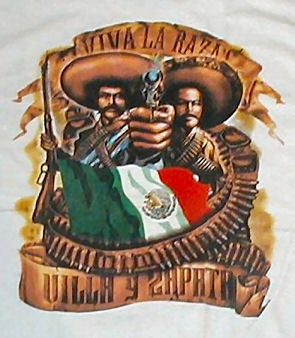
July 5 protest Starbucks unfair labor

The IWW Starbucks Workers Union has declared a Global Day of Action to protest Starbucks’ anti-union termination. According to their press release:

Coordinated Actions Across the U.S., Europe, and Latin America Could
Be Largest Ever Against Coffee Chain.

Grand Rapids , MI ( 06-30-2008 )- Union members and social activists are gearing up for what may be the largest, global coordinated action against Starbucks ever. Protesters will decry what they see as an epidemic of anti-union terminations by the world’s largest coffee chain. Starbucks and its CEO Howard Schultz have exhibited a pattern of firing outspoken union baristas ever since the advent of the IWW Starbucks Workers Union (SWU) in 2004 and are demonstrating the same practice against the CNT union in Spain.

“On July 5th people around the world will show Starbucks that we, baristas along with our supporters, will have a voice and Starbucks discrimination and repression of our efforts will not go unchecked,” said Cole Dorsey, a fired Starbucks barista and a member of the SWU.

…Actions against Starbucks will take place in: Argentina, Chile, the British Isles, Italy, Japan, Norway, Serbia, Poland, Slovakia, 4 cities in Spain, 6 cities in Germany. In the US: Phoenix, Philadelphia, Grand Rapids, Boston, Chicago, New York City, Los Angeles.