Obama reneging on promises to pull US troops out of Iraq

LiarObama won the presidency based on the fact that most Americans found him to be credible on his promise to get US troops out of Iraq, whereas they didn’t think John McCain had any commitment to do so. They got tricked and it appears that Obama today will merely restate the Bush promise to the Iraqi puppet government to get US troops out of Iraq by January 1, 2012. Look for numerous press reports to misstate that Obama is actually going to do nothing new in a manner similar to this one… Obama to Announce U.S. Troop Withdrawal in Iraq …Read the details and you can see that it is basically the Bush plan gift re-wrapped for more liberal Democratic Party voters acceptance of it!

What can be seen by this continued glue to the Bush program in regards to Iraq, is that the Democrats have no confidence that Iraq will not fall into a fight for power the minute US troops leave. The puppet government is that unstable, and in fact there are real and credible fears that civil war might now break out even with US troops still inside the country. Simply put, Barack Obama is fearful of changing Bush’s game plans for Iraq, so he’s sticking to the basic Republican program and sugar coating for his unmotivated Democratic Party constituency.

Yes, the Democratic Party ‘Peace’crats have kept the lid on all protest coming from their groups nationwide. The national coalition of these votes, the UFPJ (United for Peace and Justice) are refusing to unite with ANSWER in calling for Spring demonstrations. They simply really don”t want them with Abraham Obama in office…. he’s going to free the White Middle Class liberals from their slavery under Rush Limbaugh and Fox News!

Not only is Obama sticking with the Bush program directly promising to keep US troops in Iraq until 2012, he continues to carry out the Bush-Cheney game plan by expanding occupation in Afghanistan, and aggressively threatening Iran and Syria with war. Add to that the Democratic Party in no way has changed from giving Israel green light to continue their ethnic cleansing program against the Palestinians in the Occupied Territories and elsewhere (inside Israel itself). Meanwhile the ‘Peace’crats stand around with their thumbs up their asses and mumbling CHANGE… SPARE CHANGE, PLEASE. It’s very sad to see people debase themselves in this manner.

One can only feel sorry for the Iraqi population, too. They have no guarantee that the US under Barack Obama as CIC will actually stick to the promises to get out by 2012. All sorts of excuses to justify the idea that that cannot be actually done when the time comes can be made up under the usual fire of events, and Barack Obama is just the man in the US Presidency to do just exactly that. Three years from now? Well the US under this plan most likely will still be inside Iraq like glue. The US government and military simply didn’t build all their forts and Embassy Closed Gates without a desire to stick around. Barack is their guy, and when stability begins to crumble with his limited pull out, you can pretty much guess that the ‘plans’ will get changed once again. It’s simply stupid to trust the Democratic Party with much of anything other than their own going plans to collaborate with the Republican Party in running the World on behalf of American corporate power.

Also see… Orwell in Babylon- Obama’s Non-Withdrawal Withdrawal Plan ….By CHRIS FLOYD at antiwar.com

America needs new leadership

Dennis Loo, co-author of Impeach the President: the Case Against Bush and Cheney states the case as the following. ‘Constituting a new legitimate authority from outside of the ranks of the existing leadership class and the major organs of opinion-making represents an extremely difficult feat. For that reason it hardly ever happens. Yet this is exactly what must happen; it offers the only hope for real change. Is there a basis for this to happen? Yes. Does actualizing this possibility present tremendous difficulties and obstacles? Yes. Is it impossible? No. There are really two dimensions to this question. The first is the moral dimension and the second is a practical question.’ Taken from Part Two: Doing What Must be Done… The Water Line

Yes, what must be done then? Dennis Loo continues to delineate the problem in his commentary, and divides it into a question of whether 2 economic sectors of the population can come together to provide this new leadership as counter to the Establishment leadership, or not? One sector is already on board and wants new leadership, while the other sector does not. It is the American Middle Class that just is not on board the drive to get a new leadership for America going. The working classes are already pissed off enough to try to develop this new leadership if yet they had the Middle Class’s support? Or so says Dennis Loo.

Personally, I think he might be too optimistic about where the American working class actually stands right now? However, both classes, the Working Class and the Middle Class, might be changing their views about the current Establishment leadership real soon? Change could well come in a volatile manner.

One thing though, if the Working Class does not begin to develop this counter leadership in a much more forceful manner, the American Middle Class could move itself in some very unsavory directions? Let’s hope not. Whatever the situation is, America simply needs new leadership. The ruling elites are a failure and will never reform themselves. They simply have no answers to anything in the current world, and they are conservatives and chained totally to the corporate world….YES, that corporate world which is sinking the entire World. The Middle Class will only see a new and non corporate world begin good for themselves, if the Working Class demands that forcefully.

Costa Rica a prototypical Western Democracy

PUERTO JIMINEZ, CR- Touring Costa Rica has been interesting. Considering the turmoil of Central America, it may be a shining example of a functional Capitalist Democracy. It´s got a healthy middle class and a relatively contented populace. Can it offer a lesson to its strife torn neighbors? Sure. Get rid of the Indios.

Citizens of the “Rich Coast” pride themselves on being light skinned, owing to a Spanish heritage of course. They´re the descendants of settlers, mixed some with labor imports from the Caribbean. But the indigenous people are gone. Which makes for scarce land redistribution demands.

When Columbus first came to Costa Rica, there were 400,000 inhabitants. When they saw that the Spaniards were enslaving whoever they conquered, the tribes hid in the mountains. As a result, Costa wasn´t properly subjugated like elsewhere. The Spanish didn´t want land that didn´t come with ready slave labor. But hiding didn´t save the indians. As the Spanish settled the land, the original population dwindled, to 10%, then 2% within 200 years. They are, as Randy Newman sang it: “Gone, real gone.”

There is an inspiring history to Costa Rica´s present relatively egalitarian government, and I´m going to write more about some of their laudable leaders. But I have to argue that CR smacks of US artifice. And lo, even as I cringe at the camo themed souvenir caps that remind me of the Contras, it turns out Oliver North operated his Contra army and drug smuggling operation out of an airfield in northern Costa Rica. There´s a surfing destination near there called Ollie´s Point, named after the would be filibuster himself. Those apolitical surfer fucks.

(It is hard to surpress disdain for the hard-recreating American asses despoiling CR toilet paper. I cannot bear their vibes of inutile indifference.)

So the Costa Ricans are less Central Americans than good old Americans. And that never meant Native American.

Who is the economy calling stupid?

Okay, I’ve had enough of our readiness to believe, about the economy, that nobody knows what’s going on. Nobody will tell you what’s going on, is what’s going on.

Even my deepest thinking friend tells me, “Eric, they really don’t know” (The game theorists, the would-be global axis shifters, don’t know.) He may be right, but that’s not who we’re talking about. Between those guys, and you and I, who have no clue about where the economy is going, is a hand-basket courier. That composite abstraction at the handlebars knows the destination, he’s being paid cost-plus for the delivery, and he knows enough to collect his fee in advance.

We thought “it’s the economy, stupid” was directed at George Bush the Senior. Who is/was stupid? I’m finding the syncronicity of Alanis Morissette’s Jagged Little Pill song “Isn’t it ironic?” superlatively ironic. The era when a mass audience un-learned the meaning of irony, was when the joke was really on us.

Today the accepted theme to describe the economy is: nobody knows. I recently heard the governor of Colorado speak to the need for budget cuts in these hard times. He introduced the subject of the economic downturn by explaining, almost as a throwaway foregone conclusion, “Nobody saw this coming.”

I thought, really? This is what Americans are satisfied to expect for leadership? Elected authority figures return our system to us, broken, with not a mea culpa, but mea confuso. And we buy it.

For me, this no-comprendo motif doesn’t play well in Adagio. Today DC’s new lawmakers want to know what’s become of the first half of the TARP bailout money, and the good-enough-for-primetime answer is “nobody knows.” Don’t you just want to stand up and beg your fellow audience members for a collective show of incredulity? “NOBODY KNOWS?!”

Whoever pocketed the 350 Billion, KNOWS.

From explanations of the graft in Iraq, we the television public KNOW that just one million dollars in t-bills weighs more than you can get past surveillance cameras.

From nighttime video of the economic collapse in Argentina, documentary footage viewers know it takes a continuous train of armored trucks to do a run on the banks before the public gets there.

By the way, I’m certain Billion is always capitalized, out of respect for its size.

“Nobody knows” where went the 350 Billion? No. Nobody who knows, intends to tell us.

Either way, we don’t get to know, but the distinction makes a difference, don’t you think? The excuse we’re given for not dwelling on this incongruity, nudge nudge wink wink, is that all misdirection is for the sake of consumer confidence.

To look behind the green curtain is to become dis-illusioned. If you explain the slight of hand, instead of building confidence, you throw fuel on consumer doubt.

The better economists opposed the bailout. Hundreds of them signed a petition to tell us what’s going on is a heist. Under George Bush, bankers have been making off with the US treasury. What they couldn’t spend pay themselves to foist a war, or give themselves in tax cuts, they are having to abscond with under cover of an eleventh hour “bailout.”

The best of the honest economists, Paul Krugman, was given a Nobel Prize. At the same time, our president-to-the-rescue is saying he’d consider the advice of “even Paul Krugman,” like Krugman is a fringe opinion.

Do we empower the American public beast with a truer education about what’s happening to their finances, or do we narrow their peripheral foresight like the gangway to the abbatoire?

P.T. Barnum said no one ever went broke underestimating the American public. Barnum saw opportunity and he took it. I’ll bet he wasn’t satisfied to invest his winnings on the advice of the public’s broker.

The economy is tanking because the Bush investment banker free-for-all is over.

The cash heart of the consumer confidence fattened-calf is already in the bloody hands of the high priests. The American consumer is what’s being thrown off the wall. And the communal wealth of America’s middle class can’t be put together again because the pieces which formed Humpty Dumpty’s actual pre-confidence-ballooned size are going to come up missing.

Not missing, exactly. Look at the corporate jets, private skyboxes, enormous estates, private island kingdoms and advance ticket sales of quarter-million-dollar fares into space.

With much recent ballyhoo, George Bush set aside for protection some nature preserves in the Pacific. Unlike Yellowstone, or Yosemite, these parks of azure coral reefs are inaccessible. To you.

Barack Obama’s spread-the-wealth-around campaign lingo had nothing to do with the mad scramble to divvy the pot. Obama represents our non-insider’s reflexive grab for the fewer spoons. If Obama represents a wisening up at all.

Beyond buy low, sell high, here’s an example of how the scam worked: If a $100K house can be made seem worth $500K, a broker gets five times the commission, say $60K instead of $12K, and collects that money in cash. When the cows come home, you’ve got just a house, and let’s admit that value is arbitrary. But the broker is free and clear, his gleaning of a cash value done.

And actually, your house is not even worth the cost to build it. As the democratic capitalist apparatus downgrades, and the wealthy lose empathy for the lower classes, your house is worth just the value of the shelter it provides. Look at the concern they show for your health care. Your well-being, food and shelter wise, is worth only as much as the value you add to your landlord’s pleasure.

The Thai Monarchist mob

Thai kingWe have been watching from afar the activities of the Thai Monarchist mob as they have occupied Bangkok’s airport and received the complicit support of the Thai military, which refused to disperse them. This has been no ‘people’s protest’ at all but rather a Right Wing mob, all comparable to the one the US mobilized recently in Eastern Bolivia to try to divide Bolivia into two parts and remove Evo Morales from power there.

‘Dissolution of the ruling People Power Party (PPP) will heal none of the basic rifts between Bangkok’s royalist elite and middle classes, who despise ousted and exiled leader Thaksin Shinawatra, and the urban poor and rural masses who love him and continue to vote his allies into office.’ (taken from the Reuter’s report Thai protesters lift airport siege

Around the world not all mobilizations are for the people from the people at all. In Colombia, the Right Wing death squad government, too, was able to mobilize millions of common citizens into the streets in support of their corrupt government fairly recently. Unfortunately this Thai mob is mobilizing people in support of a Monarchy and the King, and there can be nothing more reactionary in this day and time than that.

More from Reuters below…

“WE’LL BE BACK”

The PAD, led by a group of royalist businessmen, academics and activists, formally marked the end of the occupation by singing the king’s anthem. Ominously, the PAD protesters vow to return if they see Thaksin allies getting near power again.

“I am sad that we are going,” said Ranatip, 48, an unemployed office assistant. “But I am ready to fight for my king and my country. I will come back as soon as I am needed.”

These people are sick. They are united in wanting to keep Thailand’s poor as poor as they can make them. Thailand’s class divisions and caste system isn’t quite as horrible as India’s but it is still pretty damn bad.

‘Patriotic’ pacifists and ‘Peace’crats to hold UFPJ lobbyfest gathering in Chicago

Hillary and JesusUnited for Peace and Justice (UFPJ) will be holding a gathering in Chicago next week to start their plans for a 2009 Lobbyfest of Barack Obama. They still haven’t figured any of it out and most likely never will. Ostensibly the UFPJ has not decided on doing anything just yet and the gathering is for the group to supposedly decide just what should be done?

That’s all a big joke since the Democratic Party and liberal Christian group controlled leadership of the UFPJ has but just one strategy, and that is to try to make themselves ‘heard’ by the Powers that be (though they refuse to try to mobilize any power of their own). They are like beggars of a sort, who will be pleading with Barack, Hillary, and Gates for some bones of recognition. They promise not to talk too much about imperialism, Afghanistan, Somalia, and anything else of dispute, say like… torture use by the US military, the US threatening Russia with nuclear weapons, Iraq, or US military made pollution… and the list goes on of none issues to these people., or the issues they just plain out want people not to be talking about.

The UFPJ are the ‘patriotic’ Democratic Party liberal middle class voters and churchly pacifists, whose ‘eyes are wide open’ onto the boots of several thousand US soldiers, but not much on the damage these soldiers actually did to other peoples. They voted for ‘change’, but they’re not too pressured about when it comes, where it comes from, or even if it will ever come? A pretty word or two from their Democratic Party gurus will keep most of them totally satisfied for years.

YES, the UFPJ will want to go lobby this new year, and that’s what they will project doing though they will smokescreen it with some sort of ‘national week’ of blah, blah, blah, etc. These are the very same folk that always say that large demonstrations don’t work, so just go out and vote DP. Don’t expect a change of heart from them, or any insight.

How happy they are at the success of that profoundly absurd strategy they must be with the New Administration? The more abjectly they get thrown to the side by Power, the more committed they get to their own masochistic policy of turning out the vote…. to always vote for those who will ignore them, piss on them, and marginalize them as much as they can.

The UFPJ has even been offered a challenge by other antiwar activists to give up their sectarianism and come together with others to help build national and unified demonstrations against the war. That is anathema to the UFPJ leadership though, and we should expect absolutely nothing from them that would help bring that about. They’re sticking with the Democrats come rain or shine, and come the chaos and mayhem the Democratic Party will work alongside their Republican Party cohorts to bring us more of.

The ‘Patriotic’ pacifists and ‘Peace’crats are like small business owners in their outlook, and they have the DP franchise for ownership over the antiwar movement, just as long as the rest of us put up with it and stay demobilized ourselves? That is the big question? Just how long will the real activists in the national antiwar movement keep pumping money and time into this US national coalition, the UFPJ, who are out to simply not do much at all?

Passively accepting such a group of incompetent and chained down to the DP leaders as the UFJP is, is just more of a loser strategy that does nothing to help out a country currently experiencing a collapse of the US economy and the bankruptcy of the corporate class, fallen deathly ill from their own total corruption. The country needs a real antiwar coalition at work for the country, and not just a prayer group of multiple paid office hacks. The longer a real Movement is not actually built, the more damage the Pentagon will actually do to the country and the world, Lockheed and all the other corporate powers behind them feeding from the public trough. The UFJP is not even close to being the leadership for a real Antiwar Movement in this country, and can never be that as it is organized and structured to not be one, but rather to just be a pacifist coalition of a few nice people who pray and vote and not much else.

The UFPJ not only cannot be looked upon to provide leadership for us in the next years of Obama Nation, but will be an active barrier against all that do try to work to build dissent against US militarism. That is sad to say, but efforts to try to change the orientation of this group will be about as futile as trying to pull MoveOn away from their Democratic Party foundation. Better to spend your time, energy, and efforts to build other organizations as alternative to these obstructionists. The UFPJ is simply their church, and not much else.

The only thing that is changing, is the meaning of “change.”

Obama picks economic crisis team.
 
Come meet the new boss, same as the old boss. You got fooled again! If you thought Obama would be Clinton II, guess again. He’s now looking more like Bush III. Told ya’ our “democracy” was a sham. The only thing that has changed, is the meaning of “change.” Orwell would be proud.

Biggest stickup in history continues. Paulson preparing to “lend” $7.4 TRILLION to cover the gambling losses of the filthy-rich. Not a dime for the struggling middle class and poor.

“Democracy is four wolves and a lamb voting on what to have for lunch.” –Ambrose Bierce

Bush planning false-flag “terrorist” attack so he can cancel the inauguration, suspend the Constitution, and remain dictator for life?

US Constitution disqualifies Hillary from Secretary of State job. Not that anybody in gov’t gives a damn about the Constitution anymore.

Excerpts from Thomas McCullock’s Nov 26 notes, thomasmc.com.

Turbine industry wants young new wife

ball bearingAlternative energy ventures, through the efforts of their lobbyists, can’t find the workforce they need in Ohio. While the area boasts one of the nation’s highest unemployment rates, many of those workers are from the decimated steel industry. NPR Morning Edition reported yesterday that would-be wind turbine manufacturer Rotek Inc, for example, doesn’t agree that United Steel Workers Union members are right for the job.

Unions assert that the jobs aren’t offering sufficient wages. NPR uncritically countered that “The starting salary with benefits at many wind turbine plants in Ohio can range to $30,000 a year.”

The NPR report left the impression that manufacturers wanted to move into the alternative energy field, but were being thwarted by the unreasonable expectations of US labor. This may be true. But an industry promising new poor jobs is no gift horse. Shouldn’t workers look it in the mouth before entrusting futures, communities and livelihoods to it?

NPR’s Julie Grant summarized the manufacturer objections with, thankfully, a some-people-say type attribution:

“the new companies, the ones already making part for wind turbines, say they don’t want burned out workers with low morale. What they need are workers open to spending a couple of years in training, who can think on their feet, and are excited to be part of the new economy they’ re helping to create.”

The “new economy they’re helping to create?” Would that be the new economy placing the employee as being working poor? What would a radio reporter herself think of a job that requires two years of training, at the employee’s expense, to yield a $30K salary? The workforce in question are already experienced steelworkers. The wind turbine jobs are steel manufacturing jobs. They’re not looking for high tech design positions.

Lobbyist group the Apollo Alliance, which NPR labeled a Clean Energy think tank, suggests the government should subsidize the training period.

So here I believe is the crux of what alternative energy investors are after. We can’t argue that low wages are here to stay. America’s new economy will no longer support the upward middle class American Dream of the Baby Boomers. So factory workers are going to work for half the pay, if they want work at all. But do they need to be trained to do it?

The wind turbine manufacturing industry is suggesting that its labor force needs two years of training, paid for by the US taxpayer. Does that make sense to you? You get the bill, the workers get subsistence wages, and the factory owners get free labor. For two years. Likely employees are not going to stick around for the promise of $30K/yr, so the two year transitions will last as long as the government subsidies allow.

Industrialists are always looking for low wage workers, even slave labor, when they can.

NPR cited the example of Rotek Inc. “Rotek one of 75 companies here that have started making parts for wind turbines.” The report mentions an $80 million investment, but implies that Rotek is a startup that requires subsidies, tax credits and willing partner-employees. NPR didn’t mention that Rotek is a subsidiary of Rothe Erde, of Dortmund, Germany ($15.3 billion, 55,000 employees), which is a subsidiary of the ThyssenKrupp Group, Essen, Germany ($68.7 billion, 191,000 employees) of Krupp infamy. Founder Alfred Krupp was tried in Nuremberg for using concentration camp labor in his factories during the war, some of them even prisoners of war.

Krupp was the chief architect of the Nazi armaments machine. Hitler even passed a law which established the Krupp family as a monopolist dynasty immune from inheritance tax. After Krupp’s conviction, a New York Banker succeeded in lobbying for a pardon for Alfred Krupp, and reversing the sentence that his industrial holdings be forfeited.

The new age will be gilded with Bling

bentley-wheel

While the American middle class eventually embraced repudiation of West Egg bad taste in favor of affecting a supposed blue-blood sensibility, the ostentatious nouveau riche carried on. The chasm between rich and poor kept expanding and the economic crisis which now engulfs the world is simultaneously heralding a new gilded age.

Romanticize its sophistication no longer, the new gild is bling.

I saw an uncharacteristically unique convertible the other day, and its shiny rims looked like after-market wheel covers that you might see spinning in place while stopped at the traffic light. It seemed highly improbable that the Gaudi style “B” at the center would have stood for Bentley. Americans rarely catch a glimpse of the plain-wrapper cousin of the Rolls Royce, much less remember it. But overhearing the driver answer an inquiring pedestrian, it turns out the sports car did belong to that otherwise conservative marque.

“Pedestrian” might also describe such a commoner’s question who has to ask “What kind of car is that?”

This particular car belonged to the driver’s wife, I heard him say, who I learned subsequently belonged to the Morley family, local land magnates.

So Bentley has discovered who’s buttering the upper crust these days.

Common America’s boom of prosperity brought vehicles covered in chrome. Even the eventual Ford Thunderbird and the Corvette Stingray were still pretty damn shiny. Meanwhile European sports cars eschewed unpainted metal. German and English models evolved a style which put forward utilitarian function as form. Their lines may have been loud, their paint a high gloss, but their knobs didn’t glitter. Even the most extreme Ferrari or Lamborghini still looks understated next to an urban ride pimped in chrome.

Do we imagine that the gilded age was art directed by Italian designers, or by self-styled age-of-excess capitalist pimps?

The gilded age and the police nightstick

Oscar of the Waldorf cookbookA legacy institution of the Gilded Age is the Waldorf=Astoria Hotel. Most of us only know it from the nutty salad, the mysterious Red Velvet Cake recipe, Thousand Island Dressing and Veal Oscar named for the famous maitre d’ hotel. I encountered the book of recipes collected by “Oscar of the Waldorf” and its cover illustration caught my eye. The coachman and carriage don’t look so opulent to us today, but do you recognize a timeless trapping of affluence? There’s nothing else in the picture but the policeman and his nightstick.

We almost dismiss the incongruity of the attendant police officer. That’s because he’s Officer Friendly to us, circa the 1950s egalitarian economic boom, earned post New Deal and post WWII, when law enforcement began to serve and protect the middle class share of the pie. Before those times, whose order did the police enforce?

Could the Waldorf diorama have featured some other occupation at the curb? A newsboy, a shoeshine, or a traffic director? If the cabbie is picking up late night revelers, why not depict a doorman or lamplighter?

If this scene did not include the policeman, he’d be missing.

The Gilded Age of the soaring wealth of bankers and industrialists, of the steel, coal, and rail robber barons, came at the expense of poverty wages for all the rest. The homeless of America’s eastern cities died in the streets, if they crossed the paths of the leisure class at all. As in London, where the bobbies were celebrated for carrying no guns, cops on the beat didn’t need more than a nightstick to beat back beggars and riffraff.

Just as in the Waldorf illustration, the policeman’s nightstick isn’t holstered, it is fingered idly like a baton. We’ve seen it in countless Chaplin, Keaton, and Keystone reels. The policeman’s baton might be carried idly, and animated mindlessly as a clerk might twirl a pencil, but the gyrations telegraphed a swinging function meant to be understood.

Today, a modern financial crisis has finally hit the post industrial era, and unemployment is taking a precipitous plunge. The repercussions for the American middle class are yet unclear to most, their comforts still too tangible to fathom gone. But our modern times have already seen the resurgence of the Rich And Famous, (to even beyond the lunge of our Super-Lotto winners, who always chose the sub-six-figure annuity). Exclusive cars, toy submarines and tickets into space cost multi-millions, but the rich have that money to burn. Common Americans have also watched the armoring of their police, using weapons which offend us, but which protect the security of institutional wealth. Para-military police forces are the natural escalation of the right-to-bear-arms arms-race, the equivalent of nightsticks to quell our social disquiet.

Already aren’t we seeing the police block the public’s way, lest we soil the red carpet of the well-heeled? Aren’t police blocking free speech in public spaces, when the monied media has decided it wants the backdrop to serve their message? Wait until we are gazing covetously upon the gilded extravagances, from the alley side of the gilded wrought iron gate.
guilded age of the nightstick
Wiki notes:
Thousand Island Dressing came to the Waldorf from the so-named Lake Ontario waterway where New York’s super rich had their summer homes. The $100 recipe for Red Velvet Cake was the urban myth which resurfaced as the $250 Neiman Marcus chocolate chip cookie.

The original Waldorf Hotel was built by an Astor whose middle name was Waldorf, next door to an aunt with whom he was feuding. Later another Astor convinced her to move uptown and replaced her home with a taller hotel named the Astoria. The two luxurious hotels hyphened via the Peacock Alley, inspiring the popular song “Meet me at the hyphen.” In 1931 the landmark was moved to accommodate the Empire State Building, and was purchased in 1949 by Conrad Hilton who added the double-hyphen flourish, completely in the spirit of gilded ornamentation.

McCain wants to redistribute the wealth: from the Middle Class to the Filthy Rich

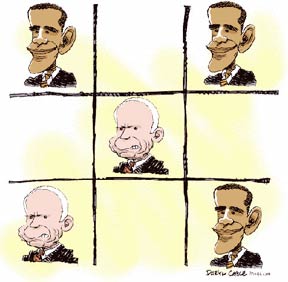
obama-mccain-tic-tac-toCan WE THE PEOPLE really undo the NeoFascist coup of 2000, or will the electoral farce just continue?
 
Was “Maverick” McCain’s goal the utter destruction of the Republican Party? Because that’s the ony way I can see him “winning.”

Evidence the election is already being stolen.

Her Imperial Highness Sarah Palin claims the media criticising her violates her First Amendment rights.

Canadian radio show hosts prank-call Sarah Palin, impersonating the French President, and get her to admit she thinks killing baby seals from a helicopter would be fun. [audio]

You know your country is worse than Nazi Germany when…

Did the CIA warn corporate executives prior to 9/11 attacks?

Lest anyone forget, McCain is NOT a natural born citizen, as required of the President in the United States Constitution. He was born in the Panama Canal Zone, before such births were legally “natural born.” The law that later made such births “natural” did not include those already born, they only became “naturalized citizens,” thus disqualifying McCain for the office of President. Not that anyone gives a damn about the Constitution anymore.

Ronald Reagan’s chief of staff endorses Obama.

Excerpts from Thomas McCullock’s Nov 3rd notes, thomasmc.com.

Canadian Palin prank call over our heads

ckoi-montreal-radio
American media outlets are distributing an expurgated transcript of the CKOI prank call to Governor Sarah Palin. Lots of the jokes made for International listeners were apparently lost on American reporters, as obviously on Palin. Prank caller assistant “Frank the Worker” introduces French President “Sarkozy” who then refers to French faux-ex-pat pop icon Johnny Hallyday as his American adviser, and the Quebec pop country buffoon Stef Carse as the Prime Minister of Canada, not Stephan Harper, the single Canadian we might know, in particular if we were governor of Alaska. Then the Masked Avenger tells Palin that his wife Carla Bruni wrote a song for her, “De rouge a levre sur un cochon” which means “lipstick on a pig!”

To be sure he speaks the phrase quickly, as if disbelieving himself that anyone would not recognize the joke.

The Masked Avengers, comedians Marc-Antoine Audette and Sebastien Trudel, often make fun of the typical American’s complete ignorance of Canadian politics. This prank call refers to the Prime Minister of Quebec Jean Charest, whom the caller assumes Palin would know, being “so next to him.” But they pretend his name is Richard Z. Sirois, who Canadian listeners would recognize is their CKOI cohost of “Les Cerveaux de l’info” (their radio show “The Info Brains”). It might be noted that the duo pulled an identical prank call on George W. Bush in 2000.

Here’s the full unexpurgated transcript of the CKOI prank call made to Governor Sarah Palin. Corrections are in bold. Notes and translations are in brackets.

HANDLER: This is Betsy.

RADIO HOST: Hello, Betsy.

HANDLER: Hi

RADIO HOST: Hi, this is Franc L’ouvrier, [trans. Frank the factory worker, a pun on Joe the Plumber] I am with president Sarkozy, on the line for Gov. Palin

HANDLER: Yes, one second please. Can you hold on one second, please?

RADIO HOST: Yeah, no problem.

HANDLER: Alright, thanks.

HANDLER 2: Hi, I’m gonna hand the phone over to her.

RADIO HOST: OK, thank you very much, I’m gonna put the president on the line

GOV. SARAH PALIN: This is Sarah.

RADIO HOST: Uh yeah, Gov. Palin?

GOV. PALIN: Hello.

RADIO HOST: Just hold on for President Sarkozy, one moment.

GOV. PALIN: [off line] Oh, it’s not him yet. I always do that.

FAKE SARKOZY: Yes, hello, Gov. Palin.

GOV. PALIN: [off line] I’ll just have people hand it to me right when it’s him.

FAKE SARKOZY: Yes, hello, Mrs. Governor?

GOV. PALIN: Hello, this is Sarah. How are you?

FAKE SARKOZY: Fine, and you? This is Nikolas Sarkozy speaking. How are you?

GOV. PALIN: Oh, so good, it’s so good to hear you. Thank you for calling us.

FAKE SARKOZY: Oh, it’s a pleasure.

GOV. PALIN: Thank you sir. We have such great respect for you, John McCain and I. We love you, and thank you for taking a few minutes to talk to me.

FAKE SARKOZY: I followed your campaigns very closely with my special American advisor, Johnny Hallyday.

GOV. PALIN: Yes, good.

FAKE SARKOZY: Excellent, are you confident?

GOV. PALIN: Very confident, and we’re thankful that polls are showing that the race is tightening.

FAKE SARKOZY: Well, I know very well that the campaign can be exhausting. How do you feel right now, my dear?

GOV. PALIN: I feel so good, I feel like we’re in a marathon and at the very end of the marathon you get your second wind and you plow through the finish.

FAKE SARKOZY: You see, I got elected in France because I’m real, and you seem to be someone who’s real as well.

GOV. PALIN: Yes, Nikolas we so appreciate this opportunity.

FAKE SARKOZY: You know, I see you as a president one day too.

GOV. PALIN: Haha, maybe in eight years.

FAKE SARKOZY: Well, I hope for you, you know we have a lot on common because personally, one of my favorite activities is to hunt, too.

GOV. PALIN: Oh, very good, we should go hunting together.

FAKE SARKOZY: Exactly, we could go try hunting by helicopter like you did. I never did that. Like we say in France, “on pourrait tuer des bebe phoques aussi.” [trans. “We could kill some baby seals too.”]

GOV. PALIN: Well, I think we could have a lot of fun together as we’re getting work done. We could kill two birds with one stone that way.

FAKE SARKOZY: I just love killing those animals, mm mm, take away a life, that is so fun. I’d really love to go as long as we don’t bring vice president Cheney, haha.

GOV. PALIN: No, I’ll be a careful shot, yes.

FAKE SARKOZY: Yes, you know we have a lot in common because except that from my house [note: bad French accent makes this sound like “ass”] I can see Belgium. That’s kind of less interesting than you.

GOV. PALIN: Well, see, we’re right next door to other countries that we all need to be working with, yes.

FAKE SARKOZY: Some people said in the last days, and I thought that was mean, that you weren’t experienced enough in foreign relations and you know, that’s completely false. That’s what I said to my great friend, Prime Minister of Canada, Steph Carse [local Canadian singer who rerecorded Achy Breaky Heart, not Stephen Harper].

GOV. PALIN: Well, you know, he’s doing fine too, when you come into a position underestimated, it gives you an opportunity to prove the pundits and the critics wrong. You work that much harder.

FAKE SARKOZY: I was wondering, because you are SO NEXT TO HIM, one of my good friends the PM of Quebec, Mister Richard Zed Sirois. [Mr. Richard Z. Sirois is their KVOI “Les Cerveaux de l’info” radio co-host, not Quebec Prime Minister Jean Charest] Have you met him recently? Has he come to one of your rallies?

GOV. PALIN: I haven’t seen him at one of the rallies, but it’s been great working with the Canadian officials in my role as governor. We have a great cooperative effort there, as we work on all of our resource development projects. You know, I look forward to working with you and getting to meet you personally and your beautiful wife, oh my goodness; you’ve added a lot of energy to your country with that beautiful family of yours.

FAKE SARKOZY: Thank you very much, you know my wife Carla would love to meet you. You know, even though she was a bit jealous that I was supposed to speak to you today.

GOV. PALIN: Well give her a big hug for me.

FAKE SARKOZY: You know my wife is a popular singer and a former HOT TOP MODEL. And she’s so hot in bed, she even wrote a song for you.

GOV. PALIN: Oh my goodness, I didn’t know that.

FAKE SARKOZY: Yes, in French it’s called “de rouge a levre sur une cochonne” [trans. “Lipstick on a pig!” but pig in the feminine can also mean a floozy], or if you prefer in English “Joe the Plumber” (sings:) “It is Life, Joe the Plumber”.

GOV. PALIN: Maybe she understands some of the unfair criticism, but I bet you she’s such a hard worker too and she realizes you just plow through that criticism.

FAKE SARKOZY: I just want to be sure, I don’t quite understand the phenomenon Joe the Plumber, that’s not your husband, right?

GOV. PALIN: That’s not my husband, but he’s a normal American who just works hard and doesn’t want government to take his money.

FAKE SARKOZY: Yes, yes, I understand. We have the equivalent of Joe the Plumber in France, it’s called “Marcel the Guy with Bread Under his Armpit”. Oui.

GOV. PALIN: Right, that’s what it’s all about, the middle class and government needing to work for them. You’re a very good example for us here.

FAKE SARKOZY: I seen a bit, but NBC, even Fox News wasn’t an ally, an ally, sorry about as much as usual.

GOV. PALIN: Yes, that’s what we’re up against.

FAKE SARKOZY: I must say, Gov. Palin, I love the documentary they made on your life – you know, Hustler’s “Nailin’ Palin”.

GOV. PALIN: Oh good, thank you.

FAKE SARKOZY: That was really edgy.

GOV. PALIN: Well good.

FAKE SARKOZY: I really loved you. And I must say something else Governor, [drops French accent] you’ve been pranked by the Masked Avengers, we’re two comedians from Montreal.

GOV. PALIN: Oh, [sic] we’ve been pranked. What radio station is this?

FAKE SARKOZY: This is for CKOY in Montreal.

GOV. PALIN: In Montreal? tell me their radio station call letters.

FAKE SARKOZY: CK… Hello? [to listeners] If one voice can change the world for Obama, one Viagra can change the world for McCain.

PALIN AID: I’m sorry, I have to let you go, thank you.

FAKE SARKOZY: Yay! Woohoo!

The Law of the Jungle

THE LAW OF THE JUNGLE

Trade, within a society and between countries, is the exchange of goods and services produced by human beings. The owners of the means of production appropriate the profits. As a class, they are the leaders of the capitalist state and they boast of fostering development and social wellbeing through market. This they worship as an infallible God.

In every country there is competition between the strongest and the weakest; the ones with more physical energy and better fed, those who learned how to read and write, who attended school and have more experience accumulated; the ones with more extensive social relations and more resources, and those within society who fail to have these advantages.

Now, as far as the countries is concerned, there are differences between those with a better climate and more arable land, more water and more natural resources in the area where they are located, when there are no more territories to conquer; the ones mastering technology, having greater development and handling unlimited media resources and those who, on the contrary, do not enjoy any of these prerogatives. These are the sometimes enormous differences between the rich and the poor nations.

It’s the law of the jungle.

There are no differences between ethnic groups, however, when it comes to the mental faculties of the human being. This has been thoroughly proven by science. The present society is not the natural way in which human life evolved, but rather a creation of the mentally developed man without which his life would be inconceivable. Therefore, what is at stake is whether the human being will be able to survive the privilege of having a creative mind.

The developed capitalist system, epitomized by the country with a privileged nature where the European white man brought his ideas, dreams and ambitions, is today in a crisis. But, it is not the usual crisis happening once in a number of years; not even the traumatic crisis of the 1930s but the worst of all crises since the world started to pursue this growth and development model.

The current crisis of the developed capitalist system is taking place when the empire is about to change leadership in the elections to be held in twenty-five days; it was all that was left to see.

The candidate of the two main parties that will say the last word in these elections are trying to persuade the bewildered voters –many of whom have never cared to cast a vote— that as candidates to the presidency they can secure the wellbeing and consumerism of what they describe as a people of middle class only, even though they are not planning to introduce any real changes to what they consider the most perfect economic system the world has ever known. The same world that, in their respective minds, is less important than the happiness of over three hundred million people who account for less than five percent of the world population. The fate of the remaining ninety-five percent of human beings, peace and war, the fit or unfit-for-breathing air, will highly depend on the decisions of the administrative leader of the empire, whether or not that constitutional position has any power at a time of nuclear weapons and space shields moved by computers in circumstances where every second counts and when ethical principles keep loosing their value. Still, the more or less nefarious role of the President of that country cannot be overlooked.

Racism is deeply-rooted in the United States where the mind of millions of people can hardly reconcile with the notion that a black man, with his wife and children could live in the White House, which is precisely called White.

It’s a miracle that the Democratic candidate has not met the same destiny as Martin Luther King, Malcolm X and others who only a few decades ago dreamed of justice and equality. He is in the habit of looking at his adversary with serenity and of smiling at the dialectic predicament of an opponent gazing into space.

The Republican candidate, on the other hand, who likes to enhance his reputation as a belligerent man, was one of the worst students in his class at West Point. He has confessed that he did not know any Mathematics; it can thus be assumed that he knew less of the complicated economic science.

The truth is his adversary surpasses him in cleverness and composure.

Something McCain has aplenty is age, and his health condition is not safe.

I am bringing up these data to indicate that eventually –if anything went wrong with the candidate’s health, in case he is elected— the lady of the riffle, the inexperienced former governor of Alaska could become President of the United States. It can be noticed that she does not know a thing.

Meditating on the current US public debt –$10,266 trillions— that President Bush is laying on the shoulders of the new generations in that country, I took to calculating how long it would take a man to count the debt that he has doubled in eight years.

A man working eight hours a day, without missing a second, and counting one hundred one-dollar bills per minute, during 300 days in the year, would need 710 billion years to count that amount of money.

I could not find a more graphic way to describe the volume of money that is practically mentioned every day now.

In order to avoid a general state of panic, the US administration has declared that it will secure deposits that do not exceed 250 thousand dollars. It will be managing banks and such funds as Lenin would never have thought of counting with an abacus.

We might be wondering about the contribution of Bush’s administration to Socialism. But, let’s not entertain any illusions. Once the banking operations go back to normal, the imperialists will return the banks to the private business as some other countries in this hemisphere have already done. The peoples always foot the bill.

Capitalism tends to reproduce itself under any social system because it is based on selfishness and on man’s instincts.

The only choice left to human society is to overcome this contradiction; otherwise it would not be able to survive.

At this time, the ocean of money being poured into the world finances by the central banks of the developed capitalist countries is dealing a hard blow to the Stock Exchanges of the countries which resort to these institutions in an effort to beat their economic underdevelopment. Cuba has no Stock Exchange. We shall certainly find more rational and more socialist ways of financing our development.

The current crisis and the brutal measures of the US administration to save itself will bring more inflation, more devaluation of the national currencies, more painful losses in the markets, lower prices for basic export commodities and more unequal exchange. But, they will also bring to the peoples a better understanding of the truth, a greater conscience, more rebelliousness and more revolutions.

We shall see how the crisis develops and what happens in the United States in twenty-five days.

Fidel Castro Ruz
October 11, 2008 6:15 p.m.

McCain Palin declare Class War

Sarah Palin winkThe GOP has been waging class warfare even as it cries foul of every populist attempt the fight back. Now Sarah Palin and John McCain have seized the standard for the middle class, pretending to want to lead the attack on Washington, all the while presiding over the continued evisceration of America’s common wealth. Sarah Palin is a Trojan horse to thrill the hillbillies, but filled with icky Blackwater paramilitary foot soldiers.

From the 13TH: Just when you thought all the humor has left the U.S. election, along comes Que Sarah Sarah! With experience in snowjobs and folk lore, she’s definitely the creme of the crop circle.

Stop the Senate of would-be thieves!

wallstreet-bailoutCall your Band of Thieving Senators now to tell them you don’t want to give $700 Billion –more honestly likely to be $5 Trillion– to the robber bankers of Wall Street! Telephone Colorado Senators Ken Salazar at 202.224.5852 and Wayne Allard at 202.224.5941 NOW. Why not call OBAMA too! (phone: 202-224-2854) Tell them you want them to consult with at least ONE economist of repute! At least one analyst not on the corporate payroll. As he promised yesterday, Michael Moore suggests a 10 PART PLAN, only IF pressure can be brought to bear right now to stop the Senate bill.

Friends,

The richest 400 Americans — that’s right, just four hundred people — own MORE than the bottom 150 million Americans combined. 400 rich Americans have got more stashed away than half the entire country! Their combined net worth is $1.6 trillion. During the eight years of the Bush Administration, their wealth has increased by nearly $700 billion — the same amount that they are now demanding we give to them for the “bailout.” Why don’t they just spend the money they made under Bush to bail themselves out? They’d still have nearly a trillion dollars left over to spread amongst themselves!

Of course, they are not going to do that — at least not voluntarily. George W. Bush was handed a $127 billion surplus when Bill Clinton left office. Because that money was OUR money and not his, he did what the rich prefer to do — spend it and never look back. Now we have a $9.5 trillion debt. Why on earth would we even think of giving these robber barons any more of our money?

I would like to propose my own bailout plan. My suggestions, listed below, are predicated on the singular and simple belief that the rich must pull themselves up by their own platinum bootstraps. Sorry, fellows, but you drilled it into our heads one too many times: There… is… no… free… lunch. And thank you for encouraging us to hate people on welfare! So, there will be no handouts from us to you. The Senate, tonight, is going to try to rush their version of a “bailout” bill to a vote. They must be stopped. We did it on Monday with the House, and we can do it again today with the Senate.

It is clear, though, that we cannot simply keep protesting without proposing exactly what it is we think Congress should do. So, after consulting with a number of people smarter than Phil Gramm, here is my proposal, now known as “Mike’s Rescue Plan.” It has 10 simple, straightforward points. They are:

1. APPOINT A SPECIAL PROSECUTOR TO CRIMINALLY INDICT ANYONE ON WALL STREET WHO KNOWINGLY CONTRIBUTED TO THIS COLLAPSE. Before any new money is expended, Congress must commit, by resolution, to criminally prosecute anyone who had anything to do with the attempted sacking of our economy. This means that anyone who committed insider trading, securities fraud or any action that helped bring about this collapse must go to jail. This Congress must call for a Special Prosecutor who will vigorously go after everyone who created the mess, and anyone else who attempts to scam the public in the future.

2. THE RICH MUST PAY FOR THEIR OWN BAILOUT. They may have to live in 5 houses instead of 7. They may have to drive 9 cars instead of 13. The chef for their mini-terriers may have to be reassigned. But there is no way in hell, after forcing family incomes to go down more than $2,000 dollars during the Bush years, that working people and the middle class are going to fork over one dime to underwrite the next yacht purchase.

If they truly need the $700 billion they say they need, well, here is an easy way they can raise it:

a) Every couple who makes over a million dollars a year and every single taxpayer who makes over $500,000 a year will pay a 10% surcharge tax for five years. (It’s the Senator Sanders plan. He’s like Colonel Sanders, only he’s out to fry the right chickens.) That means the rich will still be paying less income tax than when Carter was president. This will raise a total of $300 billion.

b) Like nearly every other democracy, charge a 0.25% tax on every stock transaction. This will raise more than $200 billion in a year.

c) Because every stockholder is a patriotic American, stockholders will forgo receiving a dividend check for one quarter and instead this money will go the treasury to help pay for the bailout.

d) 25% of major U.S. corporations currently pay NO federal income tax. Federal corporate tax revenues currently amount to 1.7% of the GDP compared to 5% in the 1950s. If we raise the corporate income tax back to the level of the 1950s, that gives us an extra $500 billion.

All of this combined should be enough to end the calamity. The rich will get to keep their mansions and their servants, and our United States government (“COUNTRY FIRST!”) will have a little leftover to repair some roads, bridges and schools.

3. BAIL OUT THE PEOPLE LOSING THEIR HOMES, NOT THE PEOPLE WHO WILL BUILD AN EIGHTH HOME. There are 1.3 million homes in foreclosure right now. That is what is at the heart of this problem. So instead of giving the money to the banks as a gift, pay down each of these mortgages by $100,000. Force the banks to renegotiate the mortgage so the homeowner can pay on its current value. To insure that this help does no go to speculators and those who have tried to make money by flipping houses, this bailout is only for people’s primary residence. And in return for the $100K paydown on the existing mortgage, the government gets to share in the holding of the mortgage so that it can get some of its money back. Thus, the total initial cost of fixing the mortgage crisis at its roots (instead of with the greedy lenders) is $150 billion, not $700 billion.

And let’s set the record straight. People who have defaulted on their mortgages are not “bad risks.” They are our fellow Americans, and all they wanted was what we all want and most of us still get: a home to call their own. But during the Bush years, millions of them lost the decent paying jobs they had. Six million fell into poverty. Seven million lost their health insurance. And every one of them saw their real wages go down by $2,000. Those who dare to look down on these Americans who got hit with one bad break after another should be ashamed. We are a better, stronger, safer and happier society when all of our citizens can afford to live in a home that they own.

4. IF YOUR BANK OR COMPANY GETS ANY OF OUR MONEY IN A “BAILOUT,” THEN WE OWN YOU. Sorry, that’s how it’s done. If the bank gives me money so I can buy a house, the bank “owns” that house until I pay it all back — with interest. Same deal for Wall Street. Whatever money you need to stay afloat, if our government considers you a safe risk — and necessary for the good of the country — then you can get a loan, but we will own you. If you default, we will sell you. This is how the Swedish government did it and it worked.

5. ALL REGULATIONS MUST BE RESTORED. THE REAGAN REVOLUTION IS DEAD. This catastrophe happened because we let the fox have the keys to the henhouse. In 1999, Phil Gramm authored a bill to remove all the regulations that governed Wall Street and our banking system. The bill passed and Clinton signed it. Here’s what Sen. Phil Gramm, McCain’s chief economic advisor, said at the bill signing:

“In the 1930s … it was believed that government was the answer. It was believed that stability and growth came from government overriding the functioning of free markets.

“We are here today to repeal [that] because we have learned that government is not the answer. We have learned that freedom and competition are the answers. We have learned that we promote economic growth and we promote stability by having competition and freedom.

“I am proud to be here because this is an important bill; it is a deregulatory bill. I believe that that is the wave of the future, and I am awfully proud to have been a part of making it a reality.”

This bill must be repealed. Bill Clinton can help by leading the effort for the repeal of the Gramm bill and the reinstating of even tougher regulations regarding our financial institutions. And when they’re done with that, they can restore the regulations for the airlines, the inspection of our food, the oil industry, OSHA, and every other entity that affects our daily lives. All oversight provisions for any “bailout” must have enforcement monies attached to them and criminal penalties for all offenders.

6. IF IT’S TOO BIG TO FAIL, THEN THAT MEANS IT’S TOO BIG TO EXIST. Allowing the creation of these mega-mergers and not enforcing the monopoly and anti-trust laws has allowed a number of financial institutions and corporations to become so large, the very thought of their collapse means an even bigger collapse across the entire economy. No one or two companies should have this kind of power. The so-called “economic Pearl Harbor” can’t happen when you have hundreds — thousands — of institutions where people have their money. When you have a dozen auto companies, if one goes belly-up, we don’t face a national disaster. If you have three separately-owned daily newspapers in your town, then one media company can’t call all the shots (I know… What am I thinking?! Who reads a paper anymore? Sure glad all those mergers and buyouts left us with a strong and free press!). Laws must be enacted to prevent companies from being so large and dominant that with one slingshot to the eye, the giant falls and dies. And no institution should be allowed to set up money schemes that no one can understand. If you can’t explain it in two sentences, you shouldn’t be taking anyone’s money.

7. NO EXECUTIVE SHOULD BE PAID MORE THAN 40 TIMES THEIR AVERAGE EMPLOYEE, AND NO EXECUTIVE SHOULD RECEIVE ANY KIND OF “PARACHUTE” OTHER THAN THE VERY GENEROUS SALARY HE OR SHE MADE WHILE WORKING FOR THE COMPANY. In 1980, the average American CEO made 45 times what their employees made. By 2003, they were making 254 times what their workers made. After 8 years of Bush, they now make over 400 times what their average employee makes. How this can happen at publicly held companies is beyond reason. In Britain, the average CEO makes 28 times what their average employee makes. In Japan, it’s only 17 times! The last I heard, the CEO of Toyota was living the high life in Tokyo. How does he do it on so little money? Seriously, this is an outrage. We have created the mess we’re in by letting the people at the top become bloated beyond belief with millions of dollars. This has to stop. Not only should no executive who receives help out of this mess profit from it, but any executive who was in charge of running his company into the ground should be fired before the company receives any help.

8. STRENGTHEN THE FDIC AND MAKE IT A MODEL FOR PROTECTING NOT ONLY PEOPLE’S SAVINGS, BUT ALSO THEIR PENSIONS AND THEIR HOMES. Obama was correct yesterday to propose expanding FDIC protection of people’s savings in their banks to $250,000. But this same sort of government insurance must be given to our nation’s pension funds. People should never have to worry about whether or not the money they’ve put away for their old age will be there. This will mean strict government oversight of companies who manage their employees’ funds — or perhaps it means that the companies will have to turn over those funds and their management to the government. People’s private retirement funds must also be protected, but perhaps it’s time to consider not having one’s retirement invested in the casino known as the stock market. Our government should have a solemn duty to guarantee that no one who grows old in this country has to worry about ending up destitute.

9. EVERYBODY NEEDS TO TAKE A DEEP BREATH, CALM DOWN, AND NOT LET FEAR RULE THE DAY. Turn off the TV! We are not in the Second Great Depression. The sky is not falling. Pundits and politicians are lying to us so fast and furious it’s hard not to be affected by all the fear mongering. Even I, yesterday, wrote to you and repeated what I heard on the news, that the Dow had the biggest one day drop in its history. Well, that’s true in terms of points, but its 7% drop came nowhere close to Black Monday in 1987 when the stock market in one day lost 23% of its value. In the ’80s, 3,000 banks closed, but America didn’t go out of business. These institutions have always had their ups and downs and eventually it works out. It has to, because the rich do not like their wealth being disrupted! They have a vested interest in calming things down and getting back into the Jacuzzi.

As crazy as things are right now, tens of thousands of people got a car loan this week. Thousands went to the bank and got a mortgage to buy a home. Students just back to college found banks more than happy to put them into hock for the next 15 years with a student loan. Life has gone on. Not a single person has lost any of their money if it’s in a bank or a treasury note or a CD. And the most amazing thing is that the American public hasn’t bought the scare campaign. The citizens didn’t blink, and instead told Congress to take that bailout and shove it. THAT was impressive. Why didn’t the population succumb to the fright-filled warnings from their president and his cronies? Well, you can only say ‘Saddam has da bomb’ so many times before the people realize you’re a lying sack of shite. After eight long years, the nation is worn out and simply can’t take it any longer.

10. CREATE A NATIONAL BANK, A “PEOPLE’S BANK.” If we really are itching to print up a trillion dollars, instead of giving it to a few rich people, why don’t we give it to ourselves? Now that we own Freddie and Fannie, why not set up a people’s bank? One that can provide low-interest loans for all sorts of people who want to own a home, start a small business, go to school, come up with the cure for cancer or create the next great invention. And now that we own AIG, the country’s largest insurance company, let’s take the next step and provide health insurance for everyone. Medicare for all. It will save us so much money in the long run. And we won’t be 12th on the life expectancy list. We’ll be able to have a longer life, enjoying our government-protected pension, and living to see the day when the corporate criminals who caused so much misery are let out of prison so that we can help reaclimate them to civilian life — a life with one nice home and a gas-free car that was invented with help from the People’s Bank.

Yours,
Michael Moore

P.S. Call your Senators now. Here’s a backup link in case we crash that site again. They are going to attempt their own version of the Looting of America tonight. And let your reps know if you agree with my 10-point plan.

Seven hundred times N,OOO,OOO,OOO!

Is the strategy to pay this ransom, then have the robbers intercepted as they make their escape? What other excuse will Democrats Pelosi and Reid offer for coming home with a bag full of 140,000,000,000 wooden nickels? That money’s gone if we don’t STOP THEM! STOP THEM NOW!

We hear pundits say the bailout sum is beyond comprehension. Nonsense. It’s our prosperity, our health, the pursuit of happiness we offer our children and take for granted. Gone. Unless there is still time to shout down the miscreants in Washington. As we see the politicians of every stripe complicit in this heist, and insufficient outcry in the streets, isn’t it hard not to conclude Americans are getting what they deserve? If you have any gut feeling that you DO NOT WANT TO STAND IDLY BY, listen to Michael Moore: (although the DC email/phone connection appears to have been pulled.)

Friends,

Let me cut to the chase. The biggest robbery in the history of this country is taking place as you read this. Though no guns are being used, 300 million hostages are being taken. Make no mistake about it: After stealing a half trillion dollars to line the pockets of their war-profiteering backers for the past five years, after lining the pockets of their fellow oilmen to the tune of over a hundred billion dollars in just the last two years, Bush and his cronies — who must soon vacate the White House — are looting the U.S. Treasury of every dollar they can grab. They are swiping as much of the silverware as they can on their way out the door.

No matter what they say, no matter how many scare words they use, they are up to their old tricks of creating fear and confusion in order to make and keep themselves and the upper one percent filthy rich. Just read the first four paragraphs of the lead story in last Monday’s New York Times and you can see what the real deal is:

“Even as policy makers worked on details of a $700 billion bailout of the financial industry, Wall Street began looking for ways to profit from it.

“Financial firms were lobbying to have all manner of troubled investments covered, not just those related to mortgages.

“At the same time, investment firms were jockeying to oversee all the assets that Treasury plans to take off the books of financial institutions, a role that could earn them hundreds of millions of dollars a year in fees.

“Nobody wants to be left out of Treasury’s proposal to buy up bad assets of financial institutions.”

Unbelievable. Wall Street and its backers created this mess and now they are going to clean up like bandits. Even Rudy Giuliani is lobbying for his firm to be hired (and paid) to “consult” in the bailout.

The problem is, nobody truly knows what this “collapse” is all about. Even Treasury Secretary Paulson admitted he doesn’t know the exact amount that is needed (he just picked the $700 billion number out of his head!). The head of the congressional budget office said he can’t figure it out nor can he explain it to anyone.

And yet, they are screeching about how the end is near! Panic! Recession! The Great Depression! Y2K! Bird flu! Killer bees! We must pass the bailout bill today!! The sky is falling! The sky is falling!

Falling for whom? NOTHING in this “bailout” package will lower the price of the gas you have to put in your car to get to work. NOTHING in this bill will protect you from losing your home. NOTHING in this bill will give you health insurance.

Health insurance? Mike, why are you bringing this up? What’s this got to do with the Wall Street collapse?

It has everything to do with it. This so-called “collapse” was triggered by the massive defaulting and foreclosures going on with people’s home mortgages. Do you know why so many Americans are losing their homes? To hear the Republicans describe it, it’s because too many working class idiots were given mortgages that they really couldn’t afford. Here’s the truth: The number one cause of people declaring bankruptcy is because of medical bills. Let me state this simply: If we had had universal health coverage, this mortgage “crisis” may never have happened.

This bailout’s mission is to protect the obscene amount of wealth that has been accumulated in the last eight years. It’s to protect the top shareholders who own and control corporate America. It’s to make sure their yachts and mansions and “way of life” go uninterrupted while the rest of America suffers and struggles to pay the bills. Let the rich suffer for once. Let them pay for the bailout. We are spending 400 million dollars a day on the war in Iraq. Let them end the war immediately and save us all another half-trillion dollars!

I have to stop writing this and you have to stop reading it. They are staging a financial coup this morning in our country. They are hoping Congress will act fast before they stop to think, before we have a chance to stop them ourselves. So stop reading this and do something — NOW! Here’s what you can do immediately:

1. Call or e-mail Senator Obama. Tell him he does not need to be sitting there trying to help prop up Bush and Cheney and the mess they’ve made. Tell him we know he has the smarts to slow this thing down and figure out what’s the best route to take. Tell him the rich have to pay for whatever help is offered. Use the leverage we have now to insist on a moratorium on home foreclosures, to insist on a move to universal health coverage, and tell him that we the people need to be in charge of the economic decisions that affect our lives, not the barons of Wall Street.

2. Take to the streets. Participate in one of the hundreds of quickly-called demonstrations that are taking place all over the country (especially those near Wall Street and DC).

3. Call your Representative in Congress and your Senators. (click here to find their phone numbers). Tell them what you told Senator Obama.

When you screw up in life, there is hell to pay. Each and every one of you reading this knows that basic lesson and has paid the consequences of your actions at some point. In this great democracy, we cannot let there be one set of rules for the vast majority of hard-working citizens, and another set of rules for the elite, who, when they screw up, are handed one more gift on a silver platter. No more! Not again!

Yours,
Michael Moore
MMFlint@aol.com
MichaelMoore.com

P.S. Having read further the details of this bailout bill, you need to know you are being lied to. They talk about how they will prevent golden parachutes. It says NOTHING about what these executives and fat cats will make in SALARY. According to Rep. Brad Sherman of California, these top managers will continue to receive million-dollar-a-month paychecks under this new bill. There is no direct ownership given to the American people for the money being handed over. Foreign banks and investors will be allowed to receive billion-dollar handouts. A large chunk of this $700 billion is going to be given directly to Chinese and Middle Eastern banks. There is NO guarantee of ever seeing that money again.

P.P.S. From talking to people I know in DC, they say the reason so many Dems are behind this is because Wall Street this weekend put a gun to their heads and said either turn over the $700 billion or the first thing we’ll start blowing up are the pension funds and 401(k)s of your middle class constituents. The Dems are scared they may make good on their threat. But this is not the time to back down or act like the typical Democrat we have witnessed for the last eight years. The Dems handed a stolen election over to Bush. The Dems gave Bush the votes he needed to invade a sovereign country. Once they took over Congress in 2007, they refused to pull the plug on the war. And now they have been cowered into being accomplices in the crime of the century. You have to call them now and say “NO!” If we let them do this, just imagine how hard it will be to get anything good done when President Obama is in the White House. THESE DEMOCRATS ARE ONLY AS STRONG AS THE BACKBONE WE GIVE THEM. CALL CONGRESS NOW.

No blank-check bailout for Wall Street

COLORADO SPRINGS, CO – Organizations in Southern Colorado will participate in a National Day of Action in opposition to the no-strings attached, $700 billion corporate bailout plan advanced by President Bush and Treasury Secretary Paulson. A press conference will take place 2PM on Thursday, Sept. 25 in front of the Department of Human Services Sand Creek Office at 1635 South Murray Blvd., Colorado Springs.

From the LOCAL PRESS RELEASE:

“We believe the bailout is wrong headed – it’s low-wage working families struggling to make ends meet, who will most suffer the consequences of this kind of bad economic policy,” said Dennis Apuan, community leader and Democratic candidate for Statehouse, District 17. “We must press on our elected officials to ensure that families do not have to make impossible choices between feeding their children, heating their homes and filling their prescriptions. We need leaders who know how to respond to the growing need in our communities – lost jobs, threatened homes, and surging food and energy prices,” Apuan added.

The National Day of Action will feature more than 75 press conferences, demonstrations and other public events throughout the United States. Some of the events are being held by local and national organizations; others will be citizen-organized, involving taxpayers angered by the proposed corporate bailout, as introduced in Congress. The local event will include a voter registration drive and sign-up opportunities to volunteer in community civic engagement.

“With so many of the citizens and residents of House District 17 suffering from the downturn in the economy, it is important that they have a voice in these ill-advised corporate bailouts,” said Rosemary Harris, President of the Colorado Springs Branch NAACP. “This is a diverse community, with people from all racial, social and economic backgrounds. Our lives matter. Our voices matter. And our vote is our true voice. Registering voters who will determine the future policies and future leaders of this House District, this state, and this country is perhaps the best way to respond to the actions of those in Washington,” Harris added.

Among the leaders of the national organizing effort are TrueMajority.org, US Action Education Fund, ACORN, Campaign For America’s Future, Coalition on Human Needs, Military Spouses For Change, National Priorities Project and many others.

From the INDYPENDENT’s Arun Gupta, the ORIGINAL EMAIL CALL-OUT:

NO BAILOUT FOR WALL STREET
Protest on Wall Street this Thursday at 4pm!

Call to Self-Organize

This week the White House is going to try to push through the biggest robbery in world history with nary a stitch of debate to bail out the Wall Street bastards who created this economic apocalypse in the first place.

This is the financial equivalent of September 11. They think, just like with the Patriot Act, they can use the shock to force through the “therapy,” and we’ll just roll over!

Think about it: They said providing healthcare for 9 million children, perhaps costing $6 billion a year, was too expensive, but there’s evidently no sum of money large enough that will sate the Wall Street pigs. If this passes, forget about any money for environmental protection, to counter global warming, for education, for national healthcare, to rebuild our decaying infrastructure, for alternative energy.

This is a historic moment. We need to act now while we can influence the debate. Let’s demonstrate this Thursday at 4pm in Wall Street (see below).

We know the congressional Democrats will peep meekly before caving in like they have on everything else, from FISA to the Iraq War.

With Bear Stearns, Fannie and Freddie, AIG, the money markets and now this omnibus bailout, well in excess of $1 trillion will be distributed from the poor, workers and middle class to the scum floating on top.

This whole mess gives lie to the free market. The Feds are propping up stock prices, directing buyouts, subsidizing crooks and swindlers who already made a killing off the mortgage bubble.

Worst of all, even before any details have been hashed out, The New York Times admits that “Wall Street began looking for ways to profit from it,” and its chief financial correspondent writes that the Bush administration wants “Congress to give them a blank check to do whatever they want, whatever the cost, with no one able to watch them closely.”

It’s socialism for the rich and dog-eat-dog capitalism for the rest of us.

Let’s take it to the heart of the financial district! Gather at 4pm, this Thursday, Sept. 25 in the plaza at the southern end of Bowling Green Park, which is the small triangular park that has the Wall Street bull at the northern tip.

By having it later in the day we can show these thieves, as they leave work, we’re not their suckers. Plus, anyone who can’t get off work can still join us downtown as soon as they are able.

There is no agenda, no leaders, no organizing group, nothing to endorse other than we’re not going to pay! Let the bondholders pay, let the banks pay, let those who brought the “toxic” mortgage-backed securities pay!

On this list are many key organizers and activists. We have a huge amount of connections – we all know many other organizations, activists and community groups. We know P.R. folk who can quickly write up and distribute press releases, those who can contact legal observers, media activists who can spread the word, the videographers who can film the event, etc.

Do whatever you can – make and distribute your own flyers, contact all your groups and friends. This crime is without precedence and we can’t be silent! What’s the point of waiting for someone else to organize a protest two months from now, long after the crime has been perpetrated?

We have everything we need to create a large, peaceful, loud demonstration. Millions of others must feel the same way; they just don’t know what to do. Let’s take the lead and make this the start!

AGAIN:
When: 4pm – ? Thursday, September 25.
Where: Southern end of Bowling Green Park, in the plaza area
What to bring: Banners, noisemakers, signs, leaflets, etc.
Why: To say we won’t pay for the Wall Street bailout
Who: Everyone!

PETITION LETTER from 200 ECONOMISTS:

To the Speaker of the House of Representatives and the President pro tempore of the Senate:

As economists, we want to express to Congress our great concern for the plan proposed by Treasury Secretary Paulson to deal with the financial crisis. We are well aware of the difficulty of the current financial situation and we agree with the need for bold action to ensure that the financial system continues to function. We see three fatal pitfalls in the currently proposed plan:

1) Its fairness. The plan is a subsidy to investors at taxpayers’ expense. Investors who took risks to earn profits must also bear the losses. Not every business failure carries systemic risk. The government can ensure a well-functioning financial industry, able to make new loans to creditworthy borrowers, without bailing out particular investors and institutions whose choices proved unwise.

2) Its ambiguity. Neither the mission of the new agency nor its oversight are clear. If taxpayers are to buy illiquid and opaque assets from troubled sellers, the terms, occasions, and methods of such purchases must be crystal clear ahead of time and carefully monitored afterwards.

3) Its long-term effects. If the plan is enacted, its effects will be with us for a generation. For all their recent troubles, America’s dynamic and innovative private capital markets have brought the nation unparalleled prosperity. Fundamentally weakening those markets in order to calm short-run disruptions is desperately short-sighted.

For these reasons we ask Congress not to rush, to hold appropriate hearings, and to carefully consider the right course of action, and to wisely determine the future of the financial industry and the U.S. economy for years to come.

Signed (updated at 9/25/2008 8:30AM CT)

Acemoglu Daron (Massachussets Institute of Technology)
Adler Michael (Columbia University)
Admati Anat R. (Stanford University)
Alexis Marcus (Northwestern University)
Alvarez Fernando (University of Chicago)
Andersen Torben (Northwestern University)
Baliga Sandeep (Northwestern University)
Banerjee Abhijit V. (Massachussets Institute of Technology)
Barankay Iwan (University of Pennsylvania)
Barry Brian (University of Chicago)
Bartkus James R. (Xavier University of Louisiana)
Becker Charles M. (Duke University)
Becker Robert A. (Indiana University)
Beim David (Columbia University)
Berk Jonathan (Stanford University)
Bisin Alberto (New York University)
Bittlingmayer George (University of Kansas)
Boldrin Michele (Washington University)
Brooks Taggert J. (University of Wisconsin)
Brynjolfsson Erik (Massachusetts Institute of Technology)
Buera Francisco J. (UCLA)
Camp Mary Elizabeth (Indiana University)
Carmel Jonathan (University of Michigan)
Carroll Christopher (Johns Hopkins University)
Cassar Gavin (University of Pennsylvania)
Chaney Thomas (University of Chicago)
Chari Varadarajan V. (University of Minnesota)
Chauvin Keith W. (University of Kansas)
Chintagunta Pradeep K. (University of Chicago)
Christiano Lawrence J. (Northwestern University)
Cochrane John (University of Chicago)
Coleman John (Duke University)
Constantinides George M. (University of Chicago)
Crain Robert (UC Berkeley)
Culp Christopher (University of Chicago)
Da Zhi (University of Notre Dame)
Davis Morris (University of Wisconsin)
De Marzo Peter (Stanford University)
Dubé Jean-Pierre H. (University of Chicago)
Edlin Aaron (UC Berkeley)
Eichenbaum Martin (Northwestern University)
Ely Jeffrey (Northwestern University)
Eraslan Hülya K. K.(Johns Hopkins University)
Faulhaber Gerald (University of Pennsylvania)
Feldmann Sven (University of Melbourne)
Fernandez-Villaverde Jesus (University of Pennsylvania)
Fohlin Caroline (Johns Hopkins University)
Fox Jeremy T. (University of Chicago)
Frank Murray Z.(University of Minnesota)
Frenzen Jonathan (University of Chicago)
Fuchs William (University of Chicago)
Fudenberg Drew (Harvard University)
Gabaix Xavier (New York University)
Gao Paul (Notre Dame University)
Garicano Luis (University of Chicago)
Gerakos Joseph J. (University of Chicago)
Gibbs Michael (University of Chicago)
Glomm Gerhard (Indiana University)
Goettler Ron (University of Chicago)
Goldin Claudia (Harvard University)
Gordon Robert J. (Northwestern University)
Greenstone Michael (Massachusetts Institute of Technology)
Guadalupe Maria (Columbia University)
Guerrieri Veronica (University of Chicago)
Hagerty Kathleen (Northwestern University)
Hamada Robert S. (University of Chicago)
Hansen Lars (University of Chicago)
Harris Milton (University of Chicago)
Hart Oliver (Harvard University)
Hazlett Thomas W. (George Mason University)
Heaton John (University of Chicago)
Heckman James (University of Chicago – Nobel Laureate)
Henderson David R. (Hoover Institution)
Henisz, Witold (University of Pennsylvania)
Hertzberg Andrew (Columbia University)
Hite Gailen (Columbia University)
Hitsch Günter J. (University of Chicago)
Hodrick Robert J. (Columbia University)
Hopenhayn Hugo (UCLA)
Hurst Erik (University of Chicago)
Imrohoroglu Ayse (University of Southern California)
Isakson Hans (University of Northern Iowa)
Israel Ronen (London Business School)
Jaffee Dwight M. (UC Berkeley)
Jagannathan Ravi (Northwestern University)
Jenter Dirk (Stanford University)
Jones Charles M. (Columbia Business School)
Kaboski Joseph P. (Ohio State University)
Kahn Matthew (UCLA)
Kaplan Ethan (Stockholm University)
Karolyi, Andrew (Ohio State University)
Kashyap Anil (University of Chicago)
Keim Donald B (University of Pennsylvania)
Ketkar Suhas L (Vanderbilt University)
Kiesling Lynne (Northwestern University)
Klenow Pete (Stanford University)
Koch Paul (University of Kansas)
Kocherlakota Narayana (University of Minnesota)
Koijen Ralph S.J. (University of Chicago)
Kondo Jiro (Northwestern University)
Korteweg Arthur (Stanford University)
Kortum Samuel (University of Chicago)
Krueger Dirk (University of Pennsylvania)
Ledesma Patricia (Northwestern University)
Lee Lung-fei (Ohio State University)
Leeper Eric M. (Indiana University)
Leuz Christian (University of Chicago)
Levine David I.(UC Berkeley)
Levine David K.(Washington University)
Levy David M. (George Mason University)
Linnainmaa Juhani (University of Chicago)
Lott John R. Jr. (University of Maryland)
Lucas Robert (University of Chicago – Nobel Laureate)
Luttmer Erzo G.J. (University of Minnesota)
Manski Charles F. (Northwestern University)
Martin Ian (Stanford University)
Mayer Christopher (Columbia University)
Mazzeo Michael (Northwestern University)
McDonald Robert (Northwestern University)
Meadow Scott F. (University of Chicago)
Mehra Rajnish (UC Santa Barbara)
Mian Atif (University of Chicago)
Middlebrook Art (University of Chicago)
Miguel Edward (UC Berkeley)
Miravete Eugenio J. (University of Texas at Austin)
Miron Jeffrey (Harvard University)
Moretti Enrico (UC Berkeley)
Moriguchi Chiaki (Northwestern University)
Moro Andrea (Vanderbilt University)
Morse Adair (University of Chicago)
Mortensen Dale T. (Northwestern University)
Mortimer Julie Holland (Harvard University)
Muralidharan Karthik (UC San Diego)
Nanda Dhananjay (University of Miami)
Nevo Aviv (Northwestern University)
Ohanian Lee (UCLA)
Pagliari Joseph (University of Chicago)
Papanikolaou Dimitris (Northwestern University)
Parker Jonathan (Northwestern University)
Paul Evans (Ohio State University)
Pejovich Svetozar (Steve) (Texas A&M University)
Peltzman Sam (University of Chicago)
Perri Fabrizio (University of Minnesota)
Phelan Christopher (University of Minnesota)
Piazzesi Monika (Stanford University)
Piskorski Tomasz (Columbia University)
Rampini Adriano (Duke University)
Reagan Patricia (Ohio State University)
Reich Michael (UC Berkeley)
Reuben Ernesto (Northwestern University)
Roberts Michael (University of Pennsylvania)
Robinson David (Duke University)
Rogers Michele (Northwestern University)
Rotella Elyce (Indiana University)
Ruud Paul (Vassar College)
Safford Sean (University of Chicago)
Sandbu Martin E. (University of Pennsylvania)
Sapienza Paola (Northwestern University)
Savor Pavel (University of Pennsylvania)
Scharfstein David (Harvard University)
Seim Katja (University of Pennsylvania)
Seru Amit (University of Chicago)
Shang-Jin Wei (Columbia University)
Shimer Robert (University of Chicago)
Shore Stephen H. (Johns Hopkins University)
Siegel Ron (Northwestern University)
Smith David C. (University of Virginia)
Smith Vernon L.(Chapman University- Nobel Laureate)
Sorensen Morten (Columbia University)
Spiegel Matthew (Yale University)
Stevenson Betsey (University of Pennsylvania)
Stokey Nancy (University of Chicago)
Strahan Philip (Boston College)
Strebulaev Ilya (Stanford University)
Sufi Amir (University of Chicago)
Tabarrok Alex (George Mason University)
Taylor Alan M. (UC Davis)
Thompson Tim (Northwestern University)
Tschoegl Adrian E. (University of Pennsylvania)
Uhlig Harald (University of Chicago)
Ulrich, Maxim (Columbia University)
Van Buskirk Andrew (University of Chicago)
Veronesi Pietro (University of Chicago)
Vissing-Jorgensen Annette (Northwestern University)
Wacziarg Romain (UCLA)
Weill Pierre-Olivier (UCLA)
Williamson Samuel H. (Miami University)
Witte Mark (Northwestern University)
Wolfers Justin (University of Pennsylvania)
Woutersen Tiemen (Johns Hopkins University)
Zingales Luigi (University of Chicago)
Zitzewitz Eric (Dartmouth College)

George Will’s vocabulary outshines him

George Will Hitler bowtieCOLORADO SPRINGS- Some people look smaller in person than they do on TV. Many of us only know George Will from newsprint, but in person he’s an organ grinder’s monkey, amusingly agile, if a little threatening, but basically smallish and tethered to somebody asking for money.

Maybe it was my perspective from the steep audience seating in the South Theater of CC’s new Cornerstone Arts Center. Maybe it was looking down at George as he walked in circles between folksy baseball anecdotes, over-simplified economics and patronizing criticism of the American culture of entitlement.

I wanted to ask how a gentleman of his obvious acuity got any pleasure from addressing audiences like they were idiots. People who applauded him, by the way, and laughed at the slightest old joke. “Half of all students are of below average intelligence.” Hahahahaha. “I’m glad you got that one.” Hahahahaha.

I remember a professor I had in an advanced math class who used to berate us undergrads for the time he had to waste with us. Tonight’s audience was filled to overflow with Colorado Springs’ better-heeled hayseeds, but George Will seemed perfectly at home.

Will’s “reflections on the 2008 election” consisted of the usual horse race stats about which states have to be won by whom in order to satisfy the probabilities of precedent. “History is consistent after all,” he was attributing this adage to someone I think, “right up until the moment it isn’t.” Hahahaha. Numbers and groups of states, etc. The next president may again win the necessary electoral votes and loose the popular vote.

As a gesture to the college age portion of tonight’s audience, Will offered that all the statistical stars were lining up for a Democratic win in November, but to his contemporaries in the theater Will later confided that he didn’t consider Obama ready to lead. He also opined that Sarah Palin would provide a refreshing change to Washington DC.

Thankfully the Pulitzer Prize rewardee soon wrapped up his election year remarks and got back on the horse he undoubtedly had been commissioned to ride. Scold Americans for their entitlement mentality and convince them to privatize Social Security. There followed a Libertarian mocking of all social responsibility, and an incredible stretching of credulity seeing the absence of ready rebuttal.

Take for example, Big Pharma. George Will applauds Big Pharma and the obscene profits they reap. Those profits are only appropriate, he says, considering the tremendous costs the pharmaceuticals bear with R&D and the circumnavigation of regulations. Really George? Profit is the product of income minus expense. You want to count the expenses twice? One might compare profit against expense in the light of risk, but wouldn’t that be to beg the definition of “obscene” profits, considering none have reported obscene losses?

Will chastised the growth of the Agricultural Department citing the narrowing ratio of Ag employees to American Farmers, without referencing the precipitous rise of Big Agra and the eclipse of family farms.

Of course, entitlement programs were the chief evil, while no mention was made to corporate entitlements or bailouts or subsidized banking or the federal deficit, EXCEPT where Americans will obviously have to borrow from the next generations to finance Medicare and Social Security.

While George Will admonished Americans for wanting more from their government, he expressed not a single curiosity for how every other developed nation is able to care for their sick, their poor, and their elderly. In fact, Will compared West Germany to East Germany as an example of Capitalism’s proven superiority to Socialism, without observing that modern Germany’s social system is not the heartless one he advocates for here.

Will got lots of applause, and fielded no challenging questions. A last answer, defined for me, the nature of his limited mindset. Will was asked if a sales tax mightn’t be a more equitable substitute for the income tax. Never mind it being regressive, the suggestion certainly pleased the crowd. George Will explained that a sales tax would have to be in excess of 20% to provide the same monies. This would be unfeasible, Will pronounced. But he didn’t say it was because neither the poor, nor the working class, nor the middle class could afford a 20% rise in the cost of living. No, Will described how buying a $500,000 home would mean an additional $100,000 in tax. Unthinkable he said. And he accuses Obama of being elitist. Hahahahaha.

GOP turned the federal government into little more than a feedbag for filthy-rich

Evolution is not our friend. One of the results of natural selection is that people too stupid to stop having babies have out reproduced the rest of us, and terminal stupidity is now the norm rather than the exception. Witness the Republican Party. Their base is composed of all the people who couldn’t think for themselves if their lives depended on it. And they do. But we’re all gonna’ die if the GOP isn’t stopped.

Republicans are such predictable liars. Sarah Palin claims she opposed Sen. Ted Steven’s “Bridge to Nowhere,” but actually she was its most vocal supporter.

McCain ad lies about Palin support of the “bridge to nowhere.”

McCain is only against bailouts when they help the poor and middle class, but when they help the rich, lookout!

Will the Dominionists assassinate McCain to make Palin president?

Hi, I’m John McCain, and I’m voting for Barack Obama.”

Guess who’s moving to Colorado Springs, the City of Hate?

Party like it’s September 11th. Doomsday Machine finally ready.

The Republicans know they can lie about the Dems all they want, because the Dems are such pussies, they’ll never fight back.

Excerpts from Thomas McCullock’s notes Sept 8, thomasmc.com.

Are you Middle Class?

Everybody’s Middle Class these days in America! Go to the Dollar Stores and everybody will tell you that they are mainly Middle Class. Go to Walmart and hear more of the same, whether you are in Sam’s Club or at the Walmart slums.

All the military people will also probably claim themselves to be the Great Middle Class, whether lowest grunt or if they be all the way on up. Right, Colin? Right, Ricardo? Right, David? (Petraeus) Yeah, it’s all one and the same, we are all Middle Class in America! Or so THEY say… Welcome to the USA, Where All the Classes are Middle

NeoChristians worship at the temple of Satanic Capitalist greed in Jesus’ name

Capitalism is the Satanic religion of Greed, and our politicians are its High Priests.

Why is the EPA hiding the facts about the bee die-off?

AP caught telling the truth for once.

Never trust a Zionist. Ever.

McCain plagiarizes Solzhenitsyn for own personal history.

McCain thinks the middle class makes $5 million dollars a year. And of course, his $500 million dollar fortune makes him “just an average guy.”

Cindy McCain has been lying about being “an only child.”

McCain “cheated” at the evangelical debate. Good thing the Jesus freaks don’t consider that a sin…if you’re a Republican.

“Change” we can’t believe in: Barack Obama is the same old bigot in a new disguise. Obama turns against gays at Jesus Hatefest. He declared he is against gays having equal rights in marriage, and said gays needed to be “fixed.” I don’t know who I am voting for, but I do know I will be voting against Barack Obama!

Excerpts from Thomas McCullock’s notes Aug 20, thomasmc.com.

Product Obama

Young Barack“At the time when the American military industrial complex is despised around the world, [Barack Obama] is a front man out of central casting which will buy it more goodwill and new room to maneuver in the first 15 minutes after being sworn in that John McCain could in the next 100 years.”
 
Counterpoint columnist Joe Bageant was given the following essay by an unnamed political consultant:
Life in the Post-political Age.

Much has been written by political pundits in their attempt to explain the unexpected victory of Senator Barack Obama over Senator Hillary Clinton in this year’s Democratic Presidential Primary. When looking at the results of this race, none of the conventional political math that would help one handicap the outcome would make one conclude that Senator Obama would win this contest.

Inside a Democratic Party primary there is no demographic or political reason that a male first term African American senator from Illinois with an unorthodox name should come any where close to beating a white female senator, who happens to be the wife of the last Democratic President whose approval ratings are still above 70% with Democratic voters and who also happened to earn the endorsements of the substantial parts of the Democratic Party establishment.

The conventional analysis focused on the poor quality of the campaign run by Senator Clinton, her vote in support of the Iraq war and her advocacy of the cynical center-right triangulation policies of her husband, which soured her campaign to many primary voters and especially to Democratic Party activists. Senator Obama’s on the other hand was credited with running an innovative and inspiring campaign that excited primary voters and brought many new and especially younger voters into the electoral process.

There is some truth to this analysis, but as a whole it misses the underlying social change in society that had already laid the groundwork for a possible Obama victory. To get a clearer understanding of the results, we must better understand what this social change is and how its impact is far more significant than the dynamics of the two respective campaigns.

The underlying social change that led to the Obama victory is the unprecedented extent to which the narrative of popular consumer culture, and the media that drives it, has become the dominant influence on how Americans think, formulate their ideas and understand the world around them.

The most important result of this process has been the steady and consistent depoliticization of American society, to an extent that we can make the case that we are living at the dawn of the post political age.

The two primary features of the post political age are a politics completely drained of all its contents and ability or willingness to be used as an agent of change in social or economic policy, and its full integrations into the world of American popular, consumer and entertainment culture. To such an extent that there exists today a seamless web between our political, economic, media and consumer cultures wherein the modes and values of one are completely integrated and compatible with the others.

It should not come as a surprise that the dominant ideas and mores of popular culture have become the dominant ideas of our society. Popular culture is the breaker of customs, prejudice, tradition and relevant historical knowledge.

It is a result of this dynamic that the two consistent winners in American politics over the last 30 years have been the cultural left and the economic right. Despite the massive organizing drive of the religious right over the past three decades, they are further away from reversing the cultural liberalization of American society than when they started. On others side of the ledger, organized labor outside of a few urban pockets and industries is no longer a relevant force in American life. The ever greater electoral activism of both of these groups is generally misunderstood as a show of strength; in fact, it is the exact opposite. It is the desperate fight of the losing side of the American economic, cultural and political scene.

In essence the same forces that make it possible for the rapid acceptance of ideas such as gay marriage are the same force which can create a society that will accept massive social inequalities.

In the post political world and the candidates who can best thrive in it have tremendous appeal to the economic elites, a system that does not dwell on issues and will never ask the question, “who has power and why”, but simultaneously creates a social and media environment of stupefying distractions while destroying traditional social mores (under-credited as a source of much social solidarity). This can only benefit their continued rule of that society.

In such a setting our political choices like our consumer choices, regardless of the product, are primarily about what makes us more fulfilled and feel better about ourselves.

Senator Obama’s campaign understood much better the impact of these changes on our electoral system than any of his opponents’ campaigns. In the post political world, the campaign that is less political and less issue-based but is savvier in using new modes of communication technology will be the campaign to win the greatest market share of the electorate. The candidate in this case, Obama, was not a political entity but, in essence a product, an ornament that made his supporters feel better about themselves.

One of the most telling facts about the Obama’s constituency outside of African Americans (whose support needs no explanation) is that it is a coalition of people who need or demand the least amount of social benefit from our government. They are the under politicized younger voters and upper middle class whites. The two groups, coincidently, are the ones most influenced by trends in consumer popular culture and have the greatest of ease using the latest technologies.

In commercial advertising it is the poor commercial that lists the seventeen functions of the product being marketed. The best commercials are based on image associations entirely unrelated to the functions of the actual product. In the post political world, when the same principle is applied to the political realm, it makes complete sense how Barack Obama no longer is a black man with a strange name but the iPod to Hillary Clinton’s cell phone. In the world of toys it is the one that stands out the most is the most marketable.

The reality of the post political period is best highlighted in the failed themes and ideas of Barack Obama’s two primary opponents. The Clinton campaign was based on pushing two concurrent ideas: the inevitability factor of her candidacy and the other was her supposed experience. The only thing inevitable in the post political period is ceaseless change, which she could hardly offer while running against the candidate of “Change”. How valuable of an asset can experience be in a culture where knowledge, wisdom and history are frowned upon?

John Edwards campaign on the other hand was dead on arrival. His theme and emphasis was America’s ever widening class differences, a platform as truthful as it was irrelevant. The use of the word “class” will end any political career in America. That truth violates the primary narrative that our elite use to justify their legitimacy, which is the supposed meritocratic nature of America society. While the post political constituencies have absolutely no interest in class, whose very acknowledgment are the bases of all real politics and whose acknowledgement would only lead to an existential crisis in its ranks. In the post political period the only differences allowed can be in style and modes of consumption.

Given all this as the background, what are we to make of the campaign of the candidate of hope, audacity and change? The answer lies in understanding Senator Obama’s appeal to the brighter sections of the economic and political elite, and more importantly in the lack of any organized opposition against him, of the kind that within a matter of days destroyed Howard Dean’s campaign in 2004.

At the precise moment that the intellectual underpinnings of conservative free market ideas that have dominated politics for the past 30 years are crumbling across the globe. Obama calls for a post ideological and partisan world.

At the time when the American military industrial complex is despised around the world, he is a front man out of central casting which will buy it more goodwill and new room to maneuver in the first 15 minutes after being sworn in that John McCain could in the next 100 years.

His very presence, the color of his skin, the very strangeness of his name is the best guarantee of his betrayal of the expectations of the constituencies that will vote to elect him. Barack Obama is in short order a far more reassuring prospect for the continued dominance of the financial elite than another four years of neo-conservative rule which in an almost historically unique combination of greed, ill will, incompetence and stupidity have brought the country to the edge of disaster.

Audacity yes, change hardly.

Peacefully lost in the fog: American liberals’ denial of reality

Last week saw many a liberal author writing about why, in their opinions, the US government will not start a war against Iran. This is true lost-in-the-fog liberal denial of reality, though why is it? By what combination of stumbles in thought did they reach their conclusions?

These liberal academics (that’s what they are mainly), that believe that an attack on Iran is improbable, simply misread the general US public mindset. They believe that since Bush is so unpopular now that he has become entirely neutered and restrained by general disapproval. But is that really true?

Bush is unpopular so much not because Americans believe that the Iraq War was wrong, but rather because Americans think it wrong that Bush did not wrap up ‘victory’ there as quickly and as easily as they were promised. That does not mean that the general American public is now somehow a group of anti-imperialists. Quite the contrary. They still love American imperialism but just want it done more successfully.

Most liberals actually think that ‘the tide has turned’. As usual, they are totally out of touch with reality in this. Here liberals cannot even organize small street demonstrations against the Pentagon wars currently underway, yet somehow they think that they have the public behind them all the way! Talk about lost in inner space!

Quite simply, liberals mistake the fact that the corporate elite wants a new team in office for a while, with their own delusions that now they are going to get more say in management through the Democrats. You are not, Dummies! You are a side show, and the US government has a bipartisan corporate consensus that their war needs to be extended even more and this time towards Iran.

Real political power comes from independent organization, but liberals mistake groups like MoveOn for being such. They mistake all their tiny little office paid ‘peace’ groups for being a real antiwar movement. They mistake their liberal church group participation for being the necessary work that has to be done. They simply do not get it. They don’t want to get it!

The liberals simply do not have a movement going and neither do we more radical types. We have not yet currently constructed a Labor Movement, a Black or Hispanic Movement, or a Movement to Defend the Environment. These Movements simply do not exist at this time, and without them in place, the US government does not feel restrained in the least.

The government is simply going to continue with their so-called ‘Global War on Terrorism’ until we are able to do something about through our own independent organization. We have not even begun to do that yet, and we certainly are not entrenched in any sort of major success. We are losers up to now, and the liberal Democratic Party voters amongst us are addicted to losing. They lose most often when they ‘win’ even! They mistake losing for victory, thus liberal authors can write about how the Bush Administration will not do this or that, like they, the liberals, are in control now!

Yes, the sad fact of the matter is that America remains with a pro-war mindset. Americans love war! They believe that all war is theirs for the easy win. They simply do not understand why Bush and his Administration are such failures at doing just that. They are simply not antiwar in the least.

Strangely enough, liberals have been developing delusions of grandeur recently. They do think that the tide has changed. However, what evidence is there really that that is actually true? Obama might win? Talk about being really out of the loop in understanding one’s own society though!

We are in a definite danger period now. The oil industry and all the other major corporate industries, too, all want a continued and prolonged global war. They have no public opposition to this so far inside the US. And sad to say, the European middle classes are behind this game plan, too. The European populations are simply not mobilizing themselves against this global warfare. Where is this supposed change in the tide then? Certainly not in Europe, and certainly not here in America.

Sitting around with their thumbs up their rear ends saying that it is improbable that the US will attack Iran is pathetic. It is an excuse for continuing their own lack of success in actually building an independent movement against the war. The liberal community is not doing anything much other than taking it as it comes, and pretending that it won’t come when it will.
They are going to vote, and that is about all.

Global economic rapists are at it again

G8 protest
Why protest the G8 Summit July 7-9? Those hoodlums always look so determined. Here’s the rationale by the Emergency Exit Collective:

The 2008 G8 on Hokkaido, a Strategic Assessment
Emergency Exit Collective
Bristol, Mayday, 2008

The authors of this document are a collection of activists, scholars, and writers currently based in the United States and Western Europe who have gotten to know and work with each other in the movement against capitalist globalization. We’re writing this at the request of some members of No! G8 Action Japan, who asked us for a broad strategic analysis of the state of struggle as we see it, and particularly, of the role of the G8, what it represents, the dangers and opportunities that may lie hidden in the moment. It is in no sense programmatic. Mainly, it is an attempt to develop tools that we hope will be helpful for organizers, or for anyone engaged in the struggle against global capital.

I
It is our condition as human beings that we produce our lives in common.

II
Let us then try to see the world from the perspective of the planet’s commoners, taking the word in that sense: those whose most essential tradition is cooperation in the making and maintenance of human social life, yet who have had to do so under conditions of suffering and separation; deprived, ignored, devalued, divided into hierarchies, pitted against each other for our very physical survival. In one sense we are all commoners. But it’s equally true that just about everyone, at least in some ways, at some points, plays the role of the rulers—of those who expropriate, devalue and divide—or at the very least benefits from such divisions.

Obviously some do more than others. It is at the peak of this pyramid that we encounter groups like the G8.

III
The G8’s perspective is that of the aristocrats, the rulers: those who command and maintain that global machinery of violence that defends existing borders and lines of separation: whether national borders with their detention camps for migrants, or property regimes, with their prisons for the poor. They live by constantly claiming title to the products of others collective creativity and labour, and in thus doing they create the poor; they create scarcity in the midst of plenty, and divide us on a daily basis; they create financial districts that loot resources from across the world, and in thus doing they turn the spirit of human creativity into a spiritual desert; close or privatize parks, public water taps and libraries, hospitals, youth centers, universities, schools, public swimming pools, and instead endlessly build shopping malls that channels convivial life into a means of commodity circulation; work toward turning global ecological catastrophe into business opportunities.

These are the people who presume to speak in the name of the “international community” even as they hide in their gated communities or meet protected by phalanxes of riot cops. It is critical to bear in mind that the ultimate aim of their policies is never to create community but to introduce and maintain divisions that set common people at each other’s throats. The neoliberal project, which has been their main instrument for doing so for the last three decades, is premised on a constant effort either to uproot or destroy any communal or democratic system whereby ordinary people govern their own affairs or maintain common resources for the common good, or, to reorganize each tiny remaining commons as an isolated node in a market system in which livelihood is never guaranteed, where the gain of one community must necessarily be at the expense of others. Insofar as they are willing to appeal to high-minded principles of common humanity, and encourage global cooperation, only and exactly to the extent that is required to maintain this system of universal competition.

IV
At the present time, the G8—the annual summit of the leaders of “industrial democracies”—is the key coordinative institution charged with the task of maintaining this neoliberal project, or of reforming it, revising it, adapting it to the changing condition of planetary class relations. The role of the G8 has always been to define the broad strategic horizons through which the next wave of planetary capital accumulation can occur. This means that its main task is to answer the question of how 3?4 in the present conditions of multiple crises and struggles 3?4 to subordinate social relations among the producing commoners of the planet to capital’s supreme value: profit.

V
Originally founded as the G7 in 1975 as a means of coordinating financial strategies for dealing with the ‘70s energy crisis, then expanded after the end of the Cold War to include Russia, its currently face a moment of profound impasse in the governance of planetary class relations: the greatest since the ‘70s energy crisis itself.

VI
The ‘70s energy crisis represented the final death-pangs of what might be termed the Cold War settlement, shattered by a quarter century of popular struggle. It’s worth returning briefly to this history.

The geopolitical arrangements put in place after World War II were above all designed to forestall the threat of revolution. In the immediate wake of the war, not only did much of the world lie in ruins, most of world’s population had abandoned any assumption about the inevitability of existing social arrangements. The advent of the Cold War had the effect of boxing movements for social change into a bipolar straightjacket. On the one hand, the former Allied and Axis powers that were later to unite in the G7 (the US, Canada, UK, France, Italy, Germany, Japan)—the “industrialized democracies”, as they like to call themselves—engaged in a massive project of co-optation. Their governments continued the process, begun in the ‘30s, of taking over social welfare institutions that had originally been created by popular movements (from insurance schemes to public libraries), even to expand them, on condition that they now be managed by state-appointed bureaucracies rather than by those who used them, buying off unions and the working classes more generally with policies meant to guarantee high wages, job security and the promise of educational advance—all in exchange for political loyalty, productivity increases and wage divisions within national and planetary working class itself. The Sino-Soviet bloc—which effectively became a kind of junior partner within the overall power structure, and its allies remained to trap revolutionary energies into the task of reproducing similar bureaucracies elsewhere. Both the US and USSR secured their dominance after the war by refusing to demobilize, instead locking the planet in a permanent threat of nuclear annihilation, a terrible vision of absolute cosmic power.

VII
Almost immediately, though, this arrangement was challenged by a series of revolts from those whose work was required to maintain the system, but who were, effectively, left outside the deal: first, peasants and the urban poor in the colonies and former colonies of the Global South, next, disenfranchised minorities in the home countries (in the US, the Civil Rights movement, then Black Power), and finally and most significantly, by the explosion of the women’s movement of the late ‘60s and early ‘70s—the revolt of that majority of humanity whose largely unremunerated labor made the very existence “the economy” possible. This appears to have been the tipping point.

VIII
The problem was that the Cold War settlement was never meant to include everyone. It by definition couldn’t. Once matters reached tipping point, then, the rulers scotched the settlement. All deals were off. The oil shock was first edge of the counter-offensive, breaking the back of existing working class organizations, driving home the message that there was nothing guaranteed about prosperity. Under the aegis of the newly hatched G7, this counter-offensive involved a series of interwoven strategies that were later to give rise to what is known as neoliberalism.

IX
These strategies resulted in what came to be known as “Structural Adjustment” both in the North and in the South, accompanied by trade and financial liberalization. This, in turn, made possible crucial structural changes in our planetary production in common extending the role of the market to discipline our lives and divide us into more and more polarized wage hierarchy. This involved:

· In the immediate wake of ‘70s oil shock, petrodollars were recycled from OPEC into Northern banks that then lent them, at extortionate rates of interest, to developing countries of the Global South. This was the origin of the famous “Third World Debt Crisis.” The existence of this debt allowed institutions like the IMF to impose its monetarist orthodoxy on most of the planet for roughly twenty years, in the process, stripping away most of even those modest social protections that had been won by the world’s poor—large numbers of whom were plunged into a situation of absolute desperation.

· It also opened a period of new enclosures through the capitalist imposition of structural adjustment policies, manipulation of environmental and social catastrophes like war, or for that matter through the authoritarian dictates of “socialist” regimes. Through such means, large sections of the world’s population have over the past thirty years been dispossessed from resources previously held in common, either by dint of long traditions, or as the fruits of past struggles and past settlements.

· Through financial deregulation and trade liberalization, neoliberal capital, which emerged from the G7 strategies to deal with the 1970s crisis aimed thus at turning the “class war” in communities, factories, offices, streets and fields against the engine of competition, into a planetary “civil war”, pitting each community of commoners against every other community of commoners.

· Neoliberal capital has done this by imposing an ethos of “efficiency” and rhetoric of “lowering the costs of production” applied so broadly that mechanisms of competition have come to pervade every sphere of life. In fact these terms are euphemisms, for a more fundamental demand: that capital be exempt from taking any reduction in profit to finance the costs of reproduction of human bodies and their social and natural environments (which it does not count as costs) and which are, effectively, “exernalized” onto communities and nature.

· The enclosure of resources and entitlements won in previous generations of struggles both in the North and the South, in turn, created the conditions for increasing the wage hierarchies (both global and local), by which commoners work for capital—wage hierarchies reproduced economically through pervasive competition, but culturally, through male dominance, xenophobia and racism. These wage gaps, in turn, made it possible to reduce the value of Northern workers’ labour power, by introducing commodities that enter in their wage basket at a fraction of what their cost might otherwise have been. The planetary expansion of sweatshops means that American workers (for example) can buy cargo pants or lawn-mowers made in Cambodia at Walmart, or buy tomatoes grown by undocumented Mexican workers in California, or even, in many cases, hire Jamaican or Filipina nurses to take care of children and aged grandparents at such low prices, that their employers have been able to lower real wages without pushing most of them into penury. In the South, meanwhile, this situation has made it possible to discipline new masses of workers into factories and assembly lines, fields and offices, thus extending enormously capital’s reach in defining the terms—the what, the how, the how much—of social production.

· These different forms of enclosures, both North and South, mean that commoners have become increasingly dependent on the market to reproduce their livelihoods, with less power to resist the violence and arrogance of those whose priorities is only to seek profit, less power to set a limit to the market discipline running their lives, more prone to turn against one another in wars with other commoners who share the same pressures of having to run the same competitive race, but not the same rights and the same access to the wage. All this has meant a generalized state of precarity, where nothing can be taken for granted.

X
In turn, this manipulation of currency and commodity flows constituting neoliberal globalization became the basis for the creation of the planet’s first genuine global bureaucracy.

· This was multi-tiered, with finance capital at the peak, then the ever-expanding trade bureaucracies (IMF, WTO, EU, World Bank, etc), then transnational corporations, and finally, the endless varieties of NGOs that proliferated throughout the period—almost all of which shared the same neoliberal orthodoxy, even as they substituted themselves for social welfare functions once reserved for states.

· The existence of this overarching apparatus, in turn, allowed poorer countries previously under the control of authoritarian regimes beholden to one or another side in the Cold War to adopt “democratic” forms of government. This did allow a restoration of formal civil liberties, but very little that could really merit the name of democracy (the rule of the “demos”, i.e., of the commoners). They were in fact constitutional republics, and the overwhelming trend during the period was to strip legislatures, that branch of government most open to popular pressure, of most of their powers, which were increasingly shifted to the executive and judicial branches, even as these latter, in turn, largely ended up enacting policies developed overseas, by global bureaucrats.

· This entire bureaucratic arrangement was justified, paradoxically enough, by an ideology of extreme individualism. On the level of ideas, neoliberalism relied on a systematic cooptation of the themes of popular struggle of the ‘60s: autonomy, pleasure, personal liberation, the rejection of all forms of bureaucratic control and authority. All these were repackaged as the very essence of capitalism, and the market reframed as a revolutionary force of liberation.

· The entire arrangement, in turn, was made possible by a preemptive attitude towards popular struggle. The breaking of unions and retreat of mass social movements from the late ‘70s onwards was only made possible by a massive shift of state resources into the machinery of violence: armies, prisons and police (secret and otherwise) and an endless variety of private “security services”, all with their attendant propaganda machines, which tended to increase even as other forms of social spending were cut back, among other things absorbing increasing portions of the former proletariat, making the security apparatus an increasingly large proportion of total social spending. This approach has been very successful in holding back mass opposition to capital in much of the world (especially West Europe and North America), and above all, in making it possible to argue there are no viable alternatives. But in doing so, has created strains on the system so profound it threatens to undermine it entirely.

XI
The latter point deserves elaboration. The element of force is, on any number of levels, the weak point of the system. This is not only on the constitutional level, where the question of how to integrate the emerging global bureaucratic apparatus, and existing military arrangements, has never been resolved. It is above all an economic problem. It is quite clear that the maintenance of elaborate security machinery is an absolute imperative of neoliberalism. One need only observe what happened with the collapse of the Soviet bloc in Eastern Europe: where one might have expected the Cold War victors to demand the dismantling of the army, secret police and secret prisons, and to maintain and develop the existing industrial base, in fact, what they did was absolutely the opposite: in fact, the only part of the industrial base that has managed fully to maintain itself has been the parts required to maintained the security apparatus itself! Critical too is the element of preemption: the governing classes in North America, for example, are willing to go to almost unimaginable lengths to ensure social movements never feel they are accomplishing anything. The current Gulf War is an excellent example: US military operations appear to be organized first and foremost to be protest-proof, to ensure that what happened in Vietnam (mass mobilization at home, widespread revolt within the army overseas) could never be repeated. This means above all that US casualties must always be kept to a minimum. The result are rules of engagement, and practices like the use of air power within cities ostensibly already controlled by occupation forces, so obviously guaranteed to maximize the killing of innocents and galvanizing hatred against the occupiers that they ensure the war itself cannot be won. Yet this approach can be taken as the very paradigm for neoliberal security regimes. Consider security arrangements around trade summits, where police are so determined prevent protestors from achieving tactical victories that they are often willing to effectively shut down the summits themselves. So too in overall strategy. In North America, such enormous resources are poured into the apparatus of repression, militarization, and propaganda that class struggle, labor action, mass movements seem to disappear entirely. It is thus possible to claim we have entered a new age where old conflicts are irrelevant. This is tremendously demoralizing of course for opponents of the system; but those running the system seem to find that demoralization so essential they don’t seem to care that the resultant apparatus (police, prisons, military, etc) is, effectively, sinking the entire US economy under its dead weight.

XII
The current crisis is not primarily geopolitical in nature. It is a crisis of neoliberalism itself. But it takes place against the backdrop of profound geopolitical realignments. The decline of North American power, both economic and geopolitical has been accompanied by the rise of Northeast Asia (and to a increasing extent, South Asia as well). While the Northeast Asian region is still divided by painful Cold War cleavages—the fortified lines across the Taiwan straits and at the 38th parallel in Korea…—the sheer realities of economic entanglement can be expected to lead to a gradual easing of tensions and a rise to global hegemony, as the region becomes the new center of gravity of the global economy, of the creation of new science and technology, ultimately, of political and military power. This may, quite likely, be a gradual and lengthy process. But in the meantime, very old patterns are rapidly reemerging: China reestablishing relations with ancient tributary states from Korea to Vietnam, radical Islamists attempting to reestablish their ancient role as the guardians of finance and piety at the in the Central Asian caravan routes and across Indian Ocean, every sort of Medieval trade diaspora reemerging… In the process, old political models remerge as well: the Chinese principle of the state transcending law, the Islamic principle of a legal order transcending any state. Everywhere, we see the revival too of ancient forms of exploitation—feudalism, slavery, debt peonage—often entangled in the newest forms of technology, but still echoing all the worst abuses of the Middle Ages. A scramble for resources has begun, with US occupation of Iraq and saber-rattling throughout the surrounding region clearly meant (at least in part) to place a potential stranglehold the energy supply of China; Chinese attempts to outflank with its own scramble for Africa, with increasing forays into South America and even Eastern Europe. The Chinese invasion into Africa (not as of yet at least a military invasion, but already involving the movement of hundreds of thousands of people), is changing the world in ways that will probably be felt for centuries. Meanwhile, the nations of South America, the first victims of the “Washington consensus” have managed to largely wriggle free from the US colonial orbit, while the US, its forces tied down in the Middle East, has for the moment at least abandoned it, is desperately struggling to keep its grip Mexico, Central America and the Caribbean—its own “near abroad”.

XIII
In another age all this might have led to war—that is, not just colonial occupations, police actions, or proxy wars (which are obviously already taking place), but direct military confrontations between the armies of major powers. It still could; accidents happen; but there is reason to believe that, when it comes to moments of critical decision, the loyalties of the global elites are increasingly to each other, and not to the national entities for whom they claim to speak. There is some compelling evidence for this.

Take for example when the US elites panicked at the prospect of the massive budget surpluses of the late 1990s. As Alan Greenspan, head of the Federal Reserve at the time warned, if these were allowed to stand they would have flooded government coffers with so many trillions of dollars that it could only have lead to some form of creeping socialism, even, he predicted, to the government acquiring “equity stakes” in key US corporations. The more excitable of capitalism’s managers actually began contemplating scenarios where the capitalist system itself would be imperiled. The only possible solution was massive tax cuts; these were duly enacted, and did indeed manage to turn surpluses into enormous deficits, financed by the sale of treasury bonds to Japan and China. Conditions have thus now reached a point where it is beginning to look as if the most likely long term outcome for the US (its technological and industrial base decaying, sinking under the burden of its enormous security spending) will be to end up serve as junior partner and military enforcer for East Asia capital. Its rulers, or at least a significant proportion of them, would prefer to hand global hegemony to the rulers of China (provided the latter abandon Communism) than to return to any sort of New Deal compromise with their “own” working classes.

A second example lies in the origins of what has been called the current “Bretton Woods II” system of currency arrangements, which underline a close working together of some “surplus” and “deficit” countries within global circuits. The macroeconomic manifestation of the planetary restructuring outlined in XIX underlines both the huge US trade deficit that so much seem to worry many commentators, and the possibility to continually generate new debt instruments like the one that has recently resulted in the sub-prime crisis. The ongoing recycling of accumulated surplus of countries exporting to the USA such as China and oil producing countries is what has allowed financiers to create new credit instruments in the USA. Hence, the “deal” offered by the masters in the United States to its commoners has been this: ‘you, give us a relative social peace and accept capitalist markets as the main means through which you reproduce your own livelihoods, and we will give you access to cheaper consumption goods, access to credit for buying cars and homes, and access to education, health, pensions and social security through the speculative means of stock markets and housing prices.’ Similar compromises were reached in all the G8 countries.

Meanwhile, there is the problem of maintaining any sort of social peace with the hundreds of millions of unemployed, underemployed, dispossessed commoners currently swelling the shanty-towns of Asia, Africa, and Latin America as a result of ongoing enclosures (which have speeded up within China and India in particular, even as “structural adjustment policies” in Africa and Latin America have been derailed). Any prospect of maintaining peace in these circumstances would ordinarily require either extremely high rates of economic growth—which globally have not been forthcoming, since outside of China, growth rates in the developing world have been much lower than they were in the ‘50s, ‘60s, or even ‘70s—or extremely high levels of repression, lest matters descend into rebellion or generalized civil war. The latter has of course occurred in many parts of the world currently neglected by capital, but in favored regions, such as the coastal provinces of China, or “free trade” zones of India, Egypt, or Mexico, commoners are being offered a different sort of deal: industrial employment at wages that, while very low by international standards, are still substantially higher than anything currently obtainable in the impoverished countryside; and above all the promise, through the intervention of Western markets and (privatized) knowledge, of gradually improving conditions of living. While over the least few years wages in many such areas seem to be growing, thanks to the intensification of popular struggles, such gains are inherently vulnerable: the effect of recent food inflation has been to cut real wages back dramatically—and threaten millions with starvation.

What we really want to stress here, though, is that the long-term promise being offered to the South is just as untenable as the idea that US or European consumers can indefinitely expand their conditions of life through the use of mortgages and credit cards.

What’s being offered the new dispossessed is a transposition of the American dream. The idea is that the lifestyle and consumption patterns of existing Chinese, Indian, or Brazilian or Zambian urban middle classes (already modeled on Northern ones) will eventually become available to the children of today’s miners, maquila or plantation laborers, until, ultimately, everyone on earth is brought up to roughly the same level of consumption. Put in these terms, the argument is absurd. The idea that all six billion of us can become “middle class” is obviously impossible. First of all there is a simple problem of resources. It doesn’t matter how many bottles we recycle or how energy efficient are the light bulbs we use, there’s just no way the earth’s ecosystem can accommodate six billion people driving in private cars to work in air-conditioned cubicles before periodically flying off to vacation in Acapulco or Tahiti. To maintain the style of living and producing in common we now identify with “middle classness” on a planetary scale would require several additional planets.

This much has been pointed out repeatedly. But the second point is no less important. What this vision of betterment ultimately proposes is that it would be possible to build universal prosperity and human dignity on a system of wage labor. This is fantasy. Historically, wages are always the contractual face for system of command and degradation, and a means of disguising exploitation: expressing value for work only on condition of stealing value without work— and there is no reason to believe they could ever be anything else. This is why, as history has also shown, human beings will always avoid working for wages if they have any other viable option. For a system based on wage labor to come into being, such options must therefore be made unavailable. This in turn means that such systems are always premised on structures of exclusion: on the prior existence of borders and property regimes maintained by violence. Finally, historically, it has always proved impossible to maintain any sizeable class of wage-earners in relative prosperity without basing that prosperity, directly or indirectly, on the unwaged labor of others—on slave-labor, women’s domestic labor, the forced labor of colonial subjects, the work of women and men in peasant communities halfway around the world—by people who are even more systematically exploited, degraded, and immiserated. For that reason, such systems have always depended not only on setting wage-earners against each other by inciting bigotry, prejudice, hostility, resentment, violence, but also by inciting the same between men and women, between the people of different continents (“race”), between the generations.

From the perspective of the whole, then, the dream of universal middle class “betterment” must necessarily be an illusion constructed in between the Scylla of ecological disaster, and the Charybdis of poverty, detritus, and hatred: precisely, the two pillars of today’s strategic impasse faced by the G8.

XIV
How then do we describe the current impasse of capitalist governance?

To a large degree, it is the effect of a sudden and extremely effective upswing of popular resistance—one all the more extraordinary considering the huge resources that had been invested in preventing such movements from breaking out.

On the one hand, the turn of the millennium saw a vast and sudden flowering of new anti-capitalist movements, a veritable planetary uprising against neoliberalism by commoners in Latin America, India, Africa, Asia, across the North Atlantic world’s former colonies and ultimately, within the cities of the former colonial powers themselves. As a result, the neoliberal project lies shattered. What came to be called the “anti-globalization” movement took aim at the trade bureaucracies—the obvious weak link in the emerging institutions of global administration—but it was merely the most visible aspect of this uprising. It was however an extraordinarily successful one. Not only was the WTO halted in its tracks, but all major trade initiatives (MAI, FTAA…) scuttled. The World Bank was hobbled and the power of the IMF over most of the world’s population, effectively, destroyed. The latter, once the terror of the Global South, is now a shattered remnant of its former self, reduced to selling off its gold reserves and desperately searching for a new global mission.

In many ways though spectacular street actions were merely the most visible aspects of much broader changes: the resurgence of labor unions, in certain parts of the world, the flowering of economic and social alternatives on the grassroots levels in every part of the world, from new forms of direct democracy of indigenous communities like El Alto in Bolivia or self-managed factories in Paraguay, to township movements in South Africa, farming cooperatives in India, squatters’ movements in Korea, experiments in permaculture in Europe or “Islamic economics” among the urban poor in the Middle East. We have seen the development of thousands of forms of mutual aid association, most of which have not even made it onto the radar of the global media, often have almost no ideological unity and which may not even be aware of each other’s existence, but nonetheless share a common desire to mark a practical break with capitalism, and which, most importantly, hold out the prospect of creating new forms of planetary commons that can—and in some cases are—beginning to knit together to provide the outlines of genuine alternative vision of what a non-capitalist future might look like.

The reaction of the world’s rulers was predictable. The planetary uprising had occurred during a time when the global security apparatus was beginning to look like it lacked a purpose, when the world threatened to return to a state of peace. The response—aided of course, by the intervention of some of the US’ former Cold War allies, reorganized now under the name of Al Qaeda—was a return to global warfare. But this too failed. The “war on terror”—as an attempt to impose US military power as the ultimate enforcer of the neoliberal model—has collapsed as well in the face of almost universal popular resistance. This is the nature of their “impasse”.

At the same time, the top-heavy, inefficient US model of military capitalism—a model created in large part to prevent the dangers of social movements, but which the US has also sought to export to some degree simply because of its profligacy and inefficiency, to prevent the rest of the world from too rapidly overtaking them—has proved so wasteful of resources that it threatens to plunge the entire planet into ecological and social crisis. Drought, disaster, famines, combine with endless campaigns of enclosure, foreclosure, to cast the very means of survival—food, water, shelter—into question for the bulk of the world’s population.

XV
In the rulers’ language the crisis understood, first and foremost, as a problem of regulating cash flows, of reestablishing, as they like to put it, a new “financial architecture”. Obviously they are aware of the broader problems. Their promotional literature has always been full of it. From the earliest days of the G7, through to the days after the Cold War, when Russia was added as a reward for embracing capitalism, they have always claimed that their chief concerns include

· the reduction of global poverty

· sustainable environmental policies

· sustainable global energy policies

· stable financial institutions governing global trade and currency transactions

If one were to take such claims seriously, it’s hard to see their overall performance as anything but a catastrophic failure. At the present moment, all of these are in crisis mode: there are food riots, global warming, peak oil, and the threat of financial meltdown, bursting of credit bubbles, currency crises, a global credit crunch. [**Failure on this scale however, opens opportunities for the G8 themselves, as summit of the global bureaucracy, to reconfigure the strategic horizon. Therefore, it’s always with the last of these that they are especially concerned. ]The real problem, from the perspective of the G8, is one of reinvestment: particularly, of the profits of the energy sector, but also, now, of emerging industrial powers outside the circle of the G8 itself. The neoliberal solution in the ‘70s had been to recycle OPEC’s petrodollars into banks that would use it much of the world into debt bondage, imposing regimes of fiscal austerity that, for the most part, stopped development (and hence, the emergence potential rivals) in its tracks. By the ‘90s, however, much East Asia in particular had broken free of this regime. Attempts to reimpose IMF-style discipline during the Asian financial crisis of 1997 largely backfired. So a new compromise was found, the so-called Bretton Woods II: to recycle the profits from the rapidly expanding industrial economies of East Asia into US treasury debt, artificially supporting the value of the dollar and allowing a continual stream of cheap exports that, aided by the US housing bubble, kept North Atlantic economies afloat and buy off workers there with cheap oil and even cheaper consumer goods even as real wages shrank. This solution however soon proved a temporary expedient. Bush regime’s attempt to lock it in by the invasion of Iraq, which was meant to lead to the forced privatization of Iraqi oil fields, and, ultimately, of the global oil industry as a whole, collapsed in the face of massive popular resistance (just as Saddam Hussein’s attempt to introduce neoliberal reforms in Iraq had failed when he was still acting as American deputy in the ‘90s). Instead, the simultaneous demand for petroleum for both Chinese manufacturers and American consumers caused a dramatic spike in the price of oil. What’s more, rents from oil and gas production are now being used to pay off the old debts from the ‘80s (especially in Asia and Latin America, which have by now paid back their IMF debts entirely), and—increasingly—to create state-managed Sovereign Wealth Funds that have largely replaced institutions like the IMF as the institutions capable of making long-term strategic investments. The IMF, purposeless, tottering on the brink of insolvency, has been reduced to trying to come up with “best practices” guidelines for fund managers working for governments in Singapore, Seoul, and Abu Dhabi.

There can be no question this time around of freezing out countries like China, India, or even Brazil. The question for capital’s planners, rather, is how to channel these new concentrations of capital in such a way that they reinforce the logic of the system instead of undermining it.

XVI
How can this be done? This is where appeals to universal human values, to common membership in an “international community” come in to play. “We all must pull together for the good of the planet,” we will be told. The money must be reinvested “to save the earth.”

To some degree this was always the G8 line: this is a group has been making an issue of climate change since 1983. Doing so was in one sense a response to the environmental movements of the ‘70s and ‘80s. The resultant emphasis on biofuels and “green energy” was from their point of view, the perfect strategy, seizing on an issue that seemed to transcend class, appropriating ideas and issues that emerged from social movements (and hence coopting and undermining especially their radical wings), and finally, ensuring such initiatives are pursued not through any form of democratic self-organization but “market mechanisms”—to effective make the sense of public interest productive for capitalism.

What we can expect now is a two-pronged attack. On the one hand, they will use the crisis to attempt to reverse the gains of past social movements: to put nuclear energy back on the table to deal with the energy crisis and global warming, or genetically modified foods to deal with the food crisis. Prime Minister Fukuda, the host of the current summit, for example, is already proposing the nuclear power is the “solution” to the global warming crisis, even as the German delegation resists. On the other, and even more insidiously, they will try once again to co-opt the ideas and solutions that have emerged from our struggles as a way of ultimately undermining them. Appropriating such ideas is simply what rulers do: the bosses brain is always under the workers’ hat. But the ultimate aim is to answer the intensification of class struggle, of the danger of new forms of democracy, with another wave of enclosures, to restore a situation where commoners’ attempts to create broader regimes of cooperation are stymied, and people are plunged back into mutual competition.

We can already see the outlines of how this might be done. There are already suggestions that Sovereign Wealth Funds put aside a certain (miniscule) proportion of their money for food aid, but only as tied to a larger project of global financial restructuring. The World Bank, largely bereft of its earlier role organizing dams and pipe-lines across the world, has been funding development in China’s poorer provinces, freeing the Chinese government to carry out similar projects in Southeast Asia, Africa, and even Latin America (where, of course, they cannot effectively be held to any sort of labor or environmental standards). There is the possibility of a new class deal in China itself, whose workers can be allowed higher standards of living if new low wage zones are created elsewhere—for instance, Africa (the continent where struggles over maintaining the commons have been most intense in current decades)—with the help of Chinese infrastructural projects. Above of all, money will be channeled into addressing climate change, into the development of alternative energy, which will require enormous investments, in such a way as to ensure that whatever energy resources do become important in this millennium, they can never be democratized—that the emerging notion of a petroleum commons, that energy resources are to some degree a common patrimony meant primarily to serve the community as a whole, that is beginning to develop in parts of the Middle East and South America—not be reproduced in whatever comes next.

Since this will ultimately have to be backed up by the threat of violence, the G8 will inevitably have to struggle with how to (yet again) rethink enforcement mechanisms. The latest move , now that the US “war on terror” paradigm has obviously failed, would appear to be a return to NATO, part of a reinvention of the “European security architecture” being proposed at the upcoming G8 meetings in Italy in 2009 on the 60th anniversary of NATO’s foundation—but part of a much broader movement of the militarization of social conflict, projecting potential resource wars, demographic upheavals resulting from climate change, and radical social movements as potential military problems to be resolved by military means. Opposition to this new project is already shaping up as the major new European mobilization for the year following the current G-8.

XVII
While the G-8 sit at the pinnacle of a system of violence, their preferred idiom is monetary. Their impulse whenever possible is to translate all problems into money, financial structures, currency flows—a substance whose movements they carefully monitor and control.

Money, on might say, is their poetry—a poetry whose letters are written in our blood. It is their highest and most abstract form of expression, their way of making statements about the ultimate truth of the world, even if it operates in large part by making things disappear. How else could it be possible to argue—no, to assume as a matter of common sense—that the love, care, and concern of a person who tends to the needs of children, teaching, minding, helping them to become decent , thoughtful, human beings, or who grows and prepares food, is worth ten thousand times less than someone who spends the same time designing a brand logo, moving abstract blips across a globe, or denying others health care.

The role of money however has changed profoundly since 1971 when the dollar was delinked from gold. This has created a profound realignment of temporal horizons. Once money could be said to be primarily congealed results of past profit and exploitation. As capital, it was dead labor. Millions of indigenous Americans and Africans had their lives pillaged and destroyed in the gold mines in order to be rendered into value. The logic of finance capital, of credit structures, certainly always existed as well (it is at least as old as industrial capital; possibly older), but in recent decades these logic of financial capital has come to echo and re-echo on every level of our lives. In the UK 97% of money in circulation is debt, in the US, 98%. Governments run on deficit financing, wealthy economies on consumer debt, the poor are enticed with microcredit schemes, debts are packaged and repackaged in complex financial derivatives and traded back and forth. Debt however is simply a promise, the expectation of future profit; capital thus increasingly brings the future into the present—a future that, it insists, must always be the same in nature, even if must also be greater in magnitude, since of course the entire system is premised on continual growth. Where once financiers calculated and traded in the precise measure of our degradation, having taken everything from us and turned it into money, now money has flipped, to become the measure of our future degradation—at the same time as it binds us to endlessly working in the present.

The result is a strange moral paradox. Love, loyalty, honor, commitment—to our families, for example, which means to our shared homes, which means to the payment of monthly mortgage debts—becomes a matter of maintaining loyalty to a system which ultimately tells us that such commitments are not a value in themselves. This organization of imaginative horizons, which ultimately come down to a colonization of the very principle of hope, has come to supplement the traditional evocation of fear (of penury, homelessness, joblessness, disease and death). This colonization paralyzes any thought of opposition to a system that almost everyone ultimately knows is not only an insult to everything they really cherish, but a travesty of genuine hope, since, because no system can really expand forever on a finite planet, everyone is aware on some level that in the final analysis they are dealing with a kind of global pyramid scheme, what we are ultimately buying and selling is the real promise of global social and environmental apocalypse.

XVIII
Finally then we come to the really difficult, strategic questions. Where are the vulnerabilities? Where is hope? Obviously we have no certain answers here. No one could. But perhaps the proceeding analysis opens up some possibilities that anti-capitalist organizers might find useful to explore.

One thing that might be helpful is to rethink our initial terms. Consider communism. We are used to thinking of it as a total system that perhaps existed long ago, and to the desire to bring about an analogous system at some point in the future—usually, at whatever cost. It seems to us that dreams of communist futures were never purely fantasies; they were simply projections of existing forms of cooperation, of commoning, by which we already make the world in the present. Communism in this sense is already the basis of almost everything, what brings people and societies into being, what maintains them, the elemental ground of all human thought and action. There is absolutely nothing utopian here. What is utopian, really, is the notion that any form of social organization, especially capitalism, could ever exist that was not entirely premised on the prior existence of communism. If this is true, the most pressing question is simply how to make that power visible, to burst forth, to become the basis for strategic visions, in the face of a tremendous and antagonistic power committed to destroying it—but at the same time, ensuring that despite the challenge they face, they never again become entangled with forms of violence of their own that make them the basis for yet another tawdry elite. After all, the solidarity we extend to one another, is it not itself a form of communism? And is it not so above because it is not coerced?

Another thing that might be helpful is to rethink our notion of crisis. There was a time when simply describing the fact that capitalism was in a state of crisis, driven by irreconcilable contradictions, was taken to suggest that it was heading for a cliff. By now, it seems abundantly clear that this is not the case. Capitalism is always in a crisis. The crisis never goes away. Financial markets are always producing bubbles of one sort or another; those bubbles always burst, sometimes catastrophically; often entire national economies collapse, sometimes the global markets system itself begins to come apart. But every time the structure is reassembled. Slowly, painfully, dutifully, the pieces always end up being put back together once again.

Perhaps we should be asking: why?

In searching for an answer, it seems to us, we might also do well to put aside another familiar habit of radical thought: the tendency to sort the world into separate levels—material realities, the domain of ideas or “consciousness”, the level of technologies and organizations of violence—treating these as if these were separate domains that each work according to separate logics, and then arguing which “determines” which. In fact they cannot be disentangled. A factory may be a physical thing, but the ownership of a factory is a social relation, a legal fantasy that is based partly on the belief that law exists, and partly on the existence of armies and police. Armies and police on the other hand exist partly because of factories providing them with guns, vehicles, and equipment, but also, because those carrying the guns and riding in the vehicles believe they are working for an abstract entity they call “the government”, which they love, fear, and ultimately, whose existence they take for granted by a kind of faith, since historically, those armed organizations tend to melt away immediately the moment they lose faith that the government actually exists. Obviously exactly the same can be said of money. It’s value is constantly being produced by eminently material practices involving time clocks, bank machines, mints, and transatlantic computer cables, not to mention love, greed, and fear, but at the same time, all this too rests on a kind of faith that all these things will continue to interact in more or less the same way. It is all very material, but it also reflects a certain assumption of eternity: the reason that the machine can always be placed back together is, simply, because everyone assumes it must. This is because they cannot realistically imagine plausible alternatives; they cannot imagine plausible alternatives because of the extraordinarily sophisticated machinery of preemptive violence that ensure any such alternatives are uprooted or contained (even if that violence is itself organized around a fear that itself rests on a similar form of faith.) One cannot even say it’s circular. It’s more a kind of endless, unstable spiral. To subvert the system is then, to intervene in such a way that the whole apparatus begins to spin apart.

XIX
It appears to us that one key element here—one often neglected in revolutionary strategy—is the role of the global middle classes. This is a class that, much though it varies from country (in places like the US and Japan, overwhelming majorities consider themselves middle class; in, say, Cambodia or Zambia, only very small percentages), almost everywhere provides the key constituency of the G8 outside of the ruling elite themselves. It has become a truism, an article of faith in itself in global policy circles, that national middle class is everywhere the necessary basis for democracy. In fact, middle classes are rarely much interested in democracy in any meaningful sense of that word (that is, of the self-organization or self-governance of communities). They tend to be quite suspicious of it. Historically, middle classes have tended to encourage the establishment of constitutional republics with only limited democratic elements (sometimes, none at all). This is because their real passion is for a “betterment”, for the prosperity and advance of conditions of life for their children—and this betterment, since it is as noted above entirely premised on structures of exclusion, requires “security”. Actually the middle classes depend on security on every level: personal security, social security (various forms of government support, which even when it is withdrawn from the poor tends to be maintained for the middle classes), security against any sudden or dramatic changes in the nature of existing institutions. Thus, politically, the middle classes are attached not to democracy (which, especially in its radical forms, might disrupt all this), but to the rule of law. In the political sense, then, being “middle class” means existing outside the notorious “state of exception” to which the majority of the world’s people are relegated. It means being able to see a policeman and feel safer, not even more insecure. This would help explain why within the richest countries, the overwhelming majority of the population will claim to be “middle class” when speaking in the abstract, even if most will also instantly switch back to calling themselves “working class” when talking about their relation to their boss.

That rule of law, in turn, allows them to live in that temporal horizon where the market and other existing institutions (schools, governments, law firms, real estate brokerages…) can be imagined as lasting forever in more or less the same form. The middle classes can thus be defined as those who live in the eternity of capitalism. (The elites don’t; they live in history, they don’t assume things will always be the same. The disenfranchized don’t; they don’t have the luxury; they live in a state of precarity where little or nothing can safely be assumed.) Their entire lives are based on assuming that the institutional forms they are accustomed to will always be the same, for themselves and their grandchildren, and their “betterment” will be proportional to the increase in the level of monetary wealth and consumption. This is why every time global capital enters one of its periodic crises, every time banks collapse, factories close, and markets prove unworkable, or even, when the world collapses in war, the managers and dentists will tend to support any program that guarantees the fragments will be dutifully pieced back together in roughly the same form—even if all are, at the same time, burdened by at least a vague sense that the whole system is unfair and probably heading for catastrophe.

XIX
The strategic question then is, how to shatter this sense of inevitability? History provides one obvious suggestion. The last time the system really neared self-destruction was in the 1930s, when what might have otherwise been an ordinary turn of the boom-bust cycle turned into a depression so profound that it took a world war to pull out of it. What was different? The existence of an alternative: a Soviet economy that, whatever its obvious brutalities, was expanding at breakneck pace at the very moment market systems were undergoing collapse. Alternatives shatter the sense of inevitability, that the system must, necessarily, be patched together in the same form; this is why it becomes an absolute imperative of global governance that even small viable experiments in other ways of organizing communities be wiped out, or, if that is not possible, that no one knows about them.

If nothing else, this explains the extraordinary importance attached to the security services and preemption of popular struggle. Commoning, where it already exists, must be made invisible. Alternatives— Zapatistas in Chiapas, APPO in Oaxaca, worker-managed factories in Argentina or Paraguay, community-run water systems in South Africa or Bolivia, living alternatives of farming or fishing communities in India or Indonesia, or a thousand other examples—must be made to disappear, if not squelched or destroyed, then marginalized to the point they seem irrelevant, ridiculous. If the managers of the global system are so determined to do this they are willing to invest such enormous resources into security apparatus that it threatens to sink the system entirely, it is because they are aware that they are working with a house of cards. That the principle of hope and expectation on which capitalism rests would evaporate instantly if almost any other principle of hope or expectation seemed viable.

The knowledge of alternatives, then, is itself a material force.

Without them, of course, the shattering of any sense of certainty has exactly the opposite effect. It becomes pure precarity, an insecurity so profound that it becomes impossible to project oneself in history in any form, so that the one-time certainties of middle class life itself becomes a kind of utopian horizon, a desperate dream, the only possible principle of hope beyond which one cannot really imagine anything. At the moment, this seems the favorite weapon of neoliberalism: whether promulgated through economic violence, or the more direct, traditional kind.

One form of resistance that might prove quite useful here – and is already being discussed in some quarters – are campaigns against debt itself. Not demands for debt forgiveness, but campaigns of debt resistance.

XX
In this sense the great slogan of the global justice movement, “another world is possible”, represents the ultimate threat to existing power structures. But in another sense we can even say we have already begun to move beyond that. Another world is not merely possible. It is inevitable. On the one hand, as we have pointed out, such a world is already in existence in the innumerable circuits of social cooperation and production in common based on different values than those of profit and accumulation through which we already create our lives, and without which capitalism itself would be impossible. On the other, a different world is inevitable because capitalism—a system based on infinite material expansion—simply cannot continue forever on a finite world. At some point, if humanity is to survive at all, we will be living in a system that is not based on infinite material expansion. That is, something other than capitalism.

The problem is there is no absolute guarantee that ‘something’ will be any better. It’s pretty easy to imagine “other worlds” that would be even worse. We really don’t have any idea what might happen. To what extent will the new world still organized around commoditization of life, profit, and pervasive competition? Or a reemergence of even older forms of hierarchy and degradation? How, if we do overcome capitalism directly, by the building and interweaving of new forms of global commons, do we protect ourselves against the reemergence of new forms of hierarchy and division that we might not now even be able to imagine?

It seems to us that the decisive battles that will decide the contours of this new world will necessarily be battles around values. First and foremost are values of solidarity among commoners. Since after all, every rape of a woman by a man or the racist murder of an African immigrant by a European worker is worth a division in capital’s army.

Similarly, imagining our struggles as value struggles might allow us to see current struggles over global energy policies and over the role of money and finance today as just an opening salvo of an even larger social conflict to come. For instance, there’s no need to demonize petroleum, for example, as a thing in itself. Energy products have always tended to play the role of a “basic good”, in the sense that their production and distribution becomes the physical basis for all other forms of human cooperation, at the same time as its control tends to organize social and even international relations. Forests and wood played such a role from the time of the Magna Carta to the American Revolution, sugar did so during the rise of European colonial empires in the 17th and 18th centuries, fossil fuels do so today. There is nothing intrinsically good or bad about fossil fuel. Oil is simply solar radiation, once processed by living beings, now stored in fossil form. The question is of control and distribution. This is the real flaw in the rhetoric over “peak oil”: the entire argument is premised on the assumption that, for the next century at least, global markets will be the only means of distribution. Otherwise the use of oil would depend on needs, which would be impossible to predict precisely because they depend on the form of production in common we adopt. The question thus should be: how does the anti-capitalist movement peak the oil? How does it become the crisis for a system of unlimited expansion?

It is the view of the authors of this text that the most radical planetary movements that have emerged to challenge the G8 are those that direct us towards exactly these kind of questions. Those which go beyond merely asking how to explode the role money plays in framing our horizons, or even challenging the assumption of the endless expansion of “the economy”, to ask why we assume something called “the economy” even exists, and what other ways we can begin imagining our material relations with one another. The planetary women’s movement, in its many manifestations, has and continues to play perhaps the most important role of all here, in calling for us to reimagine our most basic assumptions about work, to remember that the basic business of human life is not actually the production of communities but the production, the mutual shaping of human beings. The most inspiring of these movements are those that call for us to move beyond a mere challenge to the role of money to reimagine value: to ask ourselves how can we best create a situation where everyone is secure enough in their basic needs to be able to pursue those forms of value they decide are ultimately important to them. To move beyond a mere challenge to the tyranny of debt to ask ourselves what we ultimately owe to one another and to our environment. That recognize that none this needs to invented from whole cloth. It’s all already there, immanent in the way everyone, as commoners, create the world together on a daily basis. And that asking these questions is never, and can never be, an abstract exercise, but is necessarily part of a process by which we are already beginning to knit these forms of commons together into new forms of global commons that will allow entirely new conceptions of our place in history.

It is to those already engaged in such a project that we offer these initial thoughts on our current strategic situation.

George Carlin follows Kurt and Utah shit- pissfuckcuntcocksuckermotherfuckertits


George Carlin died yesterday. Here’s his 2007 bit on Who Owns You.

Transcript of THE SEVEN DIRTY WORDS prepared for FCC:

Aruba-du, ruba-tu, ruba-tu. I was thinking about the curse words and the swear words, the cuss words and the words that you can’t say, that you’re not supposed to say all the time, [’cause] words or people into words want to hear your words.

Some guys like to record your words and sell them back to you if they can, (laughter) listen in on the telephone, write down what words you say. A guy who used to be in Washington knew that his phone was tapped, used to answer, Fuck Hoover, yes, go ahead. (laughter)

Okay, I was thinking one night about the words you couldn’t say on the public, ah, airwaves, um, the ones you definitely wouldn’t say, ever, [‘]cause I heard a lady say bitch one night on television, and it was cool like she was talking about, you know, ah, well, the bitch is the first one to notice that in the litter Johnie right (murmur)

Right. And, uh, bastard you can say, and hell and damn so I have to figure out which ones you couldn’t and ever and it came down to seven but the list is open to amendment, and in fact, has been changed, uh, by now, ha, a lot of people pointed things out to me, and I noticed some myself.

The original seven words were, shit, piss, fuck, cunt, cocksucker, motherfucker, and tits. Those are the ones that will curve your spine, grow hair on your hands and (laughter) maybe, even bring us, God help us, peace without honor (laughter) um, and a bourbon. (laughter)

And now the first thing that we noticed was that word fuck was really repeated in there because the word motherfucker is a compound word and it’s another form of the word fuck. (laughter) You want to be a purist it doesn’t really — it can’t be on the list of basic words.

Also, cocksucker is a compound word and neither half of that is really dirty. The word — the half sucker that’s merely suggestive (laughter) and the word cock is a half-way dirty word, 50% dirty — dirty half the time, depending on what you mean by it. (laughter) Uh, remember when you first heard it, like in 6th grade, you used to giggle. “And the cock crowed three times,” heh (laughter) the cock — three times. It’s in the Bible, cock in the Bible. (laughter) And the first time you heard about a cock-fight, remember — What? Huh? naw. It ain’t that, are you stupid? man. (laughter, clapping) It’s chickens, you know, (laughter)

Then you have the four letter words from the old Anglo-Saxon fame. Uh, shit and fuck. The word shit, uh, is an interesting kind of word in that the middle class has never really accepted it and approved it. They use it like, crazy but it’s not really okay. It’s still a rude, dirty, old kind of gushy word. (laughter)

They don’t like that, but they say it, like, they say it like, a lady now in a middle-class home, you’ll hear most of the time she says it as an expletive, you know, it’s out of her mouth before she knows. She says, Oh shit oh shit, (laughter) oh shit. If she drops something, Oh, the shit hurt the broccoli. Shit. Thank you. (footsteps fading away) (papers ruffling)

Read it! (from audience)

Shit! (laughter) I won the Grammy, man, for the comedy album. Isn’t that groovy? (clapping, whistling) (murmur) That’s true. Thank you. Thank you man. Yeah. (murmur) (continuous clapping) Thank you man. Thank you. Thank you very much, man. Thank, no, (end of continuous clapping) for that and for the Grammy, man, [‘]cause (laughter) that’s based on people liking it man, yeh, that’s ah, that’s okay man. (laughter) Let’s let that go, man. I got my Grammy. I can let my hair hang down now, shit. (laughter)

Ha! So! Now the word shit is okay for the man. At work you can say it like crazy. Mostly figuratively, Get that shit out of here, will ya? I don’t want to see that shit anymore. I can’t cut that shit, buddy. I’ve had that shit up to here. I think you’re full of shit myself. (laughter) He don’t know shit from Shinola. (laughter) you know that? (laughter) Always wondered how the Shinola people feel about that (laughter) Hi, I’m the new man from Shinola. (laughter) Hi, how are ya? Nice to see ya. (laughter) How are ya? (laughter) Boy, I don’t know whether to shit or wind my watch. (laughter) Guess, I’ll shit on my watch. (laughter) Oh, the shit is going to hit de fan. (laughter) Built like a brick shit-house. (laughter) Up, he’s up shit’s creek. (laughter) He’s had it. (laughter) He hit me, I’m sorry. (laughter)

Hot shit, holy shit, tough shit, eat shit, (laughter) shit-eating grin. Uh, whoever thought of that was ill. (murmur laughter) He had a shit-eating grin! He had a what? (laughter) Shit on a stick. (laughter) Shit in a handbag. I always like that. He ain’t worth shit in a handbag. (laughter) Shitty. He acted real shitty. (laughter) You know what I mean? (laughter) I got the money back, but a real shitty attitude. Heh, he had a shit-fit. (laughter) Wow! Shit-fit. Whew! Glad I wasn’t there. (murmur, laughter)

All the animals — Bull shit, horse shit, cow shit, rat shit, bat shit. (laughter) First time I heard bat shit, I really came apart. A guy in Oklahoma, Boggs, said it, man. Aw! Bat shit. (laughter) Vera reminded me of that last night, ah (murmur). Snake shit, slicker than owl shit. (laughter)

Get your shit together. Shit or get off the pot. (laughter) I got a shit-load full of them. (laughter) I got a shit-pot full, all right. Shit-head, shit-heel, shit in your heart, shit for brains, (laughter) shit-face, heh (laughter) I always try to think how that could have originated; the first guy that said that. Somebody got drunk and fell in some shit, you know. (laughter) Hey, I’m shit-face. (laughter) Shitface, today. (laughter)

Anyway, enough of that shit. (laughter)

The big one, the word fuck that’s the one that hangs them up the most. [‘]Cause in a lot of cases that’s the very act that hangs them up the most. So, it’s natural that the word would, uh, have the same effect. It’s a great word, fuck, nice word, easy word, cute word, kind of. Easy word to say. One syllable, short u. (laughter) Fuck. (Murmur) You know, it’s easy. Starts with a nice soft sound fuh ends with a kuh. Right? (laughter) A little something for everyone. Fuck (laughter) Good word.

Kind of a proud word, too. Who are you? I am FUCK. (laughter) FUCK OF THE MOUNTAIN. (laughter) Tune in again next week to FUCK OF THE MOUNTAIN. (laughter)

It’s an interesting word too, [‘]cause it’s got a double kind of a life — personality — dual, you know, whatever the right phrase is. It leads a double life, the word fuck. First of all, it means, sometimes, most of the time, fuck. What does it mean? It means to make love. Right? We’re going to make love, yeh, we’re going to fuck, yeh, we’re going to fuck, yeh, we’re going to make love. (laughter) we’re really going to fuck, yeah, we’re going to make love. Right?

And it also means the beginning of life, it’s the act that begins life, so there’s the word hanging around with words like love, and life, and yet on the other hand, it’s also a word that we really use to hurt each other with, man.

It’s a heavy. It’s one that you have toward the end of the argument. (laughter) Right? (laughter) You finally can’t make out. Oh, fuck you man. I said, fuck you. (laughter, murmur) Stupid fuck. (laughter) Fuck you and everybody that looks like you. (laughter) man.

It would be nice to change the movies that we already have and substitute the word fuck for the word kill, wherever we could, and some of those movie cliches would change a little bit. Madfuckers still on the loose. Stop me before I fuck again. Fuck the ump, fuck the ump, fuck the ump, fuck the ump, fuck the ump. Easy on the clutch Bill, you’ll fuck that engine again. (laughter)

The other shit one was, I don’t give a shit. Like it’s worth something, you know? (laughter) I don’t give a shit. Hey, well, I don’t take no shit, (laughter) you know what I mean? You know why I don’t take no shit? (laughter) [‘]Cause I don’t give a shit. (laughter) If I give a shit, I would have to pack shit. (laughter) But I don’t pack no shit cause I don’t give a shit. (laughter) You wouldn’t shit me, would you? (laughter) That’s a joke when you’re a kid with a worm looking out the bird’s ass. You wouldn’t shit me, would you? (laughter) It’s an eight-year-old joke but a good one. (laughter)

The additions to the list. I found three more words that had to be put on the list of words you could never say on television, and they were fart, turd and twat, those three. (laughter)

Fart, we talked about, it’s harmless It’s like tits, it’s a cutie word, no problem.

Turd, you can’t say but who wants to, you know? (laughter) The subject never comes up on the panel so I’m not worried about that one.

Now the word twat is an interesting word. Twat! Yeh, right in the twat. (laughter) Twat is an interesting word because it’s the only one I know of, the only slang word applying to the, a part of the sexual anatomy that doesn’t have another meaning to it. Like, ah, snatch, box and pussy all have other meanings, man. Even in a Walt Disney movie, you can say, We’re going to snatch that pussy and put him in a box and bring him on the airplane. (murmur, laughter) Everybody loves it. The twat stands alone, man, as it should. And two-way words. Ah, ass is okay providing you’re riding into town on a religious feast day. (laughter) You can’t say, up your ass. (laughter) You can say, stuff it! (murmur) There are certain things you can say its weird but you can just come so close.

Before I cut, I, uh, want to, ah, thank you for listening to my words, man, fellow, uh space travelers. Thank you man for tonight and thank you also. (clapping whistling)